NCERT Solutions for Class 8 Maths Chapter 5 Number Play provide clear, step-by-step answers to every exercise and in-text question from the chapter Number Play of the NCERT textbook Ganita Prakash. Prepared by subject experts as per the latest NCERT (CBSE) syllabus for 2026-27, these NCERT Solutions for Class 8 Maths help you understand each concept, write exam-ready answers, and check your own solutions. You can read them online below or download the free Class 8 Maths Chapter 5 question-answer PDF.
NCERT Solutions for Class 8 Maths Chapter 5 Number Play
- Class: Class 8
- Subject: Maths
- Chapter: Chapter 5 – Number Play
- Textbook: Ganita Prakash (NCERT)
- Study material: NCERT Solutions – questions with answers, free PDF
These solutions answer all the exercise questions of Chapter 5 Number Play — including the in-text questions, short-answer and long-answer questions, and activities — with complete explanations so you can follow the method, not just the final answer. Read the full solutions below.
NCERT Solutions Class 8 Maths Chapter 5 Number Play View Download
NCERT Solutions for Class 8 Maths Chapter 5 PDF Download
You can read the NCERT Solutions for Class 8 Maths Chapter 5 online above, or download the complete question-answer PDF to study Number Play offline at any time.
NCERT Solutions for Class 8 Maths Chapter 5 PDF Download Link – Click Here to Download Solutions PDF
Questions Covered in This Chapter
These NCERT Solutions answer all 94 questions of this chapter. The questions solved are:
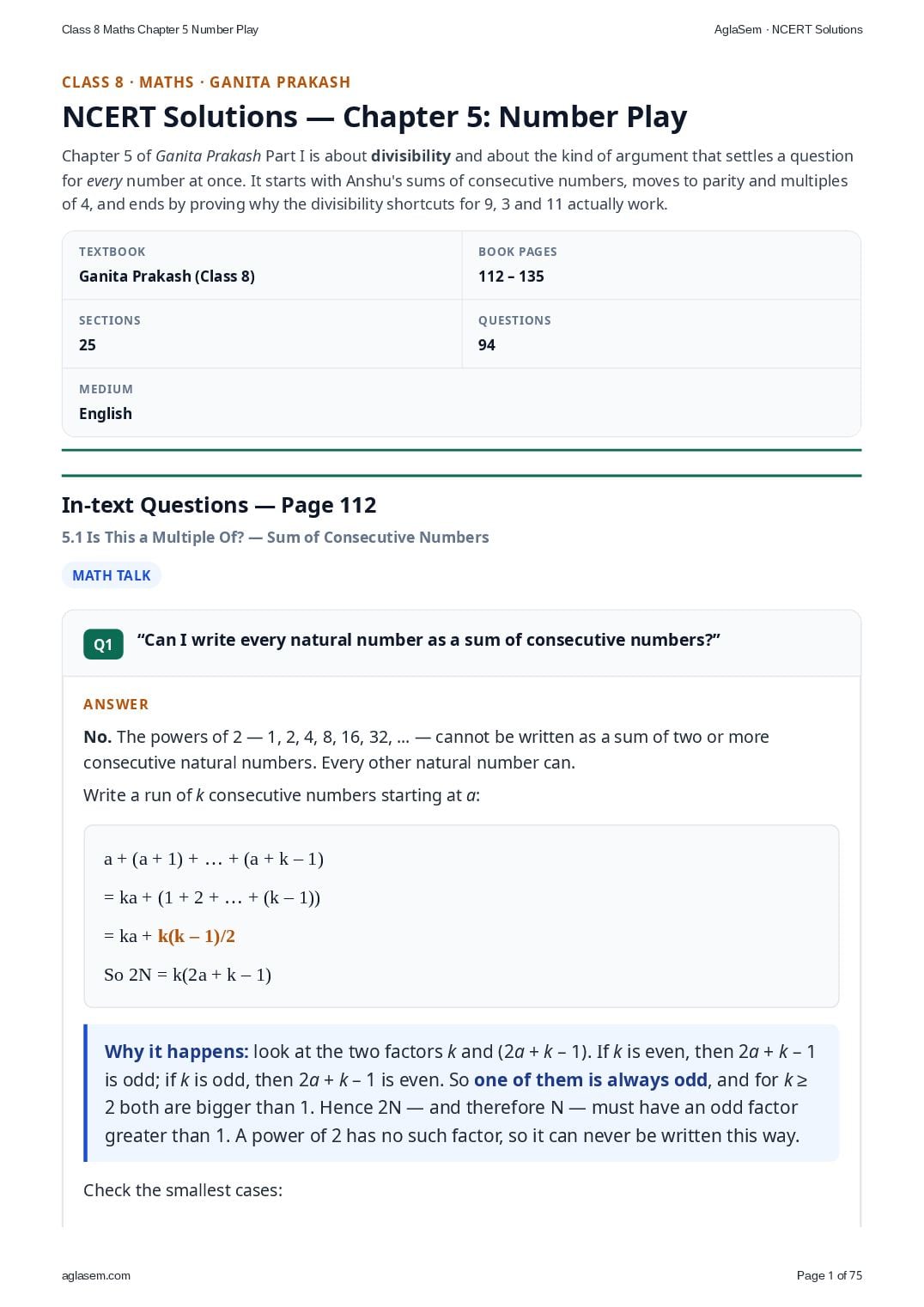
- “Can I write every natural number as a sum of consecutive numbers?”
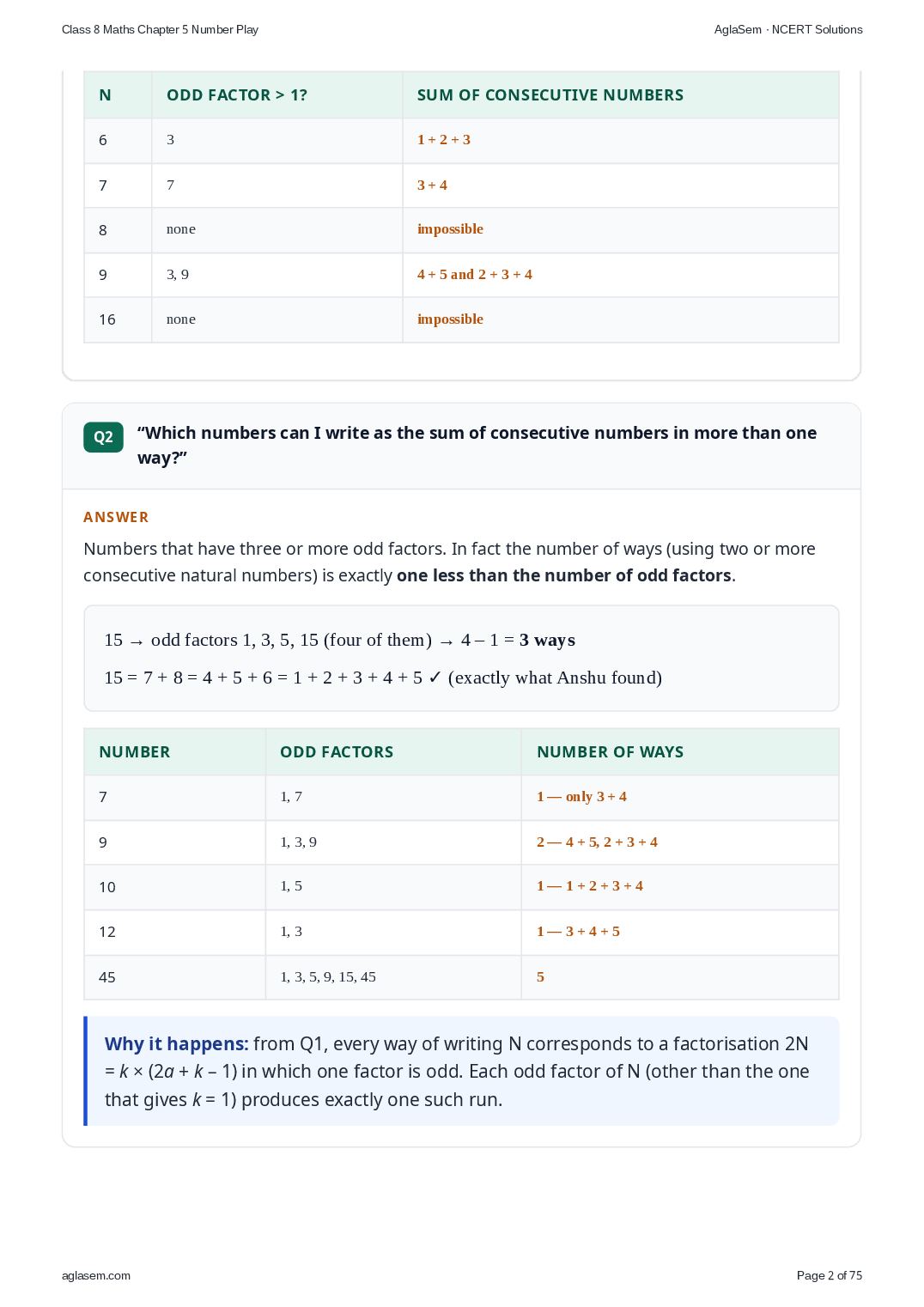
- “Which numbers can I write as the sum of consecutive numbers in more than one way?”
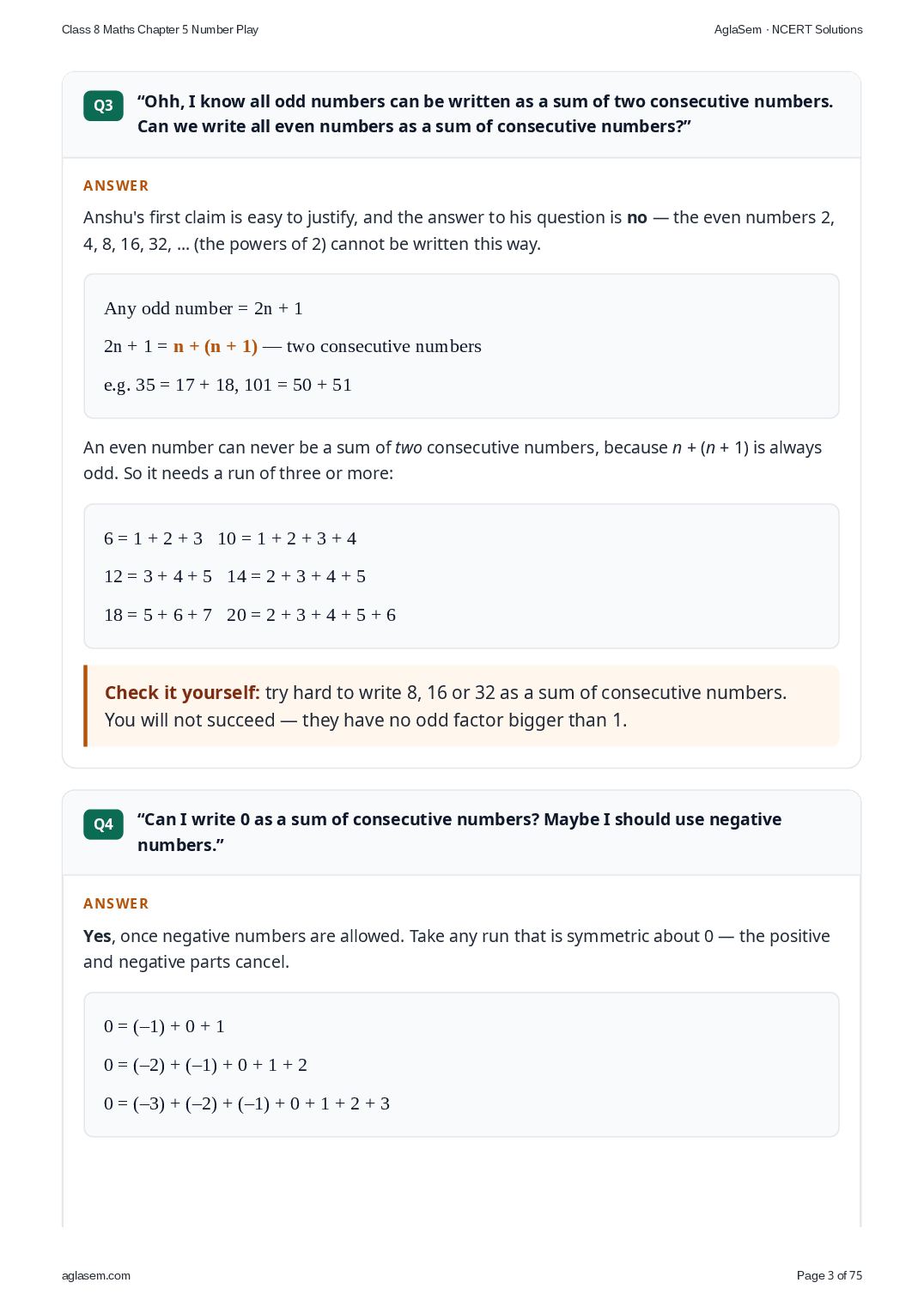
- “Ohh, I know all odd numbers can be written as a sum of two consecutive numbers. Can we write all even numbers as a sum of consecutive numbers?”
- “Can I write 0 as a sum of consecutive numbers? Maybe I should use negative numbers.”
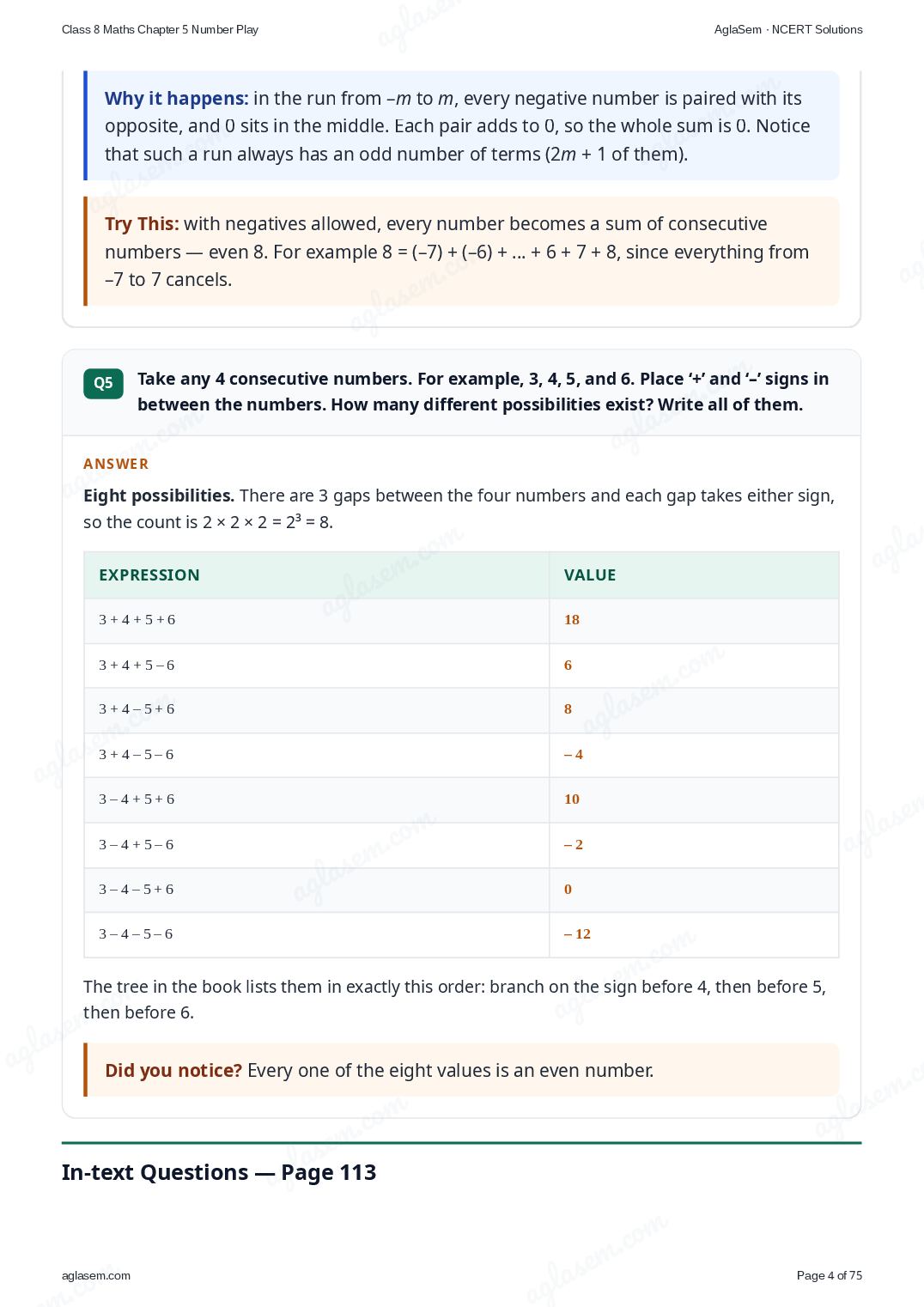
- Take any 4 consecutive numbers. For example, 3, 4, 5, and 6. Place ‘+’ and ‘–’ signs in between the numbers. How many different possibilities exist? Write all of them.
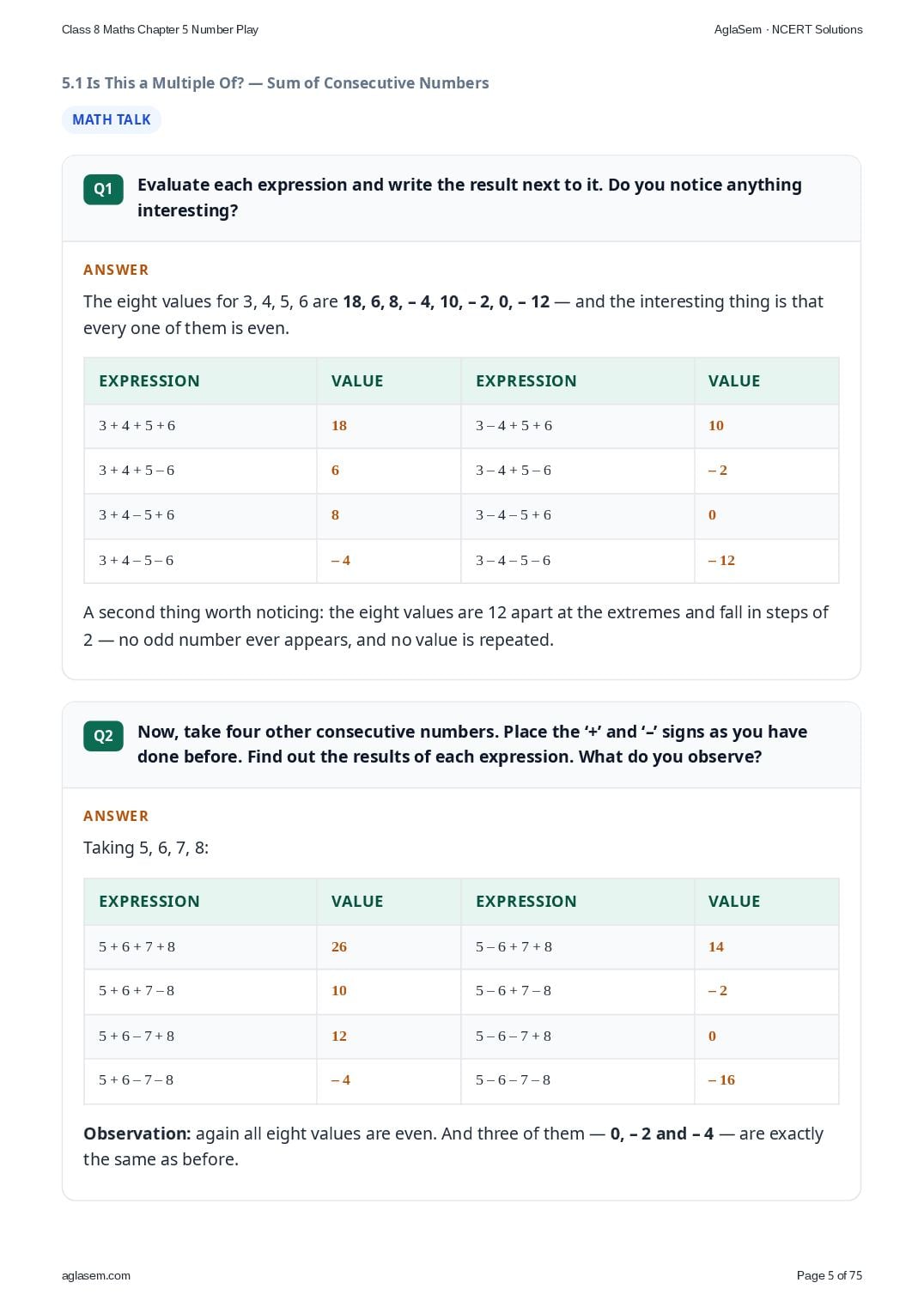
- Evaluate each expression and write the result next to it. Do you notice anything interesting?
- Now, take four other consecutive numbers. Place the ‘+’ and ‘–’ signs as you have done before. Find out the results of each expression. What do you observe?
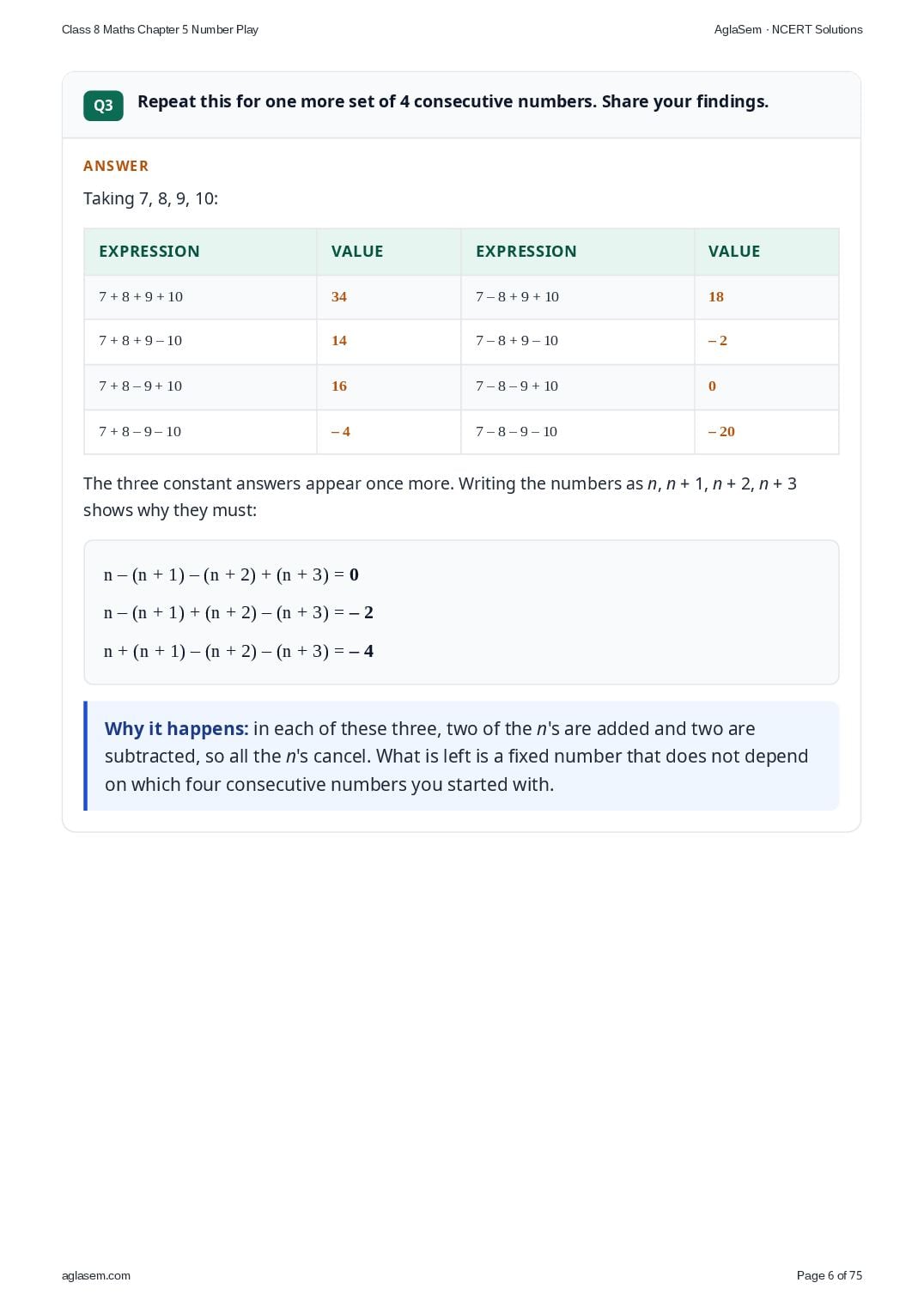
- Repeat this for one more set of 4 consecutive numbers. Share your findings.
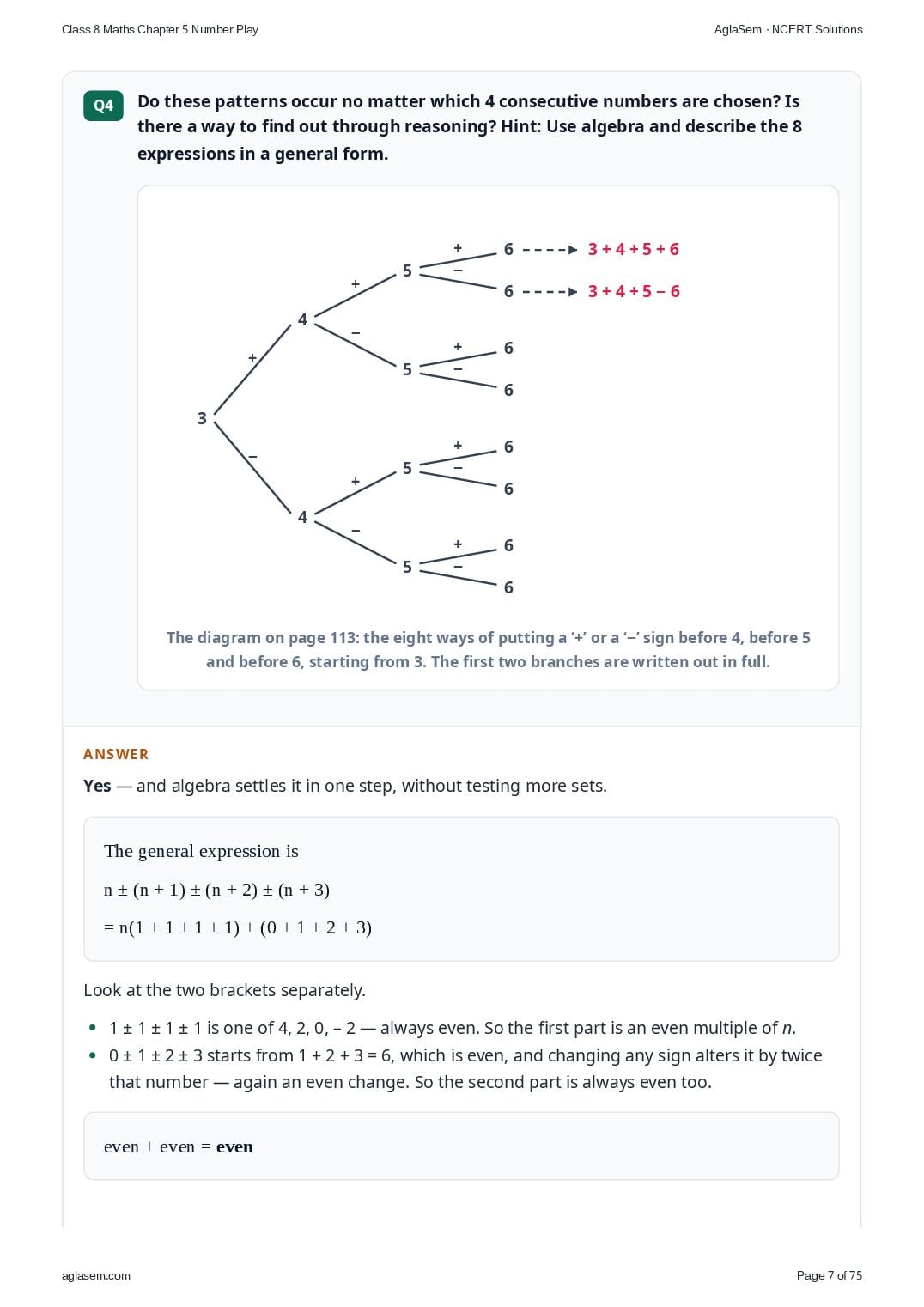
- Do these patterns occur no matter which 4 consecutive numbers are chosen? Is there a way to find out through reasoning? Hint: Use algebra and describe the 8 expressions in a general form.
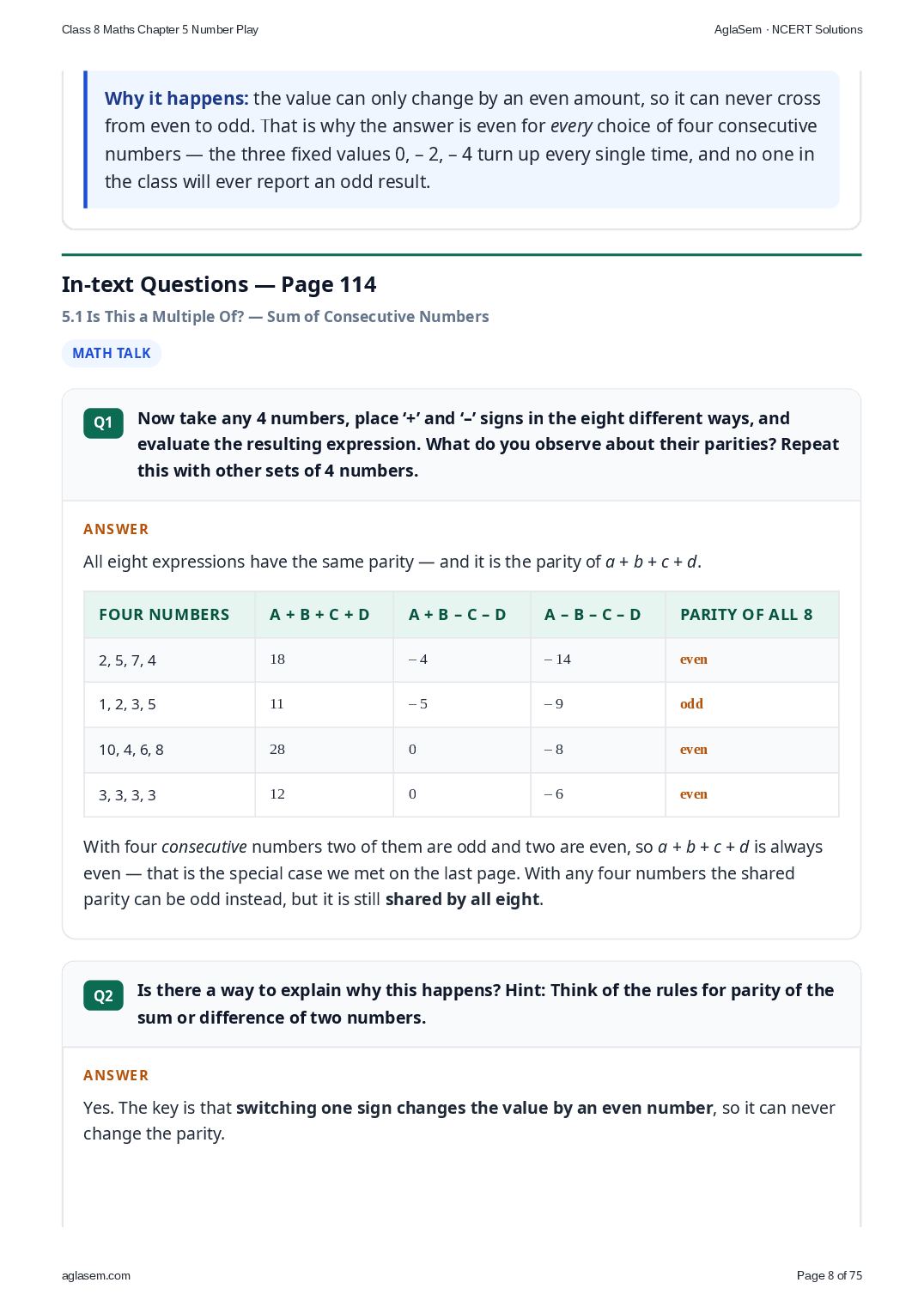
- Now take any 4 numbers, place ‘+’ and ‘–’ signs in the eight different ways, and evaluate the resulting expression. What do you observe about their parities? Repeat this with other sets of 4 numbers.
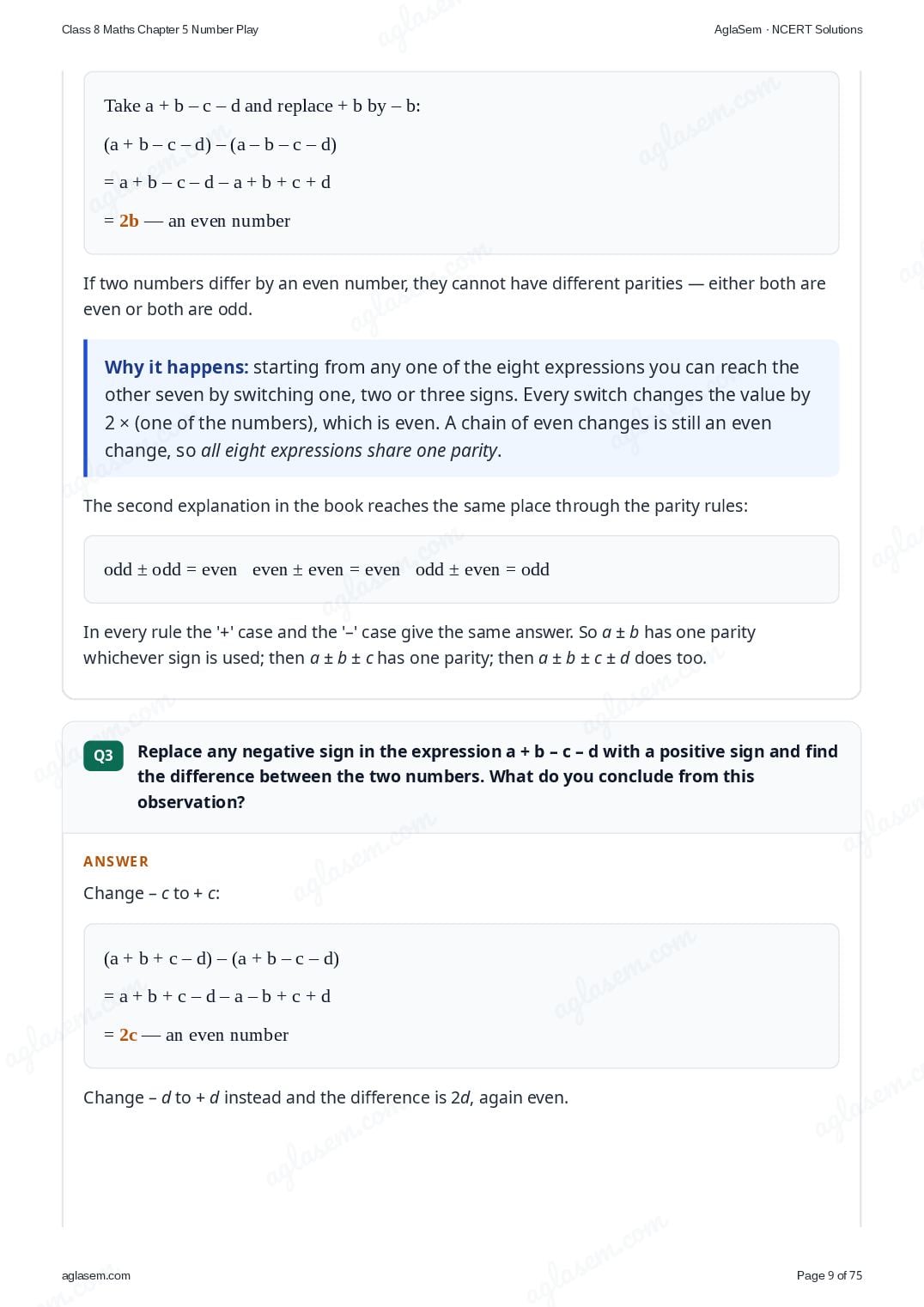
- Is there a way to explain why this happens? Hint: Think of the rules for parity of the sum or difference of two numbers.
- Replace any negative sign in the expression a + b – c – d with a positive sign and find the difference between the two numbers. What do you conclude from this observation?
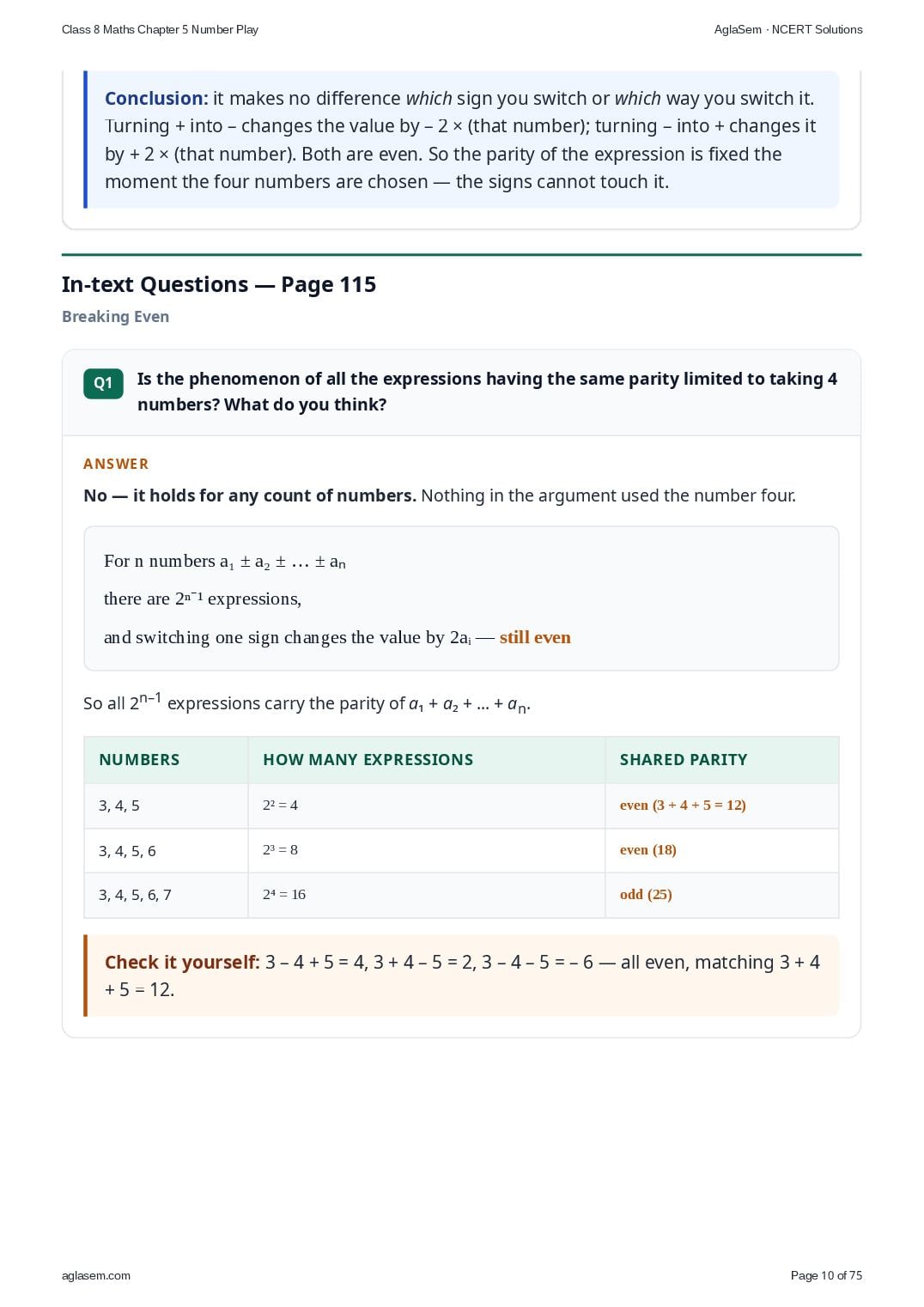
- Is the phenomenon of all the expressions having the same parity limited to taking 4 numbers? What do you think?
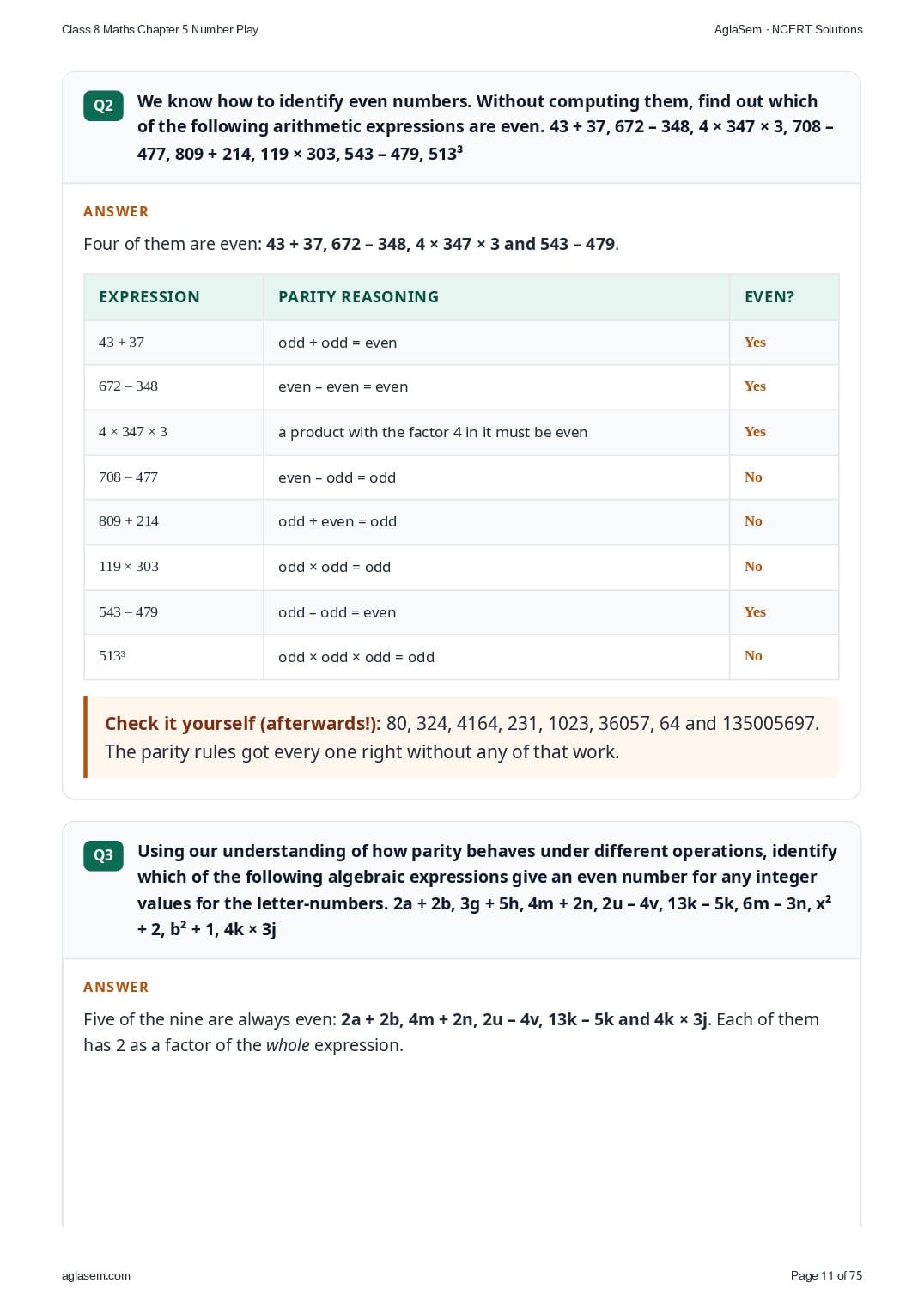
- We know how to identify even numbers. Without computing them, find out which of the following arithmetic expressions are even. 43 + 37, 672 – 348, 4 × 347 × 3, 708 – 477, 809 + 214, 119 × 303, 543 – 479, 513³
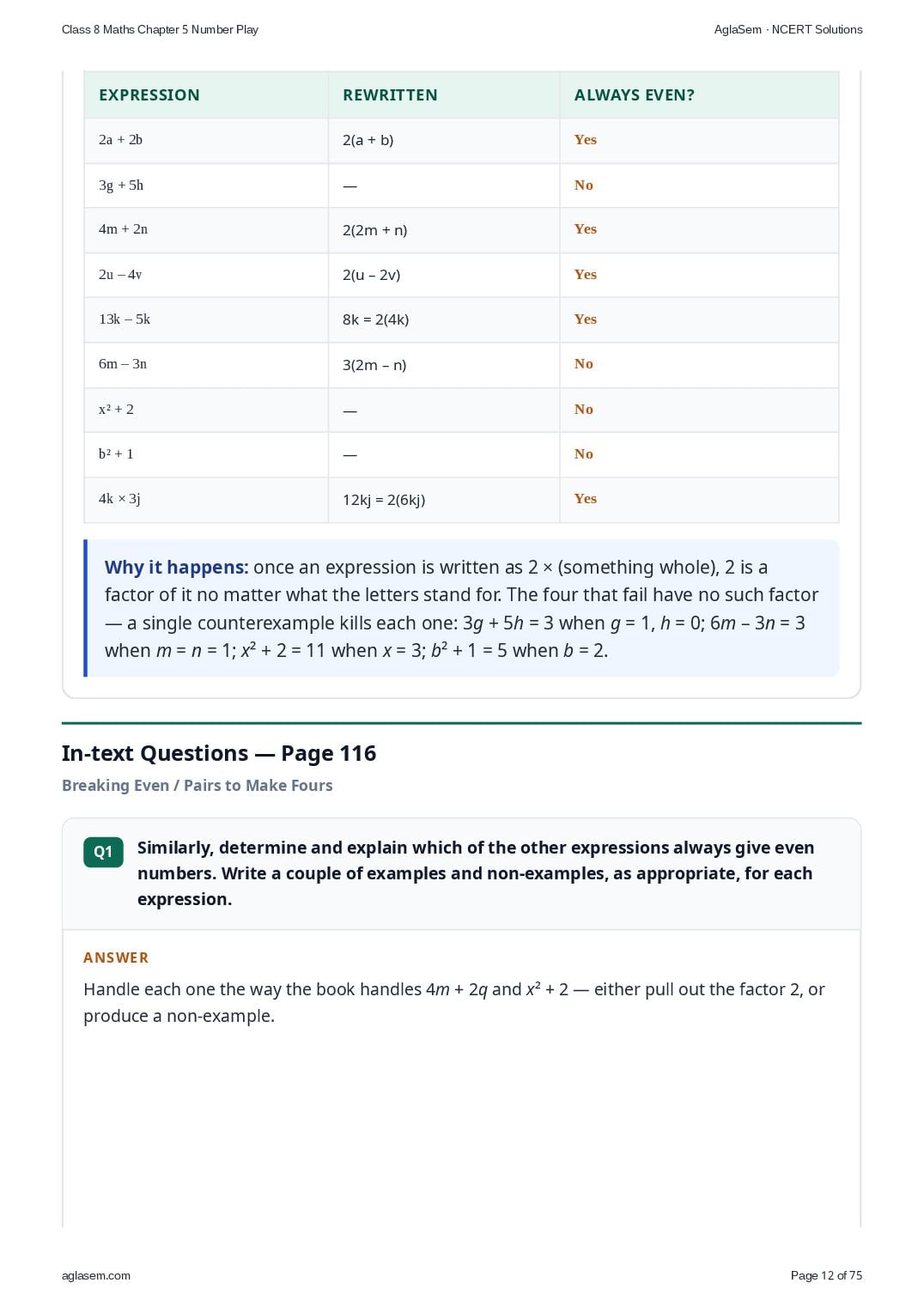
- Using our understanding of how parity behaves under different operations, identify which of the following algebraic expressions give an even number for any integer values for the letter-numbers. 2a + 2b, 3g + 5h, 4m + 2n, 2u – 4v, 13k – 5k, 6m – 3n, x² + 2, b² + 1, 4k × 3j
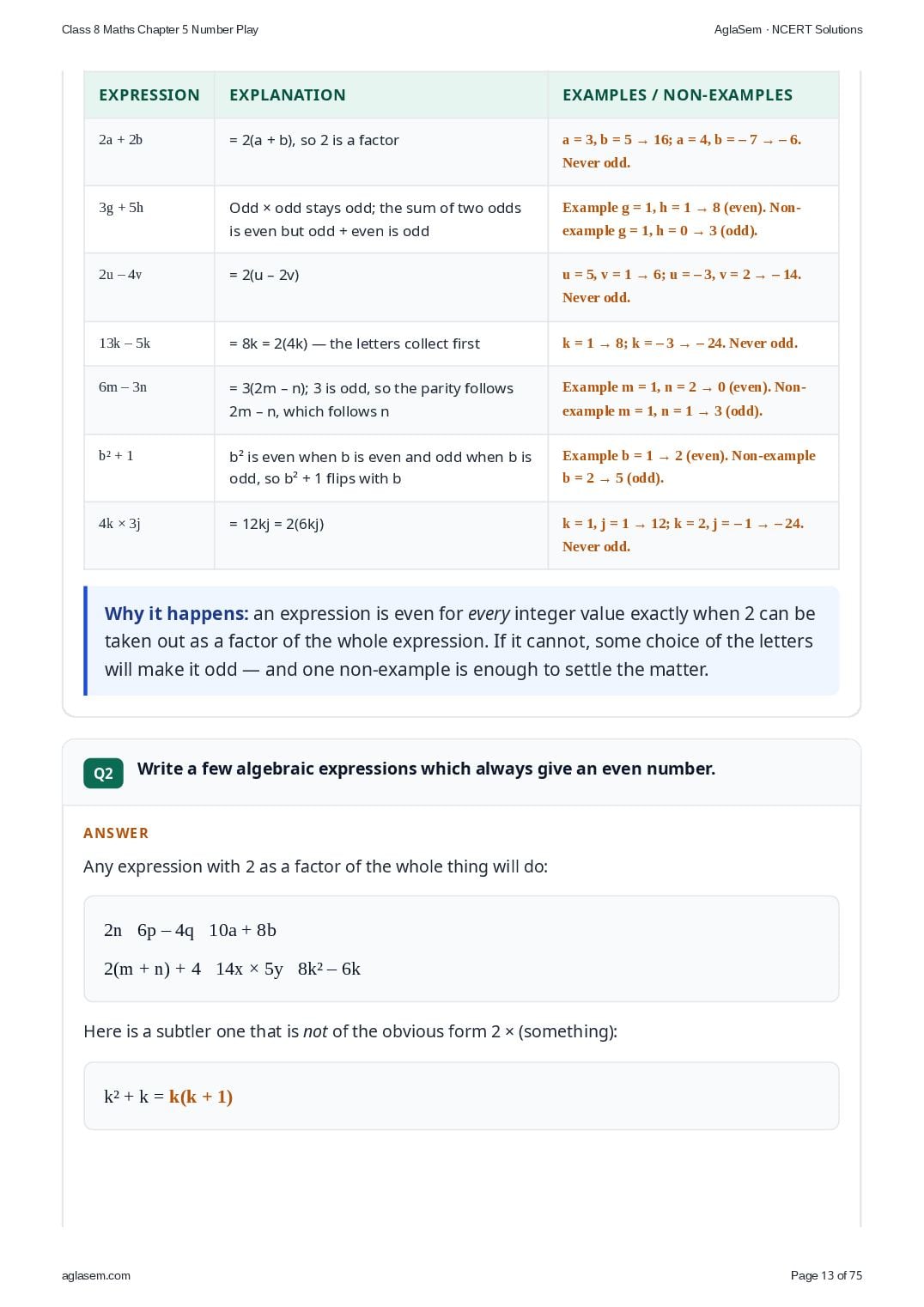
- Similarly, determine and explain which of the other expressions always give even numbers. Write a couple of examples and non-examples, as appropriate, for each expression.
- Write a few algebraic expressions which always give an even number.
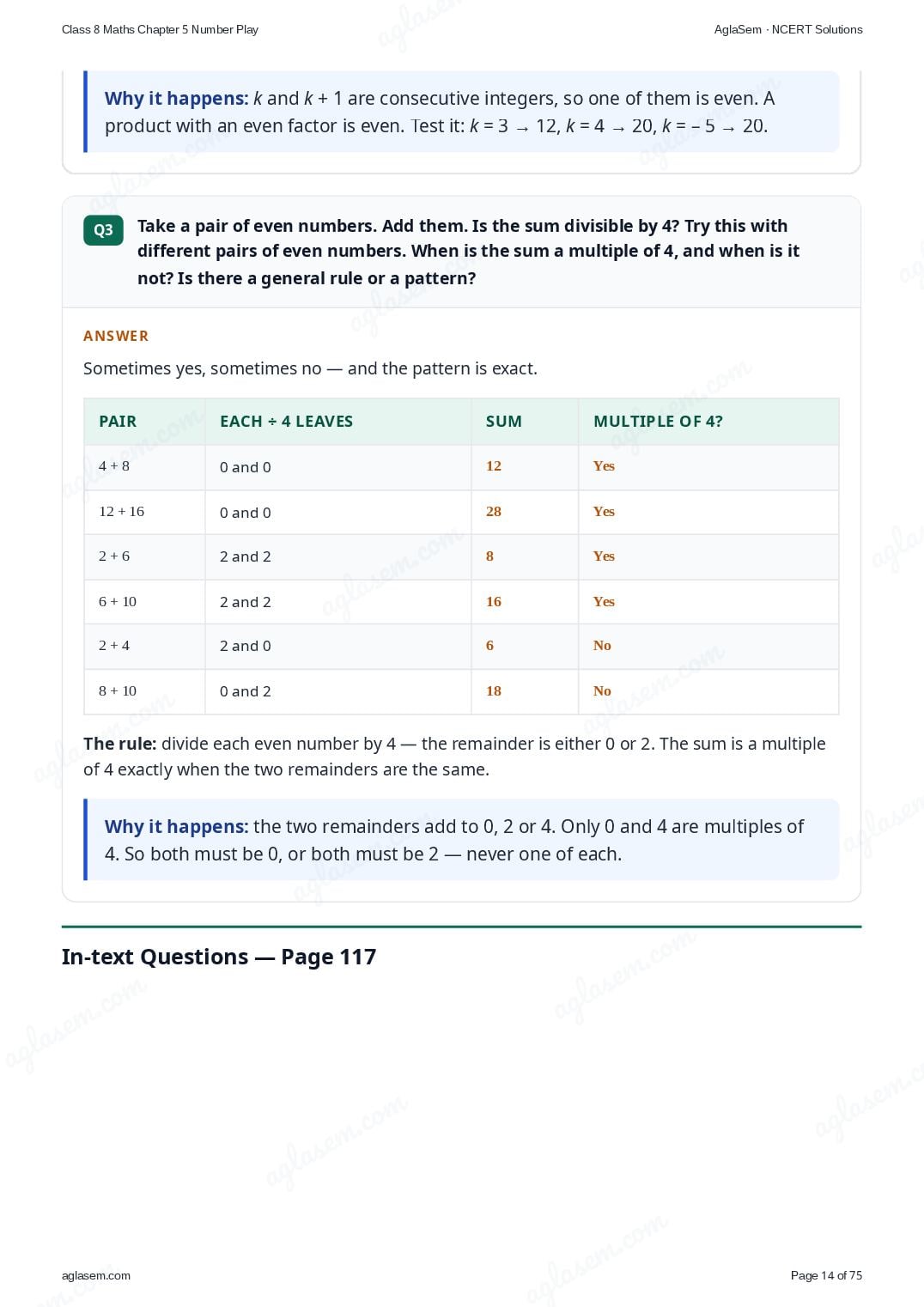
- Take a pair of even numbers. Add them. Is the sum divisible by 4? Try this with different pairs of even numbers. When is the sum a multiple of 4, and when is it not? Is there a general rule or a pattern?
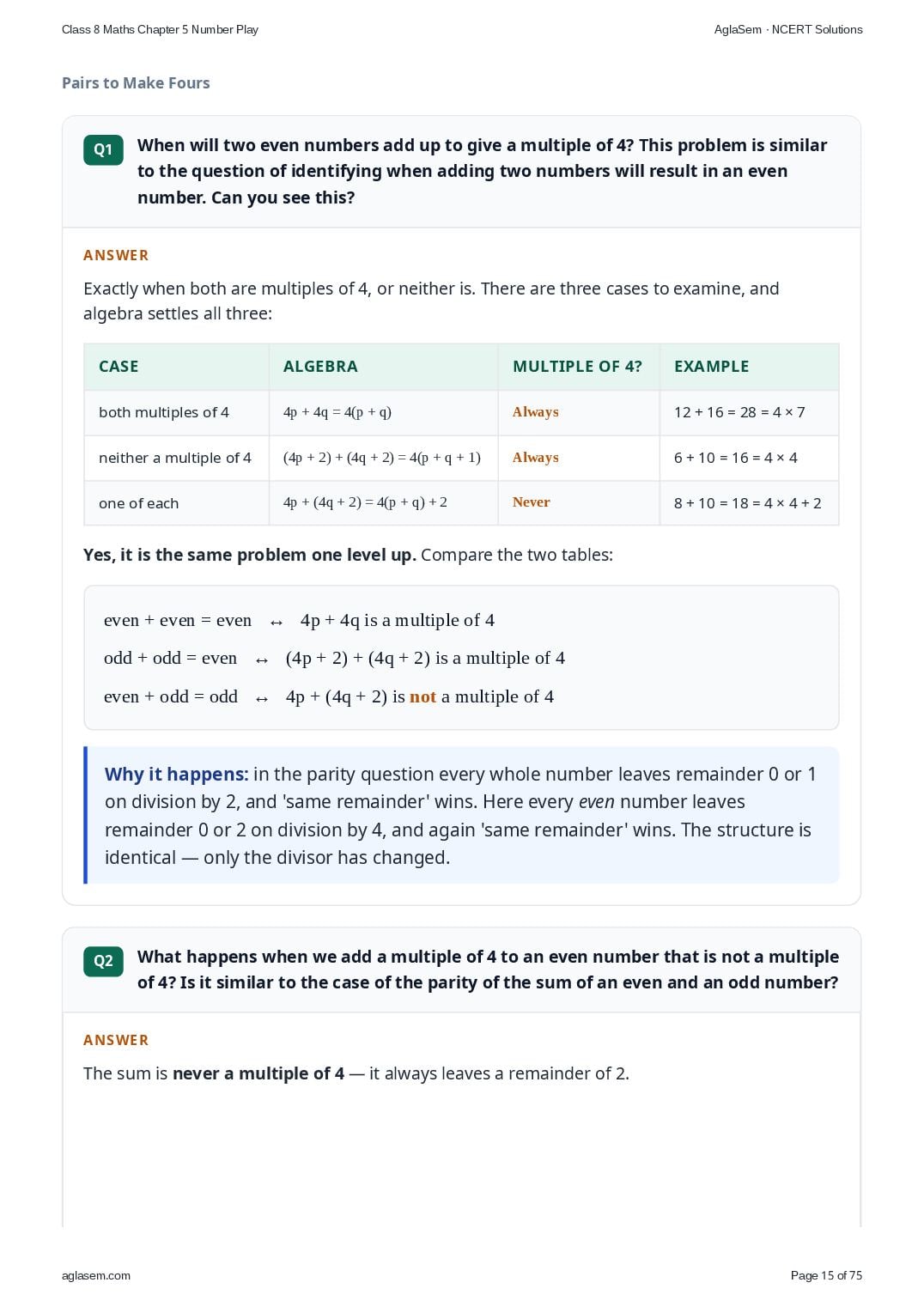
- When will two even numbers add up to give a multiple of 4? This problem is similar to the question of identifying when adding two numbers will result in an even number. Can you see this?
- What happens when we add a multiple of 4 to an even number that is not a multiple of 4? Is it similar to the case of the parity of the sum of an even and an odd number?
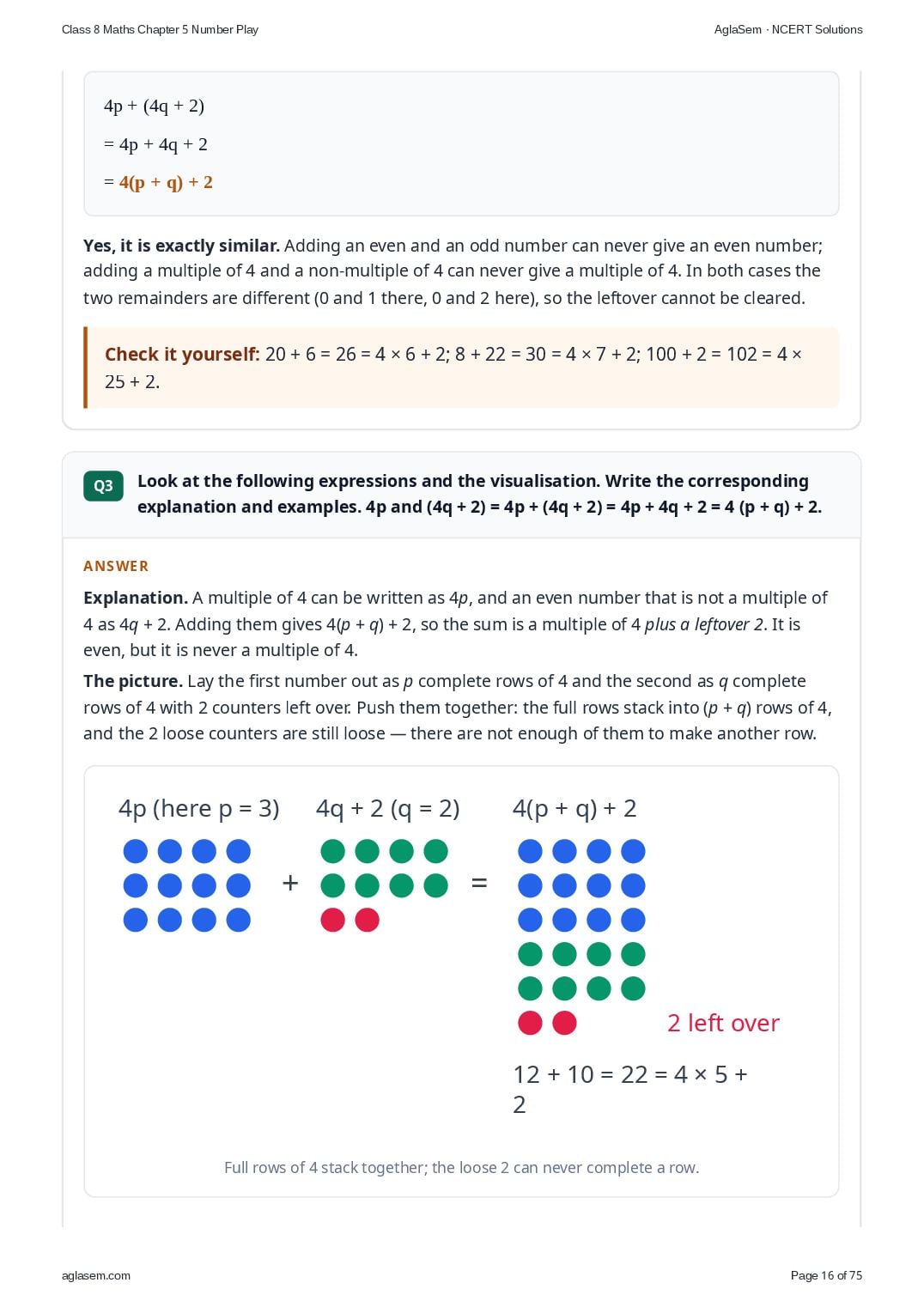
- Look at the following expressions and the visualisation. Write the corresponding explanation and examples. 4p and (4q + 2) = 4p + (4q + 2) = 4p + 4q + 2 = 4 (p + q) + 2.
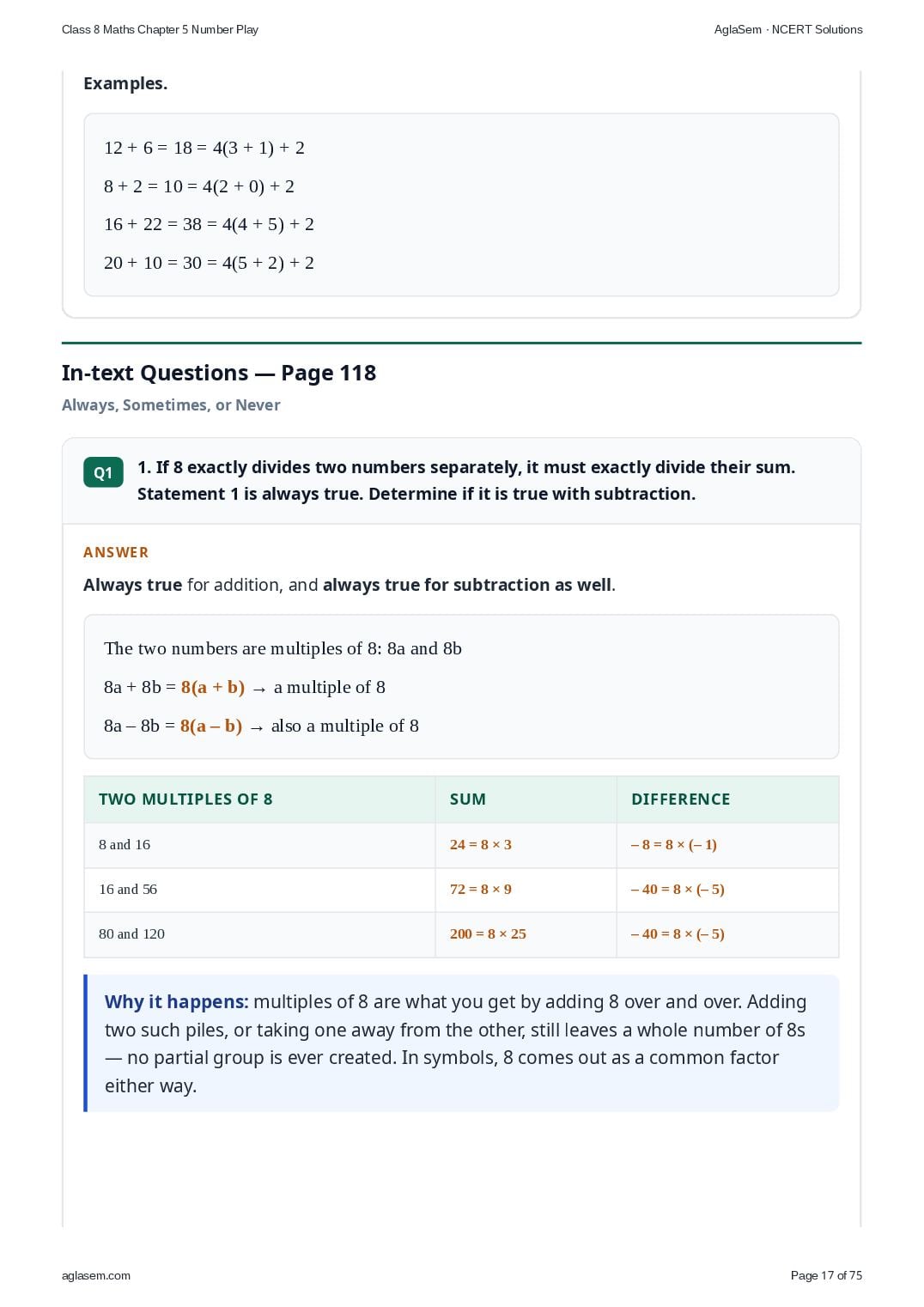
- 1. If 8 exactly divides two numbers separately, it must exactly divide their sum. Statement 1 is always true. Determine if it is true with subtraction.
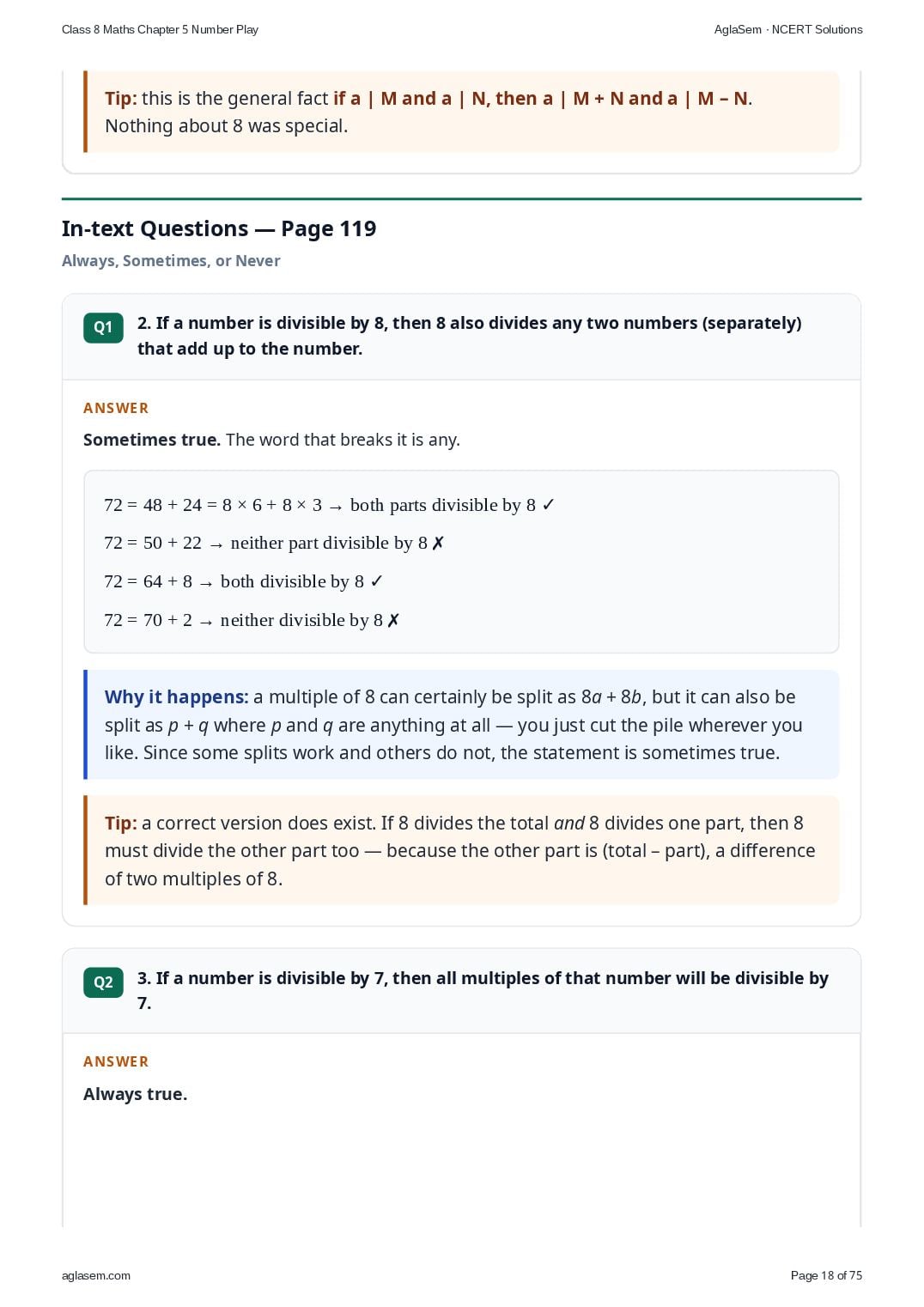
- 2. If a number is divisible by 8, then 8 also divides any two numbers (separately) that add up to the number.
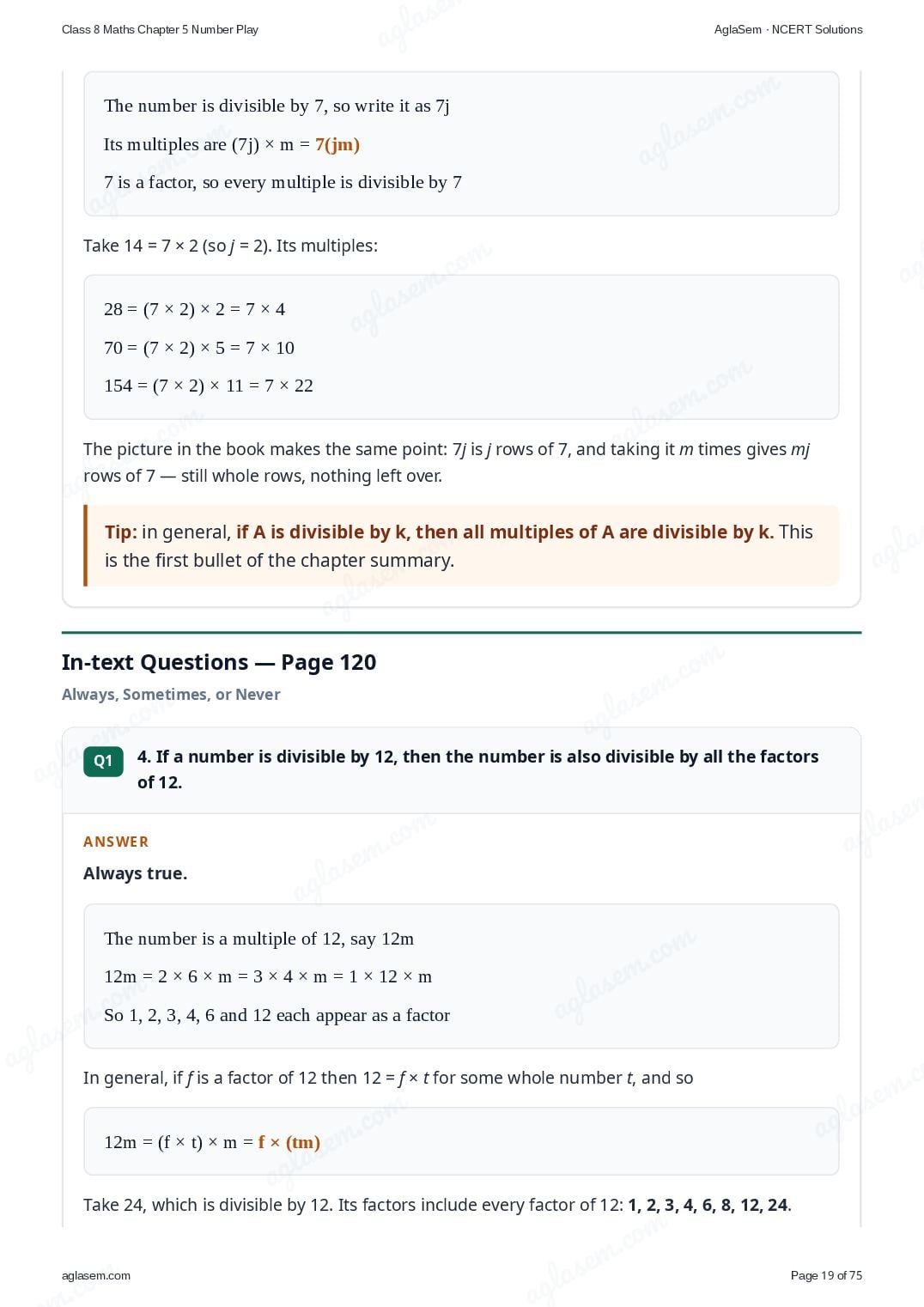
- 3. If a number is divisible by 7, then all multiples of that number will be divisible by 7.
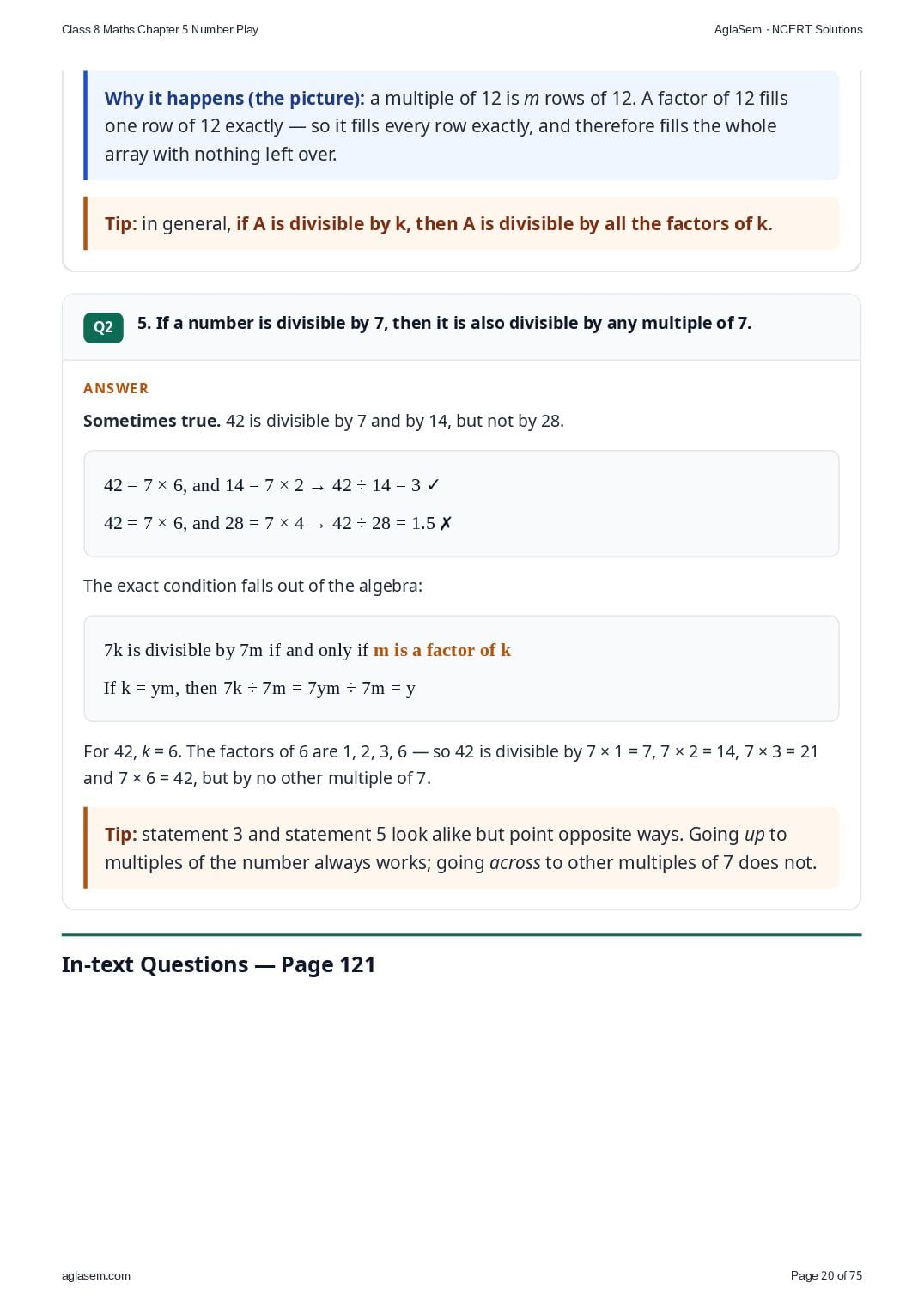
- 4. If a number is divisible by 12, then the number is also divisible by all the factors of 12.
- 5. If a number is divisible by 7, then it is also divisible by any multiple of 7.
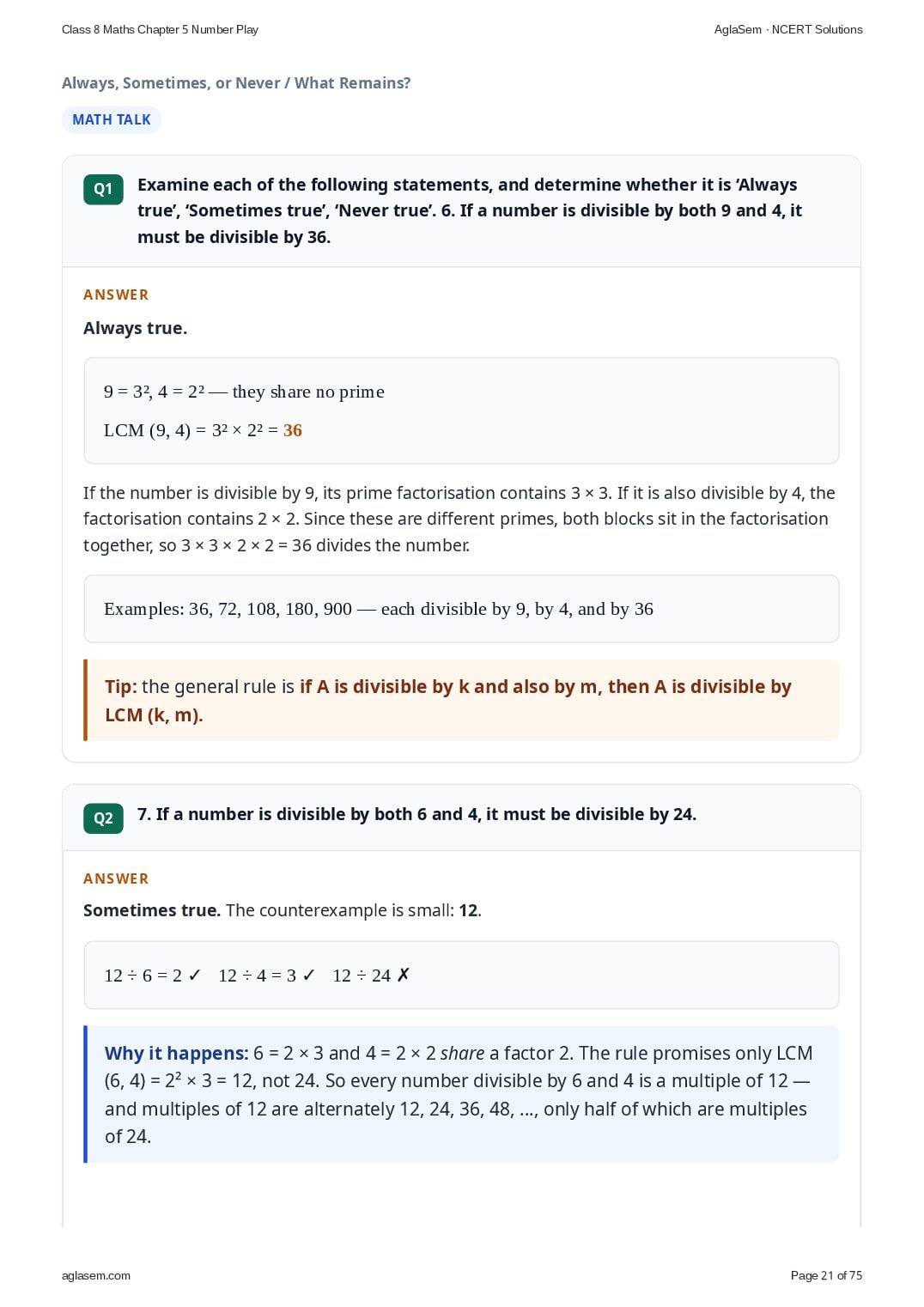
- Examine each of the following statements, and determine whether it is ‘Always true’, ‘Sometimes true’, ‘Never true’. 6. If a number is divisible by both 9 and 4, it must be divisible by 36.
- 7. If a number is divisible by both 6 and 4, it must be divisible by 24.
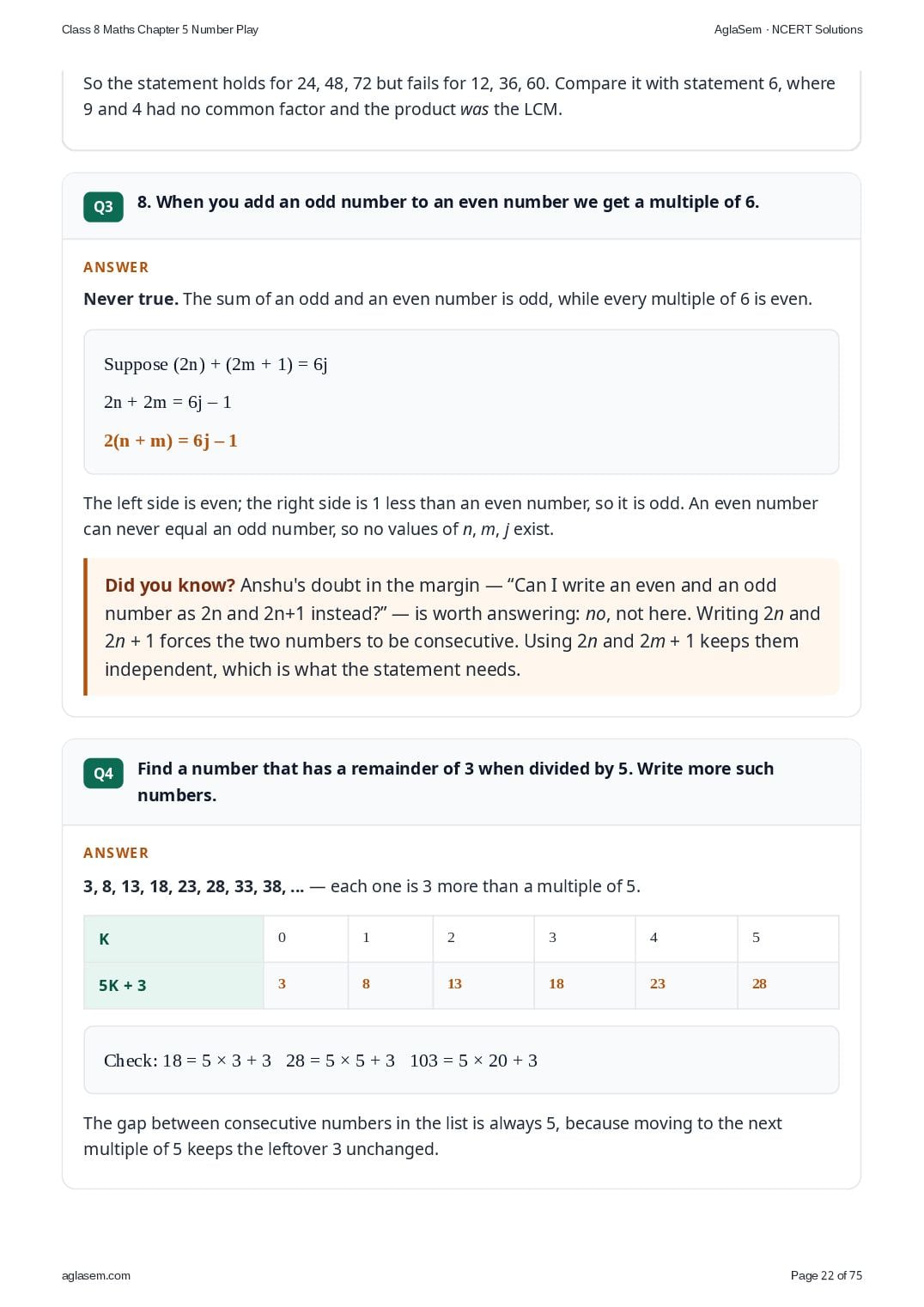
- 8. When you add an odd number to an even number we get a multiple of 6.
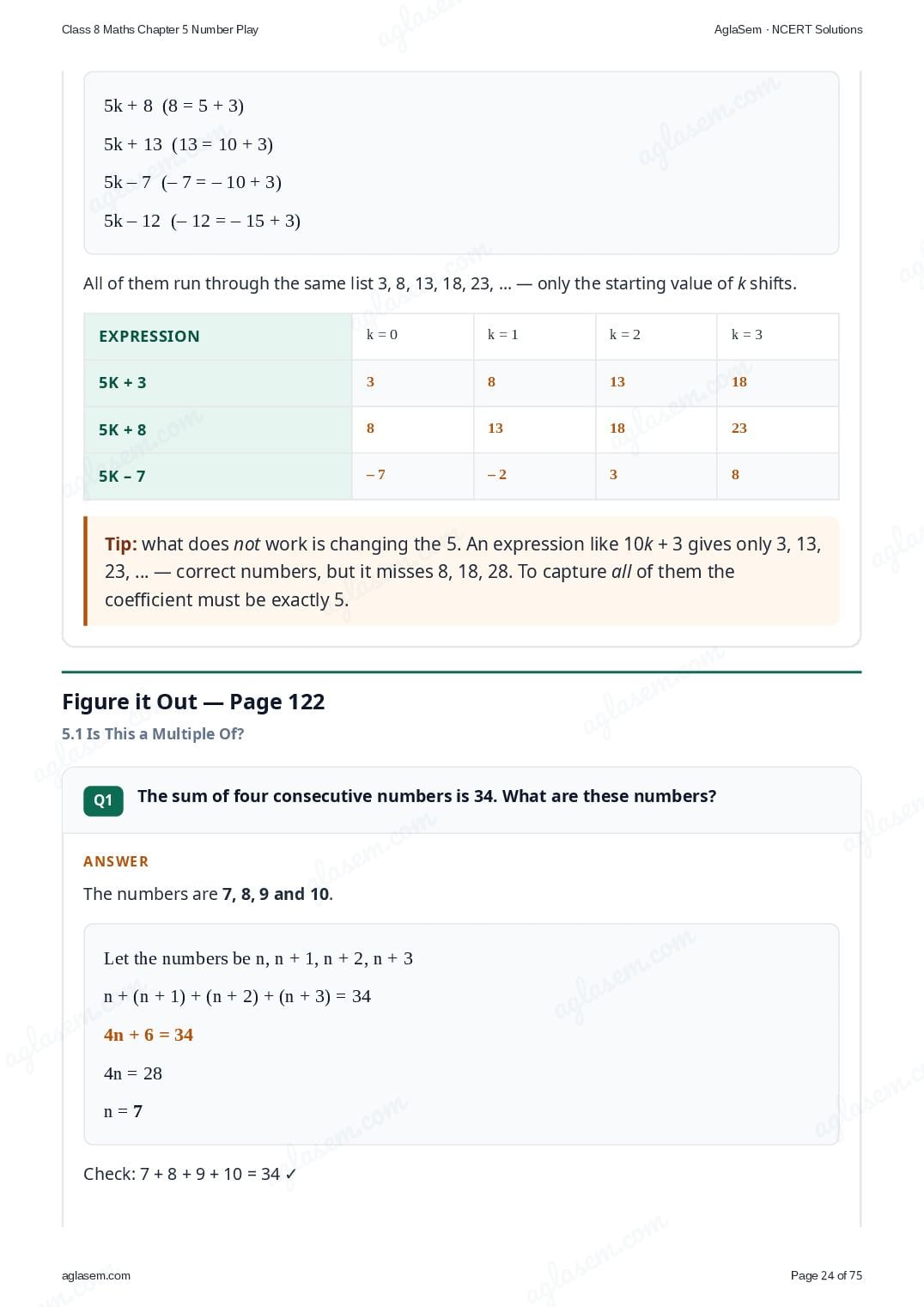
- Find a number that has a remainder of 3 when divided by 5. Write more such numbers.
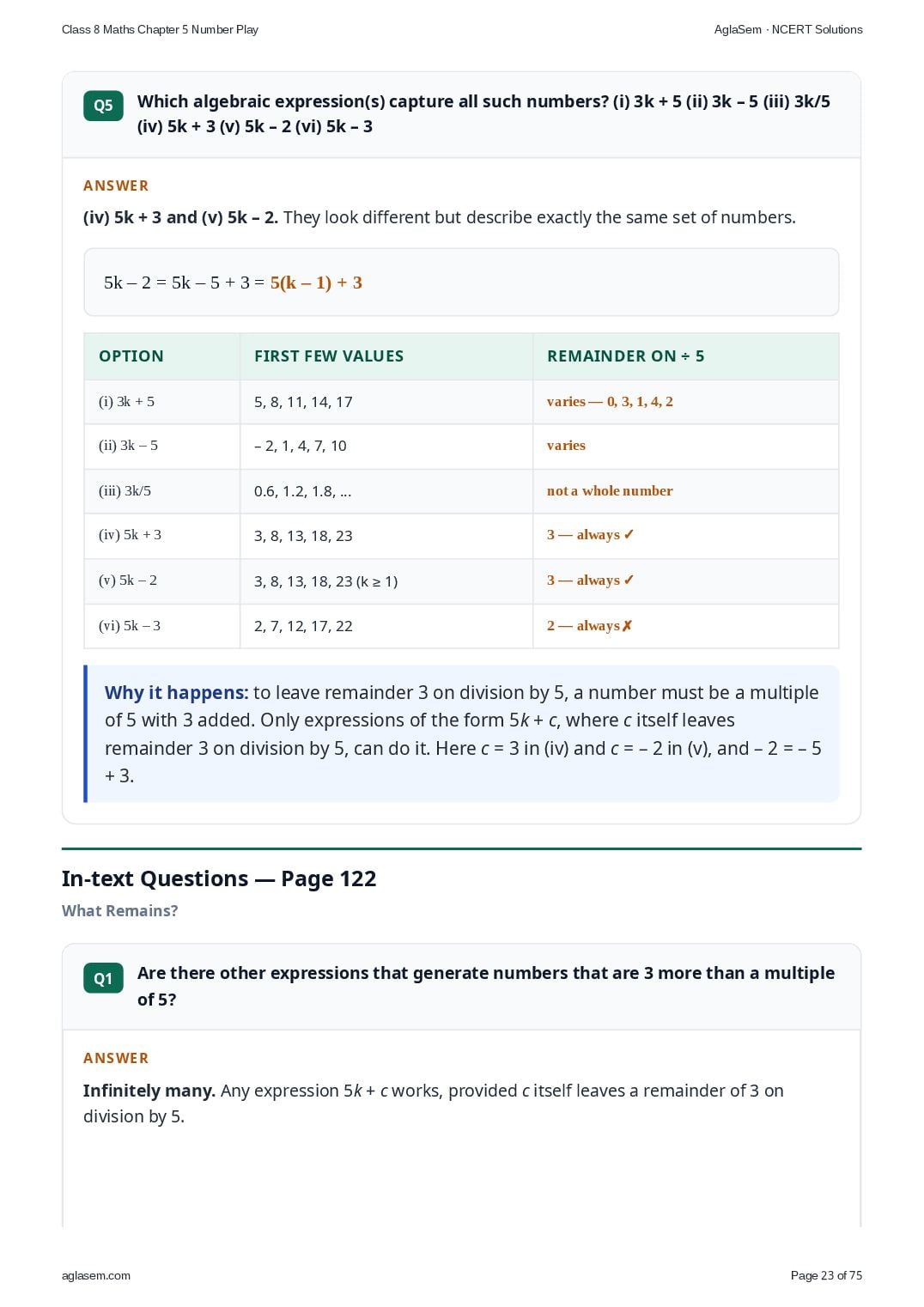
- Which algebraic expression(s) capture all such numbers? (i) 3k + 5 (ii) 3k – 5 (iii) 3k/5 (iv) 5k + 3 (v) 5k – 2 (vi) 5k – 3
- Are there other expressions that generate numbers that are 3 more than a multiple of 5?
- The sum of four consecutive numbers is 34. What are these numbers?
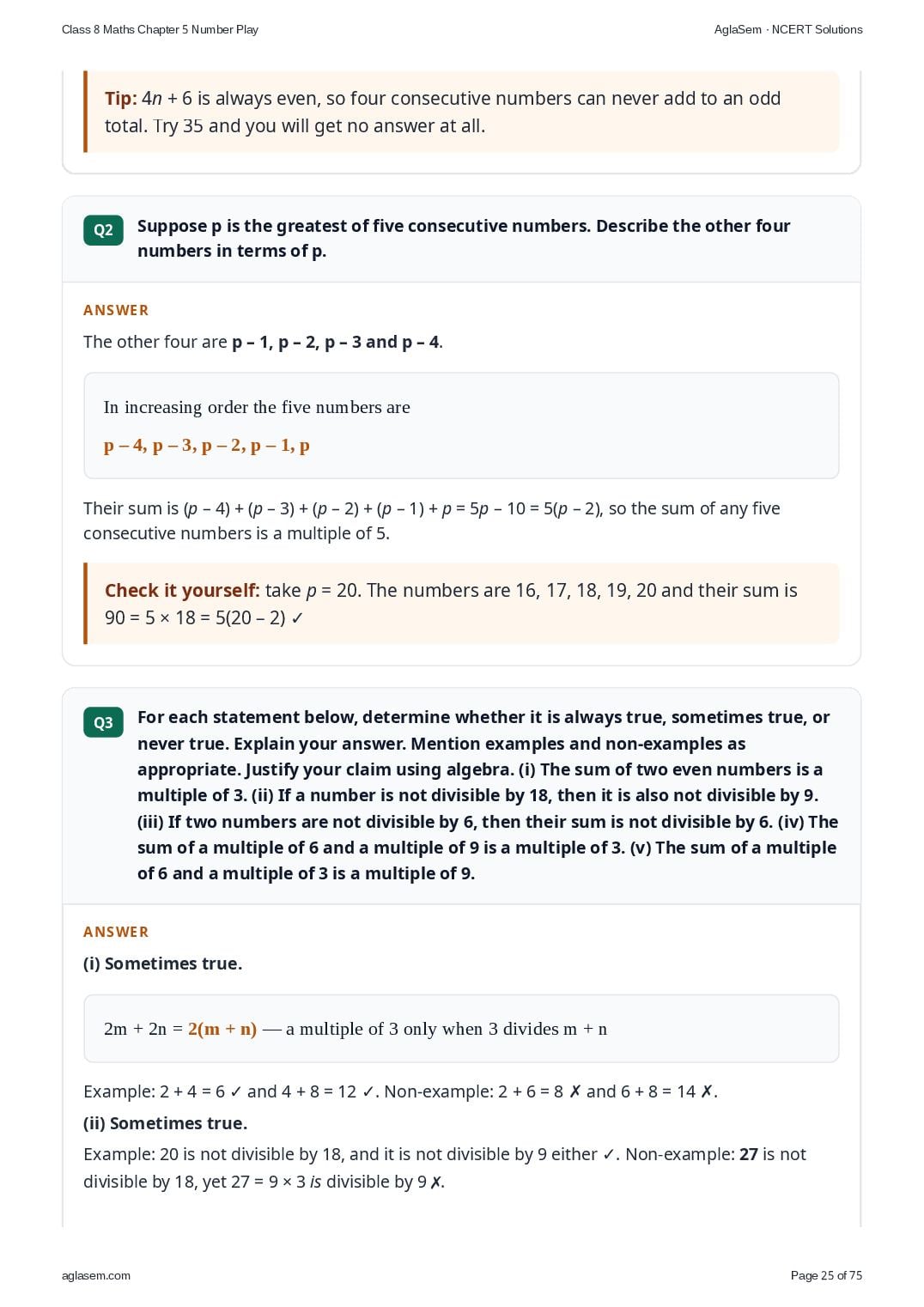
- Suppose p is the greatest of five consecutive numbers. Describe the other four numbers in terms of p.
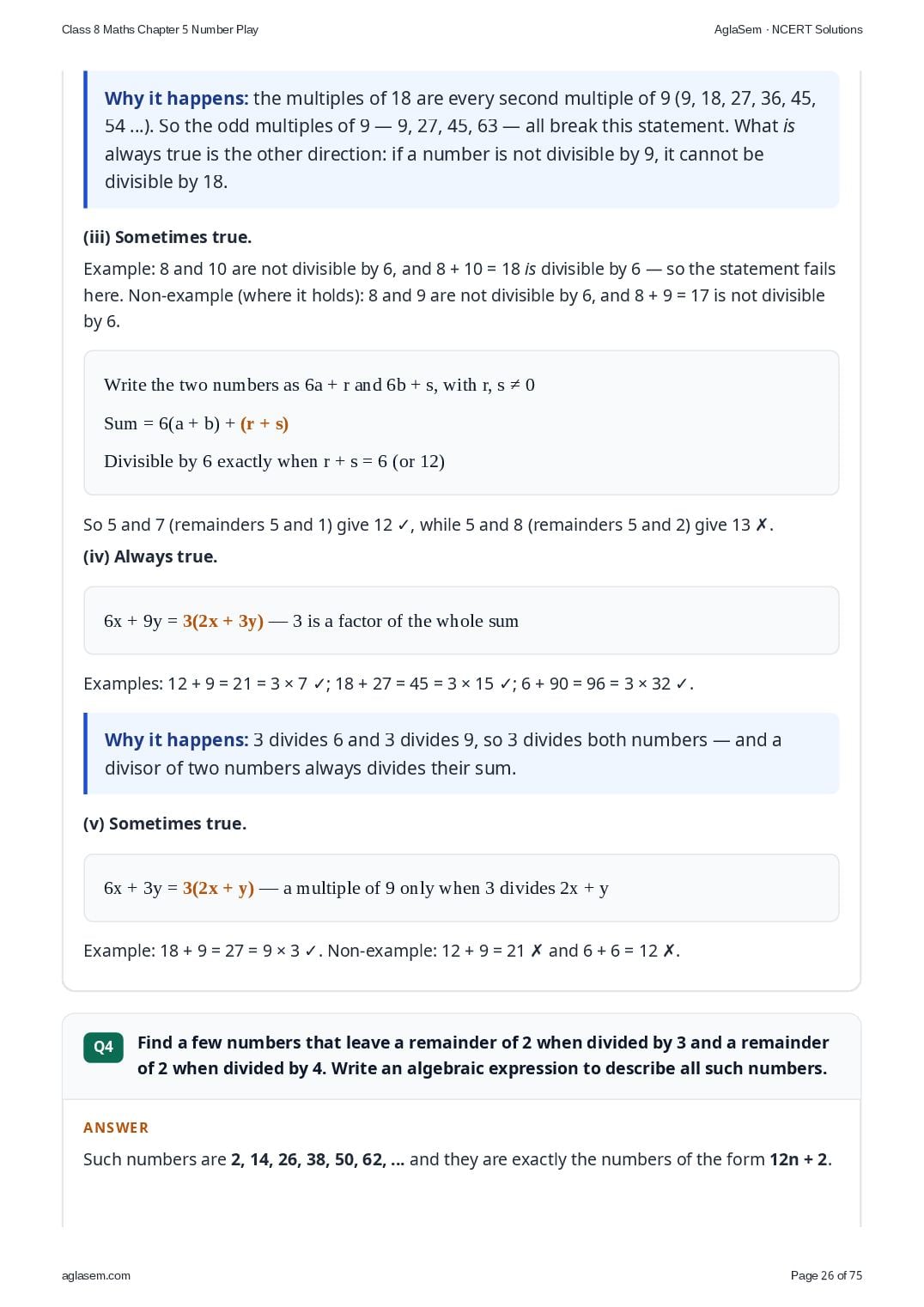
- For each statement below, determine whether it is always true, sometimes true, or never true. Explain your answer. Mention examples and non-examples as appropriate. Justify your claim using algebra. (i) The sum of two even numbers is a multiple of 3. (ii) If a number is not divisible by 18, then it is also not divisible by 9. (iii) If two numbers are not divisible by 6, then their sum is not divisible by 6. (iv) The sum of a multiple of 6 and a multiple of 9 is a multiple of 3. (v) The sum of a multiple of 6 and a multiple of 3 is a multiple of 9.
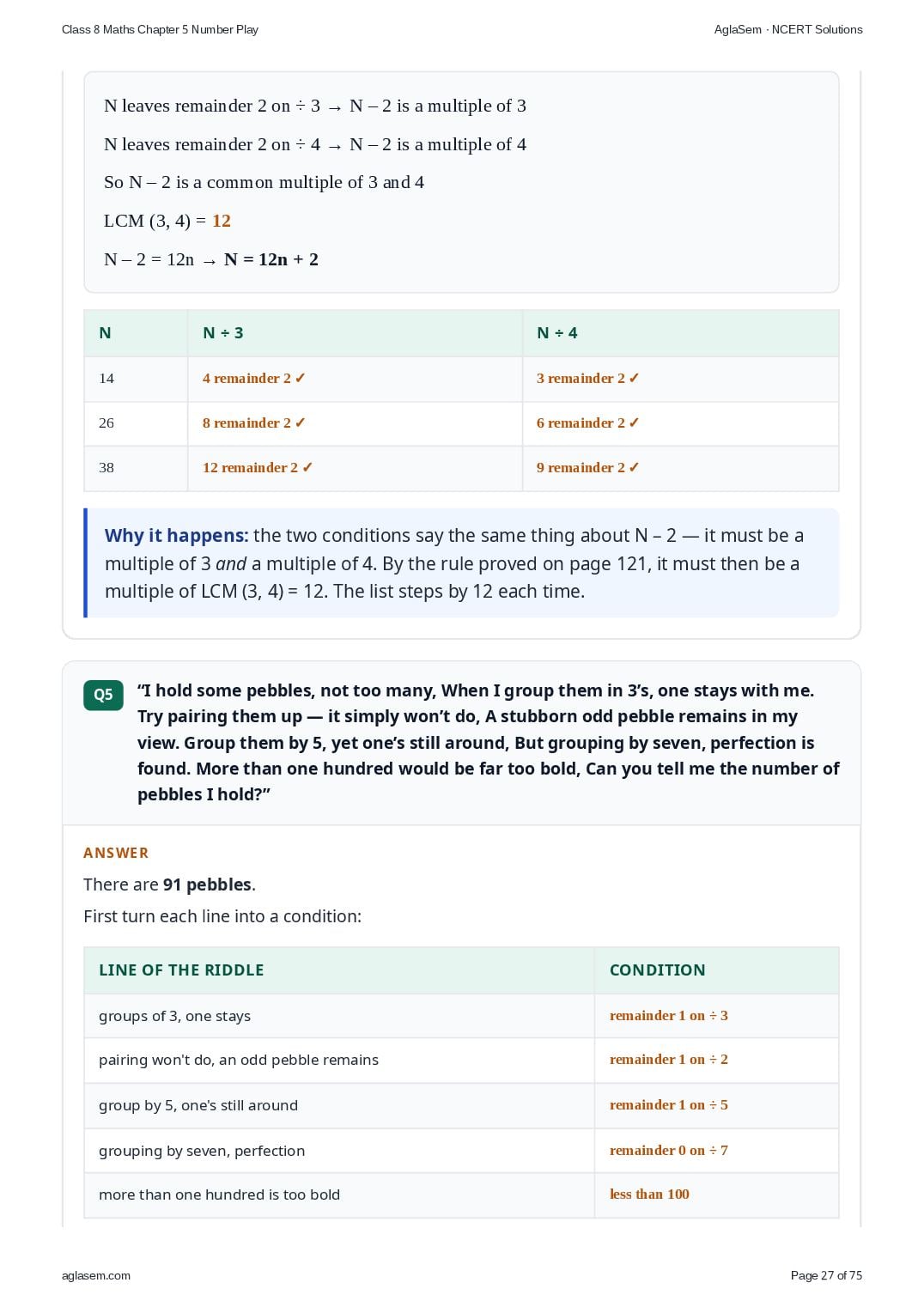
- Find a few numbers that leave a remainder of 2 when divided by 3 and a remainder of 2 when divided by 4. Write an algebraic expression to describe all such numbers.
- “I hold some pebbles, not too many, When I group them in 3’s, one stays with me. Try pairing them up — it simply won’t do, A stubborn odd pebble remains in my view. Group them by 5, yet one’s still around, But grouping by seven, perfection is found. More than one hundred would be far too bold, Can you tell me the number of pebbles I hold?”
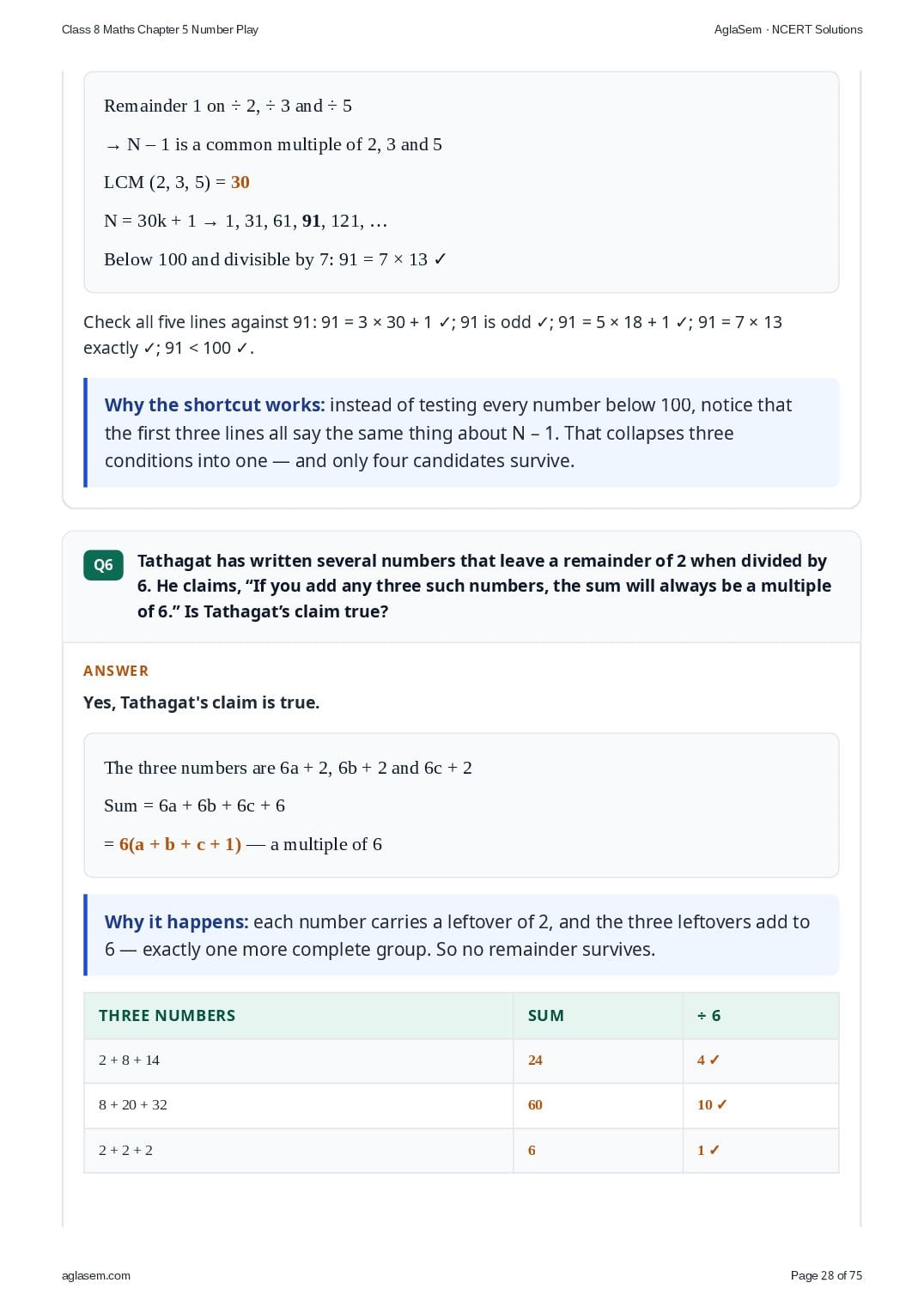
- Tathagat has written several numbers that leave a remainder of 2 when divided by 6. He claims, “If you add any three such numbers, the sum will always be a multiple of 6.” Is Tathagat’s claim true?
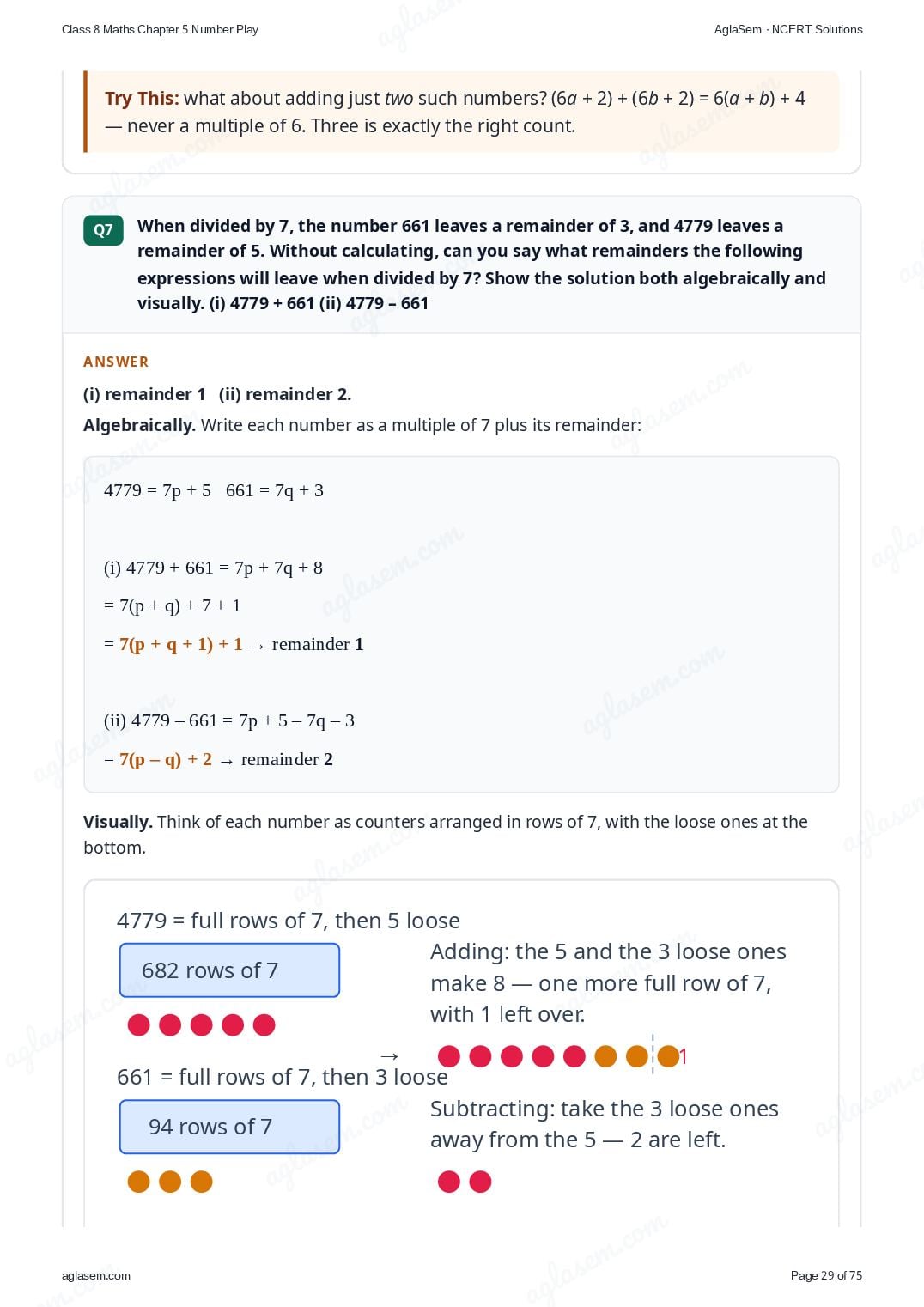
- When divided by 7, the number 661 leaves a remainder of 3, and 4779 leaves a remainder of 5. Without calculating, can you say what remainders the following expressions will leave when divided by 7? Show the solution both algebraically and visually. (i) 4779 + 661 (ii) 4779 – 661
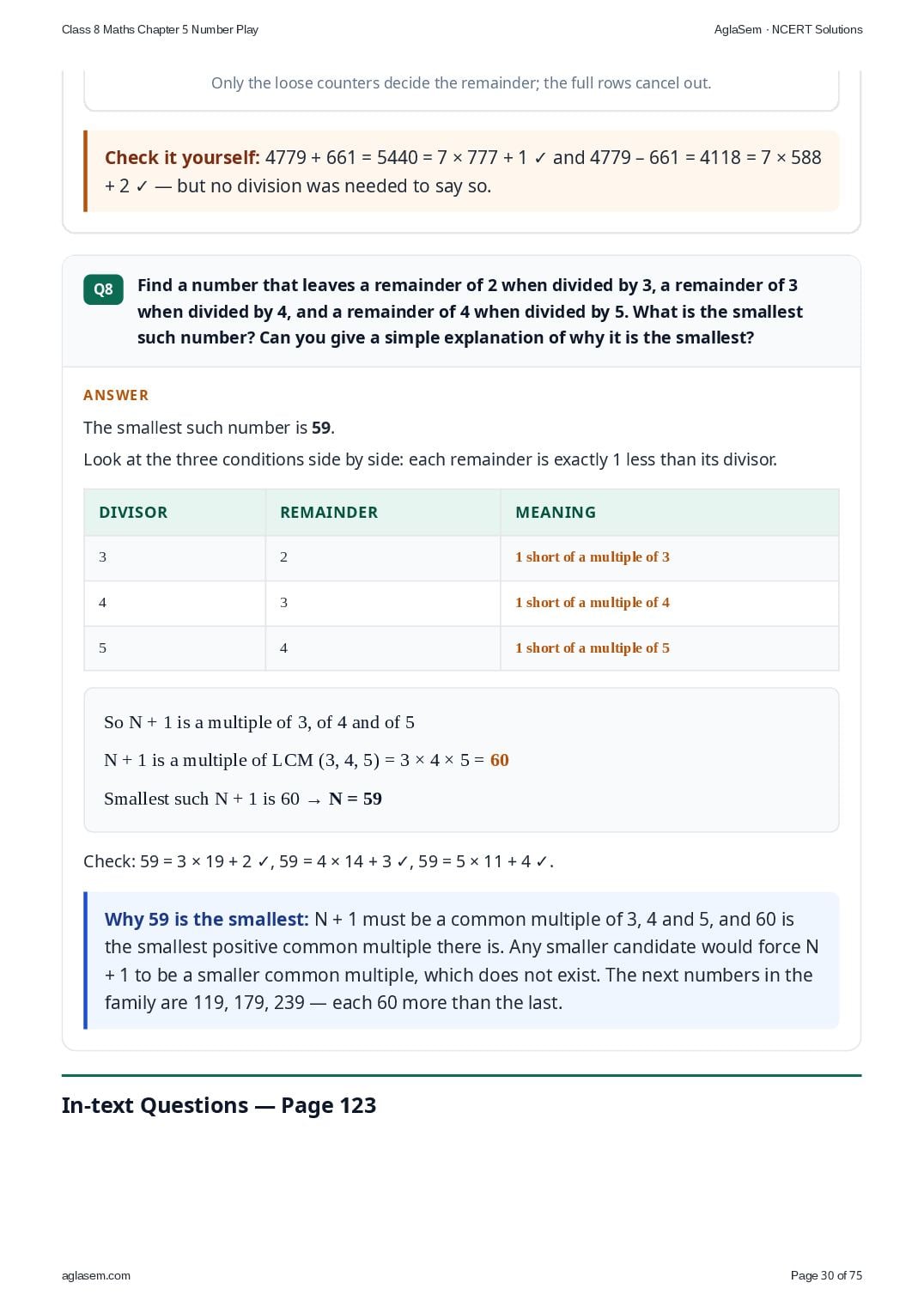
- Find a number that leaves a remainder of 2 when divided by 3, a remainder of 3 when divided by 4, and a remainder of 4 when divided by 5. What is the smallest such number? Can you give a simple explanation of why it is the smallest?
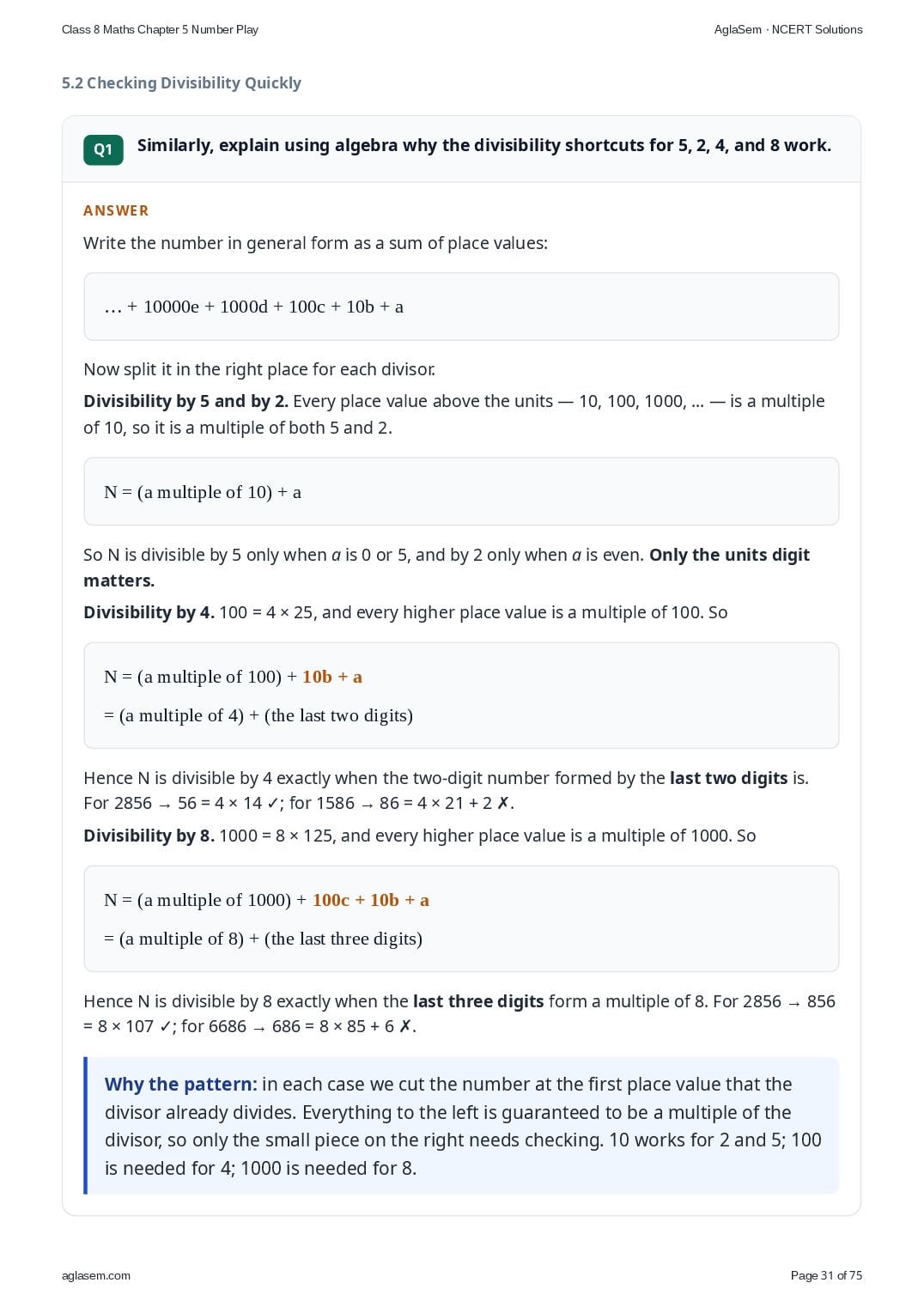
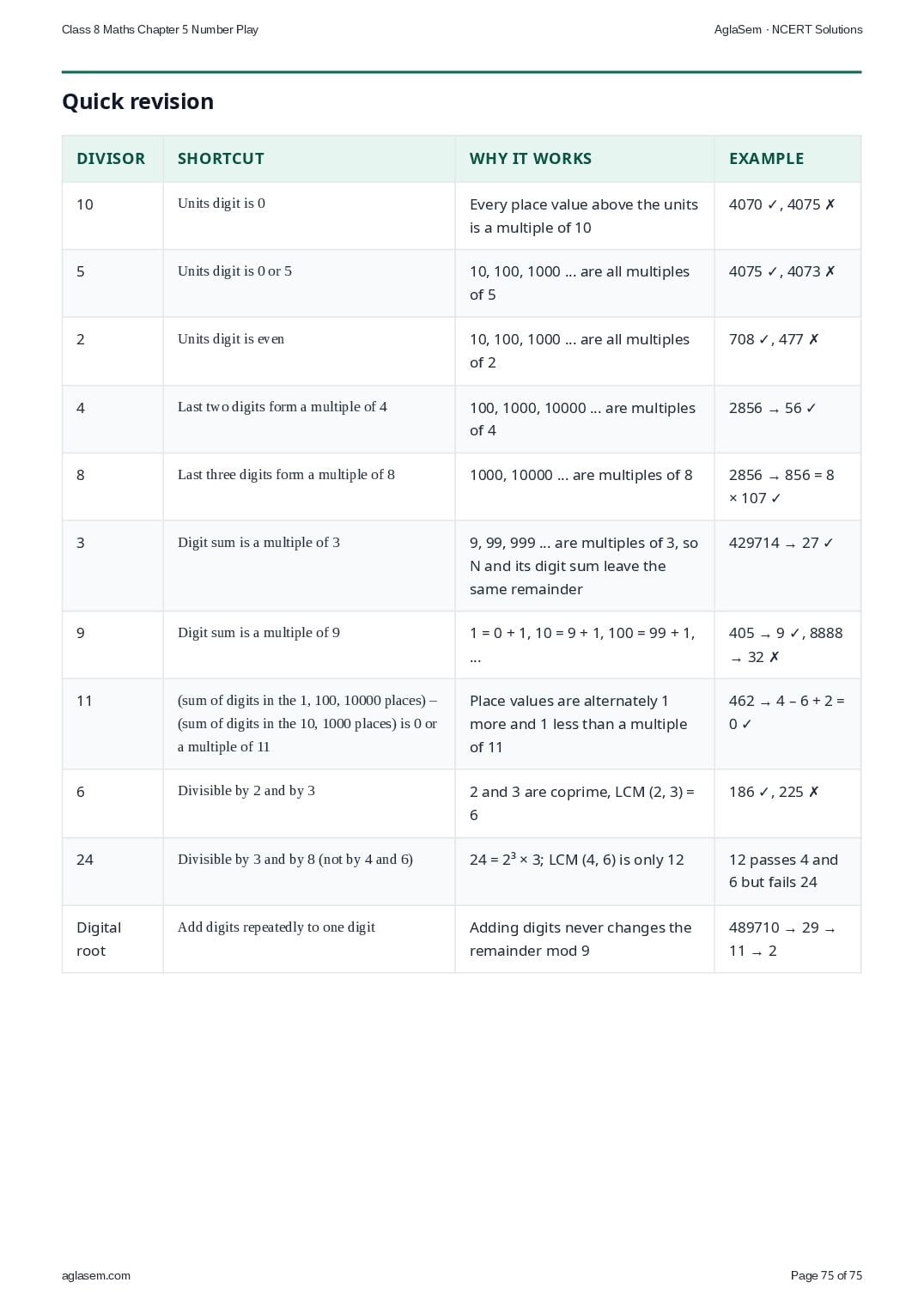
- Similarly, explain using algebra why the divisibility shortcuts for 5, 2, 4, and 8 work.
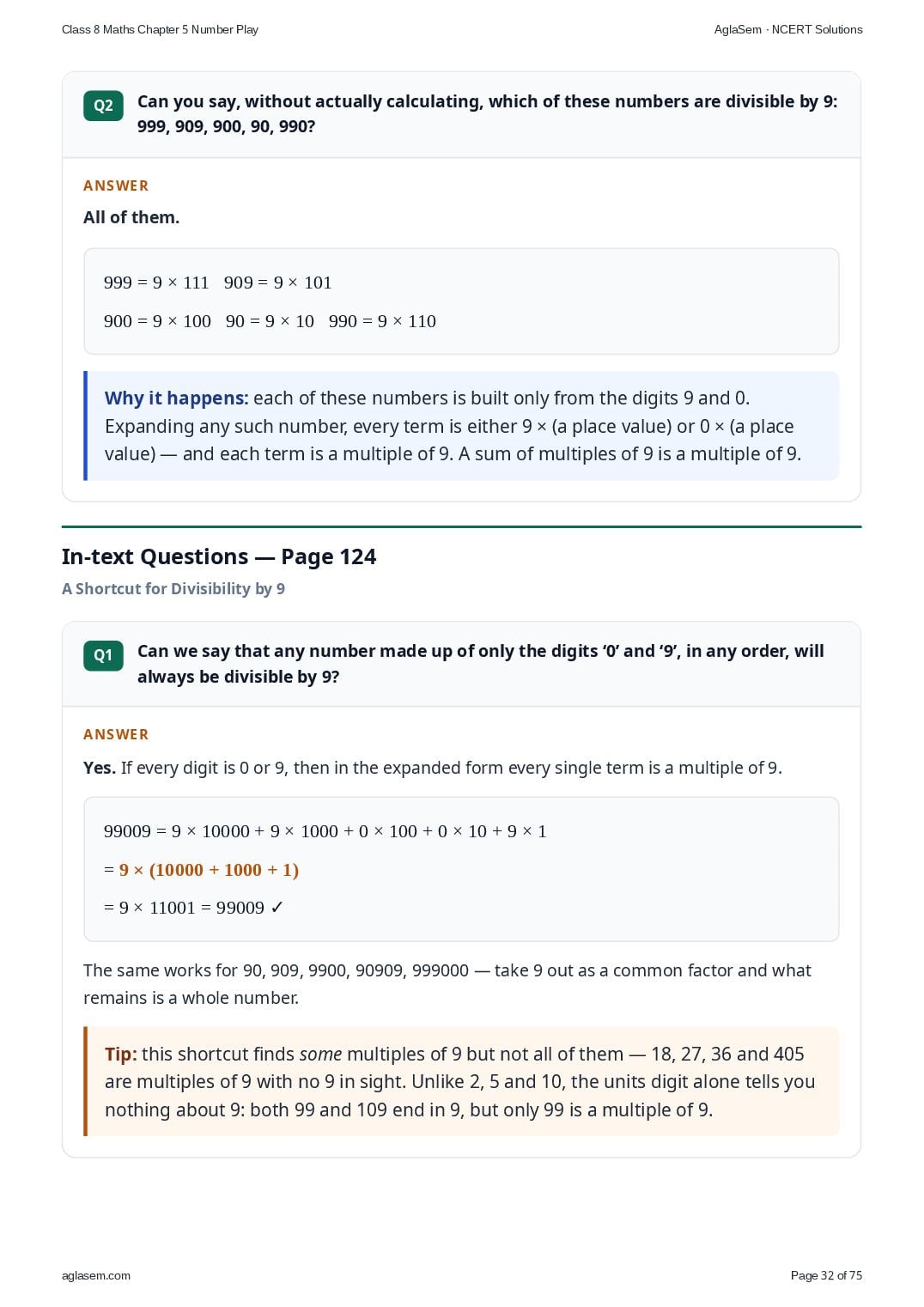
- Can you say, without actually calculating, which of these numbers are divisible by 9: 999, 909, 900, 90, 990?
- Can we say that any number made up of only the digits ‘0’ and ‘9’, in any order, will always be divisible by 9?
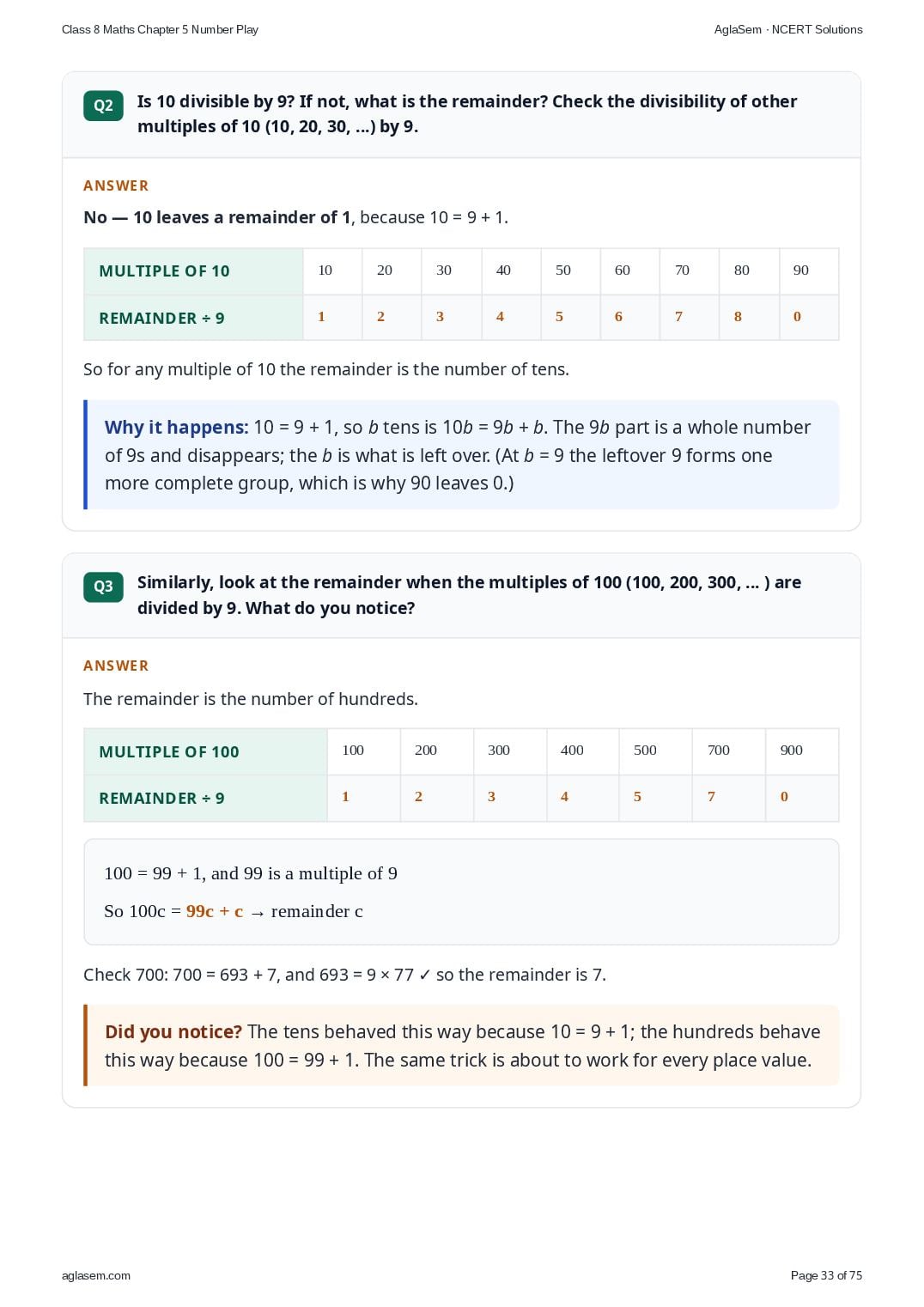
- Is 10 divisible by 9? If not, what is the remainder? Check the divisibility of other multiples of 10 (10, 20, 30, …) by 9.
- Similarly, look at the remainder when the multiples of 100 (100, 200, 300, … ) are divided by 9. What do you notice?
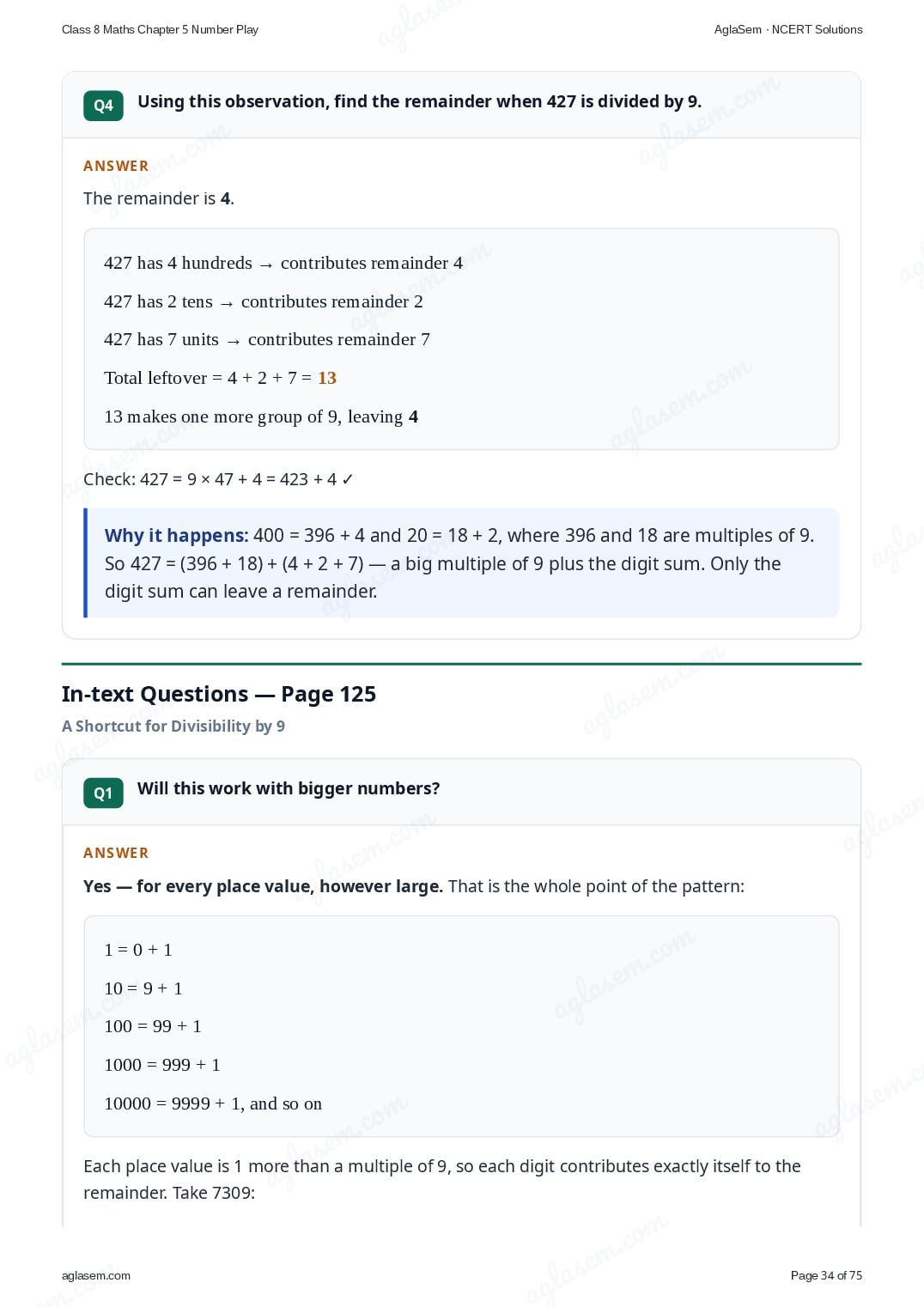
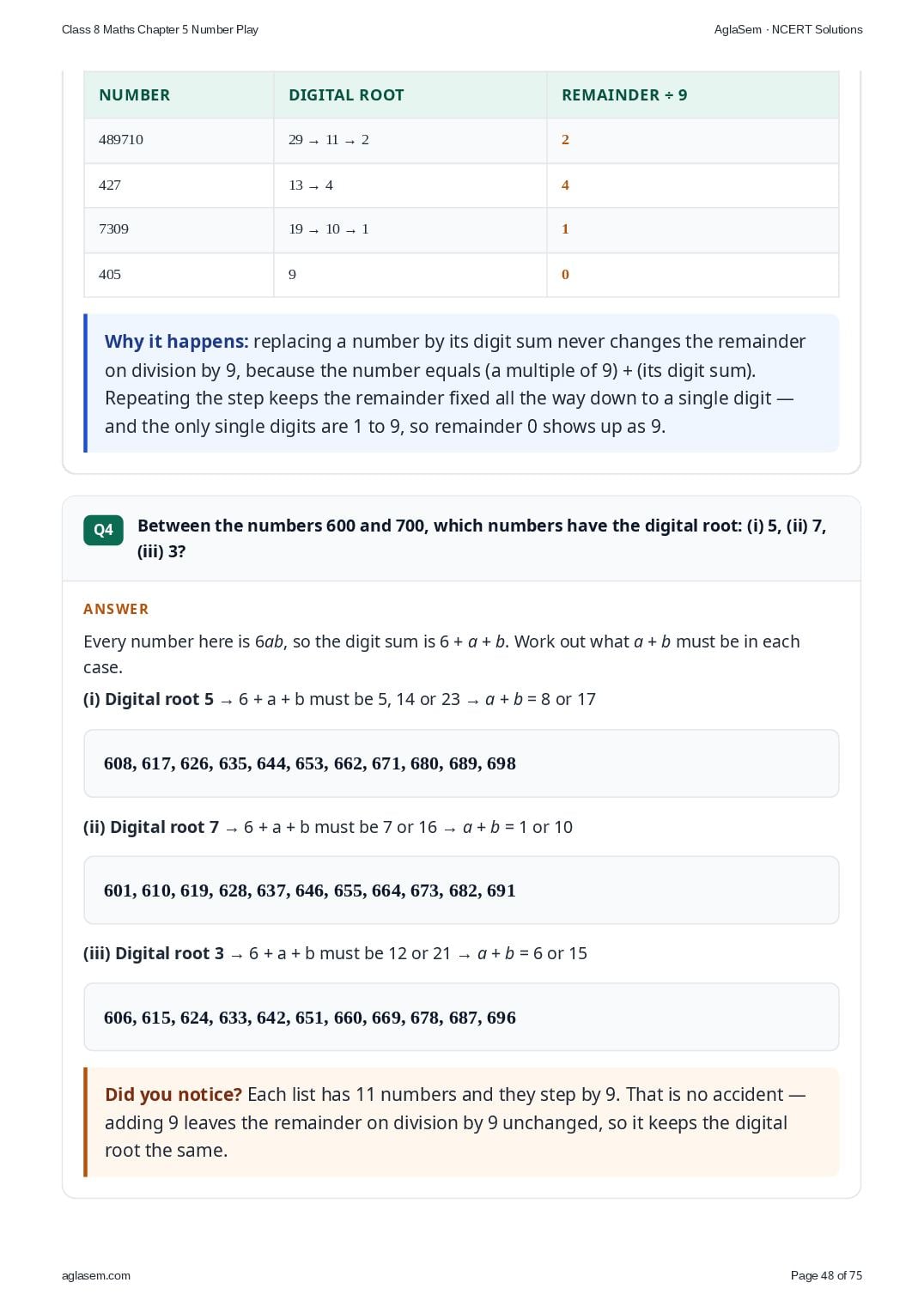
- Using this observation, find the remainder when 427 is divided by 9.
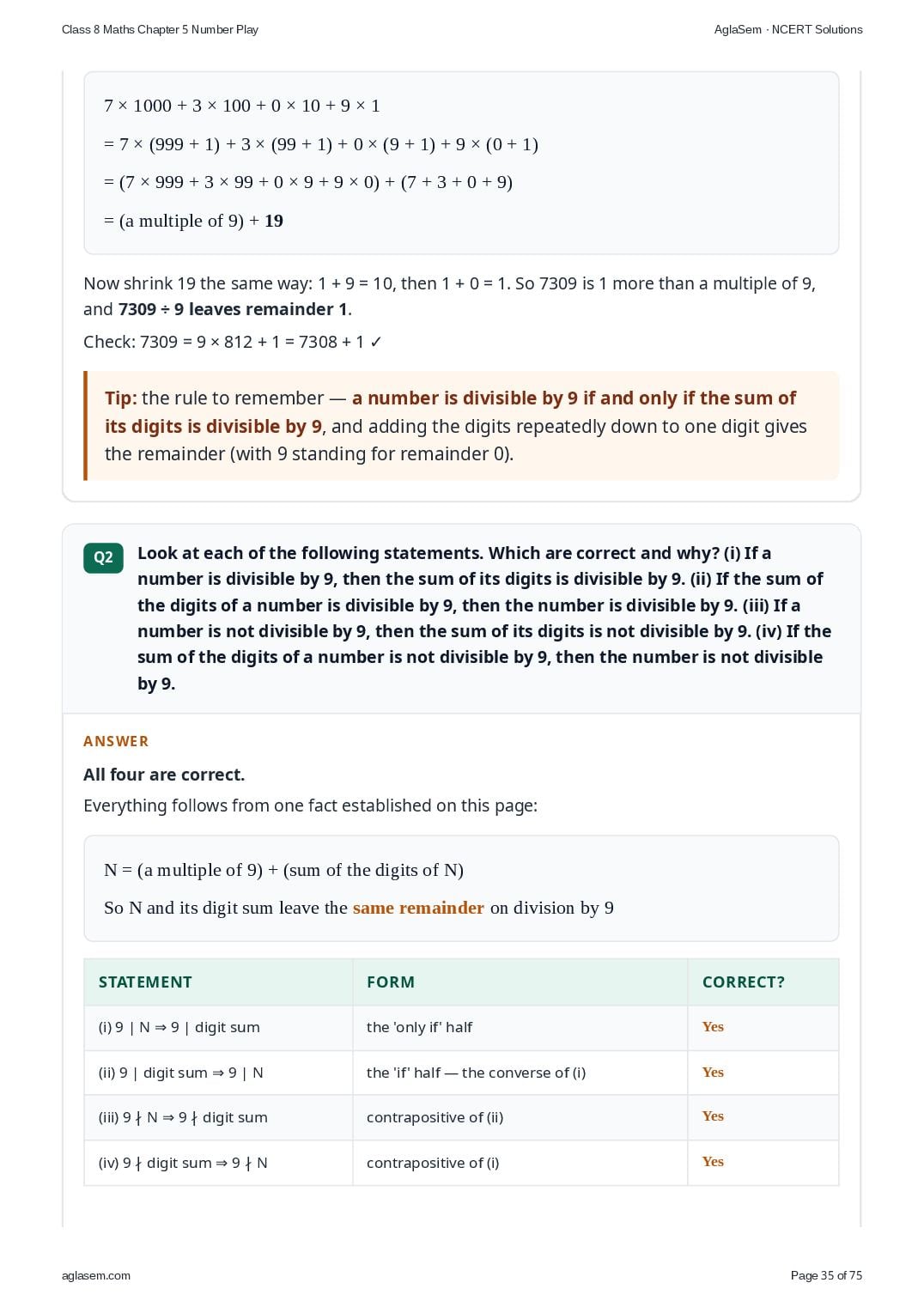
- Will this work with bigger numbers?
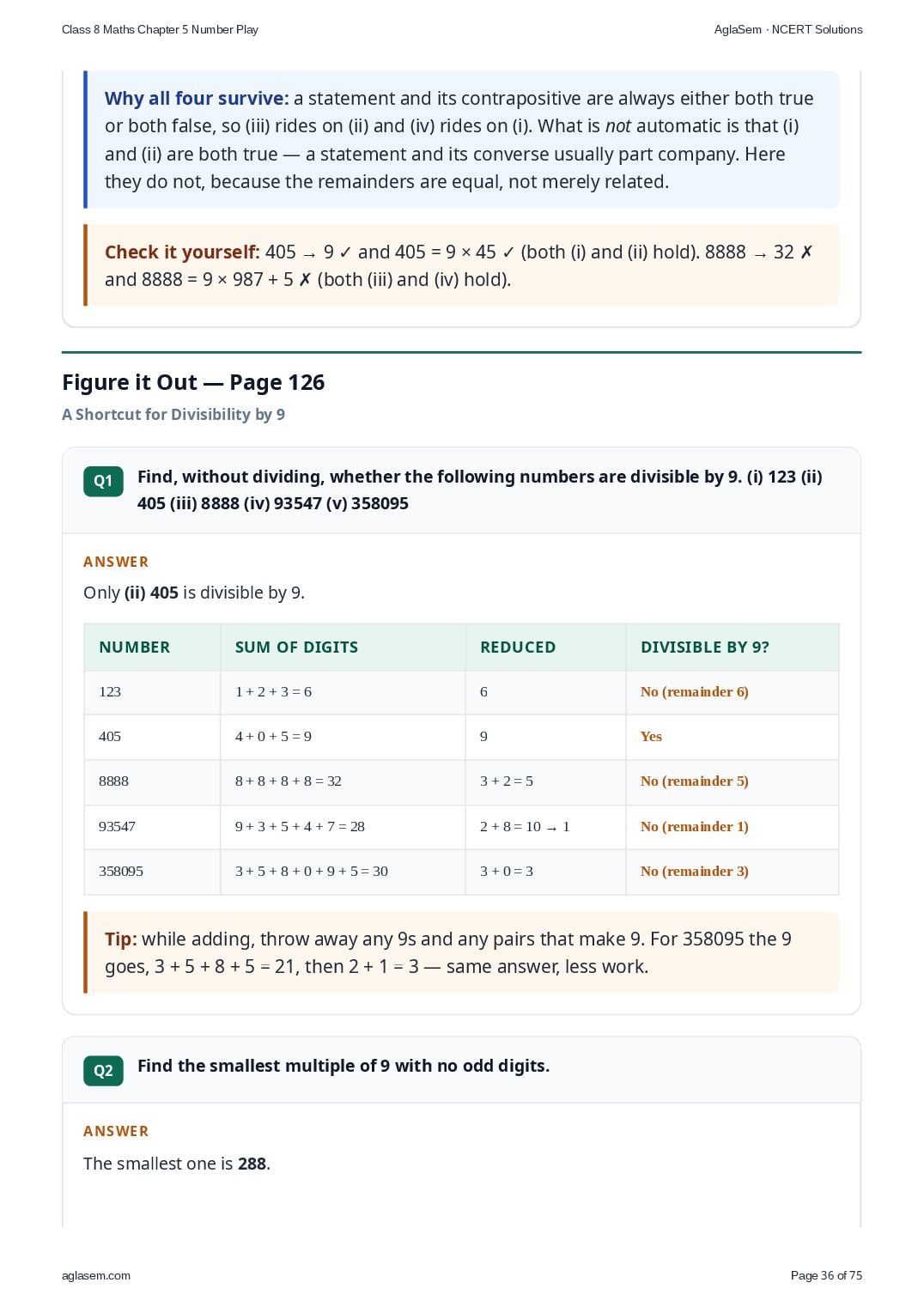
- Look at each of the following statements. Which are correct and why? (i) If a number is divisible by 9, then the sum of its digits is divisible by 9. (ii) If the sum of the digits of a number is divisible by 9, then the number is divisible by 9. (iii) If a number is not divisible by 9, then the sum of its digits is not divisible by 9. (iv) If the sum of the digits of a number is not divisible by 9, then the number is not divisible by 9.
- Find, without dividing, whether the following numbers are divisible by 9. (i) 123 (ii) 405 (iii) 8888 (iv) 93547 (v) 358095
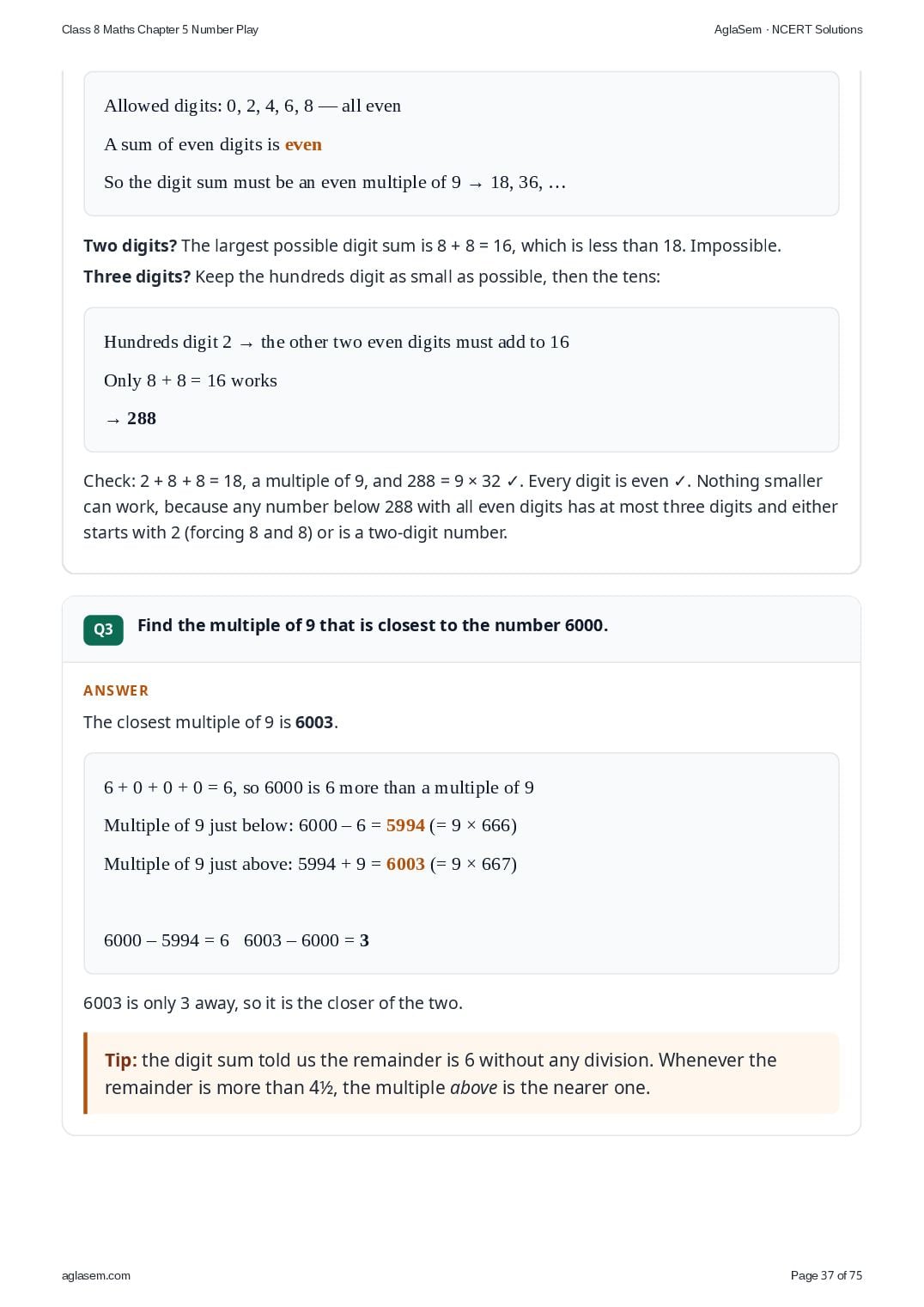
- Find the smallest multiple of 9 with no odd digits.
- Find the multiple of 9 that is closest to the number 6000.
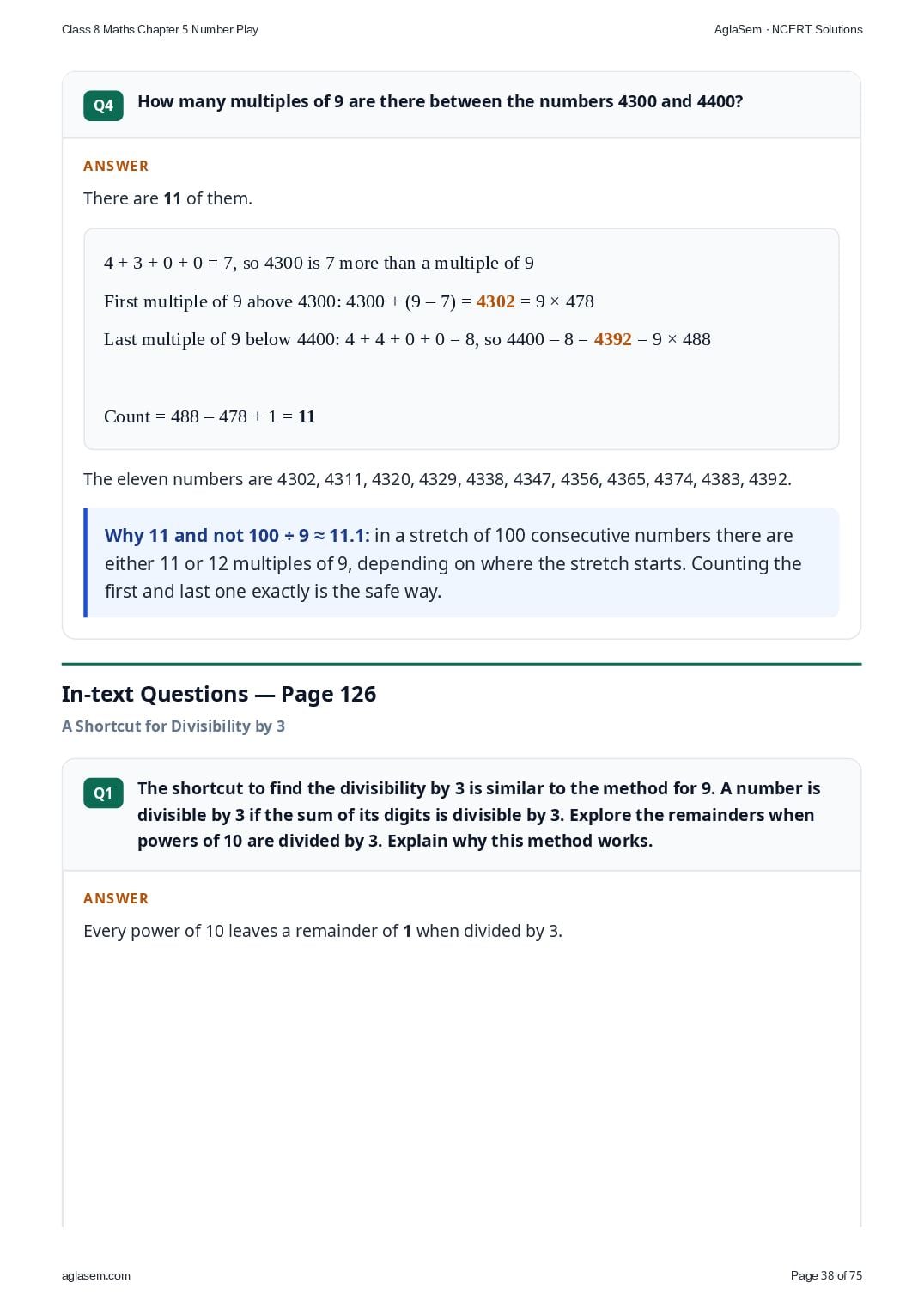
- How many multiples of 9 are there between the numbers 4300 and 4400?
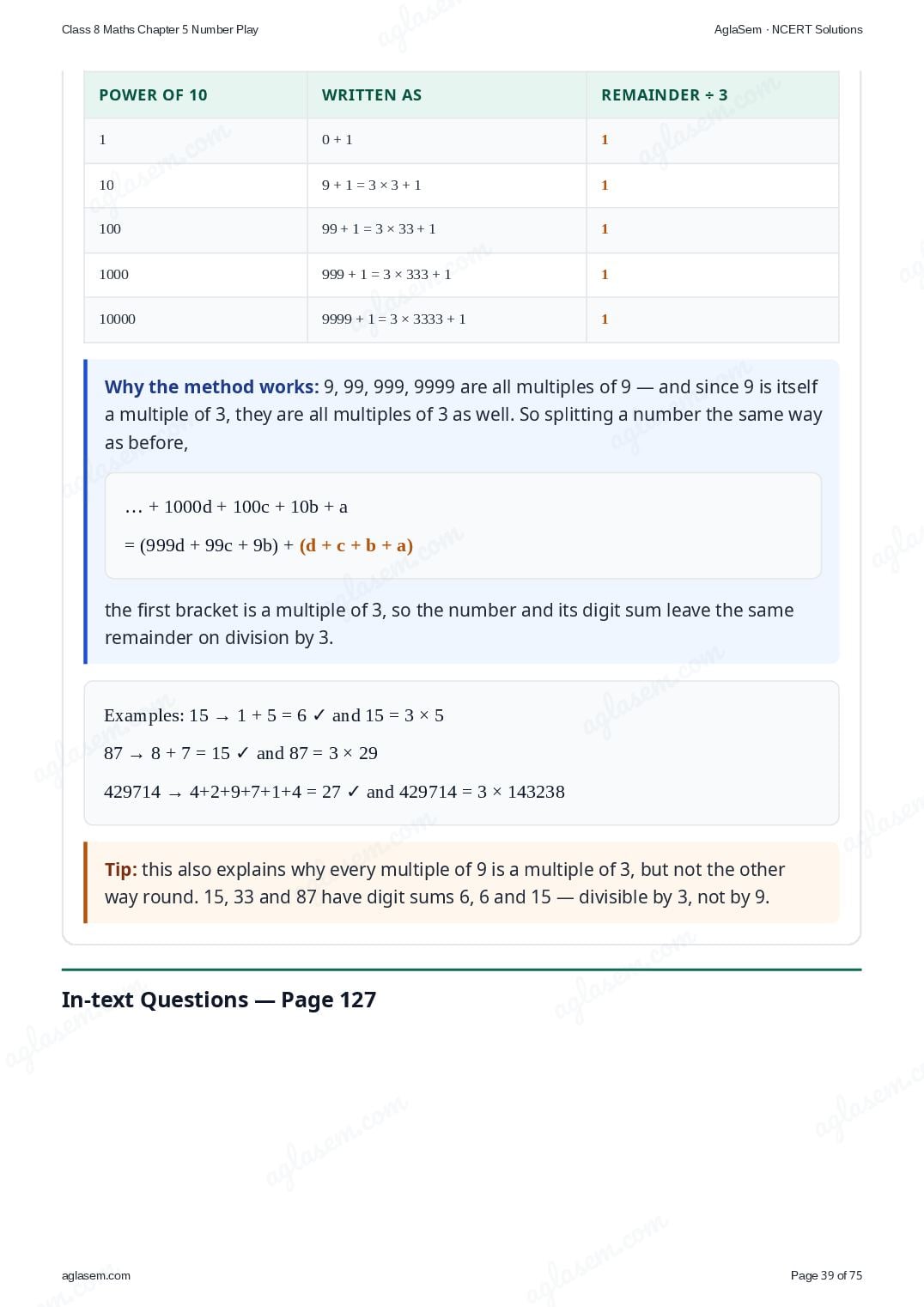
- The shortcut to find the divisibility by 3 is similar to the method for 9. A number is divisible by 3 if the sum of its digits is divisible by 3. Explore the remainders when powers of 10 are divided by 3. Explain why this method works.
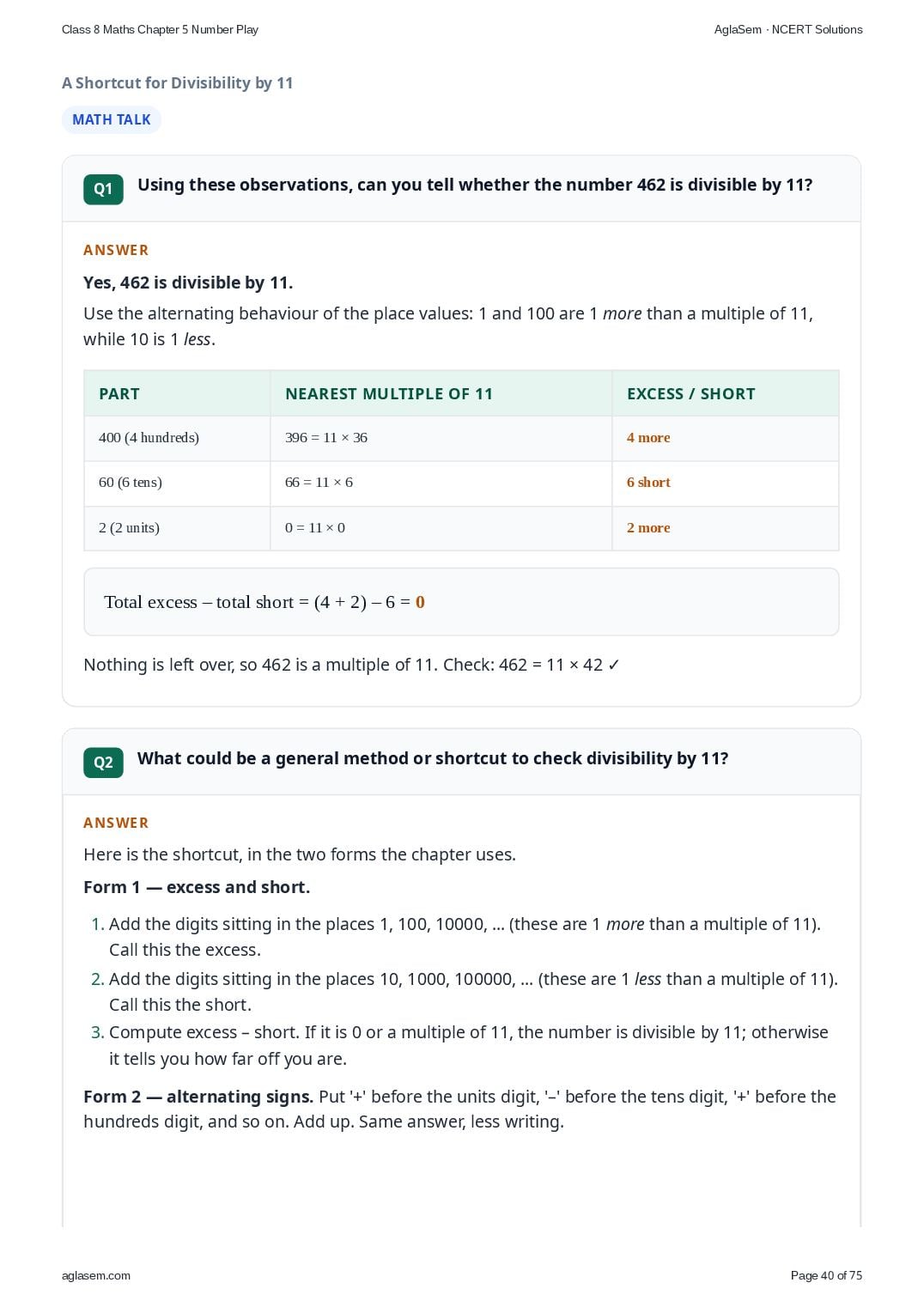
- Using these observations, can you tell whether the number 462 is divisible by 11?
- What could be a general method or shortcut to check divisibility by 11?
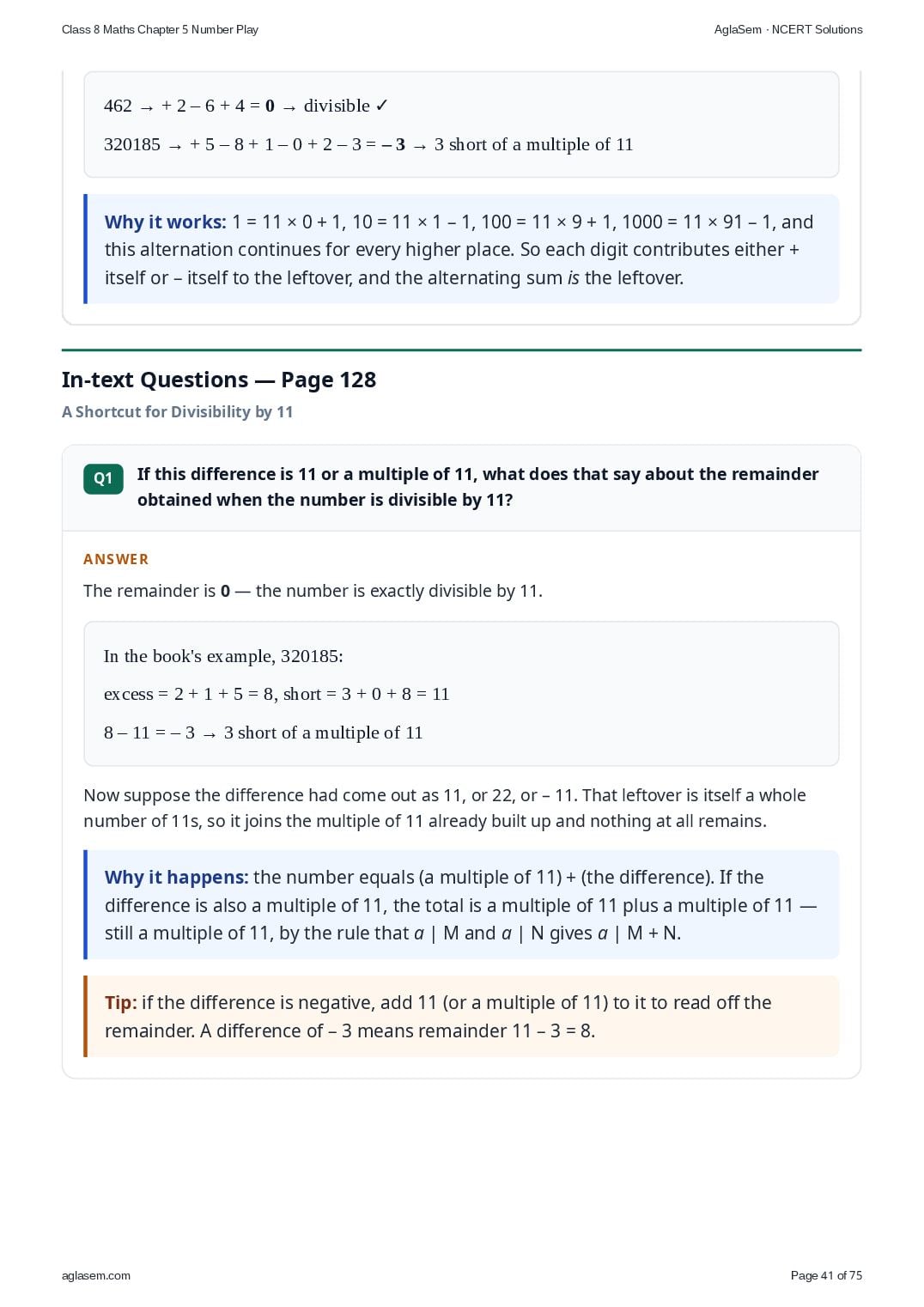
- If this difference is 11 or a multiple of 11, what does that say about the remainder obtained when the number is divisible by 11?
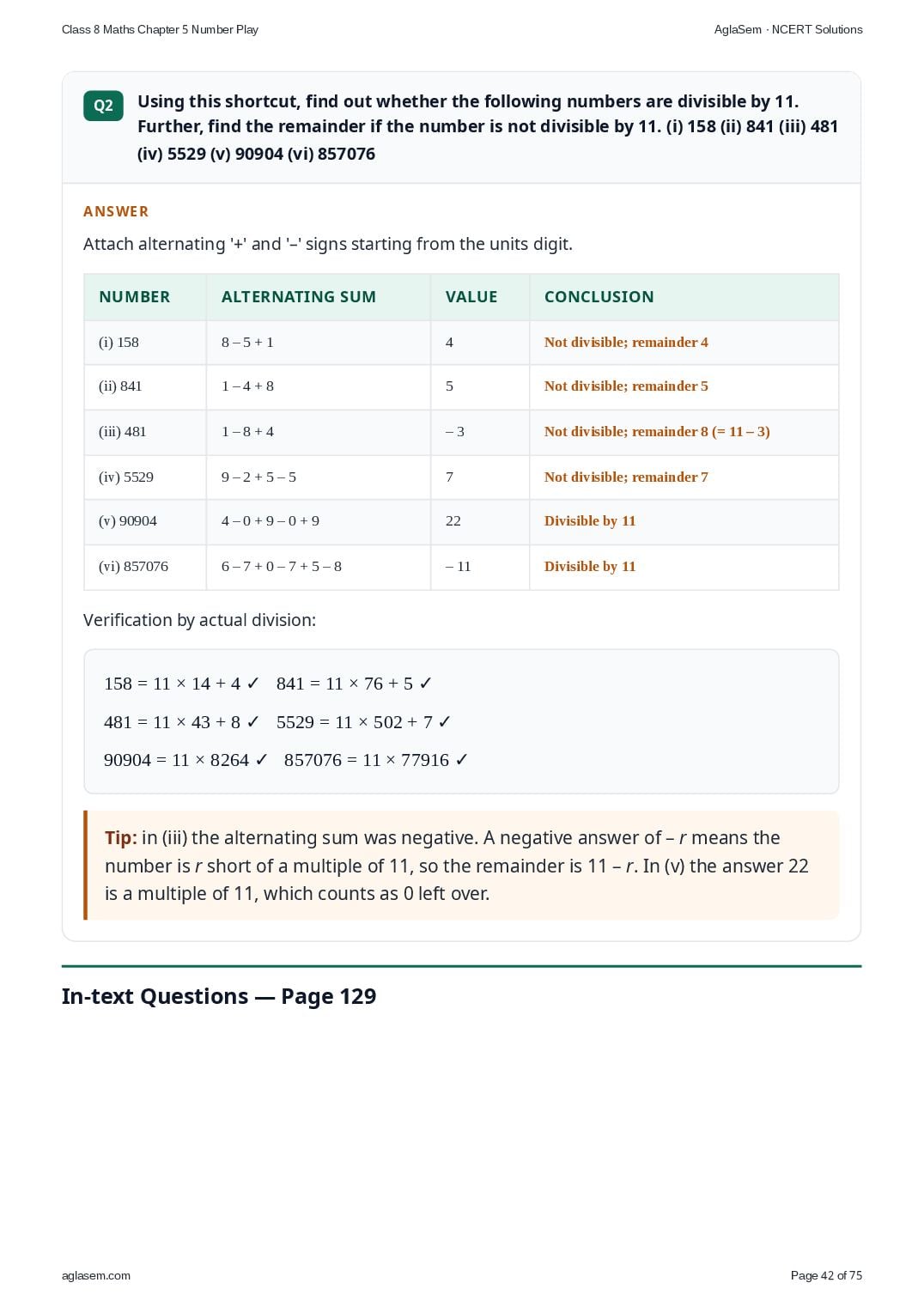
- Using this shortcut, find out whether the following numbers are divisible by 11. Further, find the remainder if the number is not divisible by 11. (i) 158 (ii) 841 (iii) 481 (iv) 5529 (v) 90904 (vi) 857076
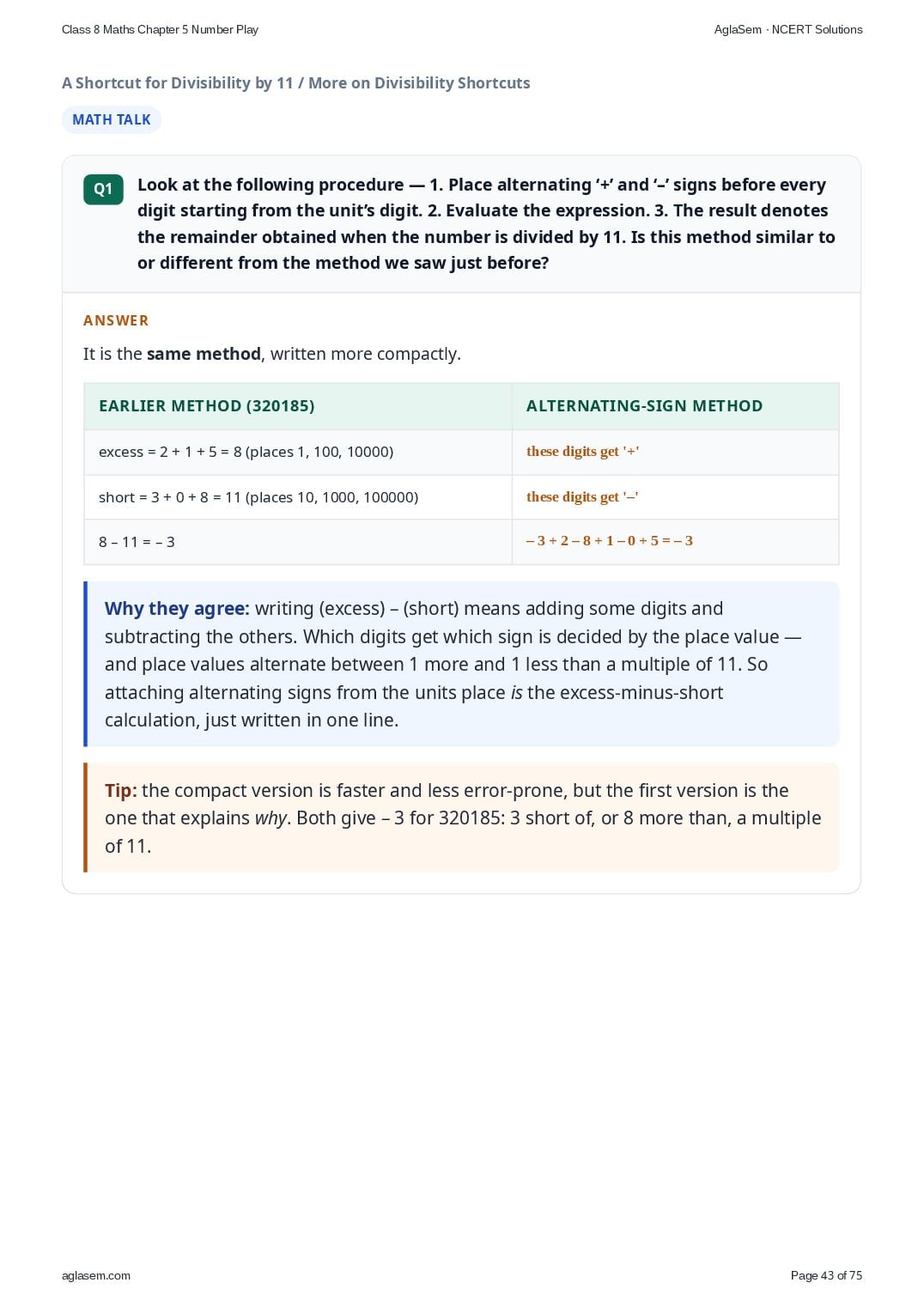
- Look at the following procedure — 1. Place alternating ‘+’ and ‘–’ signs before every digit starting from the unit’s digit. 2. Evaluate the expression. 3. The result denotes the remainder obtained when the number is divided by 11. Is this method similar to or different from the method we saw just before?
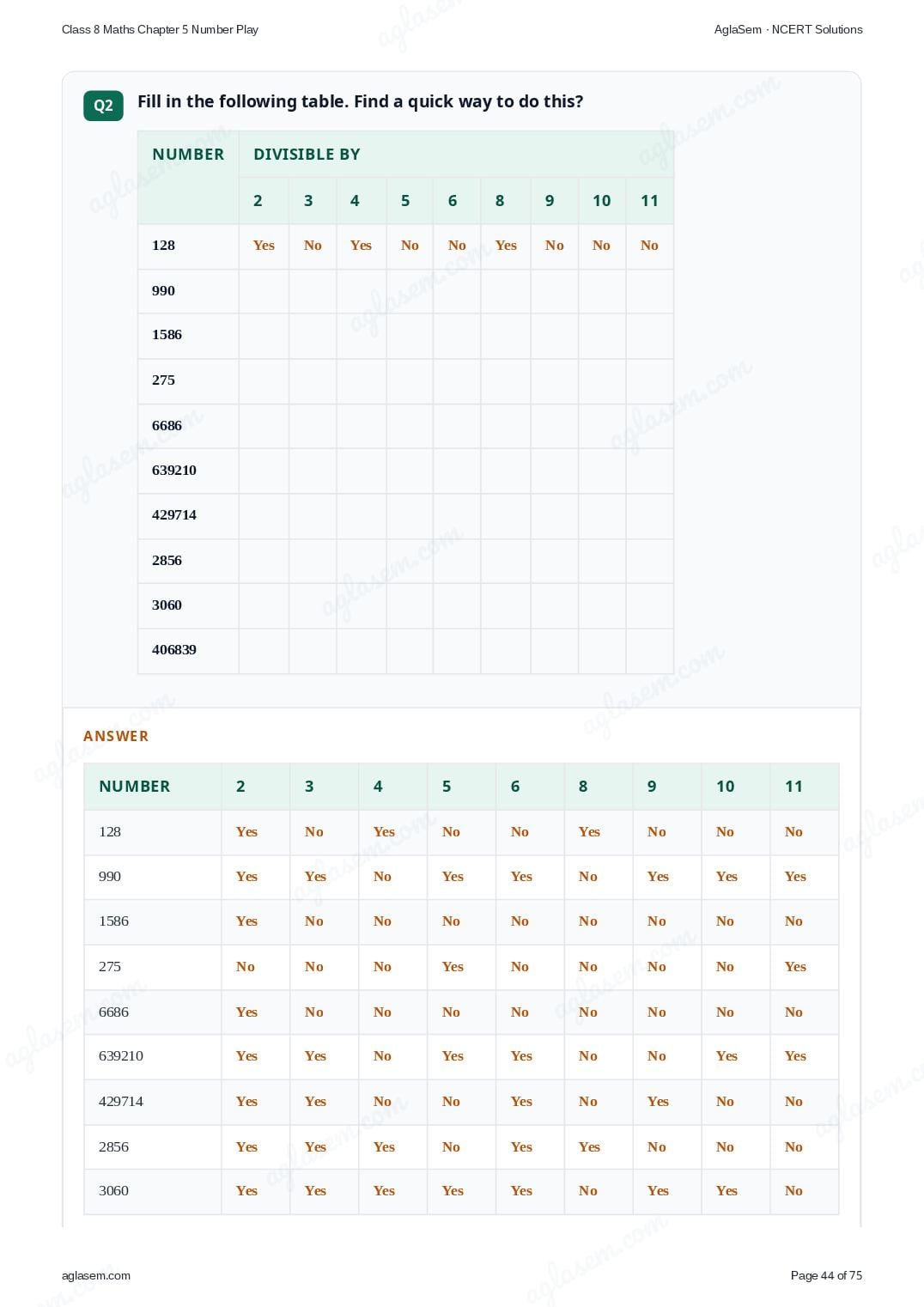
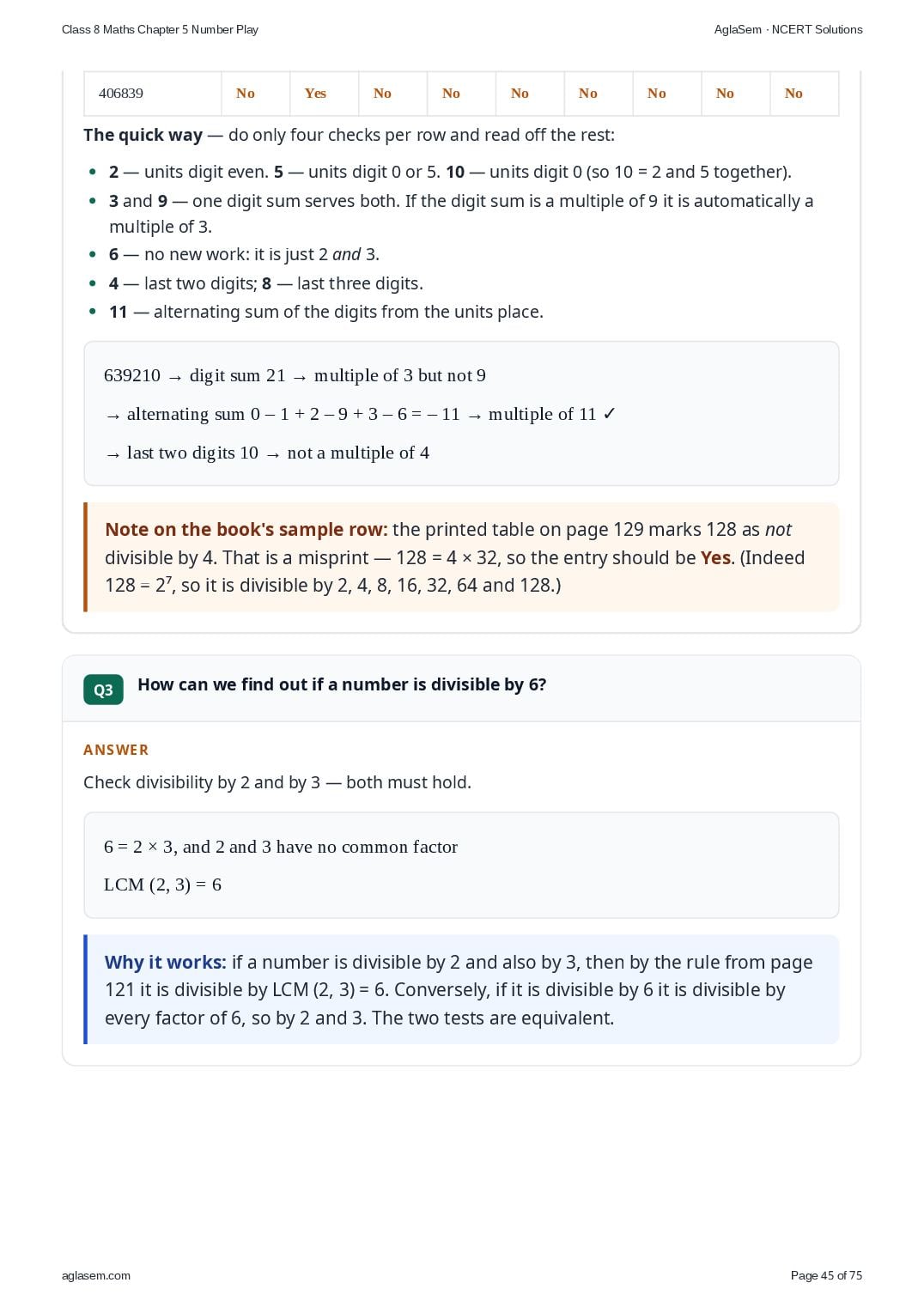
- Fill in the following table. Find a quick way to do this? (Numbers: 128, 990, 1586, 275, 6686, 639210, 429714, 2856, 3060, 406839 — divisibility by 2, 3, 4, 5, 6, 8, 9, 10, 11)
- How can we find out if a number is divisible by 6?
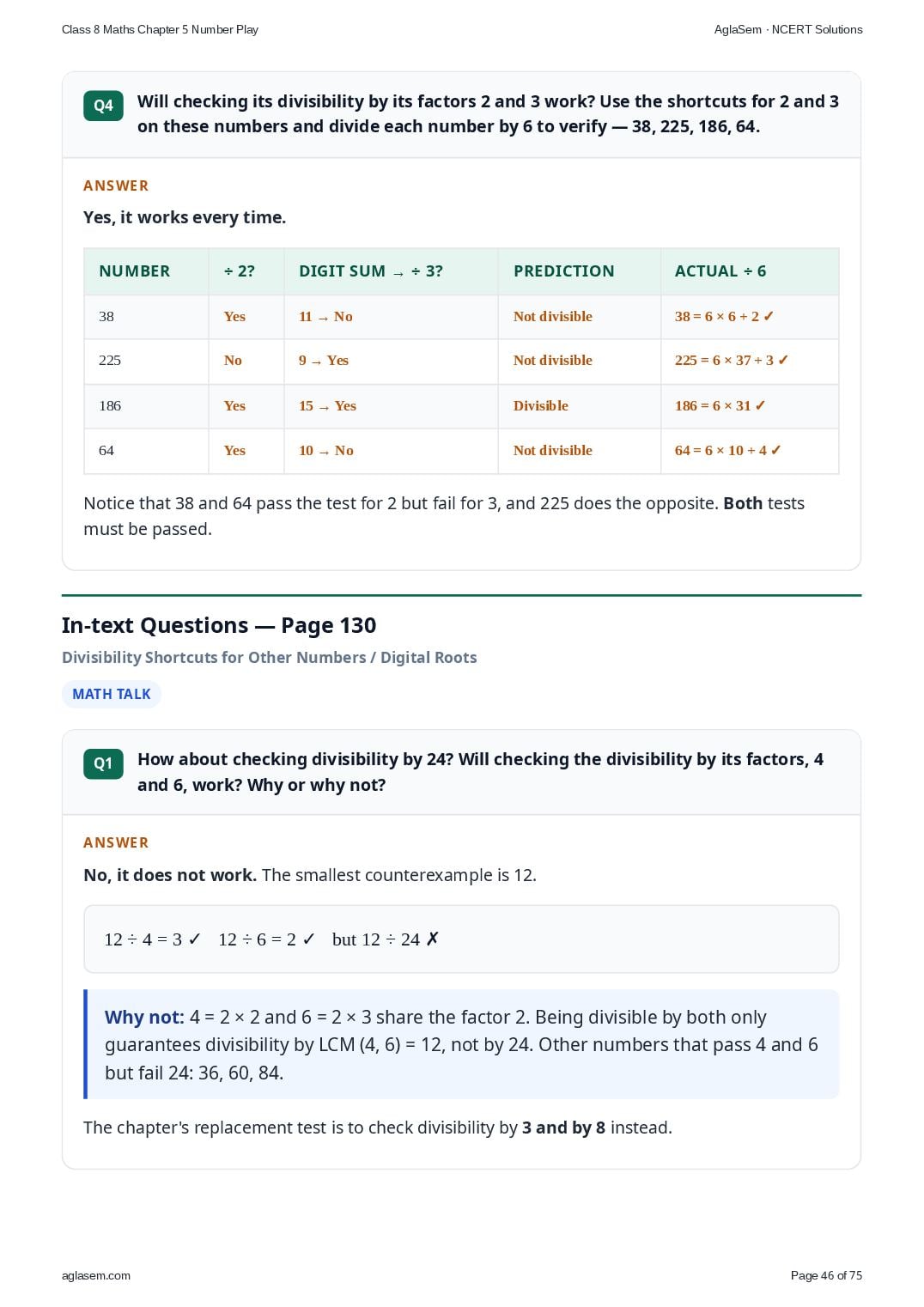
- Will checking its divisibility by its factors 2 and 3 work? Use the shortcuts for 2 and 3 on these numbers and divide each number by 6 to verify — 38, 225, 186, 64.
- How about checking divisibility by 24? Will checking the divisibility by its factors, 4 and 6, work? Why or why not?
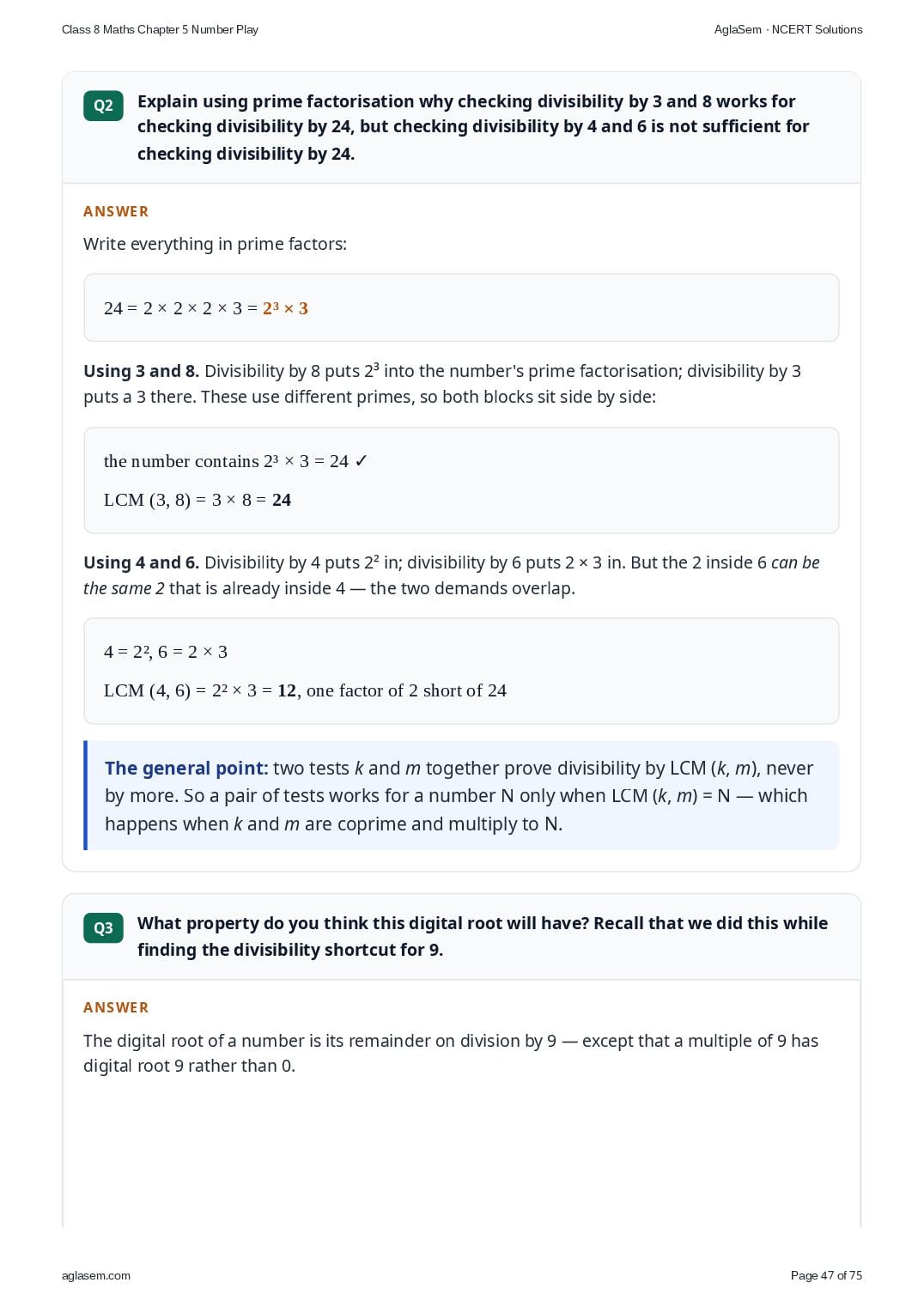
- Explain using prime factorisation why checking divisibility by 3 and 8 works for checking divisibility by 24, but checking divisibility by 4 and 6 is not sufficient for checking divisibility by 24.
- What property do you think this digital root will have? Recall that we did this while finding the divisibility shortcut for 9.
- Between the numbers 600 and 700, which numbers have the digital root: (i) 5, (ii) 7, (iii) 3?
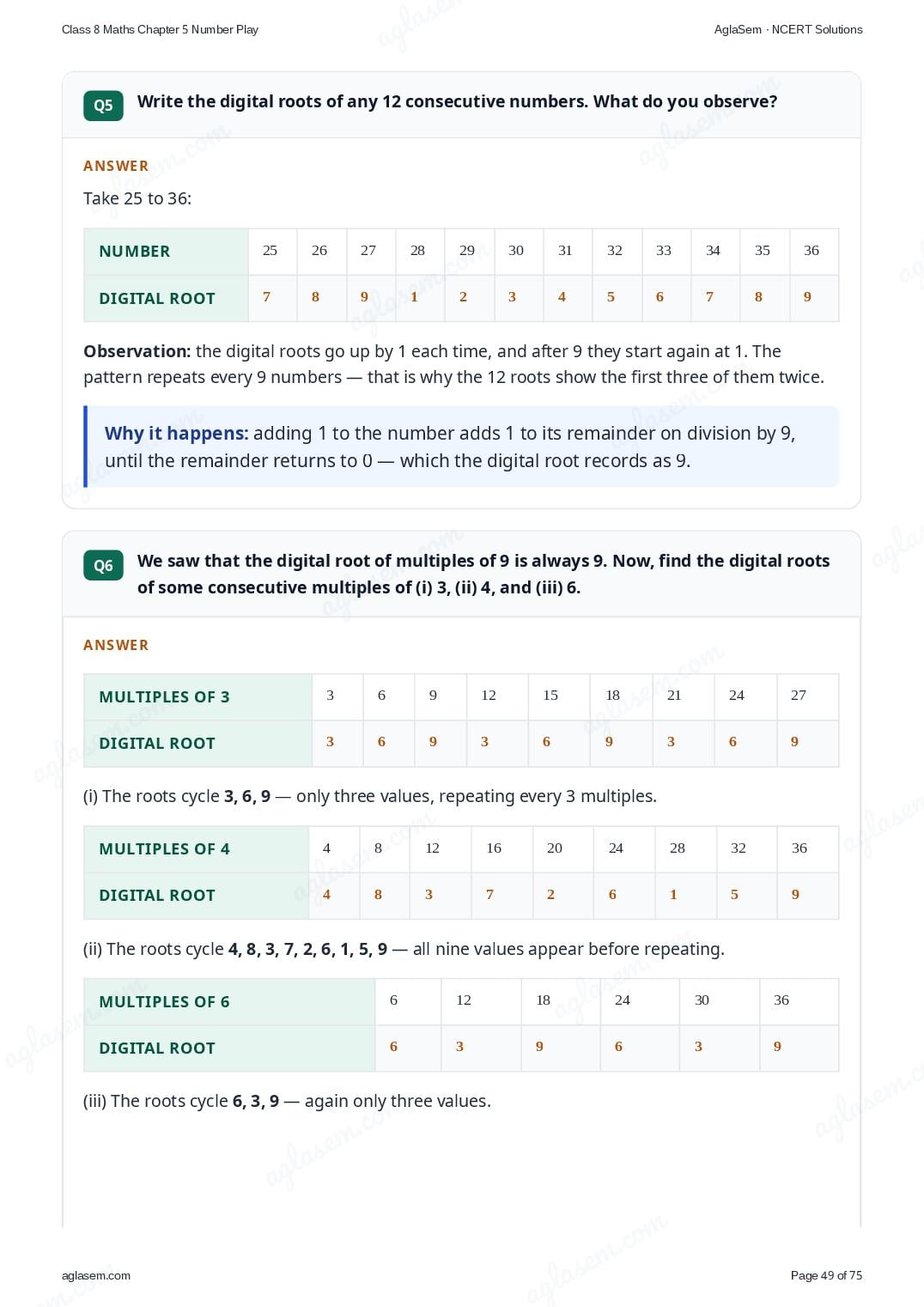
- Write the digital roots of any 12 consecutive numbers. What do you observe?
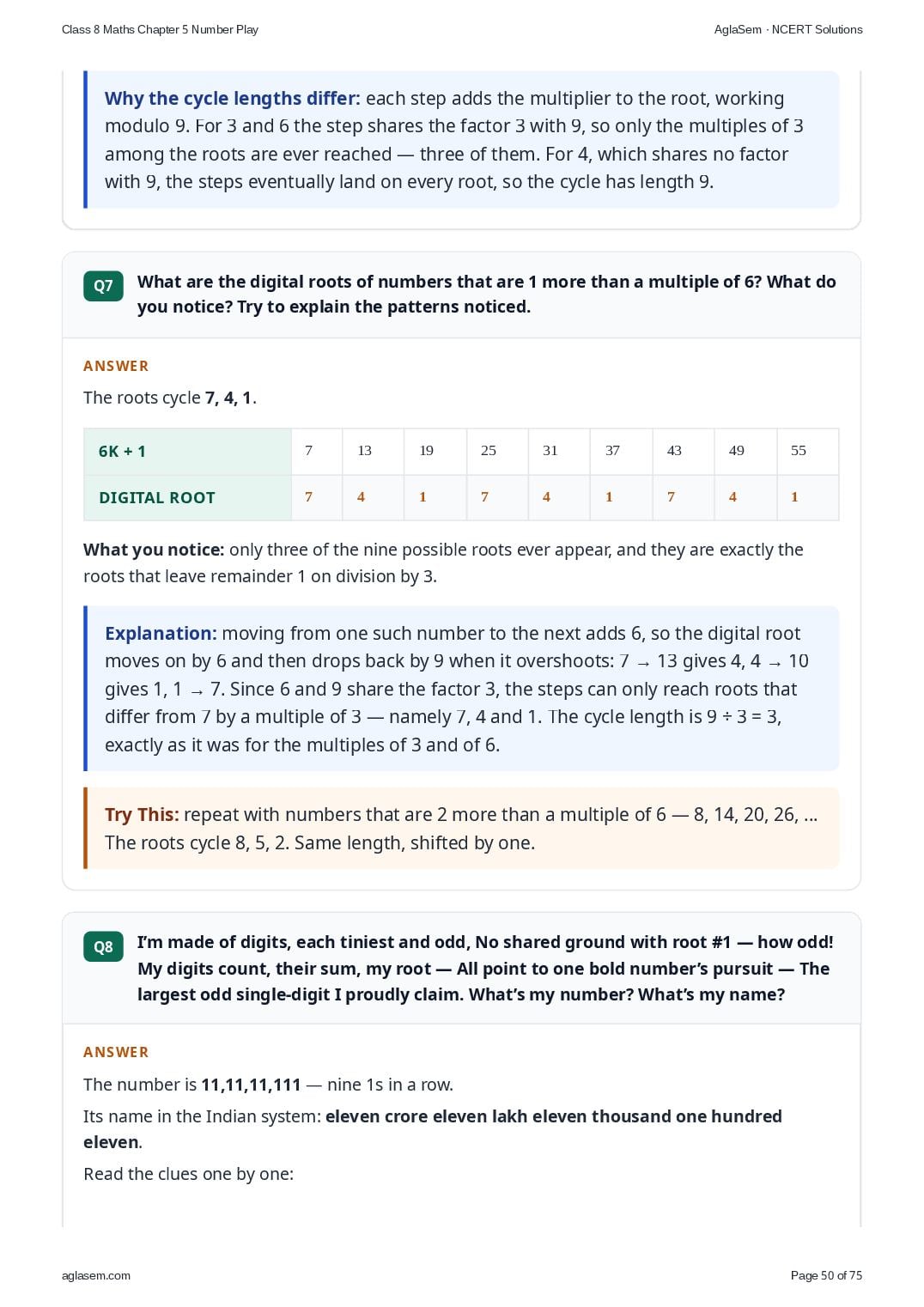
- We saw that the digital root of multiples of 9 is always 9. Now, find the digital roots of some consecutive multiples of (i) 3, (ii) 4, and (iii) 6.
- What are the digital roots of numbers that are 1 more than a multiple of 6? What do you notice? Try to explain the patterns noticed.
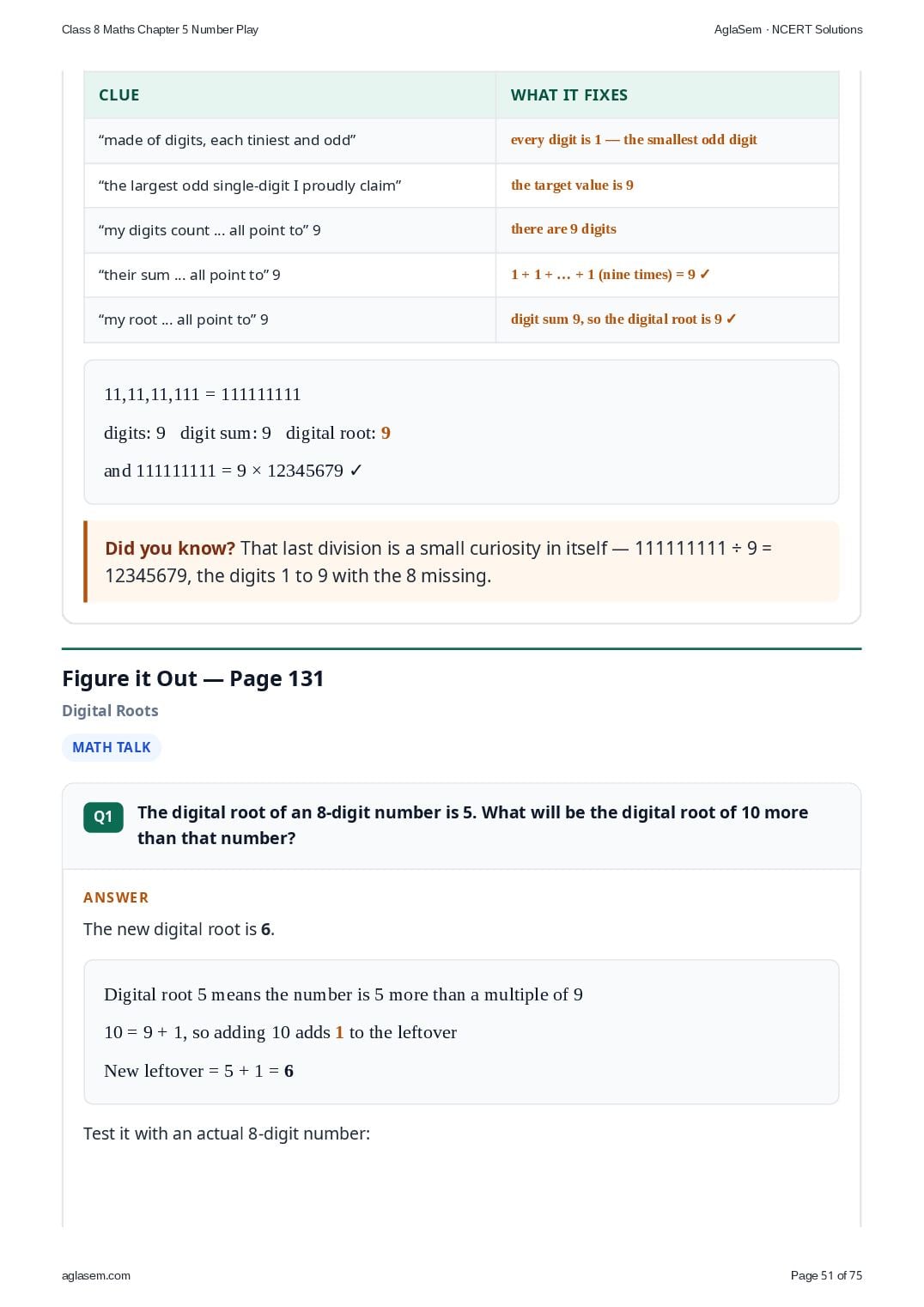
- I’m made of digits, each tiniest and odd, No shared ground with root #1 — how odd! My digits count, their sum, my root — All point to one bold number’s pursuit — The largest odd single-digit I proudly claim. What’s my number? What’s my name?
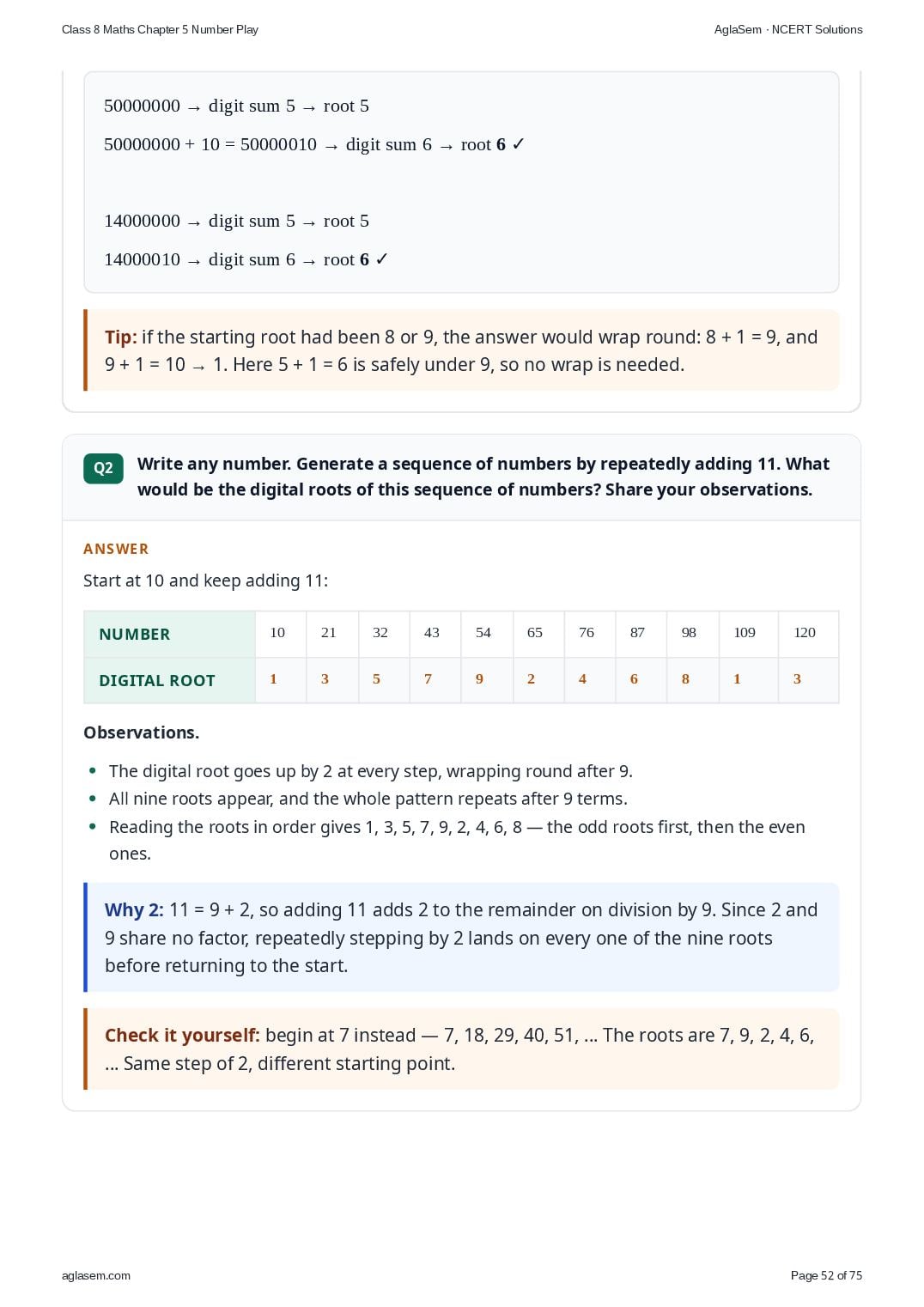
- The digital root of an 8-digit number is 5. What will be the digital root of 10 more than that number?
- Write any number. Generate a sequence of numbers by repeatedly adding 11. What would be the digital roots of this sequence of numbers? Share your observations.
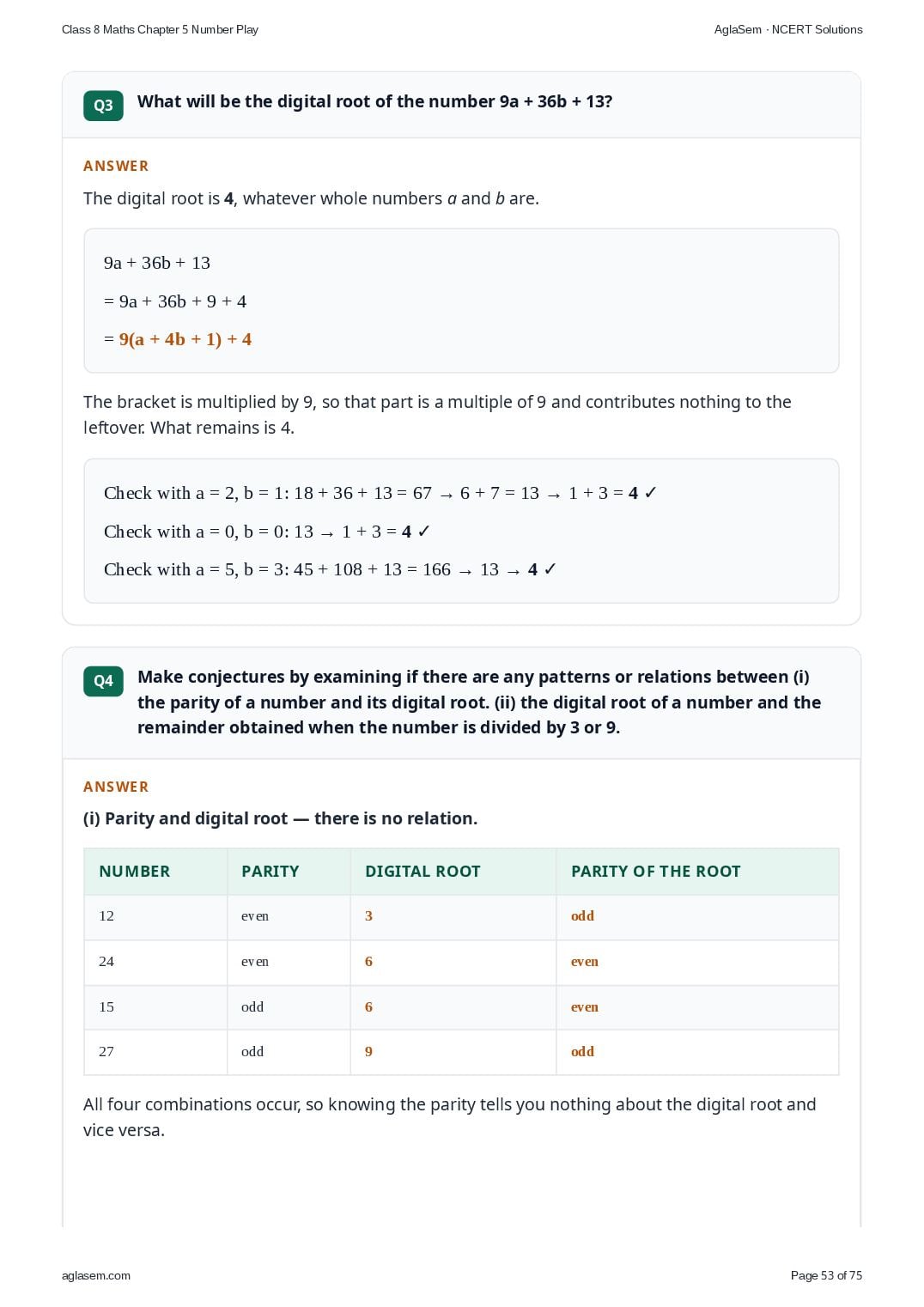
- What will be the digital root of the number 9a + 36b + 13?
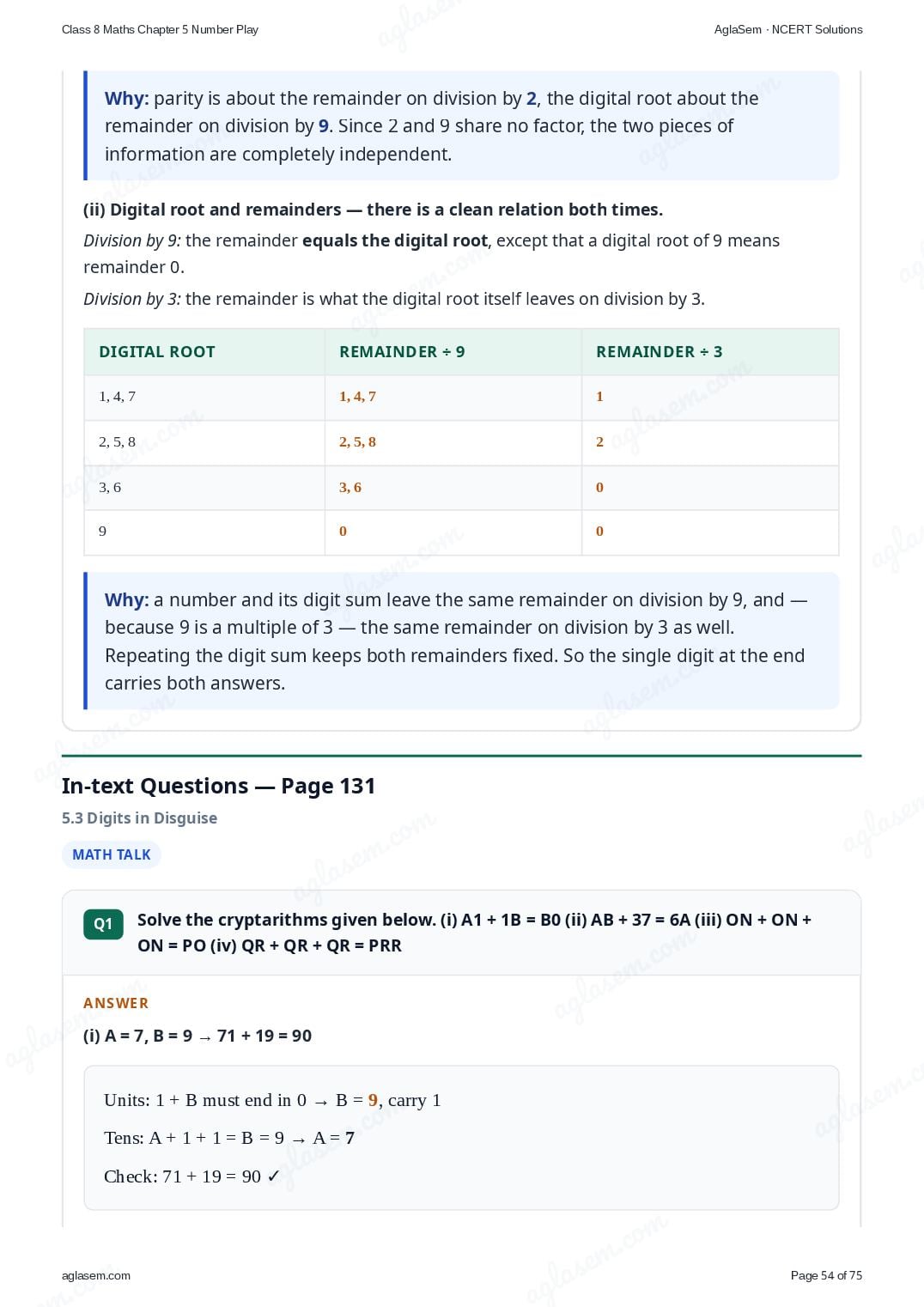
- Make conjectures by examining if there are any patterns or relations between (i) the parity of a number and its digital root. (ii) the digital root of a number and the remainder obtained when the number is divided by 3 or 9.
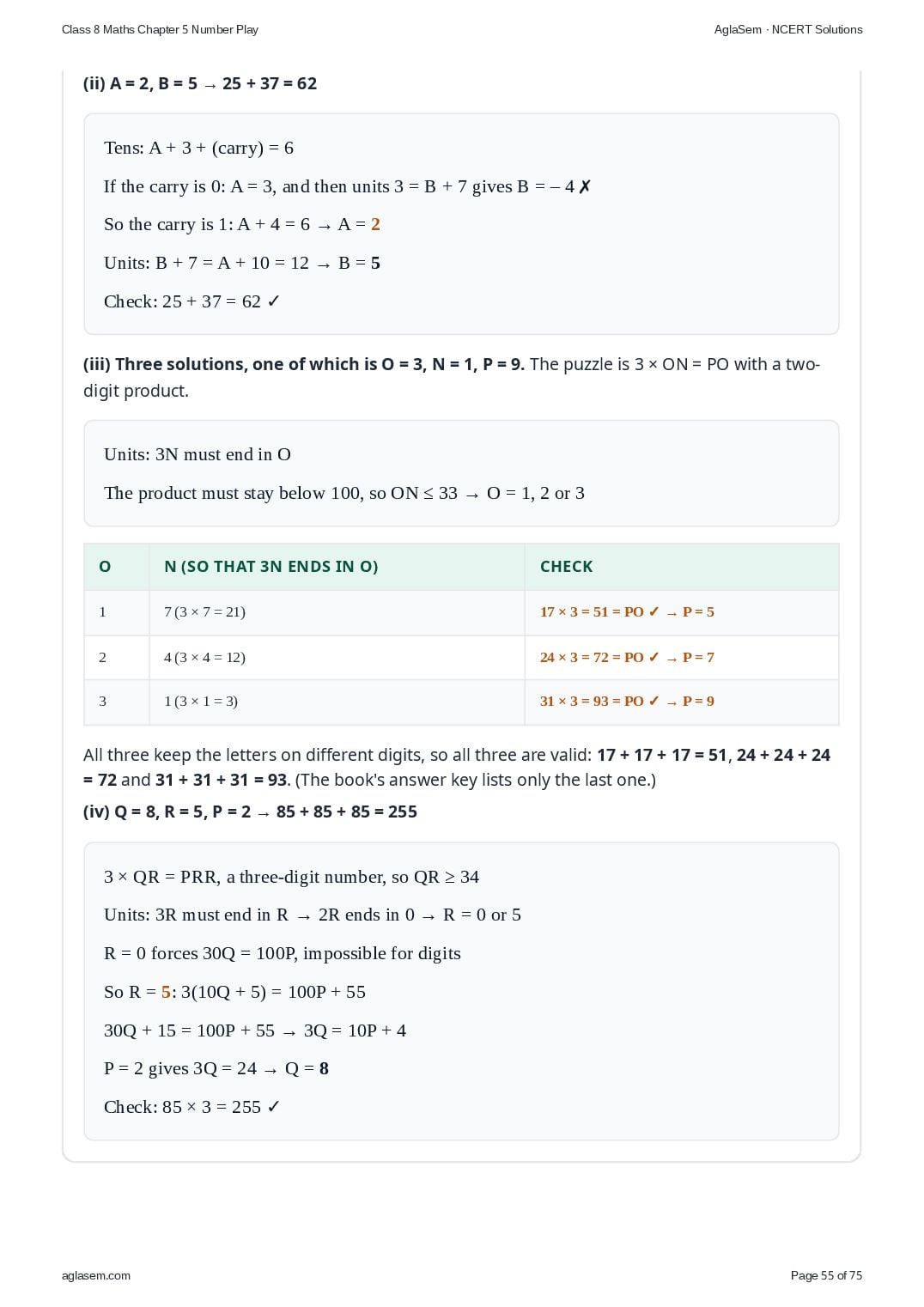
- Solve the cryptarithms given below. (i) A1 + 1B = B0 (ii) AB + 37 = 6A (iii) ON + ON + ON = PO (iv) QR + QR + QR = PRR
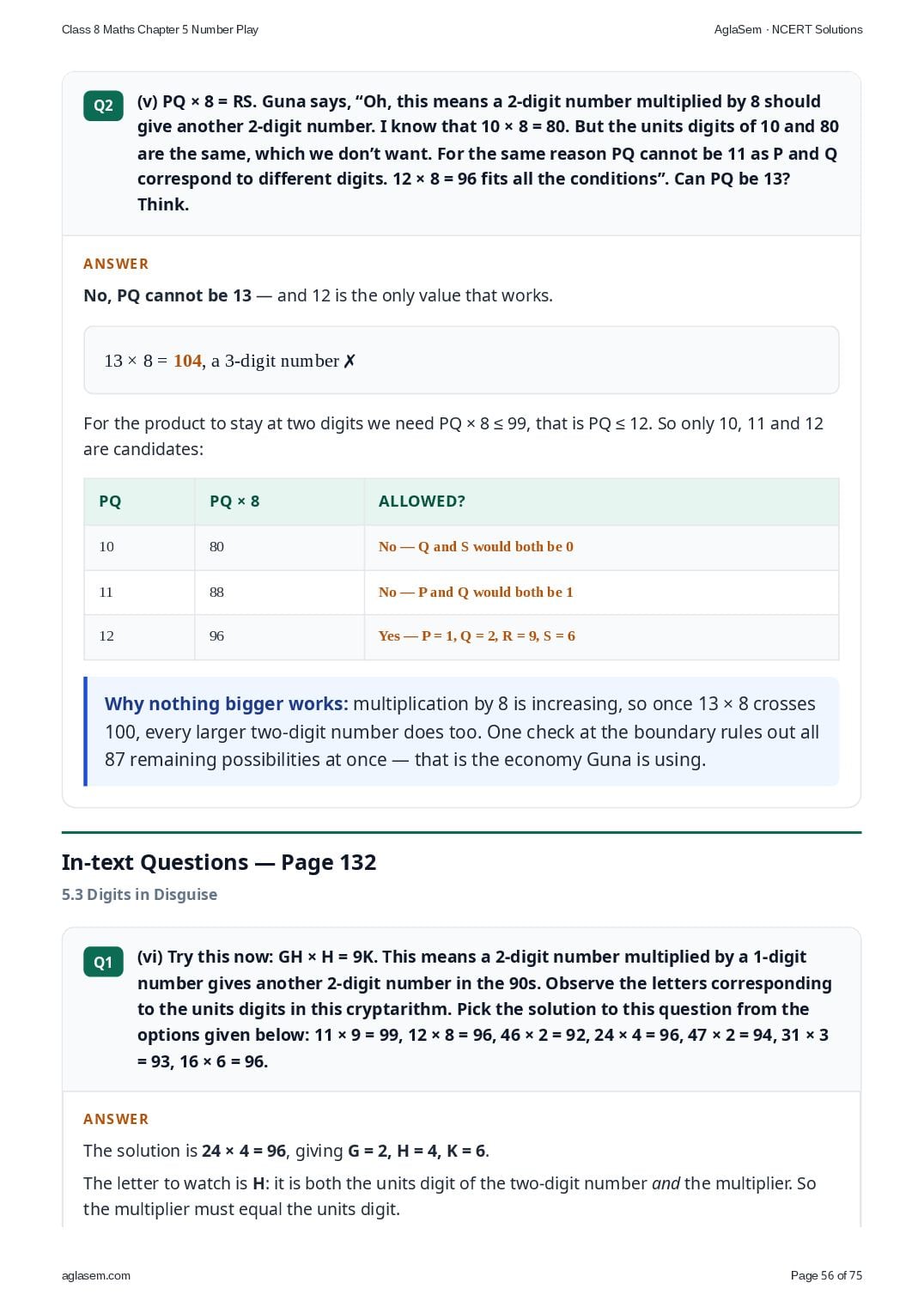
- (v) PQ × 8 = RS. Guna says, “Oh, this means a 2-digit number multiplied by 8 should give another 2-digit number. I know that 10 × 8 = 80. But the units digits of 10 and 80 are the same, which we don’t want. For the same reason PQ cannot be 11 as P and Q correspond to different digits. 12 × 8 = 96 fits all the conditions”. Can PQ be 13? Think.
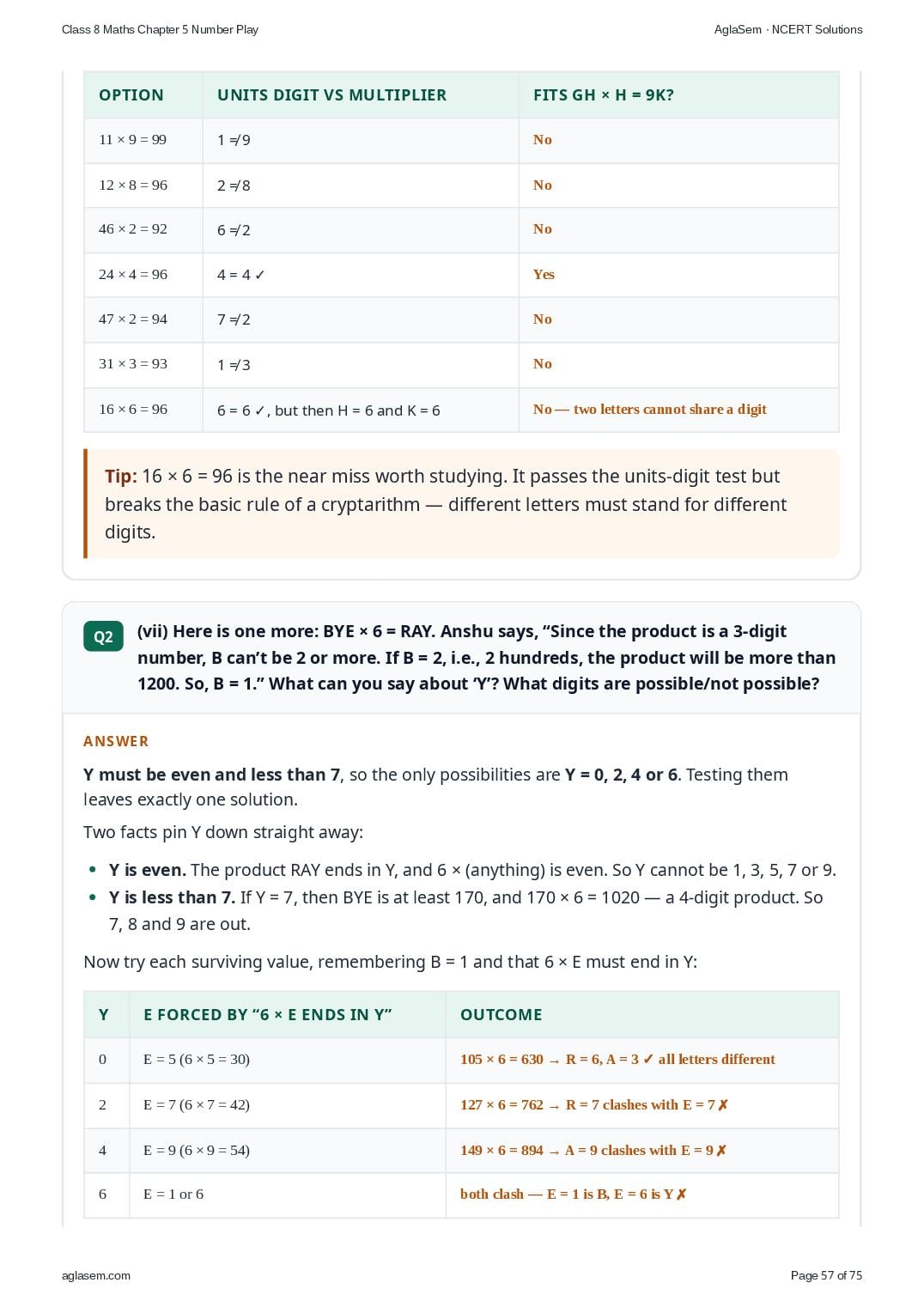
- (vi) Try this now: GH × H = 9K. This means a 2-digit number multiplied by a 1-digit number gives another 2-digit number in the 90s. Observe the letters corresponding to the units digits in this cryptarithm. Pick the solution to this question from the options given below: 11 × 9 = 99, 12 × 8 = 96, 46 × 2 = 92, 24 × 4 = 96, 47 × 2 = 94, 31 × 3 = 93, 16 × 6 = 96.
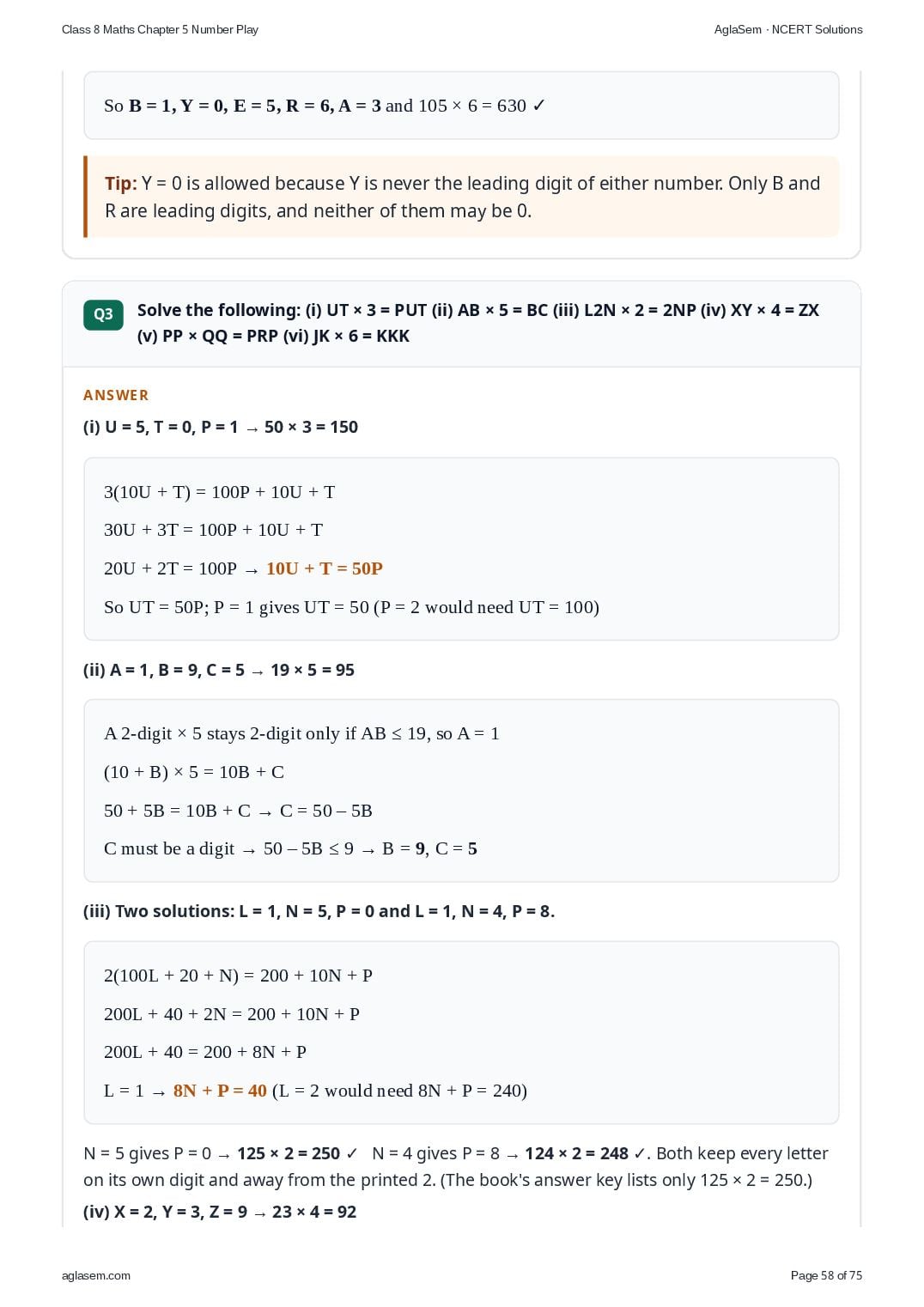
- (vii) Here is one more: BYE × 6 = RAY. Anshu says, “Since the product is a 3-digit number, B can’t be 2 or more. If B = 2, i.e., 2 hundreds, the product will be more than 1200. So, B = 1.” What can you say about ‘Y’? What digits are possible/not possible?
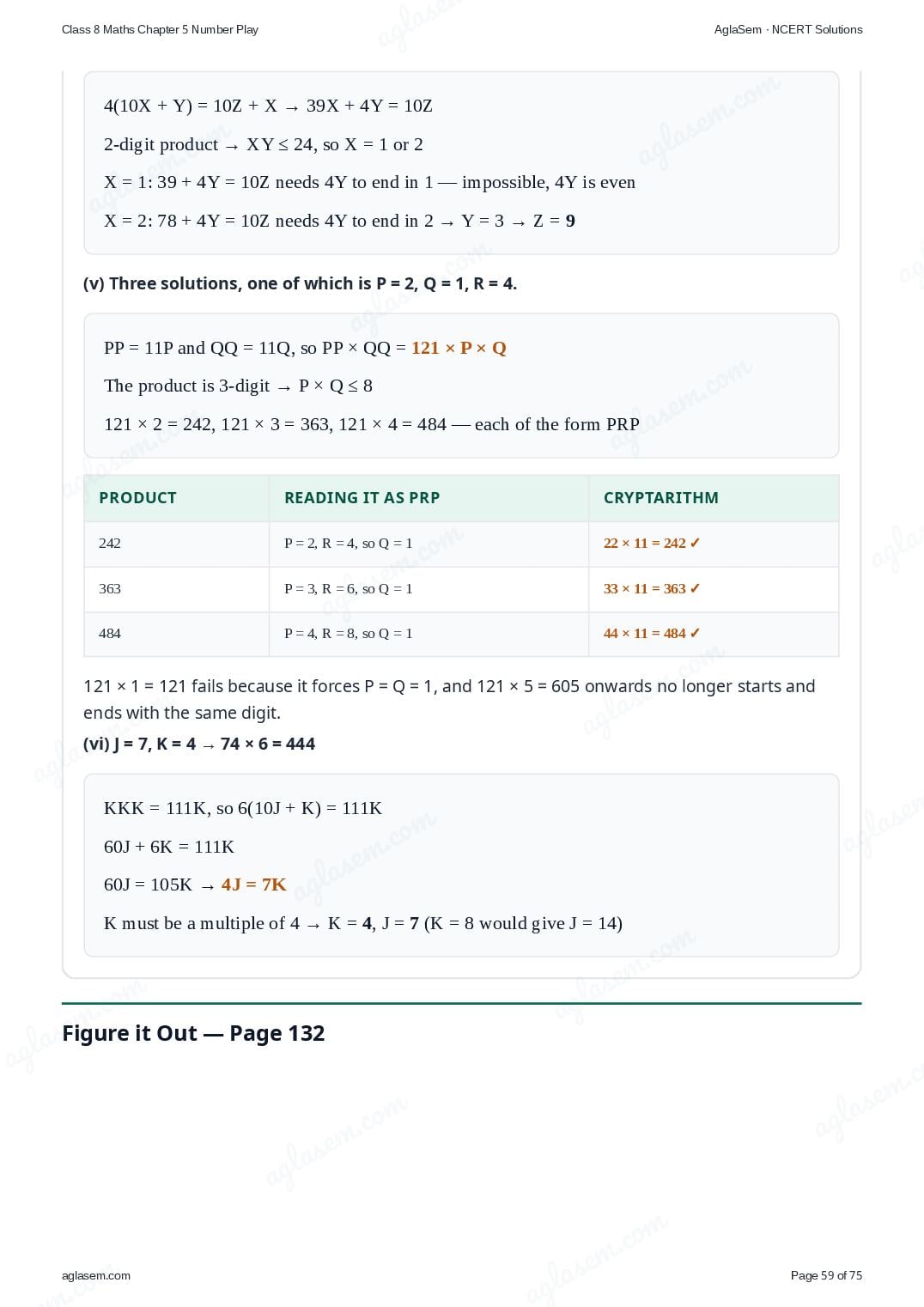
- Solve the following: (i) UT × 3 = PUT (ii) AB × 5 = BC (iii) L2N × 2 = 2NP (iv) XY × 4 = ZX (v) PP × QQ = PRP (vi) JK × 6 = KKK
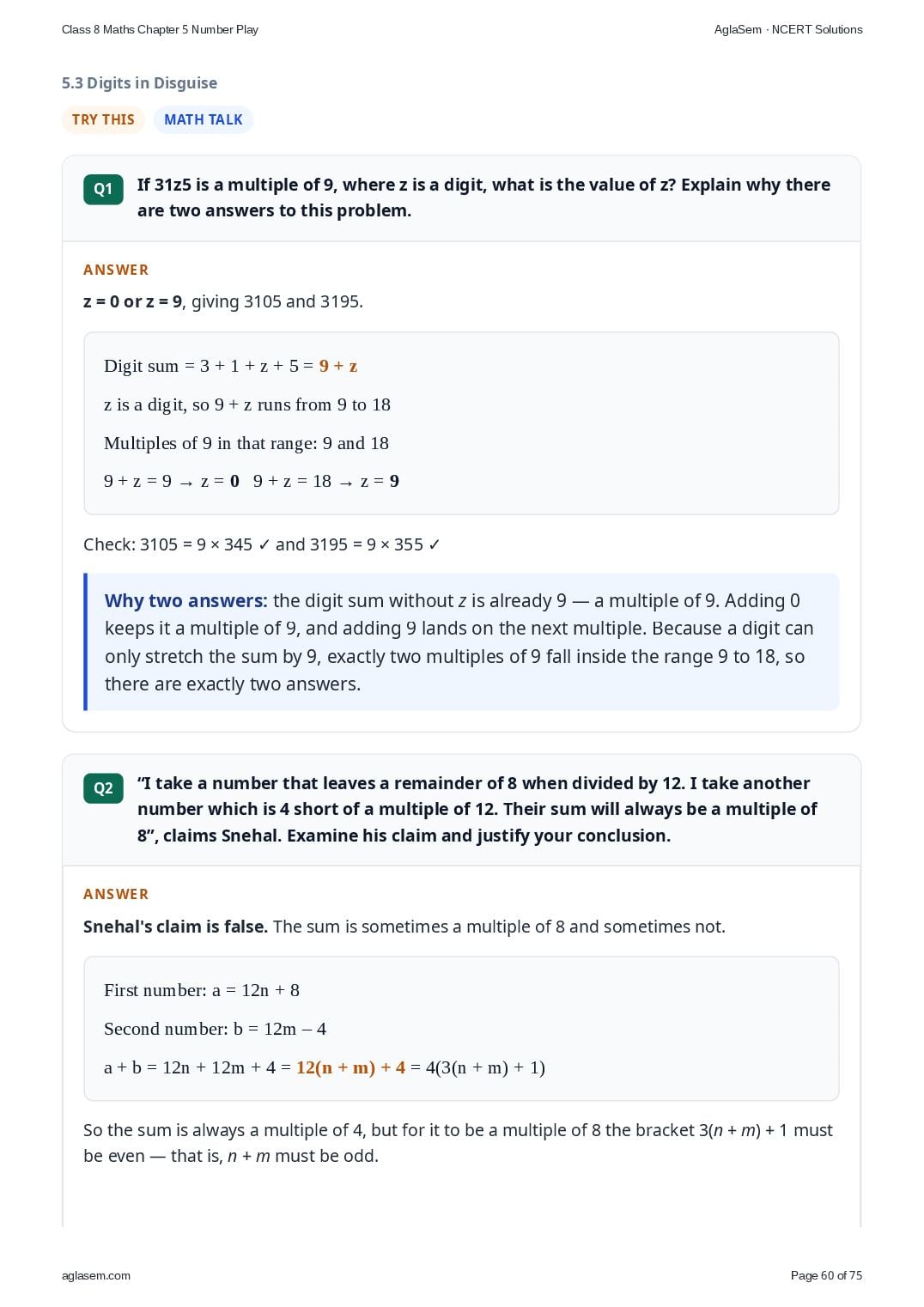
- If 31z5 is a multiple of 9, where z is a digit, what is the value of z? Explain why there are two answers to this problem.
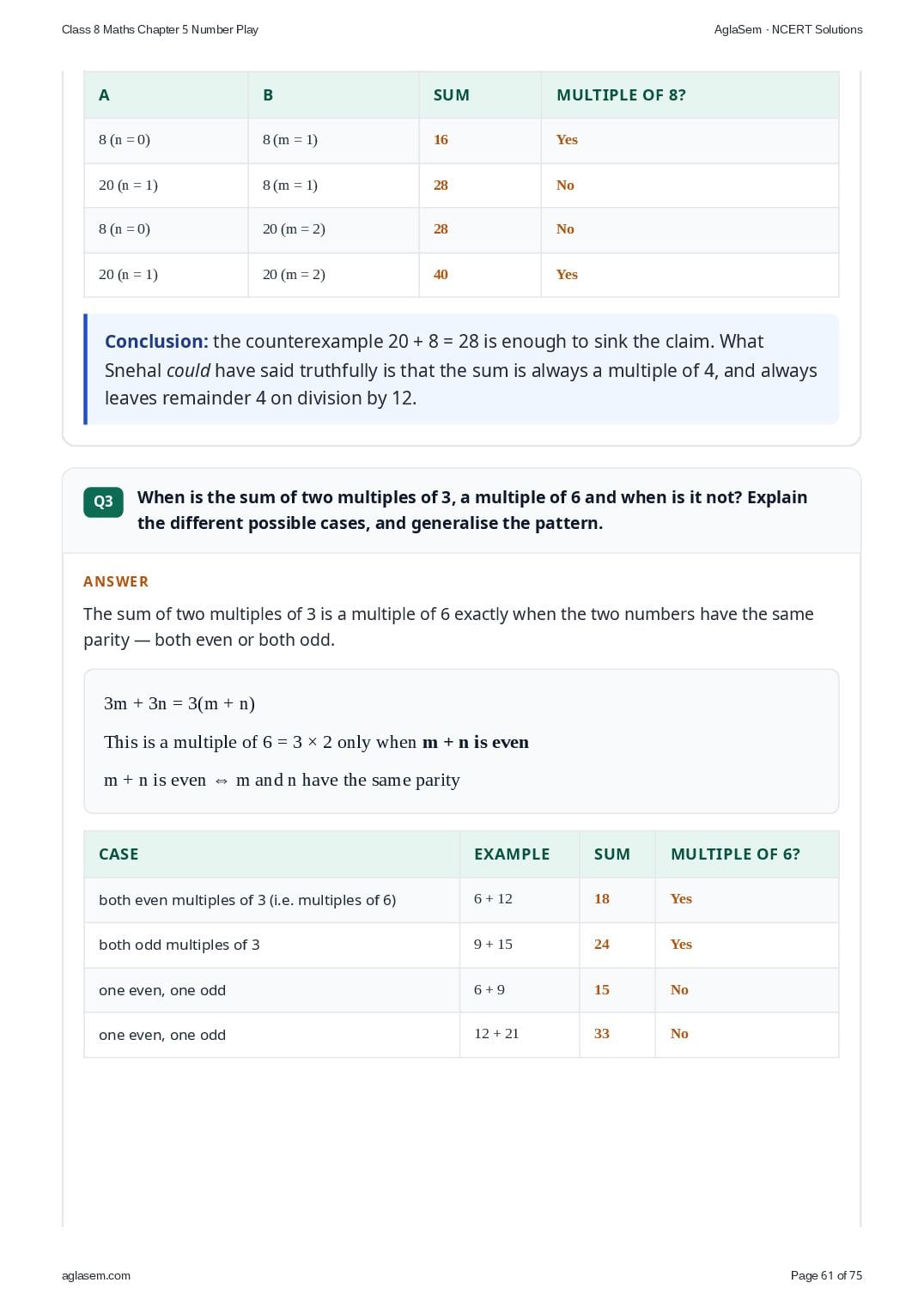
- “I take a number that leaves a remainder of 8 when divided by 12. I take another number which is 4 short of a multiple of 12. Their sum will always be a multiple of 8”, claims Snehal. Examine his claim and justify your conclusion.
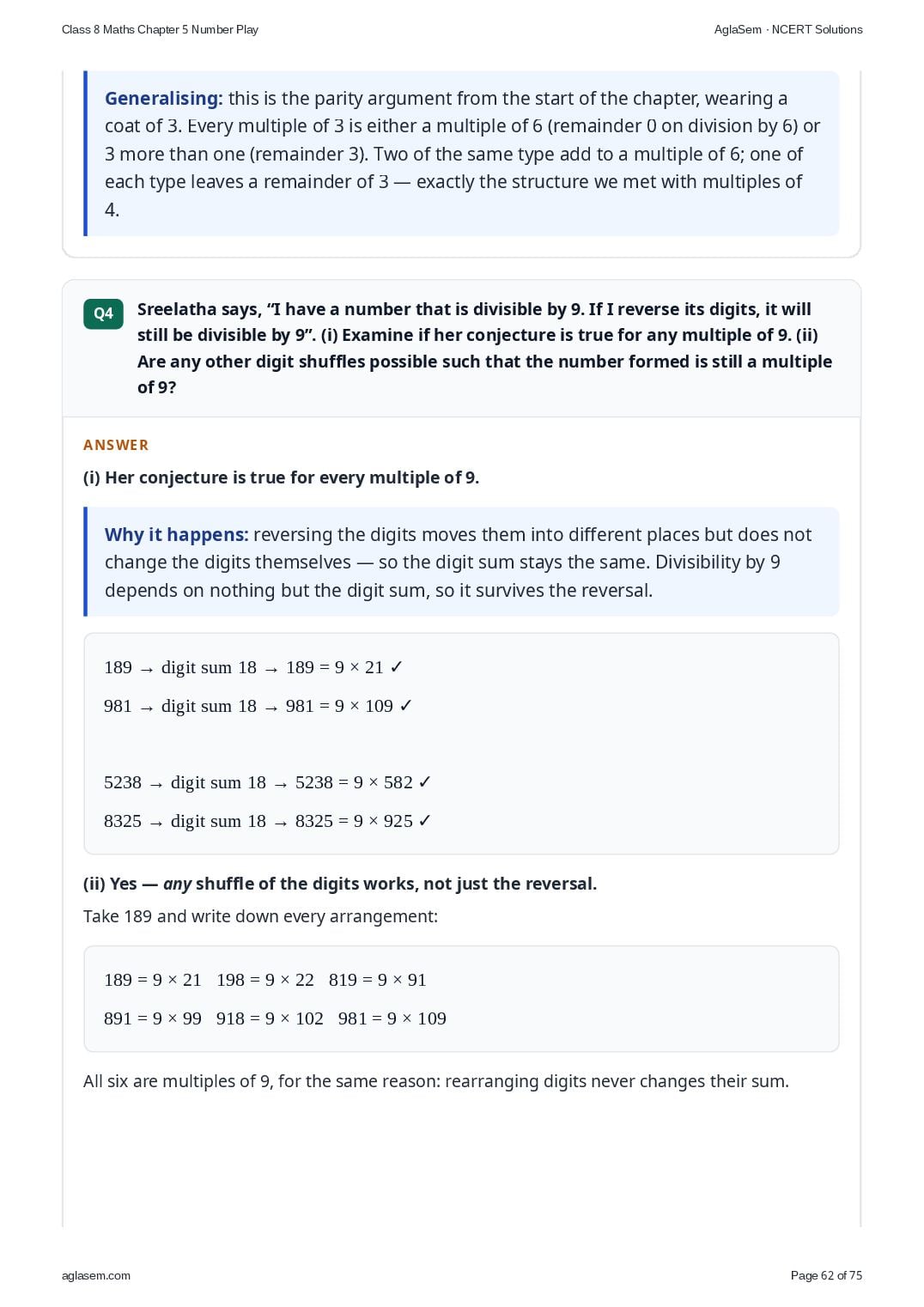
- When is the sum of two multiples of 3, a multiple of 6 and when is it not? Explain the different possible cases, and generalise the pattern.
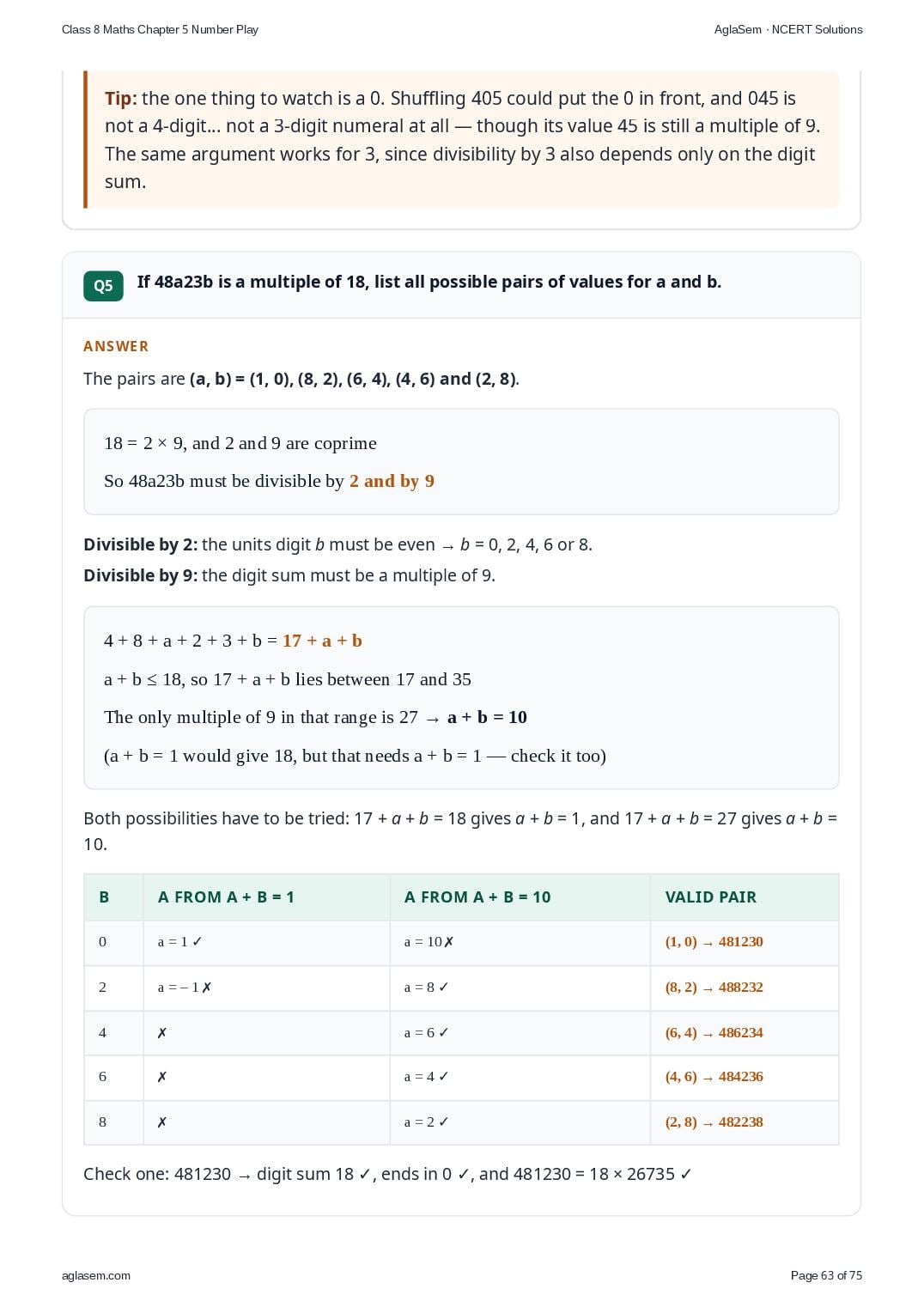
- Sreelatha says, “I have a number that is divisible by 9. If I reverse its digits, it will still be divisible by 9”. (i) Examine if her conjecture is true for any multiple of 9. (ii) Are any other digit shuffles possible such that the number formed is still a multiple of 9?
- If 48a23b is a multiple of 18, list all possible pairs of values for a and b.
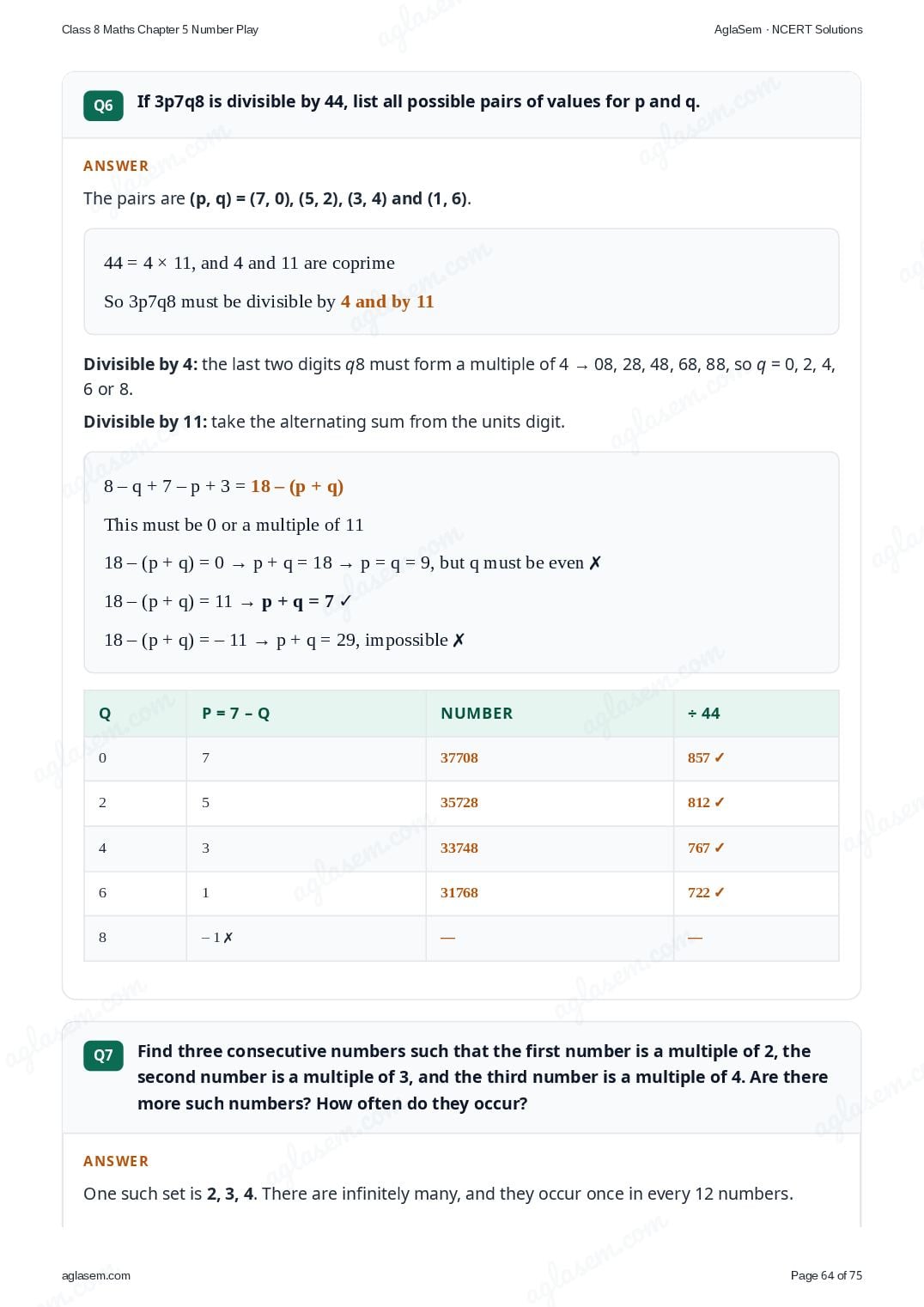
- If 3p7q8 is divisible by 44, list all possible pairs of values for p and q.
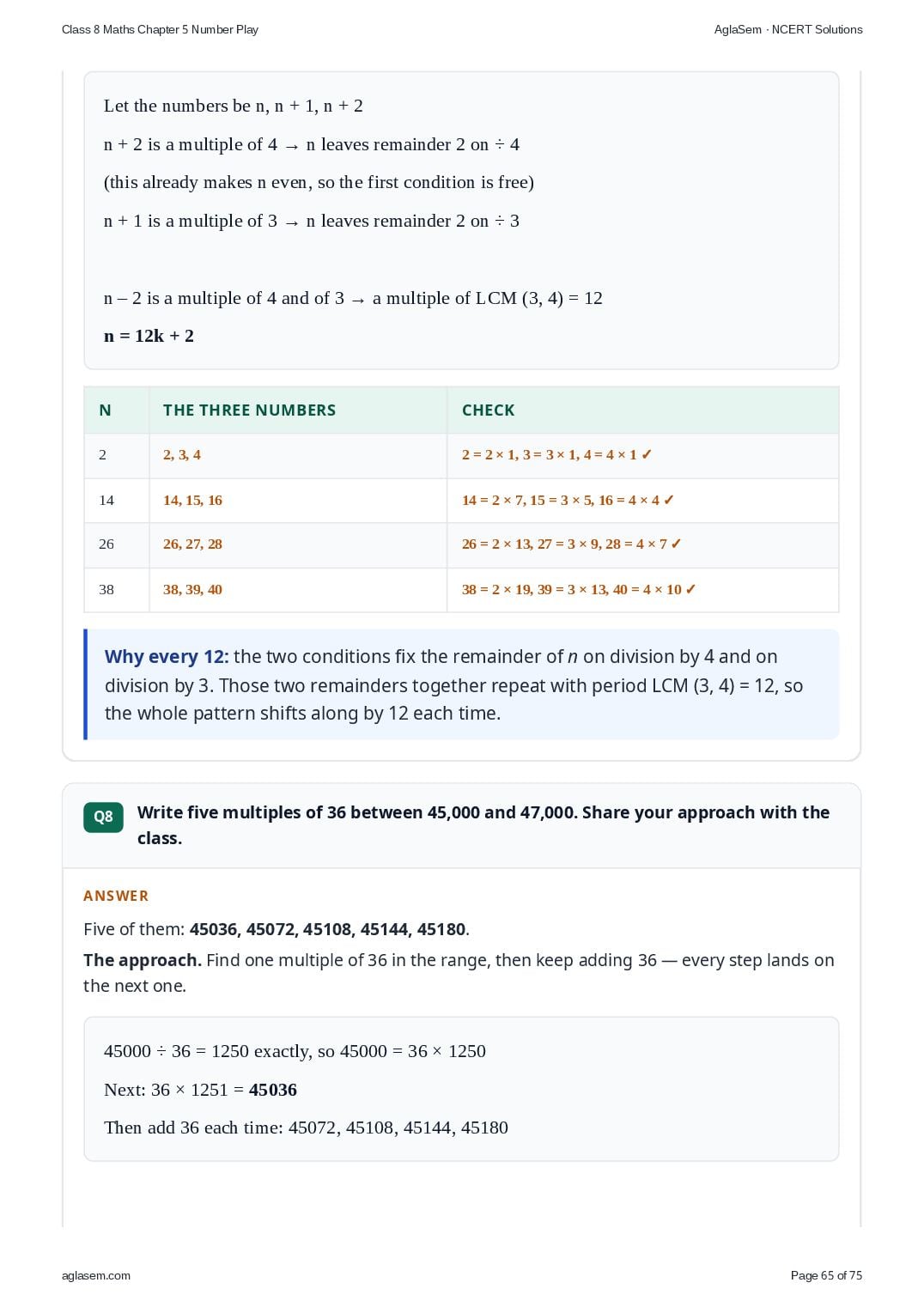
- Find three consecutive numbers such that the first number is a multiple of 2, the second number is a multiple of 3, and the third number is a multiple of 4. Are there more such numbers? How often do they occur?
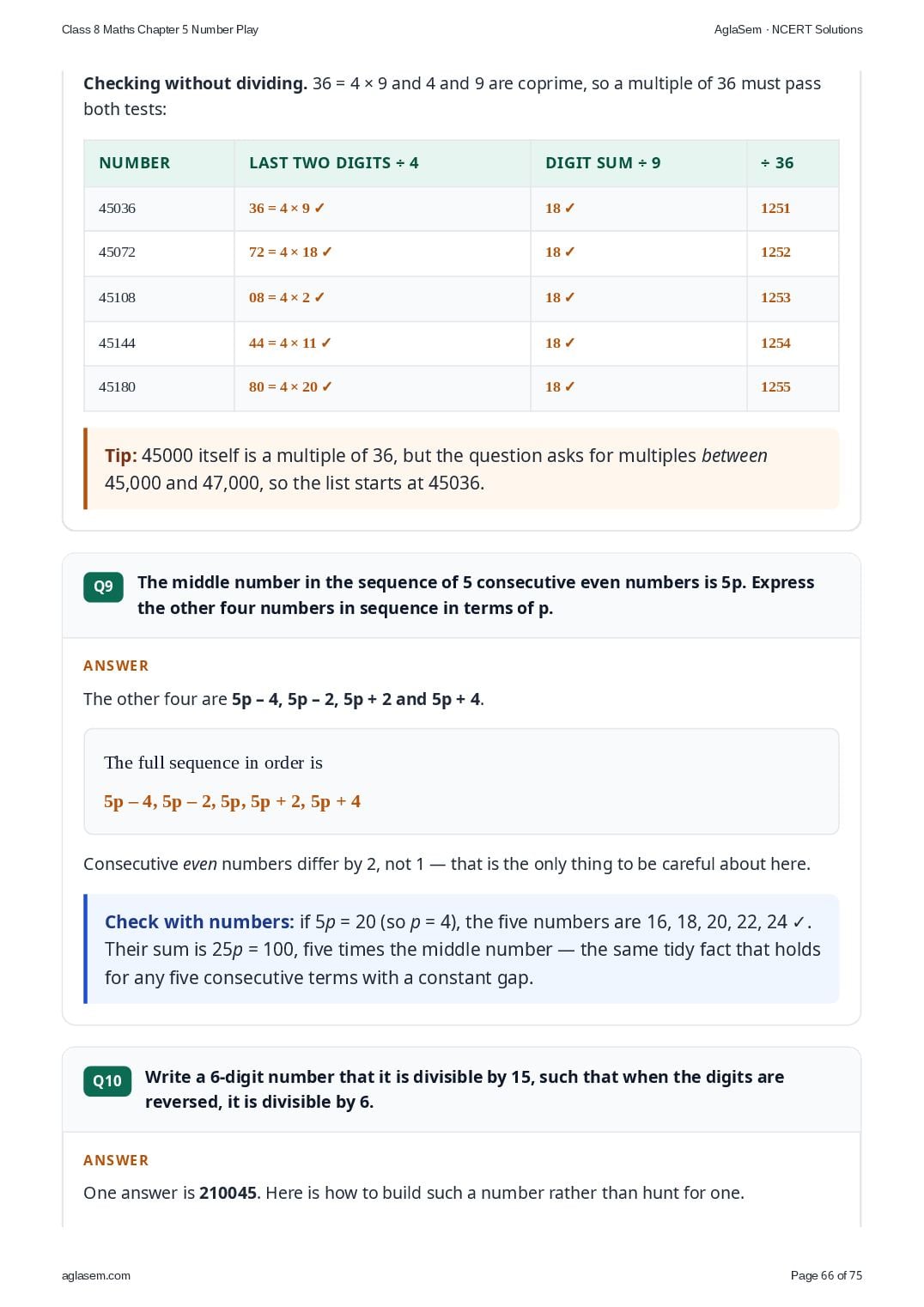
- Write five multiples of 36 between 45,000 and 47,000. Share your approach with the class.
- The middle number in the sequence of 5 consecutive even numbers is 5p. Express the other four numbers in sequence in terms of p.
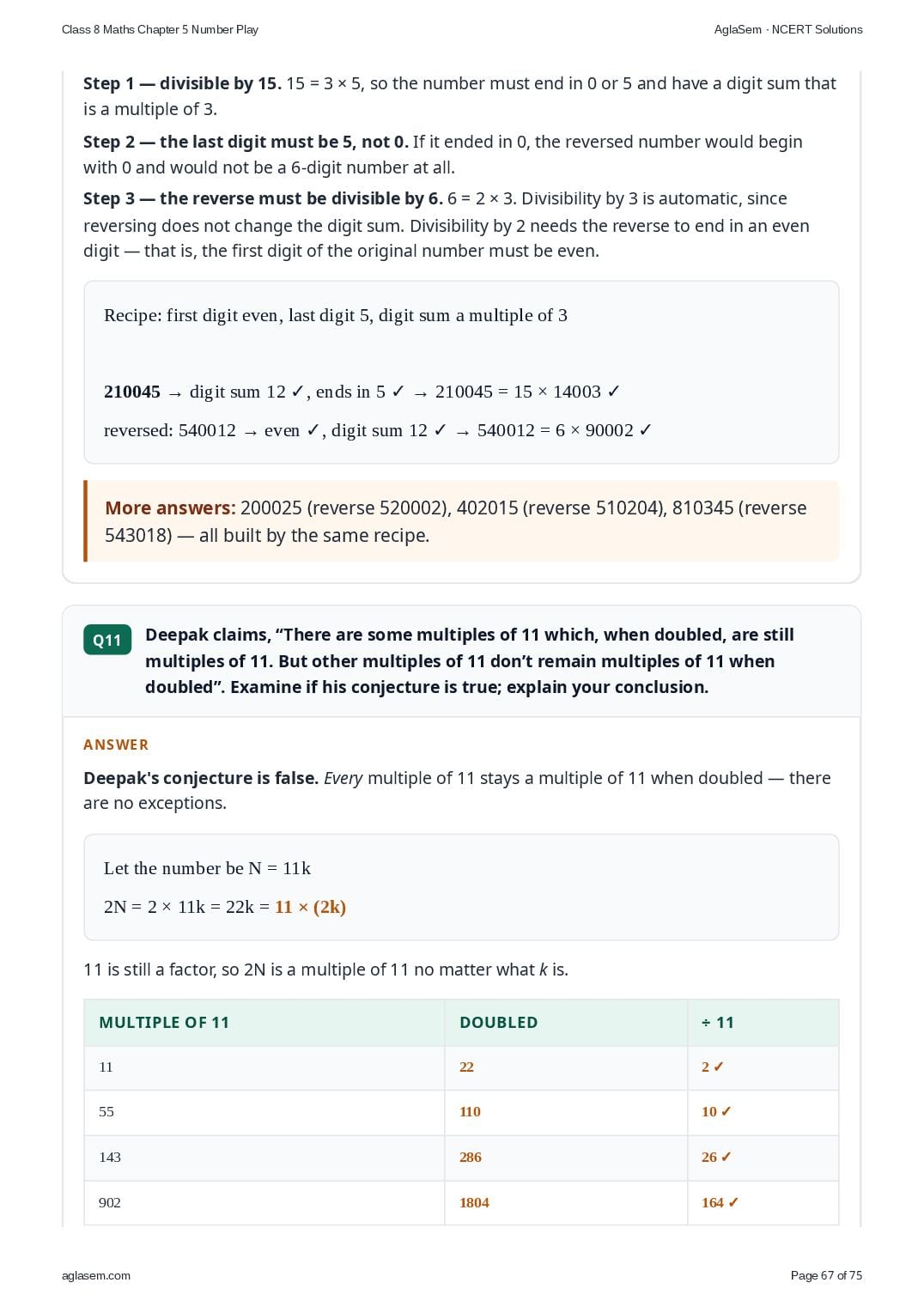
- Write a 6-digit number that it is divisible by 15, such that when the digits are reversed, it is divisible by 6.
- Deepak claims, “There are some multiples of 11 which, when doubled, are still multiples of 11. But other multiples of 11 don’t remain multiples of 11 when doubled”. Examine if his conjecture is true; explain your conclusion.
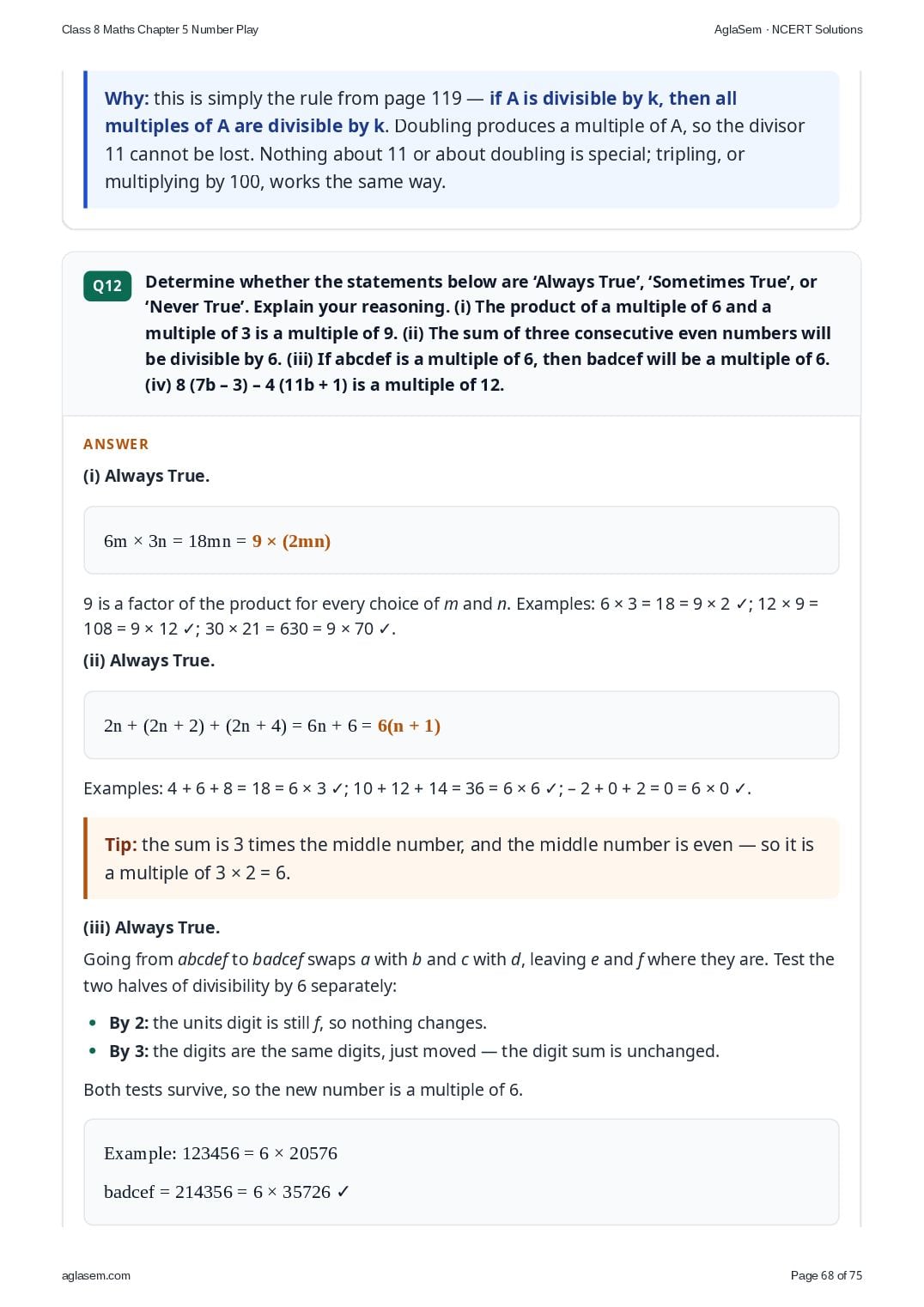
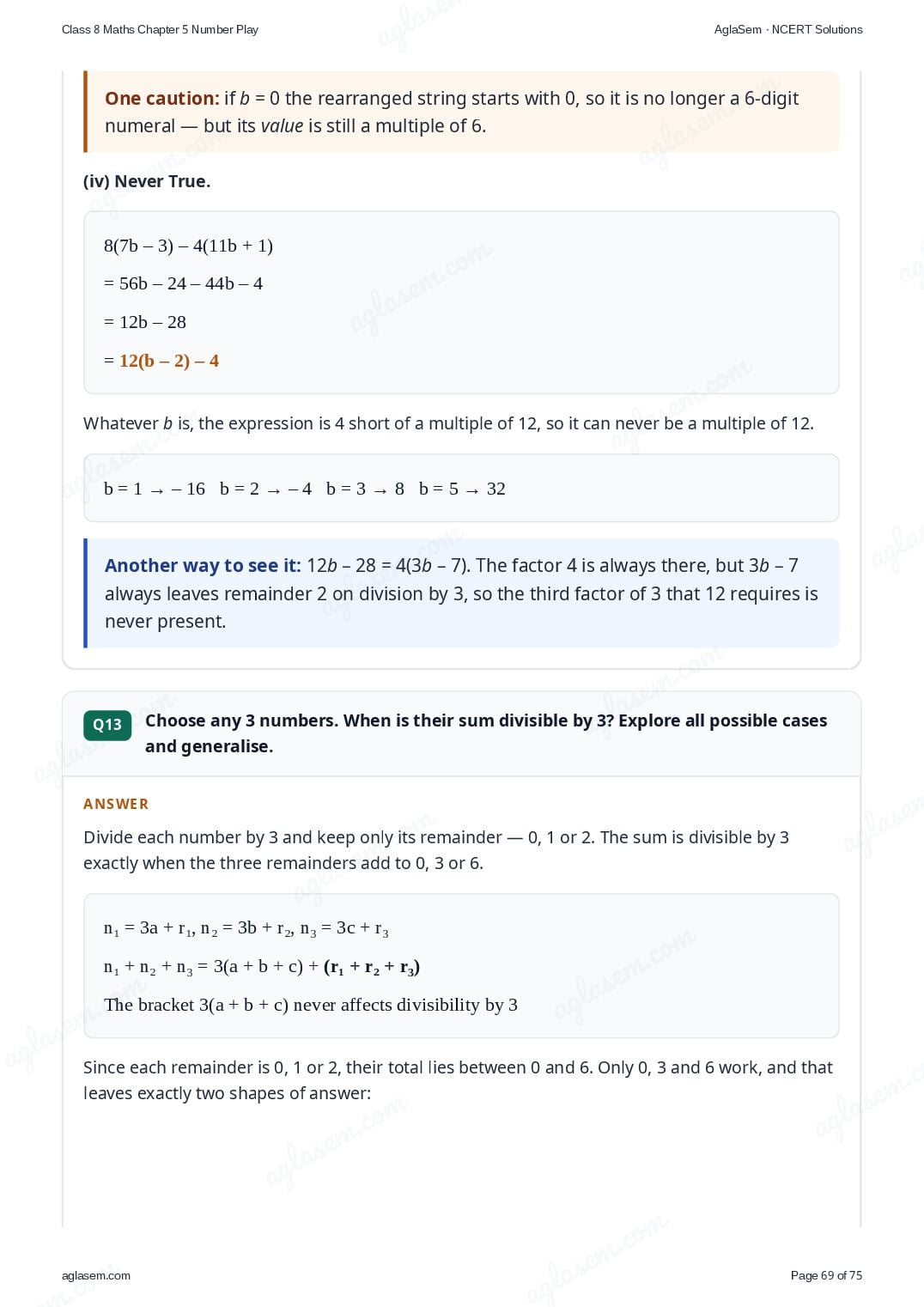
- Determine whether the statements below are ‘Always True’, ‘Sometimes True’, or ‘Never True’. Explain your reasoning. (i) The product of a multiple of 6 and a multiple of 3 is a multiple of 9. (ii) The sum of three consecutive even numbers will be divisible by 6. (iii) If abcdef is a multiple of 6, then badcef will be a multiple of 6. (iv) 8 (7b – 3) – 4 (11b + 1) is a multiple of 12.
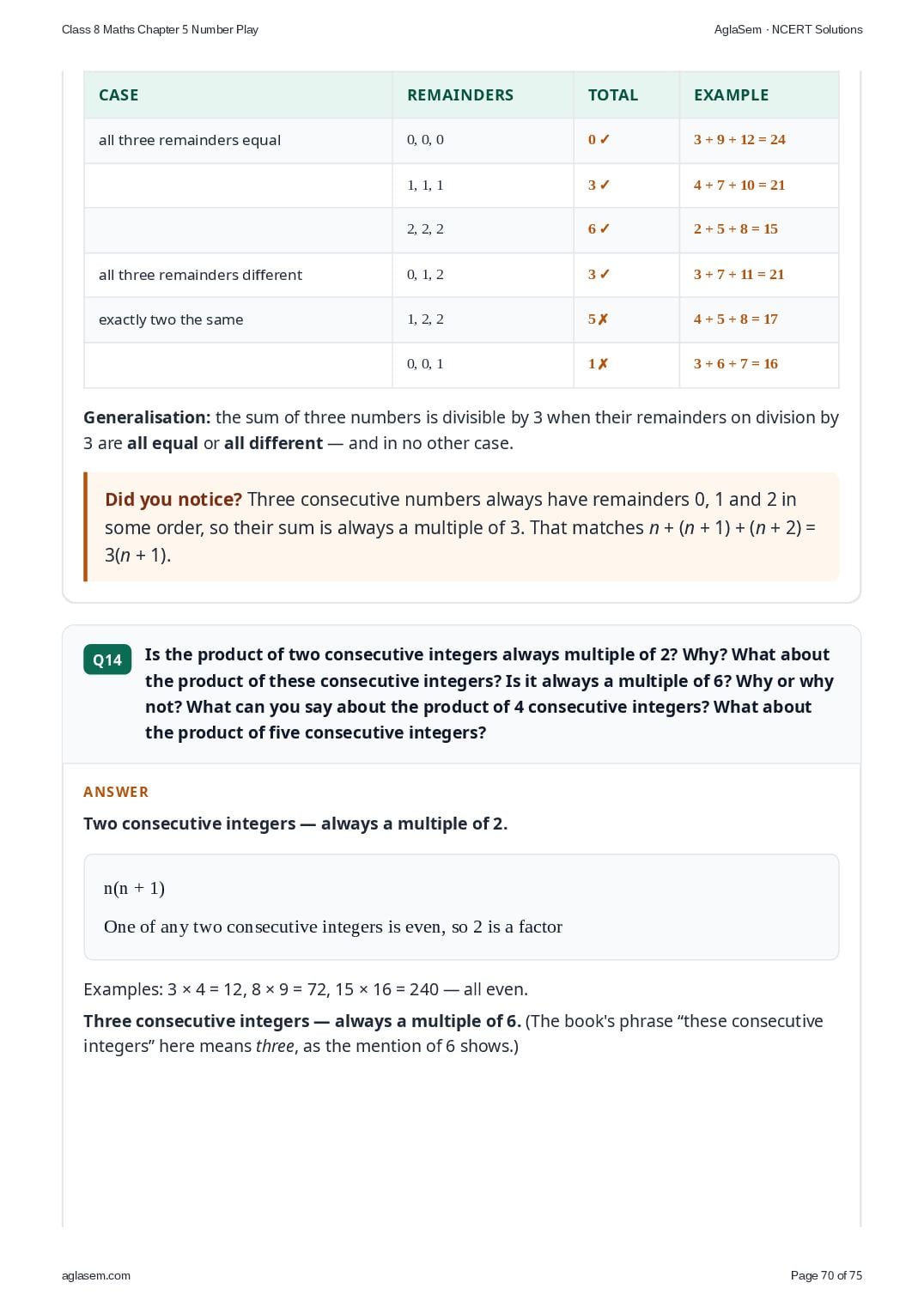
- Choose any 3 numbers. When is their sum divisible by 3? Explore all possible cases and generalise.
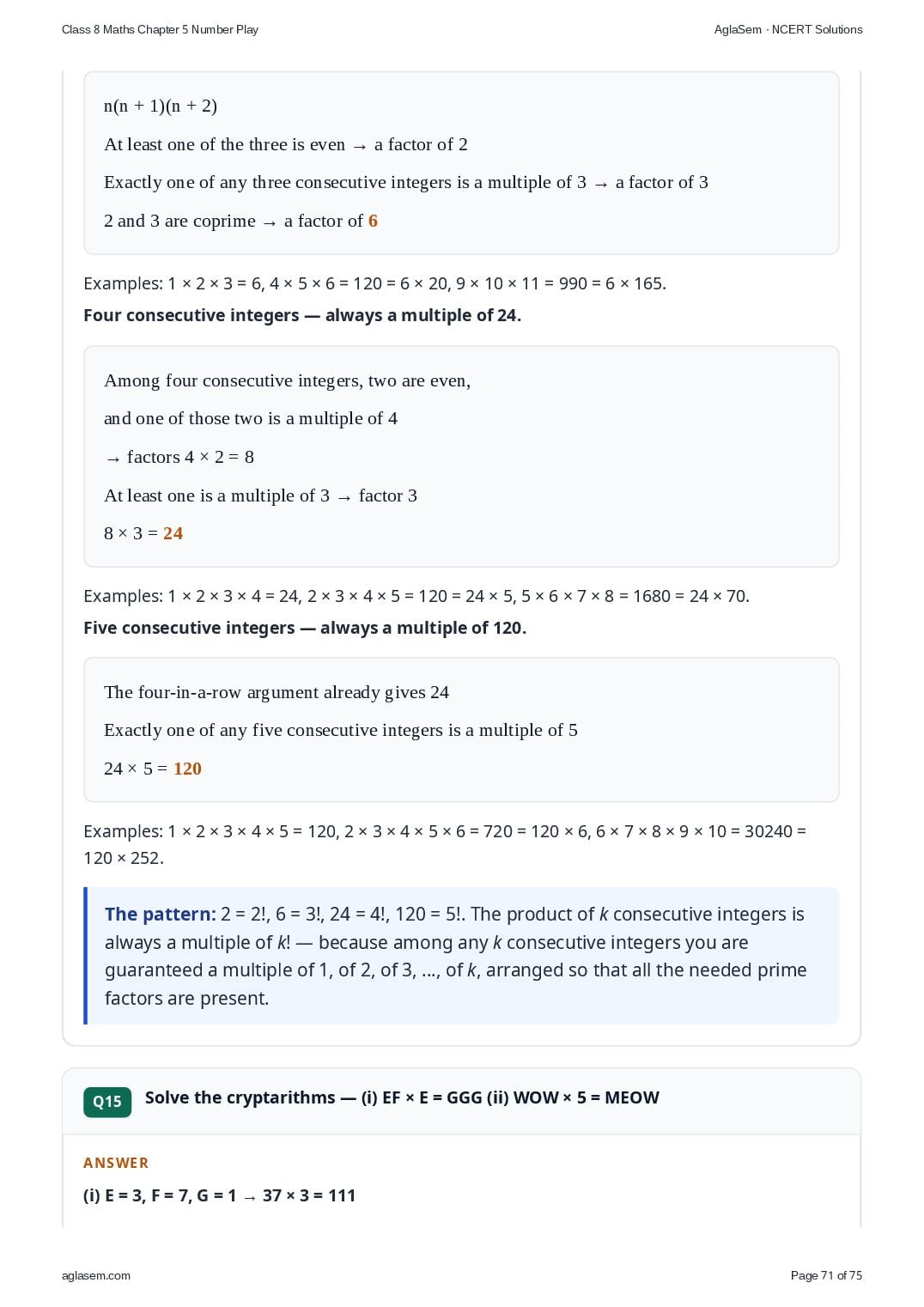
- Is the product of two consecutive integers always multiple of 2? Why? What about the product of these consecutive integers? Is it always a multiple of 6? Why or why not? What can you say about the product of 4 consecutive integers? What about the product of five consecutive integers?
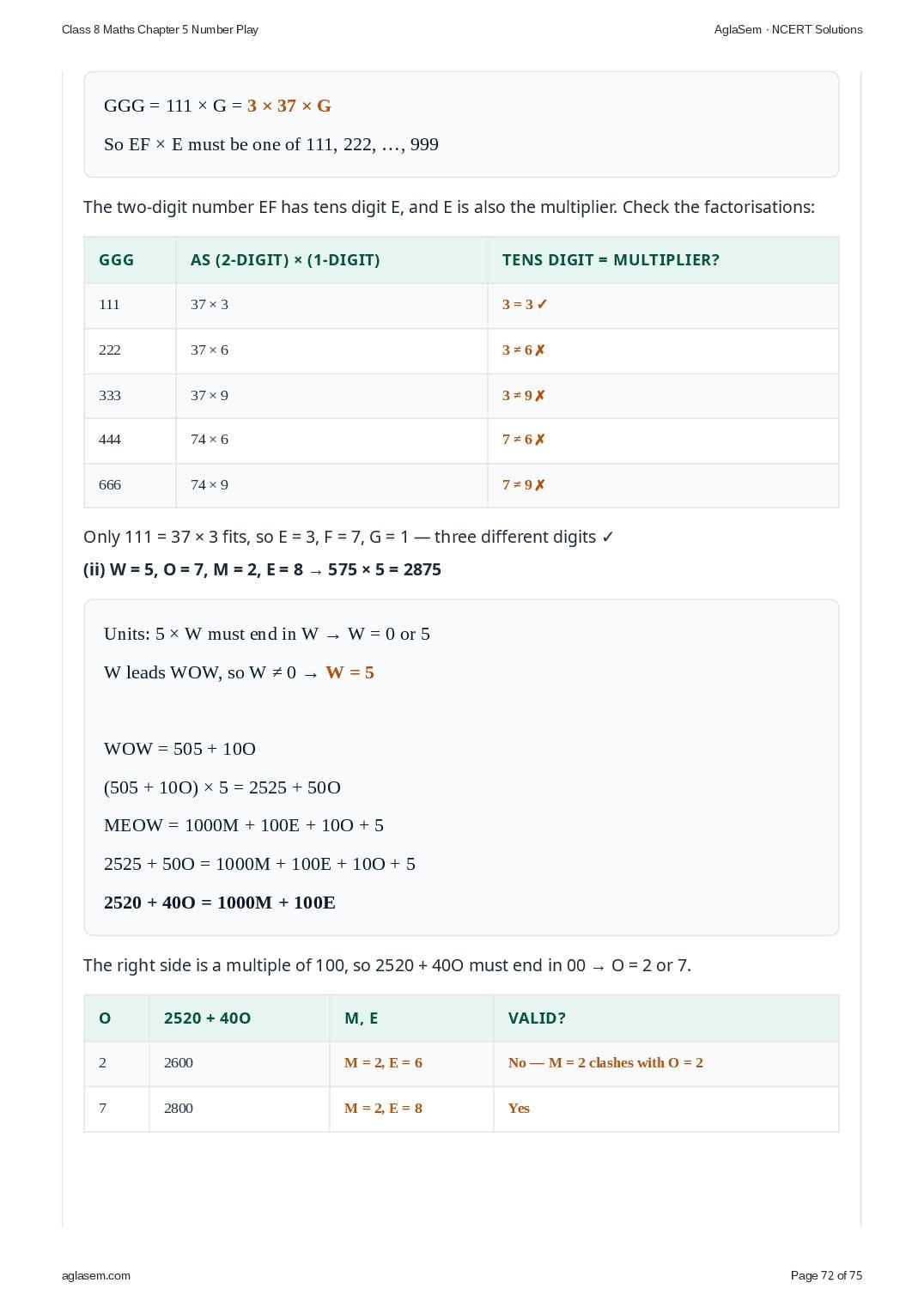
- Solve the cryptarithms — (i) EF × E = GGG (ii) WOW × 5 = MEOW
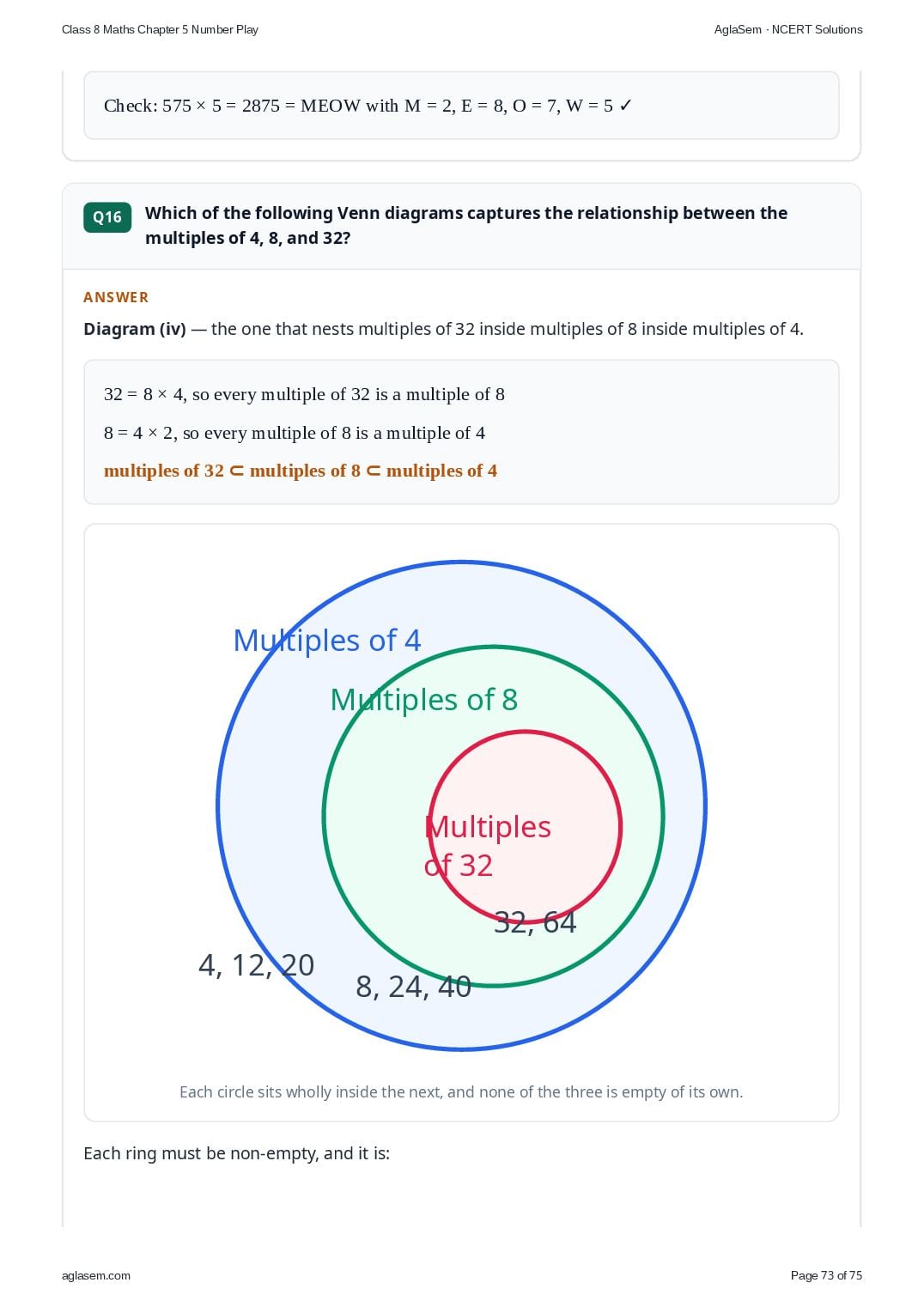
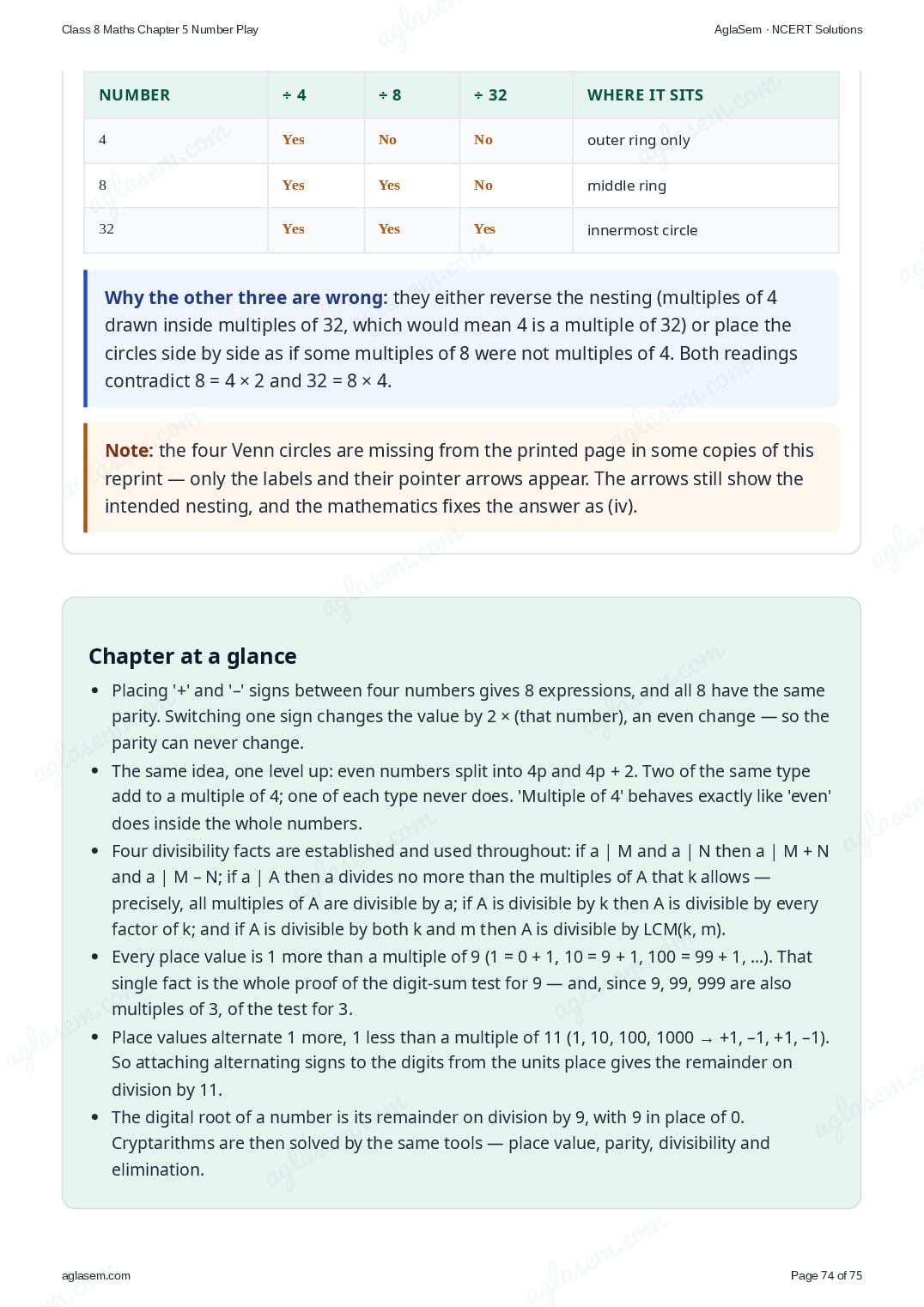
- Which of the following Venn diagrams captures the relationship between the multiples of 4, 8, and 32?
Chapter at a Glance
- Placing '+' and '–' signs between four numbers gives 8 expressions, and all 8 have the same parity. Switching one sign changes the value by 2 × (that number), an even change — so the parity can never change.
- The same idea, one level up: even numbers split into 4p and 4p + 2. Two of the same type add to a multiple of 4; one of each type never does. 'Multiple of 4' behaves exactly like 'even' does inside the whole numbers.
- Four divisibility facts are established and used throughout: if a | M and a | N then a | M + N and a | M – N; if a | A then a divides no more than the multiples of A that k allows — precisely, all multiples of A are divisible by a; if A is divisible by k then A is divisible by every factor of k; and if A is divisible by both k and m then A is divisible by LCM(k, m).
- Every place value is 1 more than a multiple of 9 (1 = 0 + 1, 10 = 9 + 1, 100 = 99 + 1, …). That single fact is the whole proof of the digit-sum test for 9 — and, since 9, 99, 999 are also multiples of 3, of the test for 3.
- Place values alternate 1 more, 1 less than a multiple of 11 (1, 10, 100, 1000 → +1, –1, +1, –1). So attaching alternating signs to the digits from the units place gives the remainder on division by 11.
- The digital root of a number is its remainder on division by 9, with 9 in place of 0. Cryptarithms are then solved by the same tools — place value, parity, divisibility and elimination.
How to Download NCERT Solutions for Class 8 Maths Chapter 5 PDF
Follow these simple steps to get the Number Play questions-and-answers PDF from Ganita Prakash.
- Search NCERT Solutions for Class 8 Maths Chapter 5 aglasem and open this page.
- Read the exercise questions with answers for Number Play shown above.
- Click the Download PDF link to save the Number Play solutions to your device.
NCERT Solutions for Class 8 Maths – All Chapters
There are more chapters to study besides Number Play in Maths. Here are the NCERT Solutions for all chapters of Class 8 Maths.
- Chapter 1 A Square and a Cube
- Chapter 2 Power Play
- Chapter 3 A Story of Numbers
- Chapter 4 Quadrilaterals
- Chapter 5 Number Play
- Chapter 6 We Distribute Yet Things Multiply
- Chapter 7 Proportional Reasoning 1
- Chapter 8 Fractions in Disguise
- Chapter 9 The Baudh Yana Pythagoras Theorem
- Chapter 10 Proportional Reasoning 2
- Chapter 11 Exploring Some Geometric Themes
- Chapter 12 Tales By Dots and Lines
- Chapter 13 Algebra Play
- Chapter 14 Area
NCERT Solutions for Class 8 – All Subjects
Just like Chapter 5 of Maths, you can get the exercise questions with answers for every other subject of Class 8. Here are the NCERT Solutions for all subjects of Class 8.
NCERT Solutions for Class 8 Maths Chapter 5 – An Overview
The key highlights of this study material are as follows.
| Aspects | Details |
|---|---|
| Class | Class 8 |
| Subject | Maths |
| Chapter Number | Chapter 5 |
| Chapter Name | Number Play |
| Book Name | Ganita Prakash |
| Book By | NCERT (National Council of Educational Research and Training) |
| Educational Resource Here | NCERT Solutions of Class 8 Maths Chapter 5 for all exercises |
| More Questions Answers of This Subject | NCERT Solutions for Class 8 Maths |
| Download Book Chapter | NCERT Book Class 8 Maths |
| All Questions Answers For This Class | NCERT Solutions for Class 8 |
| Complete Solutions | NCERT Solutions |
NCERT Solutions for Class 8 Maths Chapter 5 Number Play – FAQs
What are the NCERT Solutions for Class 8 Maths Chapter 5 Number Play?
They are the complete, step-by-step answers to all the exercise and in-text questions of Chapter 5 Number Play from the NCERT Class 8 Maths textbook Ganita Prakash, written by experts as per the latest NCERT syllabus.
How can I download the Class 8 Maths Chapter 5 solutions PDF for free?
Open this page on aglasem, read the Number Play questions with answers, and click the “Download Solutions PDF” link. The Class 8 Maths Chapter 5 NCERT Solutions PDF is completely free to download.
Are these NCERT Solutions as per the latest 2026-27 syllabus?
Yes. The NCERT Solutions for Class 8 Maths Chapter 5 are based on the latest NCERT textbook Ganita Prakash and the current 2026-27 CBSE syllabus, so the questions and answers match what you study in class.
Where can I get NCERT Solutions for the other chapters of Class 8 Maths?
You can find the answers to every chapter on the NCERT Solutions for Class 8 Maths page, and solutions for every subject on the NCERT Solutions for Class 8 page.
How do NCERT Solutions help in exam preparation?
They show the correct method to solve each question, help you write answers the way they are expected in exams, let you check and correct your own work, and save revision time — which together improve your marks in Class 8 Maths.
If you have any queries on NCERT Solutions for Class 8 Maths Chapter 5 Number Play, then please ask in the comments below.