NCERT Solutions for Class 8 Maths Chapter 4 Quadrilaterals provide clear, step-by-step answers to every exercise and in-text question from the chapter Quadrilaterals of the NCERT textbook Ganita Prakash. Prepared by subject experts as per the latest NCERT (CBSE) syllabus for 2026-27, these NCERT Solutions for Class 8 Maths help you understand each concept, write exam-ready answers, and check your own solutions. You can read them online below or download the free Class 8 Maths Chapter 4 question-answer PDF.
NCERT Solutions for Class 8 Maths Chapter 4 Quadrilaterals
- Class: Class 8
- Subject: Maths
- Chapter: Chapter 4 – Quadrilaterals
- Textbook: Ganita Prakash (NCERT)
- Study material: NCERT Solutions – questions with answers, free PDF
These solutions answer all the exercise questions of Chapter 4 Quadrilaterals — including the in-text questions, short-answer and long-answer questions, and activities — with complete explanations so you can follow the method, not just the final answer. Read the full solutions below.
NCERT Solutions Class 8 Maths Chapter 4 Quadrilaterals View Download
NCERT Solutions for Class 8 Maths Chapter 4 PDF Download
You can read the NCERT Solutions for Class 8 Maths Chapter 4 online above, or download the complete question-answer PDF to study Quadrilaterals offline at any time.
NCERT Solutions for Class 8 Maths Chapter 4 PDF Download Link – Click Here to Download Solutions PDF
Questions Covered in This Chapter
These NCERT Solutions answer all 86 questions of this chapter. The questions solved are:
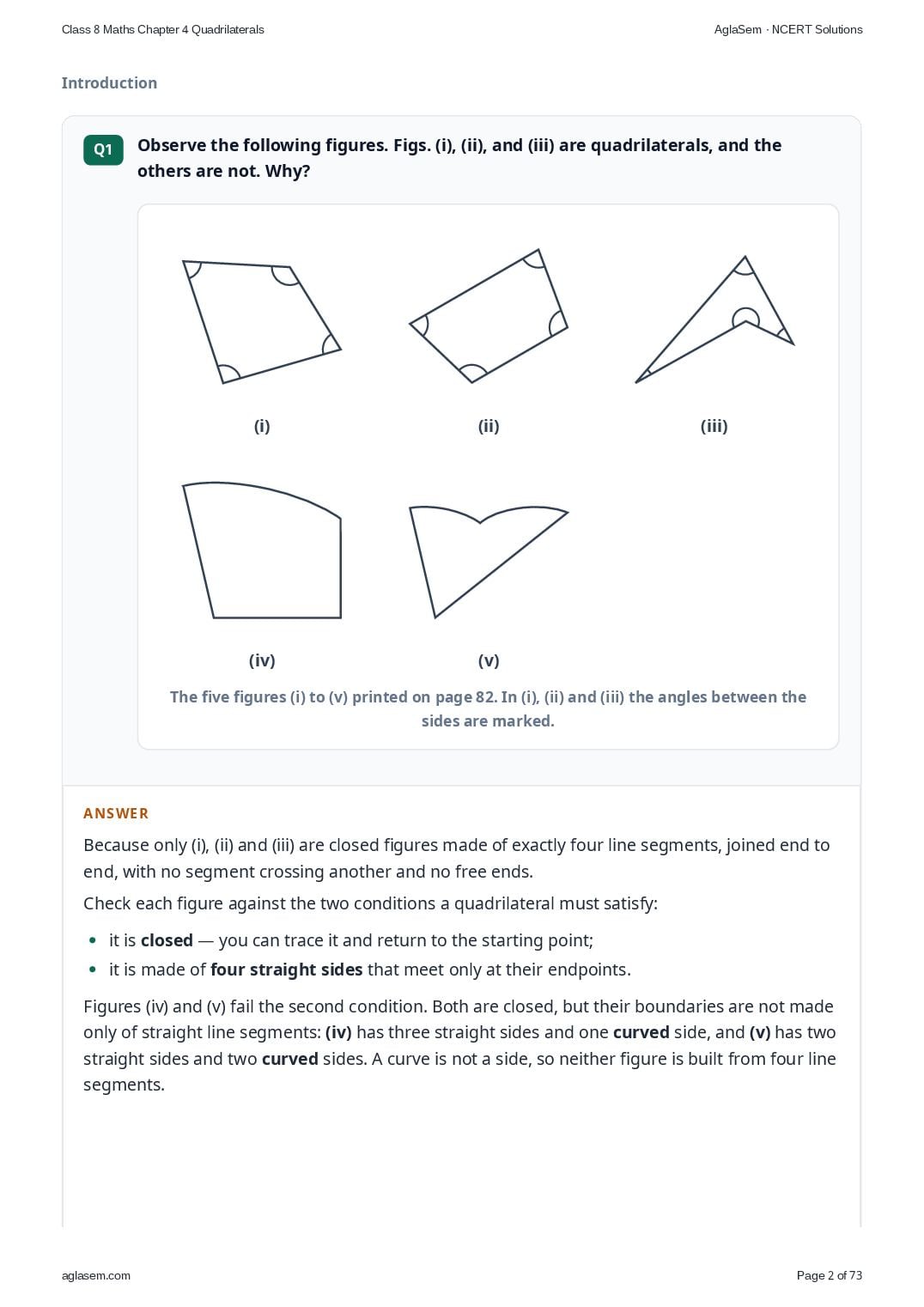
- Observe the following figures. Figs. (i), (ii), and (iii) are quadrilaterals, and the others are not. Why?
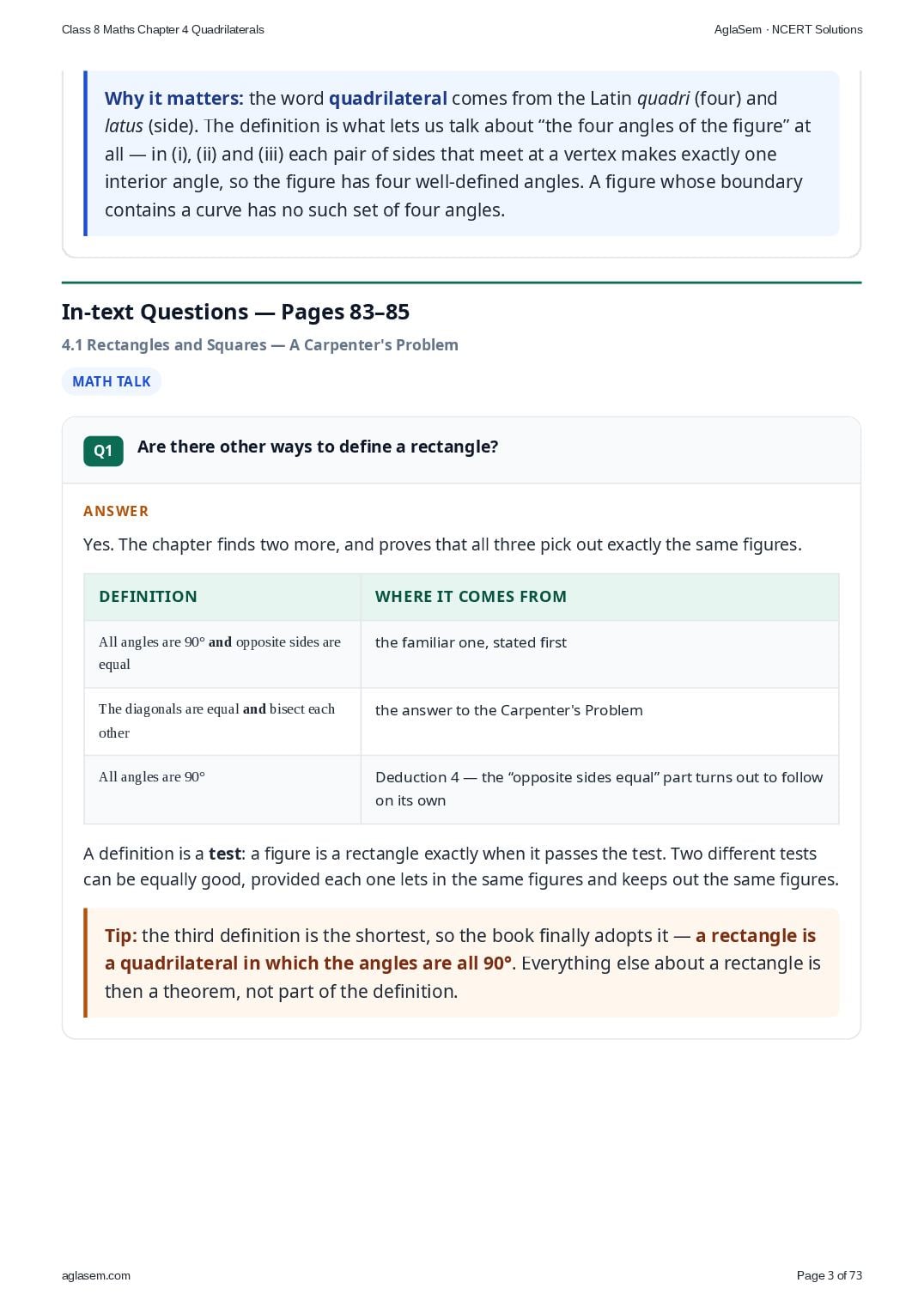
- Are there other ways to define a rectangle?
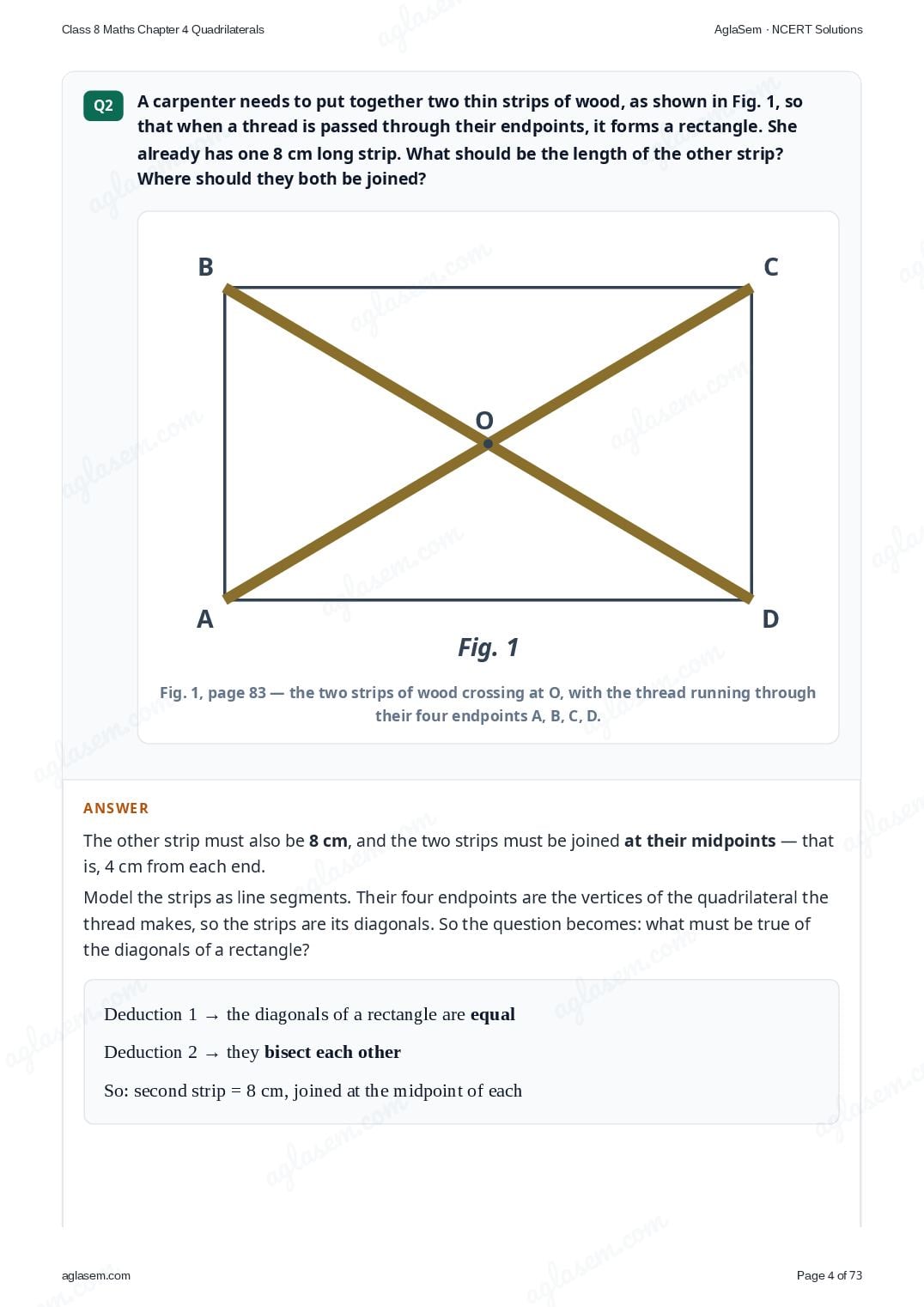
- A carpenter needs to put together two thin strips of wood, as shown in Fig. 1, so that when a thread is passed through their endpoints, it forms a rectangle. She already has one 8 cm long strip. What should be the length of the other strip? Where should they both be joined?
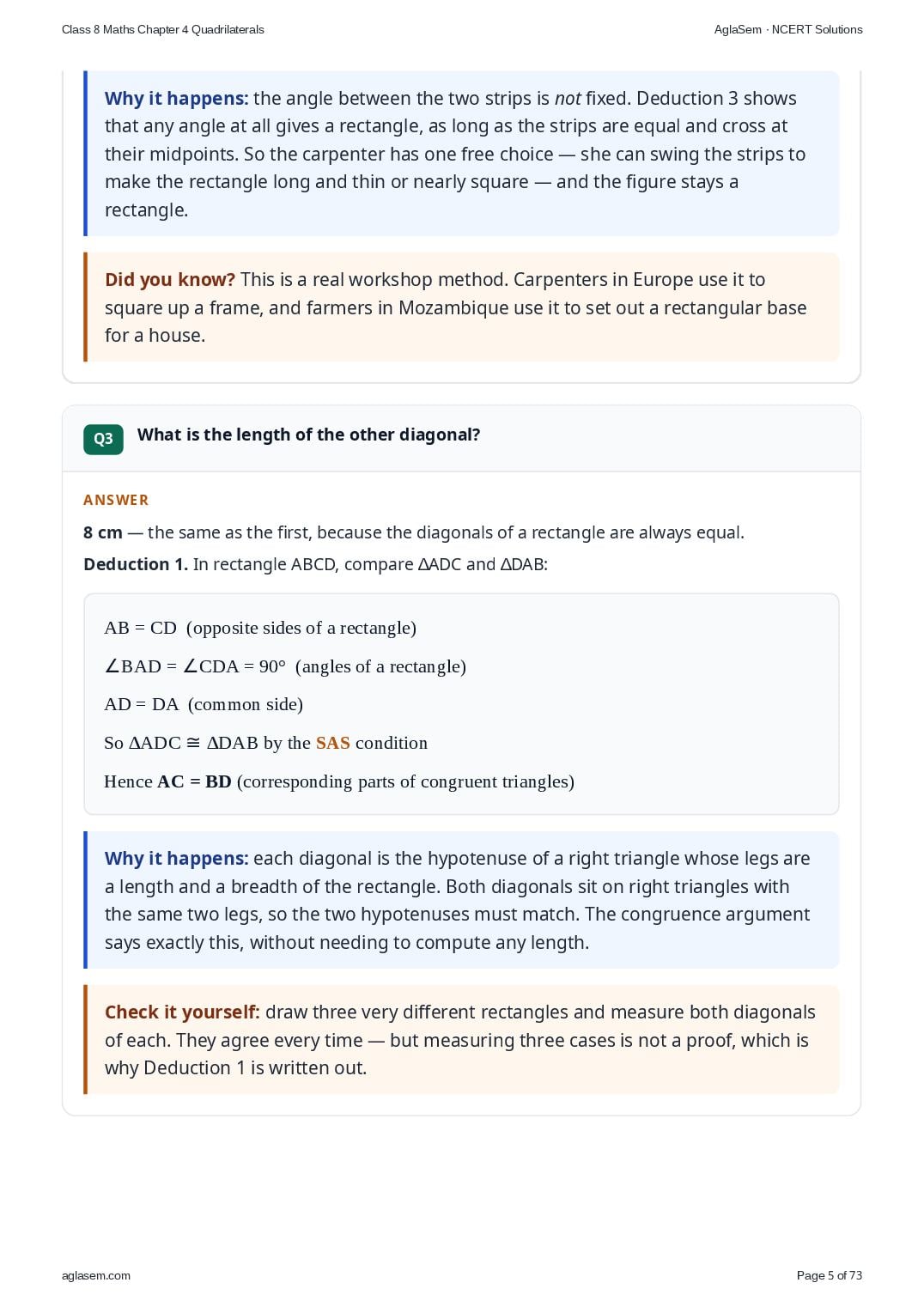
- What is the length of the other diagonal?
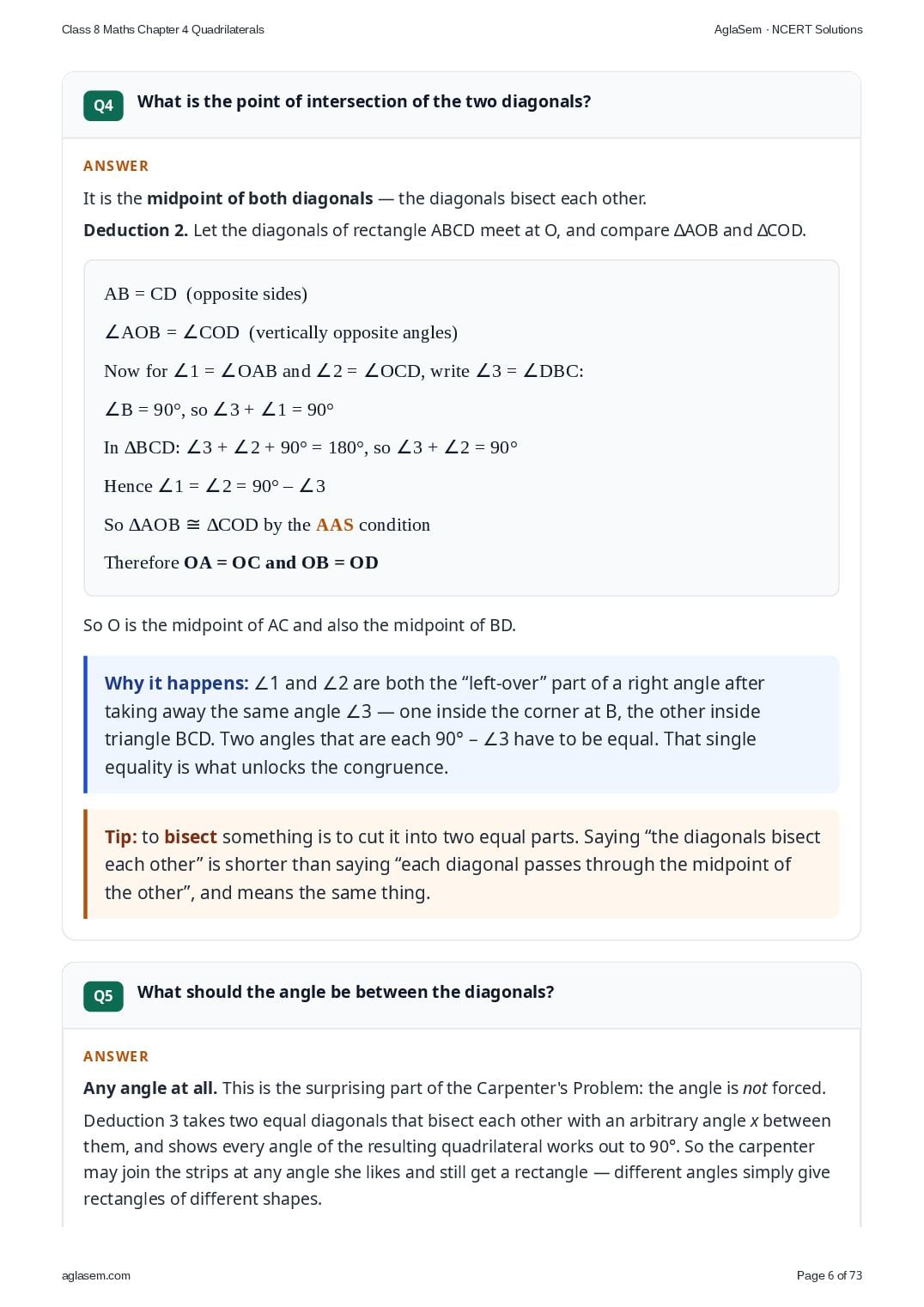
- What is the point of intersection of the two diagonals?
- What should the angle be between the diagonals?
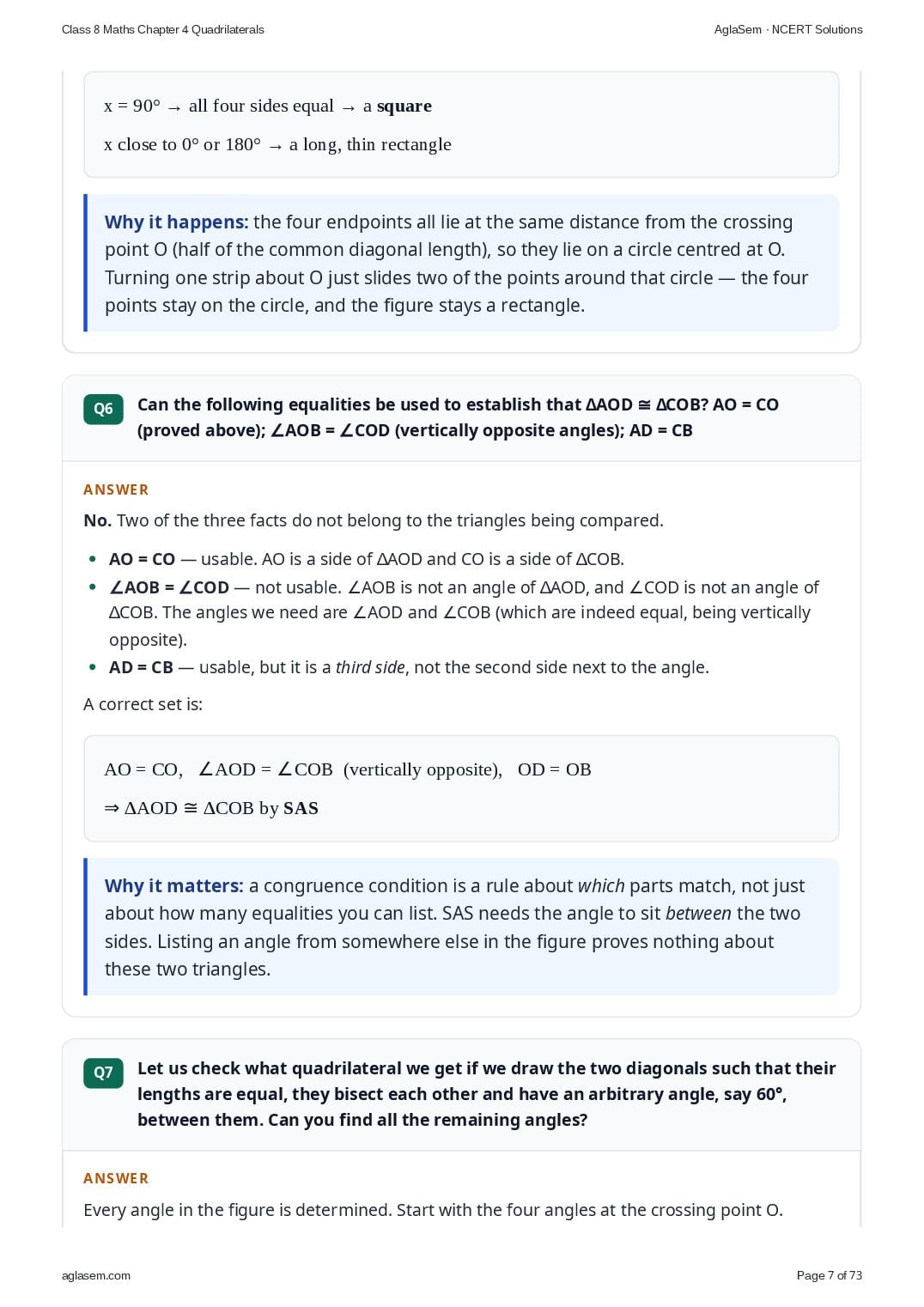
- Can the following equalities be used to establish that ∆AOD ≅ ∆COB? AO = CO (proved above); ∠AOB = ∠COD (vertically opposite angles); AD = CB
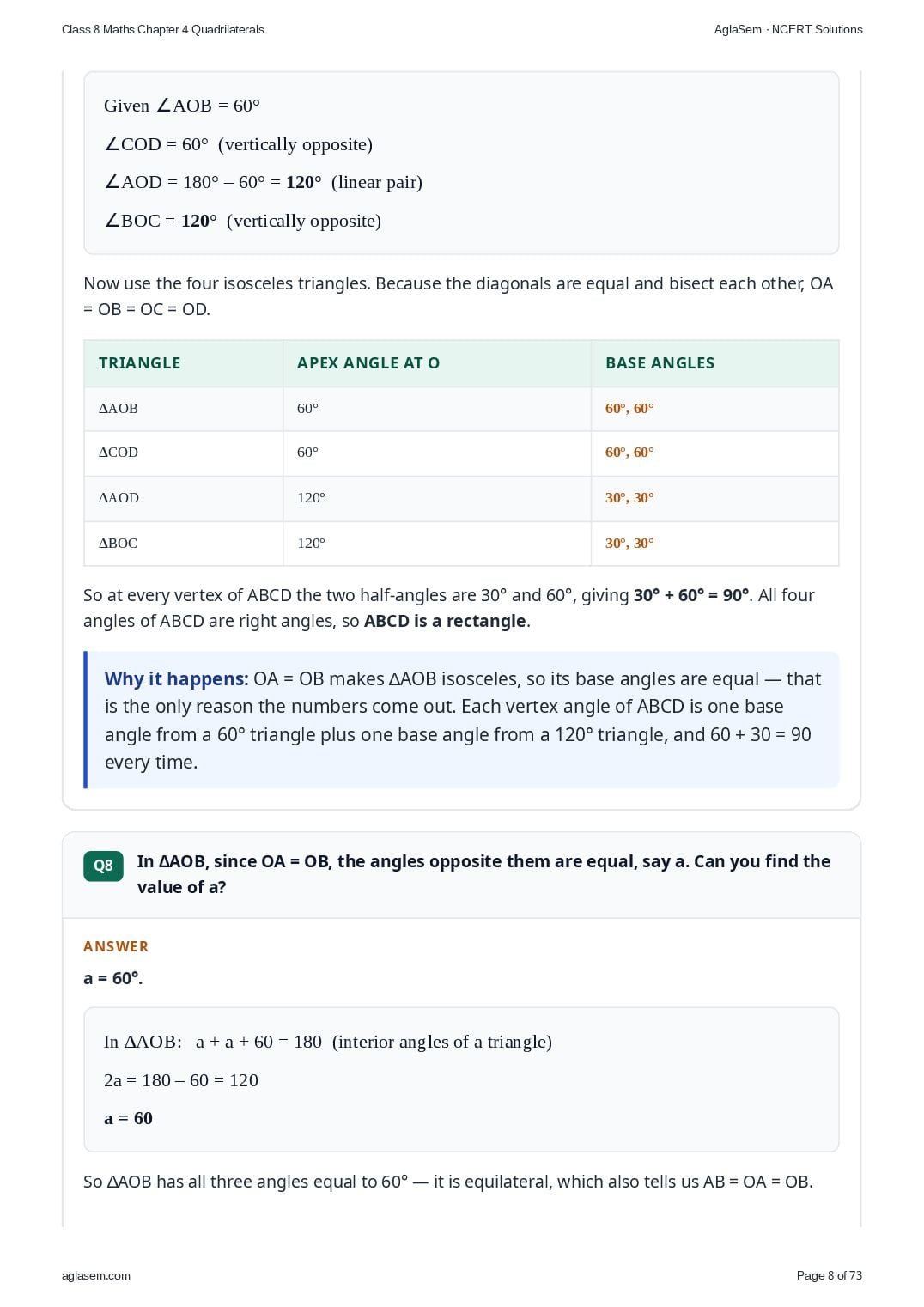
- Let us check what quadrilateral we get if we draw the two diagonals such that their lengths are equal, they bisect each other and have an arbitrary angle, say 60°, between them. Can you find all the remaining angles?
- In ∆AOB, since OA = OB, the angles opposite them are equal, say a. Can you find the value of a?
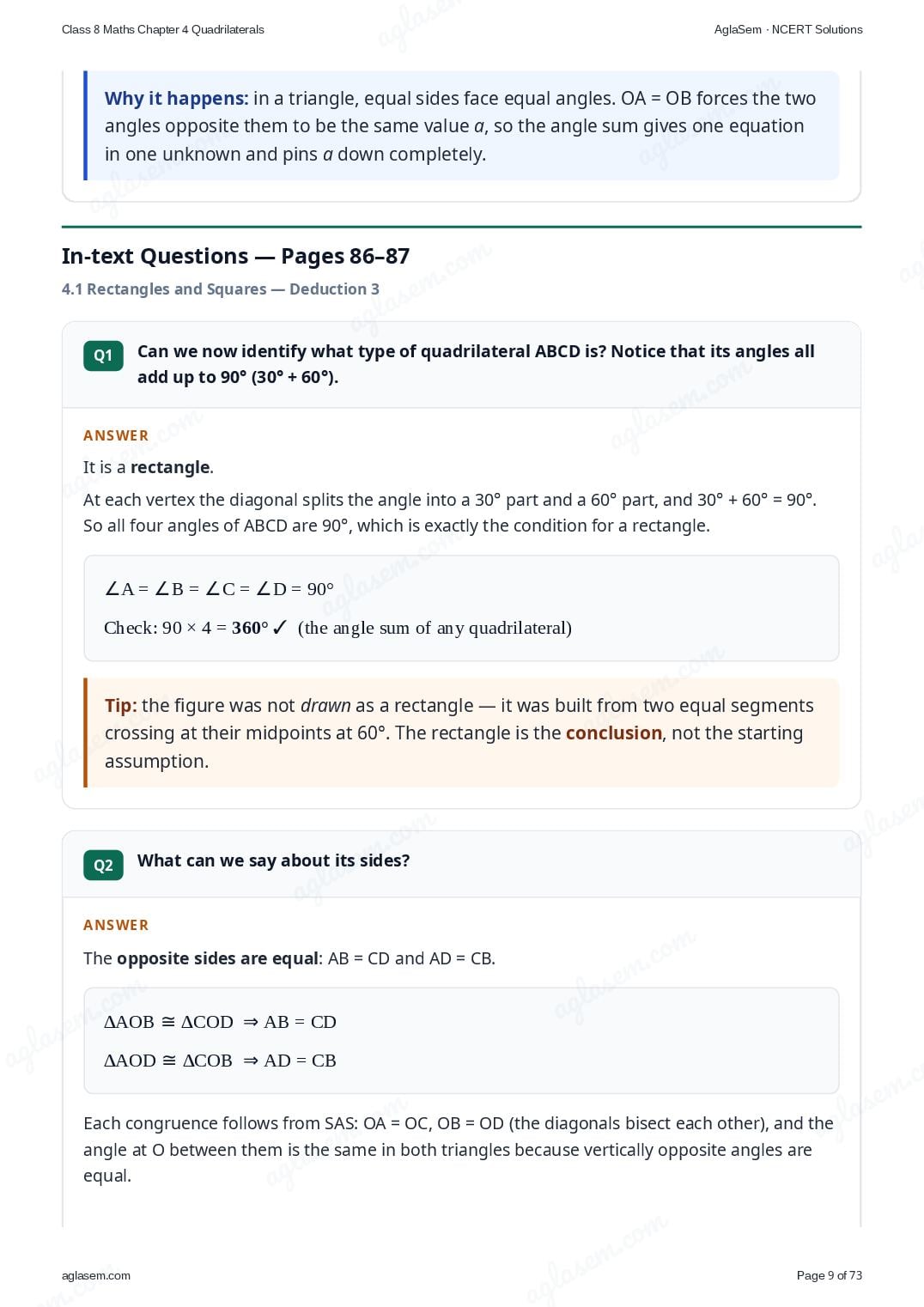
- Can we now identify what type of quadrilateral ABCD is? Notice that its angles all add up to 90° (30° + 60°).
- What can we say about its sides?
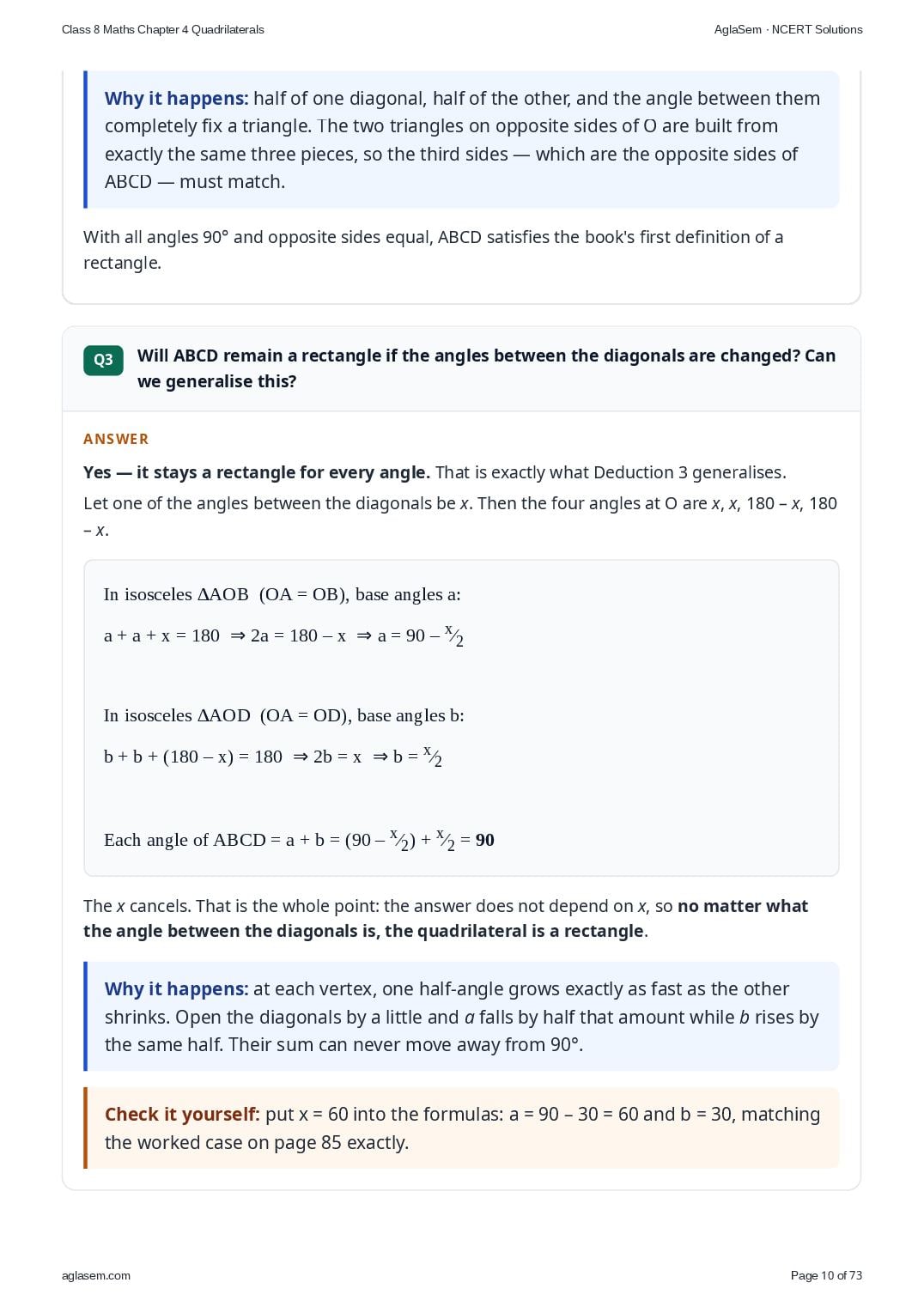
- Will ABCD remain a rectangle if the angles between the diagonals are changed? Can we generalise this?
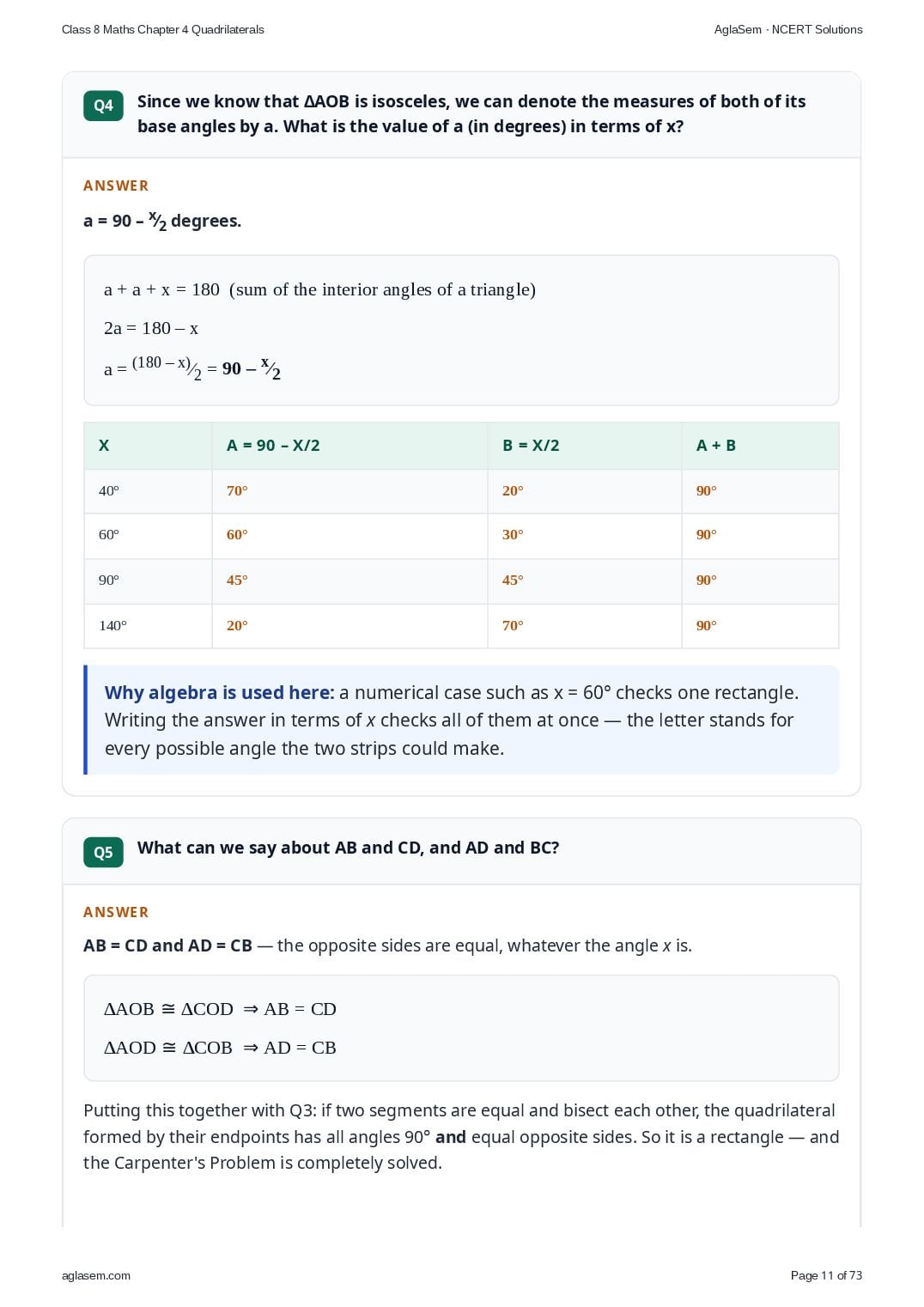
- Since we know that ∆AOB is isosceles, we can denote the measures of both of its base angles by a. What is the value of a (in degrees) in terms of x?
- What can we say about AB and CD, and AD and BC?
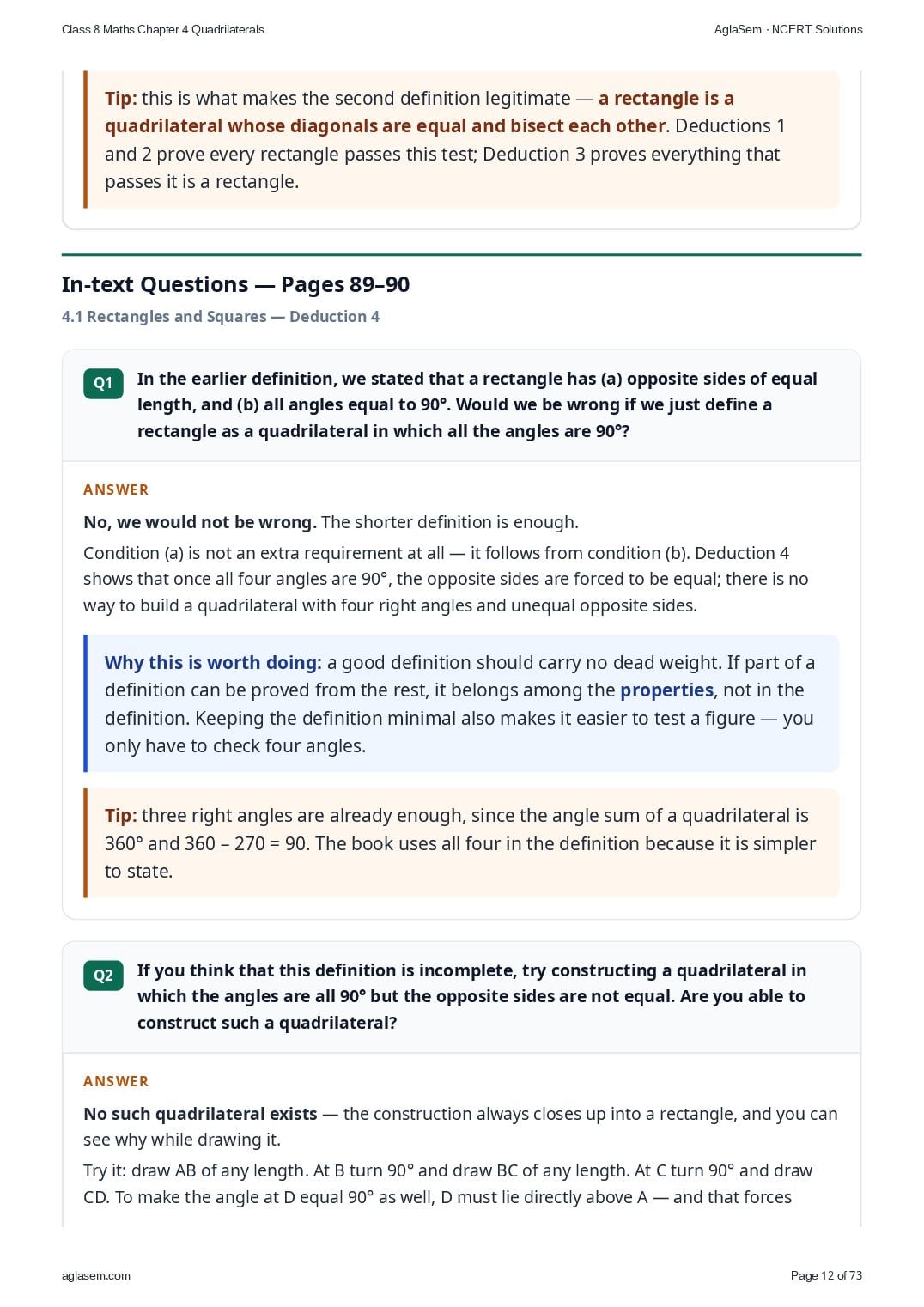
- In the earlier definition, we stated that a rectangle has (a) opposite sides of equal length, and (b) all angles equal to 90°. Would we be wrong if we just define a rectangle as a quadrilateral in which all the angles are 90°?
- If you think that this definition is incomplete, try constructing a quadrilateral in which the angles are all 90° but the opposite sides are not equal. Are you able to construct such a quadrilateral?
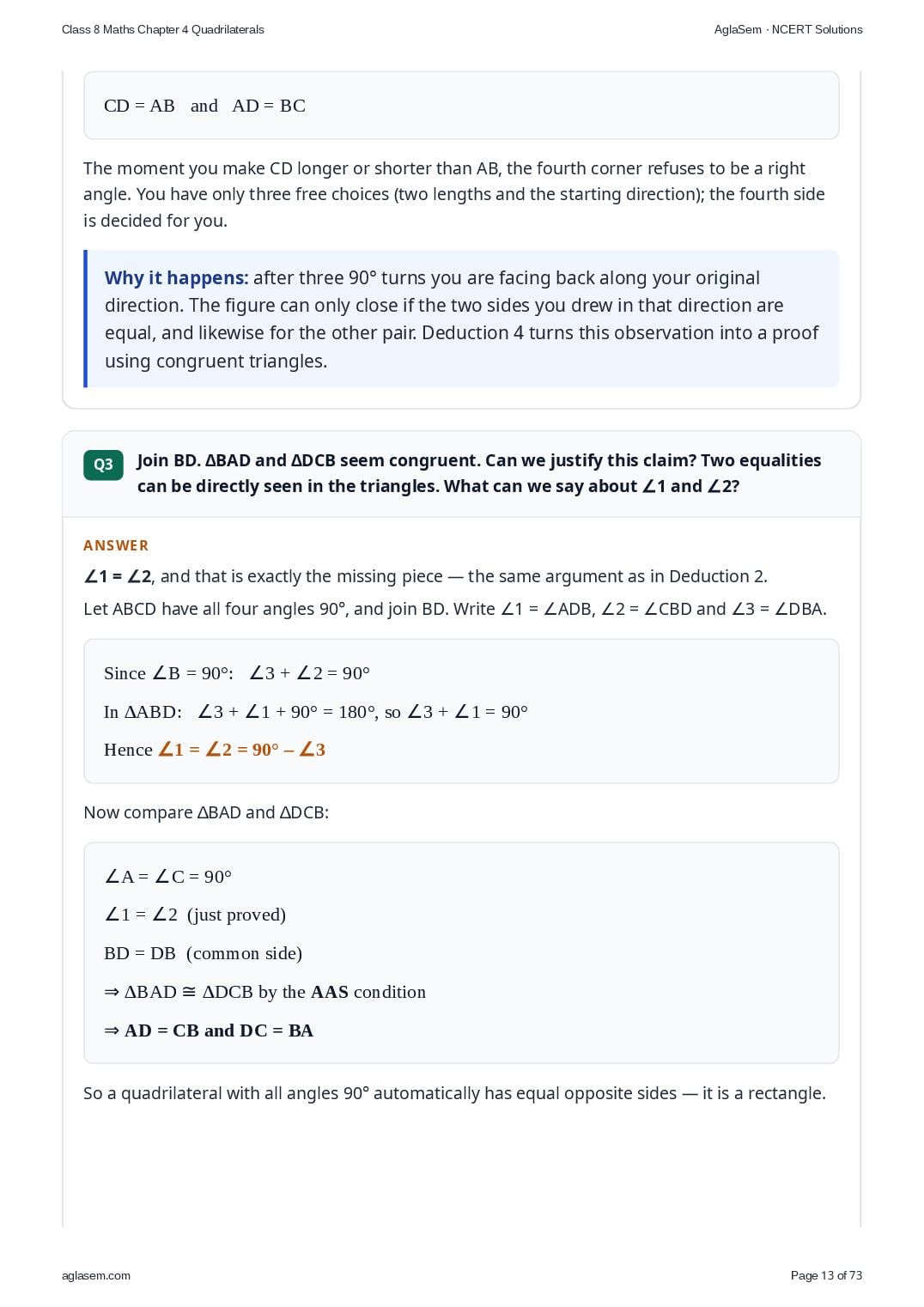
- Join BD. ∆BAD and ∆DCB seem congruent. Can we justify this claim? Two equalities can be directly seen in the triangles. What can we say about ∠1 and ∠2?
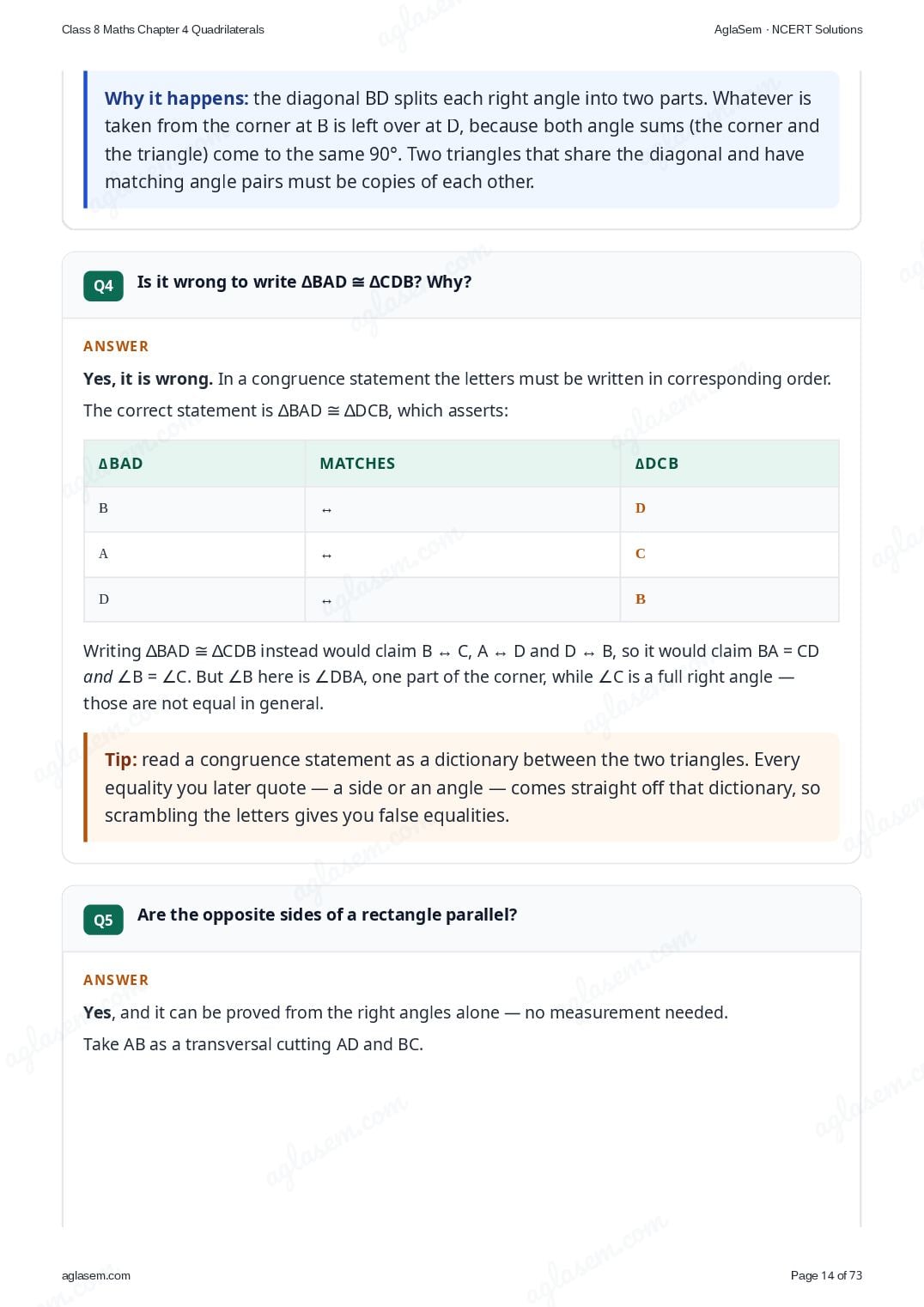
- Is it wrong to write ∆BAD ≅ ∆CDB? Why?
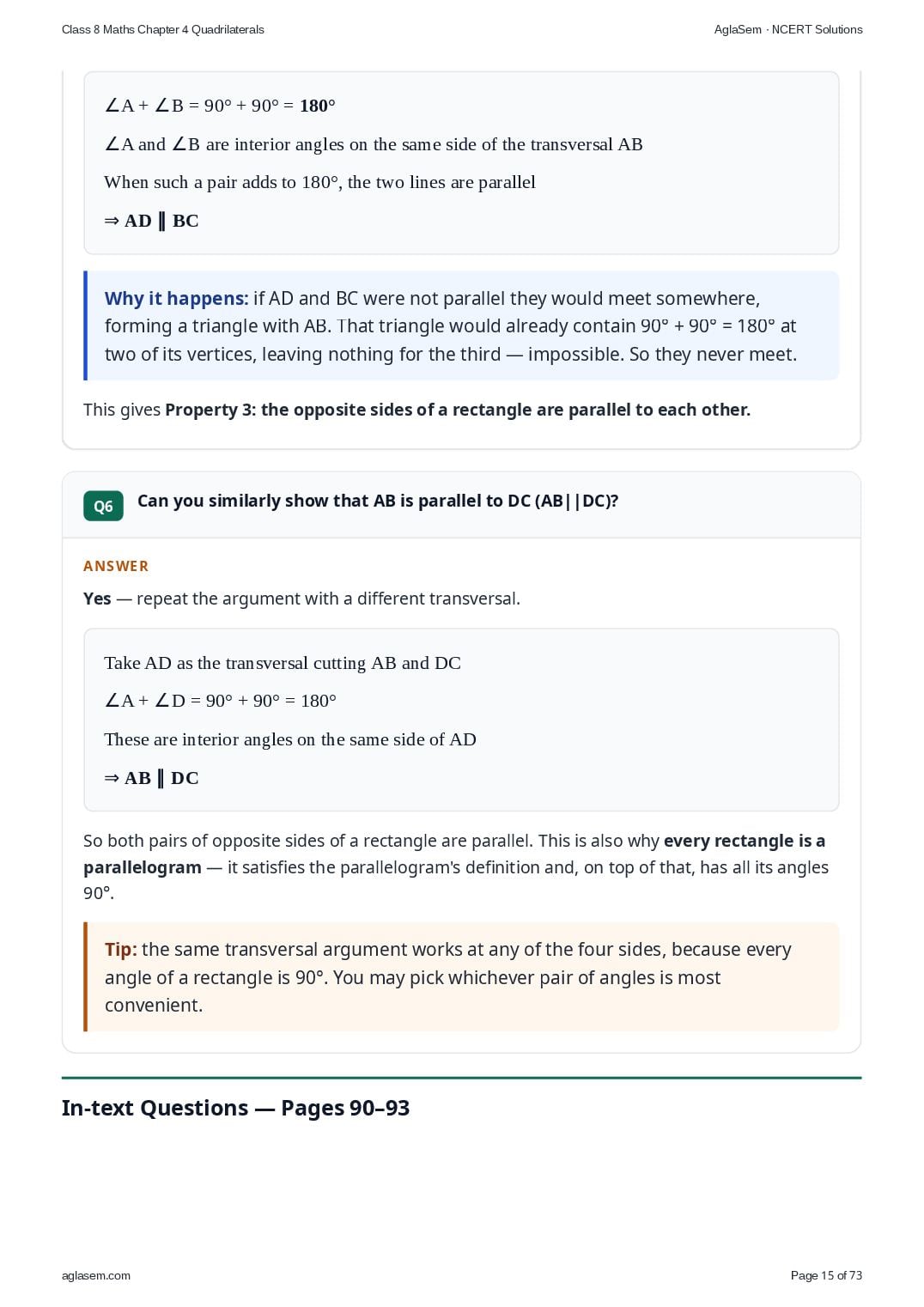
- Are the opposite sides of a rectangle parallel?
- Can you similarly show that AB is parallel to DC (AB||DC)?
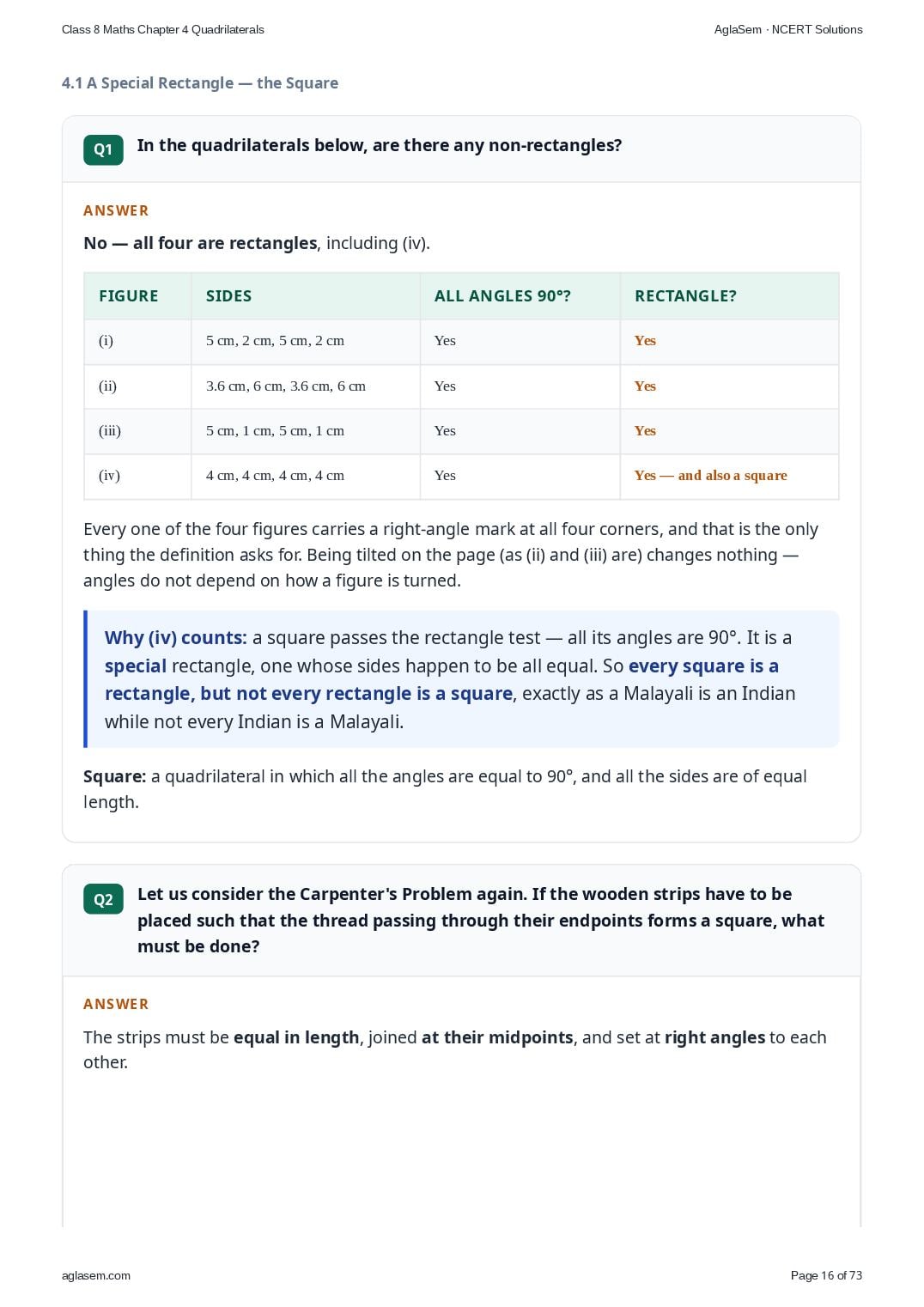
- In the quadrilaterals below, are there any non-rectangles?
- Let us consider the Carpenter's Problem again. If the wooden strips have to be placed such that the thread passing through their endpoints forms a square, what must be done?
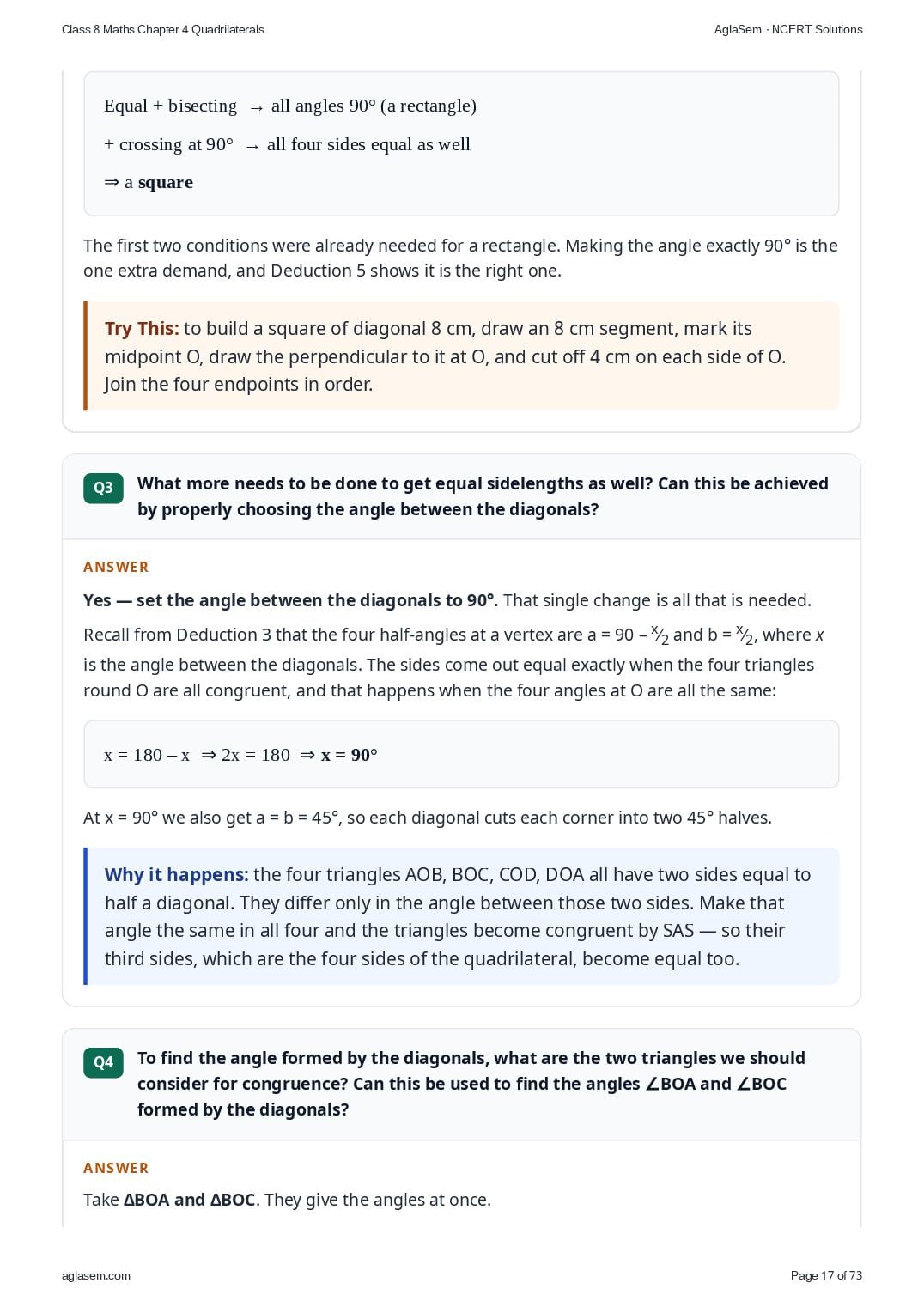
- What more needs to be done to get equal sidelengths as well? Can this be achieved by properly choosing the angle between the diagonals?
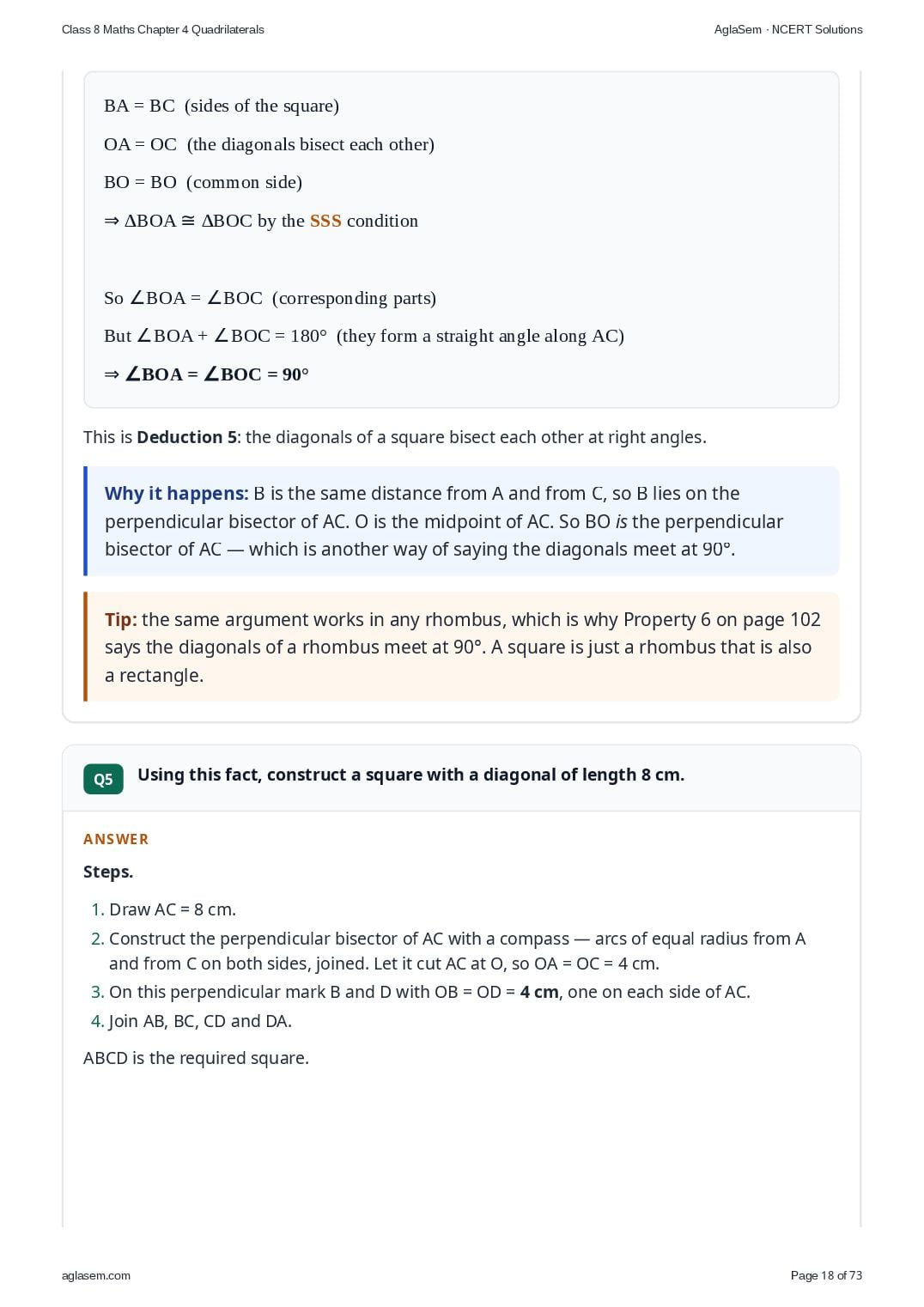
- To find the angle formed by the diagonals, what are the two triangles we should consider for congruence? Can this be used to find the angles ∠BOA and ∠BOC formed by the diagonals?
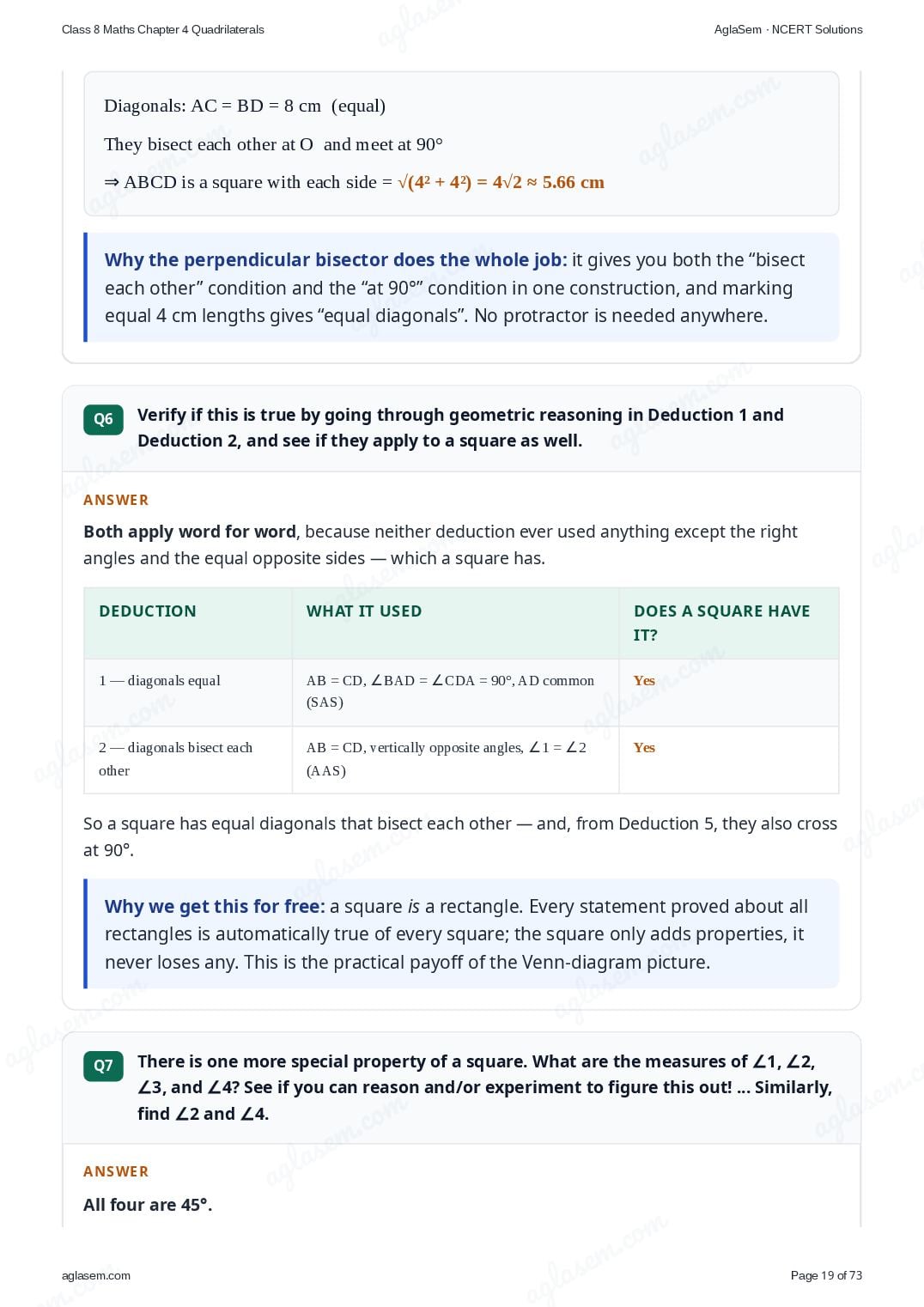
- Using this fact, construct a square with a diagonal of length 8 cm.
- Verify if this is true by going through geometric reasoning in Deduction 1 and Deduction 2, and see if they apply to a square as well.
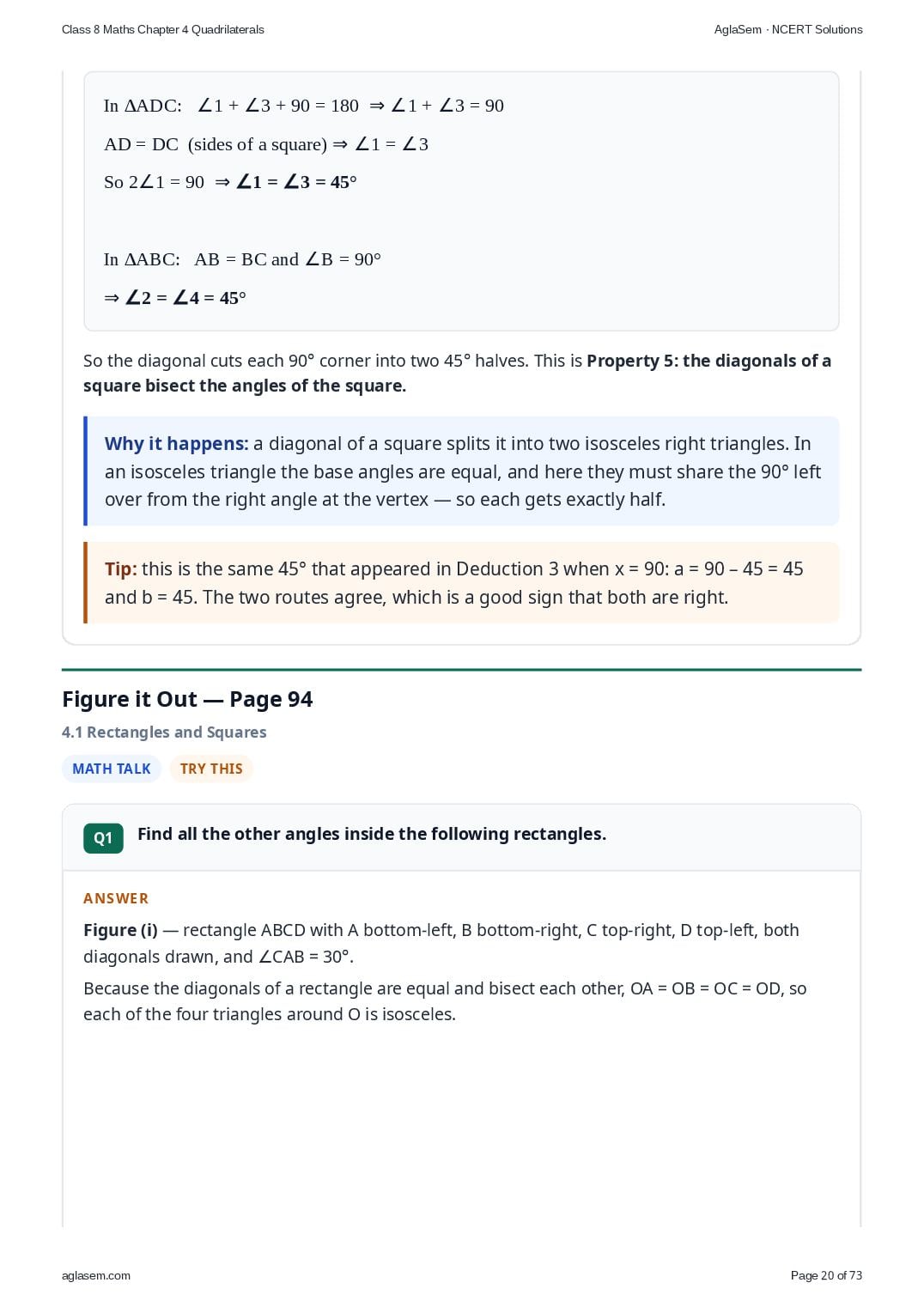
- There is one more special property of a square. What are the measures of ∠1, ∠2, ∠3, and ∠4? See if you can reason and/or experiment to figure this out! … Similarly, find ∠2 and ∠4.
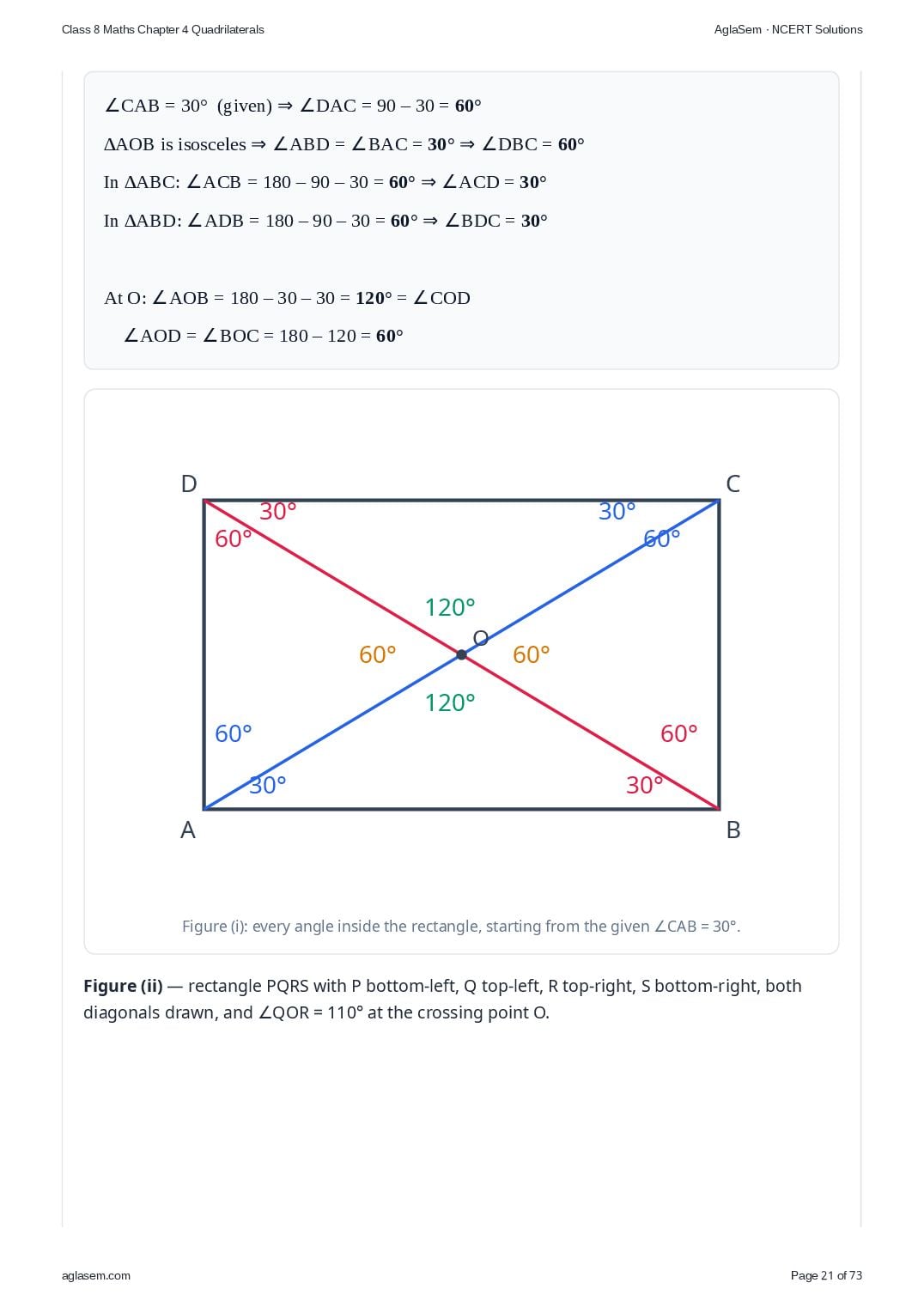
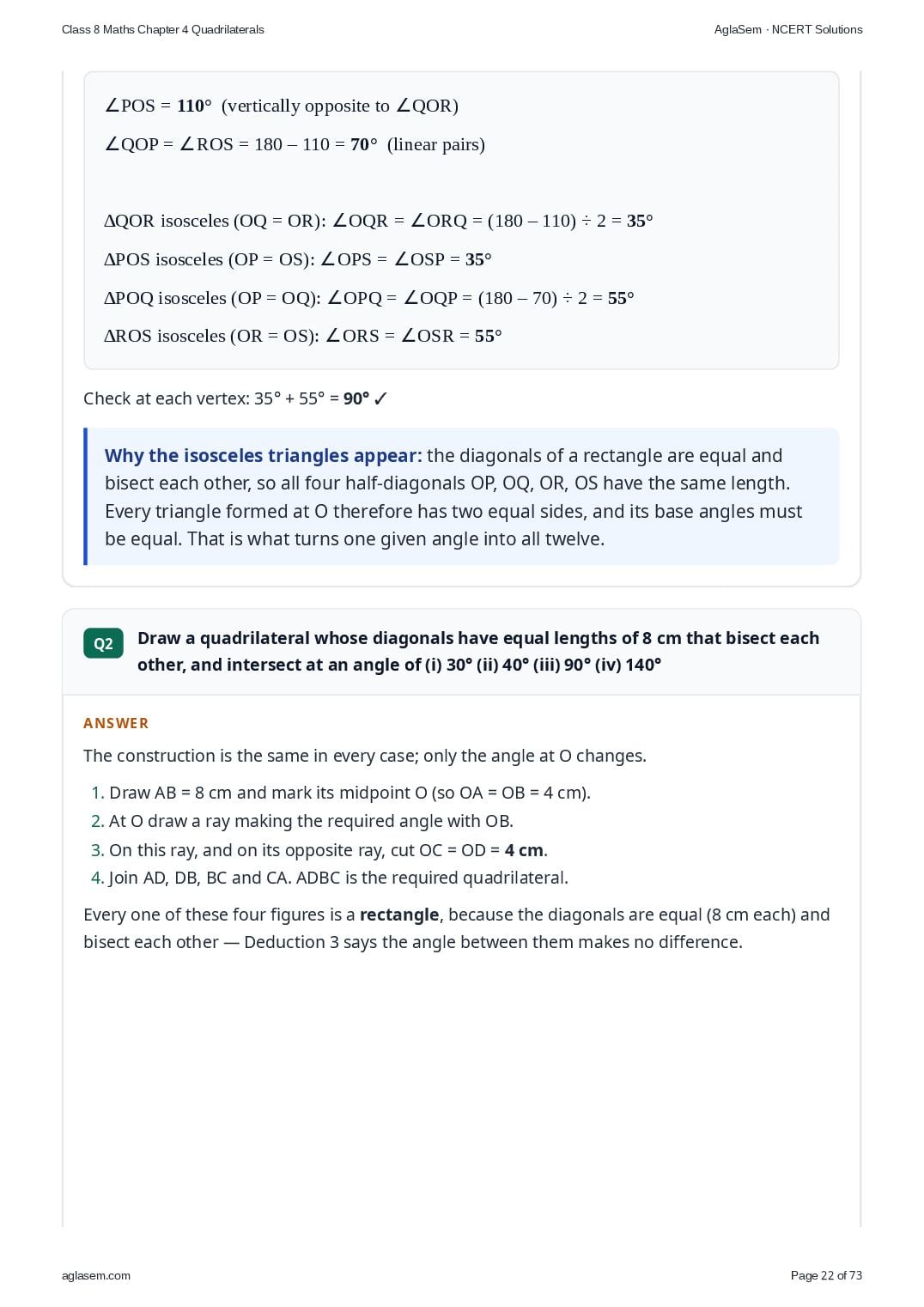
- Find all the other angles inside the following rectangles.
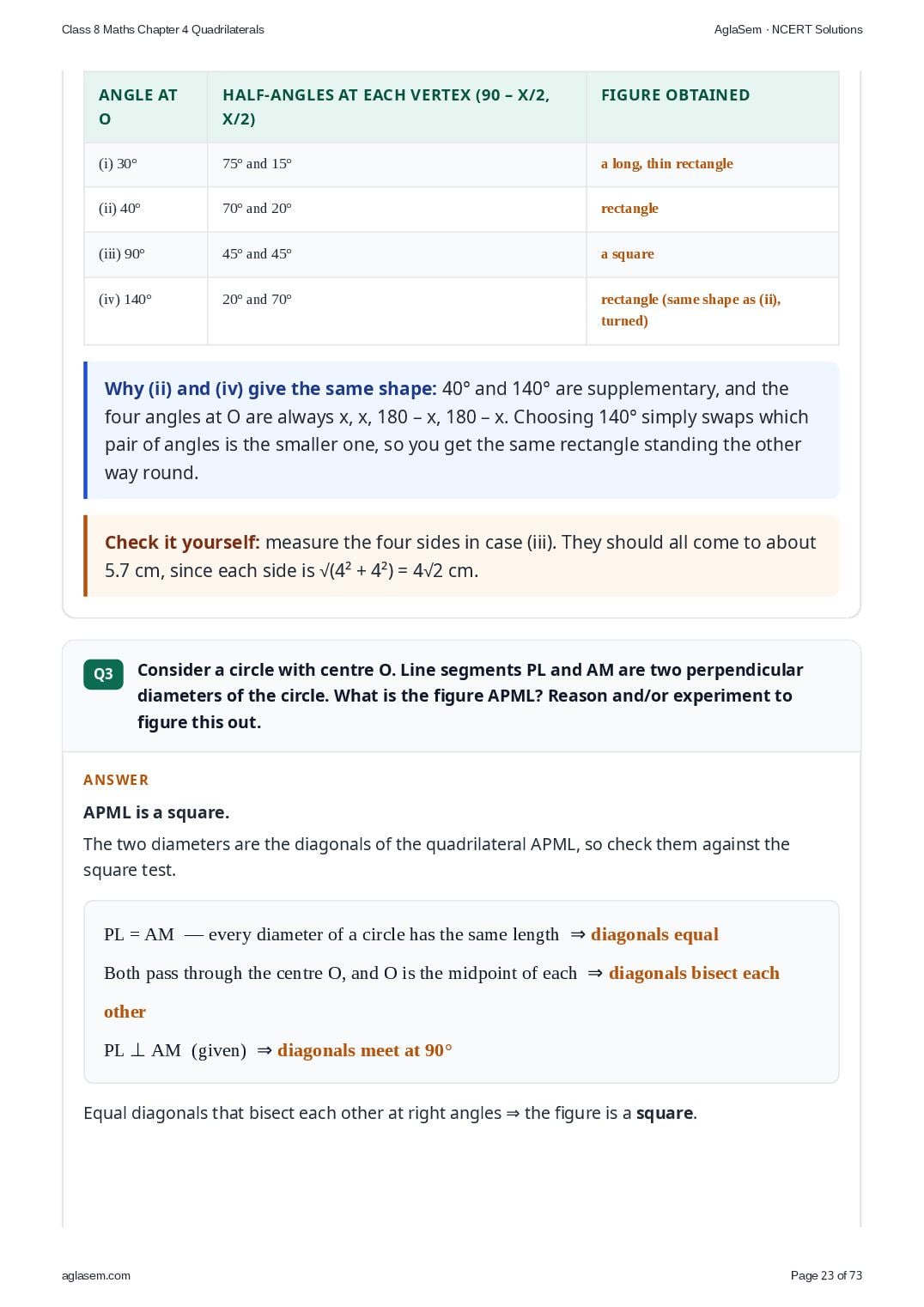
- Draw a quadrilateral whose diagonals have equal lengths of 8 cm that bisect each other, and intersect at an angle of (i) 30° (ii) 40° (iii) 90° (iv) 140°
- Consider a circle with centre O. Line segments PL and AM are two perpendicular diameters of the circle. What is the figure APML? Reason and/or experiment to figure this out.
- We have seen how to get 90° using paper folding. Now, suppose we do not have any paper but two sticks of equal length, and a thread. How do we make an exact 90° using these?
- We saw that one of the properties of a rectangle is that its opposite sides are parallel. Can this be chosen as a definition of a rectangle? In other words, is every quadrilateral that has opposite sides parallel and equal, a rectangle?
- Is it possible to construct a quadrilateral with three angles equal to 90° and the fourth angle not equal to 90°?
- But why not?
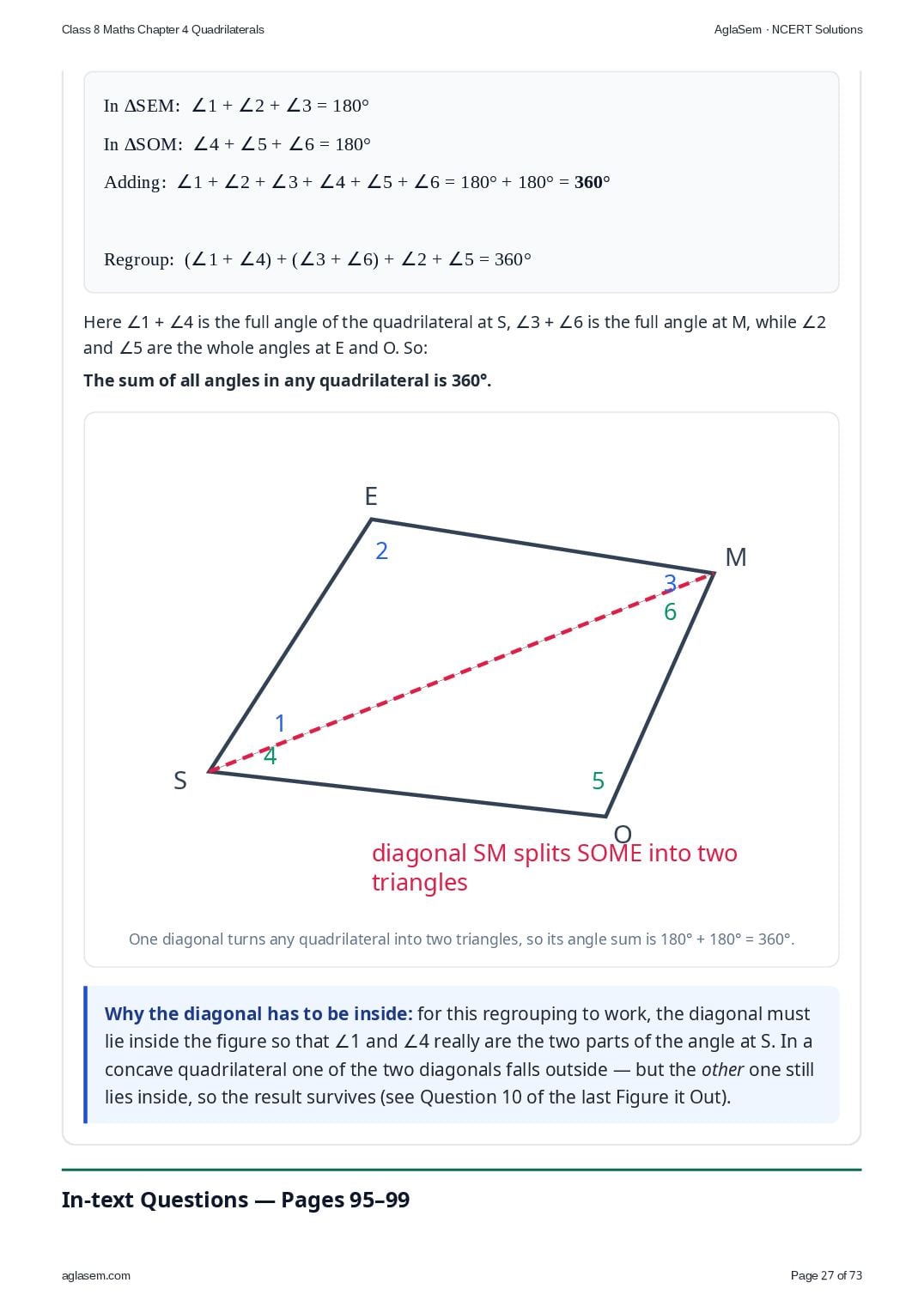
- Consider a quadrilateral SOME. Draw a diagonal SM. We get two triangles ∆SEM and ∆SOM. What do we get when we add all six angles?
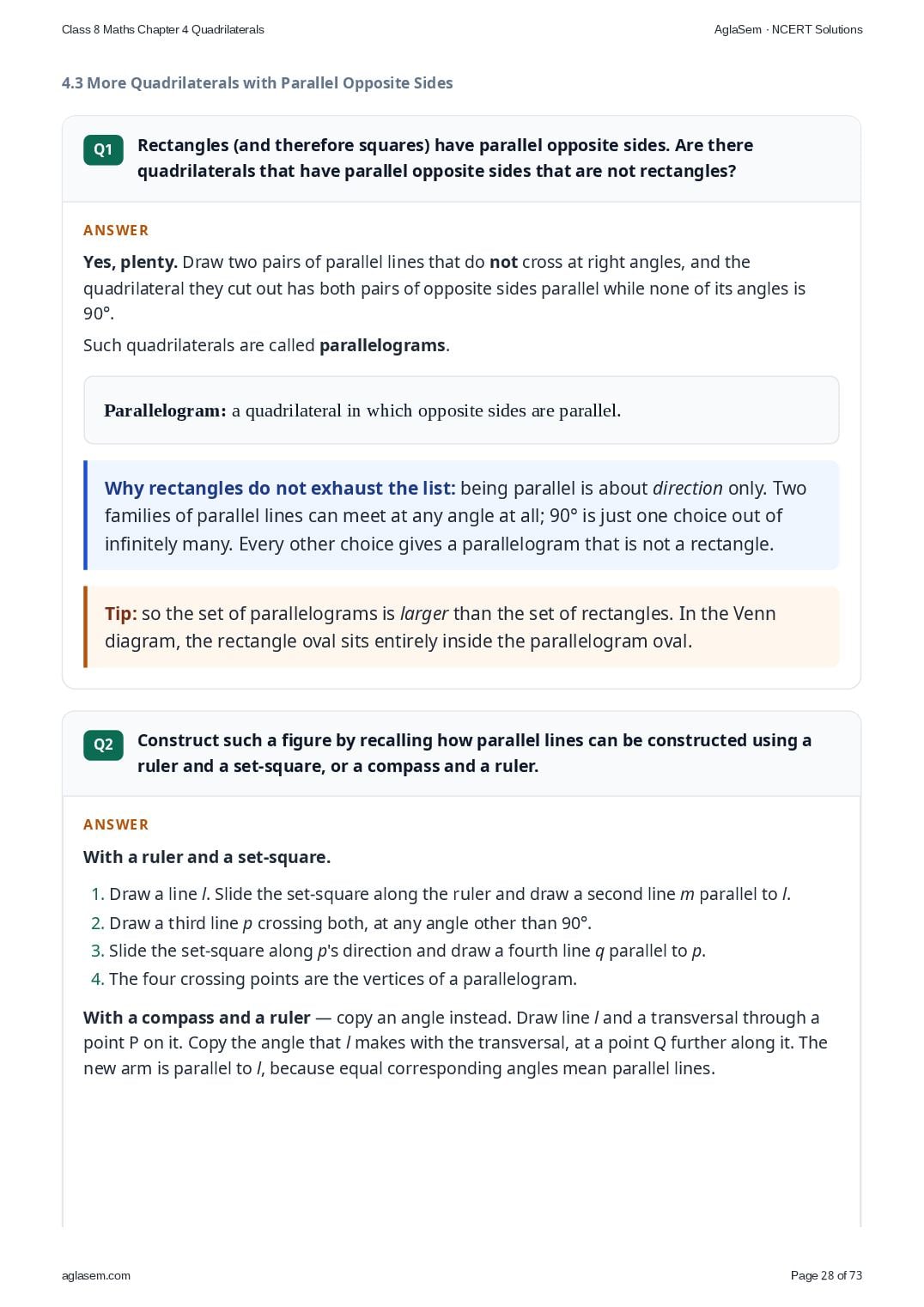
- Rectangles (and therefore squares) have parallel opposite sides. Are there quadrilaterals that have parallel opposite sides that are not rectangles?
- Construct such a figure by recalling how parallel lines can be constructed using a ruler and a set-square, or a compass and a ruler.
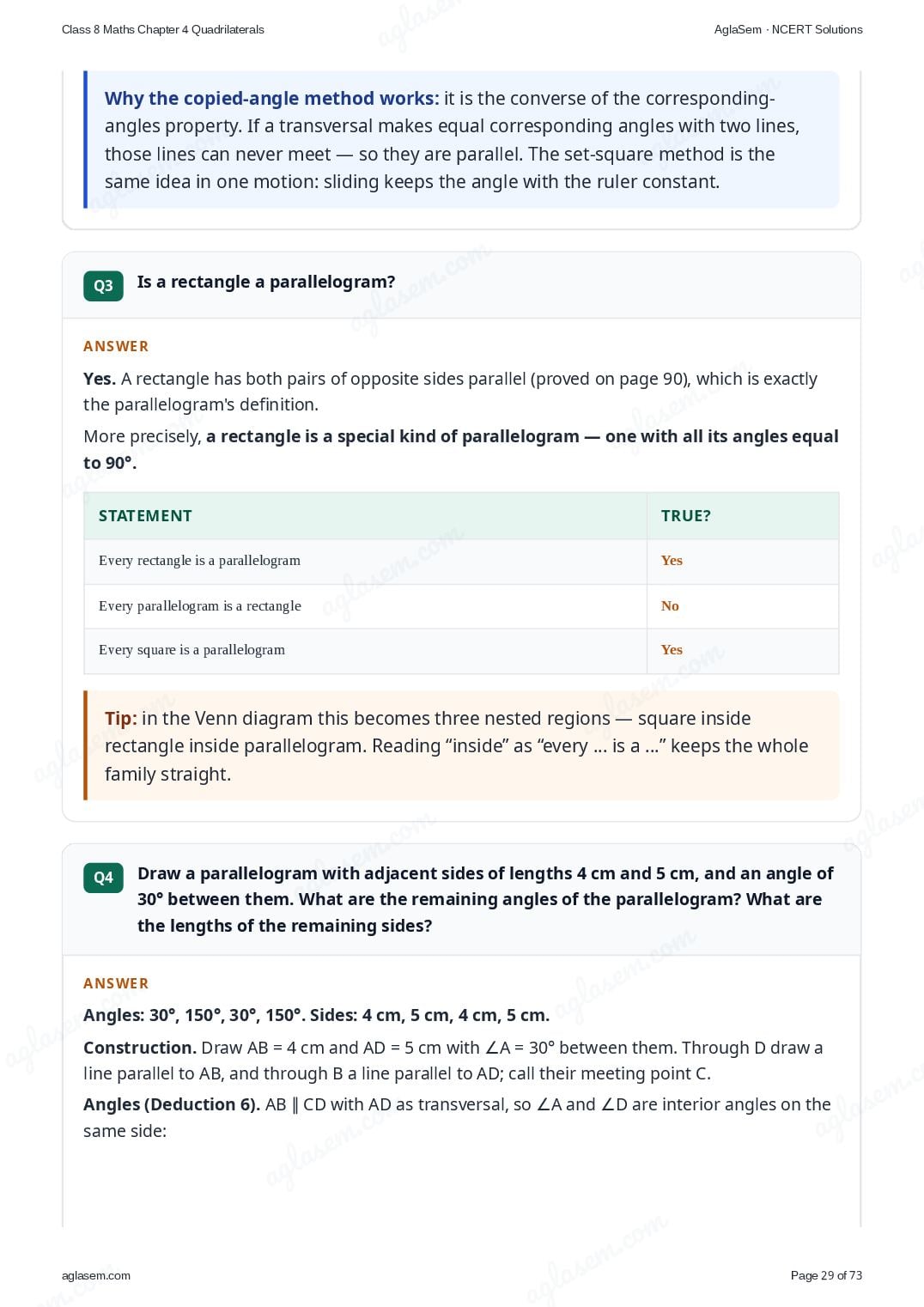
- Is a rectangle a parallelogram?
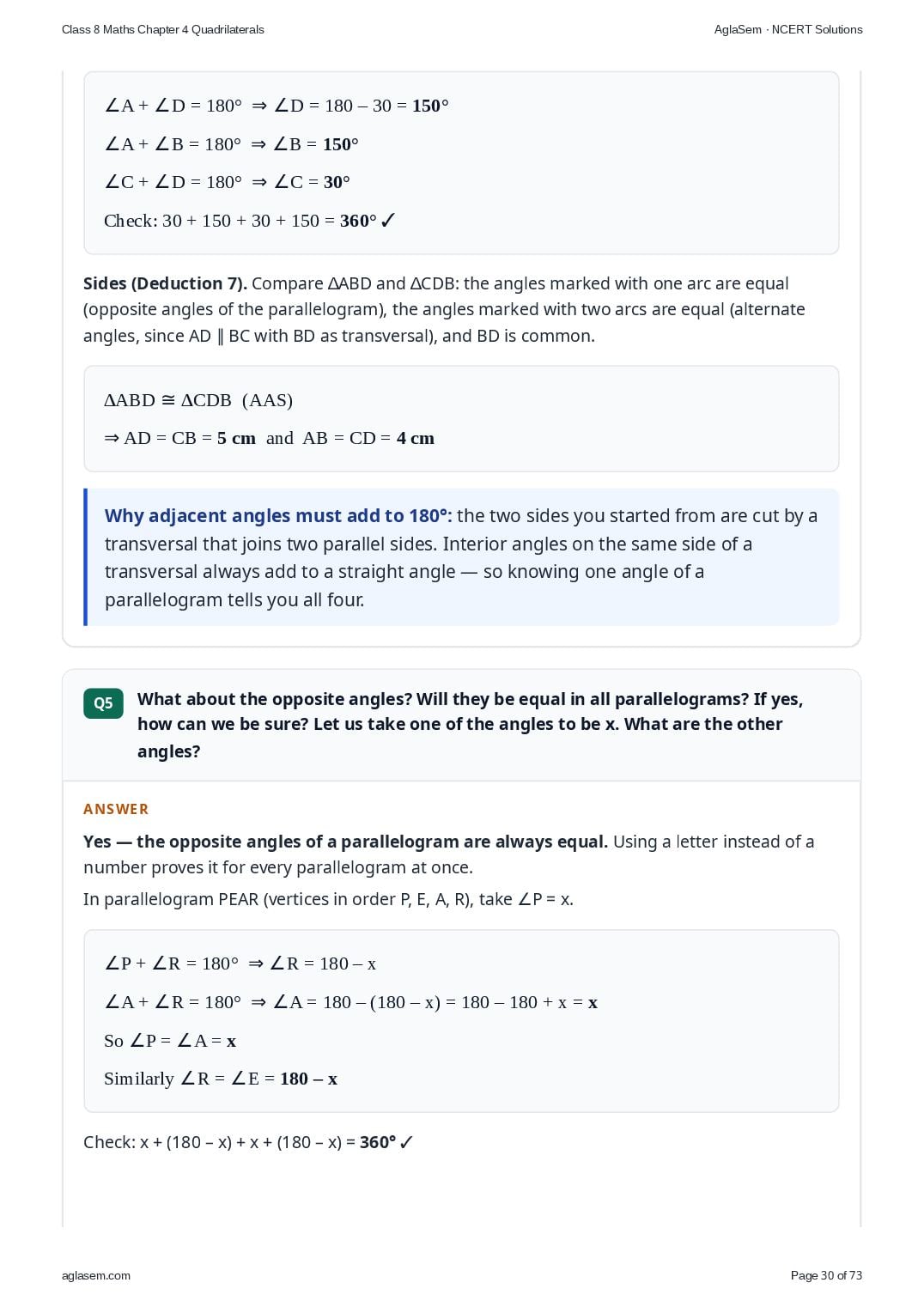
- Draw a parallelogram with adjacent sides of lengths 4 cm and 5 cm, and an angle of 30° between them. What are the remaining angles of the parallelogram? What are the lengths of the remaining sides?
- What about the opposite angles? Will they be equal in all parallelograms? If yes, how can we be sure? Let us take one of the angles to be x. What are the other angles?
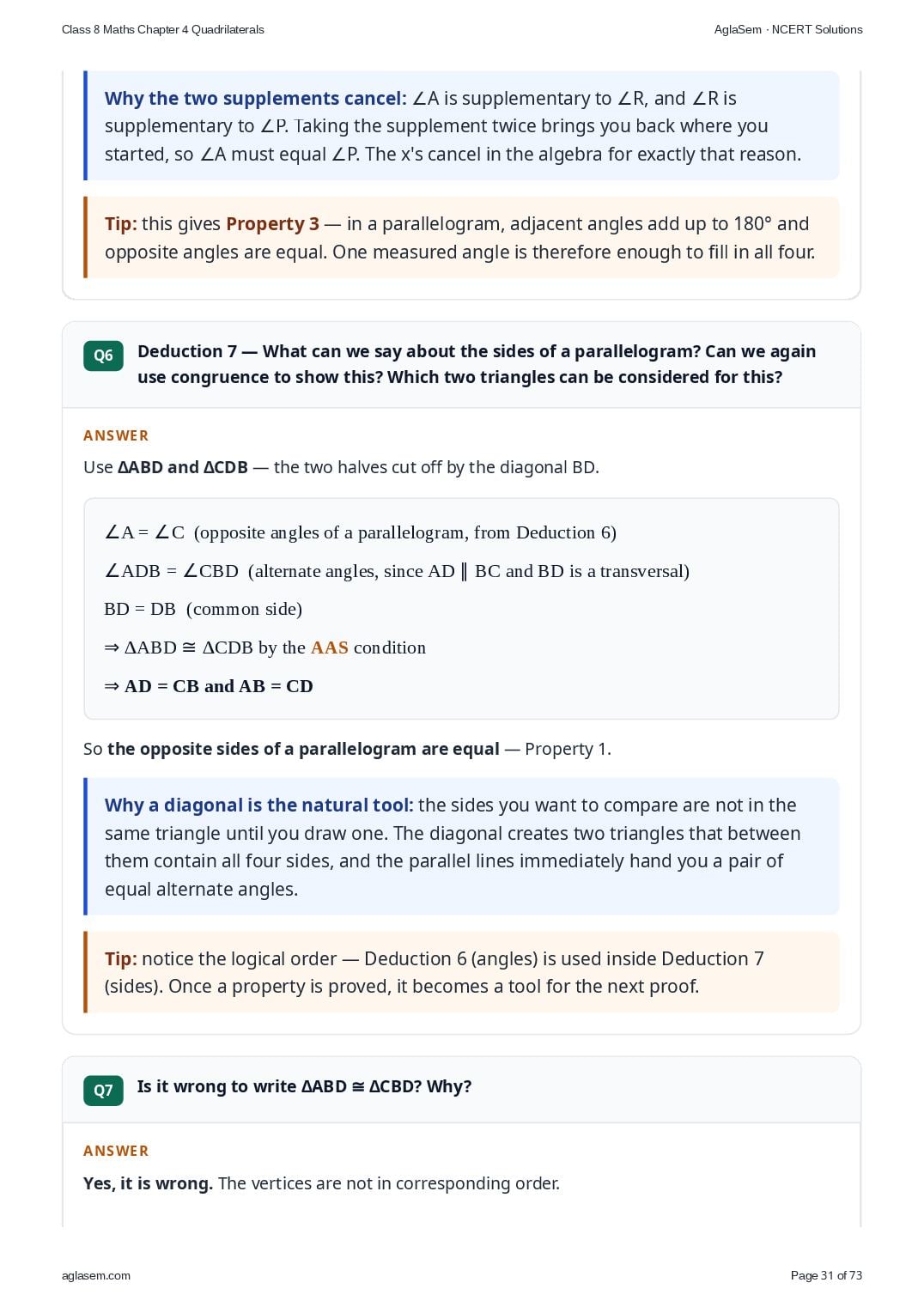
- Deduction 7 — What can we say about the sides of a parallelogram? Can we again use congruence to show this? Which two triangles can be considered for this?
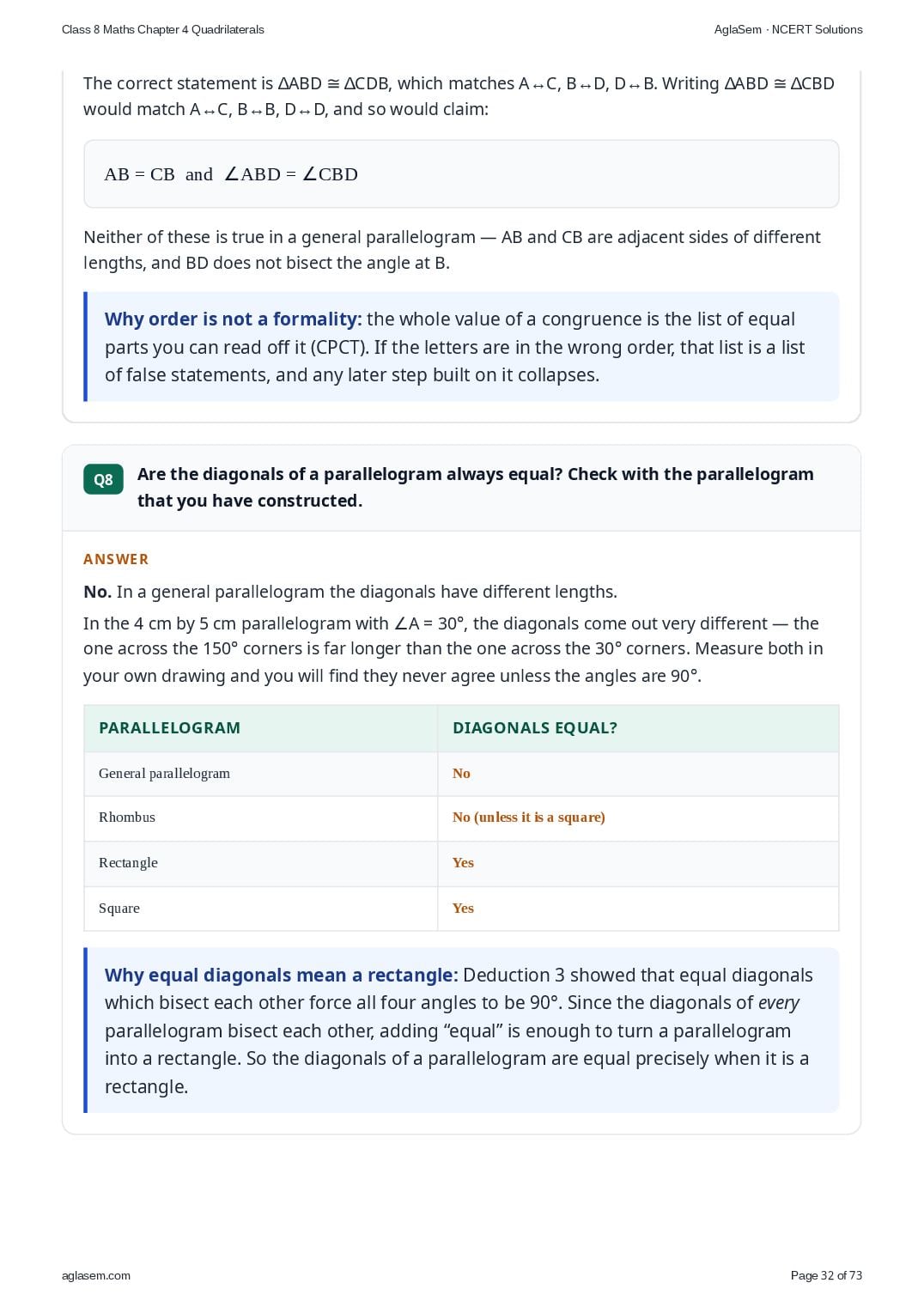
- Is it wrong to write ∆ABD ≅ ∆CBD? Why?
- Are the diagonals of a parallelogram always equal? Check with the parallelogram that you have constructed.
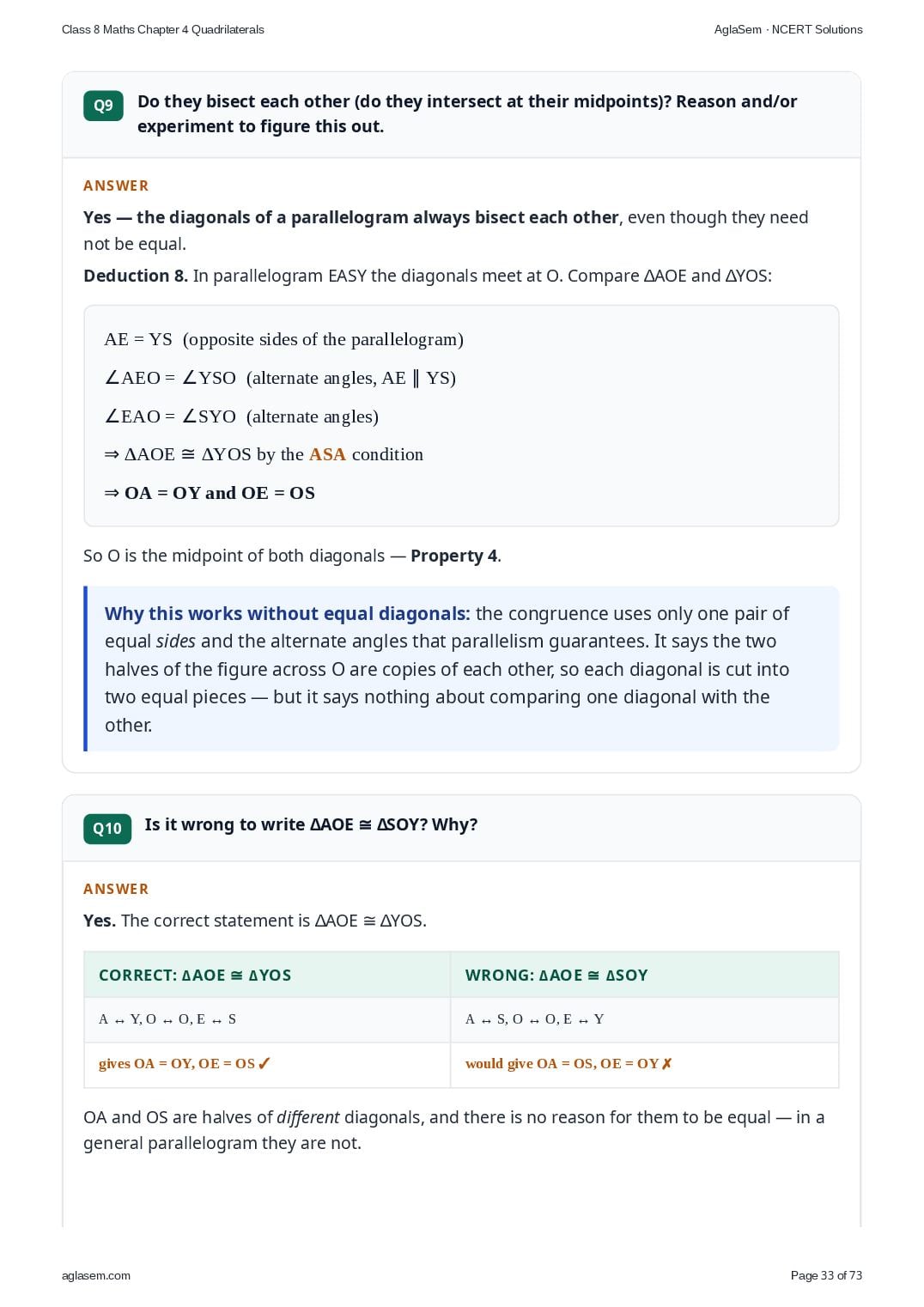
- Do they bisect each other (do they intersect at their midpoints)? Reason and/or experiment to figure this out.
- Is it wrong to write ∆AOE ≅ ∆SOY? Why?
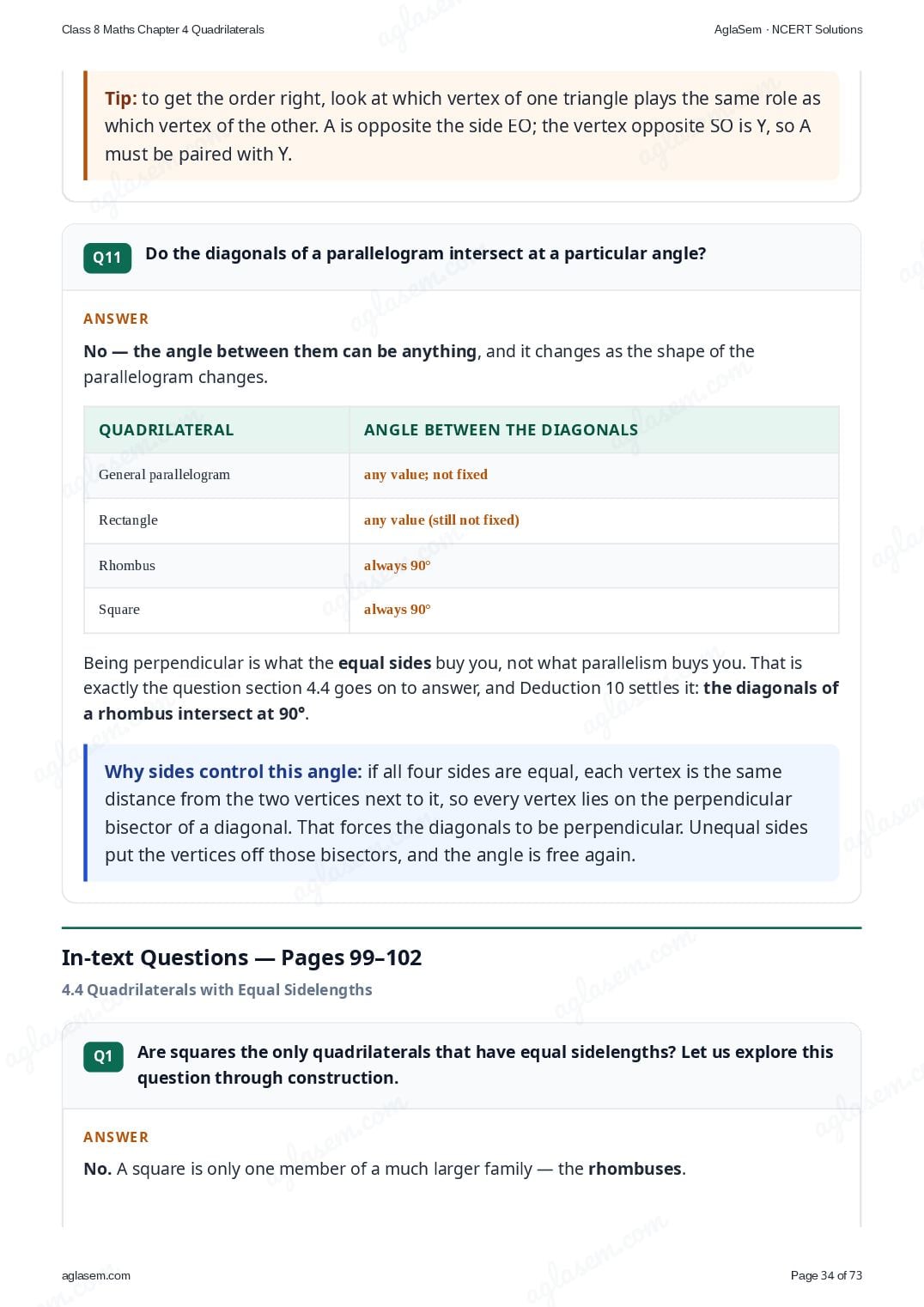
- Do the diagonals of a parallelogram intersect at a particular angle?
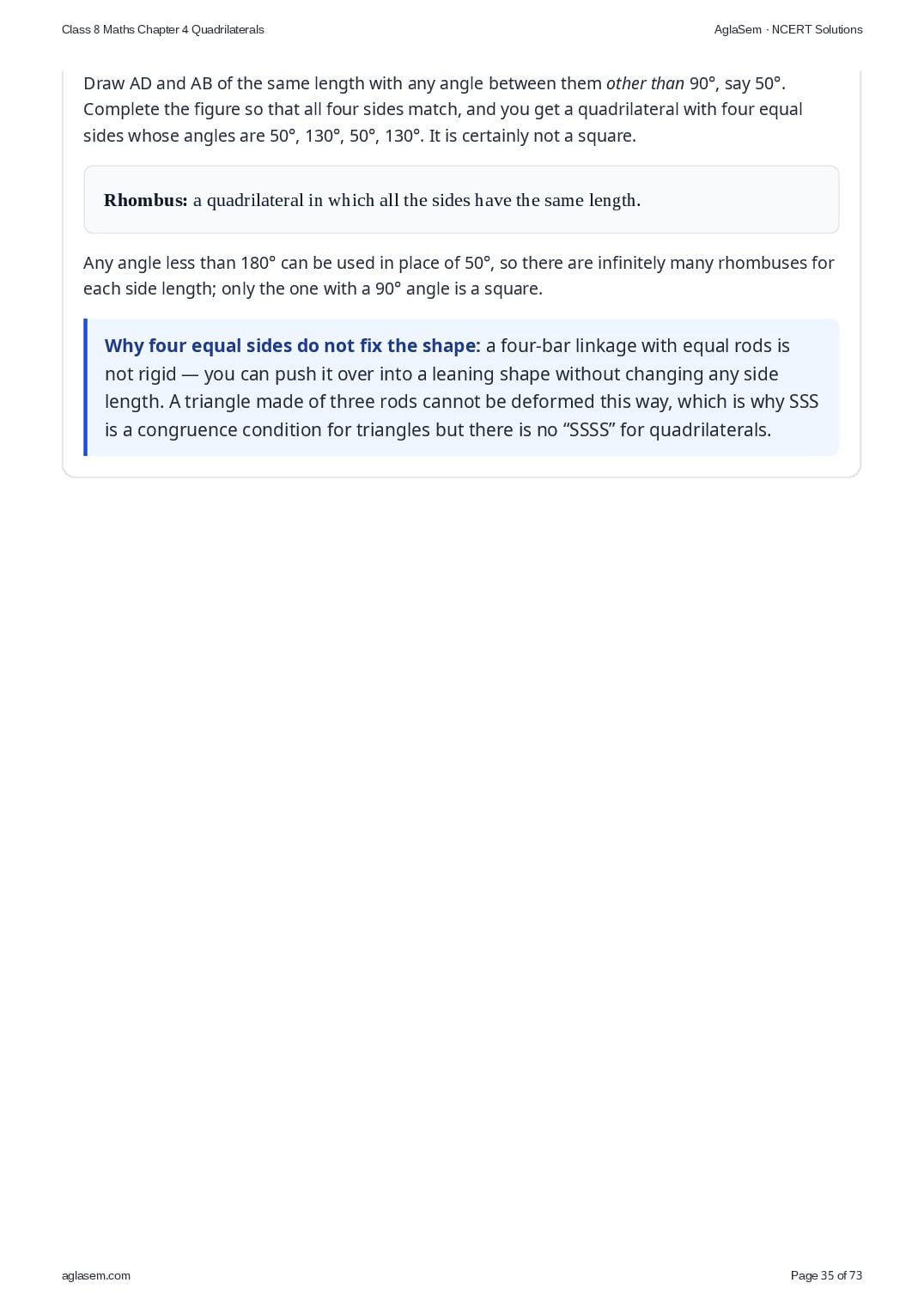
- Are squares the only quadrilaterals that have equal sidelengths? Let us explore this question through construction.
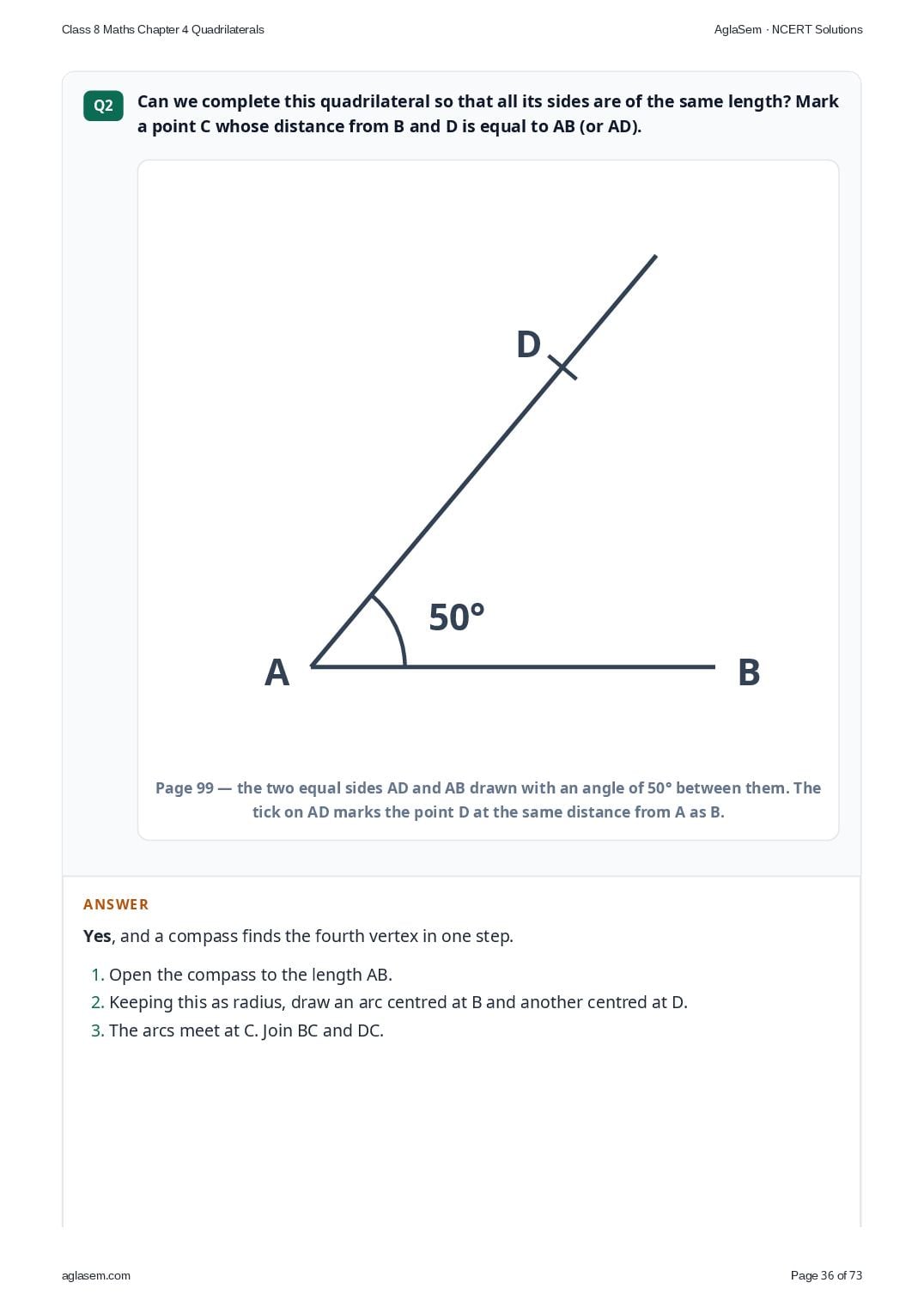
- Can we complete this quadrilateral so that all its sides are of the same length? Mark a point C whose distance from B and D is equal to AB (or AD).
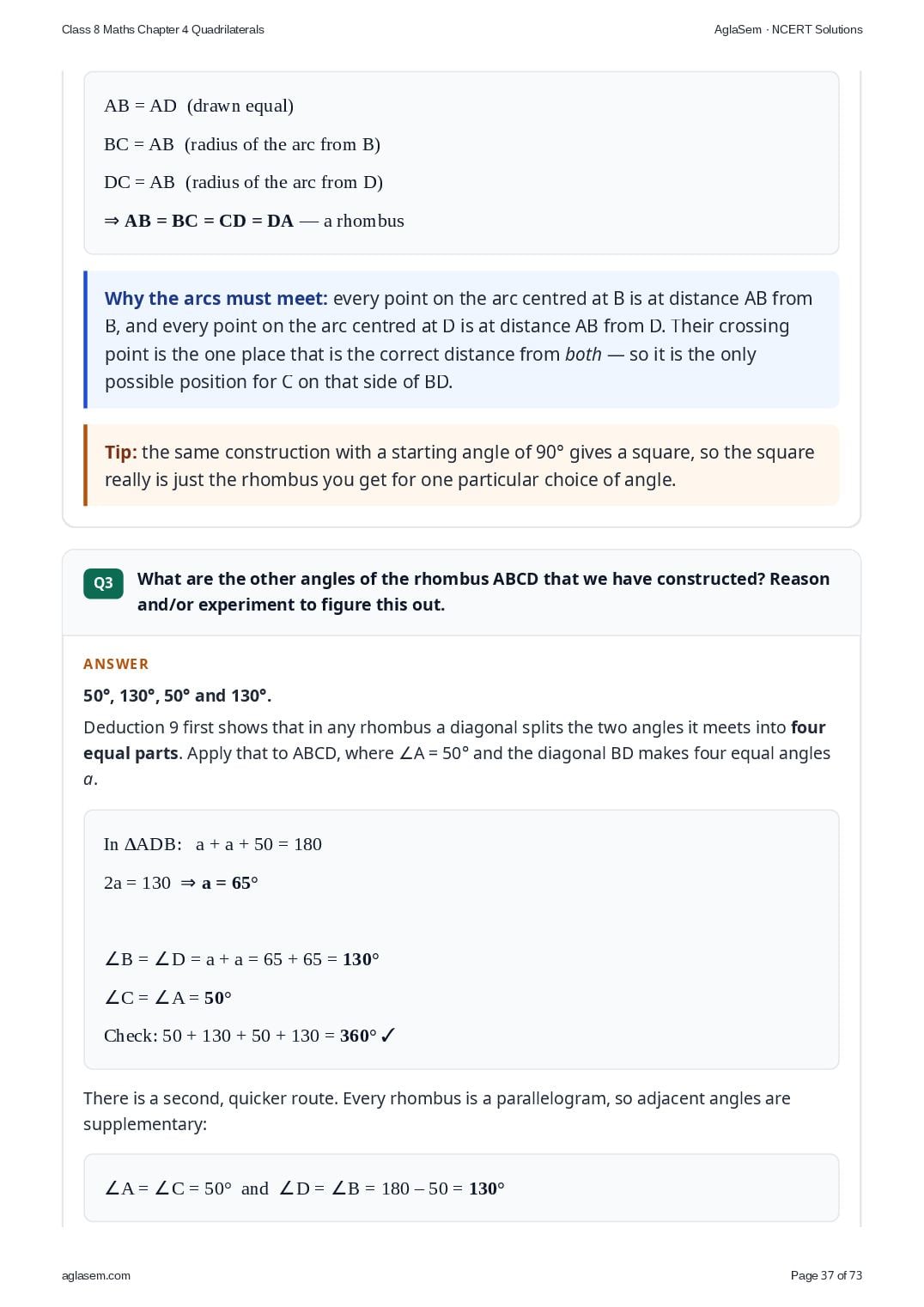
- What are the other angles of the rhombus ABCD that we have constructed? Reason and/or experiment to figure this out.
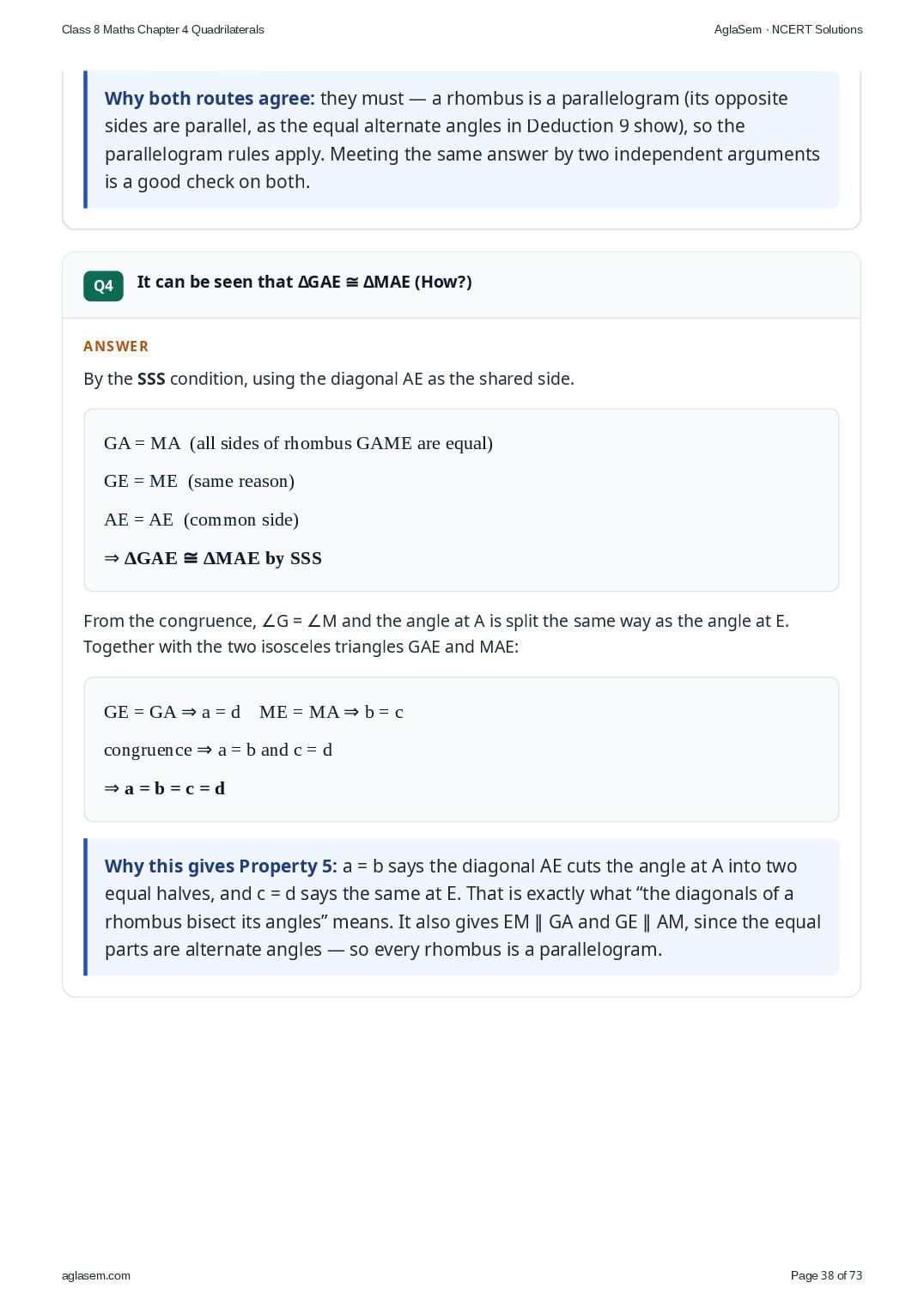
- It can be seen that ∆GAE ≅ ∆MAE (How?)
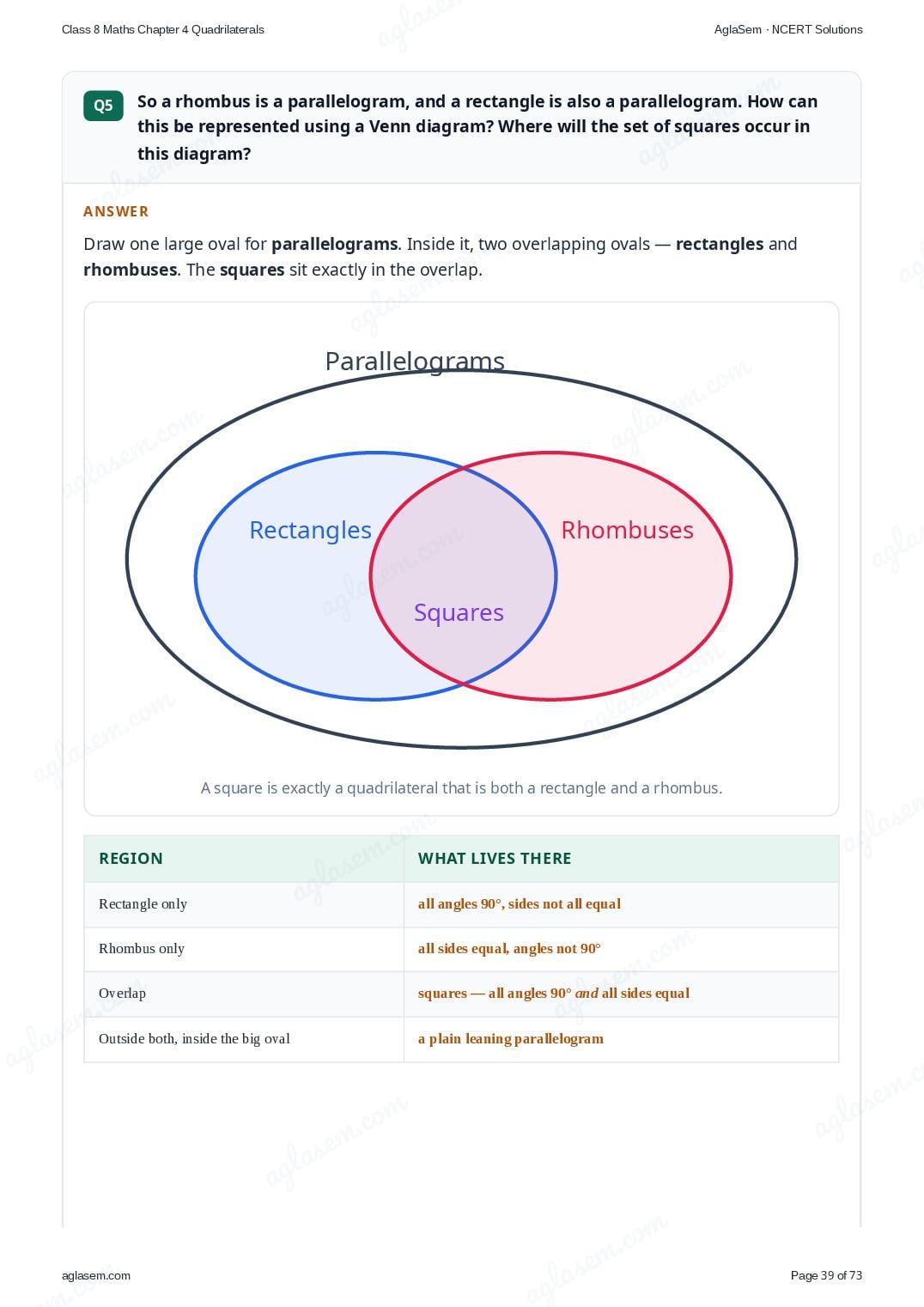
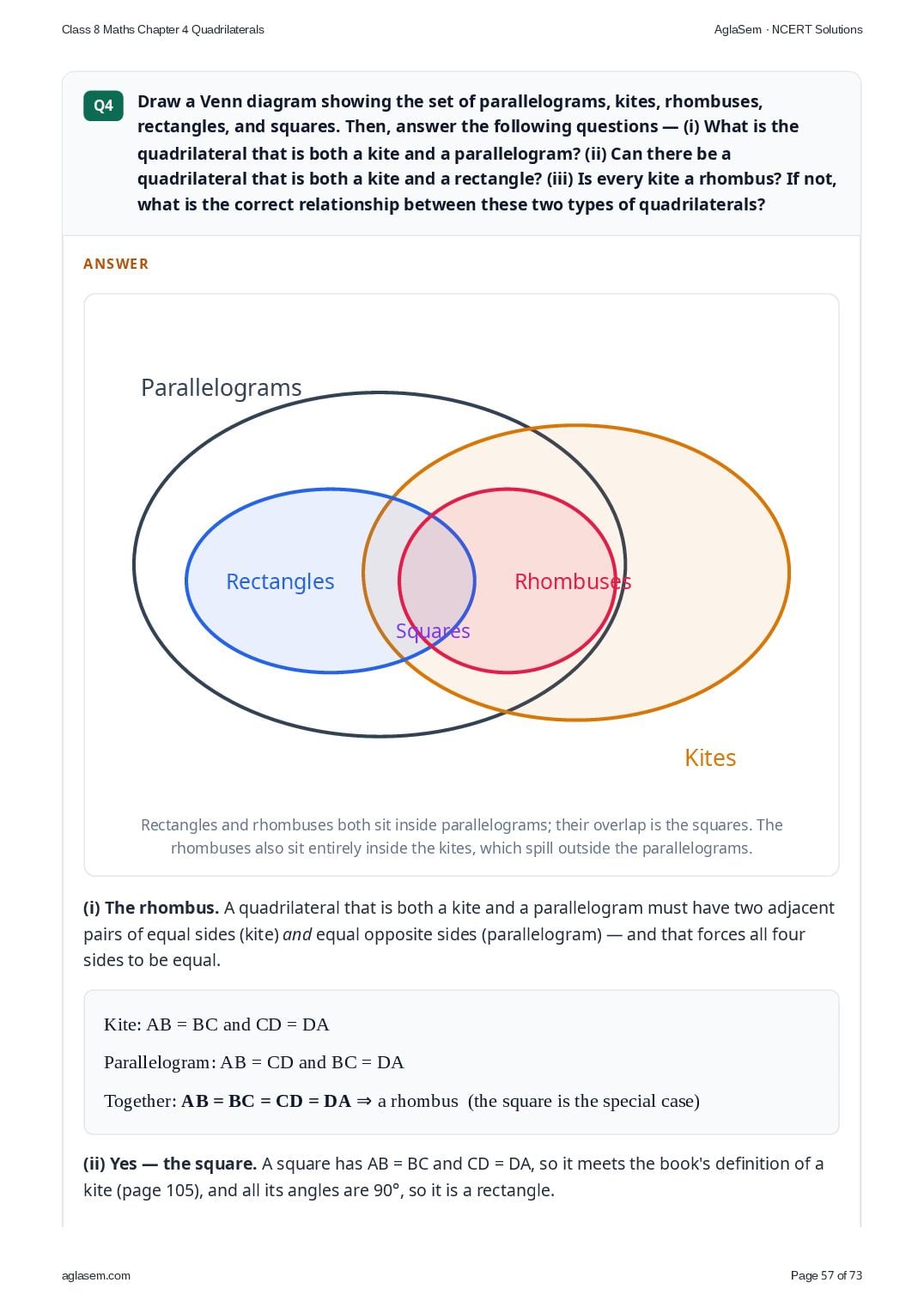
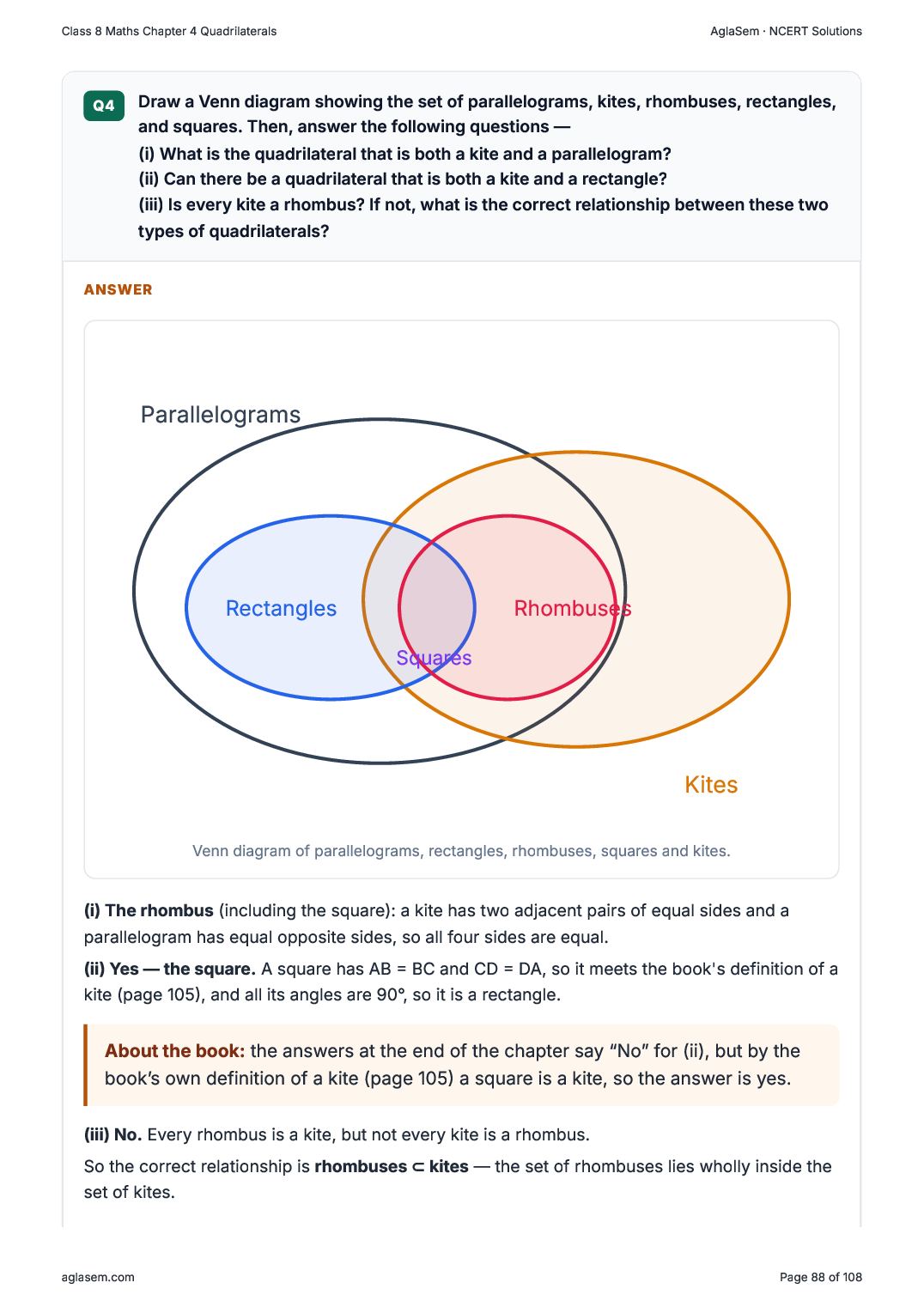
- So a rhombus is a parallelogram, and a rectangle is also a parallelogram. How can this be represented using a Venn diagram? Where will the set of squares occur in this diagram?
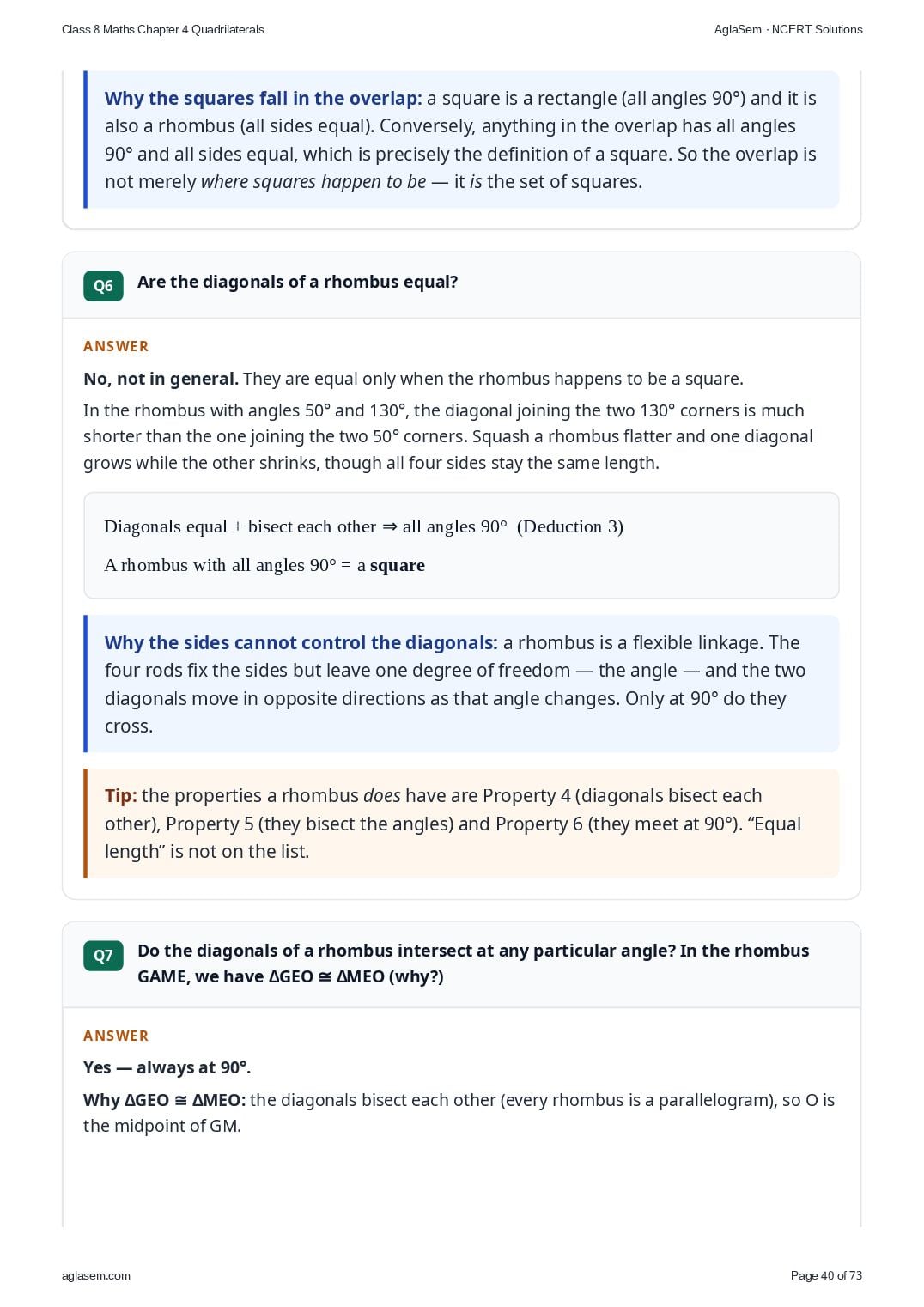
- Are the diagonals of a rhombus equal?
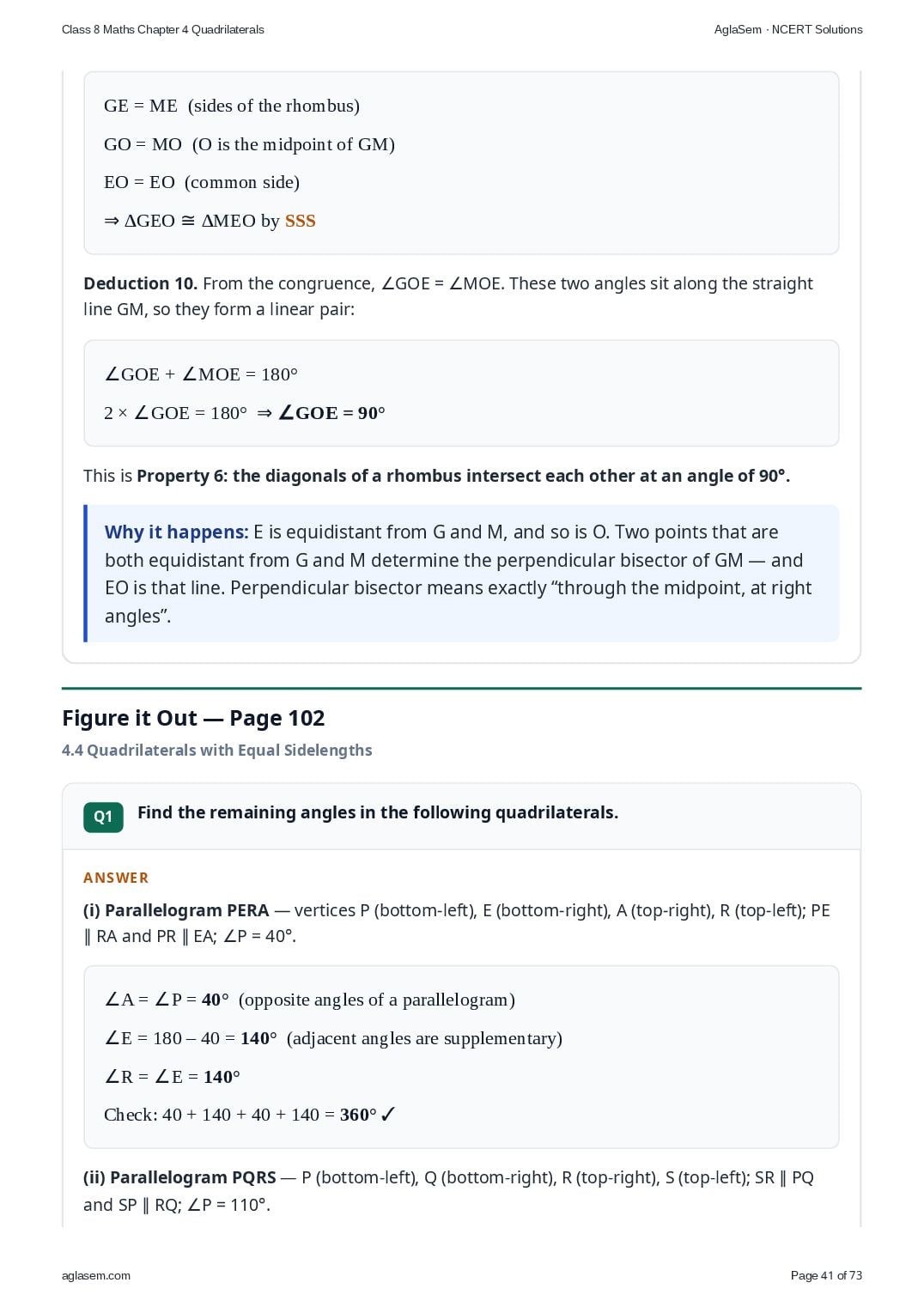
- Do the diagonals of a rhombus intersect at any particular angle? In the rhombus GAME, we have ∆GEO ≅ ∆MEO (why?)
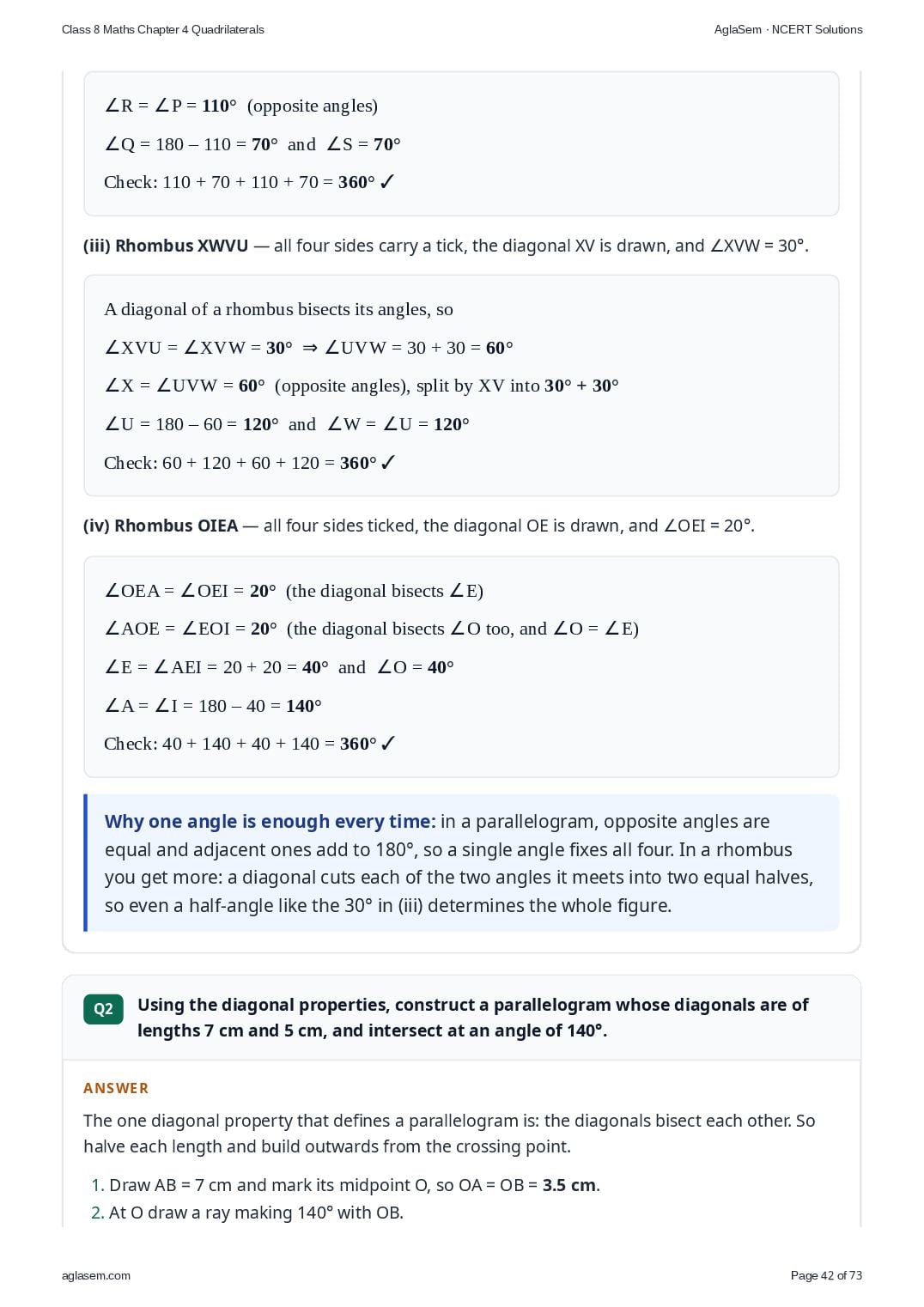
- Find the remaining angles in the following quadrilaterals.
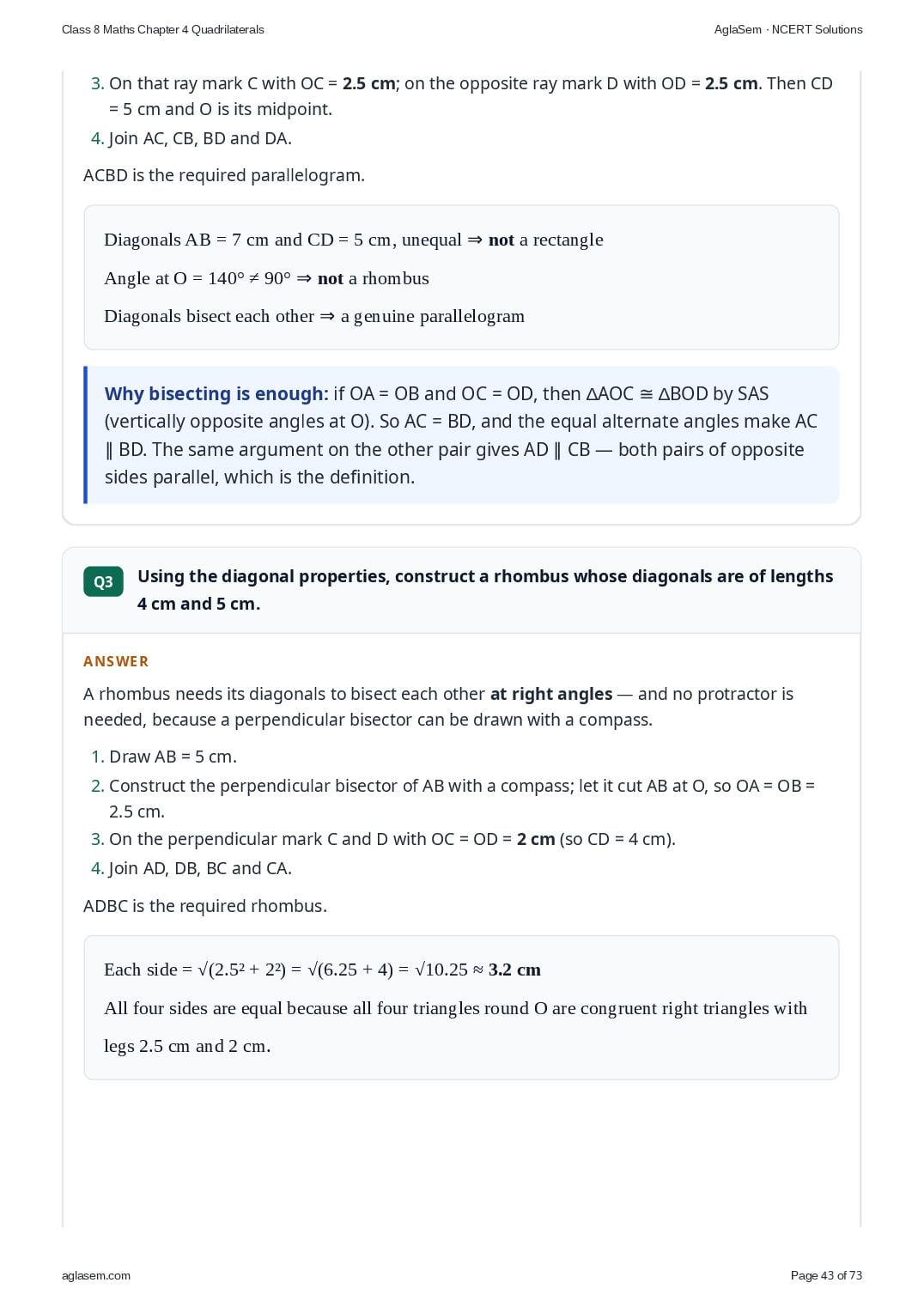
- Using the diagonal properties, construct a parallelogram whose diagonals are of lengths 7 cm and 5 cm, and intersect at an angle of 140°.
- Using the diagonal properties, construct a rhombus whose diagonals are of lengths 4 cm and 5 cm.
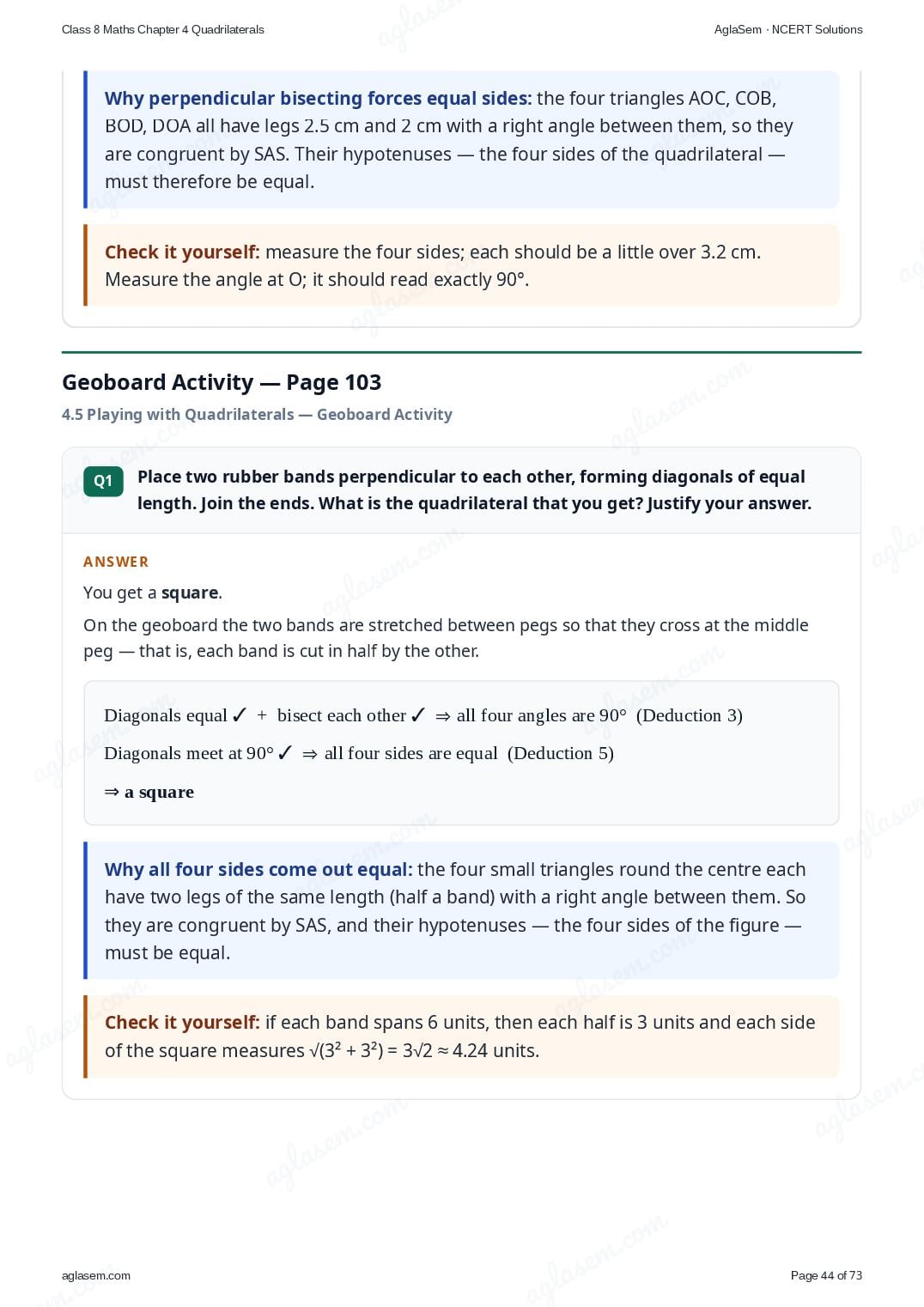
- Place two rubber bands perpendicular to each other, forming diagonals of equal length. Join the ends. What is the quadrilateral that you get? Justify your answer.
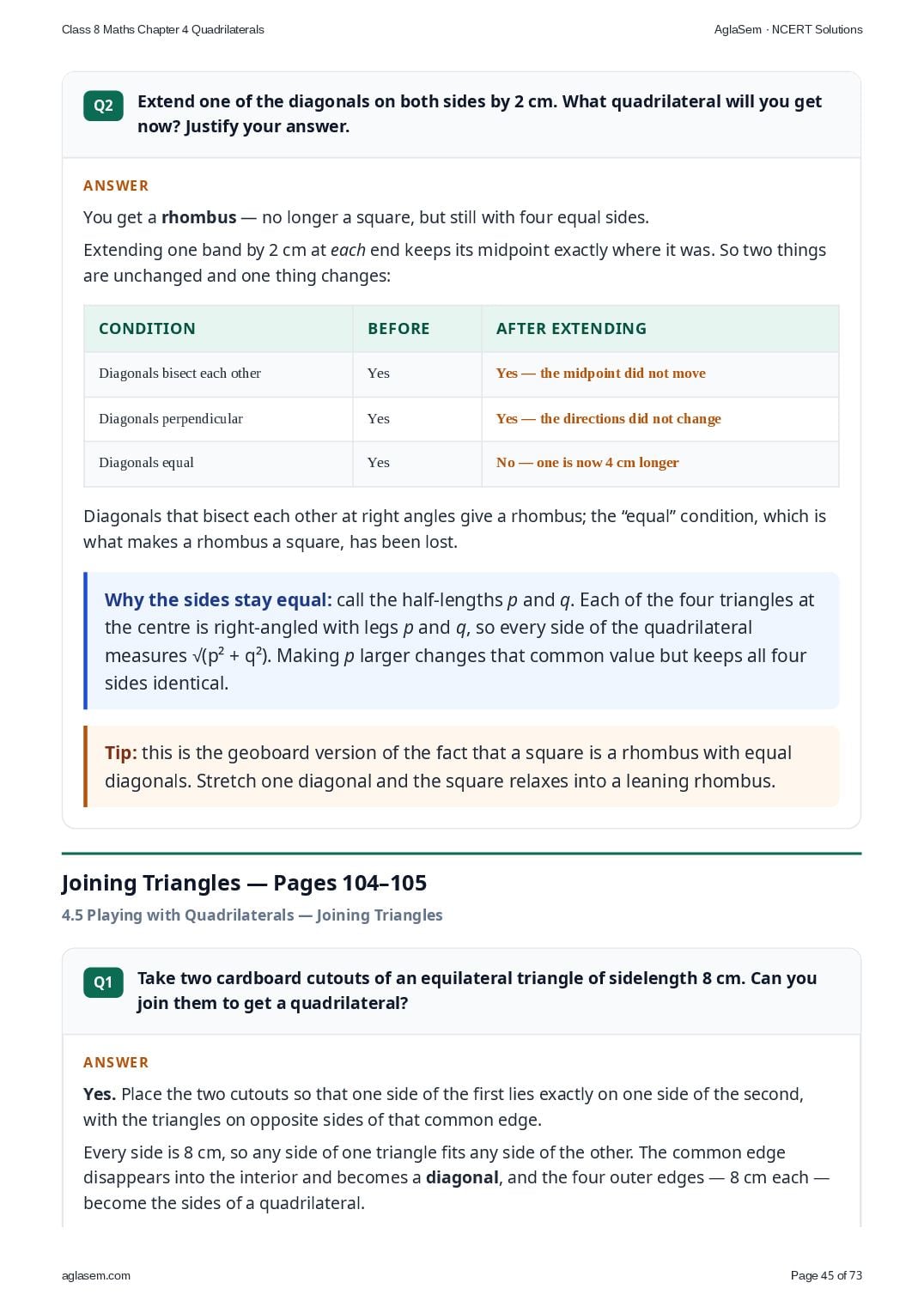
- Extend one of the diagonals on both sides by 2 cm. What quadrilateral will you get now? Justify your answer.
- Take two cardboard cutouts of an equilateral triangle of sidelength 8 cm. Can you join them to get a quadrilateral?
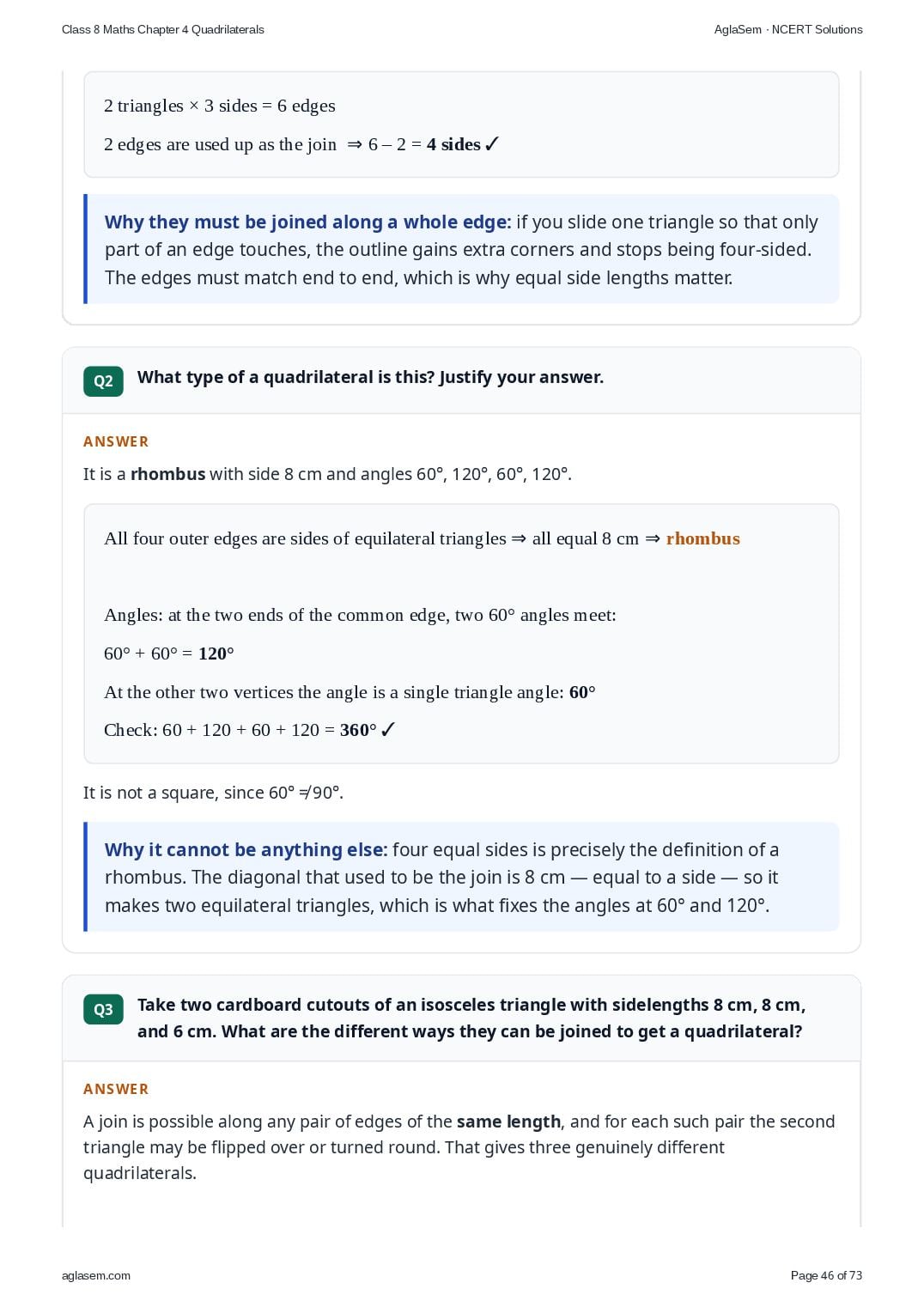
- What type of a quadrilateral is this? Justify your answer.
- Take two cardboard cutouts of an isosceles triangle with sidelengths 8 cm, 8 cm, and 6 cm. What are the different ways they can be joined to get a quadrilateral?
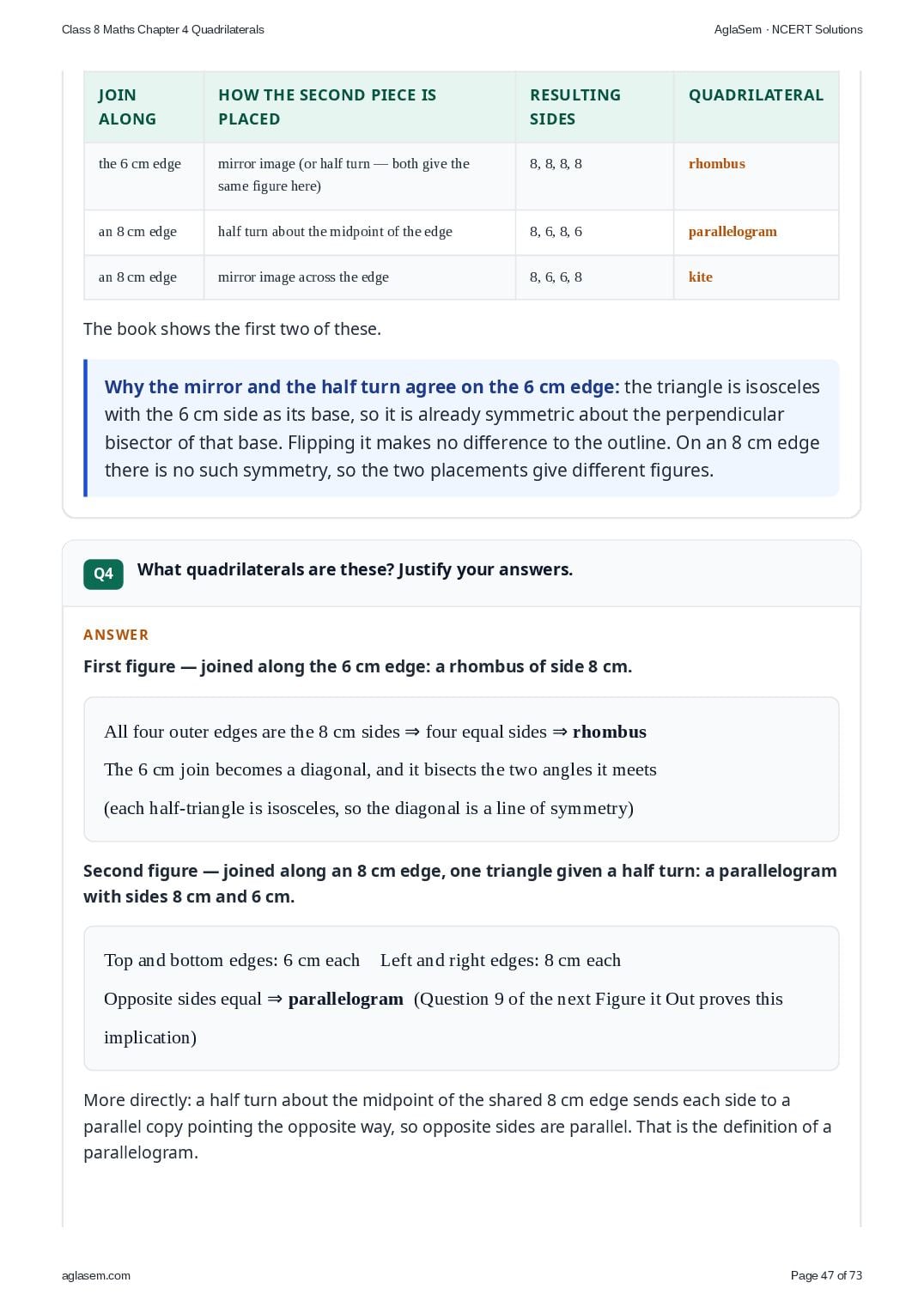
- What quadrilaterals are these? Justify your answers.
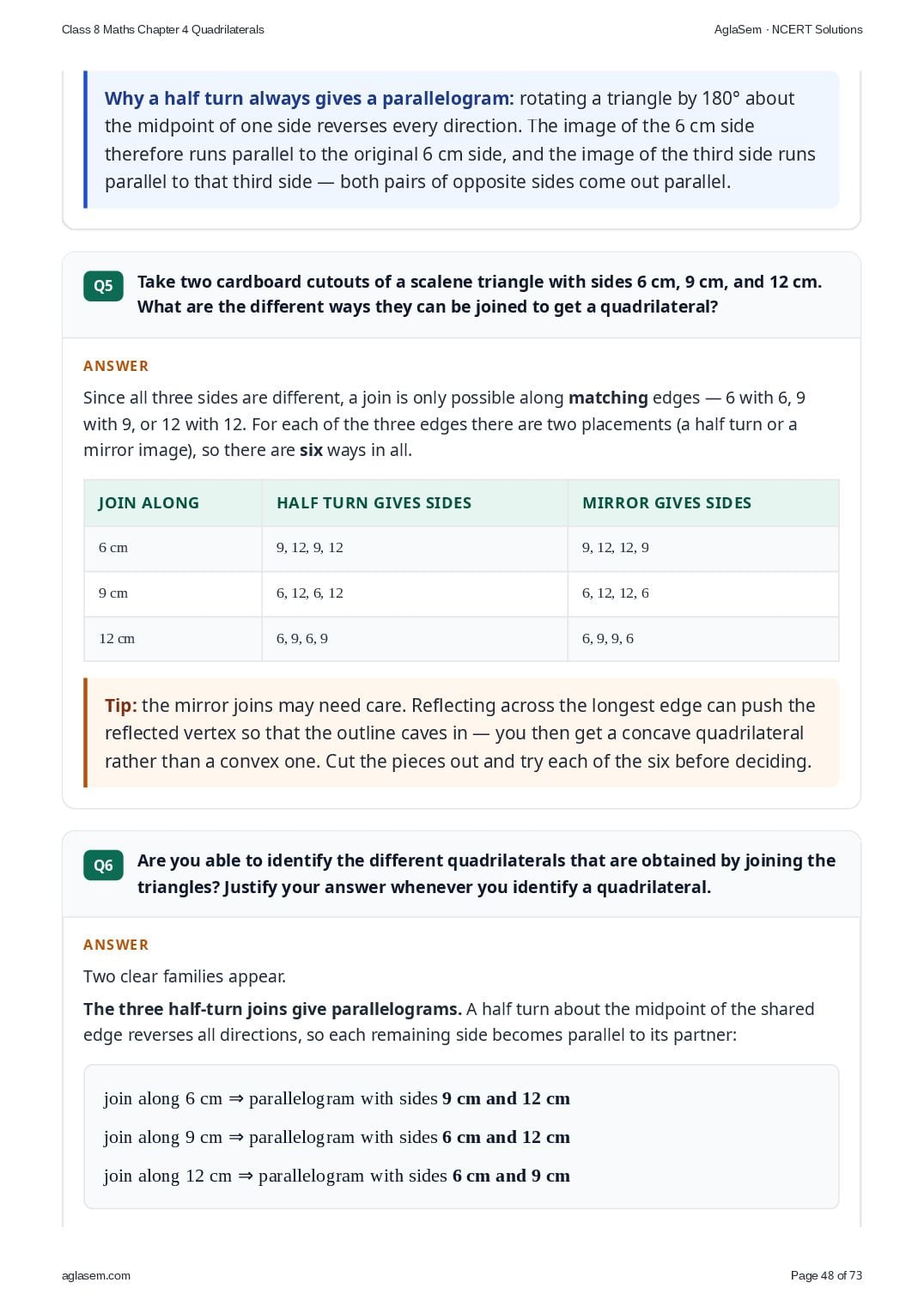
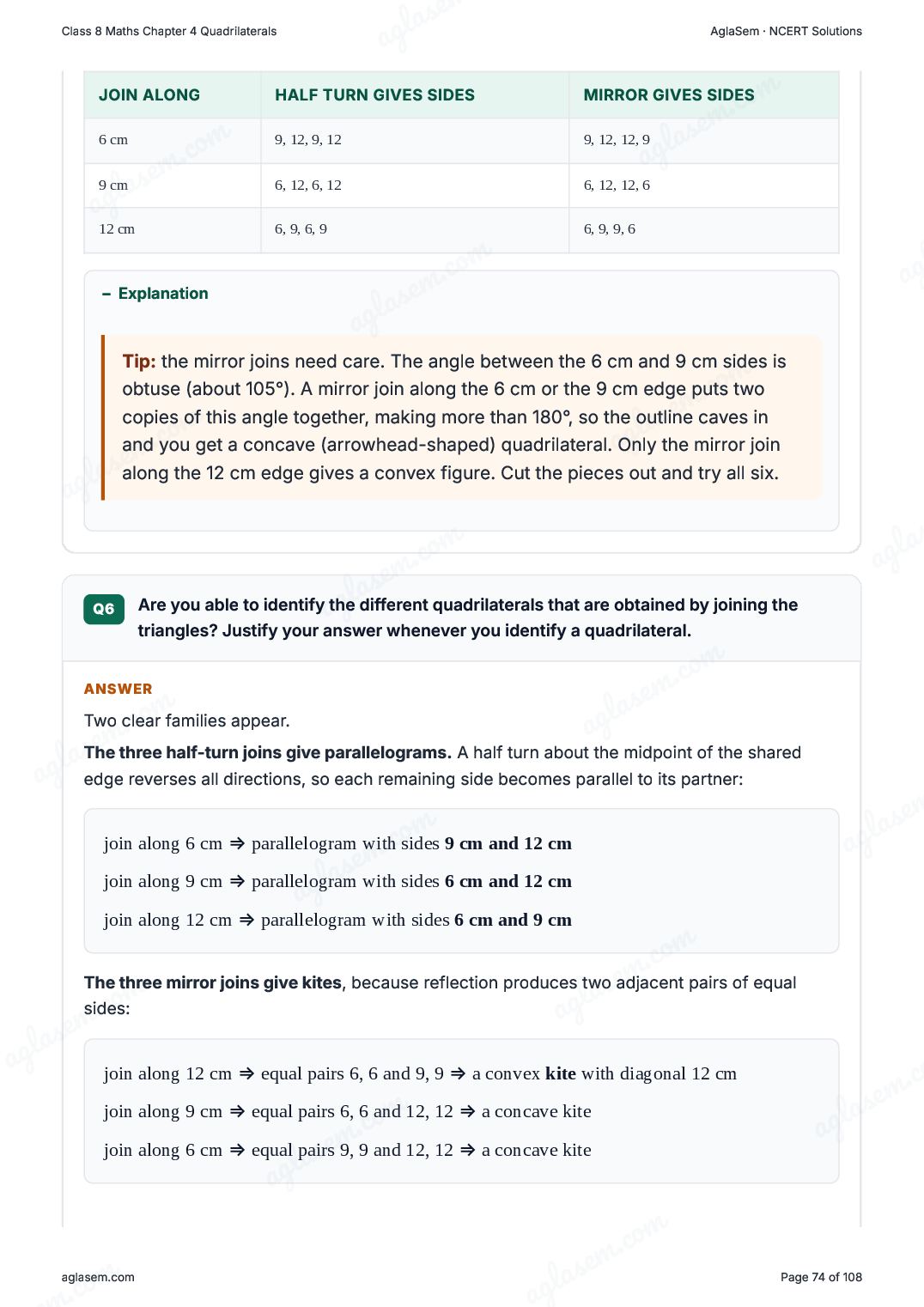
- Take two cardboard cutouts of a scalene triangle with sides 6 cm, 9 cm, and 12 cm. What are the different ways they can be joined to get a quadrilateral?
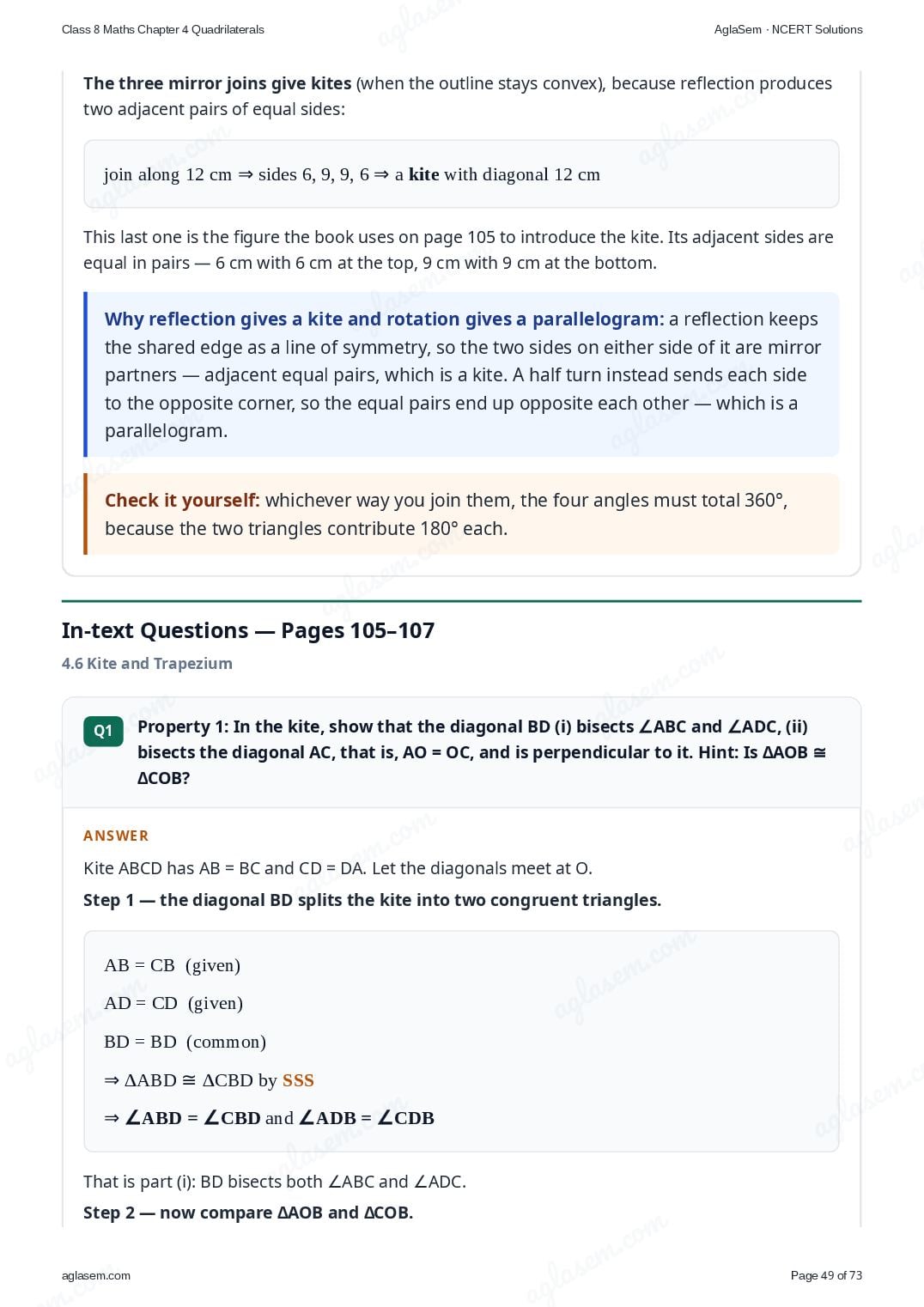
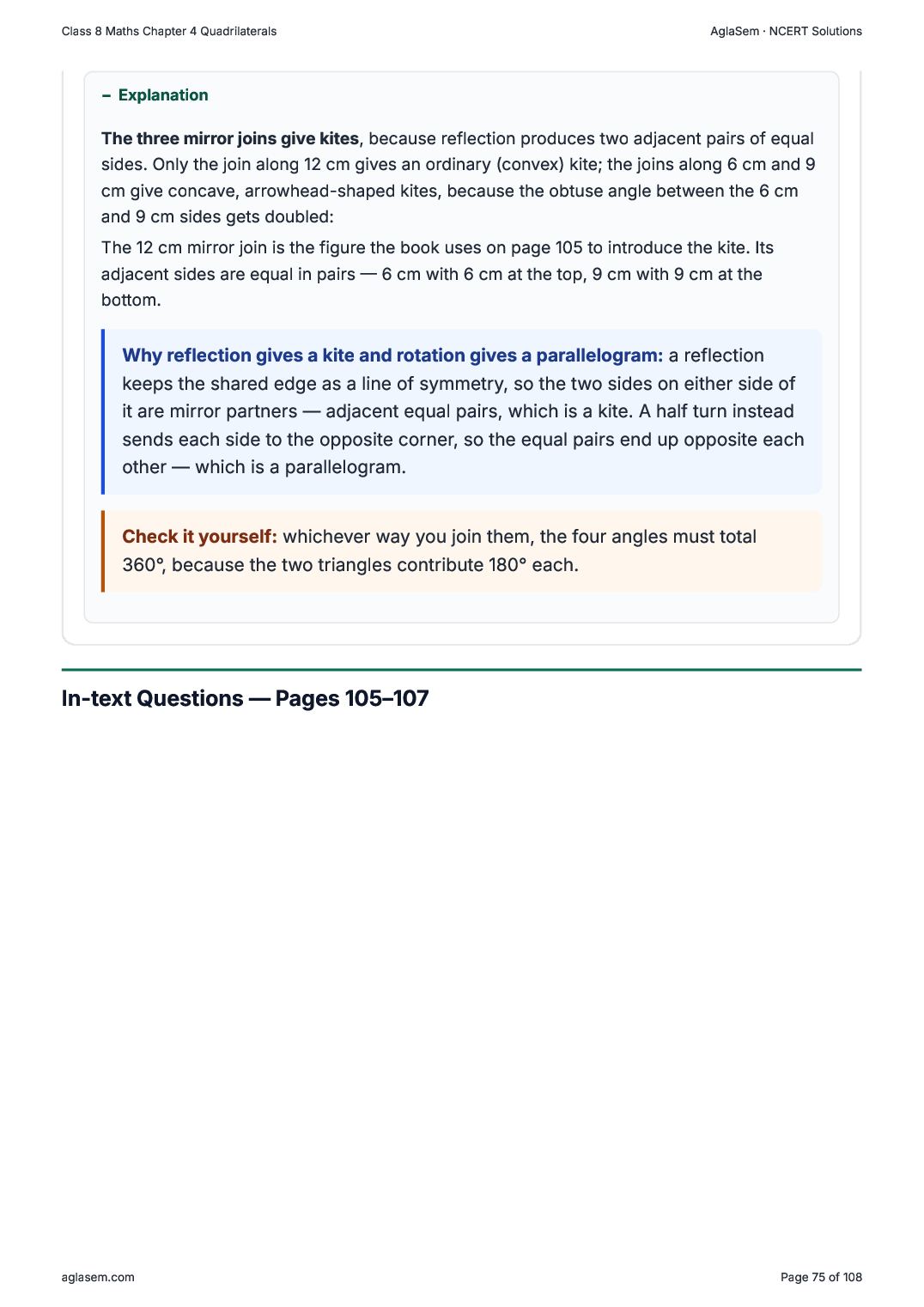
- Are you able to identify the different quadrilaterals that are obtained by joining the triangles? Justify your answer whenever you identify a quadrilateral.
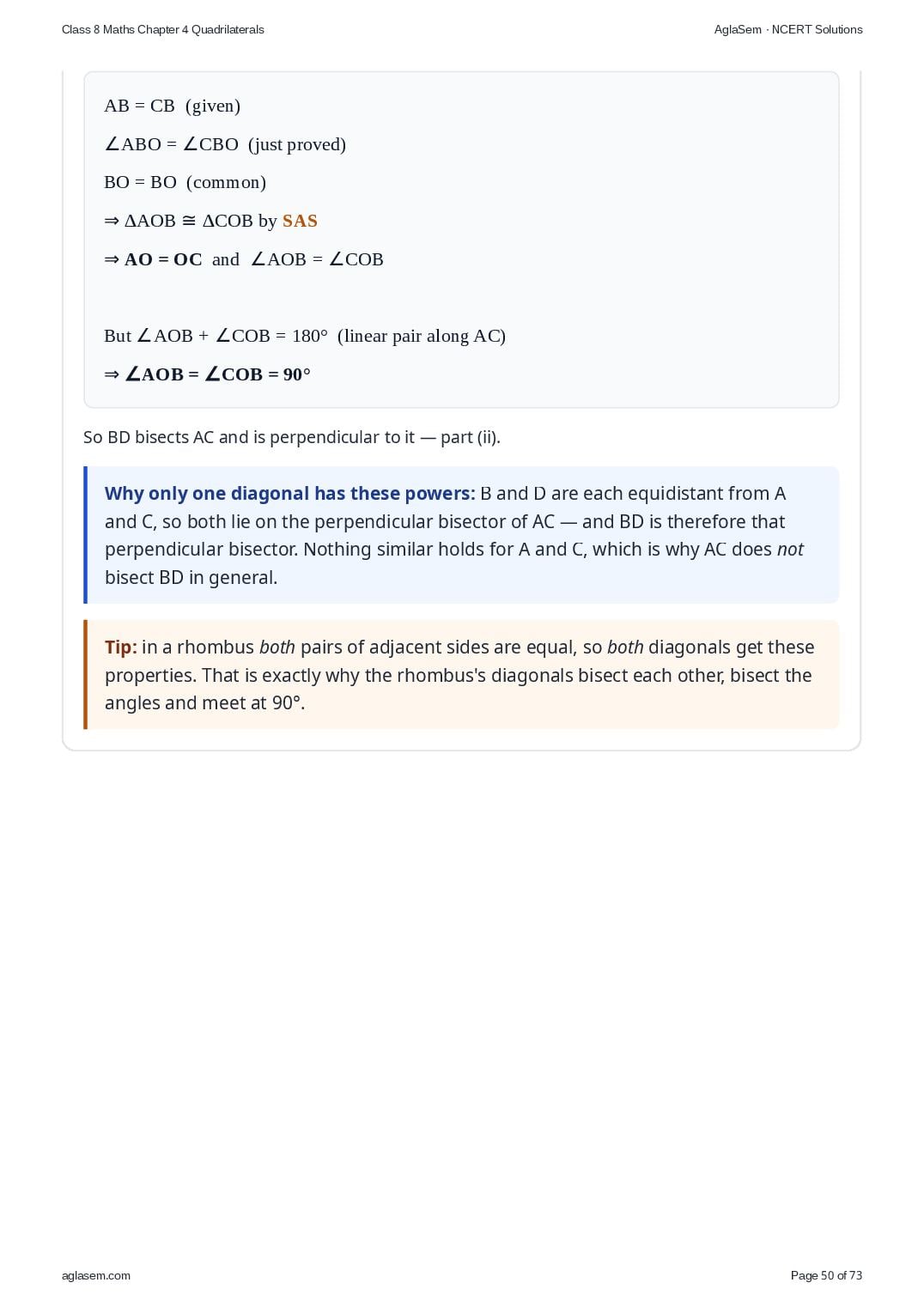
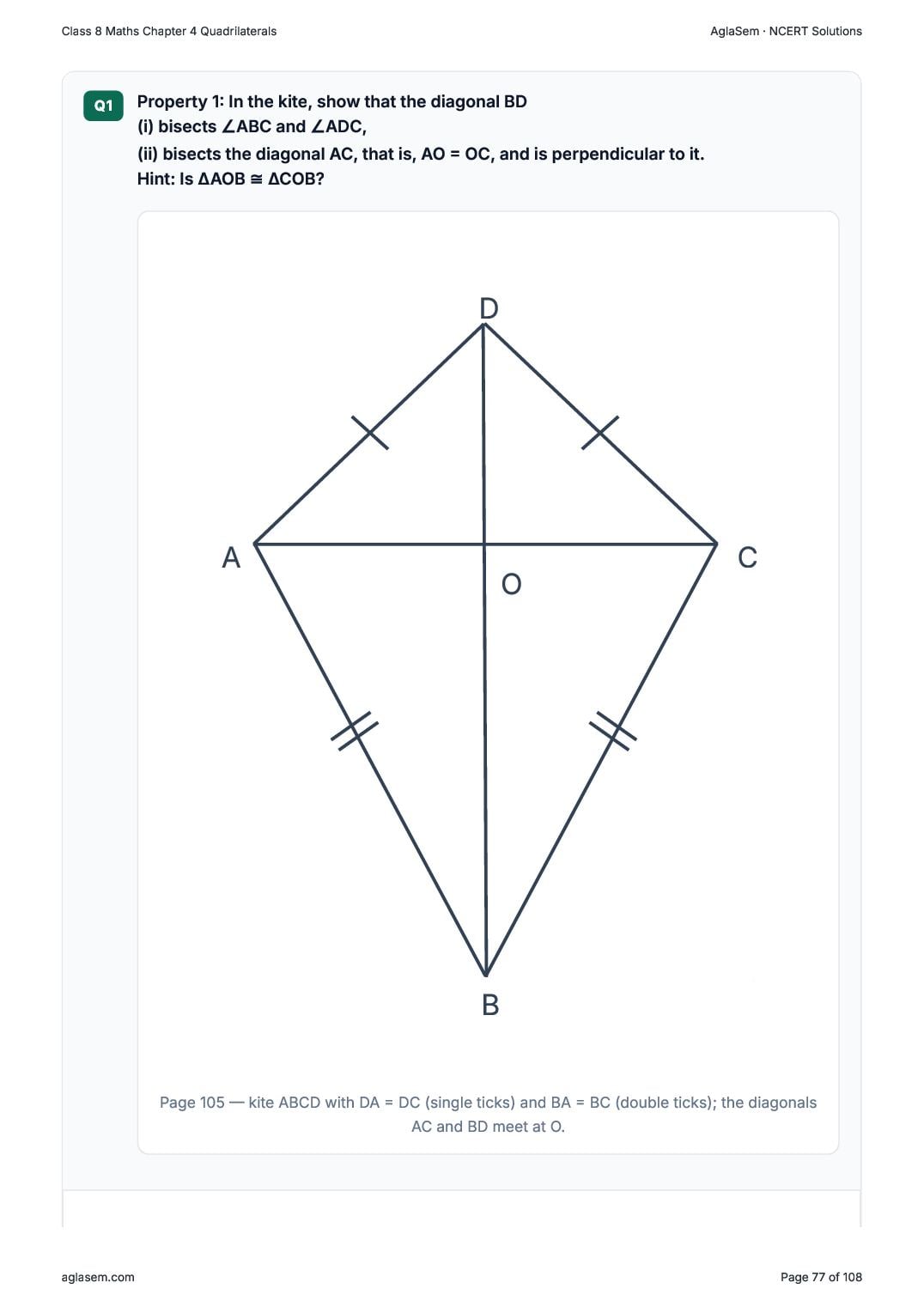
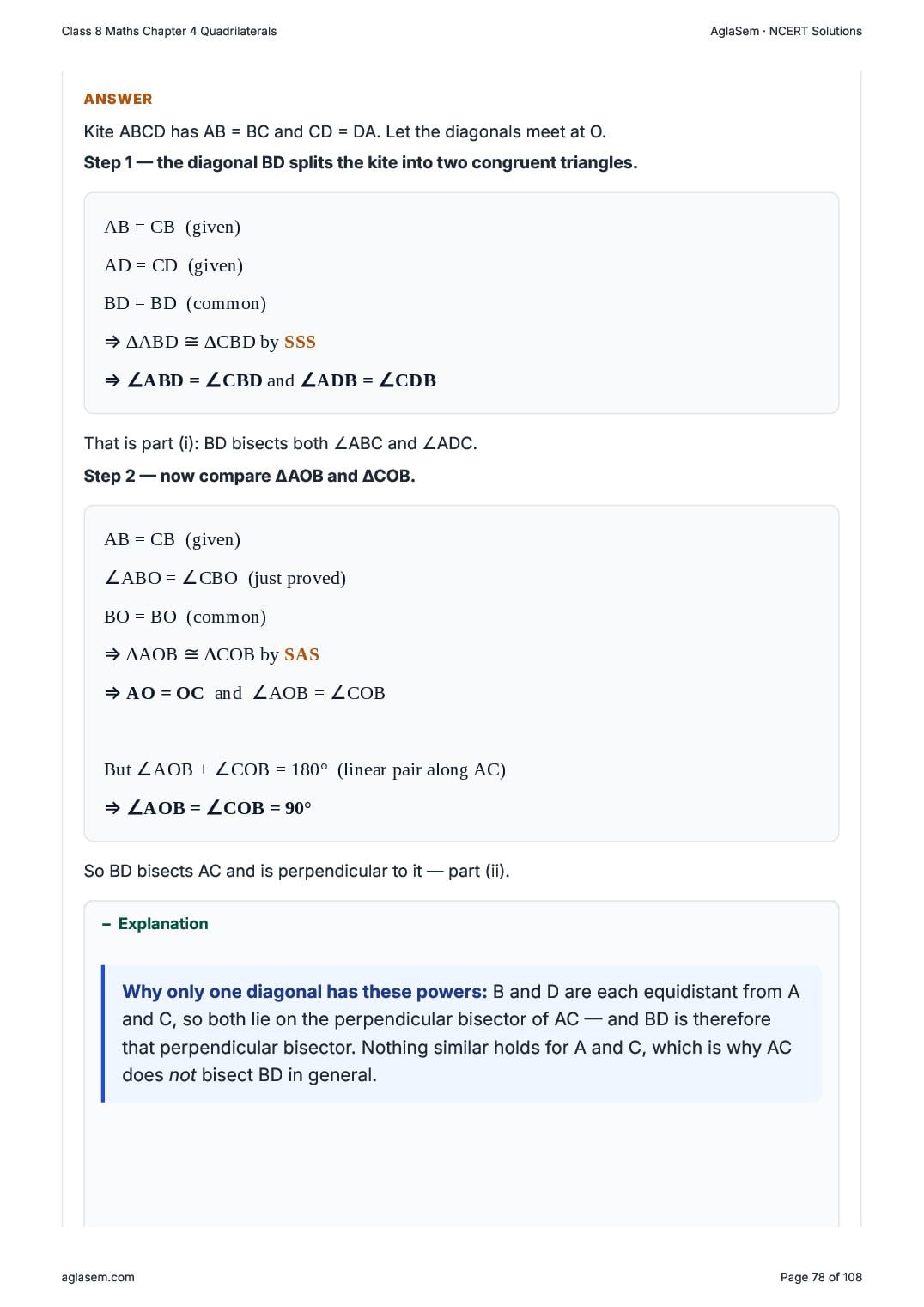
- Property 1: In the kite, show that the diagonal BD (i) bisects ∠ABC and ∠ADC, (ii) bisects the diagonal AC, that is, AO = OC, and is perpendicular to it. Hint: Is ∆AOB ≅ ∆COB?
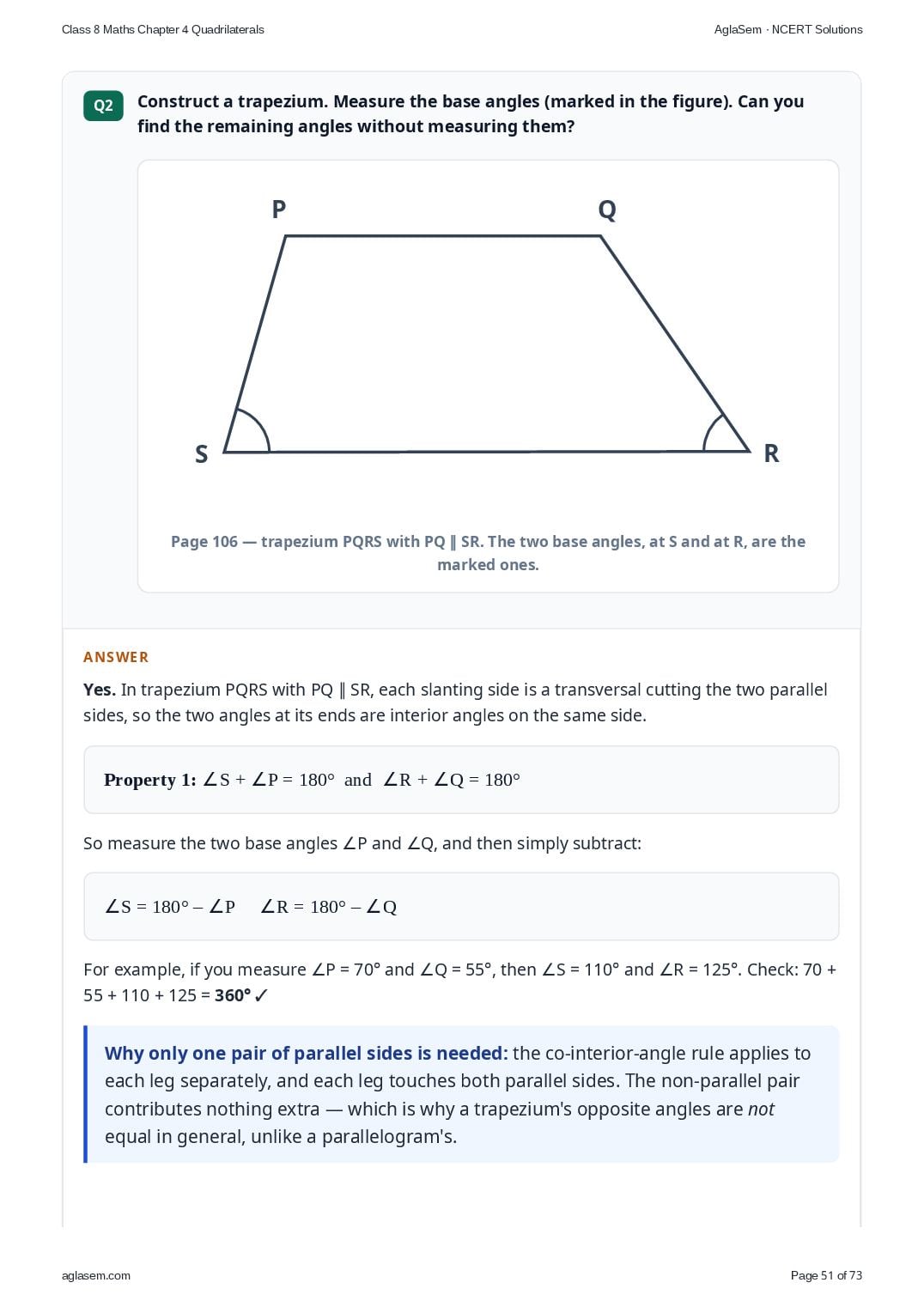
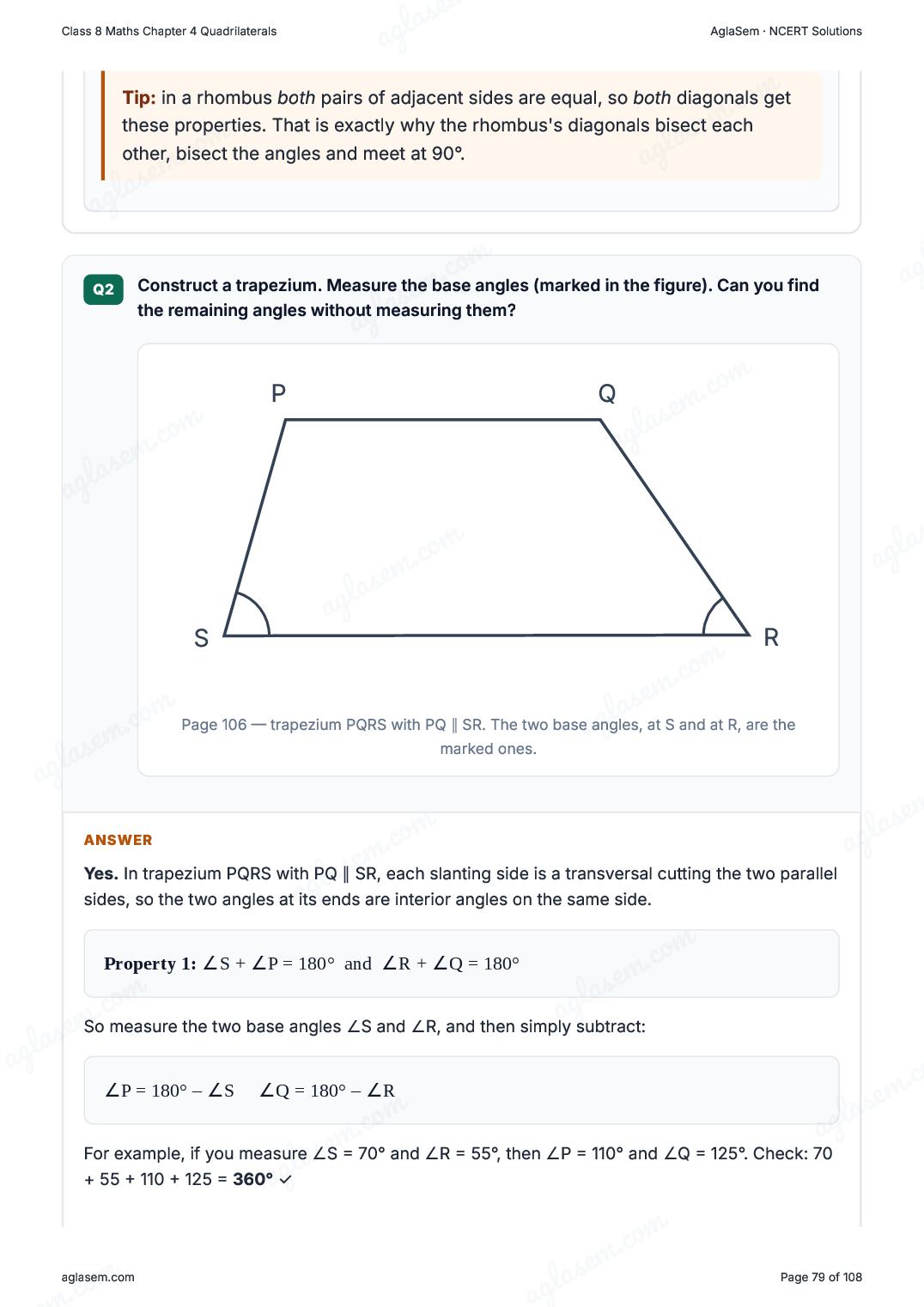
- Construct a trapezium. Measure the base angles (marked in the figure). Can you find the remaining angles without measuring them?
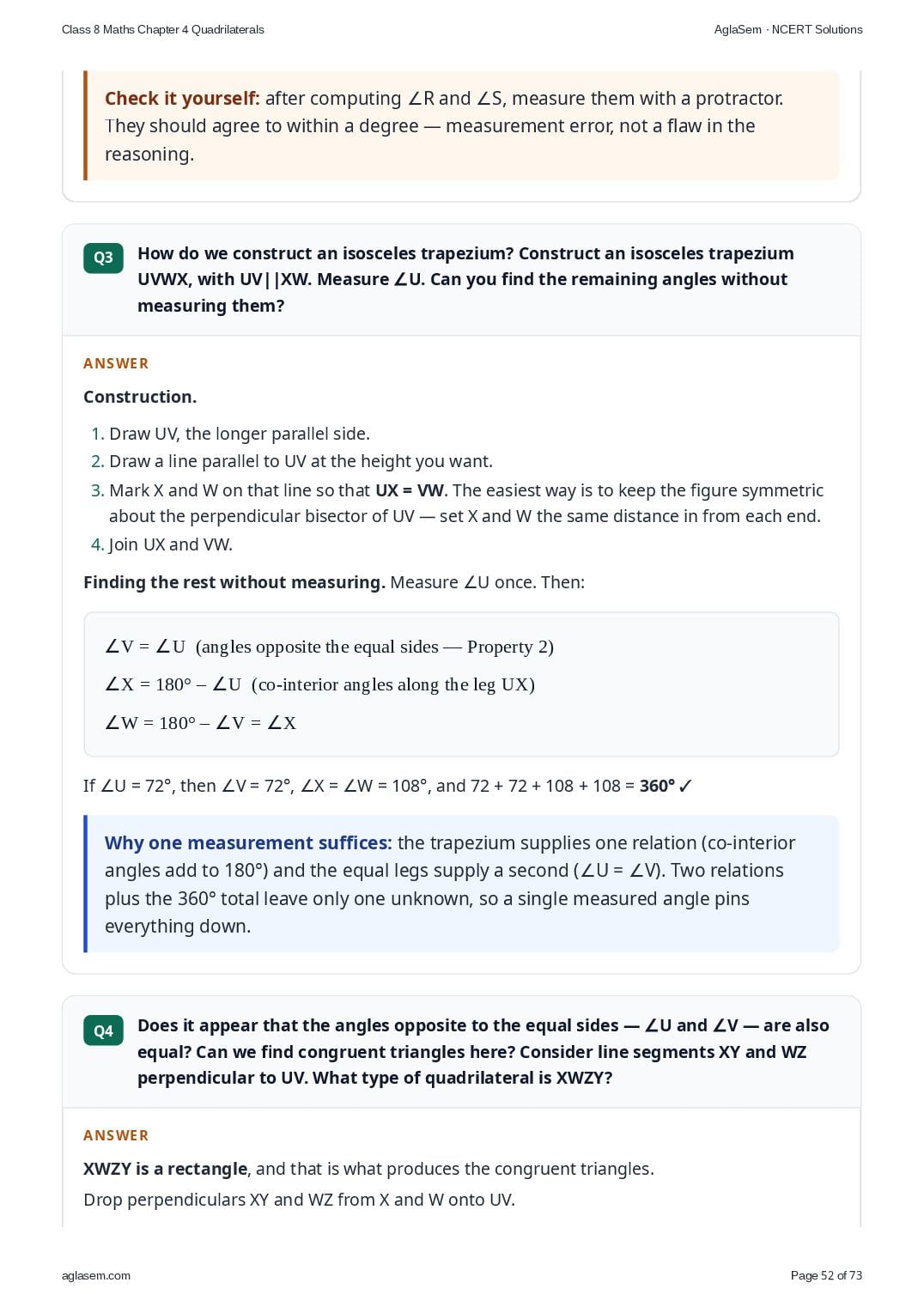
- How do we construct an isosceles trapezium? Construct an isosceles trapezium UVWX, with UV||XW. Measure ∠U. Can you find the remaining angles without measuring them?
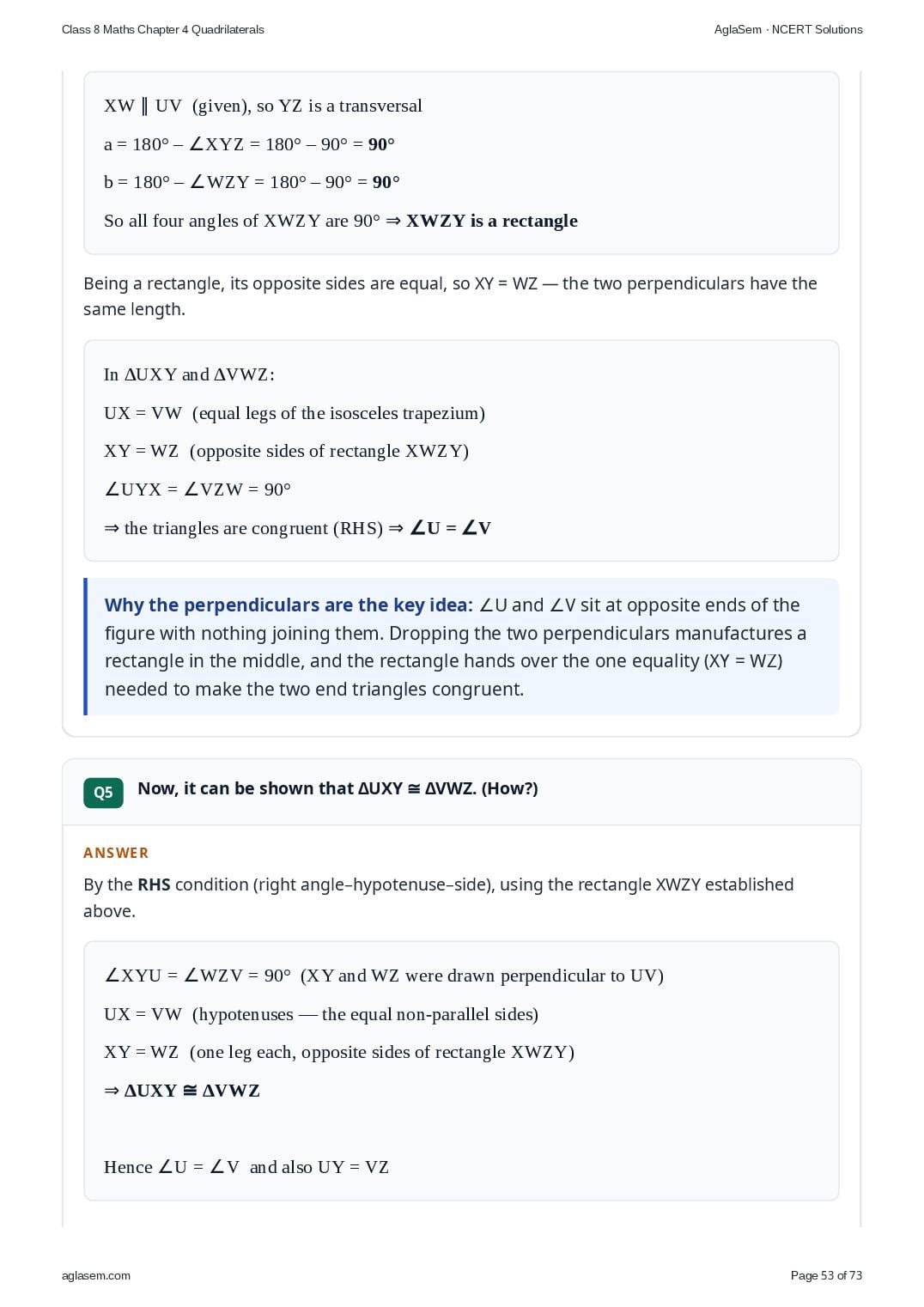
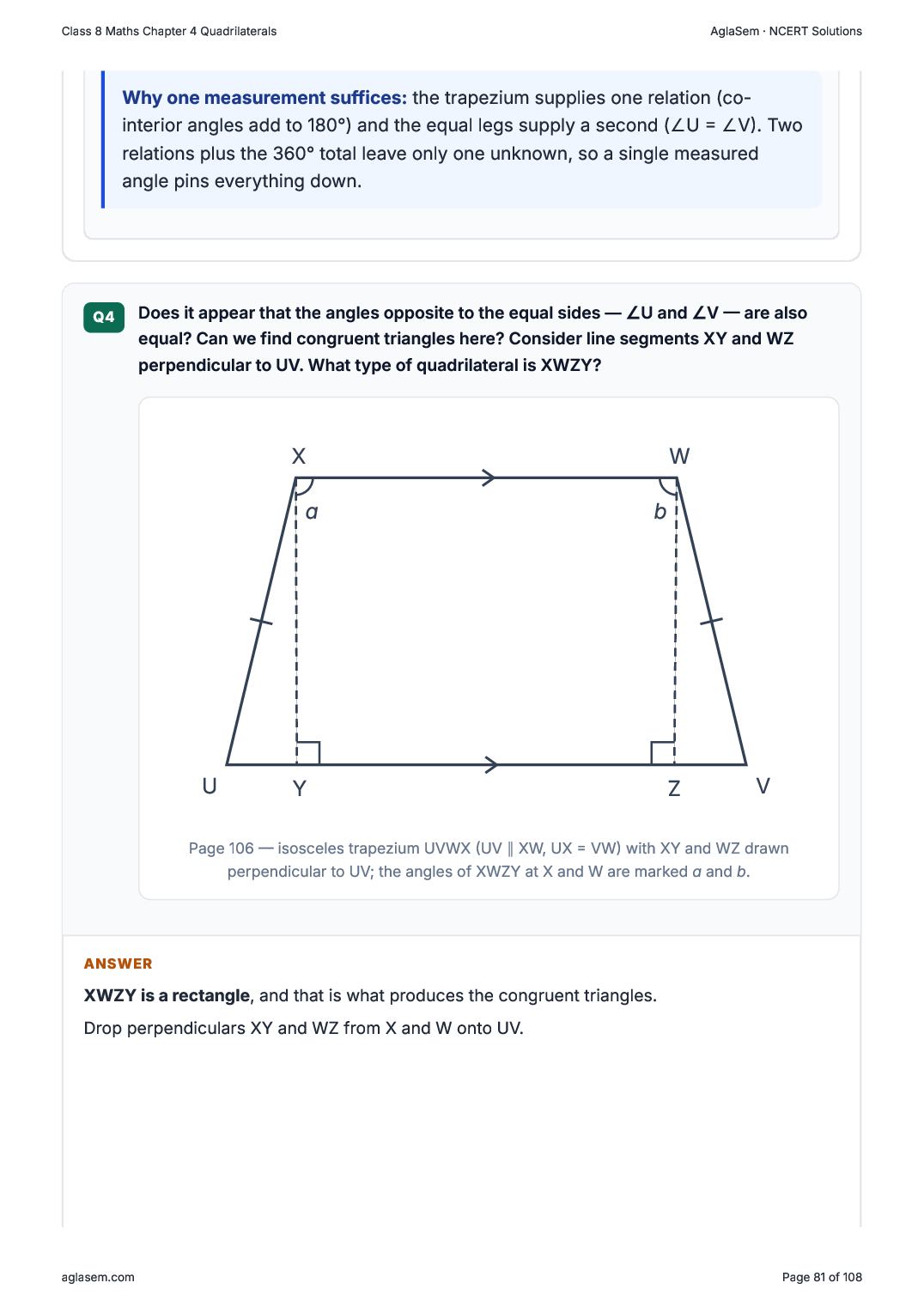
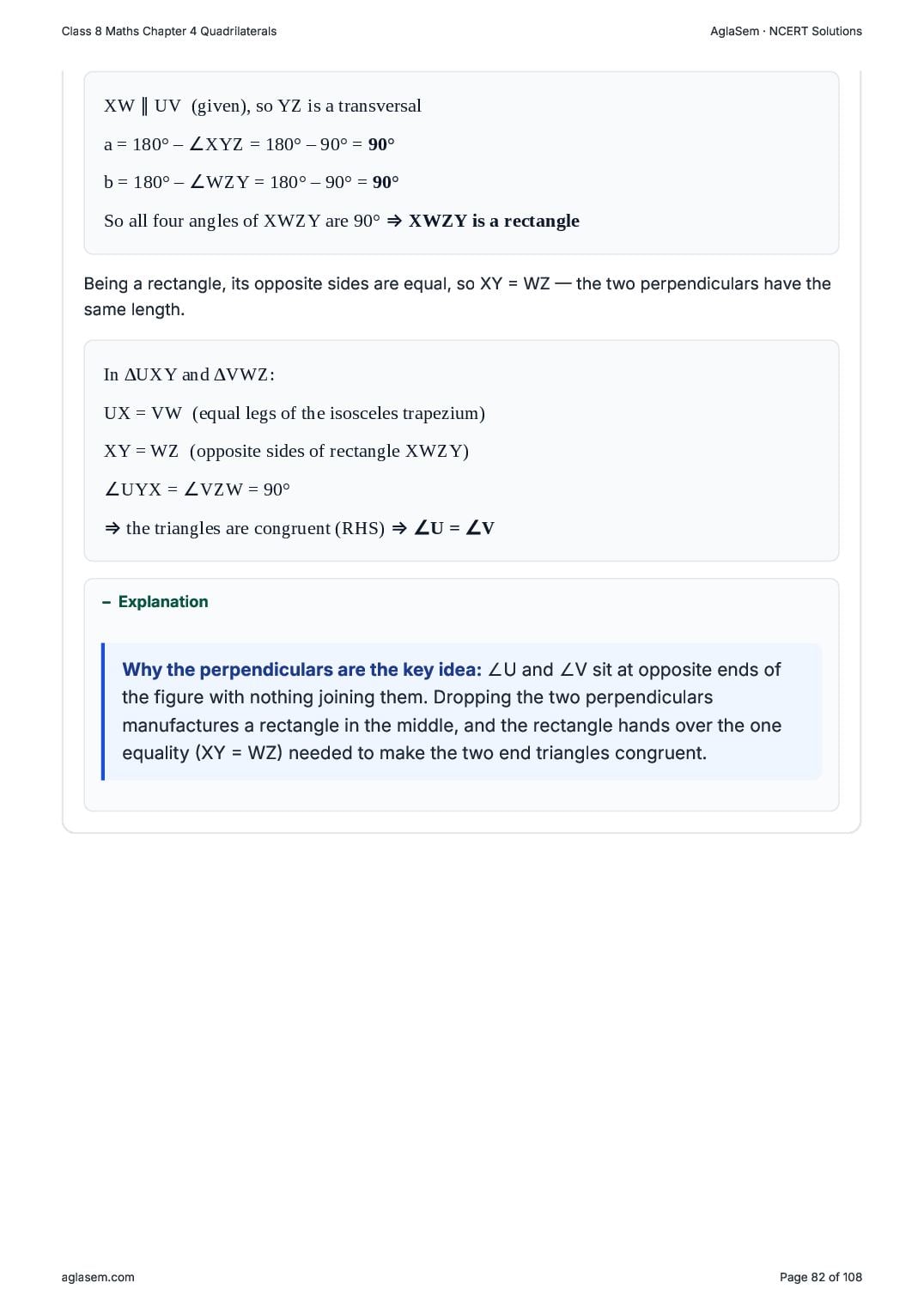
- Does it appear that the angles opposite to the equal sides — ∠U and ∠V — are also equal? Can we find congruent triangles here? Consider line segments XY and WZ perpendicular to UV. What type of quadrilateral is XWZY?
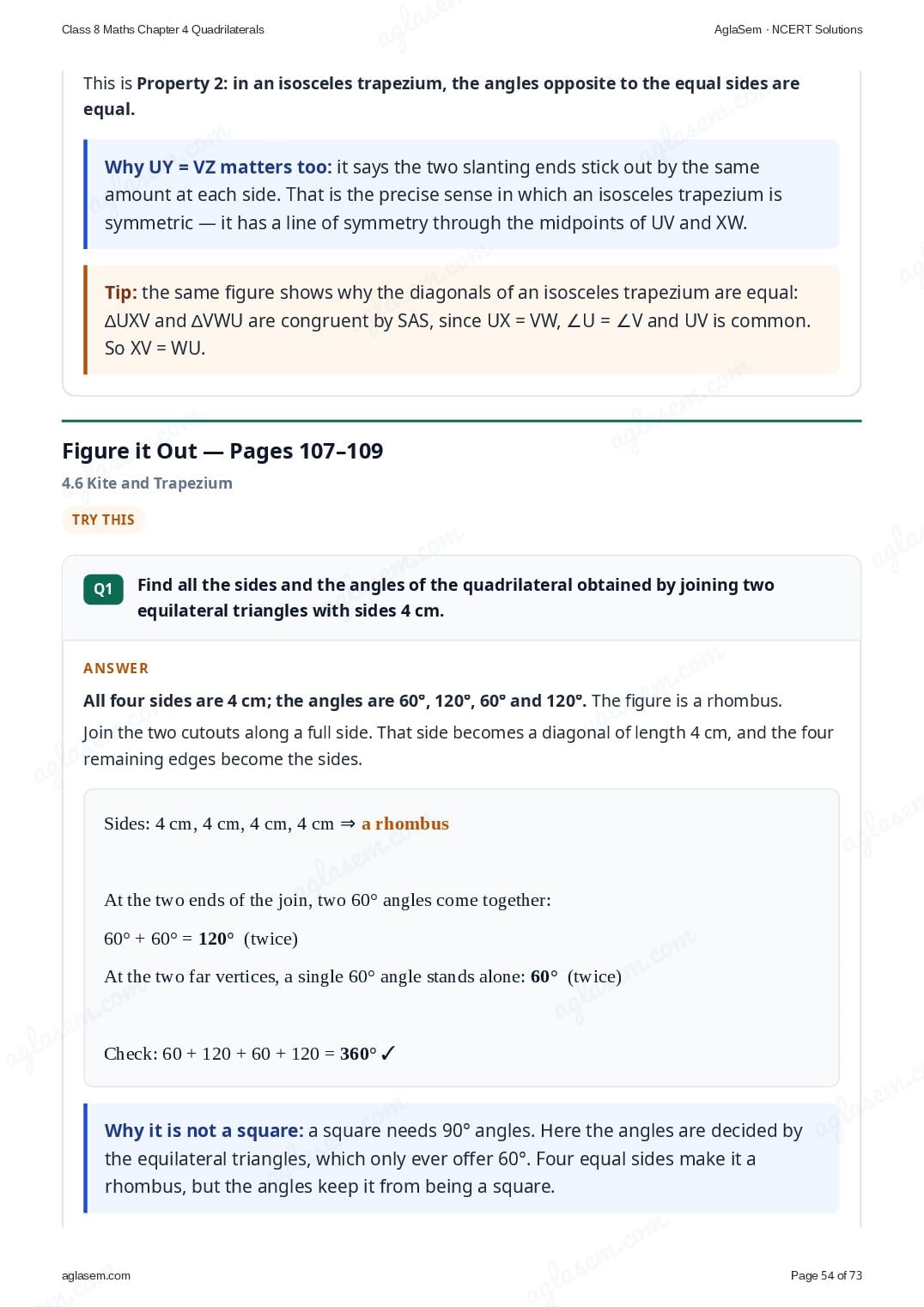
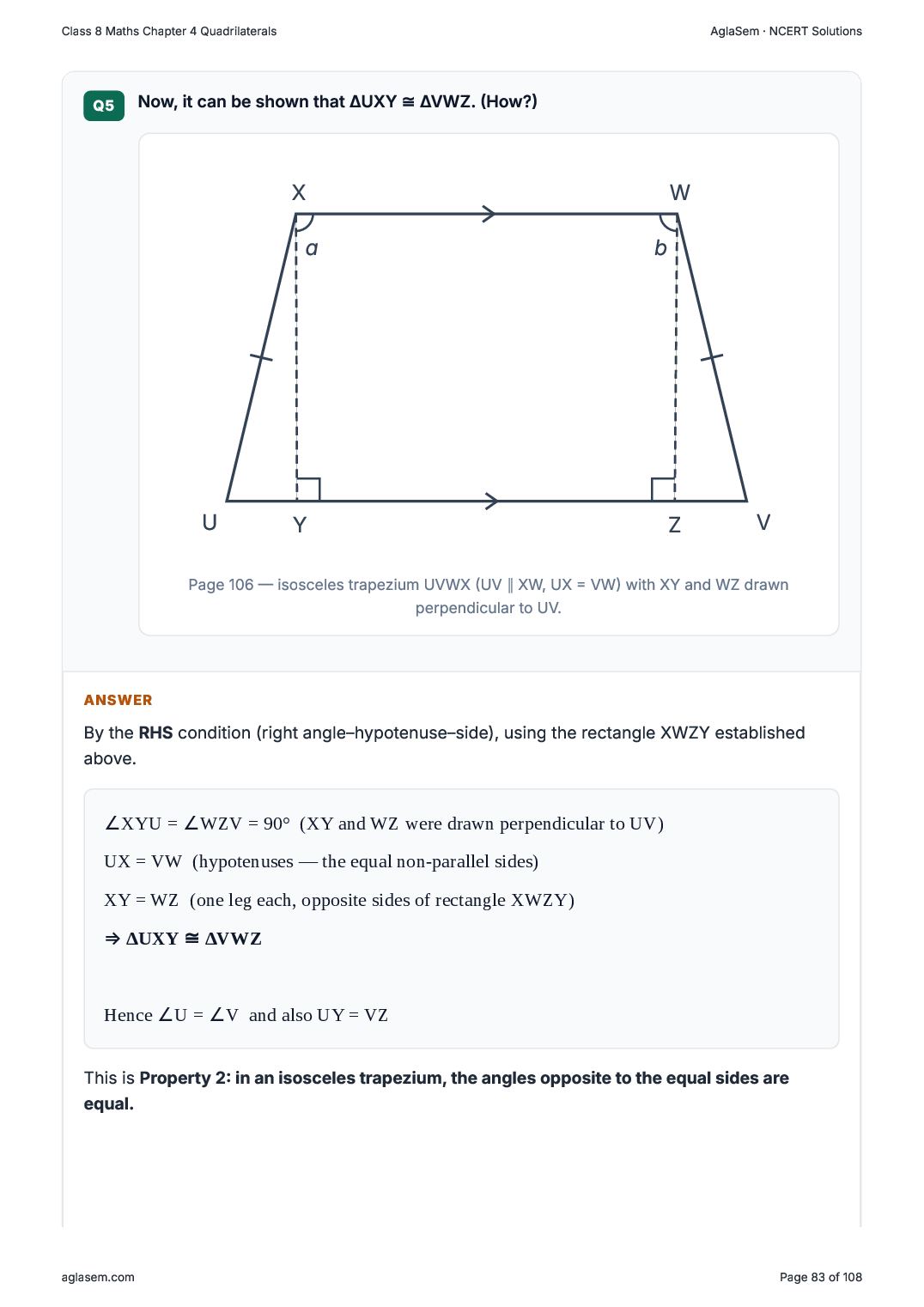
- Now, it can be shown that ∆UXY ≅ ∆VWZ. (How?)
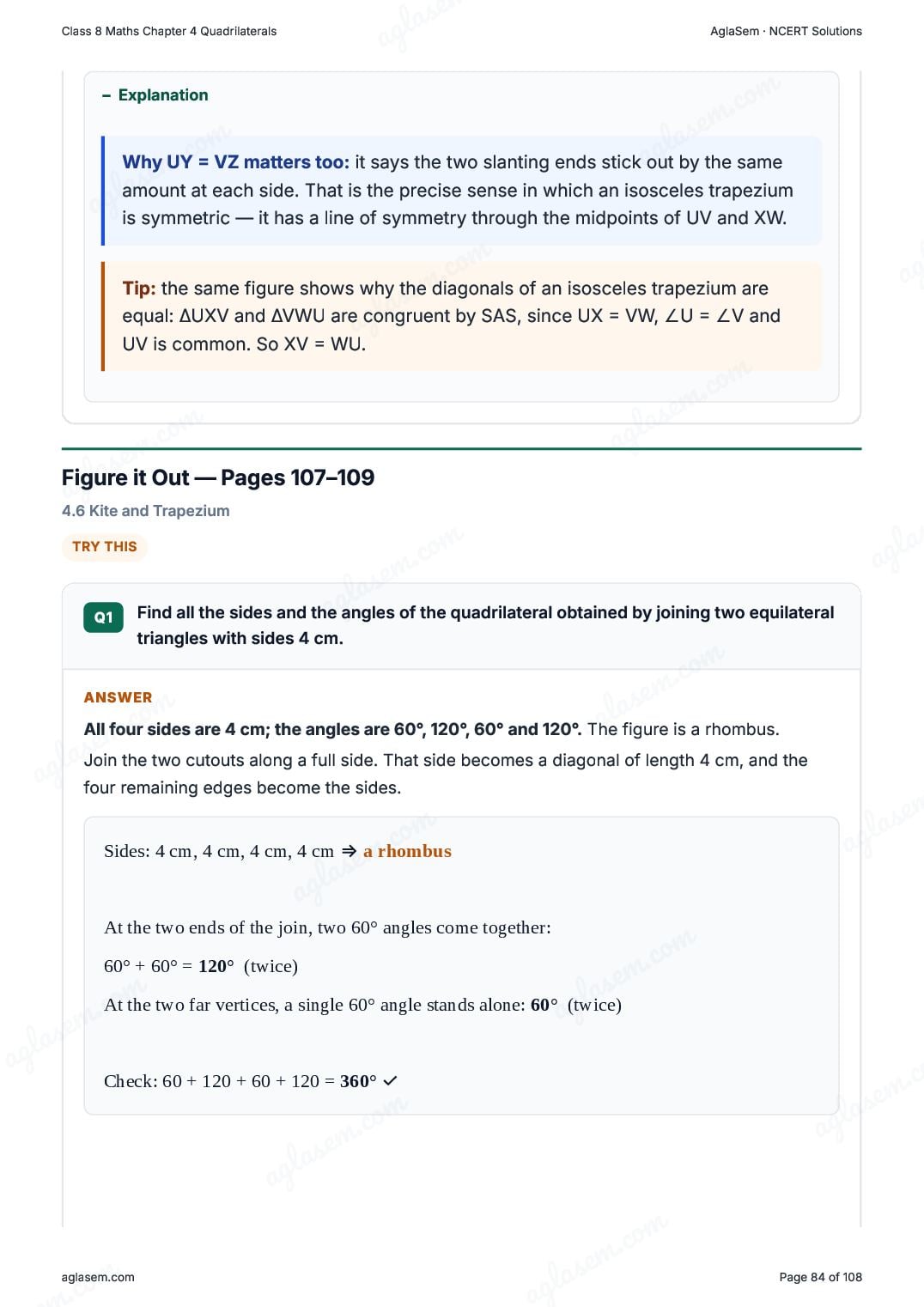
- Find all the sides and the angles of the quadrilateral obtained by joining two equilateral triangles with sides 4 cm.
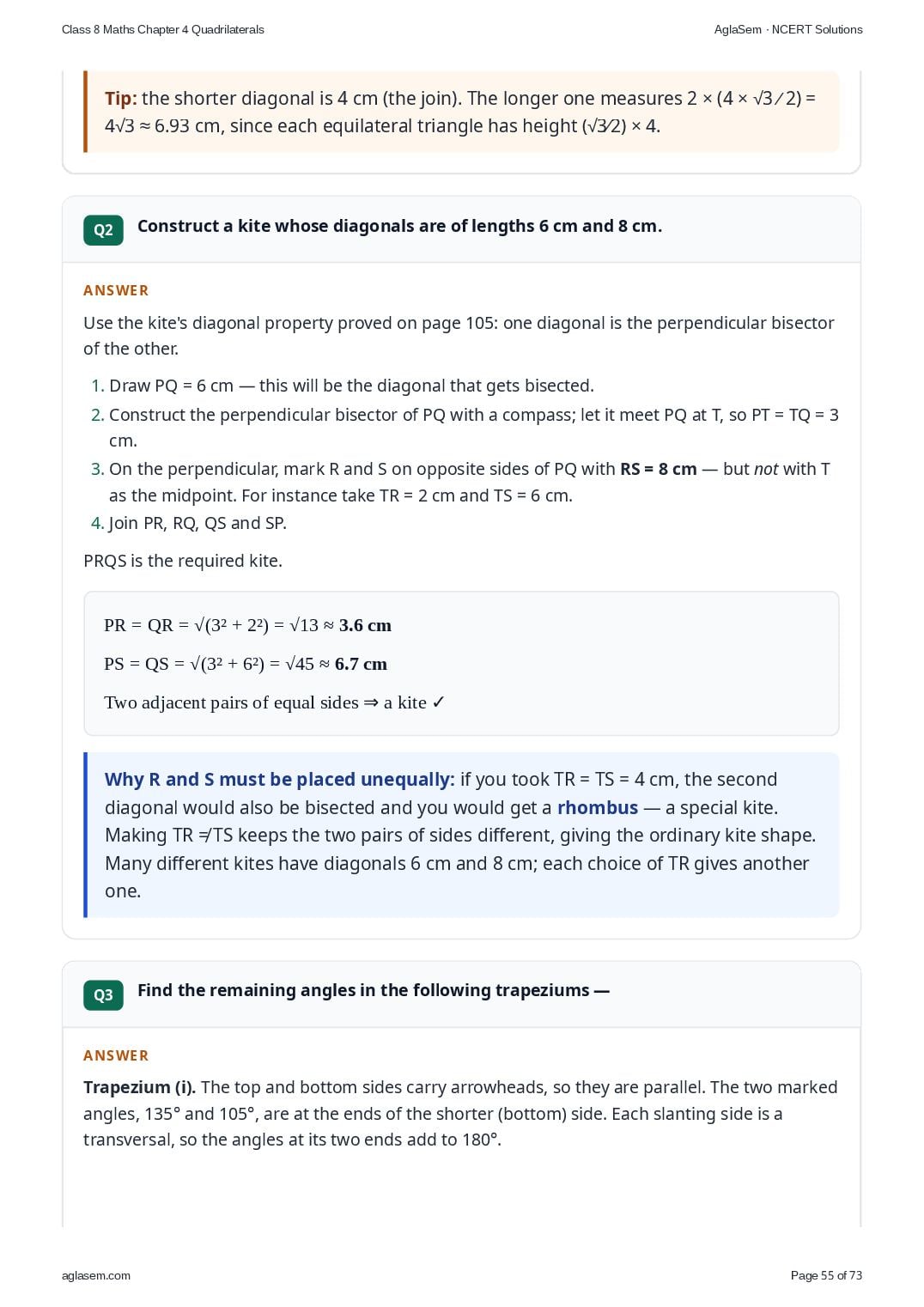
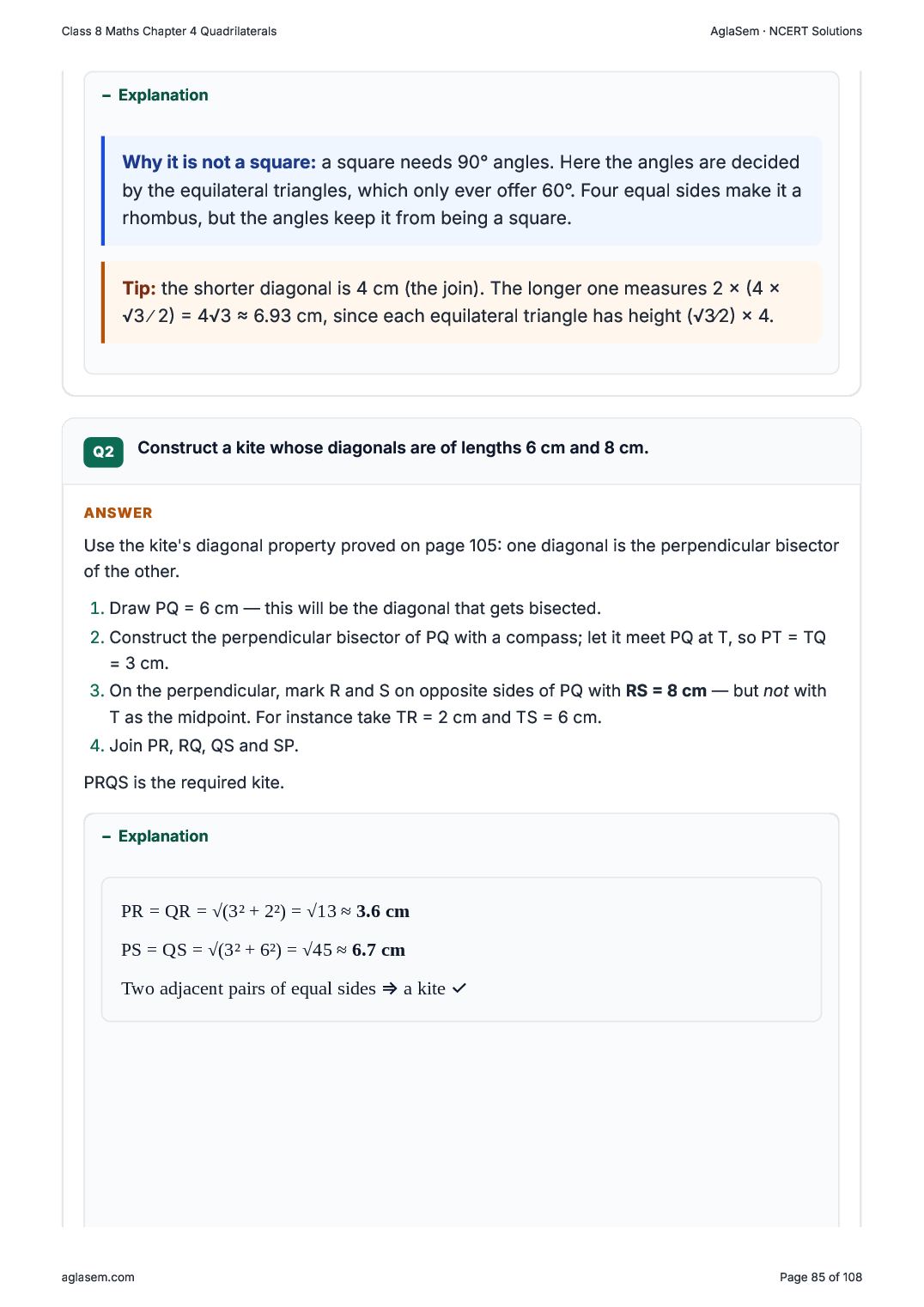
- Construct a kite whose diagonals are of lengths 6 cm and 8 cm.
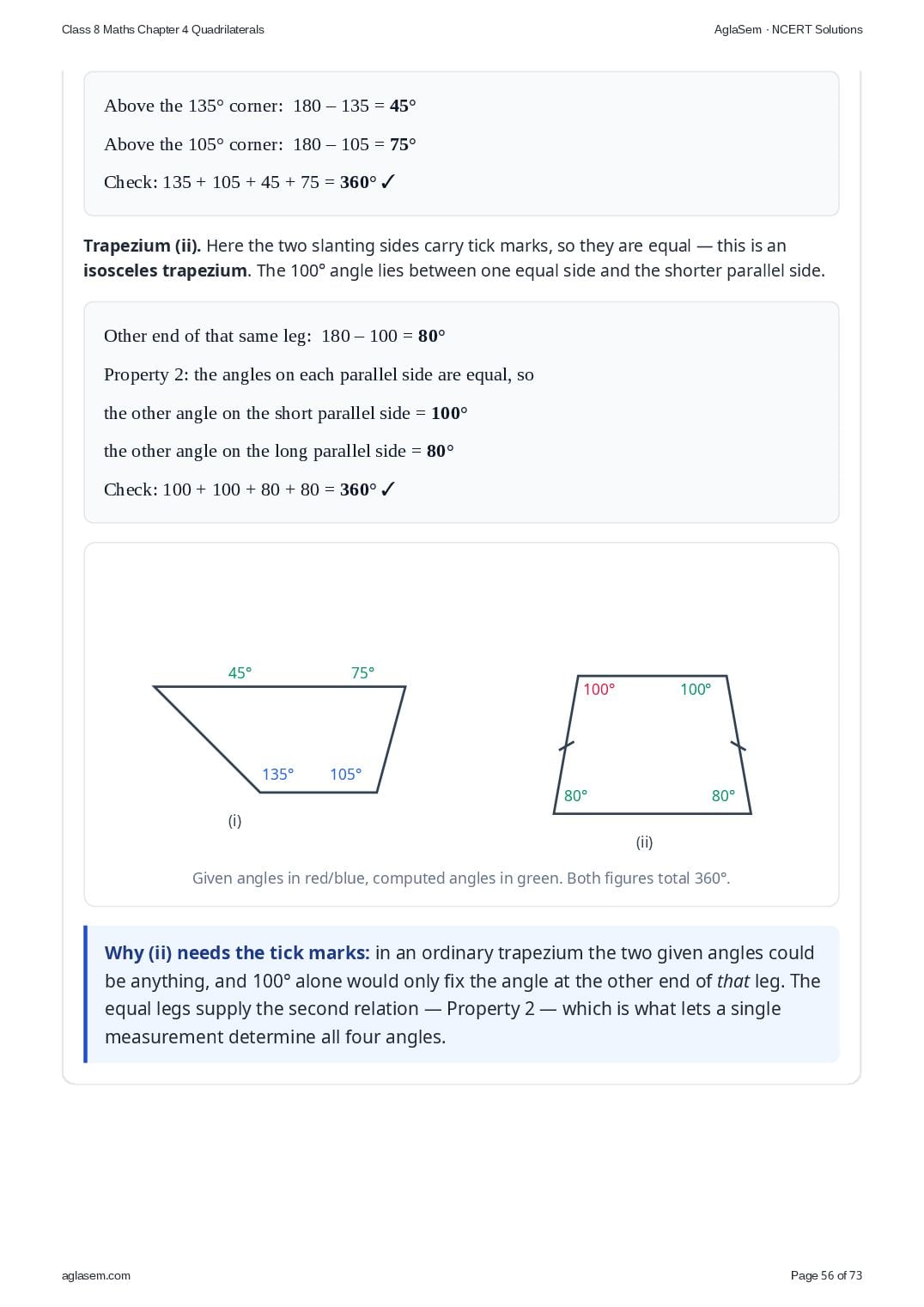
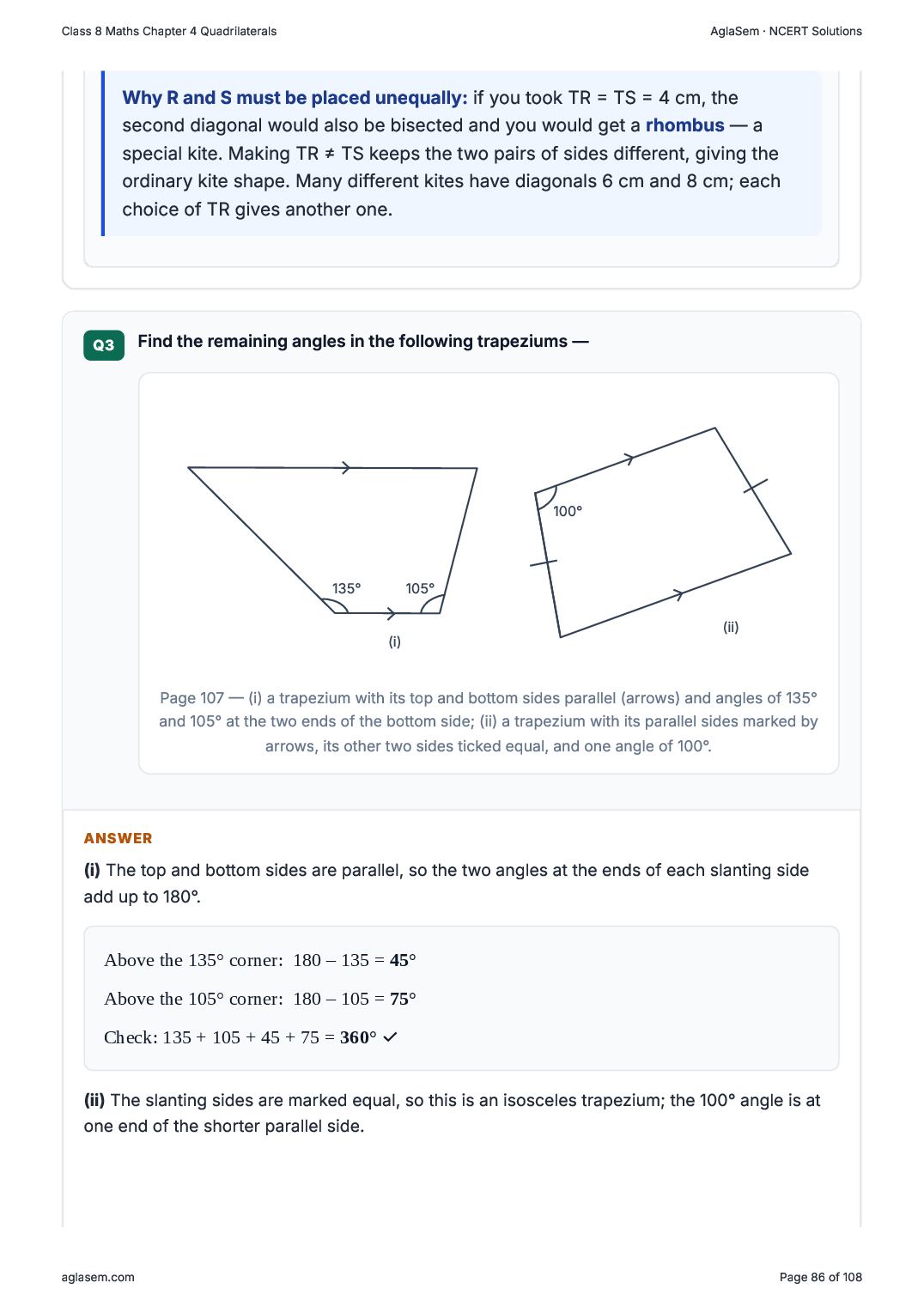
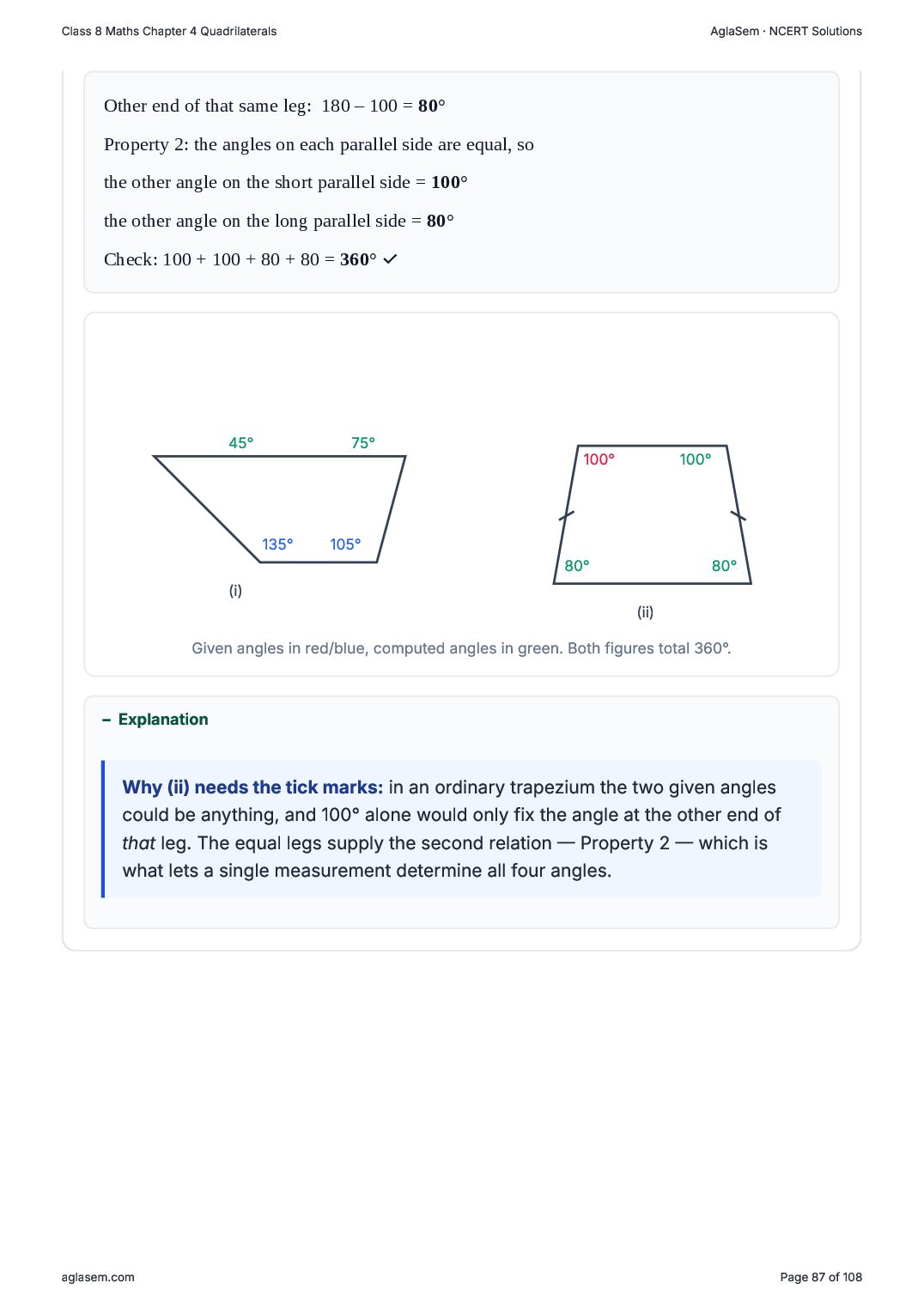
- Find the remaining angles in the following trapeziums —
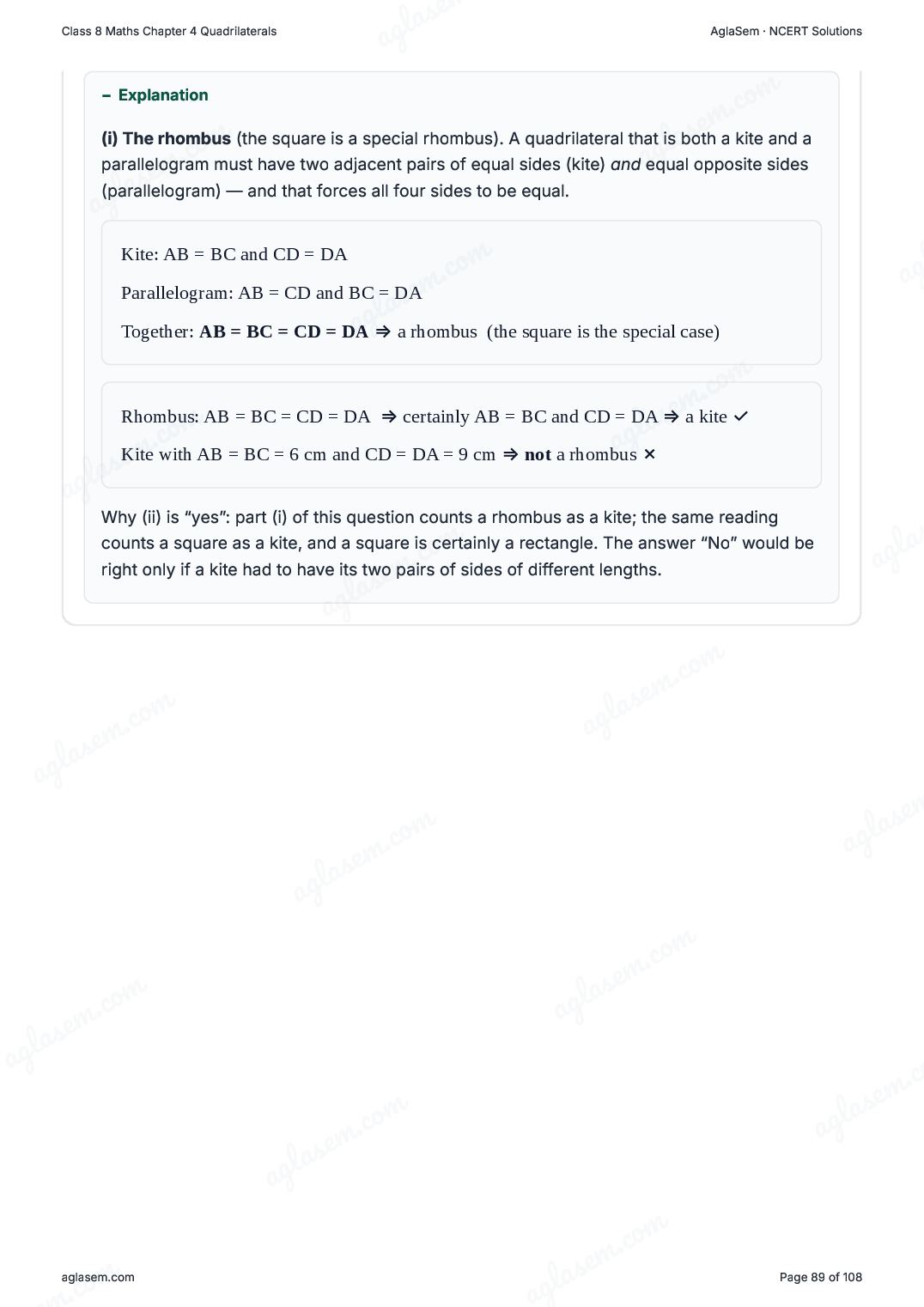
- Draw a Venn diagram showing the set of parallelograms, kites, rhombuses, rectangles, and squares. Then, answer the following questions — (i) What is the quadrilateral that is both a kite and a parallelogram? (ii) Can there be a quadrilateral that is both a kite and a rectangle? (iii) Is every kite a rhombus? If not, what is the correct relationship between these two types of quadrilaterals?
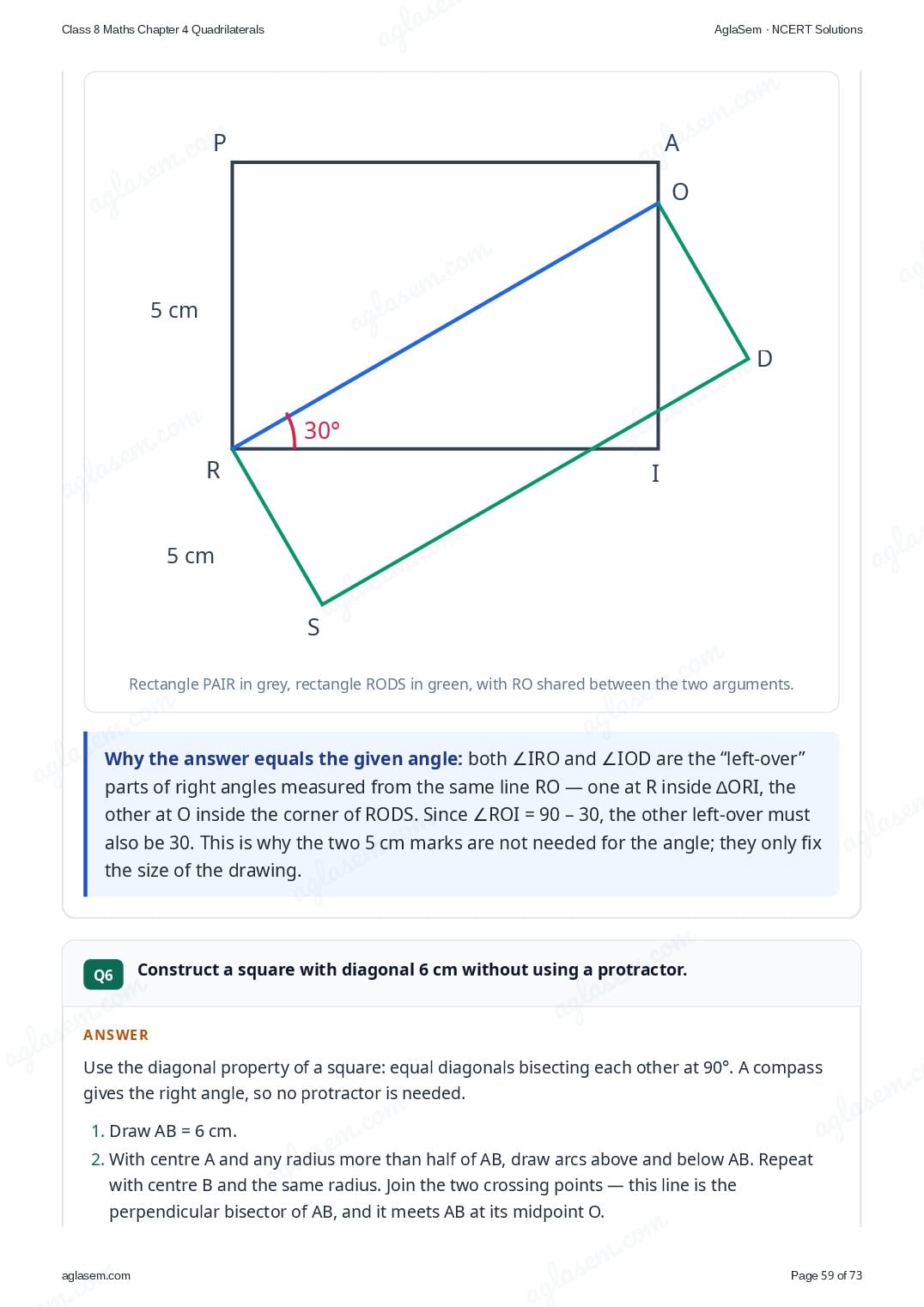
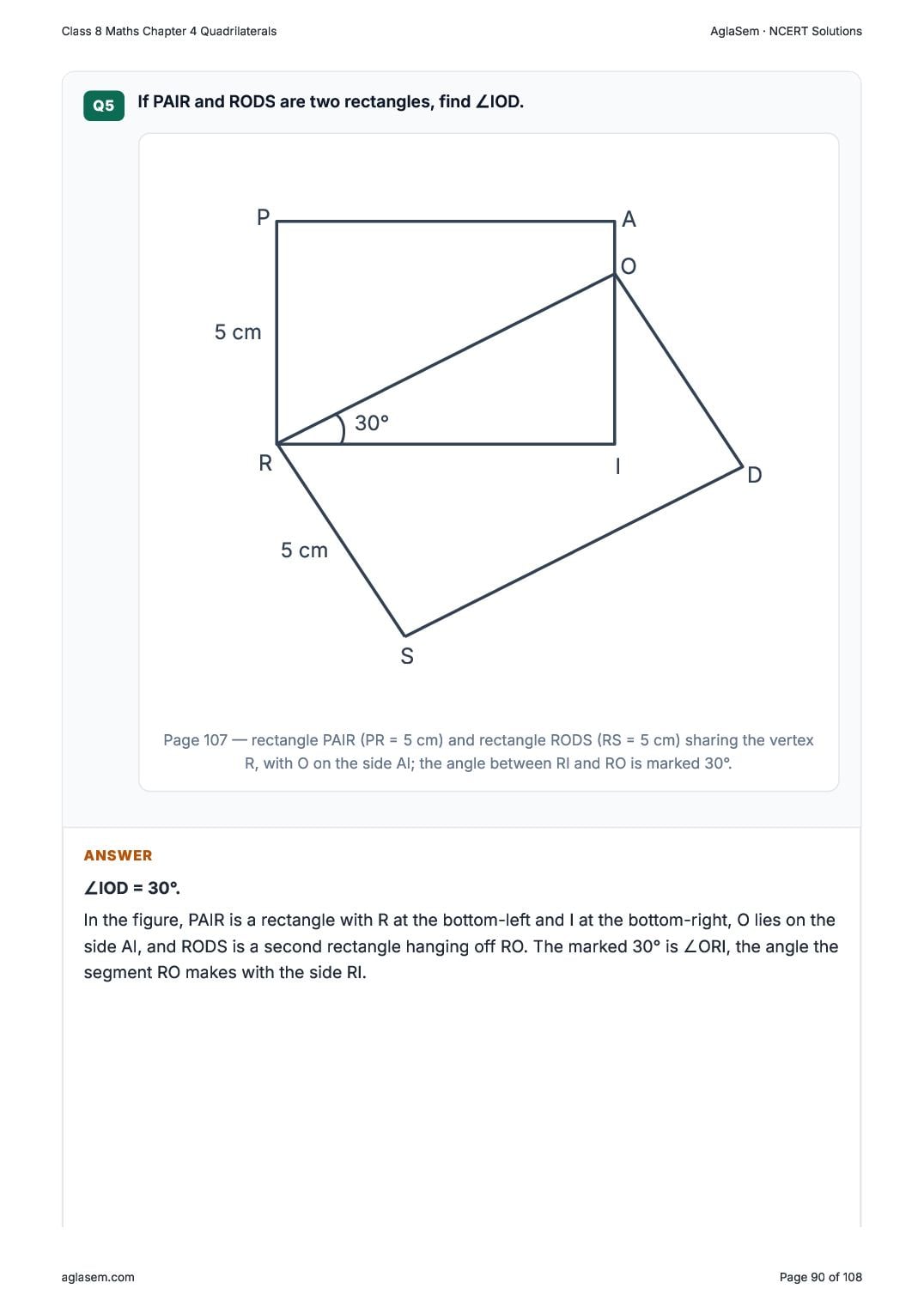
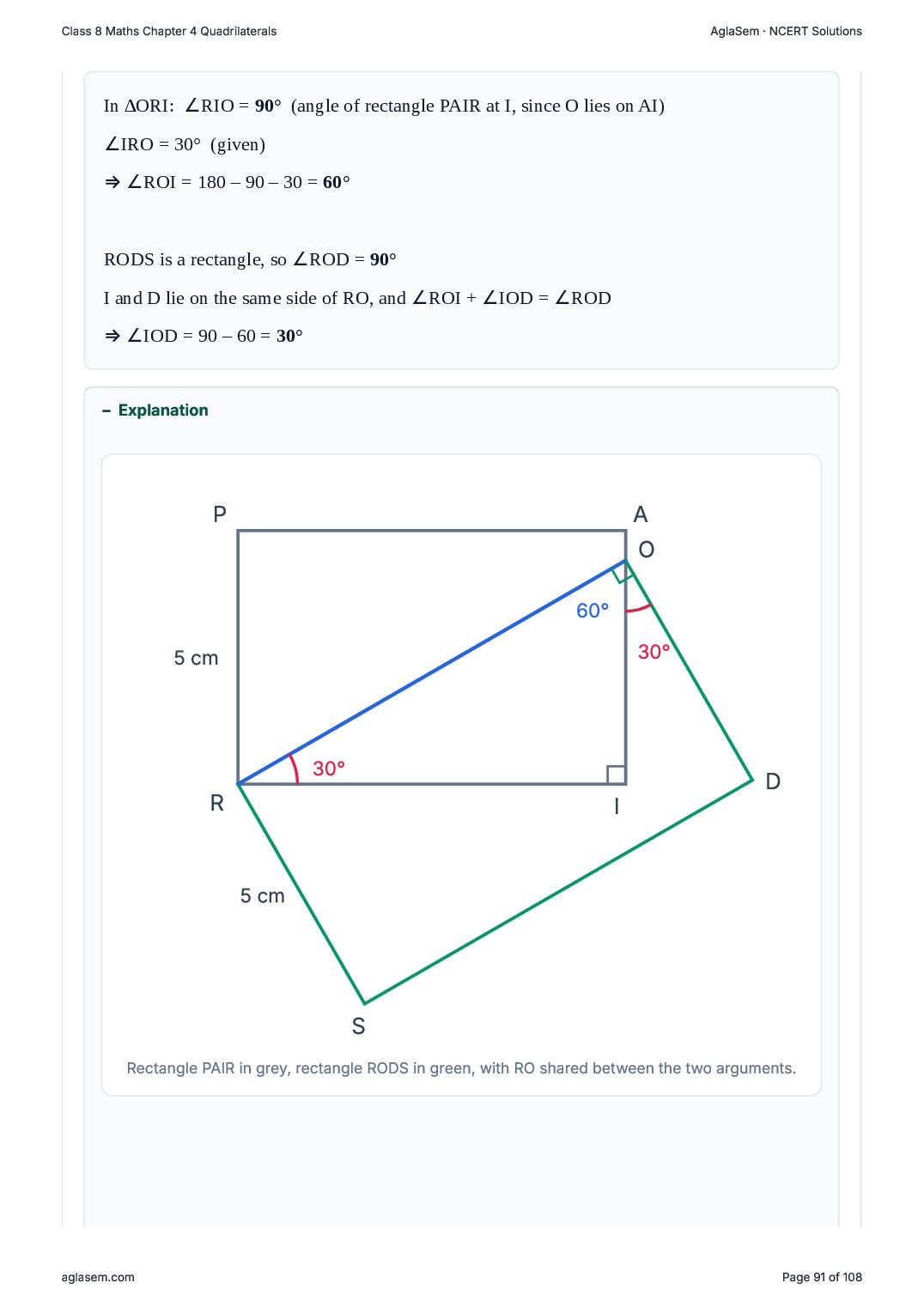
- If PAIR and RODS are two rectangles, find ∠IOD.
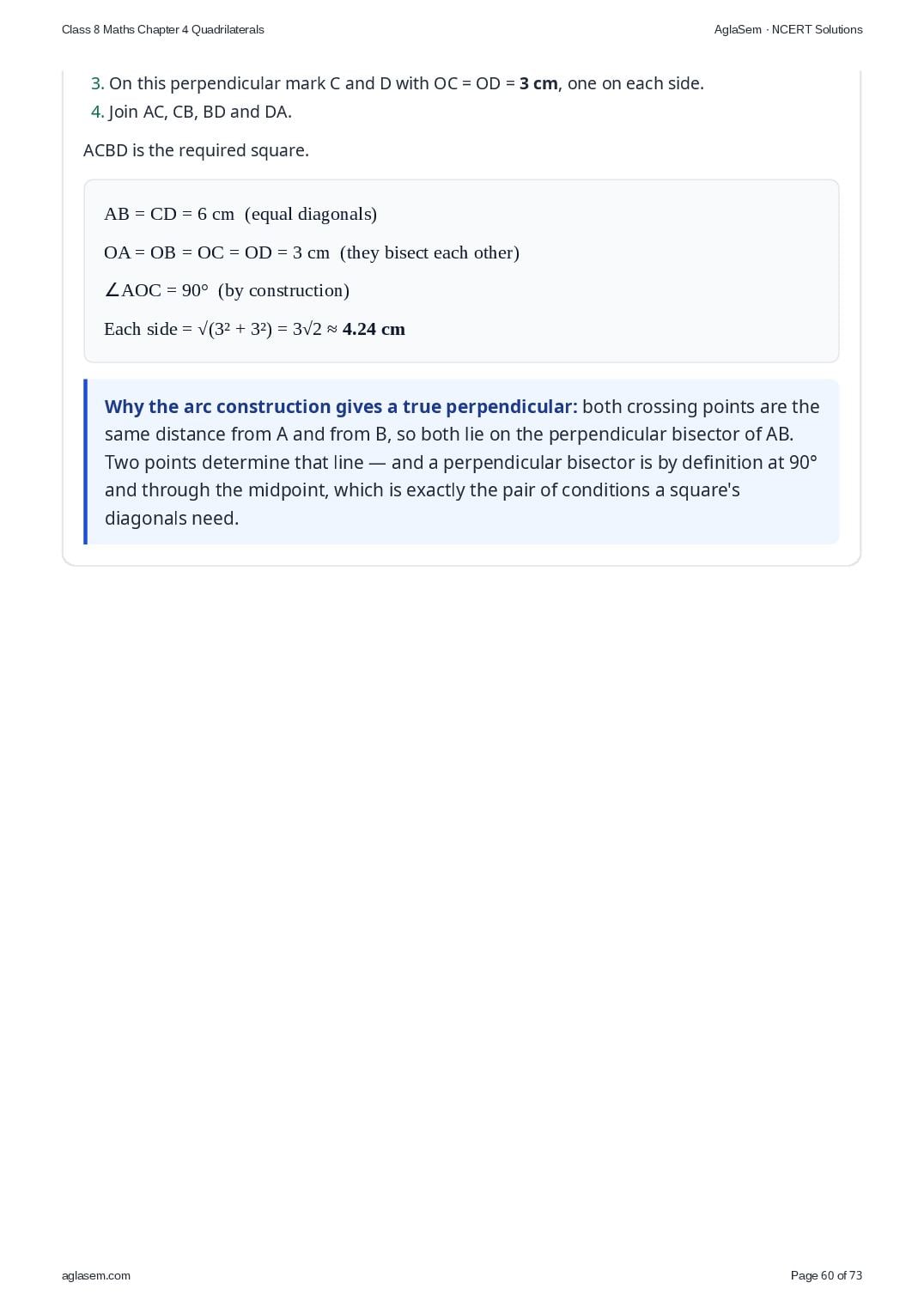
- Construct a square with diagonal 6 cm without using a protractor.
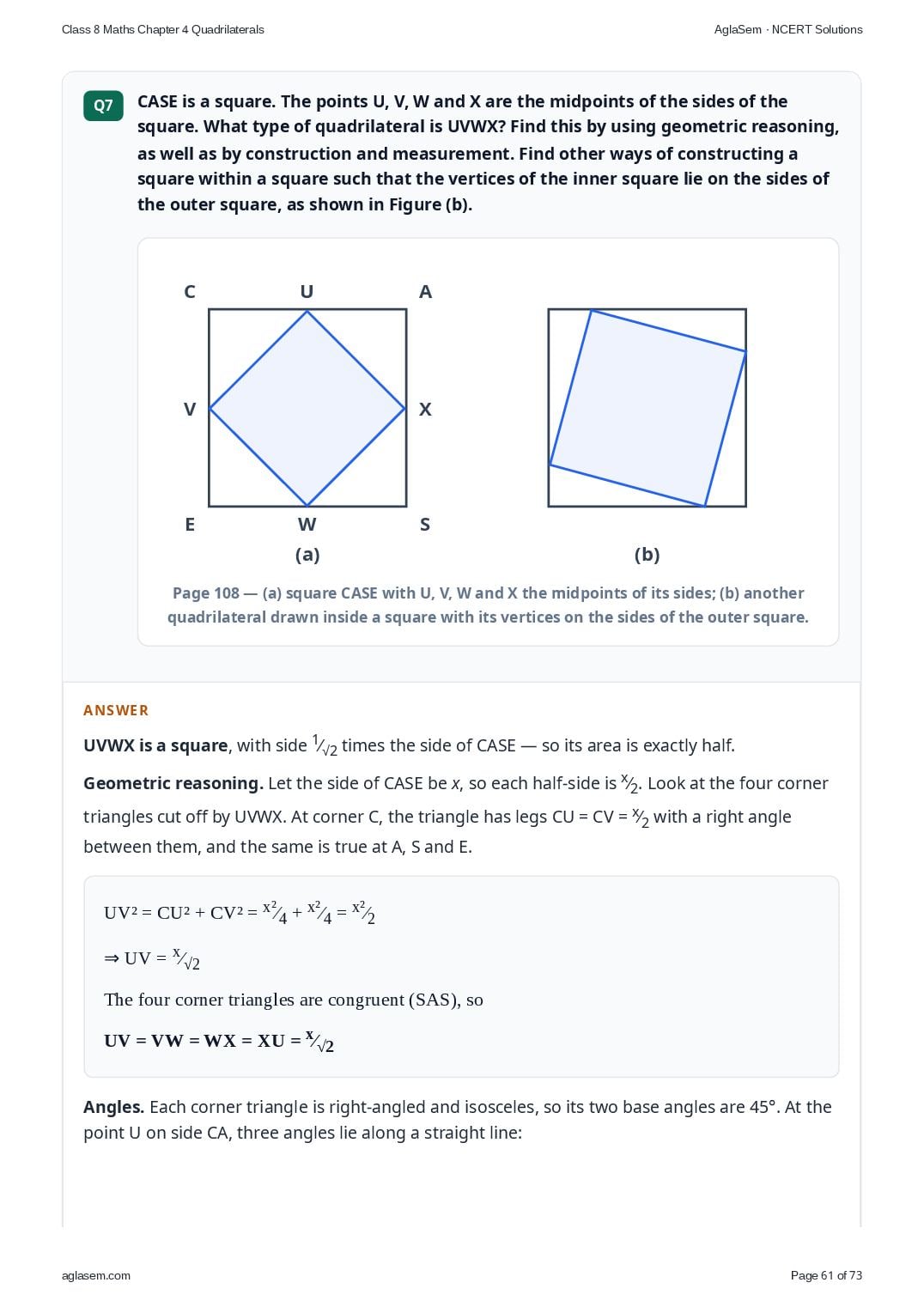
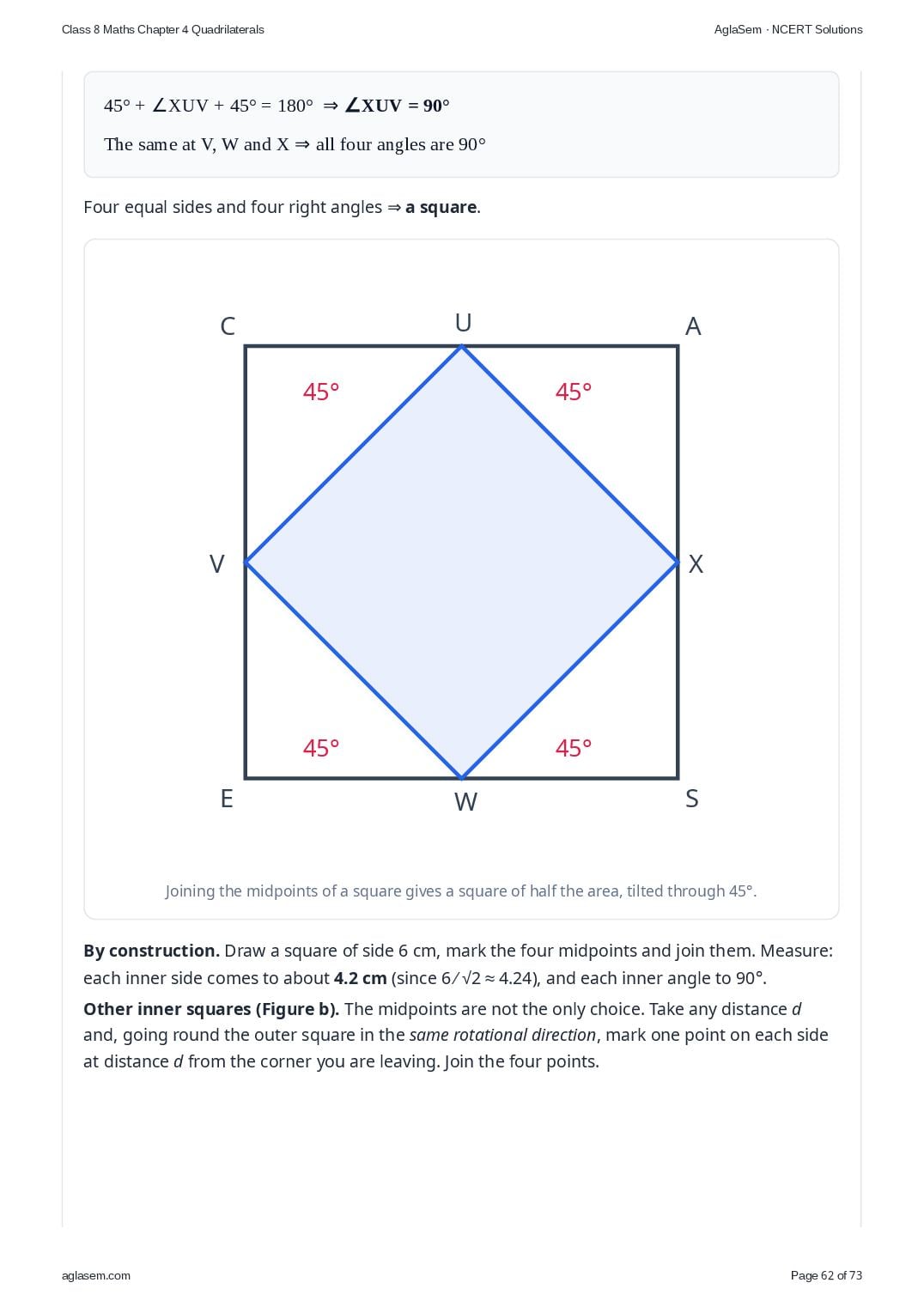
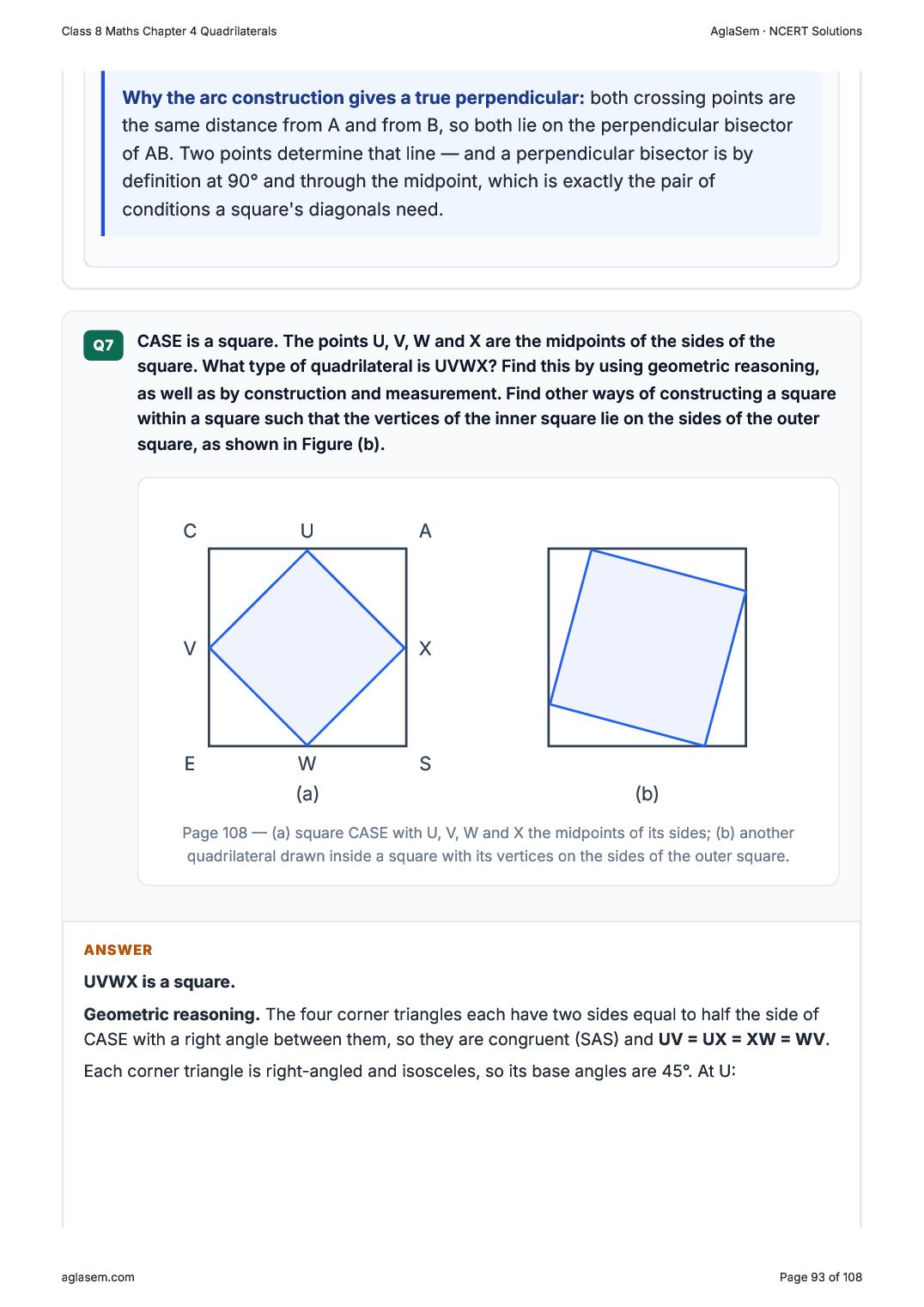
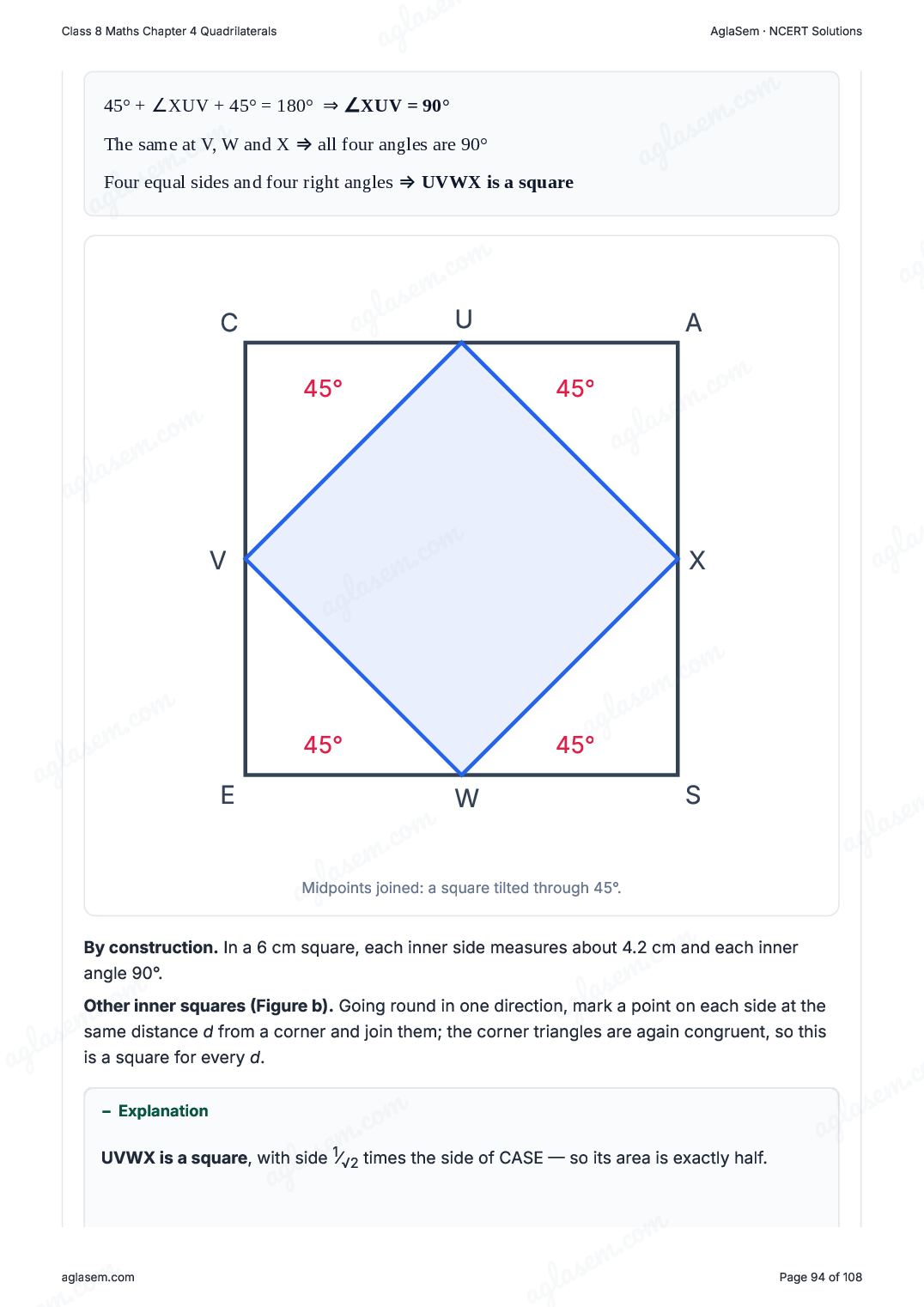
- CASE is a square. The points U, V, W and X are the midpoints of the sides of the square. What type of quadrilateral is UVWX? Find this by using geometric reasoning, as well as by construction and measurement. Find other ways of constructing a square within a square such that the vertices of the inner square lie on the sides of the outer square, as shown in Figure (b).
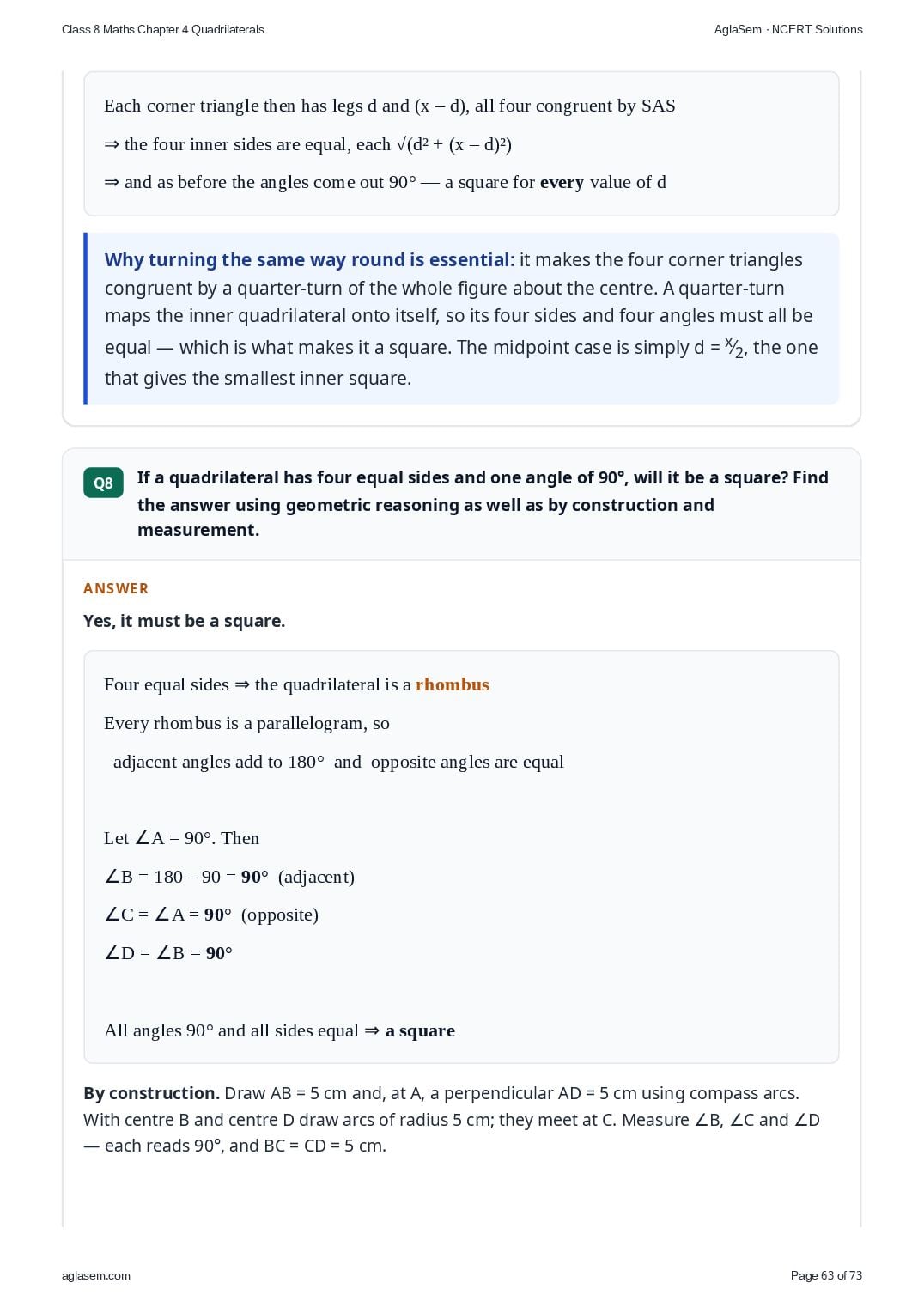
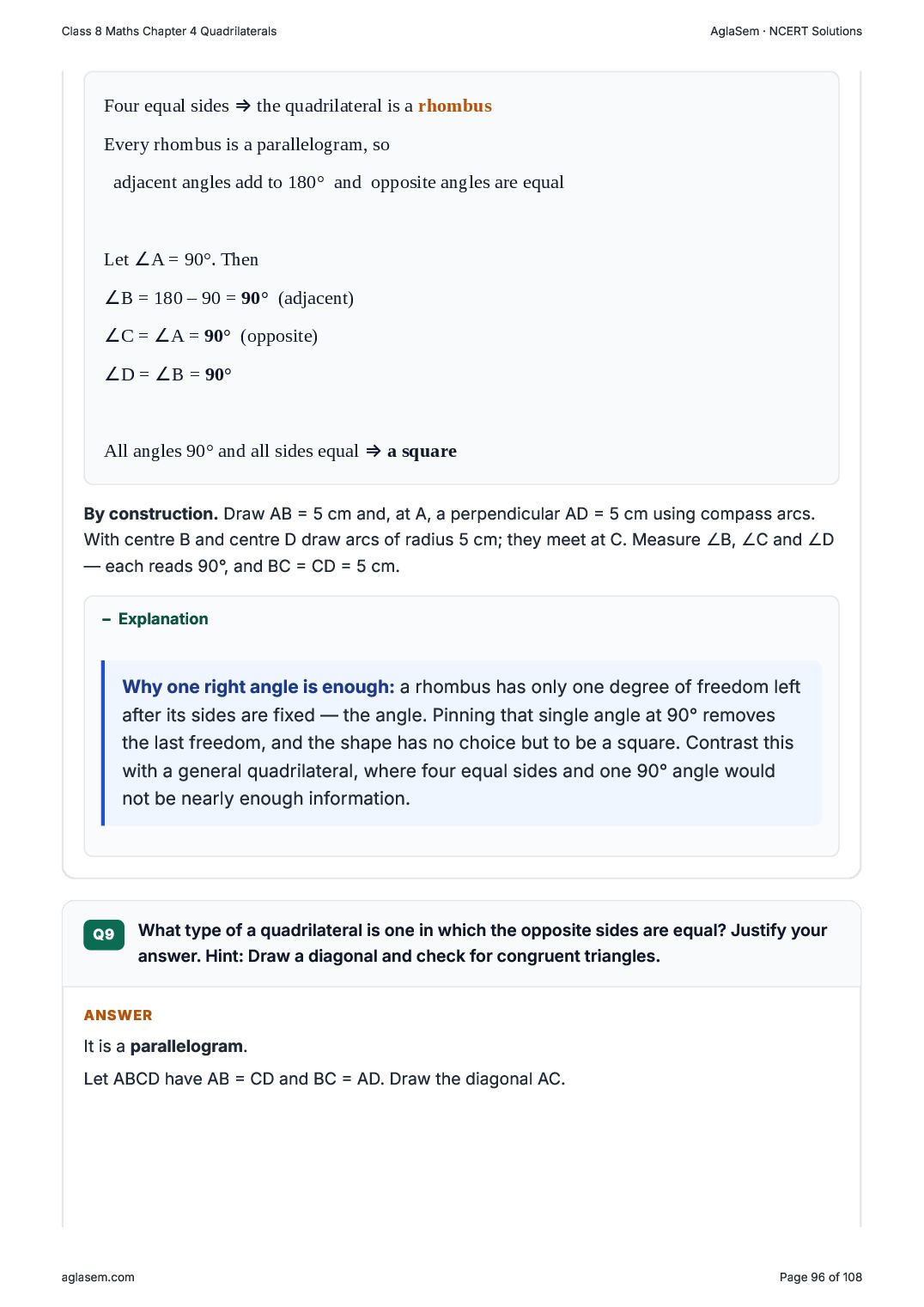
- If a quadrilateral has four equal sides and one angle of 90°, will it be a square? Find the answer using geometric reasoning as well as by construction and measurement.
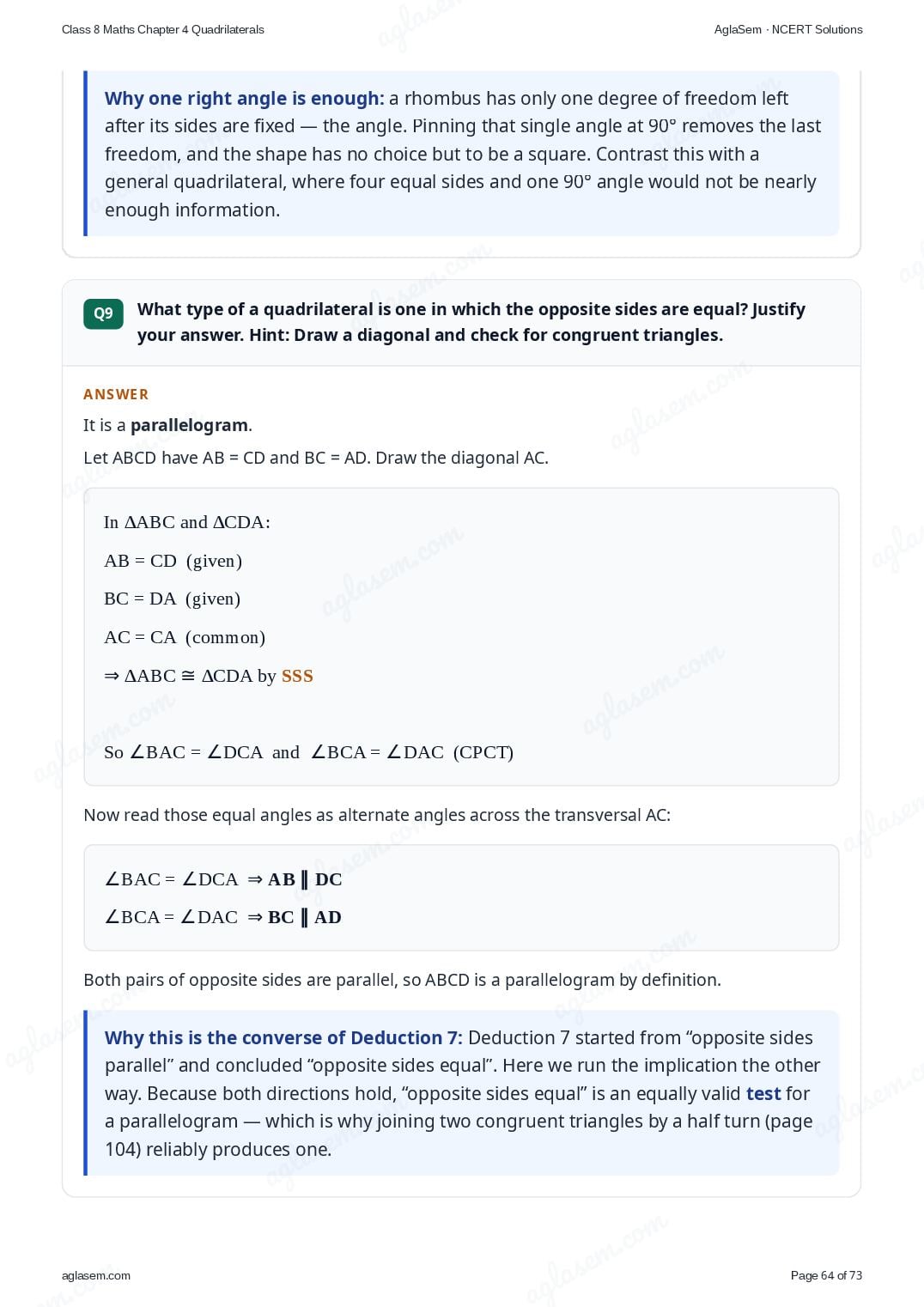
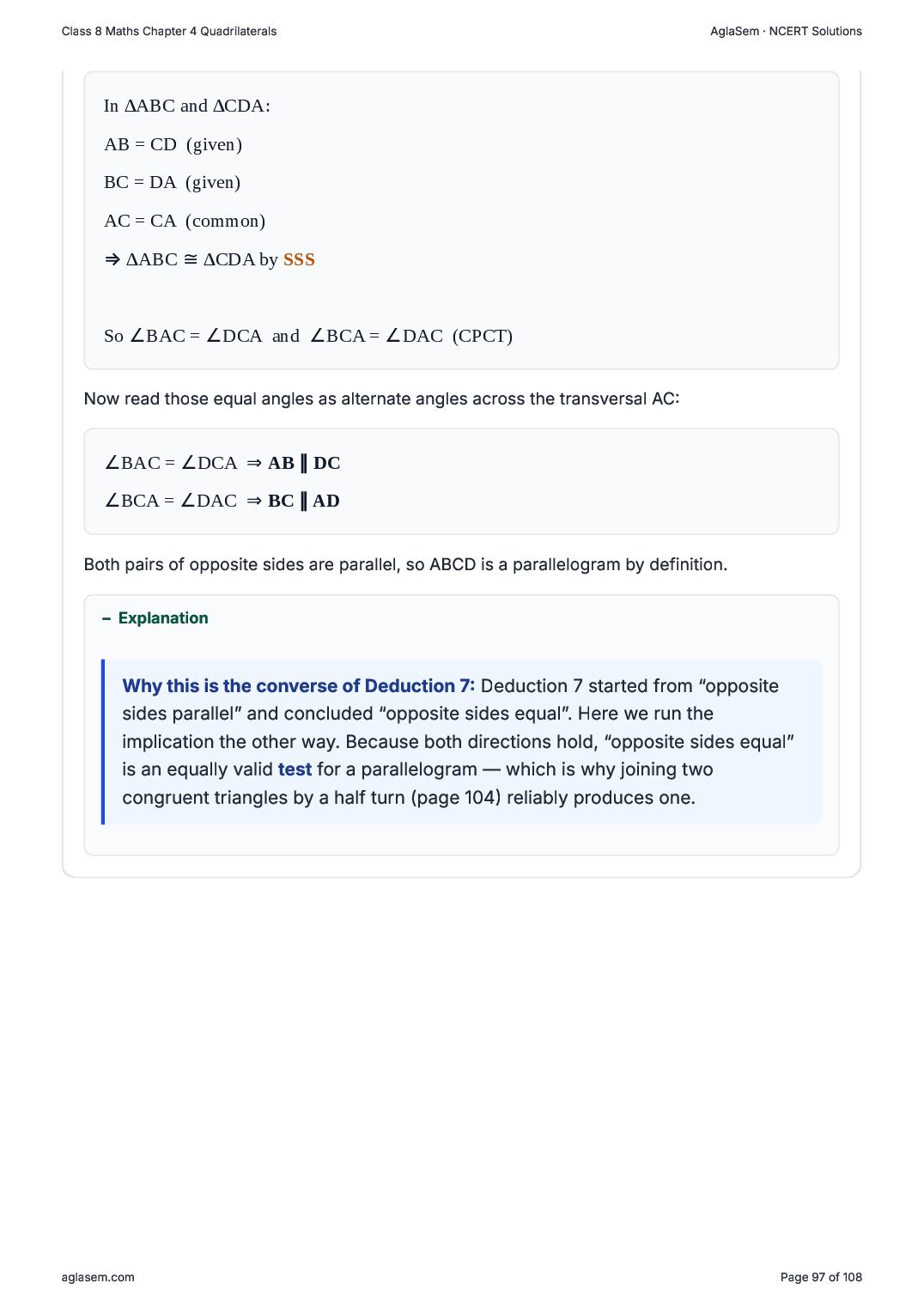
- What type of a quadrilateral is one in which the opposite sides are equal? Justify your answer. Hint: Draw a diagonal and check for congruent triangles.
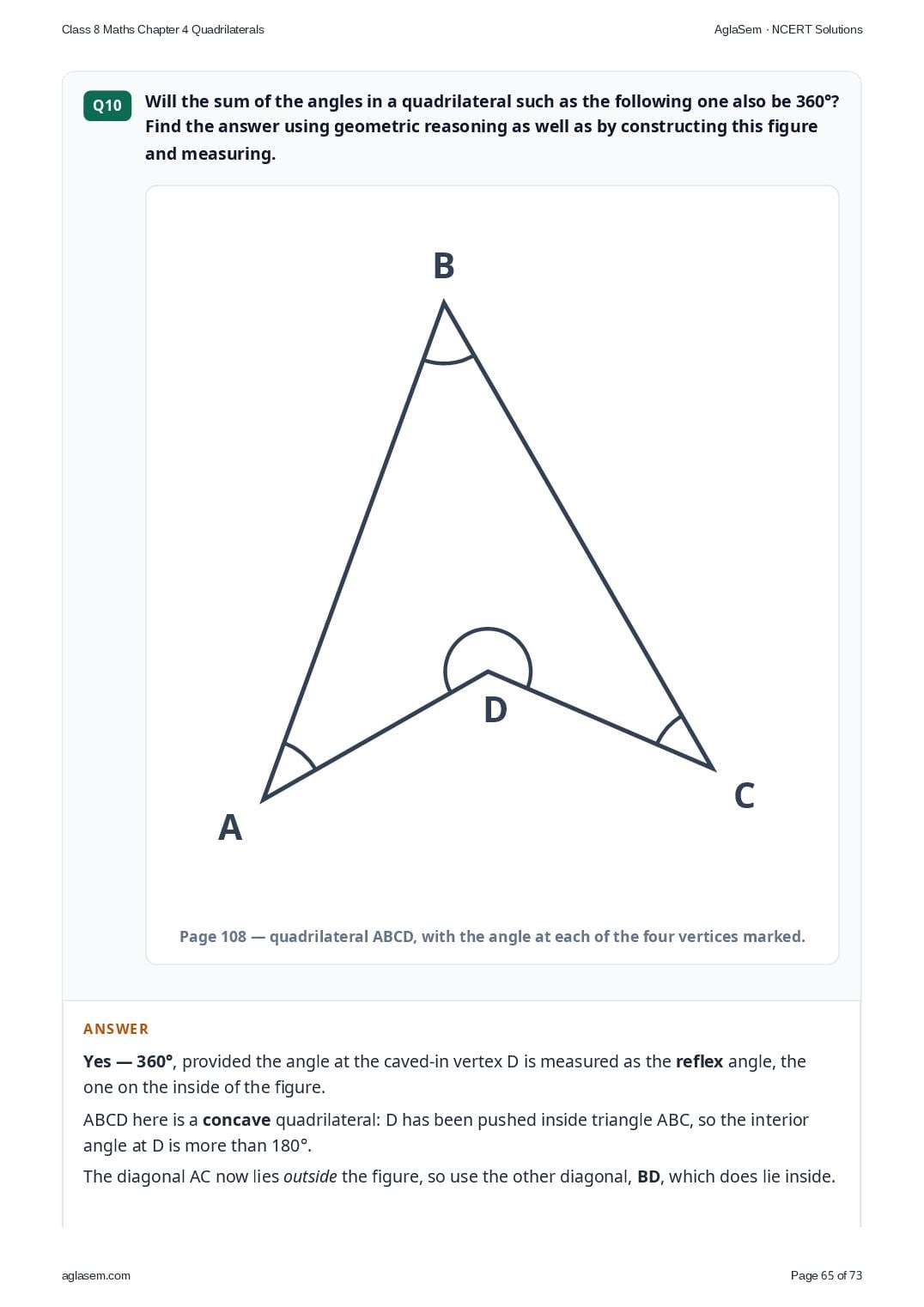
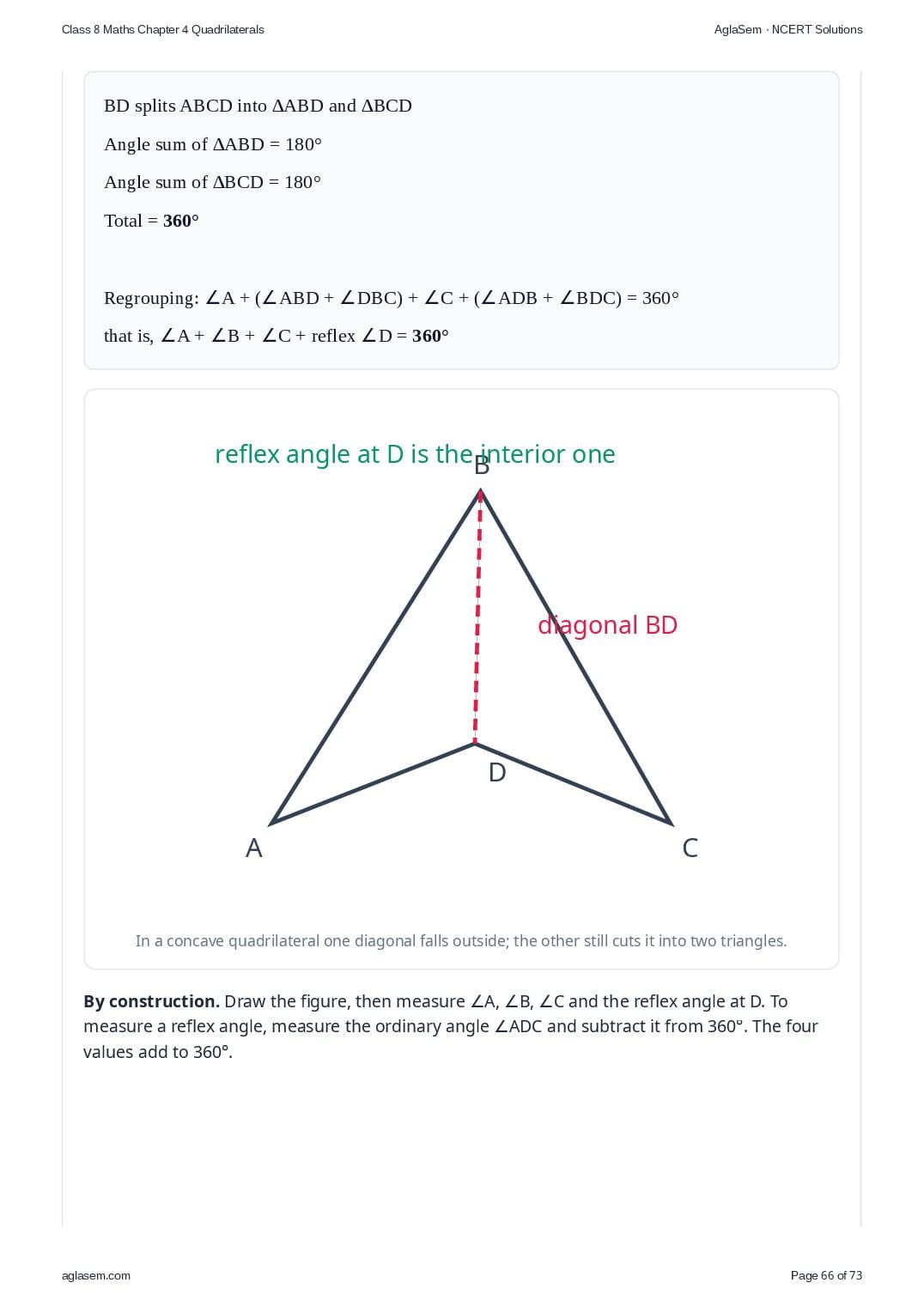
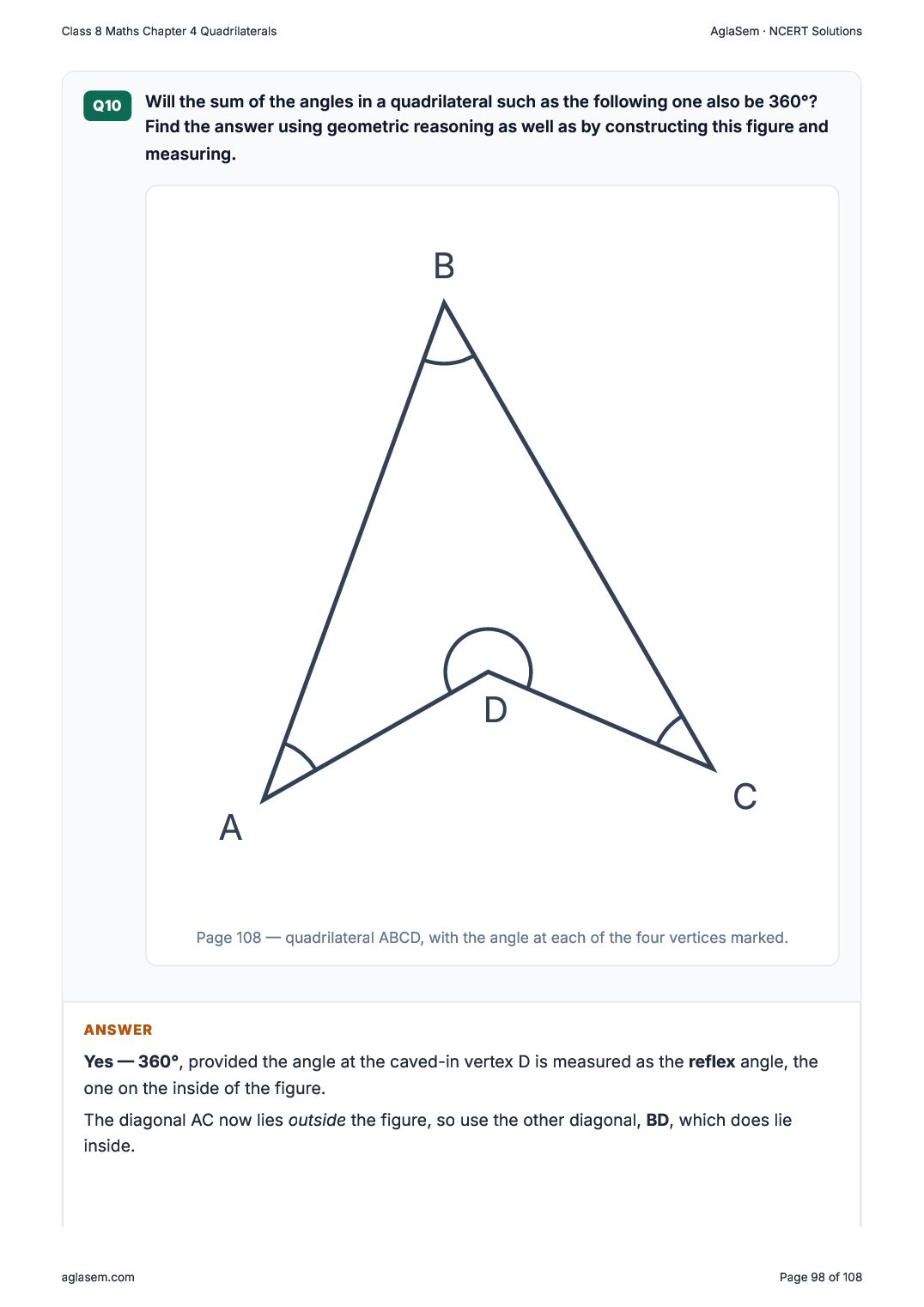
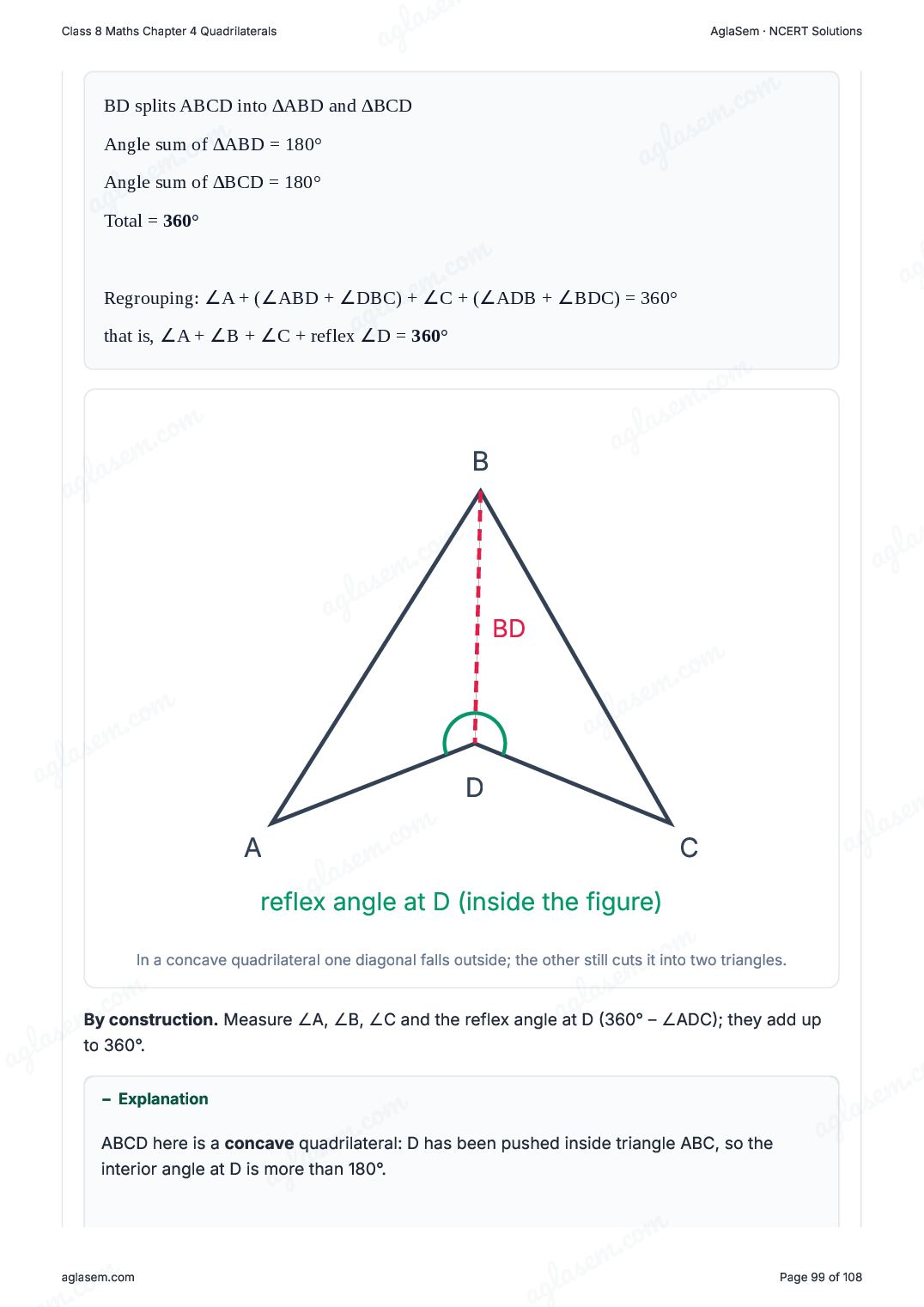
- Will the sum of the angles in a quadrilateral such as the following one also be 360°? Find the answer using geometric reasoning as well as by constructing this figure and measuring.
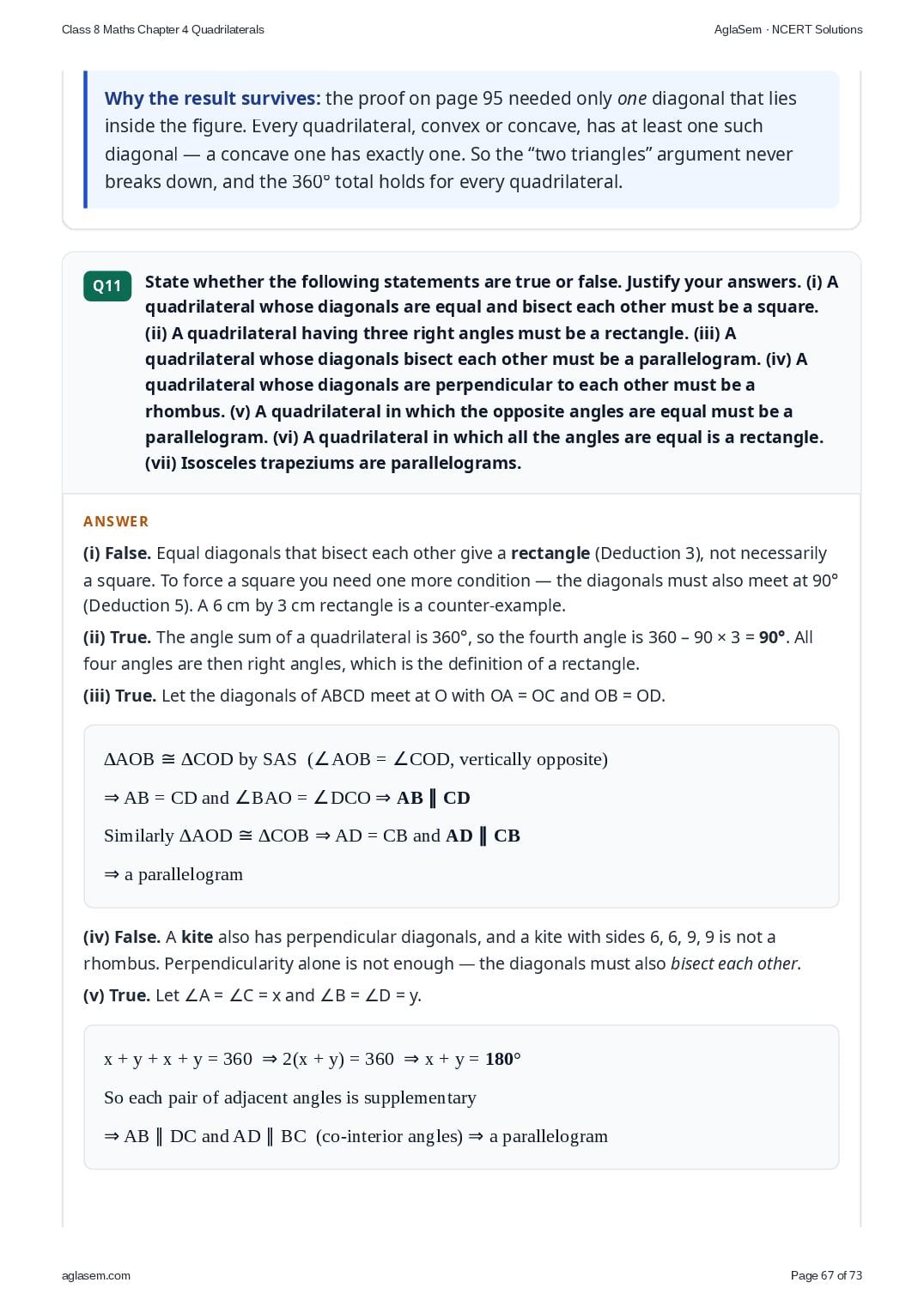
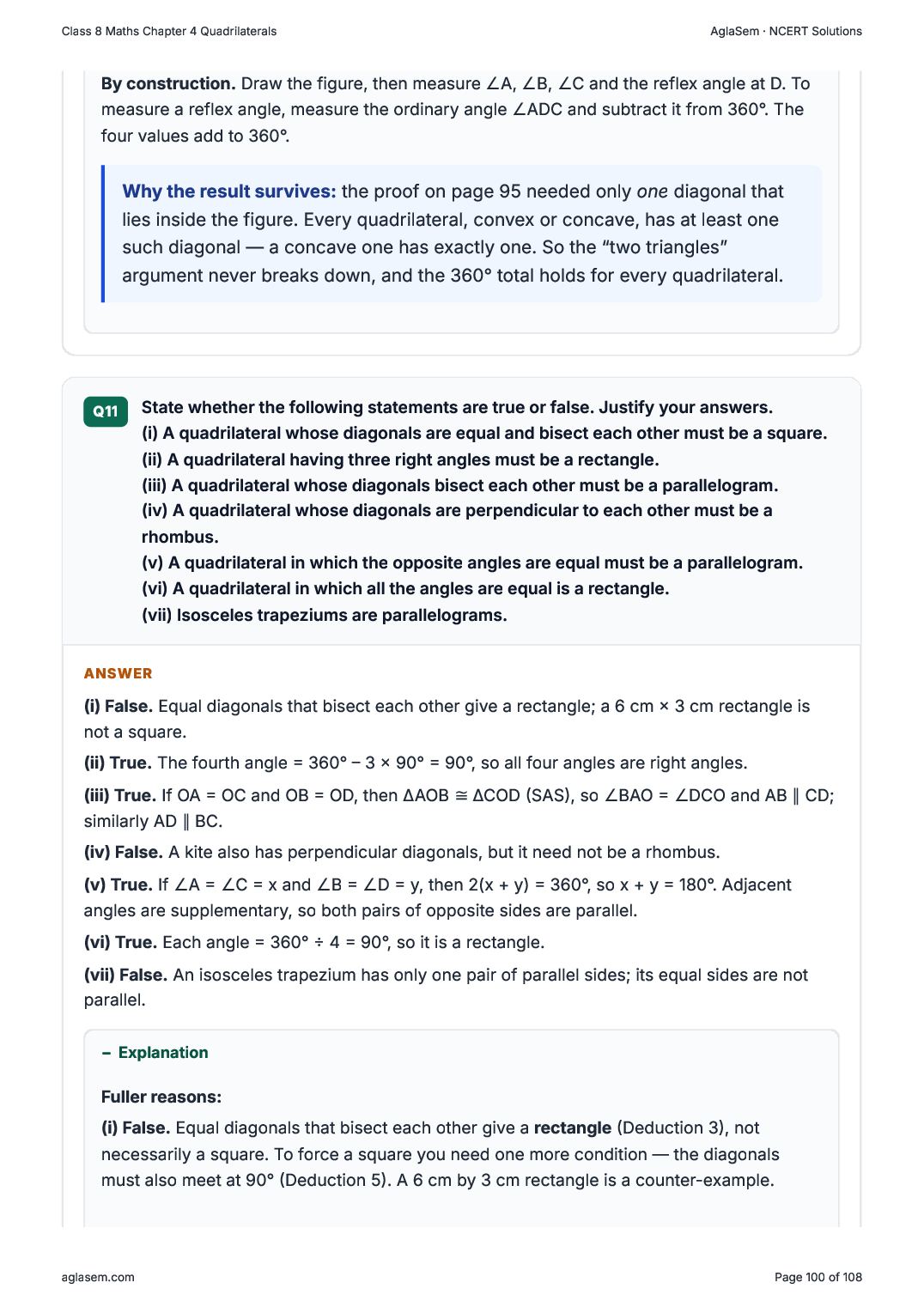
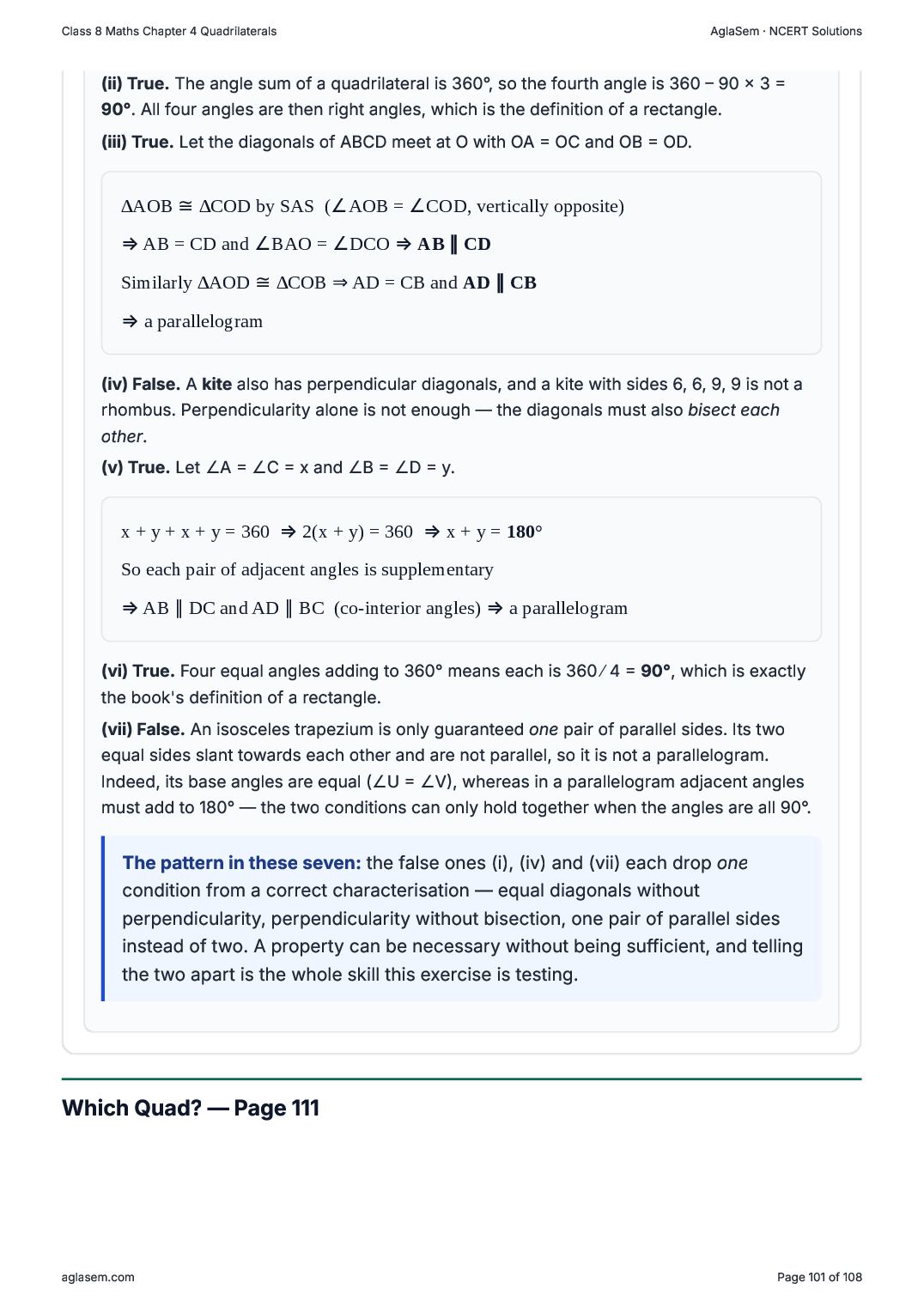
- State whether the following statements are true or false. Justify your answers. (i) A quadrilateral whose diagonals are equal and bisect each other must be a square. (ii) A quadrilateral having three right angles must be a rectangle. (iii) A quadrilateral whose diagonals bisect each other must be a parallelogram. (iv) A quadrilateral whose diagonals are perpendicular to each other must be a rhombus. (v) A quadrilateral in which the opposite angles are equal must be a parallelogram. (vi) A quadrilateral in which all the angles are equal is a rectangle. (vii) Isosceles trapeziums are parallelograms.
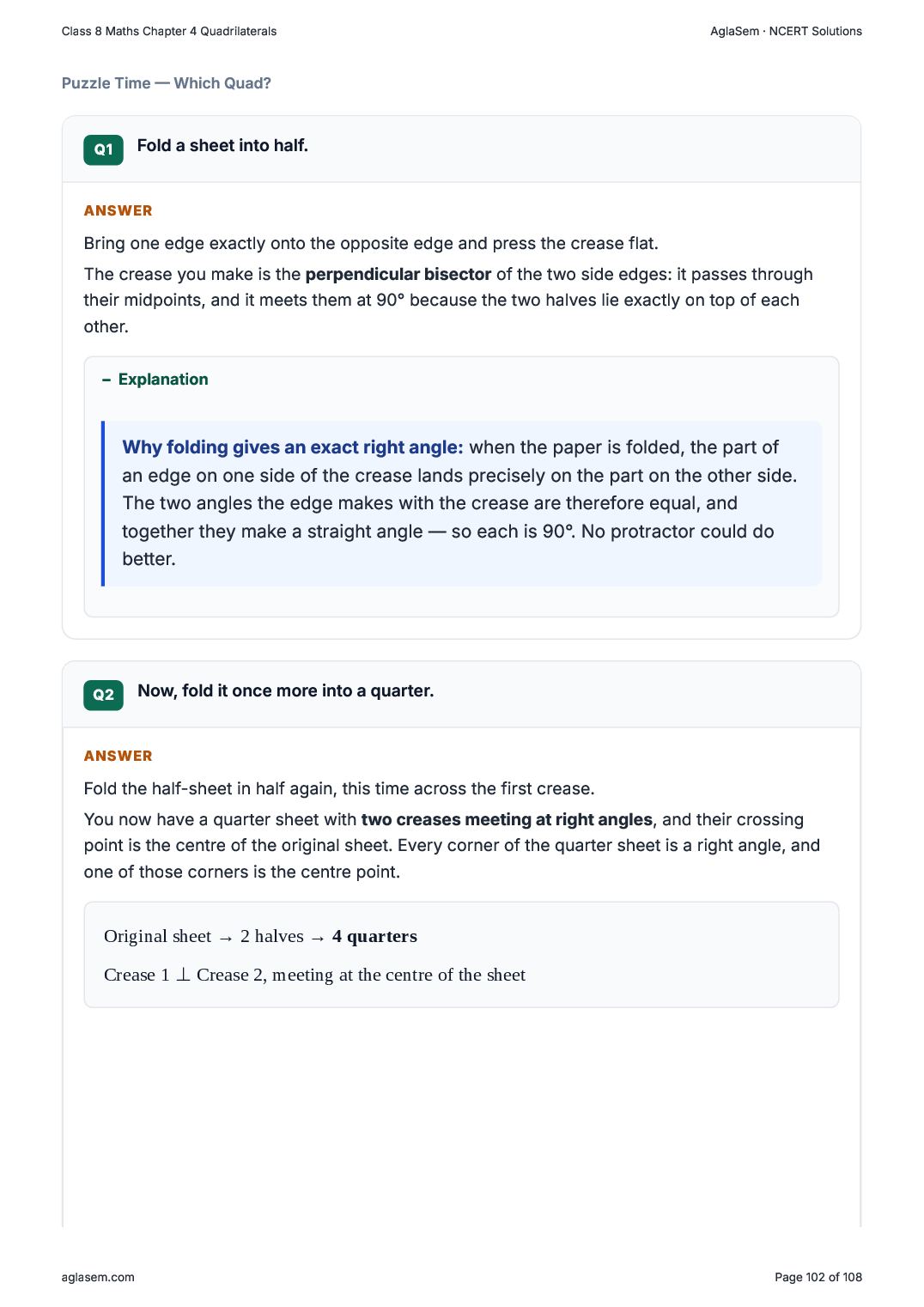
- Fold a sheet into half.
- Now, fold it once more into a quarter.
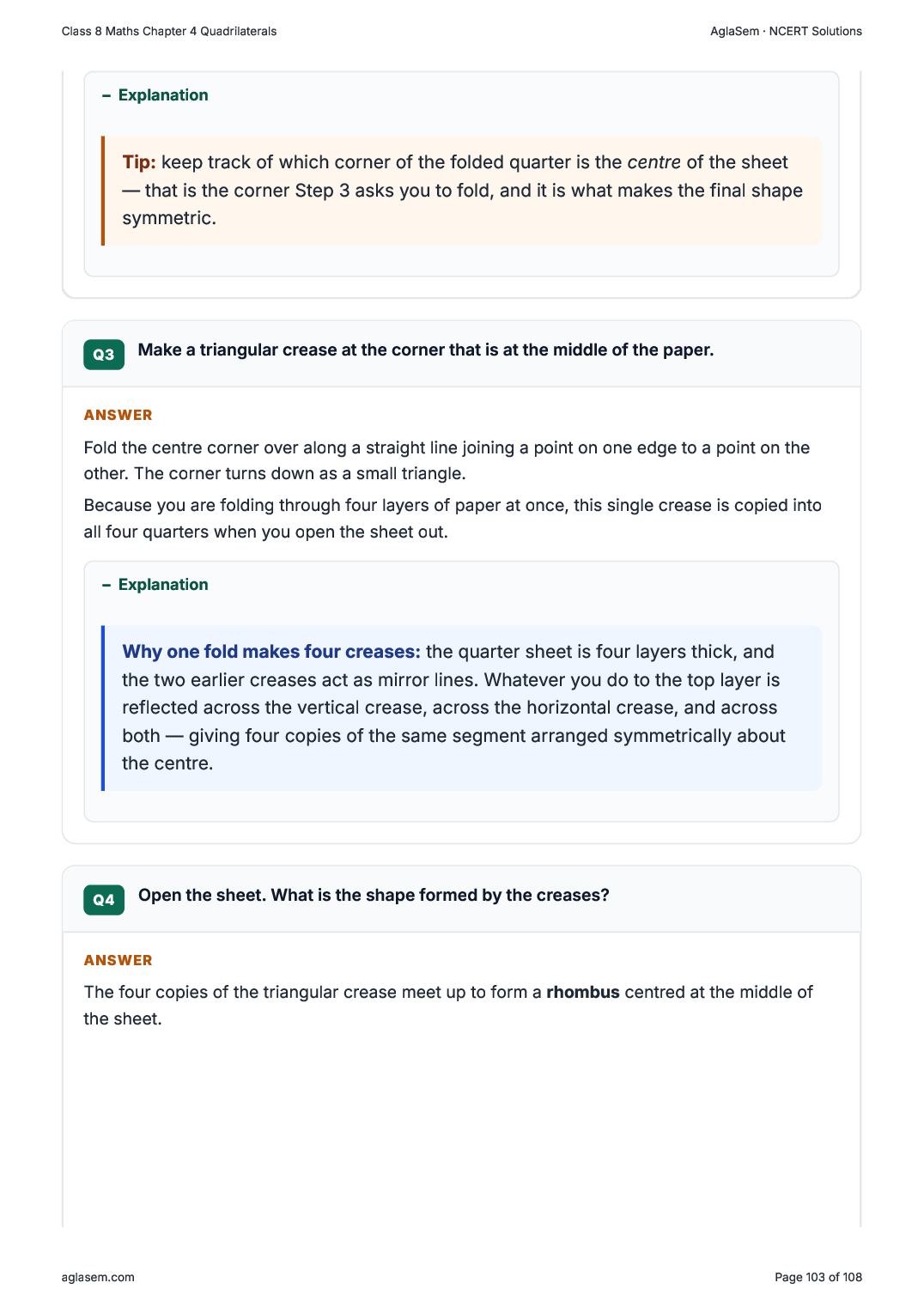
- Make a triangular crease at the corner that is at the middle of the paper.
- Open the sheet. What is the shape formed by the creases?
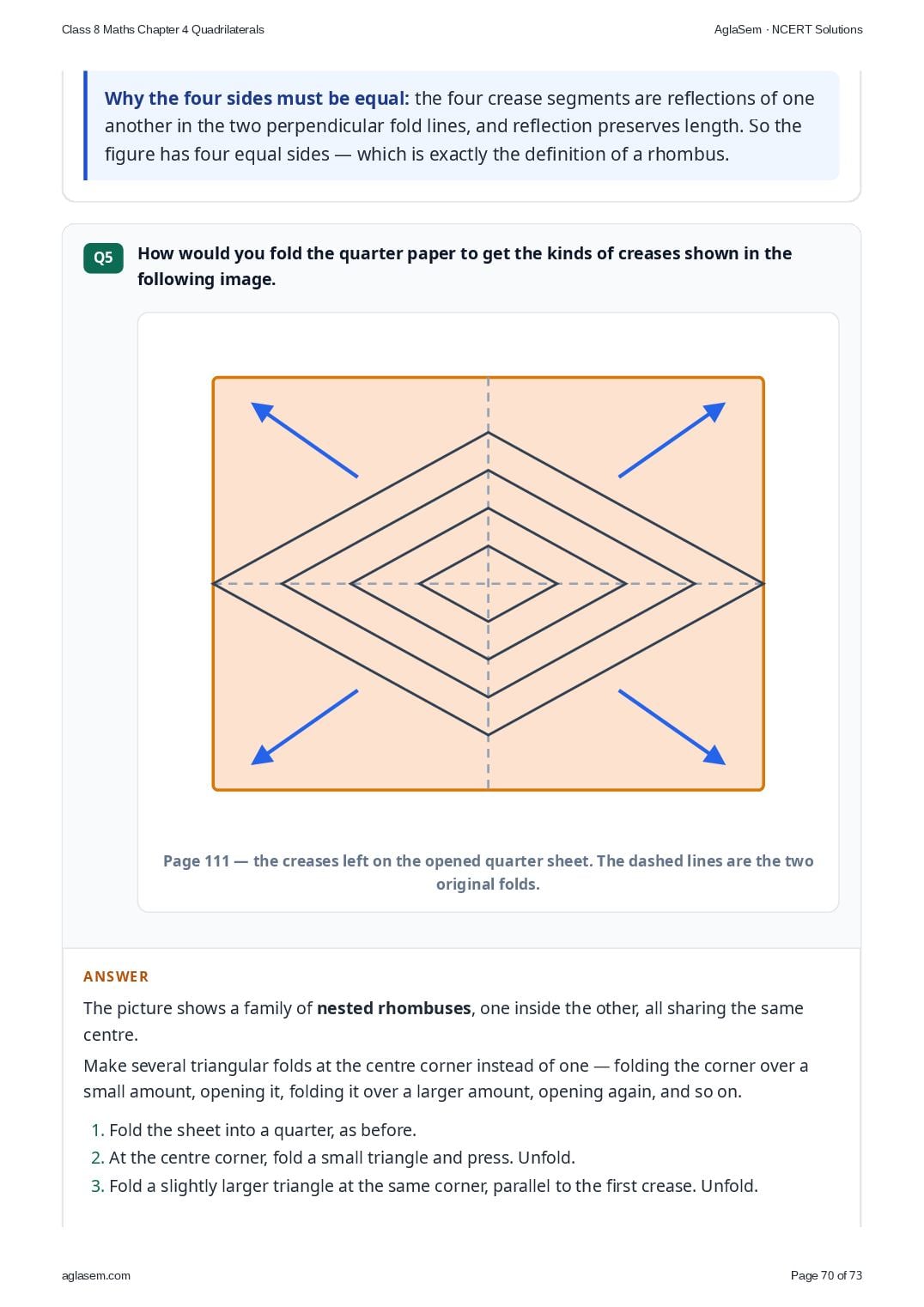
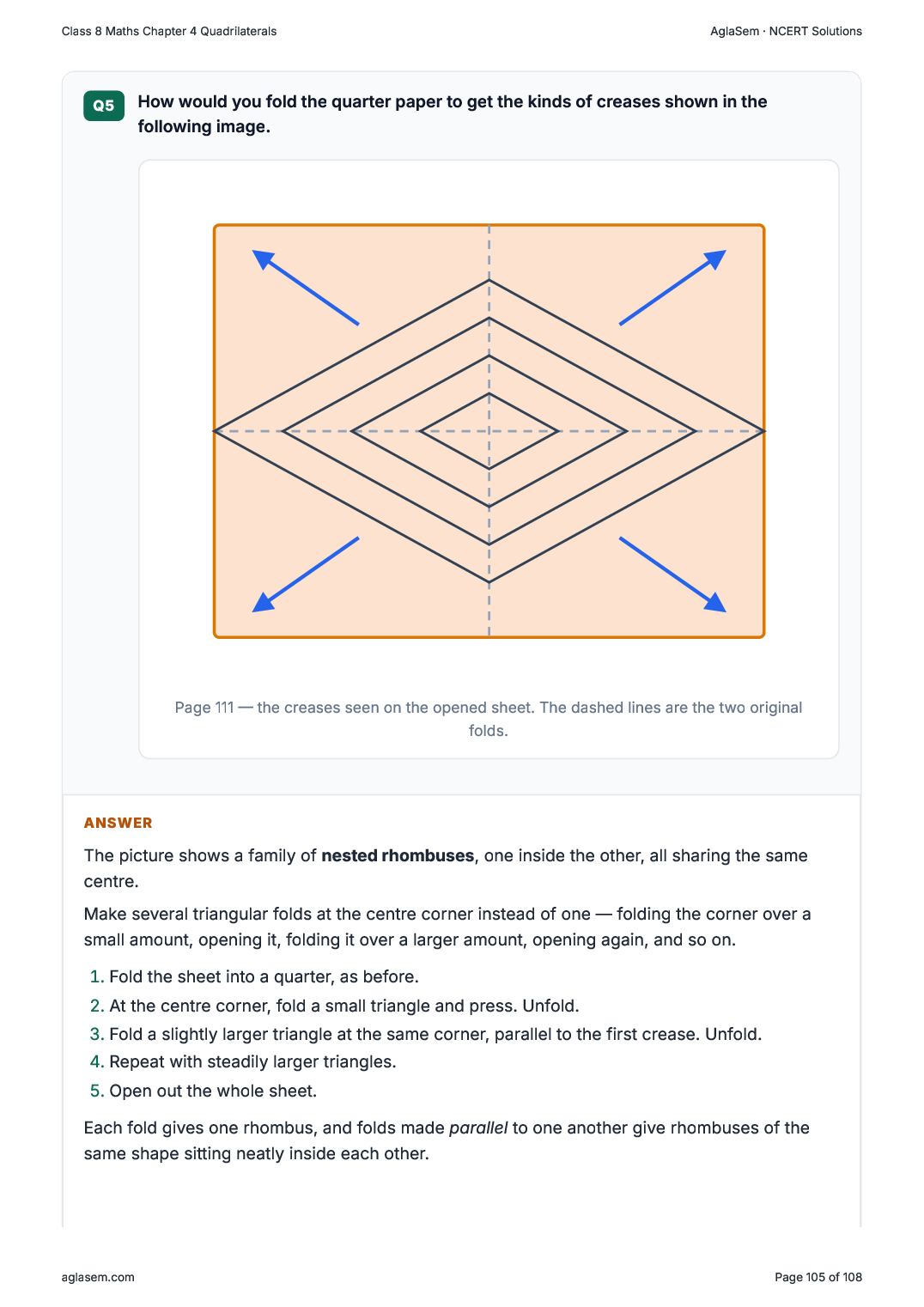
- How would you fold the quarter paper to get the kinds of creases shown in the following image.
- How would you fold the quarter paper such that a square is formed?
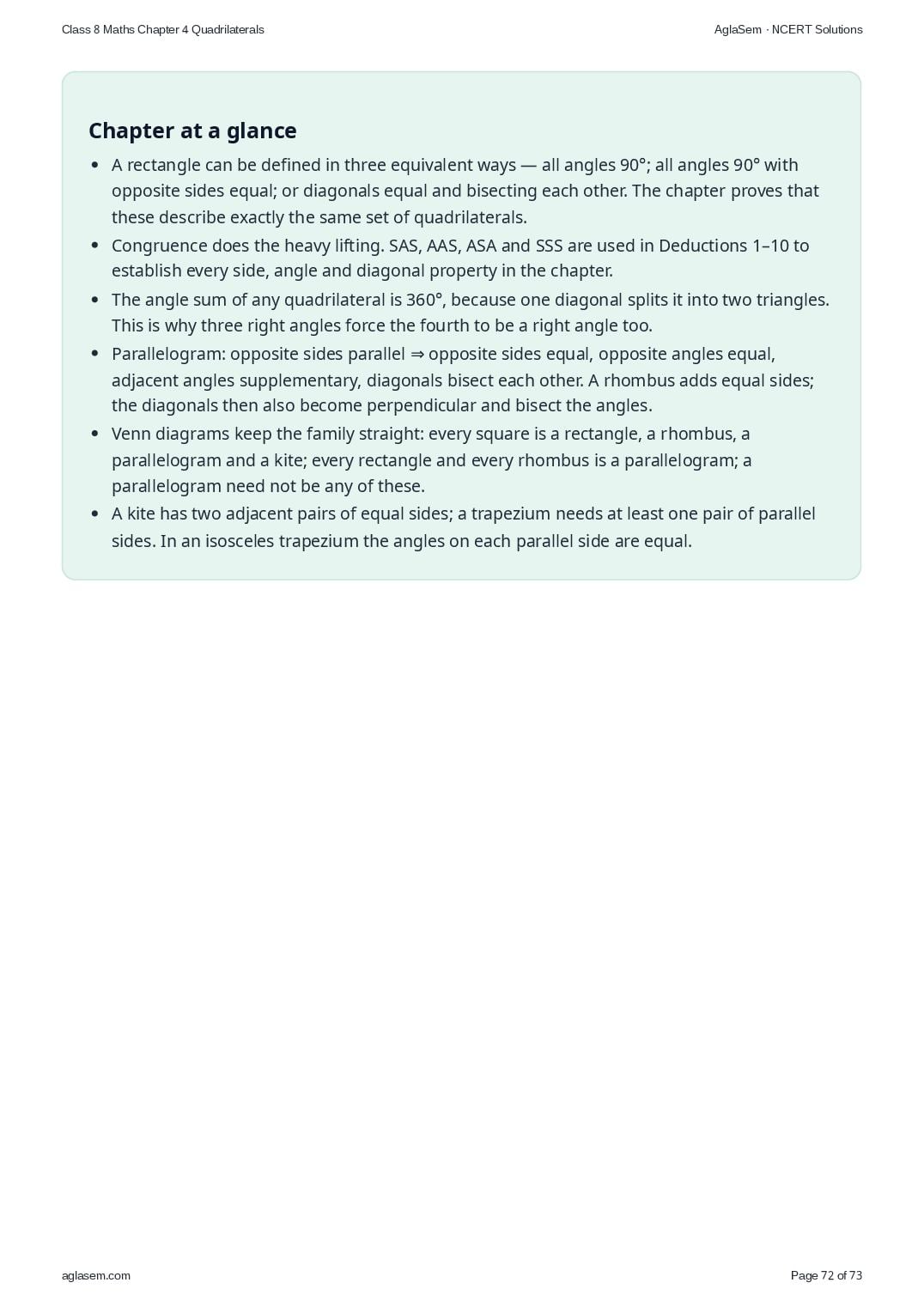
Chapter at a Glance
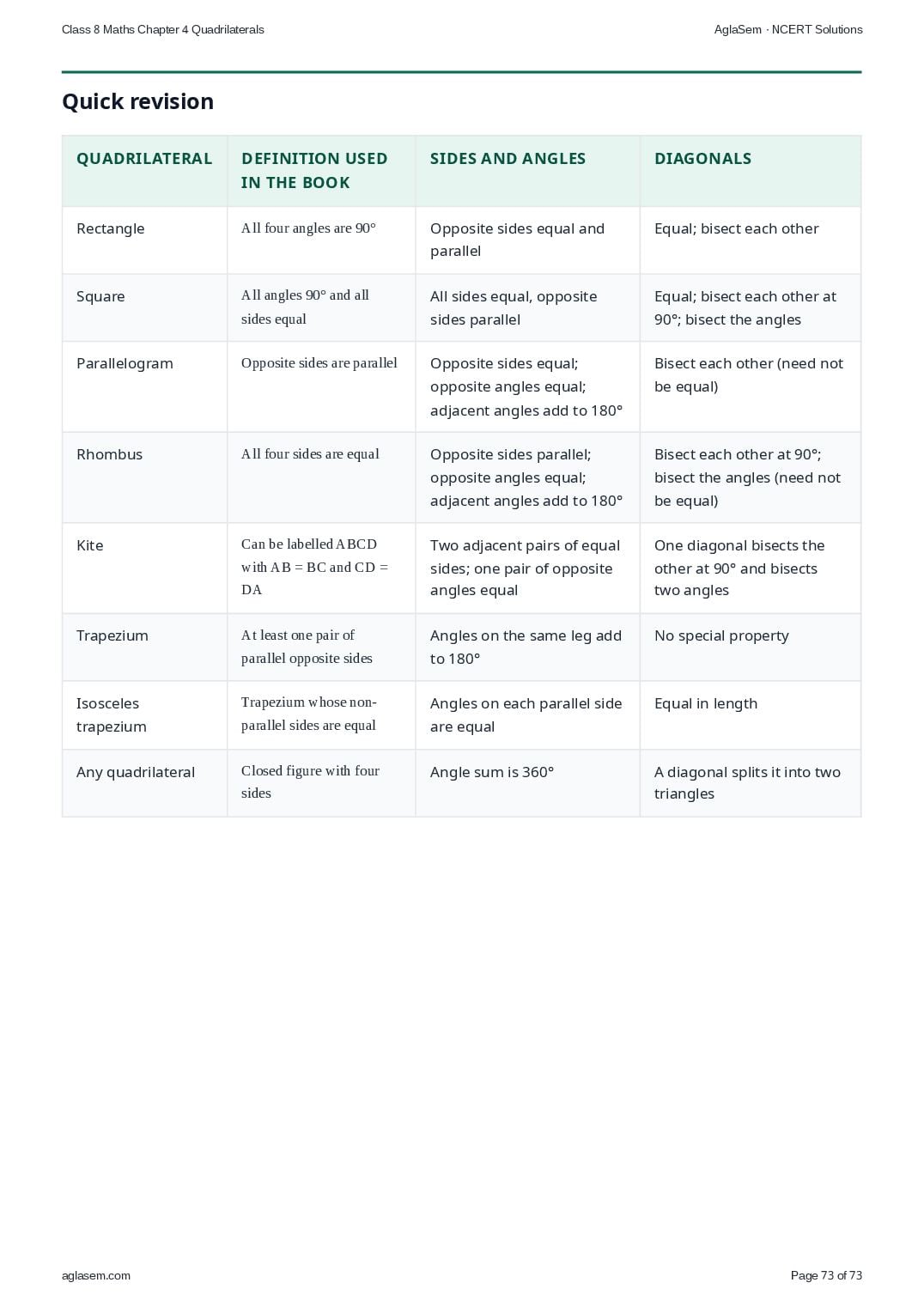
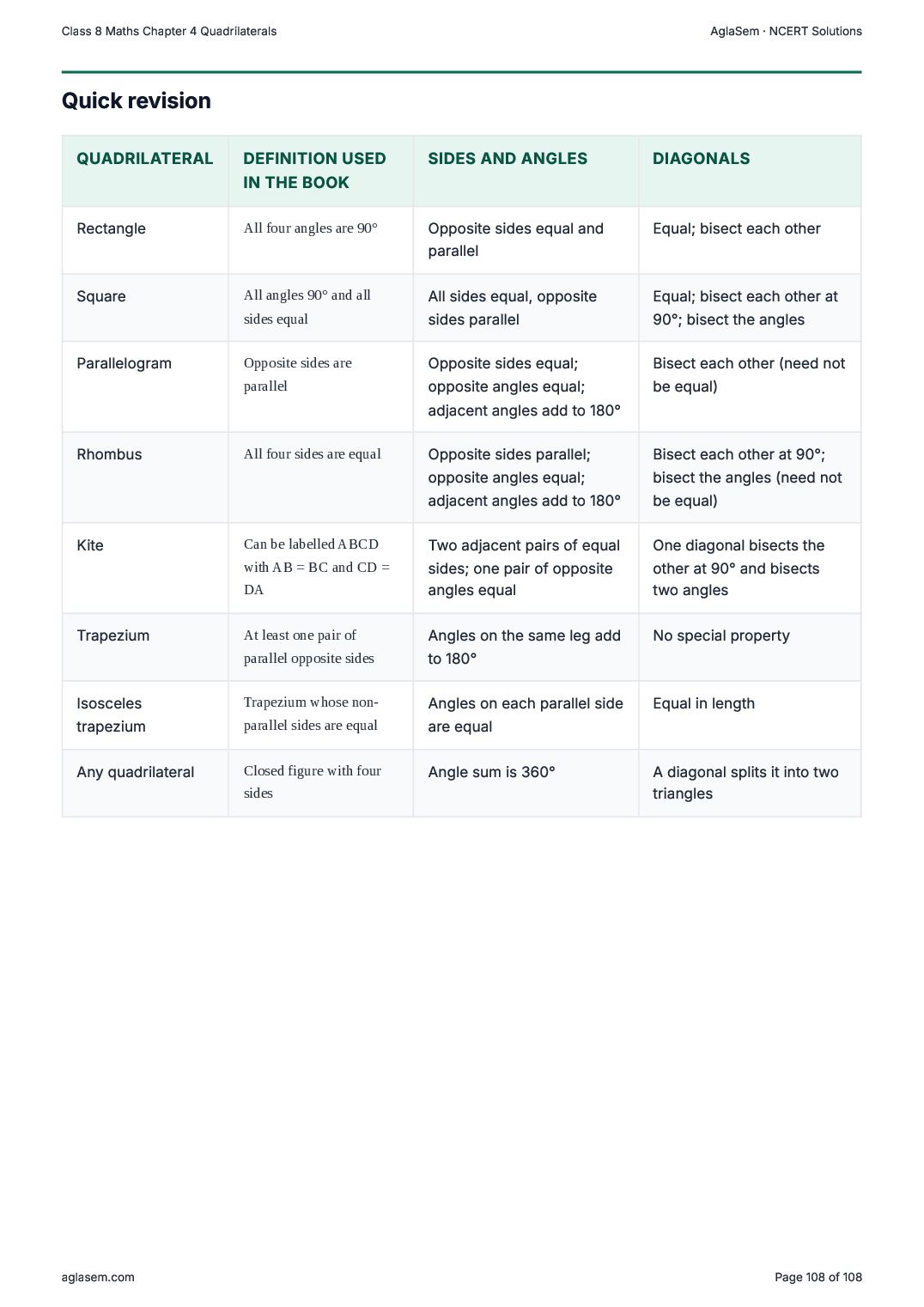
- A rectangle can be defined in three equivalent ways — all angles 90°; all angles 90° with opposite sides equal; or diagonals equal and bisecting each other. The chapter proves that these describe exactly the same set of quadrilaterals.
- Congruence does the heavy lifting. SAS, AAS, ASA and SSS are used in Deductions 1–10 to establish every side, angle and diagonal property in the chapter.
- The angle sum of any quadrilateral is 360°, because one diagonal splits it into two triangles. This is why three right angles force the fourth to be a right angle too.
- Parallelogram: opposite sides parallel ⇒ opposite sides equal, opposite angles equal, adjacent angles supplementary, diagonals bisect each other. A rhombus adds equal sides; the diagonals then also become perpendicular and bisect the angles.
- Venn diagrams keep the family straight: every square is a rectangle, a rhombus, a parallelogram and a kite; every rectangle and every rhombus is a parallelogram; a parallelogram need not be any of these.
- A kite has two adjacent pairs of equal sides; a trapezium needs at least one pair of parallel sides. In an isosceles trapezium the angles on each parallel side are equal.
How to Download NCERT Solutions for Class 8 Maths Chapter 4 PDF
Follow these simple steps to get the Quadrilaterals questions-and-answers PDF from Ganita Prakash.
- Search NCERT Solutions for Class 8 Maths Chapter 4 aglasem and open this page.
- Read the exercise questions with answers for Quadrilaterals shown above.
- Click the Download PDF link to save the Quadrilaterals solutions to your device.
NCERT Solutions for Class 8 Maths – All Chapters
There are more chapters to study besides Quadrilaterals in Maths. Here are the NCERT Solutions for all chapters of Class 8 Maths.
- Chapter 1 A Square and a Cube
- Chapter 2 Power Play
- Chapter 3 A Story of Numbers
- Chapter 4 Quadrilaterals
- Chapter 5 Number Play
- Chapter 6 We Distribute Yet Things Multiply
- Chapter 7 Proportional Reasoning 1
- Chapter 8 Fractions in Disguise
- Chapter 9 The Baudh Yana Pythagoras Theorem
- Chapter 10 Proportional Reasoning 2
- Chapter 11 Exploring Some Geometric Themes
- Chapter 12 Tales By Dots and Lines
- Chapter 13 Algebra Play
- Chapter 14 Area
NCERT Solutions for Class 8 – All Subjects
Just like Chapter 4 of Maths, you can get the exercise questions with answers for every other subject of Class 8. Here are the NCERT Solutions for all subjects of Class 8.
NCERT Solutions for Class 8 Maths Chapter 4 – An Overview
The key highlights of this study material are as follows.
| Aspects | Details |
|---|---|
| Class | Class 8 |
| Subject | Maths |
| Chapter Number | Chapter 4 |
| Chapter Name | Quadrilaterals |
| Book Name | Ganita Prakash |
| Book By | NCERT (National Council of Educational Research and Training) |
| Educational Resource Here | NCERT Solutions of Class 8 Maths Chapter 4 for all exercises |
| More Questions Answers of This Subject | NCERT Solutions for Class 8 Maths |
| Download Book Chapter | NCERT Book Class 8 Maths |
| All Questions Answers For This Class | NCERT Solutions for Class 8 |
| Complete Solutions | NCERT Solutions |
NCERT Solutions for Class 8 Maths Chapter 4 Quadrilaterals – FAQs
What are the NCERT Solutions for Class 8 Maths Chapter 4 Quadrilaterals?
They are the complete, step-by-step answers to all the exercise and in-text questions of Chapter 4 Quadrilaterals from the NCERT Class 8 Maths textbook Ganita Prakash, written by experts as per the latest NCERT syllabus.
How can I download the Class 8 Maths Chapter 4 solutions PDF for free?
Open this page on aglasem, read the Quadrilaterals questions with answers, and click the “Download Solutions PDF” link. The Class 8 Maths Chapter 4 NCERT Solutions PDF is completely free to download.
Are these NCERT Solutions as per the latest 2026-27 syllabus?
Yes. The NCERT Solutions for Class 8 Maths Chapter 4 are based on the latest NCERT textbook Ganita Prakash and the current 2026-27 CBSE syllabus, so the questions and answers match what you study in class.
Where can I get NCERT Solutions for the other chapters of Class 8 Maths?
You can find the answers to every chapter on the NCERT Solutions for Class 8 Maths page, and solutions for every subject on the NCERT Solutions for Class 8 page.
How do NCERT Solutions help in exam preparation?
They show the correct method to solve each question, help you write answers the way they are expected in exams, let you check and correct your own work, and save revision time — which together improve your marks in Class 8 Maths.
If you have any queries on NCERT Solutions for Class 8 Maths Chapter 4 Quadrilaterals, then please ask in the comments below.