NCERT Solutions for Class 8 Maths Chapter 11 Exploring Some Geometric Themes provide clear, step-by-step answers to every exercise and in-text question from the chapter Exploring Some Geometric Themes of the NCERT textbook Ganita Prakash. Prepared by subject experts as per the latest NCERT (CBSE) syllabus for 2026-27, these NCERT Solutions for Class 8 Maths help you understand each concept, write exam-ready answers, and check your own solutions. You can read them online below or download the free Class 8 Maths Chapter 11 question-answer PDF.
NCERT Solutions for Class 8 Maths Chapter 11 Exploring Some Geometric Themes
- Class: Class 8
- Subject: Maths
- Chapter: Chapter 11 – Exploring Some Geometric Themes
- Textbook: Ganita Prakash (NCERT)
- Study material: NCERT Solutions – questions with answers, free PDF
These solutions answer all the exercise questions of Chapter 11 Exploring Some Geometric Themes — including the in-text questions, short-answer and long-answer questions, and activities — with complete explanations so you can follow the method, not just the final answer. Read the full solutions below.
NCERT Solutions Class 8 Maths Chapter 11 Exploring Some Geometric Themes View Download


NCERT Solutions for Class 8 Maths Chapter 11 PDF Download
You can read the NCERT Solutions for Class 8 Maths Chapter 11 online above, or download the complete question-answer PDF to study Exploring Some Geometric Themes offline at any time.
NCERT Solutions for Class 8 Maths Chapter 11 PDF Download Link – Click Here to Download Solutions PDF
Questions Covered in This Chapter
These NCERT Solutions answer all 83 questions of this chapter. The questions solved are:
- Draw the initial few steps (at least till Step 2) of the shape sequence that leads to the Sierpinski Carpet.
- Do you see any pattern in the number of holes and squares that remain at each step?
- Can this be used to get a formula for Rₙ?
- Similarly, how do we find the number of holes at a given step?
- Show that by joining the midpoints of an equilateral triangle, we divide it into 4 identical equilateral triangles. [Hint: Note that the corner triangles are isosceles.]
- Draw the initial few steps (at least till Step 2) of the shape sequence that leads to the Sierpinski Triangle.
- Find the number of holes, and the triangles that remain at each step of the shape sequence that leads to the Sierpinski Triangle.
- Find the area of the region remaining at the nth step in each of the shape sequences that lead to the Sierpinski fractals. Take the area of the starting square/triangle to be 1 sq. unit.
- Draw the initial few steps (at least till Step 2) of the shape sequence that leads to the Koch Snowflake.
- Find the number of sides in the nth step of the shape sequence that leads to the Koch Snowflake.
- Find the perimeter of the shape at the nth step of the sequence. Take the starting equilateral triangle to have a sidelength of 1 unit.
- Picture your name, then read off the letters backwards. Make sure to do this by sight, not by sound — really see your name! Now try with your friend's name.
- Cut off the four corners of an imaginary square, with each cut going between midpoints of adjacent edges. What shape is left over? How can you reassemble the four corners to make another square?
- Mark the sides of an equilateral triangle into thirds. Cut off each corner of the triangle, as far as the marks. What shape do you get?
- Mark the sides of a square into thirds and cut off each of its corners as far as the marks. What shape is left?
- A solid whose profile has a square outline
- A solid whose profile has a circular outline
- A solid whose profile has a triangular outline
- A solid with a rectangular profile from one viewpoint and a circular profile from another viewpoint
- A solid with a circular profile from one viewpoint and a triangular one from another viewpoint
- A solid with a rectangular profile from one viewpoint and a triangular one from another viewpoint
- A solid with a trapezium shaped profile from one viewpoint and a circular one from another viewpoint
- A solid with a pentagonal profile from one viewpoint and a rectangular one from another viewpoint
- Are there unique solids for each of the conditions, or can you come up with multiple possibilities?
- If the congruent polygons of a prism have 10 sides, how many faces, edges and vertices does the prism have? What if the polygons have n sides?
- If the base of a pyramid has 10 sides, how many faces, edges and vertices does the pyramid have? What if the base is an n-sided polygon?
- What is a net of a cube?
- Visualise how it can be folded to form a cube.
- Which of the following are the nets of a cube? First, try to answer by visualisation. Then, you may use cutouts and try.
- A cube has 11 possible net structures in total. In this count, two nets are considered the same if one can be obtained from the other by a rotation or a flip. For example, the following nets are all considered the same — Find all the 11 nets of a cube.
- Draw a net of a cuboid having sidelengths: (i) 5 cm, 3 cm, and 1 cm (ii) 6 cm, 3 cm, and 2 cm
- What is a net of a regular tetrahedron? Which of the following are nets of a regular tetrahedron?
- Are there any other possible nets?
- Draw a net with appropriate measurements that can be folded into a regular tetrahedron. Verify if it works by making an actual cutout.
- Draw a net with appropriate measurements that can be folded into a square pyramid. Verify if it works by making an actual cutout.
- What is the net of a cylinder?
- What are the sidelengths of the rectangle obtained?
- How will the net of a cone look?
- If the cone is slit open along the line l and then unrolled, what will we get?
- What surface do you construct by using the above net, in which O is not the centre of the boundary circle? Make a physical model to help you answer this question!
- Draw a net with appropriate measurements that can be folded into a triangular prism. Verify that it works by making an actual cutout.
- Can you visualise its net? This is one of its nets.
- Taking all the triangles in the net to be equilateral, make a cutout of the net and fold it to form an octahedron.
- Net of a sphere? Experiment and see if you can make a paper cutout that can perfectly wrap around a ball without leaving any wrinkles, gaps or overlaps.
- What is the shortest path for the ant to reach the laddu?
- What about in the following case?
- If we think that a certain path is the shortest, how can we be sure that it truly is, among all the infinite possibilities?
- For example, are either of these the shortest path?
- What does this show?
- Have we now completely analysed the problem of finding the shortest path between two points on a cuboid?
- Find the shortest path between the ant and the laddu in the following case:
- So what do we do now?
- What is the length of the shortest path between the ant and the laddu?
- What happens to the length of a line in its projection?
- Can you now compare the lengths p and l?
- When is the length of the projected line equal to its actual length?
- What do you think are the different possible projections of a square that we get based on its orientation?
- What do you think is the projection of a parallelogram under different orientations? Can this ever be a quadrilateral that is not a parallelogram?
- What can you say about the projection of an n-sided regular polygon? [Hint: Projection of a polygon is composed of the projections of its sides.]
- How would the projections of a cube and a cone look?
- See Figures 4.2 – 4.5. In each case, see if you can visualise another object that gives the same projection.
- Find another object that makes the same projection as that of a given cone.
- Observe the front view, top view and side view of the different lines in Fig. 4.6. Is there any relation between their lengths?
- Find the front view, top view and side view of each of the following solids, fixing its orientation with respect to the vertical, horizontal and side planes: cube, cuboid, parallelepiped, cylinder, cone, prism, and pyramid. If needed, see the next problem for clues.
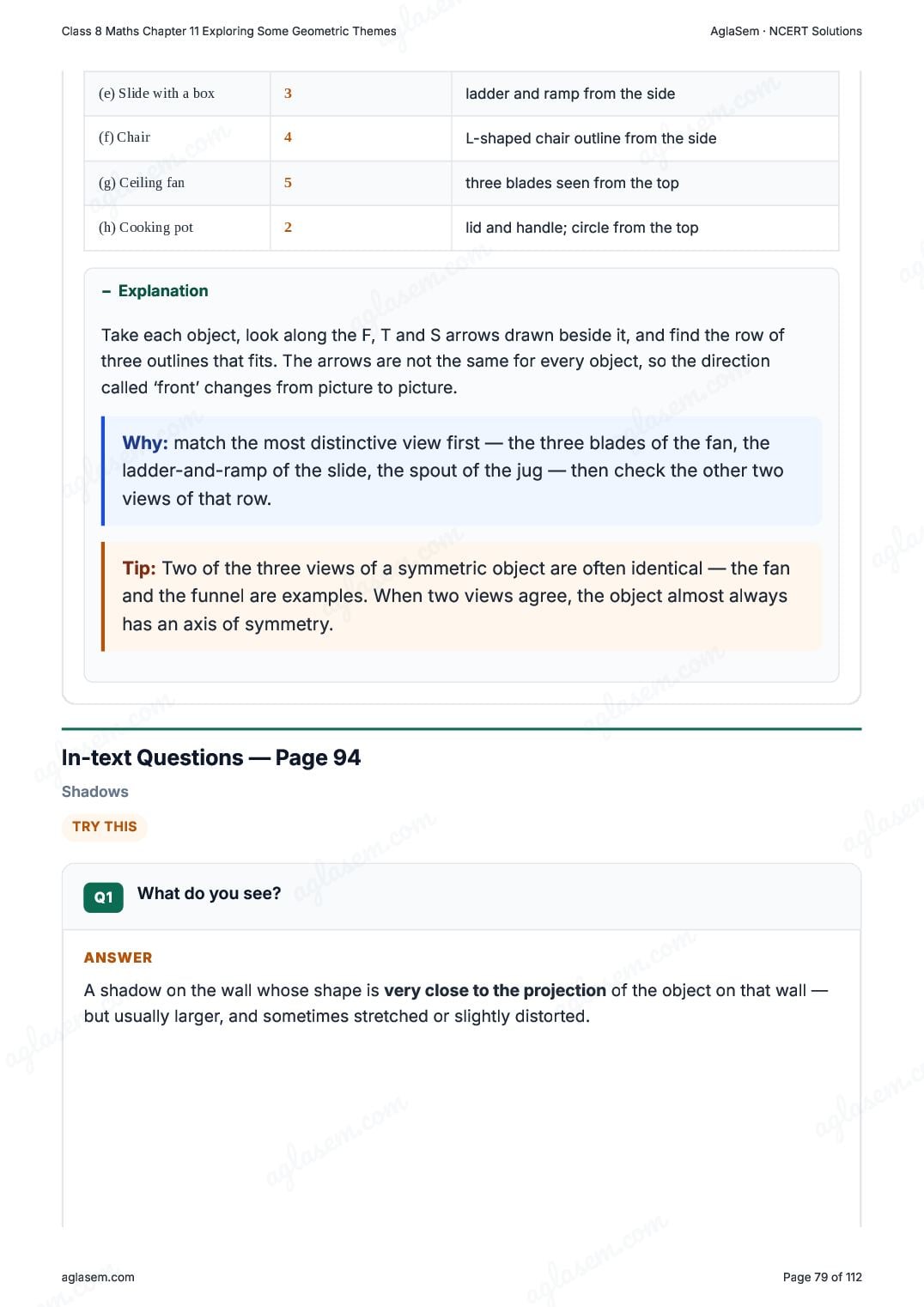
- Match each of the following objects with its projections.
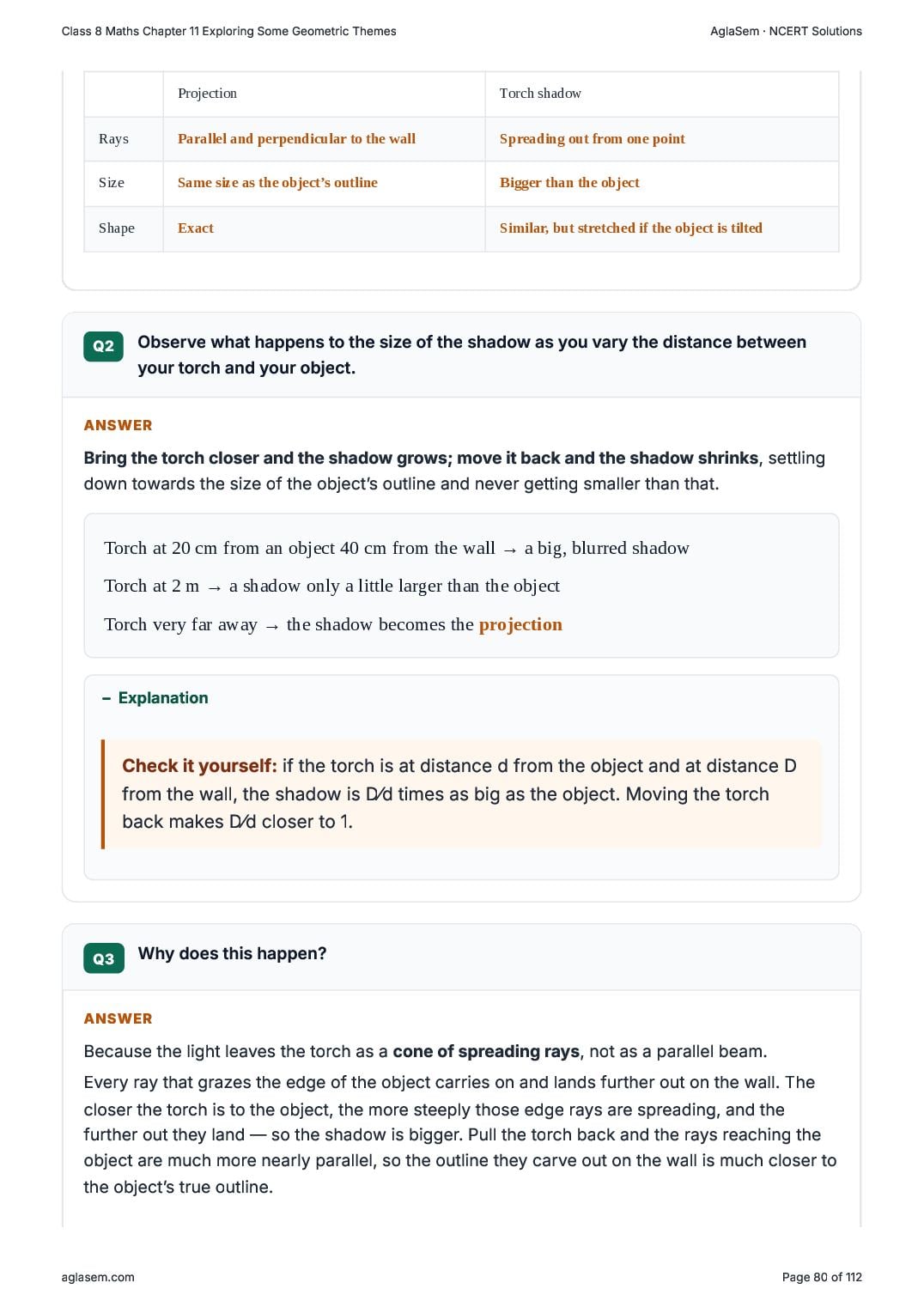
- What do you see?
- Observe what happens to the size of the shadow as you vary the distance between your torch and your object.
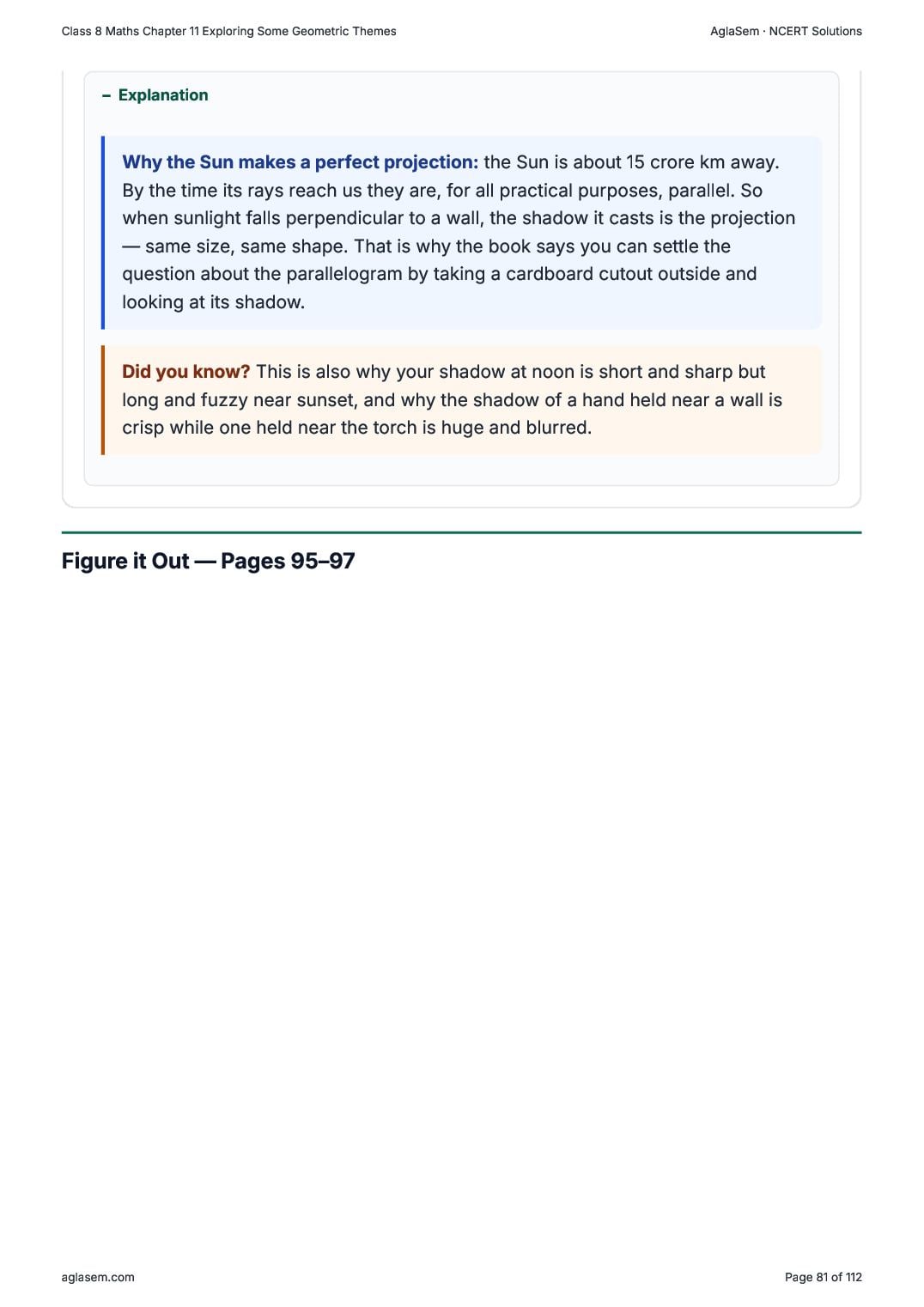
- Why does this happen?
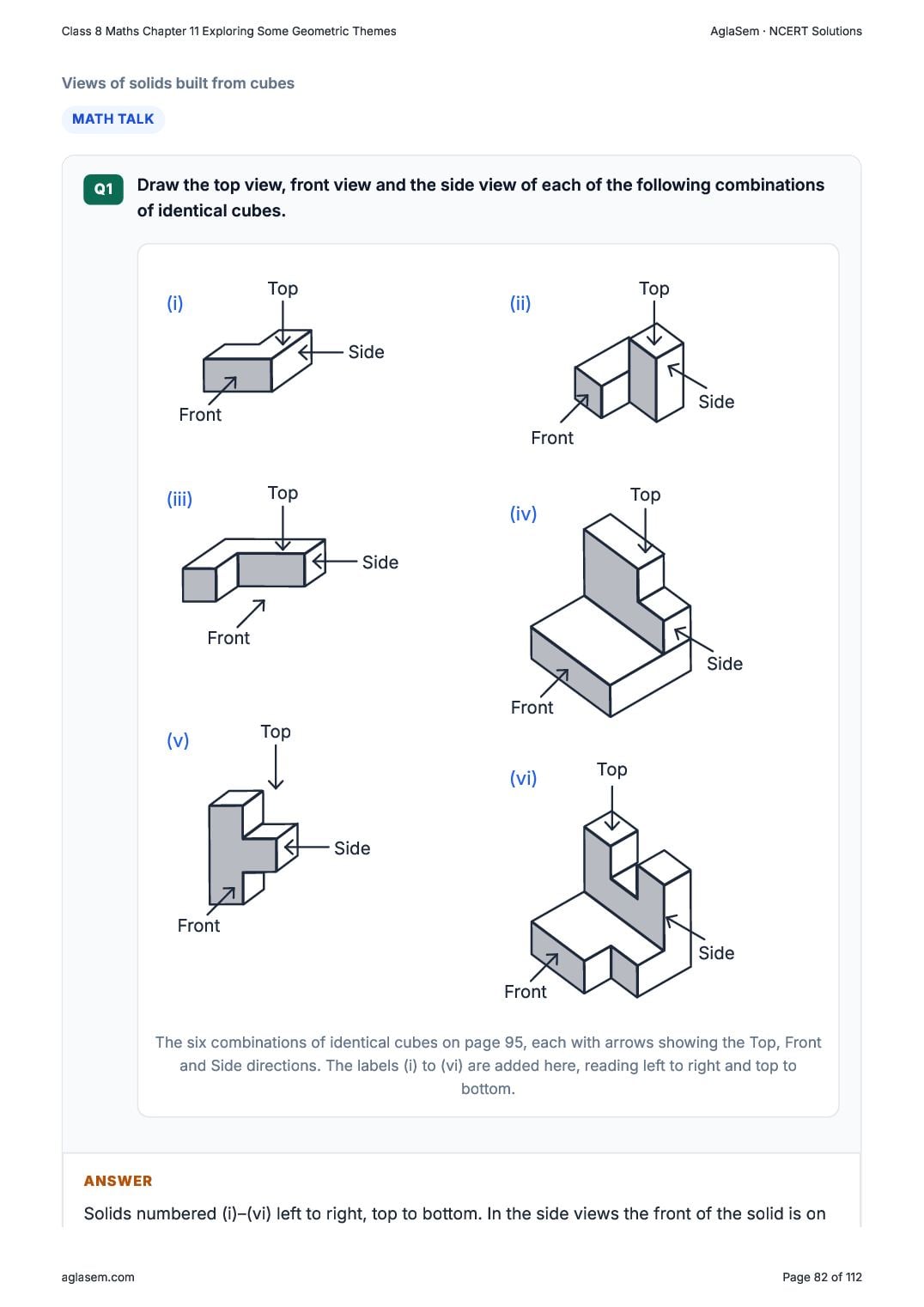
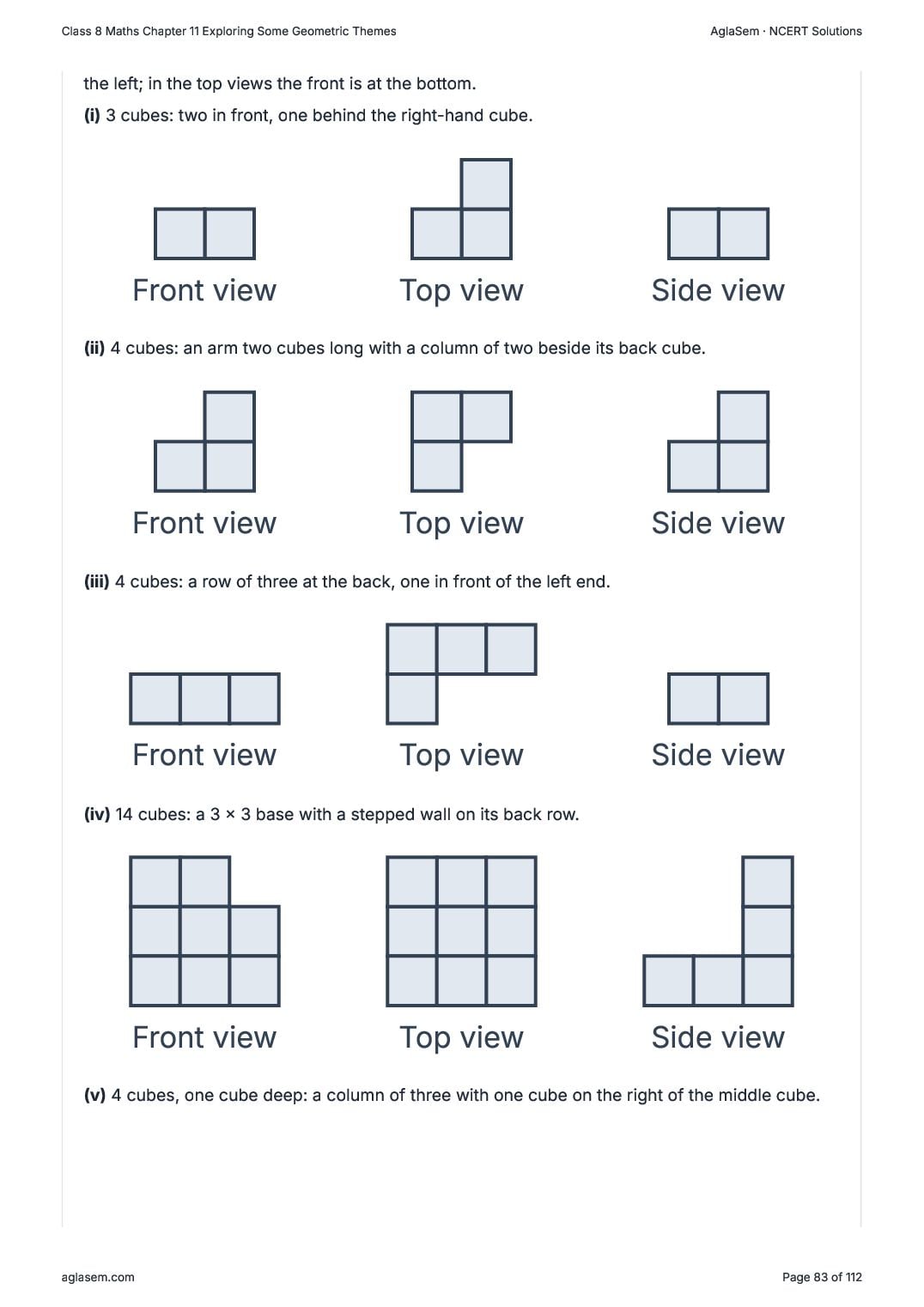
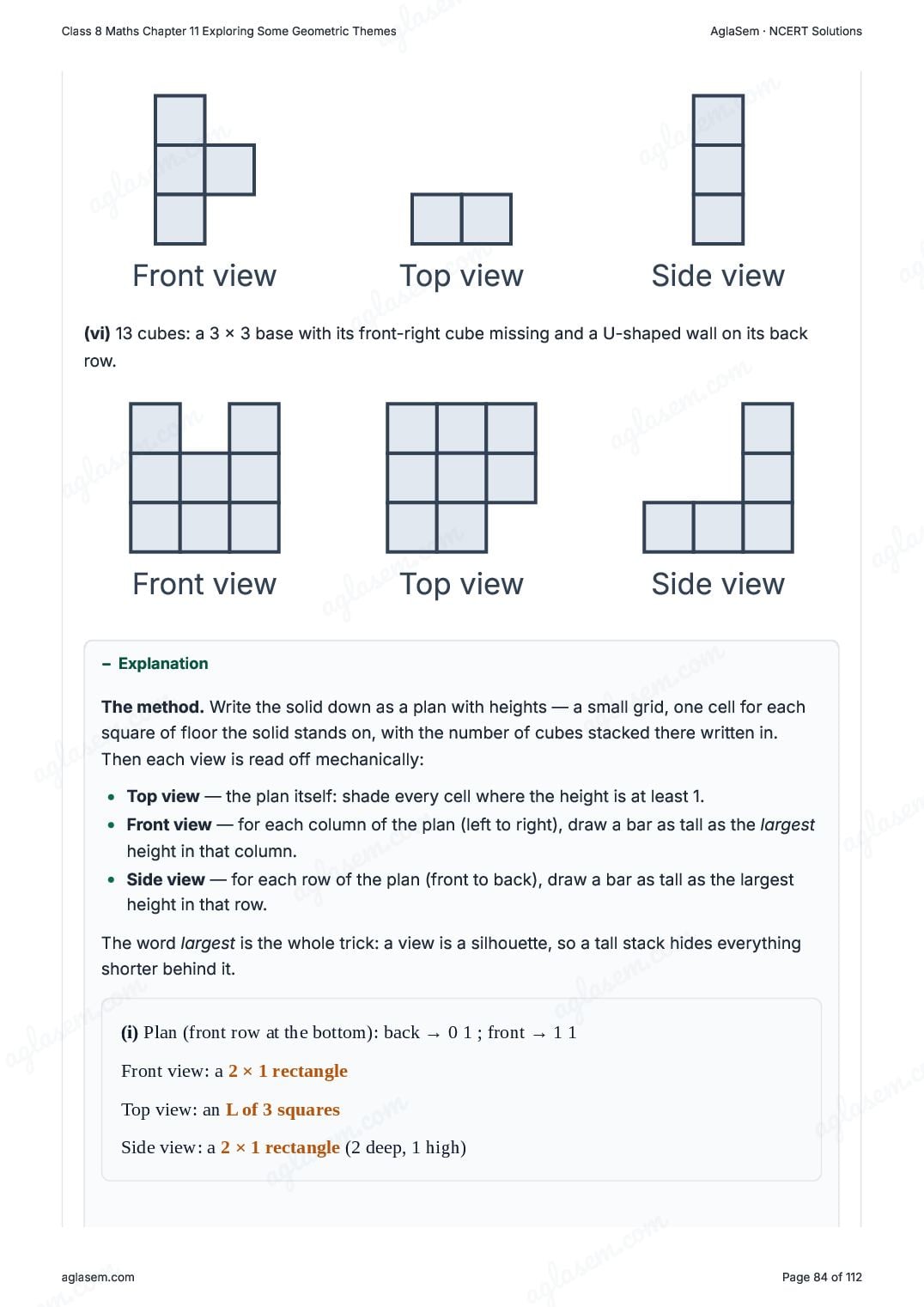
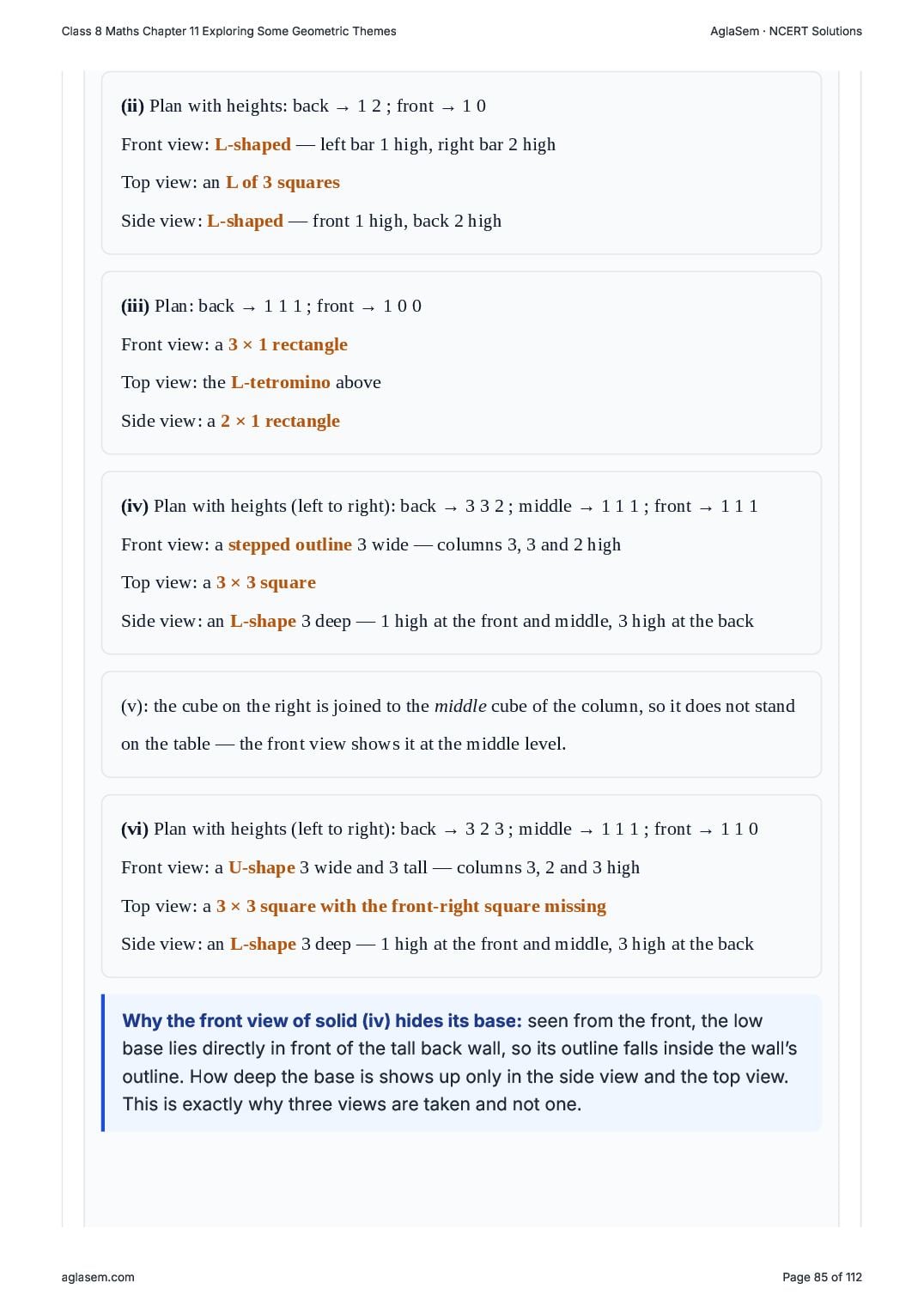
- Draw the top view, front view and the side view of each of the following combinations of identical cubes.
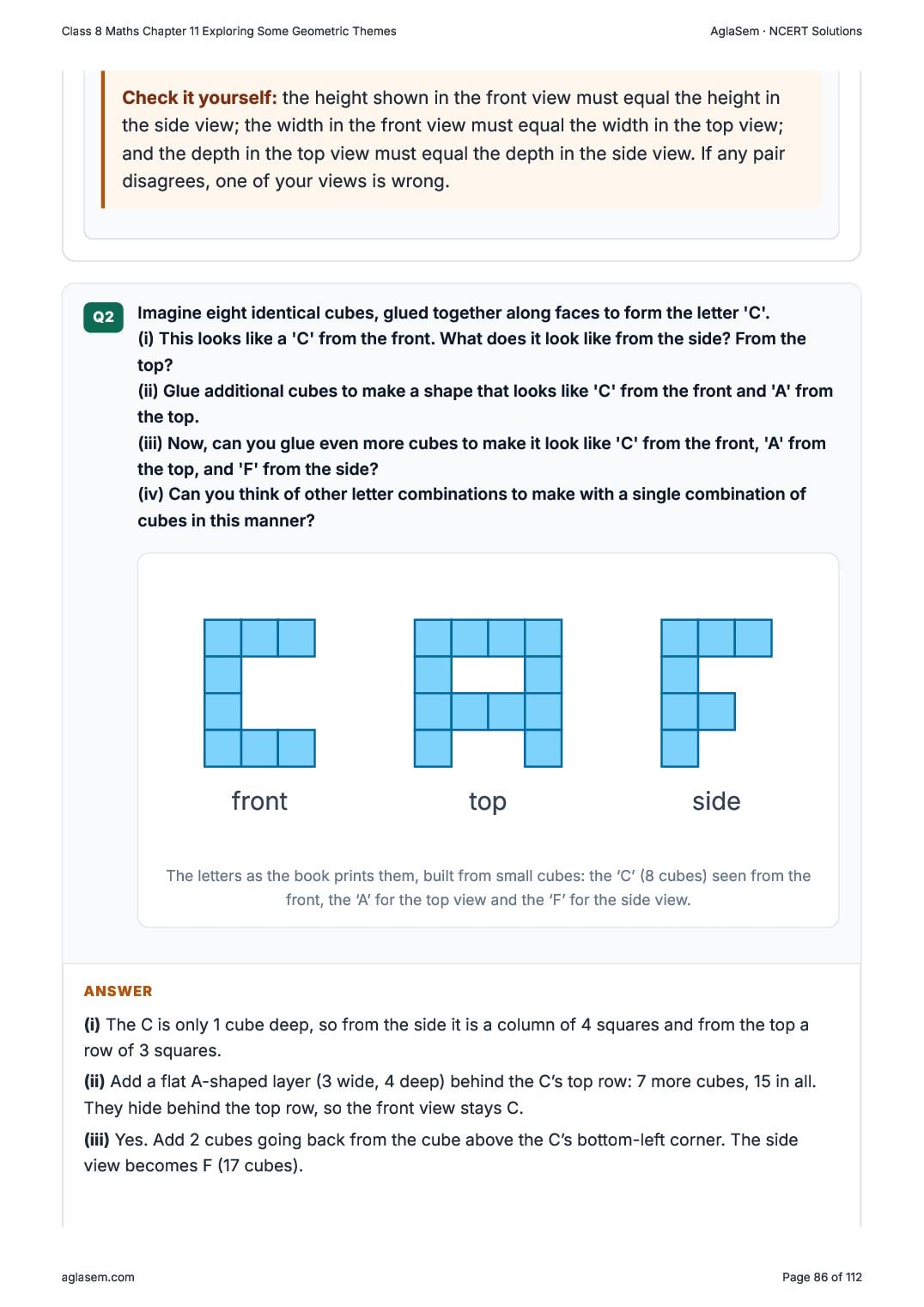
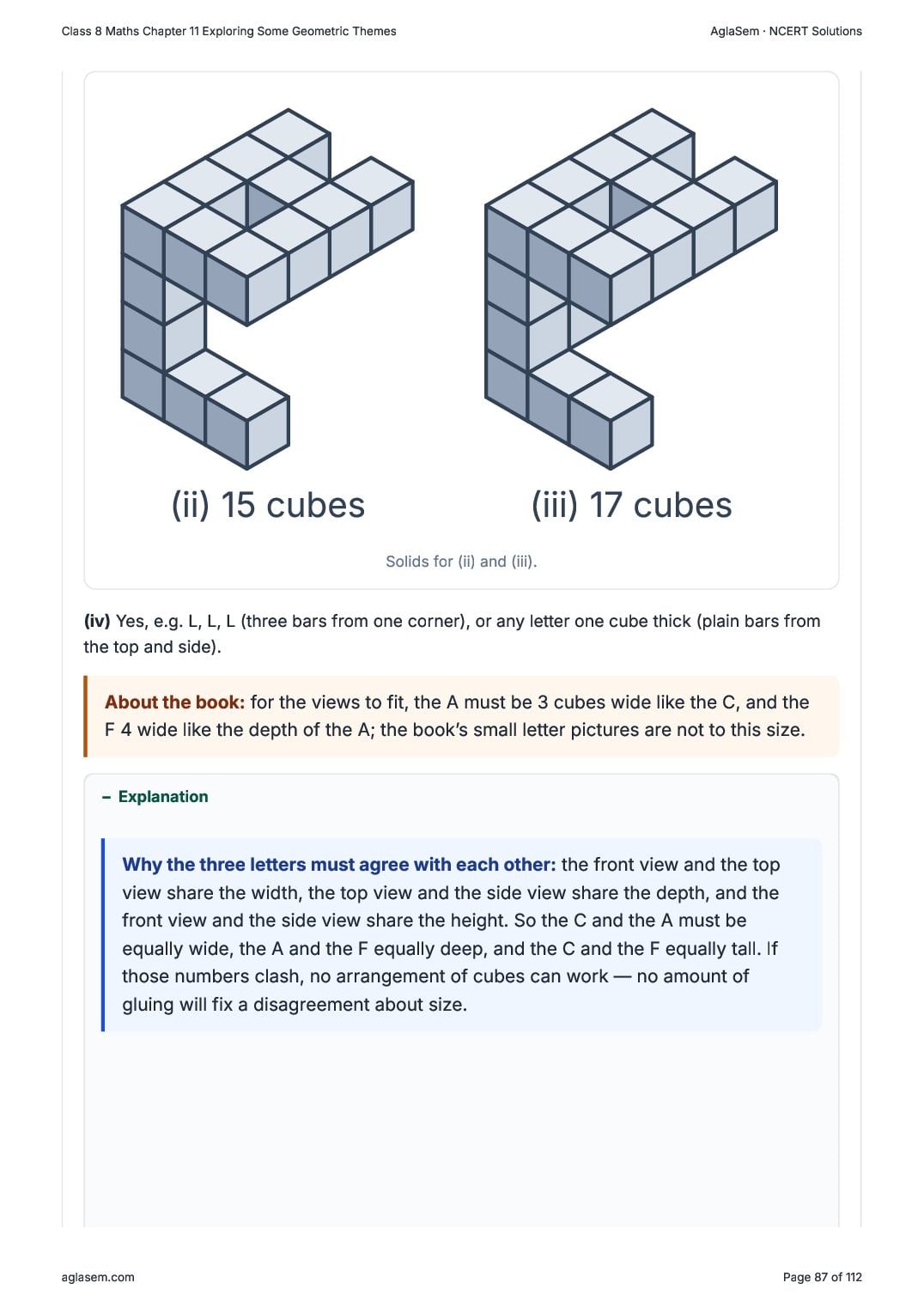
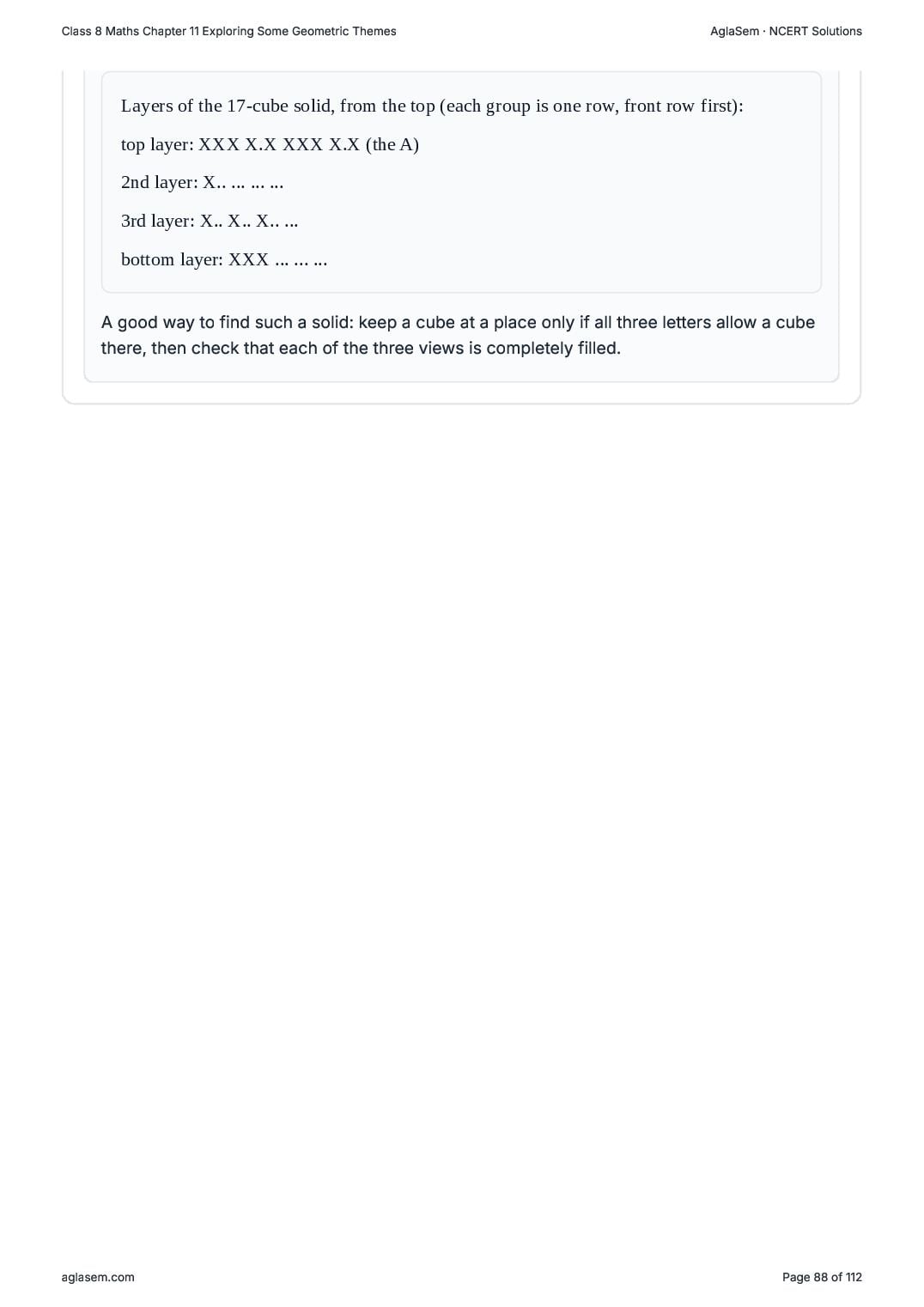
- Imagine eight identical cubes, glued together along faces to form the letter 'C'. (i) This looks like a 'C' from the front. What does it look like from the side? From the top? (ii) Glue additional cubes to make a shape that looks like 'C' from the front and 'H' from the top. (iii) Now, can you glue even more cubes to make it look like 'C' from the front, 'H' from the top, and 'F' from the side? (iv) Can you think of other letter combinations to make with a single combination of cubes in this manner?
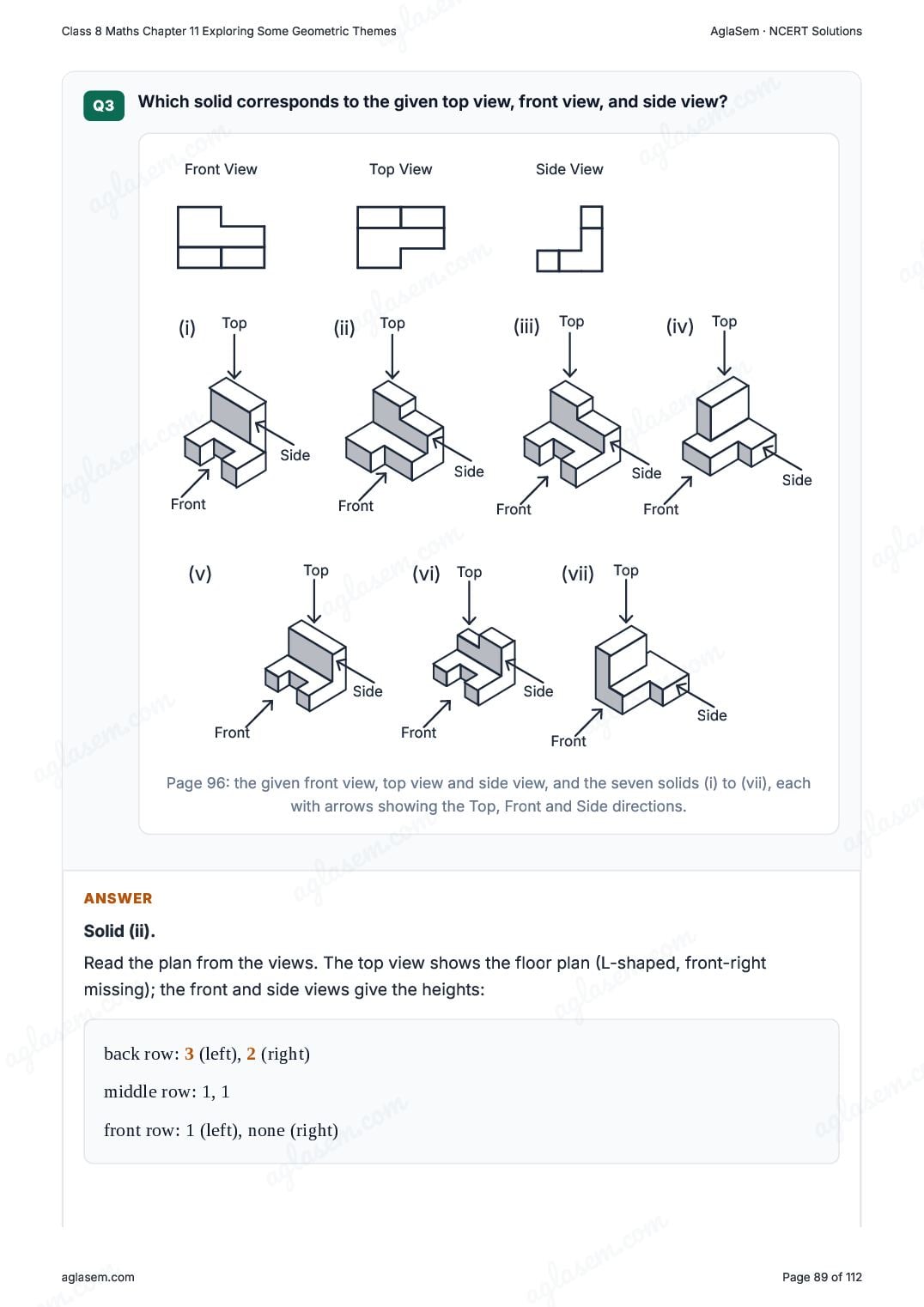
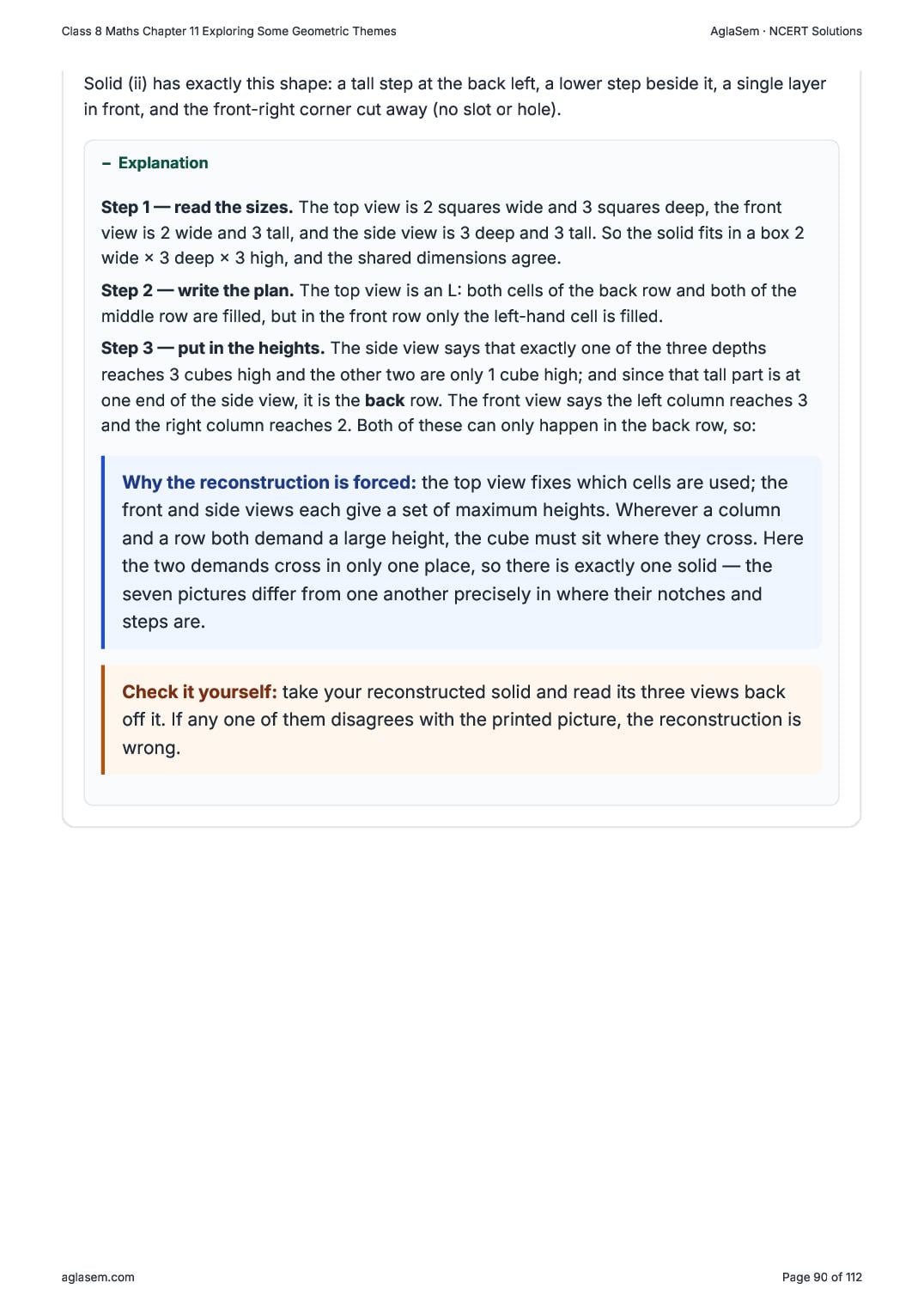
- Which solid corresponds to the given top view, front view, and side view?
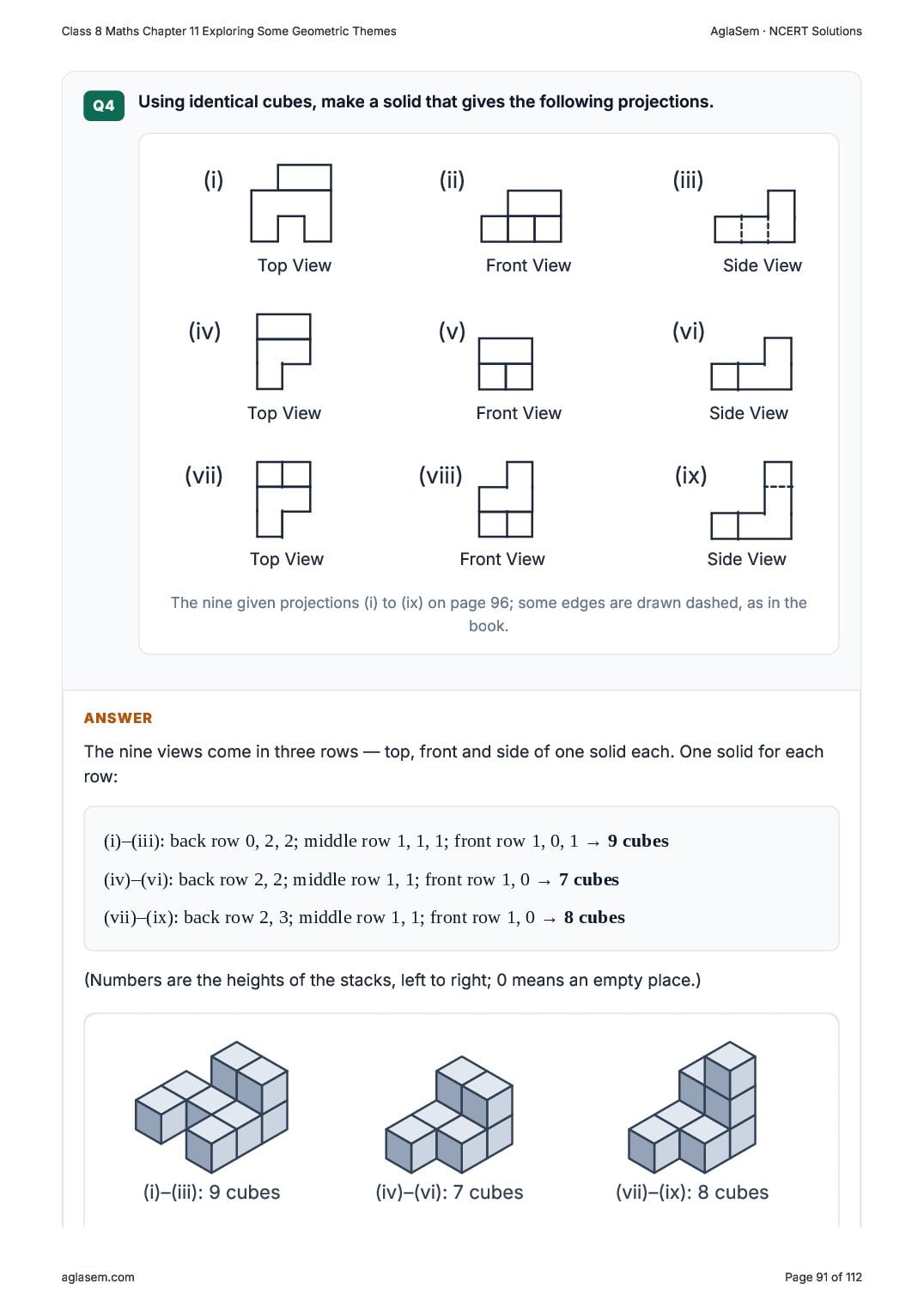
- Using identical cubes, make a solid that gives the following projections.
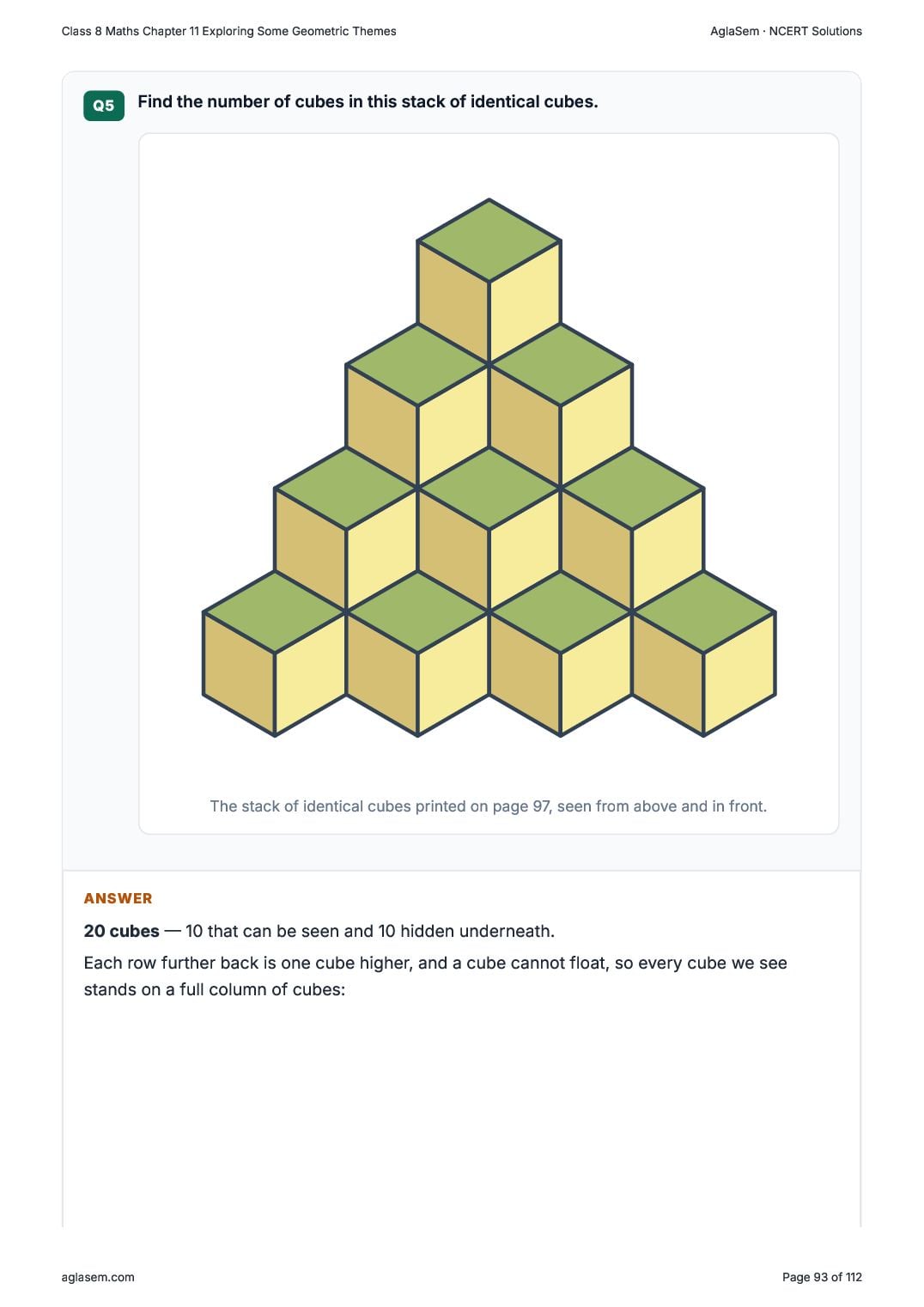
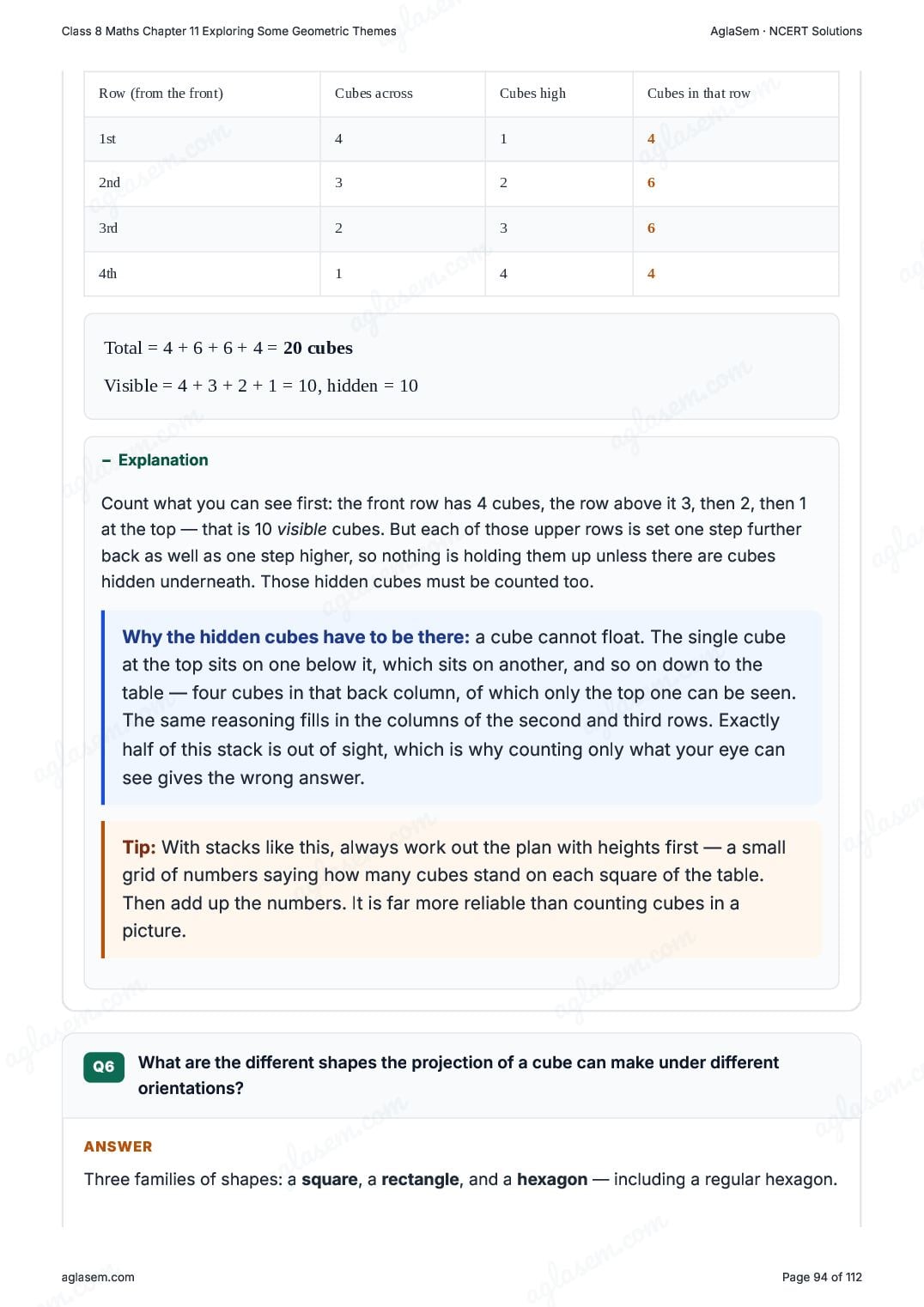
- Find the number of cubes in this stack of identical cubes.
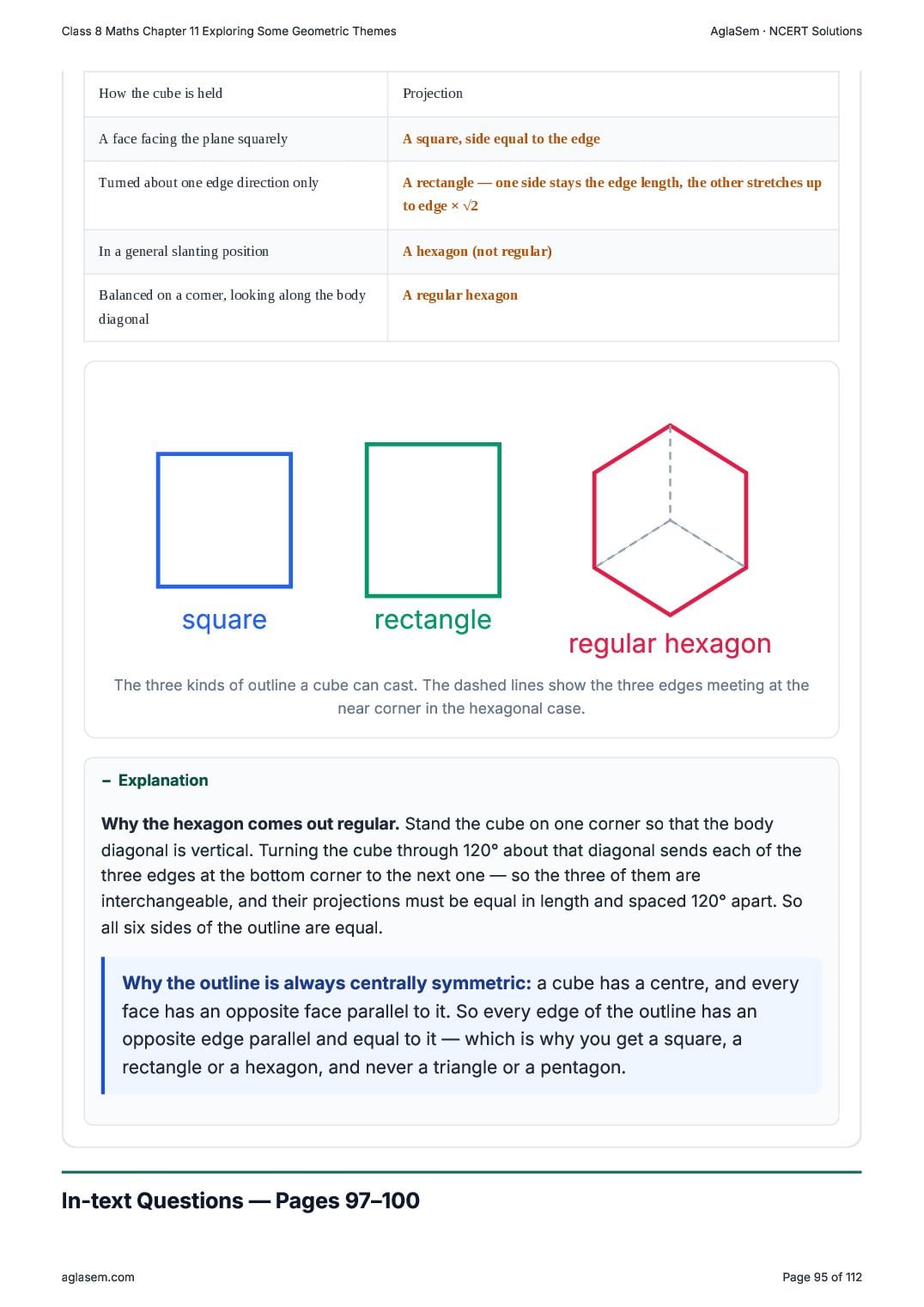
- What are the different shapes the projection of a cube can make under different orientations?
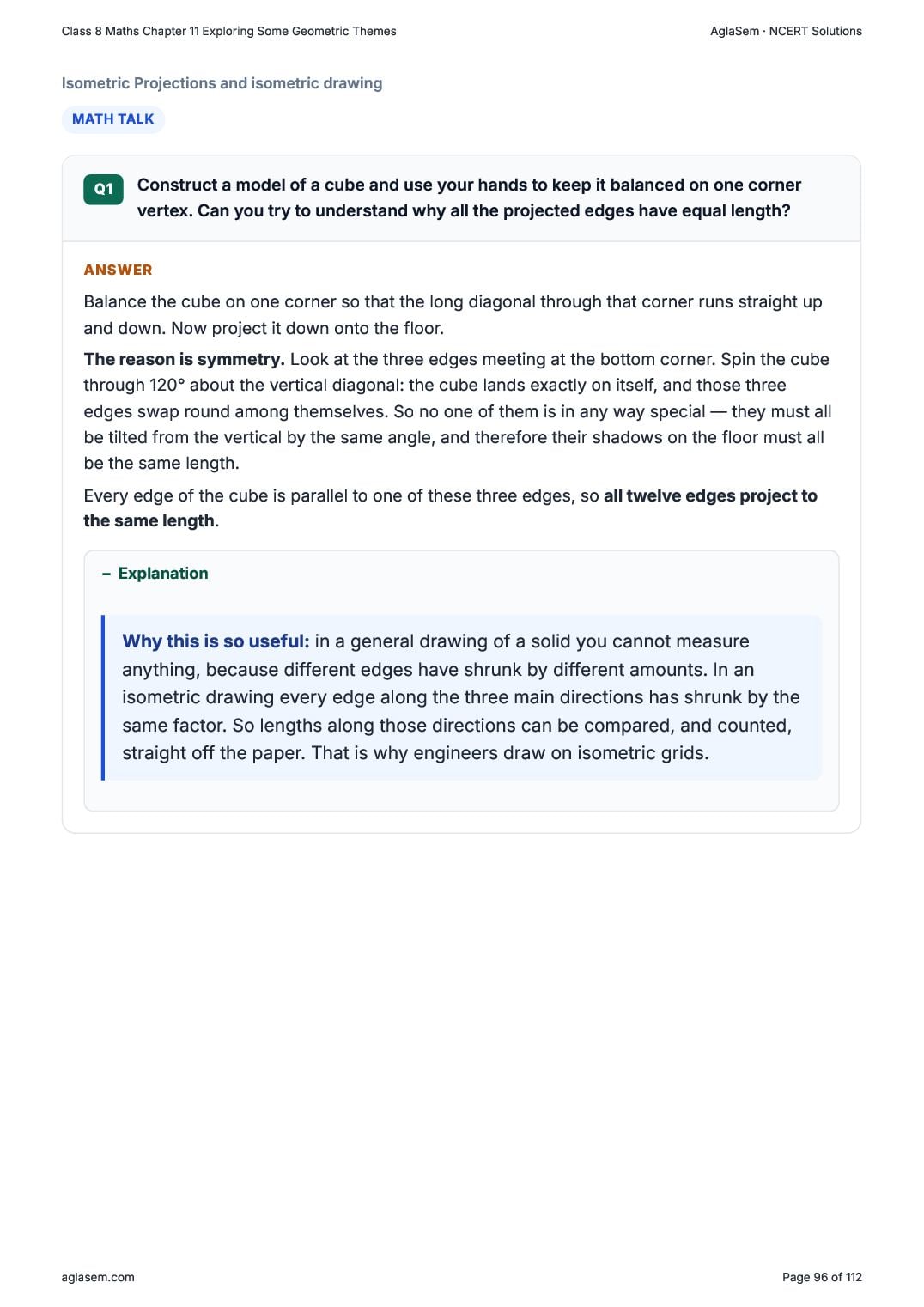
- Construct a model of a cube and use your hands to keep it balanced on one corner vertex. Can you try to understand why all the projected edges have equal length?
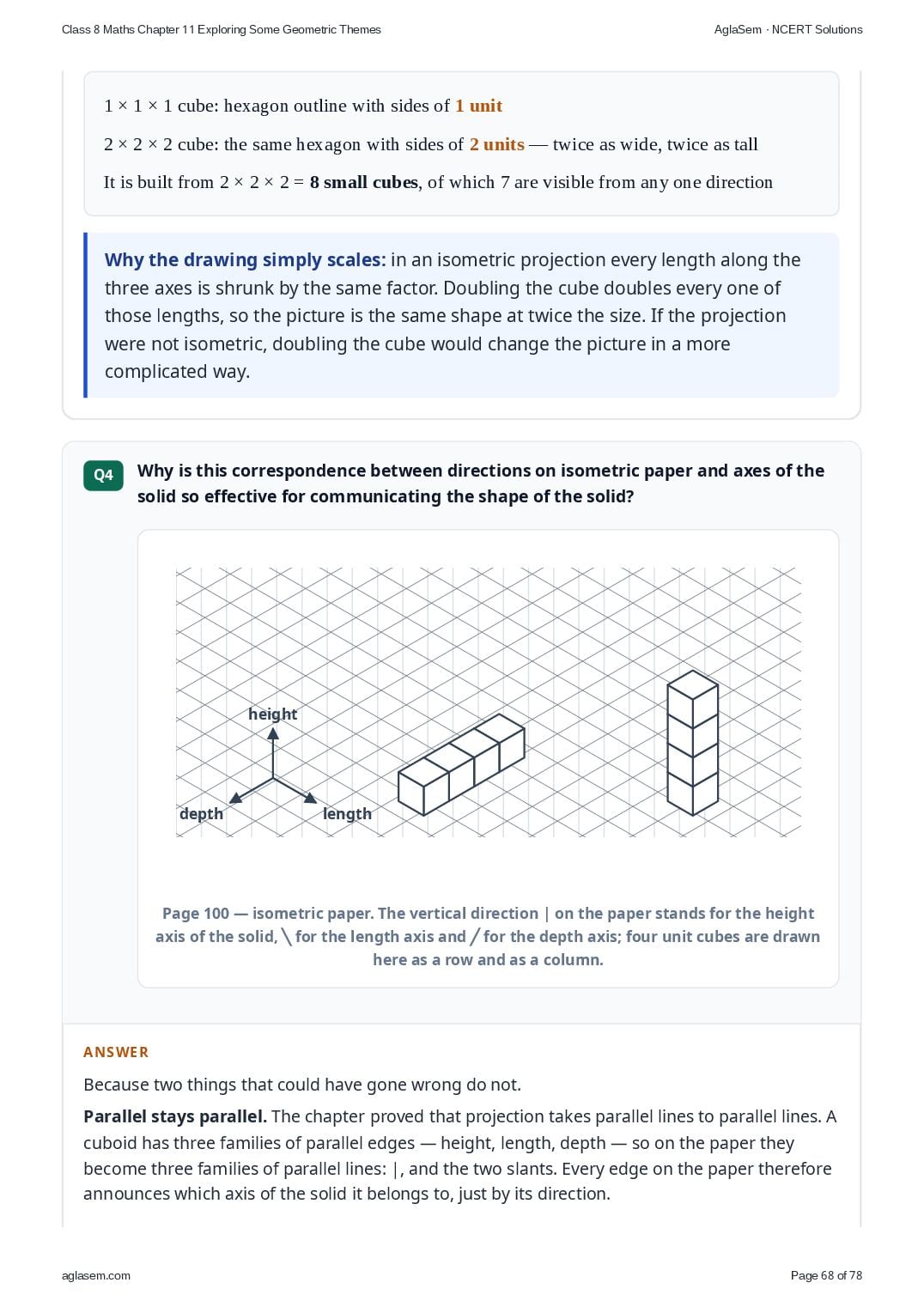
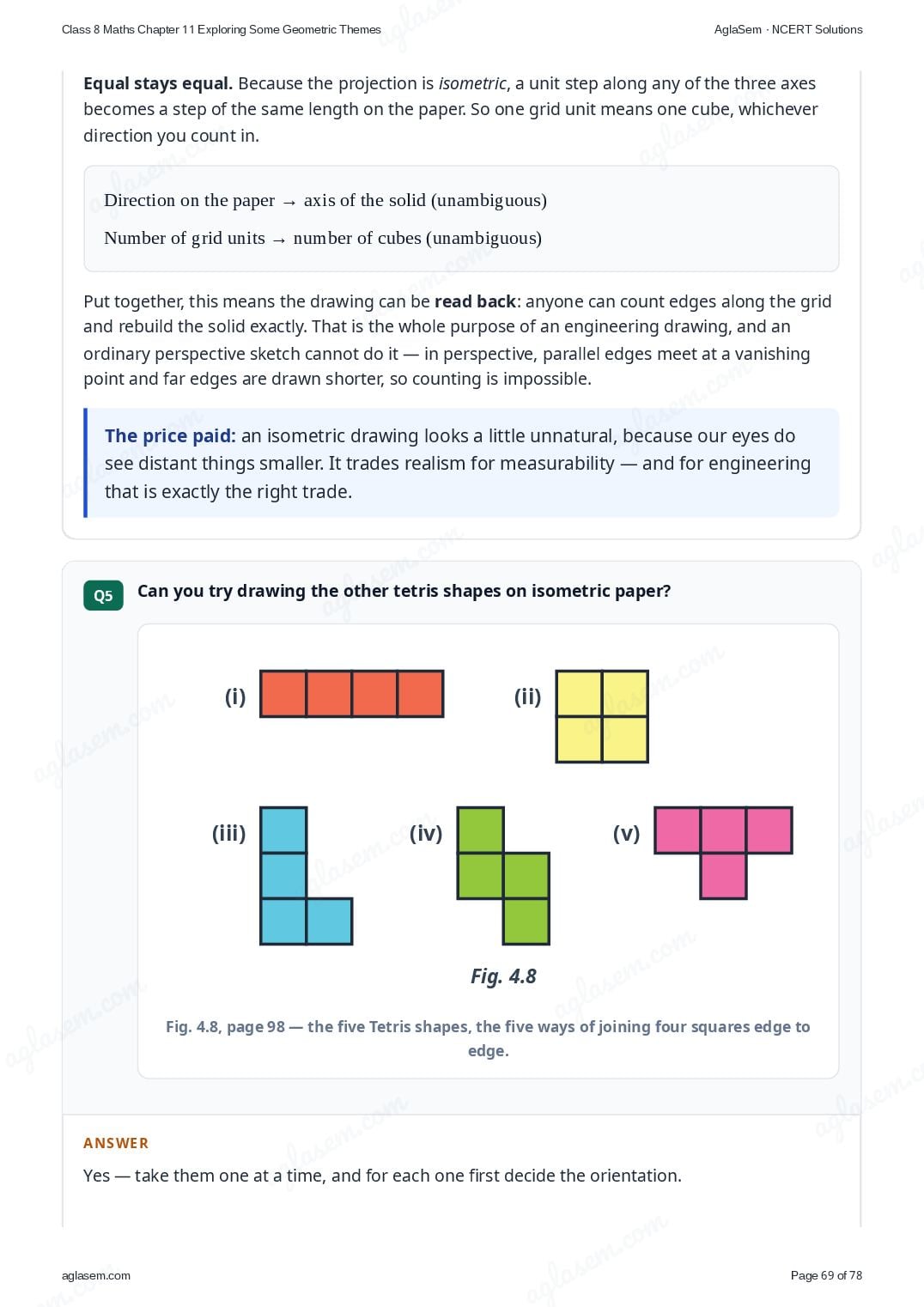
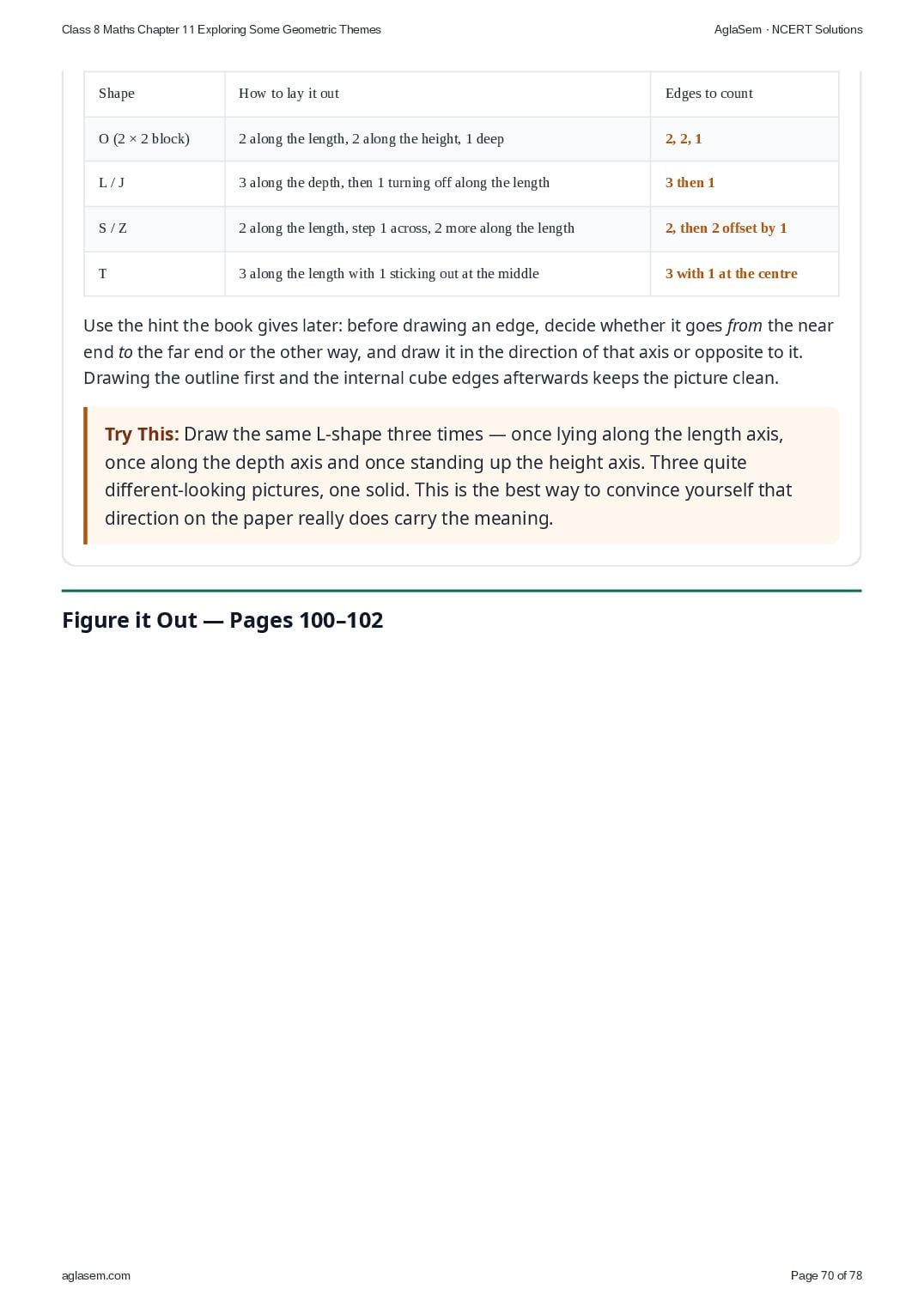
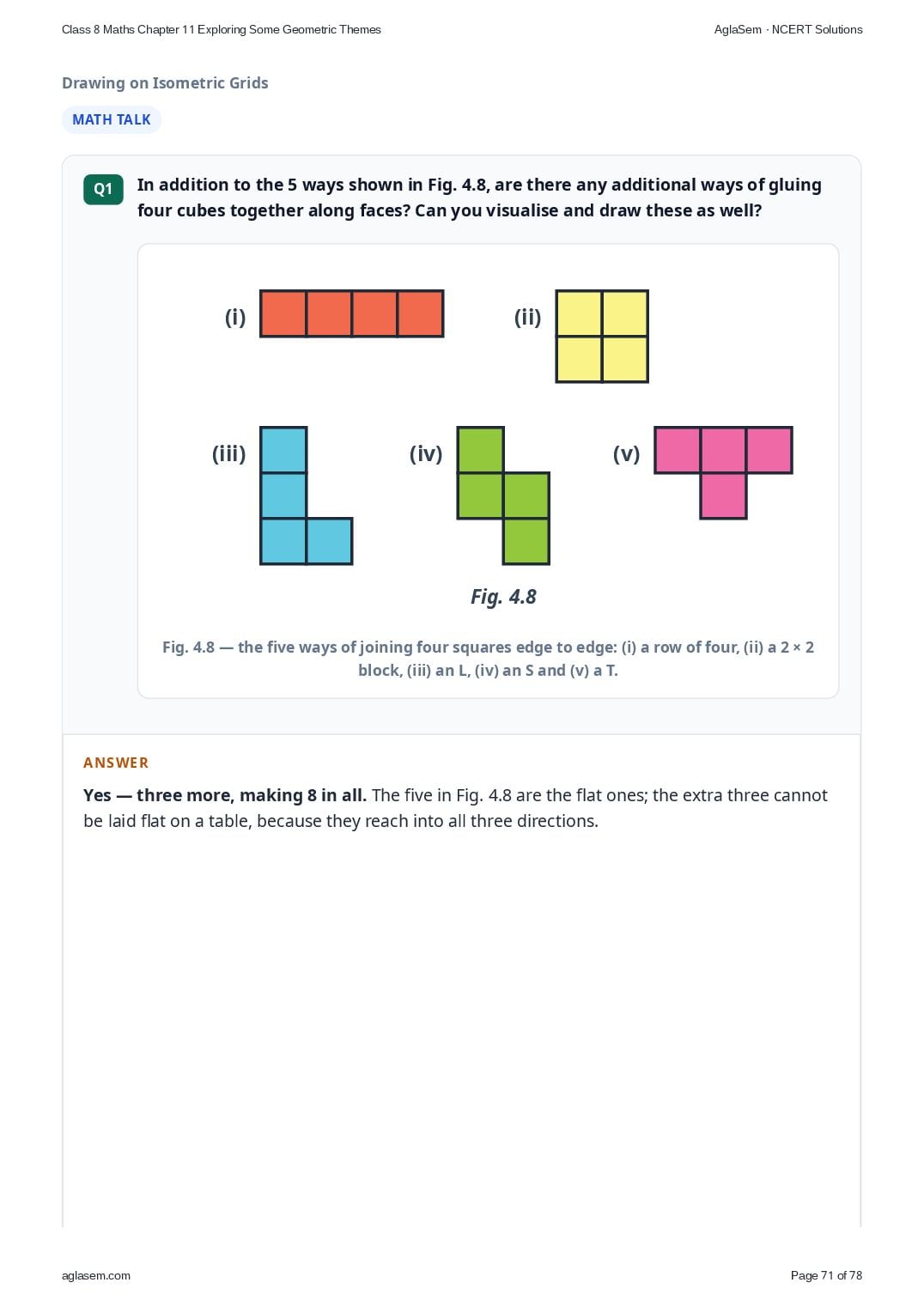
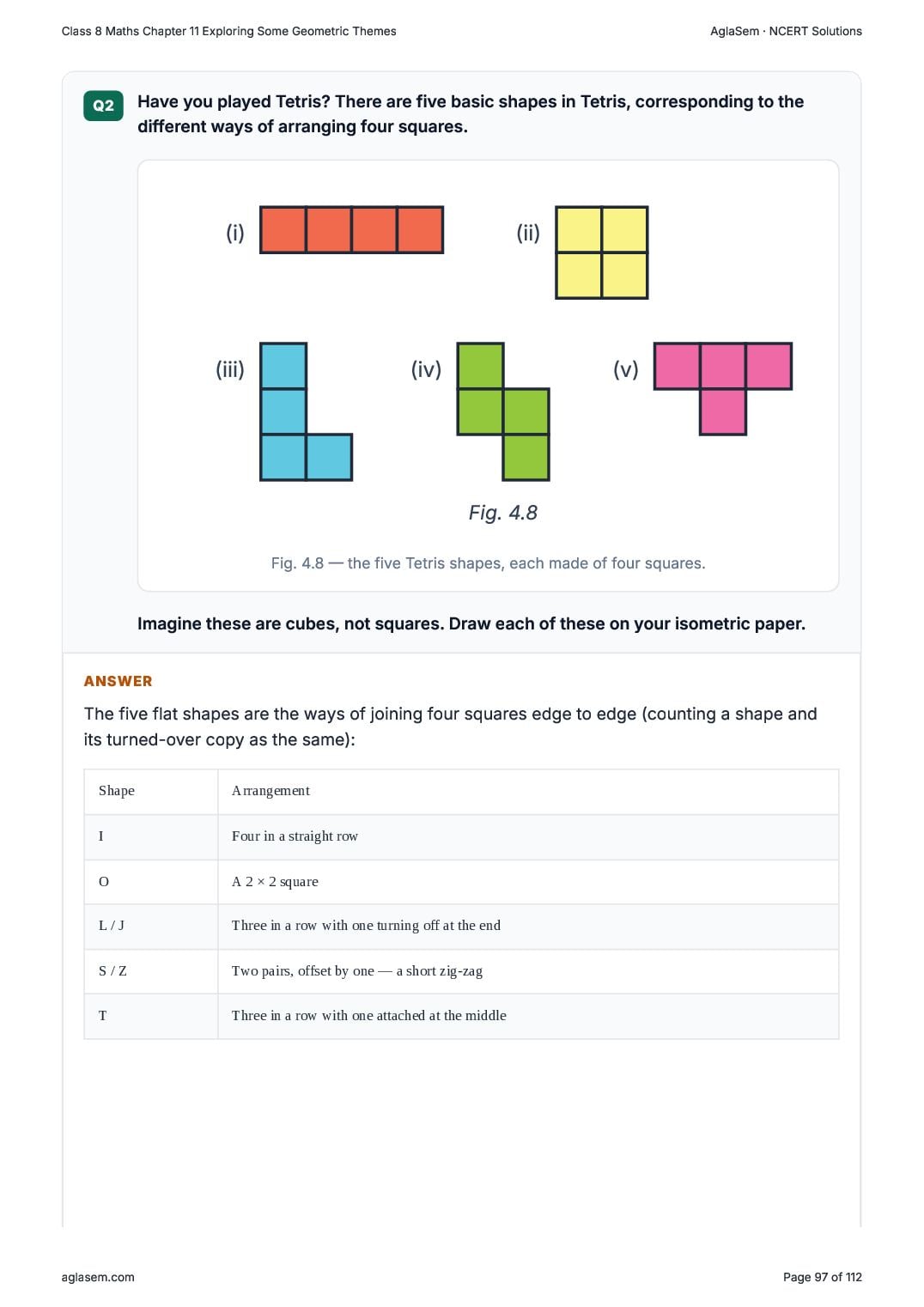
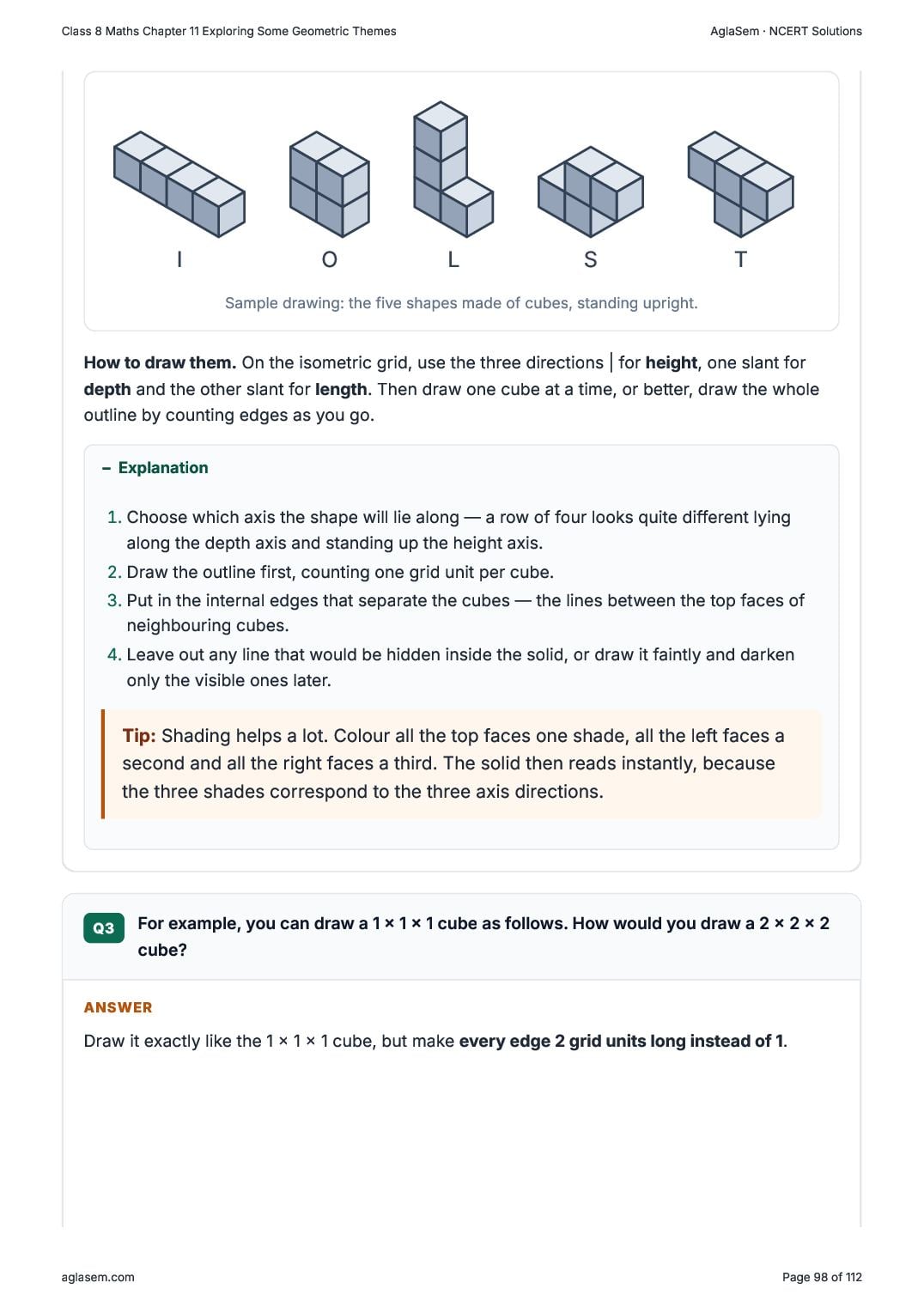
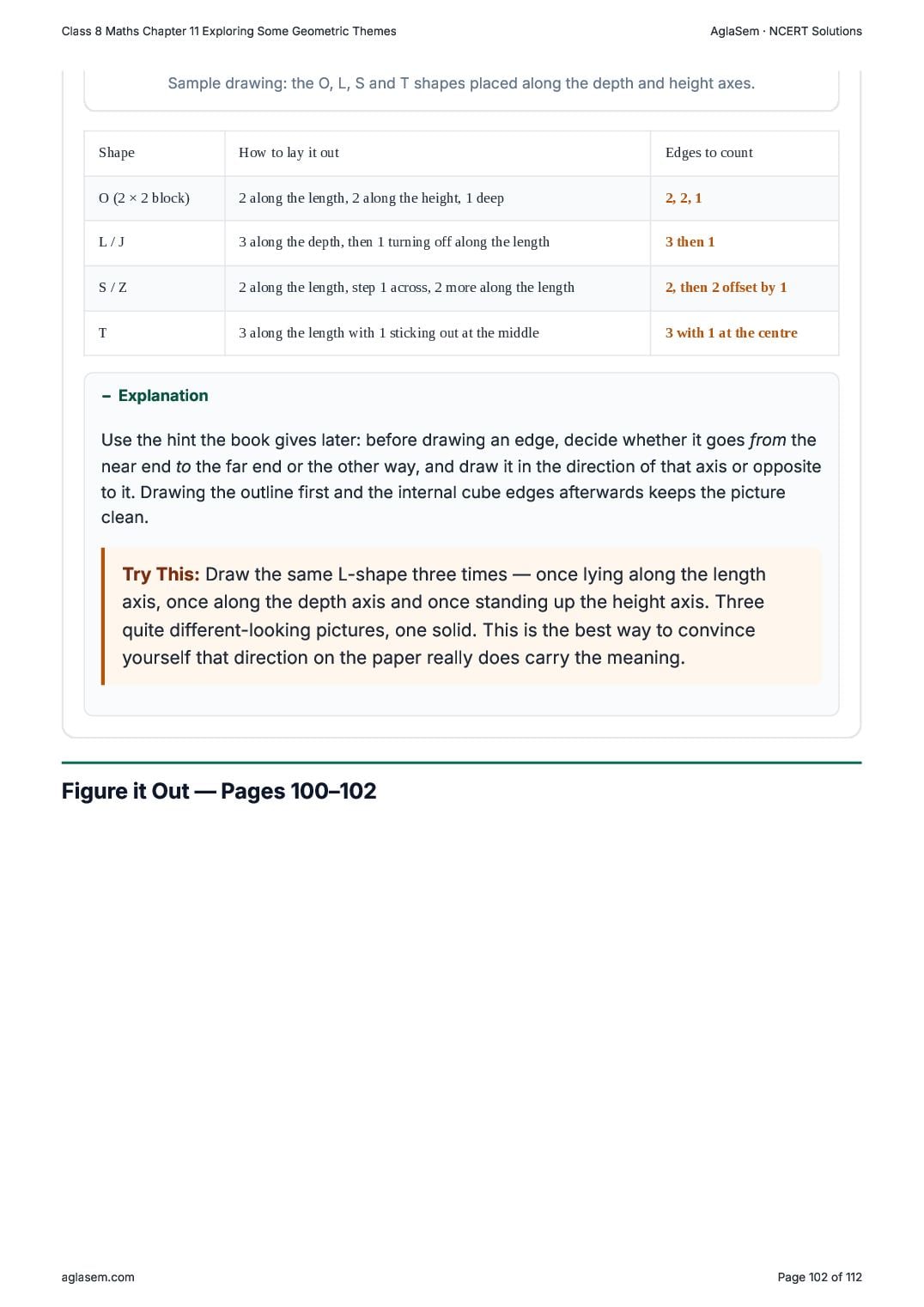
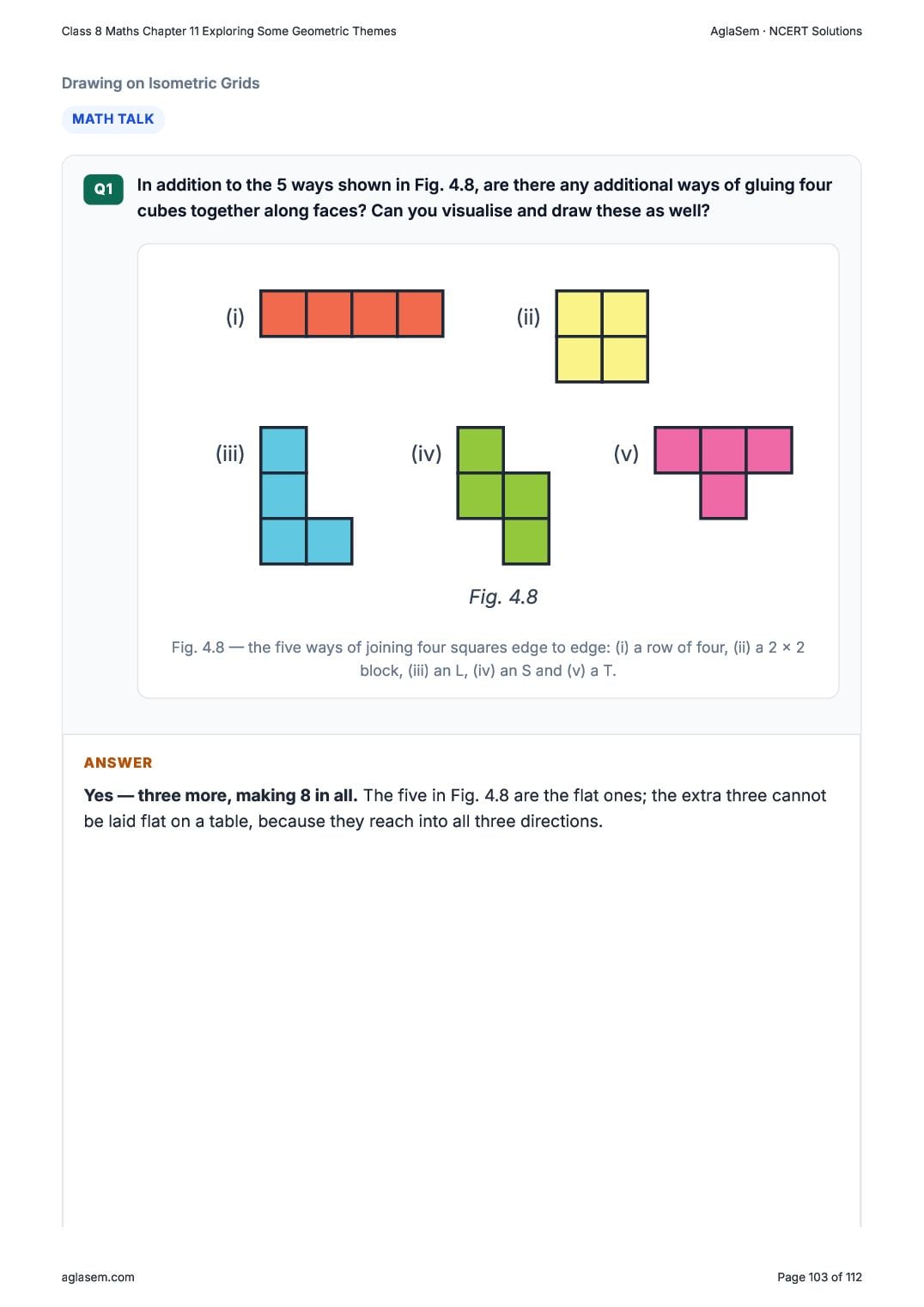
- Have you played Tetris? There are five basic shapes in Tetris, corresponding to the different ways of arranging four squares. Imagine these are cubes, not squares. Draw each of these on your isometric paper.
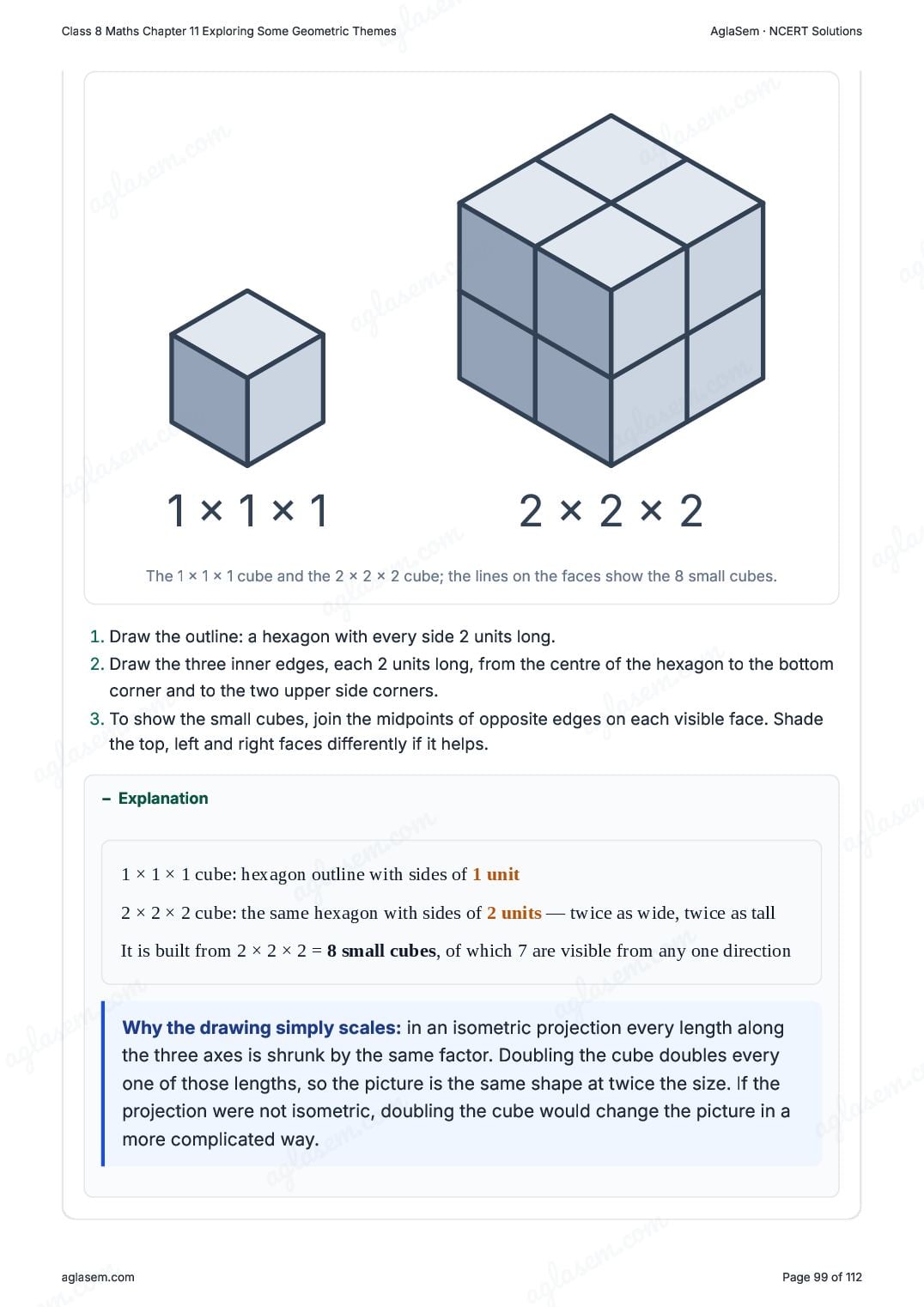
- For example, you can draw a 1 × 1 × 1 cube as follows. How would you draw a 2 × 2 × 2 cube?
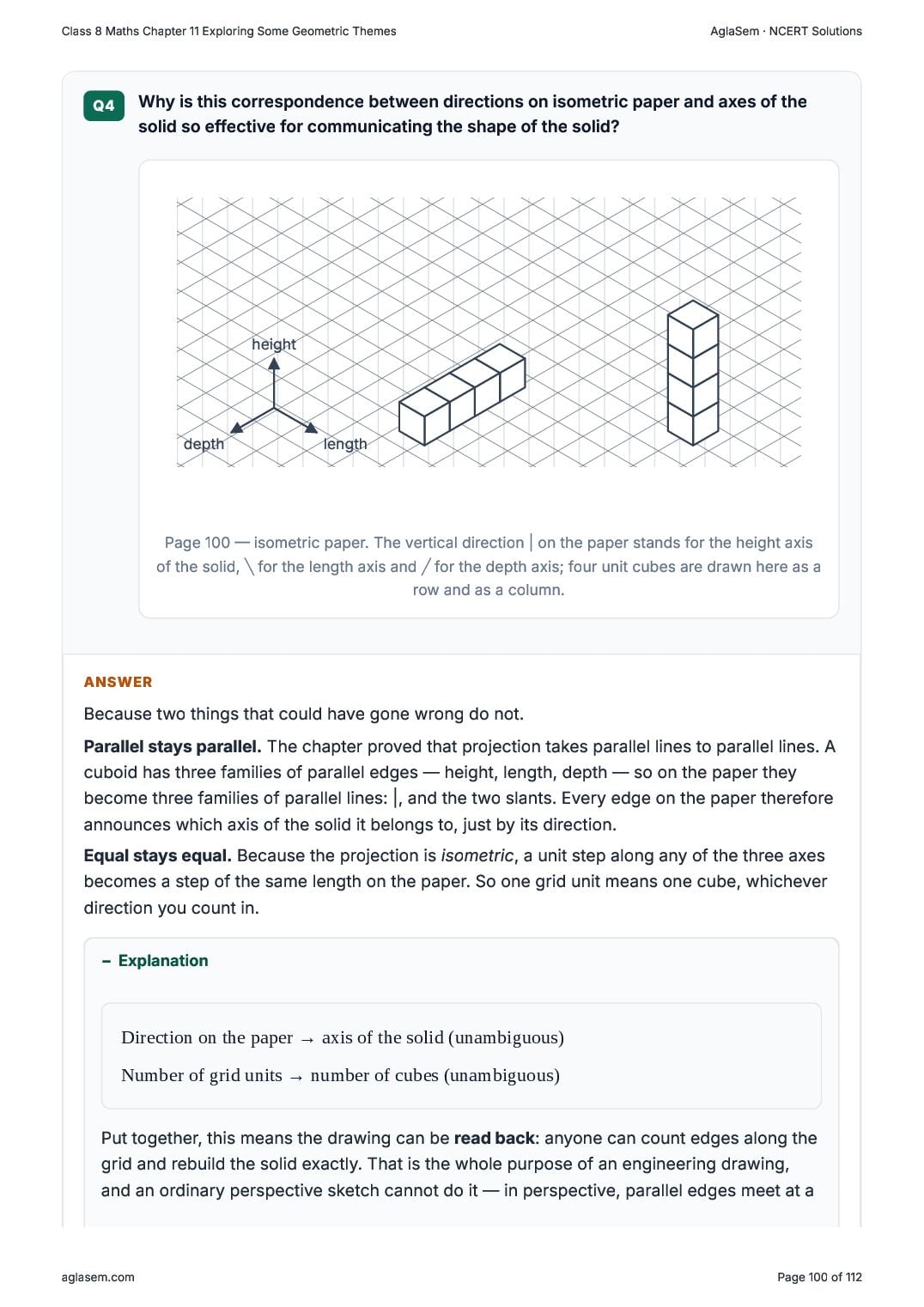
- Why is this correspondence between directions on isometric paper and axes of the solid so effective for communicating the shape of the solid?
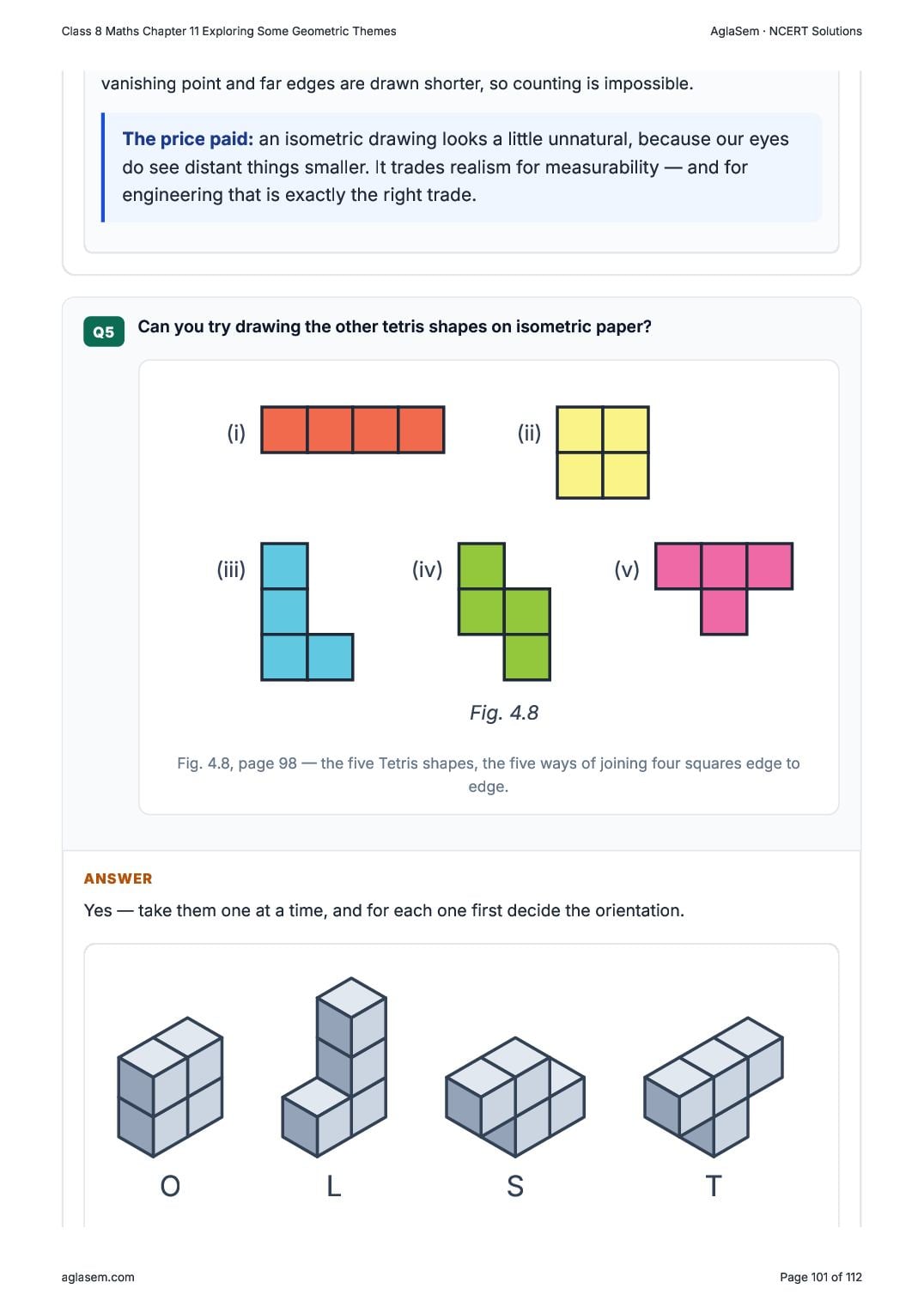
- Can you try drawing the other tetris shapes on isometric paper?
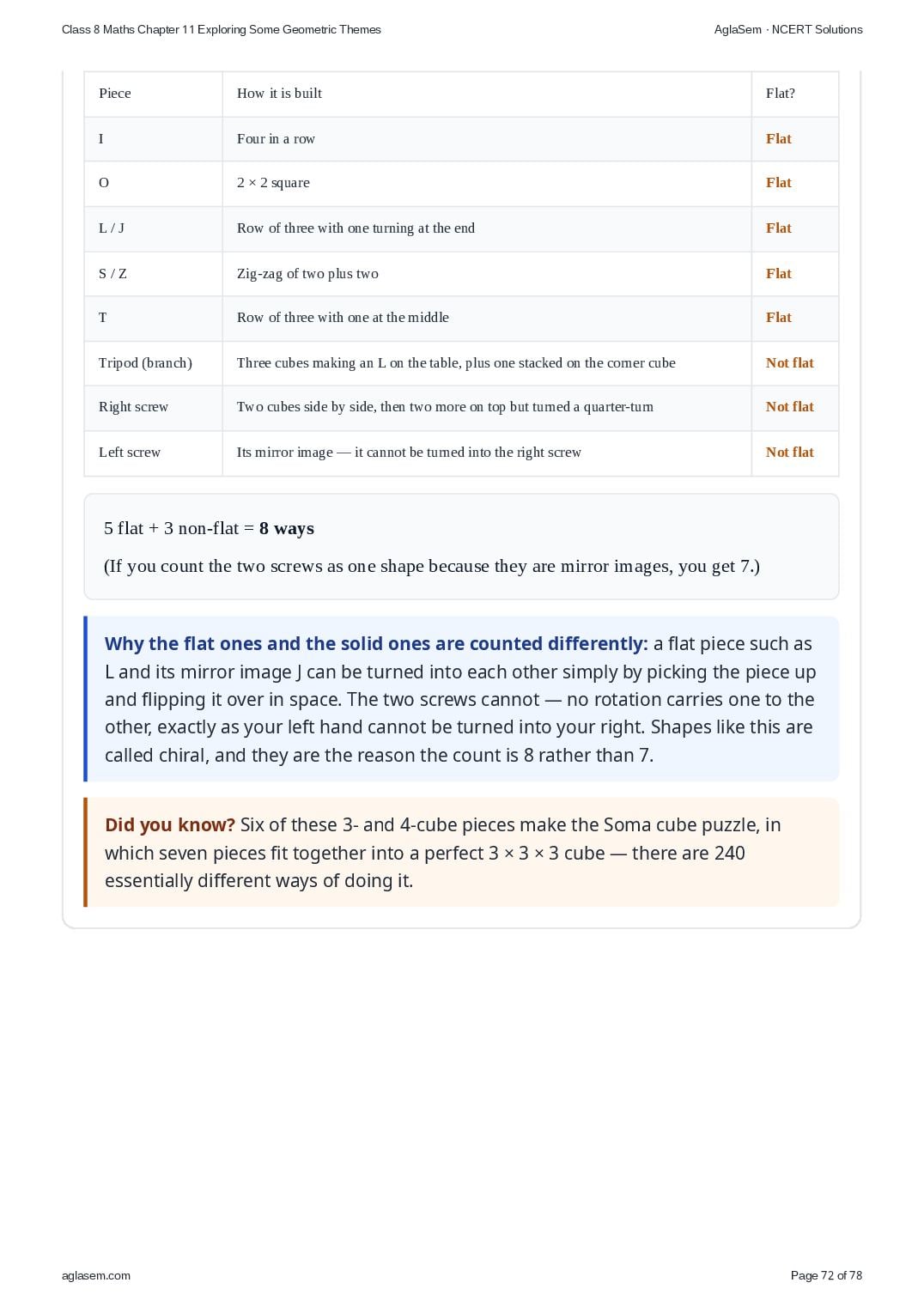
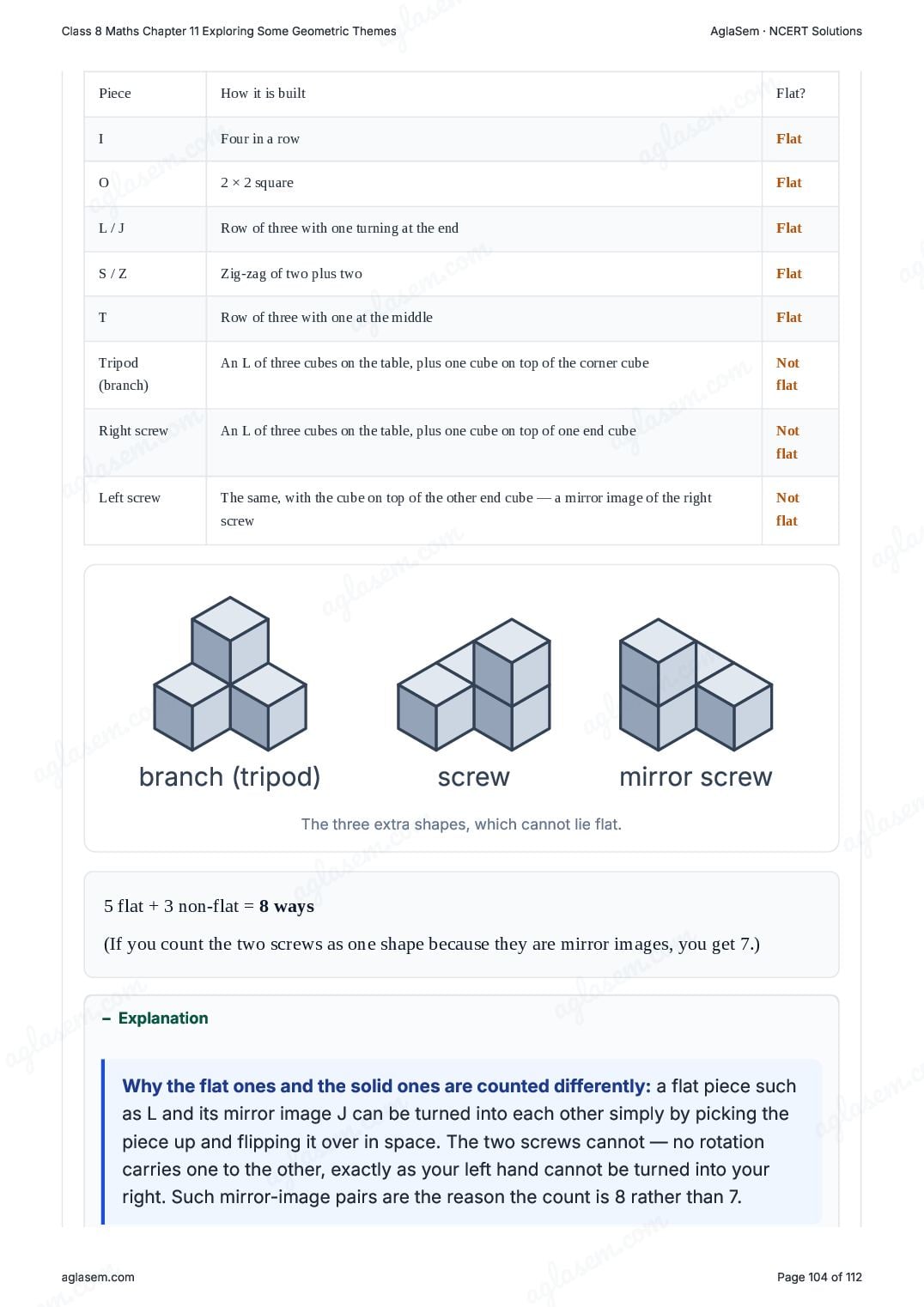
- In addition to the 5 ways shown in Fig. 4.8, are there any additional ways of gluing four cubes together along faces? Can you visualise and draw these as well?
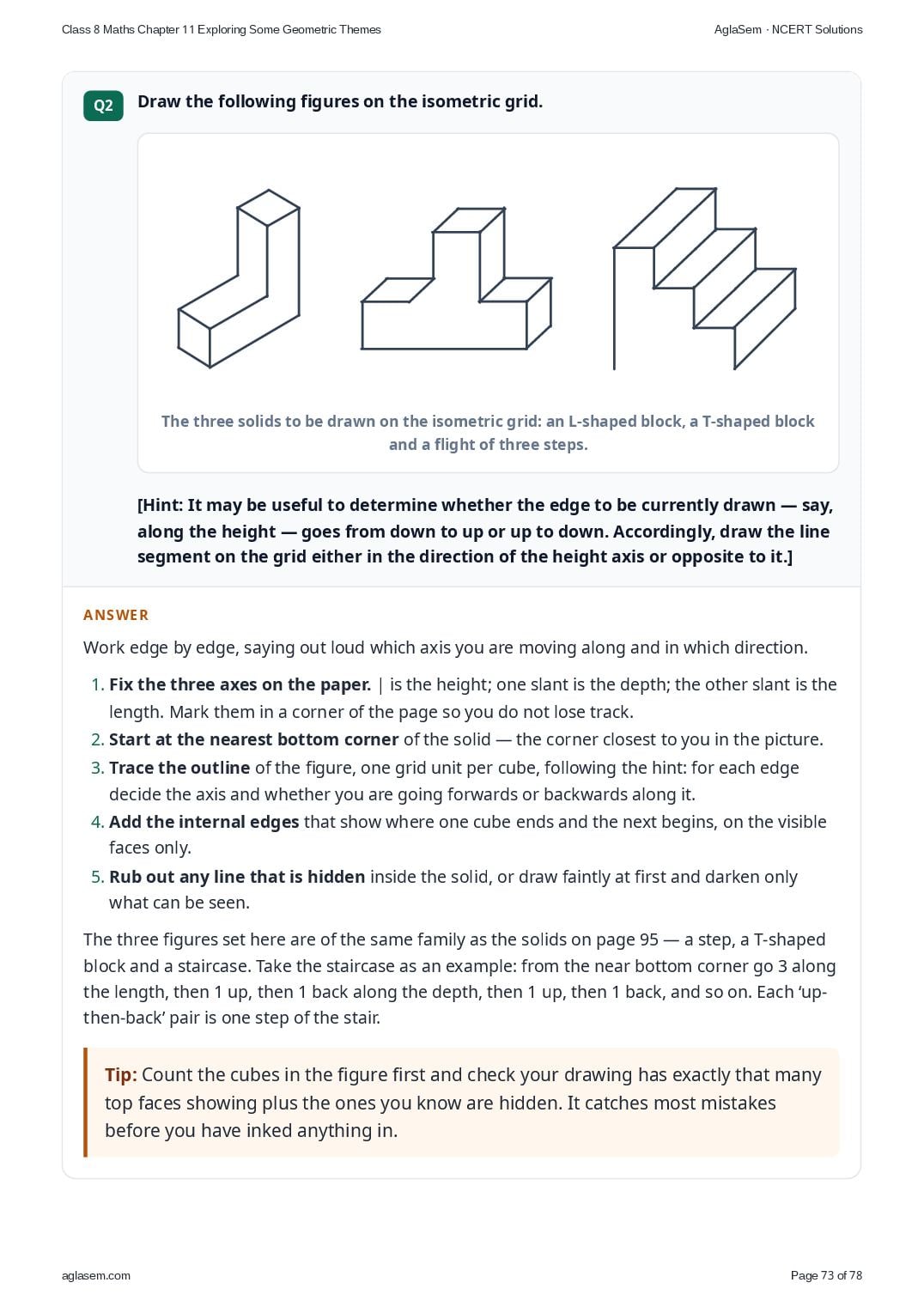
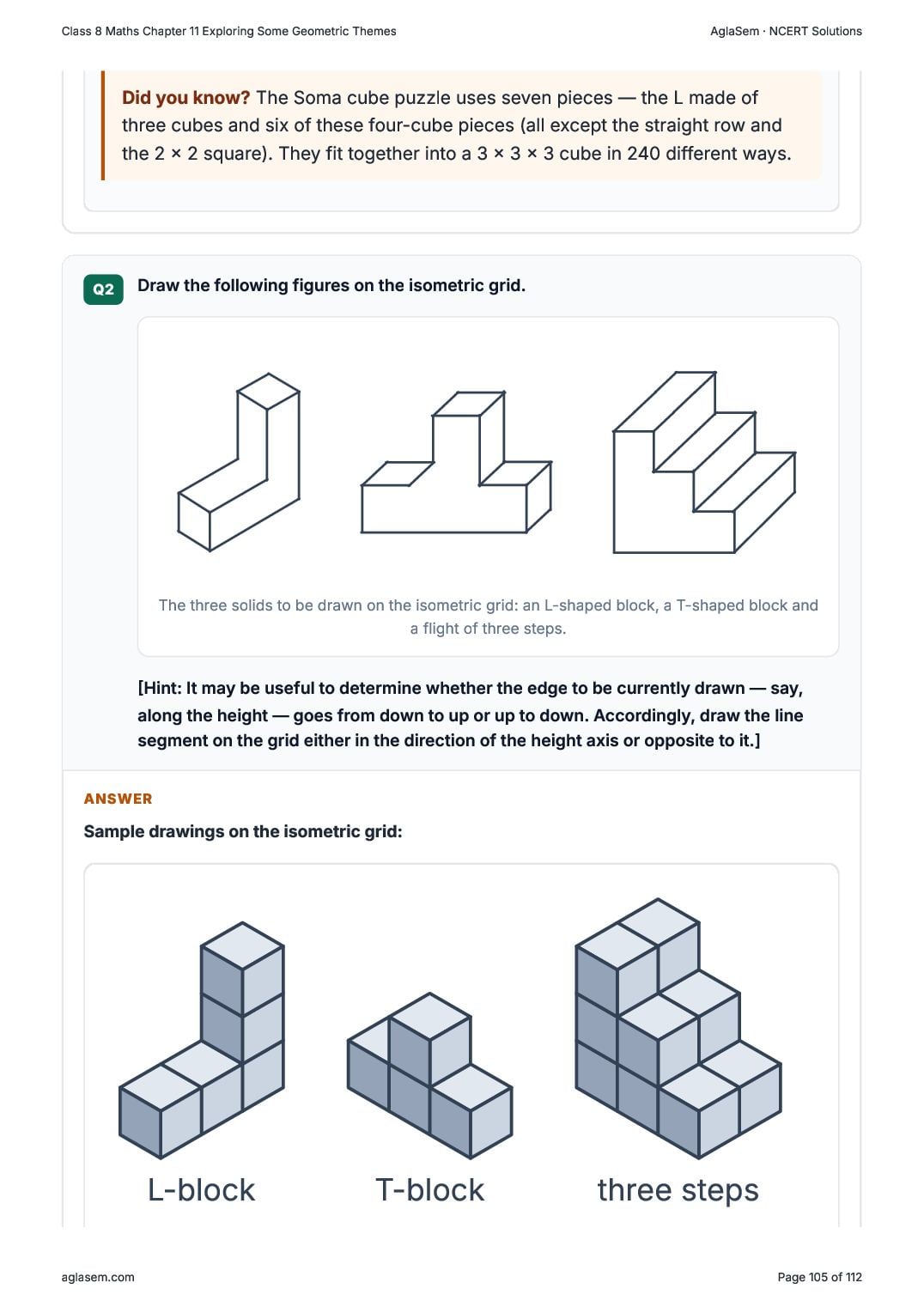
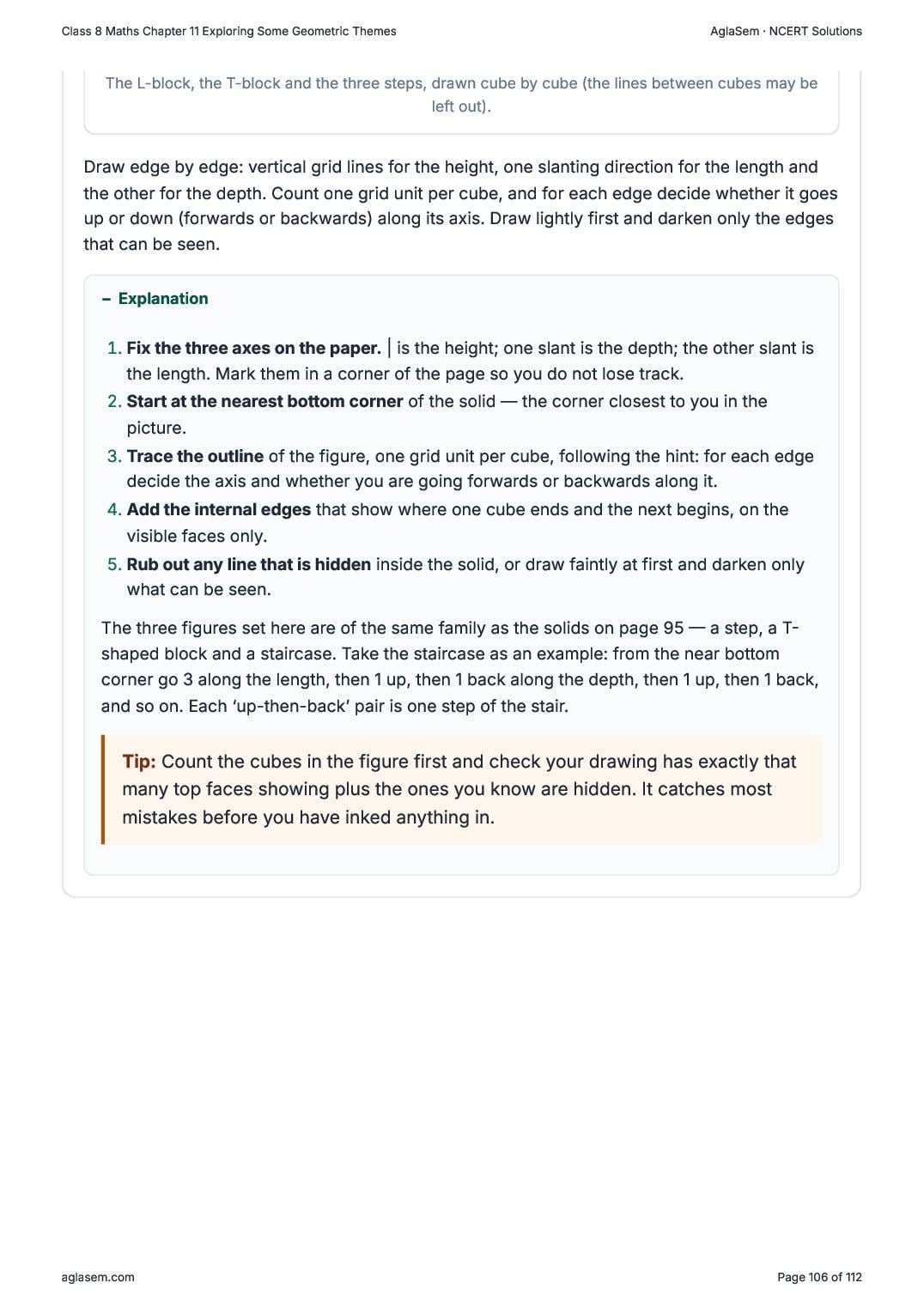
- Draw the following figures on the isometric grid. [Hint: It may be useful to determine whether the edge to be currently drawn — say, along the height — goes from down to up or up to down. Accordingly, draw the line segment on the grid either in the direction of the height axis or opposite to it.]
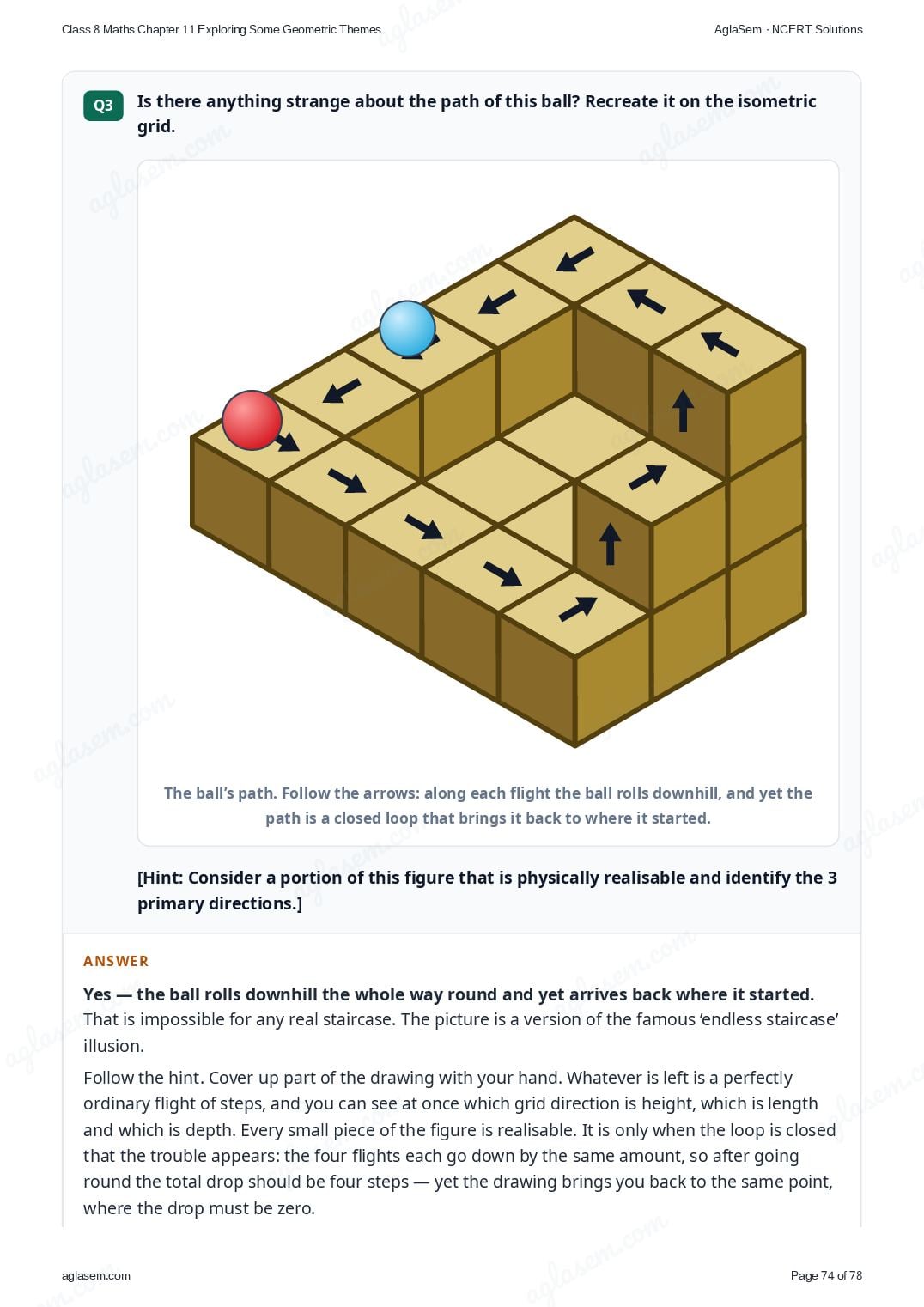
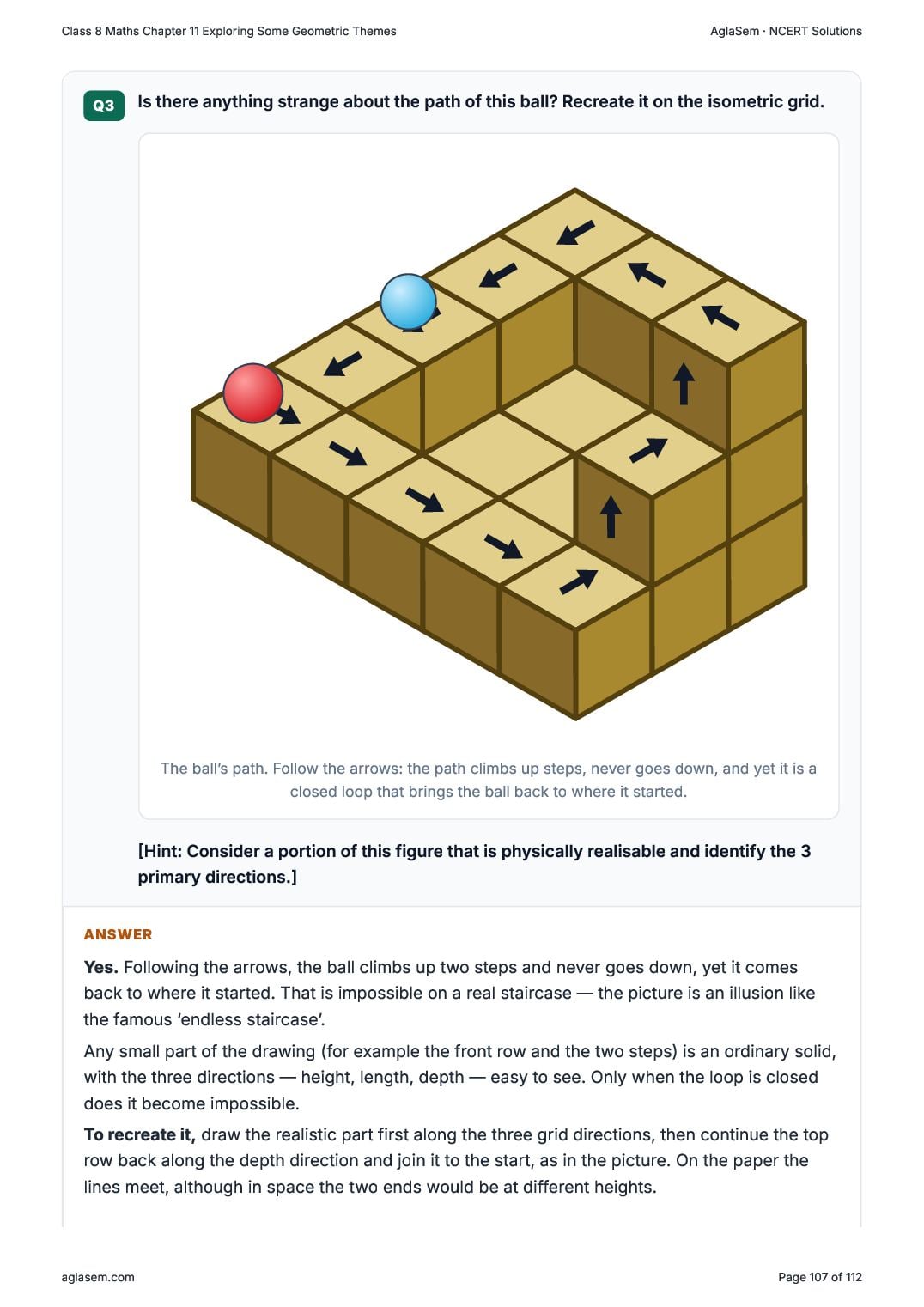
- Is there anything strange about the path of this ball? Recreate it on the isometric grid. [Hint: Consider a portion of this figure that is physically realisable and identify the 3 primary directions.]
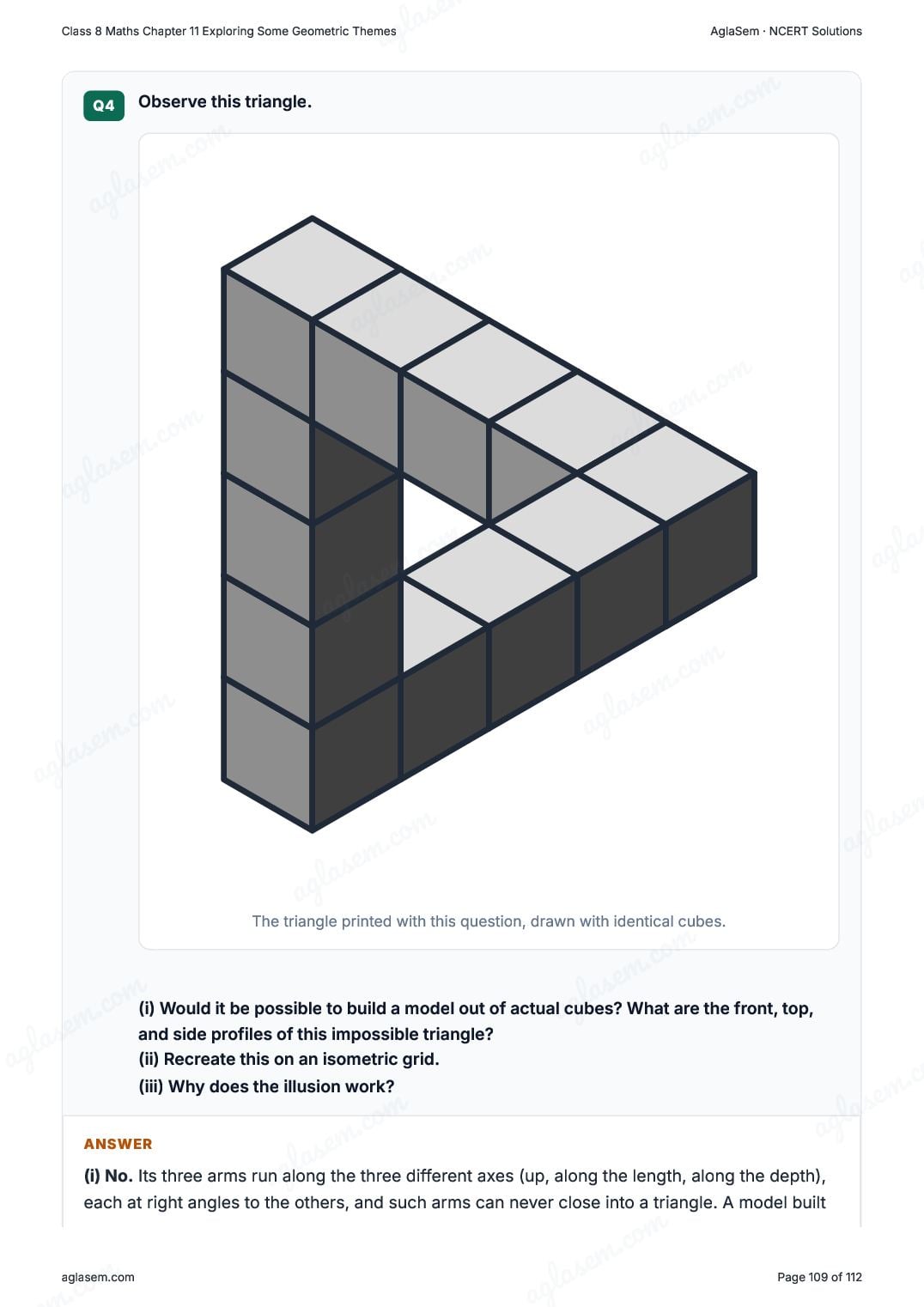
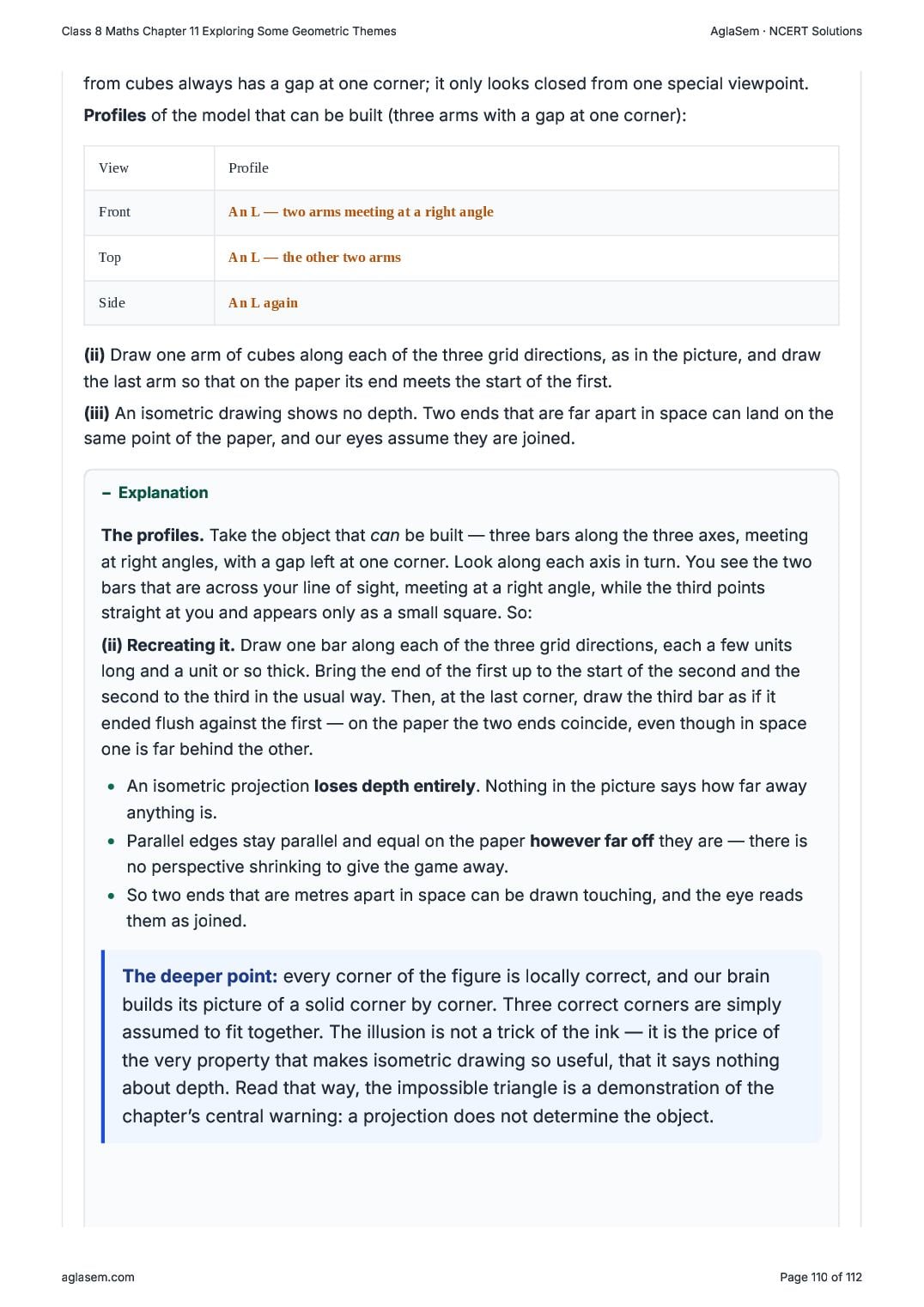
- Observe this triangle. (i) Would it be possible to build a model out of actual cubes? What are the front, top, and side profiles of this impossible triangle? (ii) Recreate this on an isometric grid. (iii) Why does the illusion work?
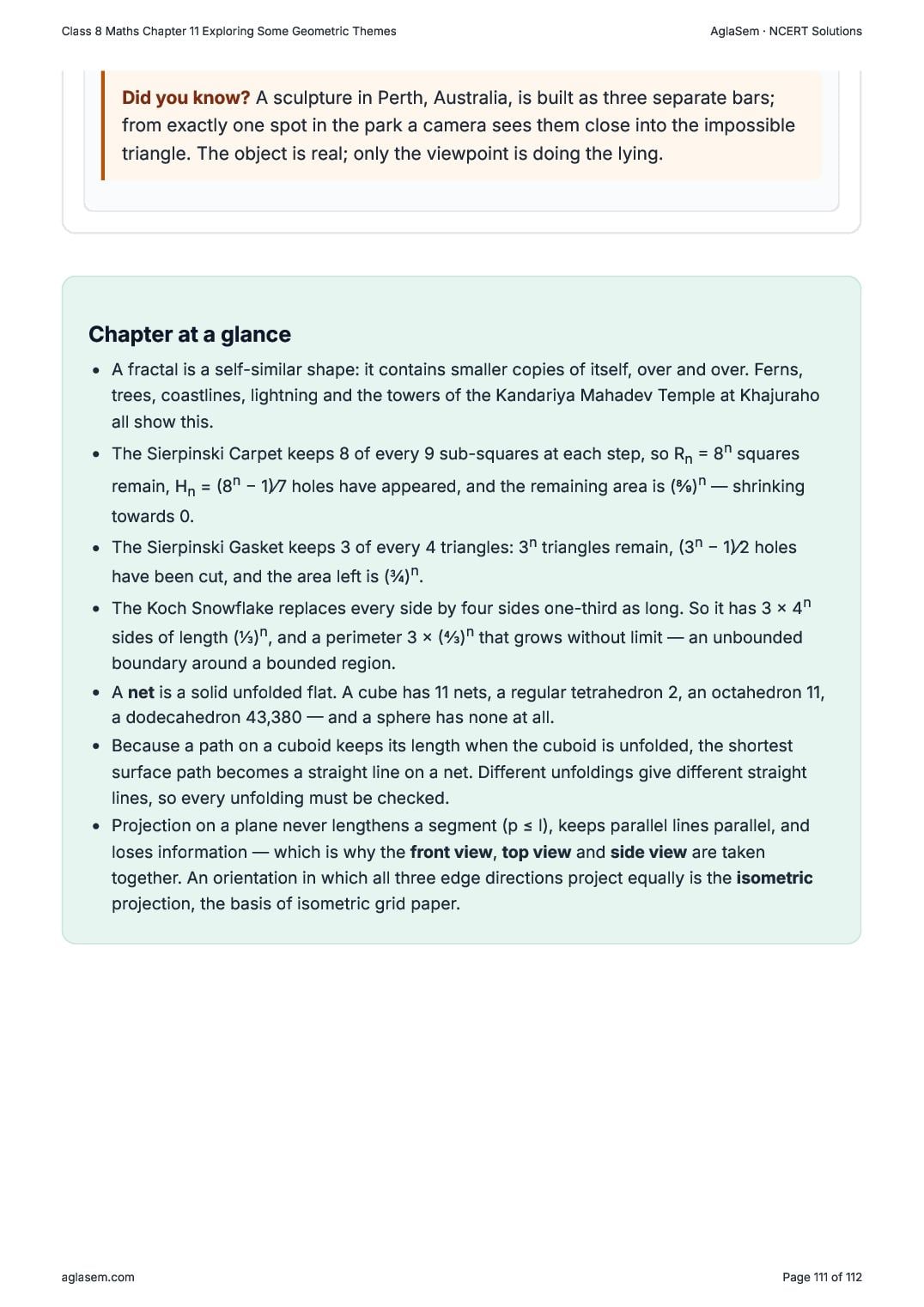
Chapter at a Glance
- A fractal is a self-similar shape: it contains smaller copies of itself, over and over. Ferns, trees, coastlines, lightning and the towers of the Kandariya Mahadev Temple at Khajuraho all show this.
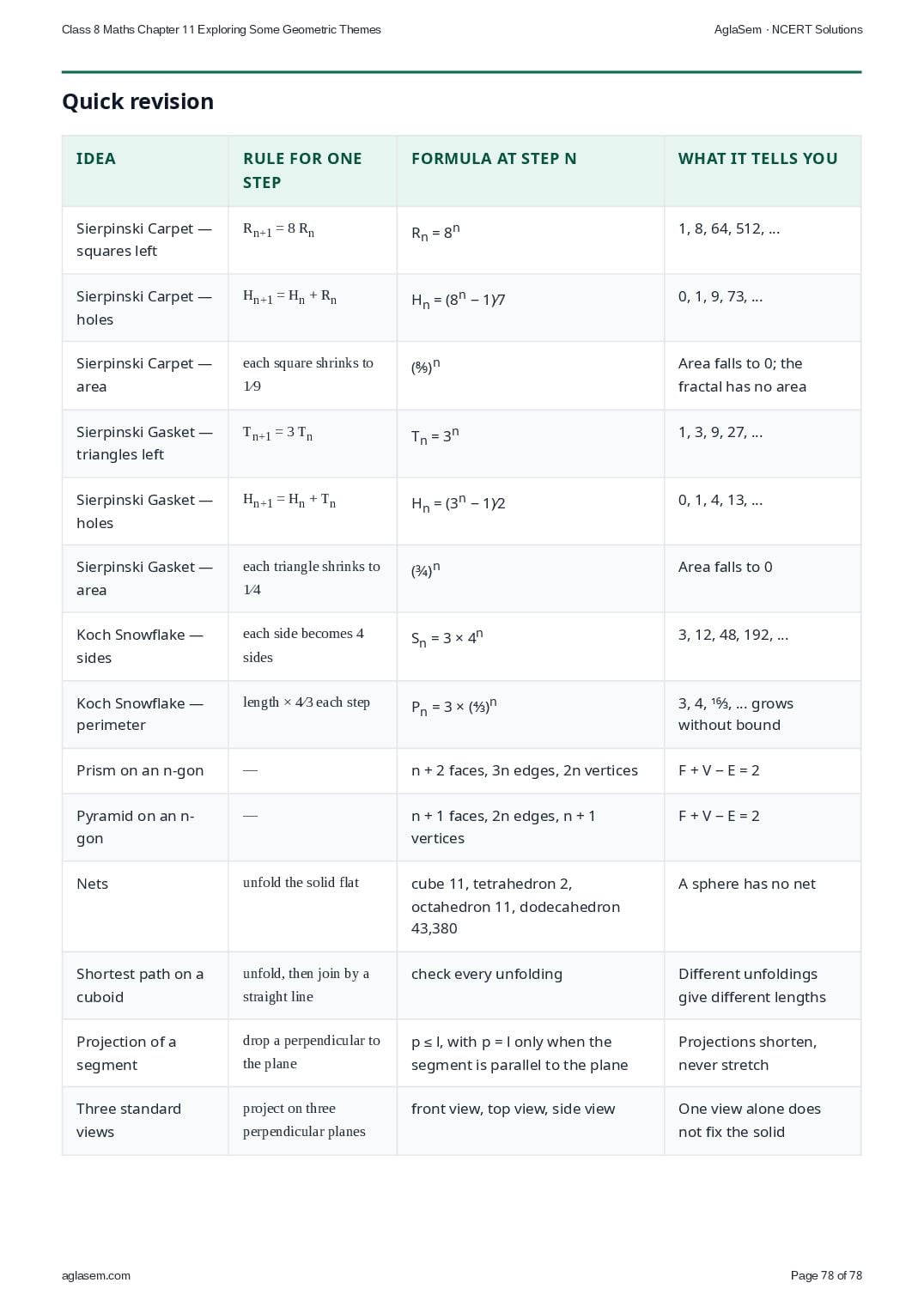
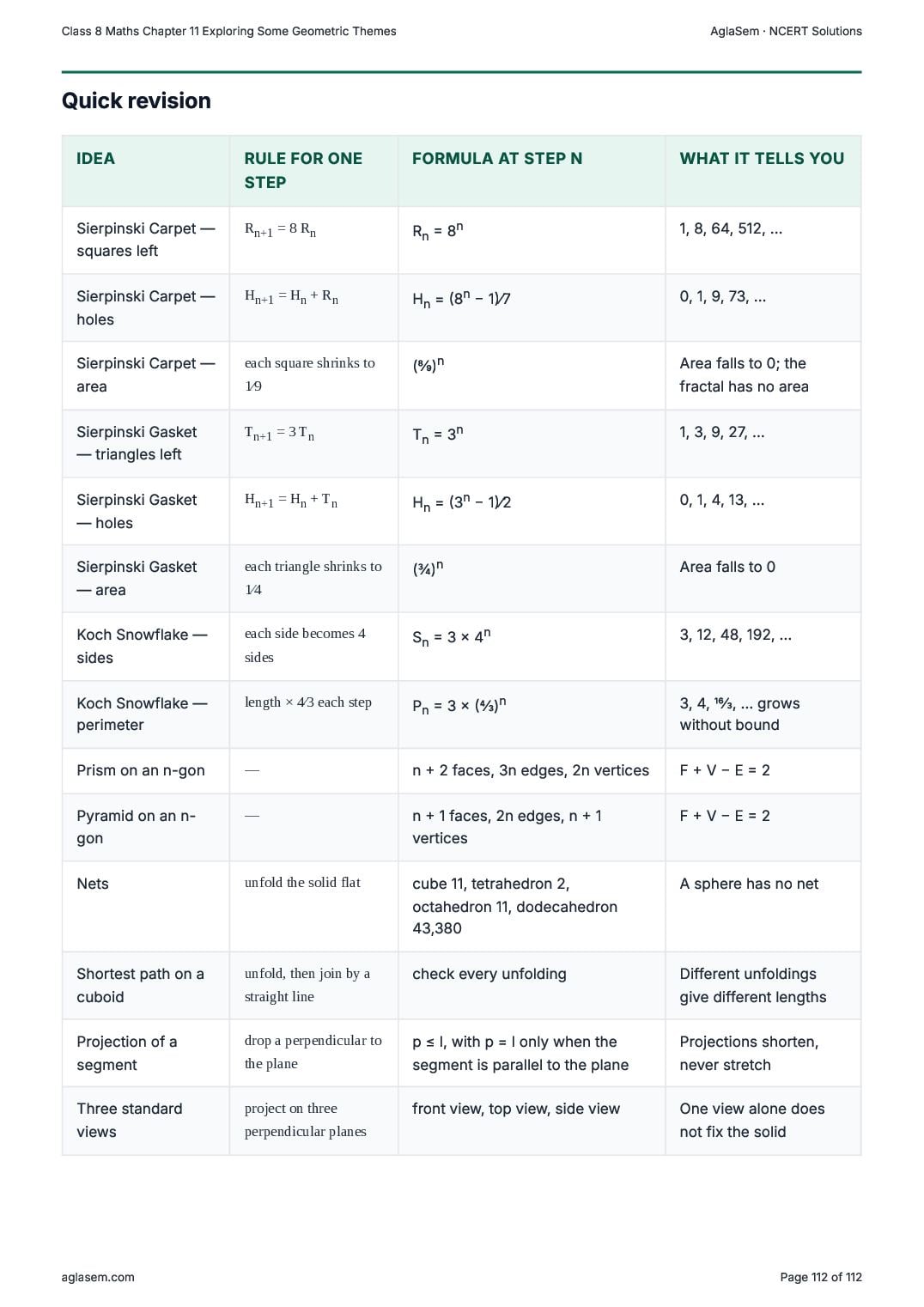
- The Sierpinski Carpet keeps 8 of every 9 sub-squares at each step, so R n = 8 n squares remain, H n = (8 n − 1)⁄7 holes have appeared, and the remaining area is (8⁄9) n — shrinking towards 0.
- The Sierpinski Gasket keeps 3 of every 4 triangles: 3 n triangles remain, (3 n − 1)⁄2 holes have been cut, and the area left is (3⁄4) n .
- The Koch Snowflake replaces every side by four sides one-third as long. So it has 3 × 4 n sides of length (1⁄3) n , and a perimeter 3 × (4⁄3) n that grows without limit — an unbounded boundary around a bounded region.
- A net is a solid unfolded flat. A cube has 11 nets, a regular tetrahedron 2, an octahedron 11, a dodecahedron 43,380 — and a sphere has none at all.
- Because a path on a cuboid keeps its length when the cuboid is unfolded, the shortest surface path becomes a straight line on a net. Different unfoldings give different straight lines, so every unfolding must be checked.
- Projection on a plane never lengthens a segment (p ≤ l), keeps parallel lines parallel, and loses information — which is why the front view , top view and side view are taken together. An orientation in which all three edge directions project equally is the isometric projection, the basis of isometric grid paper.
How to Download NCERT Solutions for Class 8 Maths Chapter 11 PDF
Follow these simple steps to get the Exploring Some Geometric Themes questions-and-answers PDF from Ganita Prakash.
- Search NCERT Solutions for Class 8 Maths Chapter 11 aglasem and open this page.
- Read the exercise questions with answers for Exploring Some Geometric Themes shown above.
- Click the Download PDF link to save the Exploring Some Geometric Themes solutions to your device.
NCERT Solutions for Class 8 Maths – All Chapters
There are more chapters to study besides Exploring Some Geometric Themes in Maths. Here are the NCERT Solutions for all chapters of Class 8 Maths.
- Chapter 1 A Square and a Cube
- Chapter 2 Power Play
- Chapter 3 A Story of Numbers
- Chapter 4 Quadrilaterals
- Chapter 5 Number Play
- Chapter 6 We Distribute Yet Things Multiply
- Chapter 7 Proportional Reasoning 1
- Chapter 8 Fractions in Disguise
- Chapter 9 The Baudh Yana Pythagoras Theorem
- Chapter 10 Proportional Reasoning 2
- Chapter 11 Exploring Some Geometric Themes
- Chapter 12 Tales By Dots and Lines
- Chapter 13 Algebra Play
- Chapter 14 Area
NCERT Solutions for Class 8 – All Subjects
Just like Chapter 11 of Maths, you can get the exercise questions with answers for every other subject of Class 8. Here are the NCERT Solutions for all subjects of Class 8.
NCERT Solutions for Class 8 Maths Chapter 11 – An Overview
The key highlights of this study material are as follows.
| Aspects | Details |
|---|---|
| Class | Class 8 |
| Subject | Maths |
| Chapter Number | Chapter 11 |
| Chapter Name | Exploring Some Geometric Themes |
| Book Name | Ganita Prakash |
| Book By | NCERT (National Council of Educational Research and Training) |
| Educational Resource Here | NCERT Solutions of Class 8 Maths Chapter 11 for all exercises |
| More Questions Answers of This Subject | NCERT Solutions for Class 8 Maths |
| Download Book Chapter | NCERT Book Class 8 Maths |
| All Questions Answers For This Class | NCERT Solutions for Class 8 |
| Complete Solutions | NCERT Solutions |
NCERT Solutions for Class 8 Maths Chapter 11 Exploring Some Geometric Themes – FAQs
What are the NCERT Solutions for Class 8 Maths Chapter 11 Exploring Some Geometric Themes?
They are the complete, step-by-step answers to all the exercise and in-text questions of Chapter 11 Exploring Some Geometric Themes from the NCERT Class 8 Maths textbook Ganita Prakash, written by experts as per the latest NCERT syllabus.
How can I download the Class 8 Maths Chapter 11 solutions PDF for free?
Open this page on aglasem, read the Exploring Some Geometric Themes questions with answers, and click the “Download Solutions PDF” link. The Class 8 Maths Chapter 11 NCERT Solutions PDF is completely free to download.
Are these NCERT Solutions as per the latest 2026-27 syllabus?
Yes. The NCERT Solutions for Class 8 Maths Chapter 11 are based on the latest NCERT textbook Ganita Prakash and the current 2026-27 CBSE syllabus, so the questions and answers match what you study in class.
Where can I get NCERT Solutions for the other chapters of Class 8 Maths?
You can find the answers to every chapter on the NCERT Solutions for Class 8 Maths page, and solutions for every subject on the NCERT Solutions for Class 8 page.
How do NCERT Solutions help in exam preparation?
They show the correct method to solve each question, help you write answers the way they are expected in exams, let you check and correct your own work, and save revision time — which together improve your marks in Class 8 Maths.
If you have any queries on NCERT Solutions for Class 8 Maths Chapter 11 Exploring Some Geometric Themes, then please ask in the comments below.