NCERT Solutions for Class 8 Maths Chapter 1 A Square and a Cube provide clear, step-by-step answers to every exercise and in-text question from the chapter A Square and a Cube of the NCERT textbook Ganita Prakash. Prepared by subject experts as per the latest NCERT (CBSE) syllabus for 2026-27, these NCERT Solutions for Class 8 Maths help you understand each concept, write exam-ready answers, and check your own solutions. You can read them online below or download the free Class 8 Maths Chapter 1 question-answer PDF.
NCERT Solutions for Class 8 Maths Chapter 1 A Square and a Cube
- Class: Class 8
- Subject: Maths
- Chapter: Chapter 1 – A Square and a Cube
- Textbook: Ganita Prakash (NCERT)
- Study material: NCERT Solutions – questions with answers, free PDF
These solutions answer all the exercise questions of Chapter 1 A Square and a Cube — including the in-text questions, short-answer and long-answer questions, and activities — with complete explanations so you can follow the method, not just the final answer. Read the full solutions below.
NCERT Solutions Class 8 Maths Chapter 1 a Square and a Cube View Download
NCERT Solutions for Class 8 Maths Chapter 1 PDF Download
You can read the NCERT Solutions for Class 8 Maths Chapter 1 online above, or download the complete question-answer PDF to study A Square and a Cube offline at any time.
NCERT Solutions for Class 8 Maths Chapter 1 PDF Download Link – Click Here to Download Solutions PDF
Questions Covered in This Chapter
These NCERT Solutions answer all 65 questions of this chapter. The questions solved are:
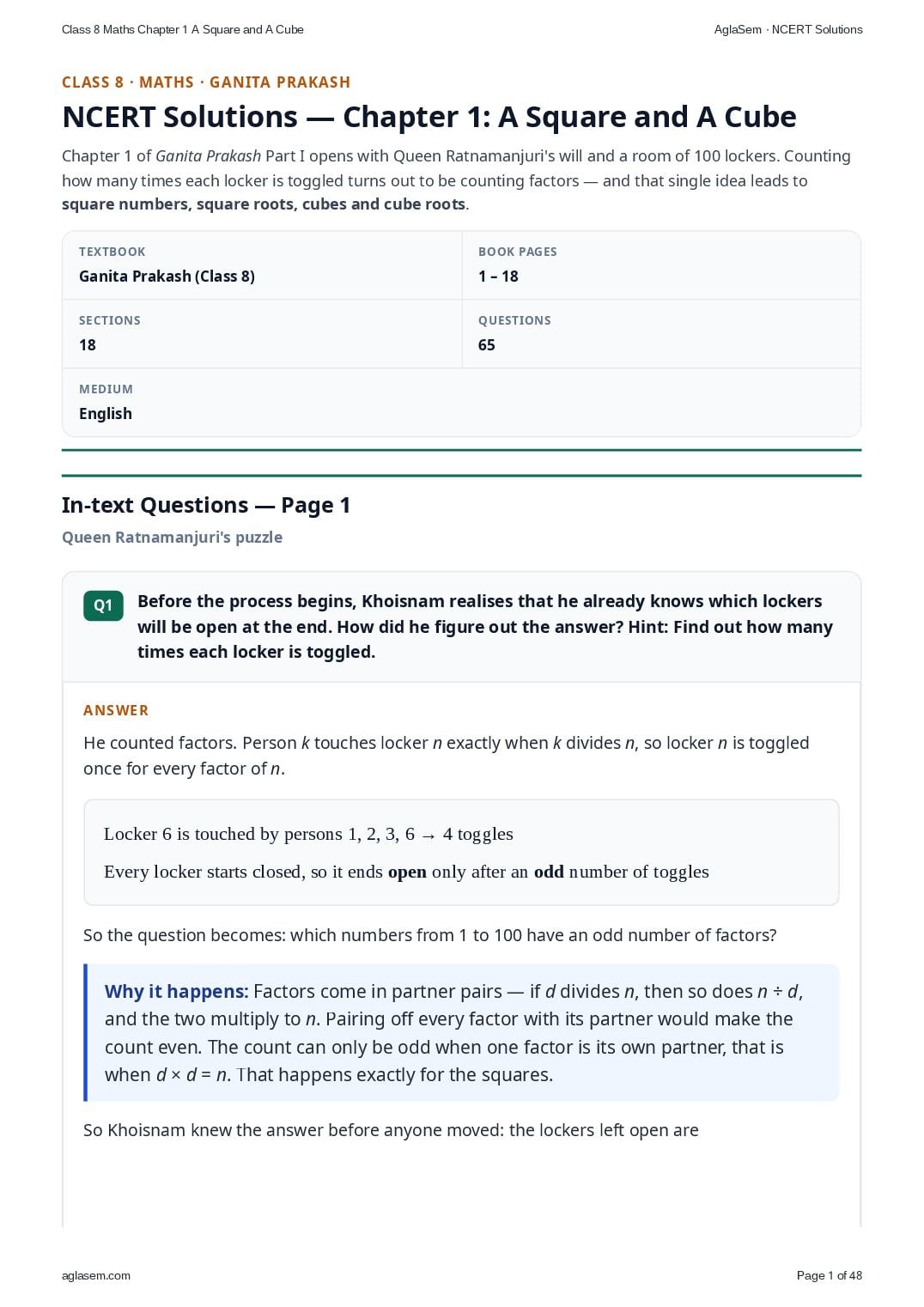
- Before the process begins, Khoisnam realises that he already knows which lockers will be open at the end. How did he figure out the answer? Hint: Find out how many times each locker is toggled.
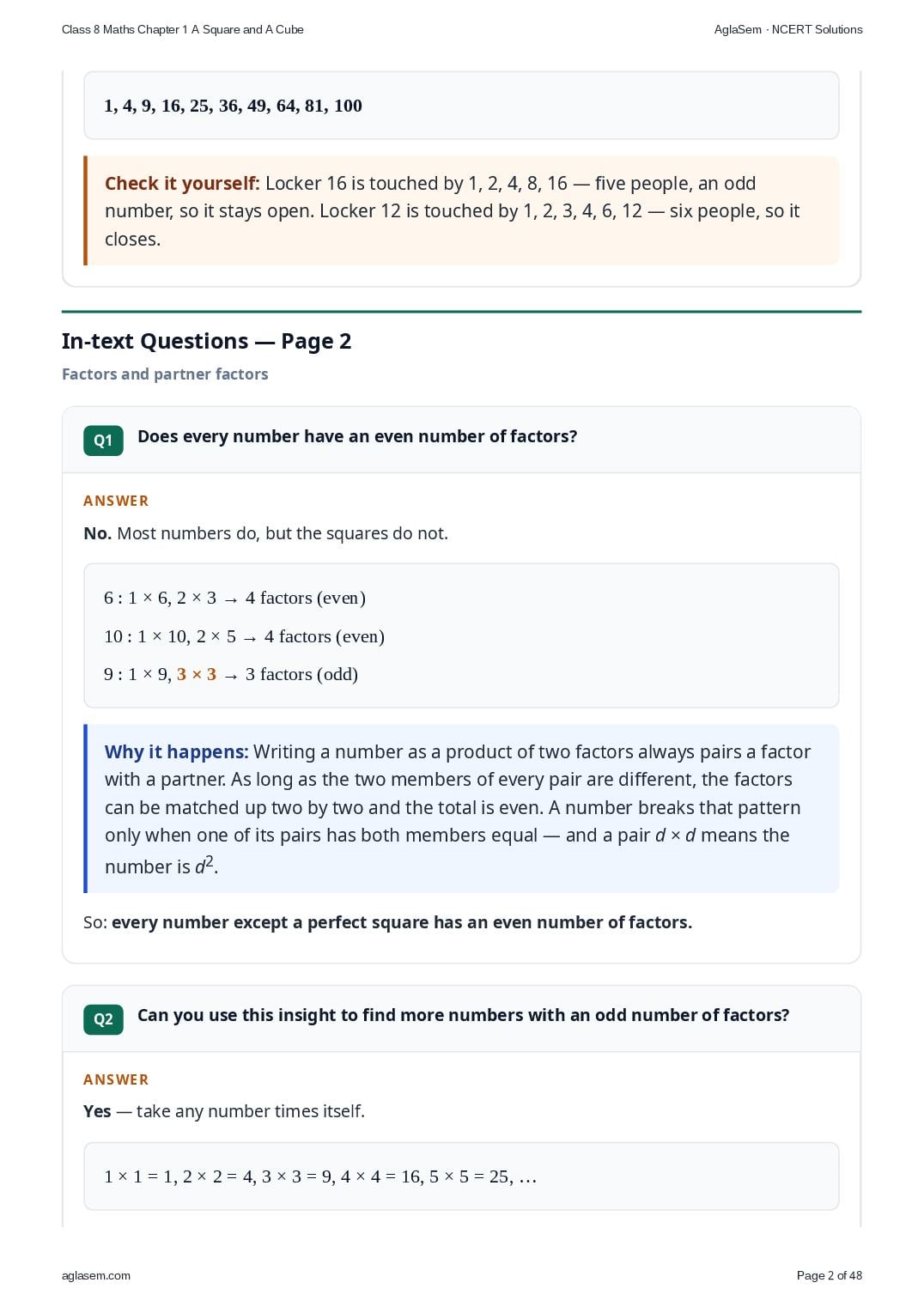
- Does every number have an even number of factors?
- Can you use this insight to find more numbers with an odd number of factors?
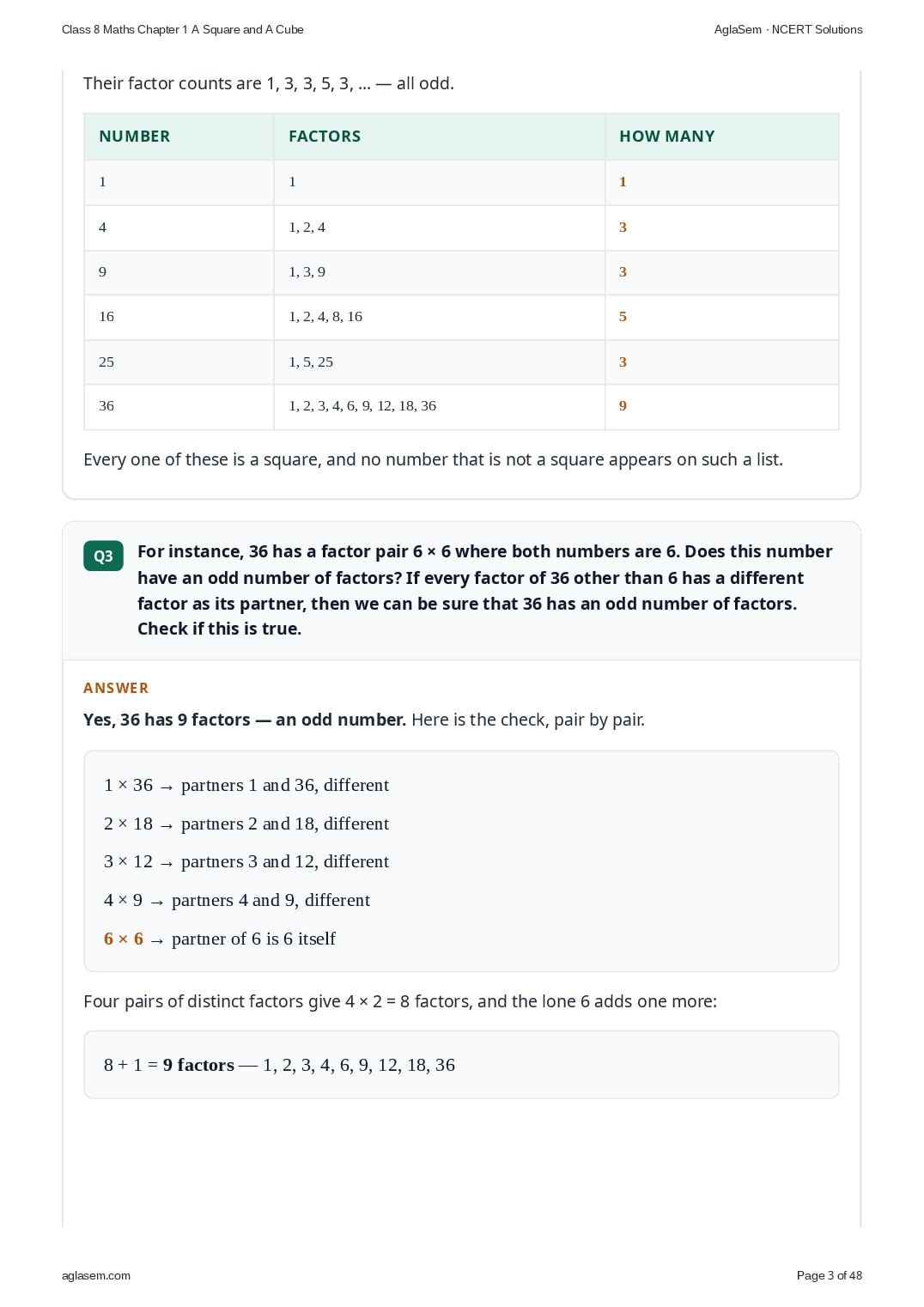
- For instance, 36 has a factor pair 6 × 6 where both numbers are 6. Does this number have an odd number of factors? If every factor of 36 other than 6 has a different factor as its partner, then we can be sure that 36 has an odd number of factors. Check if this is true.
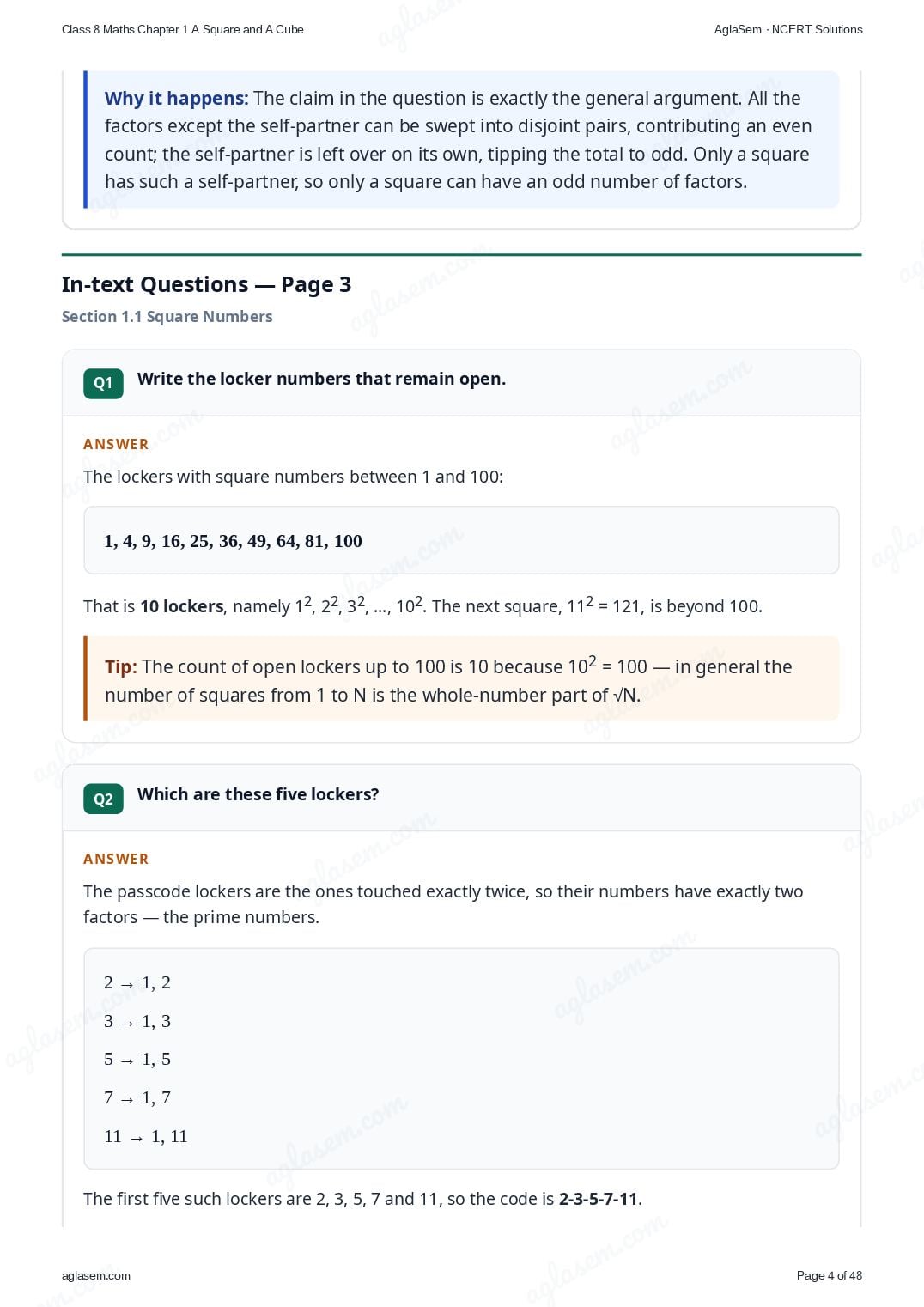
- Write the locker numbers that remain open.
- Which are these five lockers?
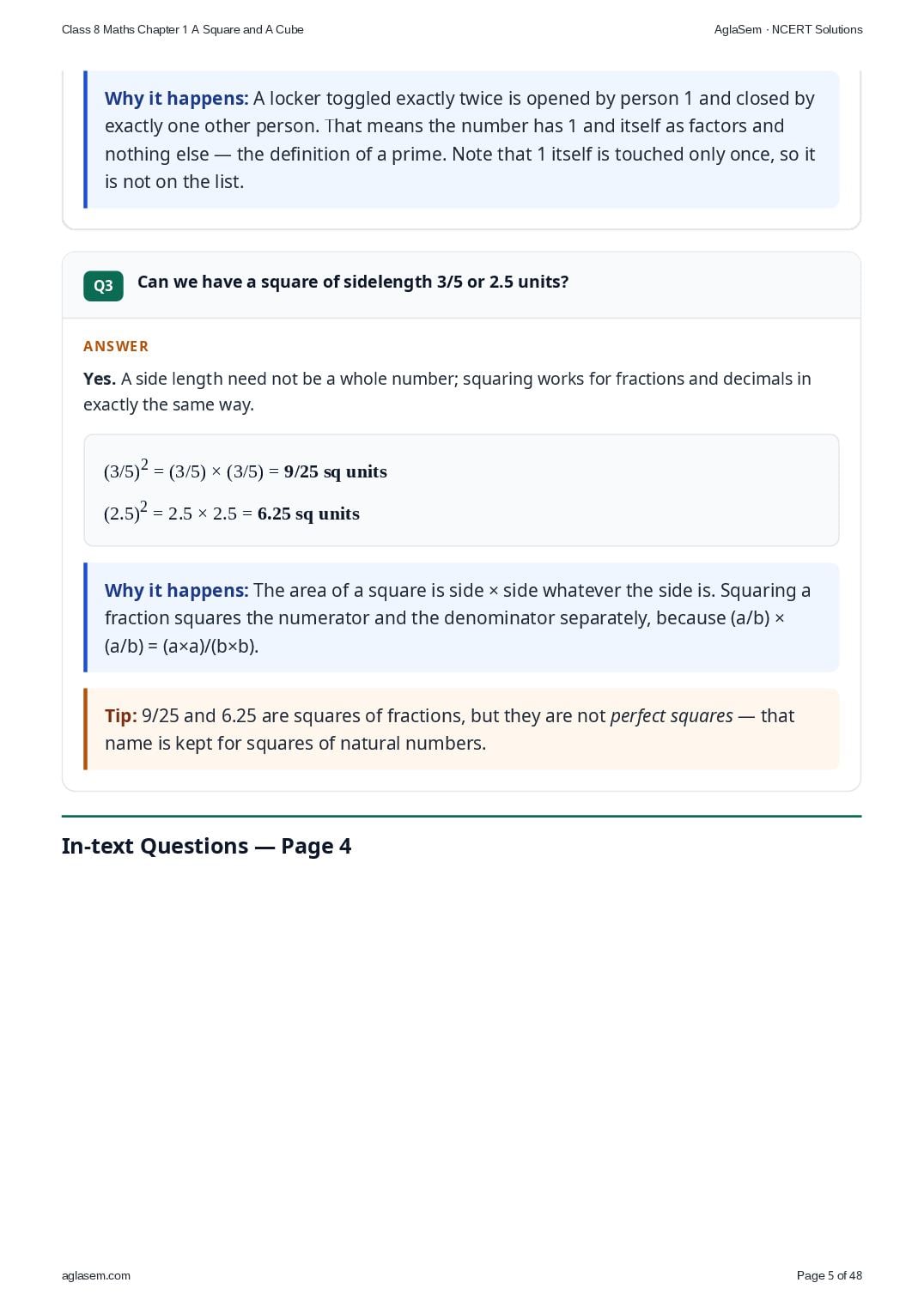
- Can we have a square of sidelength 3/5 or 2.5 units?
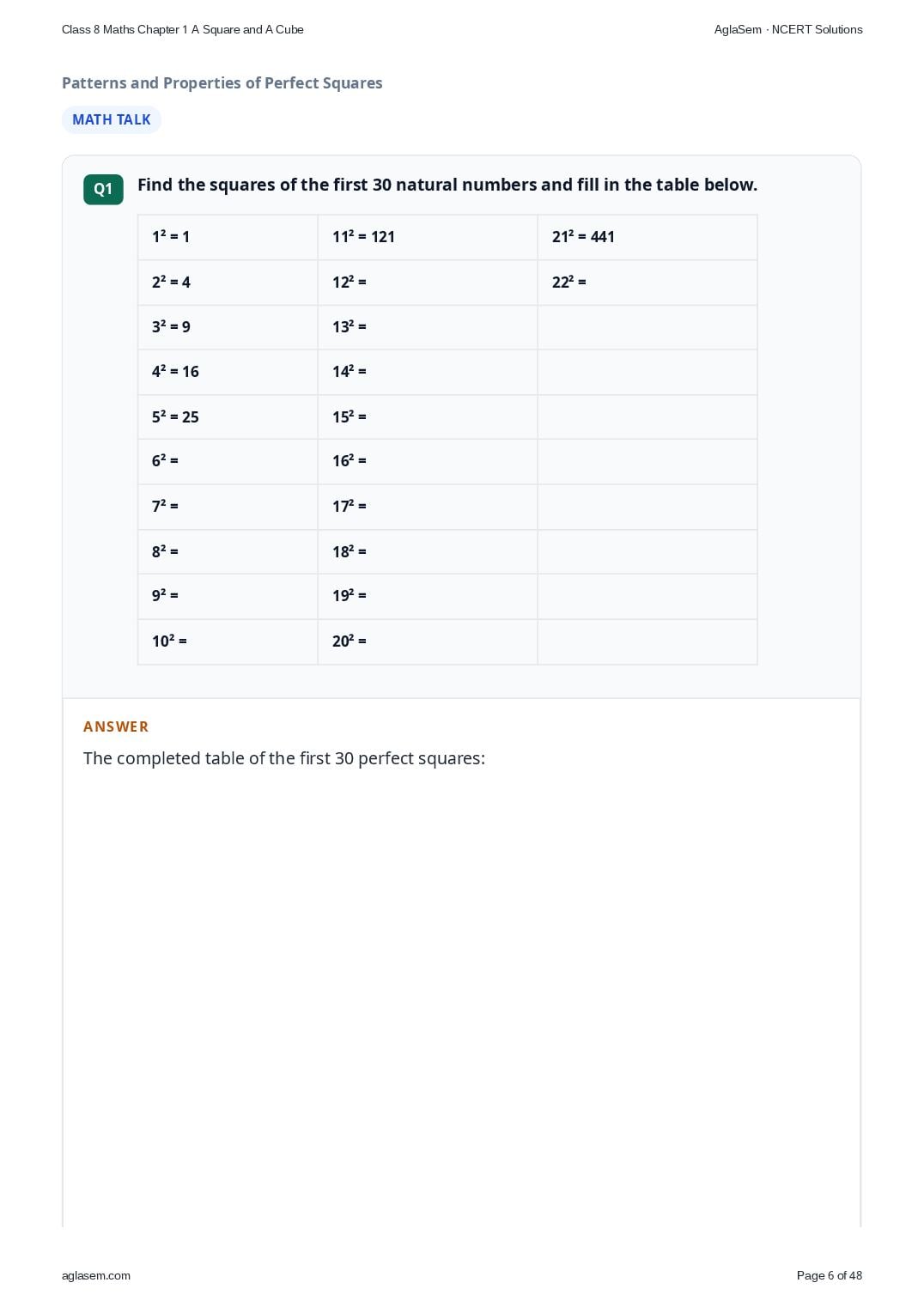
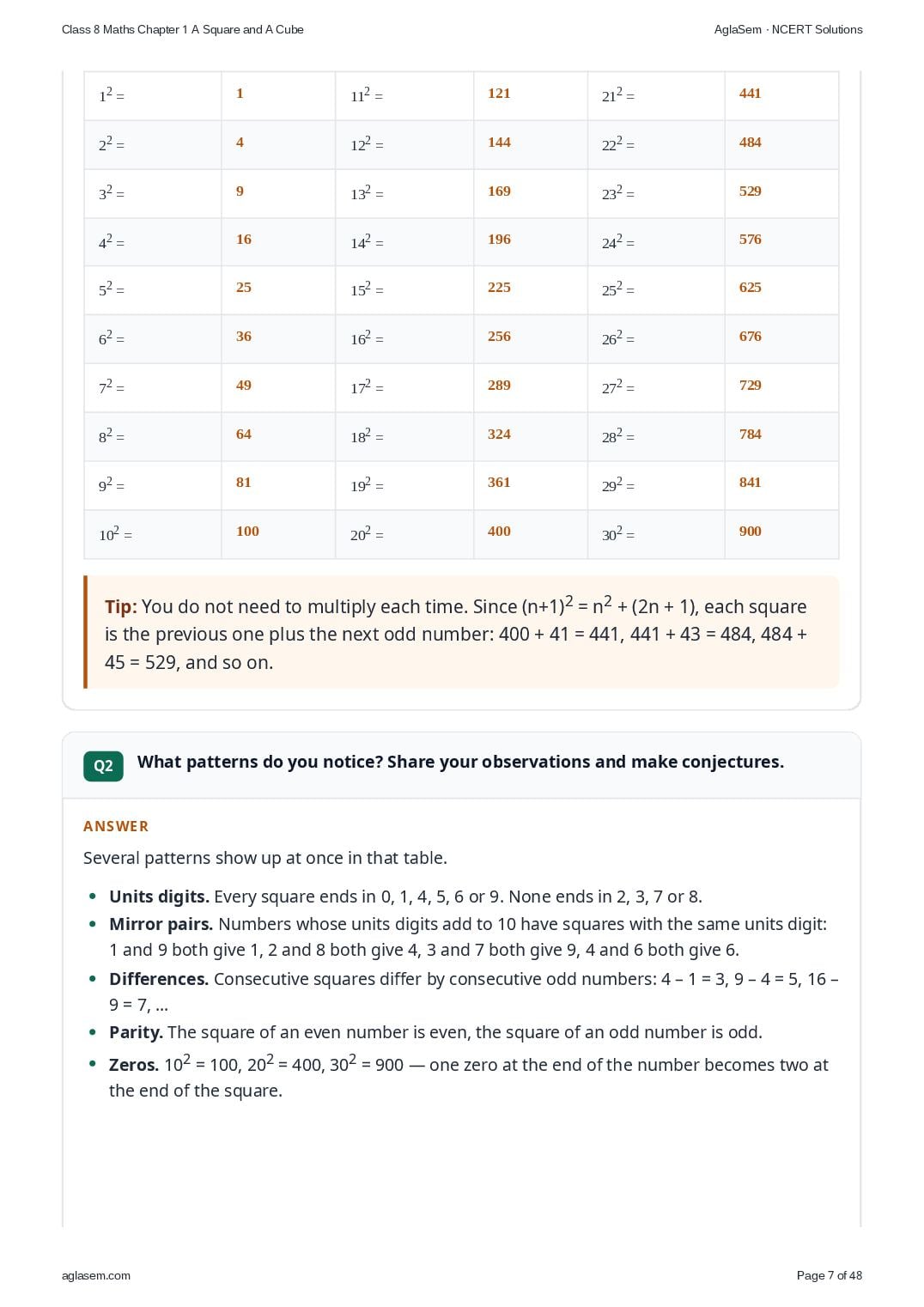
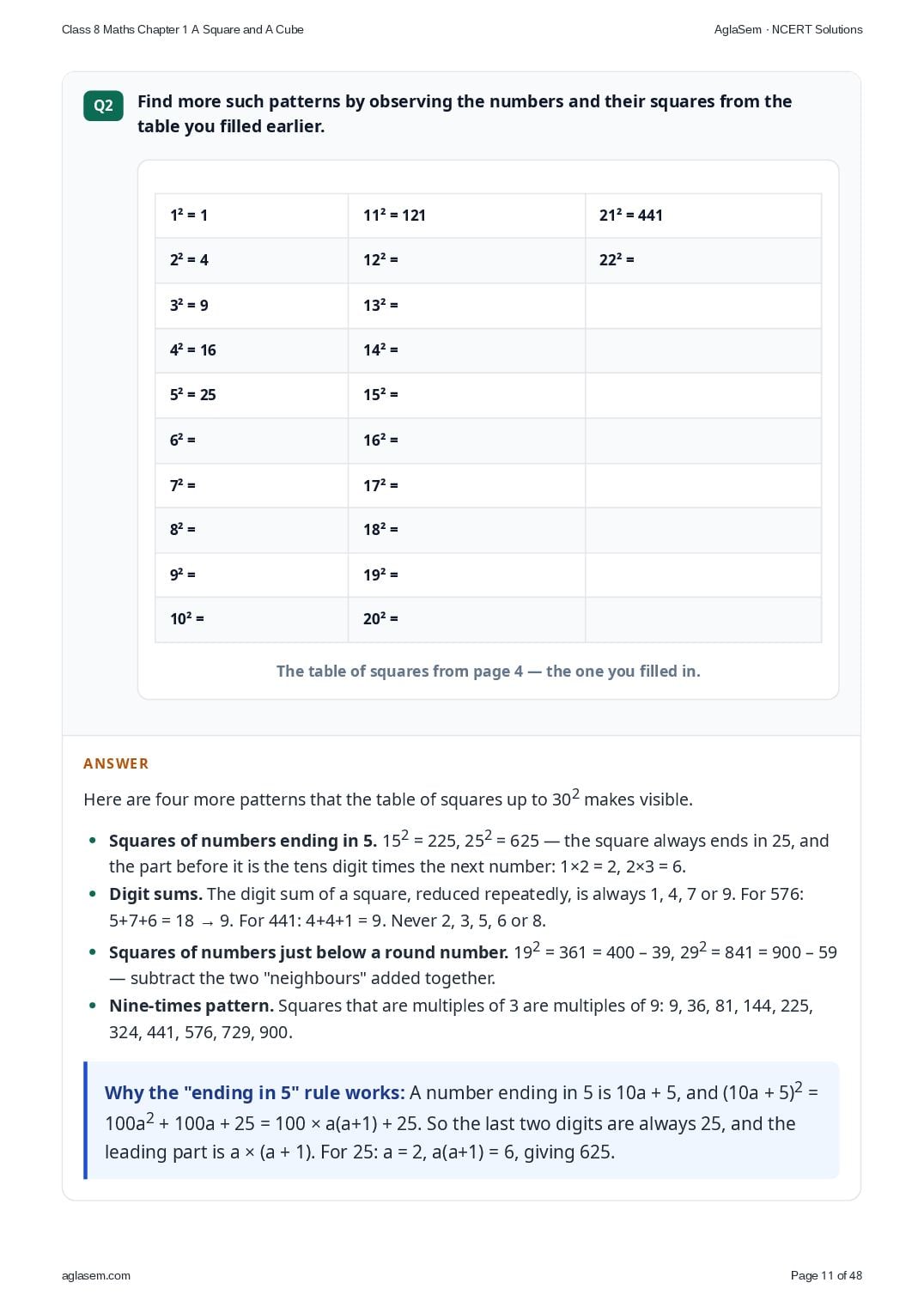
- Find the squares of the first 30 natural numbers and fill in the table below. 1² = 1, 11² = 121, 21² = 441, 2² = 4, 12² = , 22² = , 3² = 9, 13² = , 4² = 16, 14² = , 5² = 25, 15² = , 6² = , 16² = , 7² = , 17² = , 8² = , 18² = , 9² = , 19² = , 10² = , 20² =
- What patterns do you notice? Share your observations and make conjectures.
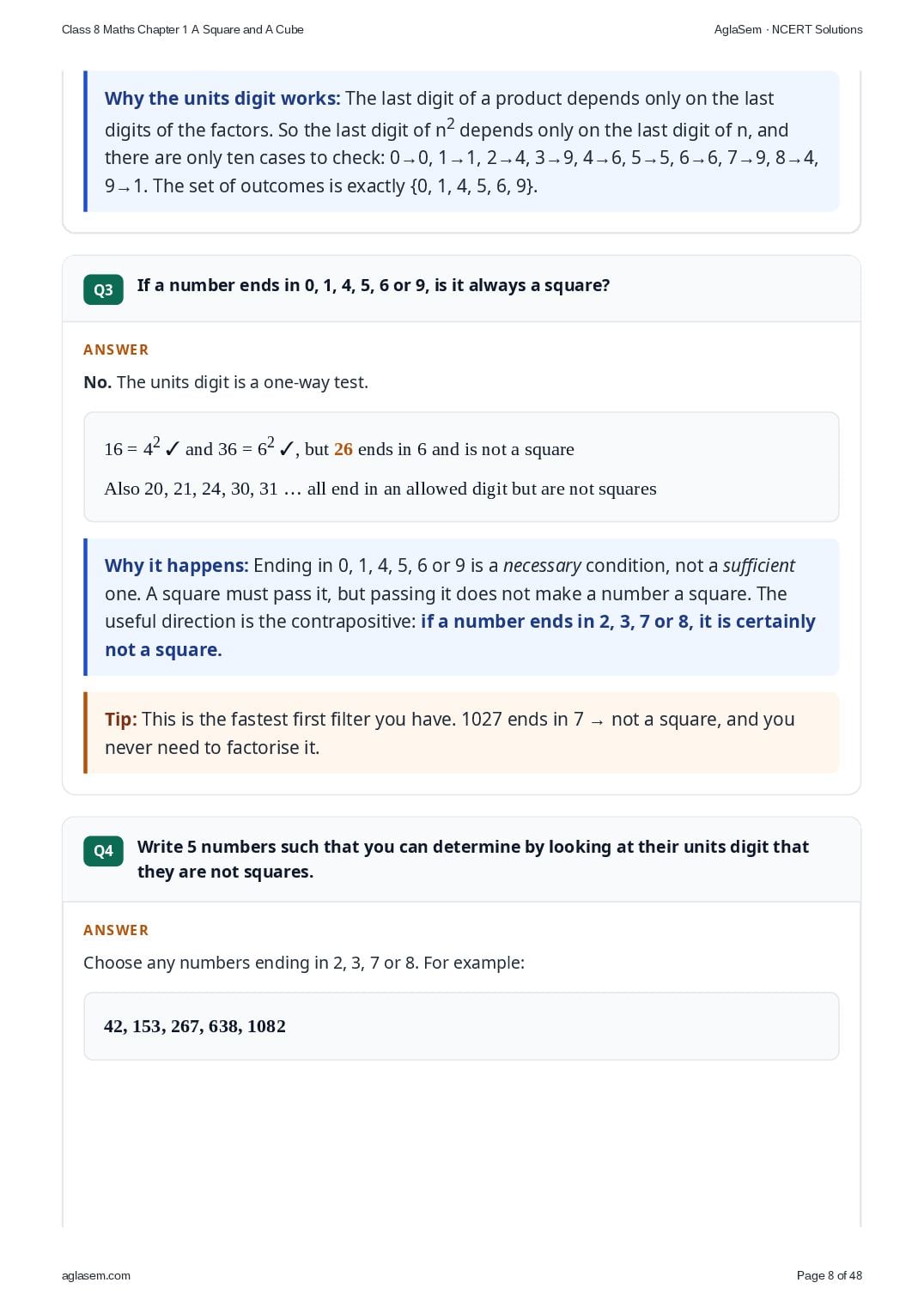
- If a number ends in 0, 1, 4, 5, 6 or 9, is it always a square?
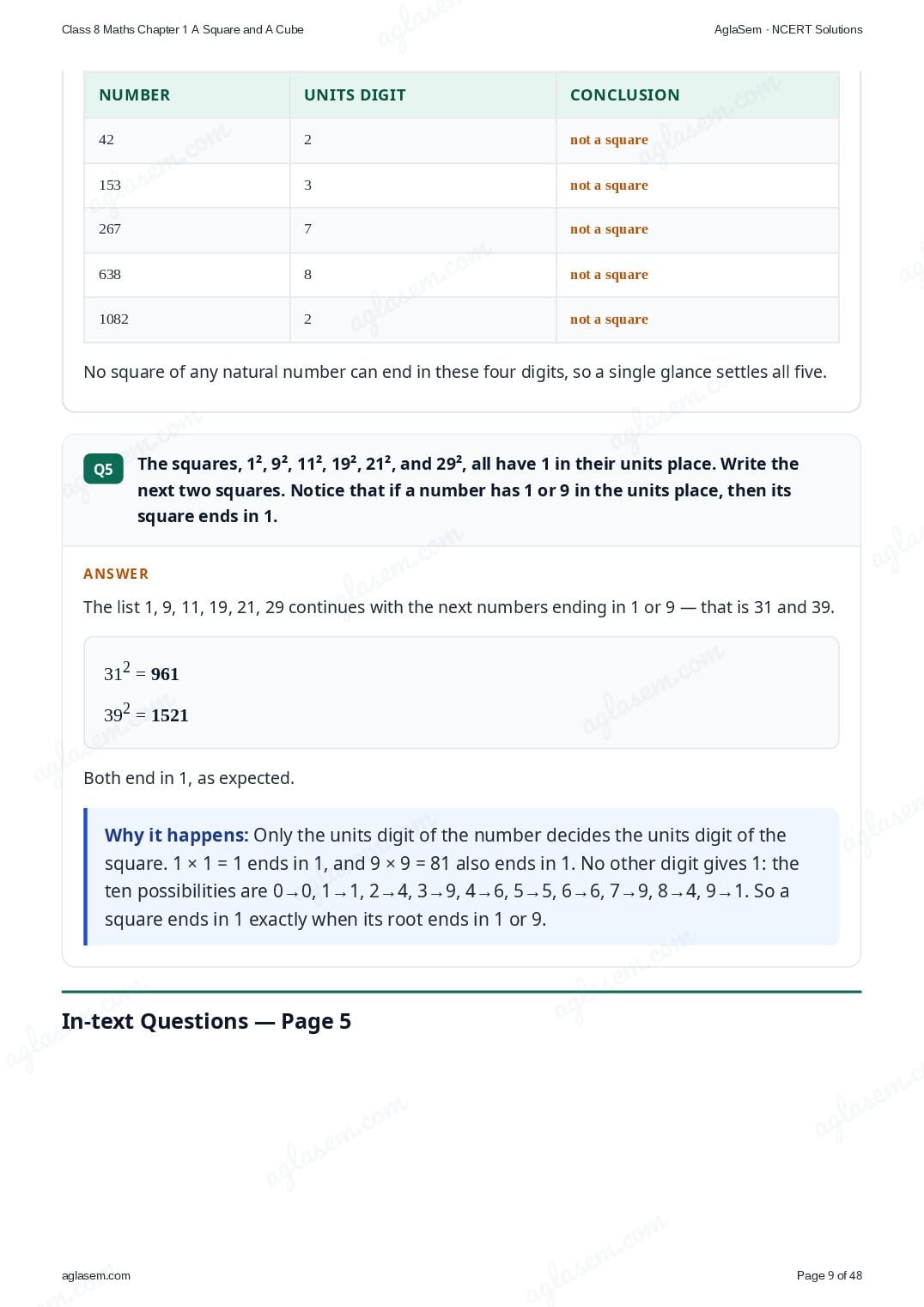
- Write 5 numbers such that you can determine by looking at their units digit that they are not squares.
- The squares, 1², 9², 11², 19², 21², and 29², all have 1 in their units place. Write the next two squares. Notice that if a number has 1 or 9 in the units place, then its square ends in 1.
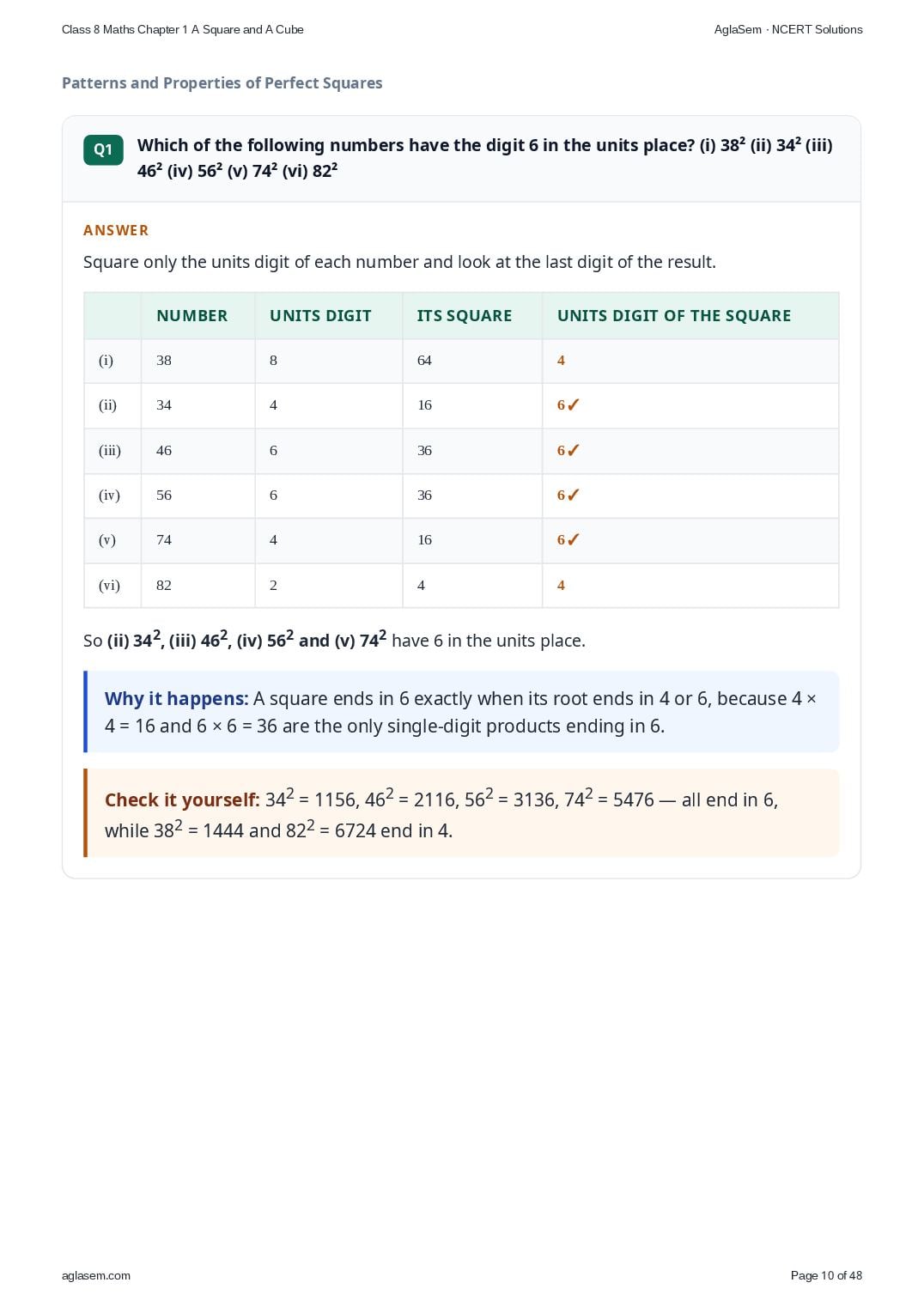
- Which of the following numbers have the digit 6 in the units place? (i) 38² (ii) 34² (iii) 46² (iv) 56² (v) 74² (vi) 82²
- Find more such patterns by observing the numbers and their squares from the table you filled earlier.
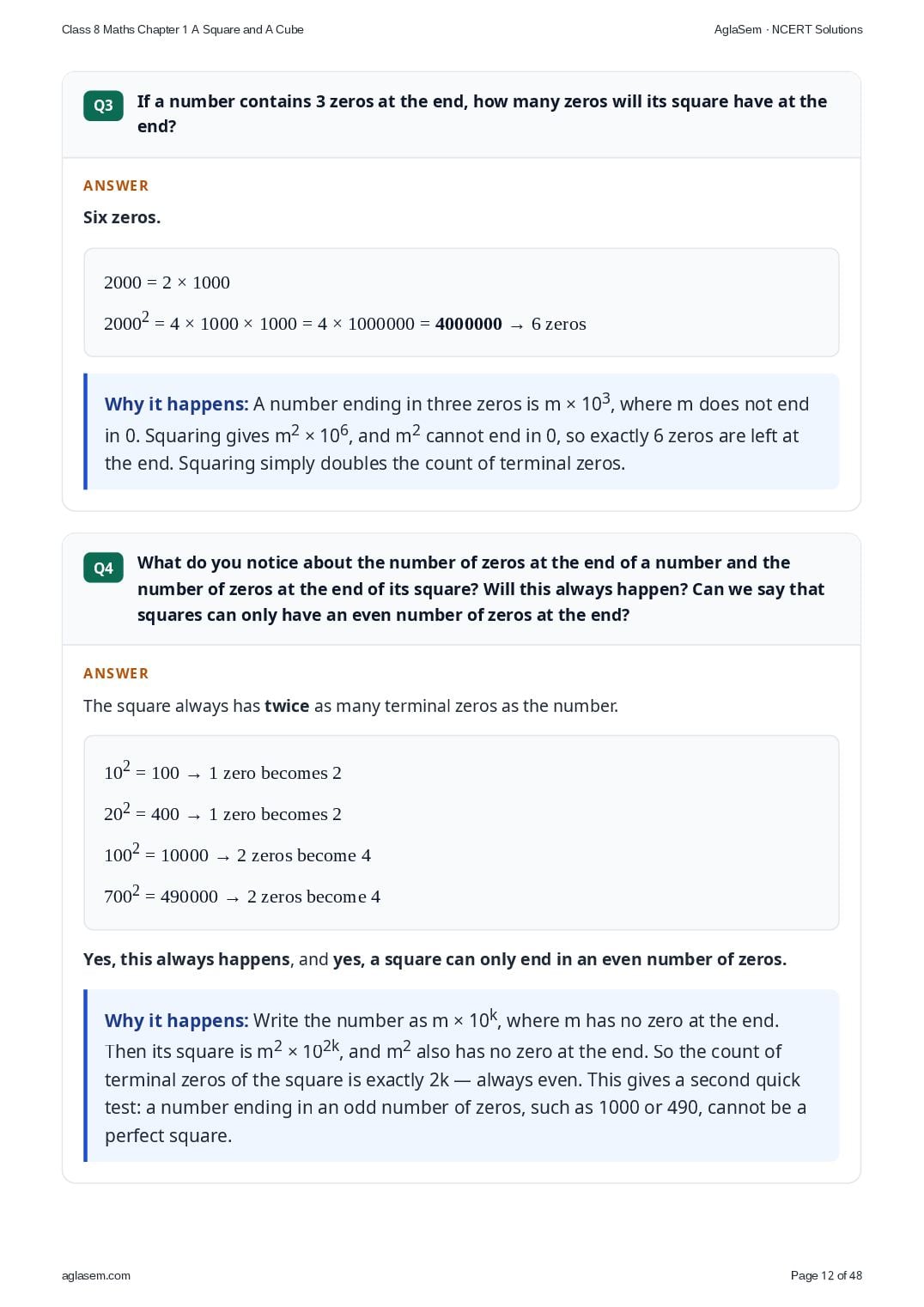
- If a number contains 3 zeros at the end, how many zeros will its square have at the end?
- What do you notice about the number of zeros at the end of a number and the number of zeros at the end of its square? Will this always happen? Can we say that squares can only have an even number of zeros at the end?
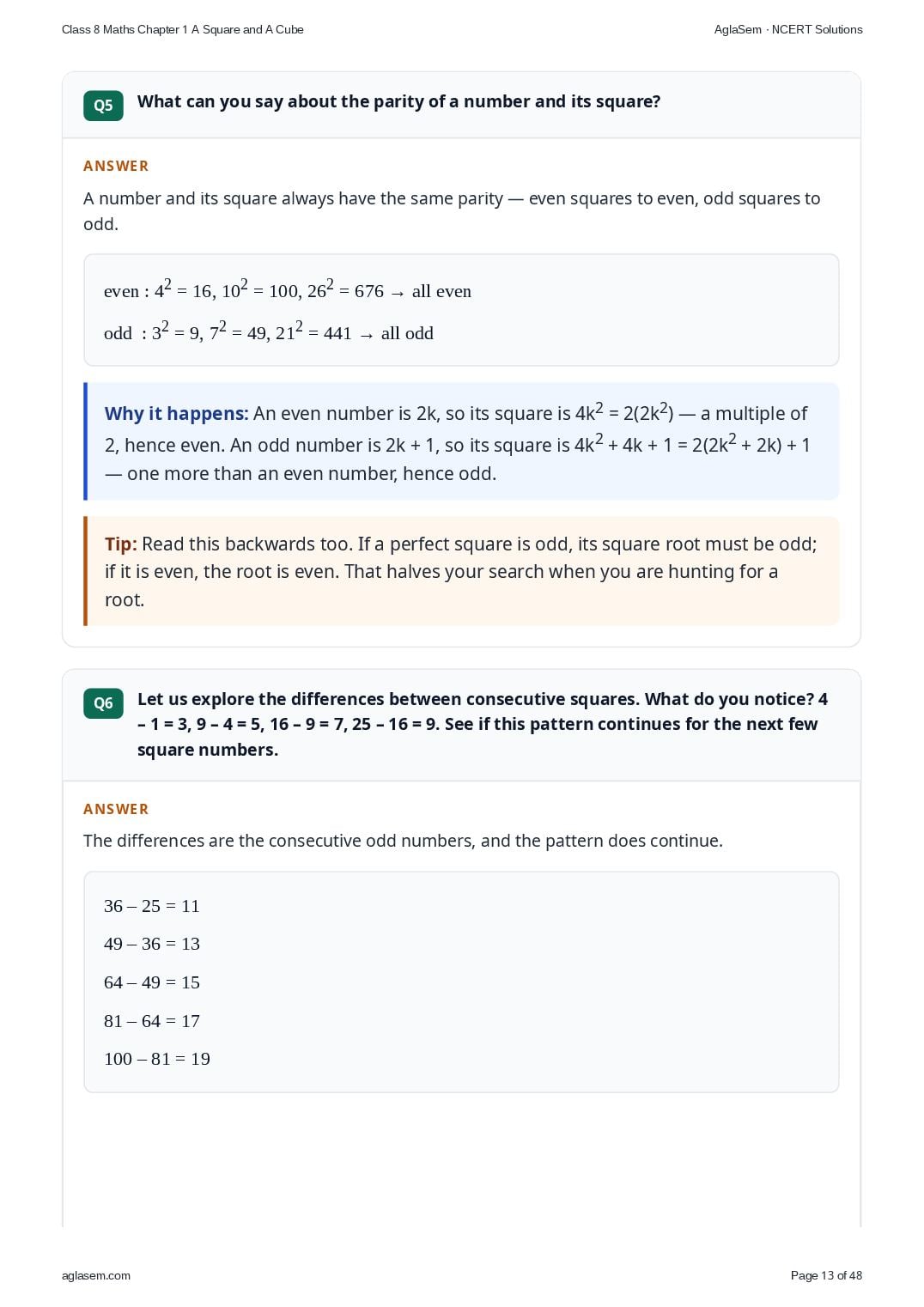
- What can you say about the parity of a number and its square?
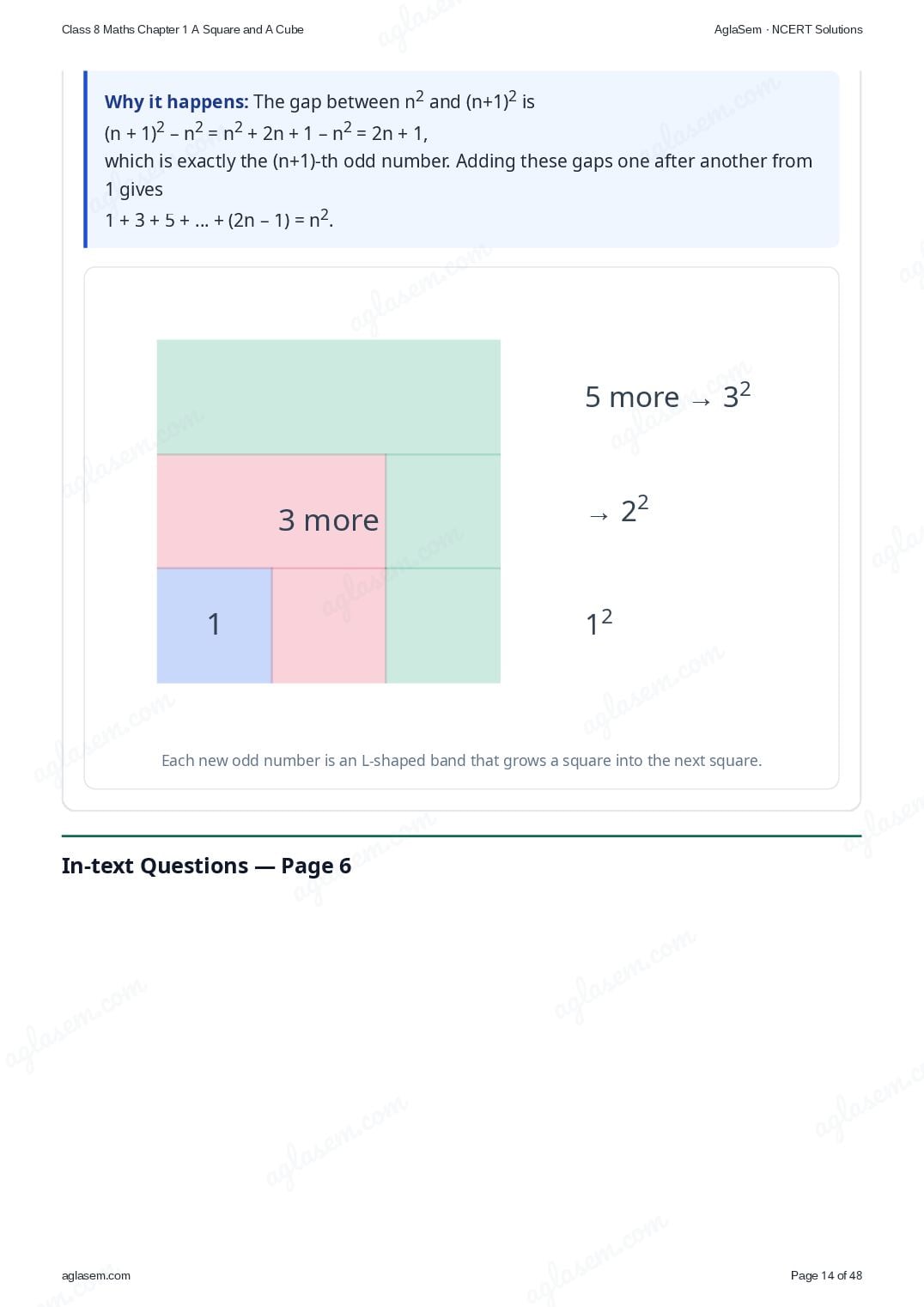
- Let us explore the differences between consecutive squares. What do you notice? 4 – 1 = 3, 9 – 4 = 5, 16 – 9 = 7, 25 – 16 = 9. See if this pattern continues for the next few square numbers.
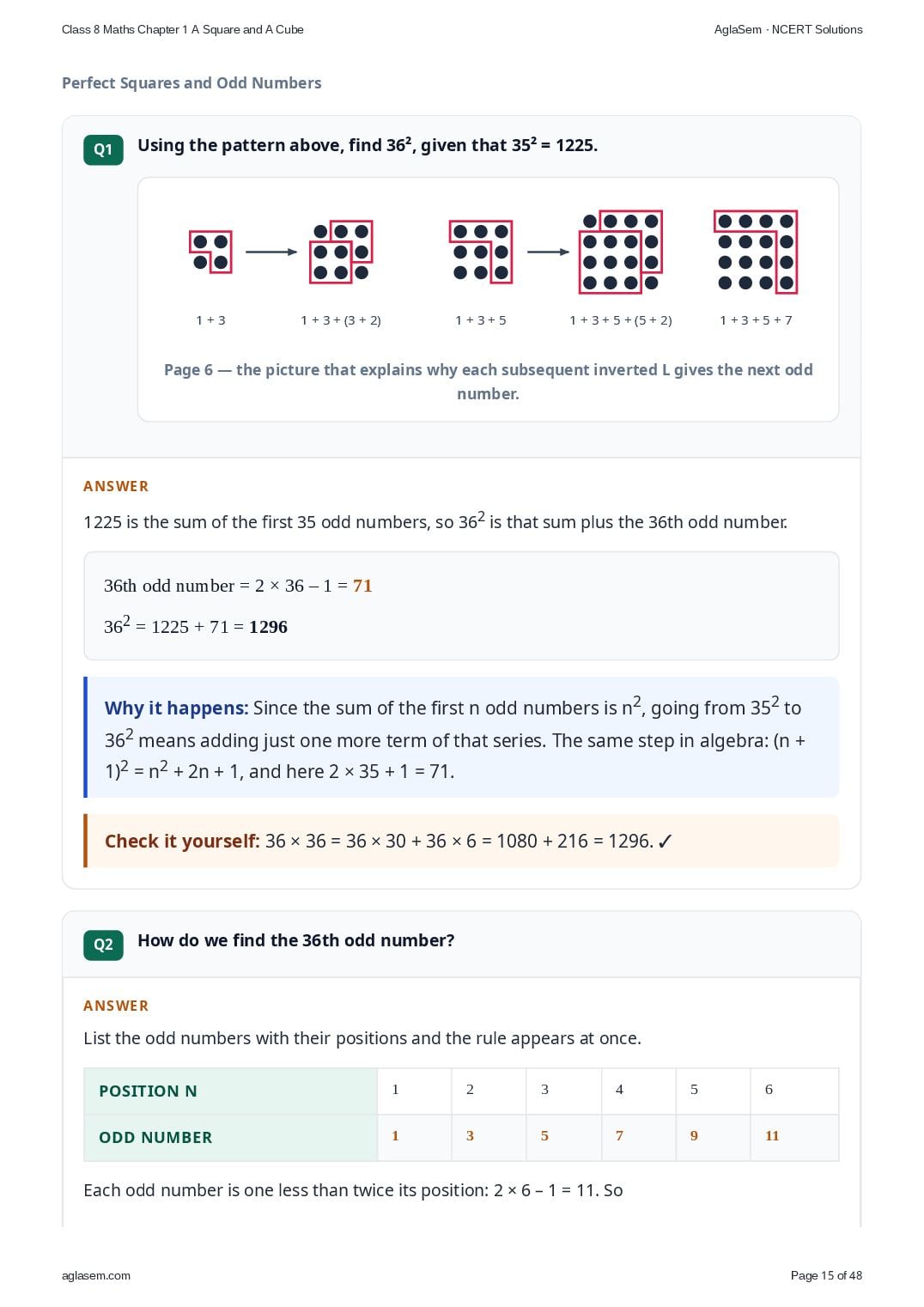
- Using the pattern above, find 36², given that 35² = 1225.
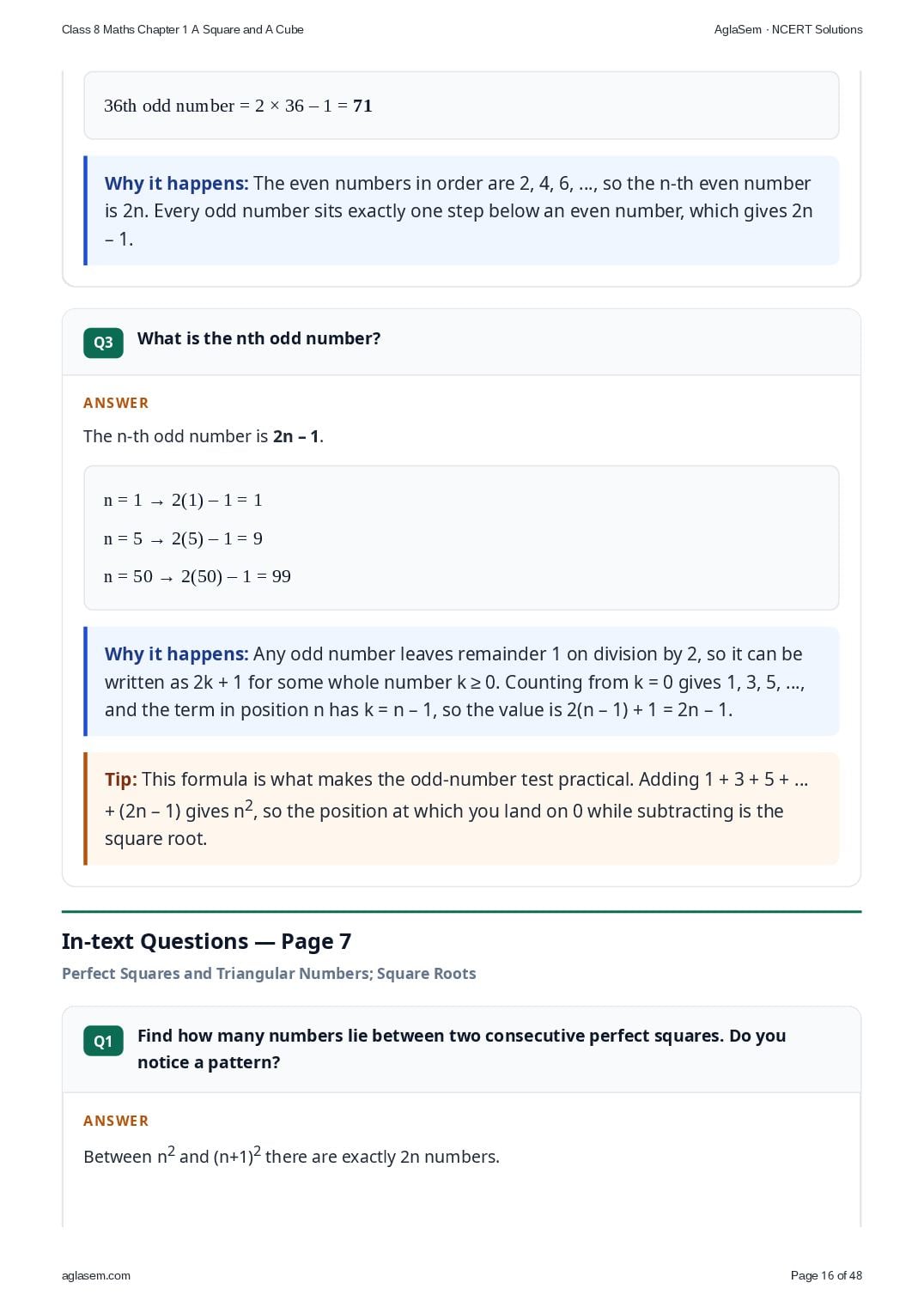
- How do we find the 36th odd number?
- What is the nth odd number?
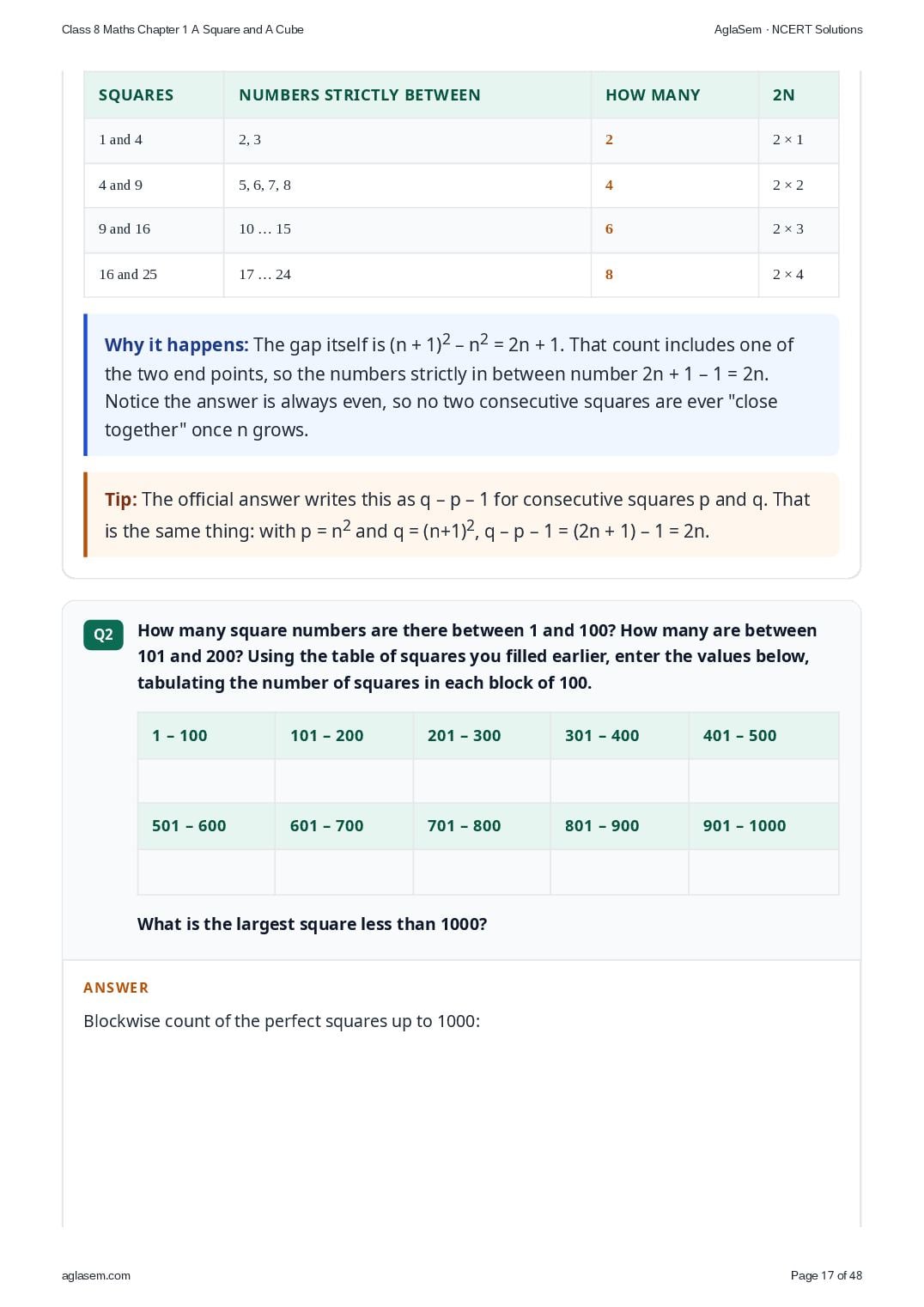
- Find how many numbers lie between two consecutive perfect squares. Do you notice a pattern?
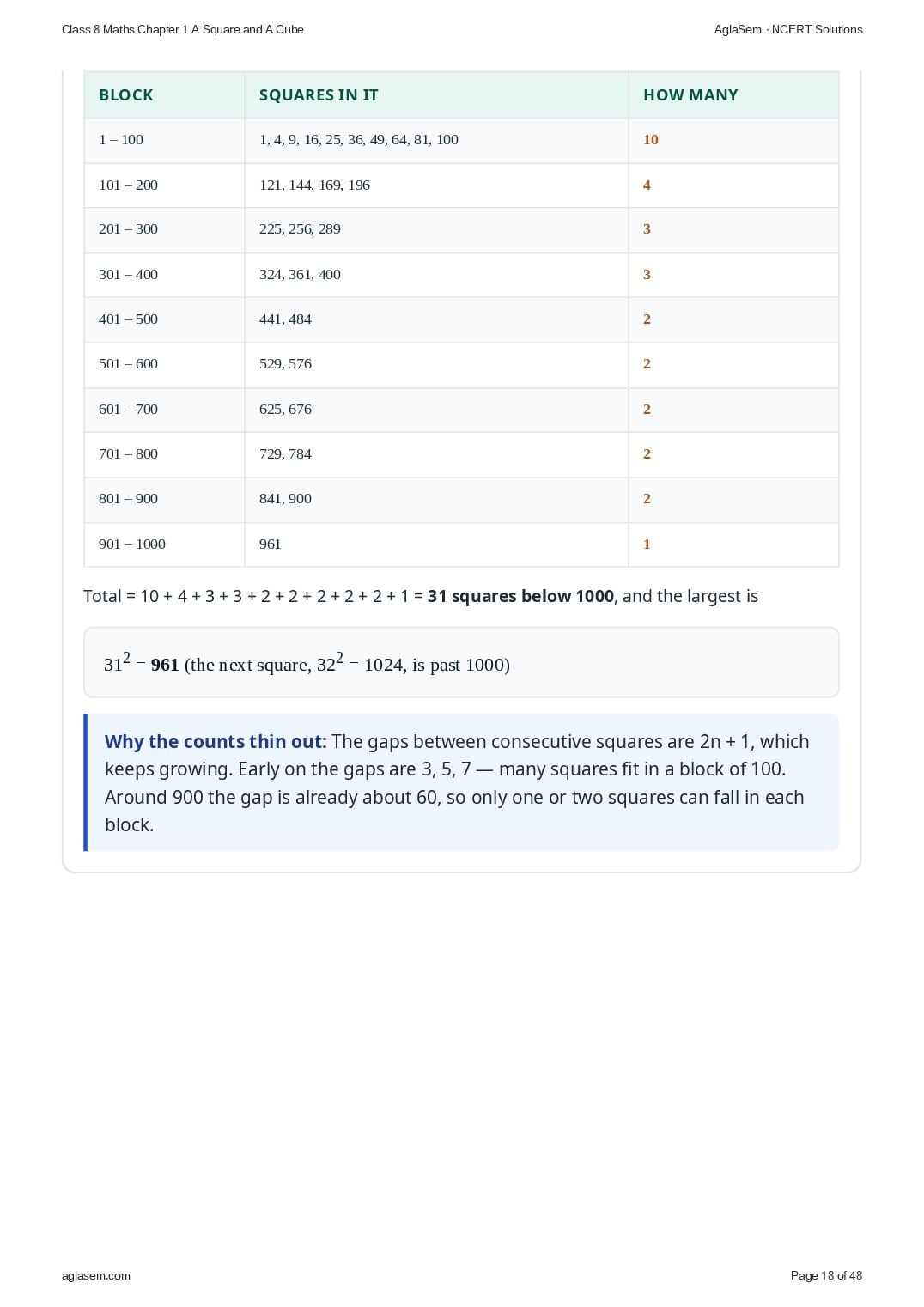
- How many square numbers are there between 1 and 100? How many are between 101 and 200? Using the table of squares you filled earlier, enter the values below, tabulating the number of squares in each block of 100. What is the largest square less than 1000?
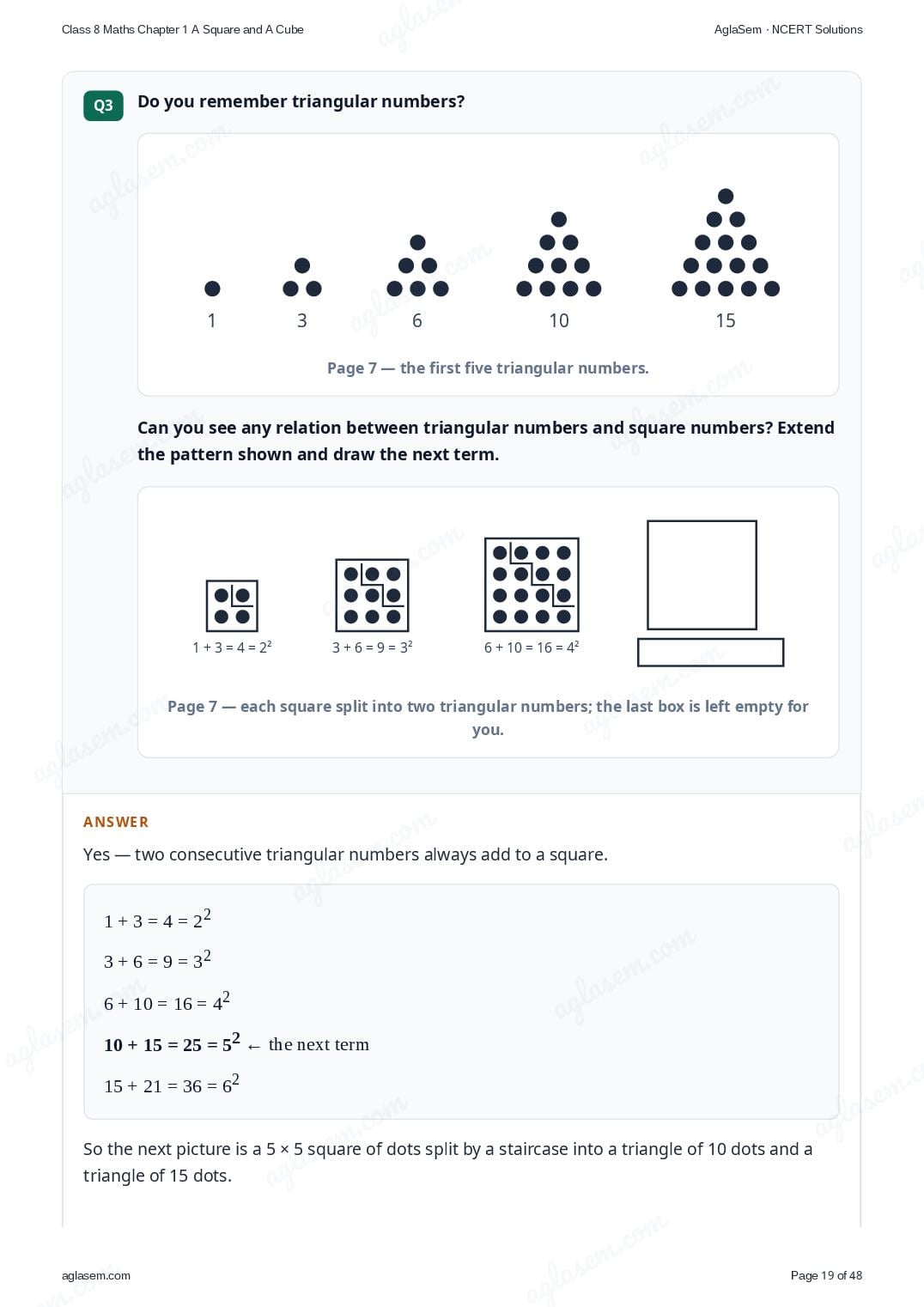
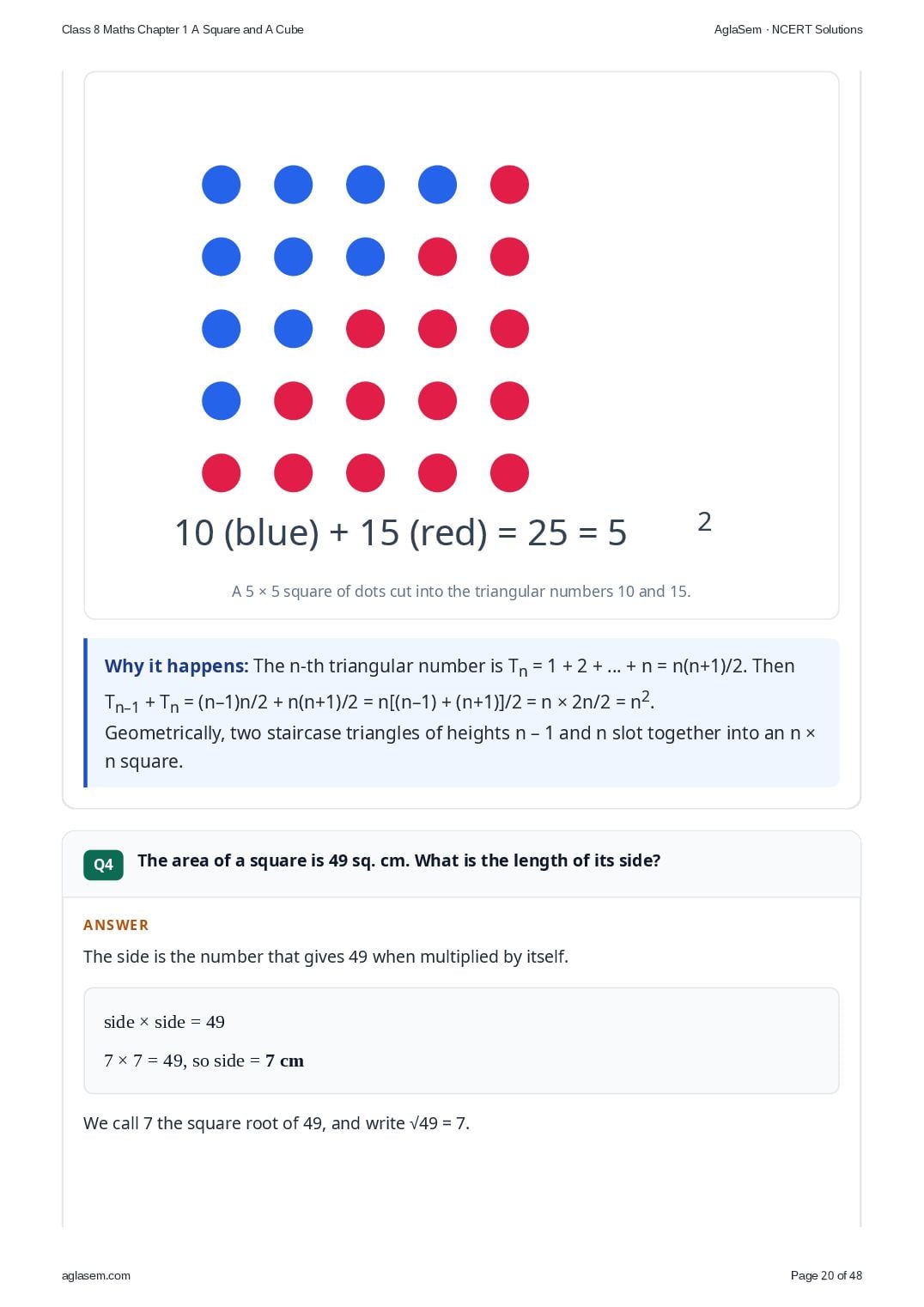
- Do you remember triangular numbers? Can you see any relation between triangular numbers and square numbers? Extend the pattern shown and draw the next term.
- The area of a square is 49 sq. cm. What is the length of its side?
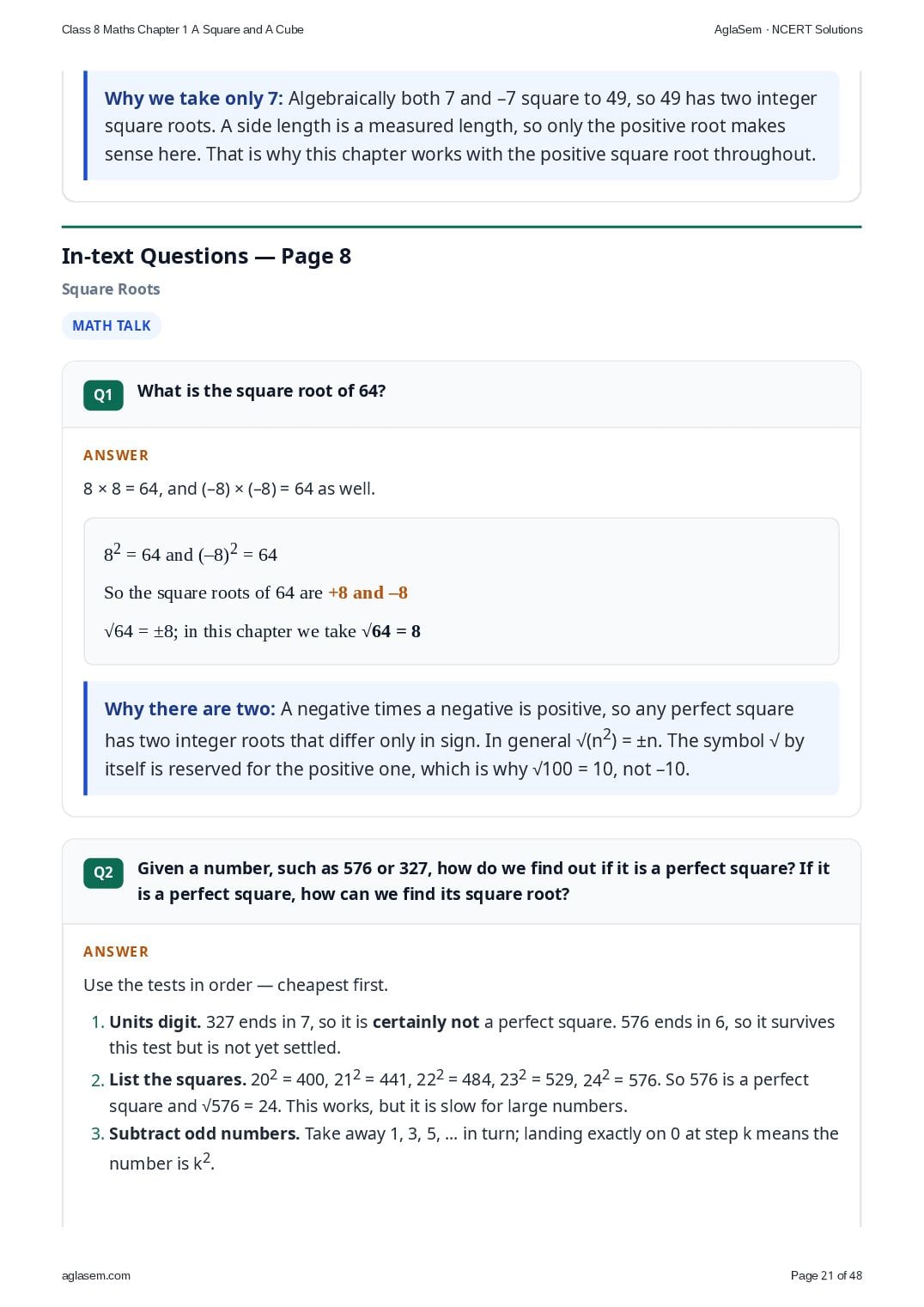
- What is the square root of 64?
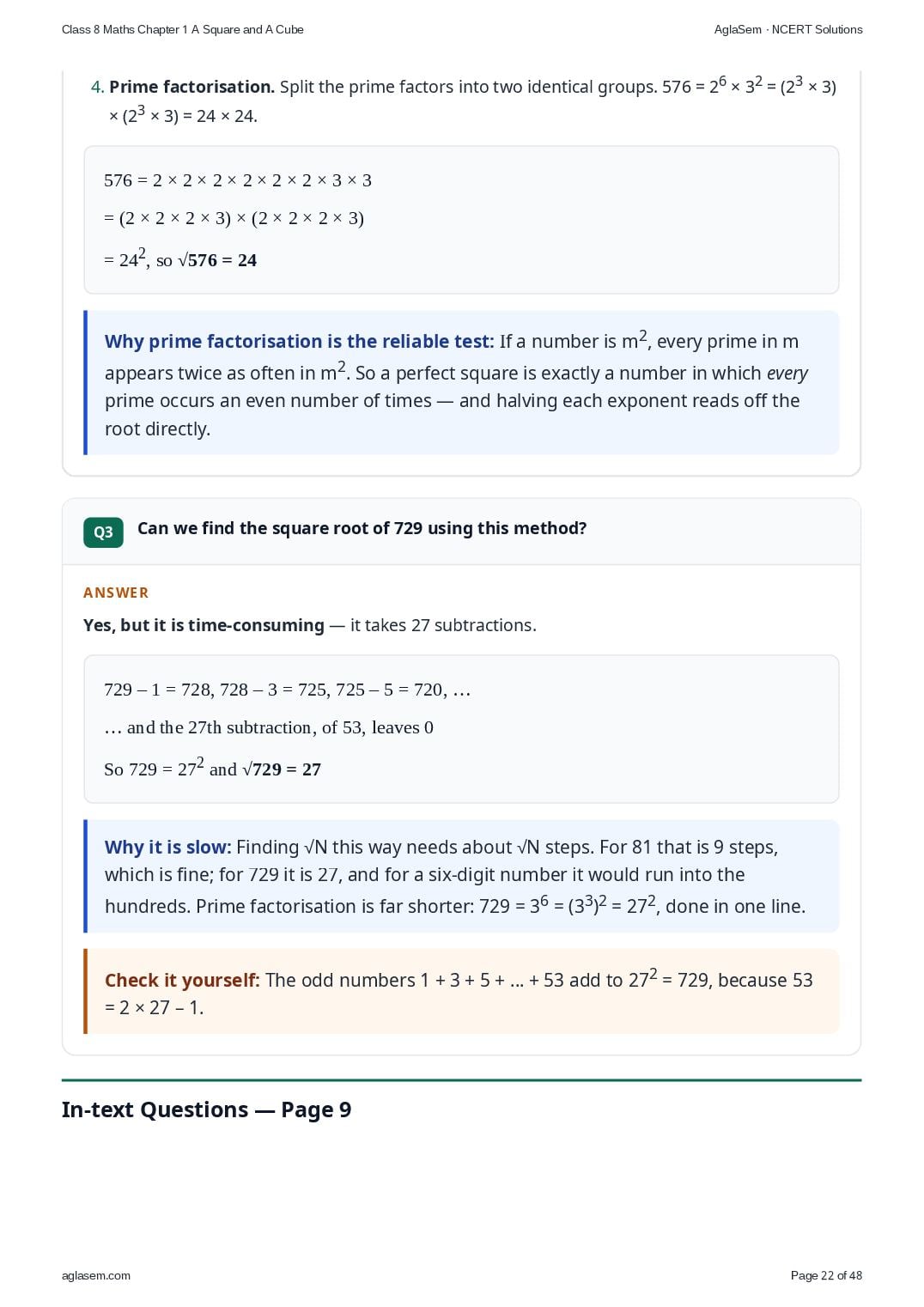
- Given a number, such as 576 or 327, how do we find out if it is a perfect square? If it is a perfect square, how can we find its square root?
- Can we find the square root of 729 using this method?
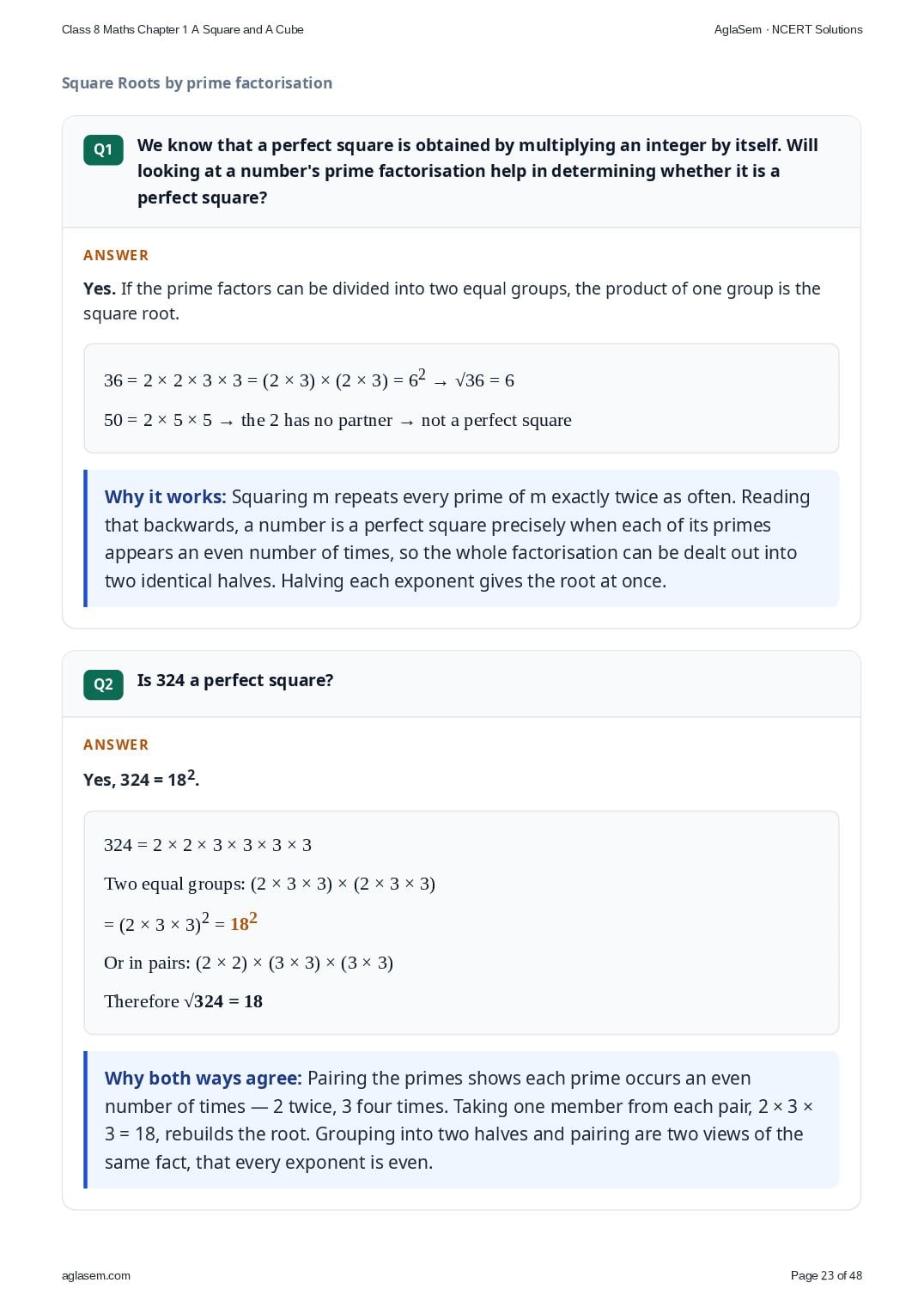
- We know that a perfect square is obtained by multiplying an integer by itself. Will looking at a number's prime factorisation help in determining whether it is a perfect square?
- Is 324 a perfect square?
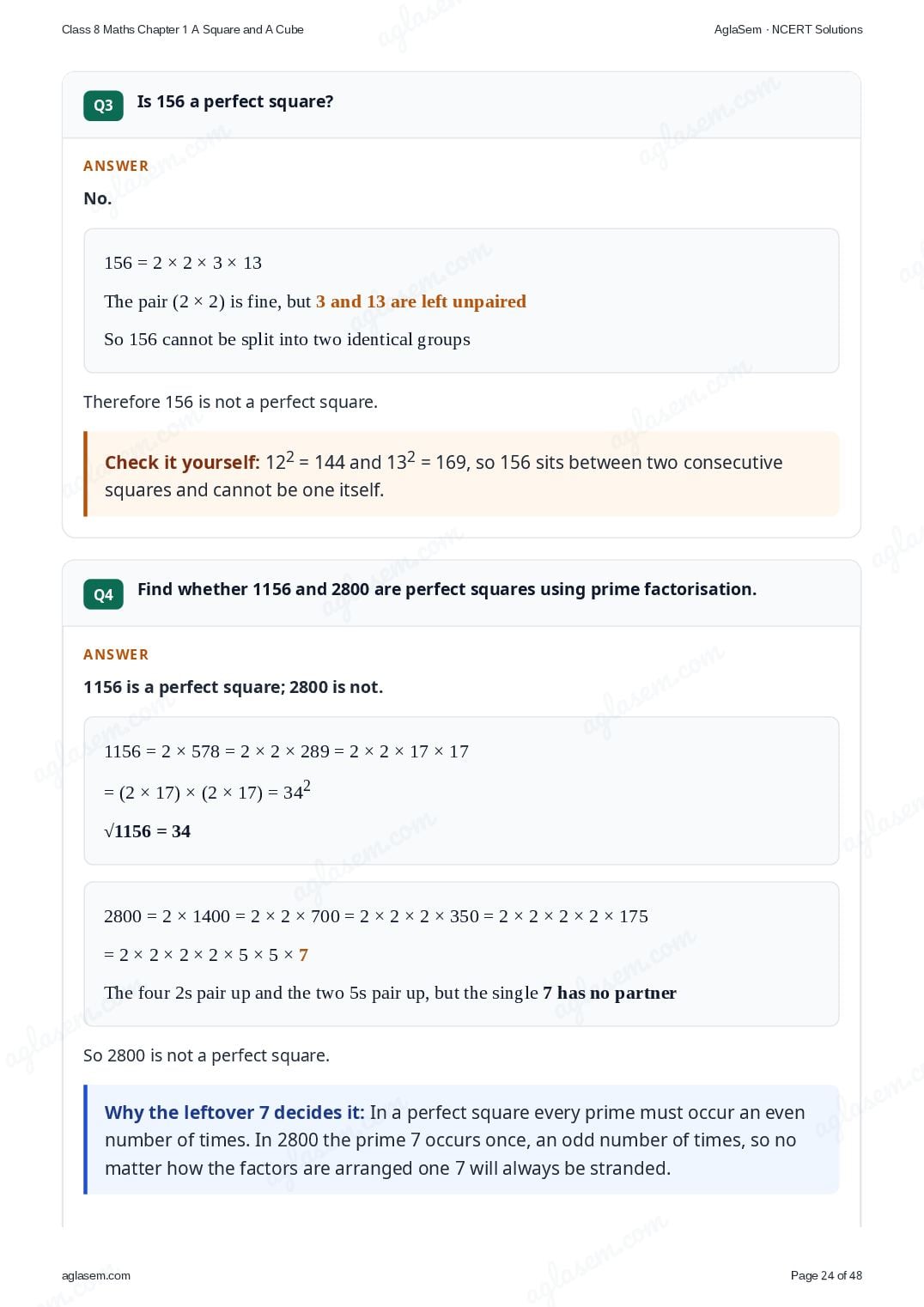
- Is 156 a perfect square?
- Find whether 1156 and 2800 are perfect squares using prime factorisation.
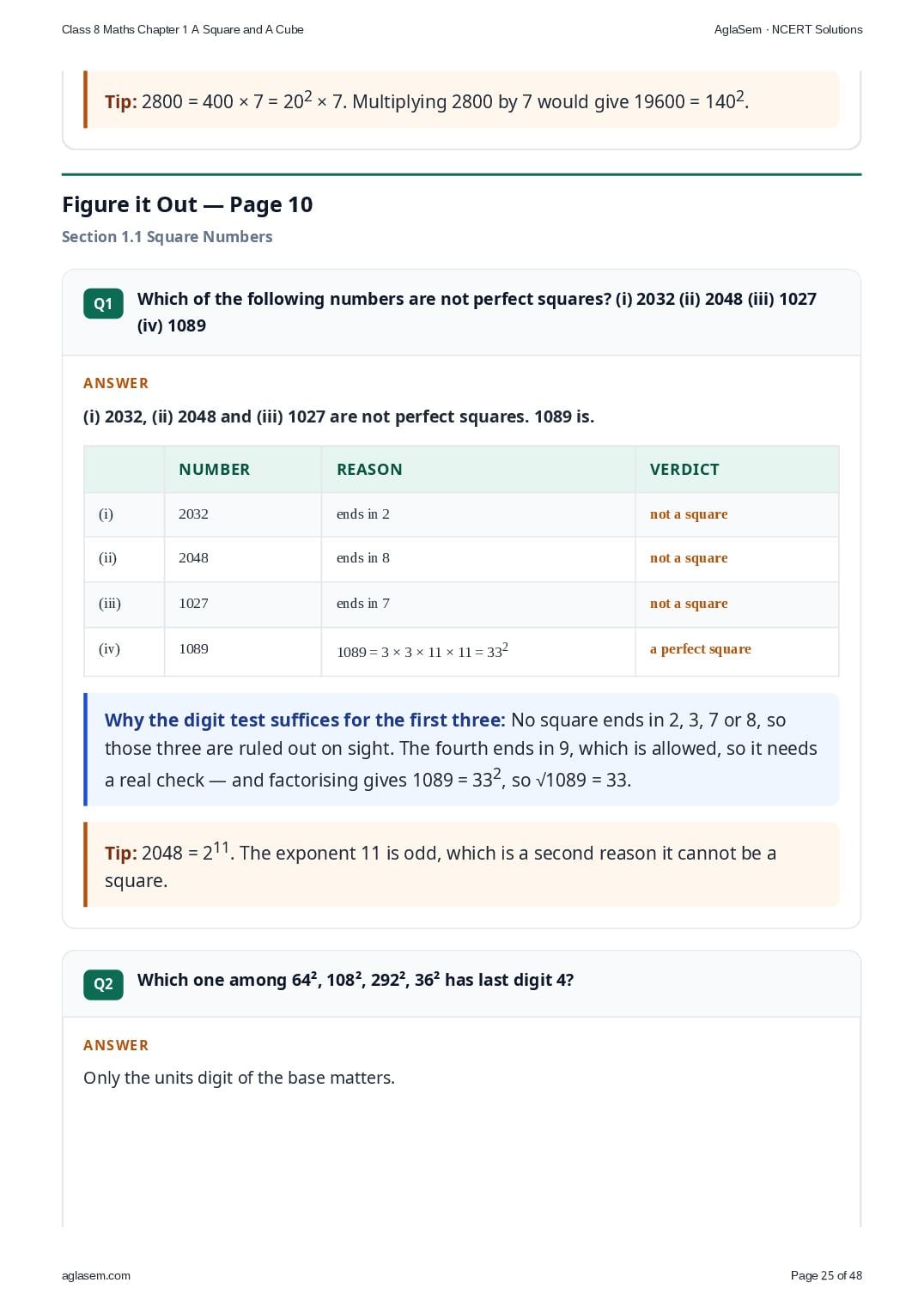
- Which of the following numbers are not perfect squares? (i) 2032 (ii) 2048 (iii) 1027 (iv) 1089
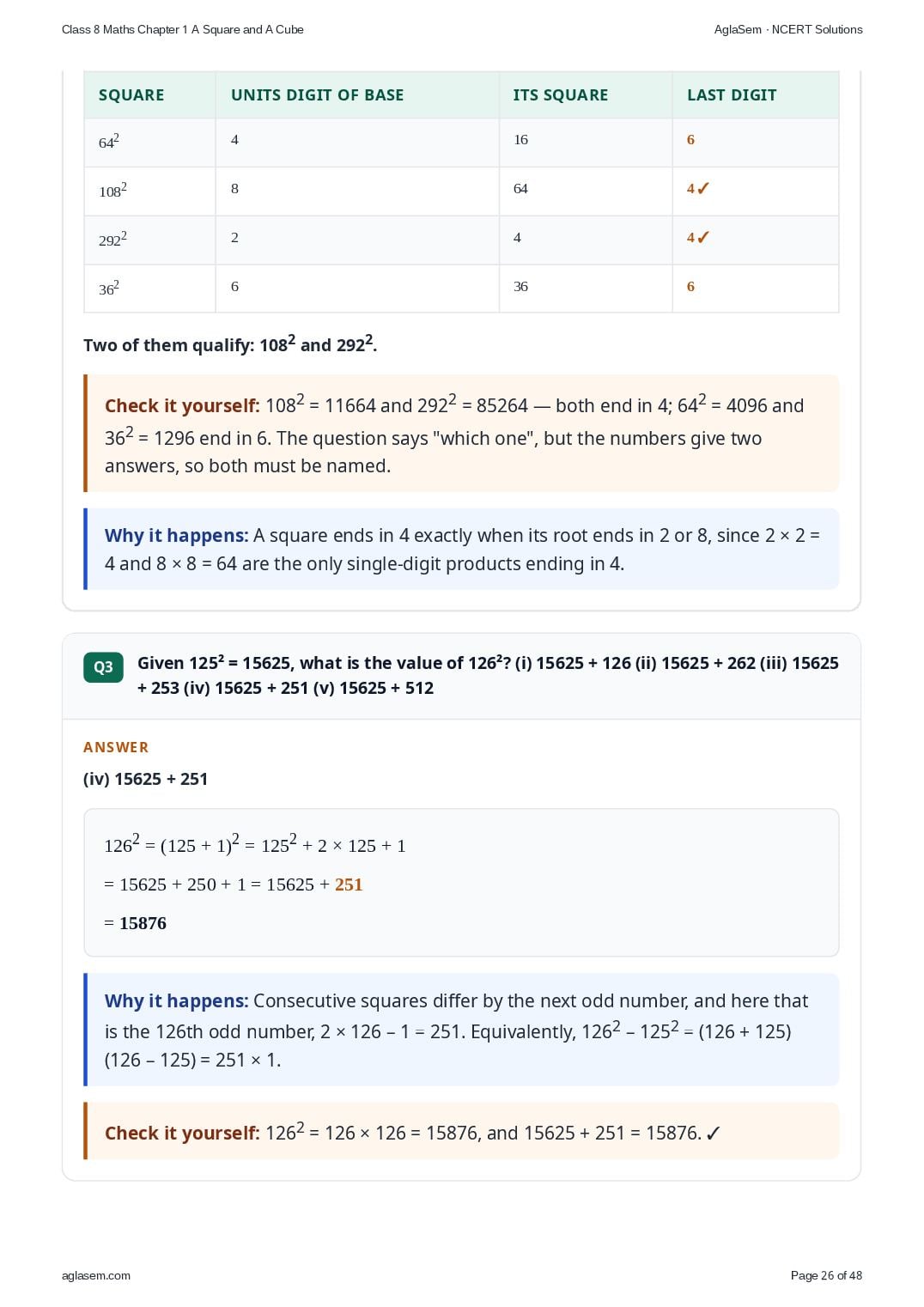
- Which one among 64², 108², 292², 36² has last digit 4?
- Given 125² = 15625, what is the value of 126²? (i) 15625 + 126 (ii) 15625 + 262 (iii) 15625 + 253 (iv) 15625 + 251 (v) 15625 + 512
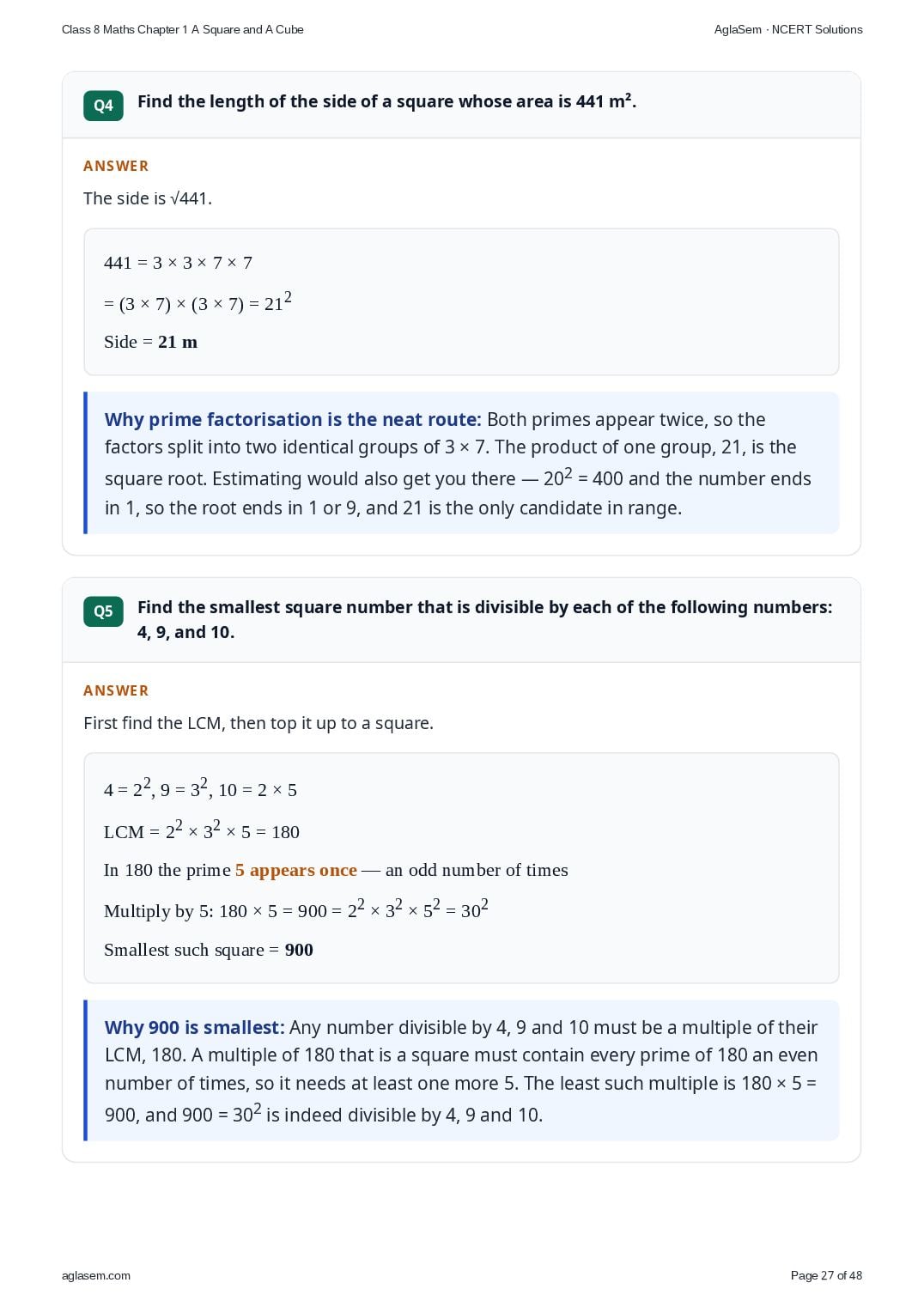
- Find the length of the side of a square whose area is 441 m².
- Find the smallest square number that is divisible by each of the following numbers: 4, 9, and 10.
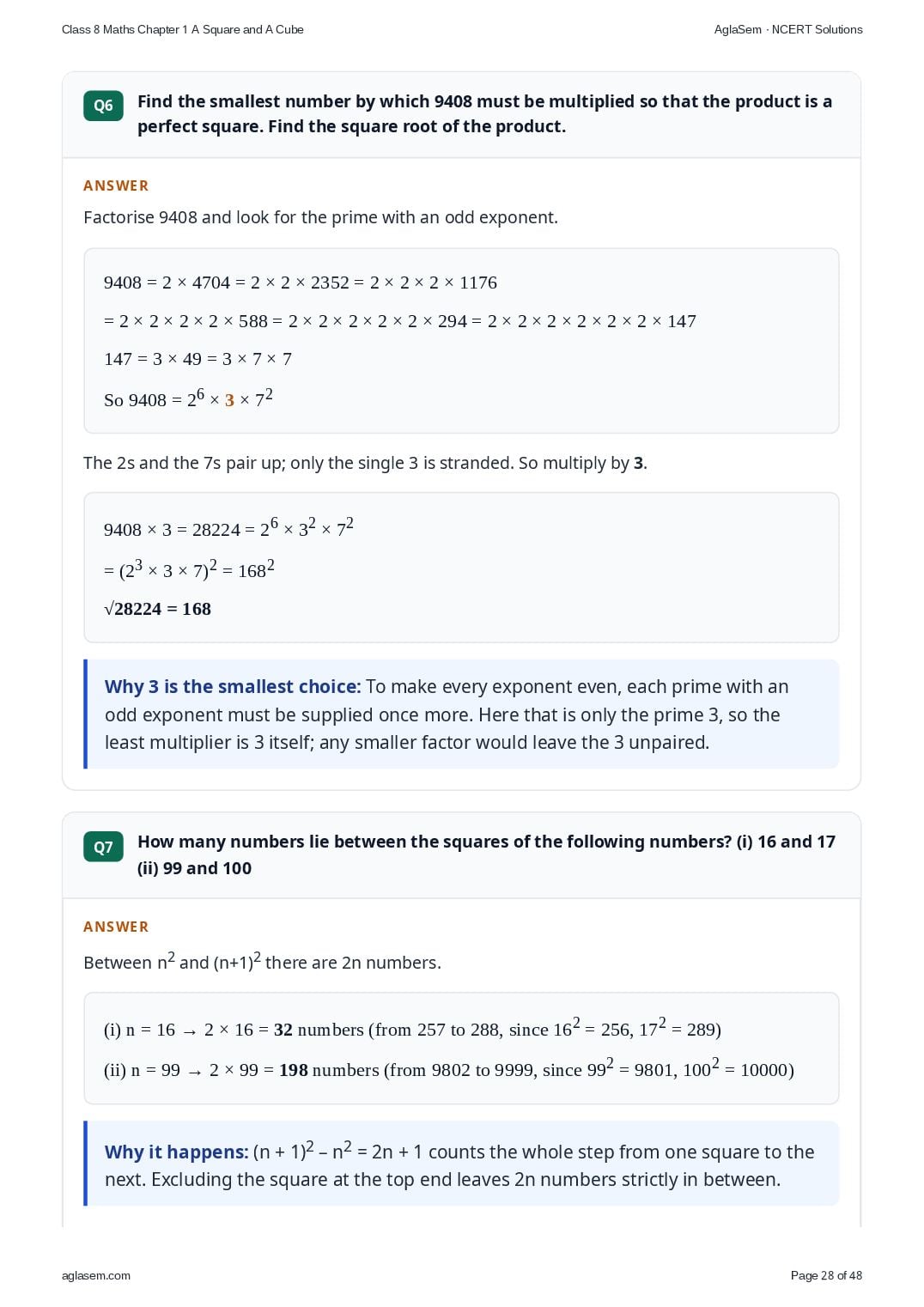
- Find the smallest number by which 9408 must be multiplied so that the product is a perfect square. Find the square root of the product.
- How many numbers lie between the squares of the following numbers? (i) 16 and 17 (ii) 99 and 100
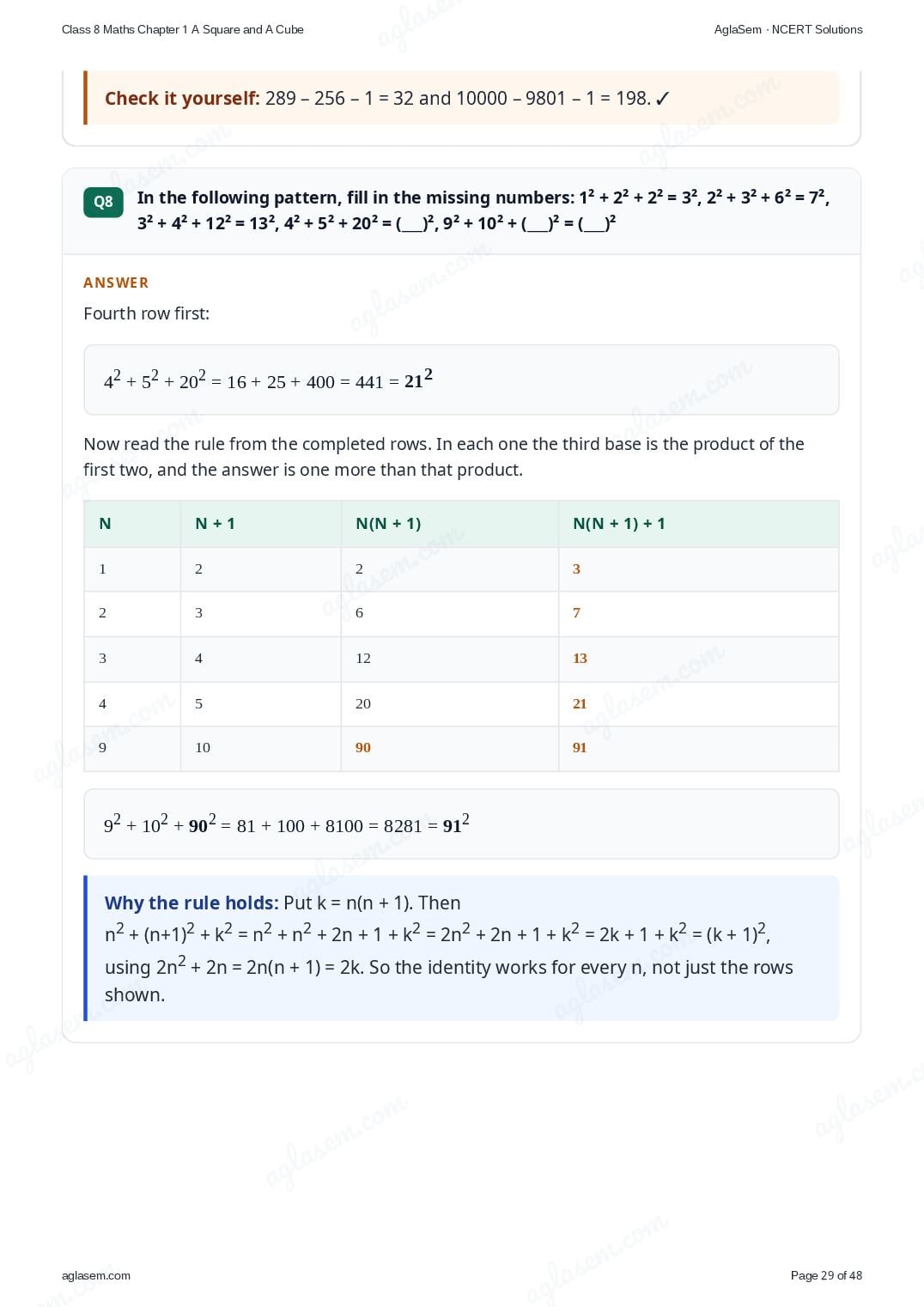
- In the following pattern, fill in the missing numbers: 1² + 2² + 2² = 3², 2² + 3² + 6² = 7², 3² + 4² + 12² = 13², 4² + 5² + 20² = (___)², 9² + 10² + (___)² = (___)²
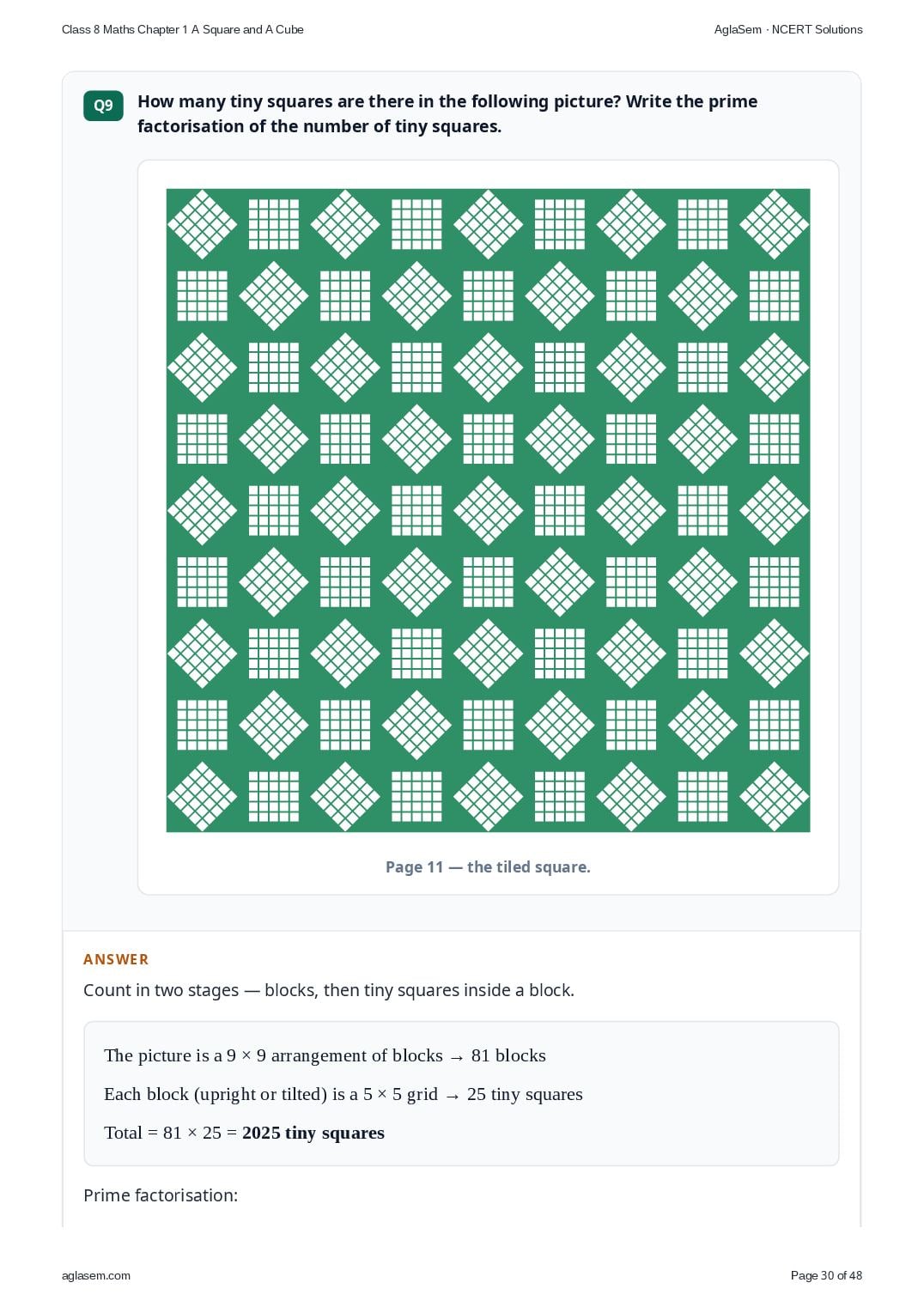
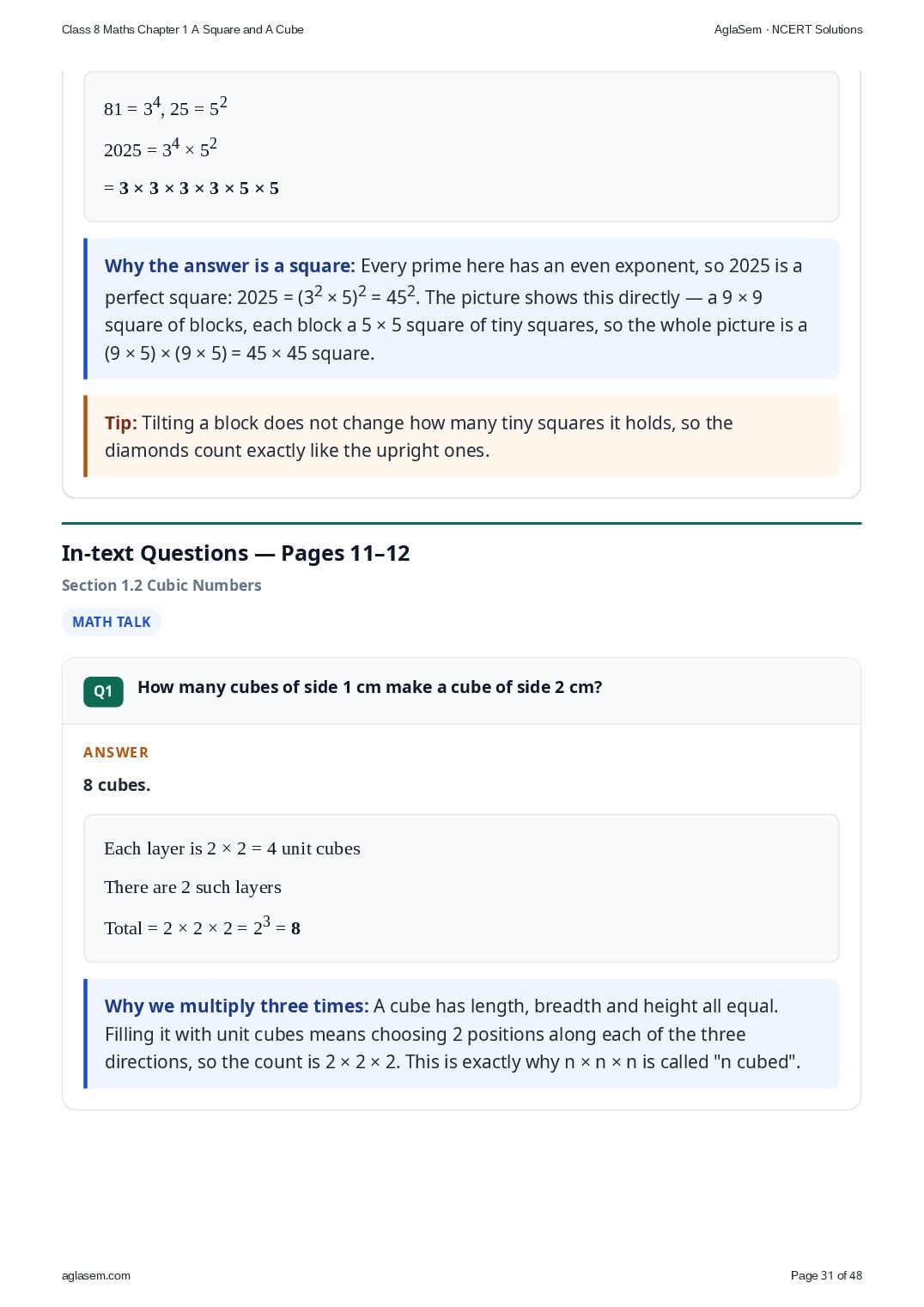
- How many tiny squares are there in the following picture? Write the prime factorisation of the number of tiny squares.
- How many cubes of side 1 cm make a cube of side 2 cm?
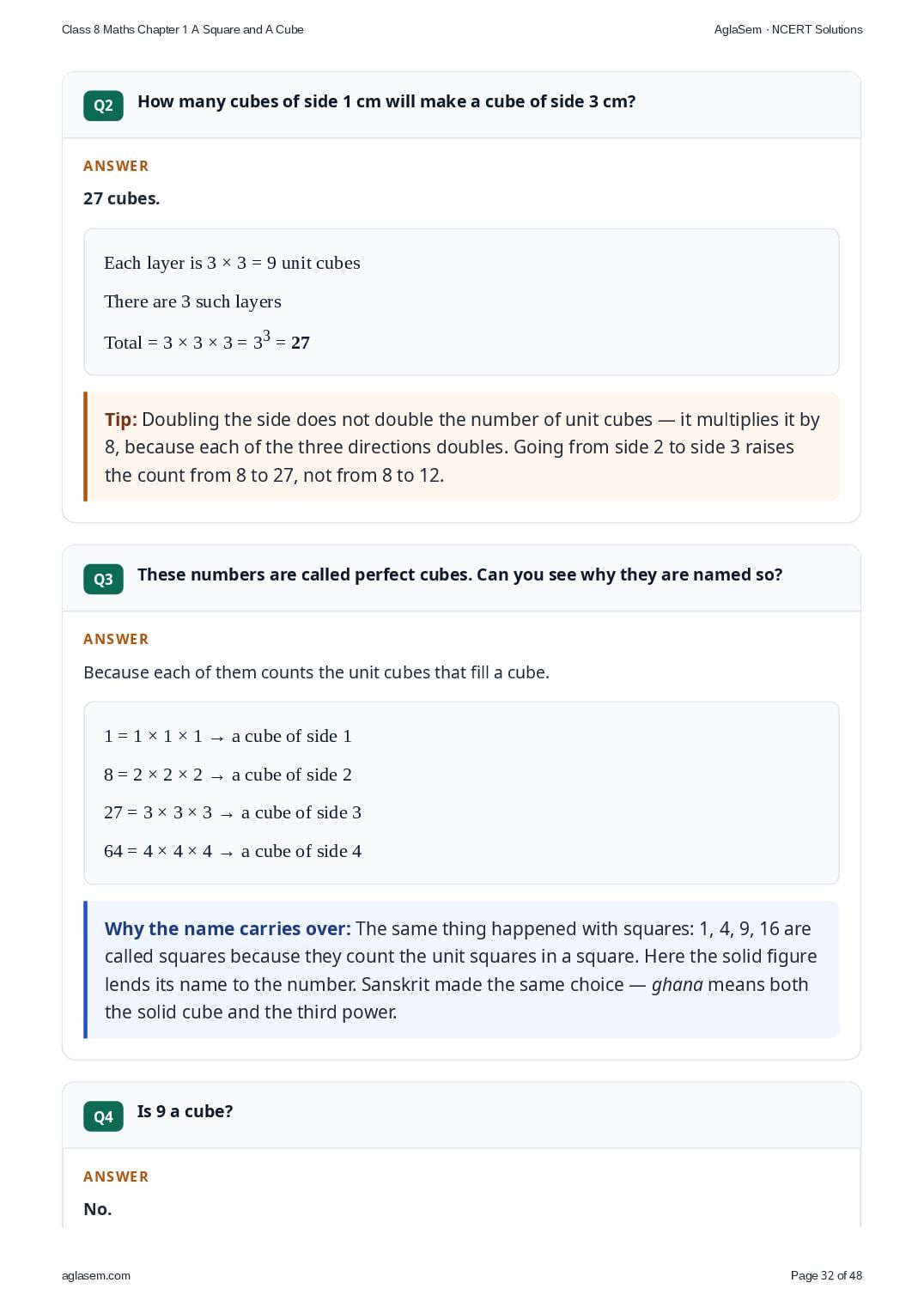
- How many cubes of side 1 cm will make a cube of side 3 cm?
- These numbers are called perfect cubes. Can you see why they are named so?
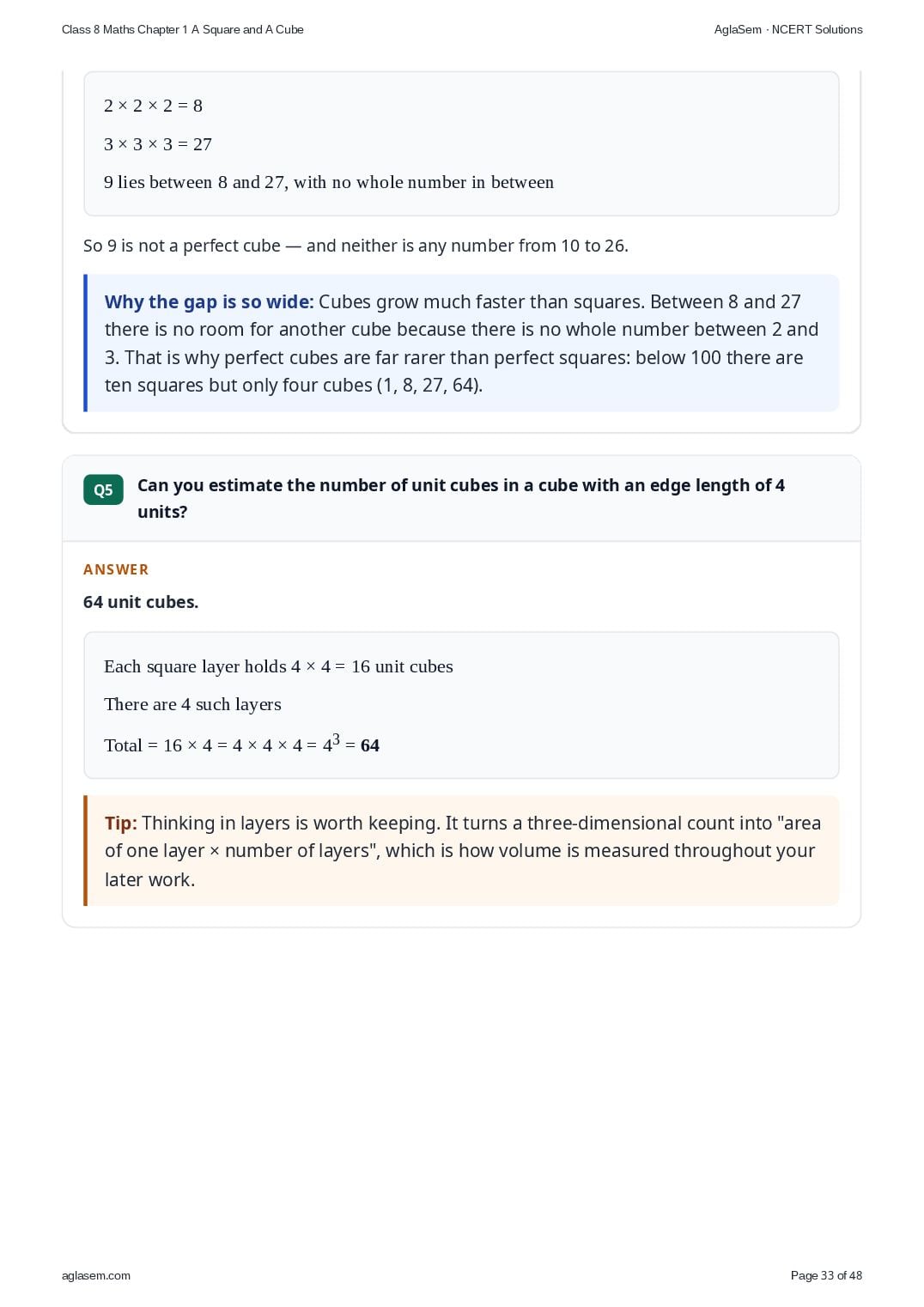
- Is 9 a cube?
- Can you estimate the number of unit cubes in a cube with an edge length of 4 units?
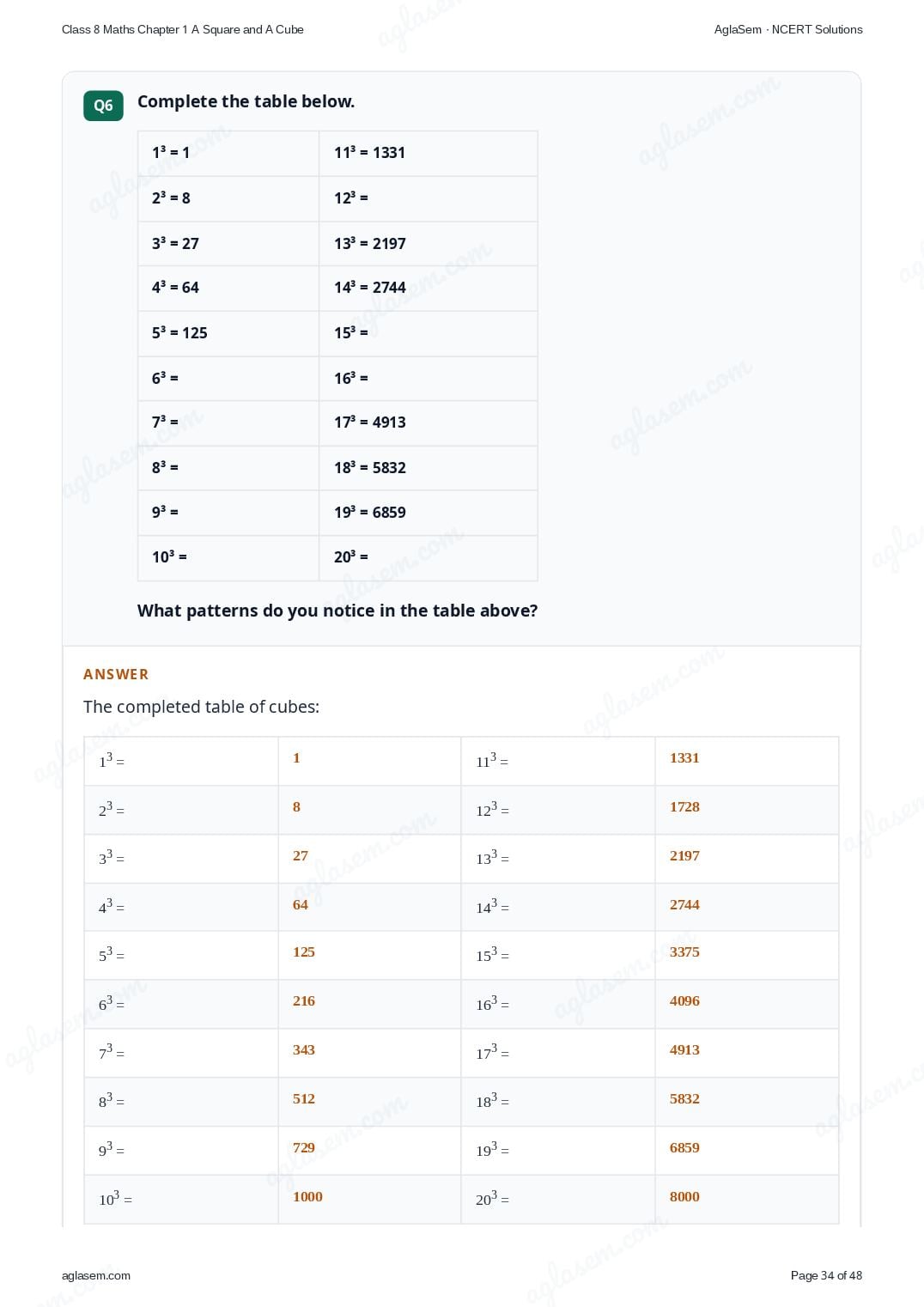
- Complete the table below. 1³ = 1, 11³ = 1331, 2³ = 8, 12³ = , 3³ = 27, 13³ = 2197, 4³ = 64, 14³ = 2744, 5³ = 125, 15³ = , 6³ = , 16³ = , 7³ = , 17³ = 4913, 8³ = , 18³ = 5832, 9³ = , 19³ = 6859, 10³ = , 20³ = . What patterns do you notice in the table above?
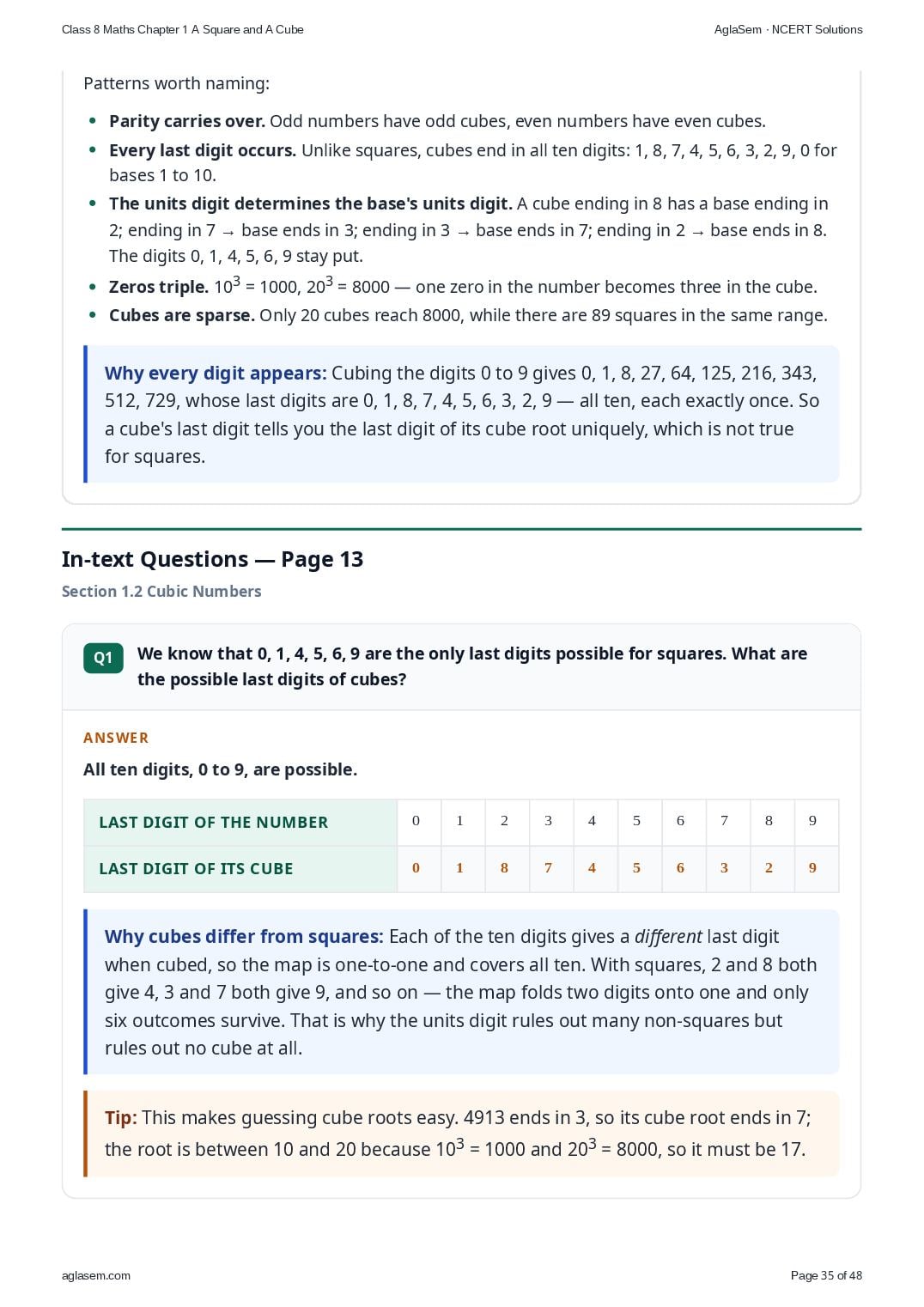
- We know that 0, 1, 4, 5, 6, 9 are the only last digits possible for squares. What are the possible last digits of cubes?
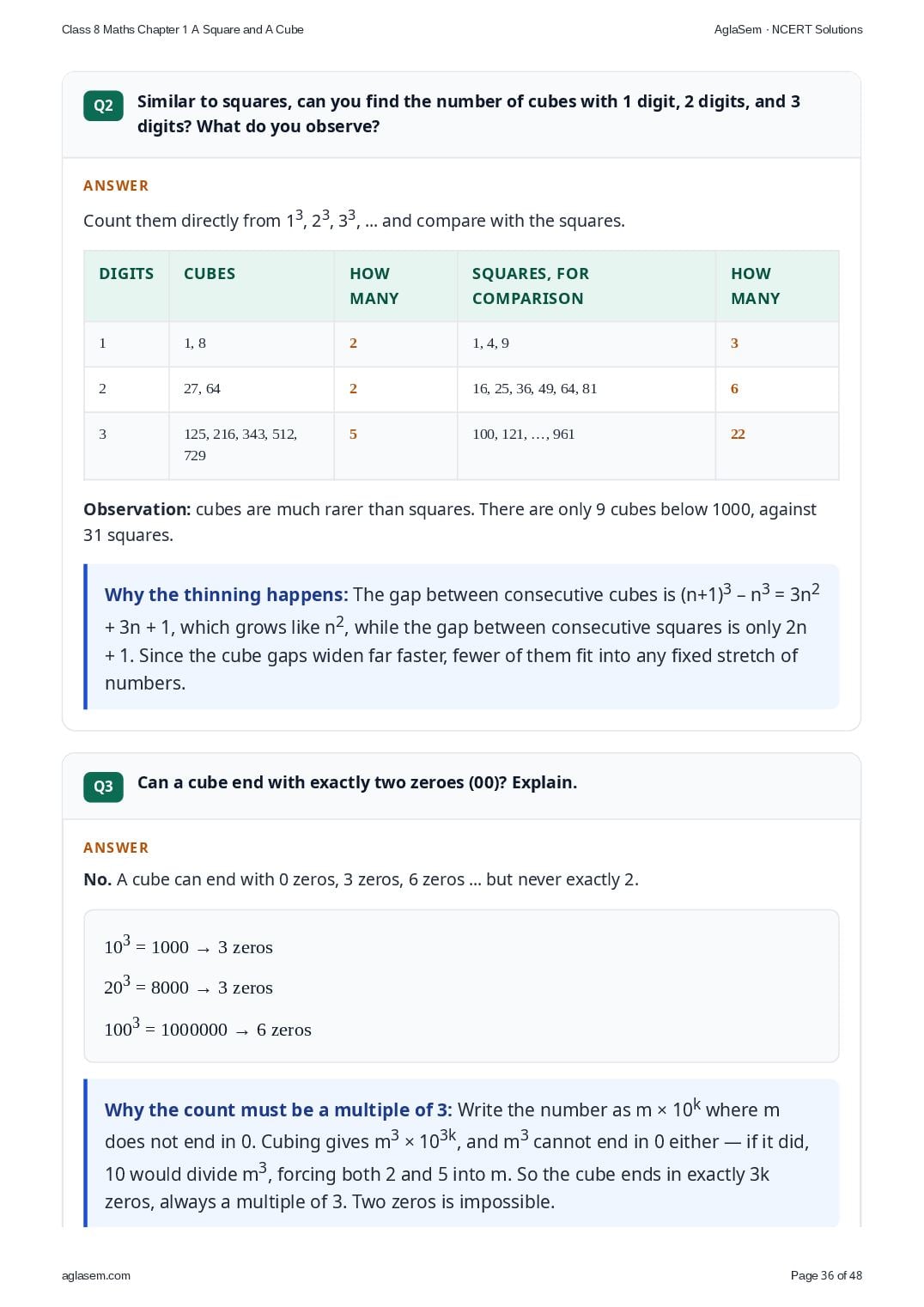
- Similar to squares, can you find the number of cubes with 1 digit, 2 digits, and 3 digits? What do you observe?
- Can a cube end with exactly two zeroes (00)? Explain.
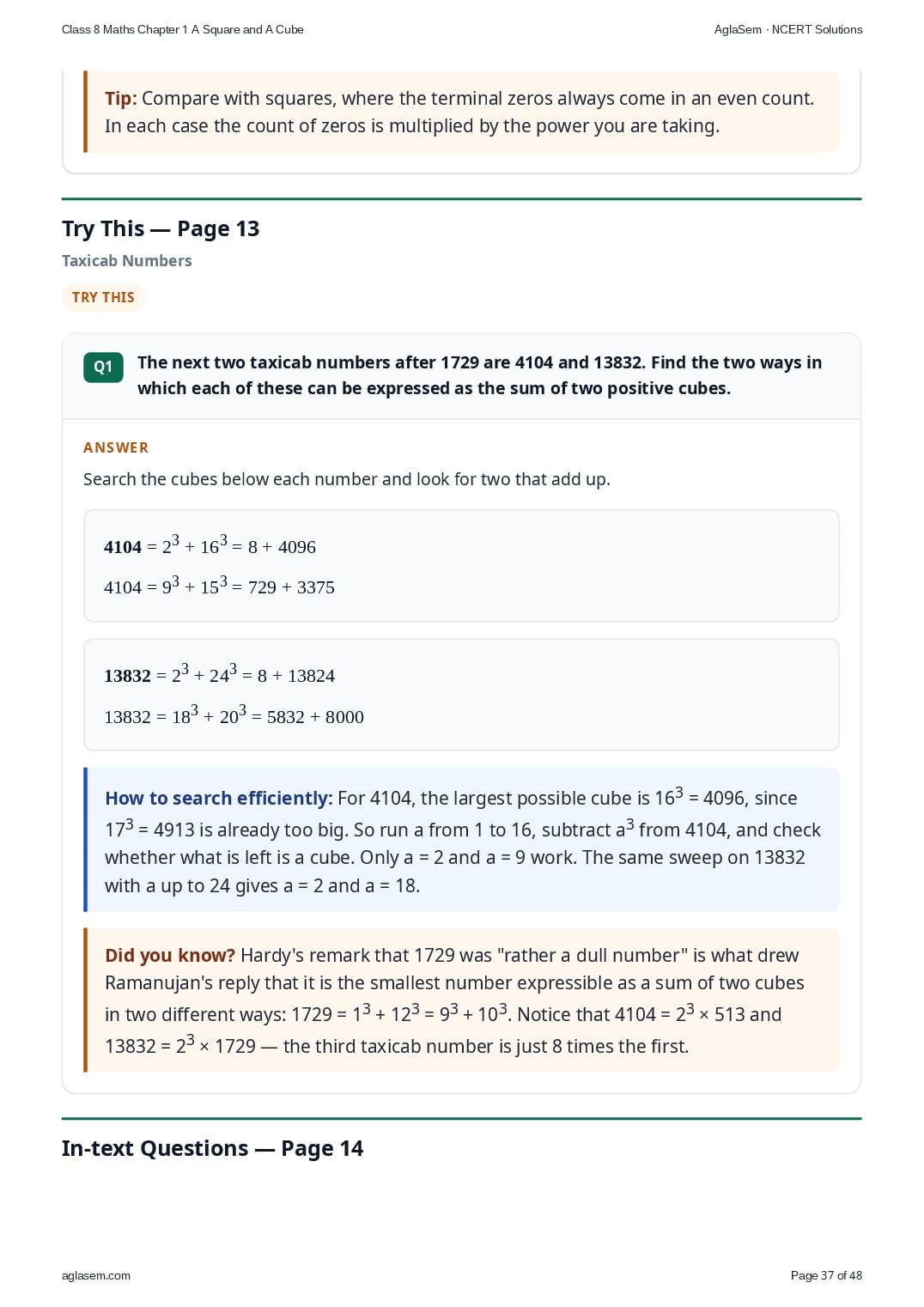
- The next two taxicab numbers after 1729 are 4104 and 13832. Find the two ways in which each of these can be expressed as the sum of two positive cubes.
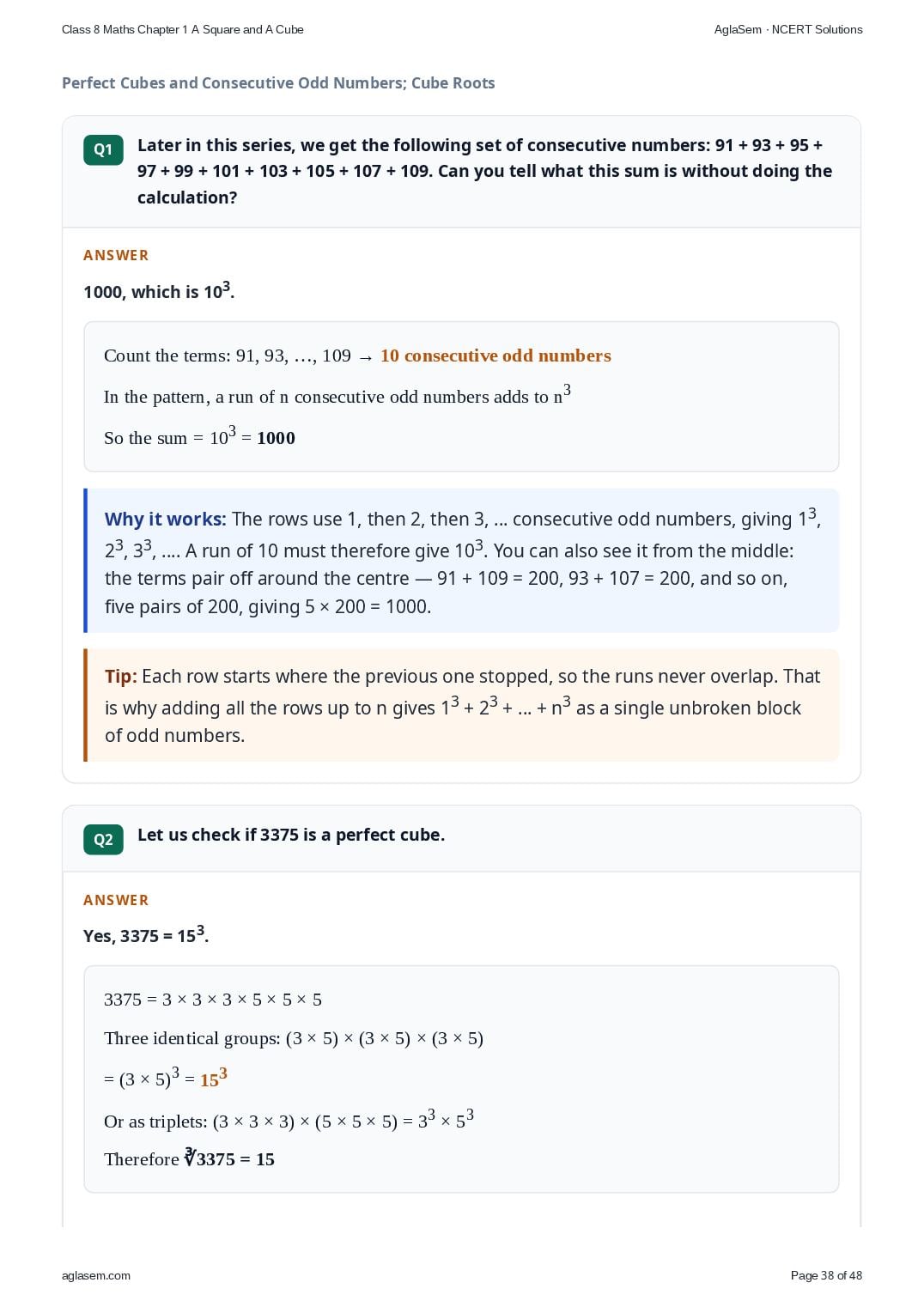
- Later in this series, we get the following set of consecutive numbers: 91 + 93 + 95 + 97 + 99 + 101 + 103 + 105 + 107 + 109. Can you tell what this sum is without doing the calculation?
- Let us check if 3375 is a perfect cube.
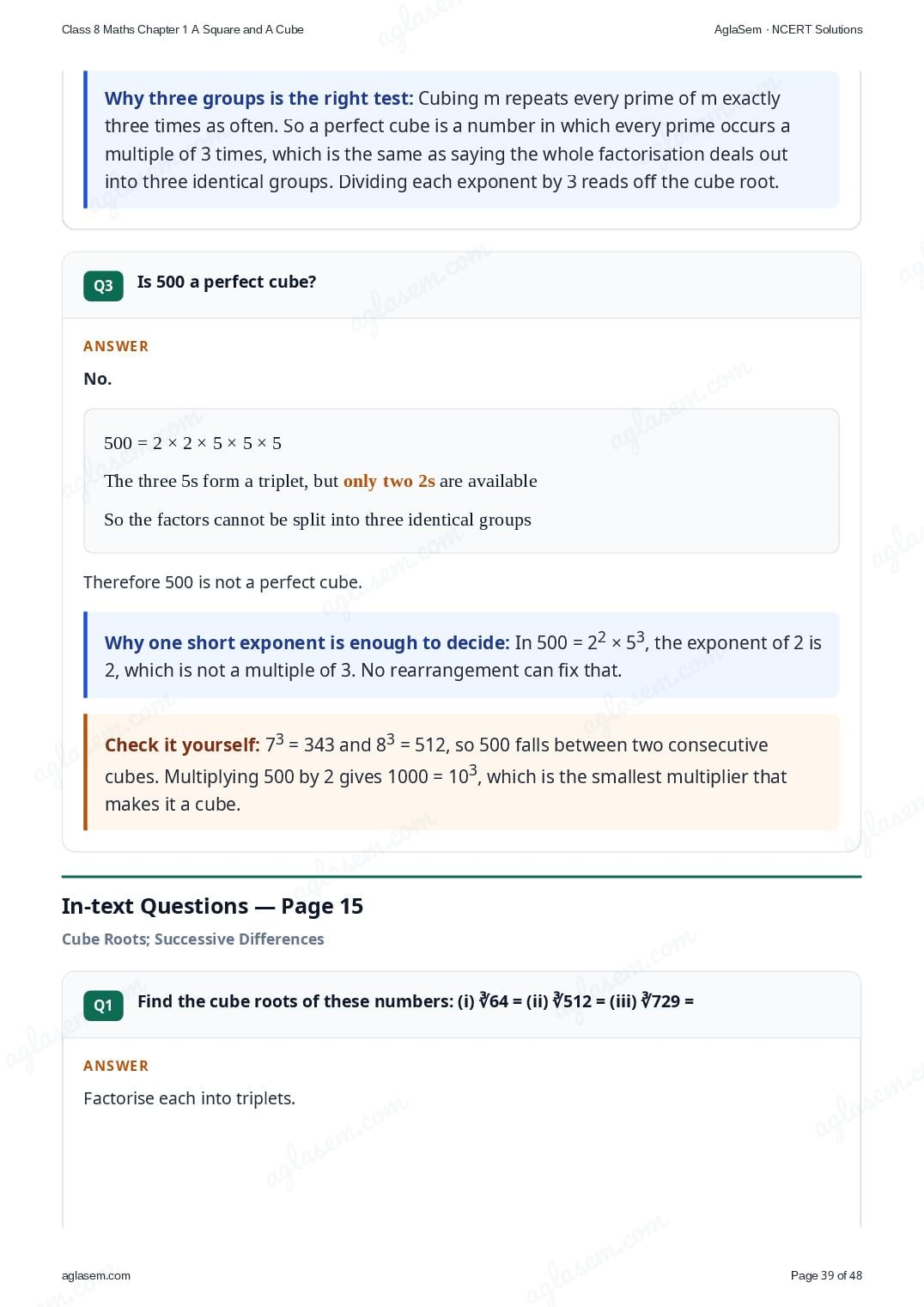
- Is 500 a perfect cube?
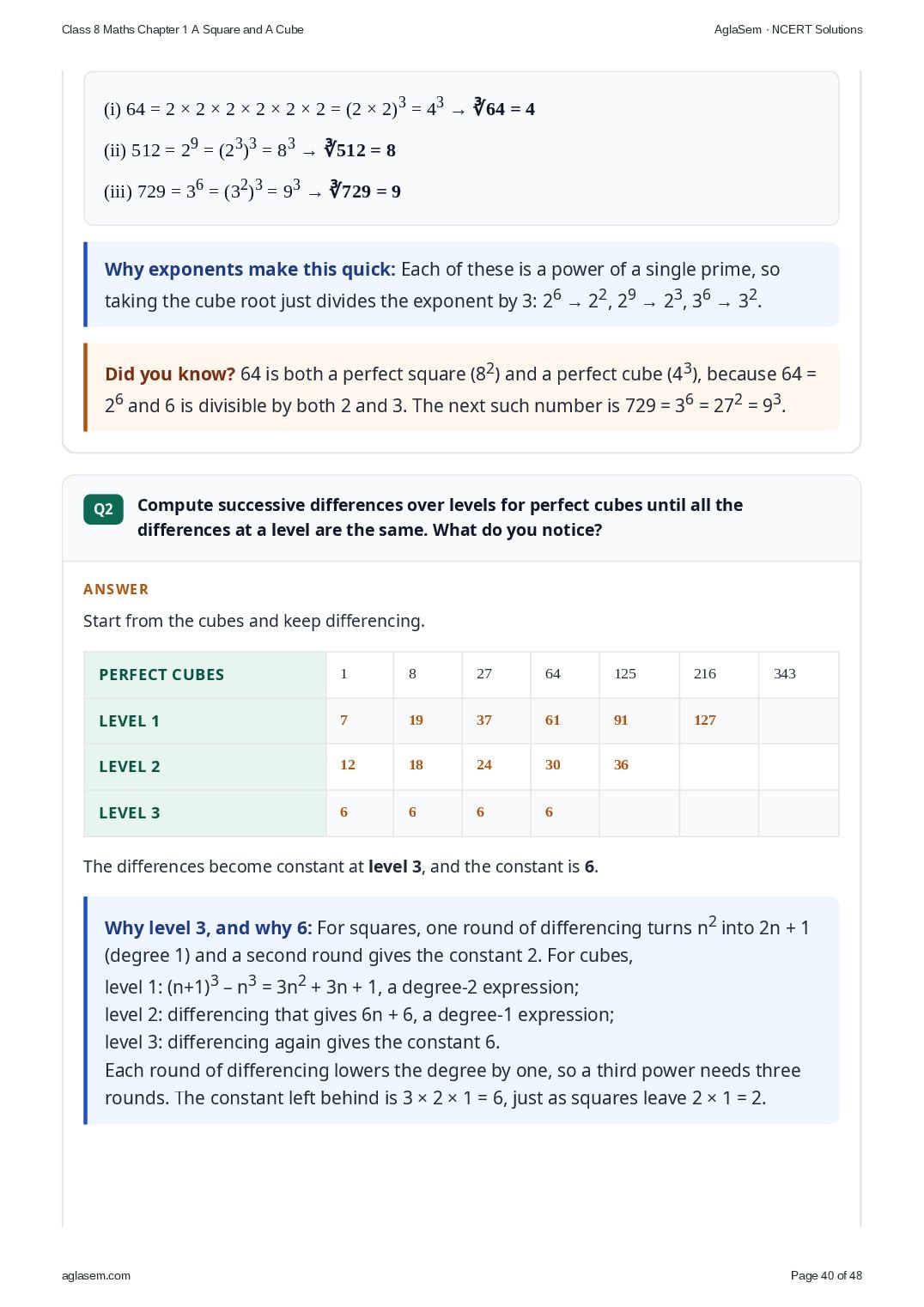
- Find the cube roots of these numbers: (i) ∛64 = (ii) ∛512 = (iii) ∛729 =
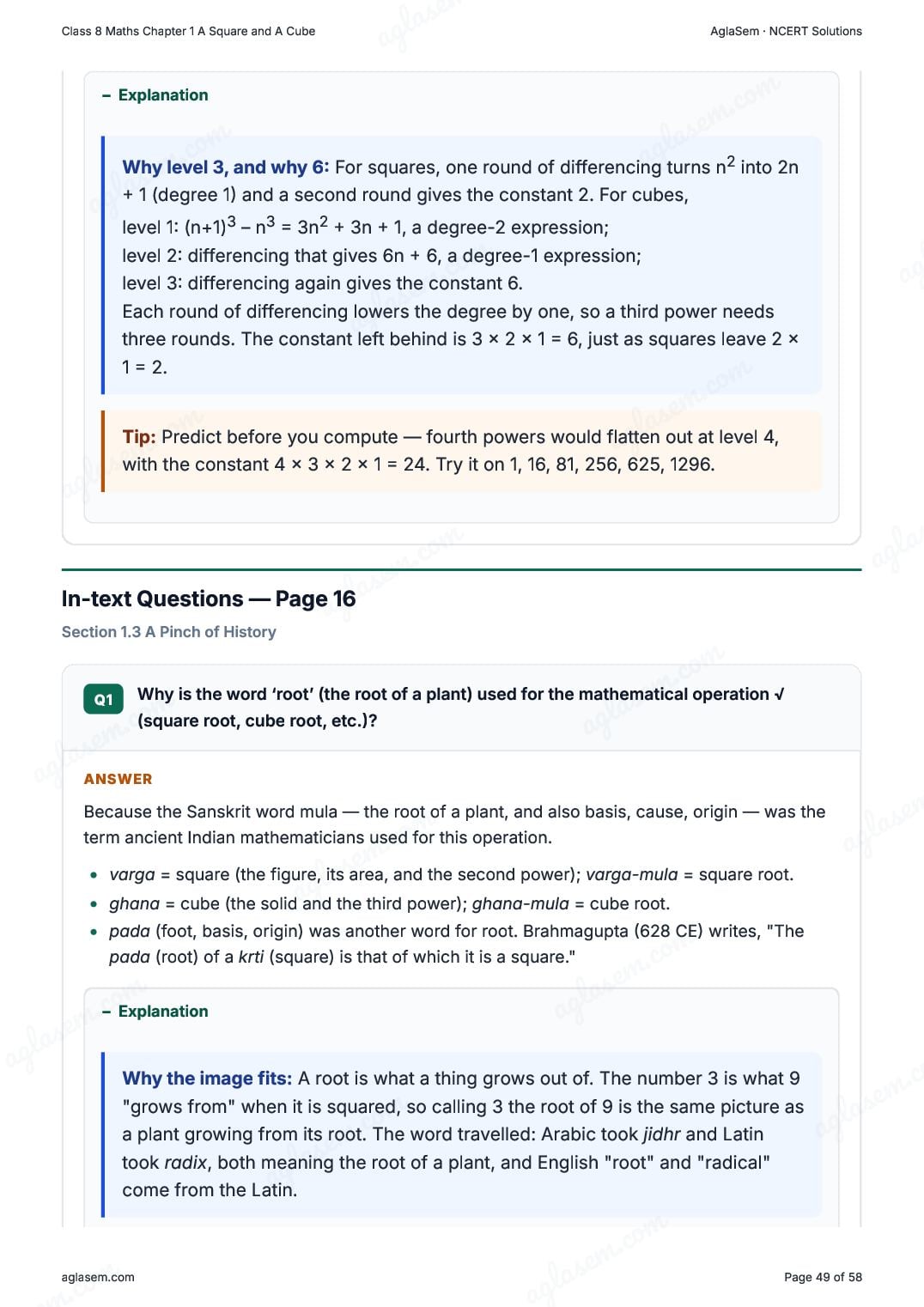
- Compute successive differences over levels for perfect cubes until all the differences at a level are the same. What do you notice?
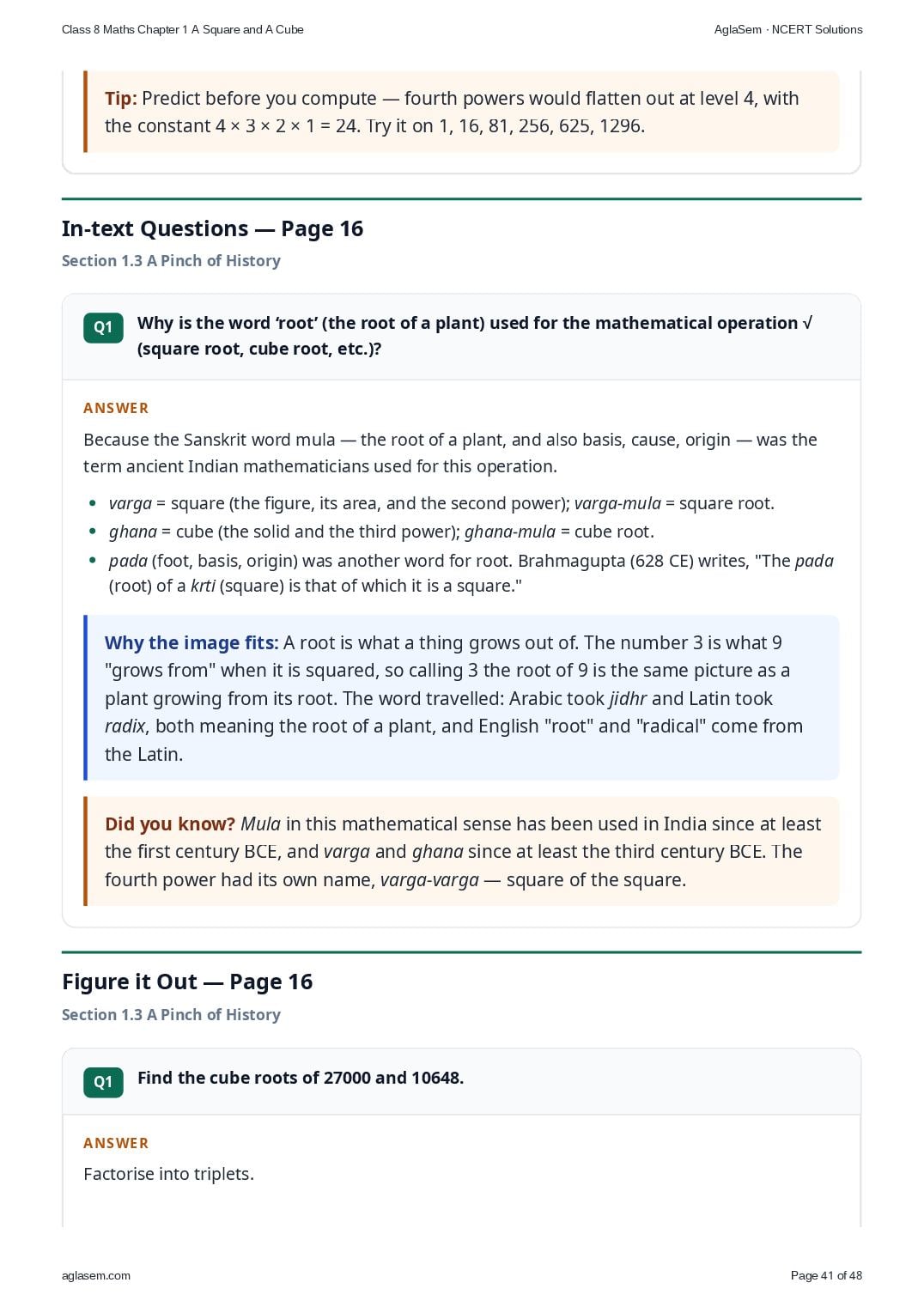
- Why is the word ‘root’ (the root of a plant) used for the mathematical operation √ (square root, cube root, etc.)?
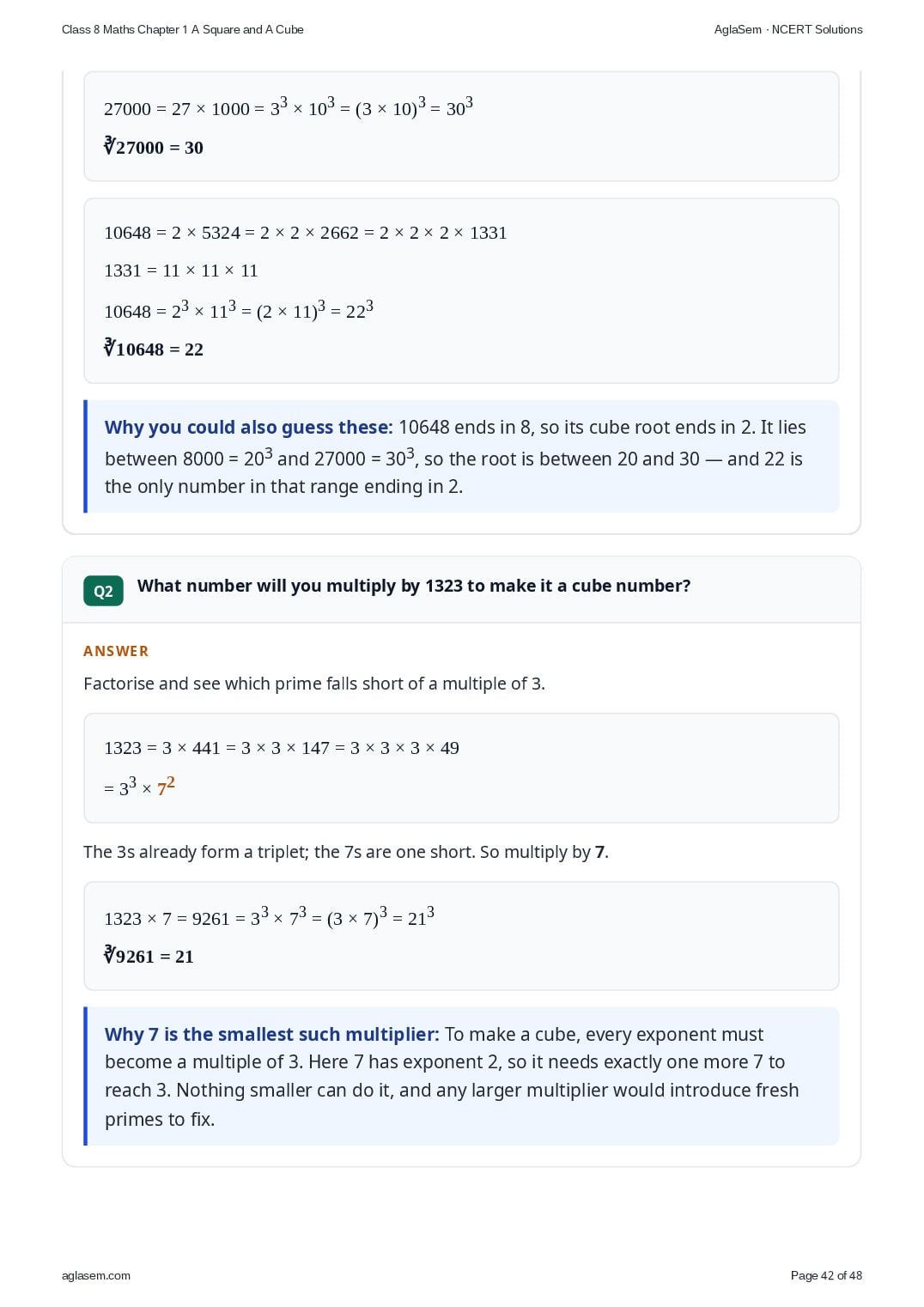
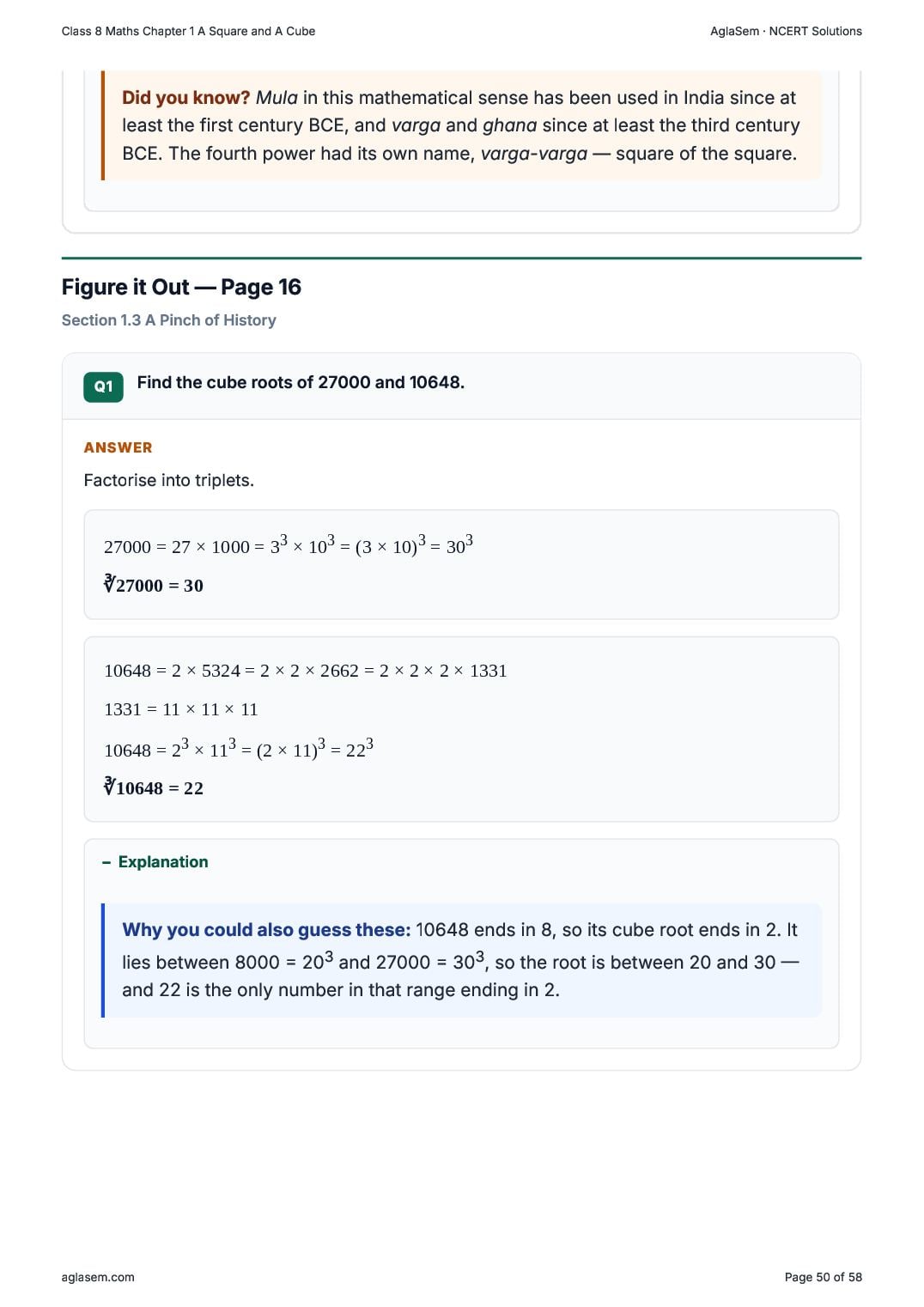
- Find the cube roots of 27000 and 10648.
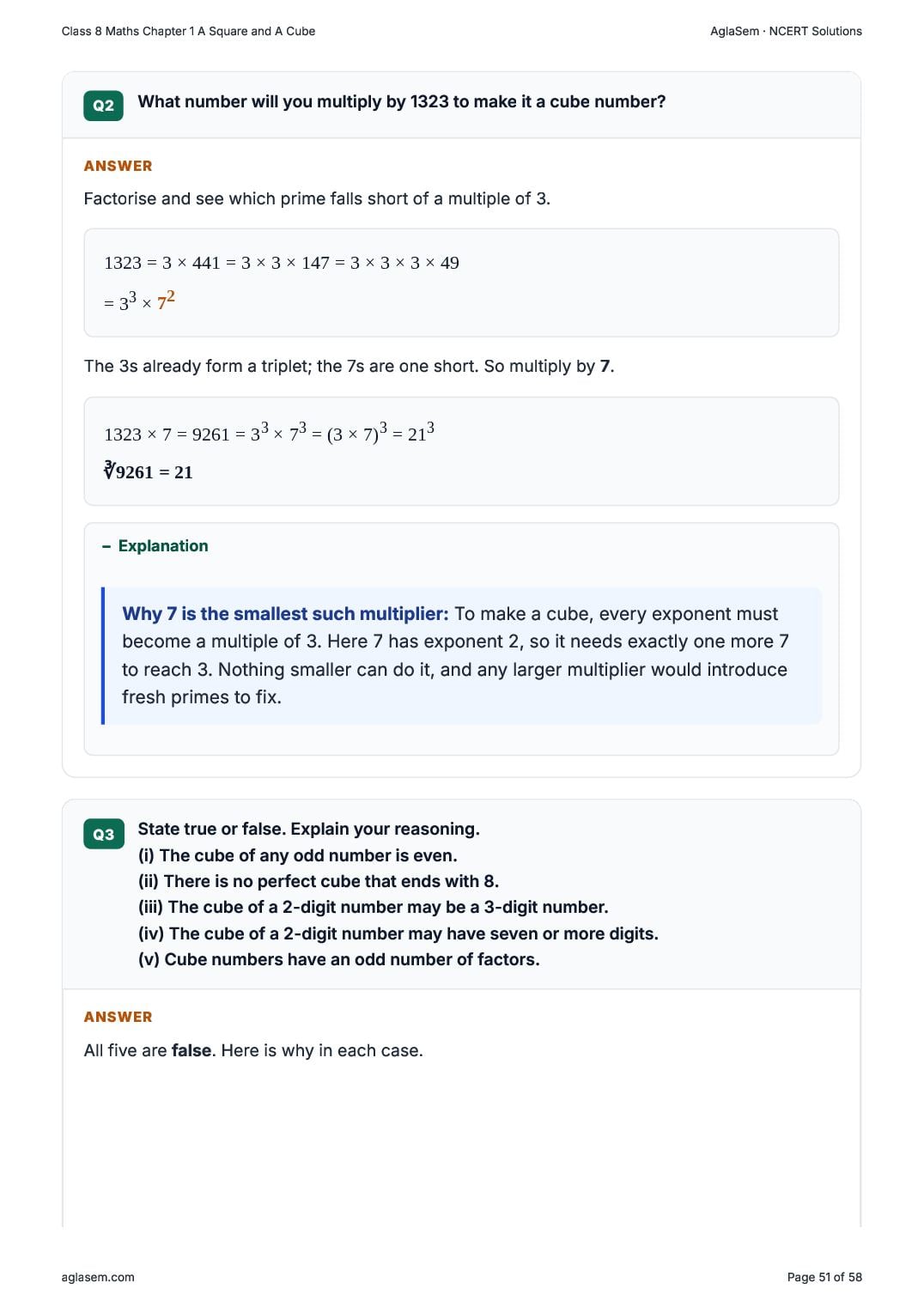
- What number will you multiply by 1323 to make it a cube number?
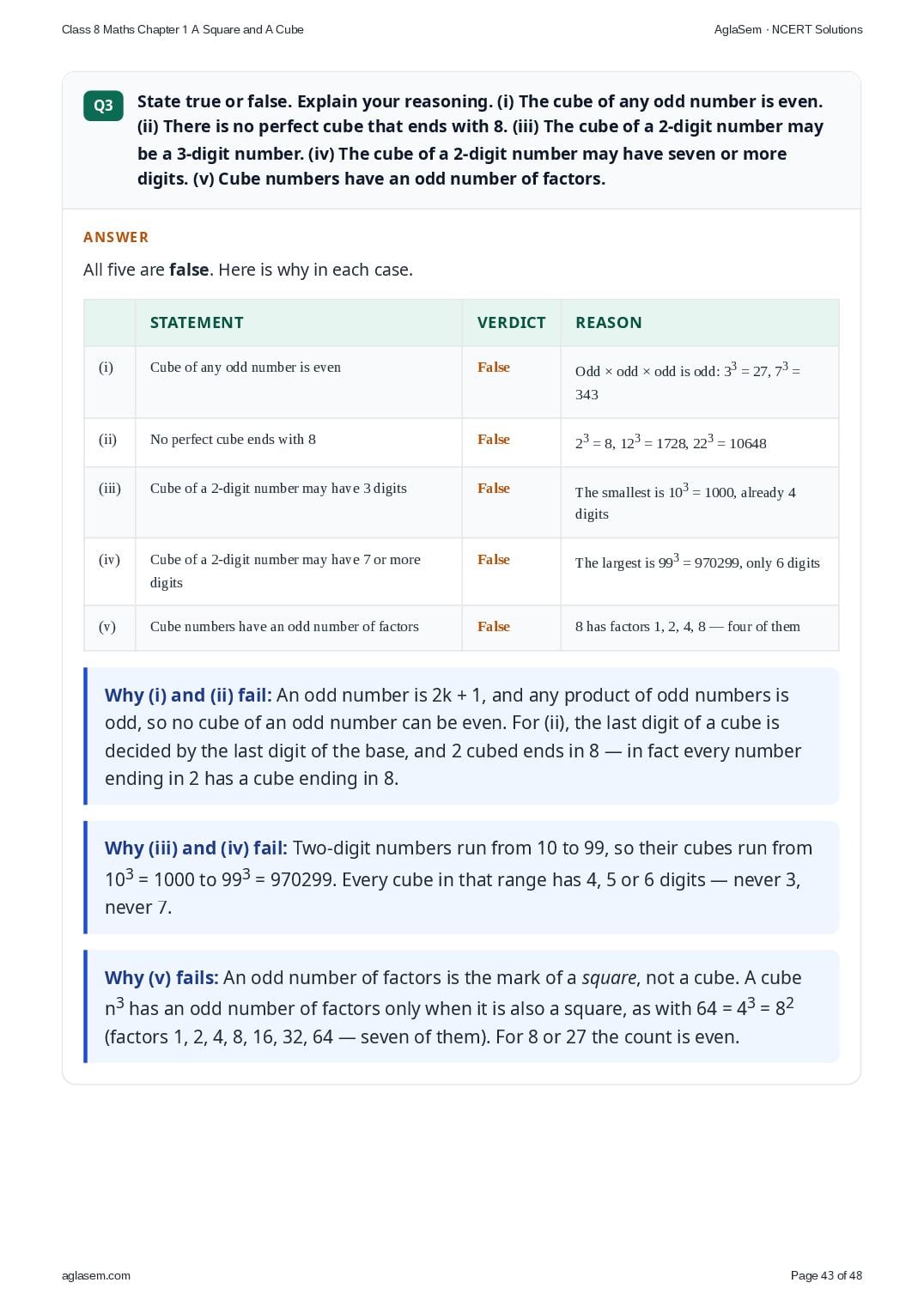
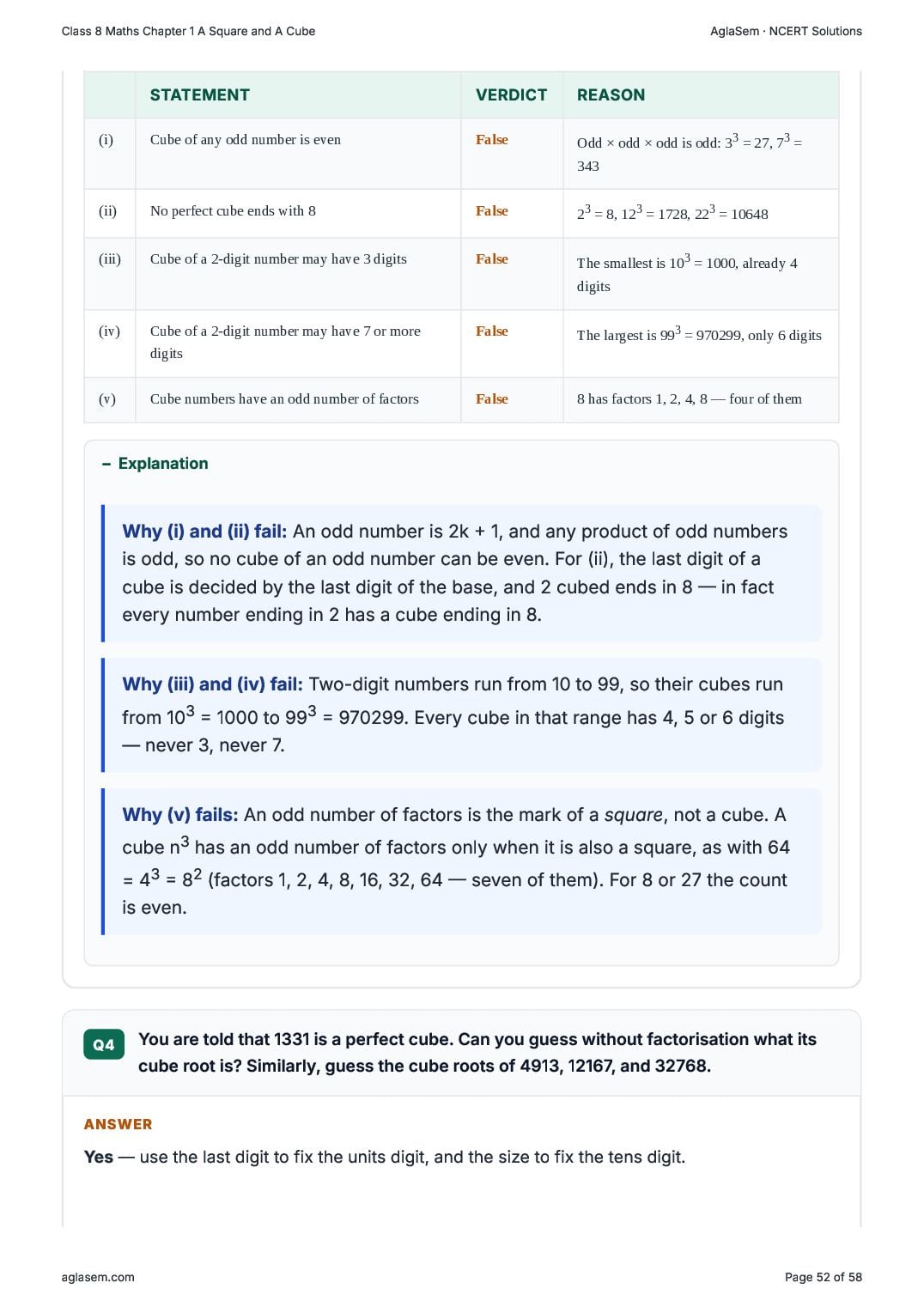
- State true or false. Explain your reasoning. (i) The cube of any odd number is even. (ii) There is no perfect cube that ends with 8. (iii) The cube of a 2-digit number may be a 3-digit number. (iv) The cube of a 2-digit number may have seven or more digits. (v) Cube numbers have an odd number of factors.
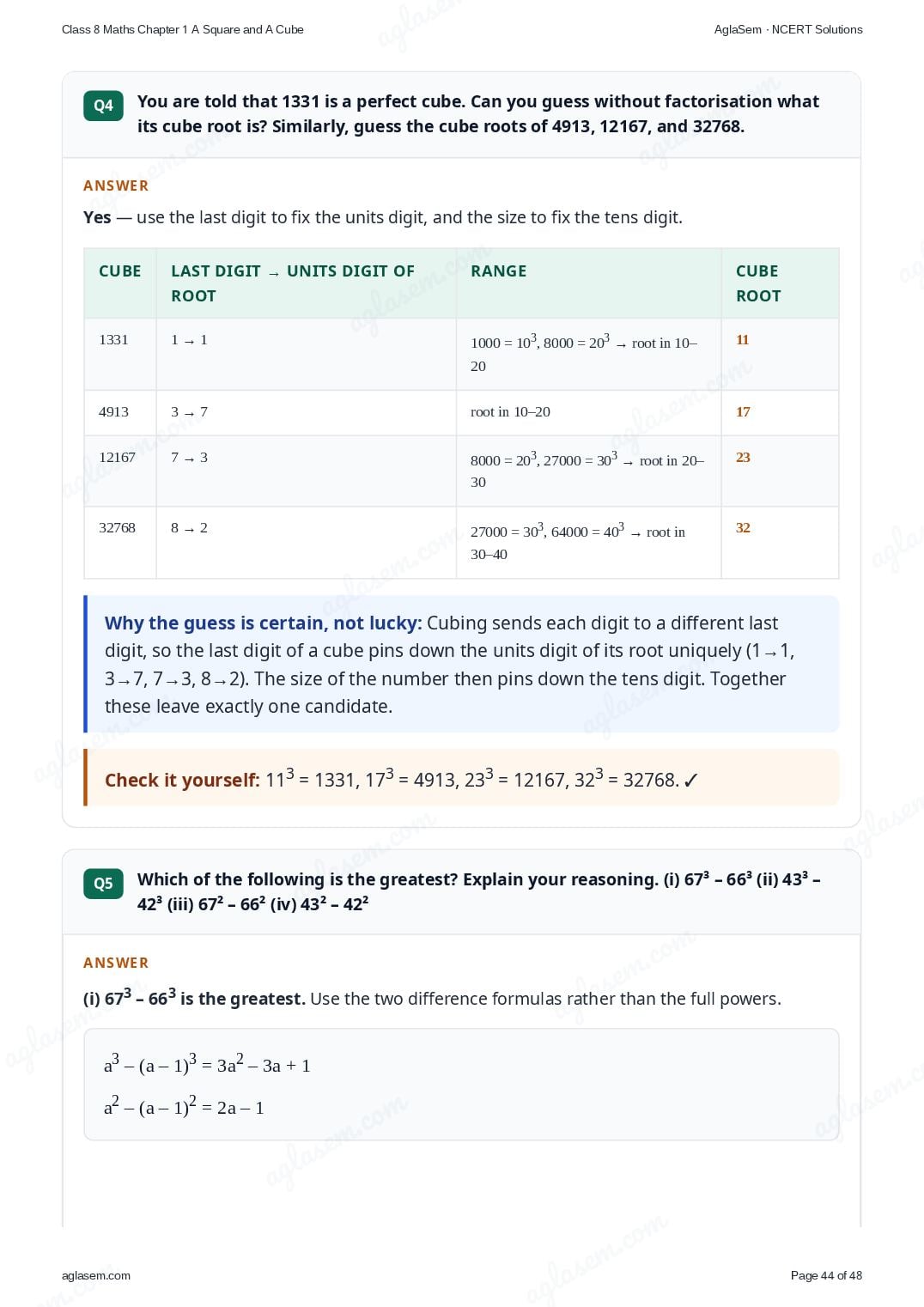
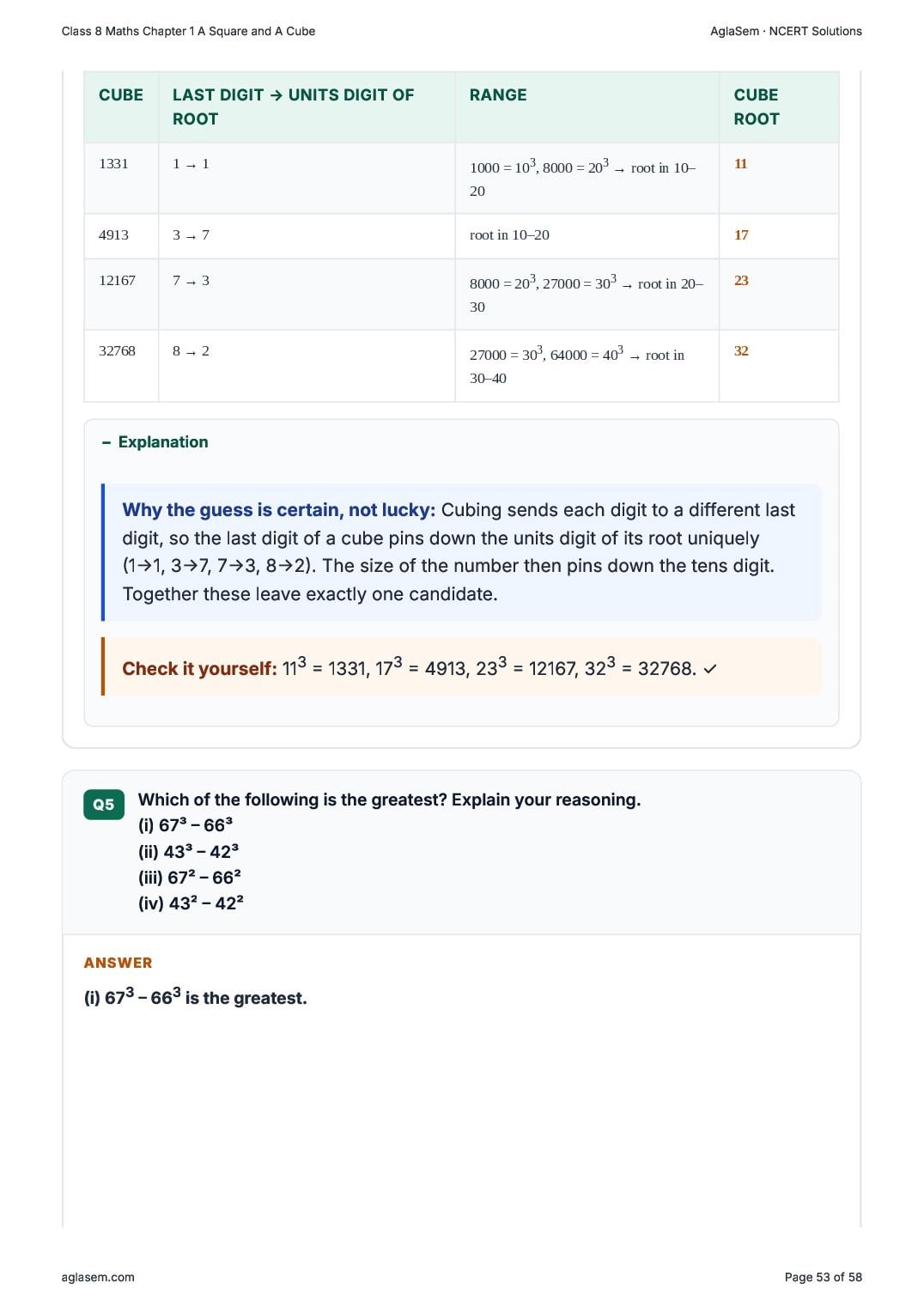
- You are told that 1331 is a perfect cube. Can you guess without factorisation what its cube root is? Similarly, guess the cube roots of 4913, 12167, and 32768.
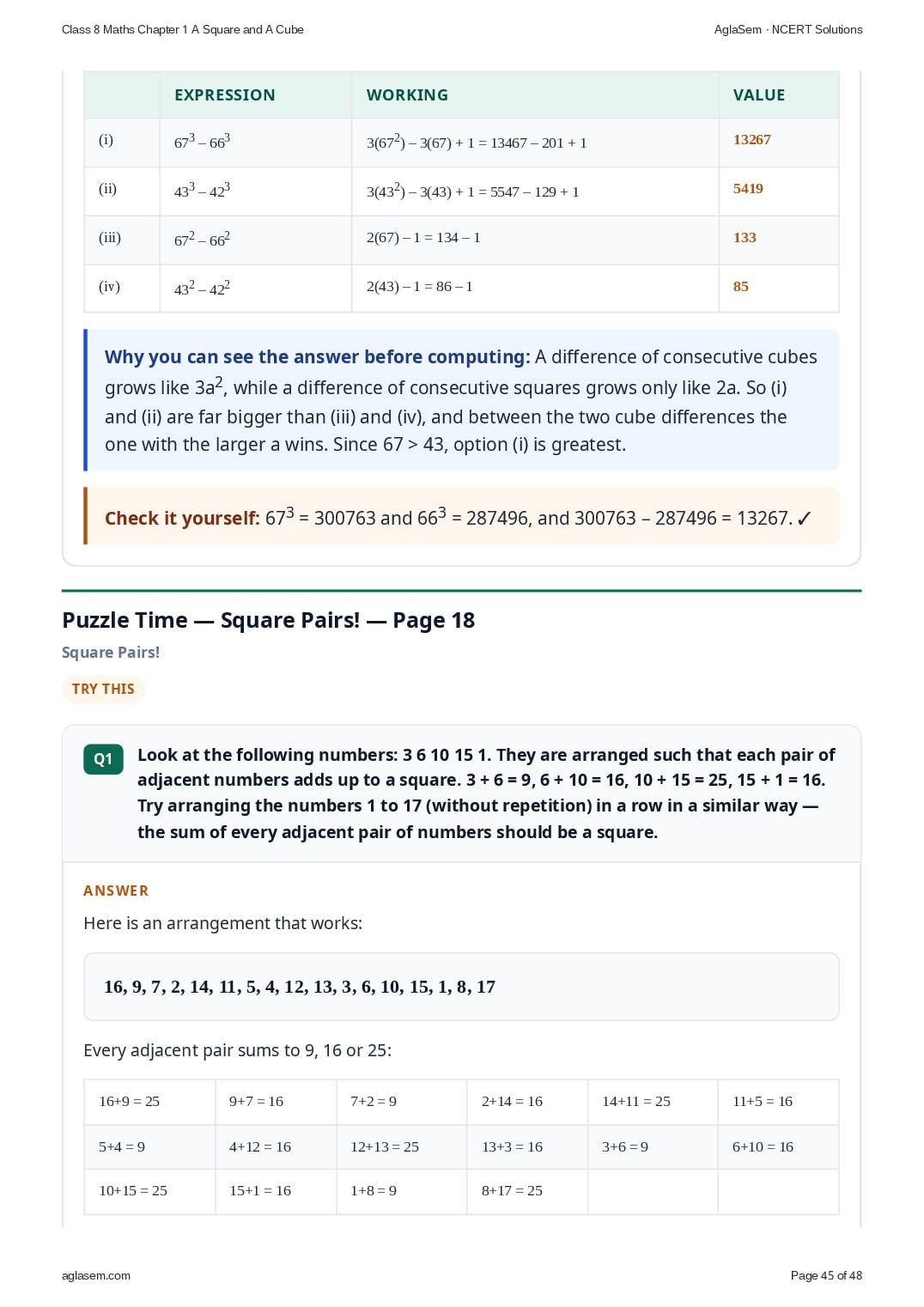
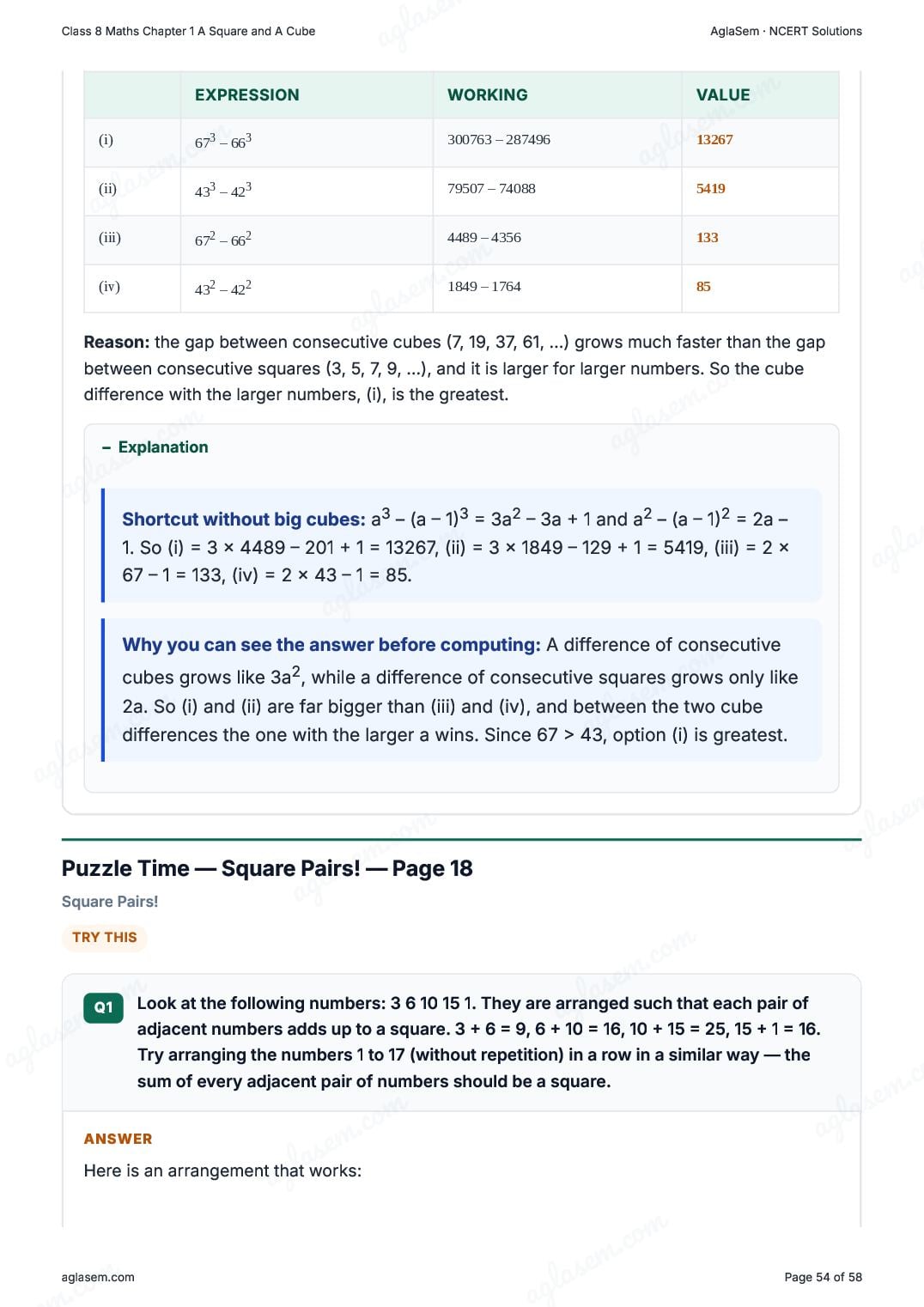
- Which of the following is the greatest? Explain your reasoning. (i) 67³ – 66³ (ii) 43³ – 42³ (iii) 67² – 66² (iv) 43² – 42²
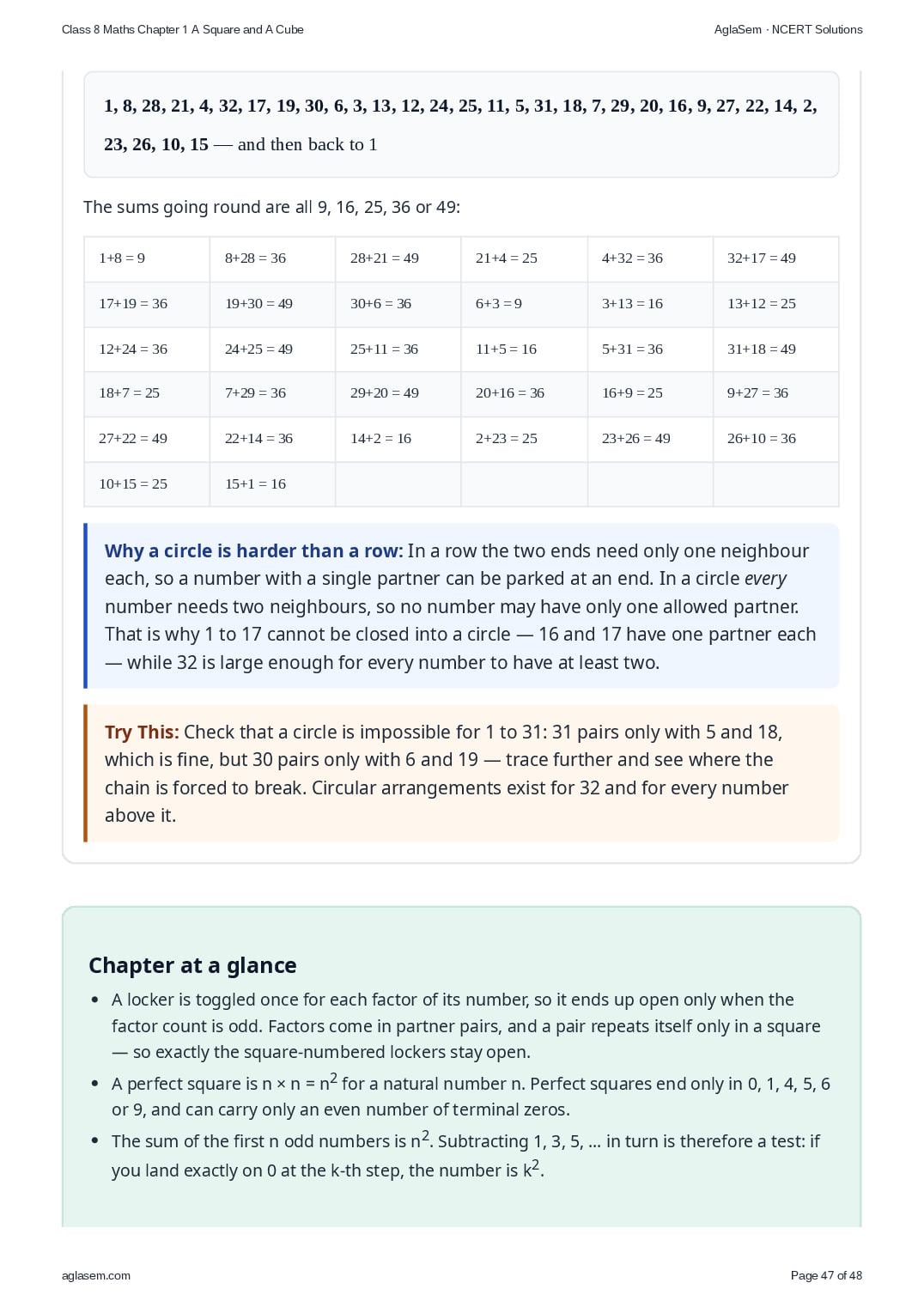
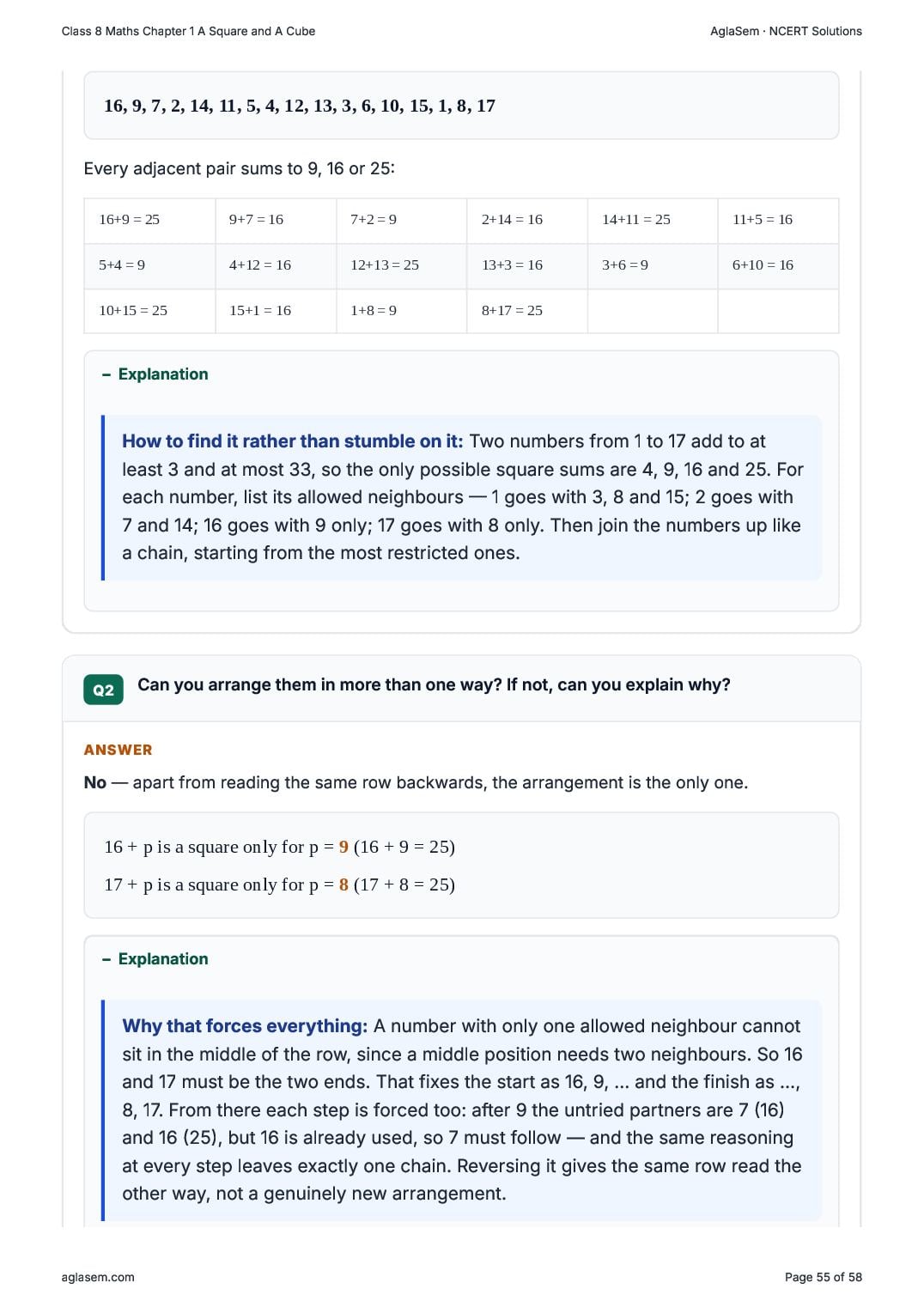
- Look at the following numbers: 3 6 10 15 1. They are arranged such that each pair of adjacent numbers adds up to a square. 3 + 6 = 9, 6 + 10 = 16, 10 + 15 = 25, 15 + 1 = 16. Try arranging the numbers 1 to 17 (without repetition) in a row in a similar way — the sum of every adjacent pair of numbers should be a square.
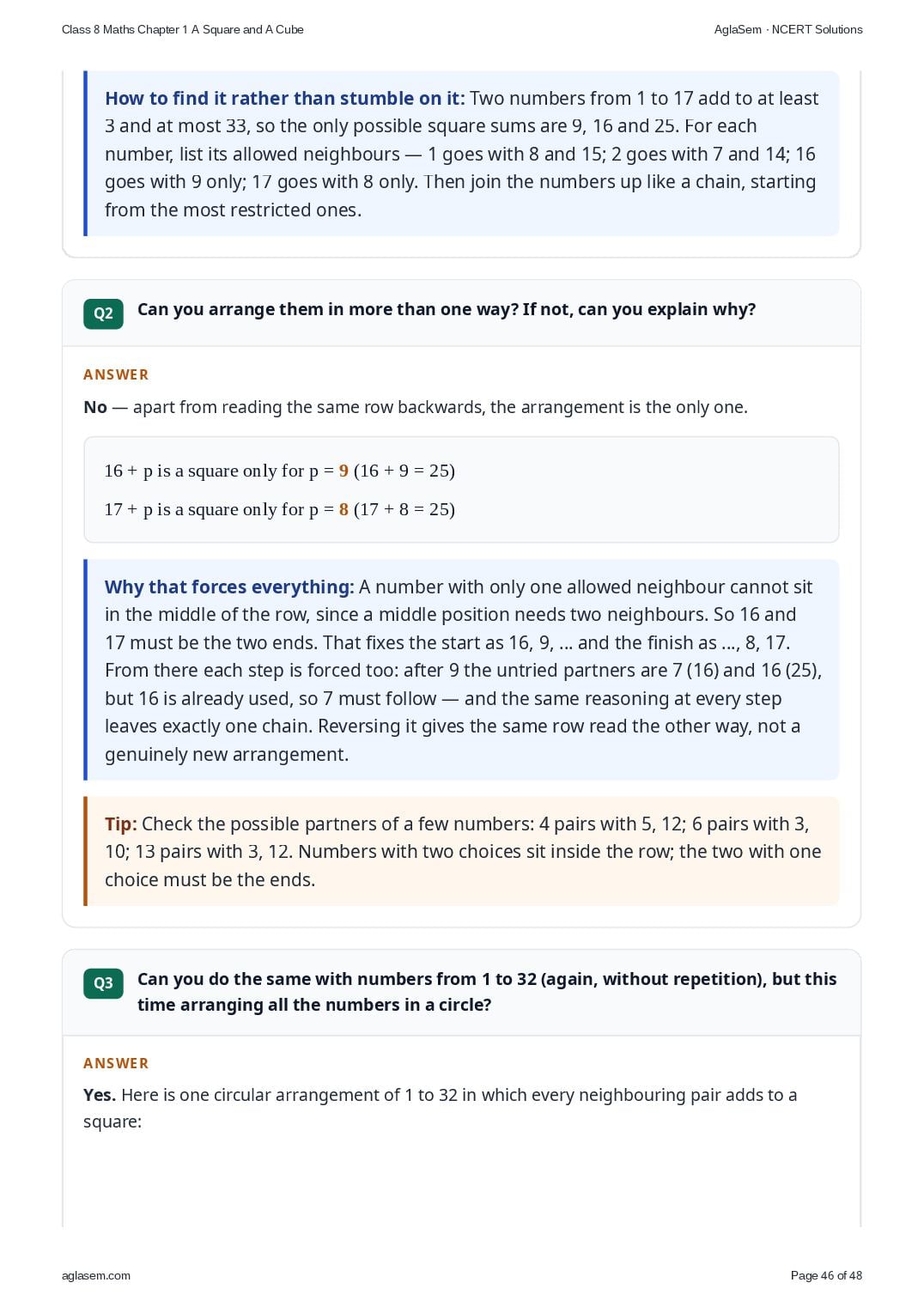
- Can you arrange them in more than one way? If not, can you explain why?
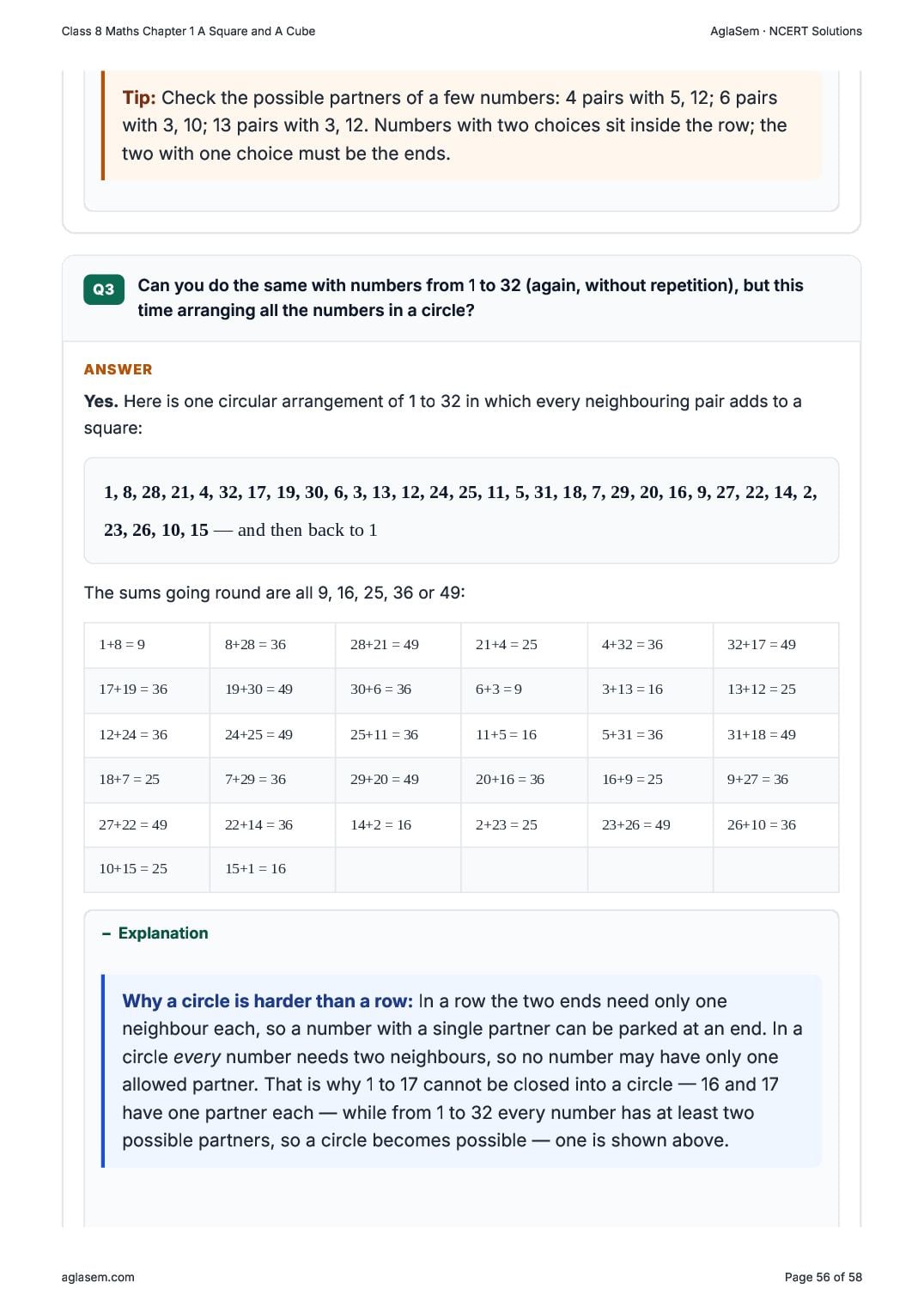
- Can you do the same with numbers from 1 to 32 (again, without repetition), but this time arranging all the numbers in a circle?
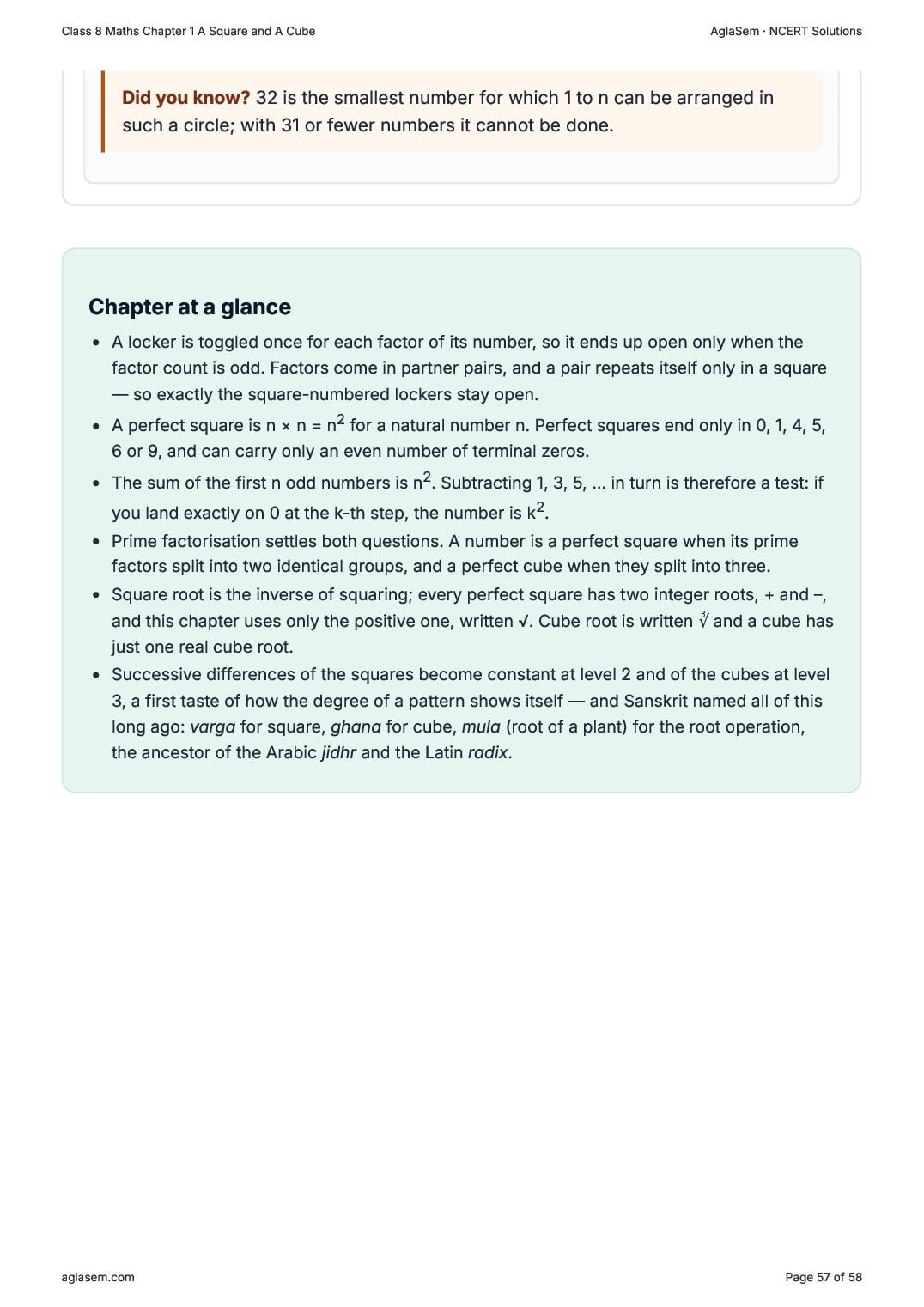
Chapter at a Glance
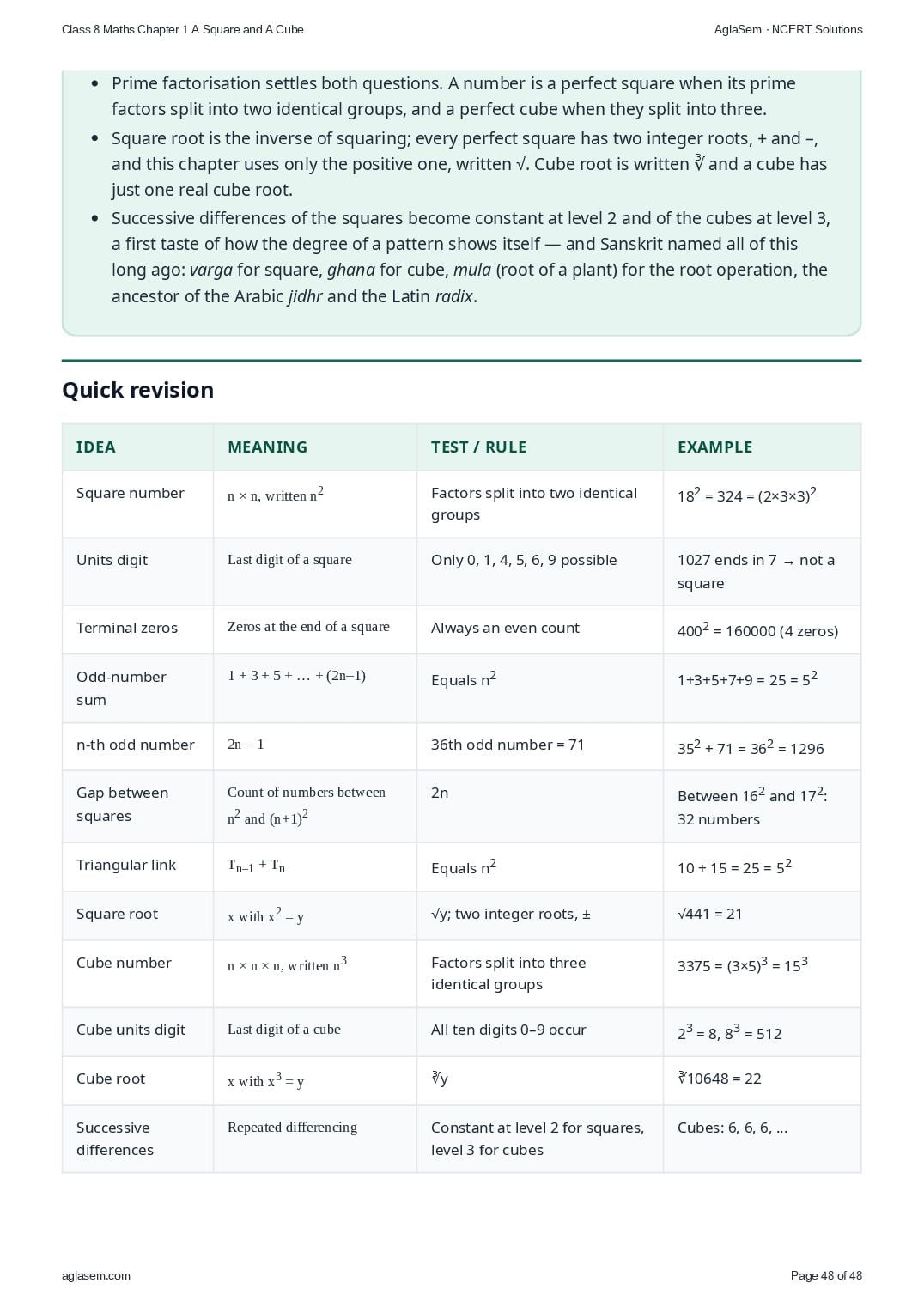
- A locker is toggled once for each factor of its number, so it ends up open only when the factor count is odd. Factors come in partner pairs, and a pair repeats itself only in a square — so exactly the square-numbered lockers stay open.
- A perfect square is n × n = n 2 for a natural number n. Perfect squares end only in 0, 1, 4, 5, 6 or 9, and can carry only an even number of terminal zeros.
- The sum of the first n odd numbers is n 2 . Subtracting 1, 3, 5, … in turn is therefore a test: if you land exactly on 0 at the k-th step, the number is k 2 .
- Prime factorisation settles both questions. A number is a perfect square when its prime factors split into two identical groups, and a perfect cube when they split into three.
- Square root is the inverse of squaring; every perfect square has two integer roots, + and –, and this chapter uses only the positive one, written √. Cube root is written ∛ and a cube has just one real cube root.
- Successive differences of the squares become constant at level 2 and of the cubes at level 3, a first taste of how the degree of a pattern shows itself — and Sanskrit named all of this long ago: varga for square, ghana for cube, mula (root of a plant) for the root operation, the ancestor of the Arabic jidhr and the Latin radix .
How to Download NCERT Solutions for Class 8 Maths Chapter 1 PDF
Follow these simple steps to get the A Square and a Cube questions-and-answers PDF from Ganita Prakash.
- Search NCERT Solutions for Class 8 Maths Chapter 1 aglasem and open this page.
- Read the exercise questions with answers for A Square and a Cube shown above.
- Click the Download PDF link to save the A Square and a Cube solutions to your device.
NCERT Solutions for Class 8 Maths – All Chapters
There are more chapters to study besides A Square and a Cube in Maths. Here are the NCERT Solutions for all chapters of Class 8 Maths.
- Chapter 1 A Square and a Cube
- Chapter 2 Power Play
- Chapter 3 A Story of Numbers
- Chapter 4 Quadrilaterals
- Chapter 5 Number Play
- Chapter 6 We Distribute Yet Things Multiply
- Chapter 7 Proportional Reasoning 1
- Chapter 8 Fractions in Disguise
- Chapter 9 The Baudh Yana Pythagoras Theorem
- Chapter 10 Proportional Reasoning 2
- Chapter 11 Exploring Some Geometric Themes
- Chapter 12 Tales By Dots and Lines
- Chapter 13 Algebra Play
- Chapter 14 Area
NCERT Solutions for Class 8 – All Subjects
Just like Chapter 1 of Maths, you can get the exercise questions with answers for every other subject of Class 8. Here are the NCERT Solutions for all subjects of Class 8.
NCERT Solutions for Class 8 Maths Chapter 1 – An Overview
The key highlights of this study material are as follows.
| Aspects | Details |
|---|---|
| Class | Class 8 |
| Subject | Maths |
| Chapter Number | Chapter 1 |
| Chapter Name | A Square and a Cube |
| Book Name | Ganita Prakash |
| Book By | NCERT (National Council of Educational Research and Training) |
| Educational Resource Here | NCERT Solutions of Class 8 Maths Chapter 1 for all exercises |
| More Questions Answers of This Subject | NCERT Solutions for Class 8 Maths |
| Download Book Chapter | NCERT Book Class 8 Maths |
| All Questions Answers For This Class | NCERT Solutions for Class 8 |
| Complete Solutions | NCERT Solutions |
NCERT Solutions for Class 8 Maths Chapter 1 A Square and a Cube – FAQs
What are the NCERT Solutions for Class 8 Maths Chapter 1 A Square and a Cube?
They are the complete, step-by-step answers to all the exercise and in-text questions of Chapter 1 A Square and a Cube from the NCERT Class 8 Maths textbook Ganita Prakash, written by experts as per the latest NCERT syllabus.
How can I download the Class 8 Maths Chapter 1 solutions PDF for free?
Open this page on aglasem, read the A Square and a Cube questions with answers, and click the “Download Solutions PDF” link. The Class 8 Maths Chapter 1 NCERT Solutions PDF is completely free to download.
Are these NCERT Solutions as per the latest 2026-27 syllabus?
Yes. The NCERT Solutions for Class 8 Maths Chapter 1 are based on the latest NCERT textbook Ganita Prakash and the current 2026-27 CBSE syllabus, so the questions and answers match what you study in class.
Where can I get NCERT Solutions for the other chapters of Class 8 Maths?
You can find the answers to every chapter on the NCERT Solutions for Class 8 Maths page, and solutions for every subject on the NCERT Solutions for Class 8 page.
How do NCERT Solutions help in exam preparation?
They show the correct method to solve each question, help you write answers the way they are expected in exams, let you check and correct your own work, and save revision time — which together improve your marks in Class 8 Maths.
If you have any queries on NCERT Solutions for Class 8 Maths Chapter 1 A Square and a Cube, then please ask in the comments below.