Download The Baudhāyana-Pythagoras Theorem – NCERT Class 8 Maths Chapter 9 PDF from the new NCERT Class 8 Maths book Ganita Prakash (2026-27). Read the chapter online or download the free PDF. Doubling a square is done by building a square on its diagonal, not by doubling the side (that gives 4 times the area). Drawing ‘east-west’ and ‘north-south’ lines cuts the original square into 2 congruent triangles and the new square into 4 of the…
The Baudhāyana-Pythagoras Theorem PDF – Chapter 9 of Ganita Prakash (Part II)
Read the chapter online or download the PDF.
| Chapter | Download | |
|---|---|---|
| Chapter 9 PDF | The Baudhāyana-Pythagoras Theorem | View PDF |
| Full book | NCERT Class 8 Maths – Ganita Prakash | View Book |
Read Online
What Is in The Baudhāyana-Pythagoras Theorem? (Class 8 Maths Chapter 9)
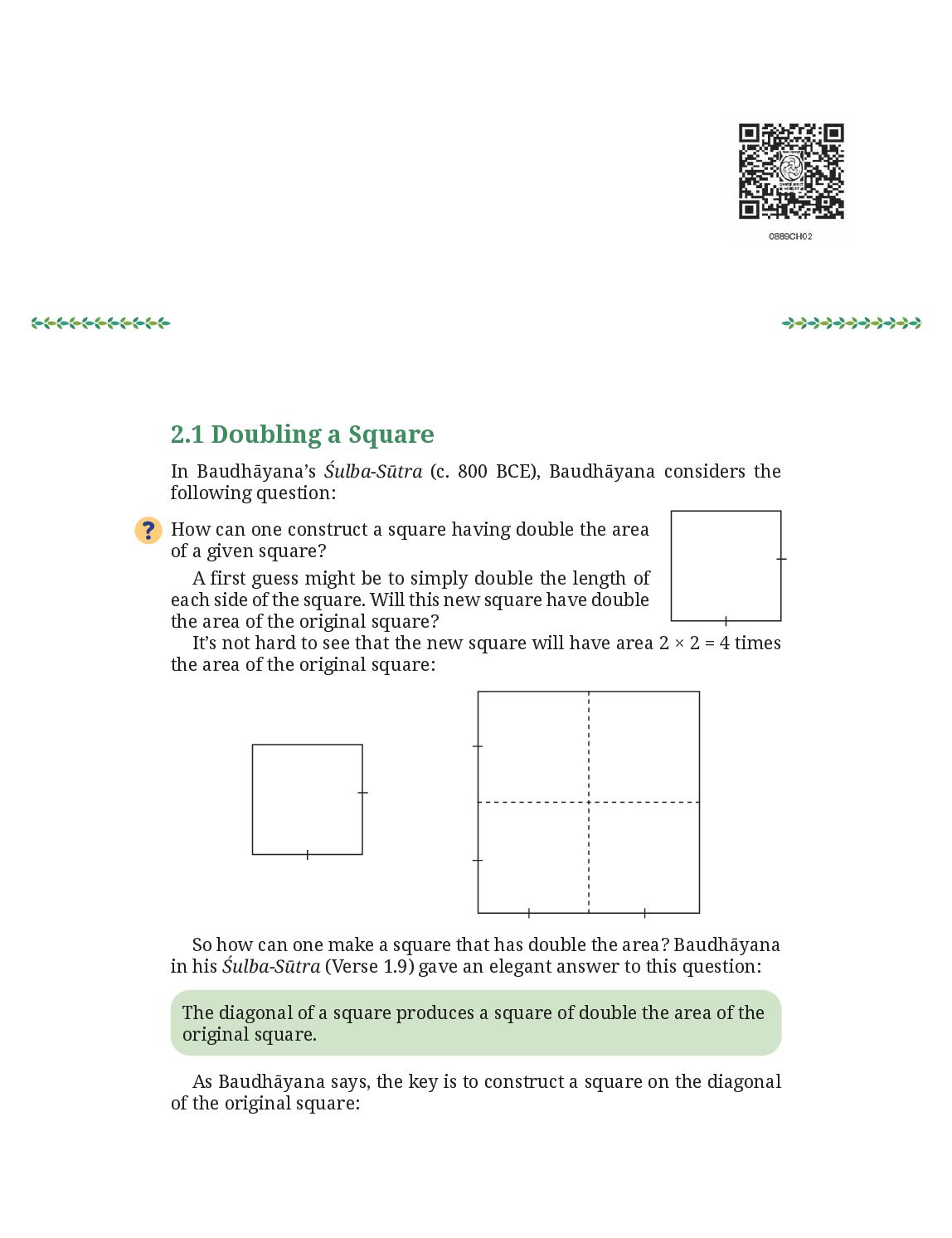
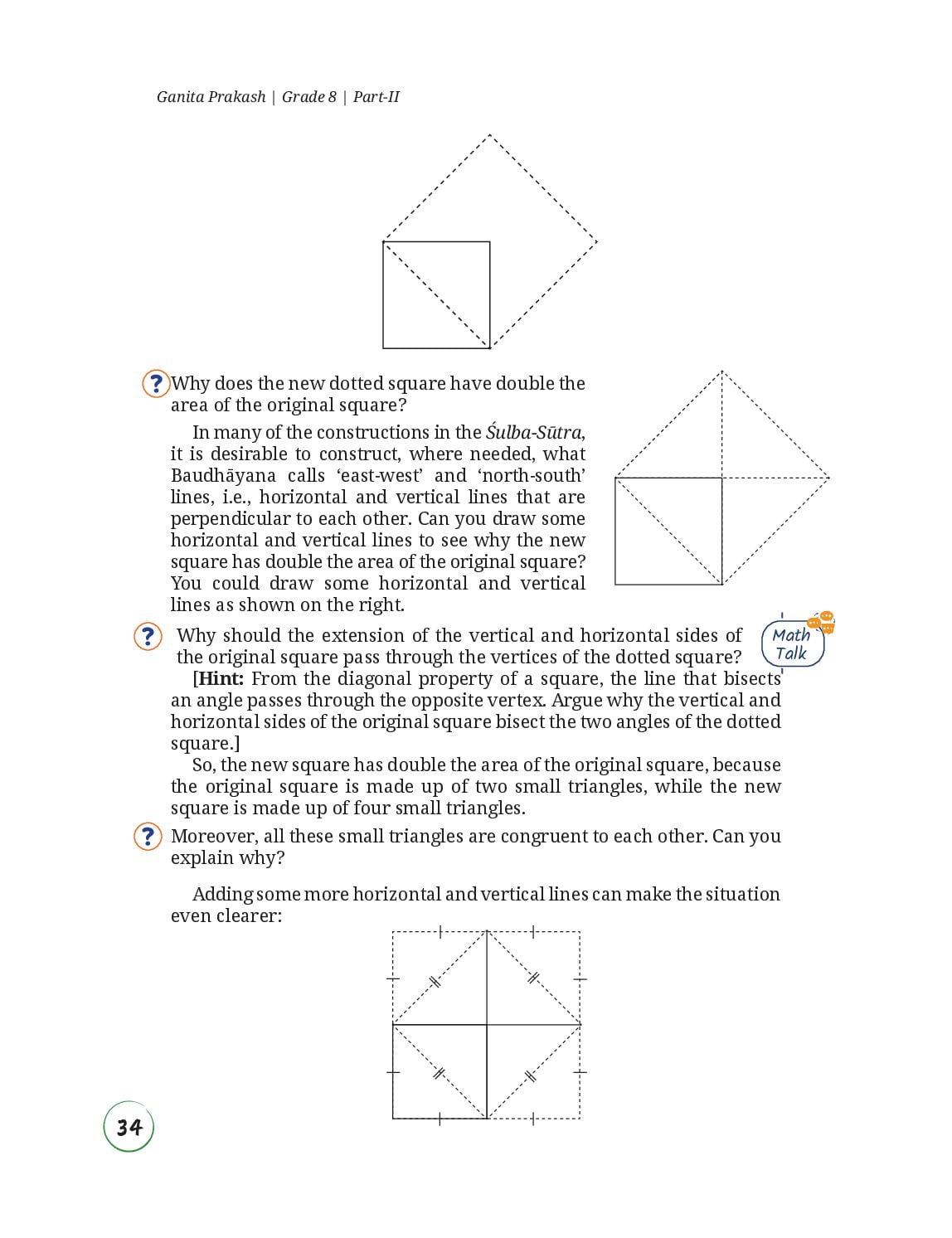
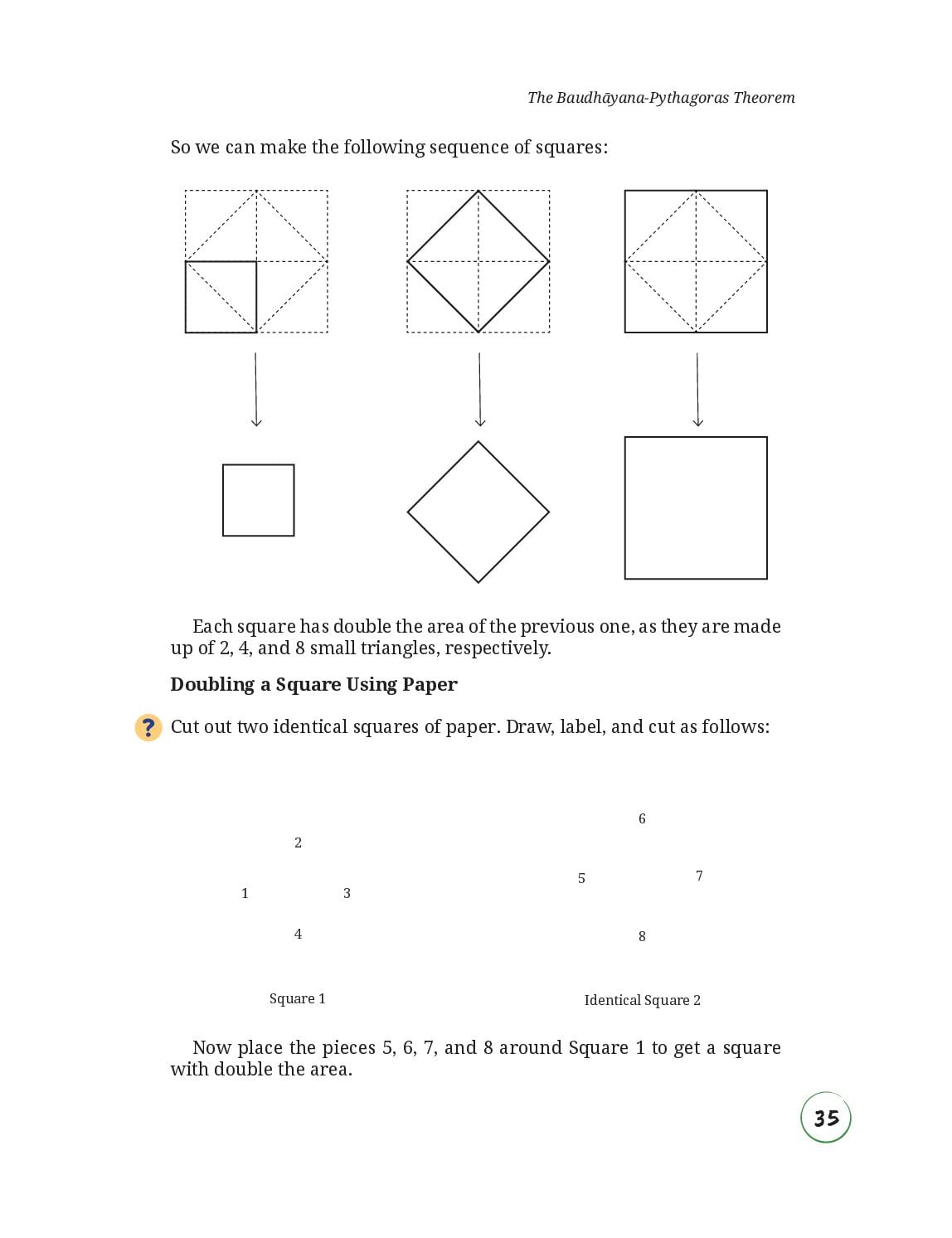
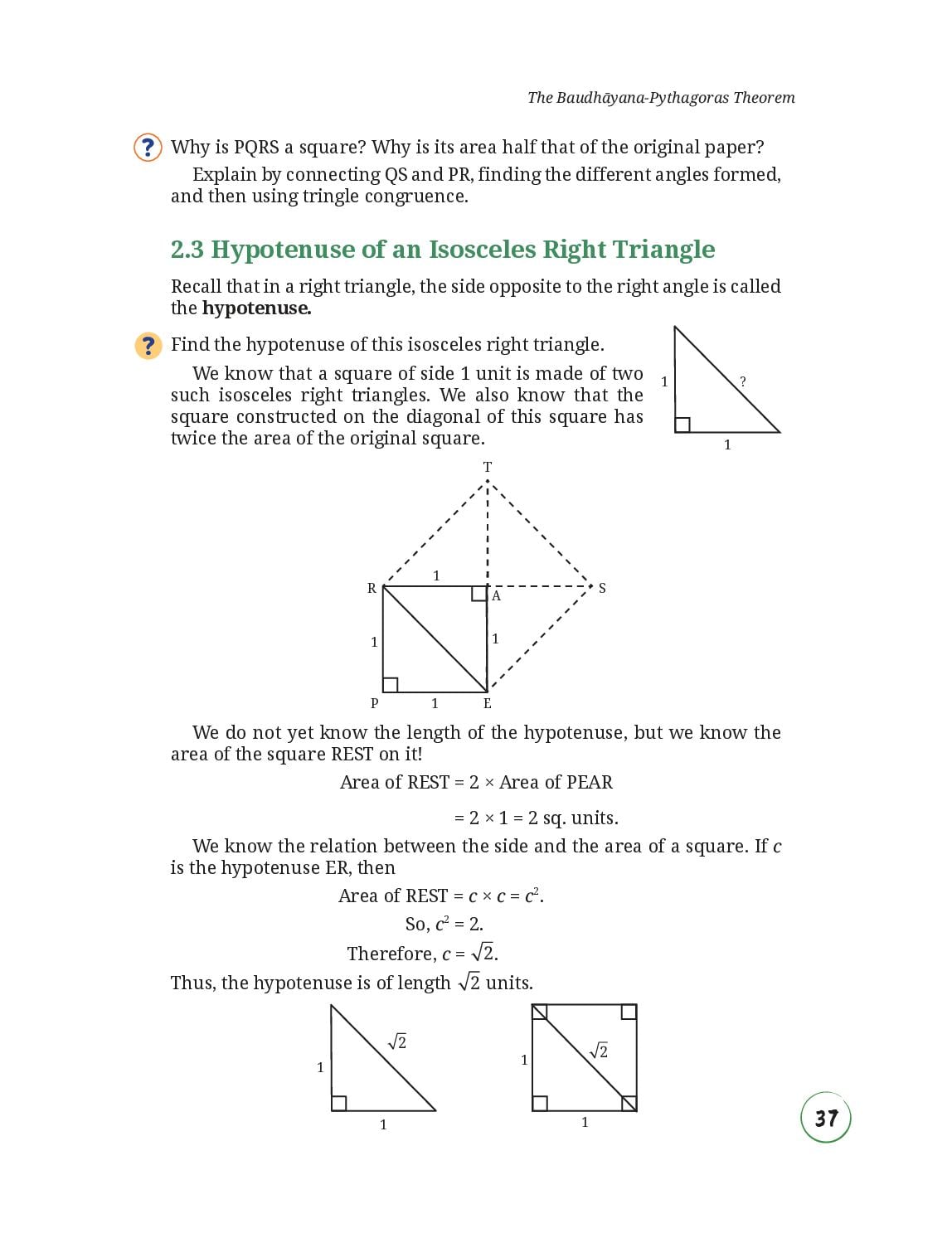
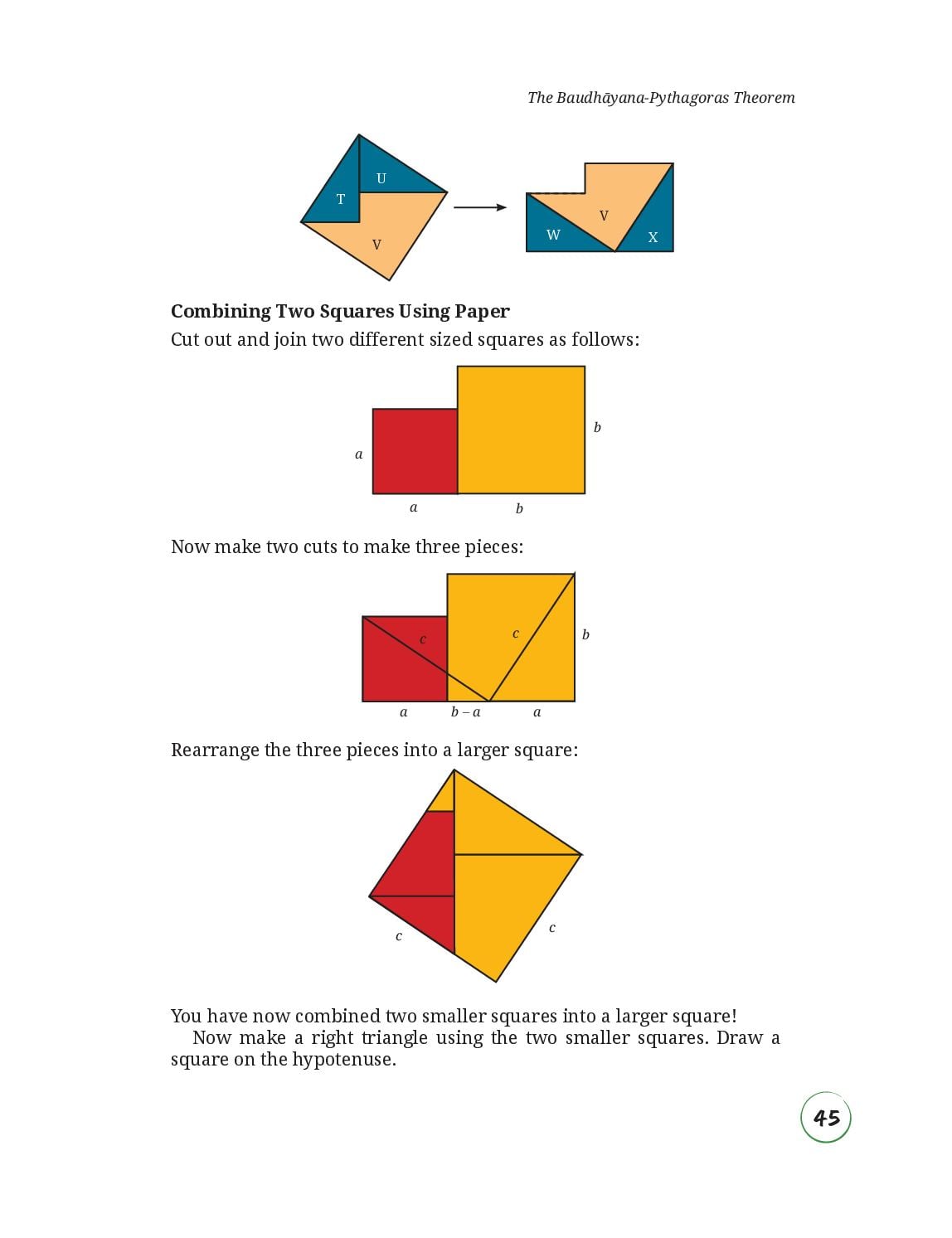
- Doubling a square is done by building a square on its diagonal, not by doubling the side (that gives 4 times the area). Drawing ‘east-west’ and ‘north-south’ lines cuts the original square into 2 congruent triangles and the new square into 4 of the same triangles.
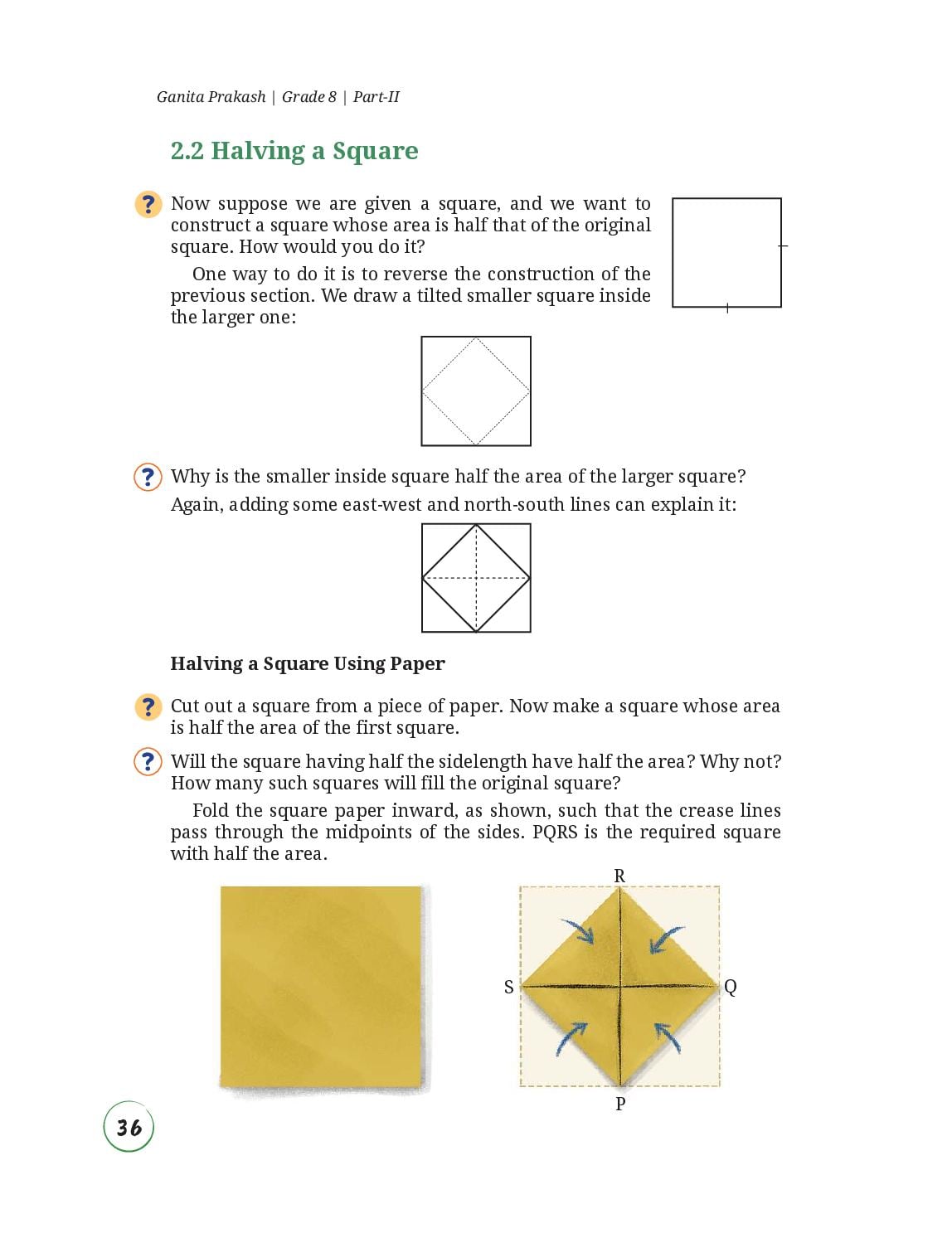
- Reversing the construction halves a square: the square joining the midpoints of the sides has half the area.
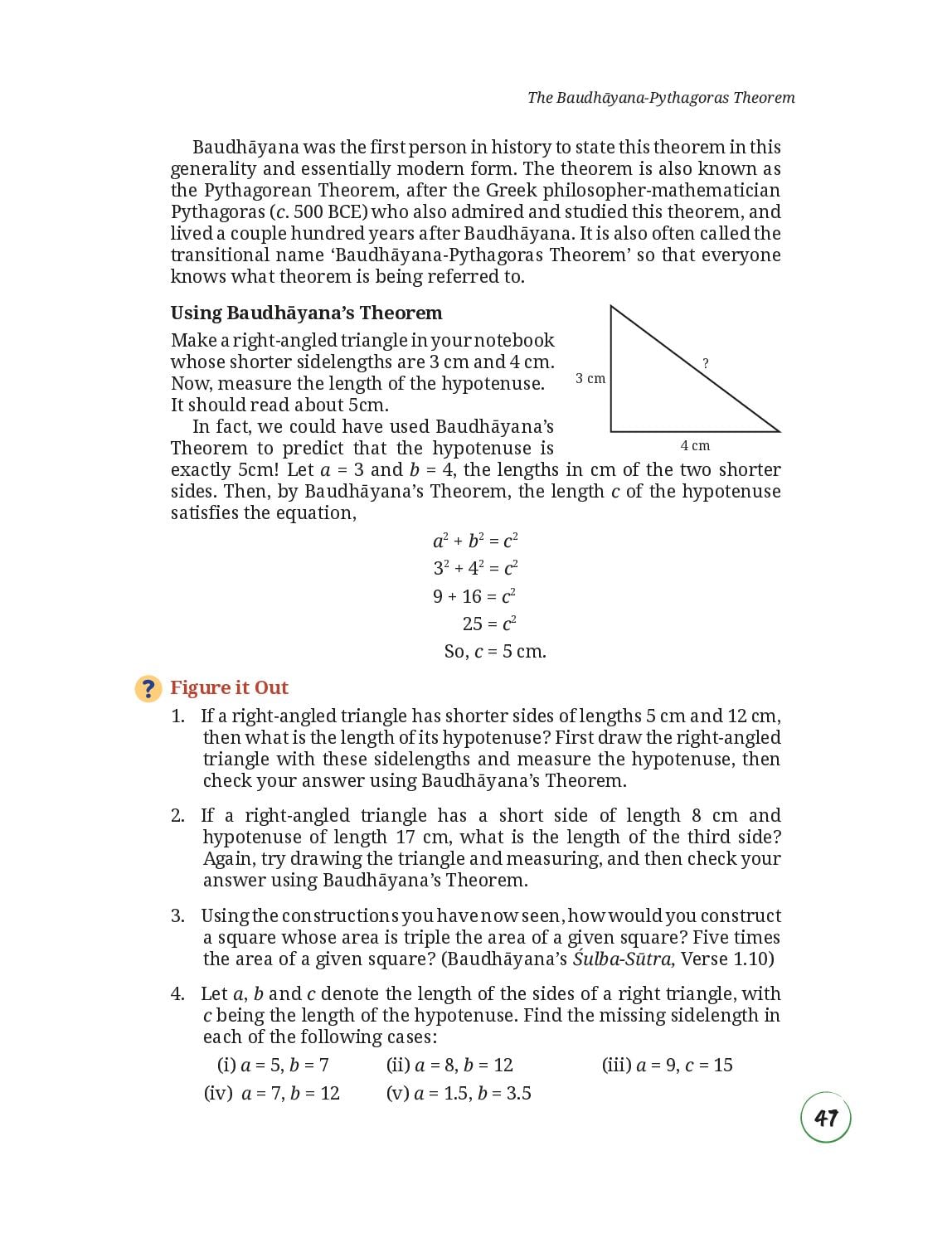
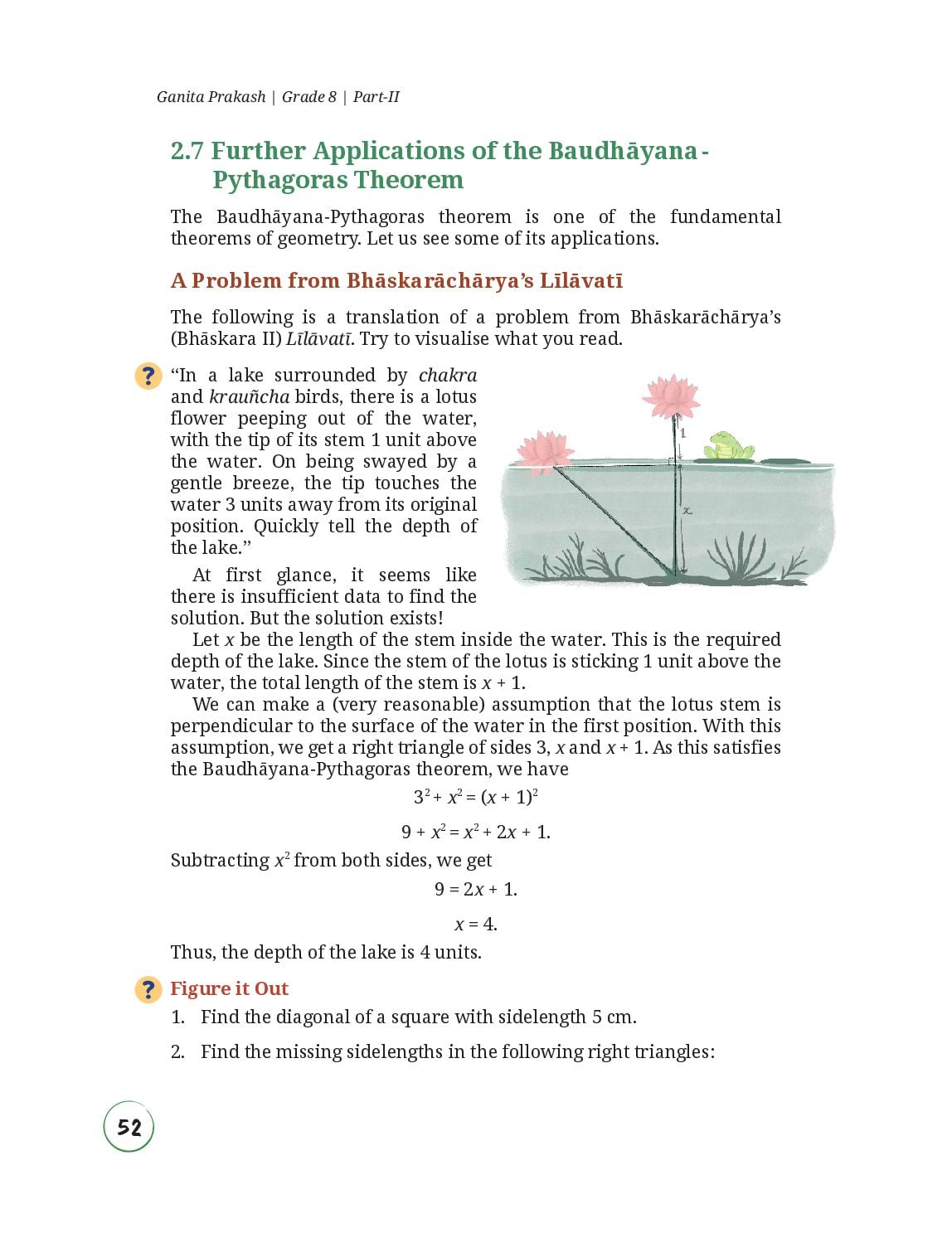
- The hypotenuse of an isosceles right triangle with equal sides a satisfies c² = 2a², so c = a√2. For a = 1 this gives √2, a number that is neither a terminating decimal nor a fraction m/n.
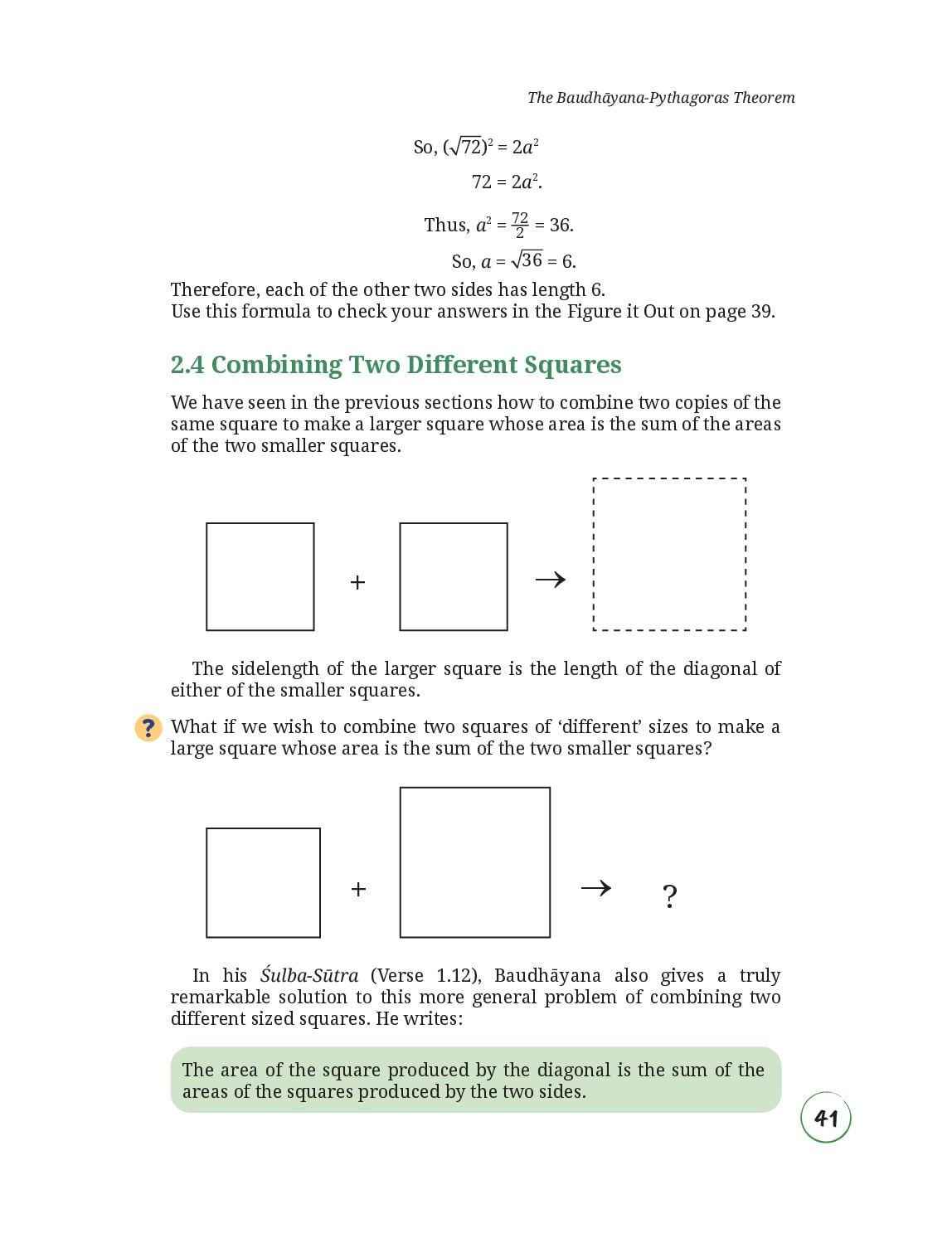
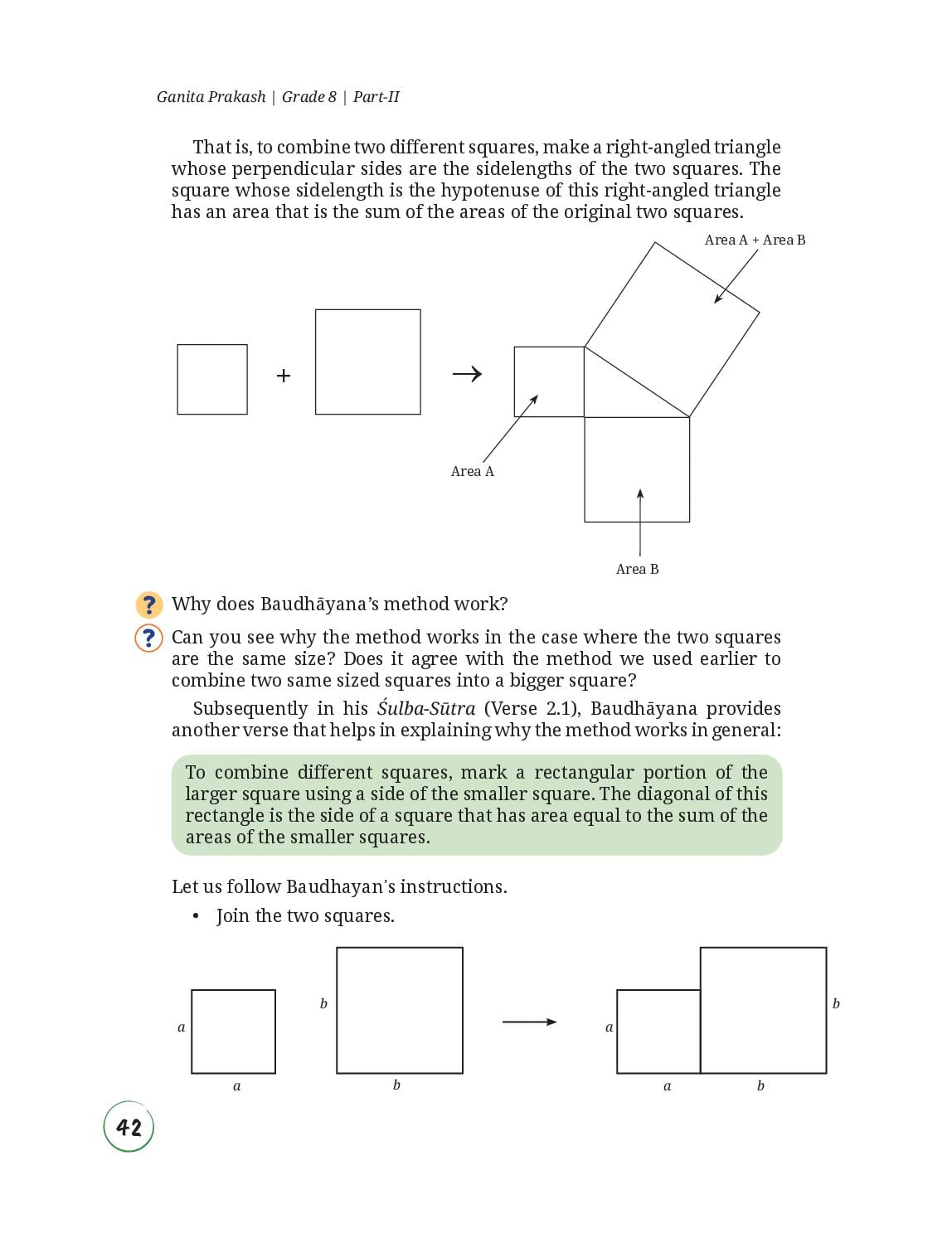
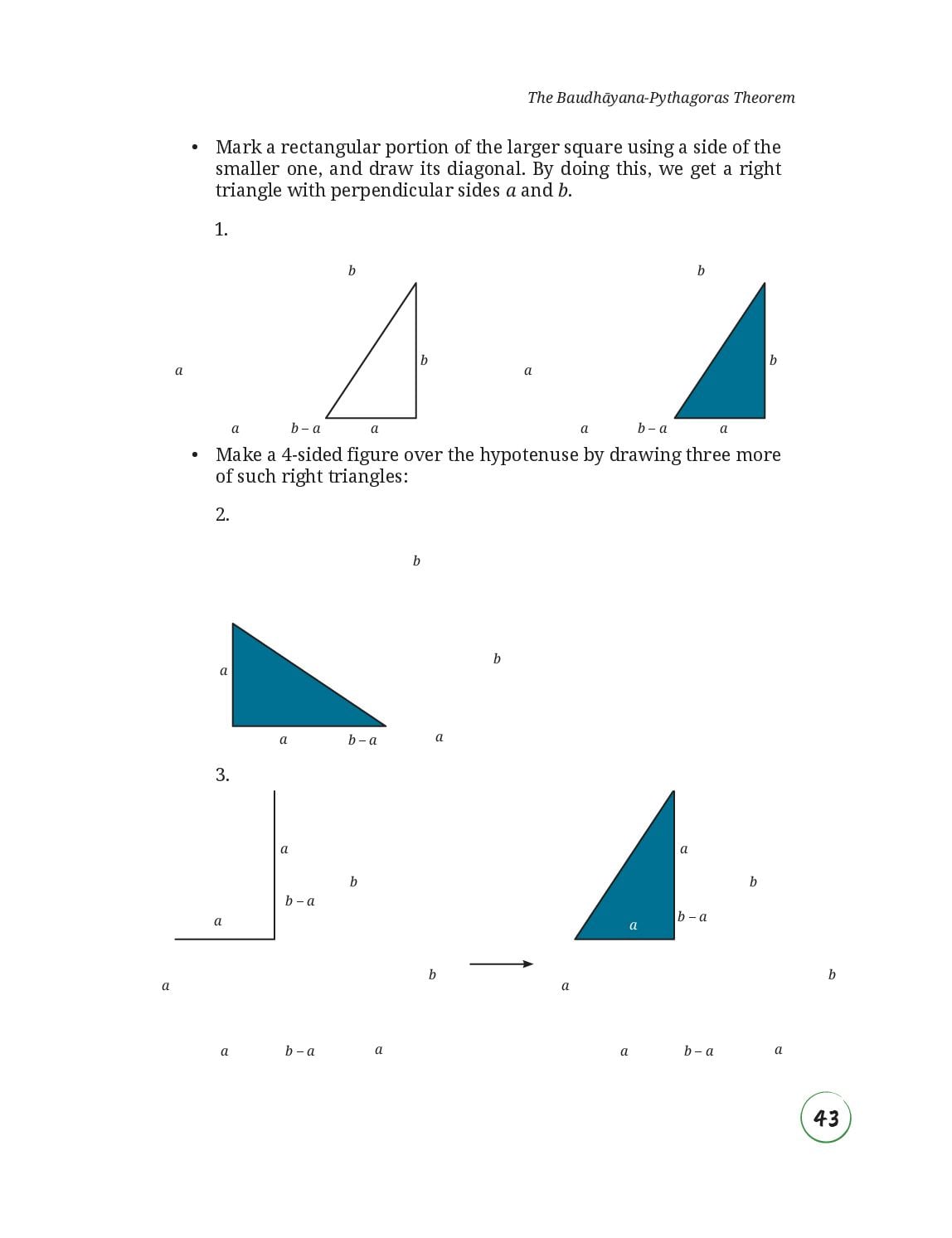
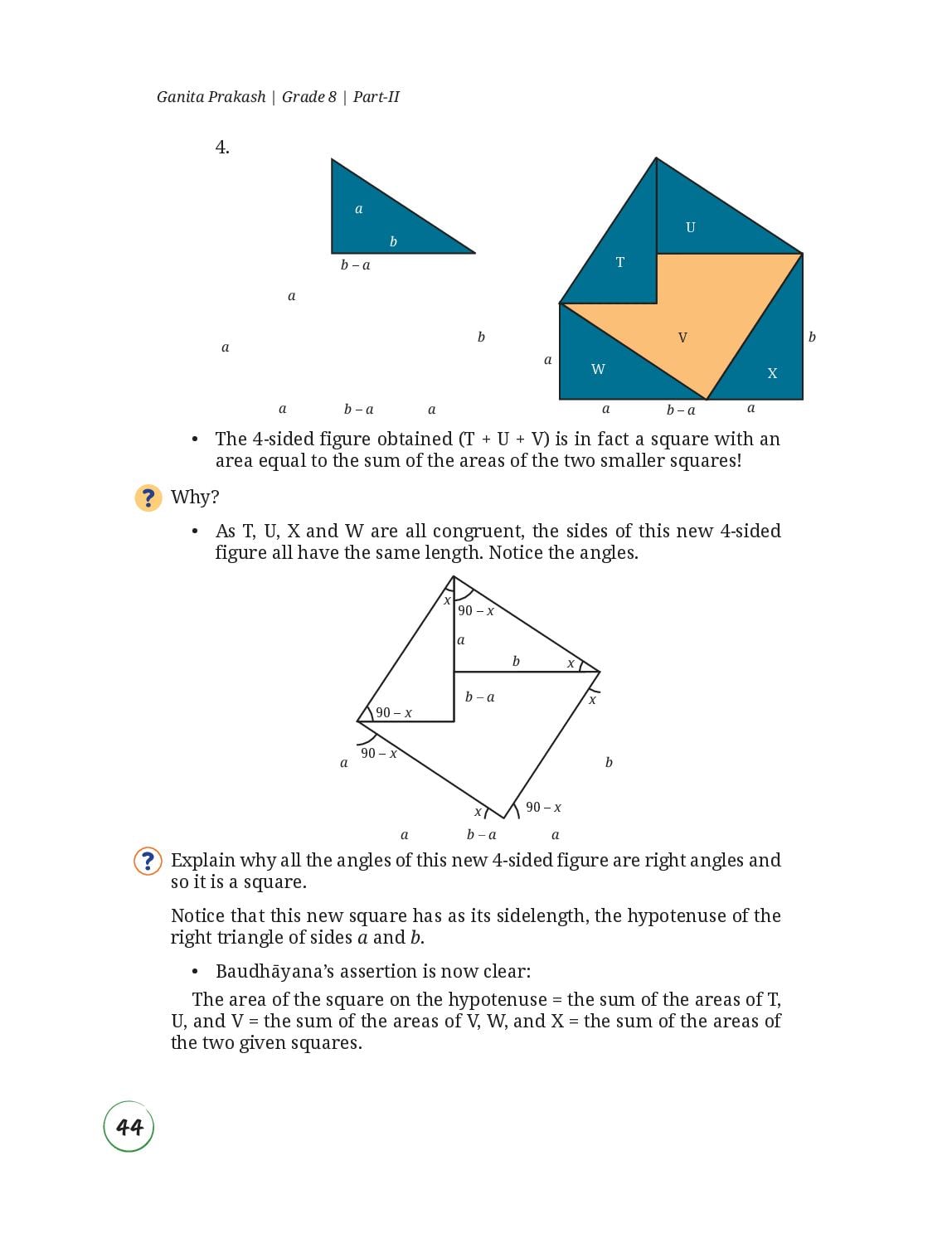
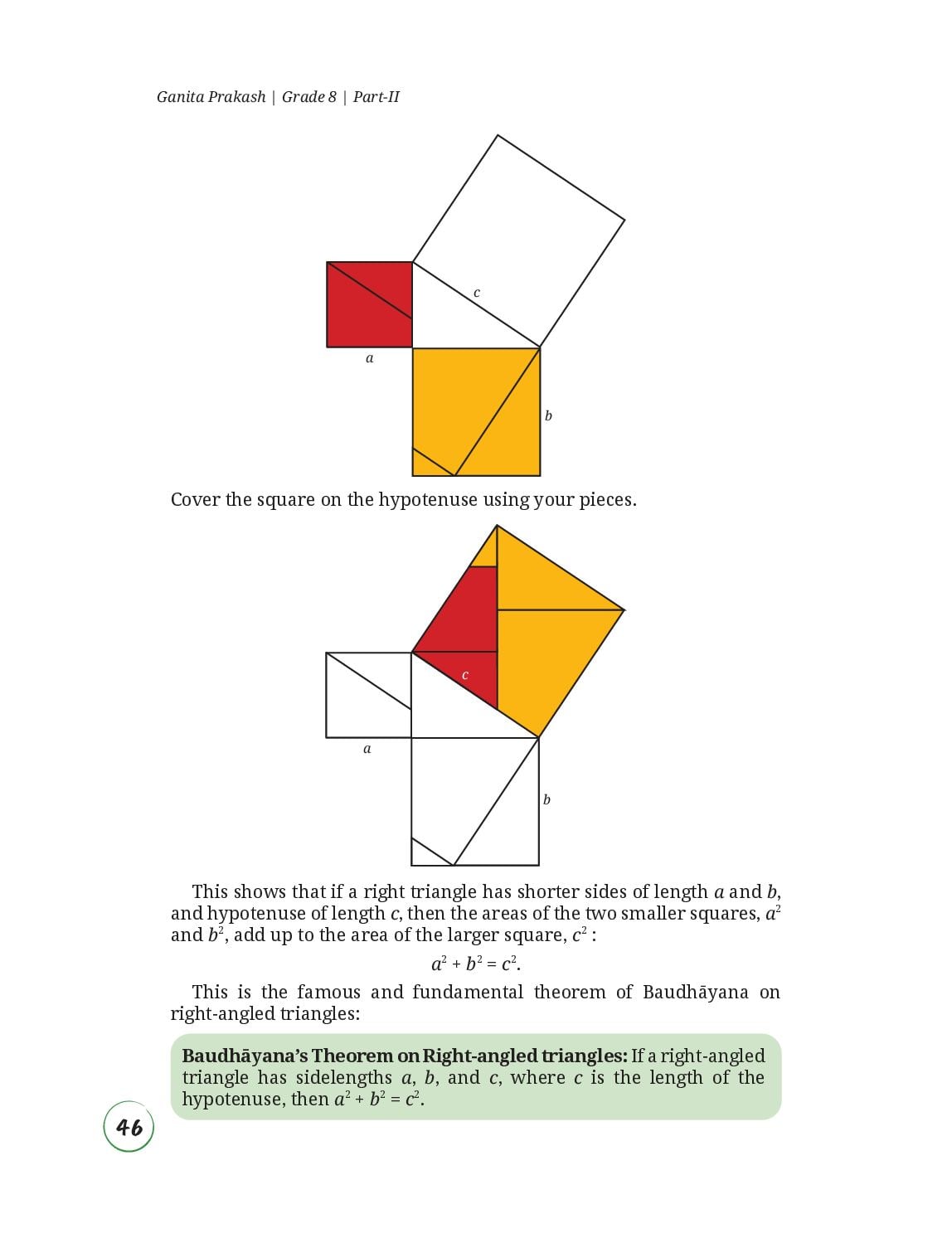
- Baudhāyana’s general rule (Verse 1.12): the square on the diagonal of a right triangle has area equal to the sum of the squares on the two perpendicular sides — a² + b² = c².
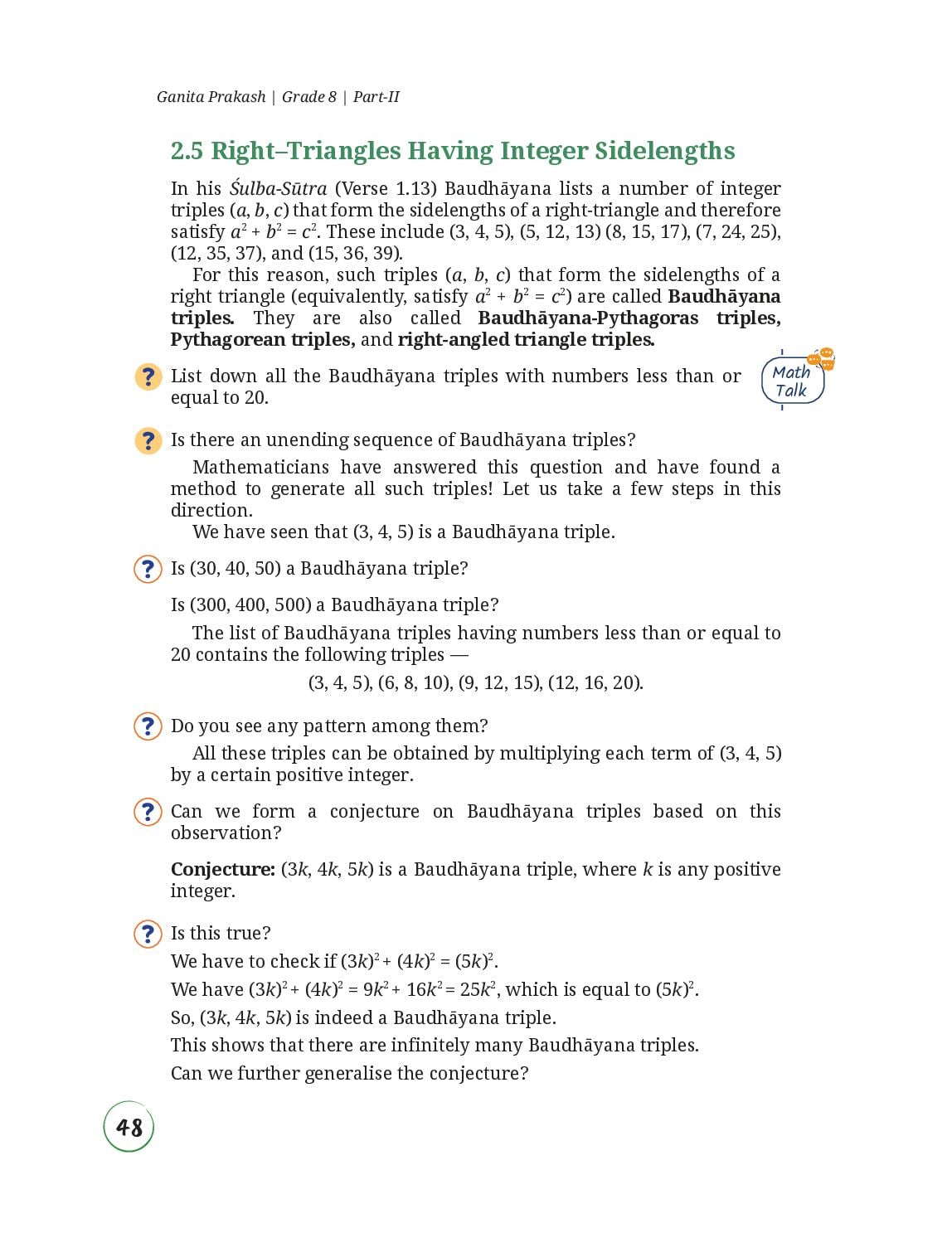
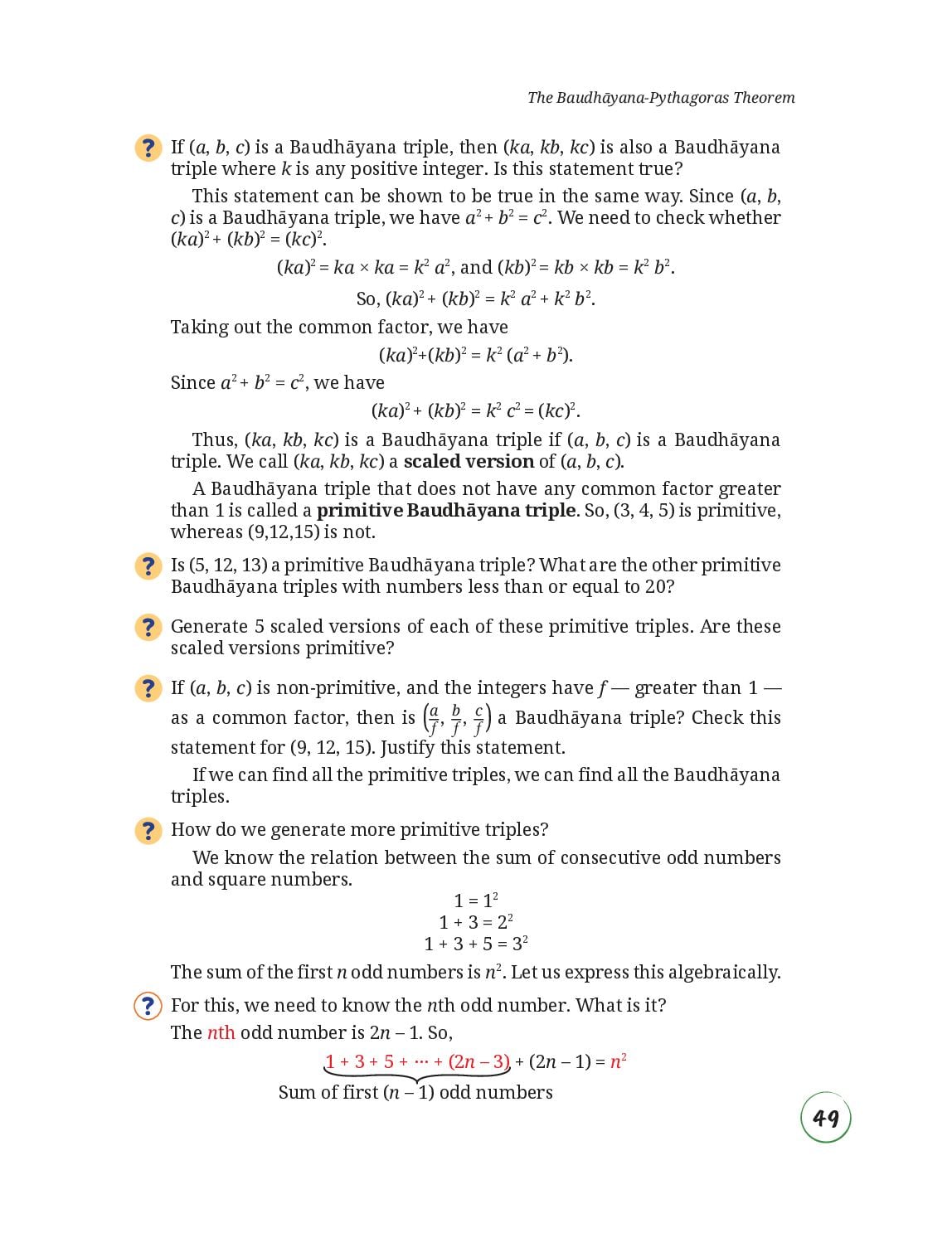
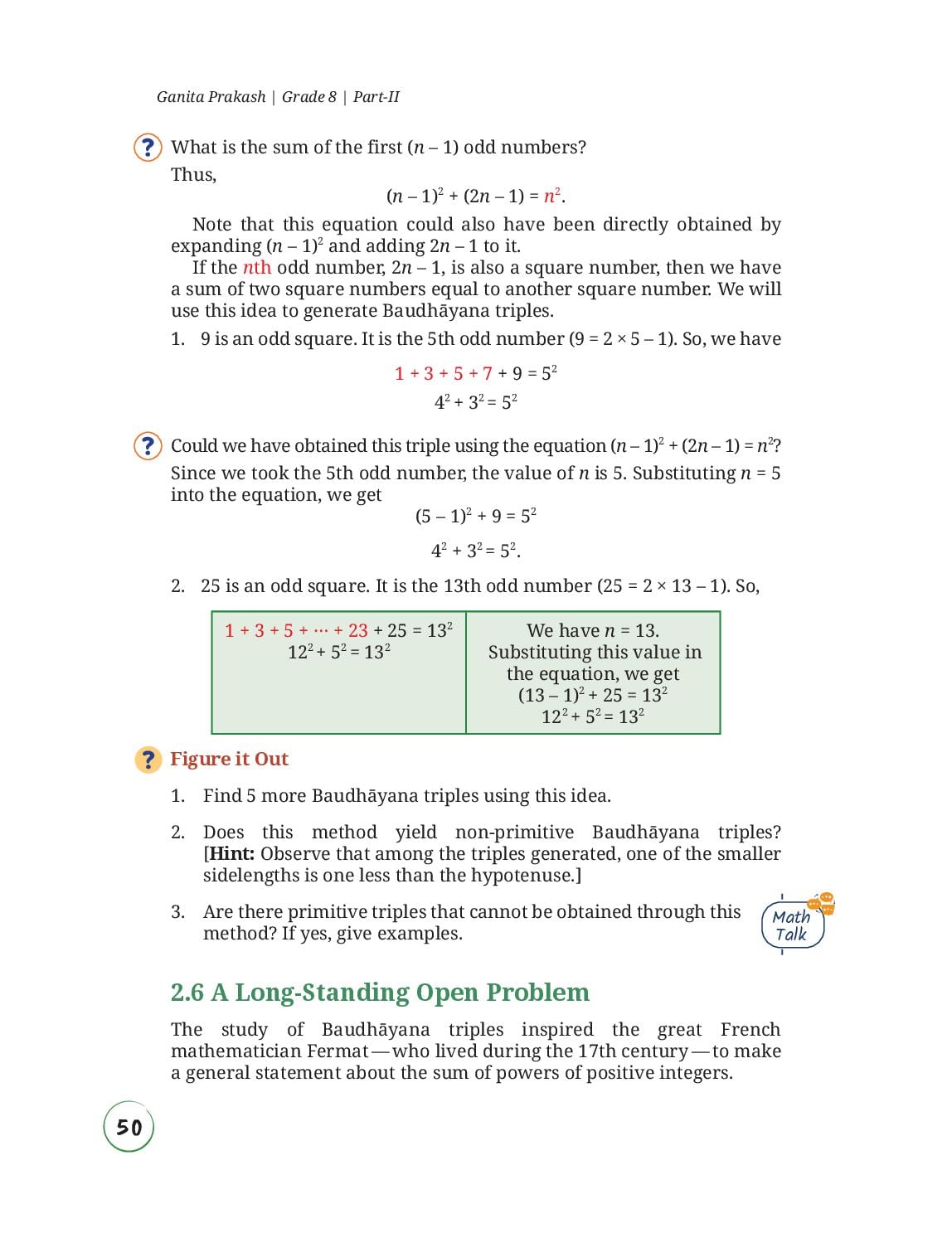
- Integer triples (a, b, c) with a² + b² = c² are Baudhāyana triples. If (a, b, c) is one, so is (ka, kb, kc); a triple with no common factor above 1 is primitive.
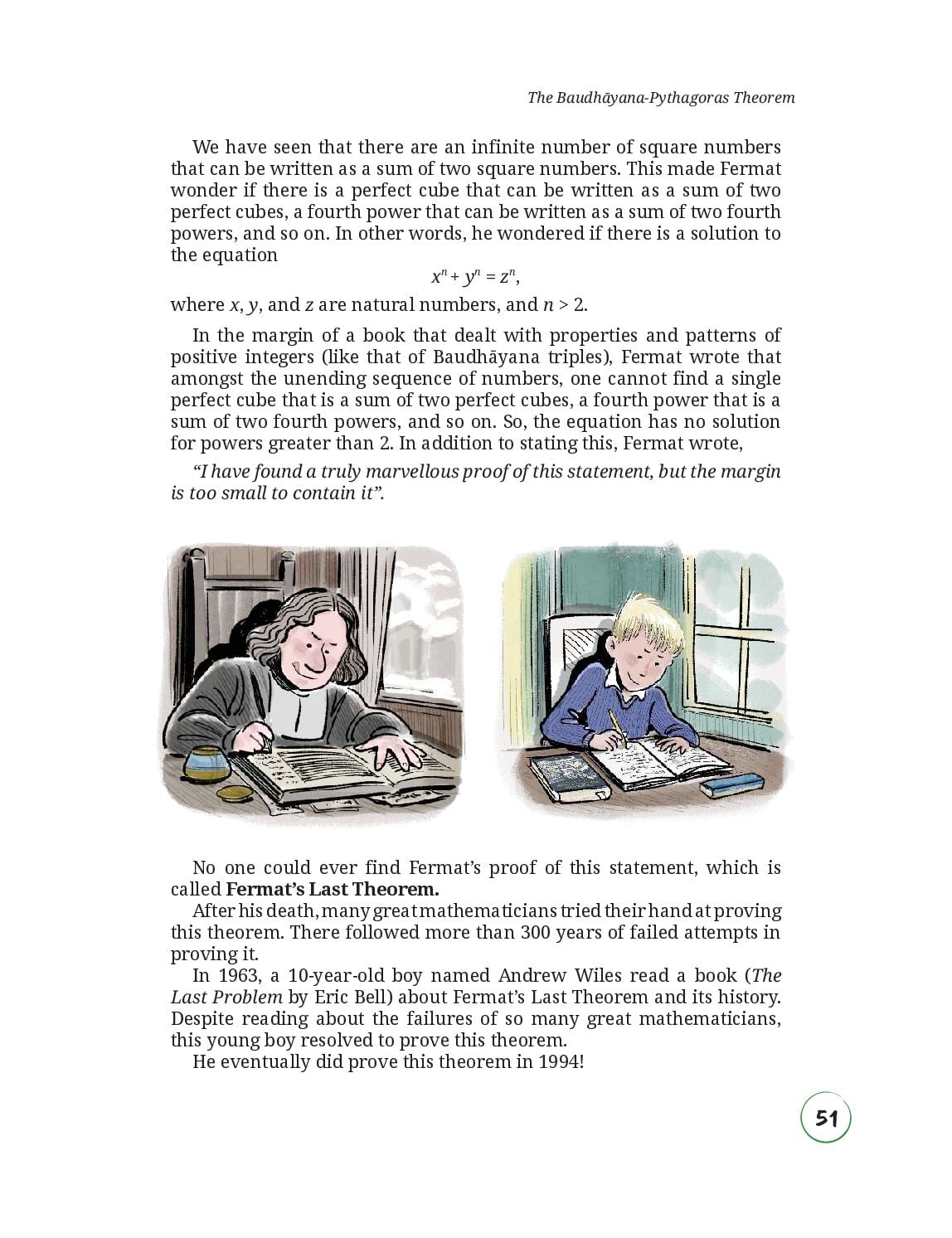
- The identity (n – 1)² + (2n – 1) = n² turns every odd square greater than 1 into a primitive triple. Fermat asked the same question for higher powers; aⁿ + bⁿ = cⁿ has no positive-integer solution for n > 2, proved by Andrew Wiles in 1994.
Quick revision – The Baudhāyana-Pythagoras Theorem
| Idea | Statement | Formula / Example | Where it appears |
|---|---|---|---|
| Doubling a square | Build a square on the diagonal of the given square | Area of new square = 2 × area of old | Śulba-Sūtra 1.9, page 33 |
| Doubling the side | Gives 4 times the area, not 2 | 2s × 2s = 4s² | Page 33 |
| Halving a square | Join the midpoints of the four sides | Inner square = half the area | Page 36 |
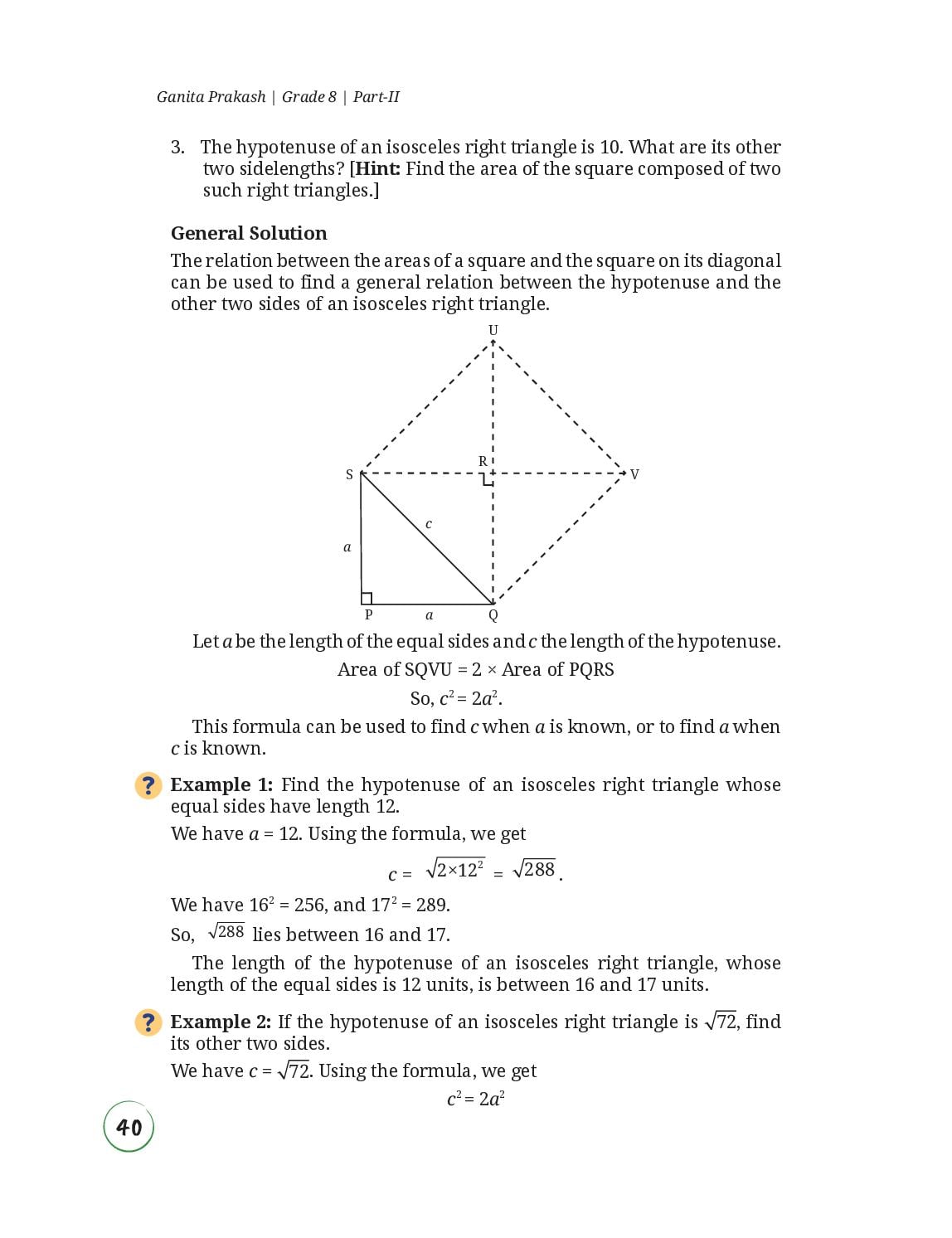
| Isosceles right triangle | Square on the hypotenuse = 2 × square on a side | C² = 2a², c = a√2 | Page 40 |
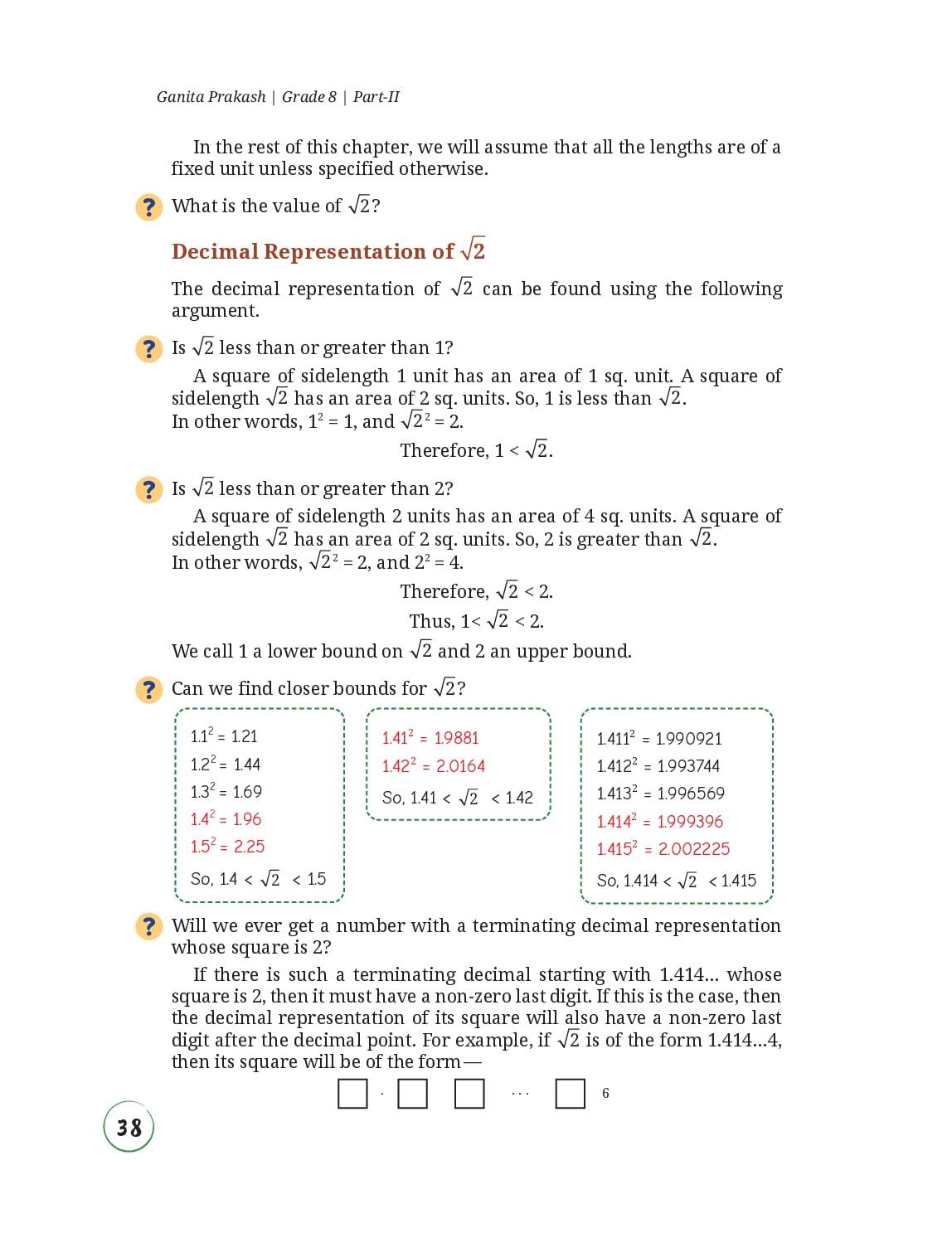
| Value of √2 | Non-terminating, and not any fraction m/n | √2 = 1.41421356…, 1.414 < √2 < 1.415 | Pages 38–39 |
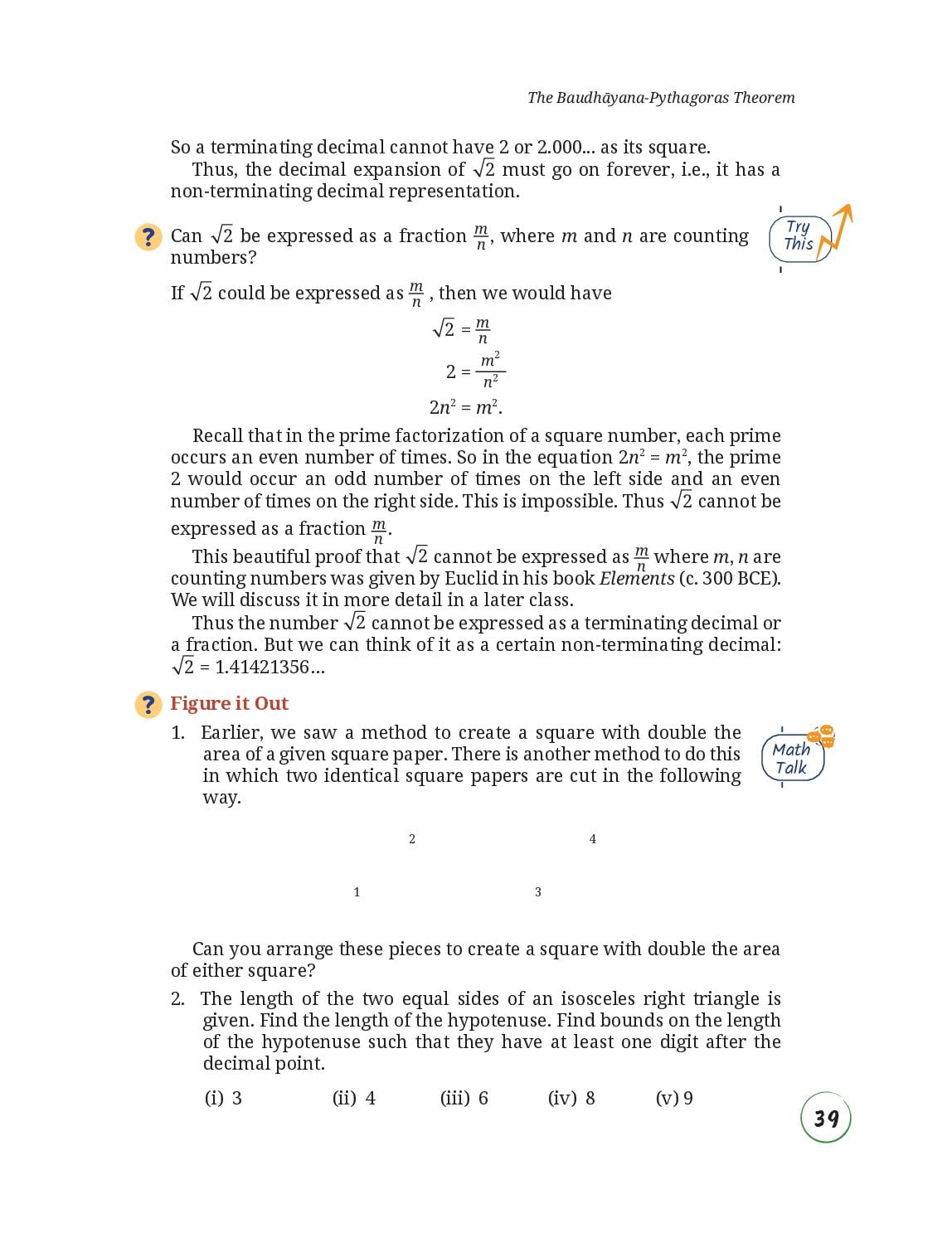
| Why √2 ≠ m/n | 2n² = m² needs the prime 2 an odd and an even number of times | Impossible | Euclid, page 39 |
| Baudhāyana’s theorem | Square on hypotenuse = sum of squares on the other two sides | A² + b² = c² | Śulba-Sūtra 1.12, page 46 |
| Baudhāyana triple | Positive integers with a² + b² = c² | (3, 4, 5), (5, 12, 13), (8, 15, 17) | Śulba-Sūtra 1.13, page 48 |
| Scaling a triple | Multiplying a triple by k gives another triple | (ka)² + (kb)² = k²(a² + b²) = (kc)² | Page 49 |
| Primitive triple | No common factor greater than 1 | (3, 4, 5) is; (9, 12, 15) is not | Page 49 |
| Odd-square method | Every odd square 2n – 1 (greater than 1) gives a triple | (n – 1)² + (2n – 1) = n² | Pages 49–50 |
| Fermat’s Last Theorem | Aⁿ + bⁿ = cⁿ has no solution in positive integers for n > 2 | Proved by Andrew Wiles, 1994 | Page 51 |
Old NCERT vs New – Class 8 Maths
This chapter is from Ganita Prakash, the new NCERT Class 8 Maths book (NCF-SE 2023, used from 2025-26). It replaced the old book “Mathematics”, so chapter numbers and names differ from older PDFs.
Solutions and All Chapters
Answers to the exercises and the full chapter list of Ganita Prakash:
The Baudhāyana-Pythagoras Theorem – Overview
| Class | Class 8 |
| Subject | Maths |
| Book | Ganita Prakash – new NCERT book |
| Part | Part II |
| Chapter | 9 of 14 – The Baudhāyana-Pythagoras Theorem |
| Book pages | Part II, 33 – 54 |
| Edition | NCERT Reprint 2026-27 |
| Session | 2026-27 |
| Free – read online or download |
Class 8 Maths Chapter 9 – FAQs
Where can I download The Baudhāyana-Pythagoras Theorem Class 8 PDF?
From the download table on this page – the chapter PDF is free, and the full book is linked too.
What is Class 8 Maths Chapter 9 about?
Doubling a square is done by building a square on its diagonal, not by doubling the side (that gives 4 times the area). Drawing ‘east-west’ and ‘north-south’ lines cuts the original square into 2 congruent triangles and the new square into 4 of the same triangles.
Is The Baudhāyana-Pythagoras Theorem from the new NCERT Class 8 Maths book?
Yes. It is chapter 9 of ganita prakash (part ii), the new NCERT Class 8 Maths book for 2026-27.
Is this the latest NCERT edition for 2026-27?
Yes – the PDF is NCERT’s latest edition for the 2026-27 session.
Where are the NCERT Solutions for Class 8 Maths Chapter 9?
Open the NCERT Solutions link above for answers to the exercise questions.