Download Introduction to Linear Polynomials – NCERT Class 9 Maths Chapter 2 PDF from the new NCERT Class 9 Maths book Ganita Manjari (2026-27). Read the chapter online or download the free PDF. An algebraic expression is built from numbers, variables and operation signs. In 4x + 5y + 3 the parts 4x, 5y and 3 are the terms, x and y are the variables, 4 and 5 are the coefficients and 3 is the constant.
Introduction to Linear Polynomials PDF – Chapter 2 of Ganita Manjari (Part I)
Read the chapter online or download the PDF.
| Chapter | Download | |
|---|---|---|
| Chapter 2 PDF | Introduction to Linear Polynomials | View PDF |
| Full book | NCERT Class 9 Maths – Ganita Manjari | View Book |
Read Online
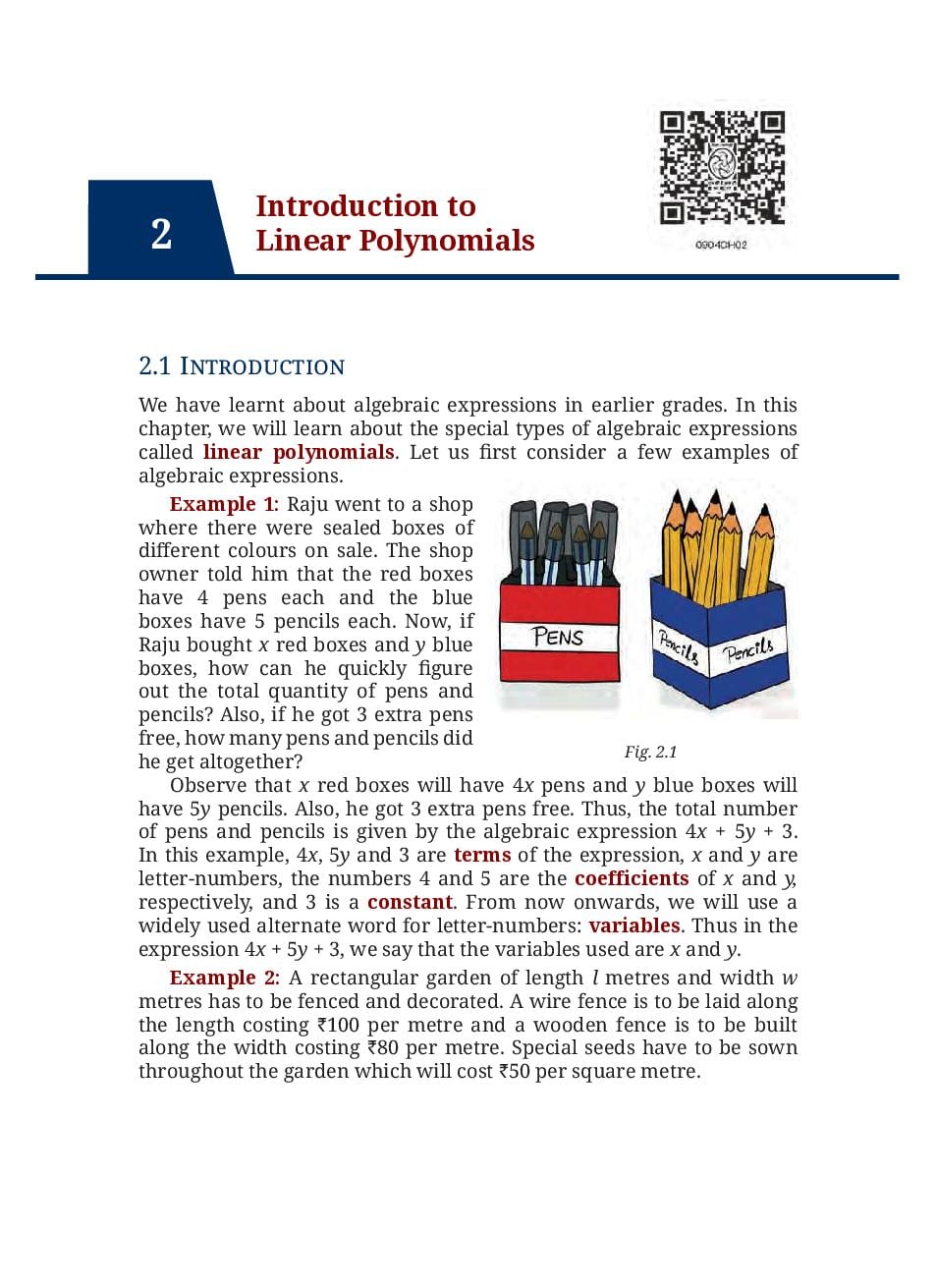
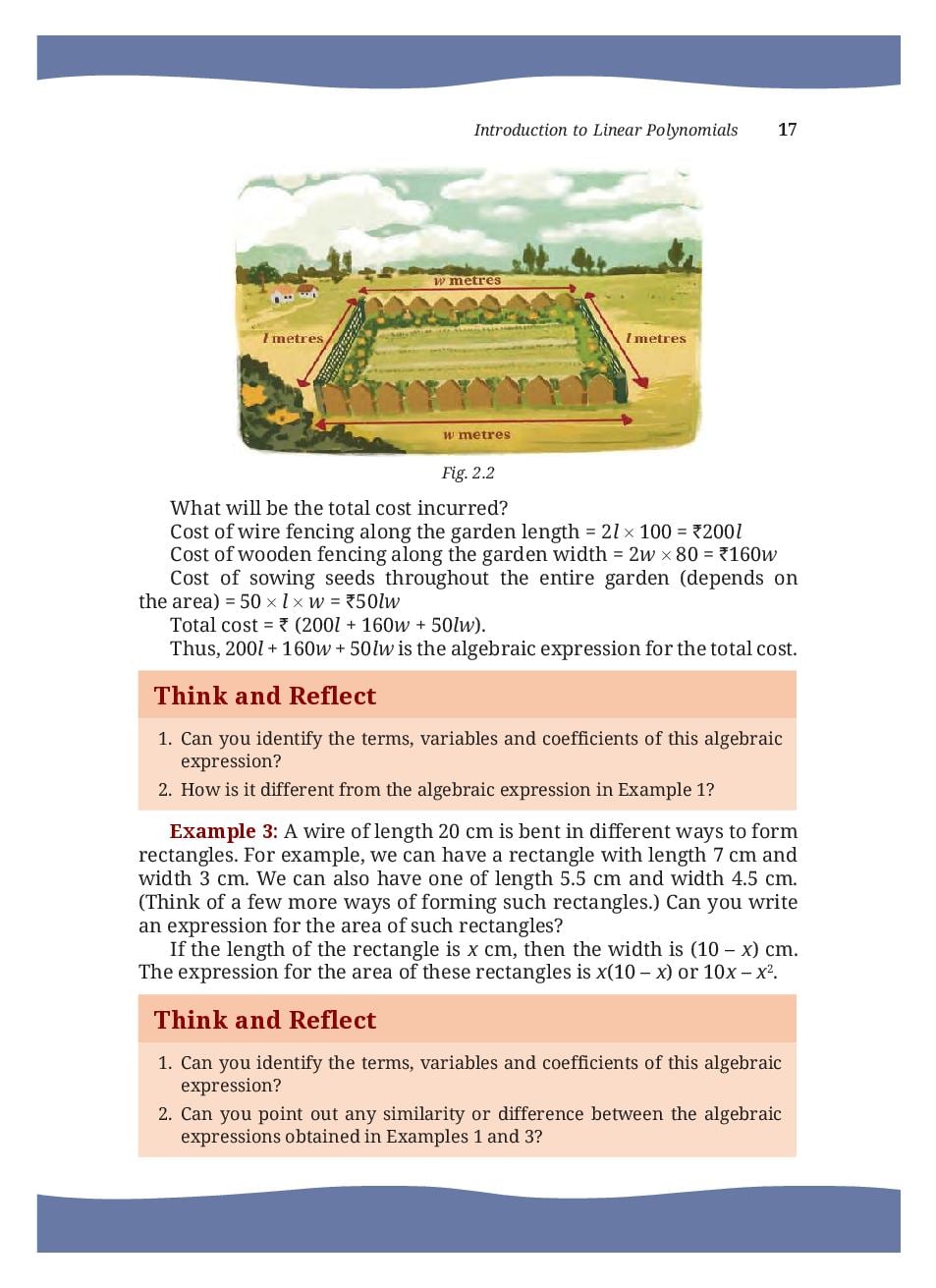
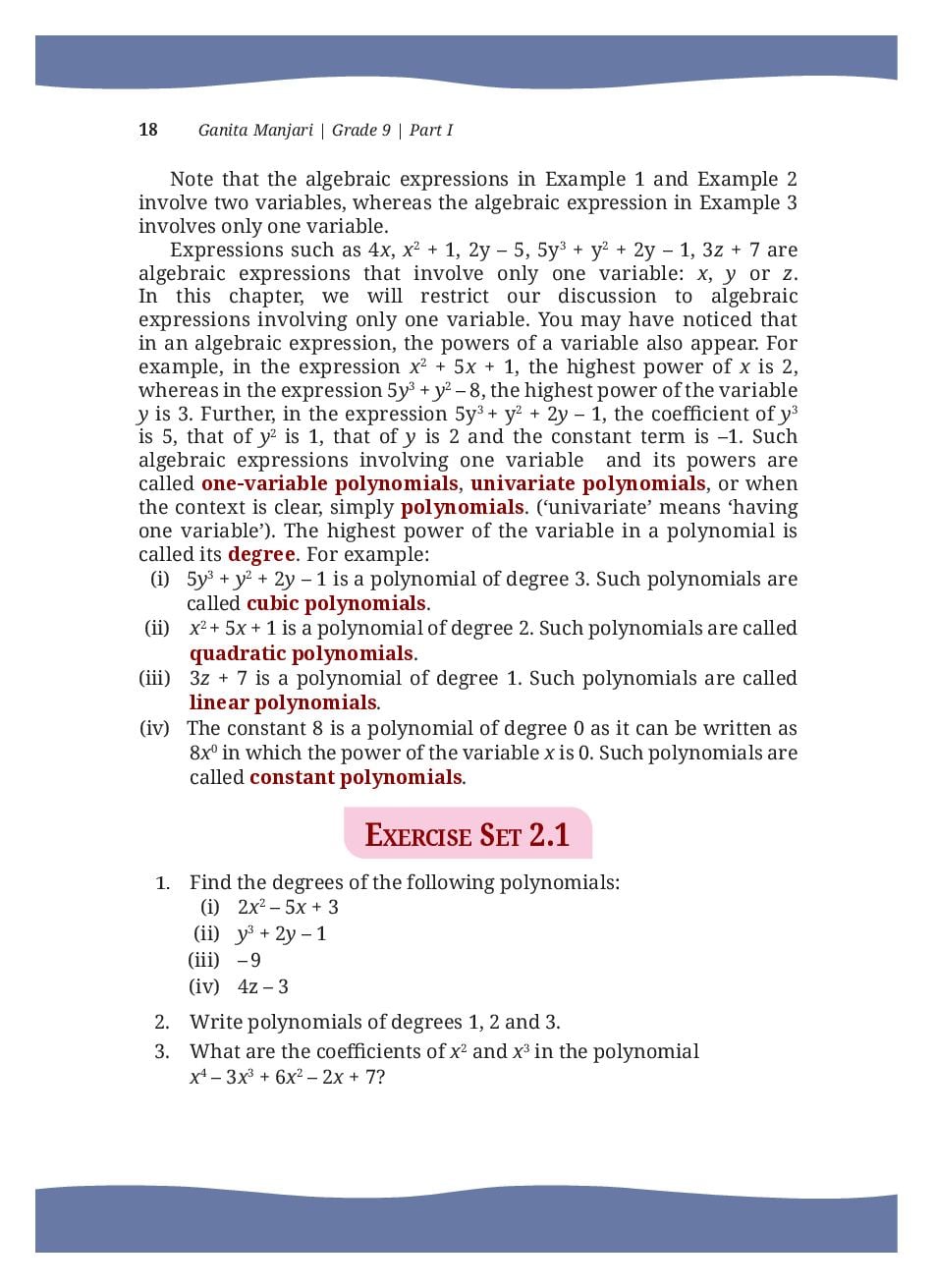
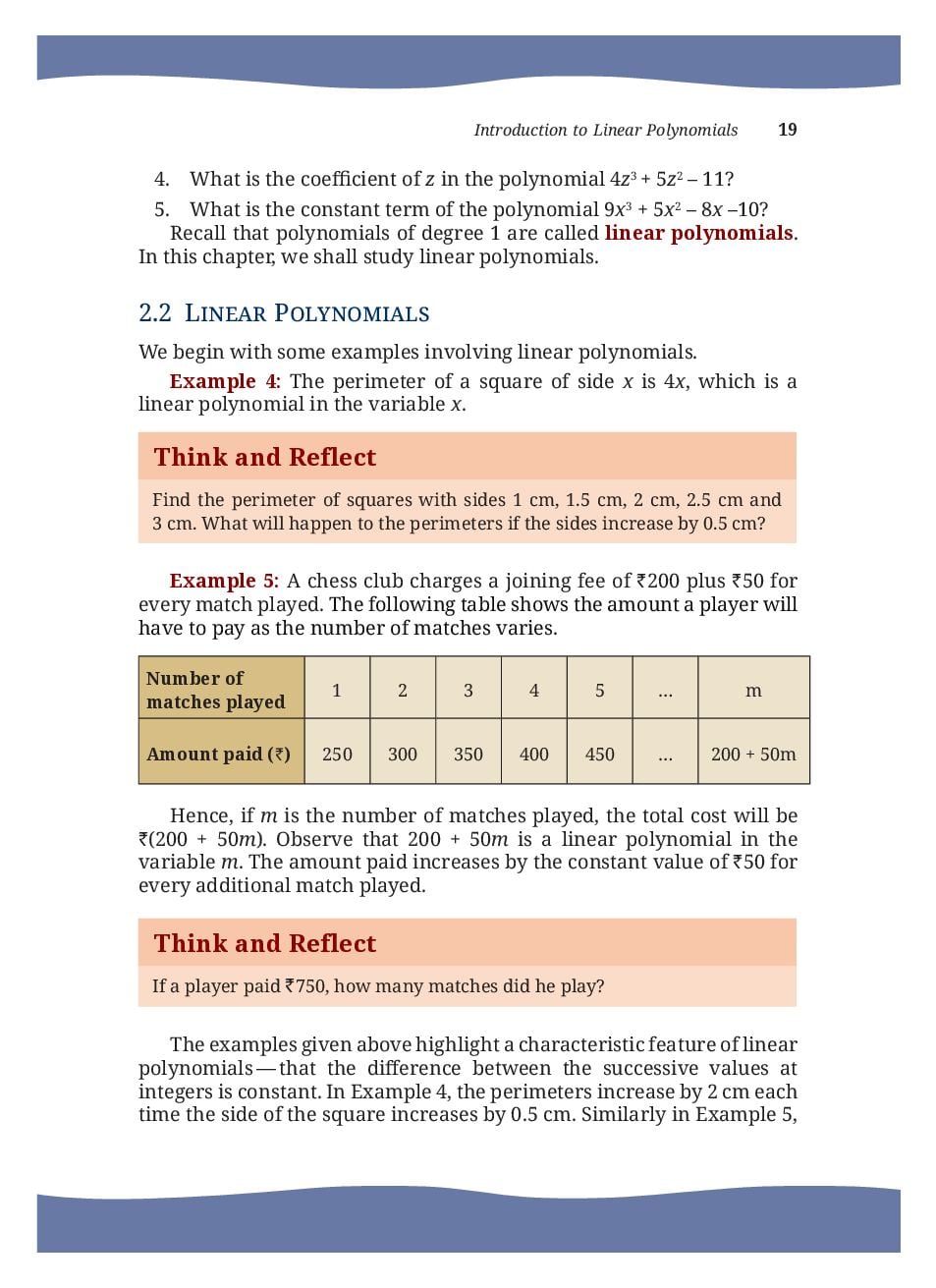
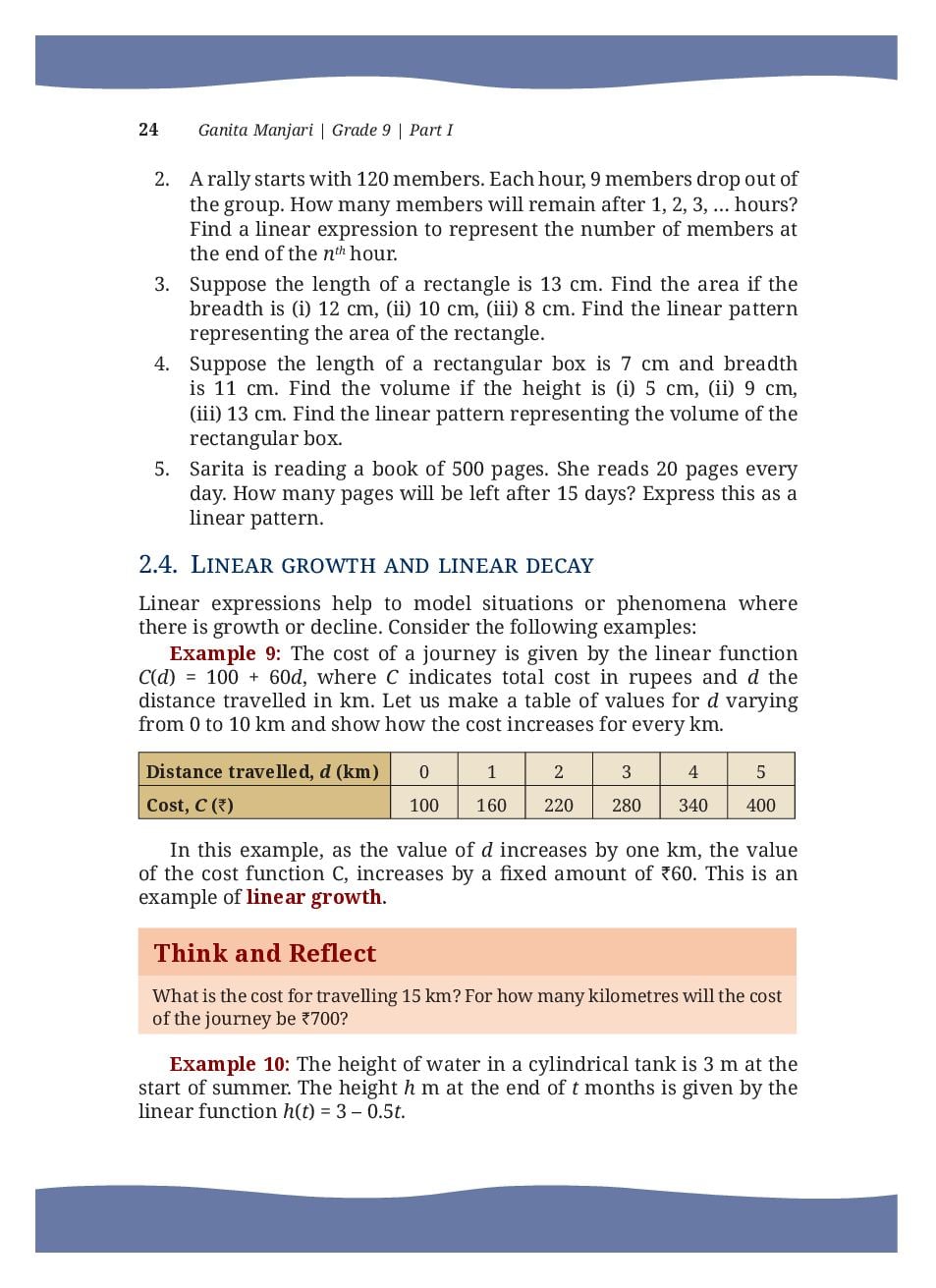
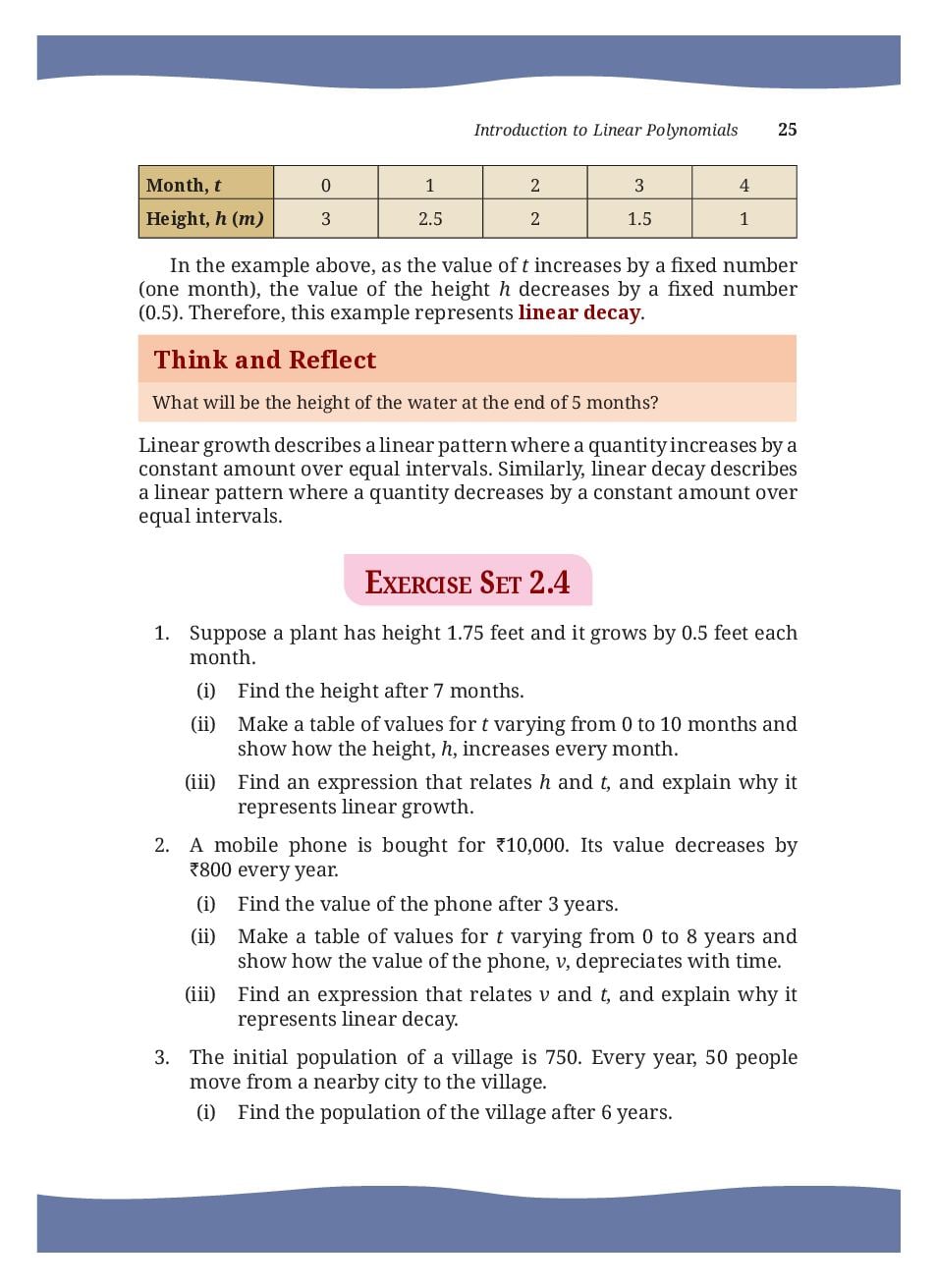
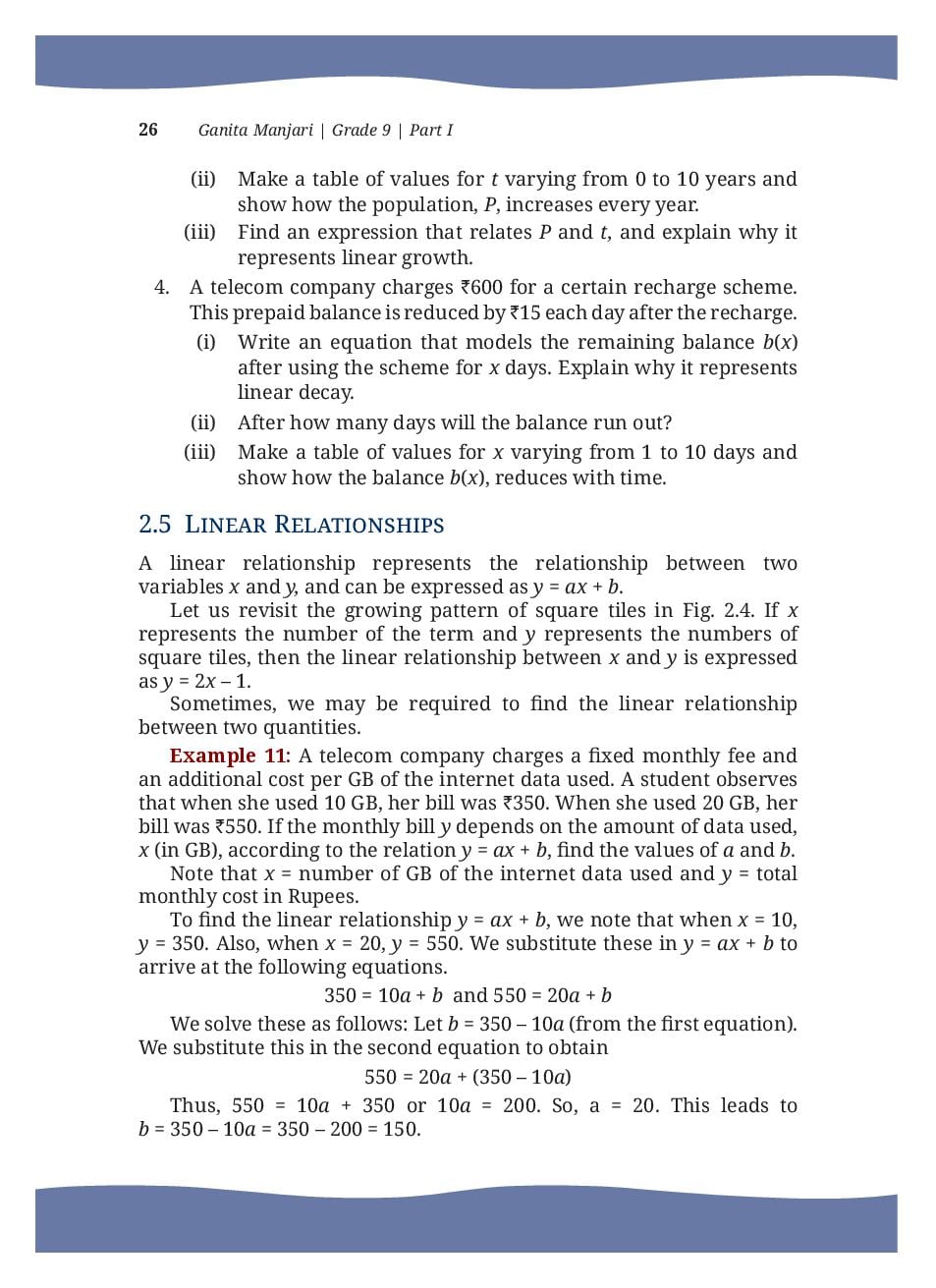
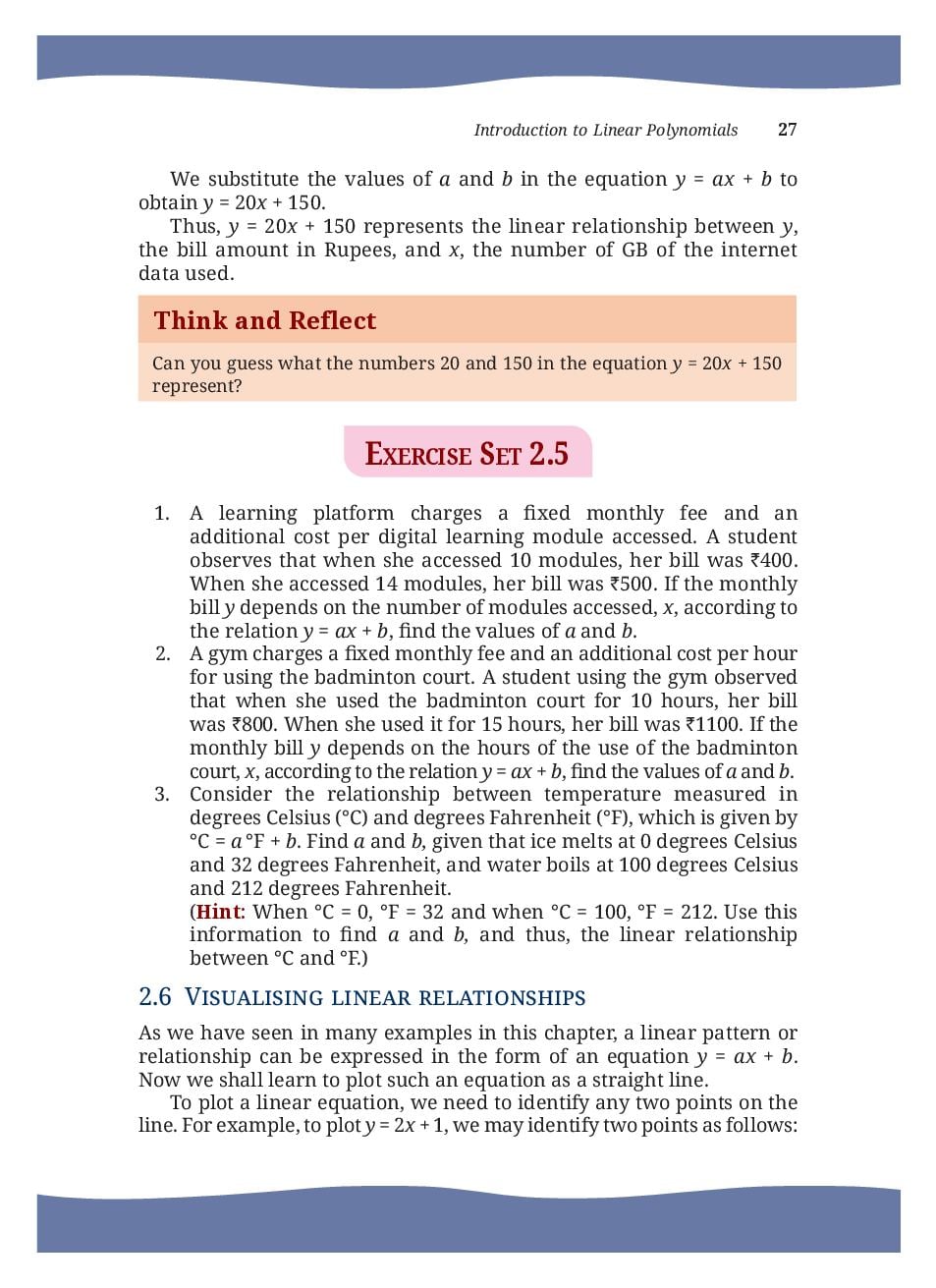
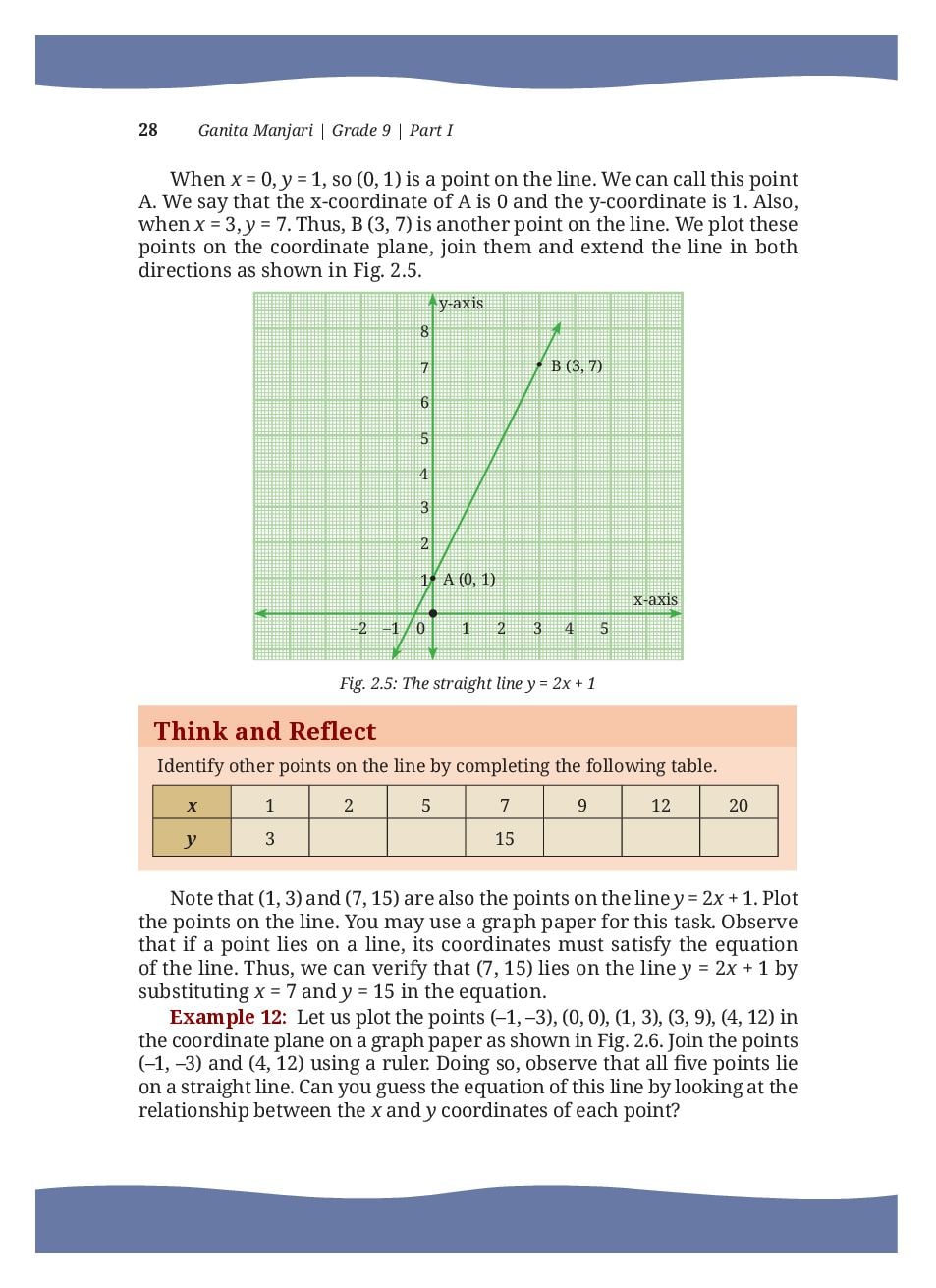
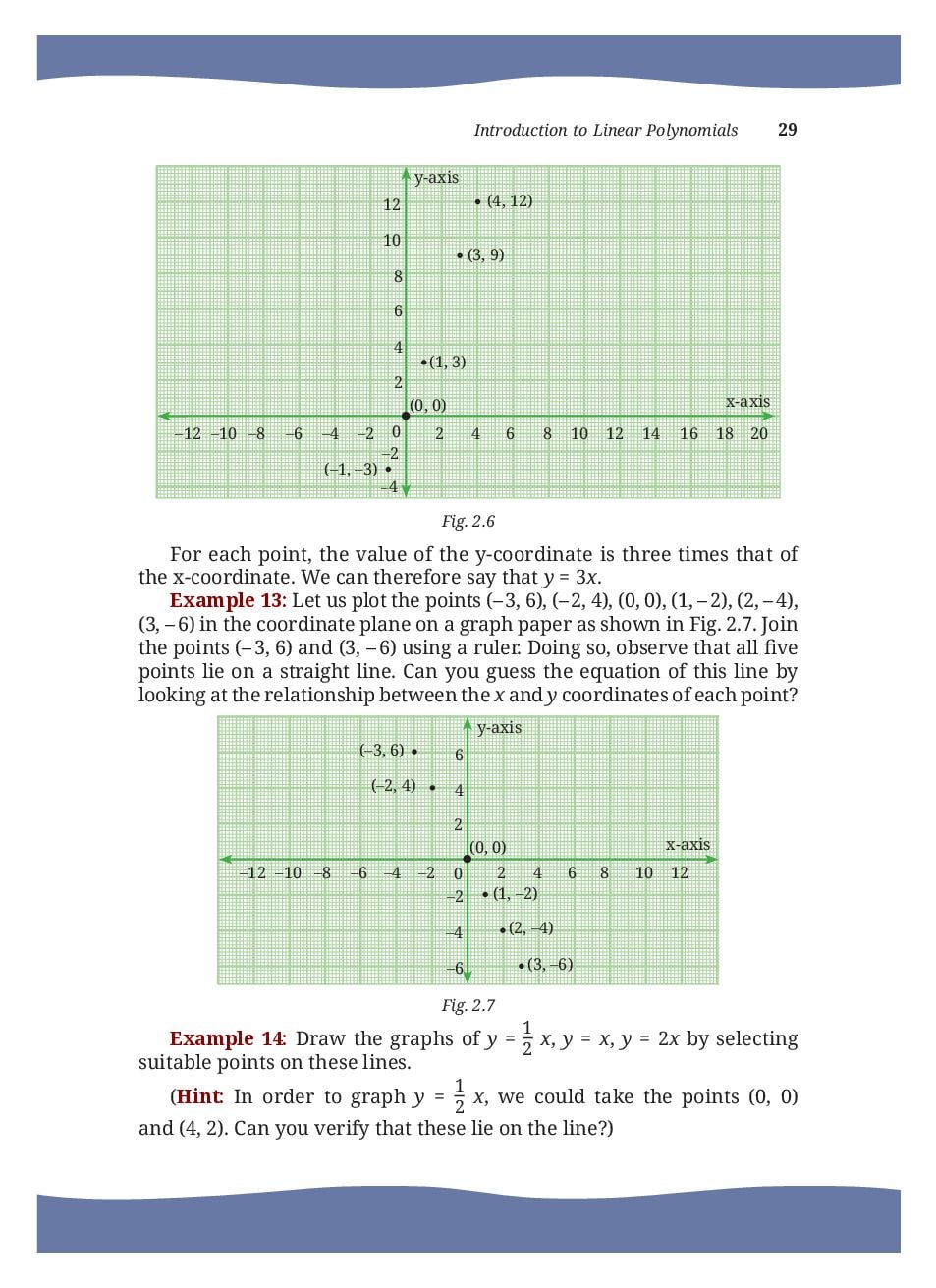
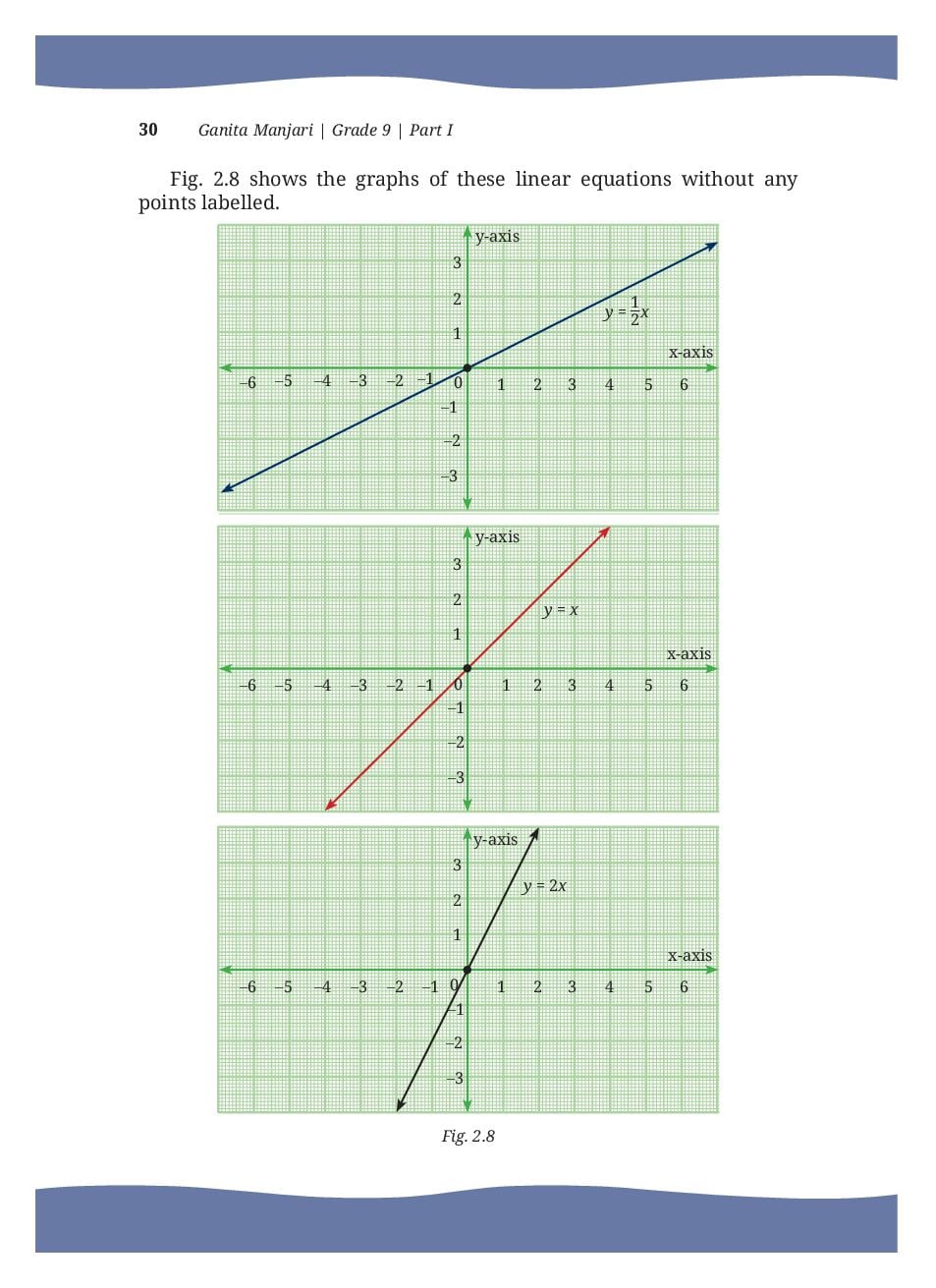
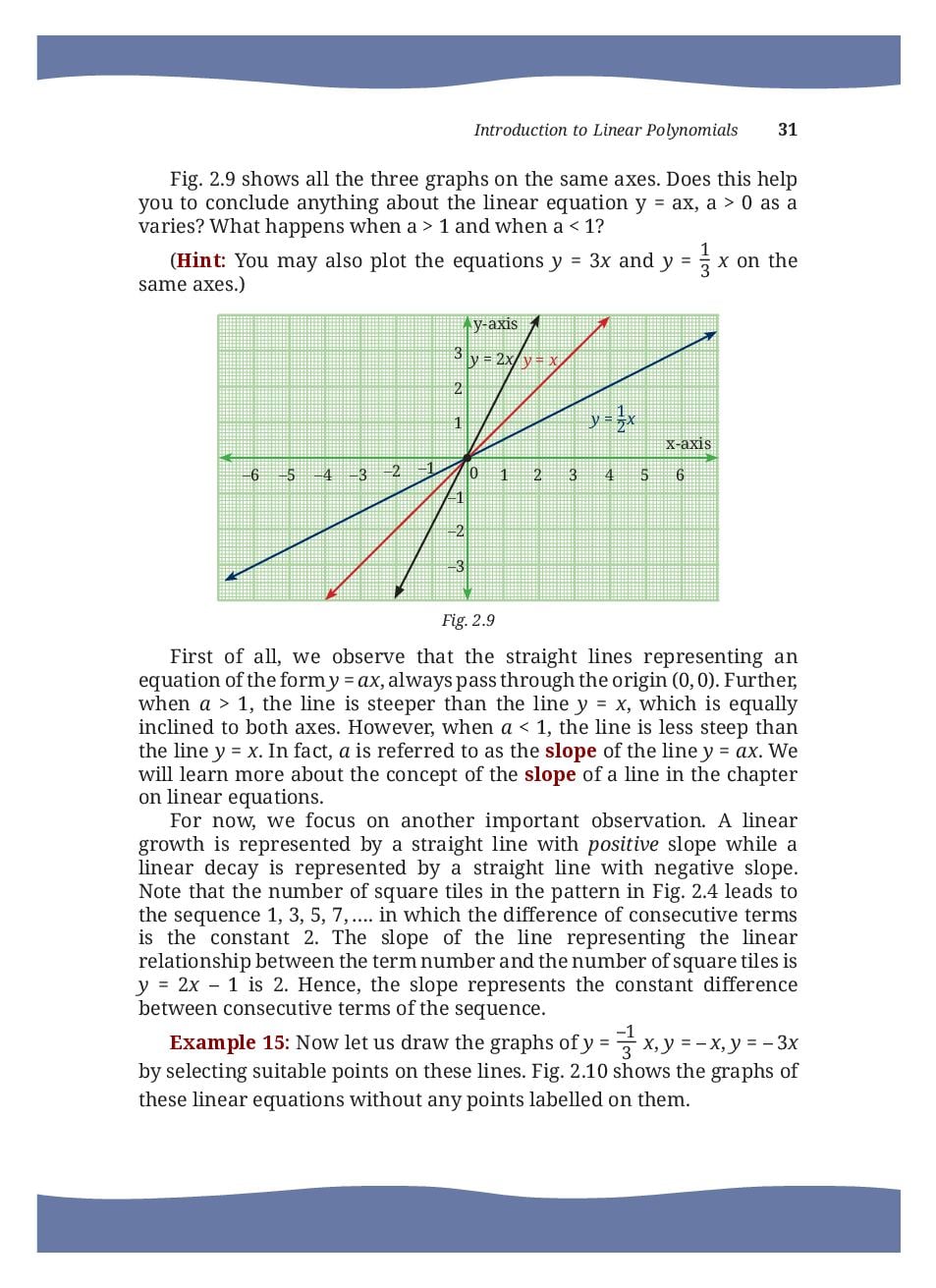
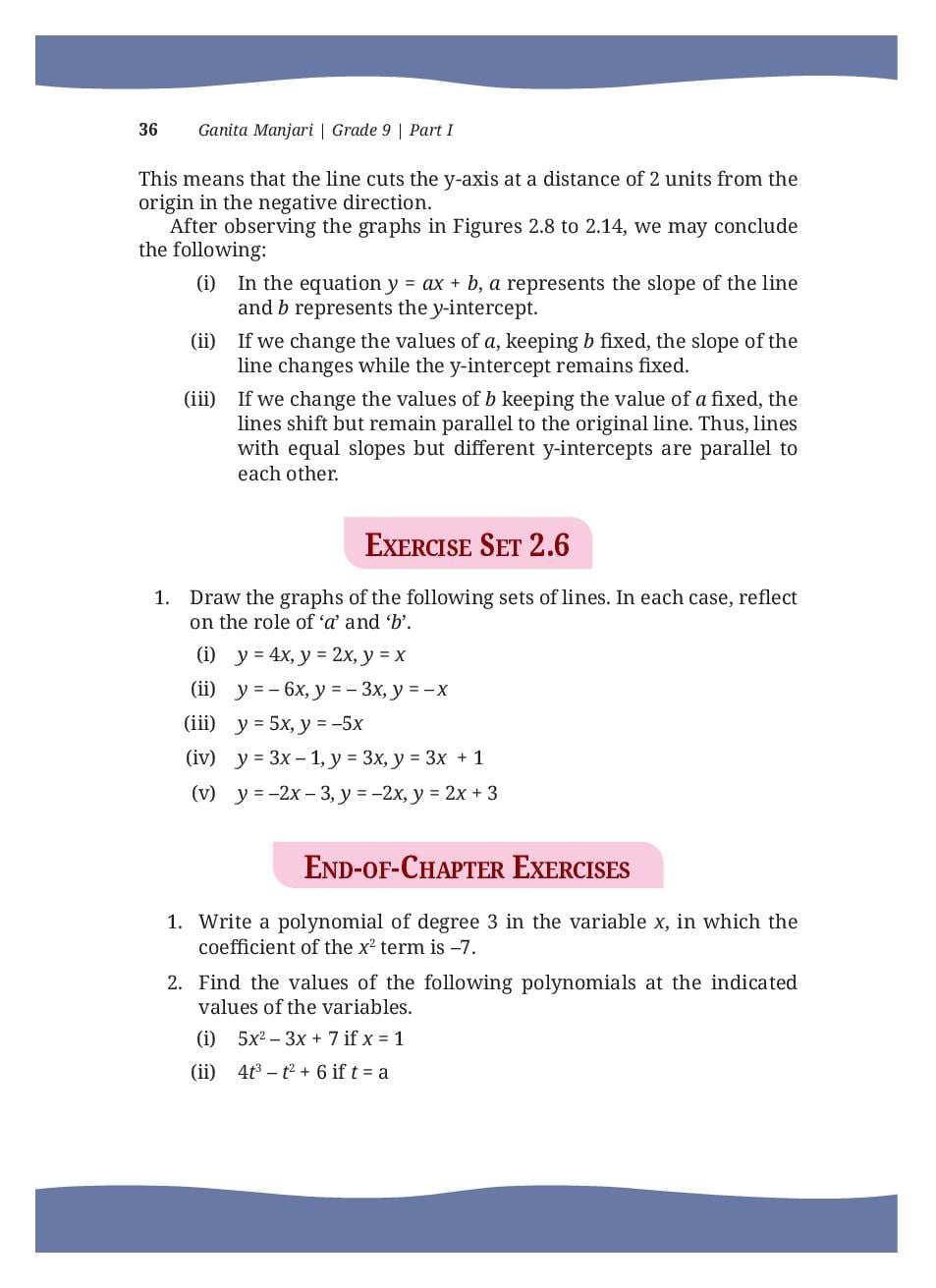
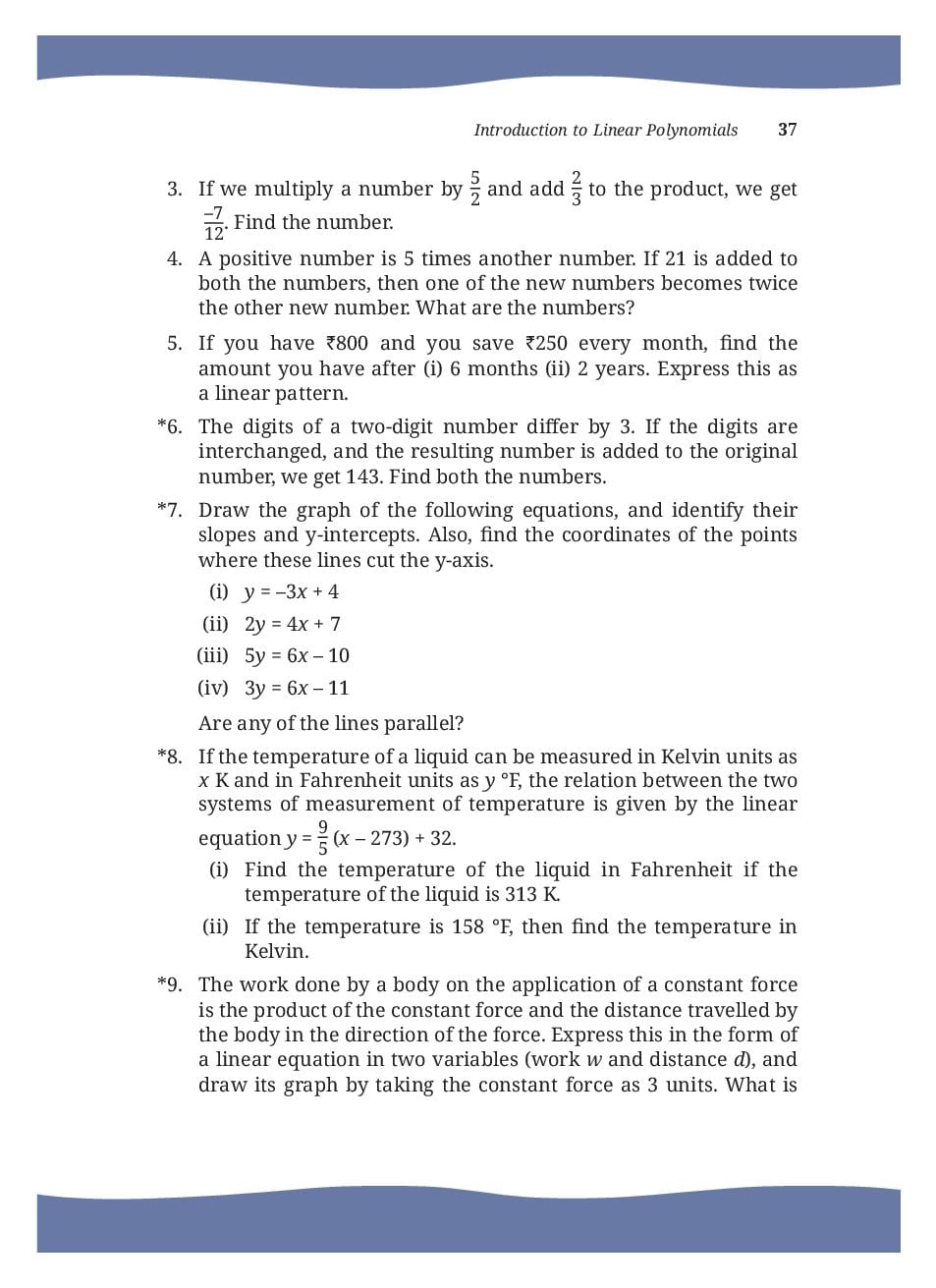
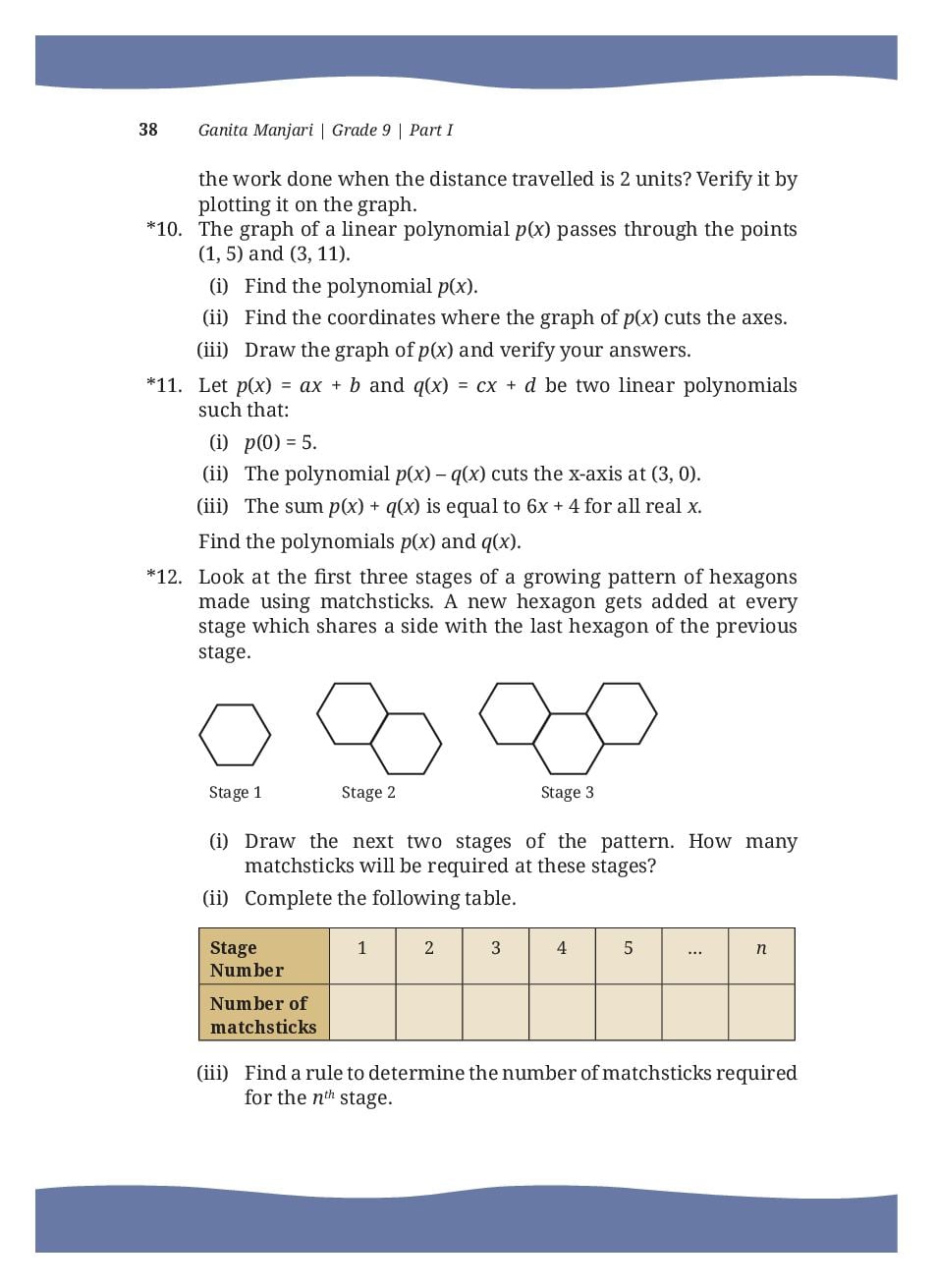
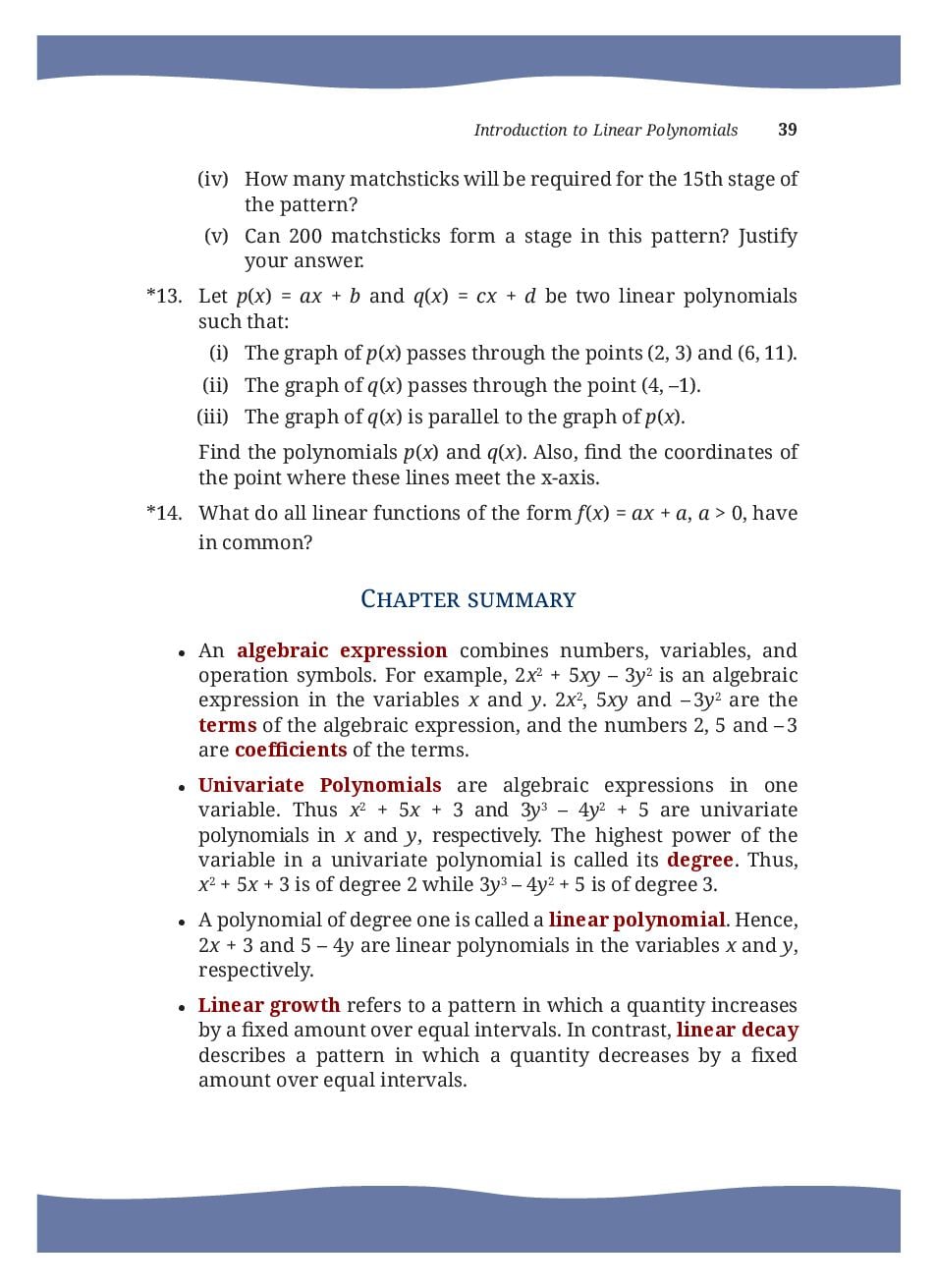
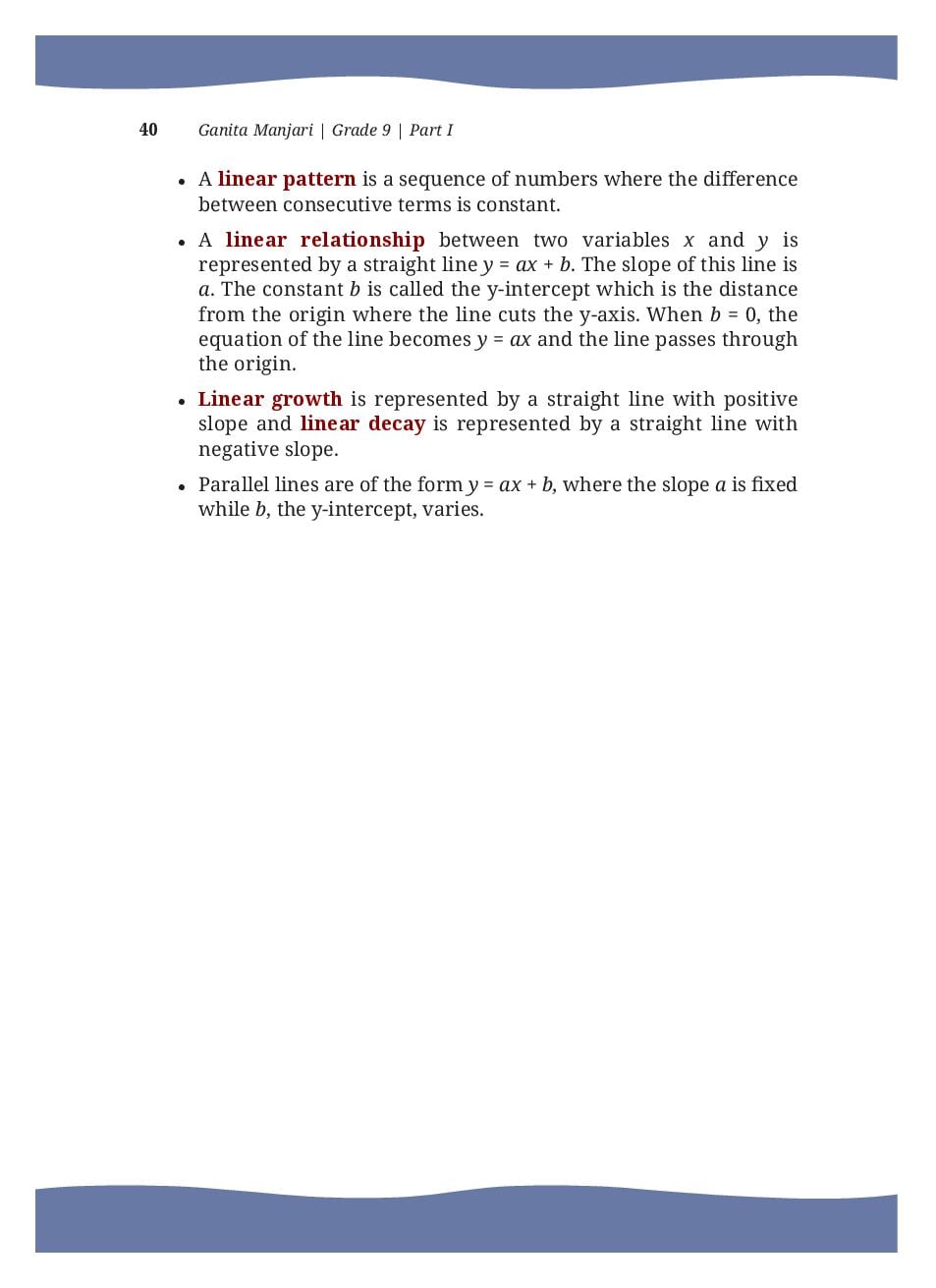
What Is in Introduction to Linear Polynomials? (Class 9 Maths Chapter 2)
- An algebraic expression is built from numbers, variables and operation signs. In 4x + 5y + 3 the parts 4x, 5y and 3 are the terms, x and y are the variables, 4 and 5 are the coefficients and 3 is the constant.
- A univariate polynomial (one-variable polynomial) uses a single variable and its powers. The highest power present is its degree: 5y³ + y² + 2y − 1 is cubic (degree 3), x² + 5x + 1 is quadratic (degree 2), 3z + 7 is linear (degree 1), and a non-zero constant such as 8 = 8x⁰ has degree 0.
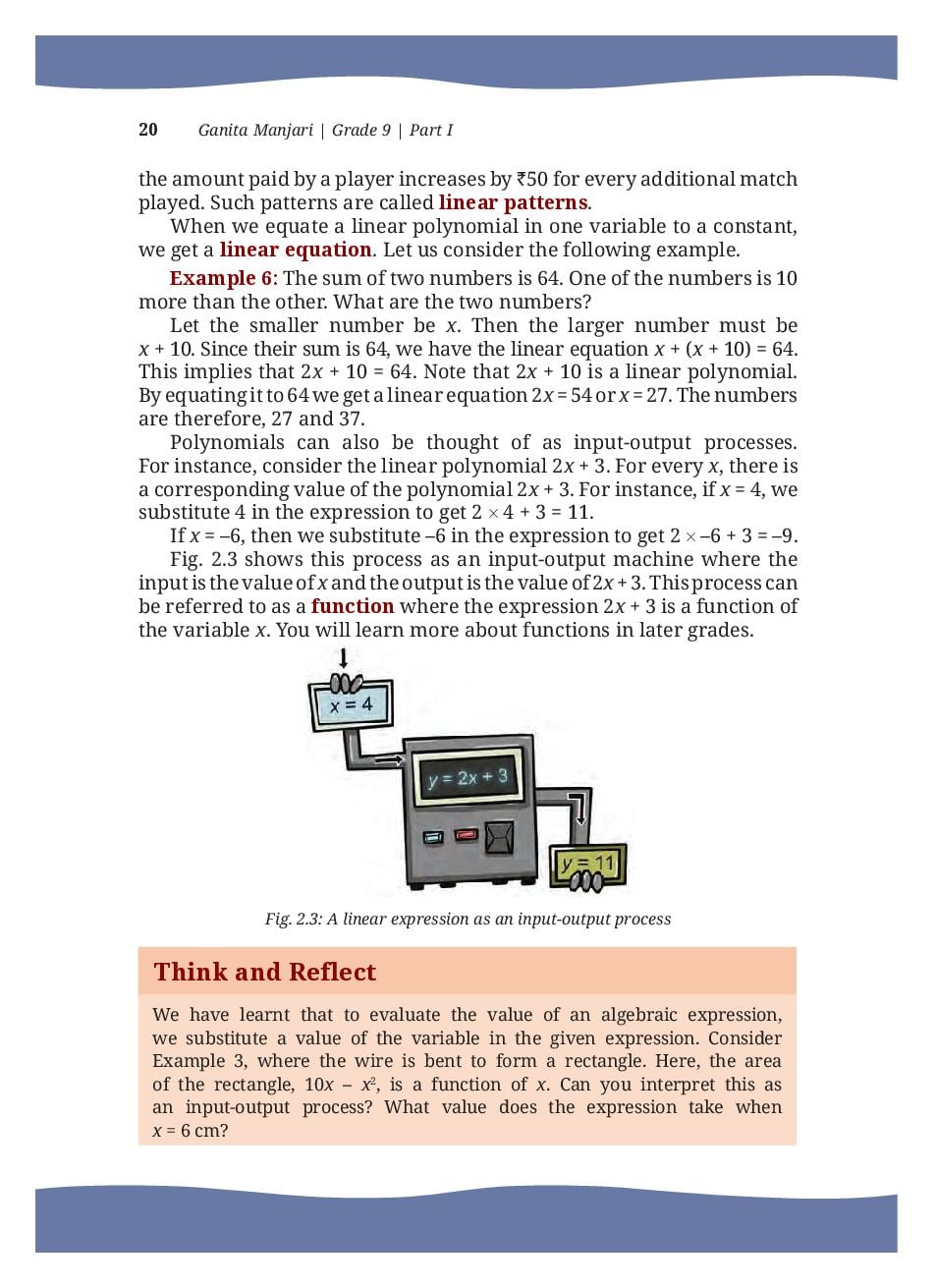
- A polynomial is an input–output machine: put a value of the variable in, get a number out. For 2x + 3, an input of 4 gives 11 and an input of −6 gives −9. This is what is meant by calling 2x + 3 a function of x.
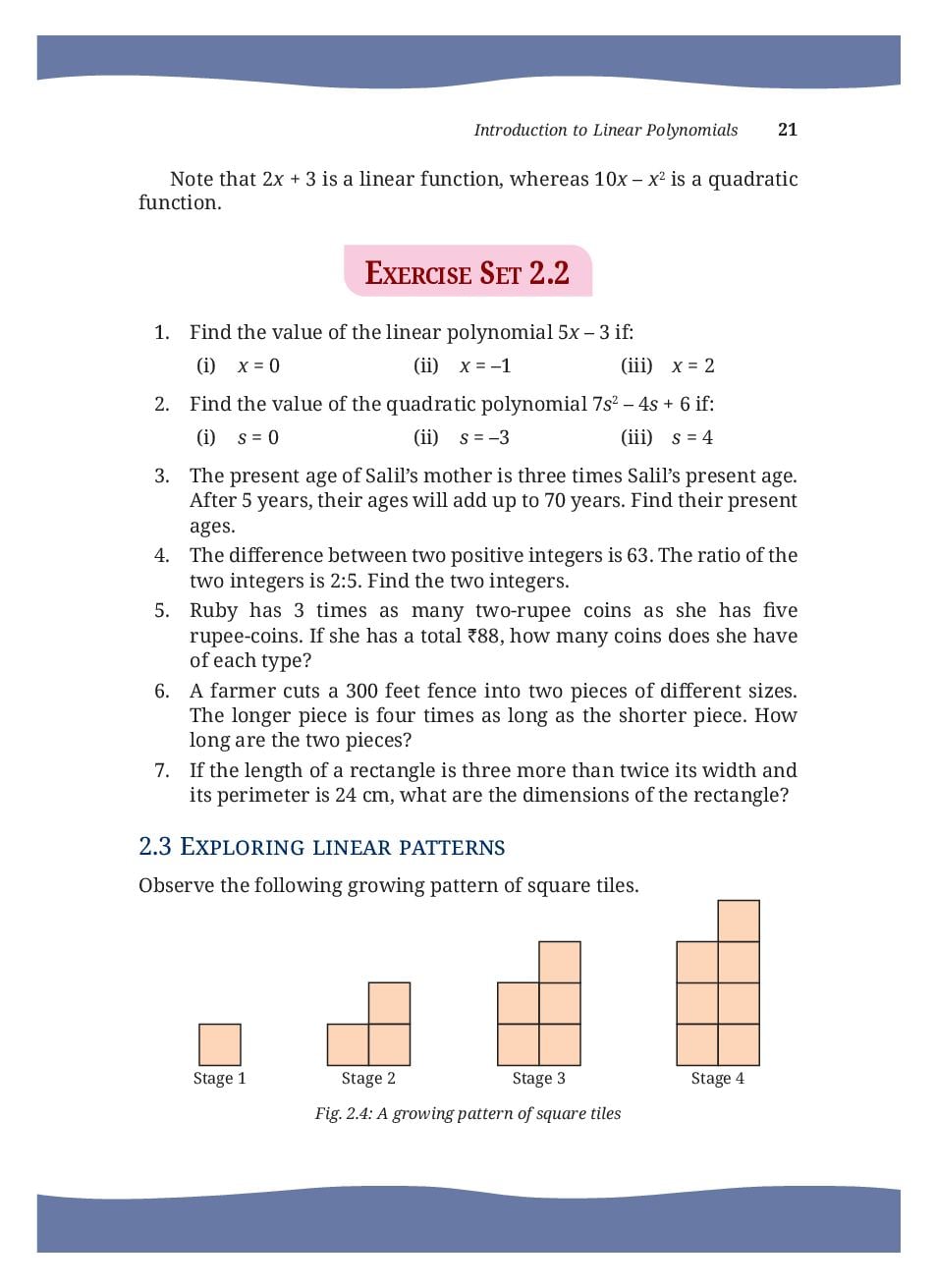
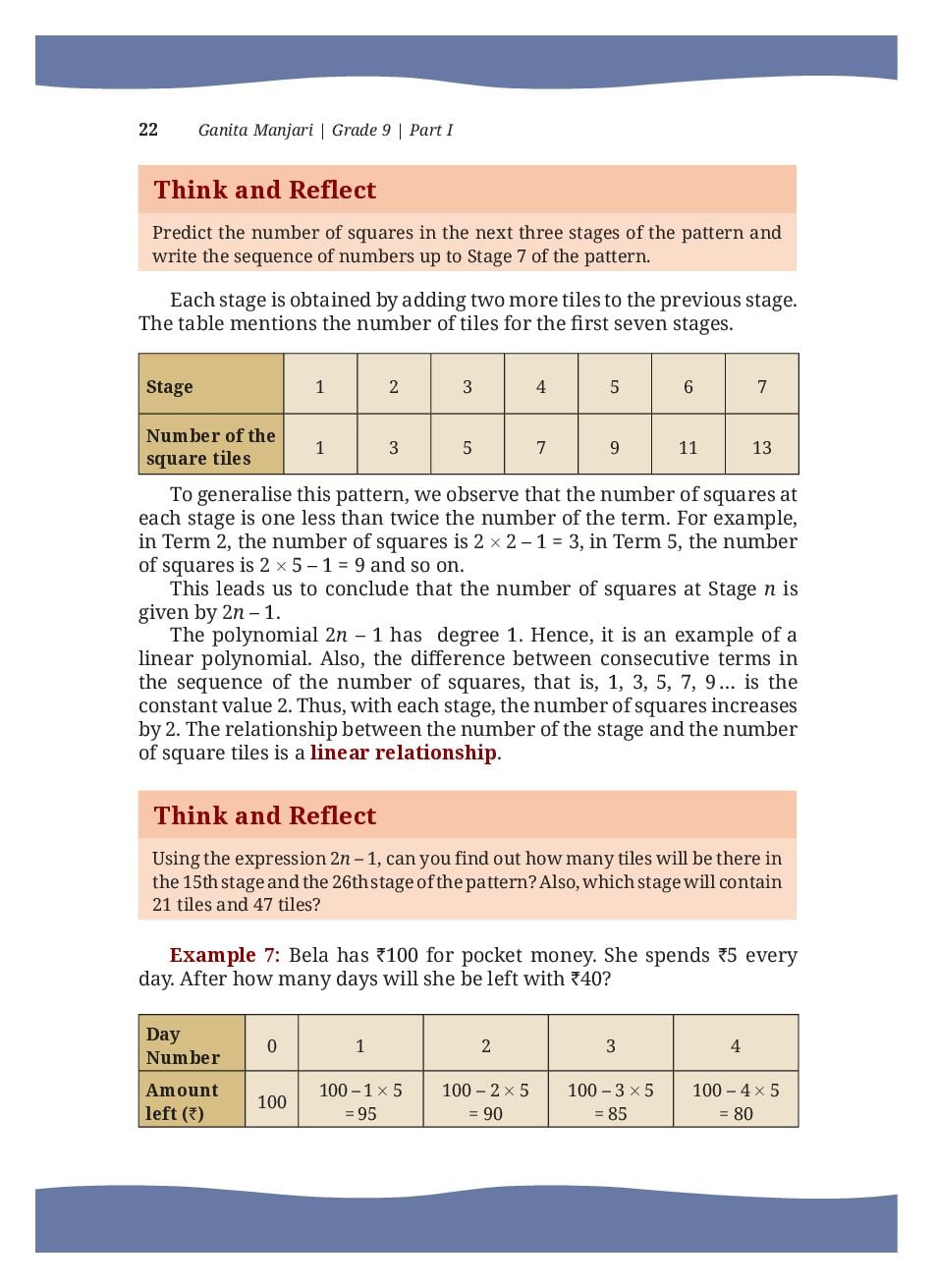
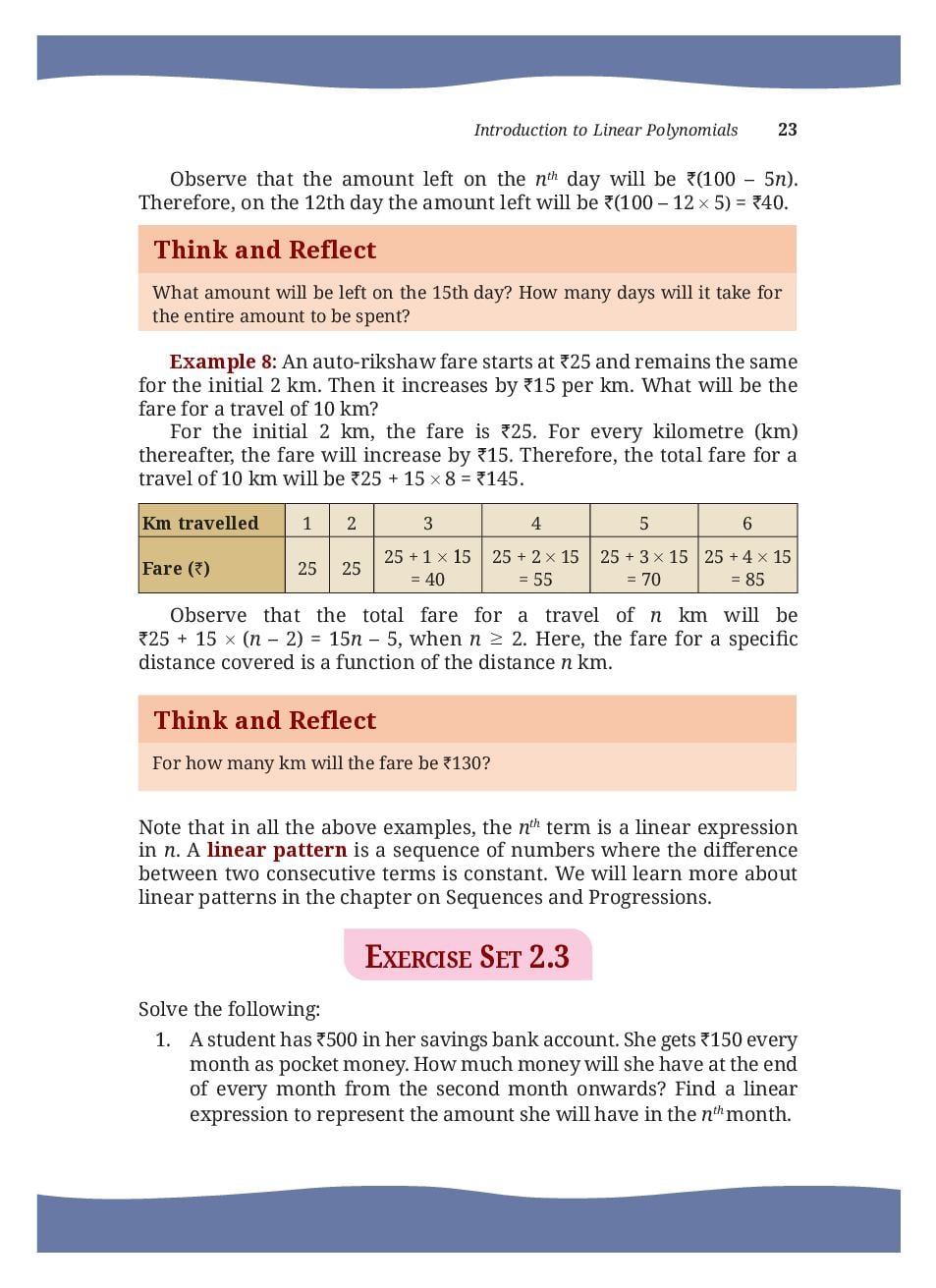
- The defining behaviour of a linear polynomial: equal steps in the variable give equal steps in the value. That constant step is what makes 1, 3, 5, 7, … (from 2n − 1) a linear pattern. Linear growth adds a fixed amount each interval; linear decay subtracts one.
- A linear relationship between two quantities is written y = ax + b. Two known pairs (x, y) are enough to pin down a and b, because they give two equations in those two unknowns.
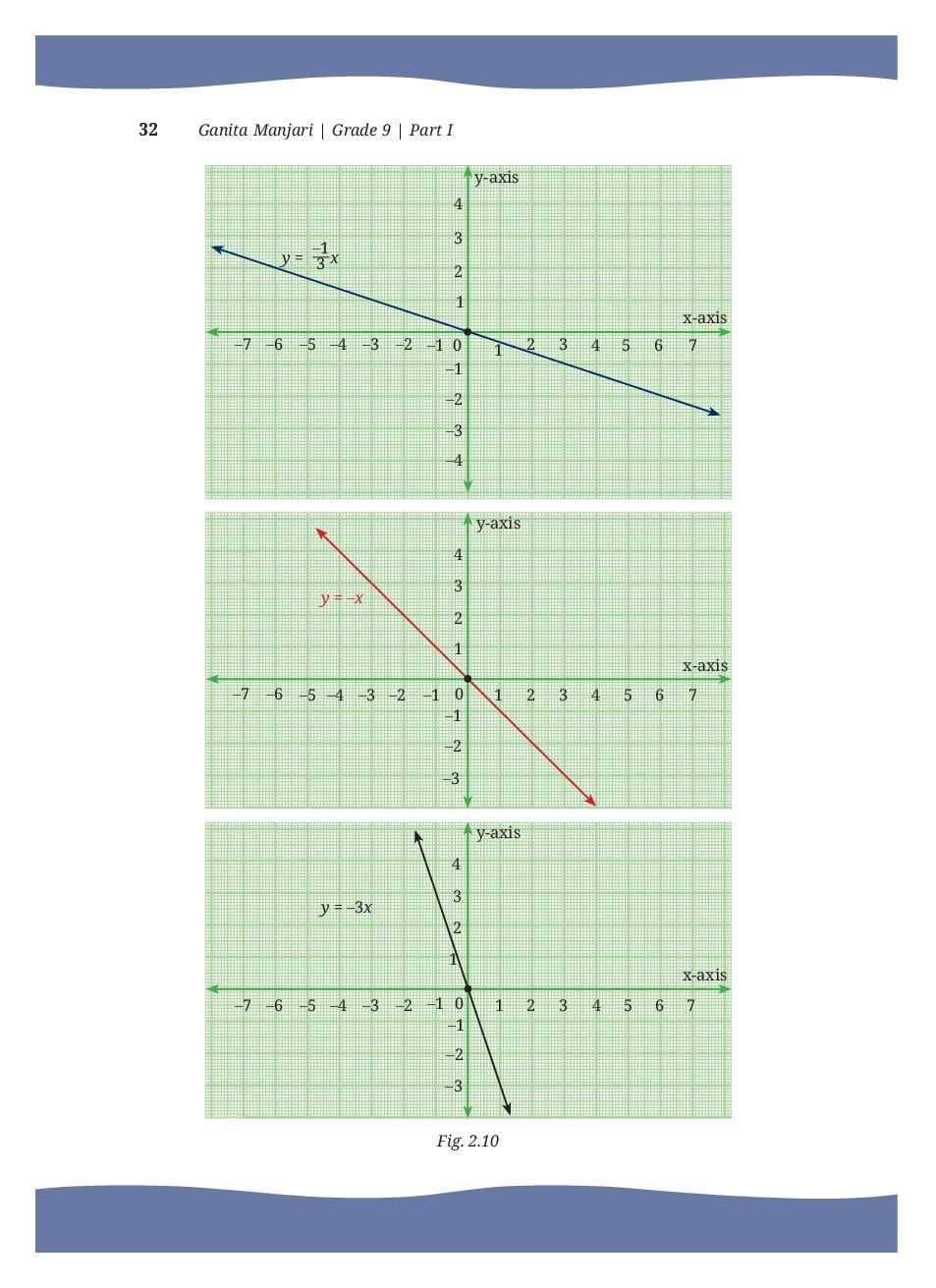
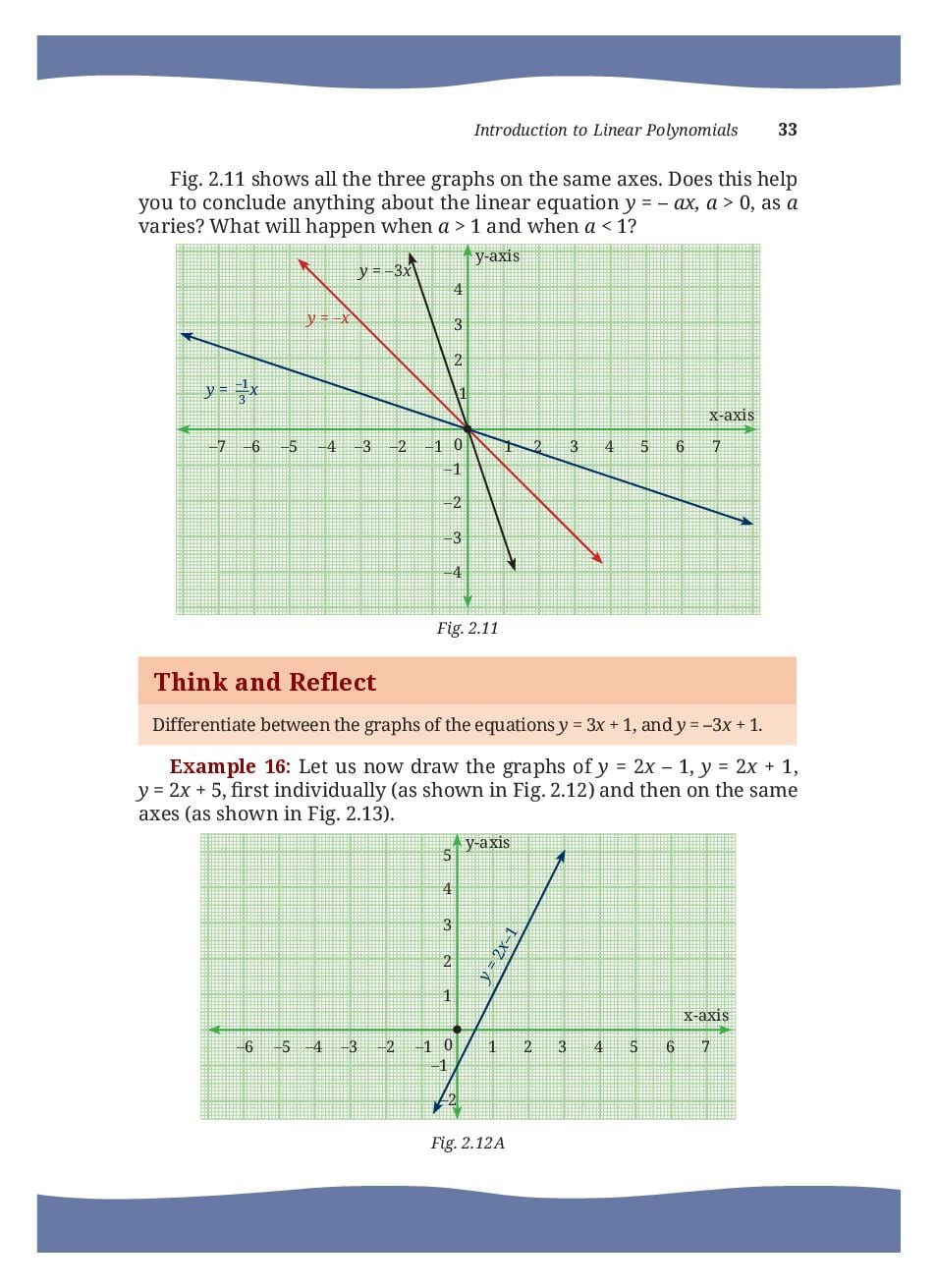
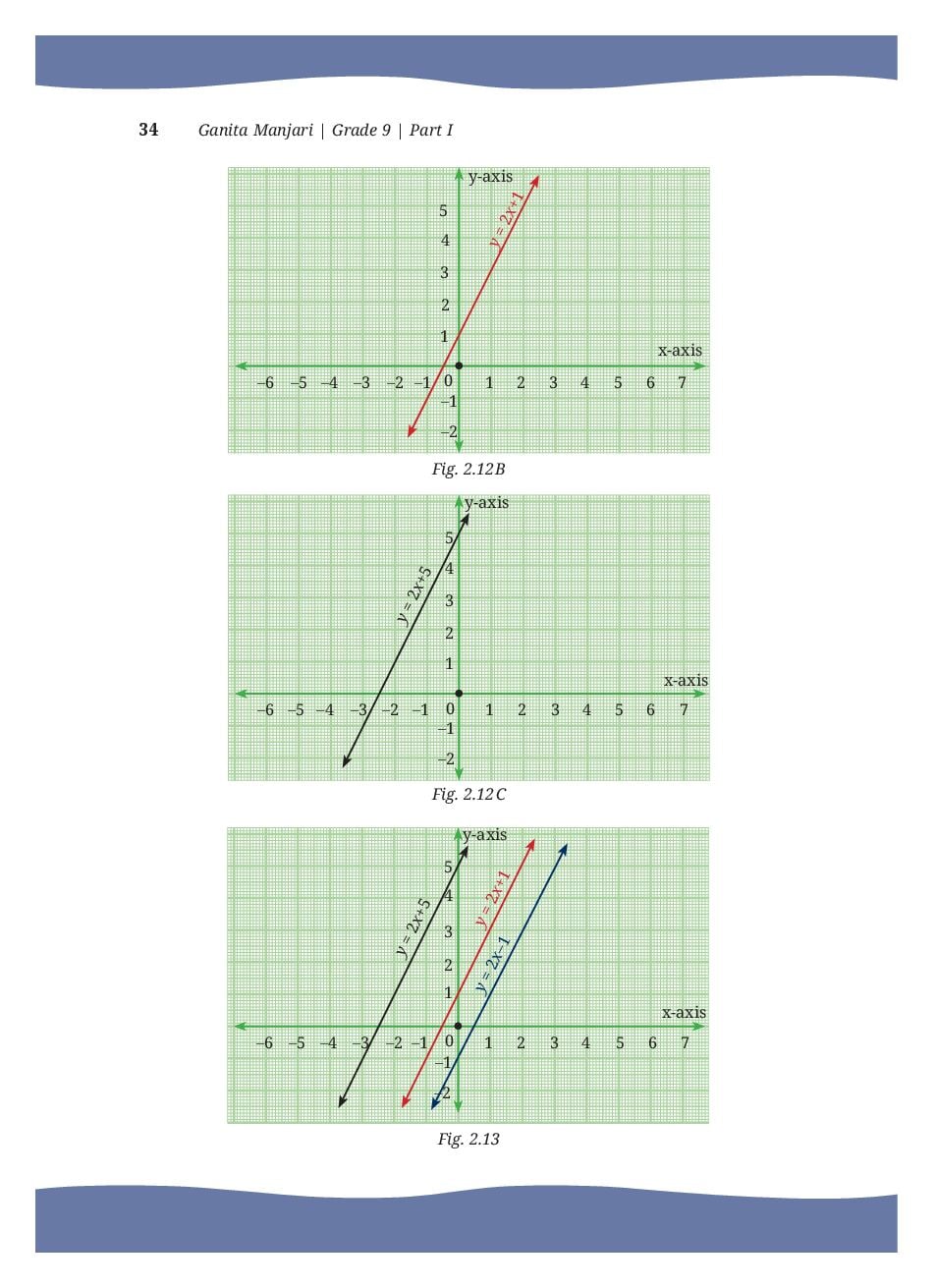
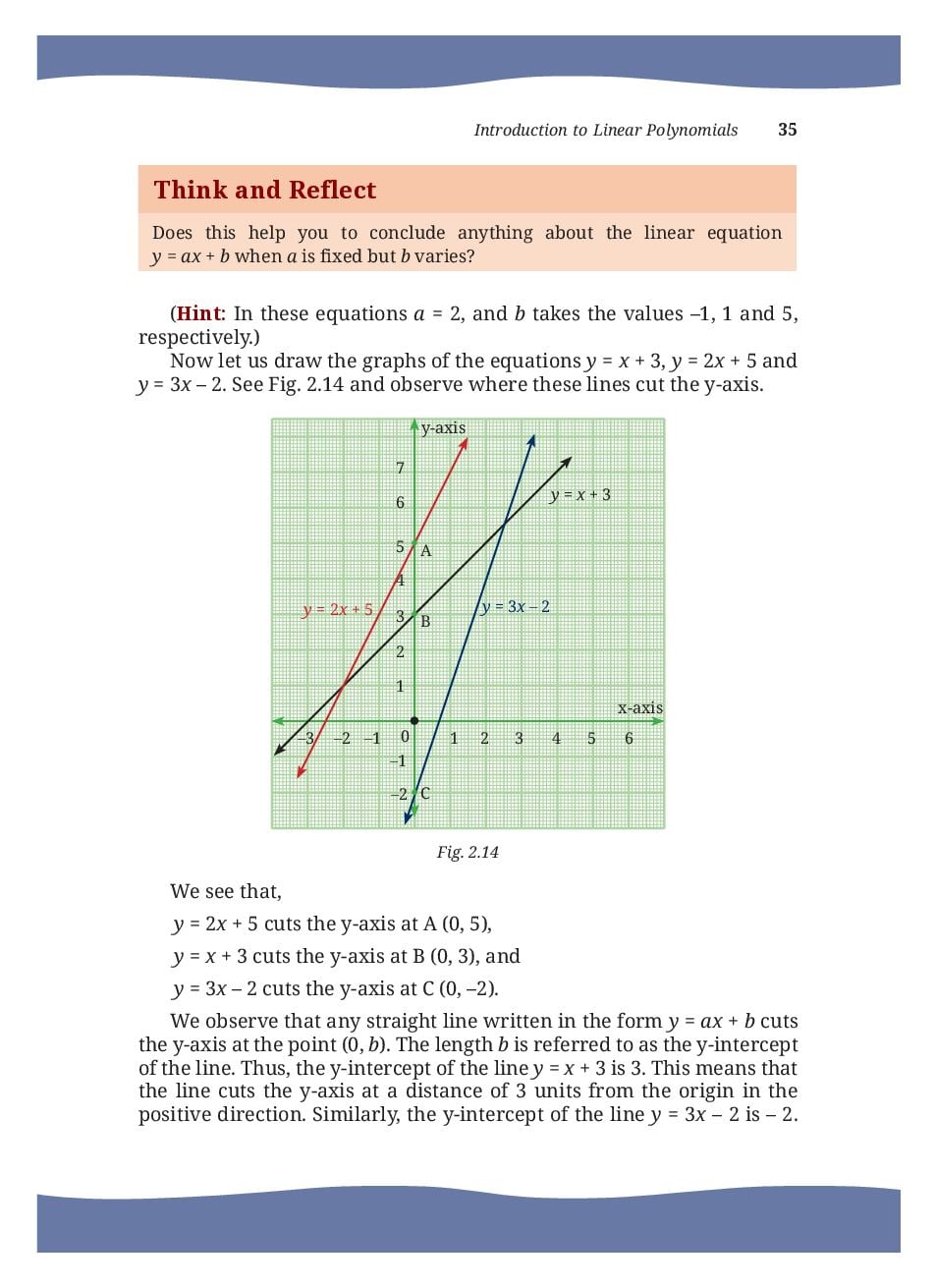
- Graphically, a is the slope and b the y-intercept: the line meets the y-axis at (0, b). Growth means a positive slope, decay a negative slope. Changing b with a fixed slides the line up or down without tilting it — so lines with equal slope and different intercepts are parallel.
Quick revision – Introduction to Linear Polynomials
| Idea | What it means | Symbolic form | Example from the chapter |
|---|---|---|---|
| Term / coefficient / constant | The pieces added together; the number multiplying a variable; the number-only term | 4x + 5y + 3 | Terms 4x, 5y, 3; coefficients 4, 5; constant 3 |
| Univariate polynomial | One variable and its whole-number powers only | Anxn + … + a1x + a0 | 5y³ + y² + 2y − 1 |
| Degree | The highest power of the variable that appears | Deg | Deg(2x² − 5x + 3) = 2 |
| Linear polynomial | Degree exactly 1 | Ax + b, a ≠ 0 | 3z + 7, 200 + 50m, 2n − 1 |
| Constant polynomial | Degree 0 — the value never changes | C = cx⁰ | 8 |
| Linear equation | A linear polynomial set equal to a constant | Ax + b = c | 2x + 10 = 64 gives x = 27 |
| Value of a polynomial | Substitute the number for the variable | P(k) | 2x + 3 at x = 4 is 11 |
| Linear pattern | Consecutive terms differ by a fixed amount | Tn = an + b | 1, 3, 5, 7, … from 2n − 1 |
| Linear growth | A fixed amount is added each equal interval | Y = ax + b, a > 0 | C(d) = 100 + 60d |
| Linear decay | A fixed amount is subtracted each equal interval | Y = ax + b, a < 0 | H(t) = 3 − 0.5t |
| Slope | The change in y for a 1-unit change in x | A in y = ax + b | Slope of y = 2x − 1 is 2 |
| Y-intercept | Signed distance from O at which the line cuts the y-axis | B; point (0, b) | Y = 3x − 2 cuts the y-axis at (0, −2) |
| Parallel lines | Same slope, different y-intercepts | Y = ax + b₁, y = ax + b₂ | Y = 2x − 1, y = 2x + 1, y = 2x + 5 |
Old NCERT vs New – Class 9 Maths
This chapter is from Ganita Manjari, the new NCERT Class 9 Maths book (NCF-SE 2023, used from 2026-27). It replaced the old book “Mathematics”, so chapter numbers and names differ from older PDFs.
Solutions and All Chapters
Answers to the exercises and the full chapter list of Ganita Manjari:
Introduction to Linear Polynomials – Overview
| Class | Class 9 |
| Subject | Maths |
| Book | Ganita Manjari – new NCERT book |
| Part | Part I |
| Chapter | 2 of 14 – Introduction to Linear Polynomials |
| Book pages | 16 – 40 |
| Edition | Latest NCERT edition (2026-27) |
| Session | 2026-27 |
| Free – read online or download |
Class 9 Maths Chapter 2 – FAQs
Where can I download Introduction to Linear Polynomials Class 9 PDF?
From the download table on this page – the chapter PDF is free, and the full book is linked too.
What is Class 9 Maths Chapter 2 about?
An algebraic expression is built from numbers, variables and operation signs. In 4x + 5y + 3 the parts 4x, 5y and 3 are the terms, x and y are the variables, 4 and 5 are the coefficients and 3 is the constant.
Is Introduction to Linear Polynomials from the new NCERT Class 9 Maths book?
Yes. It is chapter 2 of ganita manjari (part i), the new NCERT Class 9 Maths book for 2026-27.
Is this the latest NCERT edition for 2026-27?
Yes – the PDF is NCERT’s latest edition for the 2026-27 session.
Where are the NCERT Solutions for Class 9 Maths Chapter 2?
Open the NCERT Solutions link above for answers to the exercise questions.