Download The Mathematics of Maybe: Introduction to Probability – NCERT Class 9 Maths Chapter 7 PDF from the new NCERT Class 9 Maths book Ganita Manjari (2026-27). Read the chapter online or download the free PDF. Probability measures how likely an event is, on a scale from 0 to 1. For an event E, 0 ≤ P(E) ≤ 1. P(E) = 0 means impossible, P(E) = 1 means certain, P(E) = 1/2 means an even chance. Nothing outside [0, 1] is a probability.
The Mathematics of Maybe: Introduction to Probability PDF – Chapter 7 of Ganita Manjari (Part I)
Read the chapter online or download the PDF.
| Chapter | Download | |
|---|---|---|
| Chapter 7 PDF | The Mathematics of Maybe: Introduction to Probability | View PDF |
| Full book | NCERT Class 9 Maths – Ganita Manjari | View Book |
Read Online
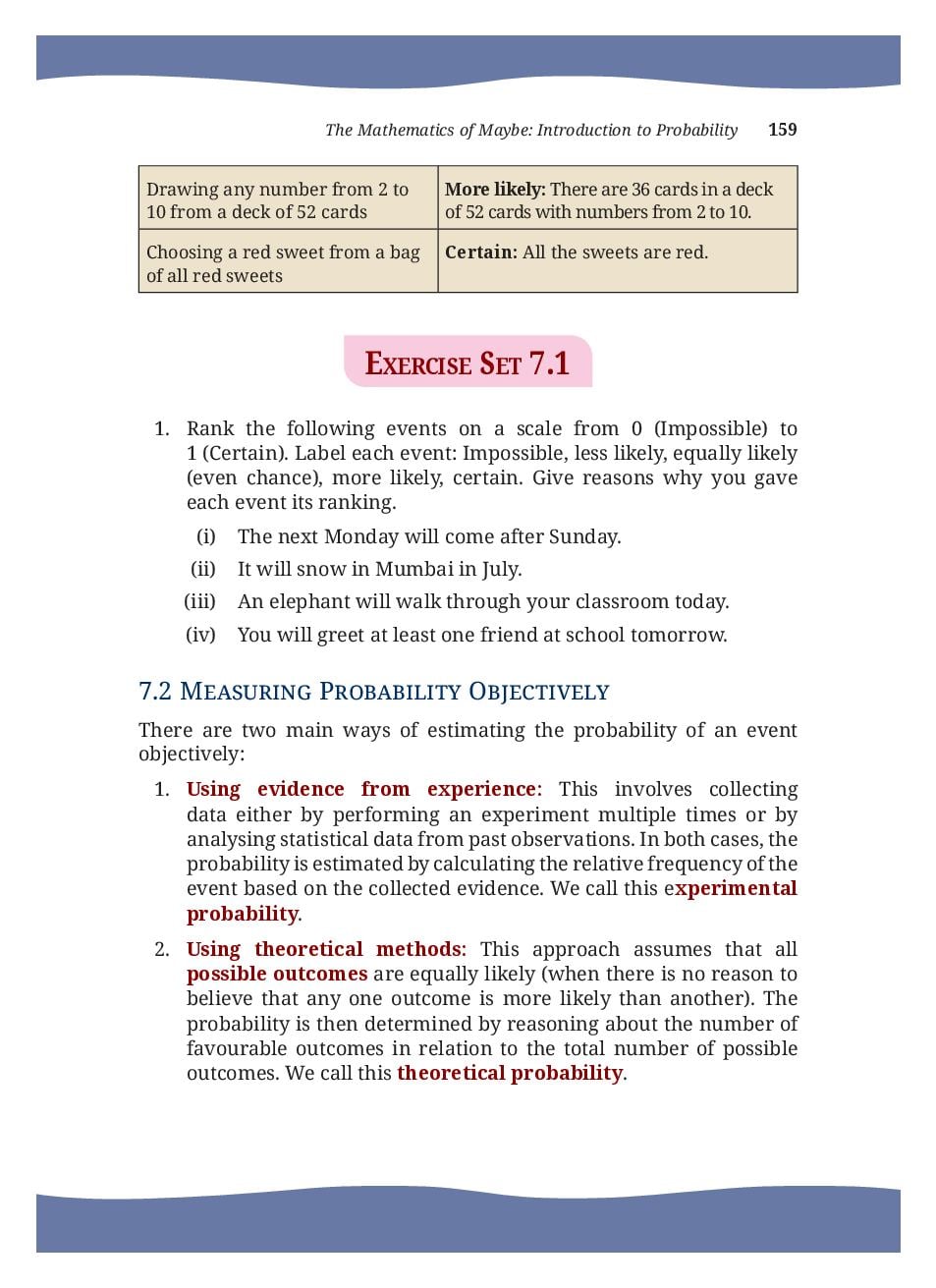
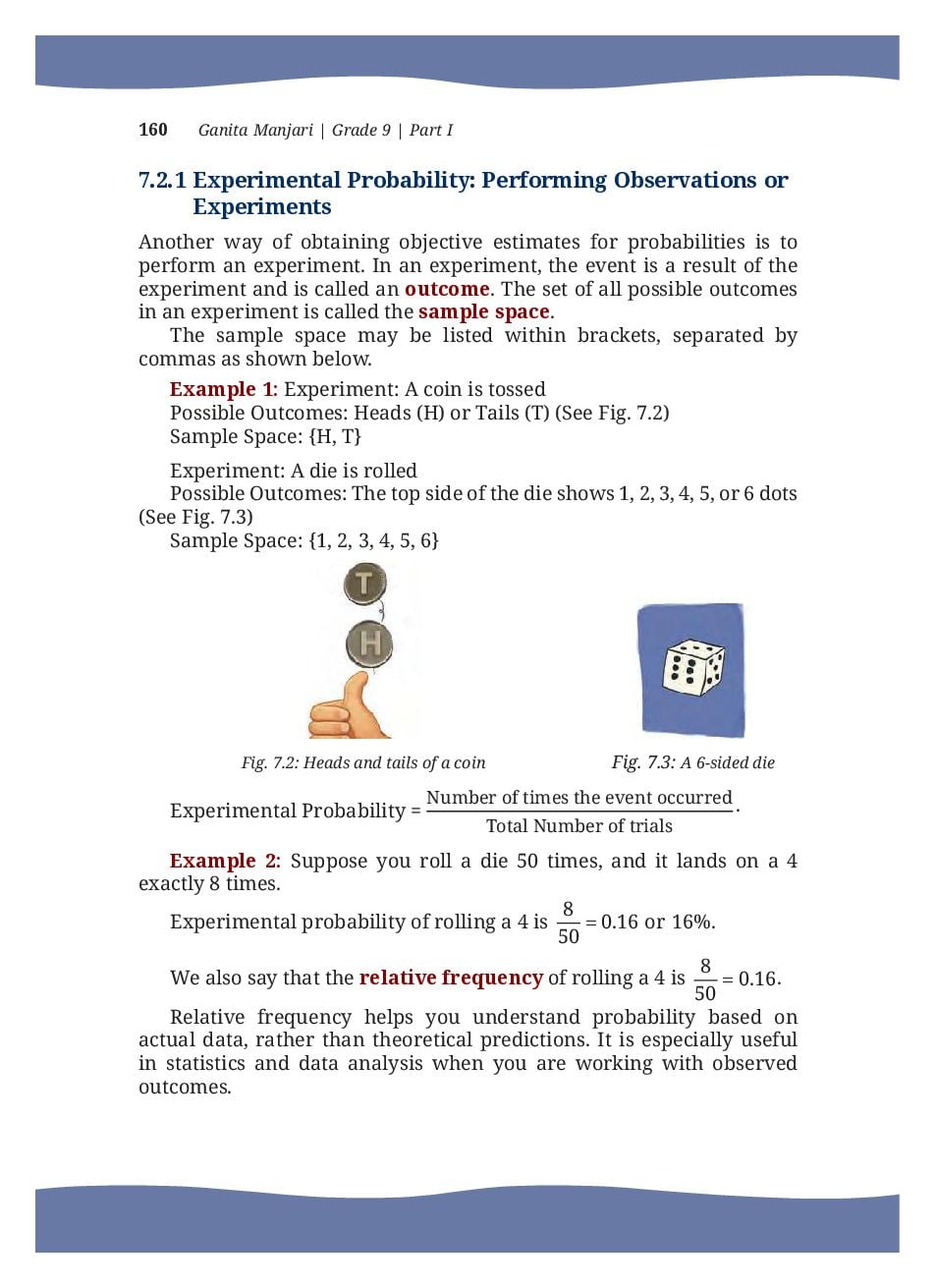
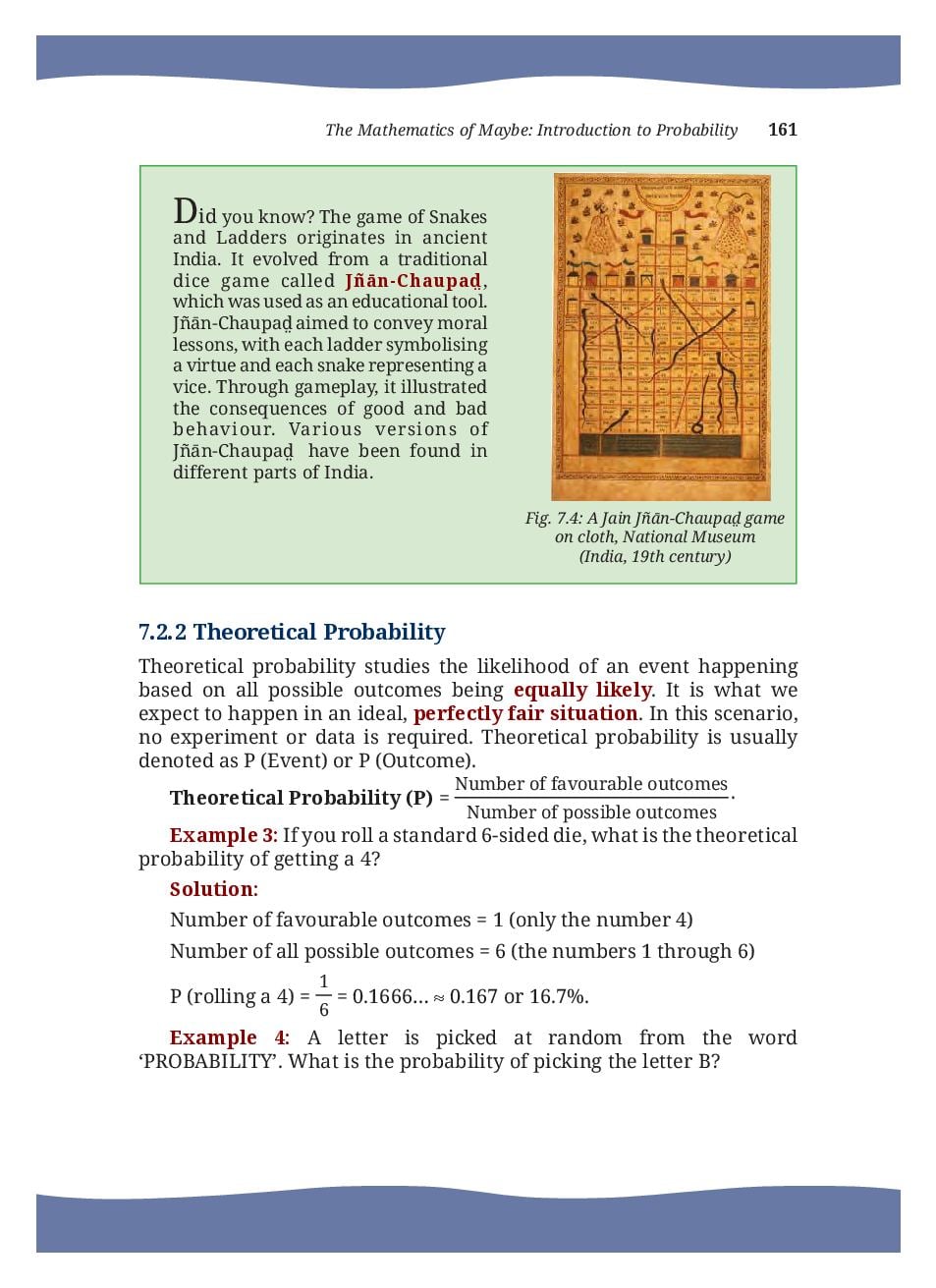
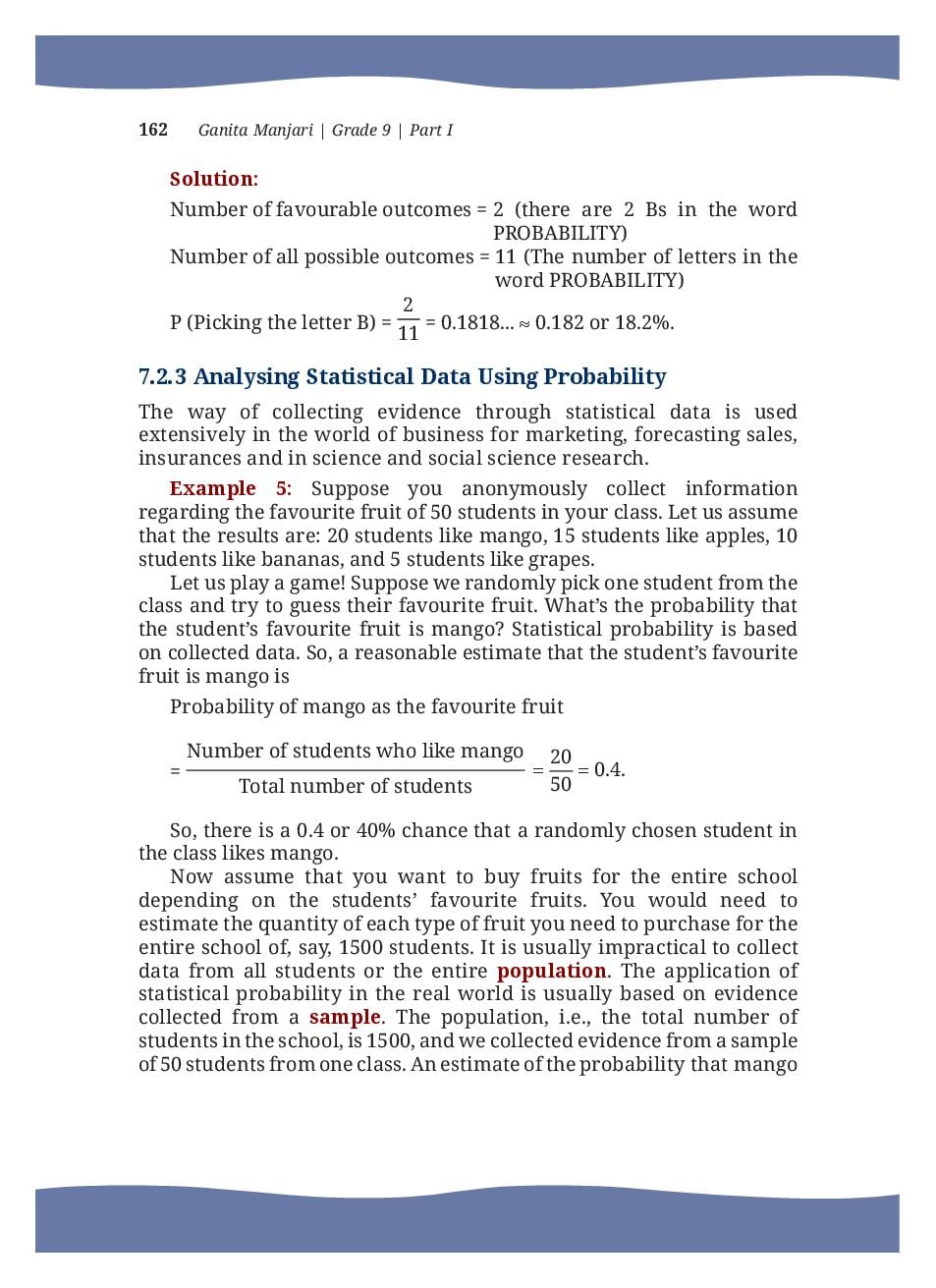
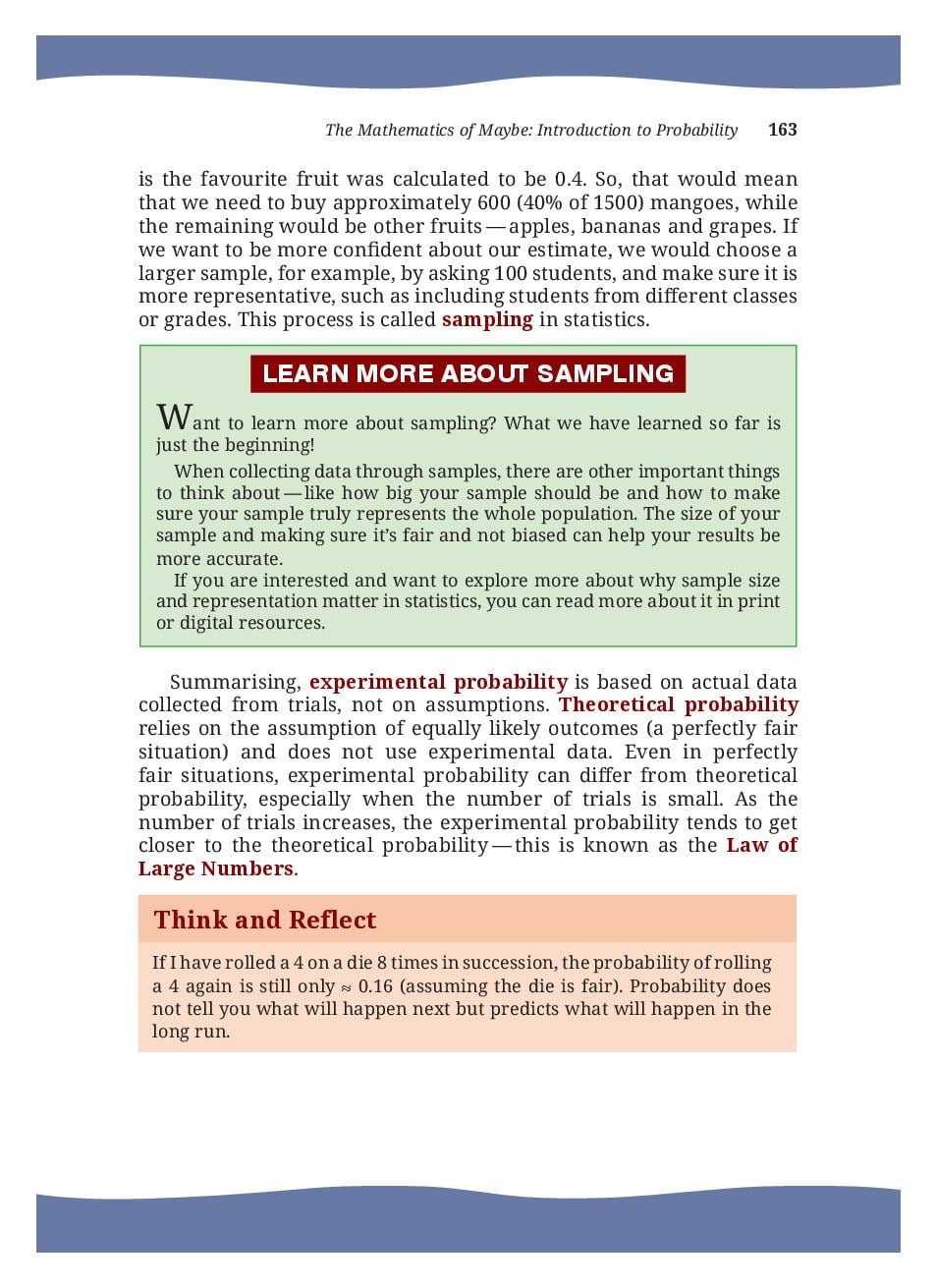
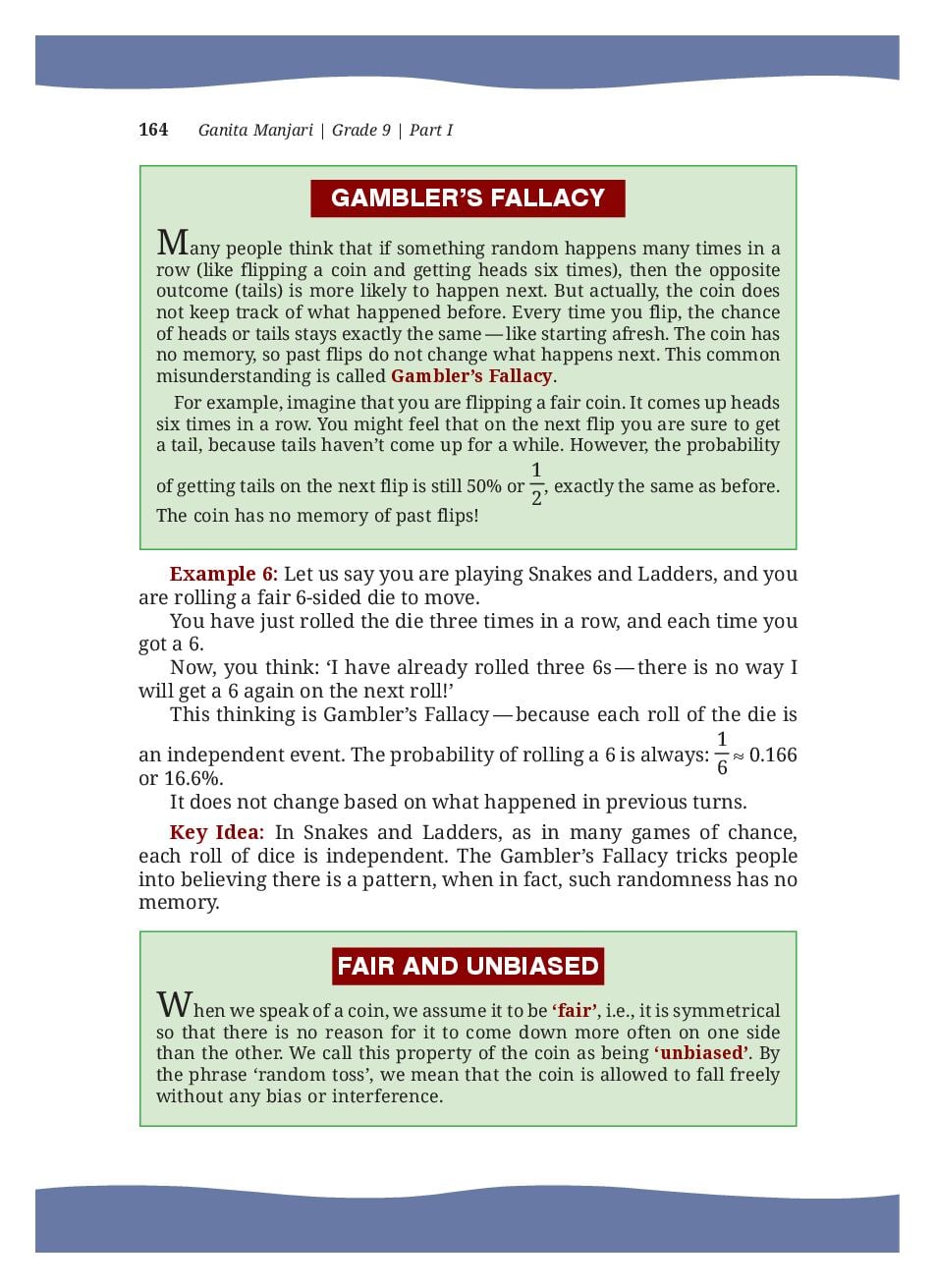
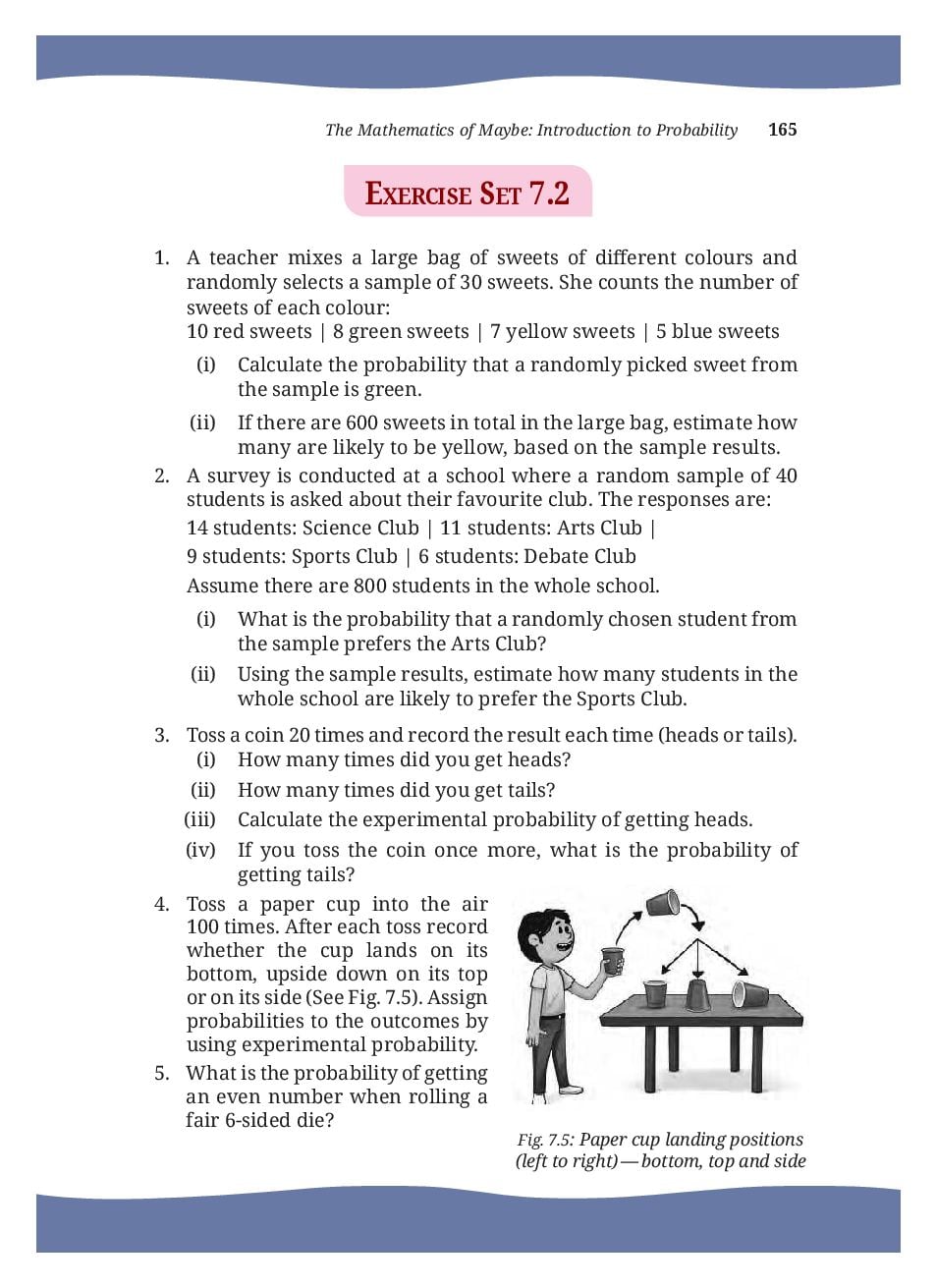
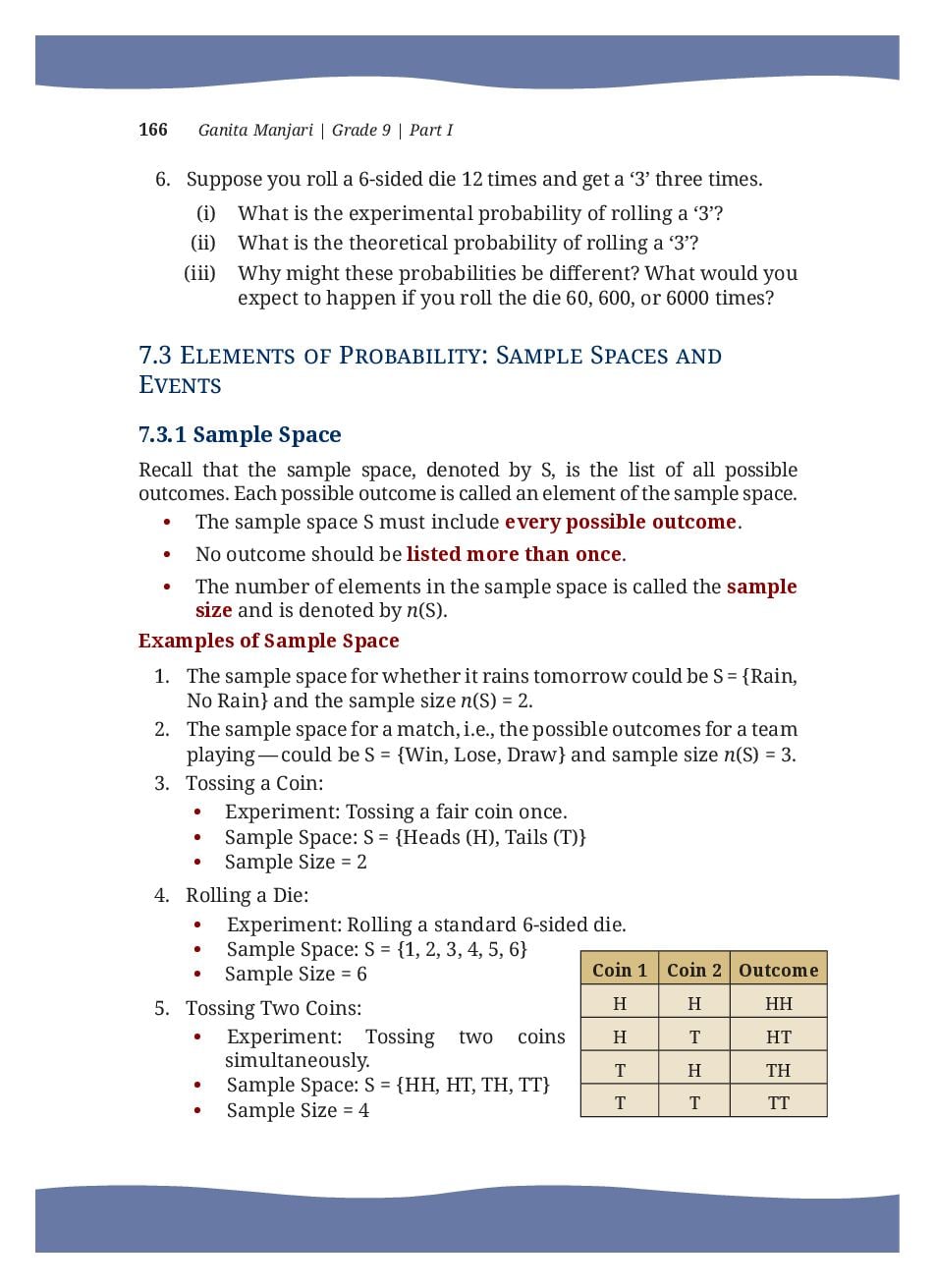
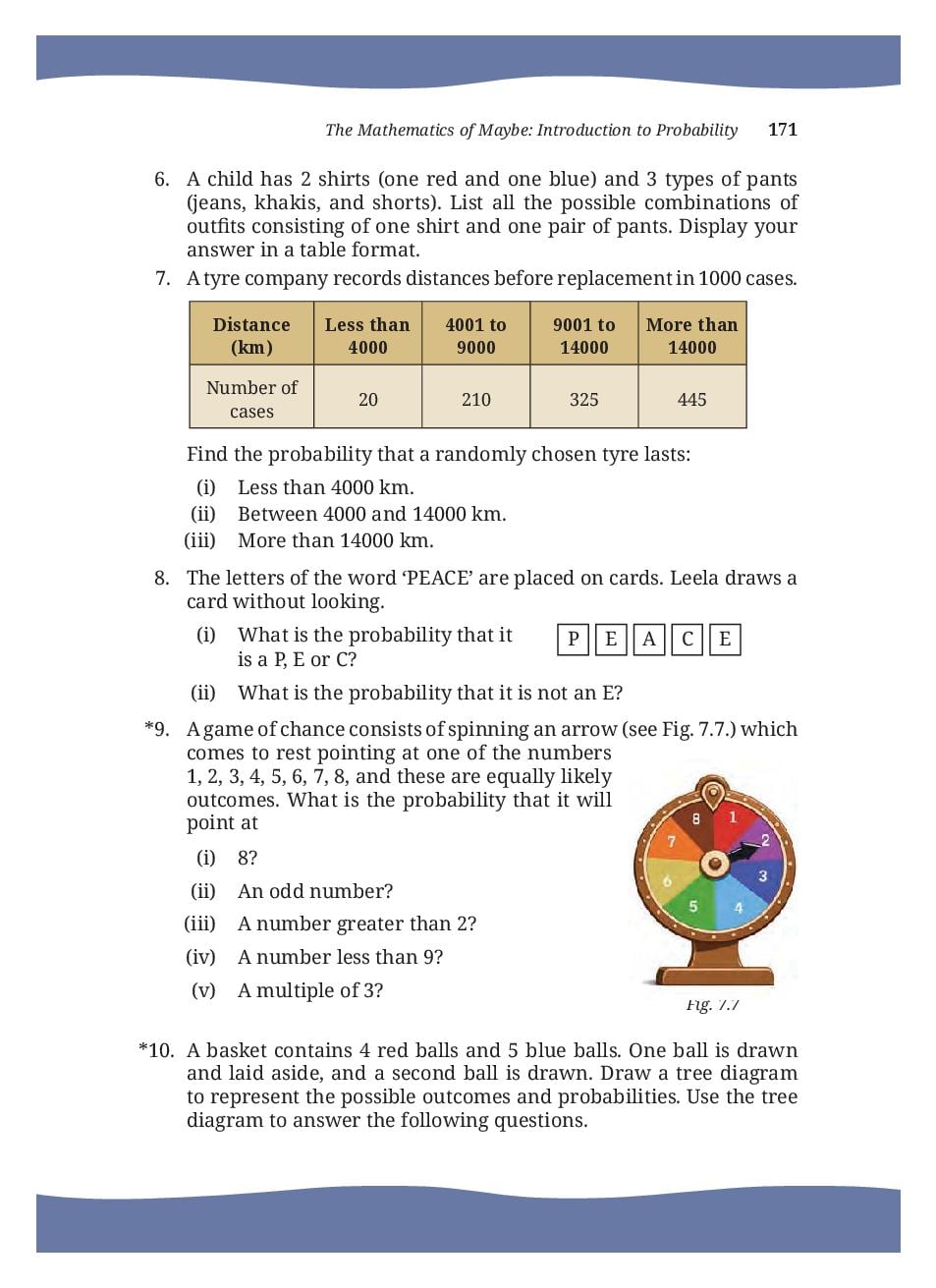
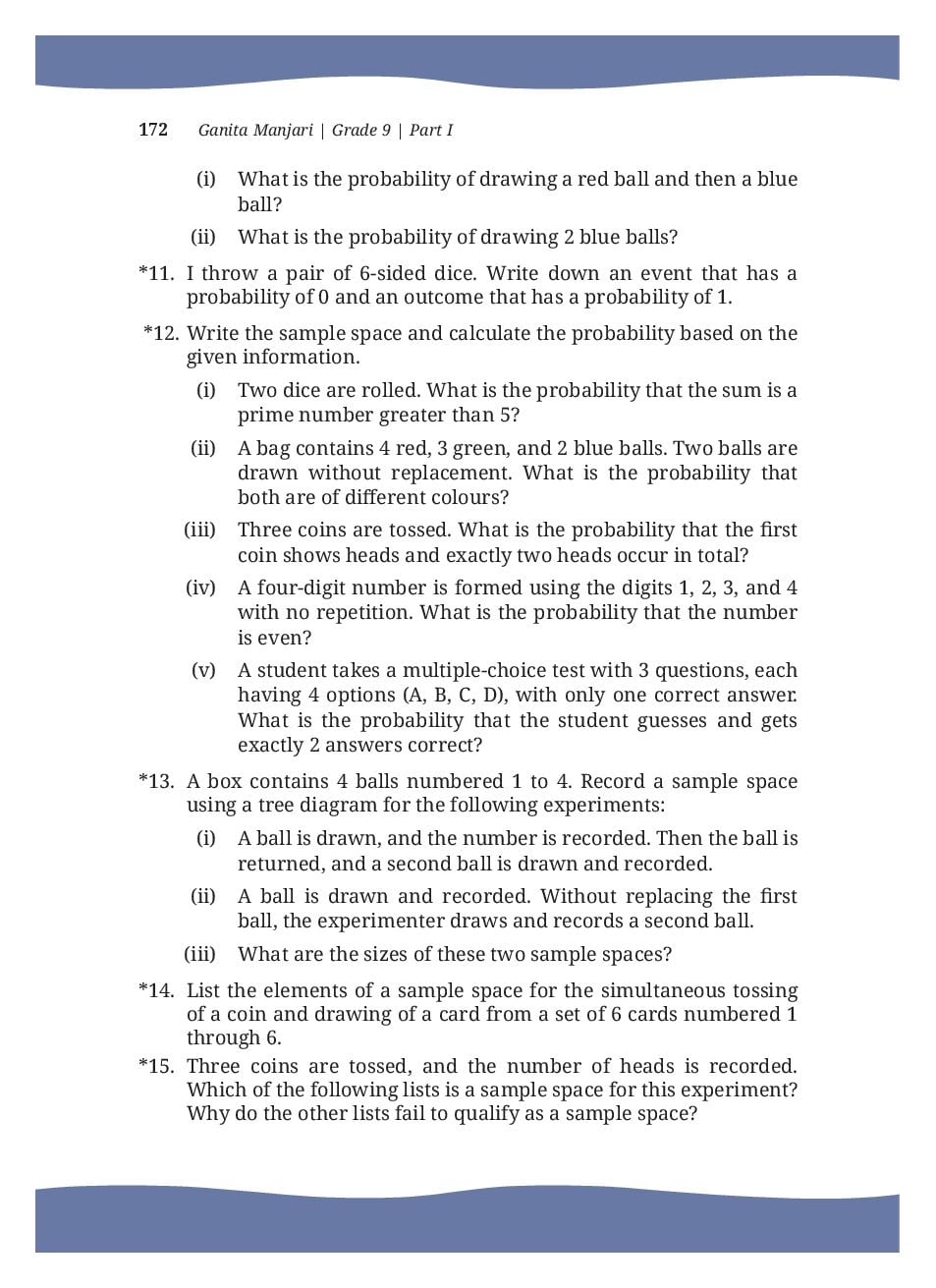
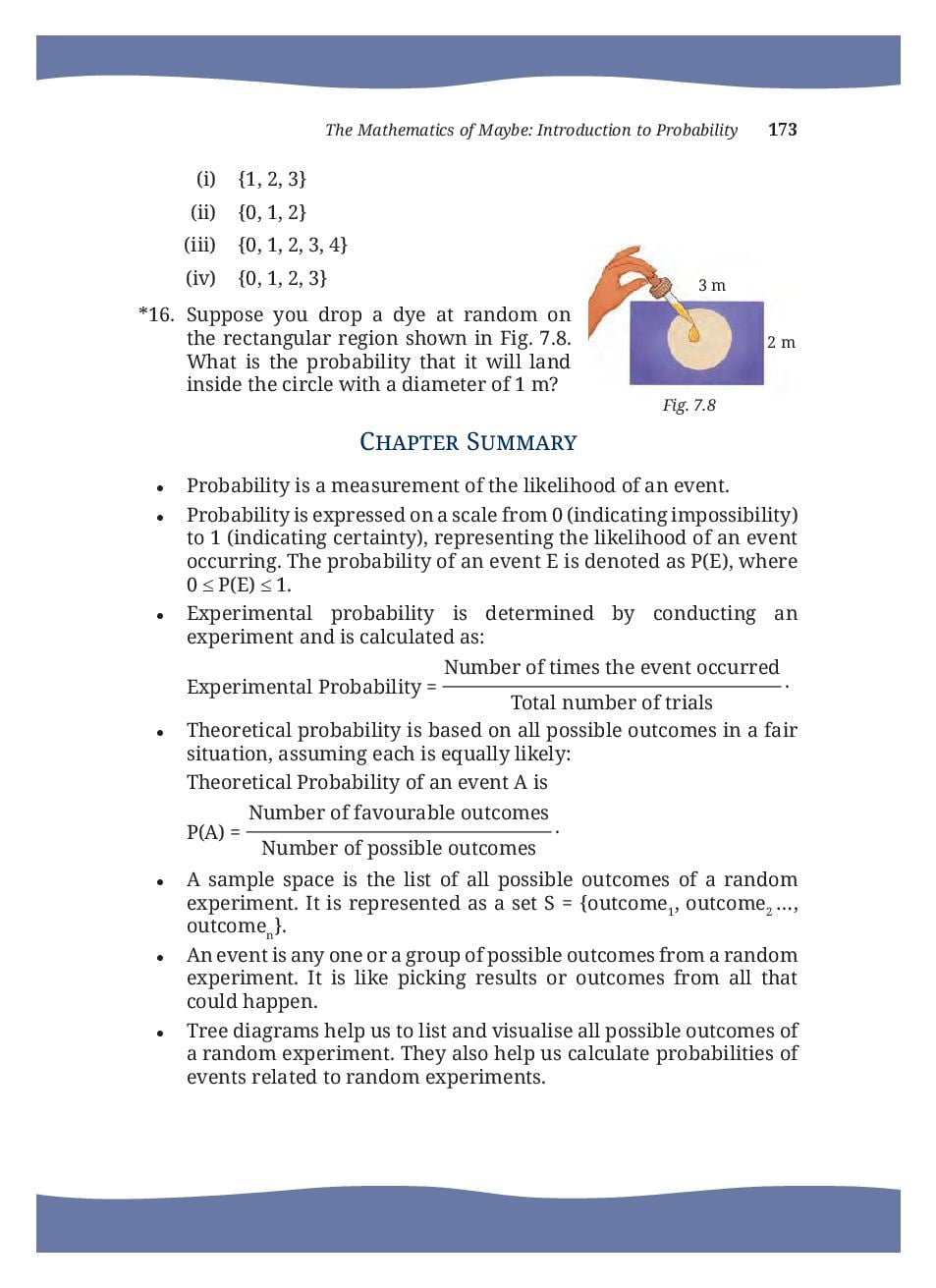
What Is in The Mathematics of Maybe: Introduction to Probability? (Class 9 Maths Chapter 7)
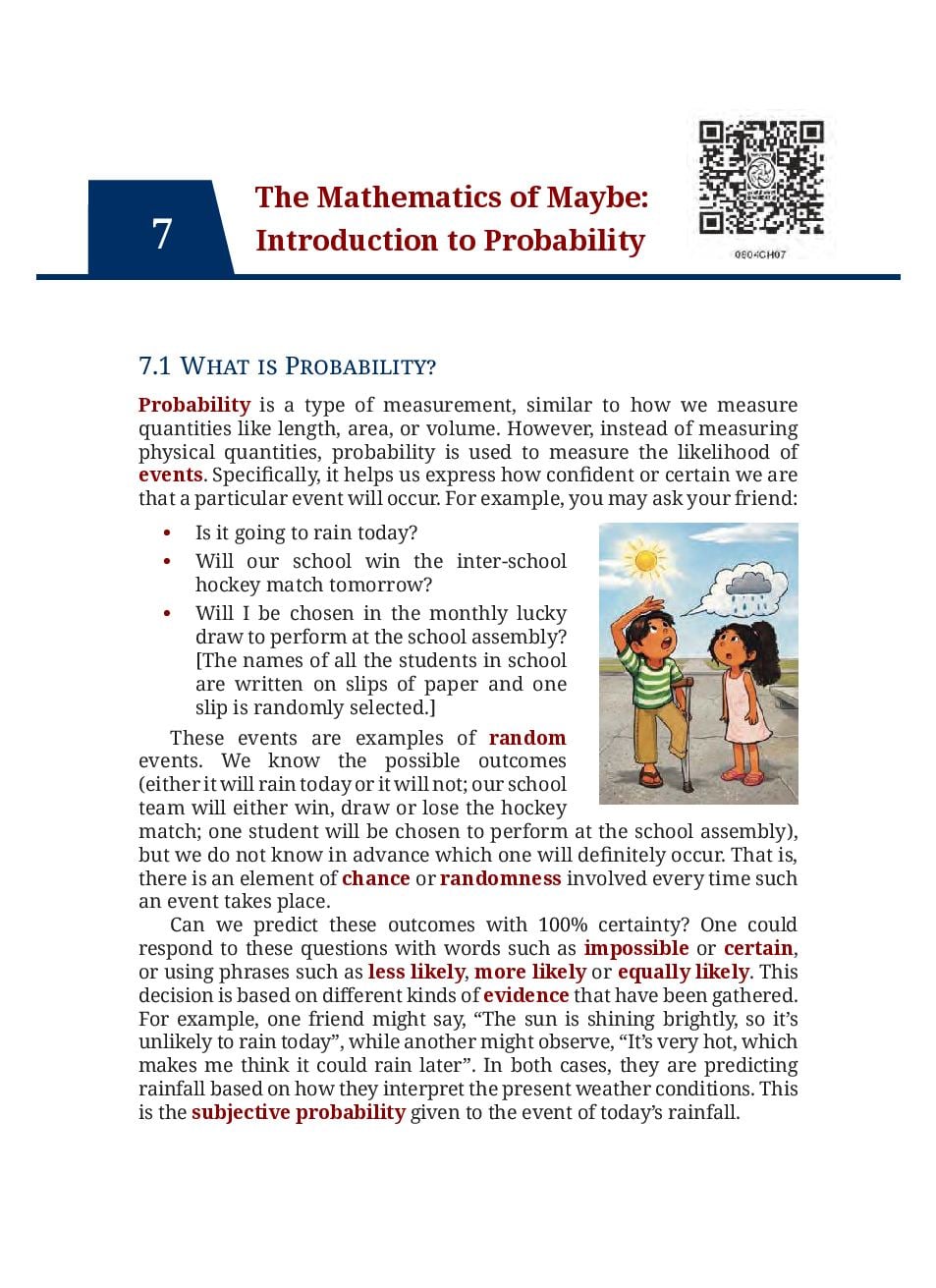
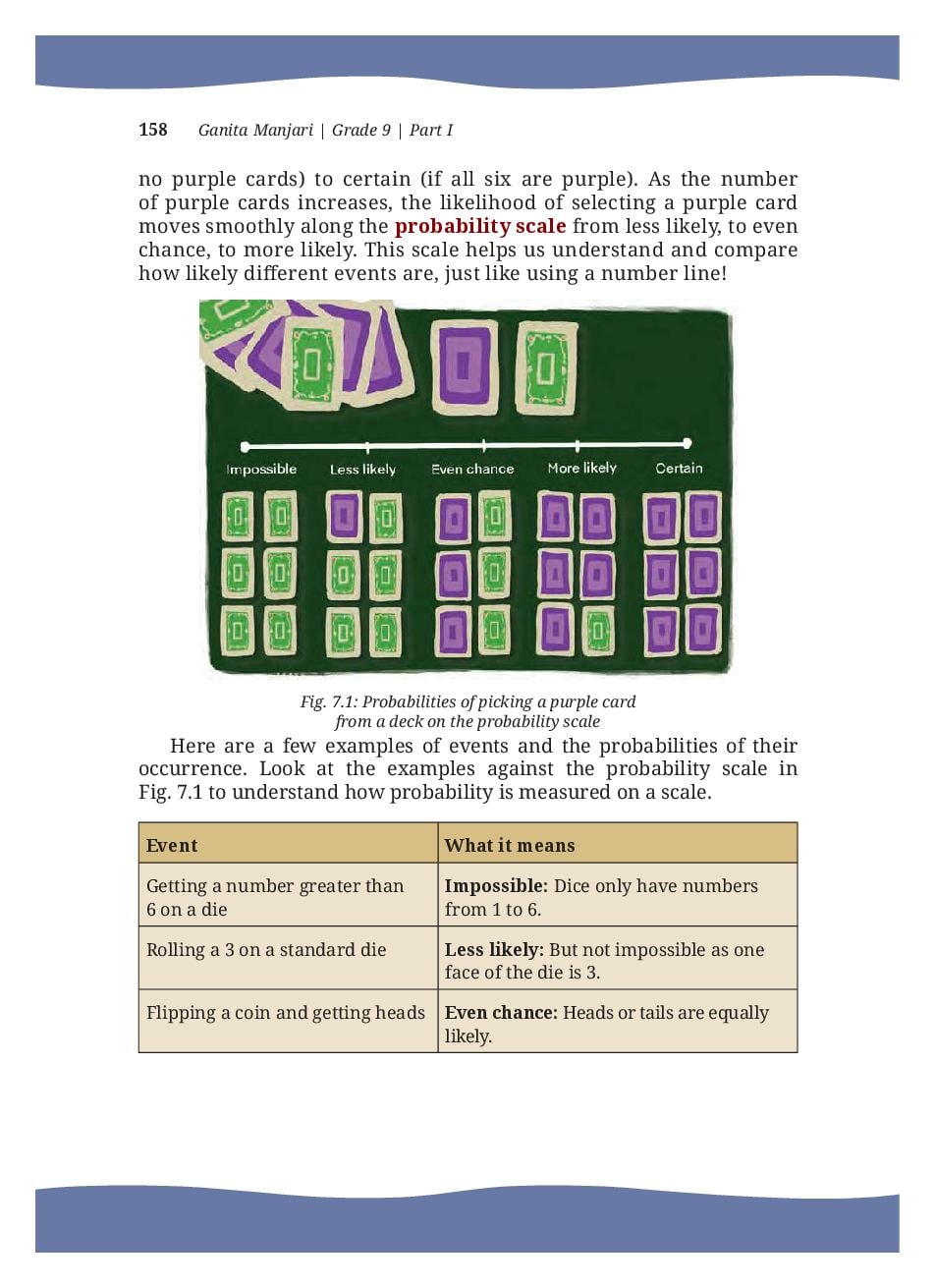
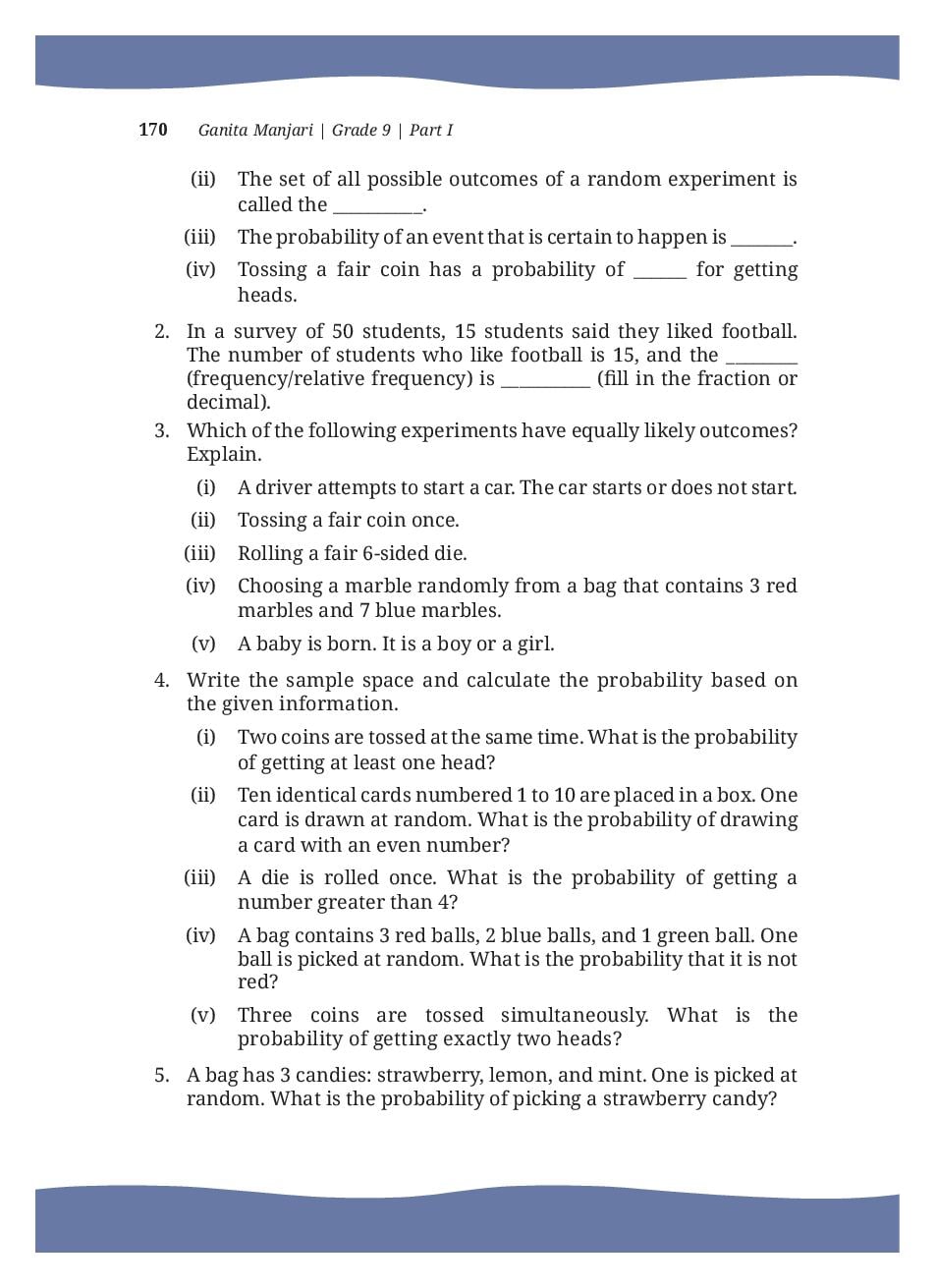
- Probability measures how likely an event is, on a scale from 0 to 1. For an event E, 0 ≤ P(E) ≤ 1. P(E) = 0 means impossible, P(E) = 1 means certain, P(E) = 1/2 means an even chance. Nothing outside [0, 1] is a probability.
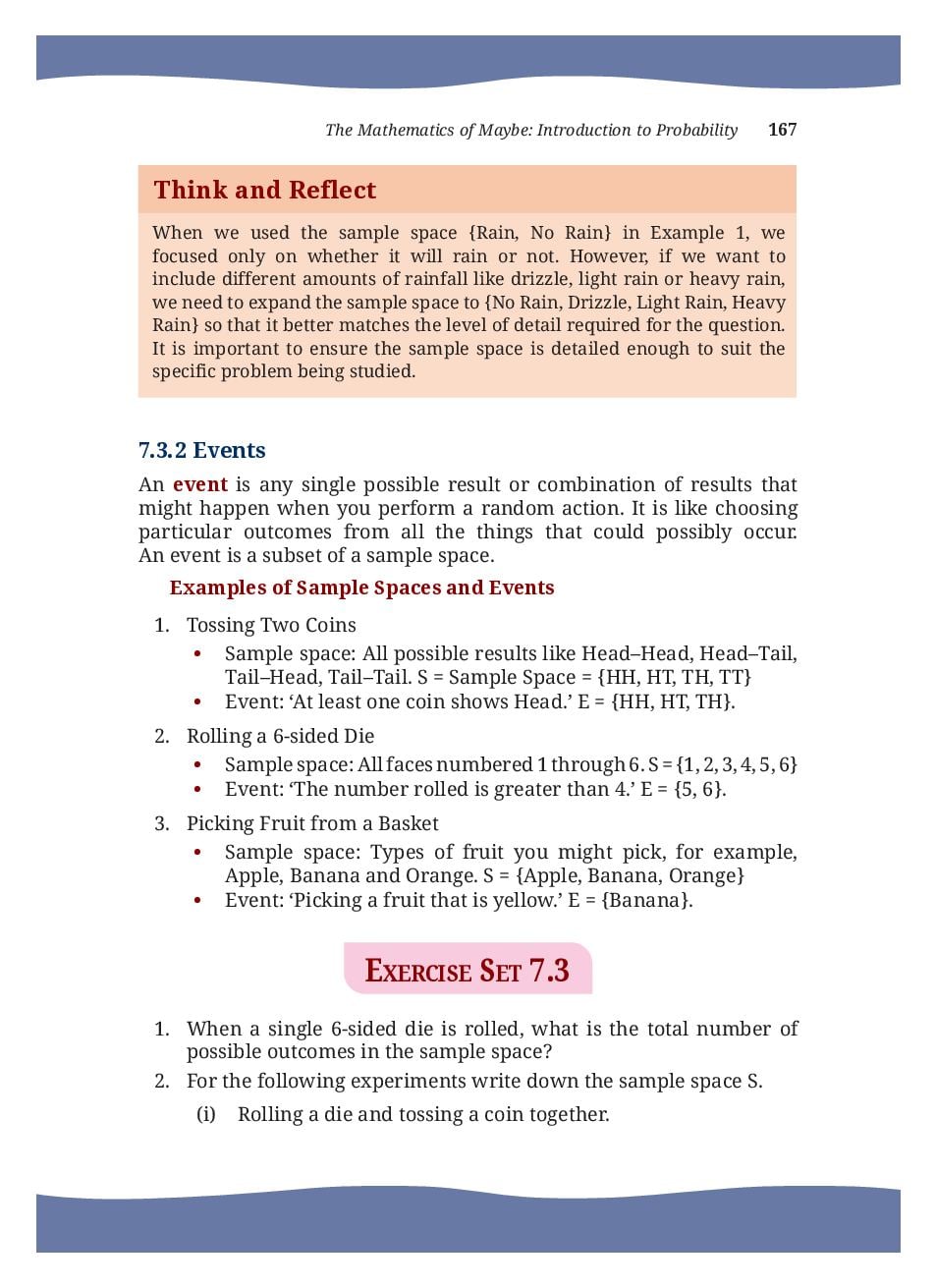
- A random experiment is one you can repeat, whose full list of possible results you know in advance, but whose result on any single trial you cannot know. The complete list of possible results is the sample space S; each item in it is an outcome; the number of items is the sample size n(S). An event is any subset of S — one outcome, several outcomes, or none.
- Experimental probability = (number of times the event occurred) ÷ (total number of trials). It is a relative frequency — it describes the data you have, so different sets of trials give different values.
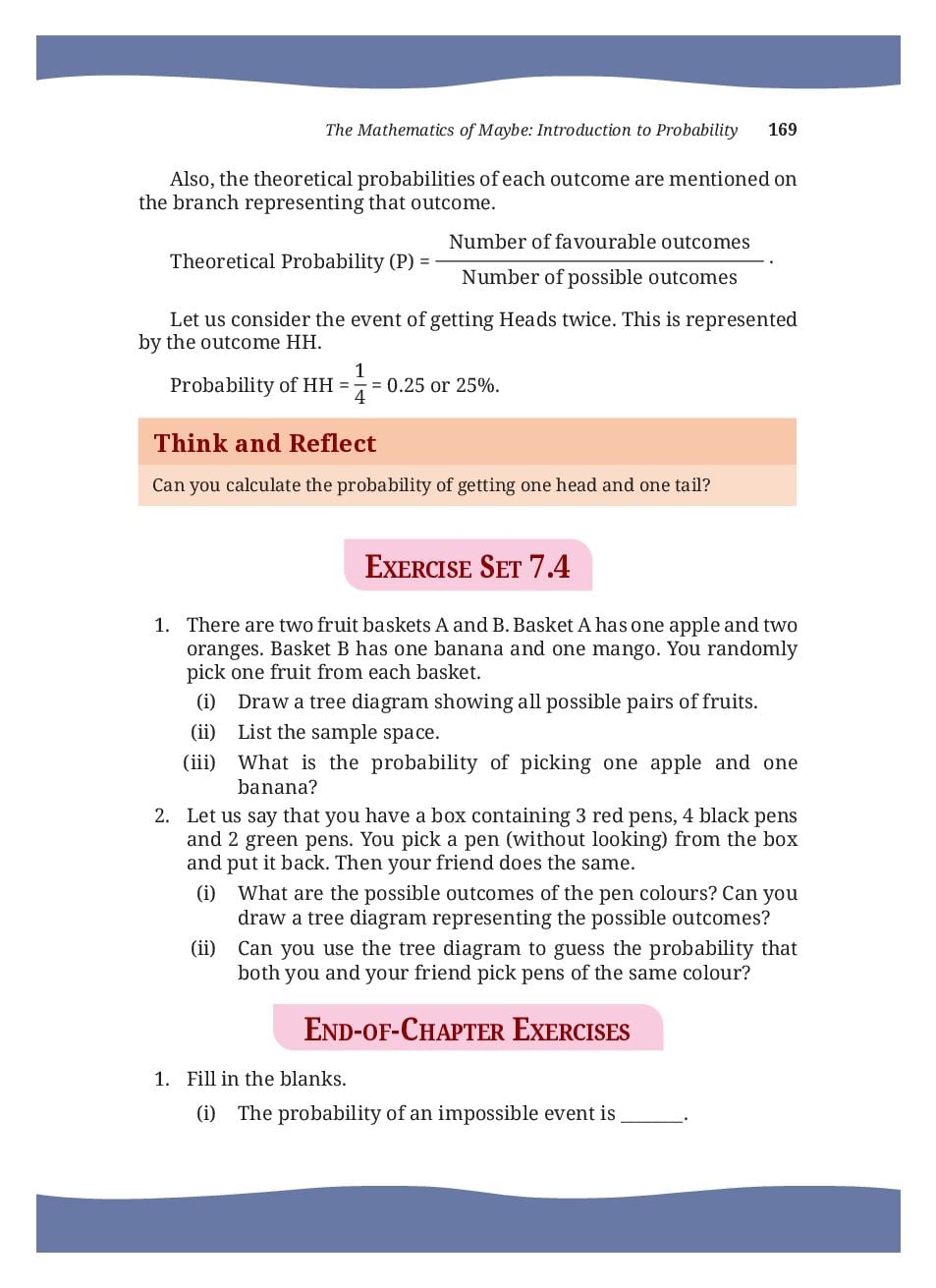
- Theoretical probability P(A) = (number of favourable outcomes) ÷ (number of possible outcomes). This division is legitimate only when every outcome in the list is equally likely. If the outcomes are not equally likely, counting them gives a wrong answer — you must go back and rewrite the sample space so that its members really are equally likely.
- By the Law of Large Numbers, the more trials you perform, the closer the experimental probability tends to settle to the theoretical probability. It does not say the two must agree in a short run, and it does not make a run of one result “due” to be corrected — that mistake is the Gambler’s Fallacy. Coins and dice have no memory: independent trials.
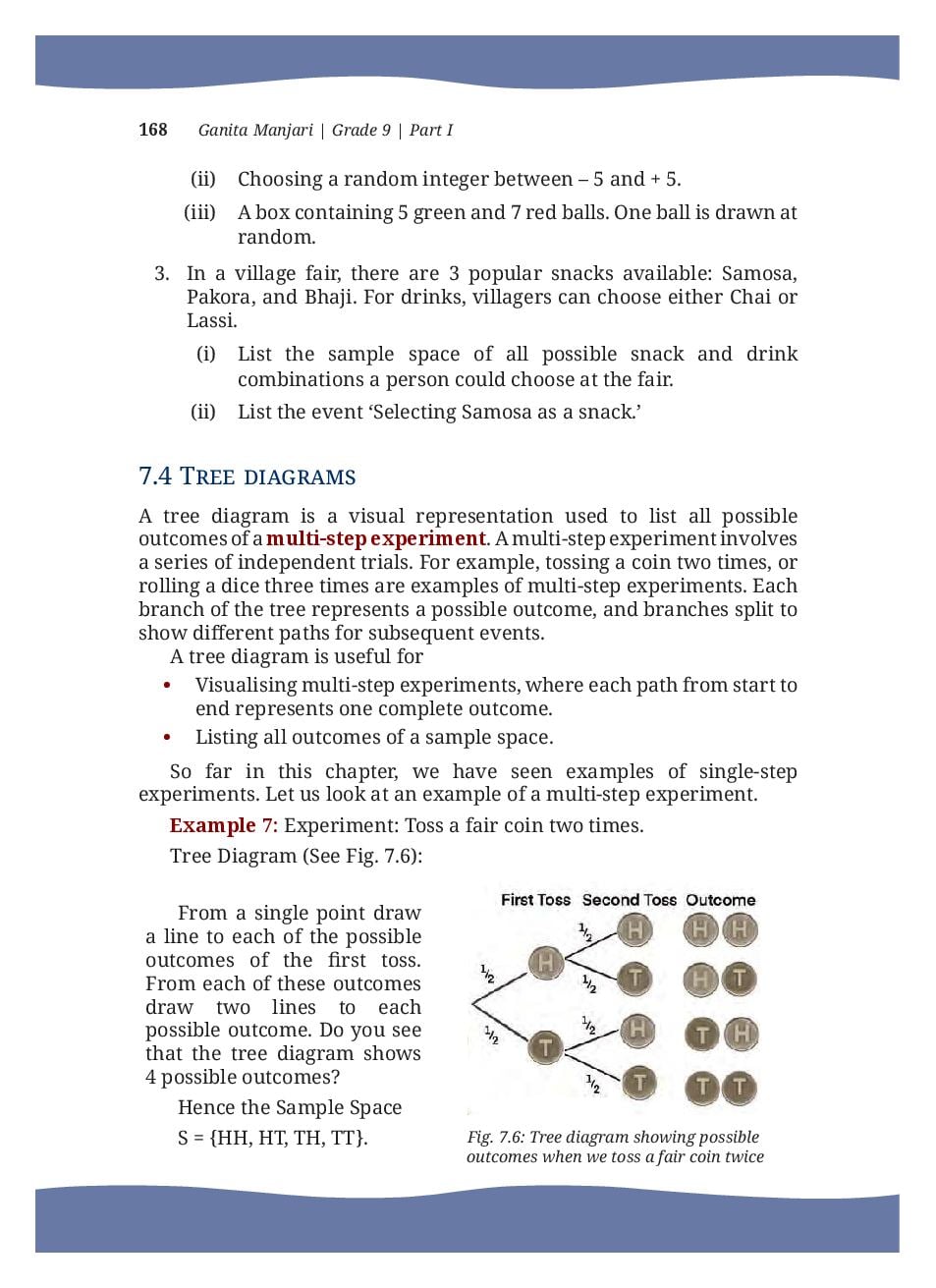
- A tree diagram lists the outcomes of a multi-step experiment: one complete path from root to leaf is one outcome. Multiply along a path to get its probability; add the paths that make up an event. Every tree’s leaf probabilities add to 1.
Quick revision – The Mathematics of Maybe: Introduction to Probability
| Idea | In symbols / formula | What it really says | Where students slip |
|---|---|---|---|
| Outcome | One element of S | A single, complete result of one trial | Calling a group of results one outcome |
| Sample space | S = {o1, o2, …, on} | Every possible outcome, each listed exactly once | Leaving out an outcome, or listing one twice |
| Sample size | N(S) | How many outcomes S contains | Counting types instead of outcomes |
| Event | E ⊆ S | Any selection of outcomes from S | Forgetting that E may hold 0, 1 or many outcomes |
| Experimental probability | (times event occurred)/(total trials) | A relative frequency measured from data | Expecting it to equal the theoretical value exactly |
| Theoretical probability | P(A) = n(A)/n(S) | Fraction of the equally likely outcomes that are favourable | Using it when the outcomes are not equally likely |
| Probability scale | 0 ≤ P(E) ≤ 1 | 0 impossible · 1/2 even chance · 1 certain | Writing an answer bigger than 1, or a negative one |
| Complement | P(not E) = 1 − P(E) | Every trial either gives E or does not | Adding when you should subtract |
| Two-stage tree | P(path) = product of its branches | The branches on one path happen one after the other | Multiplying when you should add, and the reverse |
| Independence | P stays the same whatever happened before | A fair die has no memory | Gambler’s Fallacy: thinking a 6 is now ‘due’ |
| Without replacement | Second denominator drops by 1 | The first draw really has changed the box | Reusing the first-stage fractions at the second stage |
| Law of Large Numbers | Experimental → theoretical | More trials, steadier relative frequency | Reading it as a promise about the next trial |
Old NCERT vs New – Class 9 Maths
This chapter is from Ganita Manjari, the new NCERT Class 9 Maths book (NCF-SE 2023, used from 2026-27). It replaced the old book “Mathematics”, so chapter numbers and names differ from older PDFs.
Solutions and All Chapters
Answers to the exercises and the full chapter list of Ganita Manjari:
The Mathematics of Maybe: Introduction to Probability – Overview
| Class | Class 9 |
| Subject | Maths |
| Book | Ganita Manjari – new NCERT book |
| Part | Part I |
| Chapter | 7 of 14 – The Mathematics of Maybe: Introduction to Probability |
| Book pages | 155 – 173 |
| Edition | Latest NCERT edition (2026-27) |
| Session | 2026-27 |
| Free – read online or download |
Class 9 Maths Chapter 7 – FAQs
Where can I download The Mathematics of Maybe: Introduction to Probability Class 9 PDF?
From the download table on this page – the chapter PDF is free, and the full book is linked too.
What is Class 9 Maths Chapter 7 about?
Probability measures how likely an event is, on a scale from 0 to 1. For an event E, 0 ≤ P(E) ≤ 1. P(E) = 0 means impossible, P(E) = 1 means certain, P(E) = 1/2 means an even chance. Nothing outside [0, 1] is a probability.
Is The Mathematics of Maybe: Introduction to Probability from the new NCERT Class 9 Maths book?
Yes. It is chapter 7 of ganita manjari (part i), the new NCERT Class 9 Maths book for 2026-27.
Is this the latest NCERT edition for 2026-27?
Yes – the PDF is NCERT’s latest edition for the 2026-27 session.
Where are the NCERT Solutions for Class 9 Maths Chapter 7?
Open the NCERT Solutions link above for answers to the exercise questions.