Download Exploring Algebraic Identities – NCERT Class 9 Maths Chapter 4 PDF from the new NCERT Class 9 Maths book Ganita Manjari (2026-27). Read the chapter online or download the free PDF. An equation such as x² − 1 = 24 holds only for x = 5 or x = −5; an identity such as (x + y)² = x² + 2xy + y² holds for every value of x and y. That is the whole difference.
Exploring Algebraic Identities PDF – Chapter 4 of Ganita Manjari (Part I)
Read the chapter online or download the PDF.
| Chapter | Download | |
|---|---|---|
| Chapter 4 PDF | Exploring Algebraic Identities | View PDF |
| Full book | NCERT Class 9 Maths – Ganita Manjari | View Book |
Read Online
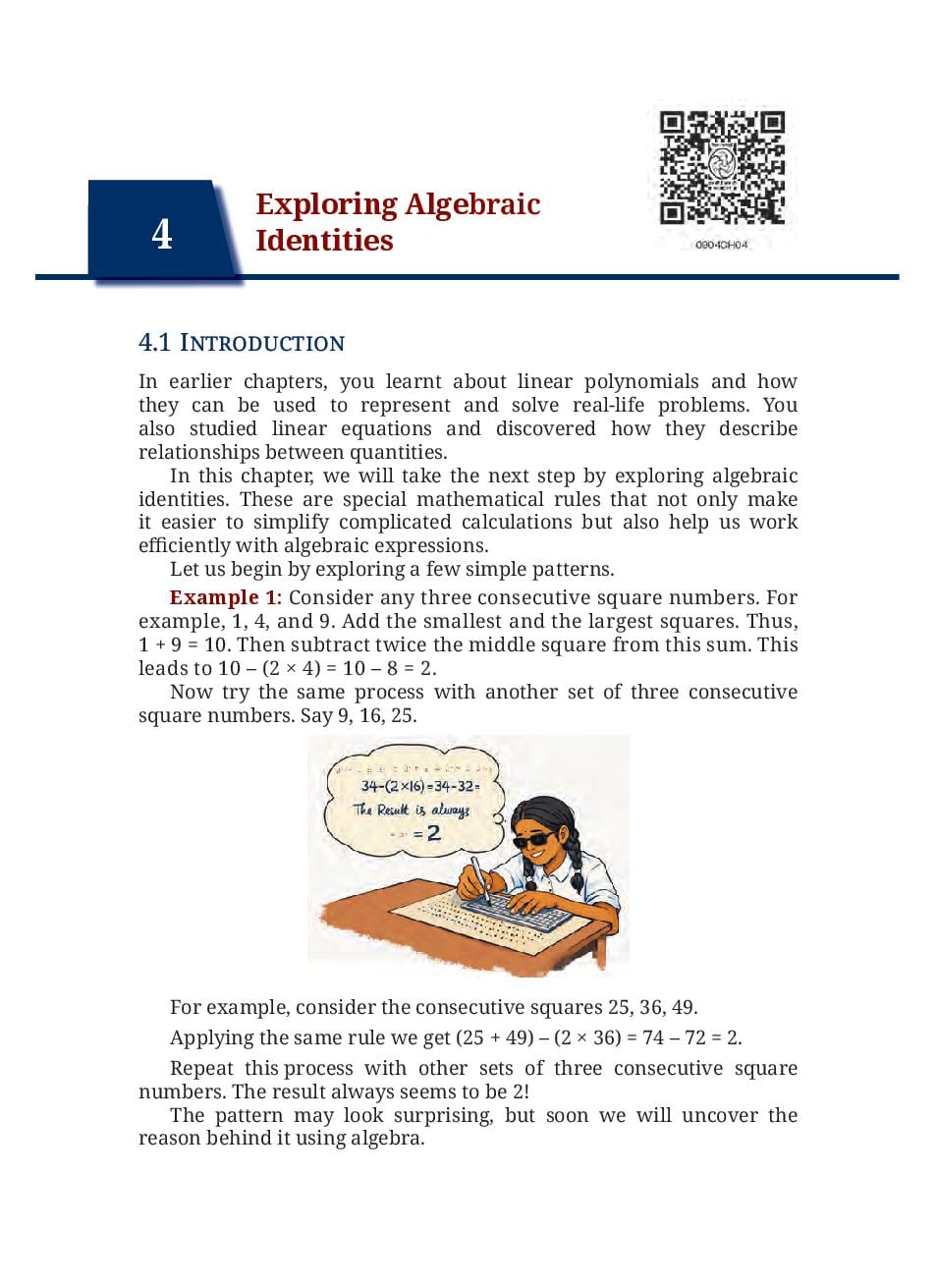
What Is in Exploring Algebraic Identities? (Class 9 Maths Chapter 4)
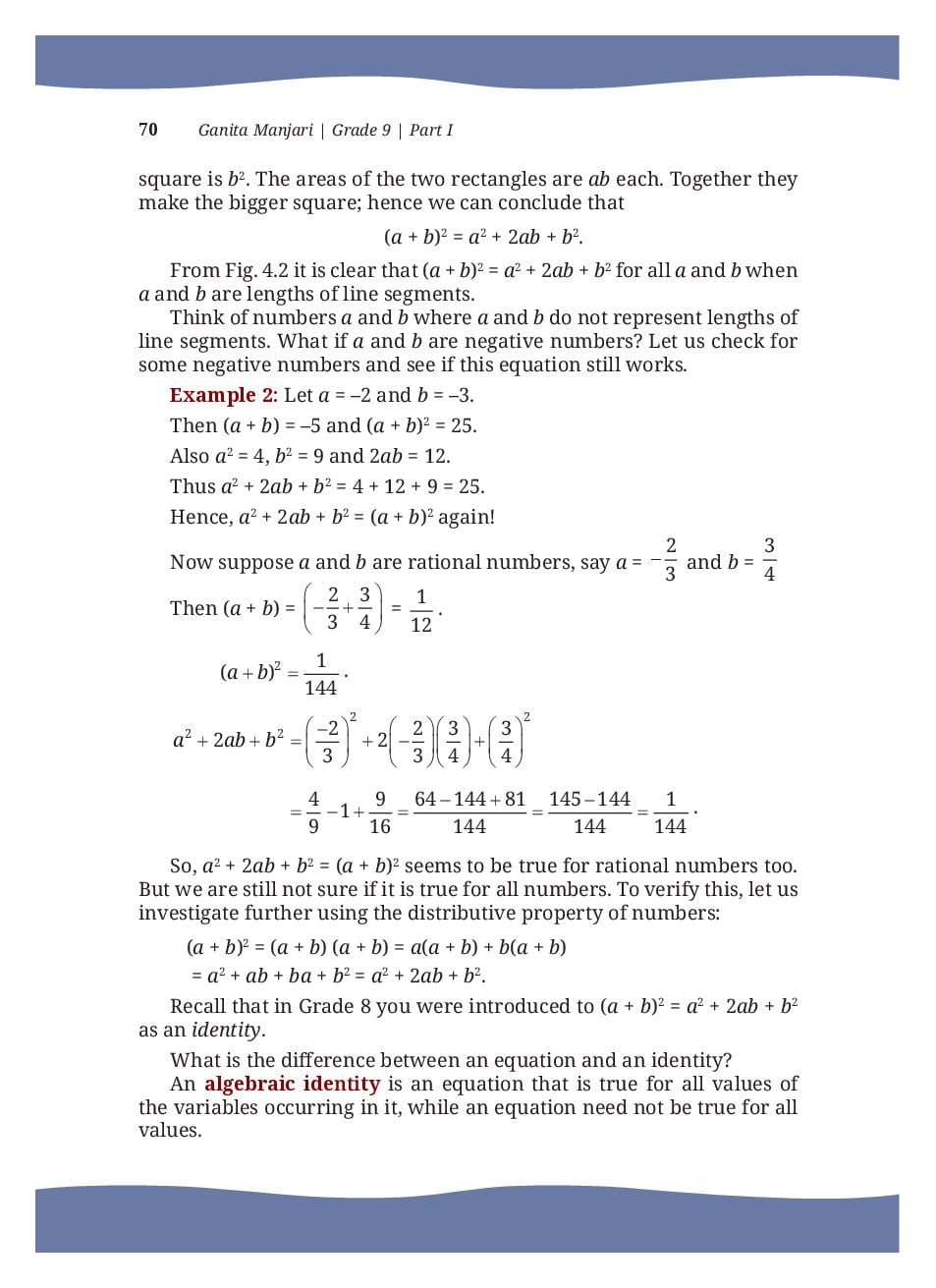
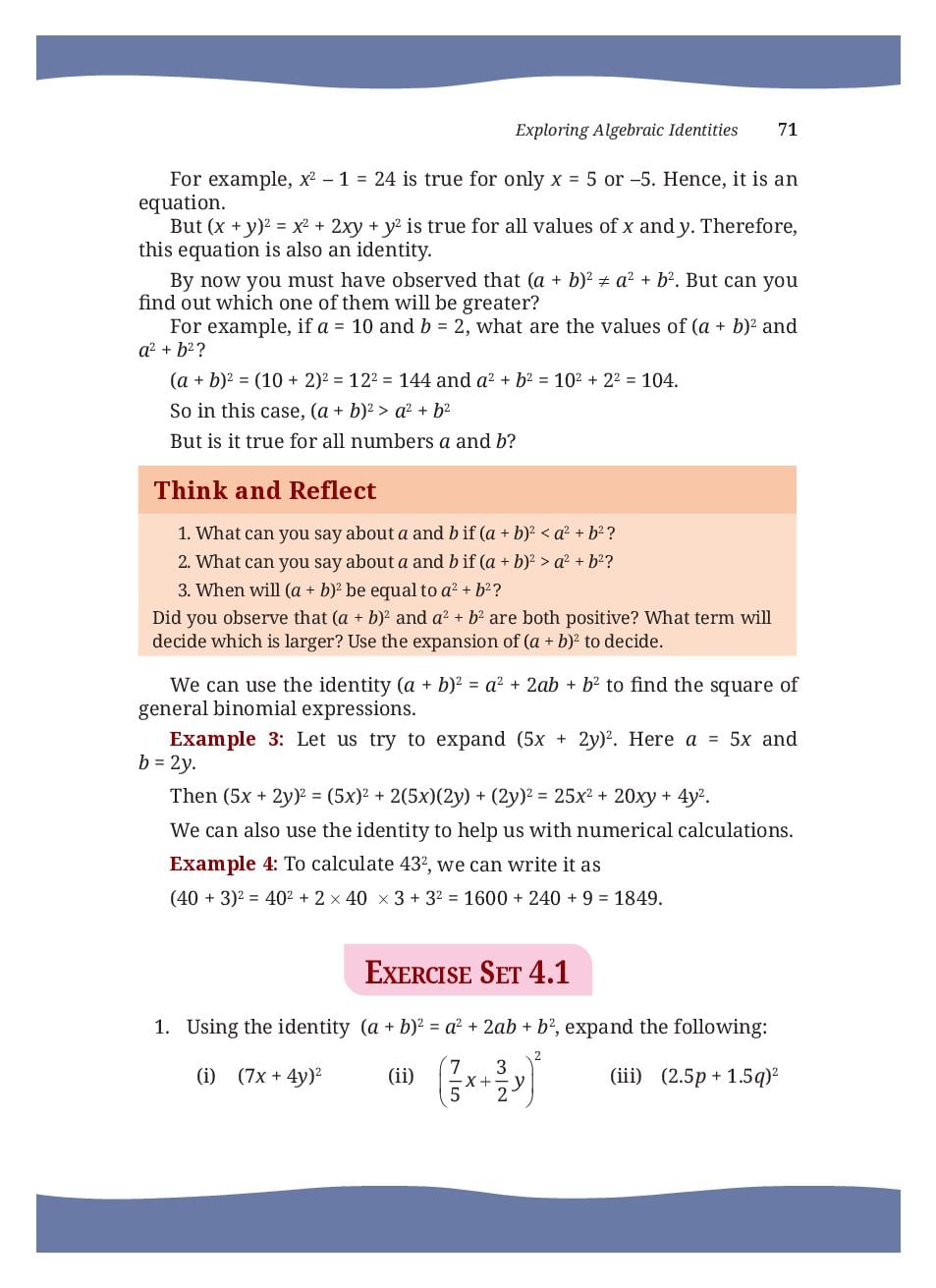
- An equation such as x² − 1 = 24 holds only for x = 5 or x = −5; an identity such as (x + y)² = x² + 2xy + y² holds for every value of x and y. That is the whole difference.
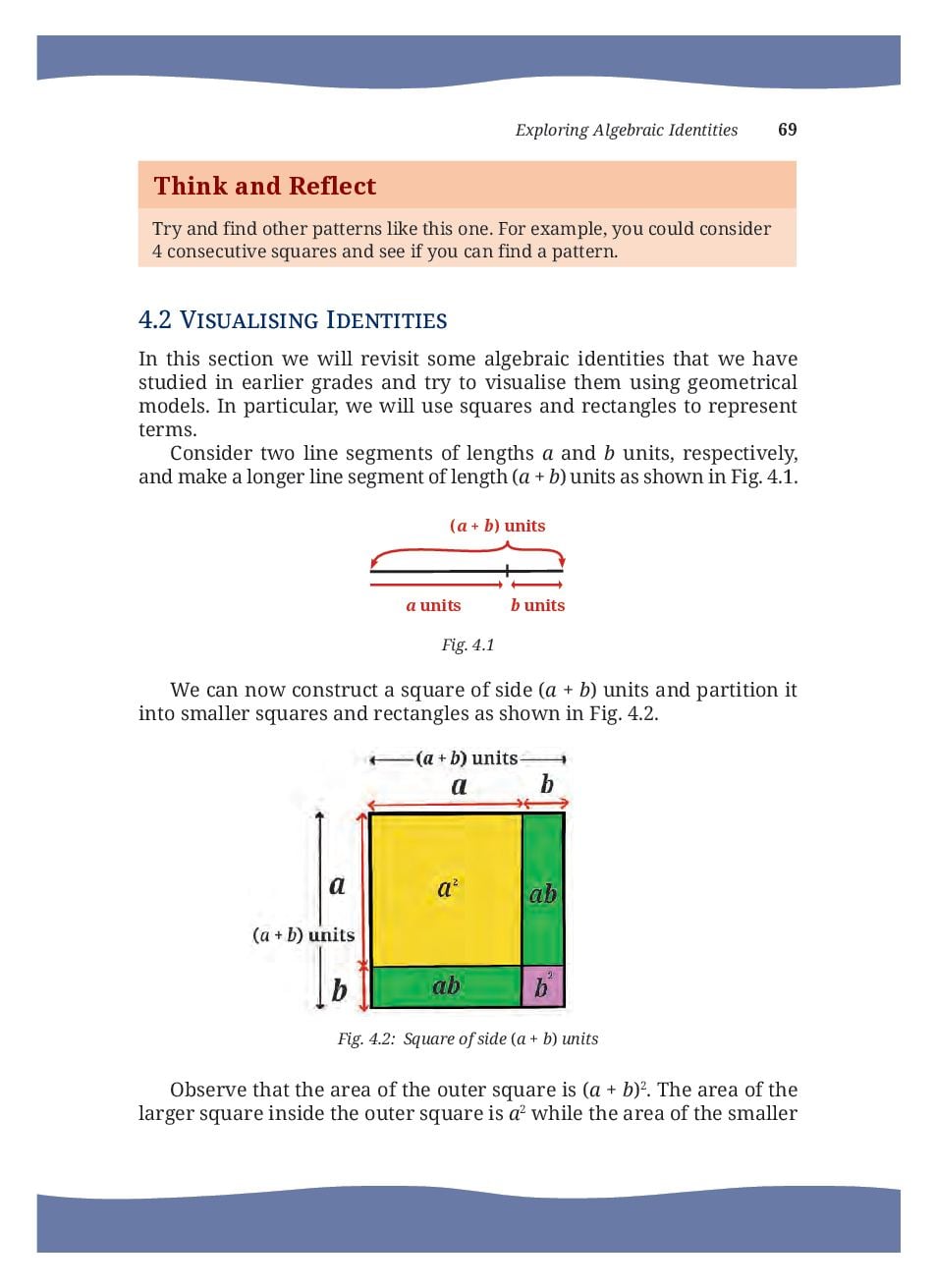
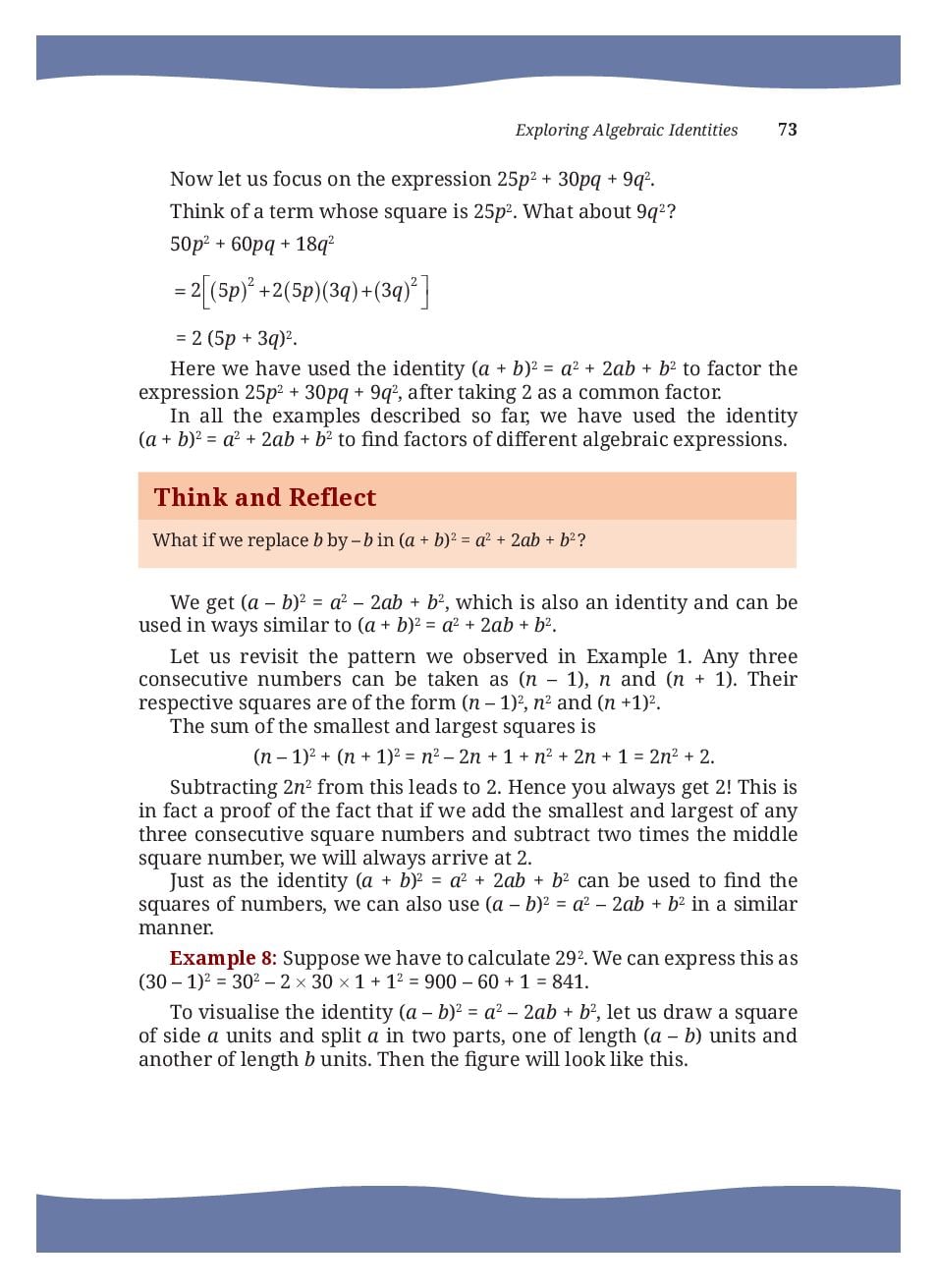
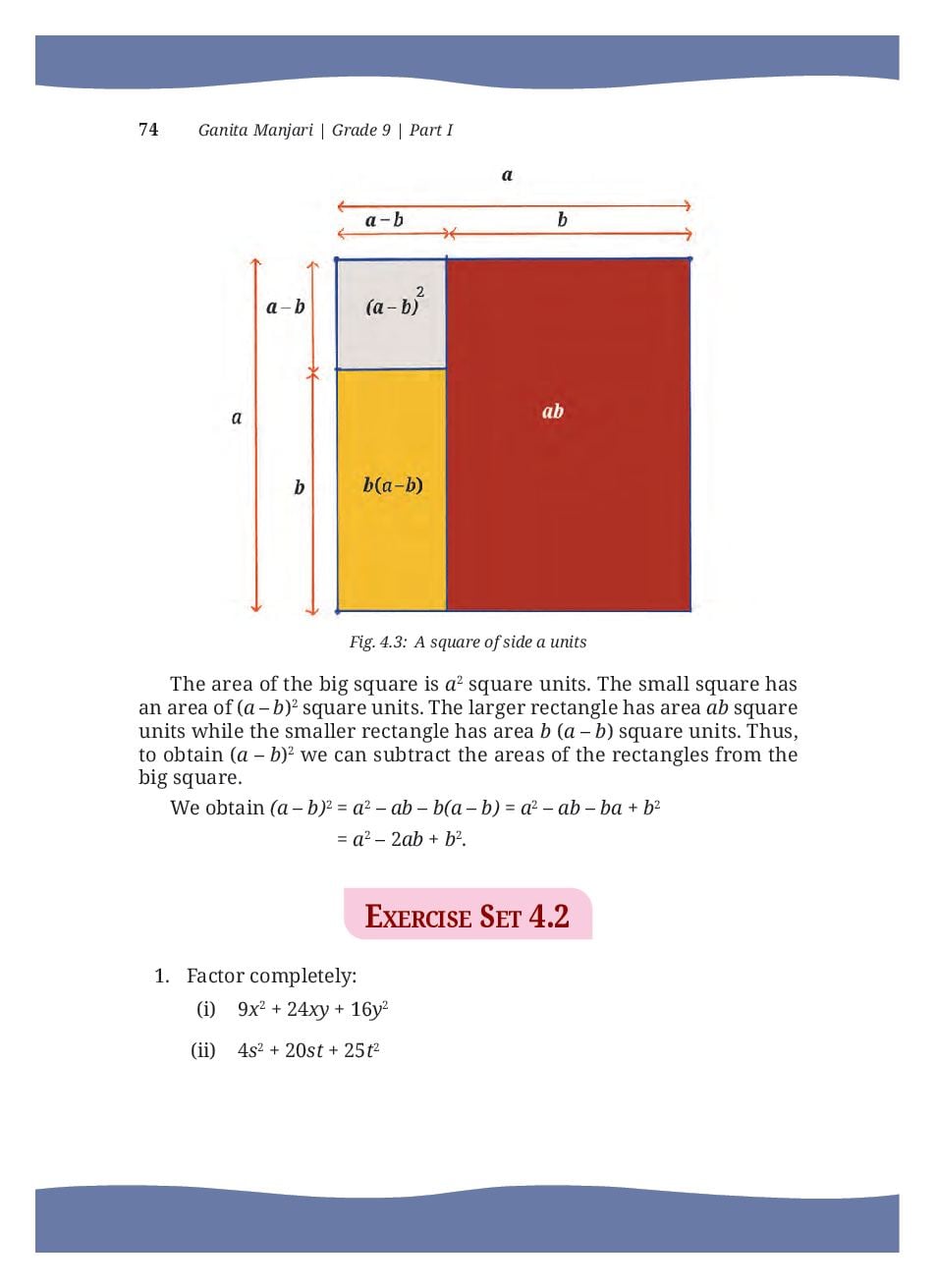
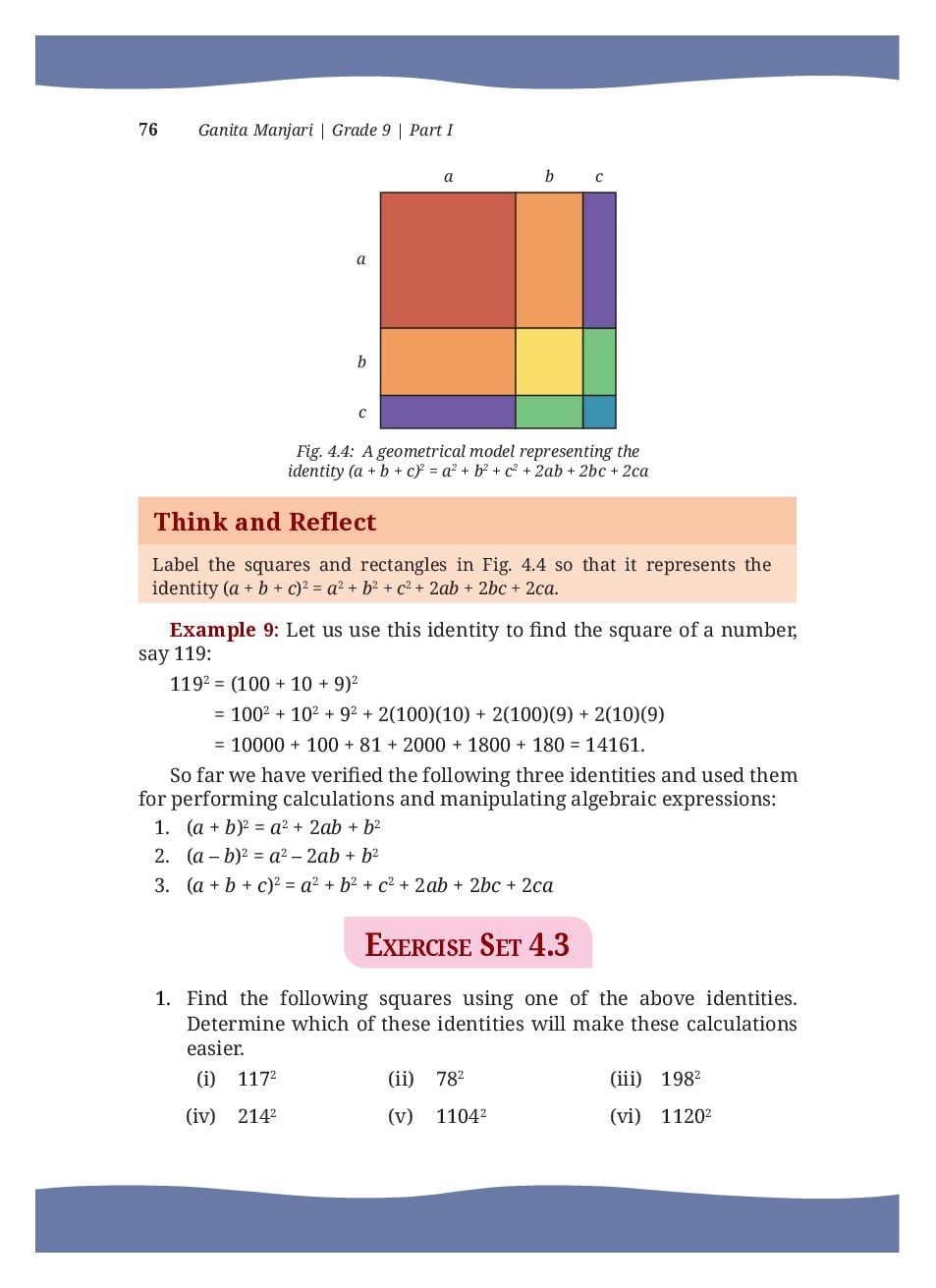
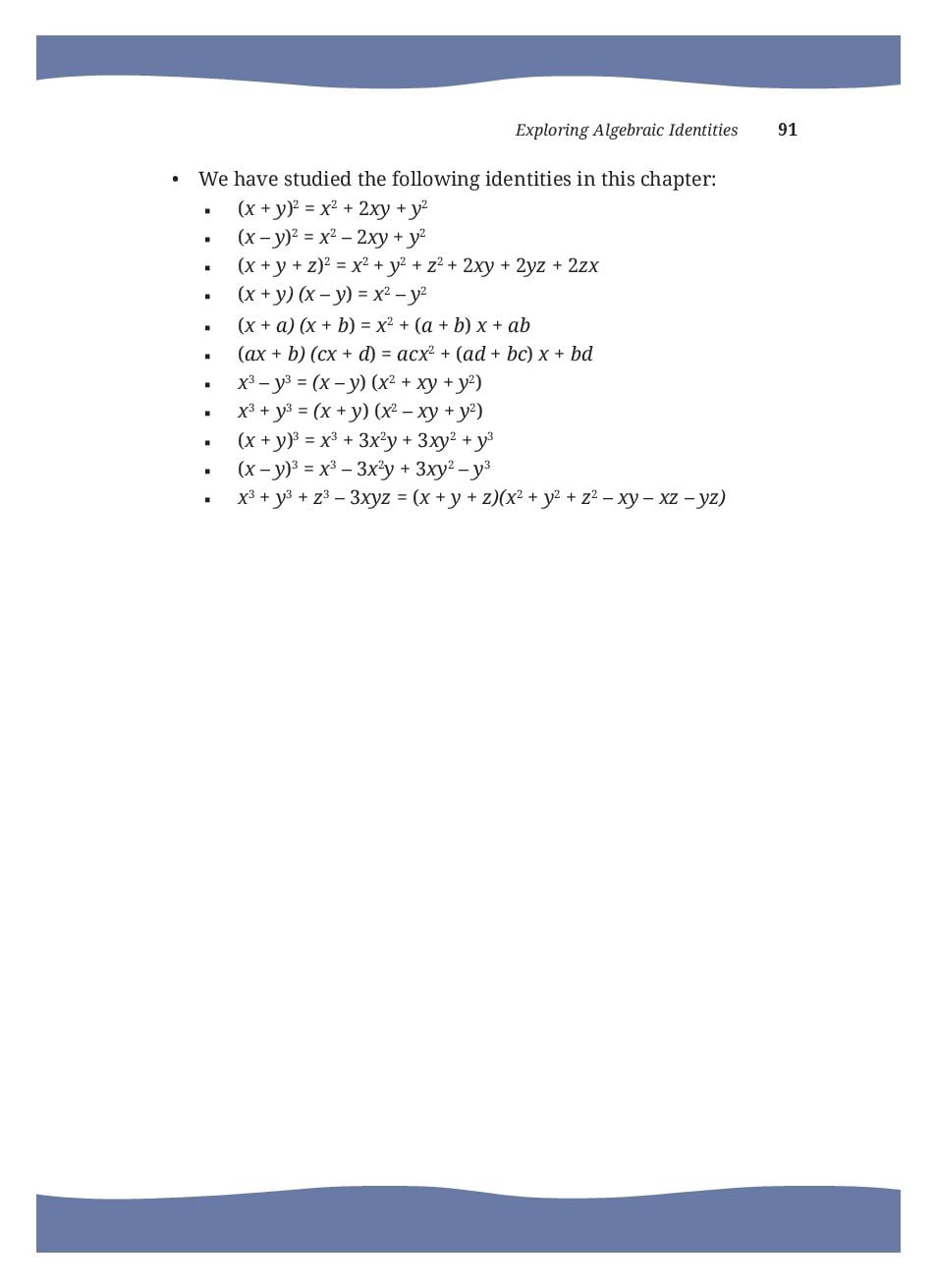
- A square of side (a + b) cuts into a², b² and two ab rectangles, so (a + b)² = a² + 2ab + b². Replacing b by −b — legitimate, because an identity is true for all values — gives (a − b)² = a² − 2ab + b². A square of side (a + b + c) cuts into nine pieces and gives the three-letter version.
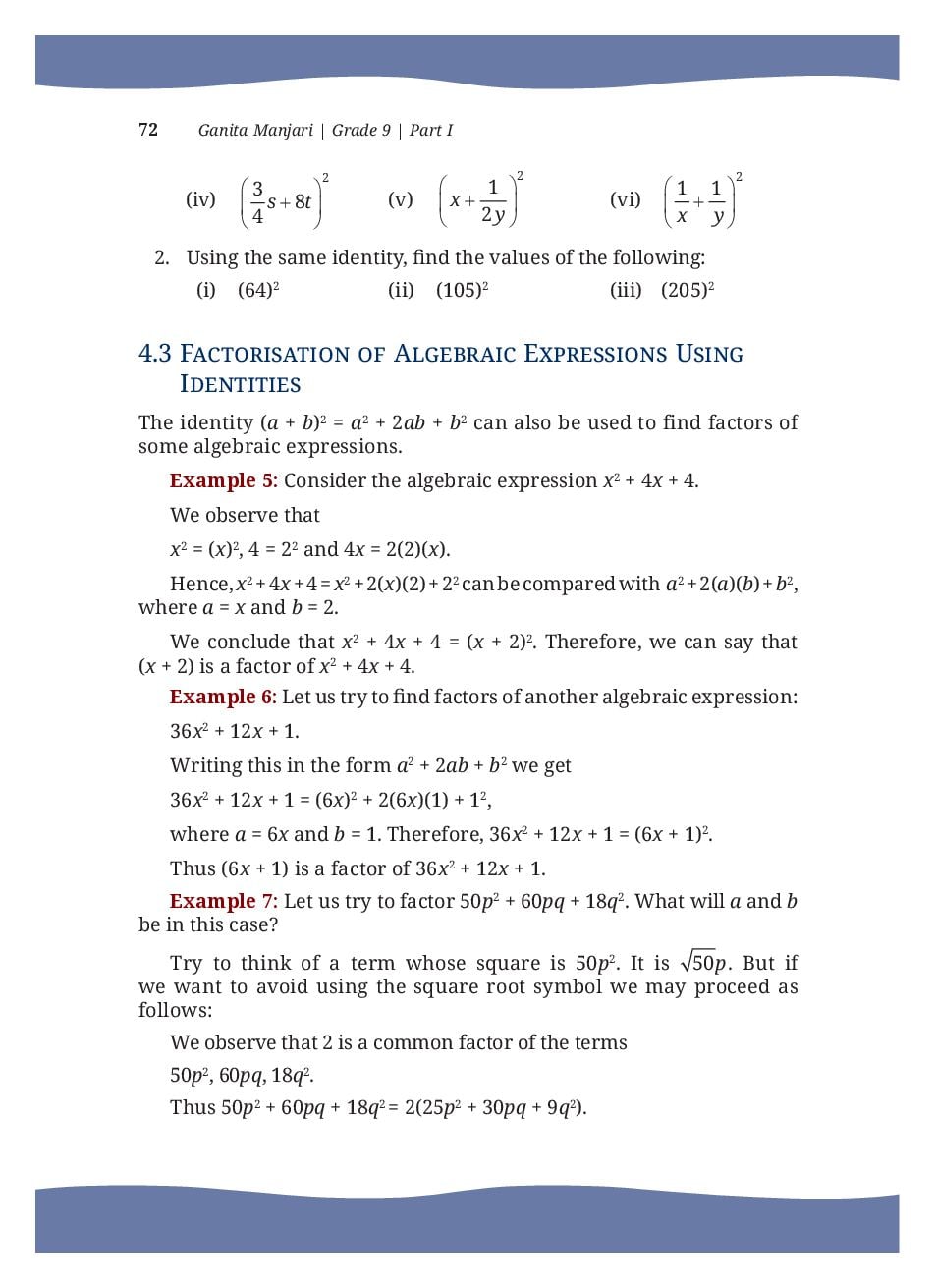
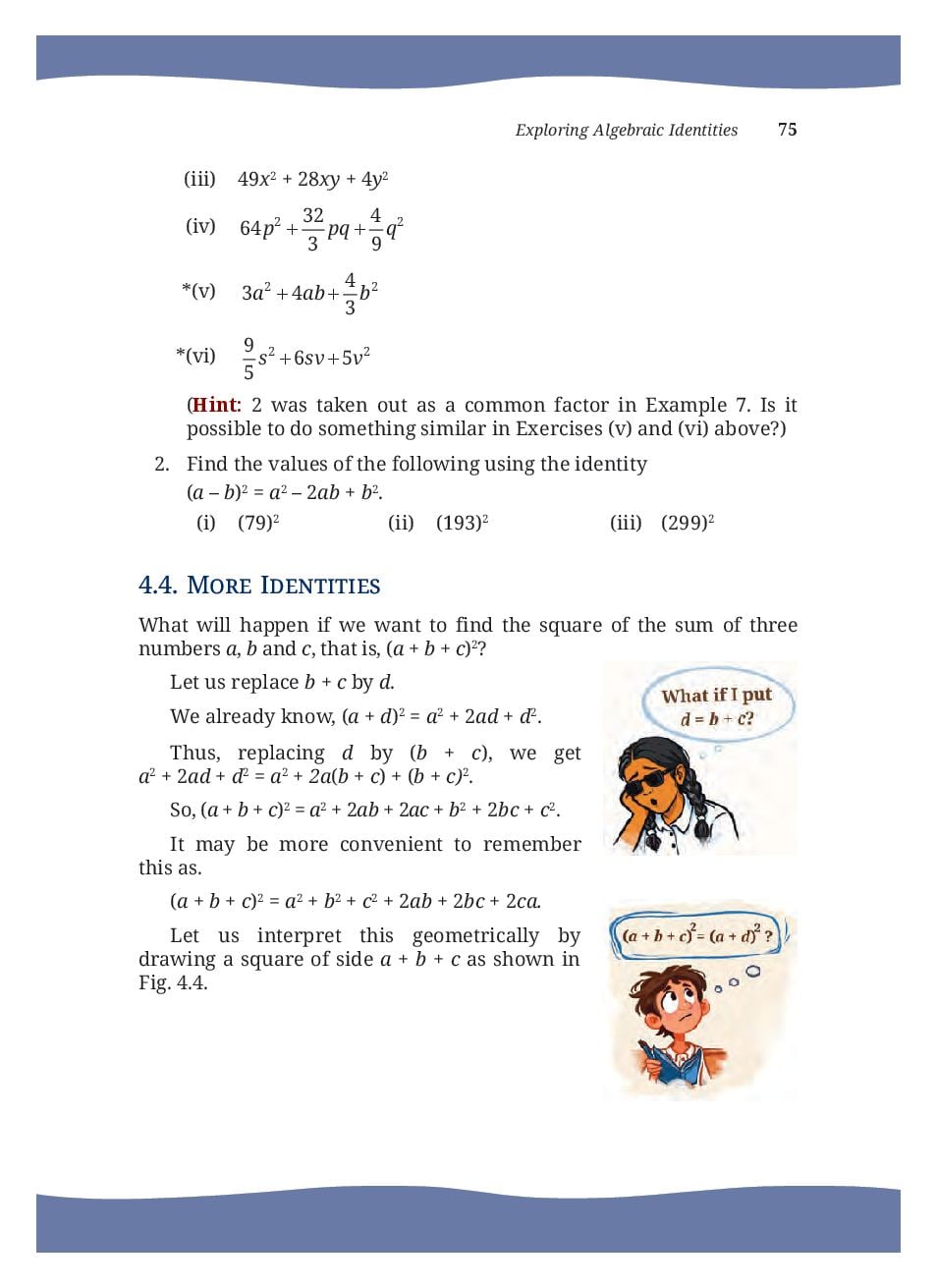
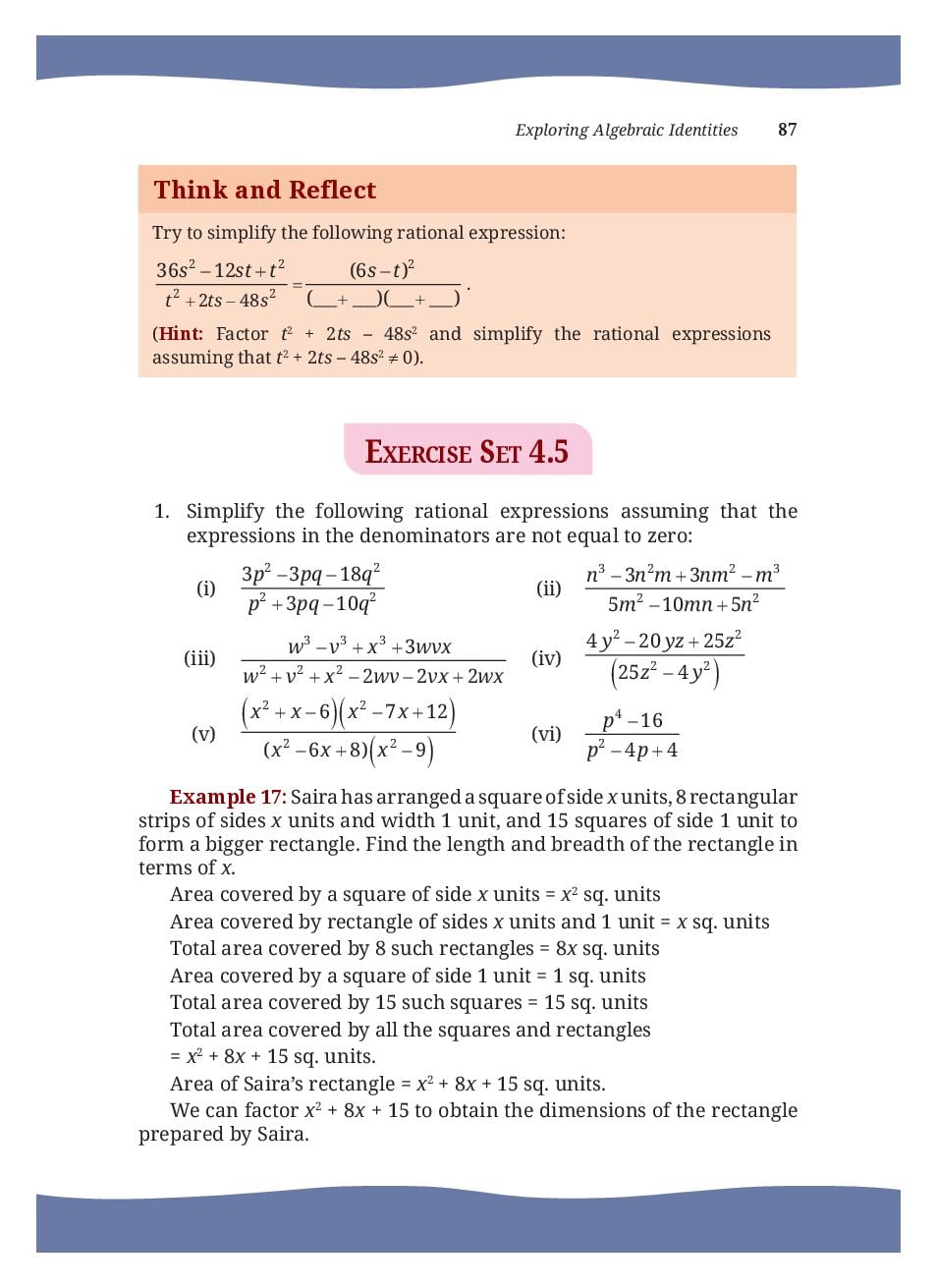
- Read backwards, every identity is a factorisation rule. Recognising a² + 2ab + b² inside 9x² + 24xy + 16y² is what lets you write it as (3x + 4y)².
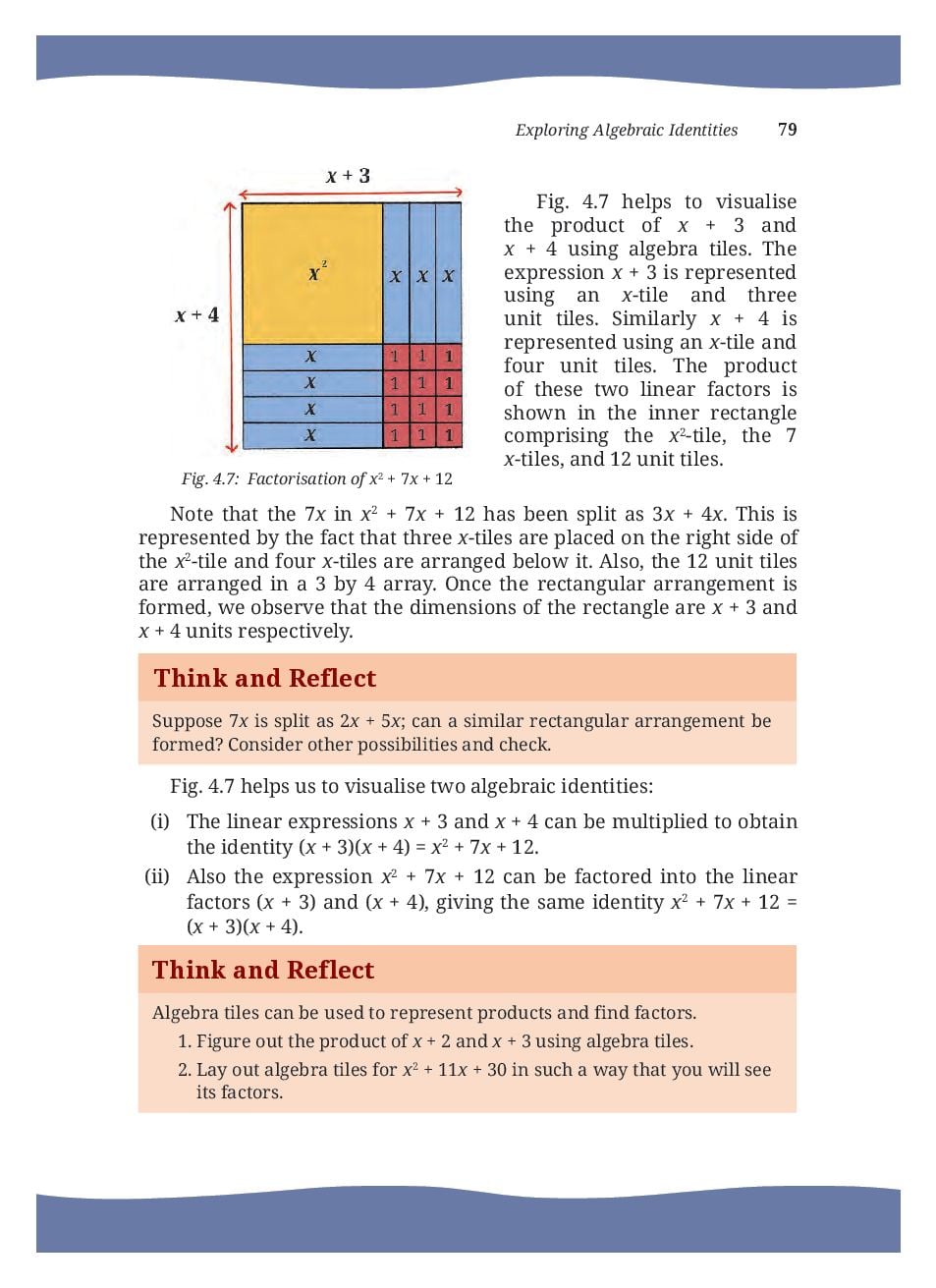
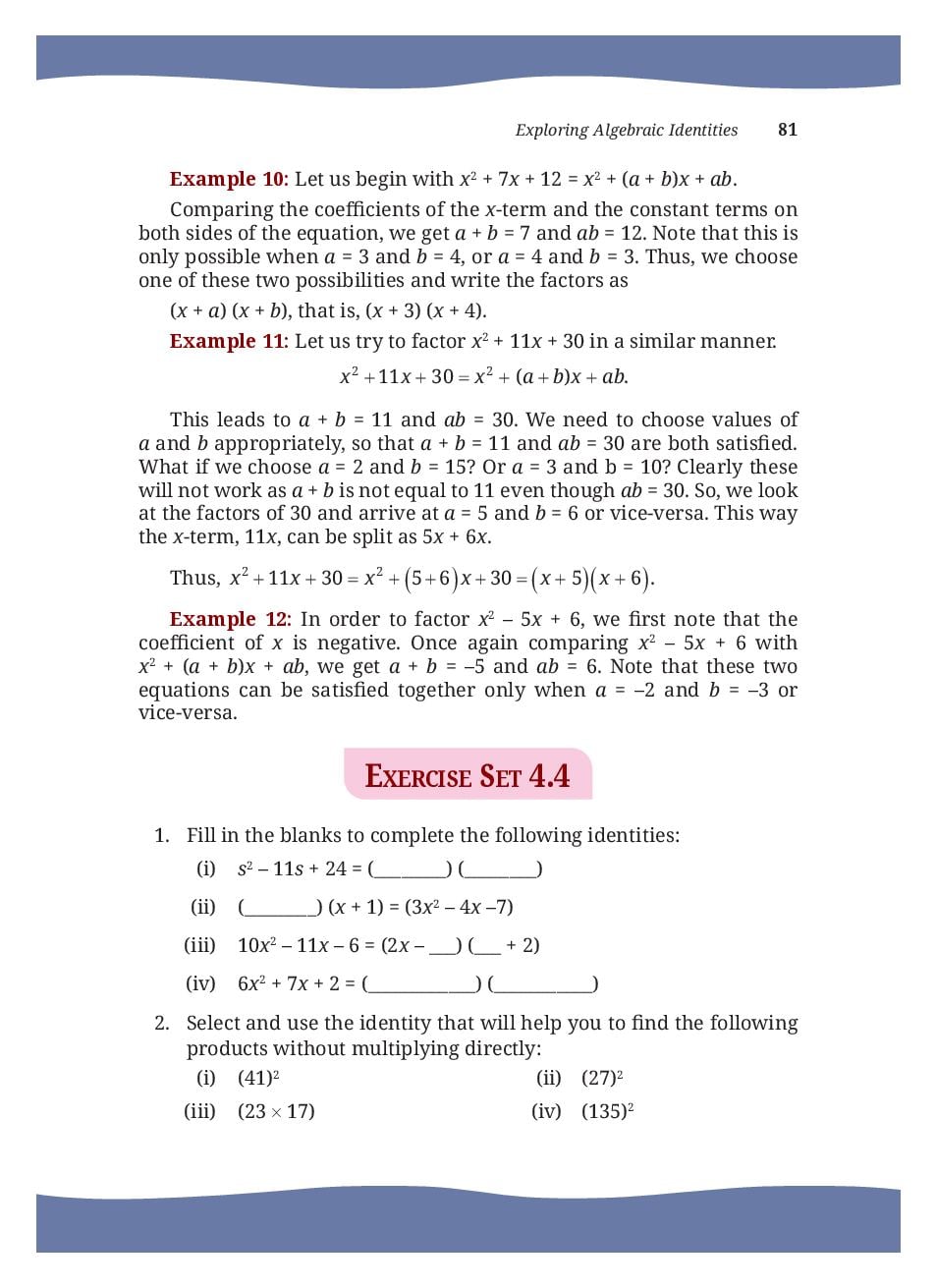
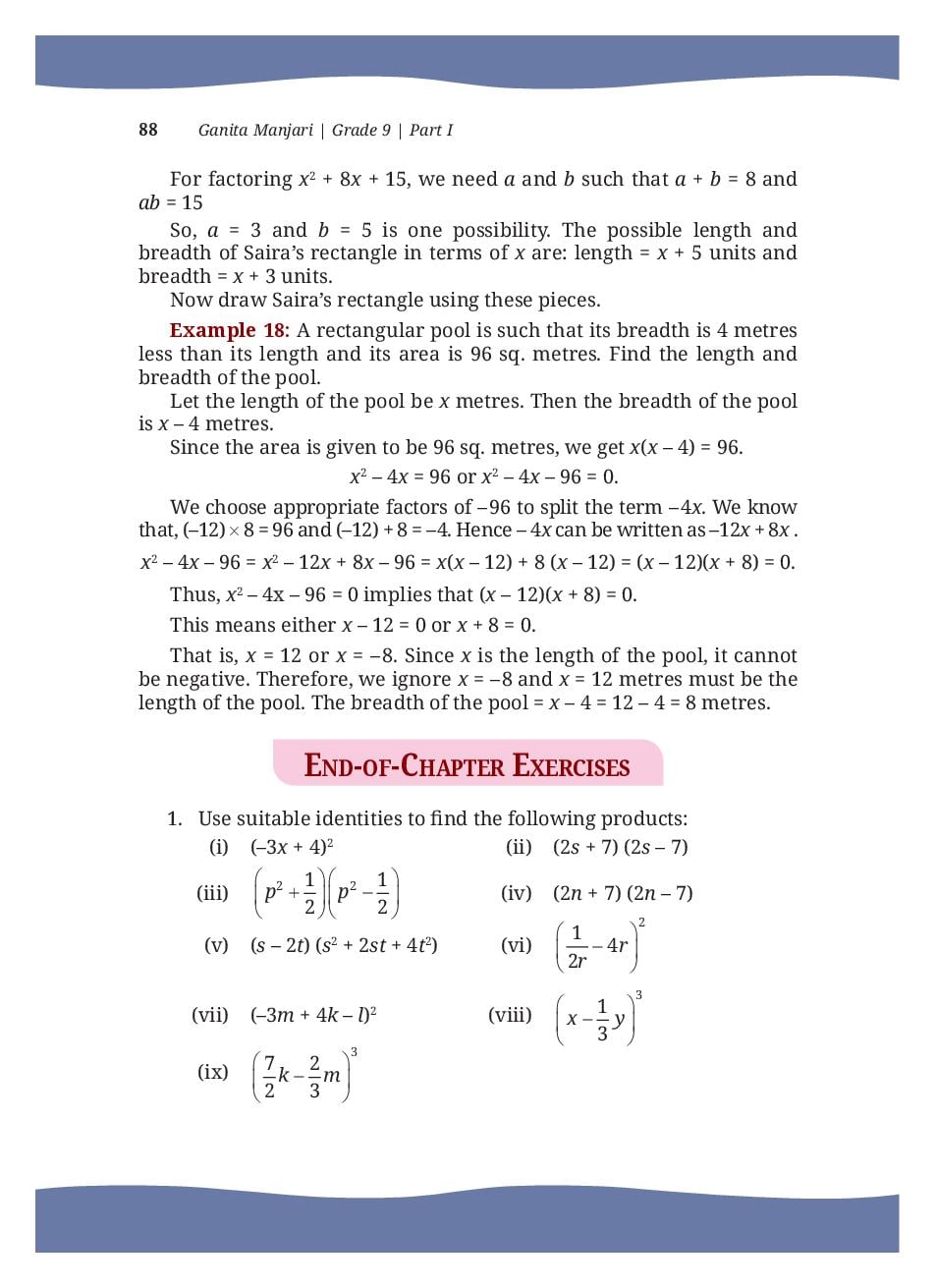
- Algebra tiles turn factorising x² + 7x + 12 into a jigsaw: the only split of 7x that makes the unit tiles fill a rectangle is 3x + 4x, because 3 + 4 = 7 and 3 × 4 = 12. Without tiles this is the ‘splitting the middle term’ method: find a and b with a + b = the x-coefficient and ab = the constant.
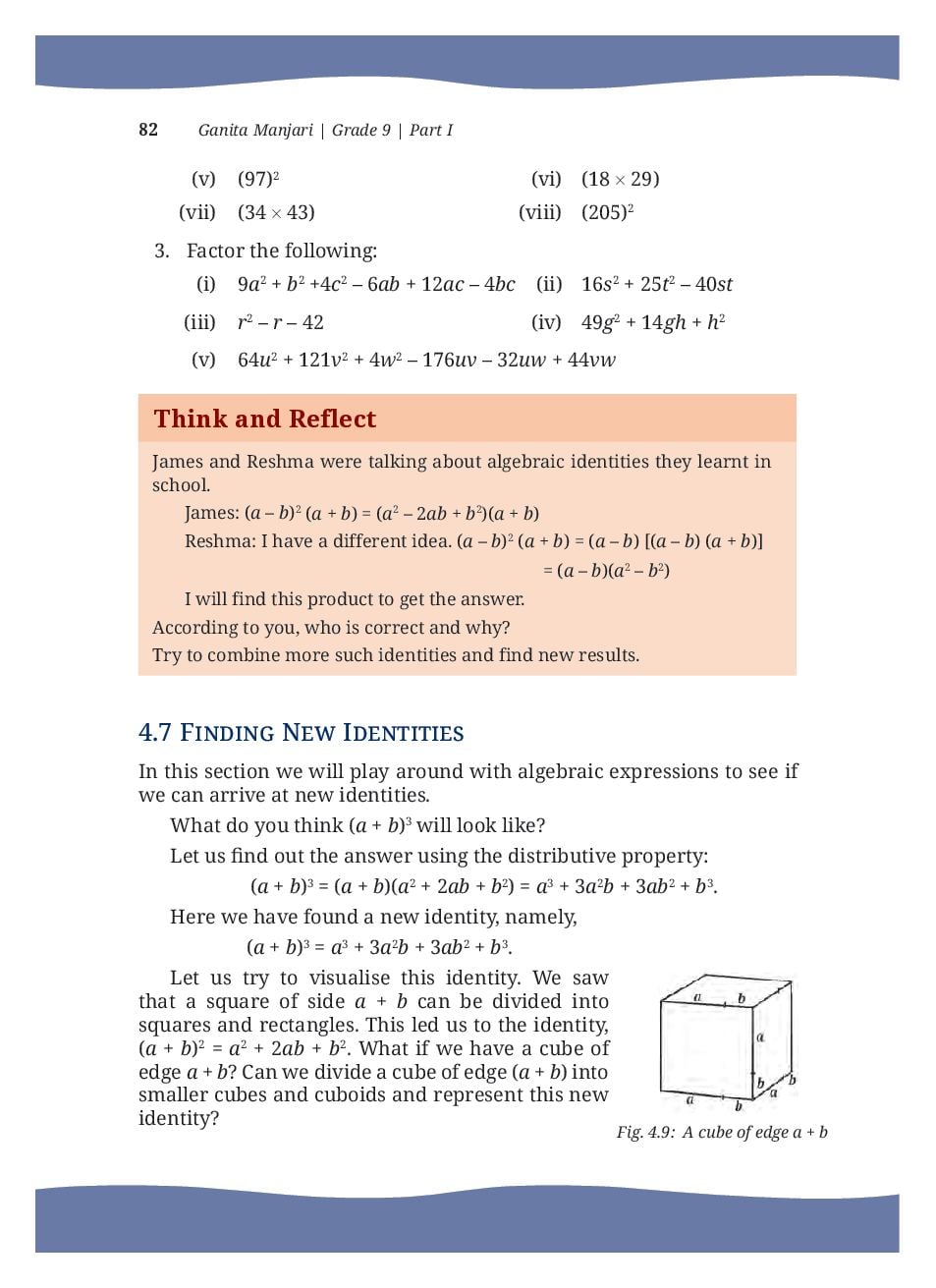
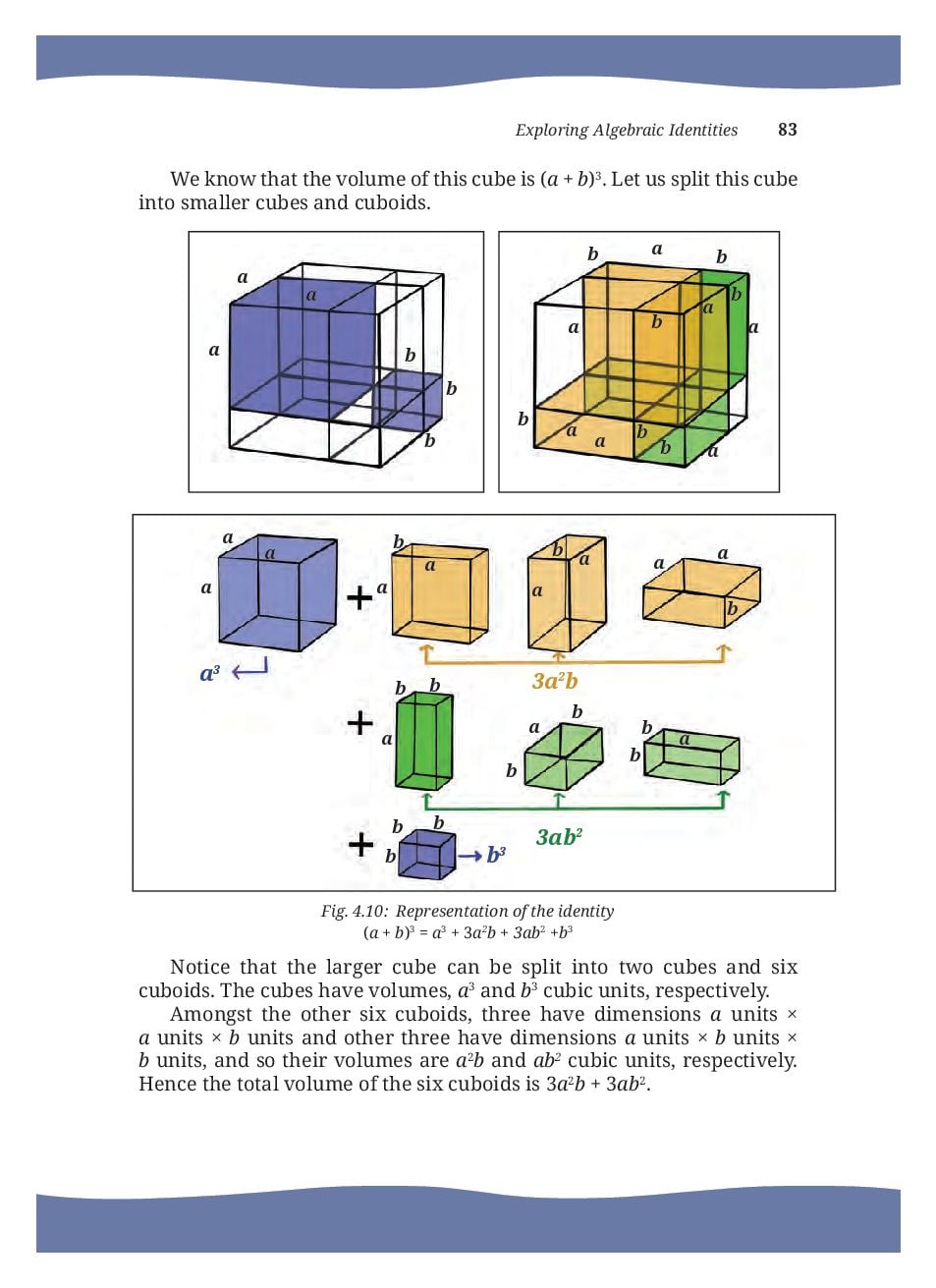
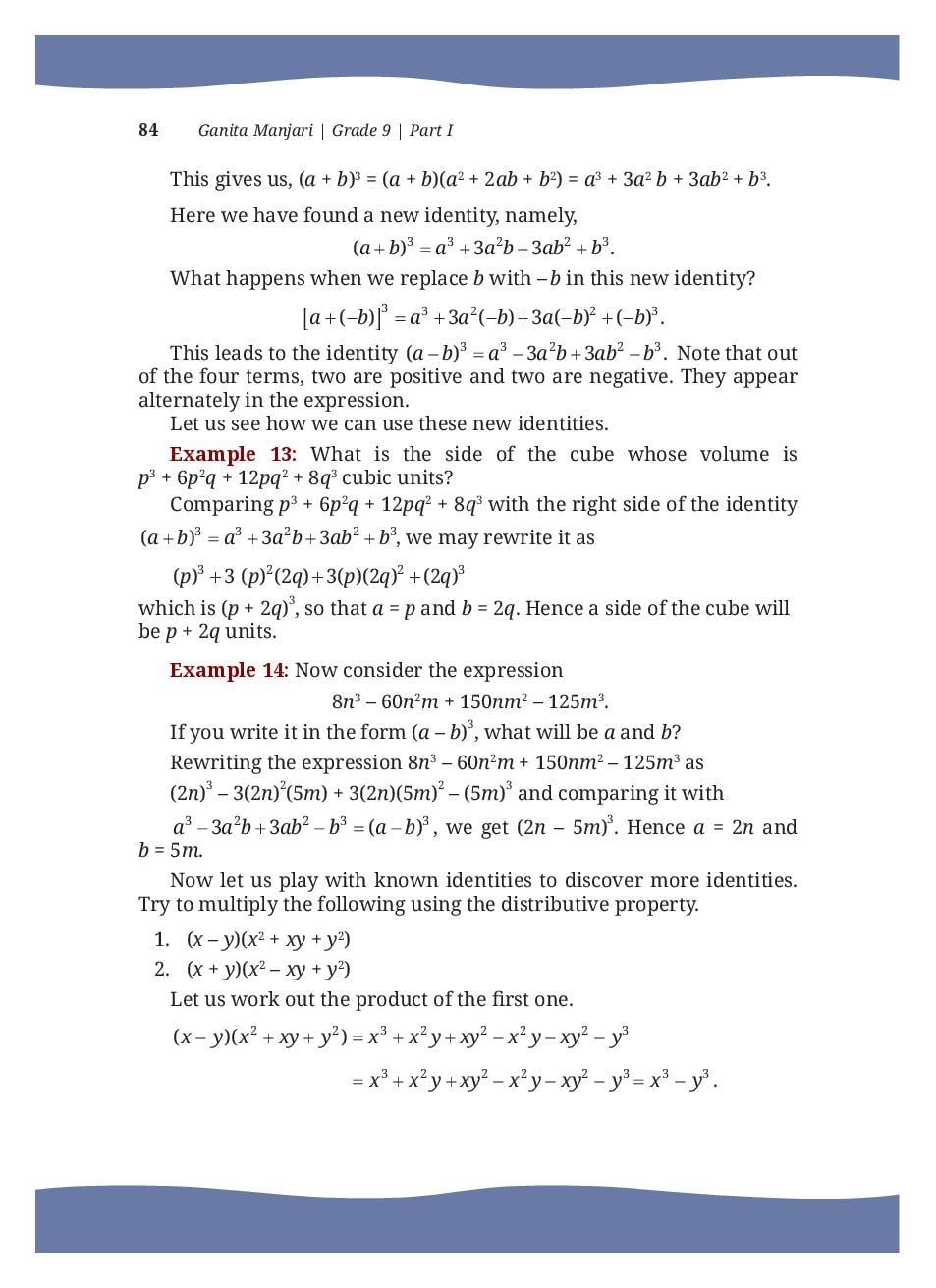
- Cubes come from the same idea one dimension up: a cube of edge (a + b) splits into two cubes and six cuboids, giving (a + b)³ = a³ + 3a²b + 3ab² + b³.
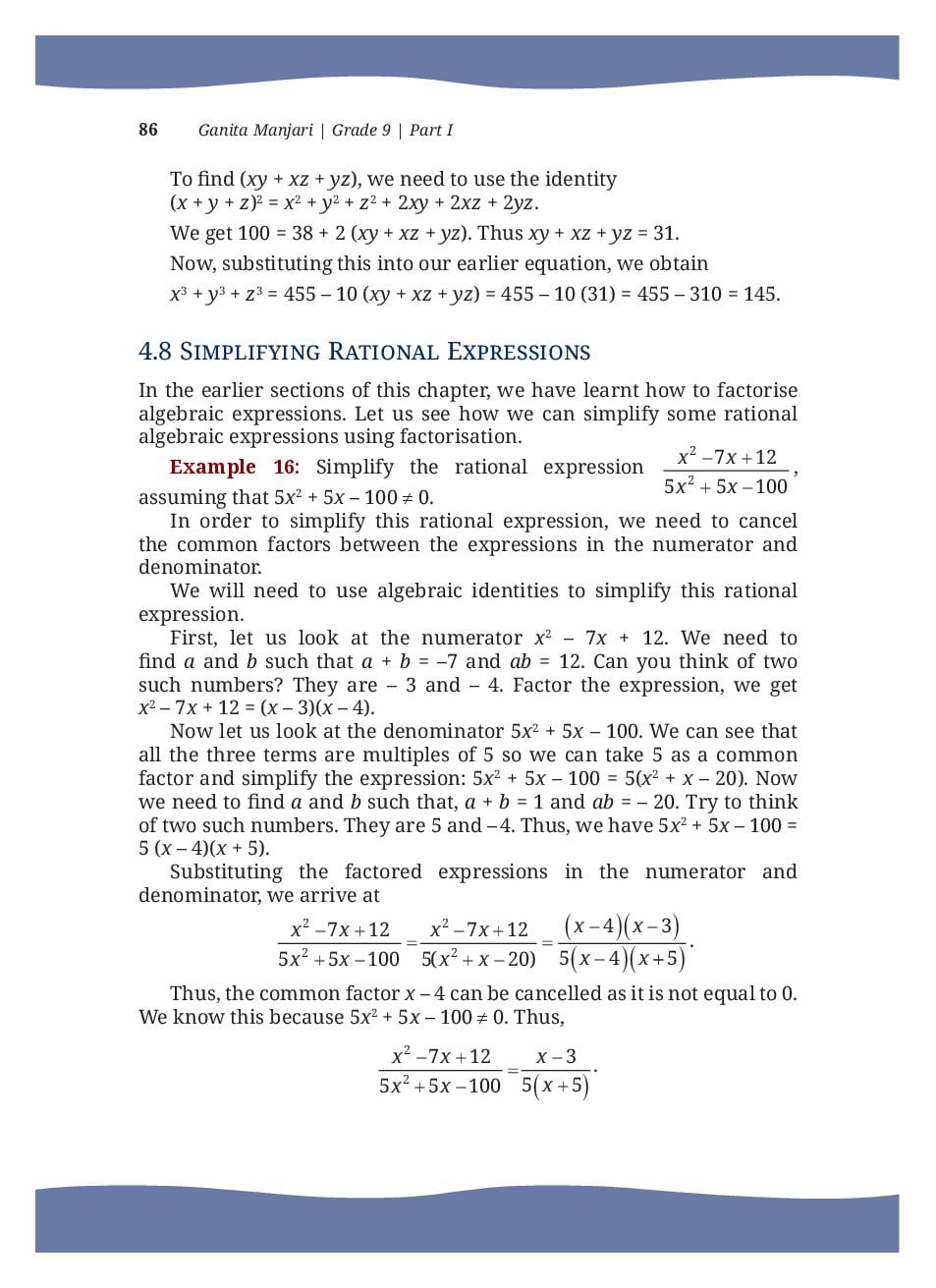
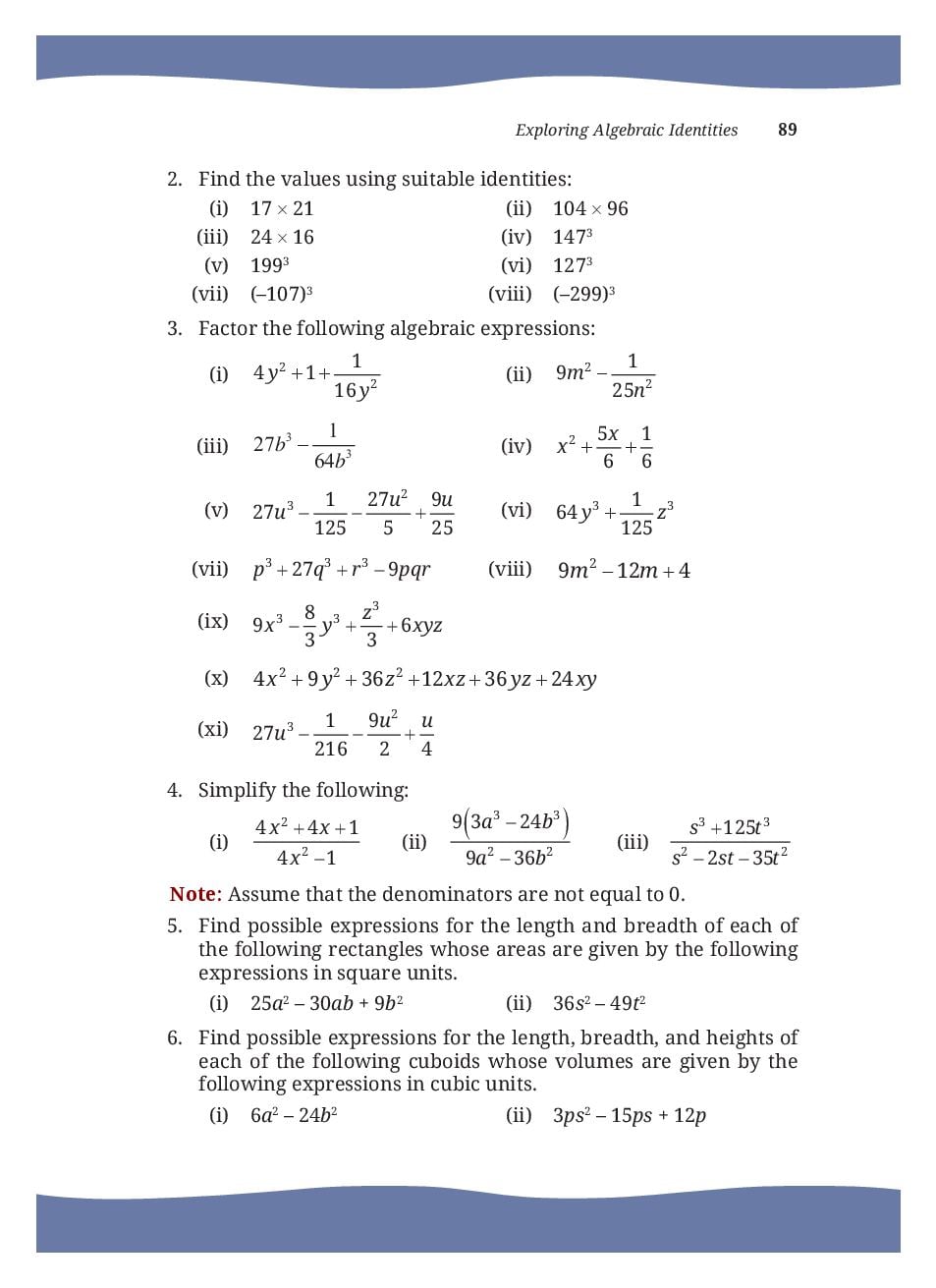
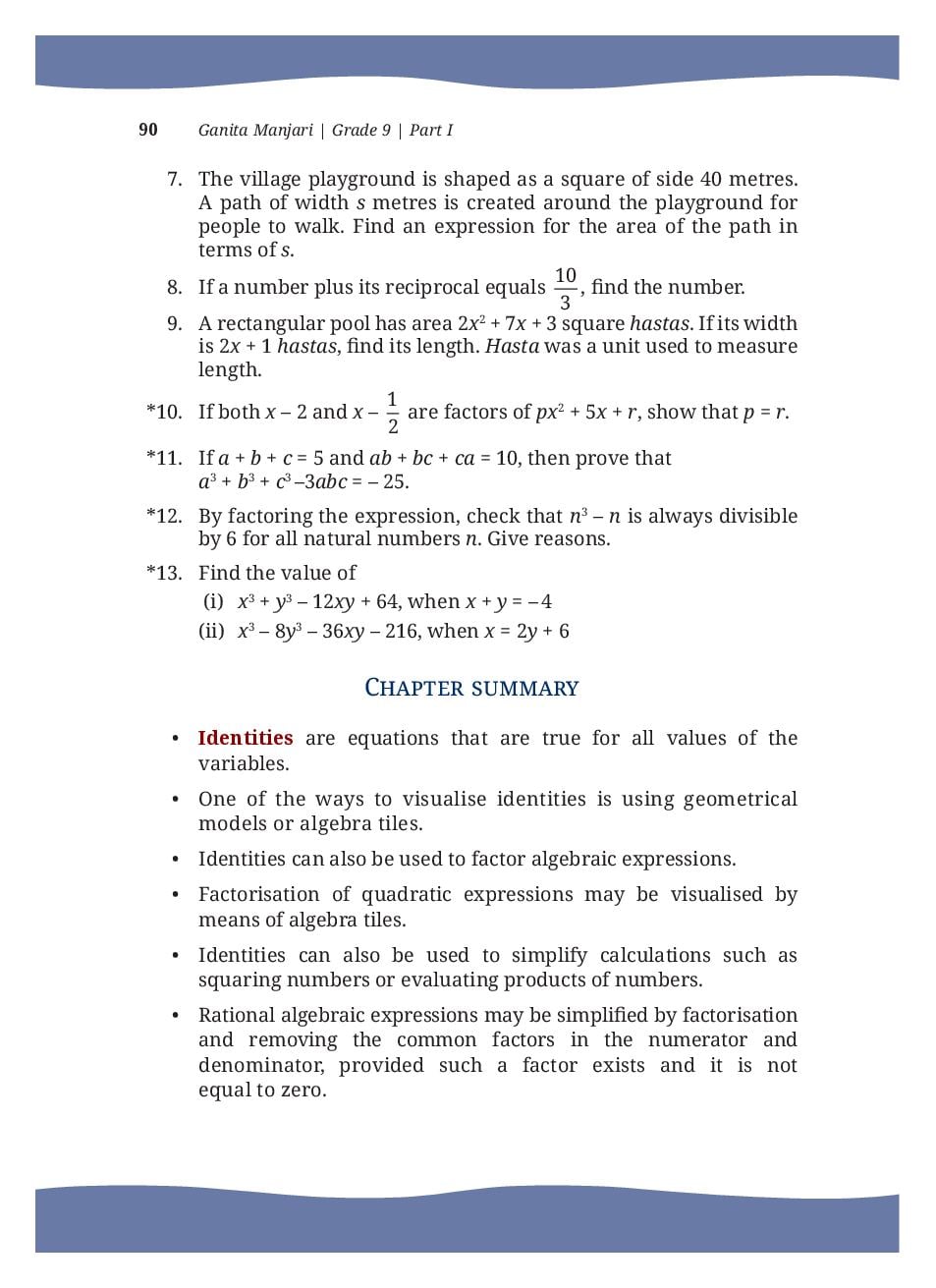
- Identities make arithmetic quick — 205² = (200 + 5)², 104 × 96 = 100² − 4², 199³ = (200 − 1)³ — and they simplify rational expressions once numerator and denominator are factorised and a common non-zero factor is cancelled.
Quick revision – Exploring Algebraic Identities
| Identity | Statement | Where it comes from | Use it for |
|---|---|---|---|
| Square of a sum | (a + b)² = a² + 2ab + b² | Fig. 4.2 — square of side a + b cut into a², b² and two ab rectangles | 64², expanding (7x + 4y)² |
| Square of a difference | (a − b)² = a² − 2ab + b² | Fig. 4.3, or put −b for b in the first identity | 79², factoring 16y² − 24y + 9 |
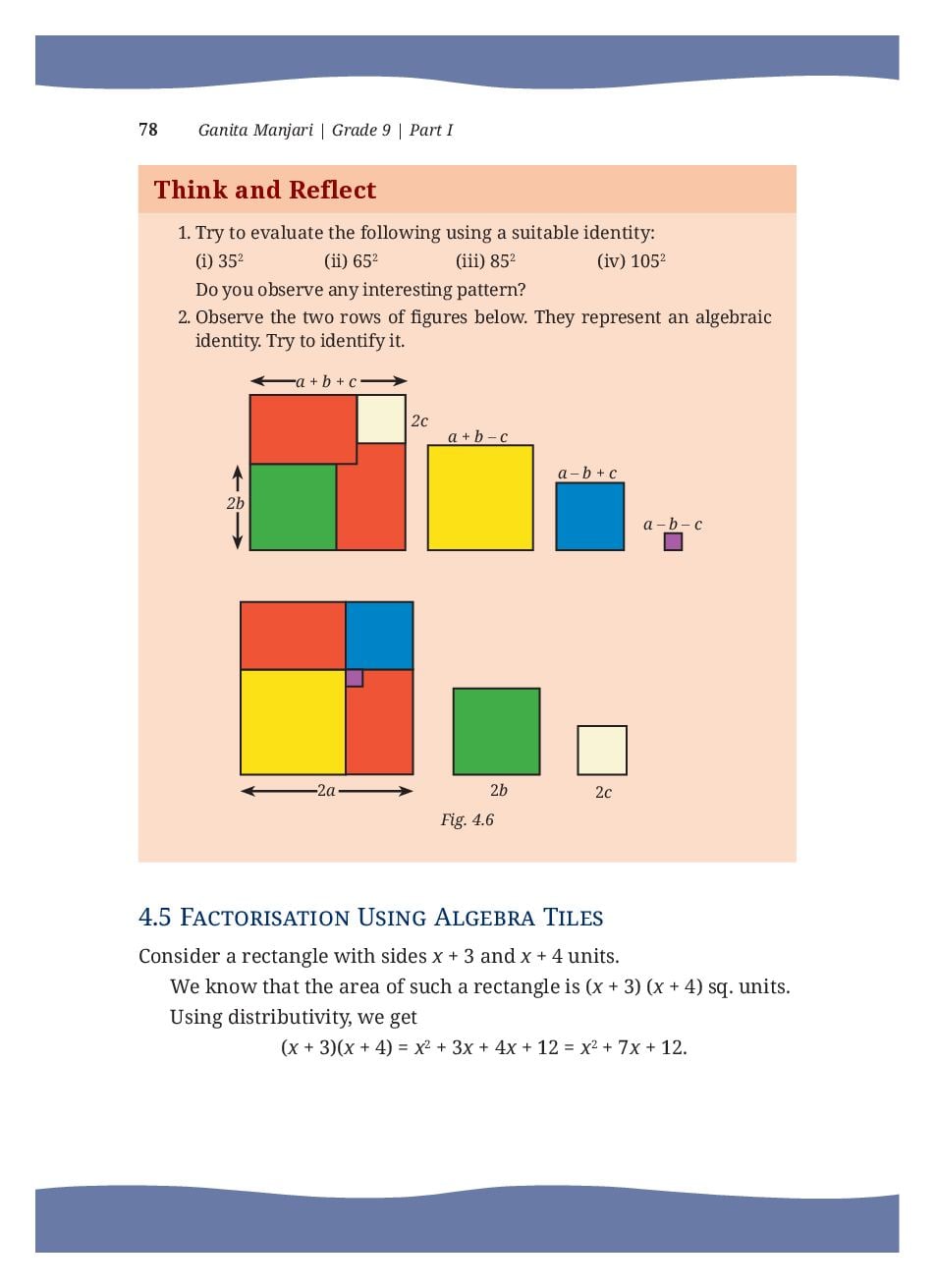
| Square of a trinomial | (a + b + c)² = a² + b² + c² + 2ab + 2bc + 2ca | Fig. 4.4 — a 3 × 3 grid on a square of side a + b + c | 117², factoring 9a² + 4b² + c² − 12ab + 6ac − 4bc |
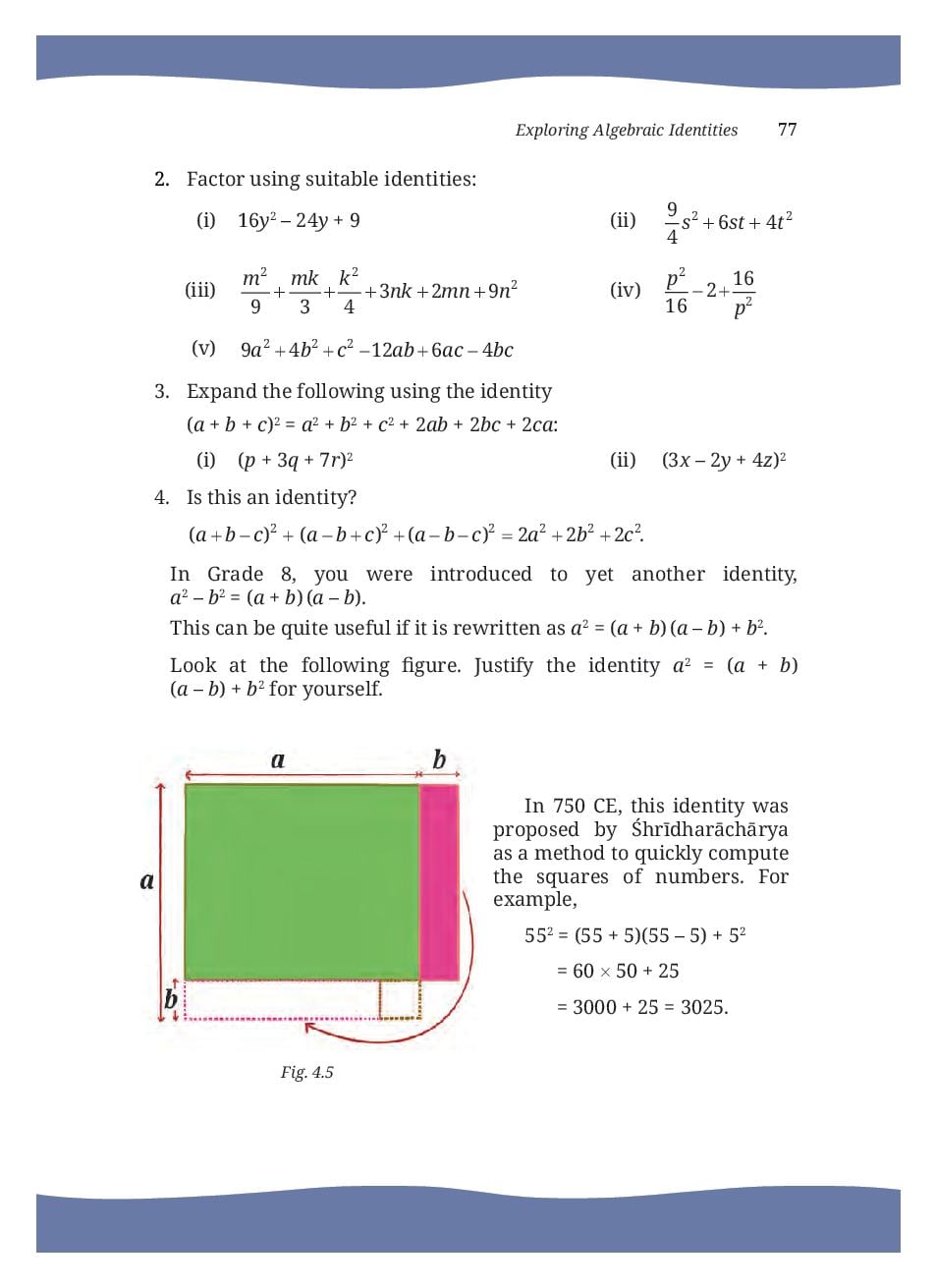
| Difference of two squares | A² − b² = (a + b)(a − b) | Fig. 4.5 — cut a strip off a square and slide it round | 104 × 96, factoring 36s² − 49t² |
| Śhrīdharāchārya’s form | A² = (a + b)(a − b) + b² | The same figure, read the other way | 35², 55², 105² in the head |
| Product of two binomials | (x + a)(x + b) = x² + (a + b)x + ab | Fig. 4.7 — algebra tiles forming a rectangle | Factoring x² + 7x + 12, x² − 5x + 6 |
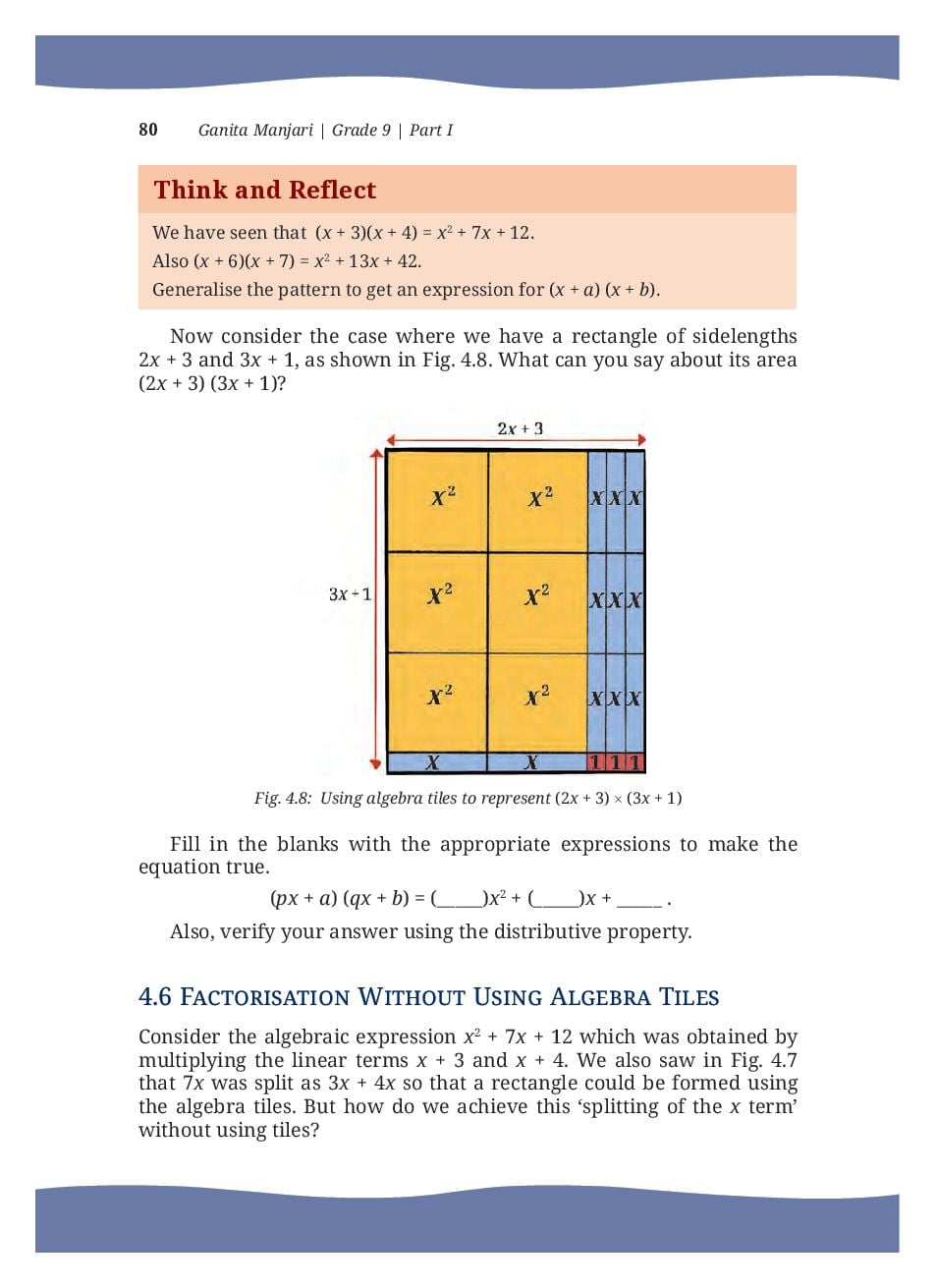
| General binomial product | (px + a)(qx + b) = pq·x² + (pb + aq)x + ab | Fig. 4.8 — tiles for (2x + 3)(3x + 1) | Factoring 6x² + 7x + 2, 10x² − 11x − 6 |
| Cube of a sum | (a + b)³ = a³ + 3a²b + 3ab² + b³ | Fig. 4.10 — a cube of edge a + b in 2 cubes + 6 cuboids | 147³, factoring p³ + 6p²q + 12pq² + 8q³ |
| Cube of a difference | (a − b)³ = a³ − 3a²b + 3ab² − b³ | Put −b for b in the cube of a sum | 199³, factoring 8n³ − 60n²m + 150nm² − 125m³ |
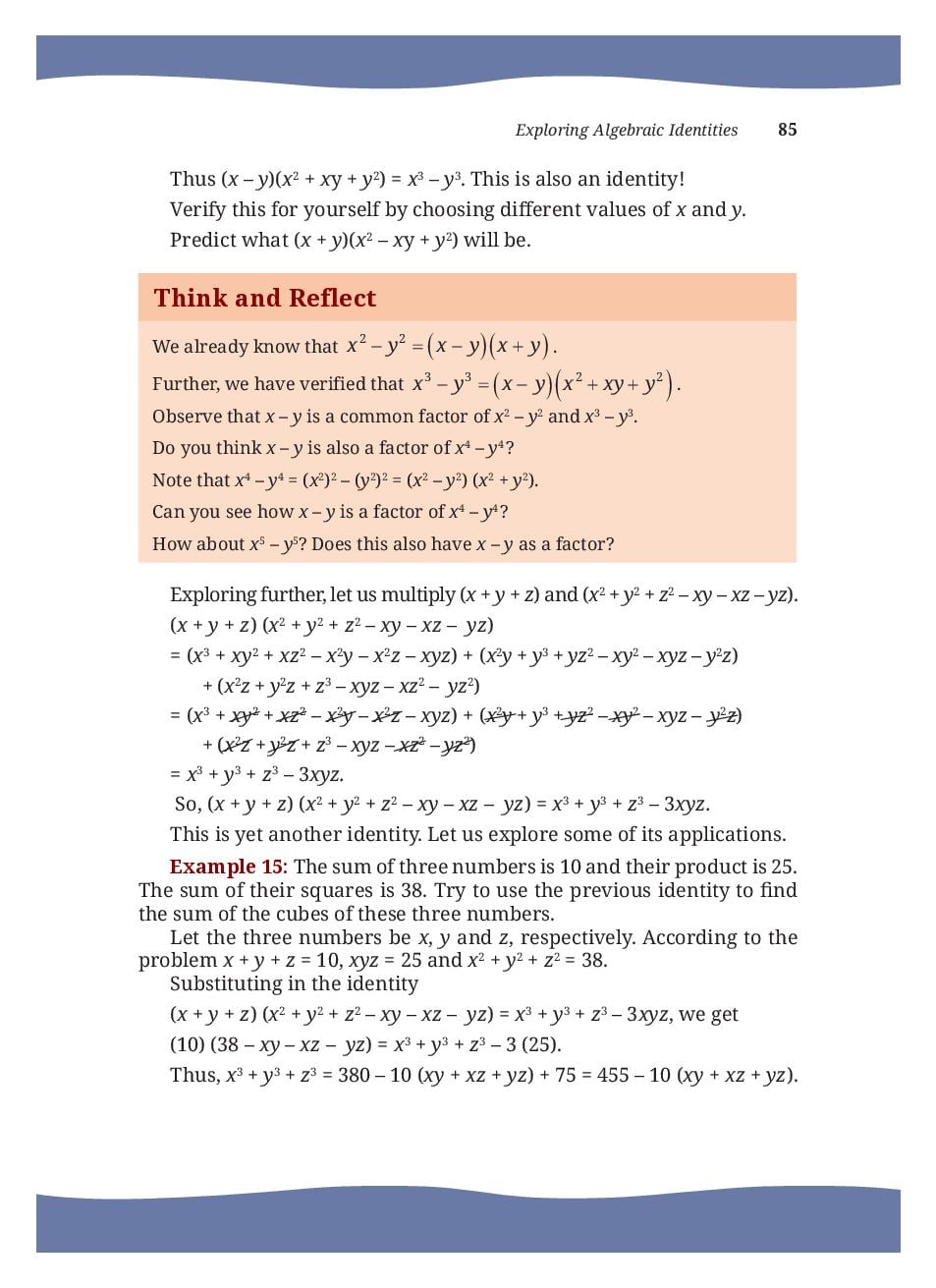
| Sum and difference of cubes | X³ − y³ = (x − y)(x² + xy + y²) x³ + y³ = (x + y)(x² − xy + y²) | Multiply out with the distributive property; the middle terms cancel | Factoring 27b³ − 1/(64b³), 64y³ + z³/125 |
| Three cubes | X³ + y³ + z³ − 3xyz = (x + y + z)(x² + y² + z² − xy − yz − zx) | Multiply out; all nine cross terms cancel in threes | Factoring p³ + 27q³ + r³ − 9pqr; proving a³+b³+c³−3abc = −25 |
Old NCERT vs New – Class 9 Maths
This chapter is from Ganita Manjari, the new NCERT Class 9 Maths book (NCF-SE 2023, used from 2026-27). It replaced the old book “Mathematics”, so chapter numbers and names differ from older PDFs.
Solutions and All Chapters
Answers to the exercises and the full chapter list of Ganita Manjari:
Exploring Algebraic Identities – Overview
| Class | Class 9 |
| Subject | Maths |
| Book | Ganita Manjari – new NCERT book |
| Part | Part I |
| Chapter | 4 of 14 – Exploring Algebraic Identities |
| Book pages | 68 – 91 |
| Edition | Latest NCERT edition (2026-27) |
| Session | 2026-27 |
| Free – read online or download |
Class 9 Maths Chapter 4 – FAQs
Where can I download Exploring Algebraic Identities Class 9 PDF?
From the download table on this page – the chapter PDF is free, and the full book is linked too.
What is Class 9 Maths Chapter 4 about?
An equation such as x² − 1 = 24 holds only for x = 5 or x = −5; an identity such as (x + y)² = x² + 2xy + y² holds for every value of x and y. That is the whole difference.
Is Exploring Algebraic Identities from the new NCERT Class 9 Maths book?
Yes. It is chapter 4 of ganita manjari (part i), the new NCERT Class 9 Maths book for 2026-27.
Is this the latest NCERT edition for 2026-27?
Yes – the PDF is NCERT’s latest edition for the 2026-27 session.
Where are the NCERT Solutions for Class 9 Maths Chapter 4?
Open the NCERT Solutions link above for answers to the exercise questions.