Download Predicting What Comes Next: Exploring Sequences and Progressions – NCERT Class 9 Maths Chapter 8 PDF from the new NCERT Class 9 Maths book Ganita Manjari (2026-27). Read the chapter online or download the free PDF. A sequence is an ordered list of numbers; each number is a term. The notation t1, t2, t3, … ties a term to its position, so t4 = 7 says “the term in the 4th place is 7”. Sequences may be finite (6, 12, 24, 48, 96) or infinite (1, 2, 3, 4, …).
Predicting What Comes Next: Exploring Sequences and Progressions PDF – Chapter 8 of Ganita Manjari (Part I)
Read the chapter online or download the PDF.
| Chapter | Download | |
|---|---|---|
| Chapter 8 PDF | Predicting What Comes Next: Exploring Sequences and Progressions | View PDF |
| Full book | NCERT Class 9 Maths – Ganita Manjari | View Book |
Read Online
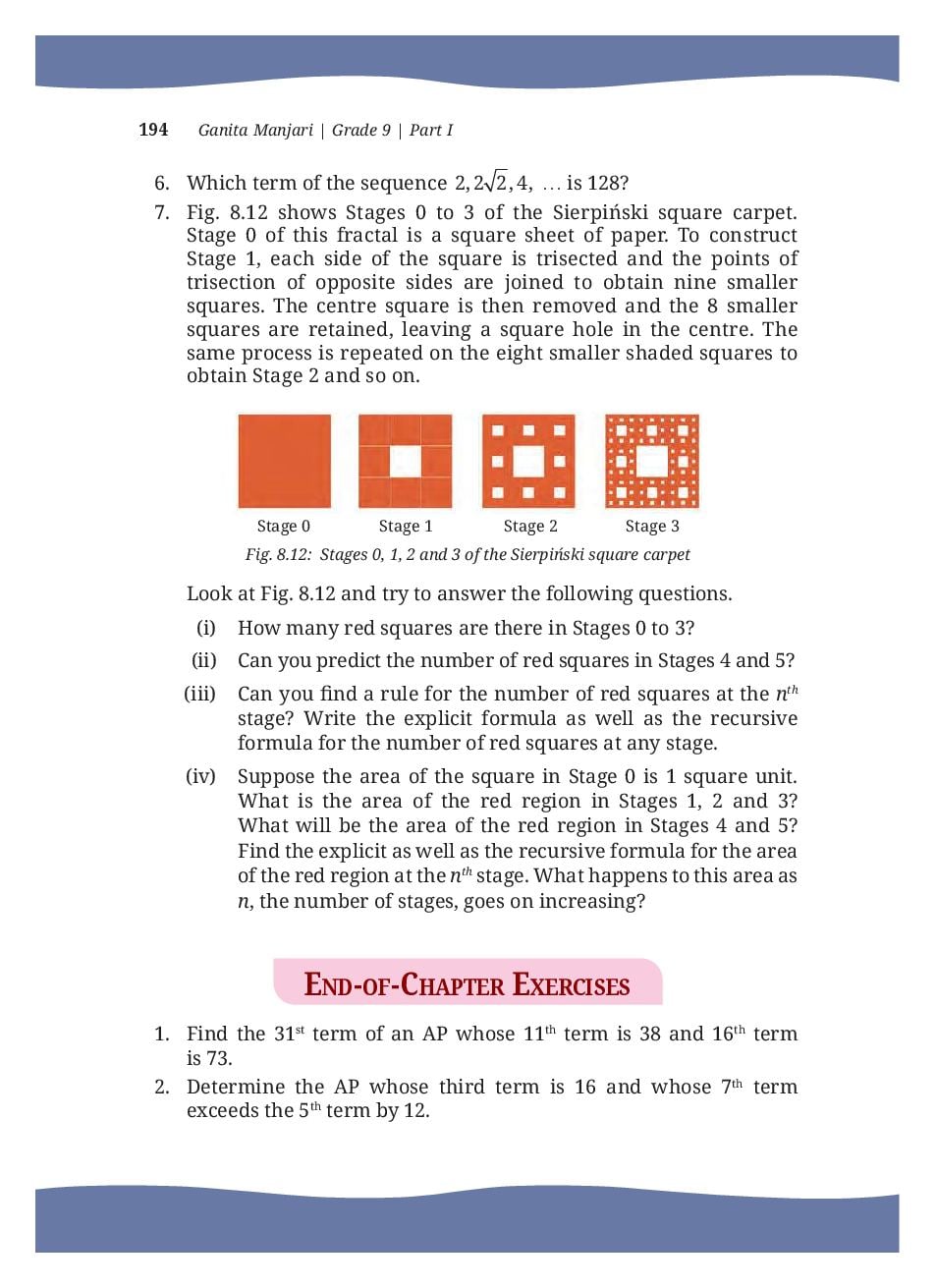
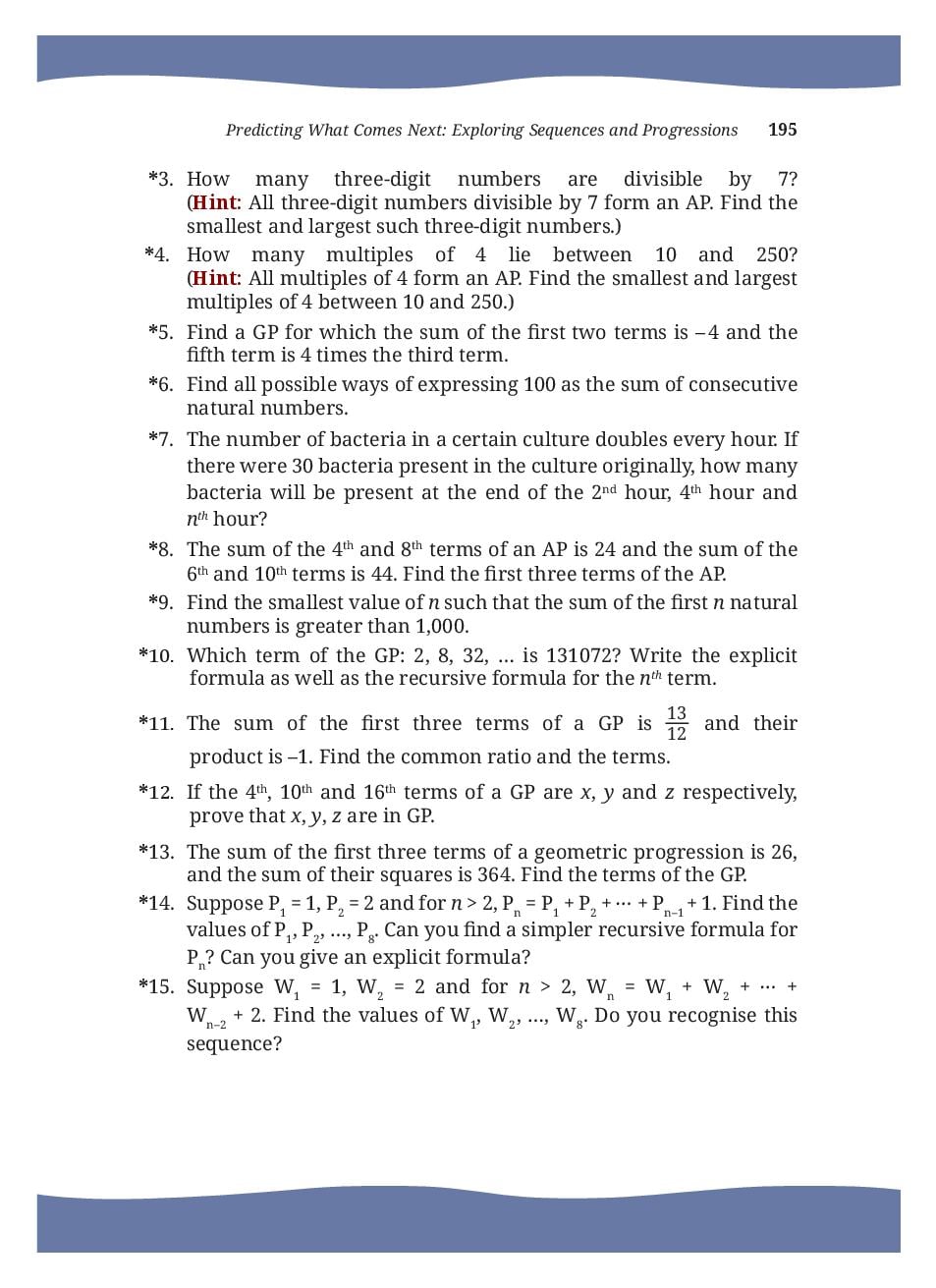
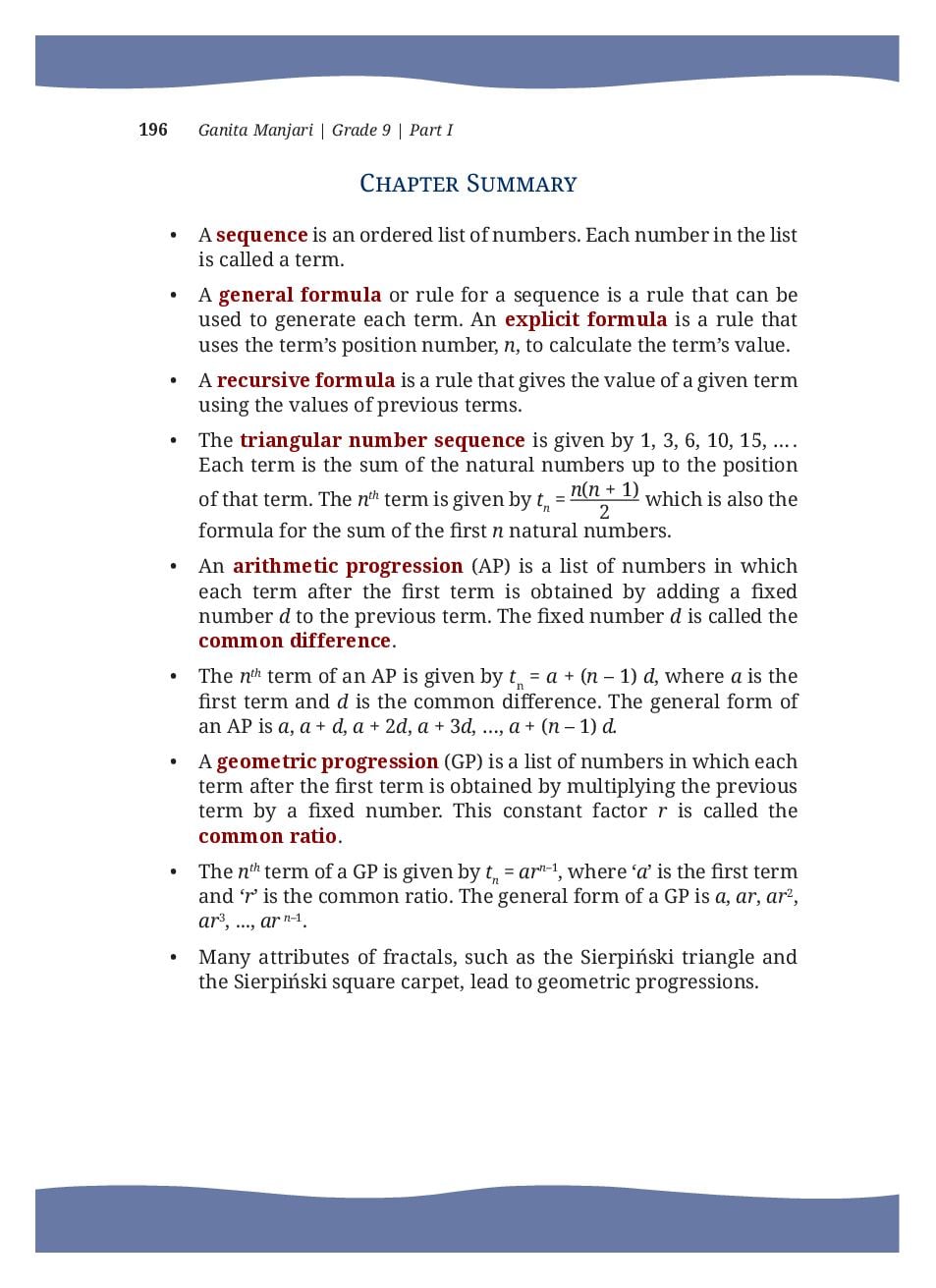
What Is in Predicting What Comes Next: Exploring Sequences and Progressions? (Class 9 Maths Chapter 8)
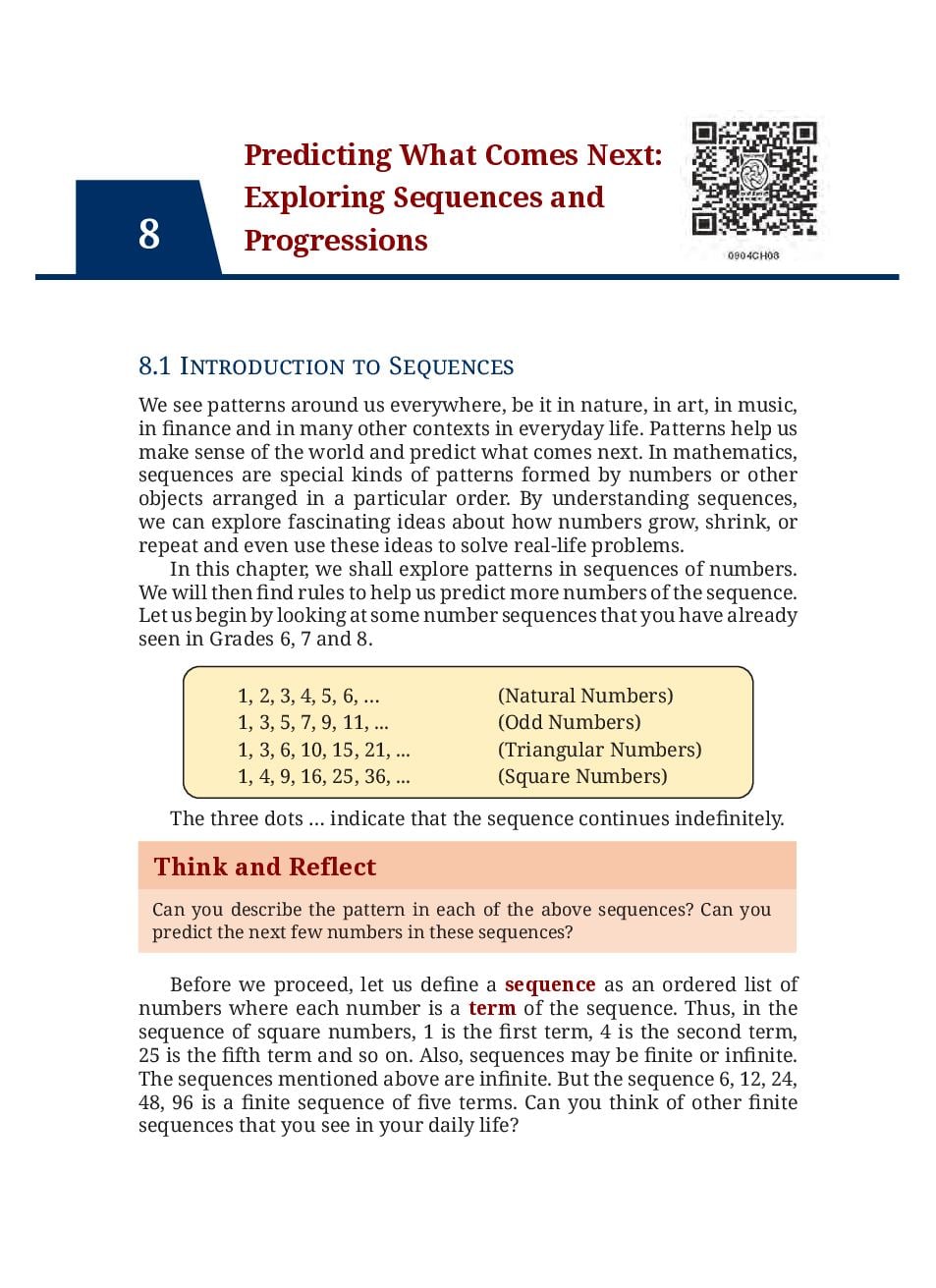
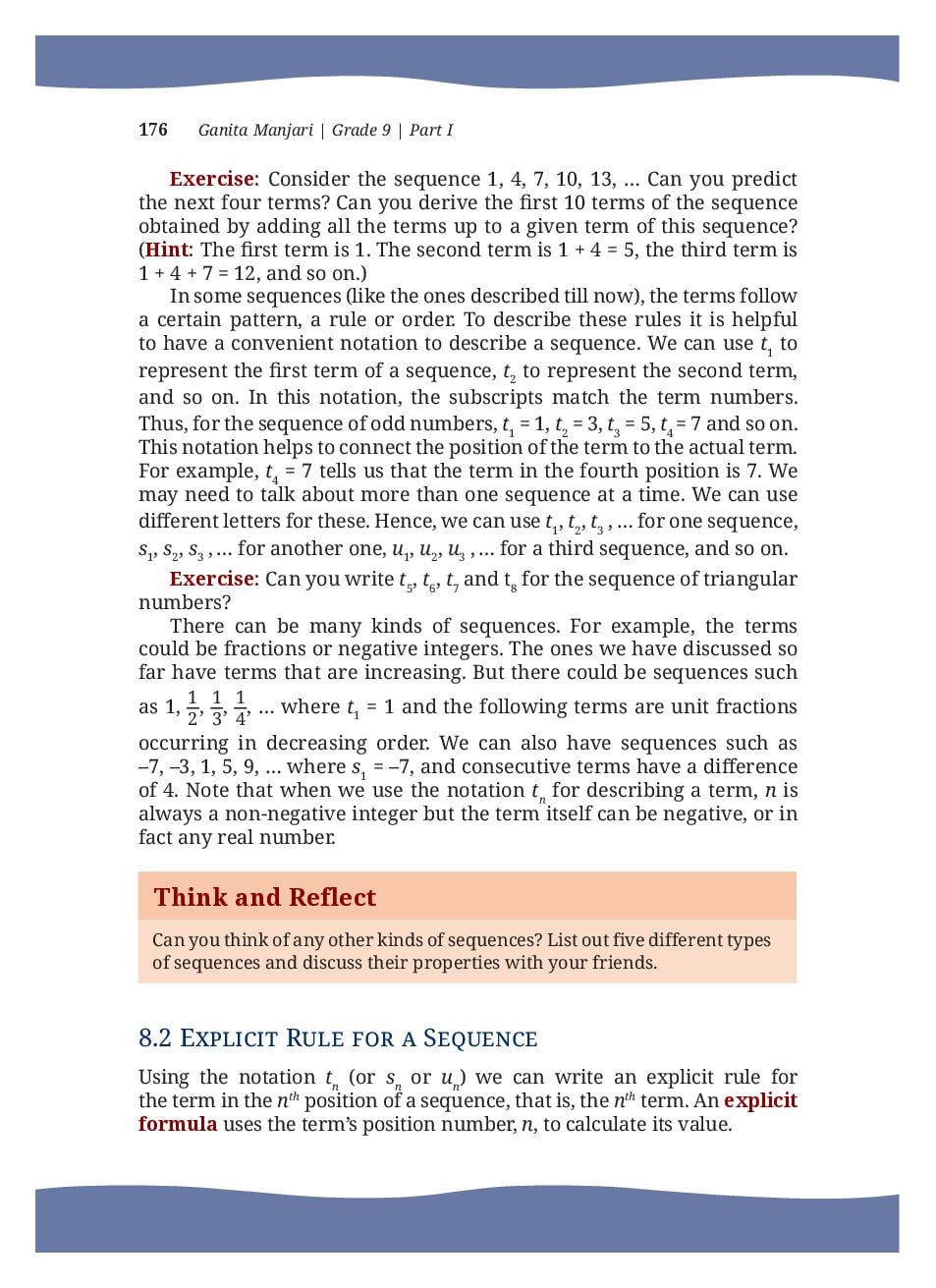
- A sequence is an ordered list of numbers; each number is a term. The notation t1, t2, t3, … ties a term to its position, so t4 = 7 says “the term in the 4th place is 7”. Sequences may be finite (6, 12, 24, 48, 96) or infinite (1, 2, 3, 4, …).
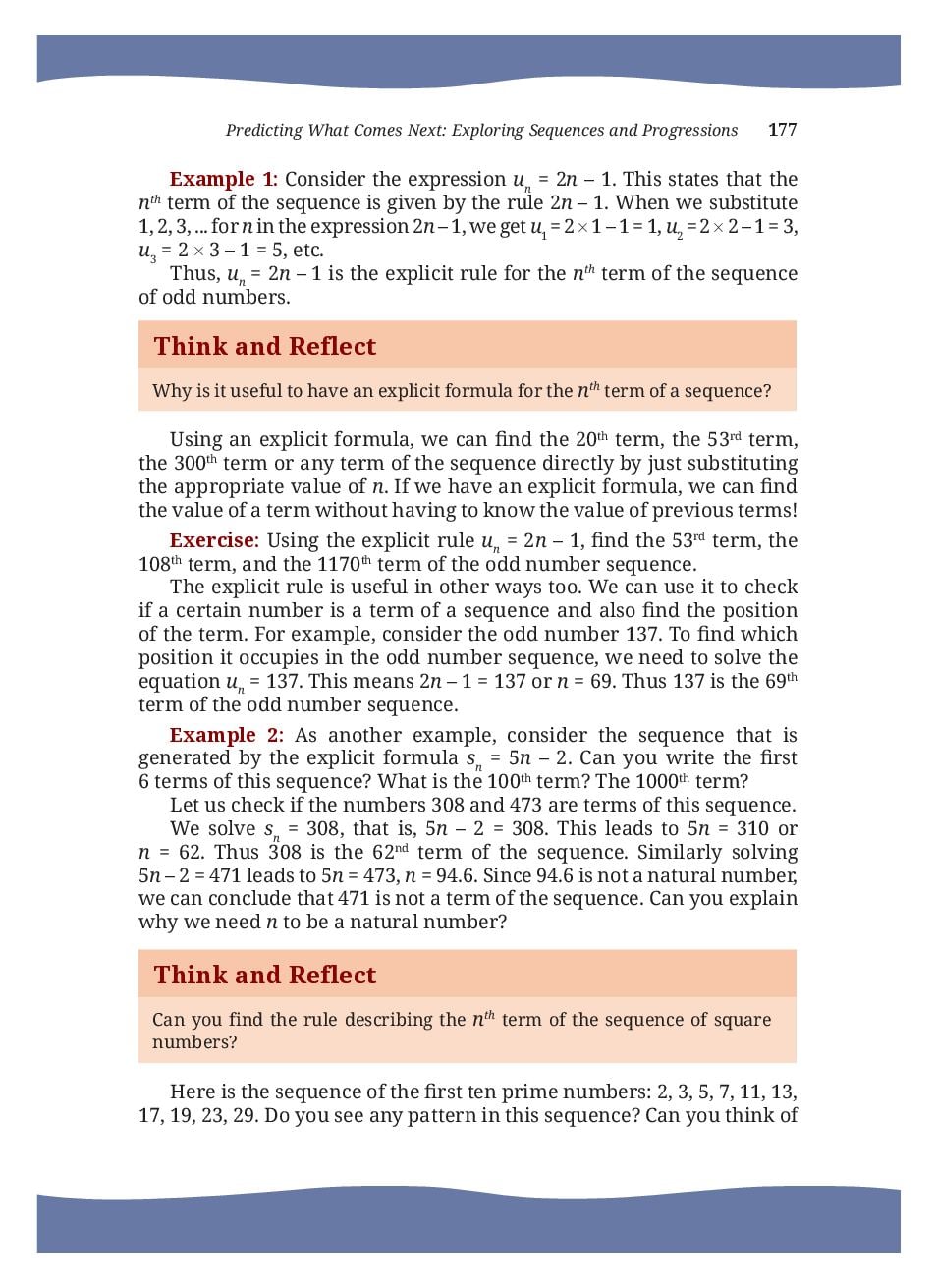
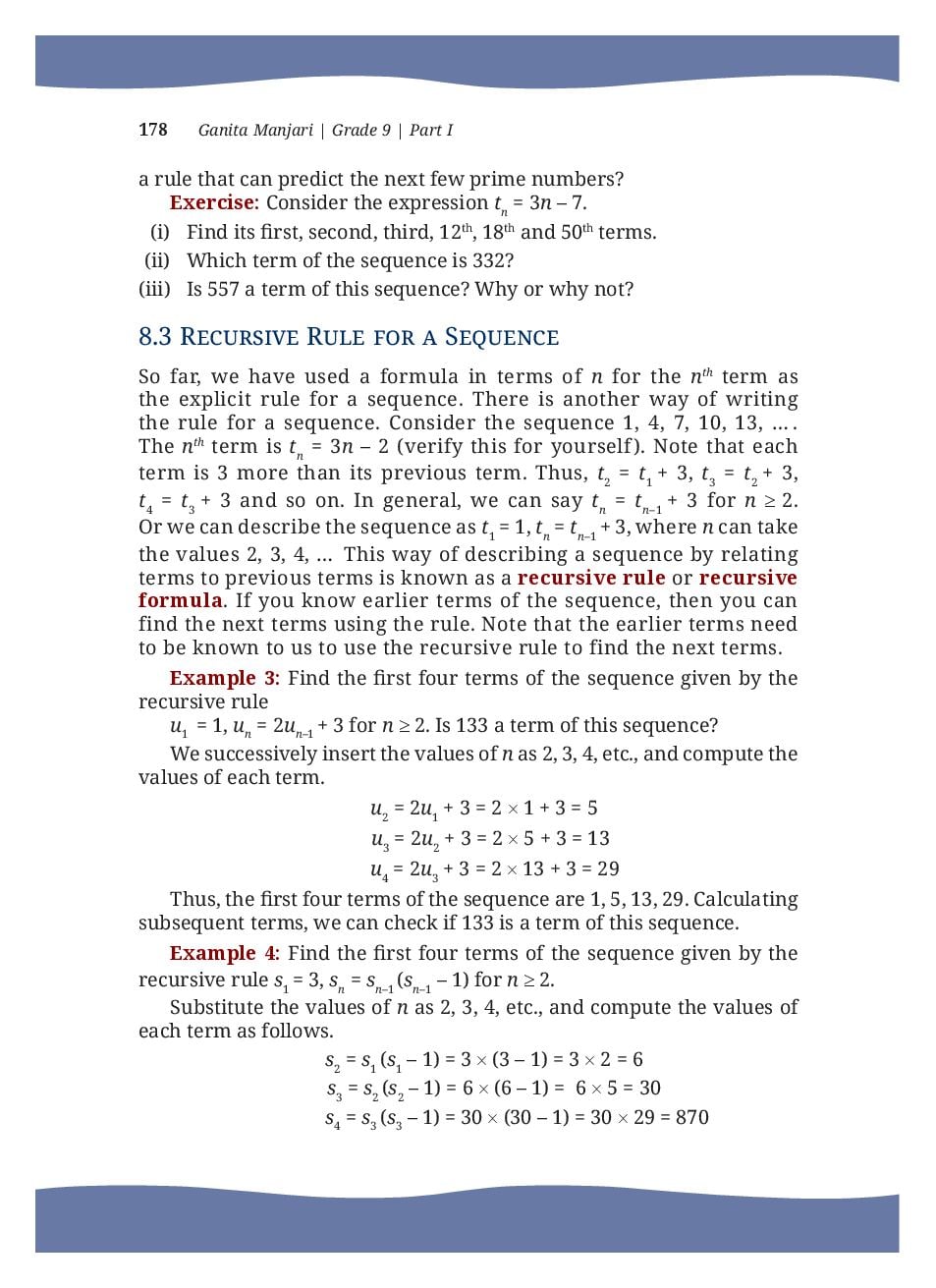
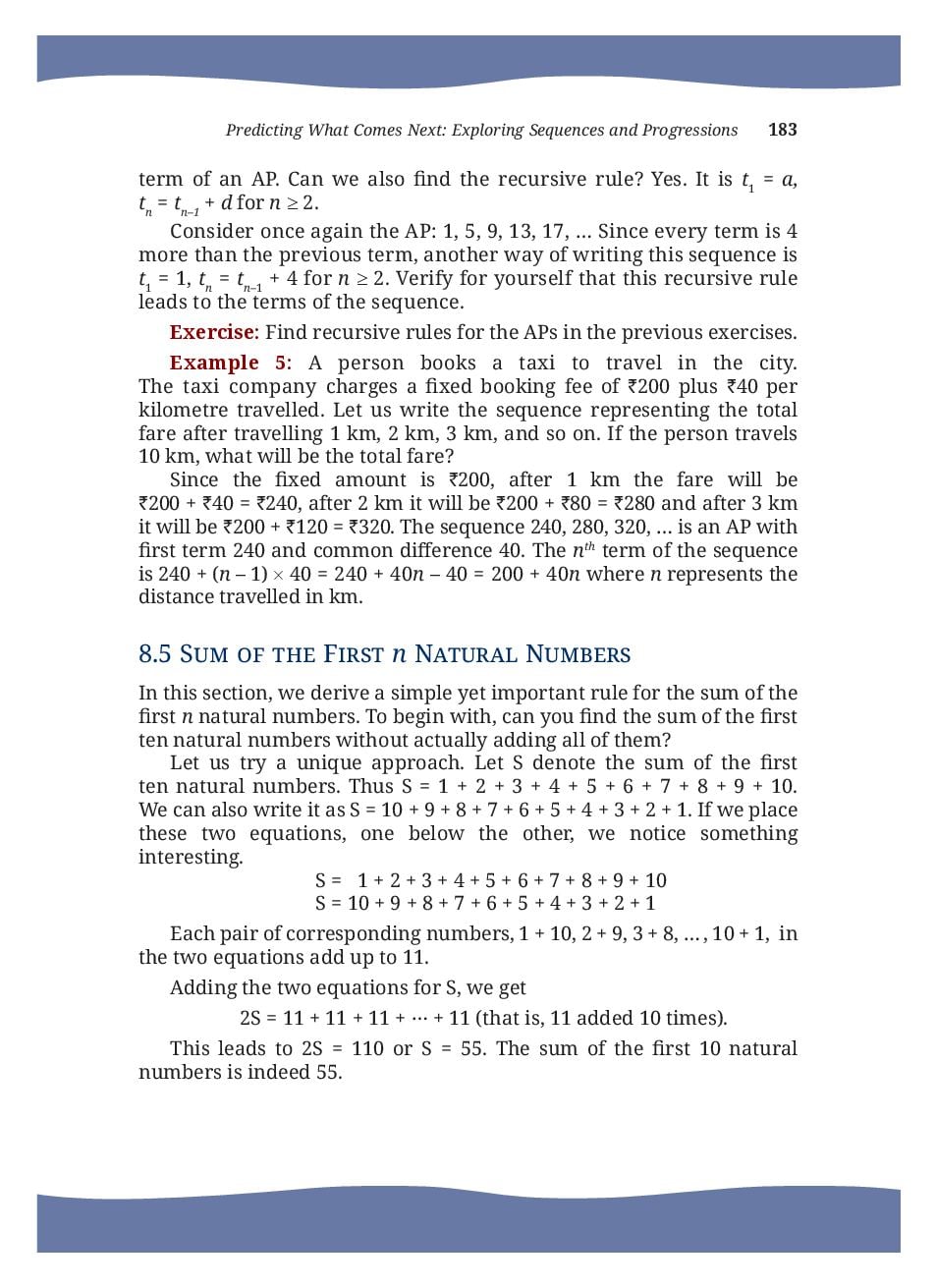
- An explicit rule computes tn straight from the position n — tn = 2n – 1 gives the 1170th odd number without listing the first 1169. It also runs backwards: solving tn = k tells you whether k is a term, and where. The answer counts only if n comes out a natural number.
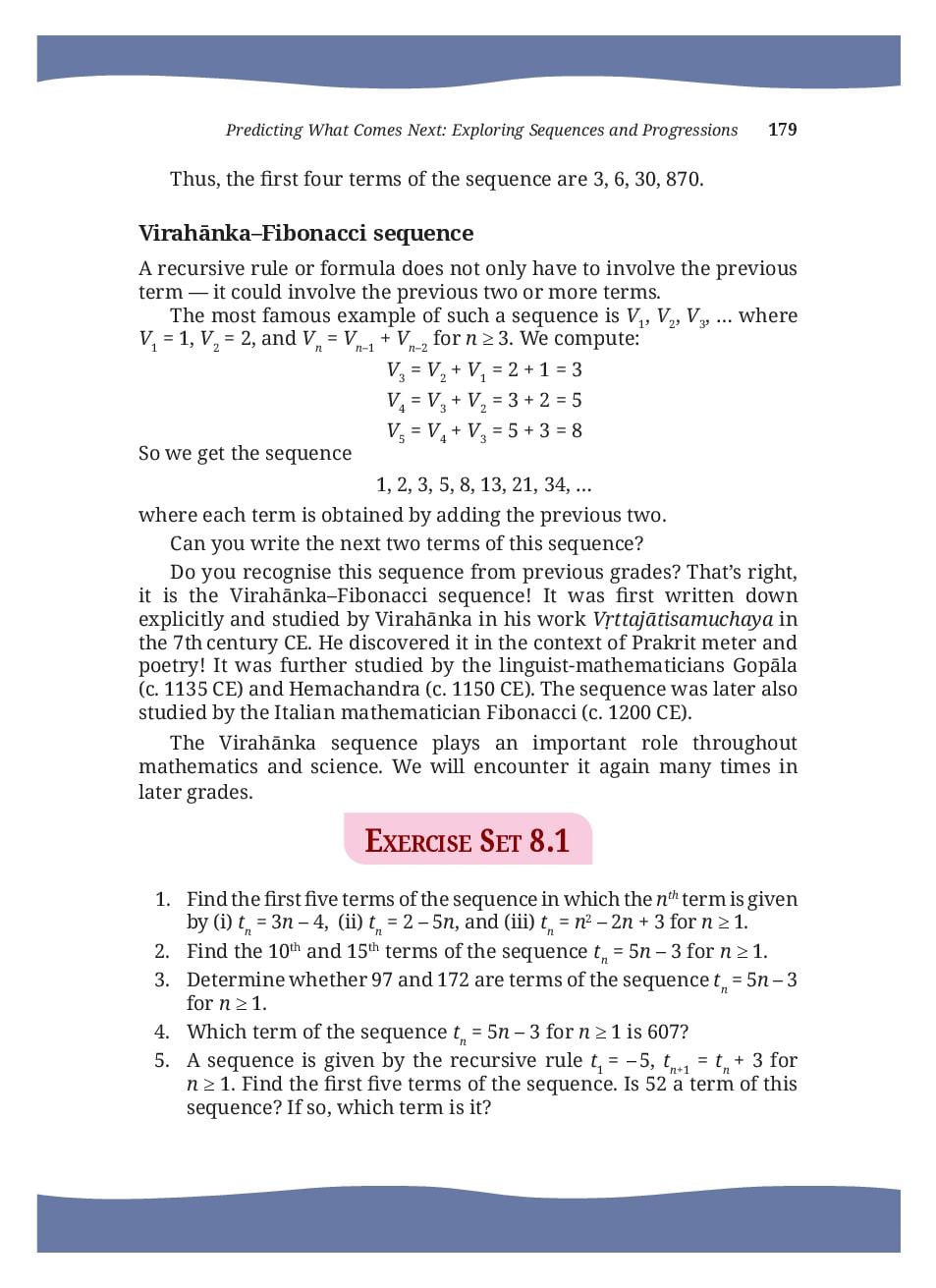
- A recursive rule gives a term from earlier terms, e.g. t1 = 1, tn = tn–1 + 3. It may reach back further than one step: the Virahānka–Fibonacci sequence uses Vn = Vn–1 + Vn–2, giving 1, 2, 3, 5, 8, 13, 21, 34, … It was set down by Virahānka in the 7th century CE in the Vṛttajātisamuchaya, studied by Gopāla and Hemachandra, and only later by Fibonacci.
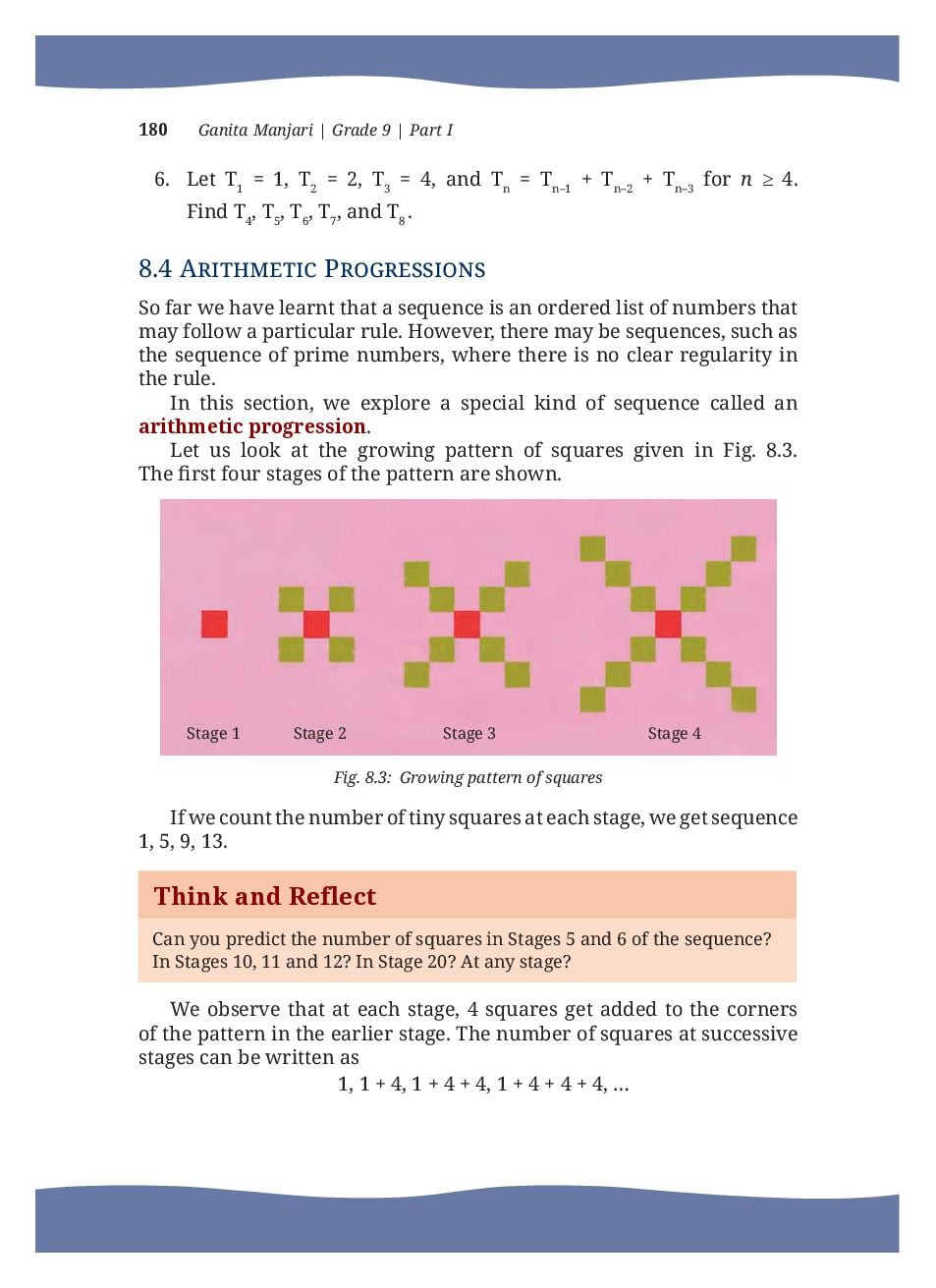
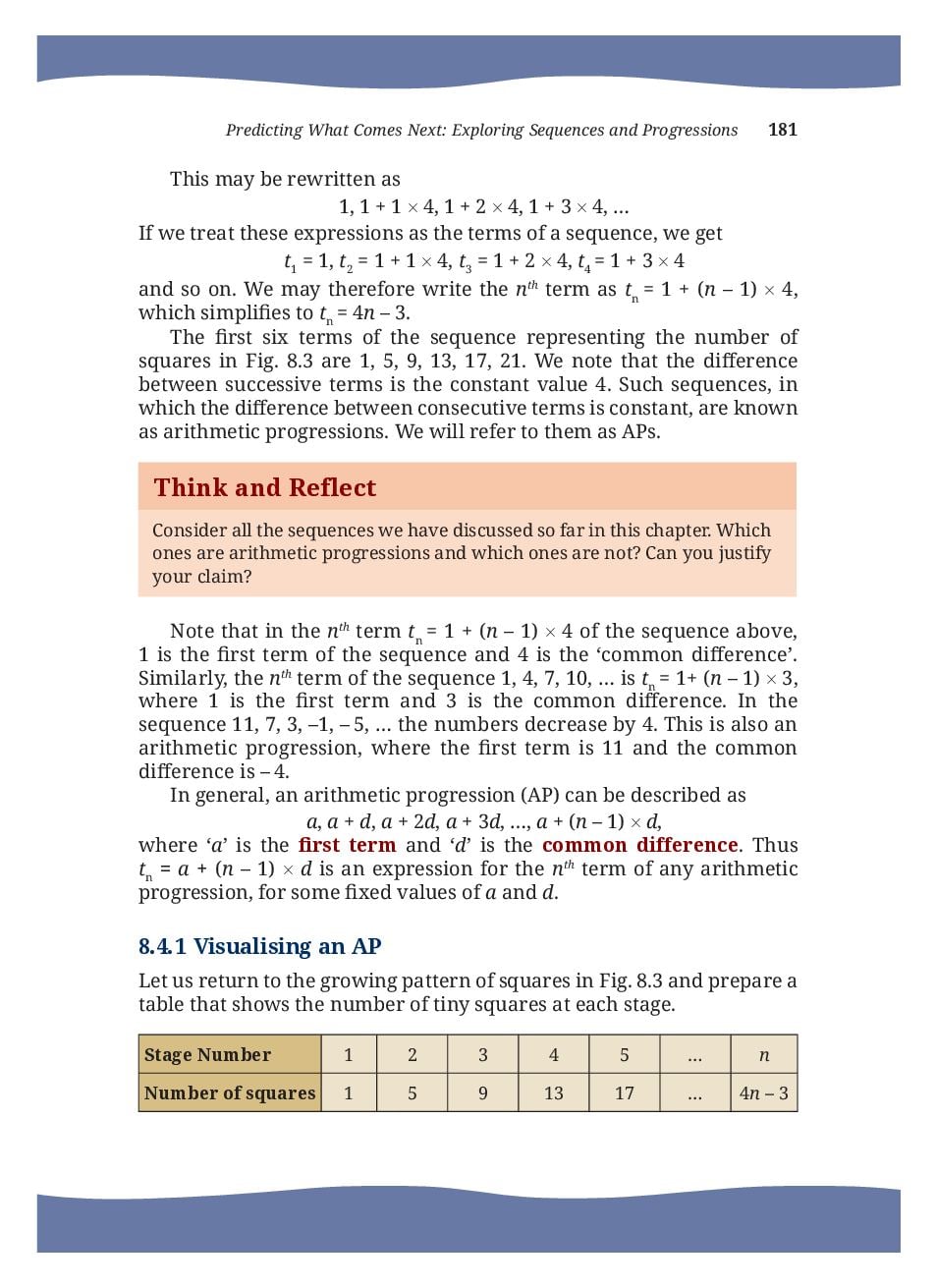
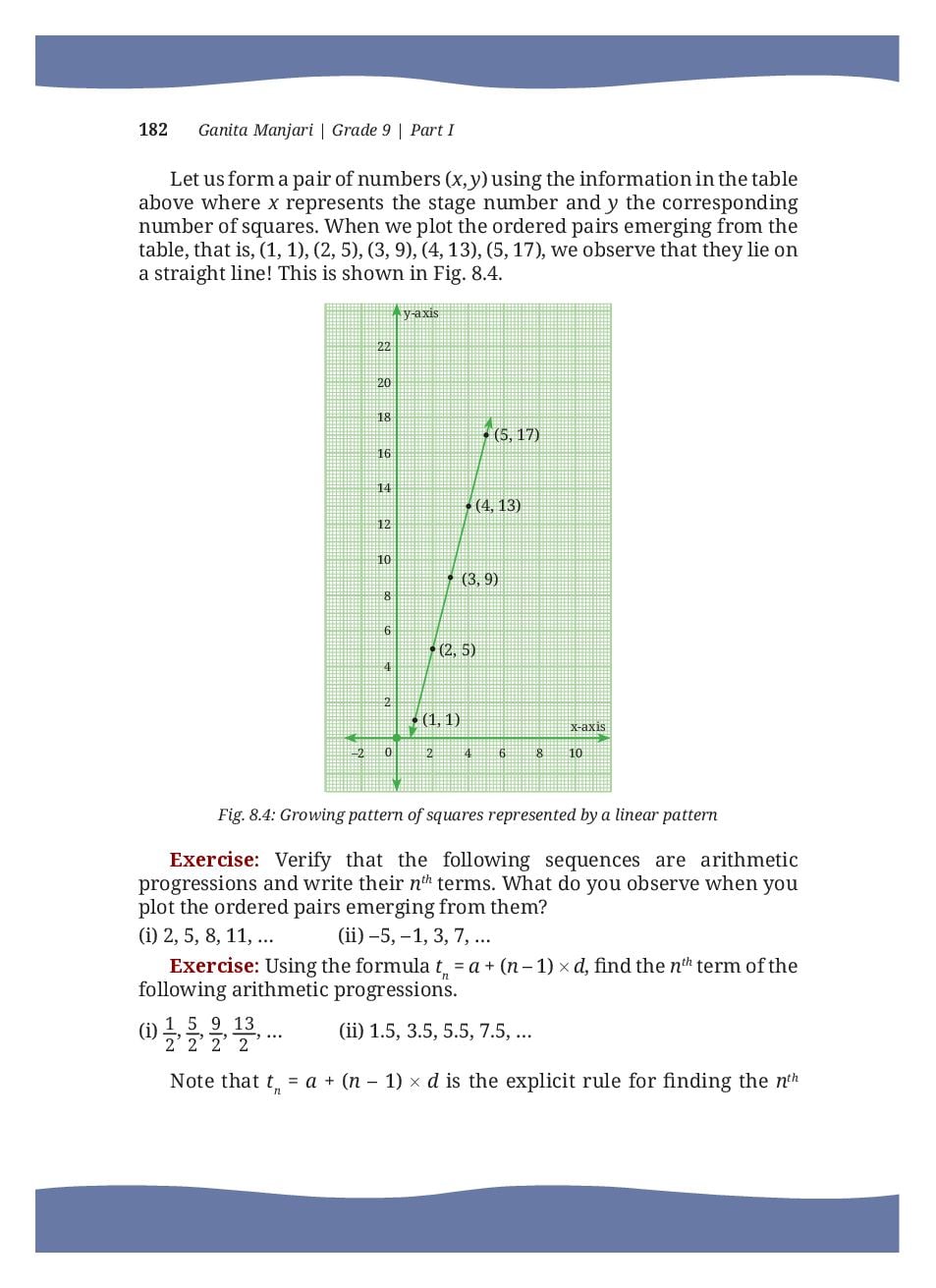
- An arithmetic progression (AP) has a constant common difference d between consecutive terms: a, a + d, a + 2d, …, with tn = a + (n – 1)d and recursive form t1 = a, tn = tn–1 + d. Because each step adds the same amount, the plotted points (n, tn) lie on a straight line.
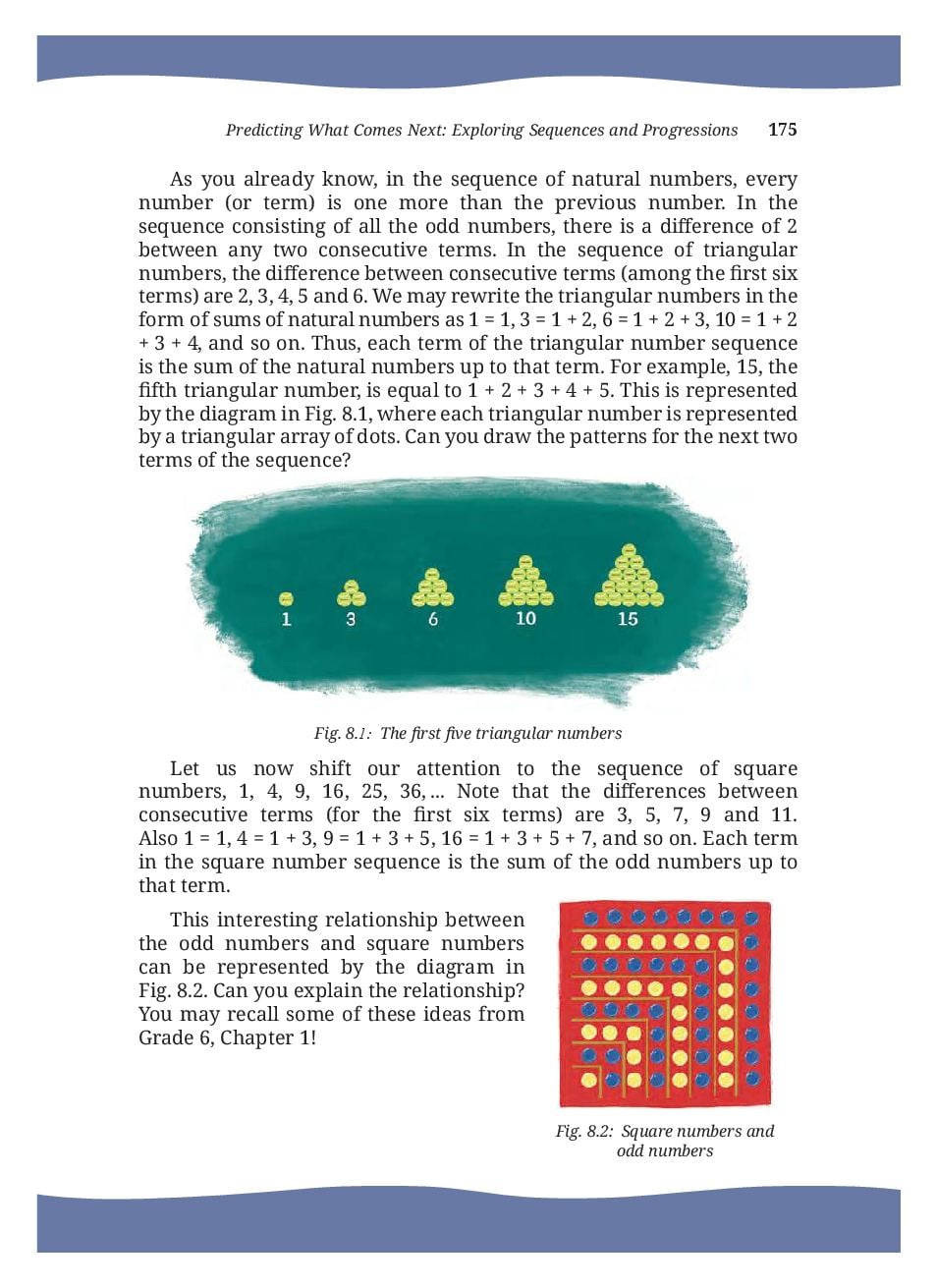
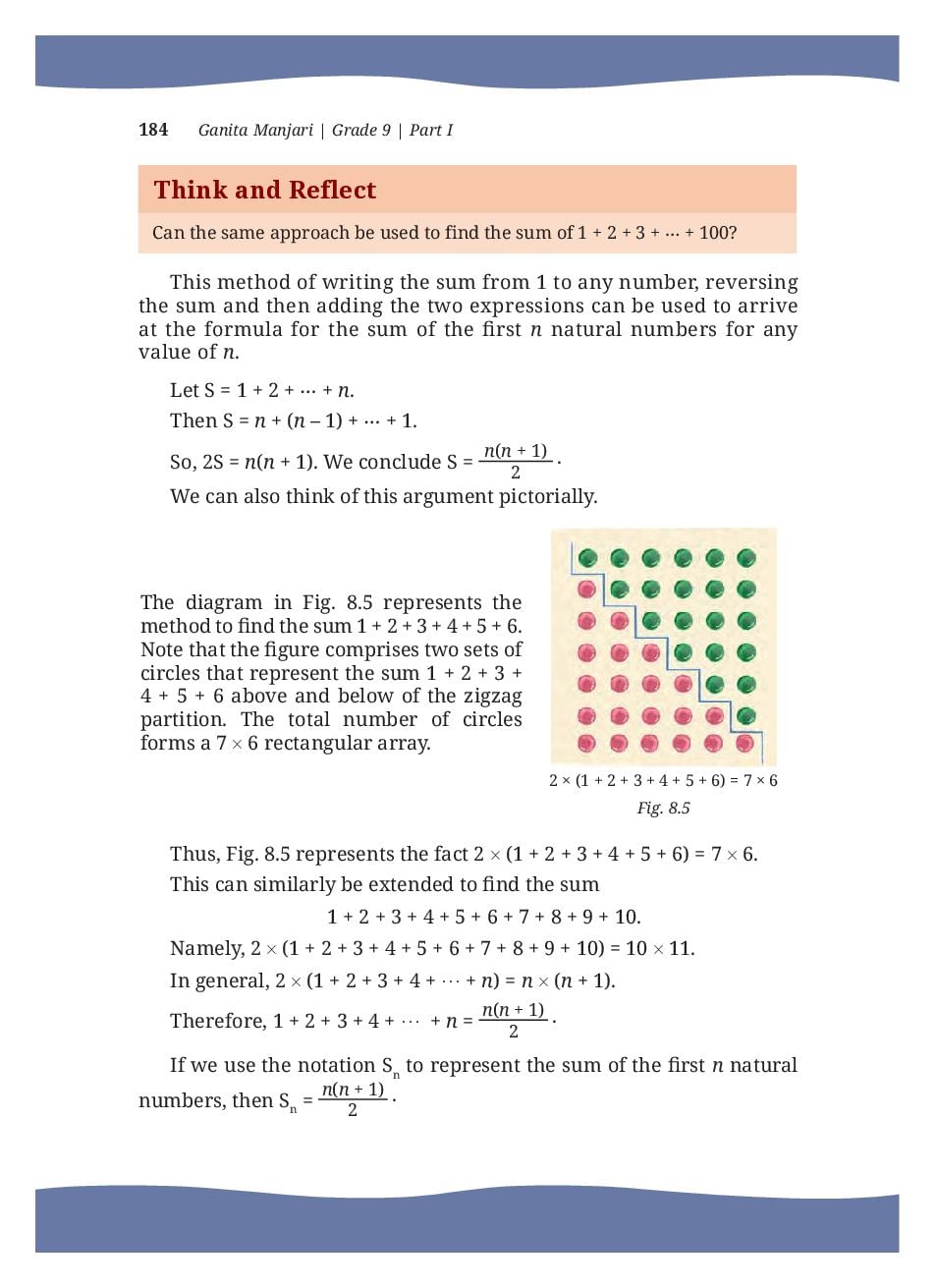
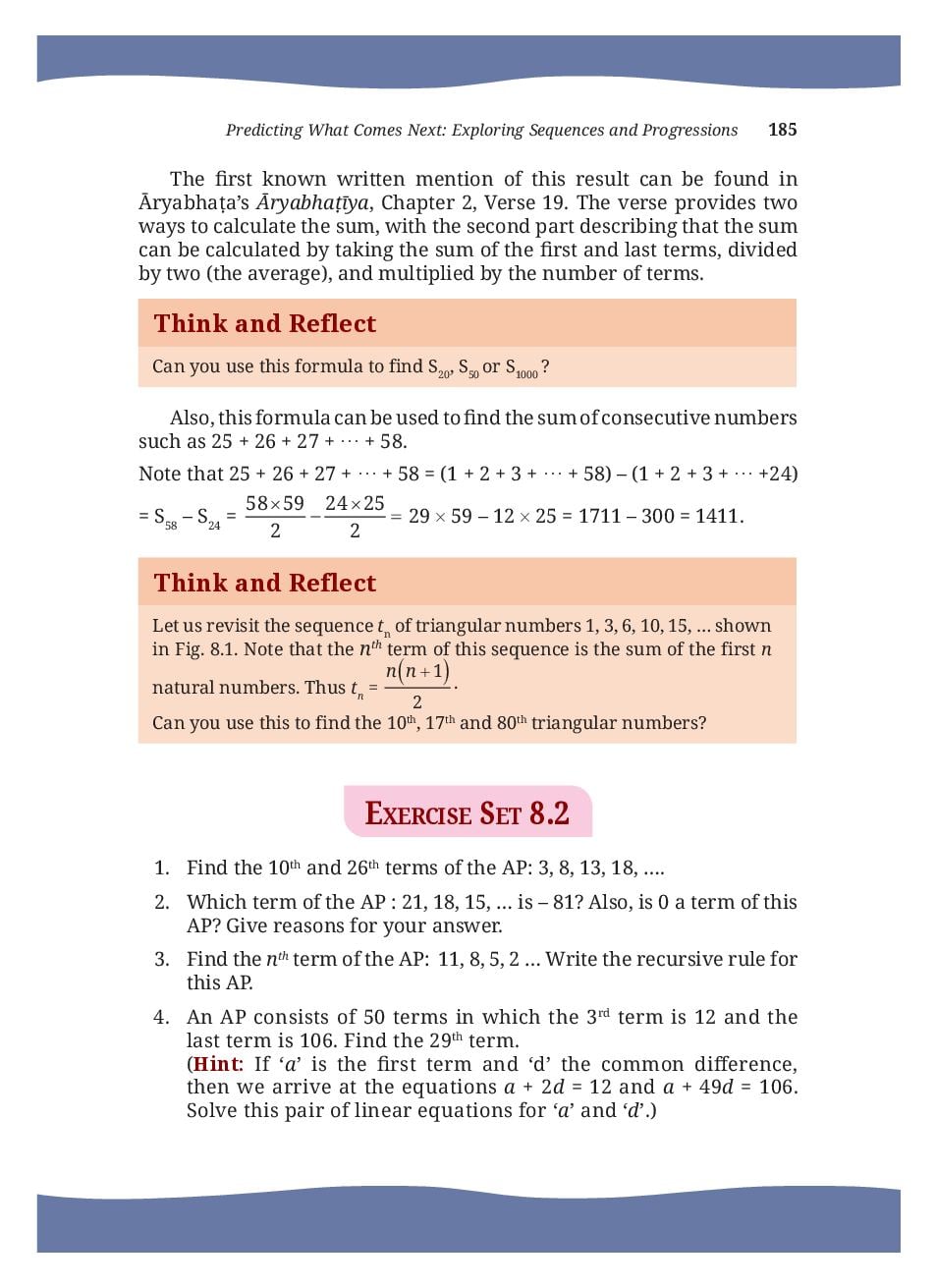
- The sum of the first n natural numbers is Sn = n(n + 1)/2. Write the sum forwards and backwards, add the two lines: every column totals n + 1, and there are n columns, so 2S = n(n + 1). The same fact is a 7 × 6 array of circles cut by a staircase. The triangular numbers 1, 3, 6, 10, 15, … are exactly these sums, so tn = n(n + 1)/2. The result appears in Āryabhaṭa’s Āryabhaṭīya, Chapter 2, Verse 19.
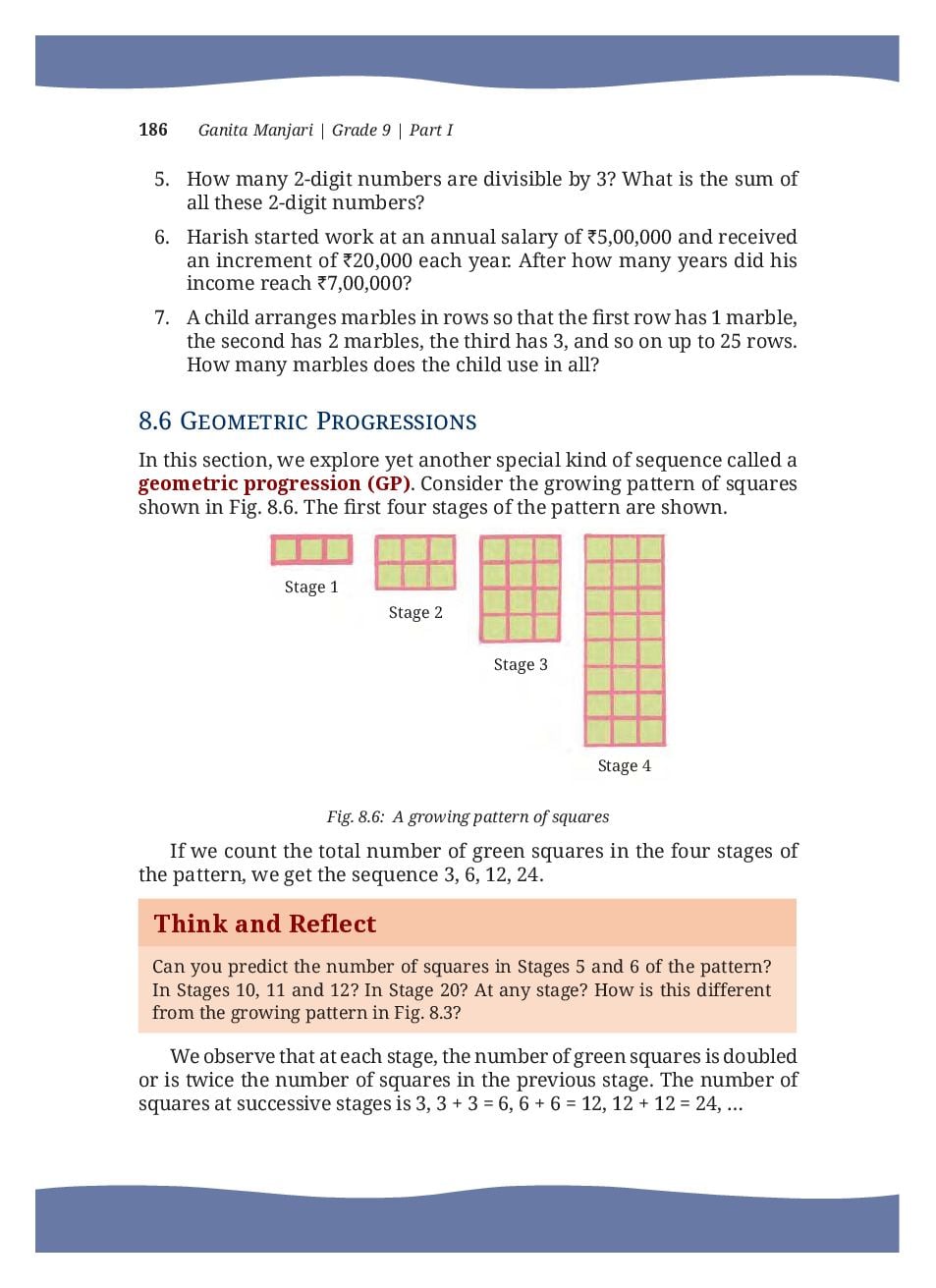
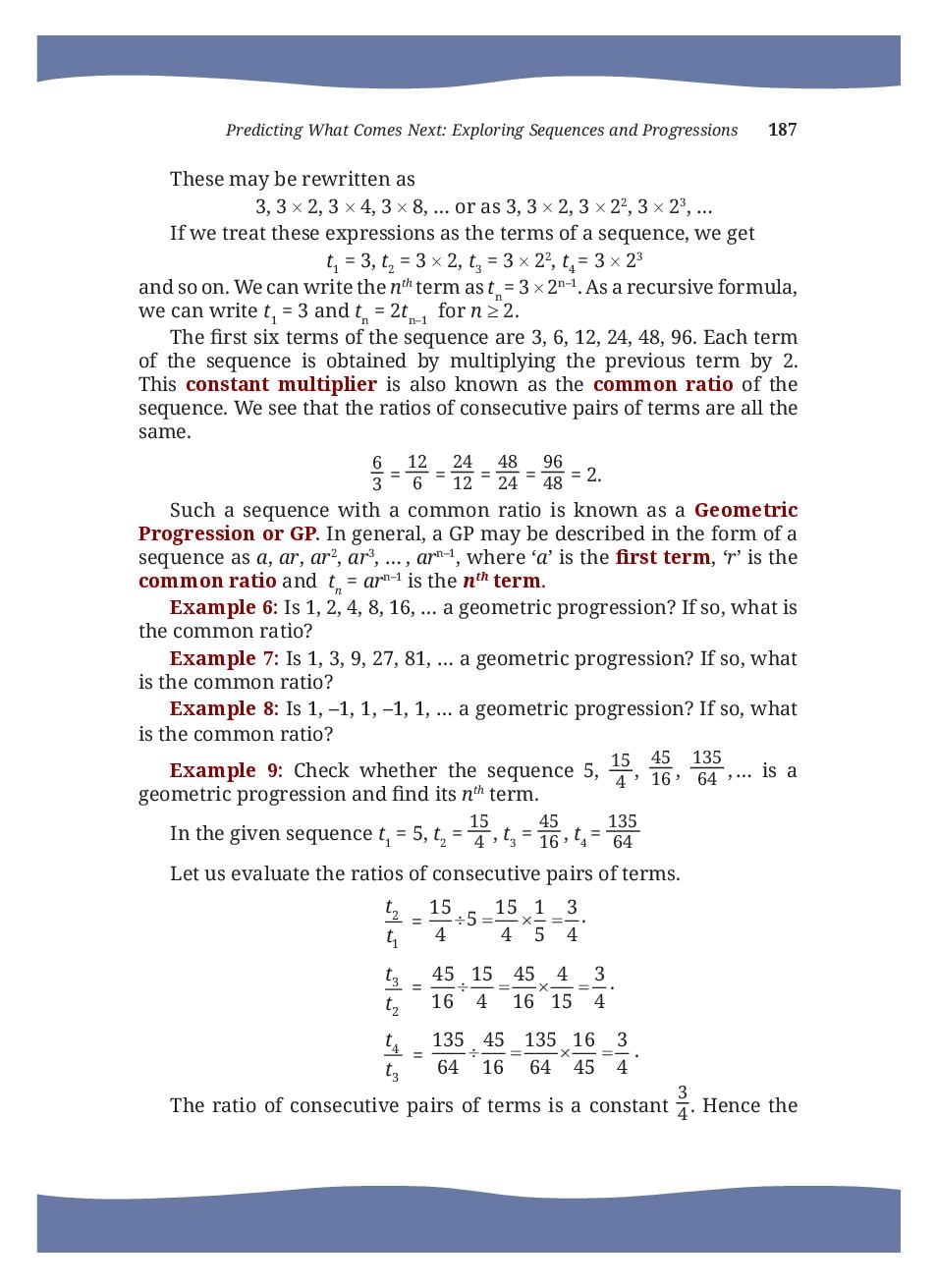
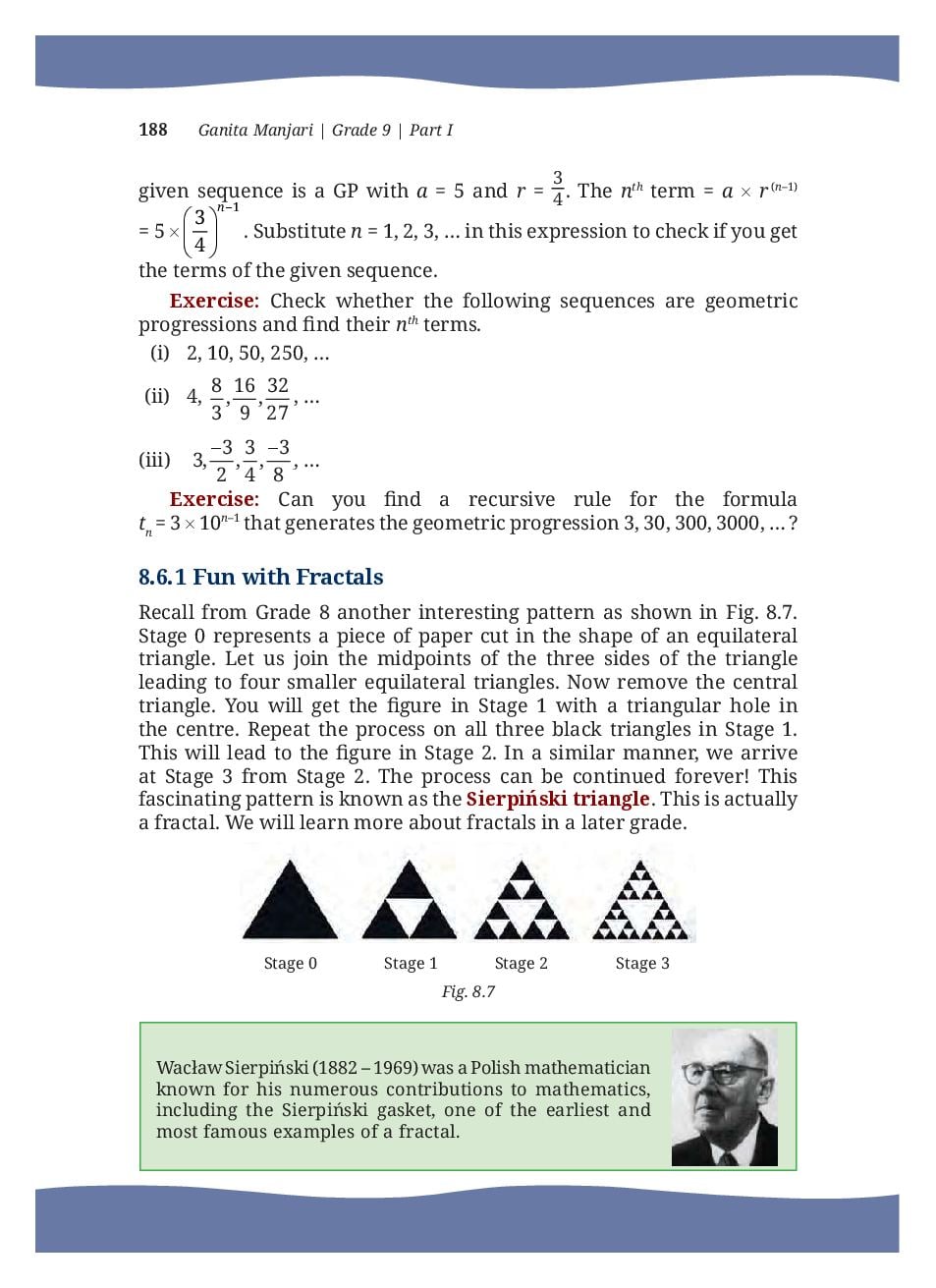
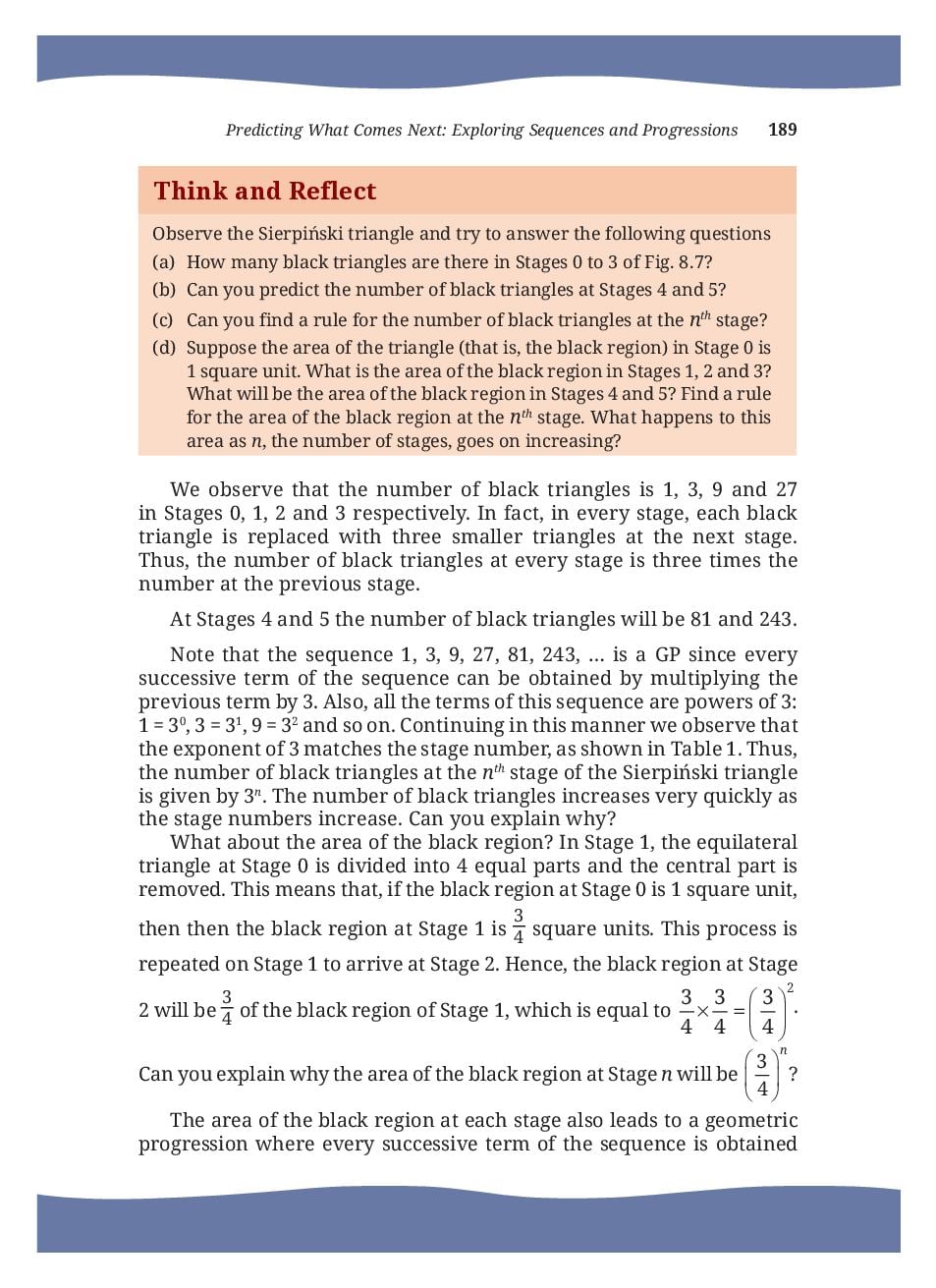
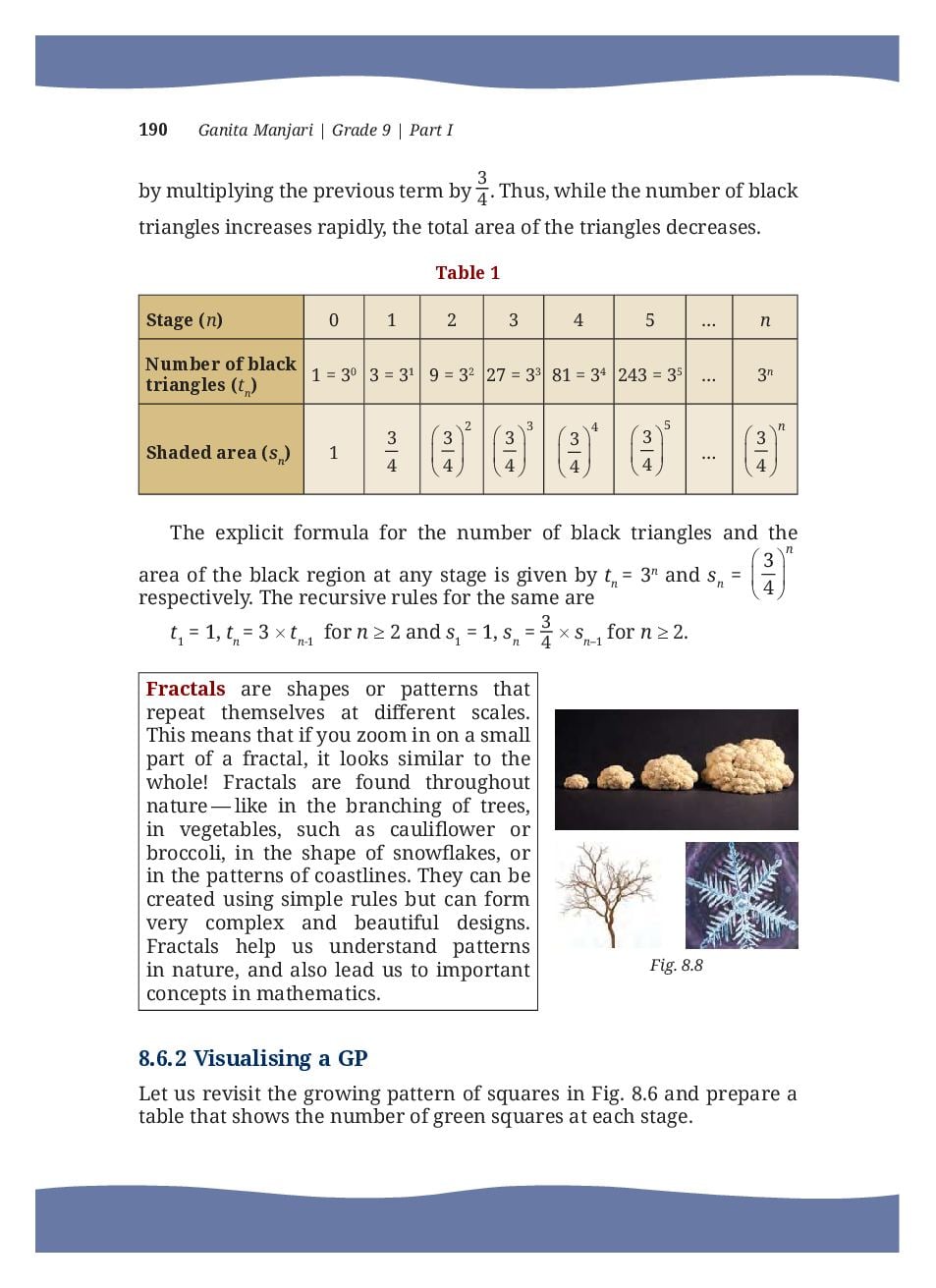
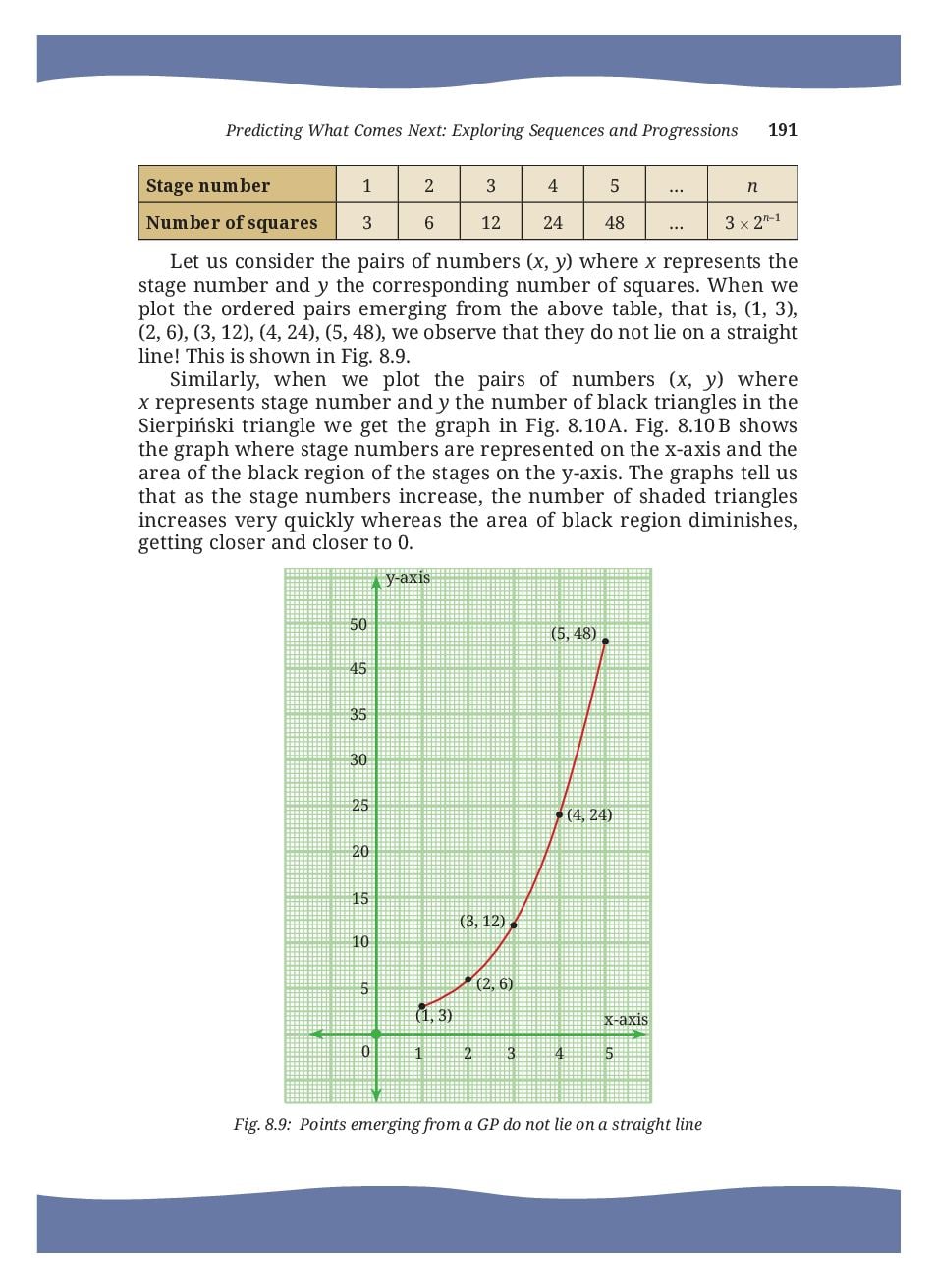
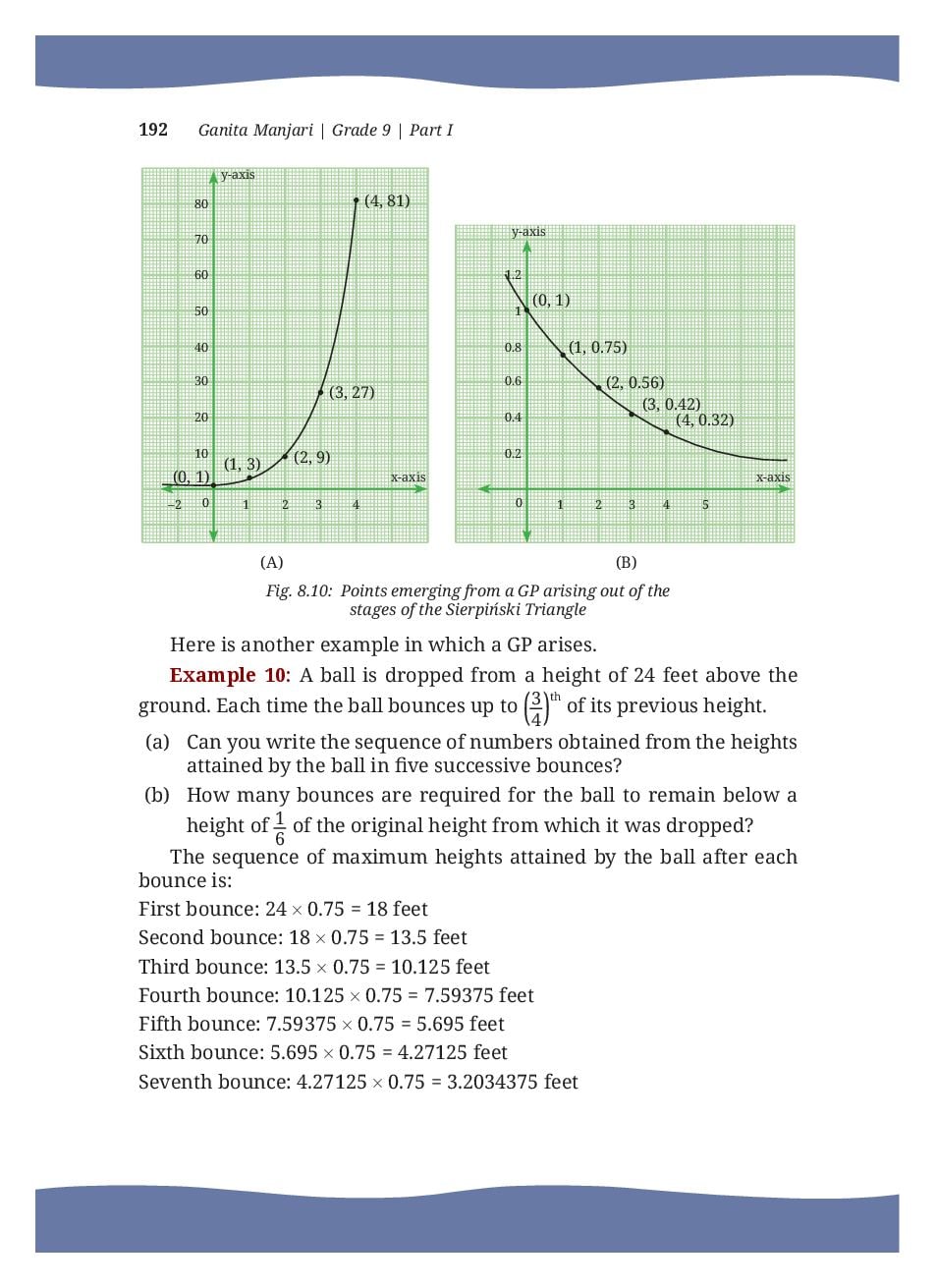
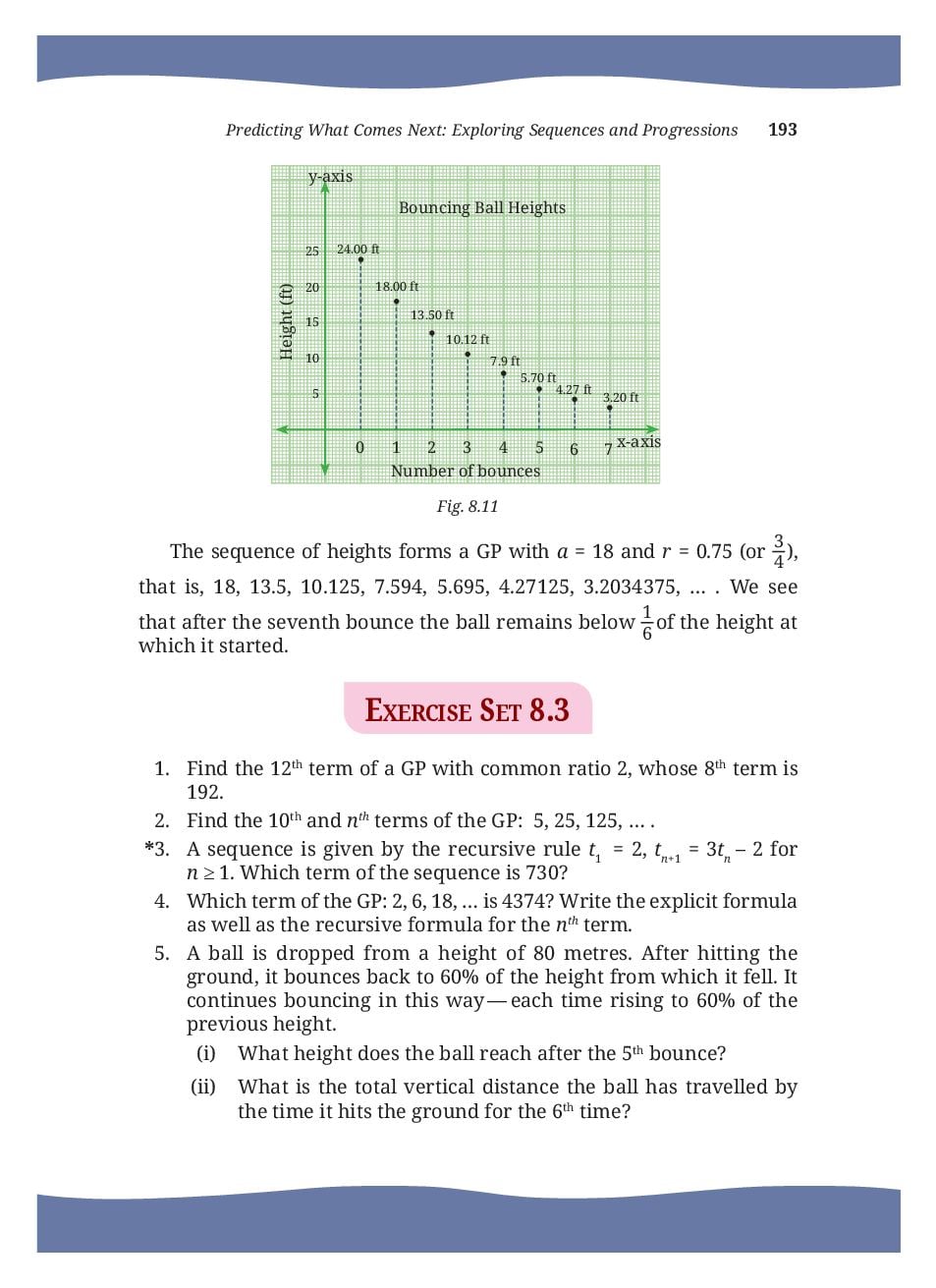
- A geometric progression (GP) has a constant common ratio r: a, ar, ar2, …, with tn = arn–1 and recursive form t1 = a, tn = r · tn–1. Its plotted points curve away from any straight line. Fractals supply GPs of both kinds: in the Sierpiński triangle the count of black triangles is 3n (growing fast) while the black area is (3/4)n (shrinking towards 0).
Quick revision – Predicting What Comes Next: Exploring Sequences and Progressions
| Idea | In symbols | What it says | Where students slip |
|---|---|---|---|
| Term and position | Tn | N is the place, tn is the value sitting there | Reading t5 = 9 as ‘the term 5 equals 9’ |
| Explicit rule | Tn = f(n) | Jump to any term directly from n | Using it without checking that n is a natural number |
| Recursive rule | T1 given, tn from tn–1 | Each term is built from the ones before it | Forgetting to state the starting term |
| Is k a term? | Solve tn = k | K is a term only if n is a natural number | Accepting n = 94.6 as an answer |
| AP | Tn = a + (n – 1)d | Add the same d each step | Using n instead of (n – 1) |
| Common difference | D = tn – tn–1 | Later term minus earlier term; may be negative | Subtracting the wrong way round in a falling AP |
| GP | Tn = arn–1 | Multiply by the same r each step | Writing arn instead of arn–1 |
| Common ratio | R = tn ÷ tn–1 | Every consecutive pair must give the same r | Checking only one pair of terms |
| Sum 1 + 2 + … + n | Sn = n(n + 1)/2 | Pair the ends: n pairs each worth (n + 1), halved | Dropping the division by 2 |
| Triangular numbers | 1, 3, 6, 10, 15, … | Tn = n(n + 1)/2, the nth partial sum of 1, 2, 3, … | Confusing them with square numbers |
| Square numbers | 1, 4, 9, 16, … | Tn = n2 = 1 + 3 + 5 + … + (2n – 1) | Missing that the gaps are the odd numbers |
| AP graph vs GP graph | Line vs curve | Constant addition is linear; constant multiplication is not | Calling any rising sequence an AP |
Old NCERT vs New – Class 9 Maths
This chapter is from Ganita Manjari, the new NCERT Class 9 Maths book (NCF-SE 2023, used from 2026-27). It replaced the old book “Mathematics”, so chapter numbers and names differ from older PDFs.
Solutions and All Chapters
Answers to the exercises and the full chapter list of Ganita Manjari:
Predicting What Comes Next: Exploring Sequences and Progressions – Overview
| Class | Class 9 |
| Subject | Maths |
| Book | Ganita Manjari – new NCERT book |
| Part | Part I |
| Chapter | 8 of 14 – Predicting What Comes Next: Exploring Sequences and Progressions |
| Book pages | 174 – 196 |
| Edition | Latest NCERT edition (2026-27) |
| Session | 2026-27 |
| Free – read online or download |
Class 9 Maths Chapter 8 – FAQs
Where can I download Predicting What Comes Next: Exploring Sequences and Progressions Class 9 PDF?
From the download table on this page – the chapter PDF is free, and the full book is linked too.
What is Class 9 Maths Chapter 8 about?
A sequence is an ordered list of numbers; each number is a term. The notation t1, t2, t3, … ties a term to its position, so t4 = 7 says “the term in the 4th place is 7”. Sequences may be finite (6, 12, 24, 48, 96) or infinite (1, 2, 3, 4, …).
Is Predicting What Comes Next: Exploring Sequences and Progressions from the new NCERT Class 9 Maths book?
Yes. It is chapter 8 of ganita manjari (part i), the new NCERT Class 9 Maths book for 2026-27.
Is this the latest NCERT edition for 2026-27?
Yes – the PDF is NCERT’s latest edition for the 2026-27 session.
Where are the NCERT Solutions for Class 9 Maths Chapter 8?
Open the NCERT Solutions link above for answers to the exercise questions.