NCERT Solutions for Class 6 English Chapter 5 Culture and Tradition provide clear, step-by-step answers to every exercise and in-text question from the chapter Culture and Tradition of the NCERT textbook Poorvi. Prepared by subject experts as per the latest NCERT (CBSE) syllabus for 2026-27, these NCERT Solutions for Class 6 English help you understand each concept, write exam-ready answers, and check your own solutions. You can read them online below or download the free Class 6 English Chapter 5 question-answer PDF.
NCERT Solutions for Class 6 English Chapter 5 Culture and Tradition
- Class: Class 6
- Subject: English
- Chapter: Chapter 5 – Culture and Tradition
- Textbook: Poorvi (NCERT)
- Study material: NCERT Solutions – questions with answers, free PDF
These solutions answer all the exercise questions of Chapter 5 Culture and Tradition — including the in-text questions, short-answer and long-answer questions, and activities — with complete explanations so you can follow the method, not just the final answer. Read the full solutions below.
NCERT Solutions Class 6 English Unit 5 Culture and Tradition View Download
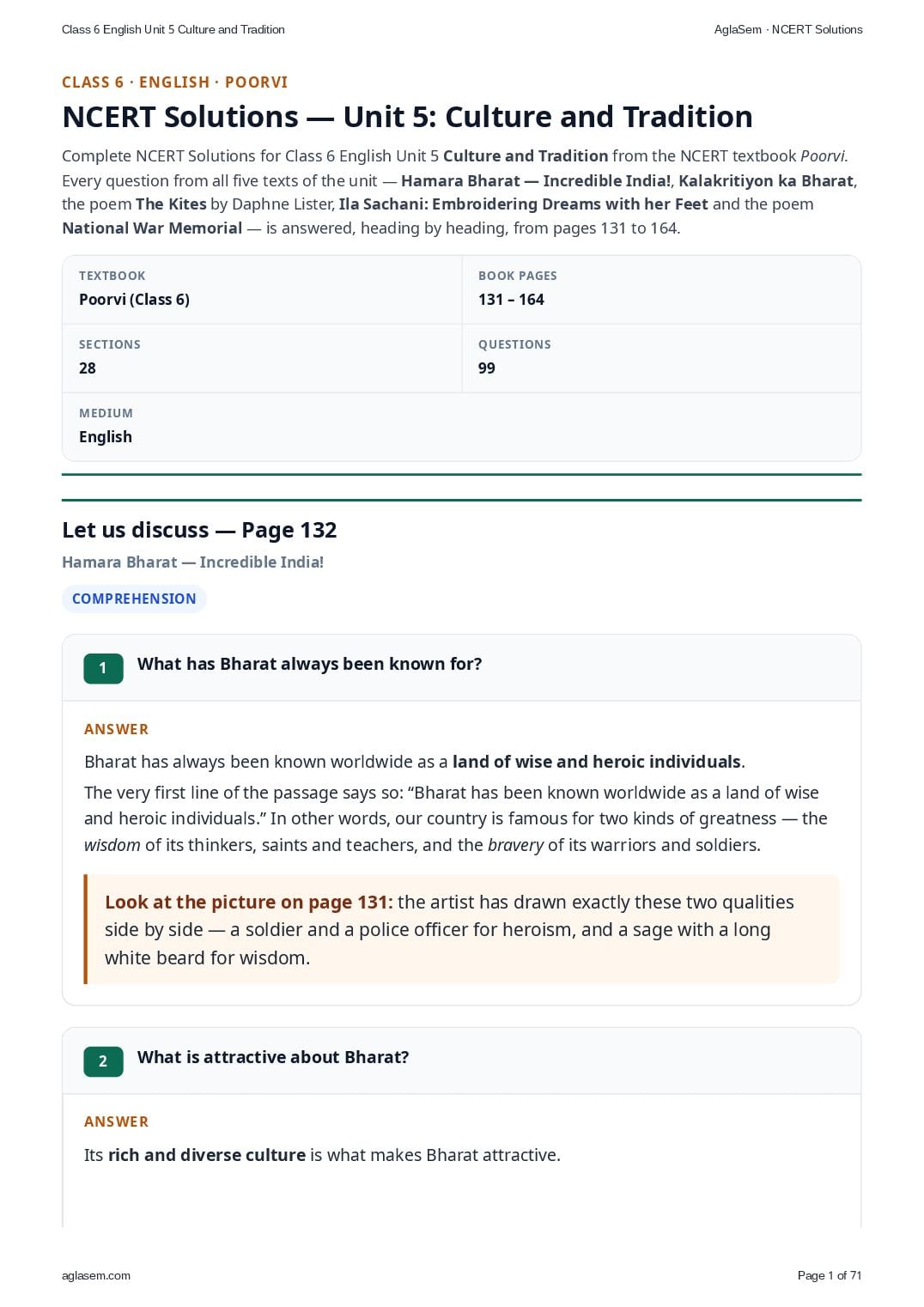
NCERT Solutions for Class 6 English Chapter 5 PDF Download
You can read the NCERT Solutions for Class 6 English Chapter 5 online above, or download the complete question-answer PDF to study Culture and Tradition offline at any time.
NCERT Solutions for Class 6 English Chapter 5 PDF Download Link – Click Here to Download Solutions PDF
Questions Covered in This Chapter
These NCERT Solutions answer all 99 questions of this chapter. The questions solved are:
- What has Bharat always been known for?
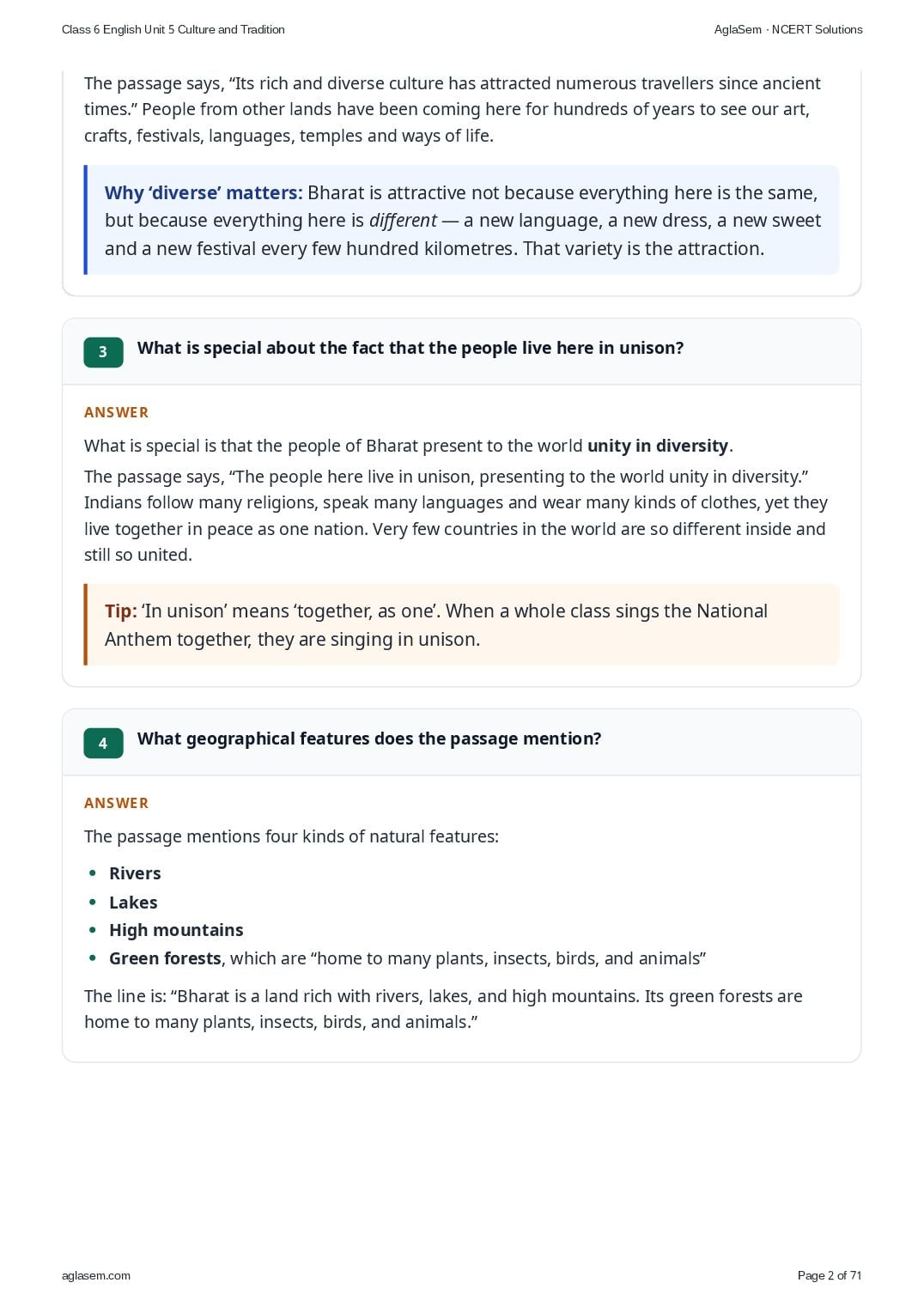
- What is attractive about Bharat?
- What is special about the fact that the people live here in unison?
- What geographical features does the passage mention?
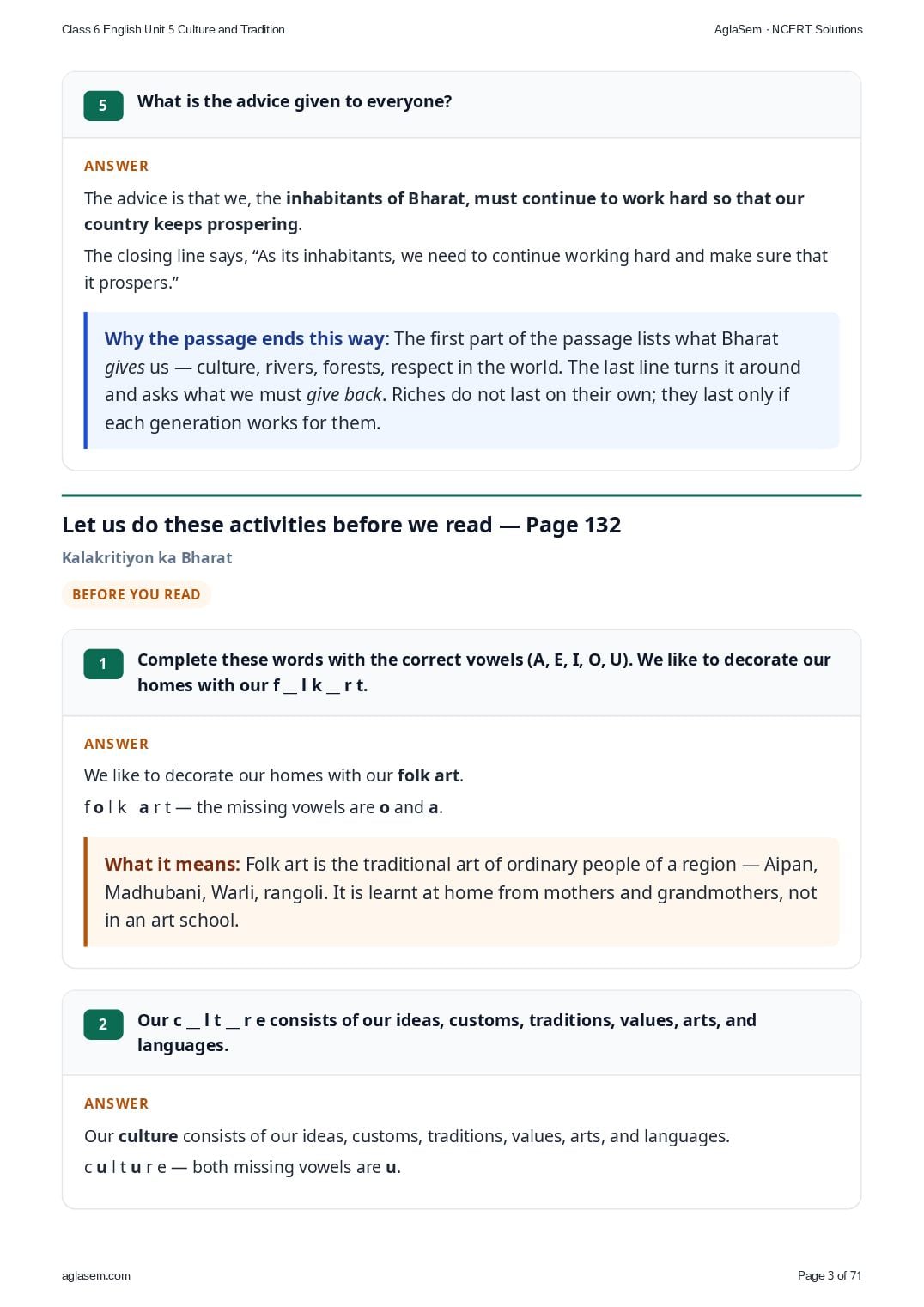
- What is the advice given to everyone?
- Complete these words with the correct vowels (A, E, I, O, U). We like to decorate our homes with our f __ l k __ r t.
- Our c __ l t __ r e consists of our ideas, customs, traditions, values, arts, and languages.
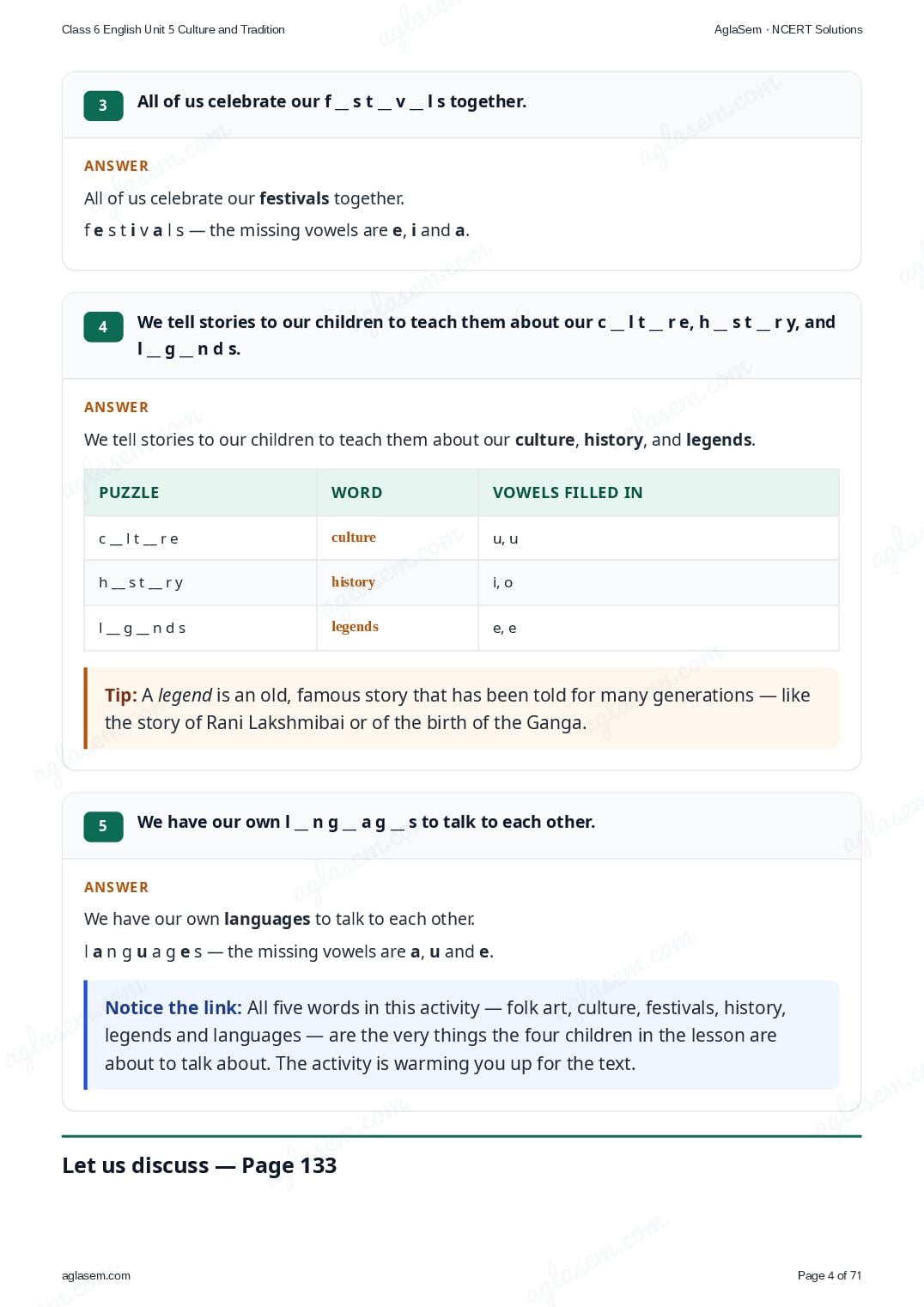
- All of us celebrate our f __ s t __ v __ l s together.
- We tell stories to our children to teach them about our c __ l t __ r e, h __ s t __ r y, and l __ g __ n d s.
- We have our own l __ n g __ a g __ s to talk to each other.
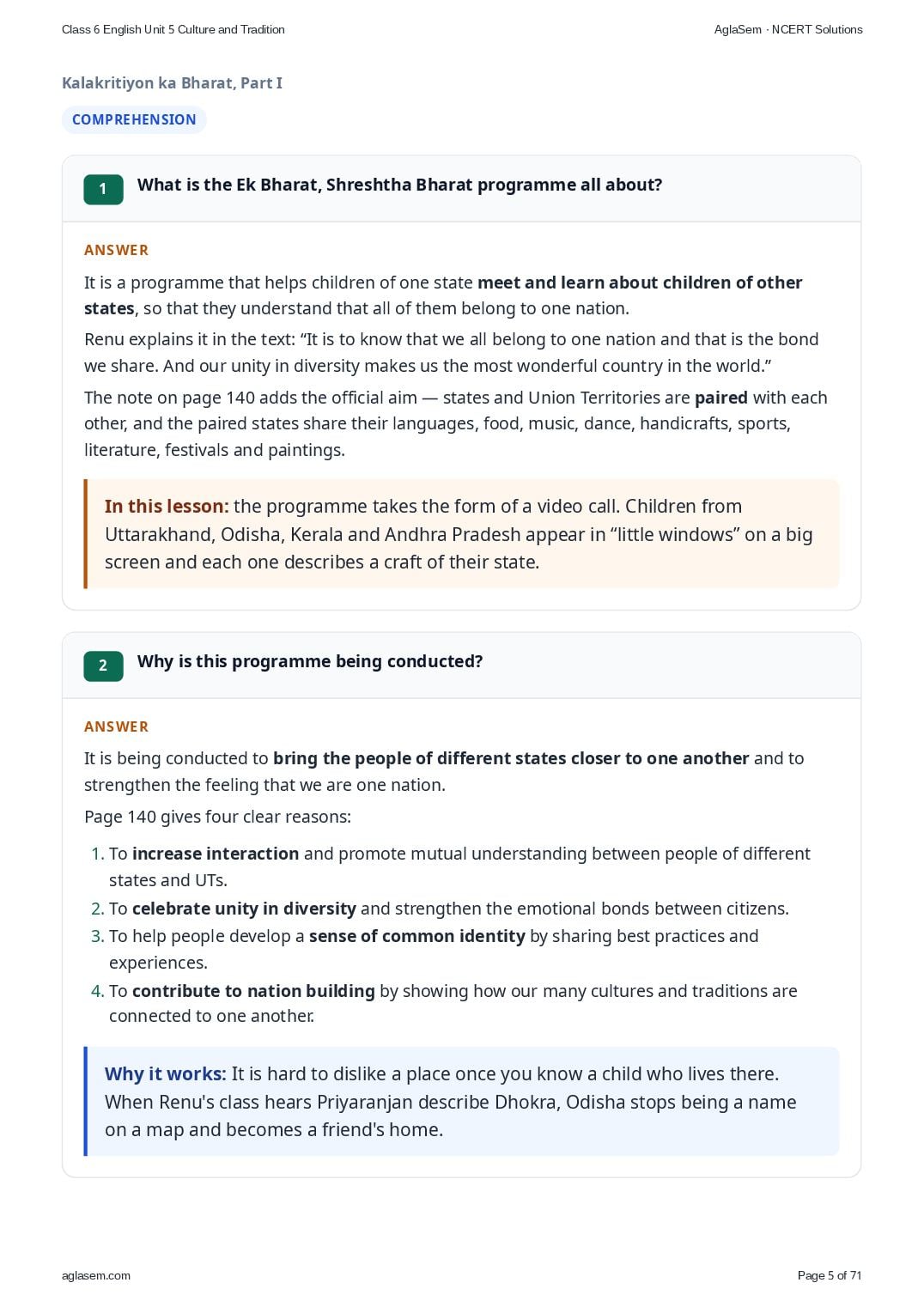
- What is the Ek Bharat, Shreshtha Bharat programme all about?
- Why is this programme being conducted?
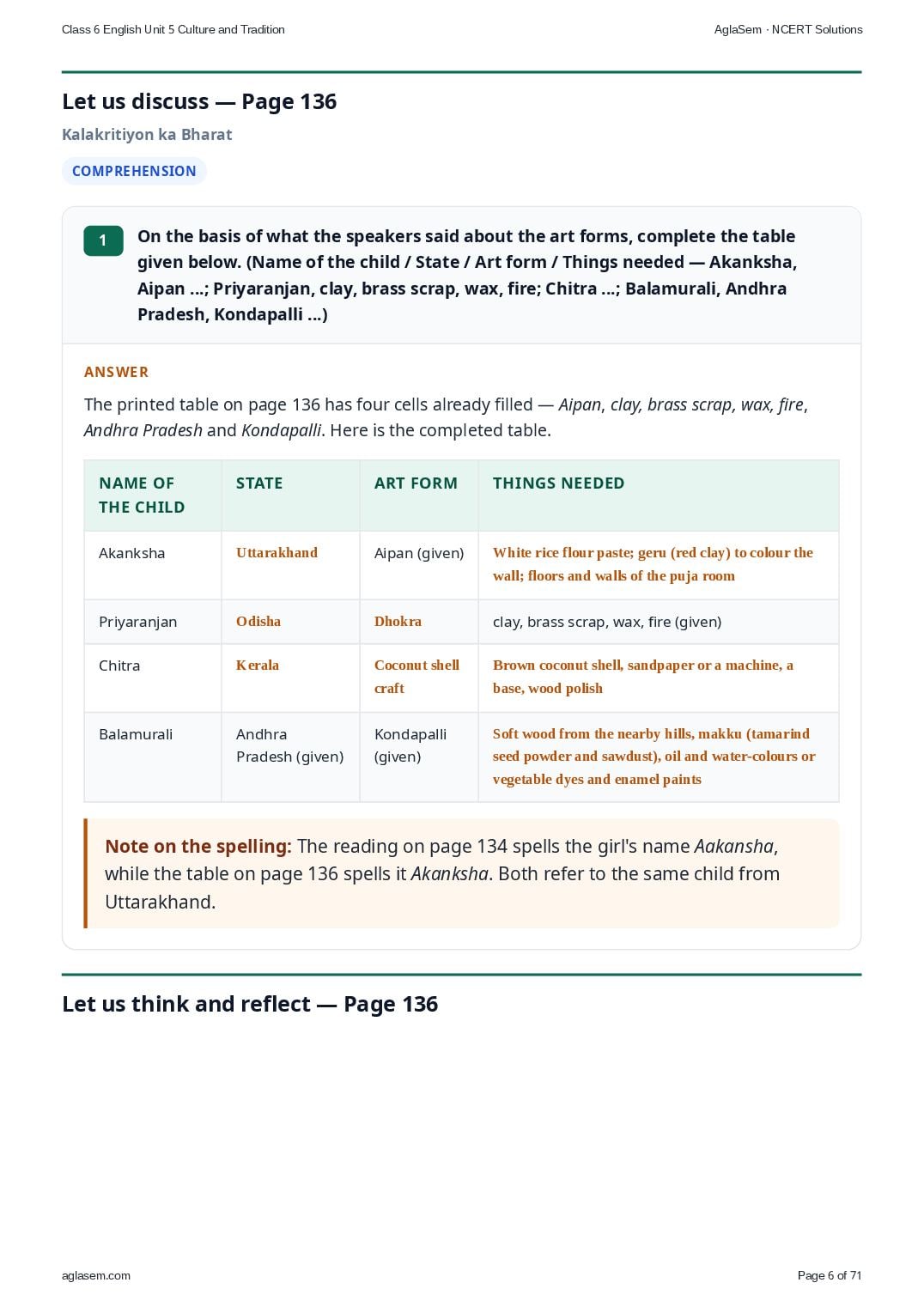
- On the basis of what the speakers said about the art forms, complete the table given below. (Name of the child / State / Art form / Things needed — Akanksha, Aipan …; Priyaranjan, clay, brass scrap, wax, fire; Chitra …; Balamurali, Andhra Pradesh, Kondapalli …)
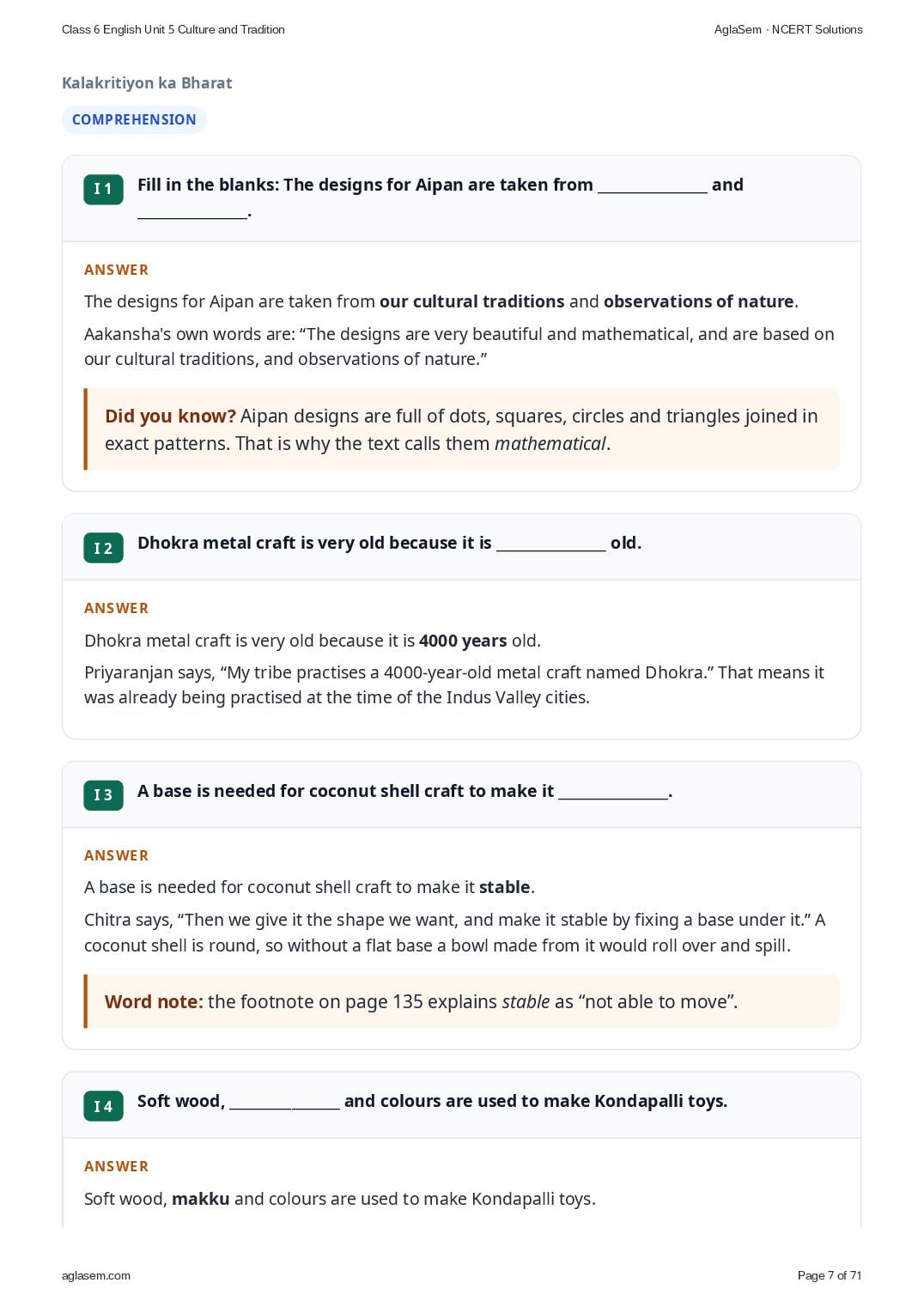
- Fill in the blanks: The designs for Aipan are taken from ________________ and ________________.
- Dhokra metal craft is very old because it is ________________ old.
- A base is needed for coconut shell craft to make it ________________.
- Soft wood, ________________ and colours are used to make Kondapalli toys.
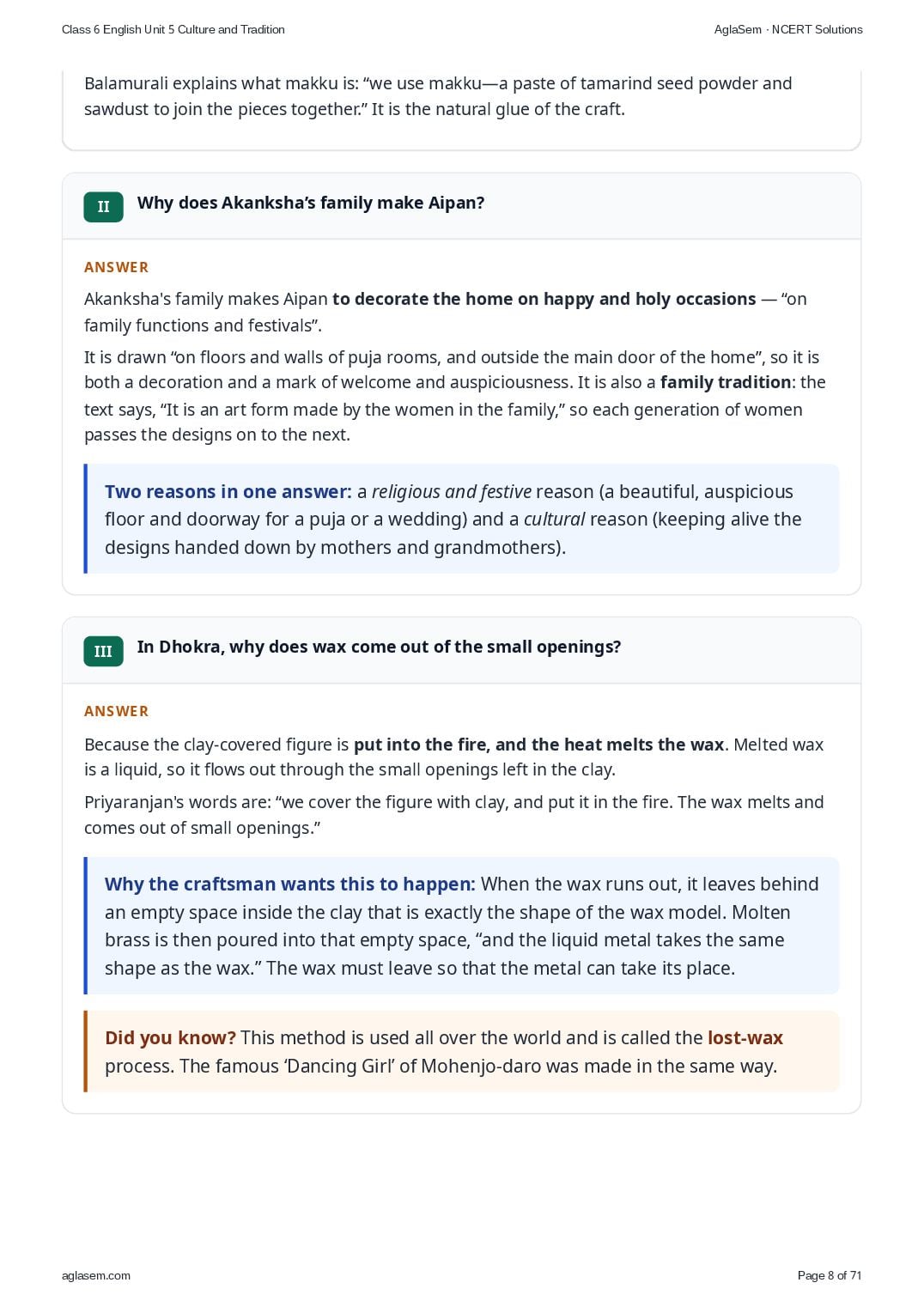
- Why does Akanksha’s family make Aipan?
- In Dhokra, why does wax come out of the small openings?
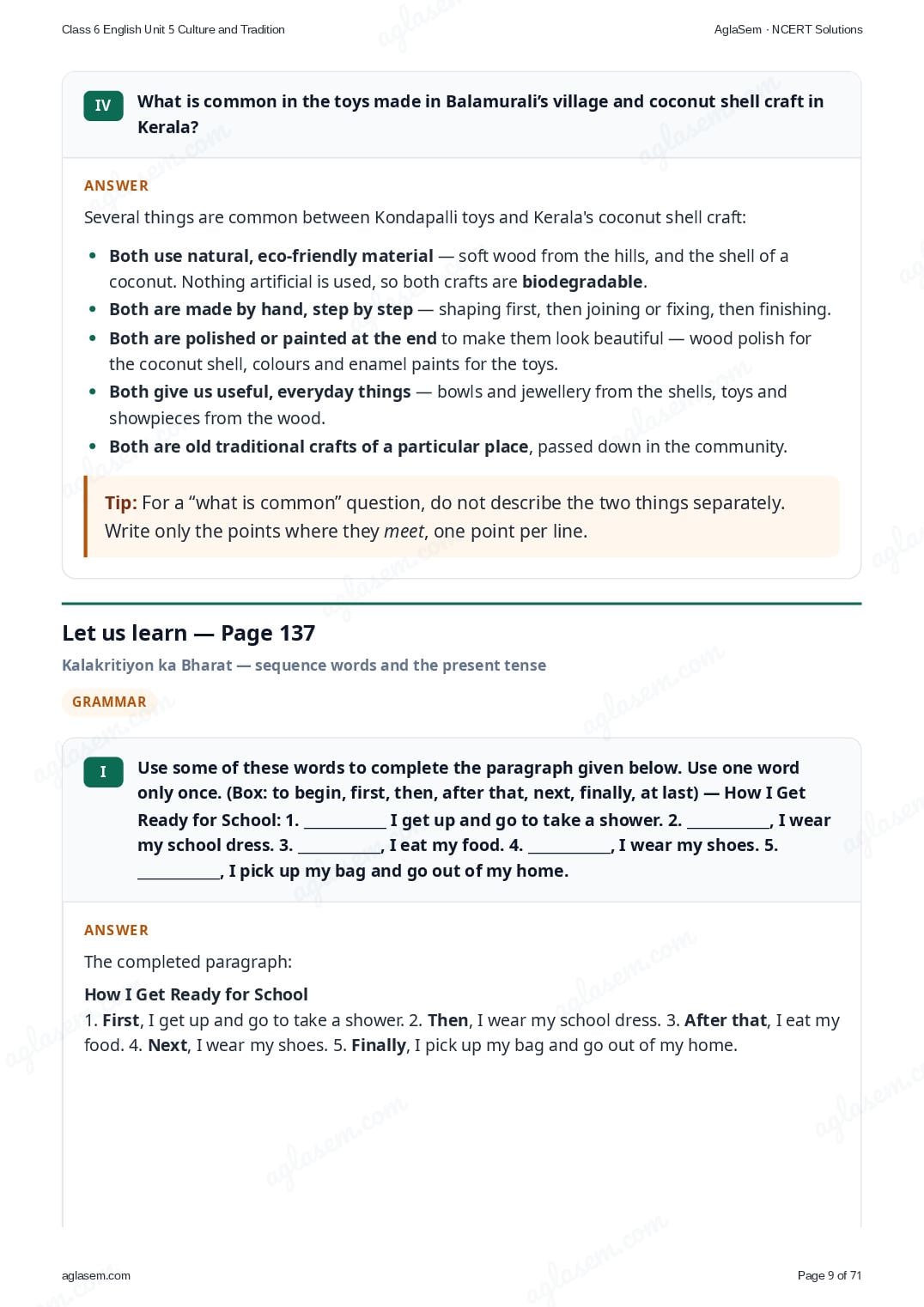
- What is common in the toys made in Balamurali’s village and coconut shell craft in Kerala?
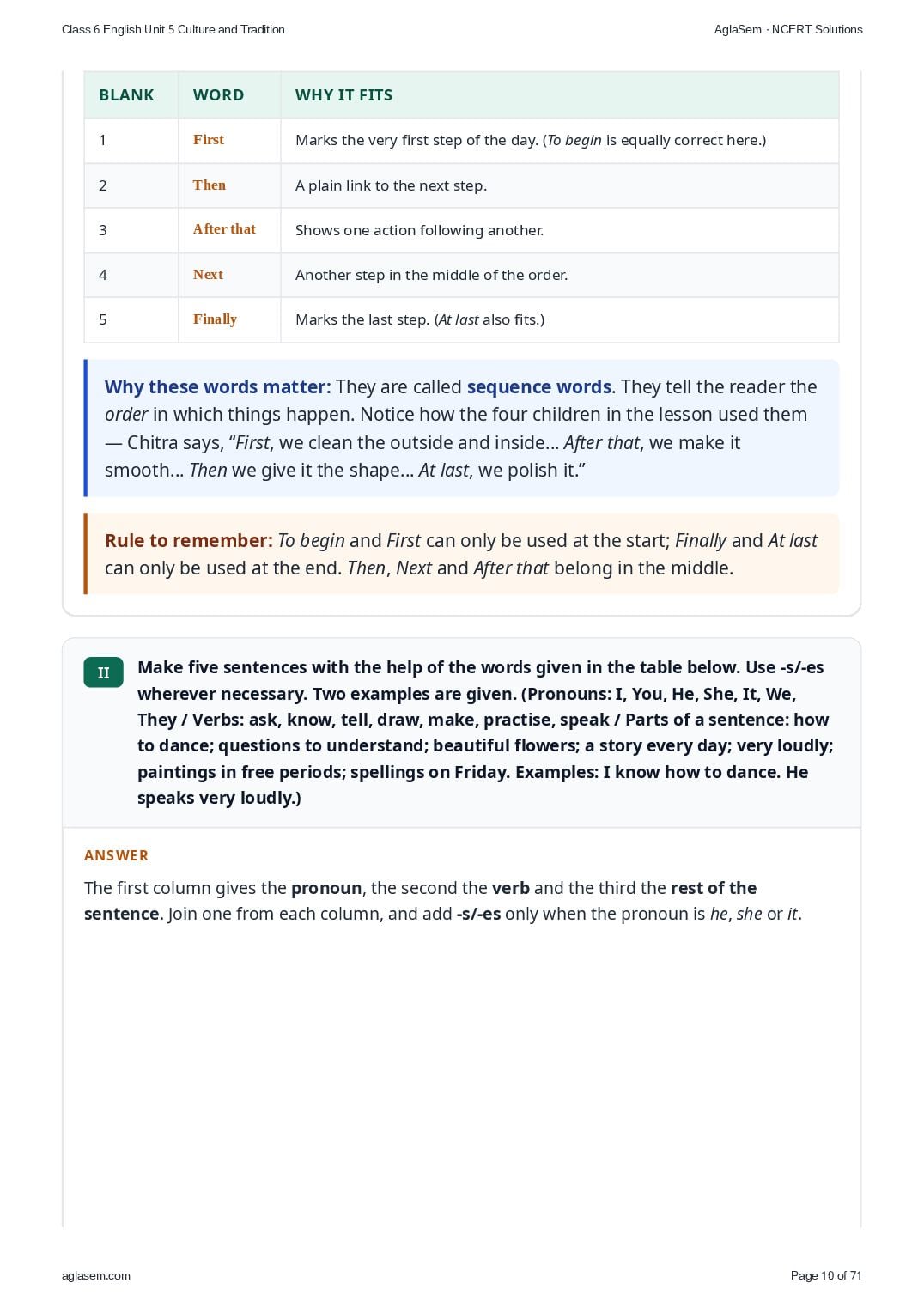
- Use some of these words to complete the paragraph given below. Use one word only once. (Box: to begin, first, then, after that, next, finally, at last) — How I Get Ready for School: 1. ____________ I get up and go to take a shower. 2. ____________, I wear my school dress. 3. ____________, I eat my food. 4. ____________, I wear my shoes. 5. ____________, I pick up my bag and go out of my home.
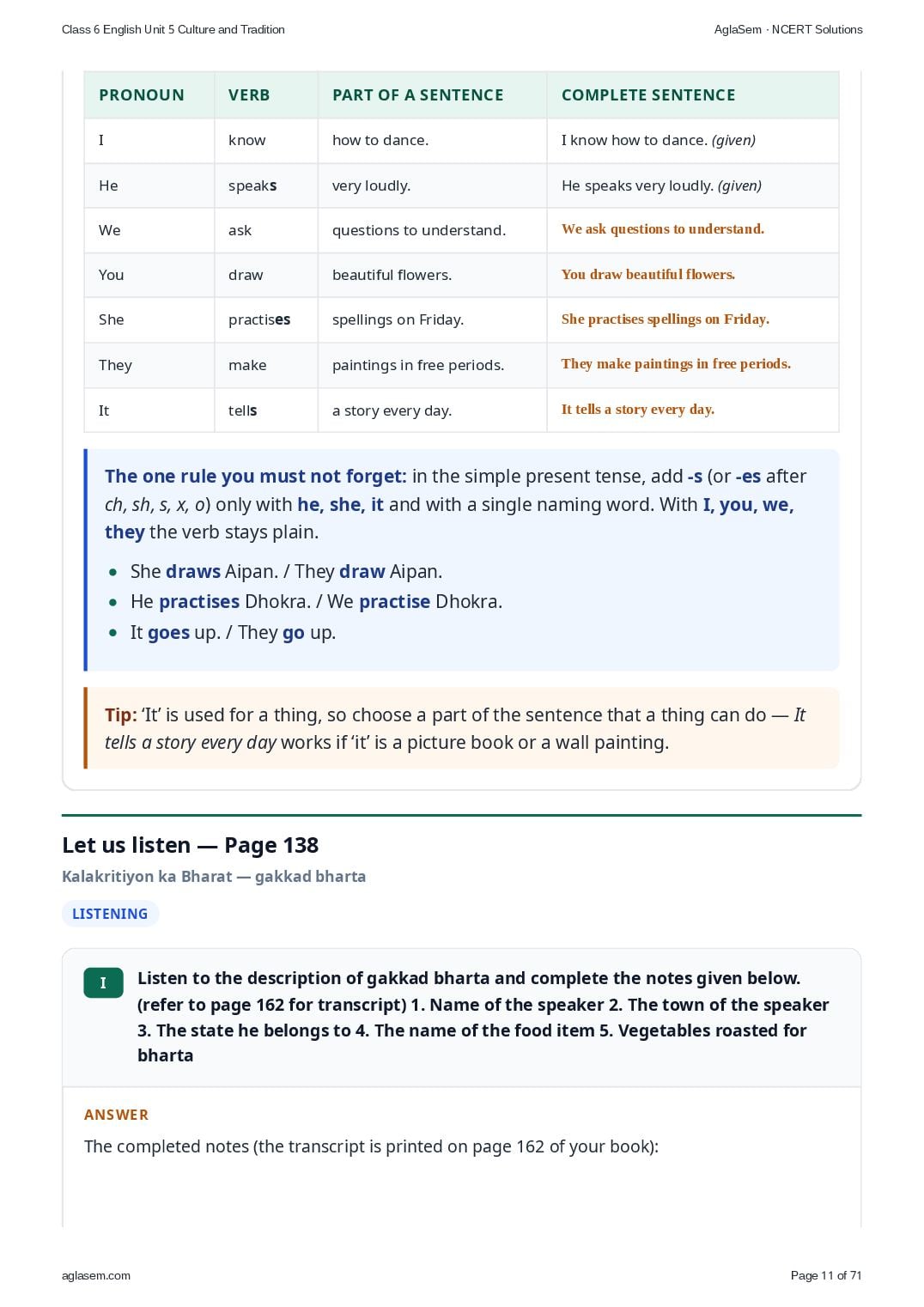
- Make five sentences with the help of the words given in the table below. Use -s/-es wherever necessary. Two examples are given. (Pronouns: I, You, He, She, It, We, They / Verbs: ask, know, tell, draw, make, practise, speak / Parts of a sentence: how to dance; questions to understand; beautiful flowers; a story every day; very loudly; paintings in free periods; spellings on Friday. Examples: I know how to dance. He speaks very loudly.)
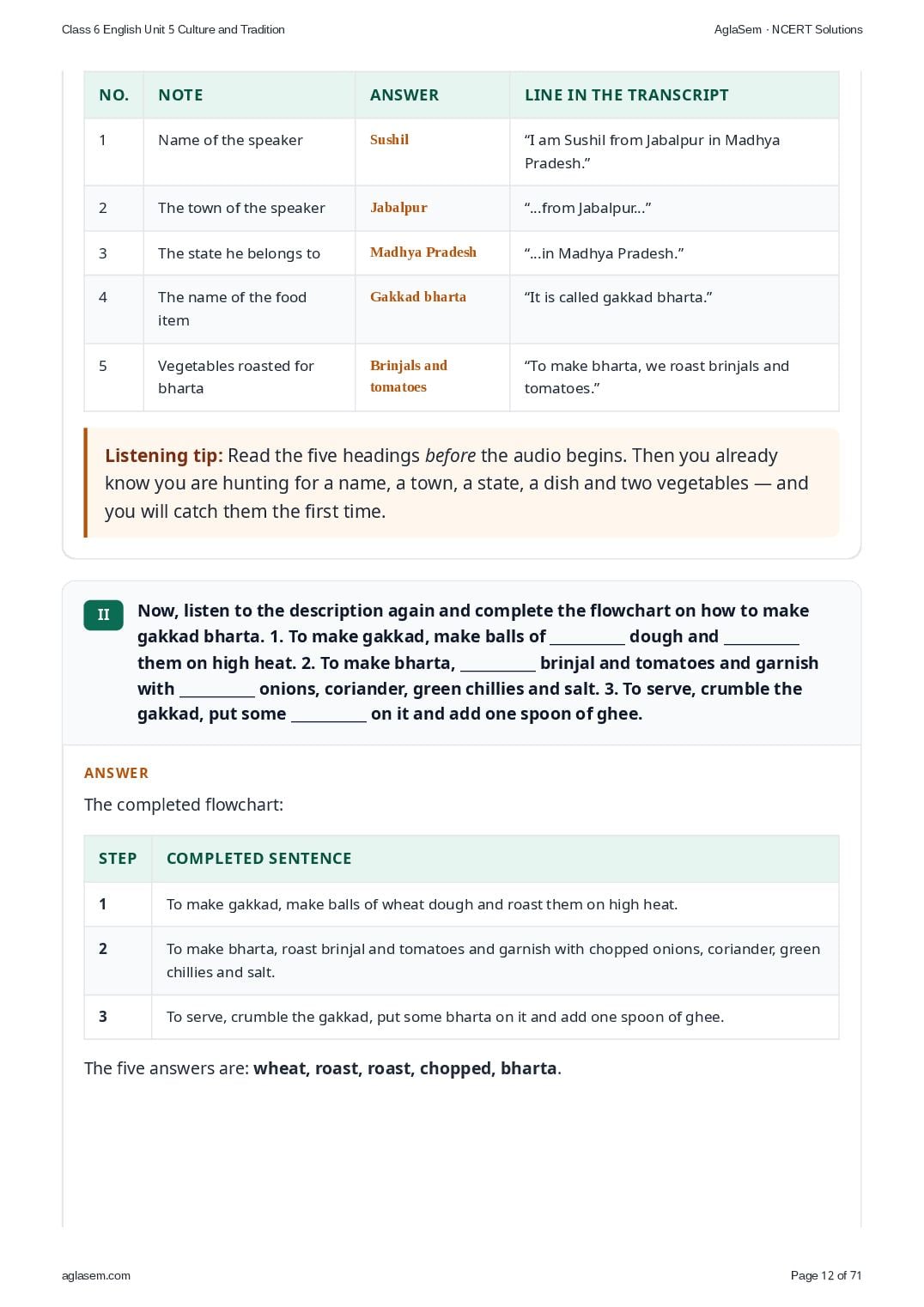
- Listen to the description of gakkad bharta and complete the notes given below. (refer to page 162 for transcript) 1. Name of the speaker 2. The town of the speaker 3. The state he belongs to 4. The name of the food item 5. Vegetables roasted for bharta
- Now, listen to the description again and complete the flowchart on how to make gakkad bharta. 1. To make gakkad, make balls of ___________ dough and ___________ them on high heat. 2. To make bharta, ___________ brinjal and tomatoes and garnish with ___________ onions, coriander, green chillies and salt. 3. To serve, crumble the gakkad, put some ___________ on it and add one spoon of ghee.
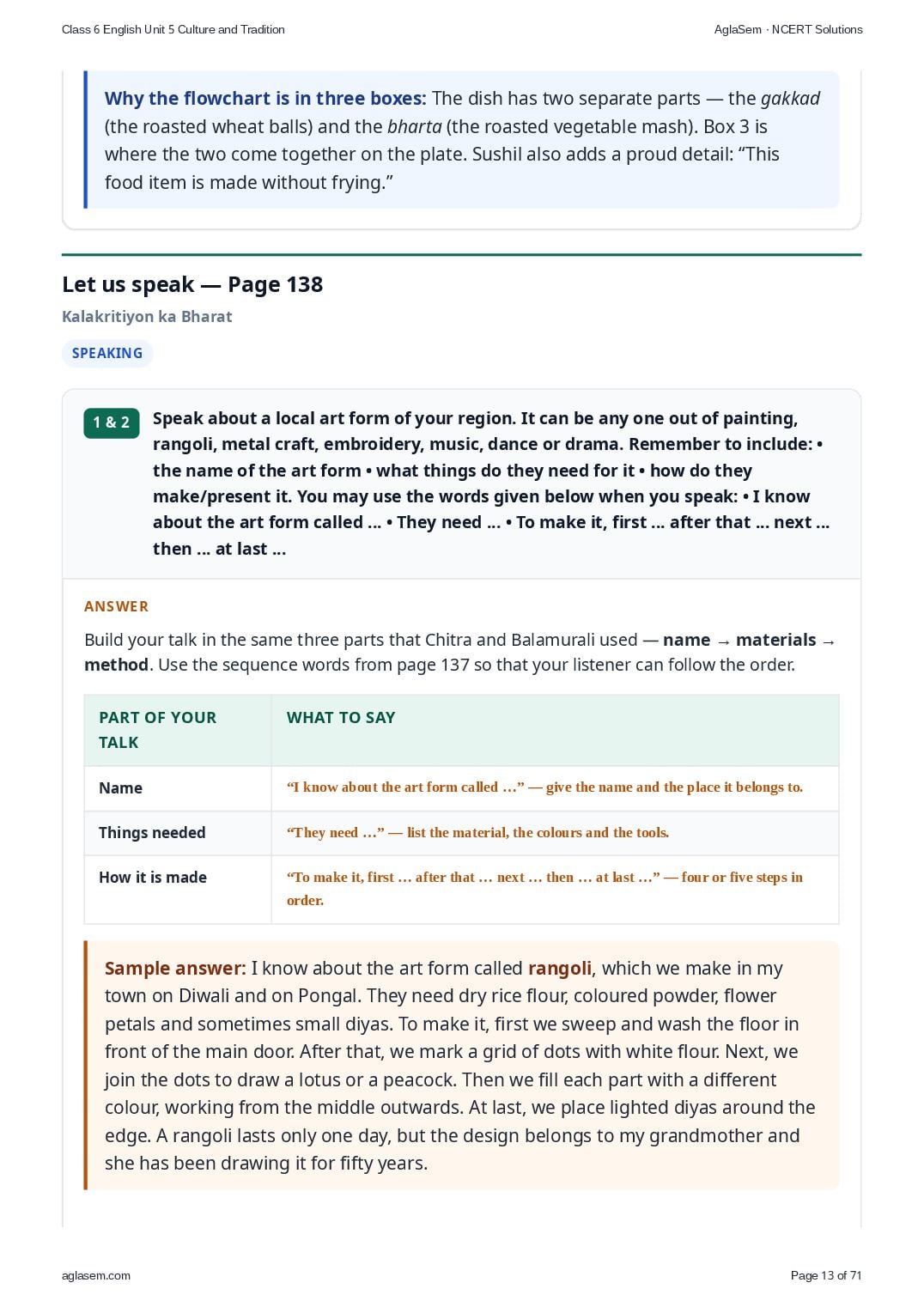
- Speak about a local art form of your region. It can be any one out of painting, rangoli, metal craft, embroidery, music, dance or drama. Remember to include: • the name of the art form • what things do they need for it • how do they make/present it. You may use the words given below when you speak: • I know about the art form called … • They need … • To make it, first … after that … next … then … at last …
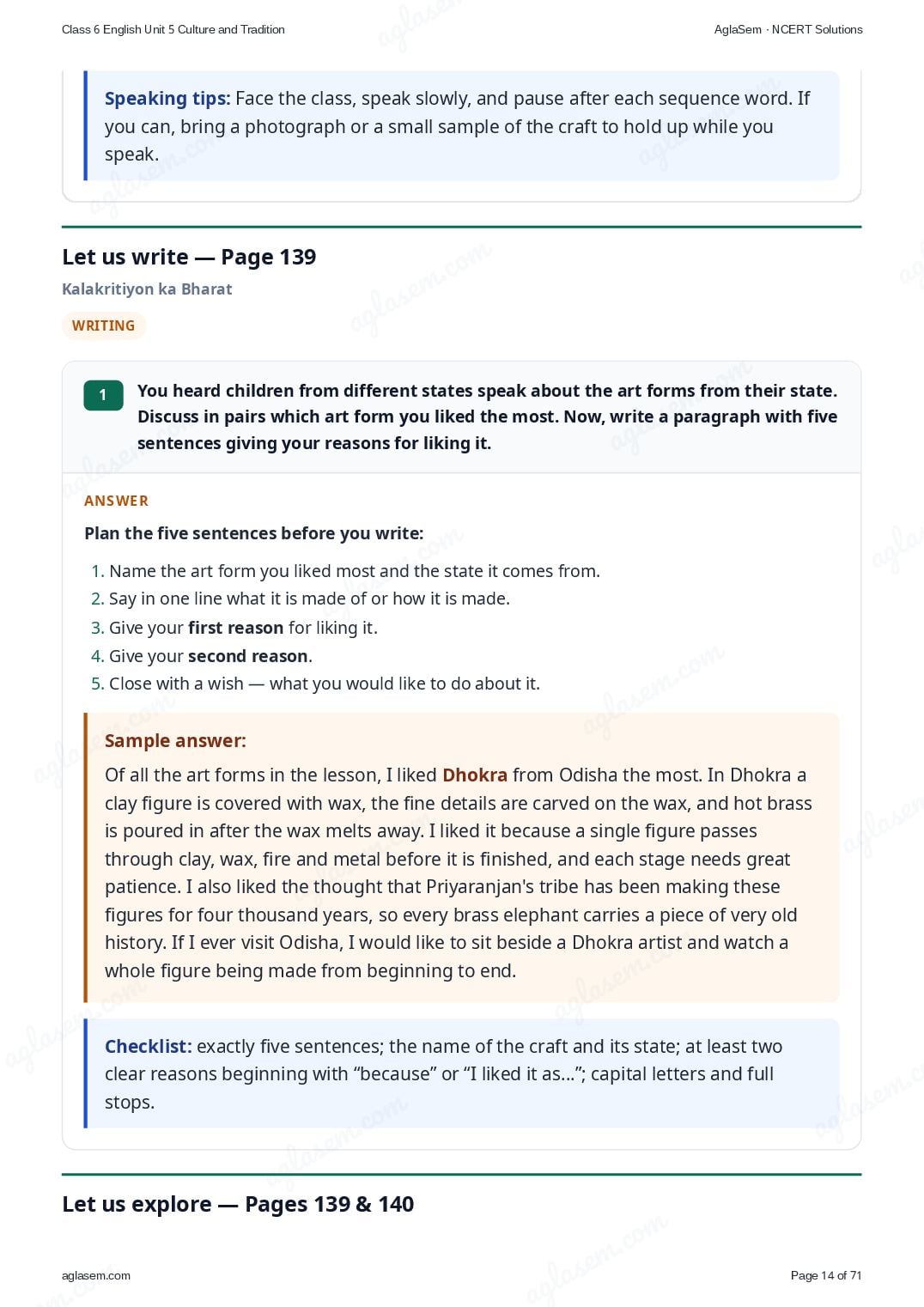
- You heard children from different states speak about the art forms from their state. Discuss in pairs which art form you liked the most. Now, write a paragraph with five sentences giving your reasons for liking it.
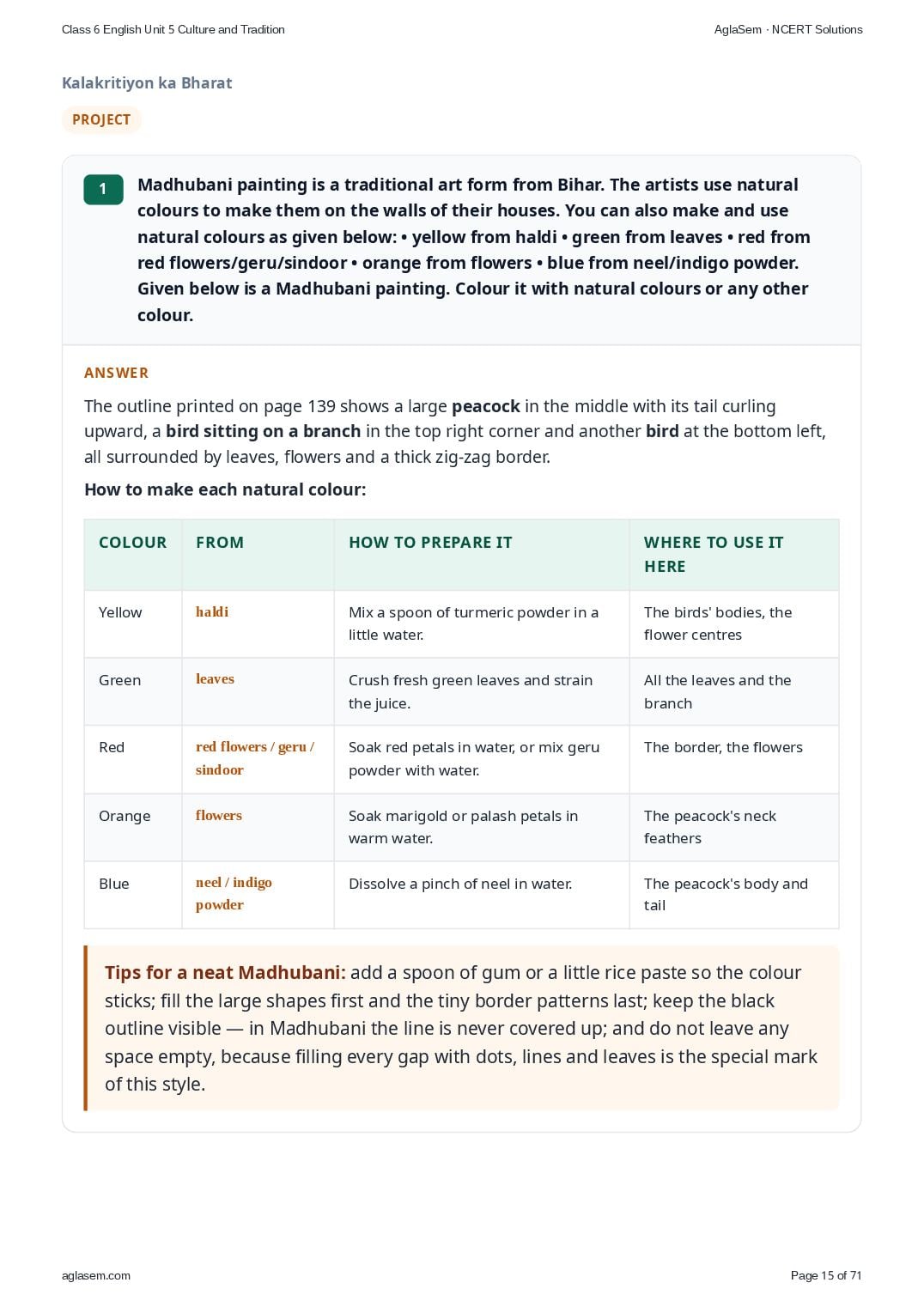
- Madhubani painting is a traditional art form from Bihar. The artists use natural colours to make them on the walls of their houses. You can also make and use natural colours as given below: • yellow from haldi • green from leaves • red from red flowers/geru/sindoor • orange from flowers • blue from neel/indigo powder. Given below is a Madhubani painting. Colour it with natural colours or any other colour.
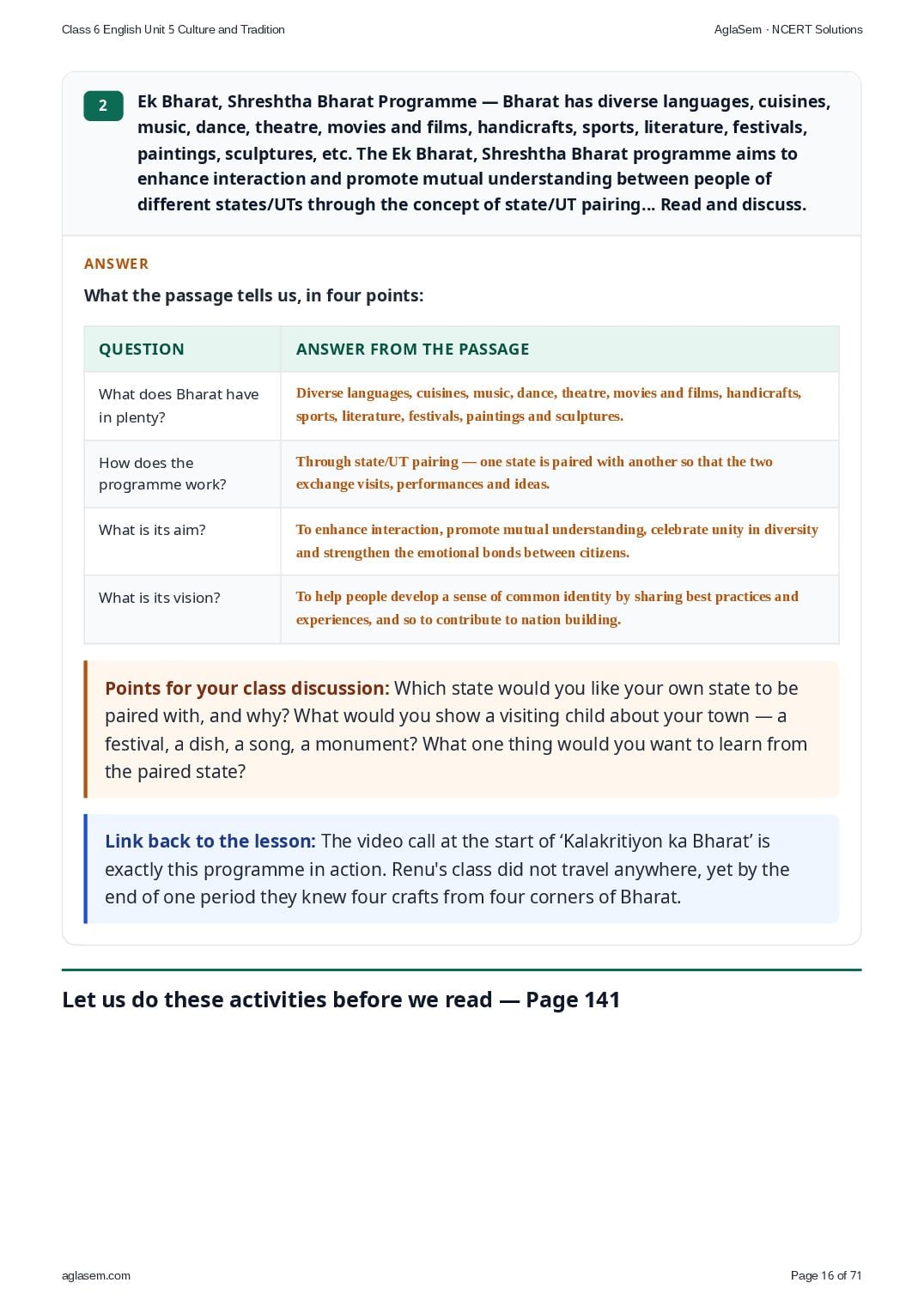
- Ek Bharat, Shreshtha Bharat Programme — Bharat has diverse languages, cuisines, music, dance, theatre, movies and films, handicrafts, sports, literature, festivals, paintings, sculptures, etc. The Ek Bharat, Shreshtha Bharat programme aims to enhance interaction and promote mutual understanding between people of different states/UTs through the concept of state/UT pairing… Read and discuss.
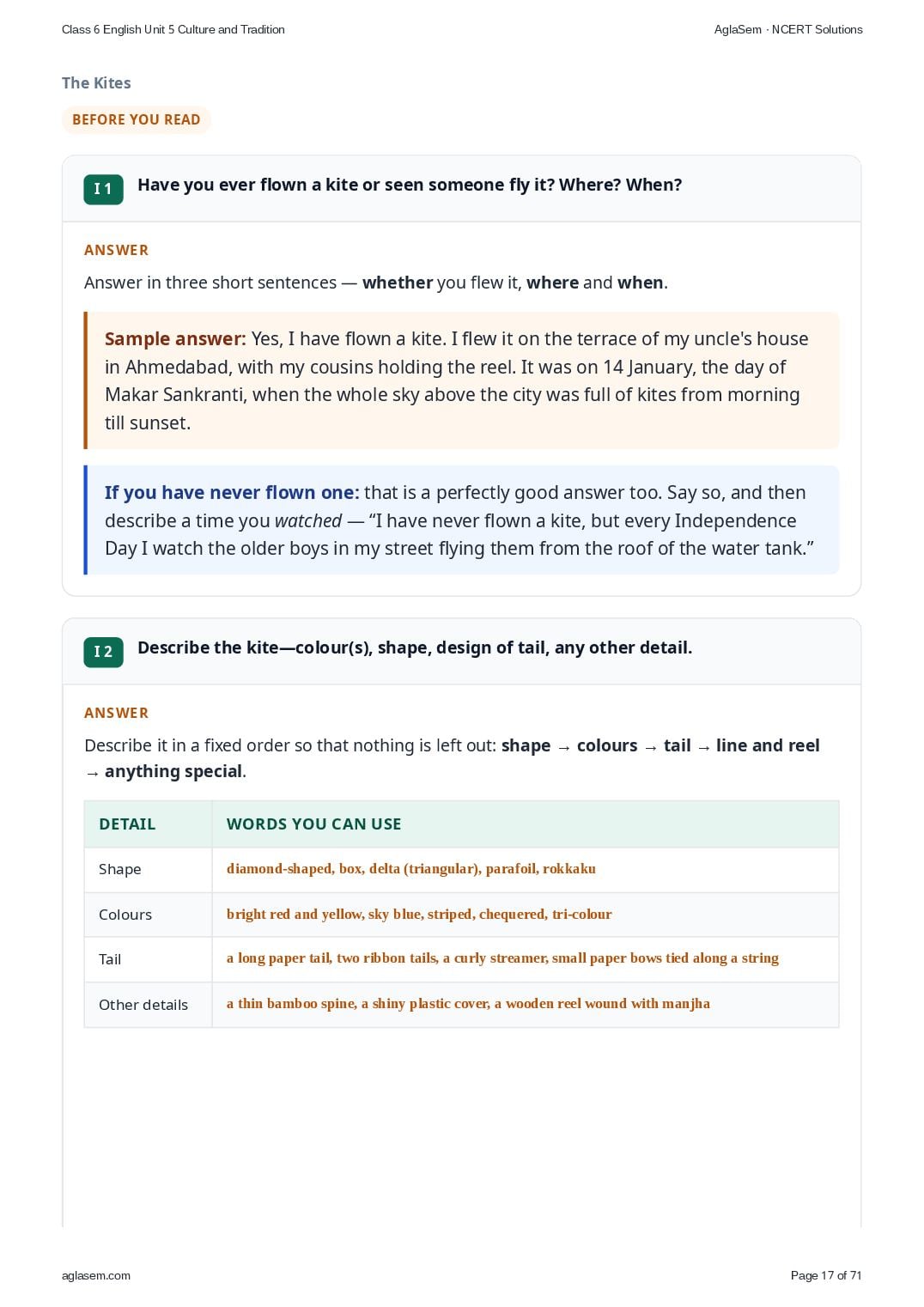
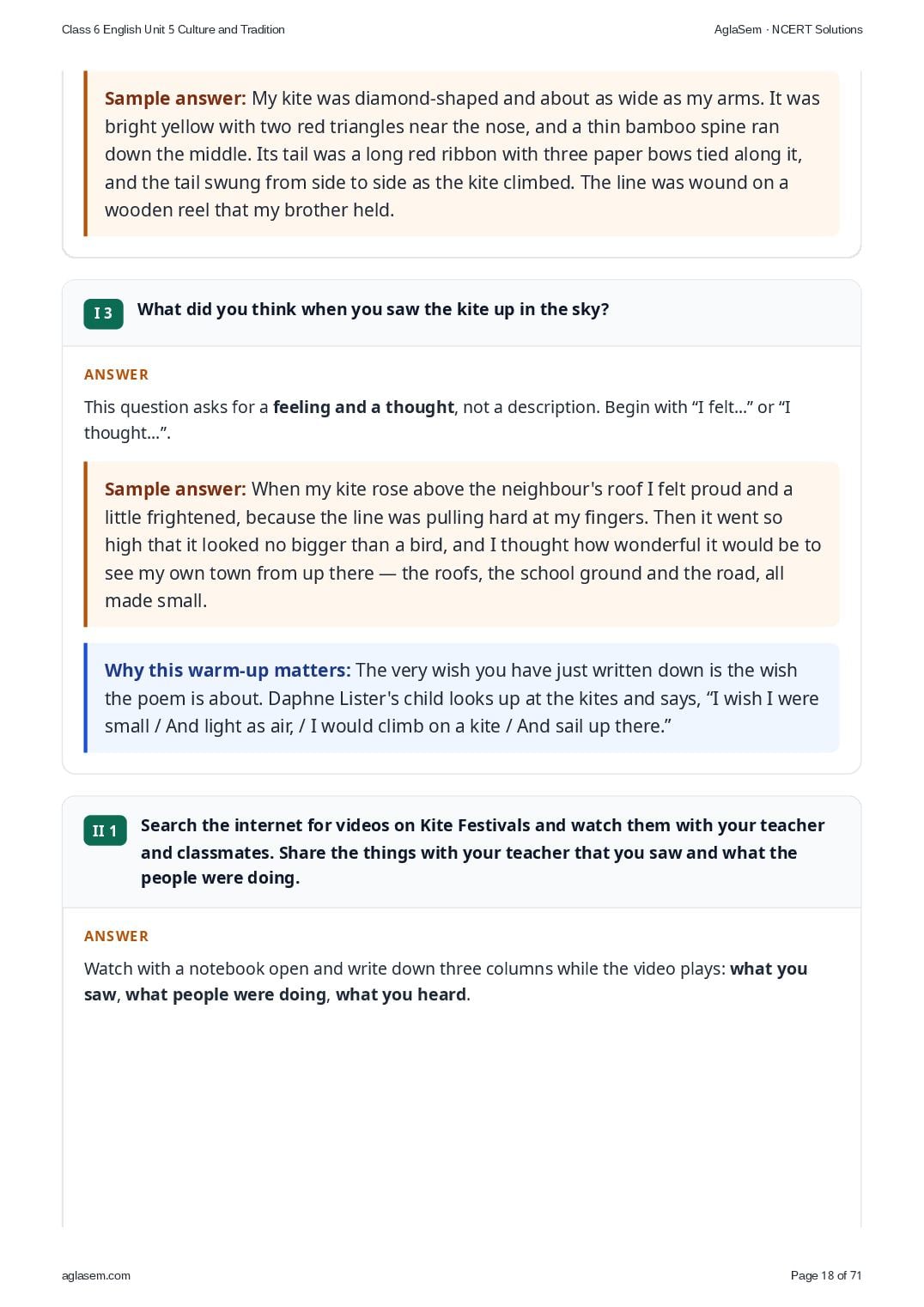
- Have you ever flown a kite or seen someone fly it? Where? When?
- Describe the kite—colour(s), shape, design of tail, any other detail.
- What did you think when you saw the kite up in the sky?
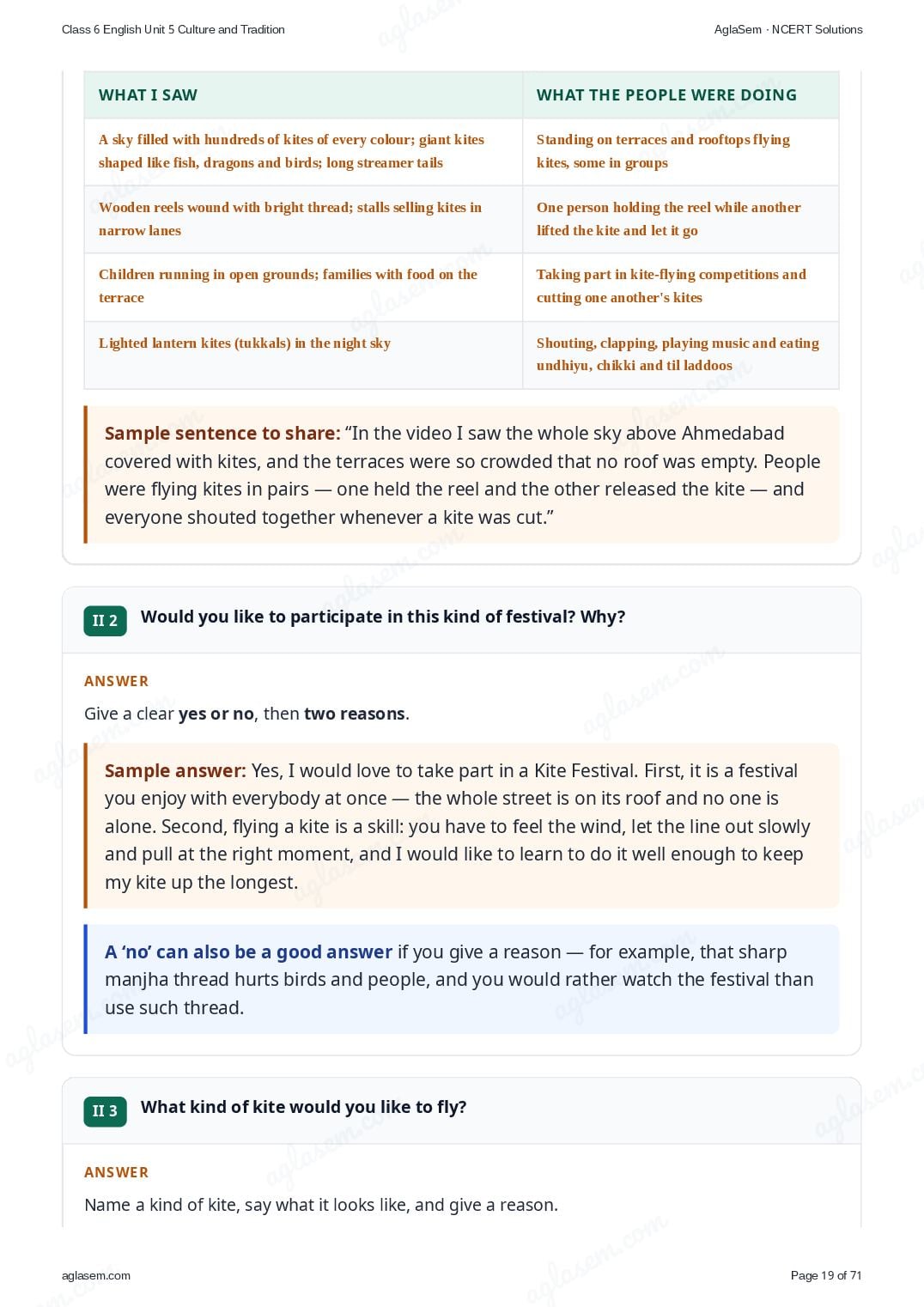
- Search the internet for videos on Kite Festivals and watch them with your teacher and classmates. Share the things with your teacher that you saw and what the people were doing.
- Would you like to participate in this kind of festival? Why?
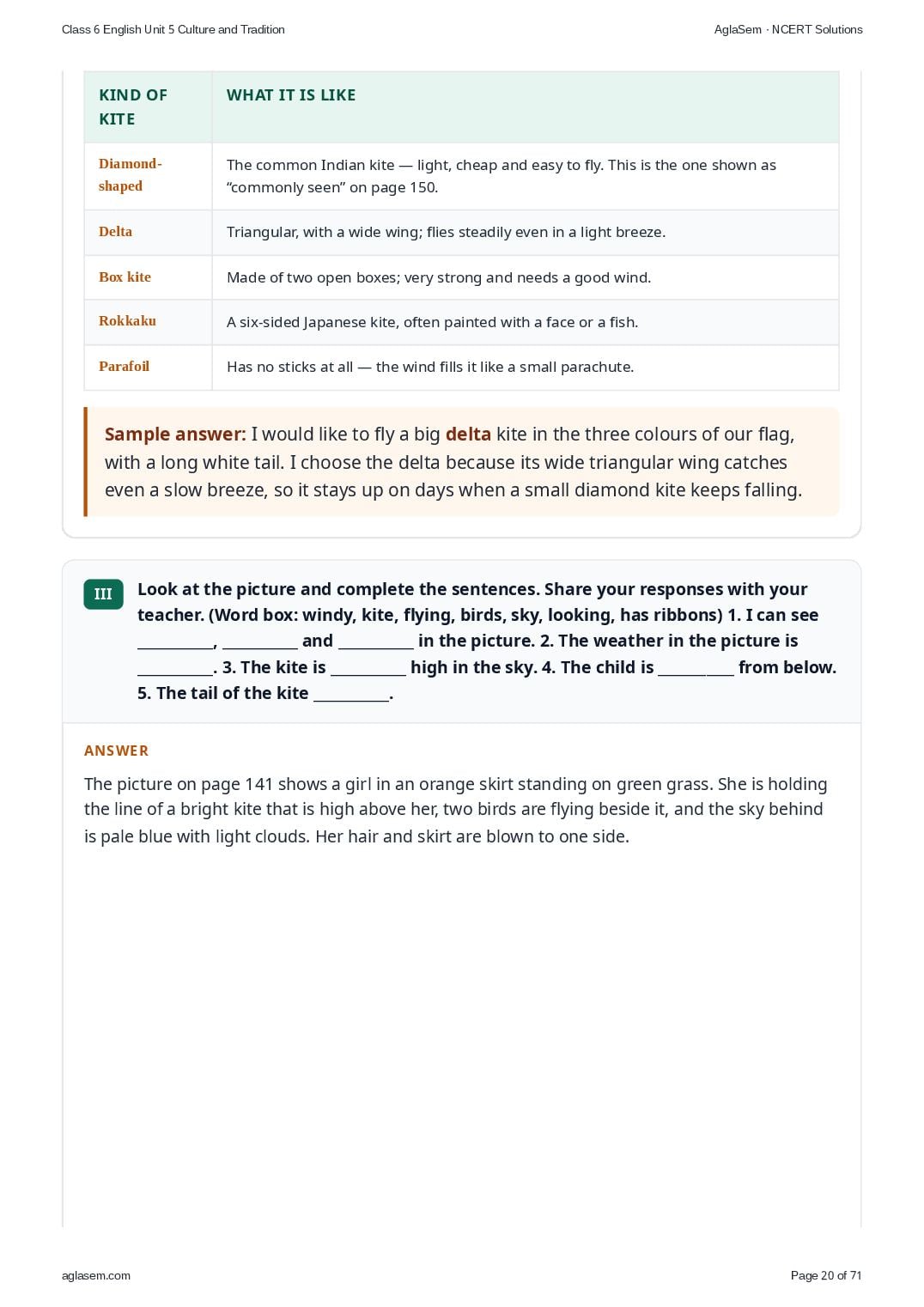
- What kind of kite would you like to fly?
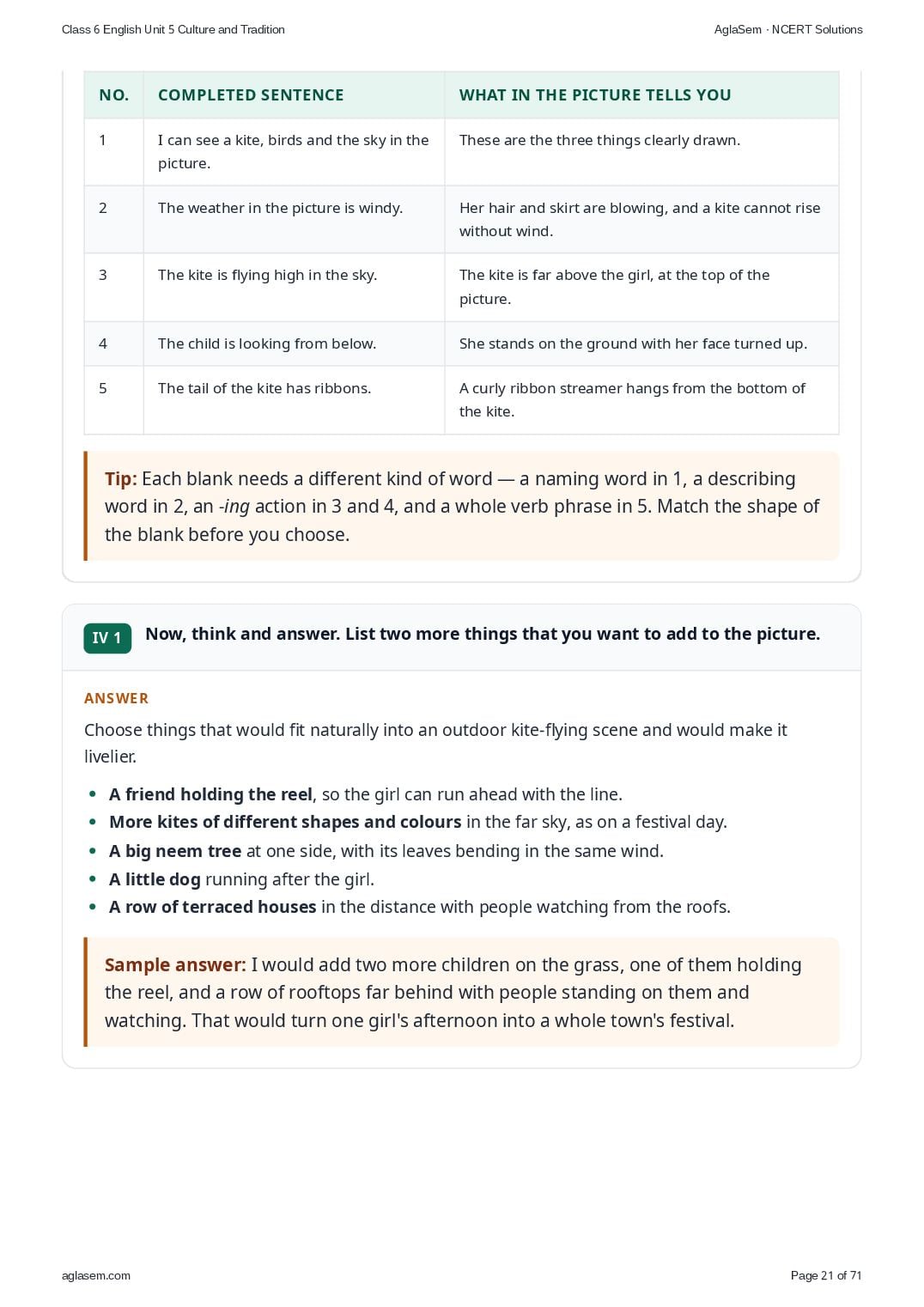
- Look at the picture and complete the sentences. Share your responses with your teacher. (Word box: windy, kite, flying, birds, sky, looking, has ribbons) 1. I can see ___________, ___________ and ___________ in the picture. 2. The weather in the picture is ___________. 3. The kite is ___________ high in the sky. 4. The child is ___________ from below. 5. The tail of the kite ___________.
- Now, think and answer. List two more things that you want to add to the picture.
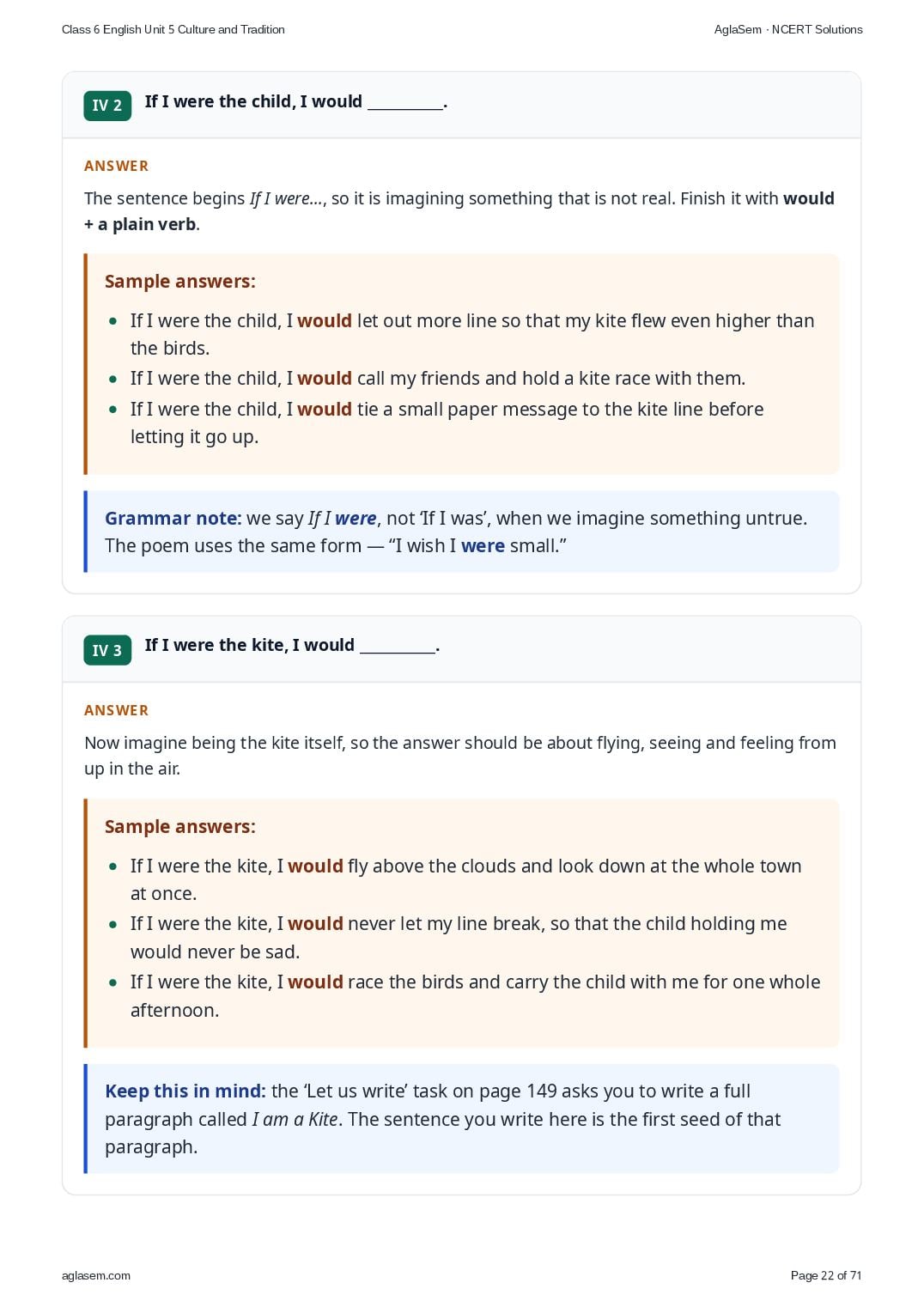
- If I were the child, I would ___________.
- If I were the kite, I would ___________.
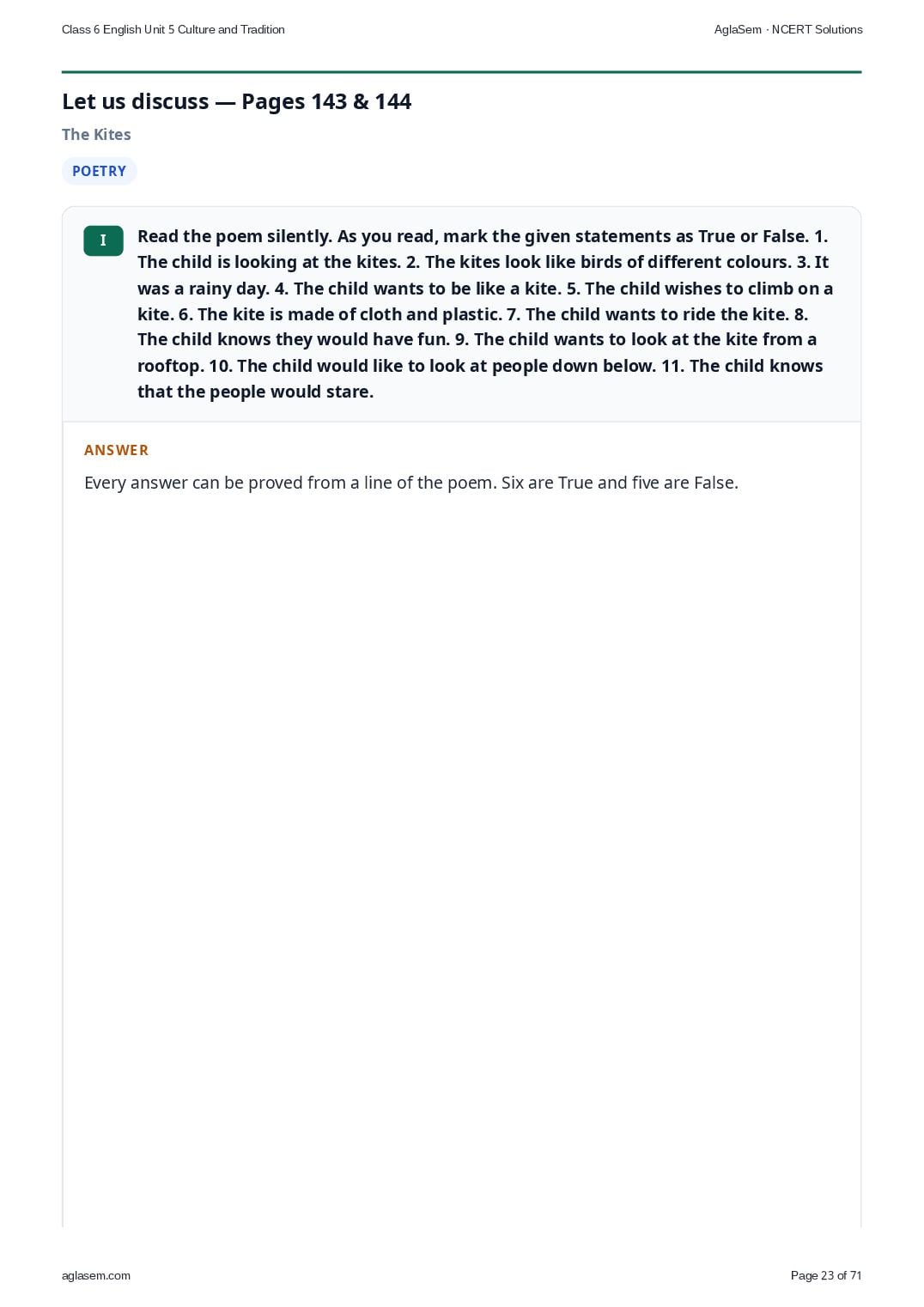
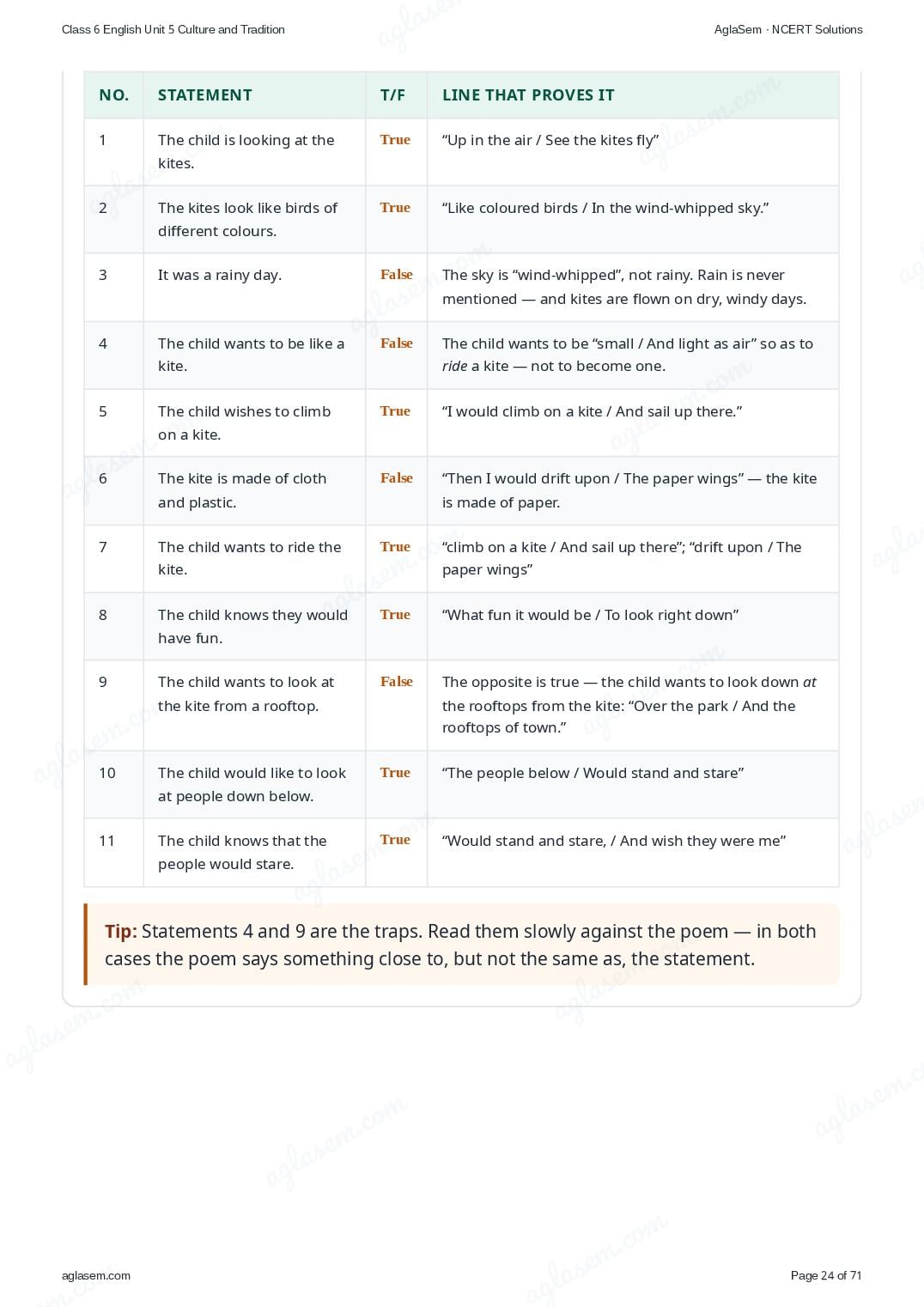
- Read the poem silently. As you read, mark the given statements as True or False. 1. The child is looking at the kites. 2. The kites look like birds of different colours. 3. It was a rainy day. 4. The child wants to be like a kite. 5. The child wishes to climb on a kite. 6. The kite is made of cloth and plastic. 7. The child wants to ride the kite. 8. The child knows they would have fun. 9. The child wants to look at the kite from a rooftop. 10. The child would like to look at people down below. 11. The child knows that the people would stare.
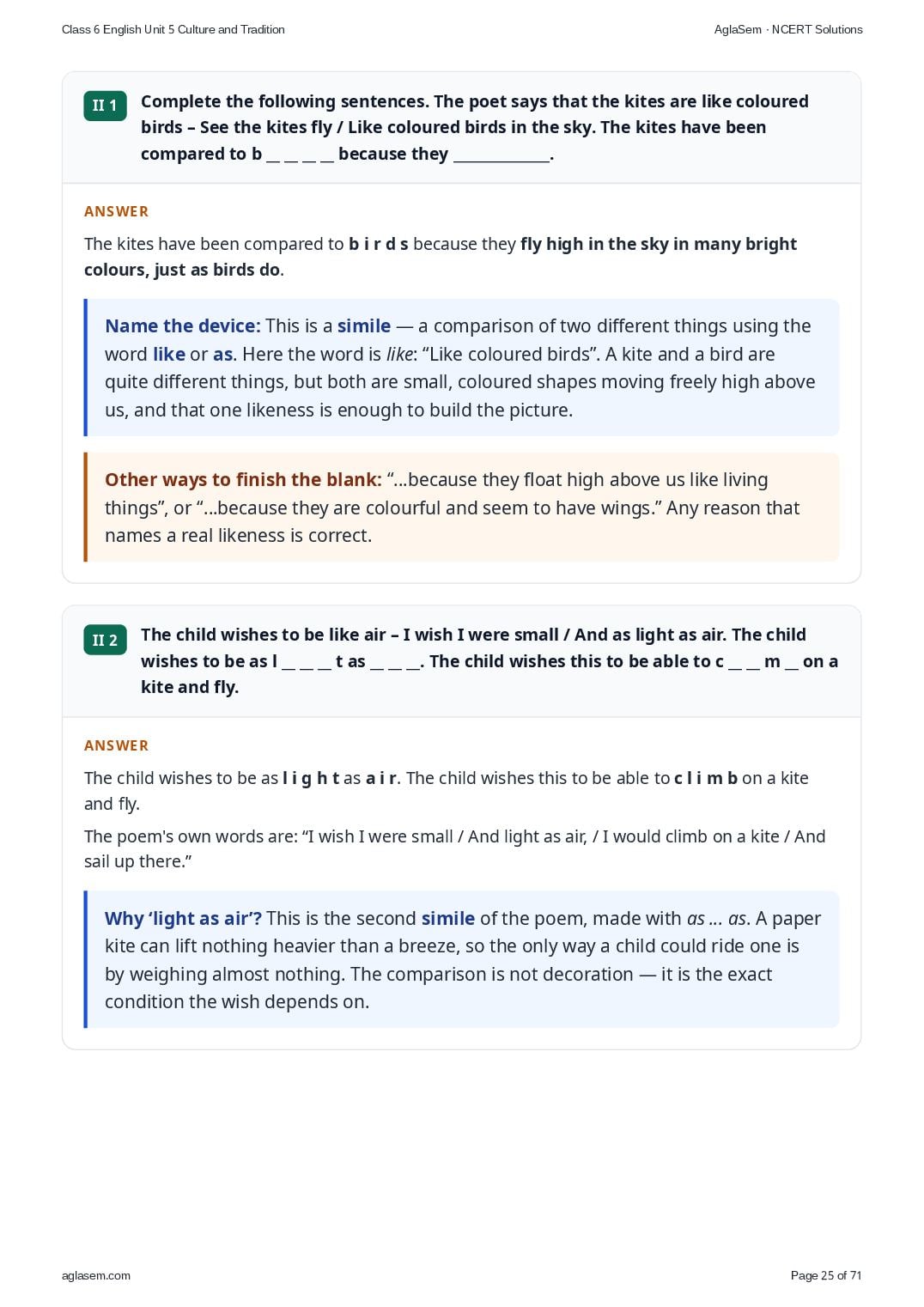
- Complete the following sentences. The poet says that the kites are like coloured birds – See the kites fly / Like coloured birds in the sky. The kites have been compared to b __ __ __ __ because they ______________.
- The child wishes to be like air – I wish I were small / And as light as air. The child wishes to be as l __ __ __ t as __ __ __. The child wishes this to be able to c __ __ m __ on a kite and fly.
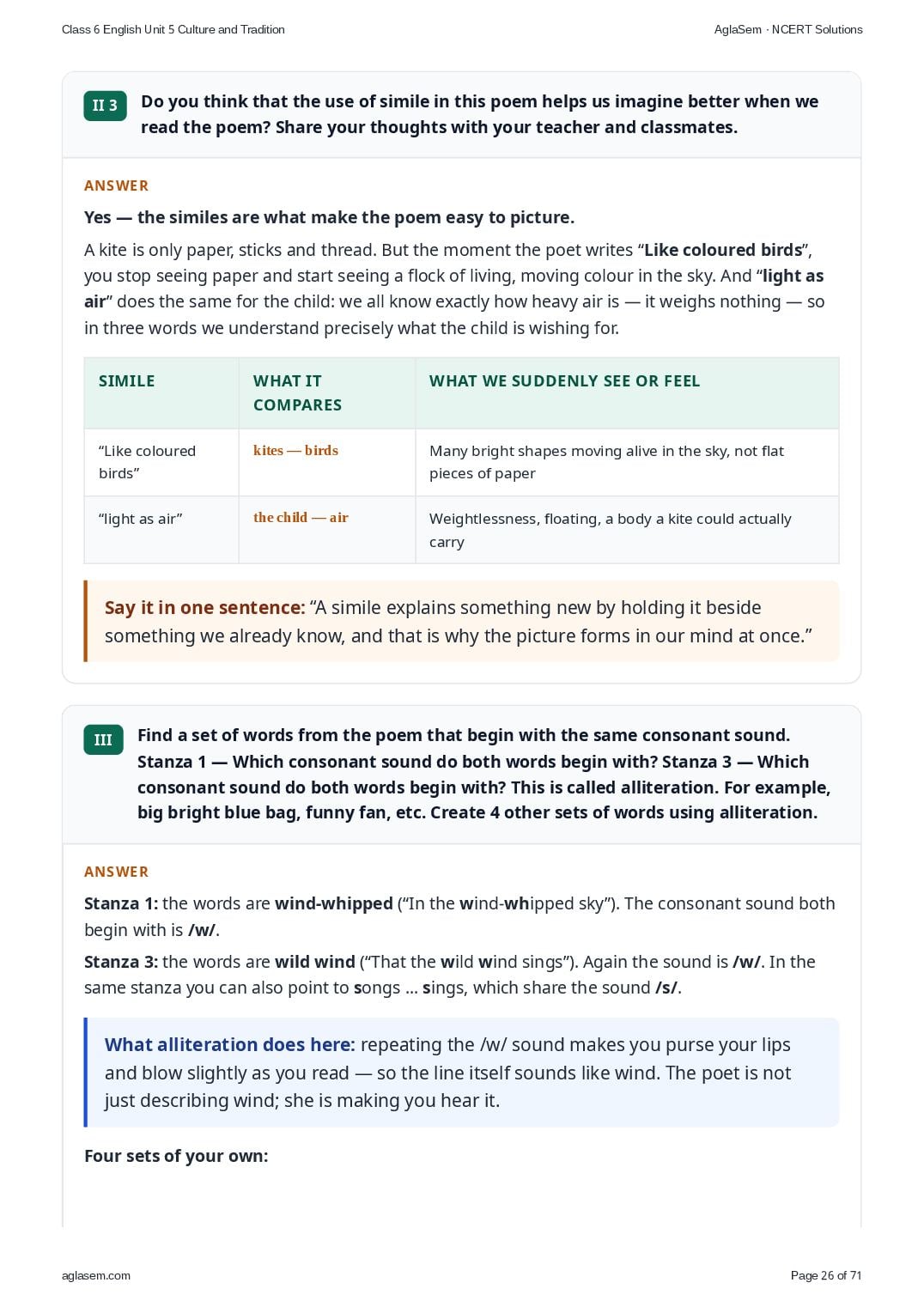
- Do you think that the use of simile in this poem helps us imagine better when we read the poem? Share your thoughts with your teacher and classmates.
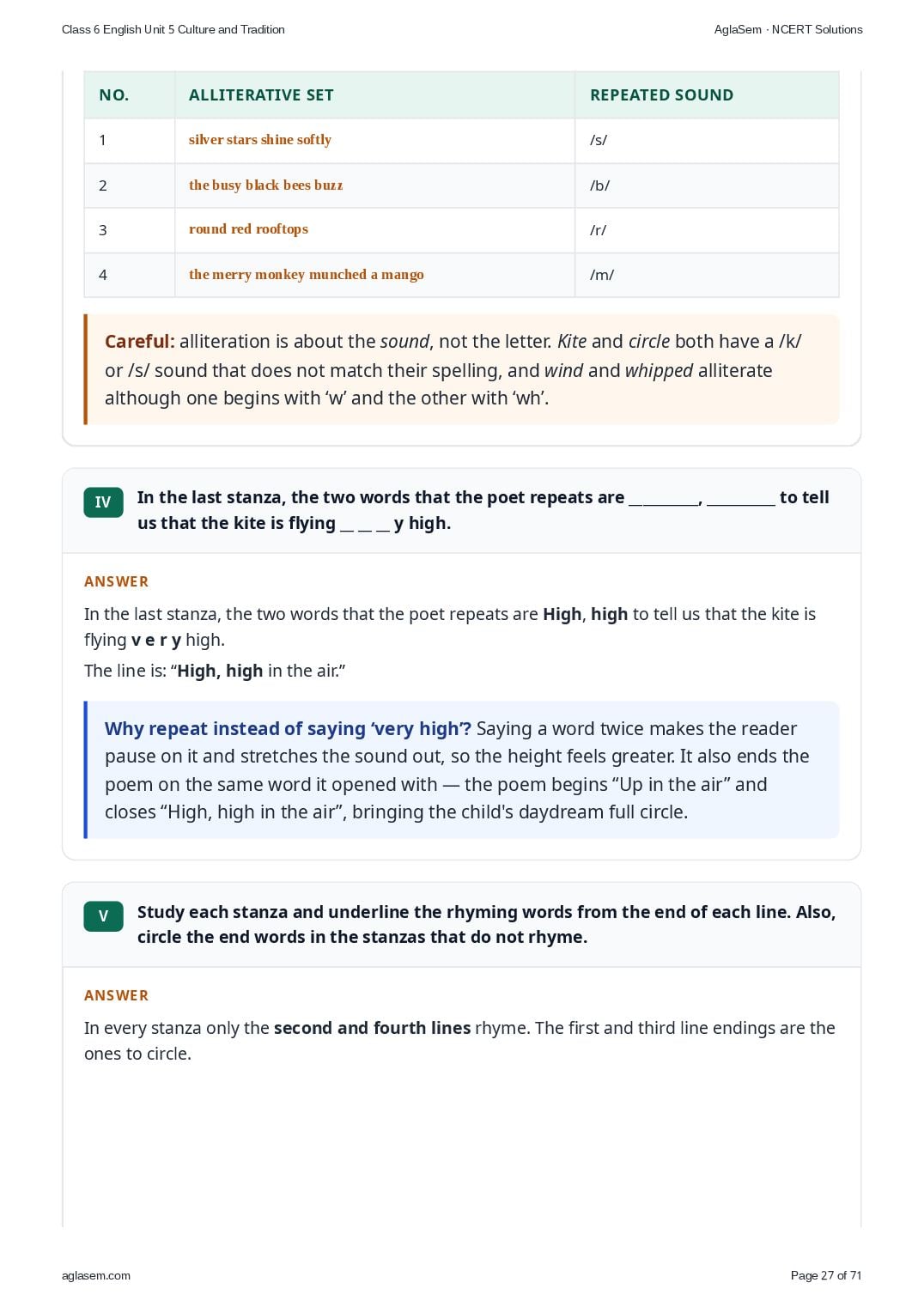
- Find a set of words from the poem that begin with the same consonant sound. Stanza 1 — Which consonant sound do both words begin with? Stanza 3 — Which consonant sound do both words begin with? This is called alliteration. For example, big bright blue bag, funny fan, etc. Create 4 other sets of words using alliteration.
- In the last stanza, the two words that the poet repeats are __________, __________ to tell us that the kite is flying __ __ __ y high.
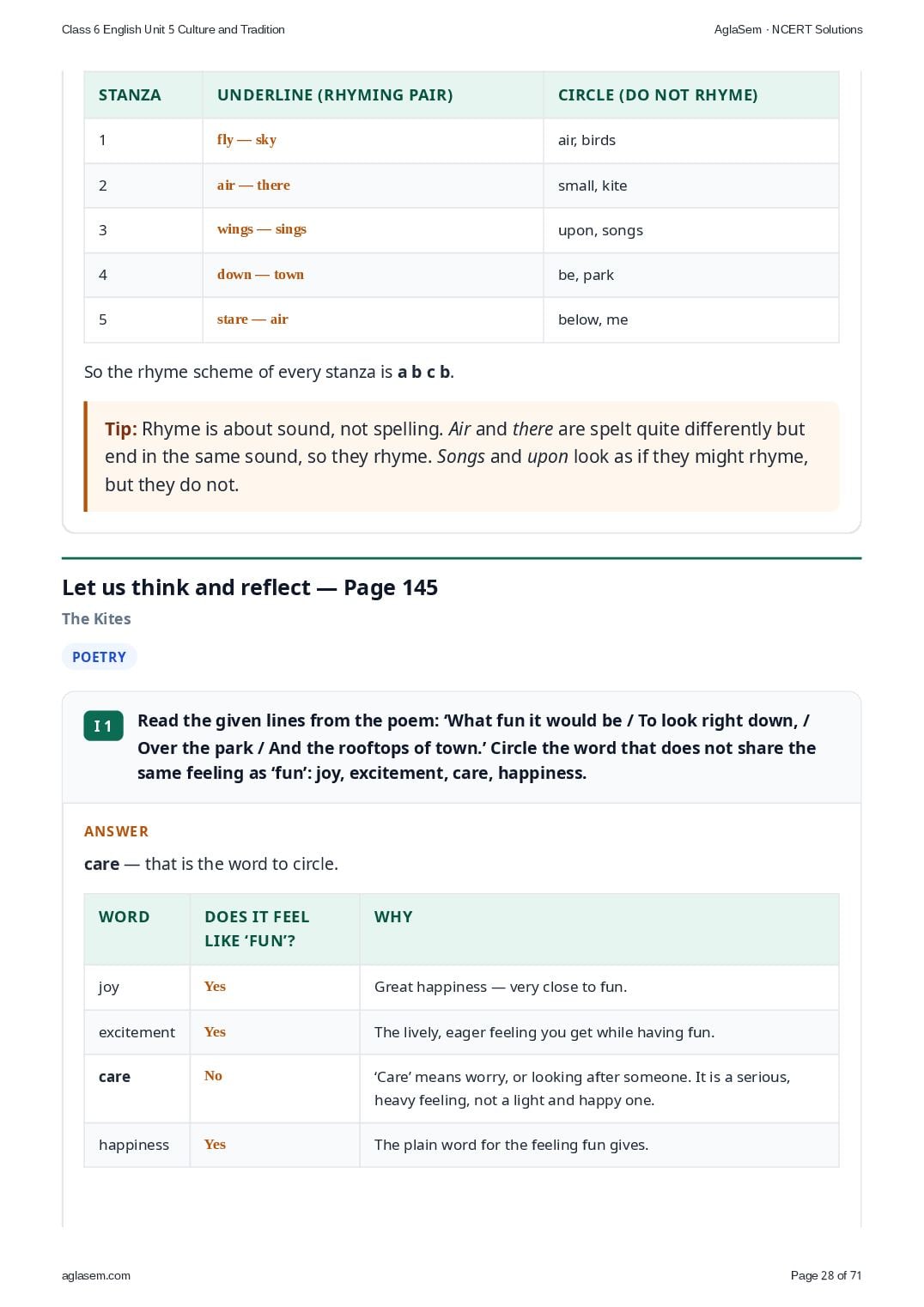
- Study each stanza and underline the rhyming words from the end of each line. Also, circle the end words in the stanzas that do not rhyme.
- Read the given lines from the poem: ‘What fun it would be / To look right down, / Over the park / And the rooftops of town.’ Circle the word that does not share the same feeling as ‘fun’: joy, excitement, care, happiness.
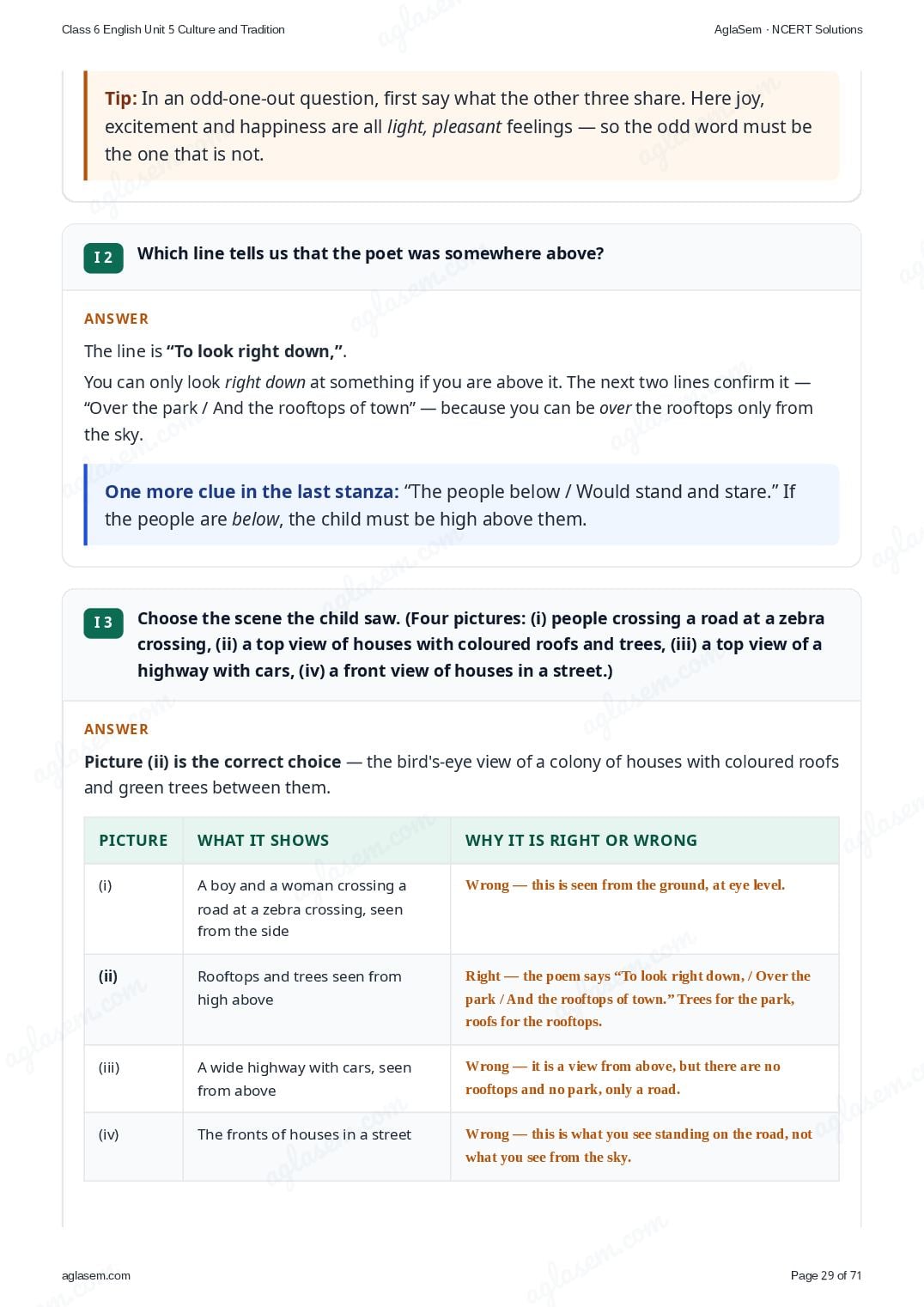
- Which line tells us that the poet was somewhere above?
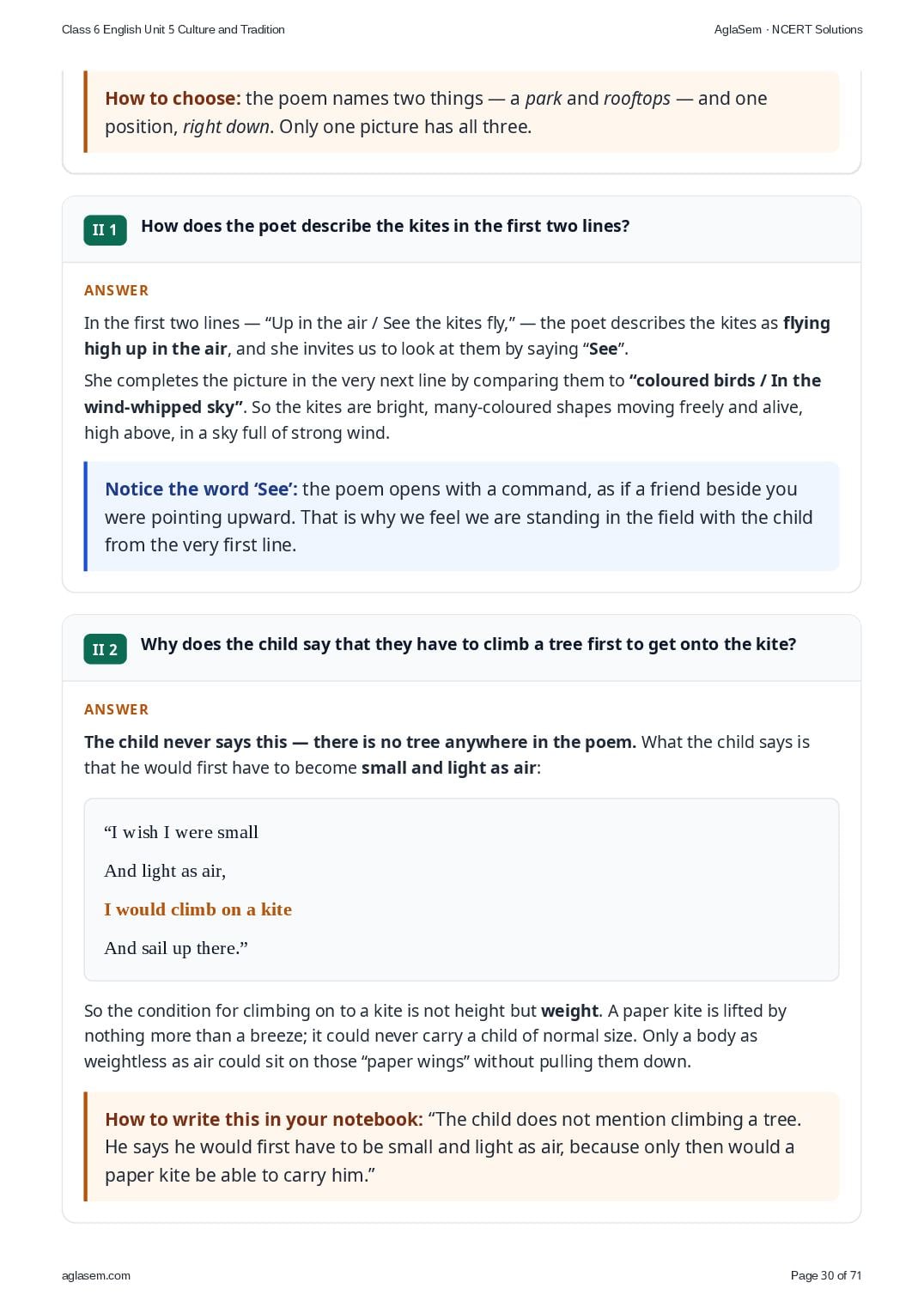
- Choose the scene the child saw. (Four pictures: (i) people crossing a road at a zebra crossing, (ii) a top view of houses with coloured roofs and trees, (iii) a top view of a highway with cars, (iv) a front view of houses in a street.)
- How does the poet describe the kites in the first two lines?
- Why does the child say that they have to climb a tree first to get onto the kite?
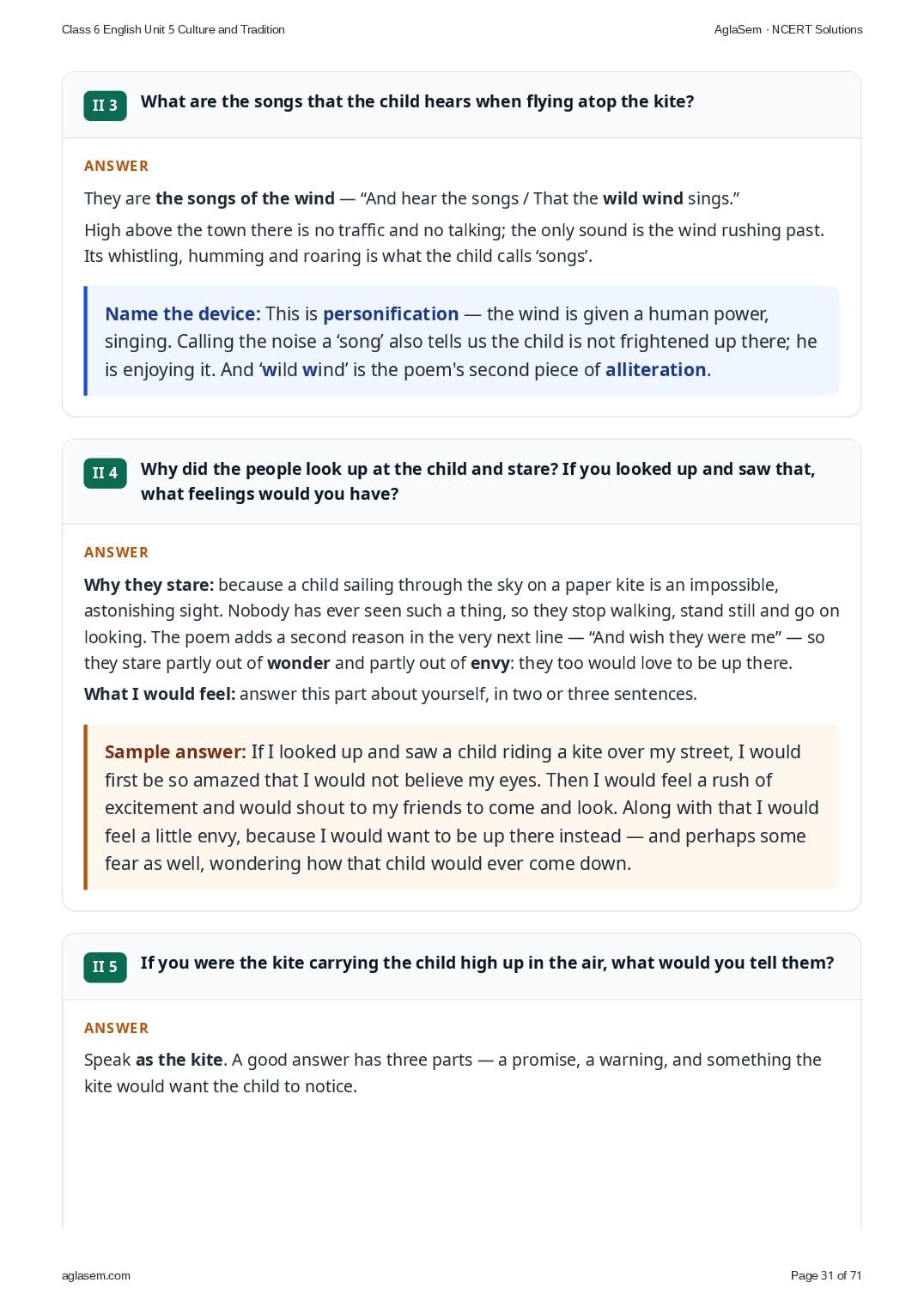
- What are the songs that the child hears when flying atop the kite?
- Why did the people look up at the child and stare? If you looked up and saw that, what feelings would you have?
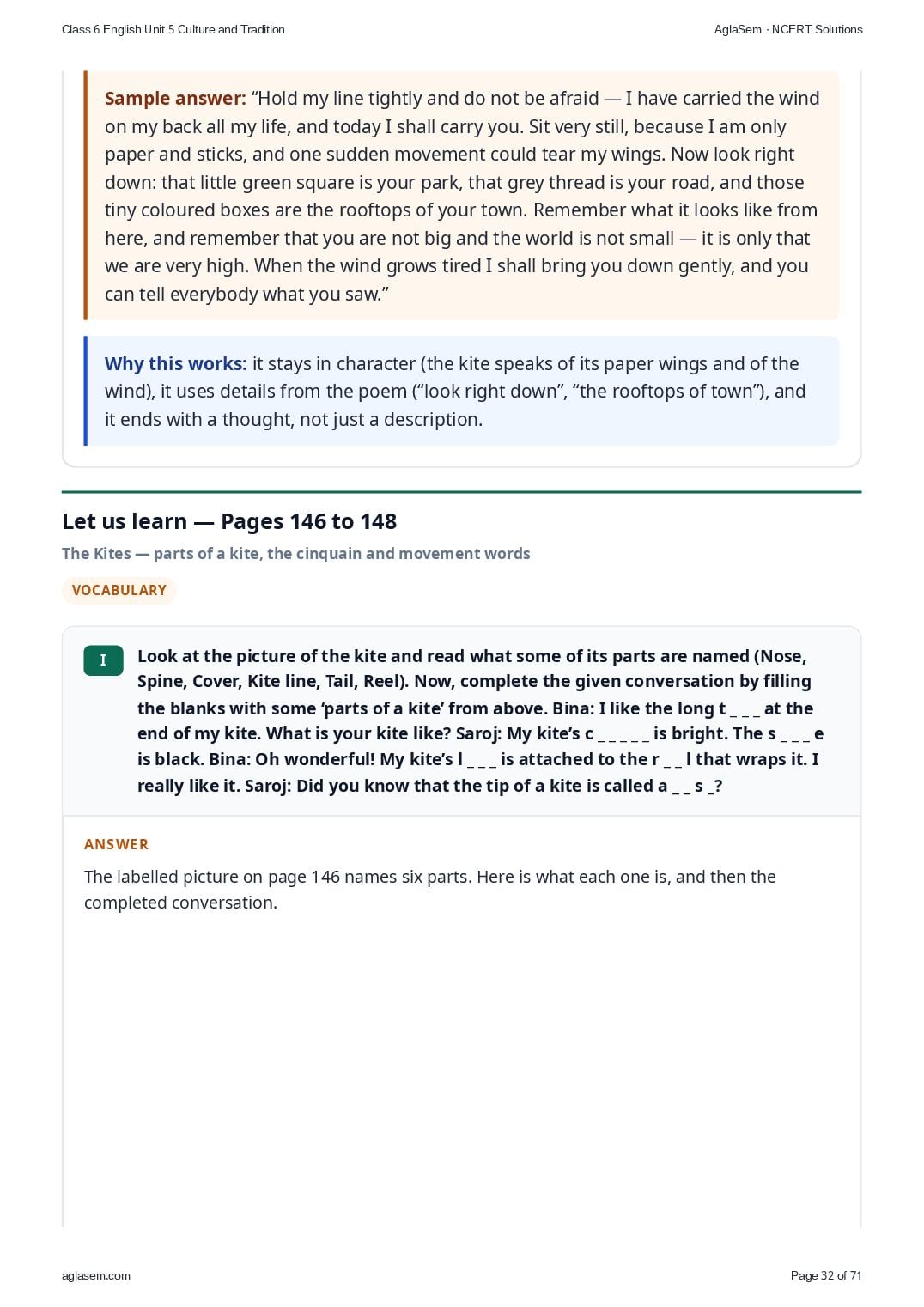
- If you were the kite carrying the child high up in the air, what would you tell them?
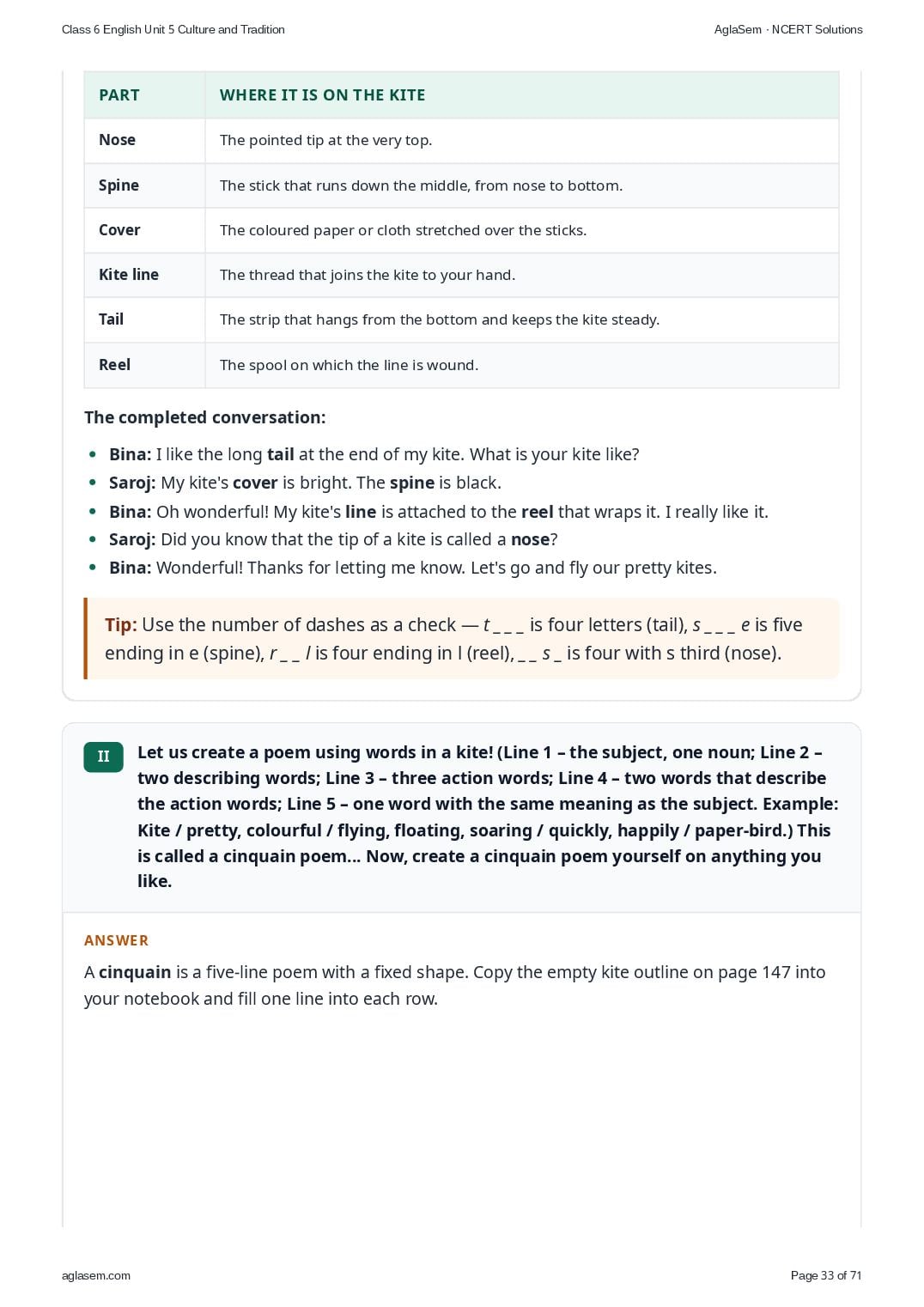
- Look at the picture of the kite and read what some of its parts are named (Nose, Spine, Cover, Kite line, Tail, Reel). Now, complete the given conversation by filling the blanks with some ‘parts of a kite’ from above. Bina: I like the long t _ _ _ at the end of my kite. What is your kite like? Saroj: My kite’s c _ _ _ _ _ is bright. The s _ _ _ e is black. Bina: Oh wonderful! My kite’s l _ _ _ is attached to the r _ _ l that wraps it. I really like it. Saroj: Did you know that the tip of a kite is called a _ _ s _?
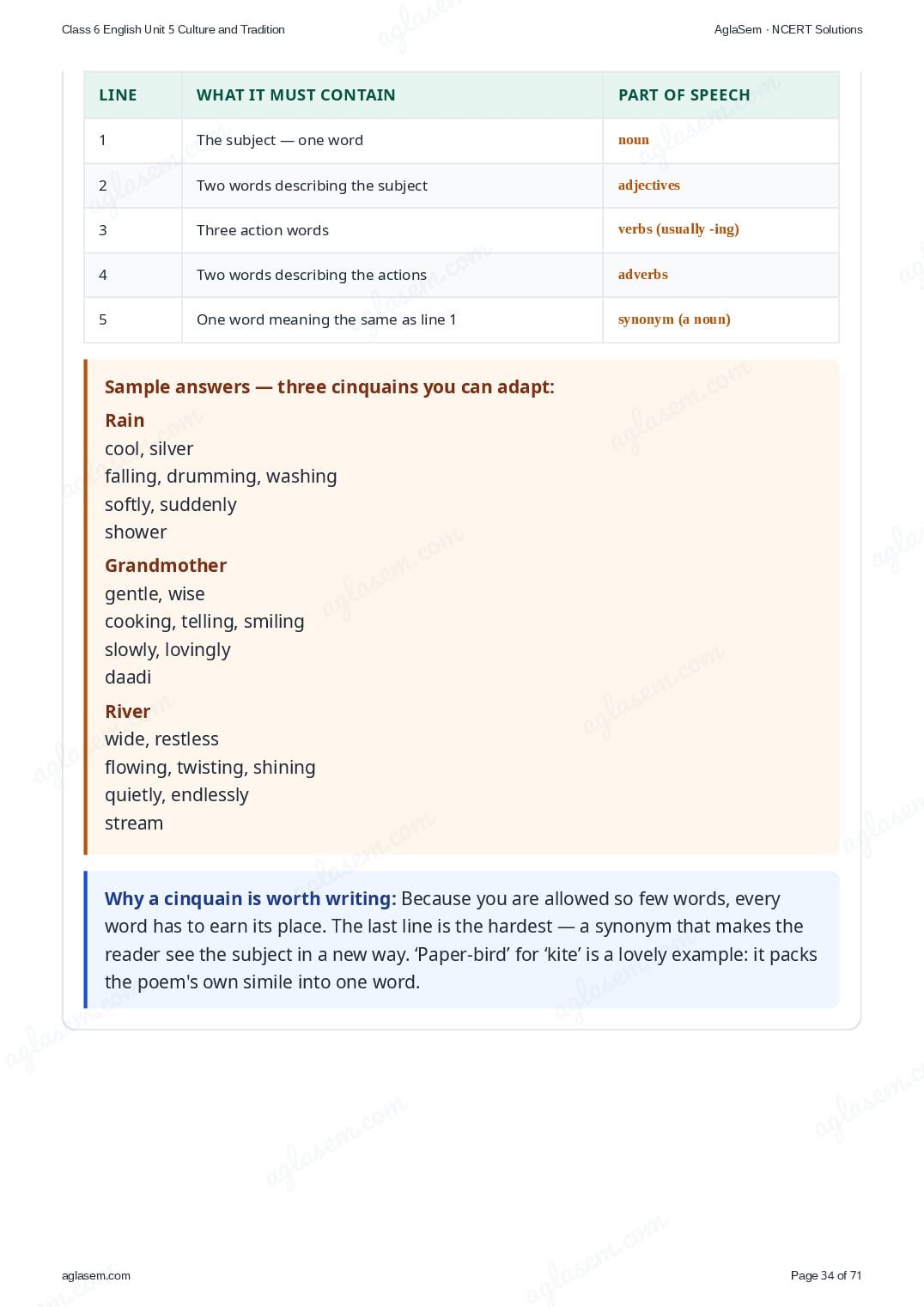
- Let us create a poem using words in a kite! (Line 1 – the subject, one noun; Line 2 – two describing words; Line 3 – three action words; Line 4 – two words that describe the action words; Line 5 – one word with the same meaning as the subject. Example: Kite / pretty, colourful / flying, floating, soaring / quickly, happily / paper-bird.) This is called a cinquain poem… Now, create a cinquain poem yourself on anything you like.
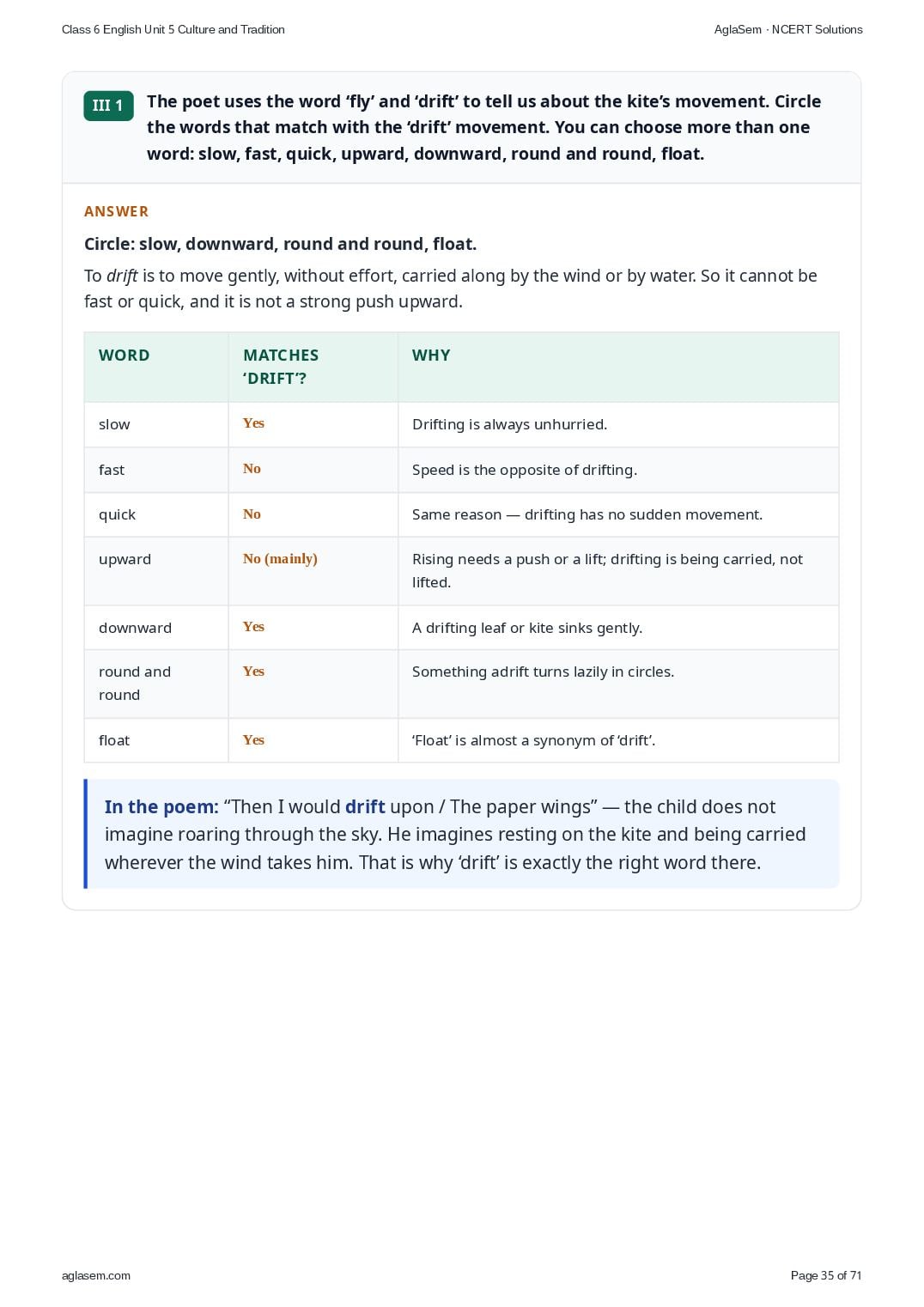
- The poet uses the word ‘fly’ and ‘drift’ to tell us about the kite’s movement. Circle the words that match with the ‘drift’ movement. You can choose more than one word: slow, fast, quick, upward, downward, round and round, float.
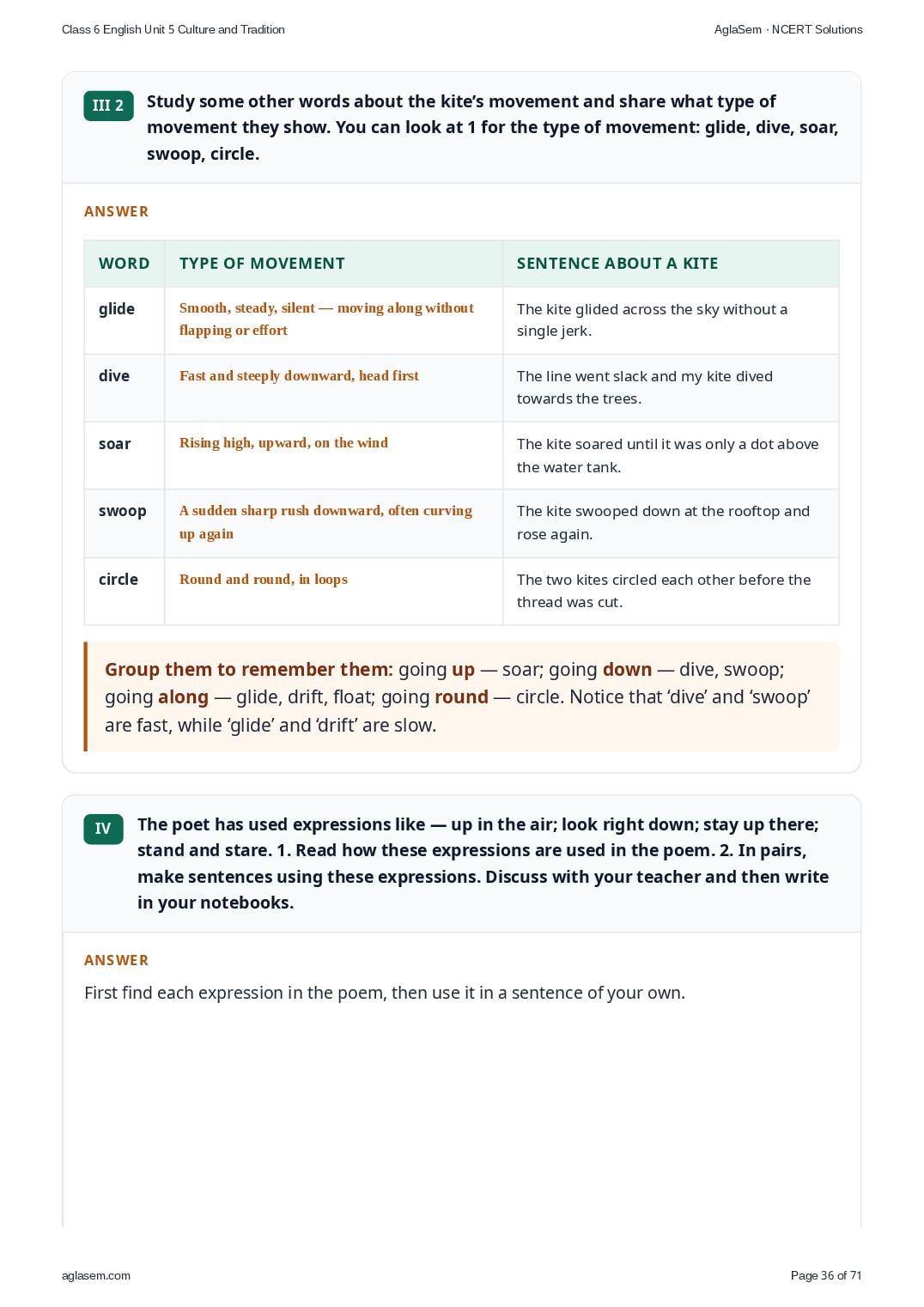
- Study some other words about the kite’s movement and share what type of movement they show. You can look at 1 for the type of movement: glide, dive, soar, swoop, circle.
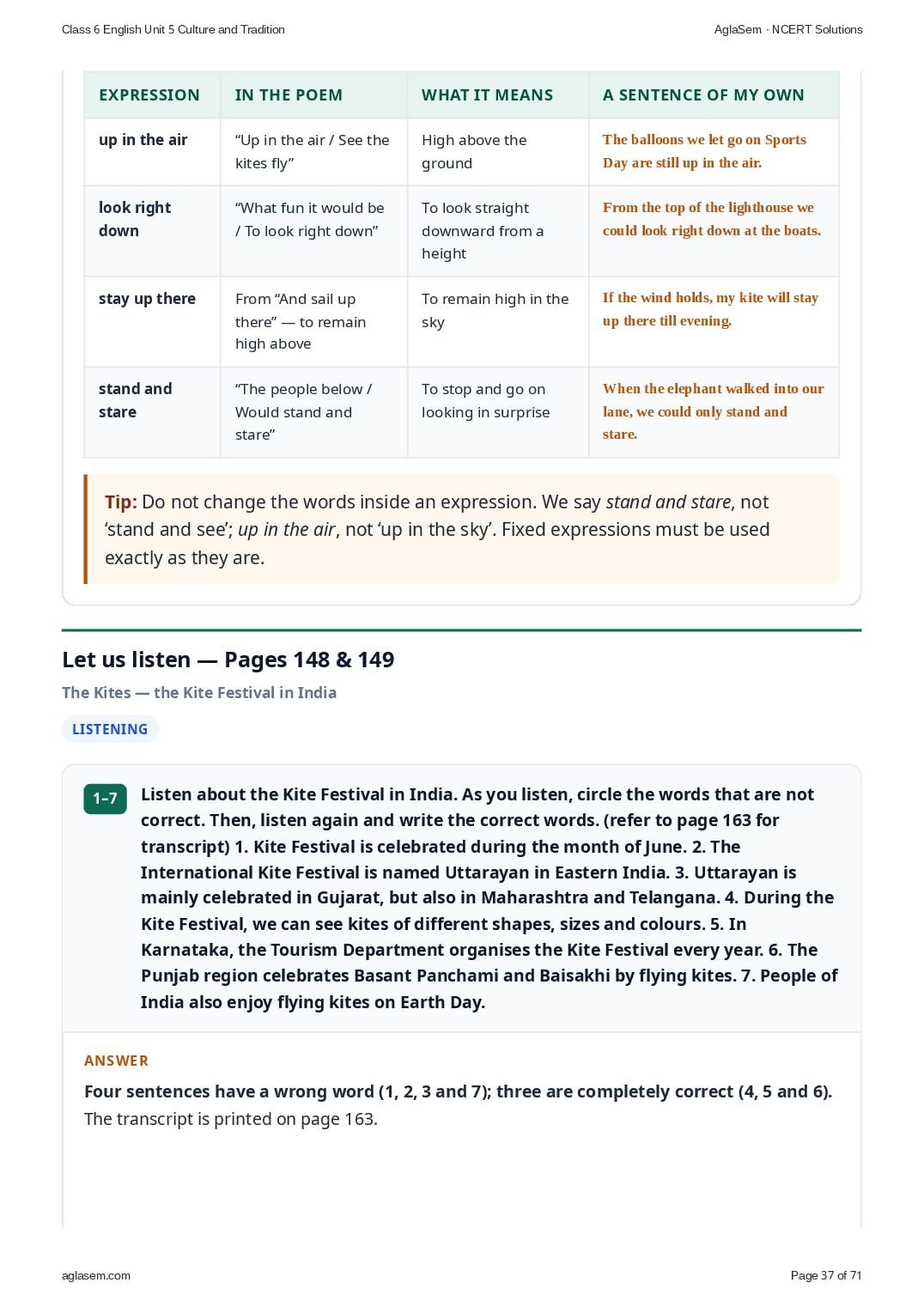
- The poet has used expressions like — up in the air; look right down; stay up there; stand and stare. 1. Read how these expressions are used in the poem. 2. In pairs, make sentences using these expressions. Discuss with your teacher and then write in your notebooks.
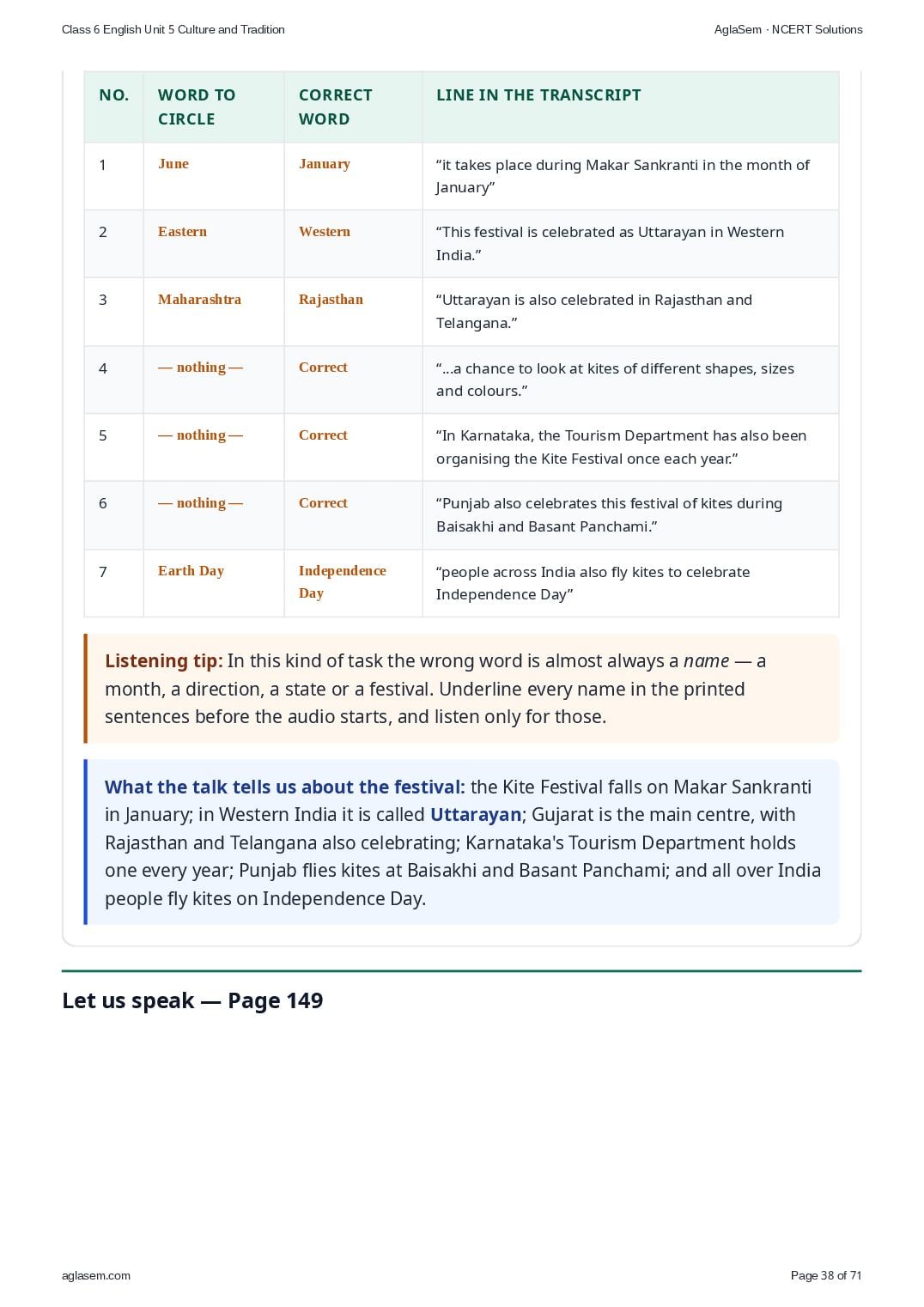
- Listen about the Kite Festival in India. As you listen, circle the words that are not correct. Then, listen again and write the correct words. (refer to page 163 for transcript) 1. Kite Festival is celebrated during the month of June. 2. The International Kite Festival is named Uttarayan in Eastern India. 3. Uttarayan is mainly celebrated in Gujarat, but also in Maharashtra and Telangana. 4. During the Kite Festival, we can see kites of different shapes, sizes and colours. 5. In Karnataka, the Tourism Department organises the Kite Festival every year. 6. The Punjab region celebrates Basant Panchami and Baisakhi by flying kites. 7. People of India also enjoy flying kites on Earth Day.
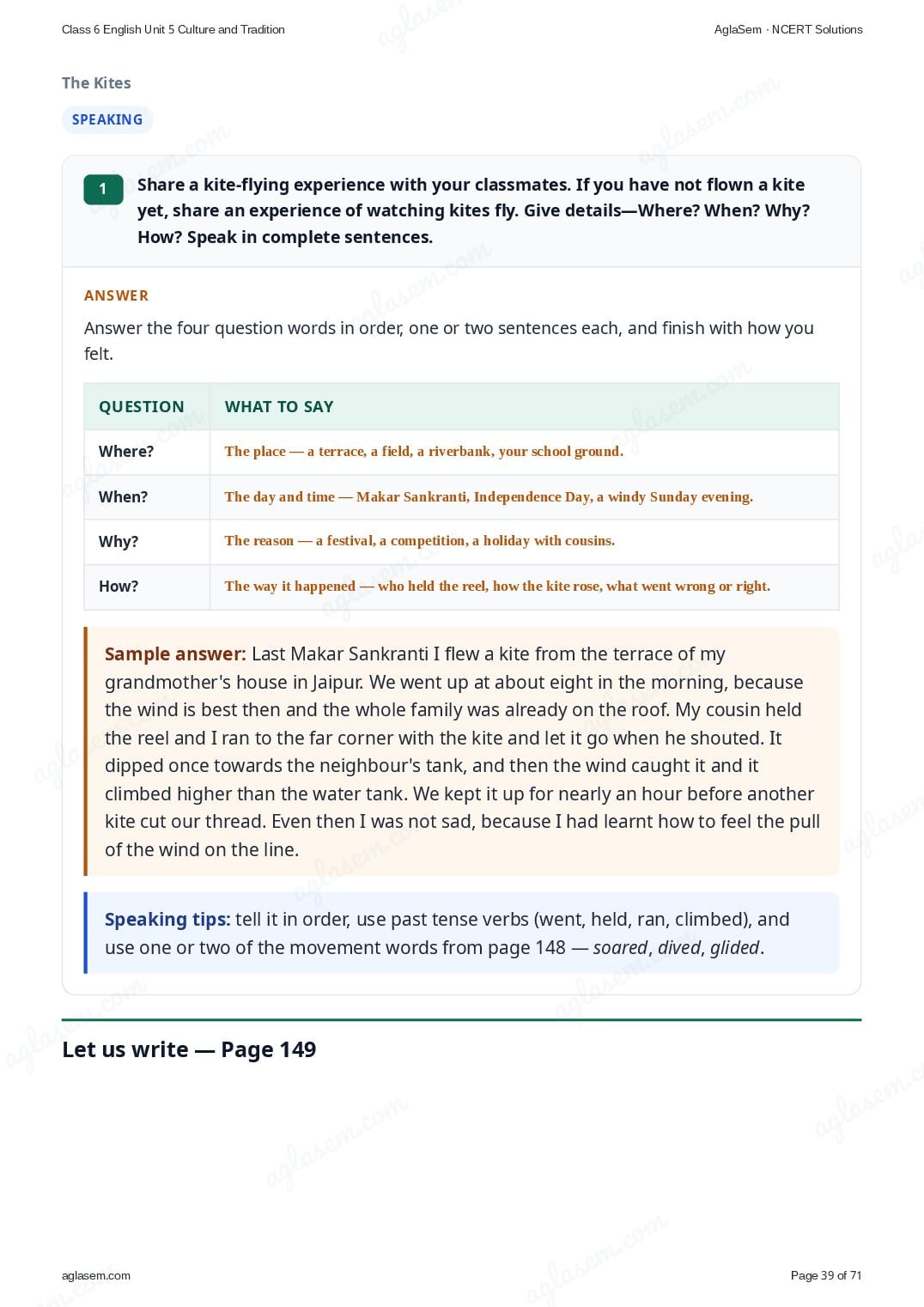
- Share a kite-flying experience with your classmates. If you have not flown a kite yet, share an experience of watching kites fly. Give details—Where? When? Why? How? Speak in complete sentences.
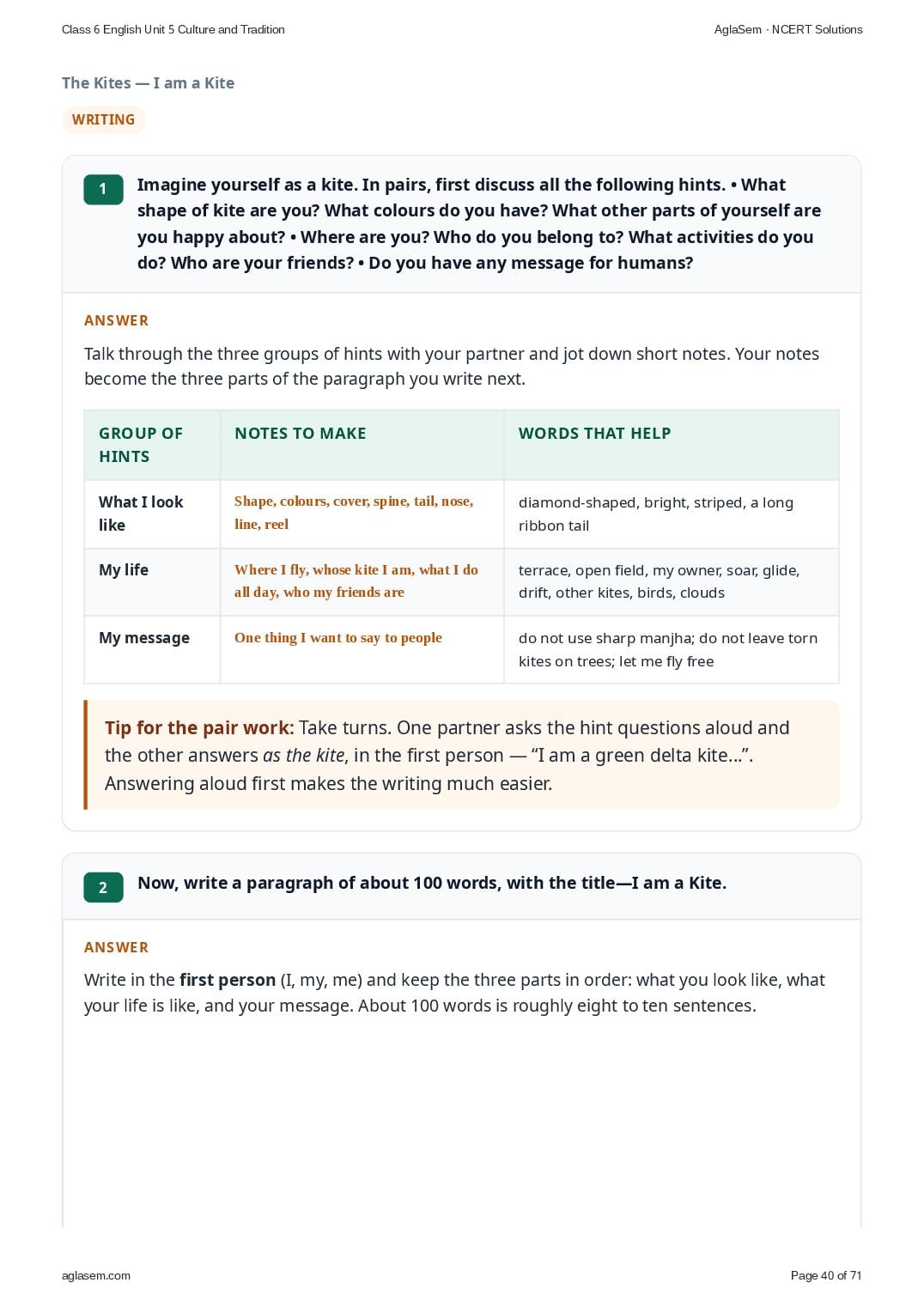
- Imagine yourself as a kite. In pairs, first discuss all the following hints. • What shape of kite are you? What colours do you have? What other parts of yourself are you happy about? • Where are you? Who do you belong to? What activities do you do? Who are your friends? • Do you have any message for humans?
- Now, write a paragraph of about 100 words, with the title—I am a Kite.
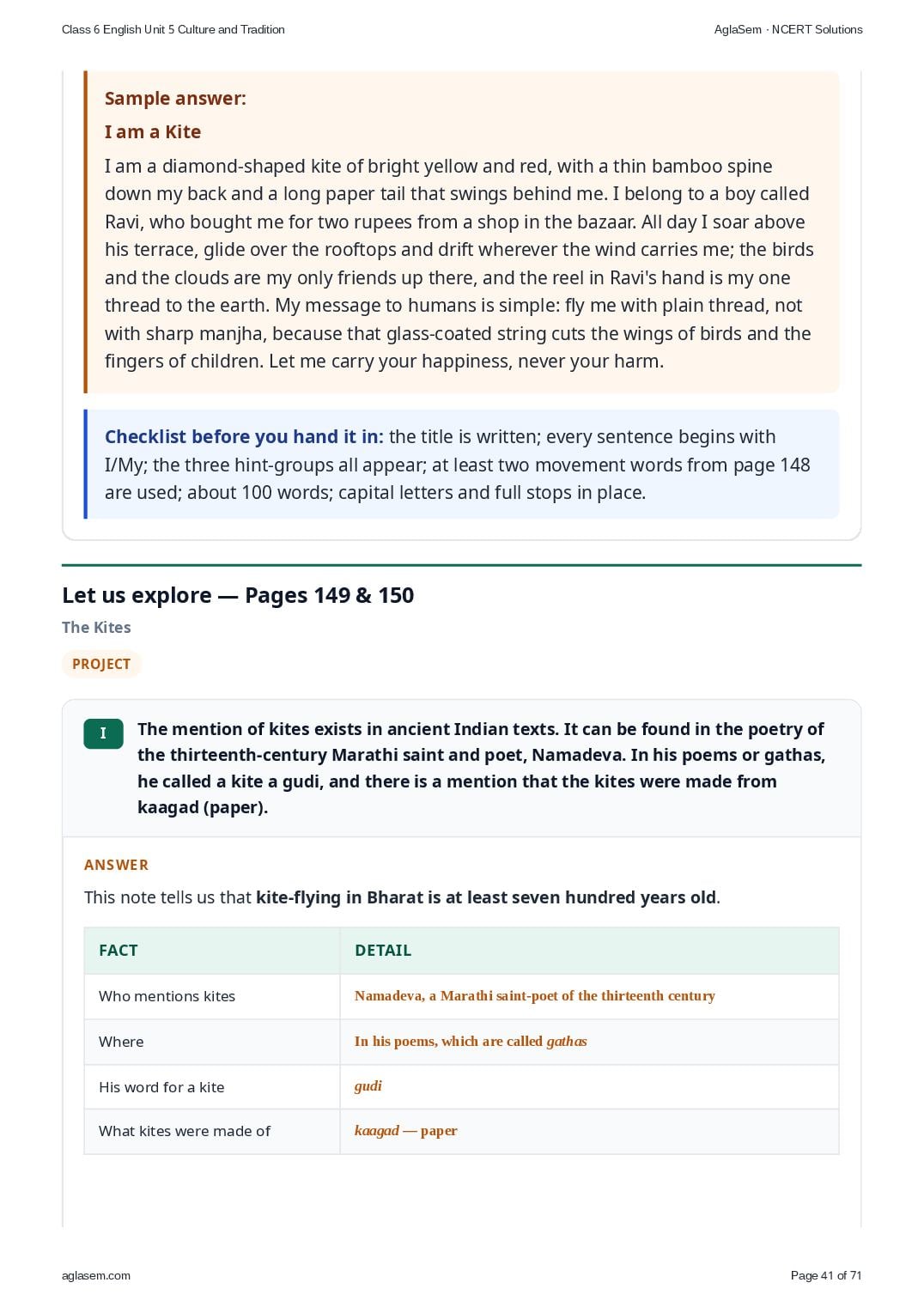
- The mention of kites exists in ancient Indian texts. It can be found in the poetry of the thirteenth-century Marathi saint and poet, Namadeva. In his poems or gathas, he called a kite a gudi, and there is a mention that the kites were made from kaagad (paper).
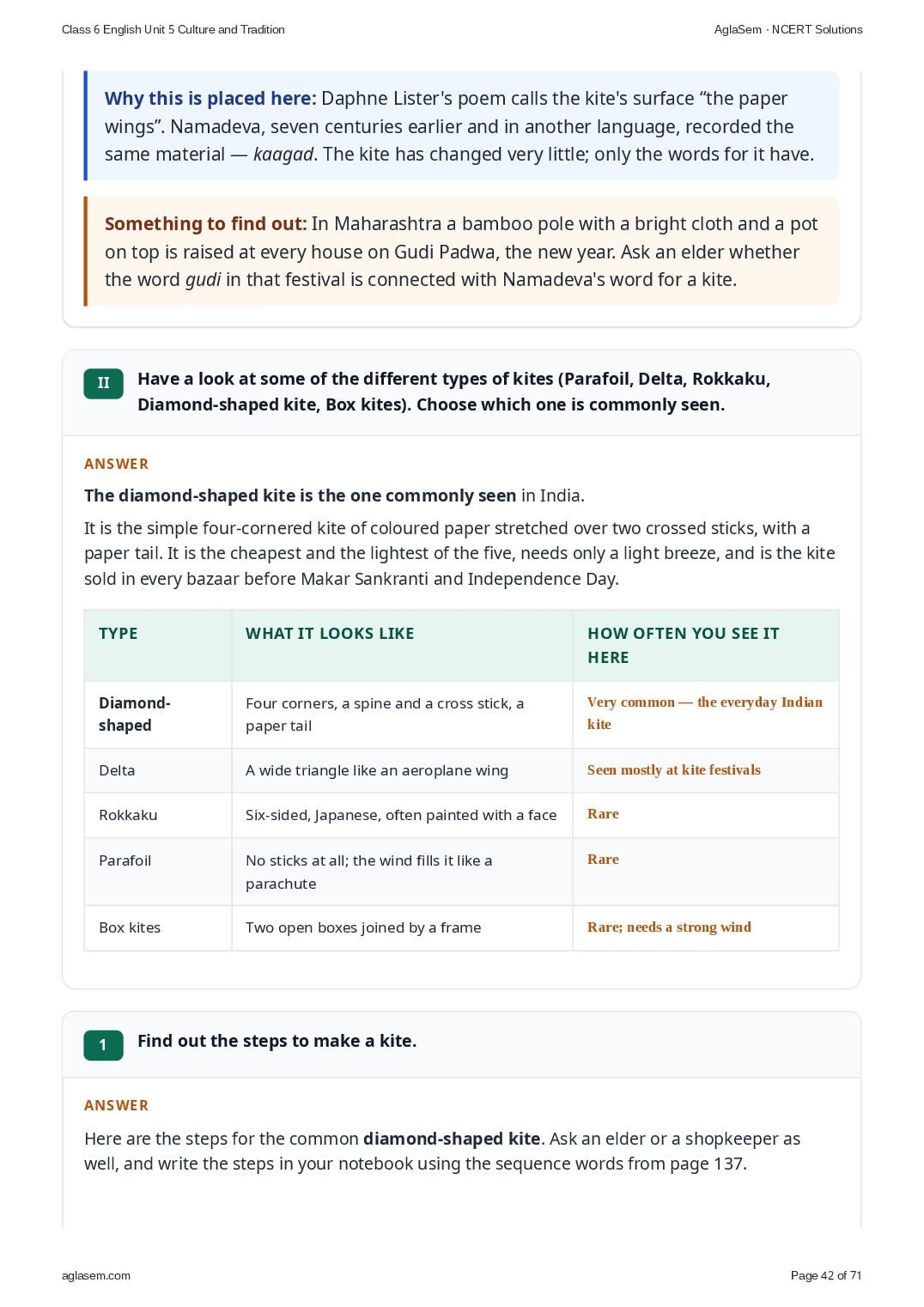
- Have a look at some of the different types of kites (Parafoil, Delta, Rokkaku, Diamond-shaped kite, Box kites). Choose which one is commonly seen.
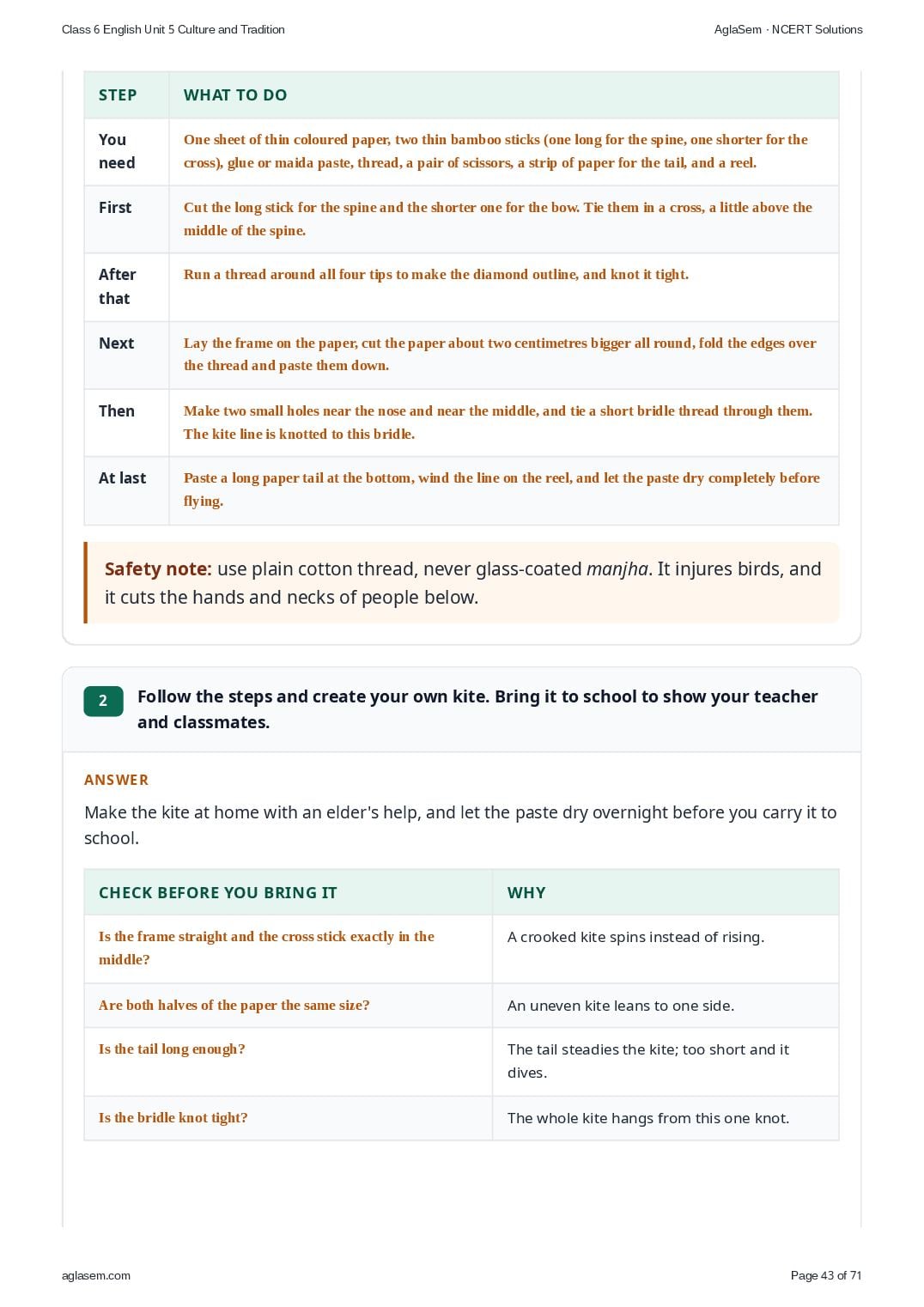
- Find out the steps to make a kite.
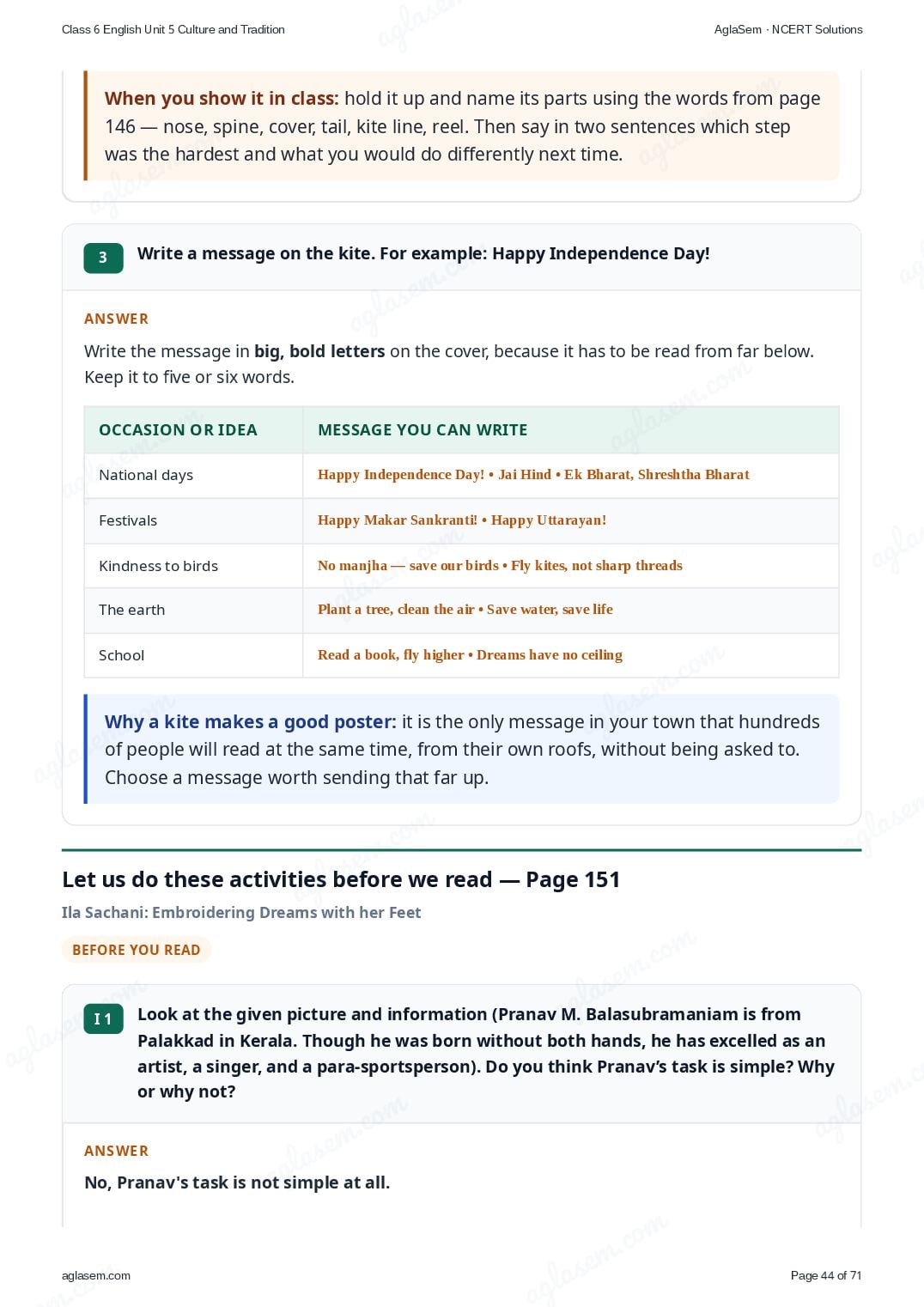
- Follow the steps and create your own kite. Bring it to school to show your teacher and classmates.
- Write a message on the kite. For example: Happy Independence Day!
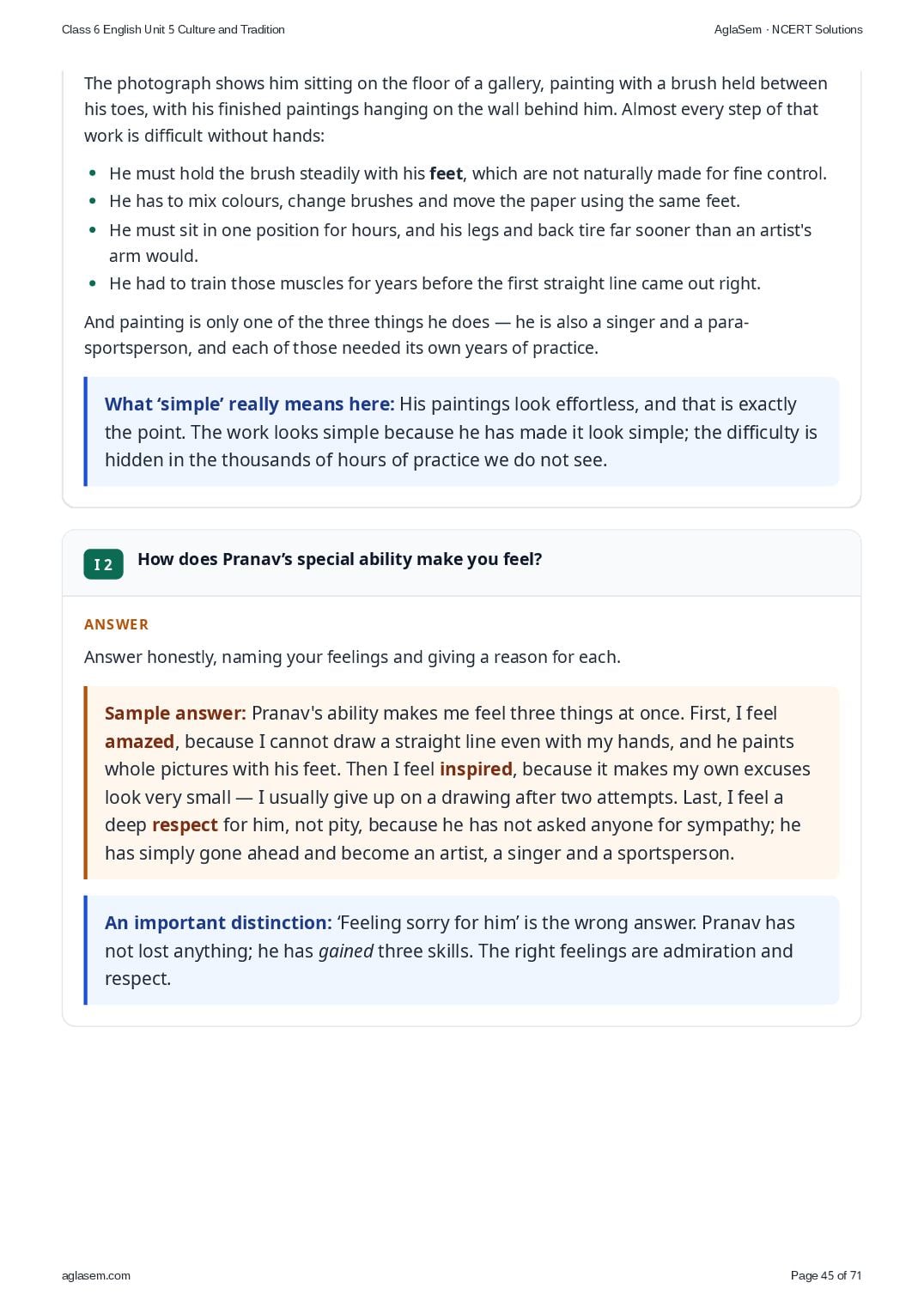
- Look at the given picture and information (Pranav M. Balasubramaniam is from Palakkad in Kerala. Though he was born without both hands, he has excelled as an artist, a singer, and a para-sportsperson). Do you think Pranav’s task is simple? Why or why not?
- How does Pranav’s special ability make you feel?
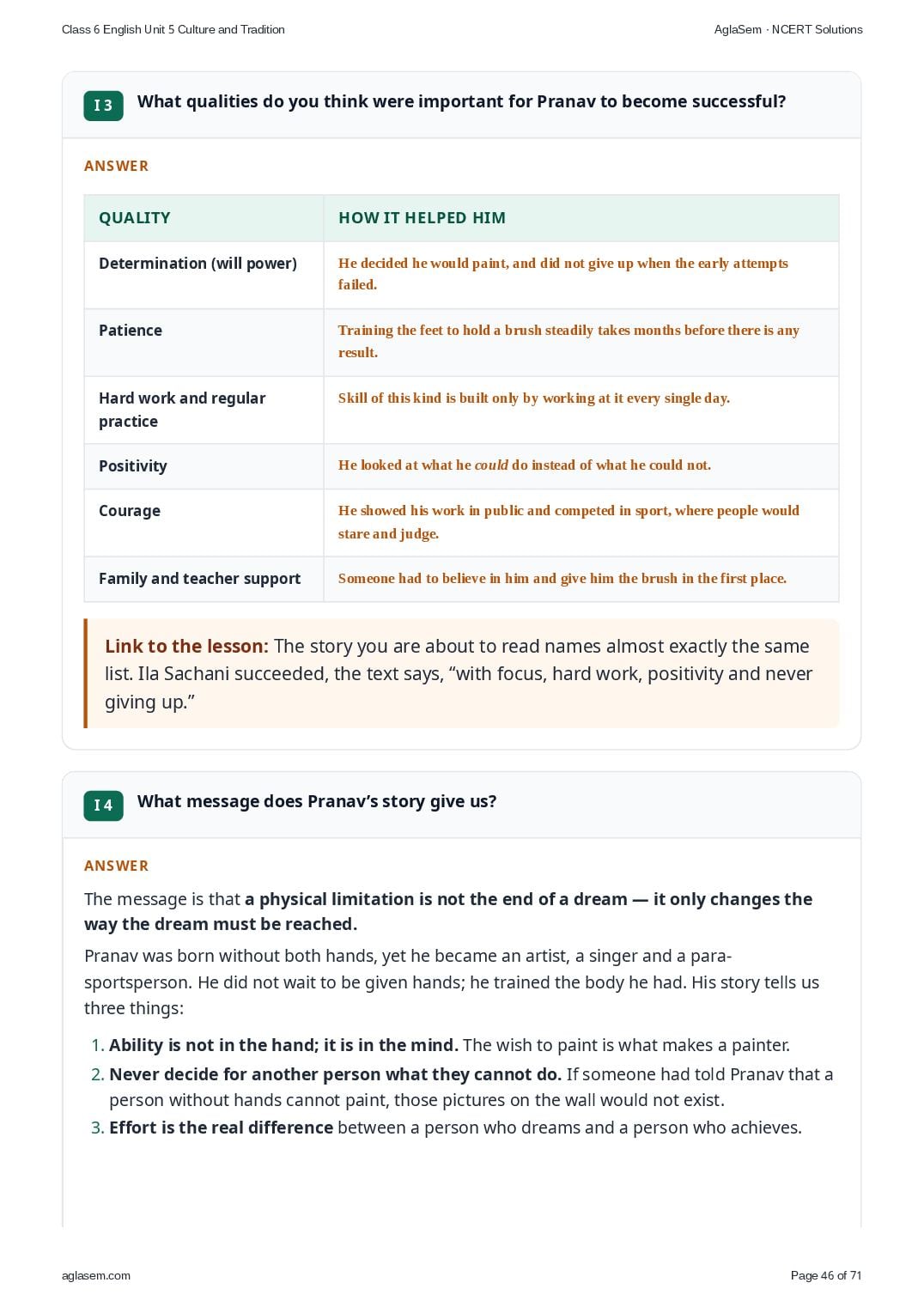
- What qualities do you think were important for Pranav to become successful?
- What message does Pranav’s story give us?
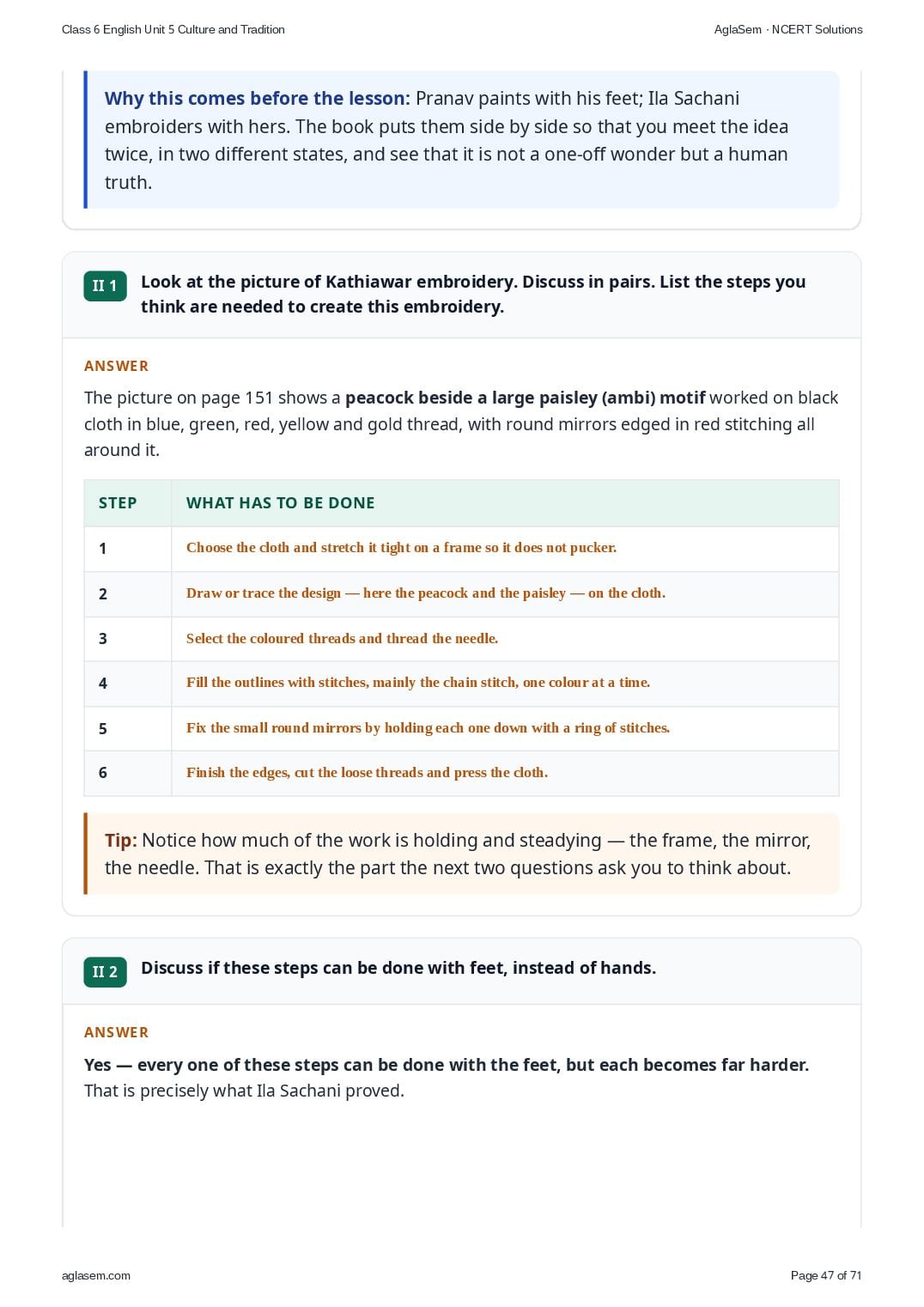
- Look at the picture of Kathiawar embroidery. Discuss in pairs. List the steps you think are needed to create this embroidery.
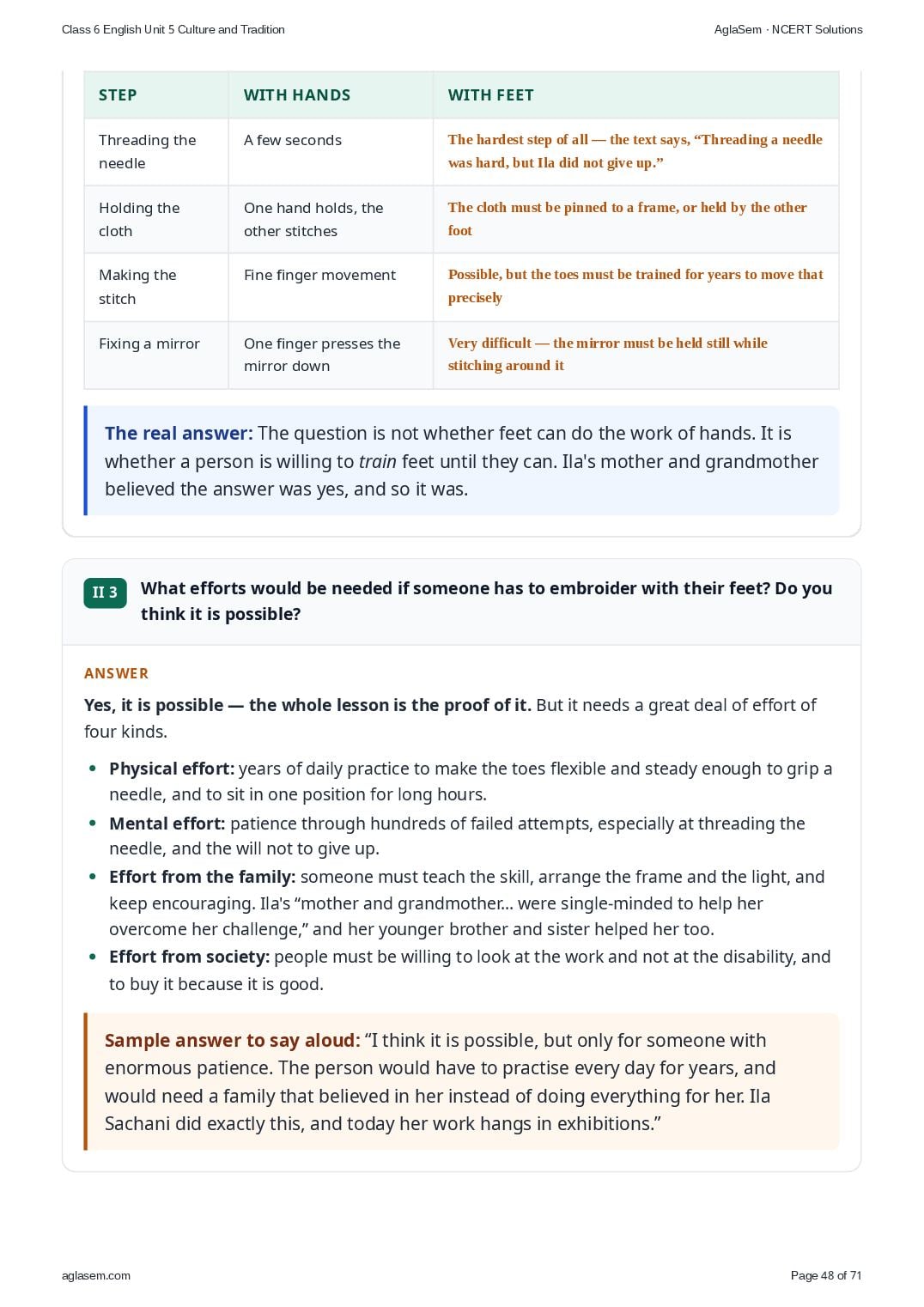
- Discuss if these steps can be done with feet, instead of hands.
- What efforts would be needed if someone has to embroider with their feet? Do you think it is possible?
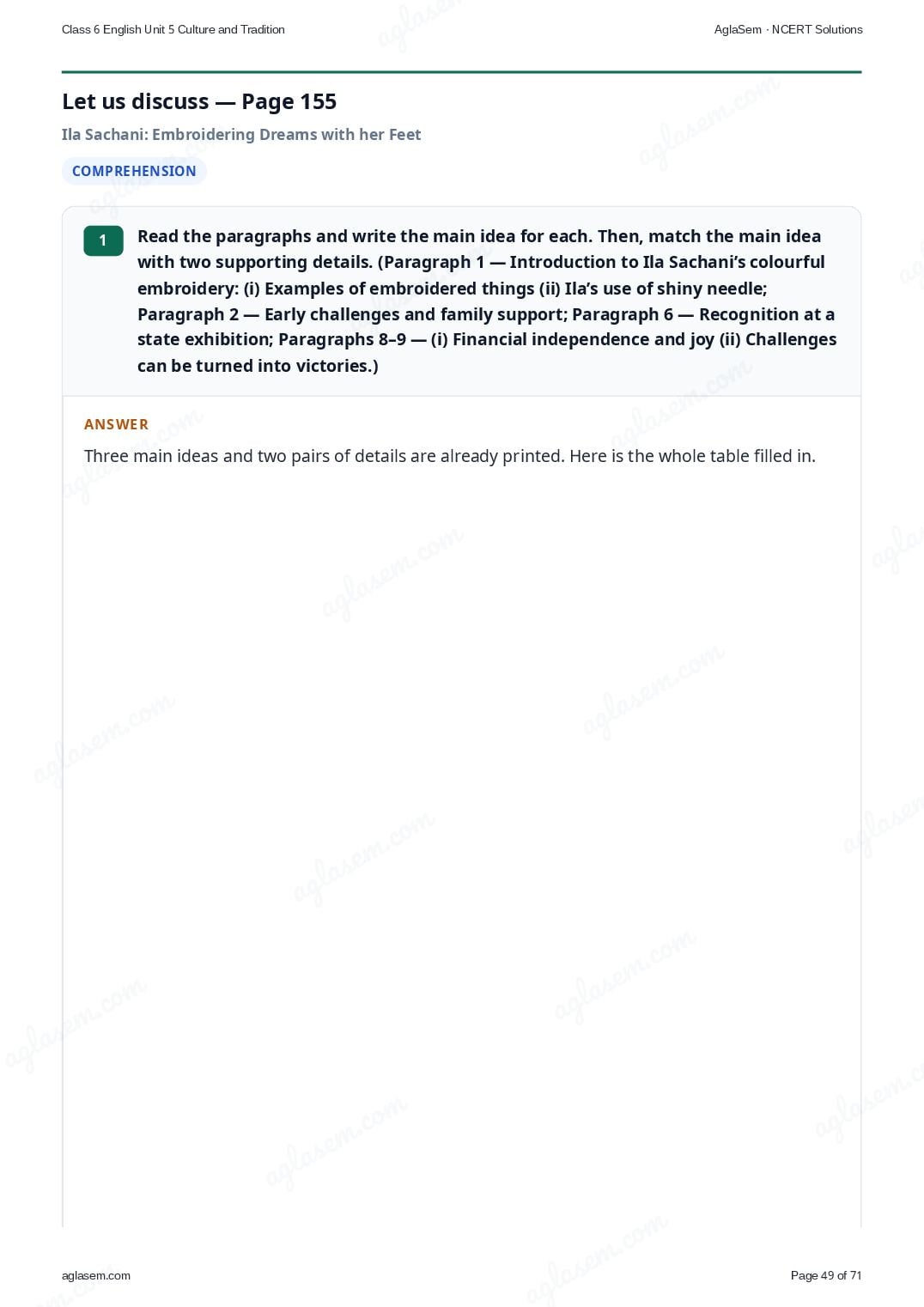
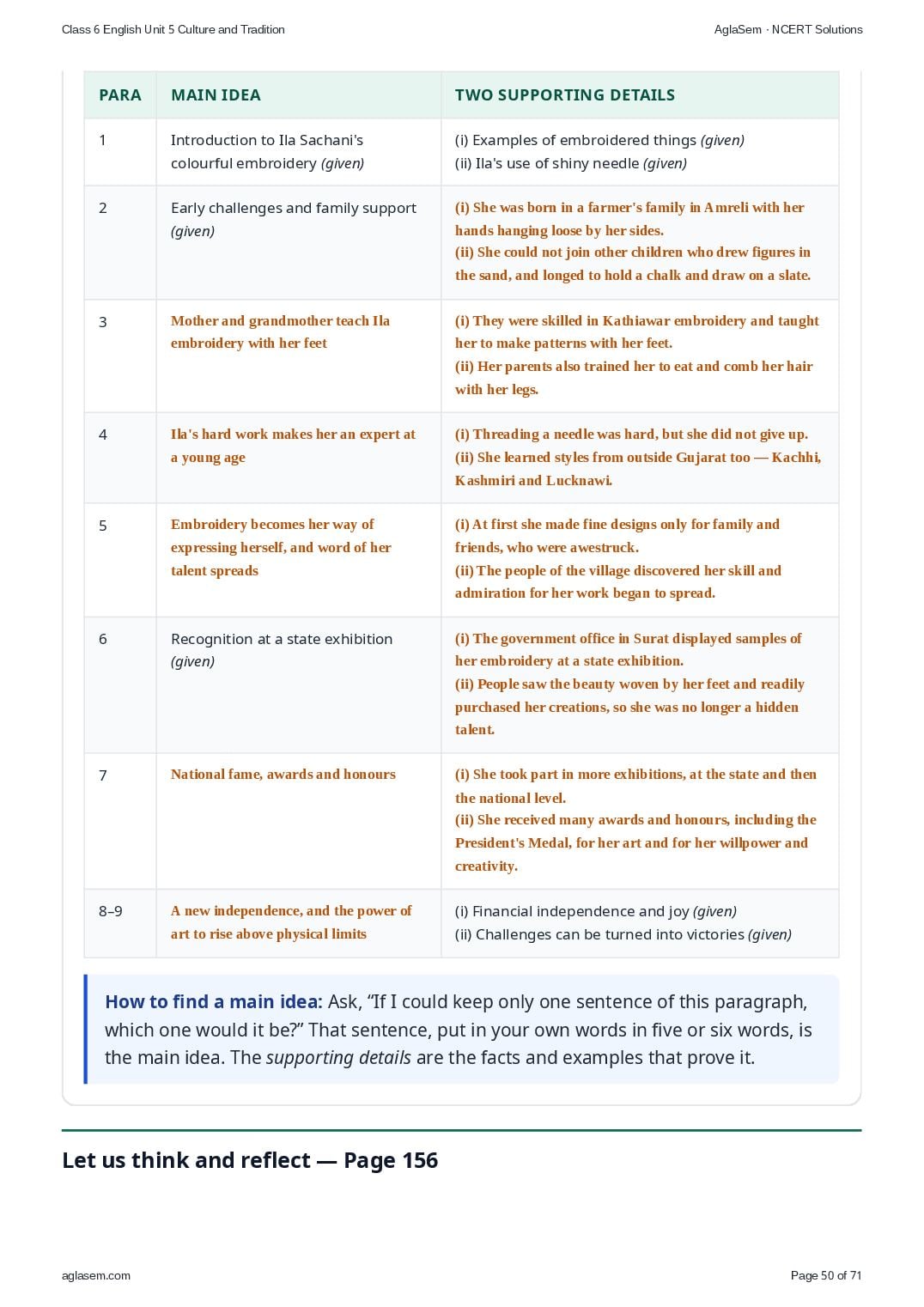
- Read the paragraphs and write the main idea for each. Then, match the main idea with two supporting details. (Paragraph 1 — Introduction to Ila Sachani’s colourful embroidery: (i) Examples of embroidered things (ii) Ila’s use of shiny needle; Paragraph 2 — Early challenges and family support; Paragraph 6 — Recognition at a state exhibition; Paragraphs 8–9 — (i) Financial independence and joy (ii) Challenges can be turned into victories.)
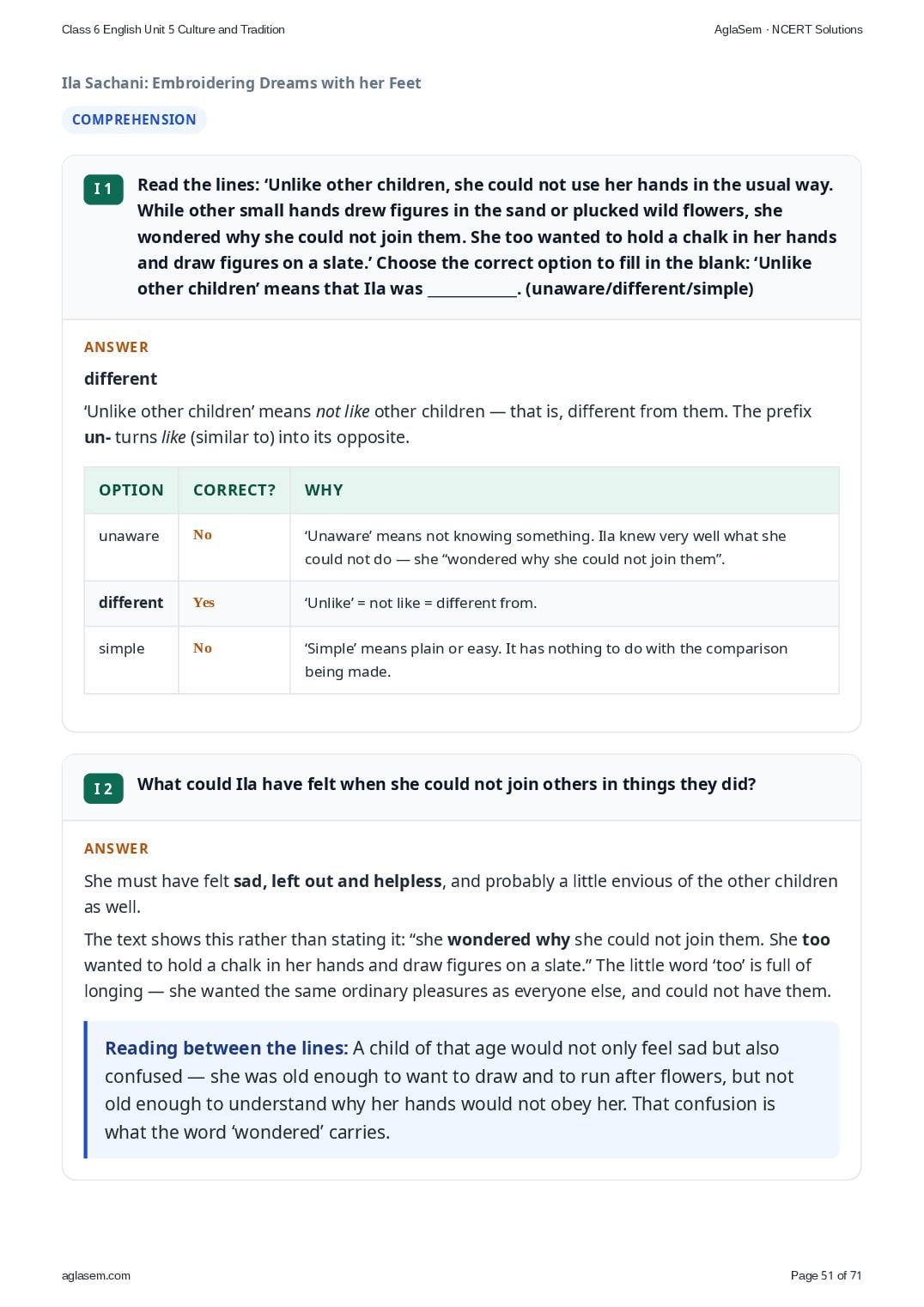
- Read the lines: ‘Unlike other children, she could not use her hands in the usual way. While other small hands drew figures in the sand or plucked wild flowers, she wondered why she could not join them. She too wanted to hold a chalk in her hands and draw figures on a slate.’ Choose the correct option to fill in the blank: ‘Unlike other children’ means that Ila was _____________. (unaware/different/simple)
- What could Ila have felt when she could not join others in things they did?
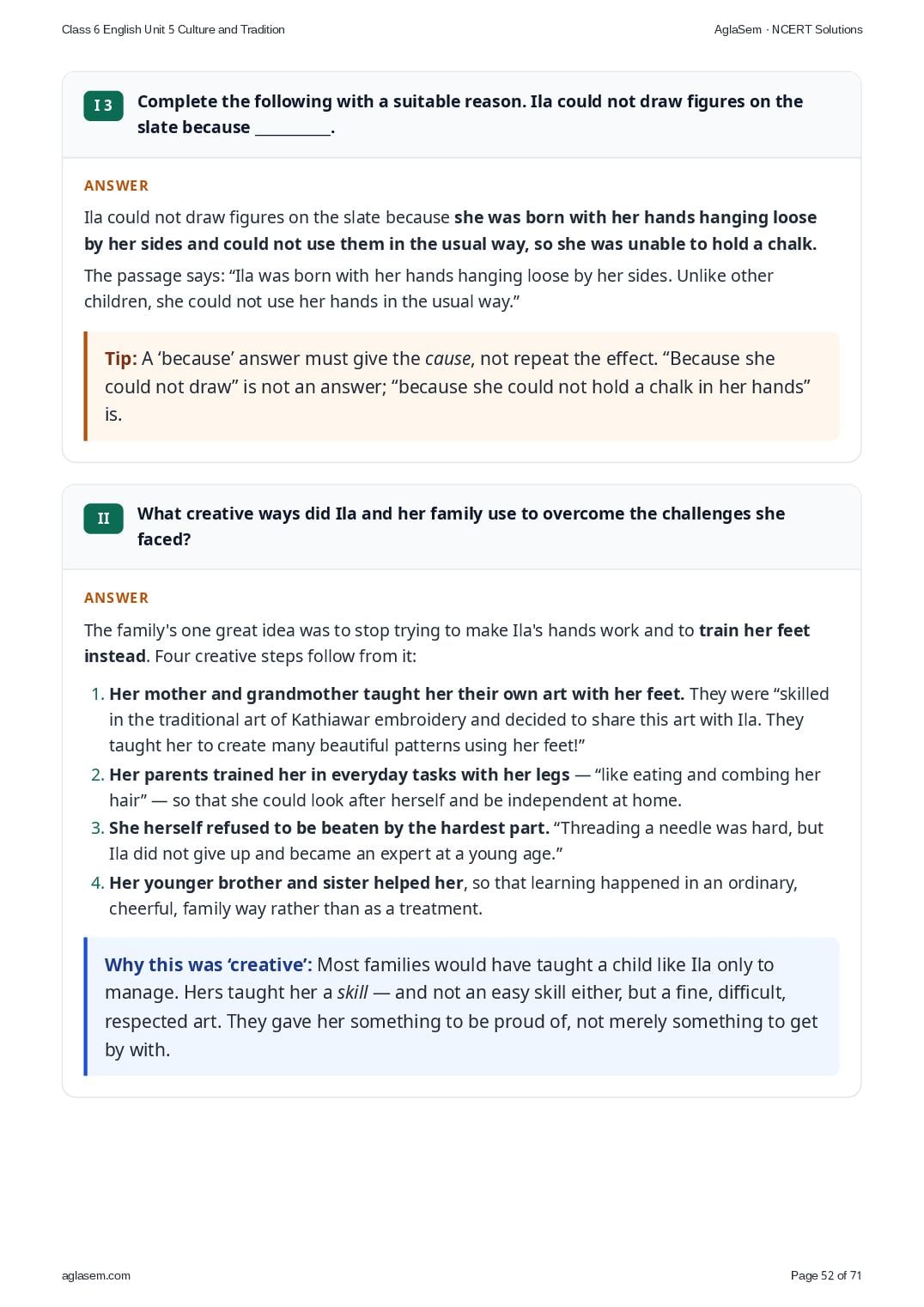
- Complete the following with a suitable reason. Ila could not draw figures on the slate because ___________.
- What creative ways did Ila and her family use to overcome the challenges she faced?
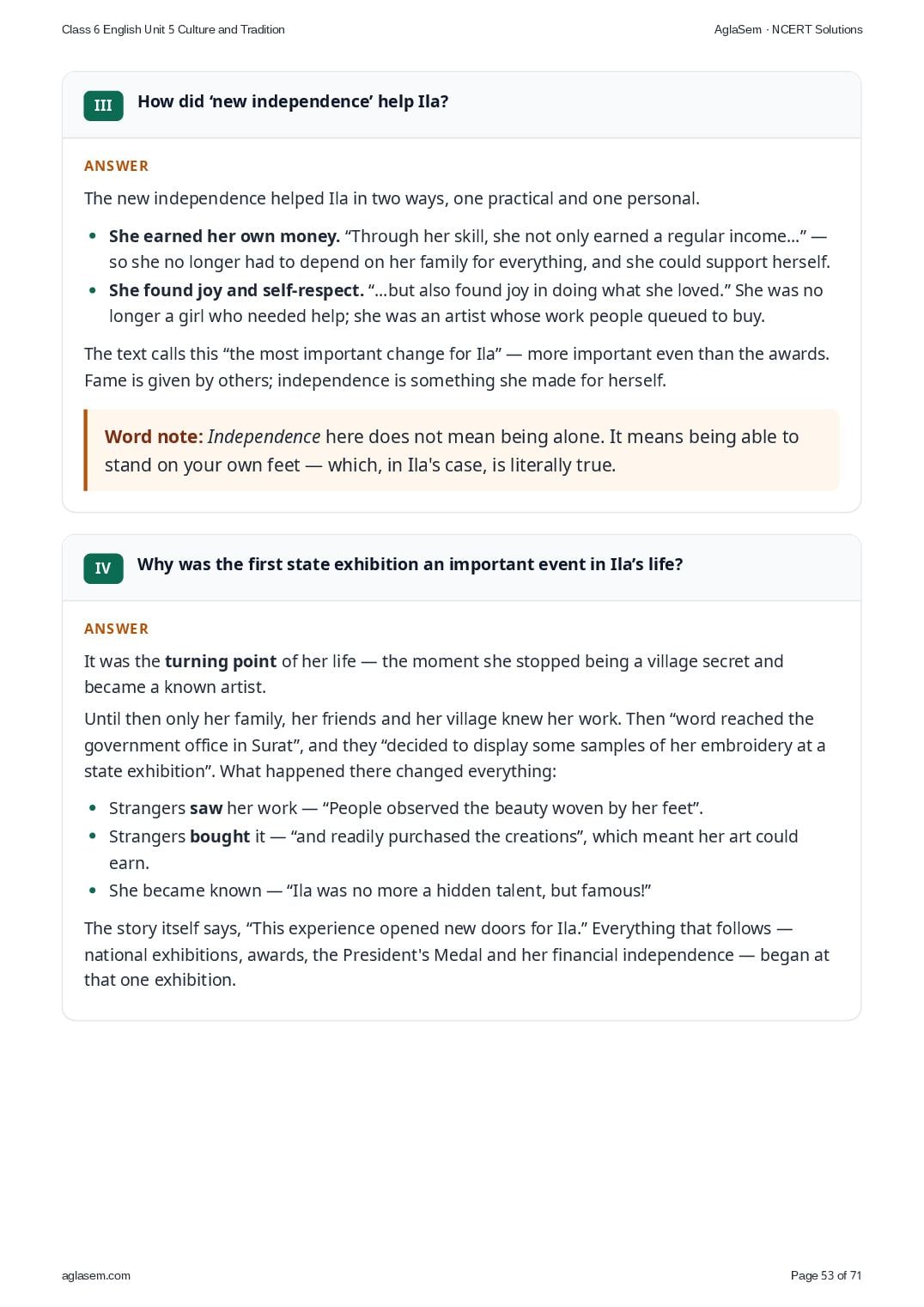
- How did ‘new independence’ help Ila?
- Why was the first state exhibition an important event in Ila’s life?
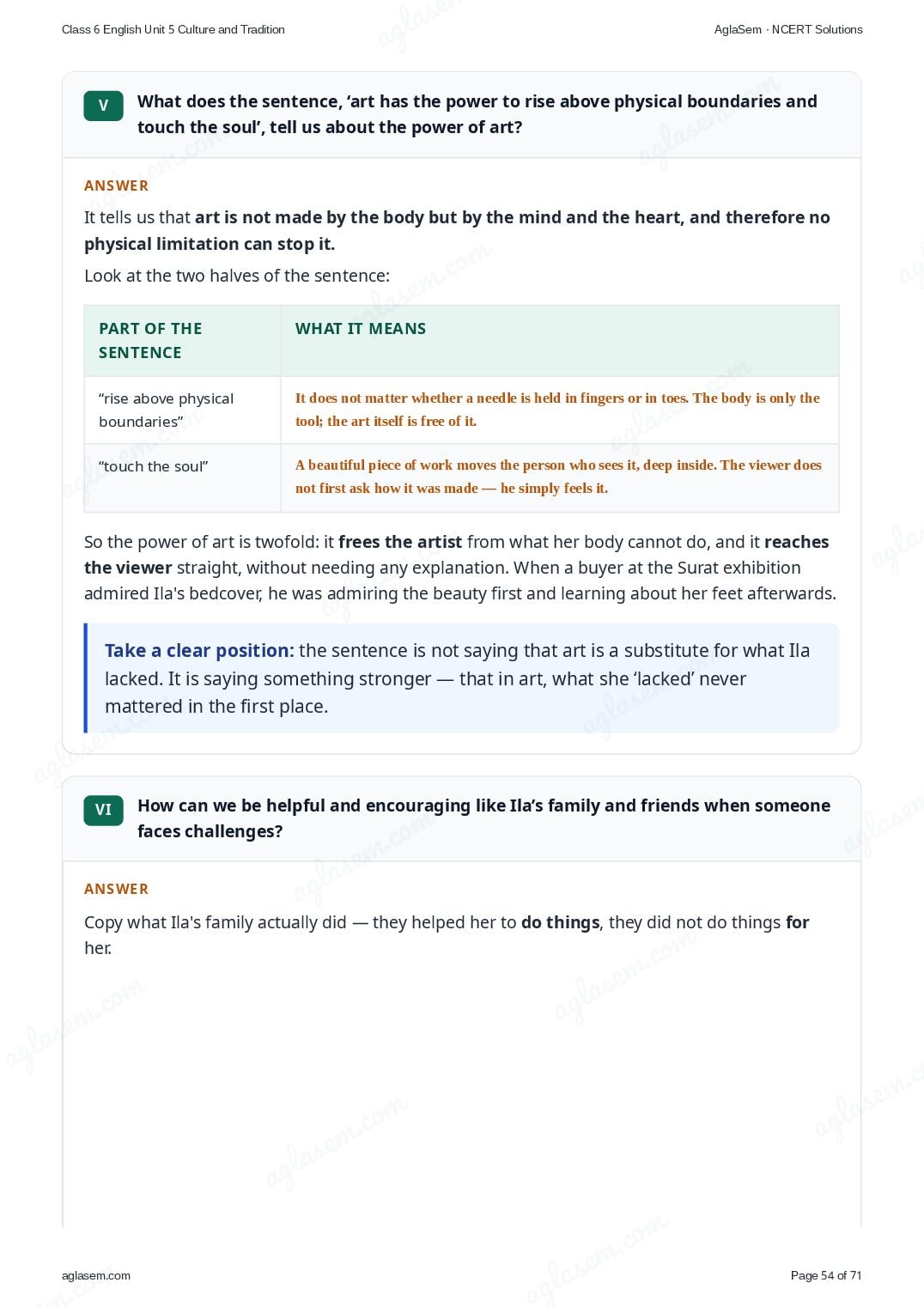
- What does the sentence, ‘art has the power to rise above physical boundaries and touch the soul’, tell us about the power of art?
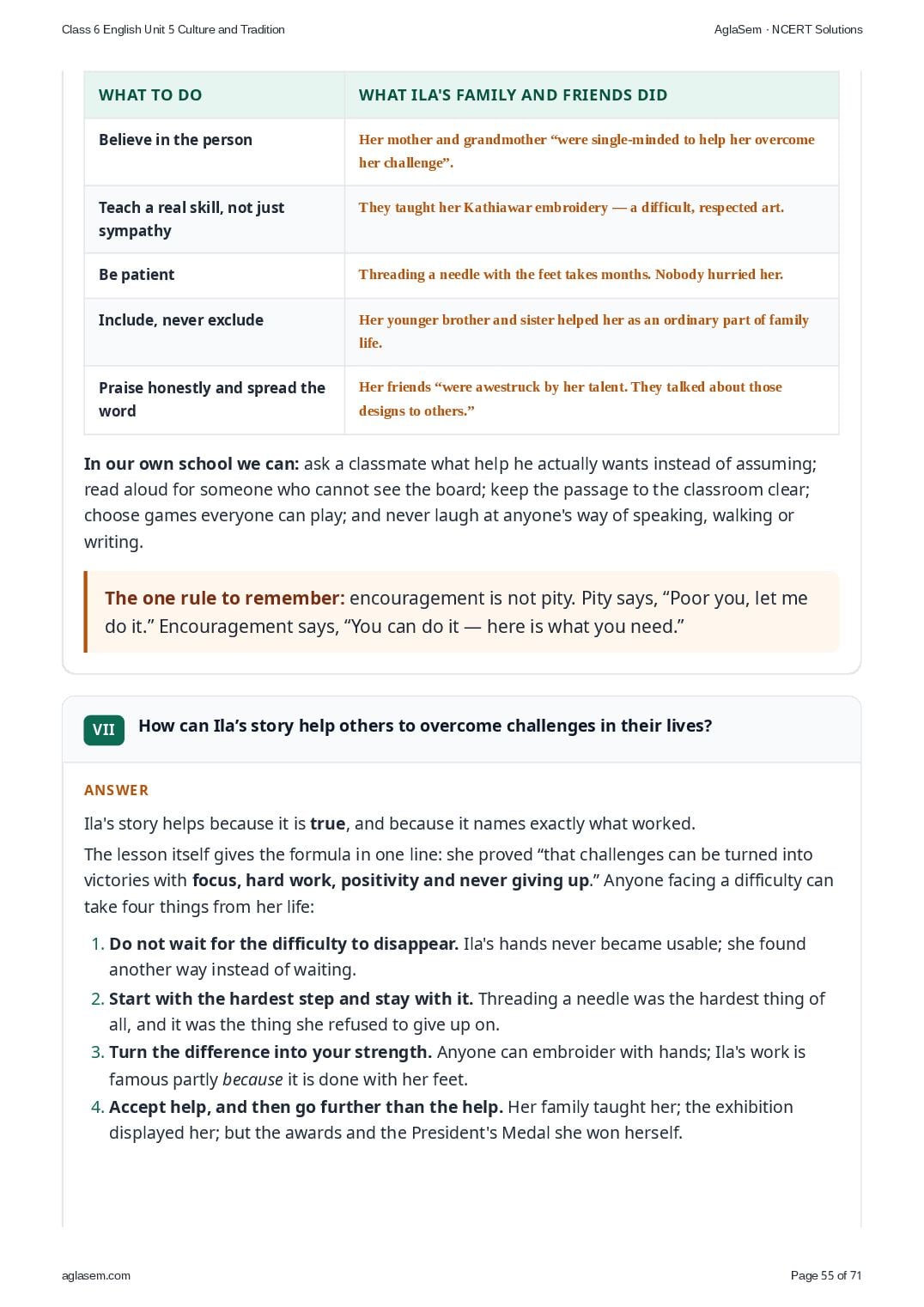
- How can we be helpful and encouraging like Ila’s family and friends when someone faces challenges?
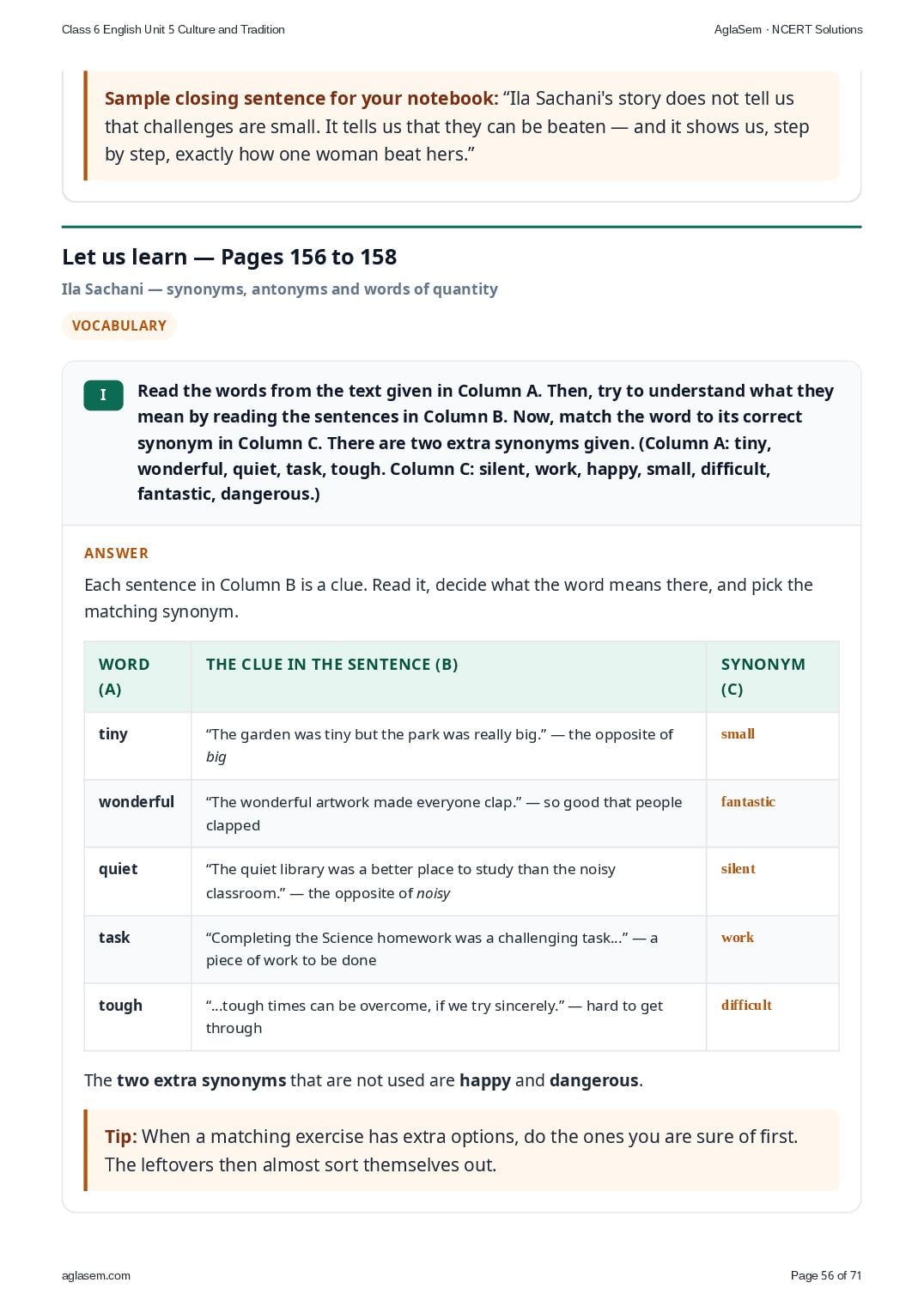
- How can Ila’s story help others to overcome challenges in their lives?
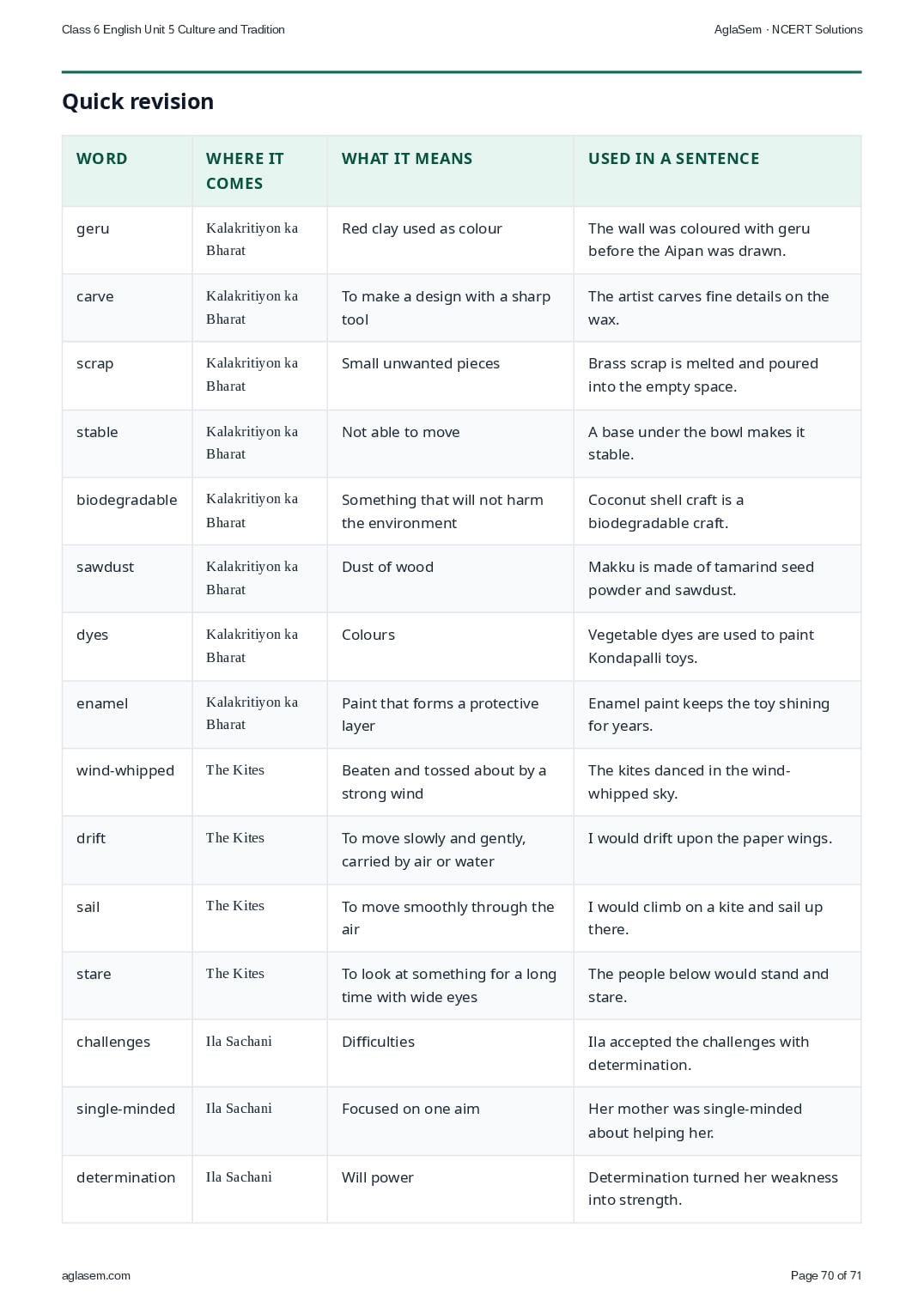
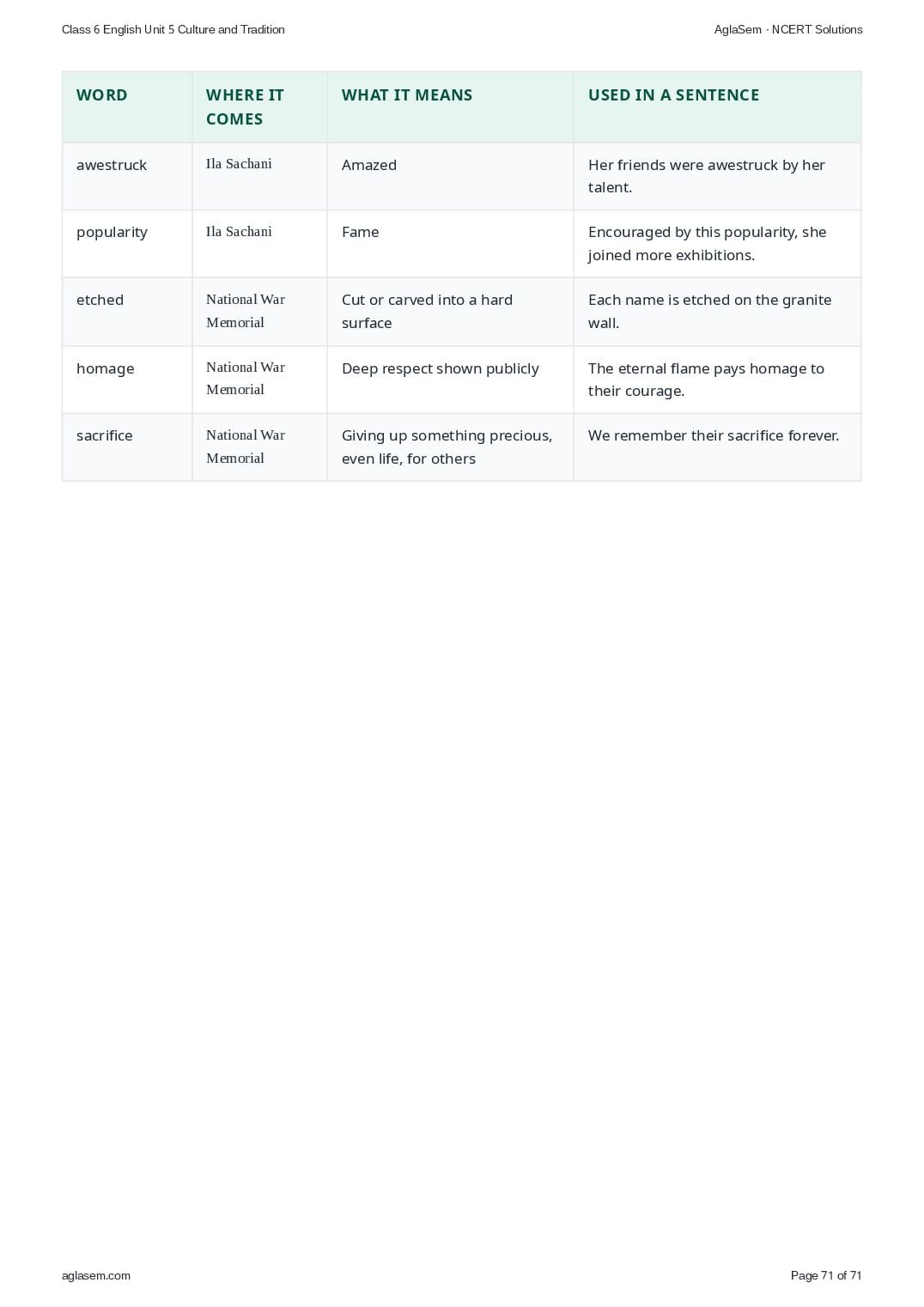
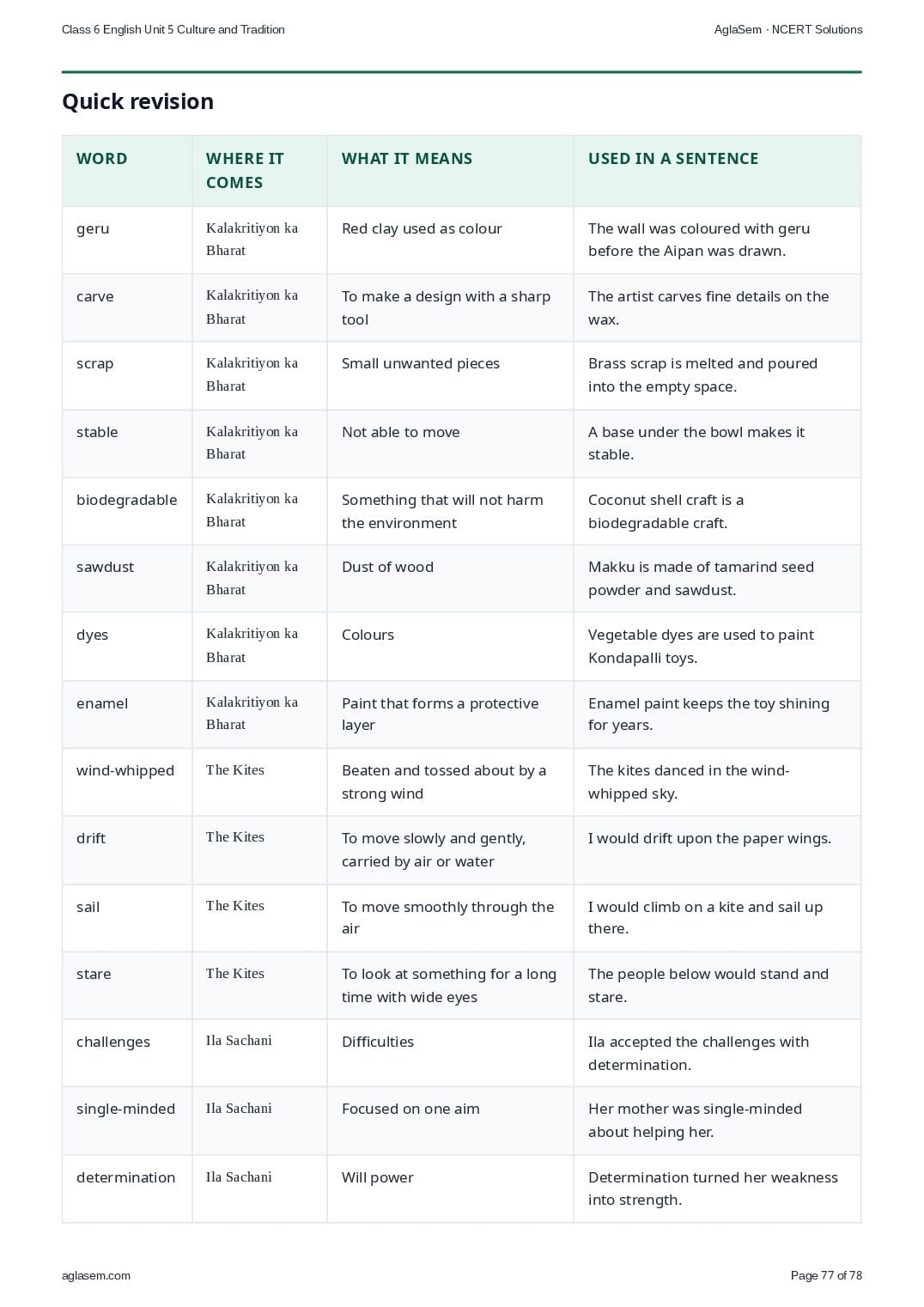
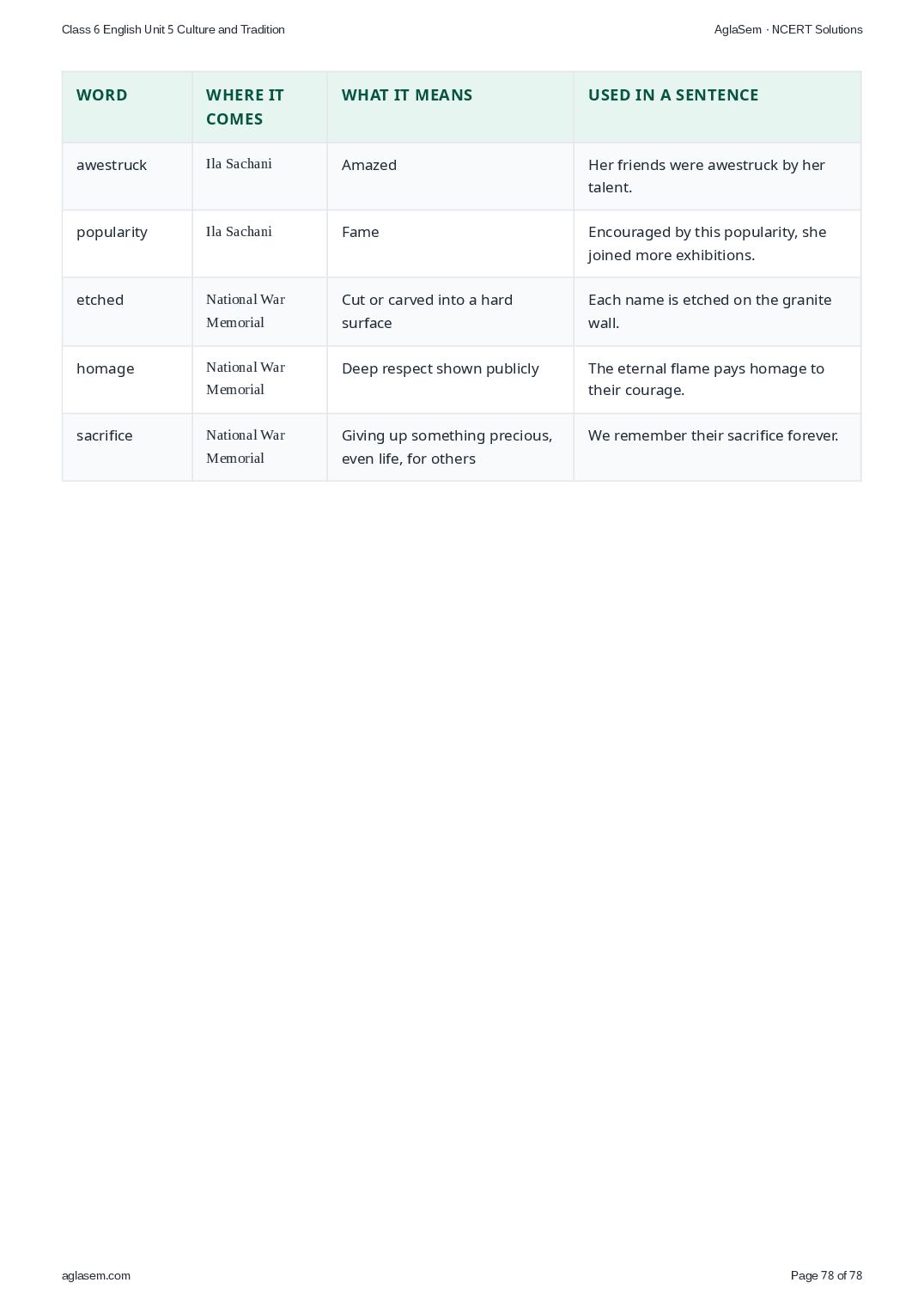
- Read the words from the text given in Column A. Then, try to understand what they mean by reading the sentences in Column B. Now, match the word to its correct synonym in Column C. There are two extra synonyms given. (Column A: tiny, wonderful, quiet, task, tough. Column C: silent, work, happy, small, difficult, fantastic, dangerous.)
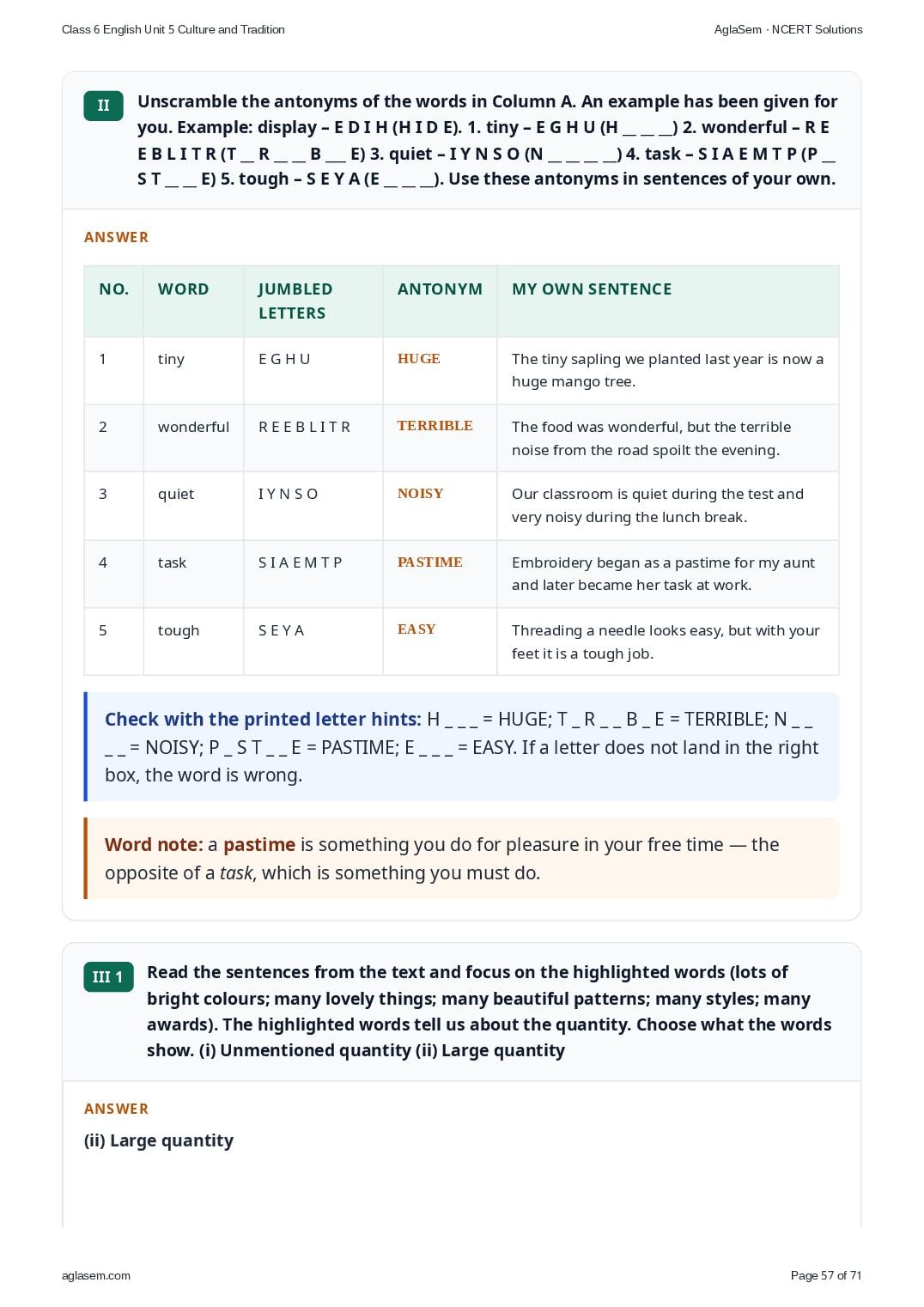
- Unscramble the antonyms of the words in Column A. An example has been given for you. Example: display – E D I H (H I D E). 1. tiny – E G H U (H __ __ __) 2. wonderful – R E E B L I T R (T __ R __ __ B ___ E) 3. quiet – I Y N S O (N __ __ __ __) 4. task – S I A E M T P (P __ S T __ __ E) 5. tough – S E Y A (E __ __ __). Use these antonyms in sentences of your own.
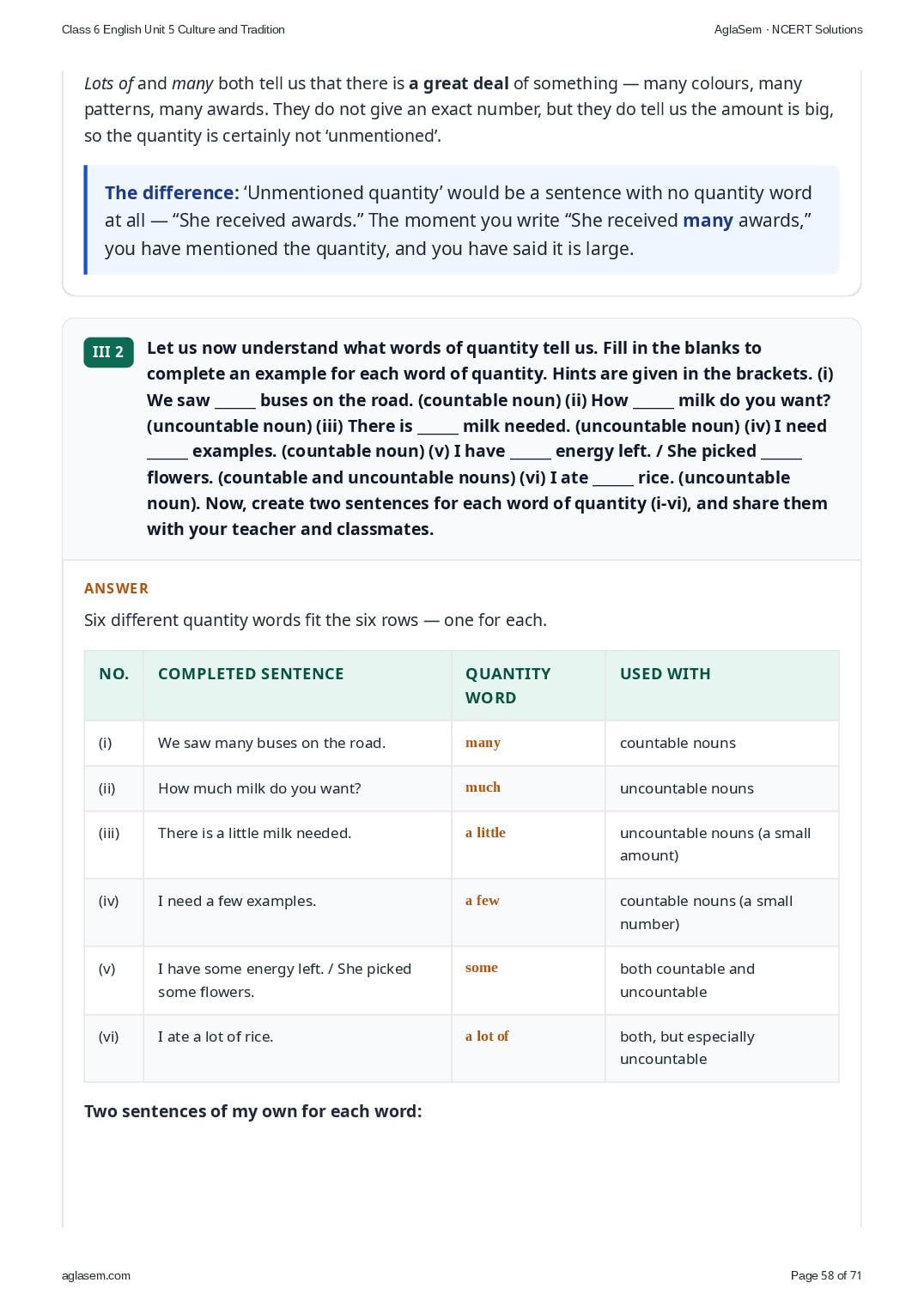
- Read the sentences from the text and focus on the highlighted words (lots of bright colours; many lovely things; many beautiful patterns; many styles; many awards). The highlighted words tell us about the quantity. Choose what the words show. (i) Unmentioned quantity (ii) Large quantity
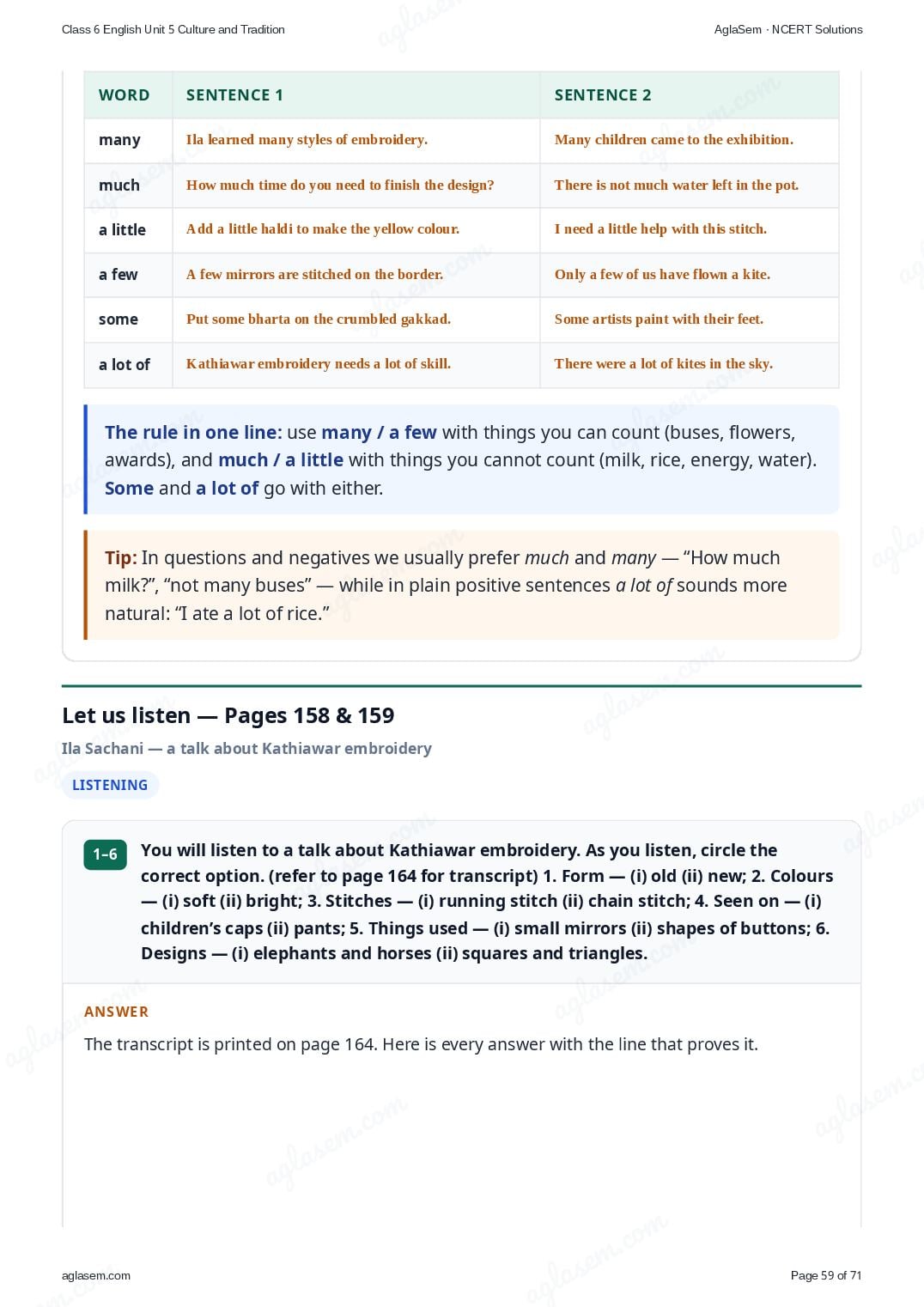
- Let us now understand what words of quantity tell us. Fill in the blanks to complete an example for each word of quantity. Hints are given in the brackets. (i) We saw ______ buses on the road. (countable noun) (ii) How ______ milk do you want? (uncountable noun) (iii) There is ______ milk needed. (uncountable noun) (iv) I need ______ examples. (countable noun) (v) I have ______ energy left. / She picked ______ flowers. (countable and uncountable nouns) (vi) I ate ______ rice. (uncountable noun). Now, create two sentences for each word of quantity (i-vi), and share them with your teacher and classmates.
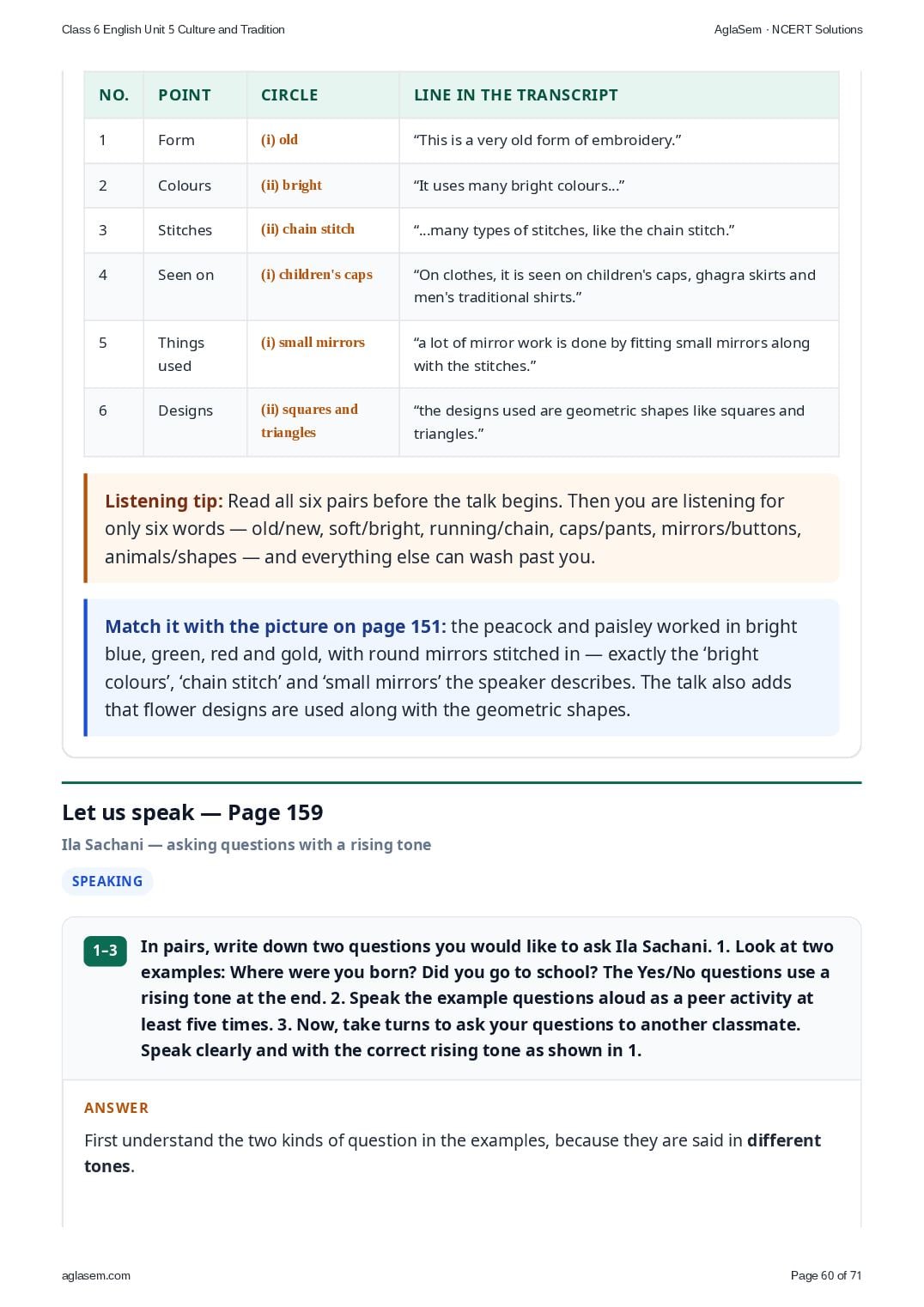
- You will listen to a talk about Kathiawar embroidery. As you listen, circle the correct option. (refer to page 164 for transcript) 1. Form — (i) old (ii) new; 2. Colours — (i) soft (ii) bright; 3. Stitches — (i) running stitch (ii) chain stitch; 4. Seen on — (i) children’s caps (ii) pants; 5. Things used — (i) small mirrors (ii) shapes of buttons; 6. Designs — (i) elephants and horses (ii) squares and triangles.
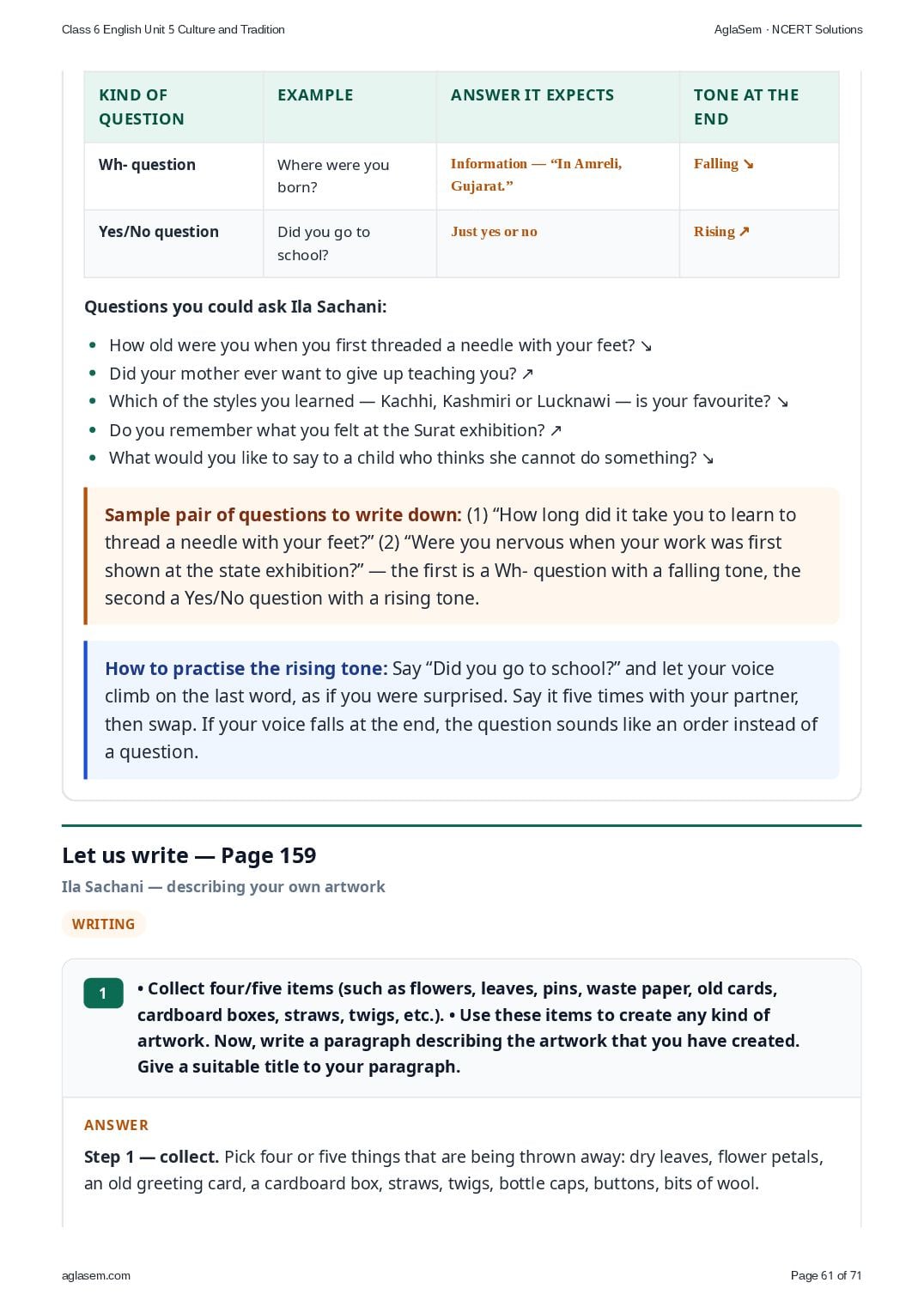
- In pairs, write down two questions you would like to ask Ila Sachani. 1. Look at two examples: Where were you born? Did you go to school? The Yes/No questions use a rising tone at the end. 2. Speak the example questions aloud as a peer activity at least five times. 3. Now, take turns to ask your questions to another classmate. Speak clearly and with the correct rising tone as shown in 1.
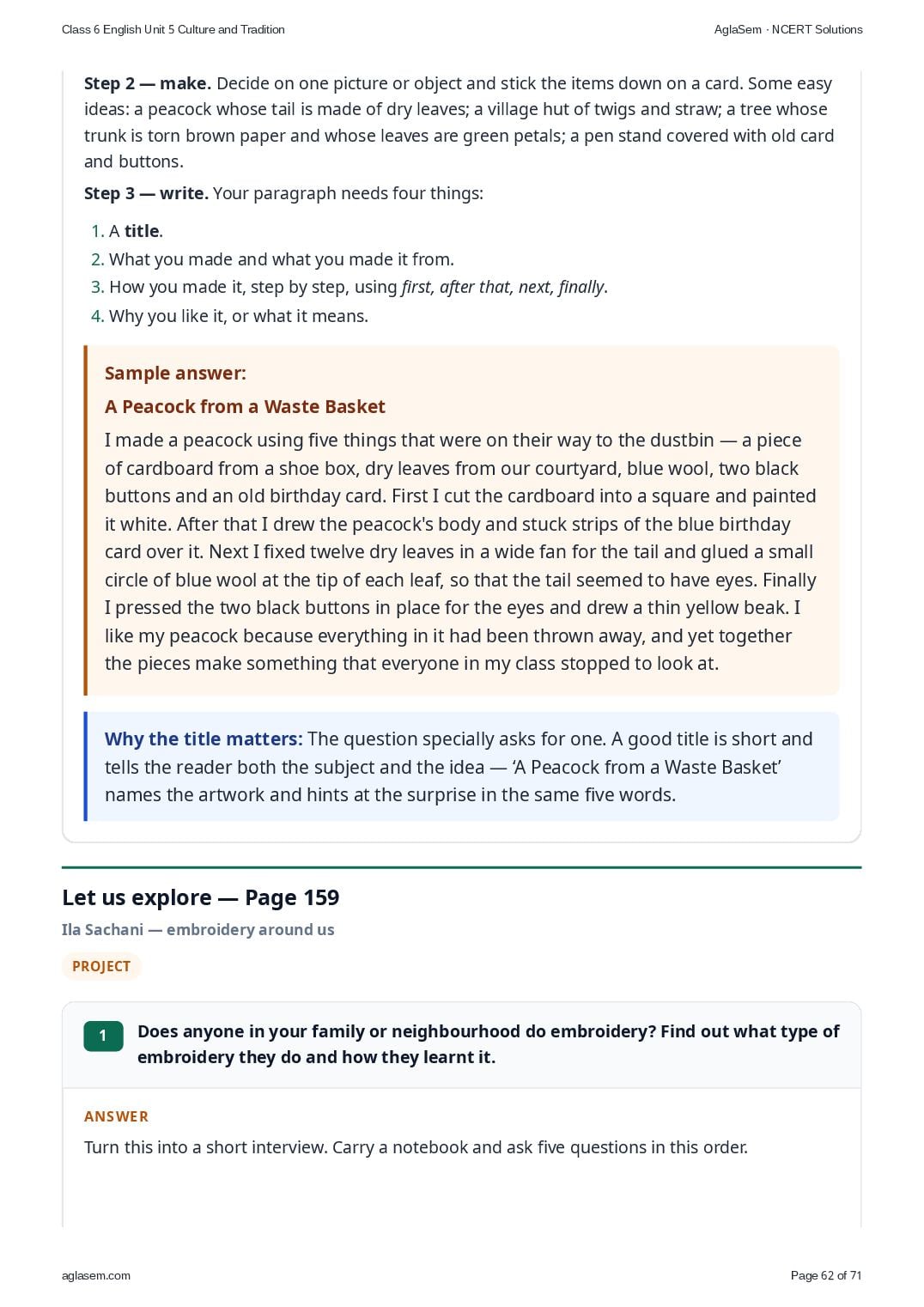
- • Collect four/five items (such as flowers, leaves, pins, waste paper, old cards, cardboard boxes, straws, twigs, etc.). • Use these items to create any kind of artwork. Now, write a paragraph describing the artwork that you have created. Give a suitable title to your paragraph.
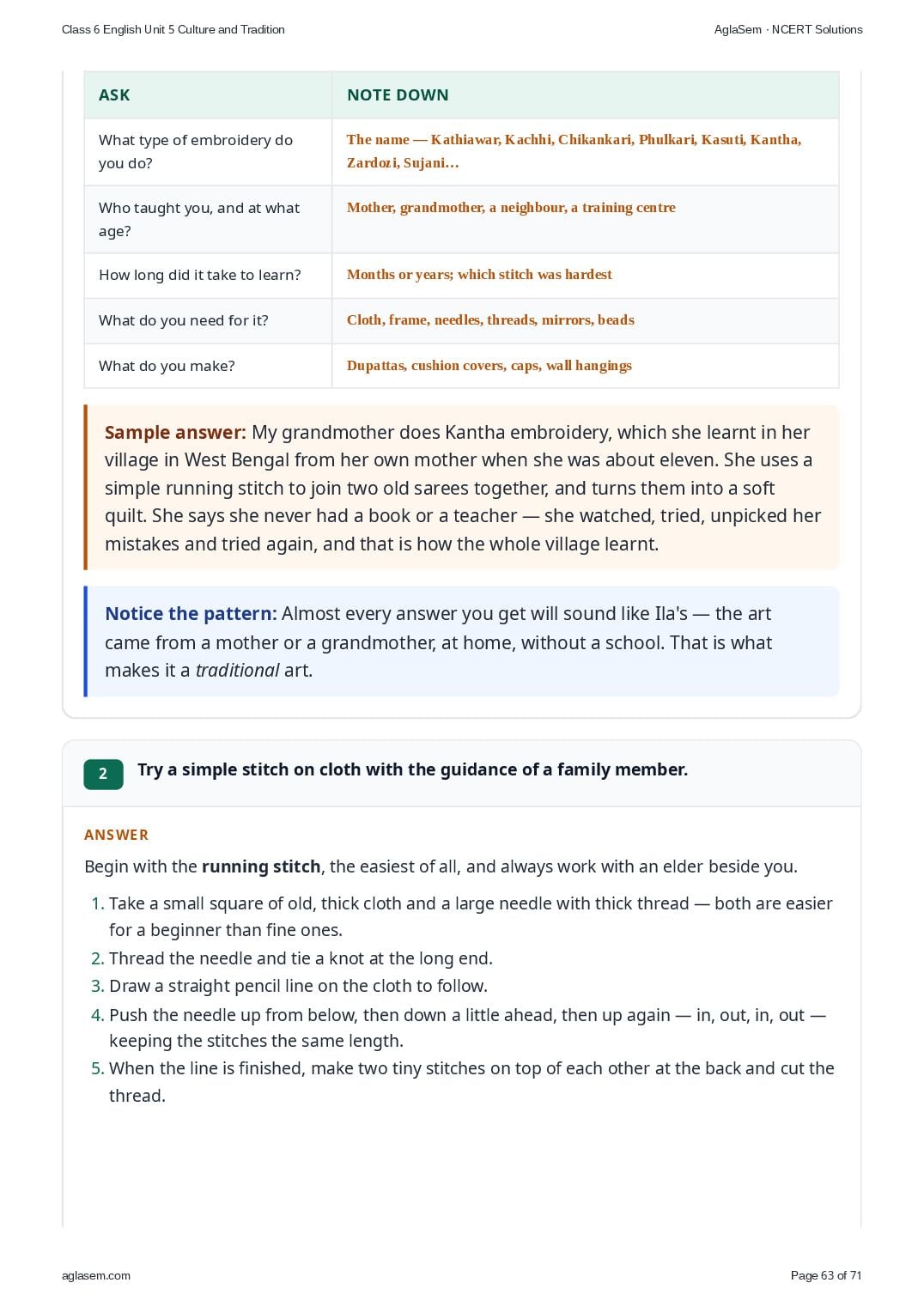
- Does anyone in your family or neighbourhood do embroidery? Find out what type of embroidery they do and how they learnt it.
- Try a simple stitch on cloth with the guidance of a family member.
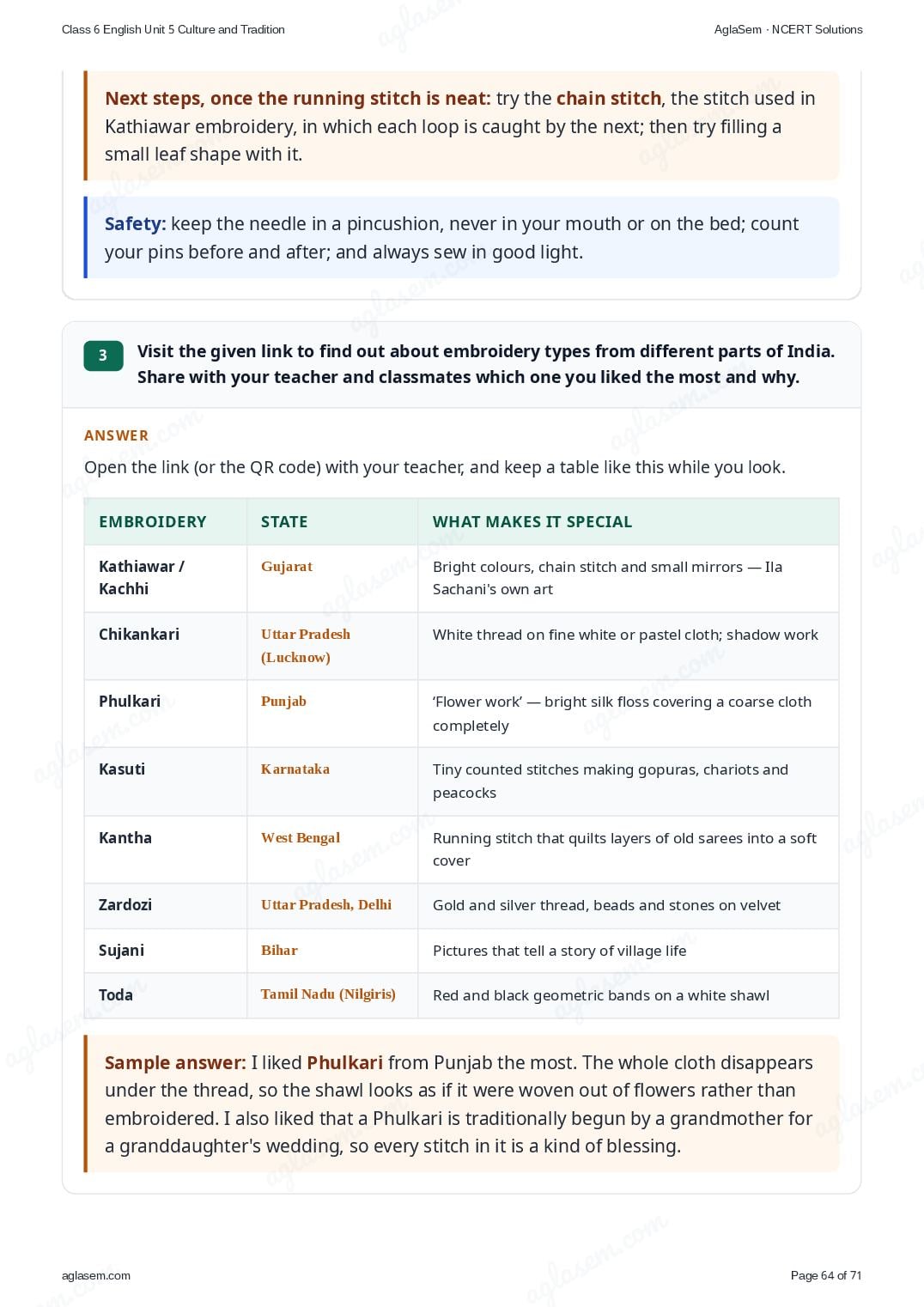
- Visit the given link to find out about embroidery types from different parts of India. Share with your teacher and classmates which one you liked the most and why.
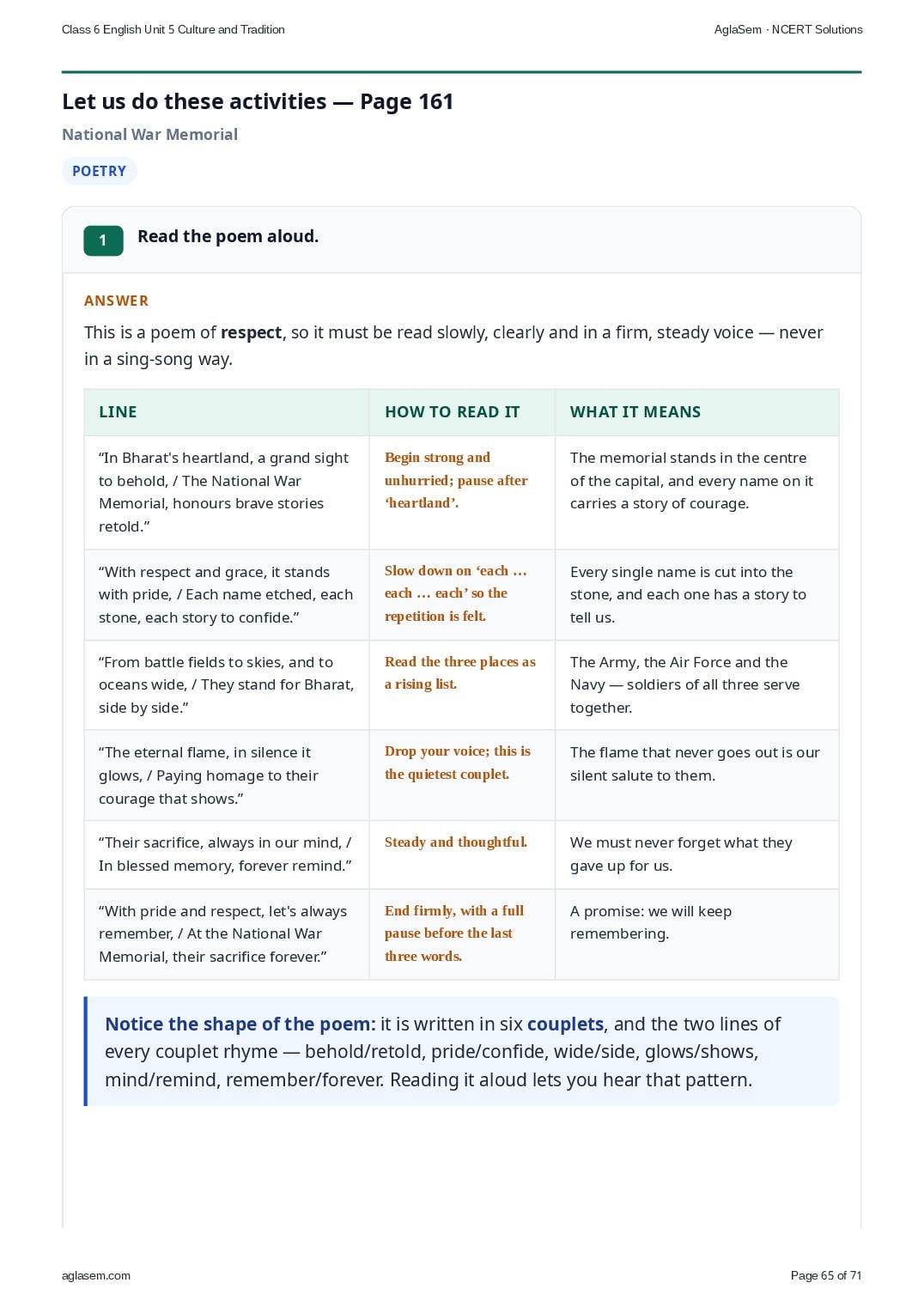
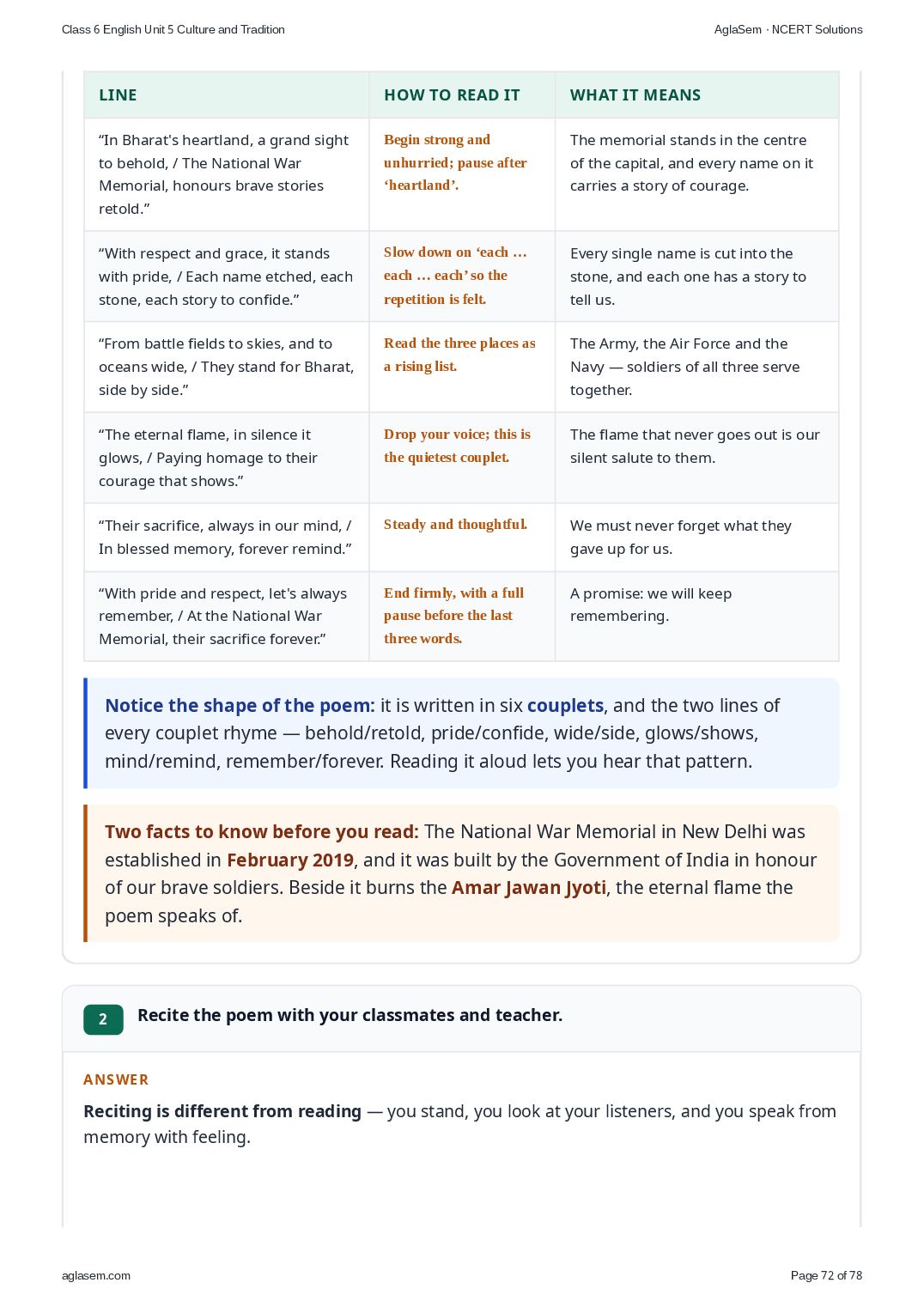
- Read the poem aloud.
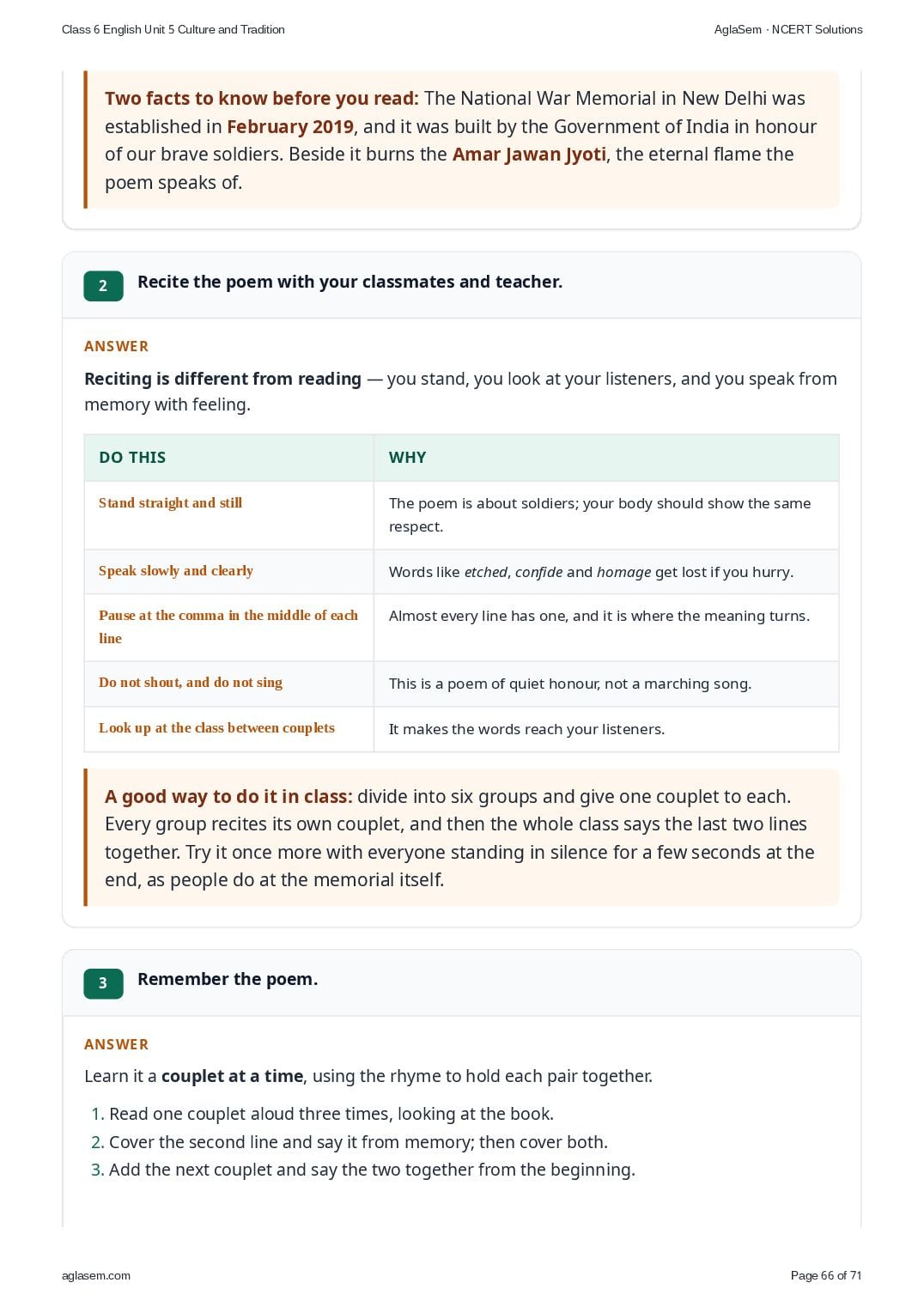
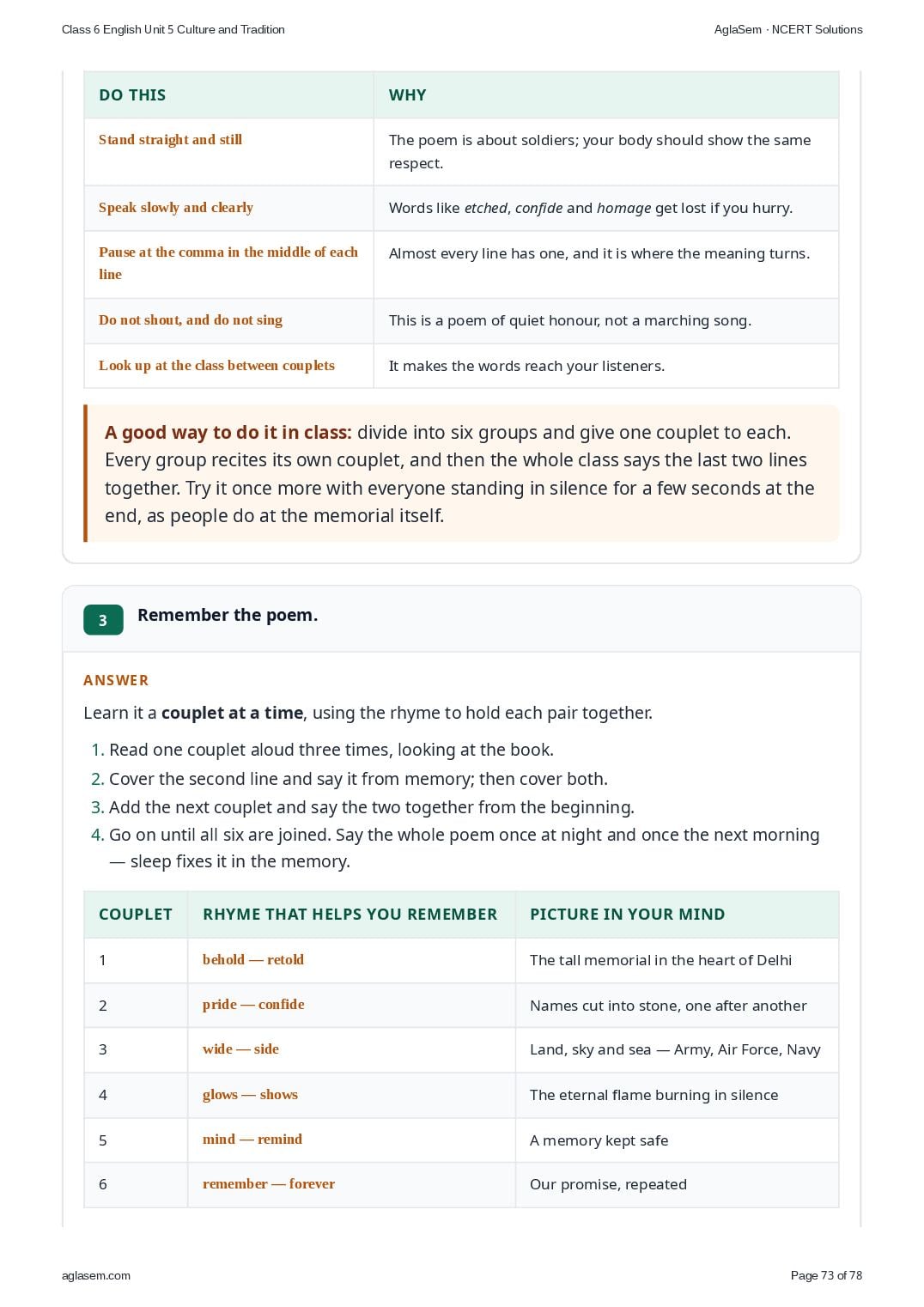
- Recite the poem with your classmates and teacher.
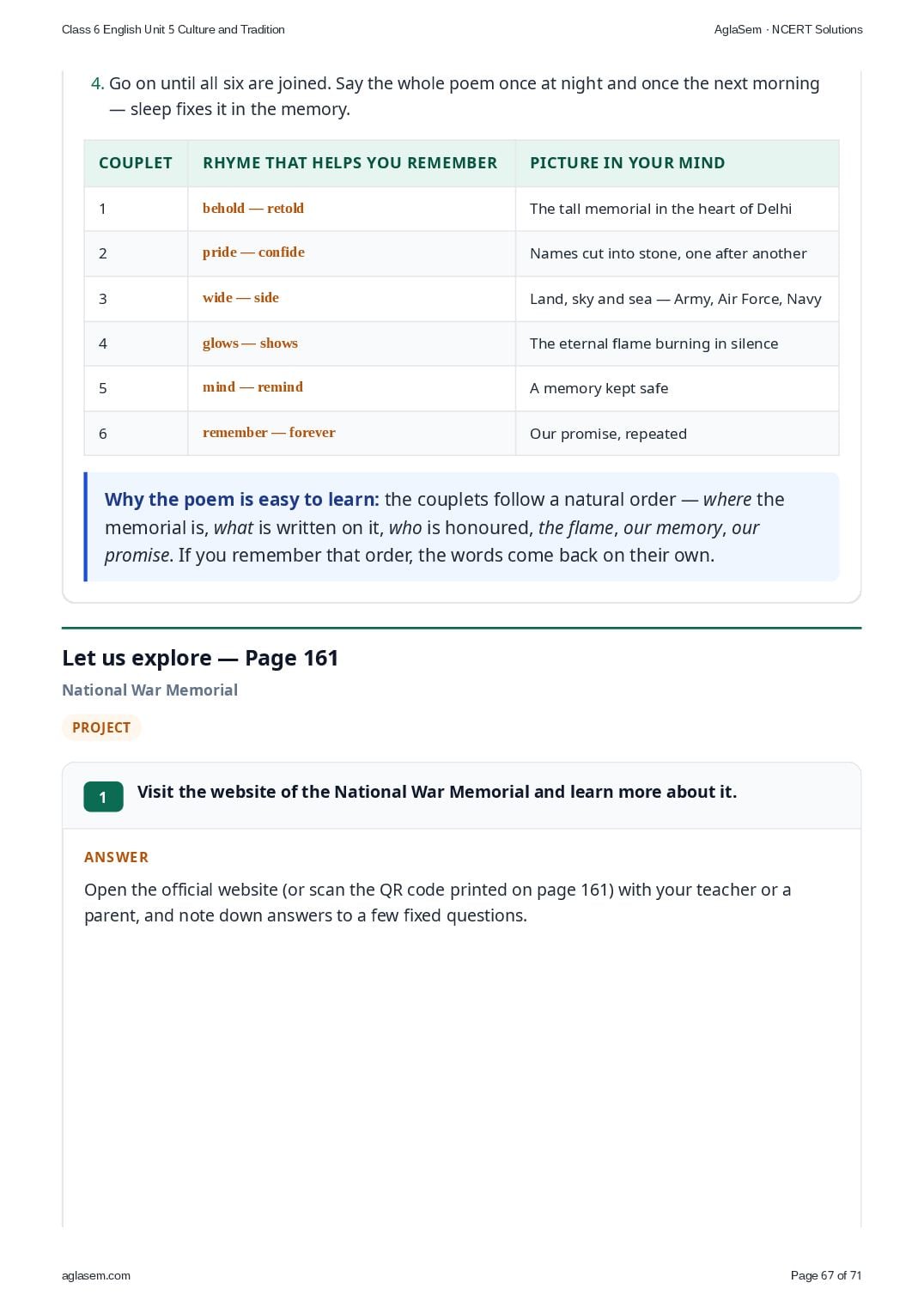
- Remember the poem.
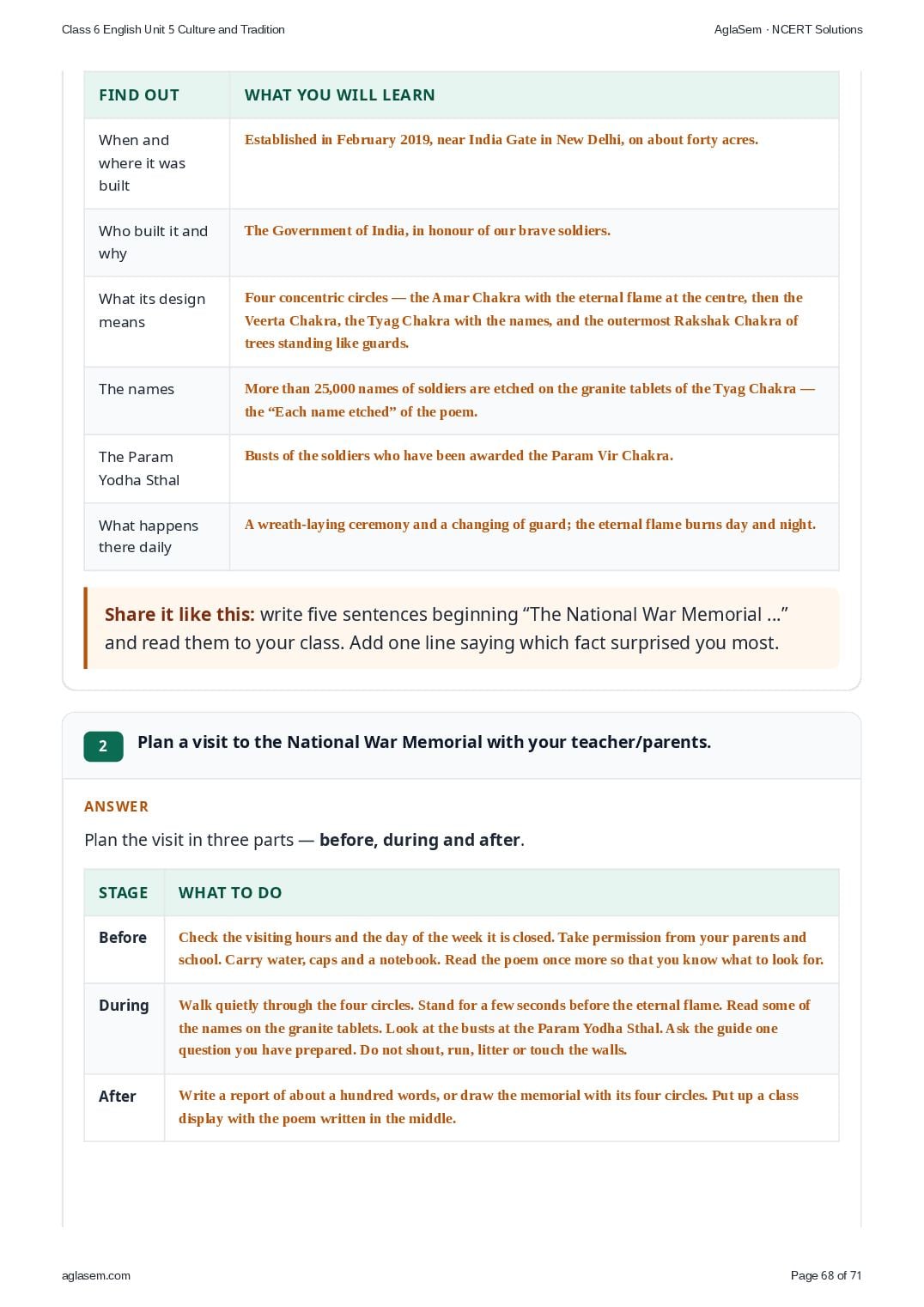
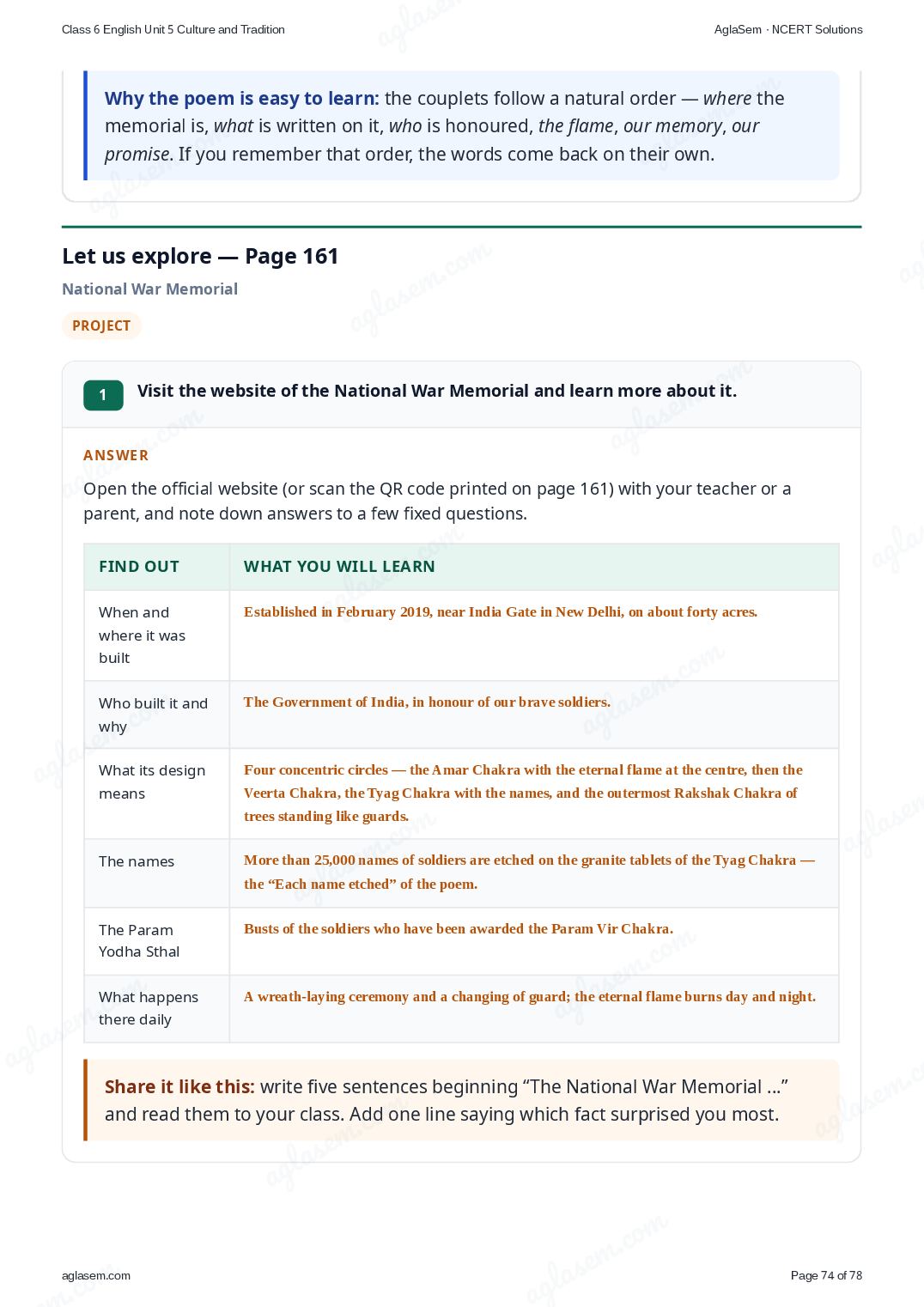
- Visit the website of the National War Memorial and learn more about it.
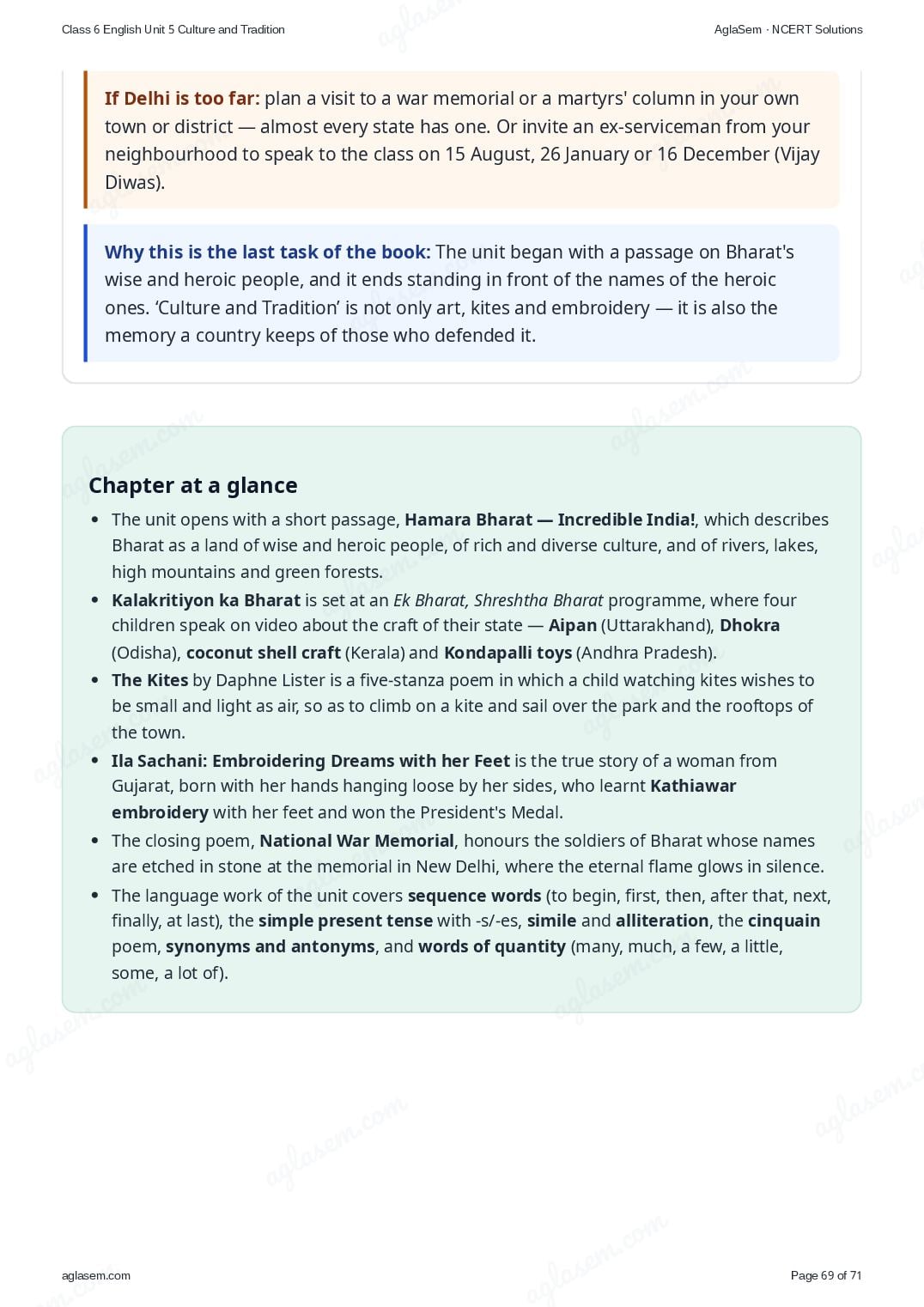
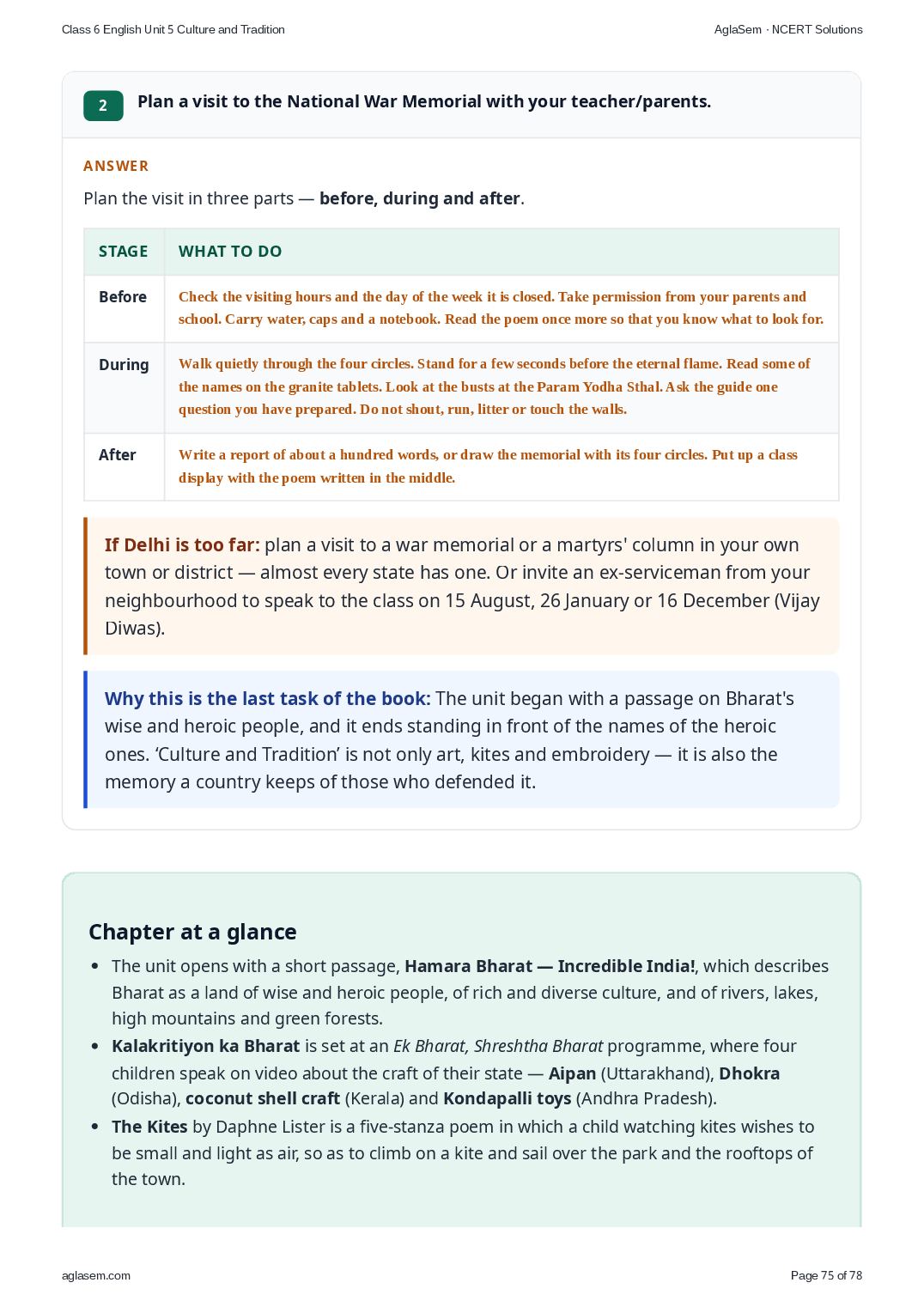
- Plan a visit to the National War Memorial with your teacher/parents.
Chapter at a Glance
- The unit opens with a short passage, Hamara Bharat — Incredible India! , which describes Bharat as a land of wise and heroic people, of rich and diverse culture, and of rivers, lakes, high mountains and green forests.
- Kalakritiyon ka Bharat is set at an Ek Bharat, Shreshtha Bharat programme, where four children speak on video about the craft of their state — Aipan (Uttarakhand), Dhokra (Odisha), coconut shell craft (Kerala) and Kondapalli toys (Andhra Pradesh).
- The Kites by Daphne Lister is a five-stanza poem in which a child watching kites wishes to be small and light as air, so as to climb on a kite and sail over the park and the rooftops of the town.
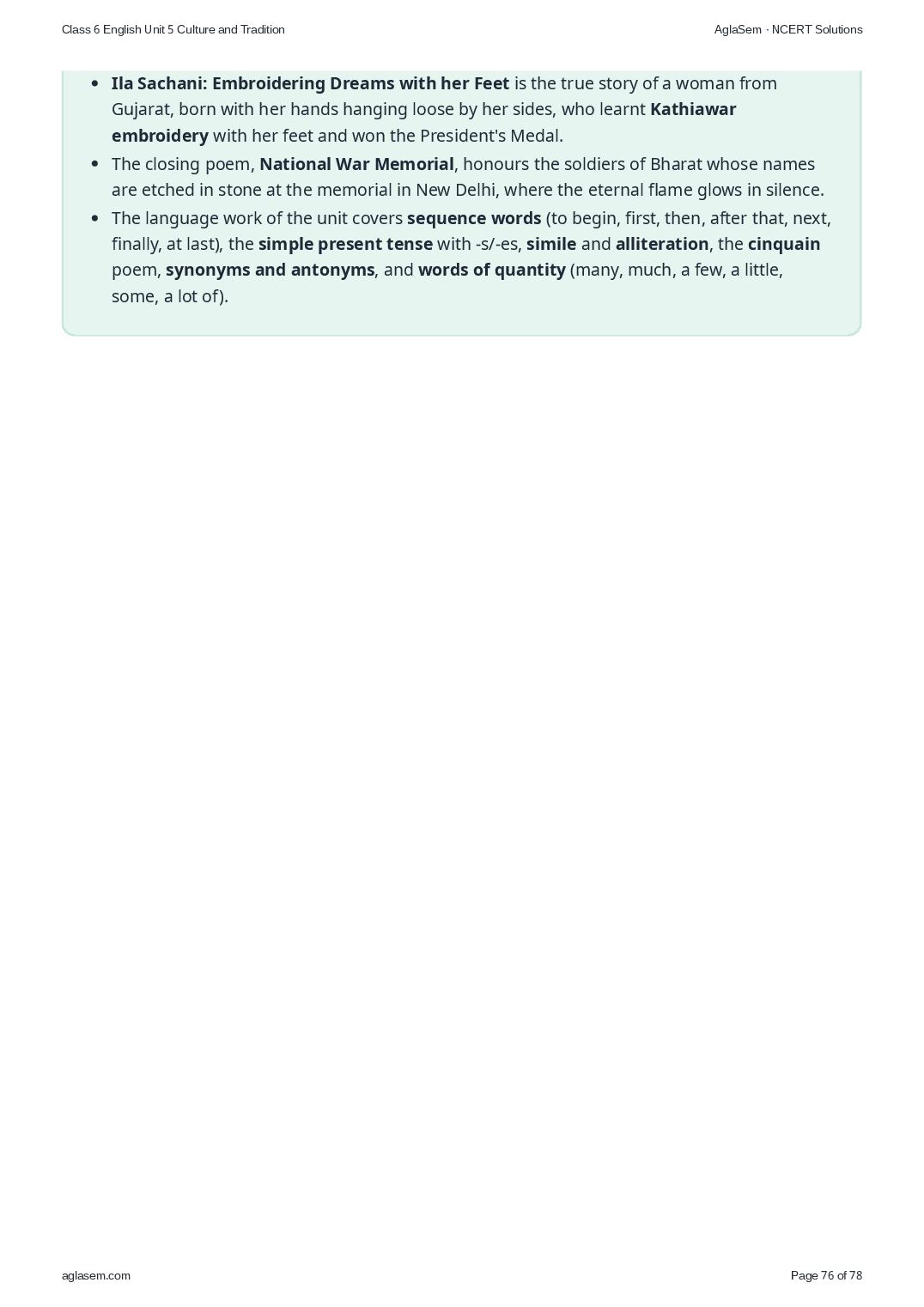
- Ila Sachani: Embroidering Dreams with her Feet is the true story of a woman from Gujarat, born with her hands hanging loose by her sides, who learnt Kathiawar embroidery with her feet and won the President's Medal.
- The closing poem, National War Memorial , honours the soldiers of Bharat whose names are etched in stone at the memorial in New Delhi, where the eternal flame glows in silence.
- The language work of the unit covers sequence words (to begin, first, then, after that, next, finally, at last), the simple present tense with -s/-es, simile and alliteration , the cinquain poem, synonyms and antonyms , and words of quantity (many, much, a few, a little, some, a lot of).
How to Download NCERT Solutions for Class 6 English Chapter 5 PDF
Follow these simple steps to get the Culture and Tradition questions-and-answers PDF from Poorvi.
- Search NCERT Solutions for Class 6 English Chapter 5 aglasem and open this page.
- Read the exercise questions with answers for Culture and Tradition shown above.
- Click the Download PDF link to save the Culture and Tradition solutions to your device.
NCERT Solutions for Class 6 English – All Chapters
There are more chapters to study besides Culture and Tradition in English. Here are the NCERT Solutions for all chapters of Class 6 English.
- Chapter 1 Fables and Folk Tales
- Chapter 2 Friendship
- Chapter 3 Nurturing Nature
- Chapter 4 Sports and Wellness
- Chapter 5 Culture and Tradition
NCERT Solutions for Class 6 – All Subjects
Just like Chapter 5 of English, you can get the exercise questions with answers for every other subject of Class 6. Here are the NCERT Solutions for all subjects of Class 6.
NCERT Solutions for Class 6 English Chapter 5 – An Overview
The key highlights of this study material are as follows.
| Aspects | Details |
|---|---|
| Class | Class 6 |
| Subject | English |
| Chapter Number | Chapter 5 |
| Chapter Name | Culture and Tradition |
| Book Name | Poorvi |
| Book By | NCERT (National Council of Educational Research and Training) |
| Educational Resource Here | NCERT Solutions of Class 6 English Chapter 5 for all exercises |
| More Questions Answers of This Subject | NCERT Solutions for Class 6 English |
| Download Book Chapter | NCERT Book Class 6 English |
| All Questions Answers For This Class | NCERT Solutions for Class 6 |
| Complete Solutions | NCERT Solutions |
NCERT Solutions for Class 6 English Chapter 5 Culture and Tradition – FAQs
What are the NCERT Solutions for Class 6 English Chapter 5 Culture and Tradition?
They are the complete, step-by-step answers to all the exercise and in-text questions of Chapter 5 Culture and Tradition from the NCERT Class 6 English textbook Poorvi, written by experts as per the latest NCERT syllabus.
How can I download the Class 6 English Chapter 5 solutions PDF for free?
Open this page on aglasem, read the Culture and Tradition questions with answers, and click the “Download Solutions PDF” link. The Class 6 English Chapter 5 NCERT Solutions PDF is completely free to download.
Are these NCERT Solutions as per the latest 2026-27 syllabus?
Yes. The NCERT Solutions for Class 6 English Chapter 5 are based on the latest NCERT textbook Poorvi and the current 2026-27 CBSE syllabus, so the questions and answers match what you study in class.
Where can I get NCERT Solutions for the other chapters of Class 6 English?
You can find the answers to every chapter on the NCERT Solutions for Class 6 English page, and solutions for every subject on the NCERT Solutions for Class 6 page.
How do NCERT Solutions help in exam preparation?
They show the correct method to solve each question, help you write answers the way they are expected in exams, let you check and correct your own work, and save revision time — which together improve your marks in Class 6 English.
If you have any queries on NCERT Solutions for Class 6 English Chapter 5 Culture and Tradition, then please ask in the comments below.