NCERT Solutions for Class 7 English Chapter 5 Bravehearts provide clear, step-by-step answers to every exercise and in-text question from the chapter Bravehearts of the NCERT textbook Poorvi. Prepared by subject experts as per the latest NCERT (CBSE) syllabus for 2026-27, these NCERT Solutions for Class 7 English help you understand each concept, write exam-ready answers, and check your own solutions. You can read them online below or download the free Class 7 English Chapter 5 question-answer PDF.
NCERT Solutions for Class 7 English Chapter 5 Bravehearts
- Class: Class 7
- Subject: English
- Chapter: Chapter 5 – Bravehearts
- Textbook: Poorvi (NCERT)
- Study material: NCERT Solutions – questions with answers, free PDF
These solutions answer all the exercise questions of Chapter 5 Bravehearts — including the in-text questions, short-answer and long-answer questions, and activities — with complete explanations so you can follow the method, not just the final answer. Read the full solutions below.
NCERT Solutions Class 7 English Unit 5 Bravehearts View Download
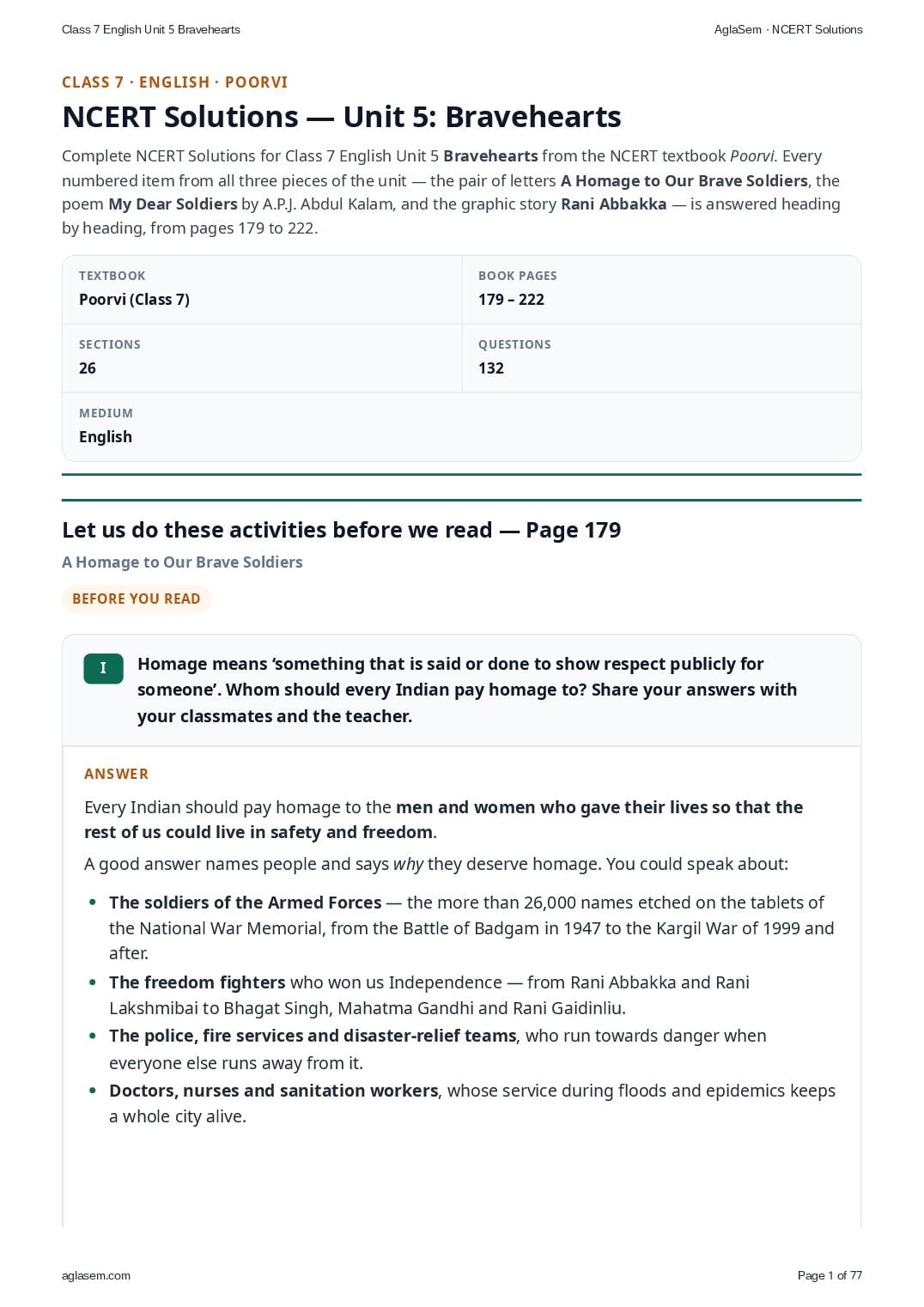
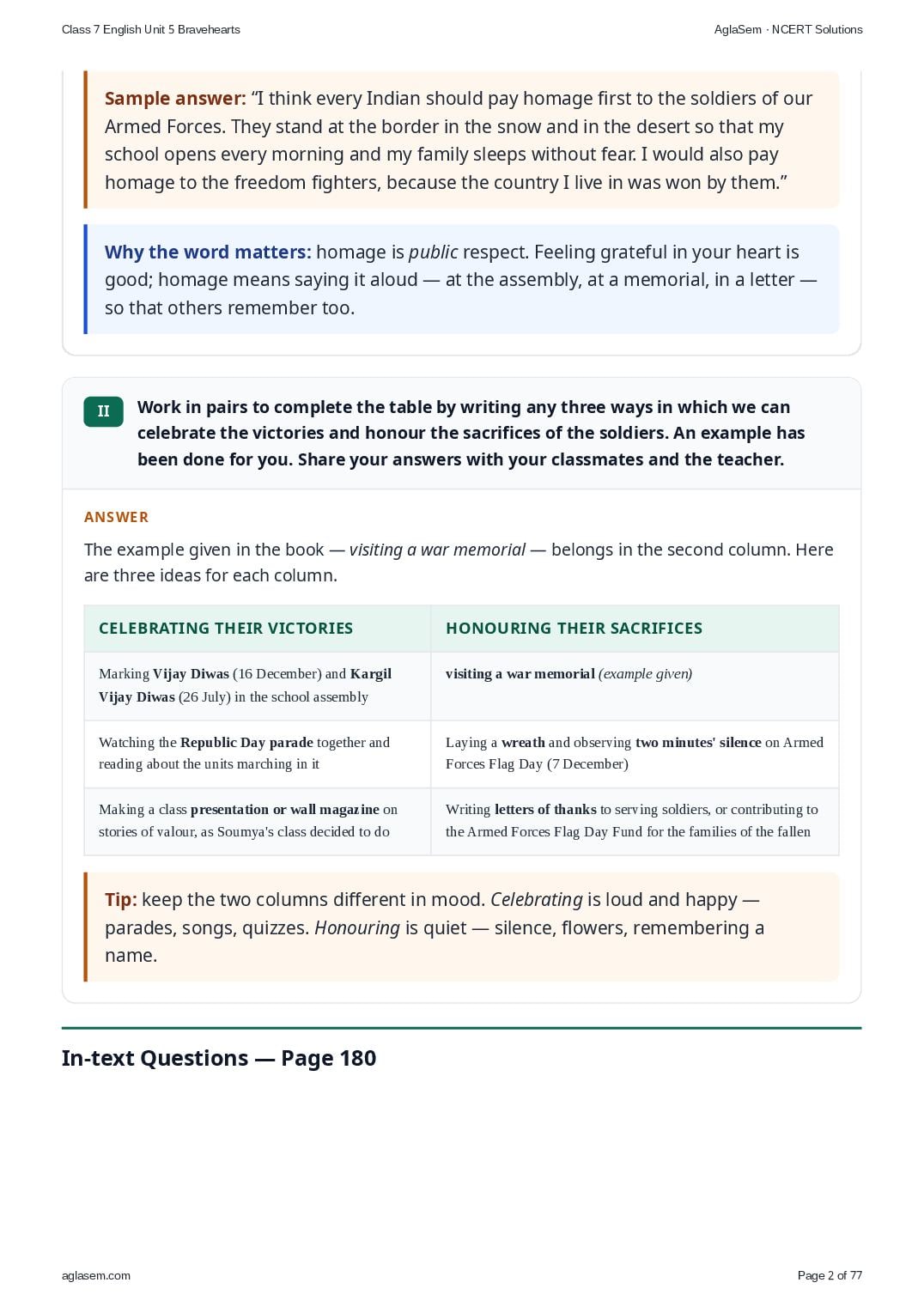
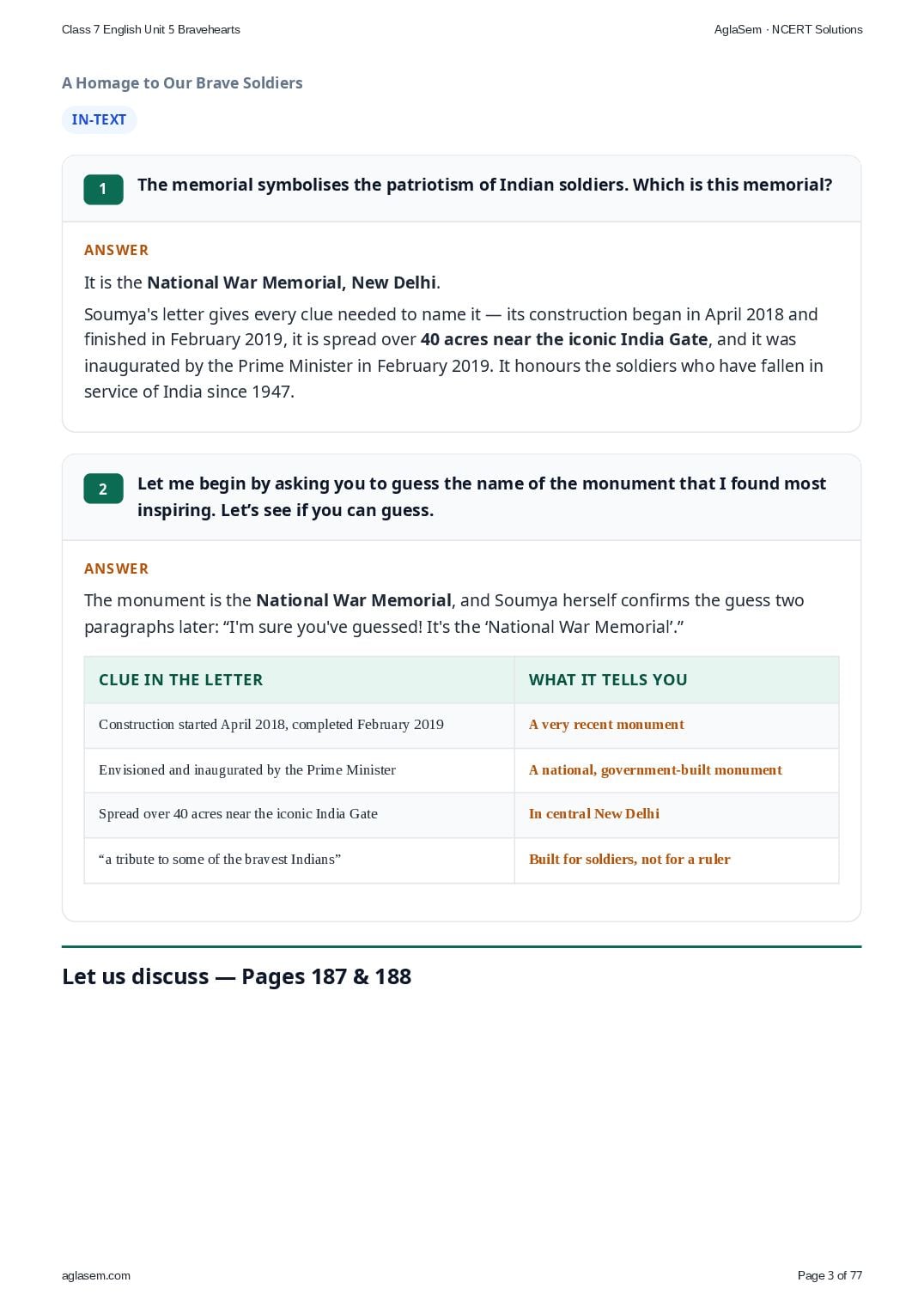


NCERT Solutions for Class 7 English Chapter 5 PDF Download
You can read the NCERT Solutions for Class 7 English Chapter 5 online above, or download the complete question-answer PDF to study Bravehearts offline at any time.
NCERT Solutions for Class 7 English Chapter 5 PDF Download Link – Click Here to Download Solutions PDF
Questions Covered in This Chapter
These NCERT Solutions answer all 132 questions of this chapter. The questions solved are:
- Homage means ‘something that is said or done to show respect publicly for someone’. Whom should every Indian pay homage to? Share your answers with your classmates and the teacher.
- Work in pairs to complete the table by writing any three ways in which we can celebrate the victories and honour the sacrifices of the soldiers. An example has been done for you. Share your answers with your classmates and the teacher.
- The memorial symbolises the patriotism of Indian soldiers. Which is this memorial?
- Let me begin by asking you to guess the name of the monument that I found most inspiring. Let’s see if you can guess.
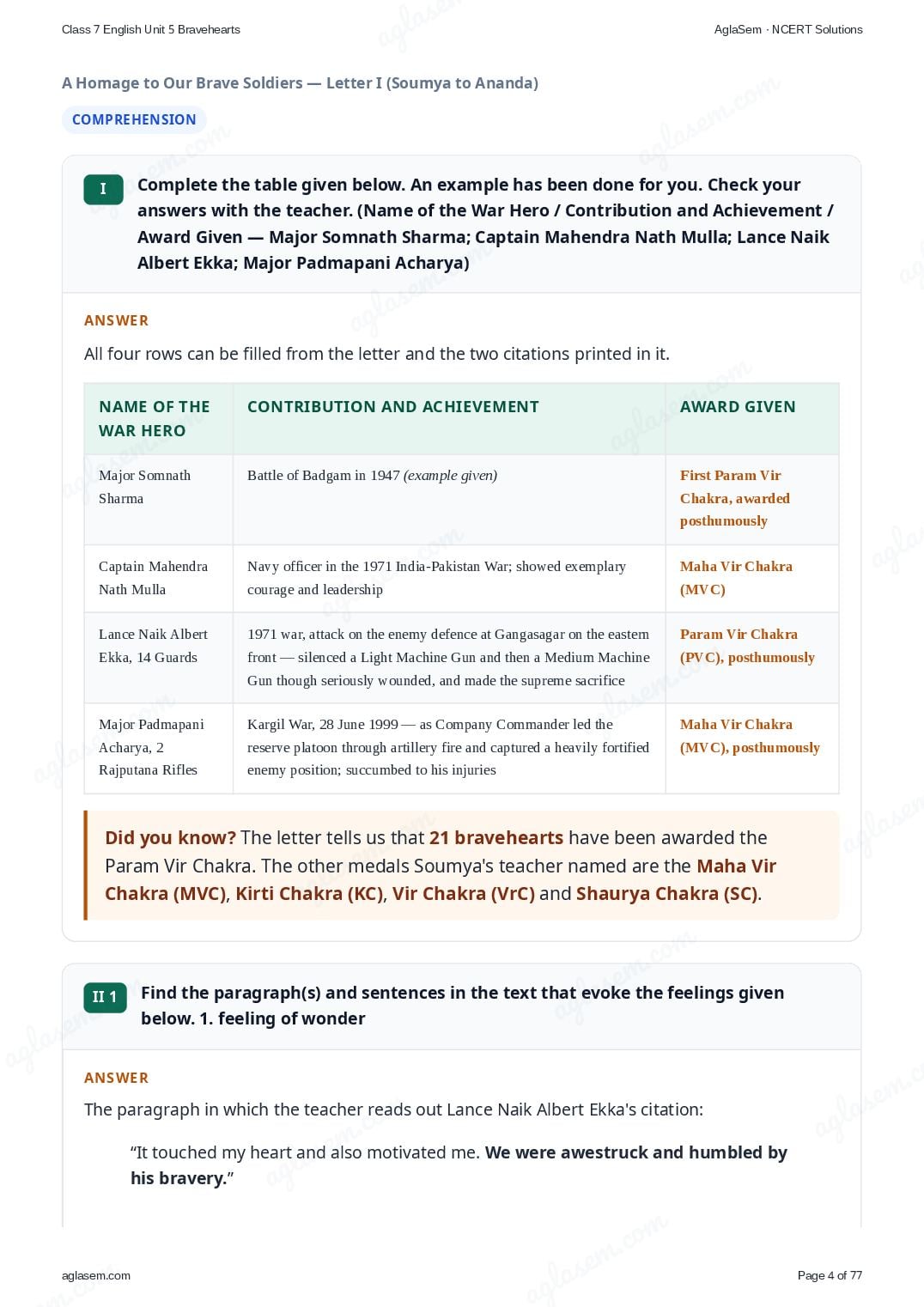
- Complete the table given below. An example has been done for you. Check your answers with the teacher. (Name of the War Hero / Contribution and Achievement / Award Given — Major Somnath Sharma; Captain Mahendra Nath Mulla; Lance Naik Albert Ekka; Major Padmapani Acharya)
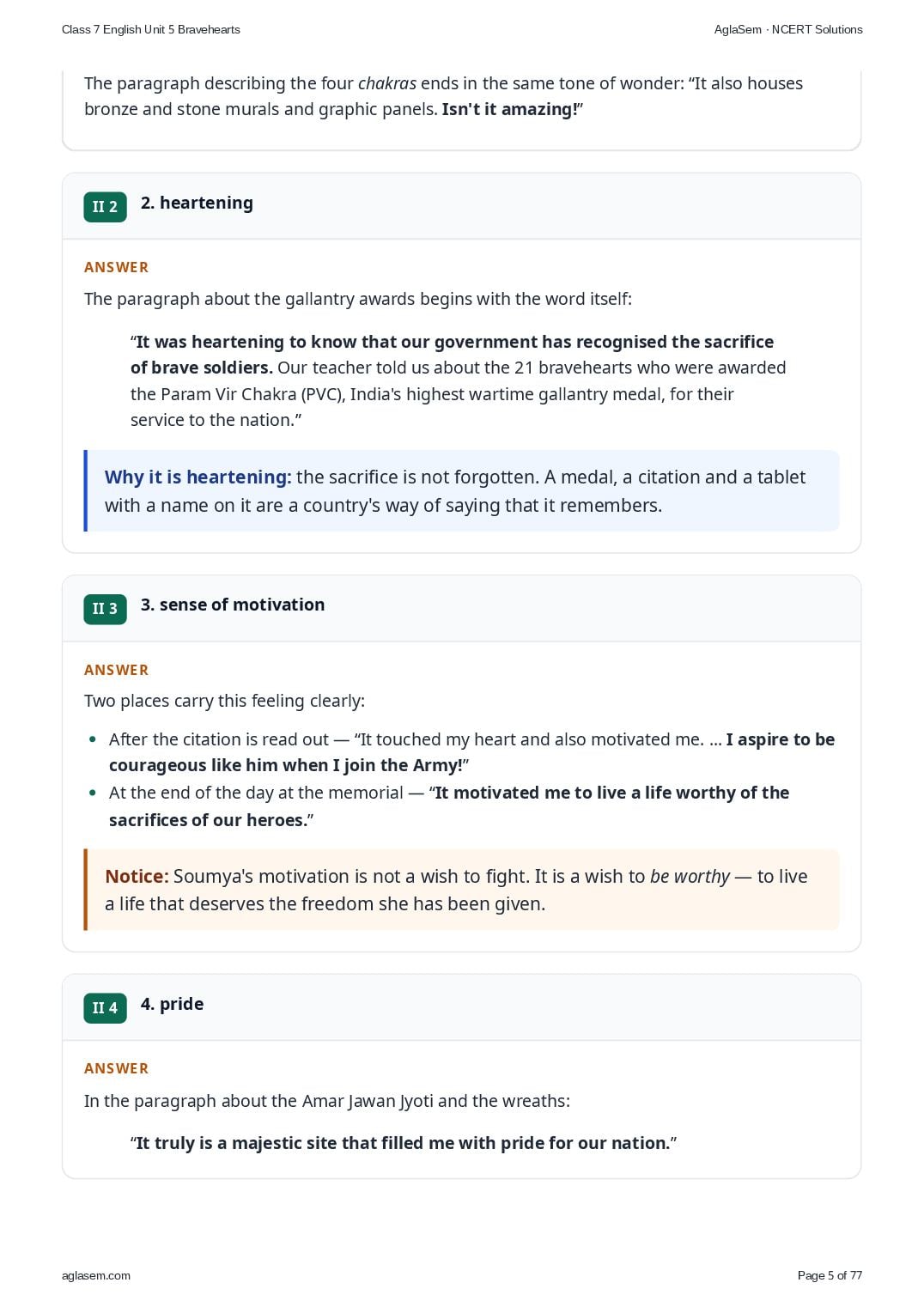
- Find the paragraph(s) and sentences in the text that evoke the feelings given below. 1. feeling of wonder
- 2. heartening
- 3. sense of motivation
- 4. pride
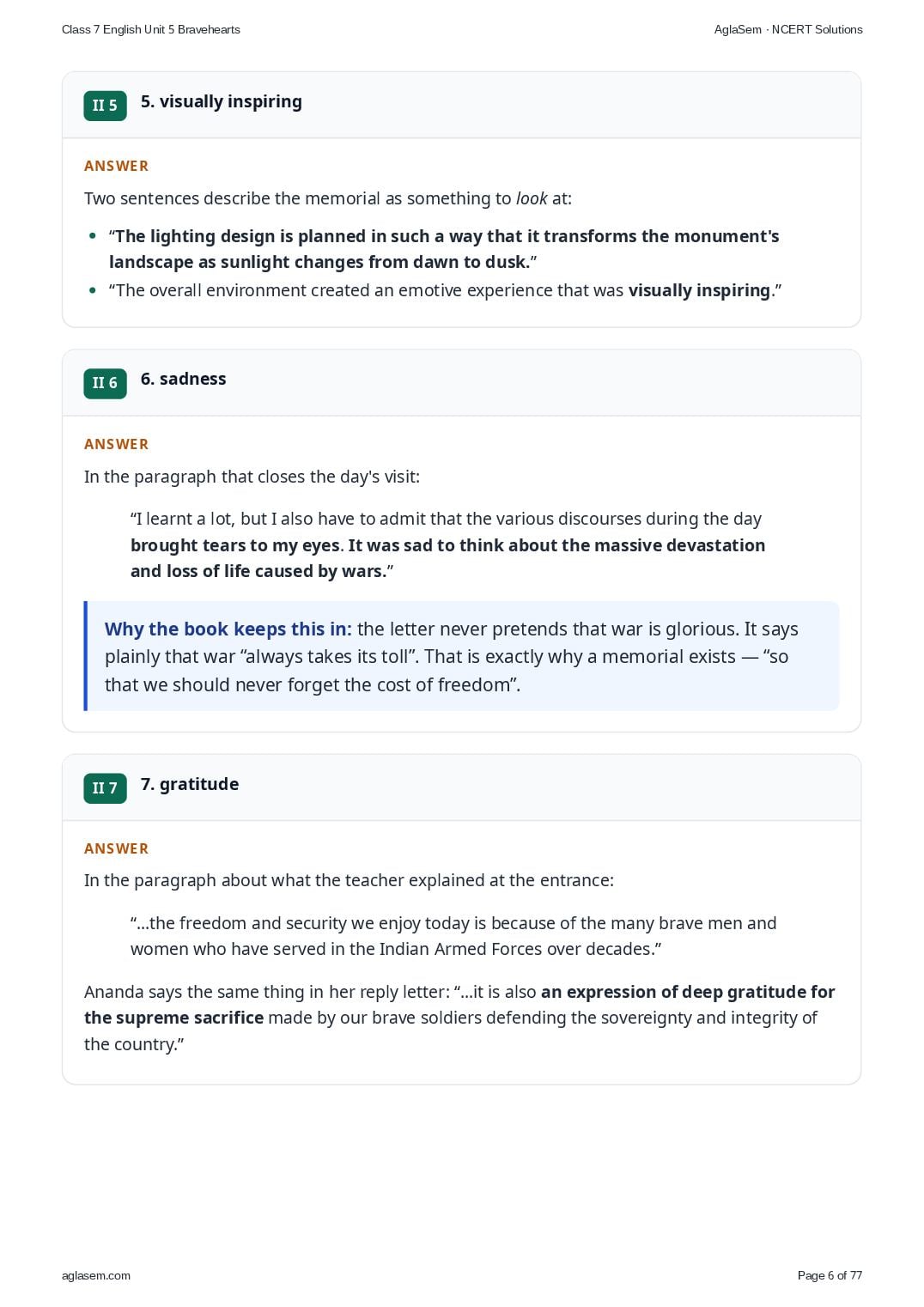
- 5. visually inspiring
- 6. sadness
- 7. gratitude
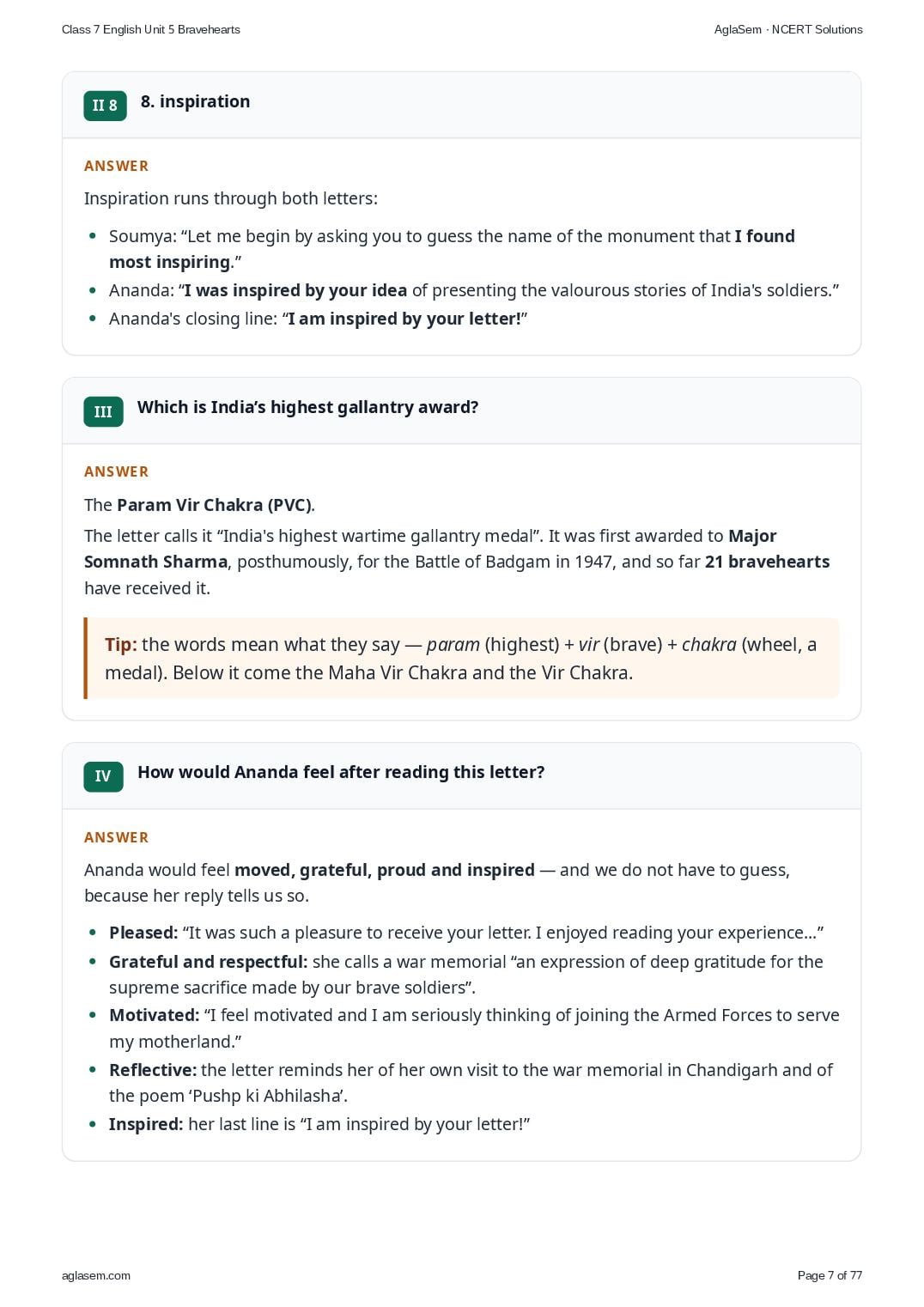
- 8. inspiration
- Which is India’s highest gallantry award?
- How would Ananda feel after reading this letter?
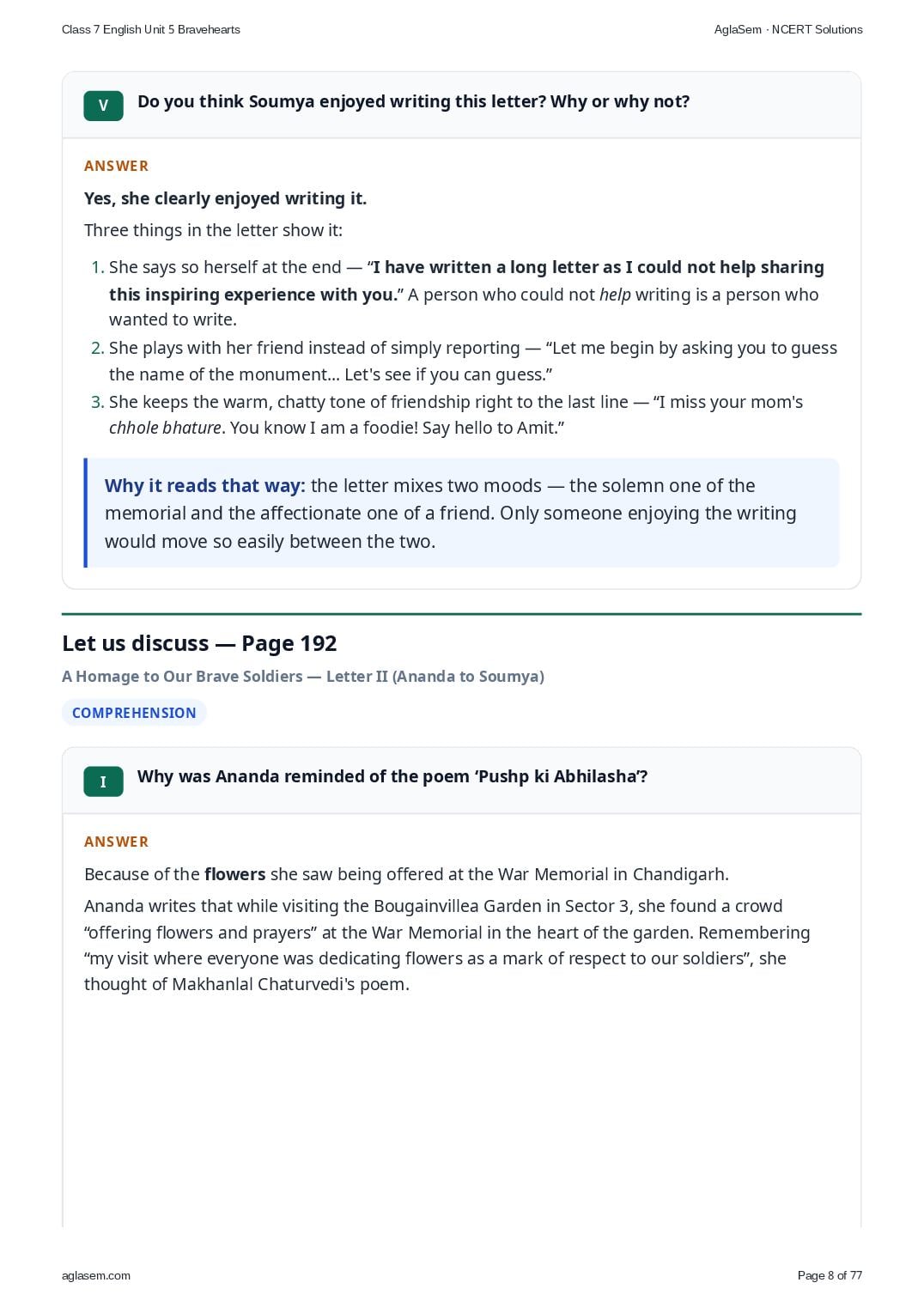
- Do you think Soumya enjoyed writing this letter? Why or why not?
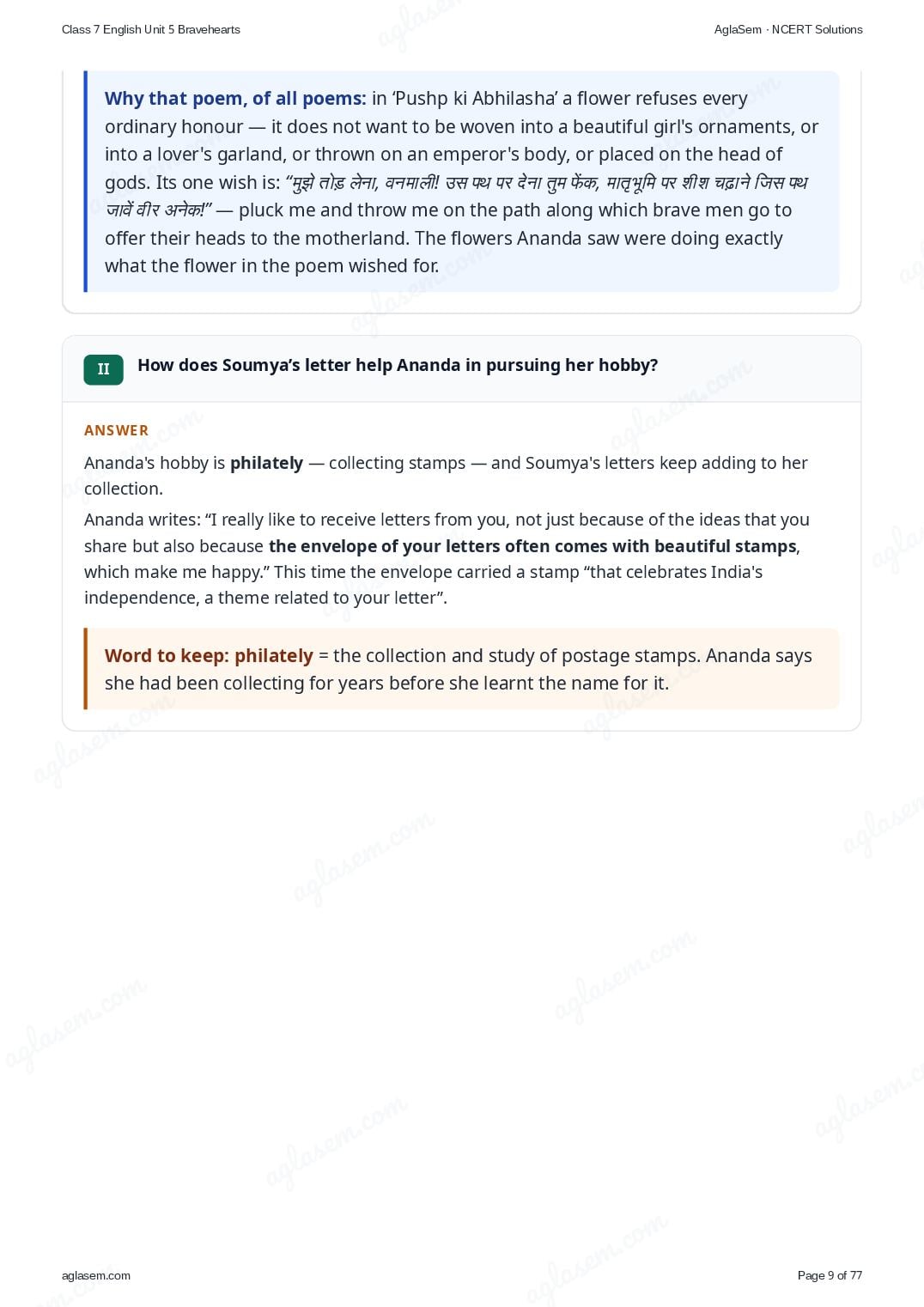
- Why was Ananda reminded of the poem ‘Pushp ki Abhilasha’?
- How does Soumya’s letter help Ananda in pursuing her hobby?
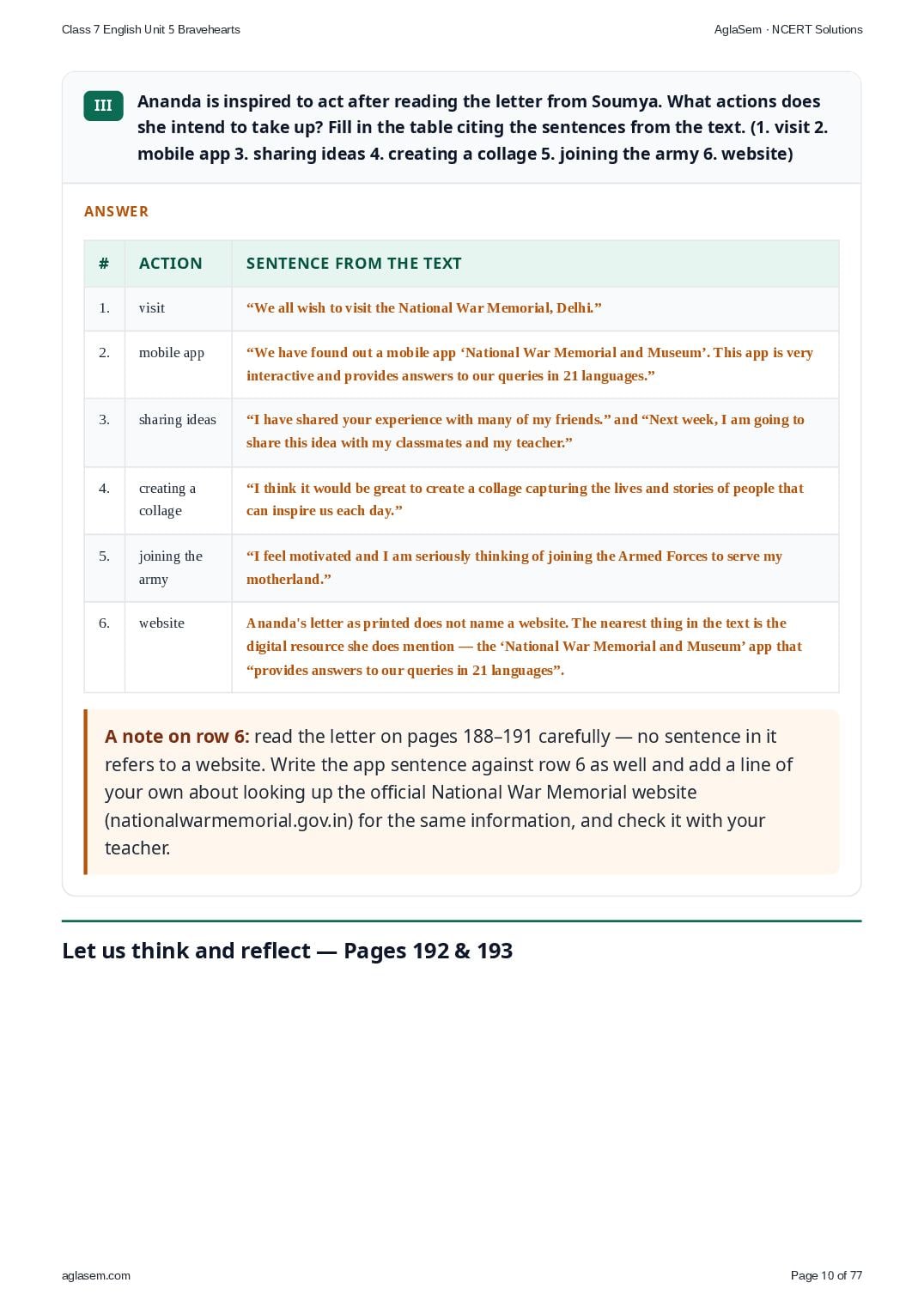
- Ananda is inspired to act after reading the letter from Soumya. What actions does she intend to take up? Fill in the table citing the sentences from the text. (1. visit 2. mobile app 3. sharing ideas 4. creating a collage 5. joining the army 6. website)
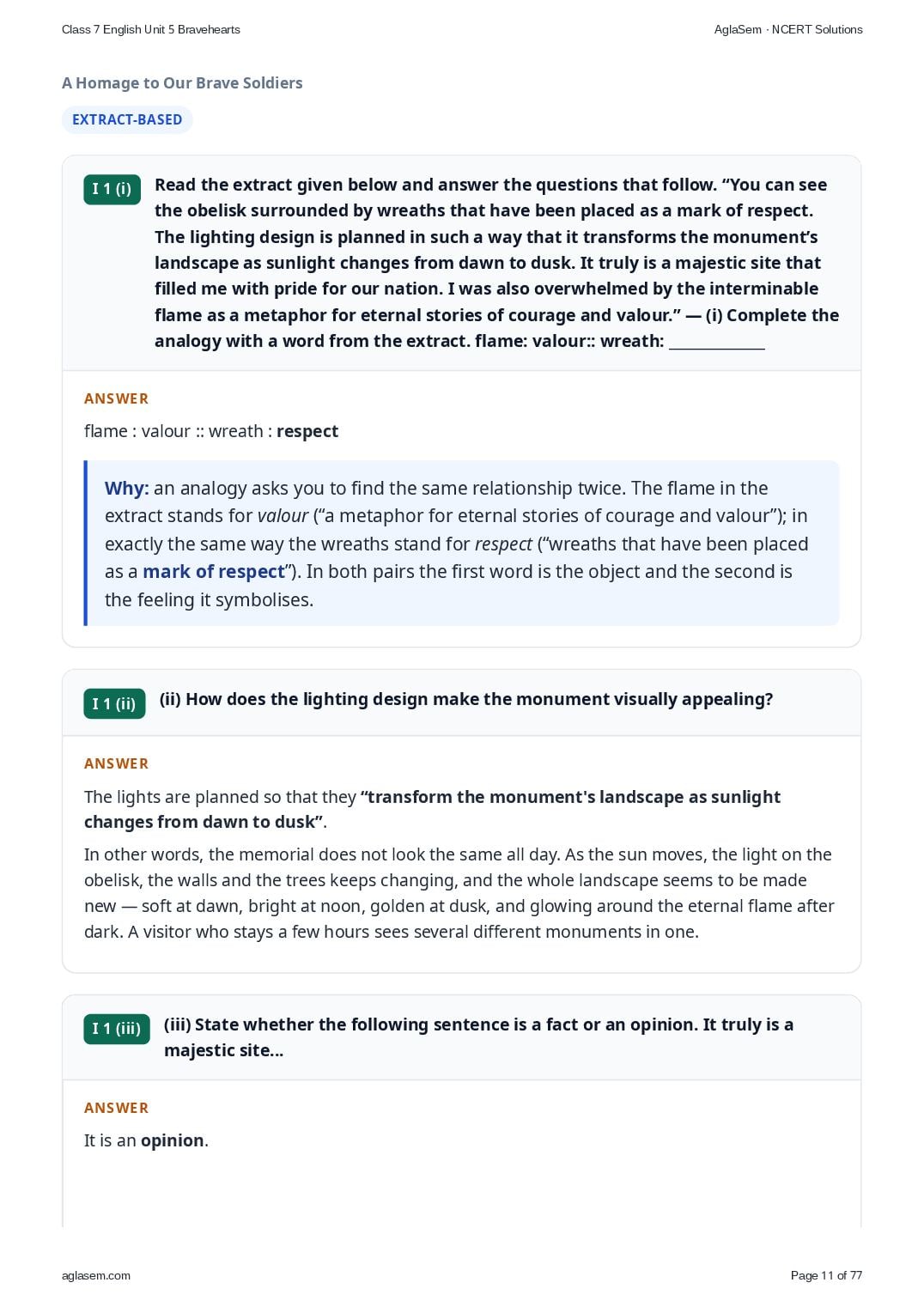
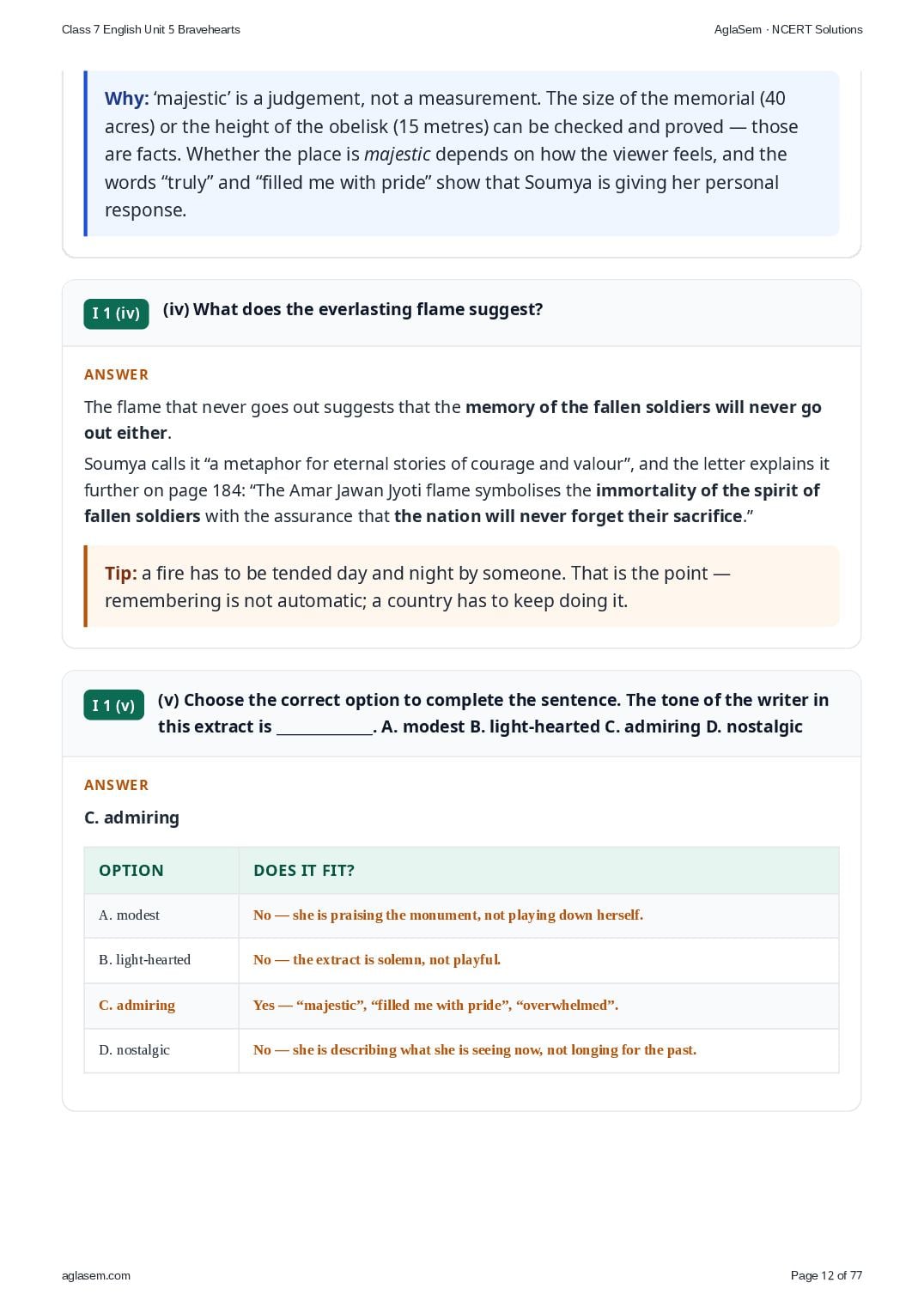
- Read the extract given below and answer the questions that follow. “You can see the obelisk surrounded by wreaths that have been placed as a mark of respect. The lighting design is planned in such a way that it transforms the monument’s landscape as sunlight changes from dawn to dusk. It truly is a majestic site that filled me with pride for our nation. I was also overwhelmed by the interminable flame as a metaphor for eternal stories of courage and valour.” — (i) Complete the analogy with a word from the extract. flame: valour:: wreath: ______________
- (ii) How does the lighting design make the monument visually appealing?
- (iii) State whether the following sentence is a fact or an opinion. It truly is a majestic site…
- (iv) What does the everlasting flame suggest?
- (v) Choose the correct option to complete the sentence. The tone of the writer in this extract is ______________. A. modest B. light-hearted C. admiring D. nostalgic
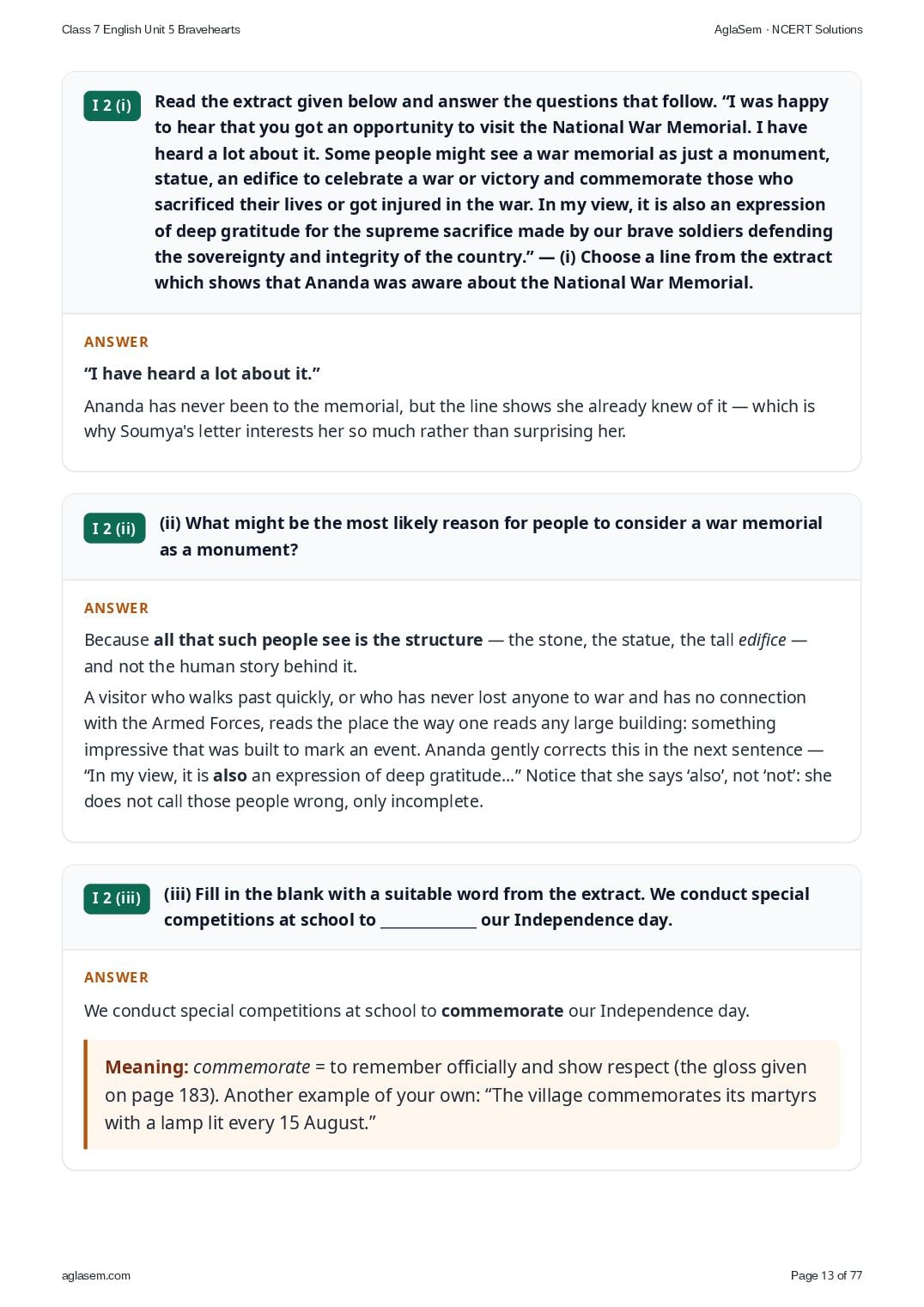
- Read the extract given below and answer the questions that follow. “I was happy to hear that you got an opportunity to visit the National War Memorial. I have heard a lot about it. Some people might see a war memorial as just a monument, statue, an edifice to celebrate a war or victory and commemorate those who sacrificed their lives or got injured in the war. In my view, it is also an expression of deep gratitude for the supreme sacrifice made by our brave soldiers defending the sovereignty and integrity of the country.” — (i) Choose a line from the extract which shows that Ananda was aware about the National War Memorial.
- (ii) What might be the most likely reason for people to consider a war memorial as a monument?
- (iii) Fill in the blank with a suitable word from the extract. We conduct special competitions at school to ______________ our Independence day.
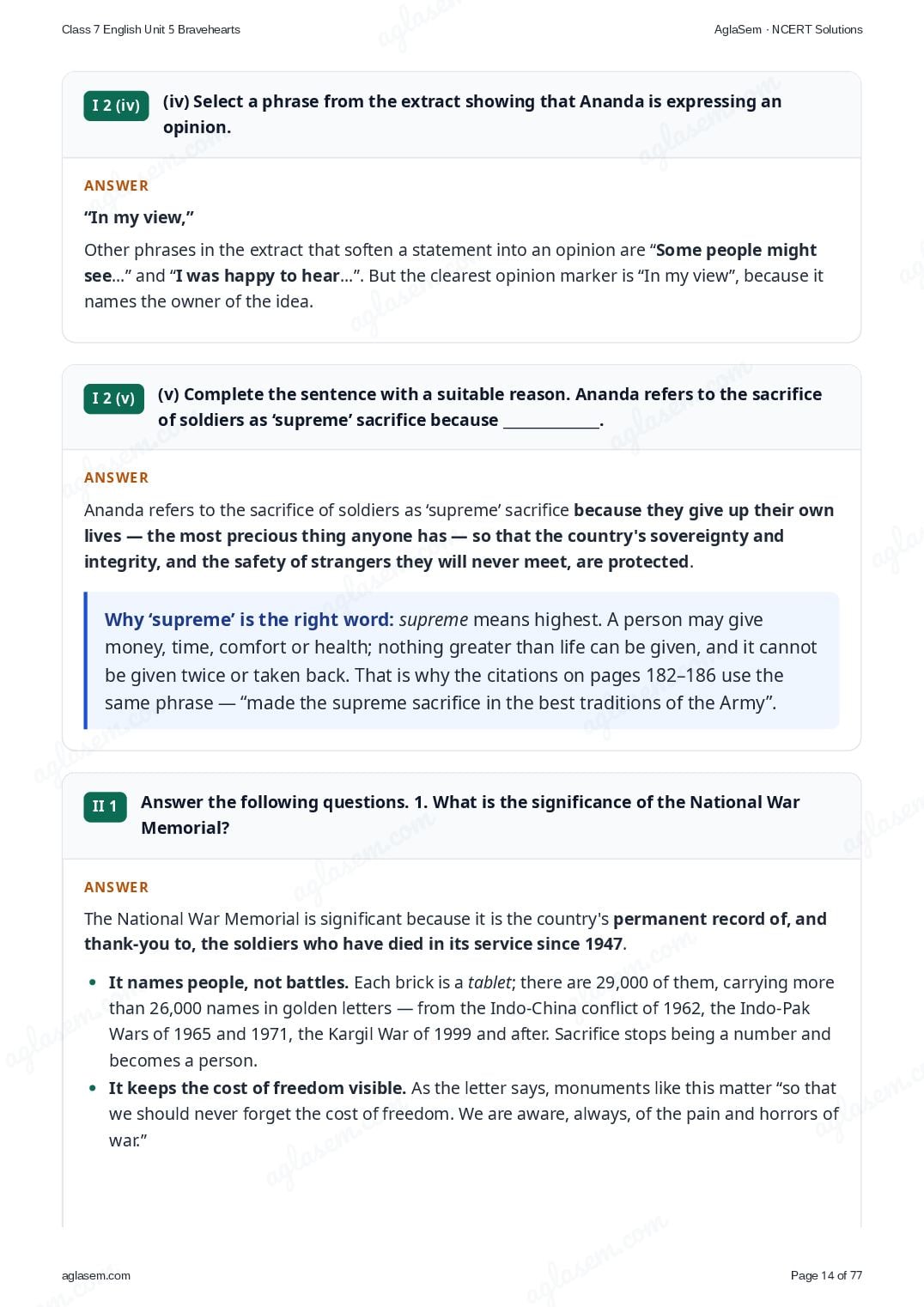
- (iv) Select a phrase from the extract showing that Ananda is expressing an opinion.
- (v) Complete the sentence with a suitable reason. Ananda refers to the sacrifice of soldiers as ‘supreme’ sacrifice because ______________.
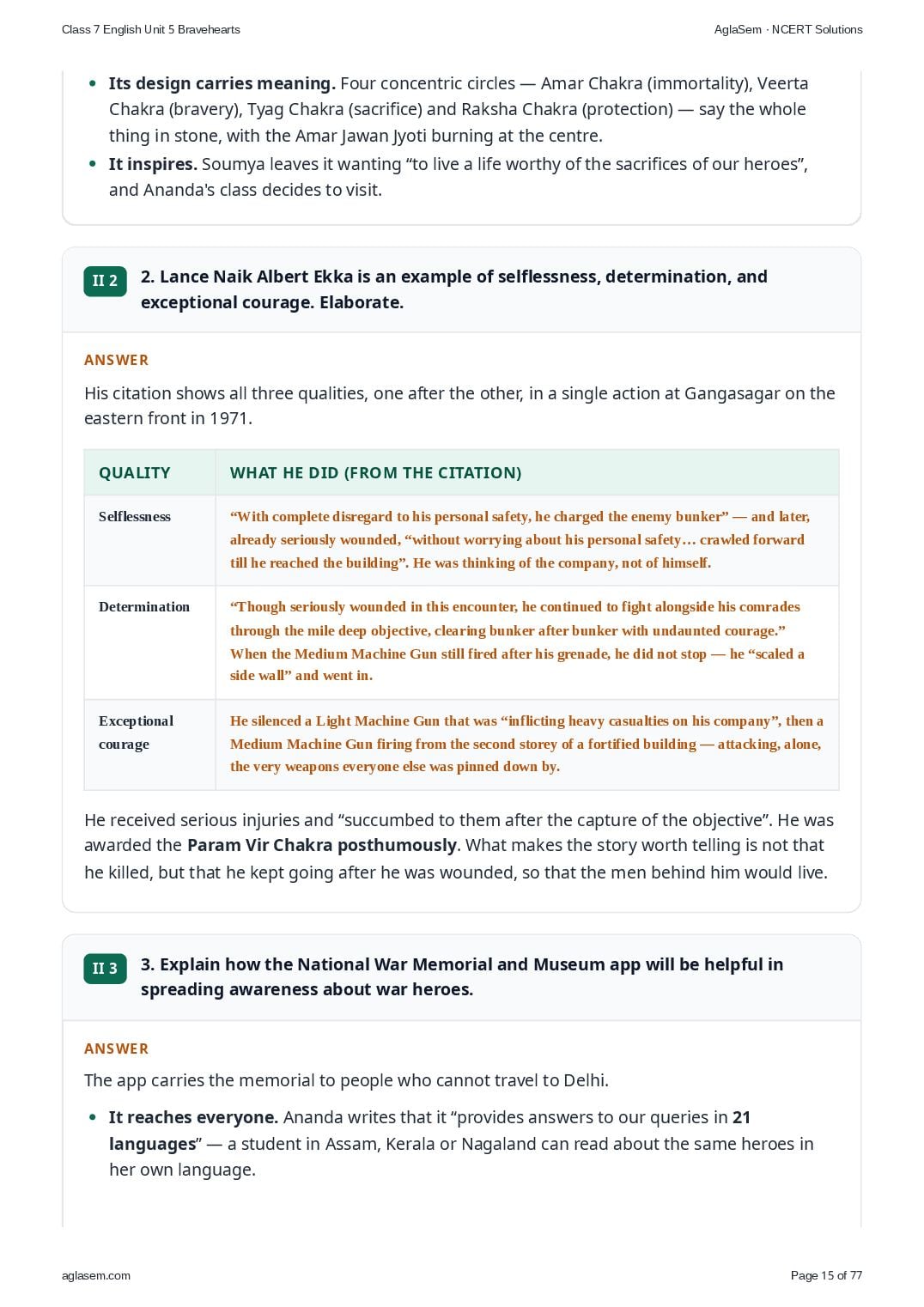
- Answer the following questions. 1. What is the significance of the National War Memorial?
- 2. Lance Naik Albert Ekka is an example of selflessness, determination, and exceptional courage. Elaborate.
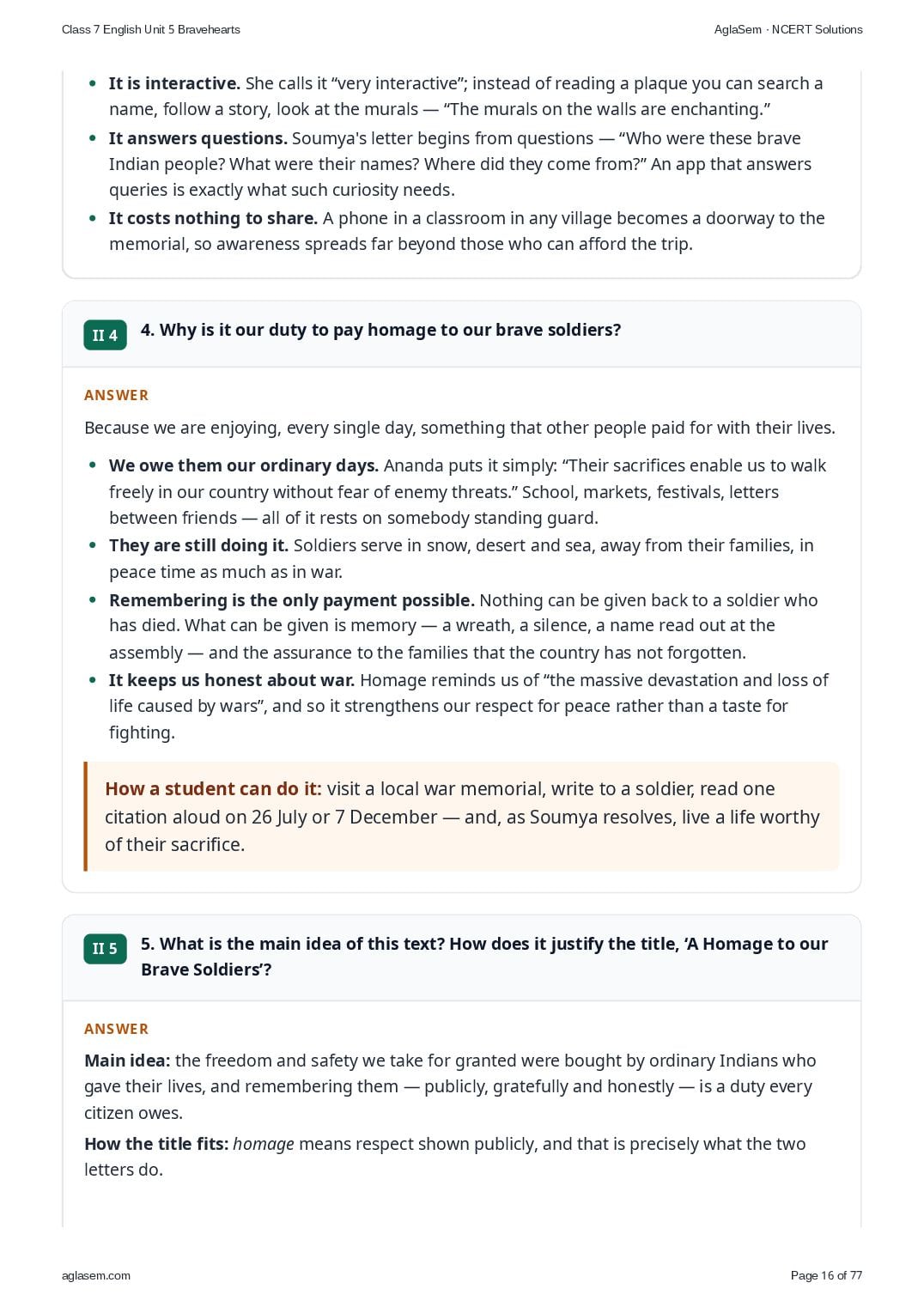
- 3. Explain how the National War Memorial and Museum app will be helpful in spreading awareness about war heroes.
- 4. Why is it our duty to pay homage to our brave soldiers?
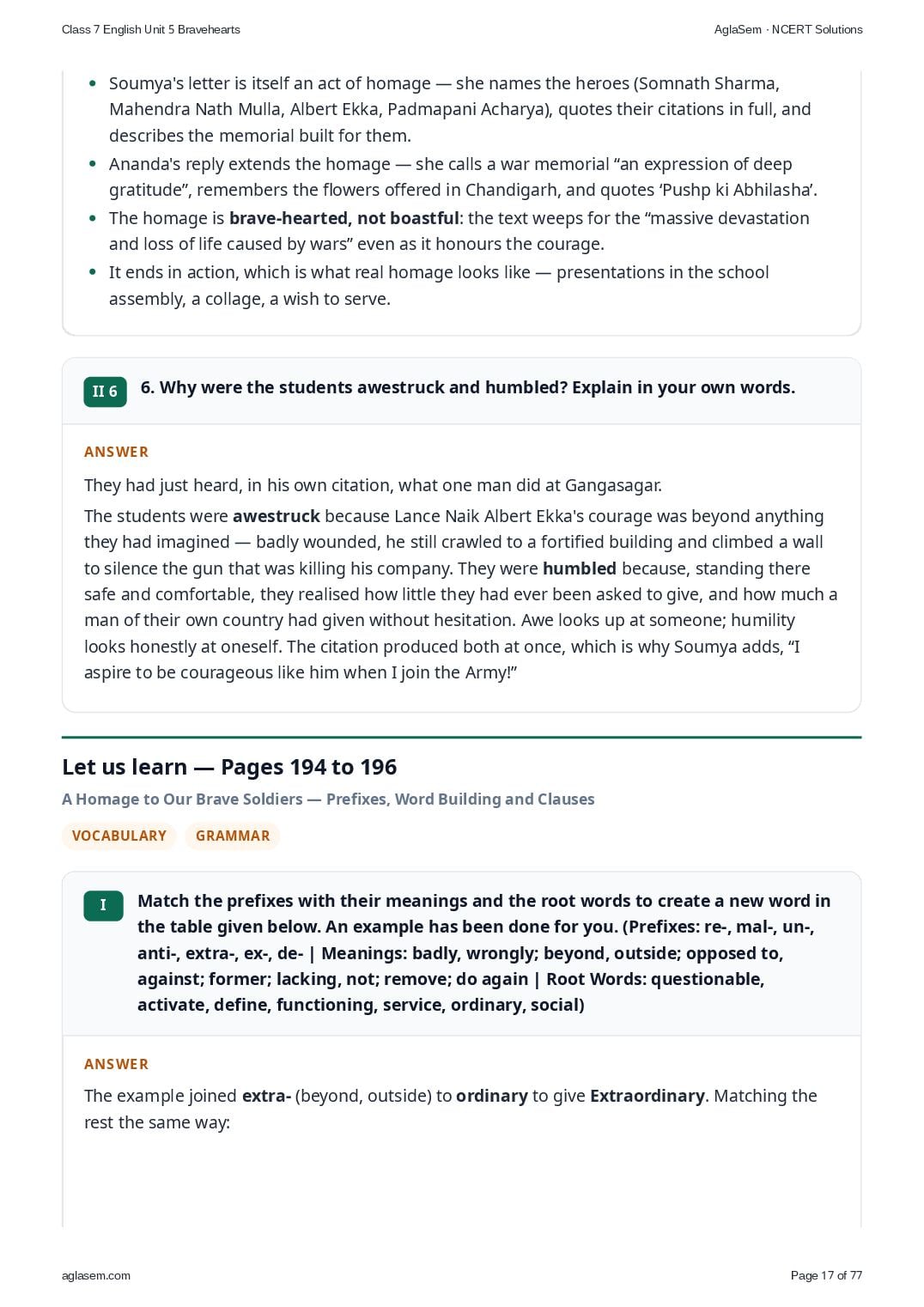
- 5. What is the main idea of this text? How does it justify the title, ‘A Homage to our Brave Soldiers’?
- 6. Why were the students awestruck and humbled? Explain in your own words.
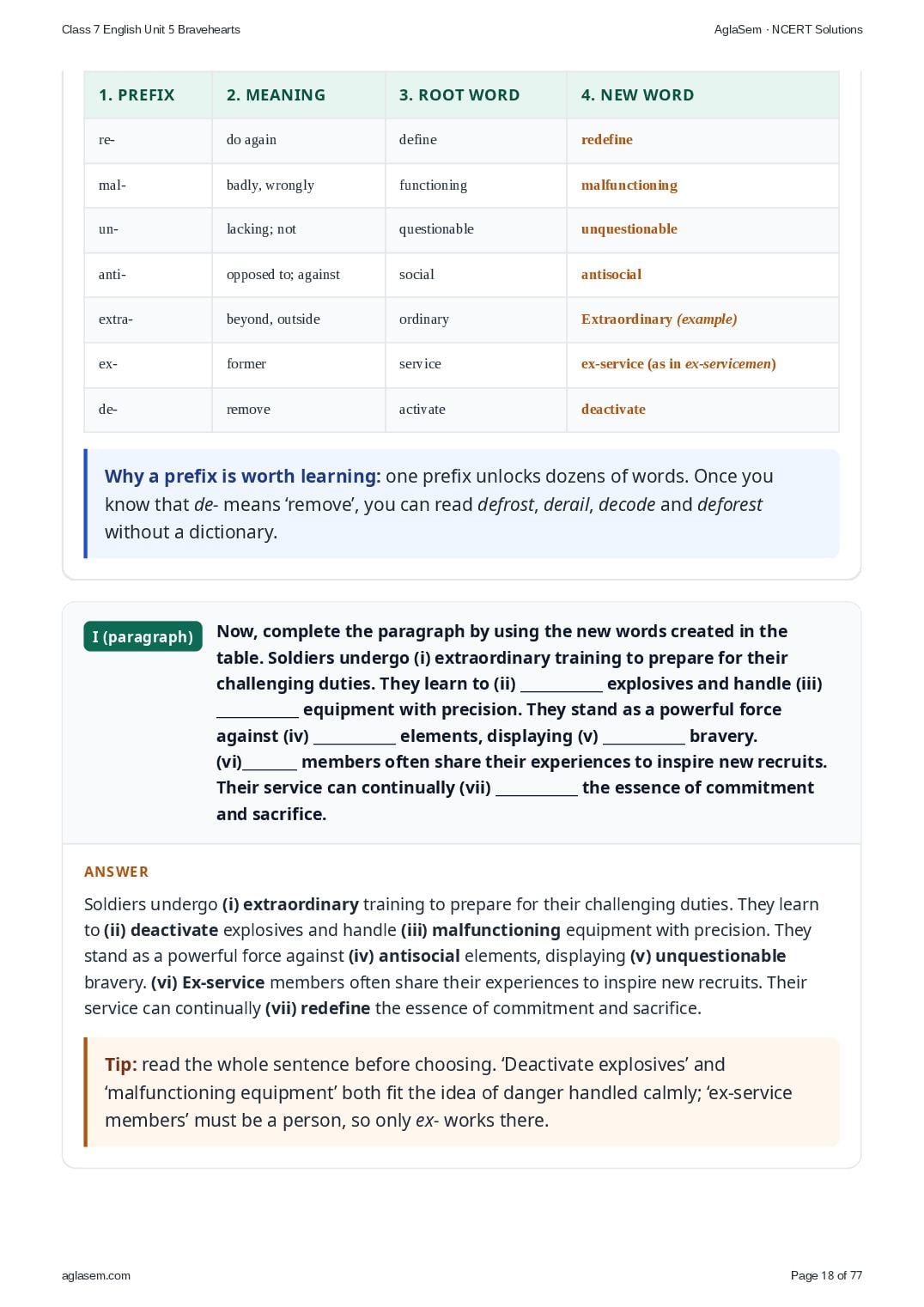
- Match the prefixes with their meanings and the root words to create a new word in the table given below. An example has been done for you. (Prefixes: re-, mal-, un-, anti-, extra-, ex-, de- | Meanings: badly, wrongly; beyond, outside; opposed to, against; former; lacking, not; remove; do again | Root Words: questionable, activate, define, functioning, service, ordinary, social)
- Now, complete the paragraph by using the new words created in the table. Soldiers undergo (i) extraordinary training to prepare for their challenging duties. They learn to (ii) ____________ explosives and handle (iii) ____________ equipment with precision. They stand as a powerful force against (iv) ____________ elements, displaying (v) ____________ bravery. (vi)________ members often share their experiences to inspire new recruits. Their service can continually (vii) ____________ the essence of commitment and sacrifice.
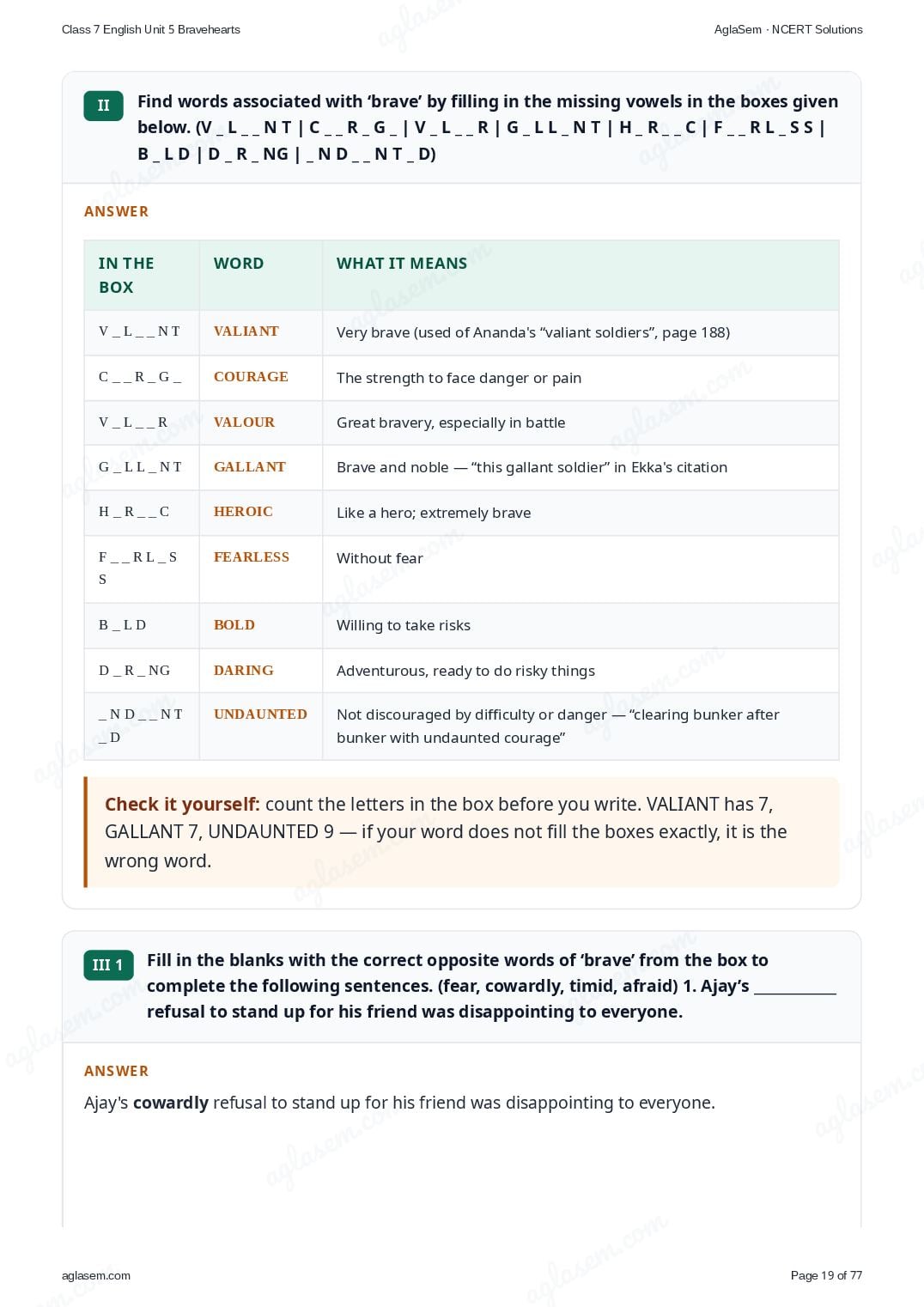
- Find words associated with ‘brave’ by filling in the missing vowels in the boxes given below. (V _ L _ _ N T | C _ _ R _ G _ | V _ L _ _ R | G _ L L _ N T | H _ R _ _ C | F _ _ R L _ S S | B _ L D | D _ R _ NG | _ N D _ _ N T _ D)
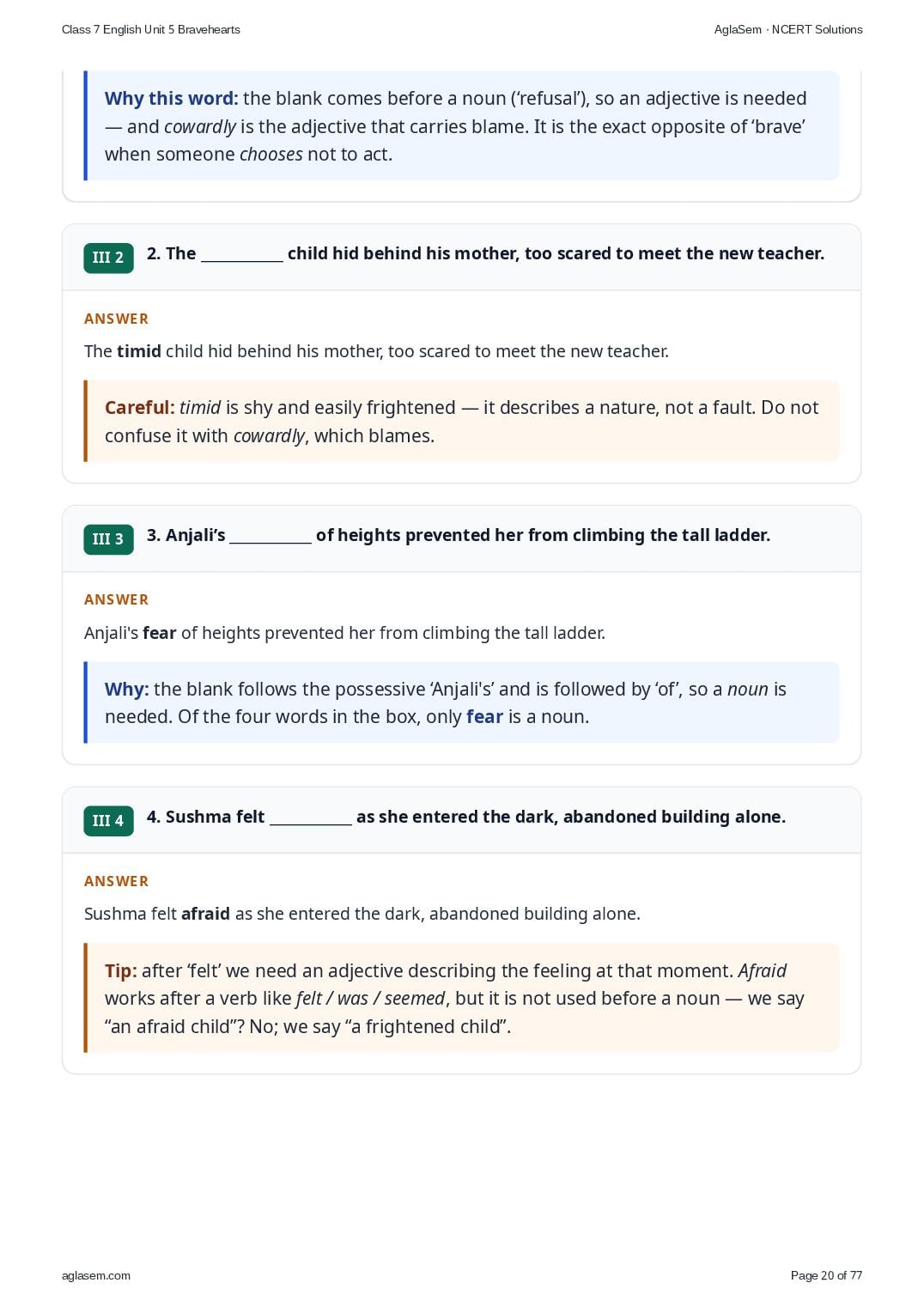
- Fill in the blanks with the correct opposite words of ‘brave’ from the box to complete the following sentences. (fear, cowardly, timid, afraid) 1. Ajay’s ____________ refusal to stand up for his friend was disappointing to everyone.
- 2. The ____________ child hid behind his mother, too scared to meet the new teacher.
- 3. Anjali’s ____________ of heights prevented her from climbing the tall ladder.
- 4. Sushma felt ____________ as she entered the dark, abandoned building alone.
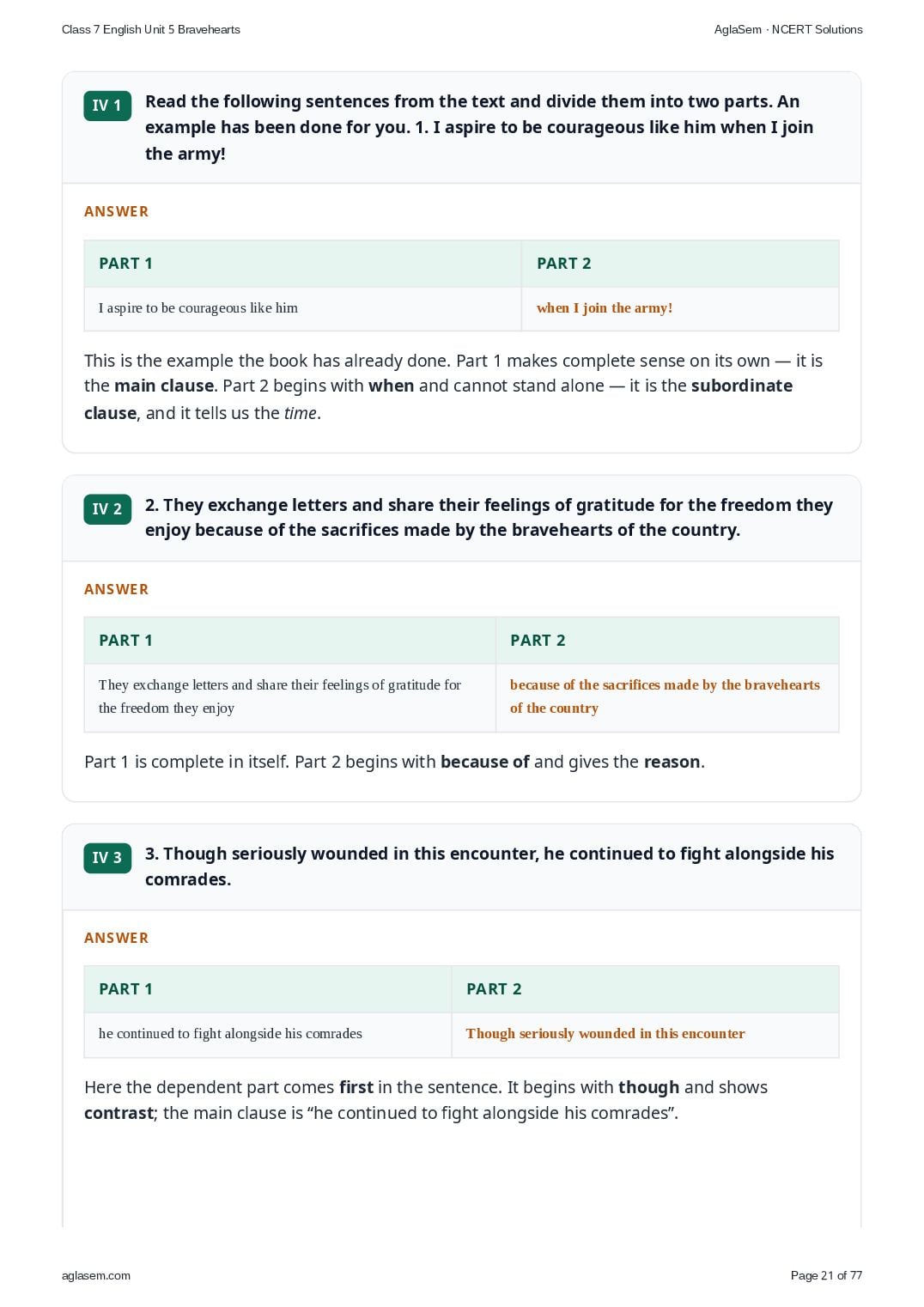
- Read the following sentences from the text and divide them into two parts. An example has been done for you. 1. I aspire to be courageous like him when I join the army!
- 2. They exchange letters and share their feelings of gratitude for the freedom they enjoy because of the sacrifices made by the bravehearts of the country.
- 3. Though seriously wounded in this encounter, he continued to fight alongside his comrades.
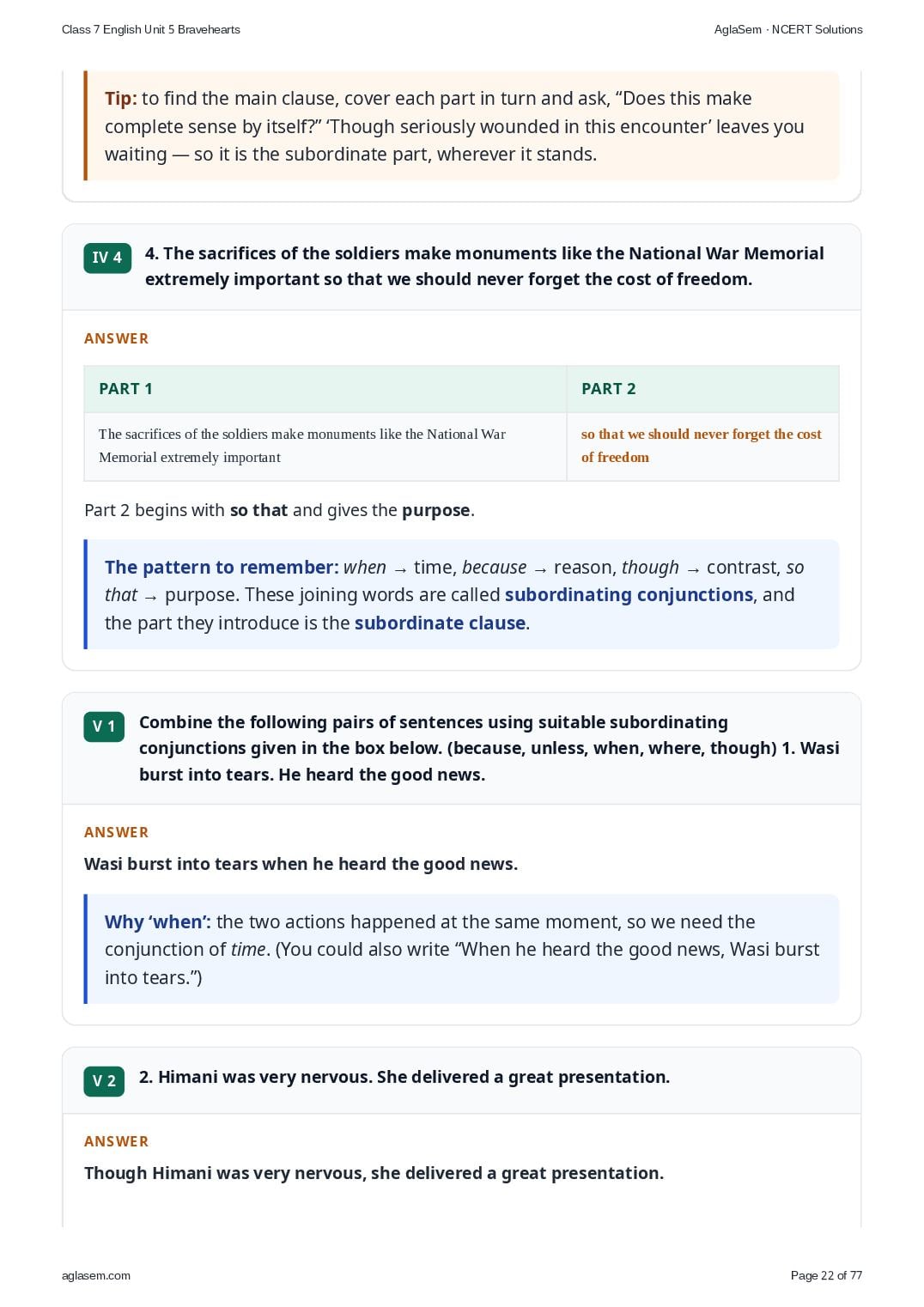
- 4. The sacrifices of the soldiers make monuments like the National War Memorial extremely important so that we should never forget the cost of freedom.
- Combine the following pairs of sentences using suitable subordinating conjunctions given in the box below. (because, unless, when, where, though) 1. Wasi burst into tears. He heard the good news.
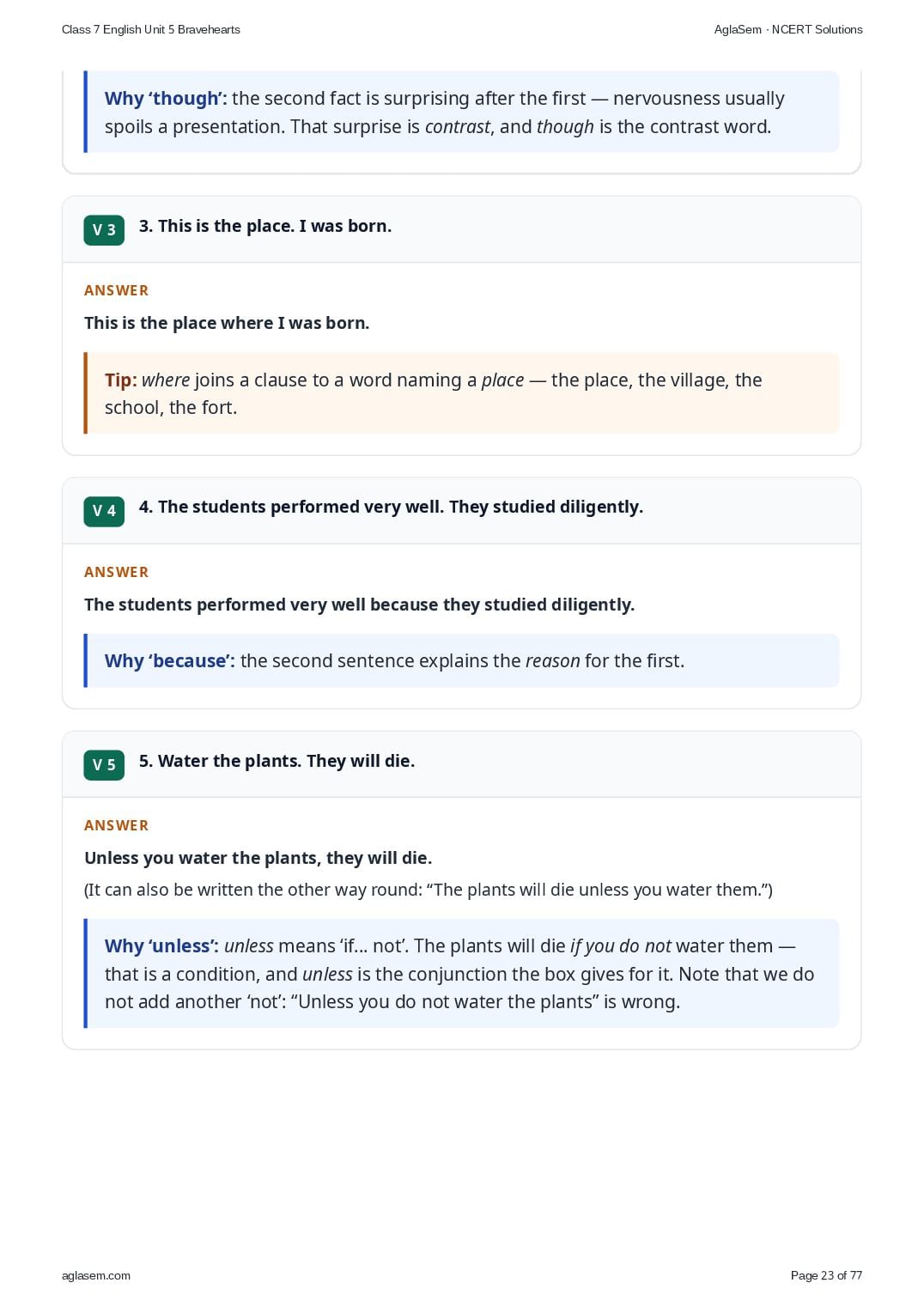
- 2. Himani was very nervous. She delivered a great presentation.
- 3. This is the place. I was born.
- 4. The students performed very well. They studied diligently.
- 5. Water the plants. They will die.
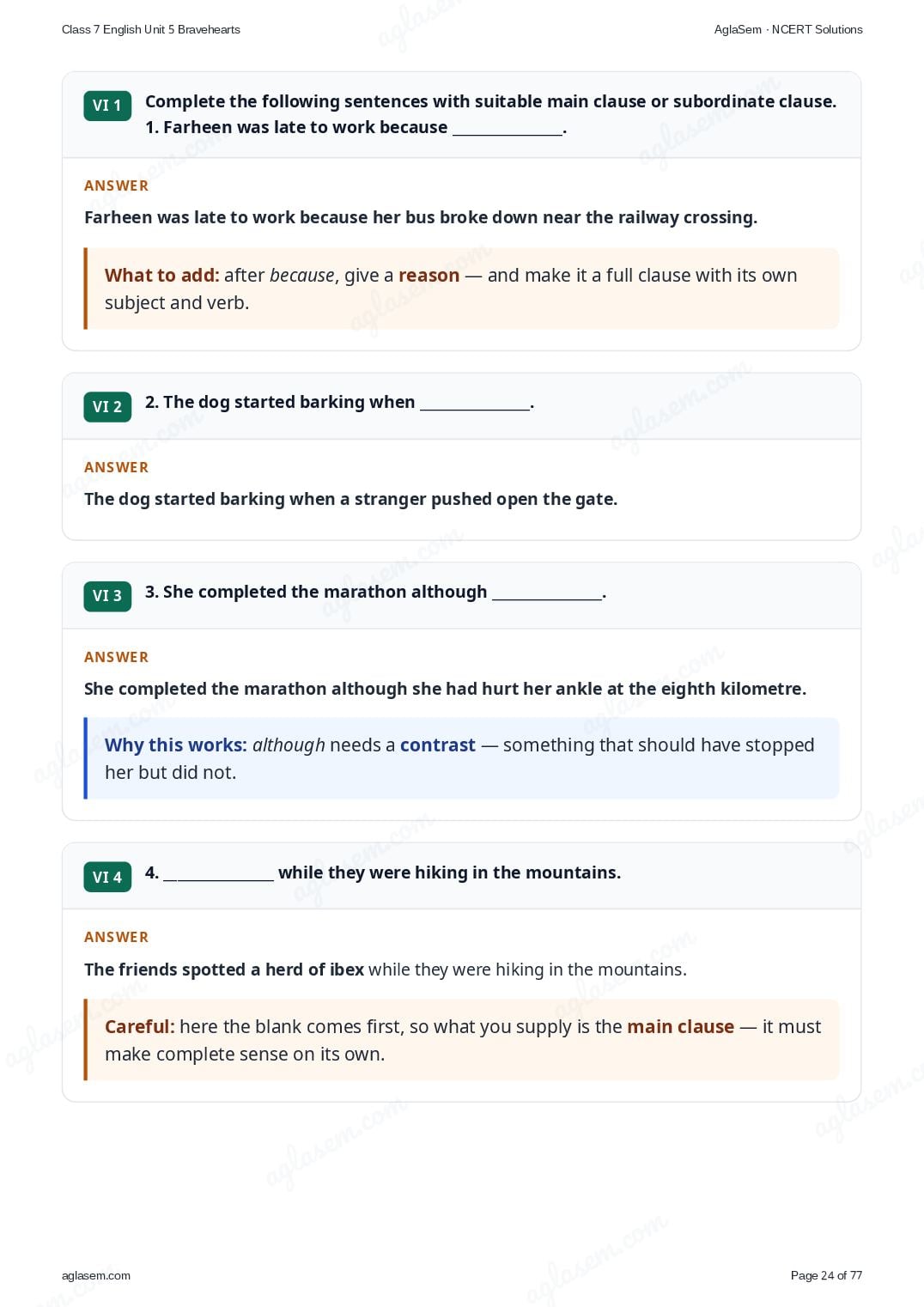
- Complete the following sentences with suitable main clause or subordinate clause. 1. Farheen was late to work because ________________.
- 2. The dog started barking when ________________.
- 3. She completed the marathon although ________________.
- 4. ________________ while they were hiking in the mountains.
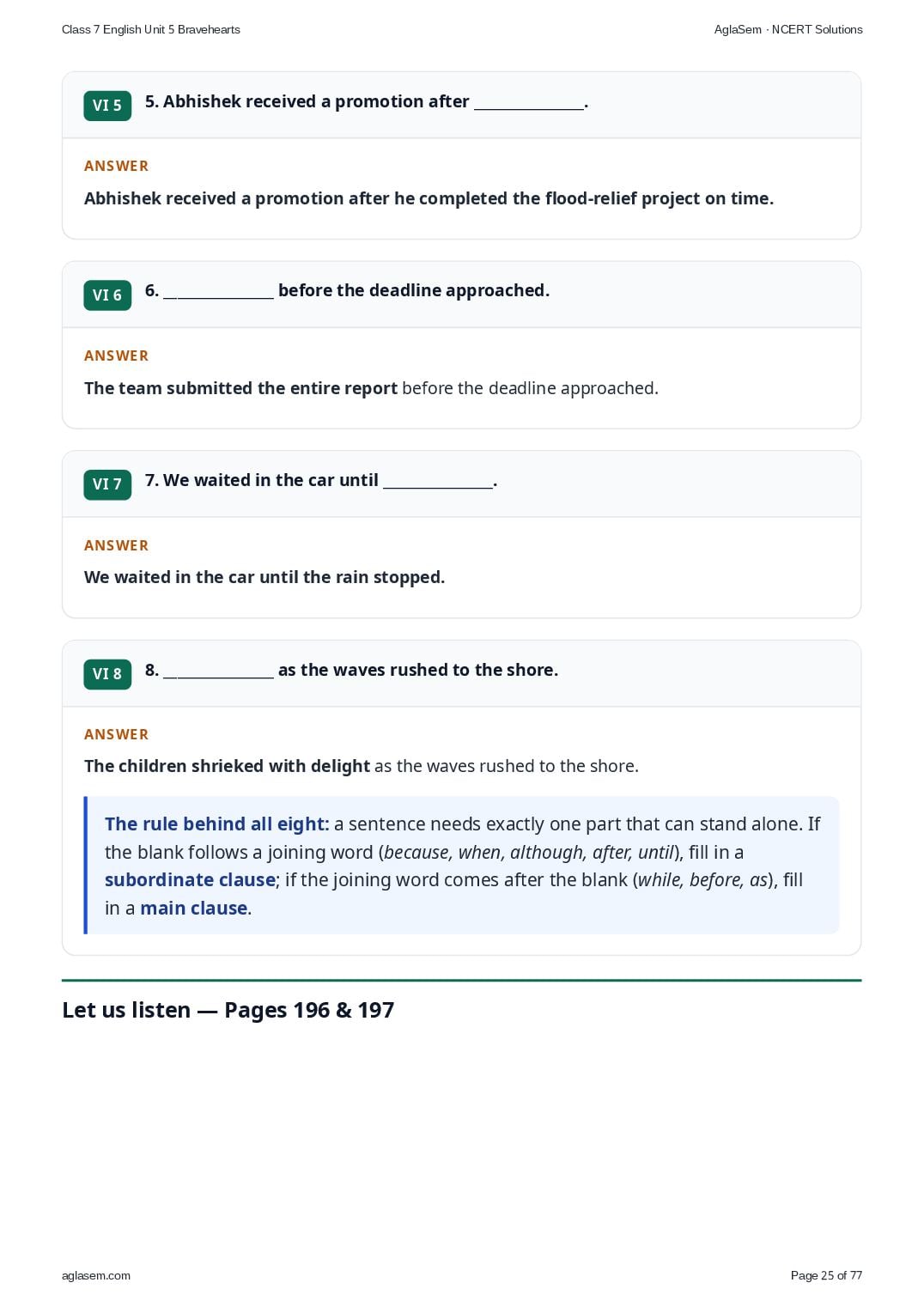
- 5. Abhishek received a promotion after ________________.
- 6. ________________ before the deadline approached.
- 7. We waited in the car until ________________.
- 8. ________________ as the waves rushed to the shore.
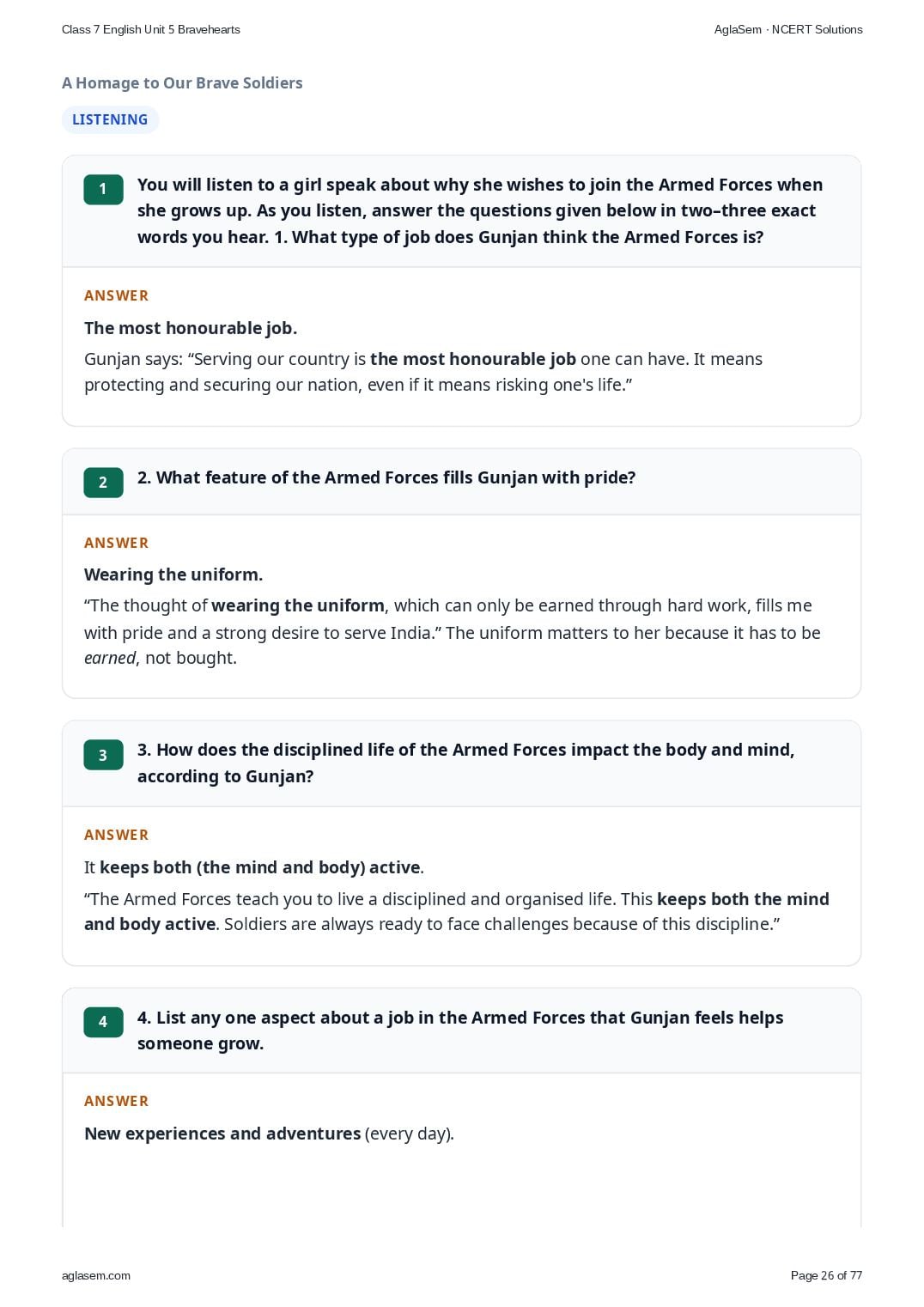
- You will listen to a girl speak about why she wishes to join the Armed Forces when she grows up. As you listen, answer the questions given below in two–three exact words you hear. 1. What type of job does Gunjan think the Armed Forces is?
- 2. What feature of the Armed Forces fills Gunjan with pride?
- 3. How does the disciplined life of the Armed Forces impact the body and mind, according to Gunjan?
- 4. List any one aspect about a job in the Armed Forces that Gunjan feels helps someone grow.
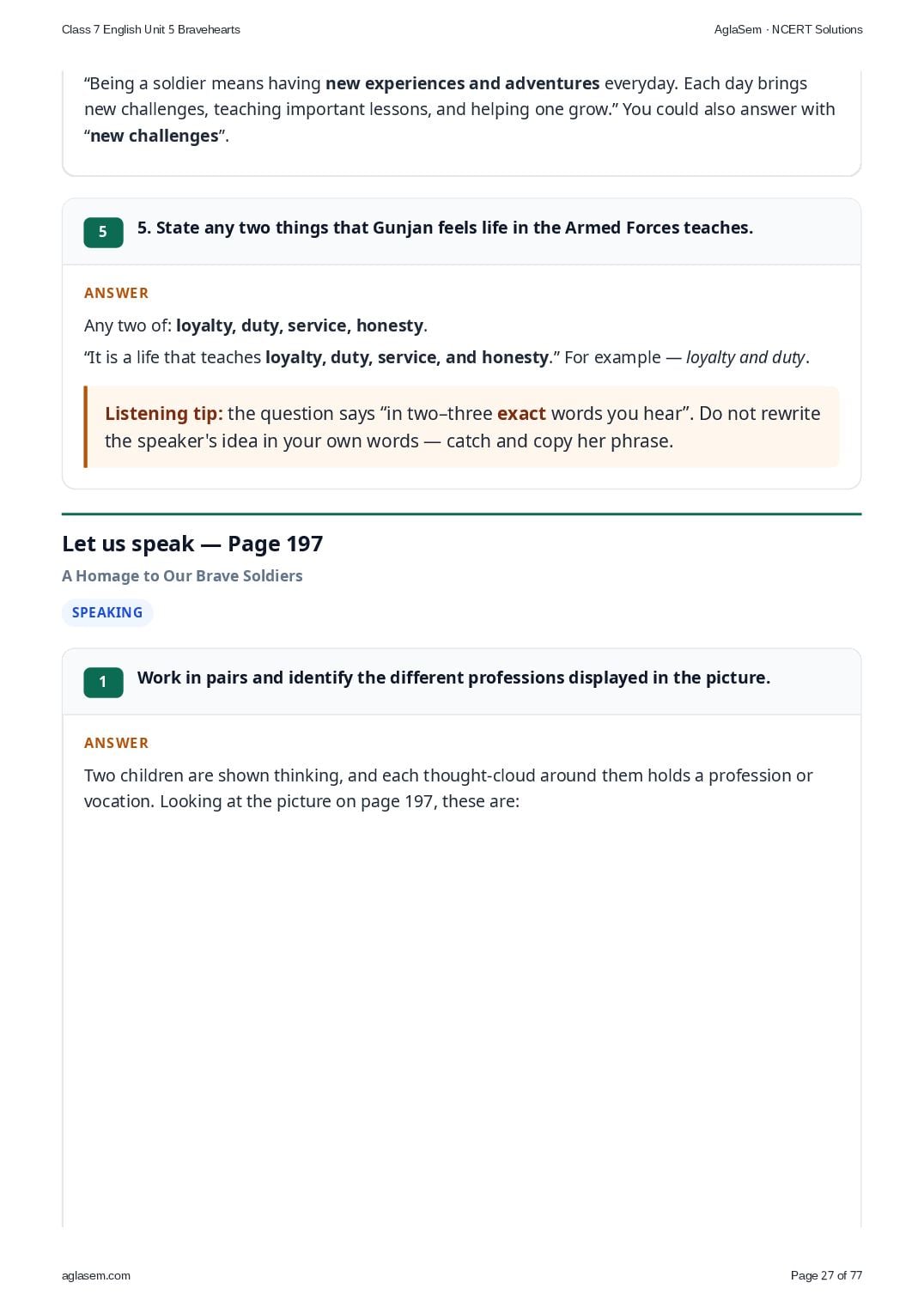
- 5. State any two things that Gunjan feels life in the Armed Forces teaches.
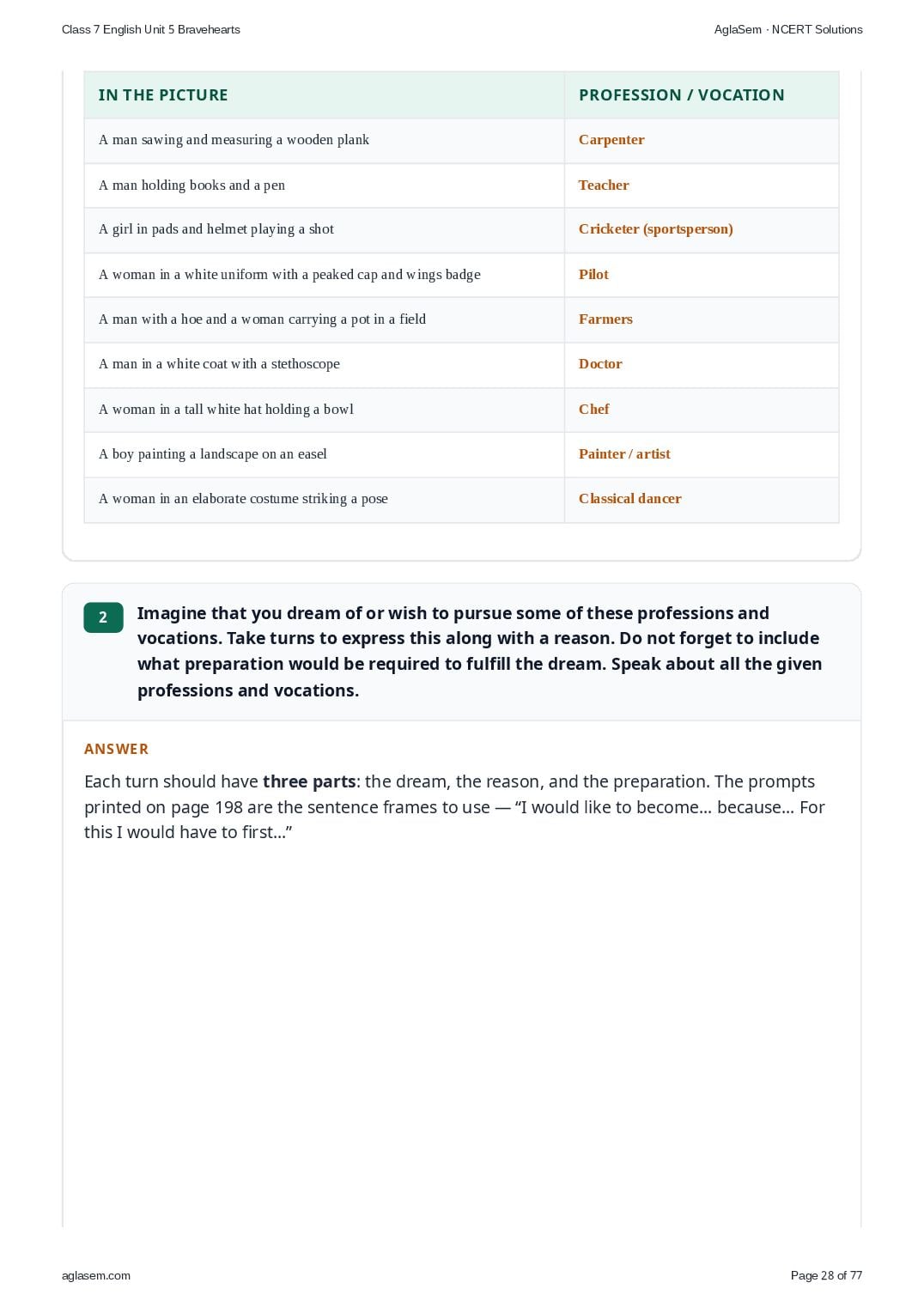
- Work in pairs and identify the different professions displayed in the picture.
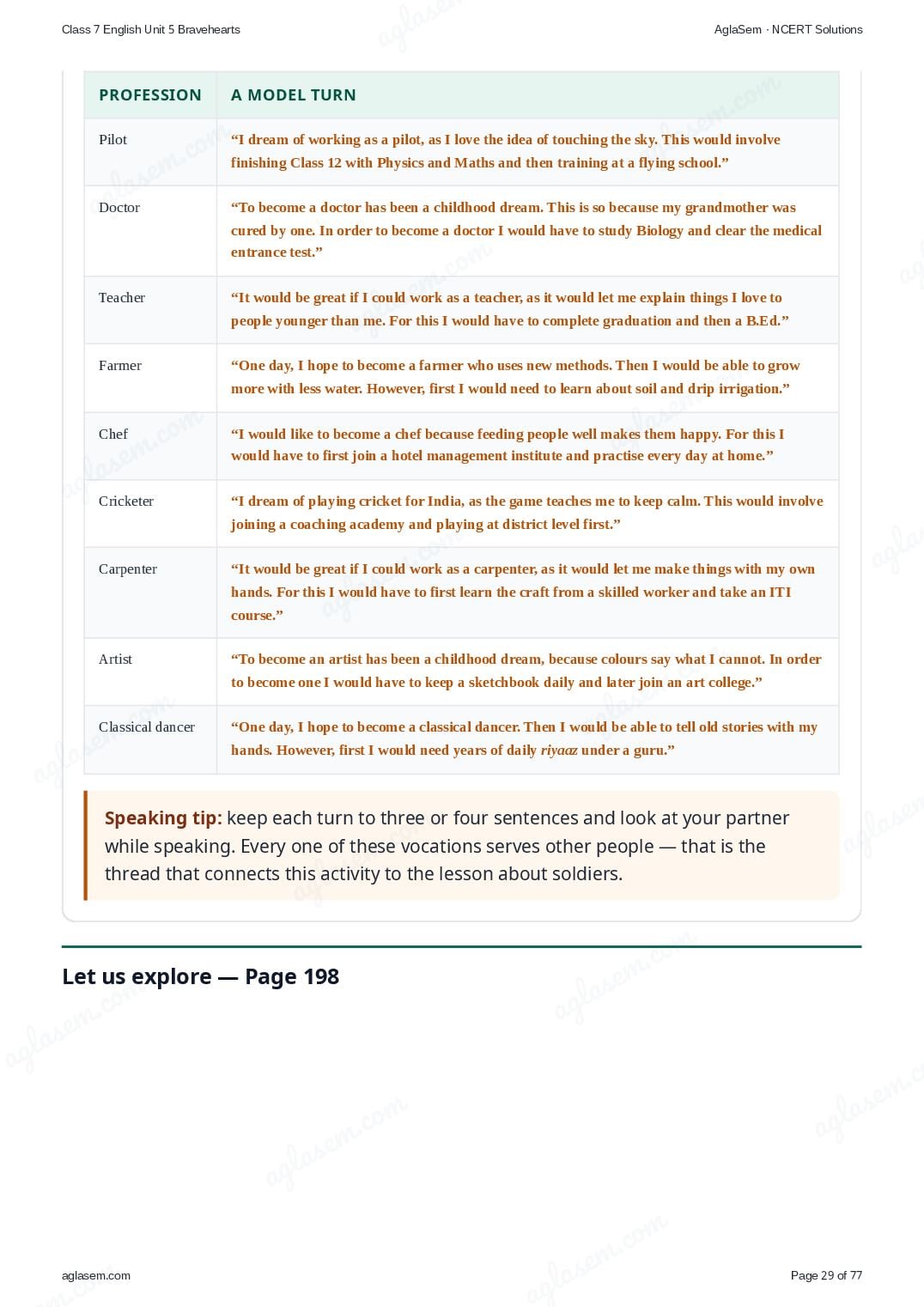
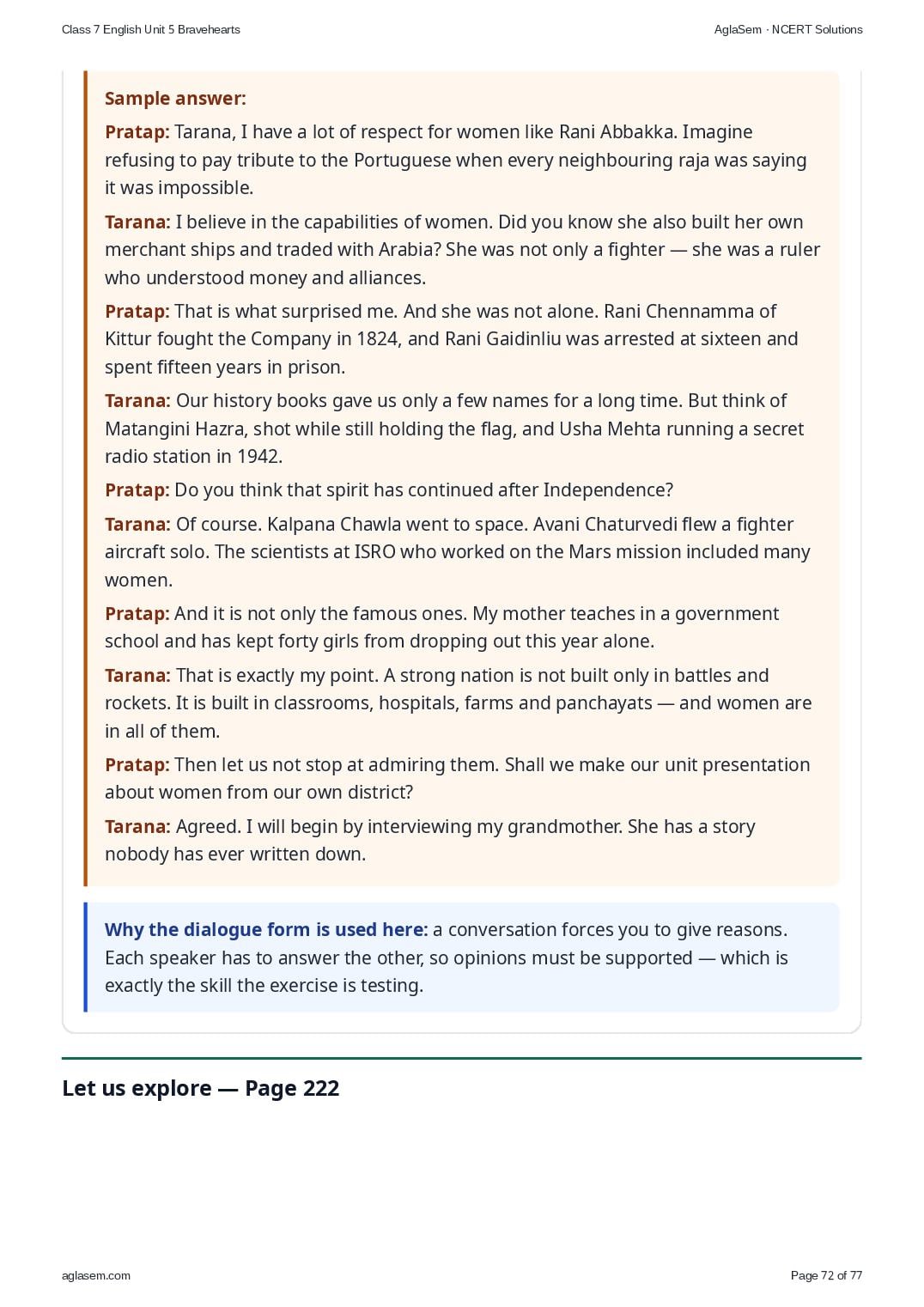
- Imagine that you dream of or wish to pursue some of these professions and vocations. Take turns to express this along with a reason. Do not forget to include what preparation would be required to fulfill the dream. Speak about all the given professions and vocations.
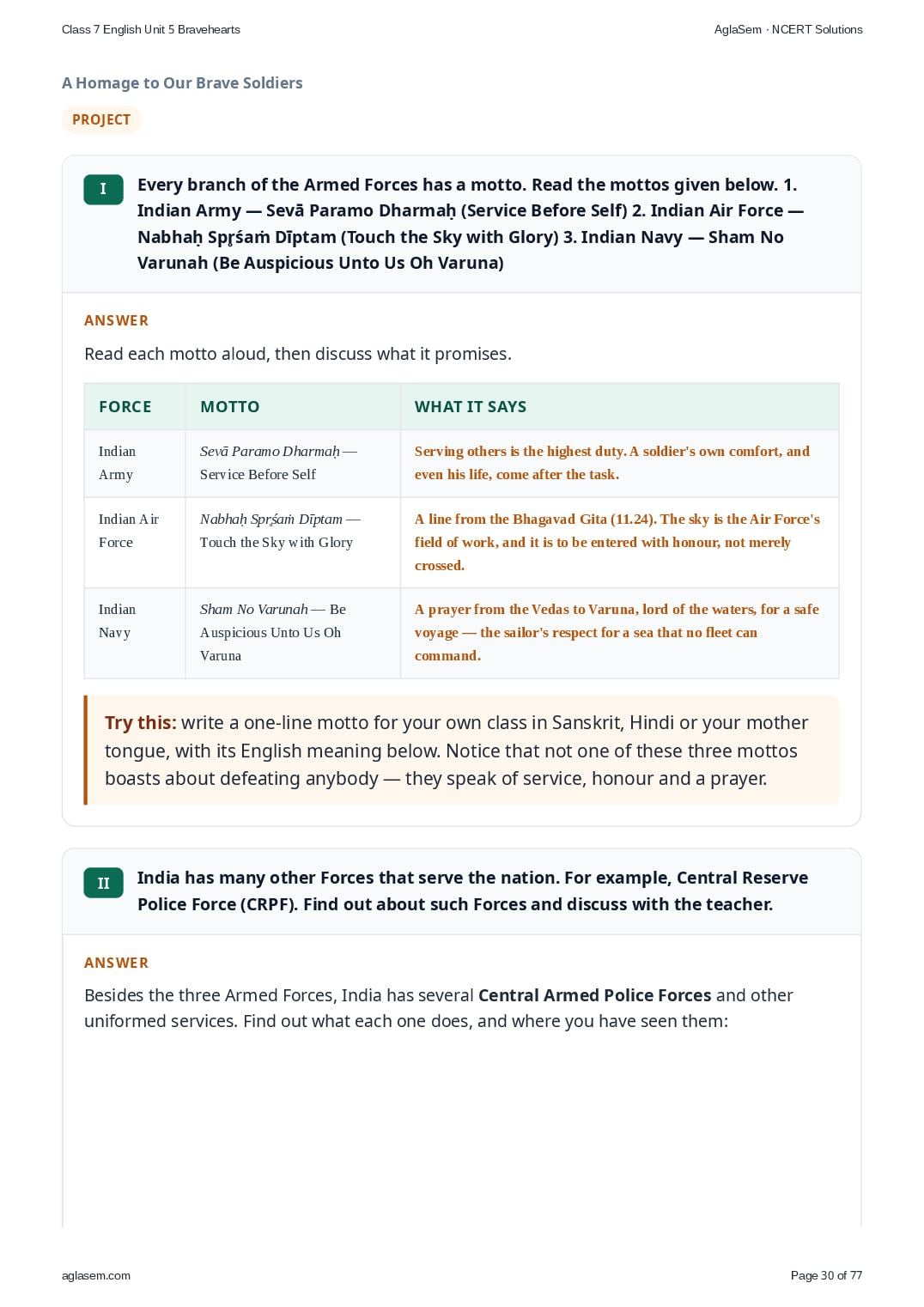
- Every branch of the Armed Forces has a motto. Read the mottos given below. 1. Indian Army — Sevā Paramo Dharmaḥ (Service Before Self) 2. Indian Air Force — Nabhaḥ Spr̥śaṁ Dīptam (Touch the Sky with Glory) 3. Indian Navy — Sham No Varunah (Be Auspicious Unto Us Oh Varuna)
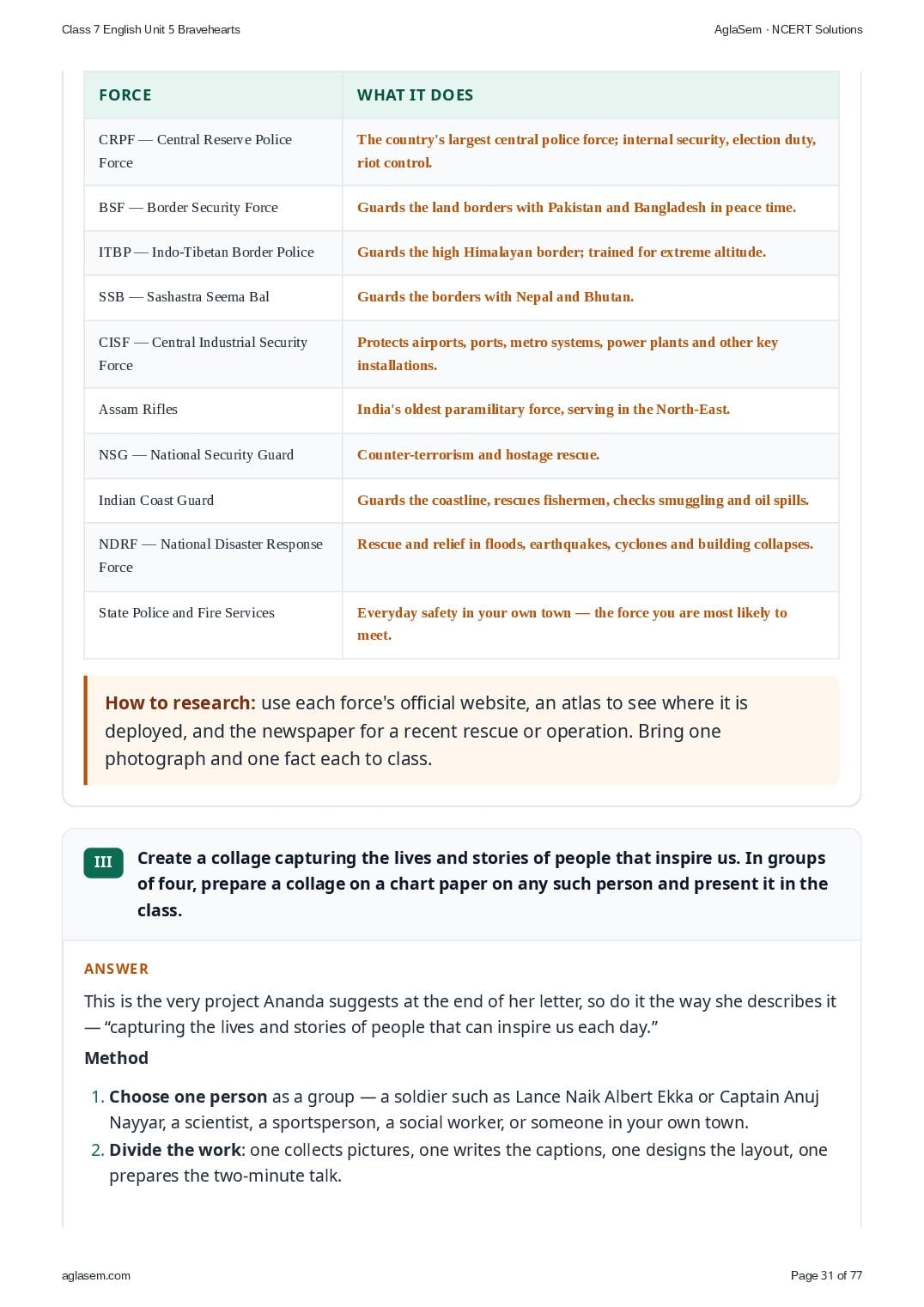
- India has many other Forces that serve the nation. For example, Central Reserve Police Force (CRPF). Find out about such Forces and discuss with the teacher.
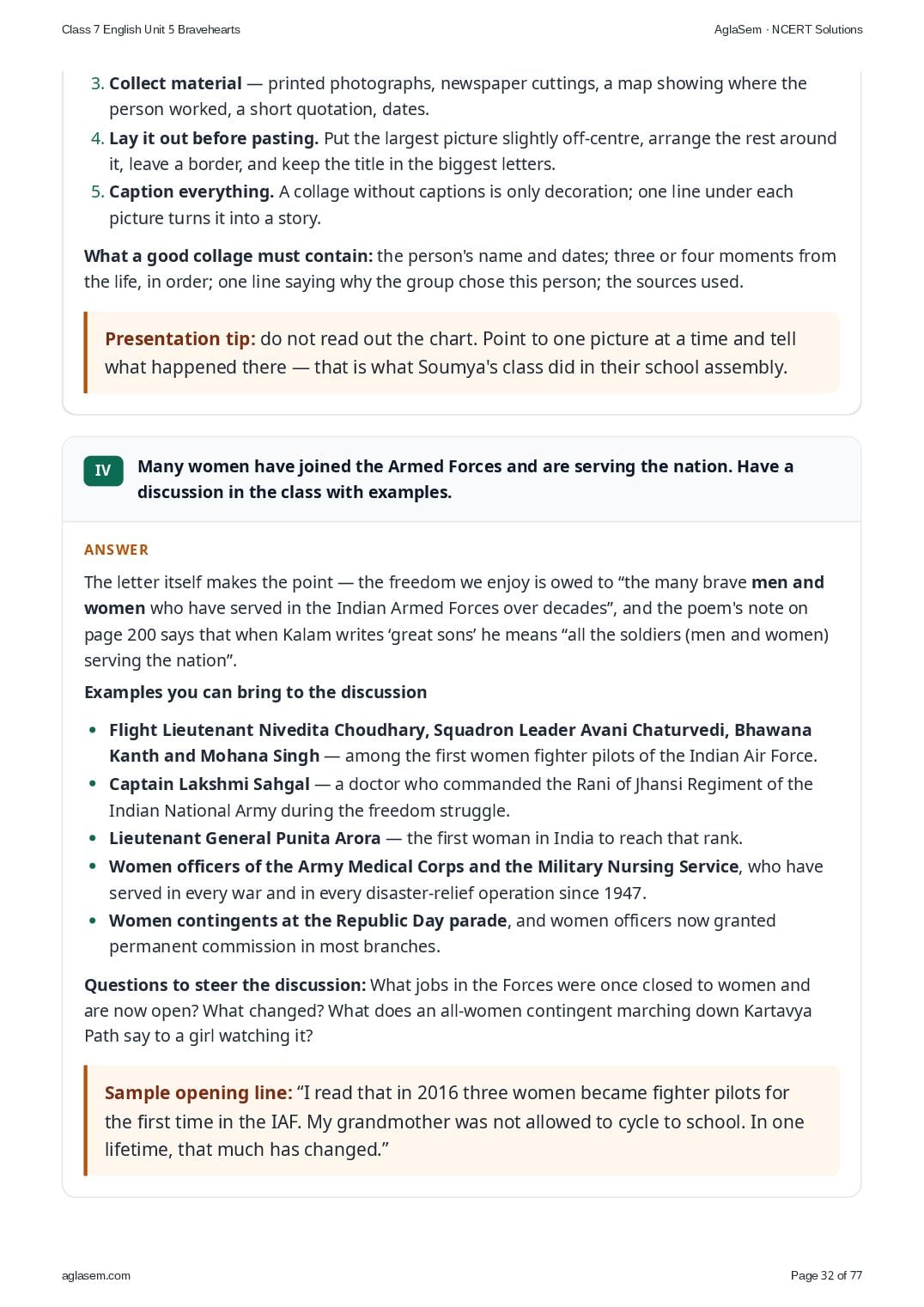
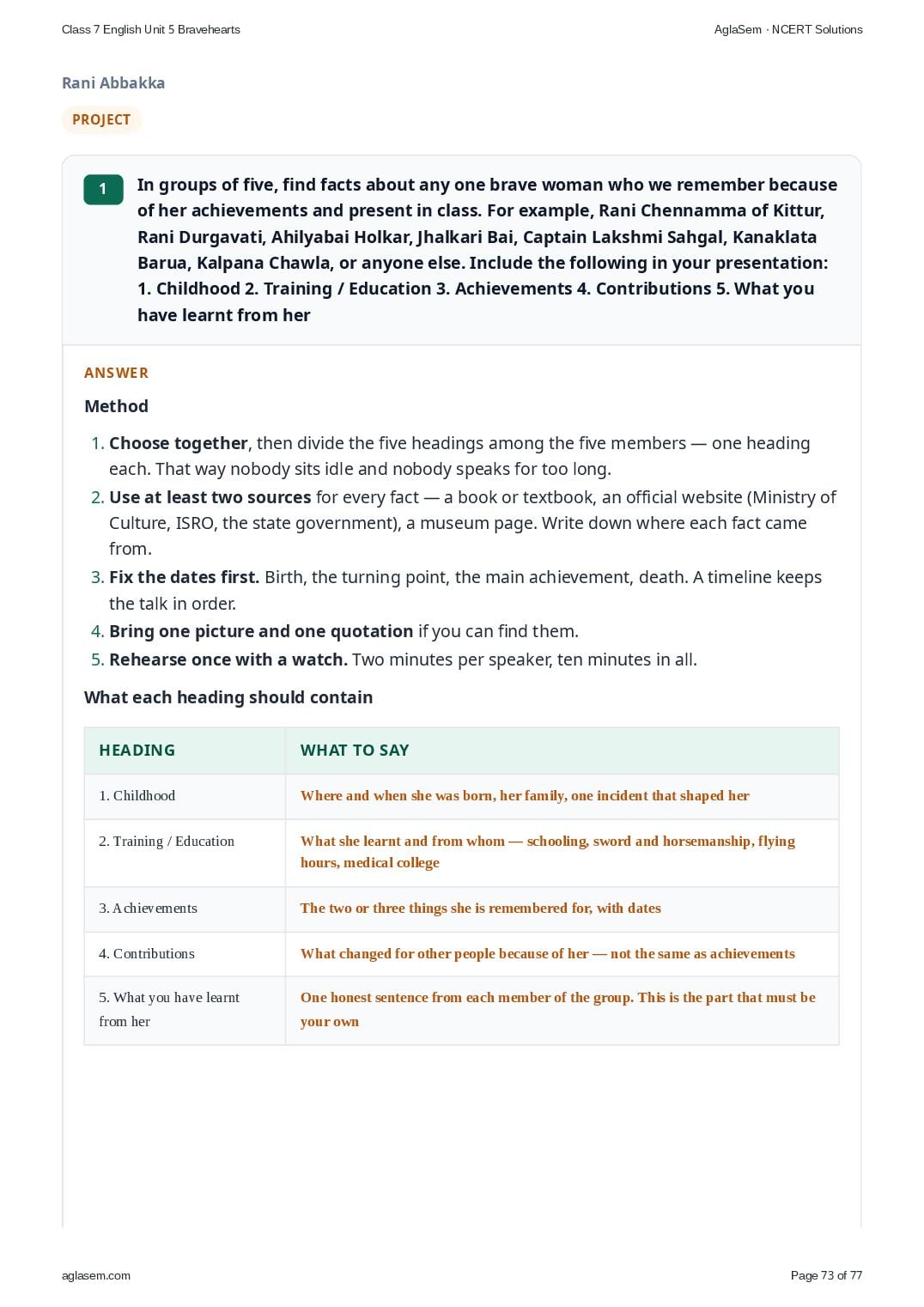
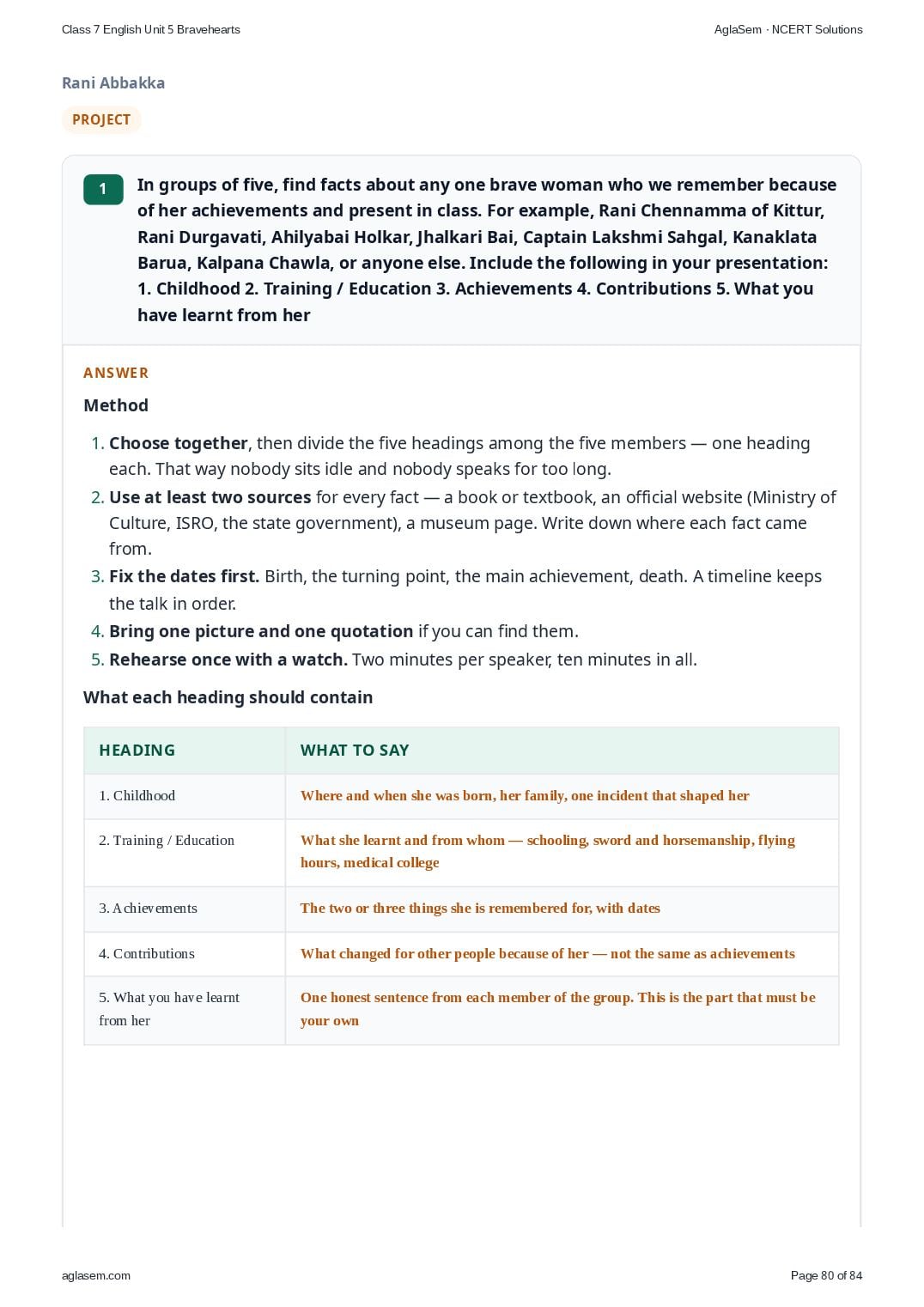
- Create a collage capturing the lives and stories of people that inspire us. In groups of four, prepare a collage on a chart paper on any such person and present it in the class.
- Many women have joined the Armed Forces and are serving the nation. Have a discussion in the class with examples.
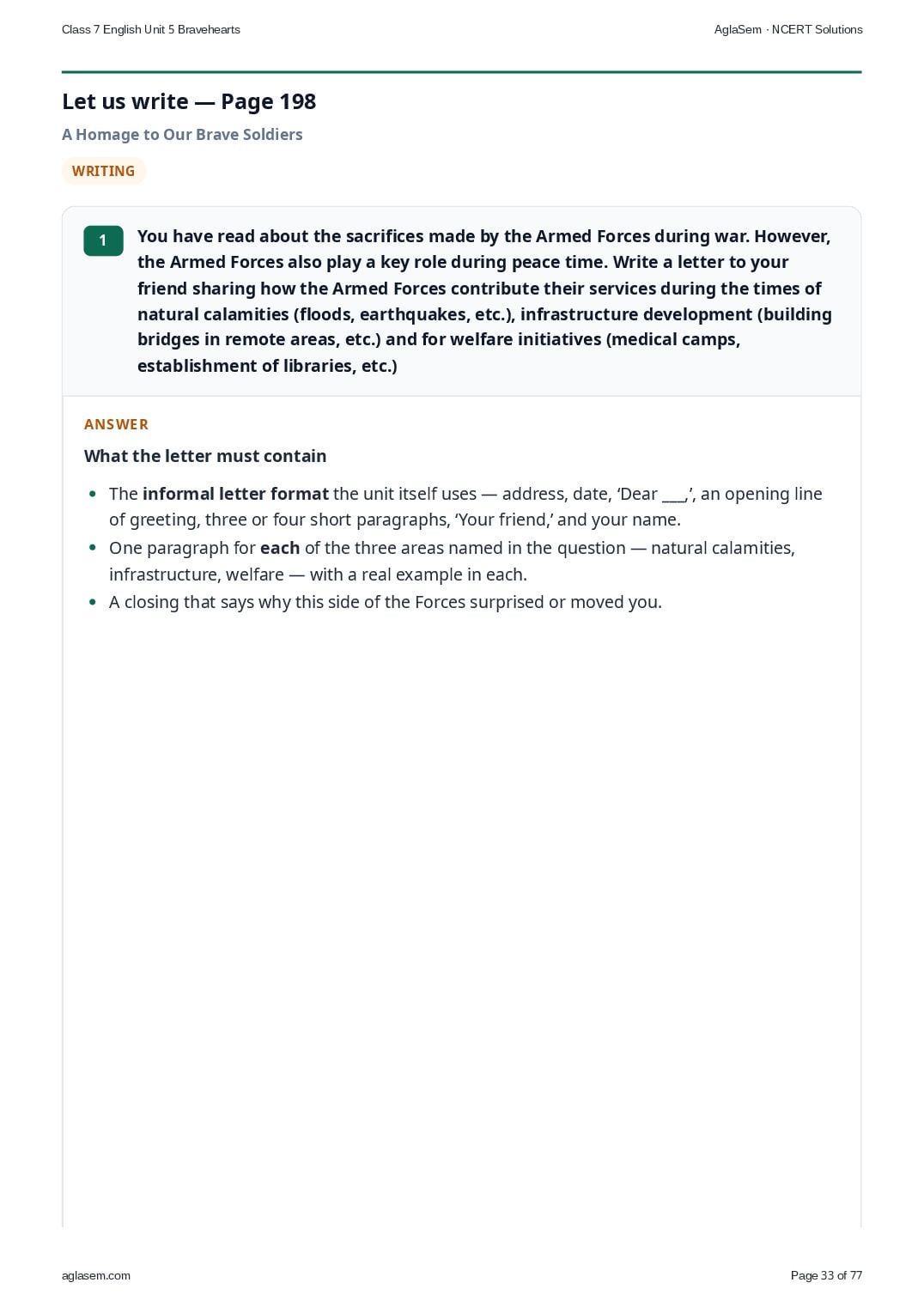
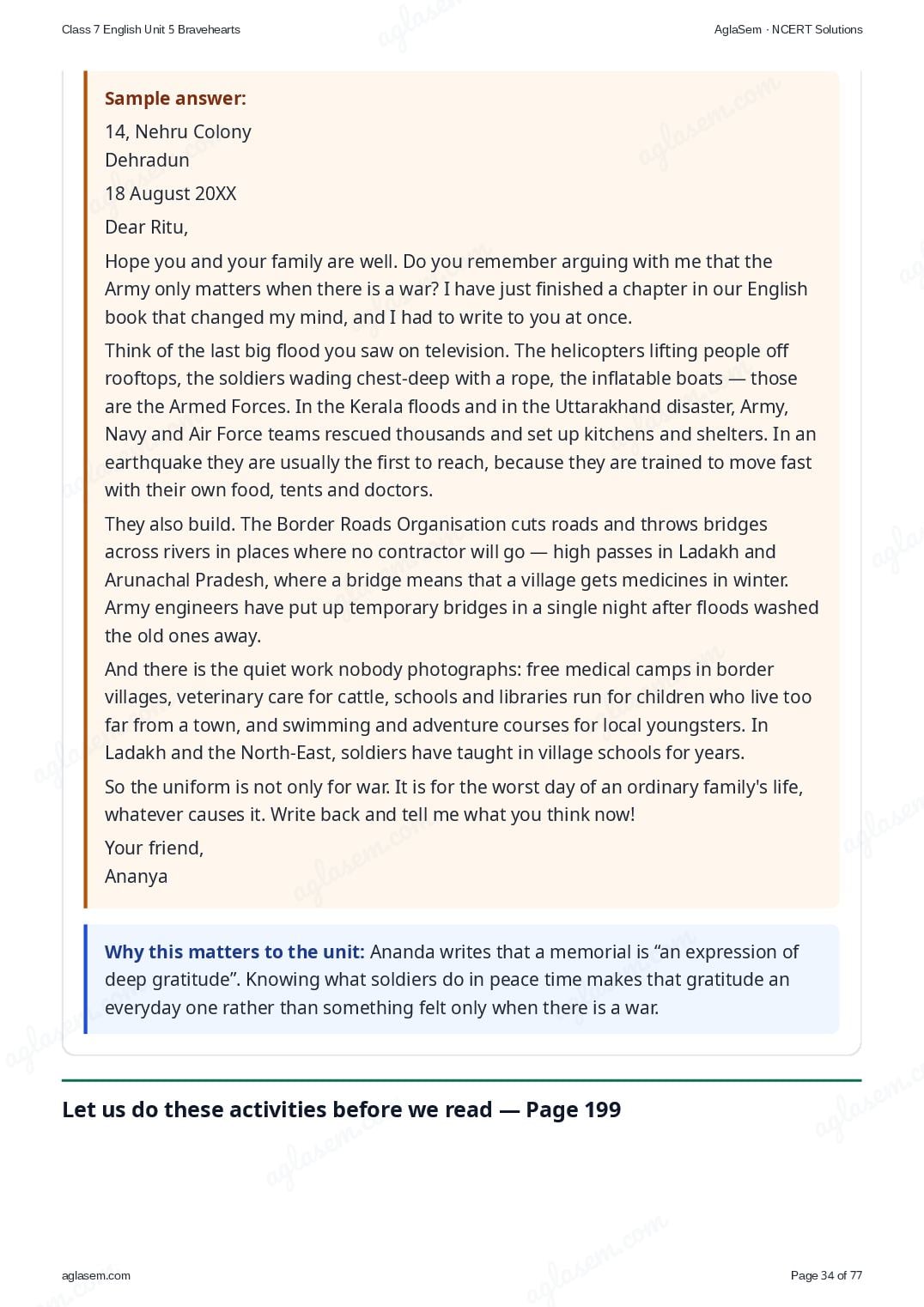
- You have read about the sacrifices made by the Armed Forces during war. However, the Armed Forces also play a key role during peace time. Write a letter to your friend sharing how the Armed Forces contribute their services during the times of natural calamities (floods, earthquakes, etc.), infrastructure development (building bridges in remote areas, etc.) and for welfare initiatives (medical camps, establishment of libraries, etc.)
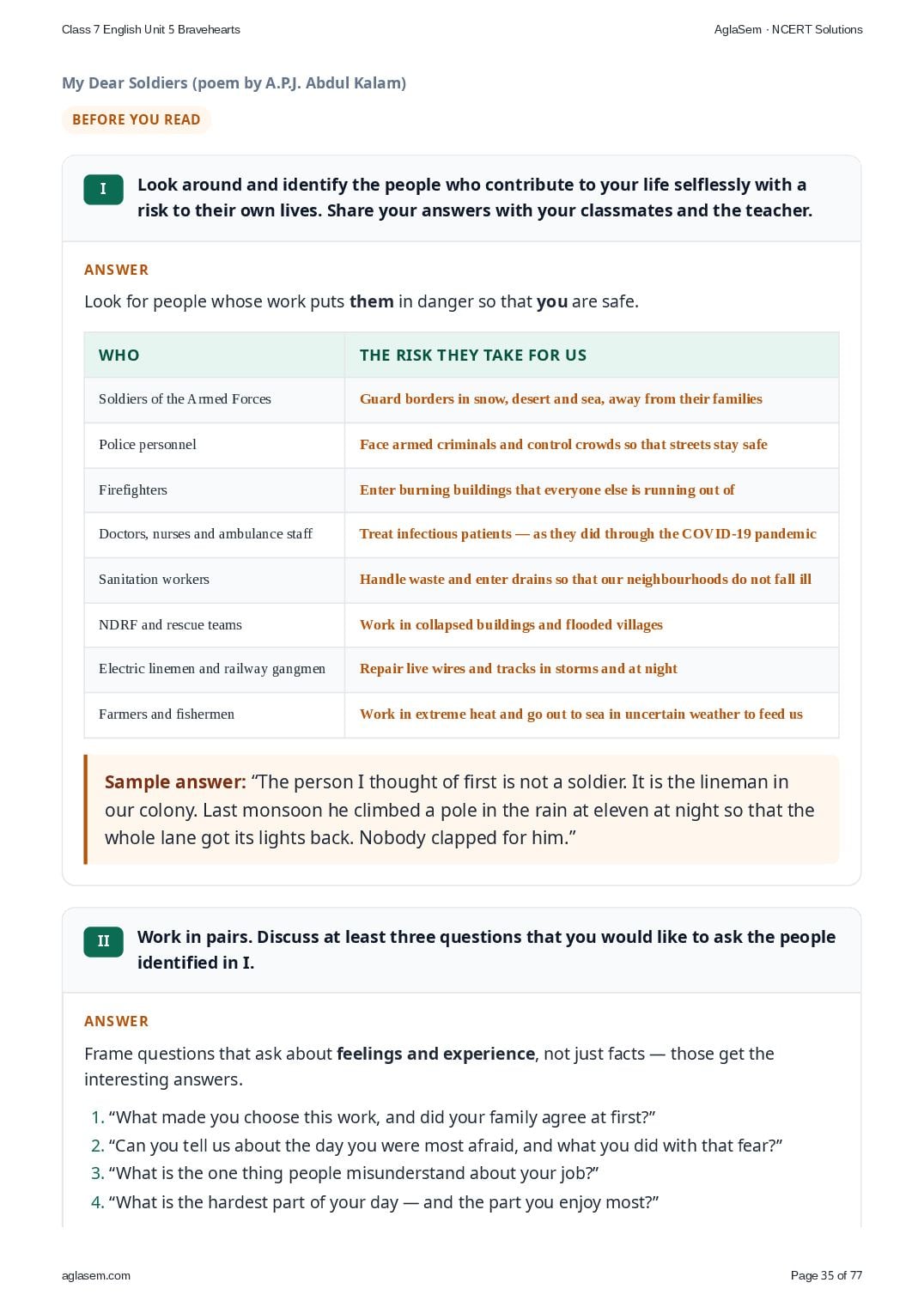
- Look around and identify the people who contribute to your life selflessly with a risk to their own lives. Share your answers with your classmates and the teacher.
- Work in pairs. Discuss at least three questions that you would like to ask the people identified in I.
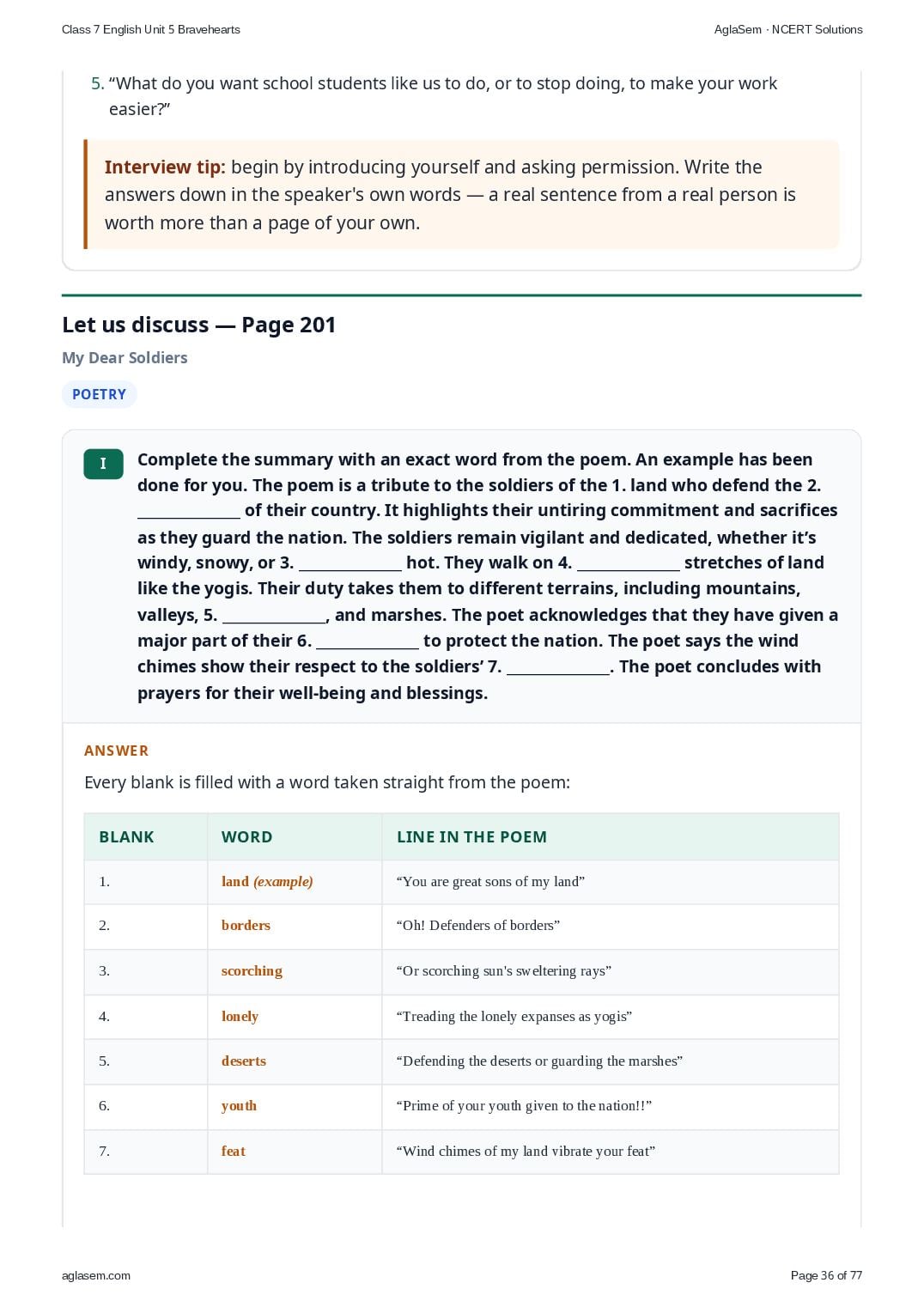
- Complete the summary with an exact word from the poem. An example has been done for you. The poem is a tribute to the soldiers of the 1. land who defend the 2. _______________ of their country. It highlights their untiring commitment and sacrifices as they guard the nation. The soldiers remain vigilant and dedicated, whether it’s windy, snowy, or 3. _______________ hot. They walk on 4. _______________ stretches of land like the yogis. Their duty takes them to different terrains, including mountains, valleys, 5. _______________, and marshes. The poet acknowledges that they have given a major part of their 6. _______________ to protect the nation. The poet says the wind chimes show their respect to the soldiers’ 7. _______________. The poet concludes with prayers for their well-being and blessings.
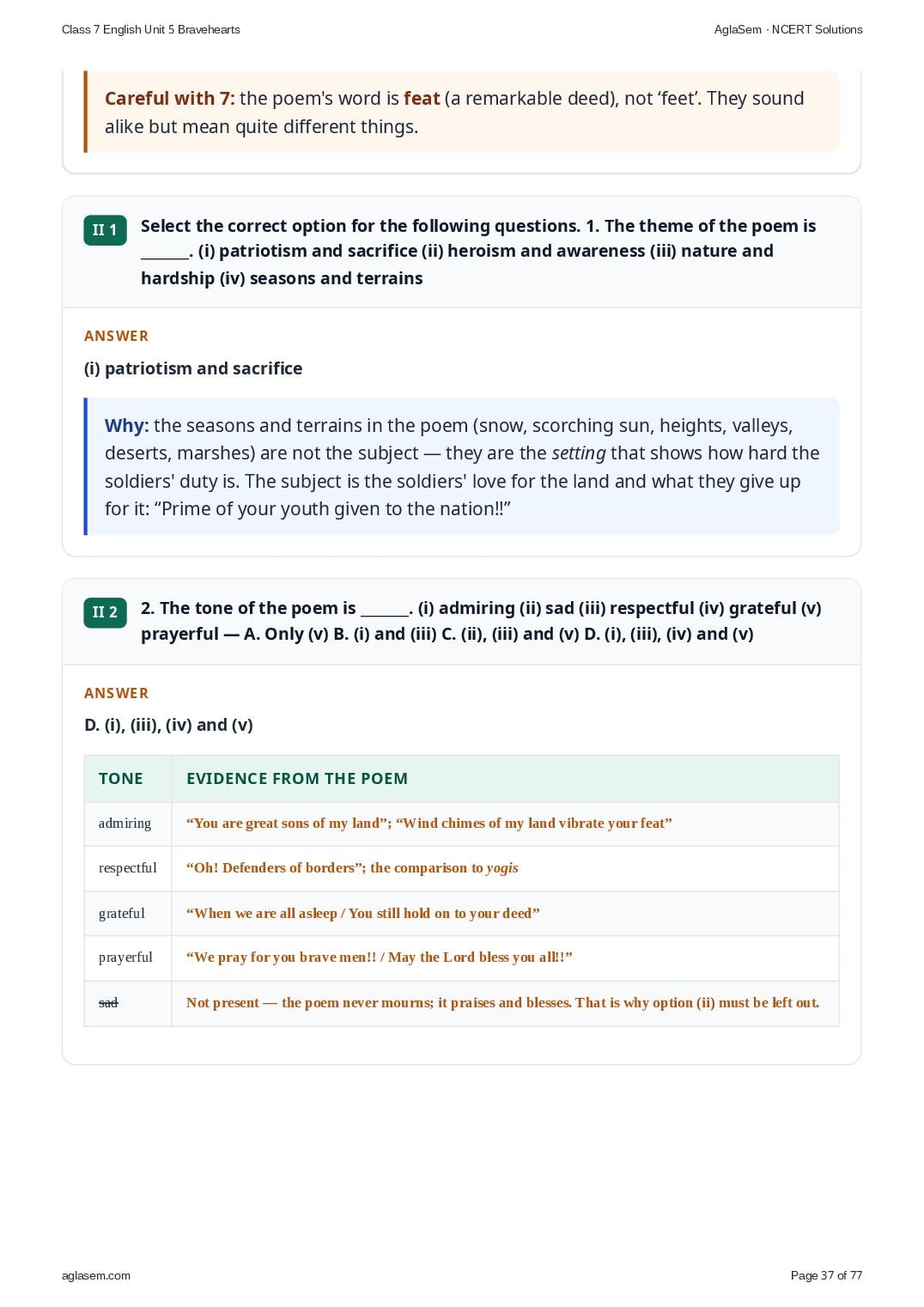
- Select the correct option for the following questions. 1. The theme of the poem is _______. (i) patriotism and sacrifice (ii) heroism and awareness (iii) nature and hardship (iv) seasons and terrains
- 2. The tone of the poem is _______. (i) admiring (ii) sad (iii) respectful (iv) grateful (v) prayerful — A. Only (v) B. (i) and (iii) C. (ii), (iii) and (v) D. (i), (iii), (iv) and (v)
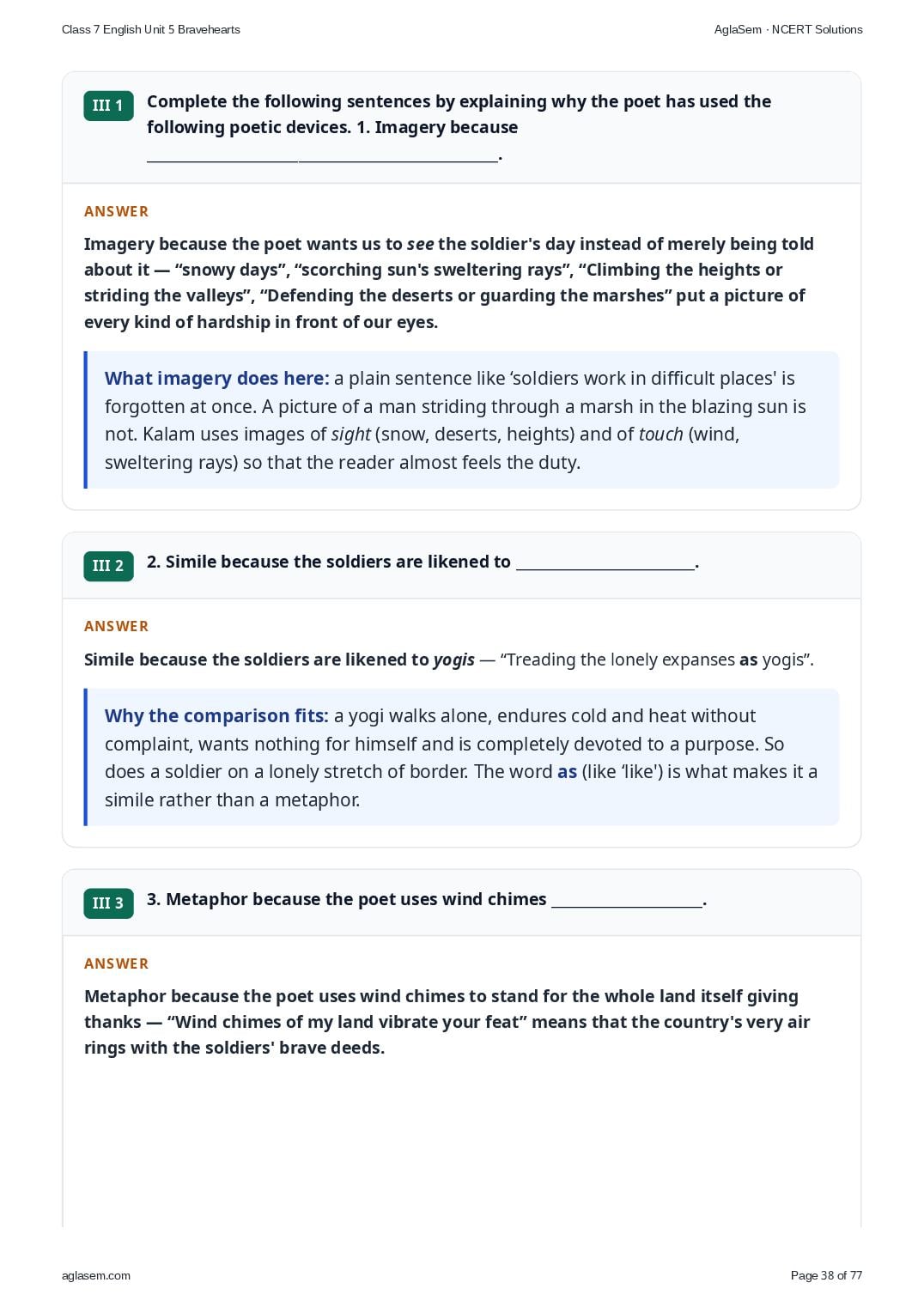
- Complete the following sentences by explaining why the poet has used the following poetic devices. 1. Imagery because ___________________________________________________.
- 2. Simile because the soldiers are likened to __________________________.
- 3. Metaphor because the poet uses wind chimes ______________________.
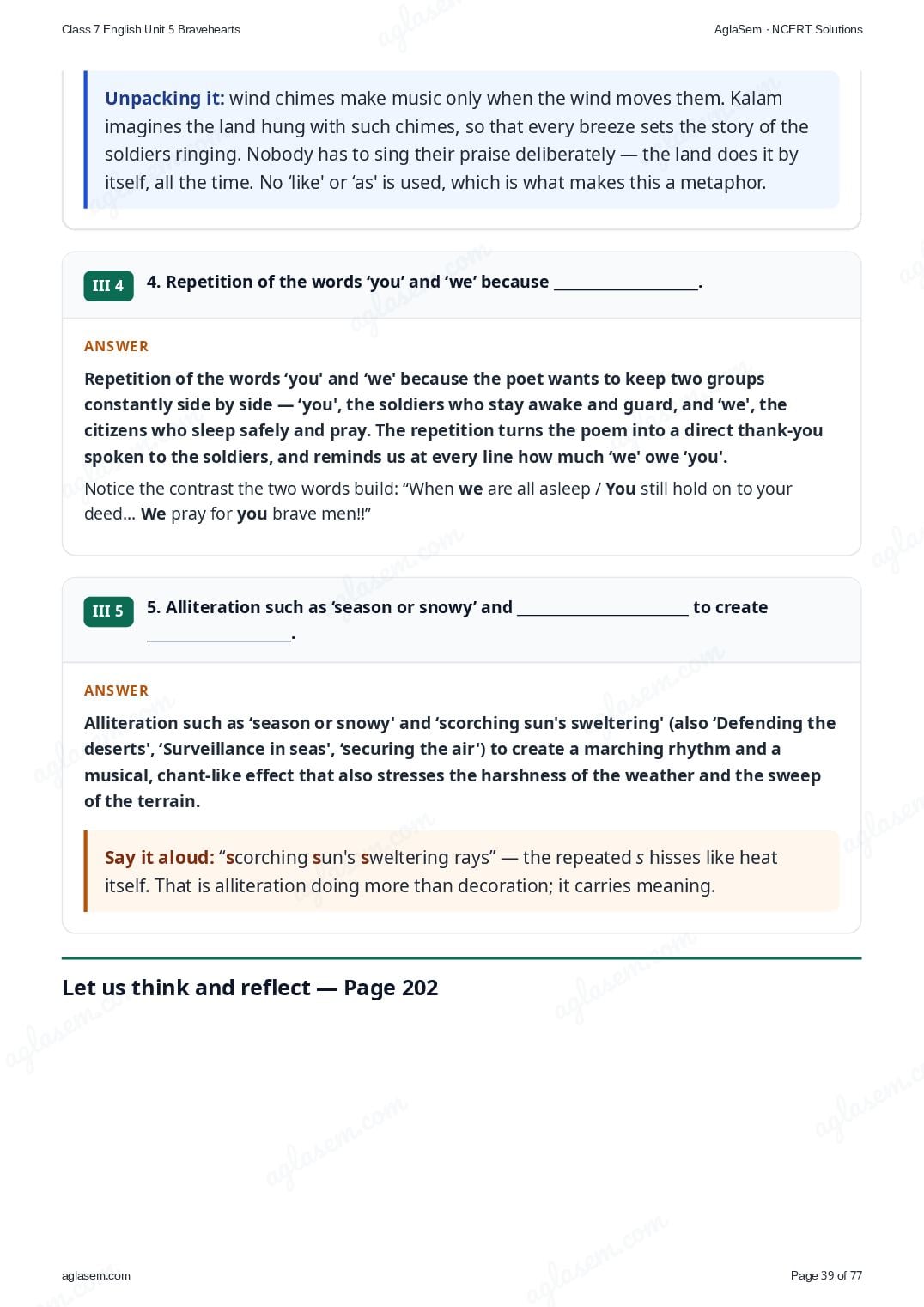
- 4. Repetition of the words ‘you’ and ‘we’ because _____________________.
- 5. Alliteration such as ‘season or snowy’ and _________________________ to create _____________________.
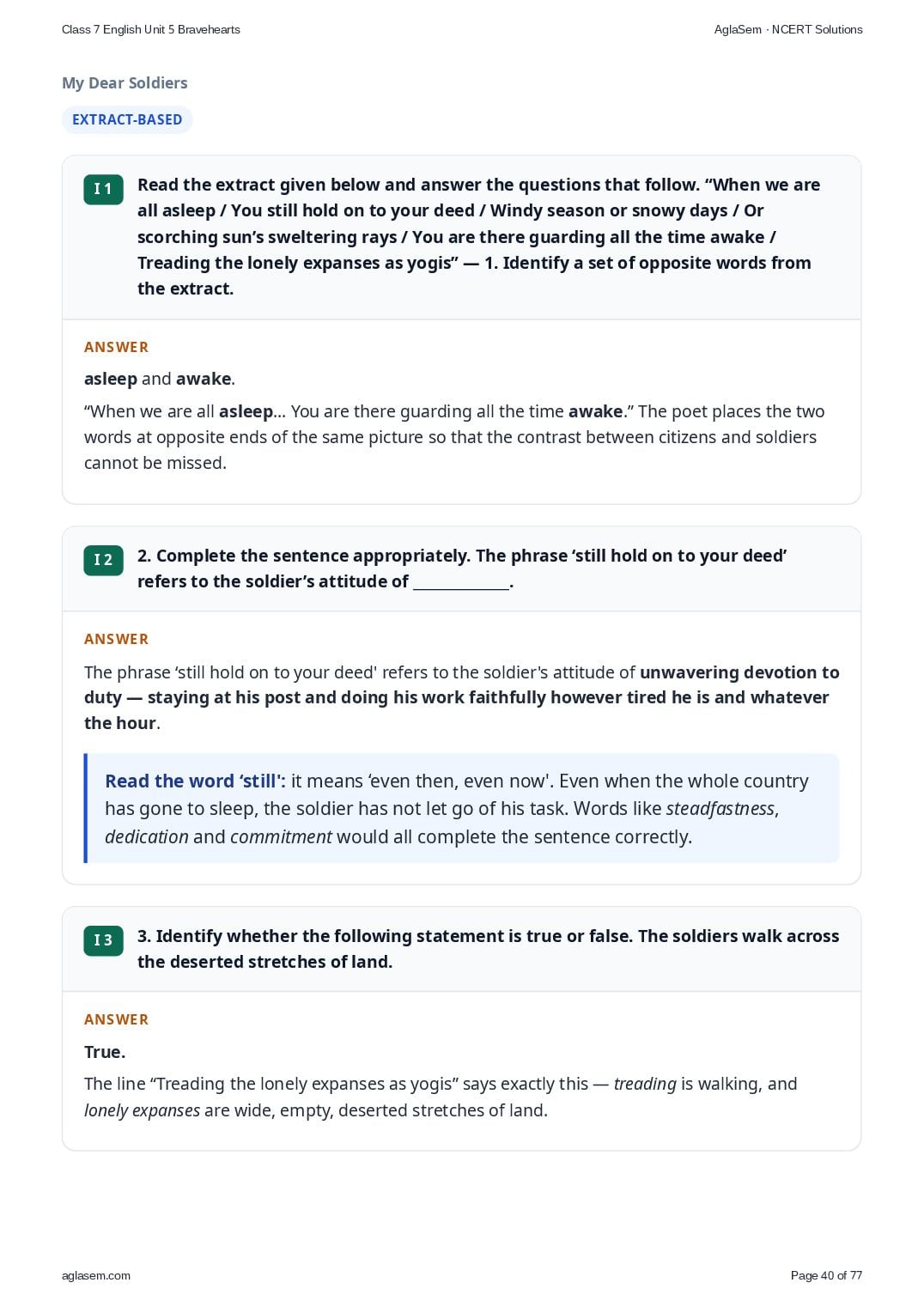
- Read the extract given below and answer the questions that follow. “When we are all asleep / You still hold on to your deed / Windy season or snowy days / Or scorching sun’s sweltering rays / You are there guarding all the time awake / Treading the lonely expanses as yogis” — 1. Identify a set of opposite words from the extract.
- 2. Complete the sentence appropriately. The phrase ‘still hold on to your deed’ refers to the soldier’s attitude of ______________.
- 3. Identify whether the following statement is true or false. The soldiers walk across the deserted stretches of land.
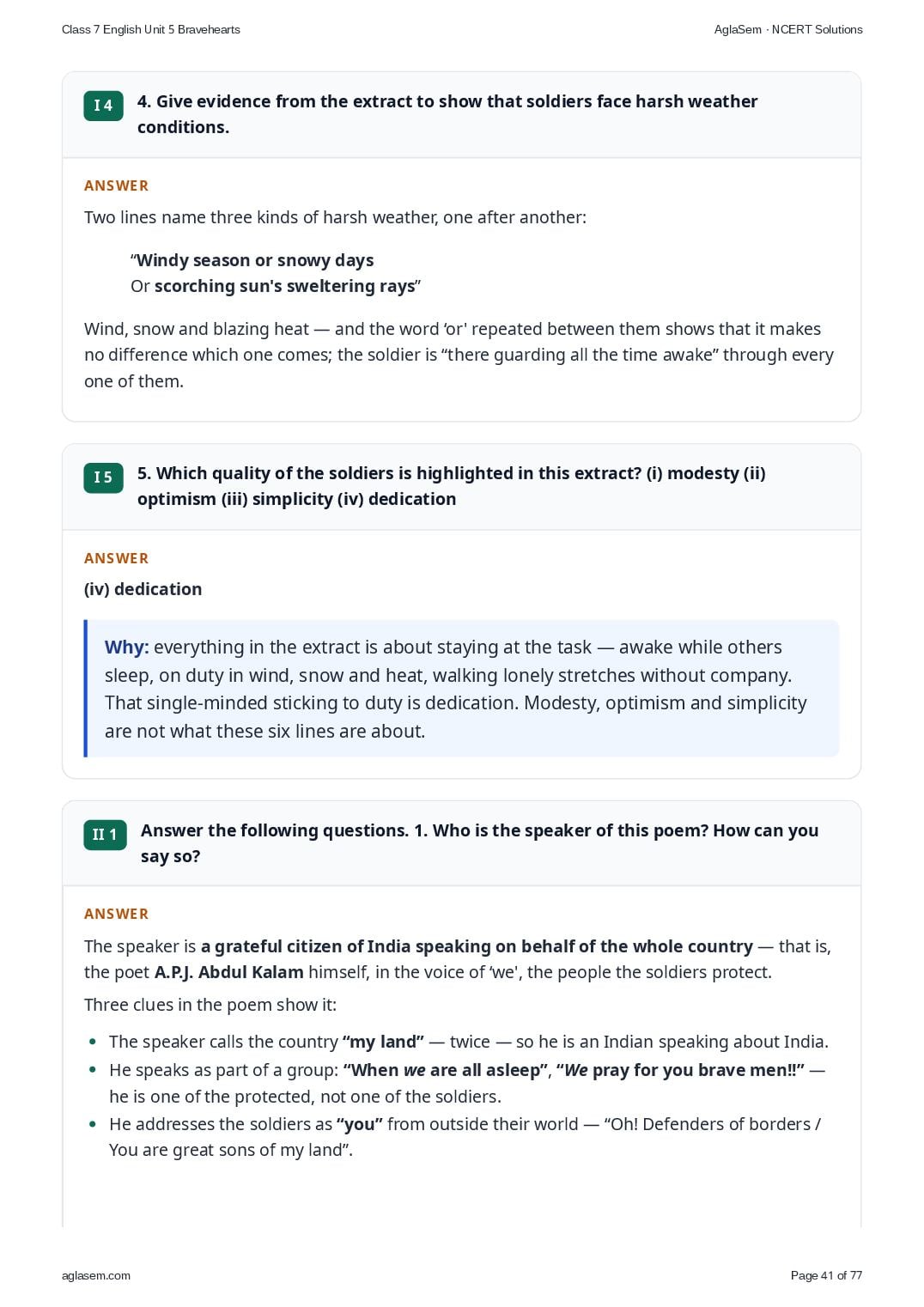
- 4. Give evidence from the extract to show that soldiers face harsh weather conditions.
- 5. Which quality of the soldiers is highlighted in this extract? (i) modesty (ii) optimism (iii) simplicity (iv) dedication
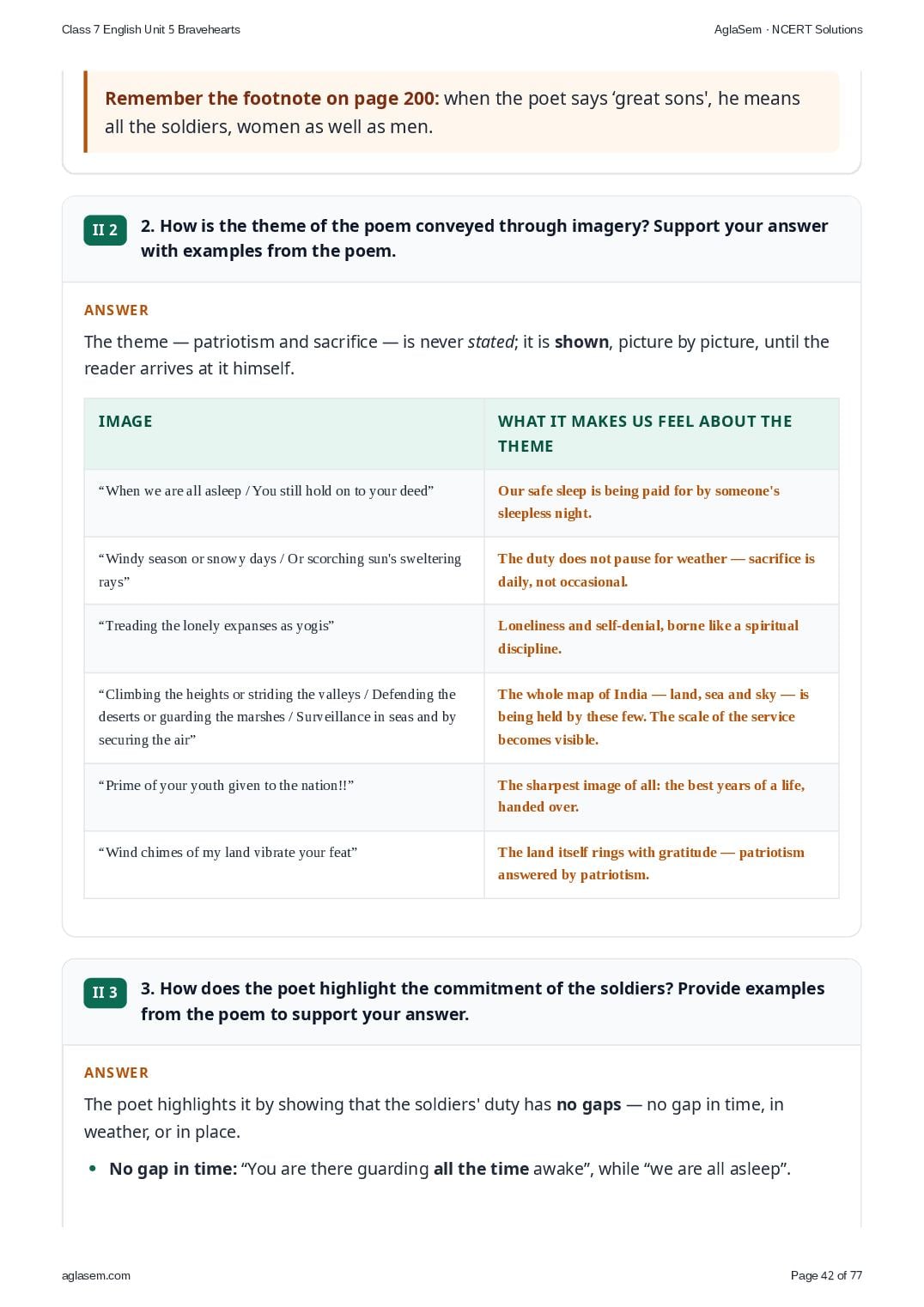
- Answer the following questions. 1. Who is the speaker of this poem? How can you say so?
- 2. How is the theme of the poem conveyed through imagery? Support your answer with examples from the poem.
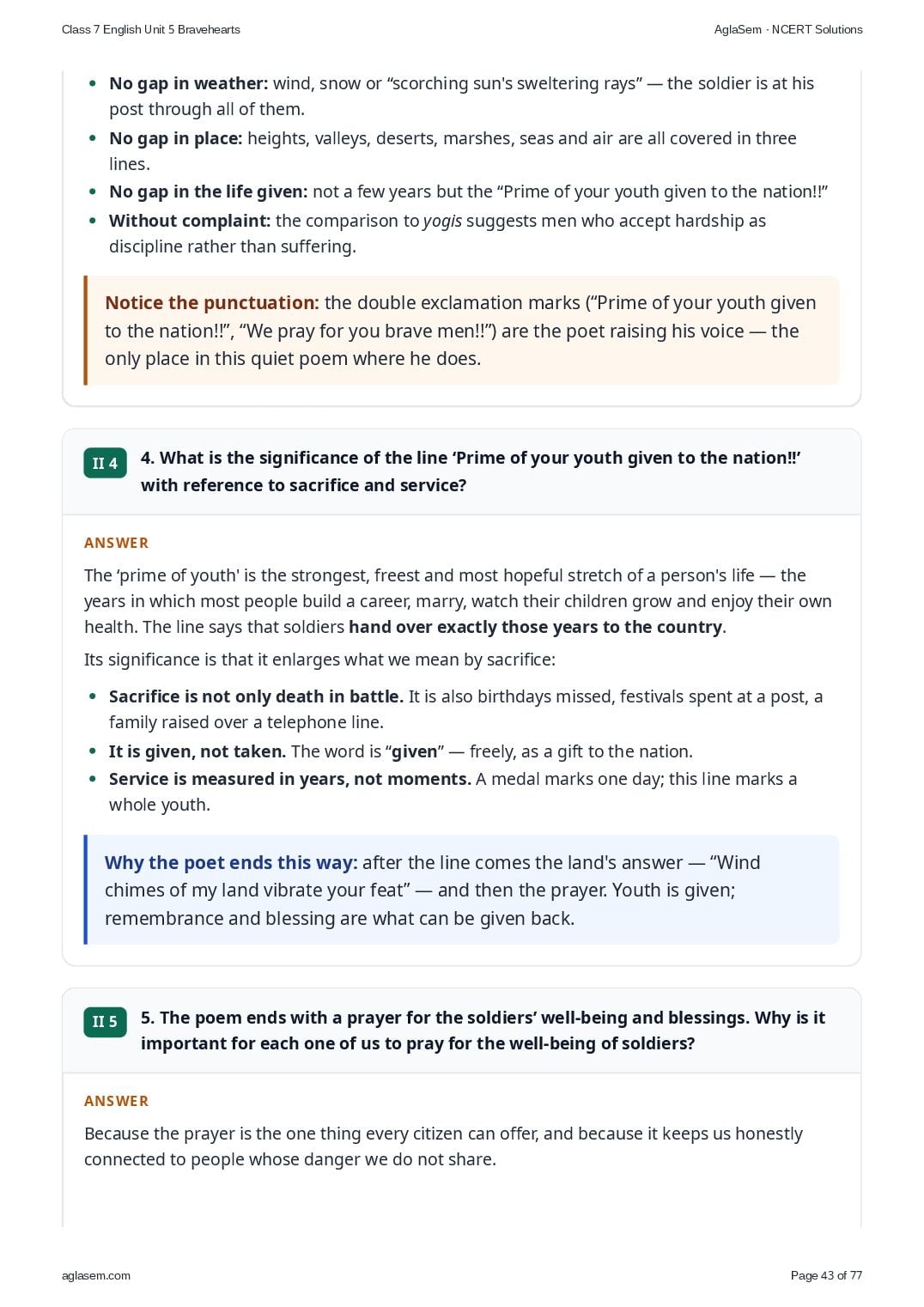
- 3. How does the poet highlight the commitment of the soldiers? Provide examples from the poem to support your answer.
- 4. What is the significance of the line ‘Prime of your youth given to the nation!!’ with reference to sacrifice and service?
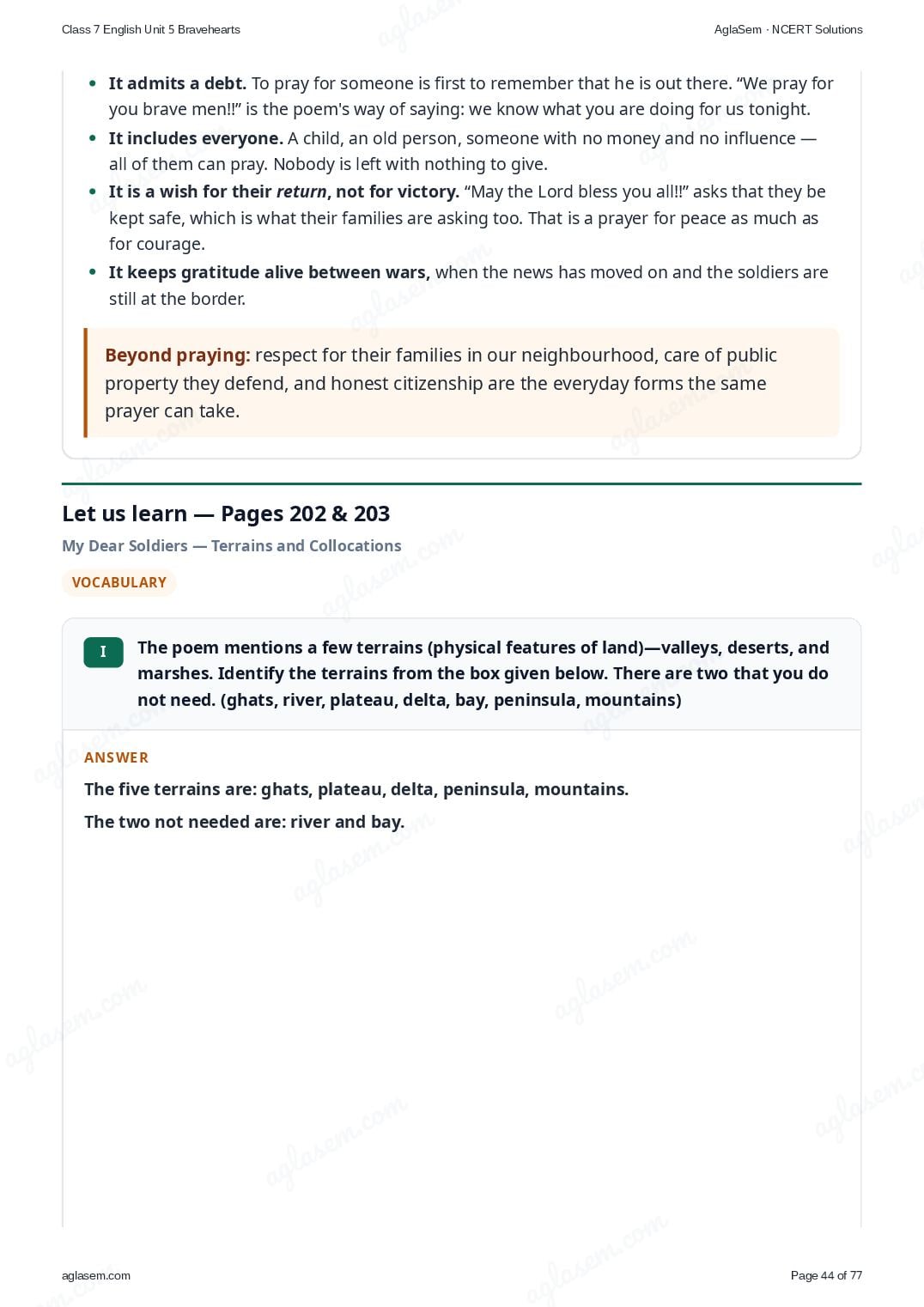
- 5. The poem ends with a prayer for the soldiers’ well-being and blessings. Why is it important for each one of us to pray for the well-being of soldiers?
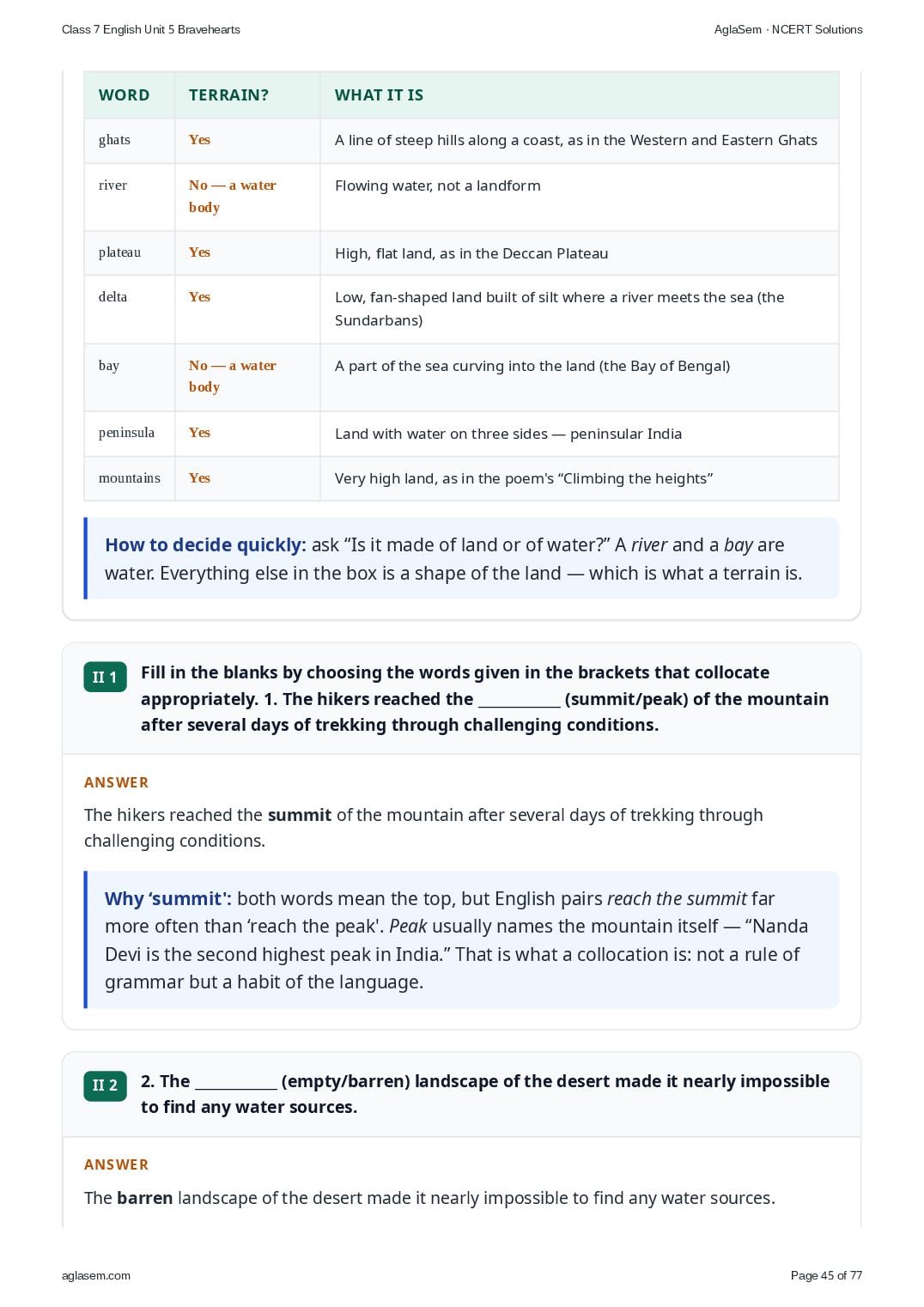
- The poem mentions a few terrains (physical features of land)—valleys, deserts, and marshes. Identify the terrains from the box given below. There are two that you do not need. (ghats, river, plateau, delta, bay, peninsula, mountains)
- Fill in the blanks by choosing the words given in the brackets that collocate appropriately. 1. The hikers reached the ____________ (summit/peak) of the mountain after several days of trekking through challenging conditions.
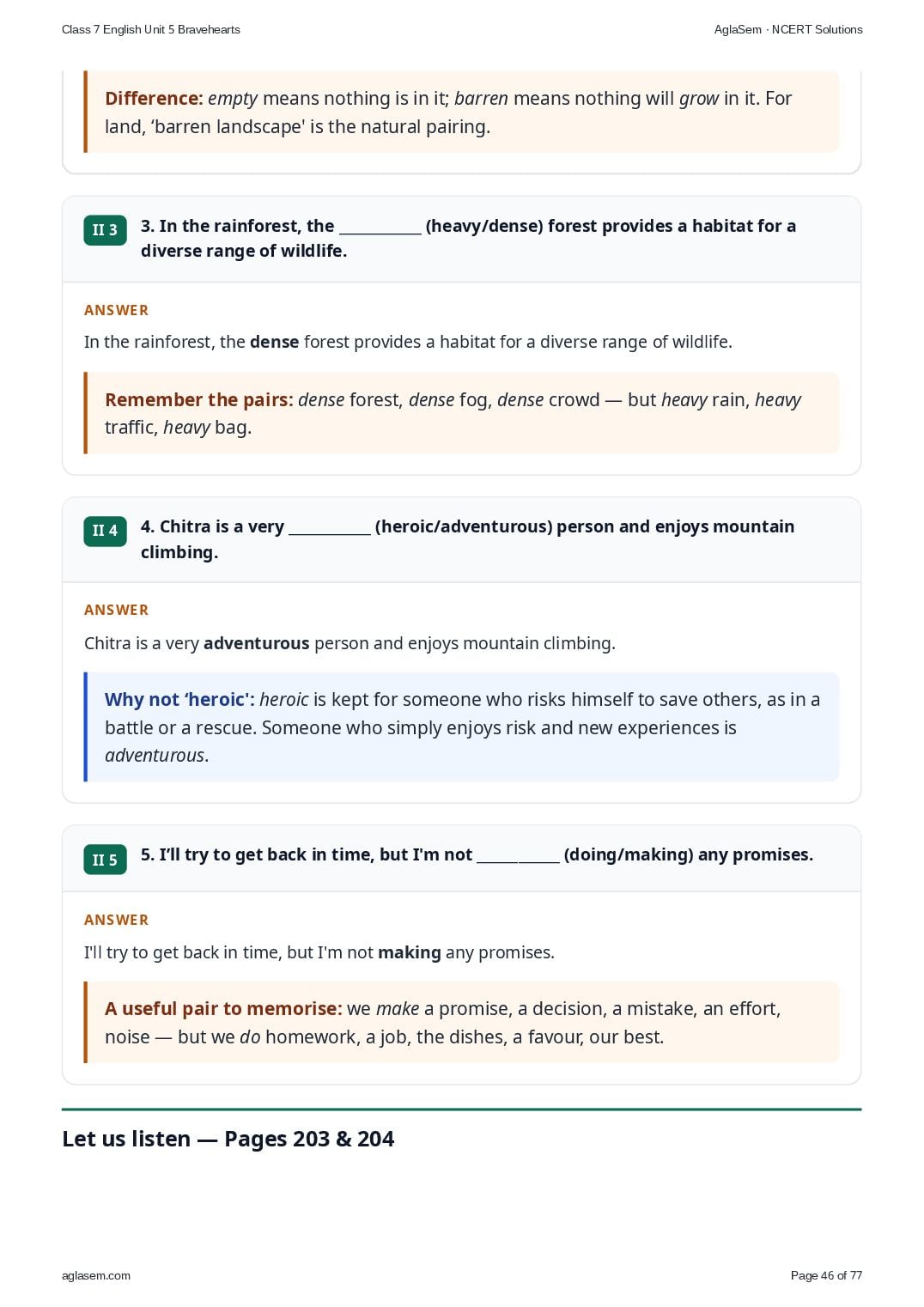
- 2. The ____________ (empty/barren) landscape of the desert made it nearly impossible to find any water sources.
- 3. In the rainforest, the ____________ (heavy/dense) forest provides a habitat for a diverse range of wildlife.
- 4. Chitra is a very ____________ (heroic/adventurous) person and enjoys mountain climbing.
- 5. I’ll try to get back in time, but I'm not ____________ (doing/making) any promises.
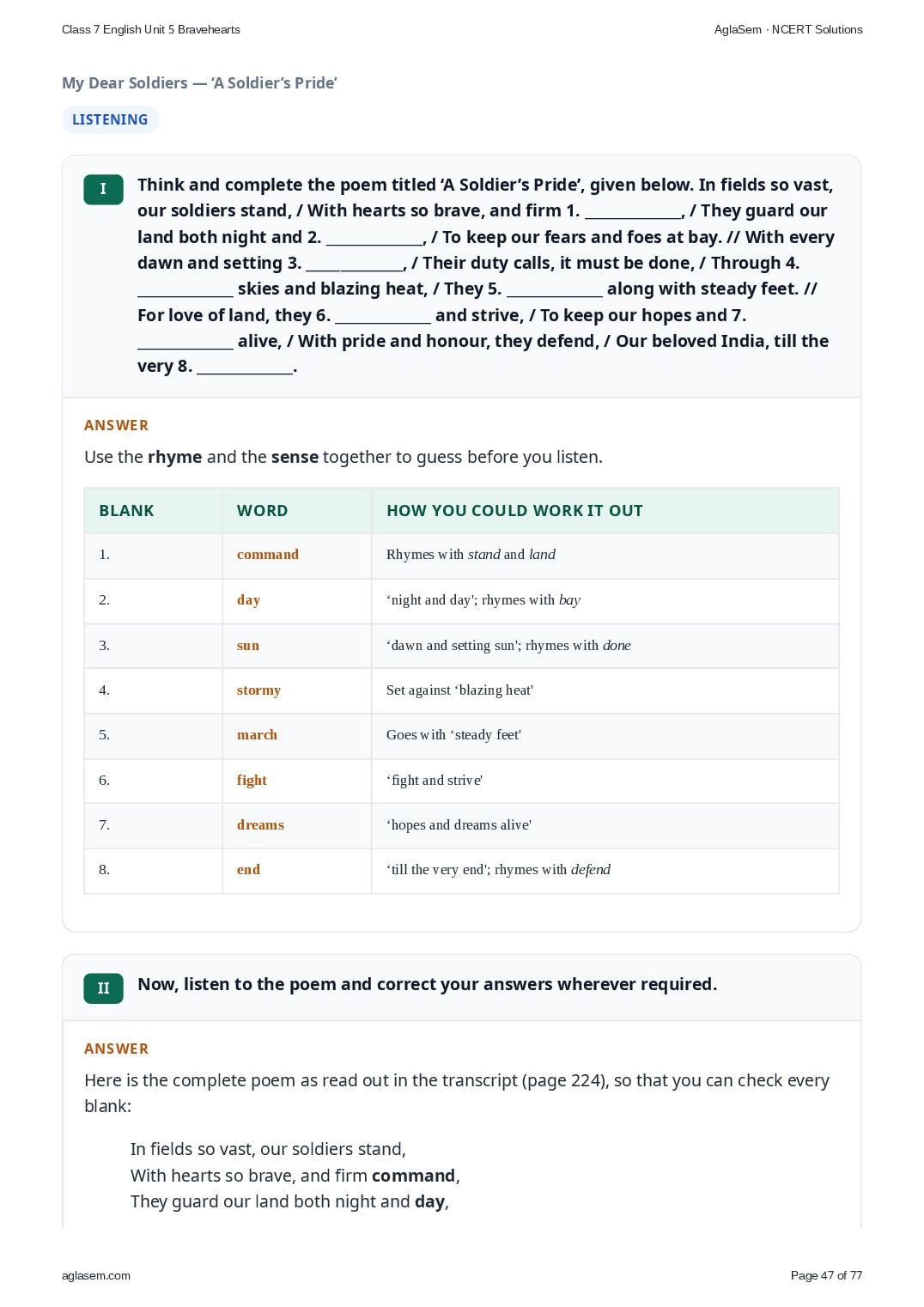
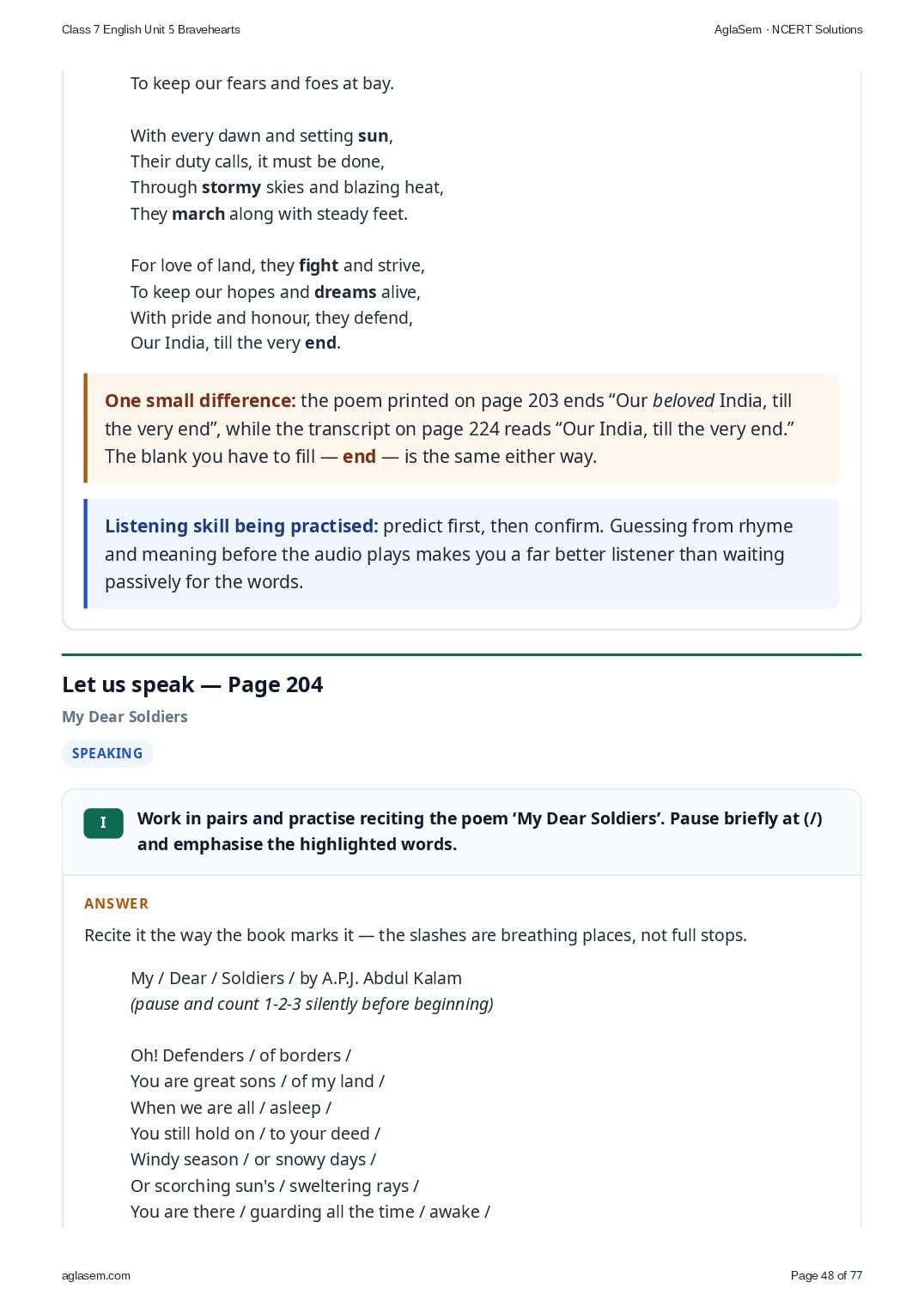
- Think and complete the poem titled ‘A Soldier’s Pride’, given below. In fields so vast, our soldiers stand, / With hearts so brave, and firm 1. ______________, / They guard our land both night and 2. ______________, / To keep our fears and foes at bay. // With every dawn and setting 3. ______________, / Their duty calls, it must be done, / Through 4. ______________ skies and blazing heat, / They 5. ______________ along with steady feet. // For love of land, they 6. ______________ and strive, / To keep our hopes and 7. ______________ alive, / With pride and honour, they defend, / Our beloved India, till the very 8. ______________.
- Now, listen to the poem and correct your answers wherever required.
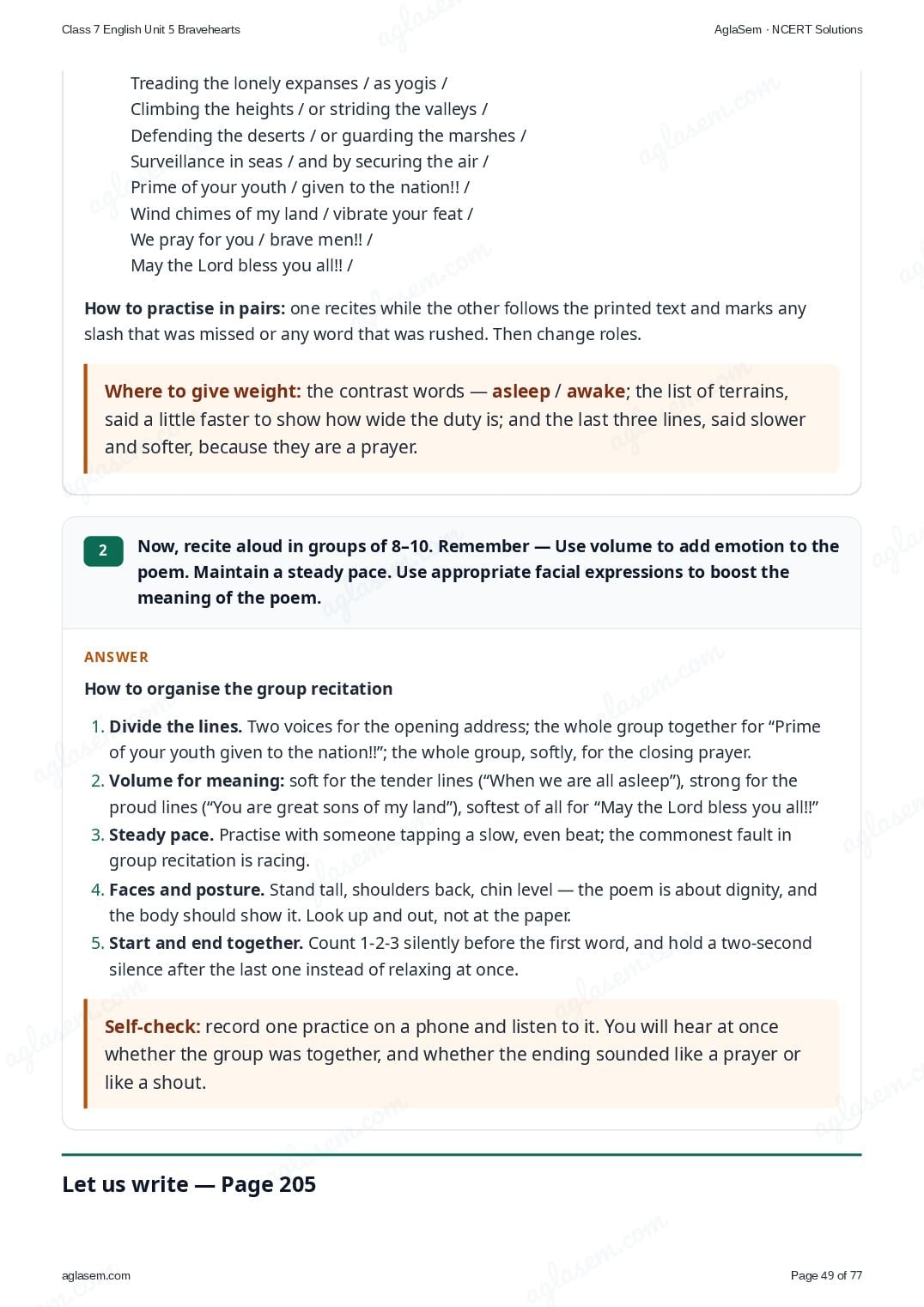
- Work in pairs and practise reciting the poem ‘My Dear Soldiers’. Pause briefly at (/) and emphasise the highlighted words.
- Now, recite aloud in groups of 8–10. Remember — Use volume to add emotion to the poem. Maintain a steady pace. Use appropriate facial expressions to boost the meaning of the poem.
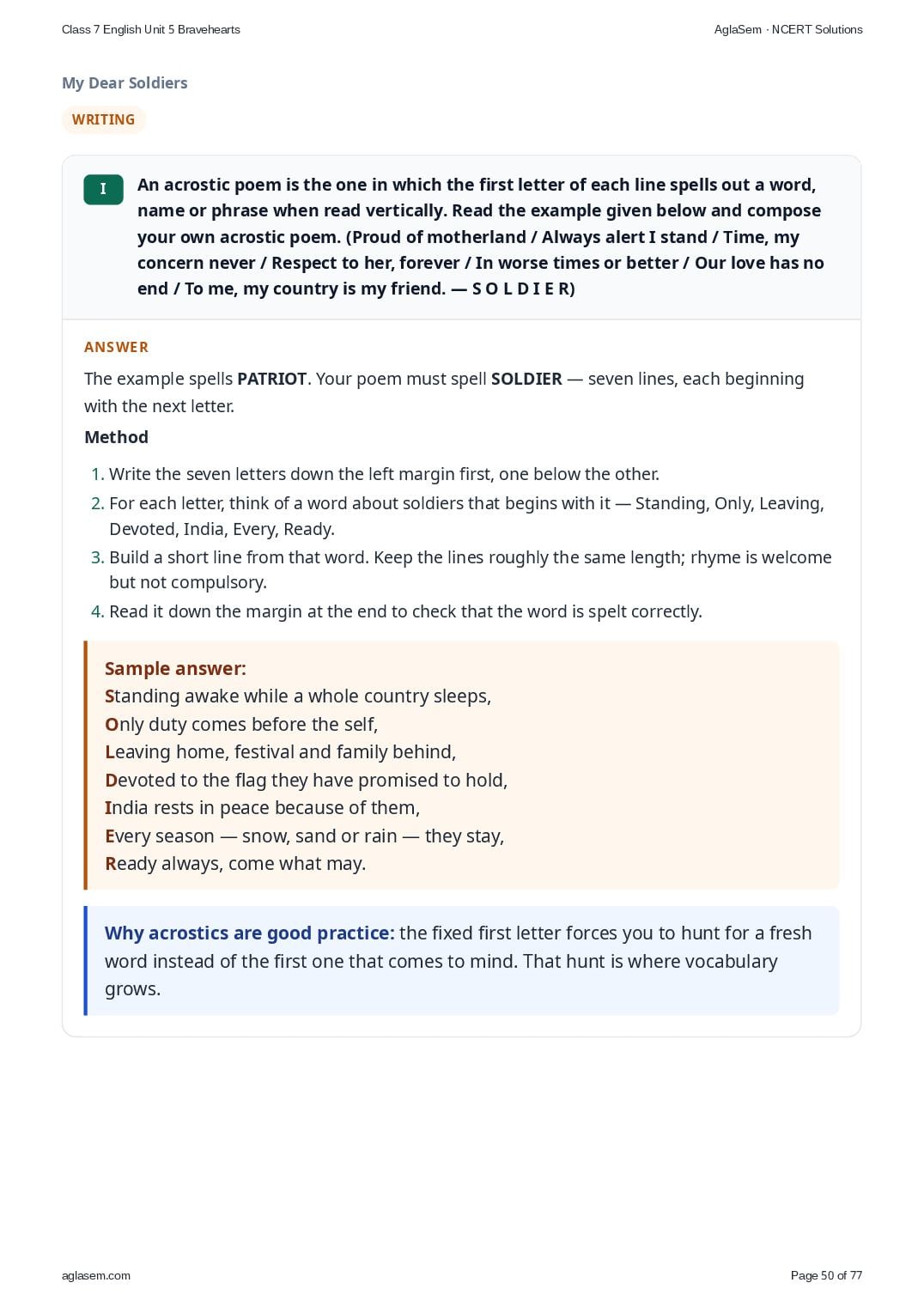
- An acrostic poem is the one in which the first letter of each line spells out a word, name or phrase when read vertically. Read the example given below and compose your own acrostic poem. (Proud of motherland / Always alert I stand / Time, my concern never / Respect to her, forever / In worse times or better / Our love has no end / To me, my country is my friend. — S O L D I E R)
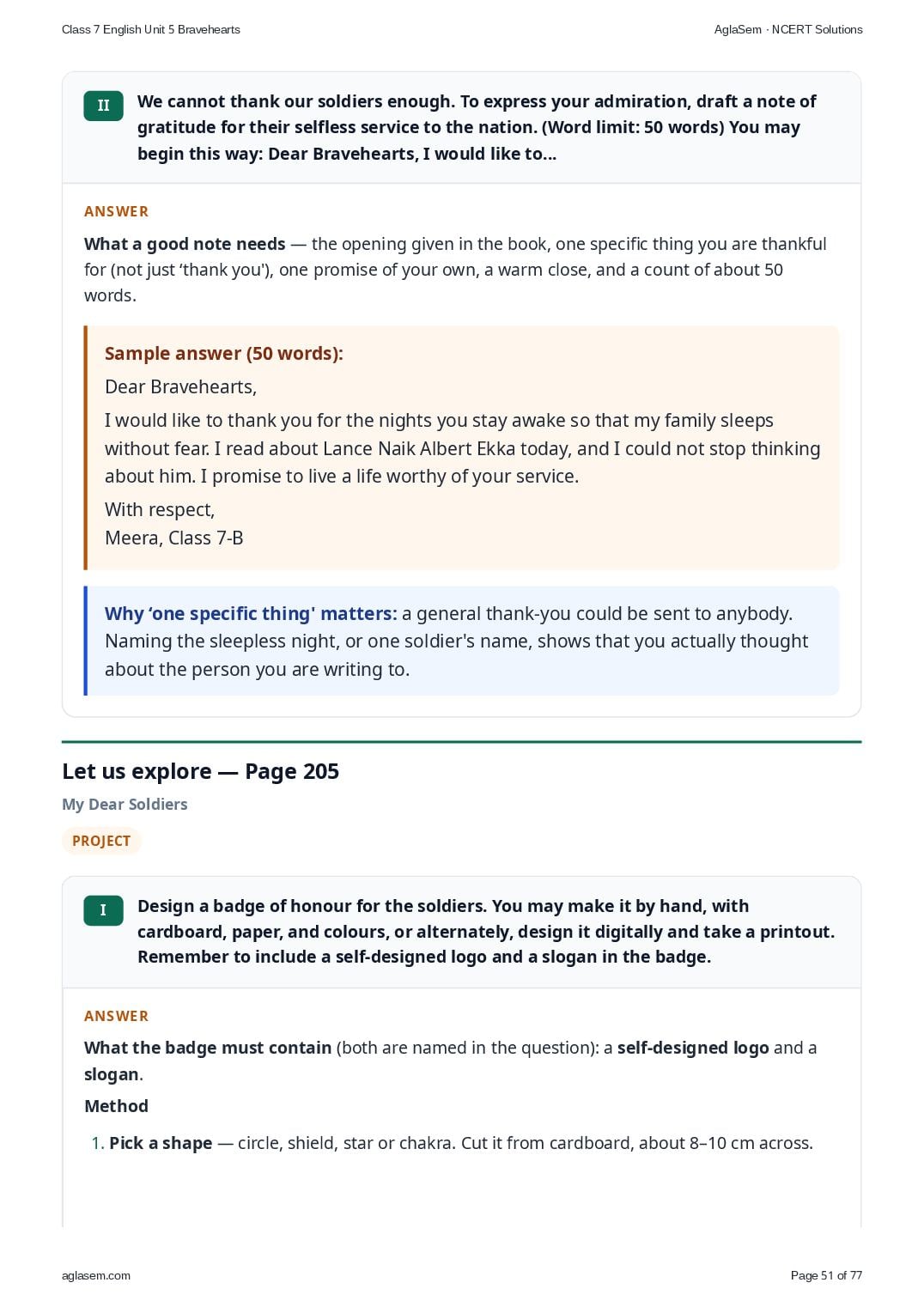
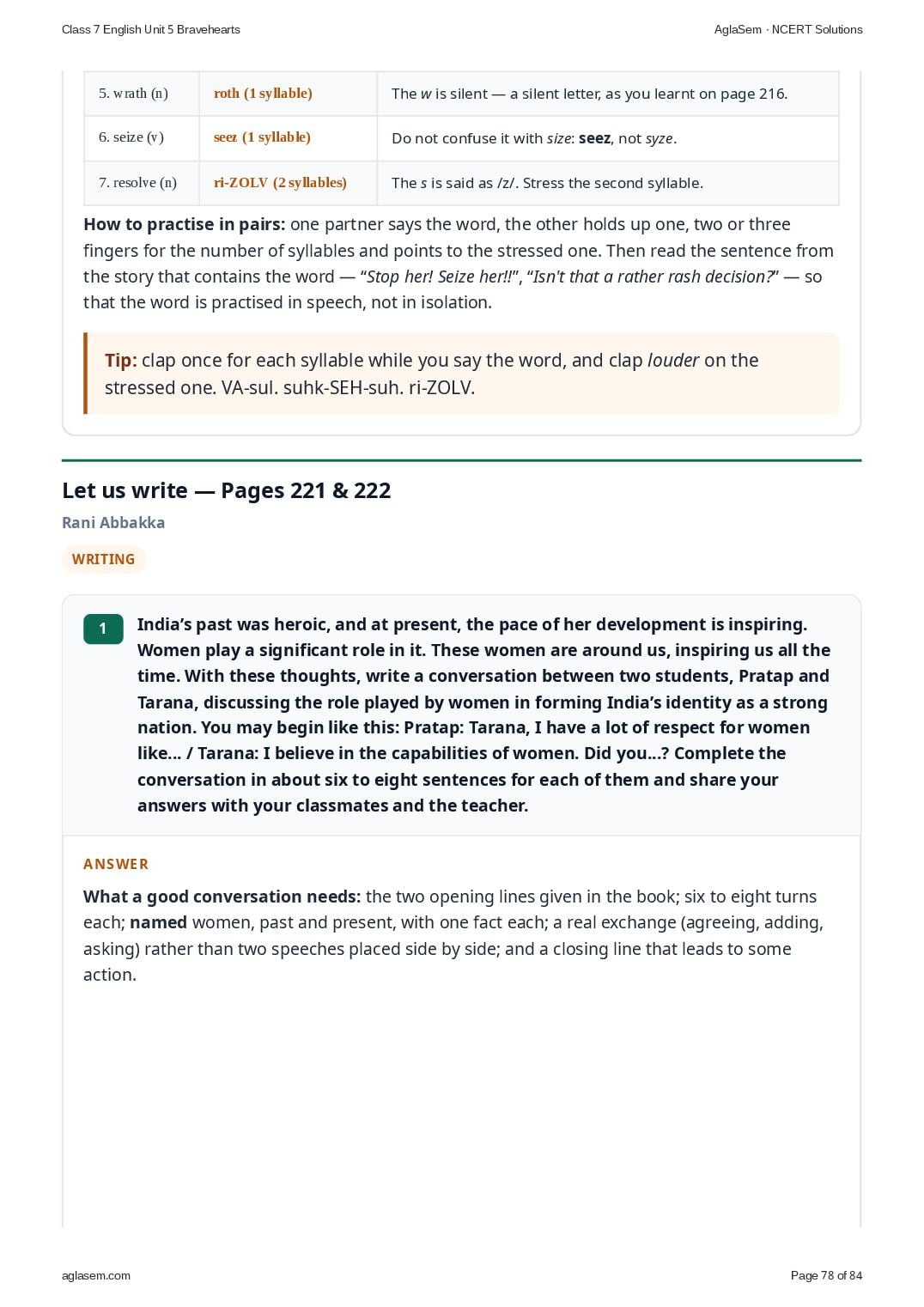
- We cannot thank our soldiers enough. To express your admiration, draft a note of gratitude for their selfless service to the nation. (Word limit: 50 words) You may begin this way: Dear Bravehearts, I would like to…
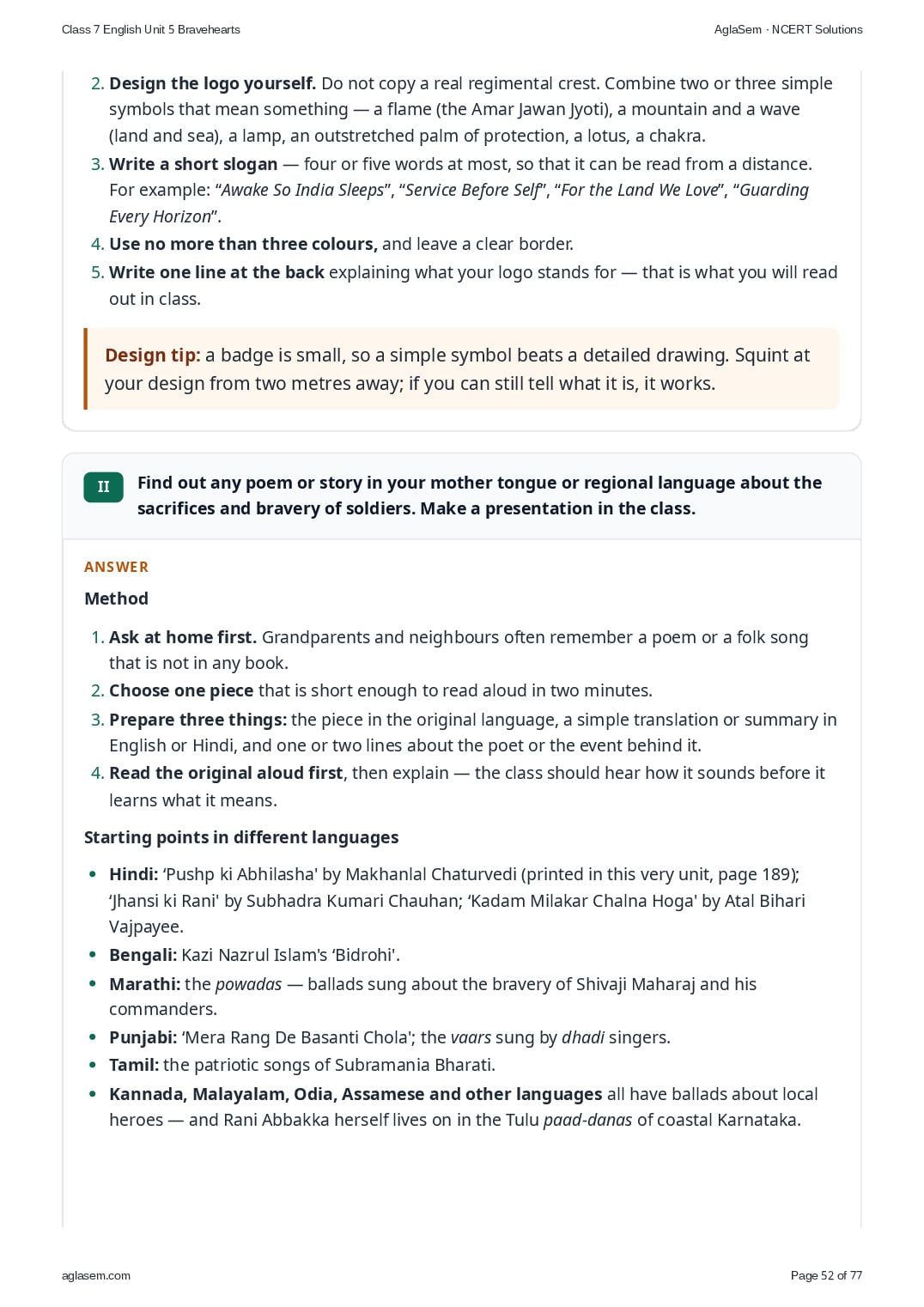
- Design a badge of honour for the soldiers. You may make it by hand, with cardboard, paper, and colours, or alternately, design it digitally and take a printout. Remember to include a self-designed logo and a slogan in the badge.
- Find out any poem or story in your mother tongue or regional language about the sacrifices and bravery of soldiers. Make a presentation in the class.
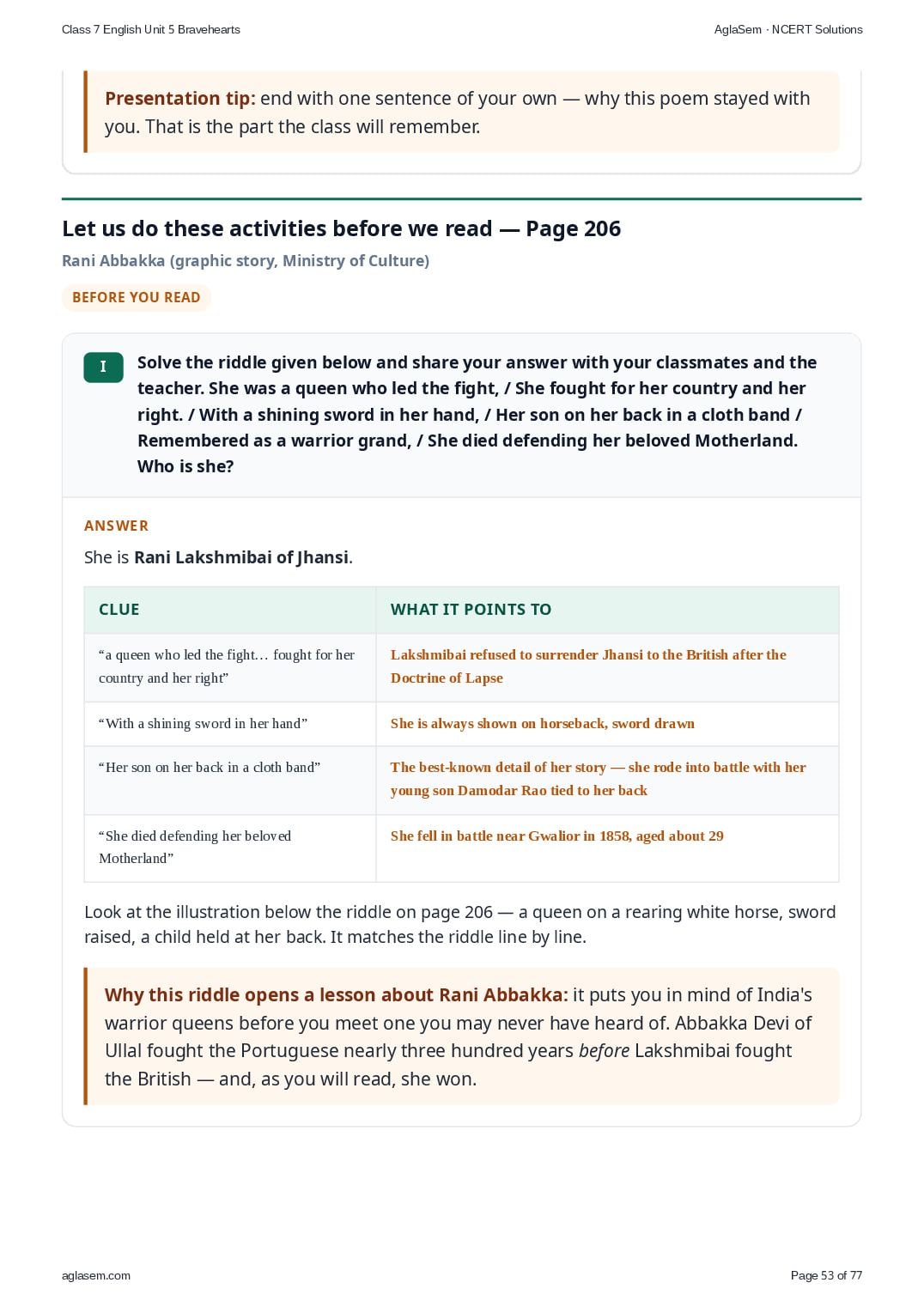
- Solve the riddle given below and share your answer with your classmates and the teacher. She was a queen who led the fight, / She fought for her country and her right. / With a shining sword in her hand, / Her son on her back in a cloth band / Remembered as a warrior grand, / She died defending her beloved Motherland. Who is she?
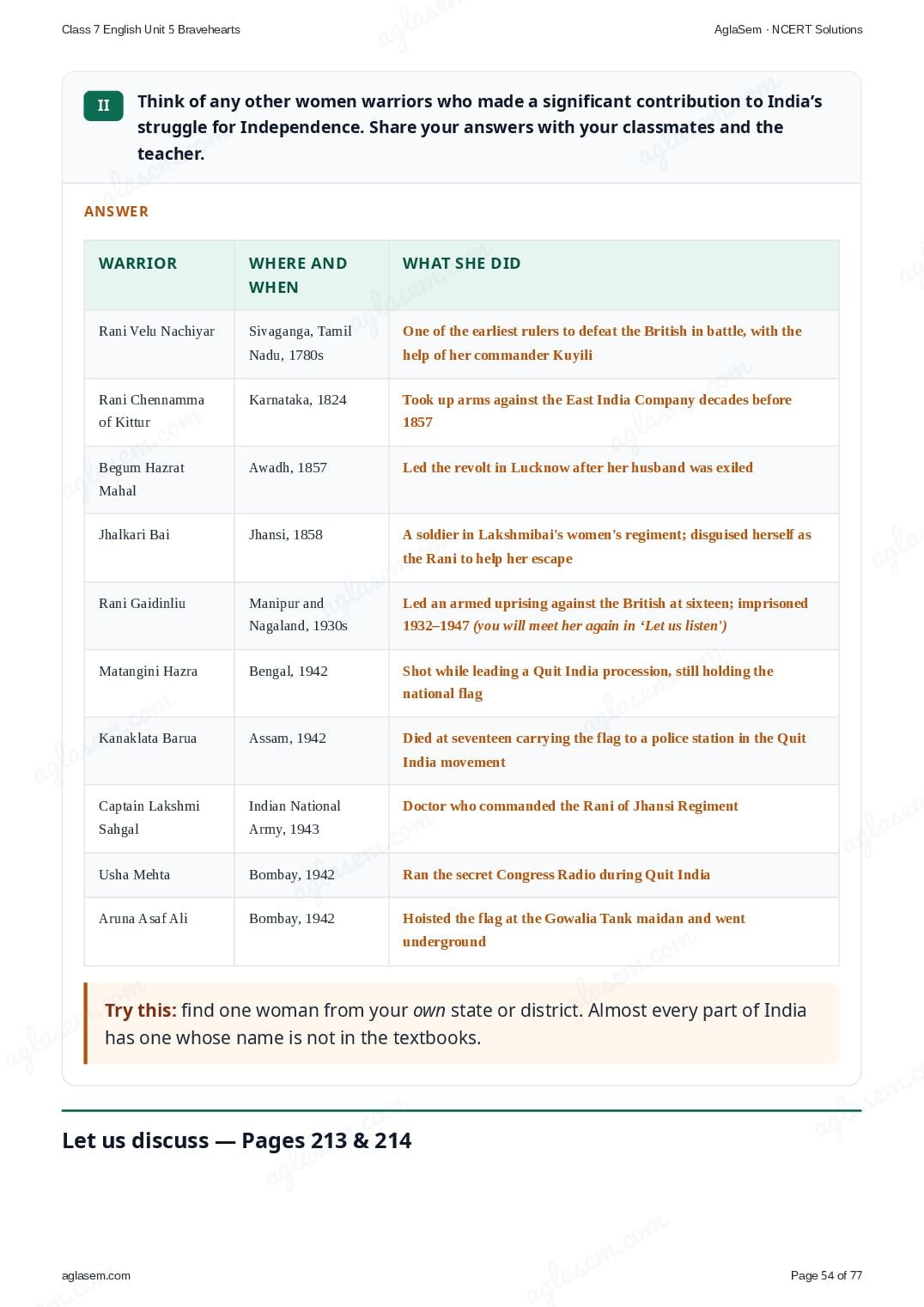
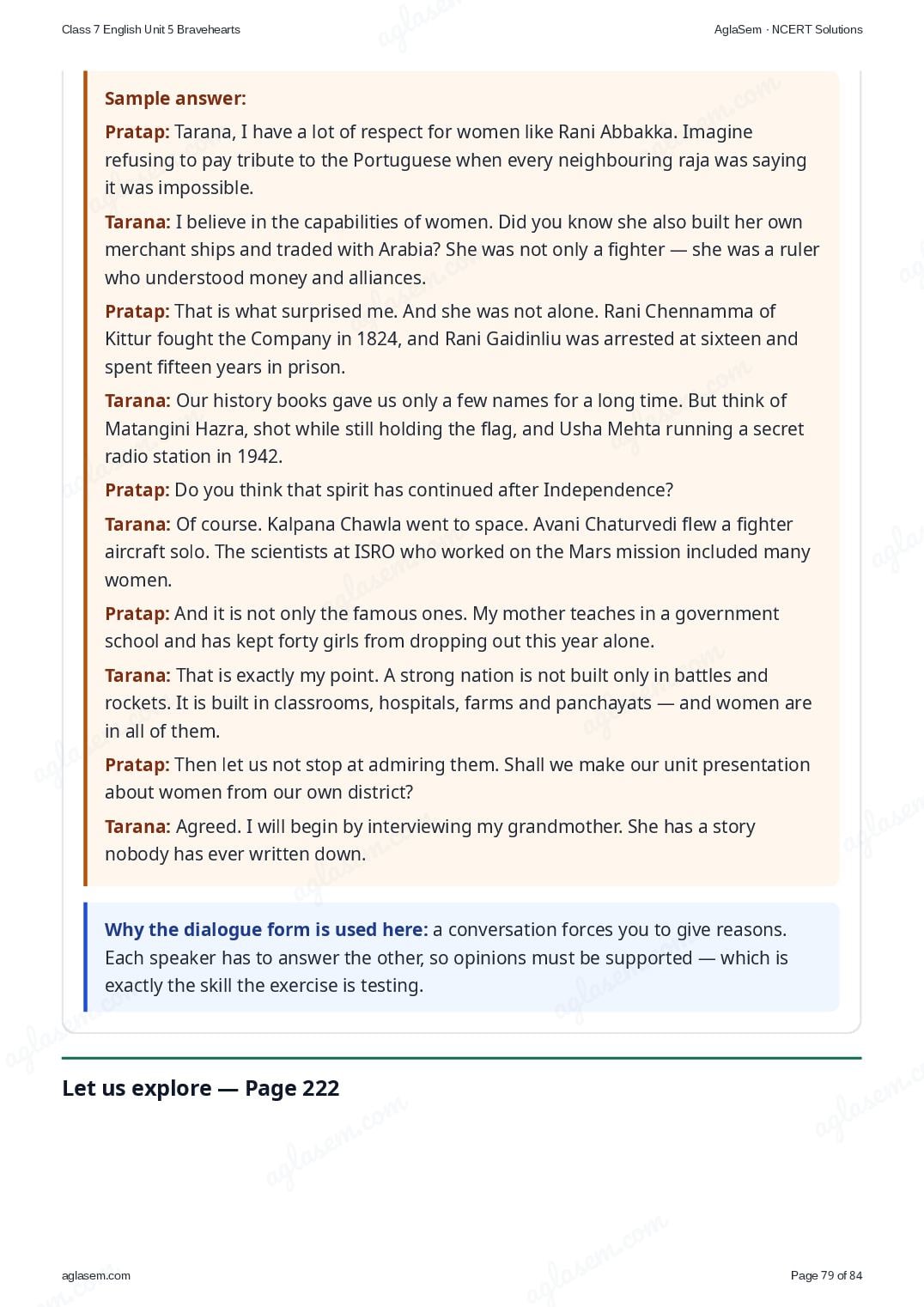
- Think of any other women warriors who made a significant contribution to India’s struggle for Independence. Share your answers with your classmates and the teacher.
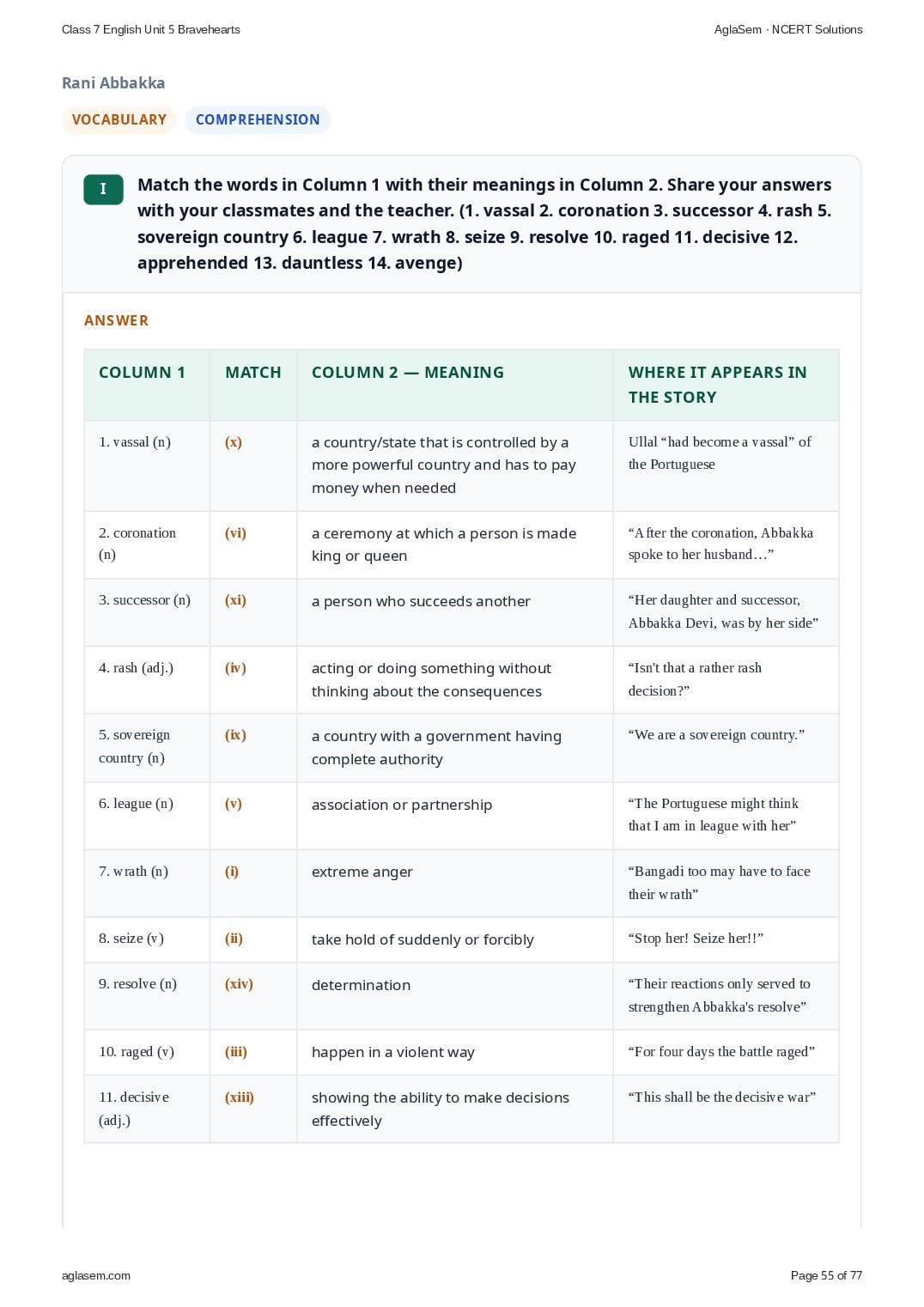
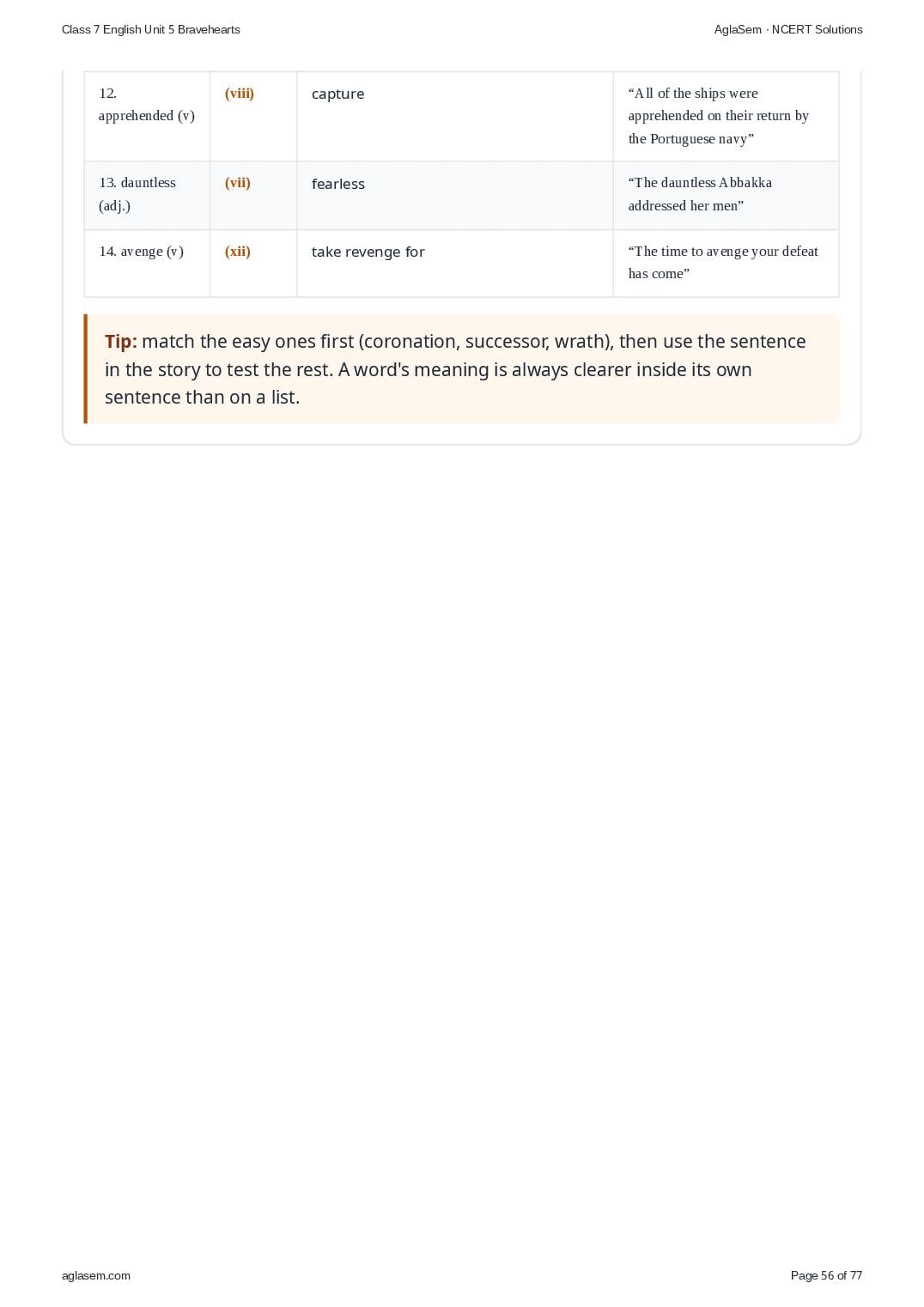
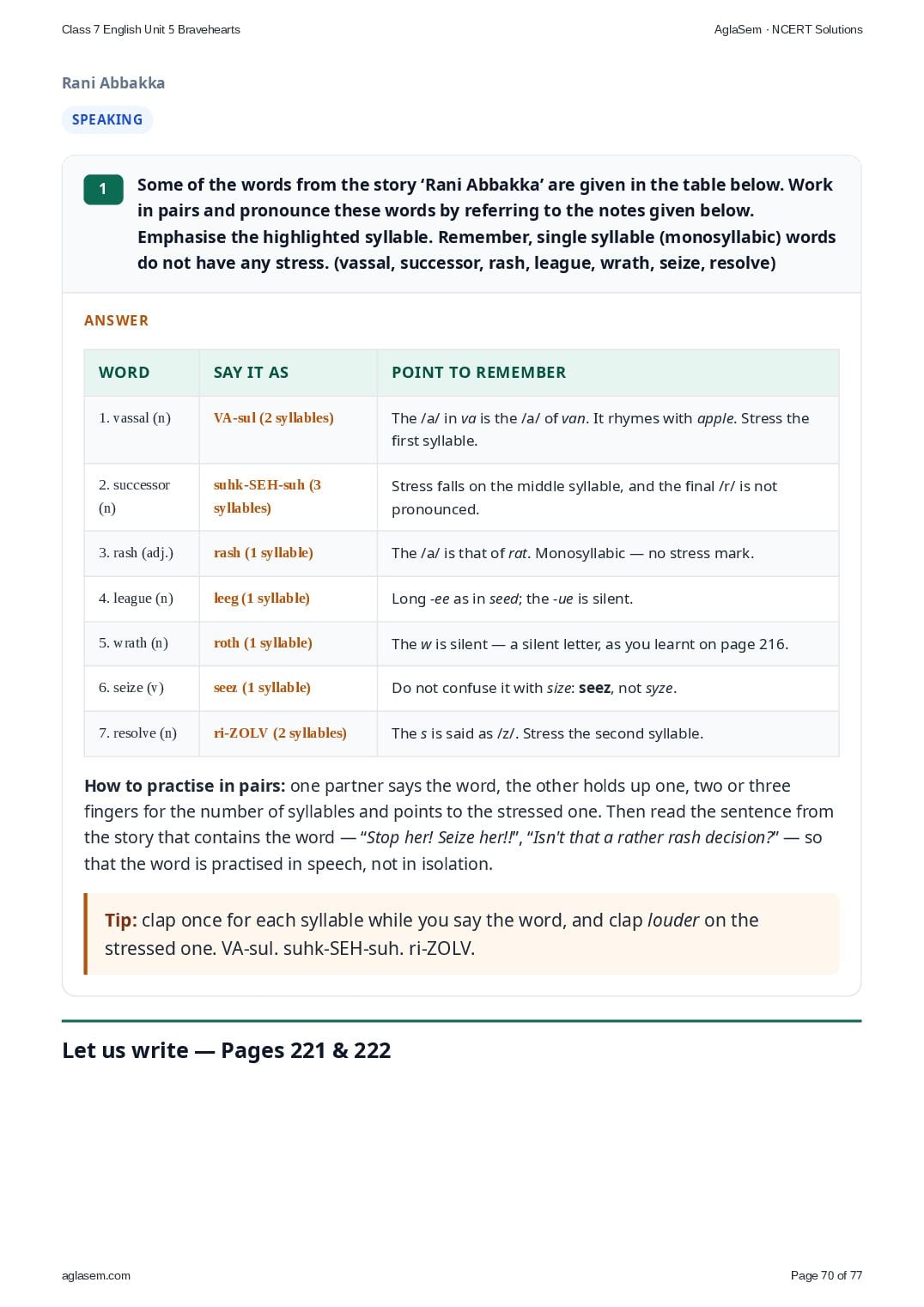
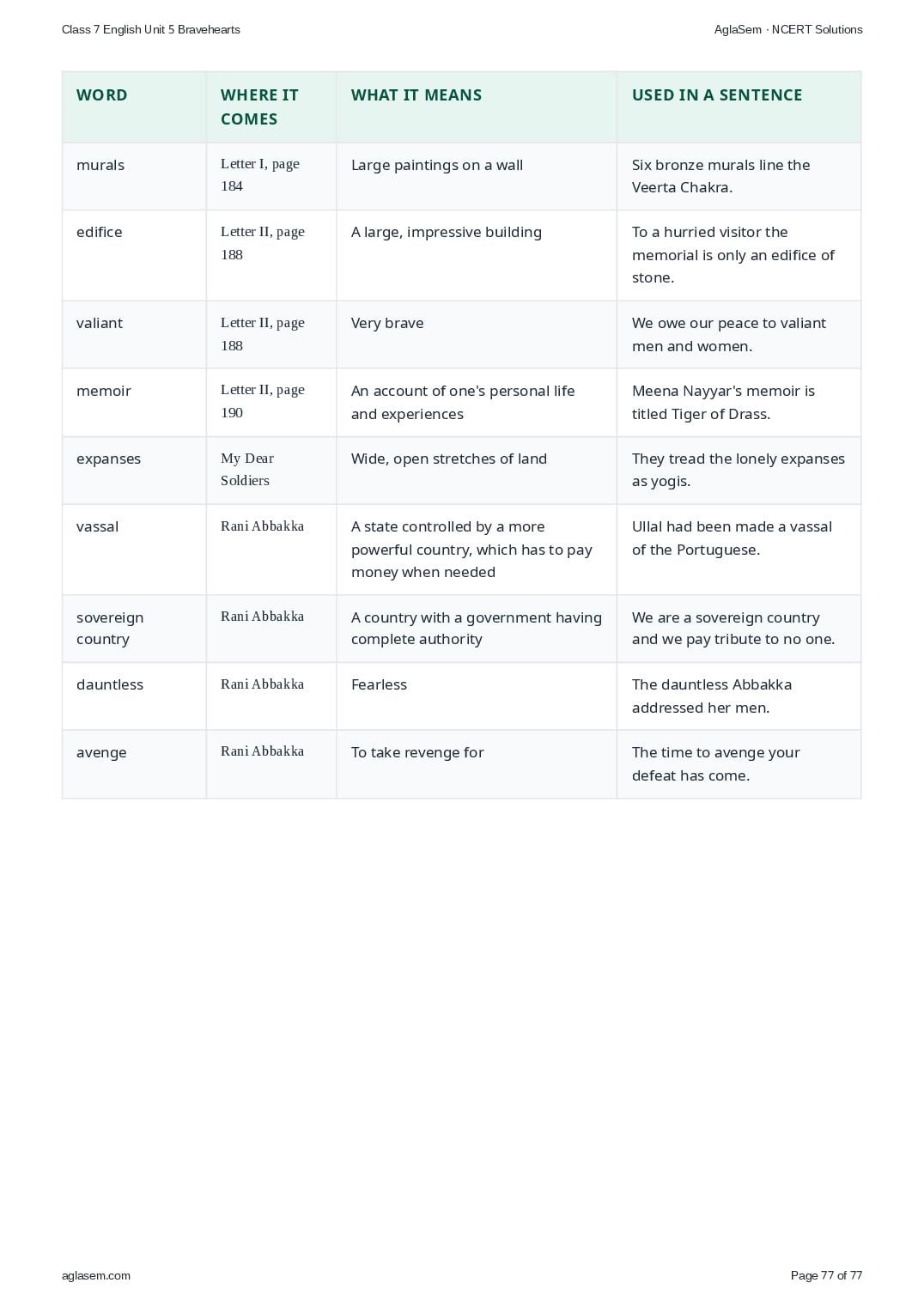
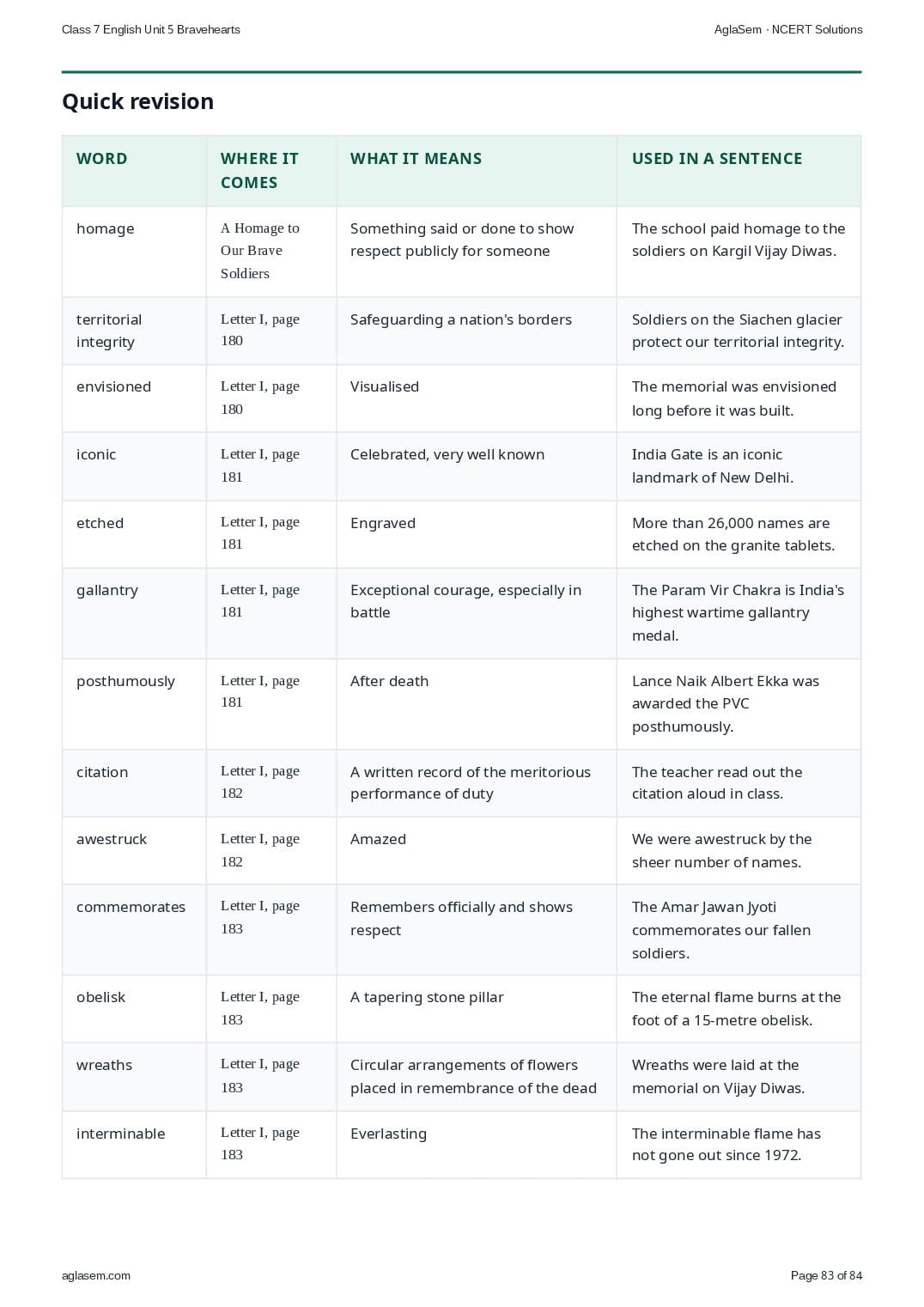
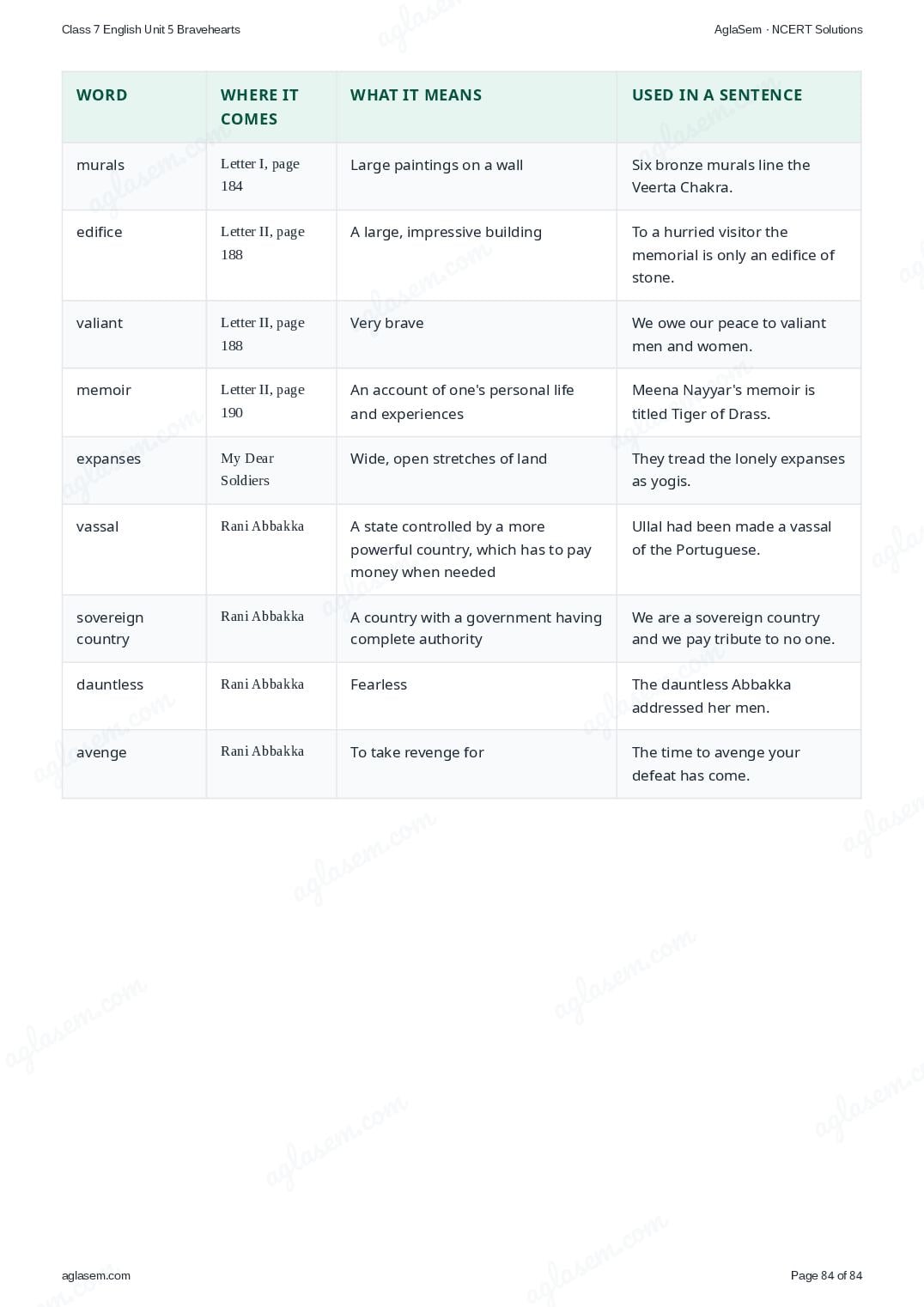
- Match the words in Column 1 with their meanings in Column 2. Share your answers with your classmates and the teacher. (1. vassal 2. coronation 3. successor 4. rash 5. sovereign country 6. league 7. wrath 8. seize 9. resolve 10. raged 11. decisive 12. apprehended 13. dauntless 14. avenge)
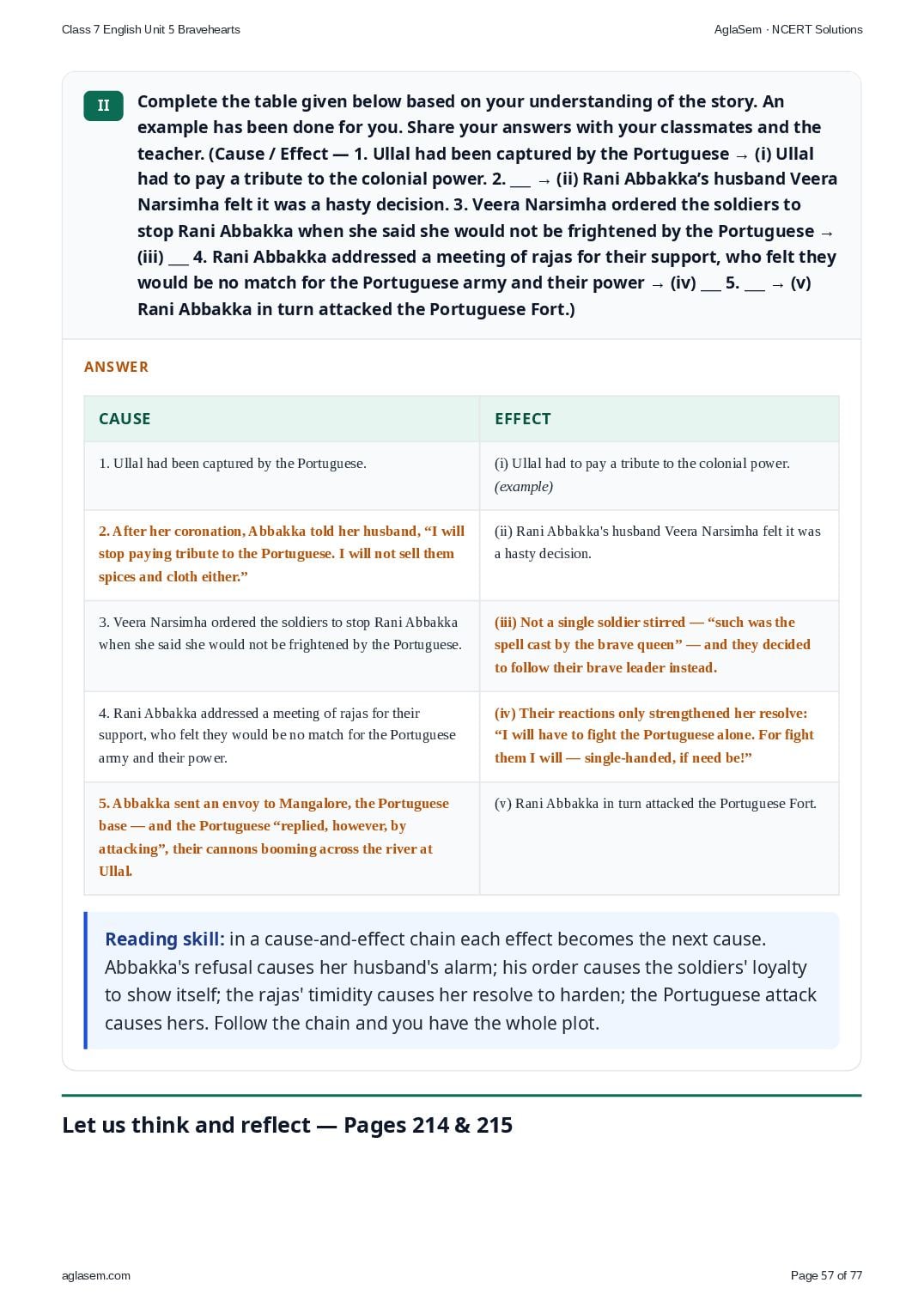
- Complete the table given below based on your understanding of the story. An example has been done for you. Share your answers with your classmates and the teacher. (Cause / Effect — 1. Ullal had been captured by the Portuguese → (i) Ullal had to pay a tribute to the colonial power. 2. ___ → (ii) Rani Abbakka’s husband Veera Narsimha felt it was a hasty decision. 3. Veera Narsimha ordered the soldiers to stop Rani Abbakka when she said she would not be frightened by the Portuguese → (iii) ___ 4. Rani Abbakka addressed a meeting of rajas for their support, who felt they would be no match for the Portuguese army and their power → (iv) ___ 5. ___ → (v) Rani Abbakka in turn attacked the Portuguese Fort.)
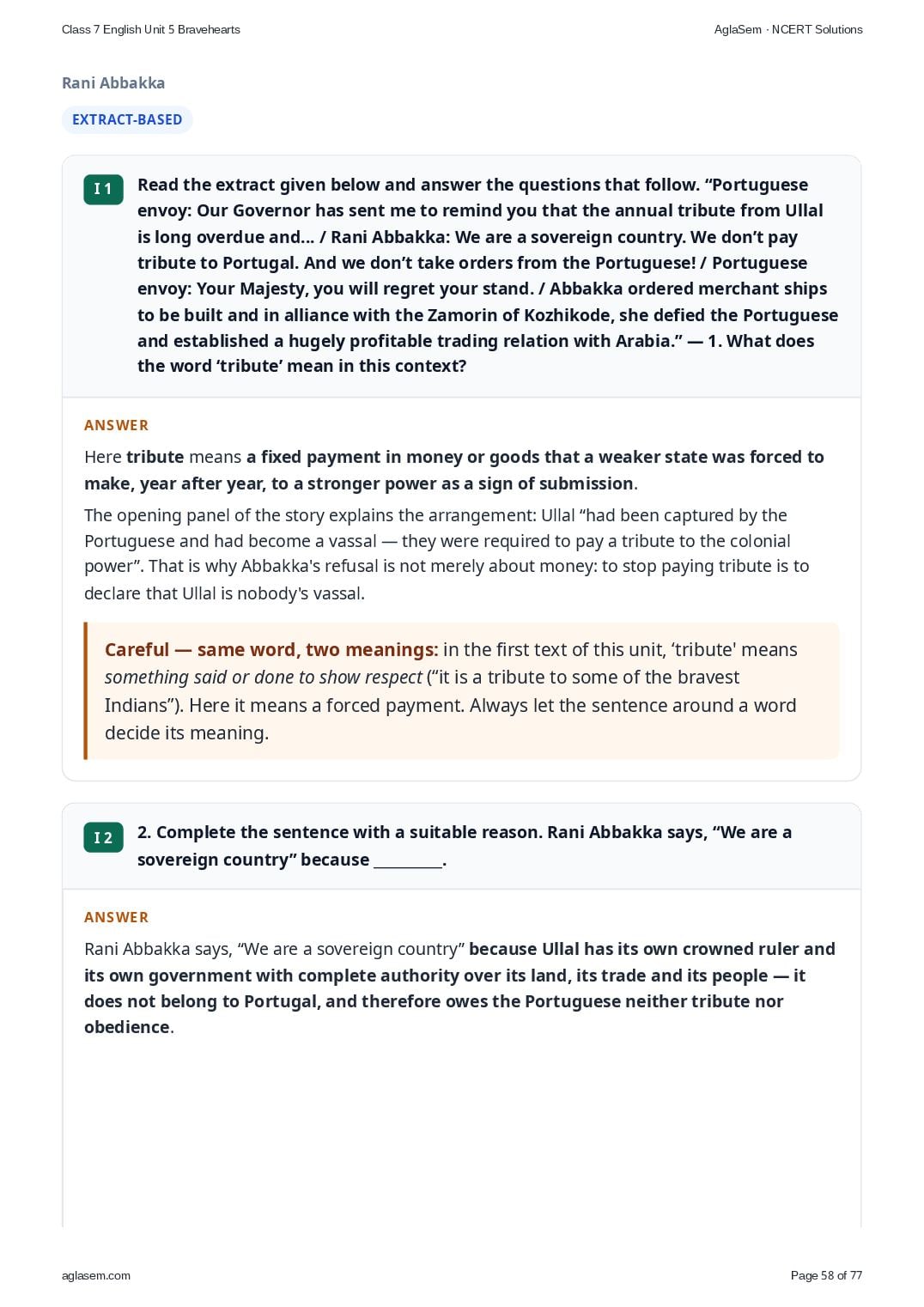
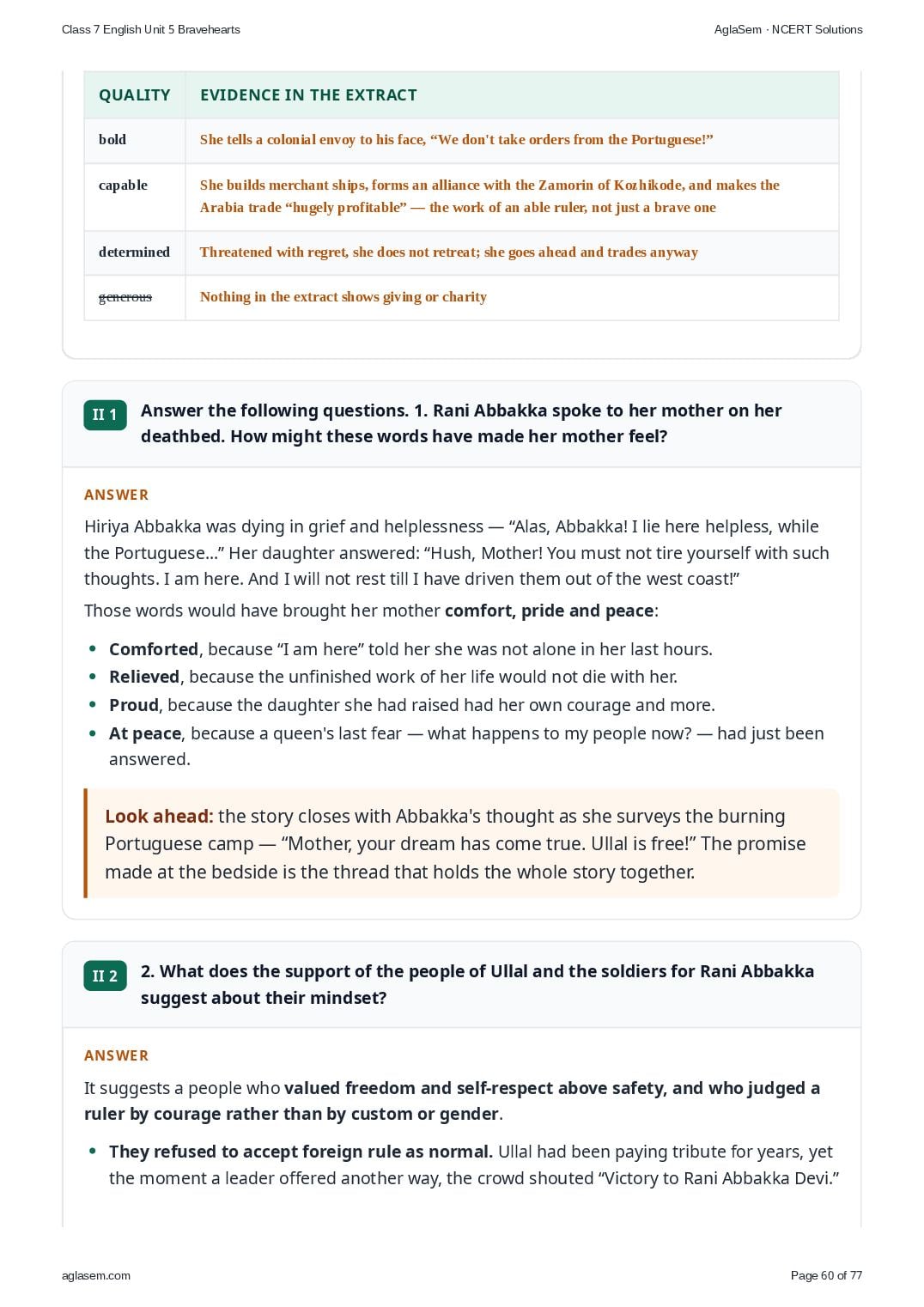
- Read the extract given below and answer the questions that follow. “Portuguese envoy: Our Governor has sent me to remind you that the annual tribute from Ullal is long overdue and… / Rani Abbakka: We are a sovereign country. We don’t pay tribute to Portugal. And we don’t take orders from the Portuguese! / Portuguese envoy: Your Majesty, you will regret your stand. / Abbakka ordered merchant ships to be built and in alliance with the Zamorin of Kozhikode, she defied the Portuguese and established a hugely profitable trading relation with Arabia.” — 1. What does the word ‘tribute’ mean in this context?
- 2. Complete the sentence with a suitable reason. Rani Abbakka says, “We are a sovereign country” because __________.
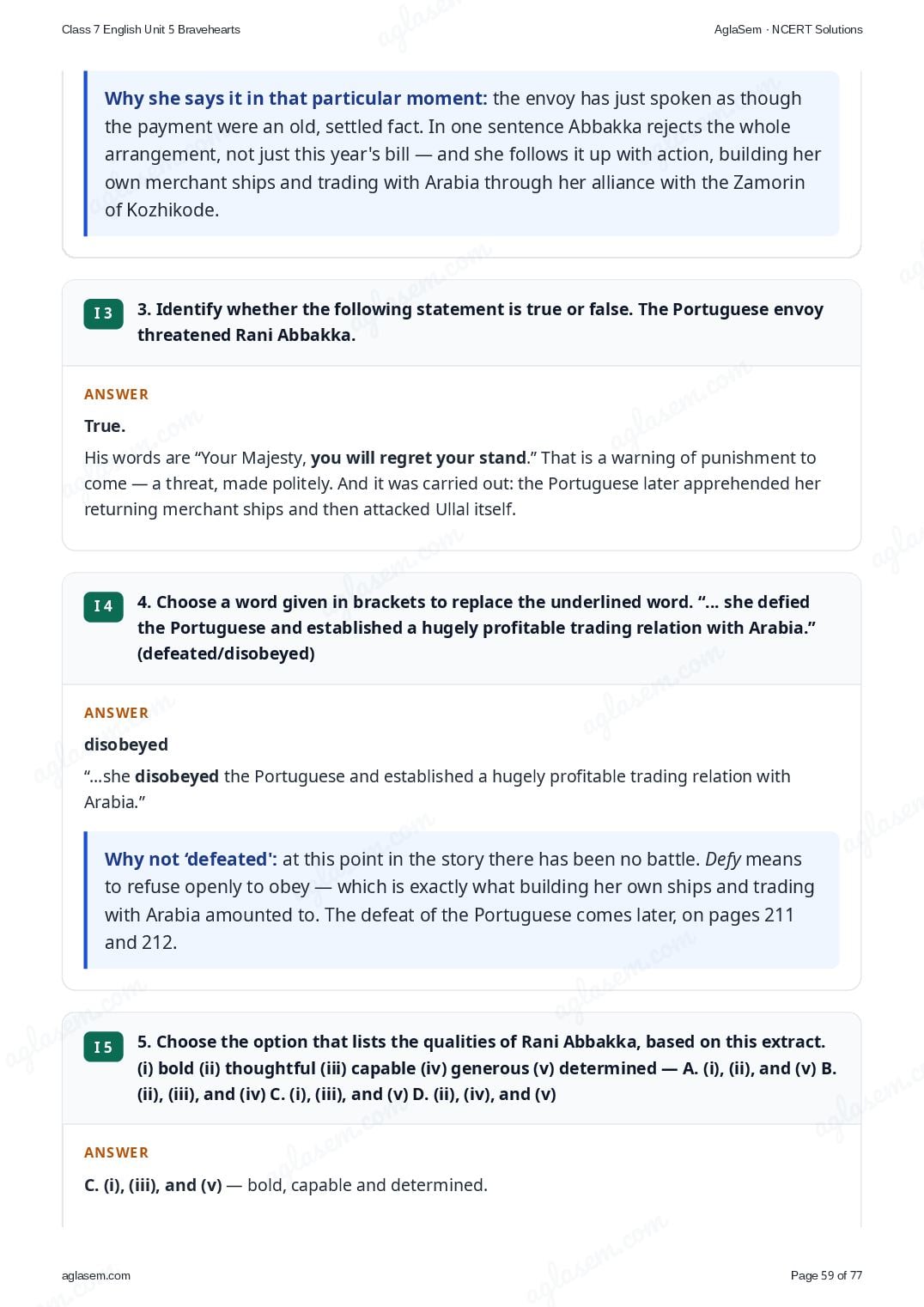
- 3. Identify whether the following statement is true or false. The Portuguese envoy threatened Rani Abbakka.
- 4. Choose a word given in brackets to replace the underlined word. “… she defied the Portuguese and established a hugely profitable trading relation with Arabia.” (defeated/disobeyed)
- 5. Choose the option that lists the qualities of Rani Abbakka, based on this extract. (i) bold (ii) thoughtful (iii) capable (iv) generous (v) determined — A. (i), (ii), and (v) B. (ii), (iii), and (iv) C. (i), (iii), and (v) D. (ii), (iv), and (v)
- Answer the following questions. 1. Rani Abbakka spoke to her mother on her deathbed. How might these words have made her mother feel?
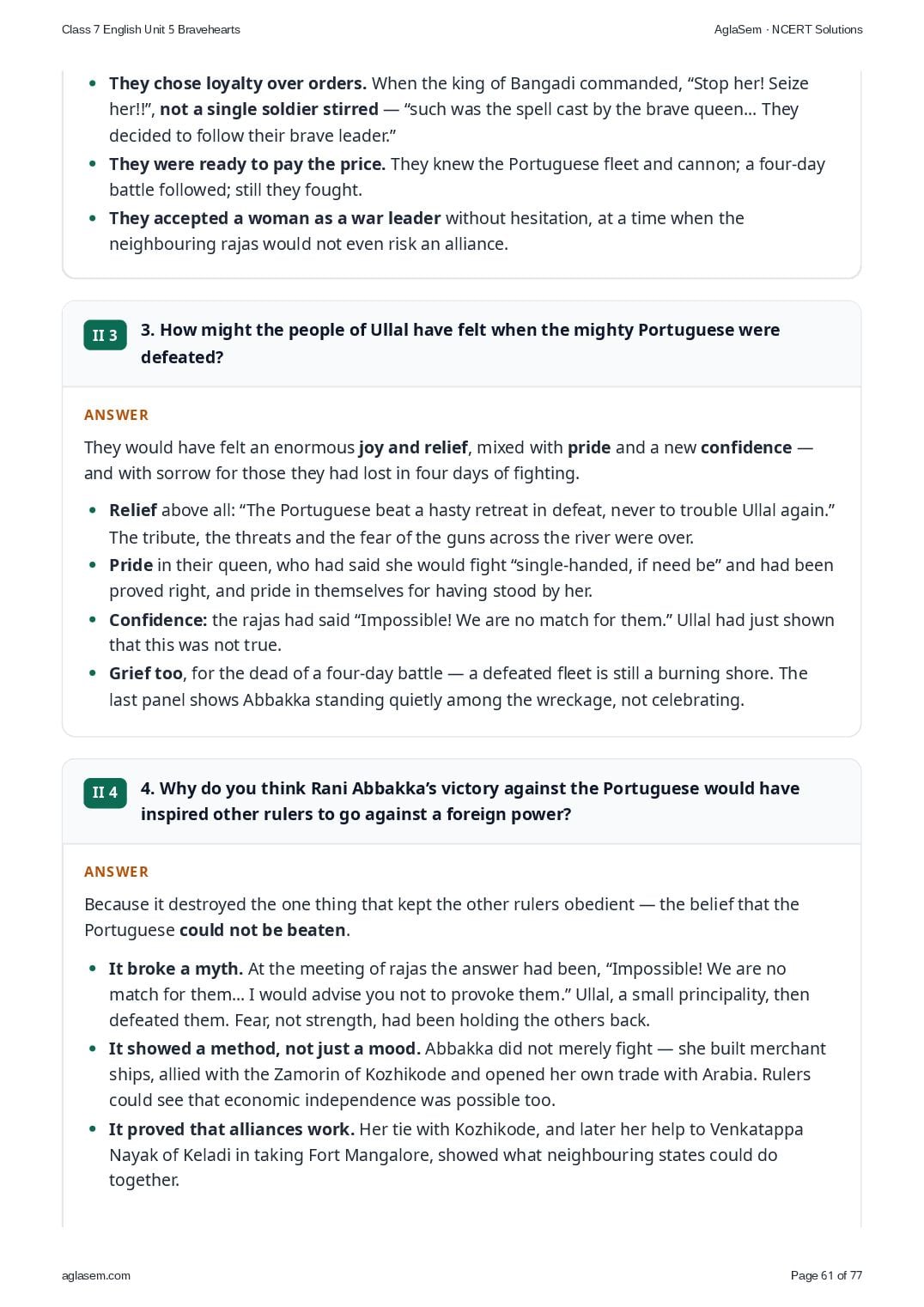
- 2. What does the support of the people of Ullal and the soldiers for Rani Abbakka suggest about their mindset?
- 3. How might the people of Ullal have felt when the mighty Portuguese were defeated?
- 4. Why do you think Rani Abbakka’s victory against the Portuguese would have inspired other rulers to go against a foreign power?
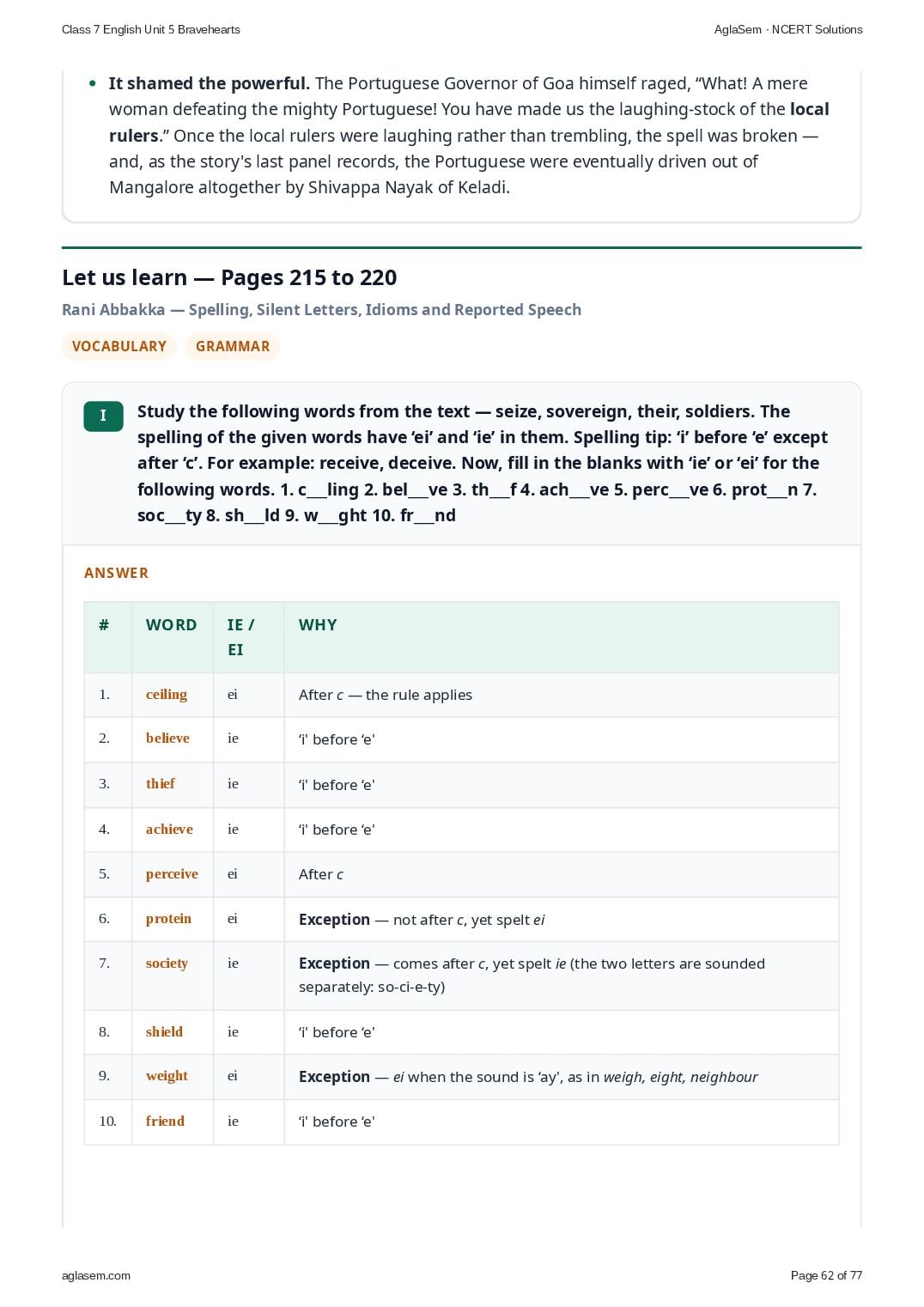
- Study the following words from the text — seize, sovereign, their, soldiers. The spelling of the given words have ‘ei’ and ‘ie’ in them. Spelling tip: ‘i’ before ‘e’ except after ‘c’. For example: receive, deceive. Now, fill in the blanks with ‘ie’ or ‘ei’ for the following words. 1. c___ling 2. bel___ve 3. th___f 4. ach___ve 5. perc___ve 6. prot___n 7. soc___ty 8. sh___ld 9. w___ght 10. fr___nd
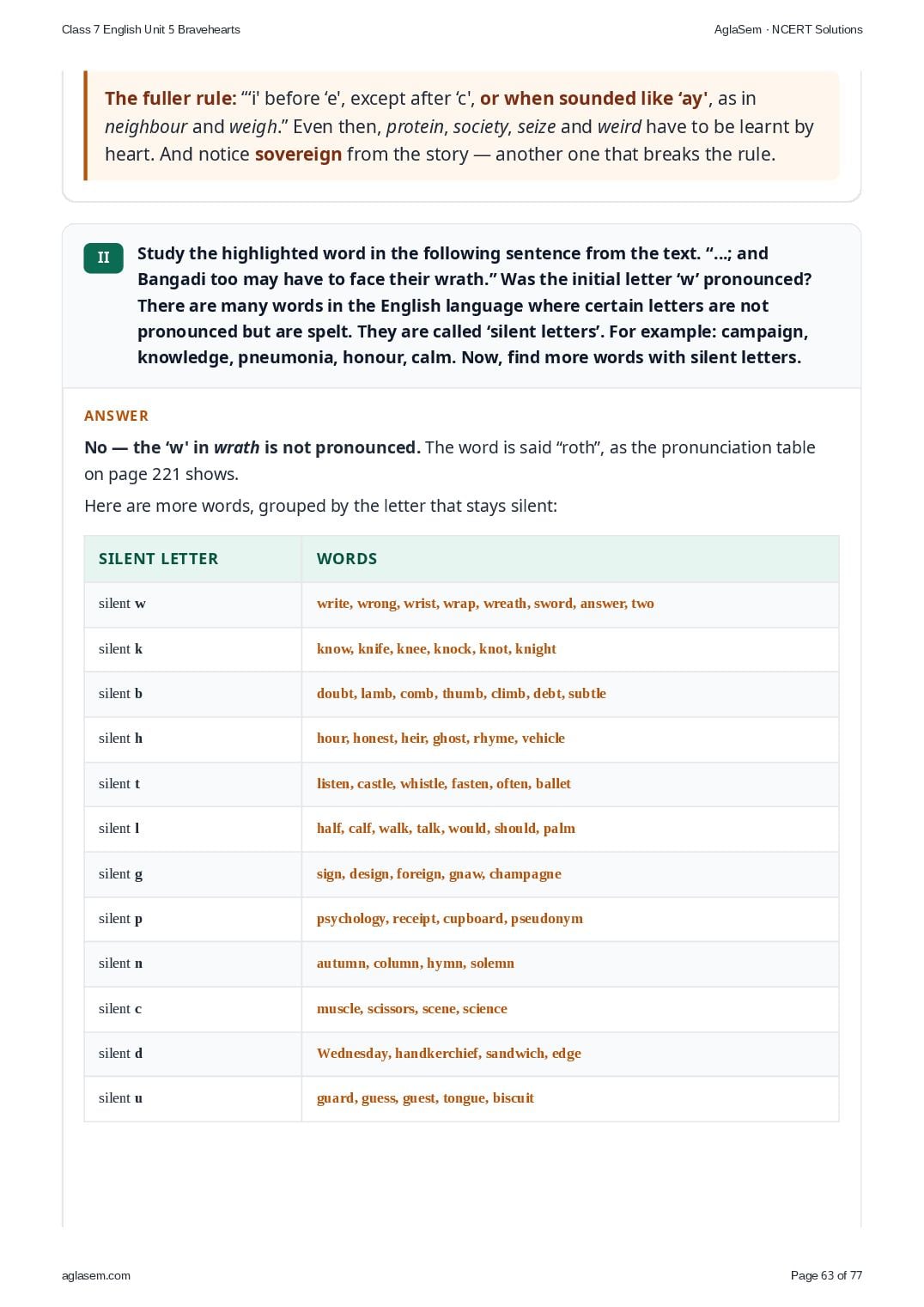
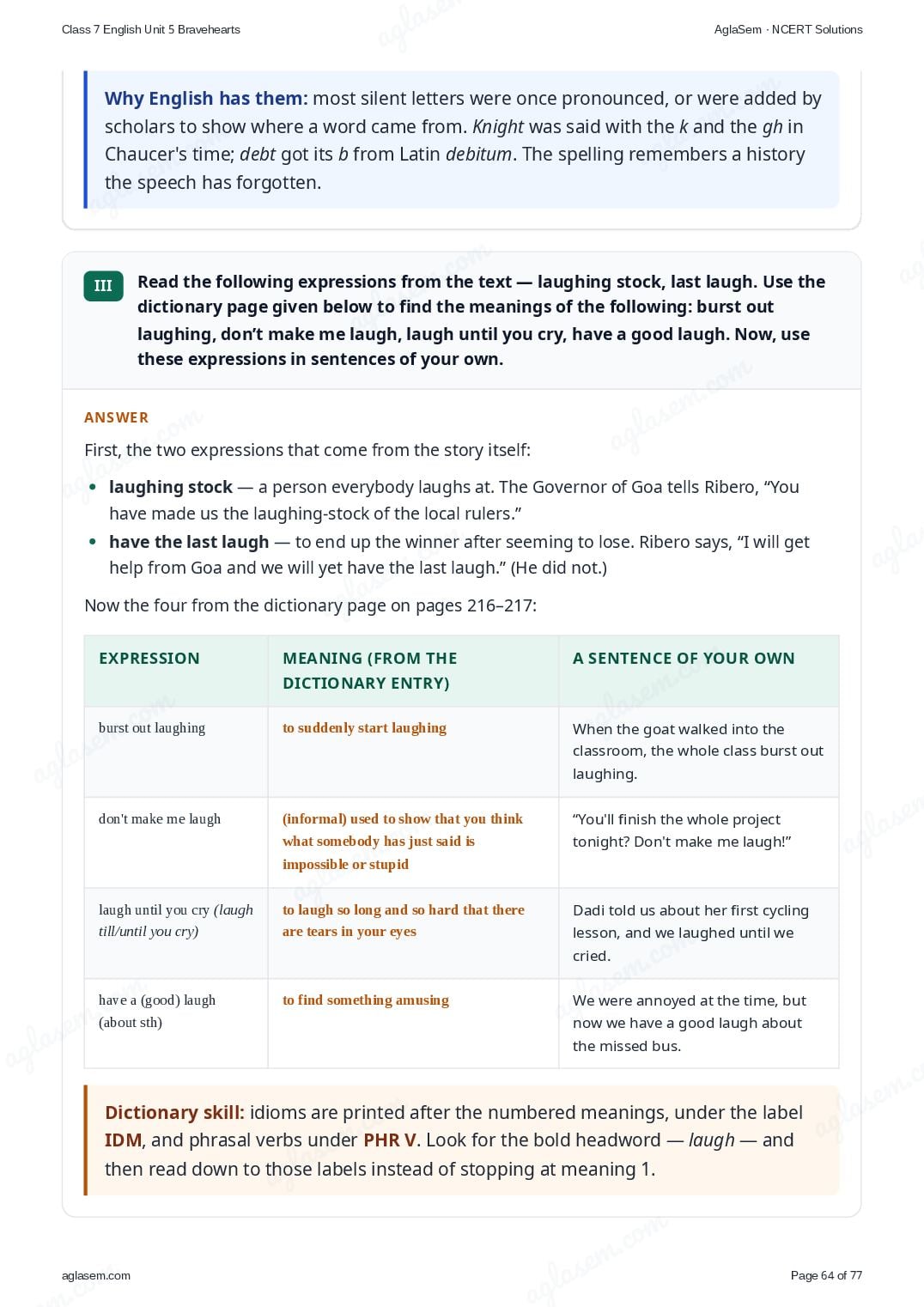
- Study the highlighted word in the following sentence from the text. “…; and Bangadi too may have to face their wrath.” Was the initial letter ‘w’ pronounced? There are many words in the English language where certain letters are not pronounced but are spelt. They are called ‘silent letters’. For example: campaign, knowledge, pneumonia, honour, calm. Now, find more words with silent letters.
- Read the following expressions from the text — laughing stock, last laugh. Use the dictionary page given below to find the meanings of the following: burst out laughing, don’t make me laugh, laugh until you cry, have a good laugh. Now, use these expressions in sentences of your own.
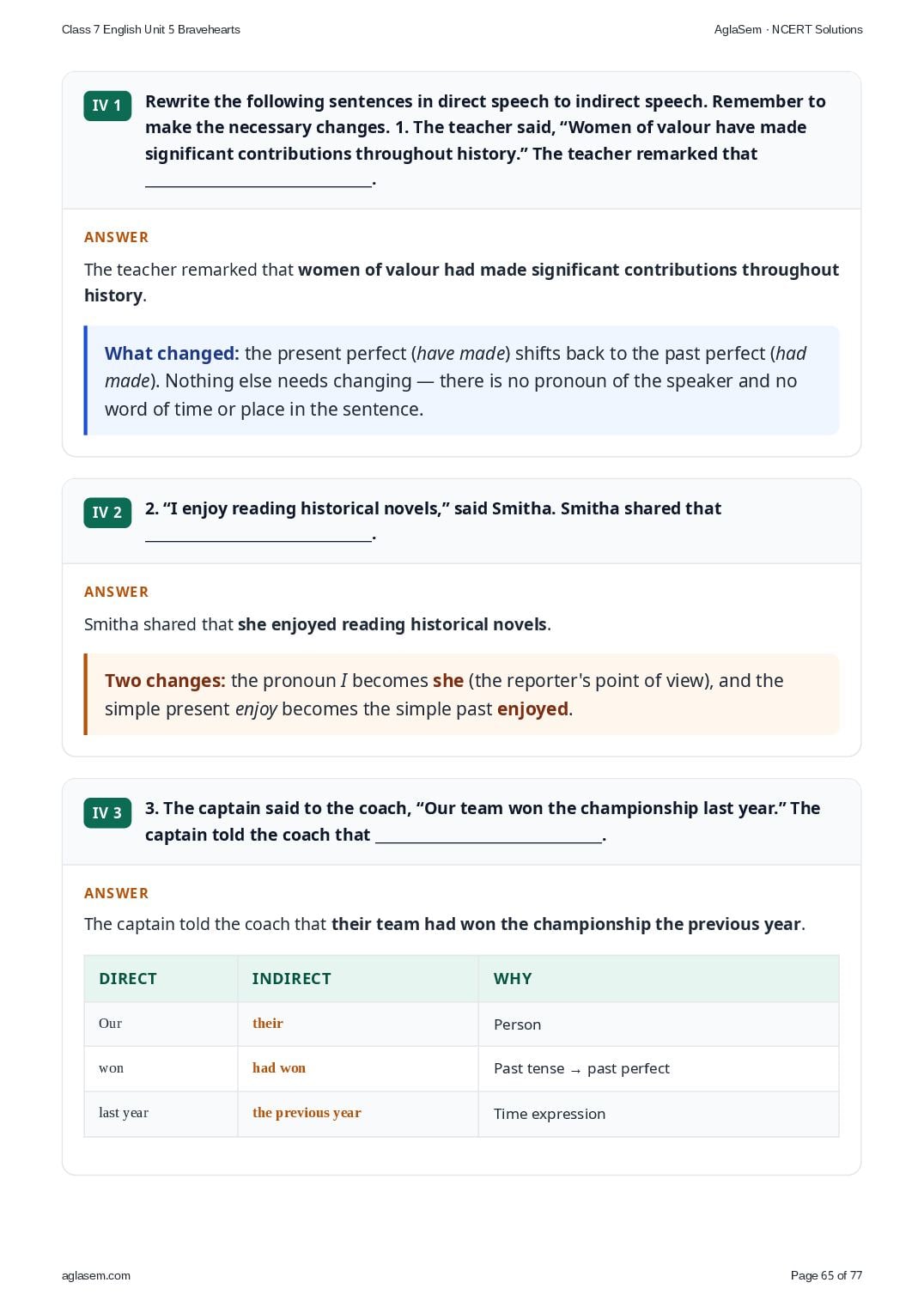
- Rewrite the following sentences in direct speech to indirect speech. Remember to make the necessary changes. 1. The teacher said, “Women of valour have made significant contributions throughout history.” The teacher remarked that _________________________________.
- 2. “I enjoy reading historical novels,” said Smitha. Smitha shared that _________________________________.
- 3. The captain said to the coach, “Our team won the championship last year.” The captain told the coach that _________________________________.
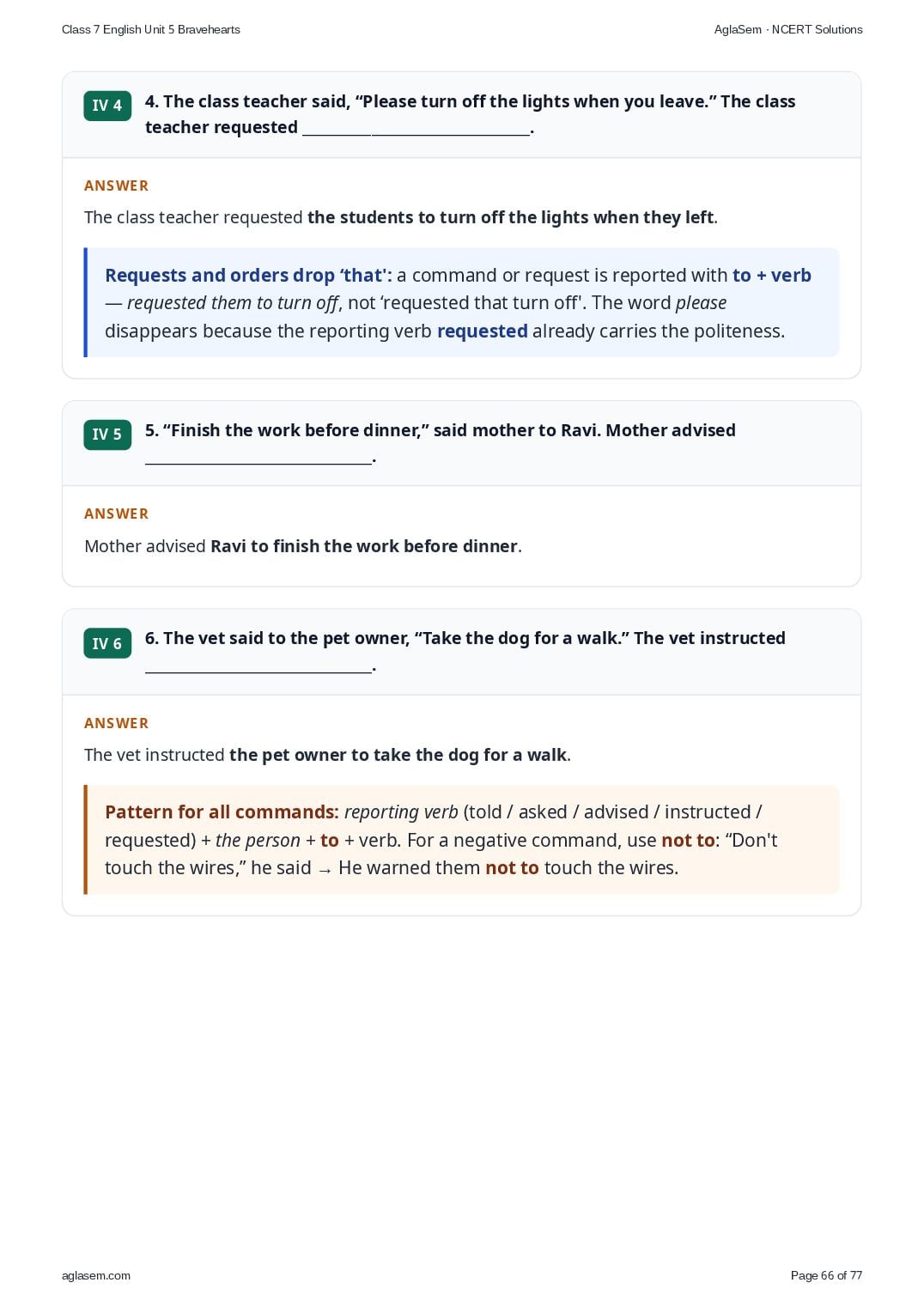
- 4. The class teacher said, “Please turn off the lights when you leave.” The class teacher requested _________________________________.
- 5. “Finish the work before dinner,” said mother to Ravi. Mother advised _________________________________.
- 6. The vet said to the pet owner, “Take the dog for a walk.” The vet instructed _________________________________.
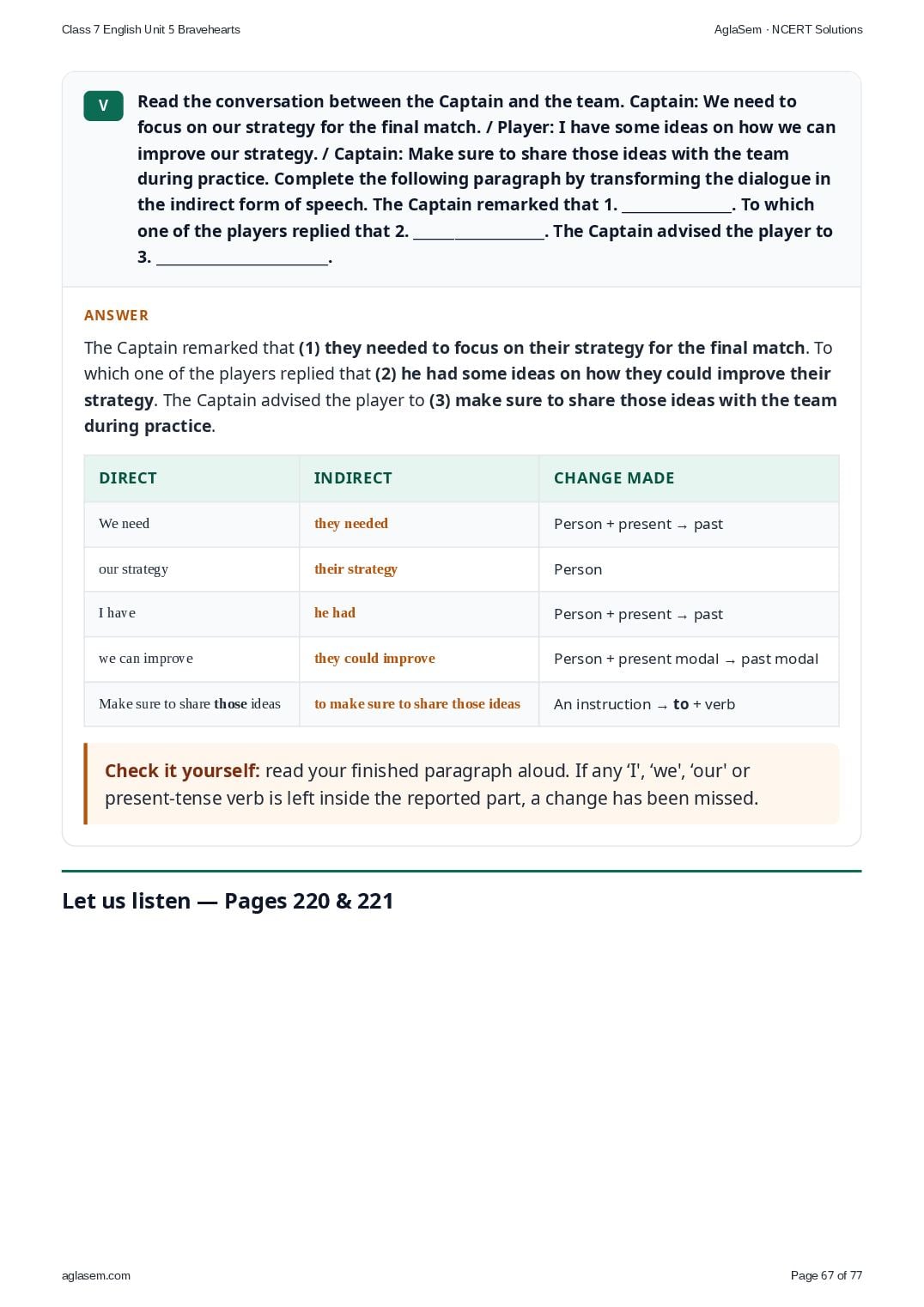
- … and more questions — see the complete solutions above.
Chapter at a Glance
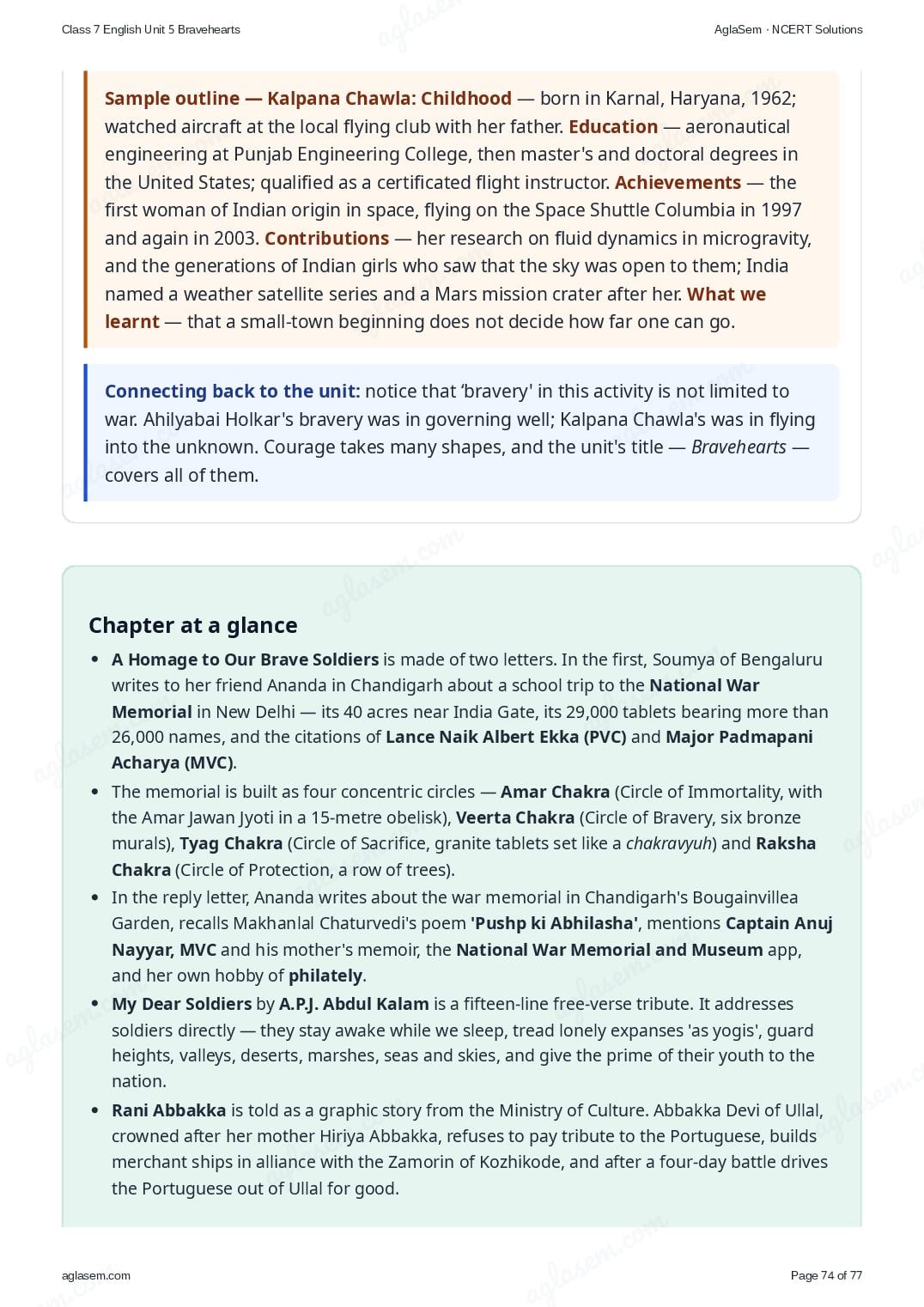
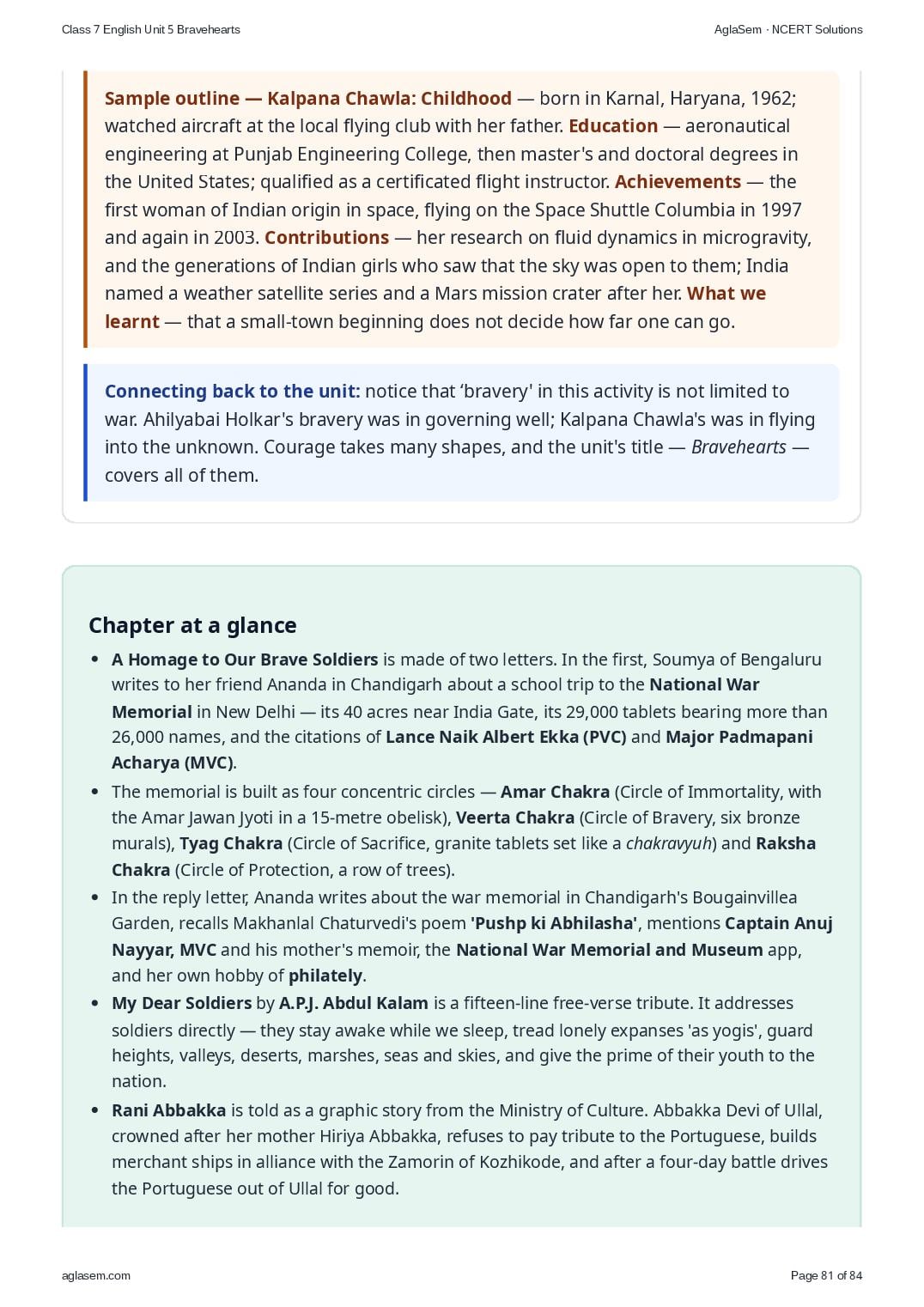
- A Homage to Our Brave Soldiers is made of two letters. In the first, Soumya of Bengaluru writes to her friend Ananda in Chandigarh about a school trip to the National War Memorial in New Delhi — its 40 acres near India Gate, its 29,000 tablets bearing more than 26,000 names, and the citations of Lance Naik Albert Ekka (PVC) and Major Padmapani Acharya (MVC) .
- The memorial is built as four concentric circles — Amar Chakra (Circle of Immortality, with the Amar Jawan Jyoti in a 15-metre obelisk), Veerta Chakra (Circle of Bravery, six bronze murals), Tyag Chakra (Circle of Sacrifice, granite tablets set like a chakravyuh ) and Raksha Chakra (Circle of Protection, a row of trees).
- In the reply letter, Ananda writes about the war memorial in Chandigarh's Bougainvillea Garden, recalls Makhanlal Chaturvedi's poem 'Pushp ki Abhilasha' , mentions Captain Anuj Nayyar, MVC and his mother's memoir, the National War Memorial and Museum app, and her own hobby of philately .
- My Dear Soldiers by A.P.J. Abdul Kalam is a fifteen-line free-verse tribute. It addresses soldiers directly — they stay awake while we sleep, tread lonely expanses 'as yogis', guard heights, valleys, deserts, marshes, seas and skies, and give the prime of their youth to the nation.
- Rani Abbakka is told as a graphic story from the Ministry of Culture. Abbakka Devi of Ullal, crowned after her mother Hiriya Abbakka, refuses to pay tribute to the Portuguese, builds merchant ships in alliance with the Zamorin of Kozhikode, and after a four-day battle drives the Portuguese out of Ullal for good.
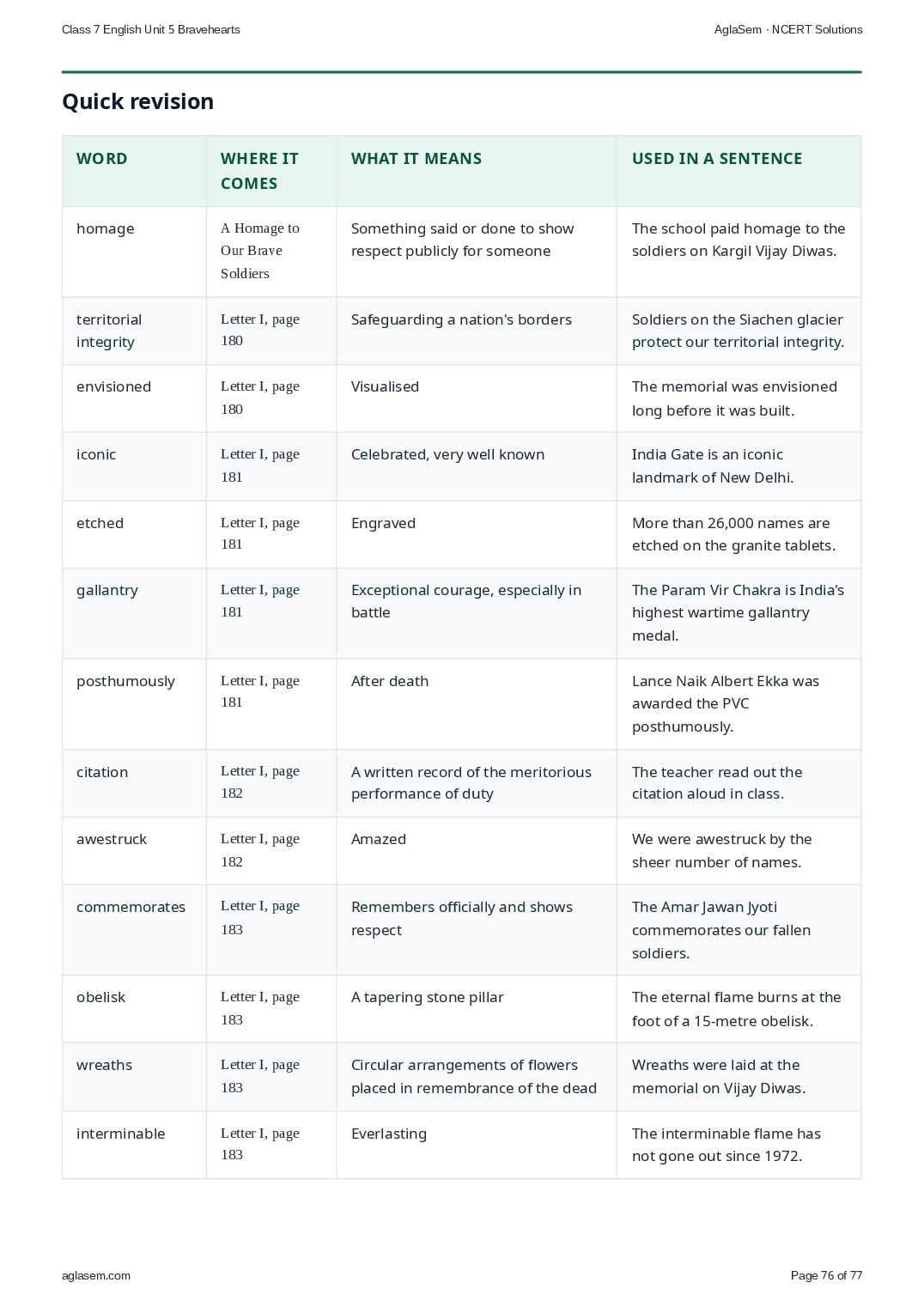
- The language work of the unit covers prefixes , words for bravery and their opposites, main and subordinate clauses with subordinating conjunctions, collocations , the 'i' before 'e' spelling rule, silent letters , dictionary idioms with laugh , and direct and indirect speech .
How to Download NCERT Solutions for Class 7 English Chapter 5 PDF
Follow these simple steps to get the Bravehearts questions-and-answers PDF from Poorvi.
- Search NCERT Solutions for Class 7 English Chapter 5 aglasem and open this page.
- Read the exercise questions with answers for Bravehearts shown above.
- Click the Download PDF link to save the Bravehearts solutions to your device.
NCERT Solutions for Class 7 English – All Chapters
There are more chapters to study besides Bravehearts in English. Here are the NCERT Solutions for all chapters of Class 7 English.
- Chapter 1 Learning Together
- Chapter 2 Wit and Humour
- Chapter 3 Dreams and Discoveries
- Chapter 4 Travel and Adventure
- Chapter 5 Bravehearts
NCERT Solutions for Class 7 – All Subjects
Just like Chapter 5 of English, you can get the exercise questions with answers for every other subject of Class 7. Here are the NCERT Solutions for all subjects of Class 7.
NCERT Solutions for Class 7 English Chapter 5 – An Overview
The key highlights of this study material are as follows.
| Aspects | Details |
|---|---|
| Class | Class 7 |
| Subject | English |
| Chapter Number | Chapter 5 |
| Chapter Name | Bravehearts |
| Book Name | Poorvi |
| Book By | NCERT (National Council of Educational Research and Training) |
| Educational Resource Here | NCERT Solutions of Class 7 English Chapter 5 for all exercises |
| More Questions Answers of This Subject | NCERT Solutions for Class 7 English |
| Download Book Chapter | NCERT Book Class 7 English |
| All Questions Answers For This Class | NCERT Solutions for Class 7 |
| Complete Solutions | NCERT Solutions |
NCERT Solutions for Class 7 English Chapter 5 Bravehearts – FAQs
What are the NCERT Solutions for Class 7 English Chapter 5 Bravehearts?
They are the complete, step-by-step answers to all the exercise and in-text questions of Chapter 5 Bravehearts from the NCERT Class 7 English textbook Poorvi, written by experts as per the latest NCERT syllabus.
How can I download the Class 7 English Chapter 5 solutions PDF for free?
Open this page on aglasem, read the Bravehearts questions with answers, and click the “Download Solutions PDF” link. The Class 7 English Chapter 5 NCERT Solutions PDF is completely free to download.
Are these NCERT Solutions as per the latest 2026-27 syllabus?
Yes. The NCERT Solutions for Class 7 English Chapter 5 are based on the latest NCERT textbook Poorvi and the current 2026-27 CBSE syllabus, so the questions and answers match what you study in class.
Where can I get NCERT Solutions for the other chapters of Class 7 English?
You can find the answers to every chapter on the NCERT Solutions for Class 7 English page, and solutions for every subject on the NCERT Solutions for Class 7 page.
How do NCERT Solutions help in exam preparation?
They show the correct method to solve each question, help you write answers the way they are expected in exams, let you check and correct your own work, and save revision time — which together improve your marks in Class 7 English.
If you have any queries on NCERT Solutions for Class 7 English Chapter 5 Bravehearts, then please ask in the comments below.
