NCERT Solutions for Class 7 English Chapter 3 Dreams and Discoveries provide clear, step-by-step answers to every exercise and in-text question from the chapter Dreams and Discoveries of the NCERT textbook Poorvi. Prepared by subject experts as per the latest NCERT (CBSE) syllabus for 2026-27, these NCERT Solutions for Class 7 English help you understand each concept, write exam-ready answers, and check your own solutions. You can read them online below or download the free Class 7 English Chapter 3 question-answer PDF.
NCERT Solutions for Class 7 English Chapter 3 Dreams and Discoveries
- Class: Class 7
- Subject: English
- Chapter: Chapter 3 – Dreams and Discoveries
- Textbook: Poorvi (NCERT)
- Study material: NCERT Solutions – questions with answers, free PDF
These solutions answer all the exercise questions of Chapter 3 Dreams and Discoveries — including the in-text questions, short-answer and long-answer questions, and activities — with complete explanations so you can follow the method, not just the final answer. Read the full solutions below.
NCERT Solutions Class 7 English Unit 3 Dreams and Discoveries View Download
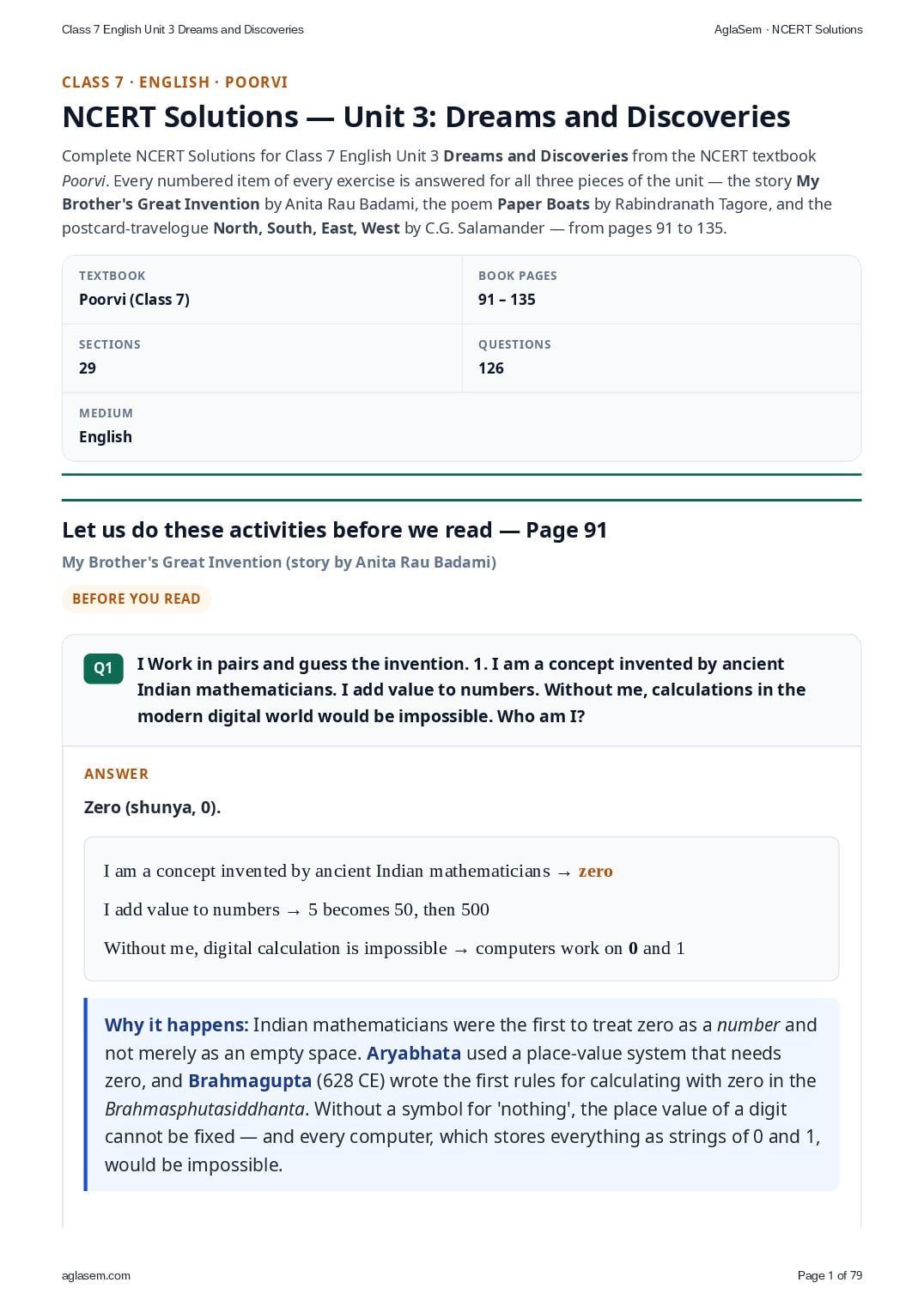
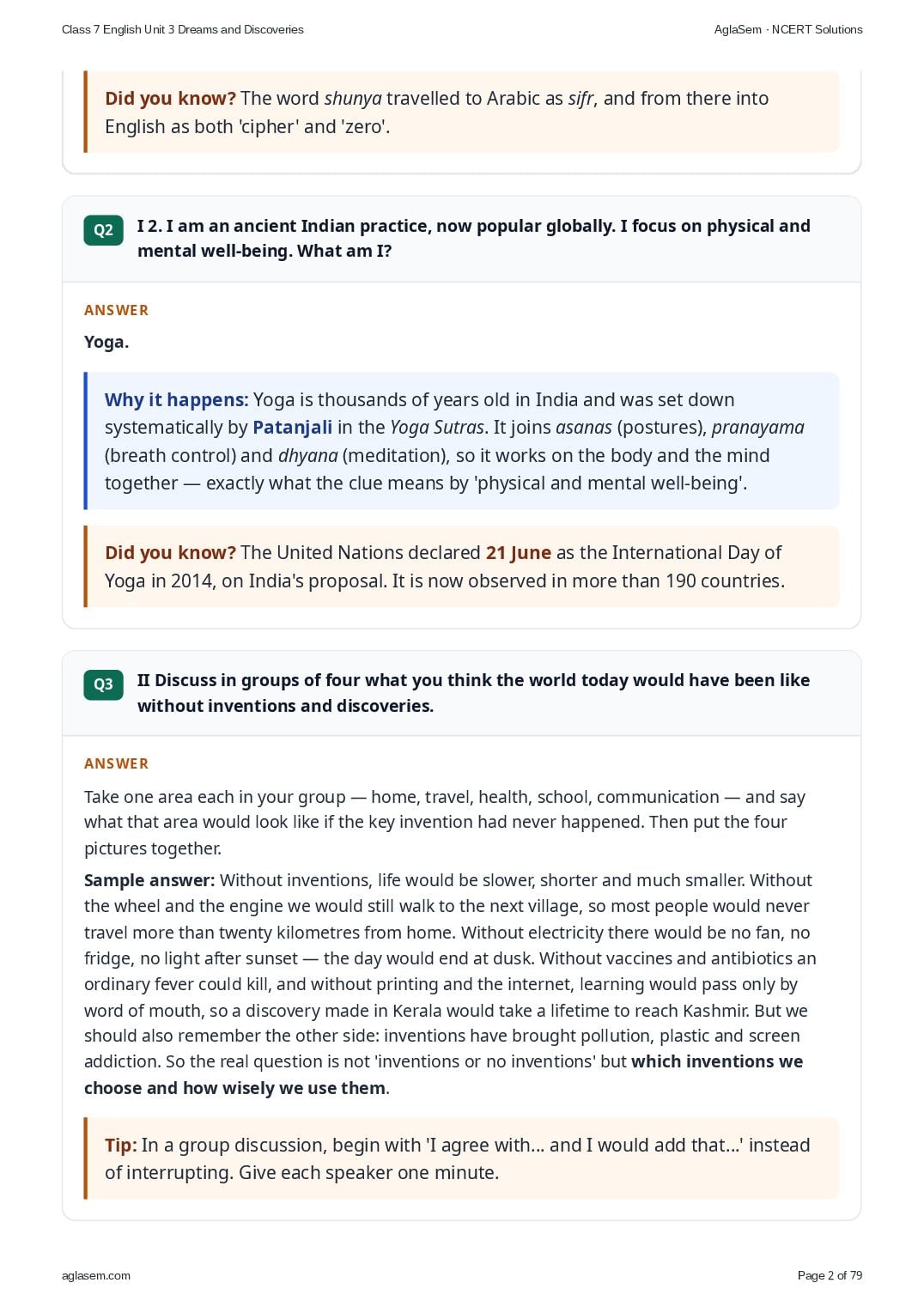
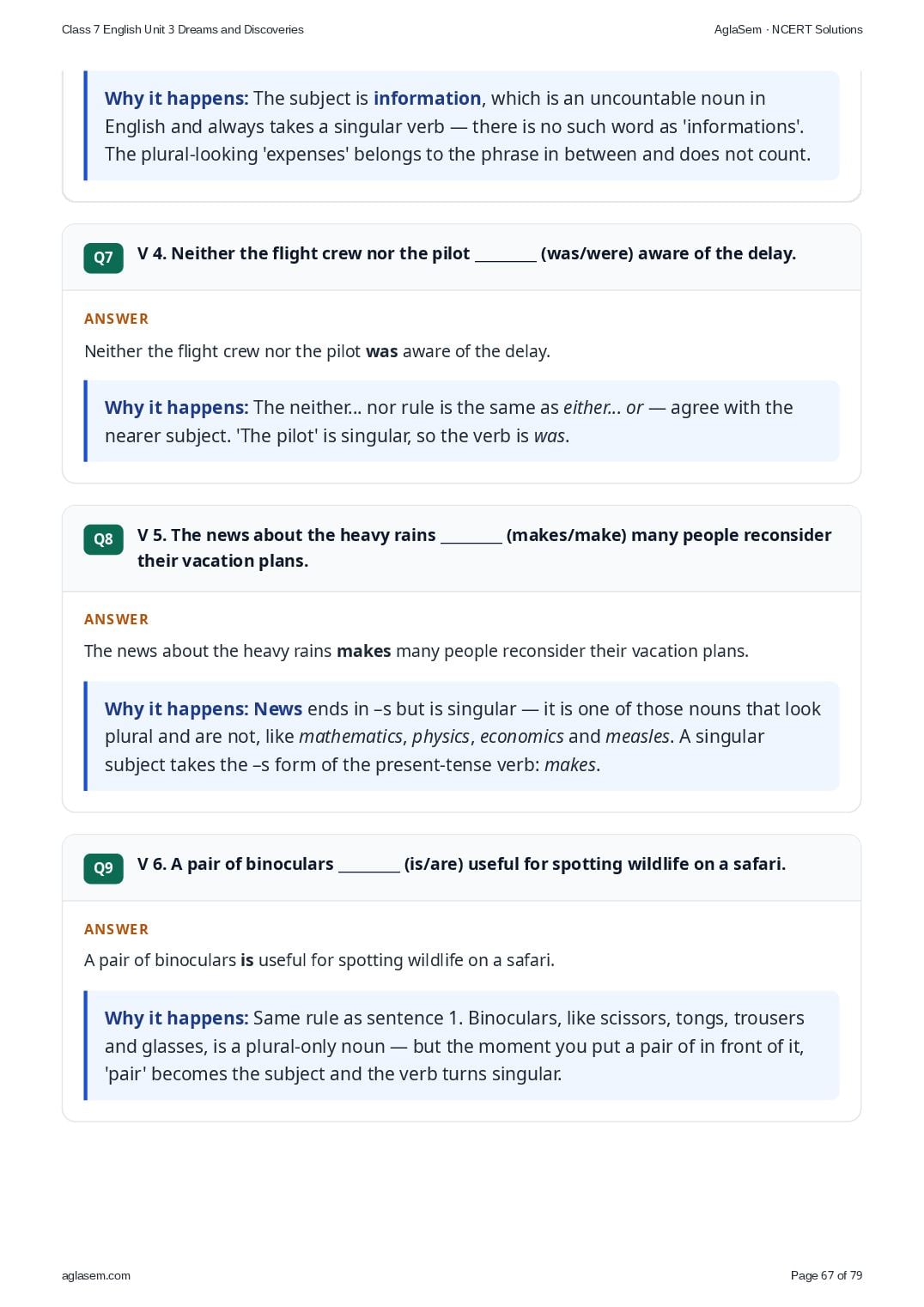
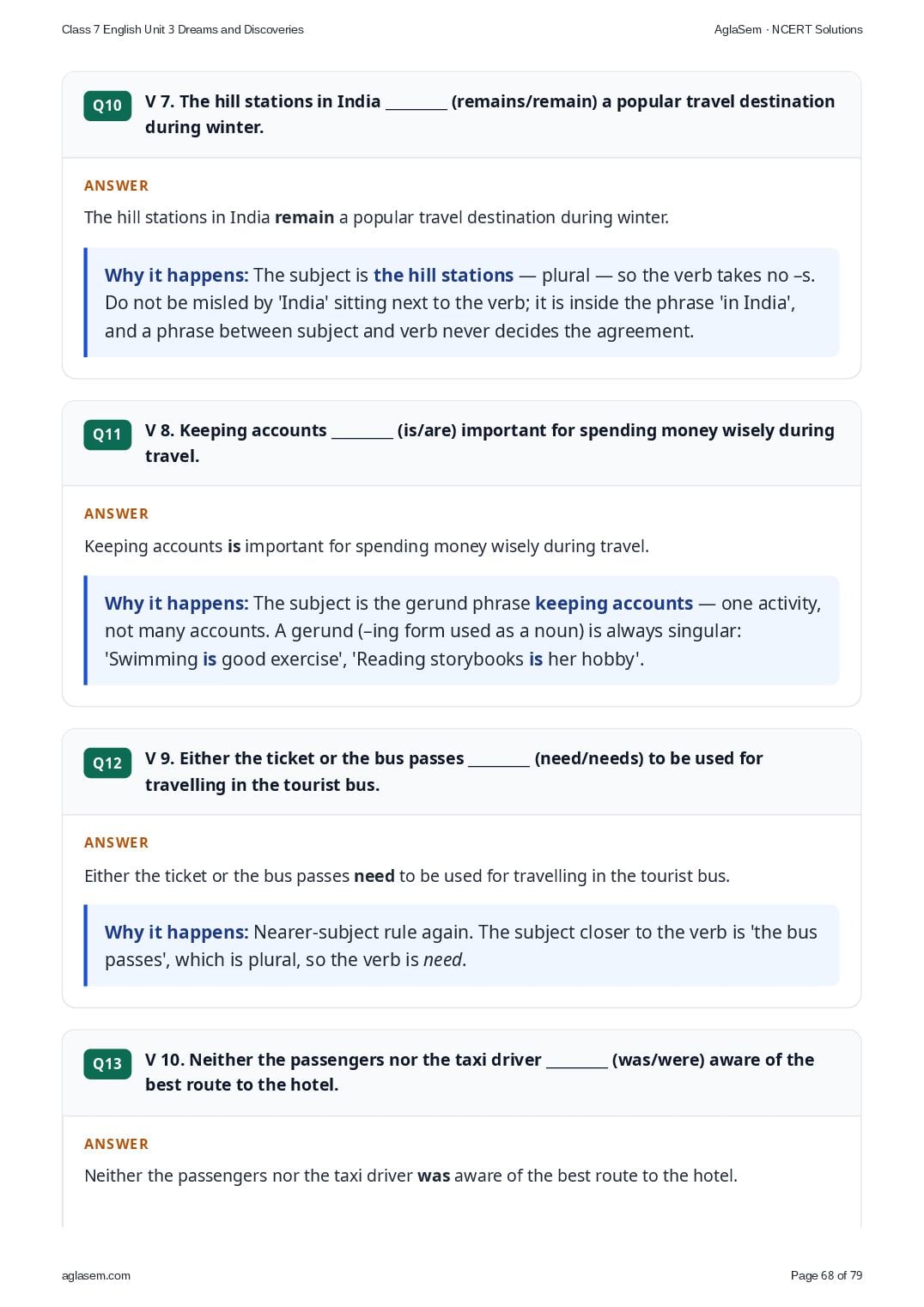
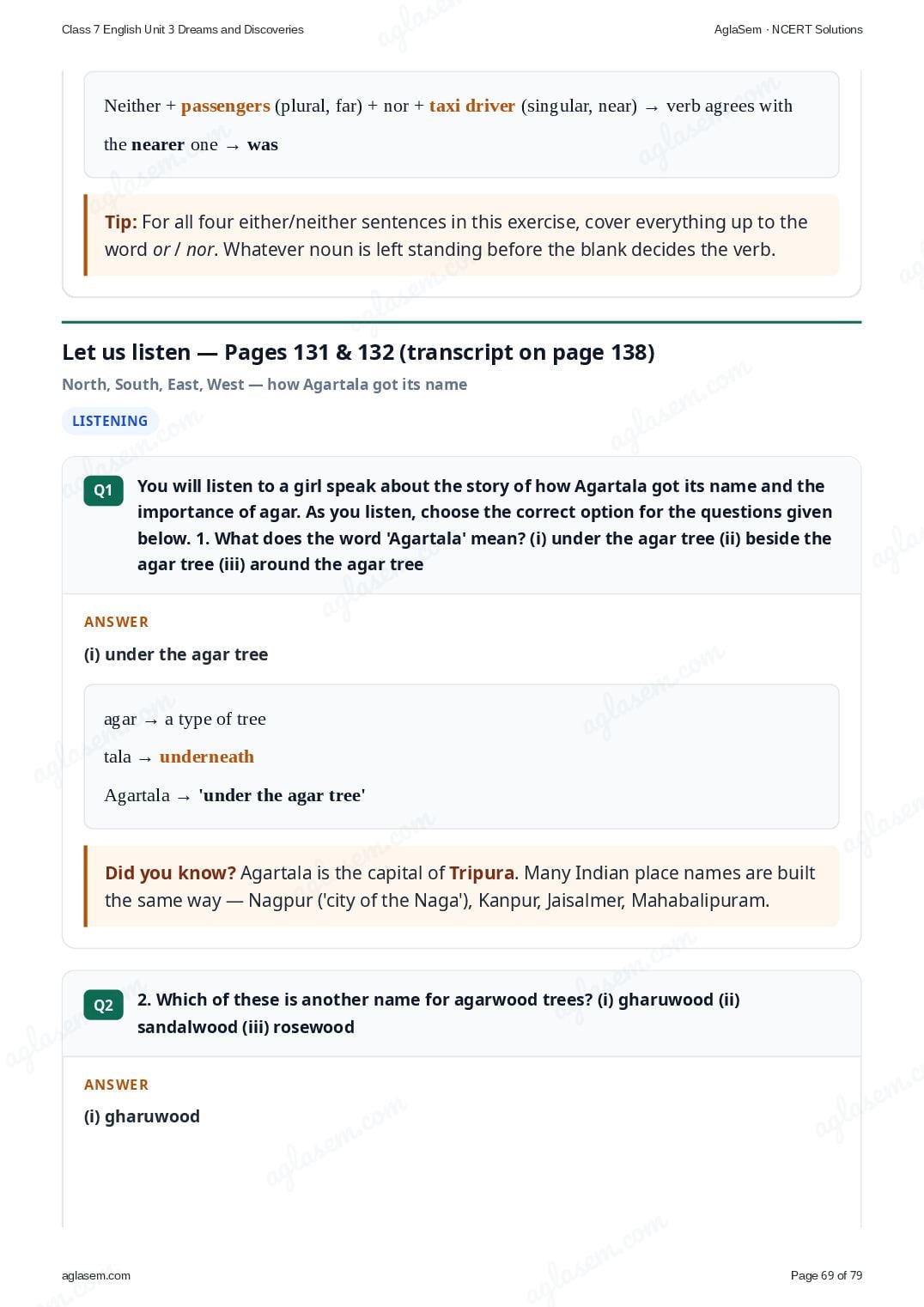
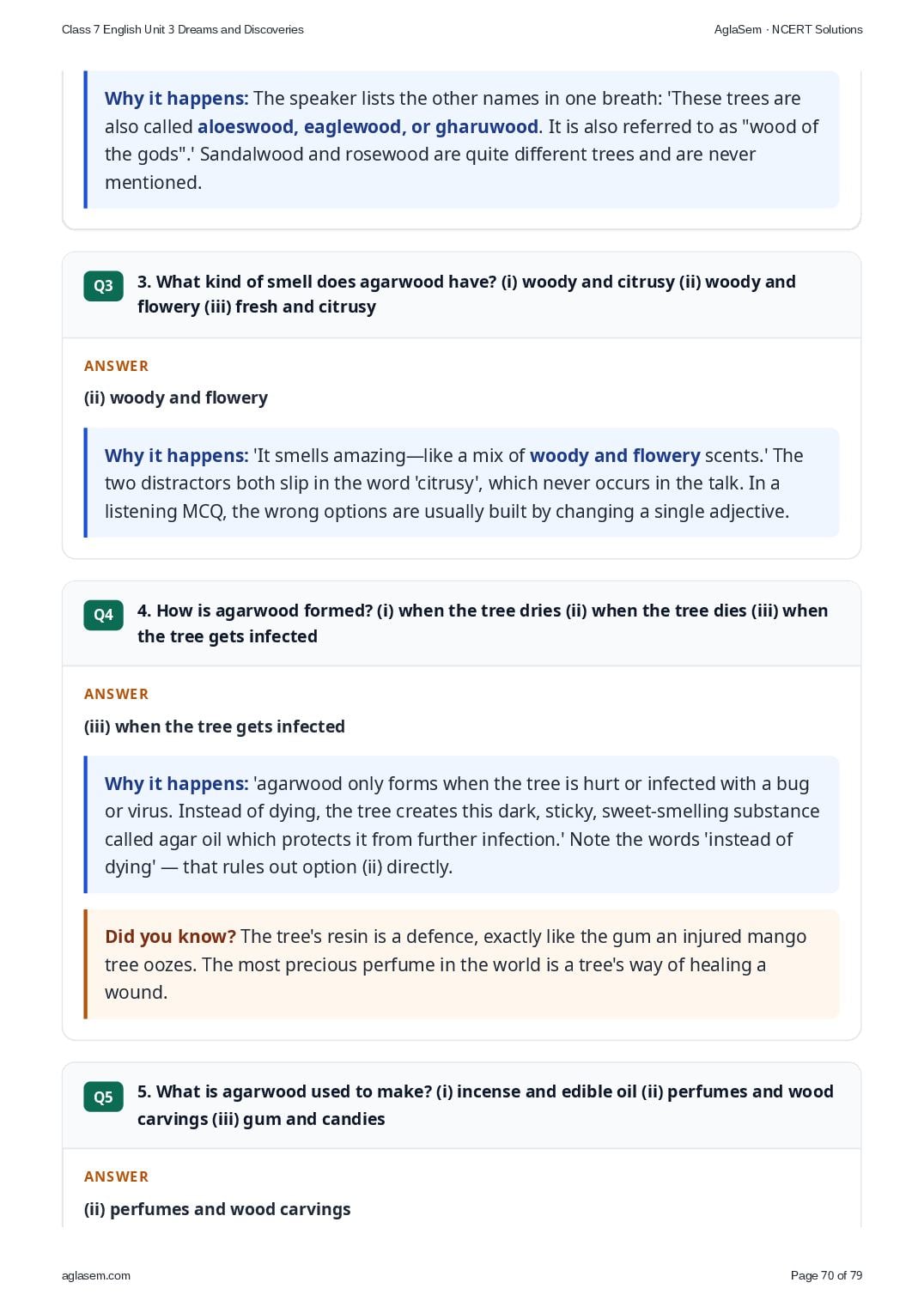
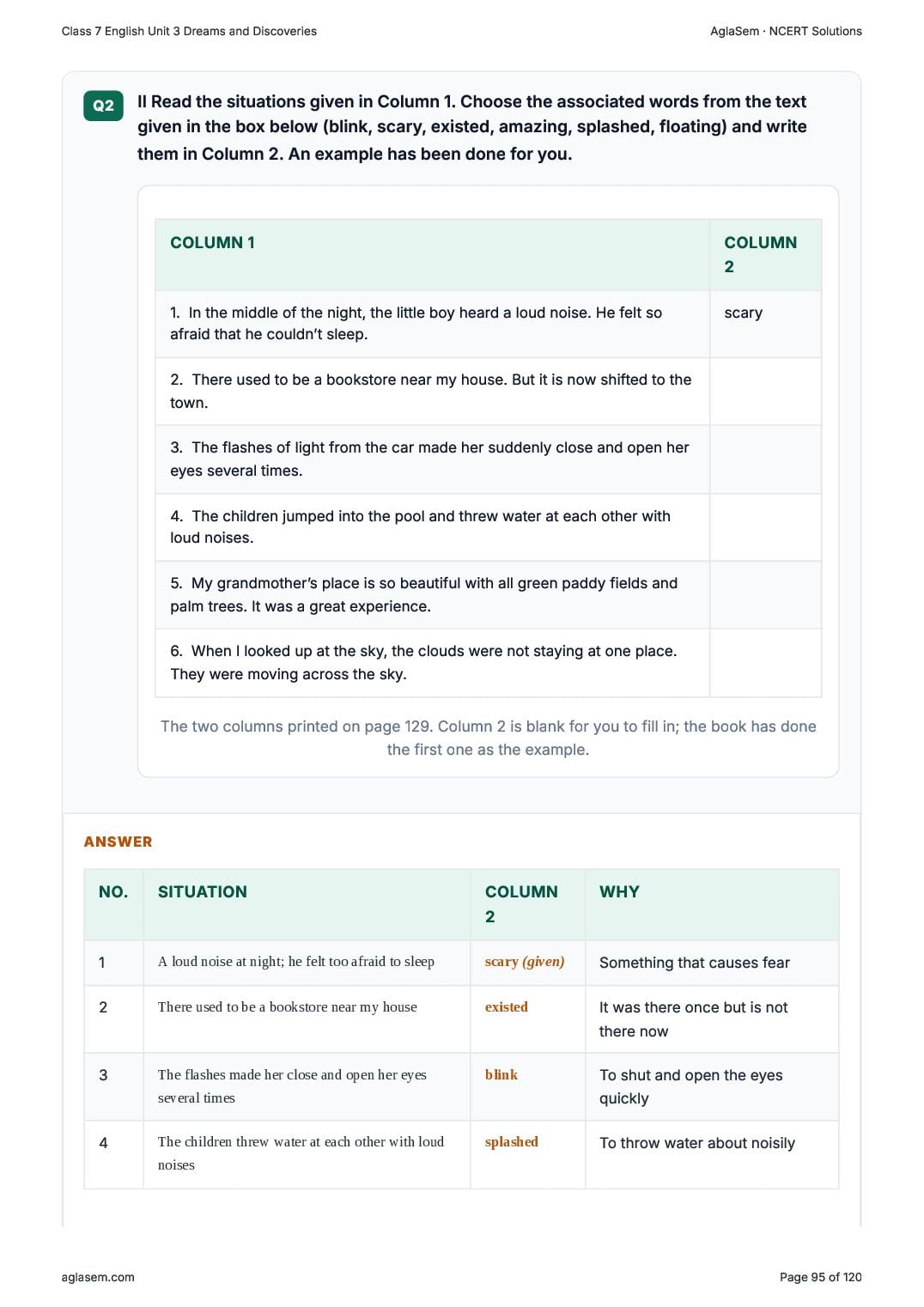
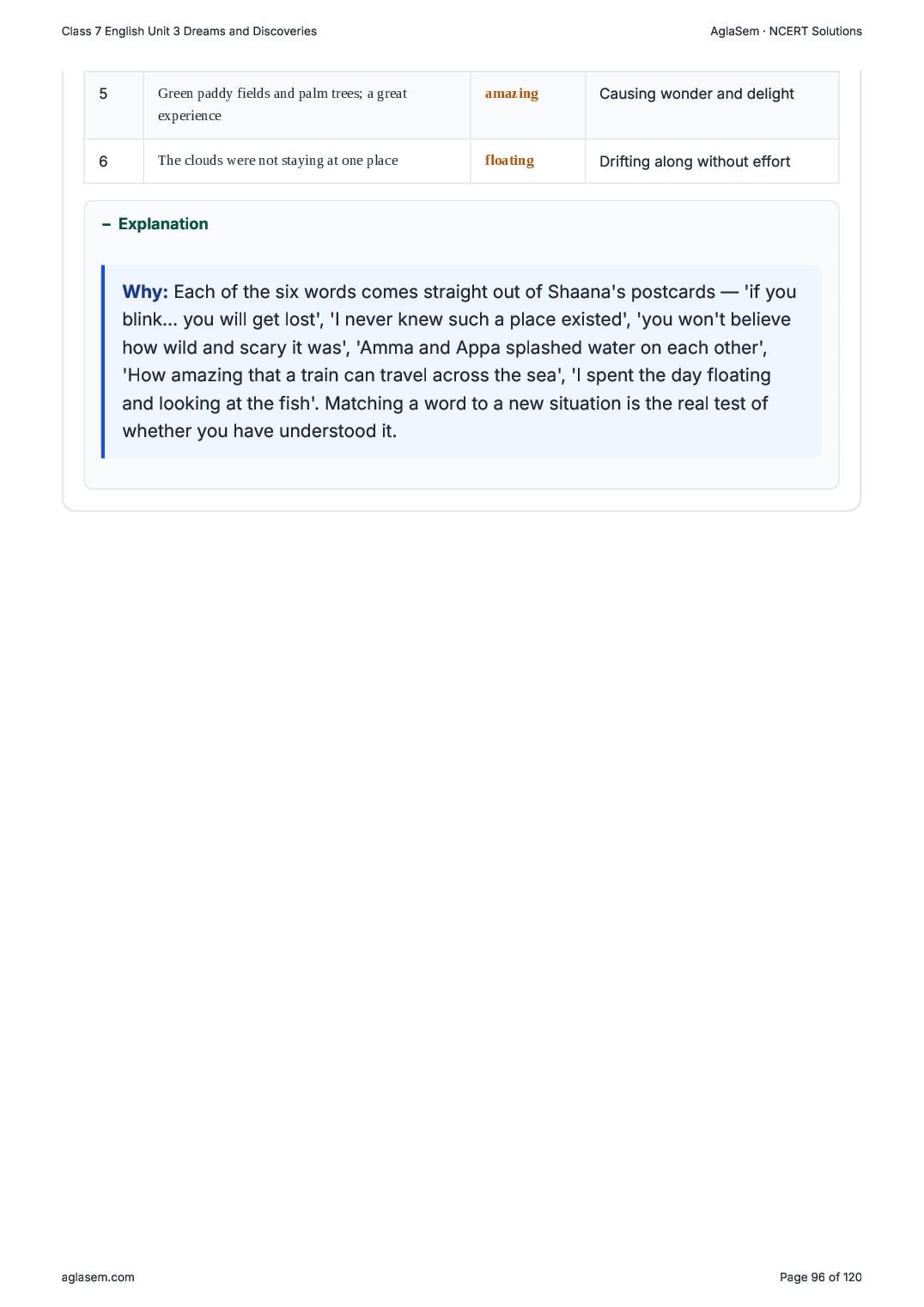
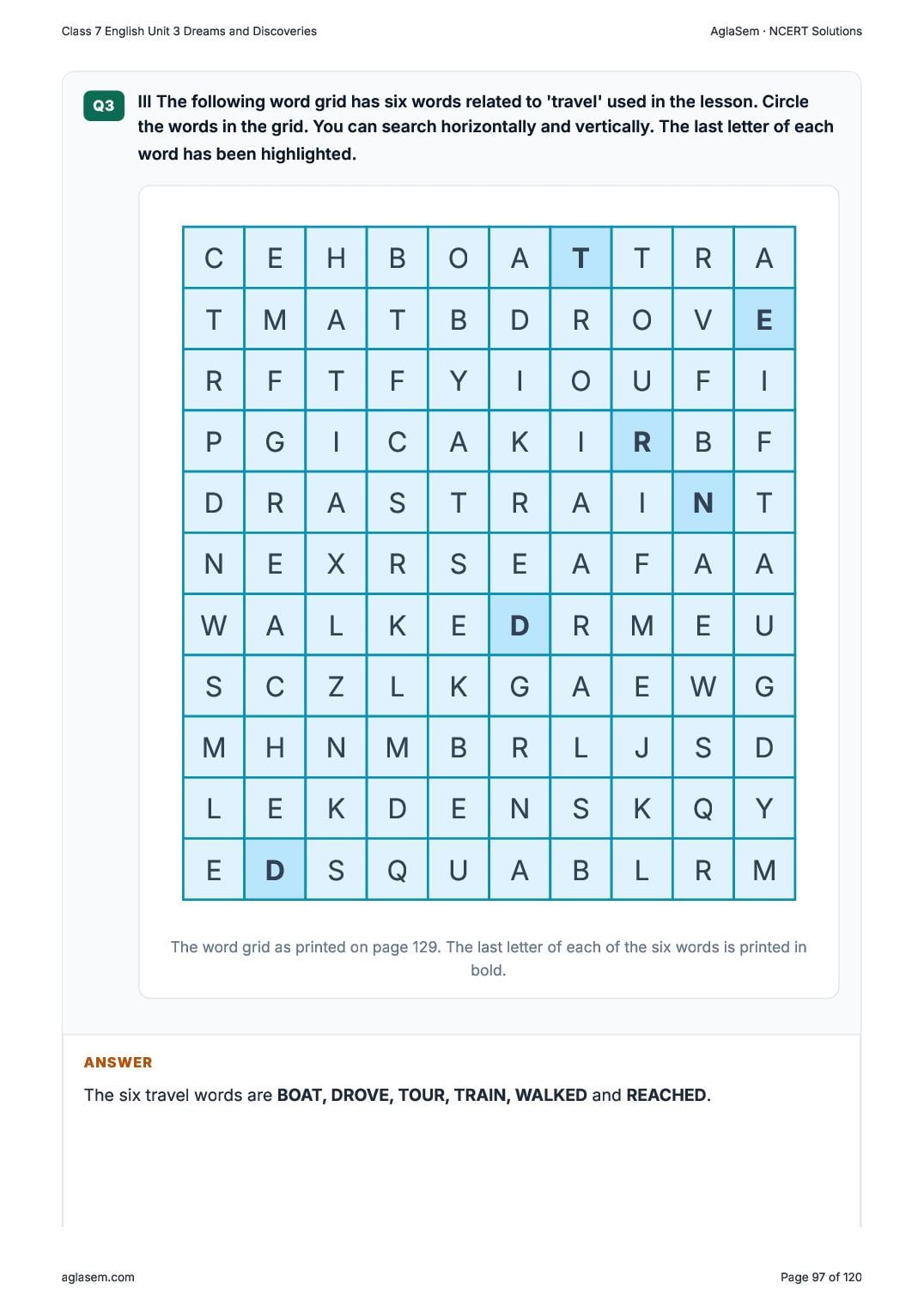
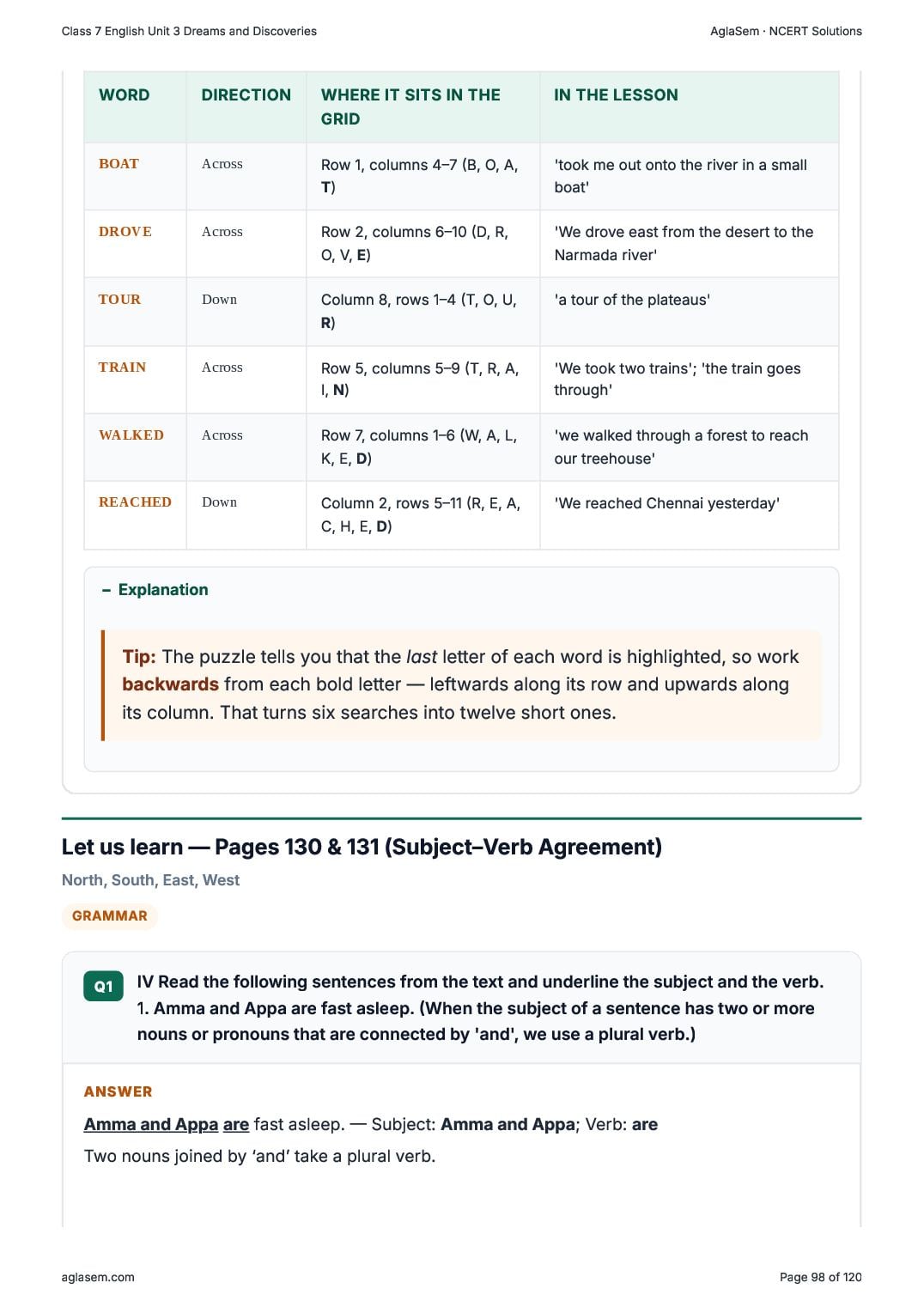
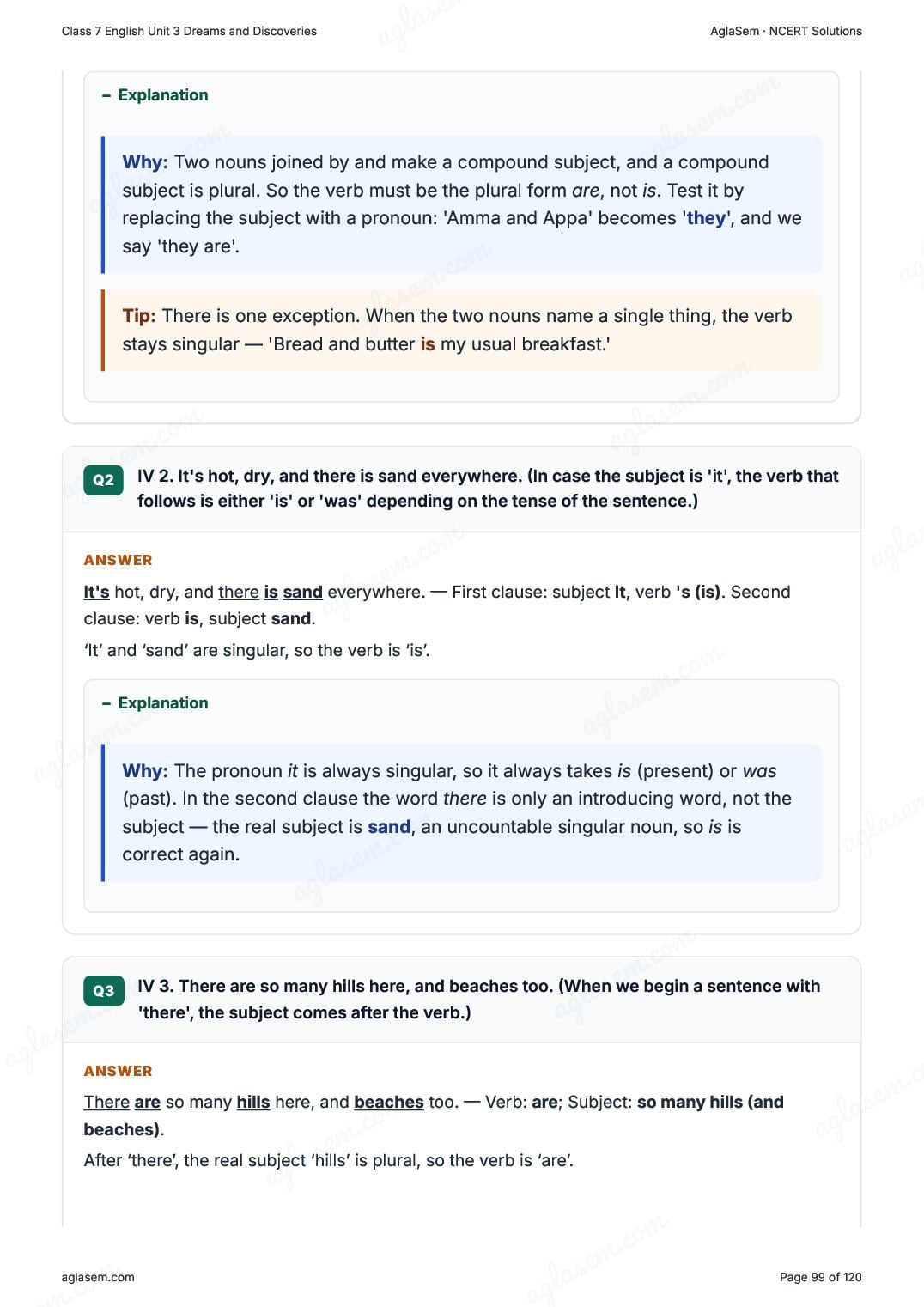
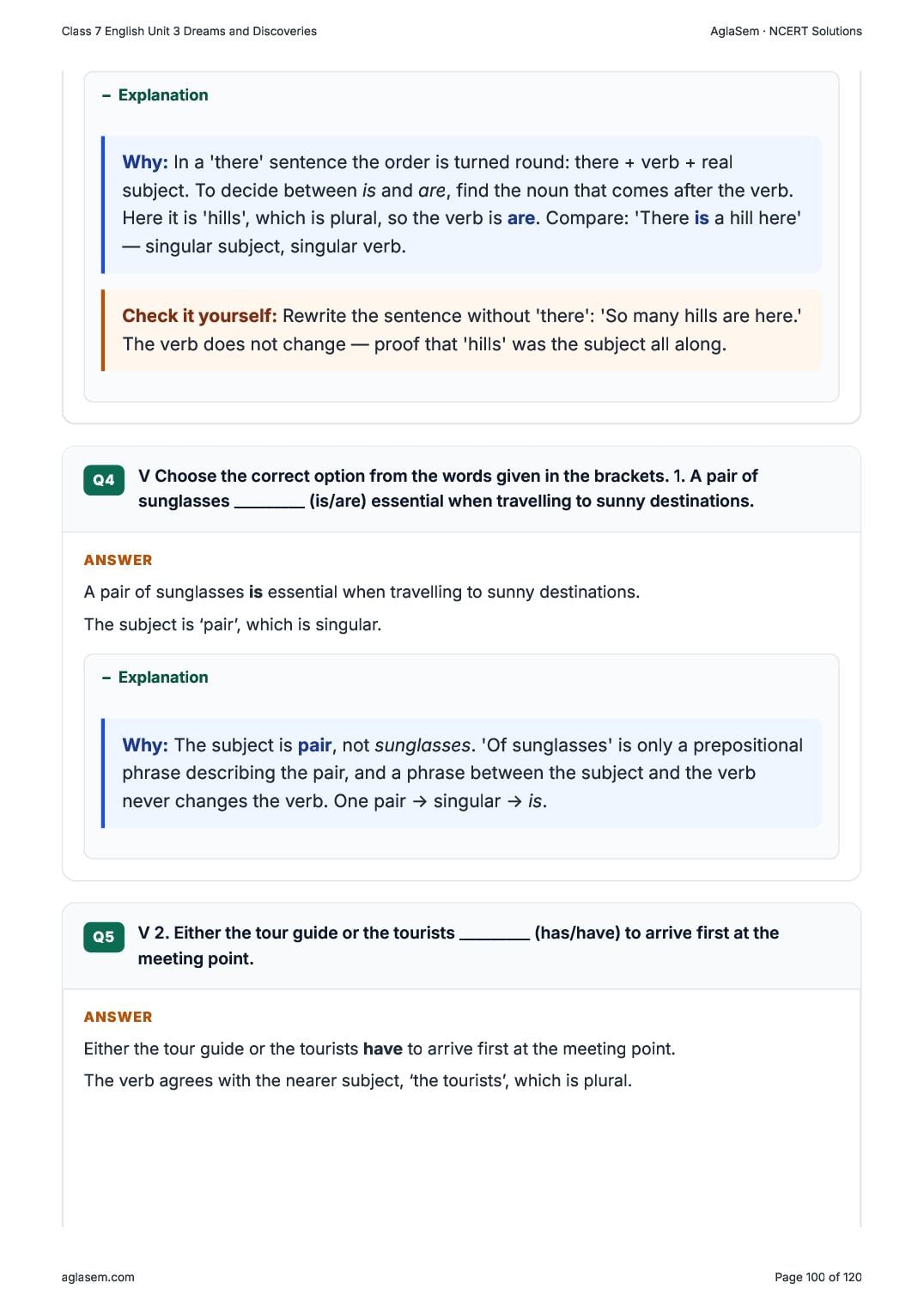
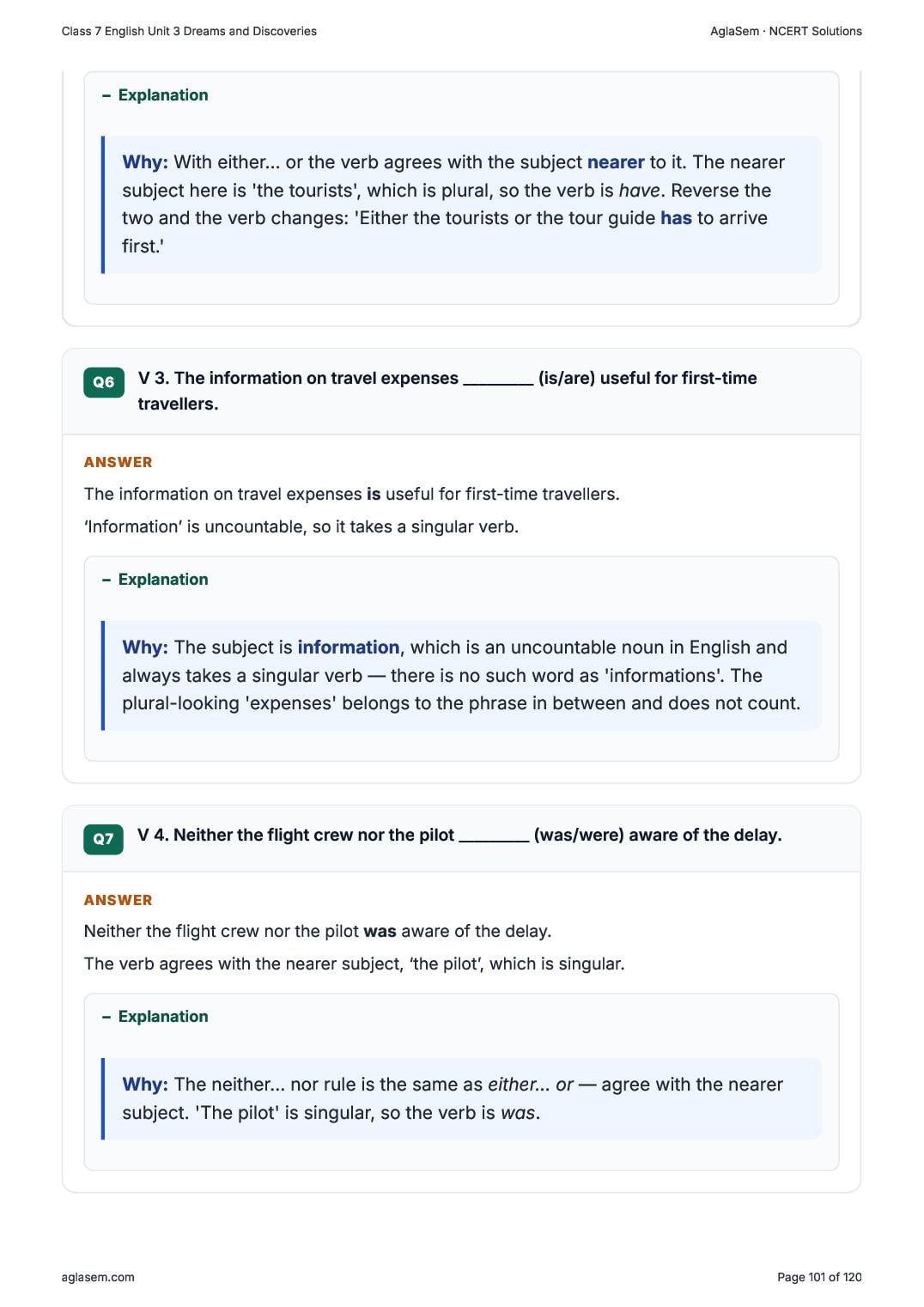
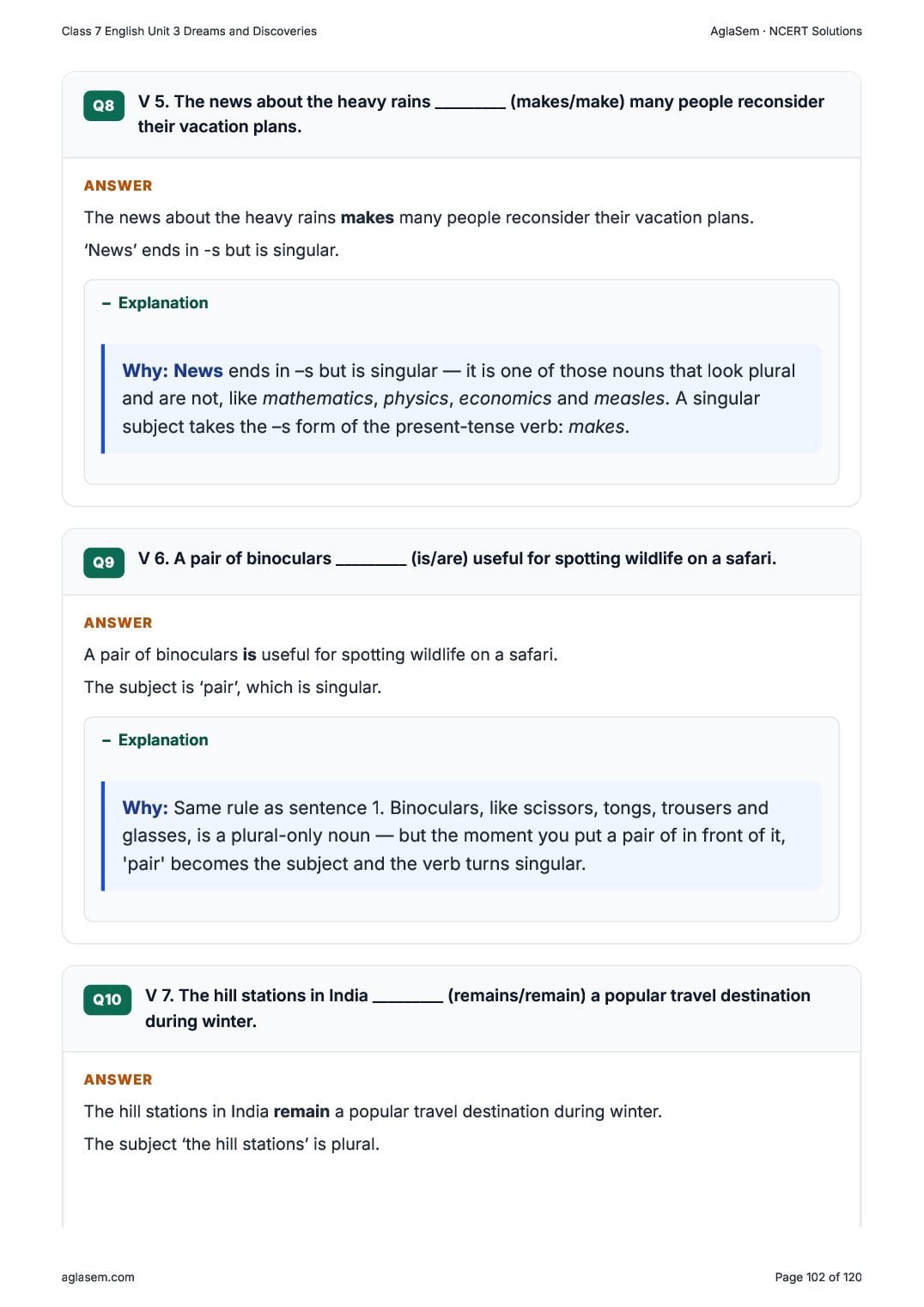
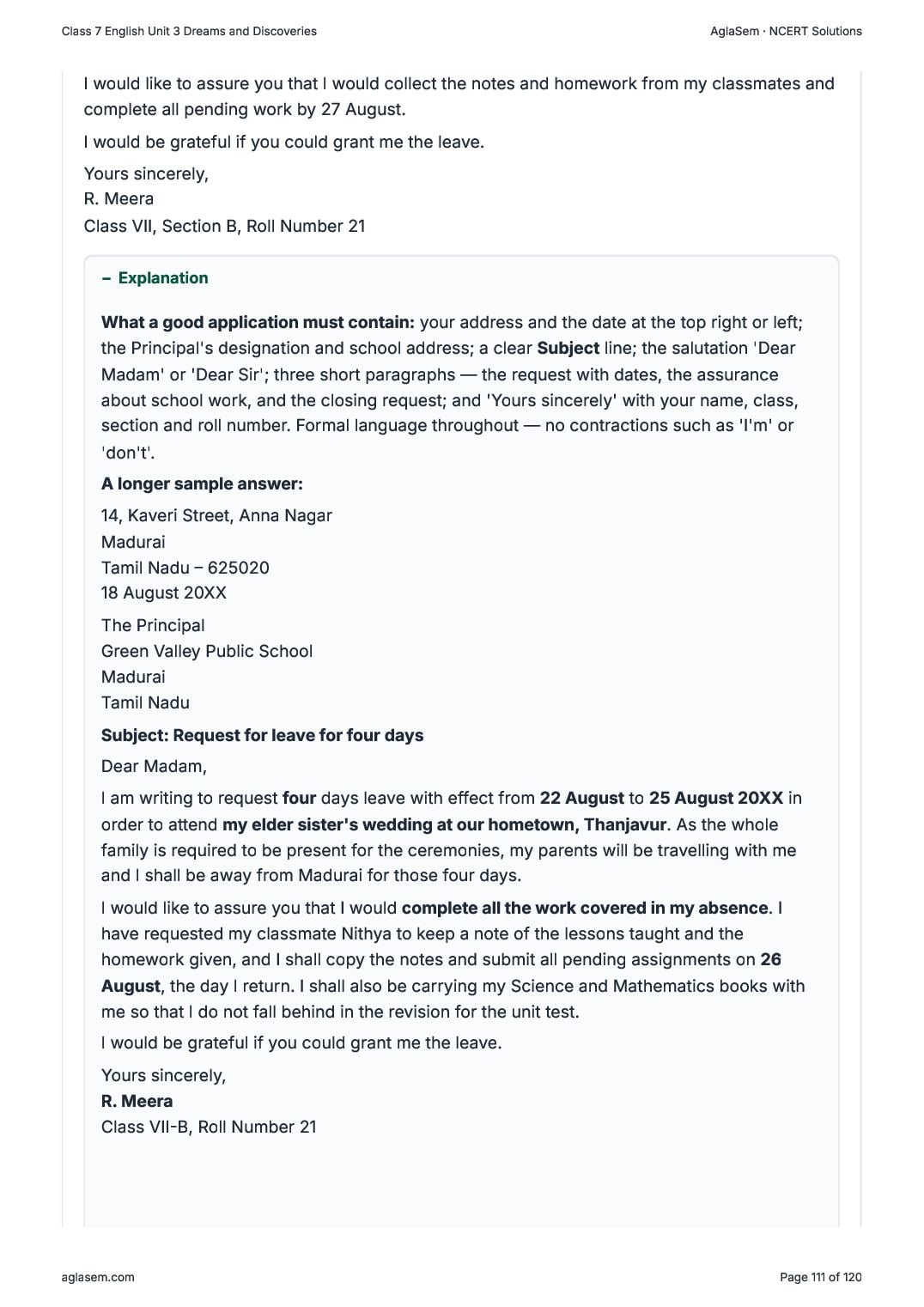
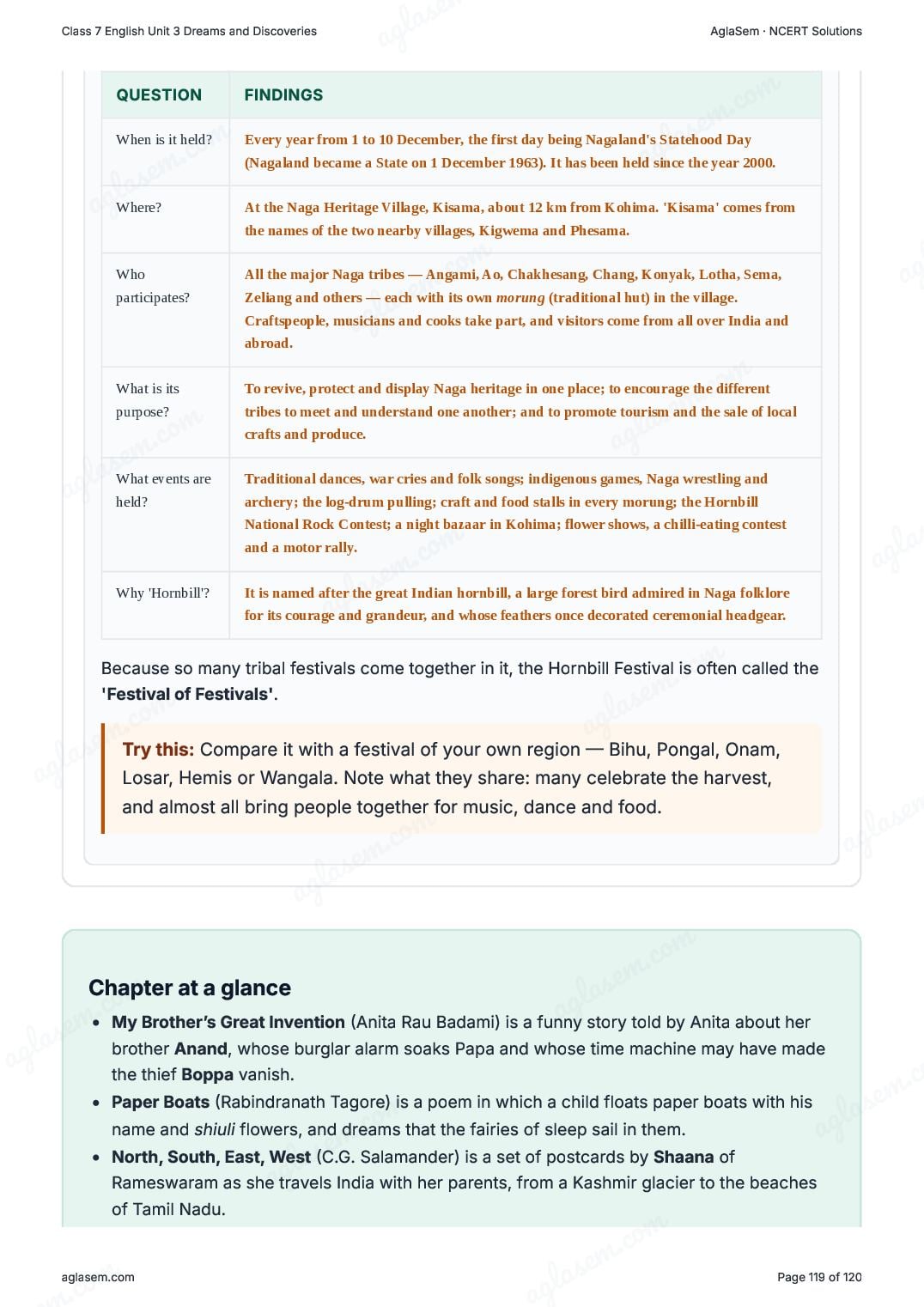
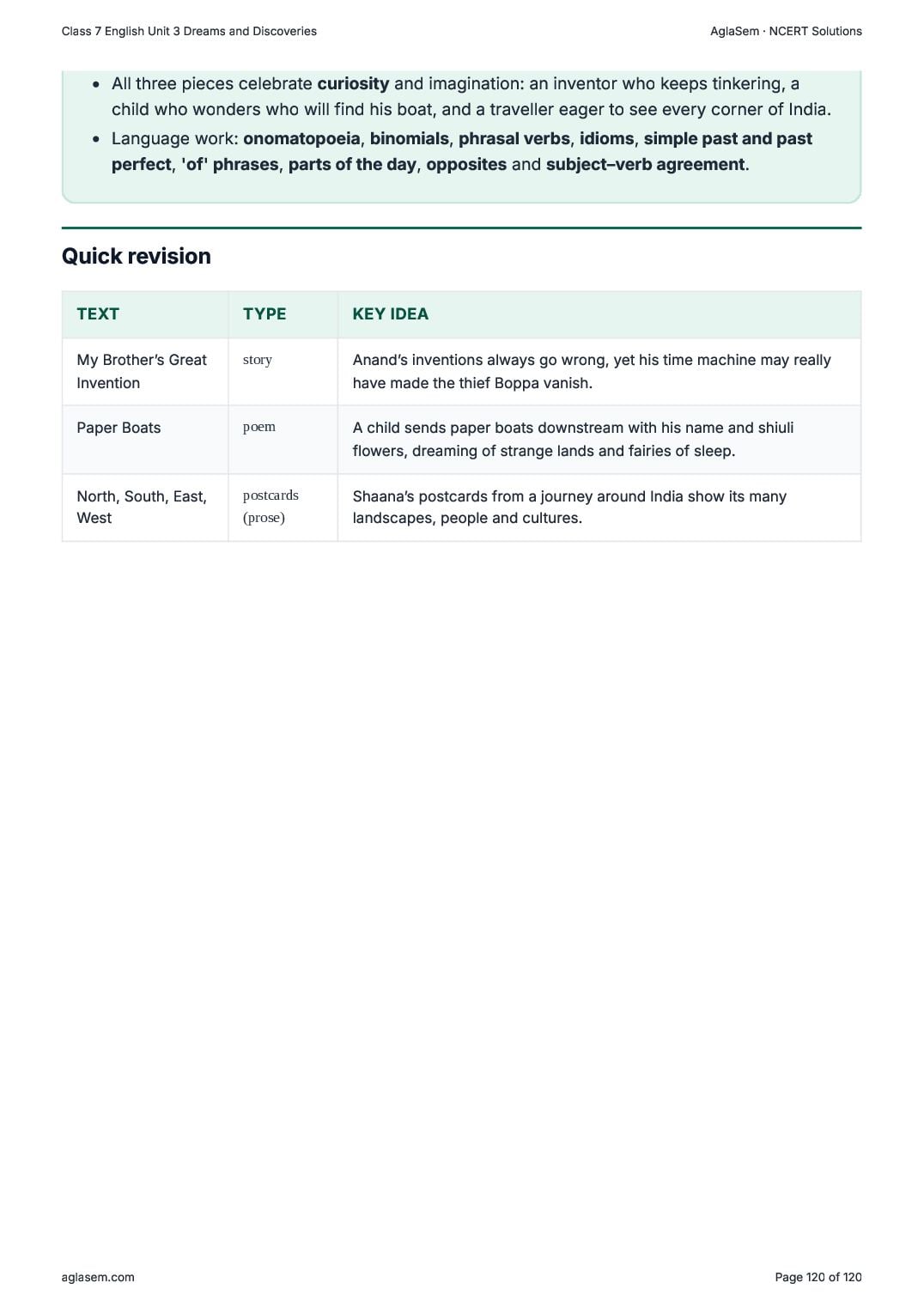
NCERT Solutions for Class 7 English Chapter 3 PDF Download
You can read the NCERT Solutions for Class 7 English Chapter 3 online above, or download the complete question-answer PDF to study Dreams and Discoveries offline at any time.
NCERT Solutions for Class 7 English Chapter 3 PDF Download Link – Click Here to Download Solutions PDF
Questions Covered in This Chapter
These NCERT Solutions answer all 126 questions of this chapter. The questions solved are:
- I Work in pairs and guess the invention. 1. I am a concept invented by ancient Indian mathematicians. I add value to numbers. Without me, calculations in the modern digital world would be impossible. Who am I?
- I 2. I am an ancient Indian practice, now popular globally. I focus on physical and mental well-being. What am I?
- II Discuss in groups of four what you think the world today would have been like without inventions and discoveries.
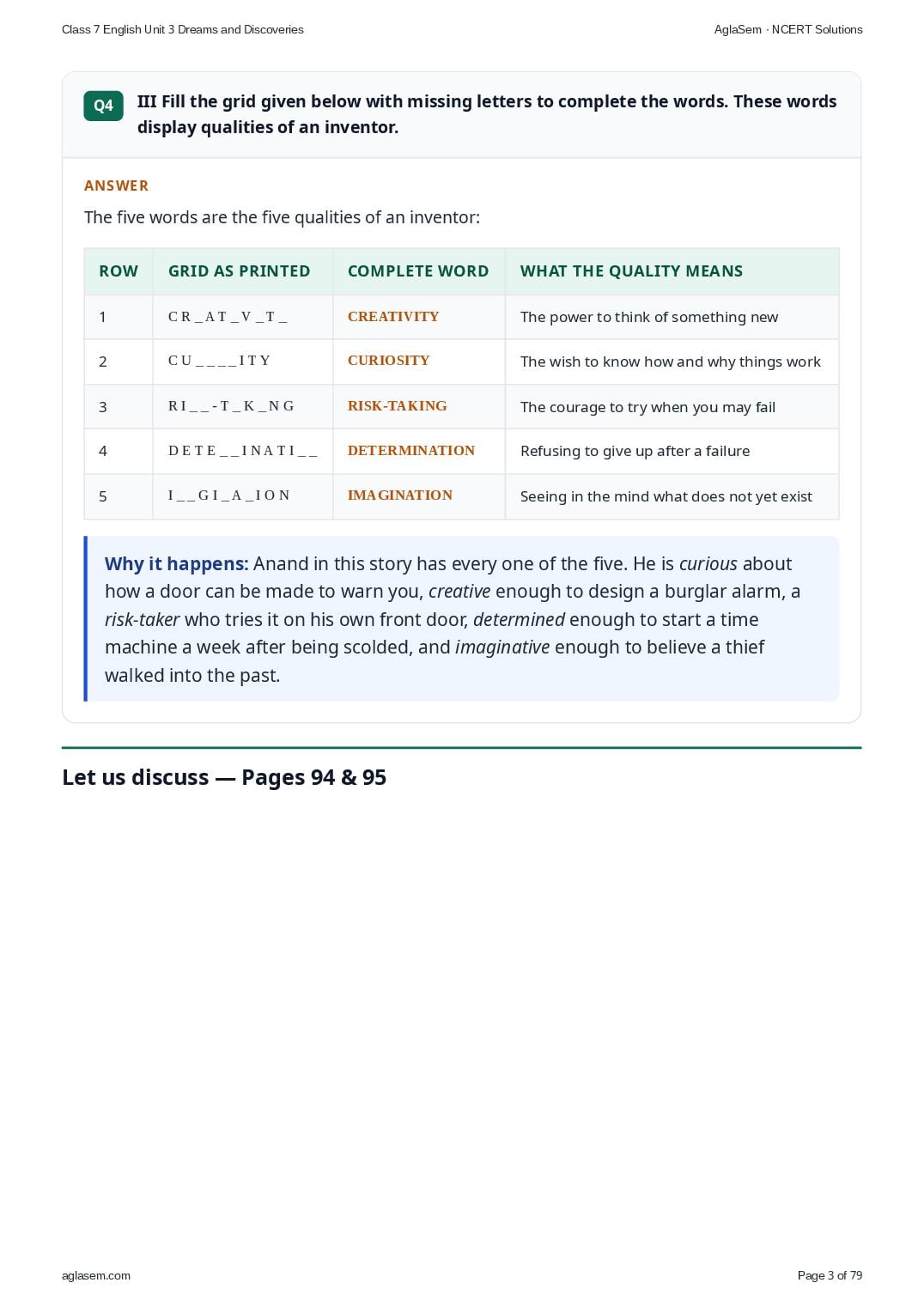
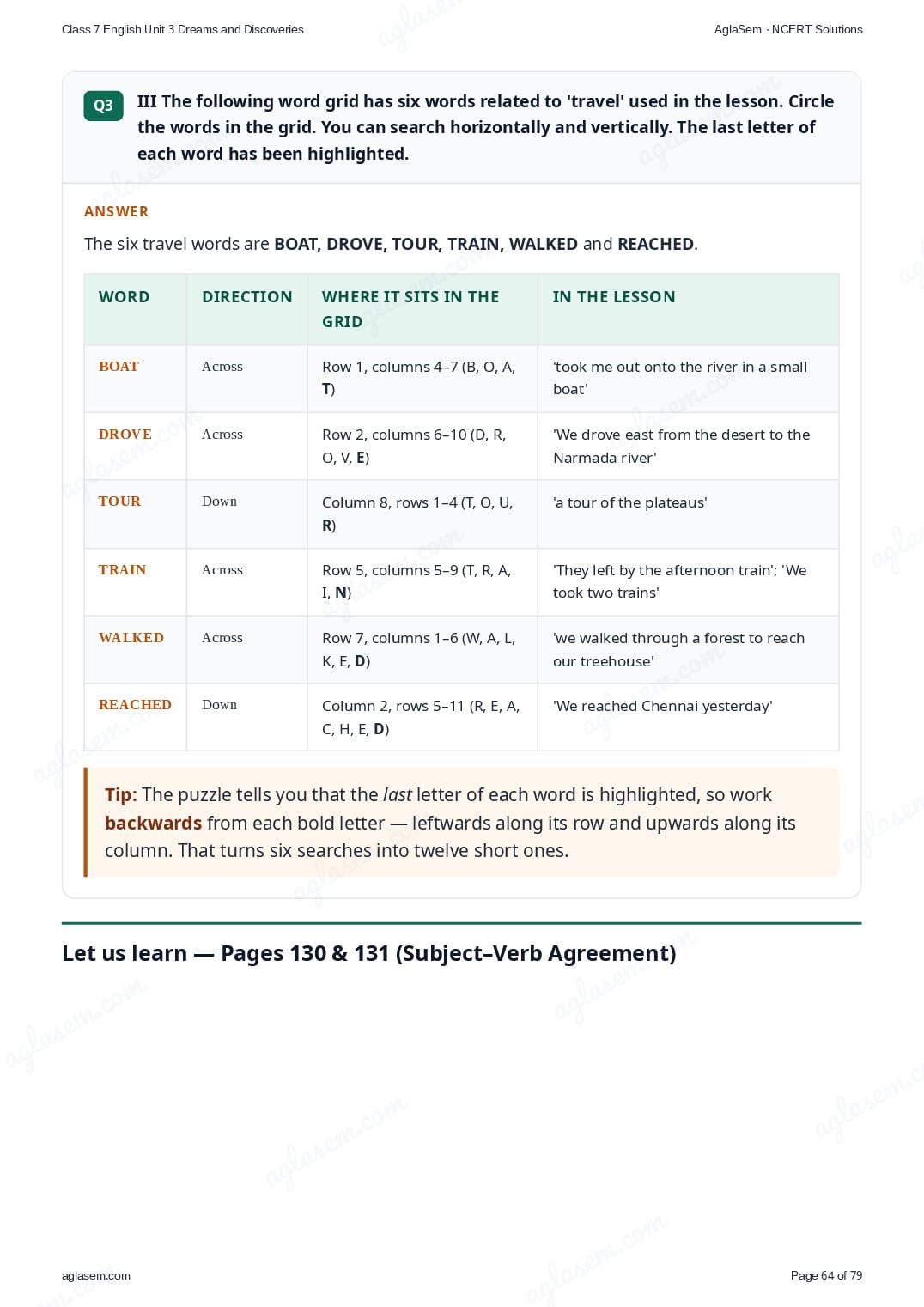
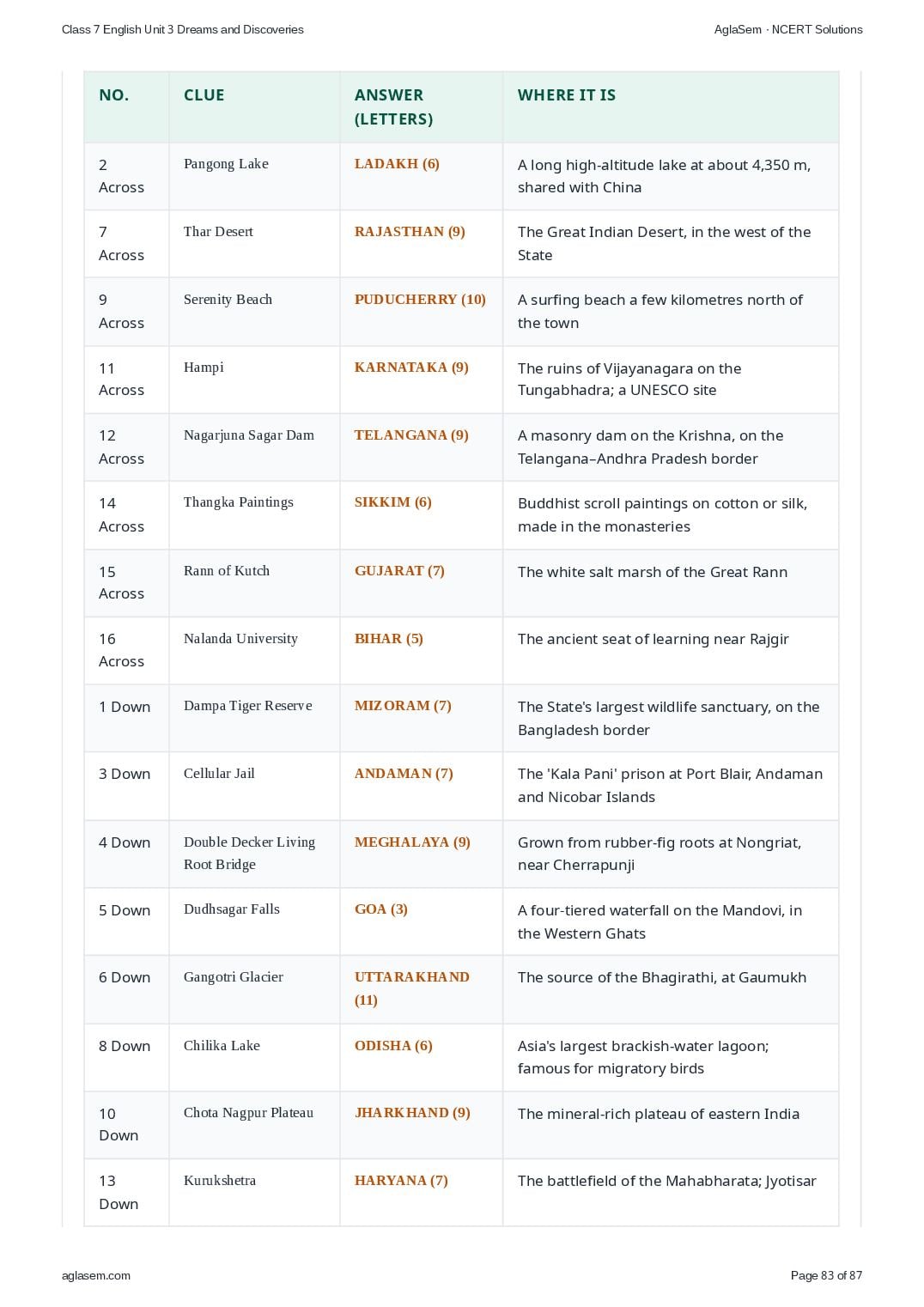
- III Fill the grid given below with missing letters to complete the words. These words display qualities of an inventor.
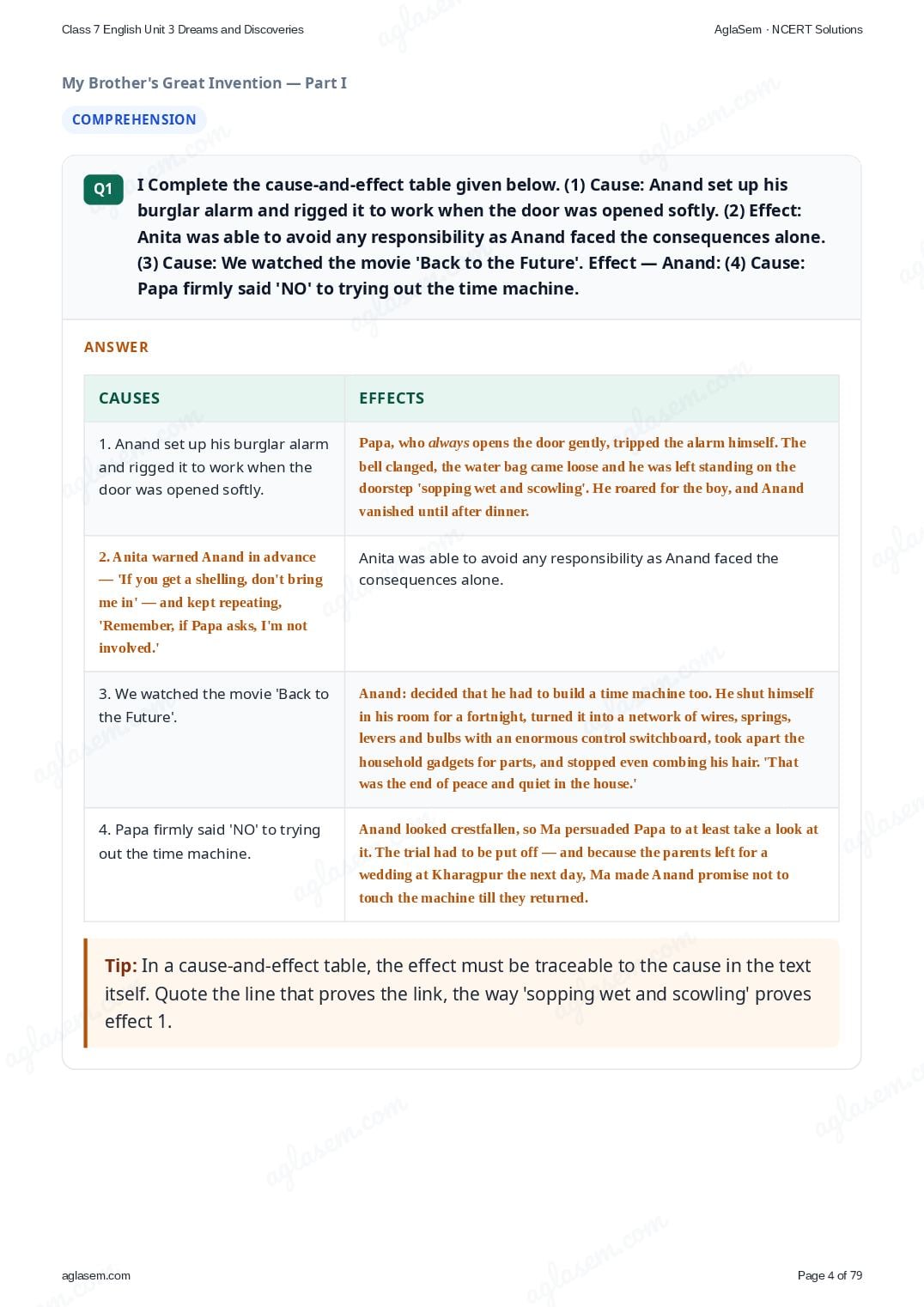
- I Complete the cause-and-effect table given below. (1) Cause: Anand set up his burglar alarm and rigged it to work when the door was opened softly. (2) Effect: Anita was able to avoid any responsibility as Anand faced the consequences alone. (3) Cause: We watched the movie 'Back to the Future'. Effect — Anand: (4) Cause: Papa firmly said 'NO' to trying out the time machine.
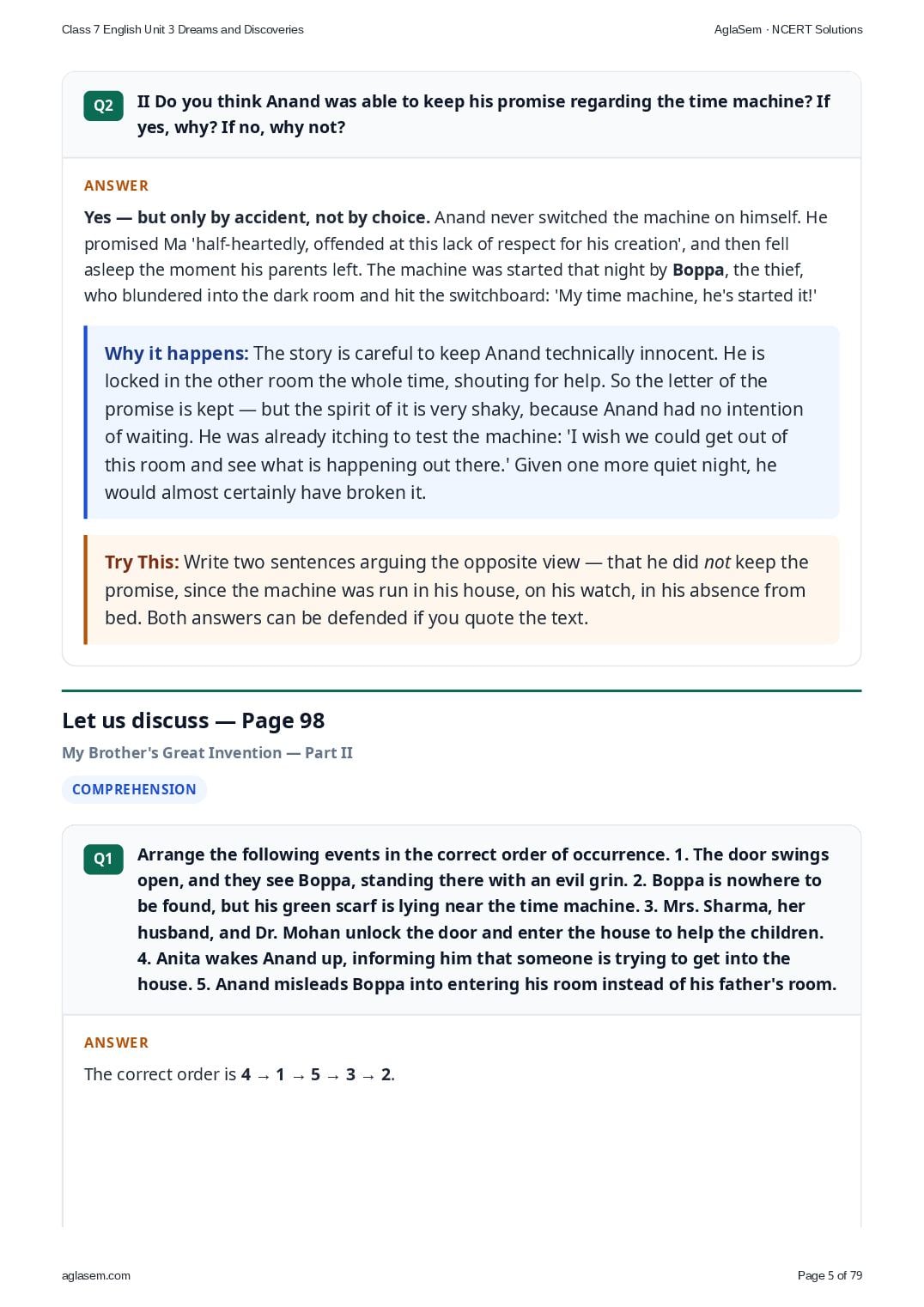
- II Do you think Anand was able to keep his promise regarding the time machine? If yes, why? If no, why not?
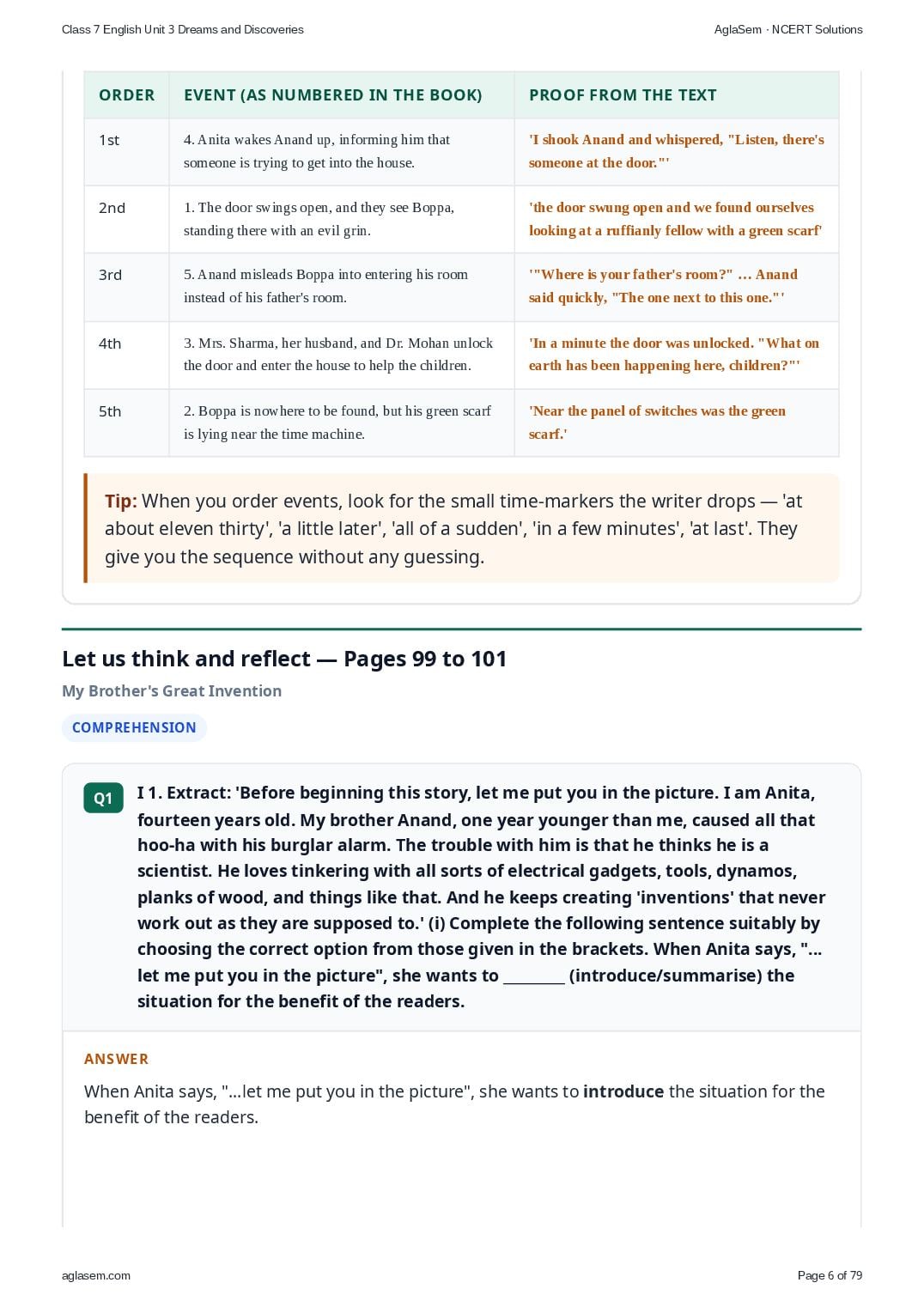
- Arrange the following events in the correct order of occurrence. 1. The door swings open, and they see Boppa, standing there with an evil grin. 2. Boppa is nowhere to be found, but his green scarf is lying near the time machine. 3. Mrs. Sharma, her husband, and Dr. Mohan unlock the door and enter the house to help the children. 4. Anita wakes Anand up, informing him that someone is trying to get into the house. 5. Anand misleads Boppa into entering his room instead of his father's room.
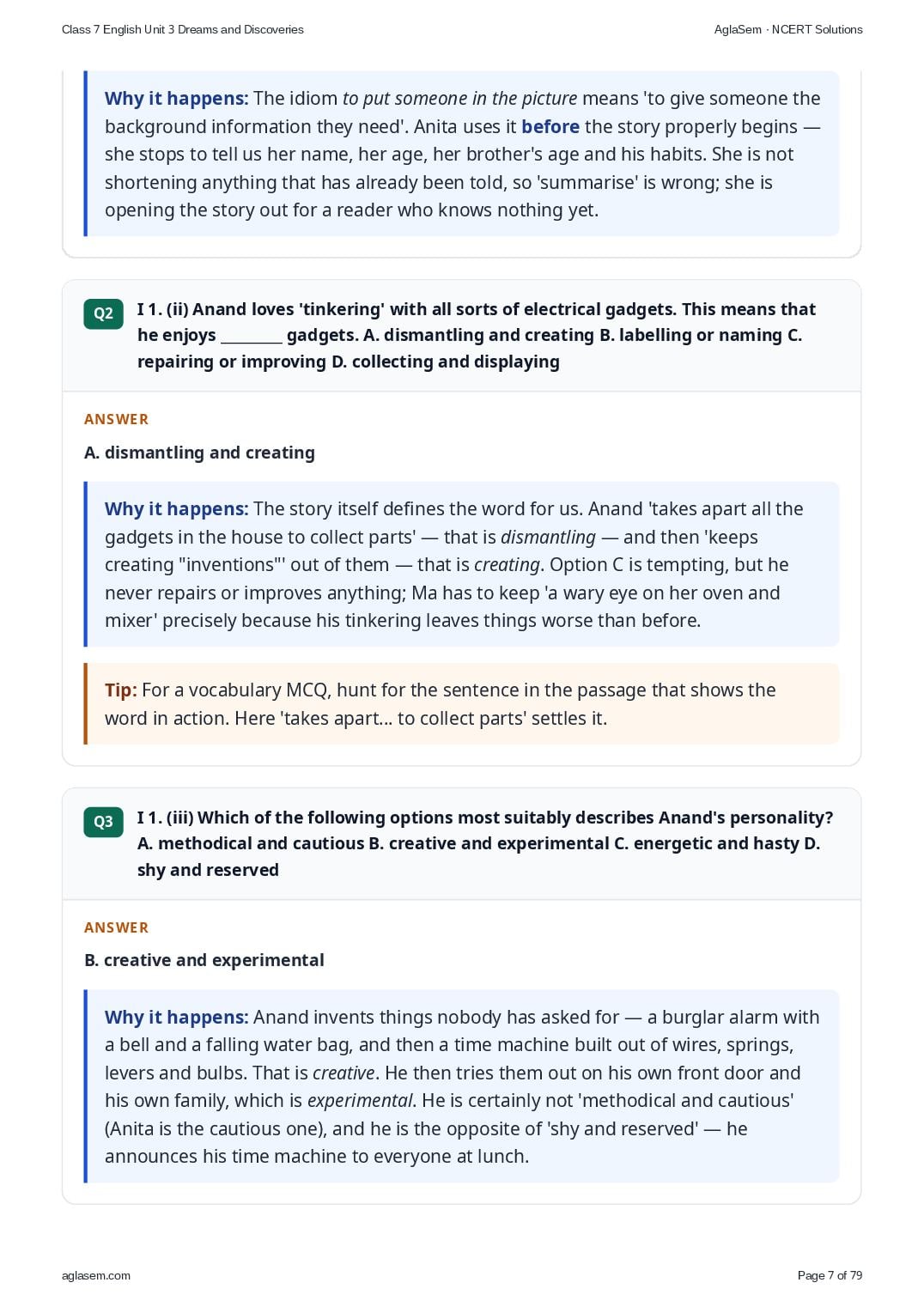
- I 1. Extract: 'Before beginning this story, let me put you in the picture. I am Anita, fourteen years old. My brother Anand, one year younger than me, caused all that hoo-ha with his burglar alarm. The trouble with him is that he thinks he is a scientist. He loves tinkering with all sorts of electrical gadgets, tools, dynamos, planks of wood, and things like that. And he keeps creating 'inventions' that never work out as they are supposed to.' (i) Complete the following sentence suitably by choosing the correct option from those given in the brackets. When Anita says, "…let me put you in the picture", she wants to _________ (introduce/summarise) the situation for the benefit of the readers.
- I 1. (ii) Anand loves 'tinkering' with all sorts of electrical gadgets. This means that he enjoys _________ gadgets. A. dismantling and creating B. labelling or naming C. repairing or improving D. collecting and displaying
- I 1. (iii) Which of the following options most suitably describes Anand's personality? A. methodical and cautious B. creative and experimental C. energetic and hasty D. shy and reserved
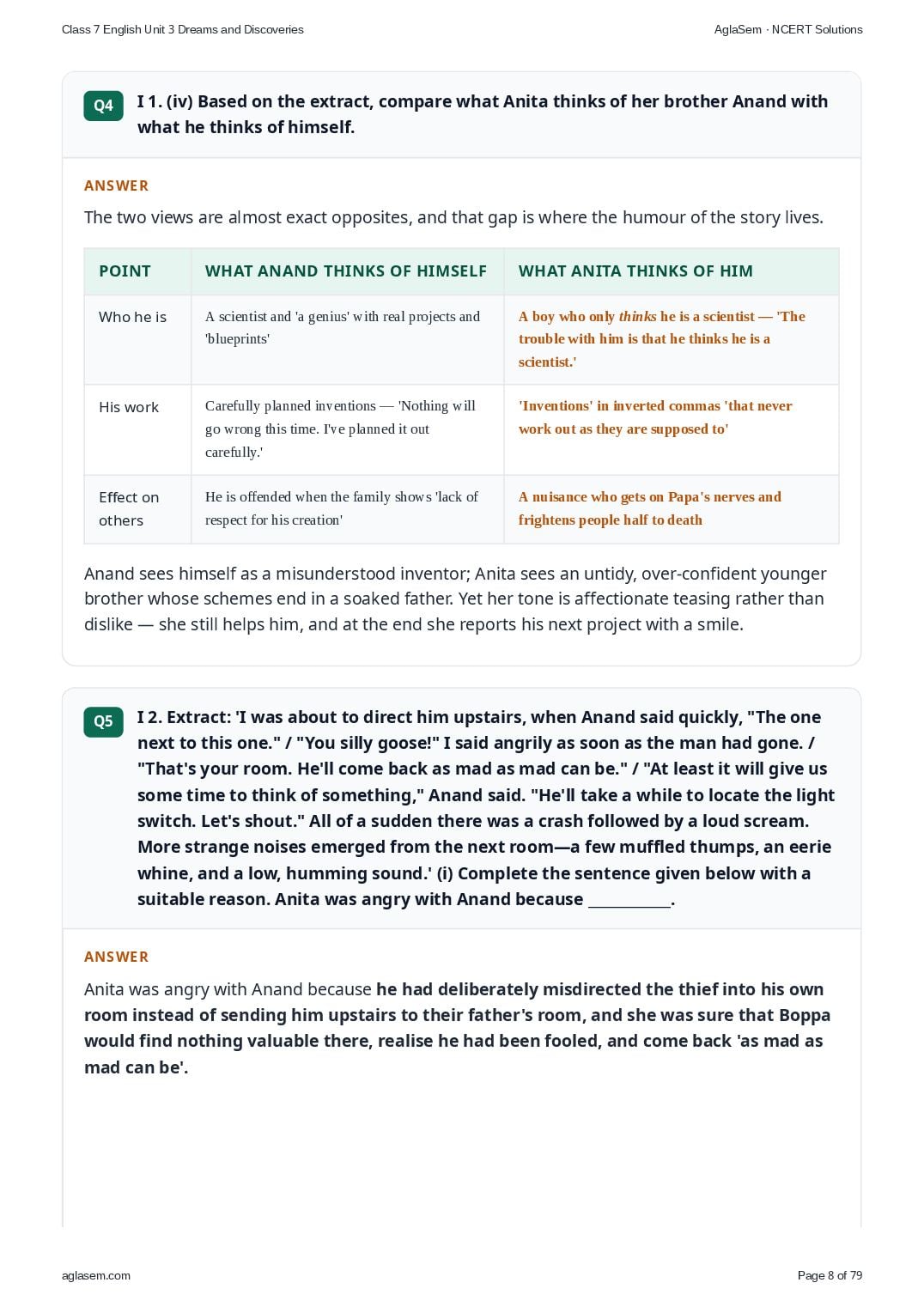
- I 1. (iv) Based on the extract, compare what Anita thinks of her brother Anand with what he thinks of himself.
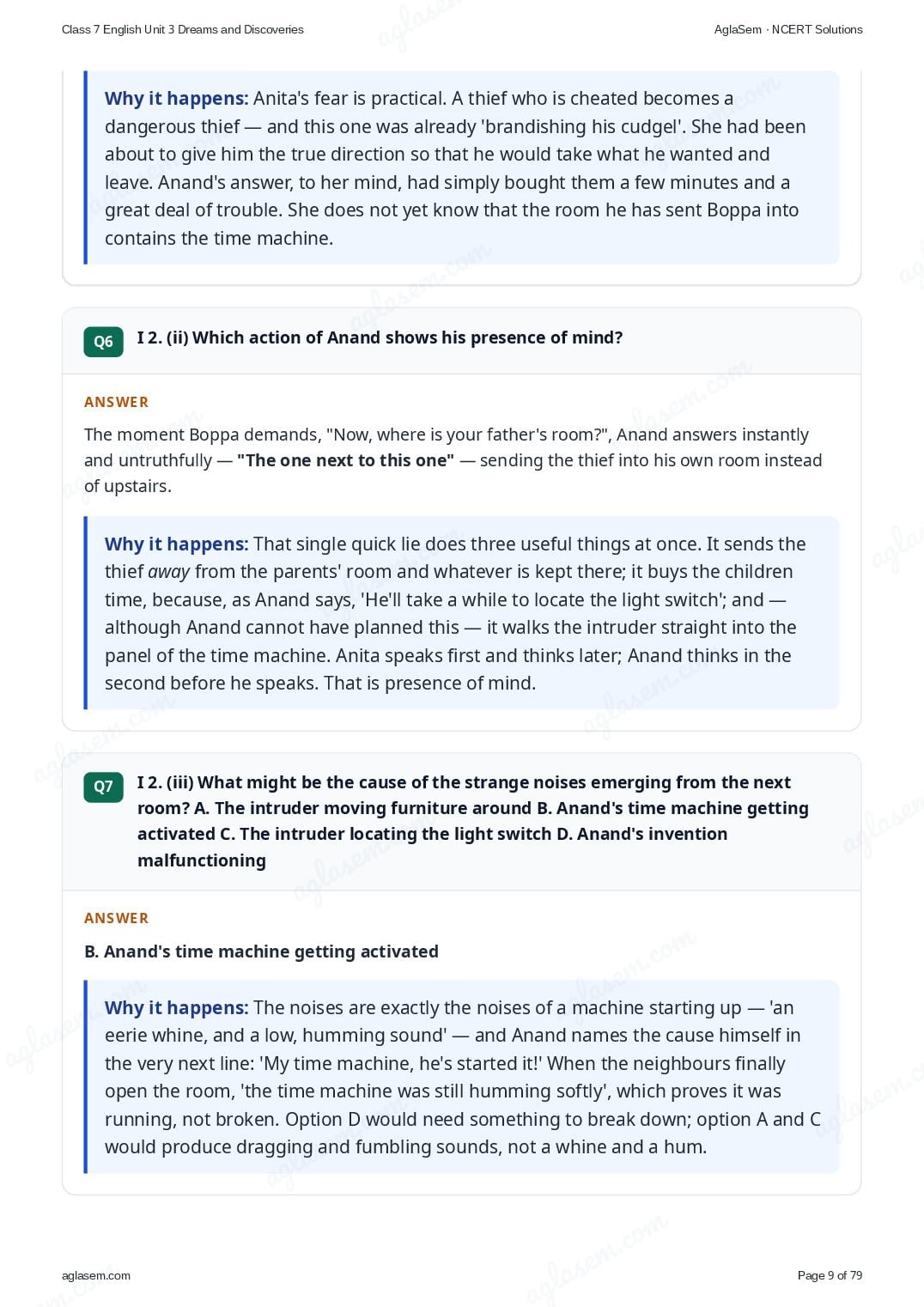
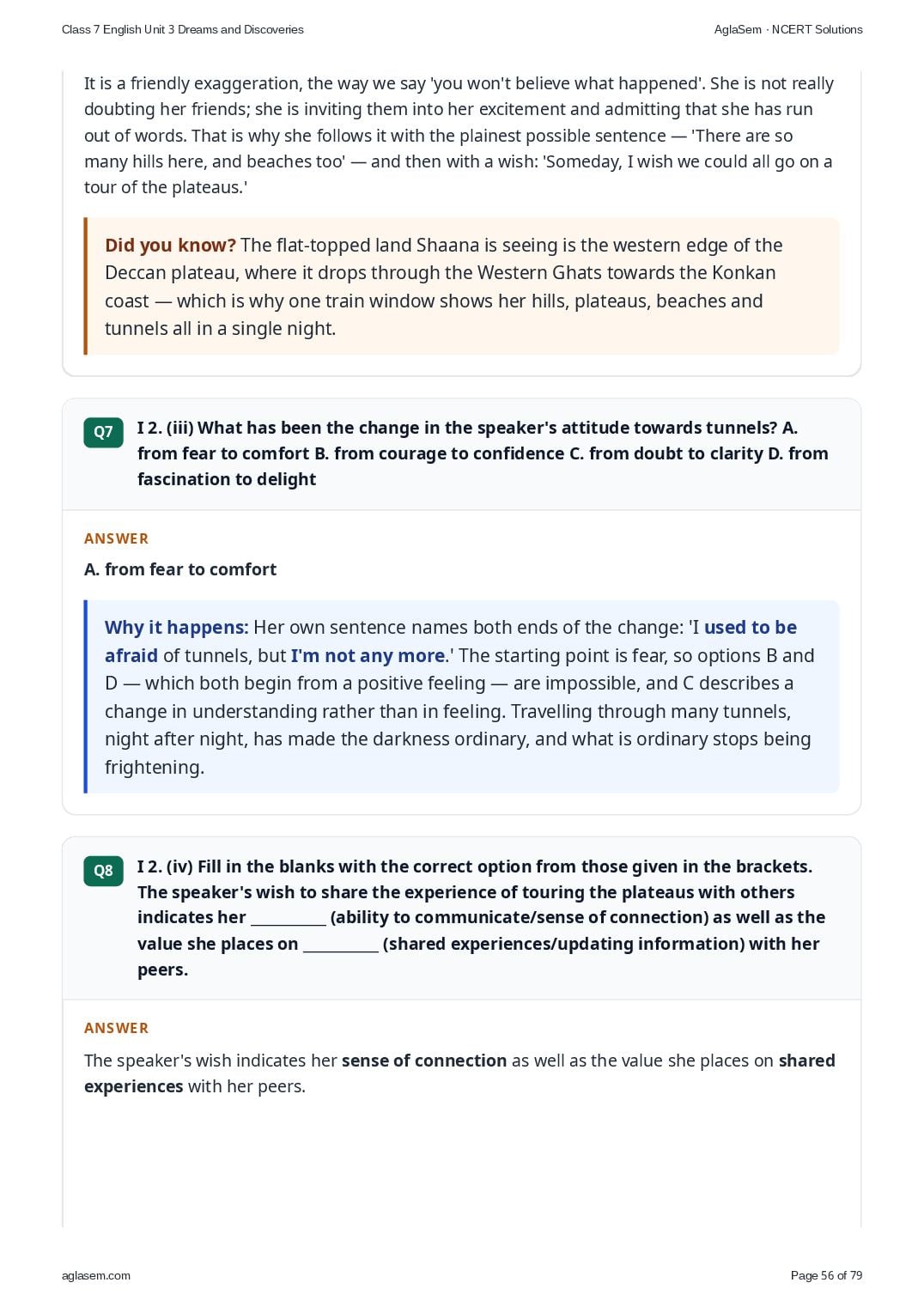
- I 2. Extract: 'I was about to direct him upstairs, when Anand said quickly, "The one next to this one." / "You silly goose!" I said angrily as soon as the man had gone. / "That's your room. He'll come back as mad as mad can be." / "At least it will give us some time to think of something," Anand said. "He'll take a while to locate the light switch. Let's shout." All of a sudden there was a crash followed by a loud scream. More strange noises emerged from the next room—a few muffled thumps, an eerie whine, and a low, humming sound.' (i) Complete the sentence given below with a suitable reason. Anita was angry with Anand because ____________.
- I 2. (ii) Which action of Anand shows his presence of mind?
- I 2. (iii) What might be the cause of the strange noises emerging from the next room? A. The intruder moving furniture around B. Anand's time machine getting activated C. The intruder locating the light switch D. Anand's invention malfunctioning
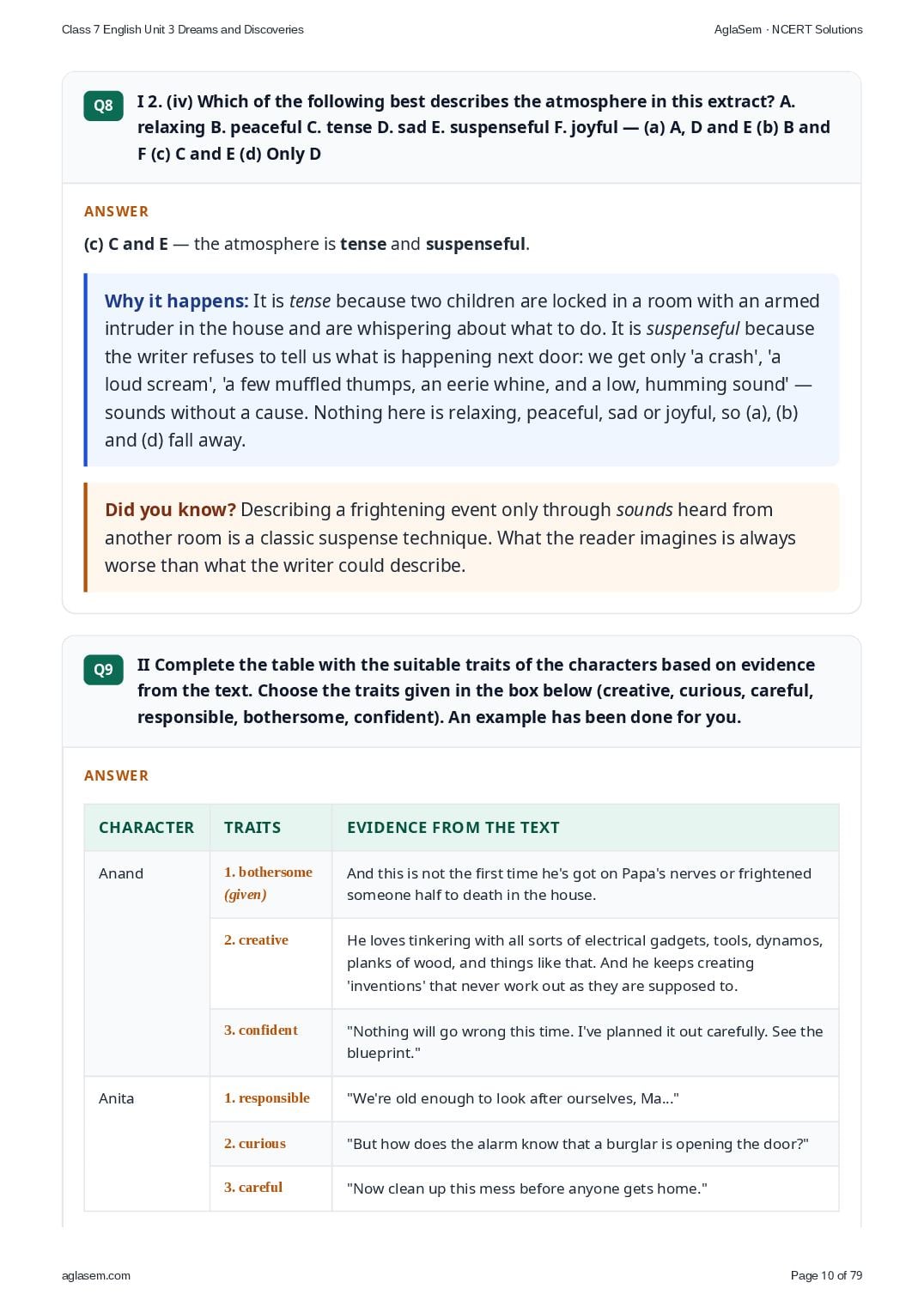
- I 2. (iv) Which of the following best describes the atmosphere in this extract? A. relaxing B. peaceful C. tense D. sad E. suspenseful F. joyful — (a) A, D and E (b) B and F (c) C and E (d) Only D
- II Complete the table with the suitable traits of the characters based on evidence from the text. Choose the traits given in the box below (creative, curious, careful, responsible, bothersome, confident). An example has been done for you.
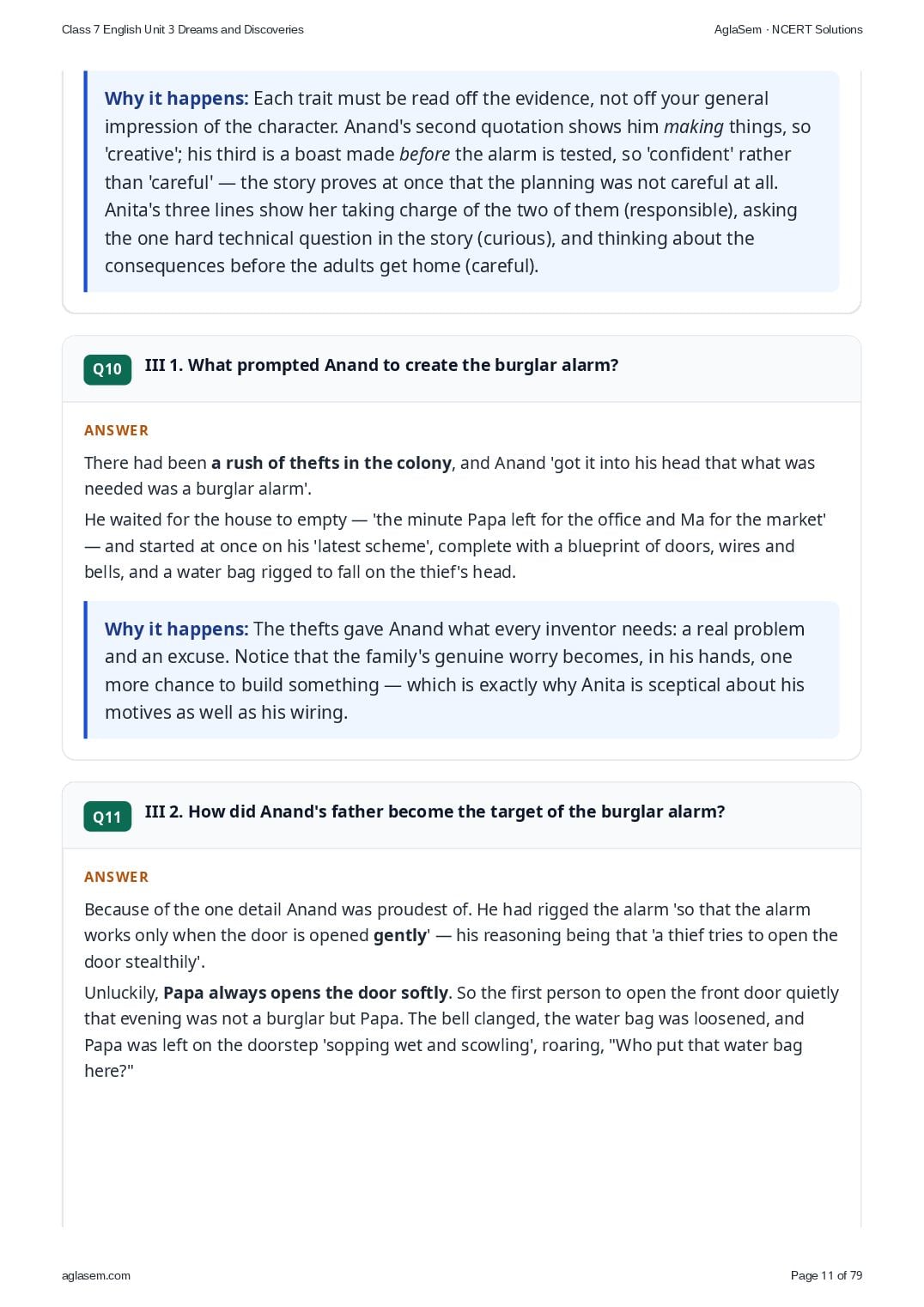
- III 1. What prompted Anand to create the burglar alarm?
- III 2. How did Anand's father become the target of the burglar alarm?
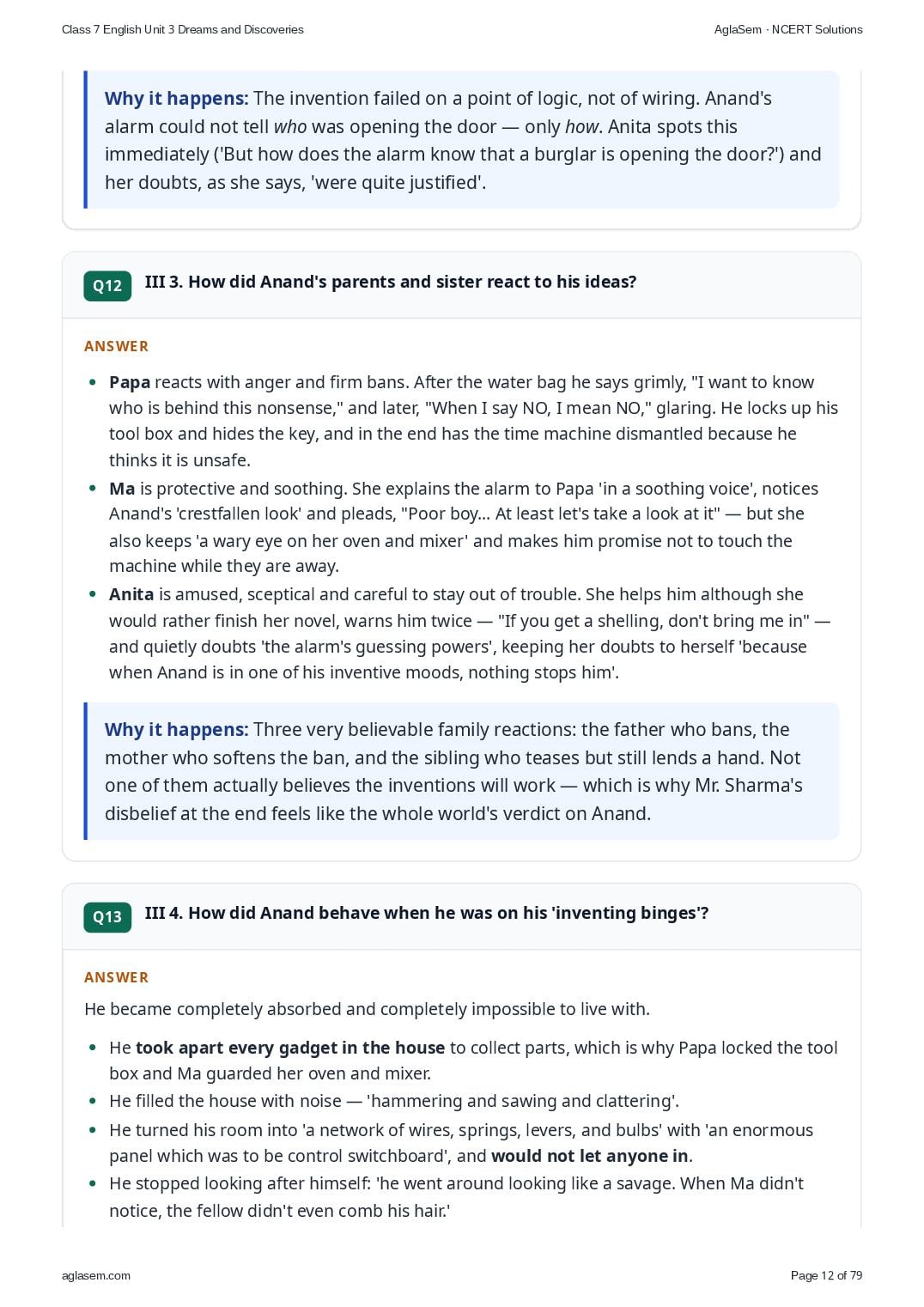
- III 3. How did Anand's parents and sister react to his ideas?
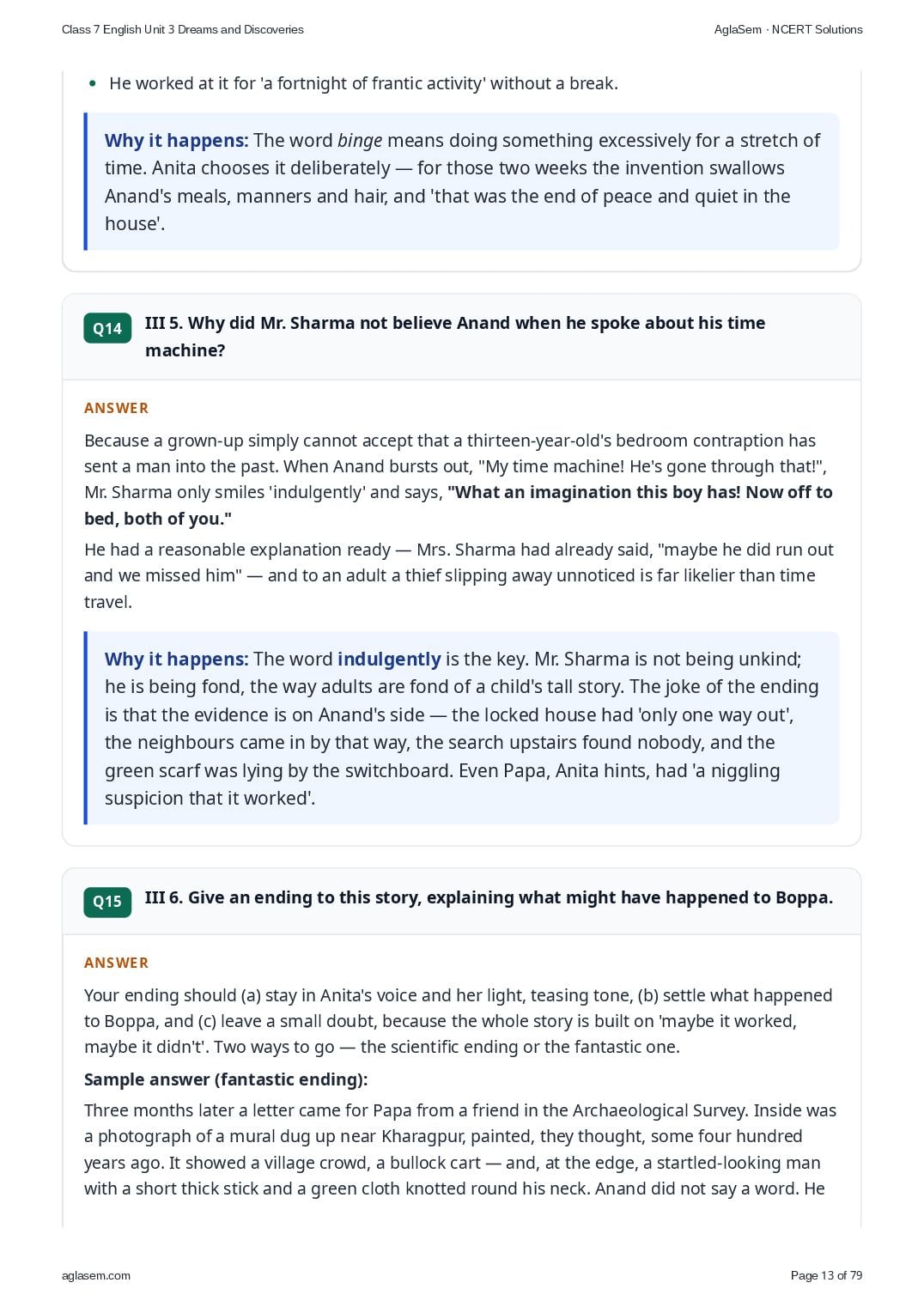
- III 4. How did Anand behave when he was on his 'inventing binges'?
- III 5. Why did Mr. Sharma not believe Anand when he spoke about his time machine?
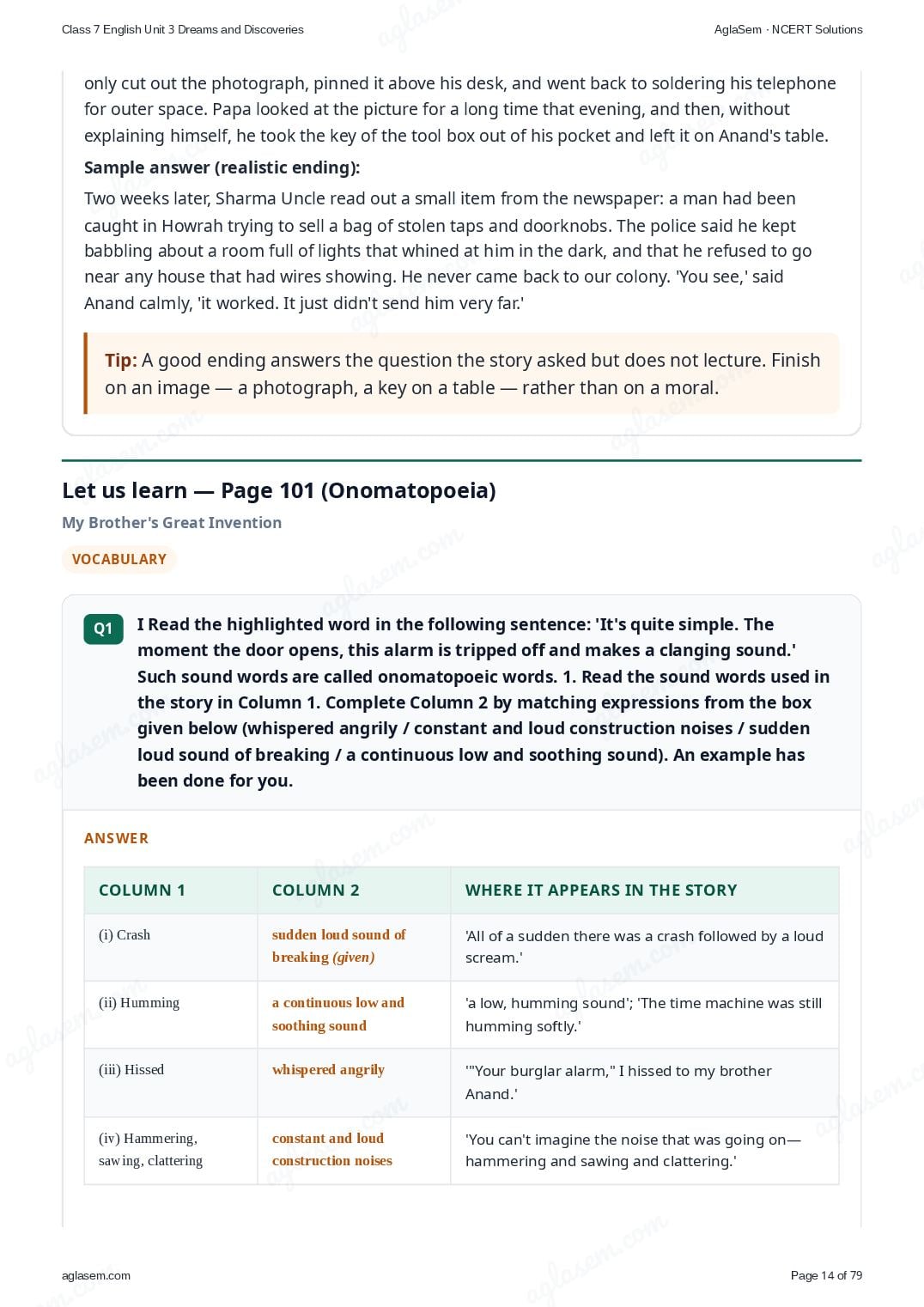
- III 6. Give an ending to this story, explaining what might have happened to Boppa.
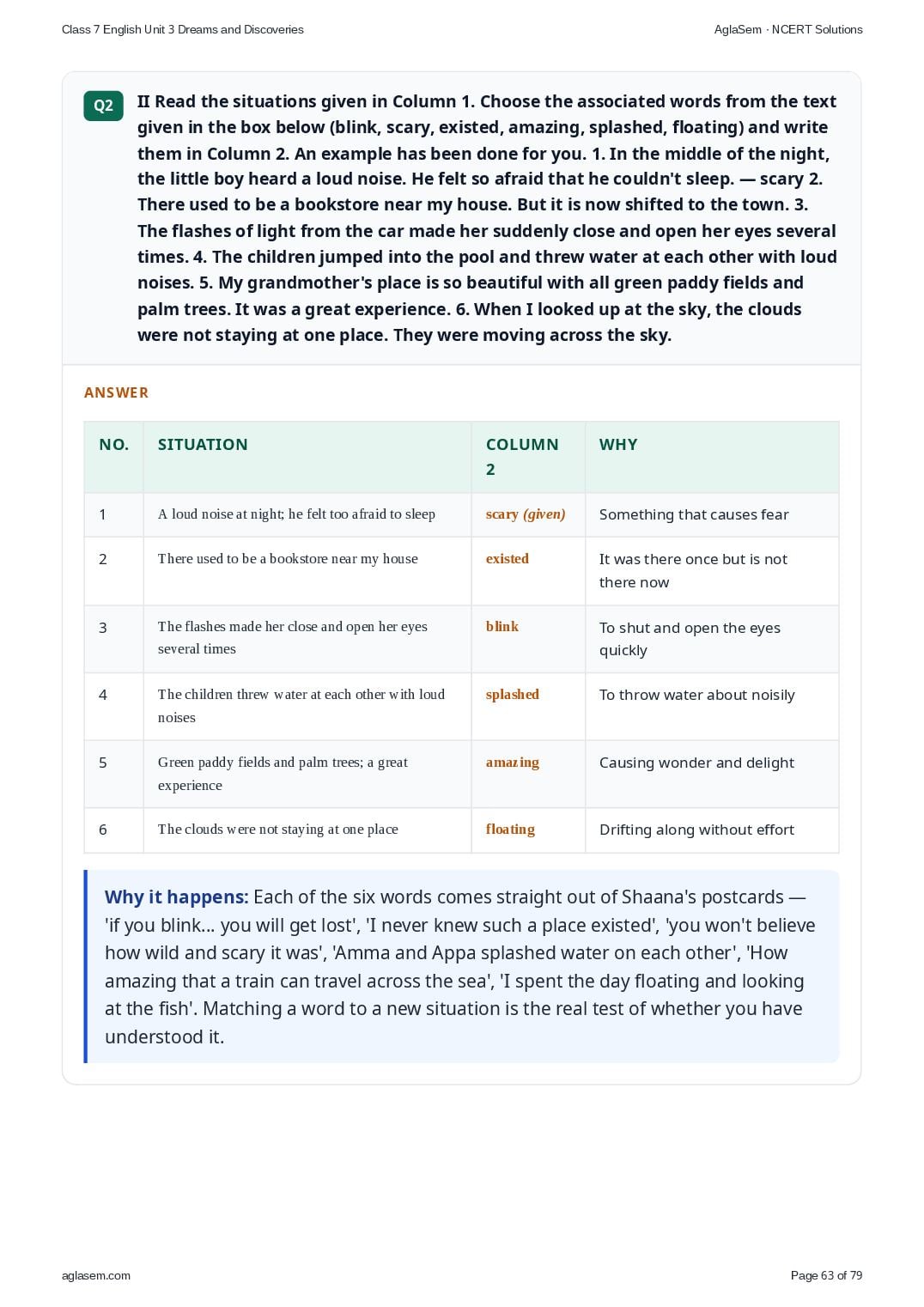
- I Read the highlighted word in the following sentence: 'It's quite simple. The moment the door opens, this alarm is tripped off and makes a clanging sound.' Such sound words are called onomatopoeic words. 1. Read the sound words used in the story in Column 1. Complete Column 2 by matching expressions from the box given below (whispered angrily / constant and loud construction noises / sudden loud sound of breaking / a continuous low and soothing sound). An example has been done for you.
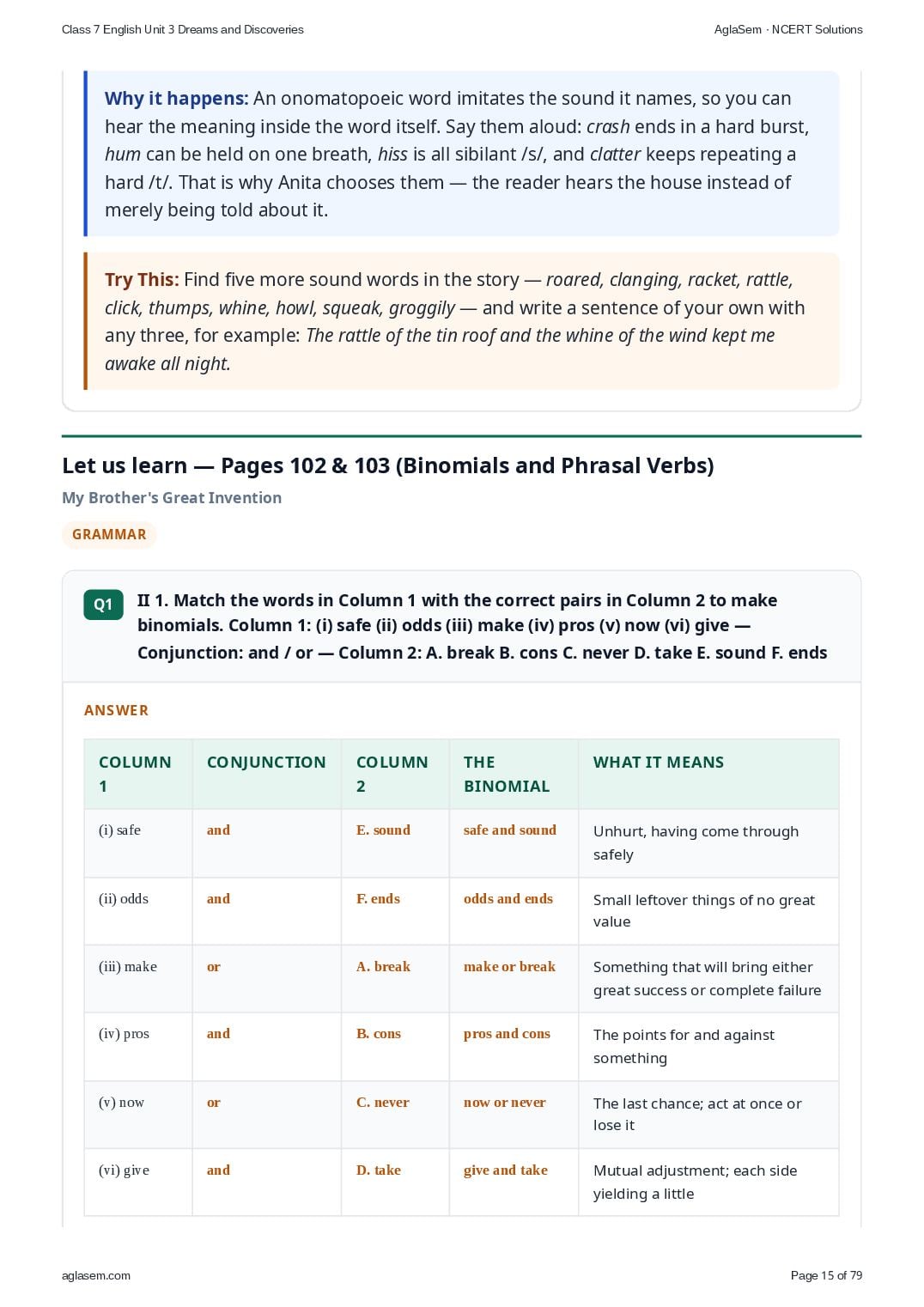
- II 1. Match the words in Column 1 with the correct pairs in Column 2 to make binomials. Column 1: (i) safe (ii) odds (iii) make (iv) pros (v) now (vi) give — Conjunction: and / or — Column 2: A. break B. cons C. never D. take E. sound F. ends
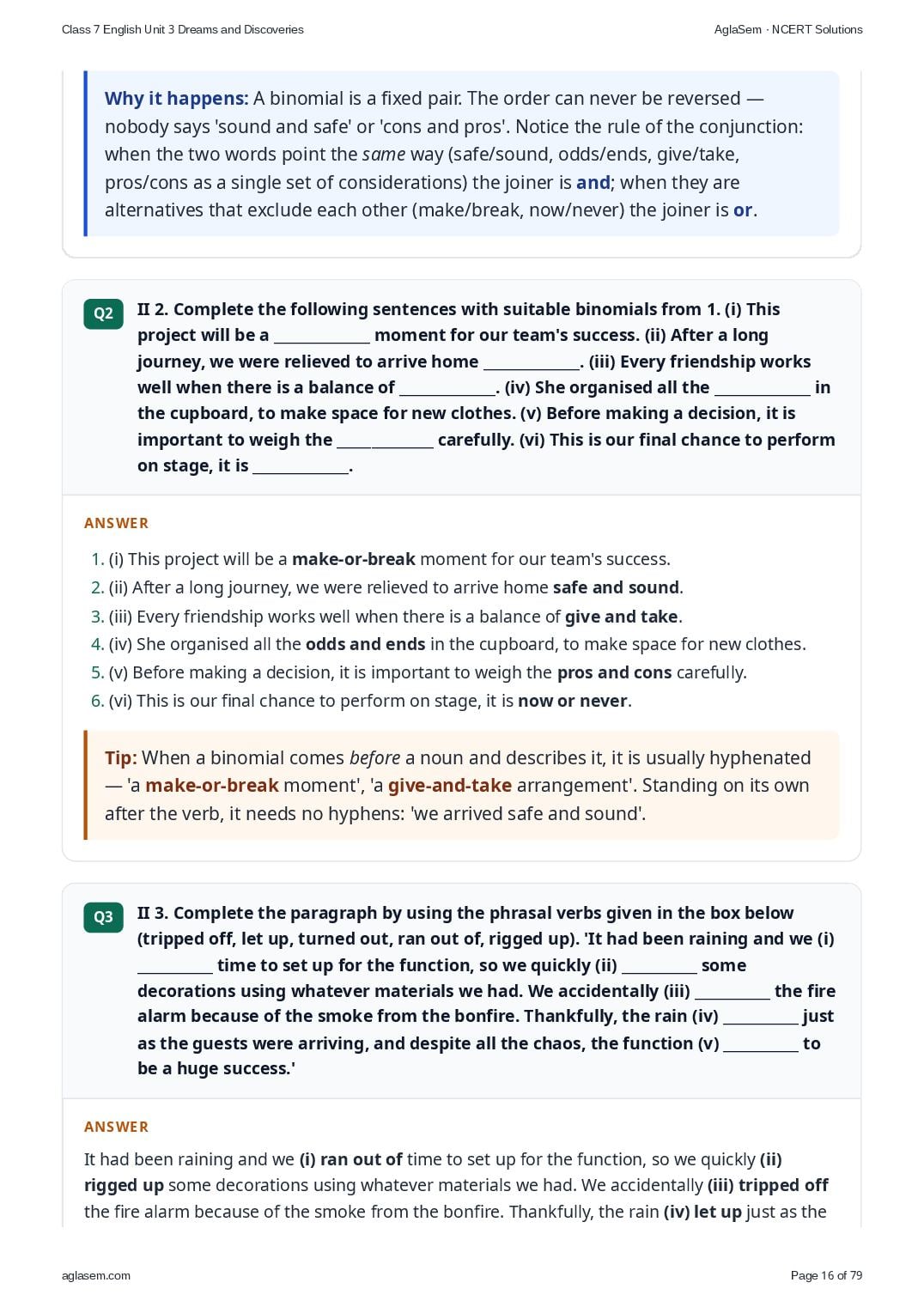
- II 2. Complete the following sentences with suitable binomials from 1. (i) This project will be a ______________ moment for our team's success. (ii) After a long journey, we were relieved to arrive home ______________. (iii) Every friendship works well when there is a balance of ______________. (iv) She organised all the ______________ in the cupboard, to make space for new clothes. (v) Before making a decision, it is important to weigh the ______________ carefully. (vi) This is our final chance to perform on stage, it is ______________.
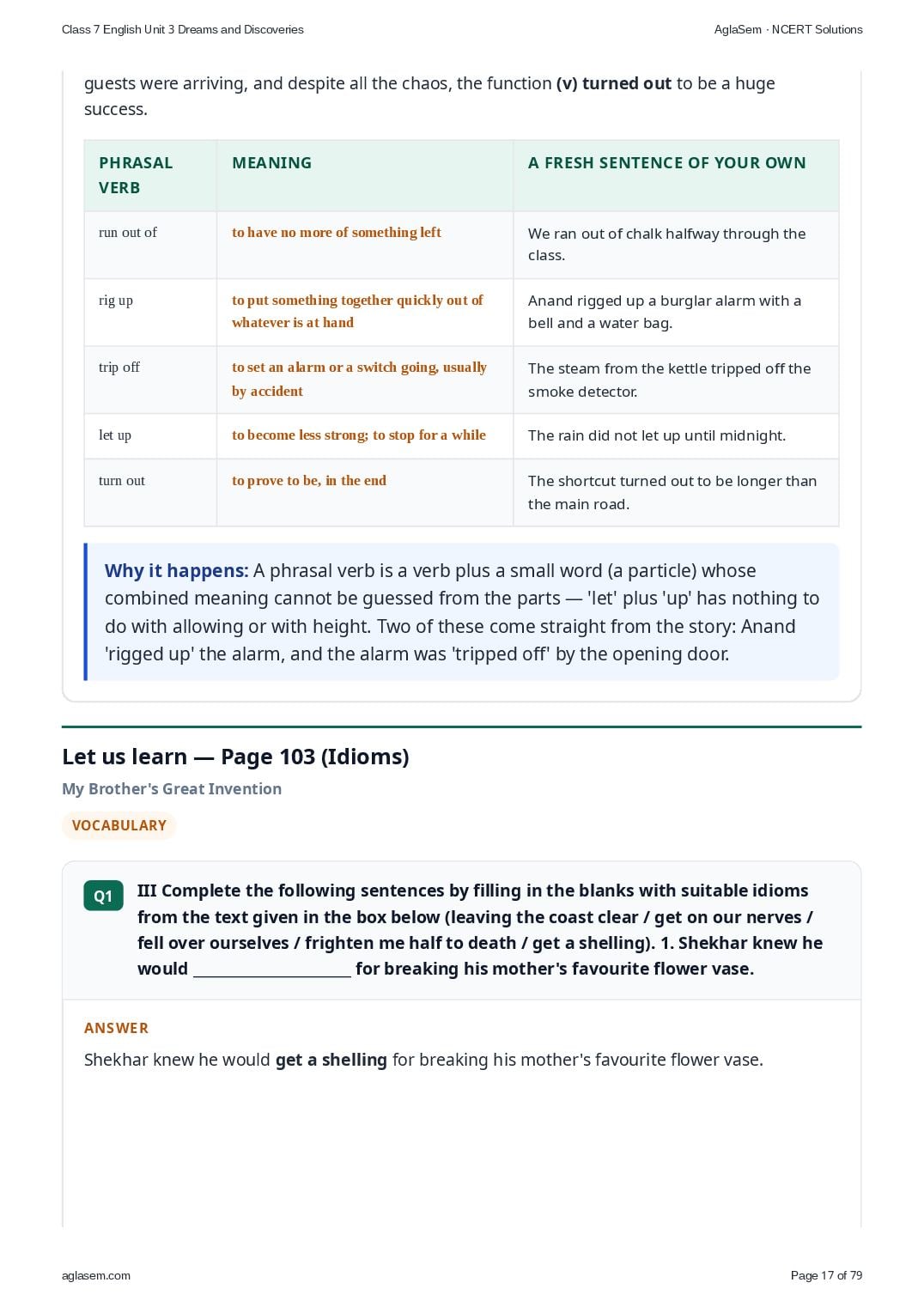
- II 3. Complete the paragraph by using the phrasal verbs given in the box below (tripped off, let up, turned out, ran out of, rigged up). 'It had been raining and we (i) ___________ time to set up for the function, so we quickly (ii) ___________ some decorations using whatever materials we had. We accidentally (iii) ___________ the fire alarm because of the smoke from the bonfire. Thankfully, the rain (iv) ___________ just as the guests were arriving, and despite all the chaos, the function (v) ___________ to be a huge success.'
- III Complete the following sentences by filling in the blanks with suitable idioms from the text given in the box below (leaving the coast clear / get on our nerves / fell over ourselves / frighten me half to death / get a shelling). 1. Shekhar knew he would _______________________ for breaking his mother's favourite flower vase.
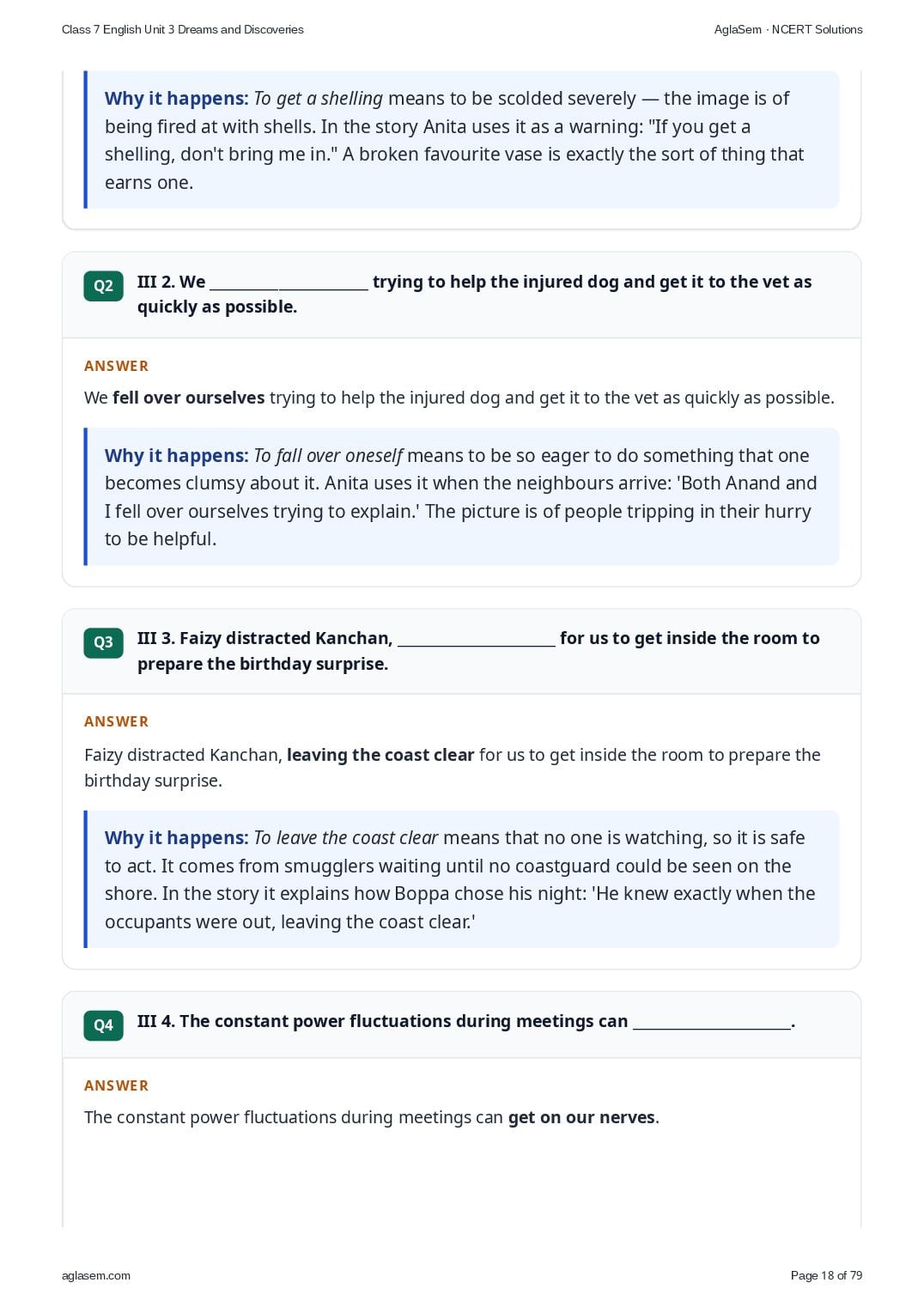
- III 2. We _______________________ trying to help the injured dog and get it to the vet as quickly as possible.
- III 3. Faizy distracted Kanchan, _______________________ for us to get inside the room to prepare the birthday surprise.
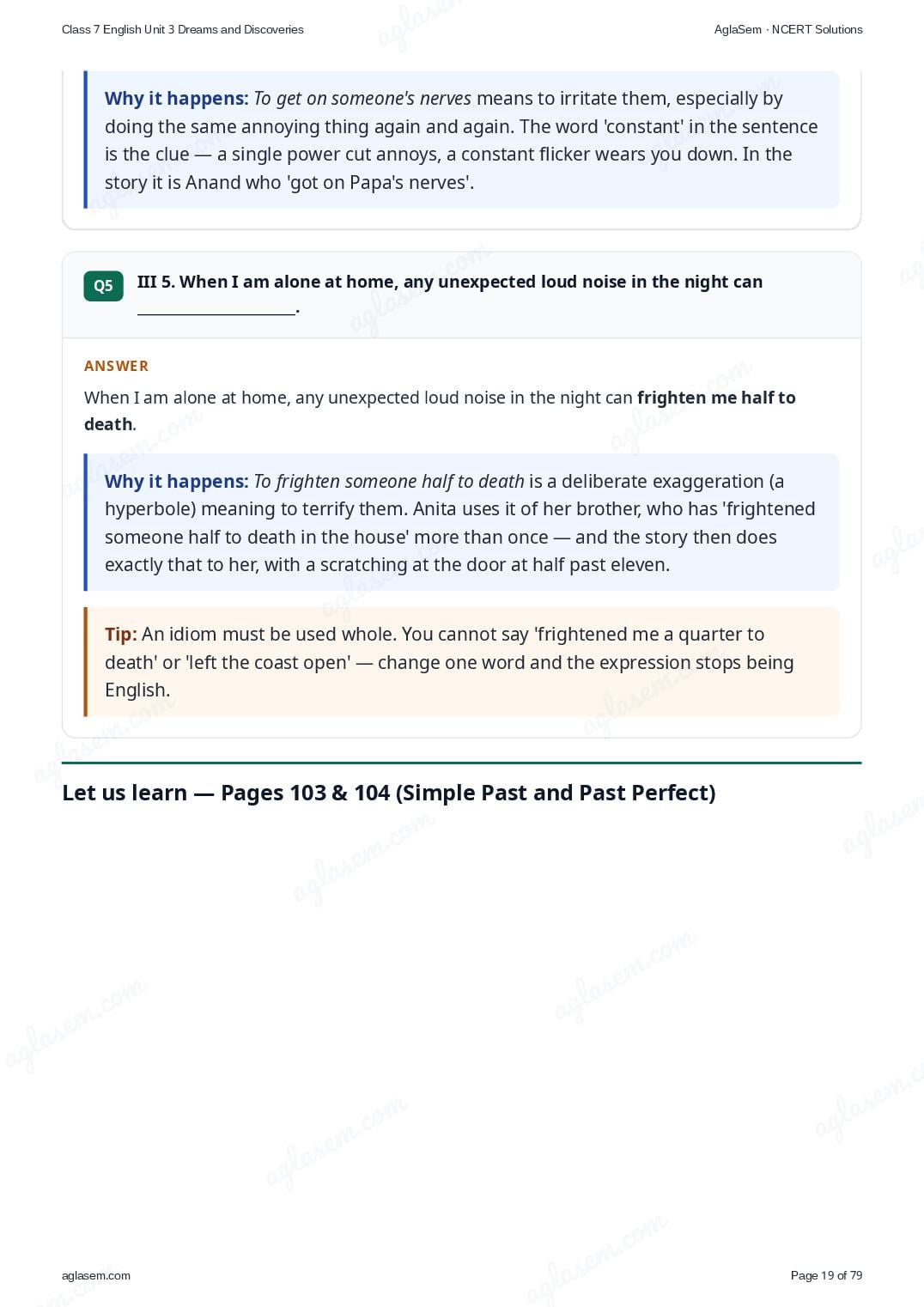
- III 4. The constant power fluctuations during meetings can _______________________.
- III 5. When I am alone at home, any unexpected loud noise in the night can _______________________.
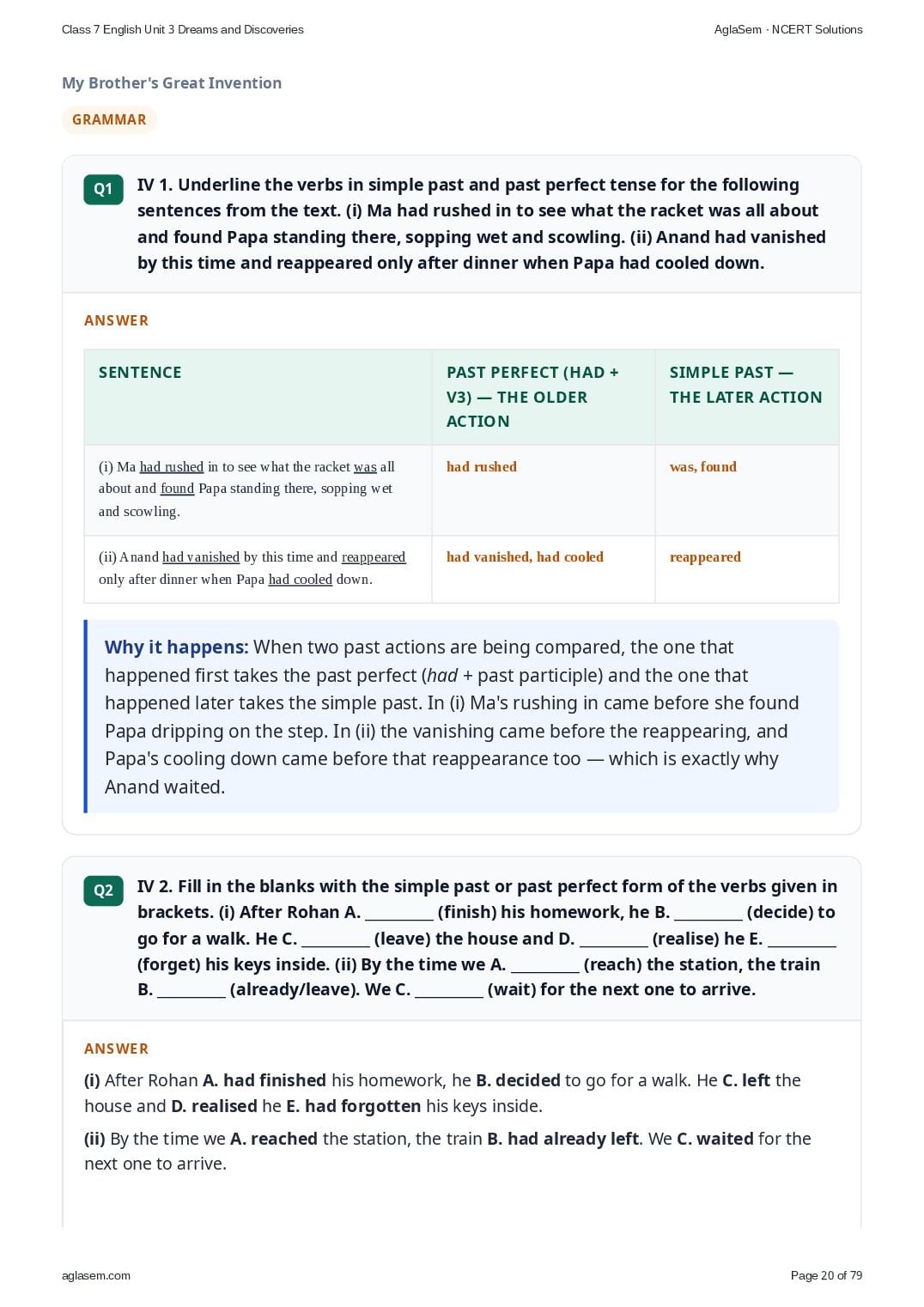
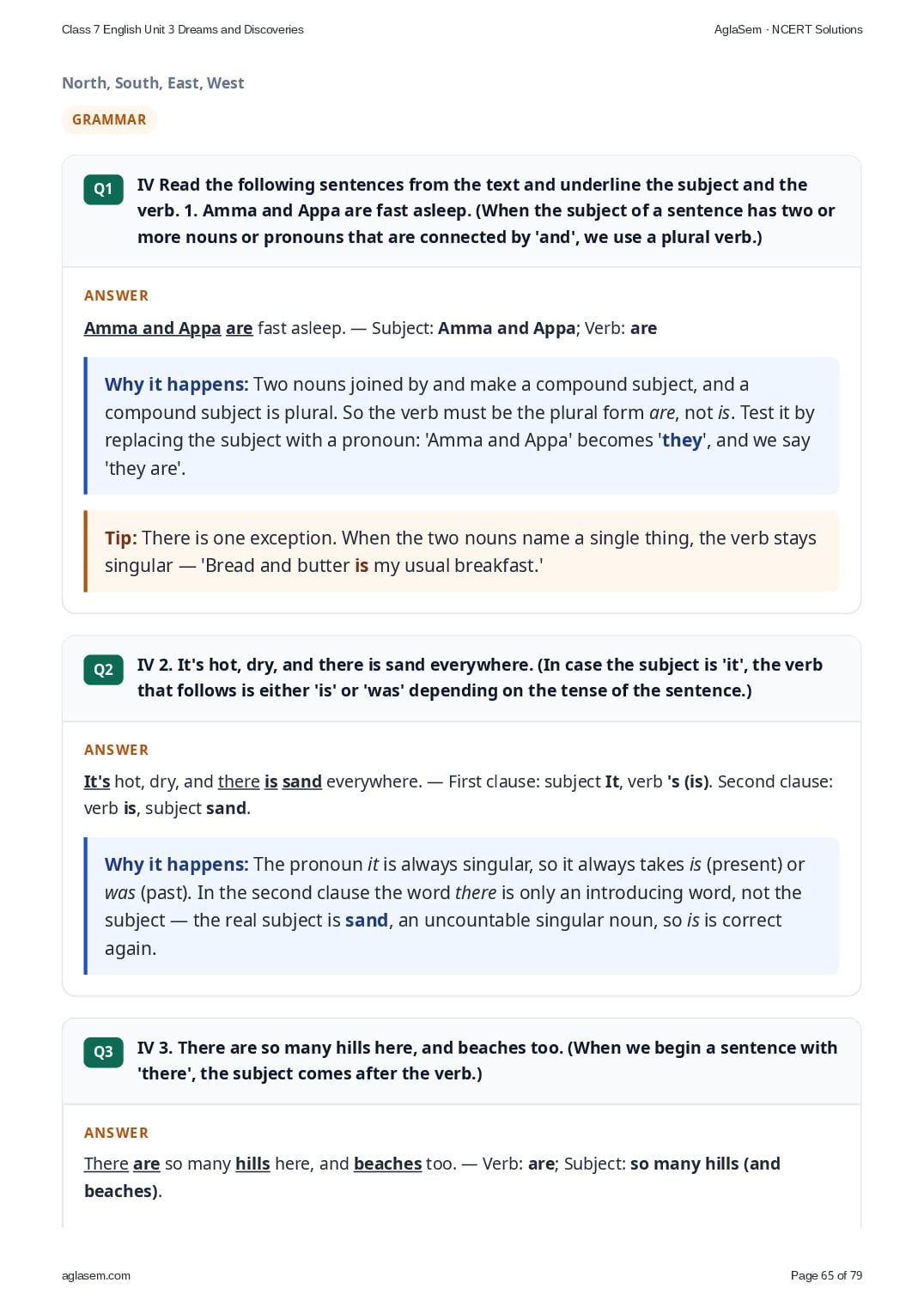
- IV 1. Underline the verbs in simple past and past perfect tense for the following sentences from the text. (i) Ma had rushed in to see what the racket was all about and found Papa standing there, sopping wet and scowling. (ii) Anand had vanished by this time and reappeared only after dinner when Papa had cooled down.
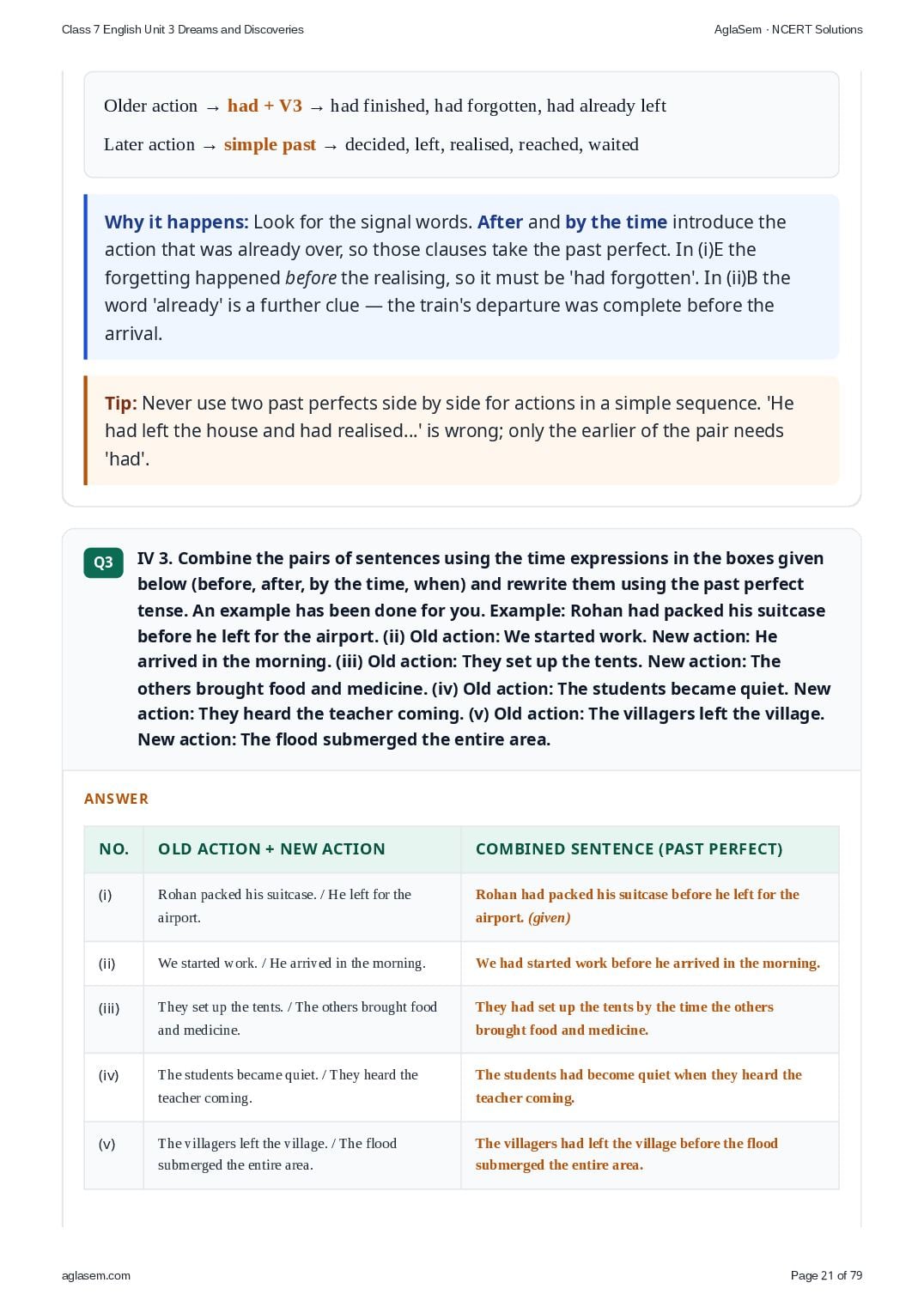
- IV 2. Fill in the blanks with the simple past or past perfect form of the verbs given in brackets. (i) After Rohan A. __________ (finish) his homework, he B. __________ (decide) to go for a walk. He C. __________ (leave) the house and D. __________ (realise) he E. __________ (forget) his keys inside. (ii) By the time we A. __________ (reach) the station, the train B. __________ (already/leave). We C. __________ (wait) for the next one to arrive.
- IV 3. Combine the pairs of sentences using the time expressions in the boxes given below (before, after, by the time, when) and rewrite them using the past perfect tense. An example has been done for you. Example: Rohan had packed his suitcase before he left for the airport. (ii) Old action: We started work. New action: He arrived in the morning. (iii) Old action: They set up the tents. New action: The others brought food and medicine. (iv) Old action: The students became quiet. New action: They heard the teacher coming. (v) Old action: The villagers left the village. New action: The flood submerged the entire area.
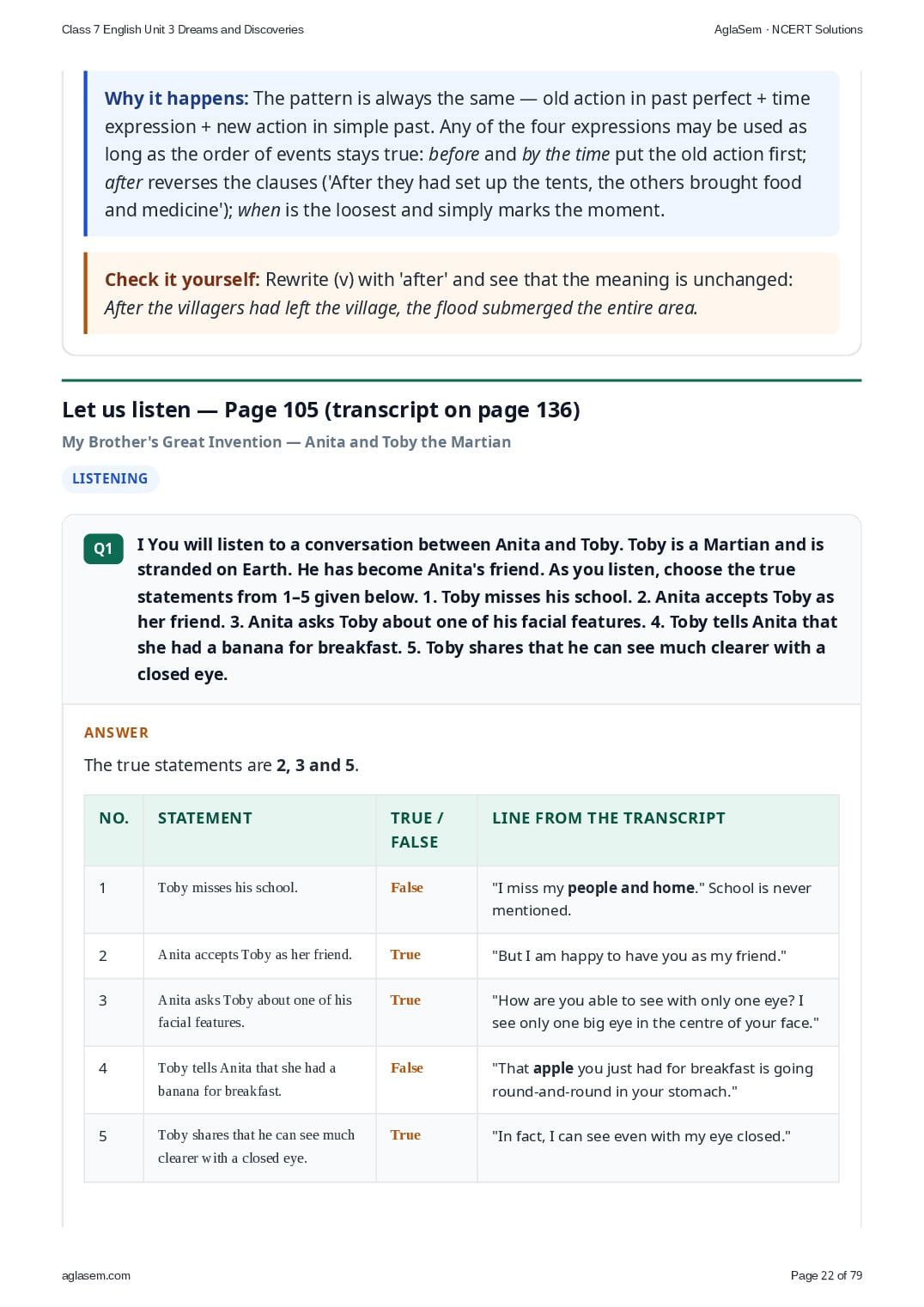
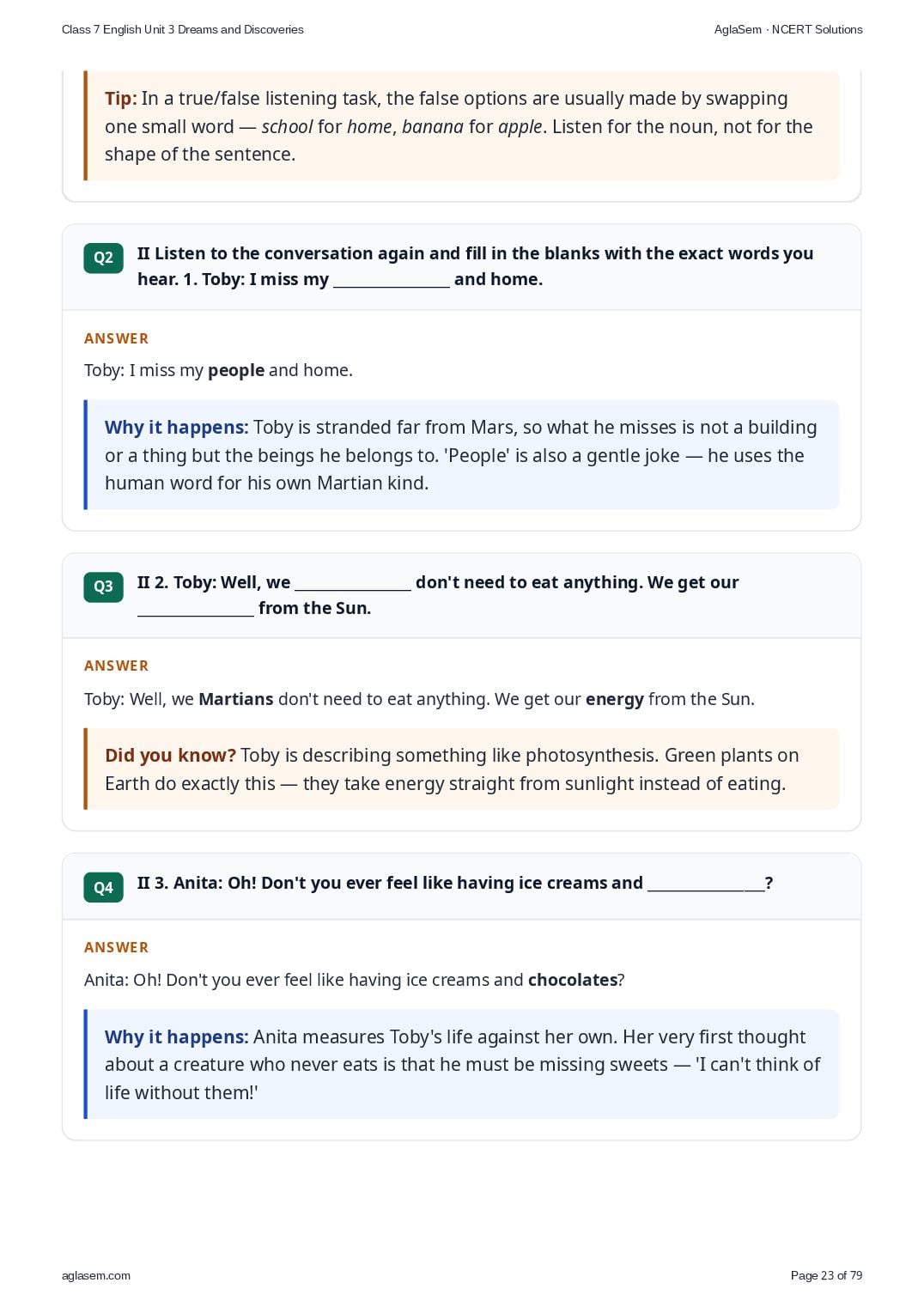
- I You will listen to a conversation between Anita and Toby. Toby is a Martian and is stranded on Earth. He has become Anita's friend. As you listen, choose the true statements from 1–5 given below. 1. Toby misses his school. 2. Anita accepts Toby as her friend. 3. Anita asks Toby about one of his facial features. 4. Toby tells Anita that she had a banana for breakfast. 5. Toby shares that he can see much clearer with a closed eye.
- II Listen to the conversation again and fill in the blanks with the exact words you hear. 1. Toby: I miss my _________________ and home.
- II 2. Toby: Well, we _________________ don't need to eat anything. We get our _________________ from the Sun.
- II 3. Anita: Oh! Don't you ever feel like having ice creams and _________________?
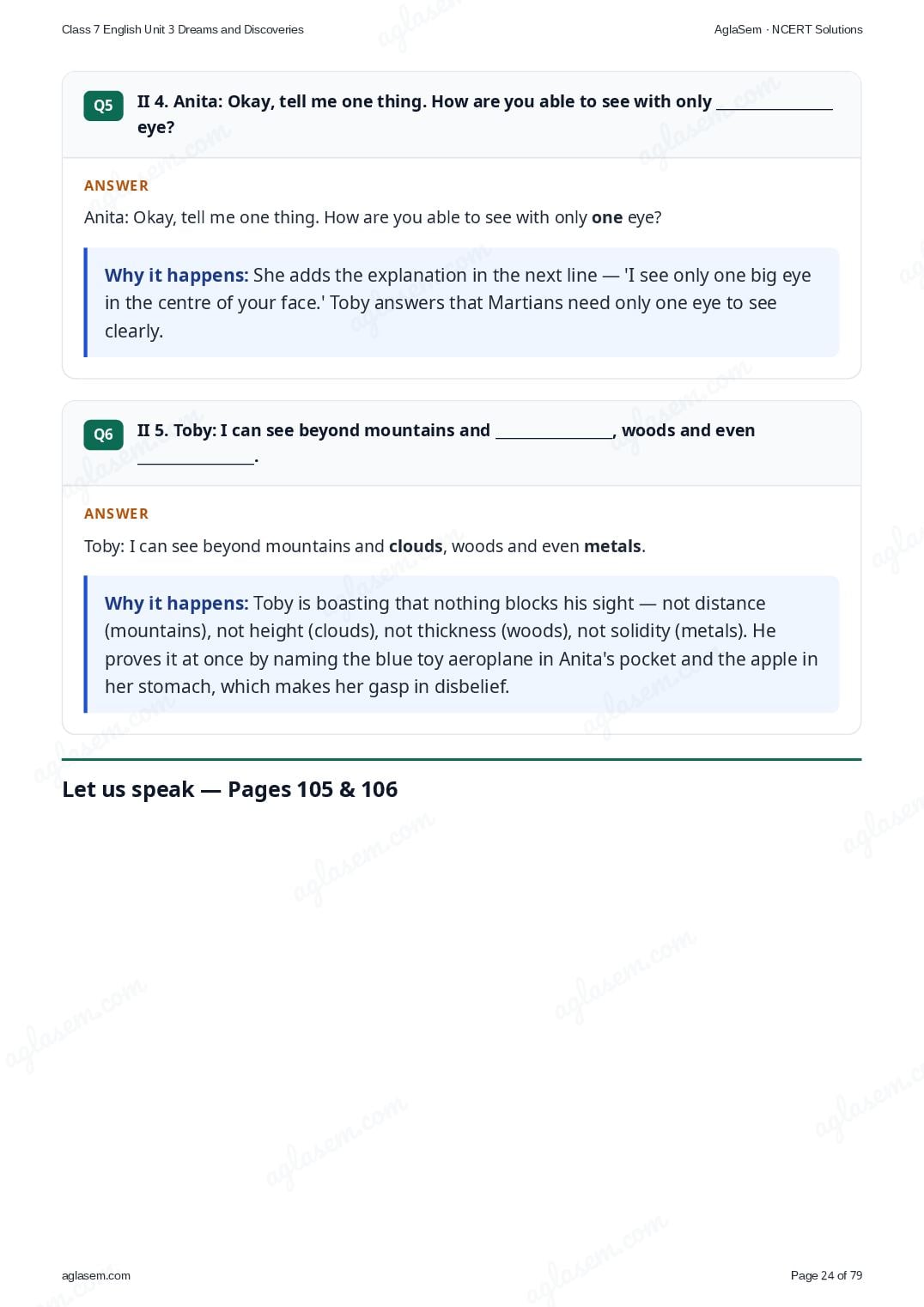
- II 4. Anita: Okay, tell me one thing. How are you able to see with only _________________ eye?
- II 5. Toby: I can see beyond mountains and _________________, woods and even _________________.
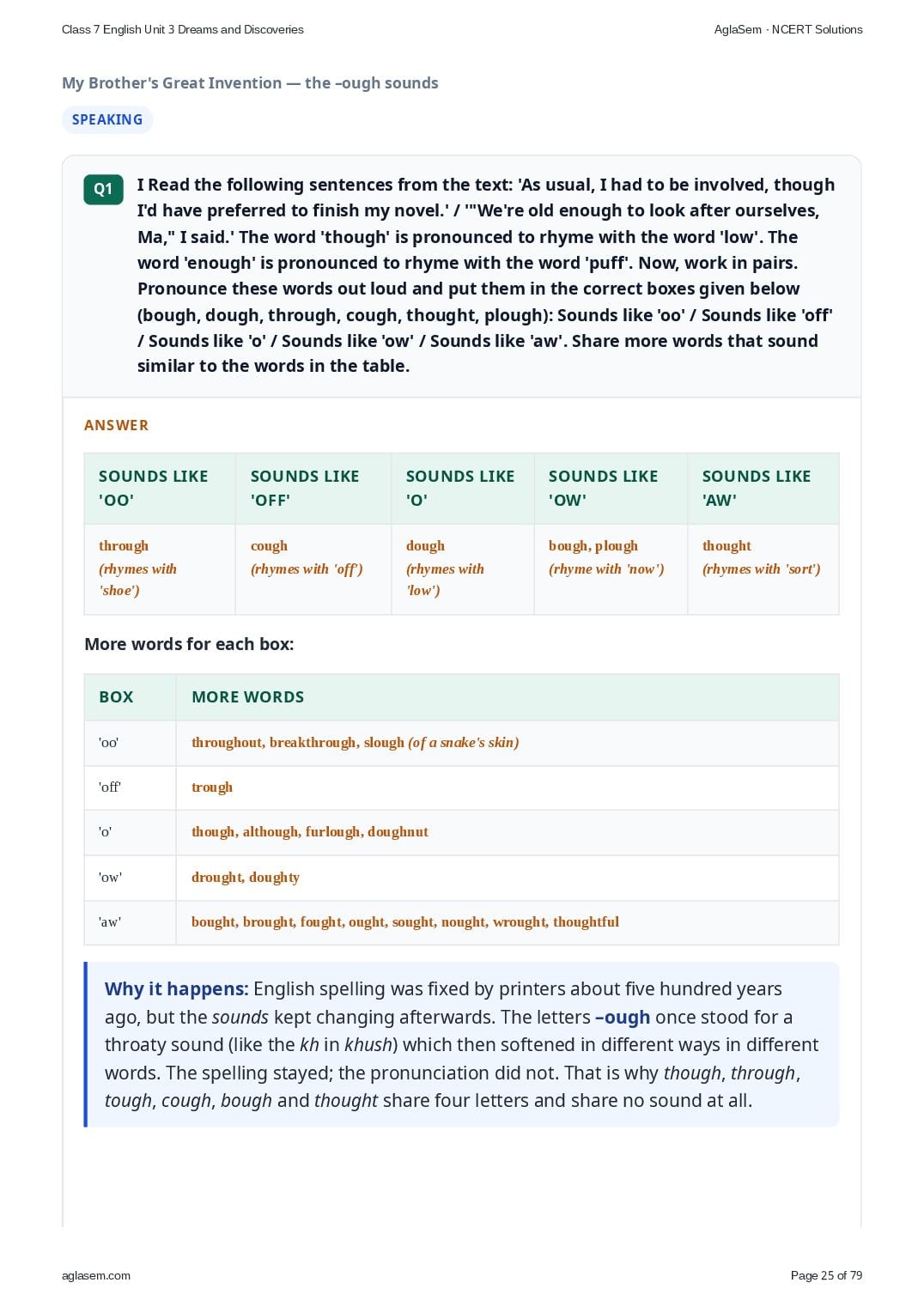
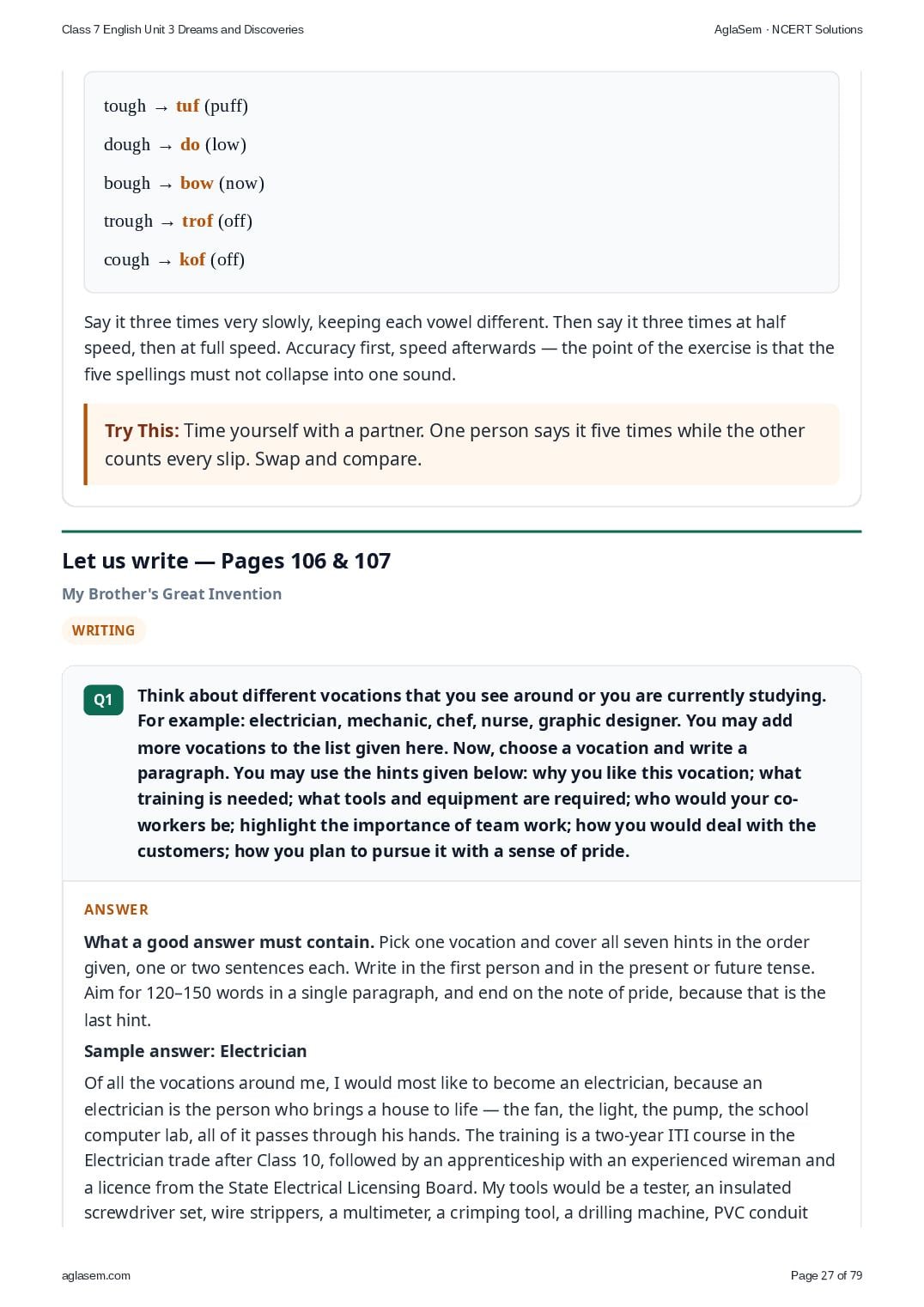
- I Read the following sentences from the text: 'As usual, I had to be involved, though I'd have preferred to finish my novel.' / '"We're old enough to look after ourselves, Ma," I said.' The word 'though' is pronounced to rhyme with the word 'low'. The word 'enough' is pronounced to rhyme with the word 'puff'. Now, work in pairs. Pronounce these words out loud and put them in the correct boxes given below (bough, dough, through, cough, thought, plough): Sounds like 'oo' / Sounds like 'off' / Sounds like 'o' / Sounds like 'ow' / Sounds like 'aw'. Share more words that sound similar to the words in the table.
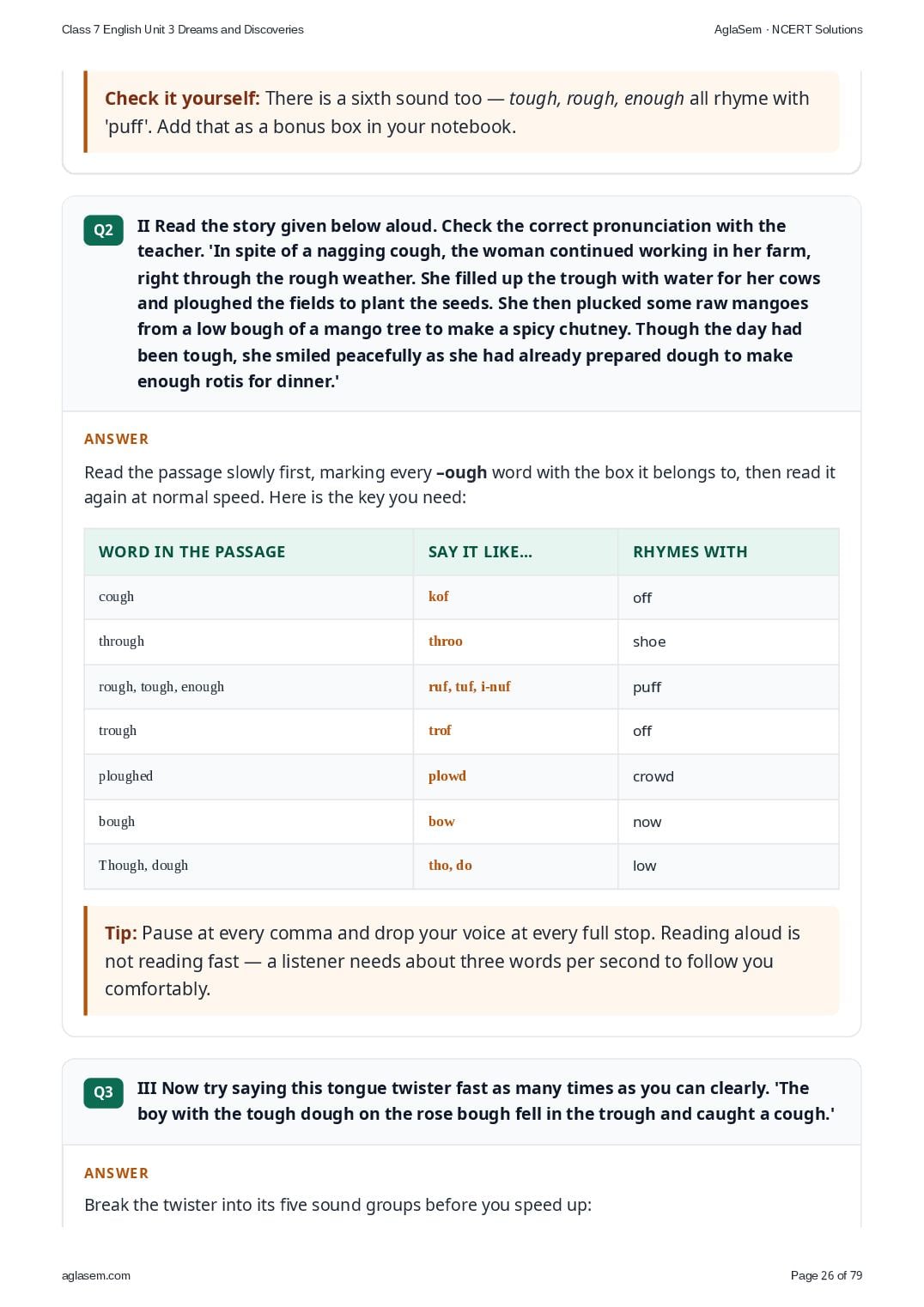
- II Read the story given below aloud. Check the correct pronunciation with the teacher. 'In spite of a nagging cough, the woman continued working in her farm, right through the rough weather. She filled up the trough with water for her cows and ploughed the fields to plant the seeds. She then plucked some raw mangoes from a low bough of a mango tree to make a spicy chutney. Though the day had been tough, she smiled peacefully as she had already prepared dough to make enough rotis for dinner.'
- III Now try saying this tongue twister fast as many times as you can clearly. 'The boy with the tough dough on the rose bough fell in the trough and caught a cough.'
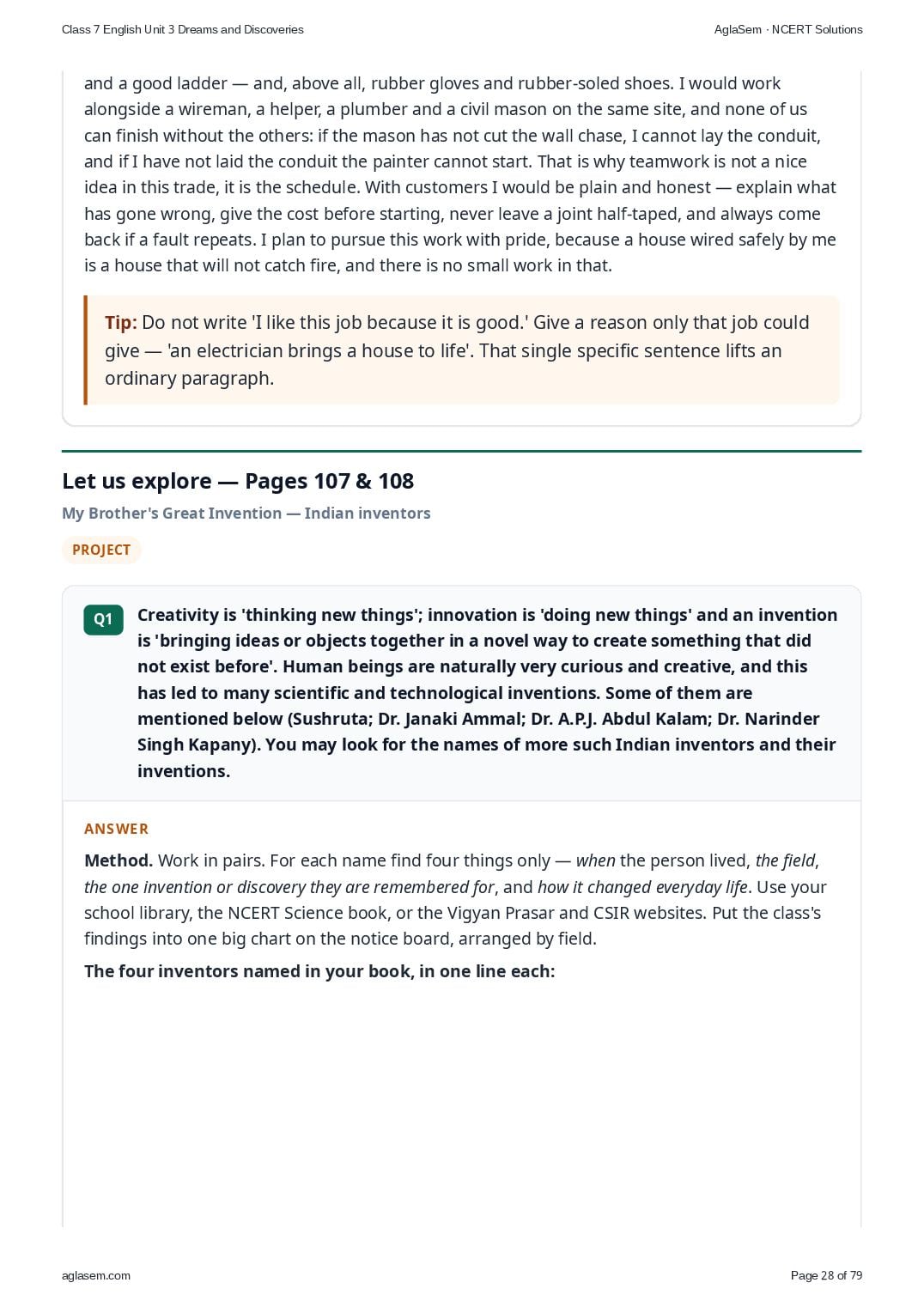
- Think about different vocations that you see around or you are currently studying. For example: electrician, mechanic, chef, nurse, graphic designer. You may add more vocations to the list given here. Now, choose a vocation and write a paragraph. You may use the hints given below: why you like this vocation; what training is needed; what tools and equipment are required; who would your co-workers be; highlight the importance of team work; how you would deal with the customers; how you plan to pursue it with a sense of pride.
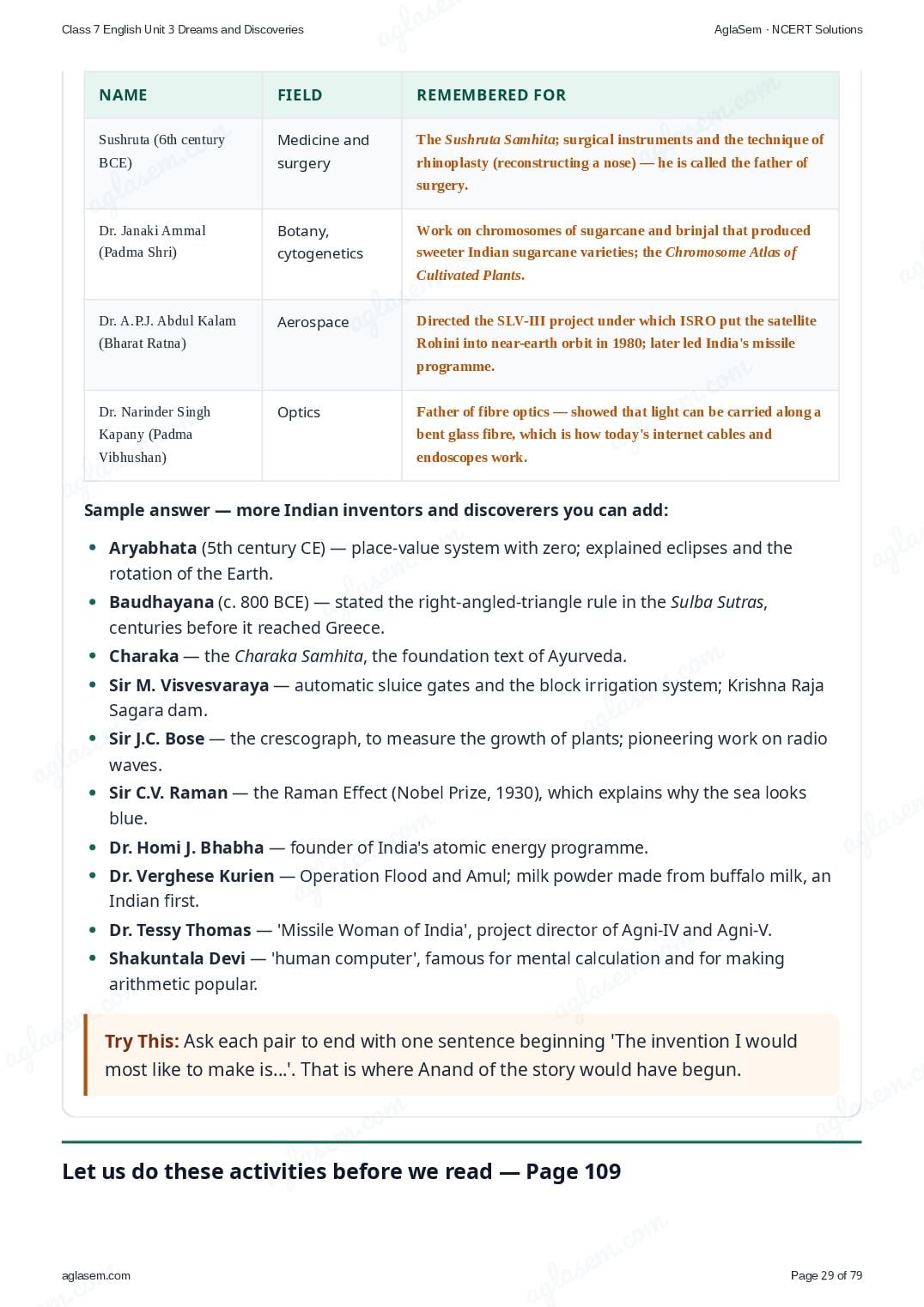
- Creativity is 'thinking new things'; innovation is 'doing new things' and an invention is 'bringing ideas or objects together in a novel way to create something that did not exist before'. Human beings are naturally very curious and creative, and this has led to many scientific and technological inventions. Some of them are mentioned below (Sushruta; Dr. Janaki Ammal; Dr. A.P.J. Abdul Kalam; Dr. Narinder Singh Kapany). You may look for the names of more such Indian inventors and their inventions.
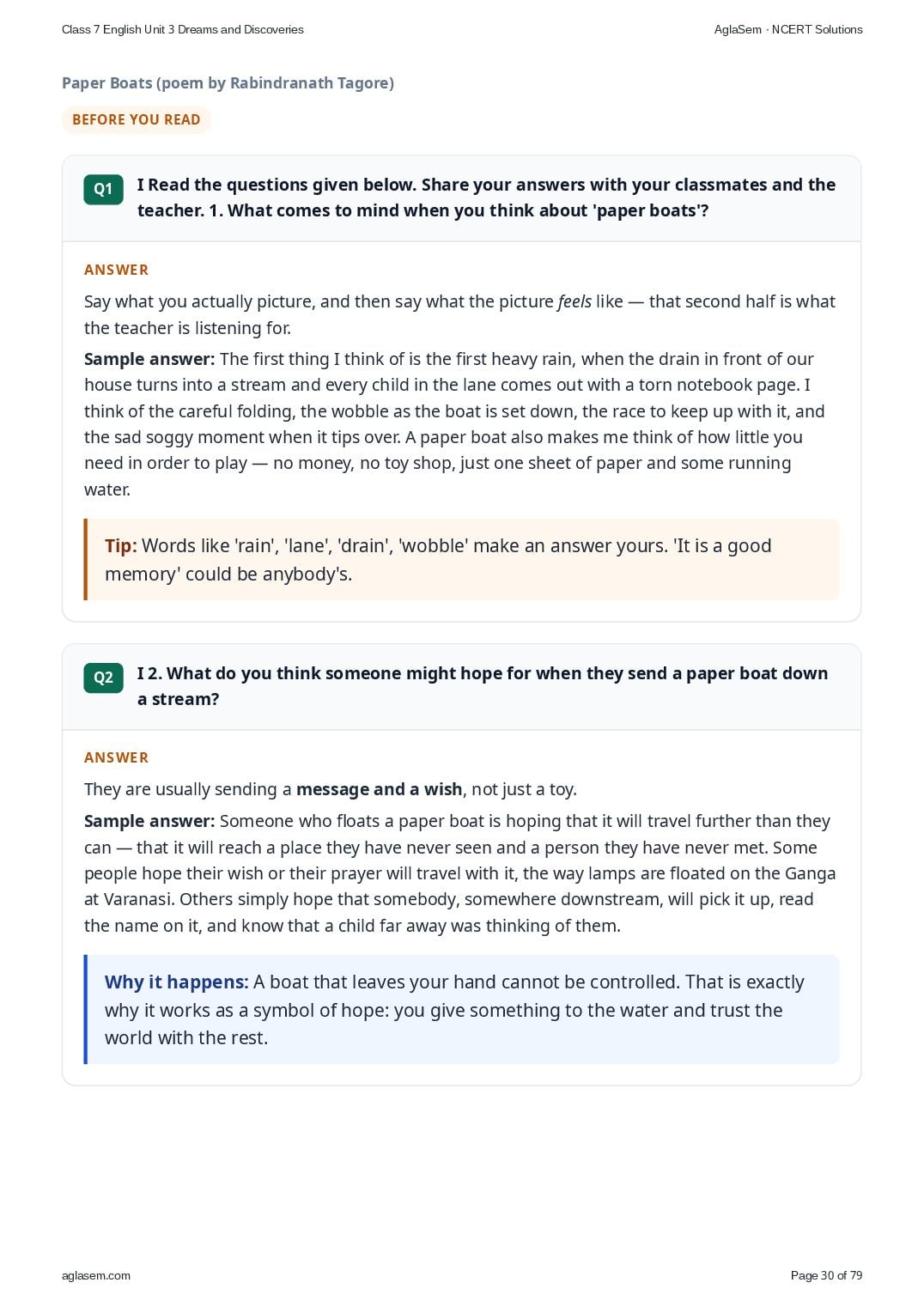
- I Read the questions given below. Share your answers with your classmates and the teacher. 1. What comes to mind when you think about 'paper boats'?
- I 2. What do you think someone might hope for when they send a paper boat down a stream?
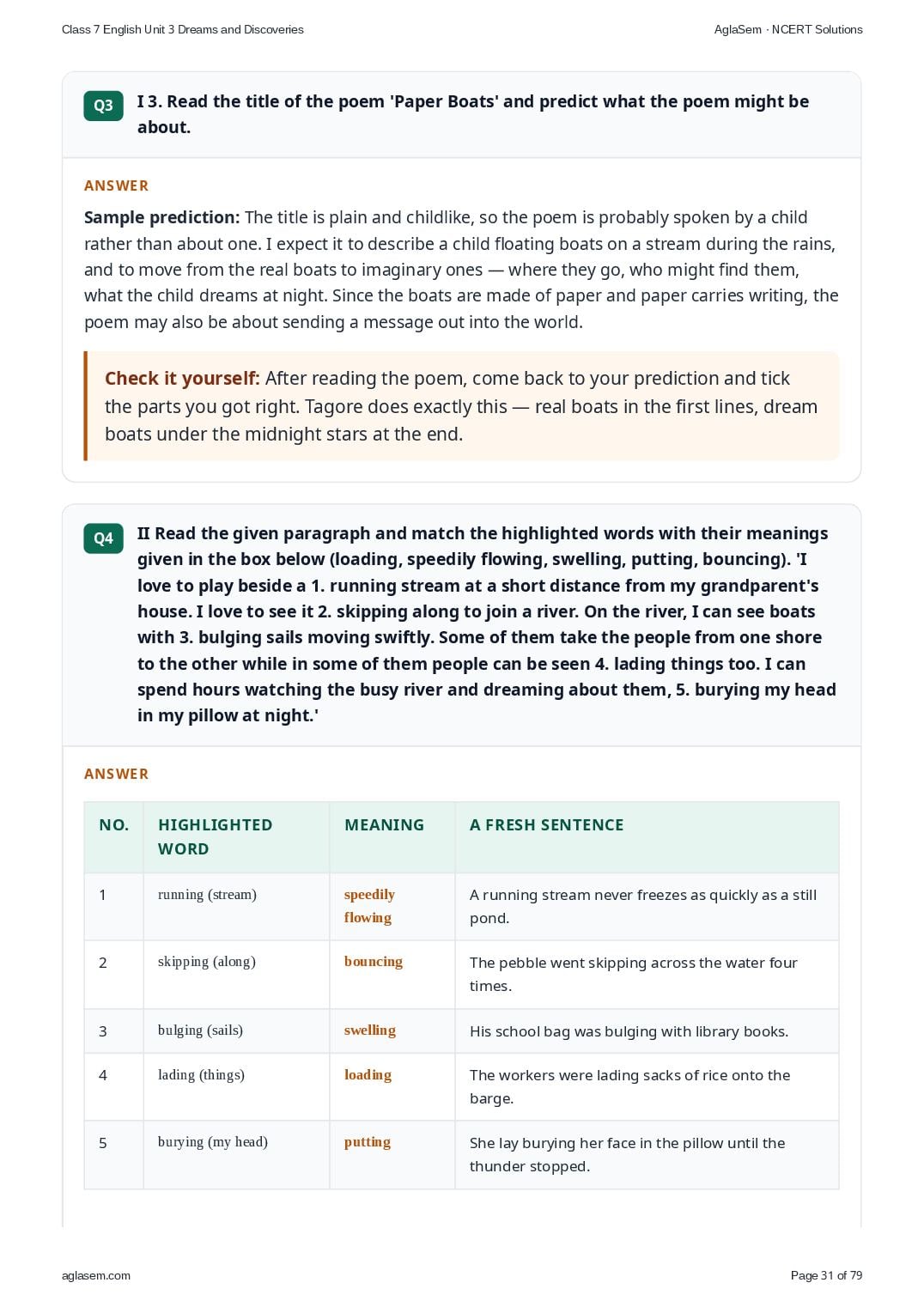
- I 3. Read the title of the poem 'Paper Boats' and predict what the poem might be about.
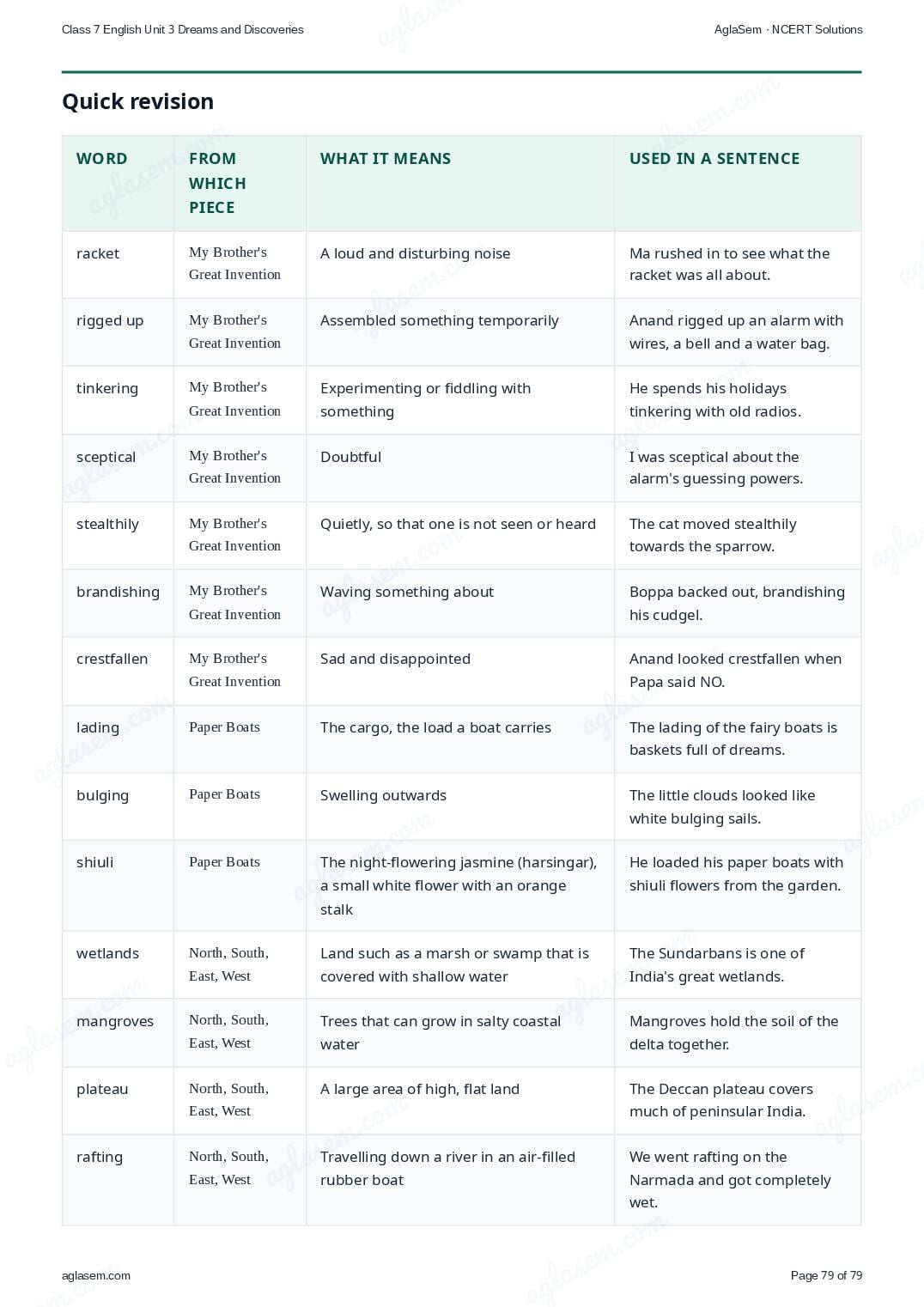
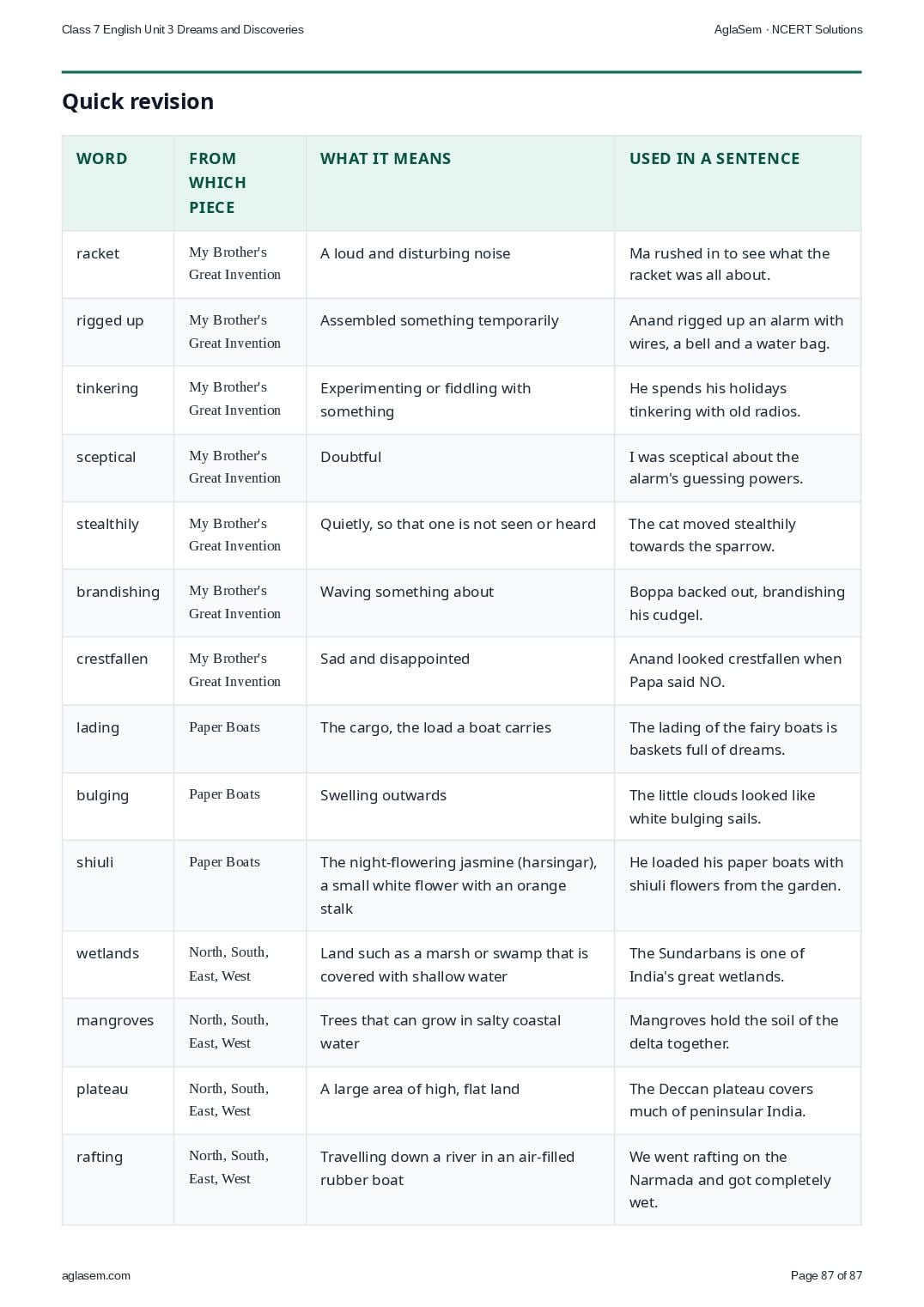
- II Read the given paragraph and match the highlighted words with their meanings given in the box below (loading, speedily flowing, swelling, putting, bouncing). 'I love to play beside a 1. running stream at a short distance from my grandparent's house. I love to see it 2. skipping along to join a river. On the river, I can see boats with 3. bulging sails moving swiftly. Some of them take the people from one shore to the other while in some of them people can be seen 4. lading things too. I can spend hours watching the busy river and dreaming about them, 5. burying my head in my pillow at night.'
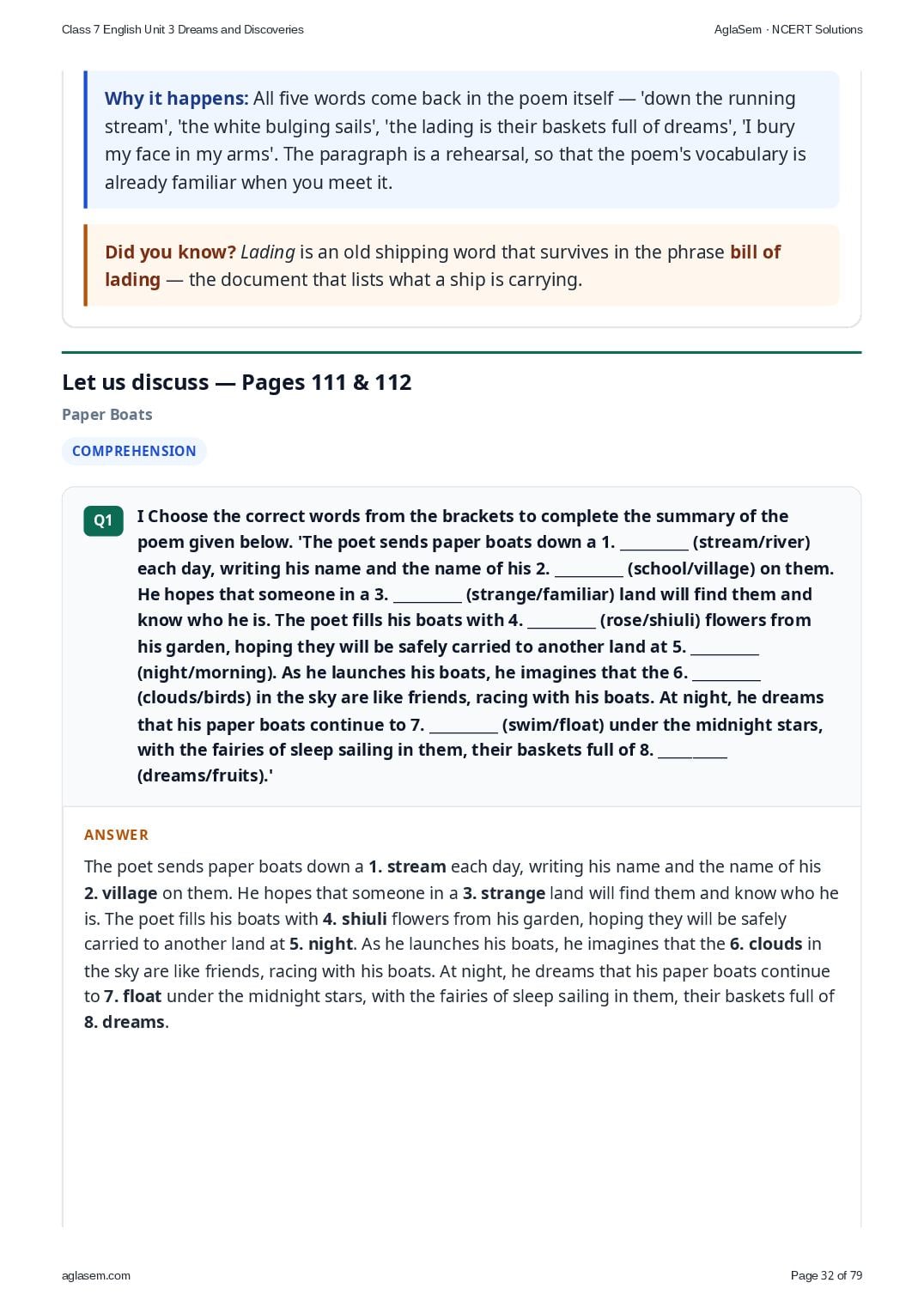
- I Choose the correct words from the brackets to complete the summary of the poem given below. 'The poet sends paper boats down a 1. __________ (stream/river) each day, writing his name and the name of his 2. __________ (school/village) on them. He hopes that someone in a 3. __________ (strange/familiar) land will find them and know who he is. The poet fills his boats with 4. __________ (rose/shiuli) flowers from his garden, hoping they will be safely carried to another land at 5. __________ (night/morning). As he launches his boats, he imagines that the 6. __________ (clouds/birds) in the sky are like friends, racing with his boats. At night, he dreams that his paper boats continue to 7. __________ (swim/float) under the midnight stars, with the fairies of sleep sailing in them, their baskets full of 8. __________ (dreams/fruits).'
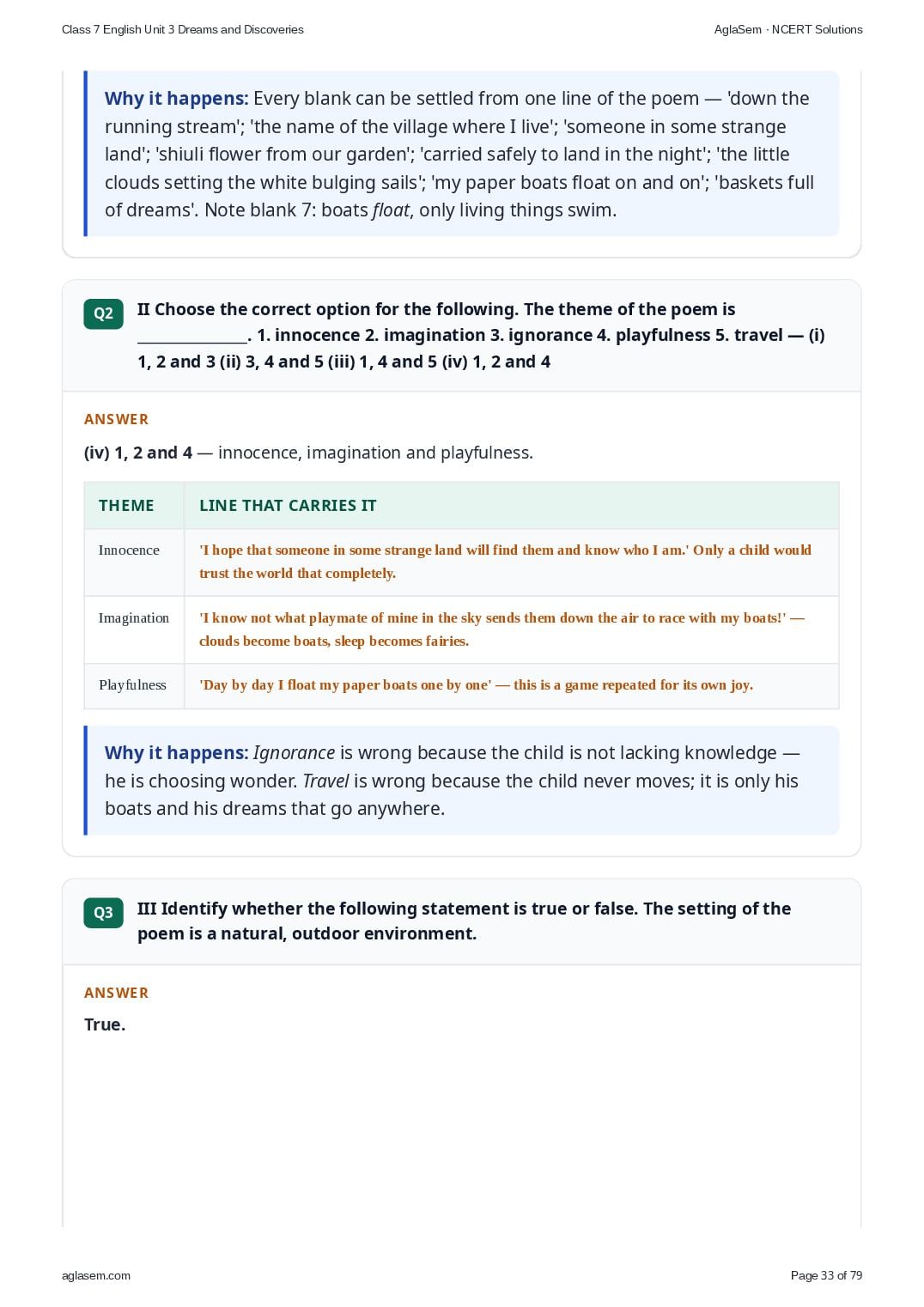
- II Choose the correct option for the following. The theme of the poem is ________________. 1. innocence 2. imagination 3. ignorance 4. playfulness 5. travel — (i) 1, 2 and 3 (ii) 3, 4 and 5 (iii) 1, 4 and 5 (iv) 1, 2 and 4
- III Identify whether the following statement is true or false. The setting of the poem is a natural, outdoor environment.
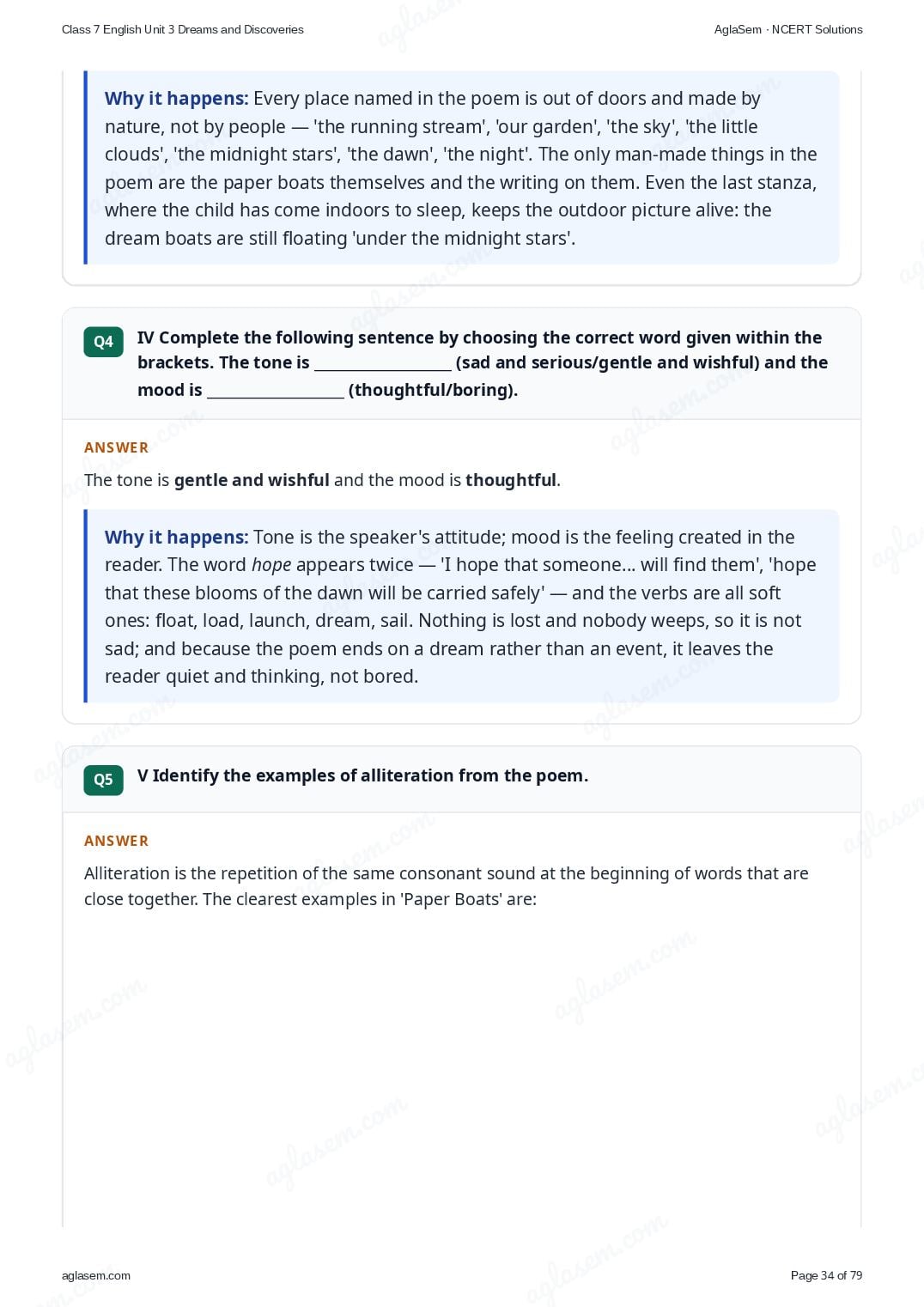
- IV Complete the following sentence by choosing the correct word given within the brackets. The tone is ____________________ (sad and serious/gentle and wishful) and the mood is ____________________ (thoughtful/boring).
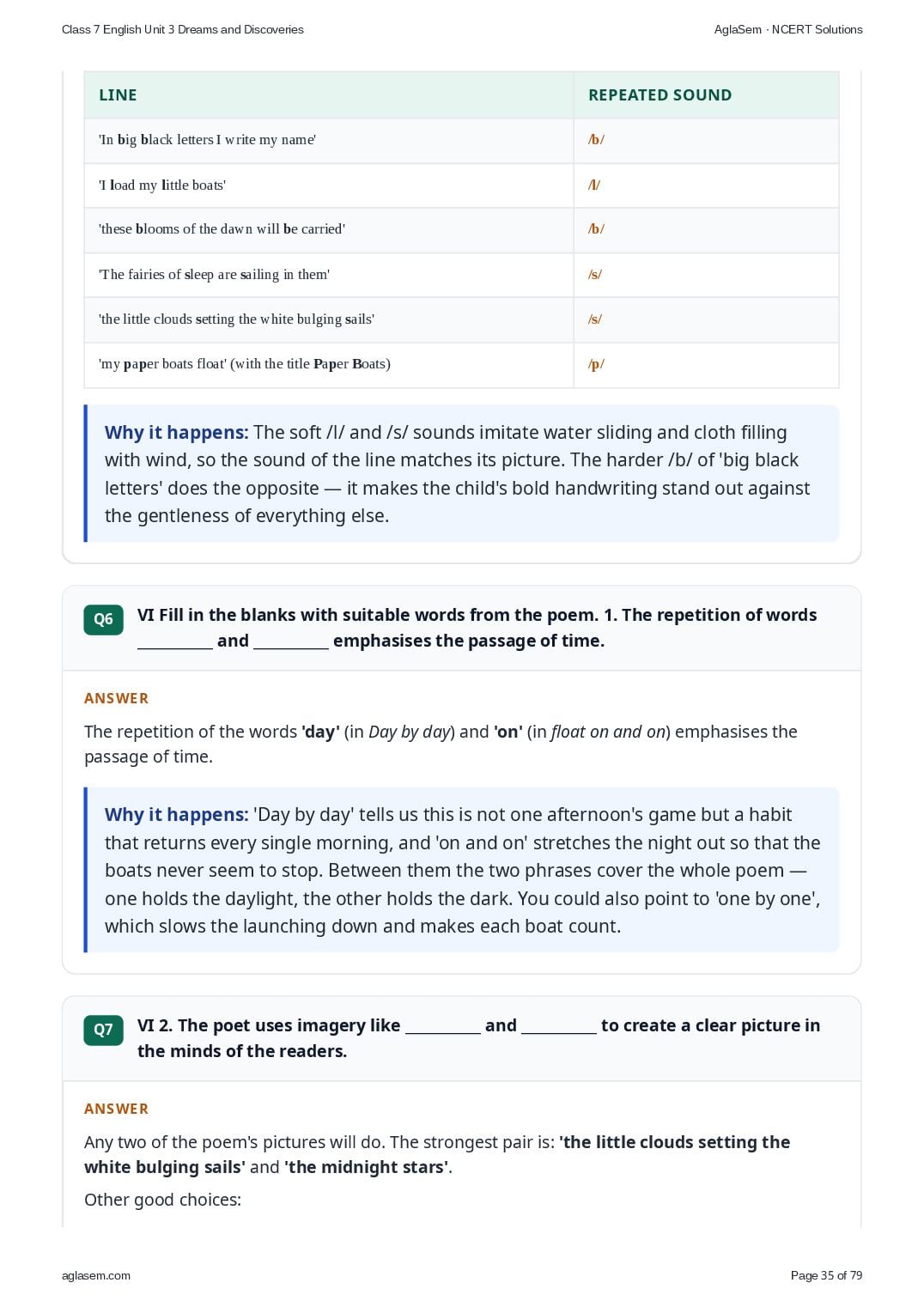
- V Identify the examples of alliteration from the poem.
- VI Fill in the blanks with suitable words from the poem. 1. The repetition of words ___________ and ___________ emphasises the passage of time.
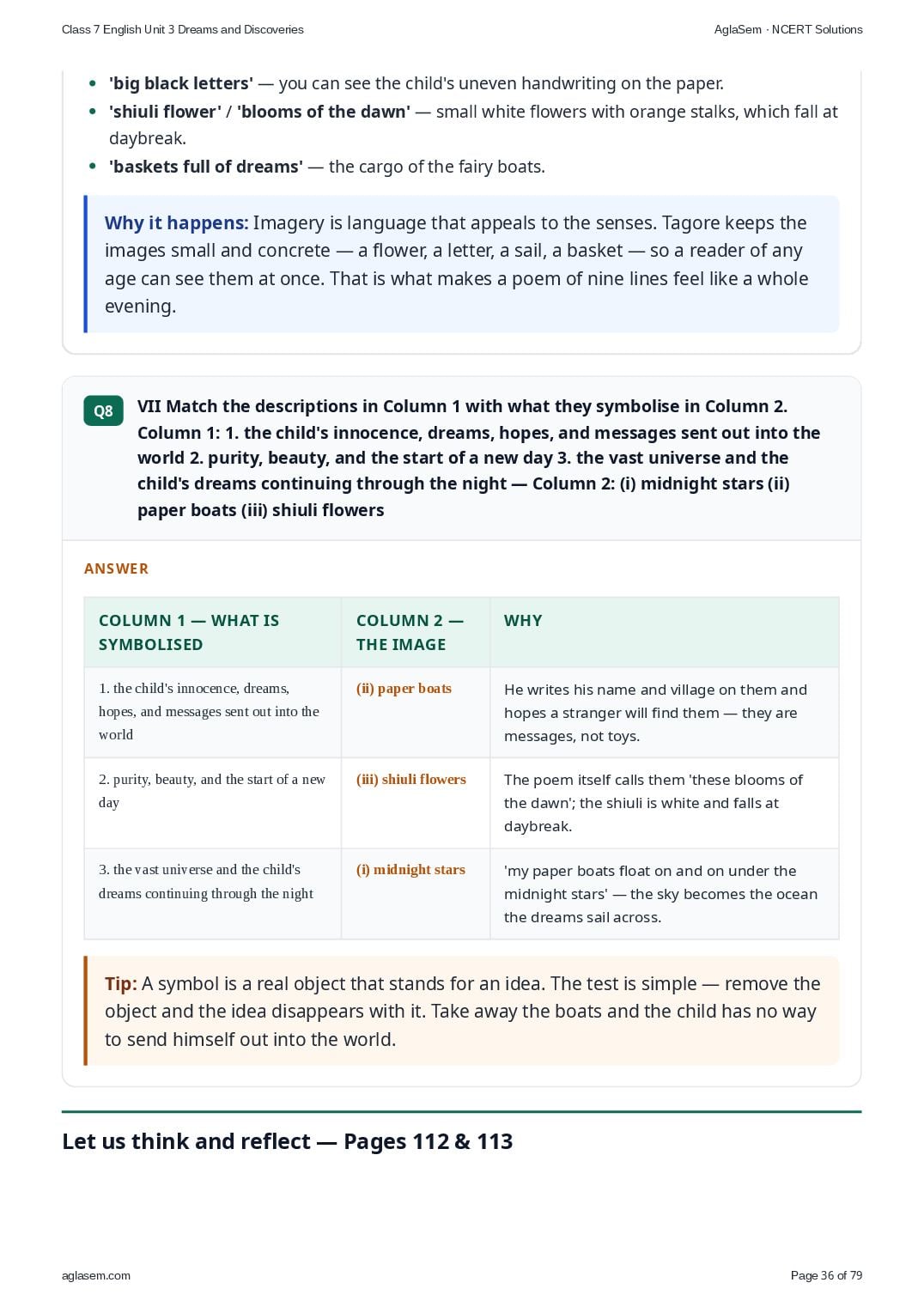
- VI 2. The poet uses imagery like ___________ and ___________ to create a clear picture in the minds of the readers.
- VII Match the descriptions in Column 1 with what they symbolise in Column 2. Column 1: 1. the child's innocence, dreams, hopes, and messages sent out into the world 2. purity, beauty, and the start of a new day 3. the vast universe and the child's dreams continuing through the night — Column 2: (i) midnight stars (ii) paper boats (iii) shiuli flowers
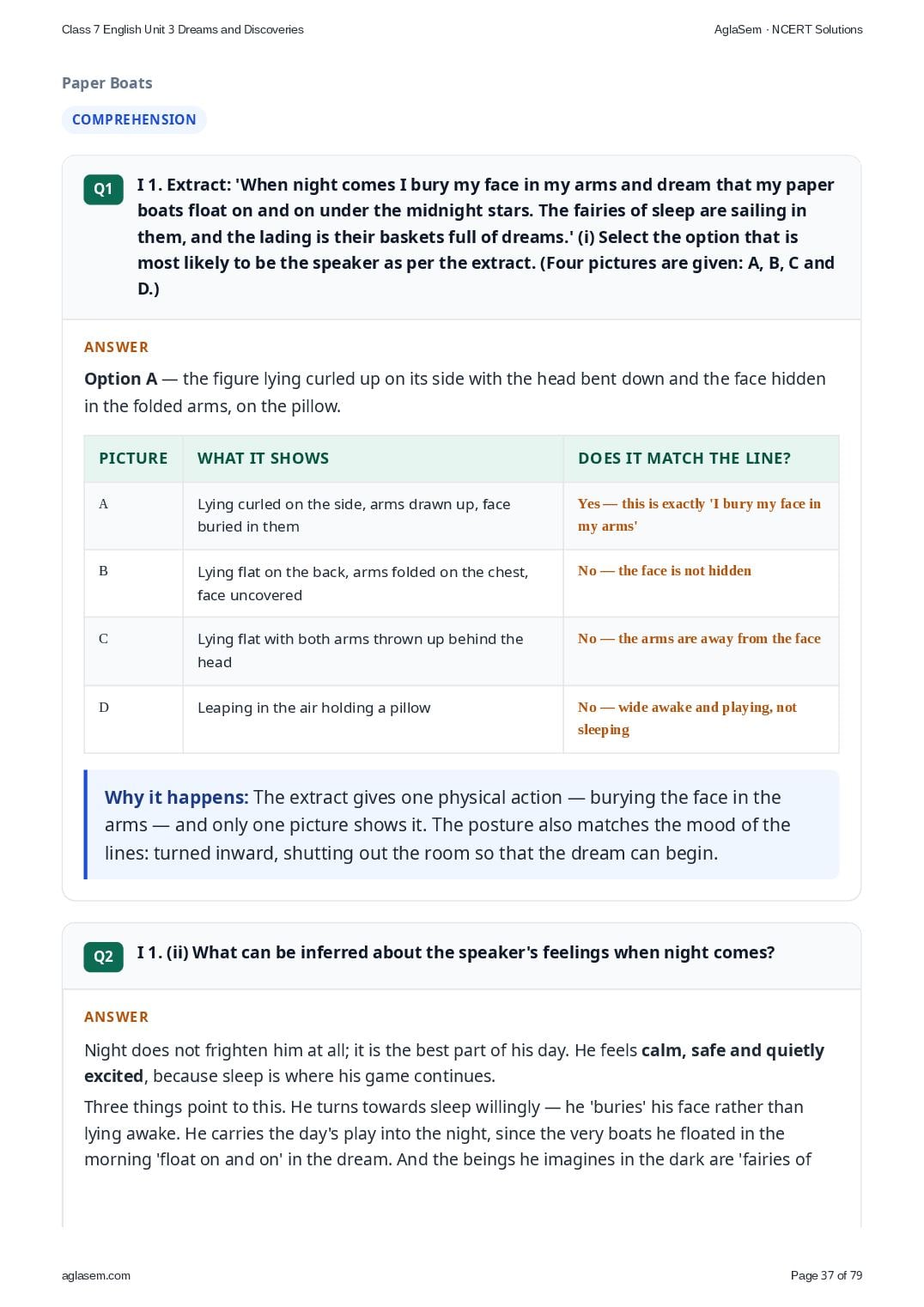
- I 1. Extract: 'When night comes I bury my face in my arms and dream that my paper boats float on and on under the midnight stars. The fairies of sleep are sailing in them, and the lading is their baskets full of dreams.' (i) Select the option that is most likely to be the speaker as per the extract. (Four pictures are given: A, B, C and D.)
- I 1. (ii) What can be inferred about the speaker's feelings when night comes?
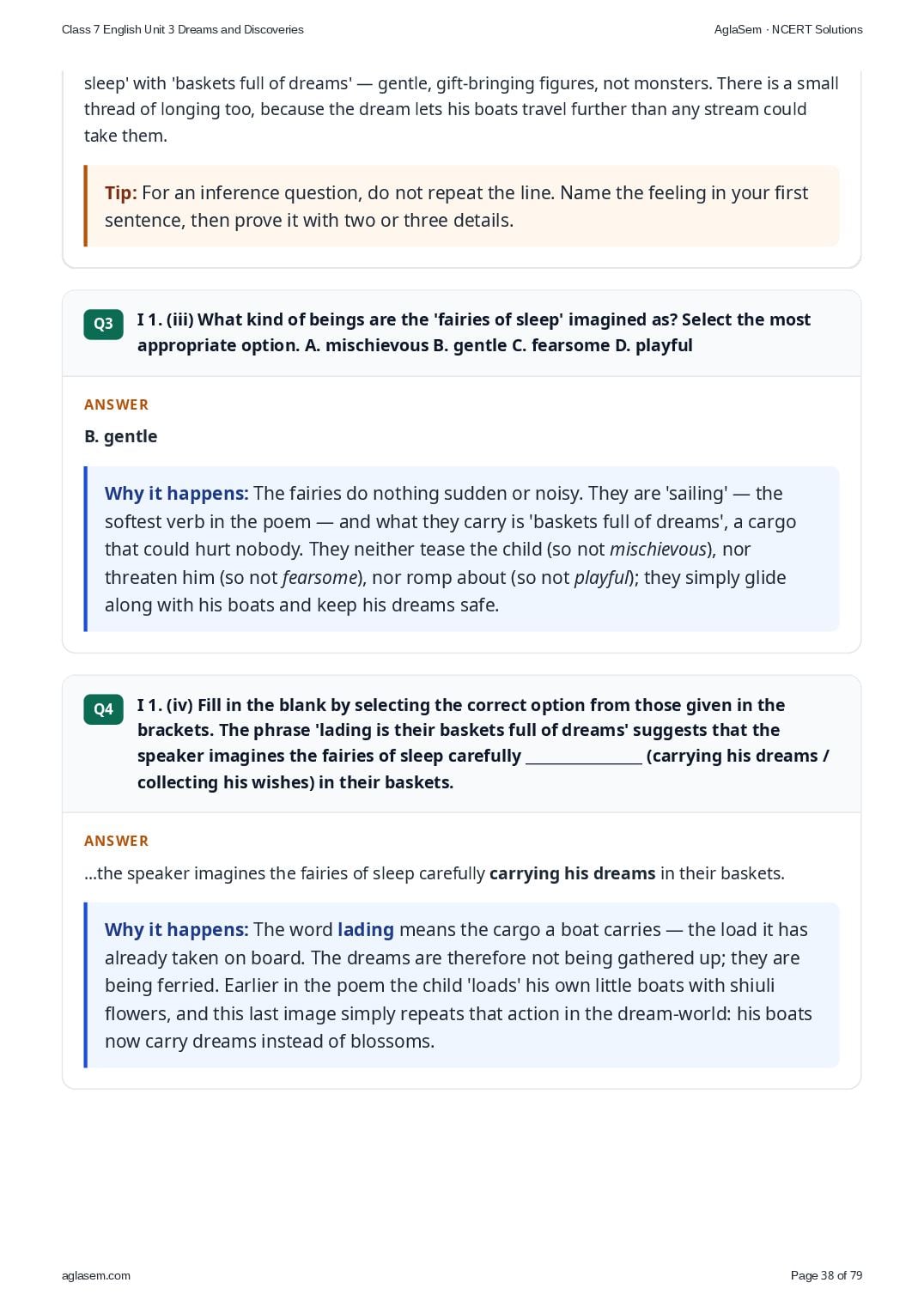
- I 1. (iii) What kind of beings are the 'fairies of sleep' imagined as? Select the most appropriate option. A. mischievous B. gentle C. fearsome D. playful
- I 1. (iv) Fill in the blank by selecting the correct option from those given in the brackets. The phrase 'lading is their baskets full of dreams' suggests that the speaker imagines the fairies of sleep carefully _________________ (carrying his dreams / collecting his wishes) in their baskets.
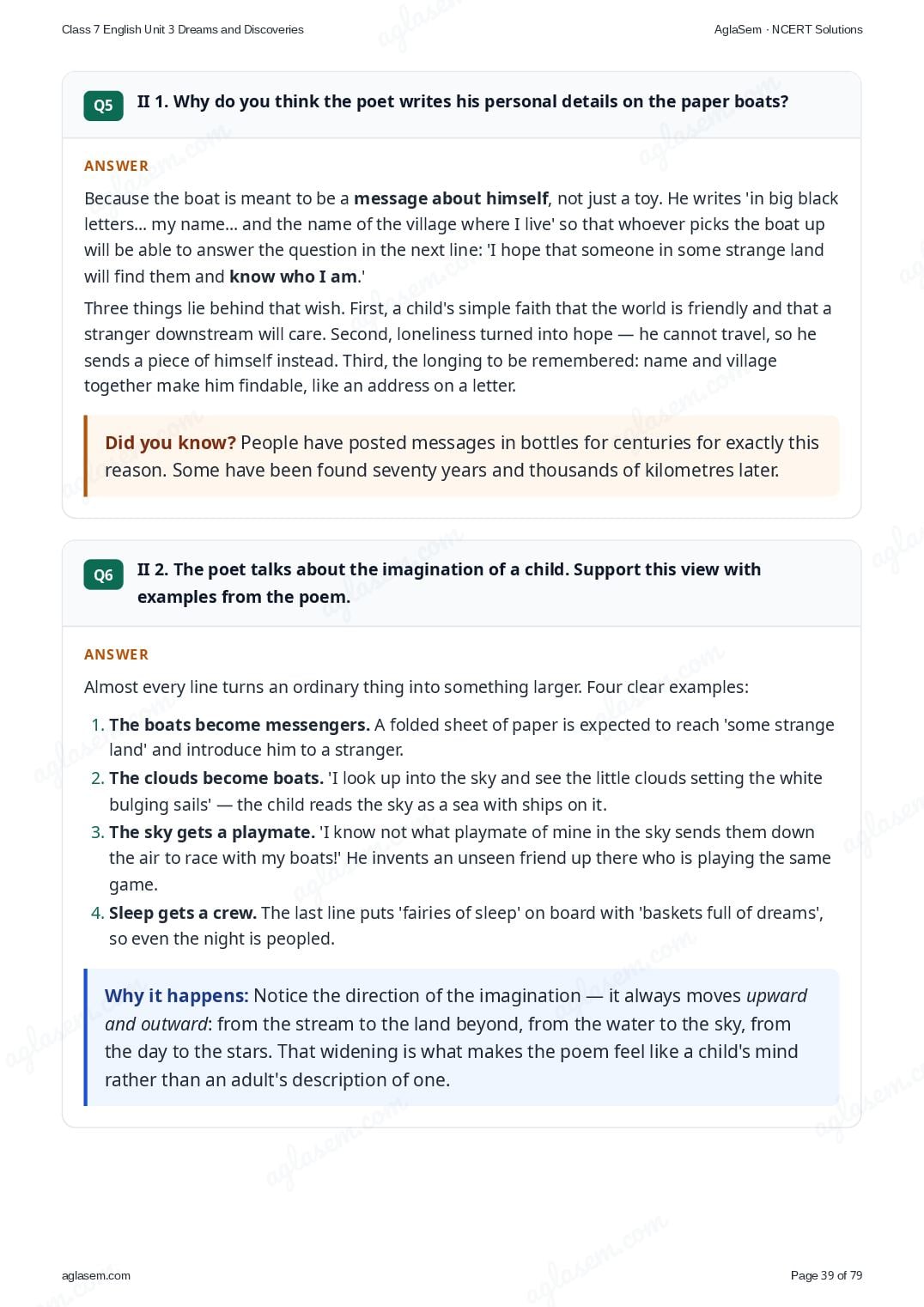
- II 1. Why do you think the poet writes his personal details on the paper boats?
- II 2. The poet talks about the imagination of a child. Support this view with examples from the poem.
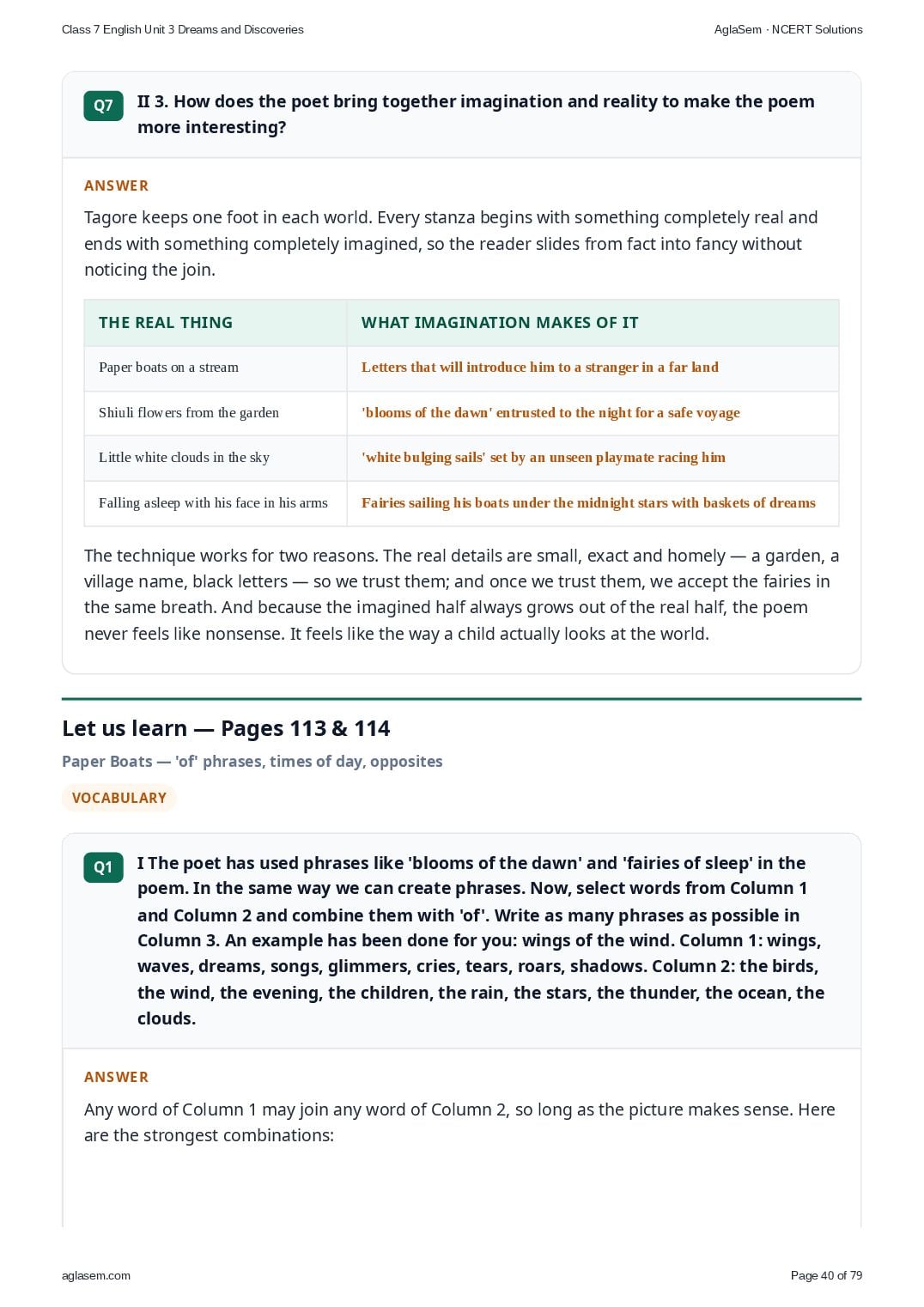
- II 3. How does the poet bring together imagination and reality to make the poem more interesting?
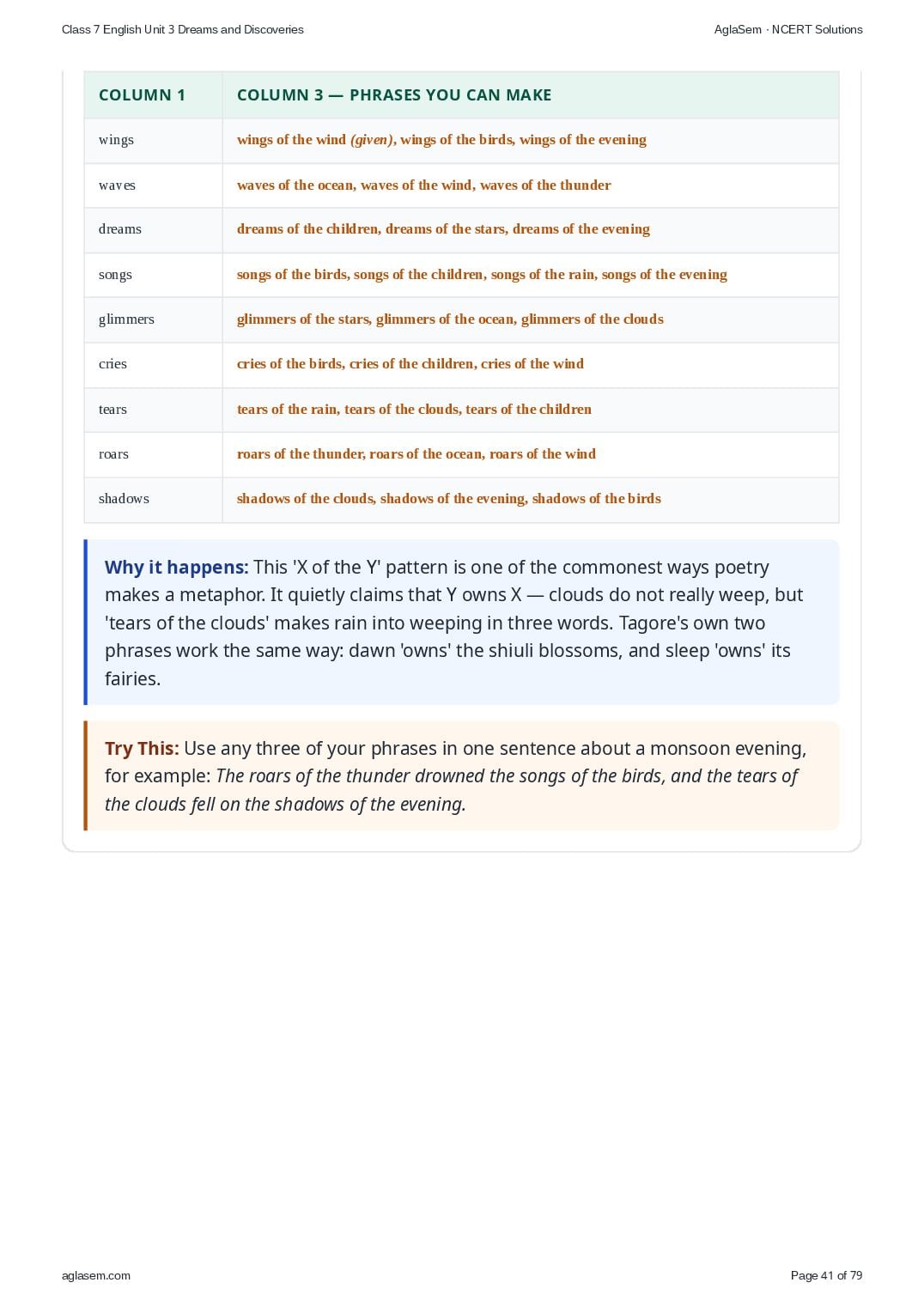
- I The poet has used phrases like 'blooms of the dawn' and 'fairies of sleep' in the poem. In the same way we can create phrases. Now, select words from Column 1 and Column 2 and combine them with 'of'. Write as many phrases as possible in Column 3. An example has been done for you: wings of the wind. Column 1: wings, waves, dreams, songs, glimmers, cries, tears, roars, shadows. Column 2: the birds, the wind, the evening, the children, the rain, the stars, the thunder, the ocean, the clouds.
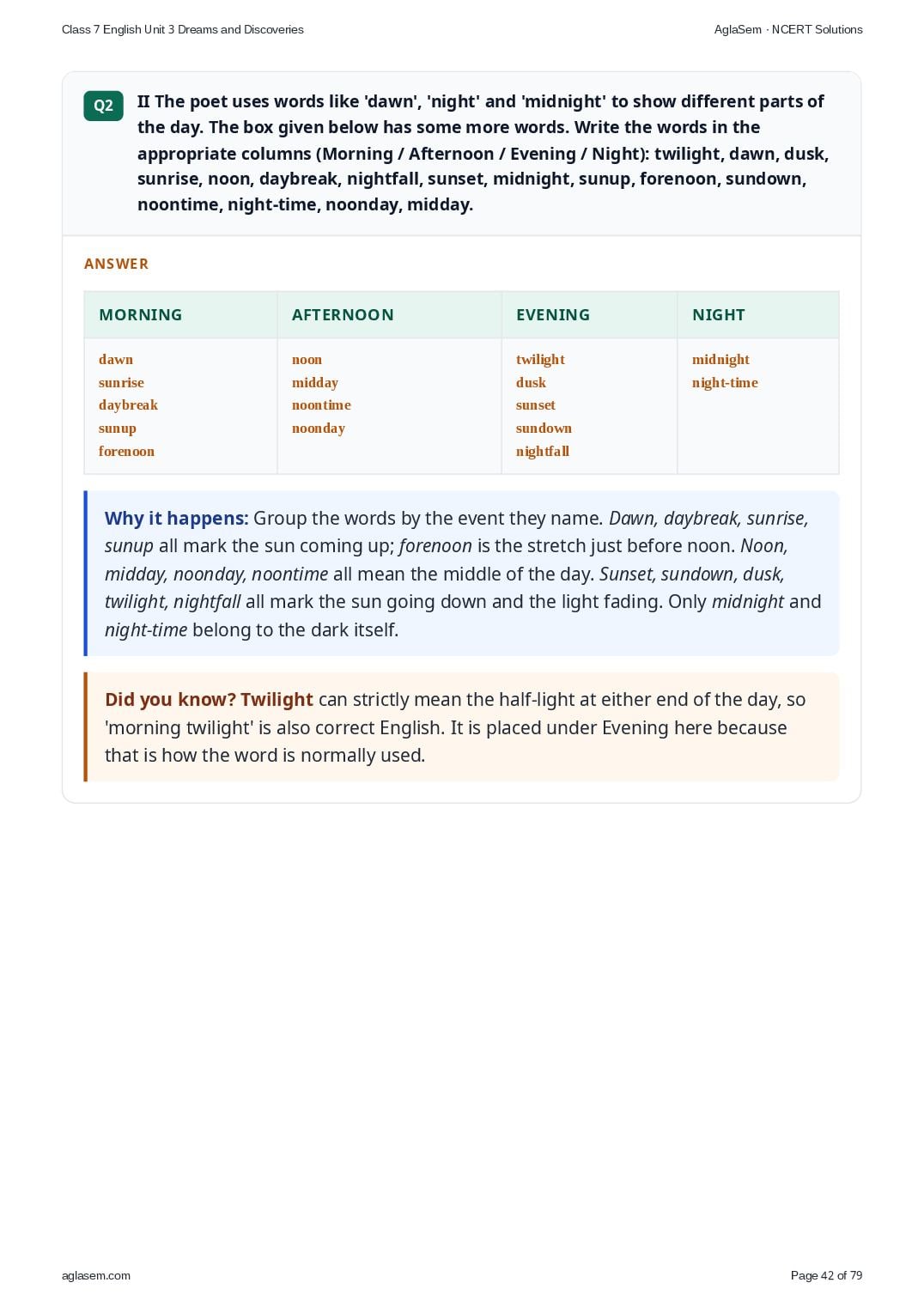
- II The poet uses words like 'dawn', 'night' and 'midnight' to show different parts of the day. The box given below has some more words. Write the words in the appropriate columns (Morning / Afternoon / Evening / Night): twilight, dawn, dusk, sunrise, noon, daybreak, nightfall, sunset, midnight, sunup, forenoon, sundown, noontime, night-time, noonday, midday.
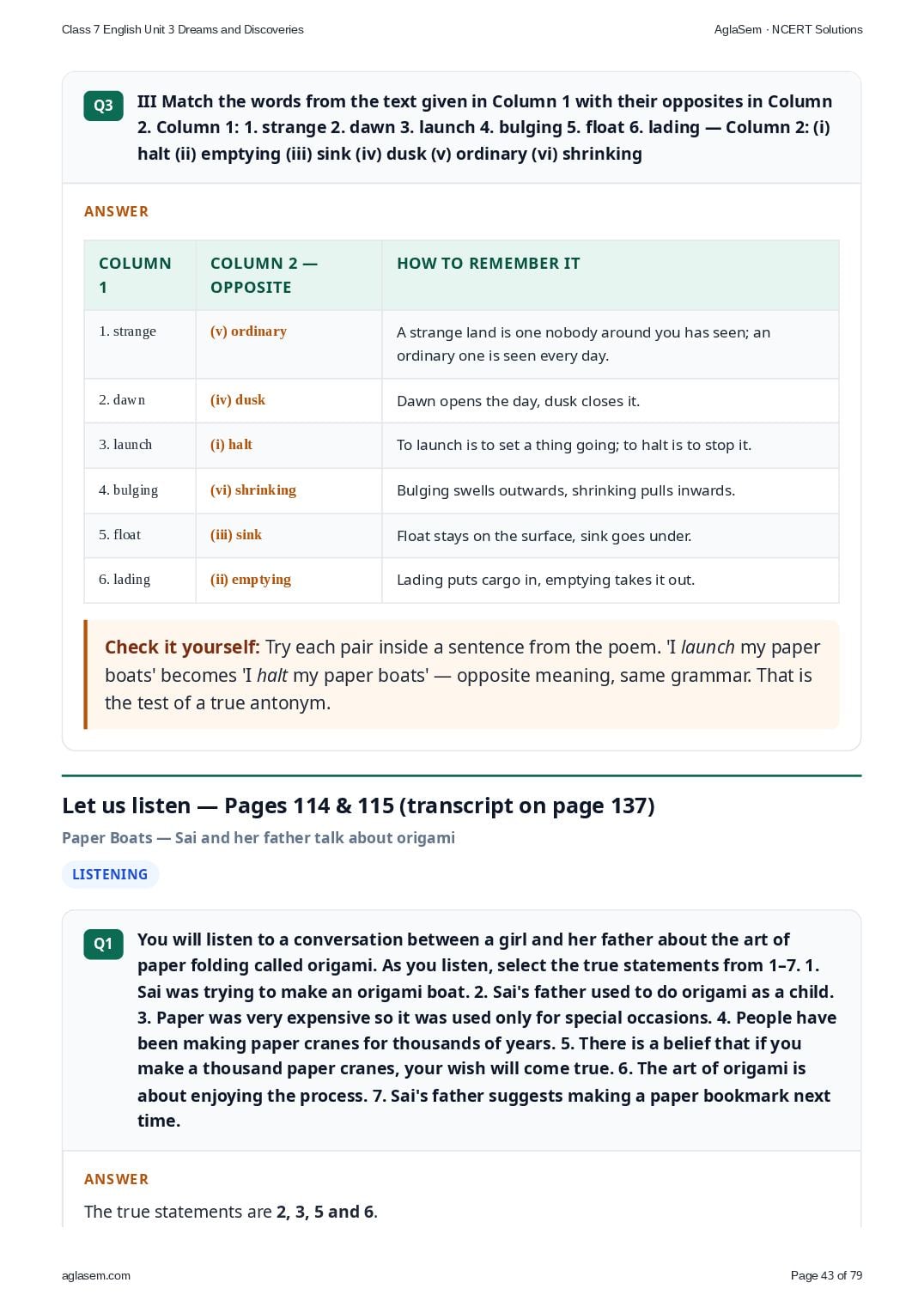
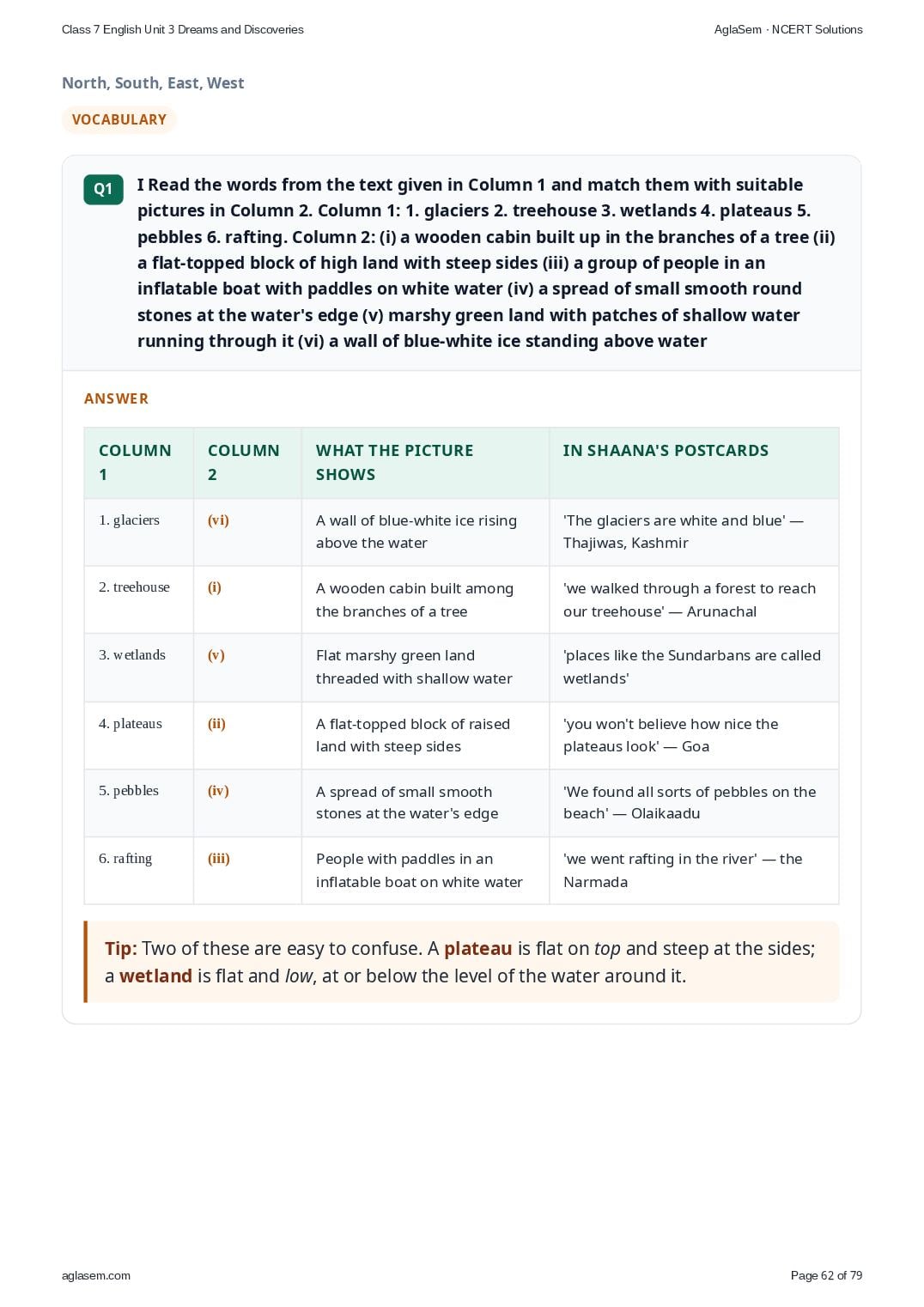
- III Match the words from the text given in Column 1 with their opposites in Column 2. Column 1: 1. strange 2. dawn 3. launch 4. bulging 5. float 6. lading — Column 2: (i) halt (ii) emptying (iii) sink (iv) dusk (v) ordinary (vi) shrinking
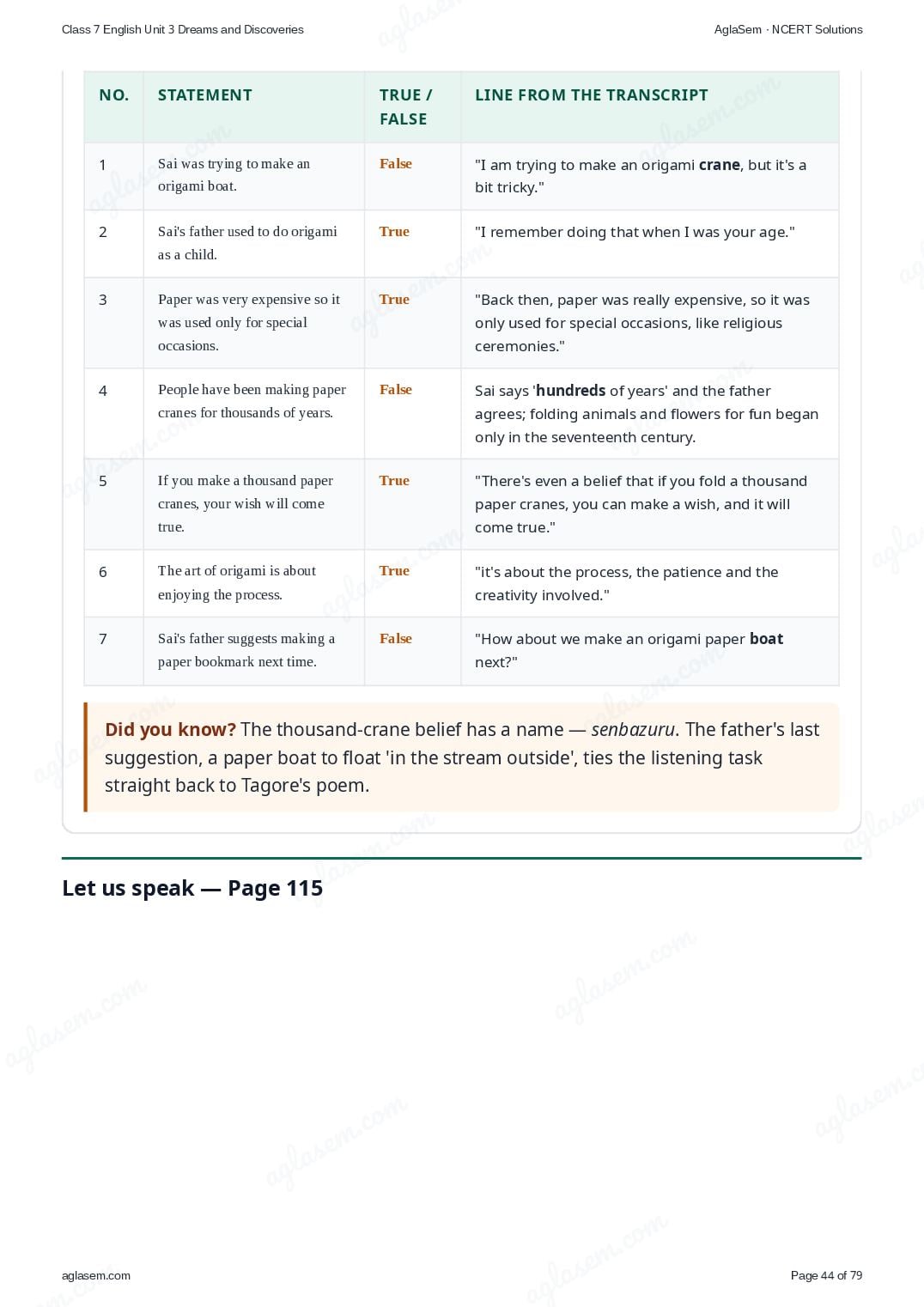
- You will listen to a conversation between a girl and her father about the art of paper folding called origami. As you listen, select the true statements from 1–7. 1. Sai was trying to make an origami boat. 2. Sai's father used to do origami as a child. 3. Paper was very expensive so it was used only for special occasions. 4. People have been making paper cranes for thousands of years. 5. There is a belief that if you make a thousand paper cranes, your wish will come true. 6. The art of origami is about enjoying the process. 7. Sai's father suggests making a paper bookmark next time.
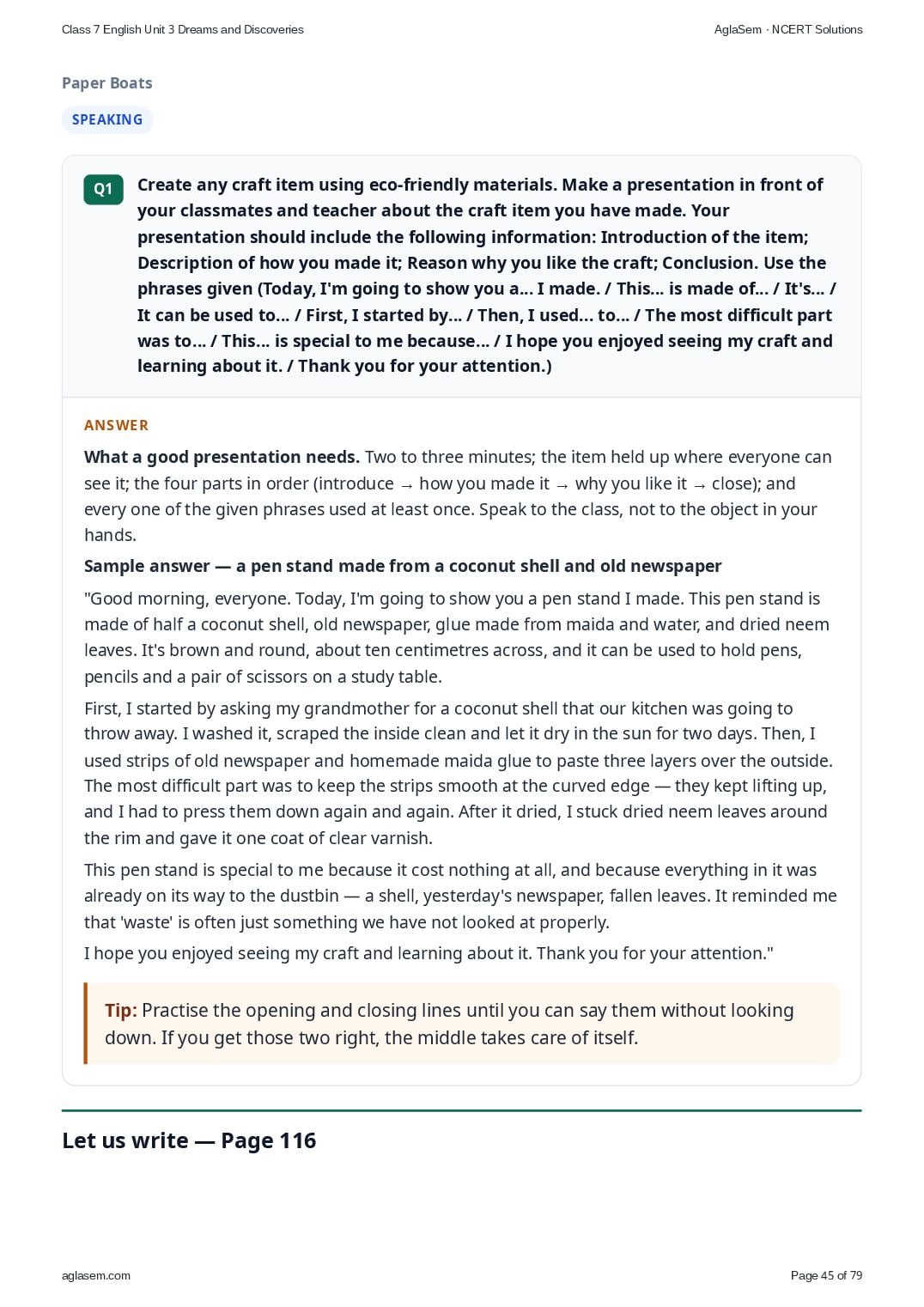
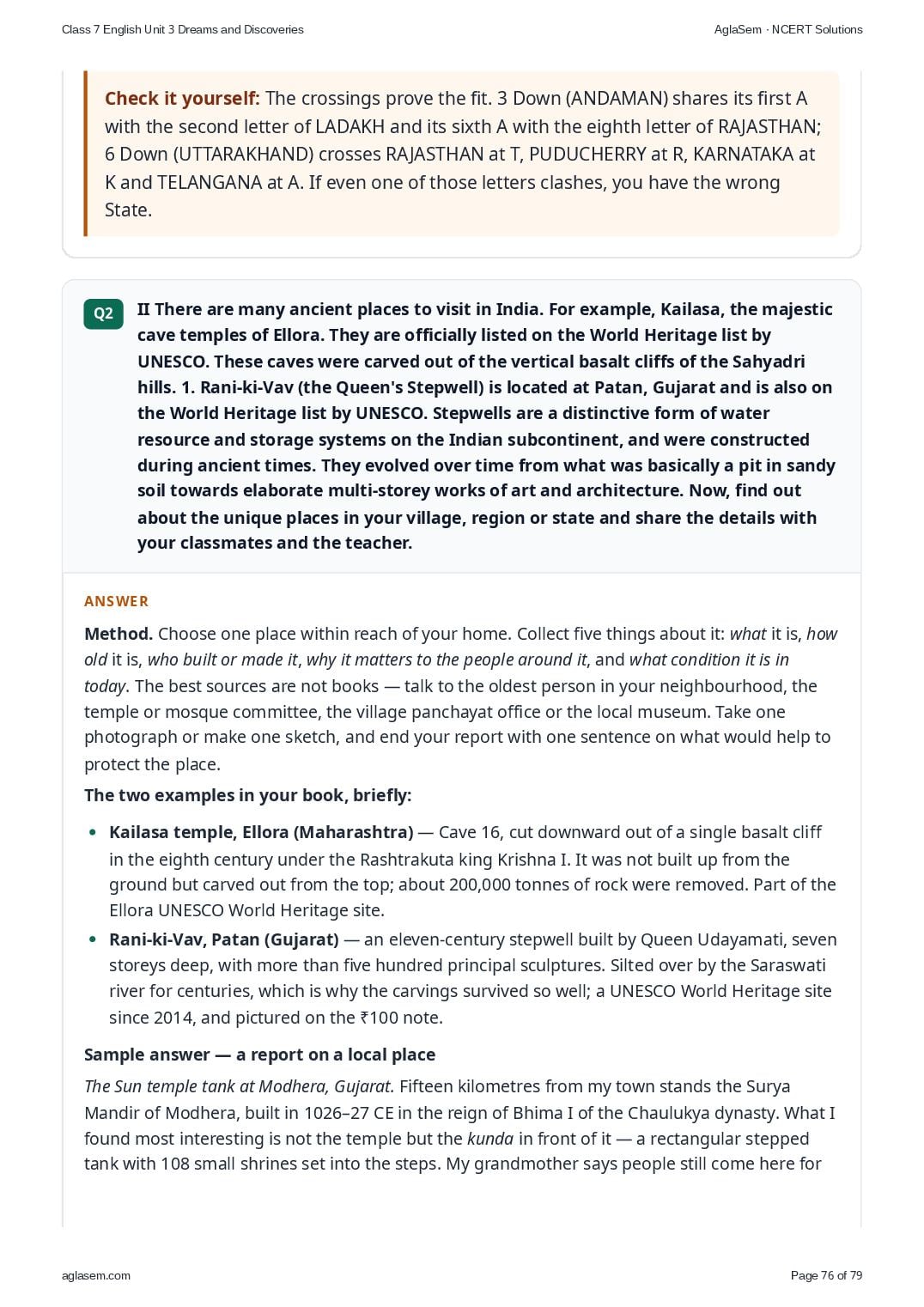
- Create any craft item using eco-friendly materials. Make a presentation in front of your classmates and teacher about the craft item you have made. Your presentation should include the following information: Introduction of the item; Description of how you made it; Reason why you like the craft; Conclusion. Use the phrases given (Today, I'm going to show you a… I made. / This… is made of… / It's… / It can be used to… / First, I started by… / Then, I used… to… / The most difficult part was to… / This… is special to me because… / I hope you enjoyed seeing my craft and learning about it. / Thank you for your attention.)
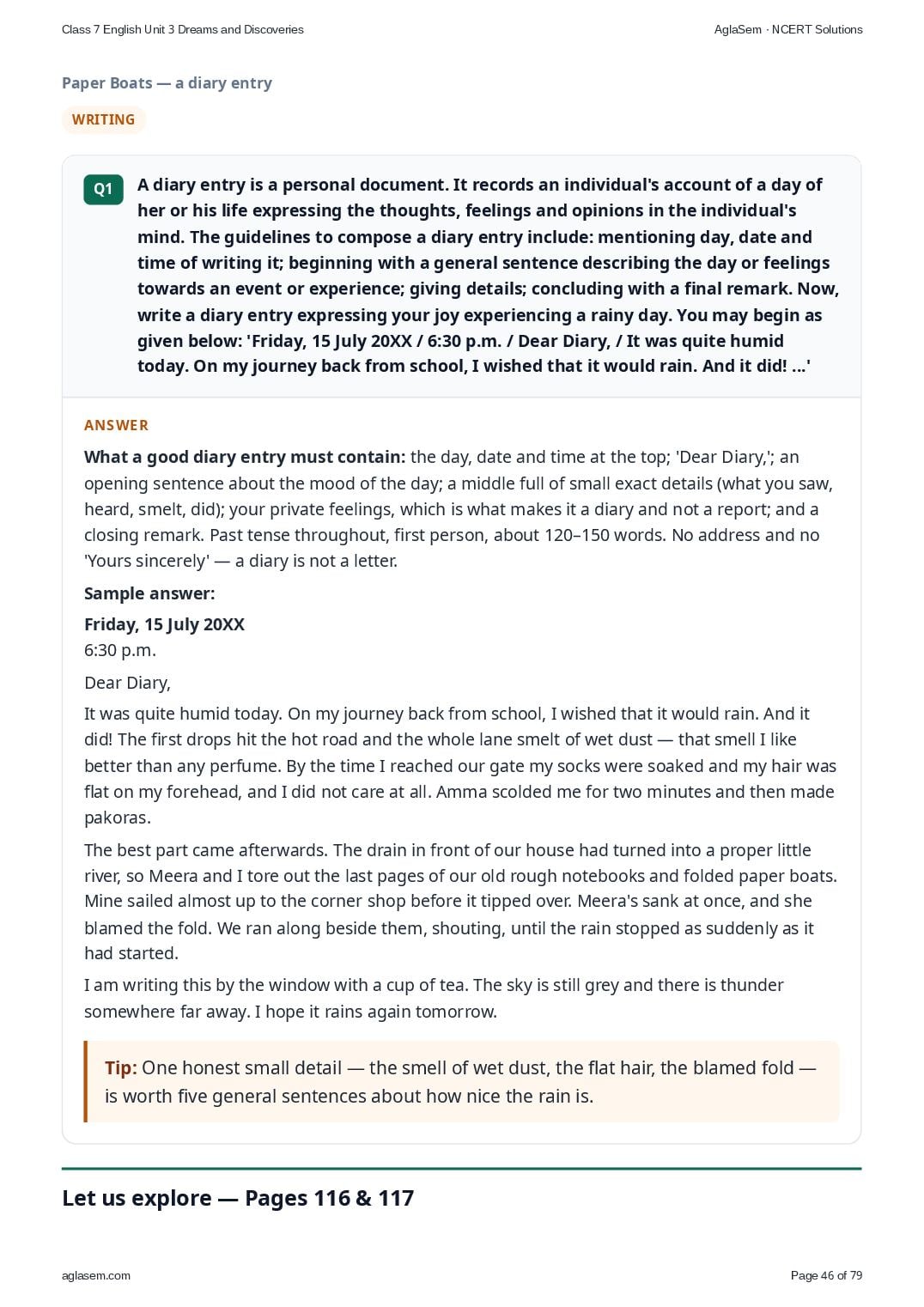
- A diary entry is a personal document. It records an individual's account of a day of her or his life expressing the thoughts, feelings and opinions in the individual's mind. The guidelines to compose a diary entry include: mentioning day, date and time of writing it; beginning with a general sentence describing the day or feelings towards an event or experience; giving details; concluding with a final remark. Now, write a diary entry expressing your joy experiencing a rainy day. You may begin as given below: 'Friday, 15 July 20XX / 6:30 p.m. / Dear Diary, / It was quite humid today. On my journey back from school, I wished that it would rain. And it did! …'
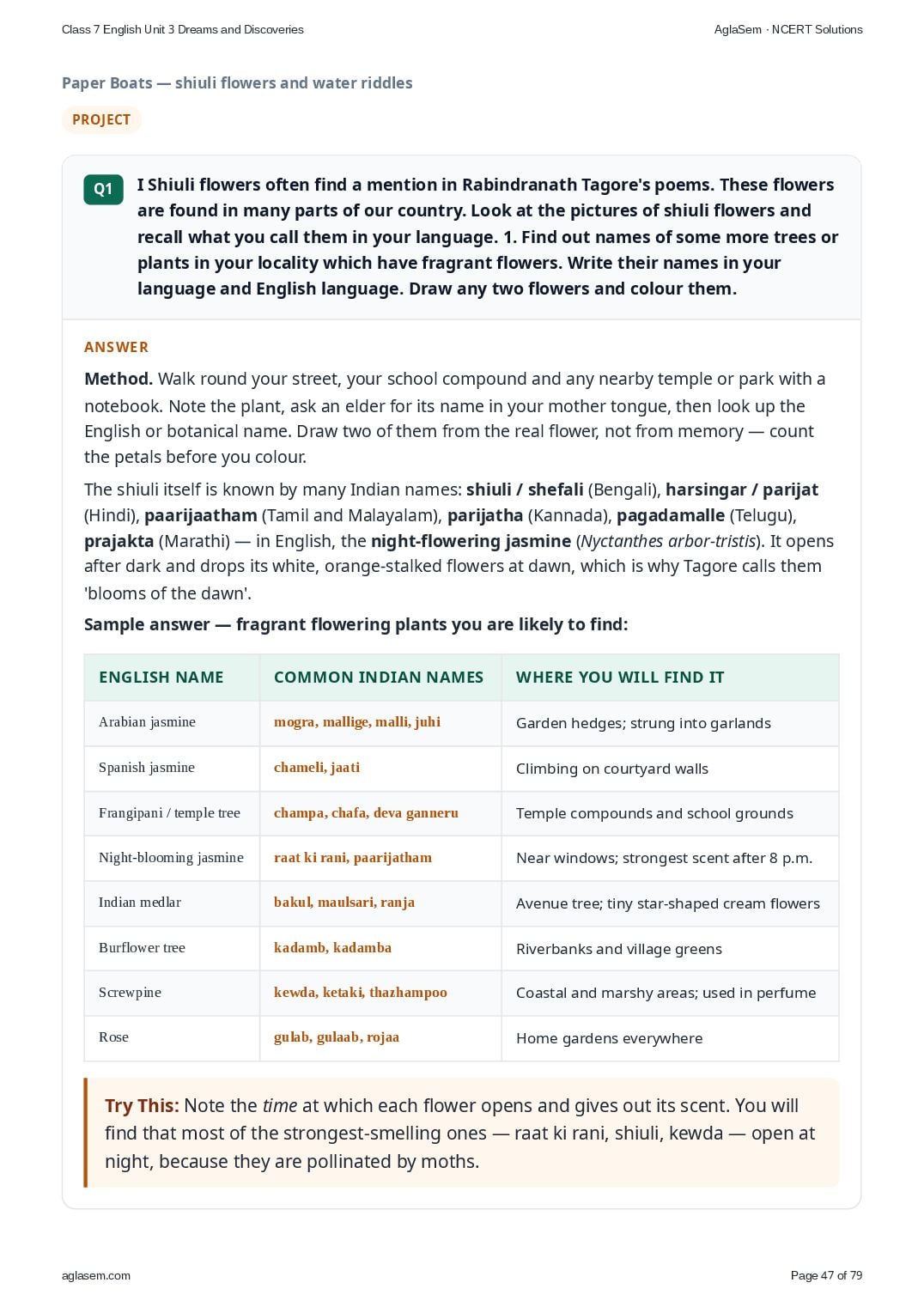
- I Shiuli flowers often find a mention in Rabindranath Tagore's poems. These flowers are found in many parts of our country. Look at the pictures of shiuli flowers and recall what you call them in your language. 1. Find out names of some more trees or plants in your locality which have fragrant flowers. Write their names in your language and English language. Draw any two flowers and colour them.
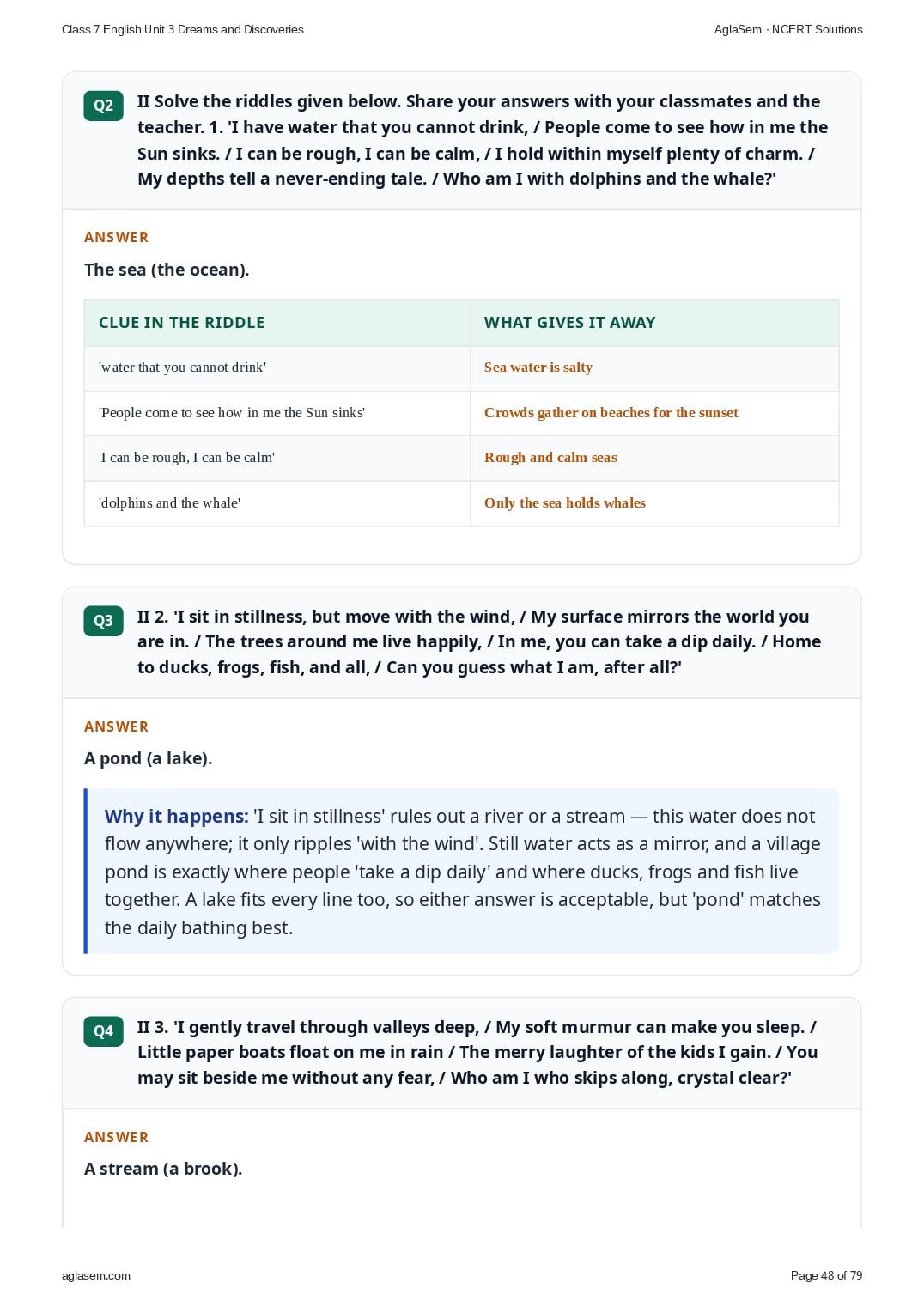
- II Solve the riddles given below. Share your answers with your classmates and the teacher. 1. 'I have water that you cannot drink, / People come to see how in me the Sun sinks. / I can be rough, I can be calm, / I hold within myself plenty of charm. / My depths tell a never-ending tale. / Who am I with dolphins and the whale?'
- II 2. 'I sit in stillness, but move with the wind, / My surface mirrors the world you are in. / The trees around me live happily, / In me, you can take a dip daily. / Home to ducks, frogs, fish, and all, / Can you guess what I am, after all?'
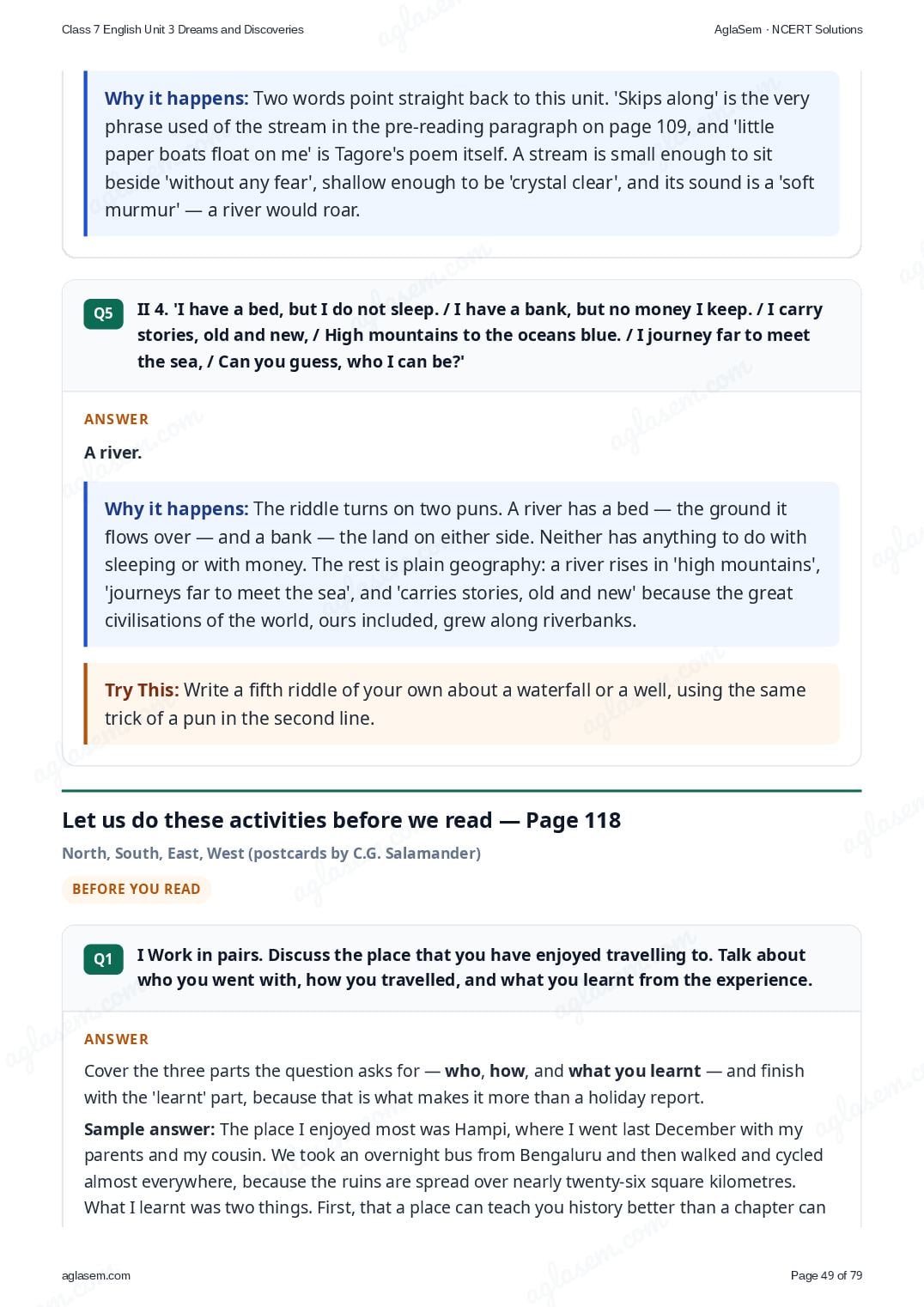
- II 3. 'I gently travel through valleys deep, / My soft murmur can make you sleep. / Little paper boats float on me in rain / The merry laughter of the kids I gain. / You may sit beside me without any fear, / Who am I who skips along, crystal clear?'
- II 4. 'I have a bed, but I do not sleep. / I have a bank, but no money I keep. / I carry stories, old and new, / High mountains to the oceans blue. / I journey far to meet the sea, / Can you guess, who I can be?'
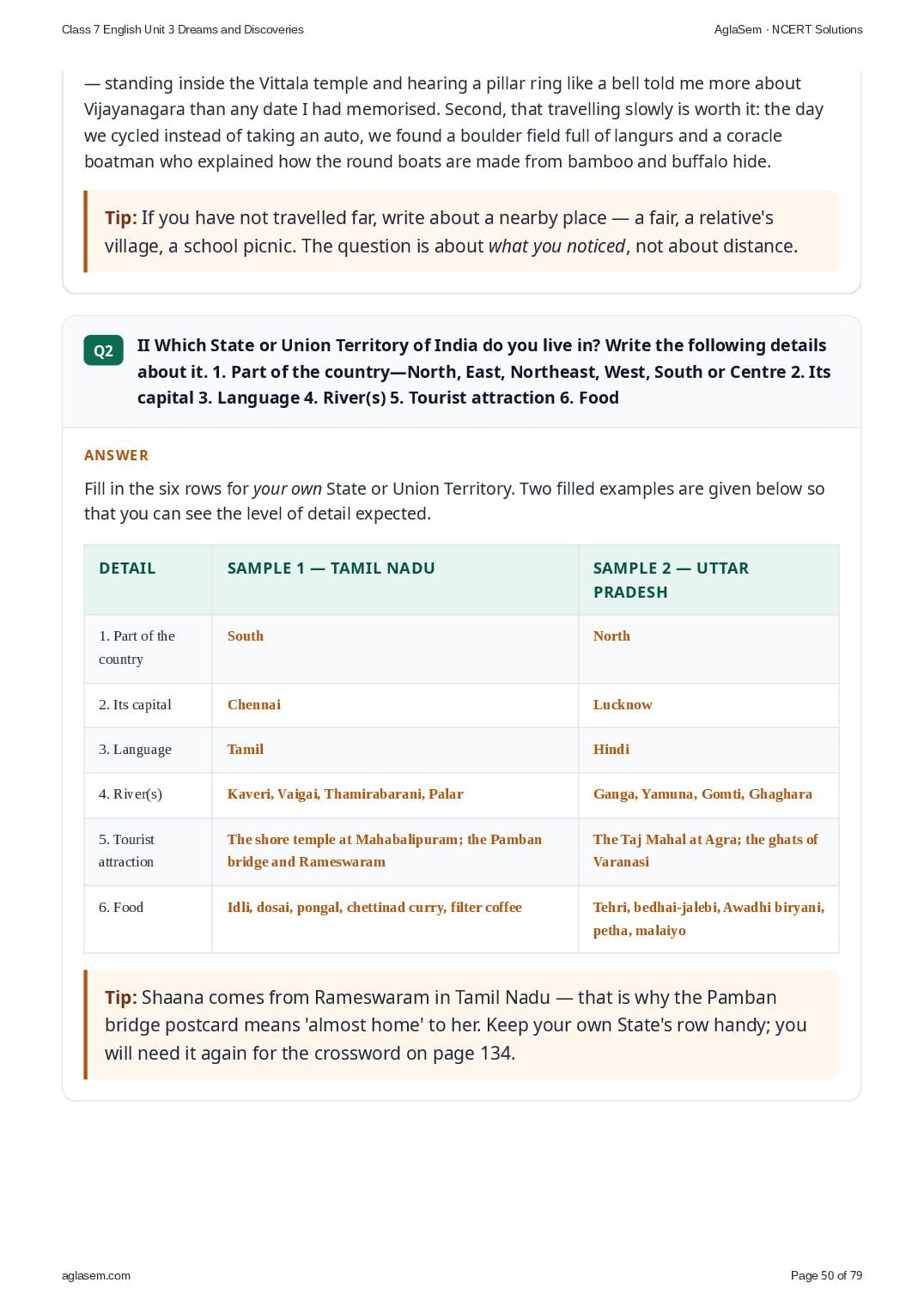
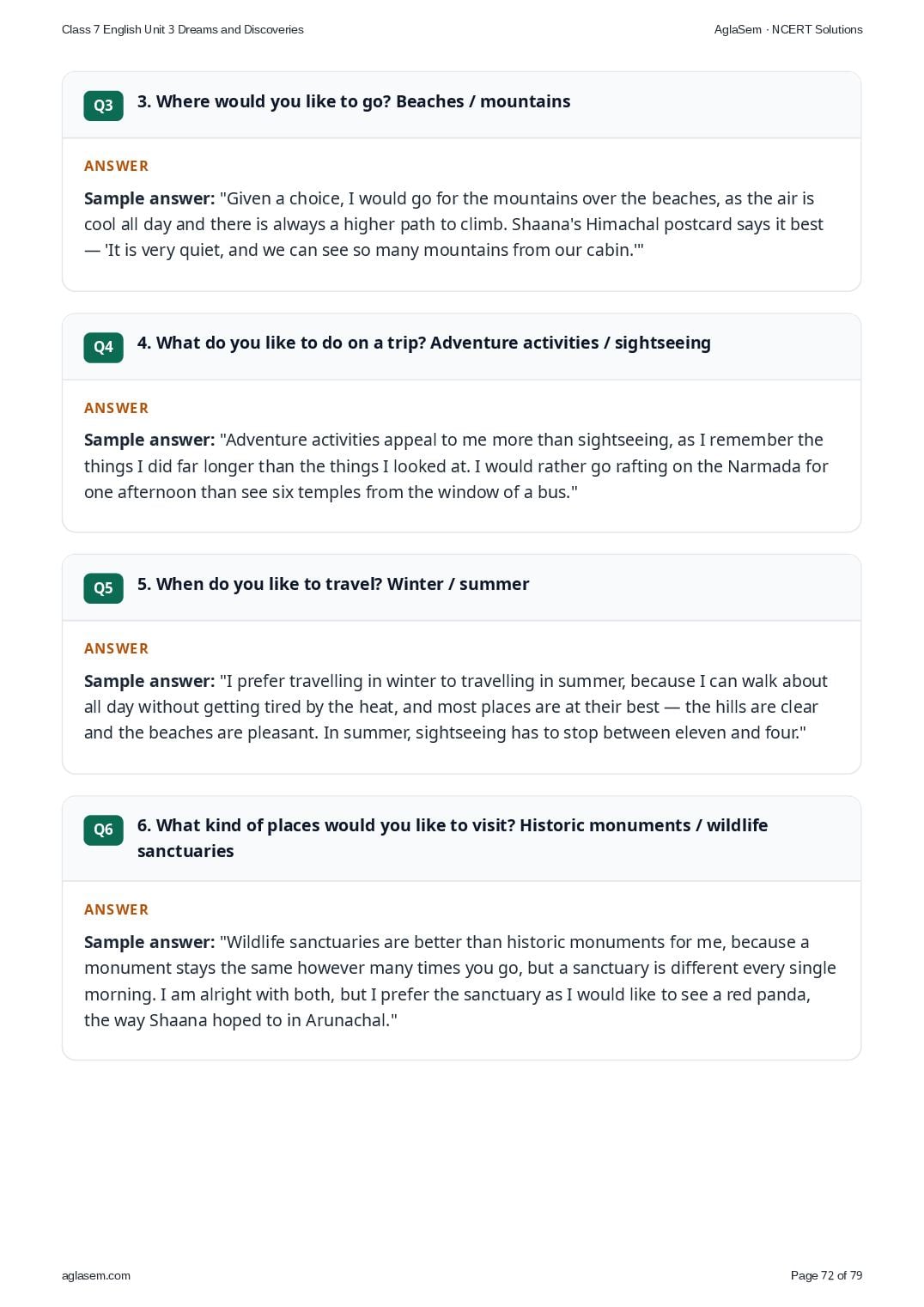
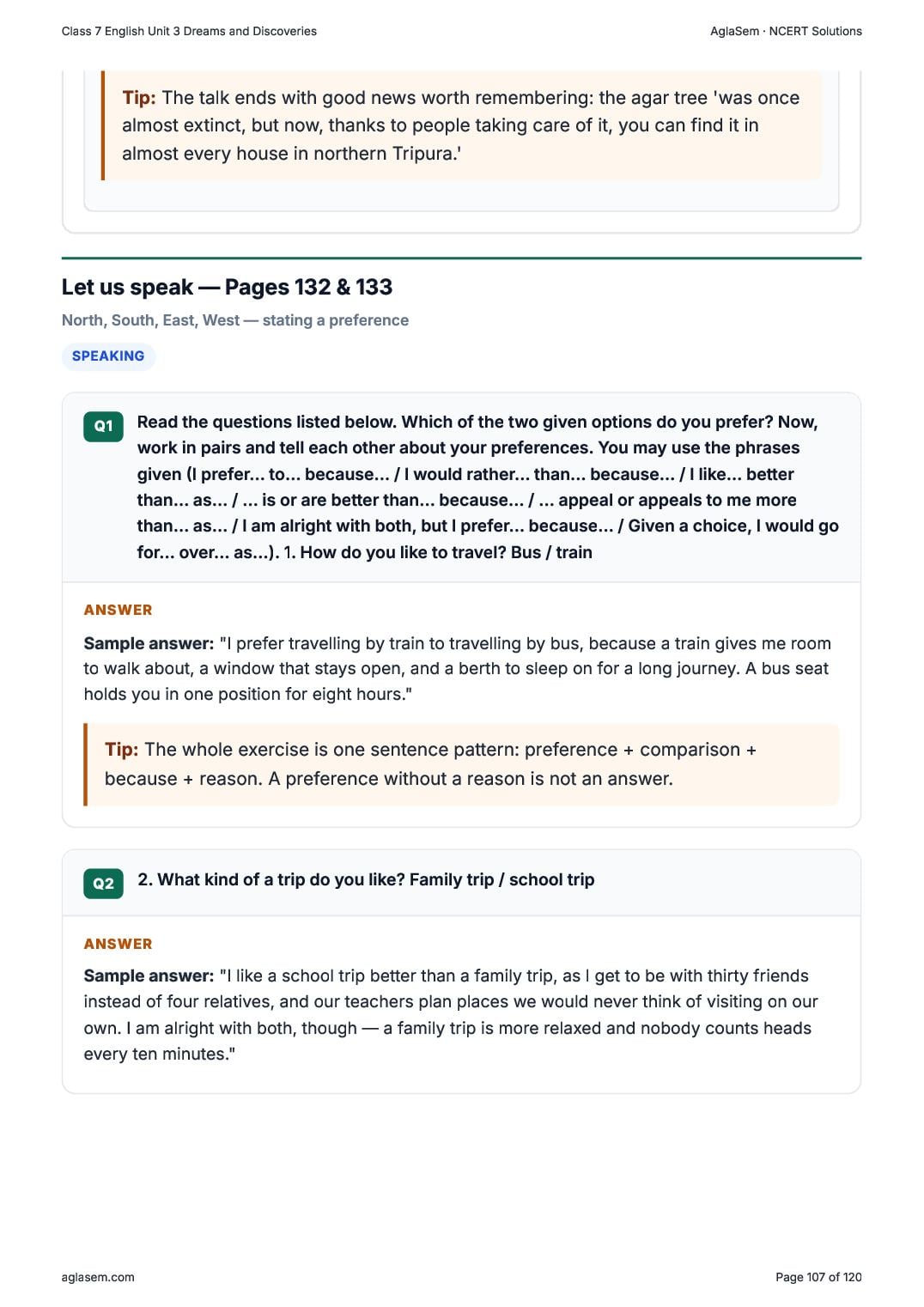
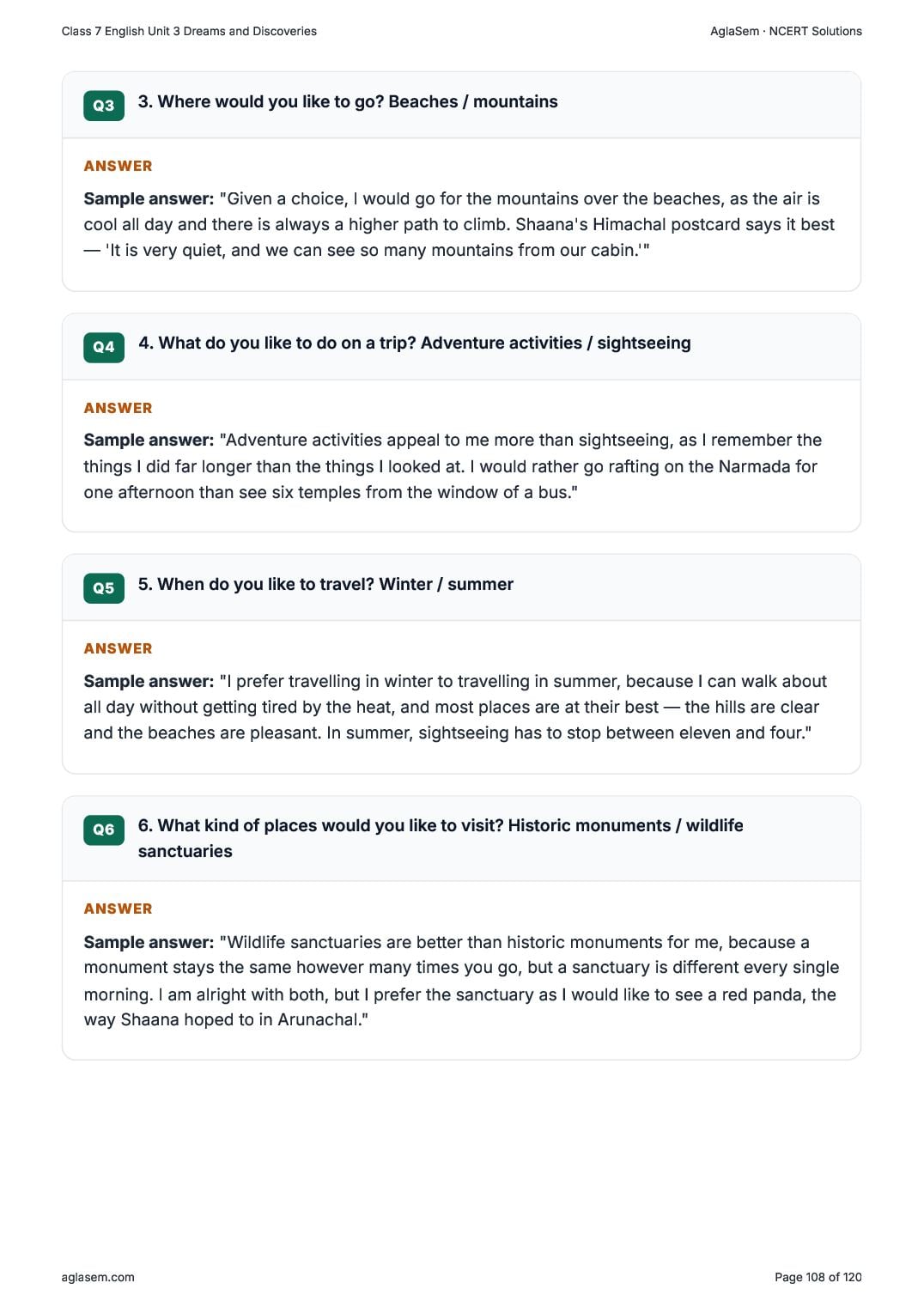
- I Work in pairs. Discuss the place that you have enjoyed travelling to. Talk about who you went with, how you travelled, and what you learnt from the experience.
- II Which State or Union Territory of India do you live in? Write the following details about it. 1. Part of the country—North, East, Northeast, West, South or Centre 2. Its capital 3. Language 4. River(s) 5. Tourist attraction 6. Food
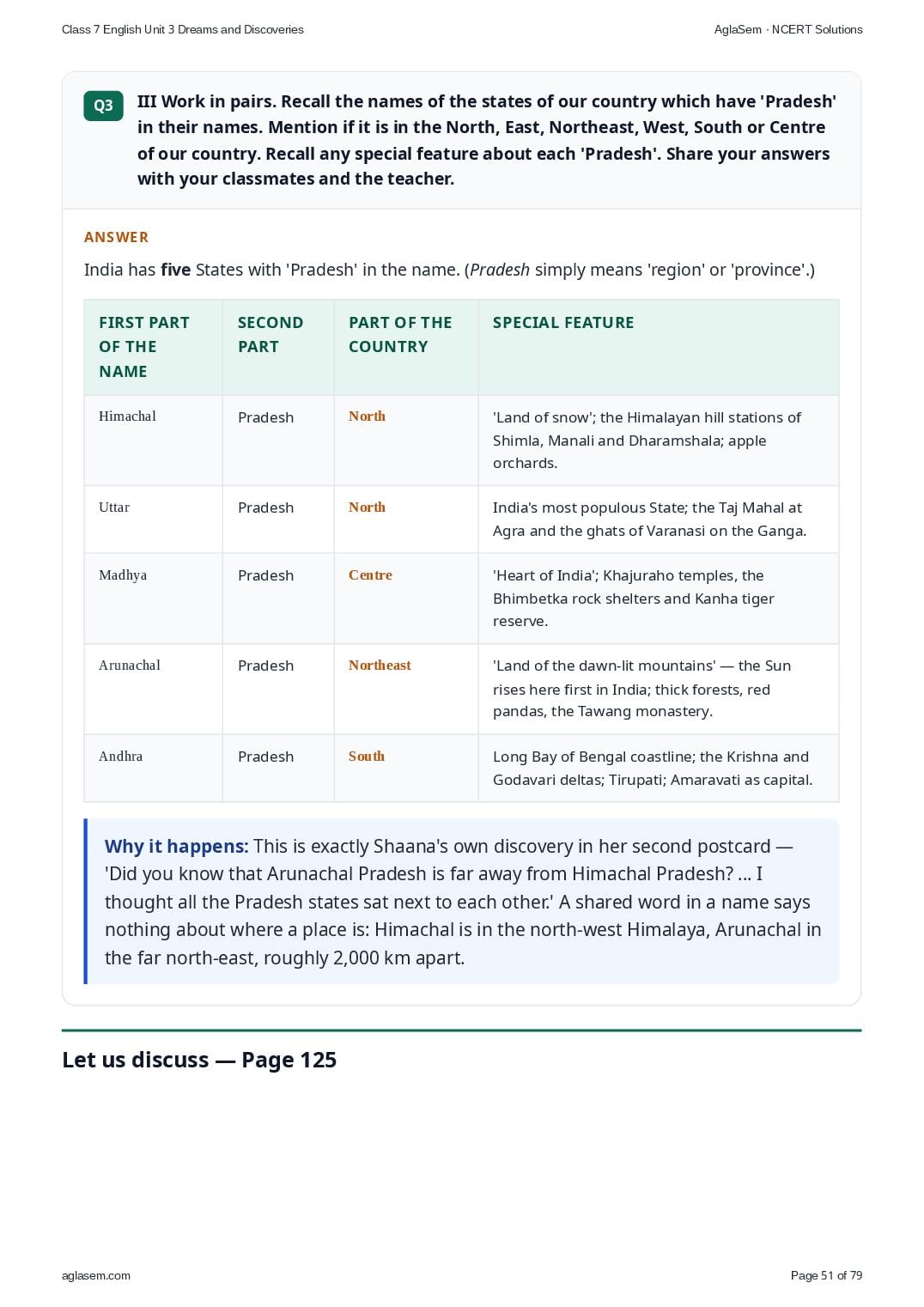
- III Work in pairs. Recall the names of the states of our country which have 'Pradesh' in their names. Mention if it is in the North, East, Northeast, West, South or Centre of our country. Recall any special feature about each 'Pradesh'. Share your answers with your classmates and the teacher.
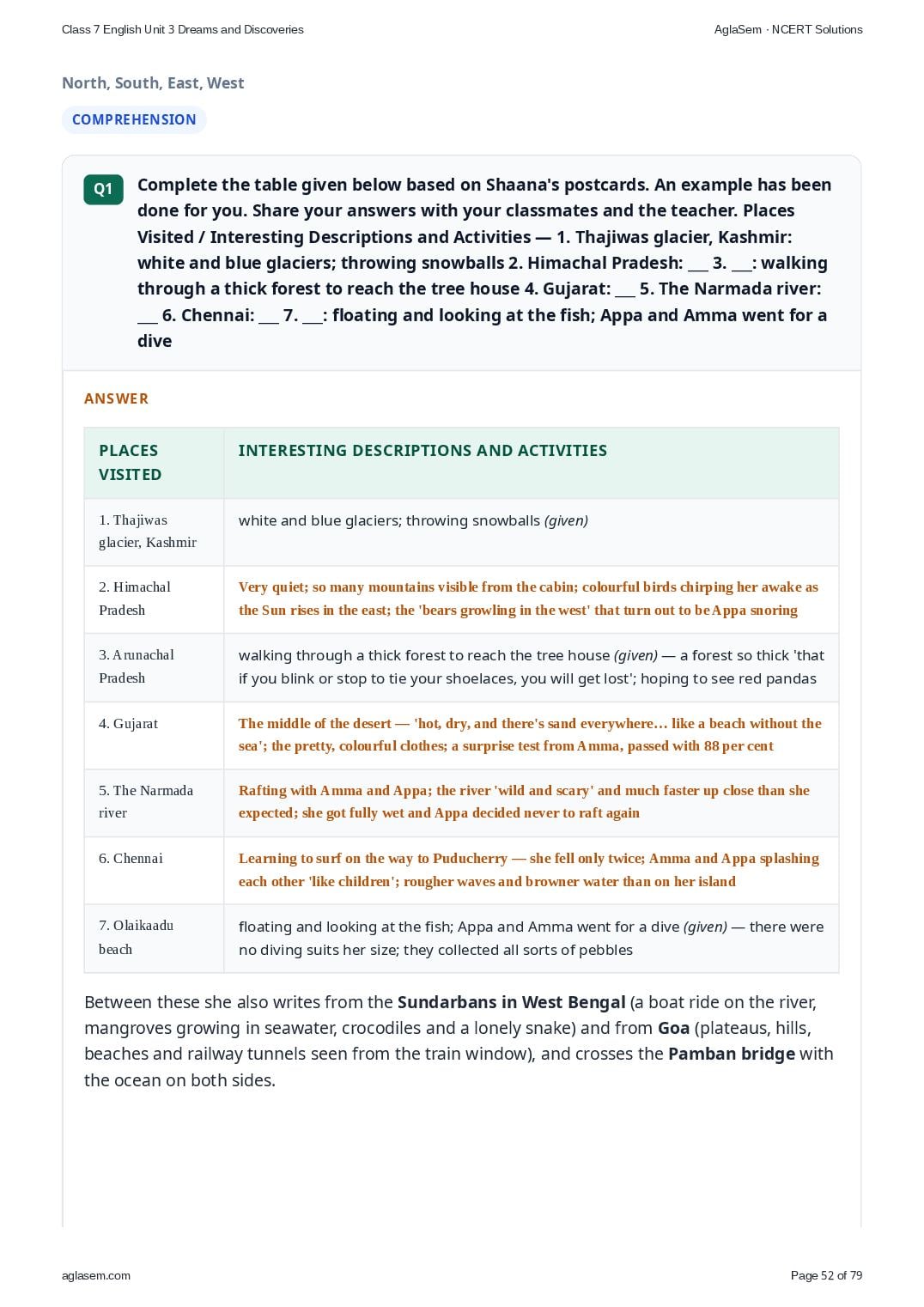
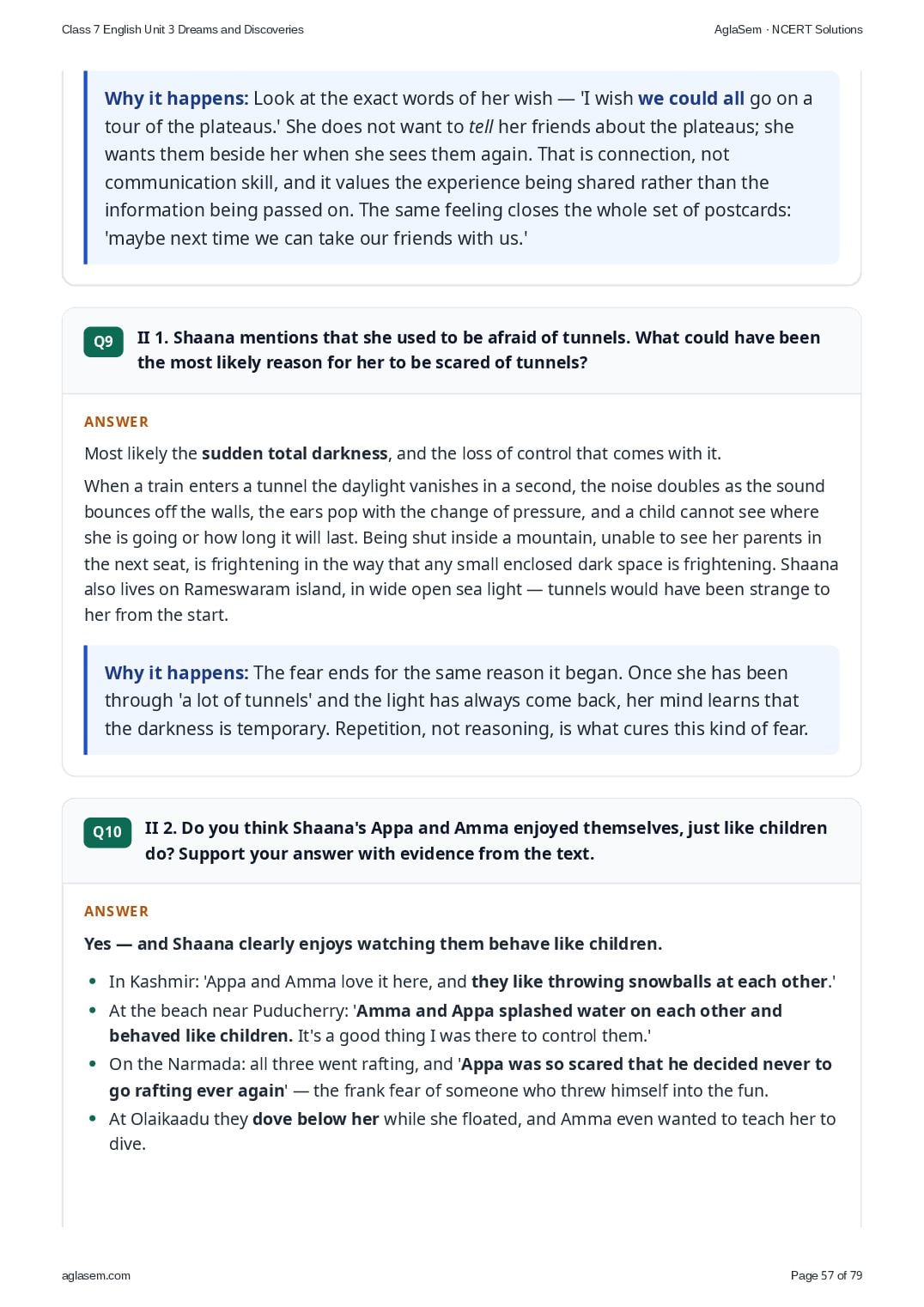
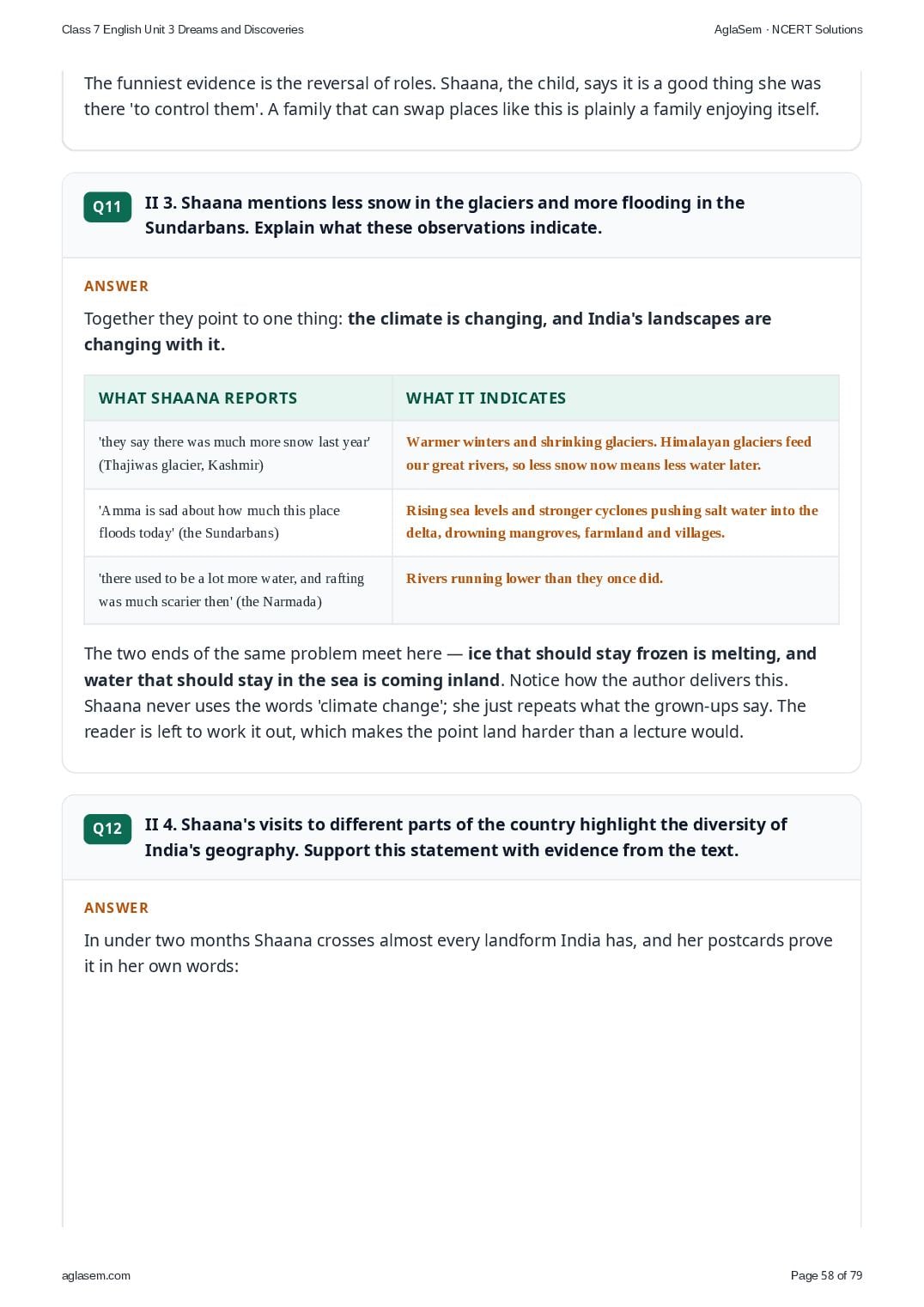
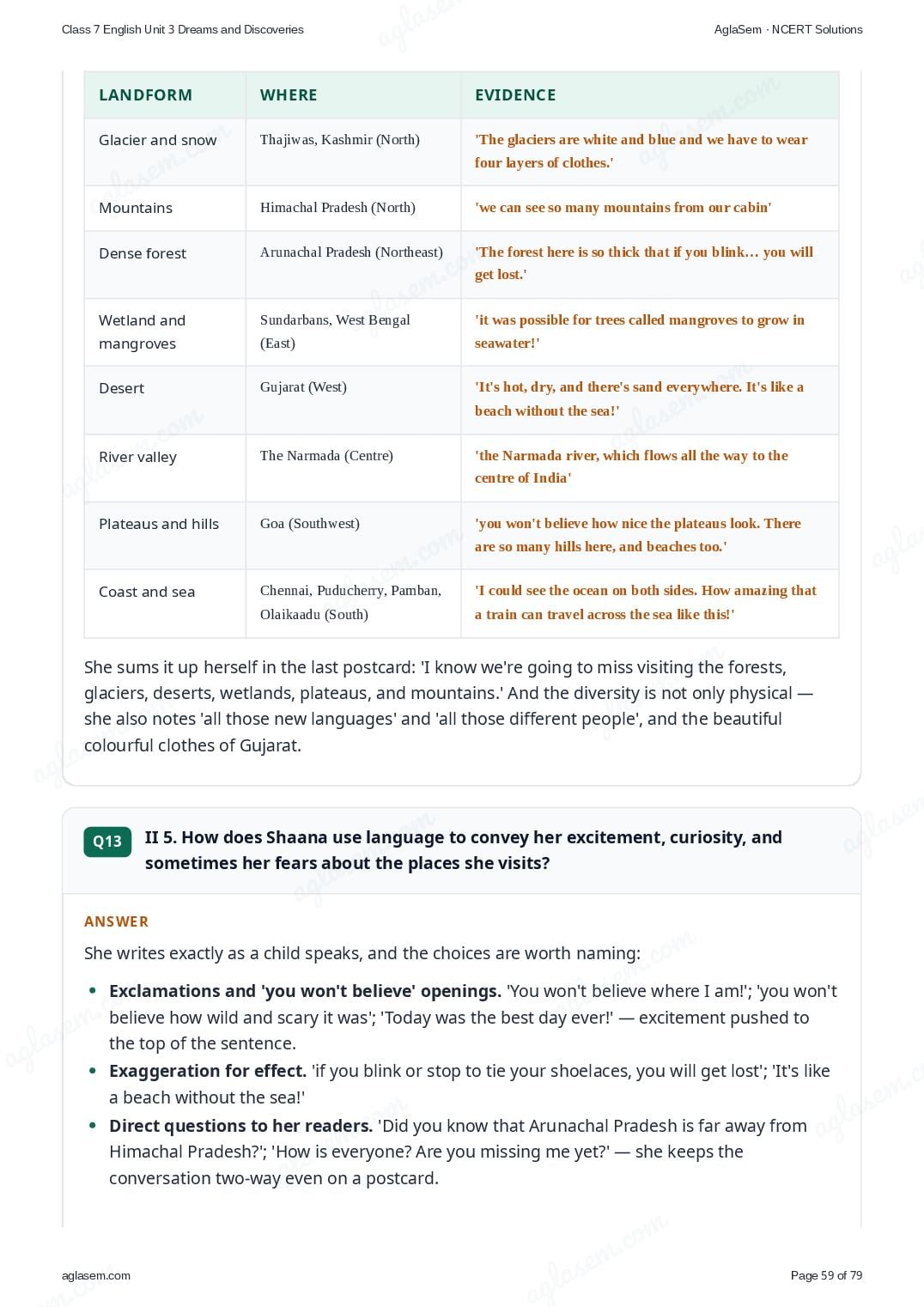
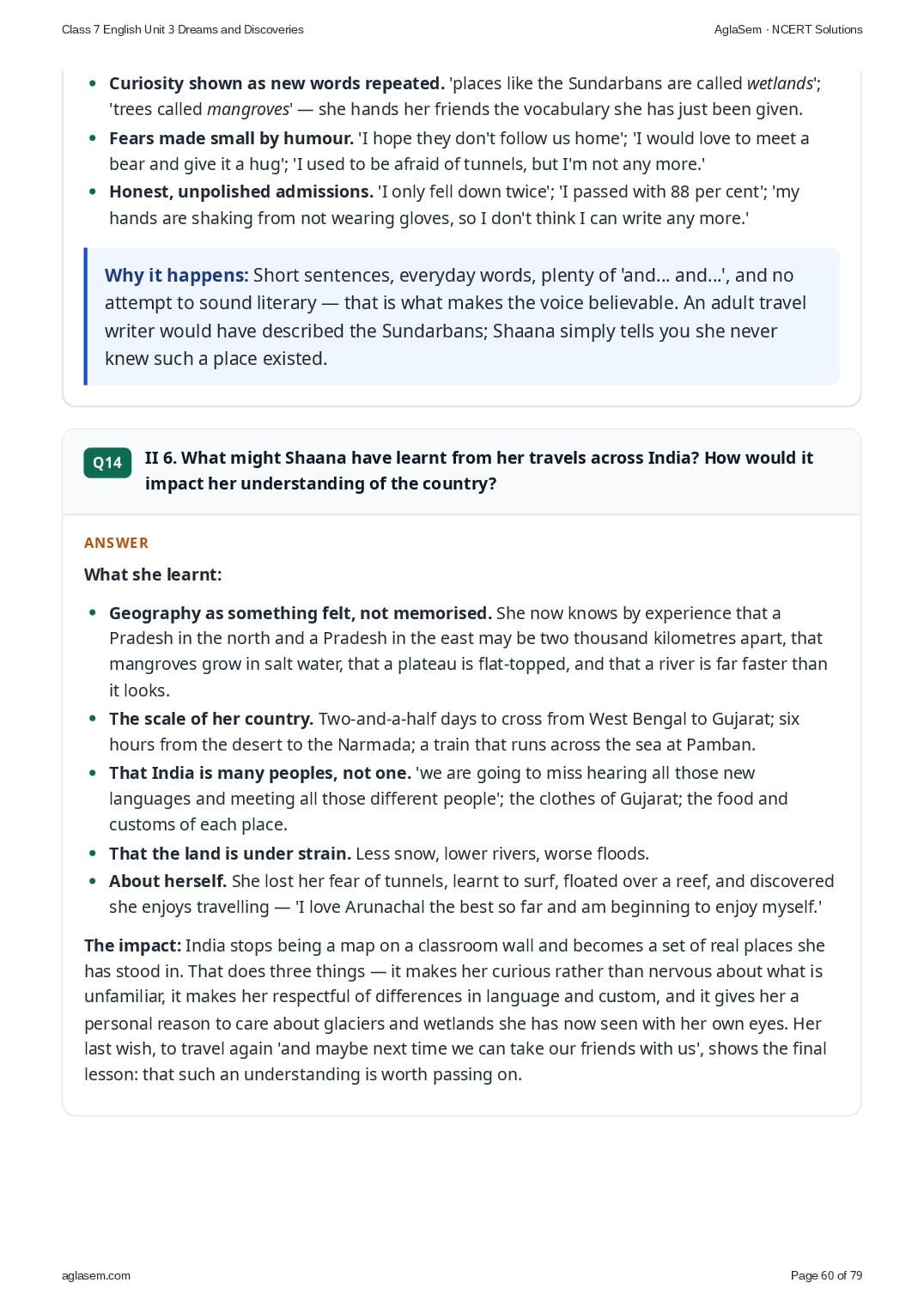
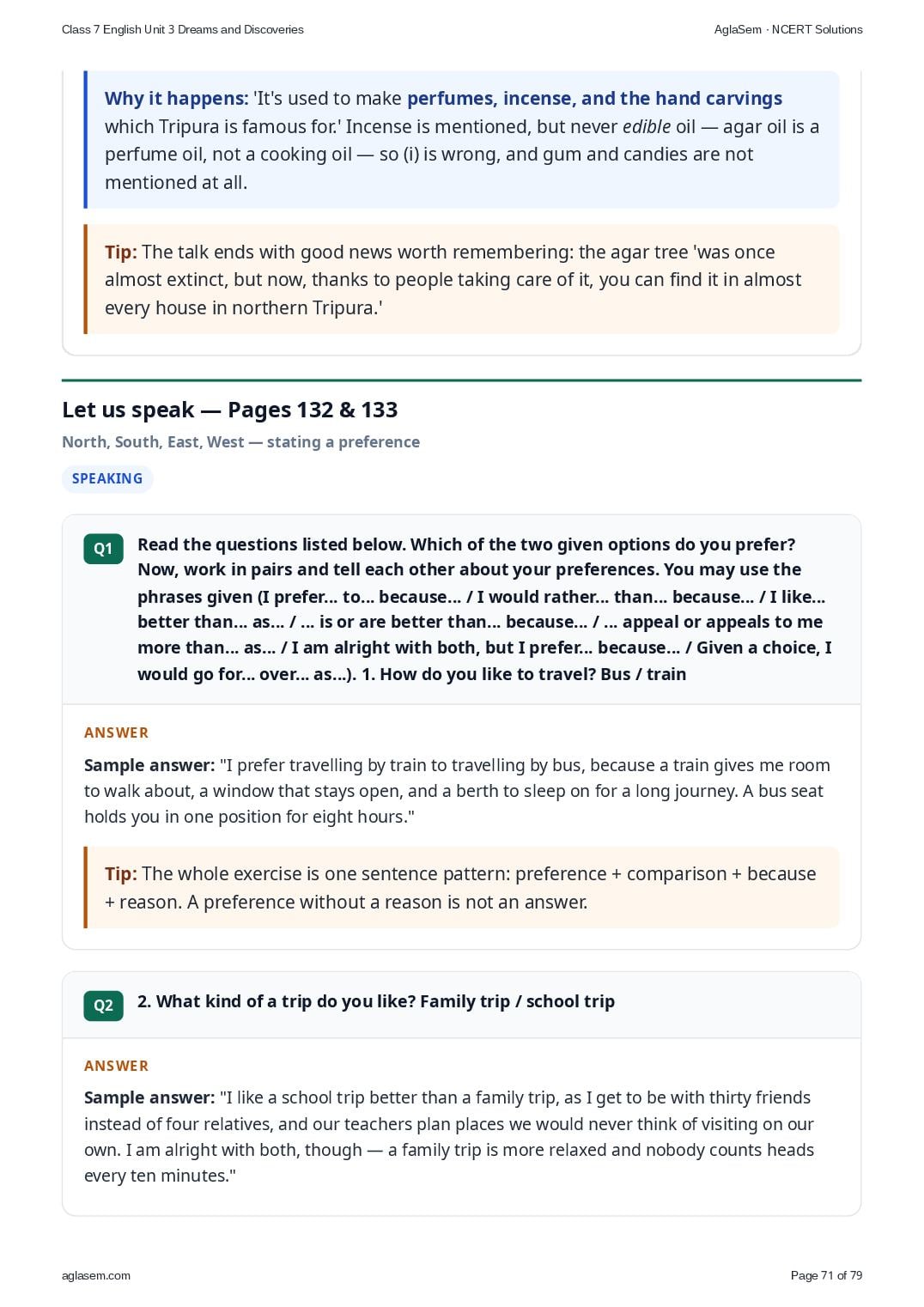
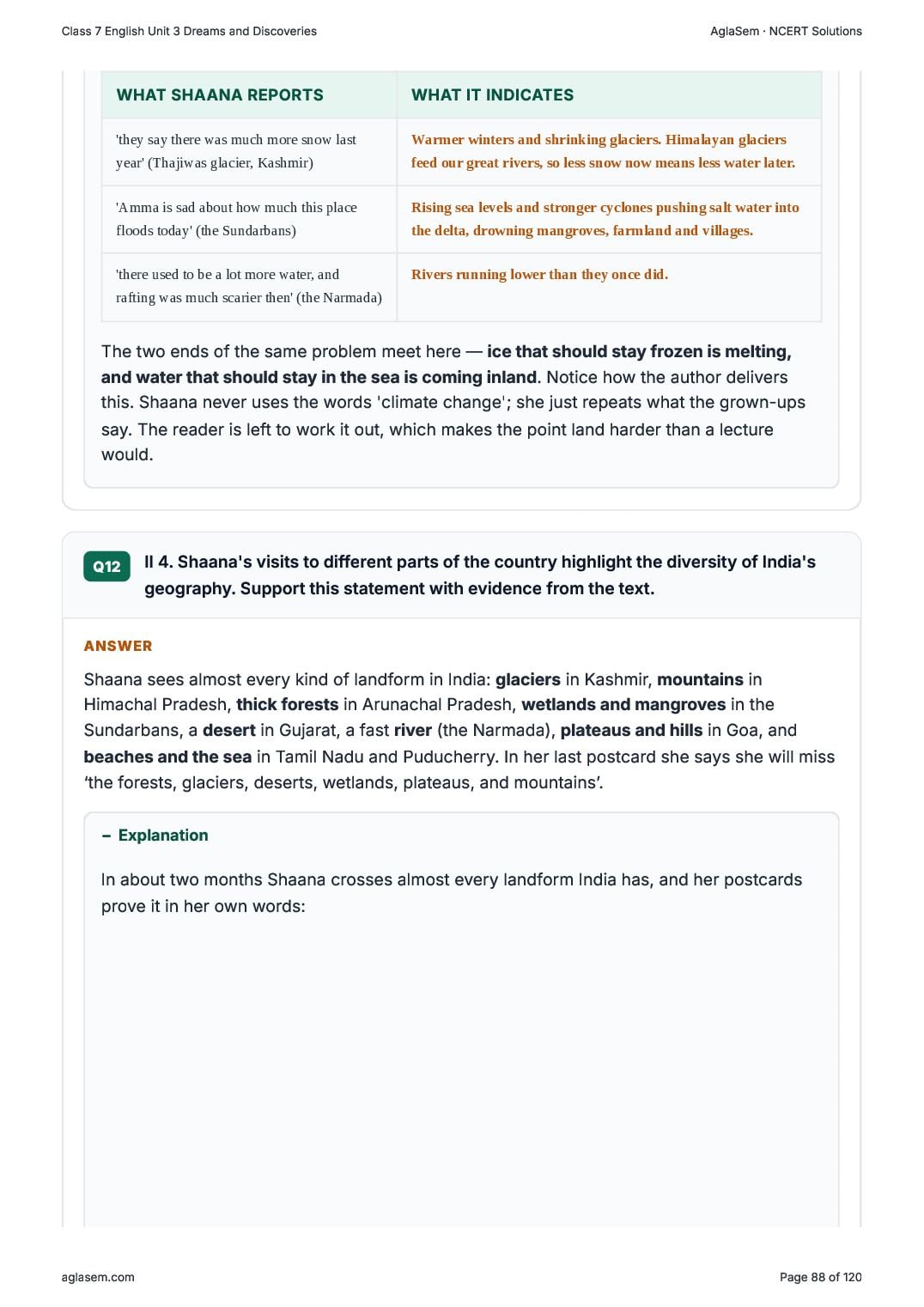
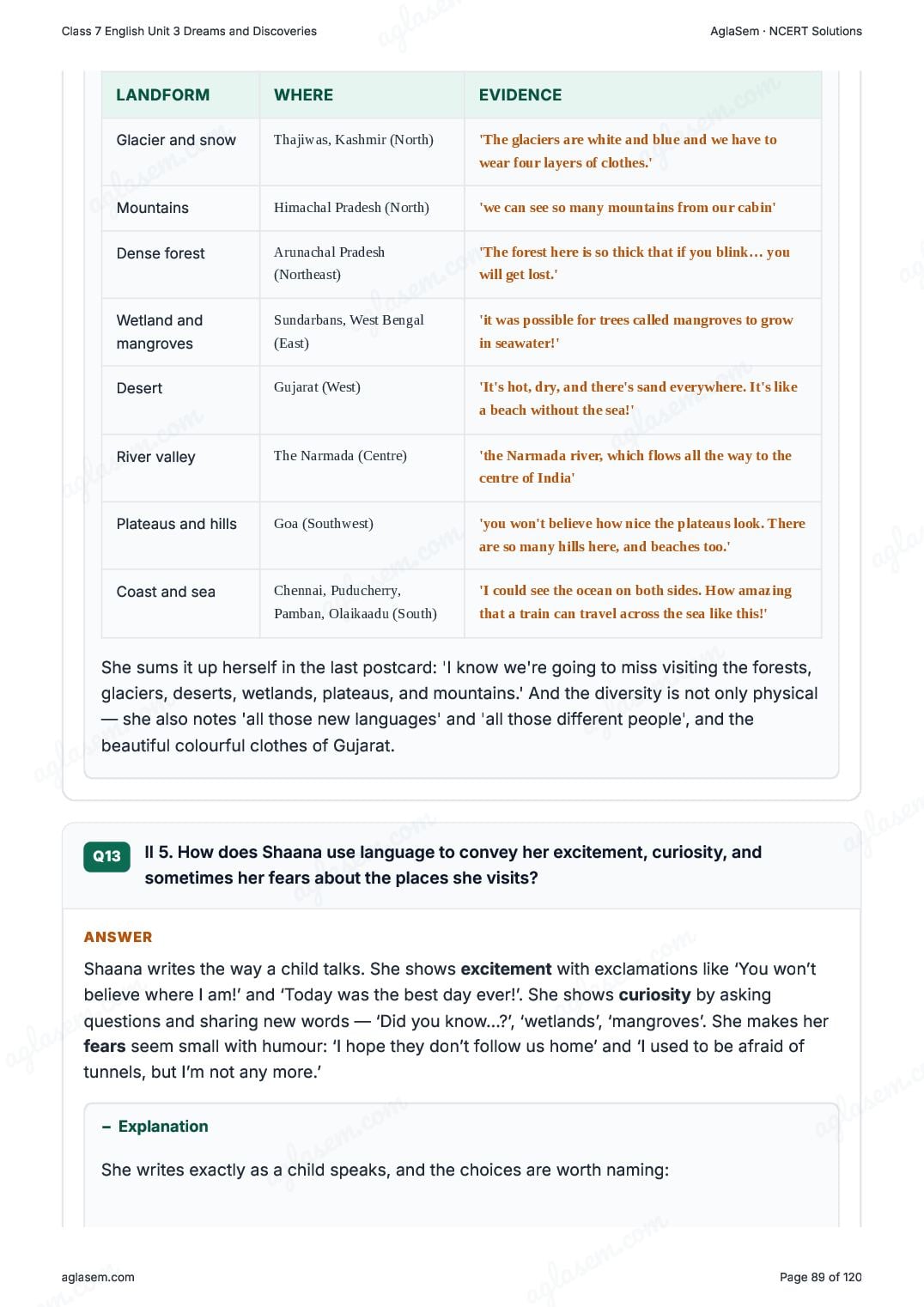
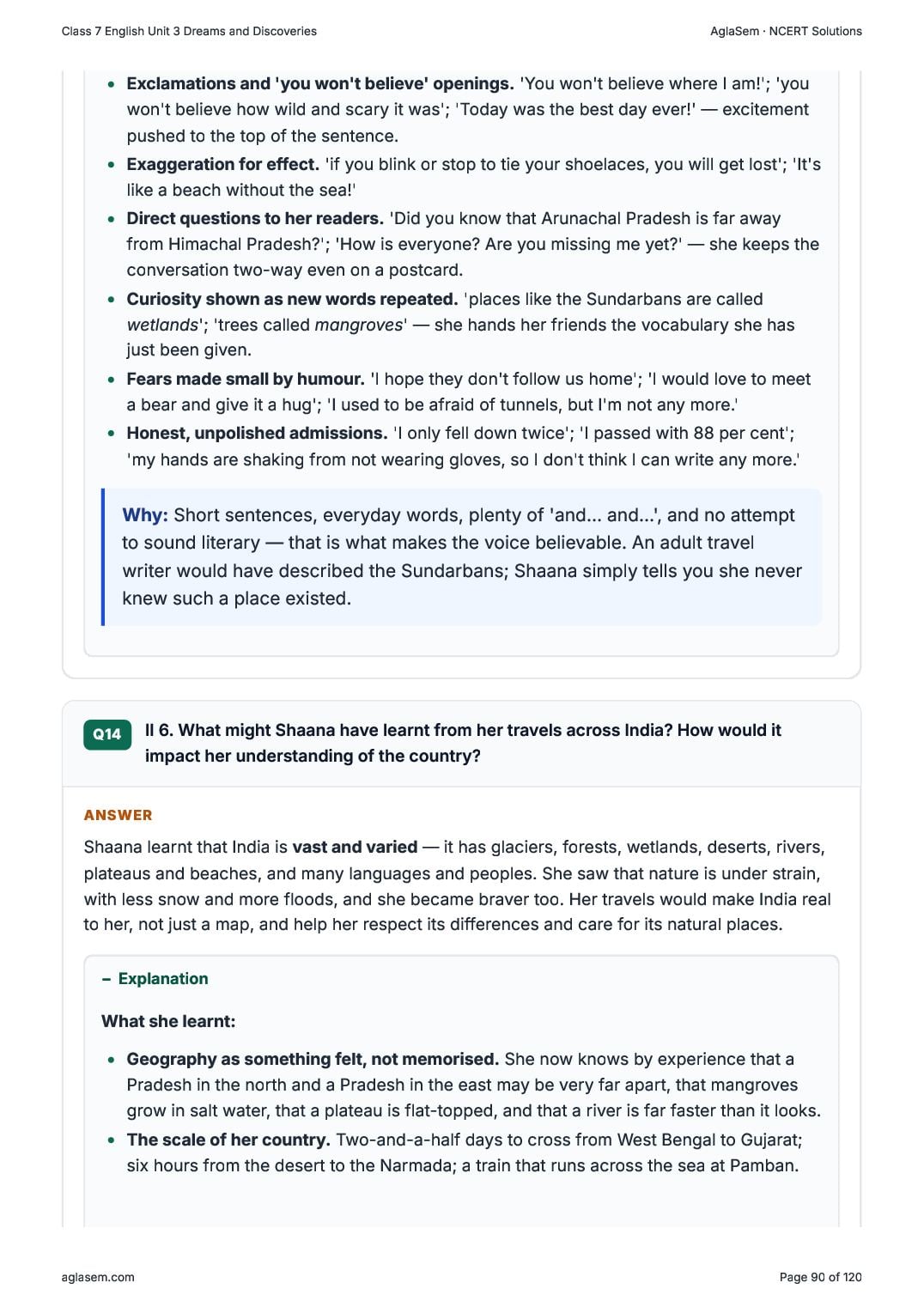
- Complete the table given below based on Shaana's postcards. An example has been done for you. Share your answers with your classmates and the teacher. Places Visited / Interesting Descriptions and Activities — 1. Thajiwas glacier, Kashmir: white and blue glaciers; throwing snowballs 2. Himachal Pradesh: ___ 3. ___: walking through a thick forest to reach the tree house 4. Gujarat: ___ 5. The Narmada river: ___ 6. Chennai: ___ 7. ___: floating and looking at the fish; Appa and Amma went for a dive
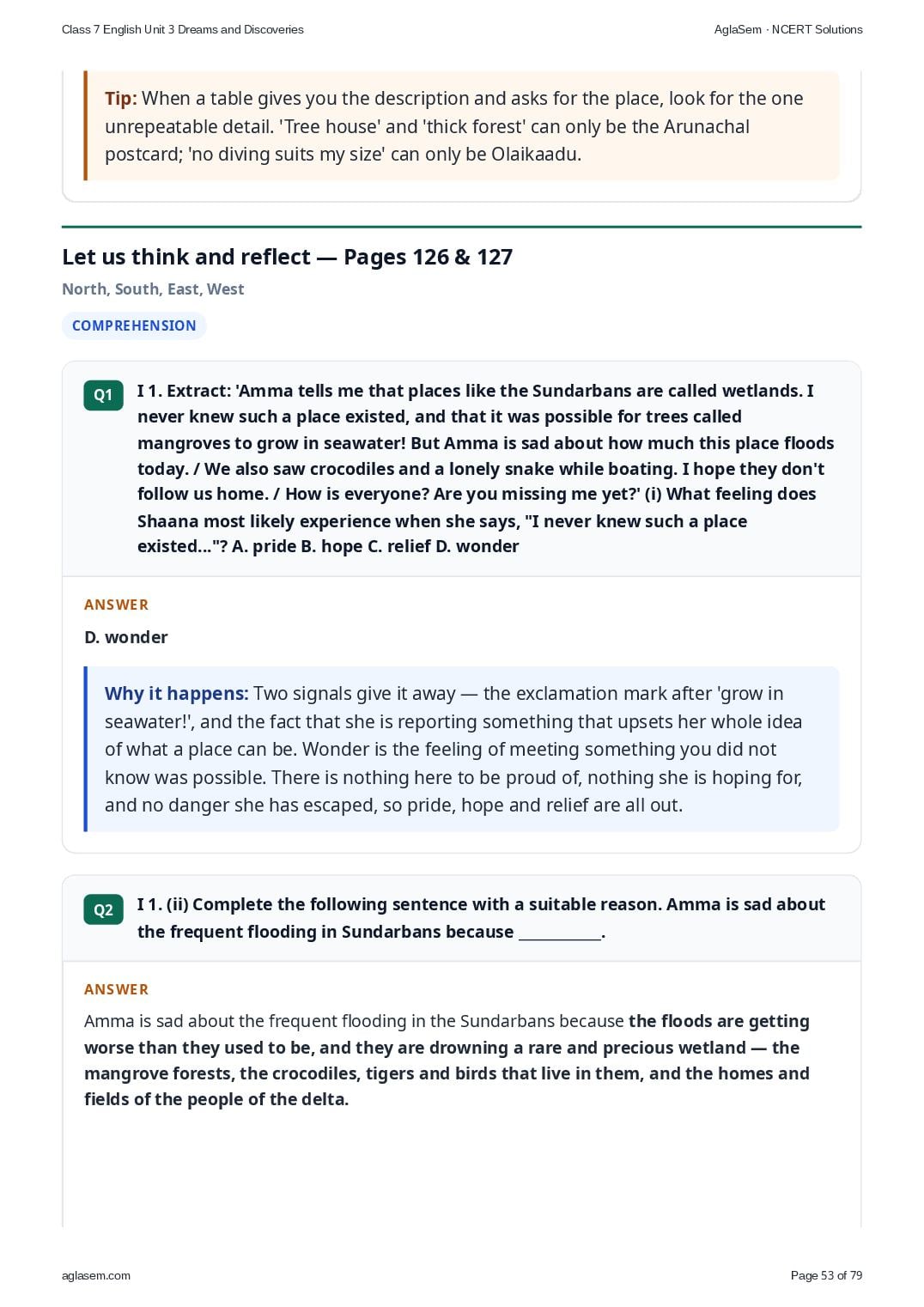
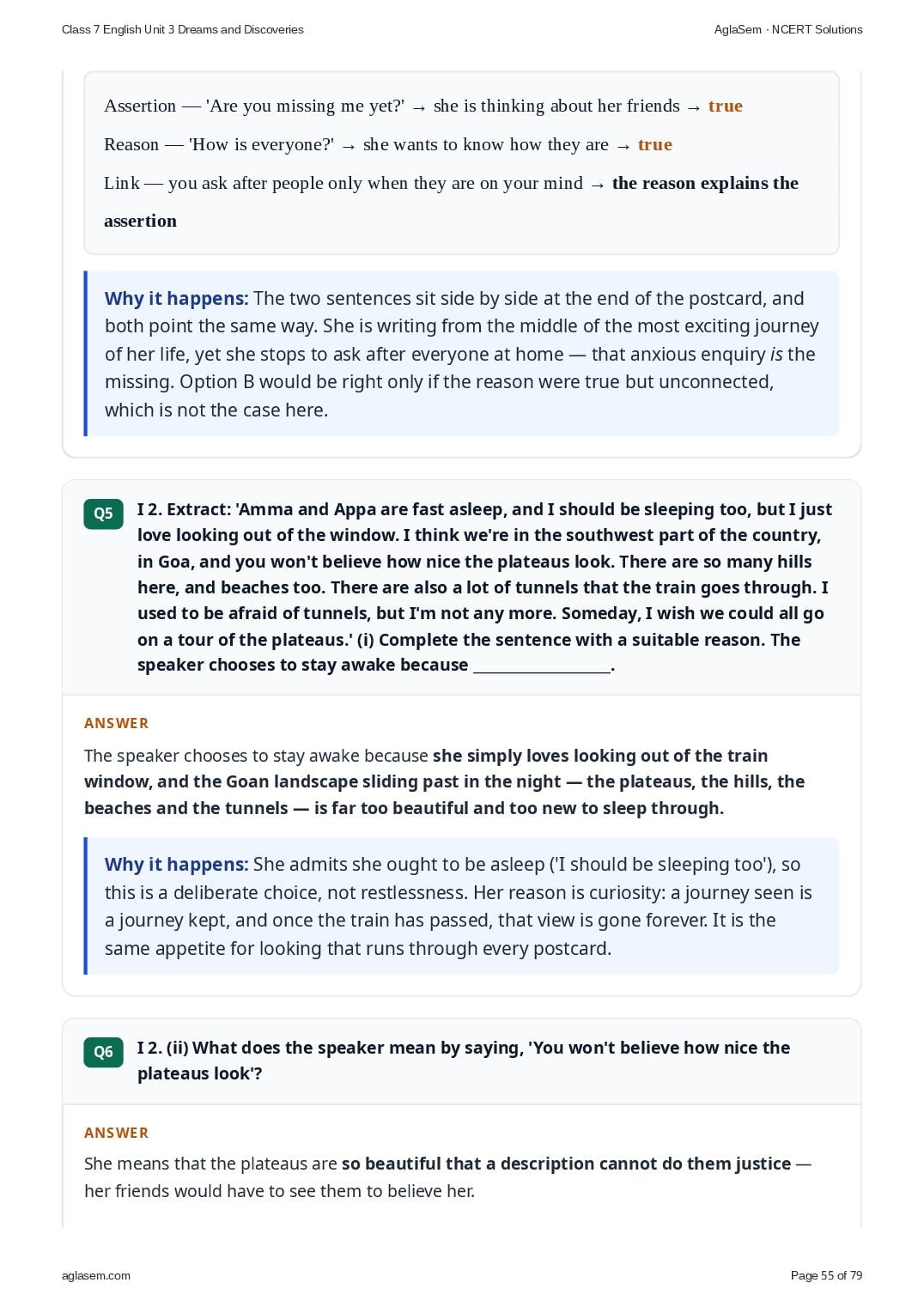
- I 1. Extract: 'Amma tells me that places like the Sundarbans are called wetlands. I never knew such a place existed, and that it was possible for trees called mangroves to grow in seawater! But Amma is sad about how much this place floods today. / We also saw crocodiles and a lonely snake while boating. I hope they don't follow us home. / How is everyone? Are you missing me yet?' (i) What feeling does Shaana most likely experience when she says, "I never knew such a place existed…"? A. pride B. hope C. relief D. wonder
- I 1. (ii) Complete the following sentence with a suitable reason. Amma is sad about the frequent flooding in Sundarbans because ____________.
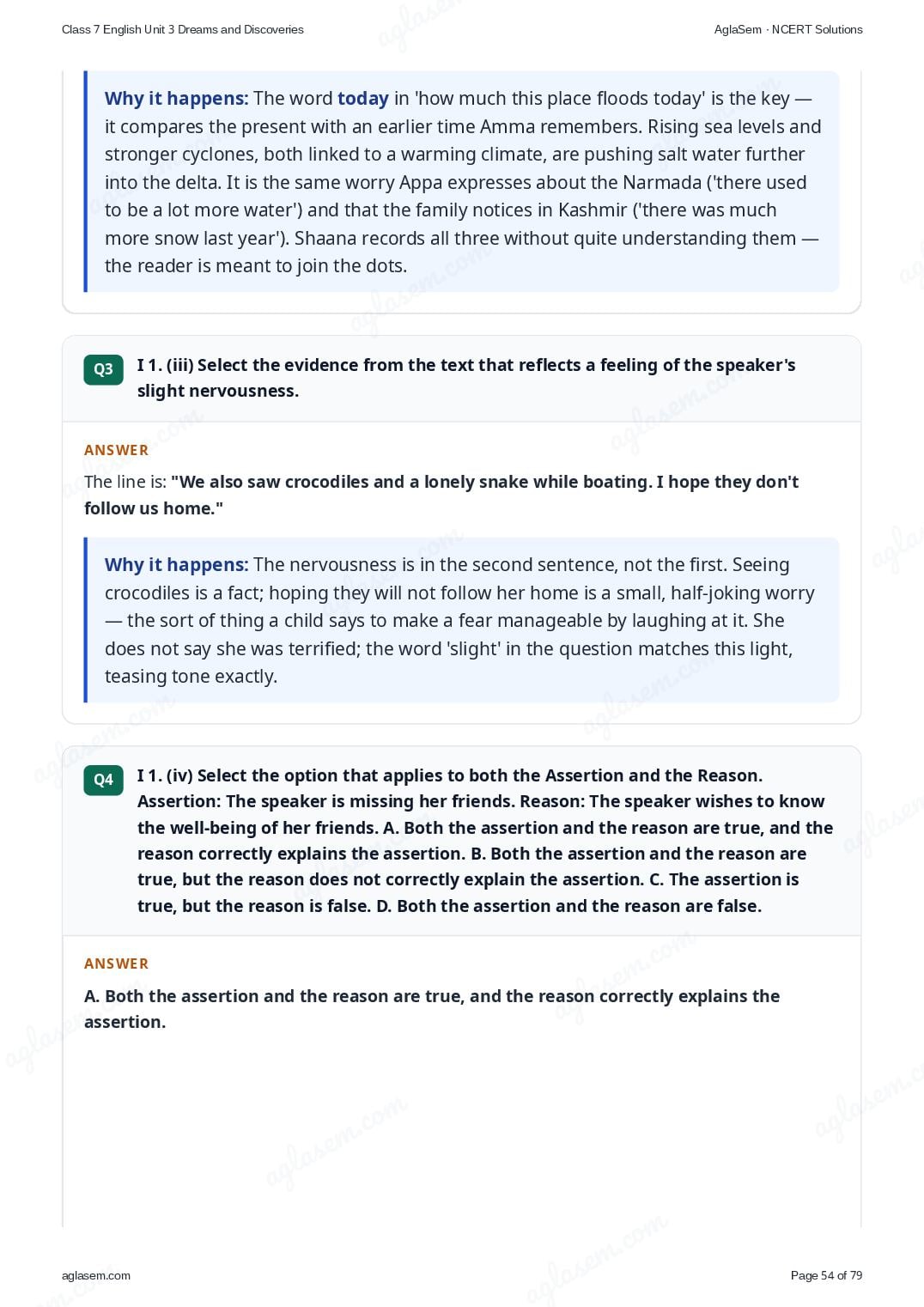
- I 1. (iii) Select the evidence from the text that reflects a feeling of the speaker's slight nervousness.
- I 1. (iv) Select the option that applies to both the Assertion and the Reason. Assertion: The speaker is missing her friends. Reason: The speaker wishes to know the well-being of her friends. A. Both the assertion and the reason are true, and the reason correctly explains the assertion. B. Both the assertion and the reason are true, but the reason does not correctly explain the assertion. C. The assertion is true, but the reason is false. D. Both the assertion and the reason are false.
- … and more questions — see the complete solutions above.
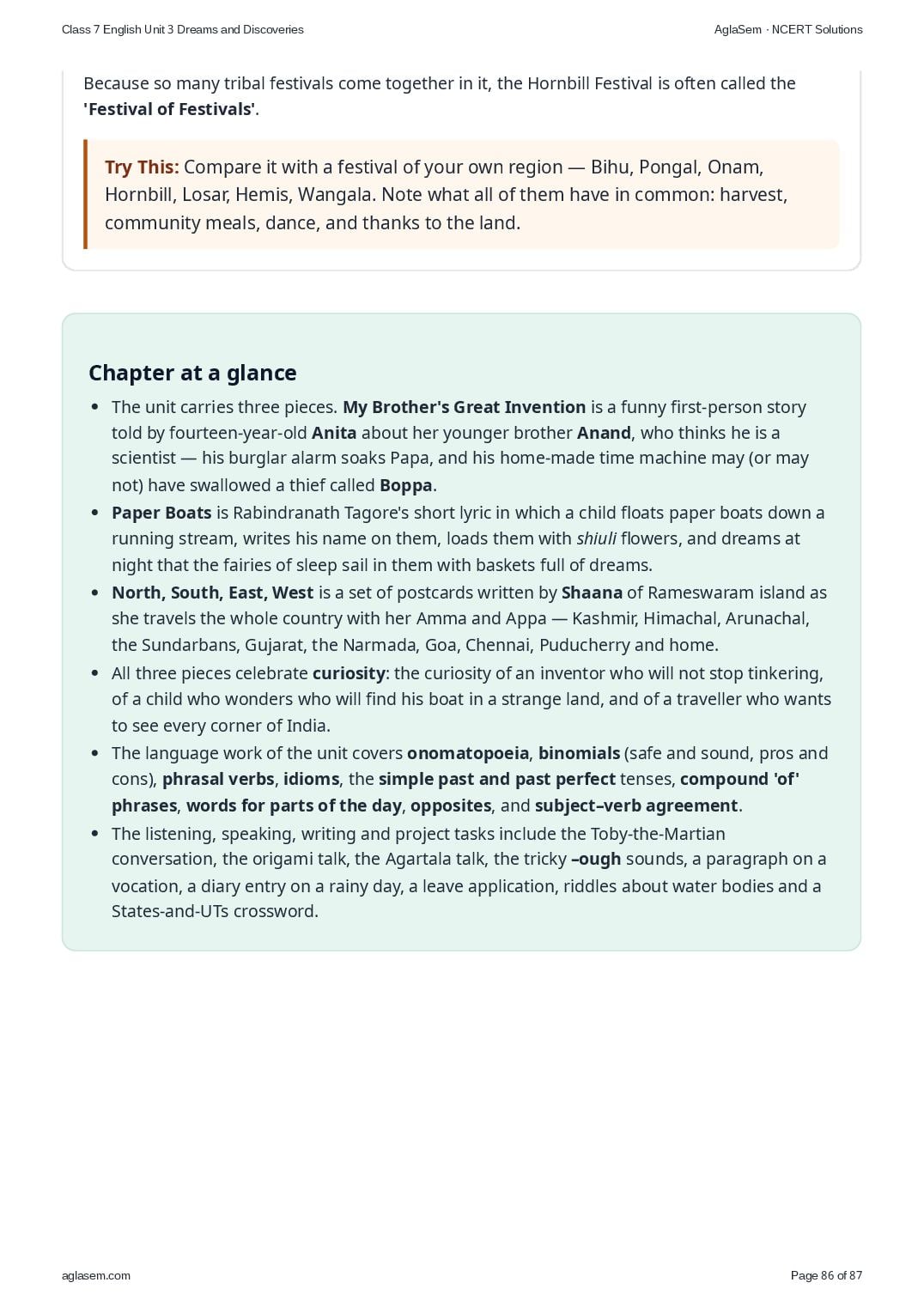
Chapter at a Glance
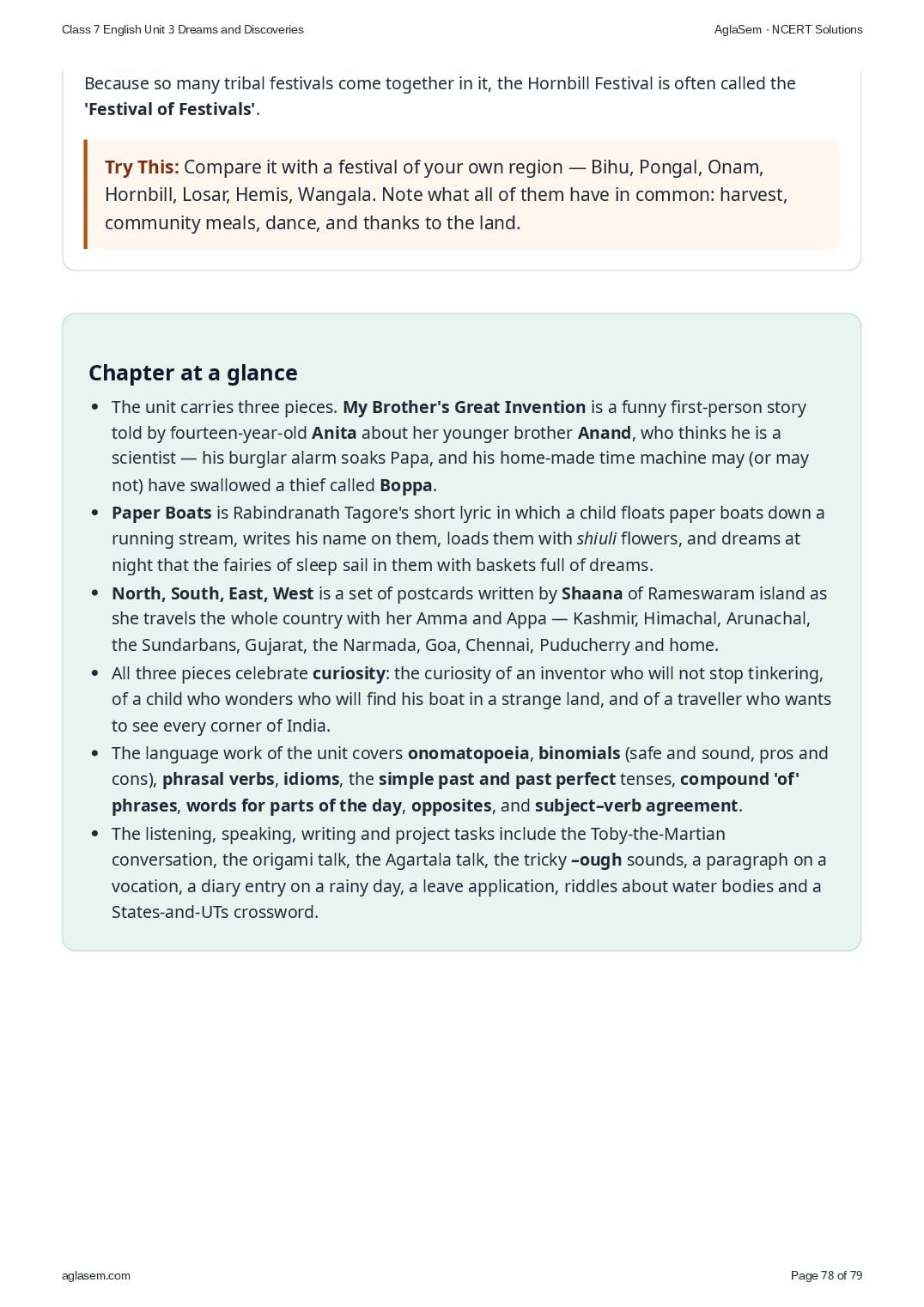
- The unit carries three pieces. My Brother's Great Invention is a funny first-person story told by fourteen-year-old Anita about her younger brother Anand , who thinks he is a scientist — his burglar alarm soaks Papa, and his home-made time machine may (or may not) have swallowed a thief called Boppa .
- Paper Boats is Rabindranath Tagore's short lyric in which a child floats paper boats down a running stream, writes his name on them, loads them with shiuli flowers, and dreams at night that the fairies of sleep sail in them with baskets full of dreams.
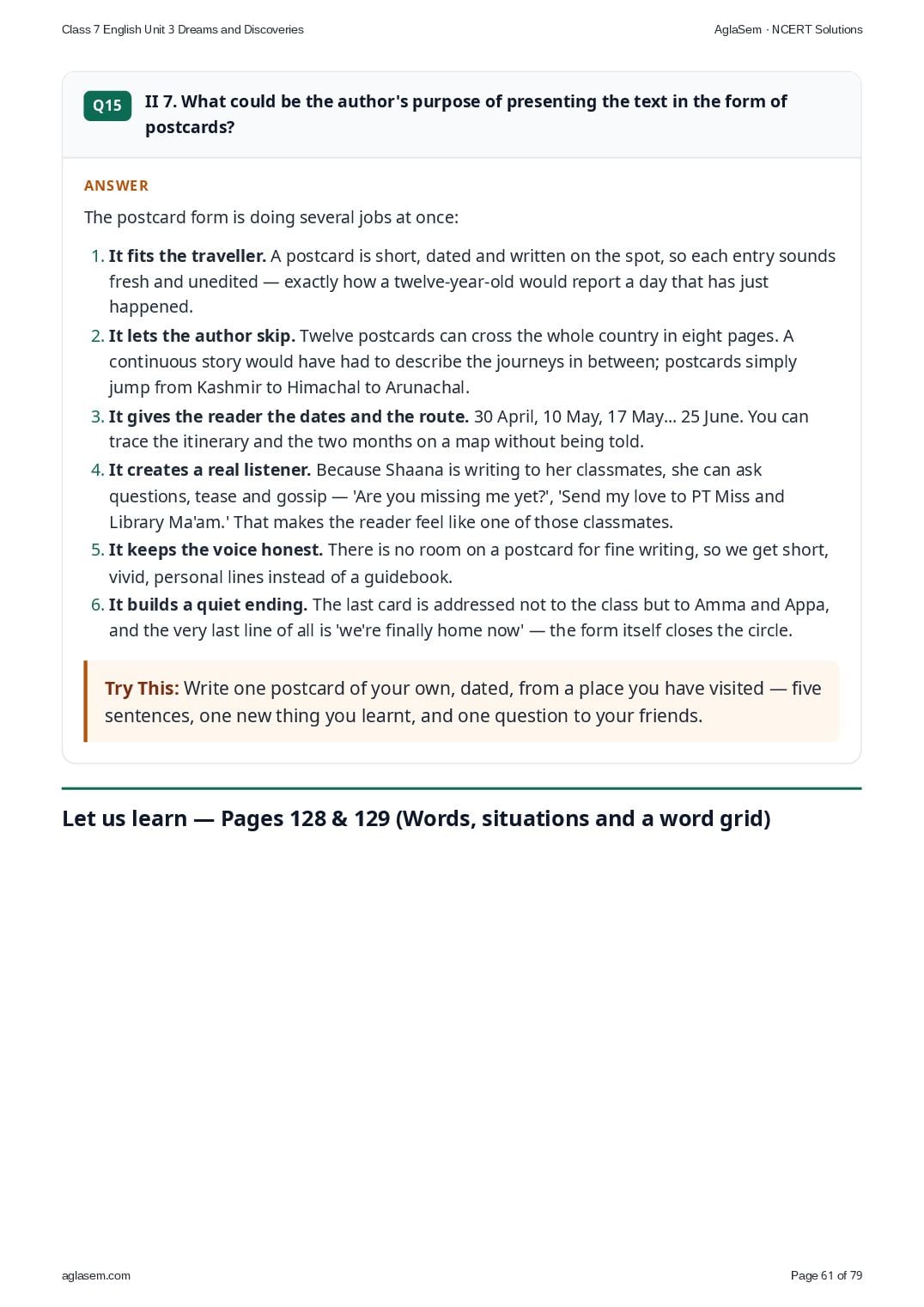
- North, South, East, West is a set of postcards written by Shaana of Rameswaram island as she travels the whole country with her Amma and Appa — Kashmir, Himachal, Arunachal, the Sundarbans, Gujarat, the Narmada, Goa, Chennai, Puducherry and home.
- All three pieces celebrate curiosity : the curiosity of an inventor who will not stop tinkering, of a child who wonders who will find his boat in a strange land, and of a traveller who wants to see every corner of India.
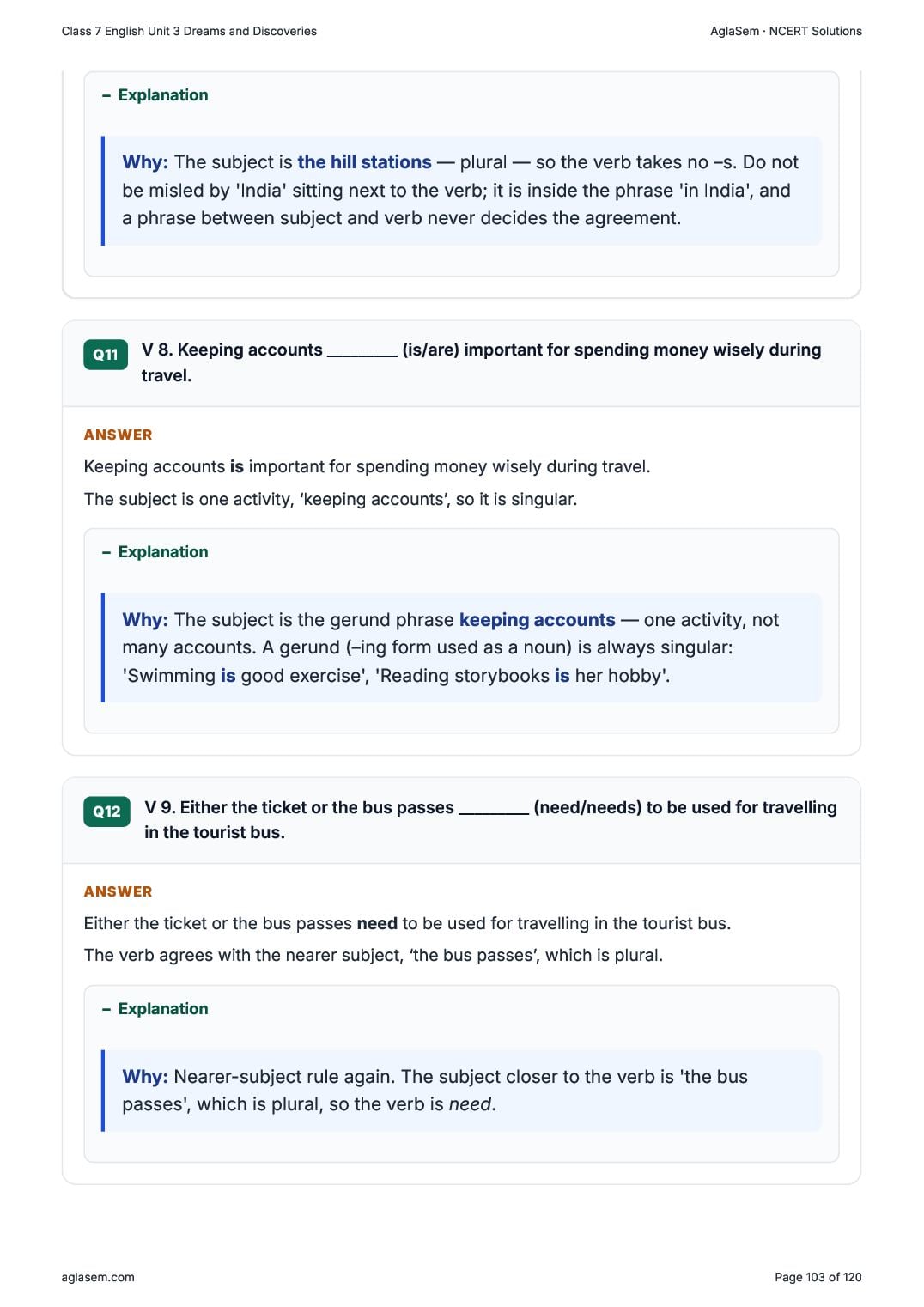
- The language work of the unit covers onomatopoeia , binomials (safe and sound, pros and cons), phrasal verbs , idioms , the simple past and past perfect tenses, compound 'of' phrases , words for parts of the day , opposites , and subject–verb agreement .
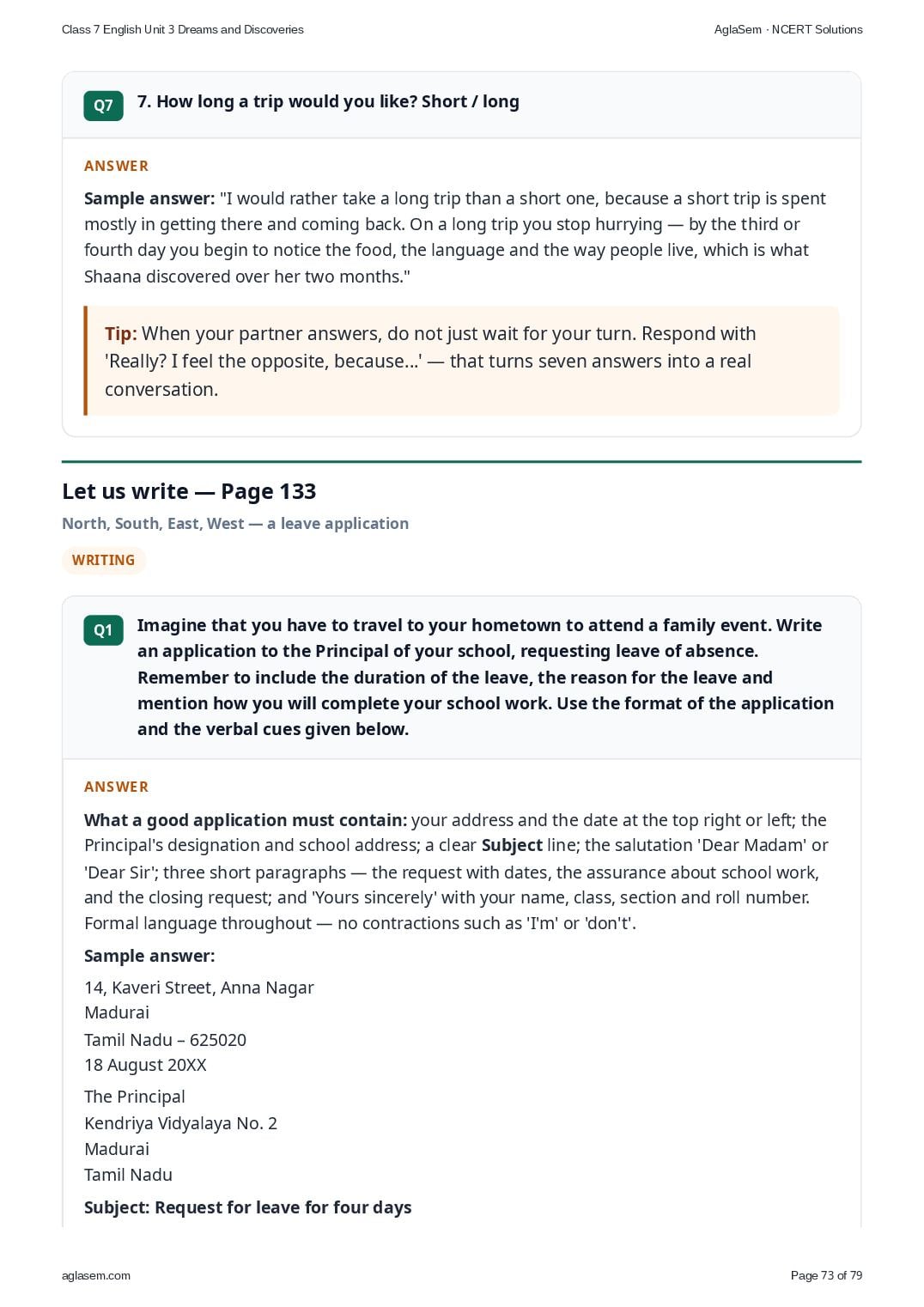
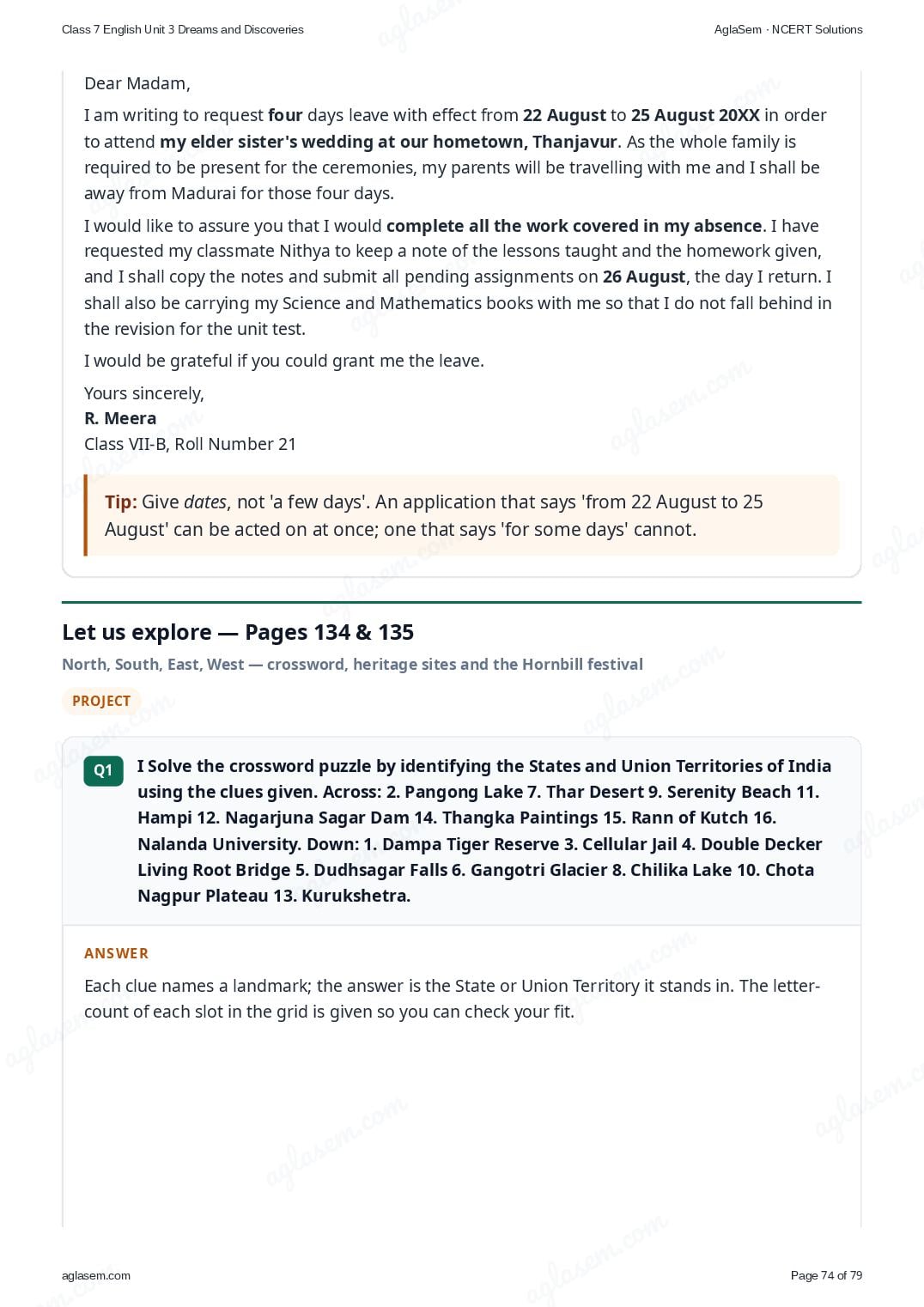
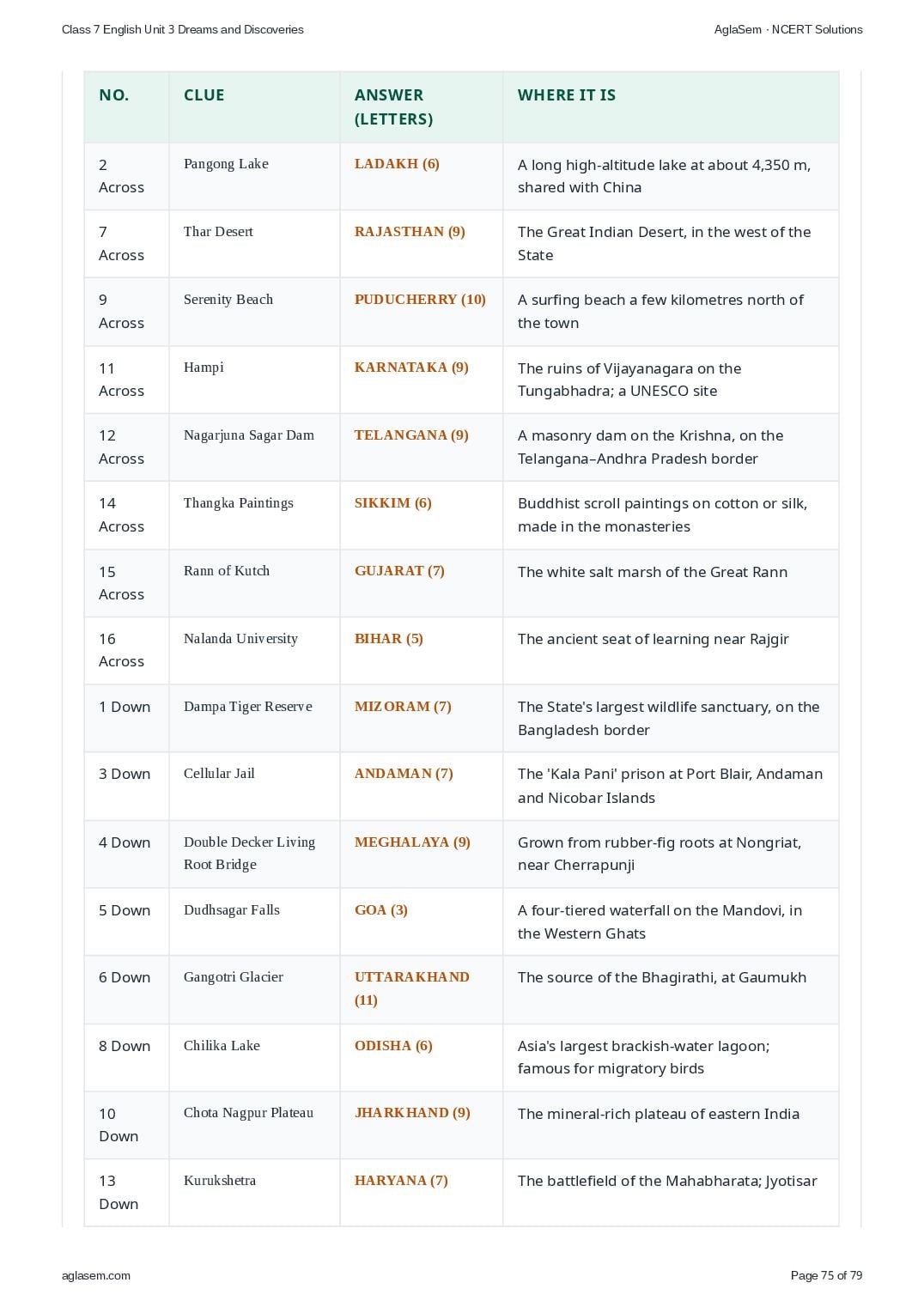
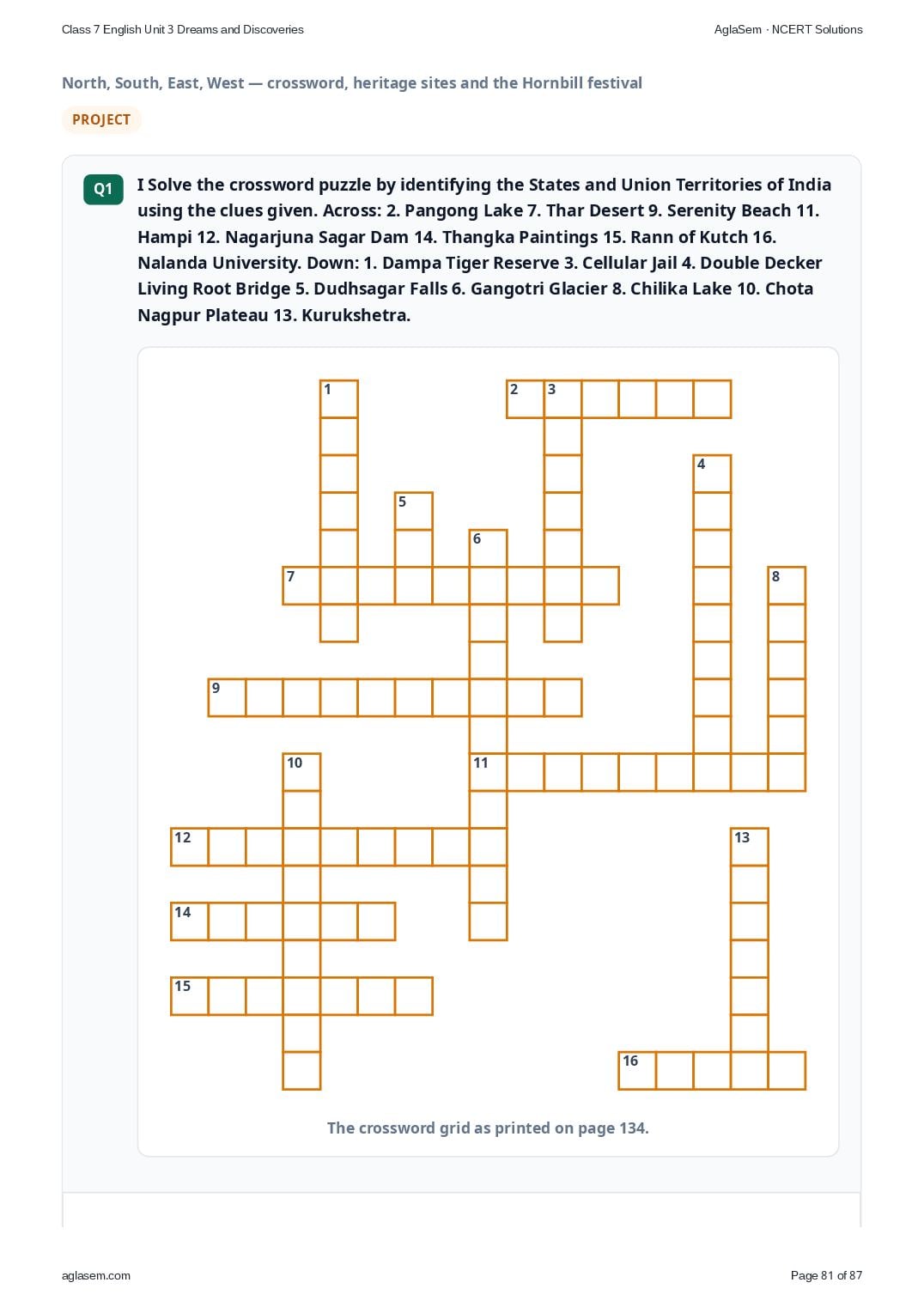
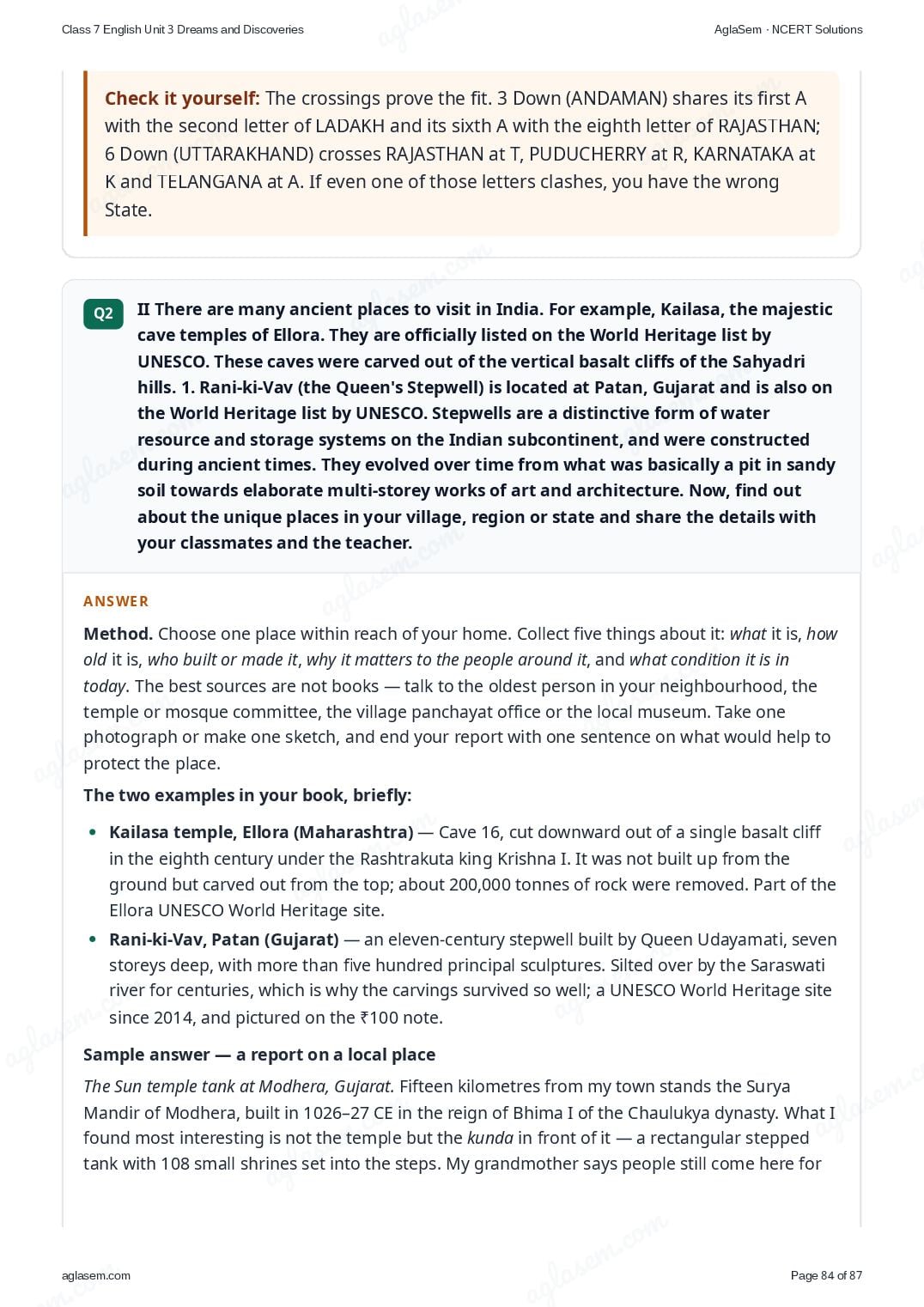
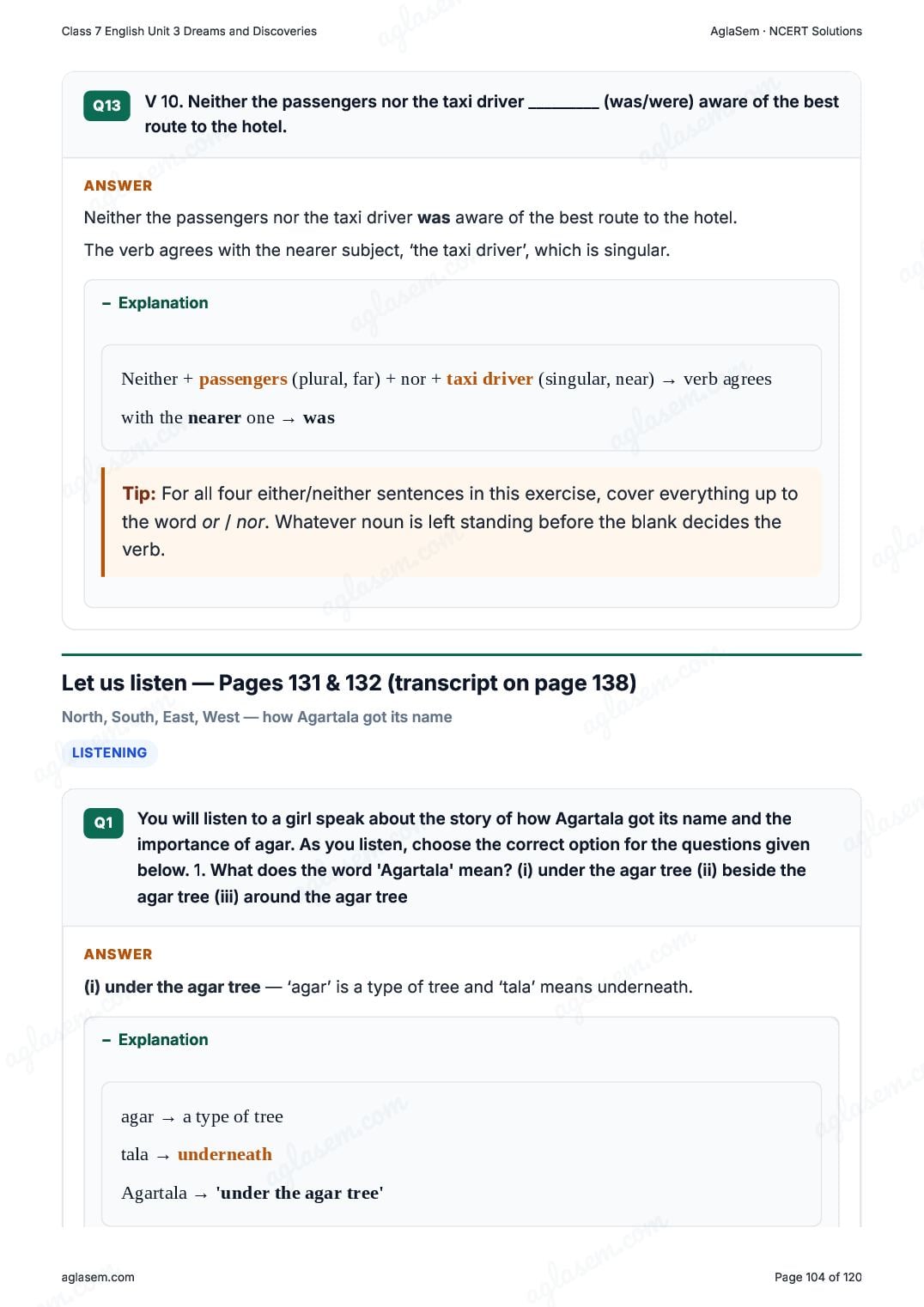
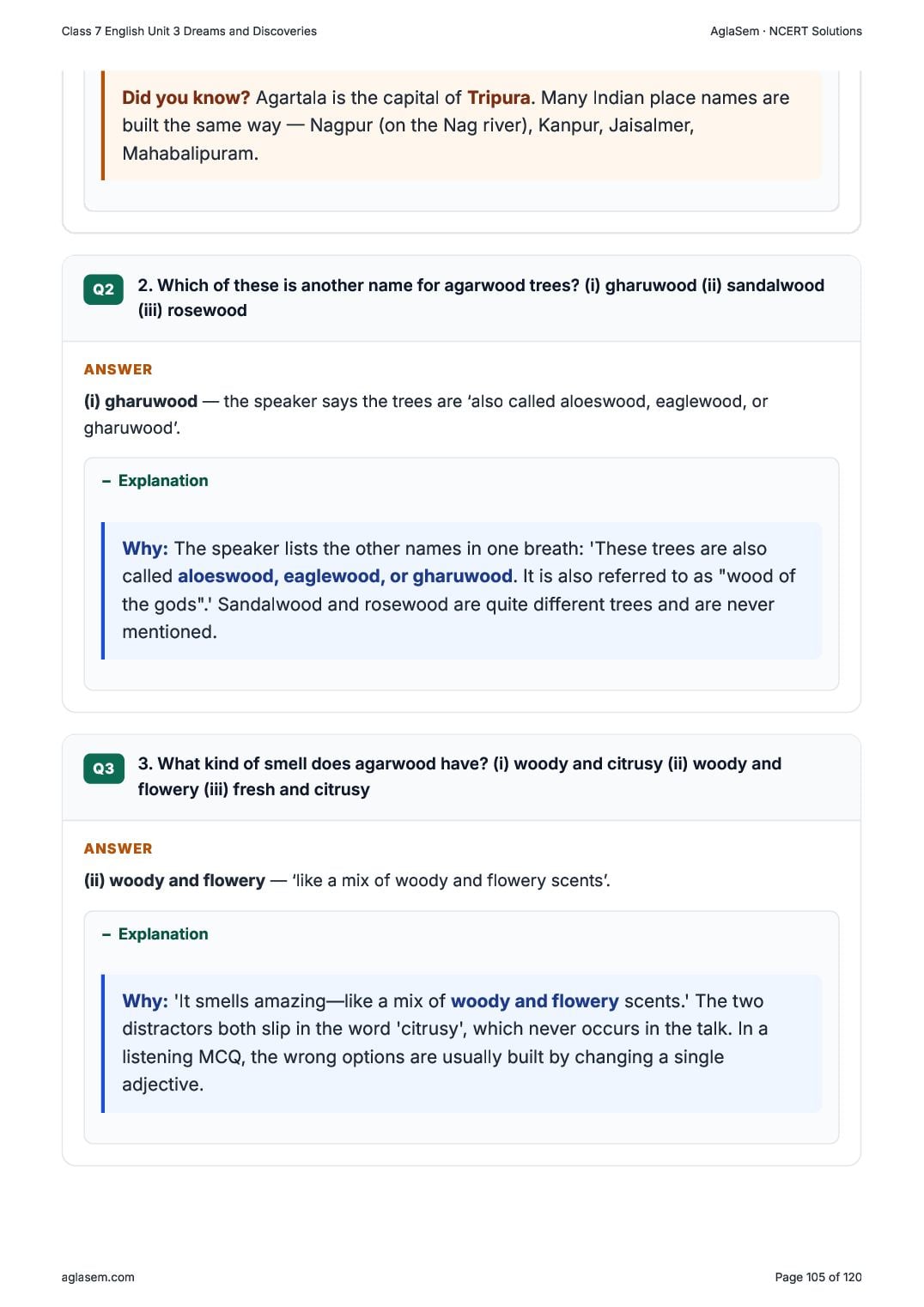
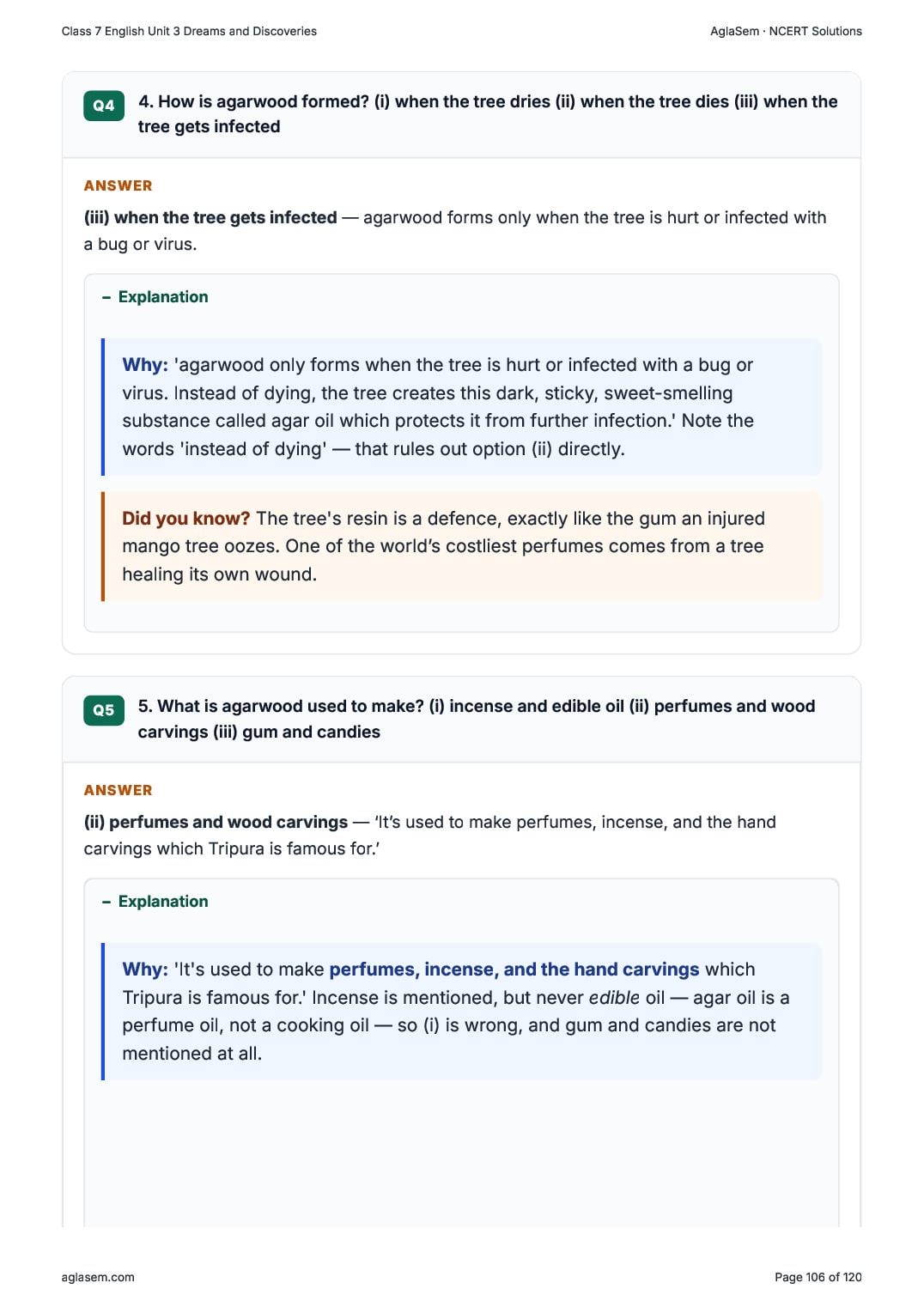
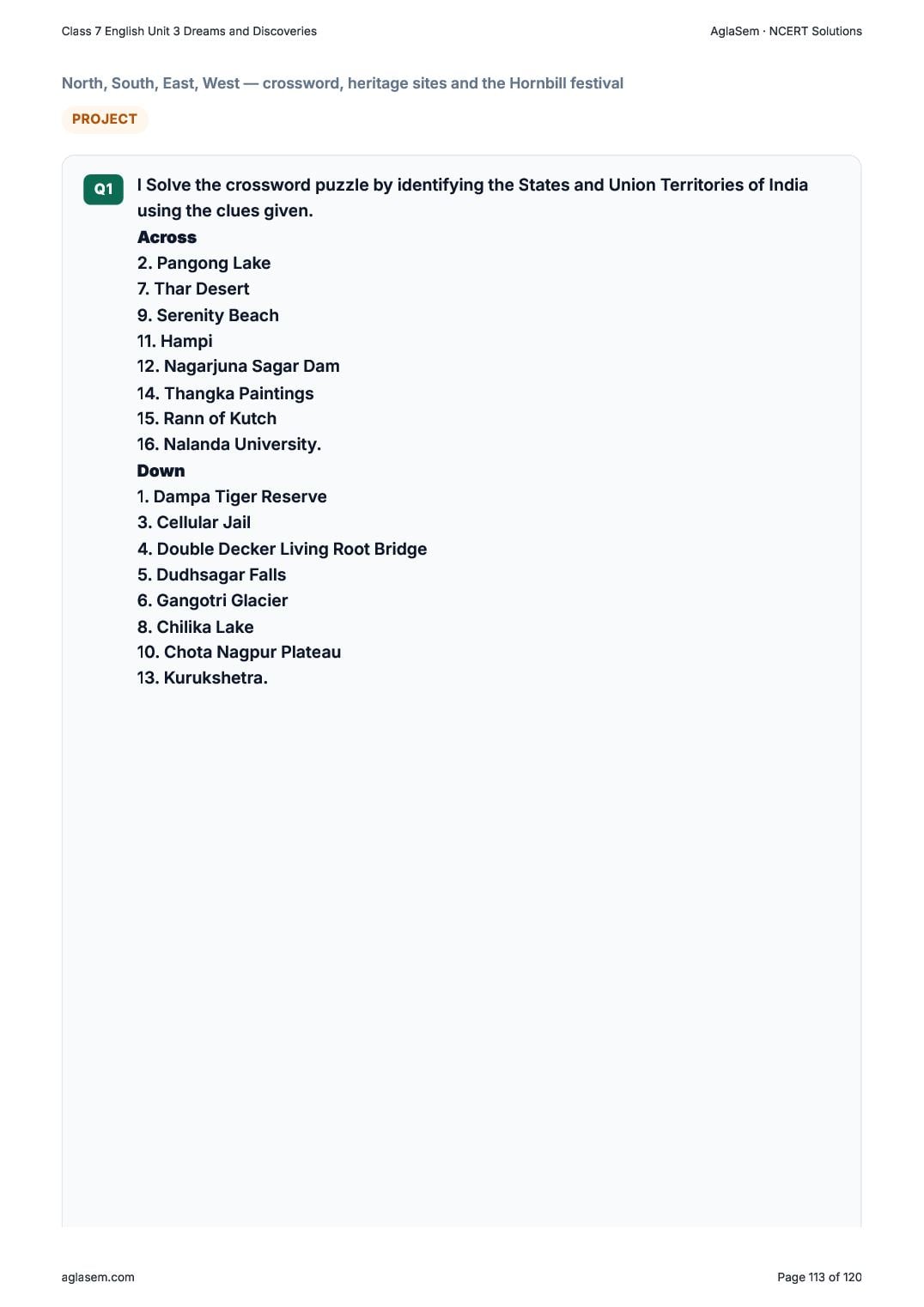
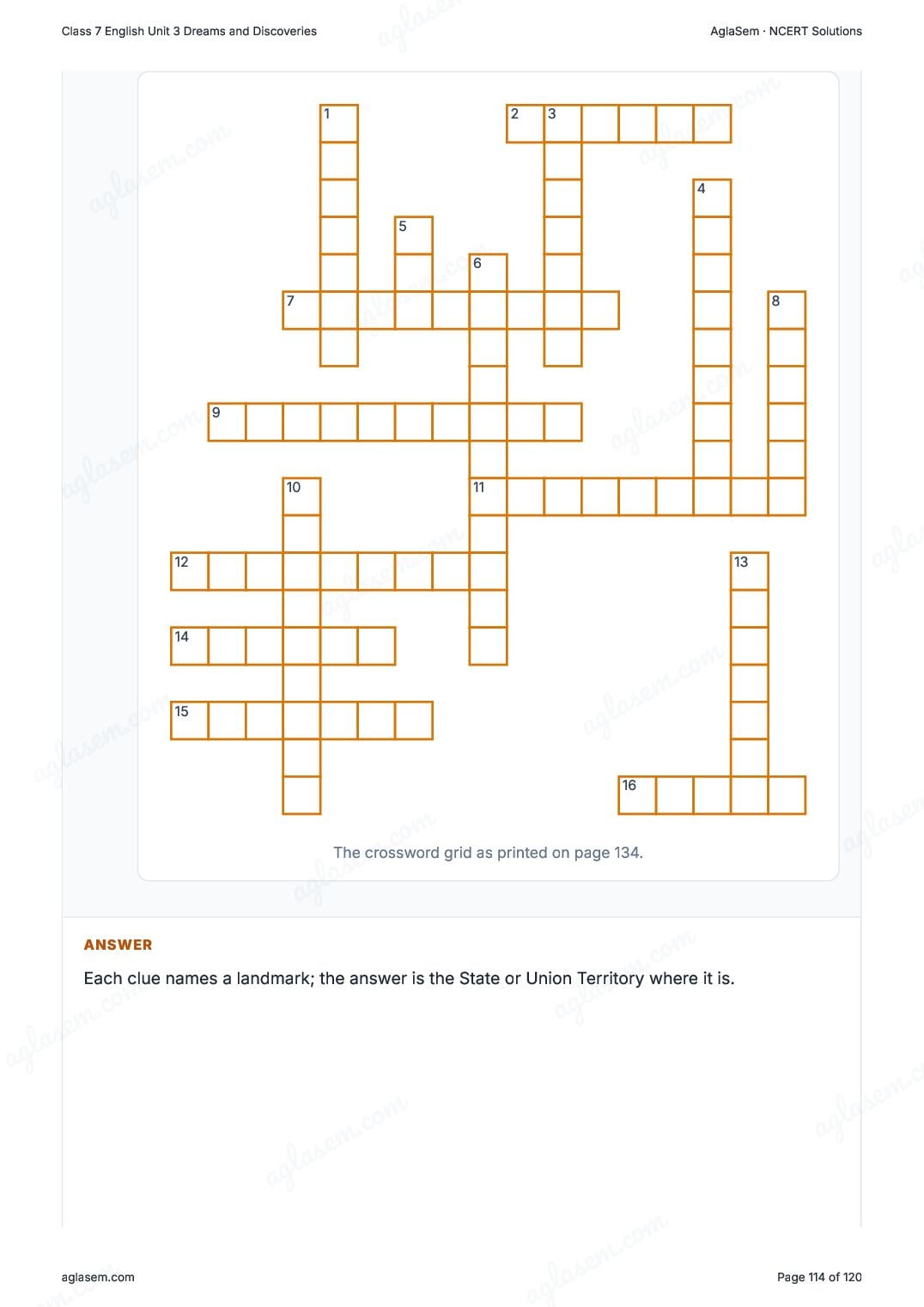
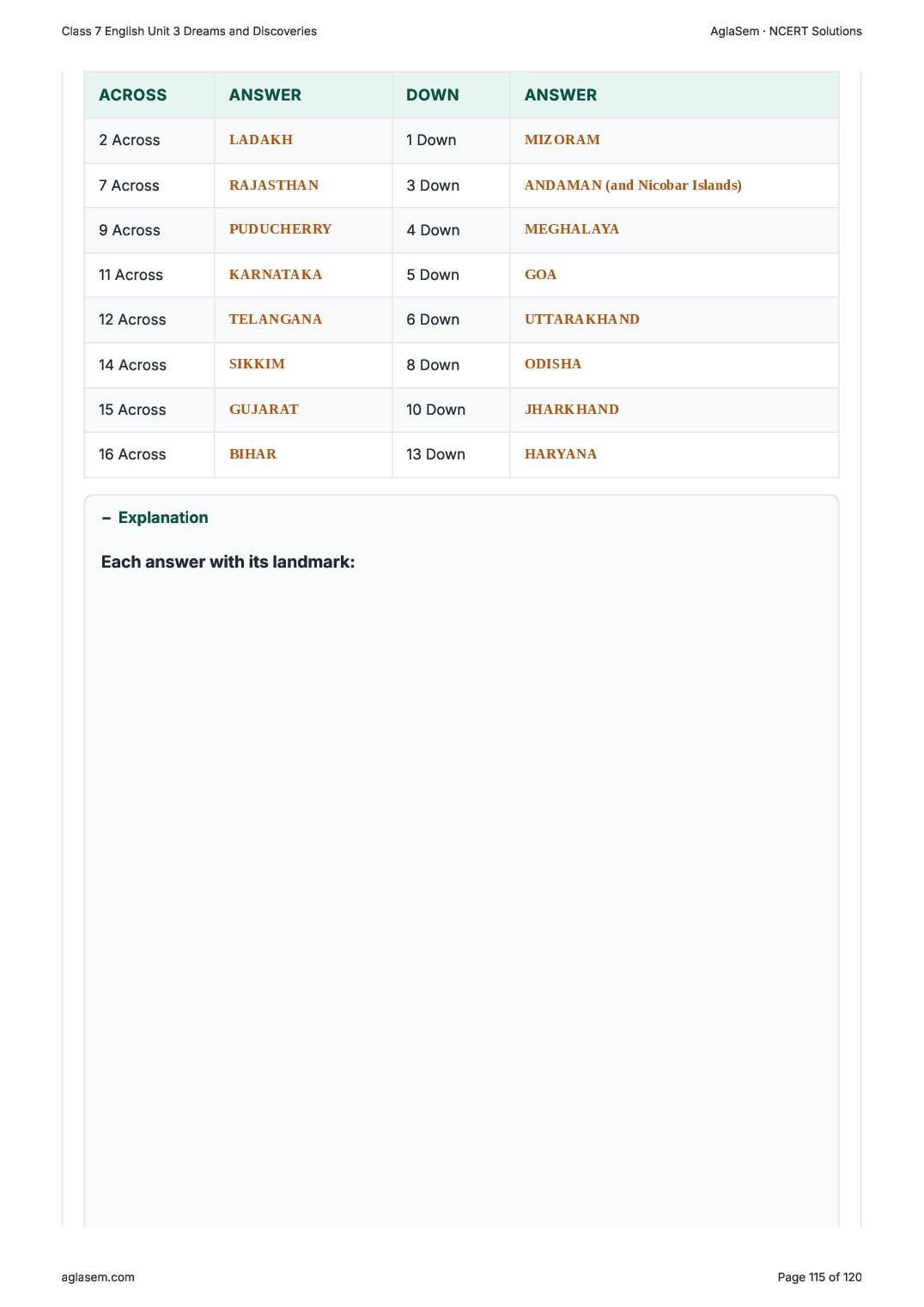
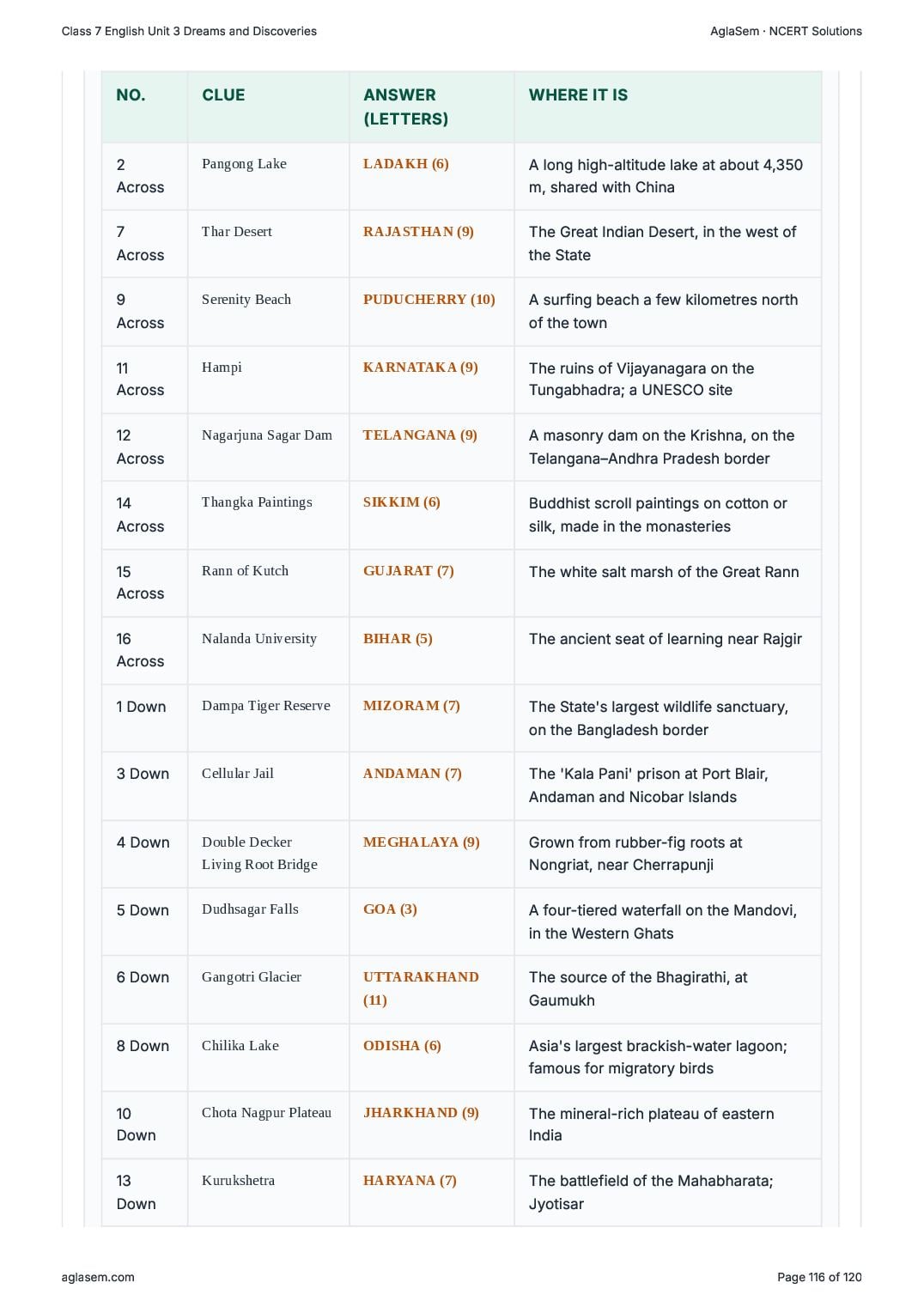
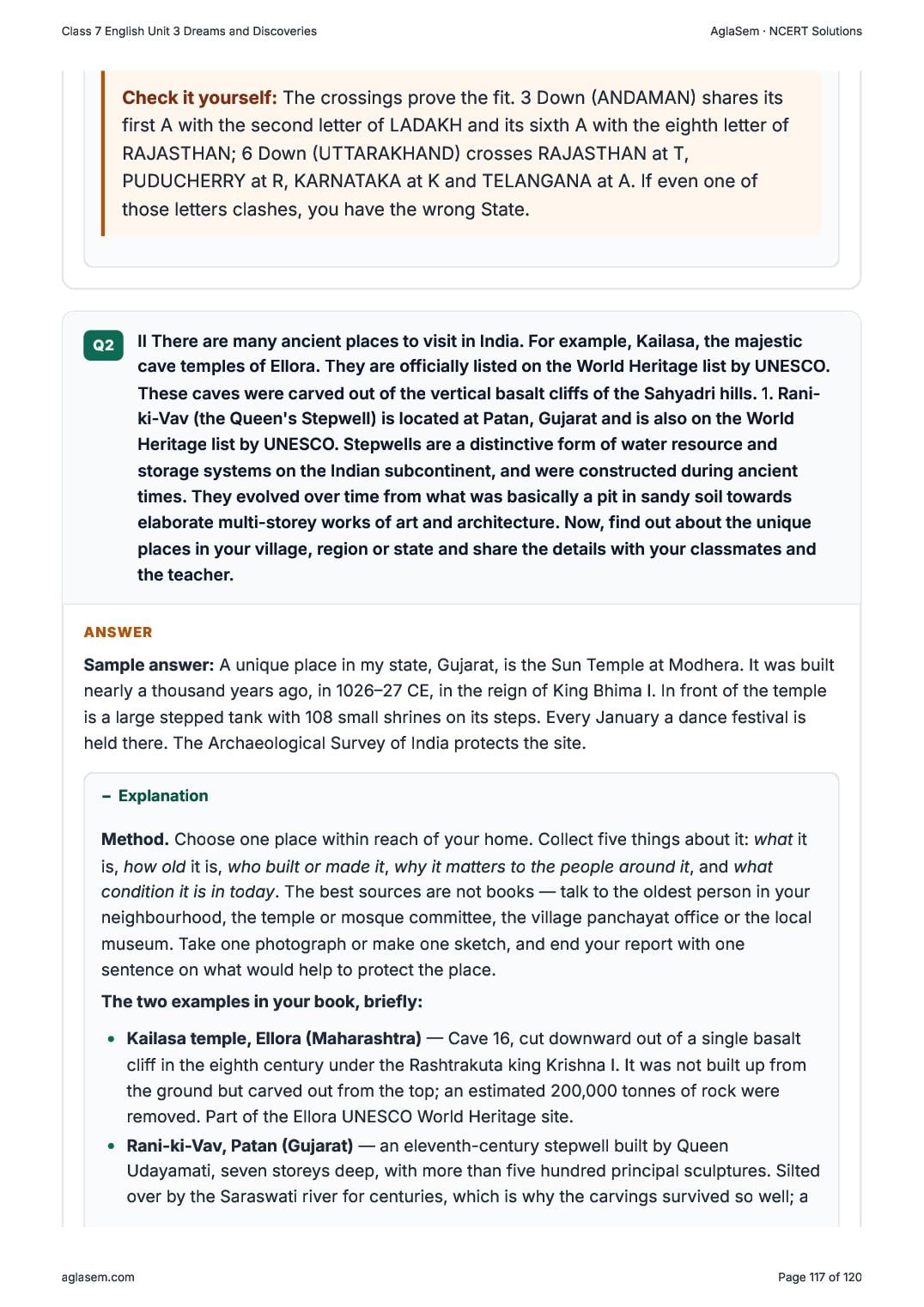
- The listening, speaking, writing and project tasks include the Toby-the-Martian conversation, the origami talk, the Agartala talk, the tricky –ough sounds, a paragraph on a vocation, a diary entry on a rainy day, a leave application, riddles about water bodies and a States-and-UTs crossword.
How to Download NCERT Solutions for Class 7 English Chapter 3 PDF
Follow these simple steps to get the Dreams and Discoveries questions-and-answers PDF from Poorvi.
- Search NCERT Solutions for Class 7 English Chapter 3 aglasem and open this page.
- Read the exercise questions with answers for Dreams and Discoveries shown above.
- Click the Download PDF link to save the Dreams and Discoveries solutions to your device.
NCERT Solutions for Class 7 English – All Chapters
There are more chapters to study besides Dreams and Discoveries in English. Here are the NCERT Solutions for all chapters of Class 7 English.
- Chapter 1 Learning Together
- Chapter 2 Wit and Humour
- Chapter 3 Dreams and Discoveries
- Chapter 4 Travel and Adventure
- Chapter 5 Bravehearts
NCERT Solutions for Class 7 – All Subjects
Just like Chapter 3 of English, you can get the exercise questions with answers for every other subject of Class 7. Here are the NCERT Solutions for all subjects of Class 7.
NCERT Solutions for Class 7 English Chapter 3 – An Overview
The key highlights of this study material are as follows.
| Aspects | Details |
|---|---|
| Class | Class 7 |
| Subject | English |
| Chapter Number | Chapter 3 |
| Chapter Name | Dreams and Discoveries |
| Book Name | Poorvi |
| Book By | NCERT (National Council of Educational Research and Training) |
| Educational Resource Here | NCERT Solutions of Class 7 English Chapter 3 for all exercises |
| More Questions Answers of This Subject | NCERT Solutions for Class 7 English |
| Download Book Chapter | NCERT Book Class 7 English |
| All Questions Answers For This Class | NCERT Solutions for Class 7 |
| Complete Solutions | NCERT Solutions |
NCERT Solutions for Class 7 English Chapter 3 Dreams and Discoveries – FAQs
What are the NCERT Solutions for Class 7 English Chapter 3 Dreams and Discoveries?
They are the complete, step-by-step answers to all the exercise and in-text questions of Chapter 3 Dreams and Discoveries from the NCERT Class 7 English textbook Poorvi, written by experts as per the latest NCERT syllabus.
How can I download the Class 7 English Chapter 3 solutions PDF for free?
Open this page on aglasem, read the Dreams and Discoveries questions with answers, and click the “Download Solutions PDF” link. The Class 7 English Chapter 3 NCERT Solutions PDF is completely free to download.
Are these NCERT Solutions as per the latest 2026-27 syllabus?
Yes. The NCERT Solutions for Class 7 English Chapter 3 are based on the latest NCERT textbook Poorvi and the current 2026-27 CBSE syllabus, so the questions and answers match what you study in class.
Where can I get NCERT Solutions for the other chapters of Class 7 English?
You can find the answers to every chapter on the NCERT Solutions for Class 7 English page, and solutions for every subject on the NCERT Solutions for Class 7 page.
How do NCERT Solutions help in exam preparation?
They show the correct method to solve each question, help you write answers the way they are expected in exams, let you check and correct your own work, and save revision time — which together improve your marks in Class 7 English.
If you have any queries on NCERT Solutions for Class 7 English Chapter 3 Dreams and Discoveries, then please ask in the comments below.