NCERT Solutions for Class 7 English Chapter 4 Travel and Adventure provide clear, step-by-step answers to every exercise and in-text question from the chapter Travel and Adventure of the NCERT textbook Poorvi. Prepared by subject experts as per the latest NCERT (CBSE) syllabus for 2026-27, these NCERT Solutions for Class 7 English help you understand each concept, write exam-ready answers, and check your own solutions. You can read them online below or download the free Class 7 English Chapter 4 question-answer PDF.
NCERT Solutions for Class 7 English Chapter 4 Travel and Adventure
- Class: Class 7
- Subject: English
- Chapter: Chapter 4 – Travel and Adventure
- Textbook: Poorvi (NCERT)
- Study material: NCERT Solutions – questions with answers, free PDF
These solutions answer all the exercise questions of Chapter 4 Travel and Adventure — including the in-text questions, short-answer and long-answer questions, and activities — with complete explanations so you can follow the method, not just the final answer. Read the full solutions below.
NCERT Solutions Class 7 English Unit 4 Travel and Adventure View Download


NCERT Solutions for Class 7 English Chapter 4 PDF Download
You can read the NCERT Solutions for Class 7 English Chapter 4 online above, or download the complete question-answer PDF to study Travel and Adventure offline at any time.
NCERT Solutions for Class 7 English Chapter 4 PDF Download Link – Click Here to Download Solutions PDF
Questions Covered in This Chapter
These NCERT Solutions answer all 106 questions of this chapter. The questions solved are:
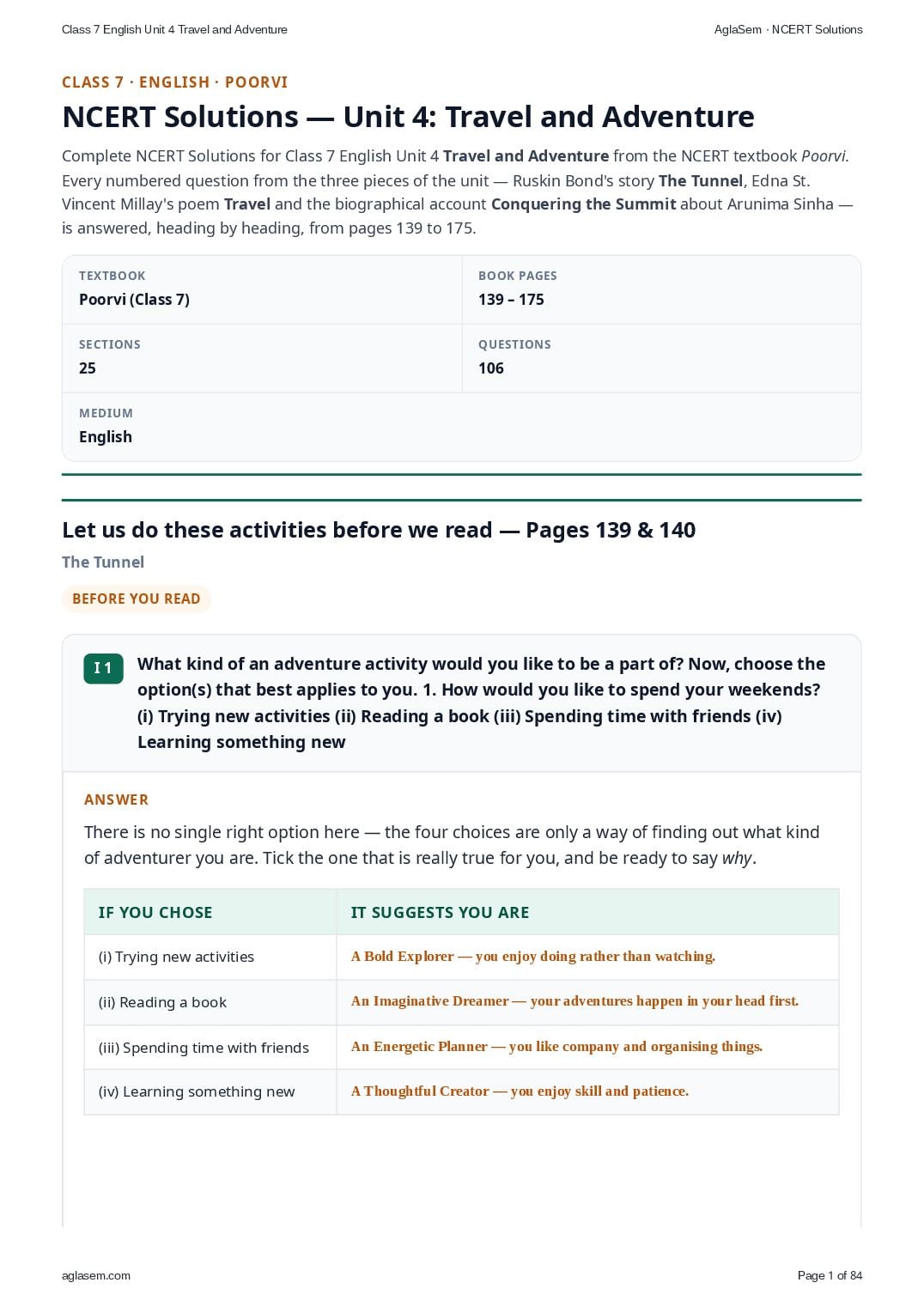
- What kind of an adventure activity would you like to be a part of? Now, choose the option(s) that best applies to you. 1. How would you like to spend your weekends? (i) Trying new activities (ii) Reading a book (iii) Spending time with friends (iv) Learning something new
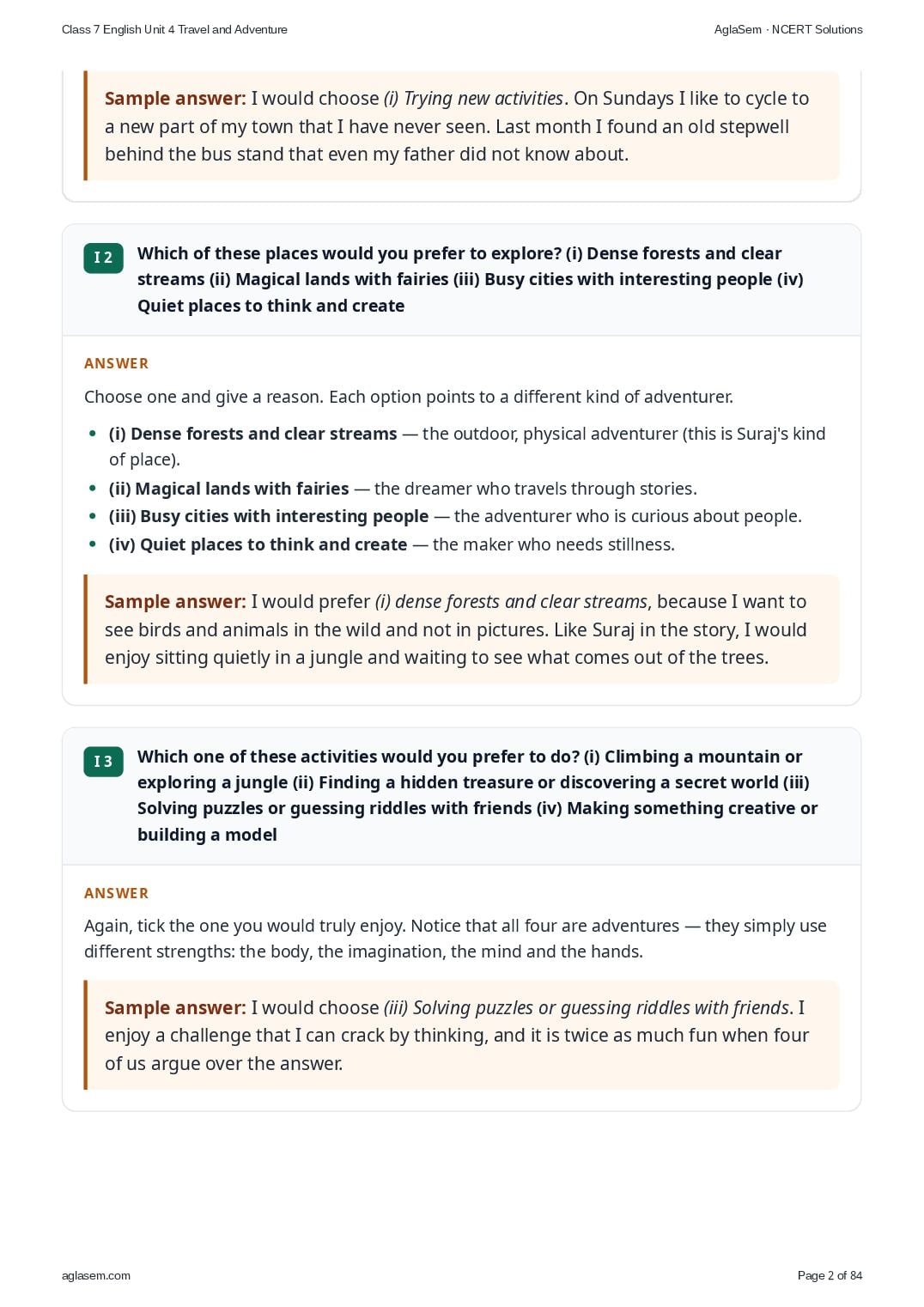
- Which of these places would you prefer to explore? (i) Dense forests and clear streams (ii) Magical lands with fairies (iii) Busy cities with interesting people (iv) Quiet places to think and create
- Which one of these activities would you prefer to do? (i) Climbing a mountain or exploring a jungle (ii) Finding a hidden treasure or discovering a secret world (iii) Solving puzzles or guessing riddles with friends (iv) Making something creative or building a model
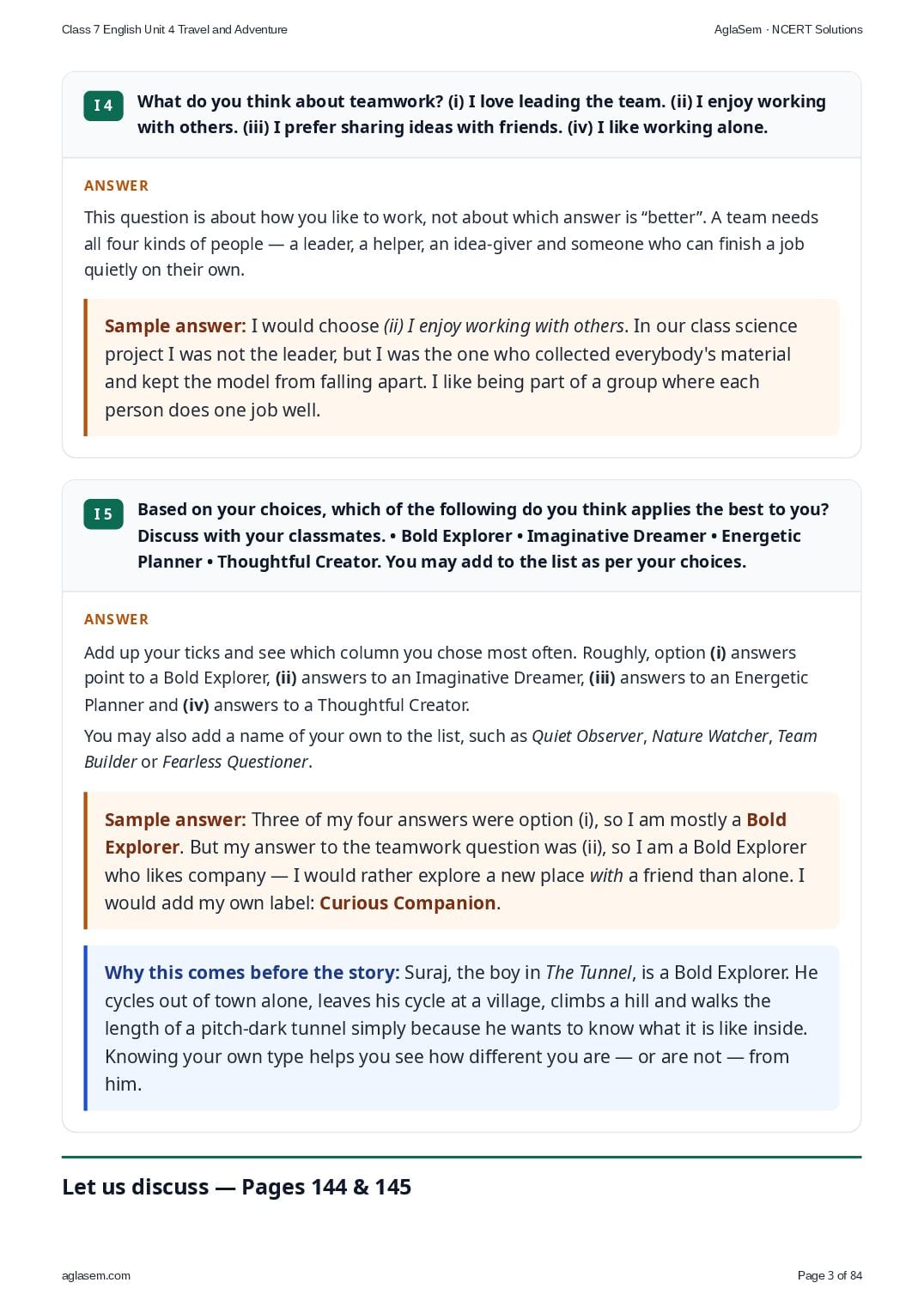
- What do you think about teamwork? (i) I love leading the team. (ii) I enjoy working with others. (iii) I prefer sharing ideas with friends. (iv) I like working alone.
- Based on your choices, which of the following do you think applies the best to you? Discuss with your classmates. • Bold Explorer • Imaginative Dreamer • Energetic Planner • Thoughtful Creator. You may add to the list as per your choices.
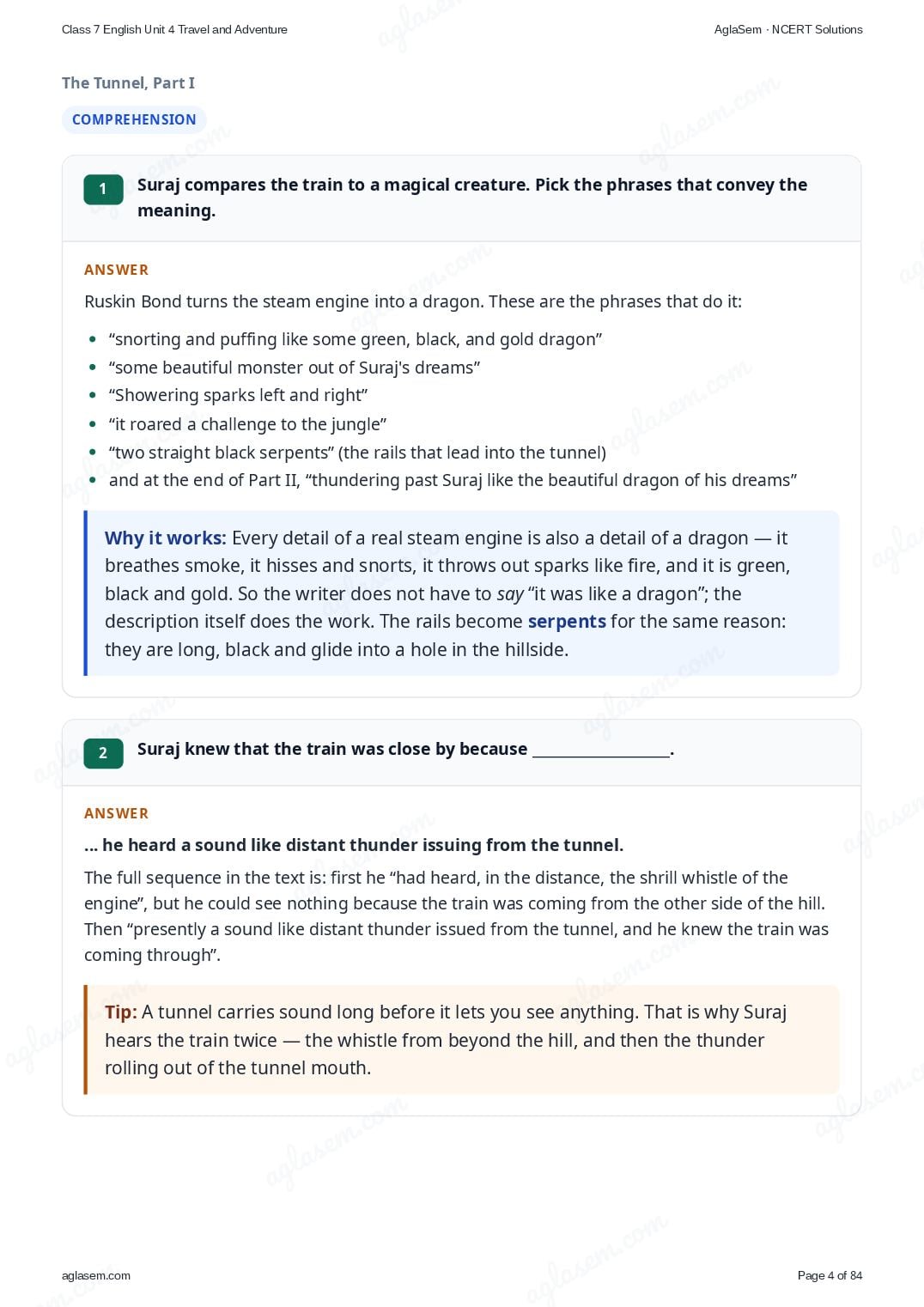
- Suraj compares the train to a magical creature. Pick the phrases that convey the meaning.
- Suraj knew that the train was close by because ____________________.
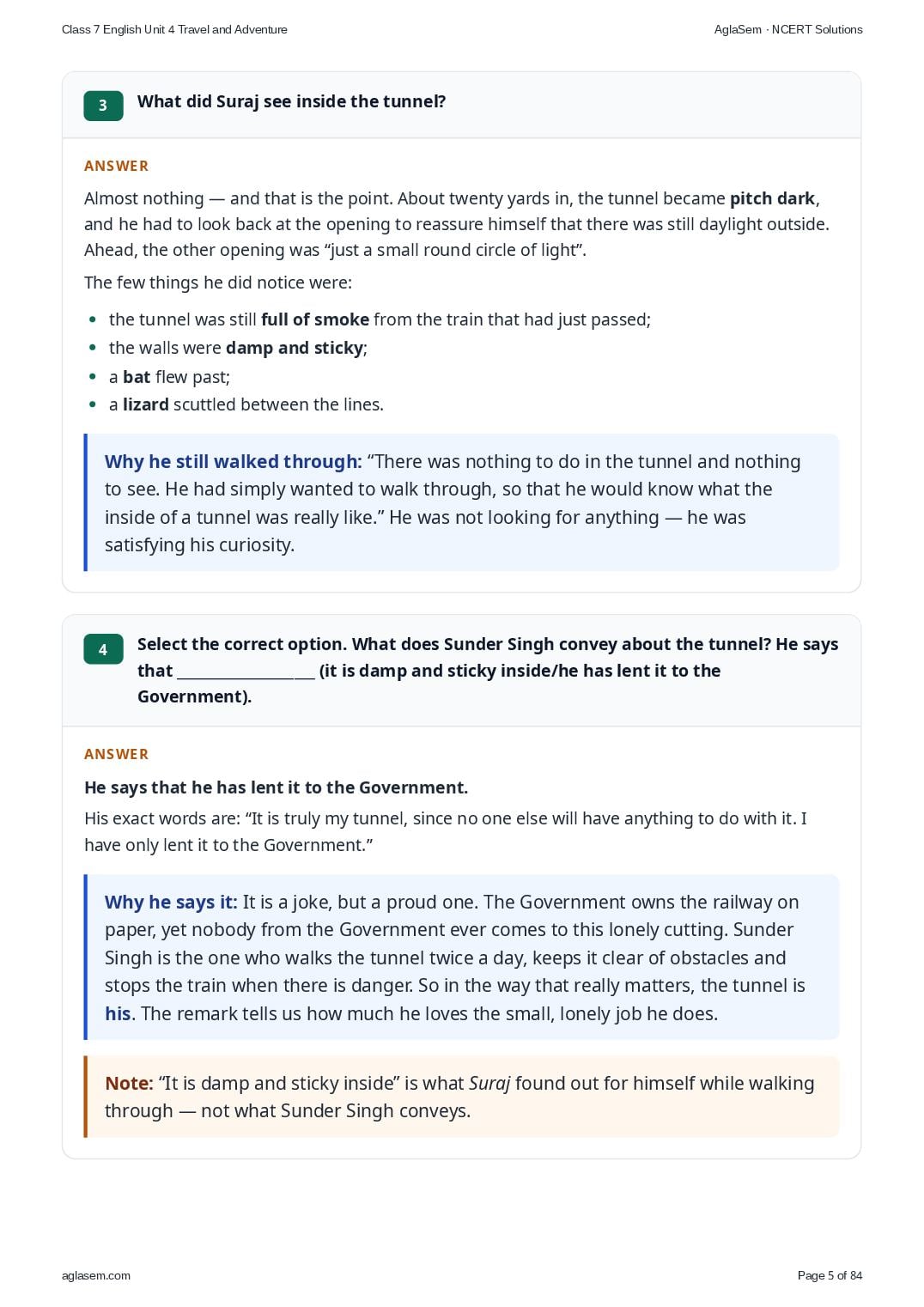
- What did Suraj see inside the tunnel?
- Select the correct option. What does Sunder Singh convey about the tunnel? He says that ____________________ (it is damp and sticky inside/he has lent it to the Government).
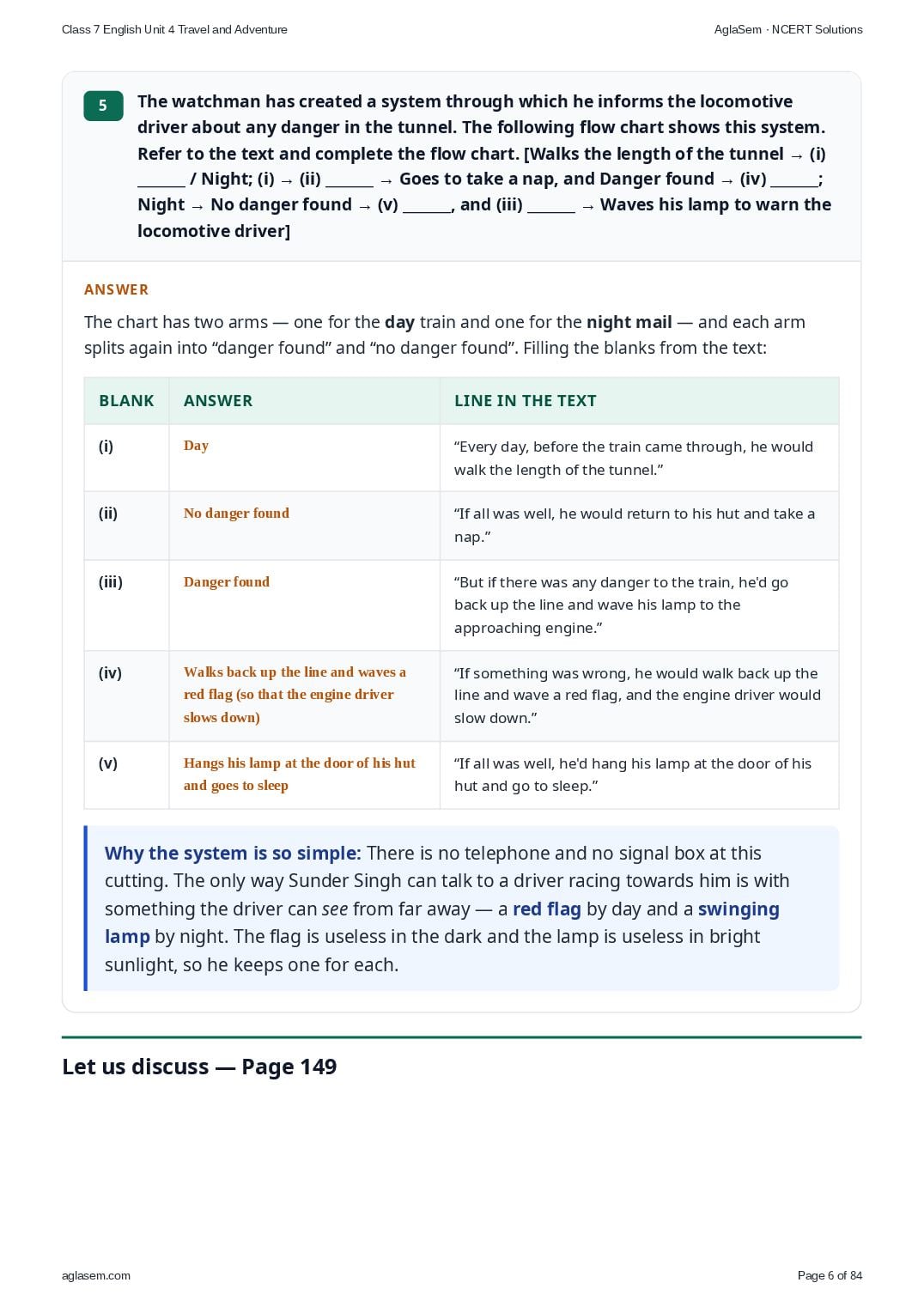
- The watchman has created a system through which he informs the locomotive driver about any danger in the tunnel. The following flow chart shows this system. Refer to the text and complete the flow chart. [Walks the length of the tunnel → (i) _______ / Night; (i) → (ii) _______ → Goes to take a nap, and Danger found → (iv) _______; Night → No danger found → (v) _______, and (iii) _______ → Waves his lamp to warn the locomotive driver]
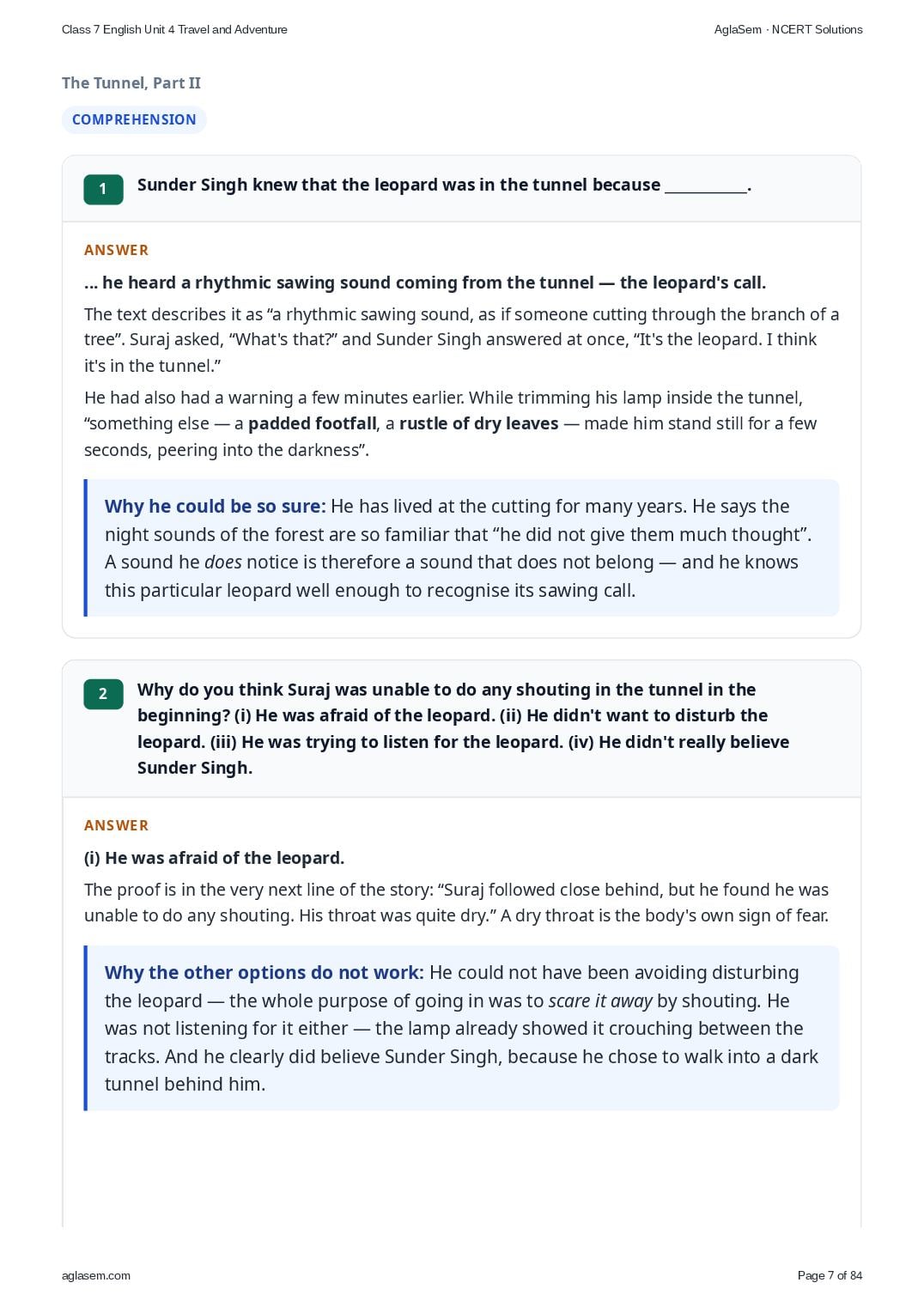
- Sunder Singh knew that the leopard was in the tunnel because ____________.
- Why do you think Suraj was unable to do any shouting in the tunnel in the beginning? (i) He was afraid of the leopard. (ii) He didn't want to disturb the leopard. (iii) He was trying to listen for the leopard. (iv) He didn't really believe Sunder Singh.
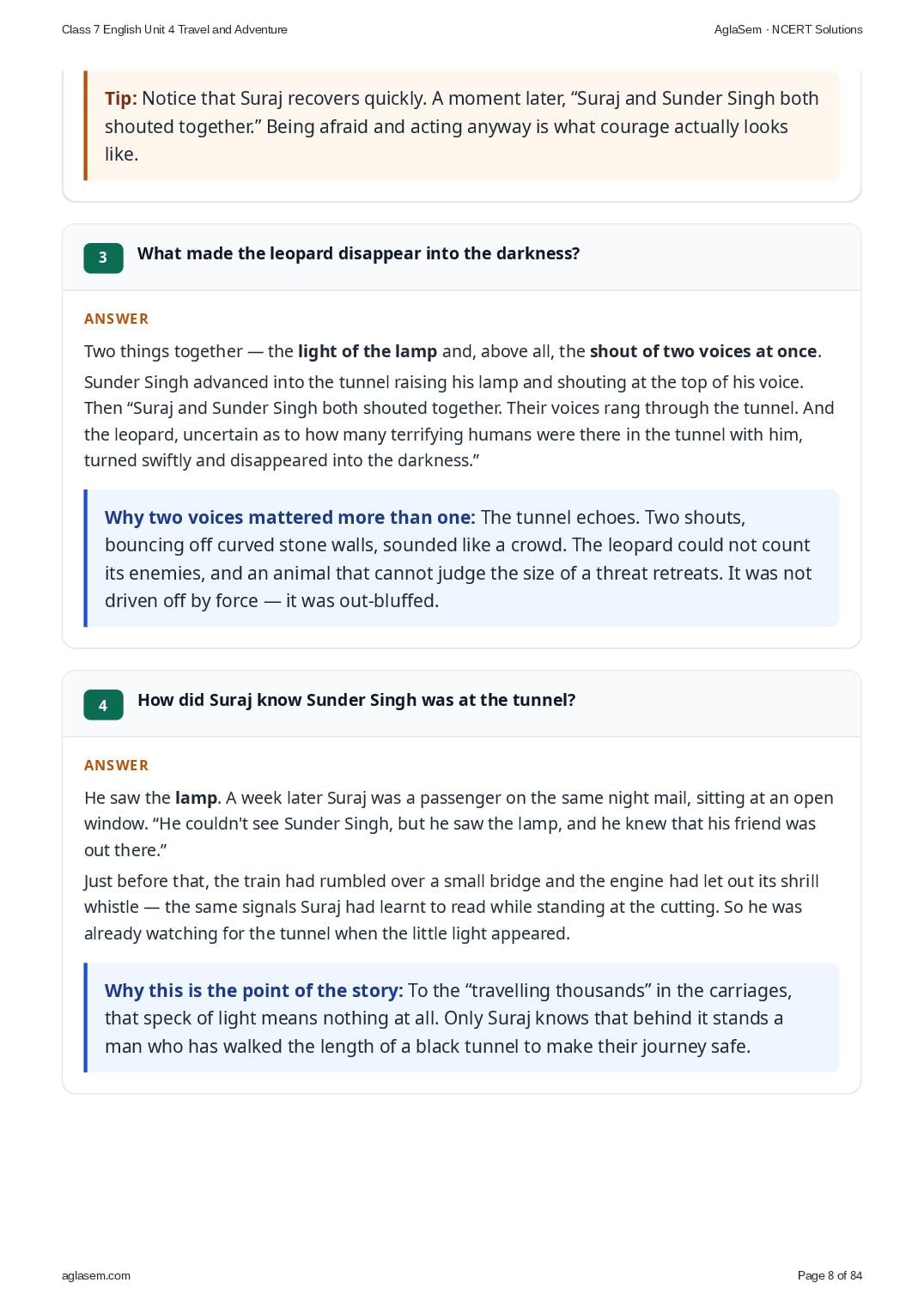
- What made the leopard disappear into the darkness?
- How did Suraj know Sunder Singh was at the tunnel?
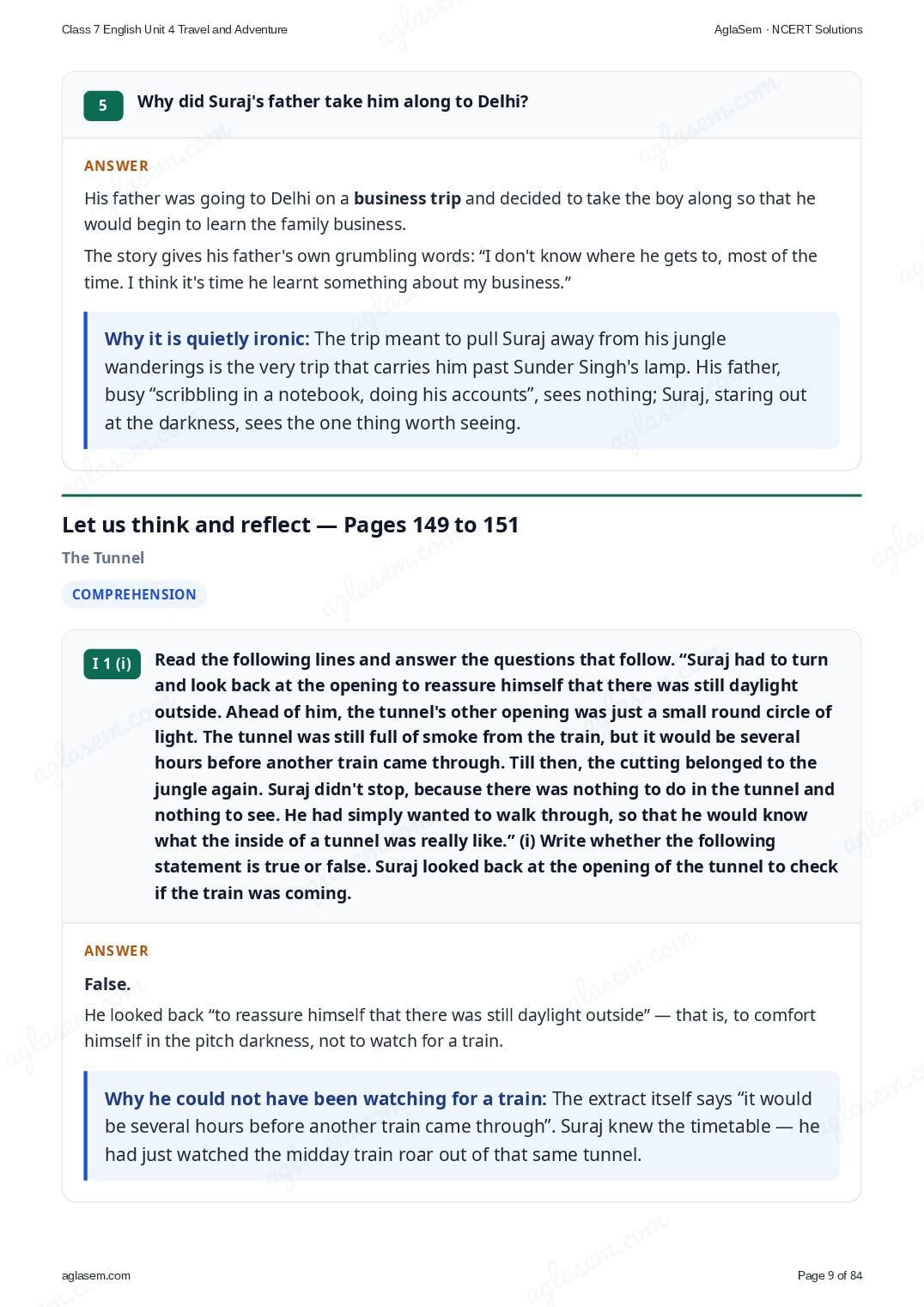
- Why did Suraj's father take him along to Delhi?
- Read the following lines and answer the questions that follow. “Suraj had to turn and look back at the opening to reassure himself that there was still daylight outside. Ahead of him, the tunnel's other opening was just a small round circle of light. The tunnel was still full of smoke from the train, but it would be several hours before another train came through. Till then, the cutting belonged to the jungle again. Suraj didn't stop, because there was nothing to do in the tunnel and nothing to see. He had simply wanted to walk through, so that he would know what the inside of a tunnel was really like.” (i) Write whether the following statement is true or false. Suraj looked back at the opening of the tunnel to check if the train was coming.
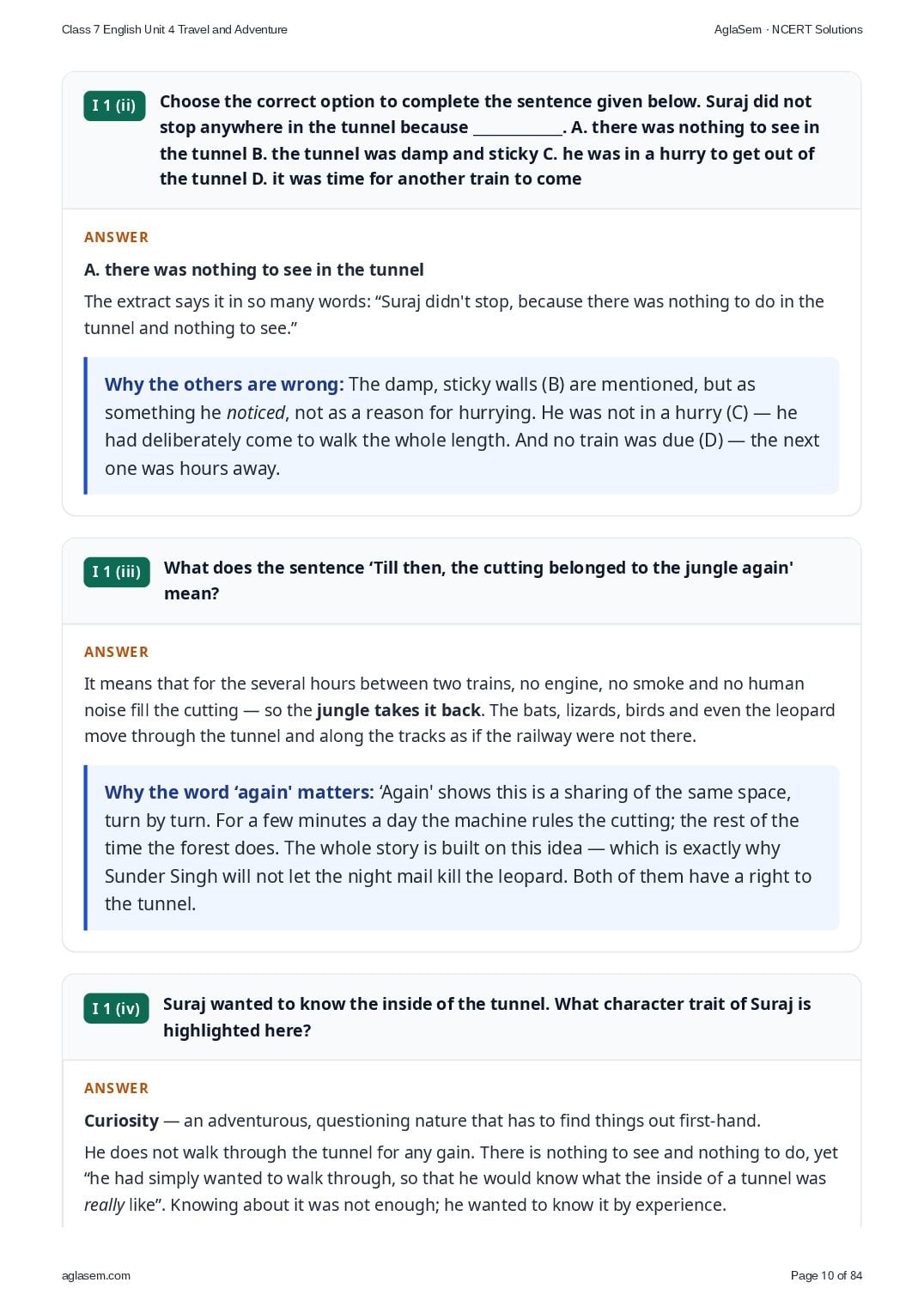
- Choose the correct option to complete the sentence given below. Suraj did not stop anywhere in the tunnel because _____________. A. there was nothing to see in the tunnel B. the tunnel was damp and sticky C. he was in a hurry to get out of the tunnel D. it was time for another train to come
- What does the sentence ‘Till then, the cutting belonged to the jungle again' mean?
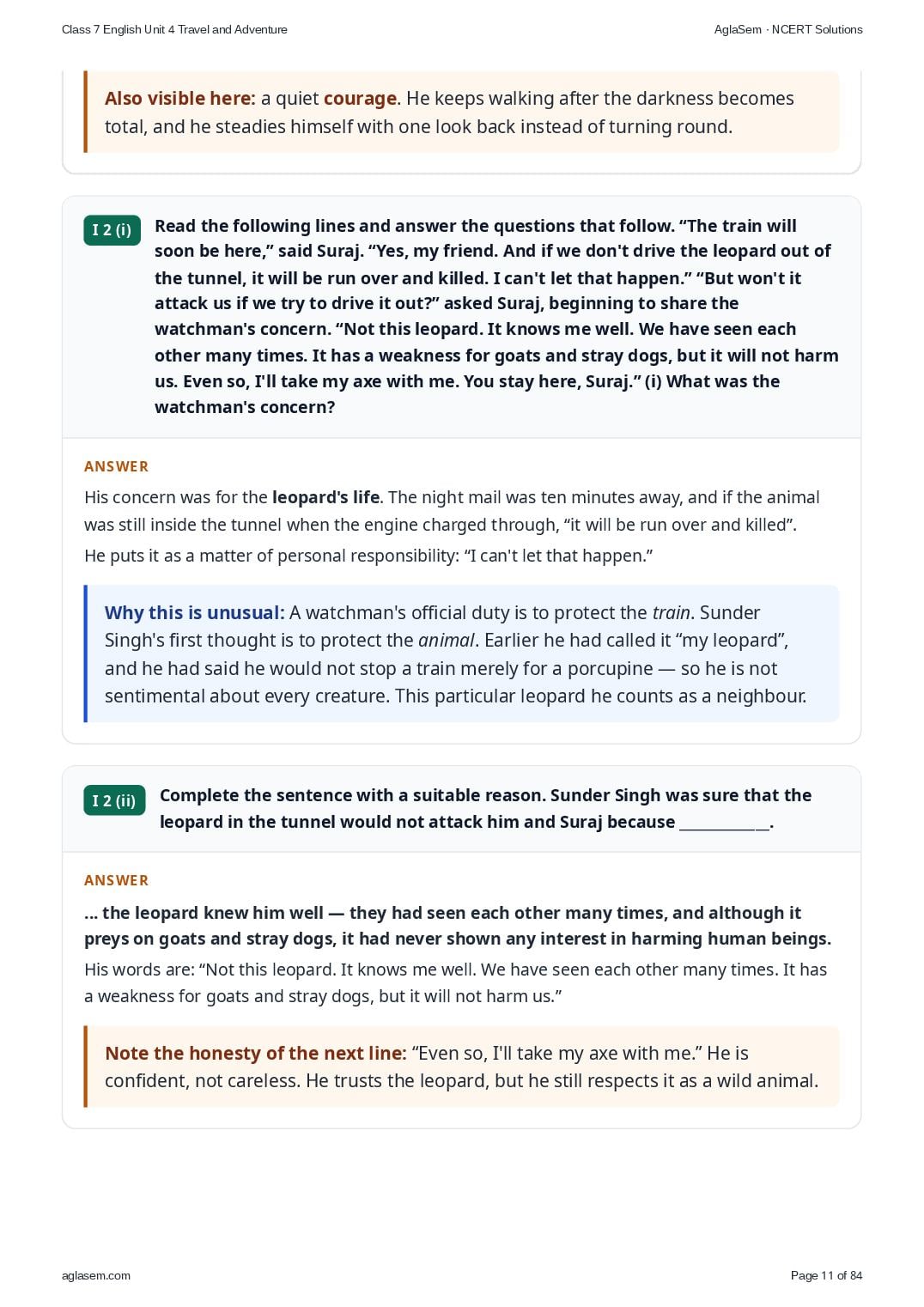
- Suraj wanted to know the inside of the tunnel. What character trait of Suraj is highlighted here?
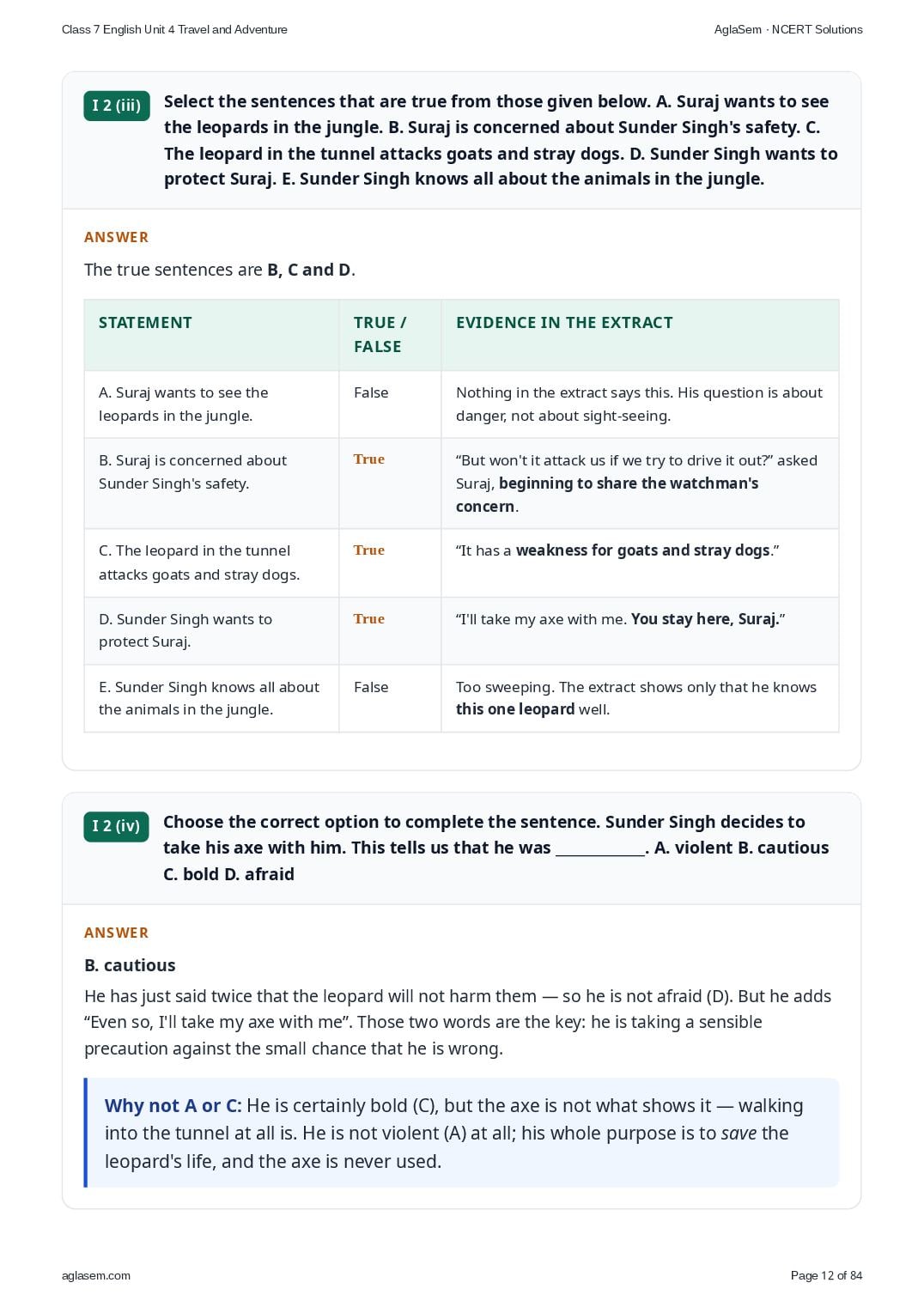
- Read the following lines and answer the questions that follow. “The train will soon be here,” said Suraj. “Yes, my friend. And if we don't drive the leopard out of the tunnel, it will be run over and killed. I can't let that happen.” “But won't it attack us if we try to drive it out?” asked Suraj, beginning to share the watchman's concern. “Not this leopard. It knows me well. We have seen each other many times. It has a weakness for goats and stray dogs, but it will not harm us. Even so, I'll take my axe with me. You stay here, Suraj.” (i) What was the watchman's concern?
- Complete the sentence with a suitable reason. Sunder Singh was sure that the leopard in the tunnel would not attack him and Suraj because _____________.
- Select the sentences that are true from those given below. A. Suraj wants to see the leopards in the jungle. B. Suraj is concerned about Sunder Singh's safety. C. The leopard in the tunnel attacks goats and stray dogs. D. Sunder Singh wants to protect Suraj. E. Sunder Singh knows all about the animals in the jungle.
- Choose the correct option to complete the sentence. Sunder Singh decides to take his axe with him. This tells us that he was _____________. A. violent B. cautious C. bold D. afraid
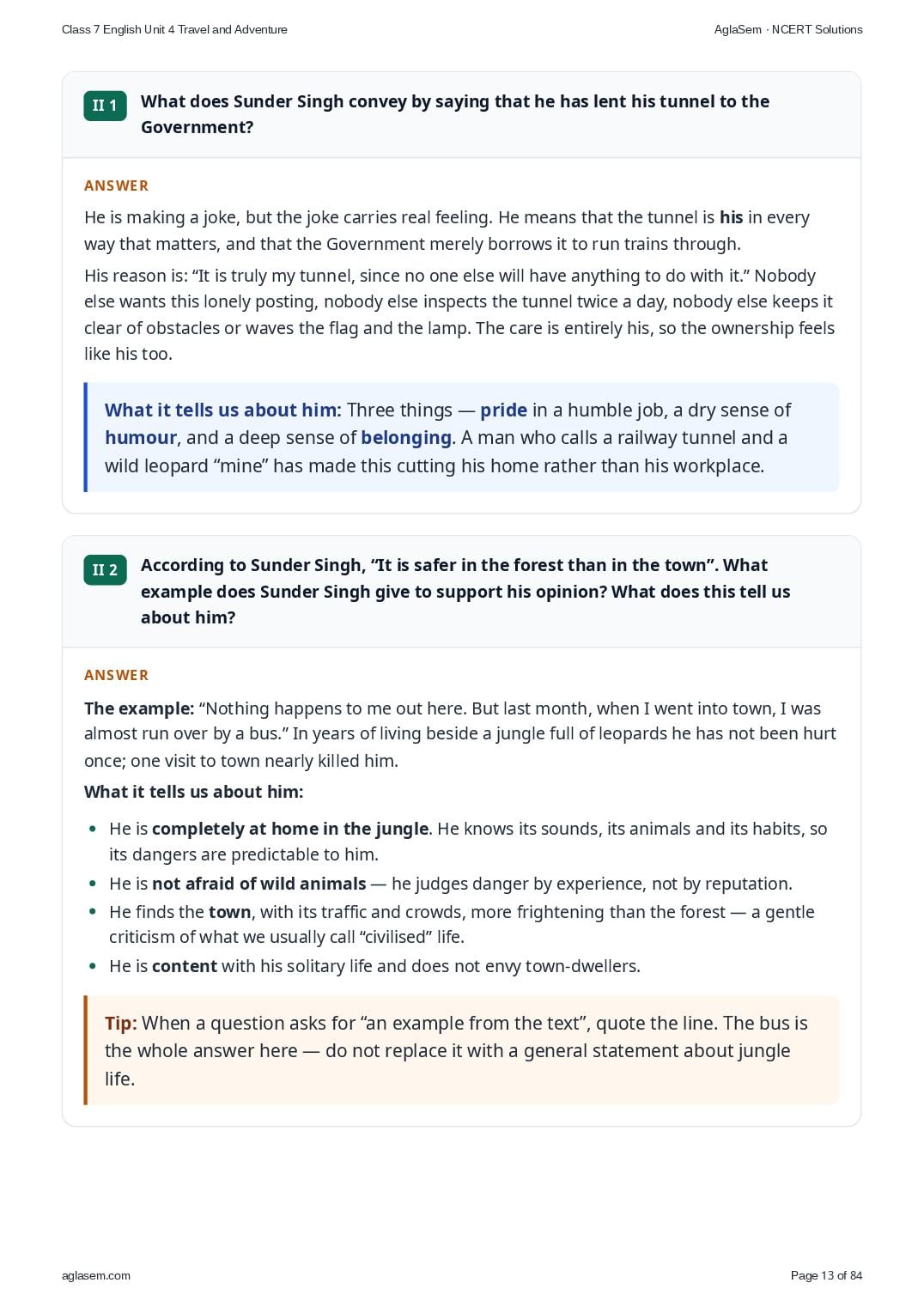
- What does Sunder Singh convey by saying that he has lent his tunnel to the Government?
- According to Sunder Singh, “It is safer in the forest than in the town”. What example does Sunder Singh give to support his opinion? What does this tell us about him?
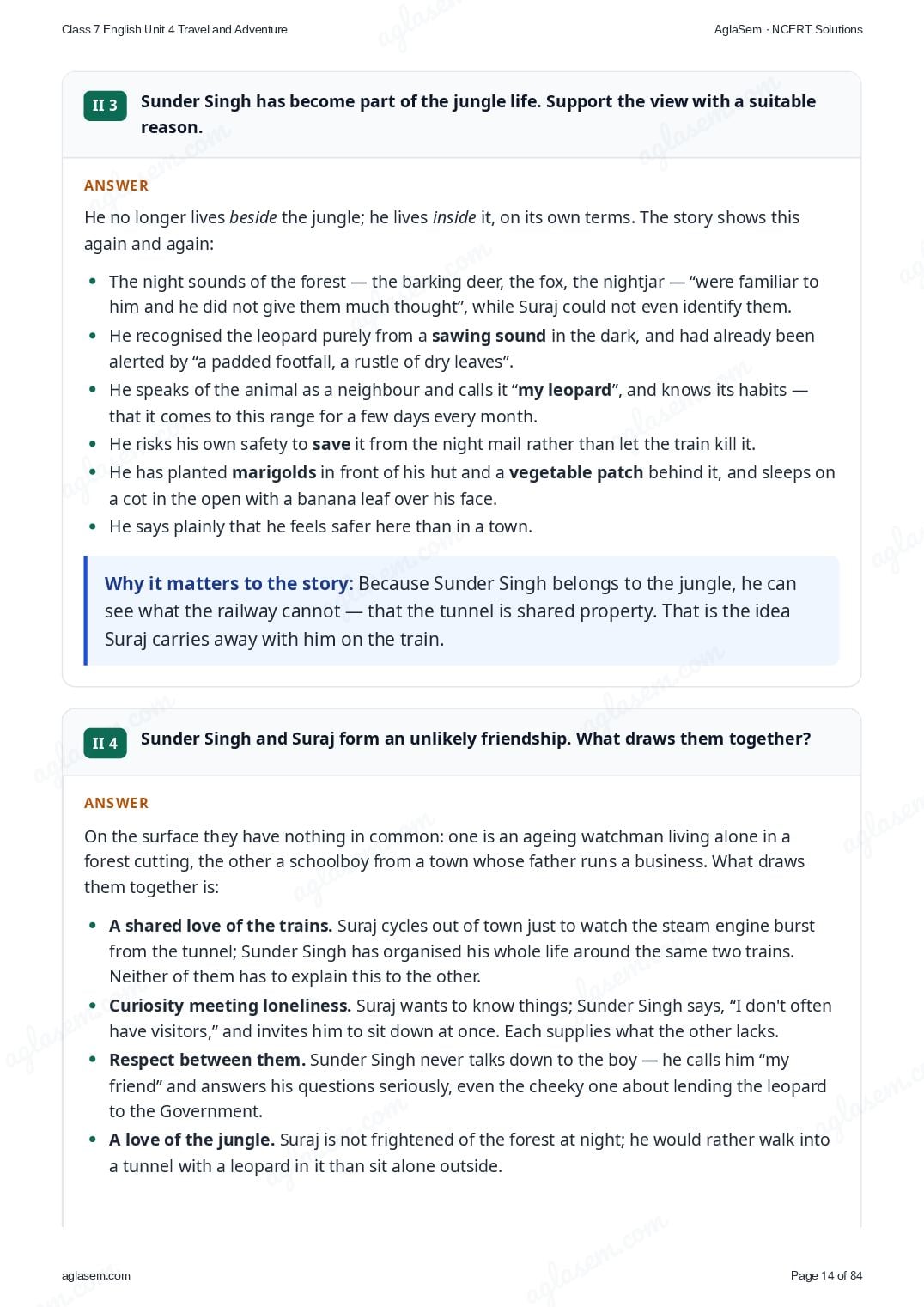
- Sunder Singh has become part of the jungle life. Support the view with a suitable reason.
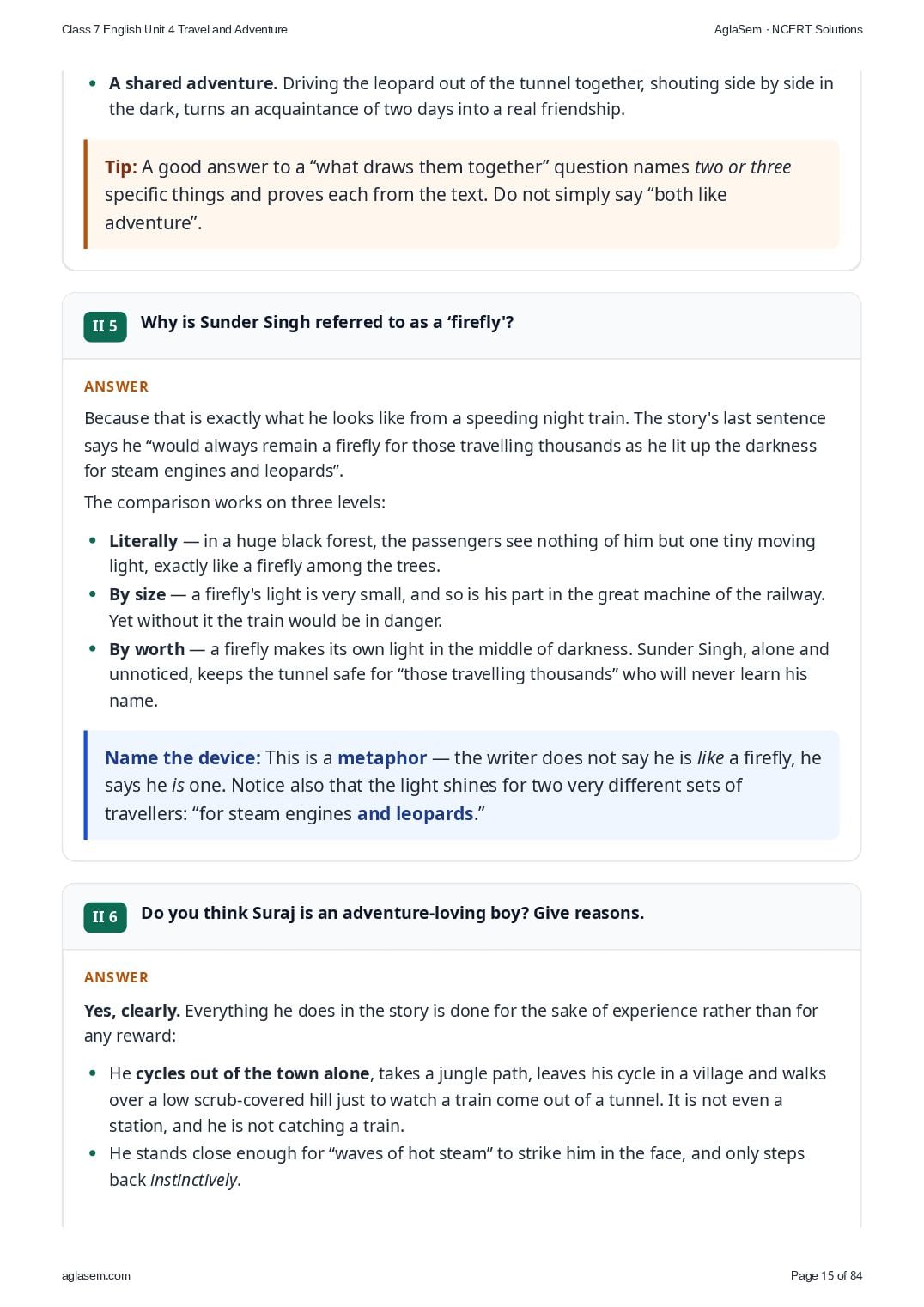
- Sunder Singh and Suraj form an unlikely friendship. What draws them together?
- Why is Sunder Singh referred to as a ‘firefly'?
- Do you think Suraj is an adventure-loving boy? Give reasons.
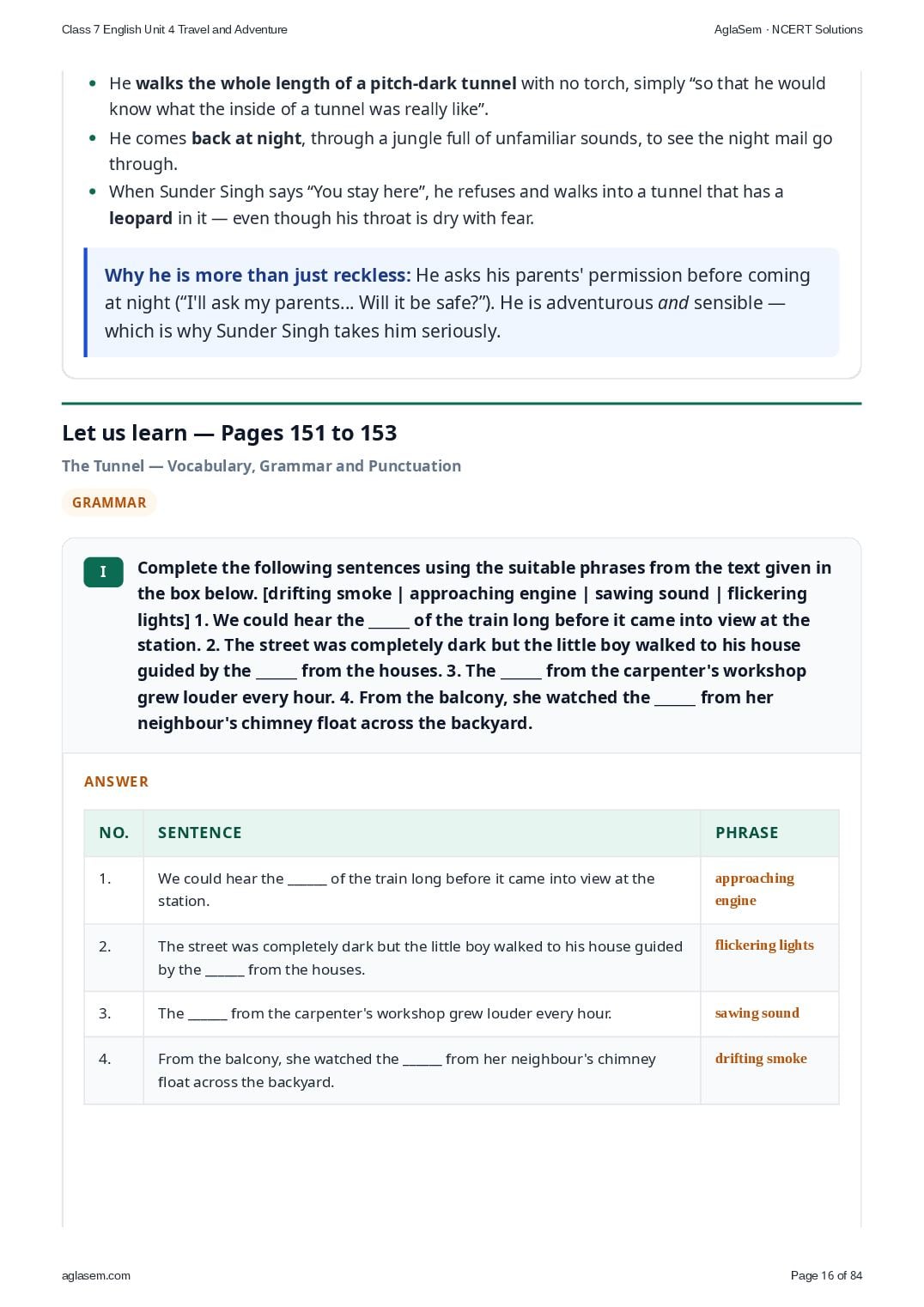
- Complete the following sentences using the suitable phrases from the text given in the box below. [drifting smoke | approaching engine | sawing sound | flickering lights] 1. We could hear the ______ of the train long before it came into view at the station. 2. The street was completely dark but the little boy walked to his house guided by the ______ from the houses. 3. The ______ from the carpenter's workshop grew louder every hour. 4. From the balcony, she watched the ______ from her neighbour's chimney float across the backyard.
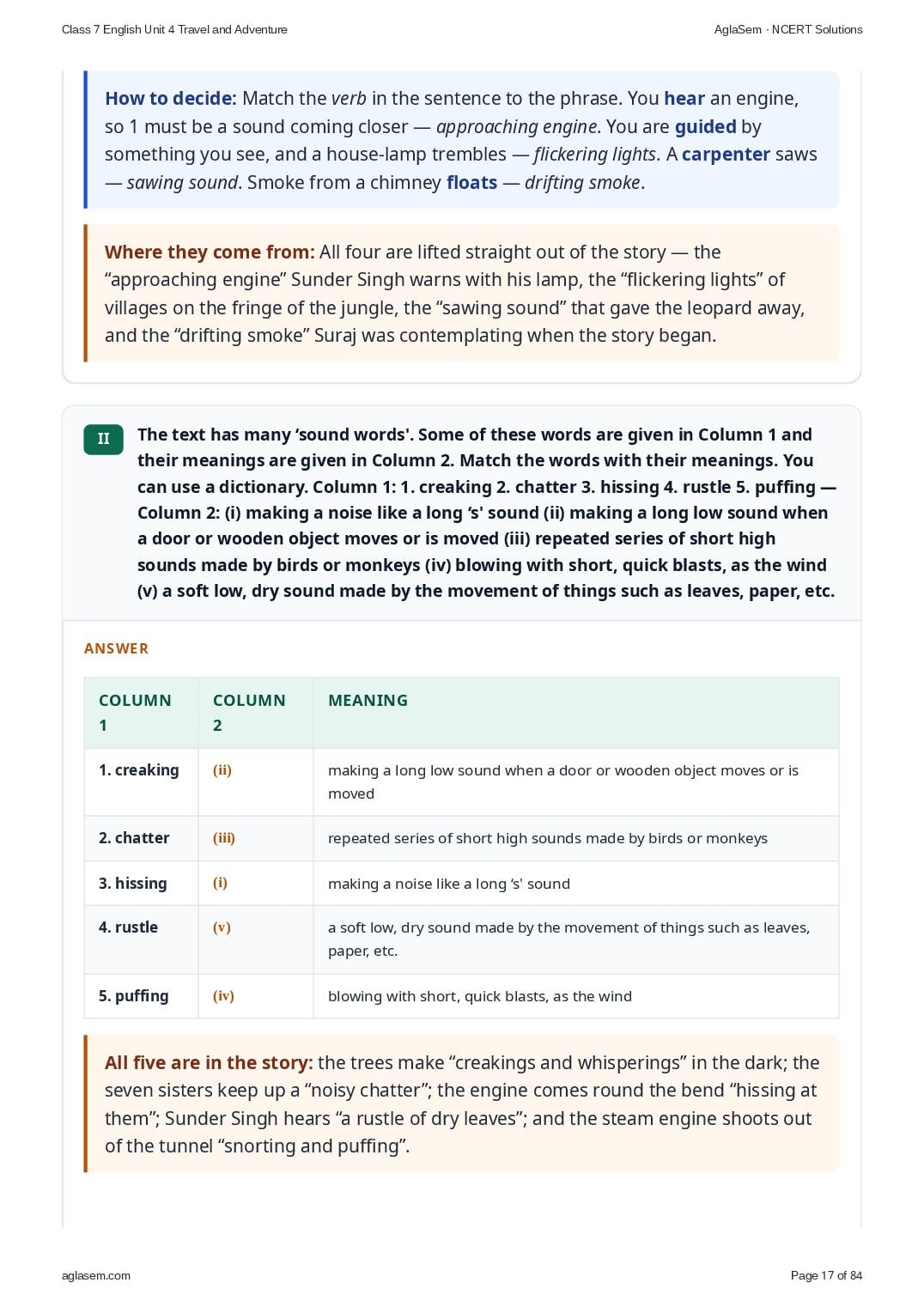
- The text has many ‘sound words'. Some of these words are given in Column 1 and their meanings are given in Column 2. Match the words with their meanings. You can use a dictionary. Column 1: 1. creaking 2. chatter 3. hissing 4. rustle 5. puffing — Column 2: (i) making a noise like a long ‘s' sound (ii) making a long low sound when a door or wooden object moves or is moved (iii) repeated series of short high sounds made by birds or monkeys (iv) blowing with short, quick blasts, as the wind (v) a soft low, dry sound made by the movement of things such as leaves, paper, etc.
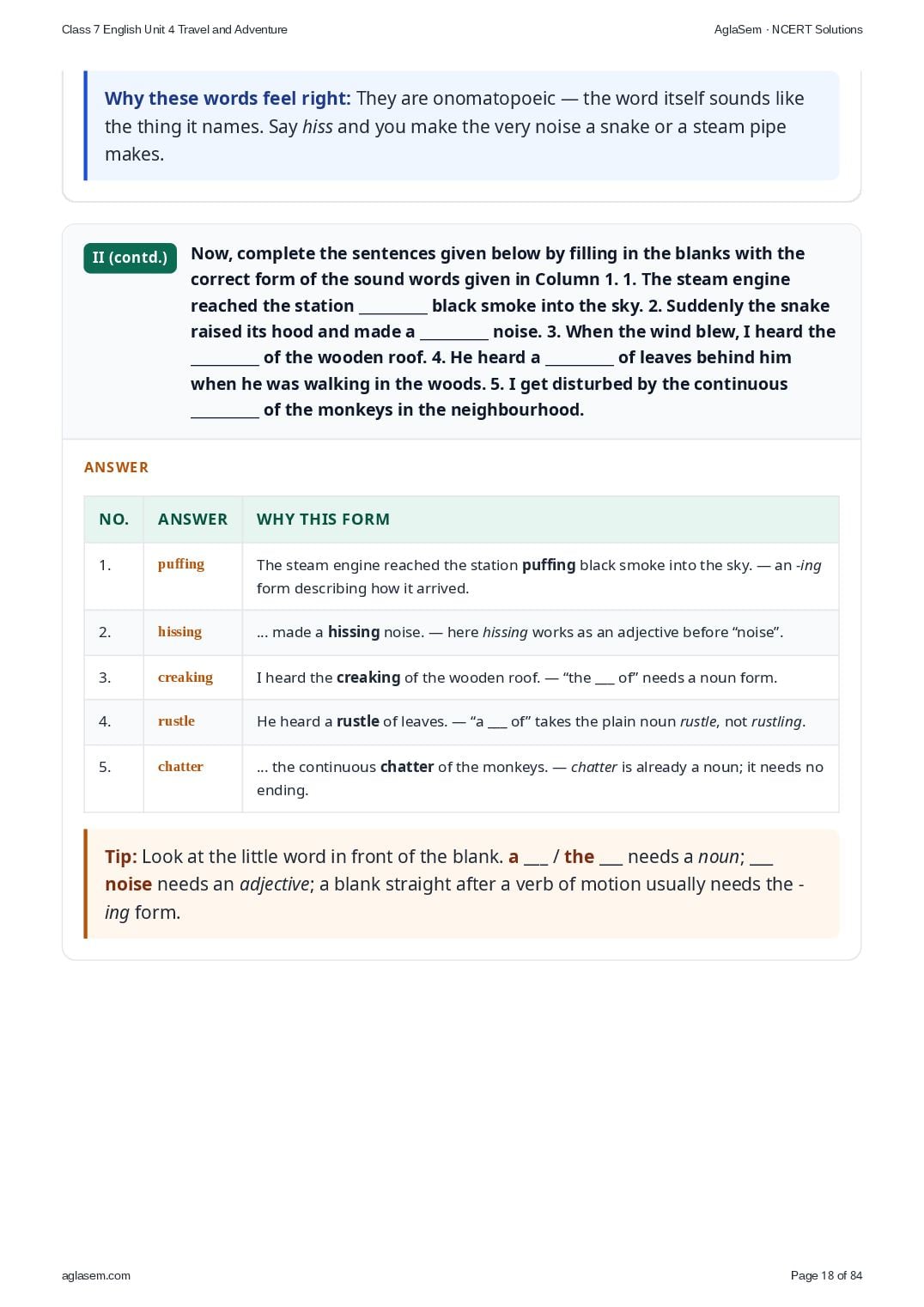
- Now, complete the sentences given below by filling in the blanks with the correct form of the sound words given in Column 1. 1. The steam engine reached the station __________ black smoke into the sky. 2. Suddenly the snake raised its hood and made a __________ noise. 3. When the wind blew, I heard the __________ of the wooden roof. 4. He heard a __________ of leaves behind him when he was walking in the woods. 5. I get disturbed by the continuous __________ of the monkeys in the neighbourhood.
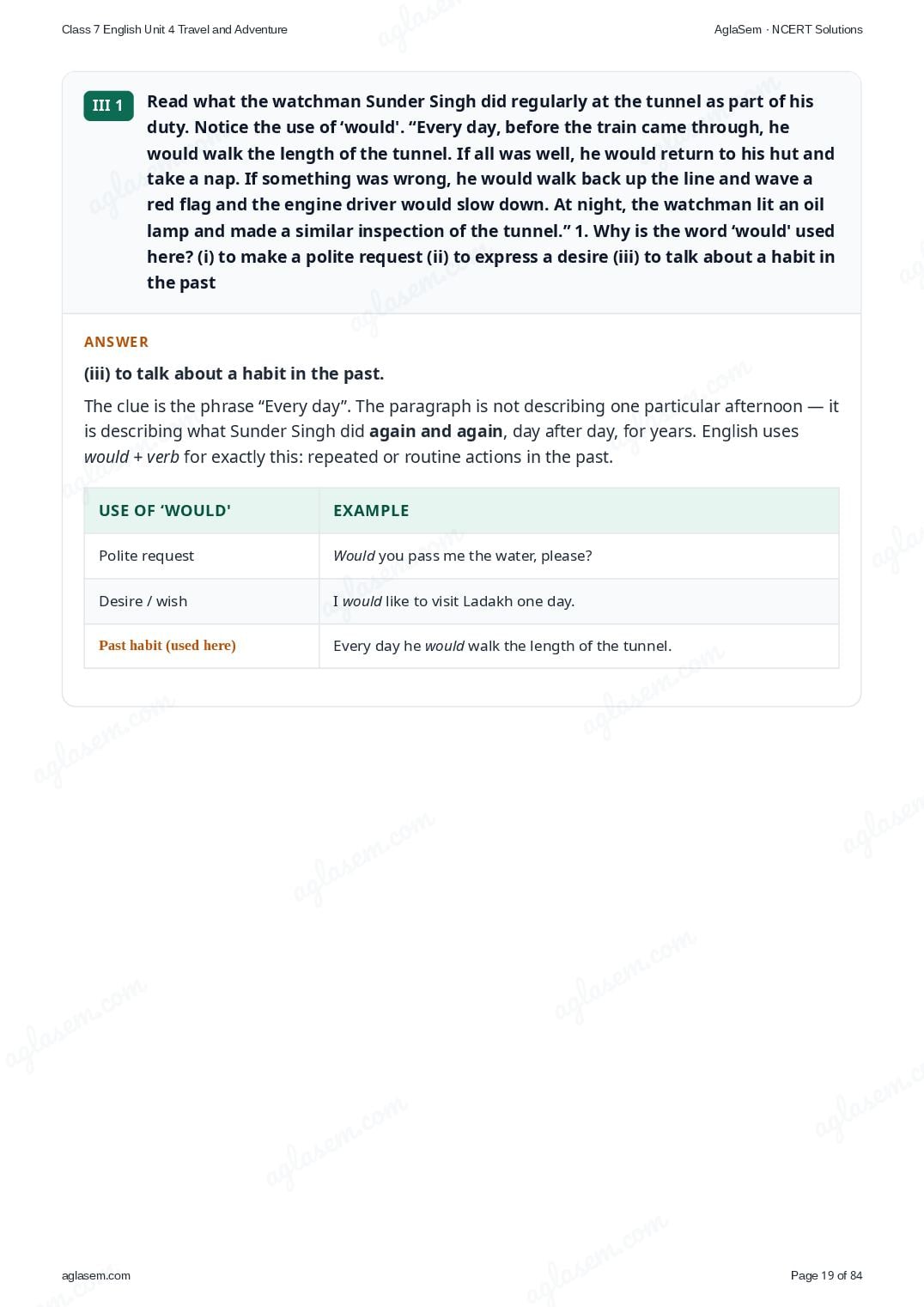
- Read what the watchman Sunder Singh did regularly at the tunnel as part of his duty. Notice the use of ‘would'. “Every day, before the train came through, he would walk the length of the tunnel. If all was well, he would return to his hut and take a nap. If something was wrong, he would walk back up the line and wave a red flag and the engine driver would slow down. At night, the watchman lit an oil lamp and made a similar inspection of the tunnel.” 1. Why is the word ‘would' used here? (i) to make a polite request (ii) to express a desire (iii) to talk about a habit in the past
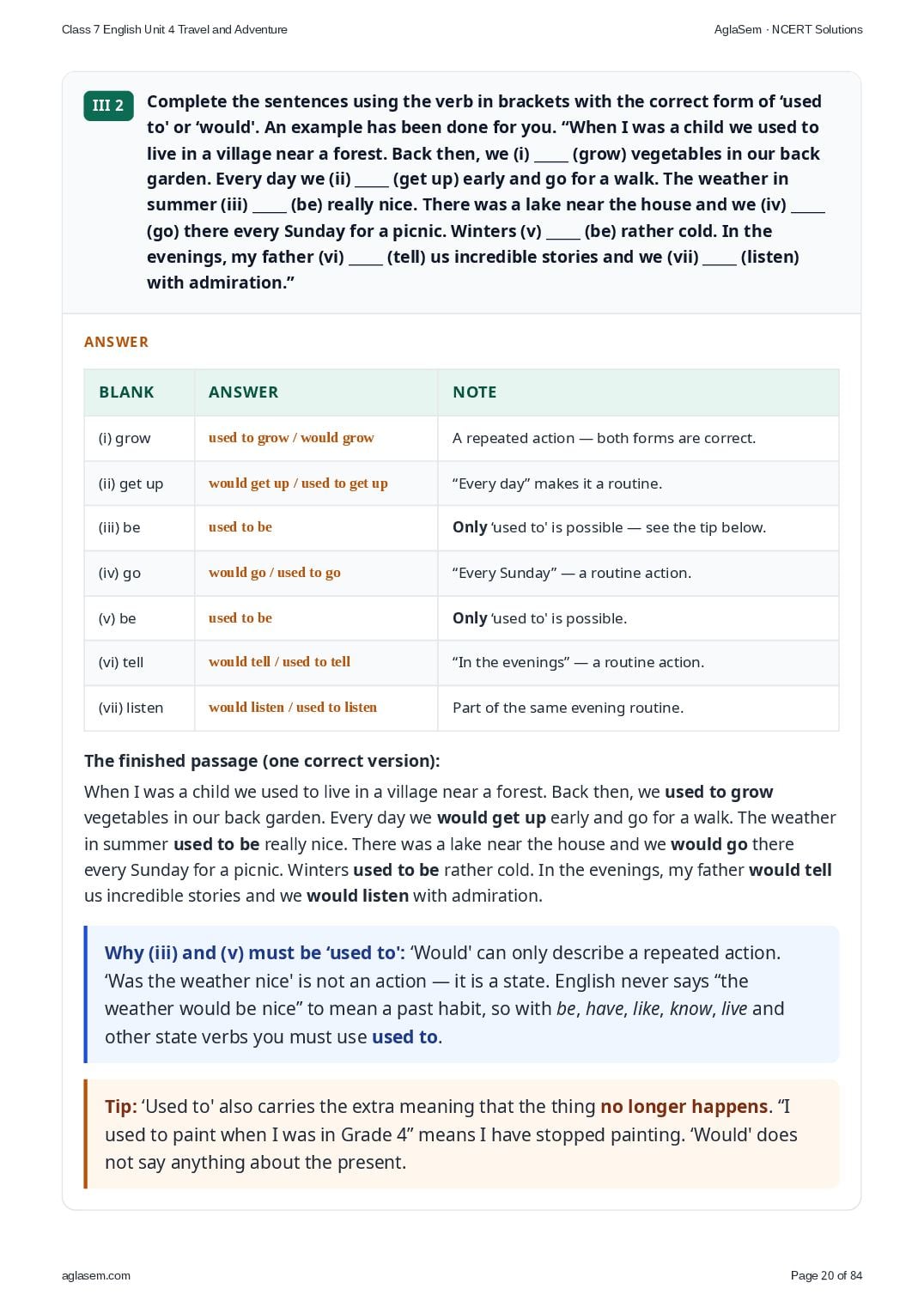
- Complete the sentences using the verb in brackets with the correct form of ‘used to' or ‘would'. An example has been done for you. “When I was a child we used to live in a village near a forest. Back then, we (i) _____ (grow) vegetables in our back garden. Every day we (ii) _____ (get up) early and go for a walk. The weather in summer (iii) _____ (be) really nice. There was a lake near the house and we (iv) _____ (go) there every Sunday for a picnic. Winters (v) _____ (be) rather cold. In the evenings, my father (vi) _____ (tell) us incredible stories and we (vii) _____ (listen) with admiration.”
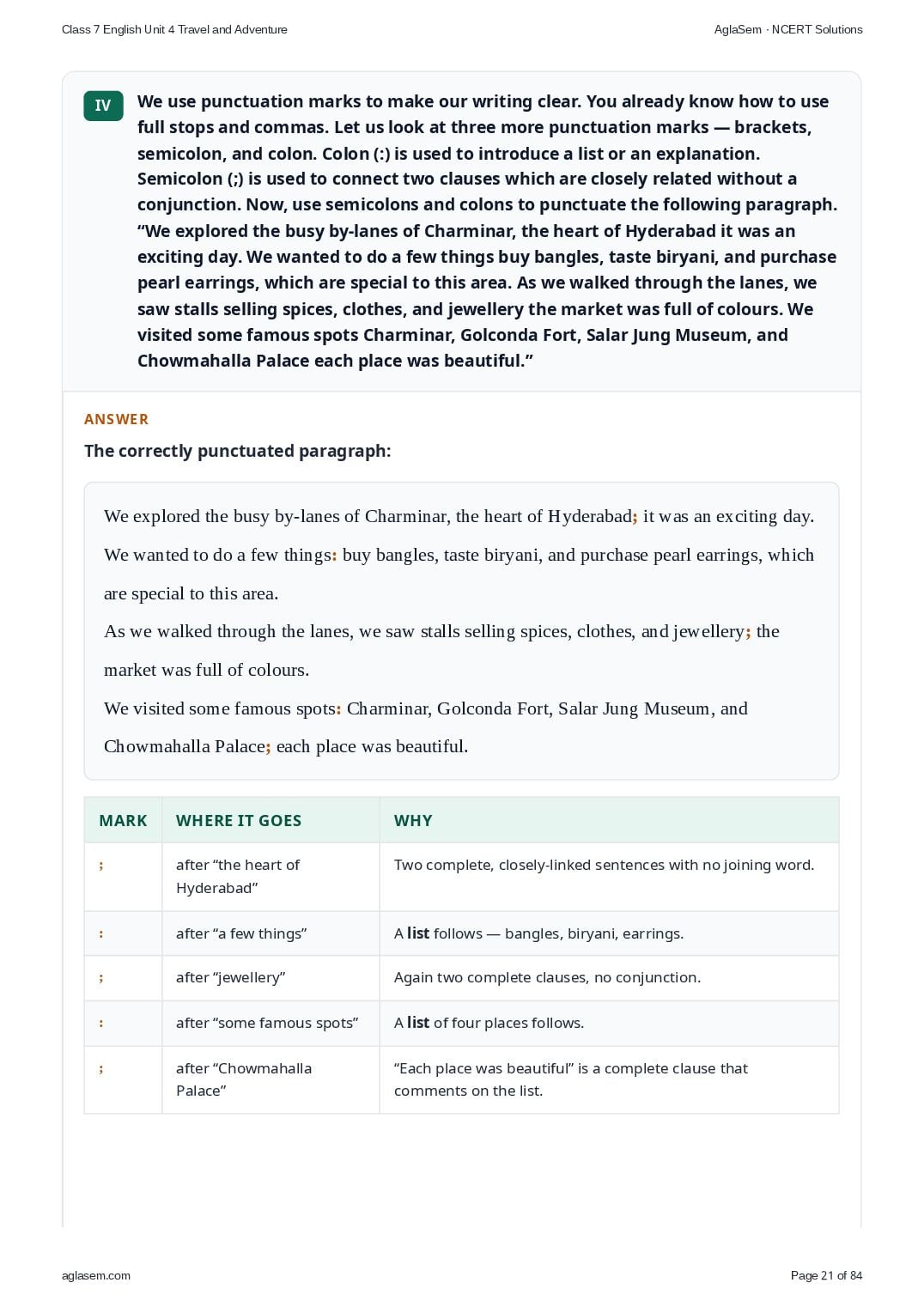
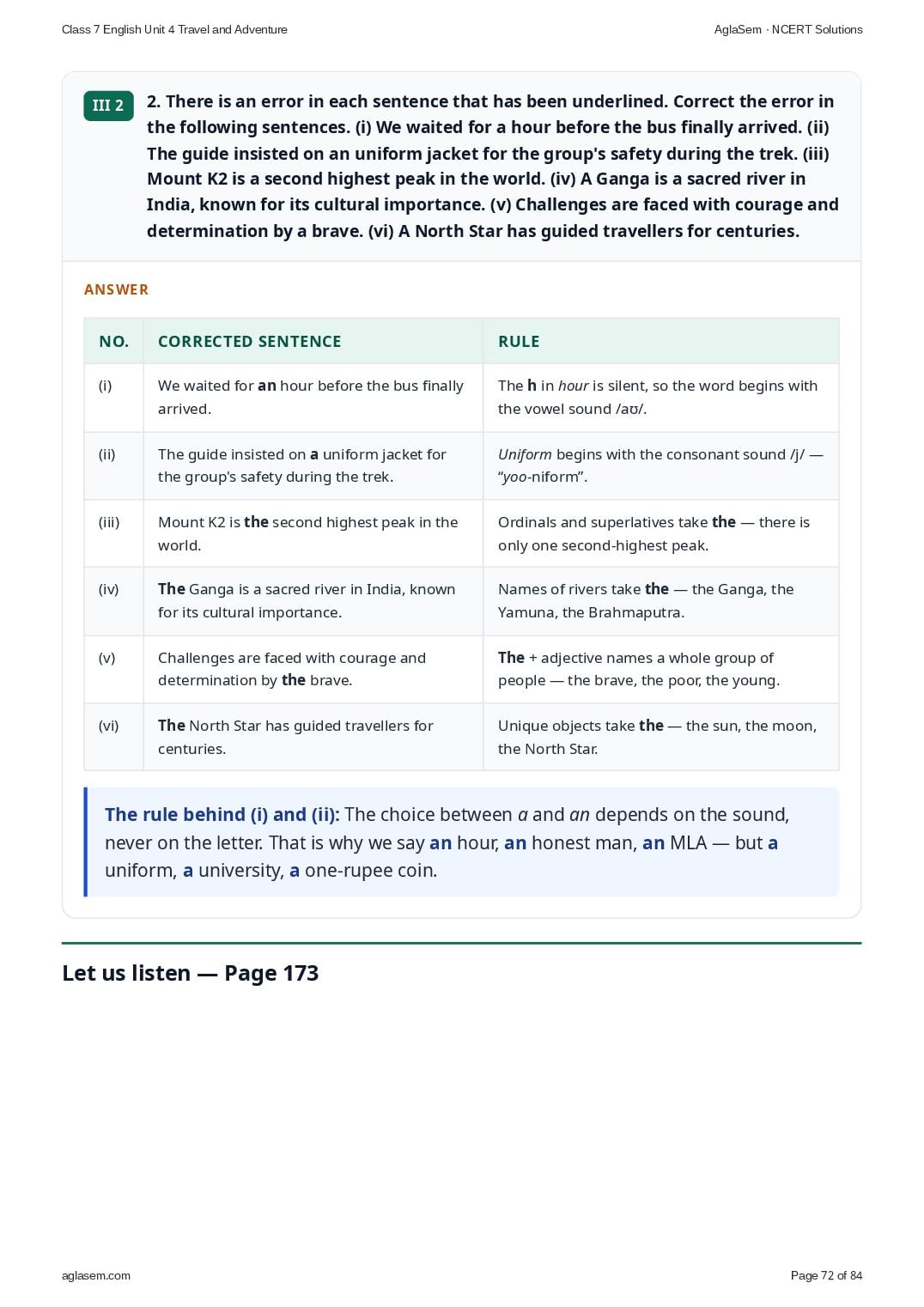
- We use punctuation marks to make our writing clear. You already know how to use full stops and commas. Let us look at three more punctuation marks — brackets, semicolon, and colon. Colon (:) is used to introduce a list or an explanation. Semicolon (;) is used to connect two clauses which are closely related without a conjunction. Now, use semicolons and colons to punctuate the following paragraph. “We explored the busy by-lanes of Charminar, the heart of Hyderabad it was an exciting day. We wanted to do a few things buy bangles, taste biryani, and purchase pearl earrings, which are special to this area. As we walked through the lanes, we saw stalls selling spices, clothes, and jewellery the market was full of colours. We visited some famous spots Charminar, Golconda Fort, Salar Jung Museum, and Chowmahalla Palace each place was beautiful.”
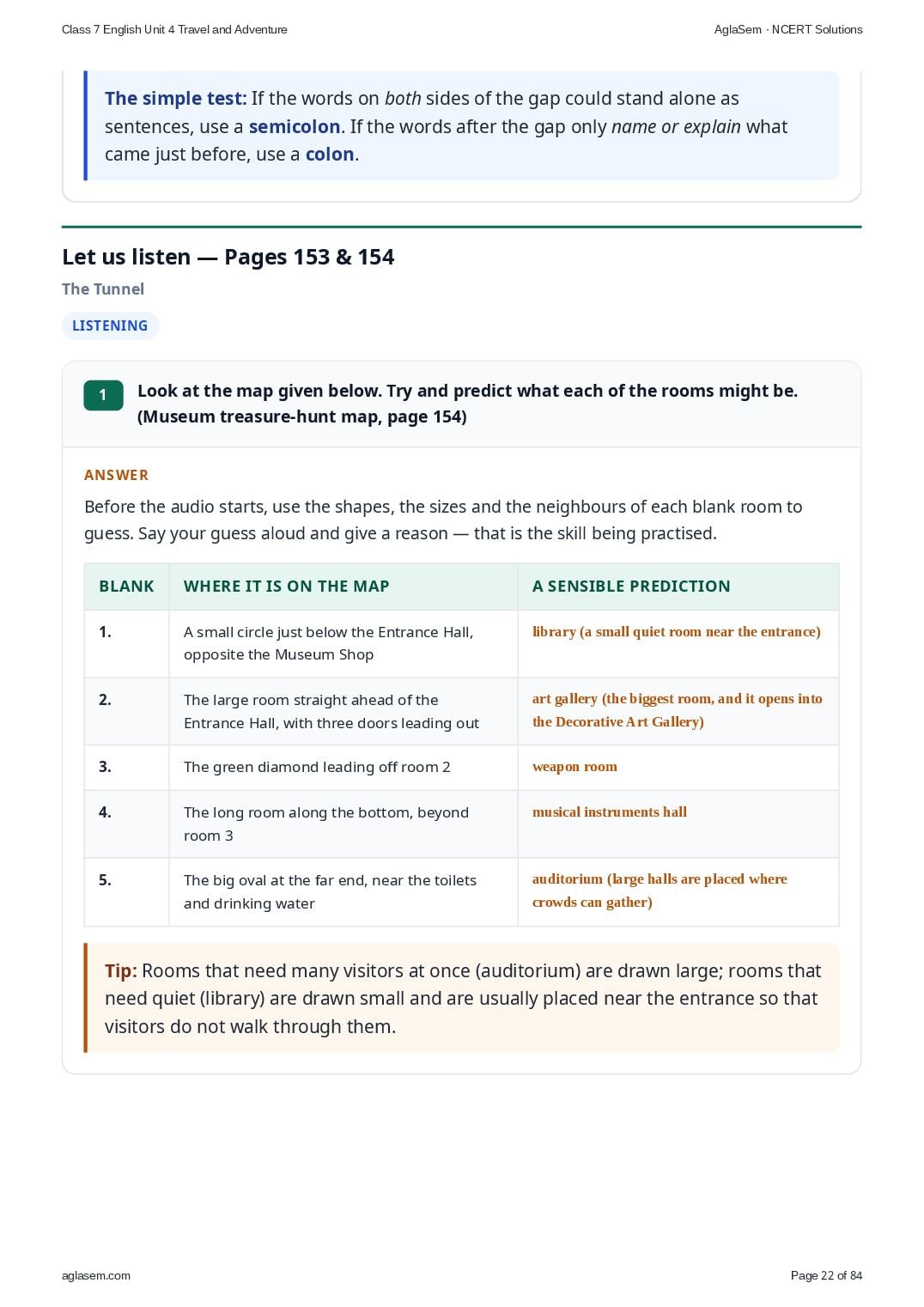
- Look at the map given below. Try and predict what each of the rooms might be. (Museum treasure-hunt map, page 154)
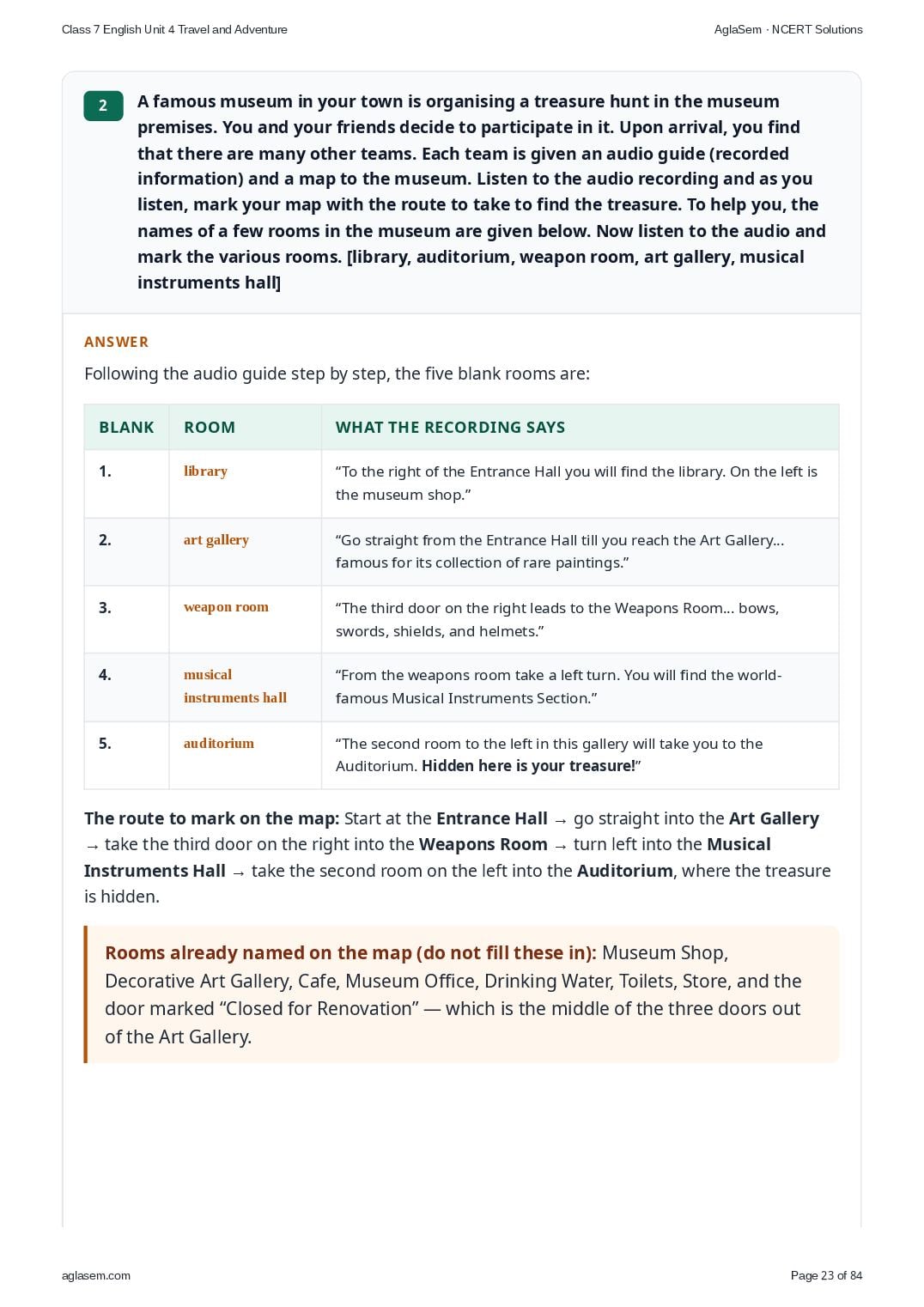
- A famous museum in your town is organising a treasure hunt in the museum premises. You and your friends decide to participate in it. Upon arrival, you find that there are many other teams. Each team is given an audio guide (recorded information) and a map to the museum. Listen to the audio recording and as you listen, mark your map with the route to take to find the treasure. To help you, the names of a few rooms in the museum are given below. Now listen to the audio and mark the various rooms. [library, auditorium, weapon room, art gallery, musical instruments hall]
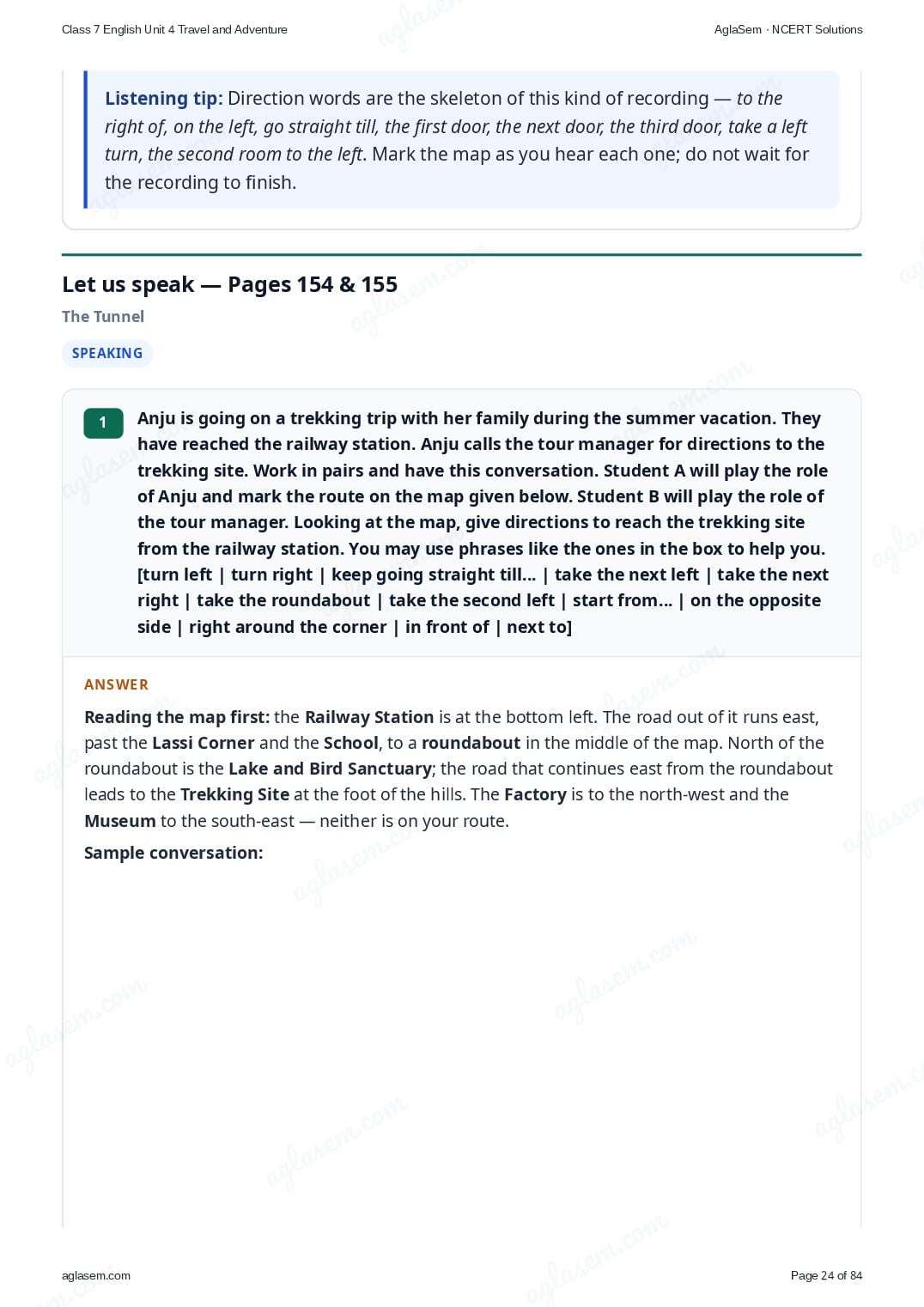
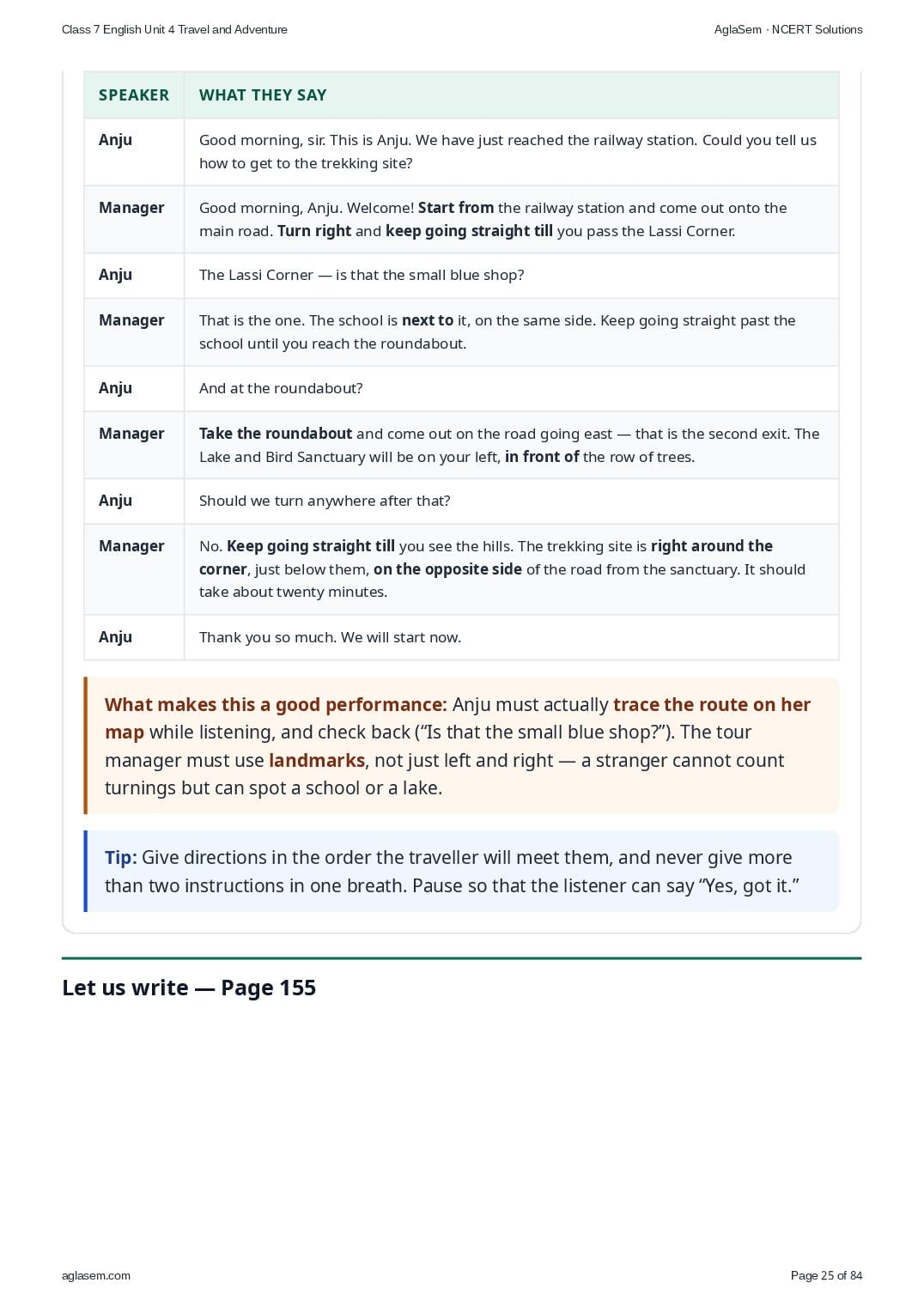
- Anju is going on a trekking trip with her family during the summer vacation. They have reached the railway station. Anju calls the tour manager for directions to the trekking site. Work in pairs and have this conversation. Student A will play the role of Anju and mark the route on the map given below. Student B will play the role of the tour manager. Looking at the map, give directions to reach the trekking site from the railway station. You may use phrases like the ones in the box to help you. [turn left | turn right | keep going straight till… | take the next left | take the next right | take the roundabout | take the second left | start from… | on the opposite side | right around the corner | in front of | next to]
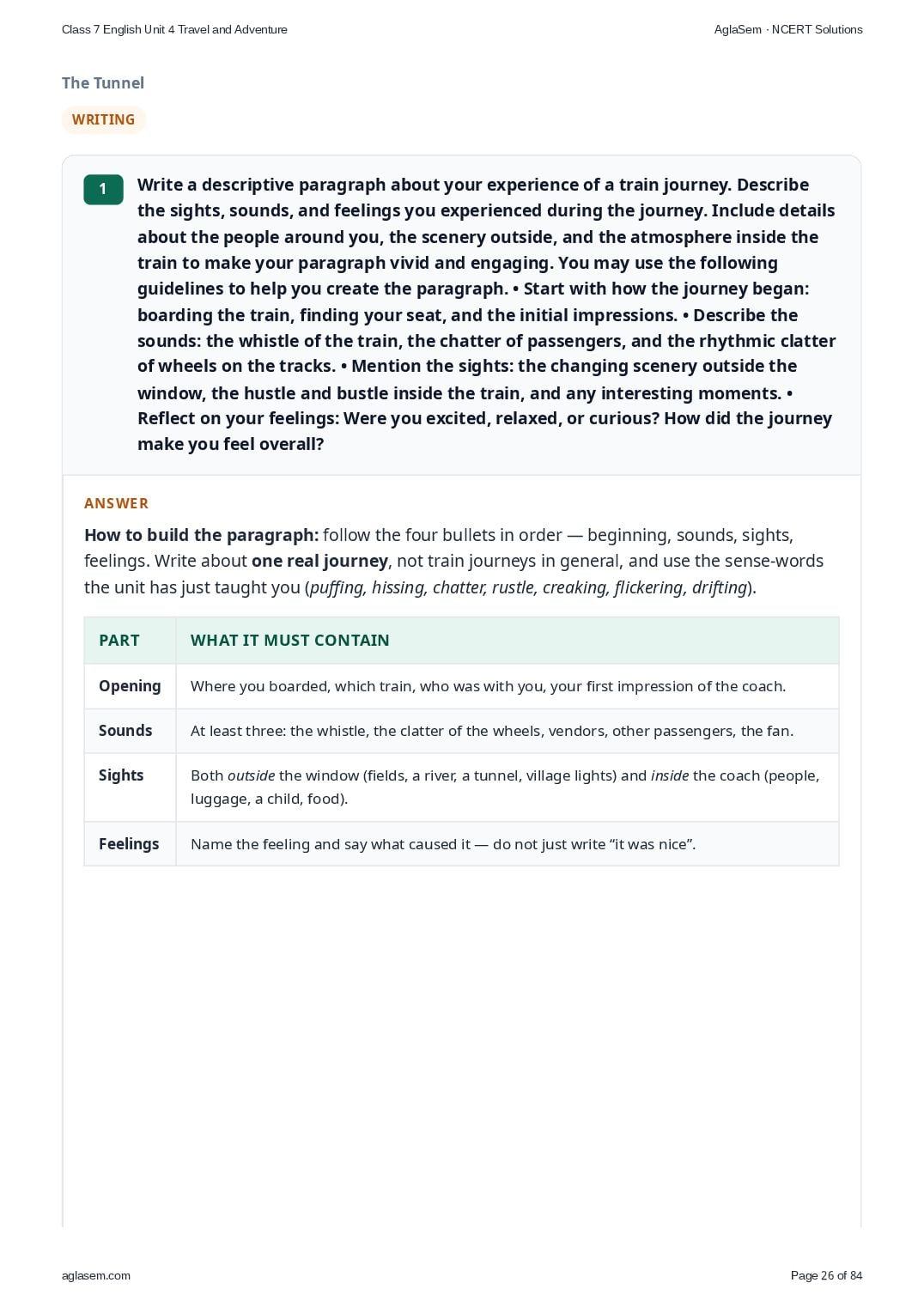
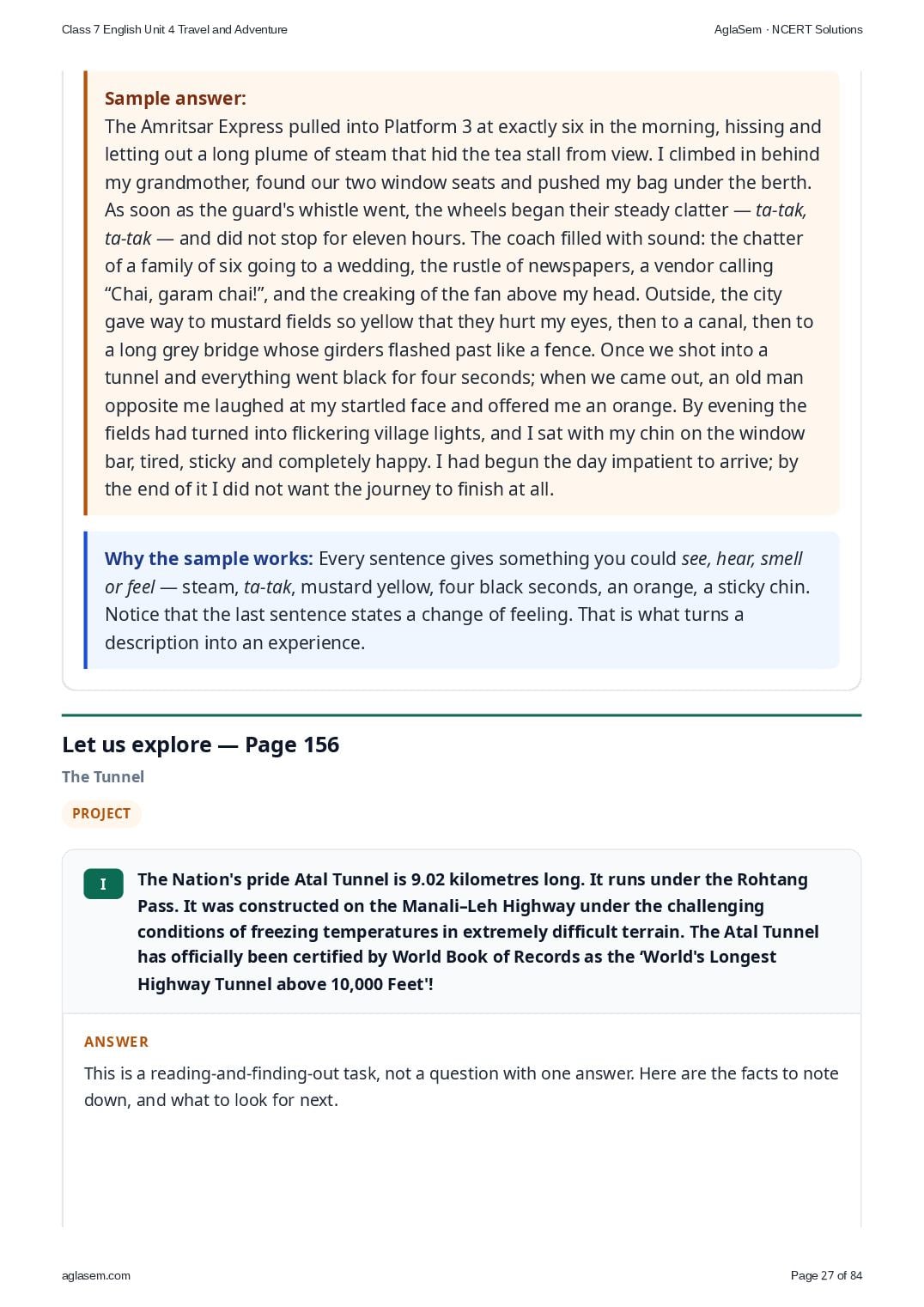
- Write a descriptive paragraph about your experience of a train journey. Describe the sights, sounds, and feelings you experienced during the journey. Include details about the people around you, the scenery outside, and the atmosphere inside the train to make your paragraph vivid and engaging. You may use the following guidelines to help you create the paragraph. • Start with how the journey began: boarding the train, finding your seat, and the initial impressions. • Describe the sounds: the whistle of the train, the chatter of passengers, and the rhythmic clatter of wheels on the tracks. • Mention the sights: the changing scenery outside the window, the hustle and bustle inside the train, and any interesting moments. • Reflect on your feelings: Were you excited, relaxed, or curious? How did the journey make you feel overall?
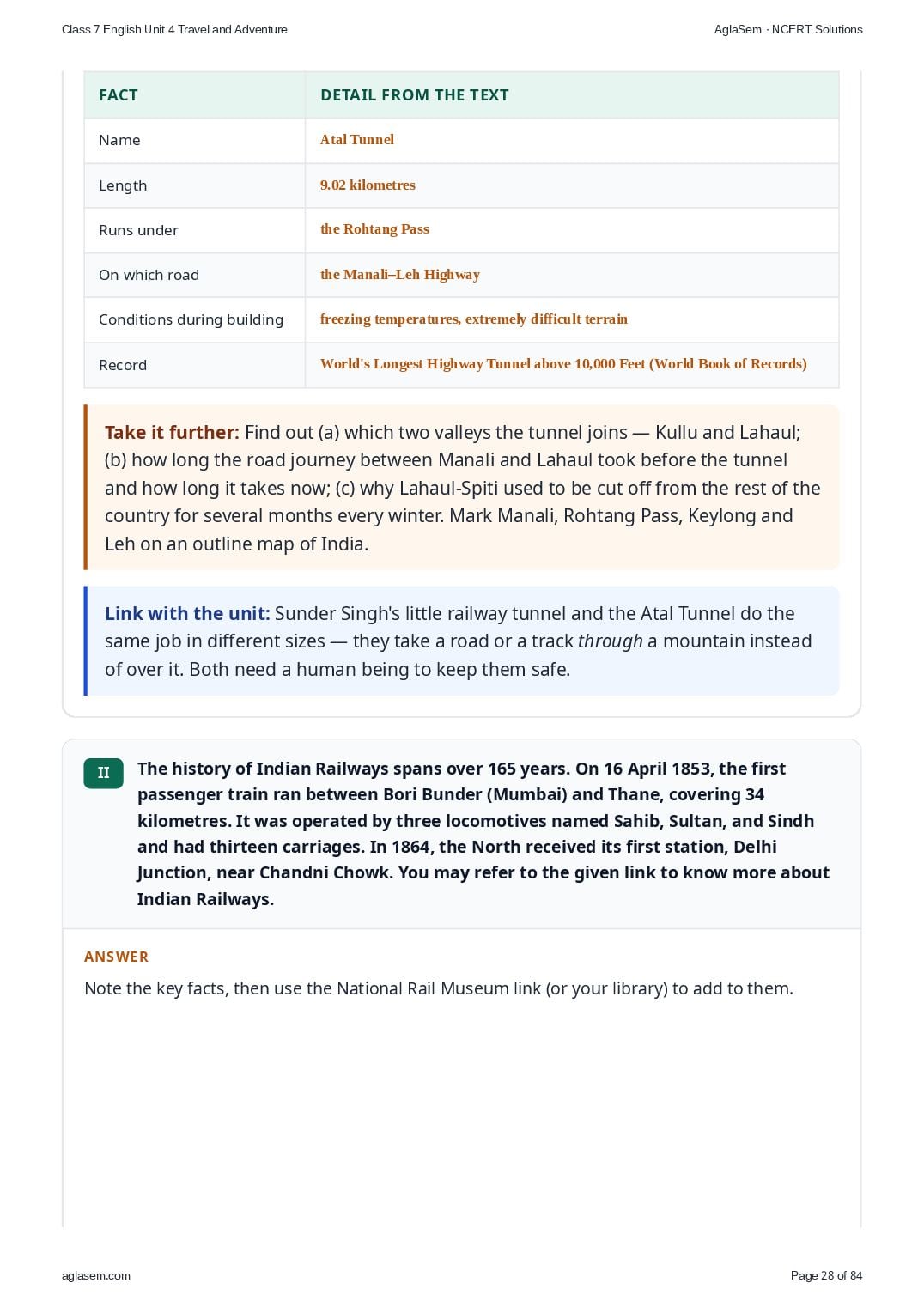
- The Nation's pride Atal Tunnel is 9.02 kilometres long. It runs under the Rohtang Pass. It was constructed on the Manali–Leh Highway under the challenging conditions of freezing temperatures in extremely difficult terrain. The Atal Tunnel has officially been certified by World Book of Records as the ‘World's Longest Highway Tunnel above 10,000 Feet'!
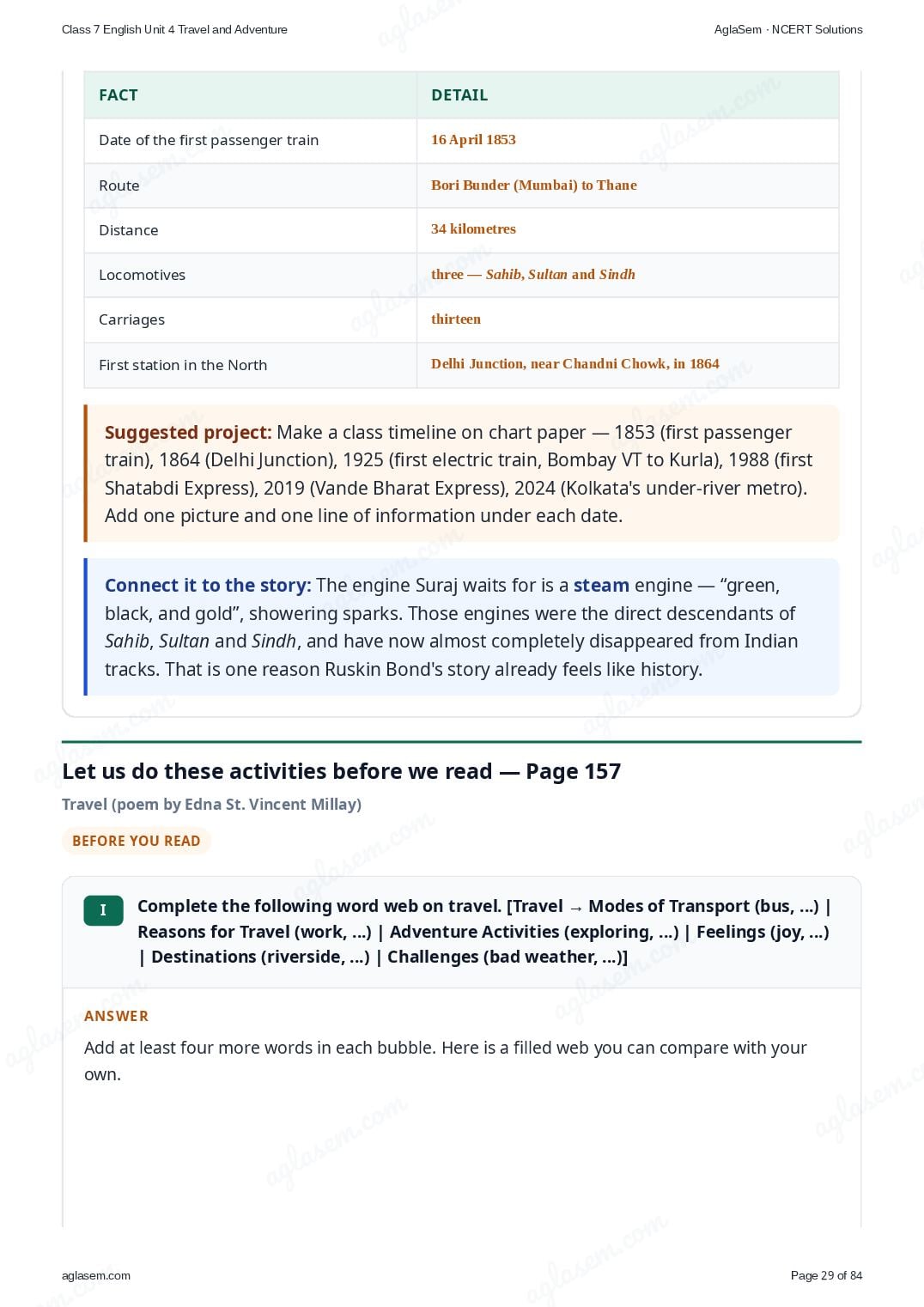
- The history of Indian Railways spans over 165 years. On 16 April 1853, the first passenger train ran between Bori Bunder (Mumbai) and Thane, covering 34 kilometres. It was operated by three locomotives named Sahib, Sultan, and Sindh and had thirteen carriages. In 1864, the North received its first station, Delhi Junction, near Chandni Chowk. You may refer to the given link to know more about Indian Railways.
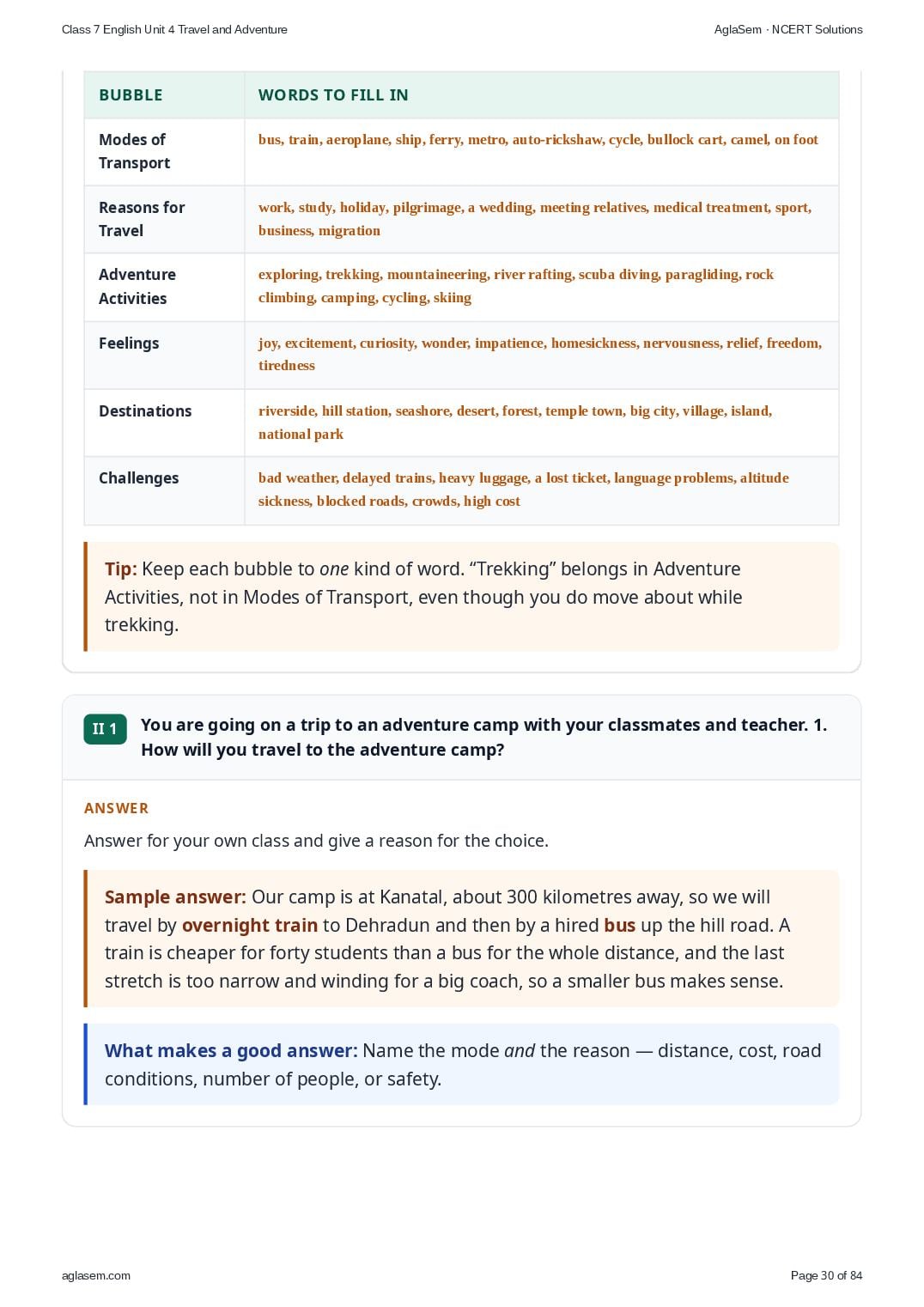
- Complete the following word web on travel. [Travel → Modes of Transport (bus, …) | Reasons for Travel (work, …) | Adventure Activities (exploring, …) | Feelings (joy, …) | Destinations (riverside, …) | Challenges (bad weather, …)]
- You are going on a trip to an adventure camp with your classmates and teacher. 1. How will you travel to the adventure camp?
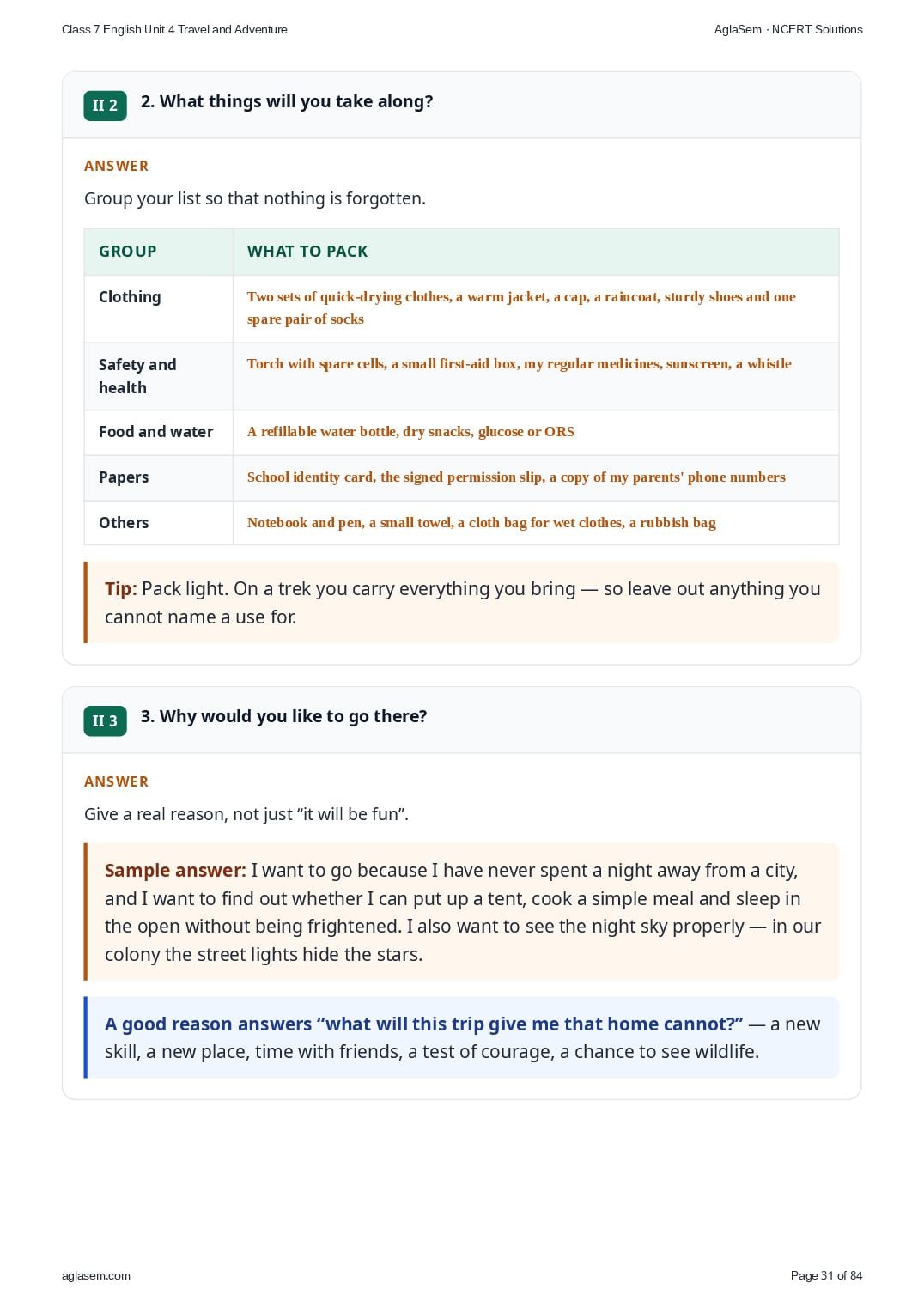
- 2. What things will you take along?
- 3. Why would you like to go there?
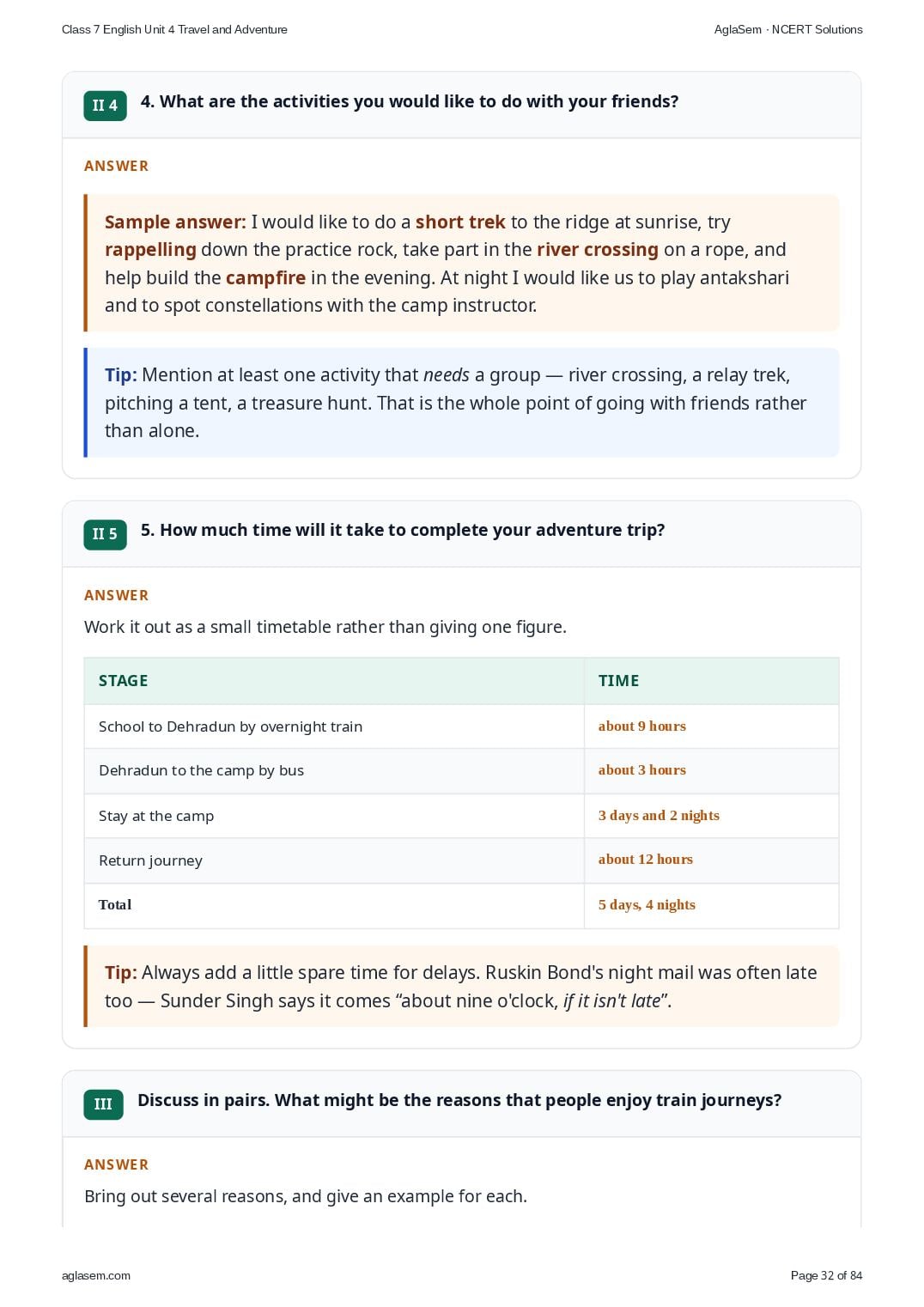
- 4. What are the activities you would like to do with your friends?
- 5. How much time will it take to complete your adventure trip?
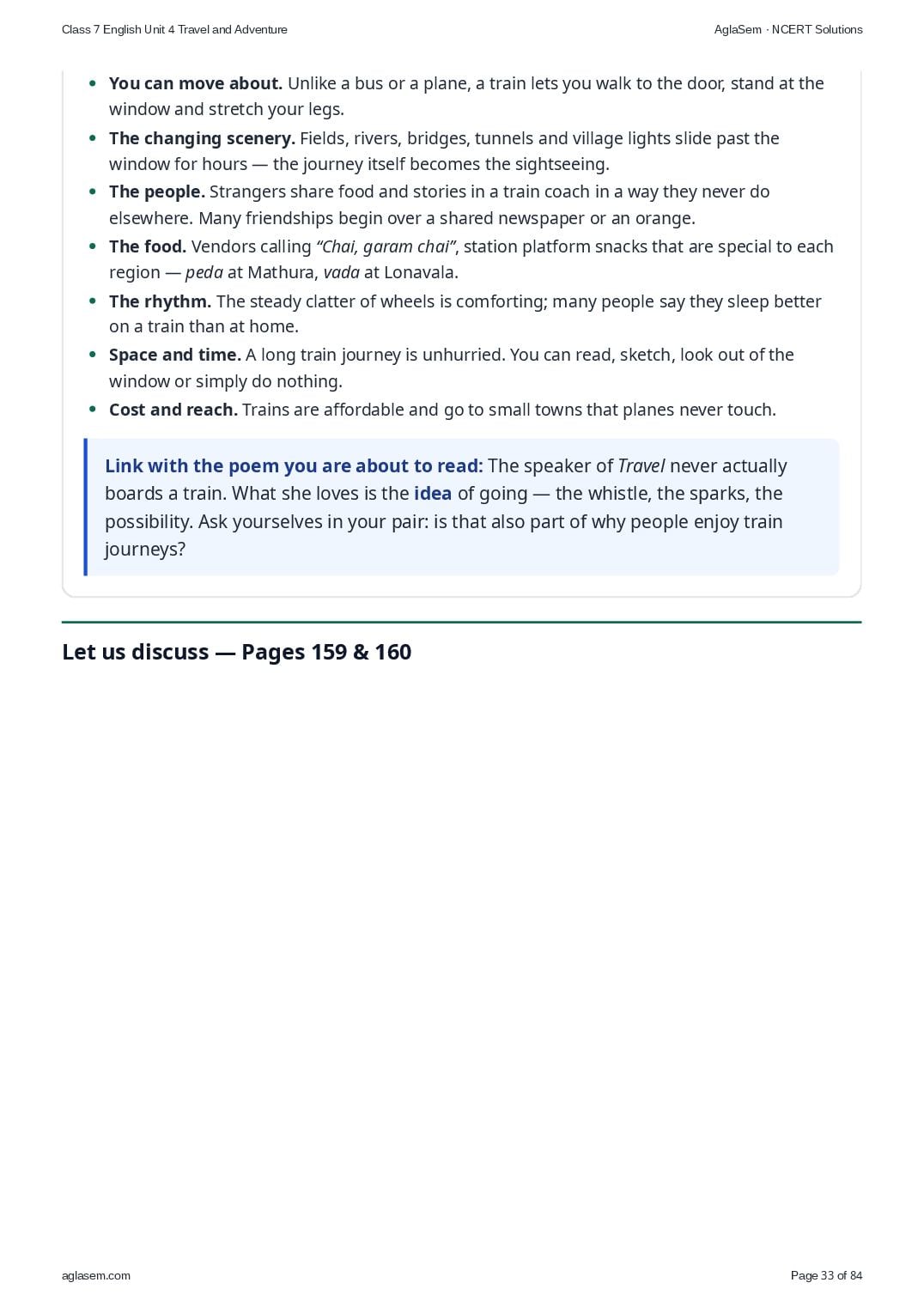
- Discuss in pairs. What might be the reasons that people enjoy train journeys?
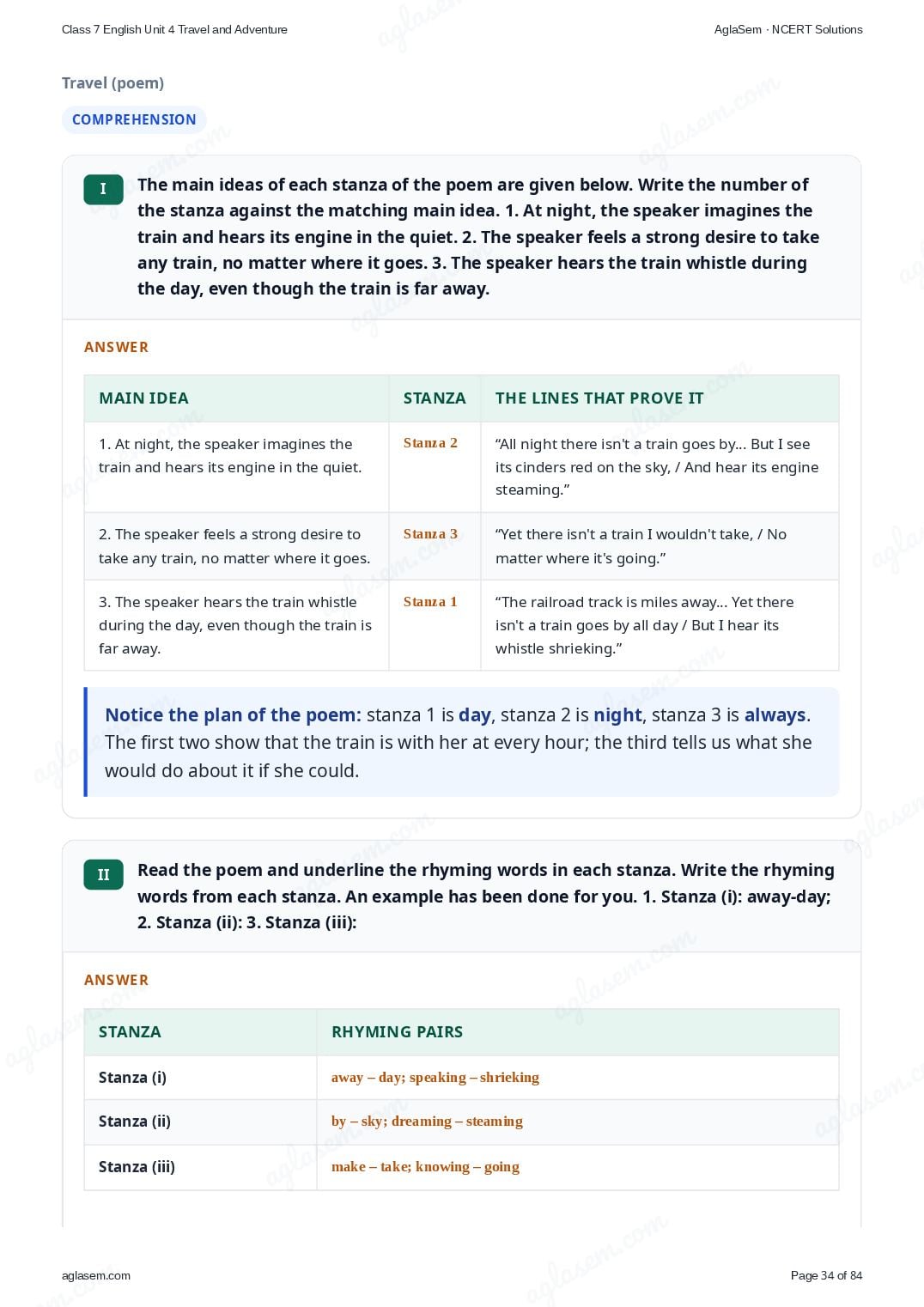
- The main ideas of each stanza of the poem are given below. Write the number of the stanza against the matching main idea. 1. At night, the speaker imagines the train and hears its engine in the quiet. 2. The speaker feels a strong desire to take any train, no matter where it goes. 3. The speaker hears the train whistle during the day, even though the train is far away.
- Read the poem and underline the rhyming words in each stanza. Write the rhyming words from each stanza. An example has been done for you. 1. Stanza (i): away-day; 2. Stanza (ii): 3. Stanza (iii):
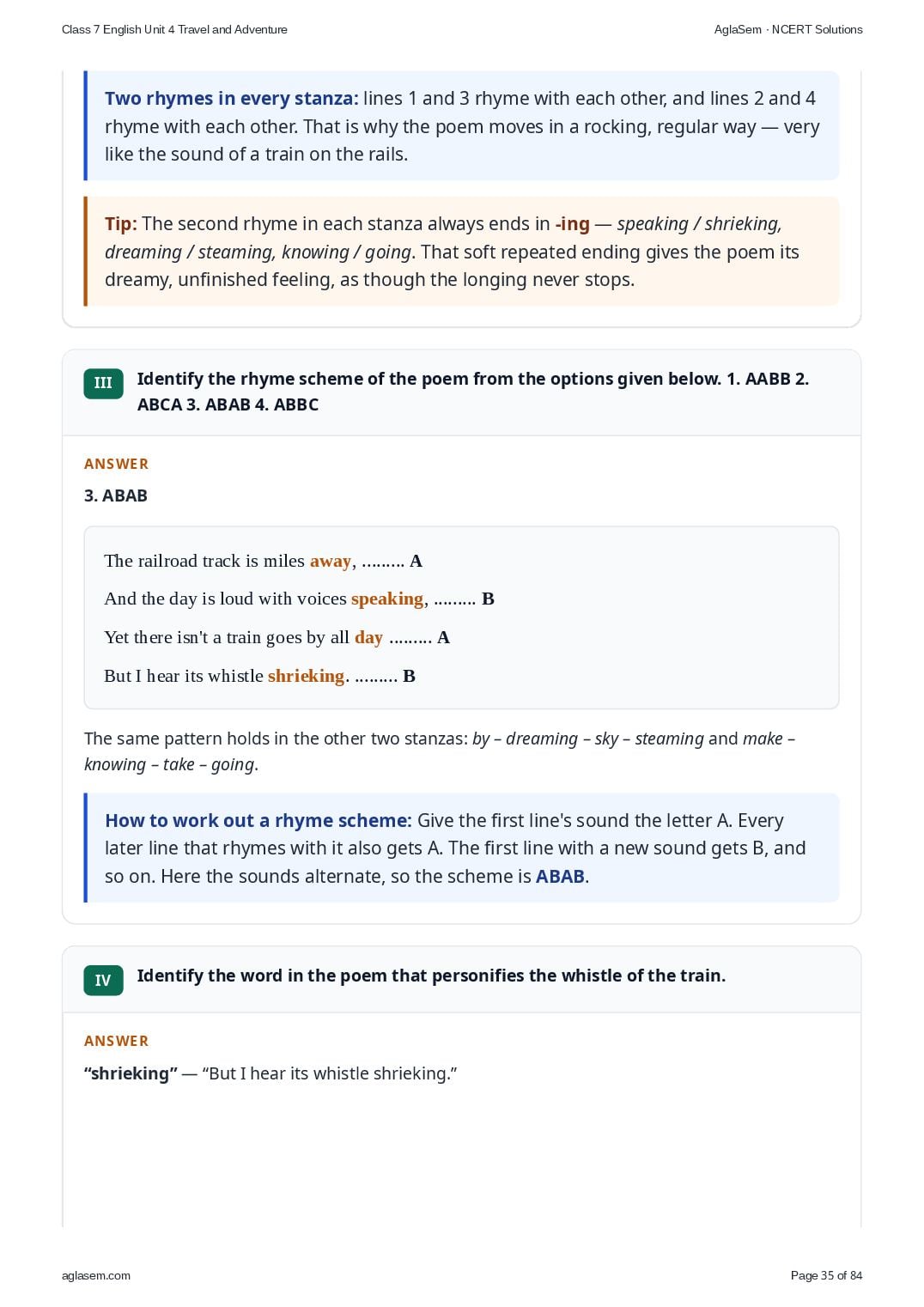
- Identify the rhyme scheme of the poem from the options given below. 1. AABB 2. ABCA 3. ABAB 4. ABBC
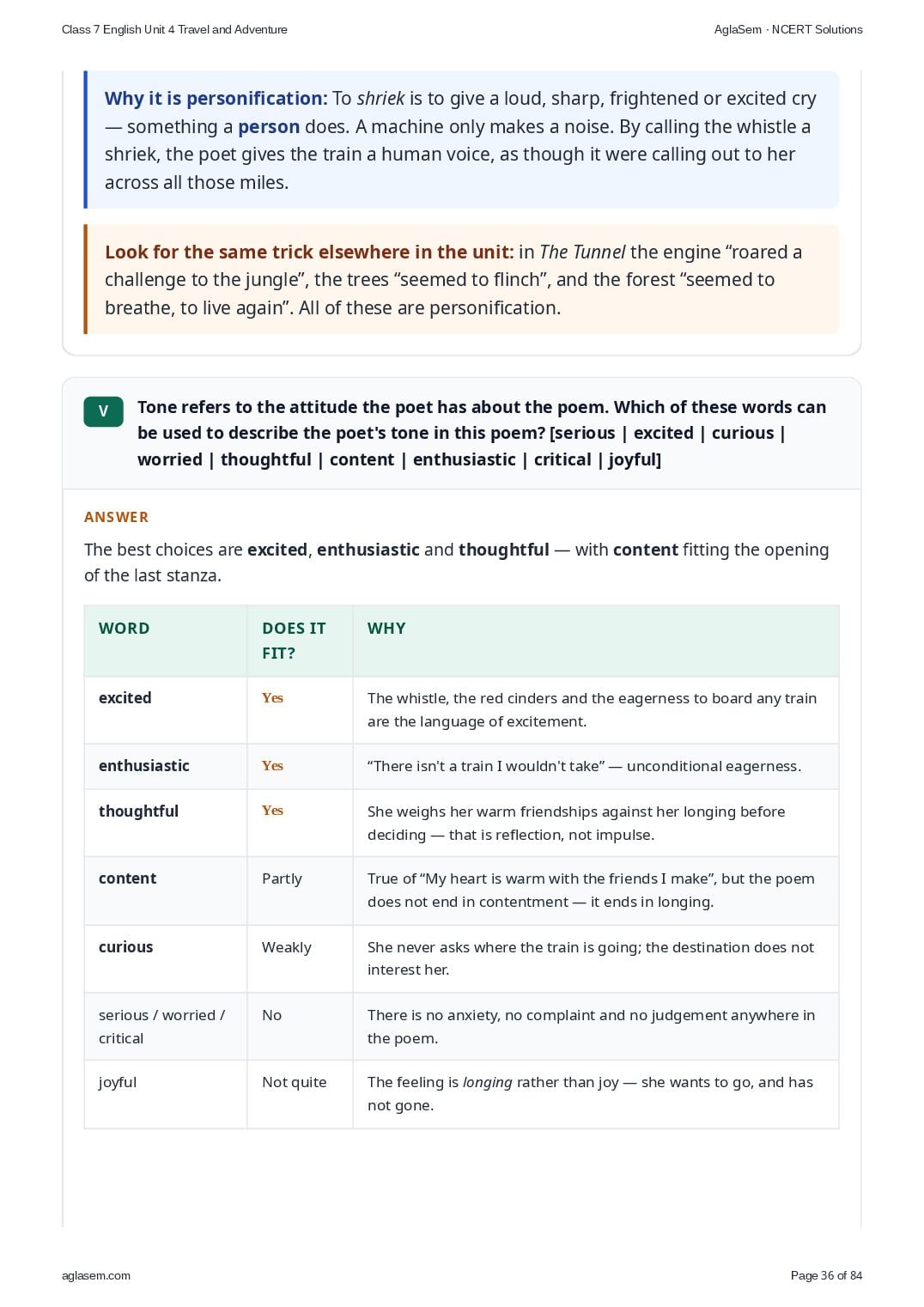
- Identify the word in the poem that personifies the whistle of the train.
- Tone refers to the attitude the poet has about the poem. Which of these words can be used to describe the poet's tone in this poem? [serious | excited | curious | worried | thoughtful | content | enthusiastic | critical | joyful]
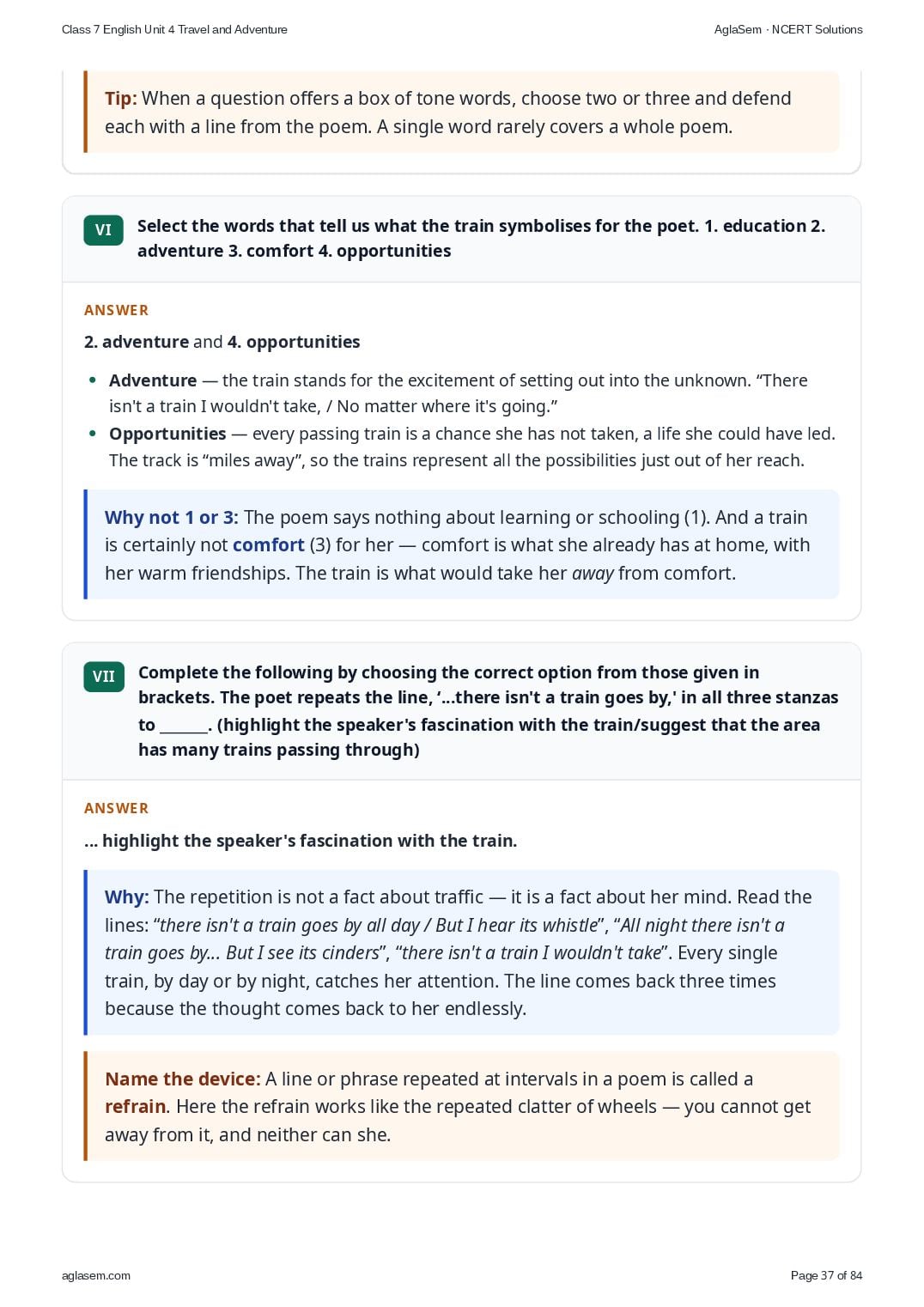
- Select the words that tell us what the train symbolises for the poet. 1. education 2. adventure 3. comfort 4. opportunities
- Complete the following by choosing the correct option from those given in brackets. The poet repeats the line, ‘…there isn't a train goes by,' in all three stanzas to _______. (highlight the speaker's fascination with the train/suggest that the area has many trains passing through)
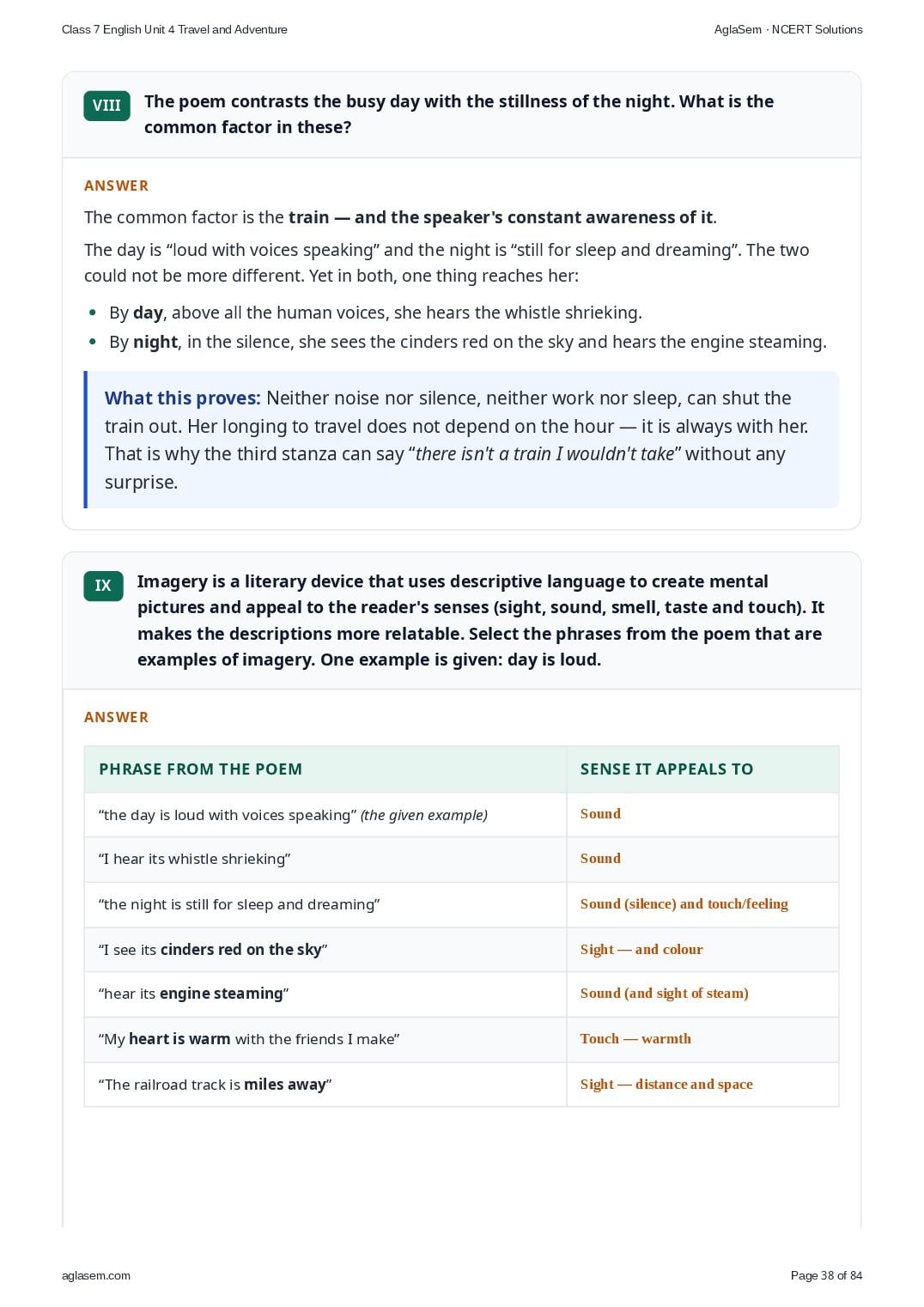
- The poem contrasts the busy day with the stillness of the night. What is the common factor in these?
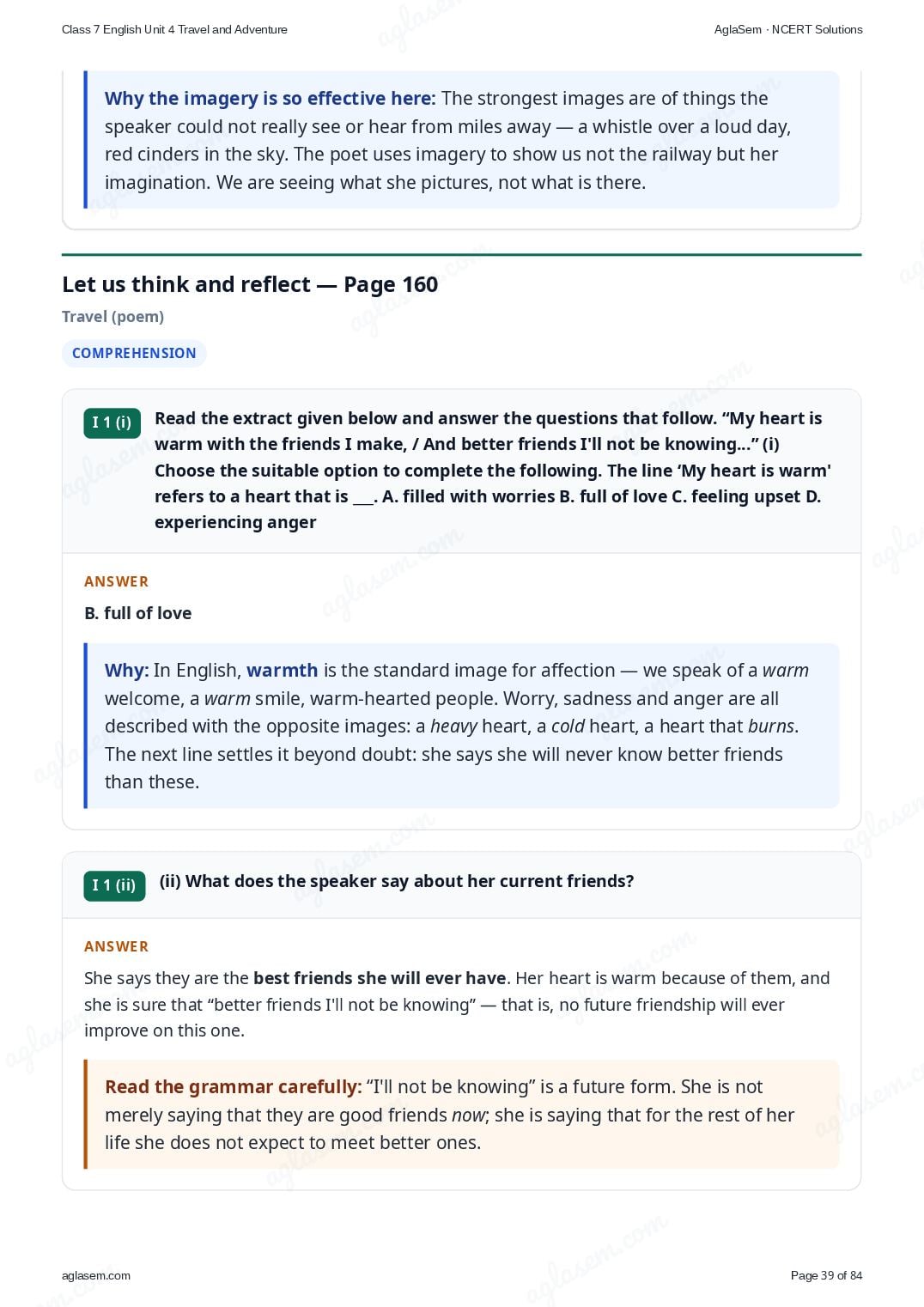
- Imagery is a literary device that uses descriptive language to create mental pictures and appeal to the reader's senses (sight, sound, smell, taste and touch). It makes the descriptions more relatable. Select the phrases from the poem that are examples of imagery. One example is given: day is loud.
- Read the extract given below and answer the questions that follow. “My heart is warm with the friends I make, / And better friends I'll not be knowing…” (i) Choose the suitable option to complete the following. The line ‘My heart is warm' refers to a heart that is ___. A. filled with worries B. full of love C. feeling upset D. experiencing anger
- (ii) What does the speaker say about her current friends?
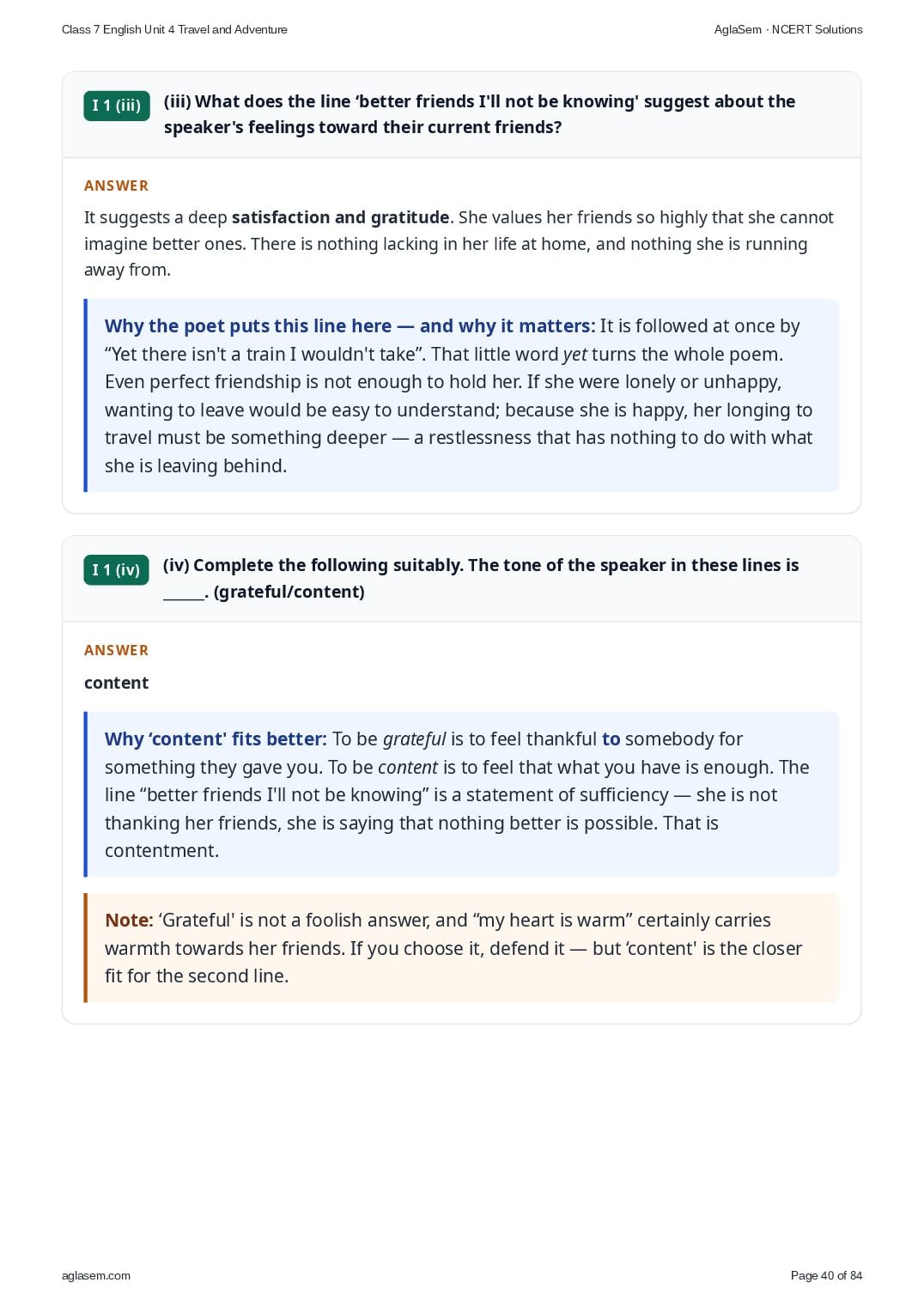
- (iii) What does the line ‘better friends I'll not be knowing' suggest about the speaker's feelings toward their current friends?
- (iv) Complete the following suitably. The tone of the speaker in these lines is ______. (grateful/content)
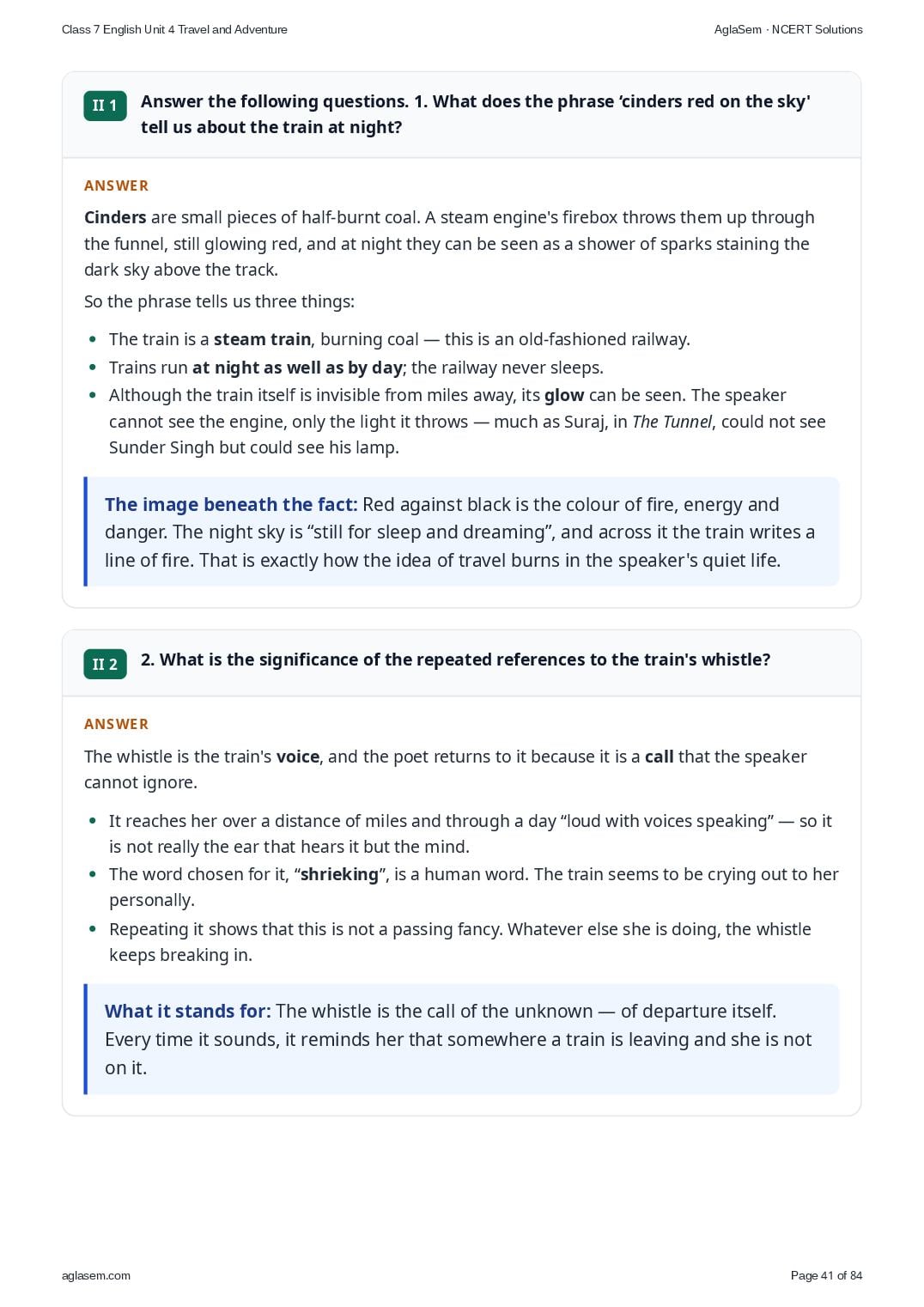
- Answer the following questions. 1. What does the phrase ‘cinders red on the sky' tell us about the train at night?
- 2. What is the significance of the repeated references to the train's whistle?
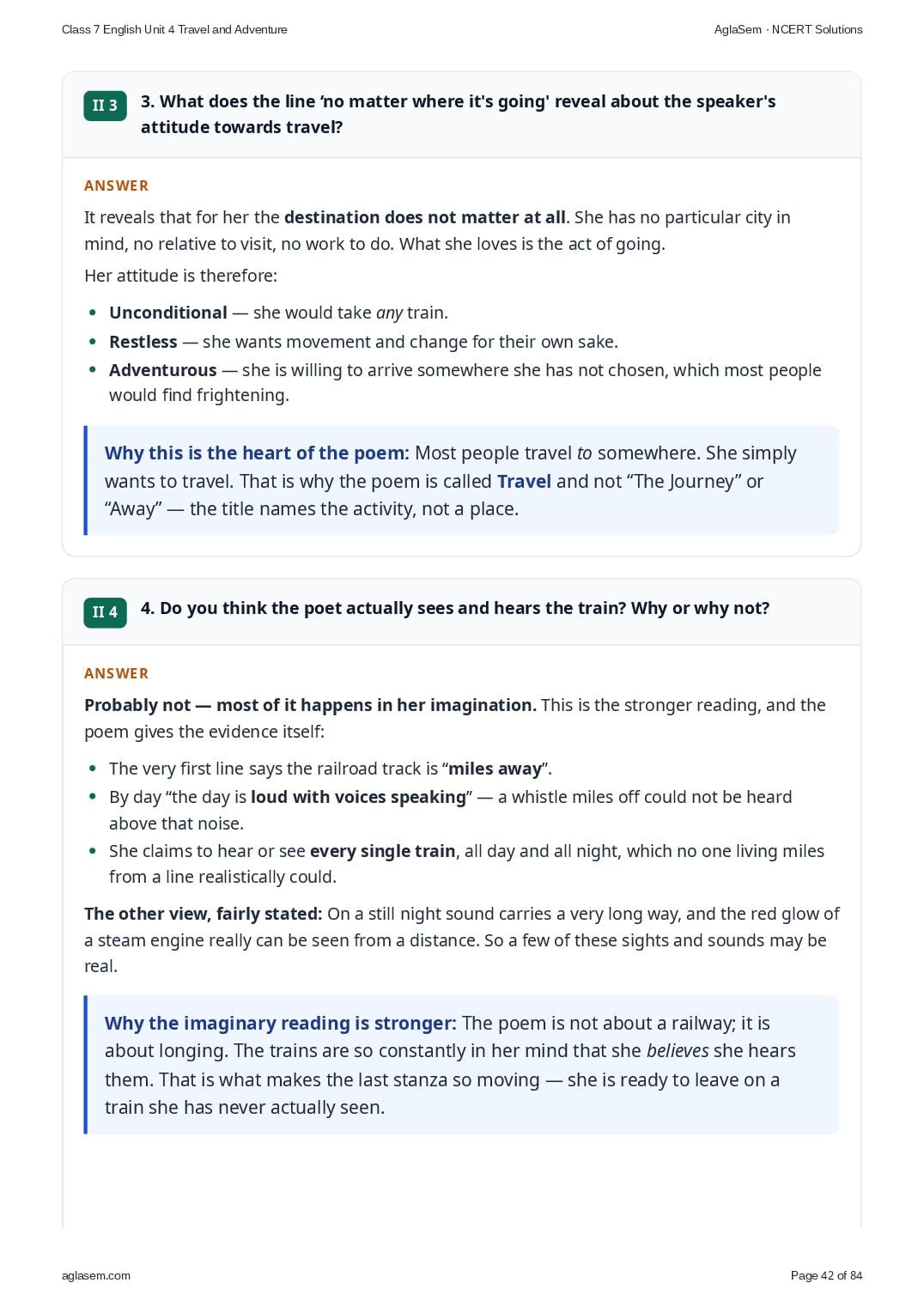
- 3. What does the line ‘no matter where it's going' reveal about the speaker's attitude towards travel?
- 4. Do you think the poet actually sees and hears the train? Why or why not?
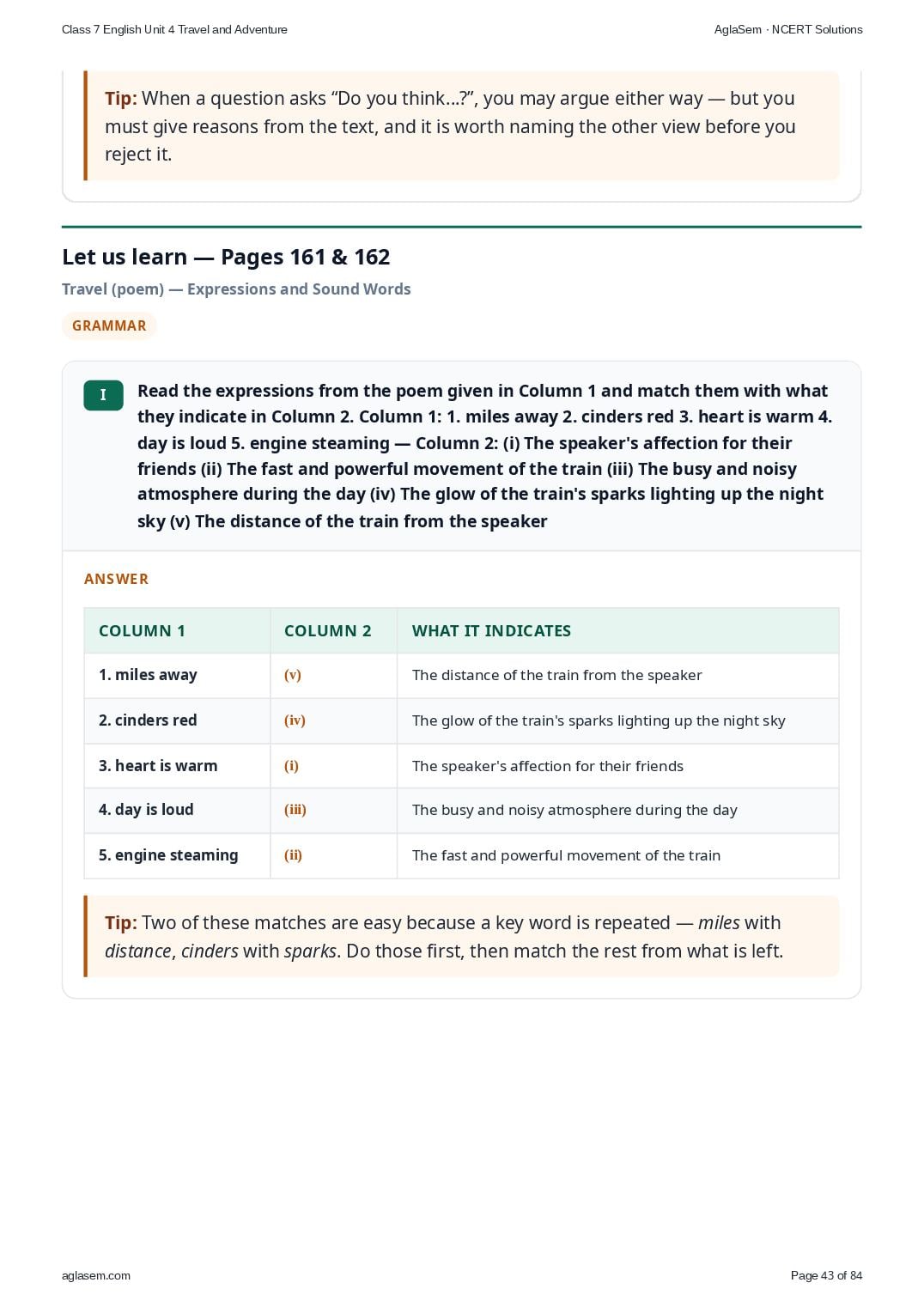
- Read the expressions from the poem given in Column 1 and match them with what they indicate in Column 2. Column 1: 1. miles away 2. cinders red 3. heart is warm 4. day is loud 5. engine steaming — Column 2: (i) The speaker's affection for their friends (ii) The fast and powerful movement of the train (iii) The busy and noisy atmosphere during the day (iv) The glow of the train's sparks lighting up the night sky (v) The distance of the train from the speaker
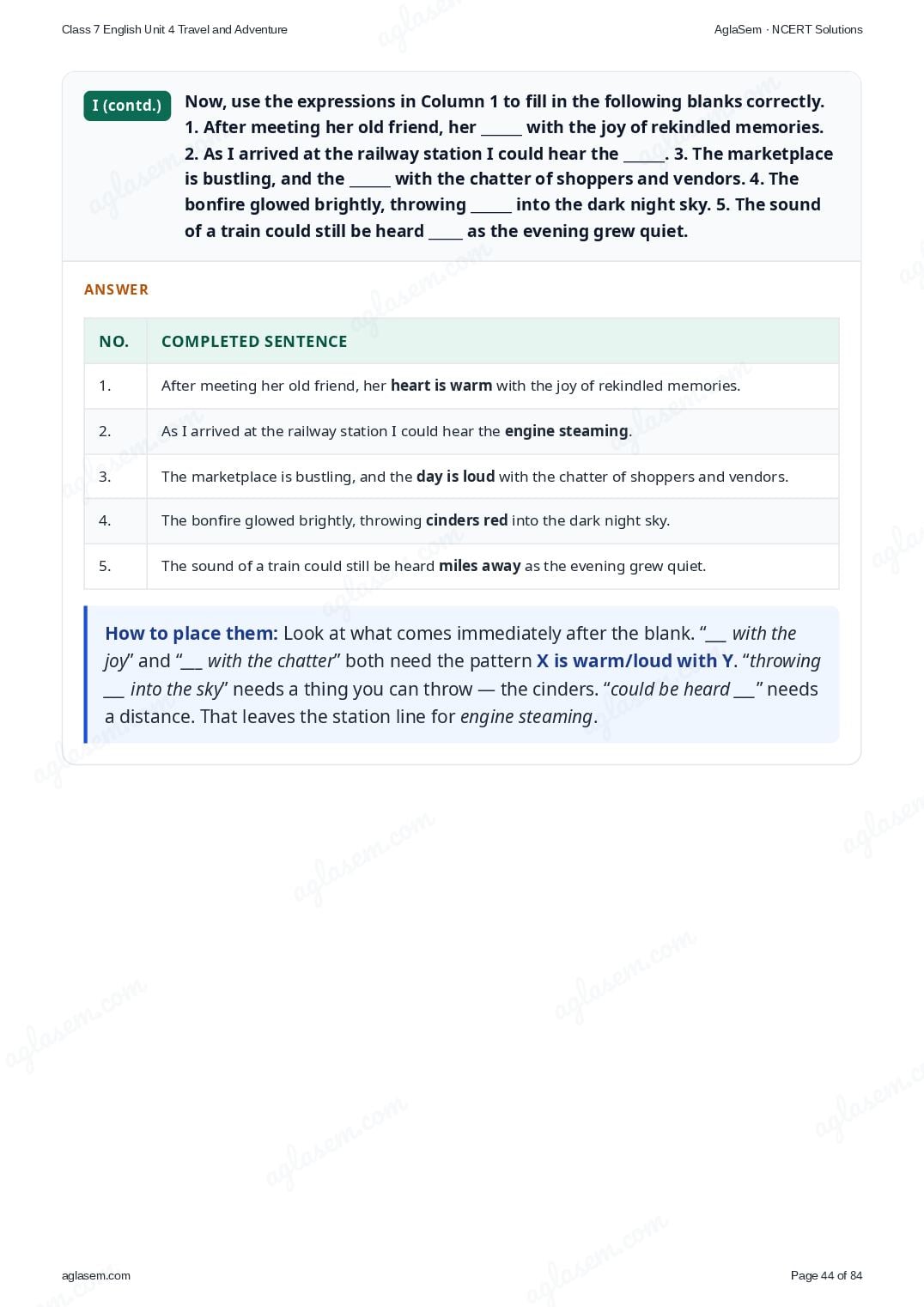
- Now, use the expressions in Column 1 to fill in the following blanks correctly. 1. After meeting her old friend, her ______ with the joy of rekindled memories. 2. As I arrived at the railway station I could hear the ______. 3. The marketplace is bustling, and the ______ with the chatter of shoppers and vendors. 4. The bonfire glowed brightly, throwing ______ into the dark night sky. 5. The sound of a train could still be heard _____ as the evening grew quiet.
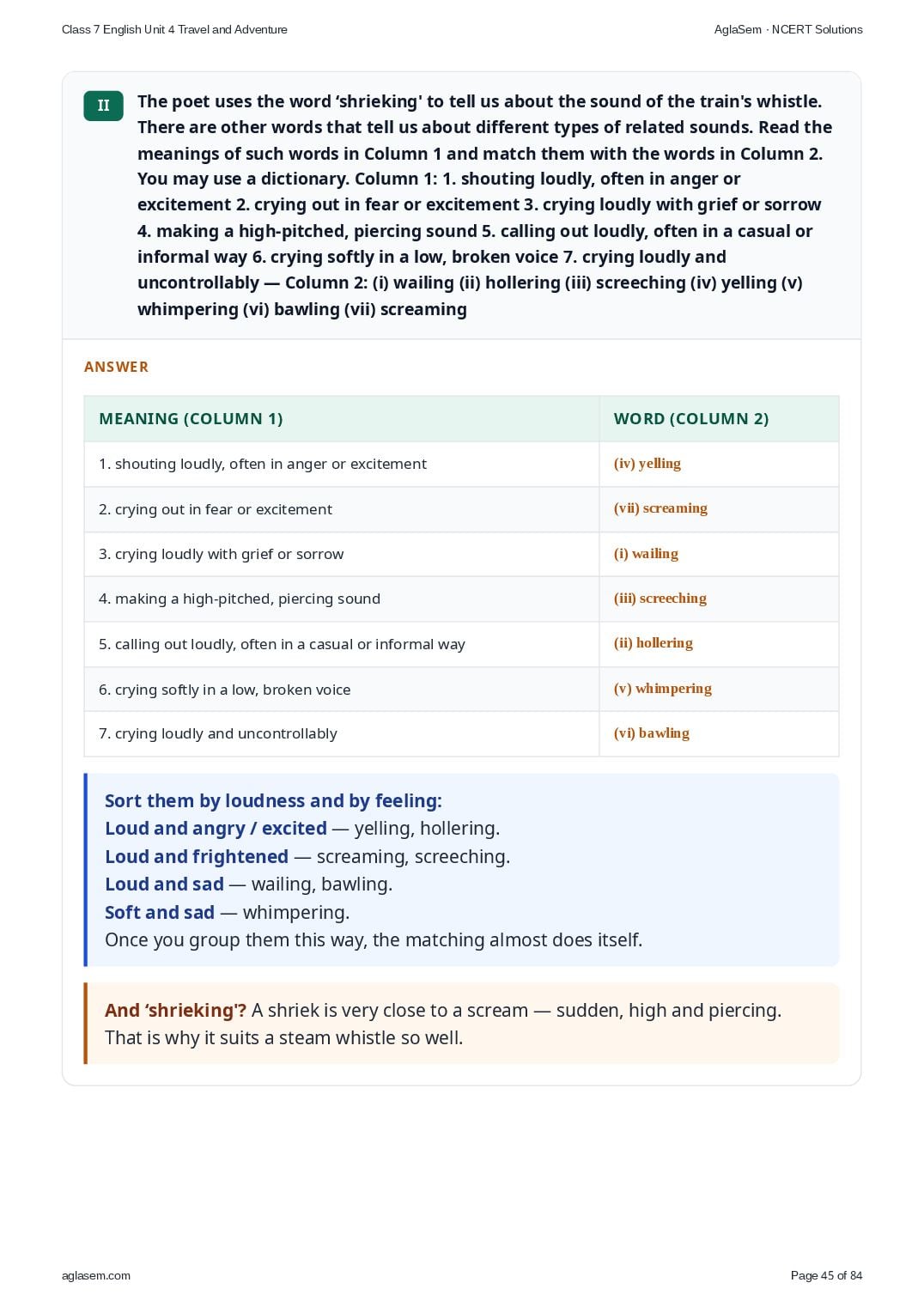
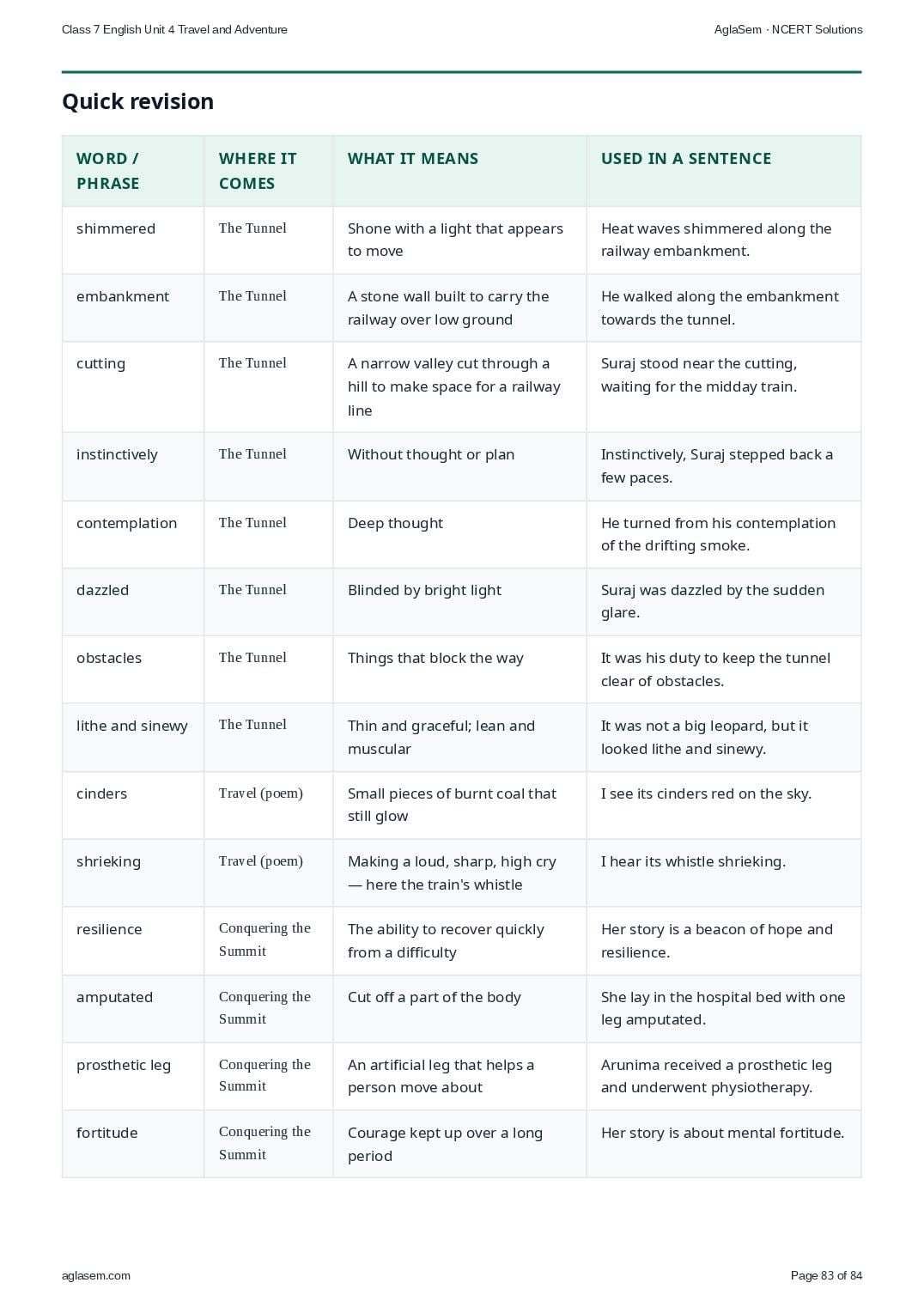
- The poet uses the word ‘shrieking' to tell us about the sound of the train's whistle. There are other words that tell us about different types of related sounds. Read the meanings of such words in Column 1 and match them with the words in Column 2. You may use a dictionary. Column 1: 1. shouting loudly, often in anger or excitement 2. crying out in fear or excitement 3. crying loudly with grief or sorrow 4. making a high-pitched, piercing sound 5. calling out loudly, often in a casual or informal way 6. crying softly in a low, broken voice 7. crying loudly and uncontrollably — Column 2: (i) wailing (ii) hollering (iii) screeching (iv) yelling (v) whimpering (vi) bawling (vii) screaming
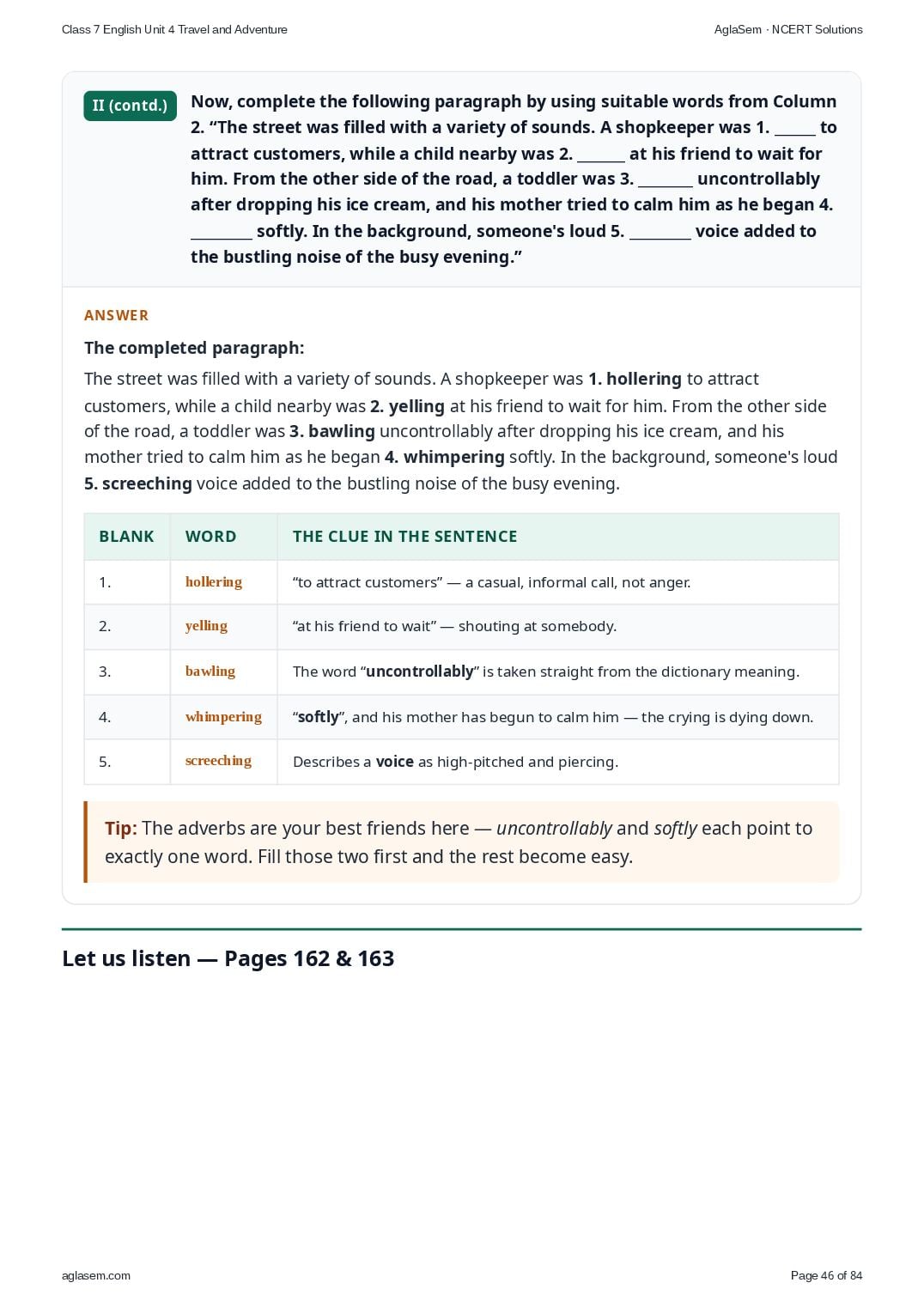
- Now, complete the following paragraph by using suitable words from Column 2. “The street was filled with a variety of sounds. A shopkeeper was 1. ______ to attract customers, while a child nearby was 2. _______ at his friend to wait for him. From the other side of the road, a toddler was 3. ________ uncontrollably after dropping his ice cream, and his mother tried to calm him as he began 4. _________ softly. In the background, someone's loud 5. _________ voice added to the bustling noise of the busy evening.”
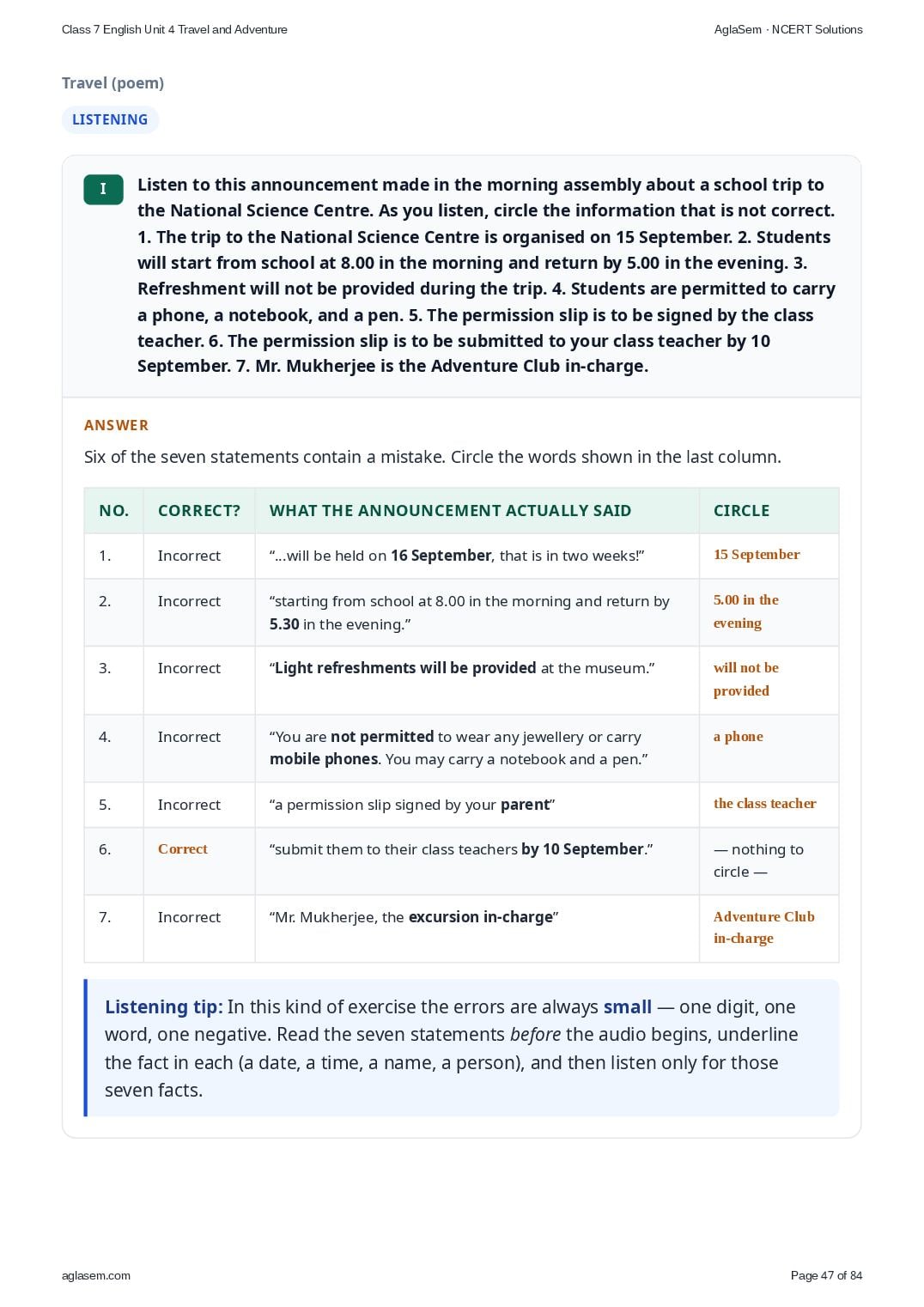
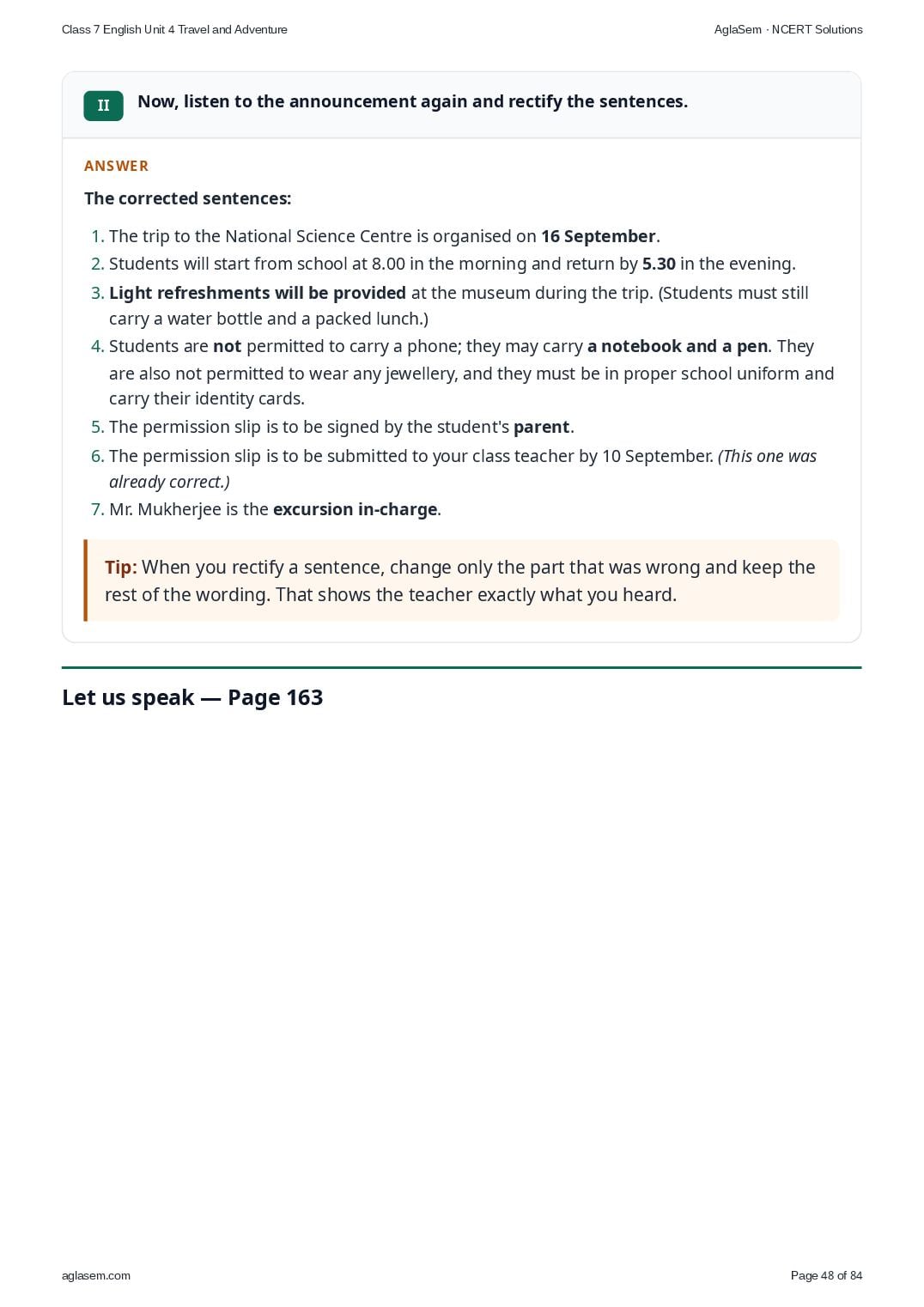
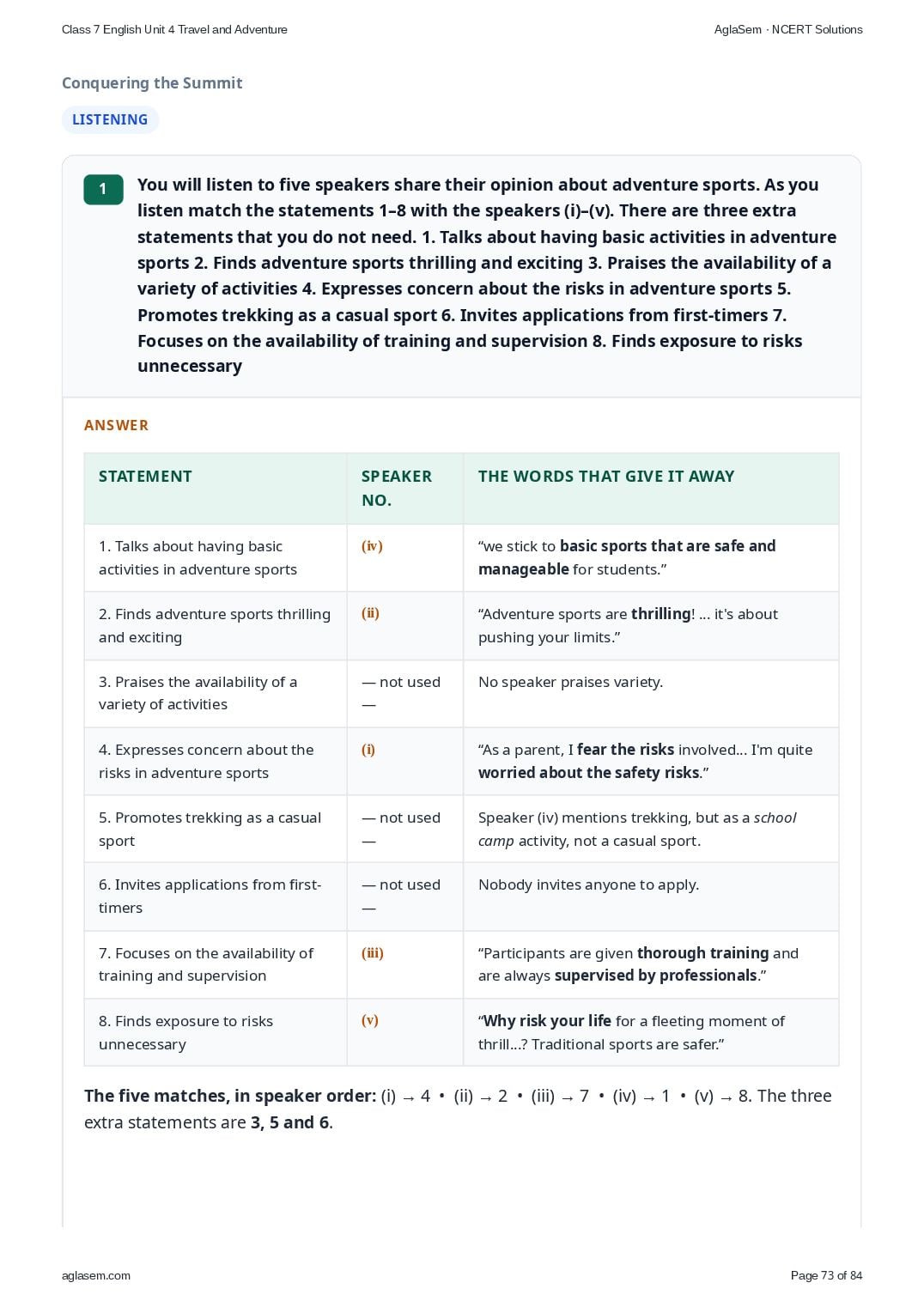
- Listen to this announcement made in the morning assembly about a school trip to the National Science Centre. As you listen, circle the information that is not correct. 1. The trip to the National Science Centre is organised on 15 September. 2. Students will start from school at 8.00 in the morning and return by 5.00 in the evening. 3. Refreshment will not be provided during the trip. 4. Students are permitted to carry a phone, a notebook, and a pen. 5. The permission slip is to be signed by the class teacher. 6. The permission slip is to be submitted to your class teacher by 10 September. 7. Mr. Mukherjee is the Adventure Club in-charge.
- Now, listen to the announcement again and rectify the sentences.
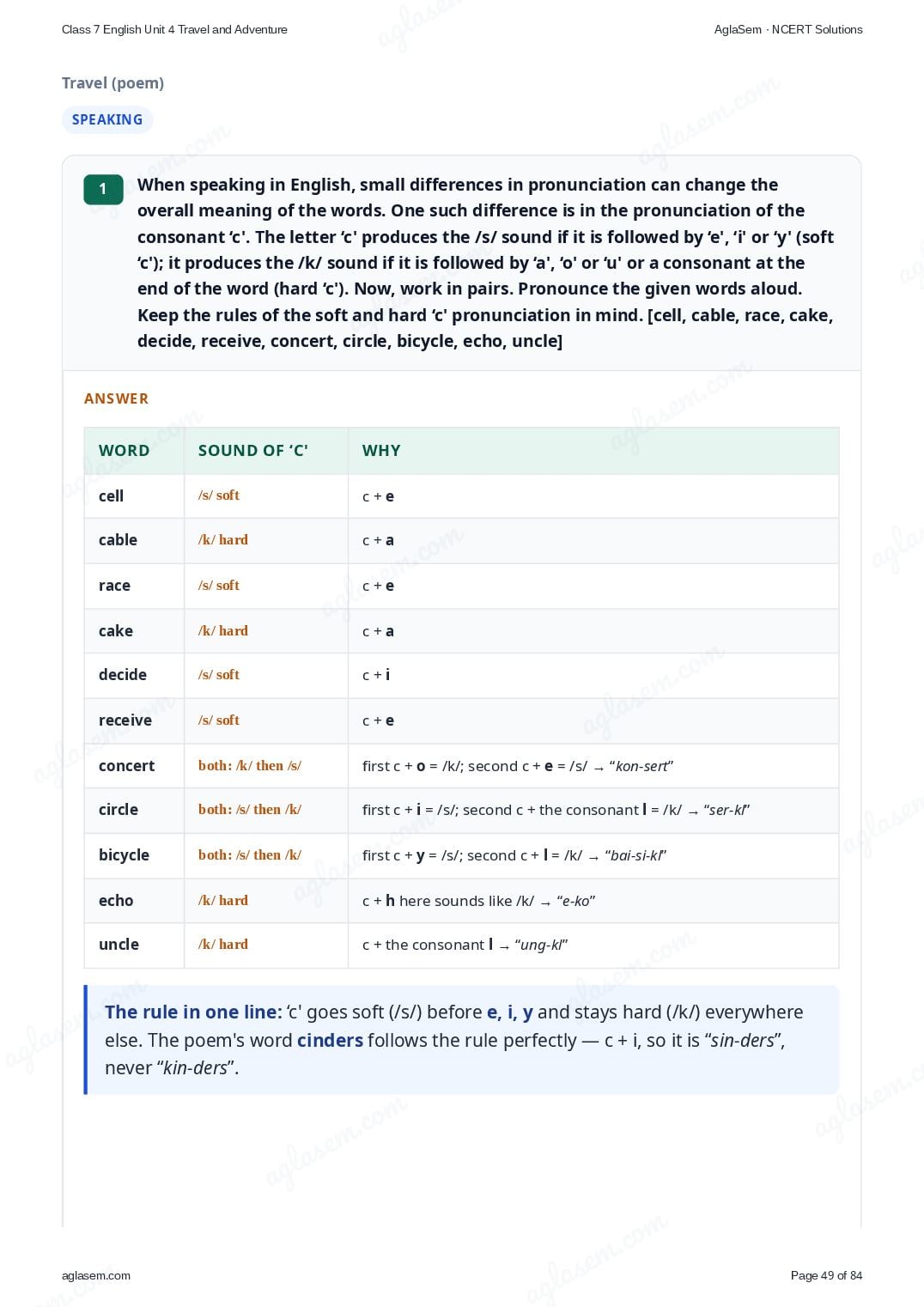
- When speaking in English, small differences in pronunciation can change the overall meaning of the words. One such difference is in the pronunciation of the consonant ‘c'. The letter ‘c' produces the /s/ sound if it is followed by ‘e', ‘i' or ‘y' (soft ‘c'); it produces the /k/ sound if it is followed by ‘a', ‘o' or ‘u' or a consonant at the end of the word (hard ‘c'). Now, work in pairs. Pronounce the given words aloud. Keep the rules of the soft and hard ‘c' pronunciation in mind. [cell, cable, race, cake, decide, receive, concert, circle, bicycle, echo, uncle]
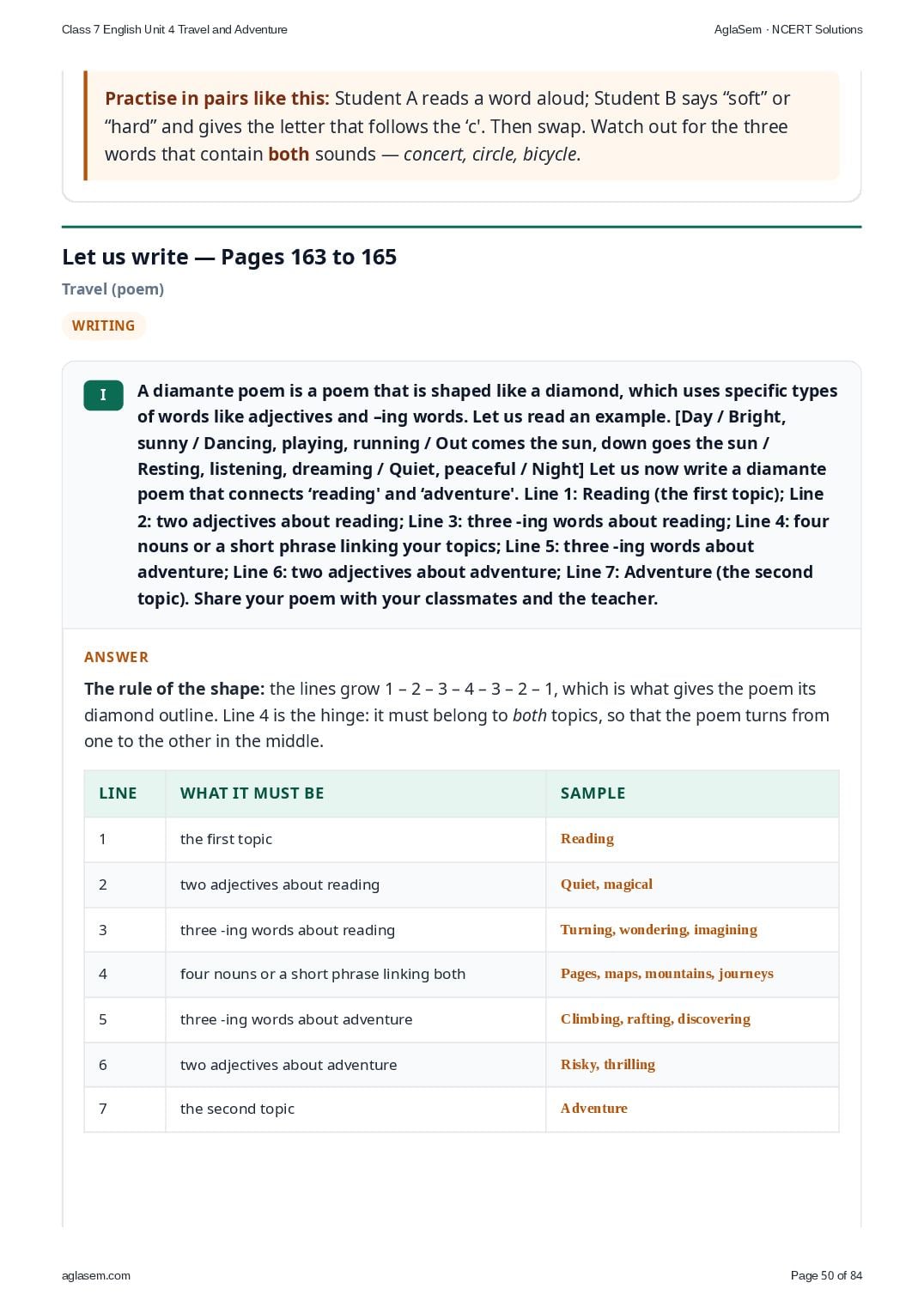
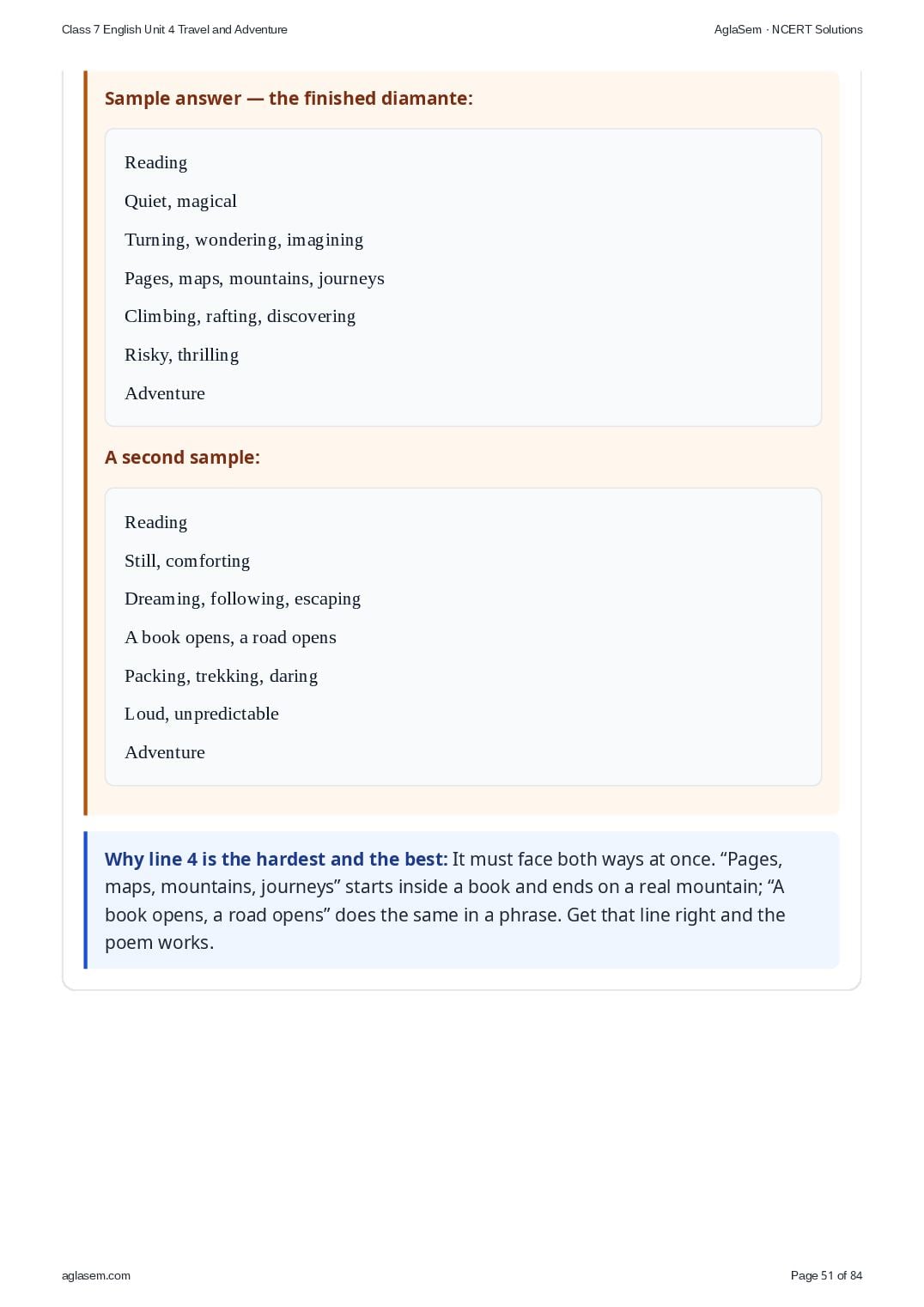
- A diamante poem is a poem that is shaped like a diamond, which uses specific types of words like adjectives and –ing words. Let us read an example. [Day / Bright, sunny / Dancing, playing, running / Out comes the sun, down goes the sun / Resting, listening, dreaming / Quiet, peaceful / Night] Let us now write a diamante poem that connects ‘reading' and ‘adventure'. Line 1: Reading (the first topic); Line 2: two adjectives about reading; Line 3: three -ing words about reading; Line 4: four nouns or a short phrase linking your topics; Line 5: three -ing words about adventure; Line 6: two adjectives about adventure; Line 7: Adventure (the second topic). Share your poem with your classmates and the teacher.
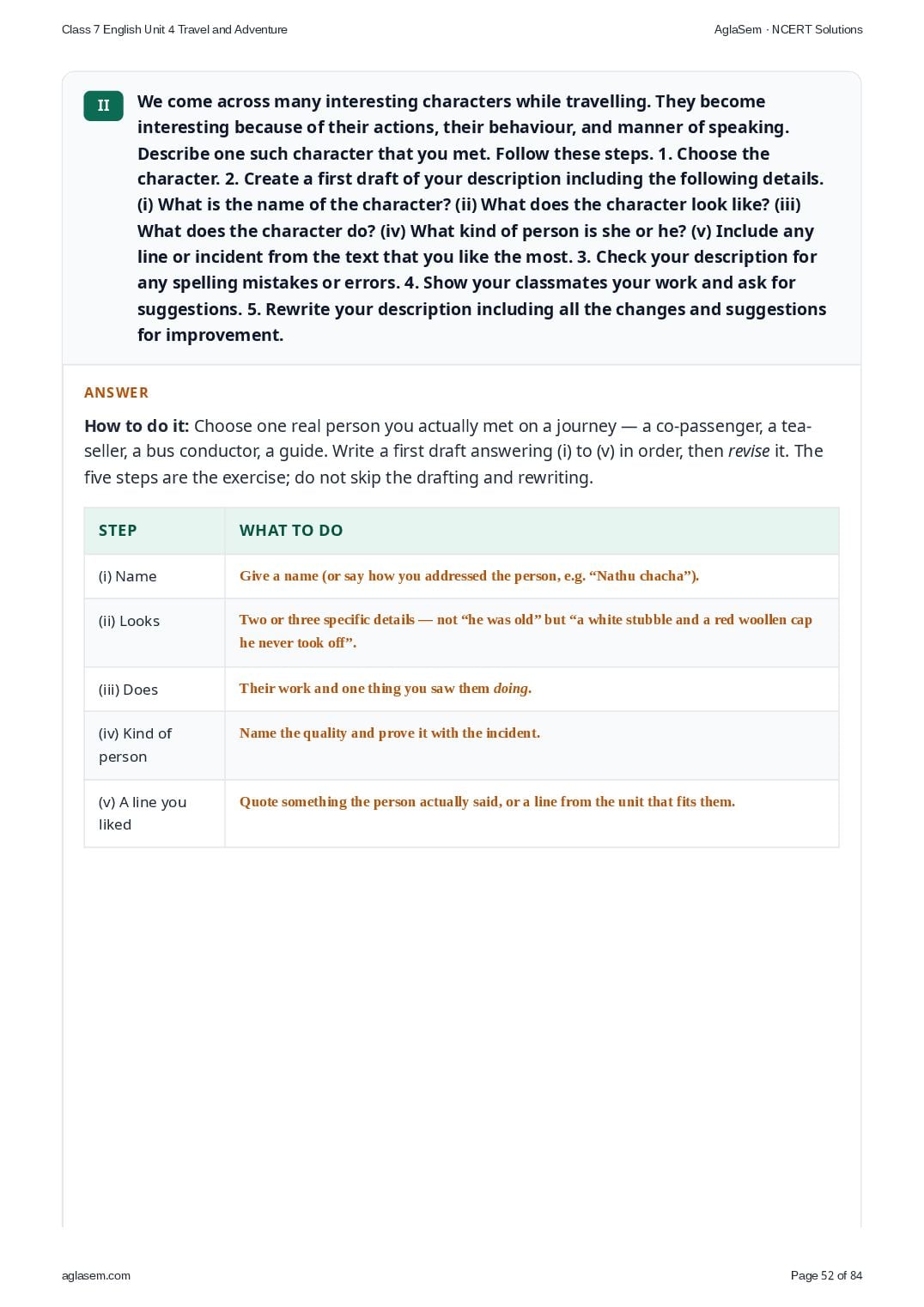
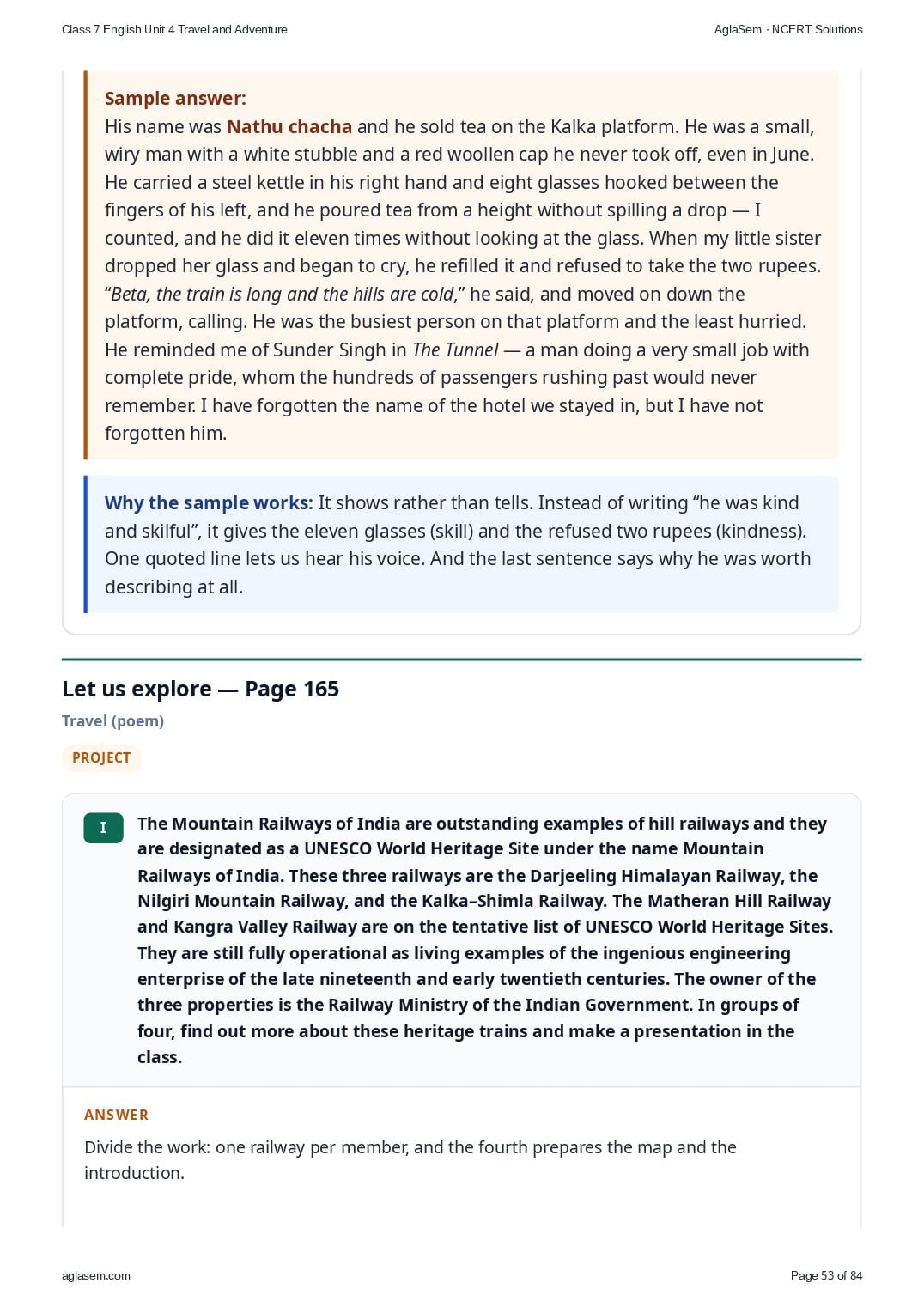
- We come across many interesting characters while travelling. They become interesting because of their actions, their behaviour, and manner of speaking. Describe one such character that you met. Follow these steps. 1. Choose the character. 2. Create a first draft of your description including the following details. (i) What is the name of the character? (ii) What does the character look like? (iii) What does the character do? (iv) What kind of person is she or he? (v) Include any line or incident from the text that you like the most. 3. Check your description for any spelling mistakes or errors. 4. Show your classmates your work and ask for suggestions. 5. Rewrite your description including all the changes and suggestions for improvement.
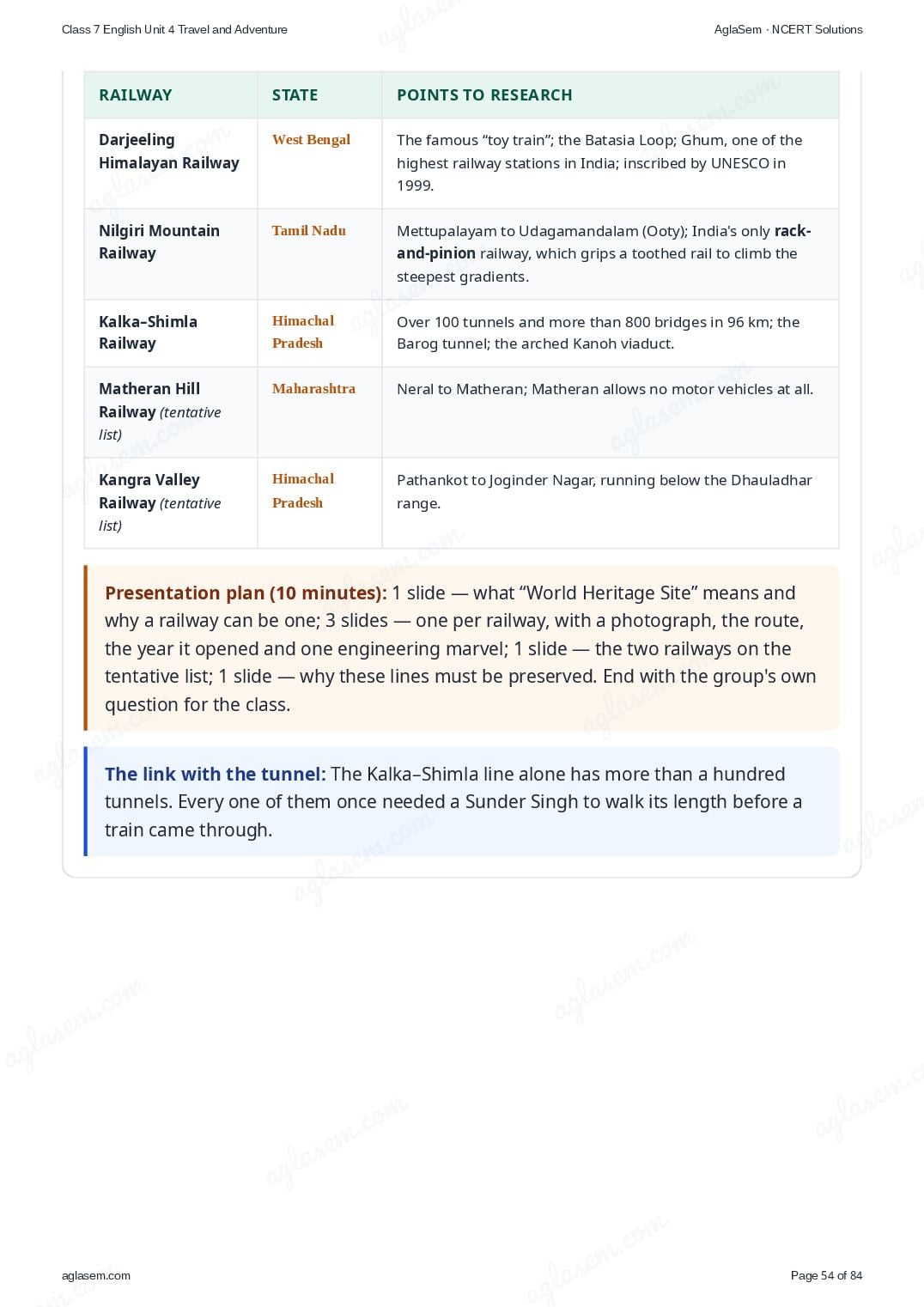
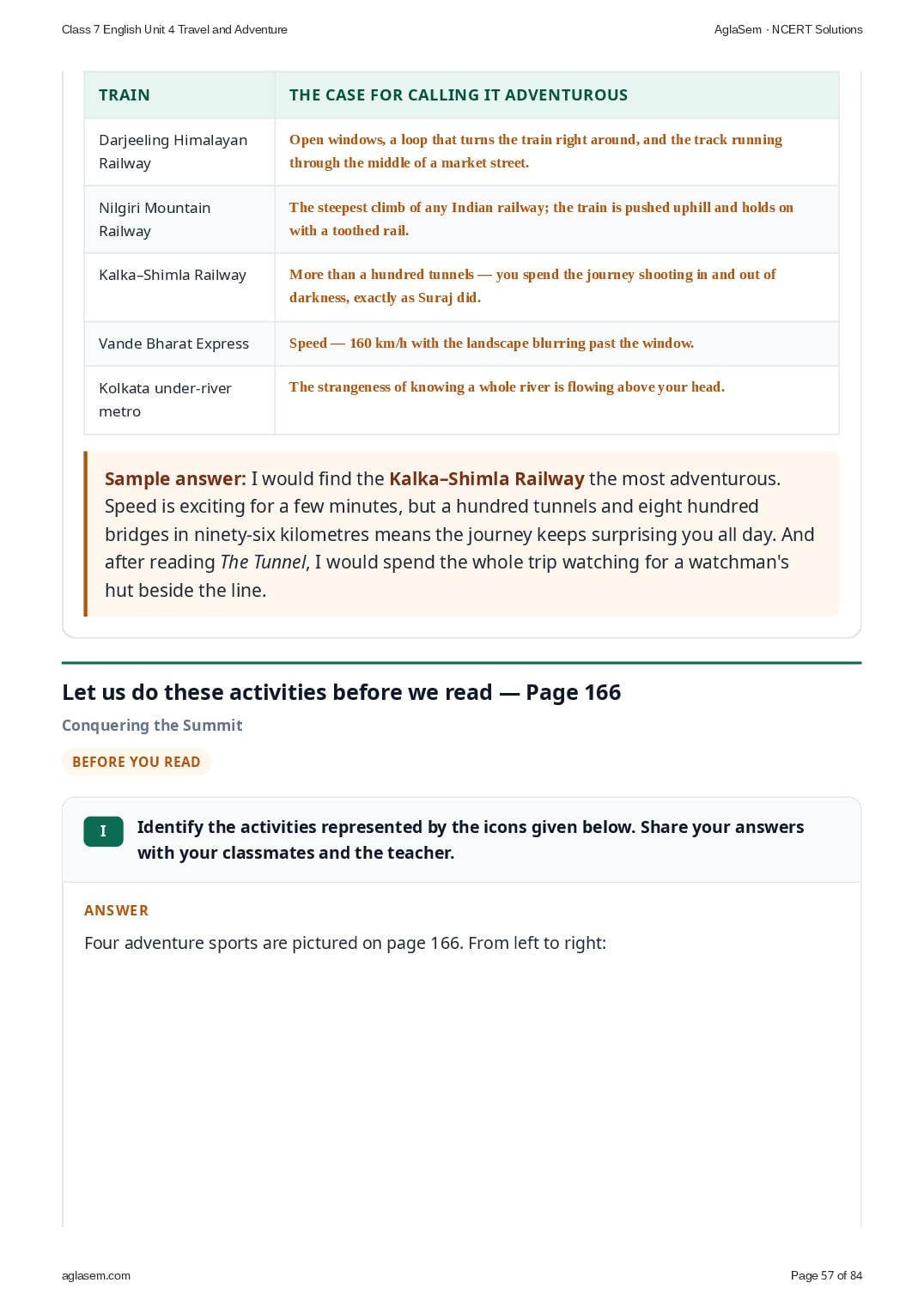
- The Mountain Railways of India are outstanding examples of hill railways and they are designated as a UNESCO World Heritage Site under the name Mountain Railways of India. These three railways are the Darjeeling Himalayan Railway, the Nilgiri Mountain Railway, and the Kalka–Shimla Railway. The Matheran Hill Railway and Kangra Valley Railway are on the tentative list of UNESCO World Heritage Sites. They are still fully operational as living examples of the ingenious engineering enterprise of the late nineteenth and early twentieth centuries. The owner of the three properties is the Railway Ministry of the Indian Government. In groups of four, find out more about these heritage trains and make a presentation in the class.
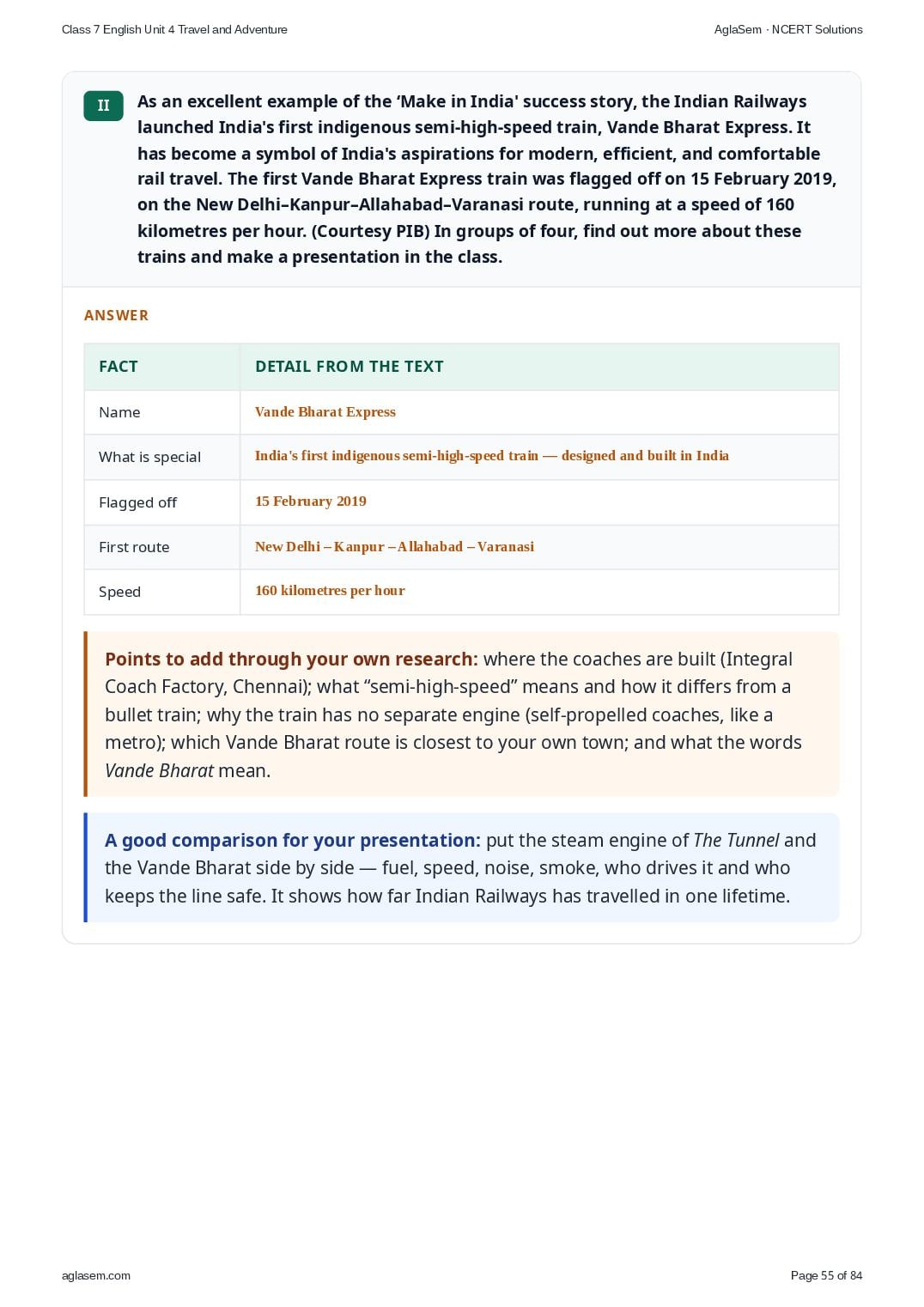
- As an excellent example of the ‘Make in India' success story, the Indian Railways launched India's first indigenous semi-high-speed train, Vande Bharat Express. It has become a symbol of India's aspirations for modern, efficient, and comfortable rail travel. The first Vande Bharat Express train was flagged off on 15 February 2019, on the New Delhi–Kanpur–Allahabad–Varanasi route, running at a speed of 160 kilometres per hour. (Courtesy PIB) In groups of four, find out more about these trains and make a presentation in the class.
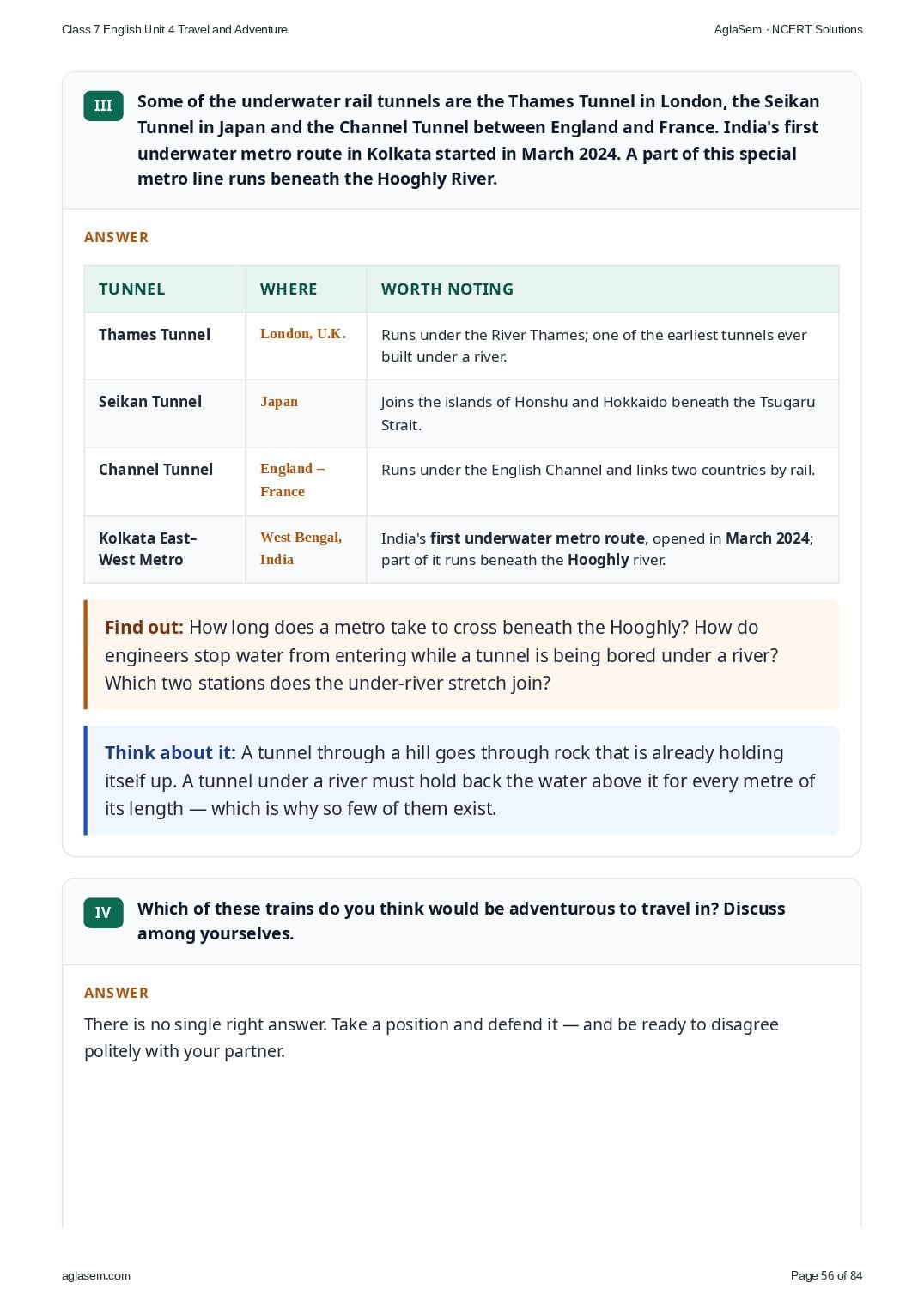
- Some of the underwater rail tunnels are the Thames Tunnel in London, the Seikan Tunnel in Japan and the Channel Tunnel between England and France. India's first underwater metro route in Kolkata started in March 2024. A part of this special metro line runs beneath the Hooghly River.
- Which of these trains do you think would be adventurous to travel in? Discuss among yourselves.
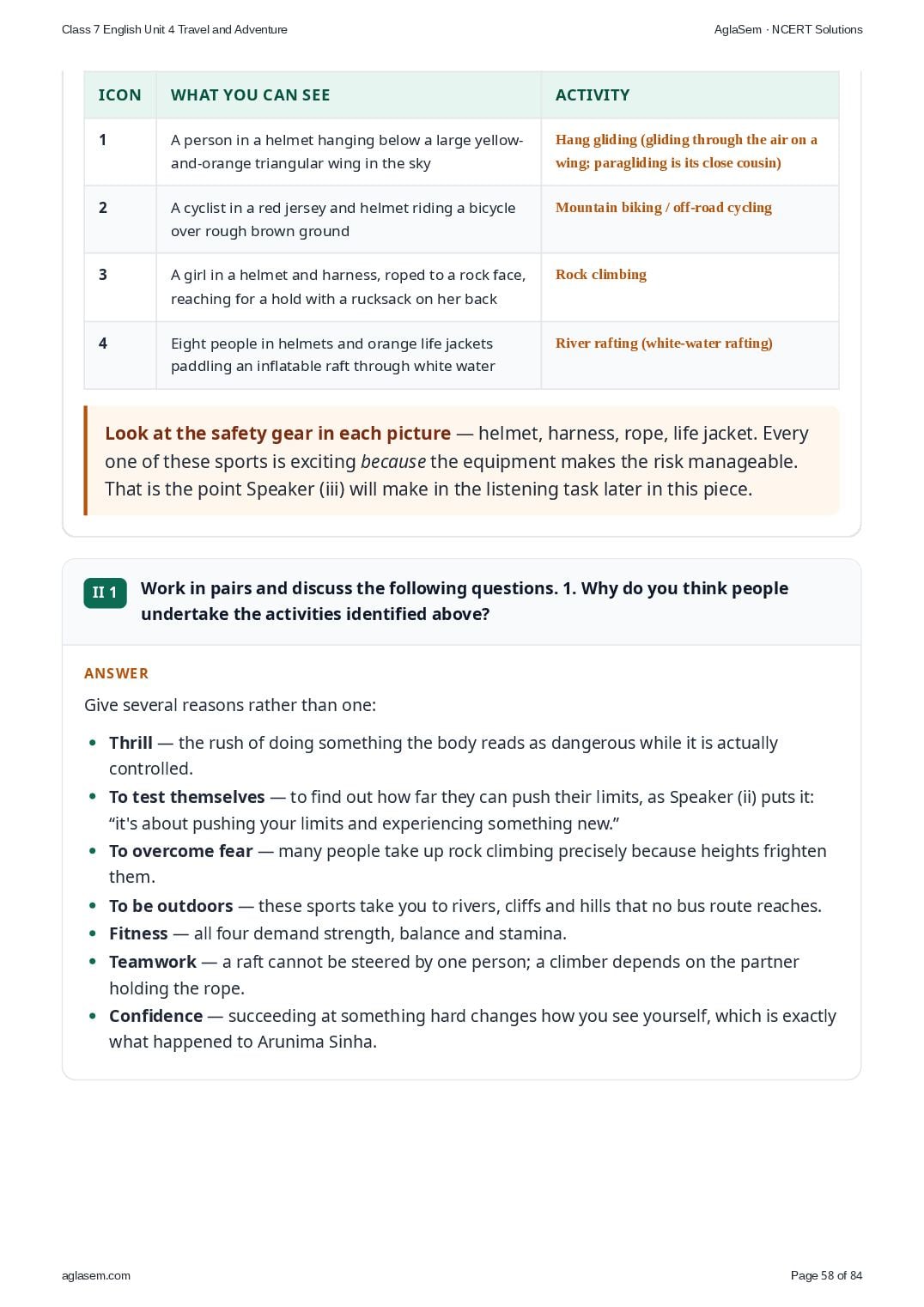
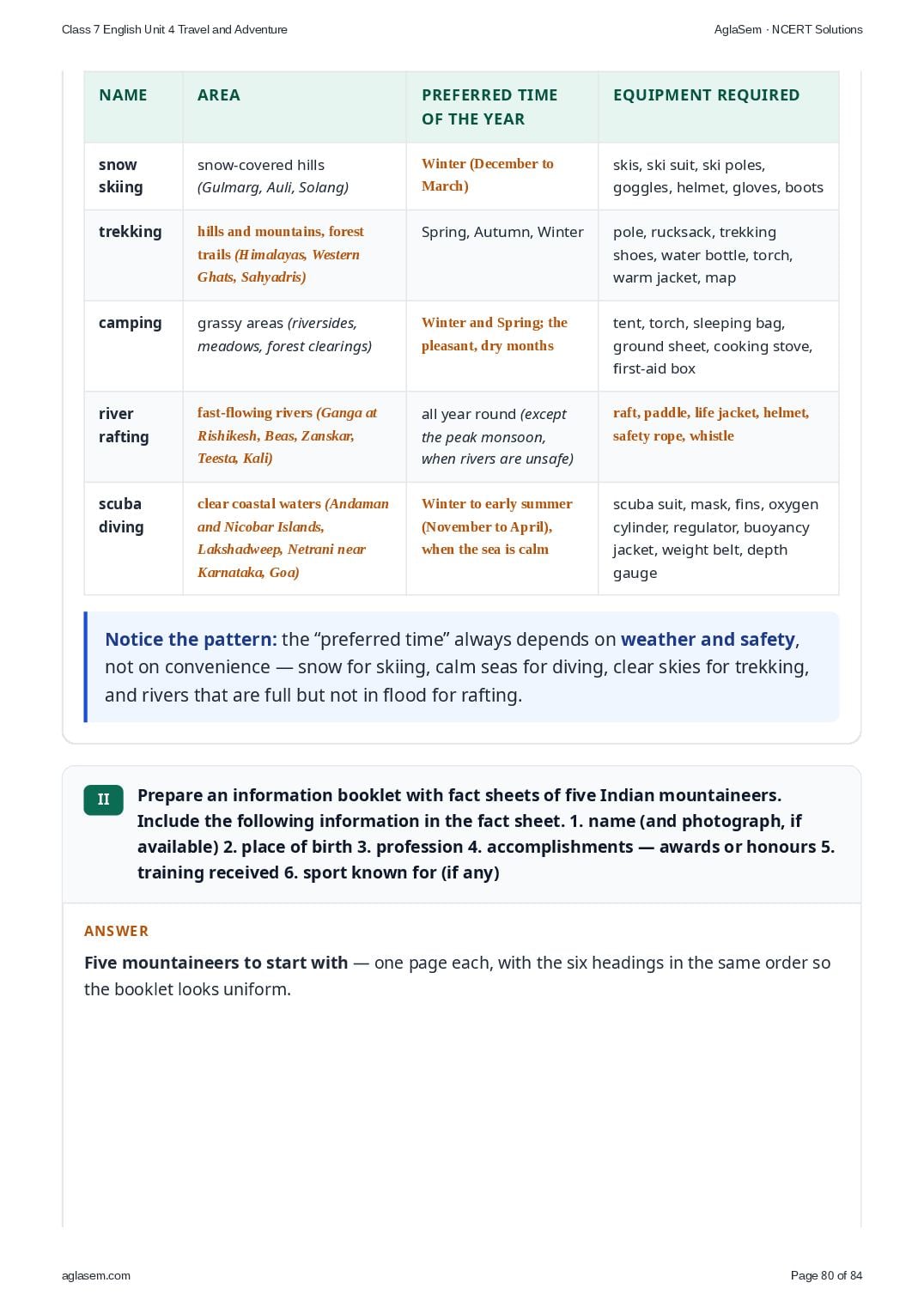
- Identify the activities represented by the icons given below. Share your answers with your classmates and the teacher.
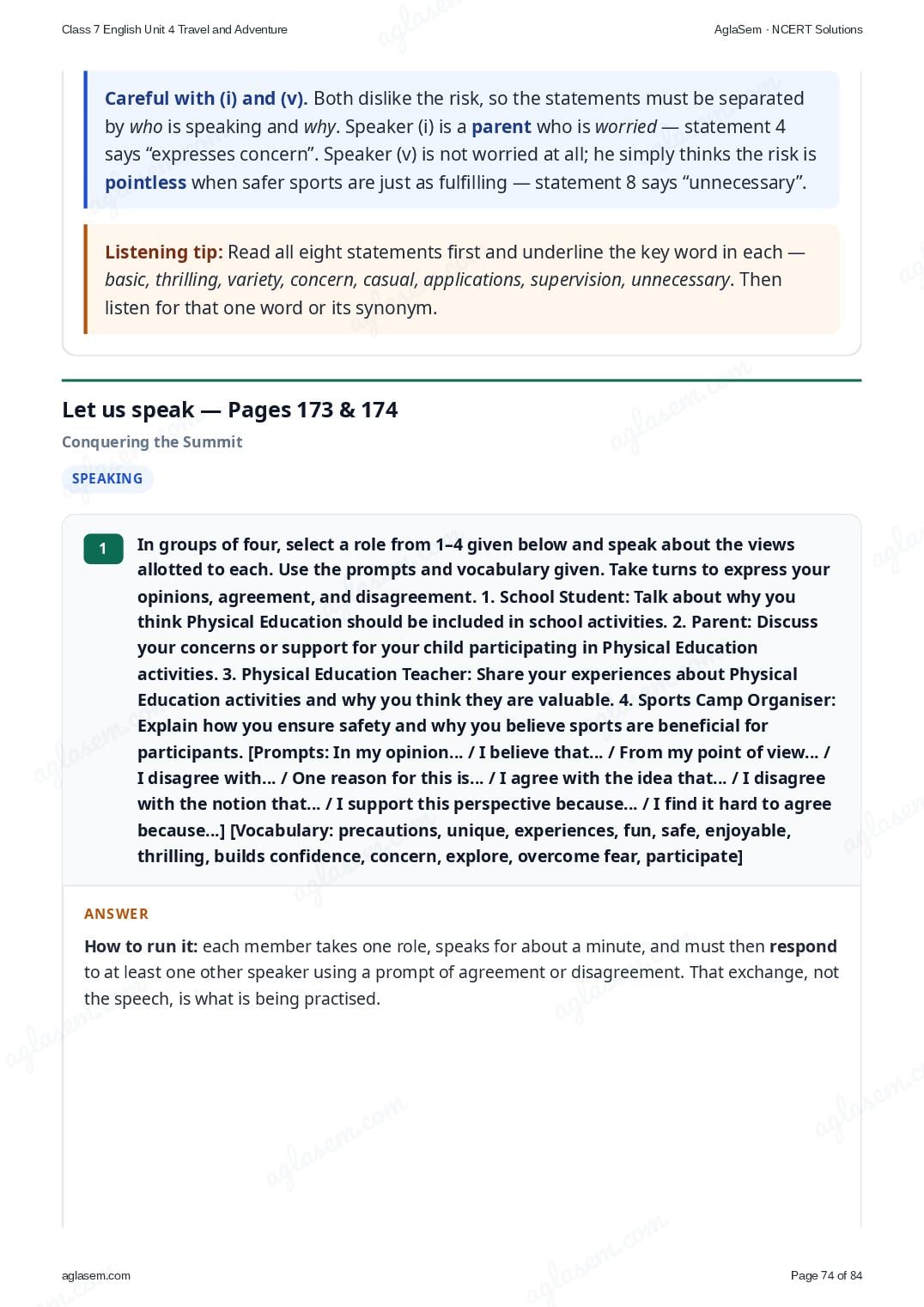
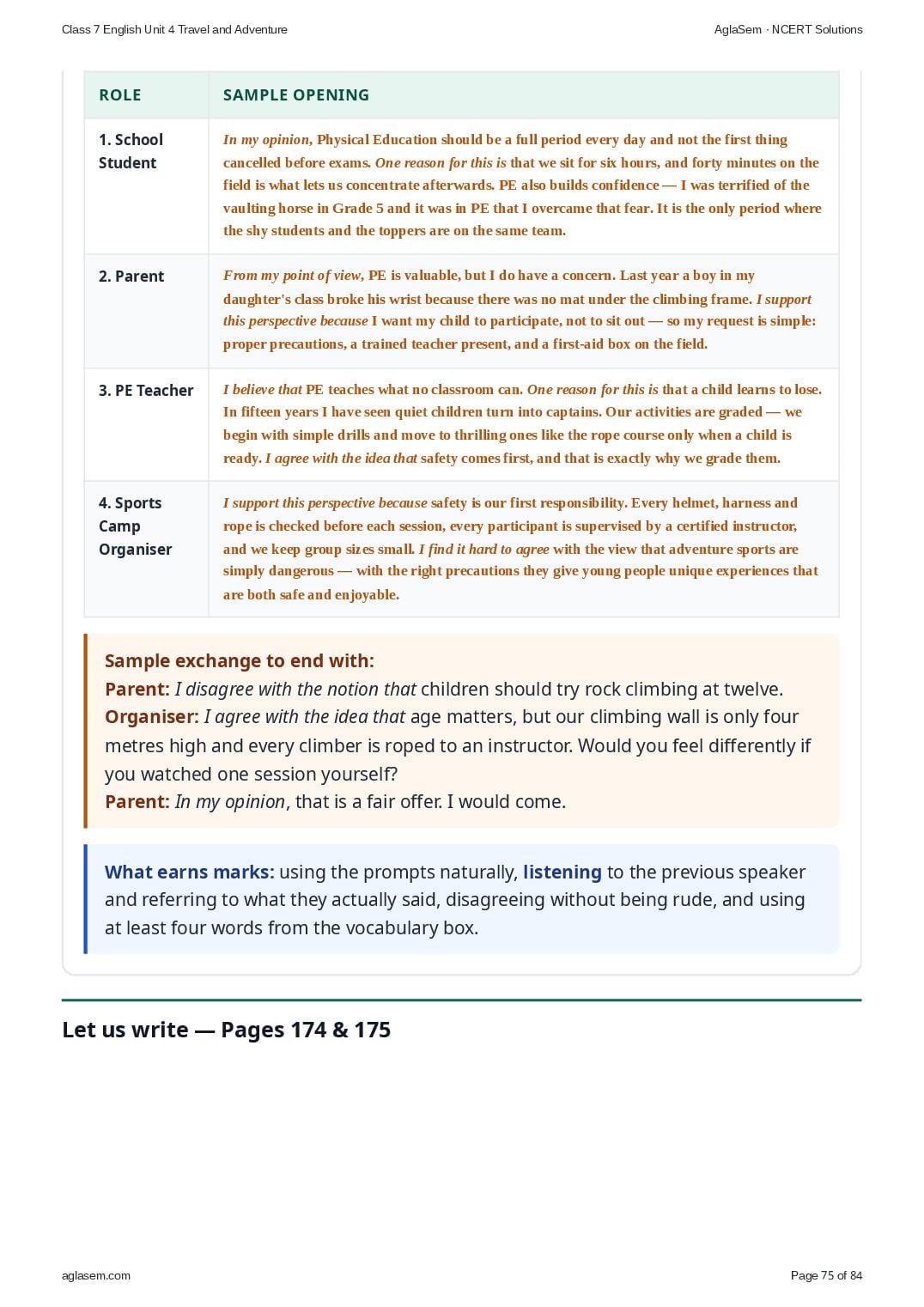
- Work in pairs and discuss the following questions. 1. Why do you think people undertake the activities identified above?
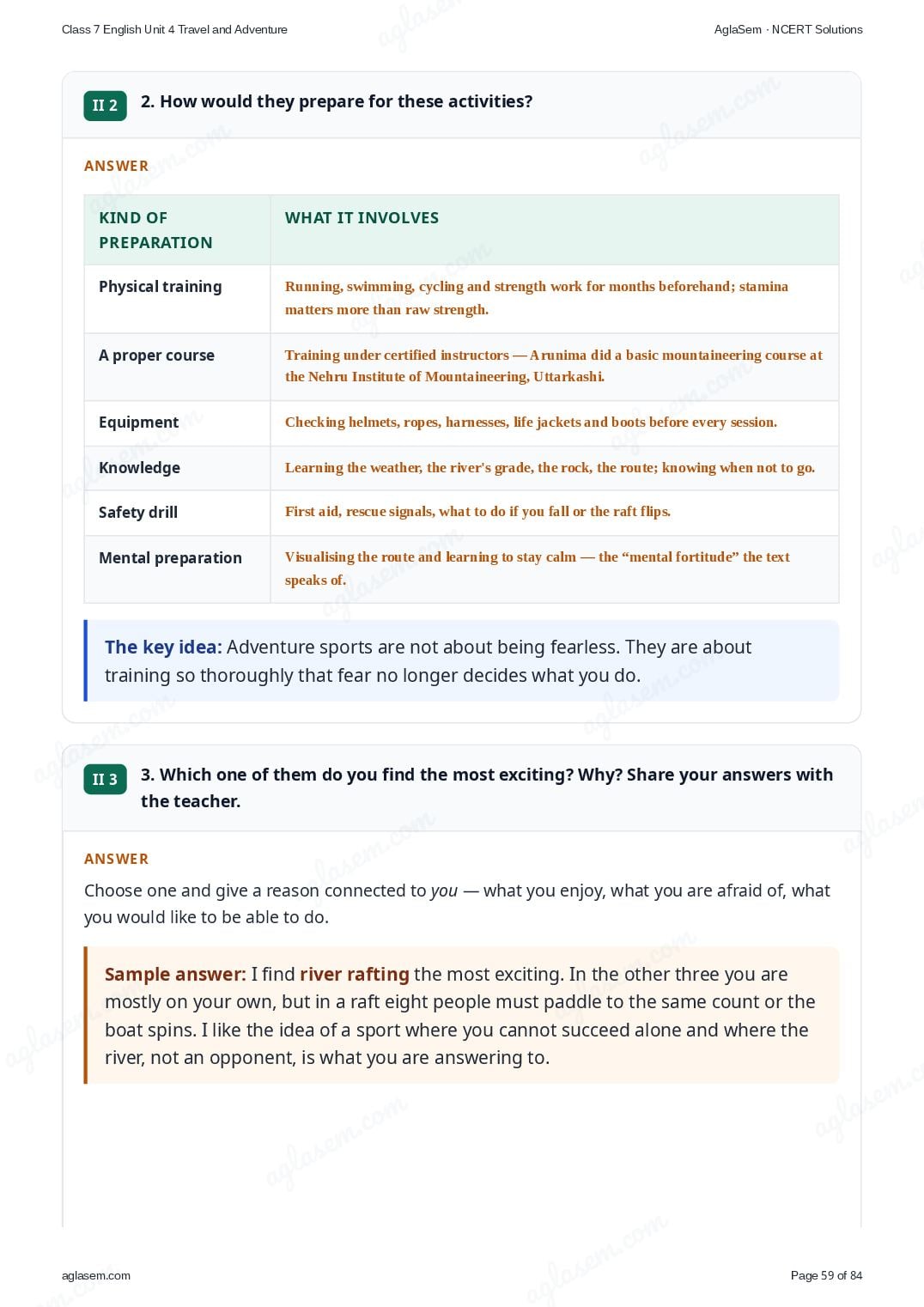
- 2. How would they prepare for these activities?
- 3. Which one of them do you find the most exciting? Why? Share your answers with the teacher.
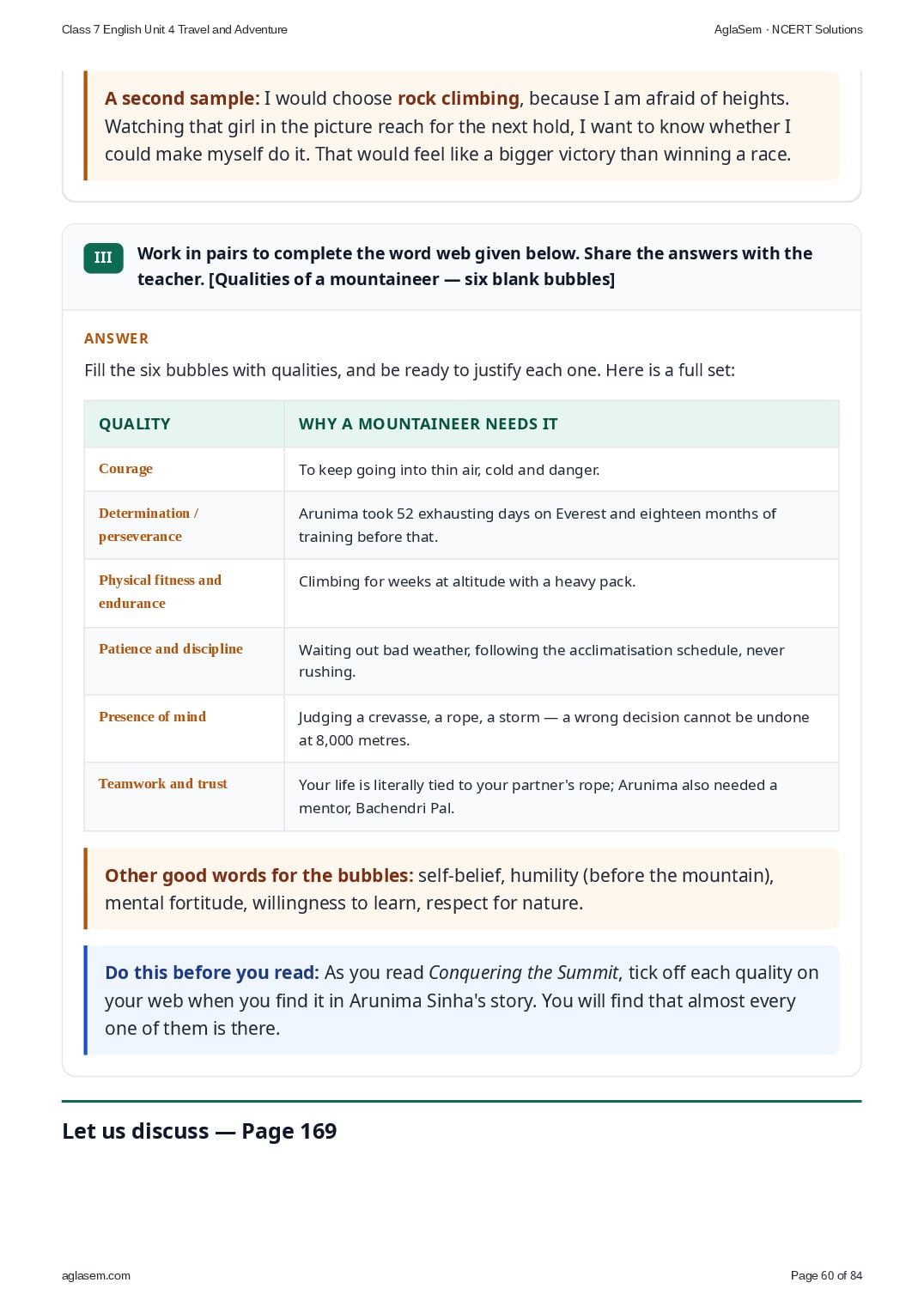
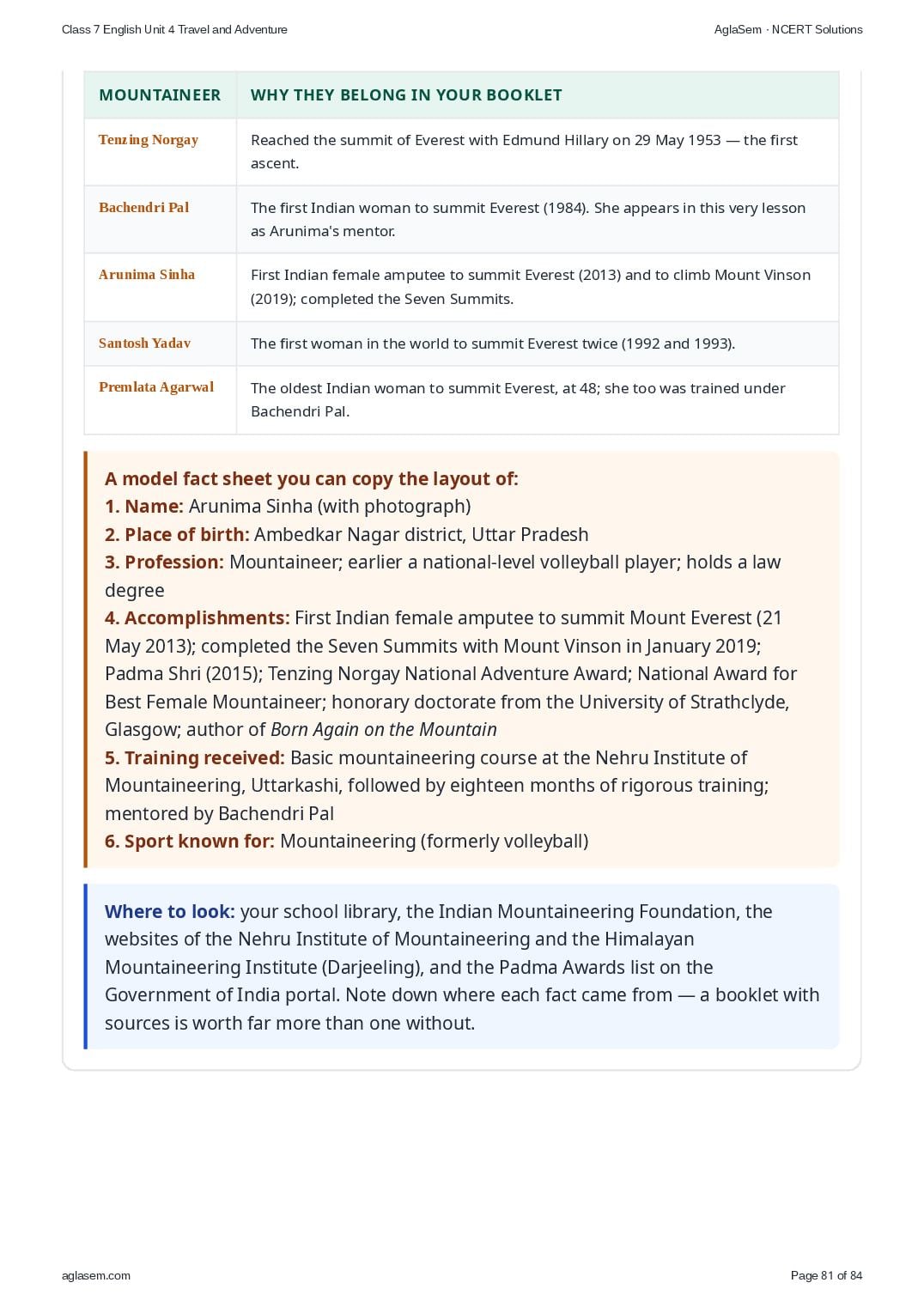
- Work in pairs to complete the word web given below. Share the answers with the teacher. [Qualities of a mountaineer — six blank bubbles]
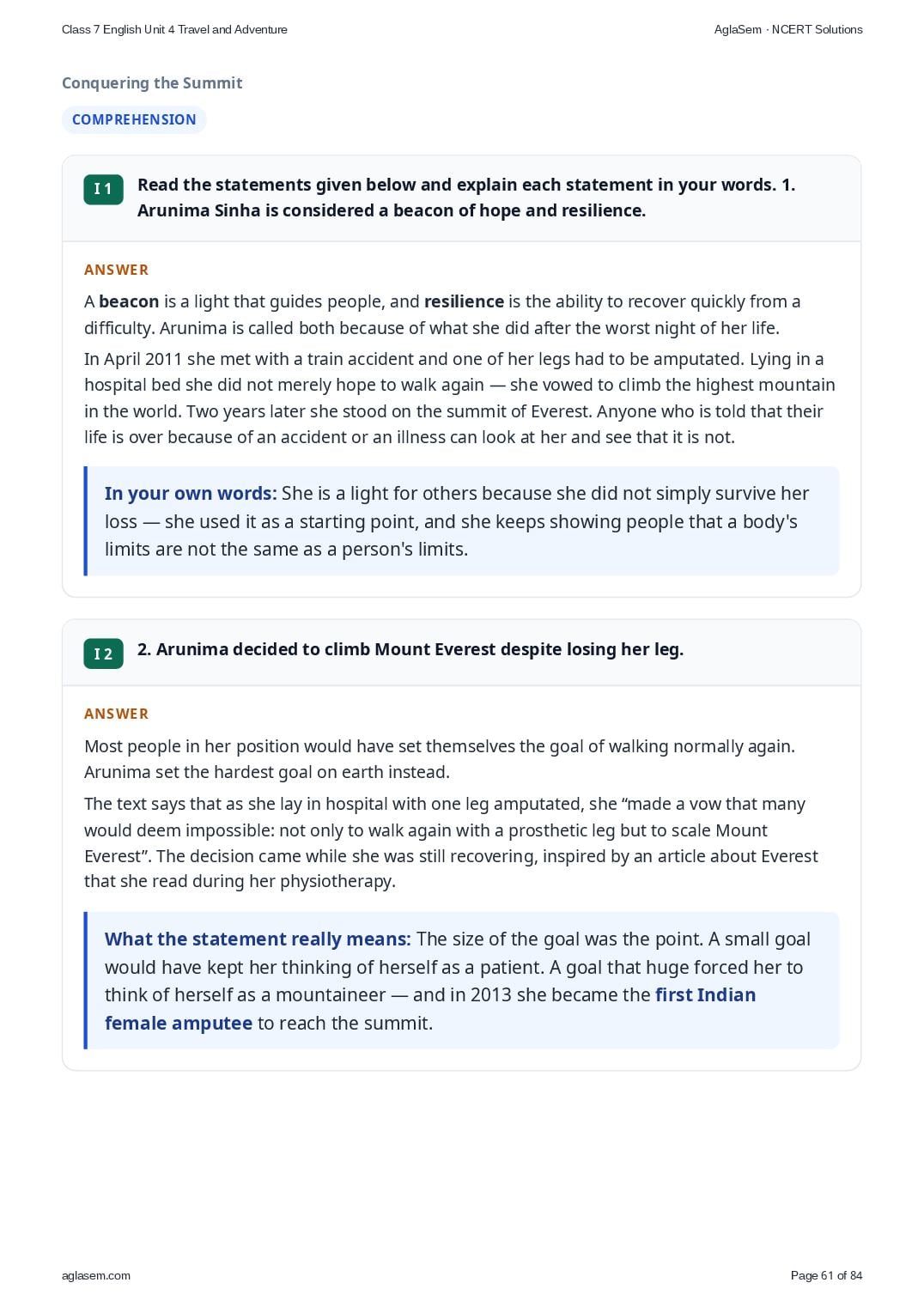
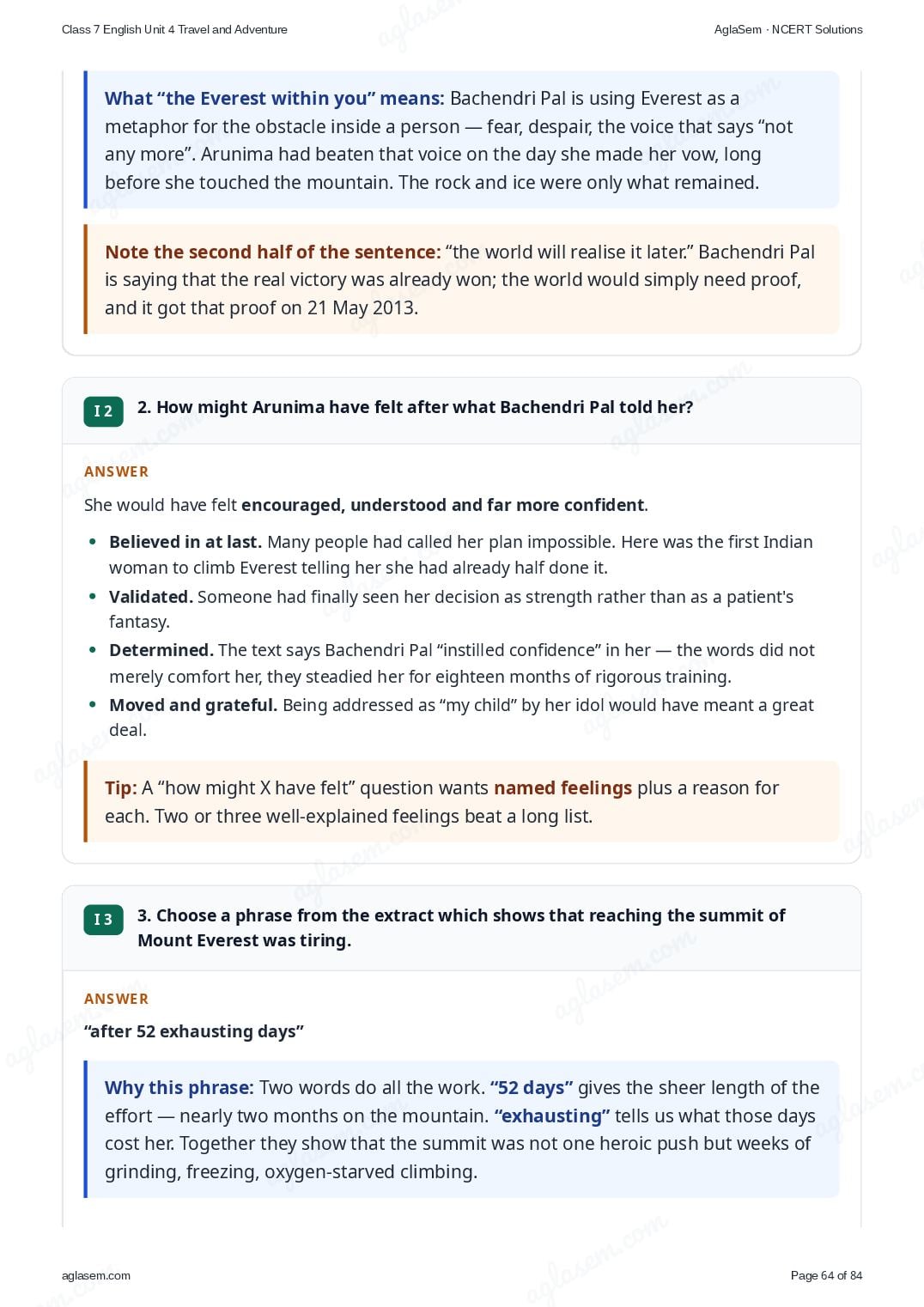
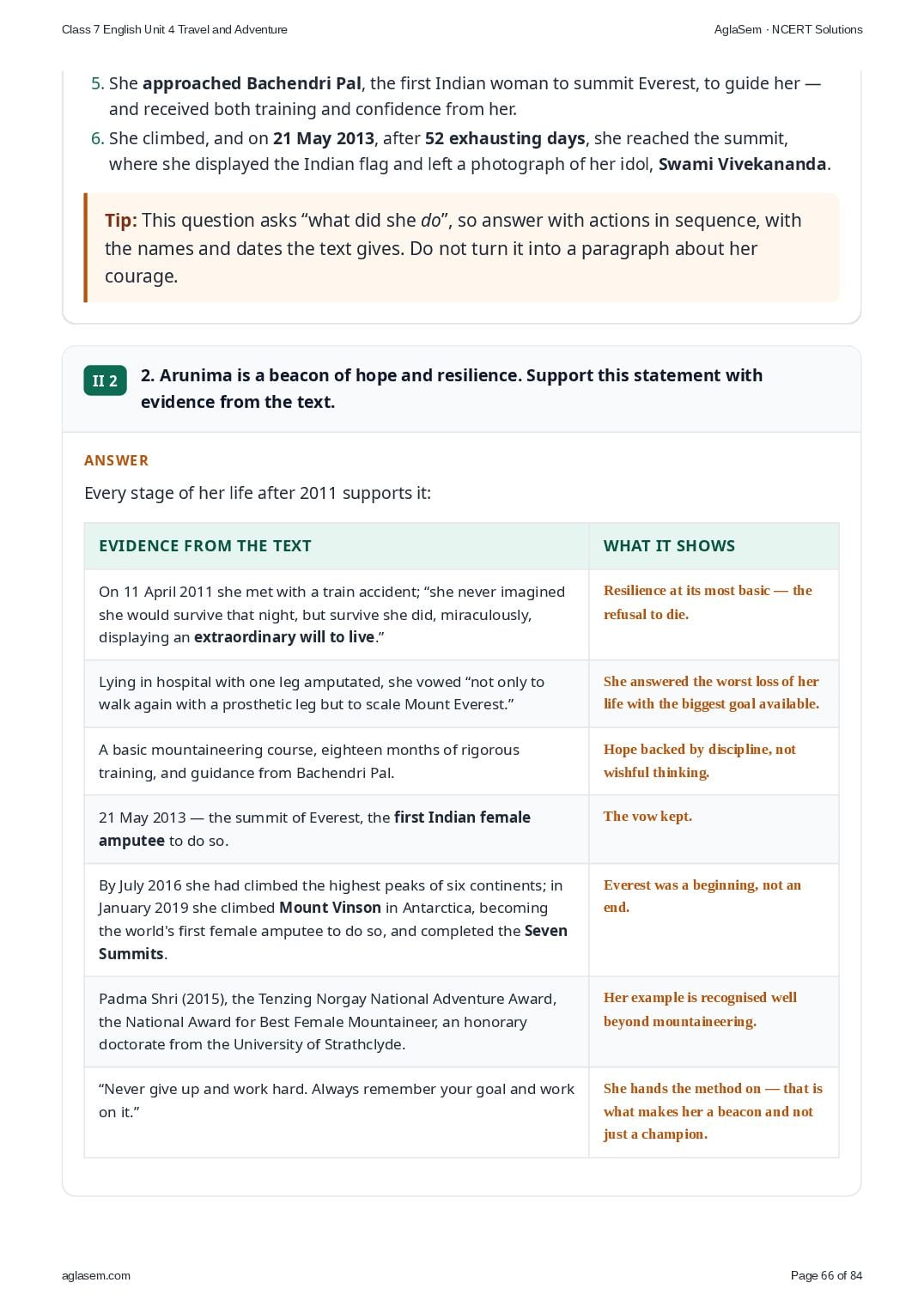
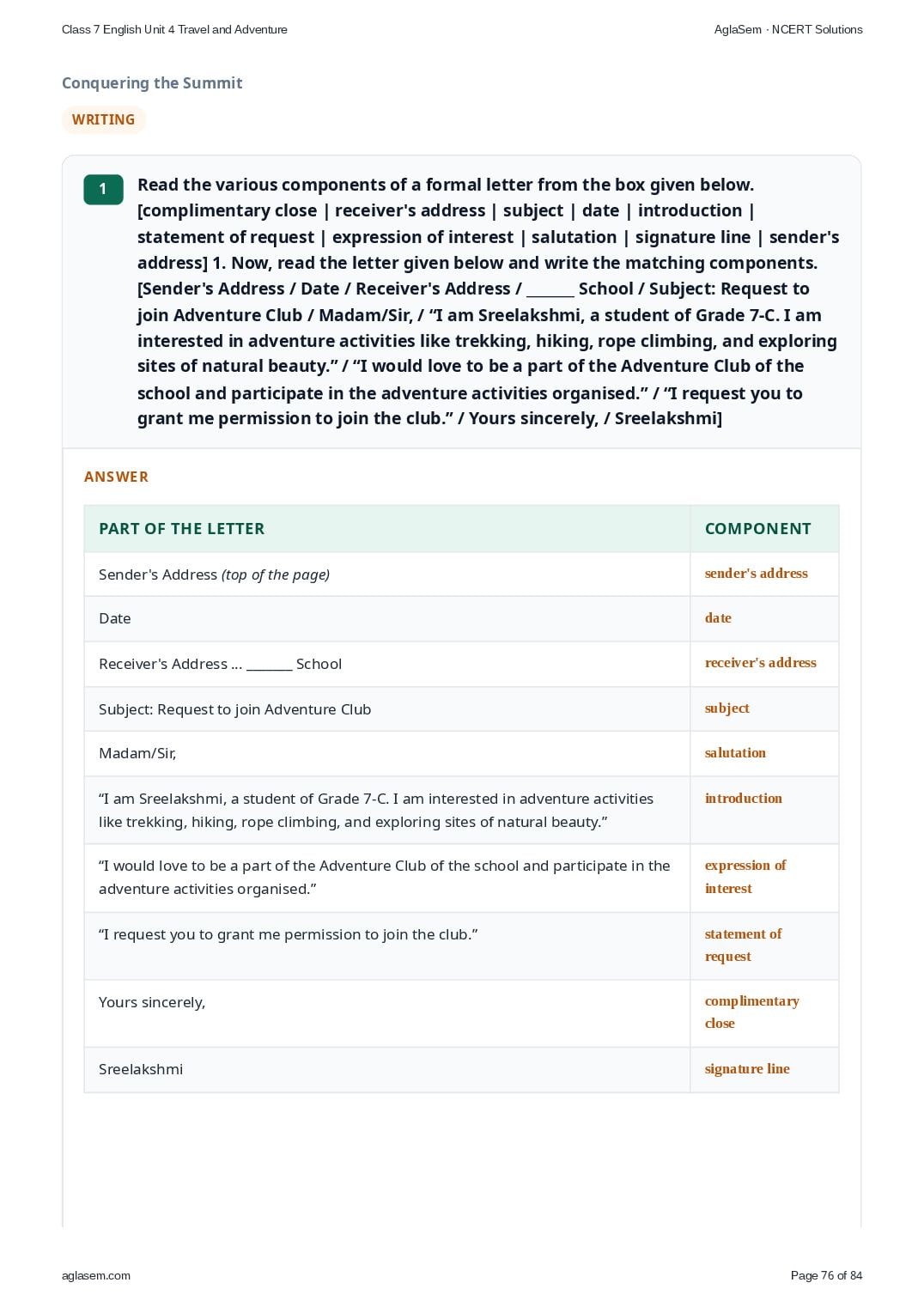
- Read the statements given below and explain each statement in your words. 1. Arunima Sinha is considered a beacon of hope and resilience.
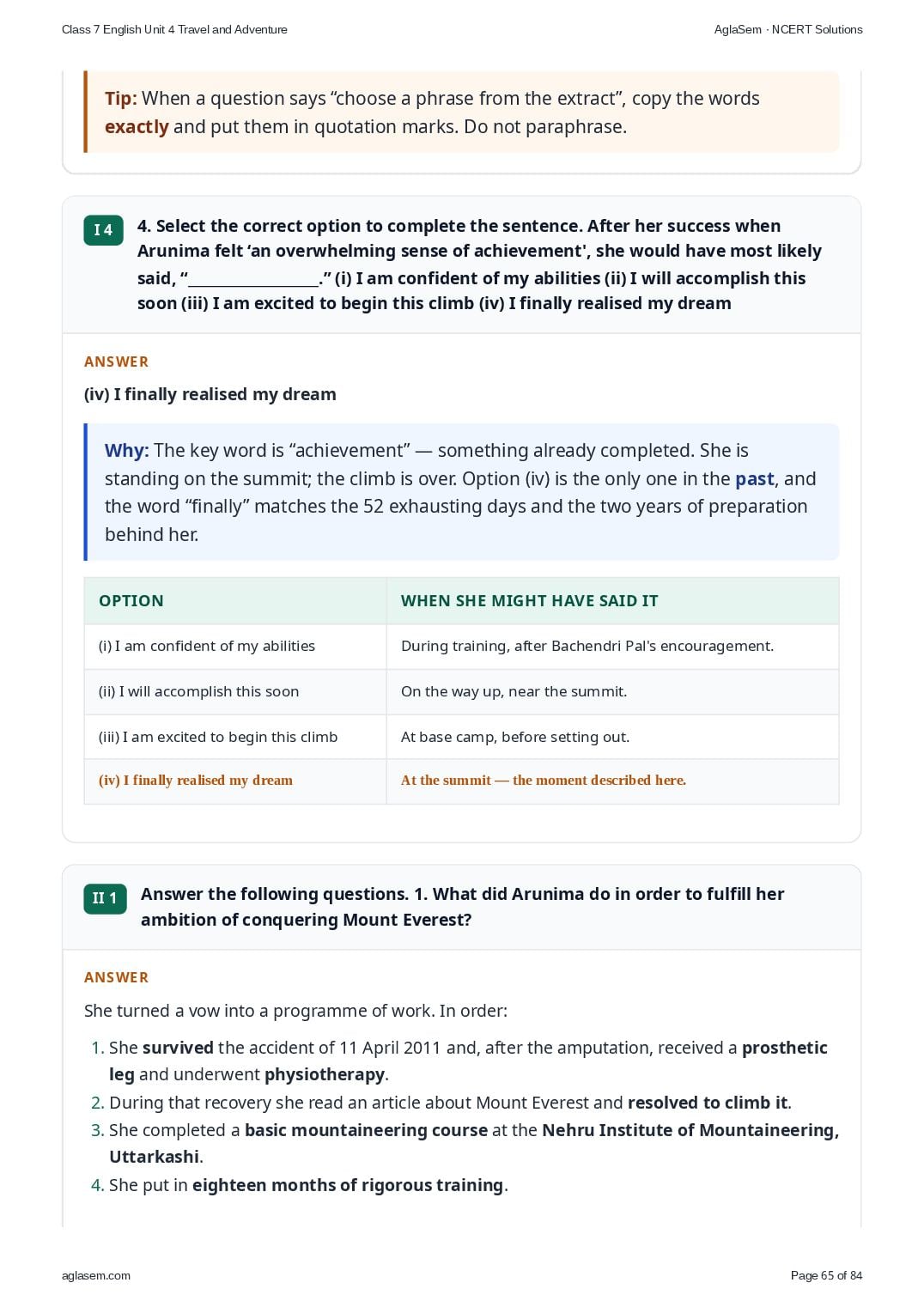
- 2. Arunima decided to climb Mount Everest despite losing her leg.
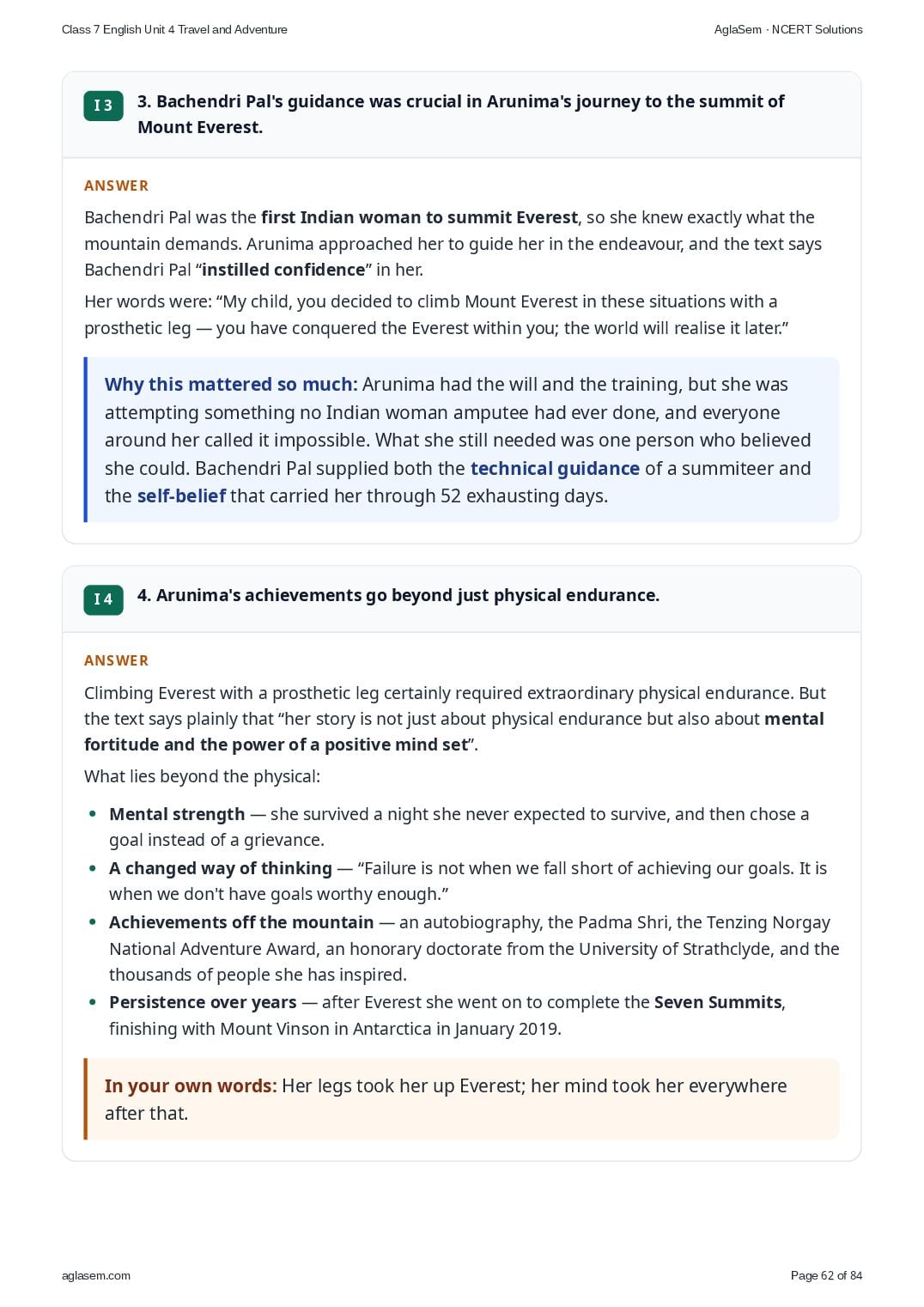
- 3. Bachendri Pal's guidance was crucial in Arunima's journey to the summit of Mount Everest.
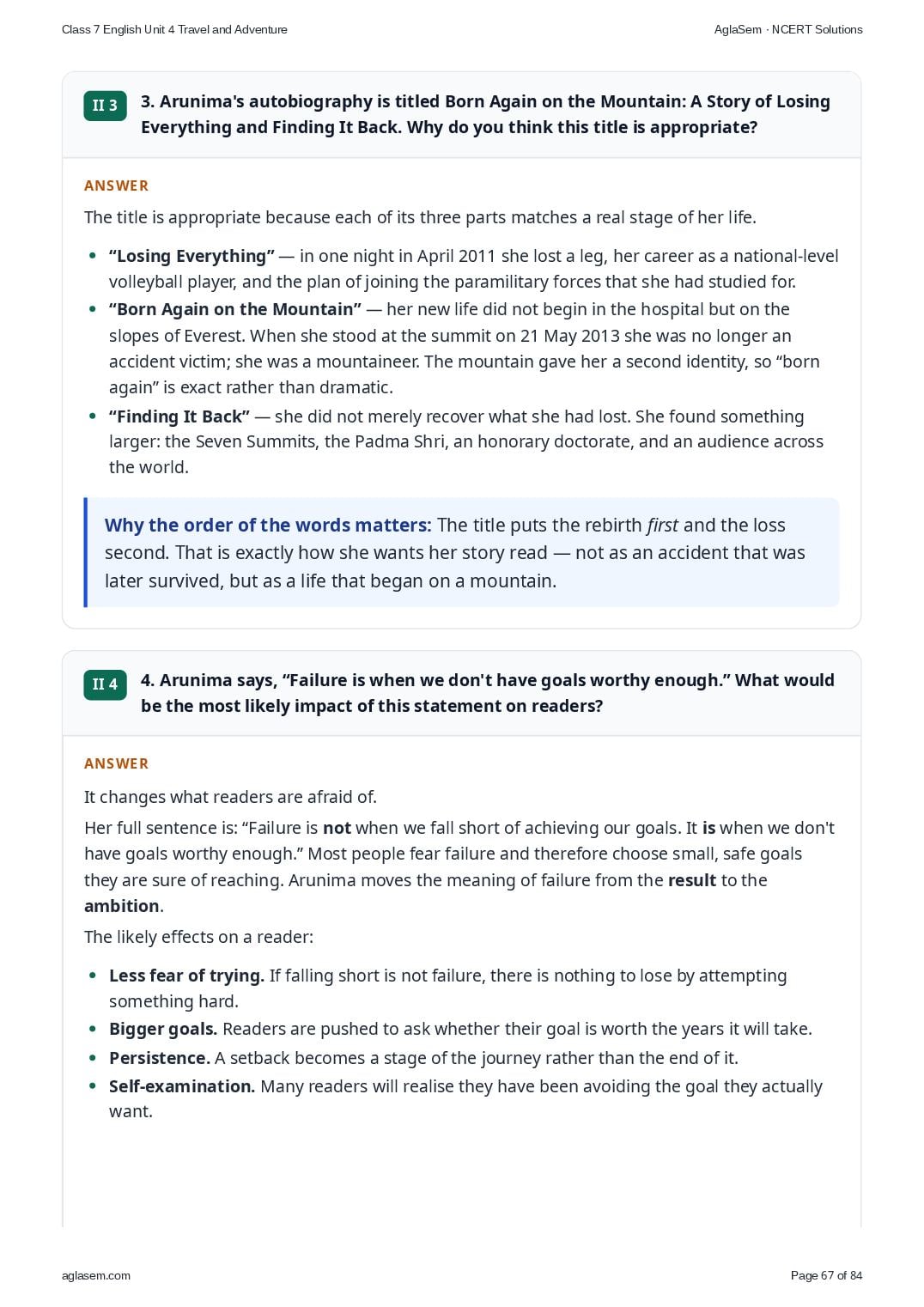
- 4. Arunima's achievements go beyond just physical endurance.
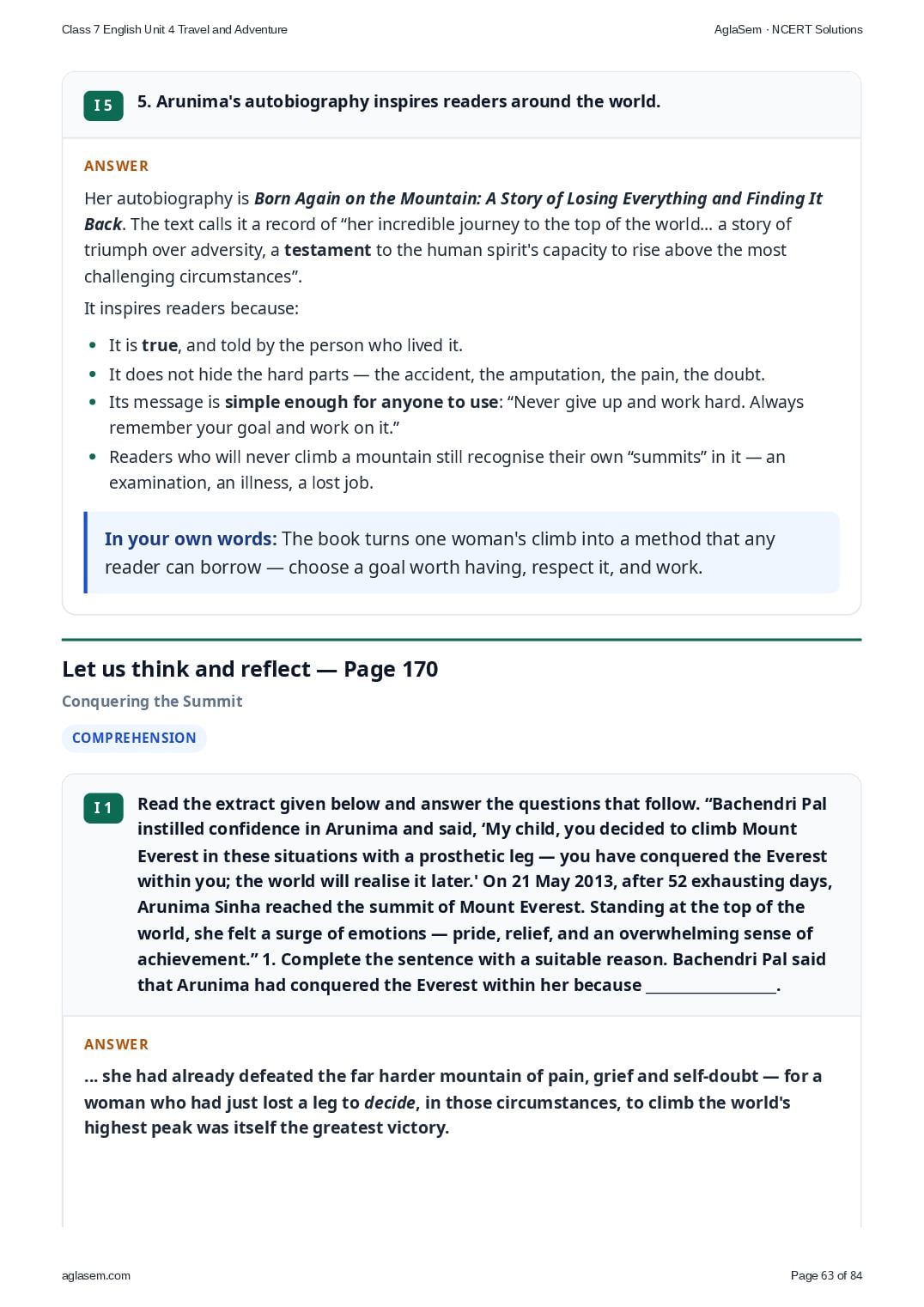
- 5. Arunima's autobiography inspires readers around the world.
- … and more questions — see the complete solutions above.
Chapter at a Glance
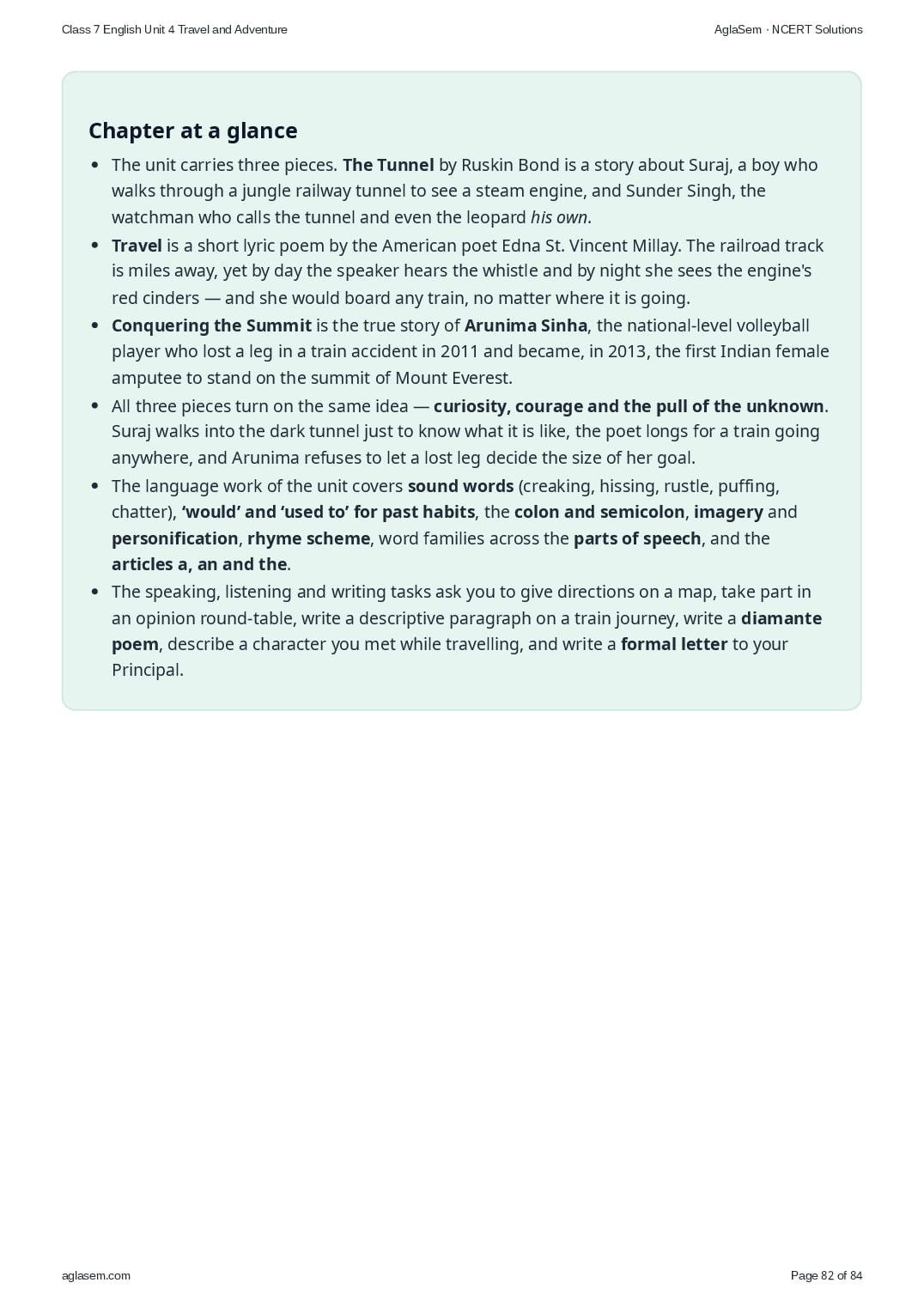
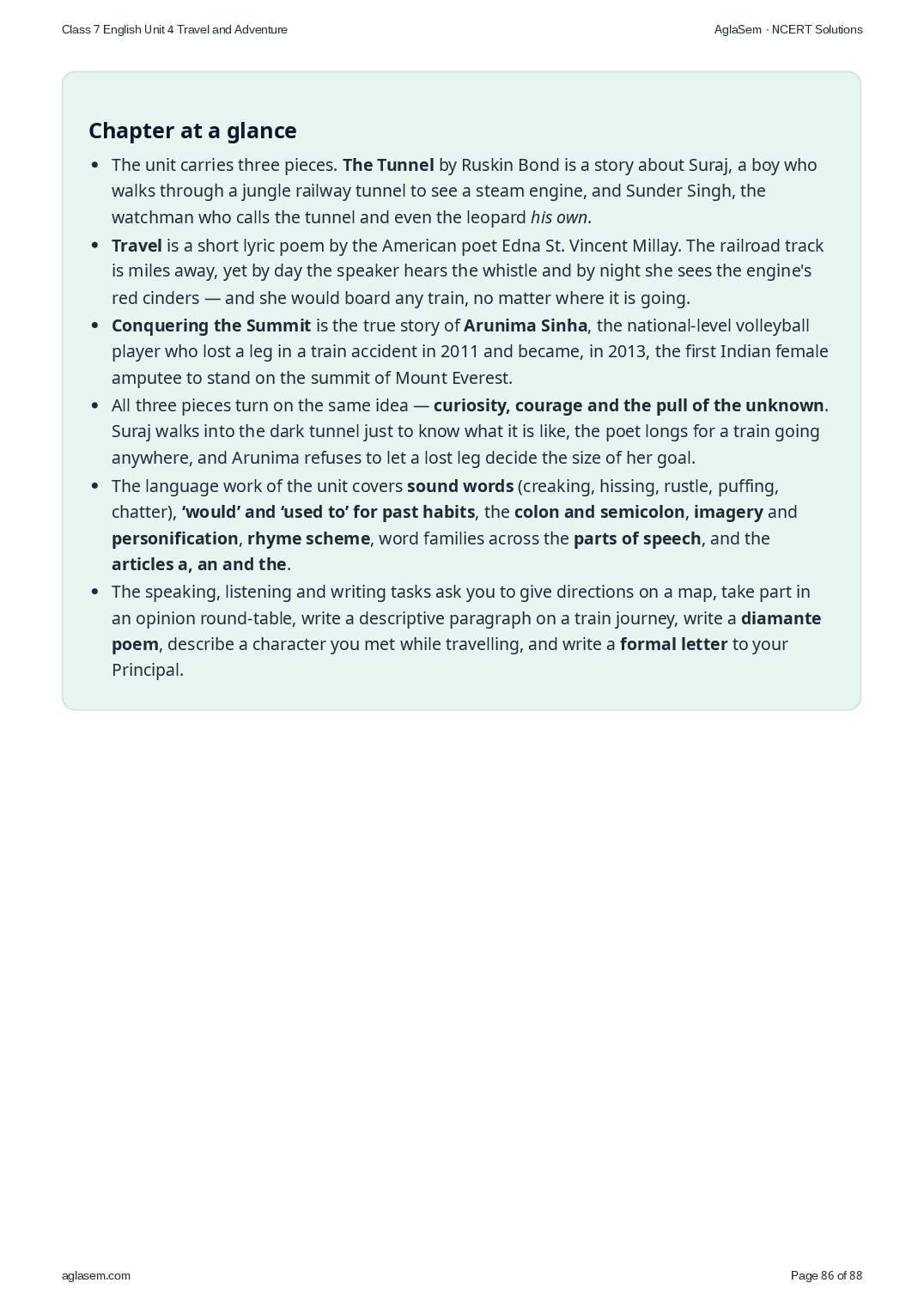
- The unit carries three pieces. The Tunnel by Ruskin Bond is a story about Suraj, a boy who walks through a jungle railway tunnel to see a steam engine, and Sunder Singh, the watchman who calls the tunnel and even the leopard his own .
- Travel is a short lyric poem by the American poet Edna St. Vincent Millay. The railroad track is miles away, yet by day the speaker hears the whistle and by night she sees the engine's red cinders — and she would board any train, no matter where it is going.
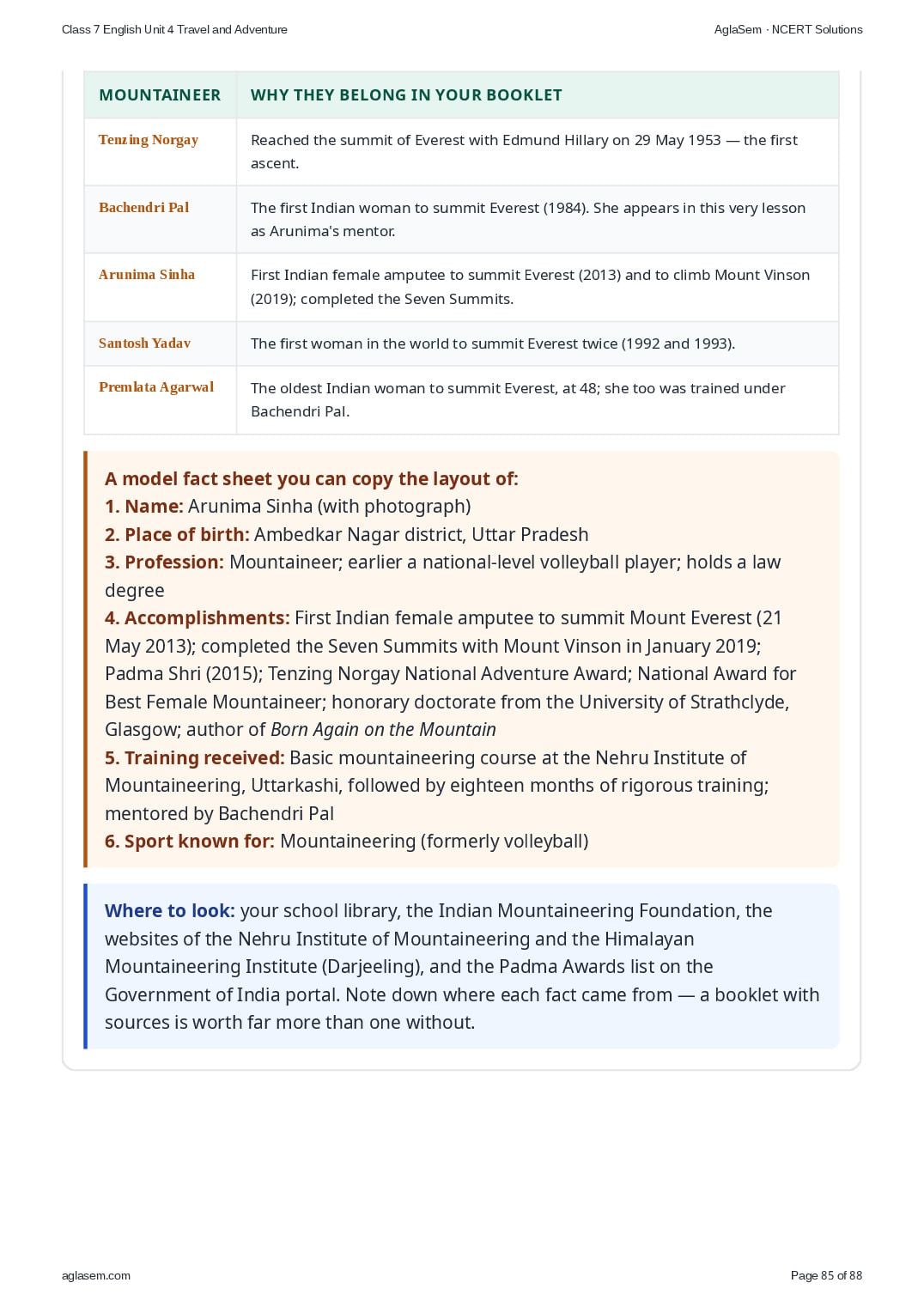
- Conquering the Summit is the true story of Arunima Sinha , the national-level volleyball player who lost a leg in a train accident in 2011 and became, in 2013, the first Indian female amputee to stand on the summit of Mount Everest.
- All three pieces turn on the same idea — curiosity, courage and the pull of the unknown . Suraj walks into the dark tunnel just to know what it is like, the poet longs for a train going anywhere, and Arunima refuses to let a lost leg decide the size of her goal.
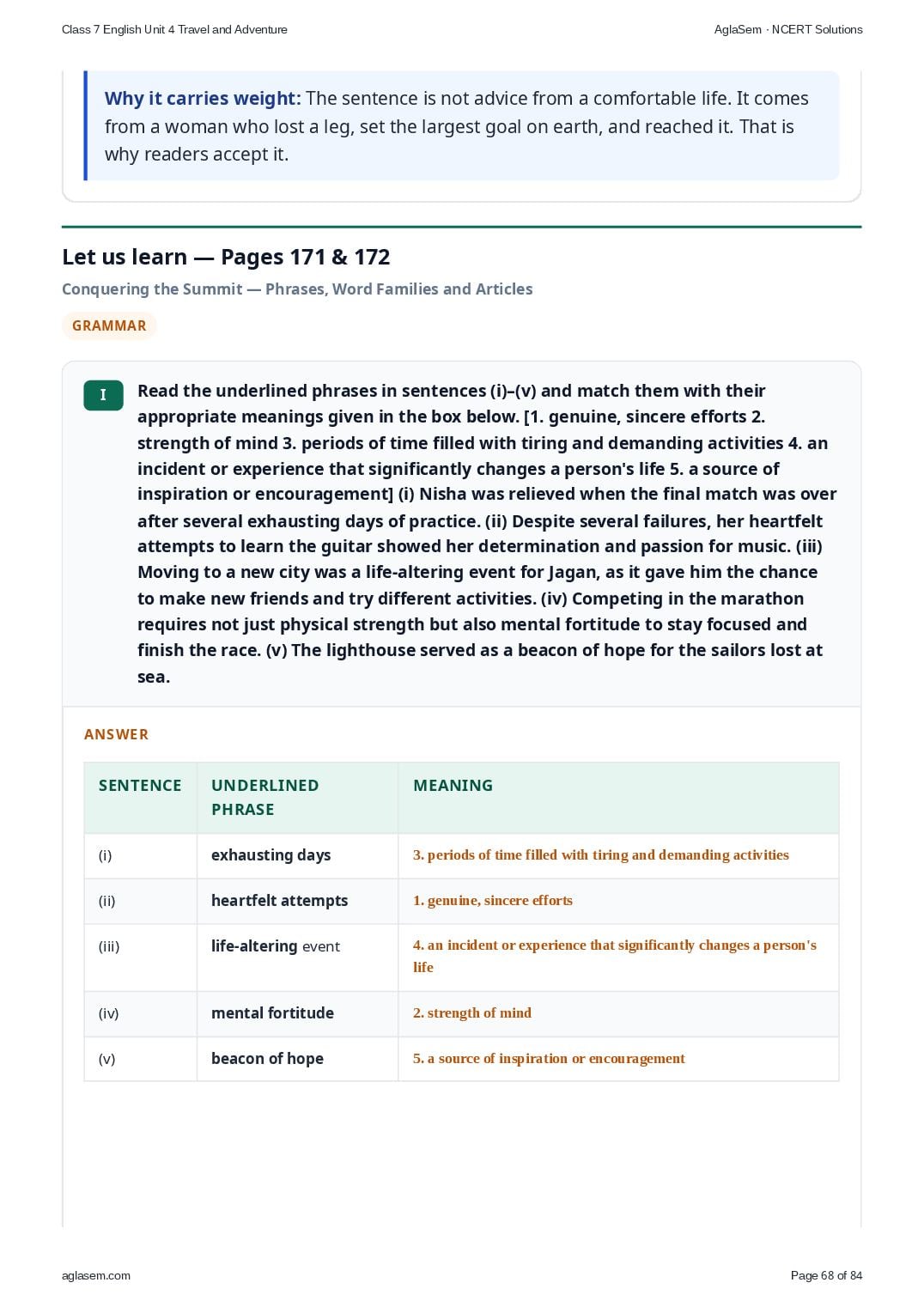
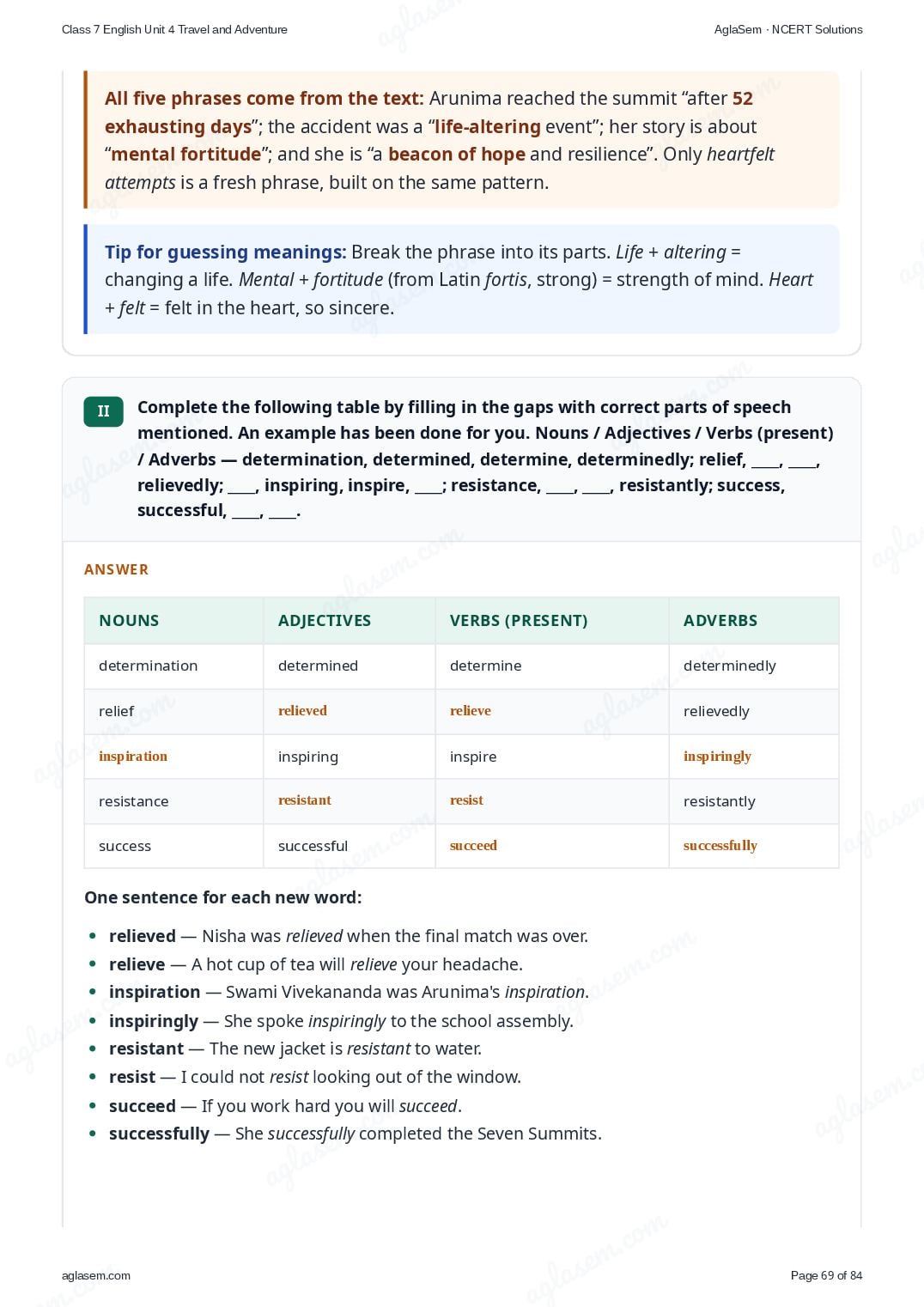
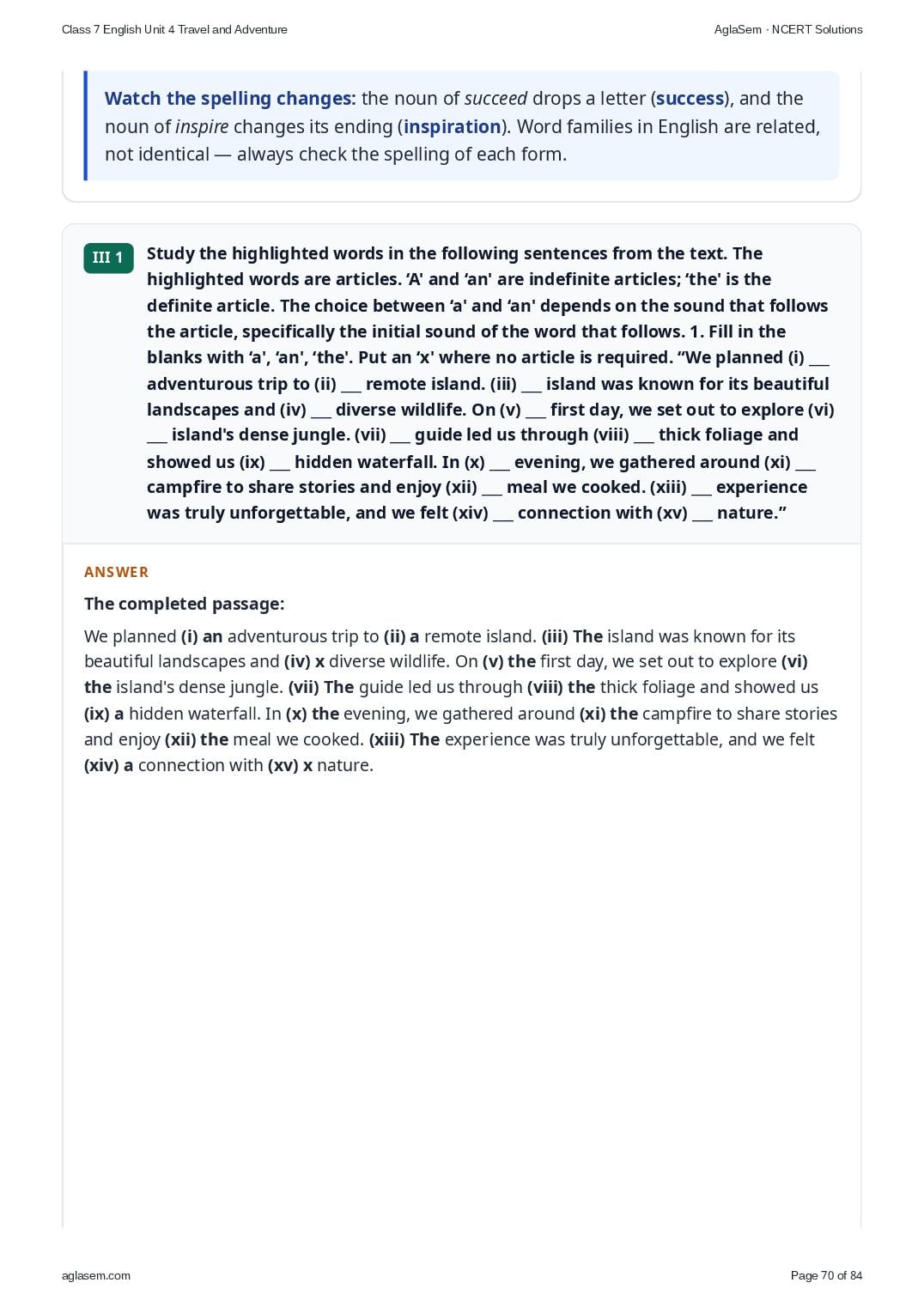
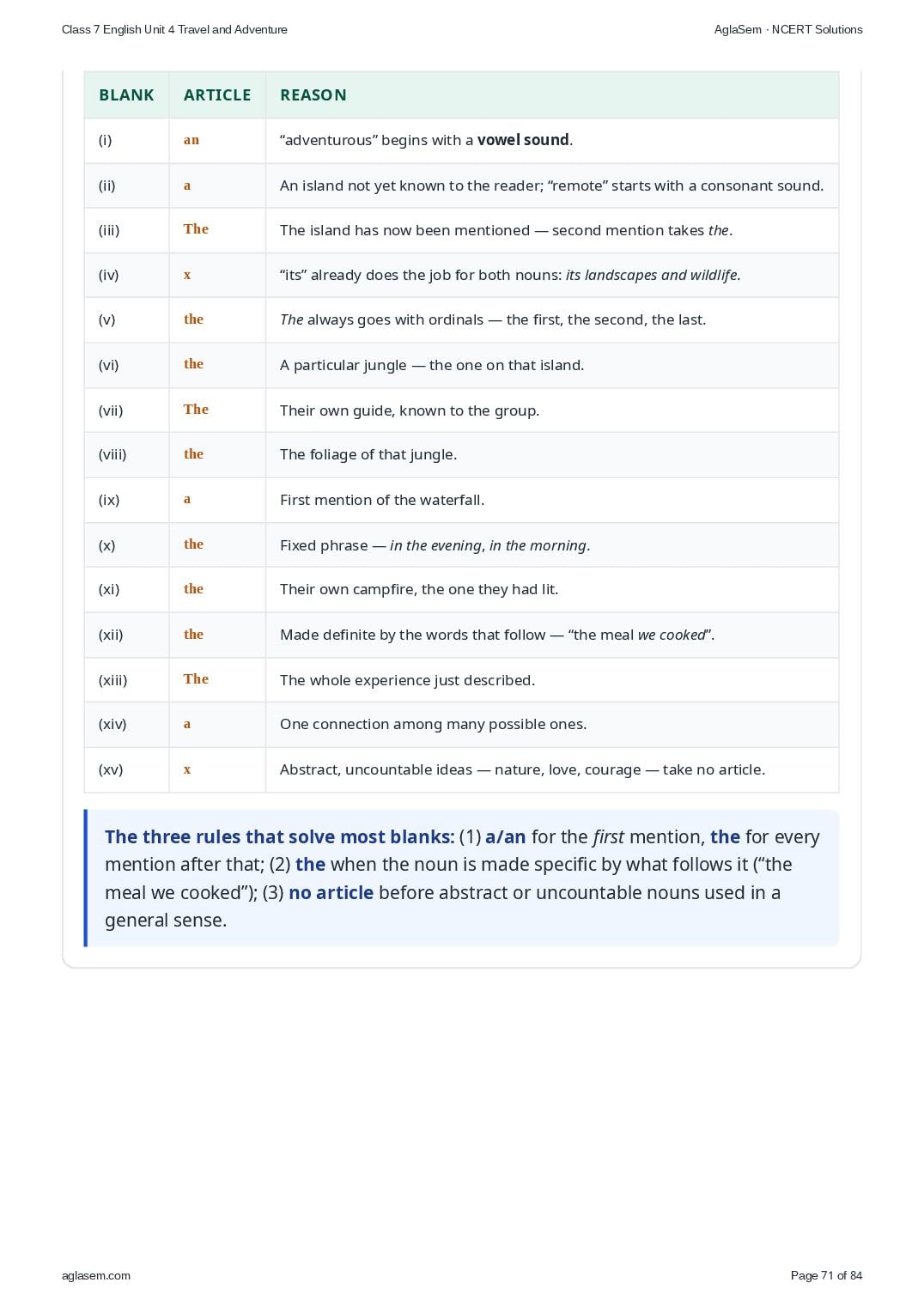
- The language work of the unit covers sound words (creaking, hissing, rustle, puffing, chatter), ‘would’ and ‘used to’ for past habits , the colon and semicolon , imagery and personification , rhyme scheme , word families across the parts of speech , and the articles a, an and the .
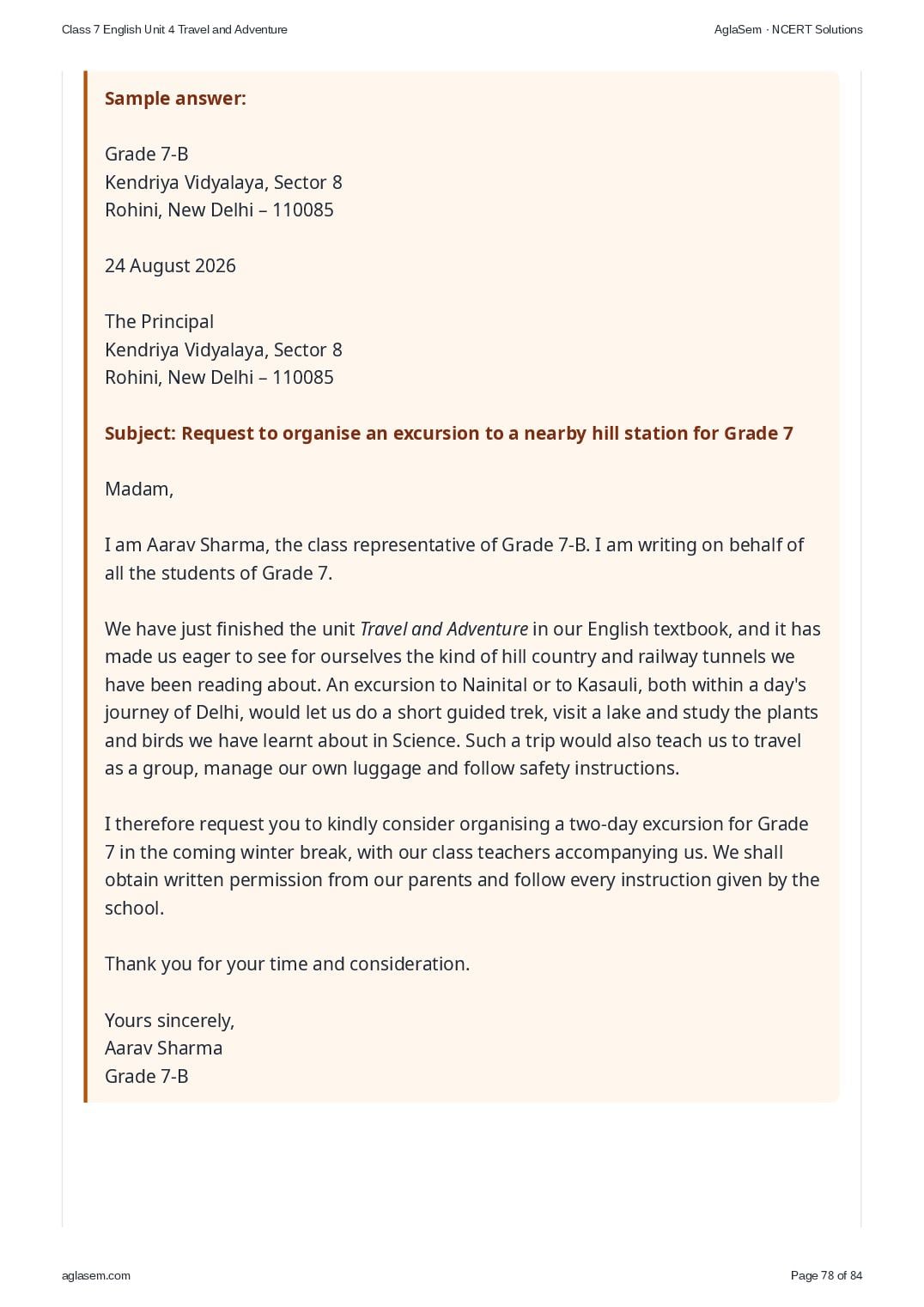
- The speaking, listening and writing tasks ask you to give directions on a map, take part in an opinion round-table, write a descriptive paragraph on a train journey, write a diamante poem , describe a character you met while travelling, and write a formal letter to your Principal.
How to Download NCERT Solutions for Class 7 English Chapter 4 PDF
Follow these simple steps to get the Travel and Adventure questions-and-answers PDF from Poorvi.
- Search NCERT Solutions for Class 7 English Chapter 4 aglasem and open this page.
- Read the exercise questions with answers for Travel and Adventure shown above.
- Click the Download PDF link to save the Travel and Adventure solutions to your device.
NCERT Solutions for Class 7 English – All Chapters
There are more chapters to study besides Travel and Adventure in English. Here are the NCERT Solutions for all chapters of Class 7 English.
- Chapter 1 Learning Together
- Chapter 2 Wit and Humour
- Chapter 3 Dreams and Discoveries
- Chapter 4 Travel and Adventure
- Chapter 5 Bravehearts
NCERT Solutions for Class 7 – All Subjects
Just like Chapter 4 of English, you can get the exercise questions with answers for every other subject of Class 7. Here are the NCERT Solutions for all subjects of Class 7.
NCERT Solutions for Class 7 English Chapter 4 – An Overview
The key highlights of this study material are as follows.
| Aspects | Details |
|---|---|
| Class | Class 7 |
| Subject | English |
| Chapter Number | Chapter 4 |
| Chapter Name | Travel and Adventure |
| Book Name | Poorvi |
| Book By | NCERT (National Council of Educational Research and Training) |
| Educational Resource Here | NCERT Solutions of Class 7 English Chapter 4 for all exercises |
| More Questions Answers of This Subject | NCERT Solutions for Class 7 English |
| Download Book Chapter | NCERT Book Class 7 English |
| All Questions Answers For This Class | NCERT Solutions for Class 7 |
| Complete Solutions | NCERT Solutions |
NCERT Solutions for Class 7 English Chapter 4 Travel and Adventure – FAQs
What are the NCERT Solutions for Class 7 English Chapter 4 Travel and Adventure?
They are the complete, step-by-step answers to all the exercise and in-text questions of Chapter 4 Travel and Adventure from the NCERT Class 7 English textbook Poorvi, written by experts as per the latest NCERT syllabus.
How can I download the Class 7 English Chapter 4 solutions PDF for free?
Open this page on aglasem, read the Travel and Adventure questions with answers, and click the “Download Solutions PDF” link. The Class 7 English Chapter 4 NCERT Solutions PDF is completely free to download.
Are these NCERT Solutions as per the latest 2026-27 syllabus?
Yes. The NCERT Solutions for Class 7 English Chapter 4 are based on the latest NCERT textbook Poorvi and the current 2026-27 CBSE syllabus, so the questions and answers match what you study in class.
Where can I get NCERT Solutions for the other chapters of Class 7 English?
You can find the answers to every chapter on the NCERT Solutions for Class 7 English page, and solutions for every subject on the NCERT Solutions for Class 7 page.
How do NCERT Solutions help in exam preparation?
They show the correct method to solve each question, help you write answers the way they are expected in exams, let you check and correct your own work, and save revision time — which together improve your marks in Class 7 English.
If you have any queries on NCERT Solutions for Class 7 English Chapter 4 Travel and Adventure, then please ask in the comments below.
