NCERT Solutions for Class 8 English Chapter 1 Wit and Wisdom provide clear, step-by-step answers to every exercise and in-text question from the chapter Wit and Wisdom of the NCERT textbook Poorvi. Prepared by subject experts as per the latest NCERT (CBSE) syllabus for 2026-27, these NCERT Solutions for Class 8 English help you understand each concept, write exam-ready answers, and check your own solutions. You can read them online below or download the free Class 8 English Chapter 1 question-answer PDF.
NCERT Solutions for Class 8 English Chapter 1 Wit and Wisdom
- Class: Class 8
- Subject: English
- Chapter: Chapter 1 – Wit and Wisdom
- Textbook: Poorvi (NCERT)
- Study material: NCERT Solutions – questions with answers, free PDF
These solutions answer all the exercise questions of Chapter 1 Wit and Wisdom — including the in-text questions, short-answer and long-answer questions, and activities — with complete explanations so you can follow the method, not just the final answer. Read the full solutions below.
NCERT Solutions Class 8 English Unit 1 Wit and Wisdom View Download


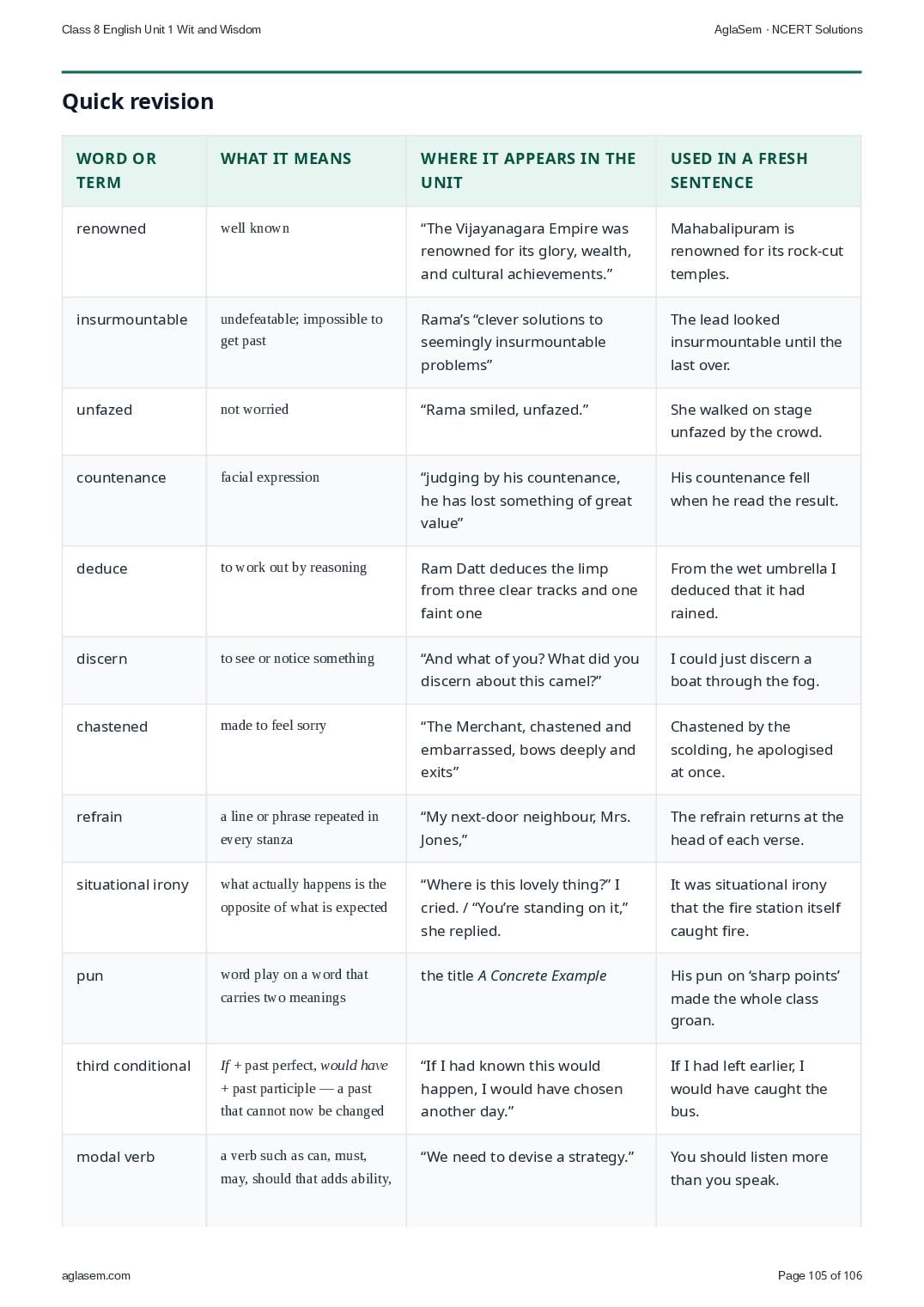

NCERT Solutions for Class 8 English Chapter 1 PDF Download
You can read the NCERT Solutions for Class 8 English Chapter 1 online above, or download the complete question-answer PDF to study Wit and Wisdom offline at any time.
NCERT Solutions for Class 8 English Chapter 1 PDF Download Link – Click Here to Download Solutions PDF
Questions Covered in This Chapter
Key questions solved in this chapter include:
- I. Select qualities of a person who uses wit from the box given below. wise · serious · clever · powerful · humorous · stubborn · courageous · observant · charming · creative · punctual · confident · energetic Now, discuss reasons for your choice of qualities.
- II. Work in pairs and answer the riddles that are given below. Share the answers with your classmates and teacher. • I can be a friend or a foe, depending on how you use me. I can bring both joy or pain. What am I? • I can be measured, but I cannot be touched. I can be spent, but I cannot be saved. What am I? • What is always in front of you but can’t be seen? • What has to be shared before you can keep it? (Note: You will find the answers of these riddles on page 16.)
- 1. Why are qualities like humour and wit important in a person?
- 2. Why do you think kings and queens preferred to have witty people among their courtiers?
- 3. If you were asked to solve a disagreement between two people, what approach would you take?
- 4. Have you ever been in a situation where a small misunderstanding led to a big problem? How was it resolved?
- I. Rectify the following false statements from the text. 1. The queen insulted the king by speaking against the quality of his poem.
- 2. Tenali Rama immediately went to the king and convinced him to talk to the queen.
- 3. The courtiers admired the king’s poem and praised his literary talent.
- 4. The ministers in the court were eager to hear Tenali Rama’s idea about paddy cultivation.
- 5. The king never realised his mistake and continued to stay angry with the queen.
- 1. Read the extract and answer the questions that follow. “… The king thought I was disrespecting his poem and stormed off. Since then, he has not spoken to me. If I had known this would happen I would have chosen another day. Help me, please, Rama. Only you can help the king understand.” Rama nodded thoughtfully. “If you like, I will try my best to resolve this matter, Your Highness. But this needs a well-planned approach and I may need time to find the right strategy.” (i) Why does the queen believe that only Tenali Rama can help the king understand?
- (ii) What does the queen’s statement, “If I had known this would happen, I would have chosen another day”, suggest about her feelings? A. She is angry at the king for overreacting. B. She regrets the unintended misunderstanding. C. She believes the poem was not worth listening to. D. She is worried that the king might punish her.
- (iii) How does Tenali Rama’s response reflect his wisdom and problem-solving skills?
- (iv) Fill in the blank by choosing the correct option from those given in the brackets. The king’s reaction shows that he is sensitive and _________ (has a lot of faith/takes great pride) in his poetry.
- 2. Read the extract and answer the questions that follow. That evening, the king approached the queen with a softened expression. “Thirumalambal”, he began, his voice gentle, “I have been foolish. I see now that I overreacted. I let my pride blind me. I’m so sorry.” The queen, who had longed for this moment, smiled and replied, “If you like, we can leave this quarrel behind us. I would very much like to listen to your poem.” (i) Complete the following with a suitable explanation. When the king said, “I let my pride blind me”, he means that ____.
- (ii) Why does the queen say, “If you like, we can leave this quarrel behind us”?
- (iii) Fill in the blank by choosing the correct option from those given in the brackets. The king acknowledges that his pride clouded his judgement, which shows _________. (intelligence and courage/maturity and self-awareness)
- (iv) State any one characteristic that the queen’s response to the king’s apology shows about her.
- 1. Why was the Vijayanagara Empire considered to be in its ‘Golden Era’ during Krishnadeva Raya’s reign?
- 2. How did Tenali Ramakrishna gain a special place in the king’s court?
- 3. How did the quarrel between the king and the queen affect the palace?
- 4. What strategy did Tenali Rama use to make the king realise his mistake?
- 5. What was the reaction of the courtiers when Tenali Rama introduced his ‘special’ paddy seeds?
- 6. How does the story conclude, and what lesson can be learnt from it?
- I. Fill in the blanks and complete the paragraph by choosing suitable expressions from the box given below. cast a shadow · murmur swept through the room · hush fell over · mind raced back · stormed off · rippled through My mother is quite witty, and her sense of humour always lightens stressful moments. Once, at a family dinner, an argument began over a minor issue, and 1. ______ , making everyone feel uncomfortable. Just as things were getting serious, she made a clever remark and laughter 2. ______ the gathering, making everyone relaxed. The person who started the argument 3. ______. Everyone disapproved of the action and a 4. ______. My 5. ______ to how my mother had saved other situations like this. Without her, such moments would have 6. ______ over the gatherings. I hope that I grow up to be as witty as my mother.
- II. The writer uses words like ‘roared’, ‘murmur’ in the text to indicate the sound produced. Fill in the blanks with suitable sound words from the box given below. You may refer to a dictionary. murmur · sighed · mumble · gasped · snickers · thud · groan · rattle · roared · whispered 1. As the teacher began the riddle challenge, a __________ of excitement spread through the classroom. 2. Anaya __________ in relief—she loved riddles more than solving Mathematics problems. 3. ‘Think carefully,’ the teacher began to ___________ , as she wrote a riddle on the board. 4. When the question was revealed, a few students __________ , realising it wasn’t as easy as they had expected. 5. Some exchanged ____________ , wondering if anyone at all would be able to solve it. 6. Just then, Anaya tapped her book on the desk with a small ___________ , deep in thought. 7. ‘Ah, I see it now!’ she said stretching with a ___________ , as if it had taken her great effort. 8. A small breeze made the windows __________ , adding to the suspense of the moment. 9. ‘So, what’s the answer?’ the students ___________ , their voices filled with playful enthusiasm. 10. Leaning forward with a smile, Anaya __________ , ‘Sometimes, the trickiest questions have the simplest answers.’
- III. As you have learnt, a compound word is formed when two or more words are combined to create a new word with a distinct meaning. These are of three types: closed compounds (sunlight, courtroom), hyphenated compounds (well-planned), and open compounds (paddy seeds). 1. Create new compound words by matching words in Column 1 with those in Column 2. Column 1: (i) quick, (ii) soft, (iii) common, (iv) house, (v) book, (vi) ill, (vii) sky, (viii) dance Column 2: A. hall, B. tempered, C. spoken, D. blue, E. store, F. sense, G. witted, H. hold
- 2. Fill in the blanks with the words created in the previous question. Ravi was (i) __________, always speaking calmly even in arguments. He grew up in a lively (ii) __________, where he learned to handle different personalities. His friend Arun, however, was (iii) __________ and often lost his patience. Despite this, Arun admired Ravi’s (iv) __________ thinking. One evening, as they passed a (v) __________, they saw some performers rushing out. Ravi noticed that one of them dropped a (vi) __________ book on the ground. “Is this yours?” he asked. “Oh thank you, young man!” the performer smiled. “It’s a recent purchase from the (vii) ________ round the corner.” True to his nature Arun promptly said to Ravi, “It’s (viii) ________ that it’s not from a bakery but bookshop!” Ravi smiled and they walked on.
- IV. In sentence 1 ‘if you like’ is the subordinate clause (if clause) and ‘I will try my best to resolve this matter’ is the main clause. Identify the subordinate and main clauses in sentences 2 and 3. 2. If, by chance something were to go wrong, our farmers would suffer. 3. If I had known this would happen, I would have chosen another day.
- Now, match the subordinate clauses (if clauses) in Column 1 with the appropriate main clauses in Column 2 to make complete sentences. Column 1: (i) If I had a magic wand, (ii) If it rains tomorrow, (iii) If you had listened carefully, (iv) If you finish your homework, (v) If I were invisible, (vi) If the alarm had rung, Column 2: A. We will go to the theatre. B. I would sneak into the secret room. C. I would give myself wings. D. The boys would have woken up on time. E. We will stay indoors and play board games. F. You would have solved the puzzle.
- V. Complete the following sentences appropriately with either the main clause or the subordinate clause (if clause). 1. Your teacher will be unhappy if _______________________.
- 2. They would have caught the train if _______________________.
- 3. _______________________ if you continue to stay up late every night.
- 4. If she knew the answer, _______________________.
- 5. _______________________ if she had studied harder.
- 6. If I had a million rupees, _______________________.
- VI. Complete the following sentences. One example has been done for you. 1. If I were a tree, I would play with the wind and talk to the birds. 2. If I were the Head Teacher of my school, _______.
- 3. If I were a bird, _______.
- 4. If I were a magician, _______.
- 5. If I had studied harder, _______.
- I. You will listen to a woman narrating a story. As you listen, fill in the blanks in the following sentences by selecting the correct options. 1. The rope tying the bundle of sticks was _____. (i) loose (ii) thick (iii) short
- 2. The scholar is finally referred to as ________. (i) irritable (ii) mischievous (iii) arrogant
- II. You will once again listen to the story. As you listen, number the events of the story in the correct order of occurrence. 1. The great scholar was ashamed because he did not know what to say. 2. Rama accepted the challenge thrown by the visitor. 3. Rama had a bundle tied in silk when he came to the palace. 4. The king laughed at the explanation given by Rama. 5. The visitor wanted to show his superiority over others in the palace. 6. Rama showed the work to be a bundle of sticks tied together by a rope. 7. The king wanted to know more about the work mentioned by Rama. 8. The court scholars were afraid of the king’s anger.
- I. While asking questions, it is important to use the appropriate tone to convey the correct meaning. 1. ‘Yes’ or ‘No’ questions have a rising tone at the end. (Are you coming home?) 2. ‘-Wh’ questions have a falling tone at the end. (When will you come home?) This rise and fall in tone is called intonation. Now, work in pairs and mark the intonation in the questions given below. Take turns to practise by saying them aloud with the correct intonation. (i) Is this your cat? (ii) What is the name of your cat? (iii) Will you be going to your village? (iv) Why are you going to your village? (v) Is this where you live? (vi) Where do you live? (vii) Can I meet your parents? (viii) How are your parents? (ix) Do you have any plans for tomorrow? (x) What are you going to do tomorrow?
- II. ‘What’, ‘Why’, ‘When’, ‘How’, ‘Where’, and ‘Who’ are the words used to ask questions. These words are called question words. Let us use these words and make some questions. While making questions, remember the correct word order. • Who is the cleverest character in the story? (Correct) • Who the cleverest character is in the story? (Incorrect) Work in pairs and take turns to ask and answer questions about a trip that you are planning. Prompts: The destination (Where…), Purpose (Why…), Mode of transport (How…), Duration (When…), Travel companions (Who…), Activities (What…)
- Now, work in pairs and take turns to ask and answer the questions about witty characters in folktales or stories you have read. Use the correct intonation while asking questions. For example: Your favourite character in the folktale (Who…?) — Who is your favourite character in the folktale? 1. The name of the witty character (Who…?)
- 2. The reason for her/his wit being important in the story (Why…?)
- 3. The most famous trick or clever idea she/he used (What…?)
- 4. The time period or setting of the folktale/story (When…?)
- 5. The way she/he used her/his intelligence to solve a problem (How…?)
- 6. The location where the story takes place (Where…?)
- I. Read the narrative essay ‘A Lesson in Responsibility’ given on page 15. Now, work in pairs and check (✓) if the following features are present in the narrative essay. 1. Introduction — the essay begins with a clear and engaging opening; the introduction sets the context for the narrative; the central idea or purpose is clear. 2. Body of the essay — events are narrated in a logical sequence; descriptive details are used; characters and settings are clearly described; the narrator’s emotions or thoughts are shared; the essay includes a challenge or a problem or a turning point. 3. Conclusion — the essay ends with an outcome; a lesson or a message is clearly stated. 4. Writing Style — the tone is personal and engaging; first person narration is used. 5. Language — the essay uses simple and clear language; grammar, punctuation, and spellings are correctly used.
- Now, write a narrative essay based on any one of the situations given below. • The Day I Learnt the Value of Teamwork • A Small Act of Kindness that Made a Difference
- I. Limericks are poems in five lines that have a twist in the last line. Read and enjoy the following limericks and create one on your own. Raju flew his kite in the sky so wide, It soared with grace, full of pride. But a crow came along, Singing its song, And now it’s the crow on a joyride!
- II. Go to the library and read a story of your choice. Share its theme and the interesting parts of the story with your classmates and teacher.
- III. You must have read stories of wit, humour, and wisdom in your own language or English. Make a list of these stories that you have read on a chart paper. Each student should read at least one new story from the list.
- I. Read the names of items you usually find in a garden and write their names against each picture given below. garden hose, sapling, hedge, flower beds, flower pot, pebbles, rockery, fence, vine, wheelbarrow
- II. Work in groups of four. What kind of garden would you like to have? Mention the features that you can include and the reasons for your choice. Share your answers with your classmates and teacher.
- III. Read the title of the poem. What comes to your mind when you read the word ‘concrete’? Does it have more than one meaning? Share your answers with your classmates and teacher.
- I. Complete the following summary with exact words from the poem. One example has been done for you. The poem describes Mrs. Jones, the speaker’s next-door neighbour, who has a unique garden filled with 1. _________. Her garden includes a peculiar 2. _________, a pond, and a rockery, along with an unusual 3. _________ that she finds charming. Mrs. Jones plants tiny, 4. _________ plants between the stones, which the speaker thinks must be so small that they are planted with a 5. _________. One day, Mrs. Jones invites the speaker to see her garden, and they discuss a 6. _________ that Mrs. Jones treasures. When the speaker asks where the 7. _________ flower is, Mrs. Jones says that the speaker has been 8. _________ on it all along.
- II. Select the correct option to fill in the blanks for the following sentences. 1. The tone of the poem is ____________. (i) mocking (ii) humorous (iii) mournful (iv) amusing (v) light-hearted A. (i), (ii), and (iii) B. (i), (ii), and (v) C. (ii), (iii), and (iv) D. (ii), (iv), and (v)
- 2. The speaker in the poem is ____________. (i) Mrs. Jones (ii) the poet (iii) a gardener (iv) a child
- 3. The rhyme scheme of the poem is _________. (i) AABBCC (ii) ABABCC (iii) AABCAC (iv) ABBACC
- III. Complete the following sentences by choosing the correct answer given in the brackets. 1. The poet uses the word ‘stones’ in all stanzas in order to emphasise her ________. (obsession with a stony garden/pride in gardening skills)
- 2. The poet uses imagery to describe the features of the garden that help readers _____________. (understand Mrs. Jones’ love for plants/visualise the garden’s peculiar nature)
- IV. Pick examples of alliteration from the poem.
- V. A refrain is a repeated line or phrase that appears in each stanza. Identify the refrain from the poem.
- VI. Irony is a literary device that emphasises the difference between what is expected and what actually happens. It often involves a situation where the outcome is the opposite of what is expected, creating a surprising or a humorous effect. For example, Mrs. Jones’ excitement about her garden contrasts with the speaker’s disappointment on how ordinary it is. Identify the line(s) from the poem that display(s) situational irony.
- VII. Complete the following sentences appropriately. 1. The word ‘concrete’ can refer to ______________ in Mrs. Jones’ garden.
- 2. The title also has a symbolic meaning, as the poem provides a clear or ‘concrete’ example of Mrs. Jones’ ______________ gardening habits.
- VIII. The title ‘A Concrete Example’ carries both literal and symbolic (metaphorical) meaning. Such word play is called a pun. A pun is a figure of speech that uses words with multiple meanings or words that sound alike but have different meanings, creating a humorous effect. • I tried arguing with my pencil but it kept making sharp points. (suggests the idea of an actual sharp pencil point and strong argument points) • My pencil and I had a disagreement but we finally got to the point. (refers to solving an argument and the pencil’s tip)
- I. Read the given extract and answer the questions that follow. My next-door neighbour, Mrs. Jones, has got a garden full of stones: A crazy path, a lily pond, a rockery and, just beyond A sundial with a strange device, which Mrs. Jones thinks rather nice. (i) What can be inferred about Mrs. Jones’s taste in gardening from the description of her garden being ‘full of stones’?
- (ii) Identify whether the following statement is true or false. The garden serves as a means to reveal more about Mrs. Jones herself.
- (iii) What does the poet mean by ‘crazy path’?
- (iv) What does the sundial with a ‘strange device’ suggest about Mrs. Jones’ personality? A. She has a fascination with unusual items. B. She prefers traditional garden decorations. C. She is uninterested in her garden’s appearance. D. She likes modern and expensive items.
- 1. How does Mrs. Jones feel about her garden? Support your answer with evidence from the poem.
- 2. Why do you think the speaker describes the plants as being so small that they could be planted with a pin?
- 3. What do we get to know about Mrs. Jones—based on her gardening style and her interaction with the speaker?
- 4. The poem portrays Mrs. Jones in a positive light. Support this statement.
- 5. What does the poem tell us about the way people think differently about the world around them?
- I. Select the appropriate word from the brackets that correctly replaces the underlined word in the sentences from the text. 1. A sundial with a strange device, (unusual, peculiar, new, rare, external)
- 2. … which Mrs. Jones thinks rather nice. (pleasant, superior, agreeable, gentle, charming)
- 3. They are so delicate… (delicious, fragile, dainty, graceful, weak)
- 4. “Where is this lovely thing?” I cried. (exclaimed, wept, shouted, announced, whispered)
- II. The ‘sundial’ is referred to as a ‘device’ in the poem. Work in pairs to infer the meaning of ‘device’. Share your thoughts with your classmates and teacher.
- Now, match the type of instruments in Column 1 with their definitions in Column 2. Column 3 shows one example of each type of instrument. Add more examples in Column 3. Column 1: 1. implement, 2. tool, 3. equipment, 4. appliance, 5. gadget Column 2: (i) something that is electrical and is used to do work in the house, (ii) something small that is mechanical or electronic, (iii) something that works on being moved by hand, (iv) a set of necessary items for a particular purpose, (v) something used by hand to make or repair Column 3: spade, knife / hammer / cricket bat, helmet, batting gloves, etc. / mixer grinder / mobile phone, laptop
- III. Complete the table by making new words in Column 1 using the hints given in Column 2. Replace the first letter of the given word to create new words. One example has been done for you. 1. nice — (i) dice: cut into small pieces; (ii) ____: grain that we cook; (iii) ____: plural of mouse; (iv) ____: bad habit
- 2. soil — (i) ____: heat something; (ii) ____: work very hard; (iii) ____: length of wire in a circle; (iv) ____: sheets to wrap food items
- I. You will listen to a presentation about the wonderful Rock Garden of Chandigarh. As you listen, answer the following questions using one to three exact words from the presentation. 1. Where was Nek Chand’s Rock Garden featured?
- 2. What kind of sculptures does the Rock Garden have?
- 3. How is the Rock Garden divided?
- 4. Name any one thing that has been transformed into a piece of art in the Rock Garden.
- 5. Approximately, how many statues border the Rock Garden?
- I. 1. When we apologise to a friend or a family member, we use informal language. Take turns to apologise for the following situations and respond to the apology. (i) You have eaten your brother’s share of sweets. Phrases for Apology: I’m sorry about… / I’m really sorry… / Please forgive me for… / Sorry, I didn’t mean to… Phrases to Respond to Apology: That’s alright. / It’s no big deal. / No problem. / These things happen.
- (ii) You have broken your sister’s flower craft.
- (iii) You accidentally spilled ink on your mother’s important documents.
- (iv) You forgot to bring your friend’s notebook to the school after borrowing it.
- 2. When we apologise to someone in authority like a Principal or a teacher in a formal setting, we use formal language. Work in pairs and take turns to apologise for the following situations and respond to the apology. (i) You did not bring an assignment that was due for submission. Phrases for Apology: I’m extremely sorry for… / I owe you an apology for… / I really regret… / I promise it won’t happen again. / I’ll do my best not to repeat it. / I assure you that this will never happen again. Phrases to Respond: I accept your apology. Please ensure you… / I appreciate you saying this, but… / I’m glad you realised your mistake…
- (ii) You were late to school for the past three days and had to meet the Principal.
- (iii) You did not submit your project work and were asked to explain.
- You are a member of the Nature Club of your school. Draft a notice informing the students of Grades 6–8 about the inauguration of the Herb Garden. Points to remember: • Mention the purpose of writing, date, time, venue, and any other relevant information—whom to contact, when, and where. • Use formal language in the third person form. • Write the notice in a box.
- I. Amrit Udyan is a garden spread over an expanse of 15 acres around Rashtrapati Bhavan in New Delhi. It has multiple attractions that include a specially curated garden for children called Bal Vatika, a treehouse, nature’s classroom, etc. It also has the Bonsai, Herbal-I, Herbal-II, Tactile Garden, Arogya Vanam, and Circular Gardens with a diverse variety of flora and fauna. Now, find out about popular gardens in your region and share with your classmates and teacher.
- II. A herbarium is a collection of plant samples preserved for long-term study, usually in the form of dried and pressed plants mounted on paper. Now, collect some fallen flowers and leaves from your neighbourhood. Place them in folds of a newspaper carefully and put a pile of books on them. After one week, take them out and use them to make a card, wall hanging or any other artwork. A sample has been given for your reference.
- … and more questions are solved in the complete PDF above.
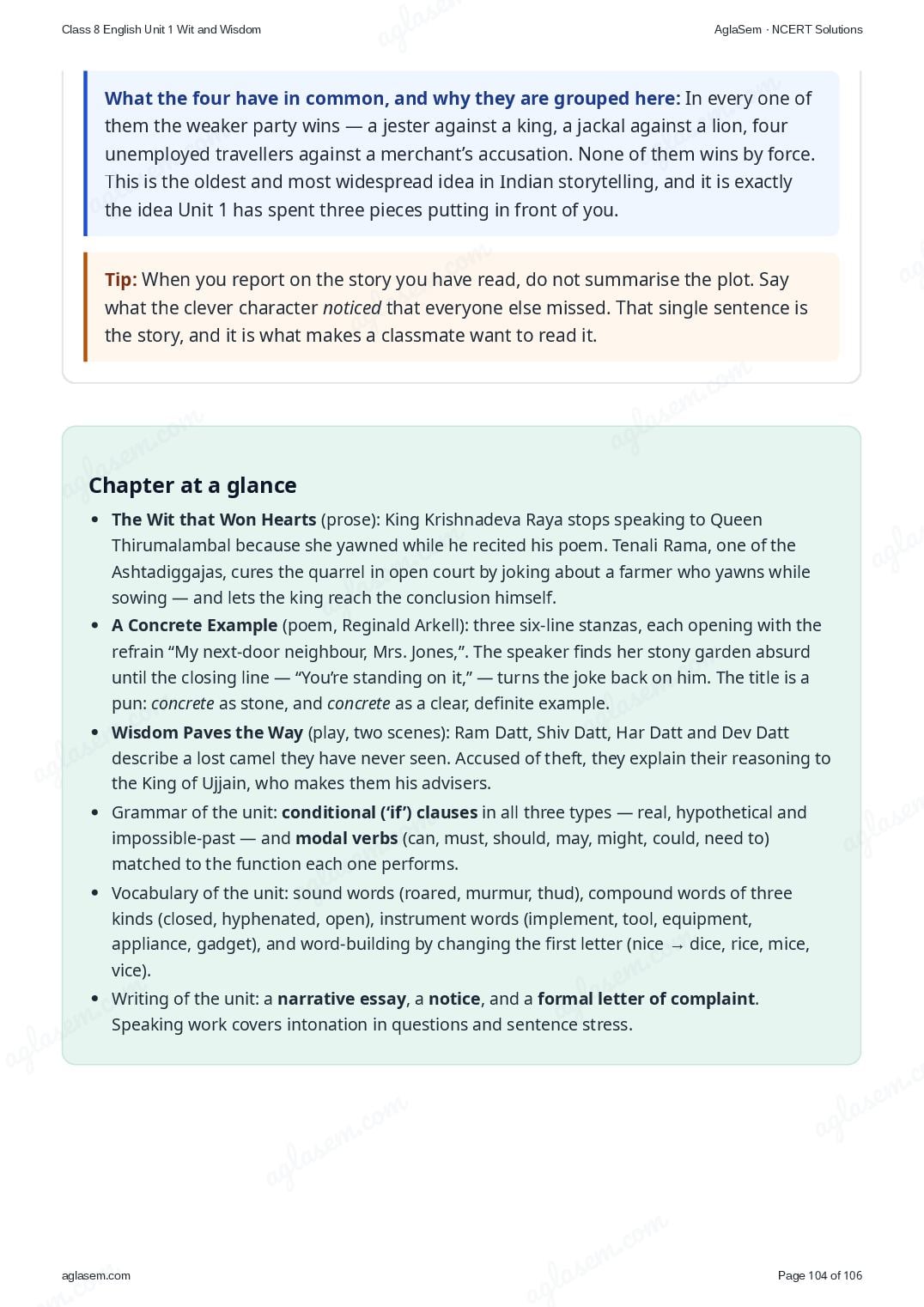
Chapter at a Glance
- The Wit that Won Hearts (prose): King Krishnadeva Raya stops speaking to Queen Thirumalambal because she yawned while he recited his poem. Tenali Rama, one of the Ashtadiggajas, cures the quarrel in open court by joking about a farmer who yawns while sowing — and lets the king reach the conclusion himself.
- A Concrete Example (poem, Reginald Arkell): three six-line stanzas, each opening with the refrain “My next-door neighbour, Mrs. Jones,”. The speaker finds her stony garden absurd until the closing line — “You’re standing on it,” — turns the joke back on him. The title is a pun: concrete as stone, and concrete as a clear, definite example.
- Wisdom Paves the Way (play, two scenes): Ram Datt, Shiv Datt, Har Datt and Dev Datt describe a lost camel they have never seen. Accused of theft, they explain their reasoning to the King of Ujjain, who makes them his advisers.
- Grammar of the unit: conditional (‘if’) clauses in all three types — real, hypothetical and impossible-past — and modal verbs (can, must, should, may, might, could, need to) matched to the function each one performs.
- Vocabulary of the unit: sound words (roared, murmur, thud), compound words of three kinds (closed, hyphenated, open), instrument words (implement, tool, equipment, appliance, gadget), and word-building by changing the first letter (nice → dice, rice, mice, vice).
- Writing of the unit: a narrative essay , a notice , and a formal letter of complaint . Speaking work covers intonation in questions and sentence stress.
How to Download NCERT Solutions for Class 8 English Chapter 1 PDF
Follow these simple steps to get the Wit and Wisdom questions-and-answers PDF from Poorvi.
- Search NCERT Solutions for Class 8 English Chapter 1 aglasem and open this page.
- Read the exercise questions with answers for Wit and Wisdom shown above.
- Click the Download PDF link to save the Wit and Wisdom solutions to your device.
NCERT Solutions for Class 8 English – All Chapters
There are more chapters to study besides Wit and Wisdom in English. Here are the NCERT Solutions for all chapters of Class 8 English.
- Chapter 1 Wit and Wisdom
- Chapter 2 Values and Dispositions
- Chapter 3 Mystery and Magic
- Chapter 4 Environment
- Chapter 5 Science and Curiosity
NCERT Solutions for Class 8 – All Subjects
Just like Chapter 1 of English, you can get the exercise questions with answers for every other subject of Class 8. Here are the NCERT Solutions for all subjects of Class 8.
NCERT Solutions for Class 8 English Chapter 1 – An Overview
The key highlights of this study material are as follows.
| Aspects | Details |
|---|---|
| Class | Class 8 |
| Subject | English |
| Chapter Number | Chapter 1 |
| Chapter Name | Wit and Wisdom |
| Book Name | Poorvi |
| Book By | NCERT (National Council of Educational Research and Training) |
| Educational Resource Here | NCERT Solutions of Class 8 English Chapter 1 for all exercises |
| More Questions Answers of This Subject | NCERT Solutions for Class 8 English |
| Download Book Chapter | NCERT Book Class 8 English |
| All Questions Answers For This Class | NCERT Solutions for Class 8 |
| Complete Solutions | NCERT Solutions |
NCERT Solutions for Class 8 English Chapter 1 Wit and Wisdom – FAQs
What are the NCERT Solutions for Class 8 English Chapter 1 Wit and Wisdom?
They are the complete, step-by-step answers to all the exercise and in-text questions of Chapter 1 Wit and Wisdom from the NCERT Class 8 English textbook Poorvi, written by experts as per the latest NCERT syllabus.
How can I download the Class 8 English Chapter 1 solutions PDF for free?
Open this page on aglasem, read the Wit and Wisdom questions with answers, and click the “Download Solutions PDF” link. The Class 8 English Chapter 1 NCERT Solutions PDF is completely free to download.
Are these NCERT Solutions as per the latest 2026-27 syllabus?
Yes. The NCERT Solutions for Class 8 English Chapter 1 are based on the latest NCERT textbook Poorvi and the current 2026-27 CBSE syllabus, so the questions and answers match what you study in class.
Where can I get NCERT Solutions for the other chapters of Class 8 English?
You can find the answers to every chapter on the NCERT Solutions for Class 8 English page, and solutions for every subject on the NCERT Solutions for Class 8 page.
How do NCERT Solutions help in exam preparation?
They show the correct method to solve each question, help you write answers the way they are expected in exams, let you check and correct your own work, and save revision time — which together improve your marks in Class 8 English.
If you have any queries on NCERT Solutions for Class 8 English Chapter 1 Wit and Wisdom, then please ask in the comments below.