NCERT Solutions for Class 8 English Chapter 4 Environment provide clear, step-by-step answers to every exercise and in-text question from the chapter Environment of the NCERT textbook Poorvi. Prepared by subject experts as per the latest NCERT (CBSE) syllabus for 2026-27, these NCERT Solutions for Class 8 English help you understand each concept, write exam-ready answers, and check your own solutions. You can read them online below or download the free Class 8 English Chapter 4 question-answer PDF.
NCERT Solutions for Class 8 English Chapter 4 Environment
- Class: Class 8
- Subject: English
- Chapter: Chapter 4 – Environment
- Textbook: Poorvi (NCERT)
- Study material: NCERT Solutions – questions with answers, free PDF
These solutions answer all the exercise questions of Chapter 4 Environment — including the in-text questions, short-answer and long-answer questions, and activities — with complete explanations so you can follow the method, not just the final answer. Read the full solutions below.
NCERT Solutions Class 8 English Unit 4 Environment View Download



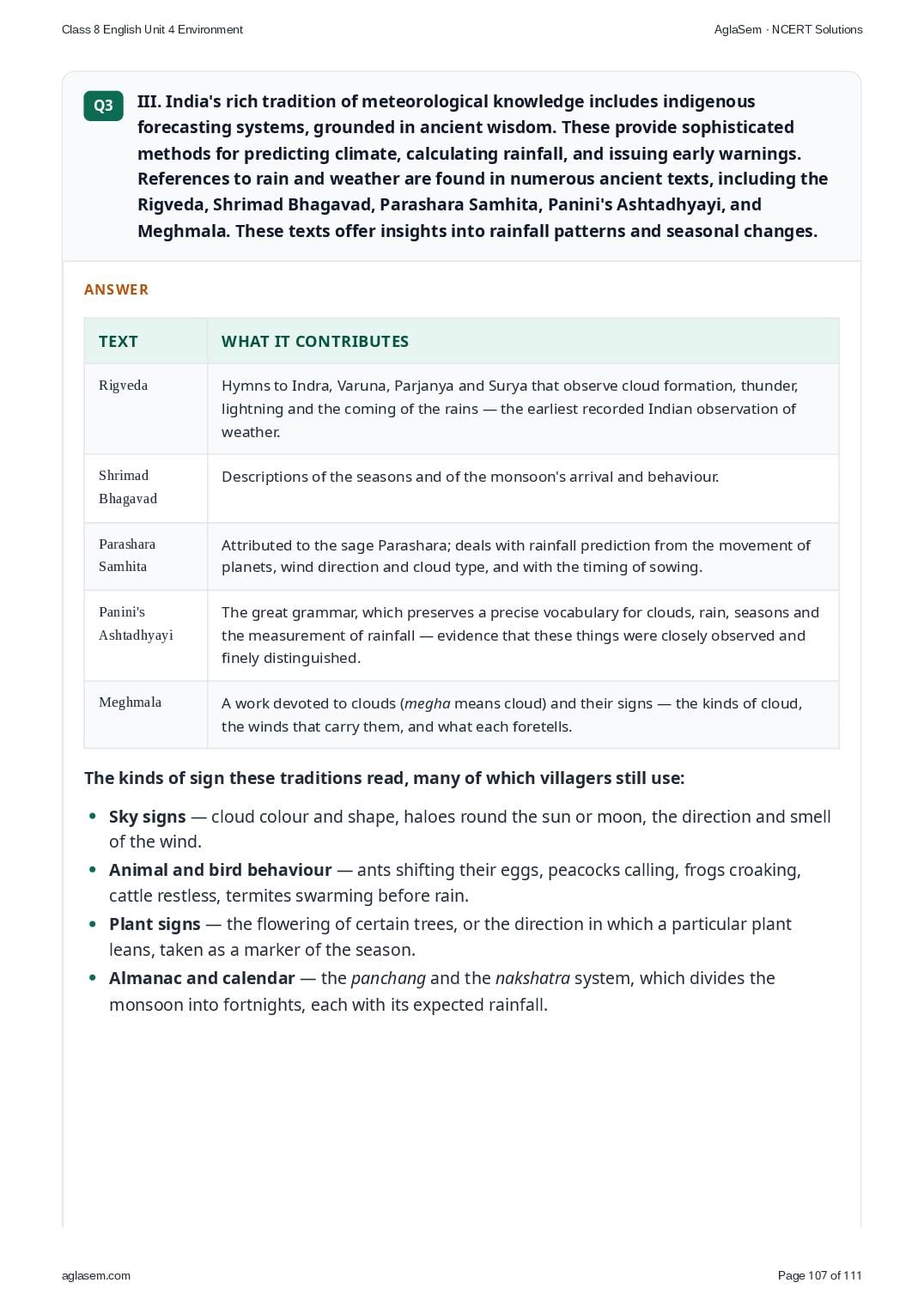
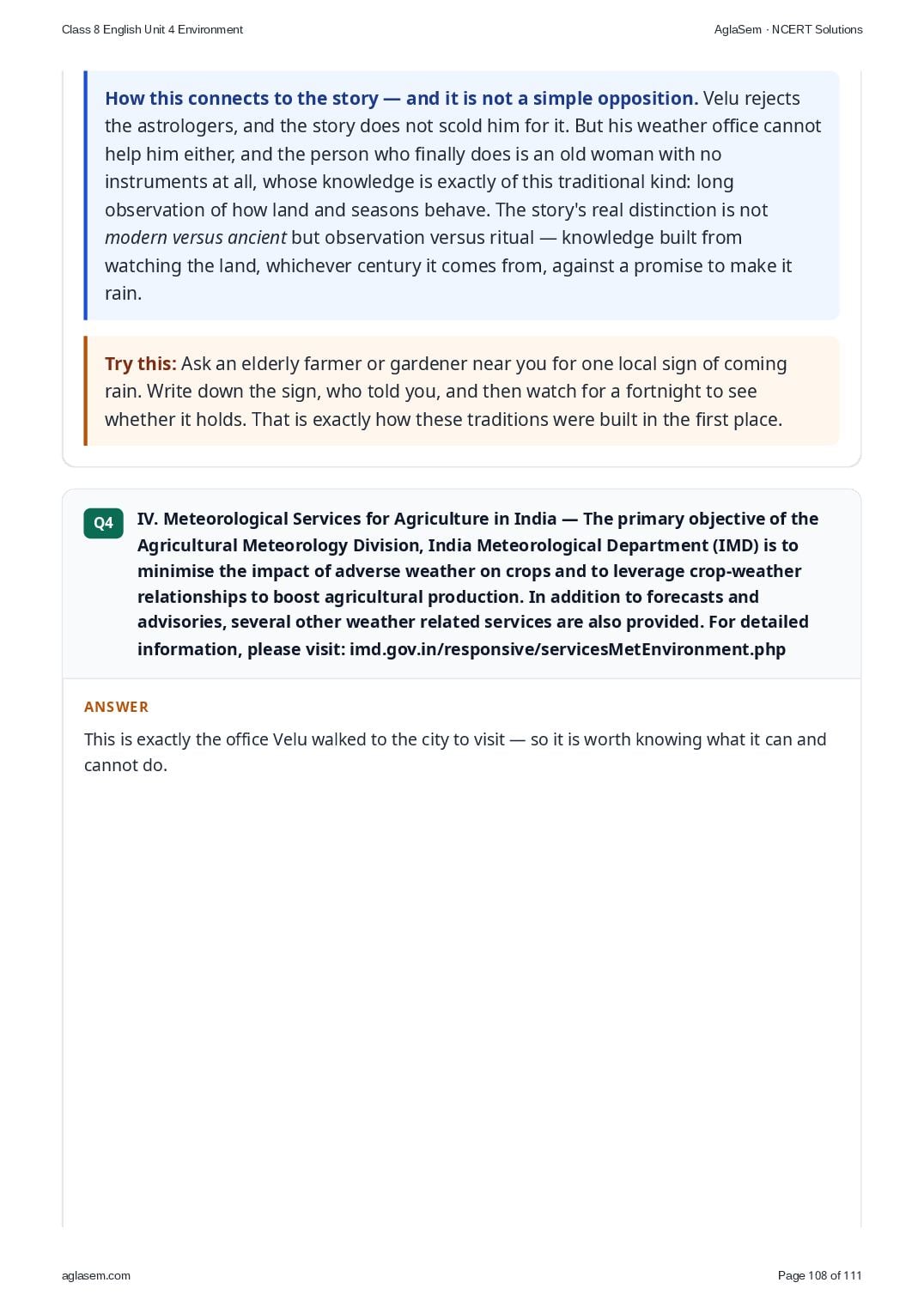
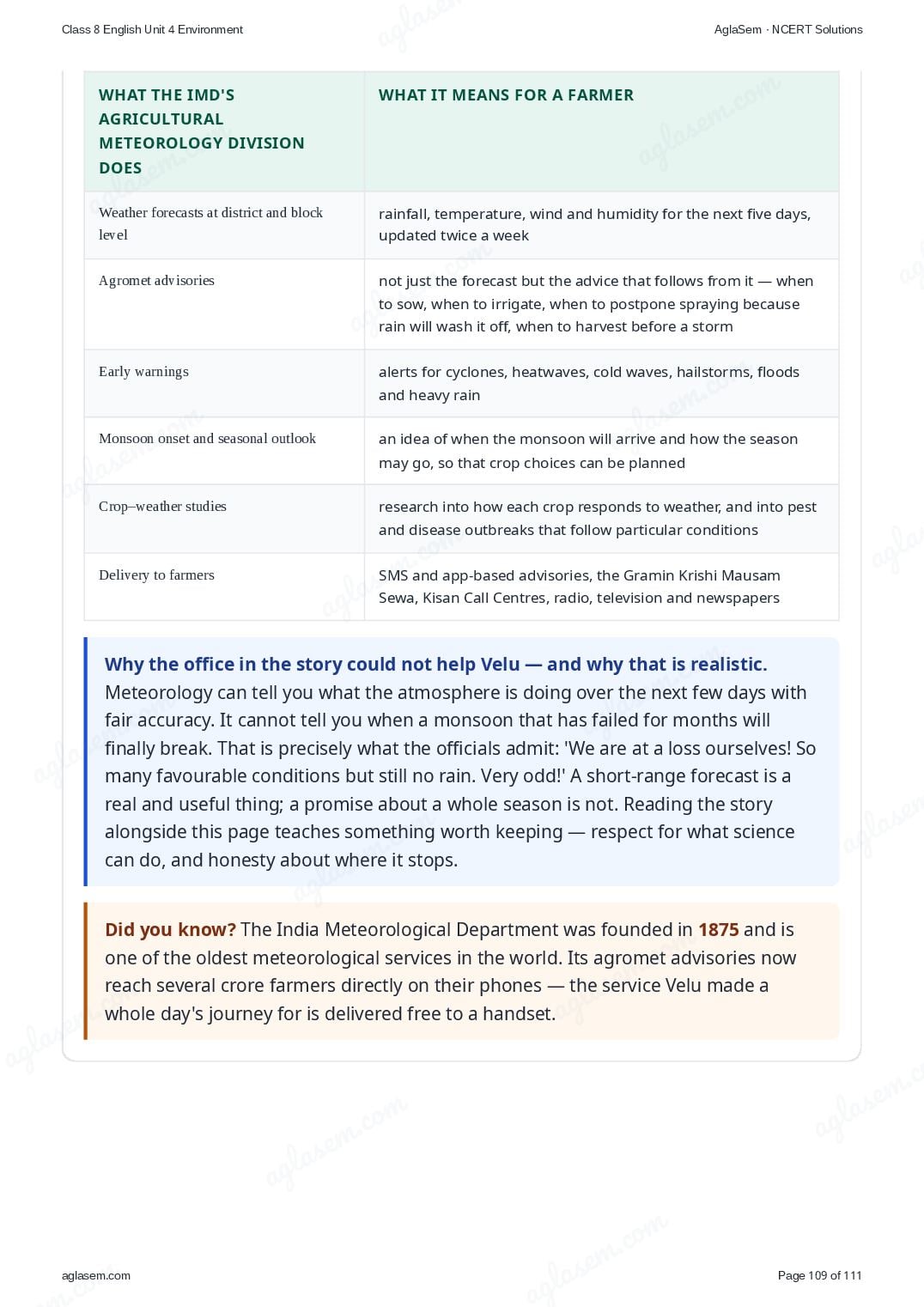
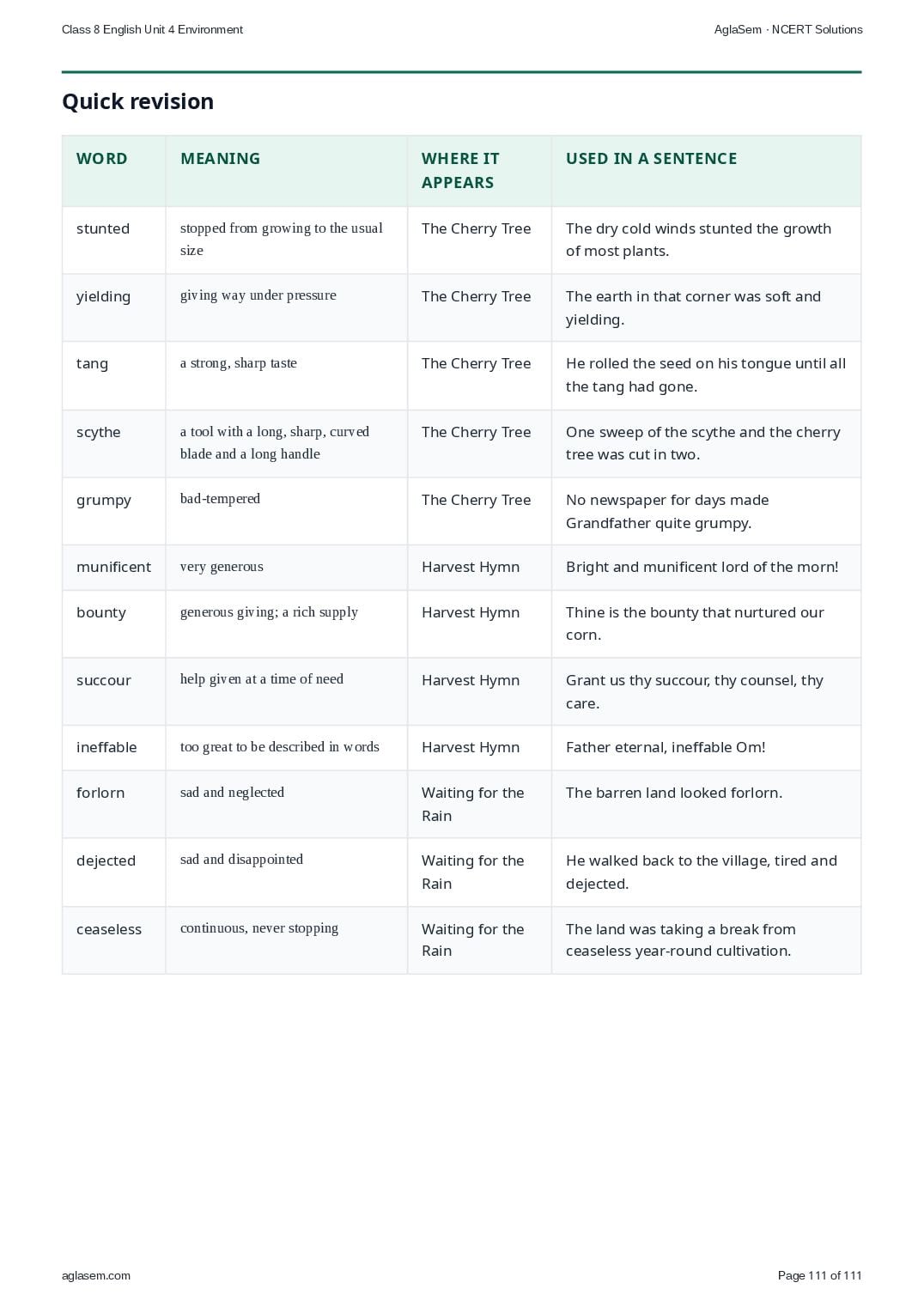
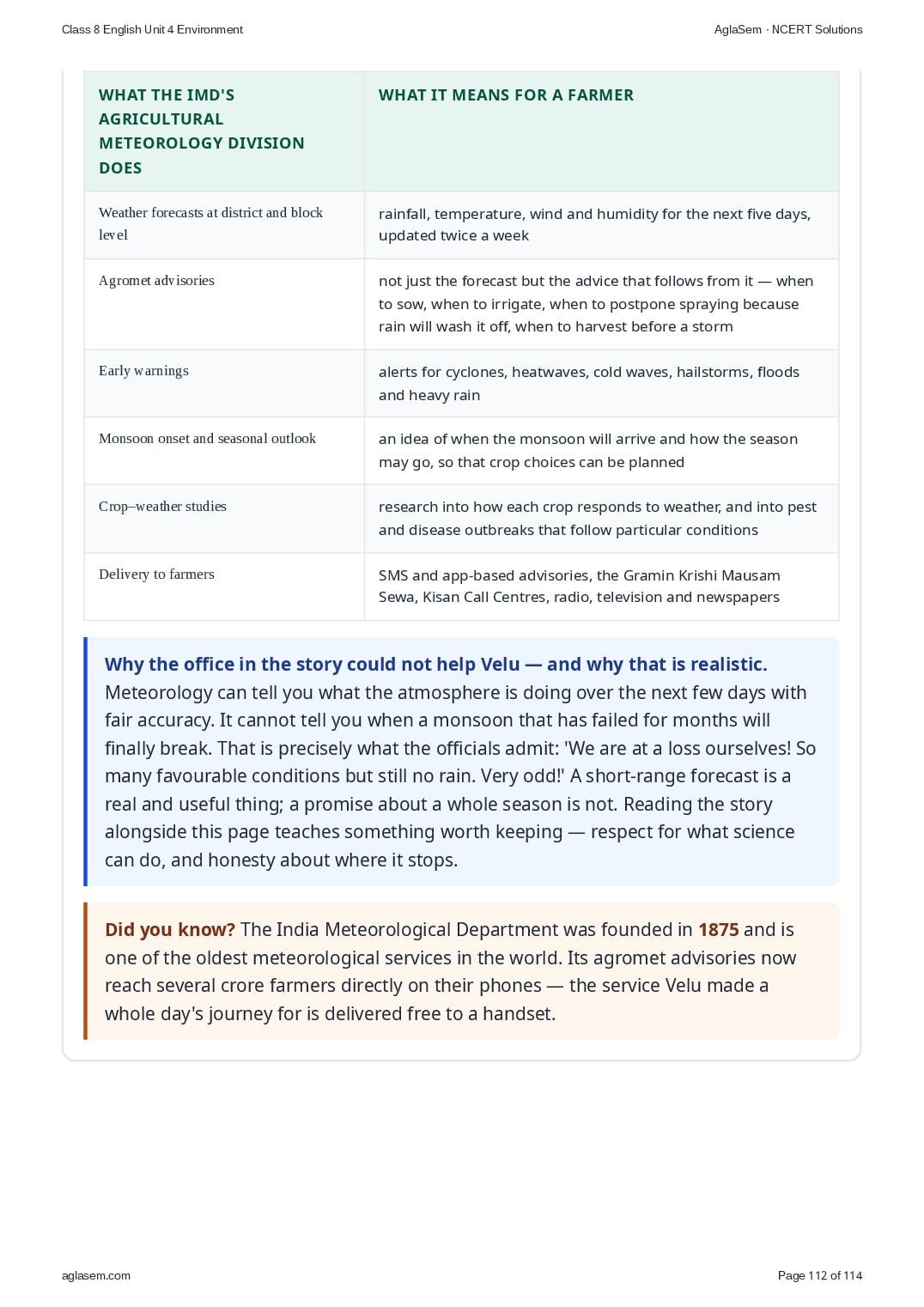
NCERT Solutions for Class 8 English Chapter 4 PDF Download
You can read the NCERT Solutions for Class 8 English Chapter 4 online above, or download the complete question-answer PDF to study Environment offline at any time.
NCERT Solutions for Class 8 English Chapter 4 PDF Download Link – Click Here to Download Solutions PDF
Questions Covered in This Chapter
Key questions solved in this chapter include:
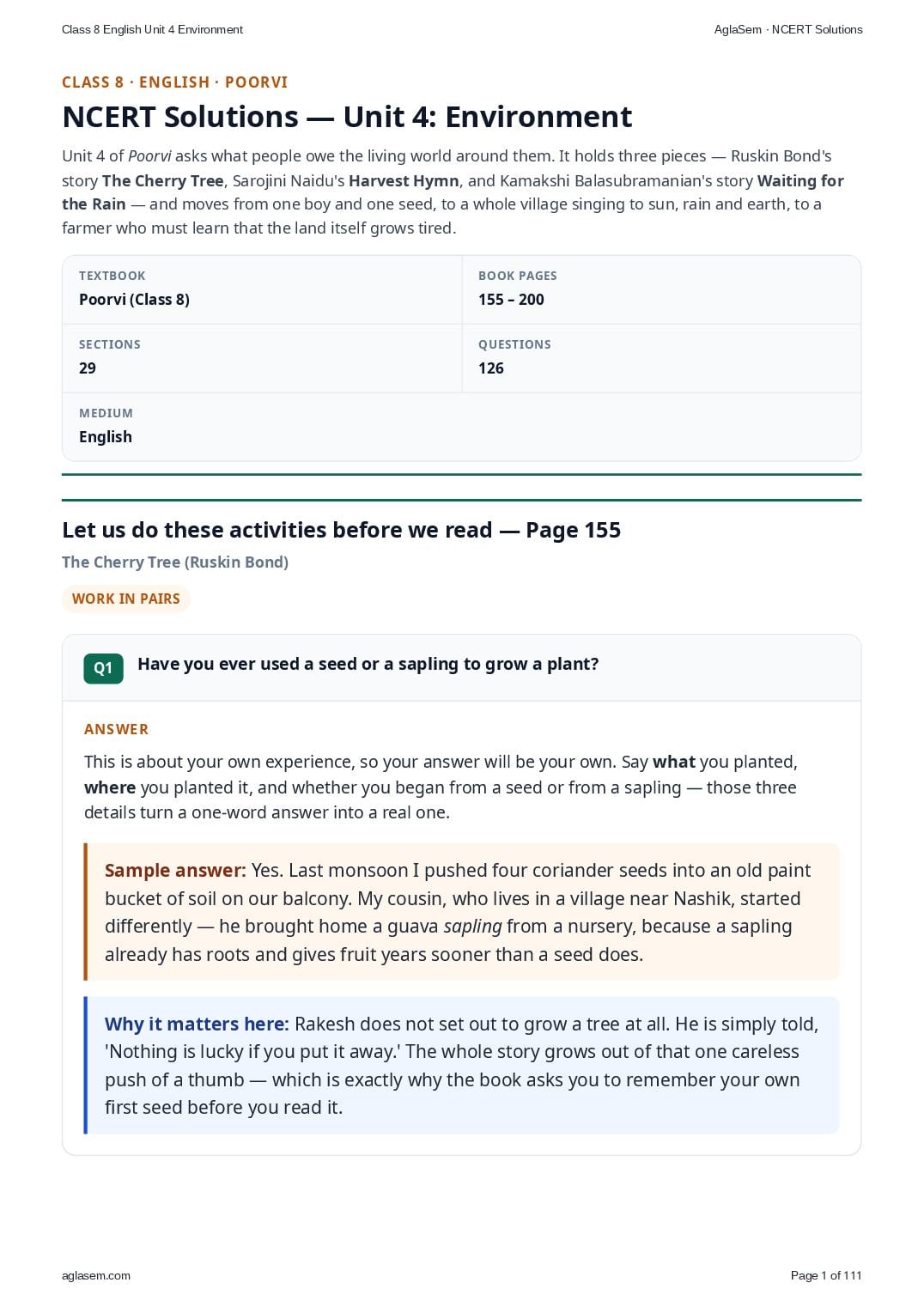
- Have you ever used a seed or a sapling to grow a plant?
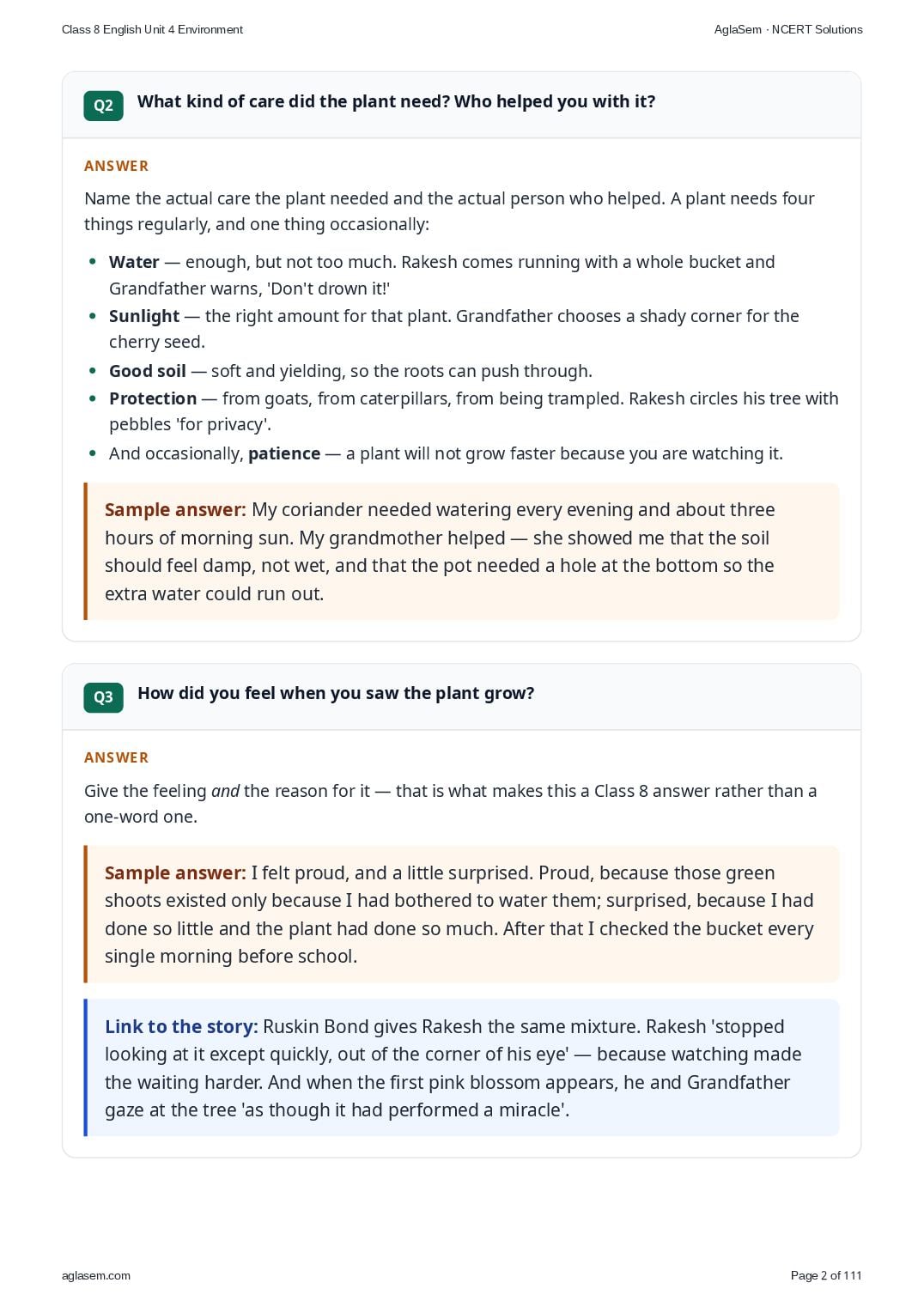
- What kind of care did the plant need? Who helped you with it?
- How did you feel when you saw the plant grow?
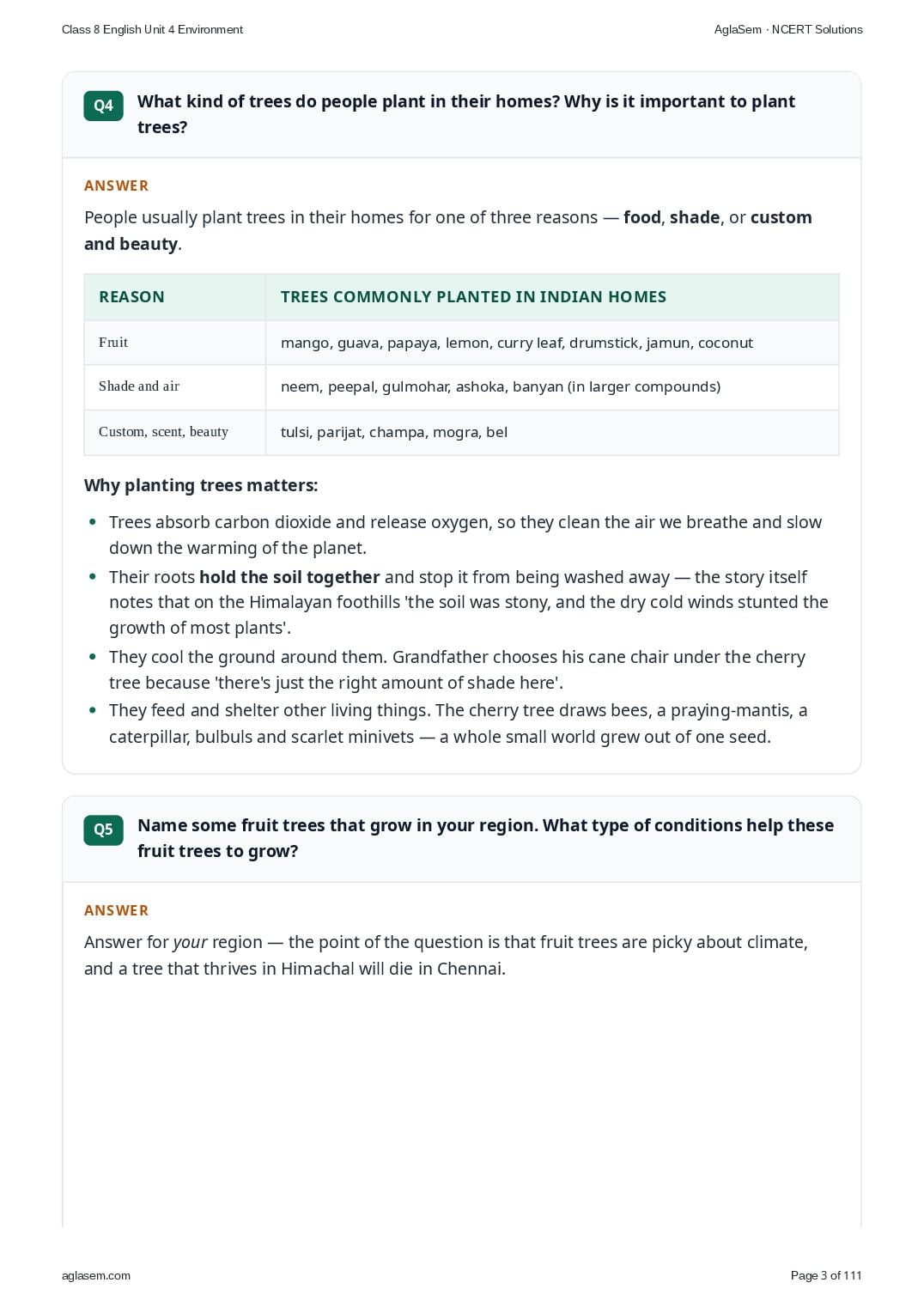
- What kind of trees do people plant in their homes? Why is it important to plant trees?
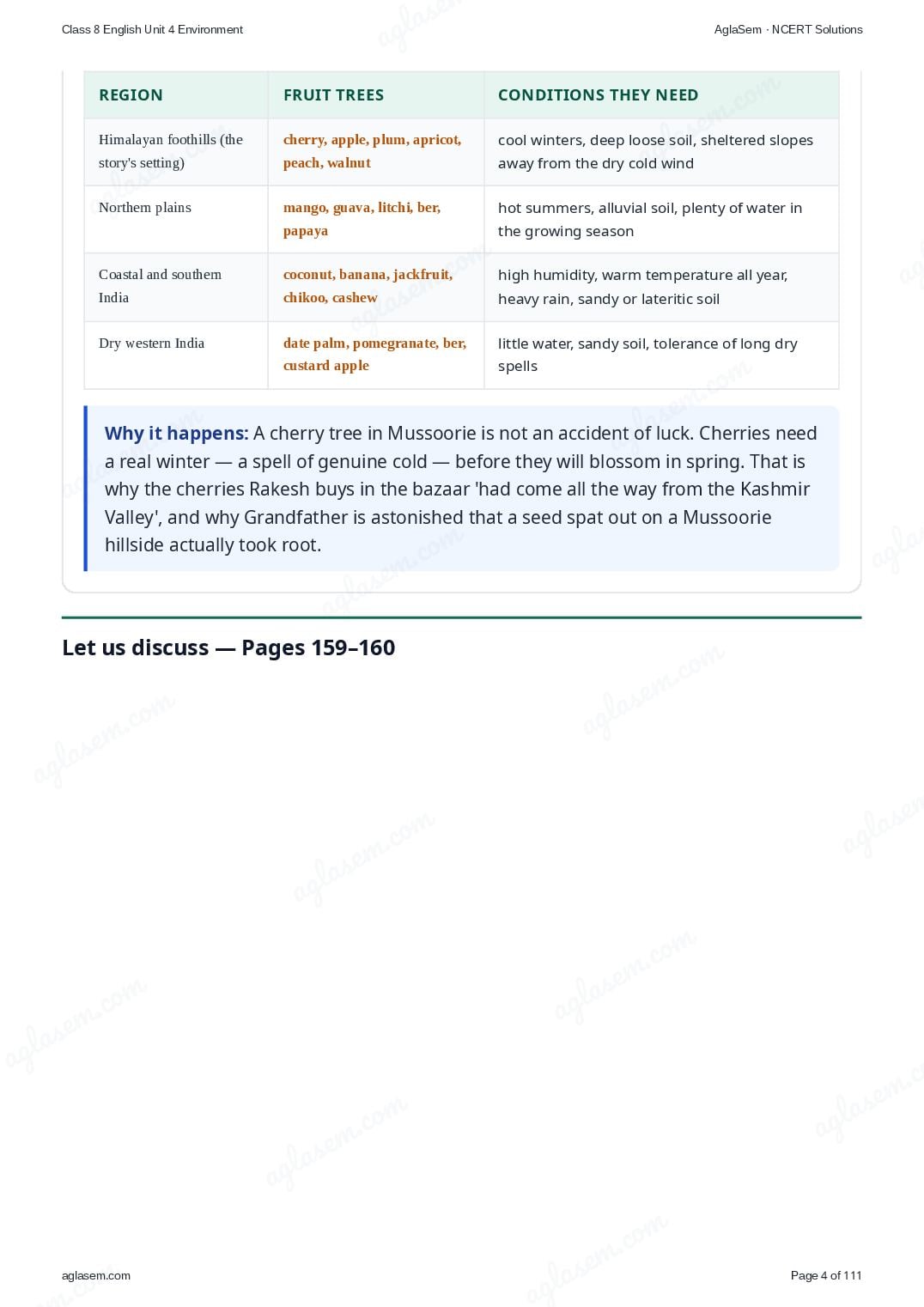
- Name some fruit trees that grow in your region. What type of conditions help these fruit trees to grow?
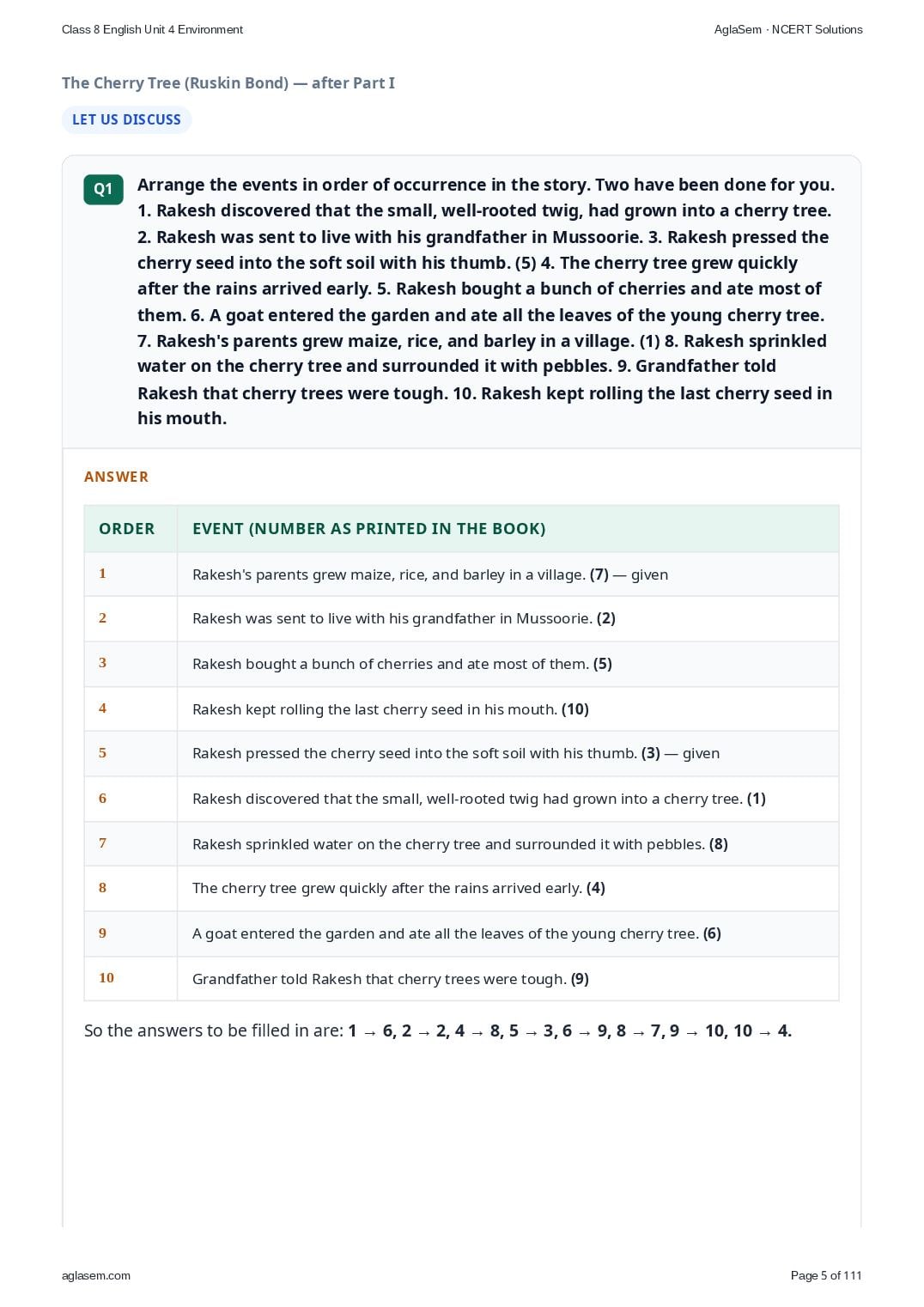
- Arrange the events in order of occurrence in the story. Two have been done for you. 1. Rakesh discovered that the small, well-rooted twig, had grown into a cherry tree. 2. Rakesh was sent to live with his grandfather in Mussoorie. 3. Rakesh pressed the cherry seed into the soft soil with his thumb. (5) 4. The cherry tree grew quickly after the rains arrived early. 5. Rakesh bought a bunch of cherries and ate most of them. 6. A goat entered the garden and ate all the leaves of the young cherry tree. 7. Rakesh's parents grew maize, rice, and barley in a village. (1) 8. Rakesh sprinkled water on the cherry tree and surrounded it with pebbles. 9. Grandfather told Rakesh that cherry trees were tough. 10. Rakesh kept rolling the last cherry seed in his mouth.
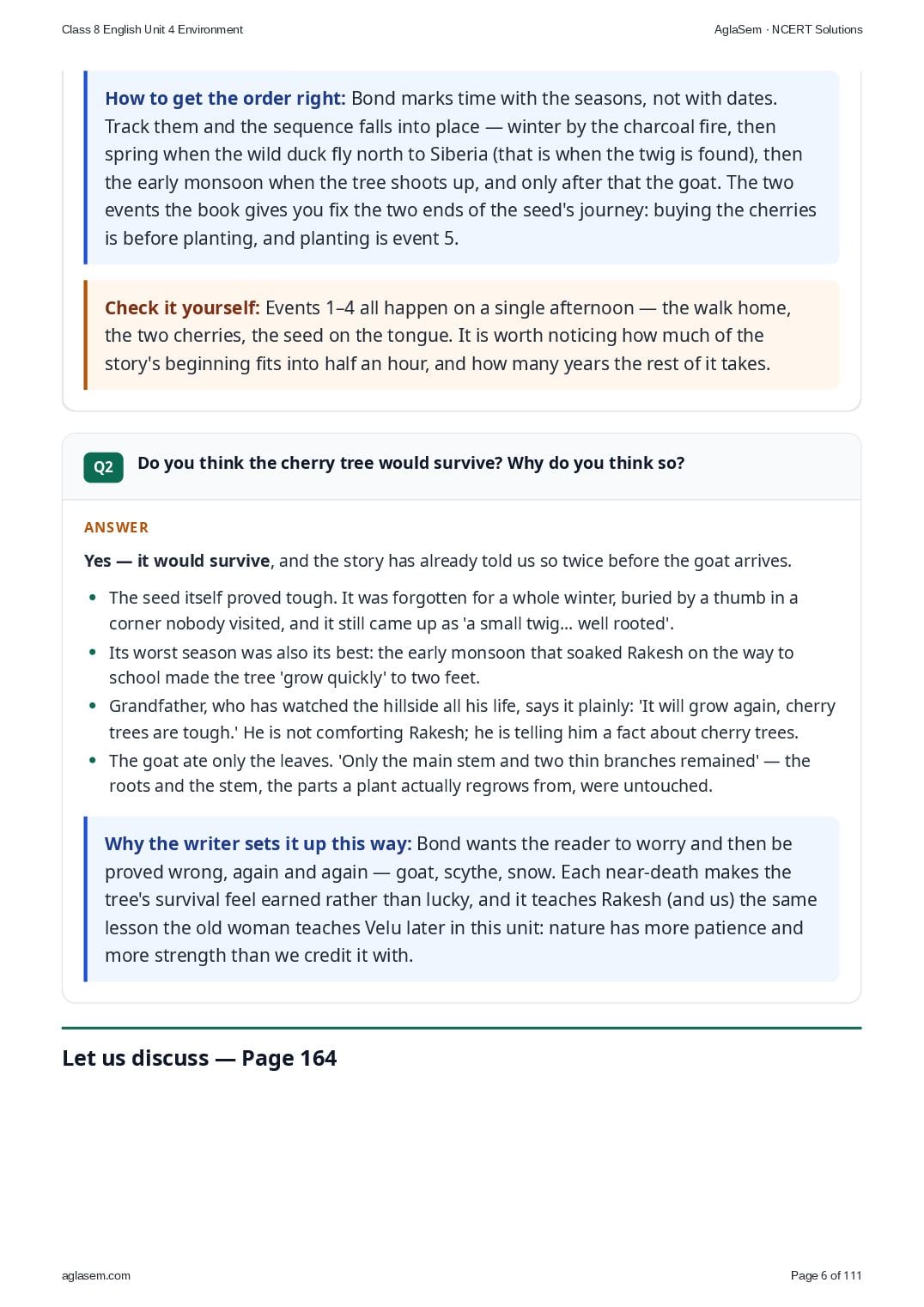
- Do you think the cherry tree would survive? Why do you think so?
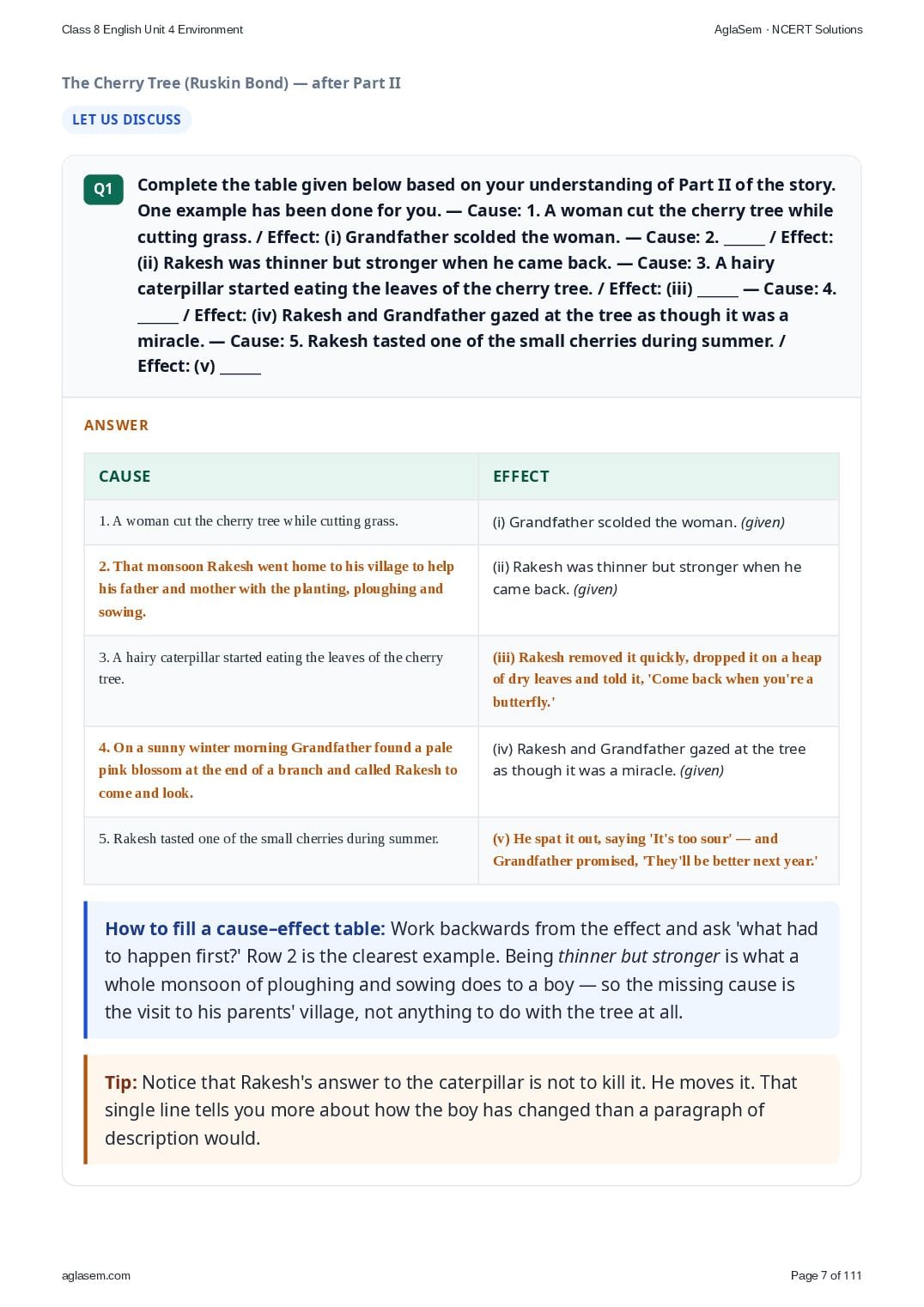
- Complete the table given below based on your understanding of Part II of the story. One example has been done for you. — Cause: 1. A woman cut the cherry tree while cutting grass. / Effect: (i) Grandfather scolded the woman. — Cause: 2. ______ / Effect: (ii) Rakesh was thinner but stronger when he came back. — Cause: 3. A hairy caterpillar started eating the leaves of the cherry tree. / Effect: (iii) ______ — Cause: 4. ______ / Effect: (iv) Rakesh and Grandfather gazed at the tree as though it was a miracle. — Cause: 5. Rakesh tasted one of the small cherries during summer. / Effect: (v) ______
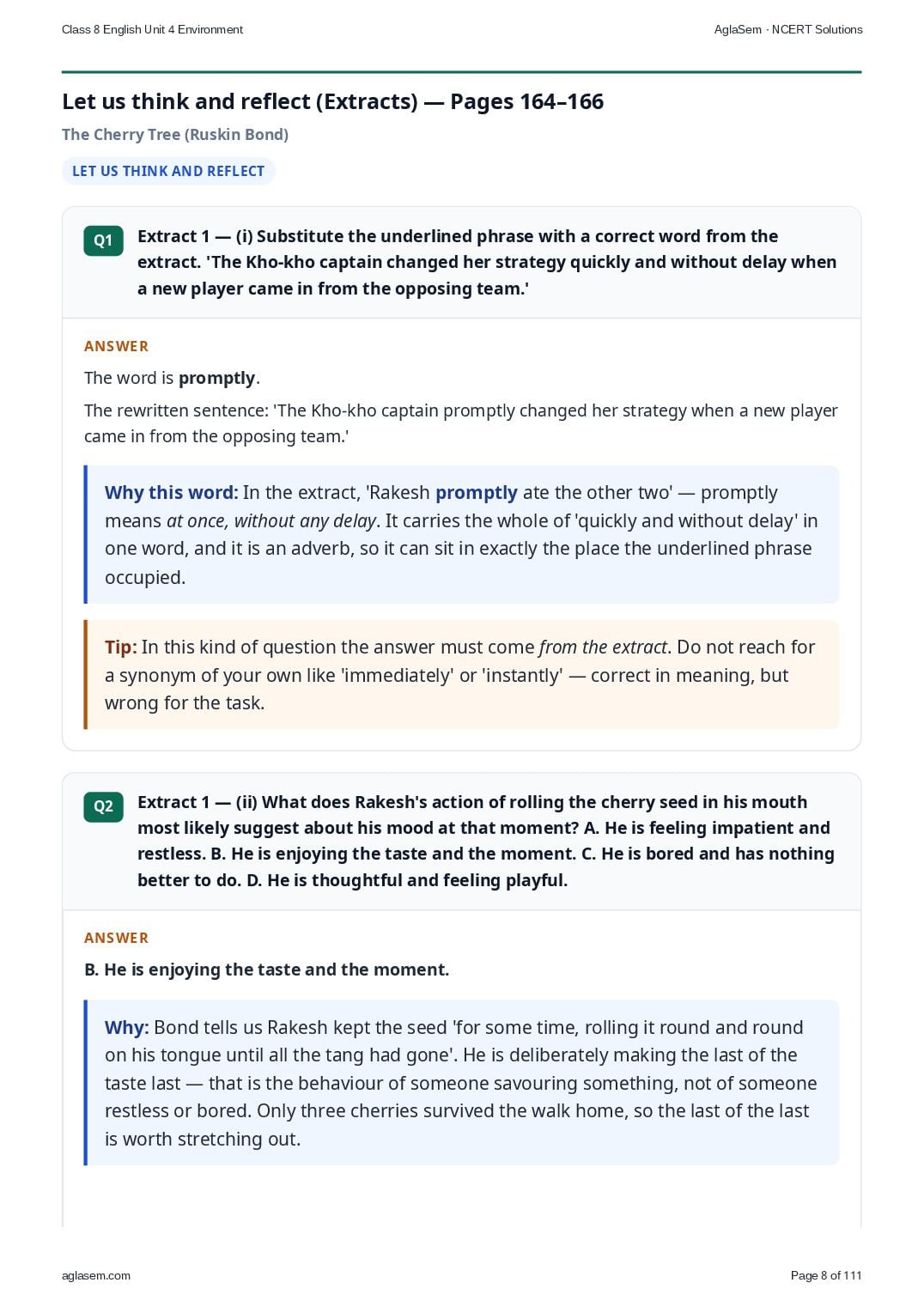
- Extract 1 — (i) Substitute the underlined phrase with a correct word from the extract. 'The Kho-kho captain changed her strategy quickly and without delay when a new player came in from the opposing team.'
- Extract 1 — (ii) What does Rakesh's action of rolling the cherry seed in his mouth most likely suggest about his mood at that moment? A. He is feeling impatient and restless. B. He is enjoying the taste and the moment. C. He is bored and has nothing better to do. D. He is thoughtful and feeling playful.
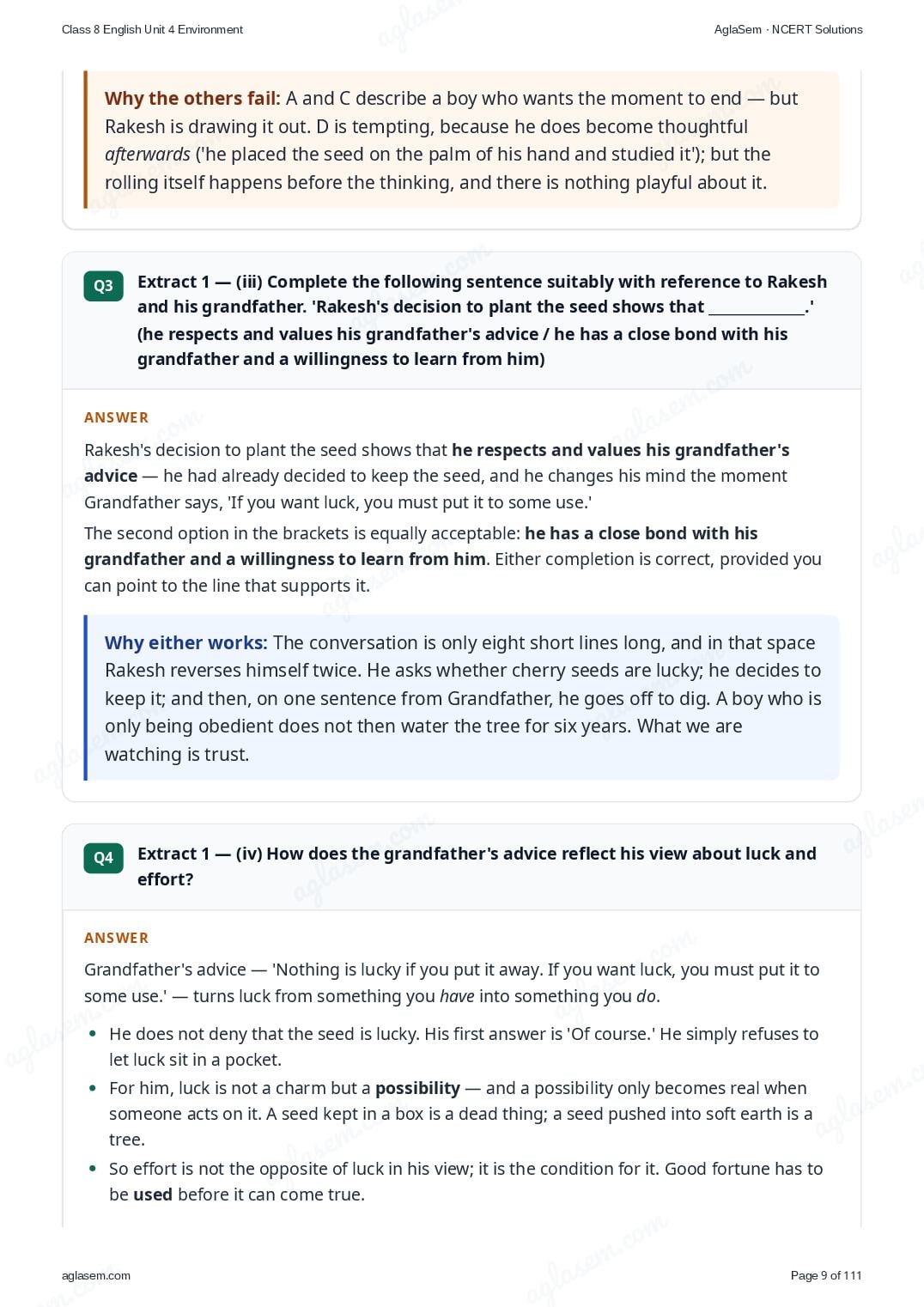
- Extract 1 — (iii) Complete the following sentence suitably with reference to Rakesh and his grandfather. 'Rakesh's decision to plant the seed shows that ______________.' (he respects and values his grandfather's advice / he has a close bond with his grandfather and a willingness to learn from him)
- Extract 1 — (iv) How does the grandfather's advice reflect his view about luck and effort?
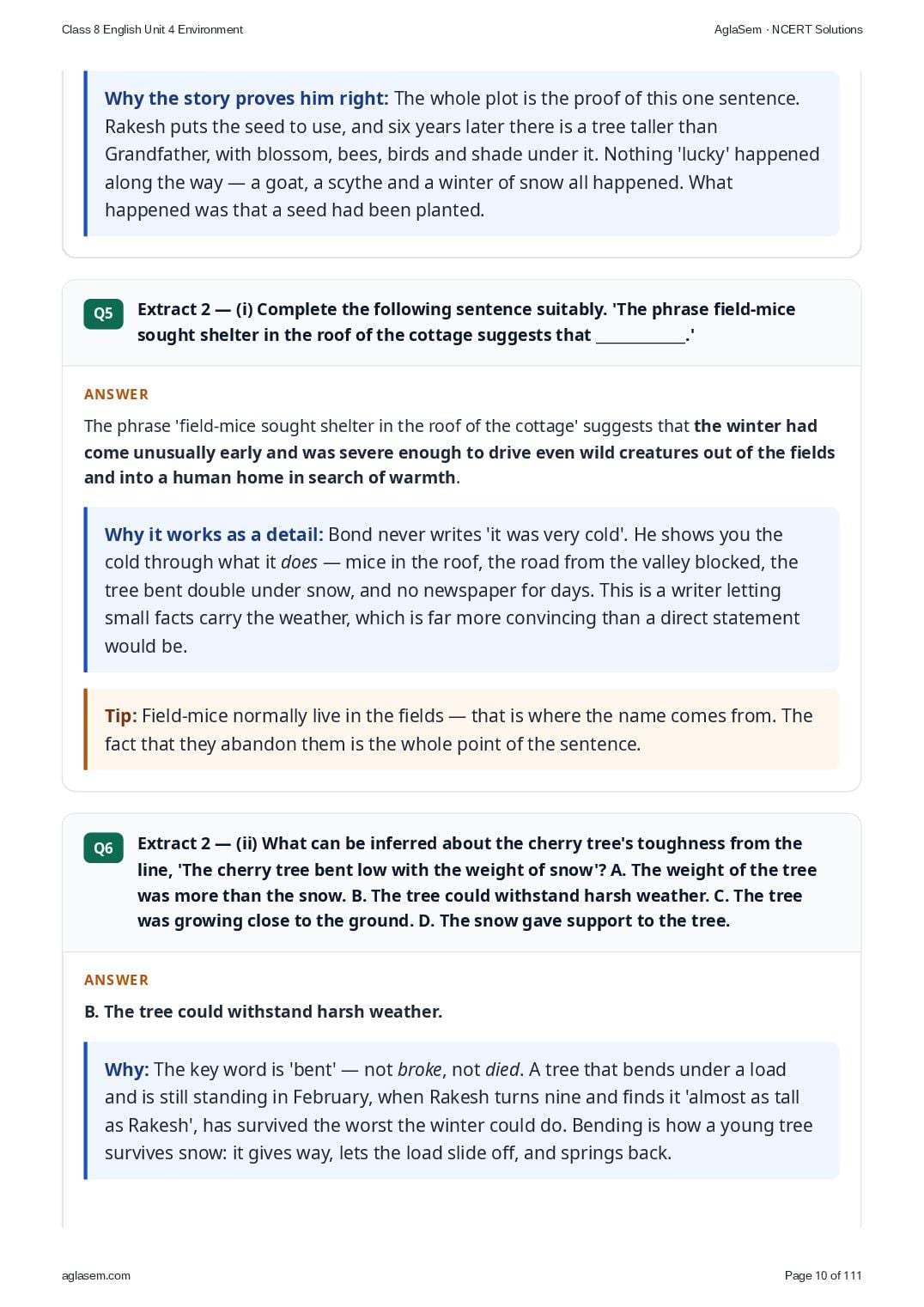
- Extract 2 — (i) Complete the following sentence suitably. 'The phrase field-mice sought shelter in the roof of the cottage suggests that _____________.'
- Extract 2 — (ii) What can be inferred about the cherry tree's toughness from the line, 'The cherry tree bent low with the weight of snow'? A. The weight of the tree was more than the snow. B. The tree could withstand harsh weather. C. The tree was growing close to the ground. D. The snow gave support to the tree.
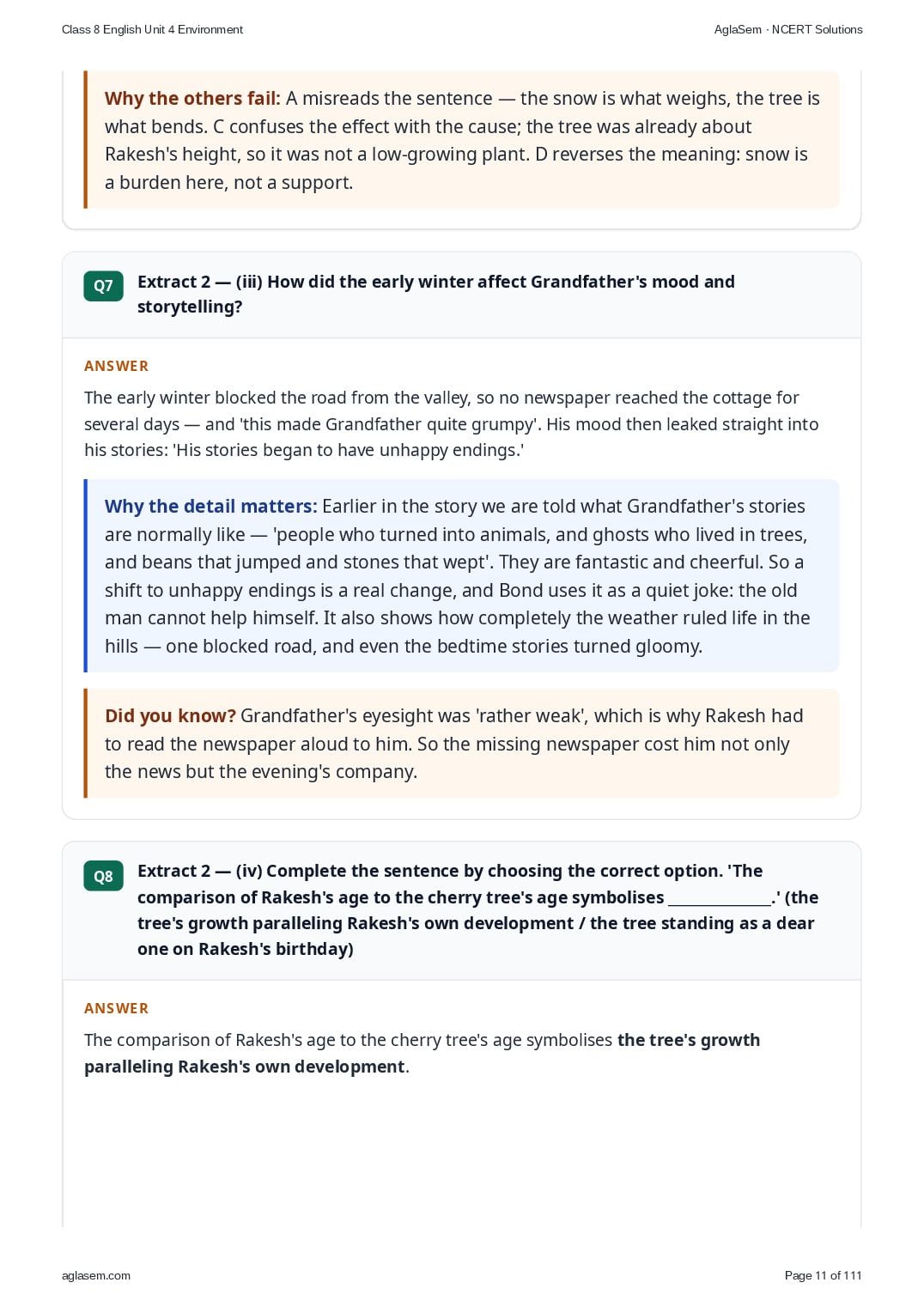
- Extract 2 — (iii) How did the early winter affect Grandfather's mood and storytelling?
- Extract 2 — (iv) Complete the sentence by choosing the correct option. 'The comparison of Rakesh's age to the cherry tree's age symbolises _______________.' (the tree's growth paralleling Rakesh's own development / the tree standing as a dear one on Rakesh's birthday)
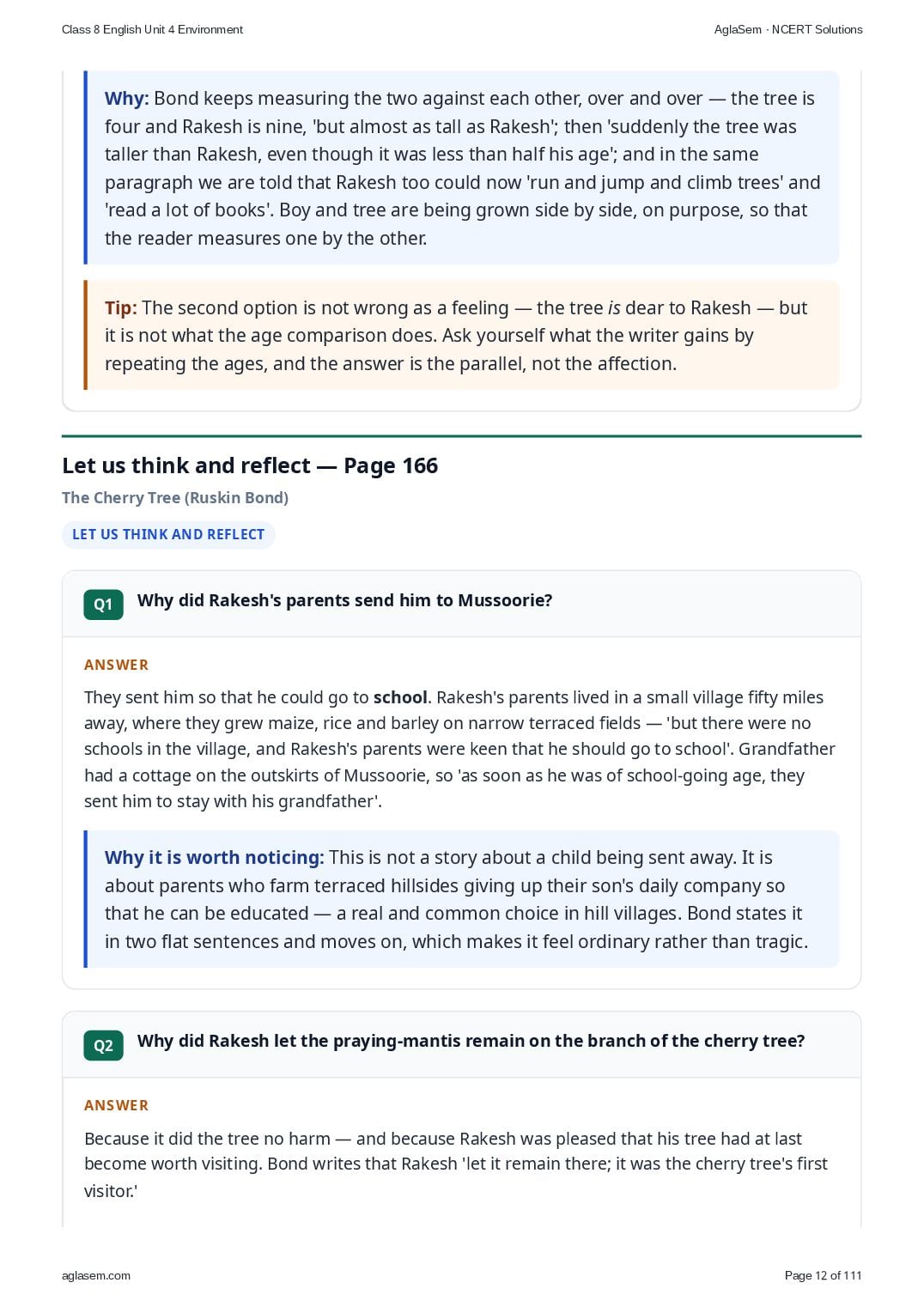
- Why did Rakesh's parents send him to Mussoorie?
- Why did Rakesh let the praying-mantis remain on the branch of the cherry tree?
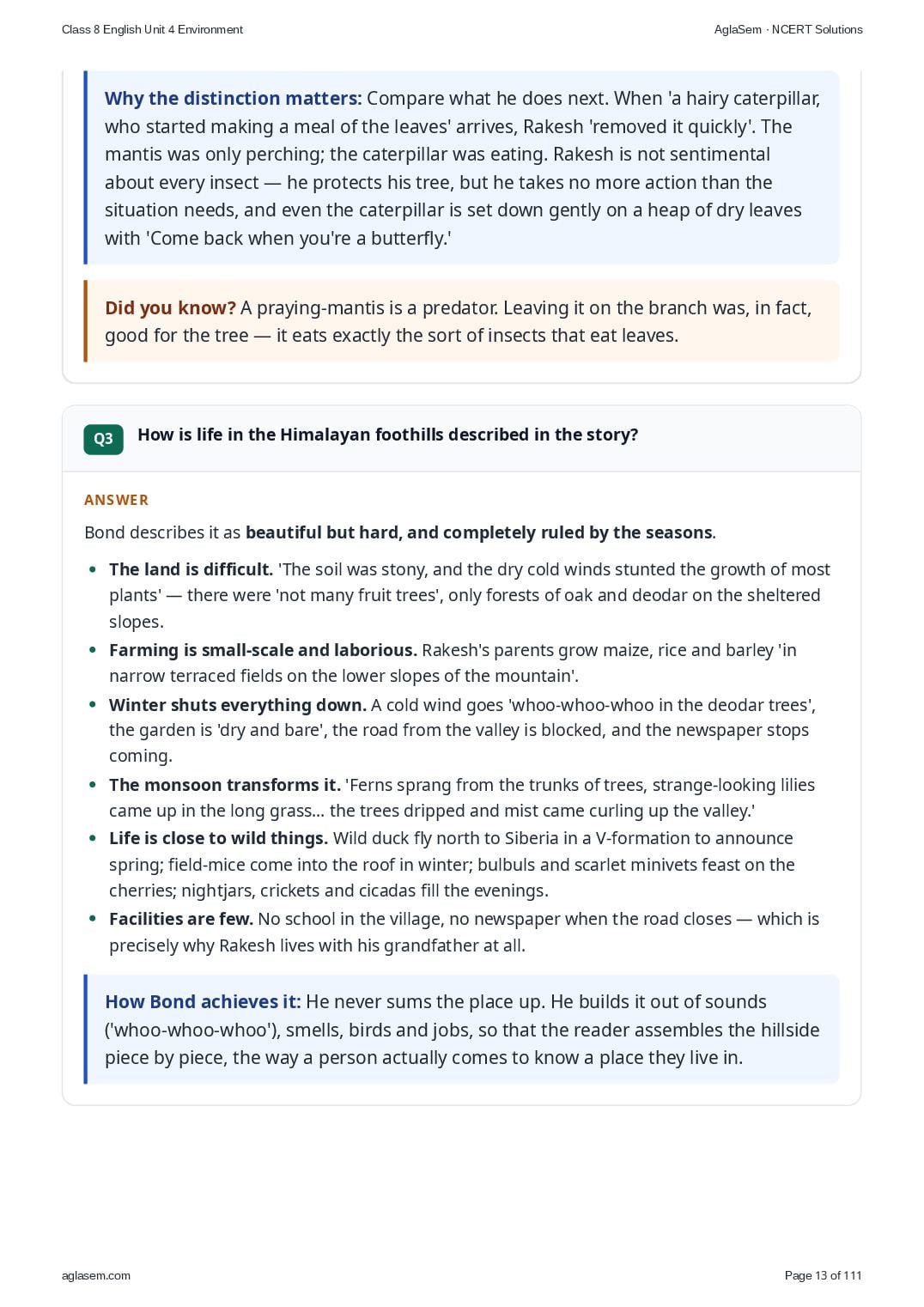
- How is life in the Himalayan foothills described in the story?
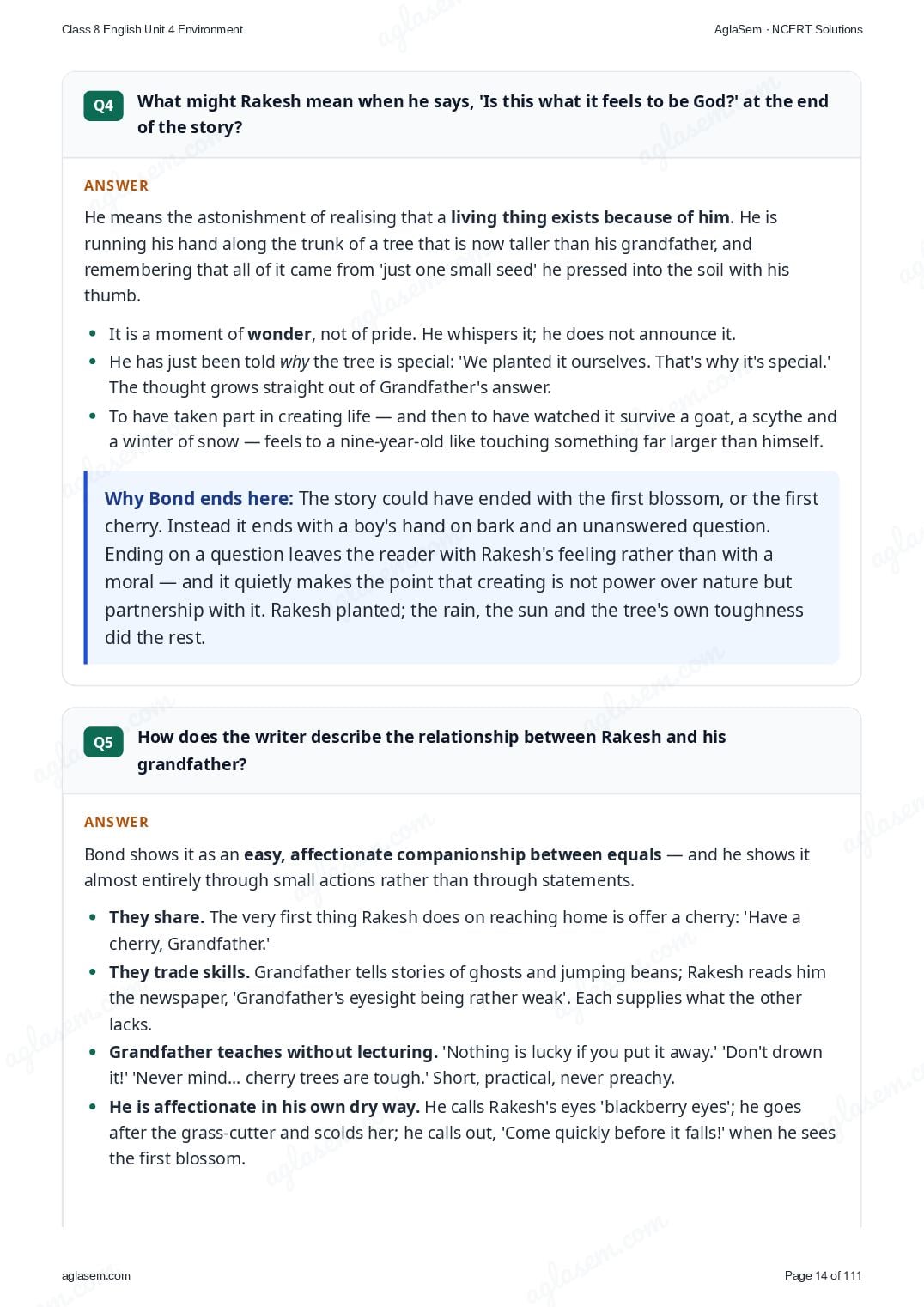
- What might Rakesh mean when he says, 'Is this what it feels to be God?' at the end of the story?
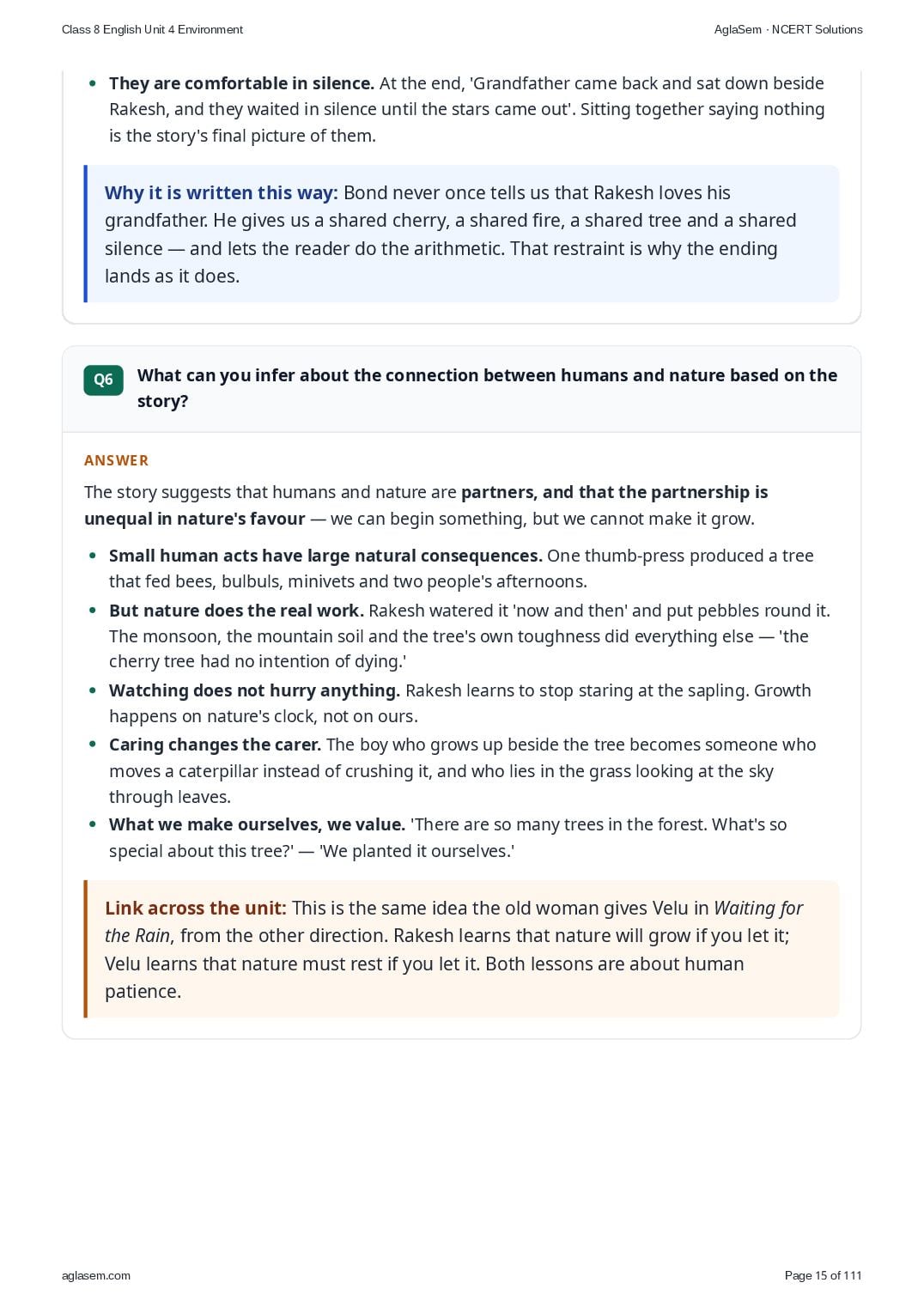
- How does the writer describe the relationship between Rakesh and his grandfather?
- What can you infer about the connection between humans and nature based on the story?
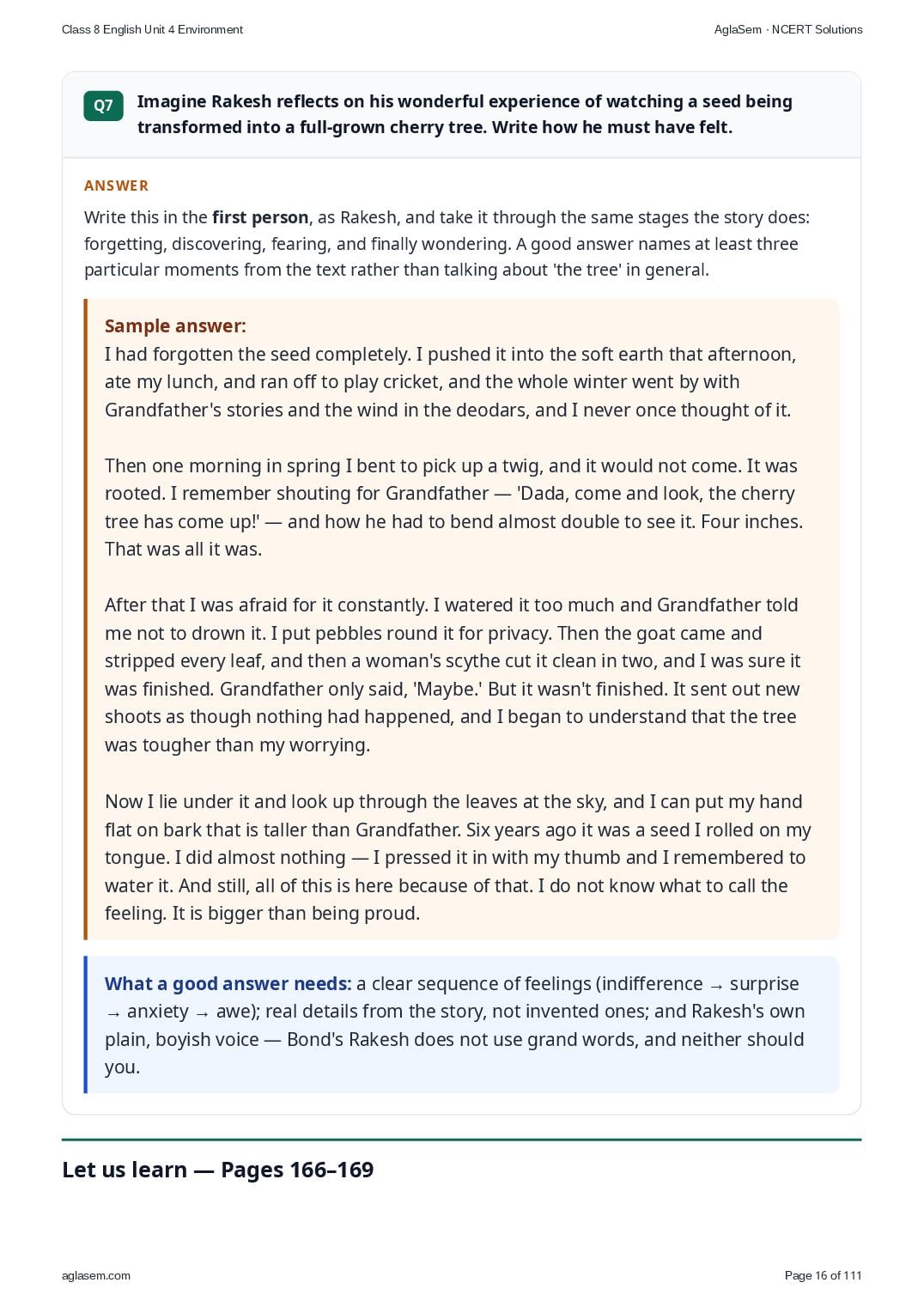
- Imagine Rakesh reflects on his wonderful experience of watching a seed being transformed into a full-grown cherry tree. Write how he must have felt.
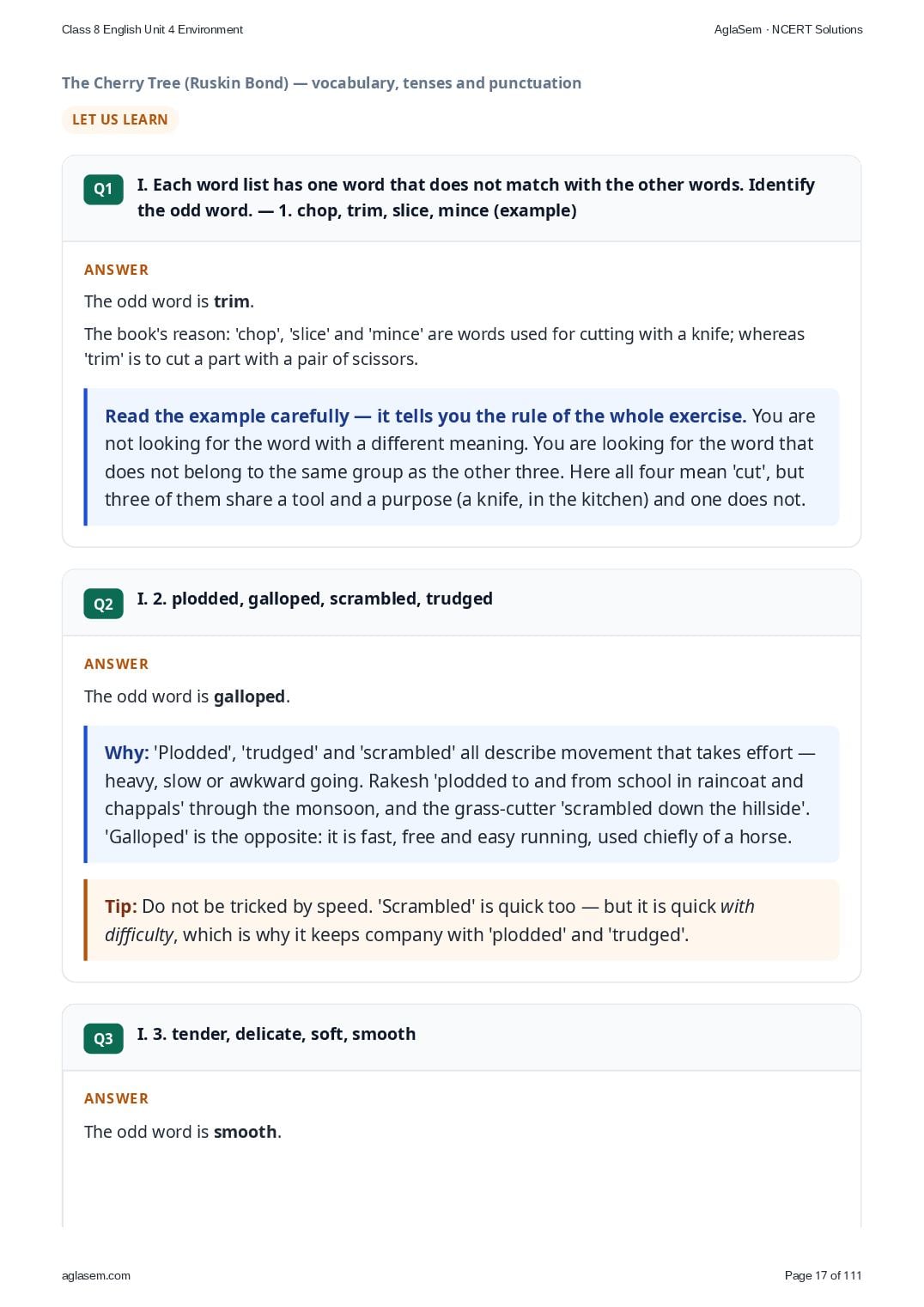
- I. Each word list has one word that does not match with the other words. Identify the odd word. — 1. chop, trim, slice, mince (example)
- I. 2. plodded, galloped, scrambled, trudged
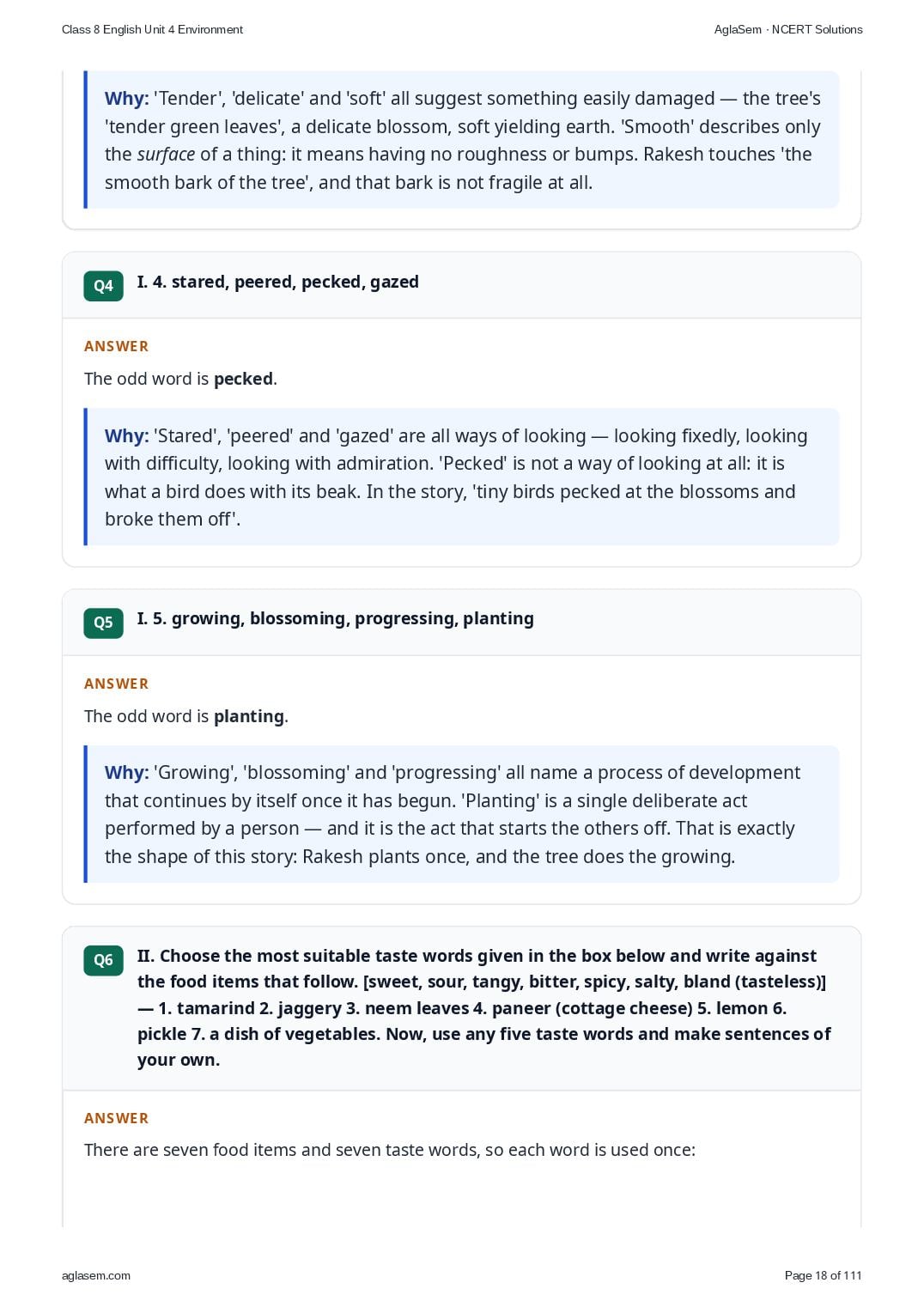
- I. 3. tender, delicate, soft, smooth
- I. 4. stared, peered, pecked, gazed
- I. 5. growing, blossoming, progressing, planting
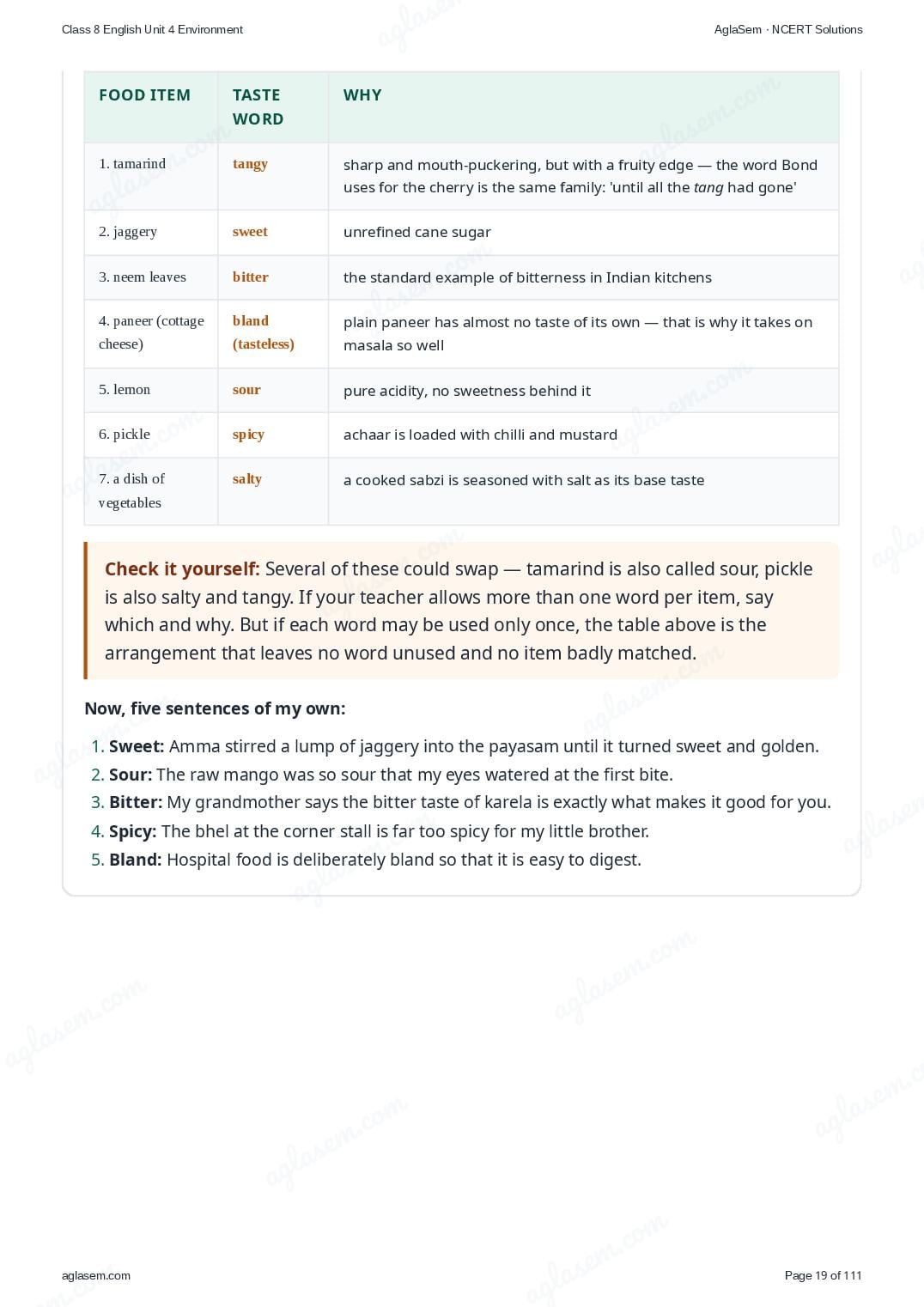
- II. Choose the most suitable taste words given in the box below and write against the food items that follow. [sweet, sour, tangy, bitter, spicy, salty, bland (tasteless)] — 1. tamarind 2. jaggery 3. neem leaves 4. paneer (cottage cheese) 5. lemon 6. pickle 7. a dish of vegetables. Now, use any five taste words and make sentences of your own.
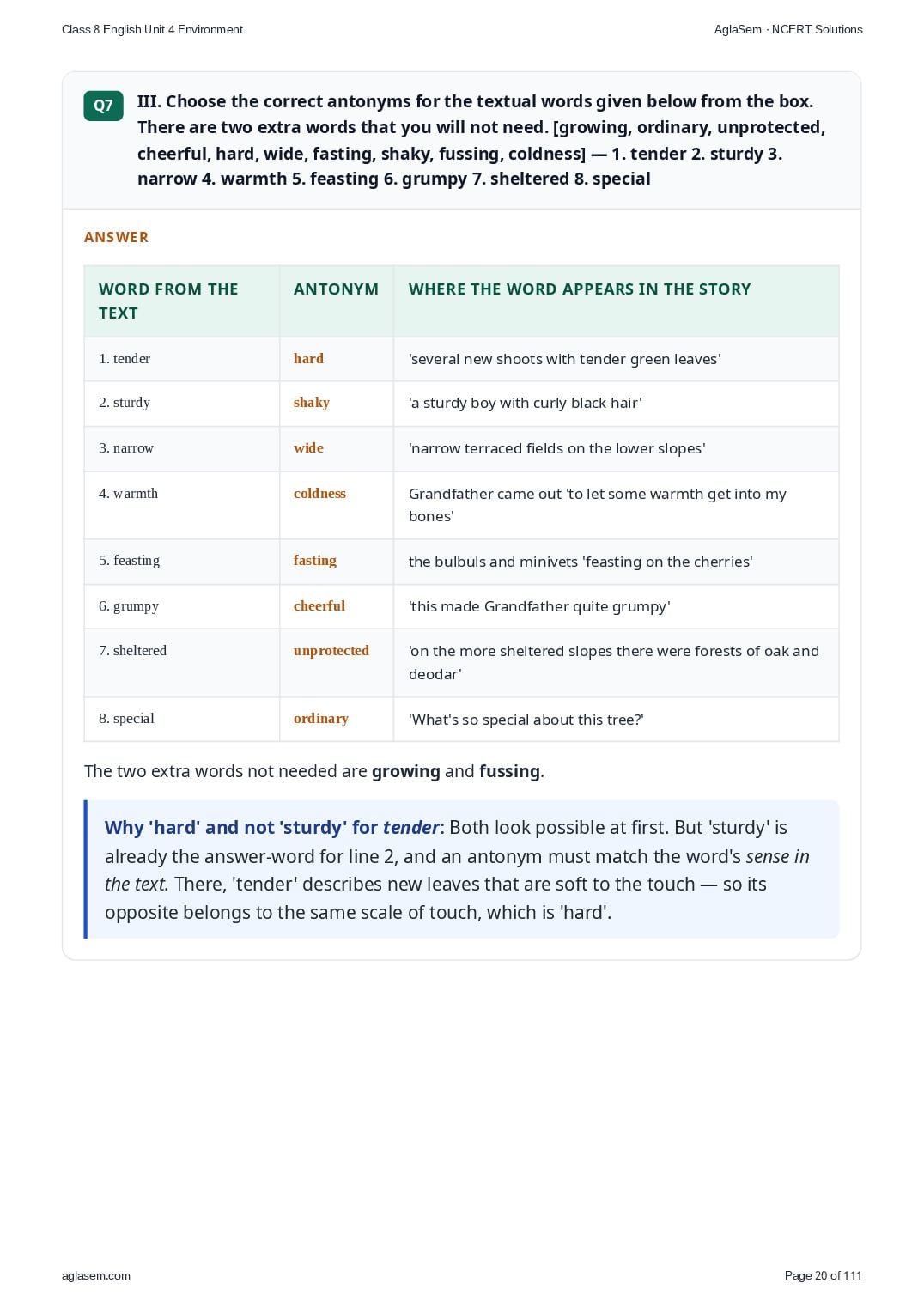
- III. Choose the correct antonyms for the textual words given below from the box. There are two extra words that you will not need. [growing, ordinary, unprotected, cheerful, hard, wide, fasting, shaky, fussing, coldness] — 1. tender 2. sturdy 3. narrow 4. warmth 5. feasting 6. grumpy 7. sheltered 8. special
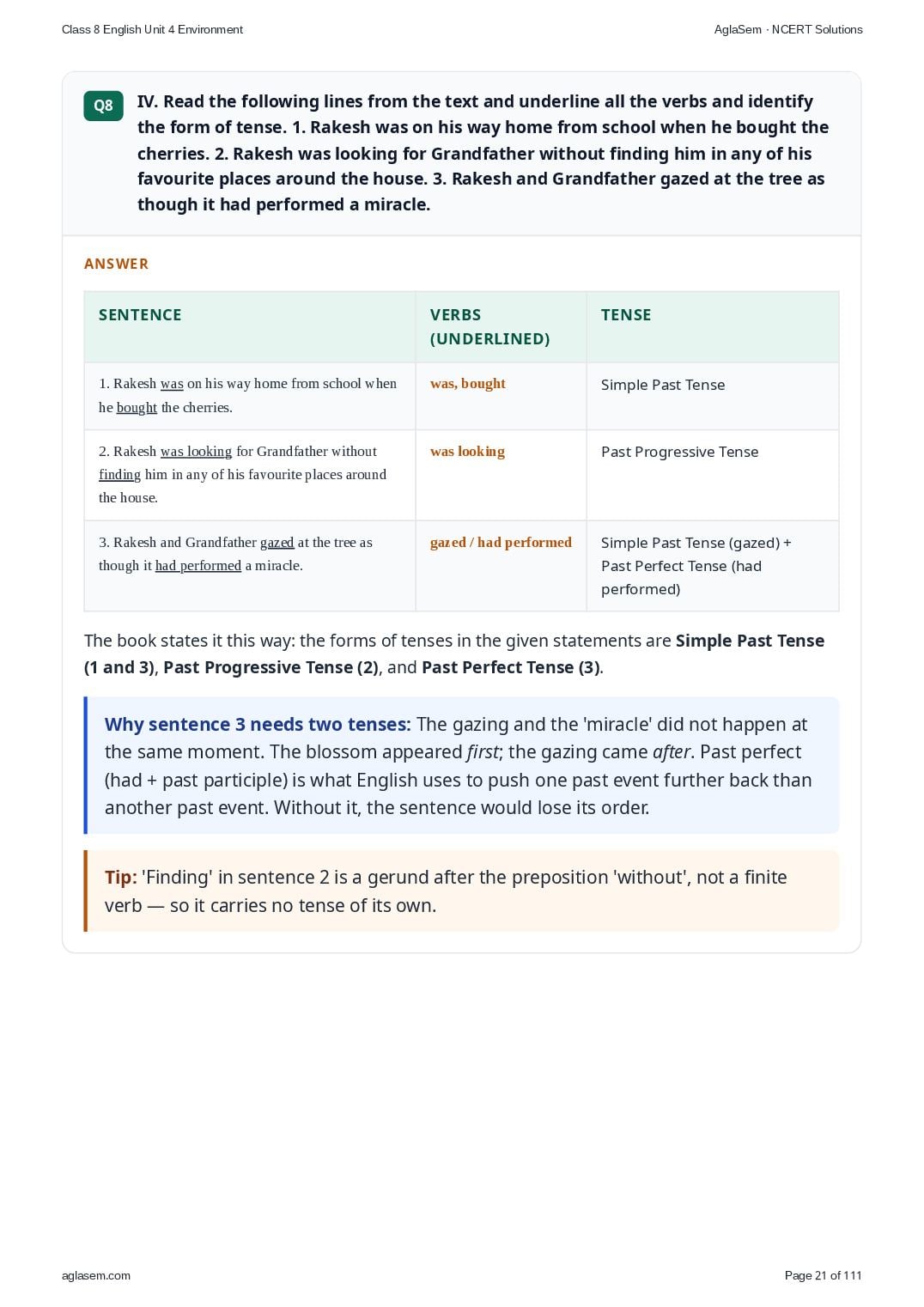
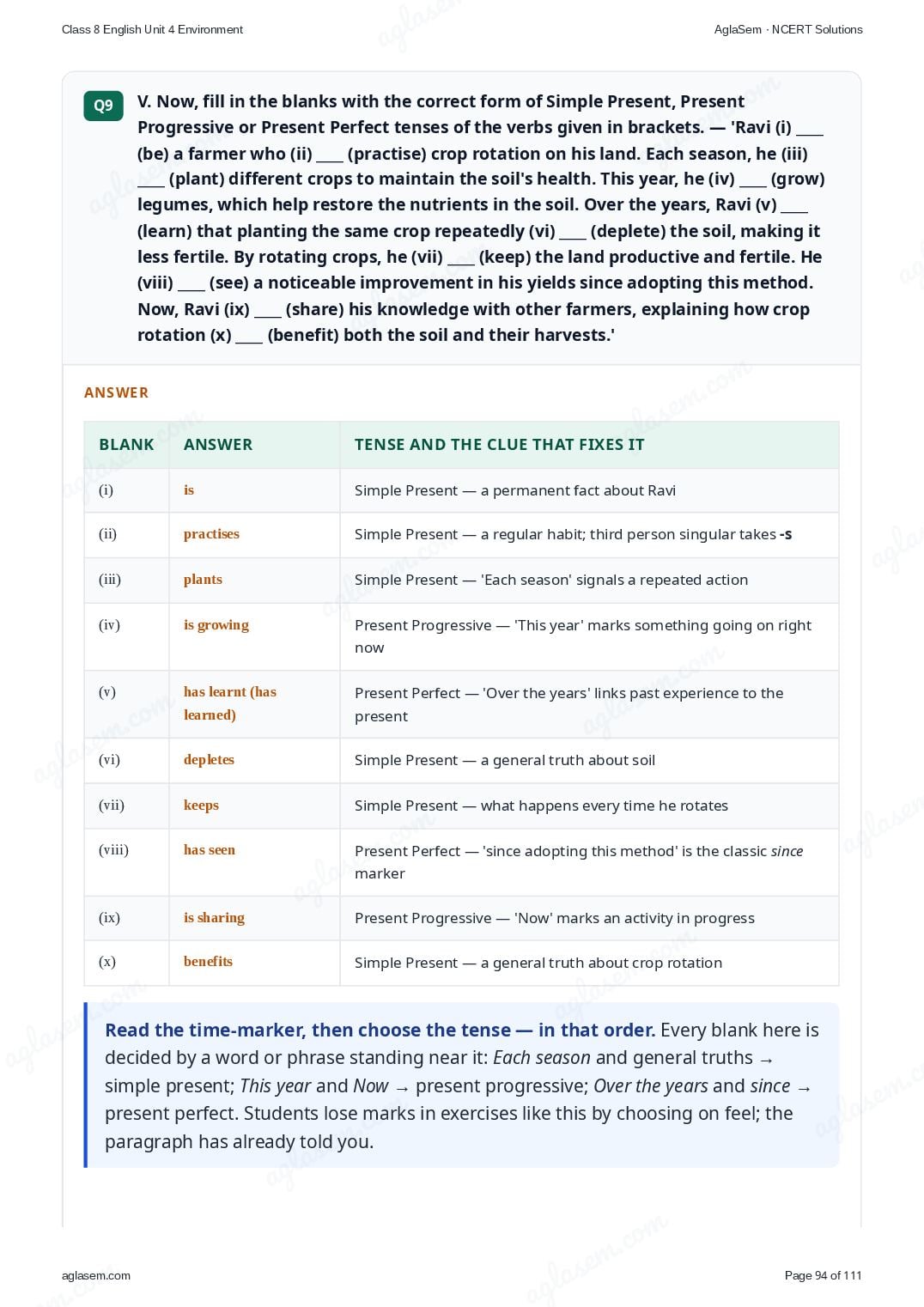
- IV. Read the following lines from the text and underline all the verbs and identify the form of tense. 1. Rakesh was on his way home from school when he bought the cherries. 2. Rakesh was looking for Grandfather without finding him in any of his favourite places around the house. 3. Rakesh and Grandfather gazed at the tree as though it had performed a miracle.
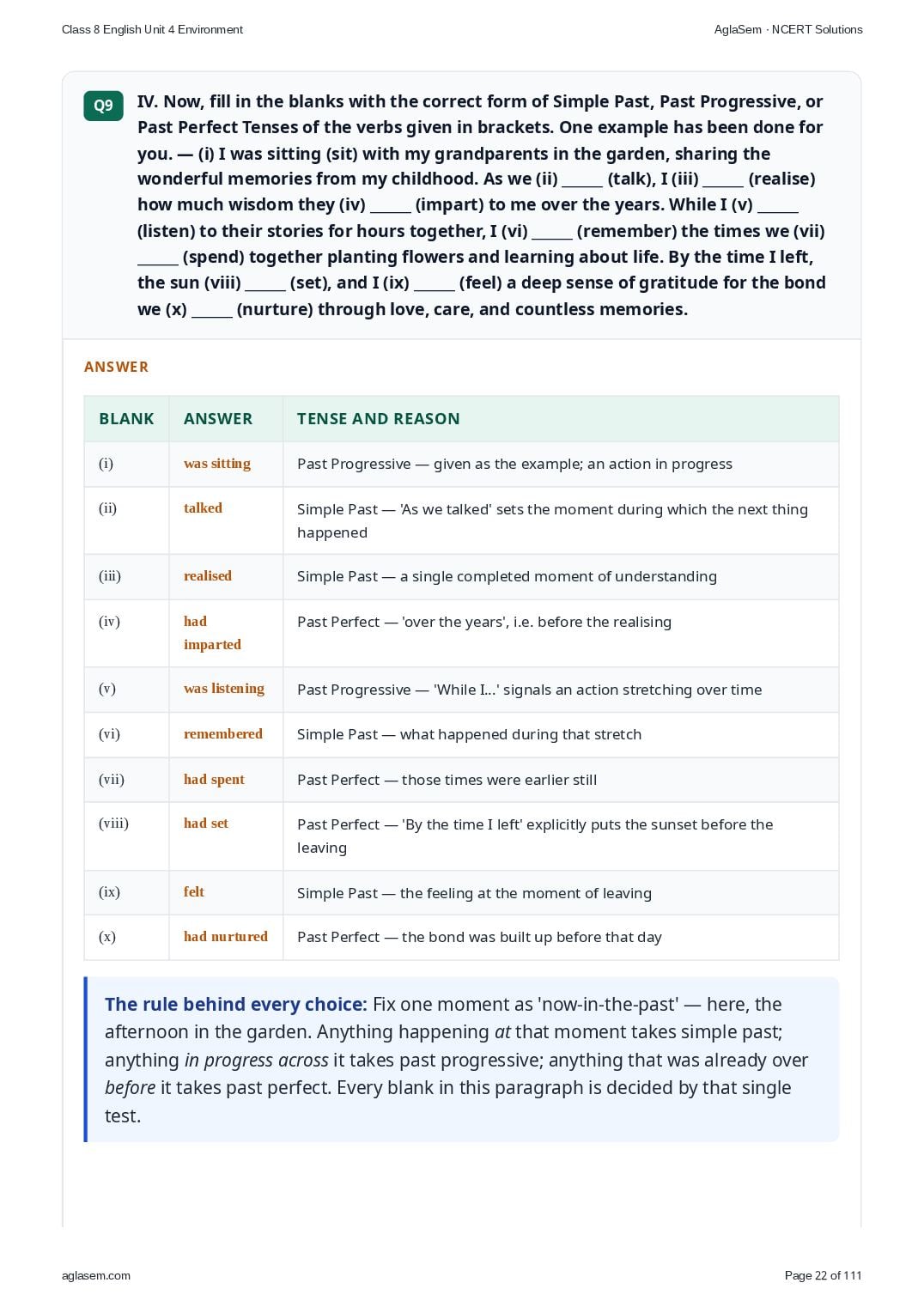
- IV. Now, fill in the blanks with the correct form of Simple Past, Past Progressive, or Past Perfect Tenses of the verbs given in brackets. One example has been done for you. — (i) I was sitting (sit) with my grandparents in the garden, sharing the wonderful memories from my childhood. As we (ii) ______ (talk), I (iii) ______ (realise) how much wisdom they (iv) ______ (impart) to me over the years. While I (v) ______ (listen) to their stories for hours together, I (vi) ______ (remember) the times we (vii) ______ (spend) together planting flowers and learning about life. By the time I left, the sun (viii) ______ (set), and I (ix) ______ (feel) a deep sense of gratitude for the bond we (x) ______ (nurture) through love, care, and countless memories.
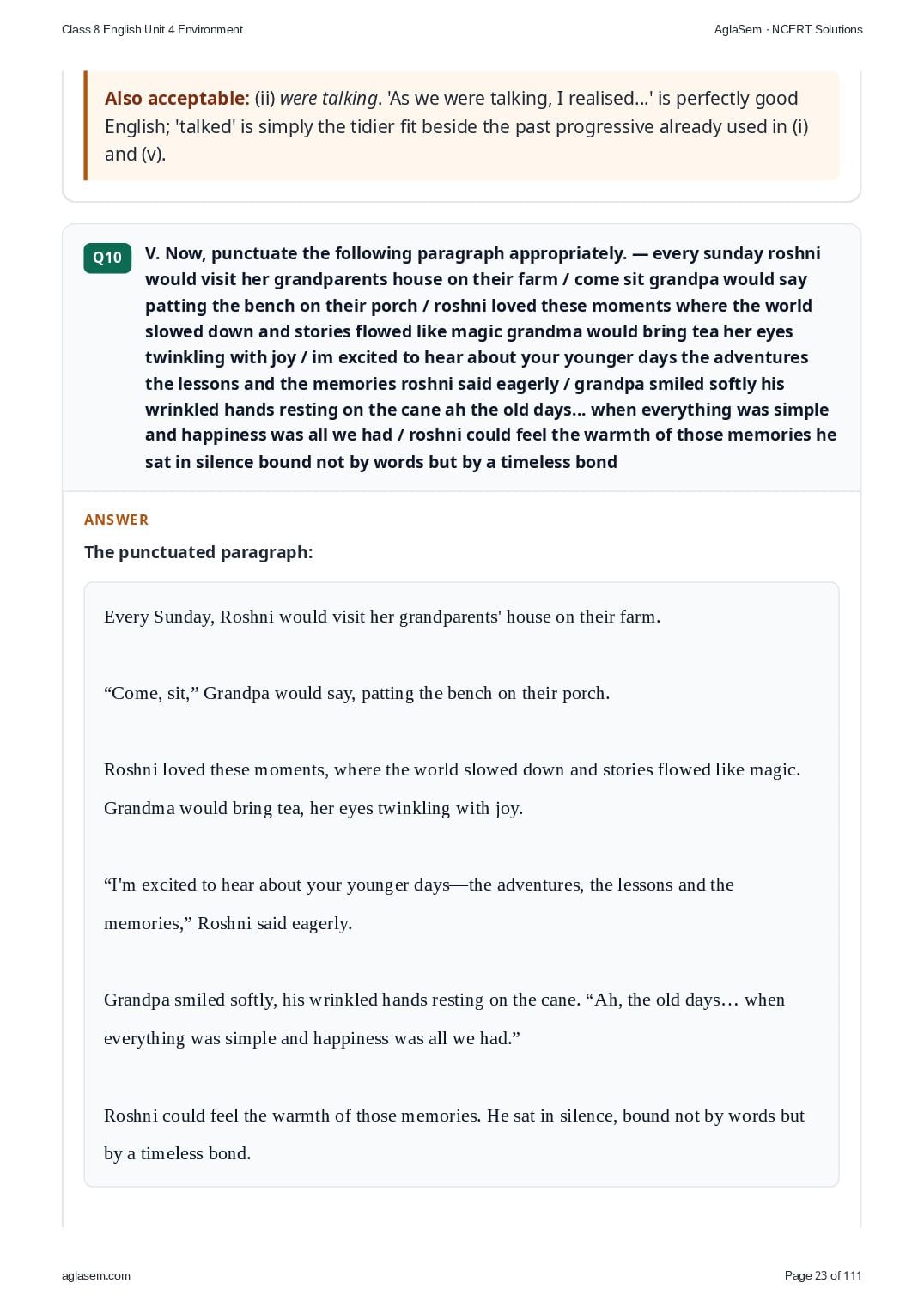
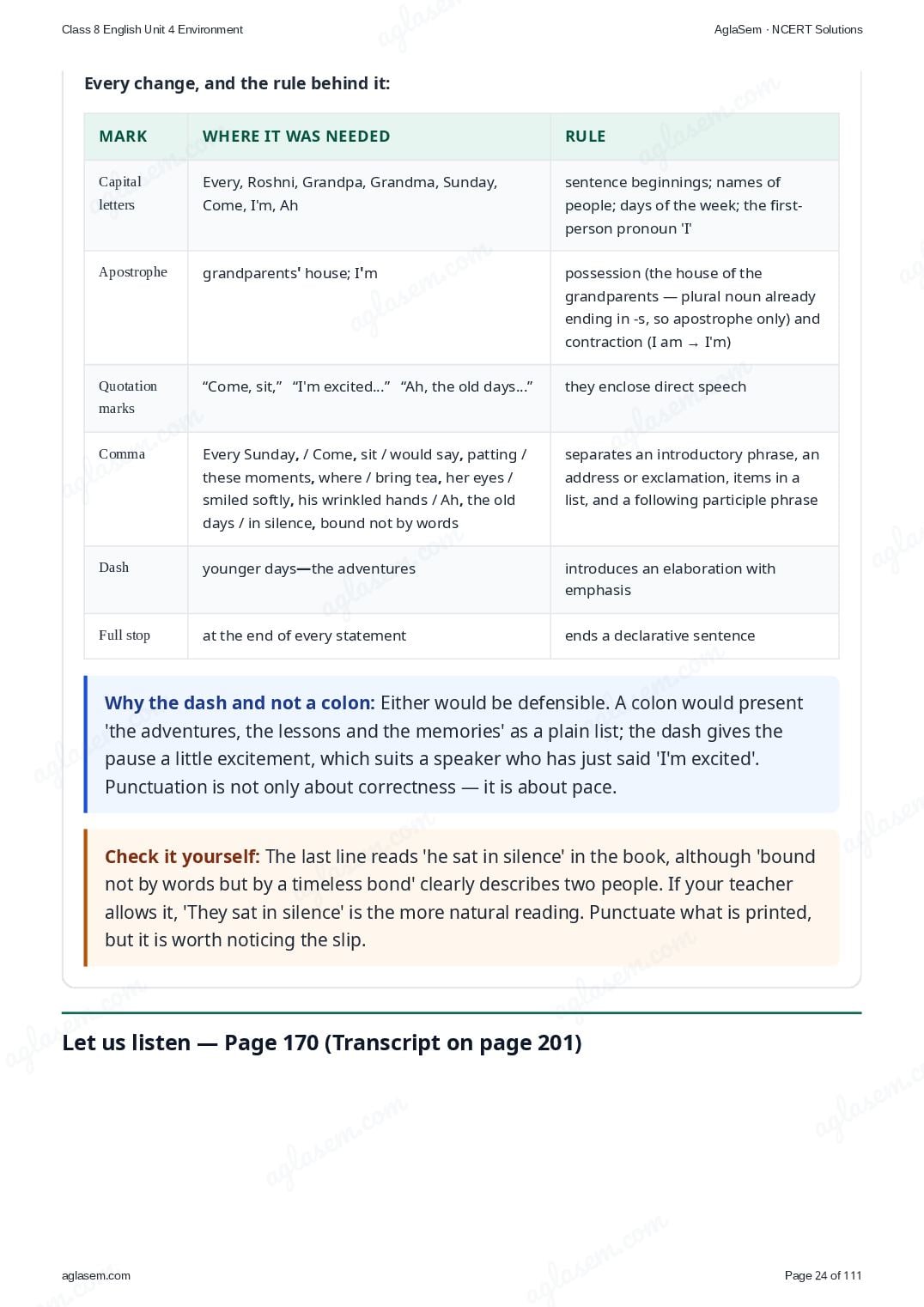
- V. Now, punctuate the following paragraph appropriately. — every sunday roshni would visit her grandparents house on their farm / come sit grandpa would say patting the bench on their porch / roshni loved these moments where the world slowed down and stories flowed like magic grandma would bring tea her eyes twinkling with joy / im excited to hear about your younger days the adventures the lessons and the memories roshni said eagerly / grandpa smiled softly his wrinkled hands resting on the cane ah the old days… when everything was simple and happiness was all we had / roshni could feel the warmth of those memories he sat in silence bound not by words but by a timeless bond
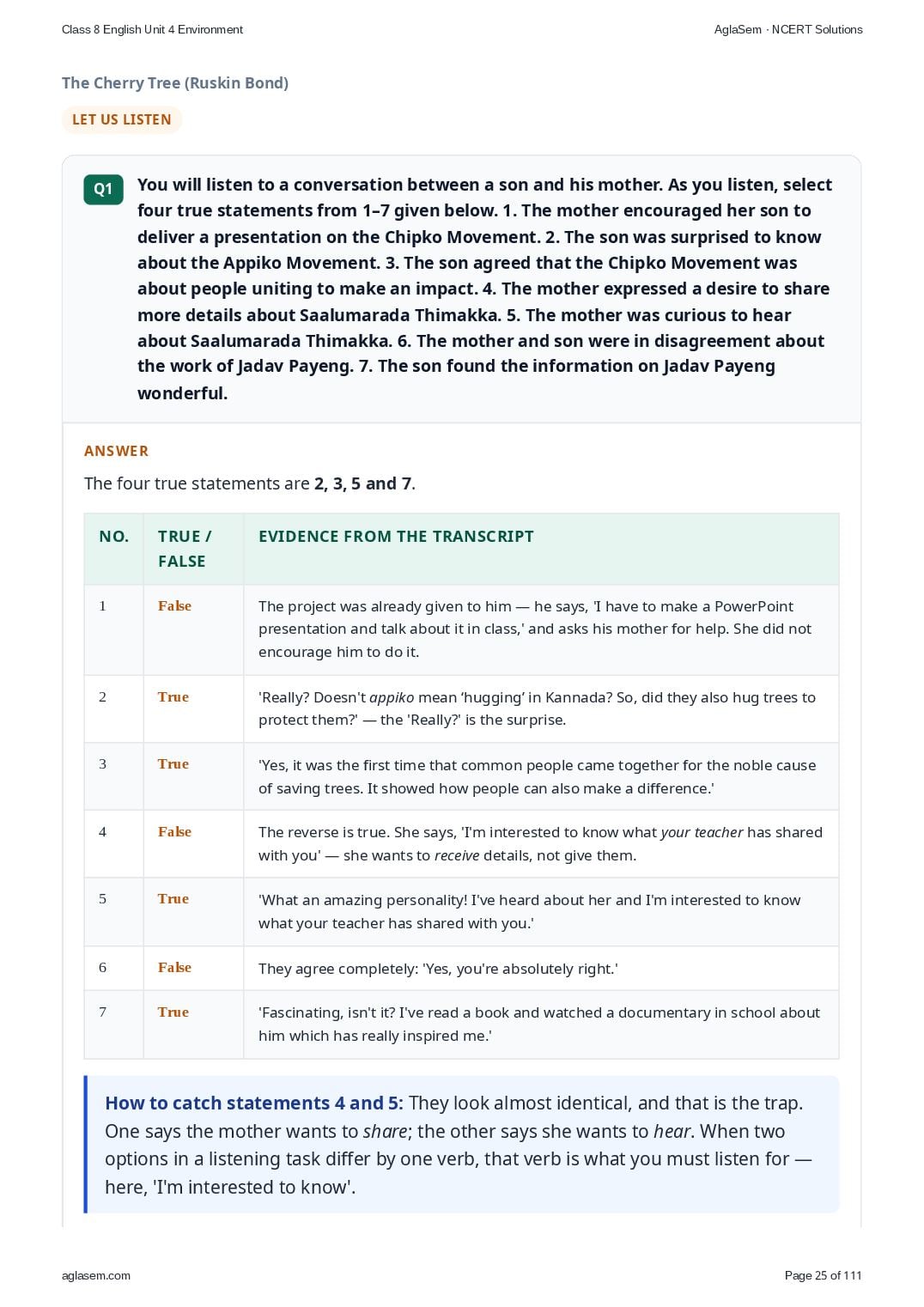
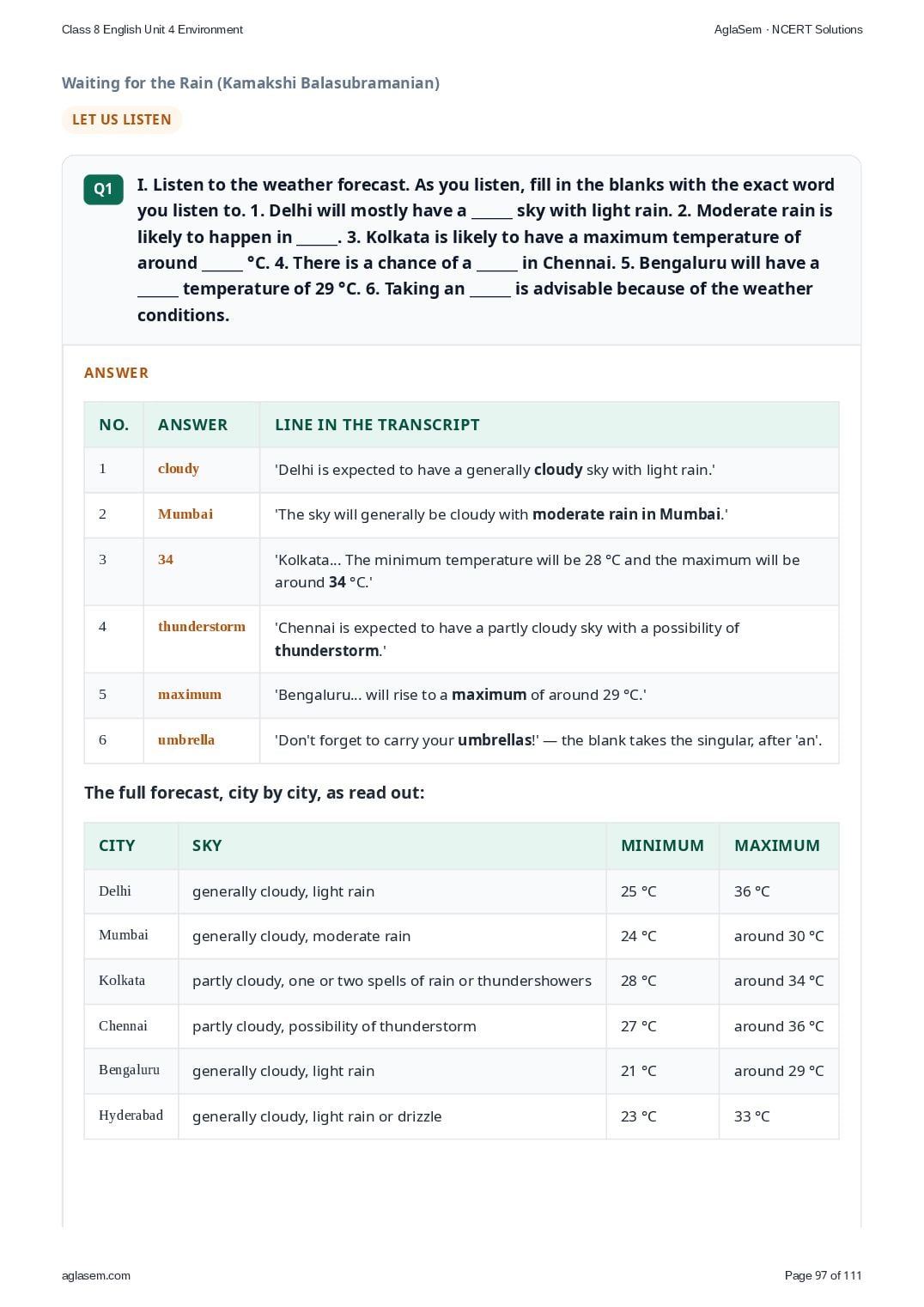
- You will listen to a conversation between a son and his mother. As you listen, select four true statements from 1–7 given below. 1. The mother encouraged her son to deliver a presentation on the Chipko Movement. 2. The son was surprised to know about the Appiko Movement. 3. The son agreed that the Chipko Movement was about people uniting to make an impact. 4. The mother expressed a desire to share more details about Saalumarada Thimakka. 5. The mother was curious to hear about Saalumarada Thimakka. 6. The mother and son were in disagreement about the work of Jadav Payeng. 7. The son found the information on Jadav Payeng wonderful.
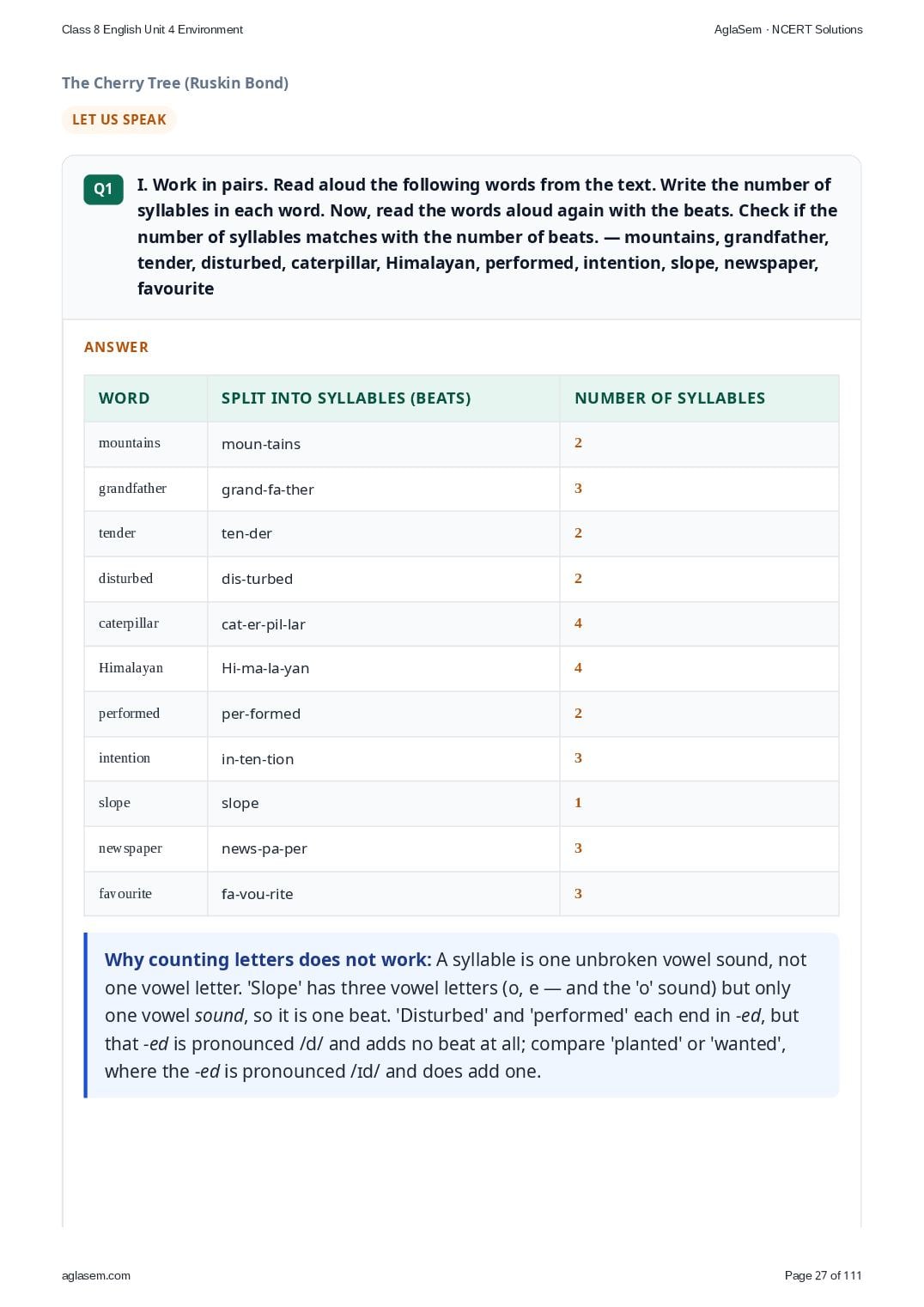
- I. Work in pairs. Read aloud the following words from the text. Write the number of syllables in each word. Now, read the words aloud again with the beats. Check if the number of syllables matches with the number of beats. — mountains, grandfather, tender, disturbed, caterpillar, Himalayan, performed, intention, slope, newspaper, favourite
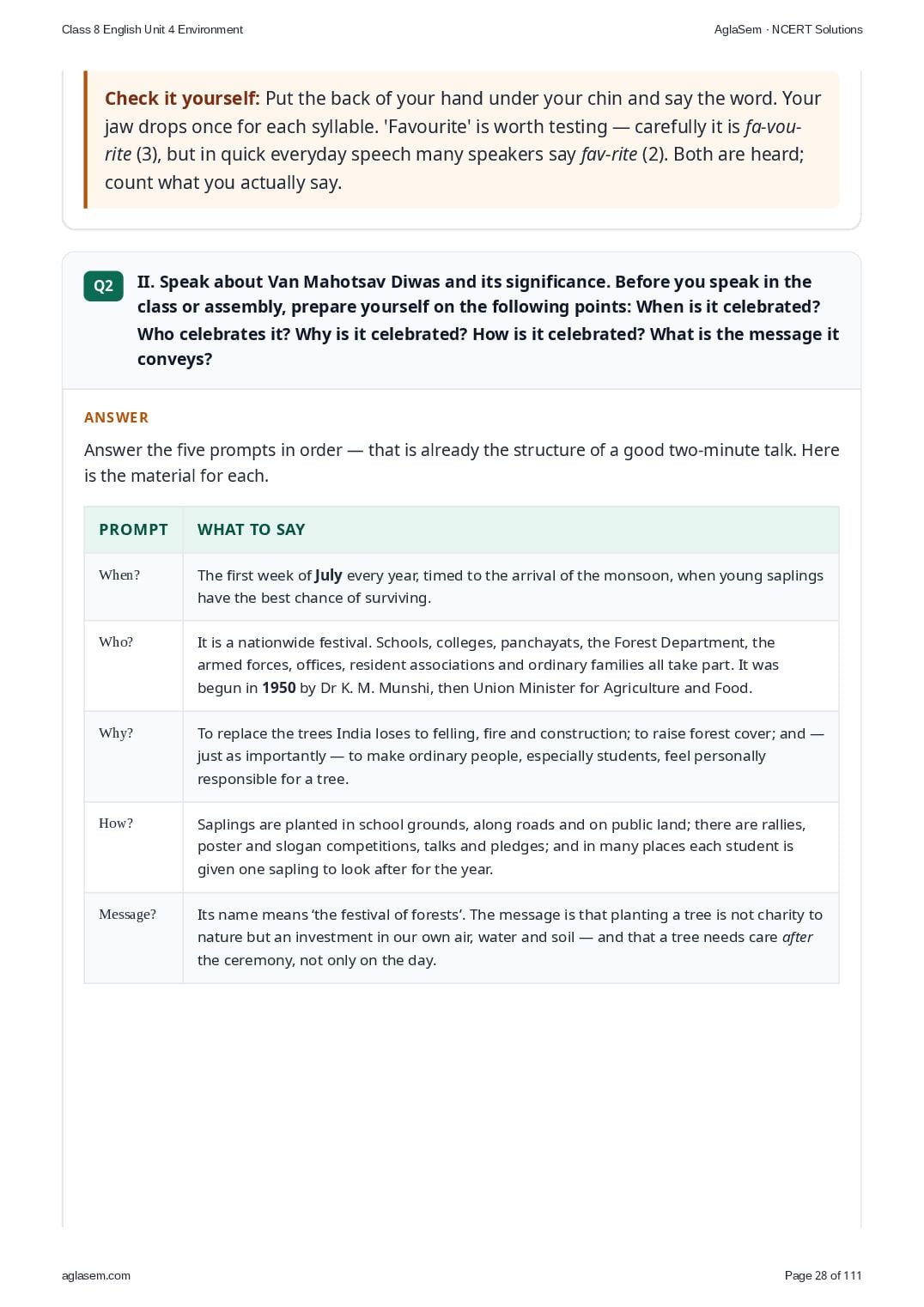
- II. Speak about Van Mahotsav Diwas and its significance. Before you speak in the class or assembly, prepare yourself on the following points: When is it celebrated? Who celebrates it? Why is it celebrated? How is it celebrated? What is the message it conveys?
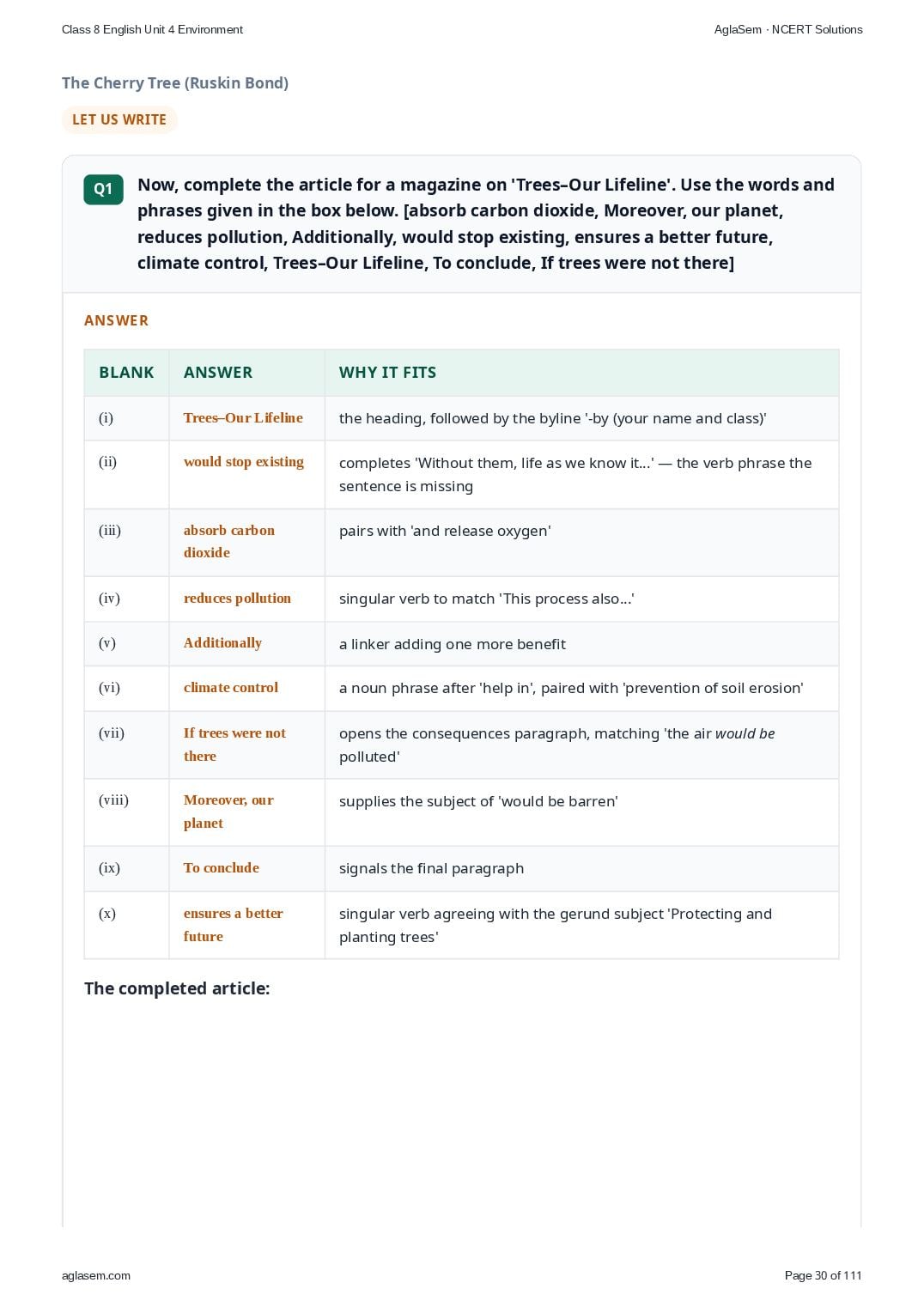
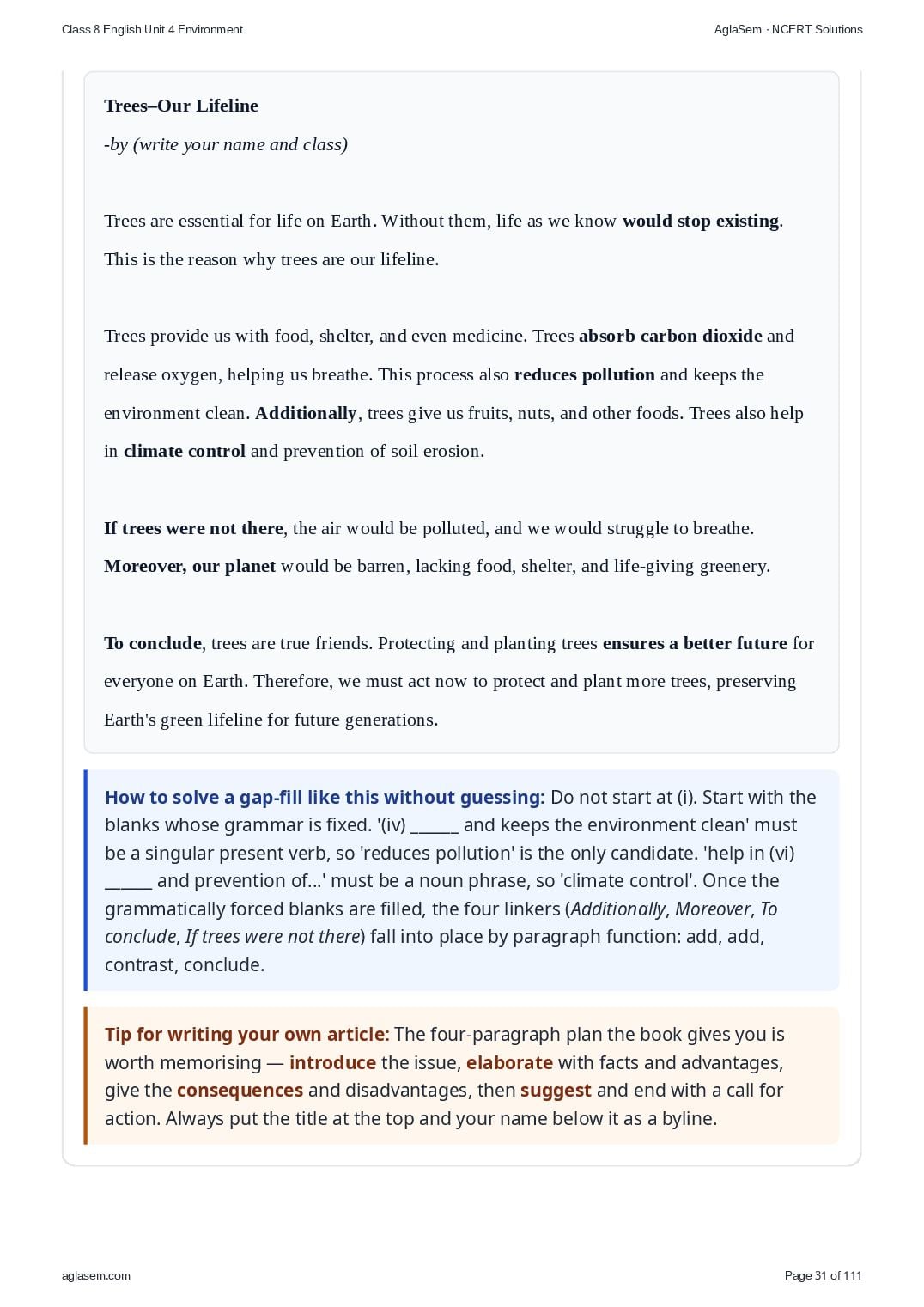
- Now, complete the article for a magazine on 'Trees–Our Lifeline'. Use the words and phrases given in the box below. [absorb carbon dioxide, Moreover, our planet, reduces pollution, Additionally, would stop existing, ensures a better future, climate control, Trees–Our Lifeline, To conclude, If trees were not there]
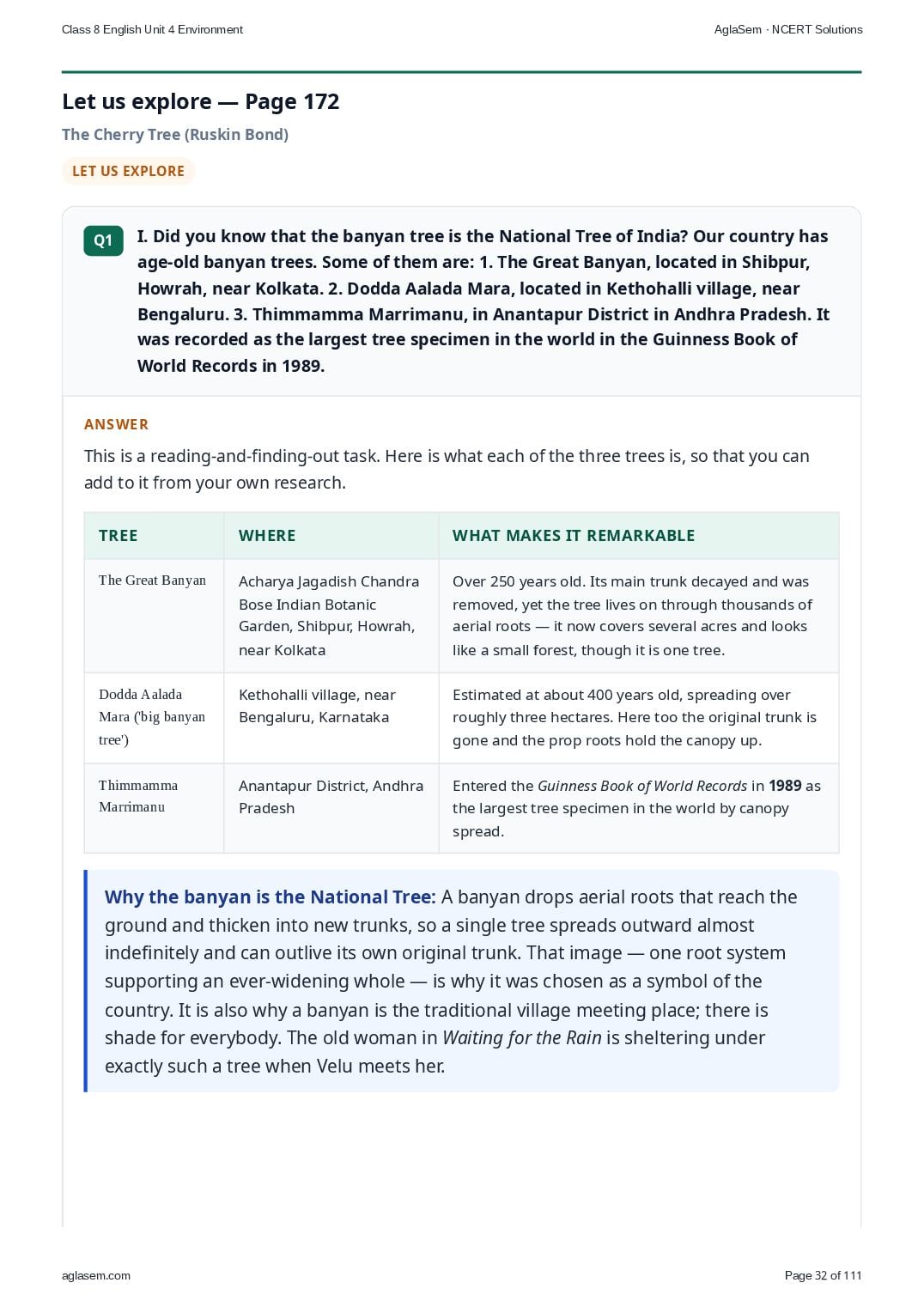
- I. Did you know that the banyan tree is the National Tree of India? Our country has age-old banyan trees. Some of them are: 1. The Great Banyan, located in Shibpur, Howrah, near Kolkata. 2. Dodda Aalada Mara, located in Kethohalli village, near Bengaluru. 3. Thimmamma Marrimanu, in Anantapur District in Andhra Pradesh. It was recorded as the largest tree specimen in the world in the Guinness Book of World Records in 1989.
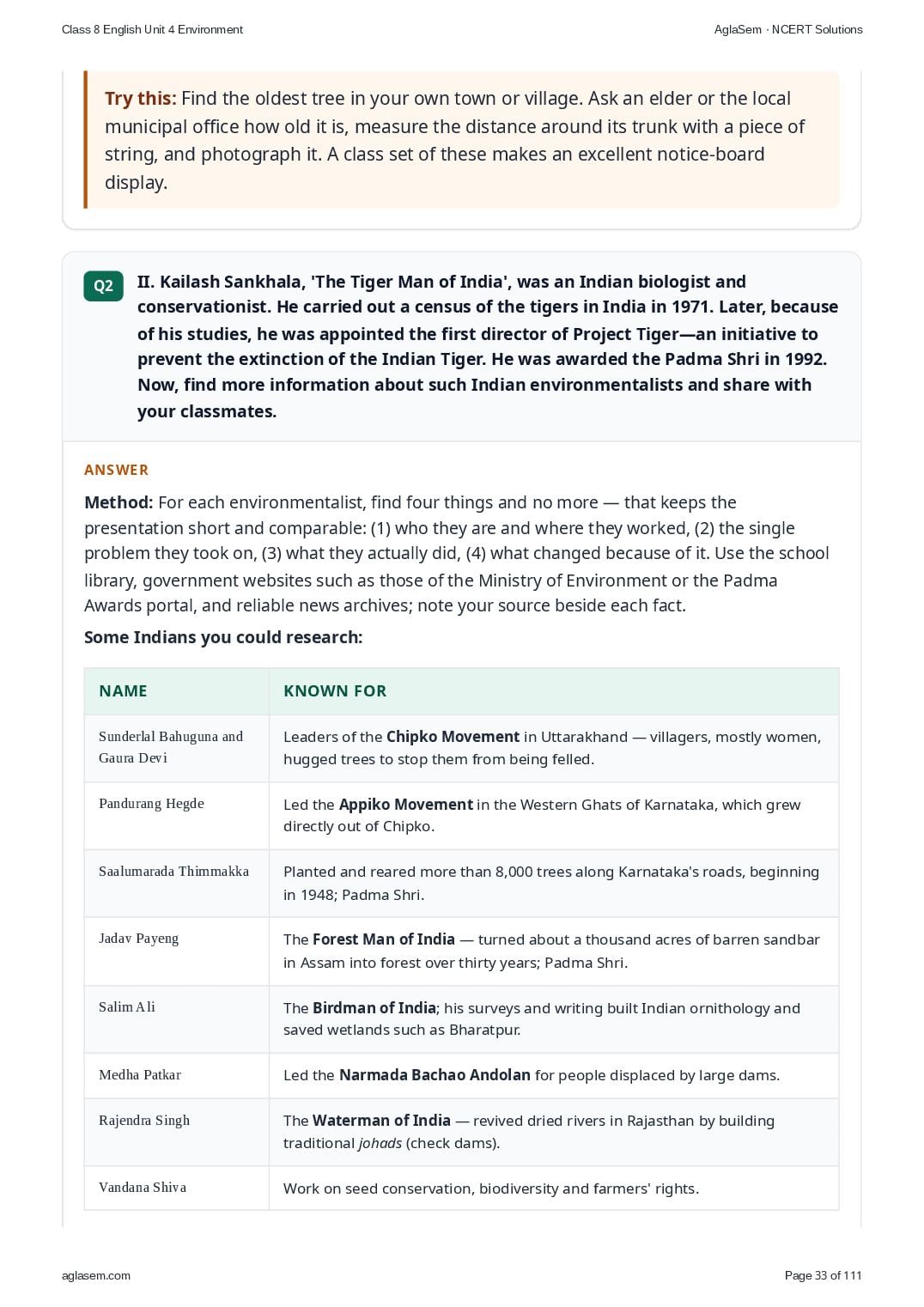
- II. Kailash Sankhala, 'The Tiger Man of India', was an Indian biologist and conservationist. He carried out a census of the tigers in India in 1971. Later, because of his studies, he was appointed the first director of Project Tiger—an initiative to prevent the extinction of the Indian Tiger. He was awarded the Padma Shri in 1992. Now, find more information about such Indian environmentalists and share with your classmates.
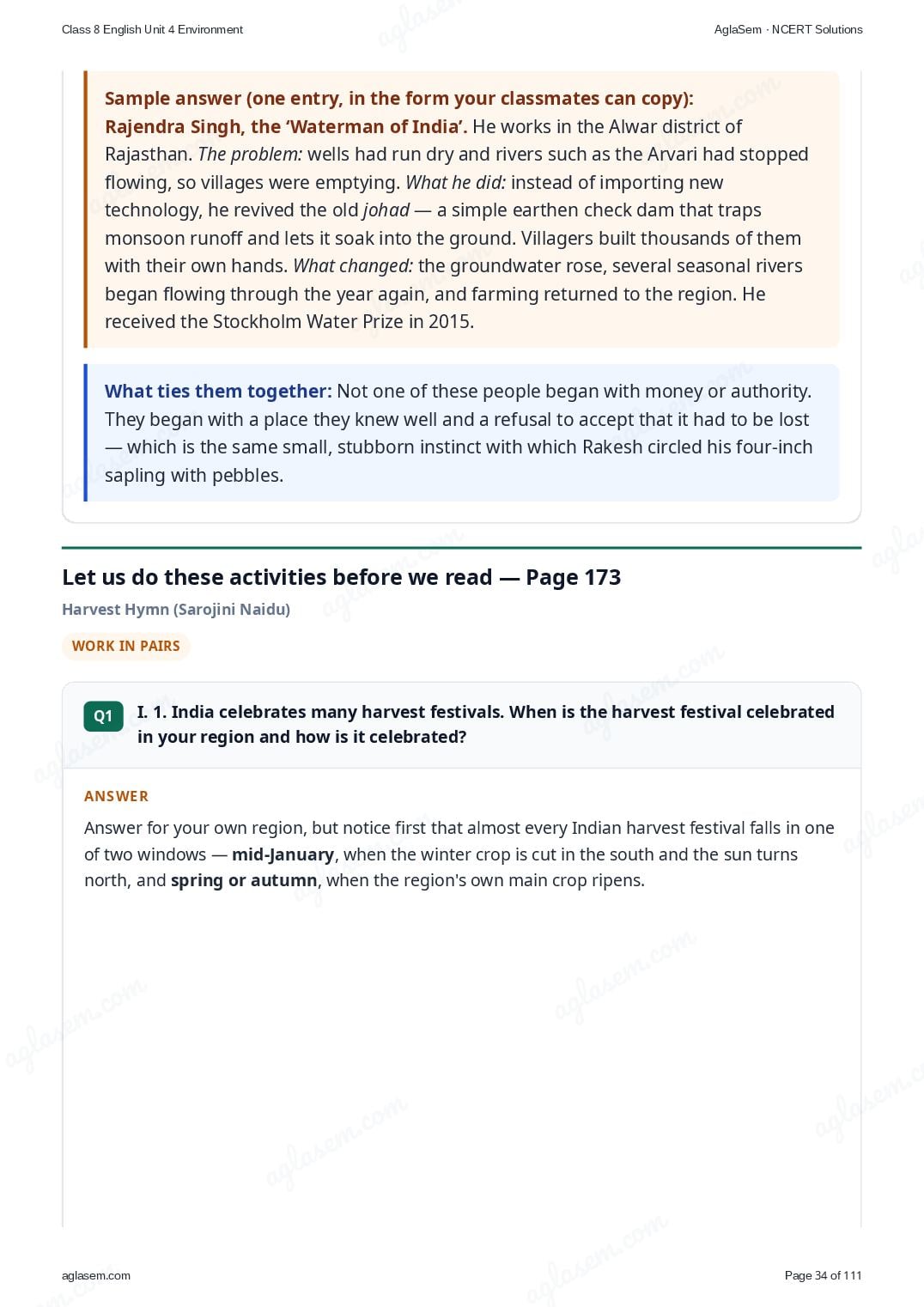
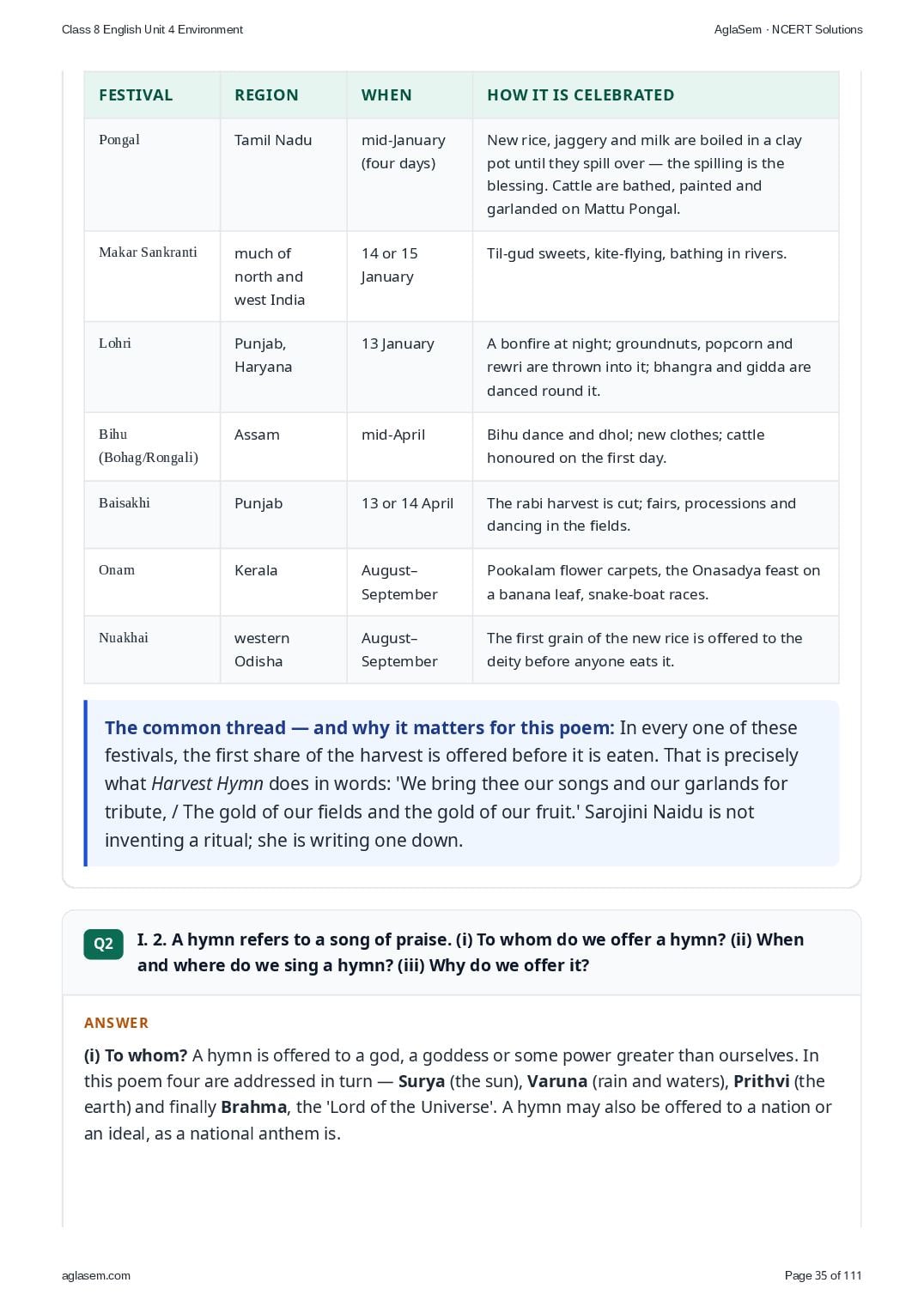
- I. 1. India celebrates many harvest festivals. When is the harvest festival celebrated in your region and how is it celebrated?
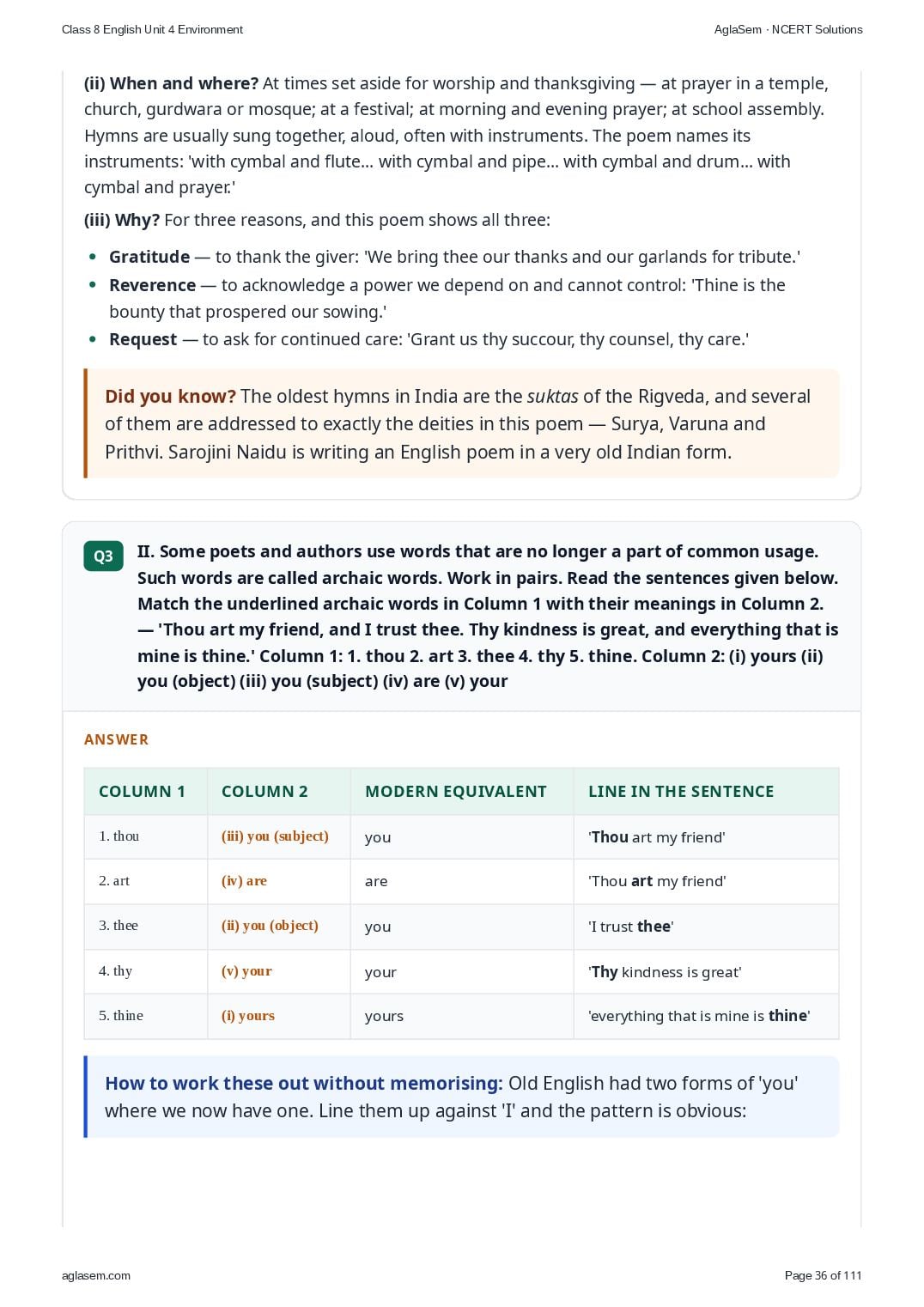
- I. 2. A hymn refers to a song of praise. (i) To whom do we offer a hymn? (ii) When and where do we sing a hymn? (iii) Why do we offer it?
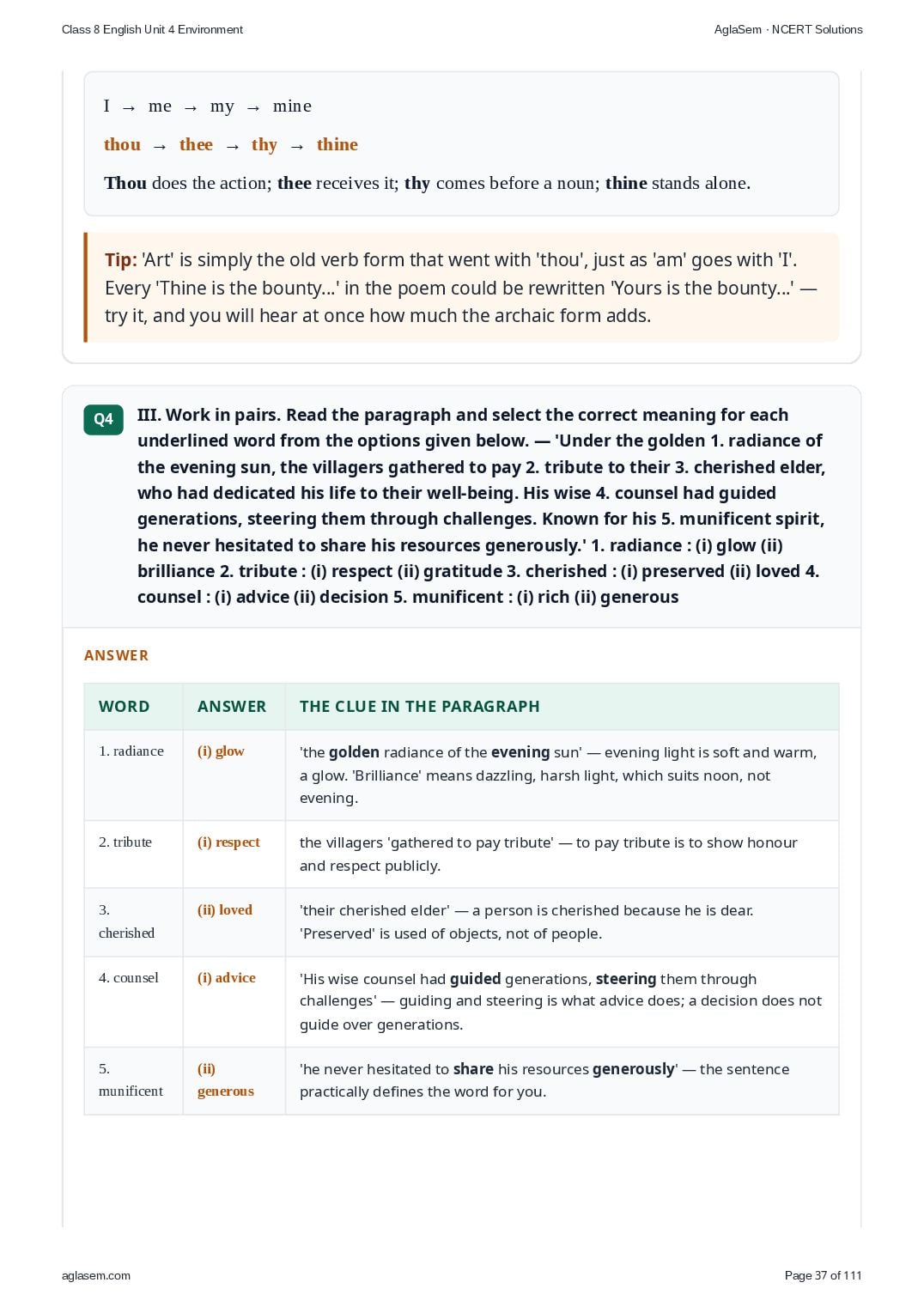
- II. Some poets and authors use words that are no longer a part of common usage. Such words are called archaic words. Work in pairs. Read the sentences given below. Match the underlined archaic words in Column 1 with their meanings in Column 2. — 'Thou art my friend, and I trust thee. Thy kindness is great, and everything that is mine is thine.' Column 1: 1. thou 2. art 3. thee 4. thy 5. thine. Column 2: (i) yours (ii) you (object) (iii) you (subject) (iv) are (v) your
- III. Work in pairs. Read the paragraph and select the correct meaning for each underlined word from the options given below. — 'Under the golden 1. radiance of the evening sun, the villagers gathered to pay 2. tribute to their 3. cherished elder, who had dedicated his life to their well-being. His wise 4. counsel had guided generations, steering them through challenges. Known for his 5. munificent spirit, he never hesitated to share his resources generously.' 1. radiance : (i) glow (ii) brilliance 2. tribute : (i) respect (ii) gratitude 3. cherished : (i) preserved (ii) loved 4. counsel : (i) advice (ii) decision 5. munificent : (i) rich (ii) generous
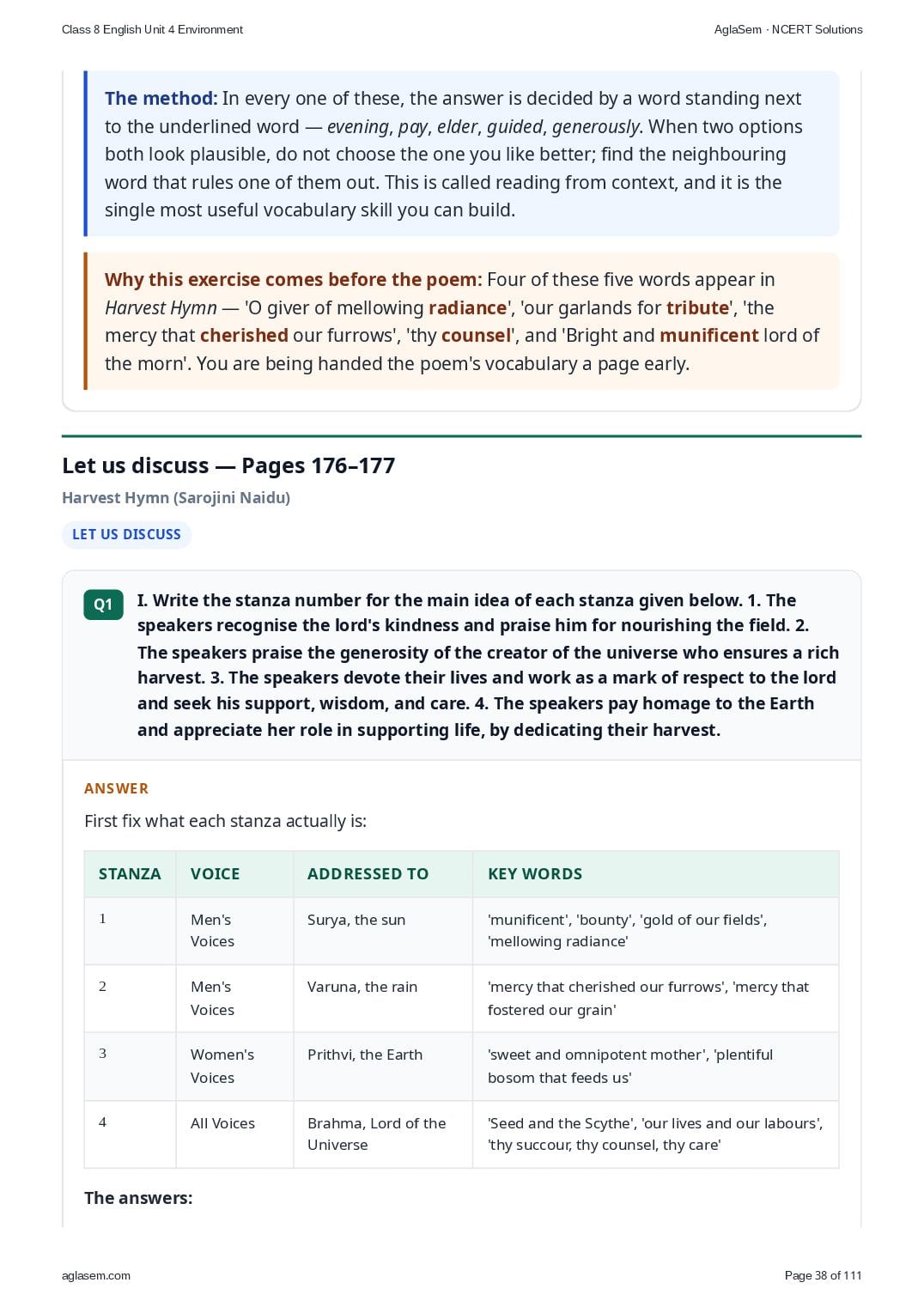
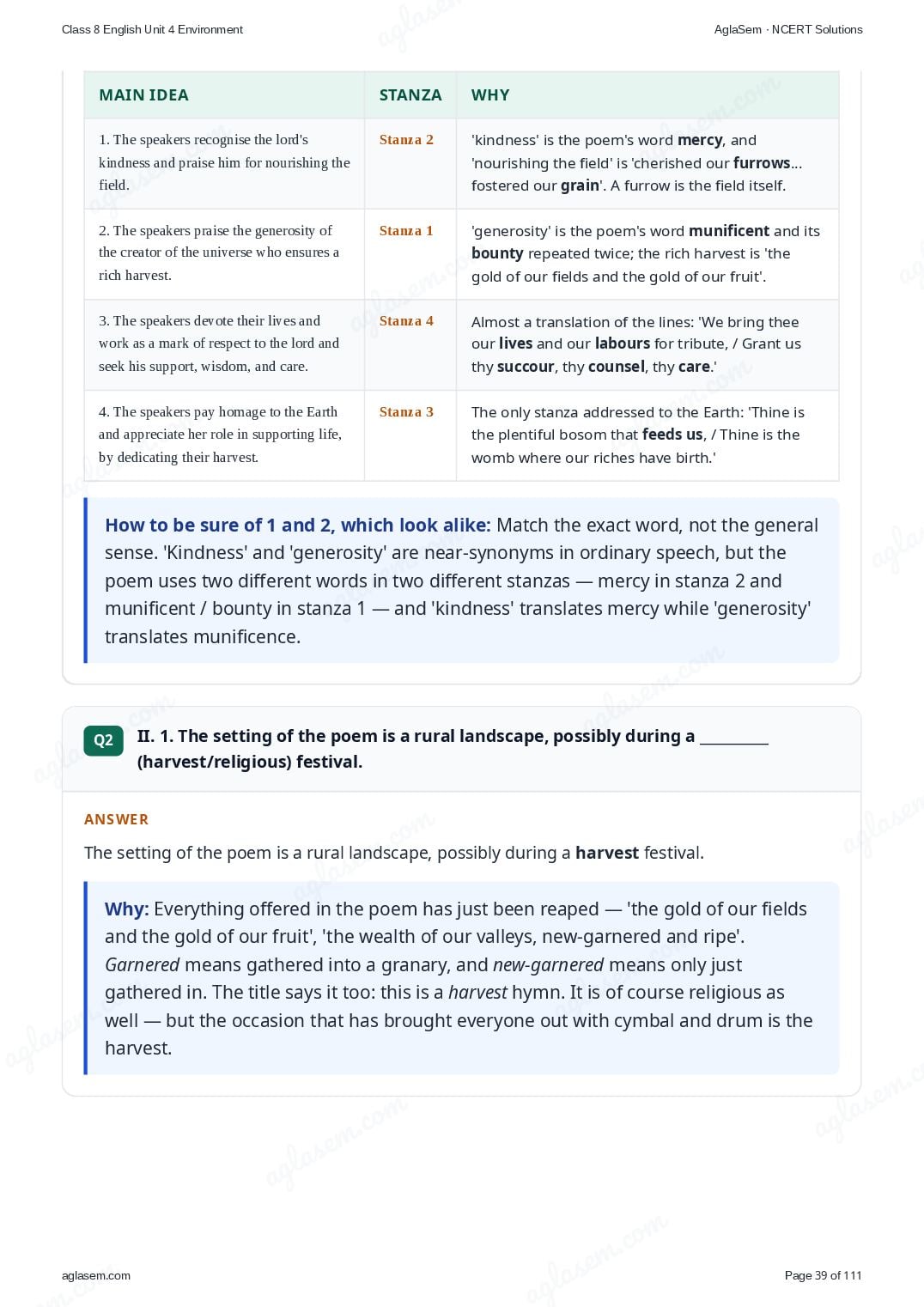
- I. Write the stanza number for the main idea of each stanza given below. 1. The speakers recognise the lord's kindness and praise him for nourishing the field. 2. The speakers praise the generosity of the creator of the universe who ensures a rich harvest. 3. The speakers devote their lives and work as a mark of respect to the lord and seek his support, wisdom, and care. 4. The speakers pay homage to the Earth and appreciate her role in supporting life, by dedicating their harvest.
- II. 1. The setting of the poem is a rural landscape, possibly during a __________ (harvest/religious) festival.
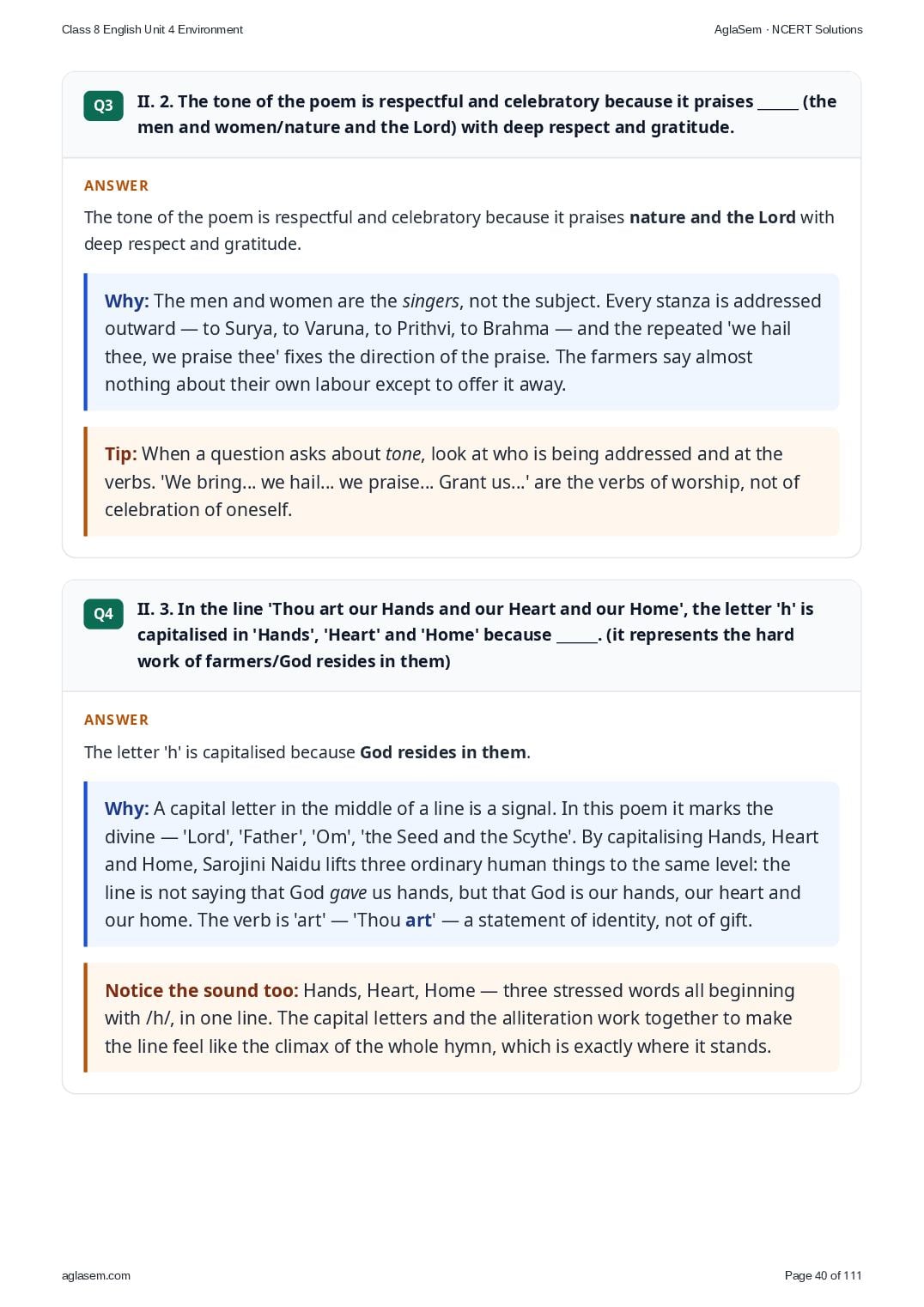
- II. 2. The tone of the poem is respectful and celebratory because it praises ______ (the men and women/nature and the Lord) with deep respect and gratitude.
- II. 3. In the line 'Thou art our Hands and our Heart and our Home', the letter 'h' is capitalised in 'Hands', 'Heart' and 'Home' because ______. (it represents the hard work of farmers/God resides in them)
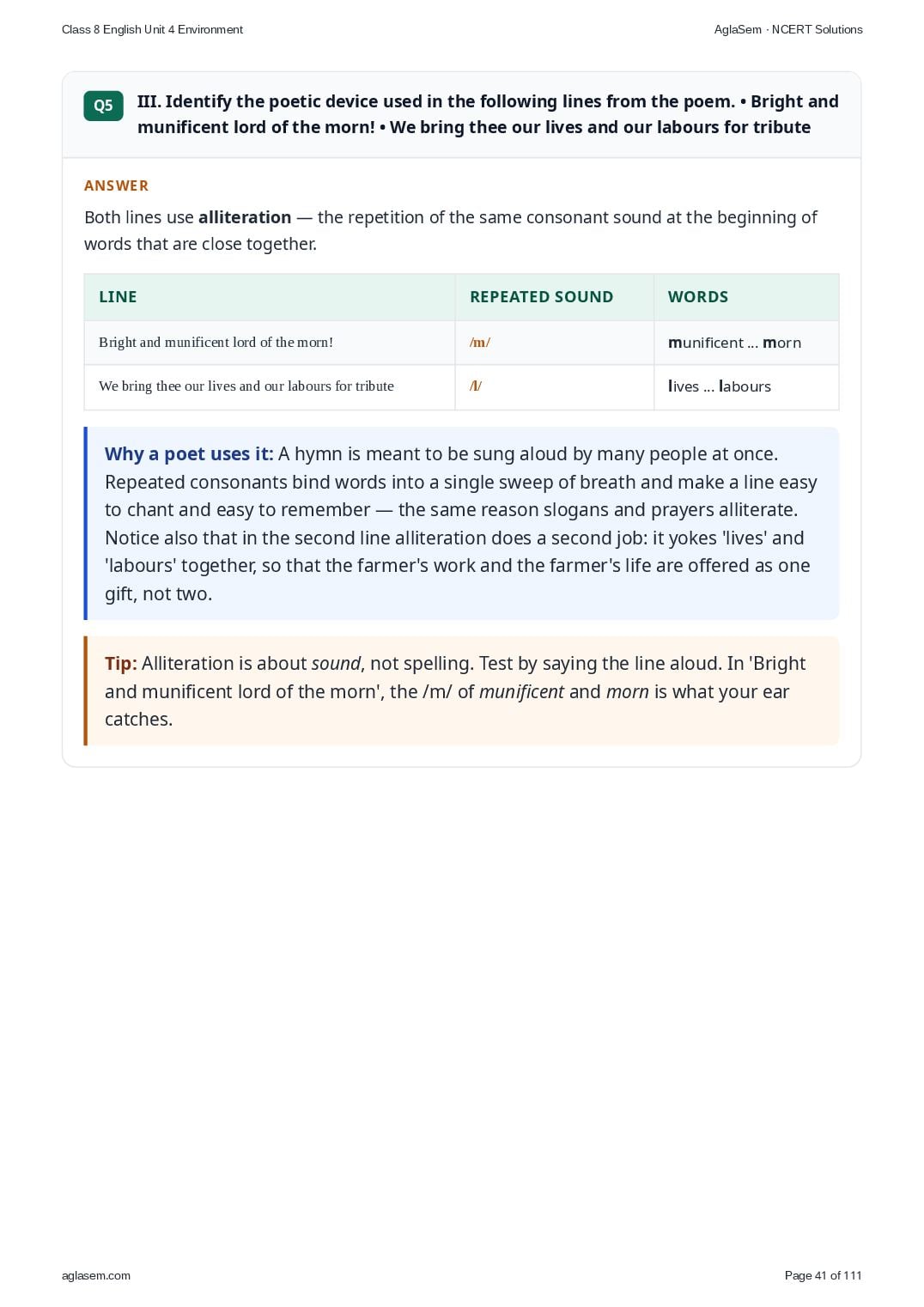
- III. Identify the poetic device used in the following lines from the poem. • Bright and munificent lord of the morn! • We bring thee our lives and our labours for tribute
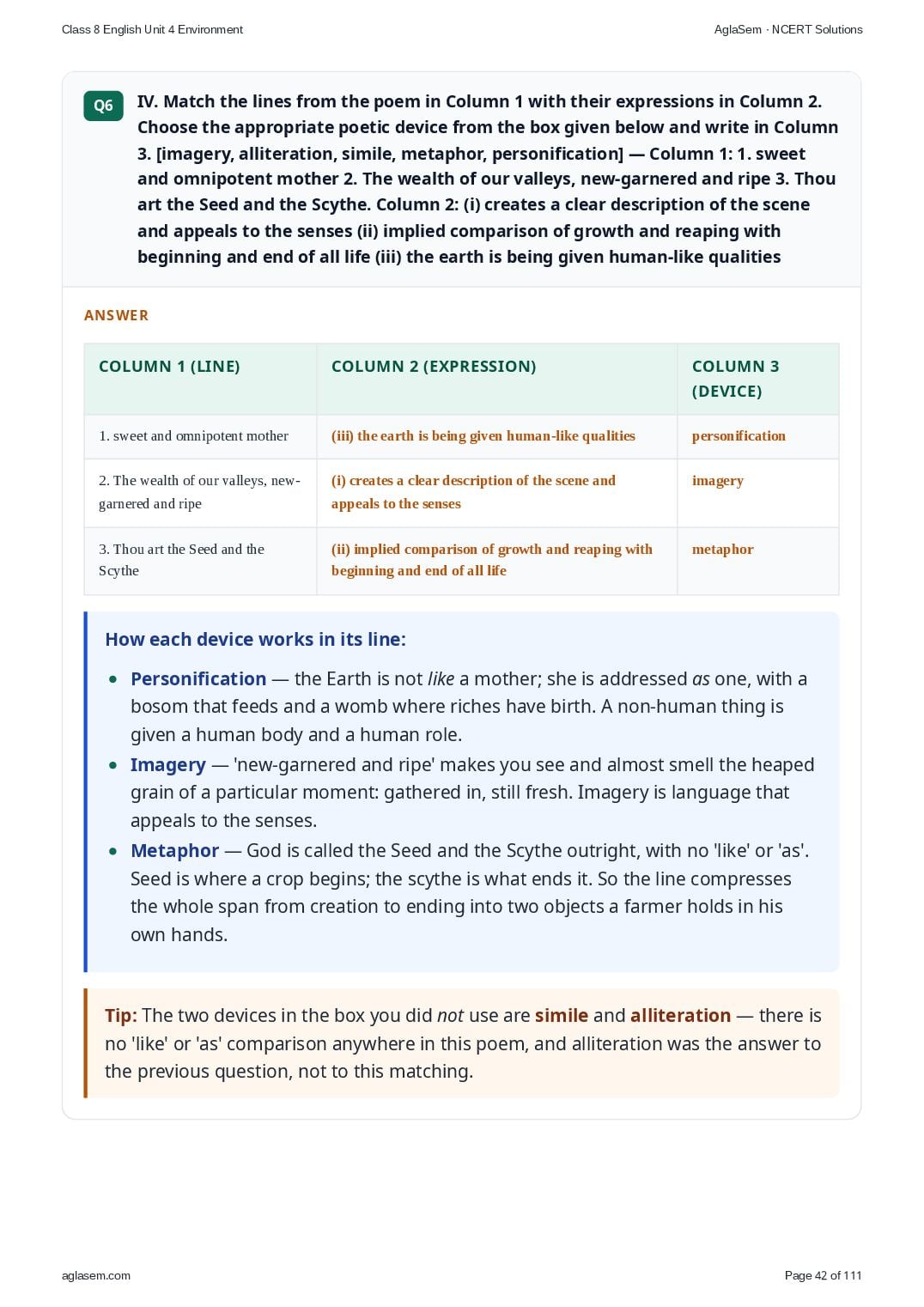
- IV. Match the lines from the poem in Column 1 with their expressions in Column 2. Choose the appropriate poetic device from the box given below and write in Column 3. [imagery, alliteration, simile, metaphor, personification] — Column 1: 1. sweet and omnipotent mother 2. The wealth of our valleys, new-garnered and ripe 3. Thou art the Seed and the Scythe. Column 2: (i) creates a clear description of the scene and appeals to the senses (ii) implied comparison of growth and reaping with beginning and end of all life (iii) the earth is being given human-like qualities
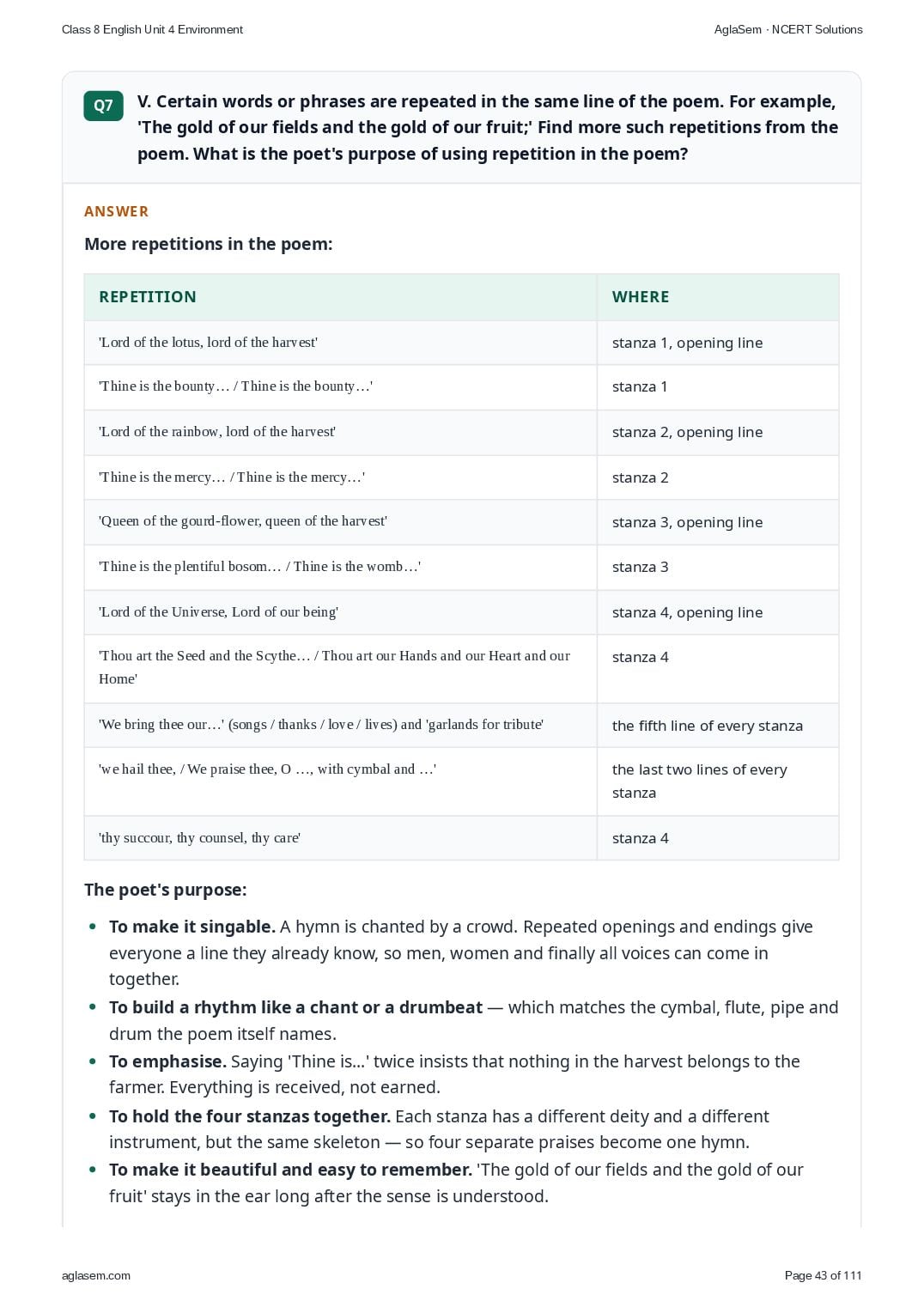
- V. Certain words or phrases are repeated in the same line of the poem. For example, 'The gold of our fields and the gold of our fruit;' Find more such repetitions from the poem. What is the poet's purpose of using repetition in the poem?
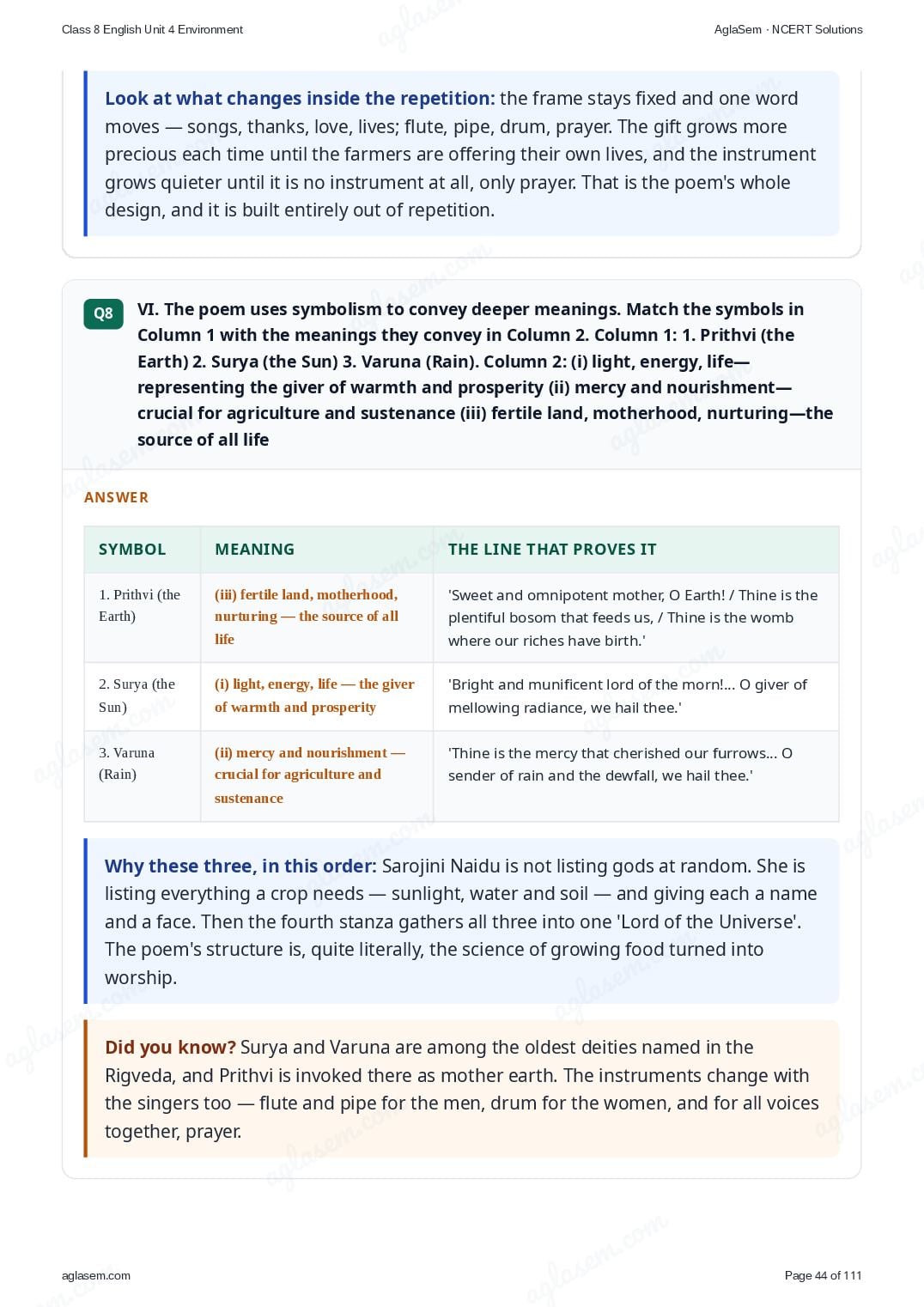
- VI. The poem uses symbolism to convey deeper meanings. Match the symbols in Column 1 with the meanings they convey in Column 2. Column 1: 1. Prithvi (the Earth) 2. Surya (the Sun) 3. Varuna (Rain). Column 2: (i) light, energy, life—representing the giver of warmth and prosperity (ii) mercy and nourishment—crucial for agriculture and sustenance (iii) fertile land, motherhood, nurturing—the source of all life
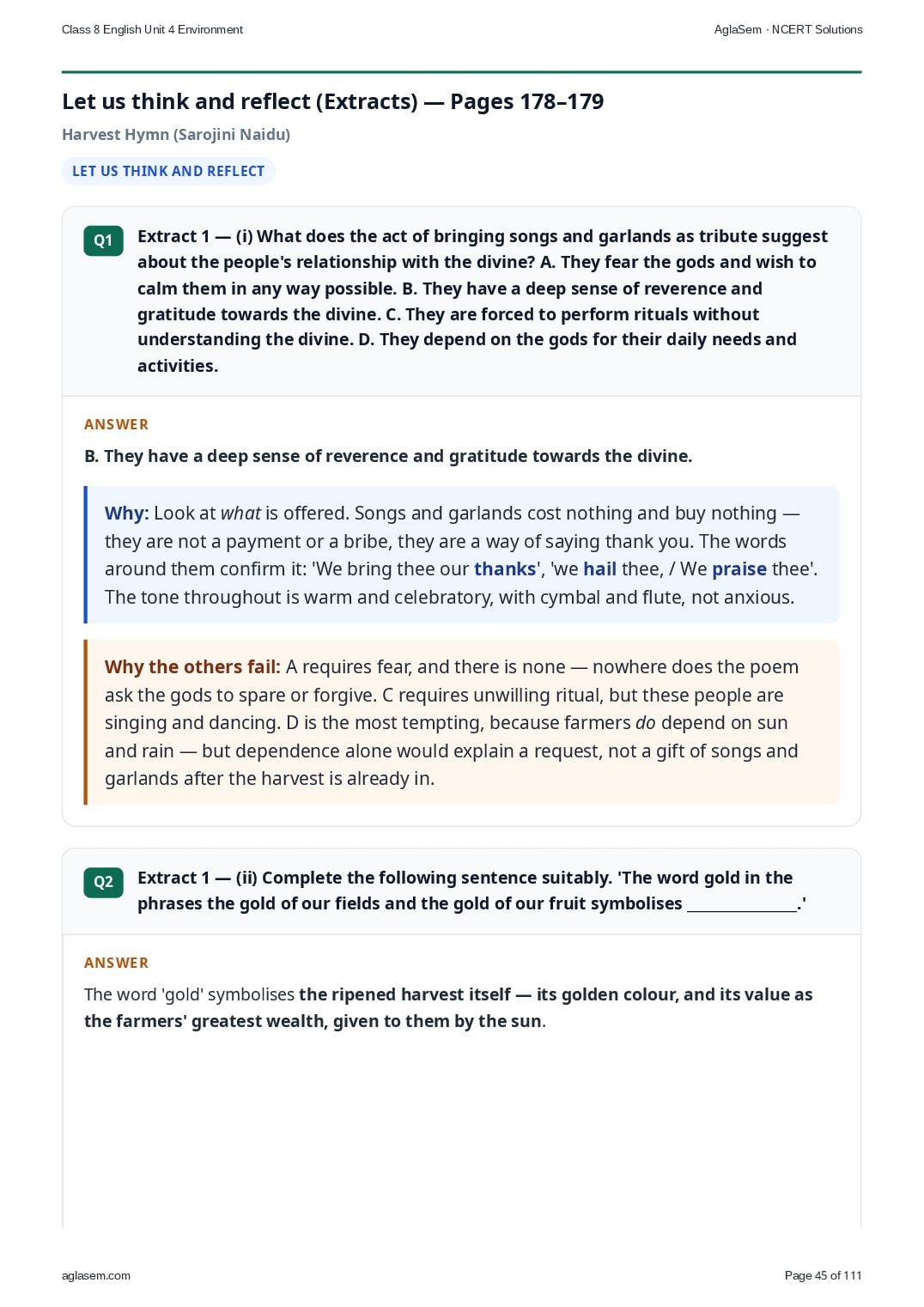
- Extract 1 — (i) What does the act of bringing songs and garlands as tribute suggest about the people's relationship with the divine? A. They fear the gods and wish to calm them in any way possible. B. They have a deep sense of reverence and gratitude towards the divine. C. They are forced to perform rituals without understanding the divine. D. They depend on the gods for their daily needs and activities.
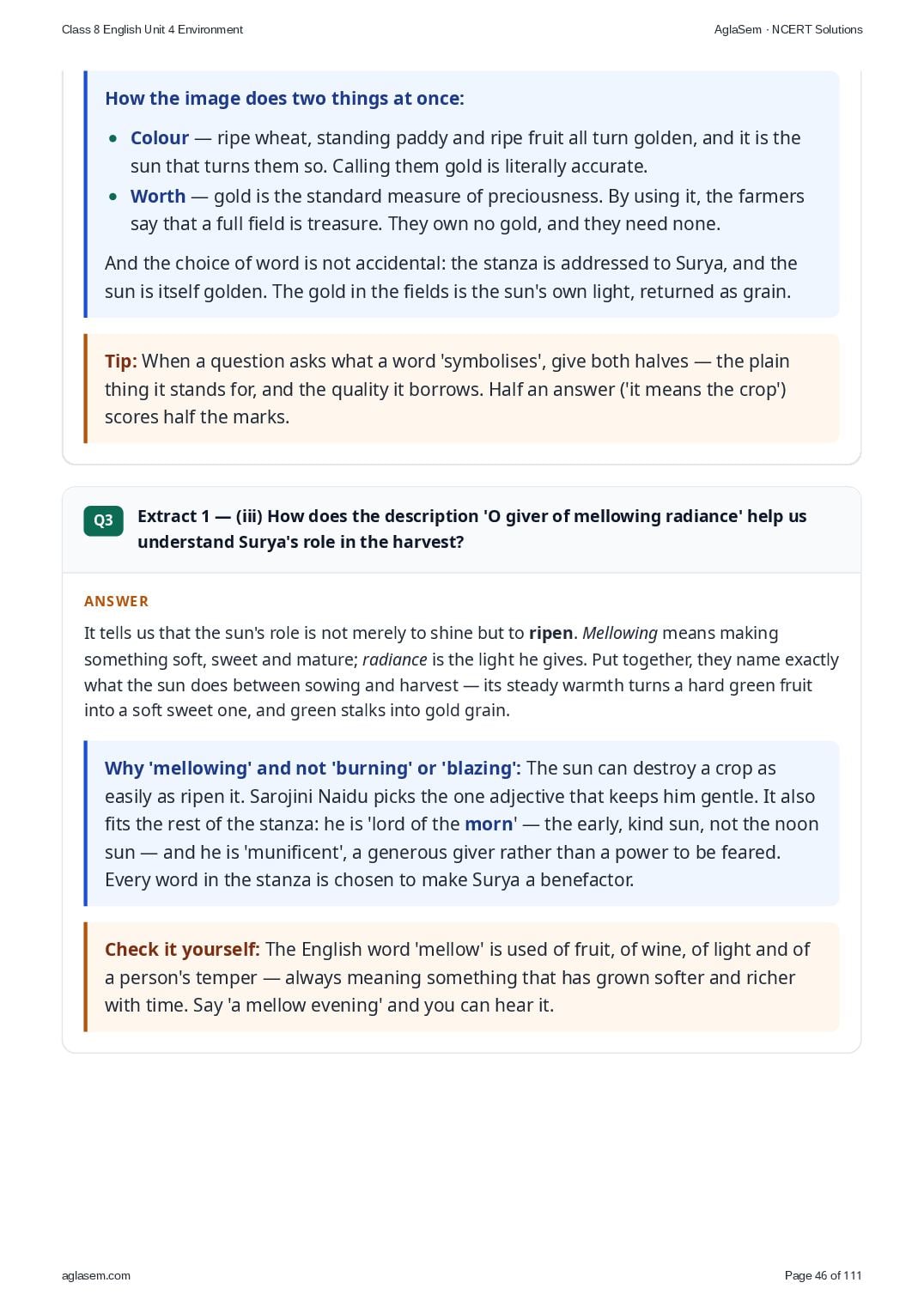
- Extract 1 — (ii) Complete the following sentence suitably. 'The word gold in the phrases the gold of our fields and the gold of our fruit symbolises ________________.'
- Extract 1 — (iii) How does the description 'O giver of mellowing radiance' help us understand Surya's role in the harvest?
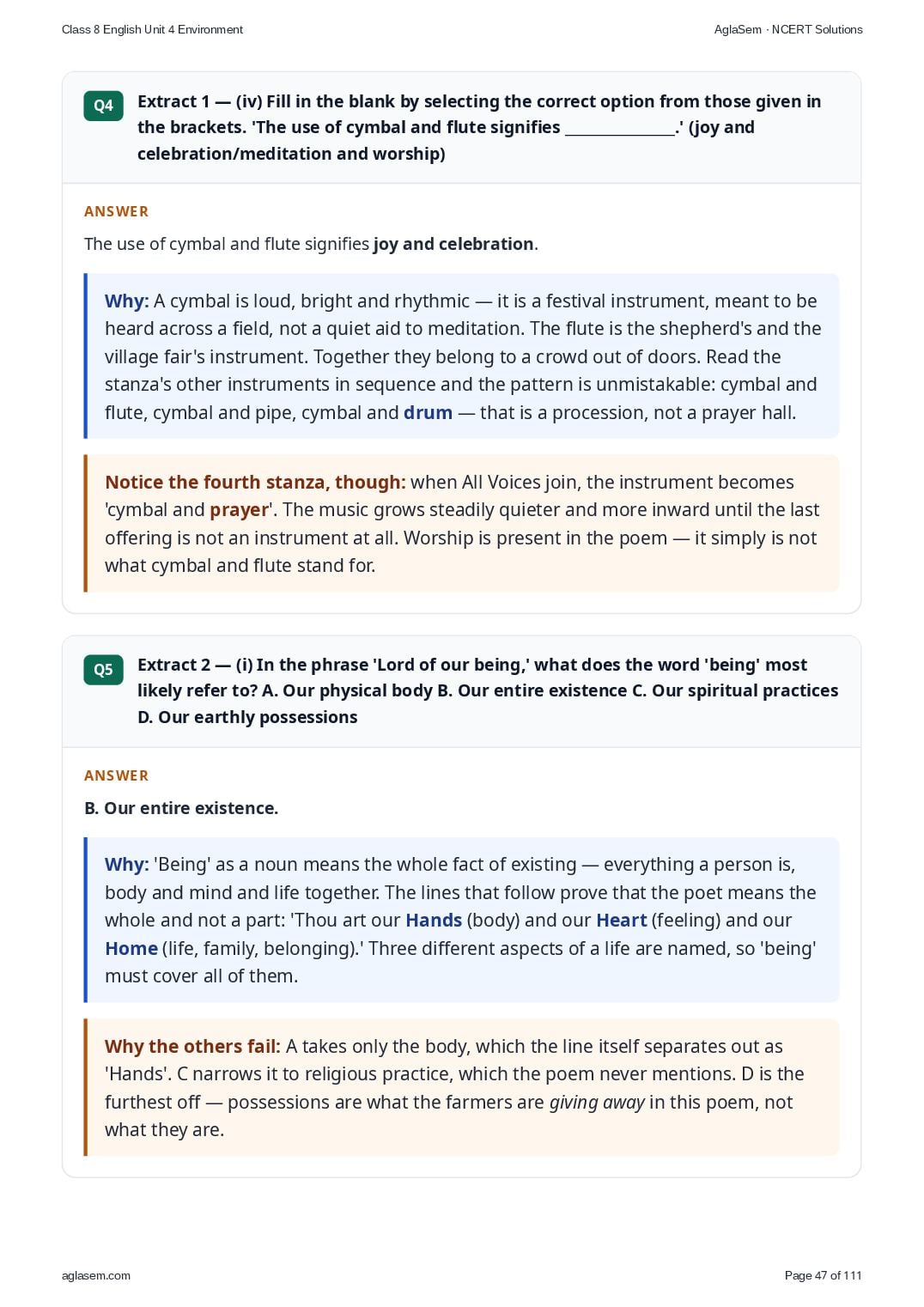
- Extract 1 — (iv) Fill in the blank by selecting the correct option from those given in the brackets. 'The use of cymbal and flute signifies ________________.' (joy and celebration/meditation and worship)
- Extract 2 — (i) In the phrase 'Lord of our being,' what does the word 'being' most likely refer to? A. Our physical body B. Our entire existence C. Our spiritual practices D. Our earthly possessions
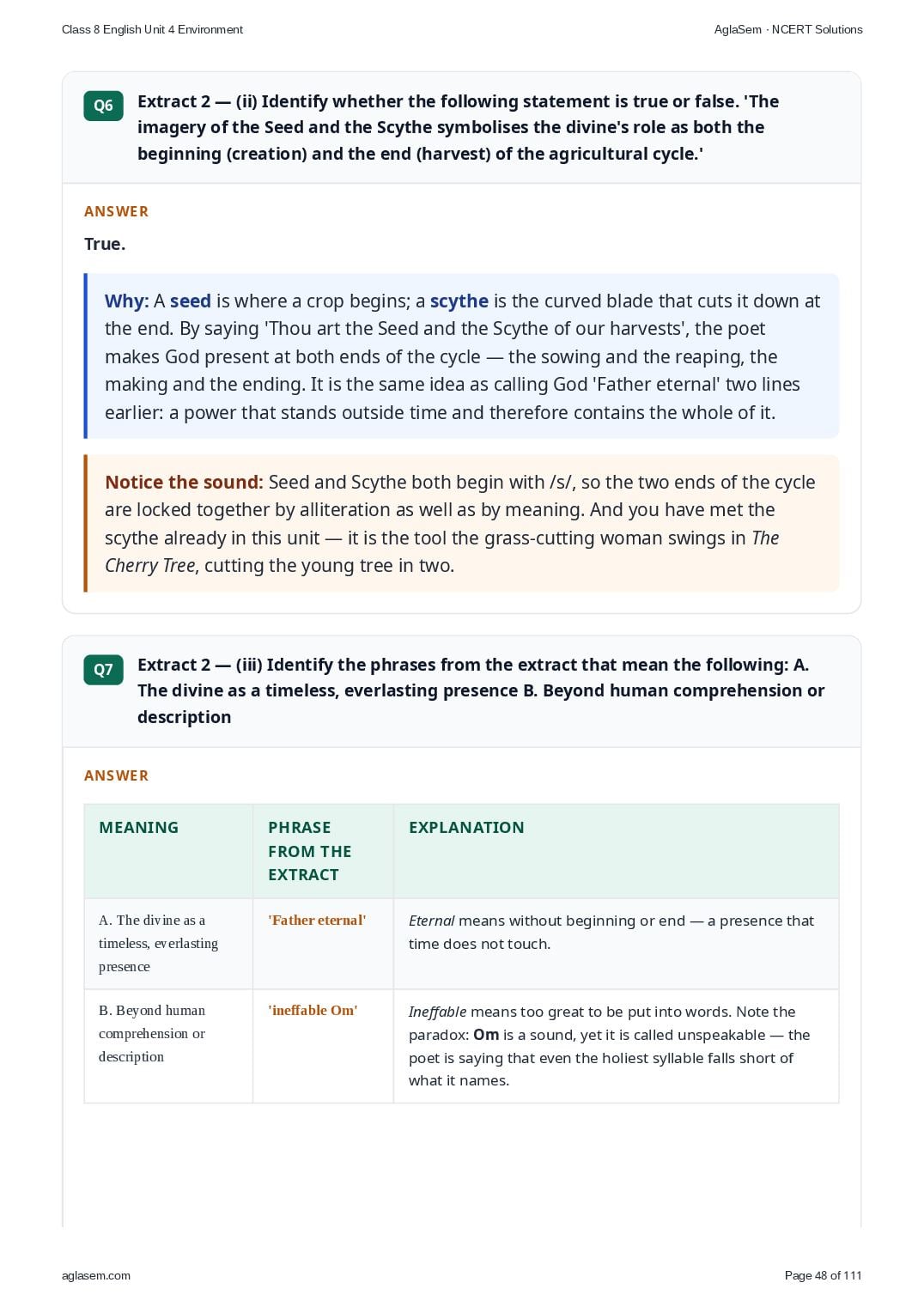
- Extract 2 — (ii) Identify whether the following statement is true or false. 'The imagery of the Seed and the Scythe symbolises the divine's role as both the beginning (creation) and the end (harvest) of the agricultural cycle.'
- Extract 2 — (iii) Identify the phrases from the extract that mean the following: A. The divine as a timeless, everlasting presence B. Beyond human comprehension or description
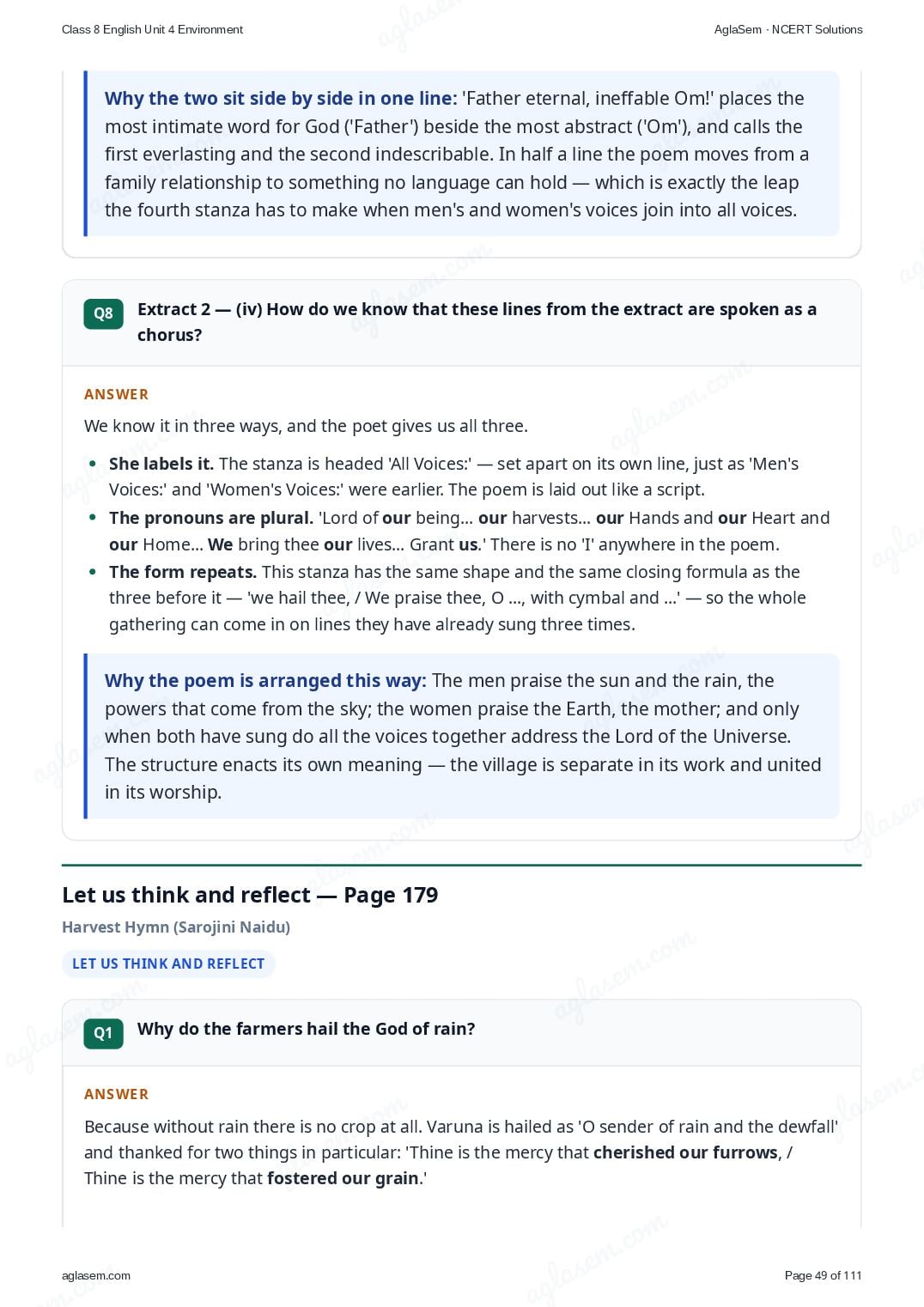
- Extract 2 — (iv) How do we know that these lines from the extract are spoken as a chorus?
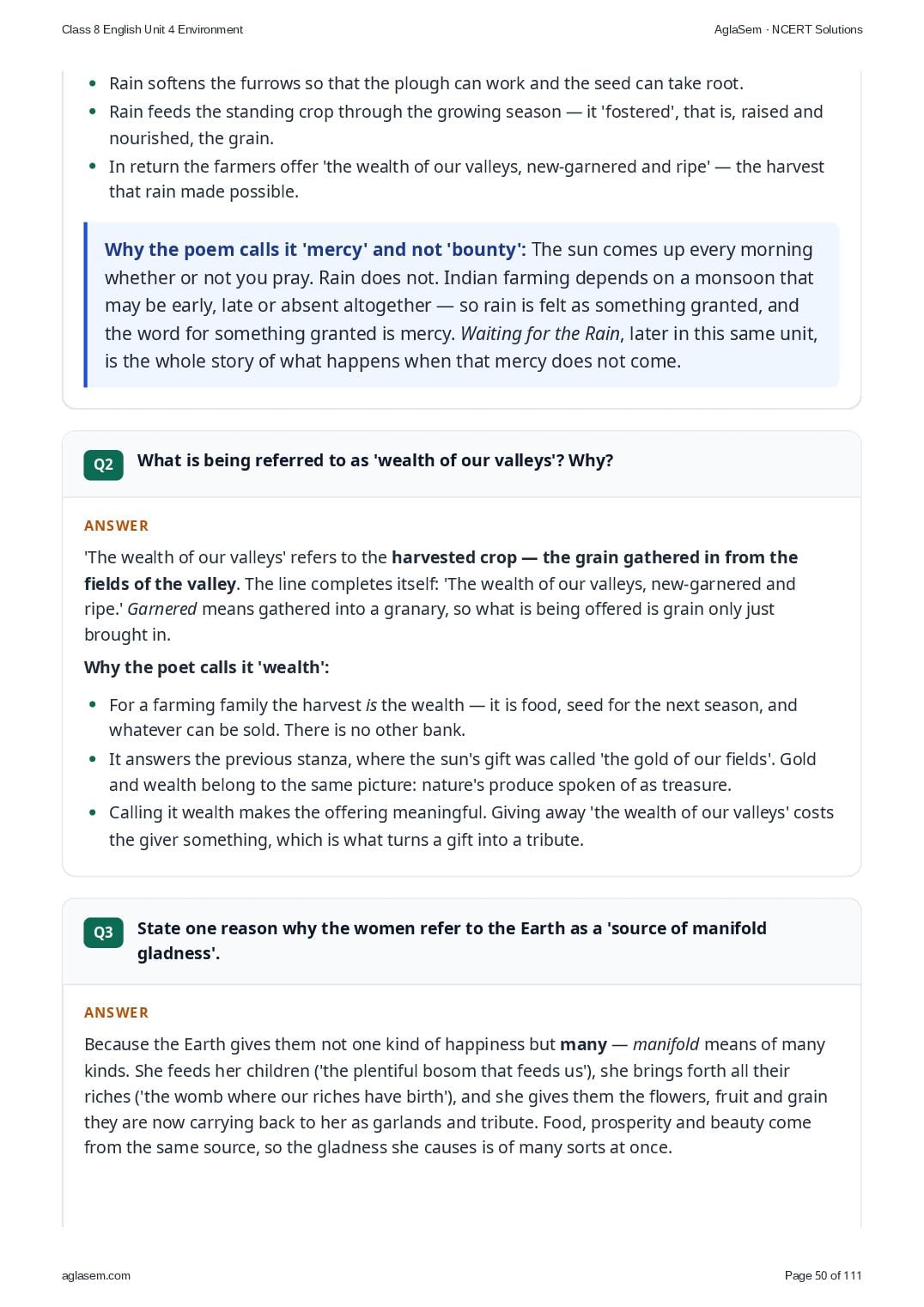
- Why do the farmers hail the God of rain?
- What is being referred to as 'wealth of our valleys'? Why?
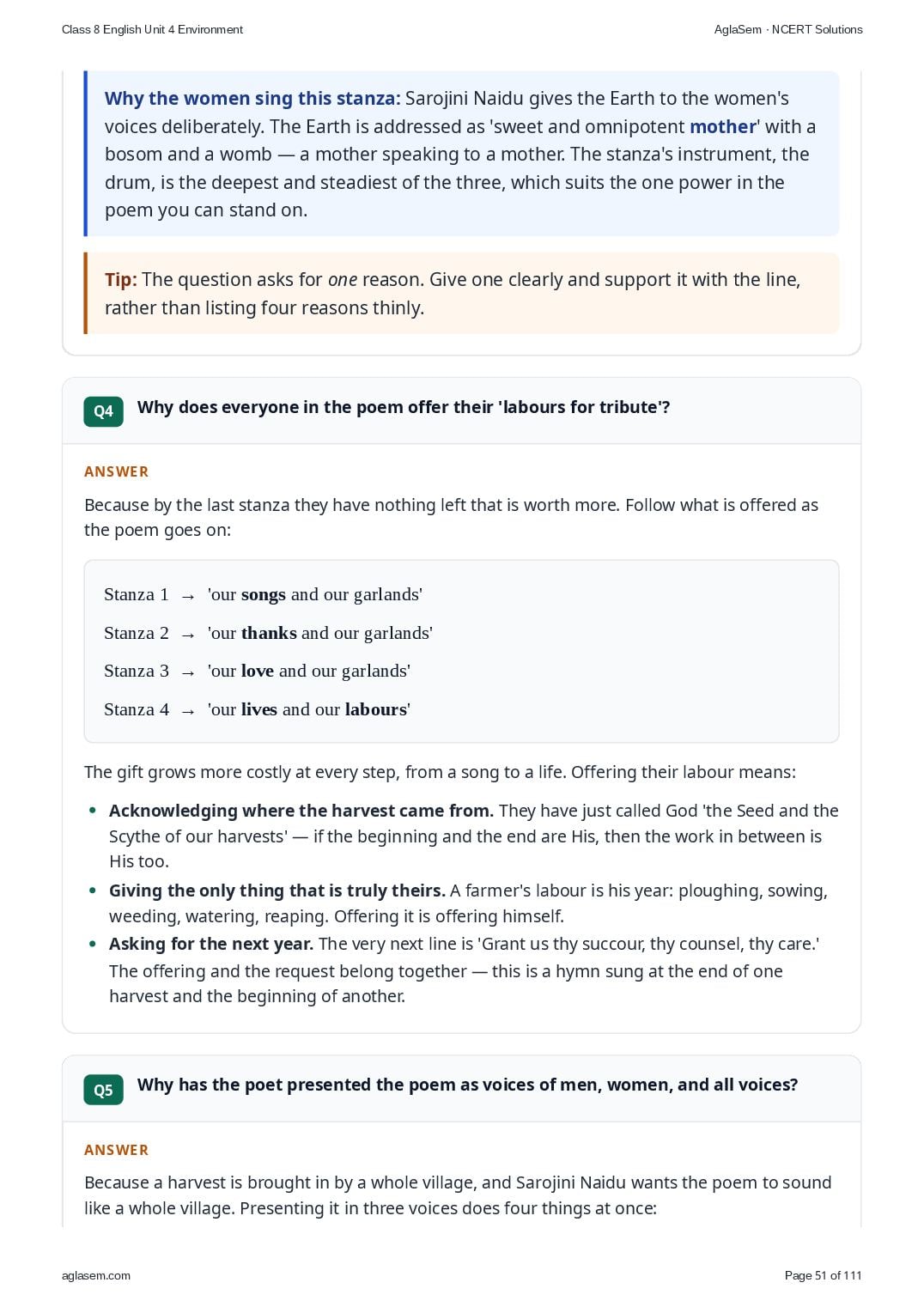
- State one reason why the women refer to the Earth as a 'source of manifold gladness'.
- Why does everyone in the poem offer their 'labours for tribute'?
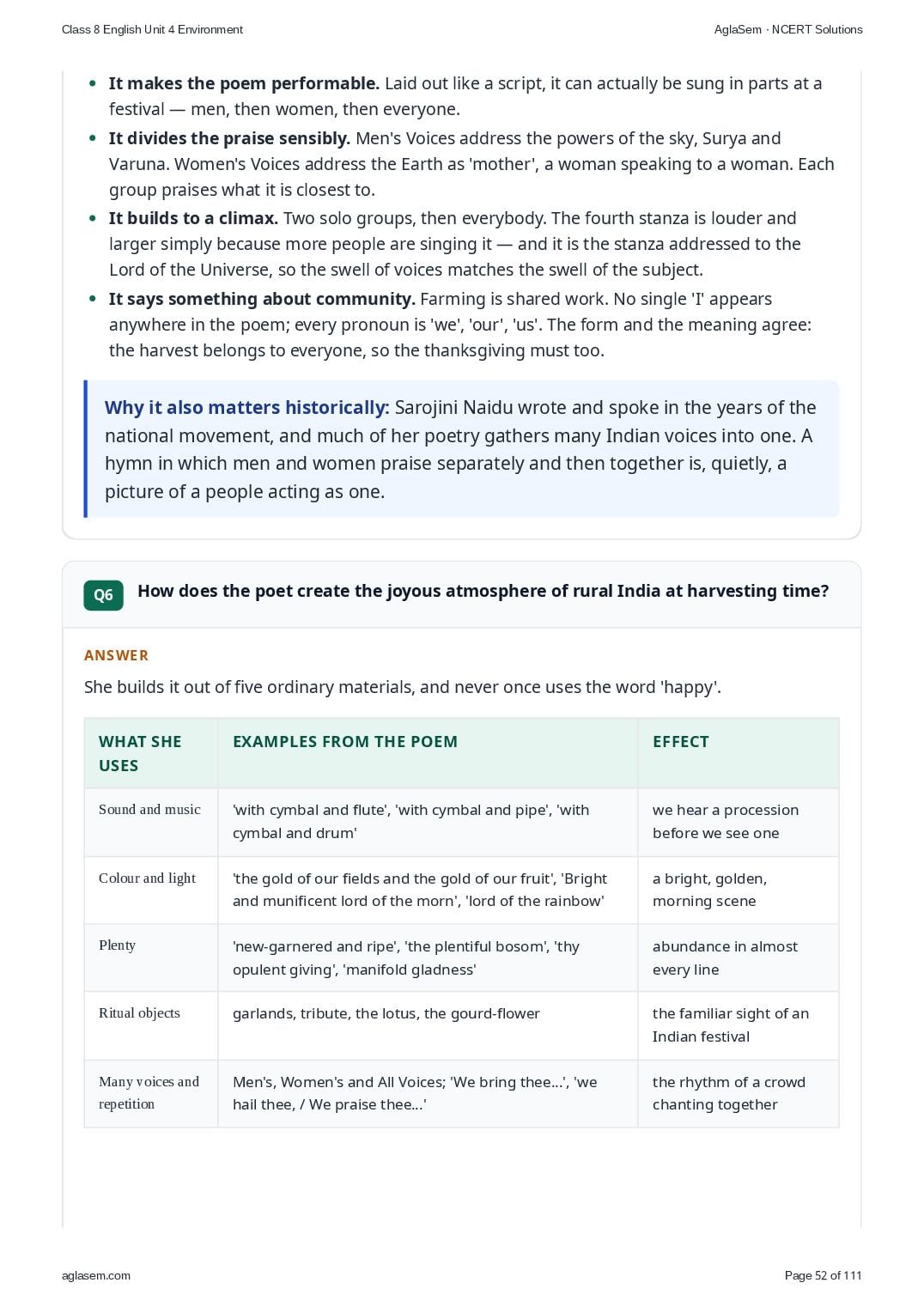
- Why has the poet presented the poem as voices of men, women, and all voices?
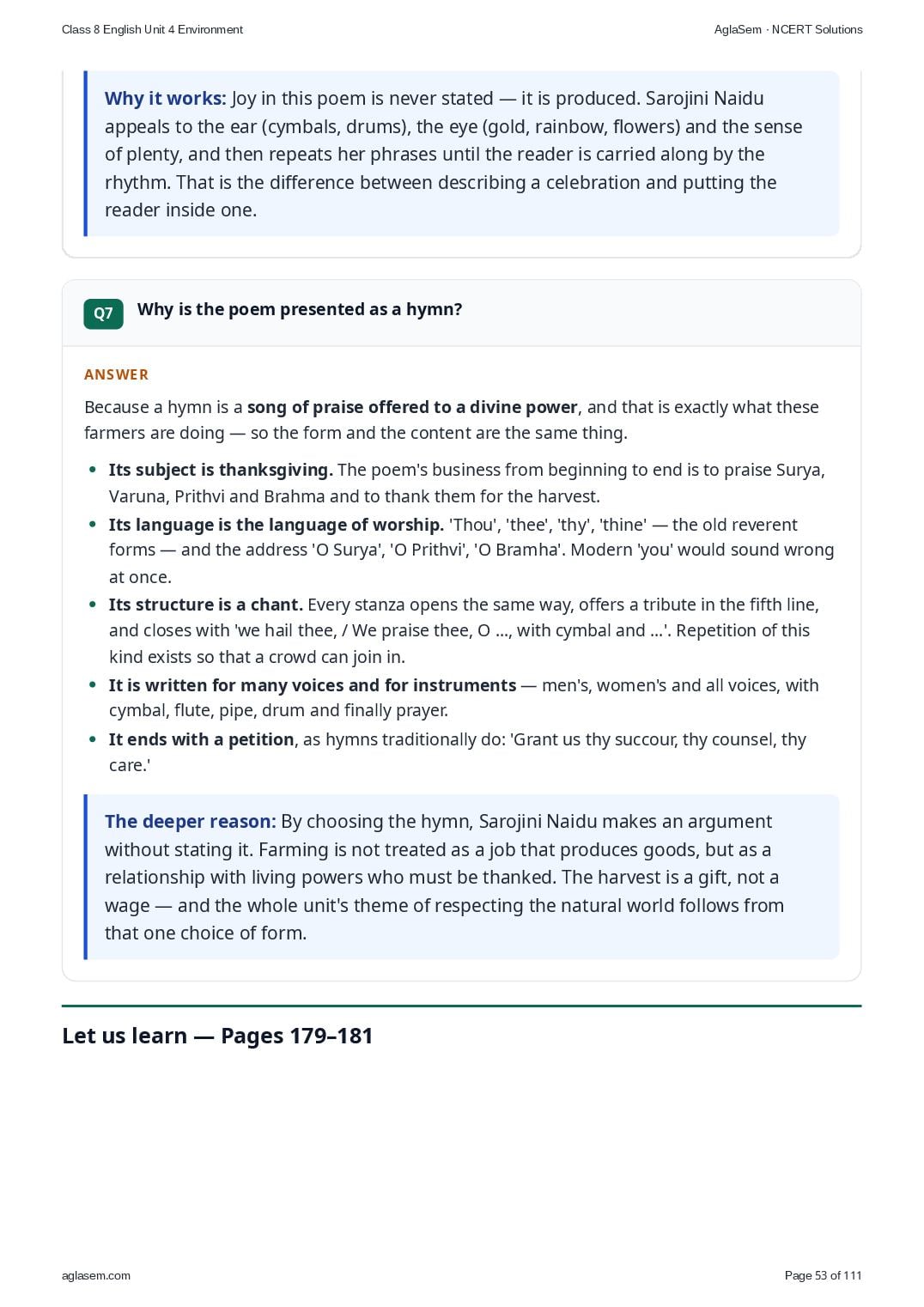
- How does the poet create the joyous atmosphere of rural India at harvesting time?
- Why is the poem presented as a hymn?
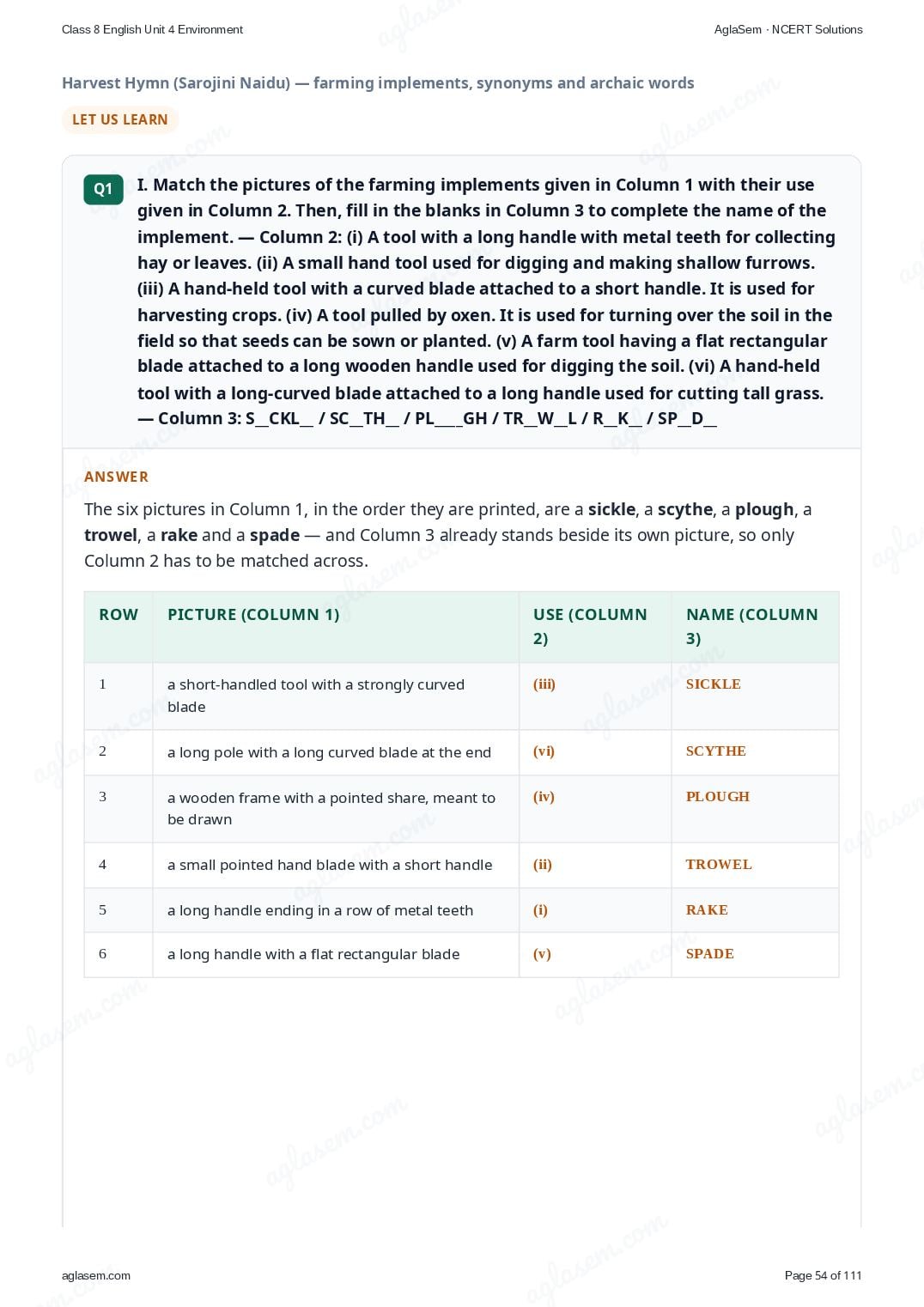
- I. Match the pictures of the farming implements given in Column 1 with their use given in Column 2. Then, fill in the blanks in Column 3 to complete the name of the implement. — Column 2: (i) A tool with a long handle with metal teeth for collecting hay or leaves. (ii) A small hand tool used for digging and making shallow furrows. (iii) A hand-held tool with a curved blade attached to a short handle. It is used for harvesting crops. (iv) A tool pulled by oxen. It is used for turning over the soil in the field so that seeds can be sown or planted. (v) A farm tool having a flat rectangular blade attached to a long wooden handle used for digging the soil. (vi) A hand-held tool with a long-curved blade attached to a long handle used for cutting tall grass. — Column 3: S__CKL__ / SC__TH__ / PL____GH / TR__W__L / R__K__ / SP__D__
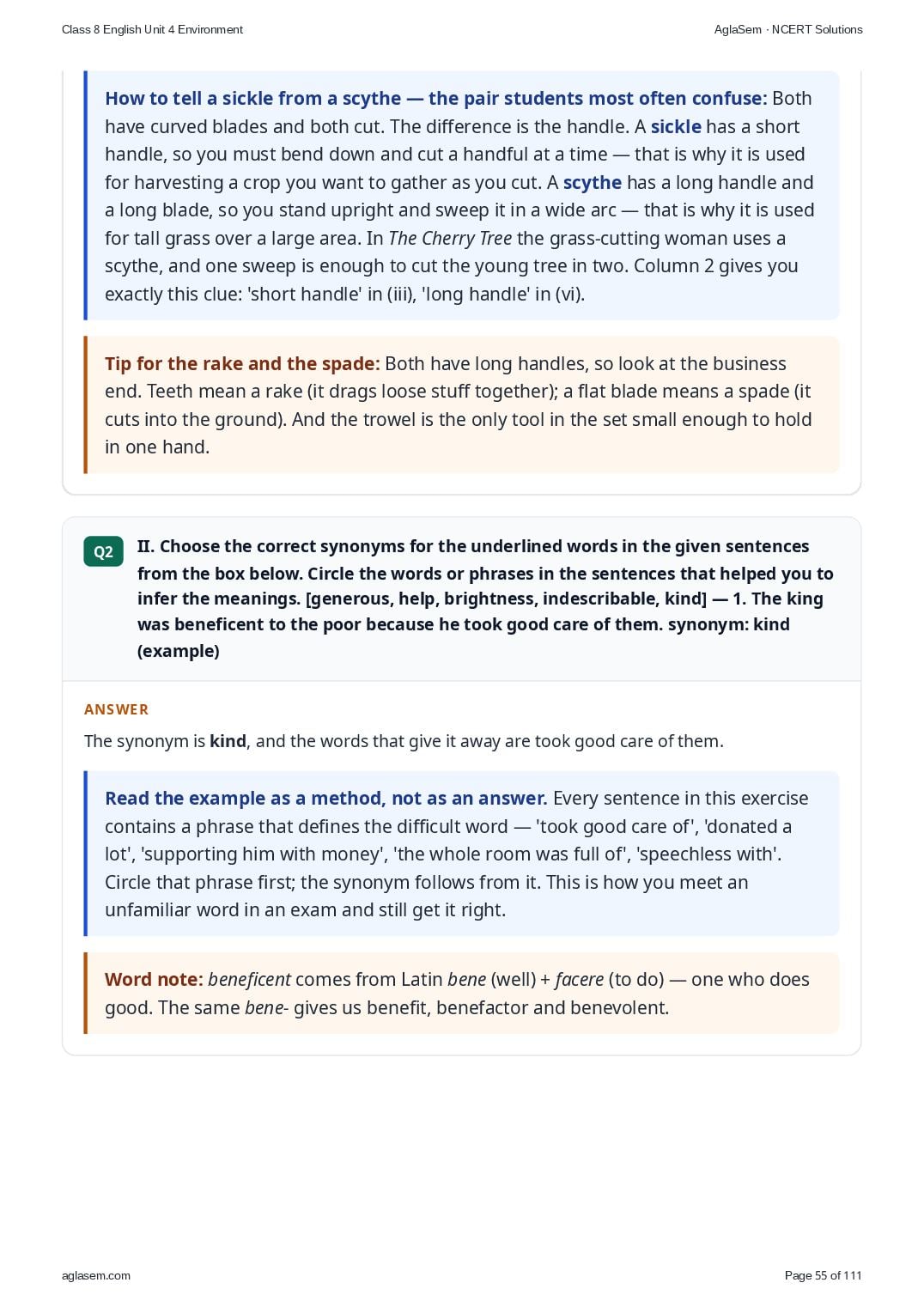
- II. Choose the correct synonyms for the underlined words in the given sentences from the box below. Circle the words or phrases in the sentences that helped you to infer the meanings. [generous, help, brightness, indescribable, kind] — 1. The king was beneficent to the poor because he took good care of them. synonym: kind (example)
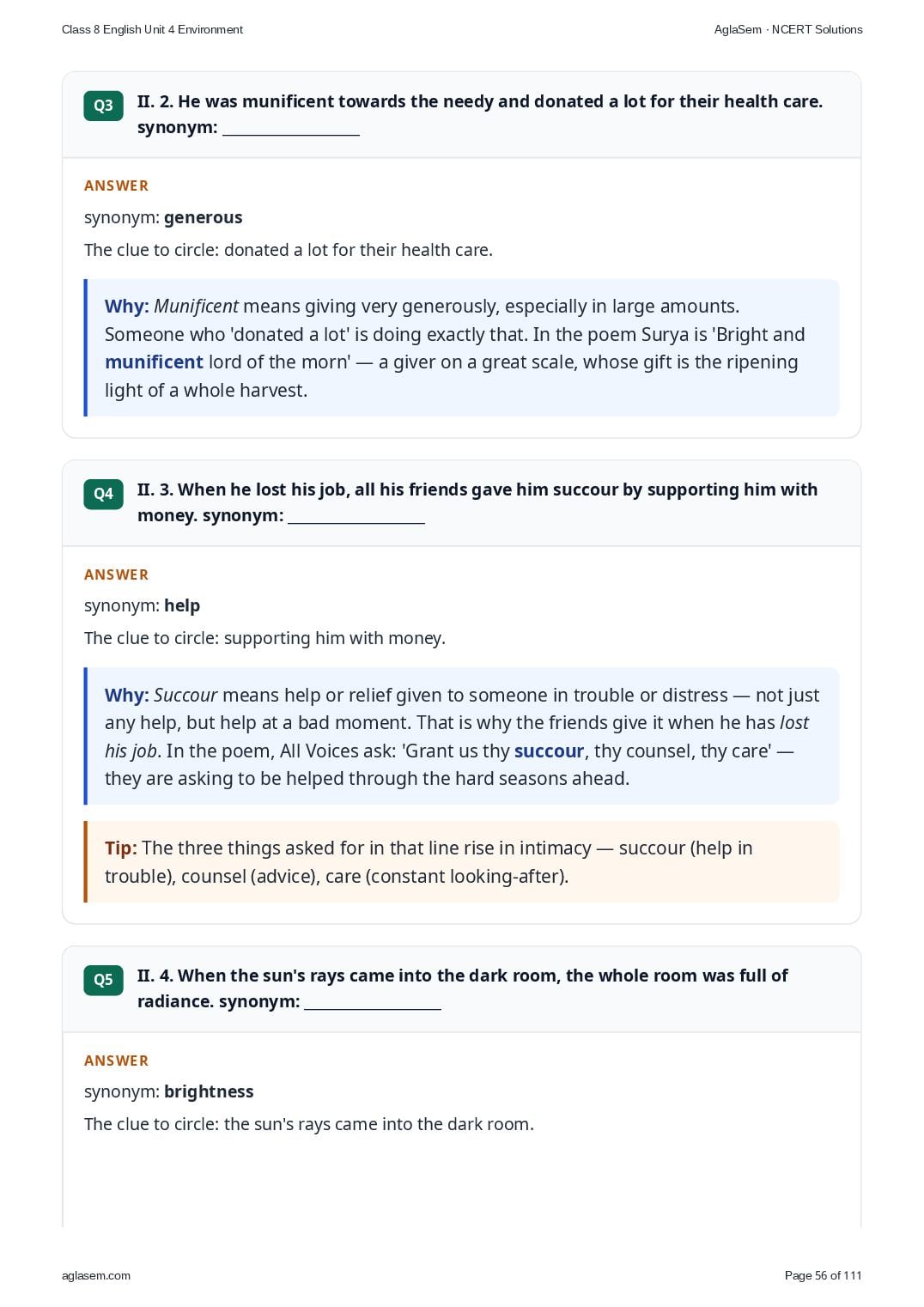
- II. 2. He was munificent towards the needy and donated a lot for their health care. synonym: ____________________
- II. 3. When he lost his job, all his friends gave him succour by supporting him with money. synonym: ____________________
- II. 4. When the sun's rays came into the dark room, the whole room was full of radiance. synonym: ____________________
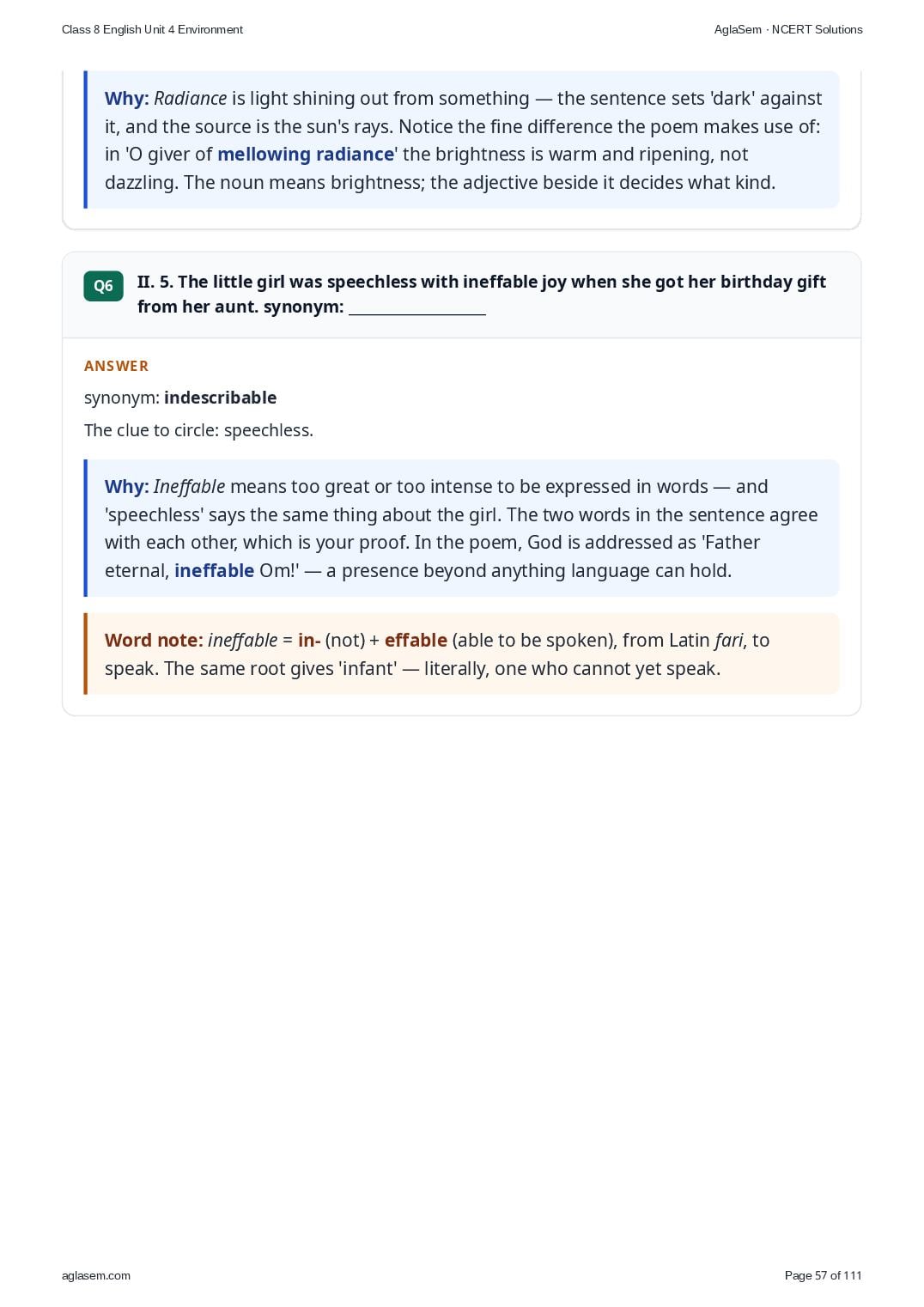
- II. 5. The little girl was speechless with ineffable joy when she got her birthday gift from her aunt. synonym: ____________________
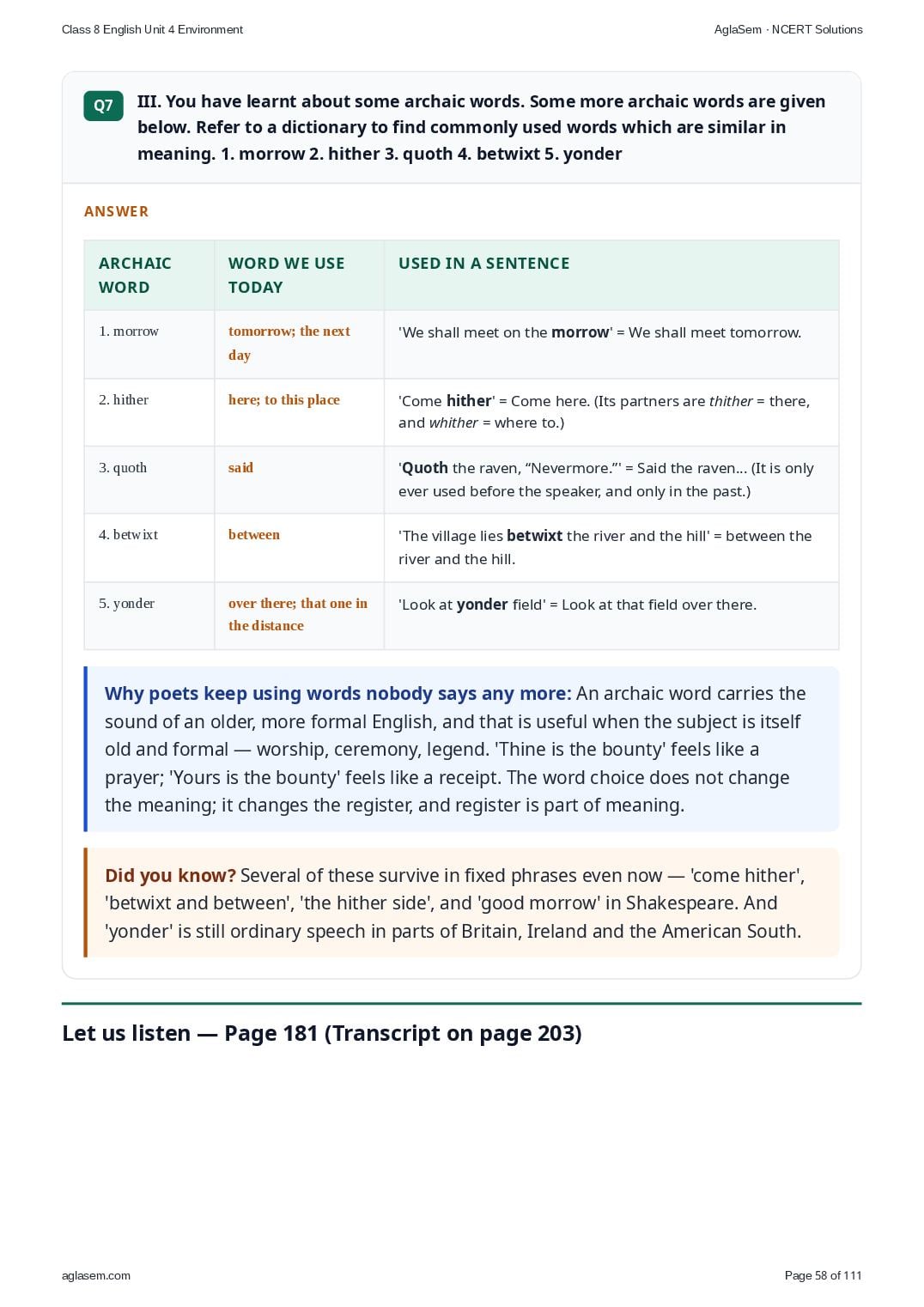
- III. You have learnt about some archaic words. Some more archaic words are given below. Refer to a dictionary to find commonly used words which are similar in meaning. 1. morrow 2. hither 3. quoth 4. betwixt 5. yonder
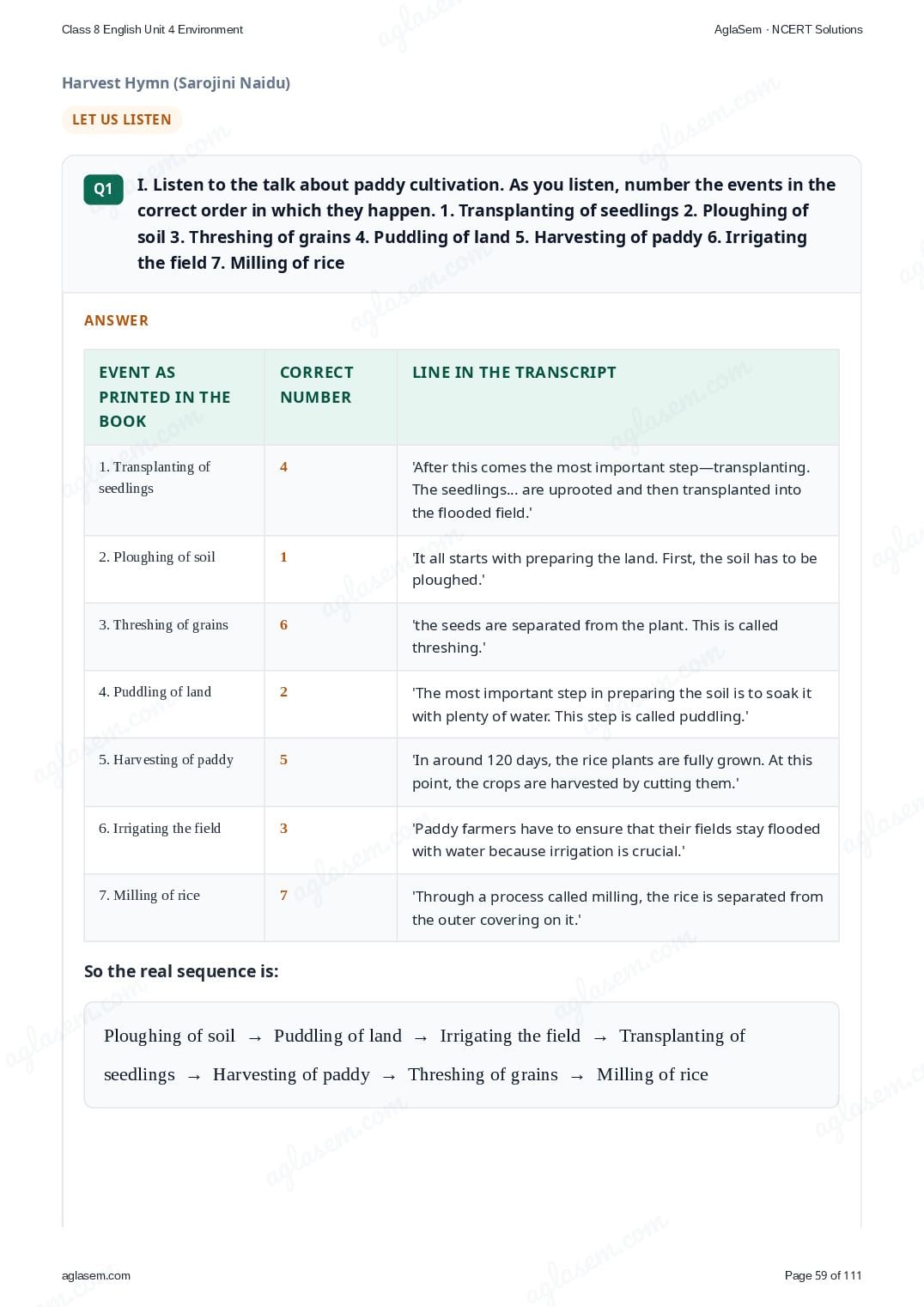
- I. Listen to the talk about paddy cultivation. As you listen, number the events in the correct order in which they happen. 1. Transplanting of seedlings 2. Ploughing of soil 3. Threshing of grains 4. Puddling of land 5. Harvesting of paddy 6. Irrigating the field 7. Milling of rice
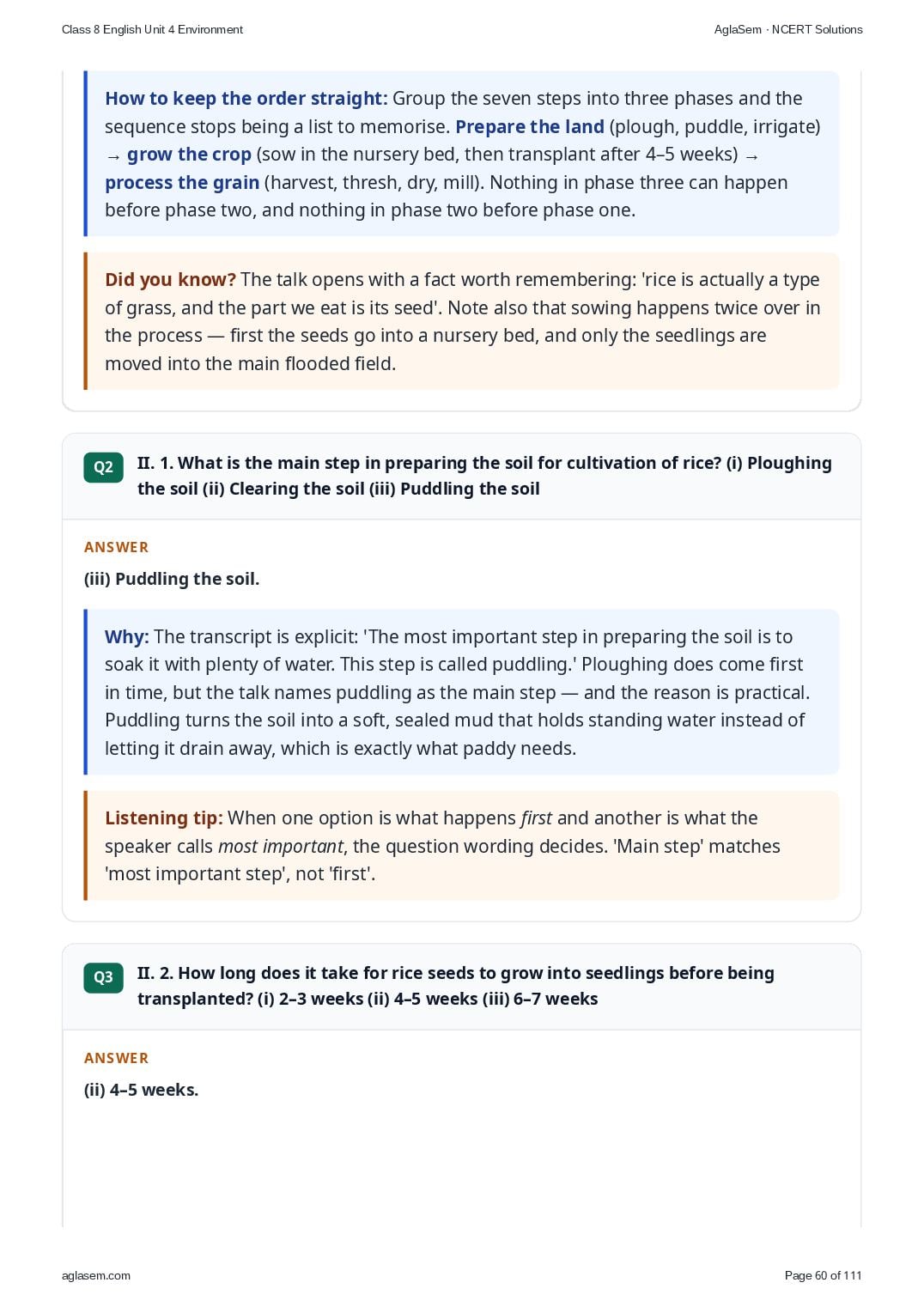
- II. 1. What is the main step in preparing the soil for cultivation of rice? (i) Ploughing the soil (ii) Clearing the soil (iii) Puddling the soil
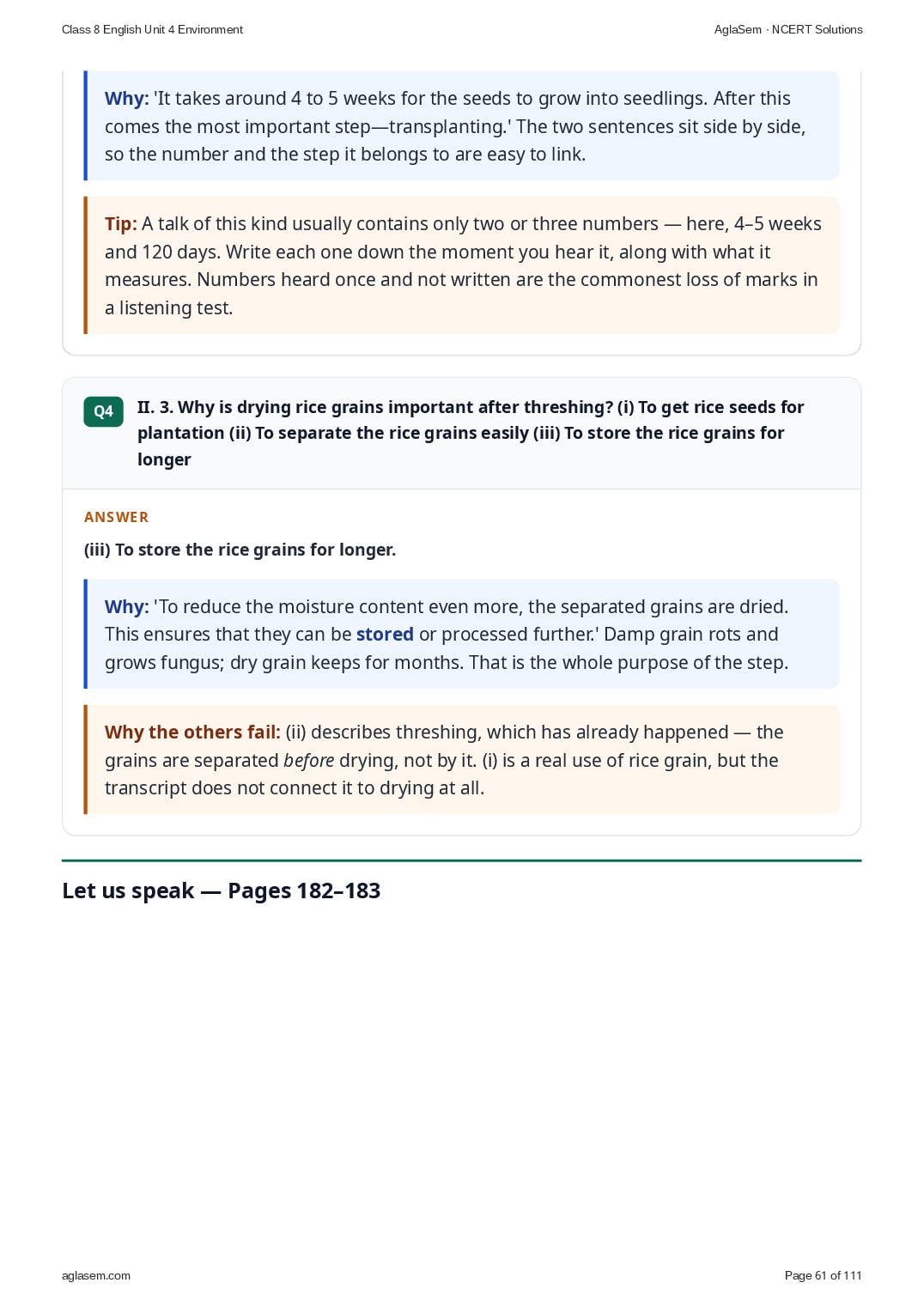
- II. 2. How long does it take for rice seeds to grow into seedlings before being transplanted? (i) 2–3 weeks (ii) 4–5 weeks (iii) 6–7 weeks
- II. 3. Why is drying rice grains important after threshing? (i) To get rice seeds for plantation (ii) To separate the rice grains easily (iii) To store the rice grains for longer
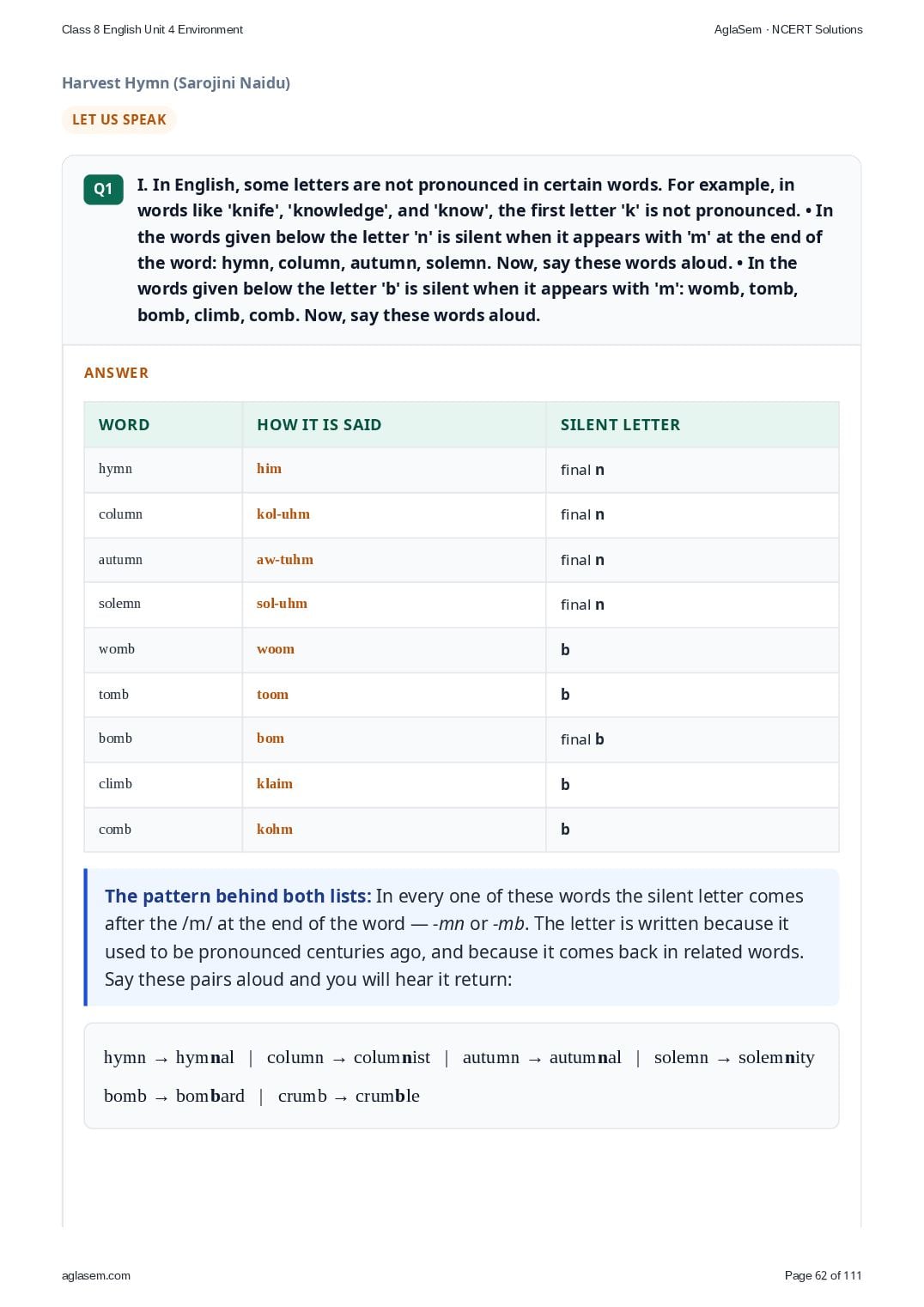
- I. In English, some letters are not pronounced in certain words. For example, in words like 'knife', 'knowledge', and 'know', the first letter 'k' is not pronounced. • In the words given below the letter 'n' is silent when it appears with 'm' at the end of the word: hymn, column, autumn, solemn. Now, say these words aloud. • In the words given below the letter 'b' is silent when it appears with 'm': womb, tomb, bomb, climb, comb. Now, say these words aloud.
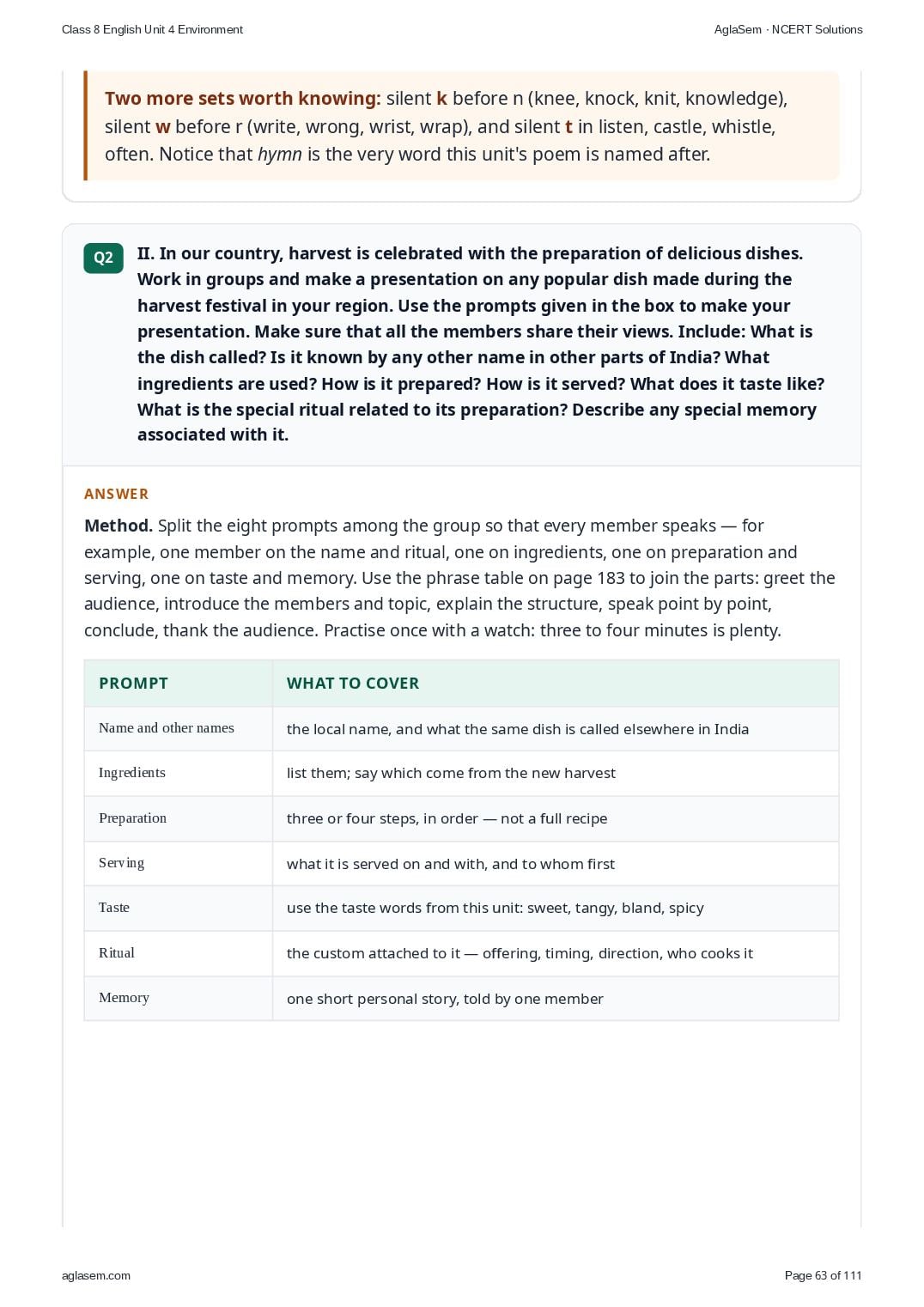
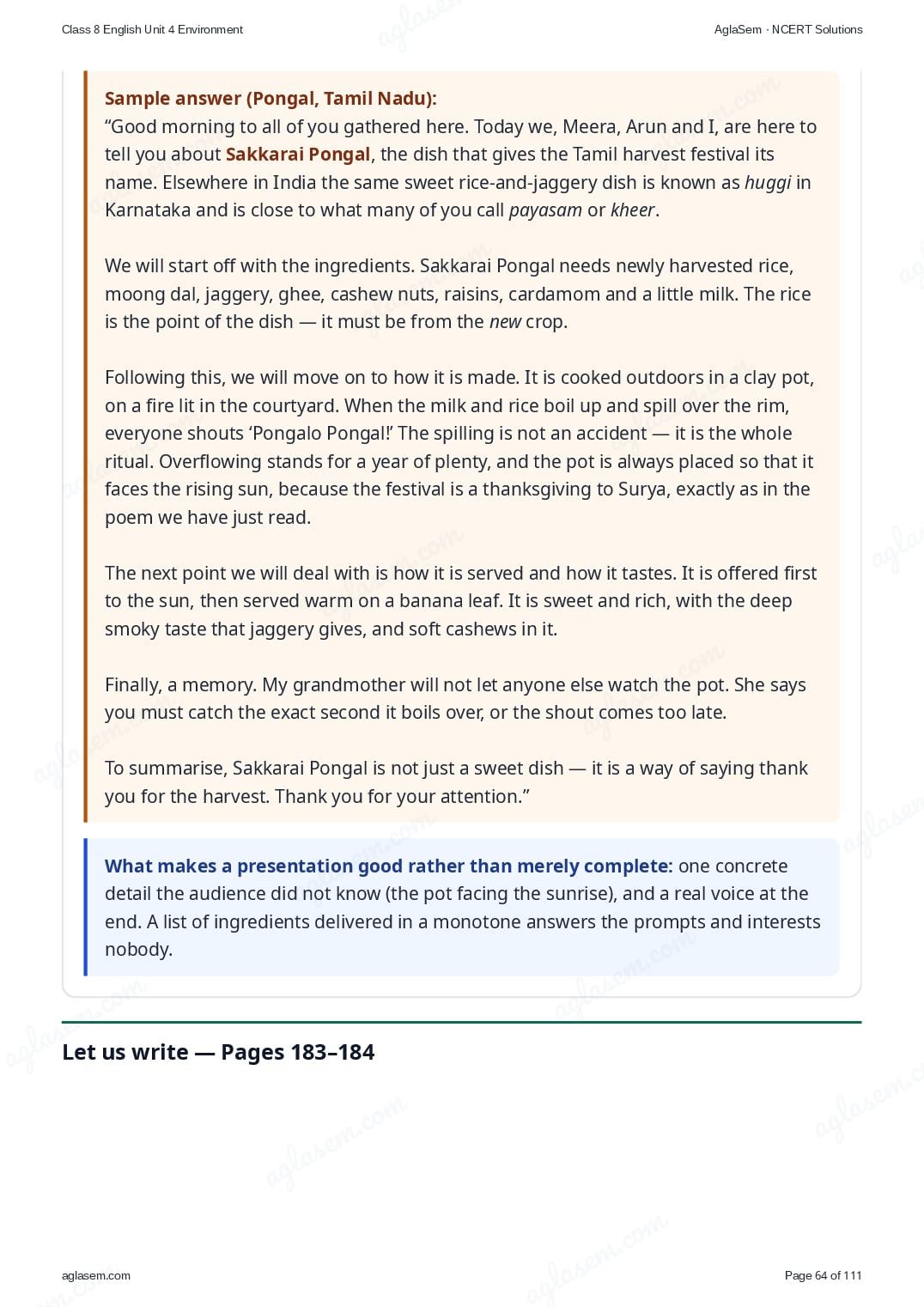
- II. In our country, harvest is celebrated with the preparation of delicious dishes. Work in groups and make a presentation on any popular dish made during the harvest festival in your region. Use the prompts given in the box to make your presentation. Make sure that all the members share their views. Include: What is the dish called? Is it known by any other name in other parts of India? What ingredients are used? How is it prepared? How is it served? What does it taste like? What is the special ritual related to its preparation? Describe any special memory associated with it.
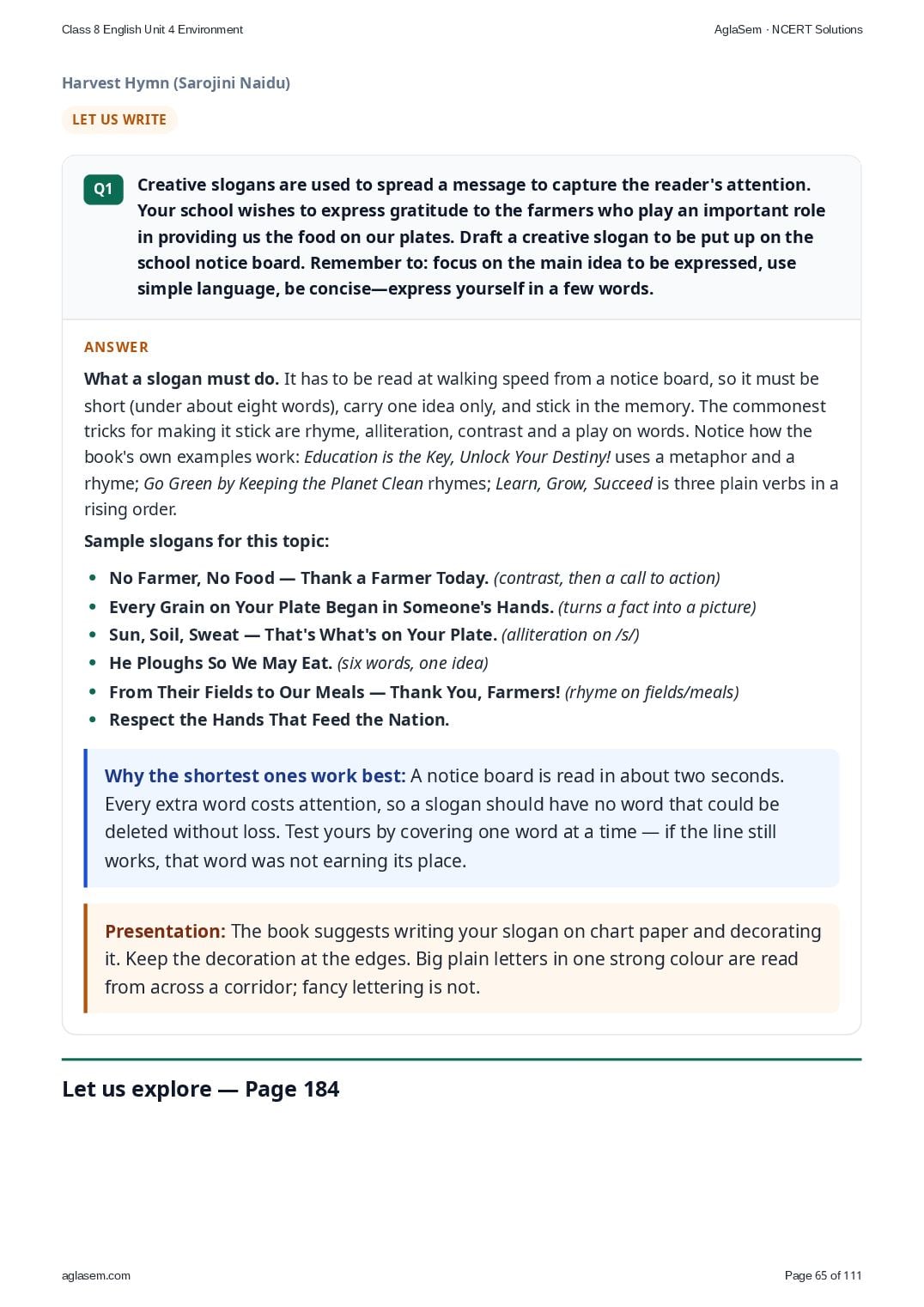
- Creative slogans are used to spread a message to capture the reader's attention. Your school wishes to express gratitude to the farmers who play an important role in providing us the food on our plates. Draft a creative slogan to be put up on the school notice board. Remember to: focus on the main idea to be expressed, use simple language, be concise—express yourself in a few words.
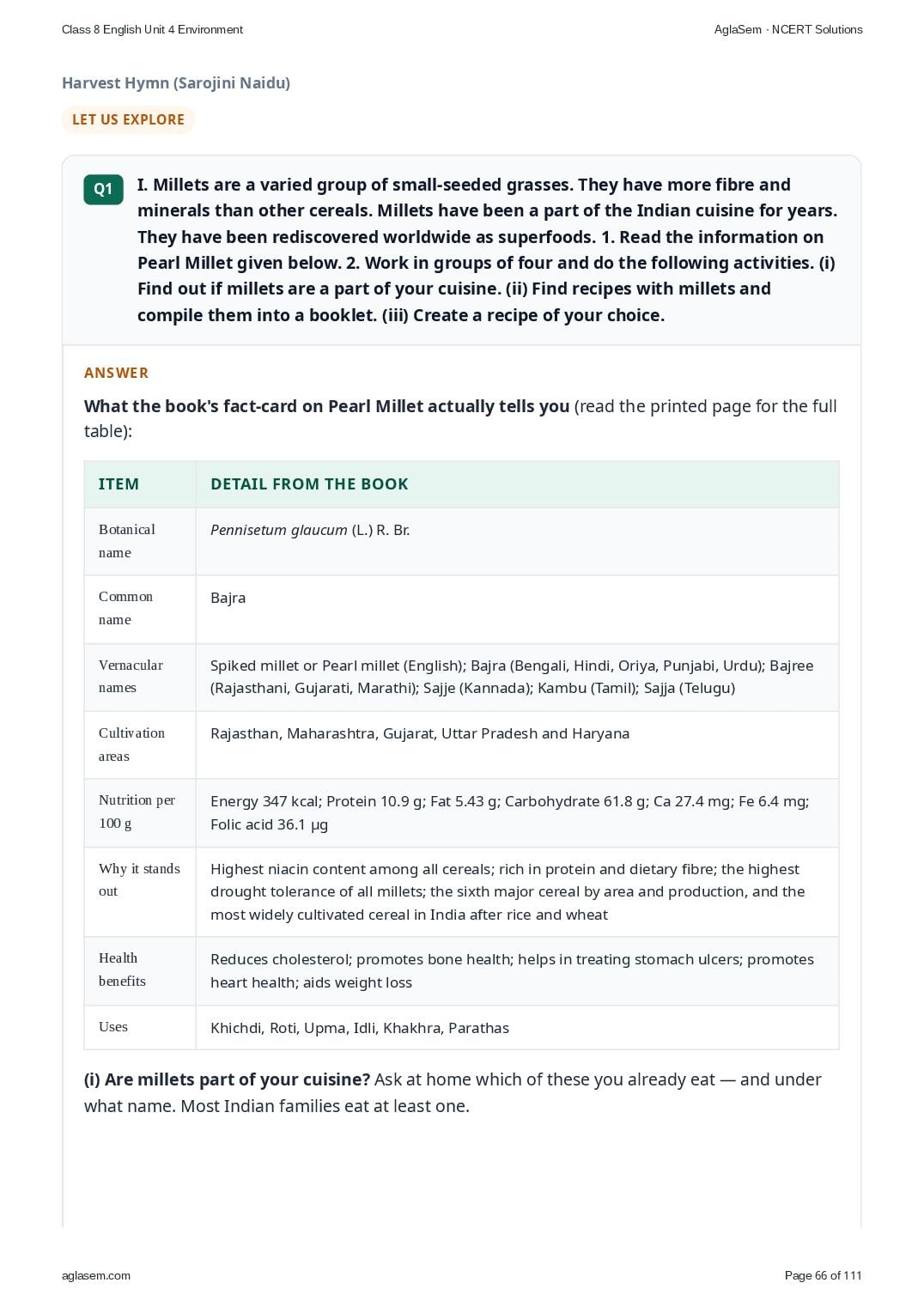
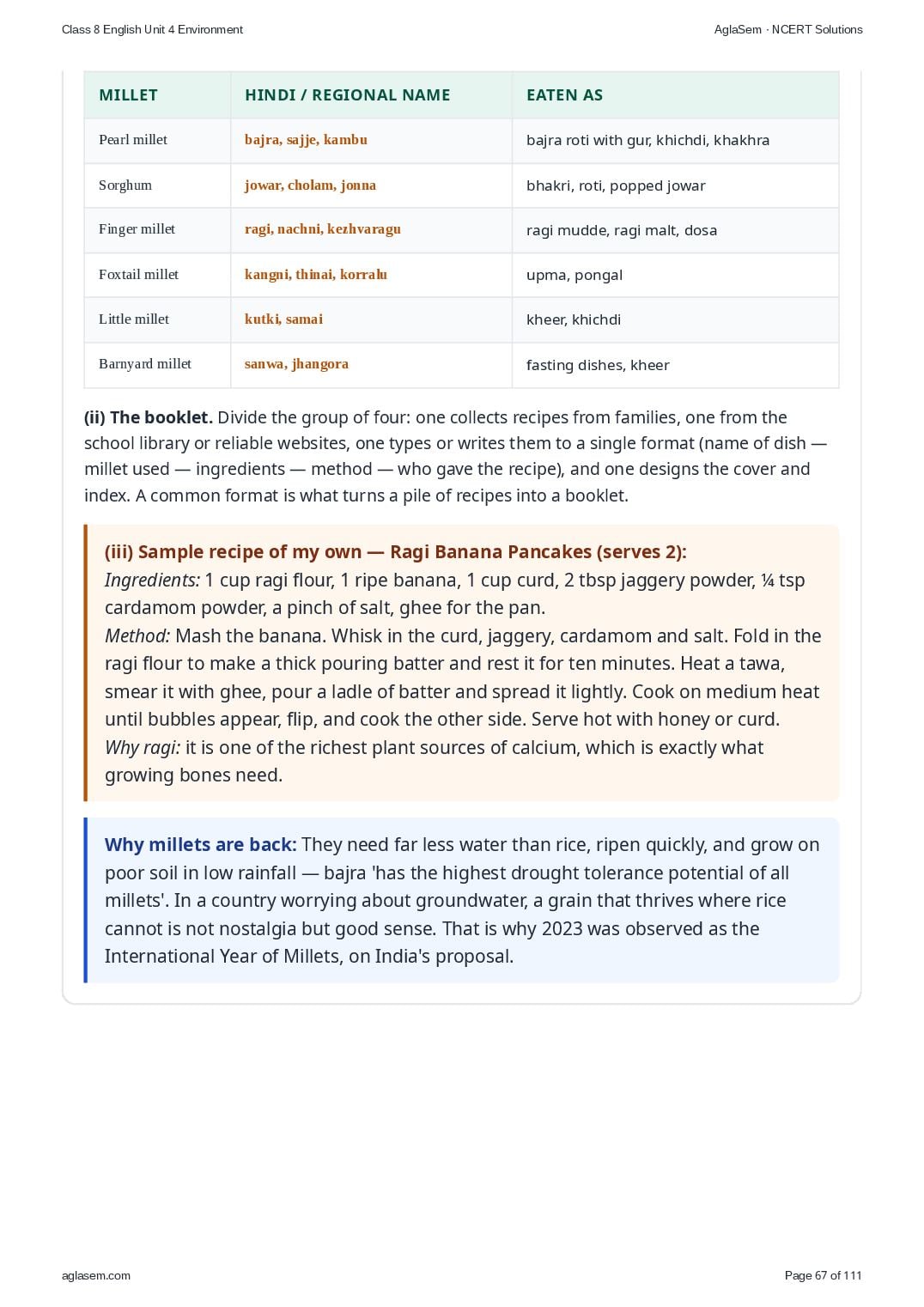
- I. Millets are a varied group of small-seeded grasses. They have more fibre and minerals than other cereals. Millets have been a part of the Indian cuisine for years. They have been rediscovered worldwide as superfoods. 1. Read the information on Pearl Millet given below. 2. Work in groups of four and do the following activities. (i) Find out if millets are a part of your cuisine. (ii) Find recipes with millets and compile them into a booklet. (iii) Create a recipe of your choice.
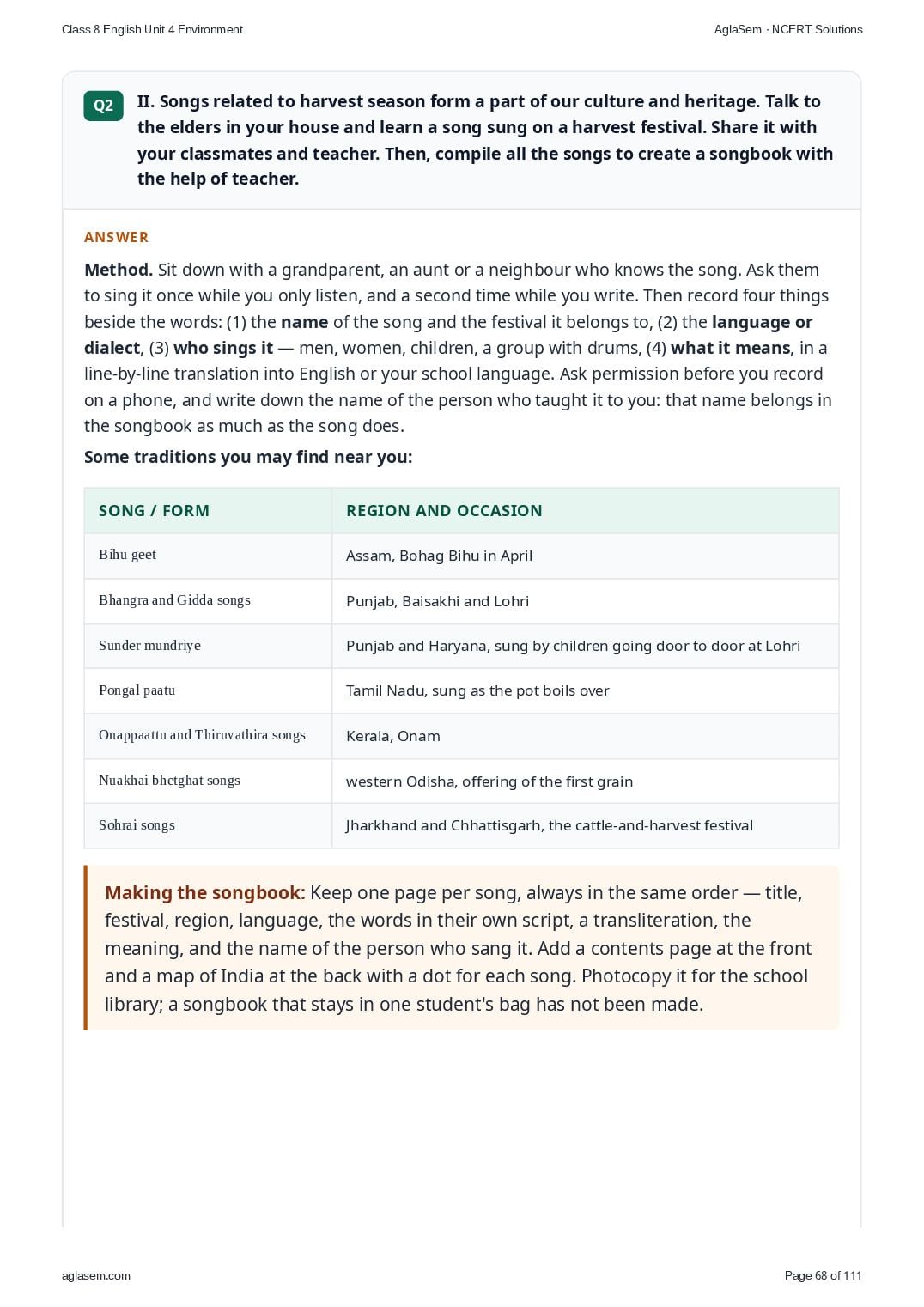
- II. Songs related to harvest season form a part of our culture and heritage. Talk to the elders in your house and learn a song sung on a harvest festival. Share it with your classmates and teacher. Then, compile all the songs to create a songbook with the help of teacher.
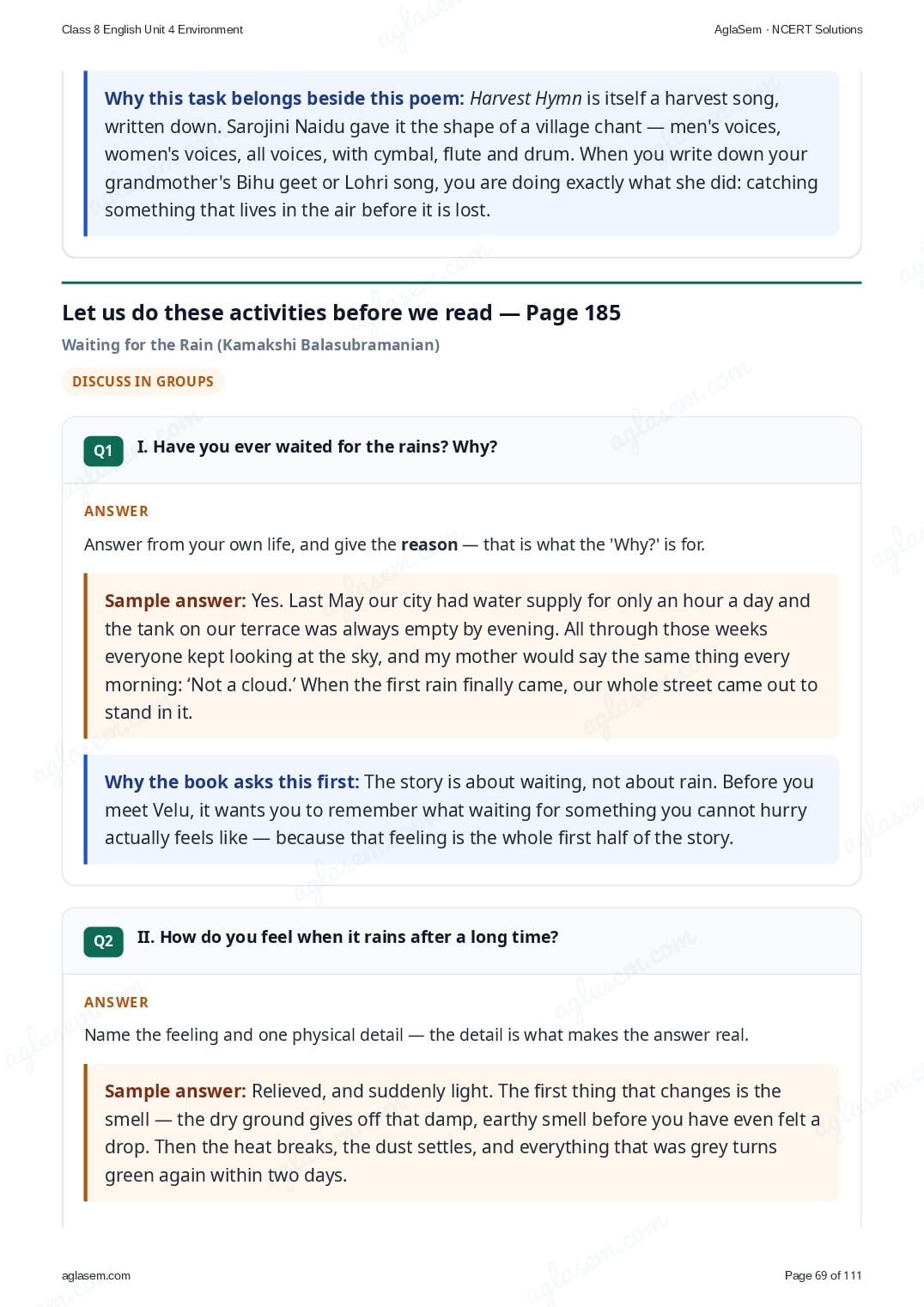
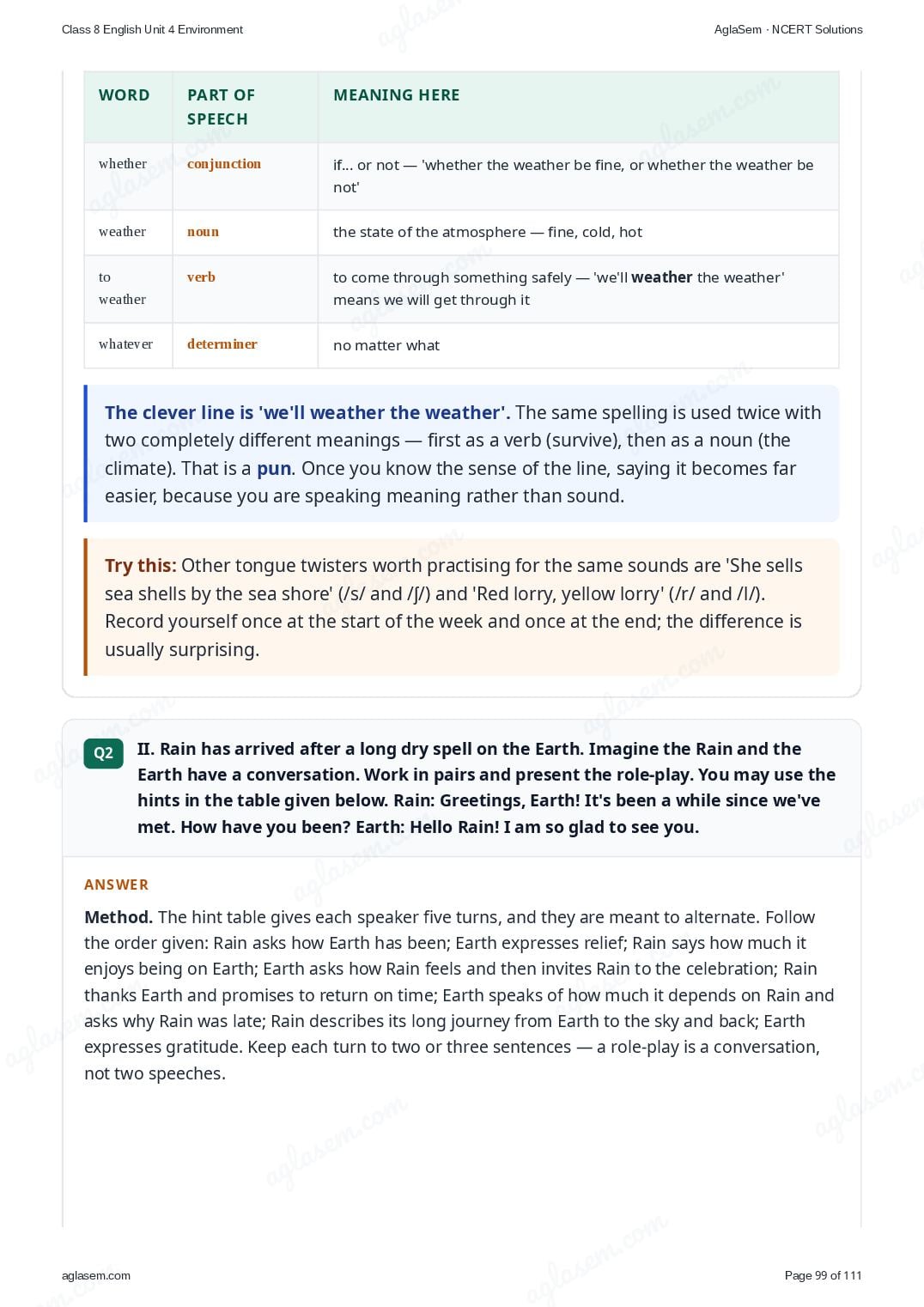
- I. Have you ever waited for the rains? Why?
- II. How do you feel when it rains after a long time?
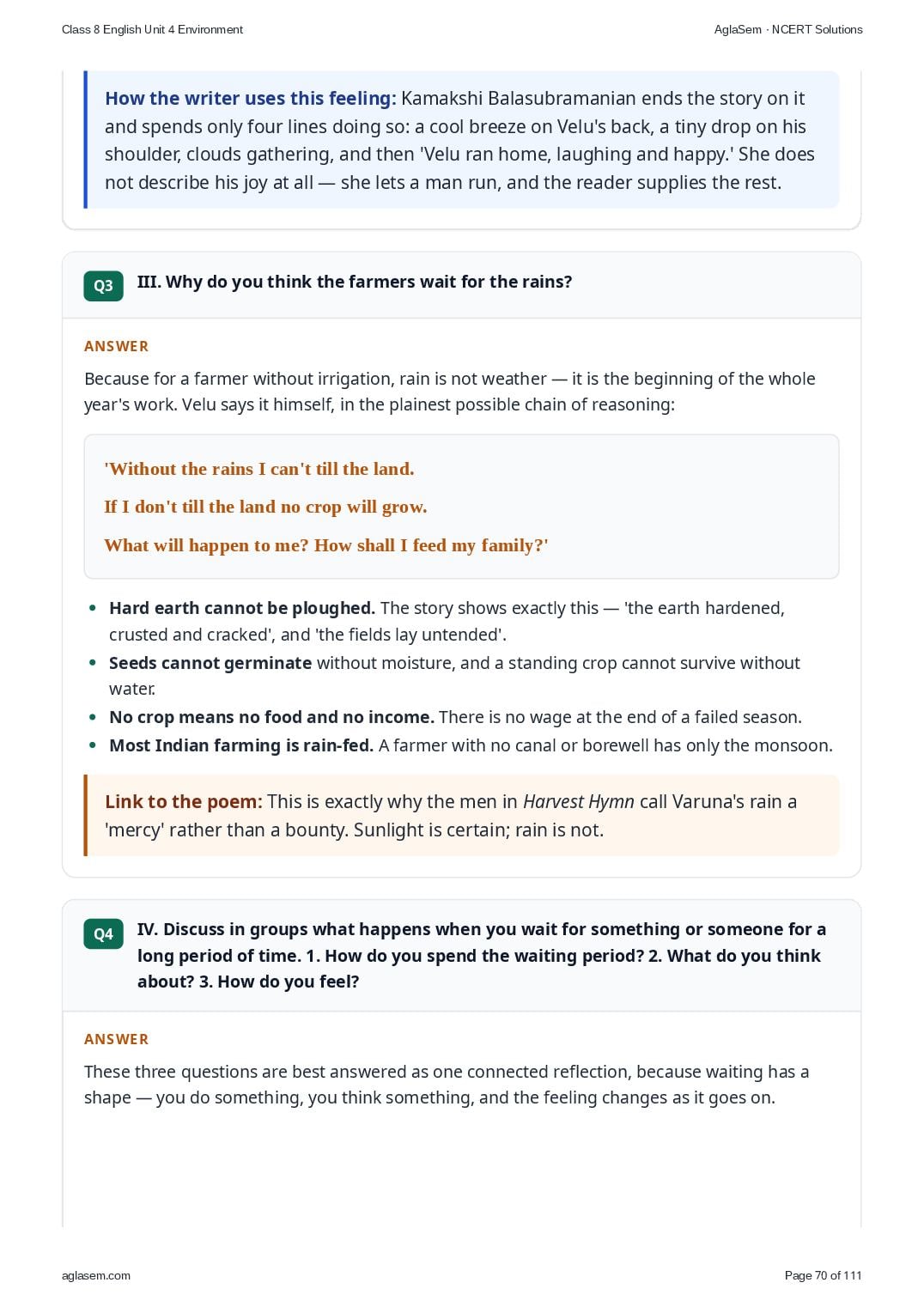
- III. Why do you think the farmers wait for the rains?
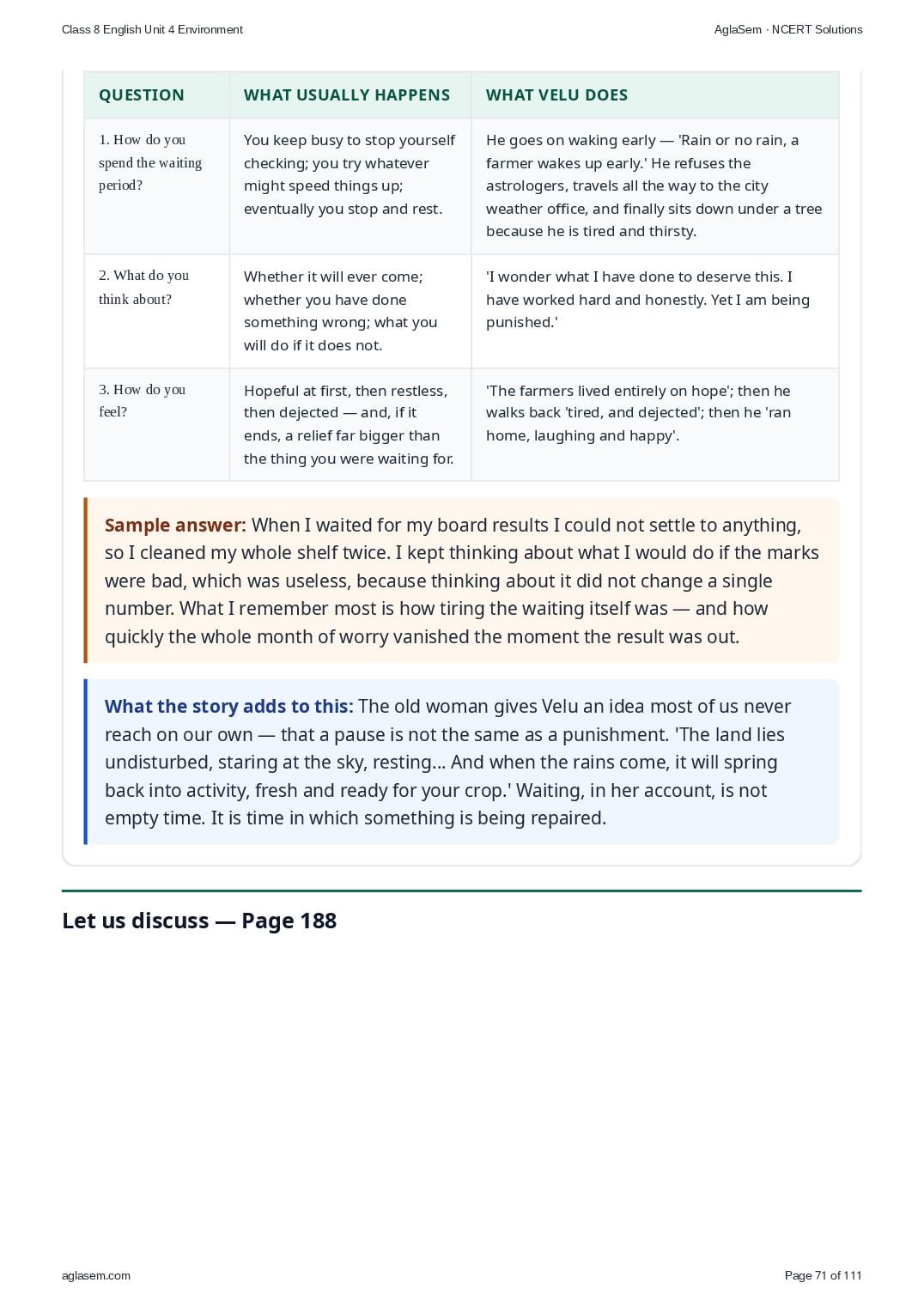
- IV. Discuss in groups what happens when you wait for something or someone for a long period of time. 1. How do you spend the waiting period? 2. What do you think about? 3. How do you feel?
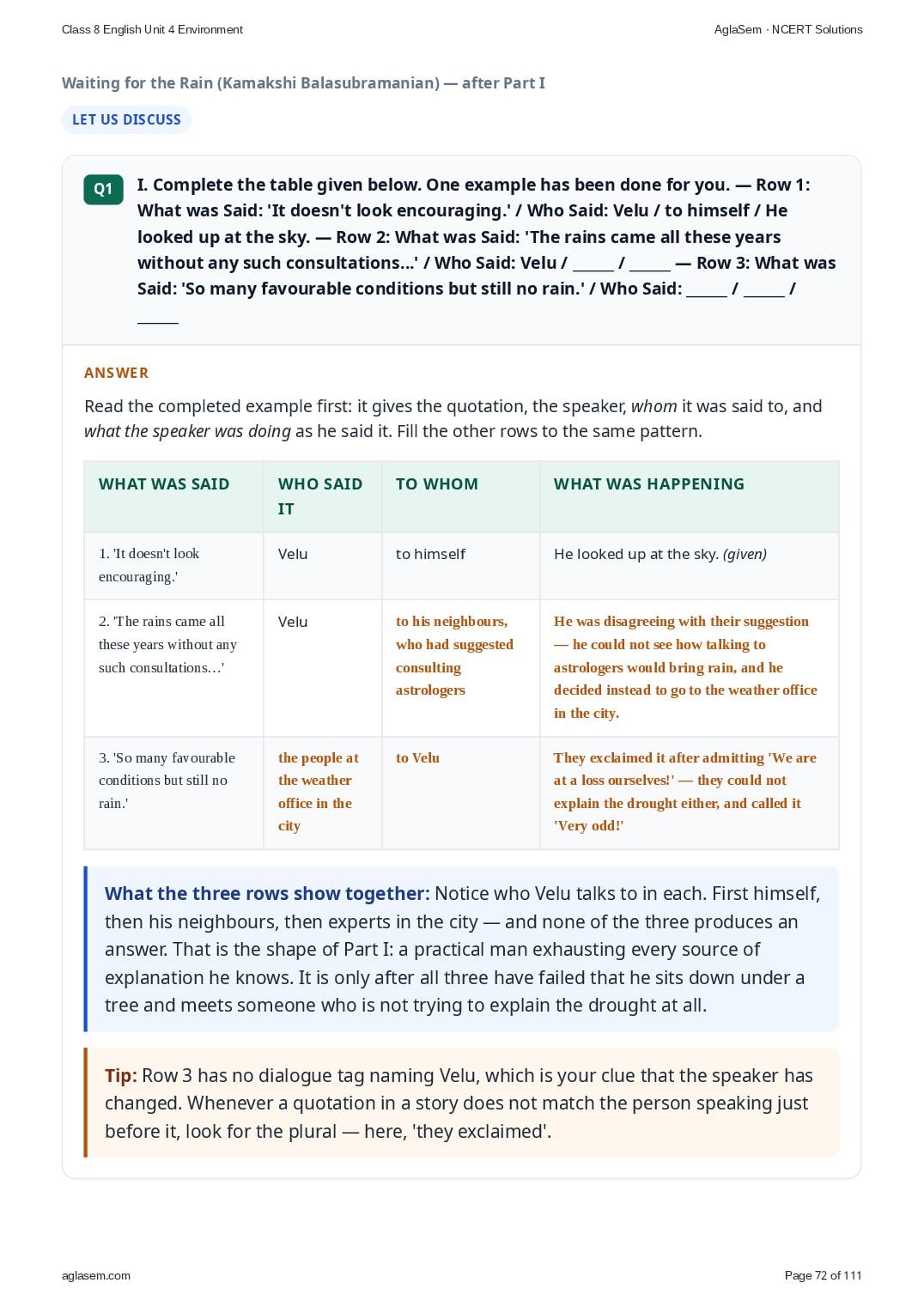
- I. Complete the table given below. One example has been done for you. — Row 1: What was Said: 'It doesn't look encouraging.' / Who Said: Velu / to himself / He looked up at the sky. — Row 2: What was Said: 'The rains came all these years without any such consultations…' / Who Said: Velu / ______ / ______ — Row 3: What was Said: 'So many favourable conditions but still no rain.' / Who Said: ______ / ______ / ______
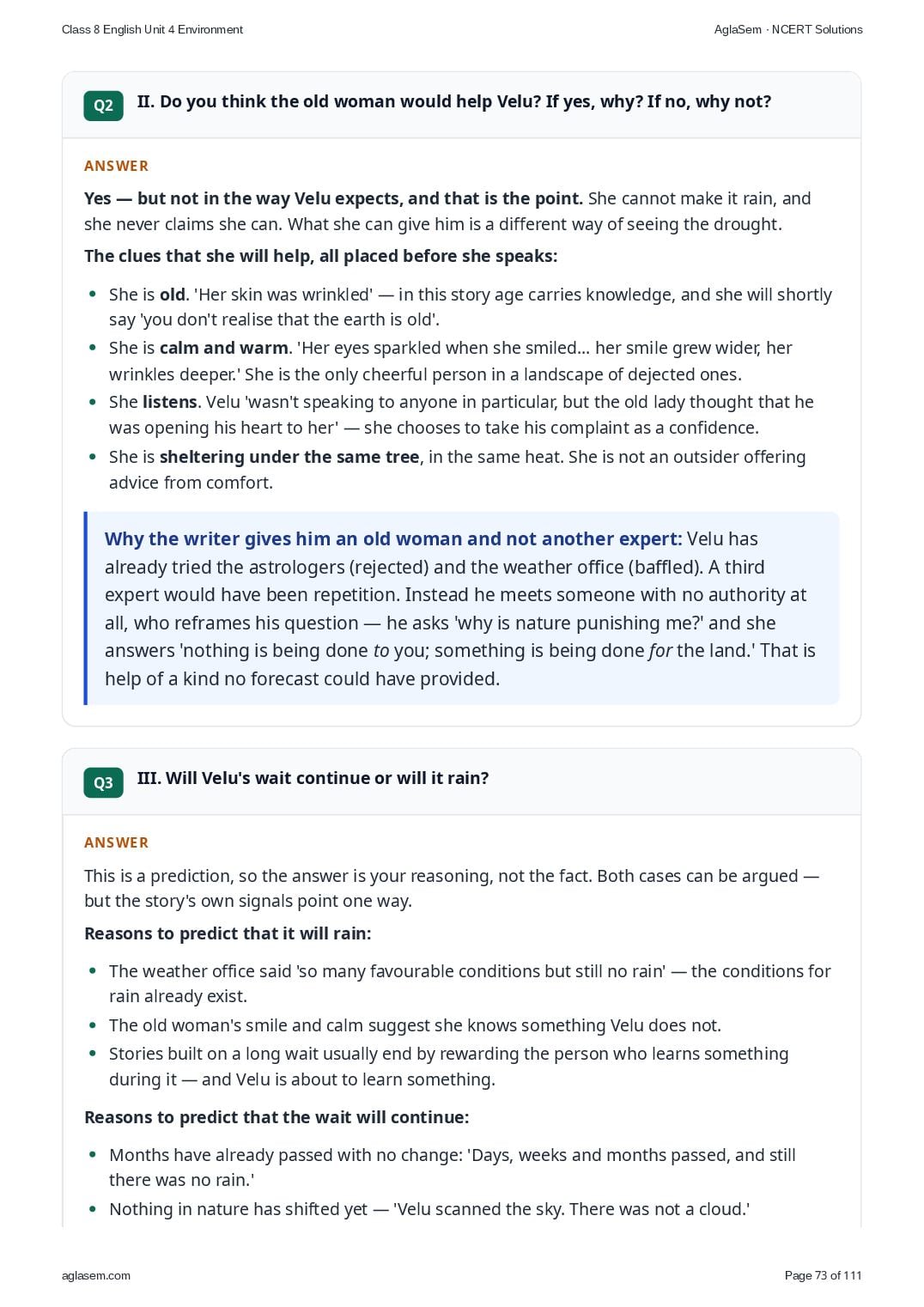
- II. Do you think the old woman would help Velu? If yes, why? If no, why not?
- III. Will Velu's wait continue or will it rain?
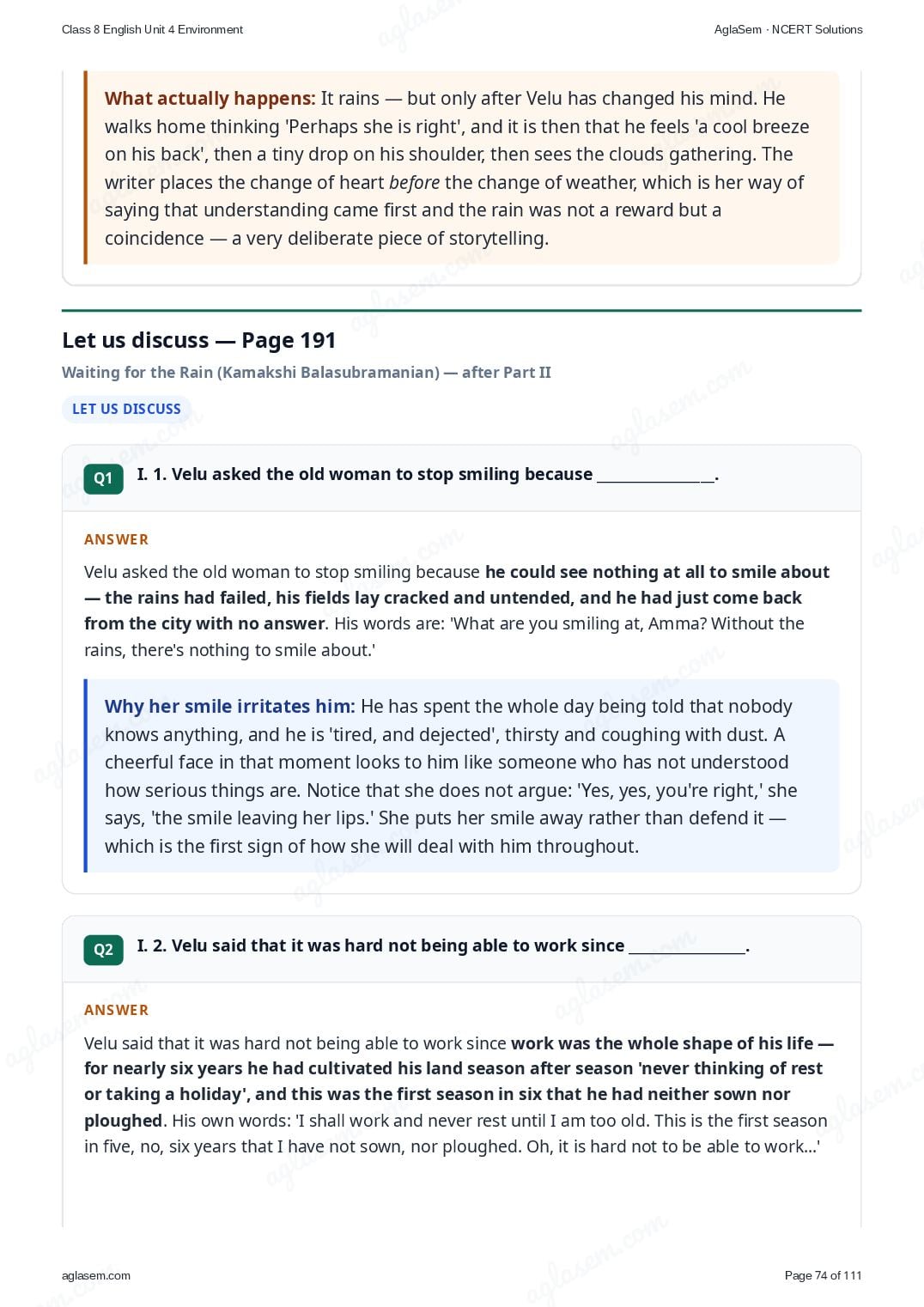
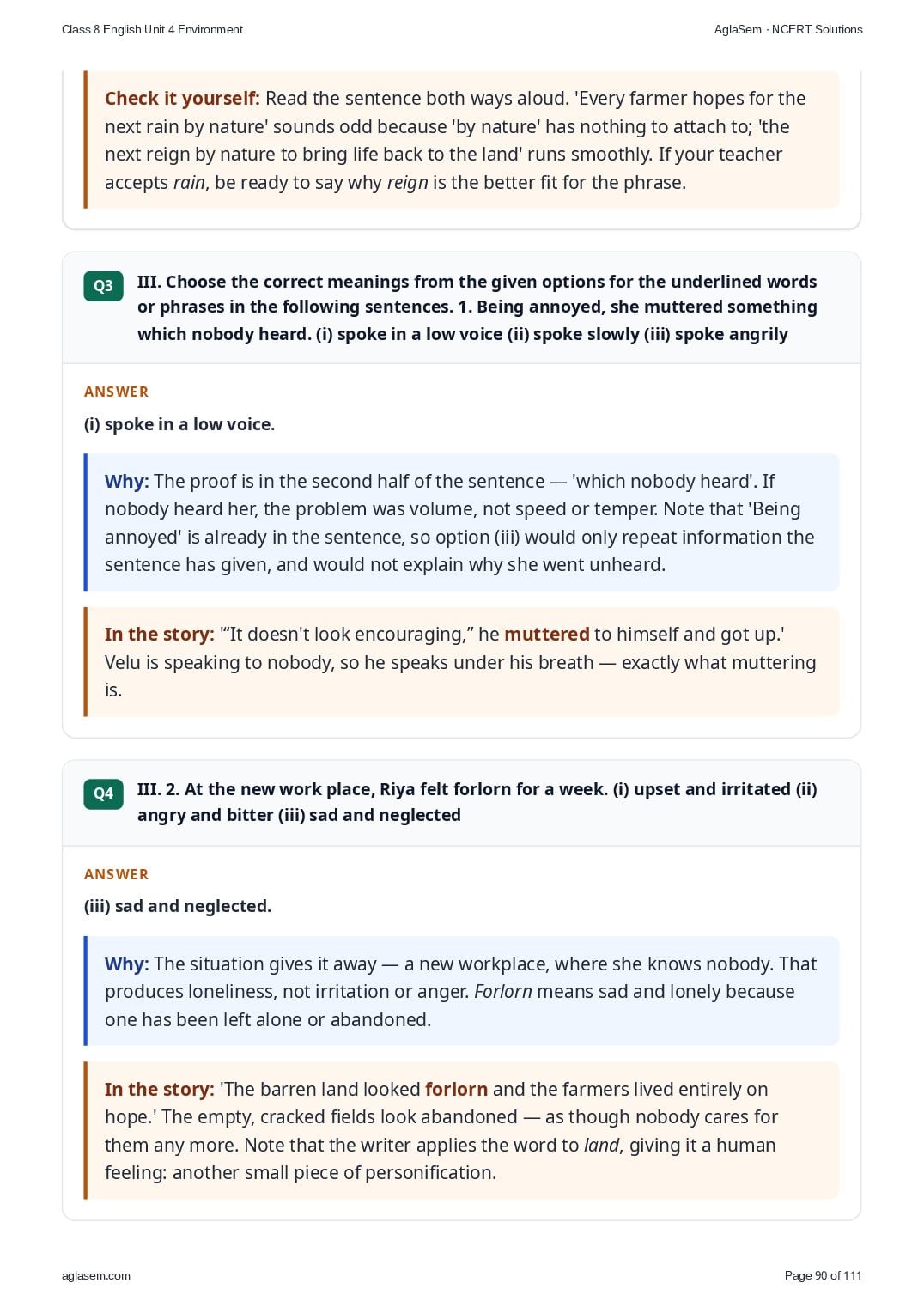
- I. 1. Velu asked the old woman to stop smiling because _________________.
- I. 2. Velu said that it was hard not being able to work since _________________.
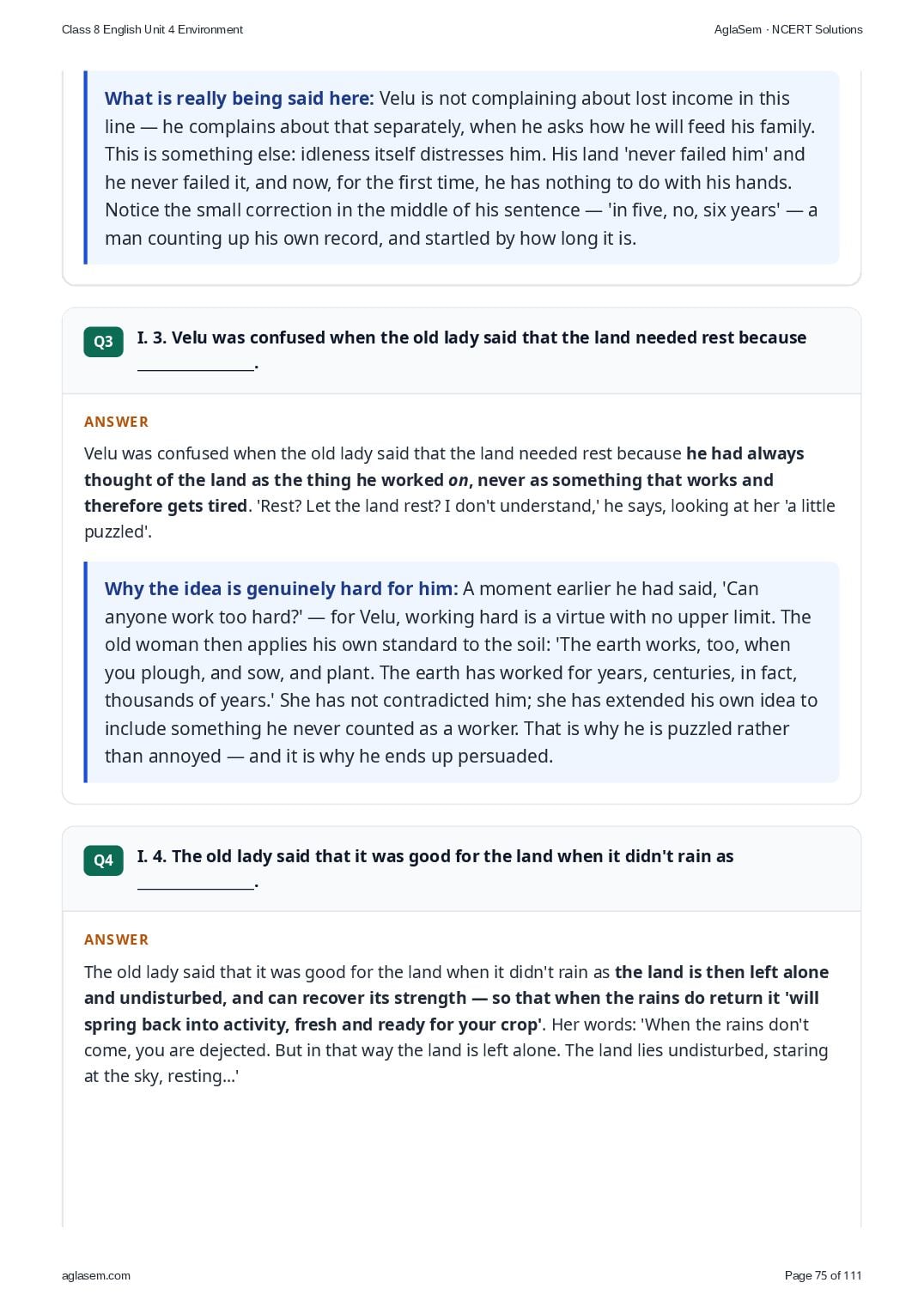
- I. 3. Velu was confused when the old lady said that the land needed rest because _________________.
- I. 4. The old lady said that it was good for the land when it didn't rain as _________________.
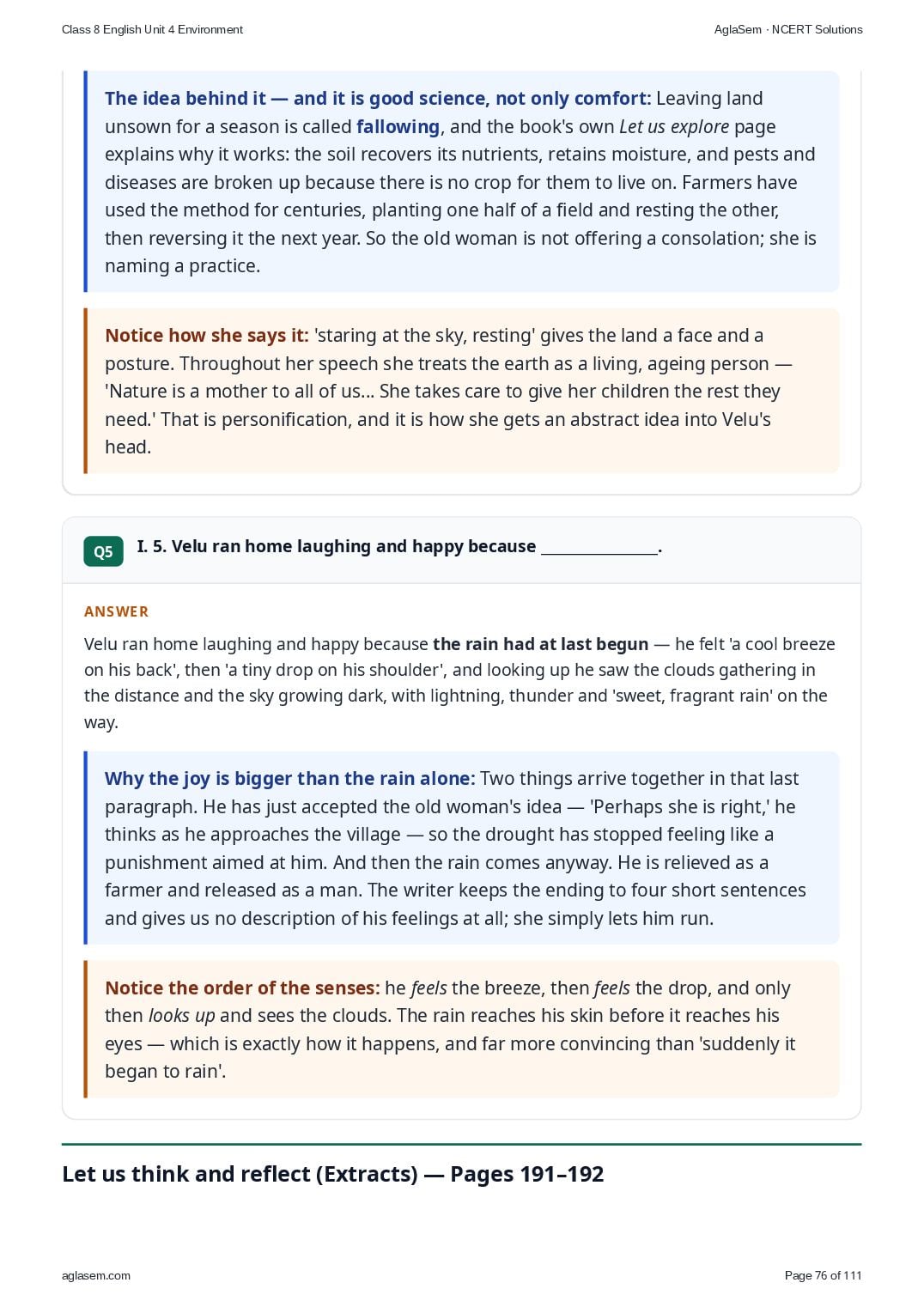
- I. 5. Velu ran home laughing and happy because _________________.
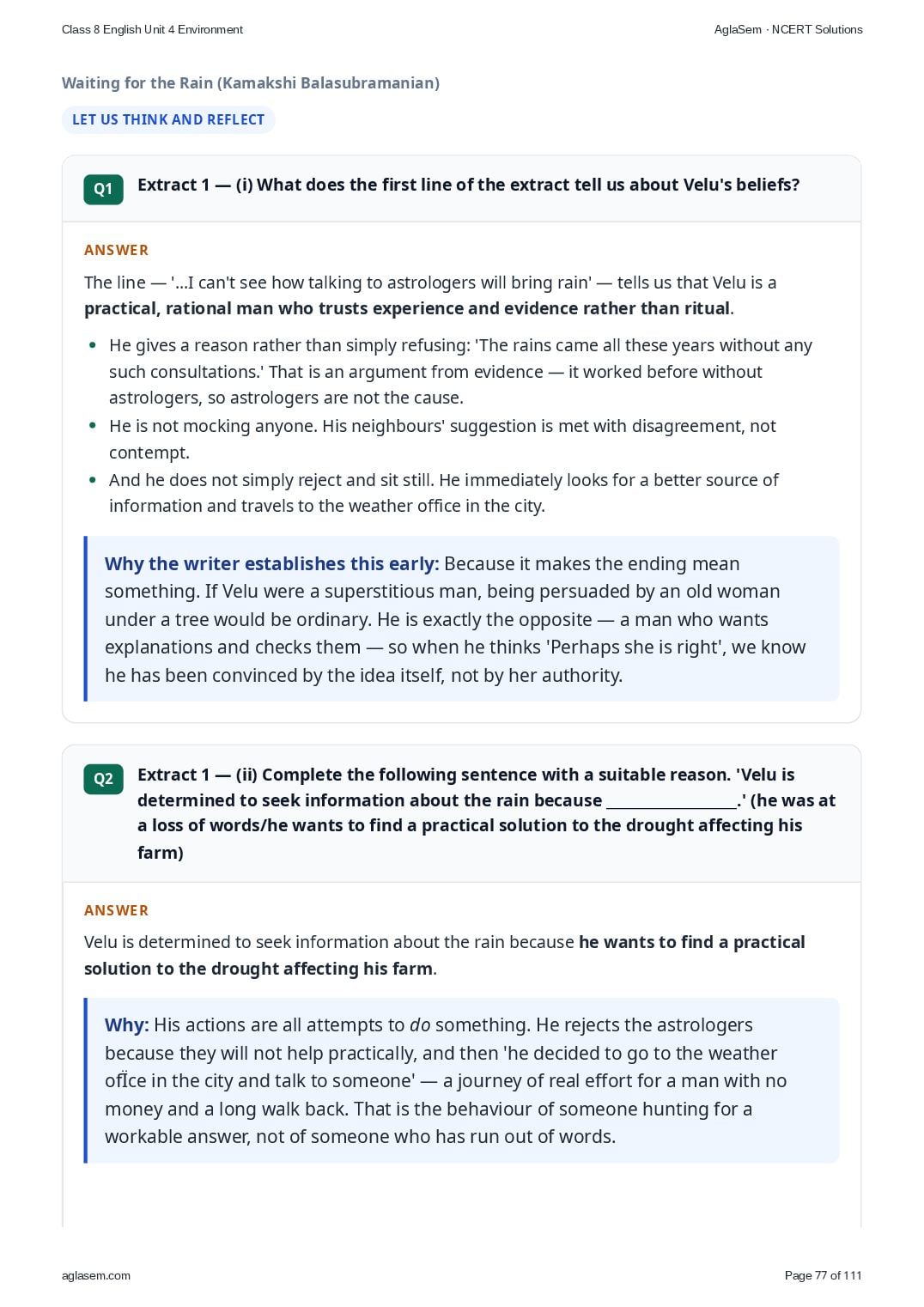
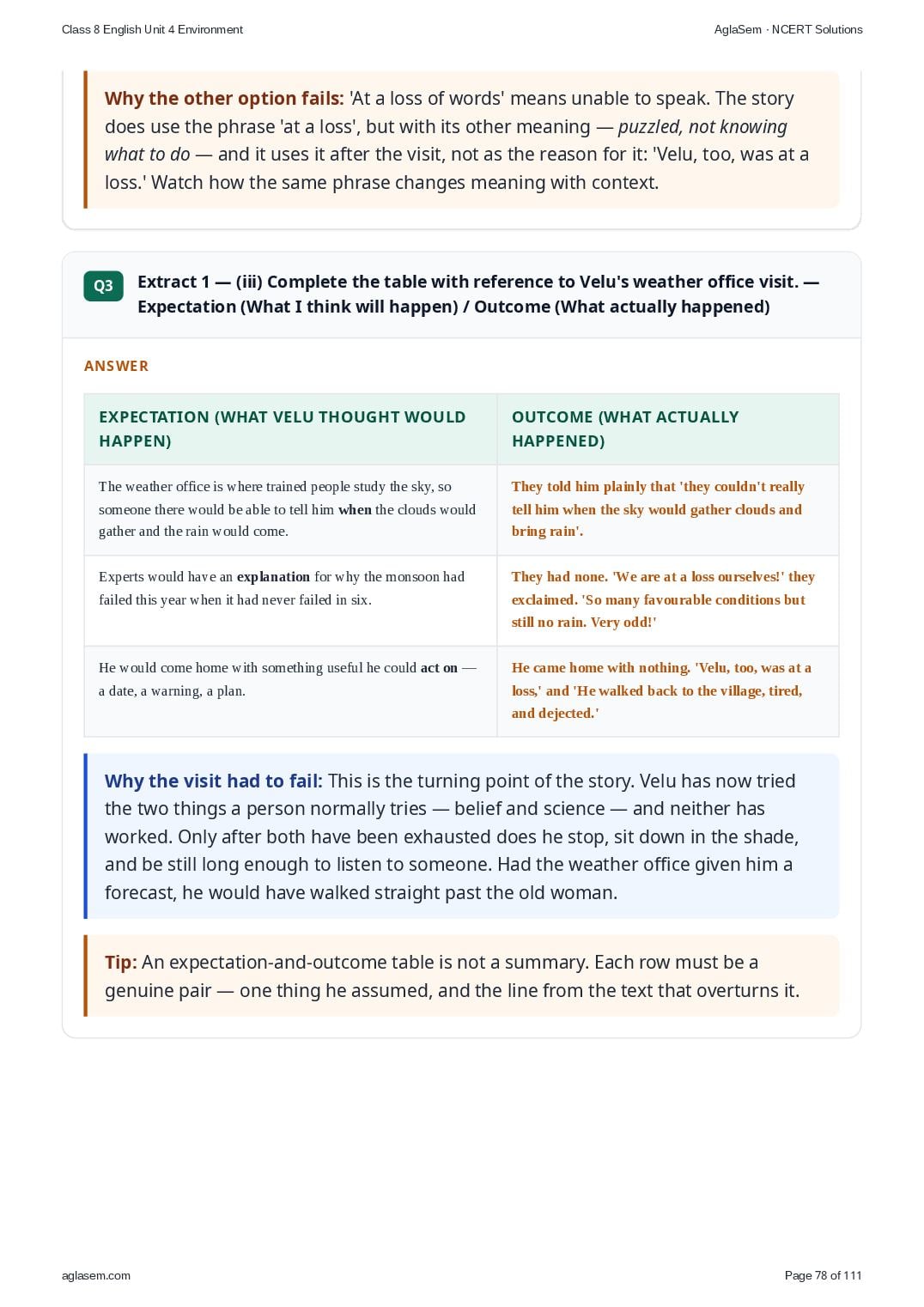
- Extract 1 — (i) What does the first line of the extract tell us about Velu's beliefs?
- Extract 1 — (ii) Complete the following sentence with a suitable reason. 'Velu is determined to seek information about the rain because ___________________.' (he was at a loss of words/he wants to find a practical solution to the drought affecting his farm)
- Extract 1 — (iii) Complete the table with reference to Velu's weather office visit. — Expectation (What I think will happen) / Outcome (What actually happened)
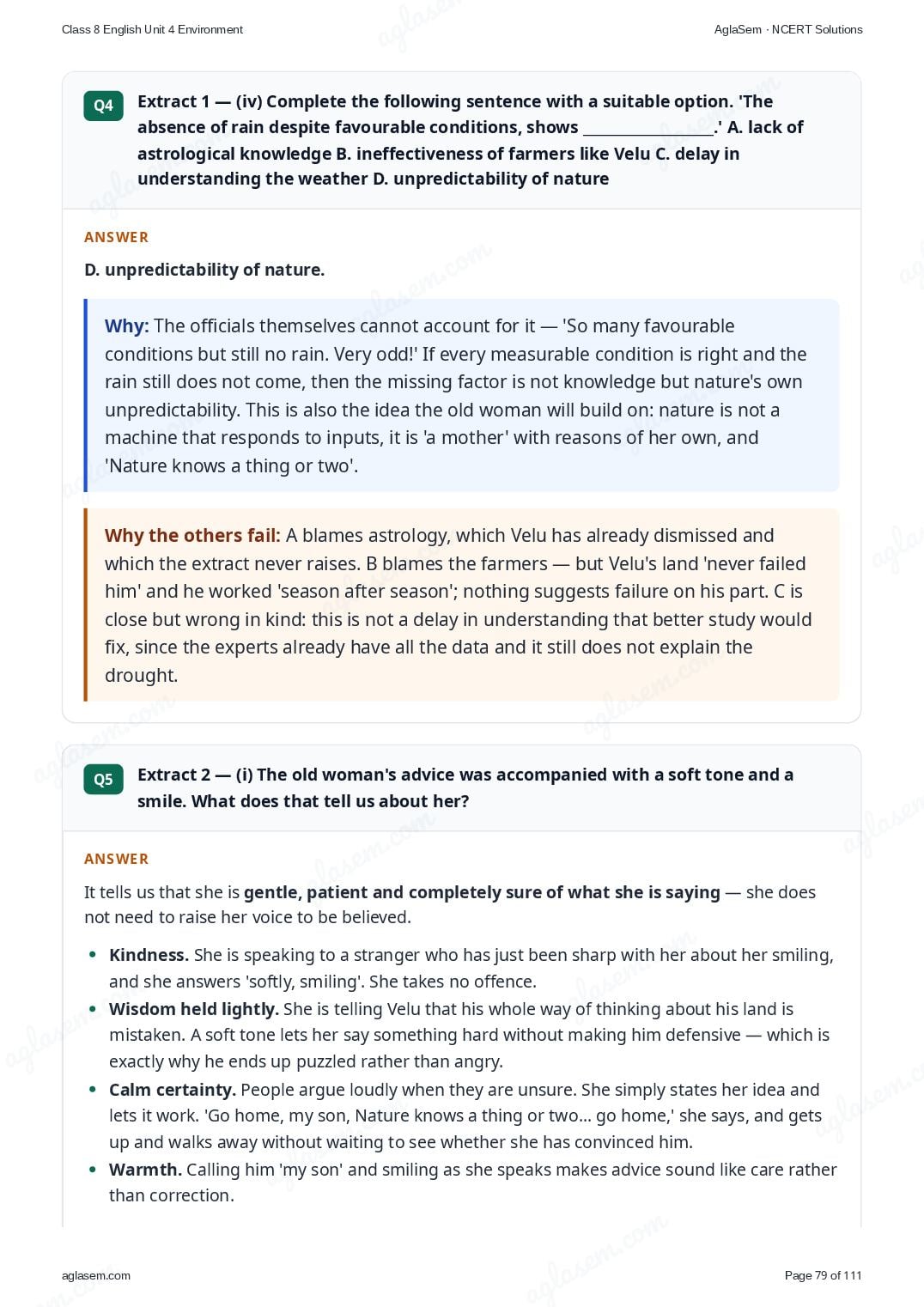
- Extract 1 — (iv) Complete the following sentence with a suitable option. 'The absence of rain despite favourable conditions, shows ___________________.' A. lack of astrological knowledge B. ineffectiveness of farmers like Velu C. delay in understanding the weather D. unpredictability of nature
- Extract 2 — (i) The old woman's advice was accompanied with a soft tone and a smile. What does that tell us about her?
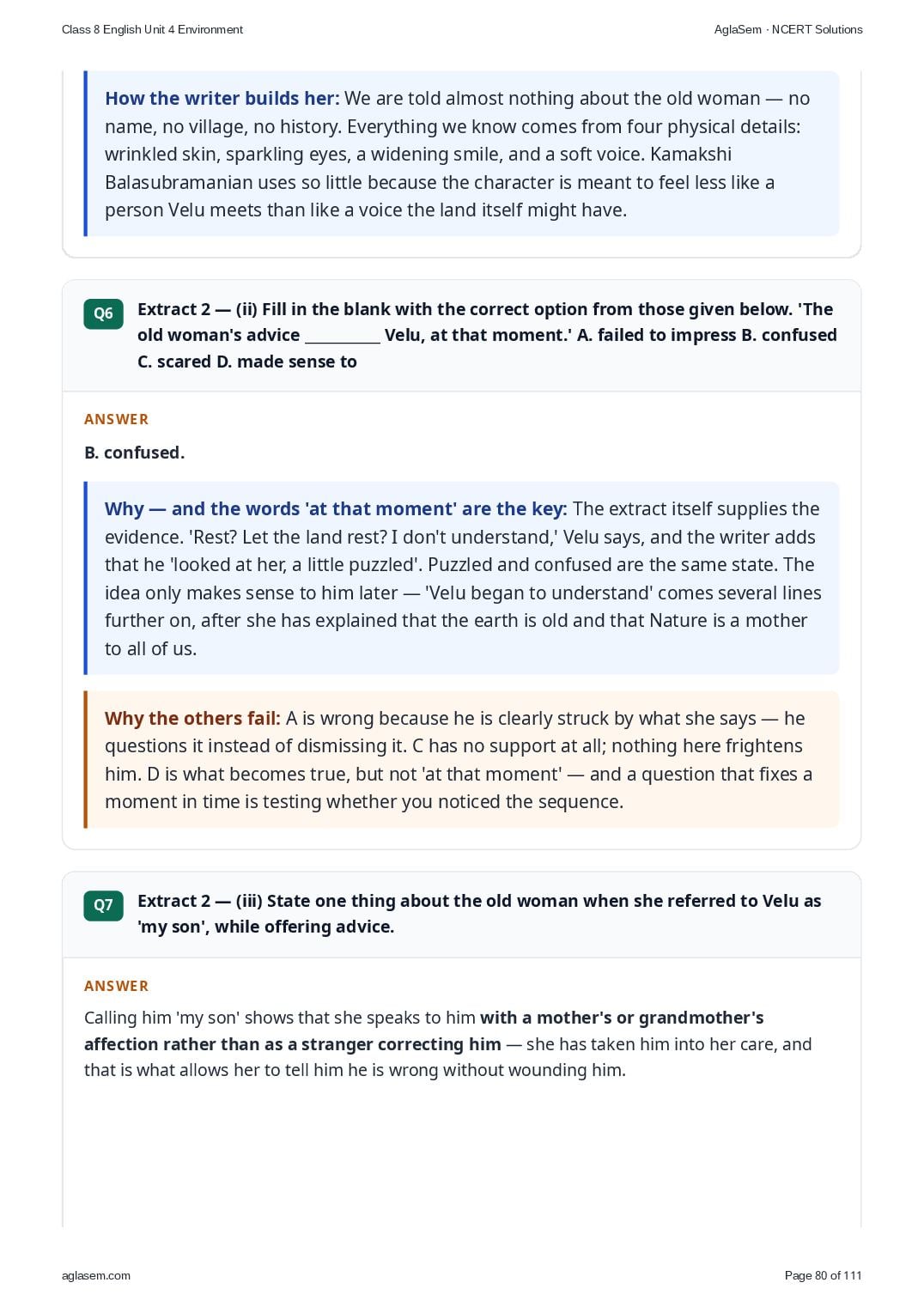
- Extract 2 — (ii) Fill in the blank with the correct option from those given below. 'The old woman's advice ___________ Velu, at that moment.' A. failed to impress B. confused C. scared D. made sense to
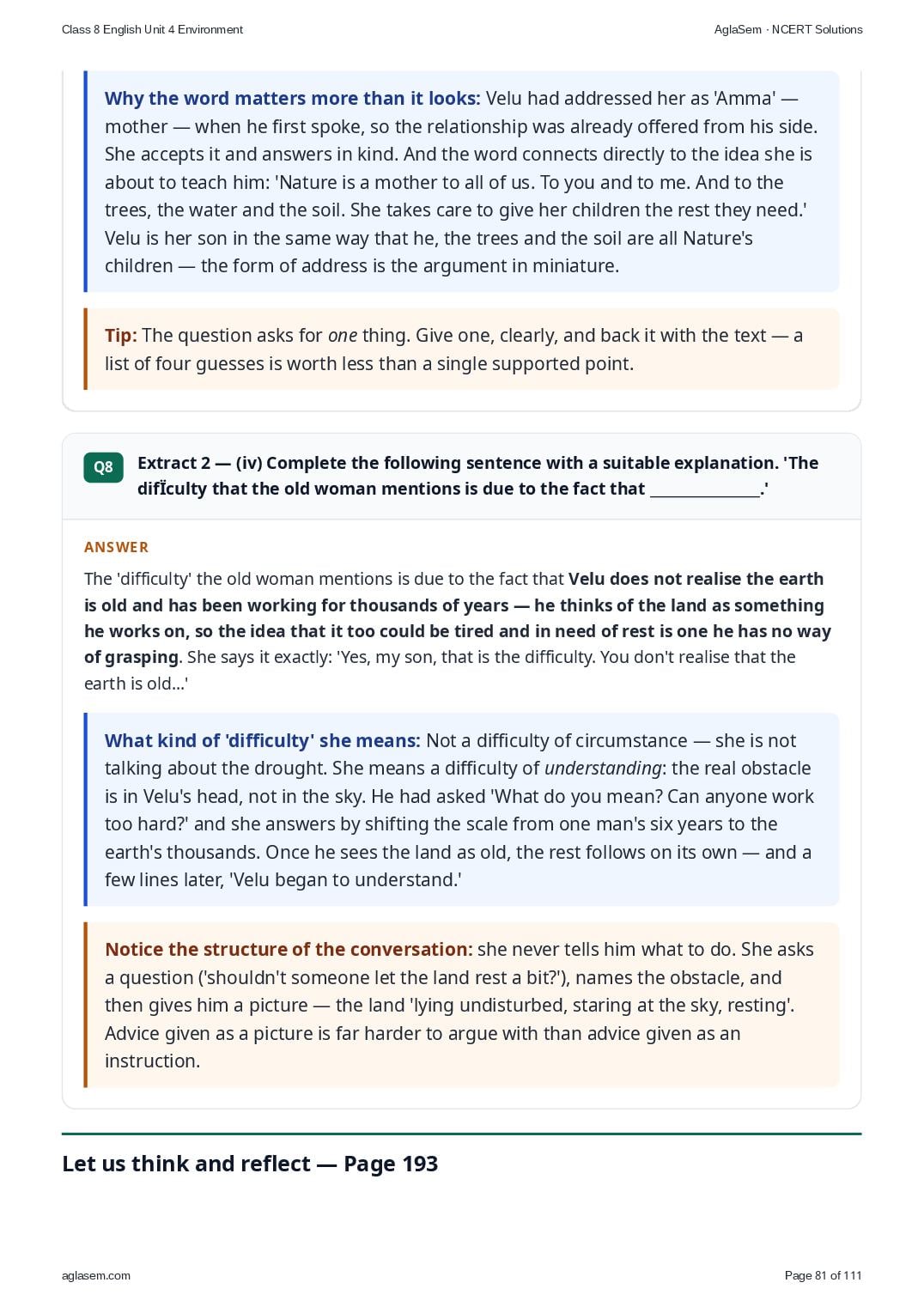
- Extract 2 — (iii) State one thing about the old woman when she referred to Velu as 'my son', while offering advice.
- Extract 2 — (iv) Complete the following sentence with a suitable explanation. 'The difÏculty that the old woman mentions is due to the fact that ________________.'
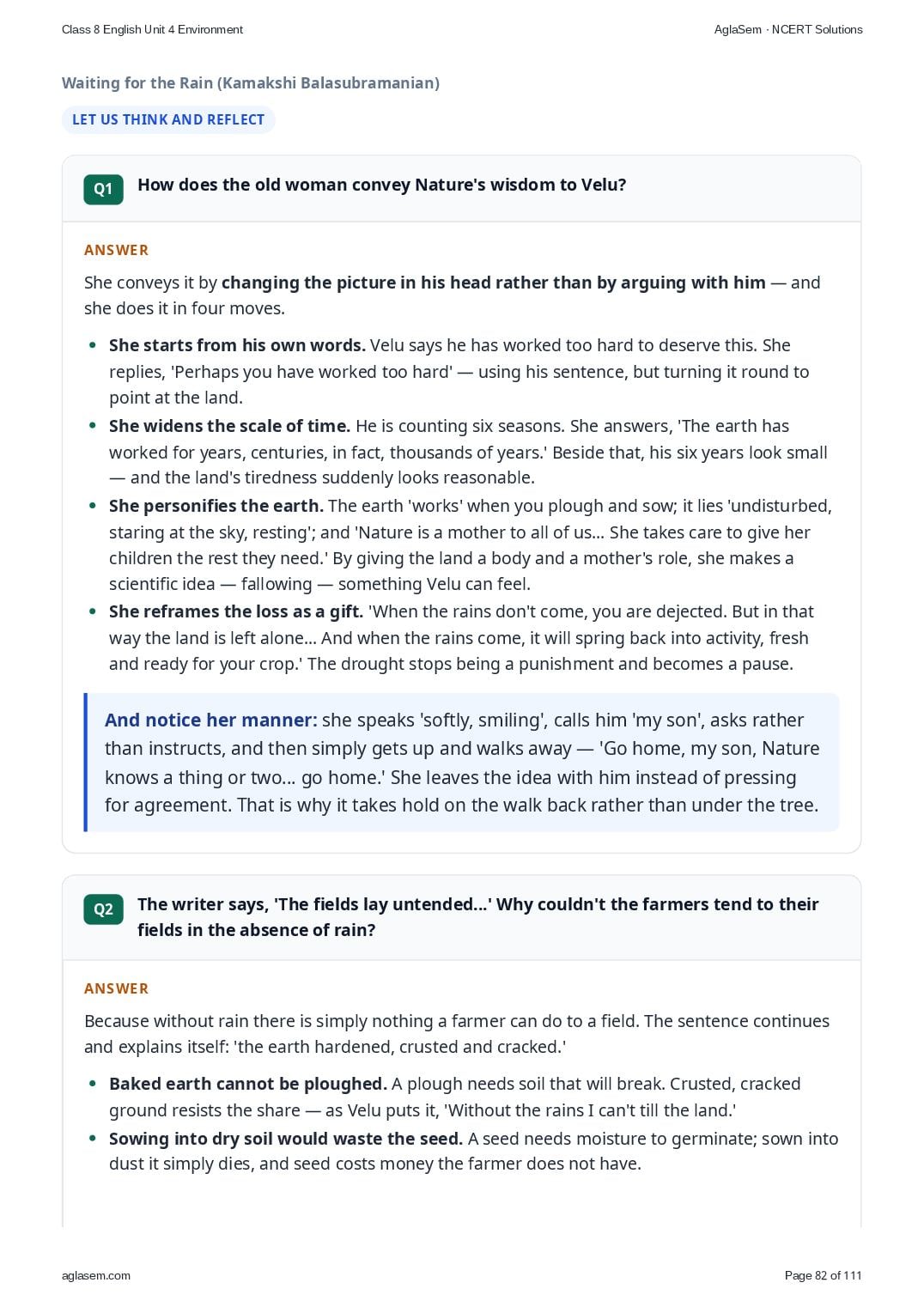
- How does the old woman convey Nature's wisdom to Velu?
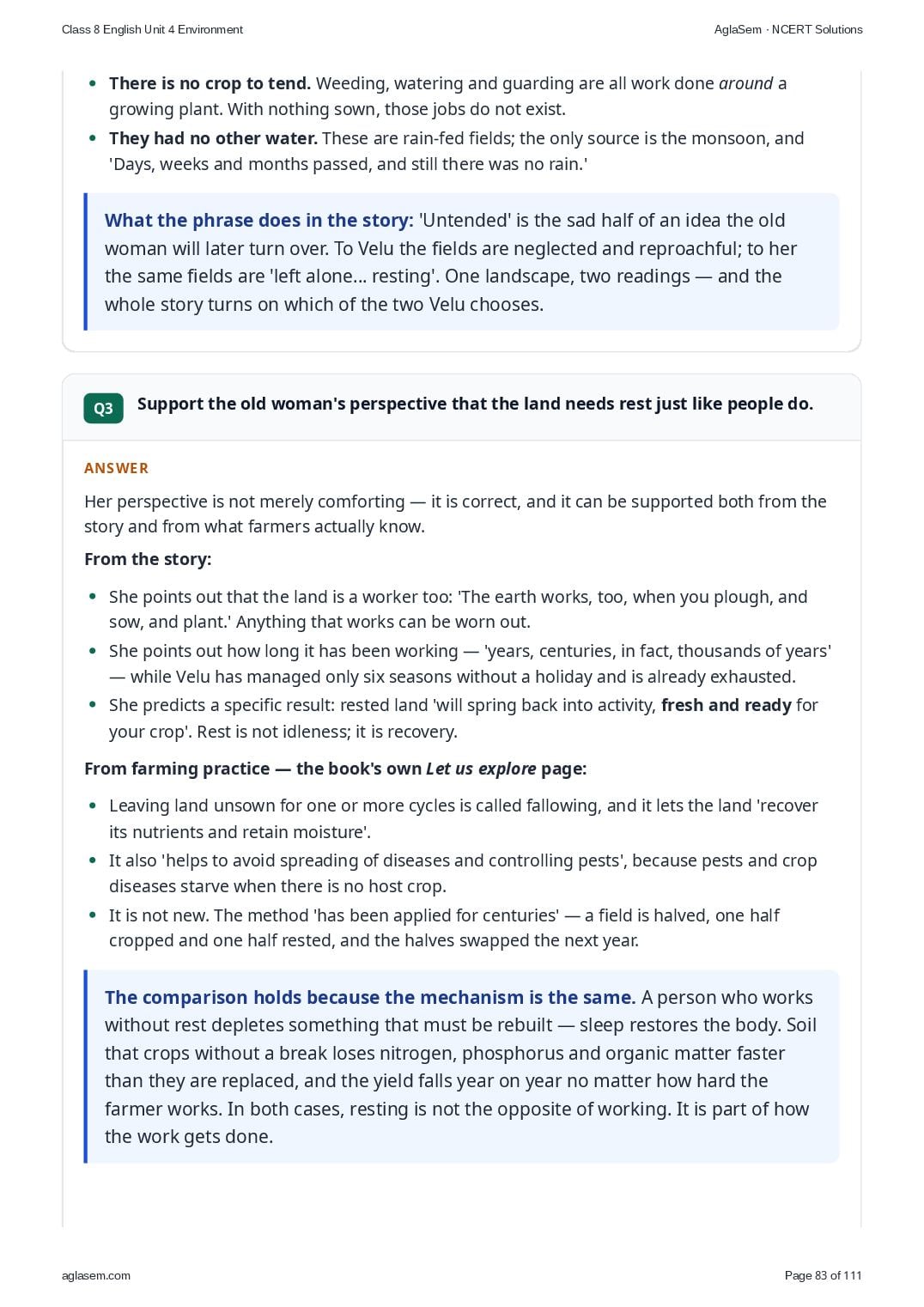
- The writer says, 'The fields lay untended…' Why couldn't the farmers tend to their fields in the absence of rain?
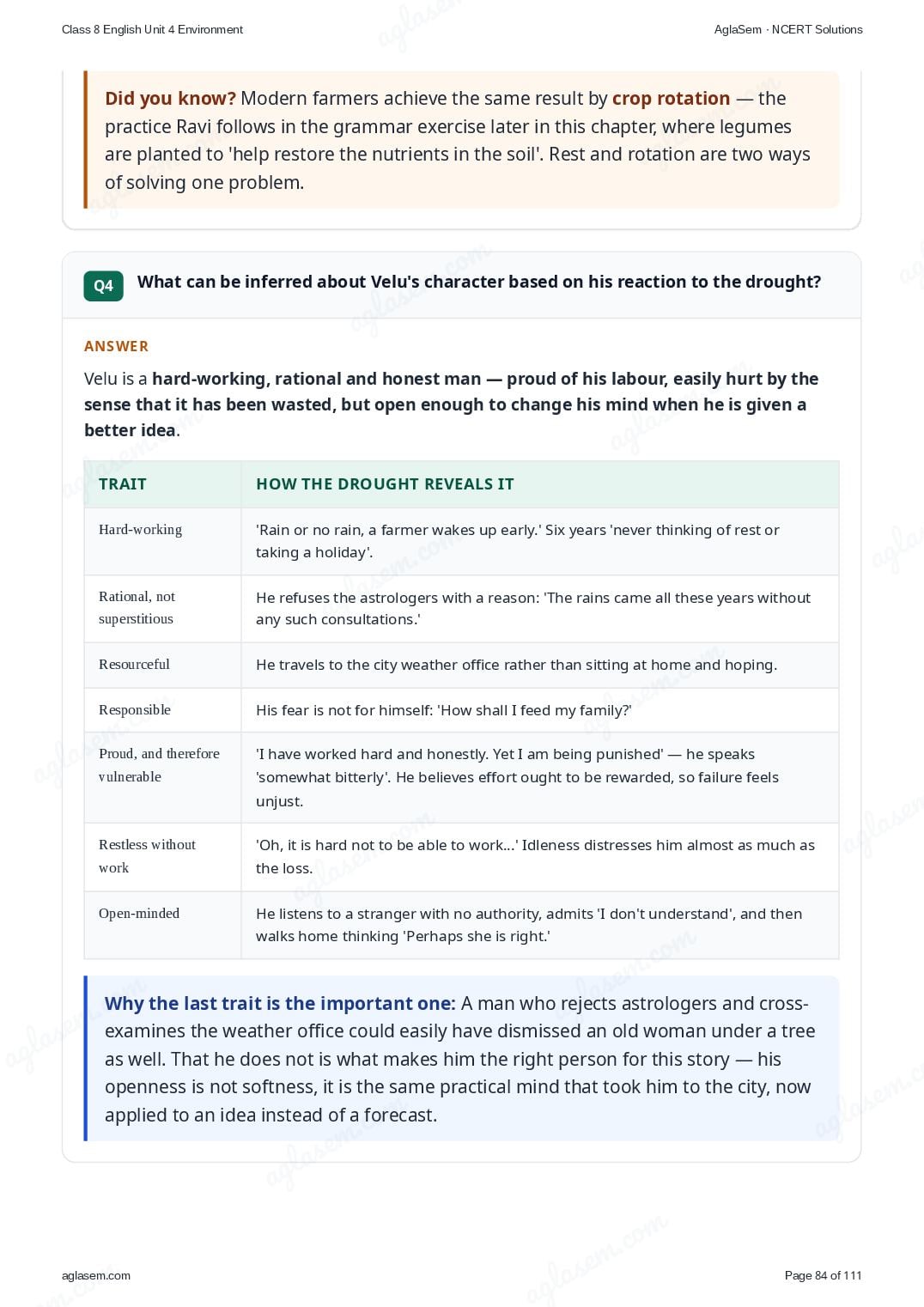
- Support the old woman's perspective that the land needs rest just like people do.
- … and more questions are solved in the complete PDF above.
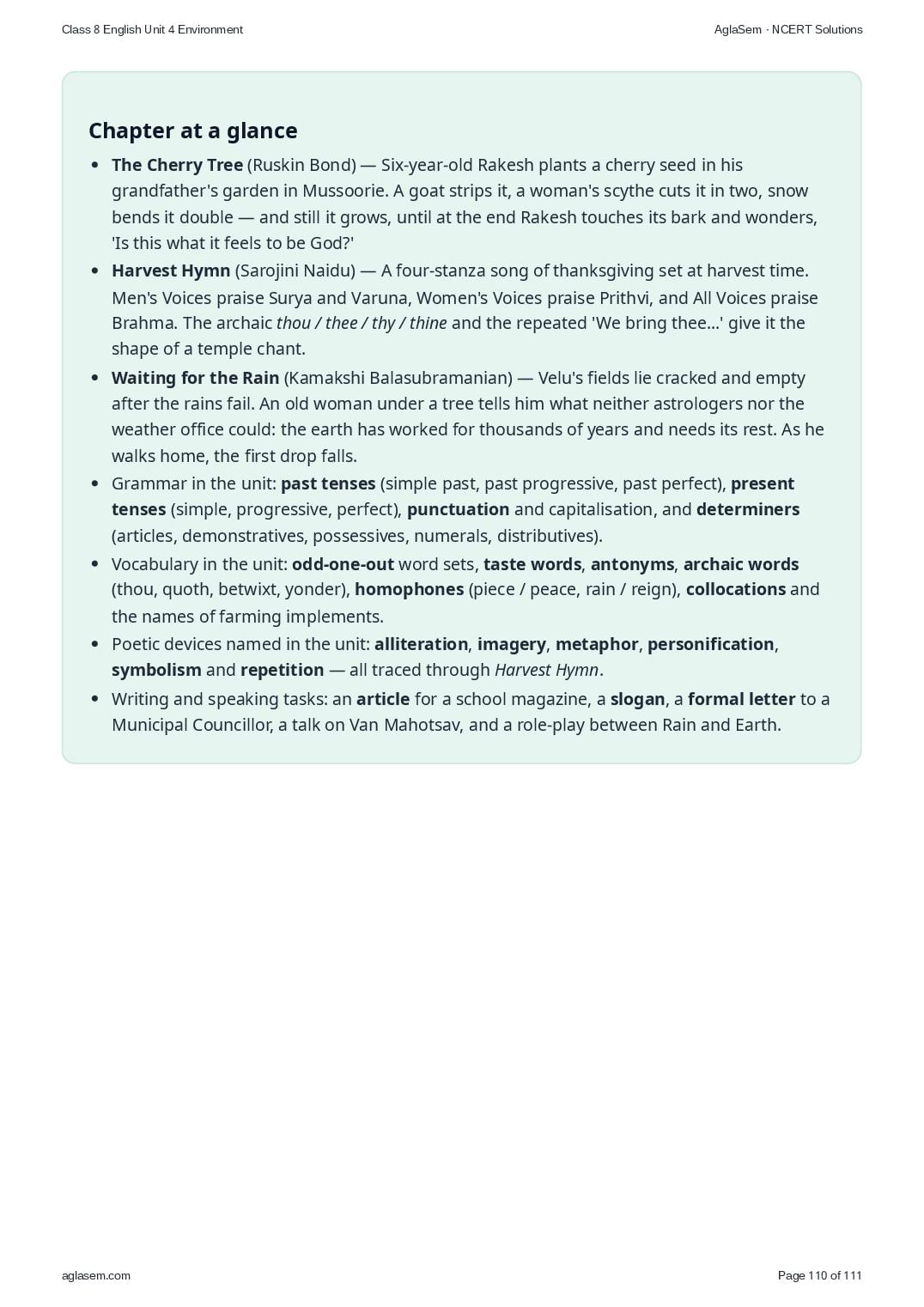
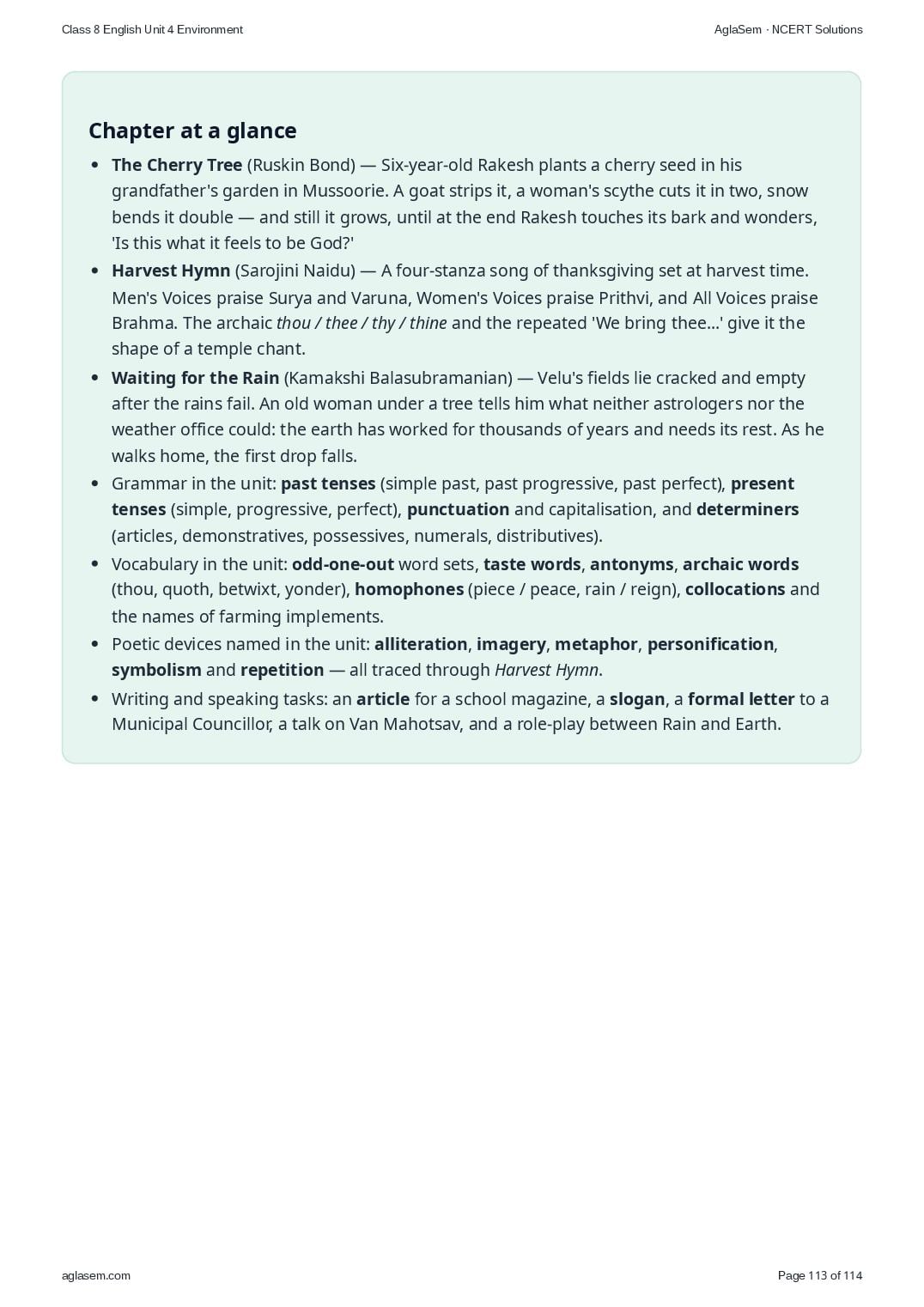
Chapter at a Glance
- The Cherry Tree (Ruskin Bond) — Six-year-old Rakesh plants a cherry seed in his grandfather's garden in Mussoorie. A goat strips it, a woman's scythe cuts it in two, snow bends it double — and still it grows, until at the end Rakesh touches its bark and wonders, 'Is this what it feels to be God?'
- Harvest Hymn (Sarojini Naidu) — A four-stanza song of thanksgiving set at harvest time. Men's Voices praise Surya and Varuna, Women's Voices praise Prithvi, and All Voices praise Brahma. The archaic thou / thee / thy / thine and the repeated 'We bring thee…' give it the shape of a temple chant.
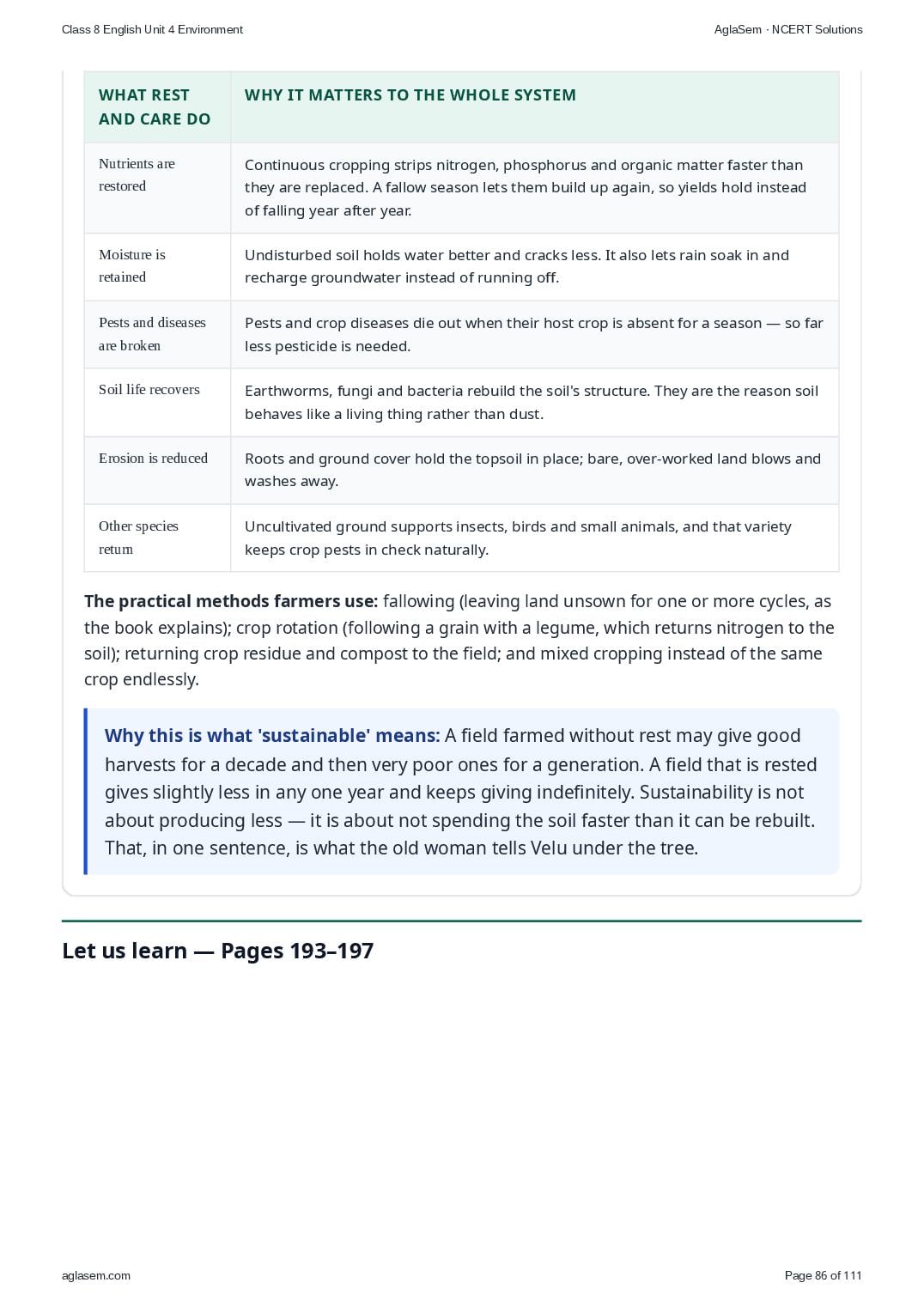
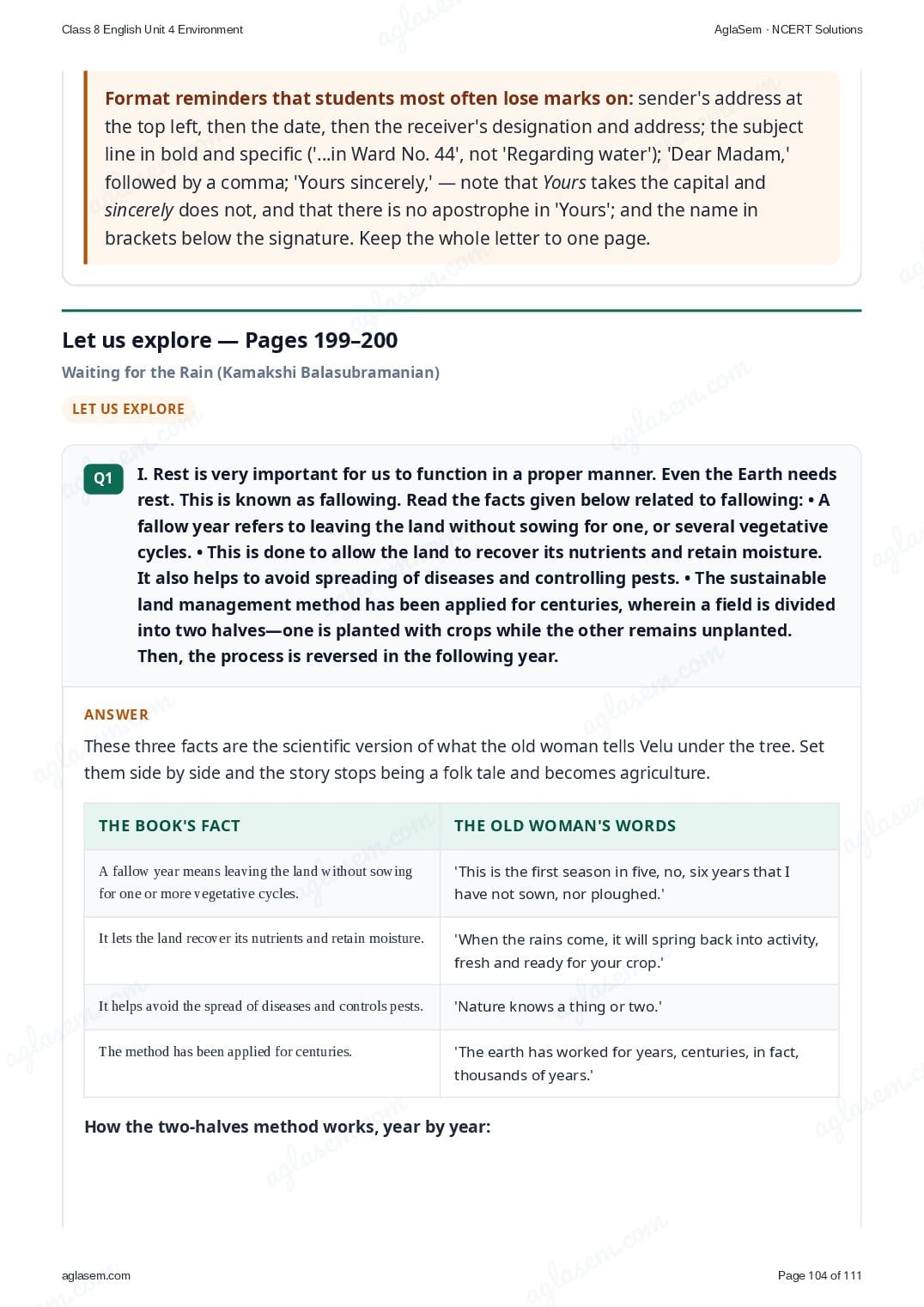
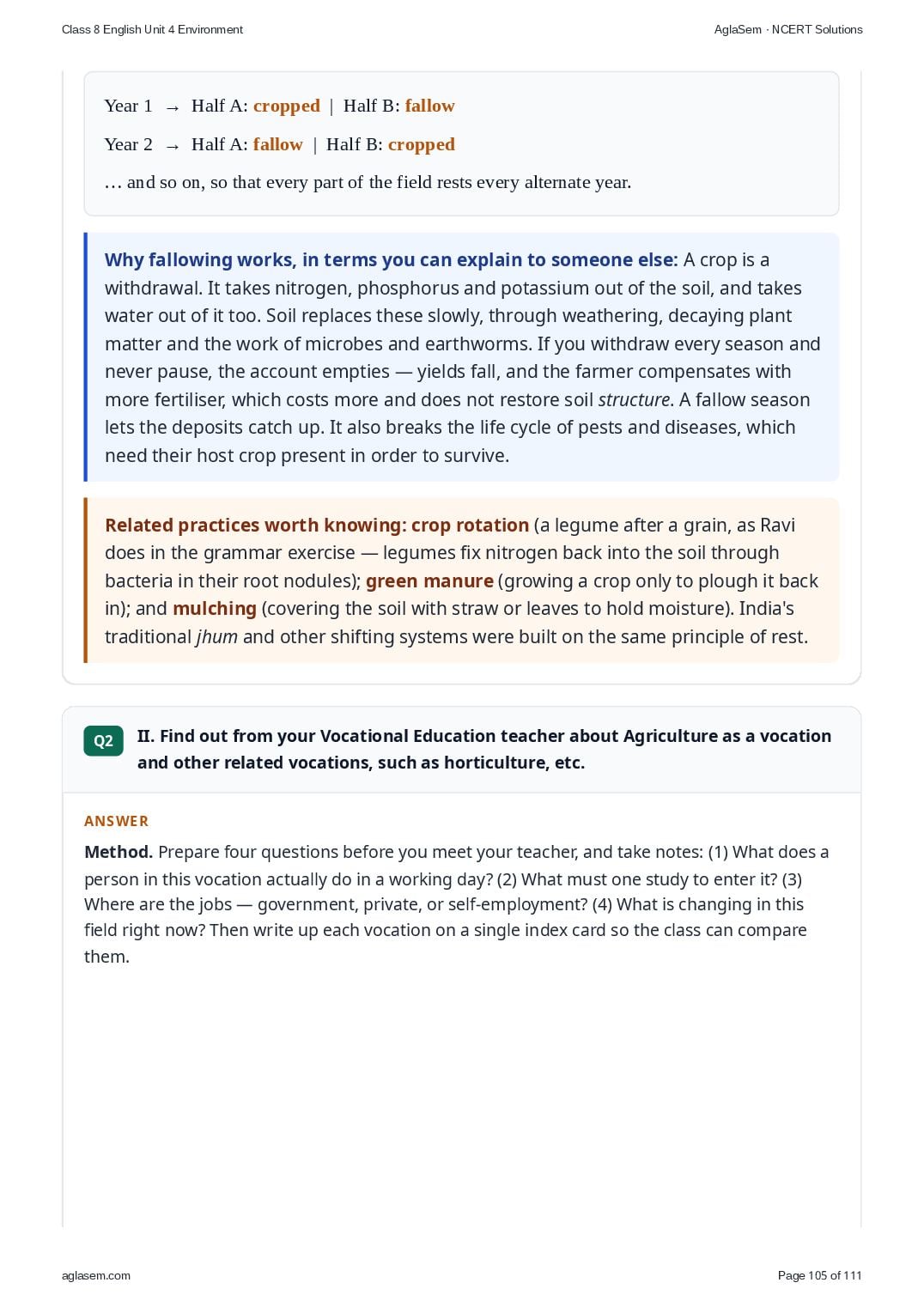
- Waiting for the Rain (Kamakshi Balasubramanian) — Velu's fields lie cracked and empty after the rains fail. An old woman under a tree tells him what neither astrologers nor the weather office could: the earth has worked for thousands of years and needs its rest. As he walks home, the first drop falls.
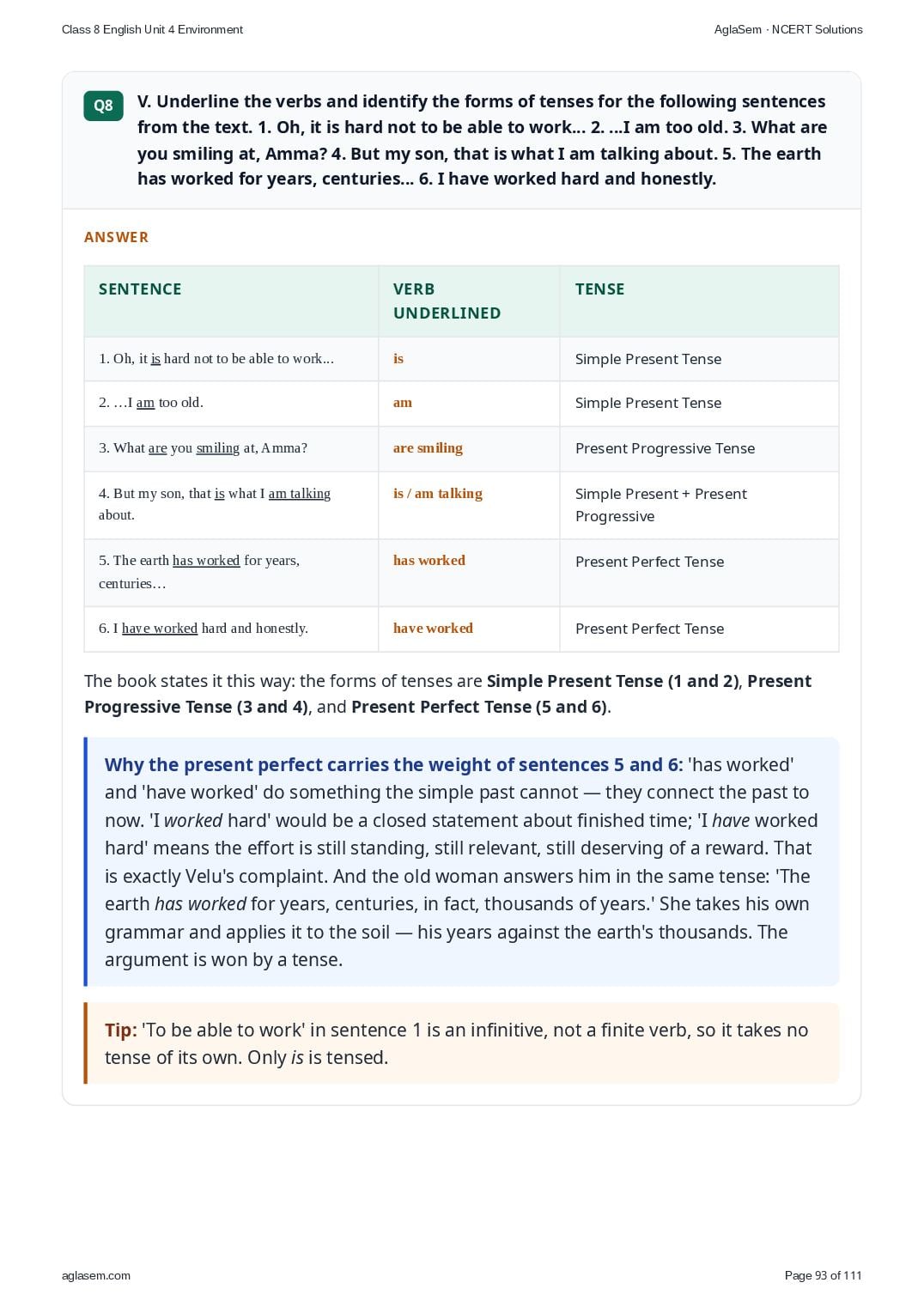
- Grammar in the unit: past tenses (simple past, past progressive, past perfect), present tenses (simple, progressive, perfect), punctuation and capitalisation, and determiners (articles, demonstratives, possessives, numerals, distributives).
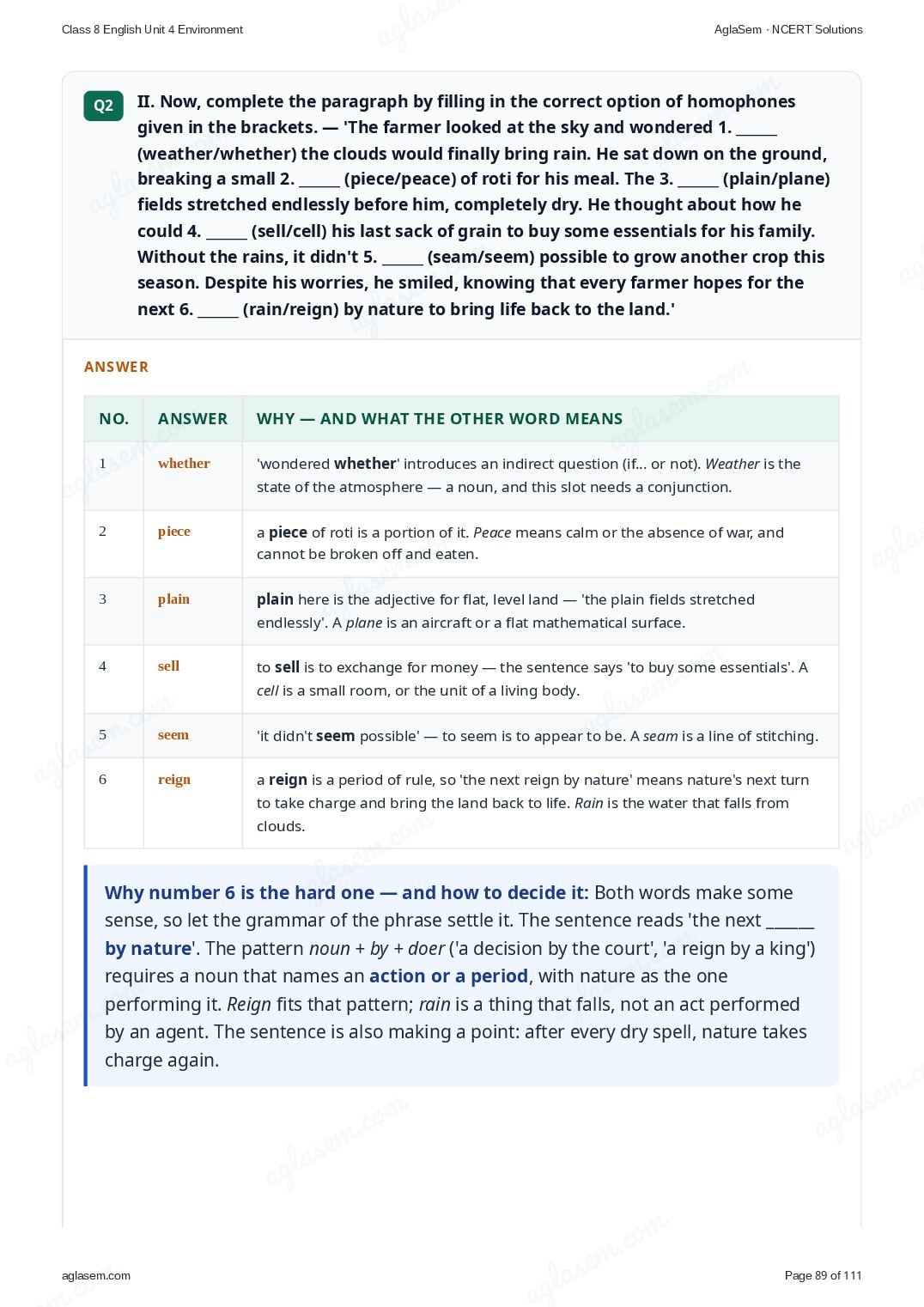
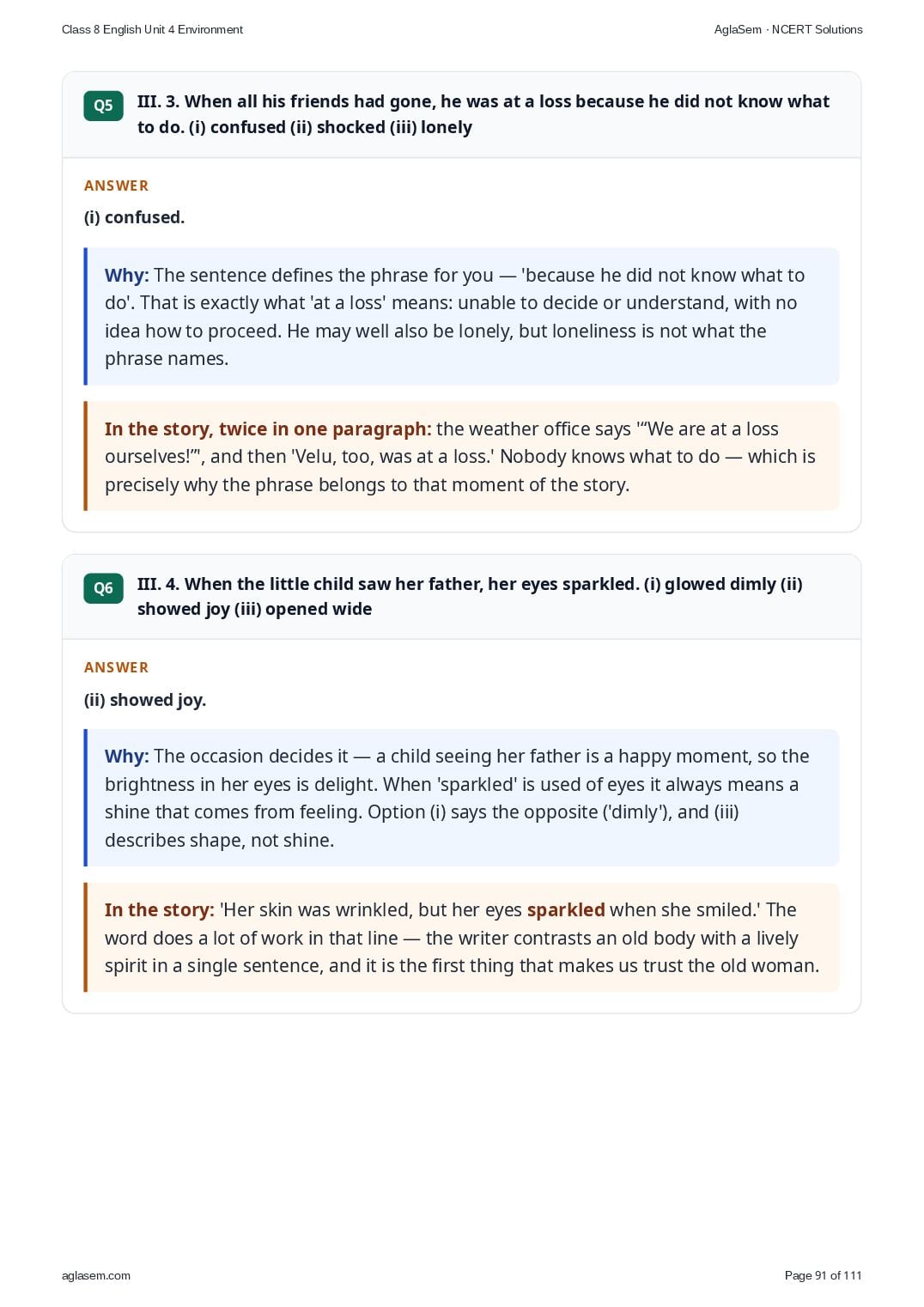
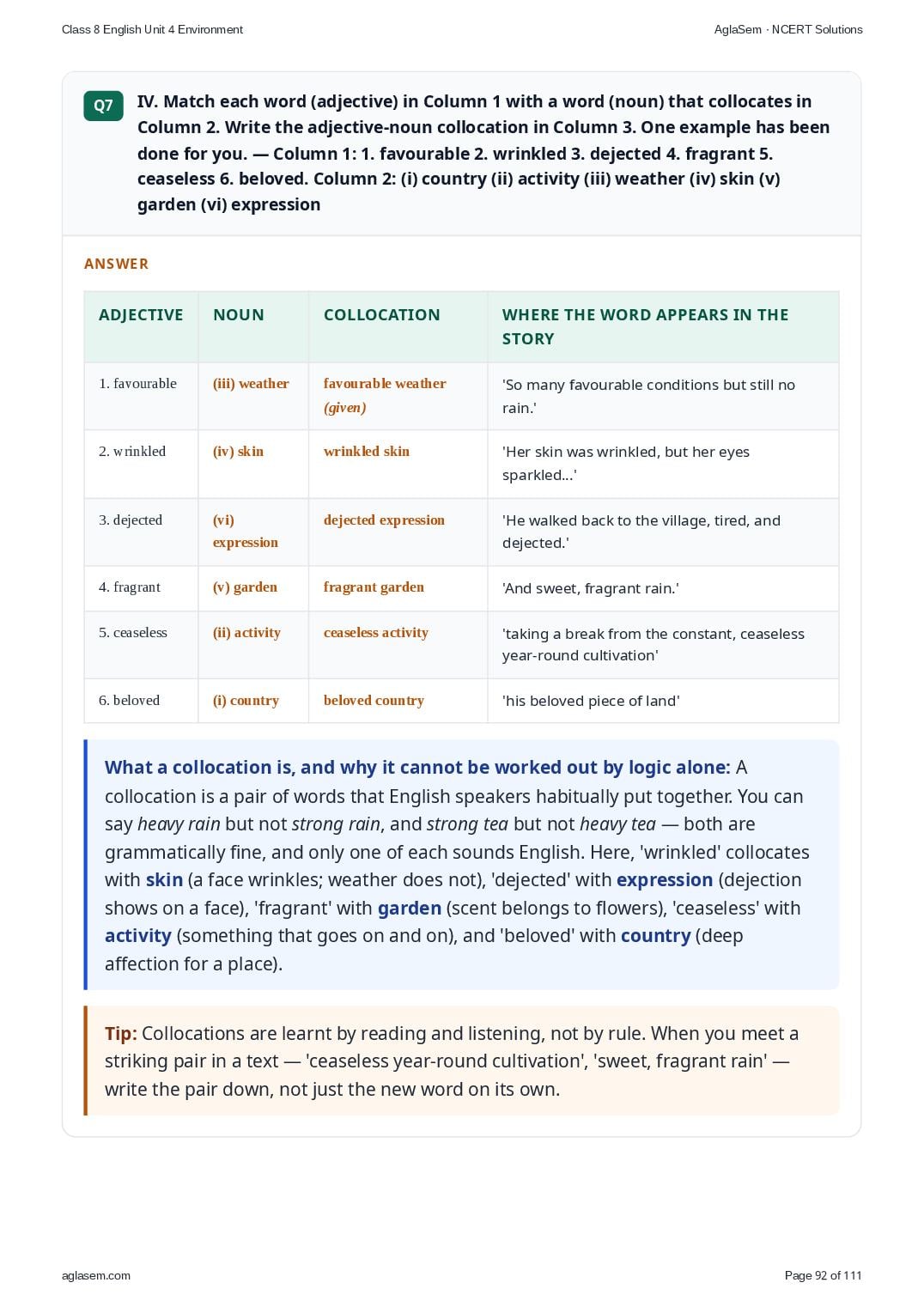
- Vocabulary in the unit: odd-one-out word sets, taste words , antonyms , archaic words (thou, quoth, betwixt, yonder), homophones (piece / peace, rain / reign), collocations and the names of farming implements.
- Poetic devices named in the unit: alliteration , imagery , metaphor , personification , symbolism and repetition — all traced through Harvest Hymn .
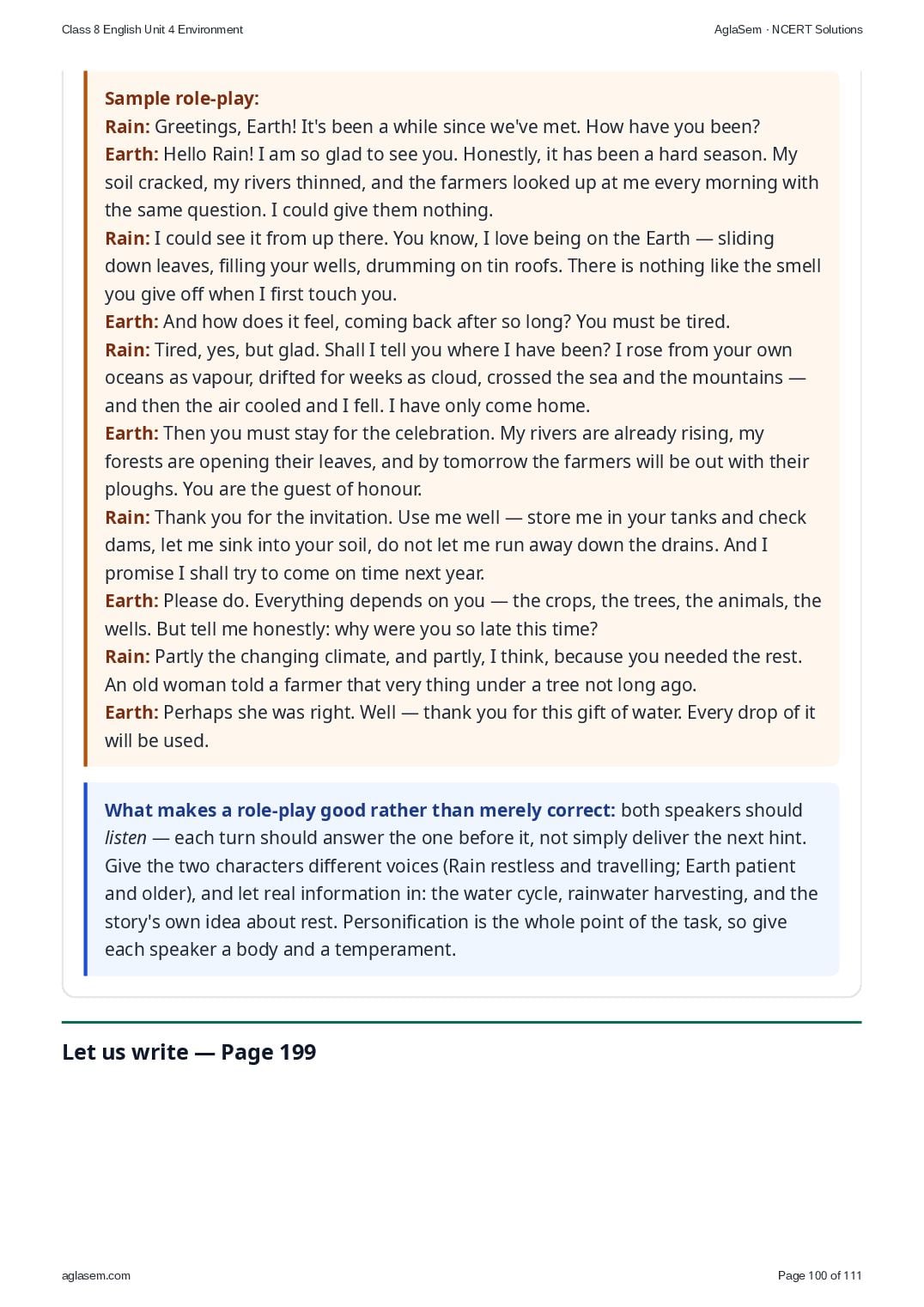
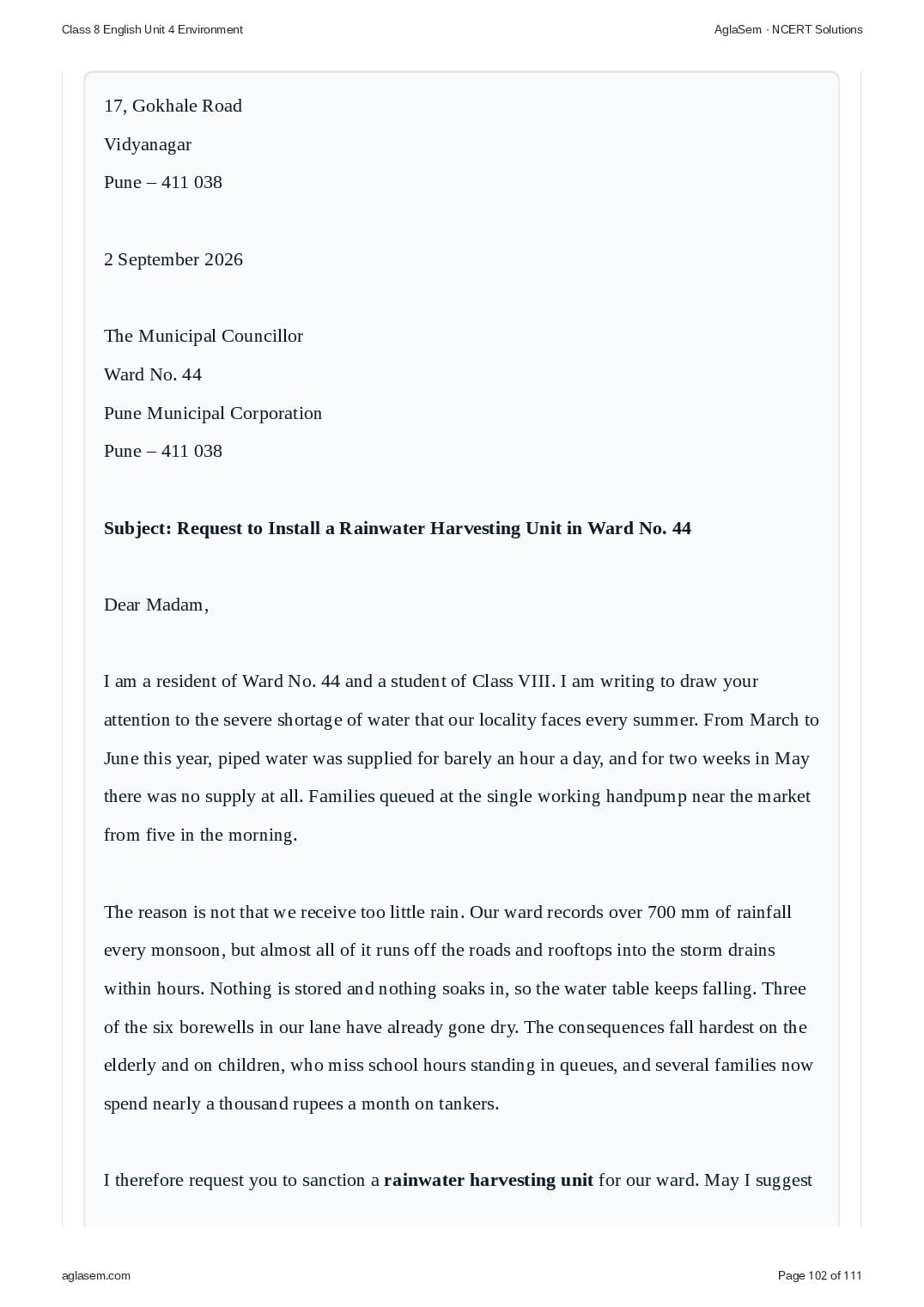
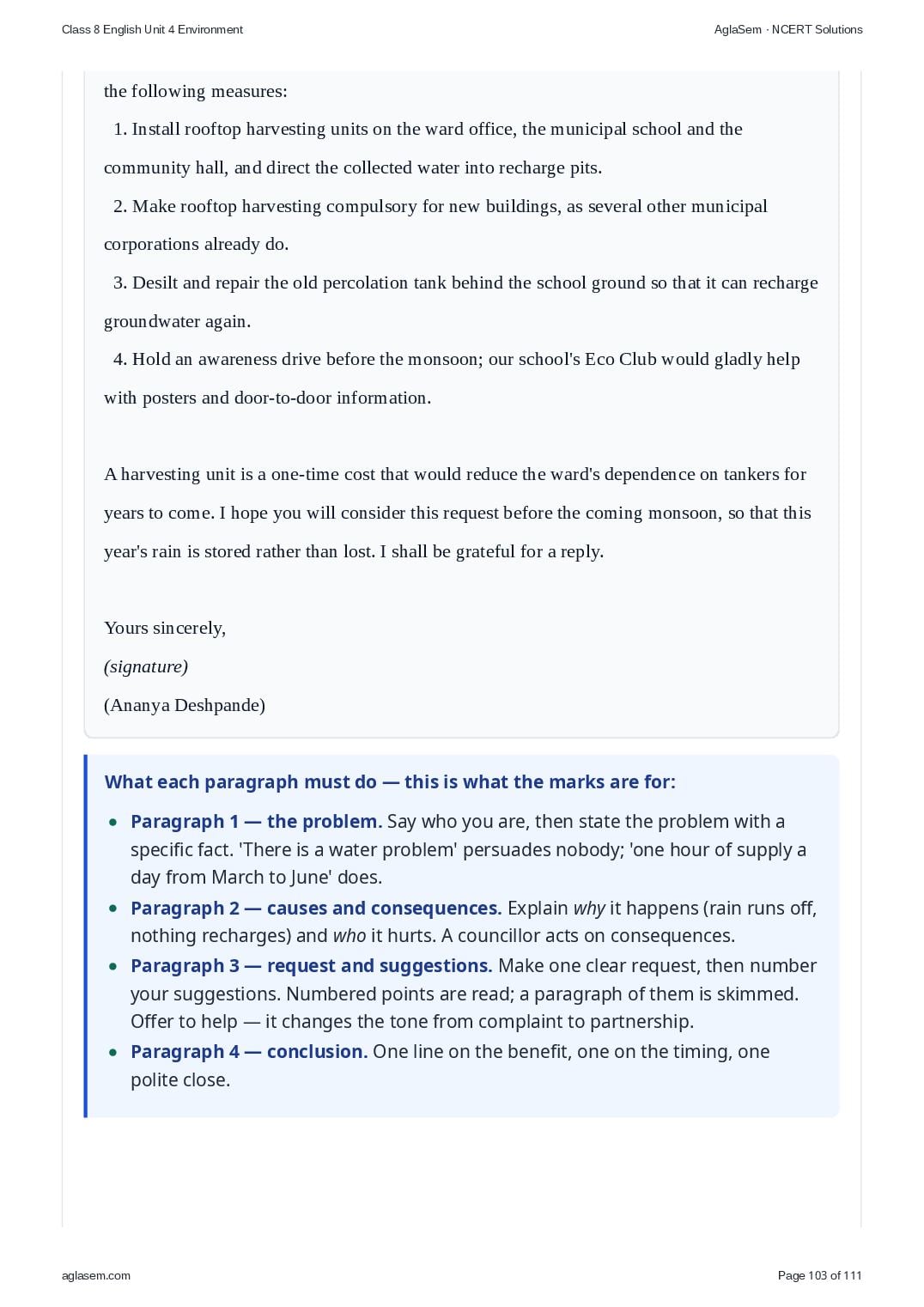
- Writing and speaking tasks: an article for a school magazine, a slogan , a formal letter to a Municipal Councillor, a talk on Van Mahotsav, and a role-play between Rain and Earth.
How to Download NCERT Solutions for Class 8 English Chapter 4 PDF
Follow these simple steps to get the Environment questions-and-answers PDF from Poorvi.
- Search NCERT Solutions for Class 8 English Chapter 4 aglasem and open this page.
- Read the exercise questions with answers for Environment shown above.
- Click the Download PDF link to save the Environment solutions to your device.
NCERT Solutions for Class 8 English – All Chapters
There are more chapters to study besides Environment in English. Here are the NCERT Solutions for all chapters of Class 8 English.
- Chapter 1 Wit and Wisdom
- Chapter 2 Values and Dispositions
- Chapter 3 Mystery and Magic
- Chapter 4 Environment
- Chapter 5 Science and Curiosity
NCERT Solutions for Class 8 – All Subjects
Just like Chapter 4 of English, you can get the exercise questions with answers for every other subject of Class 8. Here are the NCERT Solutions for all subjects of Class 8.
NCERT Solutions for Class 8 English Chapter 4 – An Overview
The key highlights of this study material are as follows.
| Aspects | Details |
|---|---|
| Class | Class 8 |
| Subject | English |
| Chapter Number | Chapter 4 |
| Chapter Name | Environment |
| Book Name | Poorvi |
| Book By | NCERT (National Council of Educational Research and Training) |
| Educational Resource Here | NCERT Solutions of Class 8 English Chapter 4 for all exercises |
| More Questions Answers of This Subject | NCERT Solutions for Class 8 English |
| Download Book Chapter | NCERT Book Class 8 English |
| All Questions Answers For This Class | NCERT Solutions for Class 8 |
| Complete Solutions | NCERT Solutions |
NCERT Solutions for Class 8 English Chapter 4 Environment – FAQs
What are the NCERT Solutions for Class 8 English Chapter 4 Environment?
They are the complete, step-by-step answers to all the exercise and in-text questions of Chapter 4 Environment from the NCERT Class 8 English textbook Poorvi, written by experts as per the latest NCERT syllabus.
How can I download the Class 8 English Chapter 4 solutions PDF for free?
Open this page on aglasem, read the Environment questions with answers, and click the “Download Solutions PDF” link. The Class 8 English Chapter 4 NCERT Solutions PDF is completely free to download.
Are these NCERT Solutions as per the latest 2026-27 syllabus?
Yes. The NCERT Solutions for Class 8 English Chapter 4 are based on the latest NCERT textbook Poorvi and the current 2026-27 CBSE syllabus, so the questions and answers match what you study in class.
Where can I get NCERT Solutions for the other chapters of Class 8 English?
You can find the answers to every chapter on the NCERT Solutions for Class 8 English page, and solutions for every subject on the NCERT Solutions for Class 8 page.
How do NCERT Solutions help in exam preparation?
They show the correct method to solve each question, help you write answers the way they are expected in exams, let you check and correct your own work, and save revision time — which together improve your marks in Class 8 English.
If you have any queries on NCERT Solutions for Class 8 English Chapter 4 Environment, then please ask in the comments below.