NCERT Solutions for Class 8 English Chapter 2 Values and Dispositions provide clear, step-by-step answers to every exercise and in-text question from the chapter Values and Dispositions of the NCERT textbook Poorvi. Prepared by subject experts as per the latest NCERT (CBSE) syllabus for 2026-27, these NCERT Solutions for Class 8 English help you understand each concept, write exam-ready answers, and check your own solutions. You can read them online below or download the free Class 8 English Chapter 2 question-answer PDF.
NCERT Solutions for Class 8 English Chapter 2 Values and Dispositions
- Class: Class 8
- Subject: English
- Chapter: Chapter 2 – Values and Dispositions
- Textbook: Poorvi (NCERT)
- Study material: NCERT Solutions – questions with answers, free PDF
These solutions answer all the exercise questions of Chapter 2 Values and Dispositions — including the in-text questions, short-answer and long-answer questions, and activities — with complete explanations so you can follow the method, not just the final answer. Read the full solutions below.
NCERT Solutions Class 8 English Unit 2 Values and Dispositions View Download
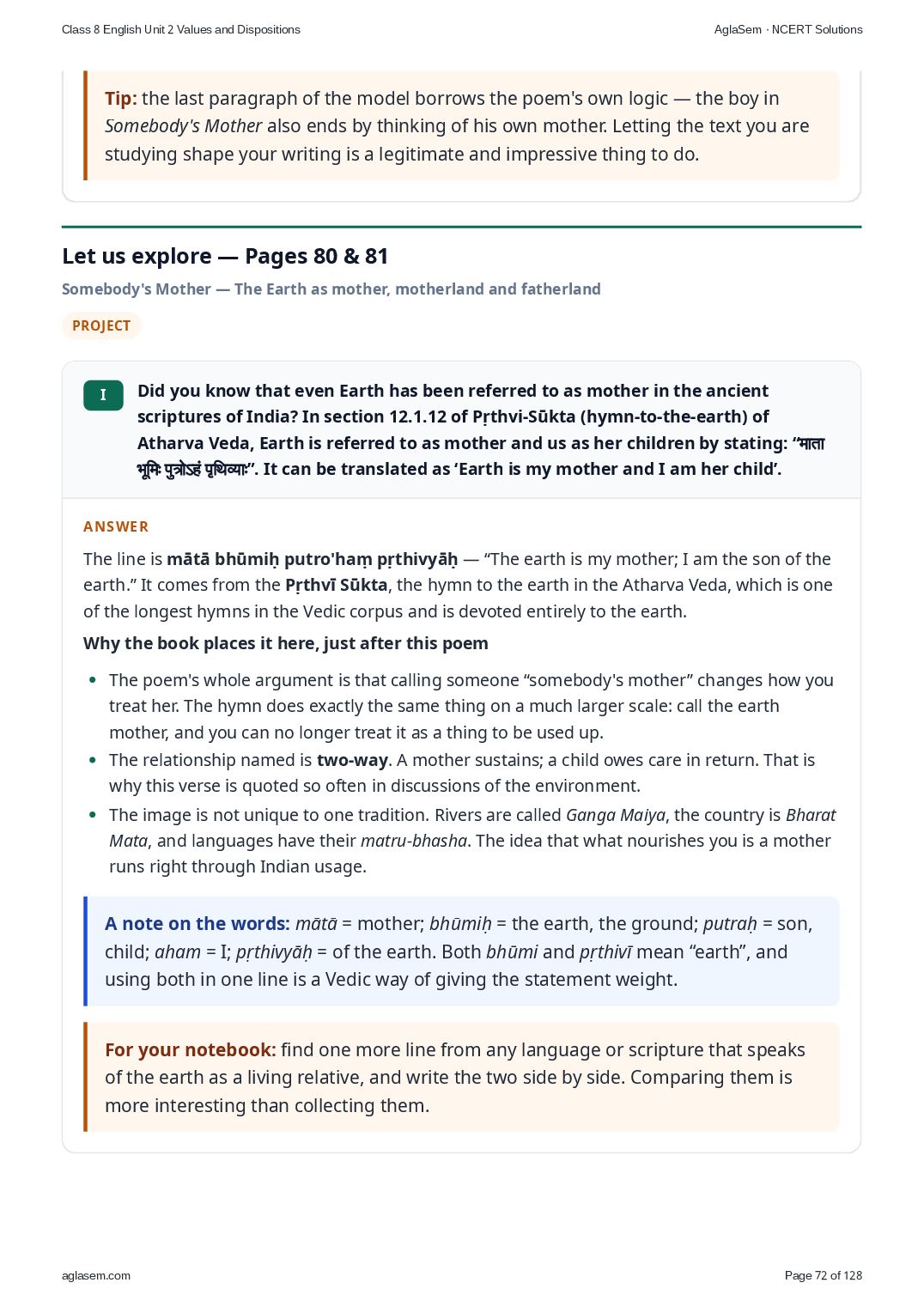
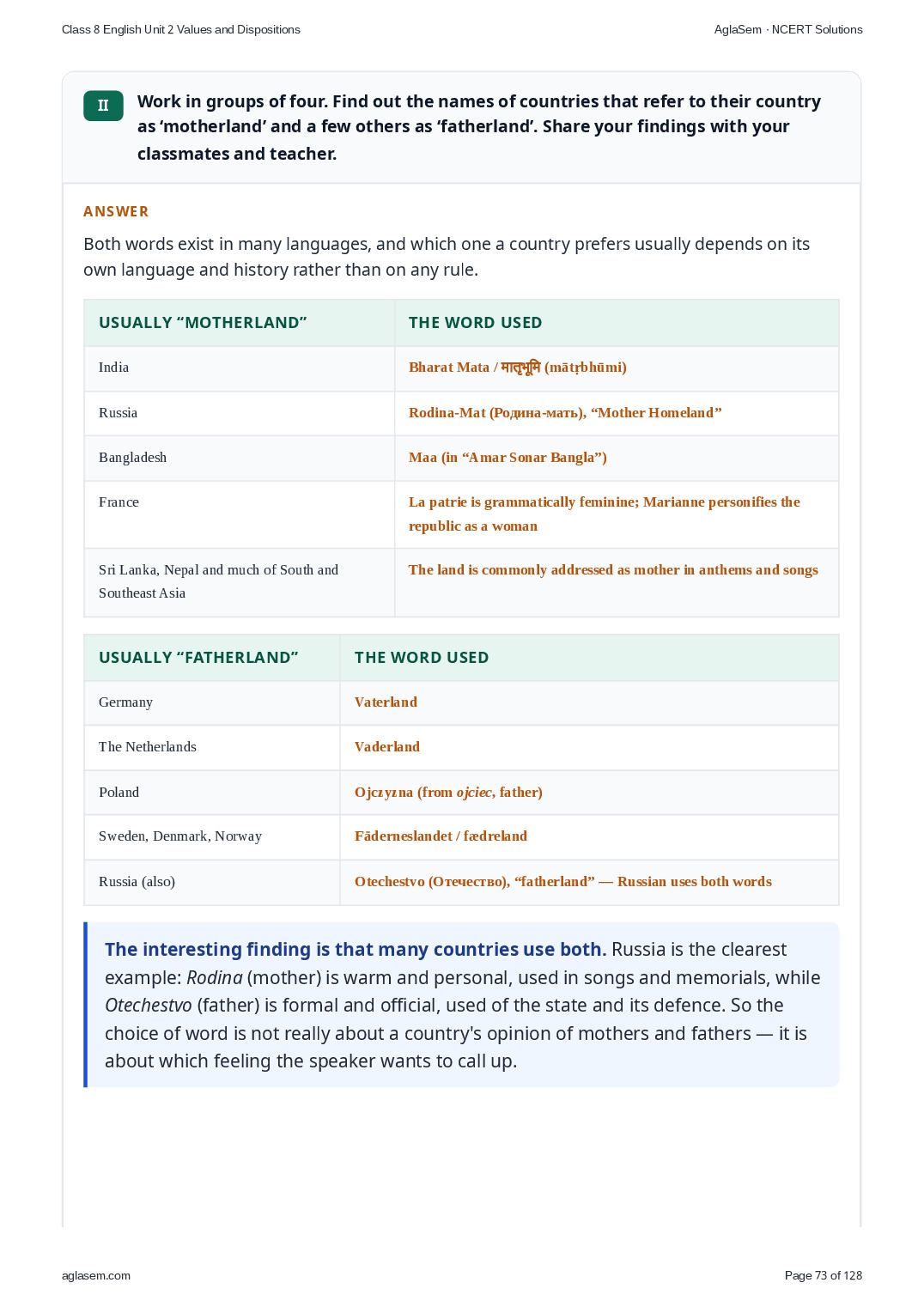
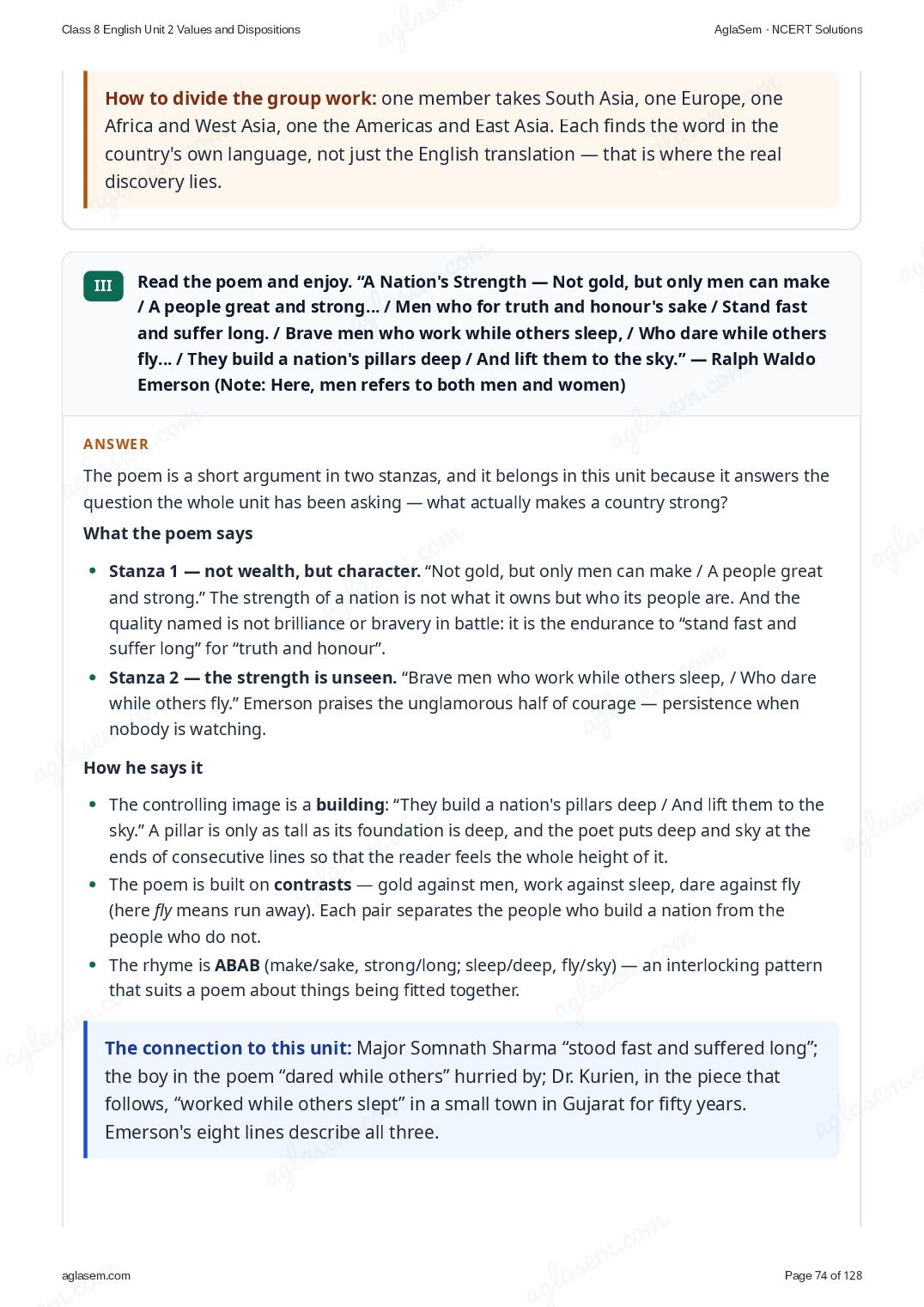
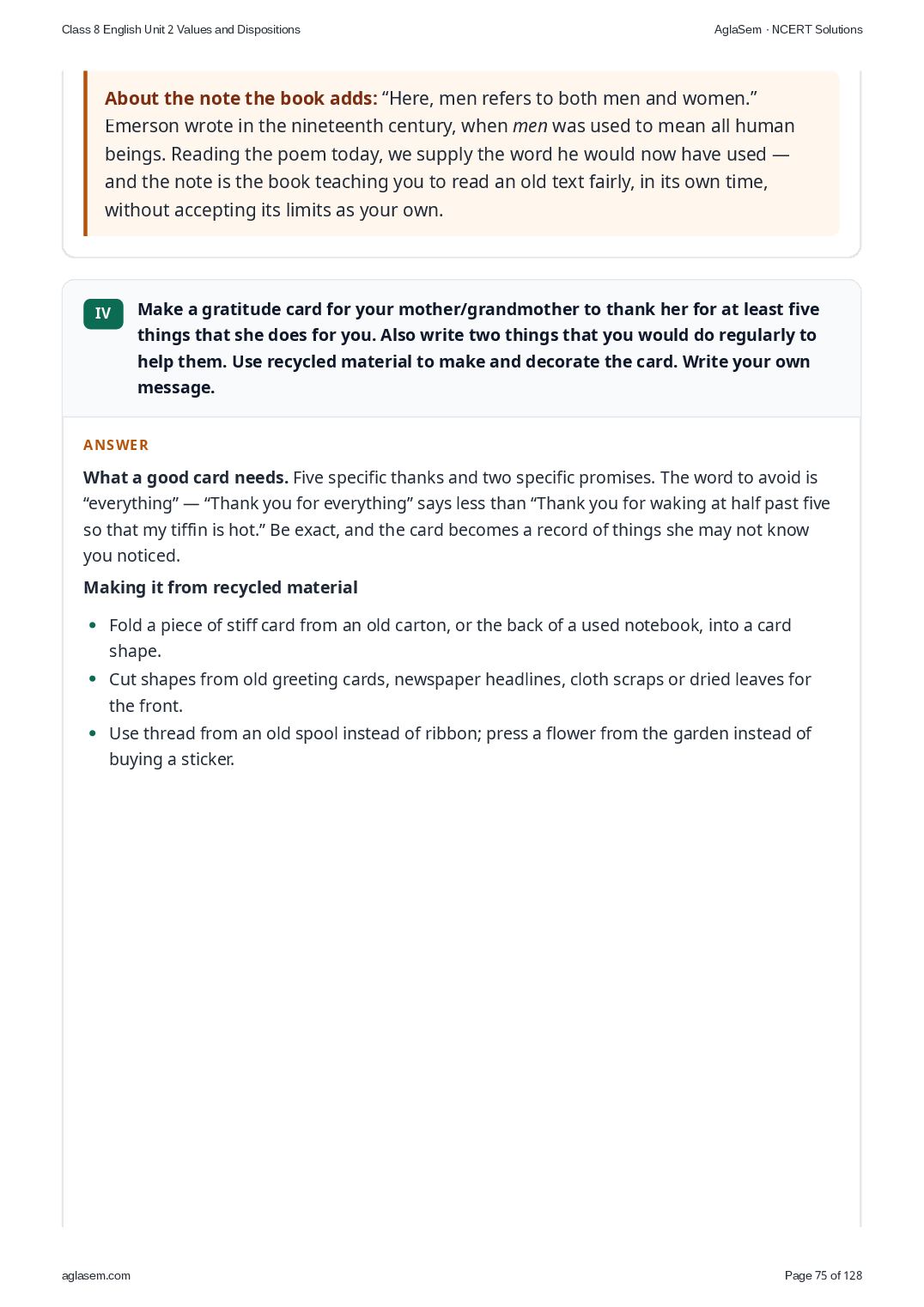
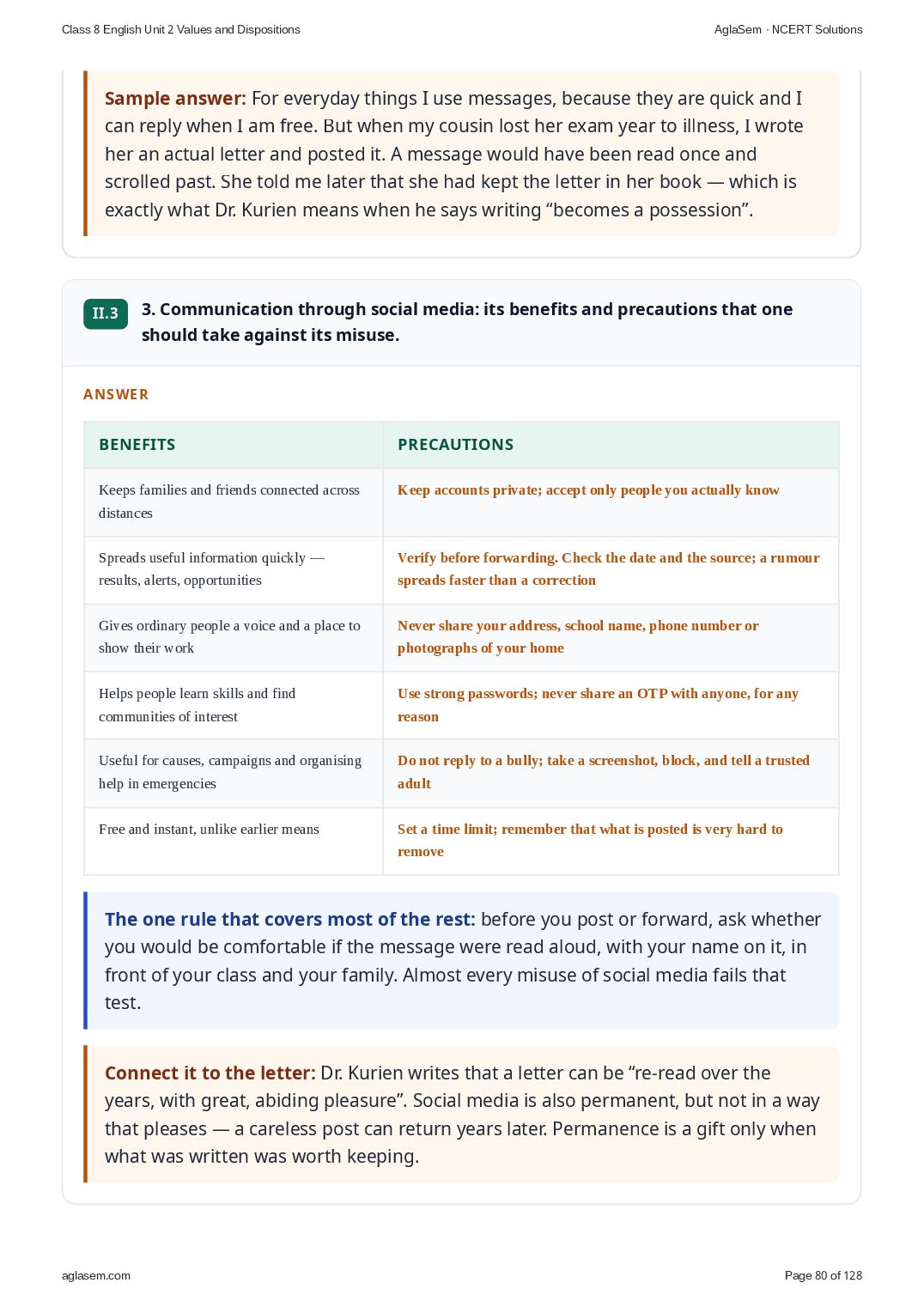
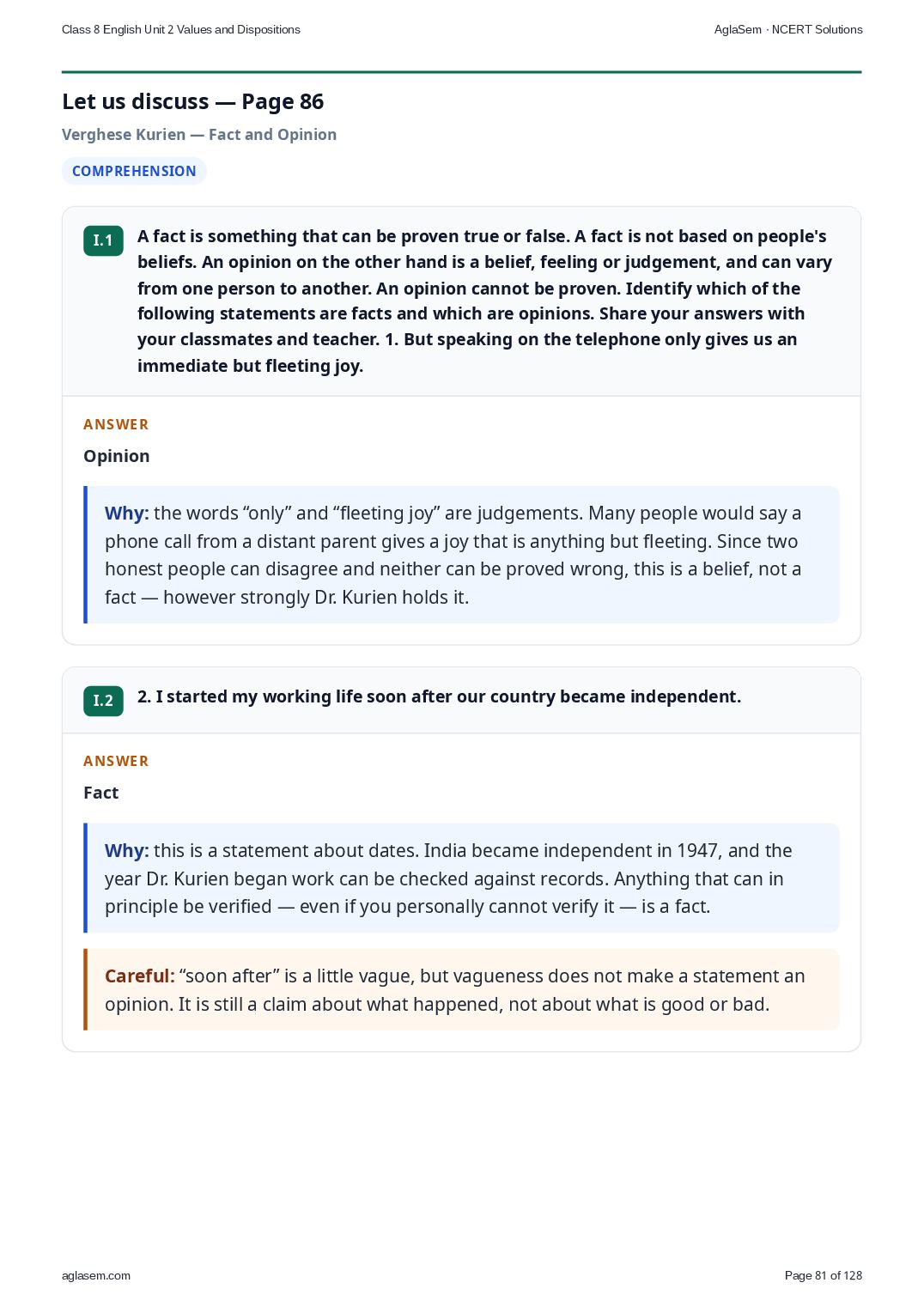
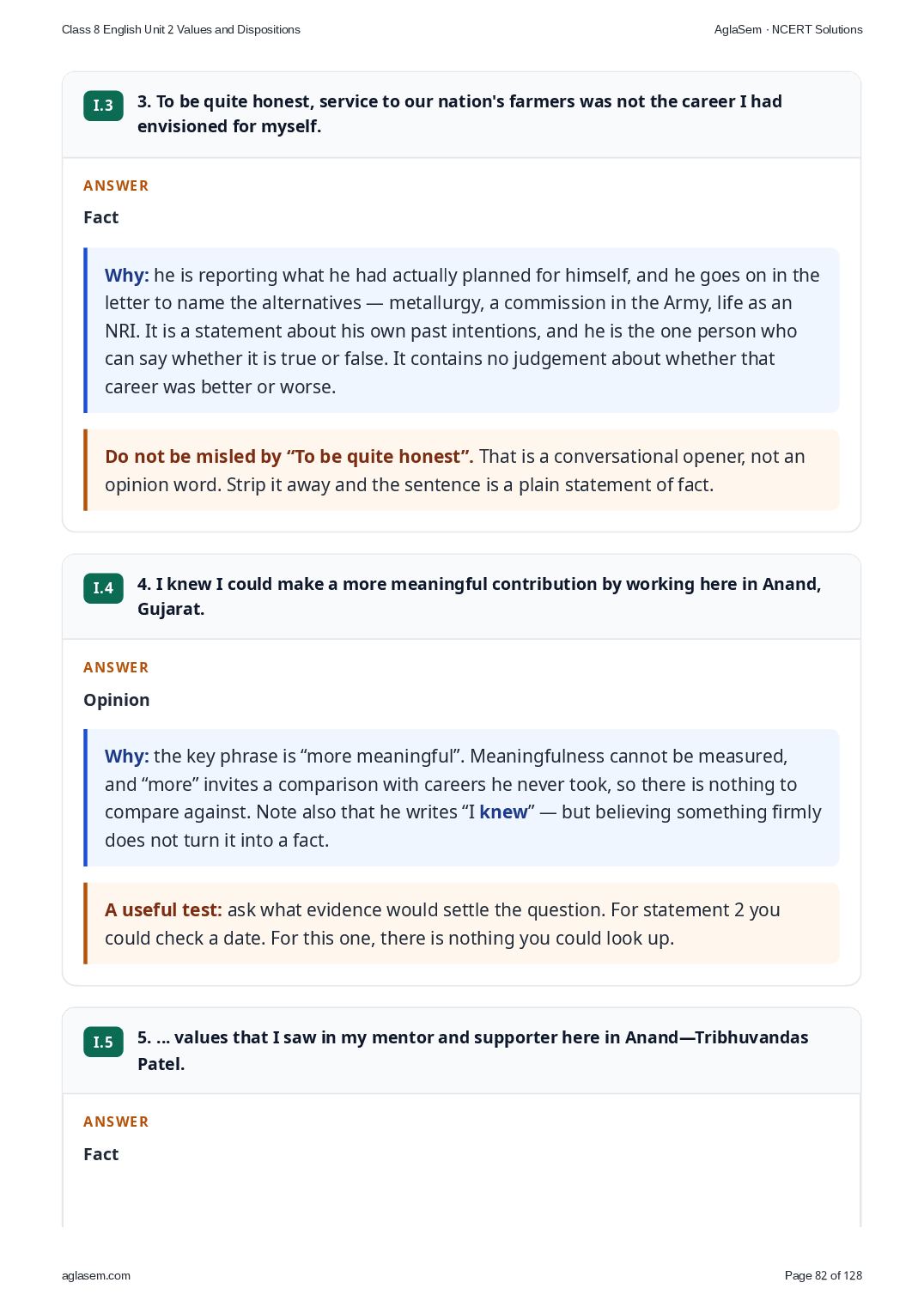
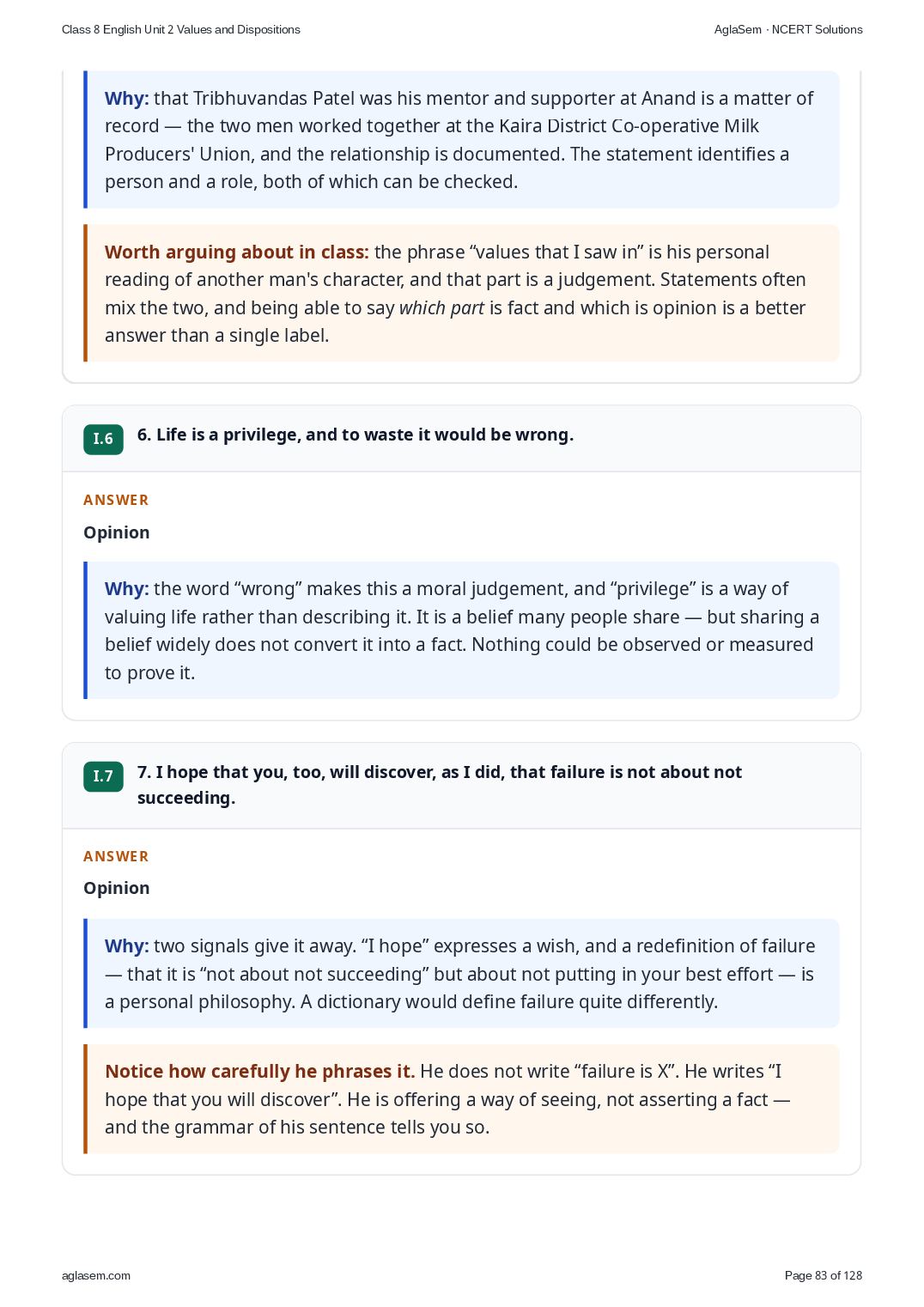
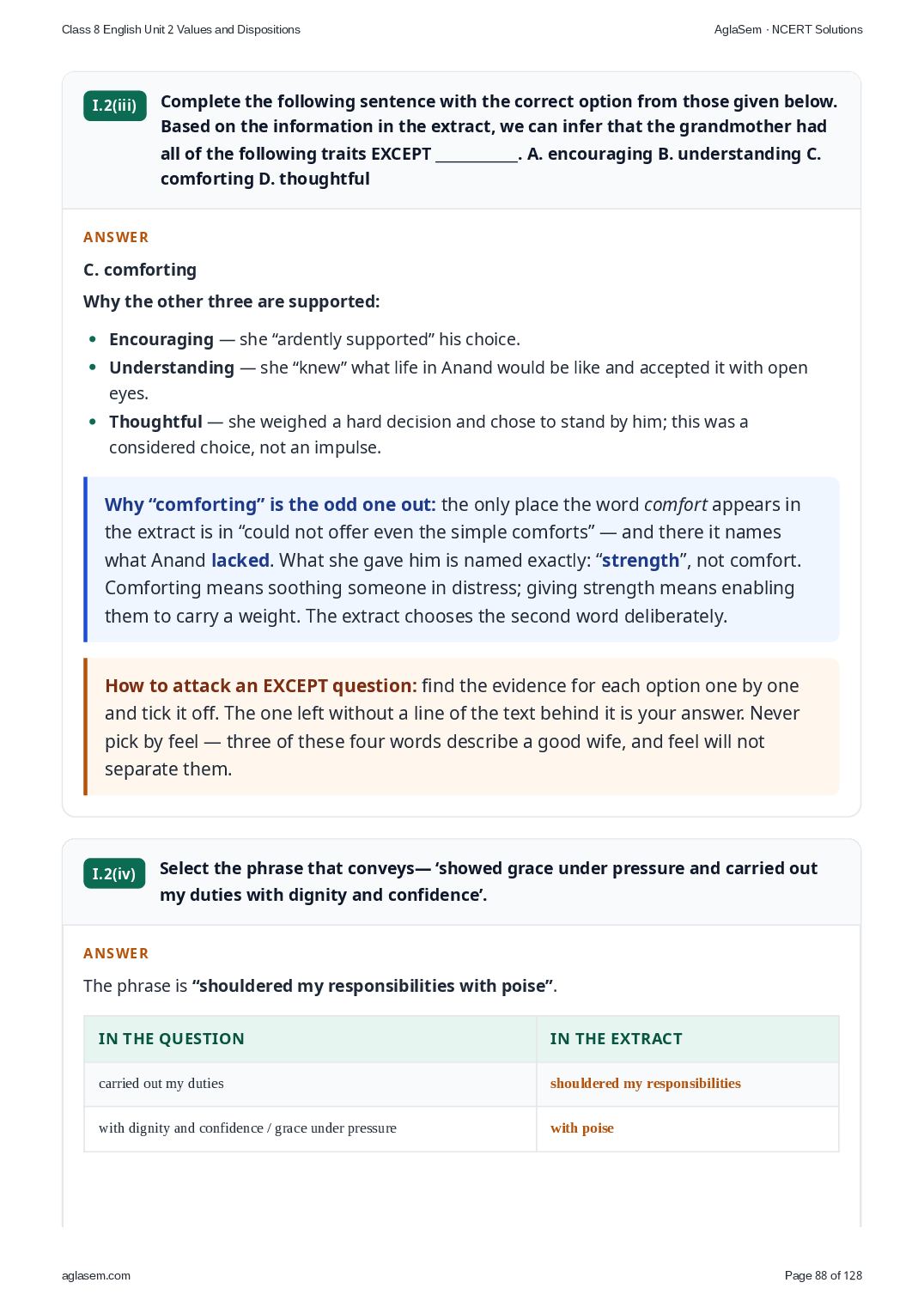
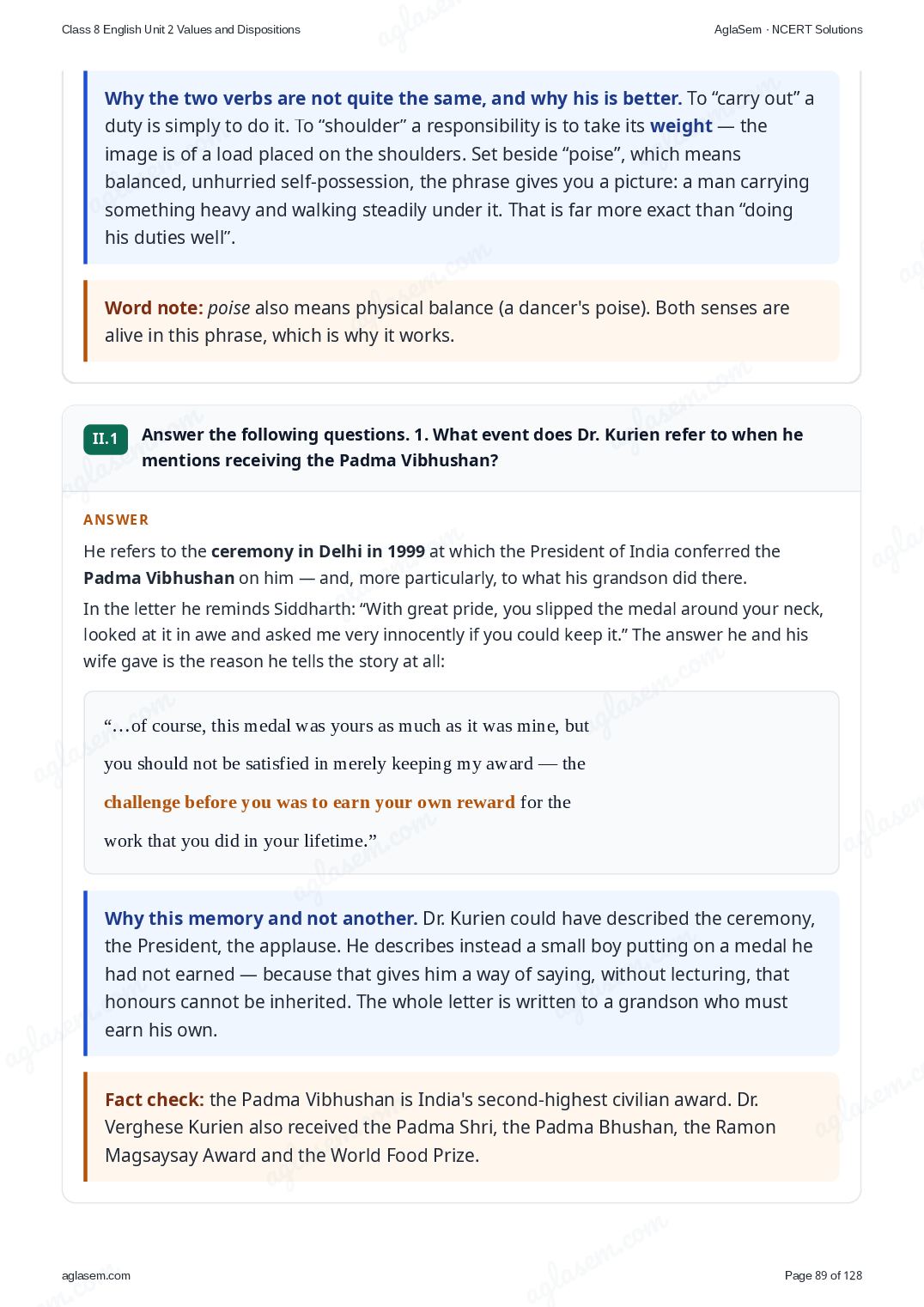
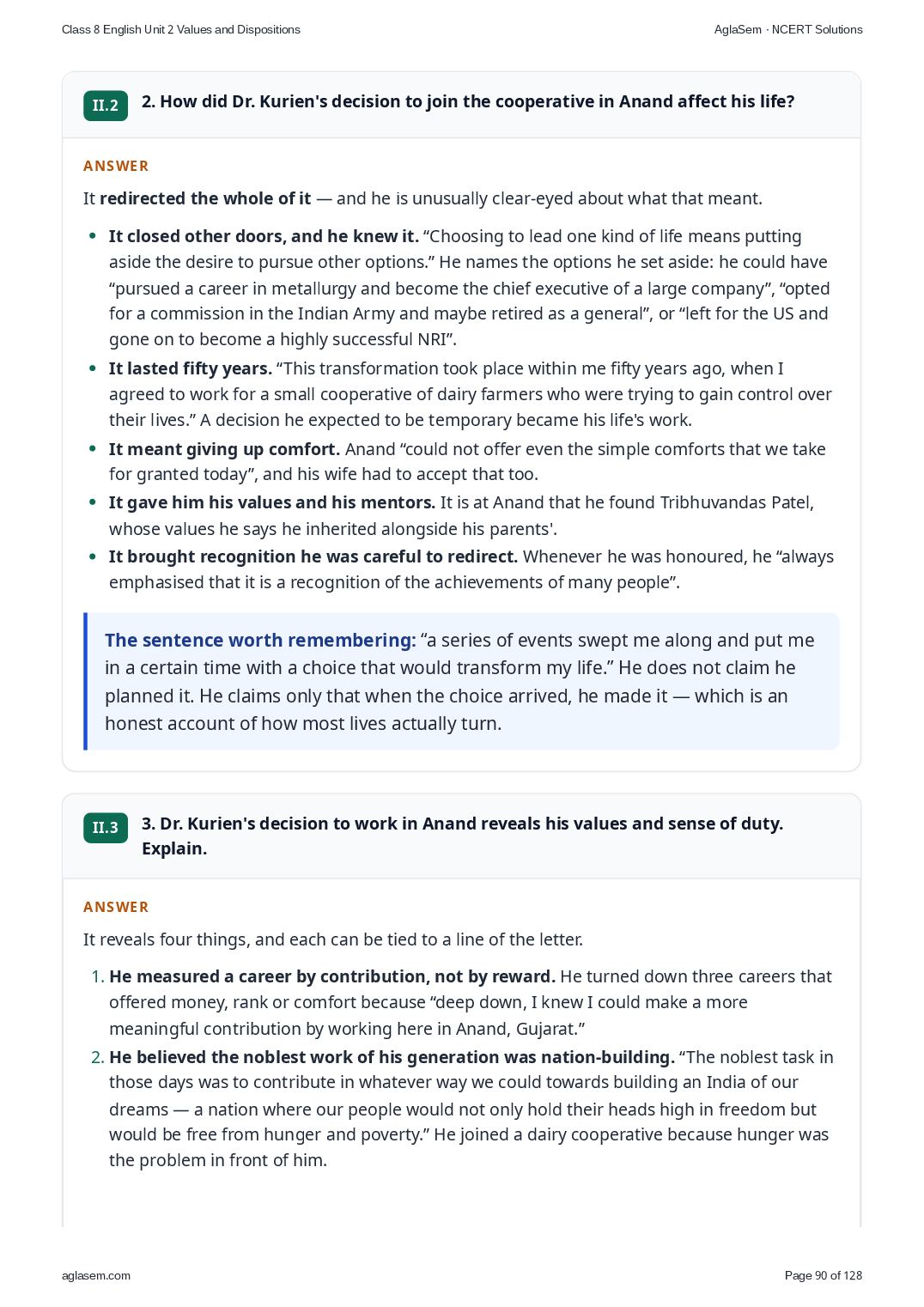
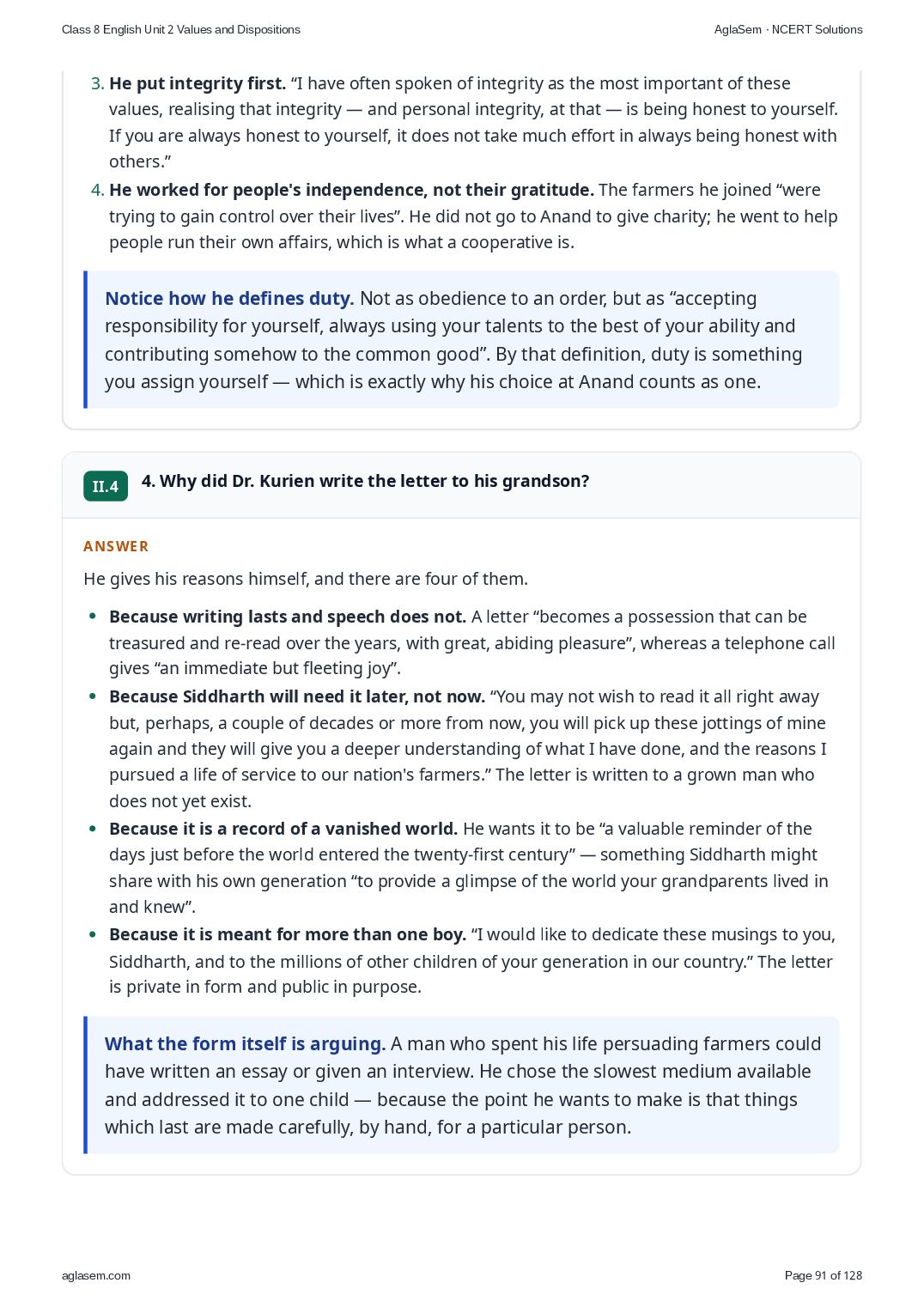
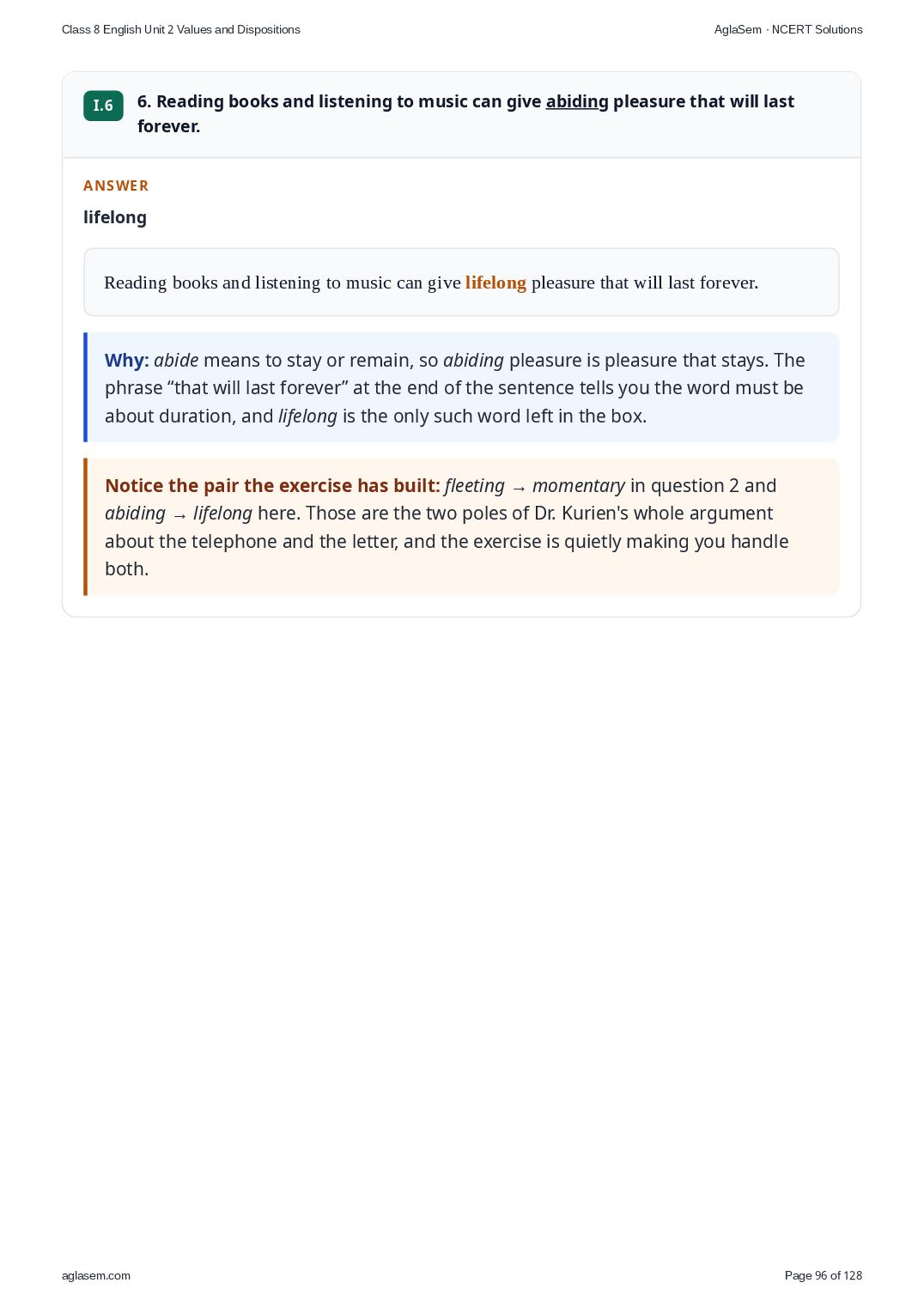
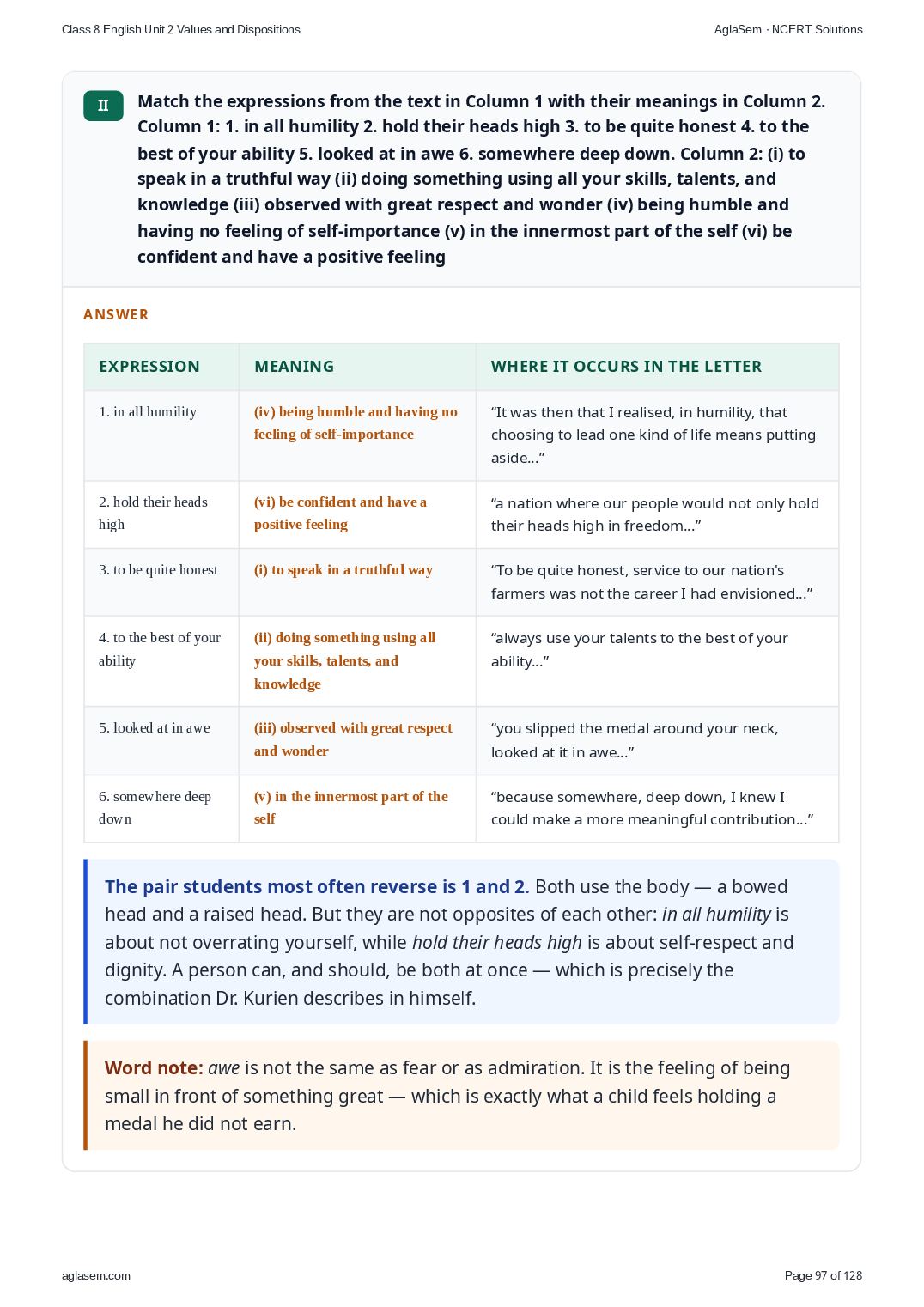
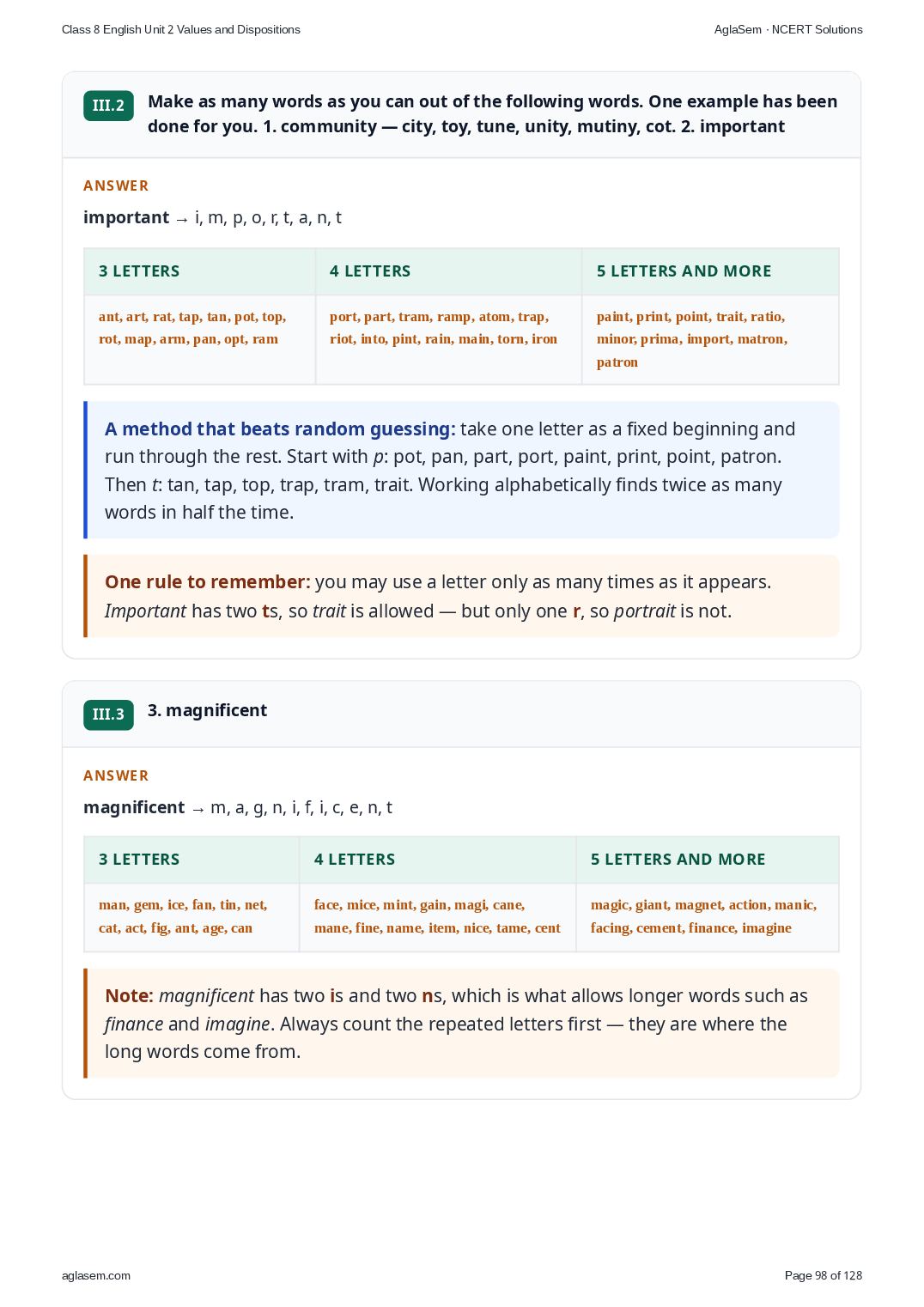
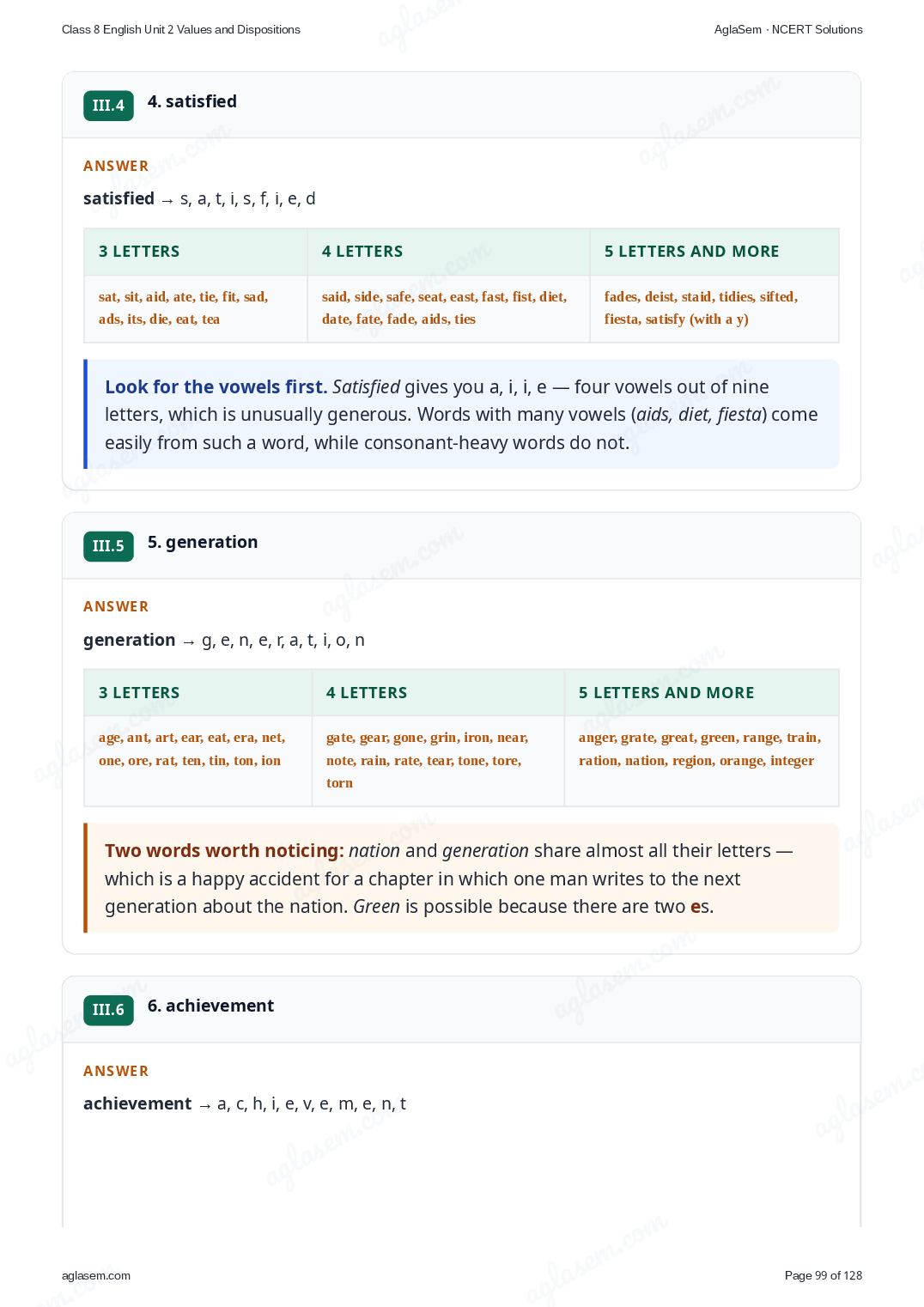
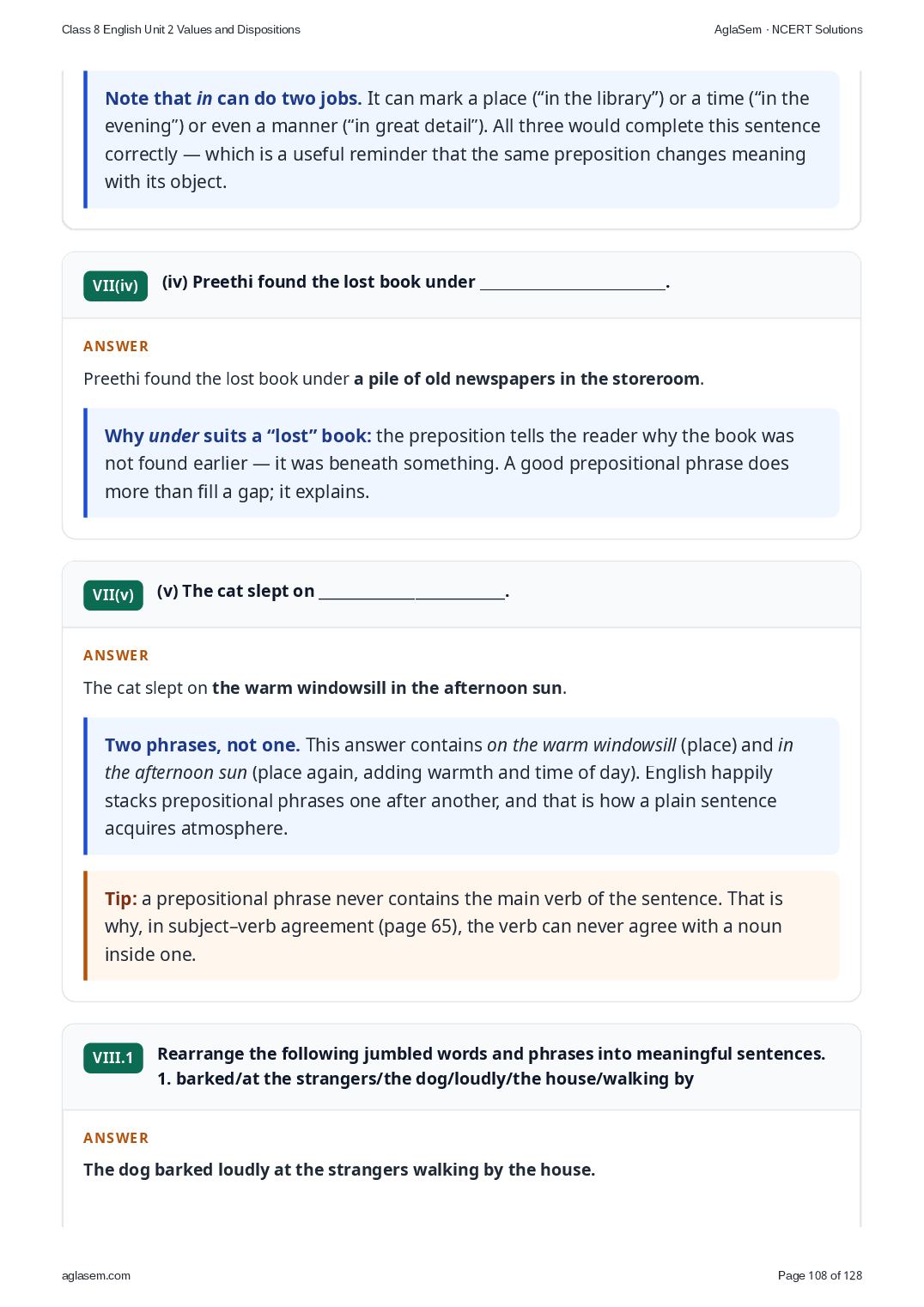
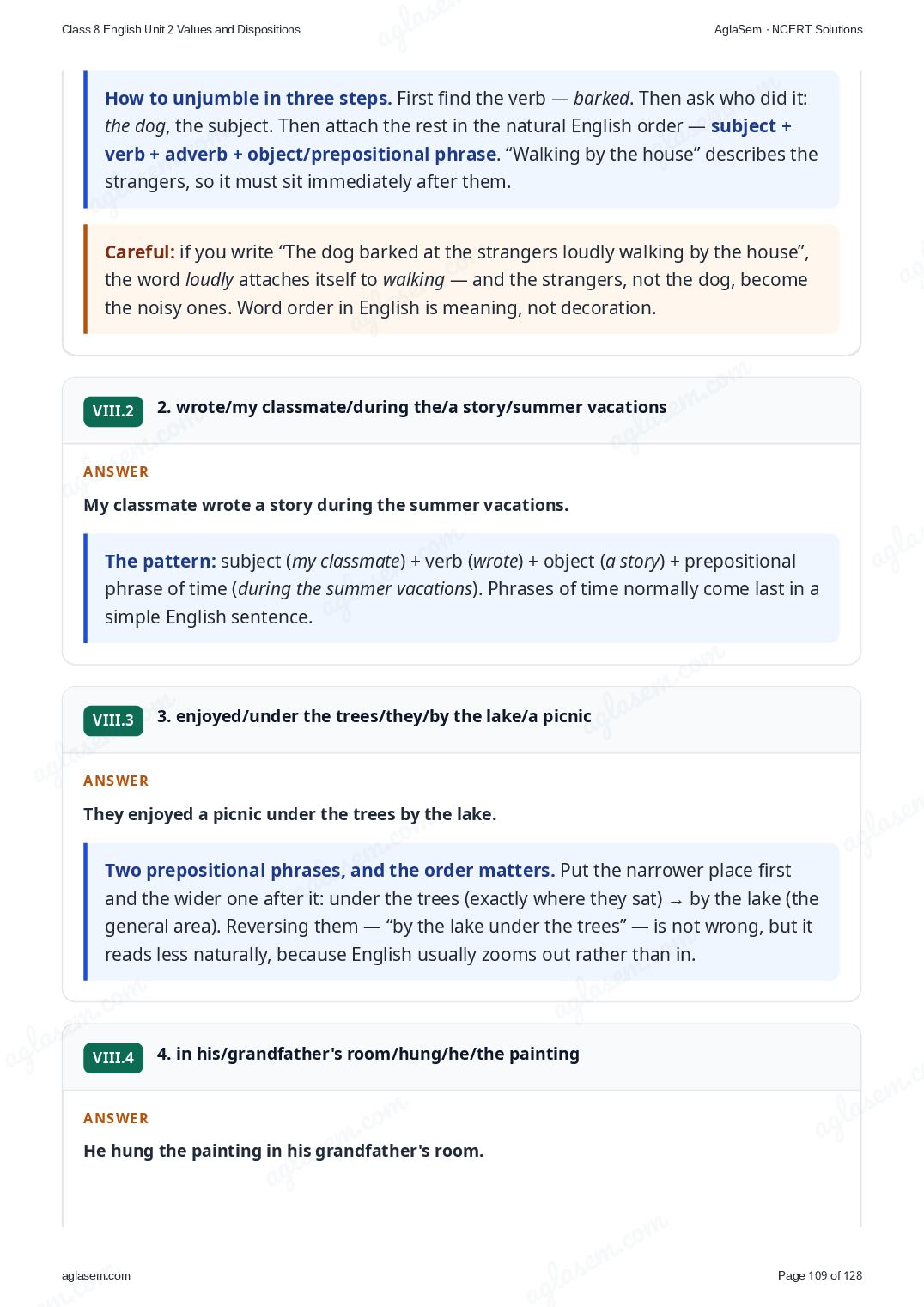
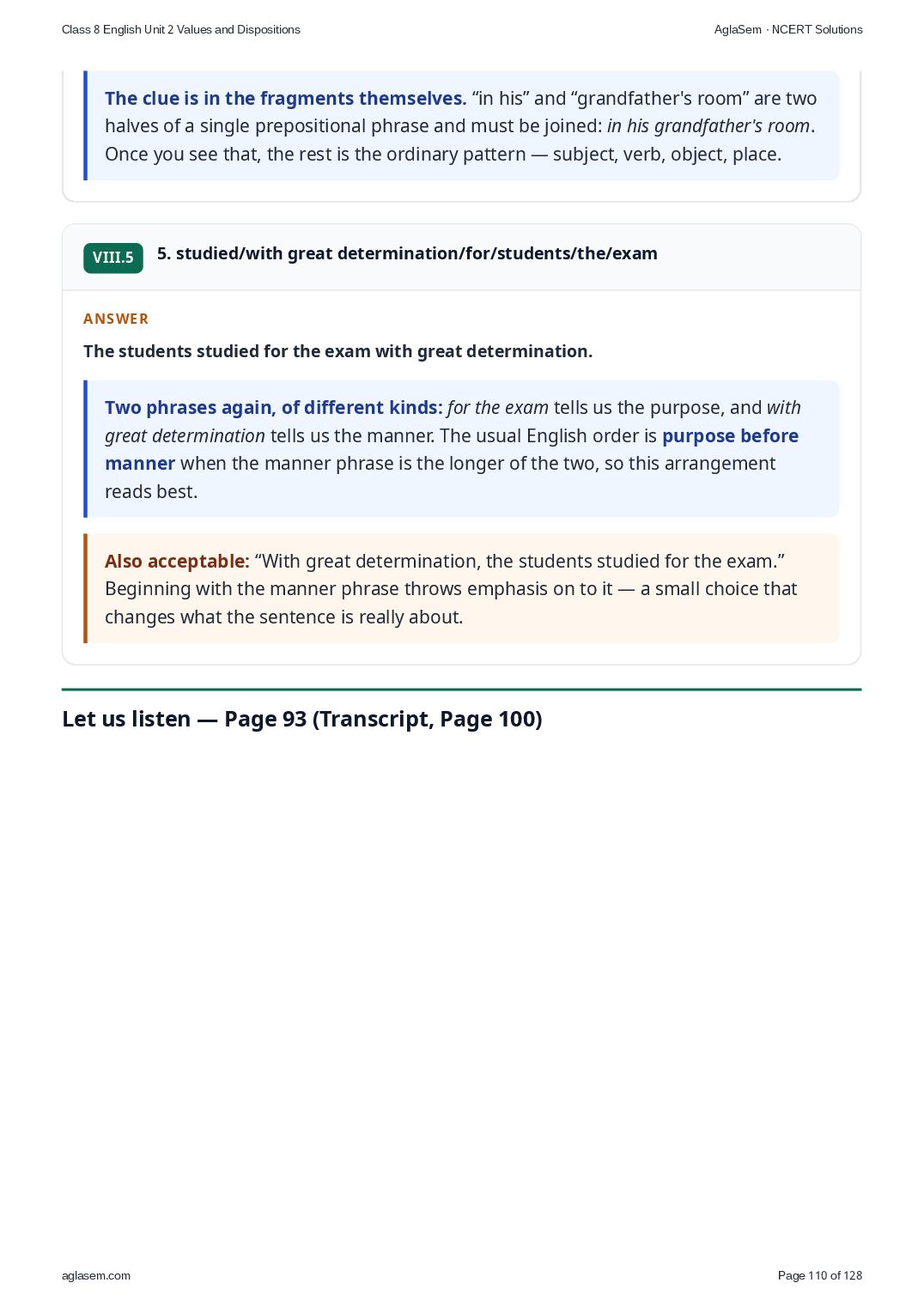
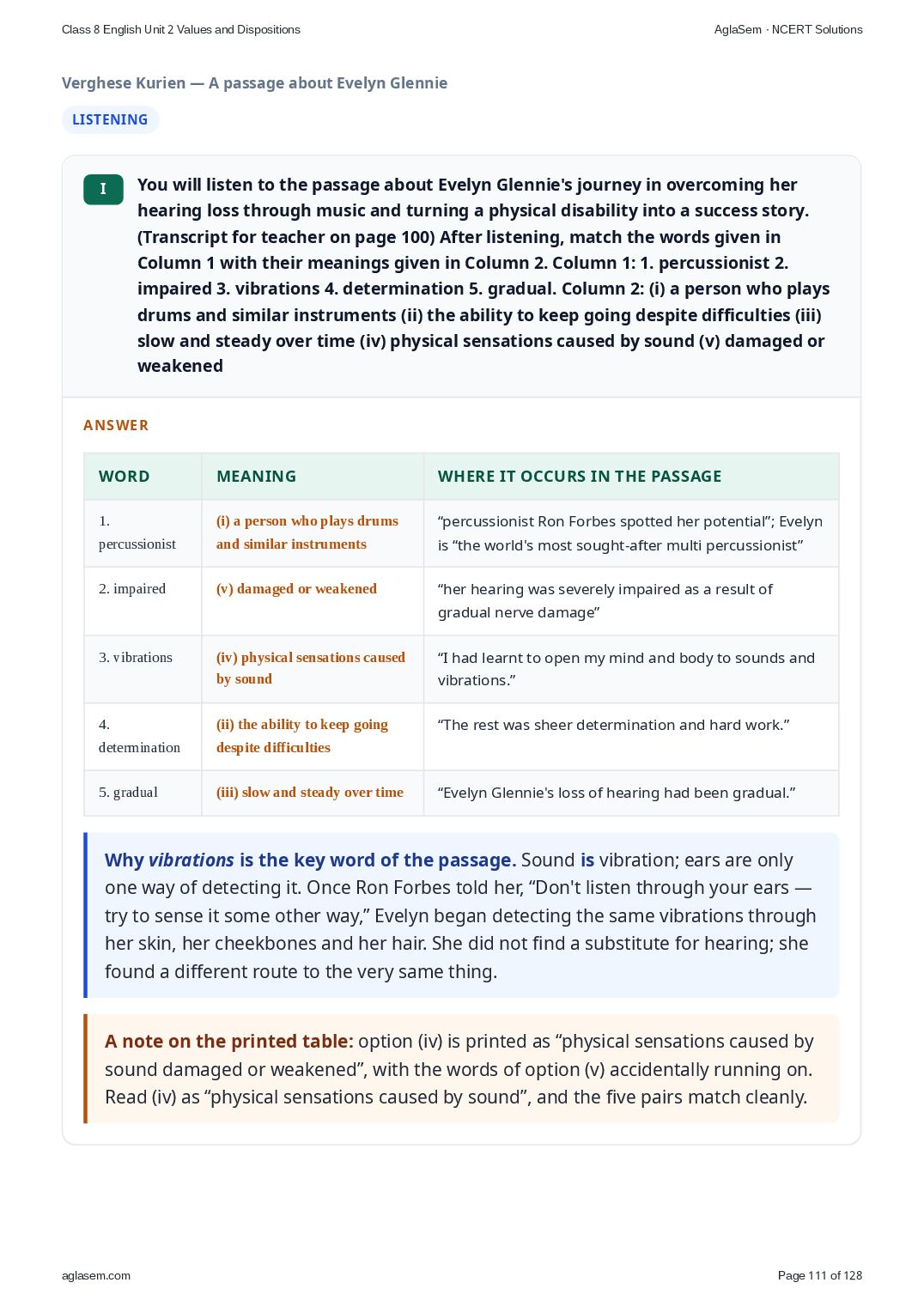
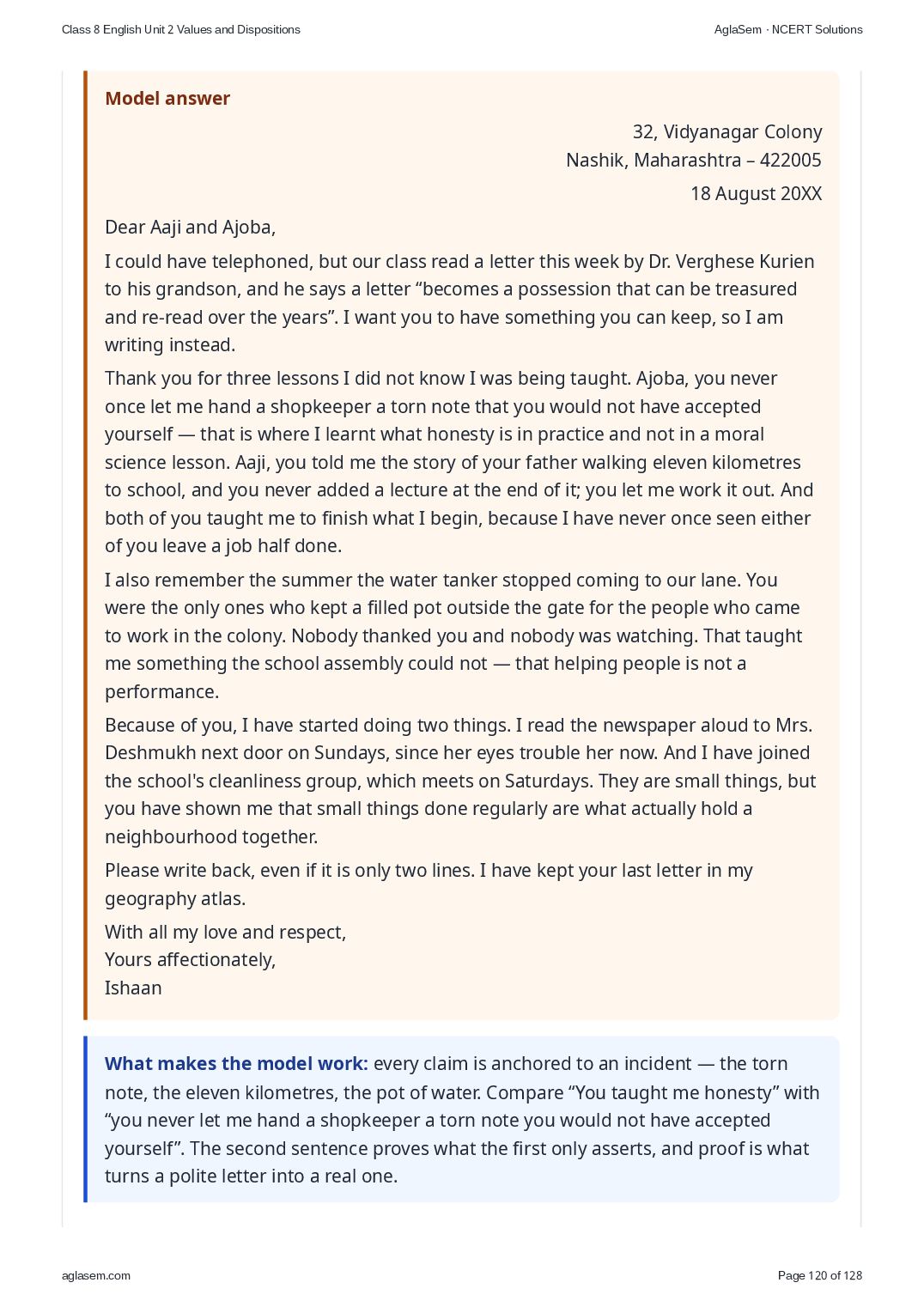
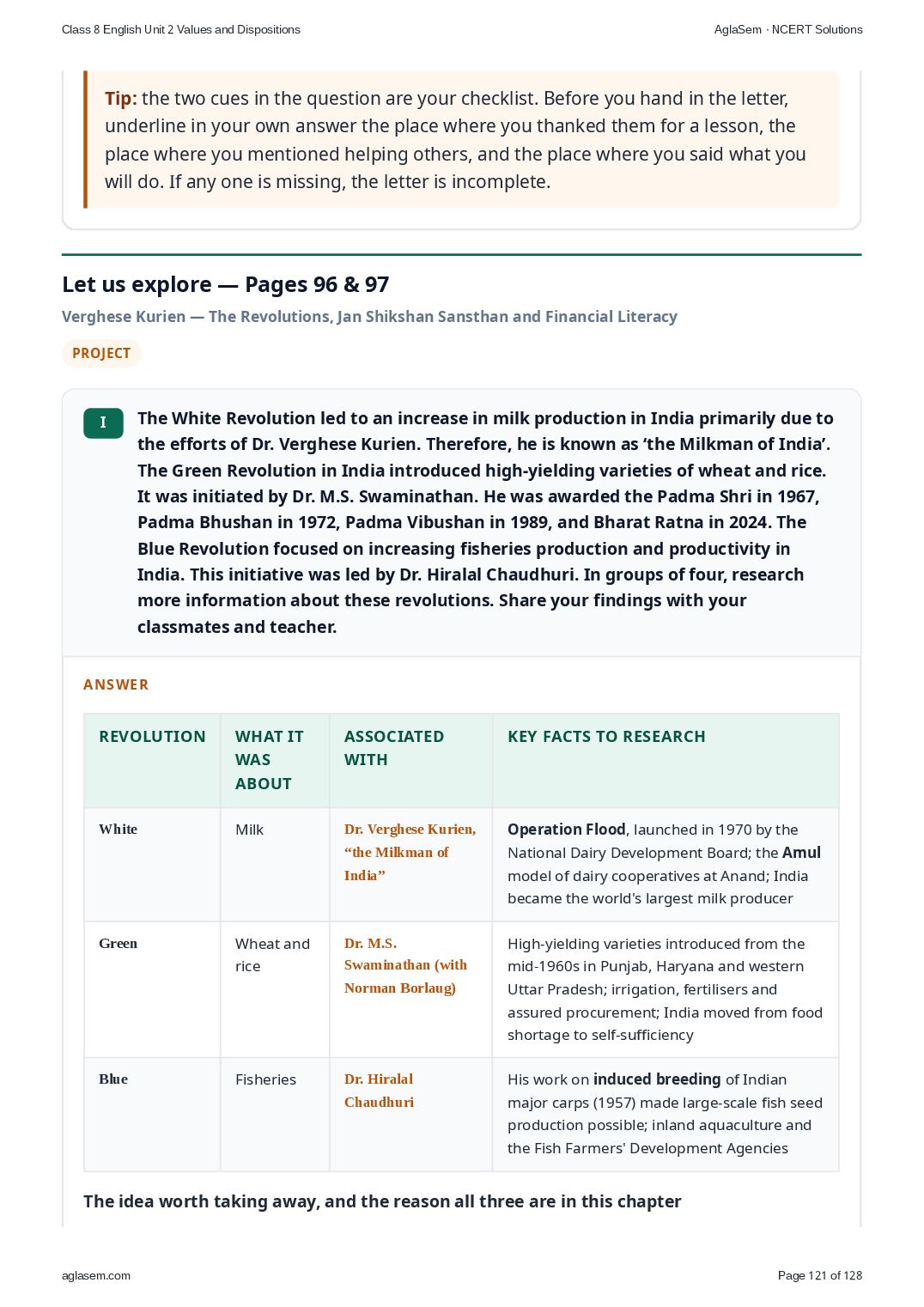
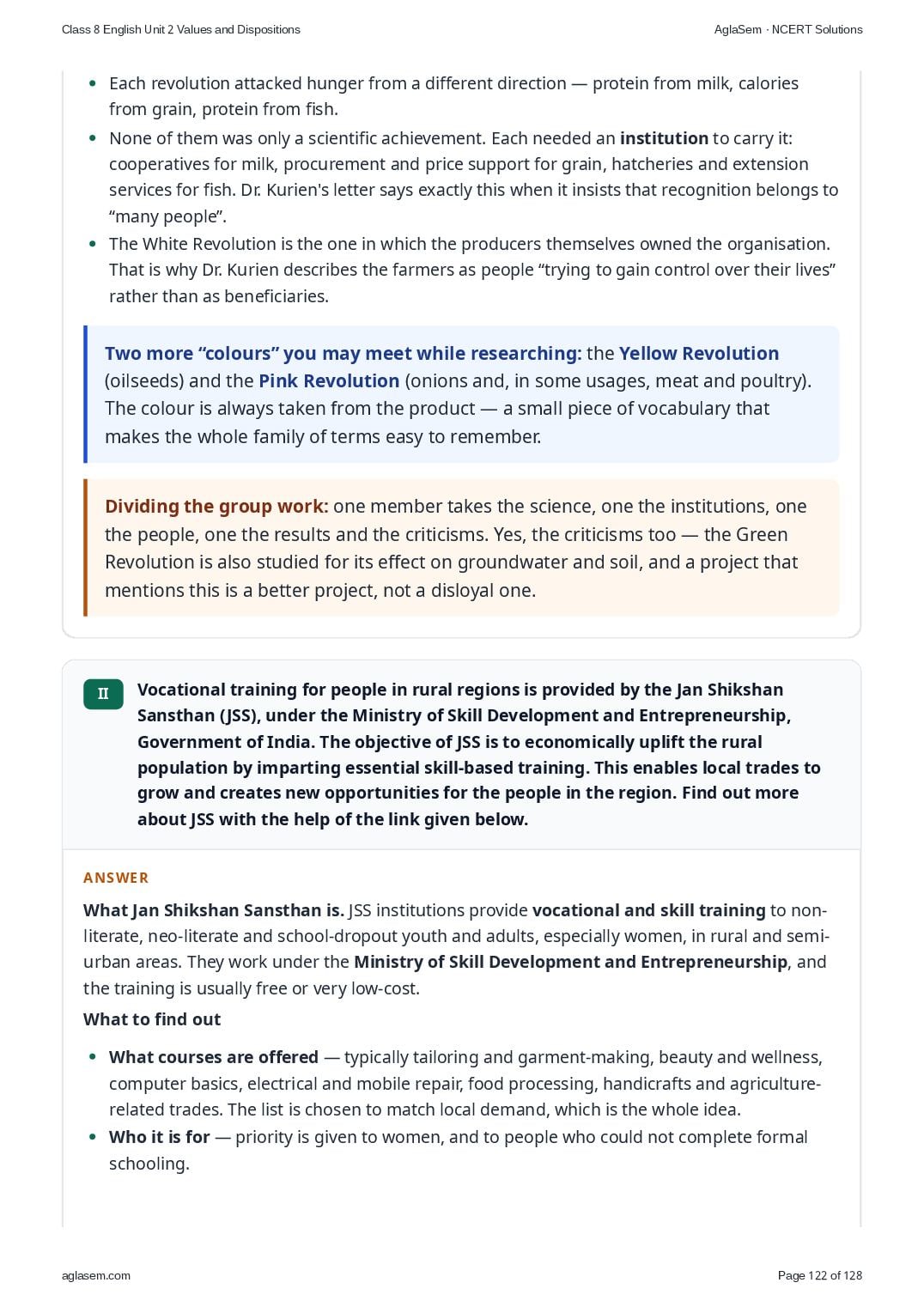
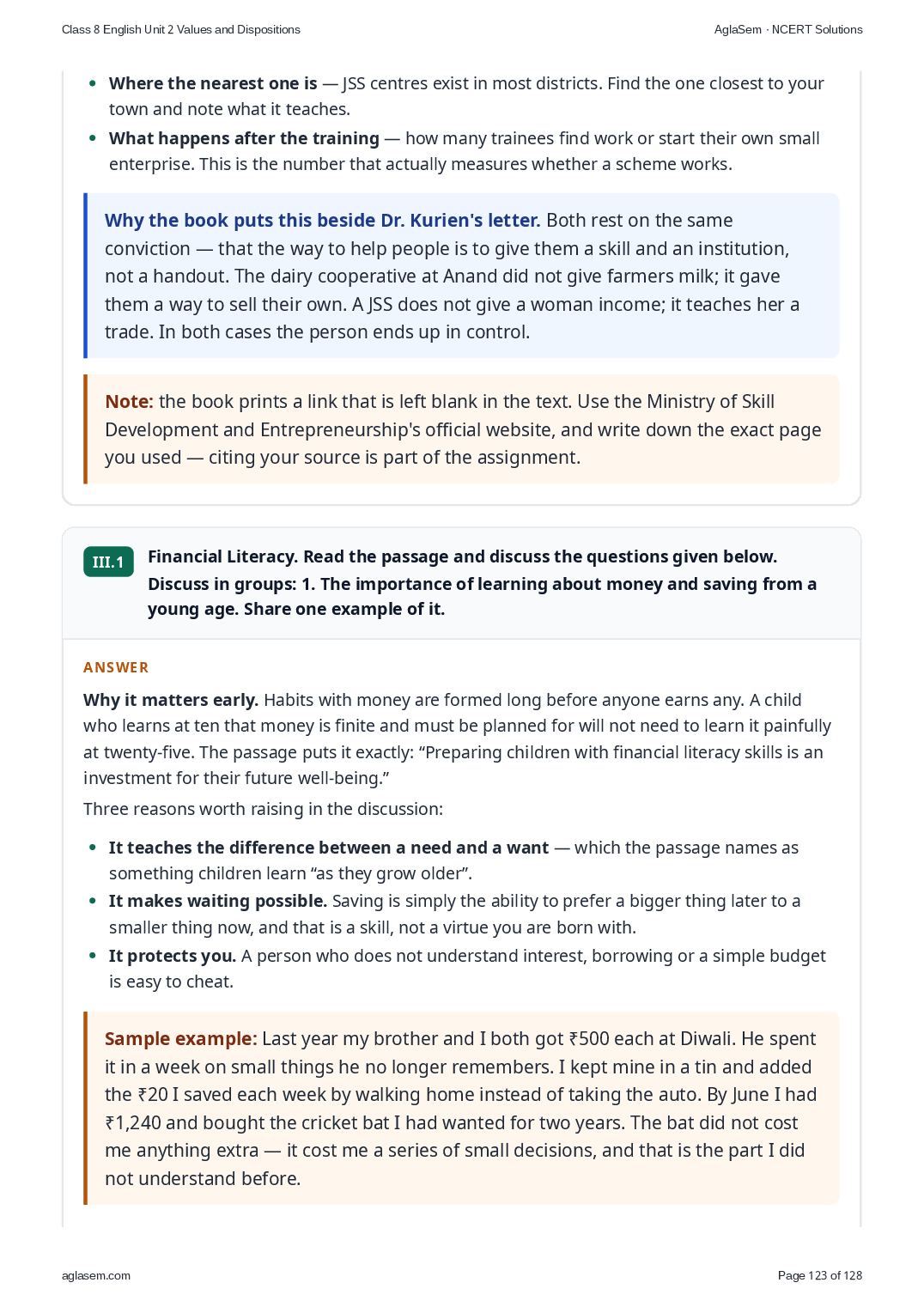
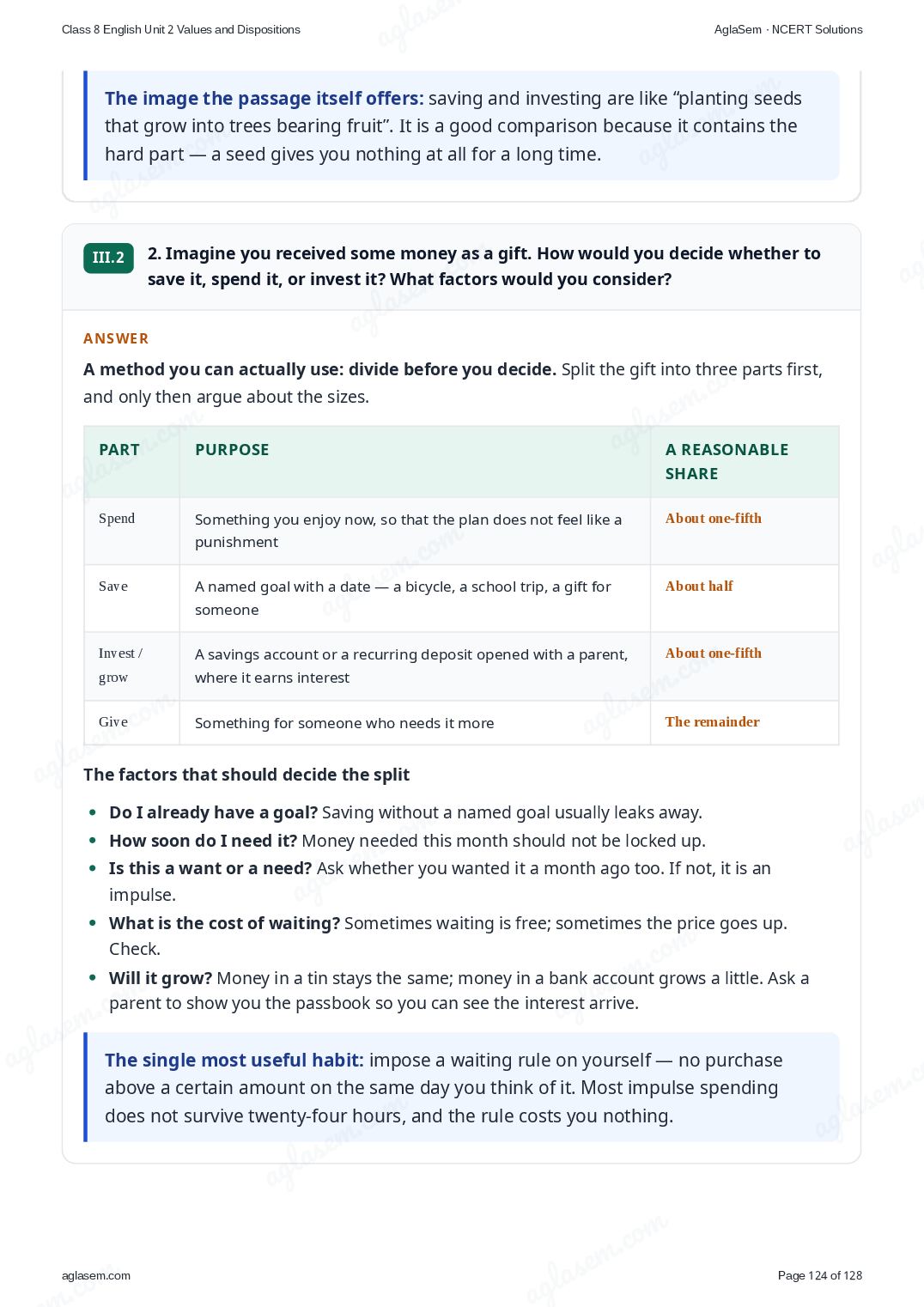
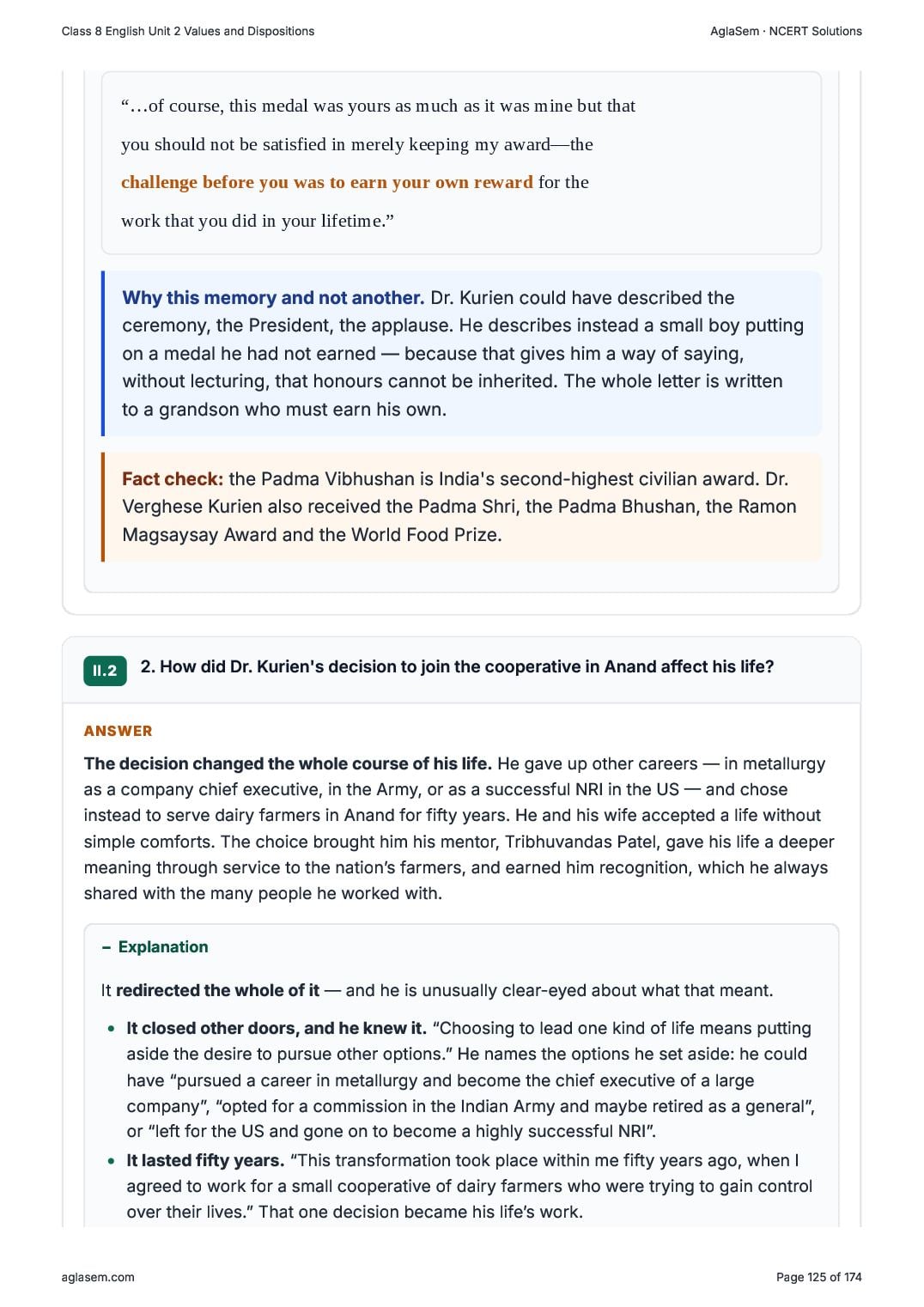
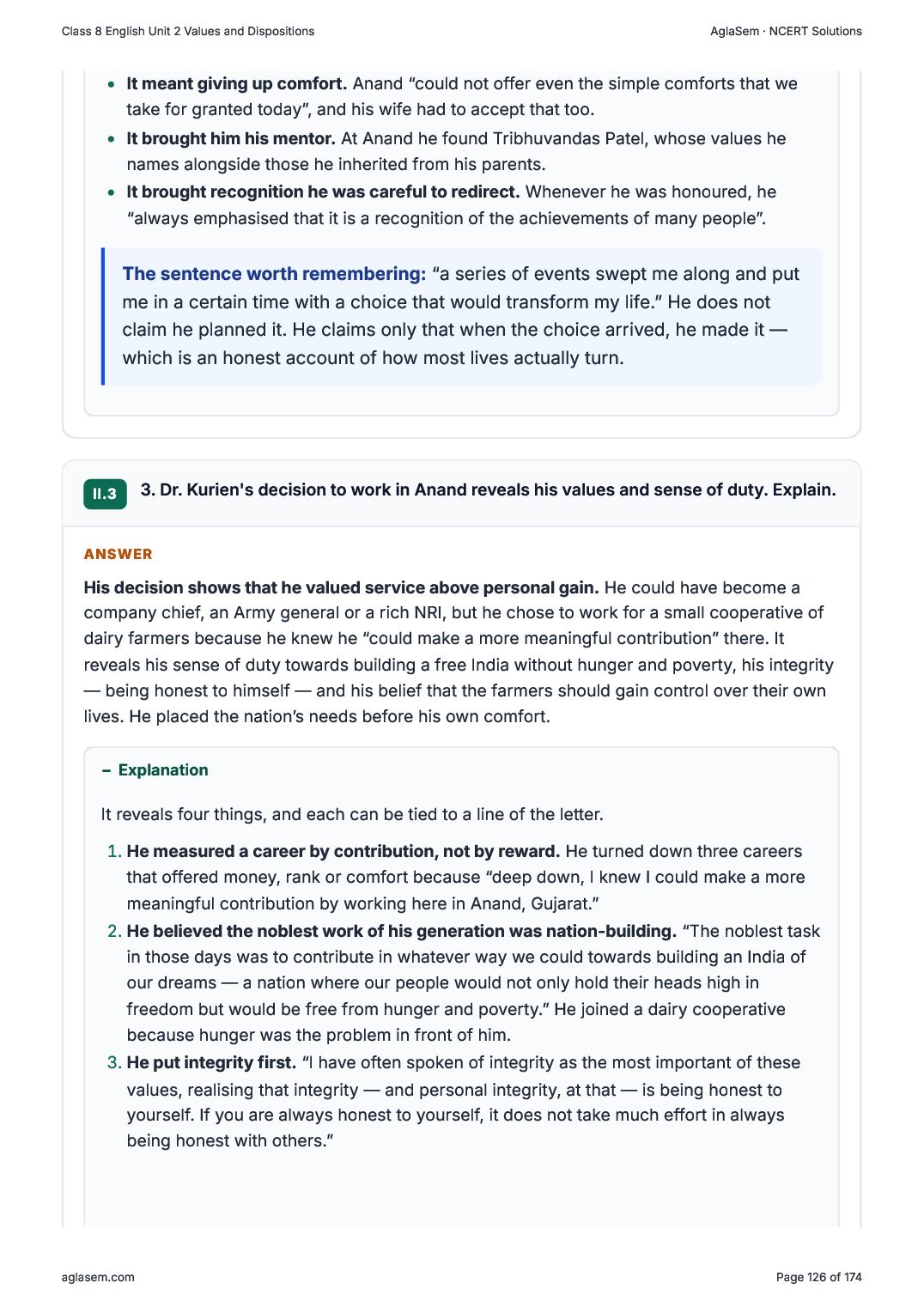
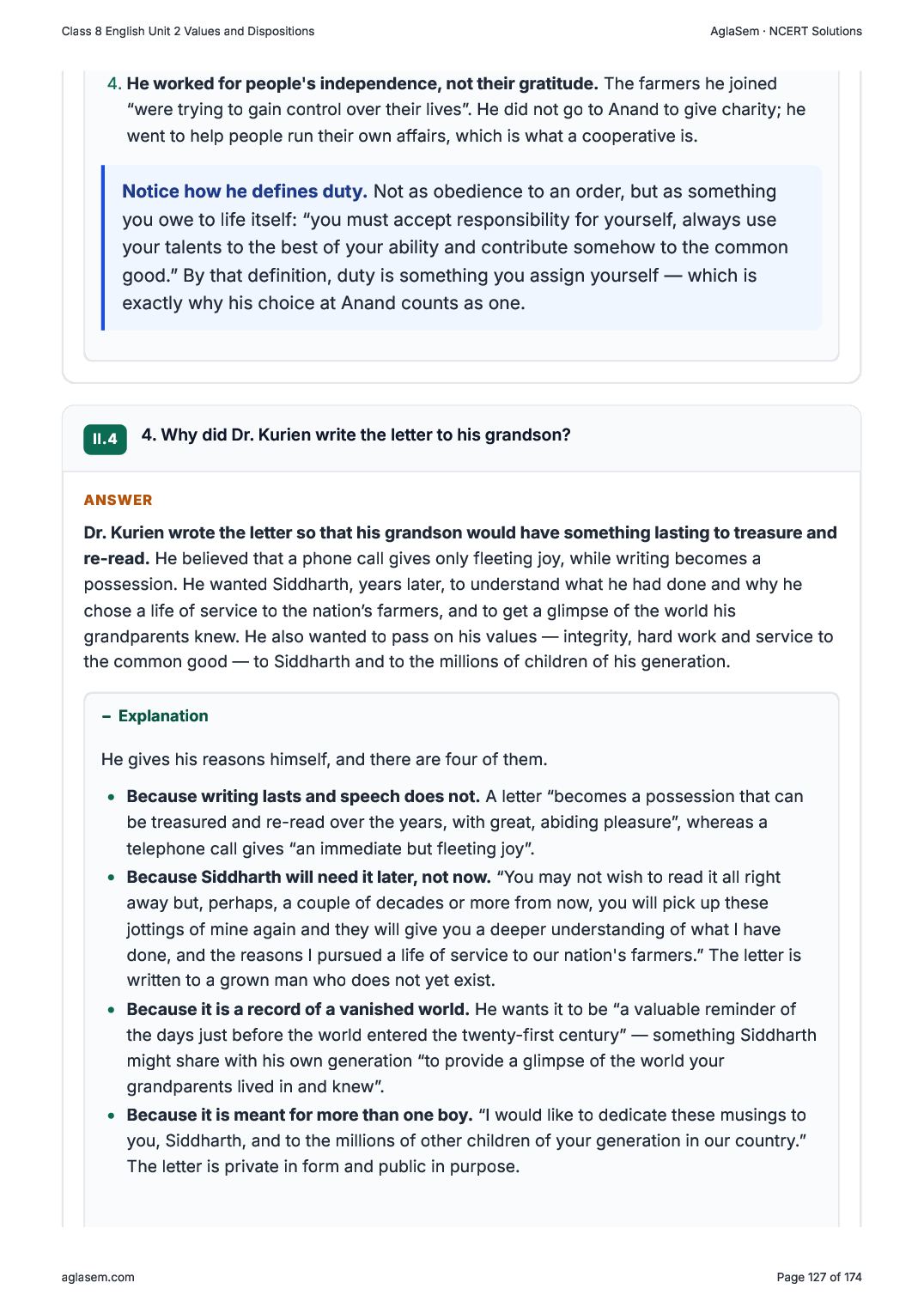
NCERT Solutions for Class 8 English Chapter 2 PDF Download
You can read the NCERT Solutions for Class 8 English Chapter 2 online above, or download the complete question-answer PDF to study Values and Dispositions offline at any time.
NCERT Solutions for Class 8 English Chapter 2 PDF Download Link – Click Here to Download Solutions PDF
Questions Covered in This Chapter
Key questions solved in this chapter include:
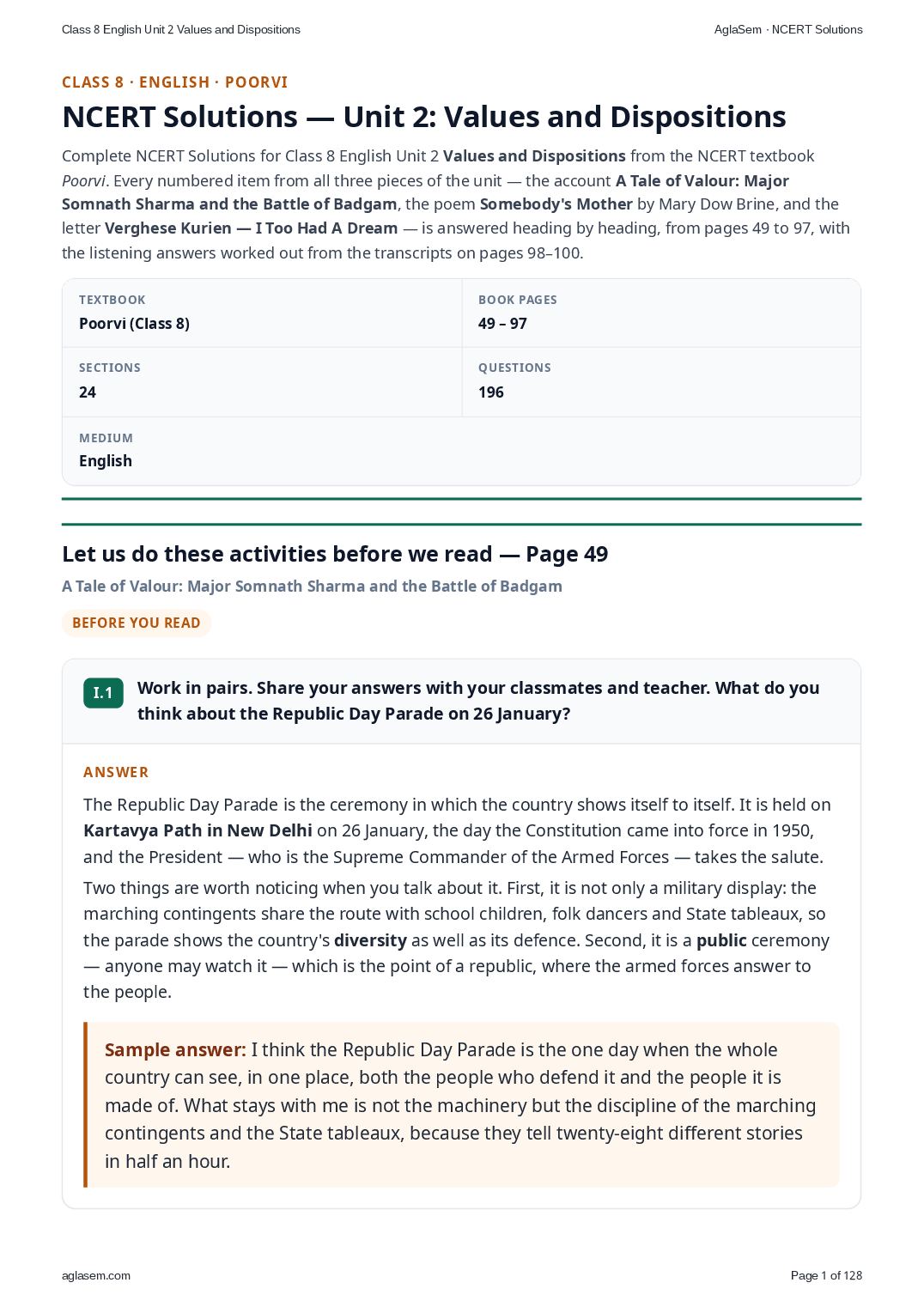
- Work in pairs. Share your answers with your classmates and teacher. What do you think about the Republic Day Parade on 26 January?
- What are the highlights of this parade?
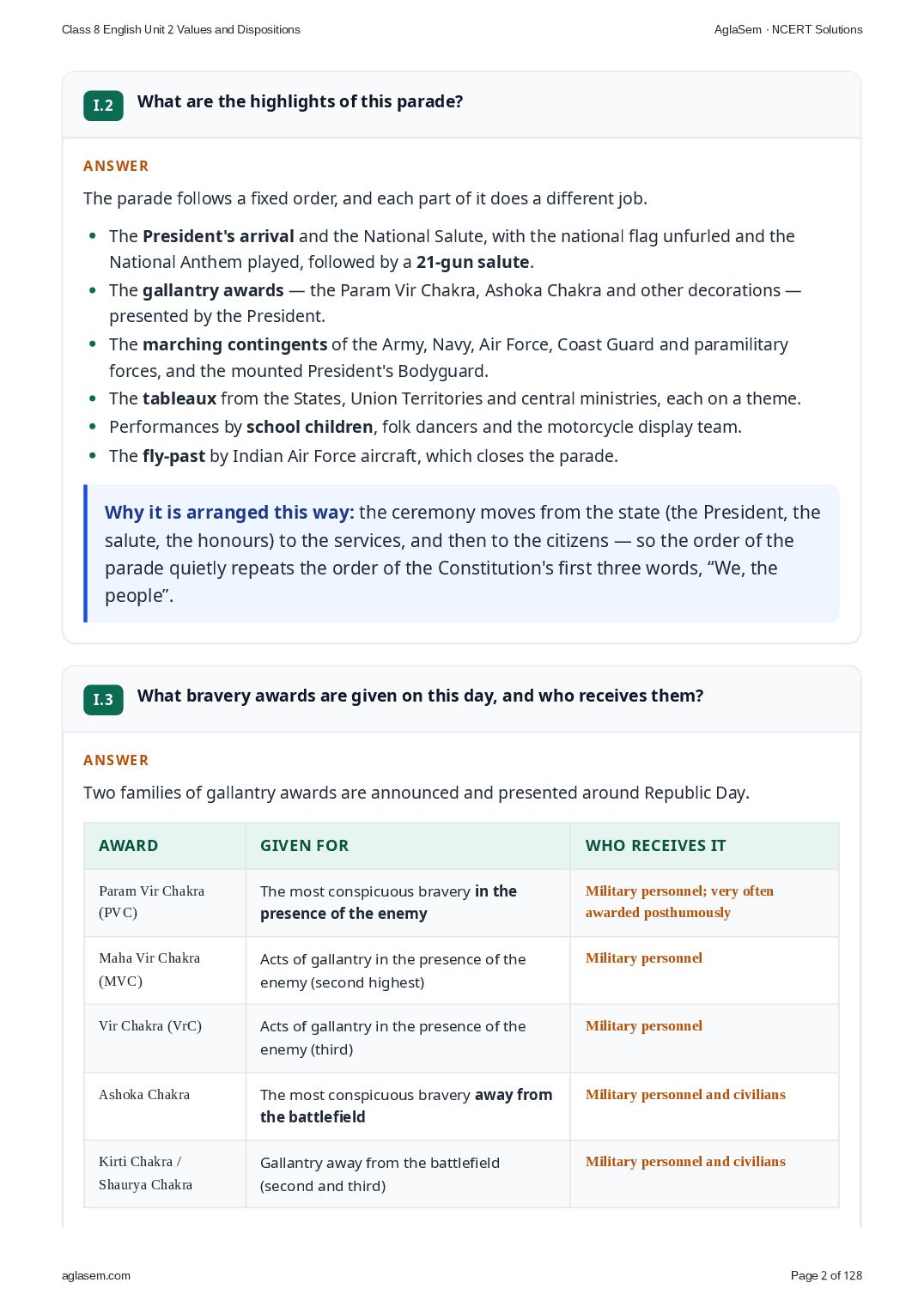
- What bravery awards are given on this day, and who receives them?
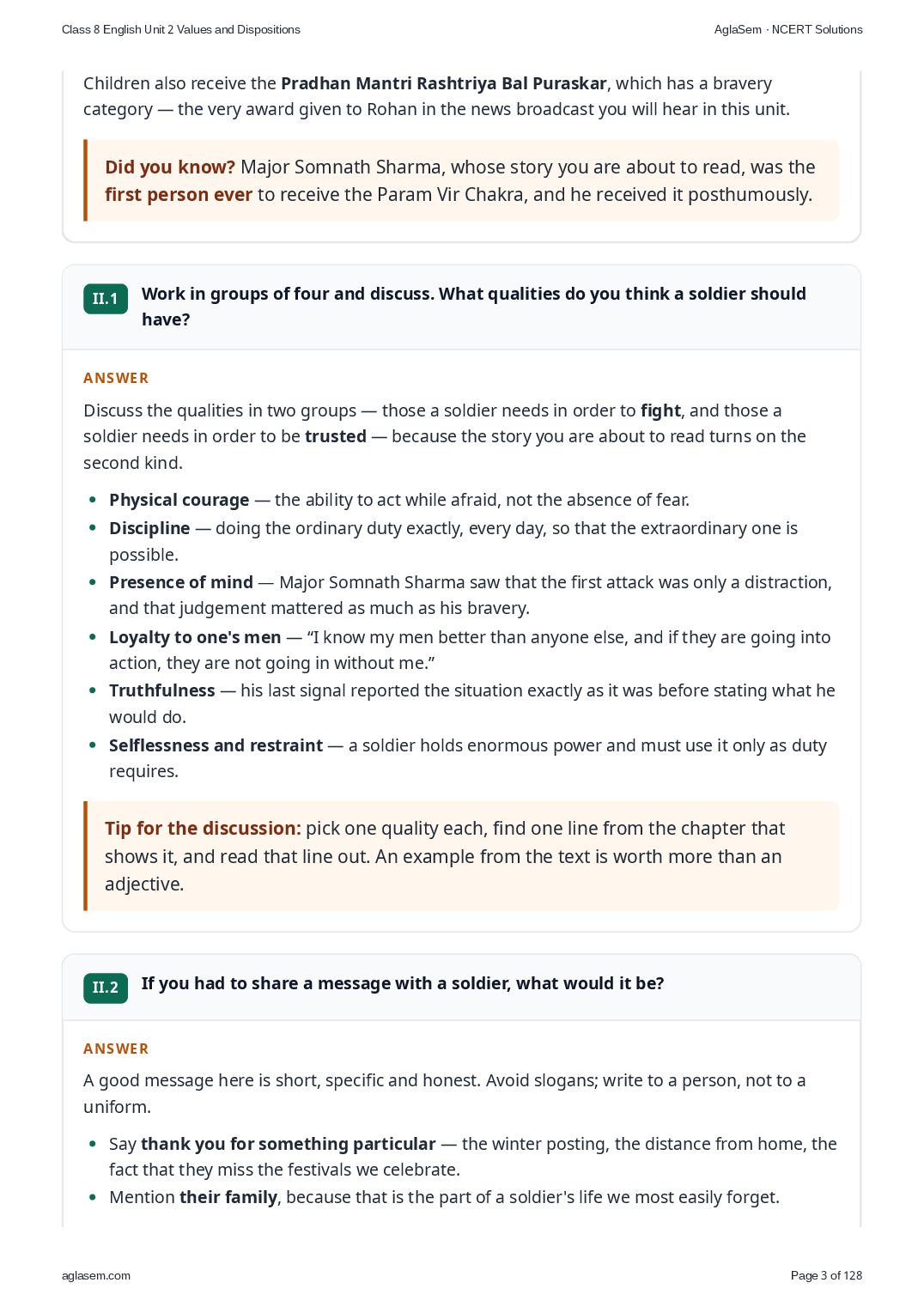
- Work in groups of four and discuss. What qualities do you think a soldier should have?
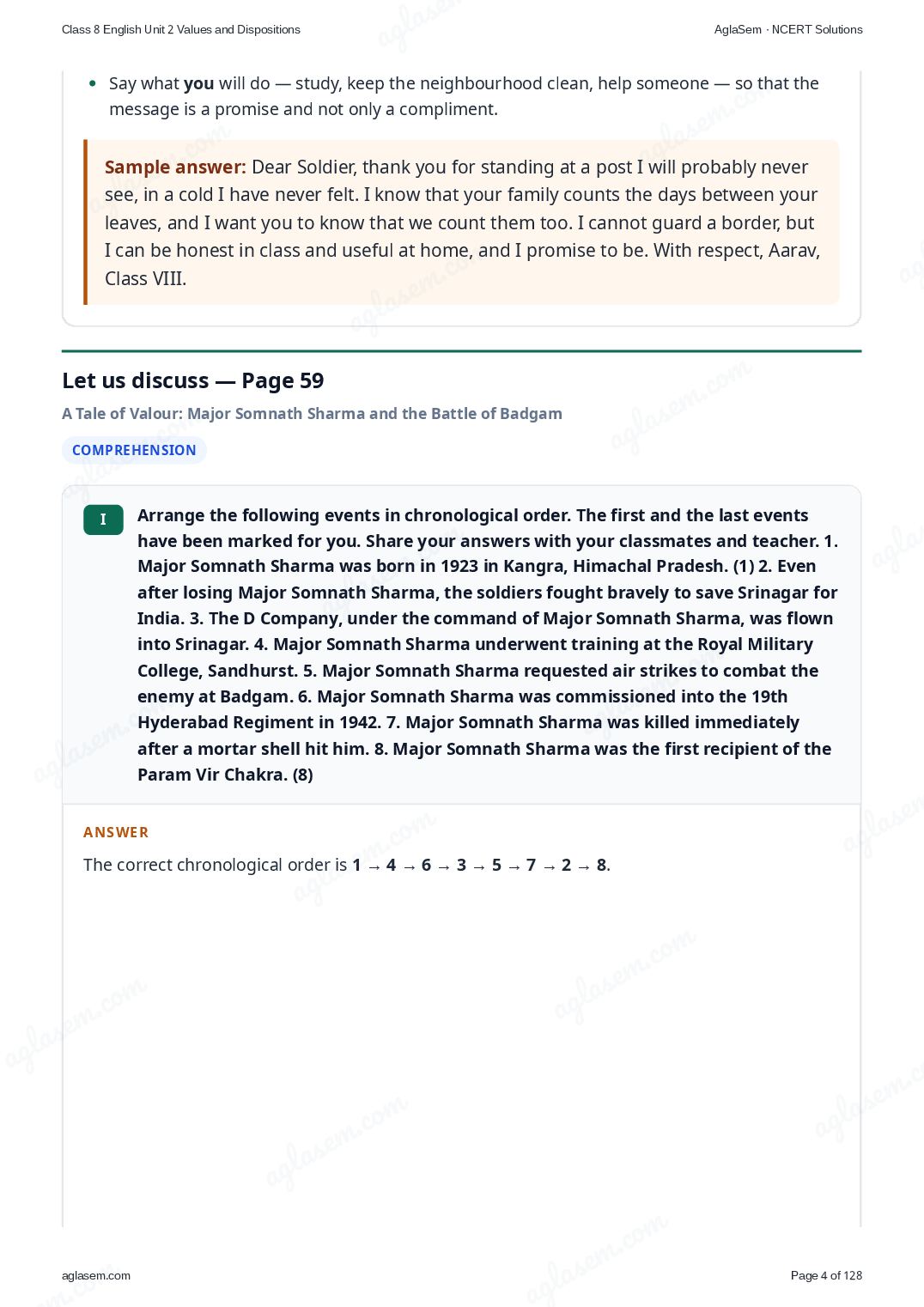
- If you had to share a message with a soldier, what would it be?
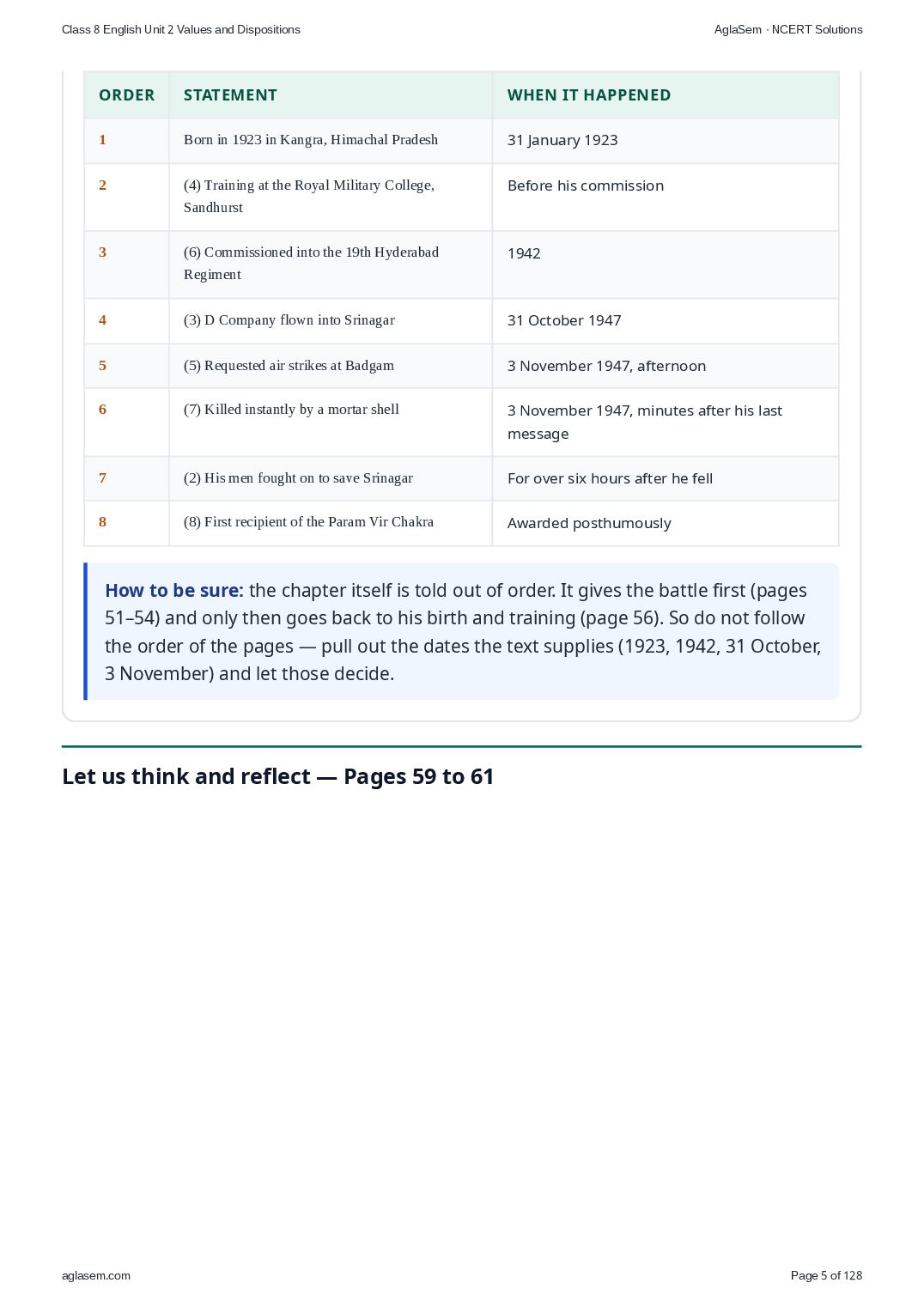
- Arrange the following events in chronological order. The first and the last events have been marked for you. Share your answers with your classmates and teacher. 1. Major Somnath Sharma was born in 1923 in Kangra, Himachal Pradesh. (1) 2. Even after losing Major Somnath Sharma, the soldiers fought bravely to save Srinagar for India. 3. The D Company, under the command of Major Somnath Sharma, was flown into Srinagar. 4. Major Somnath Sharma underwent training at the Royal Military College, Sandhurst. 5. Major Somnath Sharma requested air strikes to combat the enemy at Badgam. 6. Major Somnath Sharma was commissioned into the 19th Hyderabad Regiment in 1942. 7. Major Somnath Sharma was killed immediately after a mortar shell hit him. 8. Major Somnath Sharma was the first recipient of the Param Vir Chakra. (8)
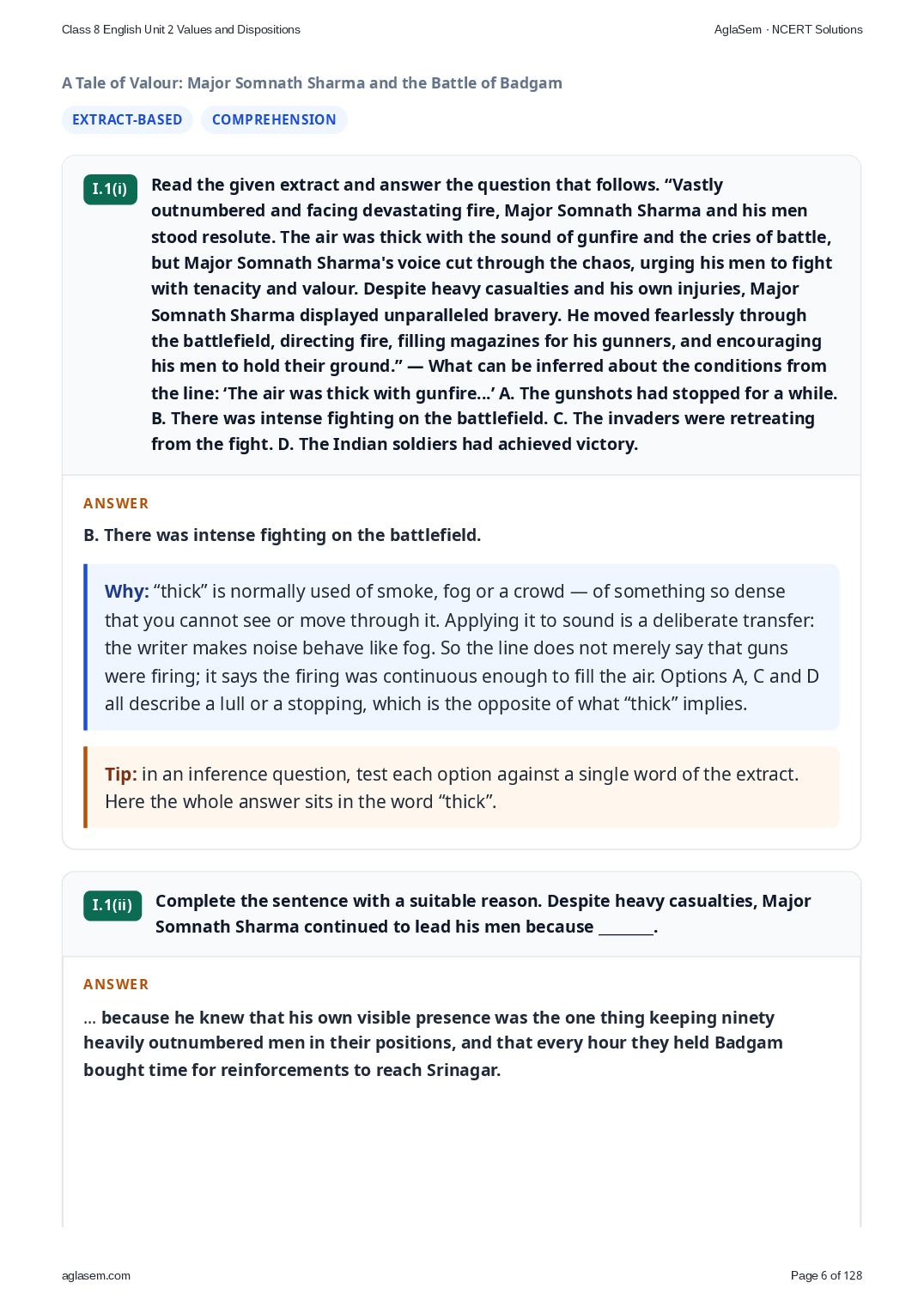
- Read the given extract and answer the question that follows. “Vastly outnumbered and facing devastating fire, Major Somnath Sharma and his men stood resolute. The air was thick with the sound of gunfire and the cries of battle, but Major Somnath Sharma's voice cut through the chaos, urging his men to fight with tenacity and valour. Despite heavy casualties and his own injuries, Major Somnath Sharma displayed unparalleled bravery. He moved fearlessly through the battlefield, directing fire, filling magazines for his gunners, and encouraging his men to hold their ground.” — What can be inferred about the conditions from the line: ‘The air was thick with gunfire…’ A. The gunshots had stopped for a while. B. There was intense fighting on the battlefield. C. The invaders were retreating from the fight. D. The Indian soldiers had achieved victory.
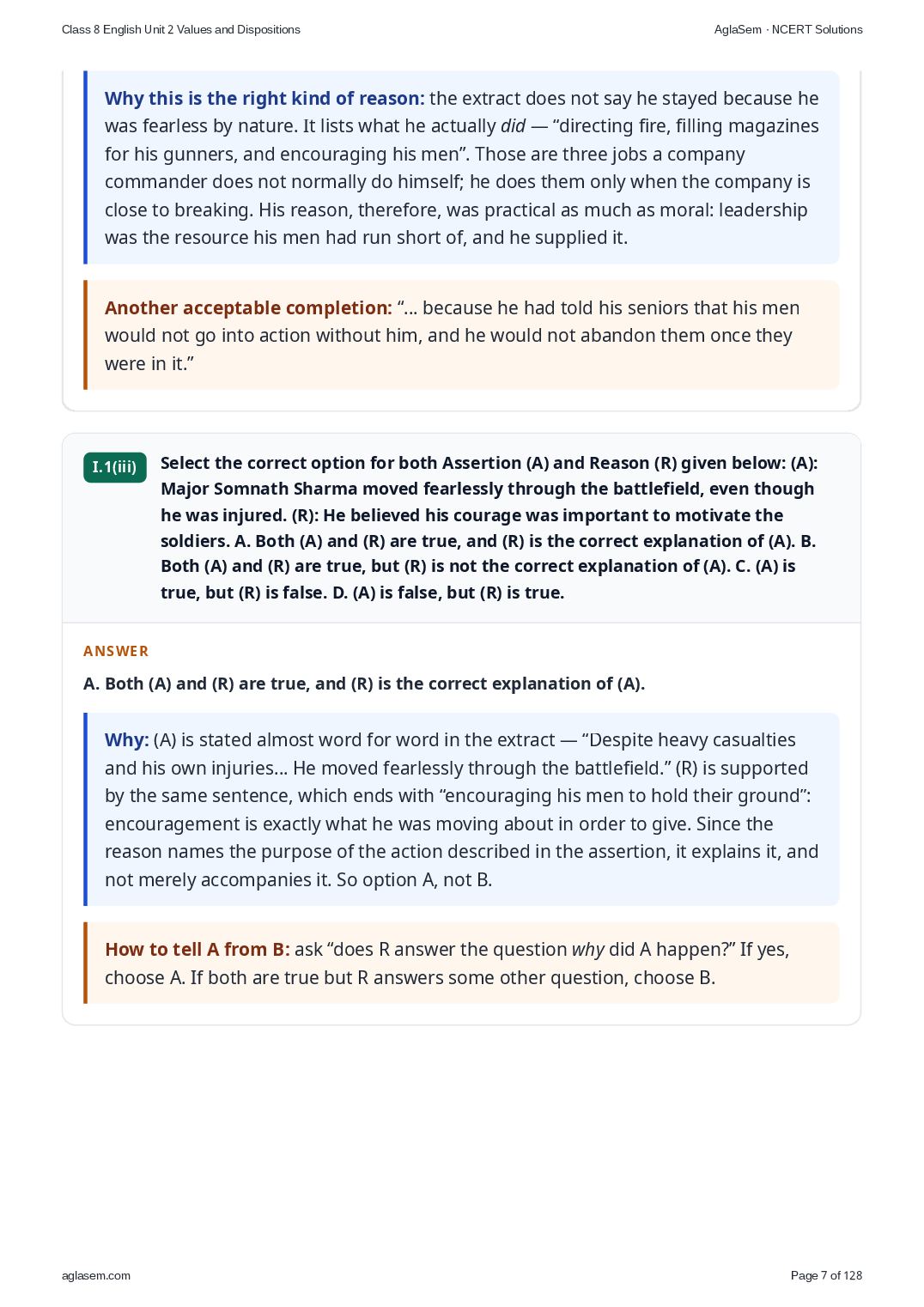
- Complete the sentence with a suitable reason. Despite heavy casualties, Major Somnath Sharma continued to lead his men because ________.
- Select the correct option for both Assertion (A) and Reason (R) given below: (A): Major Somnath Sharma moved fearlessly through the battlefield, even though he was injured. (R): He believed his courage was important to motivate the soldiers. A. Both (A) and (R) are true, and (R) is the correct explanation of (A). B. Both (A) and (R) are true, but (R) is not the correct explanation of (A). C. (A) is true, but (R) is false. D. (A) is false, but (R) is true.
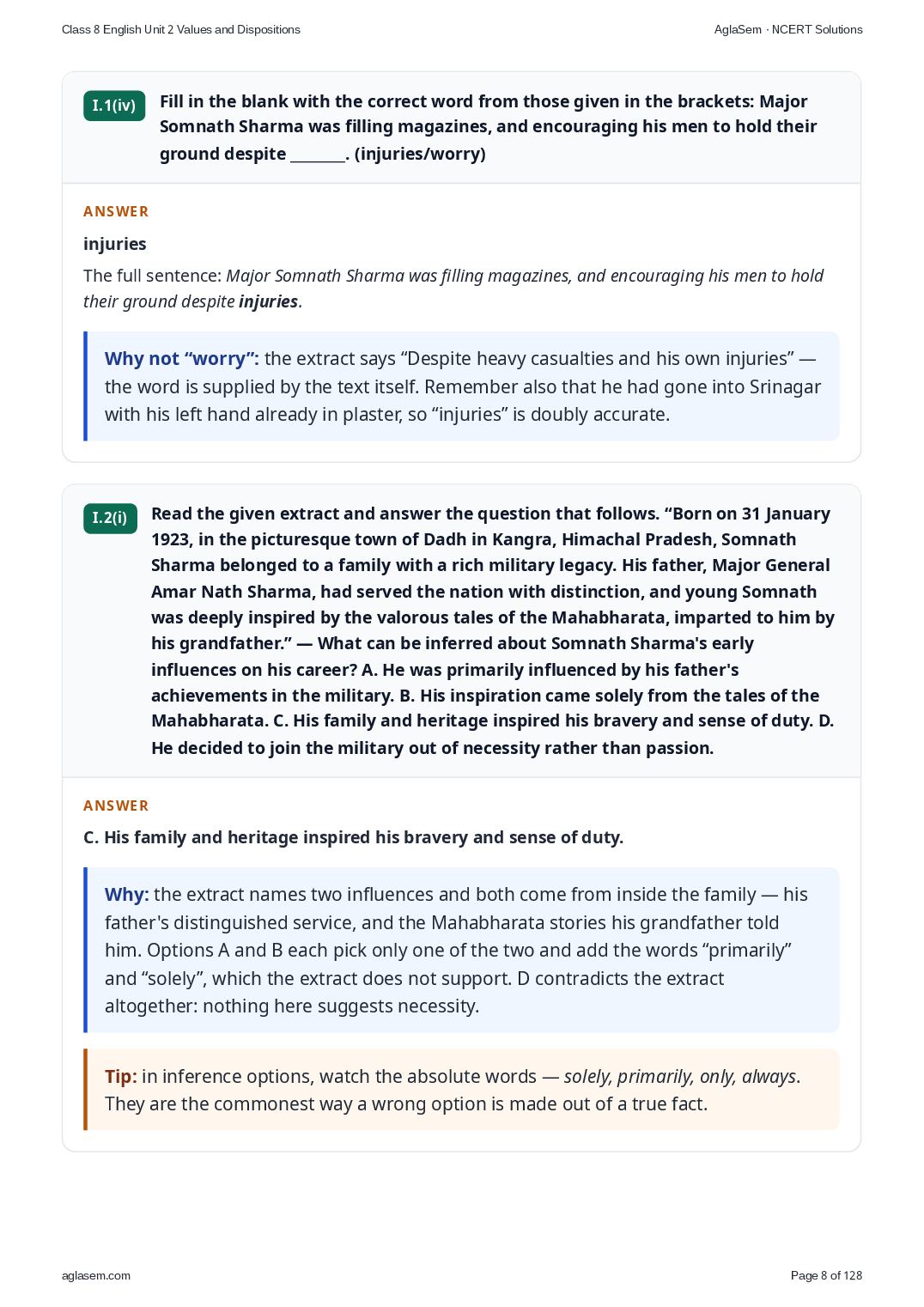
- Fill in the blank with the correct word from those given in the brackets: Major Somnath Sharma was filling magazines, and encouraging his men to hold their ground despite ________. (injuries/worry)
- Read the given extract and answer the question that follows. “Born on 31 January 1923, in the picturesque town of Dadh in Kangra, Himachal Pradesh, Somnath Sharma belonged to a family with a rich military legacy. His father, Major General Amar Nath Sharma, had served the nation with distinction, and young Somnath was deeply inspired by the valorous tales of the Mahabharata, imparted to him by his grandfather.” — What can be inferred about Somnath Sharma's early influences on his career? A. He was primarily influenced by his father's achievements in the military. B. His inspiration came solely from the tales of the Mahabharata. C. His family and heritage inspired his bravery and sense of duty. D. He decided to join the military out of necessity rather than passion.
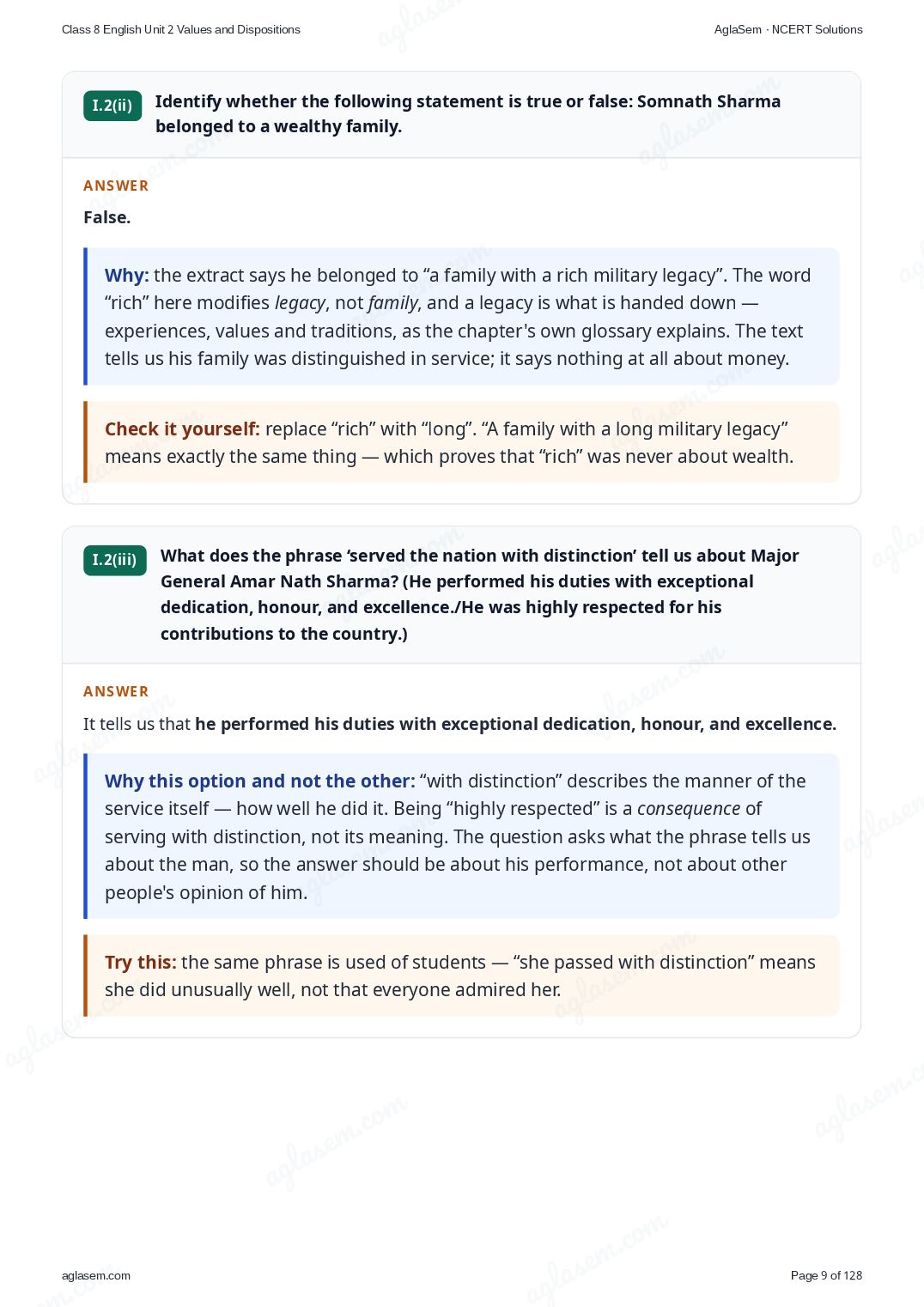
- Identify whether the following statement is true or false: Somnath Sharma belonged to a wealthy family.
- What does the phrase ‘served the nation with distinction’ tell us about Major General Amar Nath Sharma? (He performed his duties with exceptional dedication, honour, and excellence./He was highly respected for his contributions to the country.)
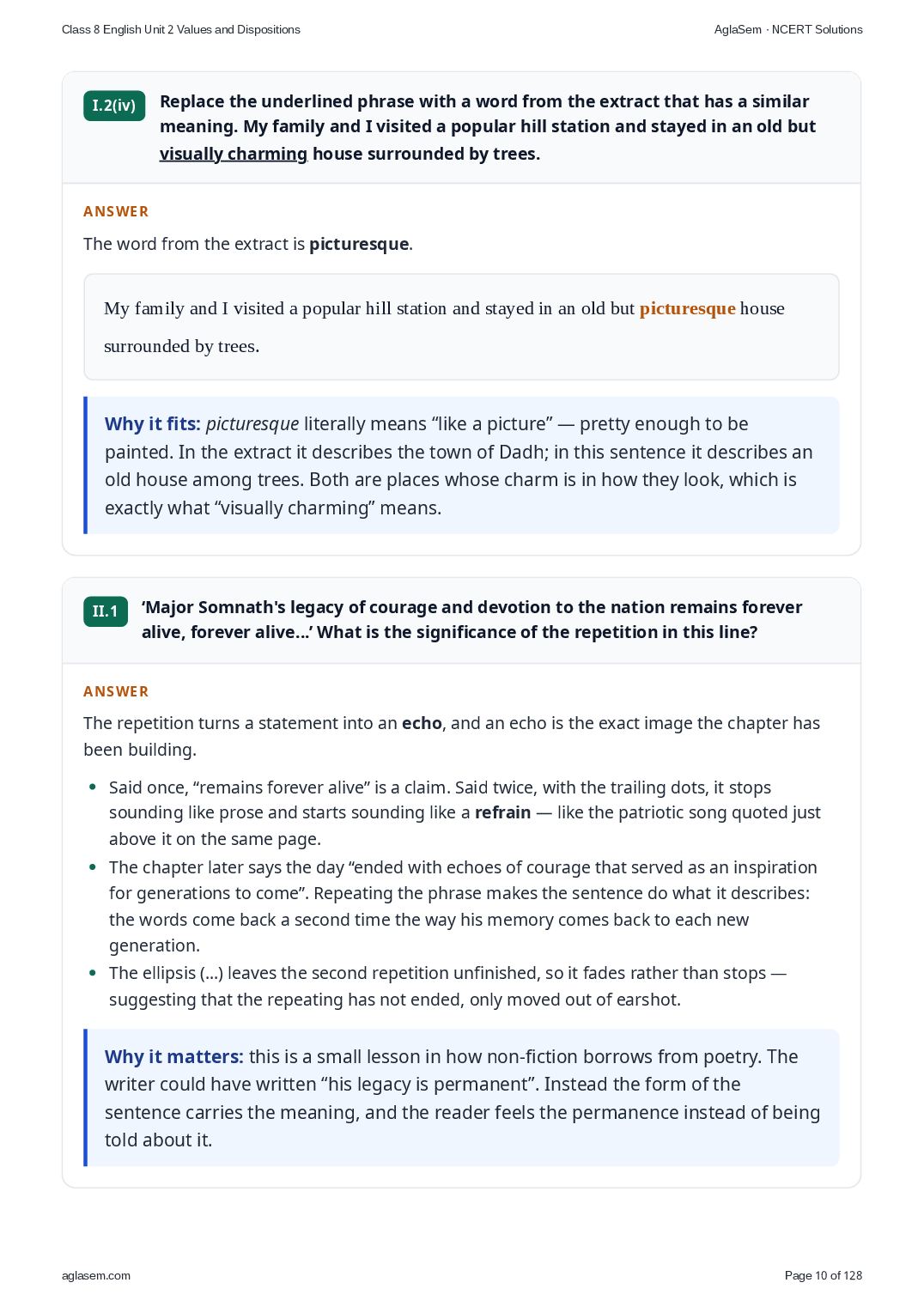
- Replace the underlined phrase with a word from the extract that has a similar meaning. My family and I visited a popular hill station and stayed in an old but visually charming house surrounded by trees.
- ‘Major Somnath's legacy of courage and devotion to the nation remains forever alive, forever alive…’ What is the significance of the repetition in this line?
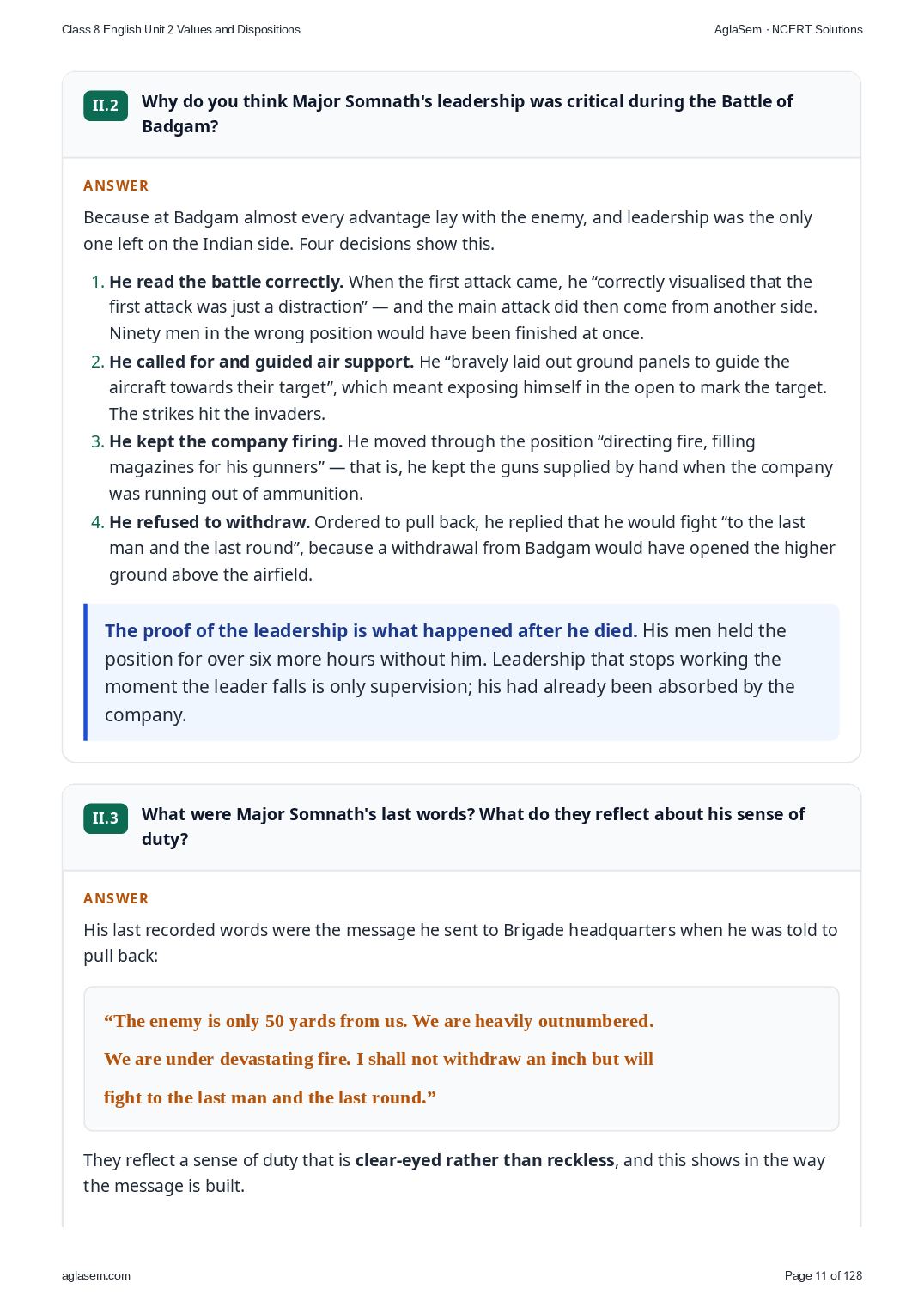
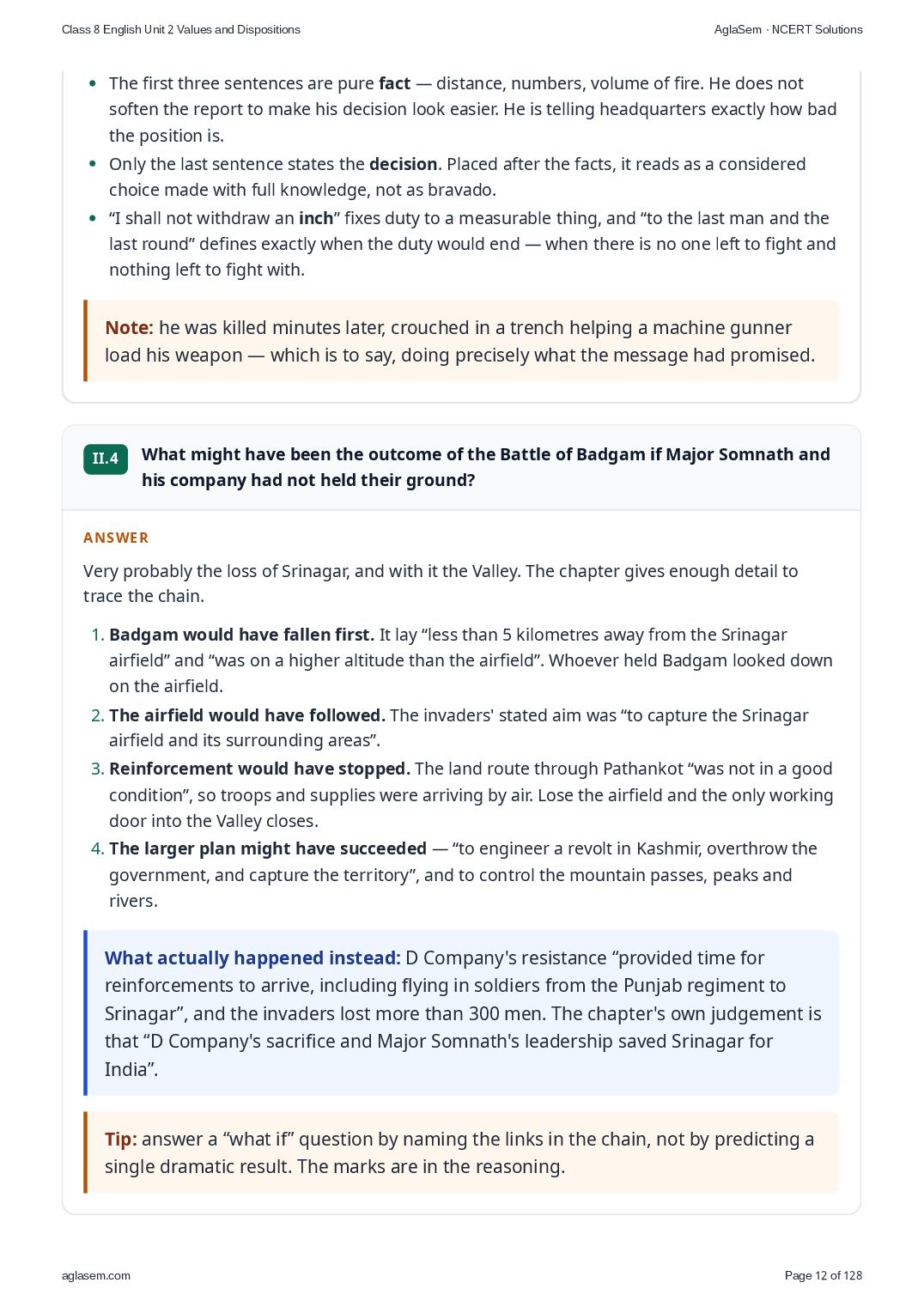
- Why do you think Major Somnath's leadership was critical during the Battle of Badgam?
- What were Major Somnath's last words? What do they reflect about his sense of duty?
- What might have been the outcome of the Battle of Badgam if Major Somnath and his company had not held their ground?
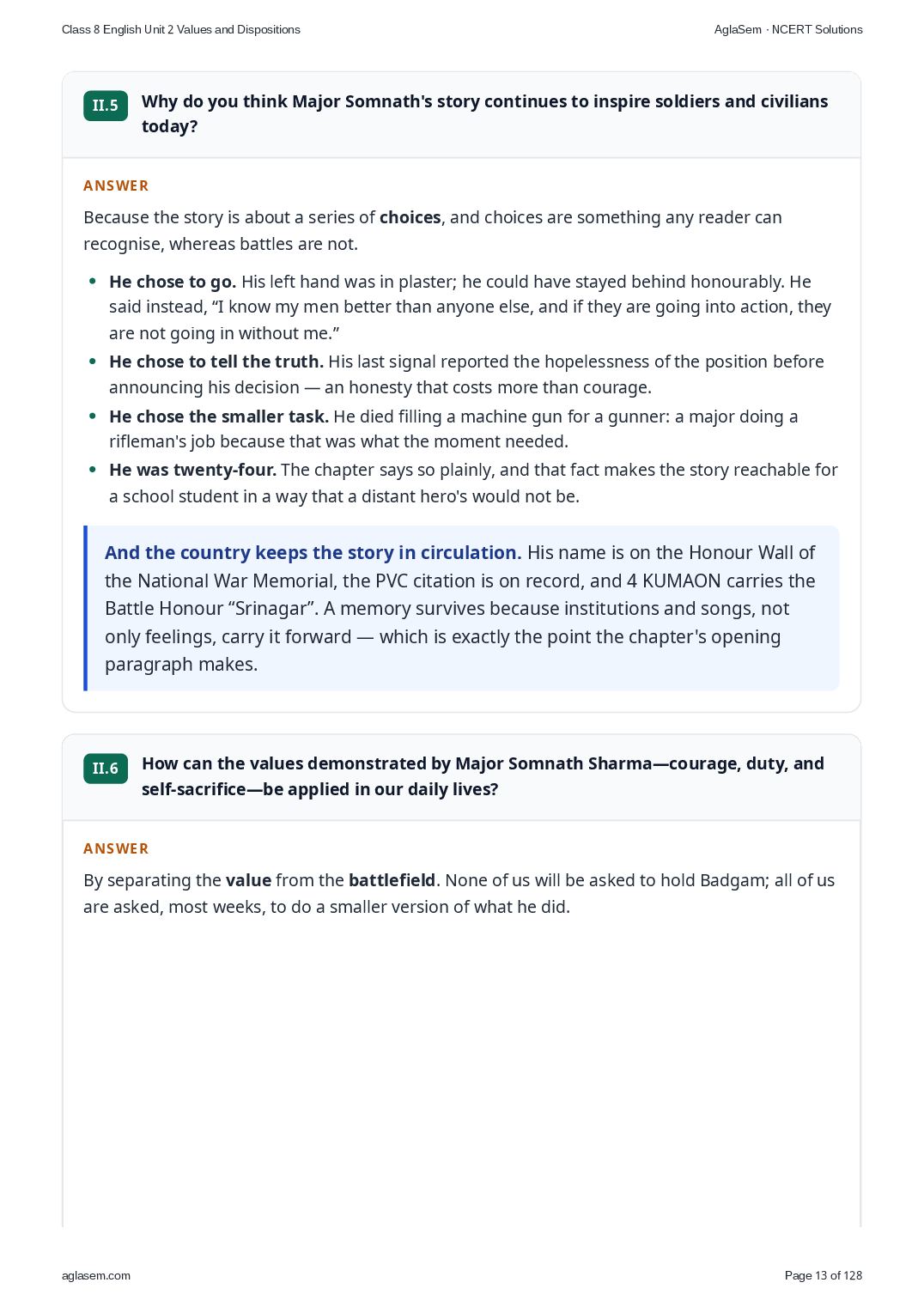
- Why do you think Major Somnath's story continues to inspire soldiers and civilians today?
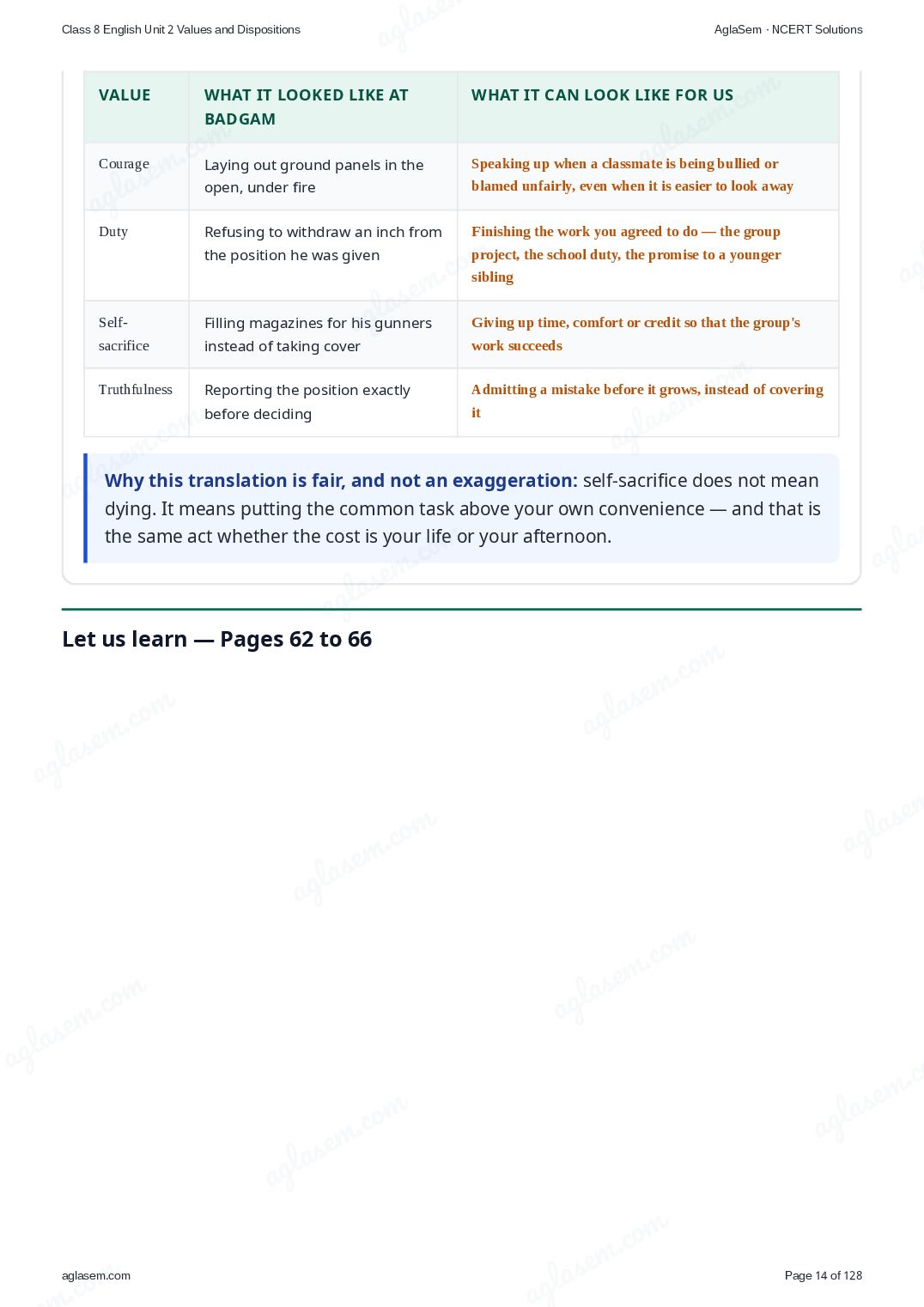
- How can the values demonstrated by Major Somnath Sharma—courage, duty, and self-sacrifice—be applied in our daily lives?
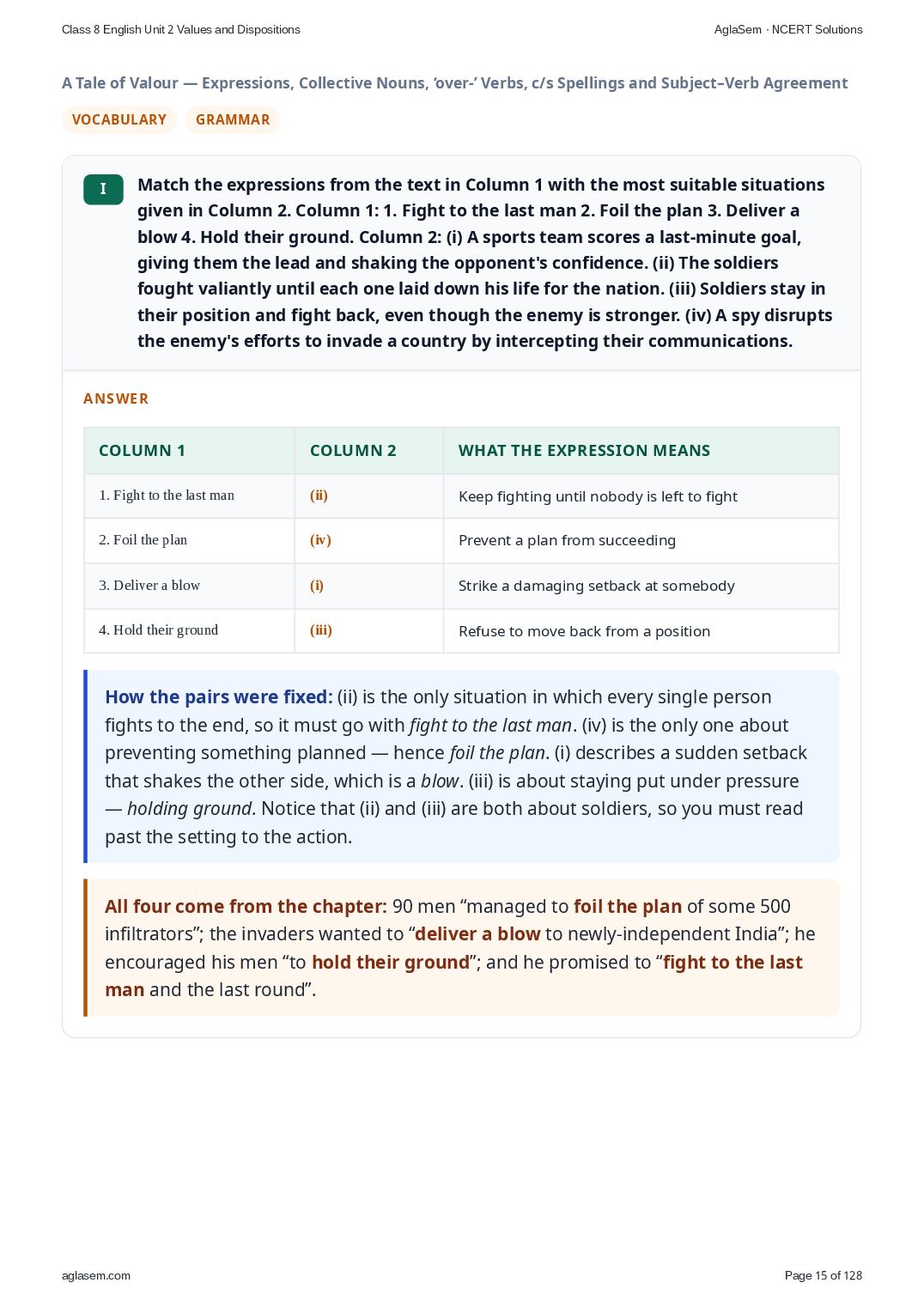
- Match the expressions from the text in Column 1 with the most suitable situations given in Column 2. Column 1: 1. Fight to the last man 2. Foil the plan 3. Deliver a blow 4. Hold their ground. Column 2: (i) A sports team scores a last-minute goal, giving them the lead and shaking the opponent's confidence. (ii) The soldiers fought valiantly until each one laid down his life for the nation. (iii) Soldiers stay in their position and fight back, even though the enemy is stronger. (iv) A spy disrupts the enemy's efforts to invade a country by intercepting their communications.
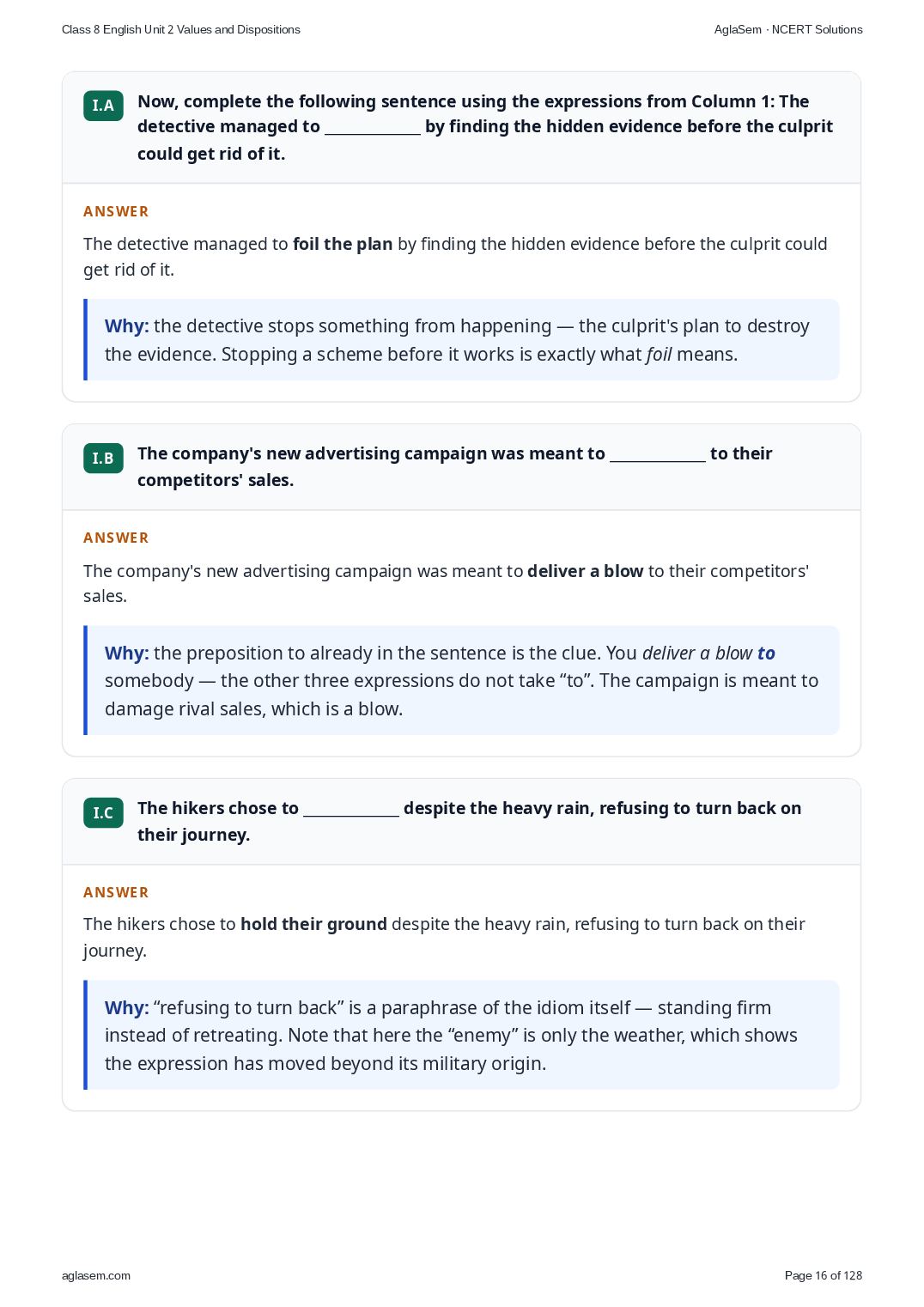
- Now, complete the following sentence using the expressions from Column 1: The detective managed to ______________ by finding the hidden evidence before the culprit could get rid of it.
- The company's new advertising campaign was meant to ______________ to their competitors' sales.
- The hikers chose to ______________ despite the heavy rain, refusing to turn back on their journey.
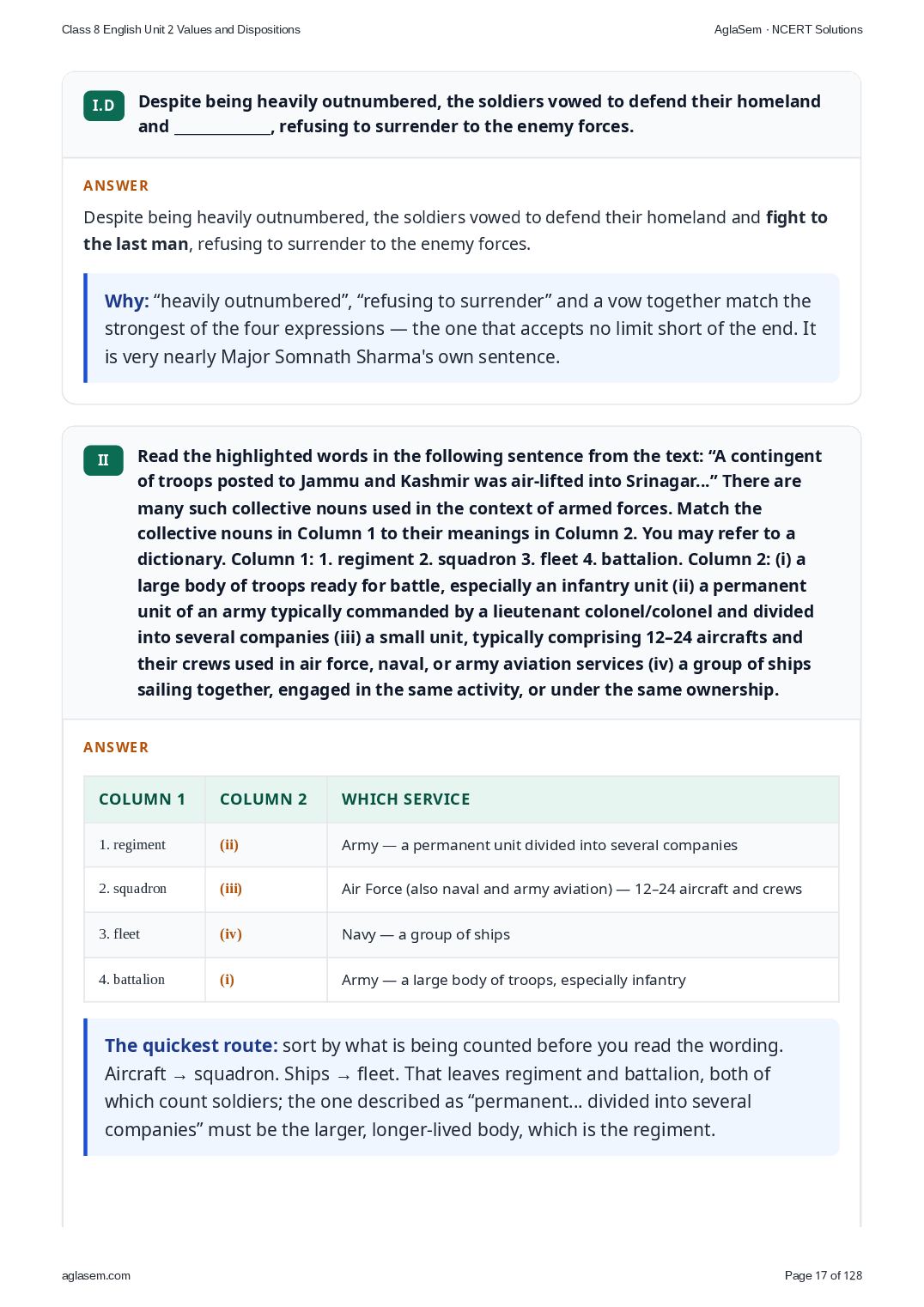
- Despite being heavily outnumbered, the soldiers vowed to defend their homeland and ______________, refusing to surrender to the enemy forces.
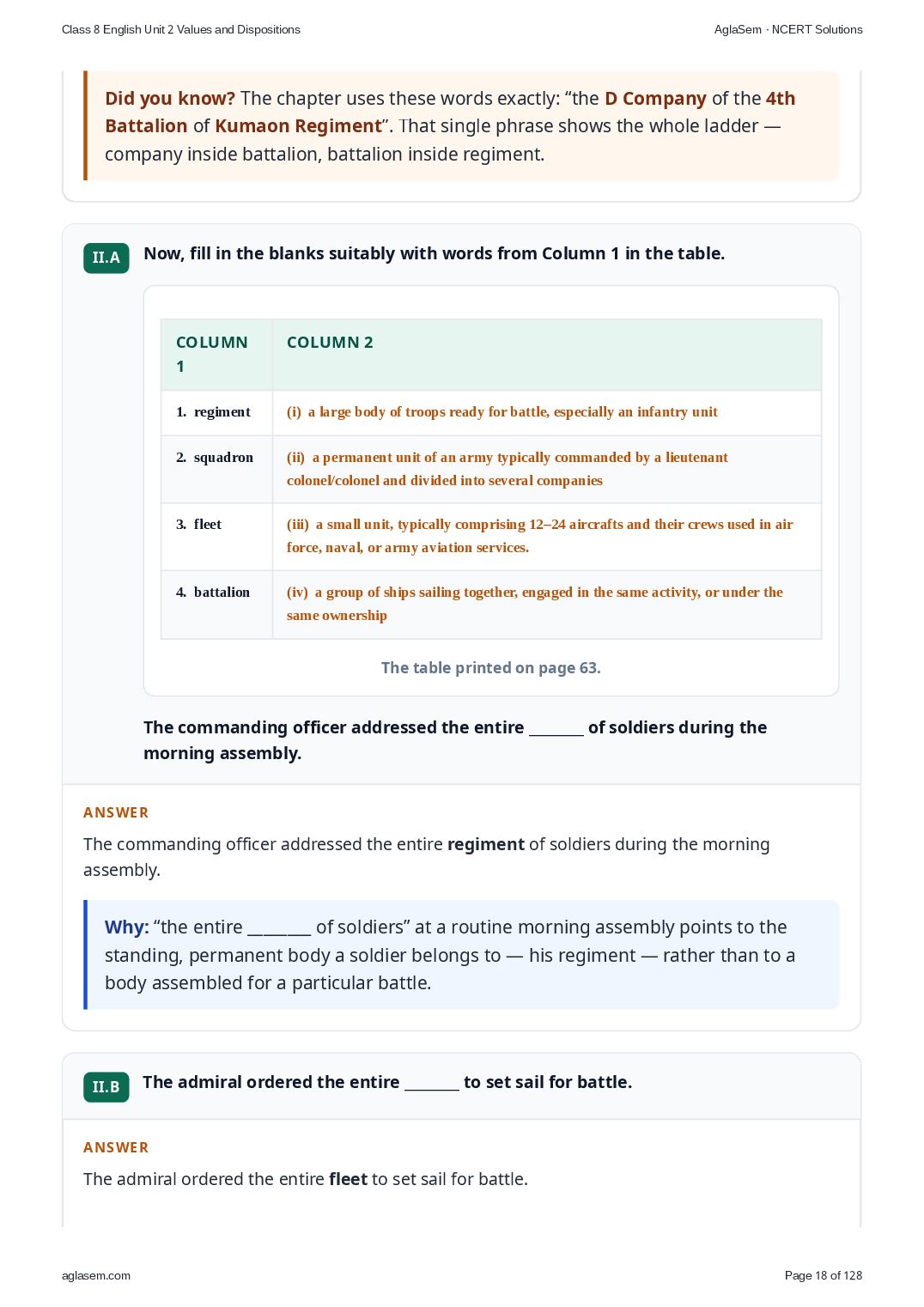
- Read the highlighted words in the following sentence from the text: “A contingent of troops posted to Jammu and Kashmir was air-lifted into Srinagar…” There are many such collective nouns used in the context of armed forces. Match the collective nouns in Column 1 to their meanings in Column 2. You may refer to a dictionary. Column 1: 1. regiment 2. squadron 3. fleet 4. battalion. Column 2: (i) a large body of troops ready for battle, especially an infantry unit (ii) a permanent unit of an army typically commanded by a lieutenant colonel/colonel and divided into several companies (iii) a small unit, typically comprising 12–24 aircrafts and their crews used in air force, naval, or army aviation services (iv) a group of ships sailing together, engaged in the same activity, or under the same ownership.
- Now, fill in the blanks suitably with words from Column 1 in the table: The commanding officer addressed the entire ________ of soldiers during the morning assembly.
- The admiral ordered the entire ________ to set sail for battle.
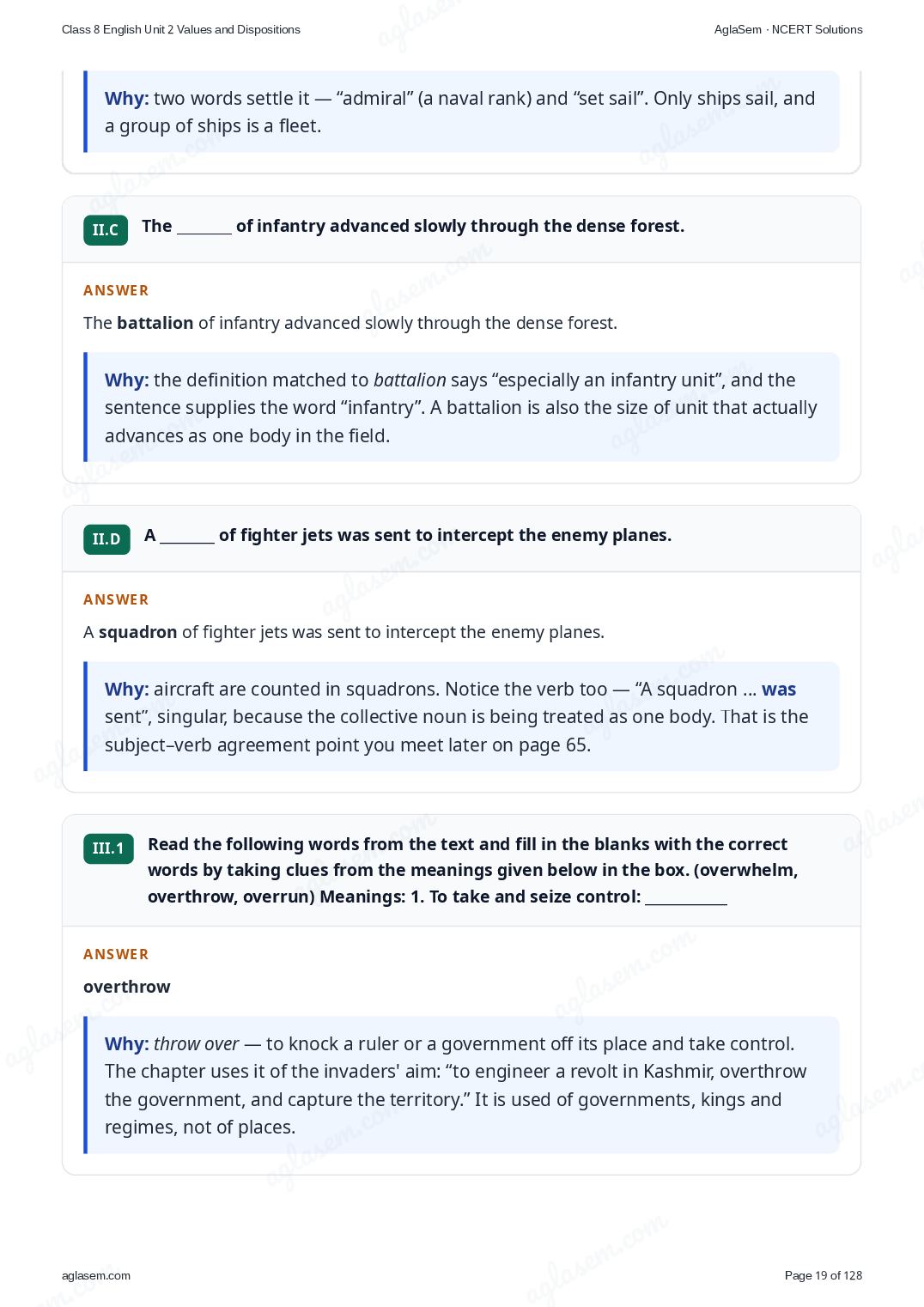
- The ________ of infantry advanced slowly through the dense forest.
- A ________ of fighter jets was sent to intercept the enemy planes.
- Read the following words from the text and fill in the blanks with the correct words by taking clues from the meanings given below in the box. (overwhelm, overthrow, overrun) Meanings: 1. To take and seize control: ____________
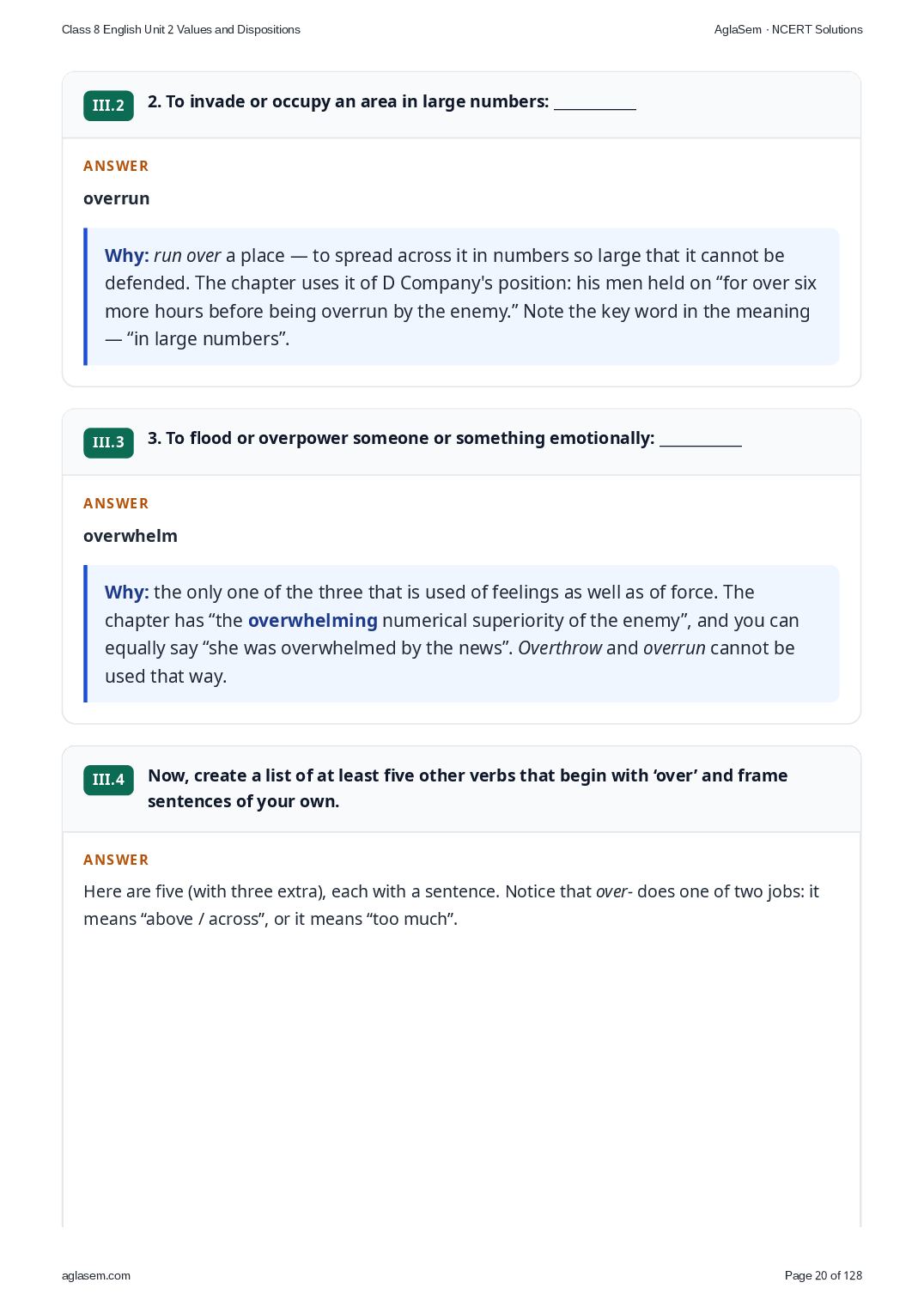
- 2. To invade or occupy an area in large numbers: ____________
- 3. To flood or overpower someone or something emotionally: ____________
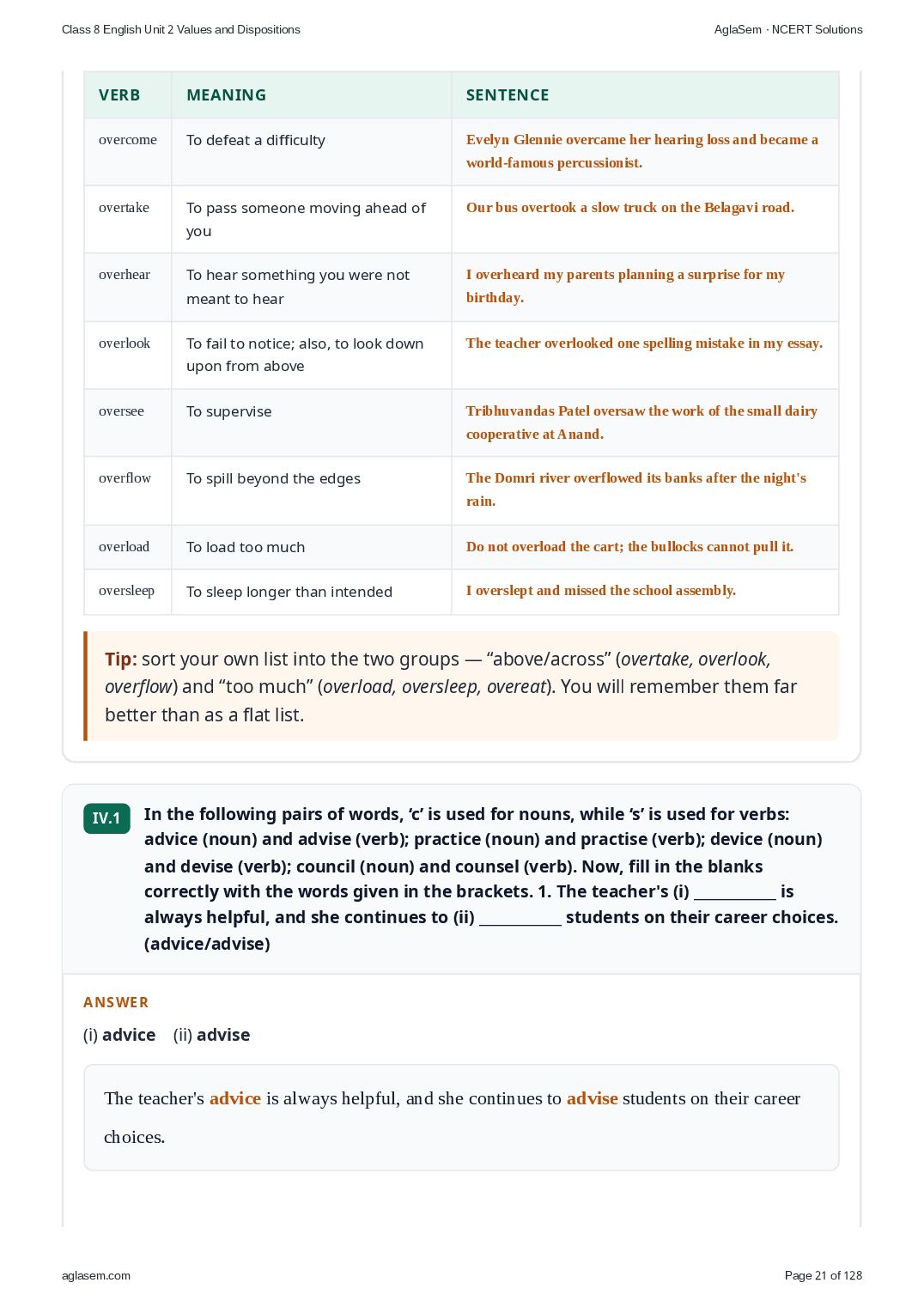
- Now, create a list of at least five other verbs that begin with ‘over’ and frame sentences of your own.
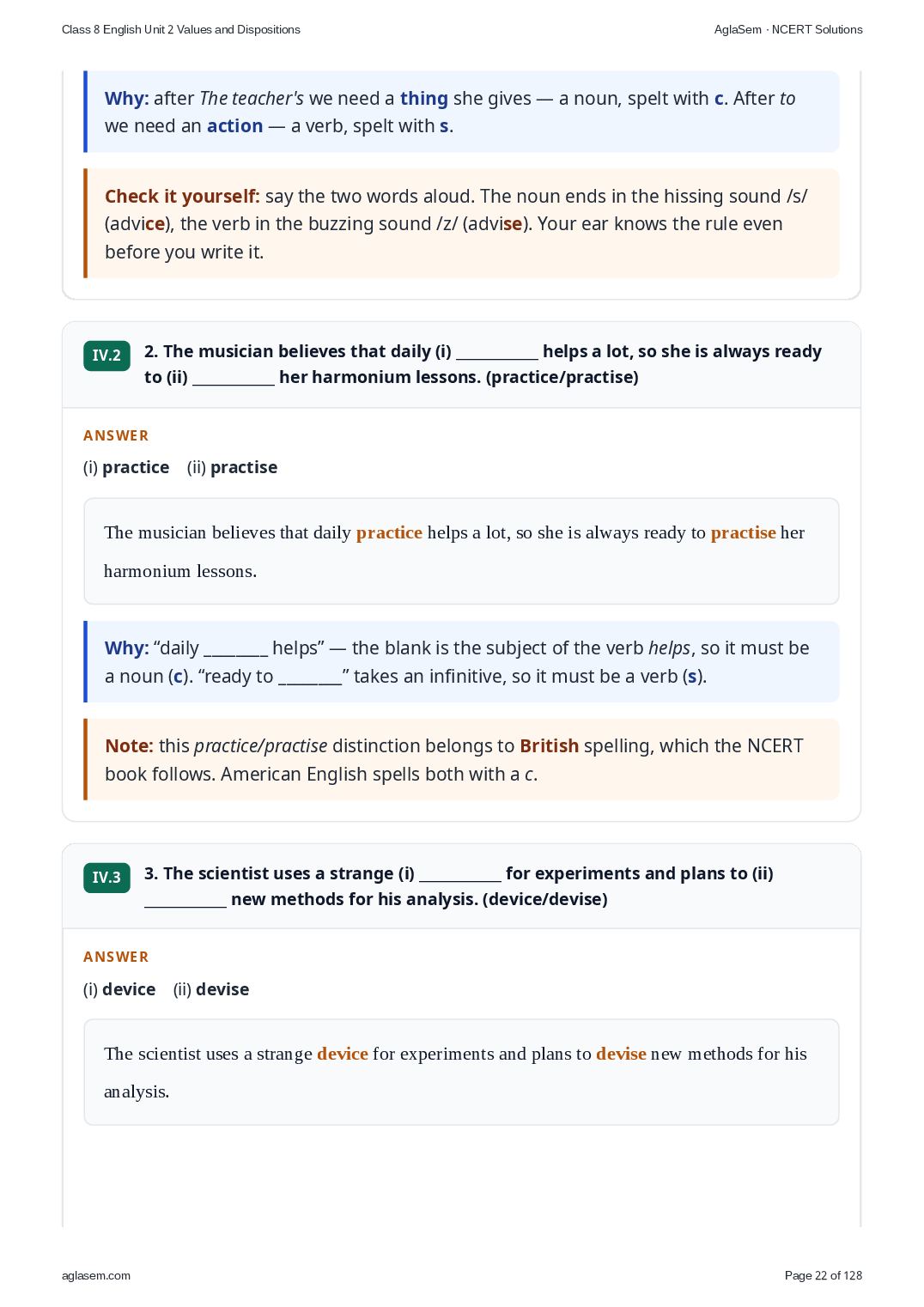
- In the following pairs of words, ‘c’ is used for nouns, while ‘s’ is used for verbs: advice (noun) and advise (verb); practice (noun) and practise (verb); device (noun) and devise (verb); council (noun) and counsel (verb). Now, fill in the blanks correctly with the words given in the brackets. 1. The teacher's (i) ____________ is always helpful, and she continues to (ii) ____________ students on their career choices. (advice/advise)
- 2. The musician believes that daily (i) ____________ helps a lot, so she is always ready to (ii) ____________ her harmonium lessons. (practice/practise)
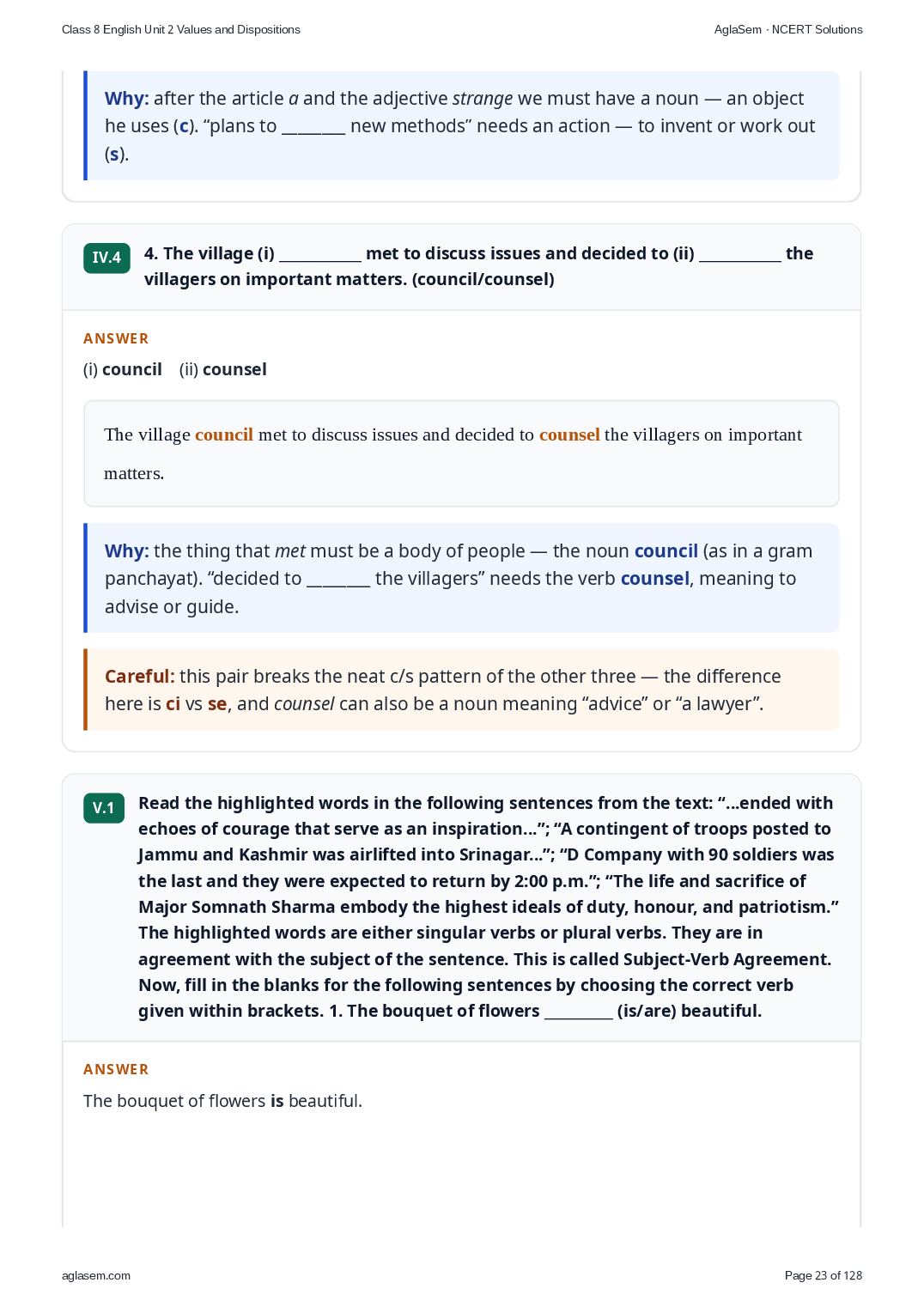
- 3. The scientist uses a strange (i) ____________ for experiments and plans to (ii) ____________ new methods for his analysis. (device/devise)
- 4. The village (i) ____________ met to discuss issues and decided to (ii) ____________ the villagers on important matters. (council/counsel)
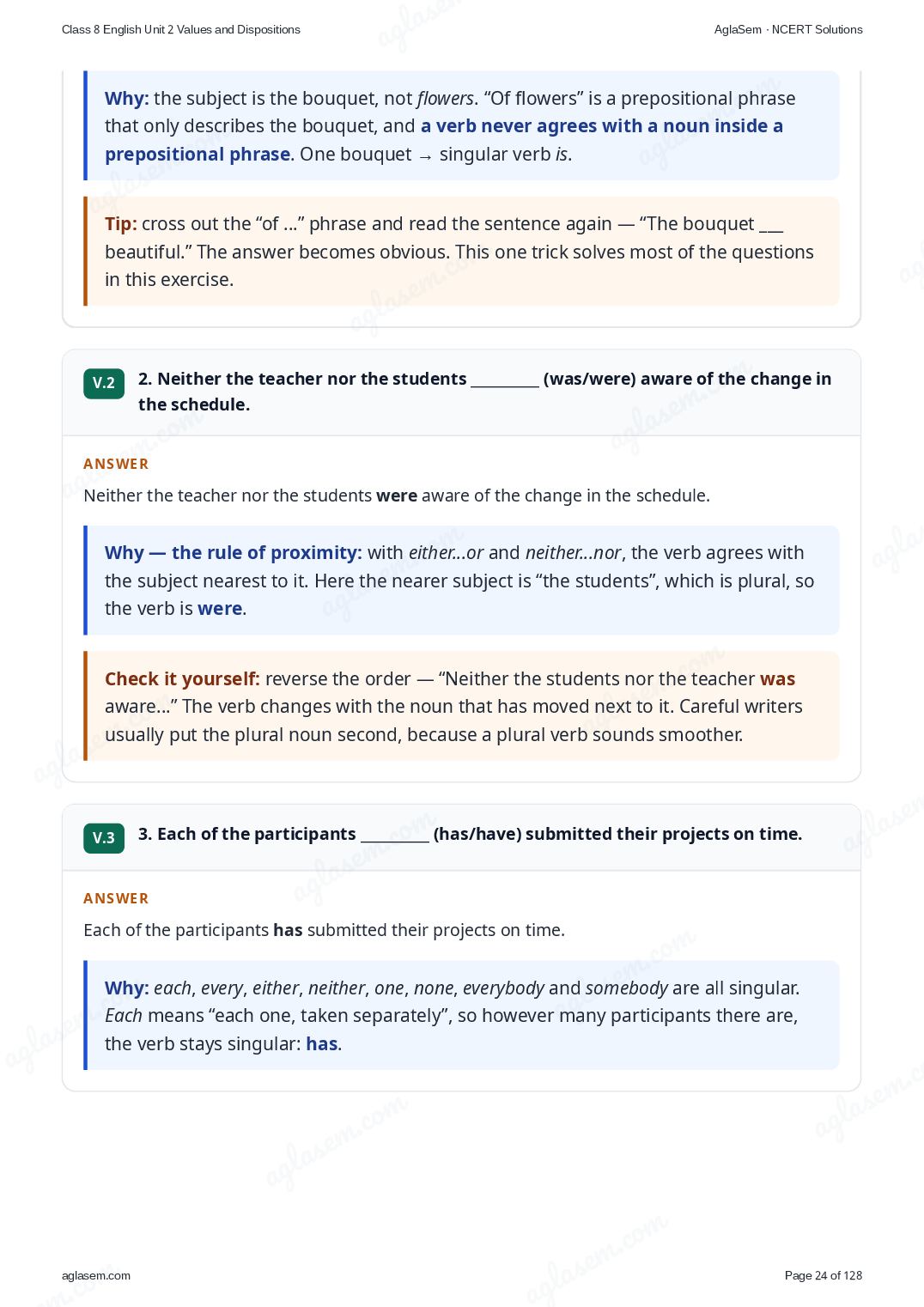
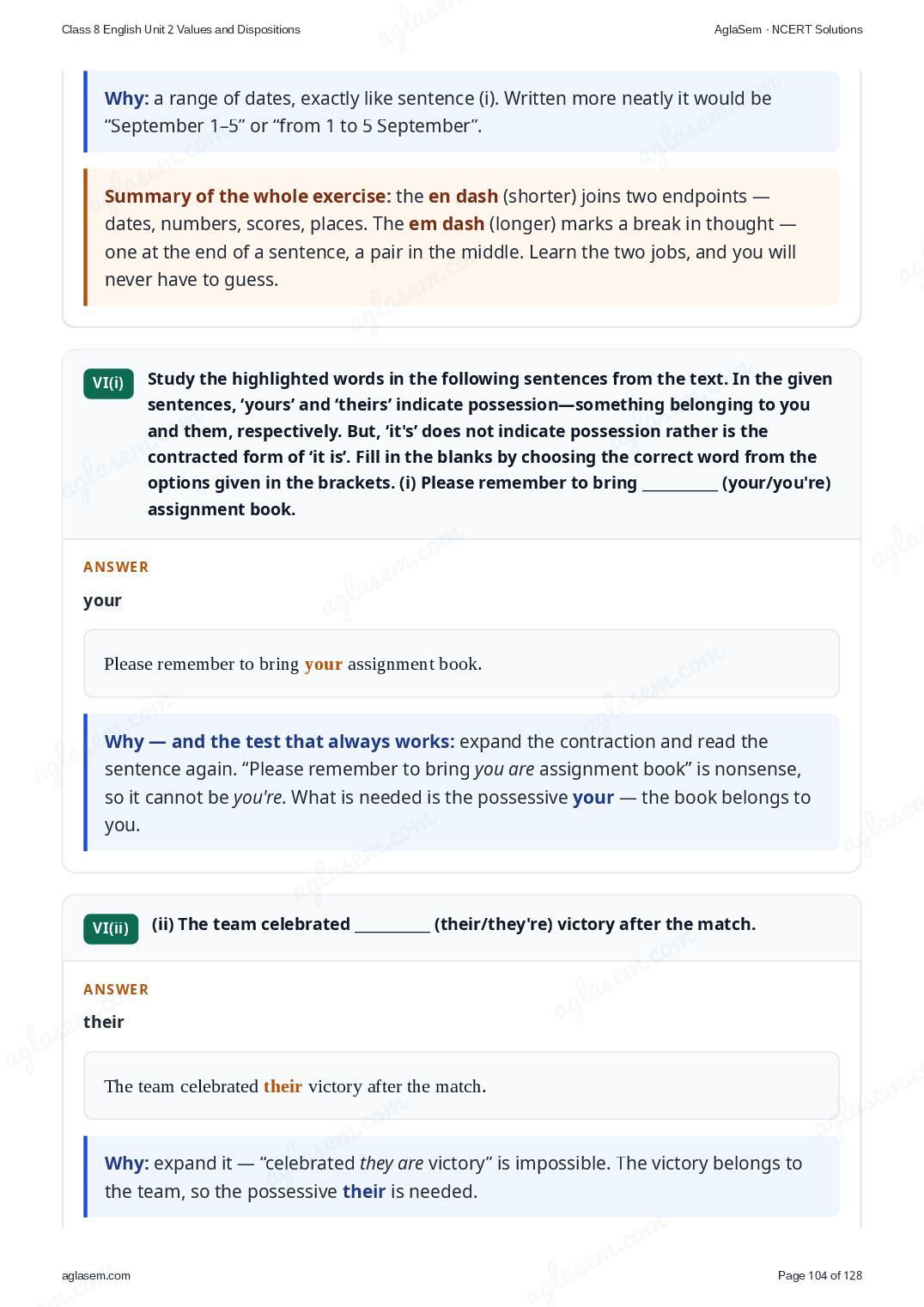
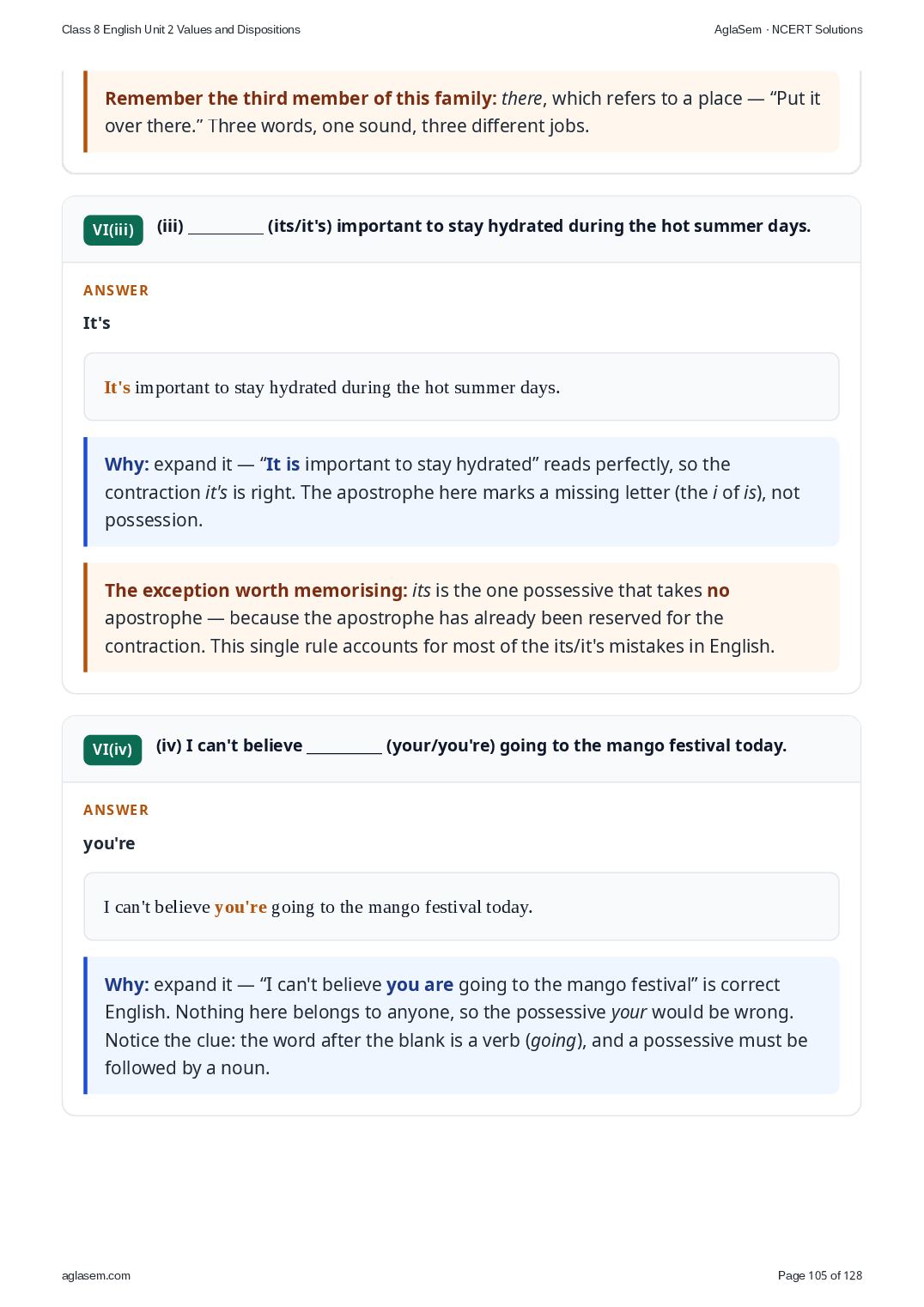
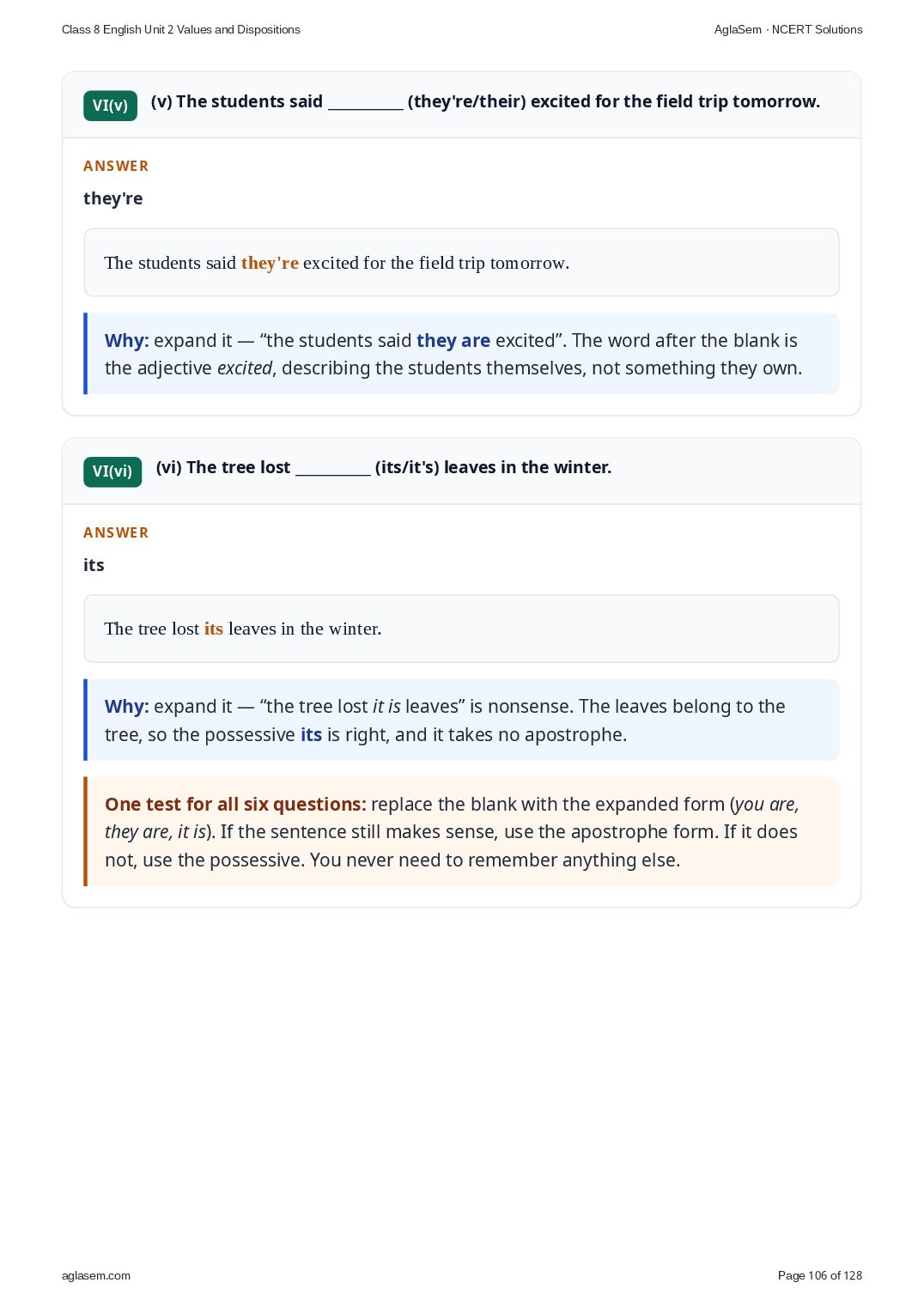
- Read the highlighted words in the following sentences from the text: “…ended with echoes of courage that serve as an inspiration…”; “A contingent of troops posted to Jammu and Kashmir was airlifted into Srinagar…”; “D Company with 90 soldiers was the last and they were expected to return by 2:00 p.m.”; “The life and sacrifice of Major Somnath Sharma embody the highest ideals of duty, honour, and patriotism.” The highlighted words are either singular verbs or plural verbs. They are in agreement with the subject of the sentence. This is called Subject-Verb Agreement. Now, fill in the blanks for the following sentences by choosing the correct verb given within brackets. 1. The bouquet of flowers __________ (is/are) beautiful.
- 2. Neither the teacher nor the students __________ (was/were) aware of the change in the schedule.
- 3. Each of the participants __________ (has/have) submitted their projects on time.
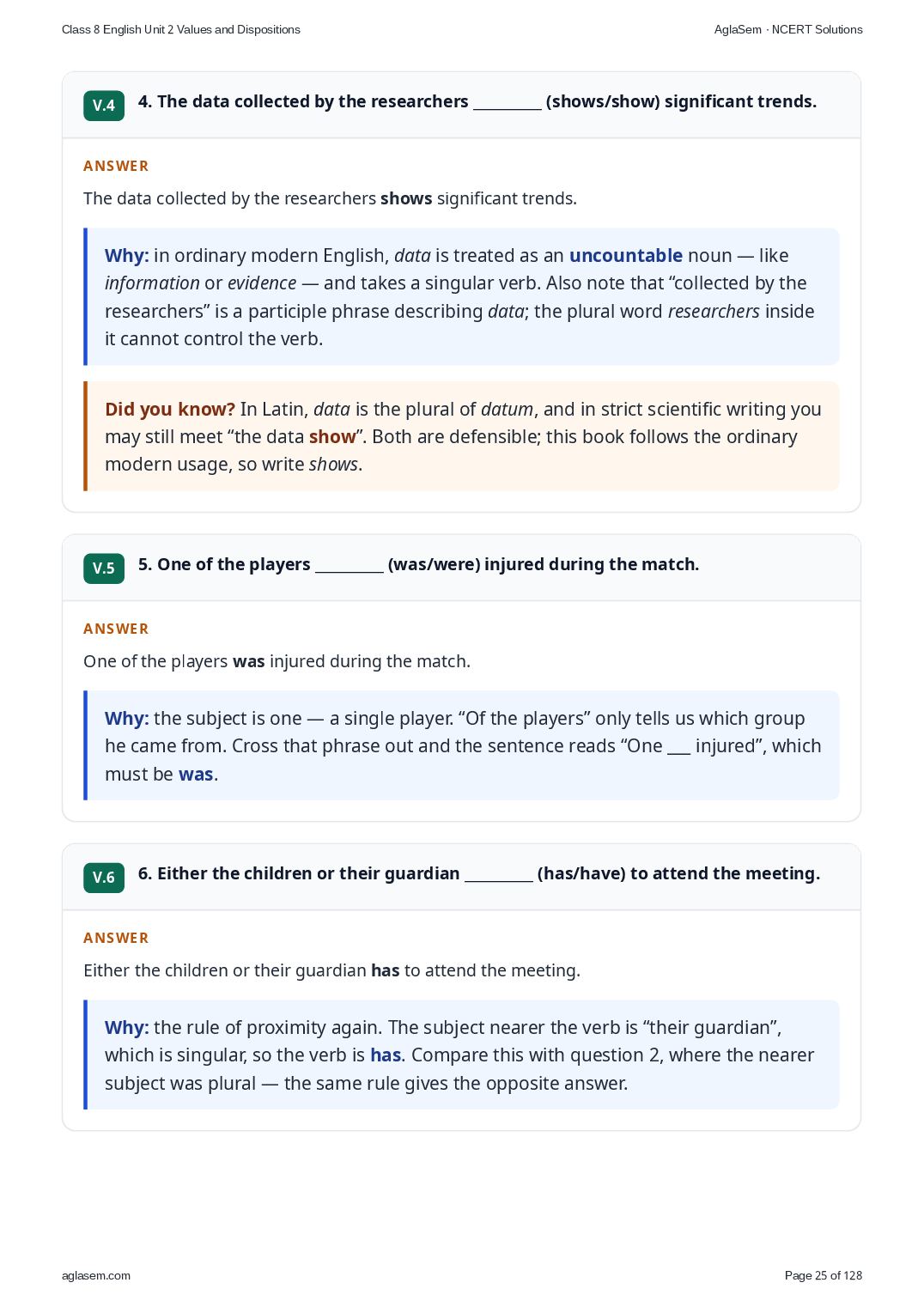
- 4. The data collected by the researchers __________ (shows/show) significant trends.
- 5. One of the players __________ (was/were) injured during the match.
- 6. Either the children or their guardian __________ (has/have) to attend the meeting.
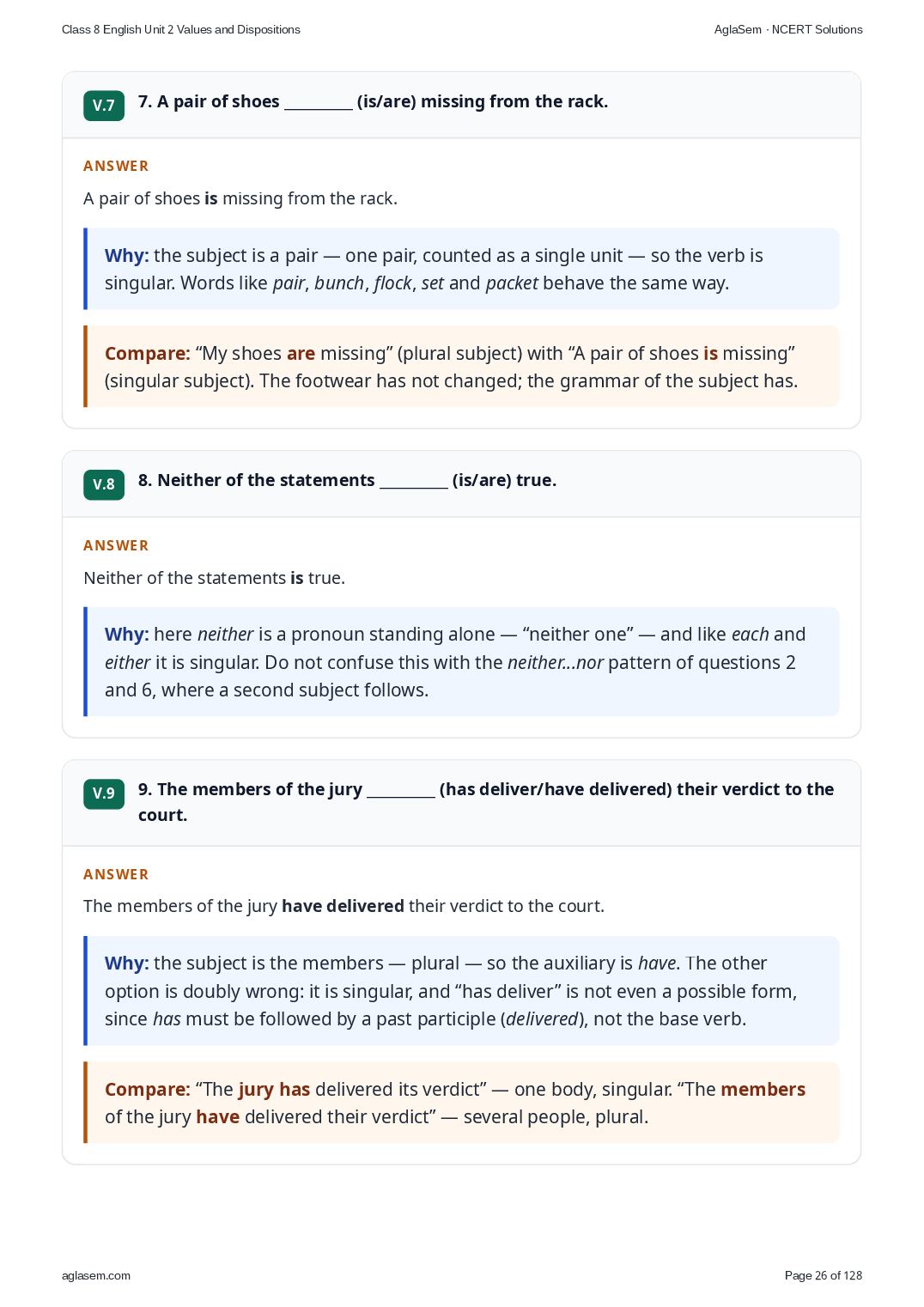
- 7. A pair of shoes __________ (is/are) missing from the rack.
- 8. Neither of the statements __________ (is/are) true.
- 9. The members of the jury __________ (has deliver/have delivered) their verdict to the court.
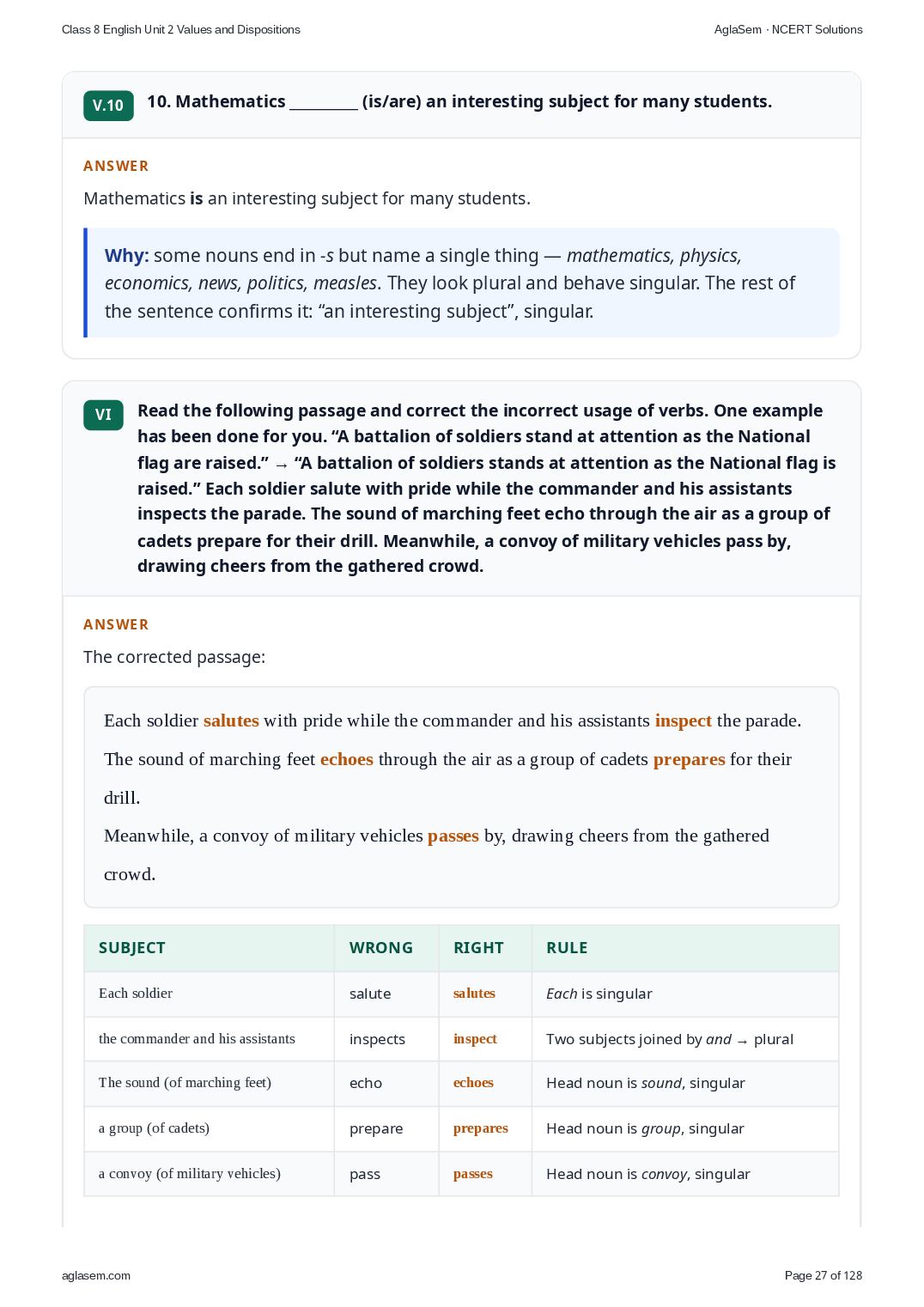
- 10. Mathematics __________ (is/are) an interesting subject for many students.
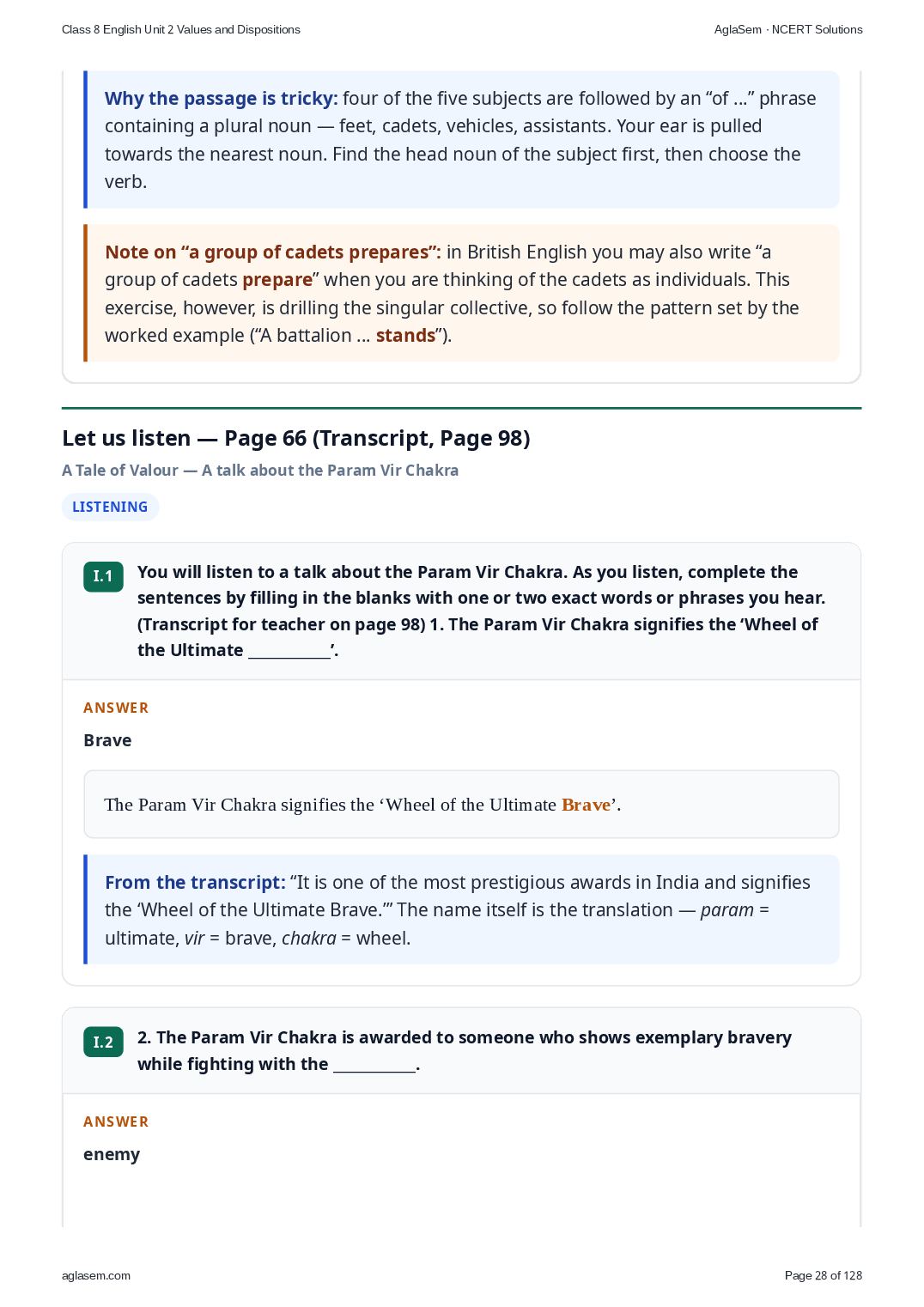
- Read the following passage and correct the incorrect usage of verbs. One example has been done for you. “A battalion of soldiers stand at attention as the National flag are raised.” → “A battalion of soldiers stands at attention as the National flag is raised.” Each soldier salute with pride while the commander and his assistants inspects the parade. The sound of marching feet echo through the air as a group of cadets prepare for their drill. Meanwhile, a convoy of military vehicles pass by, drawing cheers from the gathered crowd.
- You will listen to a talk about the Param Vir Chakra. As you listen, complete the sentences by filling in the blanks with one or two exact words or phrases you hear. (Transcript for teacher on page 98) 1. The Param Vir Chakra signifies the ‘Wheel of the Ultimate ____________’.
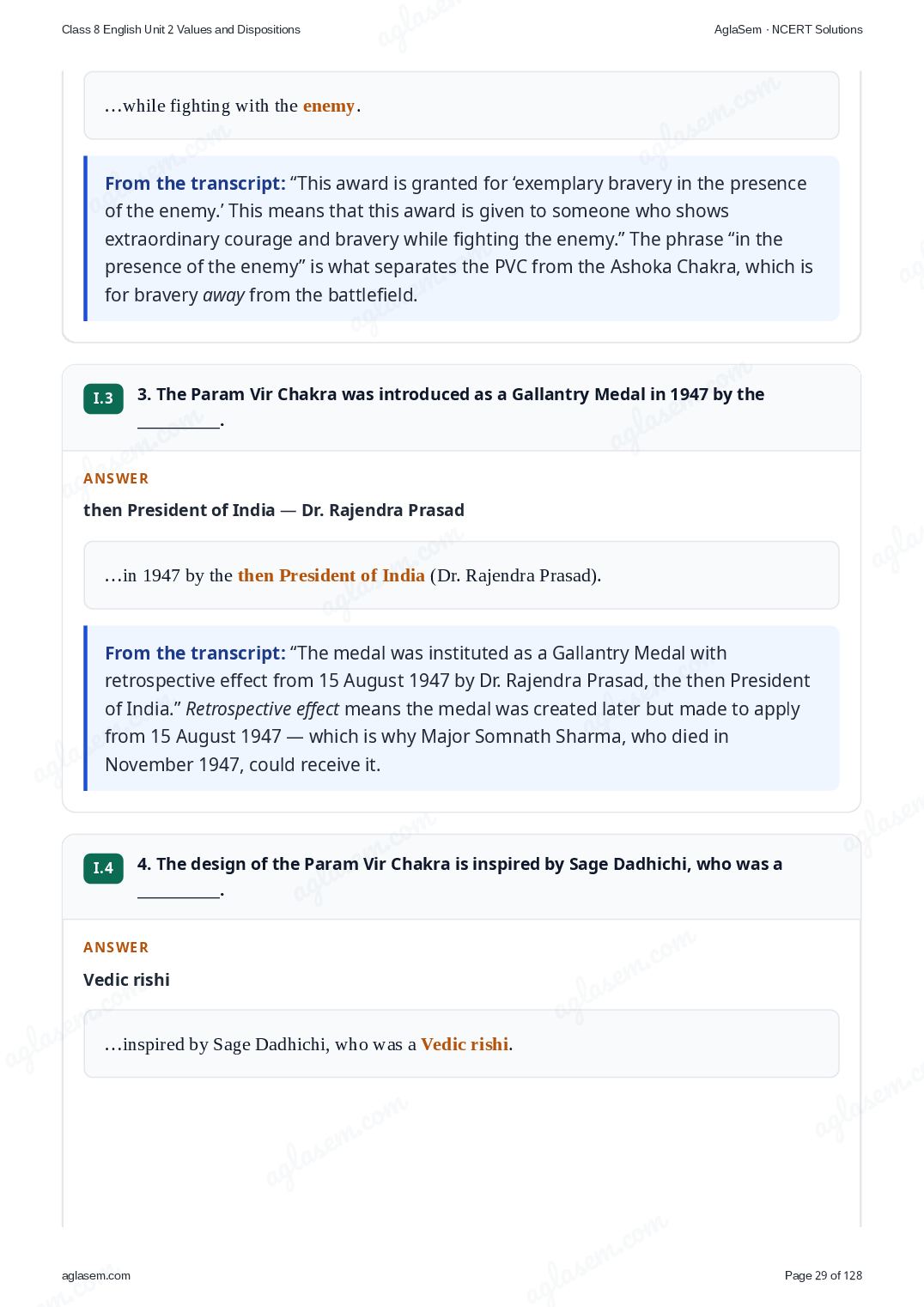
- 2. The Param Vir Chakra is awarded to someone who shows exemplary bravery while fighting with the ____________.
- 3. The Param Vir Chakra was introduced as a Gallantry Medal in 1947 by the ____________.
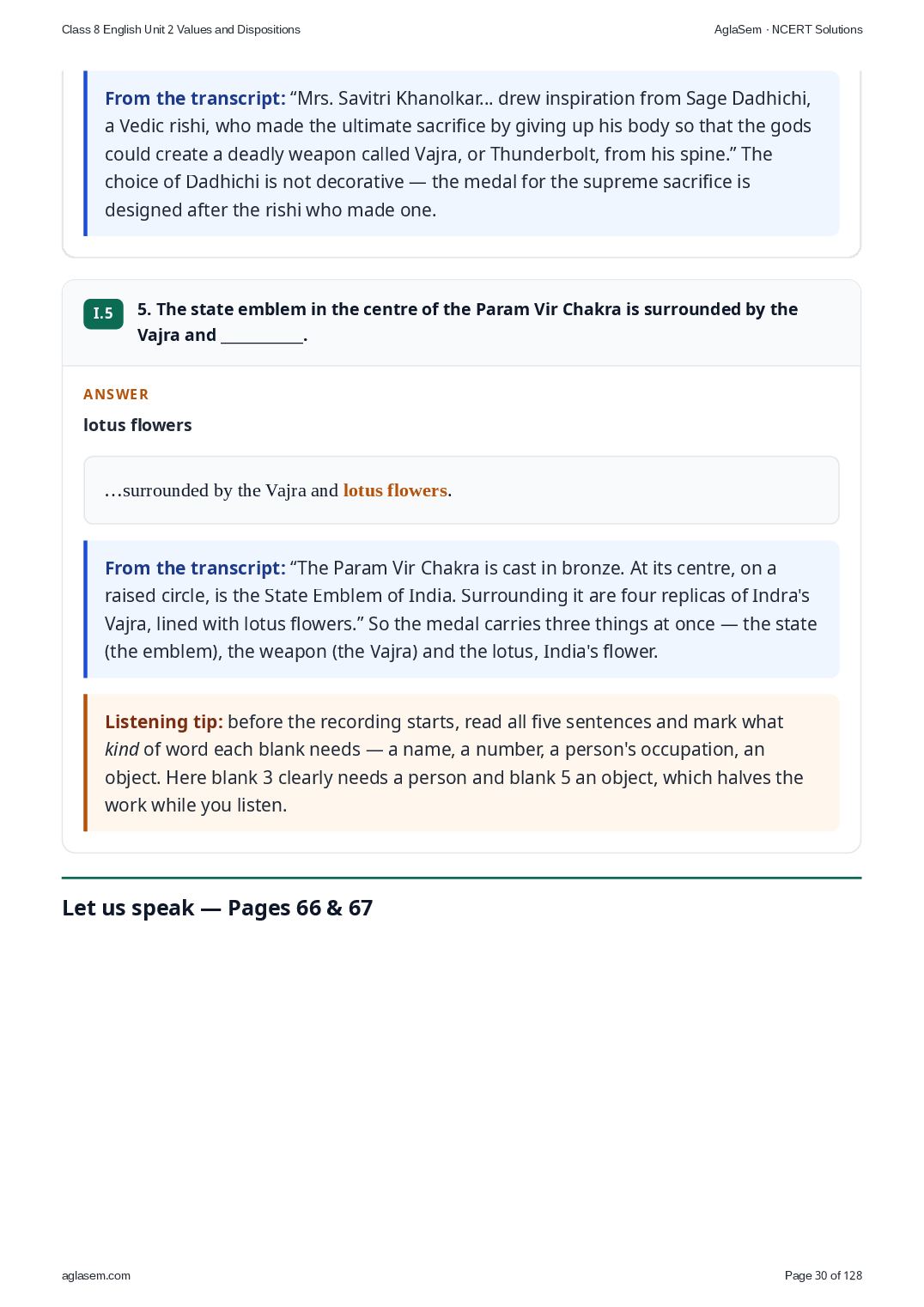
- 4. The design of the Param Vir Chakra is inspired by Sage Dadhichi, who was a ____________.
- 5. The state emblem in the centre of the Param Vir Chakra is surrounded by the Vajra and ____________.
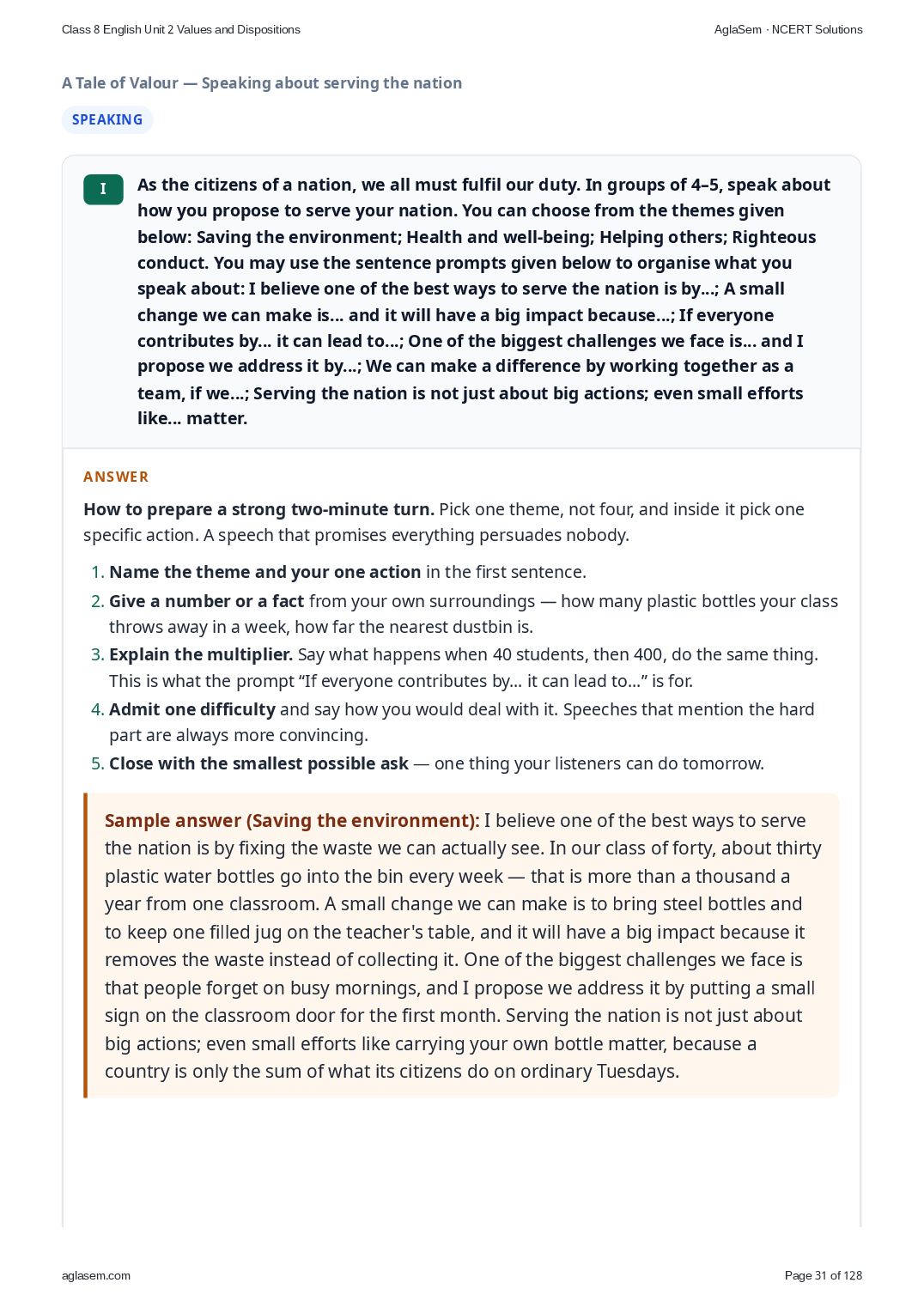
- As the citizens of a nation, we all must fulfil our duty. In groups of 4–5, speak about how you propose to serve your nation. You can choose from the themes given below: Saving the environment; Health and well-being; Helping others; Righteous conduct. You may use the sentence prompts given below to organise what you speak about: I believe one of the best ways to serve the nation is by…; A small change we can make is… and it will have a big impact because…; If everyone contributes by… it can lead to…; One of the biggest challenges we face is… and I propose we address it by…; We can make a difference by working together as a team, if we…; Serving the nation is not just about big actions; even small efforts like… matter.
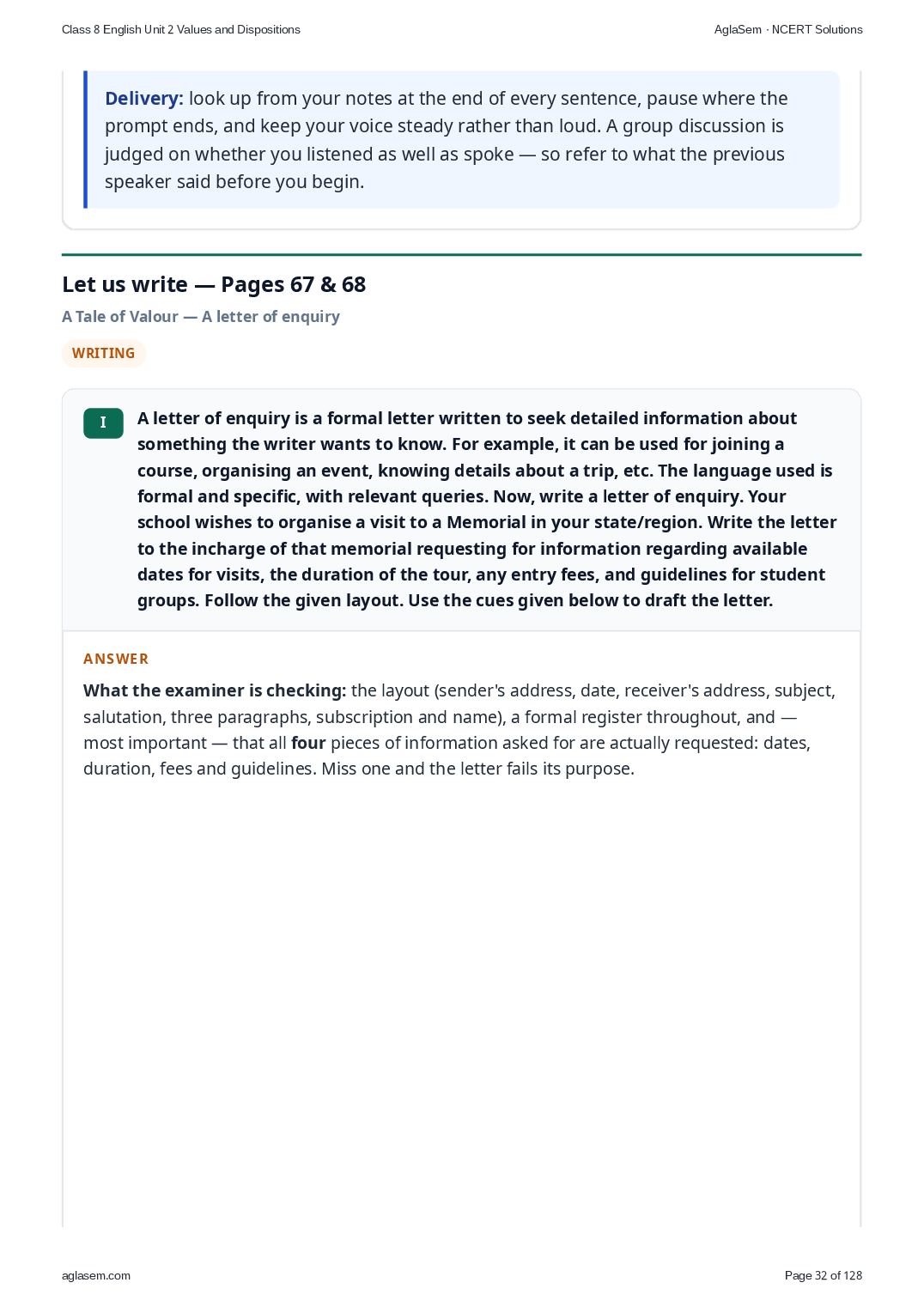
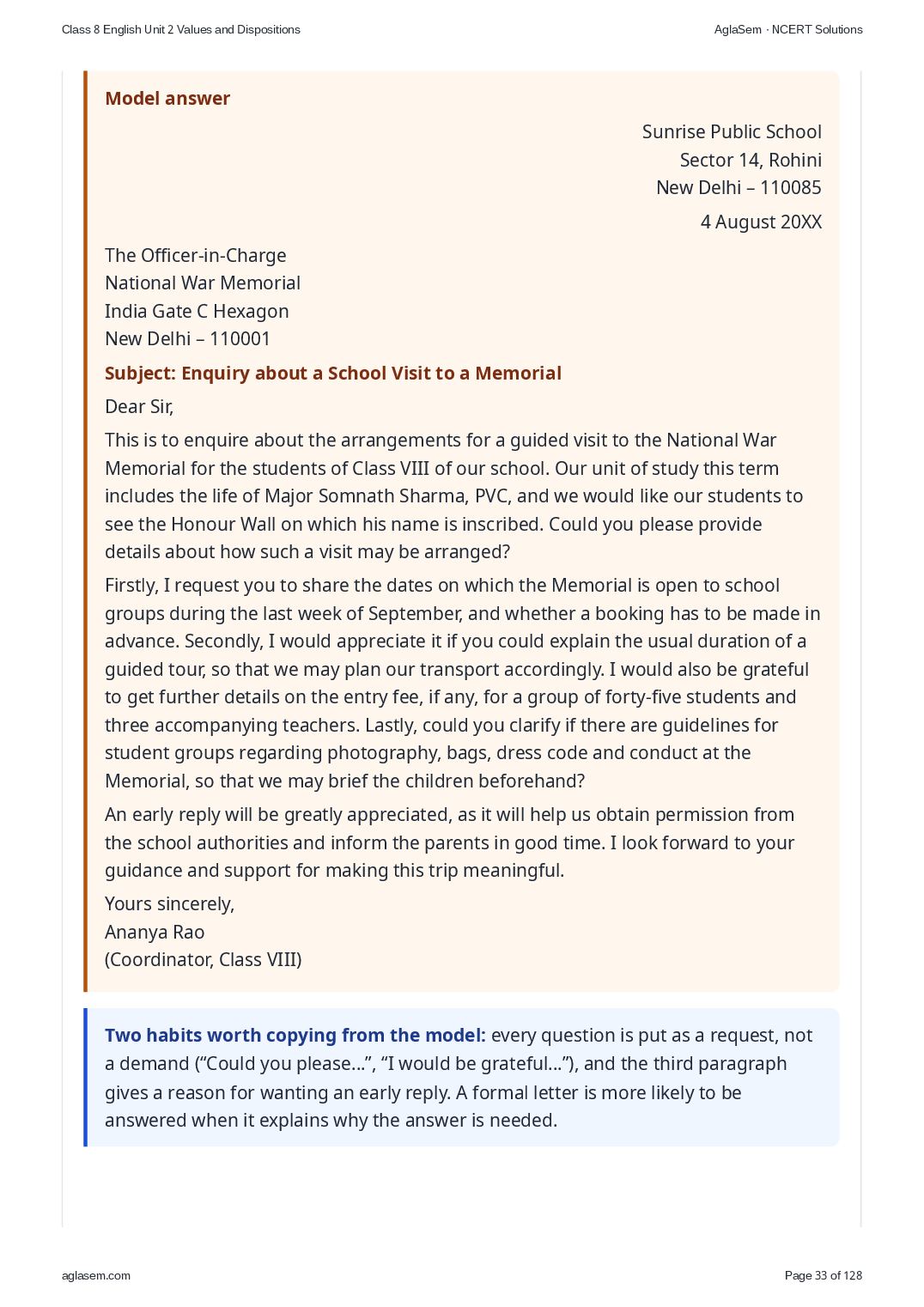
- A letter of enquiry is a formal letter written to seek detailed information about something the writer wants to know. For example, it can be used for joining a course, organising an event, knowing details about a trip, etc. The language used is formal and specific, with relevant queries. Now, write a letter of enquiry. Your school wishes to organise a visit to a Memorial in your state/region. Write the letter to the incharge of that memorial requesting for information regarding available dates for visits, the duration of the tour, any entry fees, and guidelines for student groups. Follow the given layout. Use the cues given below to draft the letter.
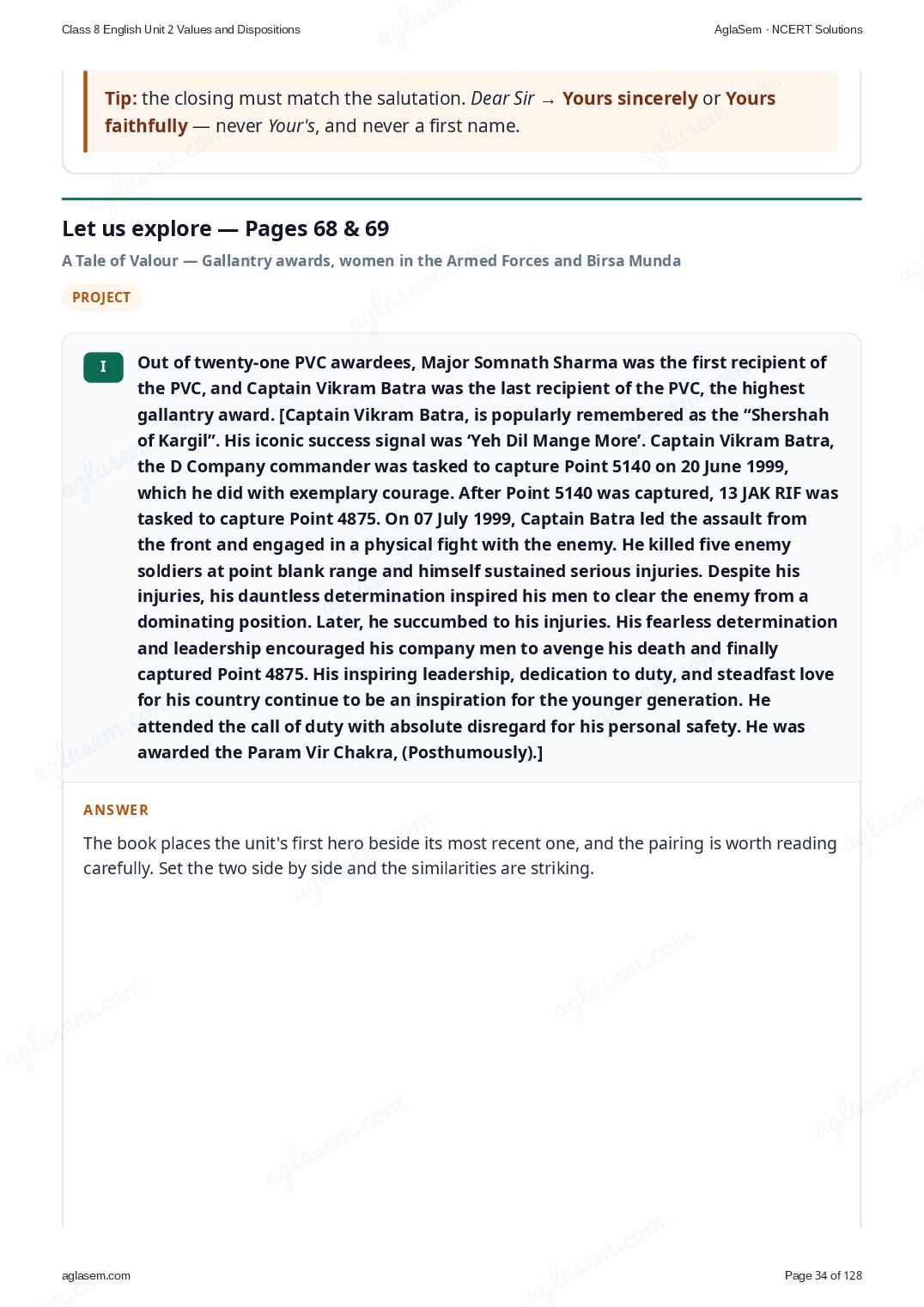
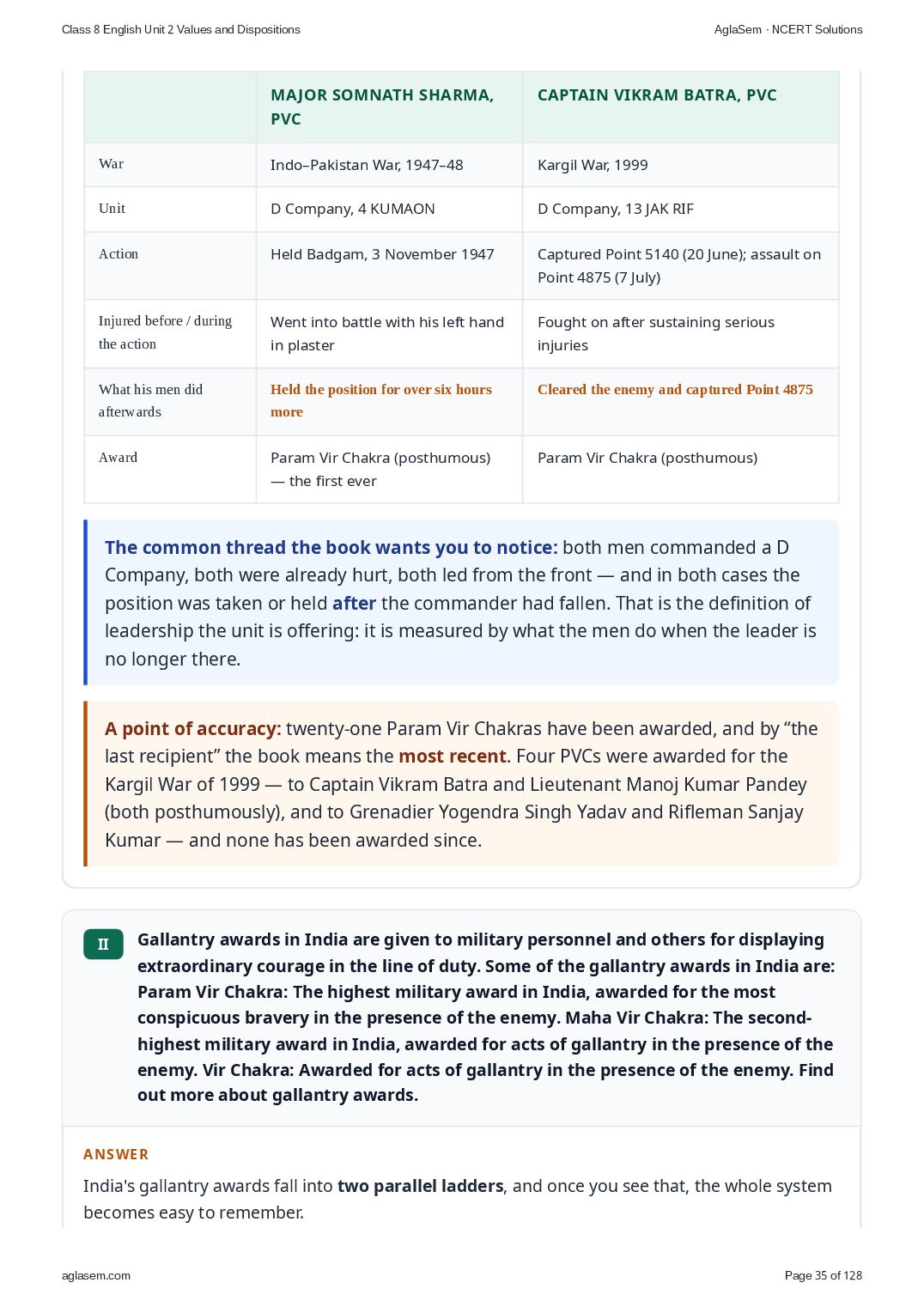
- Out of twenty-one PVC awardees, Major Somnath Sharma was the first recipient of the PVC, and Captain Vikram Batra was the last recipient of the PVC, the highest gallantry award. [Captain Vikram Batra, is popularly remembered as the “Shershah of Kargil”. His iconic success signal was ‘Yeh Dil Mange More’. Captain Vikram Batra, the D Company commander was tasked to capture Point 5140 on 20 June 1999, which he did with exemplary courage. After Point 5140 was captured, 13 JAK RIF was tasked to capture Point 4875. On 07 July 1999, Captain Batra led the assault from the front and engaged in a physical fight with the enemy. He killed five enemy soldiers at point blank range and himself sustained serious injuries. Despite his injuries, his dauntless determination inspired his men to clear the enemy from a dominating position. Later, he succumbed to his injuries. His fearless determination and leadership encouraged his company men to avenge his death and finally captured Point 4875. His inspiring leadership, dedication to duty, and steadfast love for his country continue to be an inspiration for the younger generation. He attended the call of duty with absolute disregard for his personal safety. He was awarded the Param Vir Chakra, (Posthumously).]
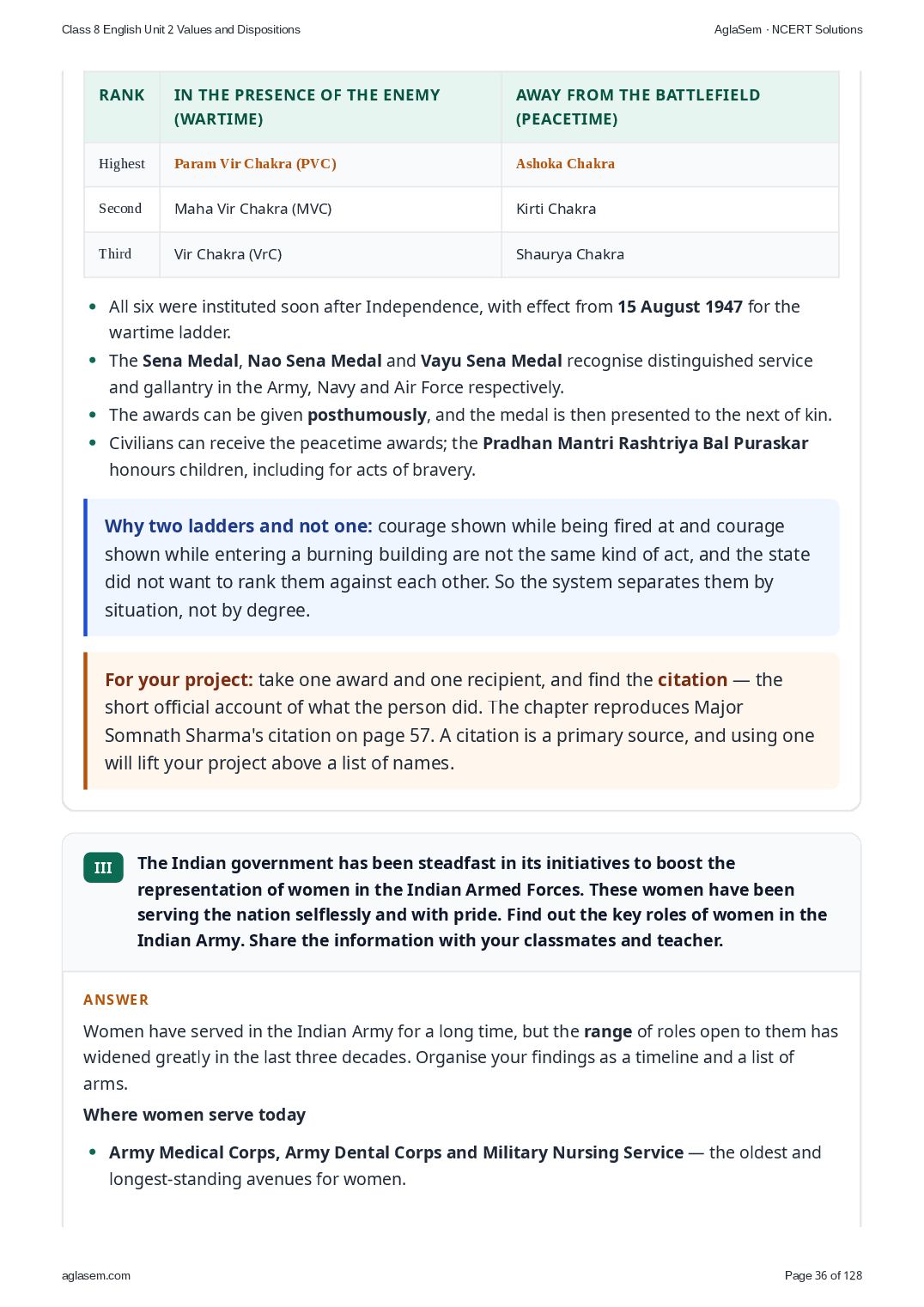
- Gallantry awards in India are given to military personnel and others for displaying extraordinary courage in the line of duty. Some of the gallantry awards in India are: Param Vir Chakra: The highest military award in India, awarded for the most conspicuous bravery in the presence of the enemy. Maha Vir Chakra: The second-highest military award in India, awarded for acts of gallantry in the presence of the enemy. Vir Chakra: Awarded for acts of gallantry in the presence of the enemy. Find out more about gallantry awards.
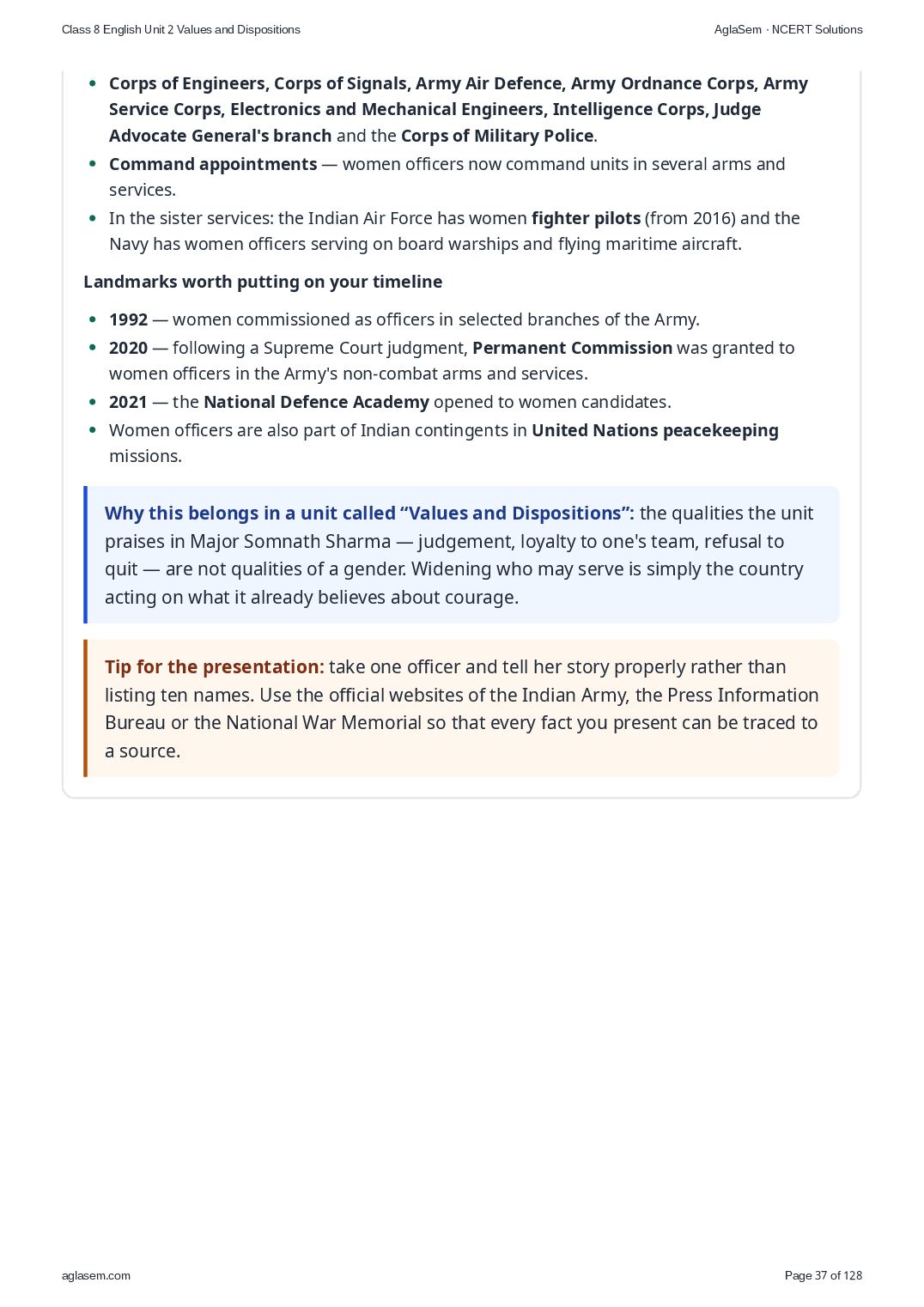
- The Indian government has been steadfast in its initiatives to boost the representation of women in the Indian Armed Forces. These women have been serving the nation selflessly and with pride. Find out the key roles of women in the Indian Army. Share the information with your classmates and teacher.
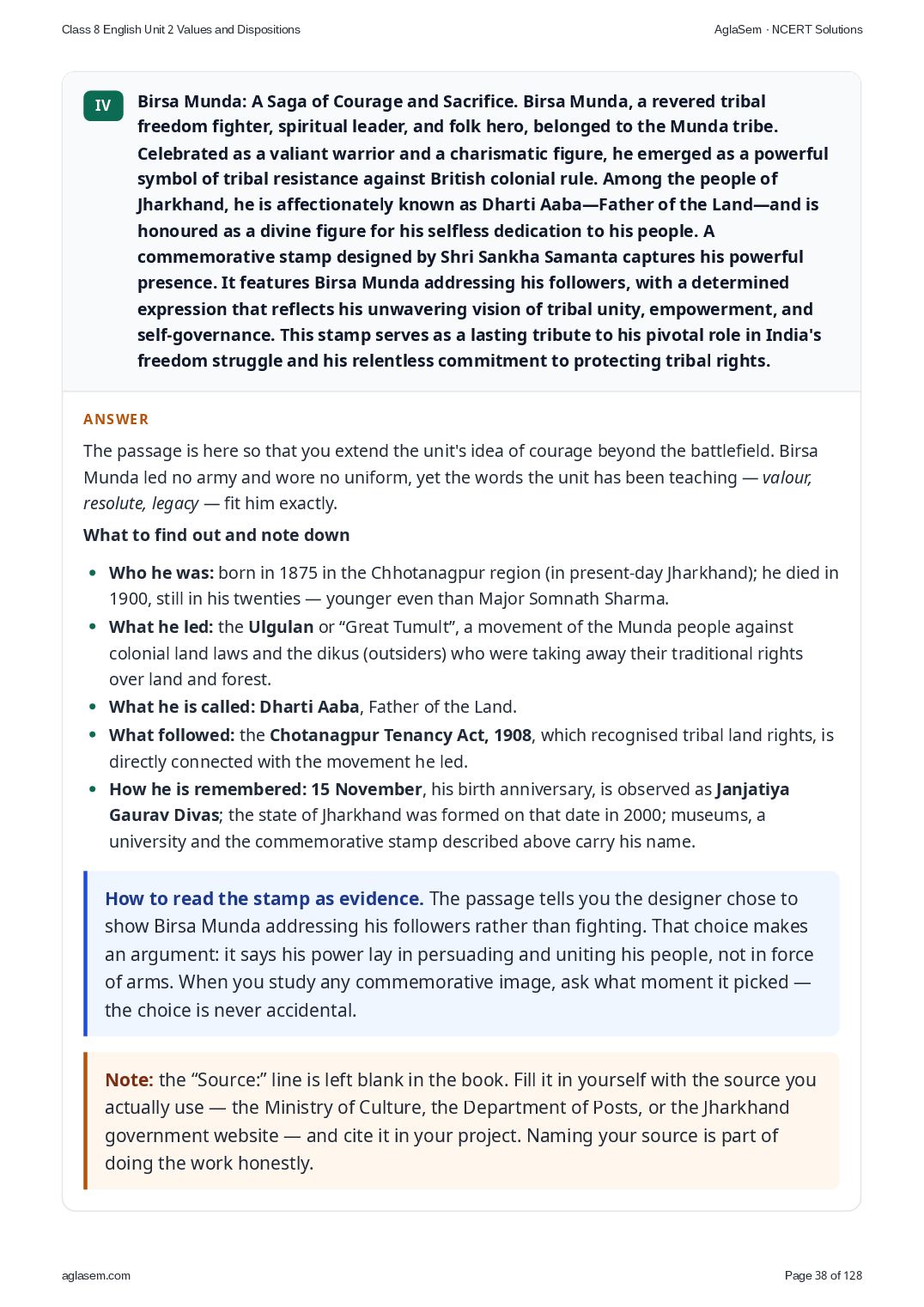
- Birsa Munda: A Saga of Courage and Sacrifice. Birsa Munda, a revered tribal freedom fighter, spiritual leader, and folk hero, belonged to the Munda tribe. Celebrated as a valiant warrior and a charismatic figure, he emerged as a powerful symbol of tribal resistance against British colonial rule. Among the people of Jharkhand, he is affectionately known as Dharti Aaba—Father of the Land—and is honoured as a divine figure for his selfless dedication to his people. A commemorative stamp designed by Shri Sankha Samanta captures his powerful presence. It features Birsa Munda addressing his followers, with a determined expression that reflects his unwavering vision of tribal unity, empowerment, and self-governance. This stamp serves as a lasting tribute to his pivotal role in India's freedom struggle and his relentless commitment to protecting tribal rights.
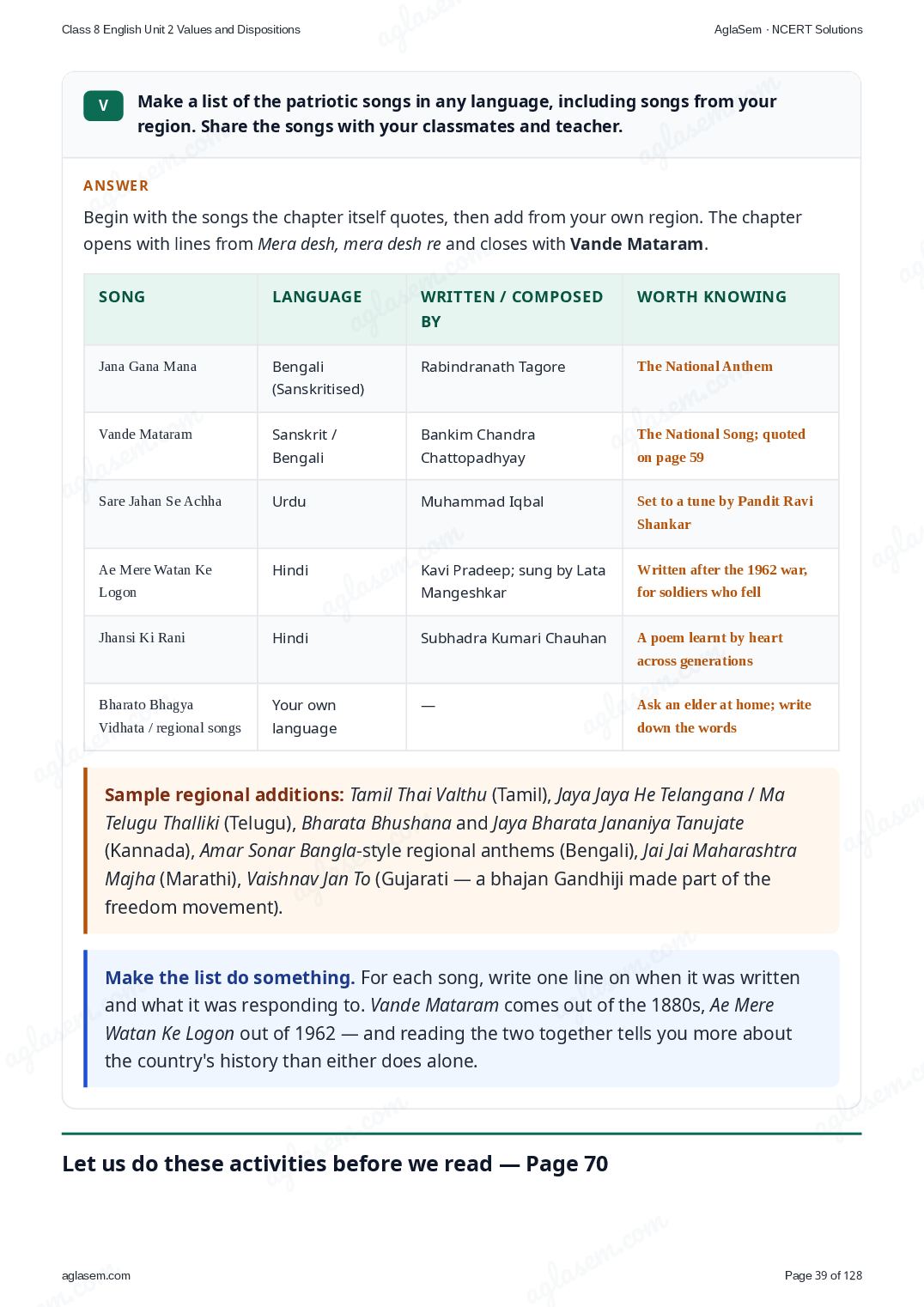
- Make a list of the patriotic songs in any language, including songs from your region. Share the songs with your classmates and teacher.
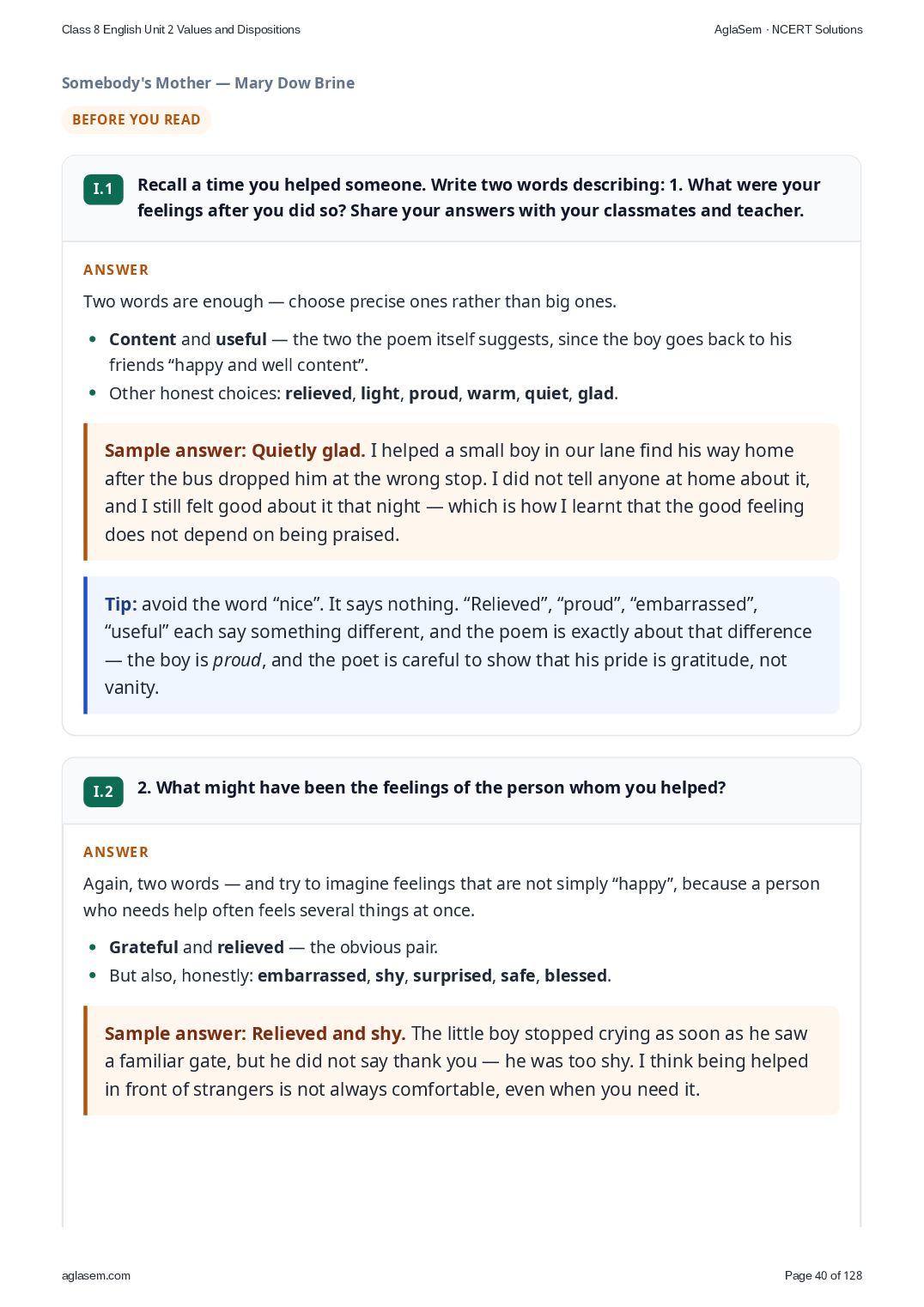
- Recall a time you helped someone. Write two words describing: 1. What were your feelings after you did so? Share your answers with your classmates and teacher.
- 2. What might have been the feelings of the person whom you helped?
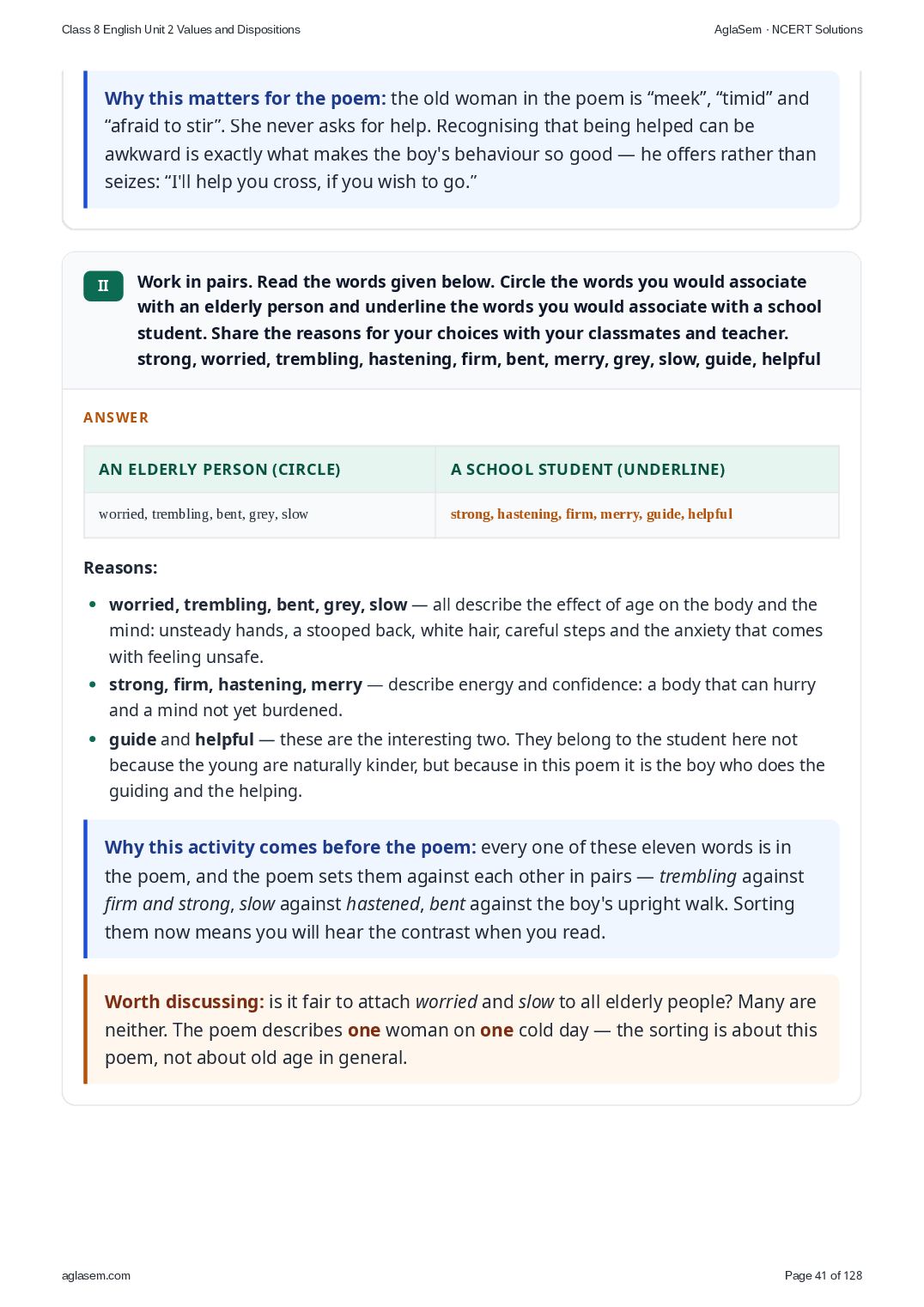
- Work in pairs. Read the words given below. Circle the words you would associate with an elderly person and underline the words you would associate with a school student. Share the reasons for your choices with your classmates and teacher. strong, worried, trembling, hastening, firm, bent, merry, grey, slow, guide, helpful
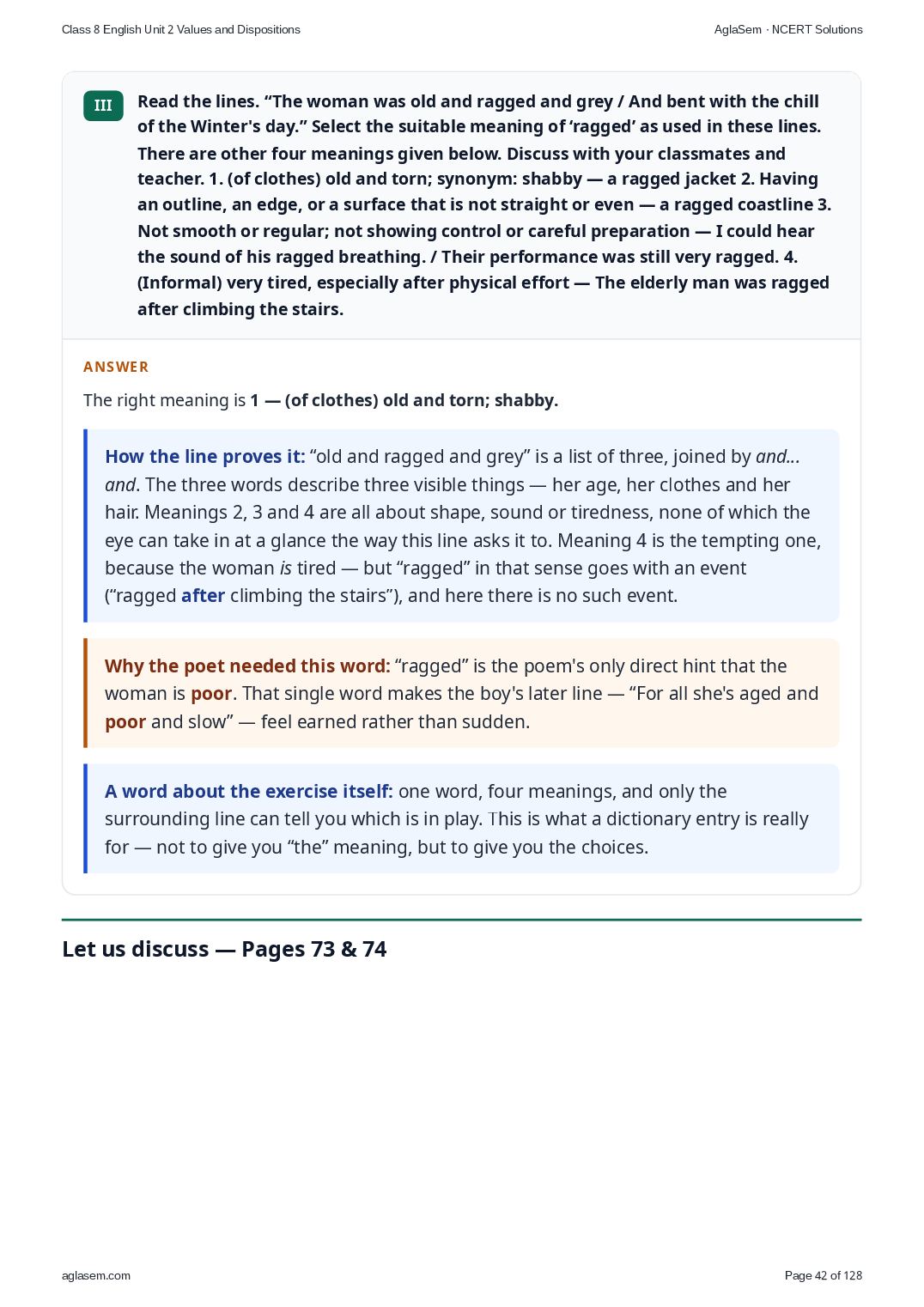
- Read the lines. “The woman was old and ragged and grey / And bent with the chill of the Winter's day.” Select the suitable meaning of ‘ragged’ as used in these lines. There are other four meanings given below. Discuss with your classmates and teacher. 1. (of clothes) old and torn; synonym: shabby — a ragged jacket 2. Having an outline, an edge, or a surface that is not straight or even — a ragged coastline 3. Not smooth or regular; not showing control or careful preparation — I could hear the sound of his ragged breathing. / Their performance was still very ragged. 4. (Informal) very tired, especially after physical effort — The elderly man was ragged after climbing the stairs.
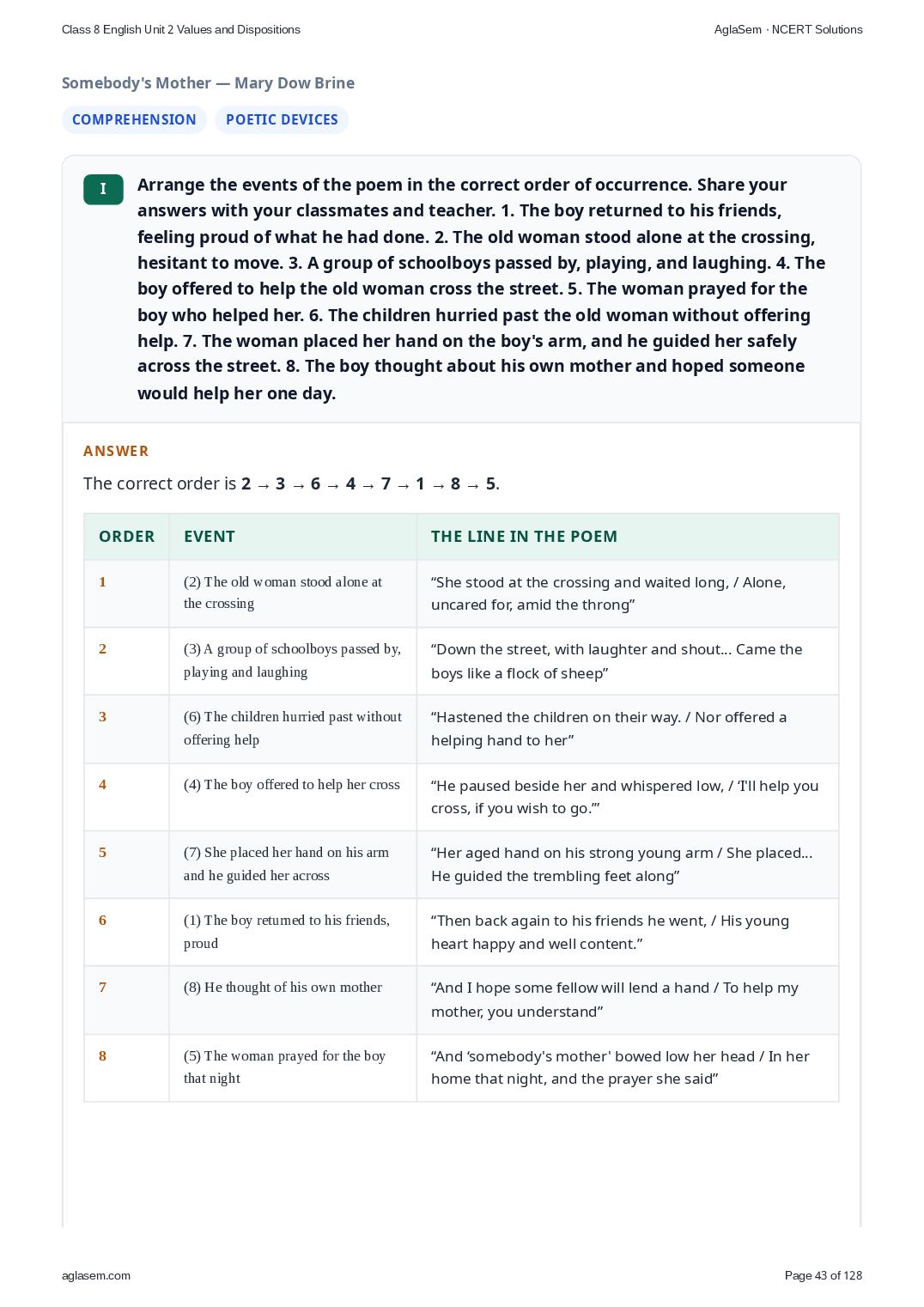
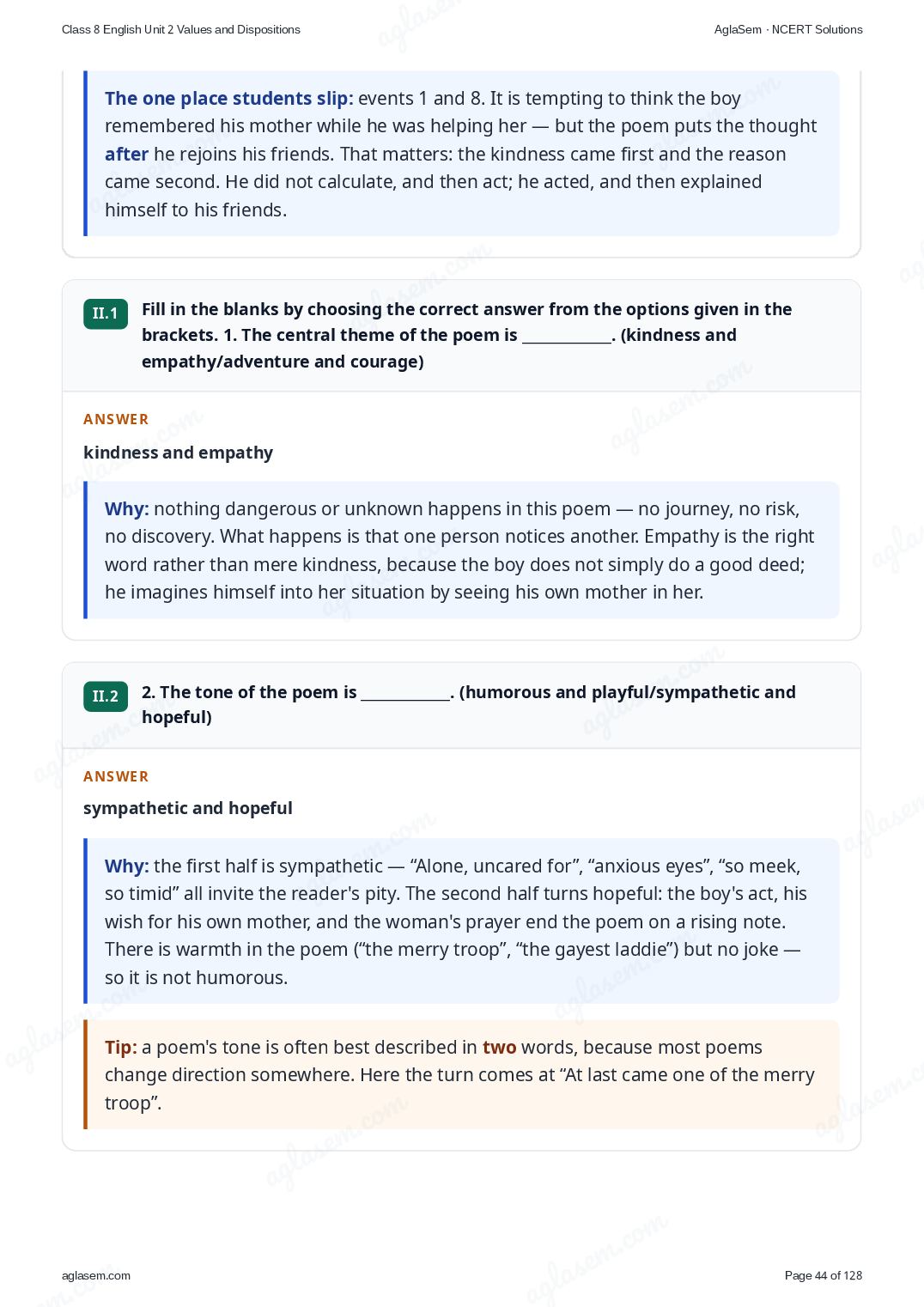
- Arrange the events of the poem in the correct order of occurrence. Share your answers with your classmates and teacher. 1. The boy returned to his friends, feeling proud of what he had done. 2. The old woman stood alone at the crossing, hesitant to move. 3. A group of schoolboys passed by, playing, and laughing. 4. The boy offered to help the old woman cross the street. 5. The woman prayed for the boy who helped her. 6. The children hurried past the old woman without offering help. 7. The woman placed her hand on the boy's arm, and he guided her safely across the street. 8. The boy thought about his own mother and hoped someone would help her one day.
- Fill in the blanks by choosing the correct answer from the options given in the brackets. 1. The central theme of the poem is _____________. (kindness and empathy/adventure and courage)
- 2. The tone of the poem is _____________. (humorous and playful/sympathetic and hopeful)
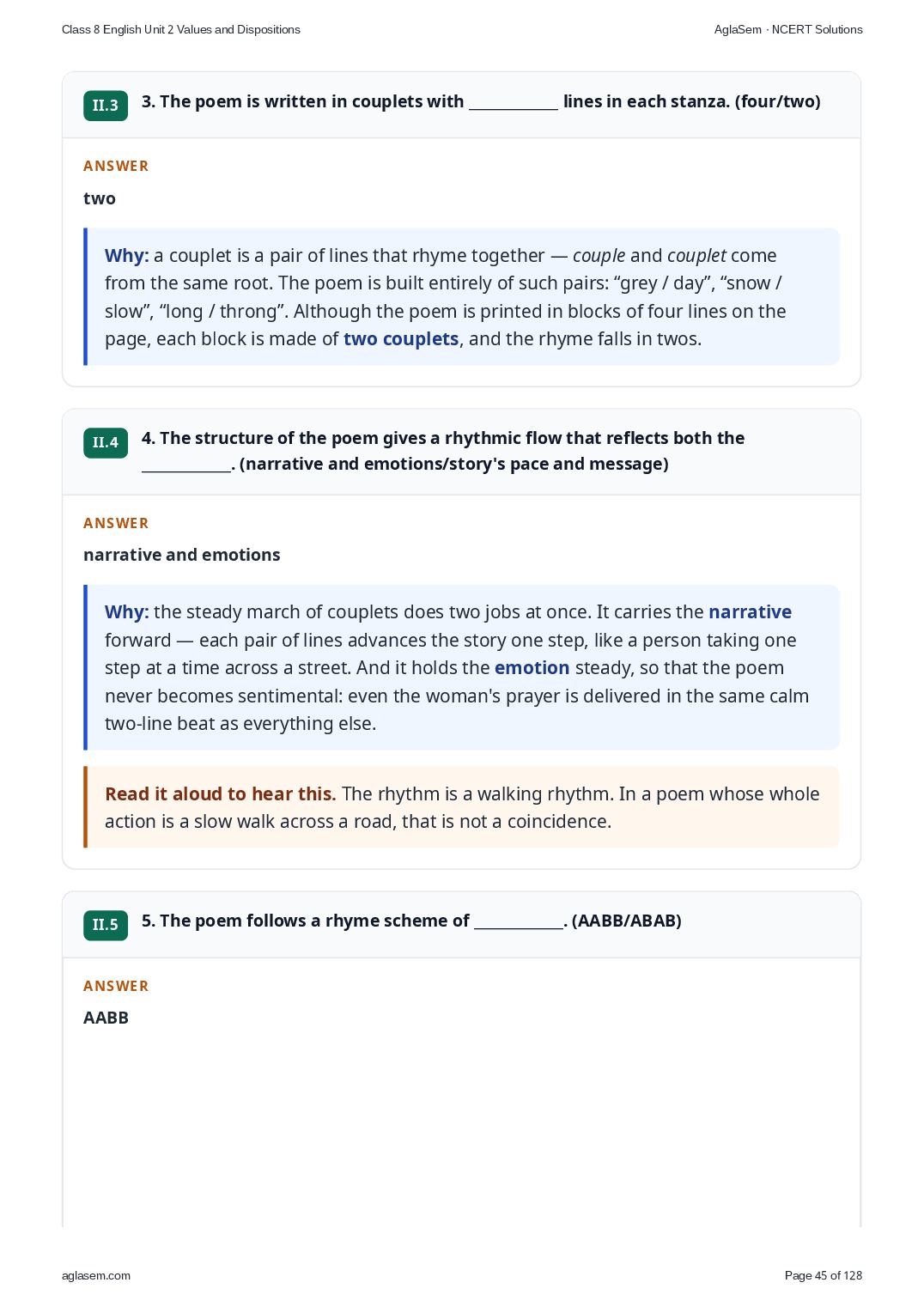
- 3. The poem is written in couplets with _____________ lines in each stanza. (four/two)
- 4. The structure of the poem gives a rhythmic flow that reflects both the _____________. (narrative and emotions/story's pace and message)
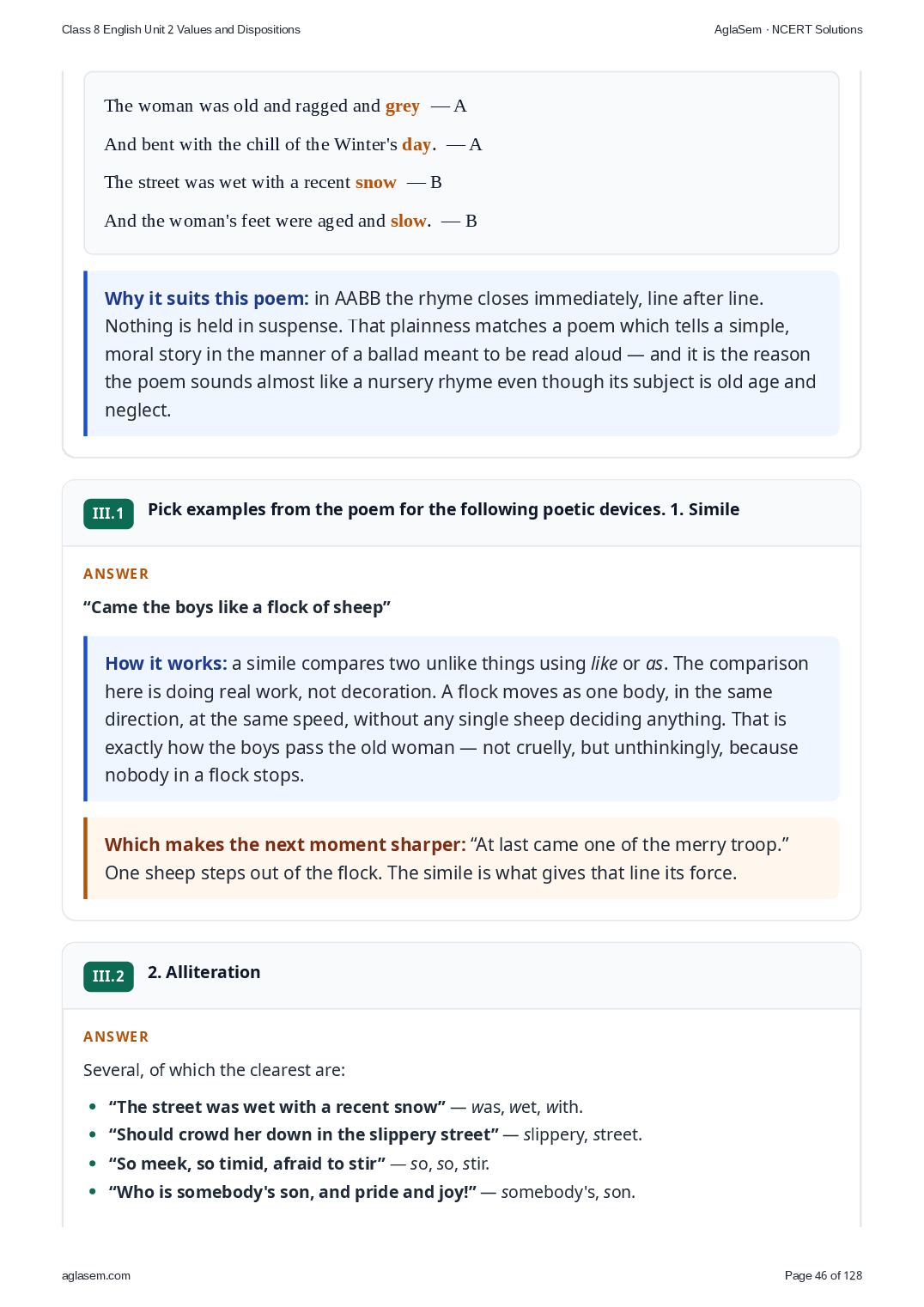
- 5. The poem follows a rhyme scheme of _____________. (AABB/ABAB)
- Pick examples from the poem for the following poetic devices. 1. Simile
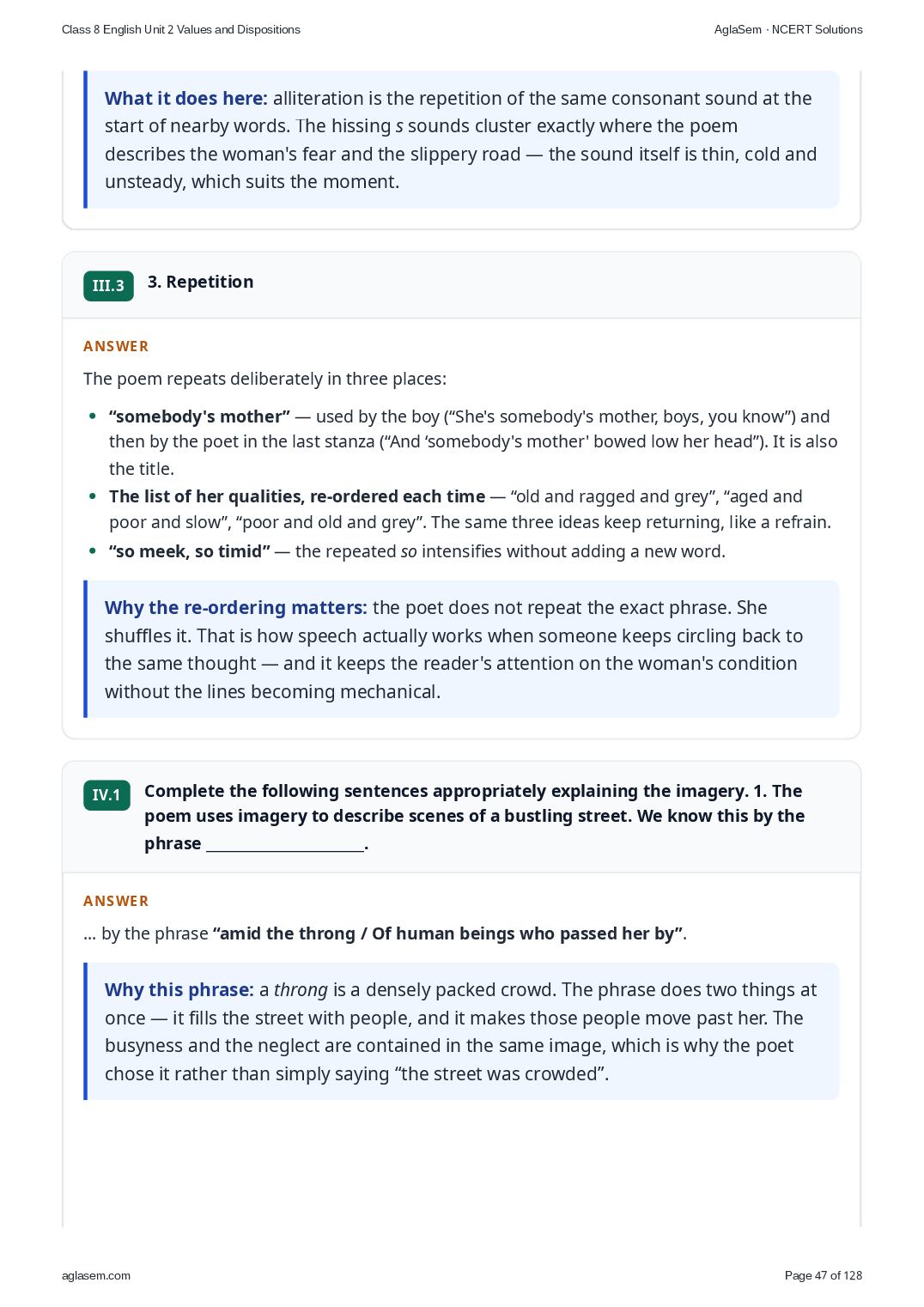
- 2. Alliteration
- 3. Repetition
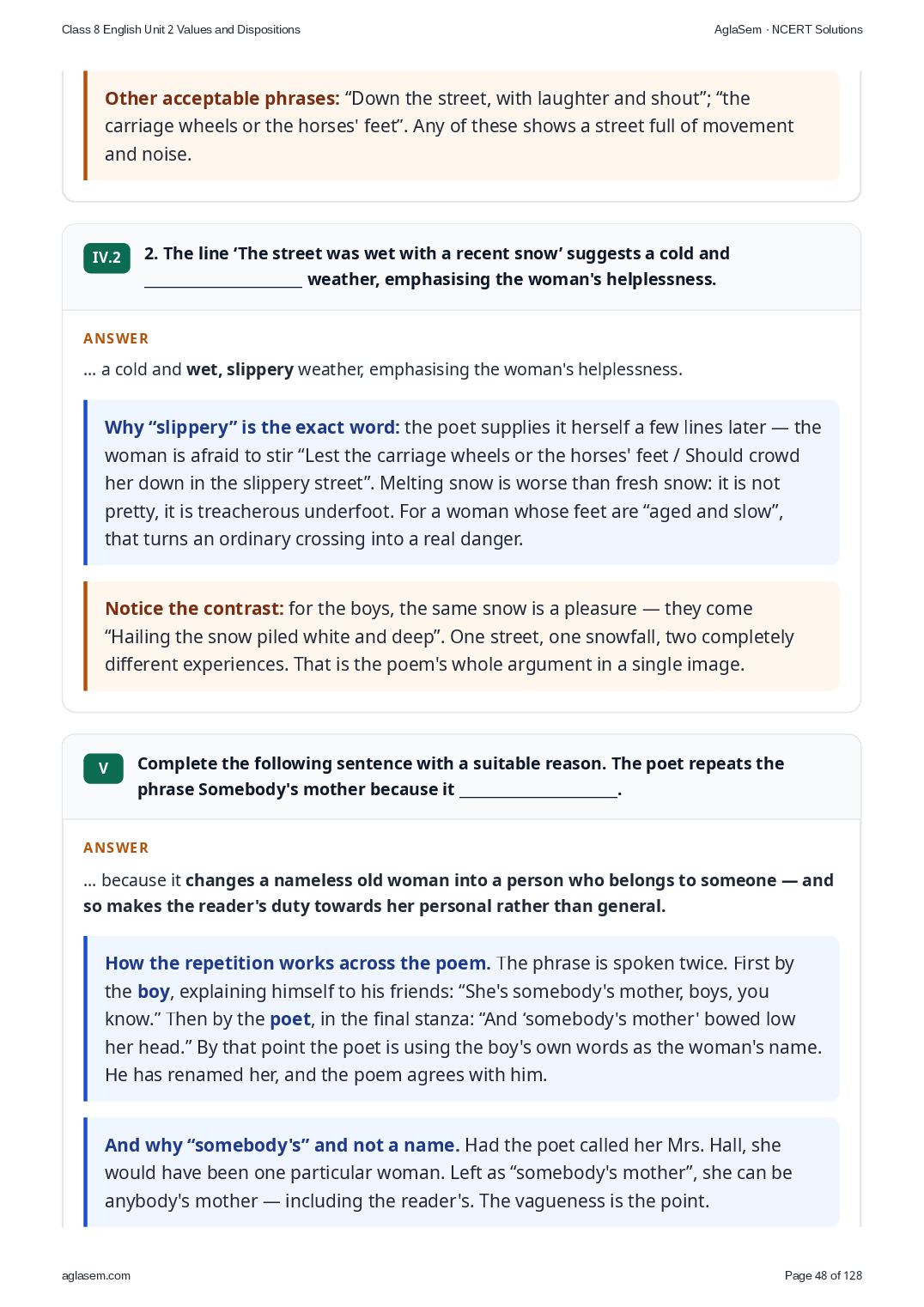
- Complete the following sentences appropriately explaining the imagery. 1. The poem uses imagery to describe scenes of a bustling street. We know this by the phrase _______________________.
- 2. The line ‘The street was wet with a recent snow’ suggests a cold and _______________________ weather, emphasising the woman's helplessness.
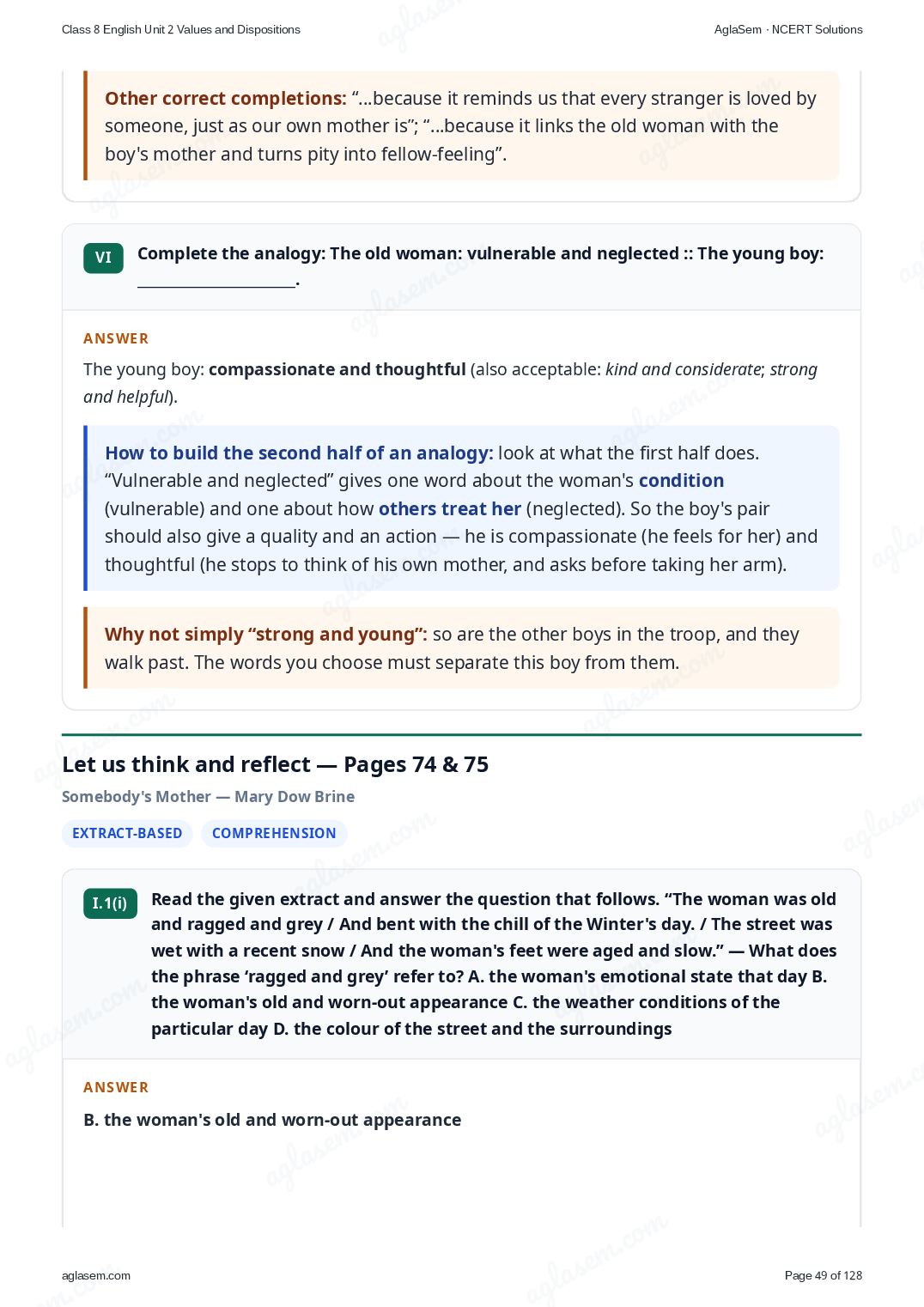
- Complete the following sentence with a suitable reason. The poet repeats the phrase Somebody's mother because it _______________________.
- Complete the analogy: The old woman: vulnerable and neglected :: The young boy: _______________________.
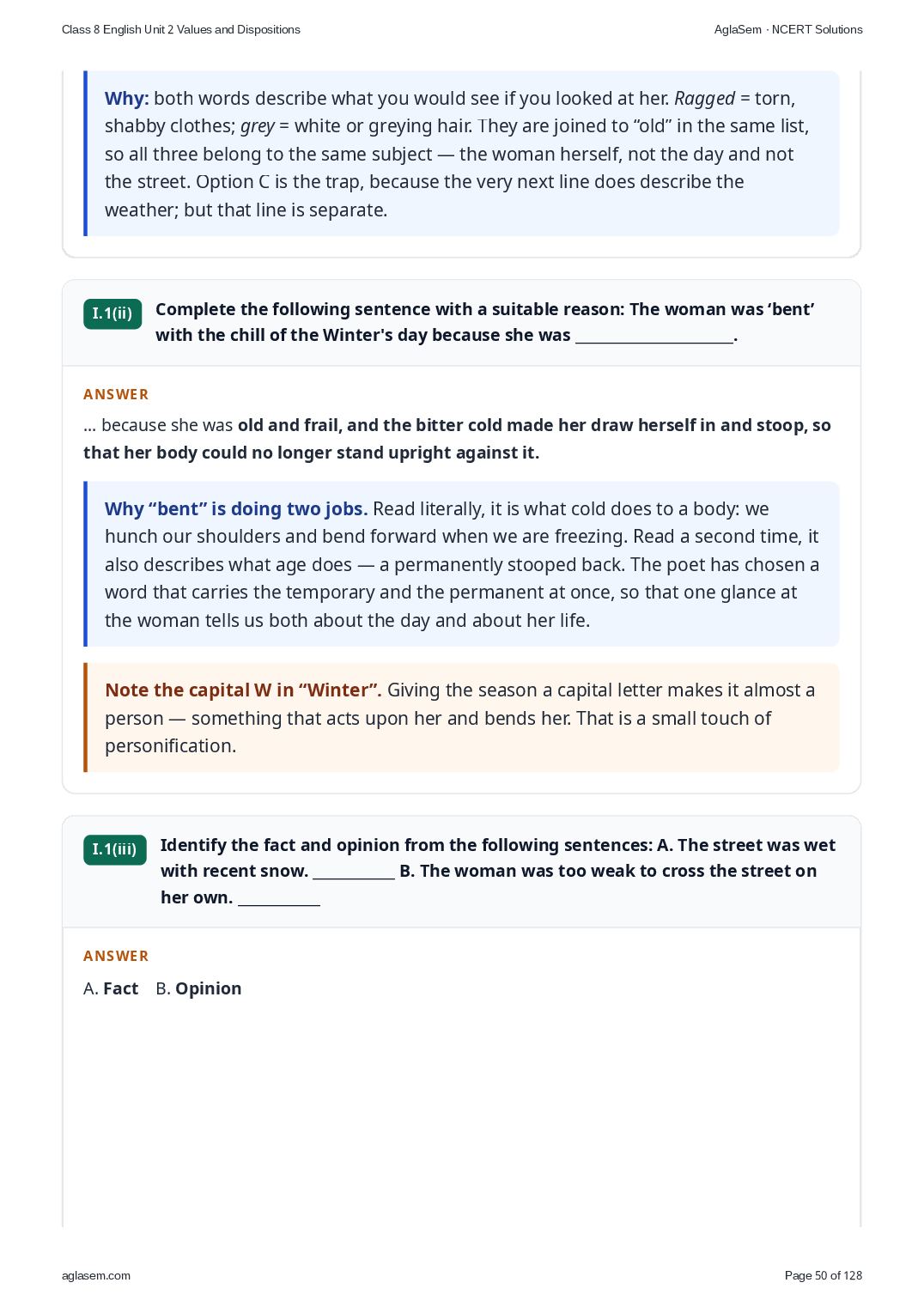
- Read the given extract and answer the question that follows. “The woman was old and ragged and grey / And bent with the chill of the Winter's day. / The street was wet with a recent snow / And the woman's feet were aged and slow.” — What does the phrase ‘ragged and grey’ refer to? A. the woman's emotional state that day B. the woman's old and worn-out appearance C. the weather conditions of the particular day D. the colour of the street and the surroundings
- Complete the following sentence with a suitable reason: The woman was ‘bent’ with the chill of the Winter's day because she was _______________________.
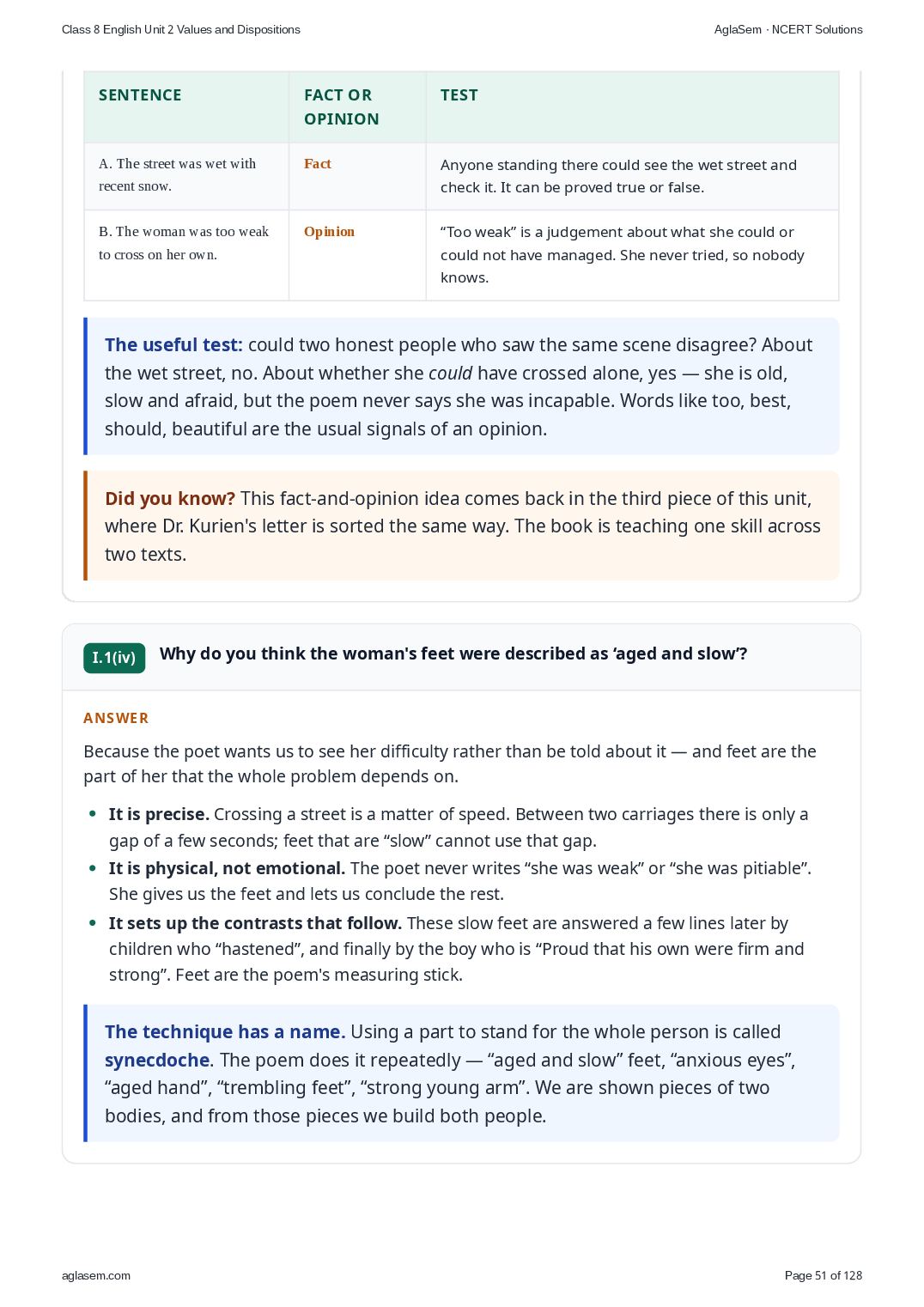
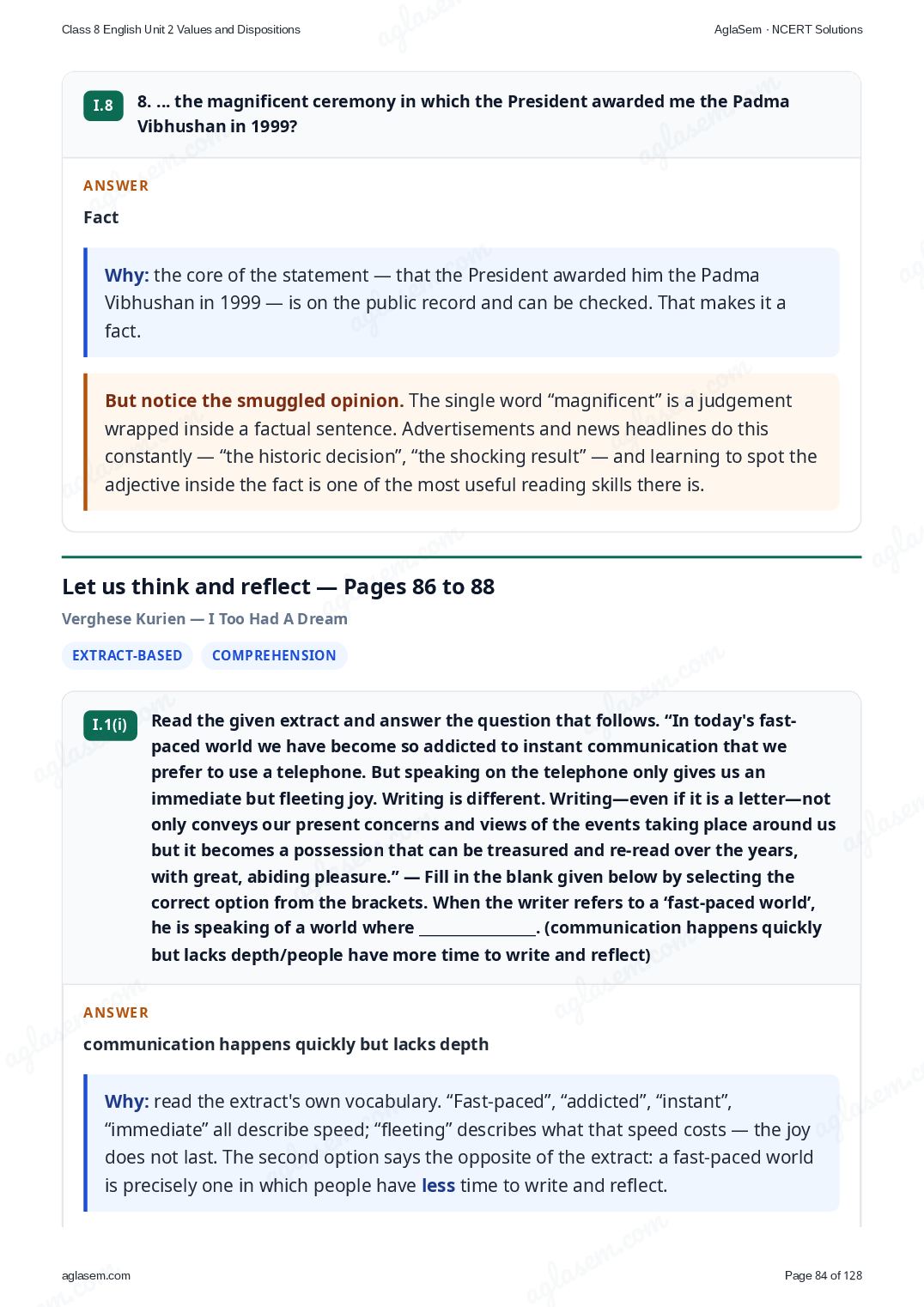
- Identify the fact and opinion from the following sentences: A. The street was wet with recent snow. ____________ B. The woman was too weak to cross the street on her own. ____________
- Why do you think the woman's feet were described as ‘aged and slow’?
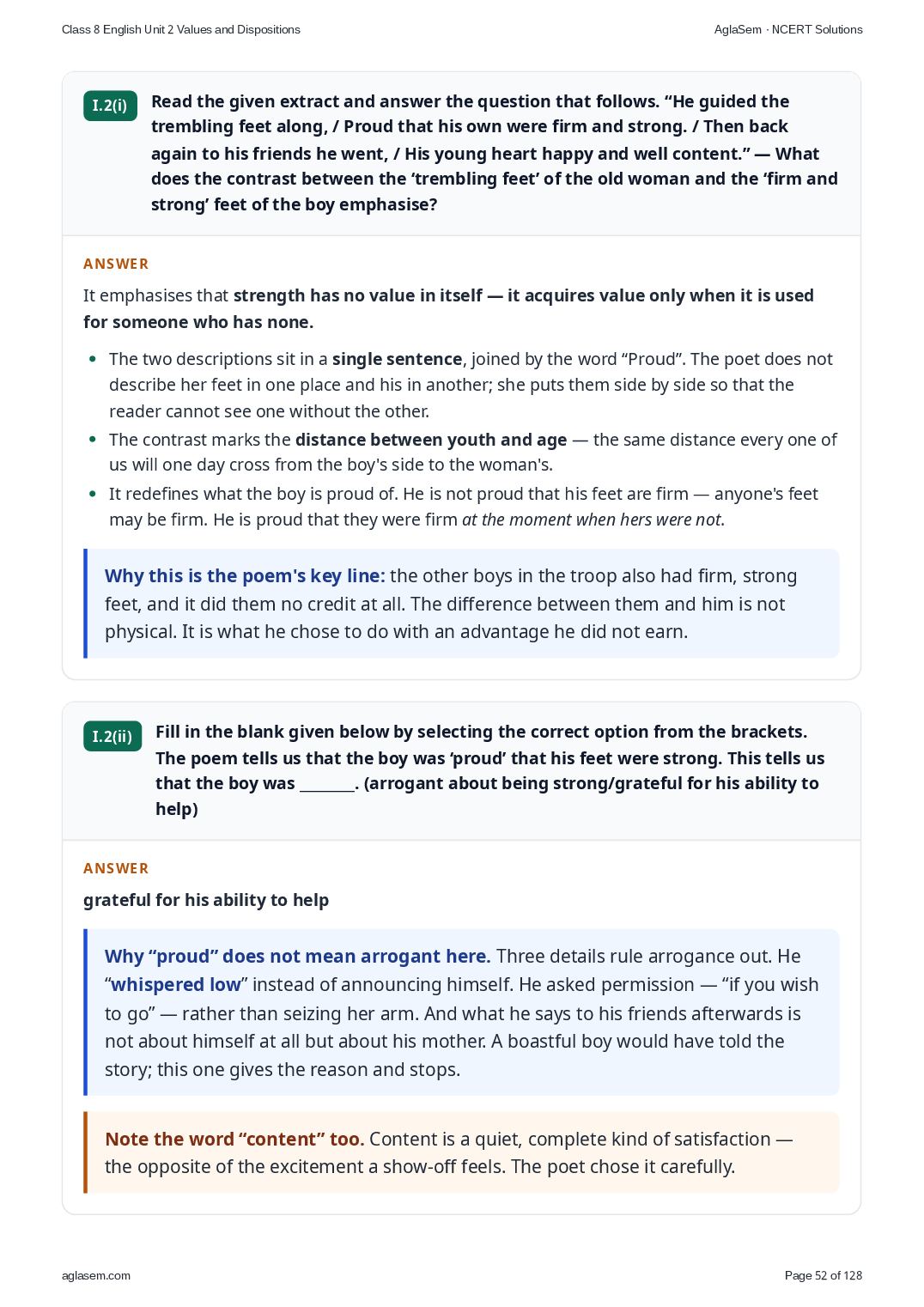
- Read the given extract and answer the question that follows. “He guided the trembling feet along, / Proud that his own were firm and strong. / Then back again to his friends he went, / His young heart happy and well content.” — What does the contrast between the ‘trembling feet’ of the old woman and the ‘firm and strong’ feet of the boy emphasise?
- Fill in the blank given below by selecting the correct option from the brackets. The poem tells us that the boy was ‘proud’ that his feet were strong. This tells us that the boy was ________. (arrogant about being strong/grateful for his ability to help)
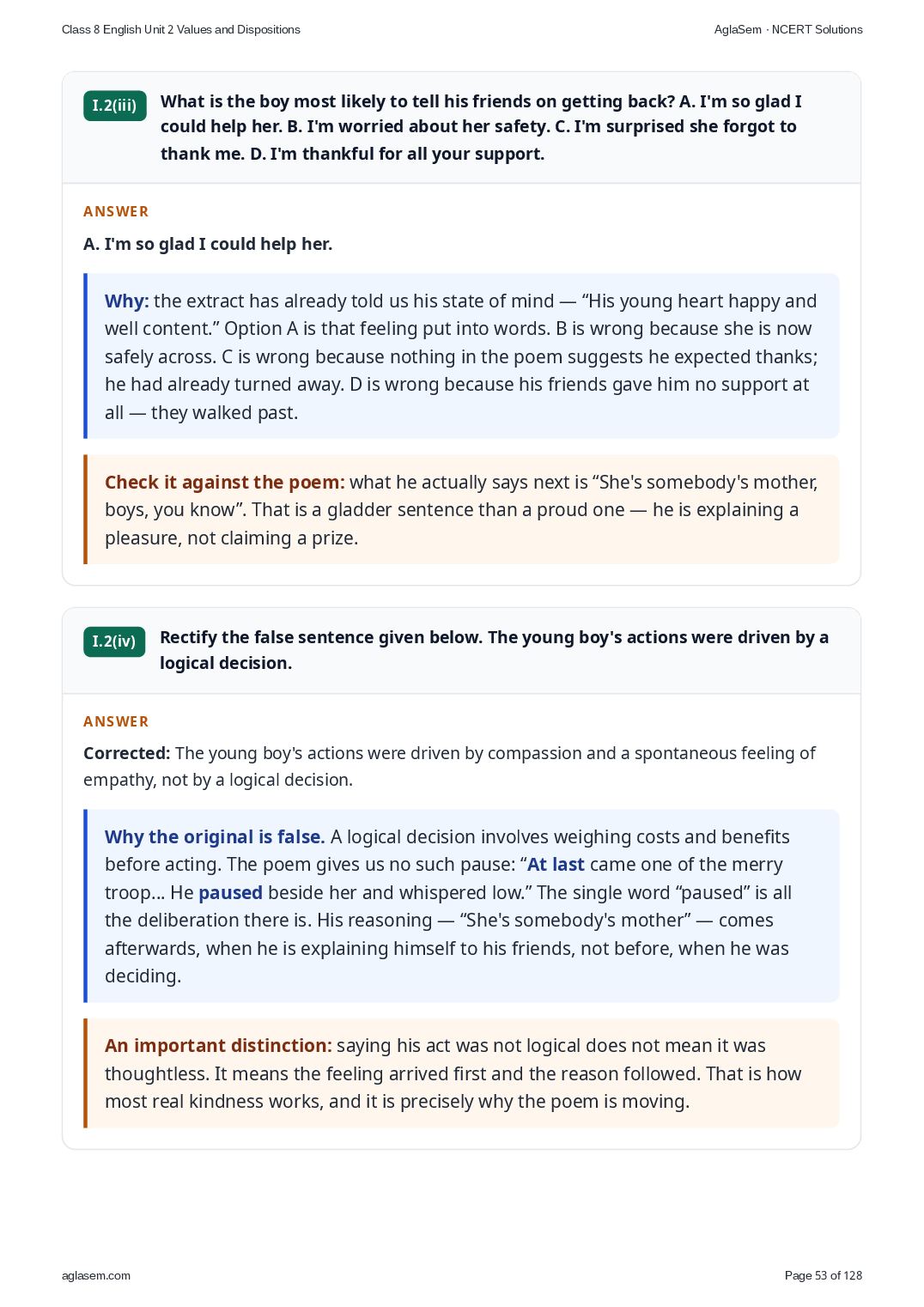
- What is the boy most likely to tell his friends on getting back? A. I'm so glad I could help her. B. I'm worried about her safety. C. I'm surprised she forgot to thank me. D. I'm thankful for all your support.
- Rectify the false sentence given below. The young boy's actions were driven by a logical decision.
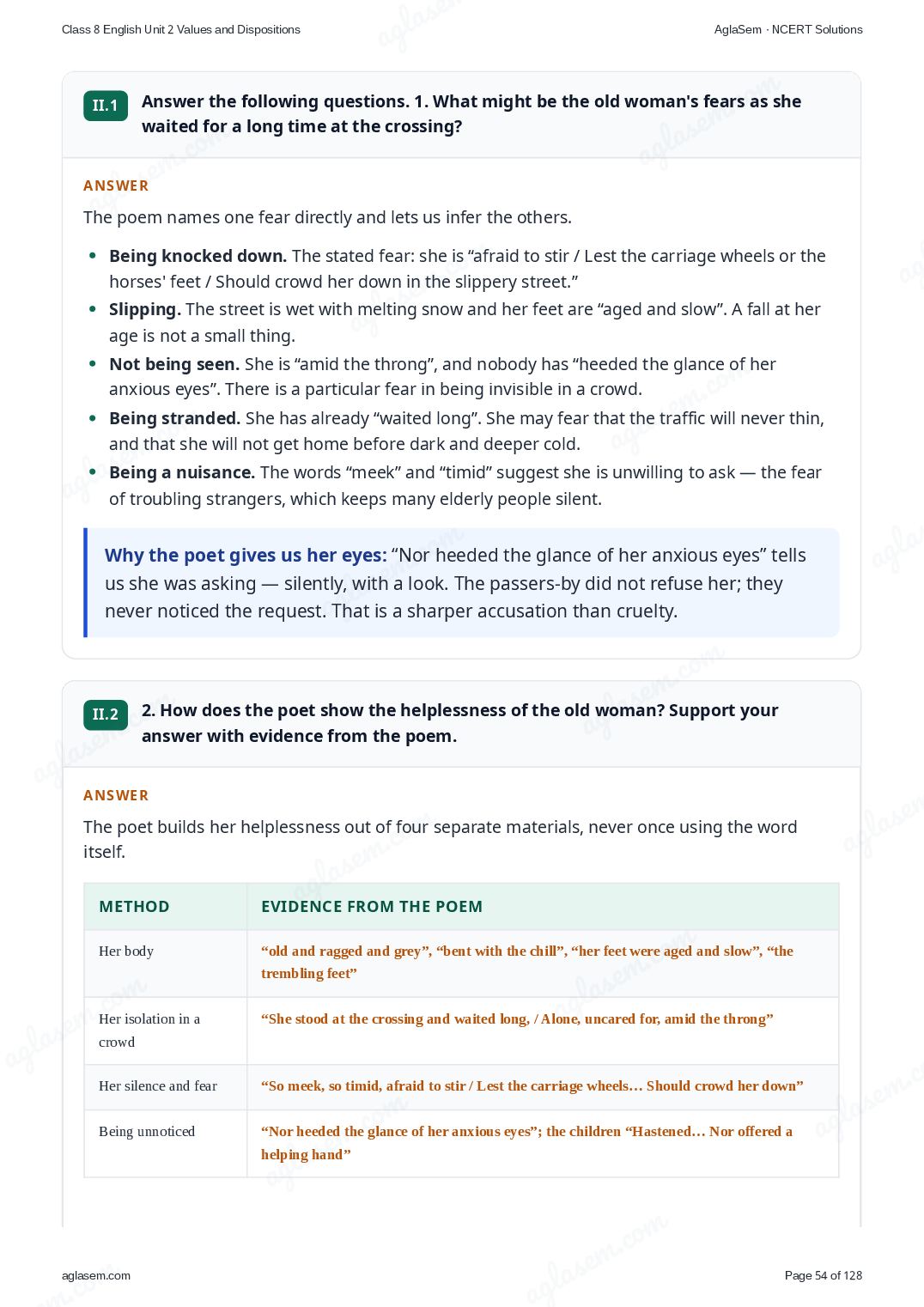
- Answer the following questions. 1. What might be the old woman's fears as she waited for a long time at the crossing?
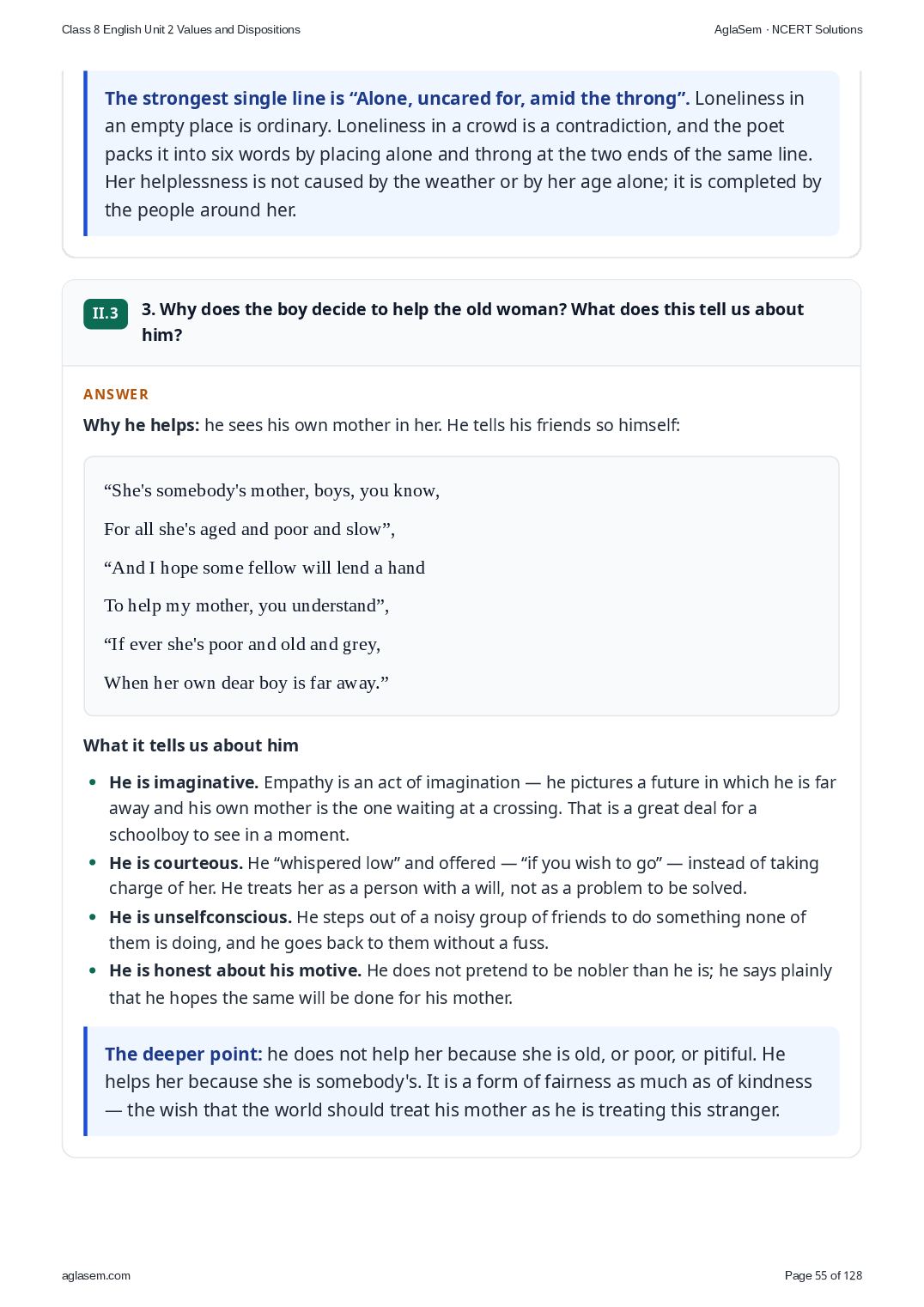
- 2. How does the poet show the helplessness of the old woman? Support your answer with evidence from the poem.
- 3. Why does the boy decide to help the old woman? What does this tell us about him?
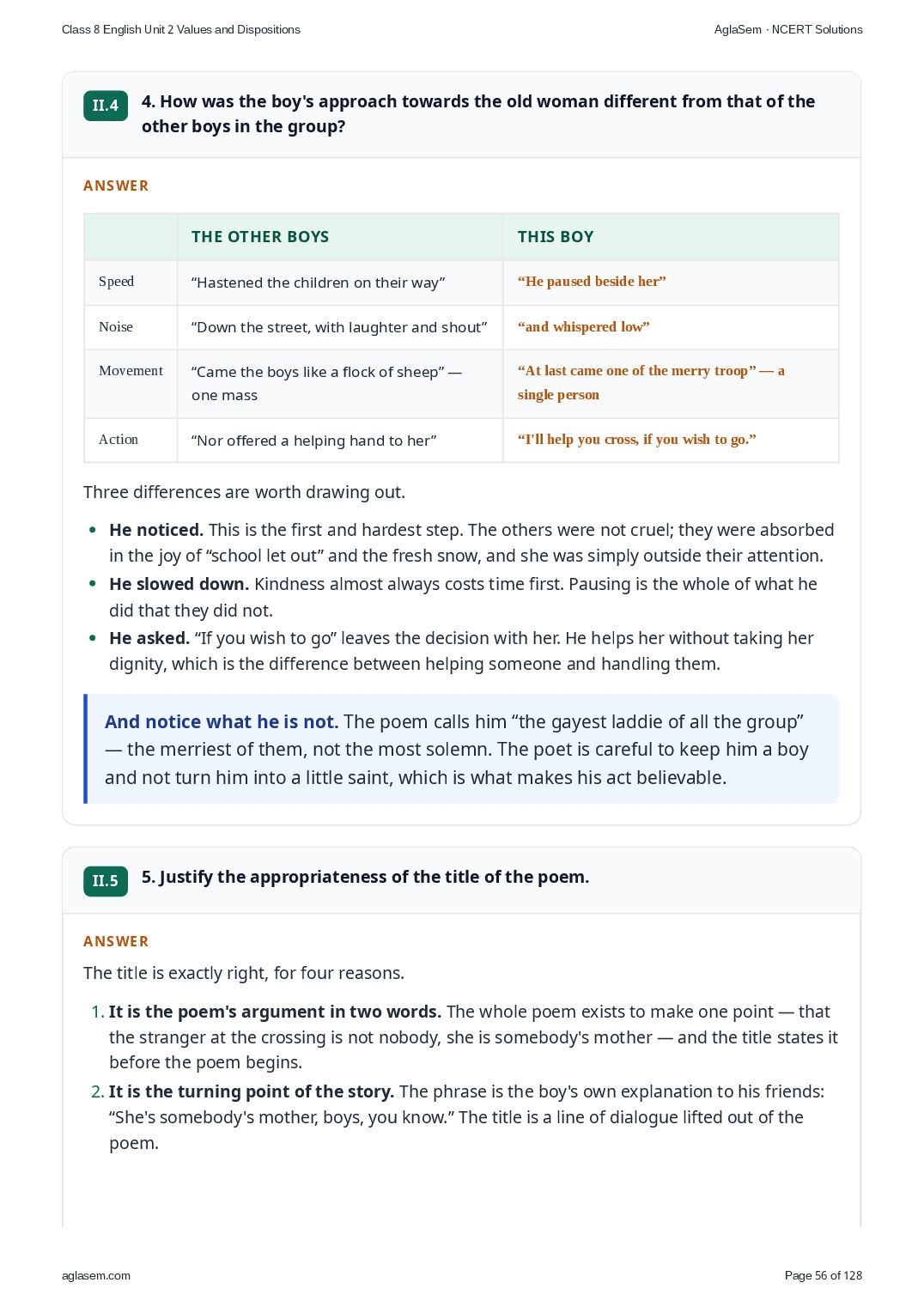
- 4. How was the boy's approach towards the old woman different from that of the other boys in the group?
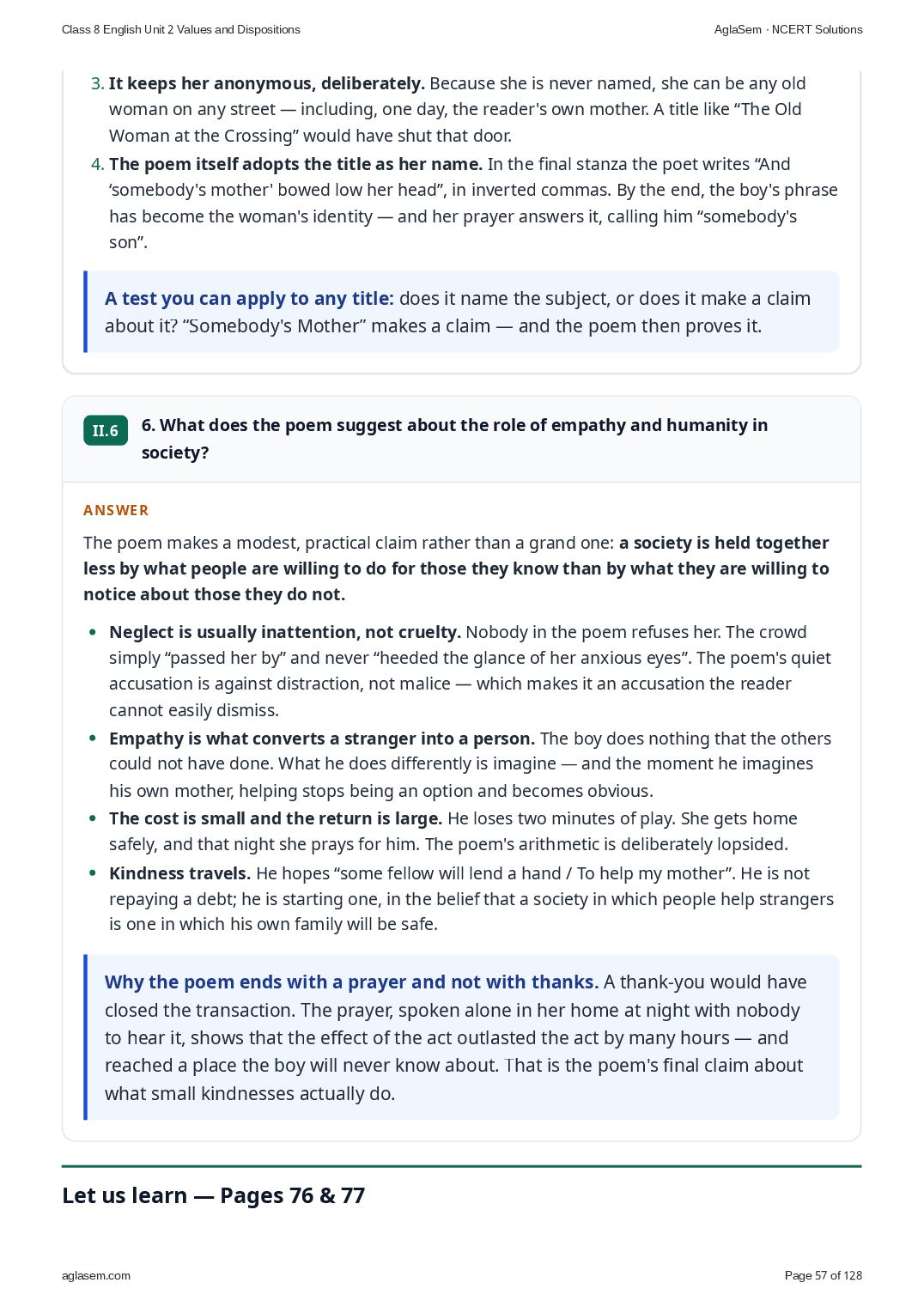
- 5. Justify the appropriateness of the title of the poem.
- 6. What does the poem suggest about the role of empathy and humanity in society?
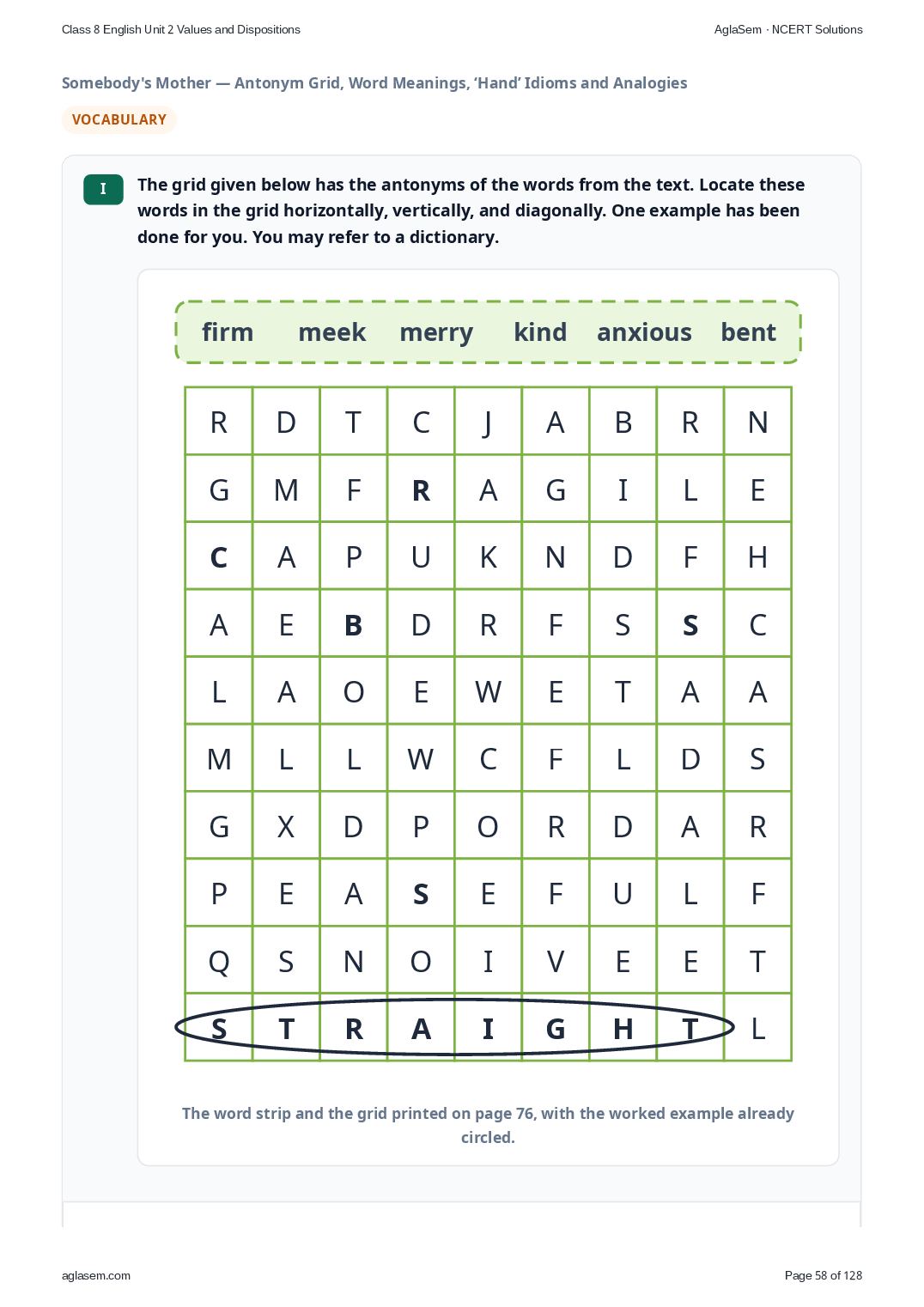
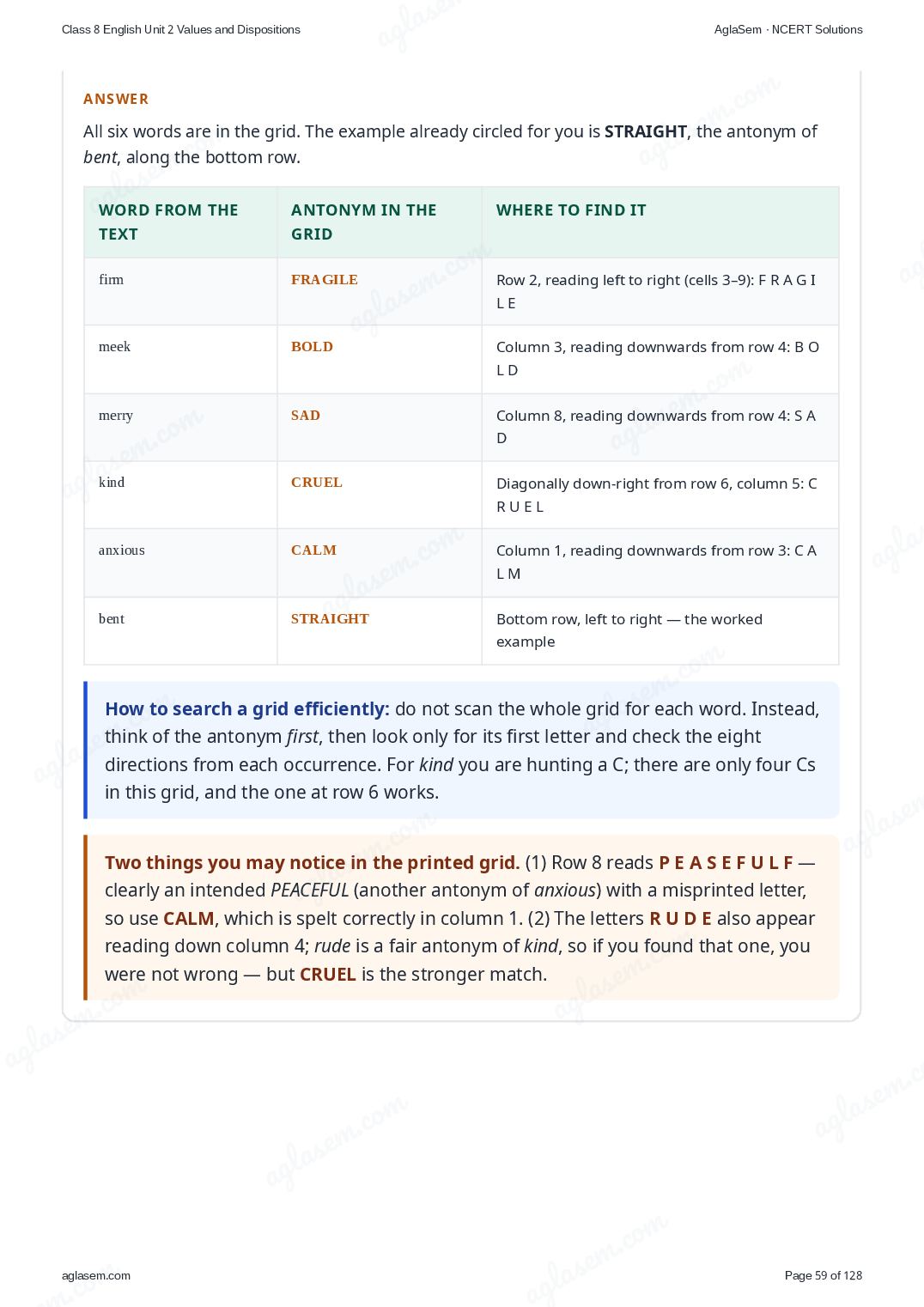
- The grid given below has the antonyms of the words from the text. Locate these words in the grid horizontally, vertically, and diagonally. One example has been done for you. You may refer to a dictionary. (firm, meek, merry, kind, anxious, bent)
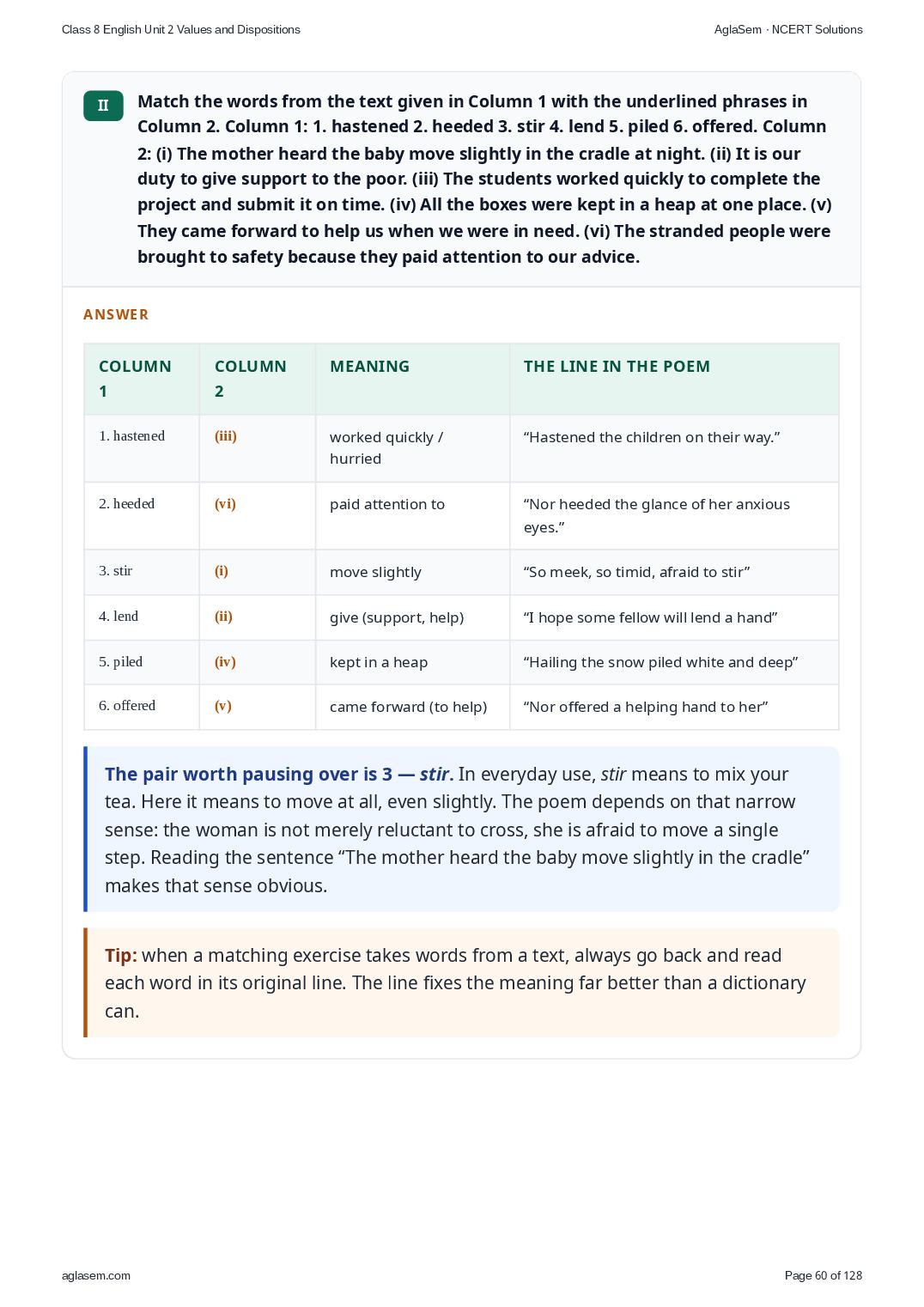
- Match the words from the text given in Column 1 with the underlined phrases in Column 2. Column 1: 1. hastened 2. heeded 3. stir 4. lend 5. piled 6. offered. Column 2: (i) The mother heard the baby move slightly in the cradle at night. (ii) It is our duty to give support to the poor. (iii) The students worked quickly to complete the project and submit it on time. (iv) All the boxes were kept in a heap at one place. (v) They came forward to help us when we were in need. (vi) The stranded people were brought to safety because they paid attention to our advice.
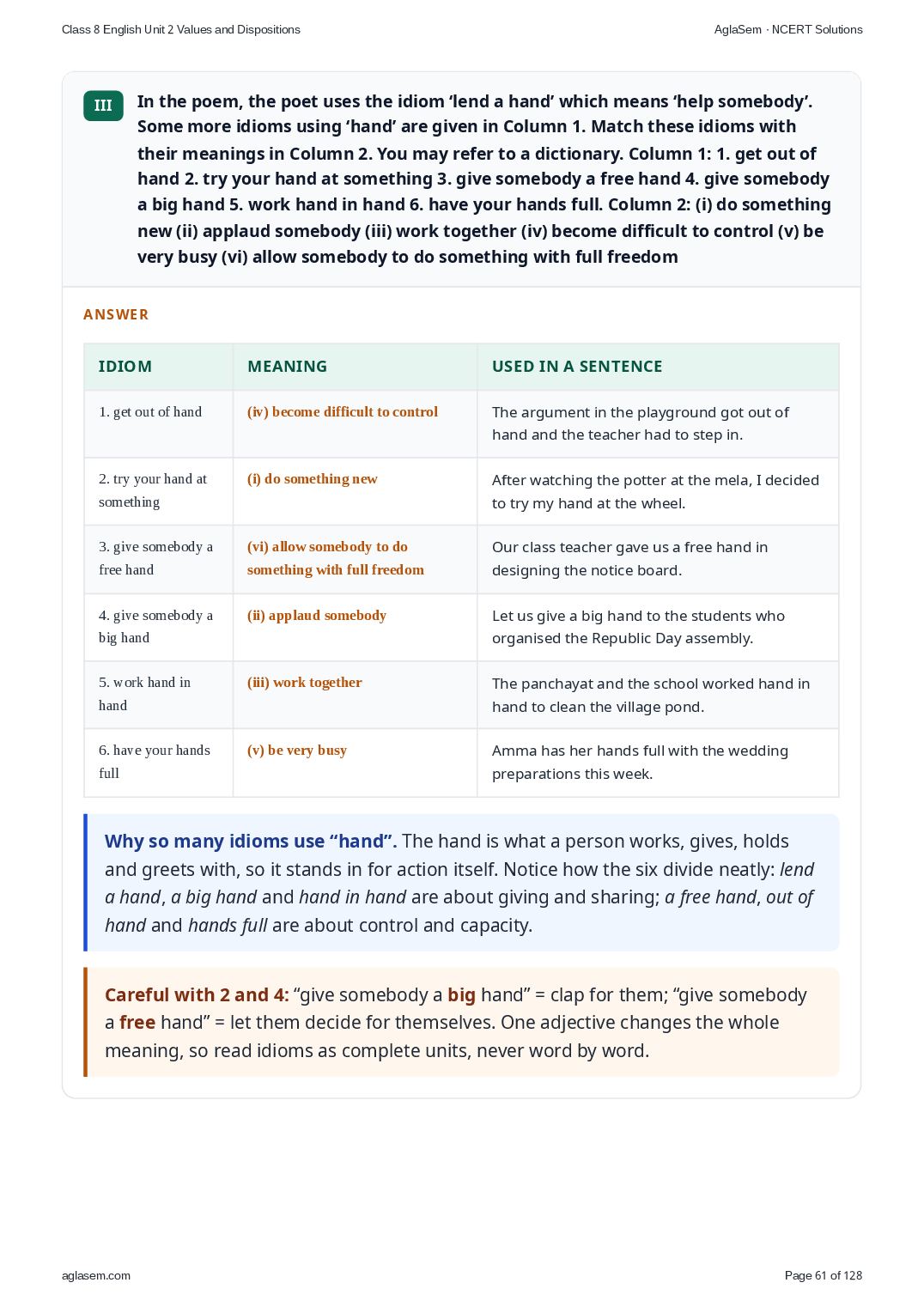
- In the poem, the poet uses the idiom ‘lend a hand’ which means ‘help somebody’. Some more idioms using ‘hand’ are given in Column 1. Match these idioms with their meanings in Column 2. You may refer to a dictionary. Column 1: 1. get out of hand 2. try your hand at something 3. give somebody a free hand 4. give somebody a big hand 5. work hand in hand 6. have your hands full. Column 2: (i) do something new (ii) applaud somebody (iii) work together (iv) become difficult to control (v) be very busy (vi) allow somebody to do something with full freedom
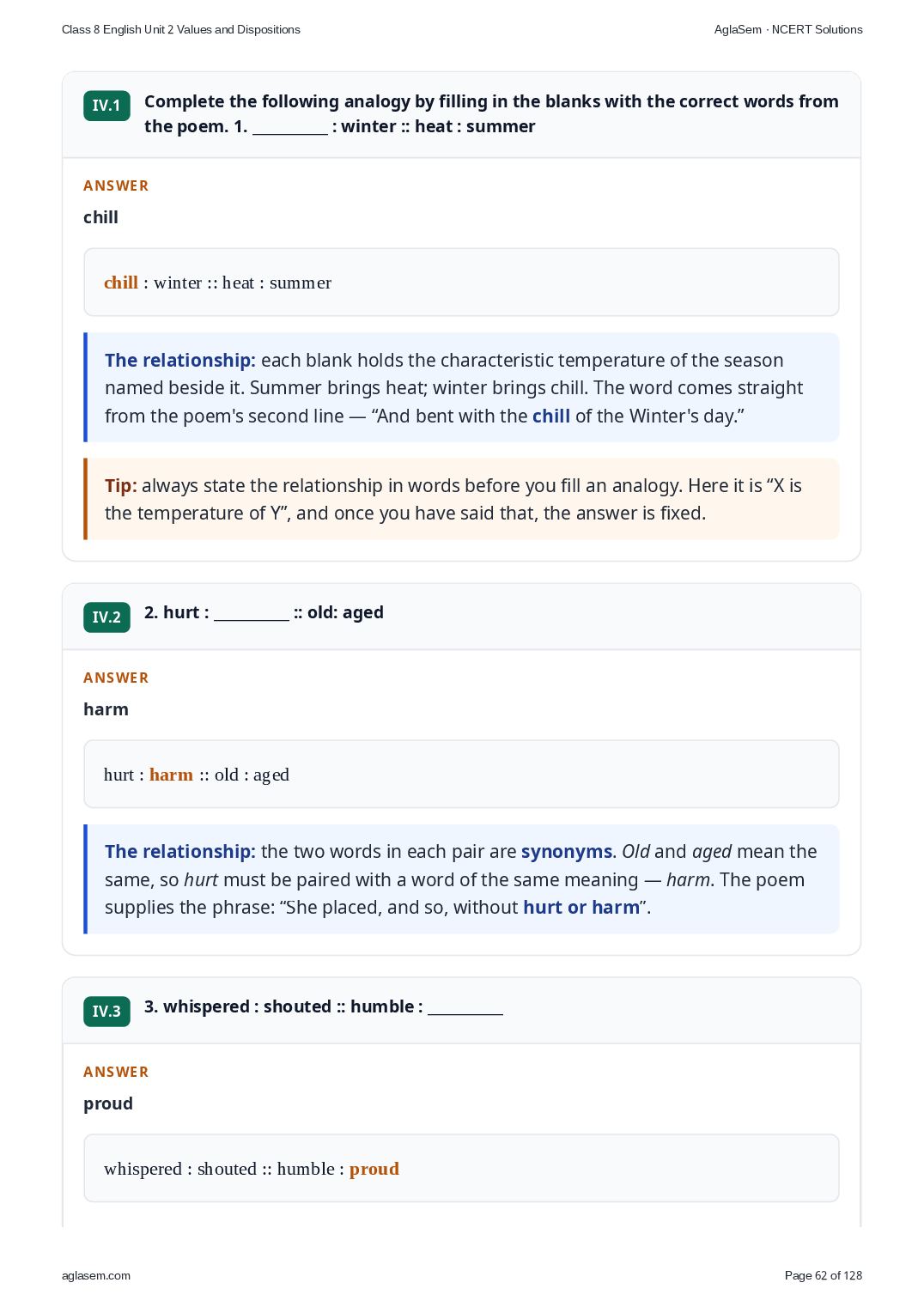
- Complete the following analogy by filling in the blanks with the correct words from the poem. 1. ___________ : winter :: heat : summer
- 2. hurt : ___________ :: old: aged
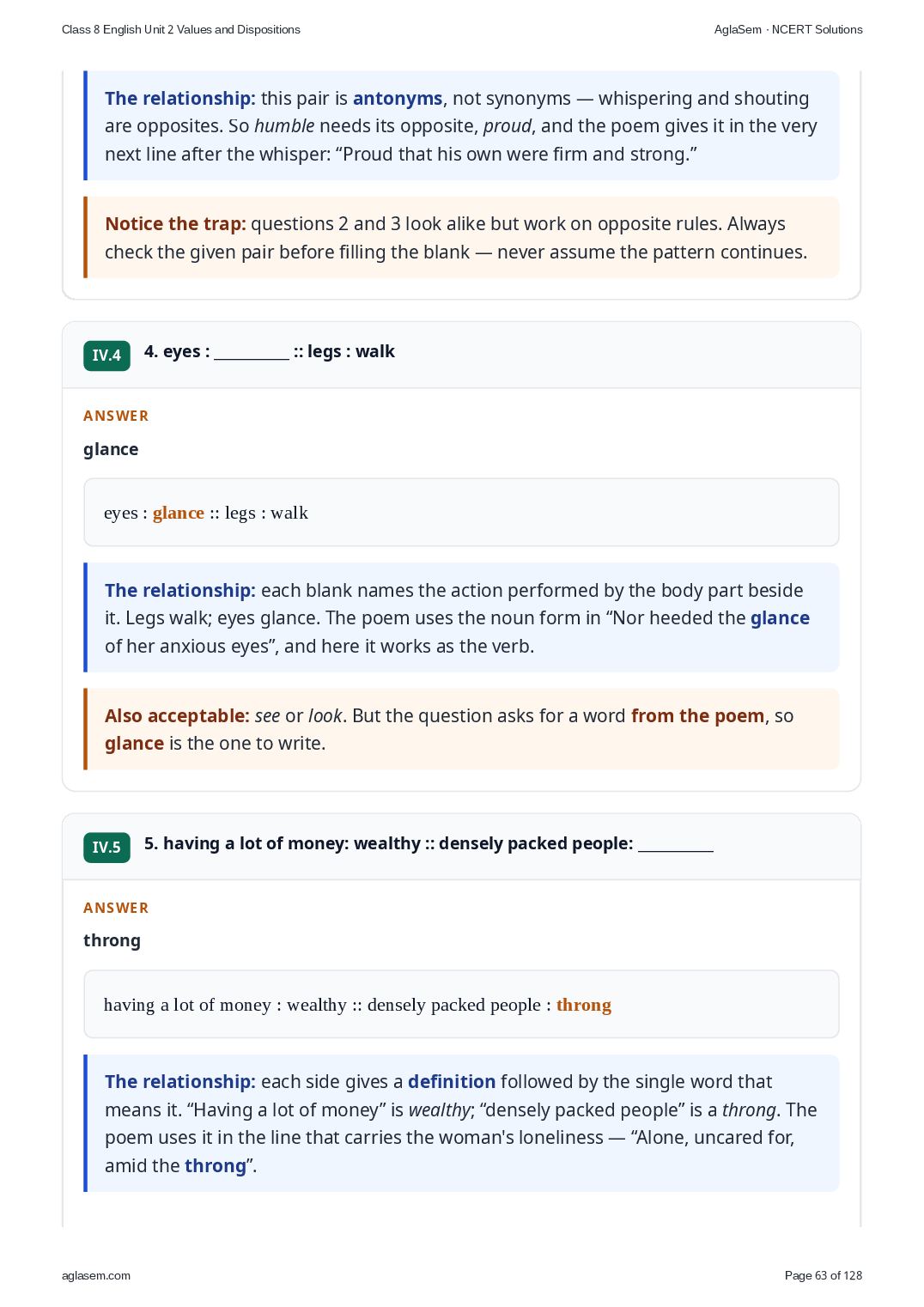
- 3. whispered : shouted :: humble : ___________
- 4. eyes : ___________ :: legs : walk
- 5. having a lot of money: wealthy :: densely packed people: ___________
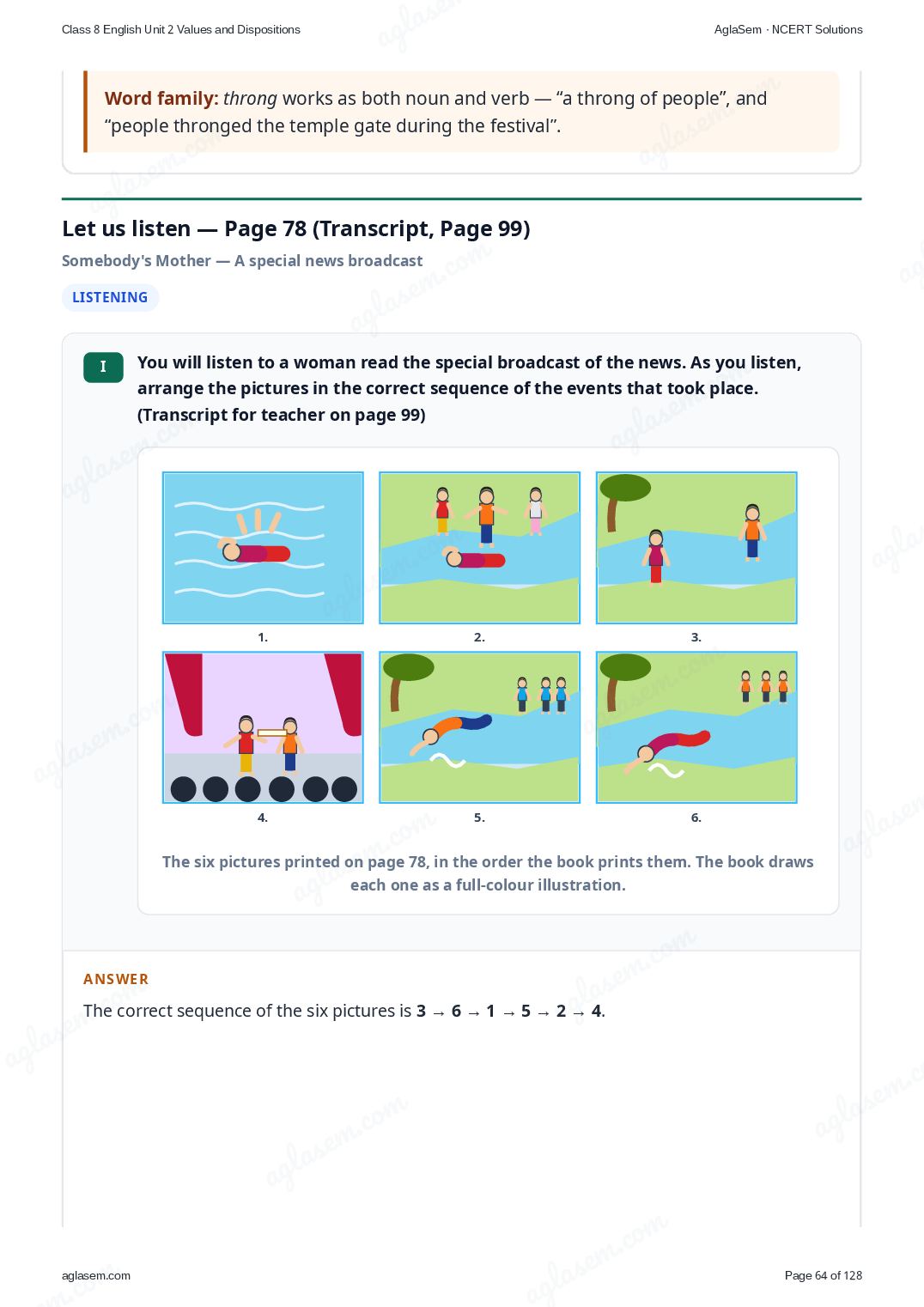
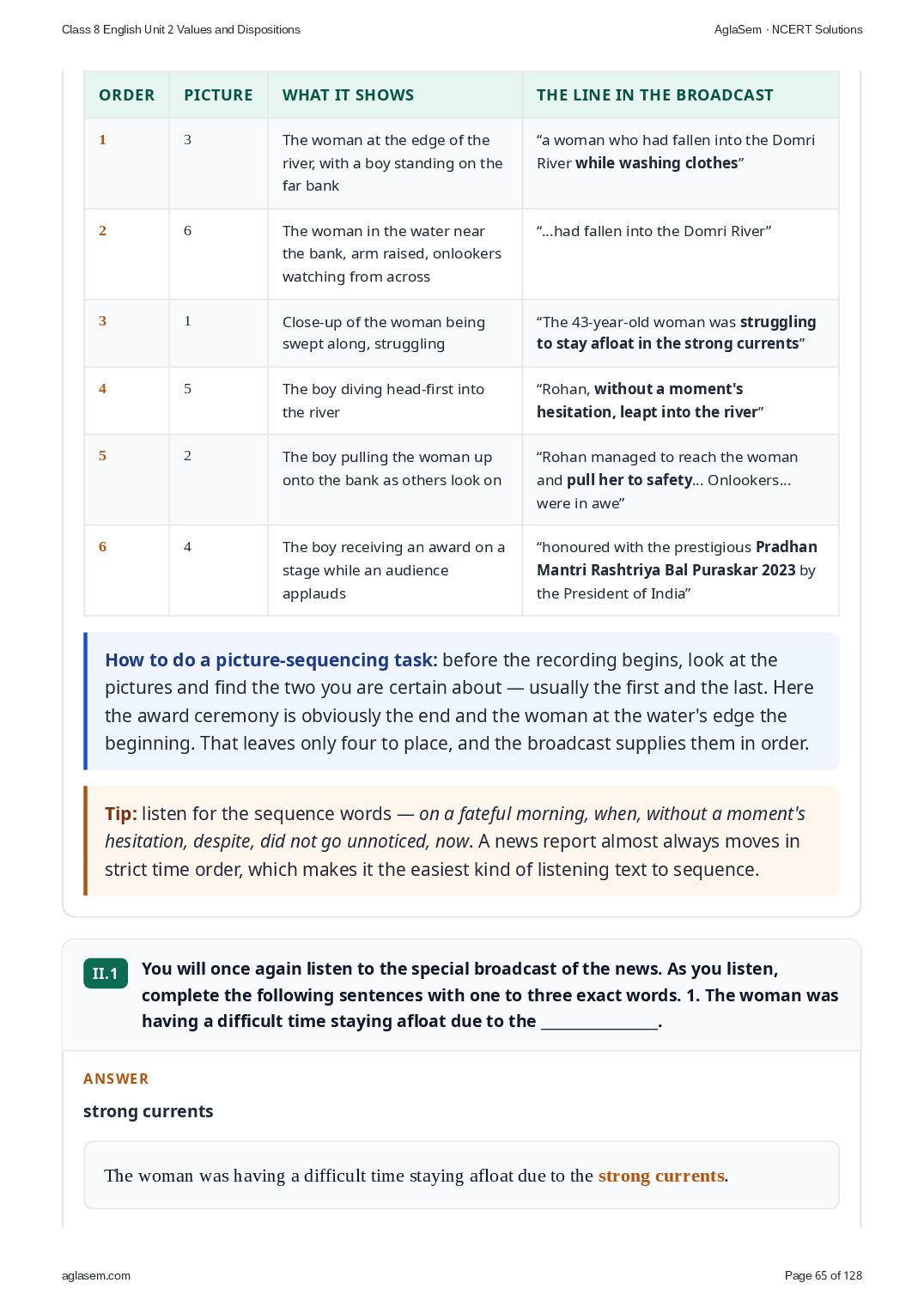
- You will listen to a woman read the special broadcast of the news. As you listen, arrange the pictures in the correct sequence of the events that took place. (Transcript for teacher on page 99)
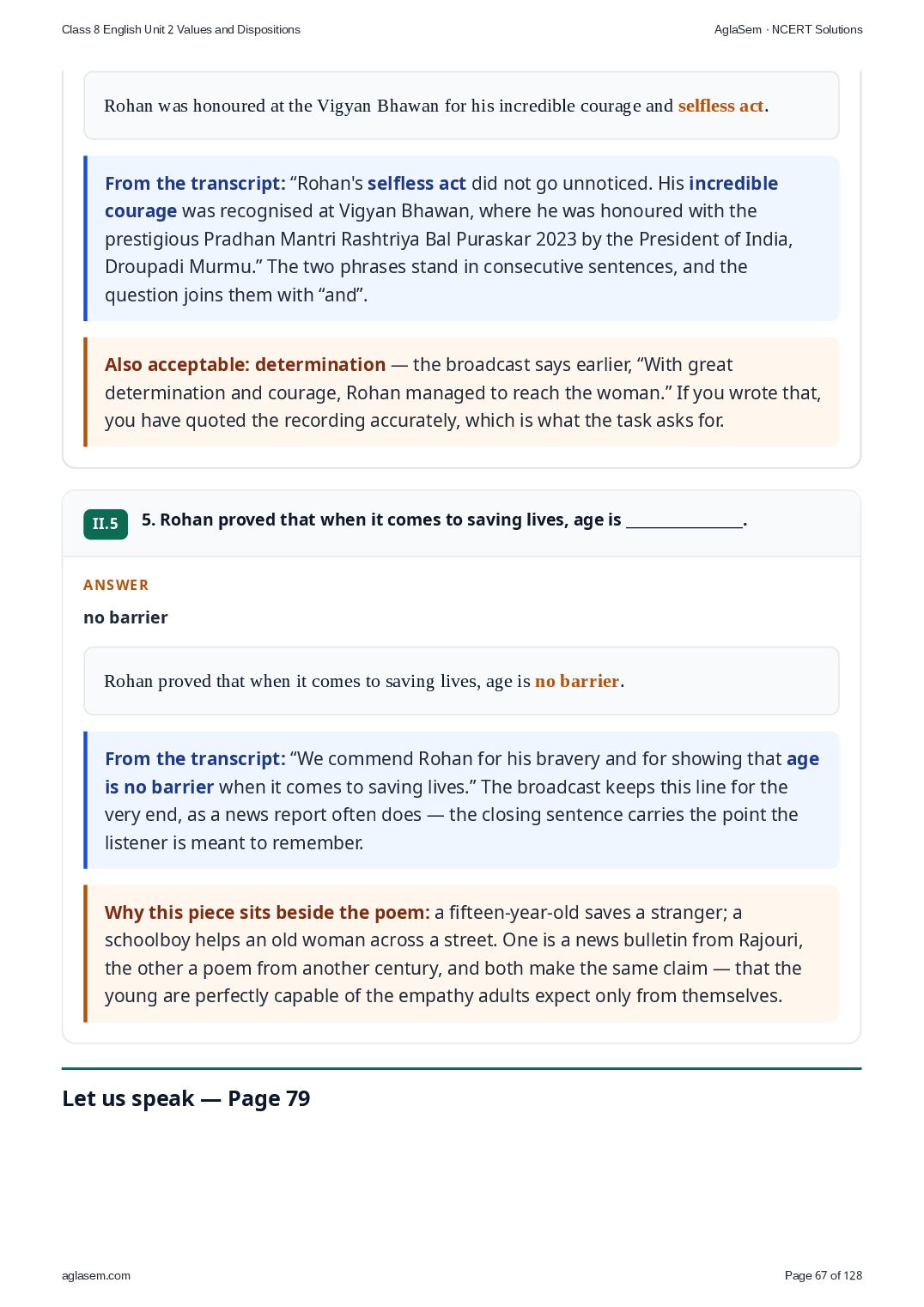
- You will once again listen to the special broadcast of the news. As you listen, complete the following sentences with one to three exact words. 1. The woman was having a difficult time staying afloat due to the _________________.
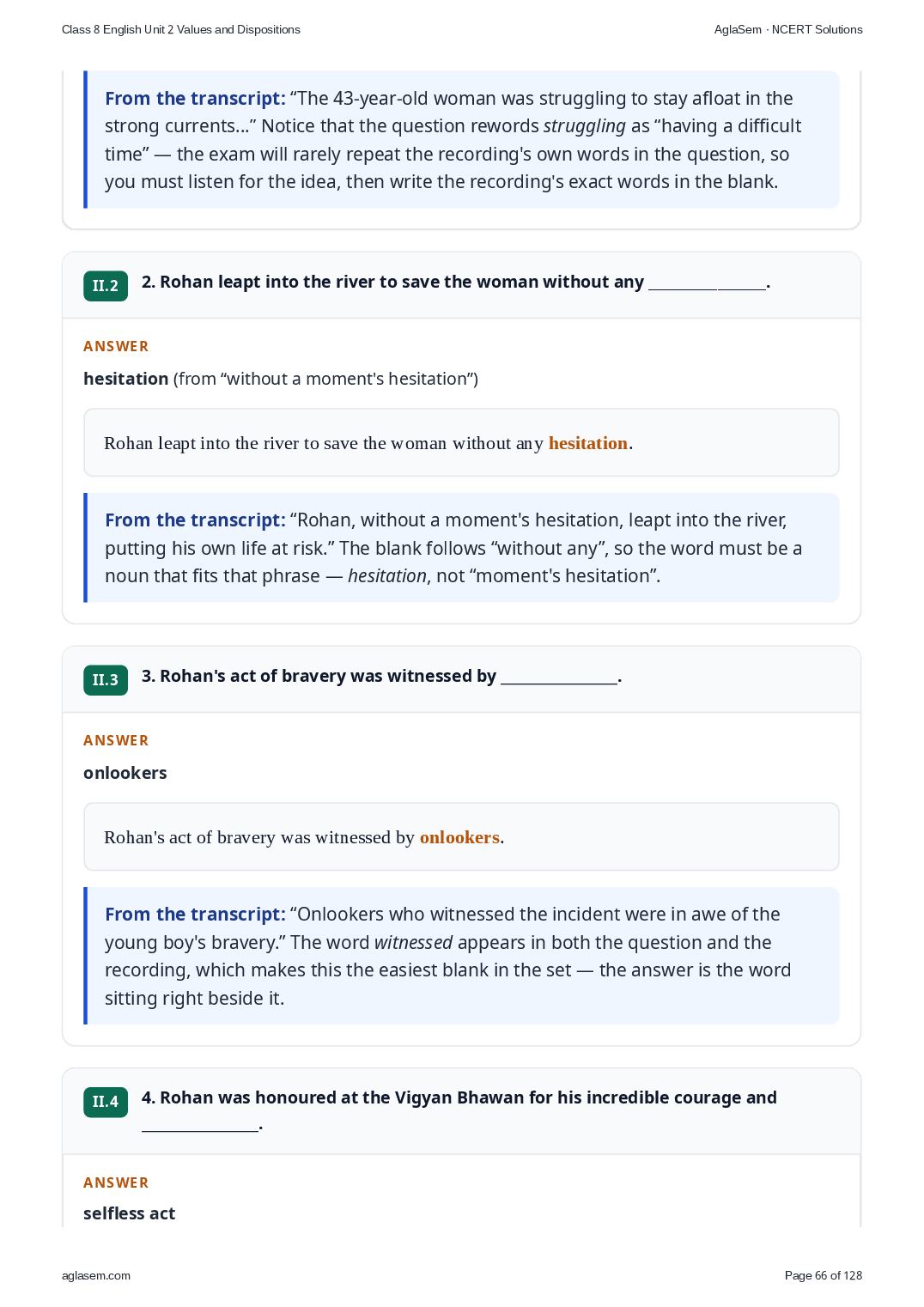
- 2. Rohan leapt into the river to save the woman without any _________________.
- 3. Rohan's act of bravery was witnessed by _________________.
- … and more questions are solved in the complete PDF above.
Chapter at a Glance
- The unit gathers three pieces that ask the same question in three different registers — what does a person owe to others? — and answers it through a soldier, a schoolboy and a grandfather.
- A Tale of Valour is a factual account of 3 November 1947, when Major Somnath Sharma and the 90 men of D Company, 4 KUMAON, held Badgam against roughly 500 infiltrators. His last message — “I shall not withdraw an inch but will fight to the last man and the last round” — is the sentence the whole piece is built around.
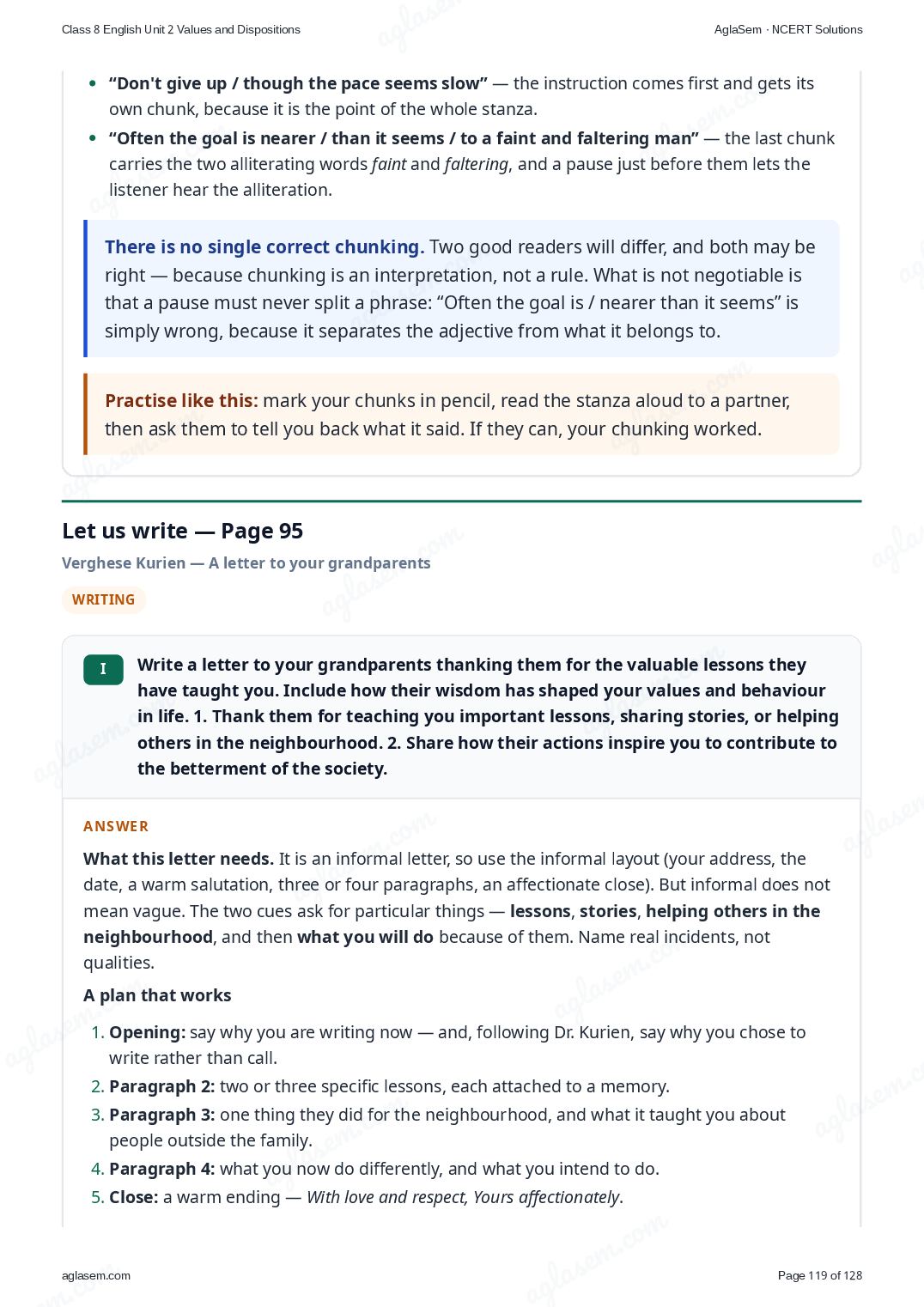
- Somebody's Mother (Mary Dow Brine) is a narrative poem in rhyming couplets ( AABB ). An old woman waits at a crossing in the snow; a crowd of schoolboys hurries past; one boy stops, and his reason — “She's somebody's mother, boys, you know” — turns a stranger into a person.
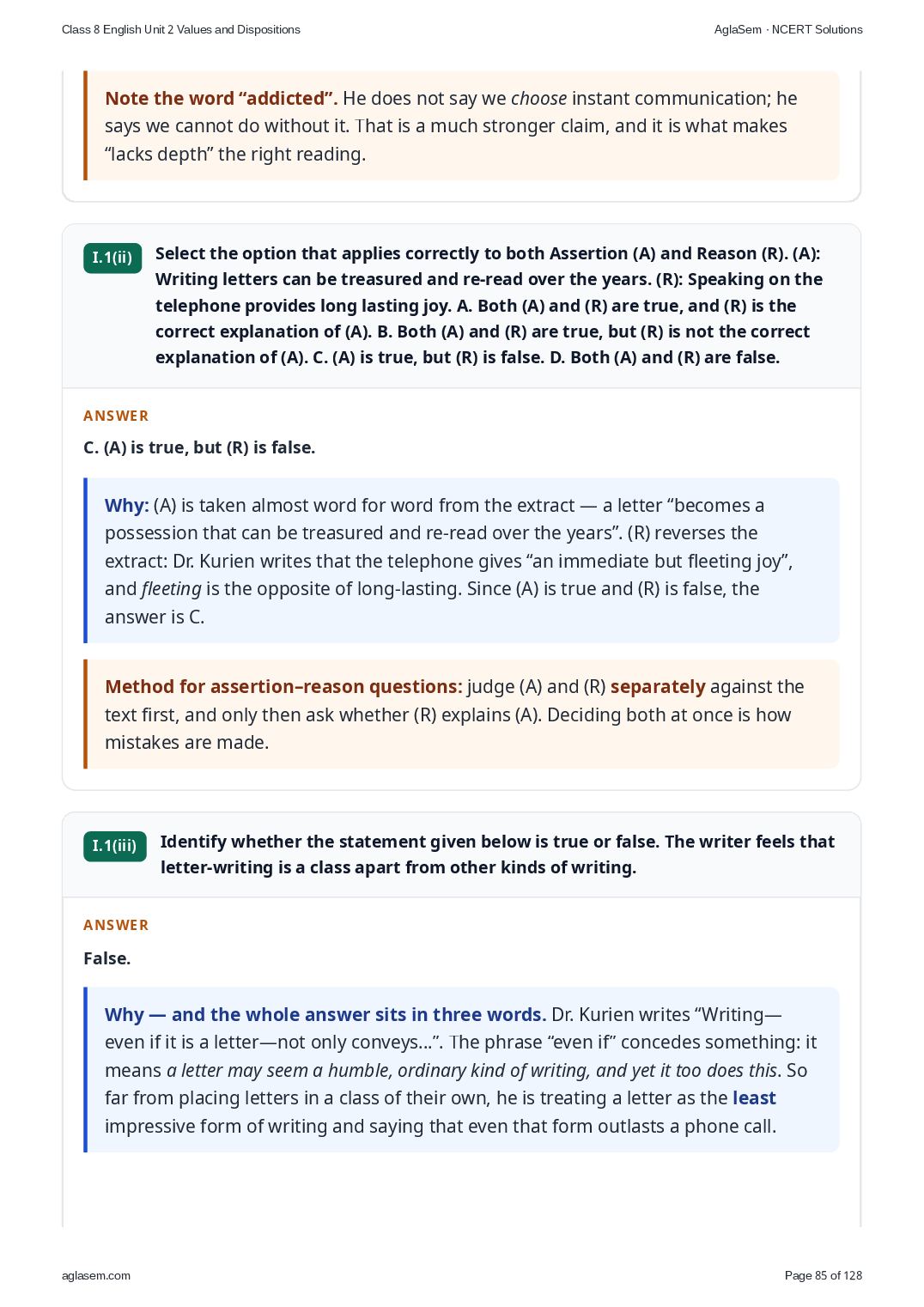
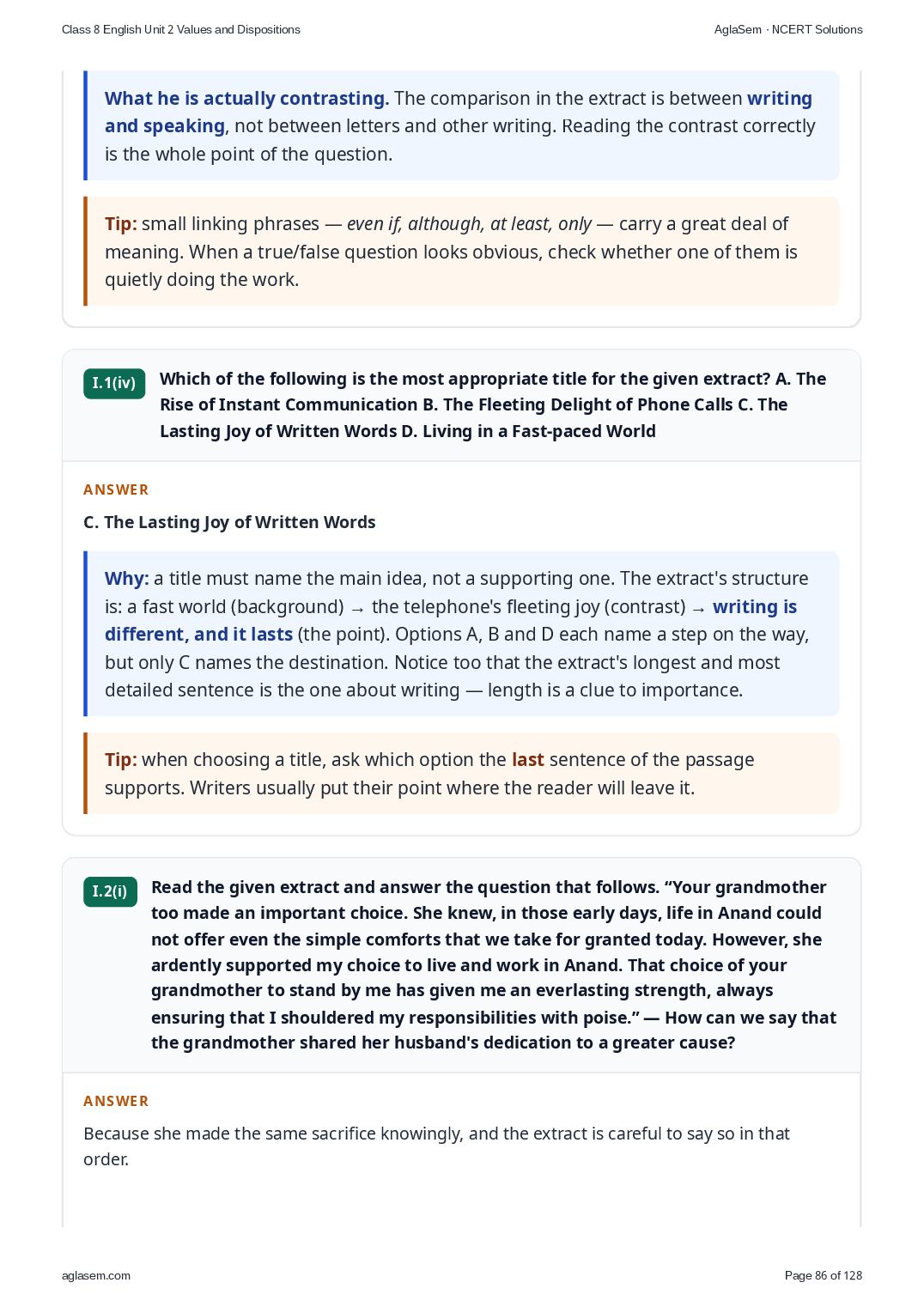
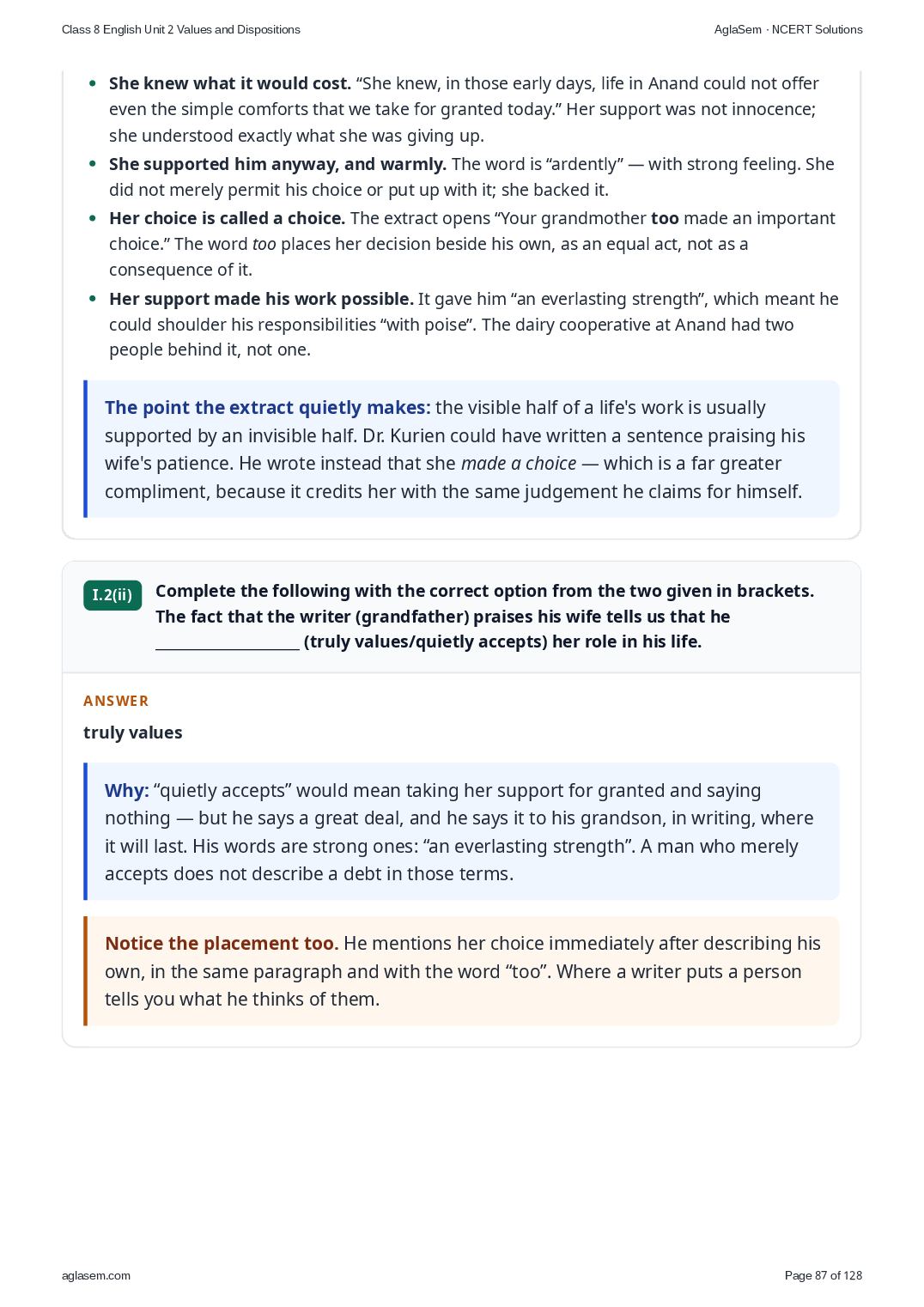
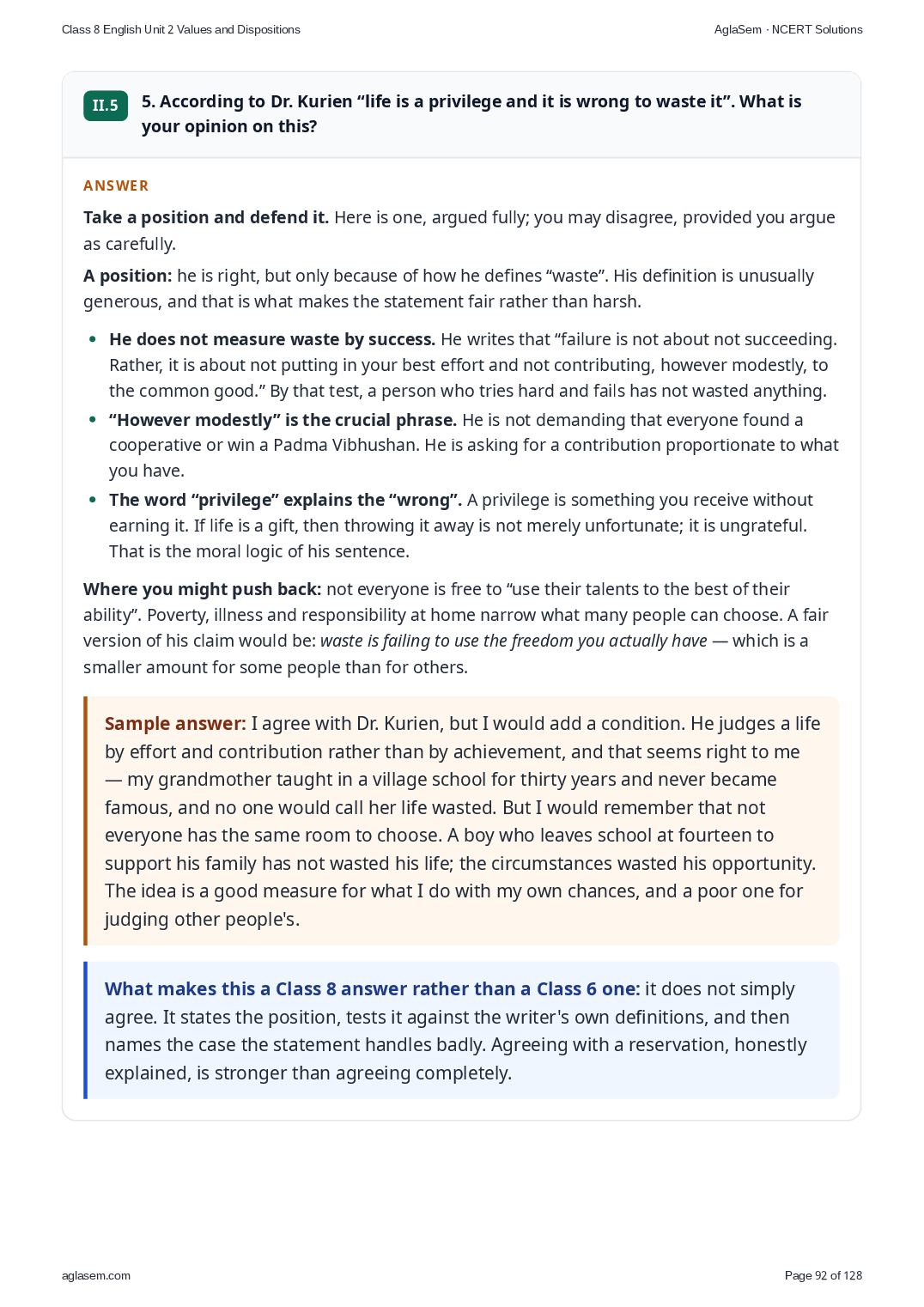
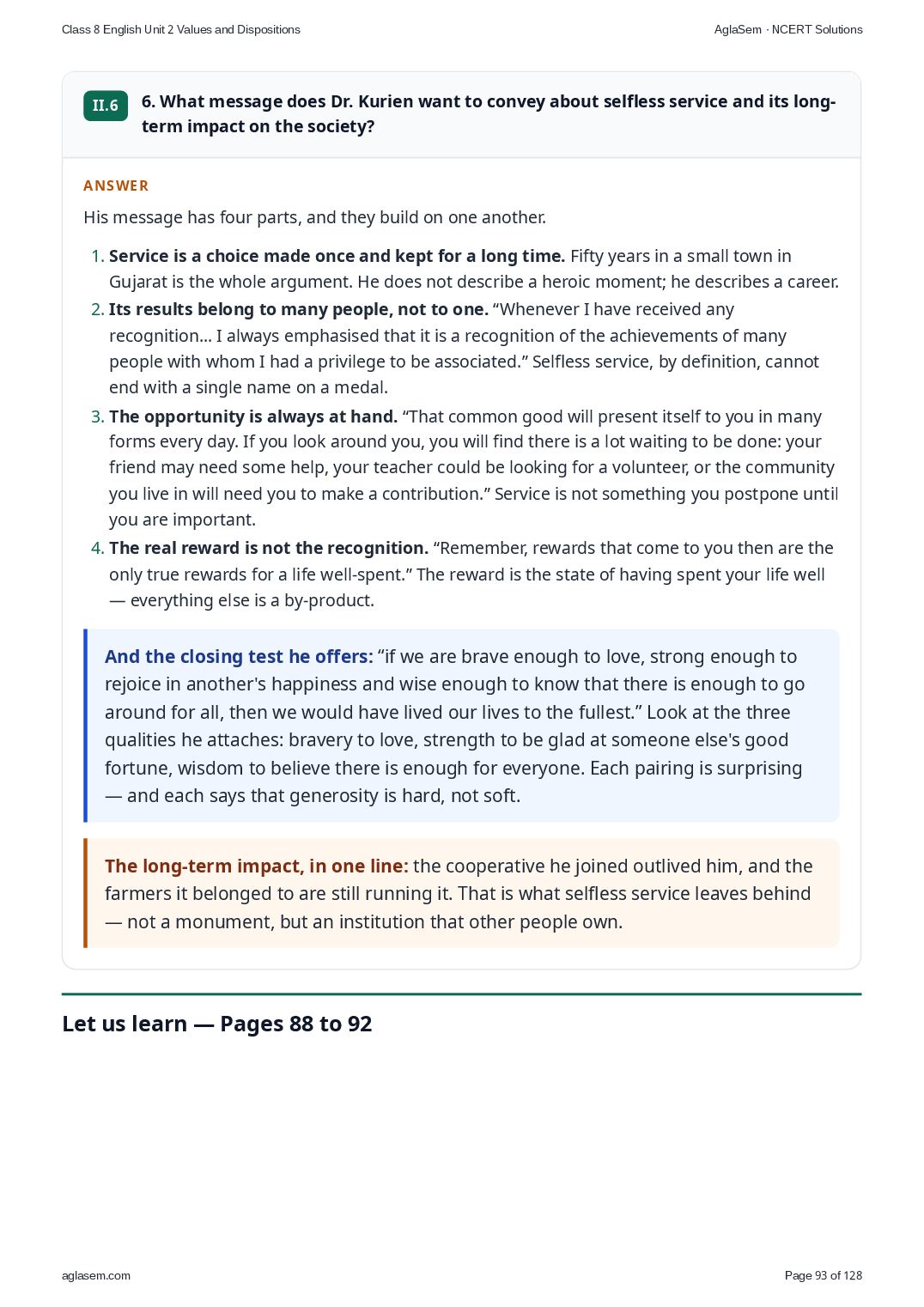
- Verghese Kurien — I Too Had A Dream is a letter from the architect of the White Revolution to his grandson Siddharth. It argues that writing outlasts speech, that integrity means being honest with yourself first, and that the only true reward is one you earn by your own work.
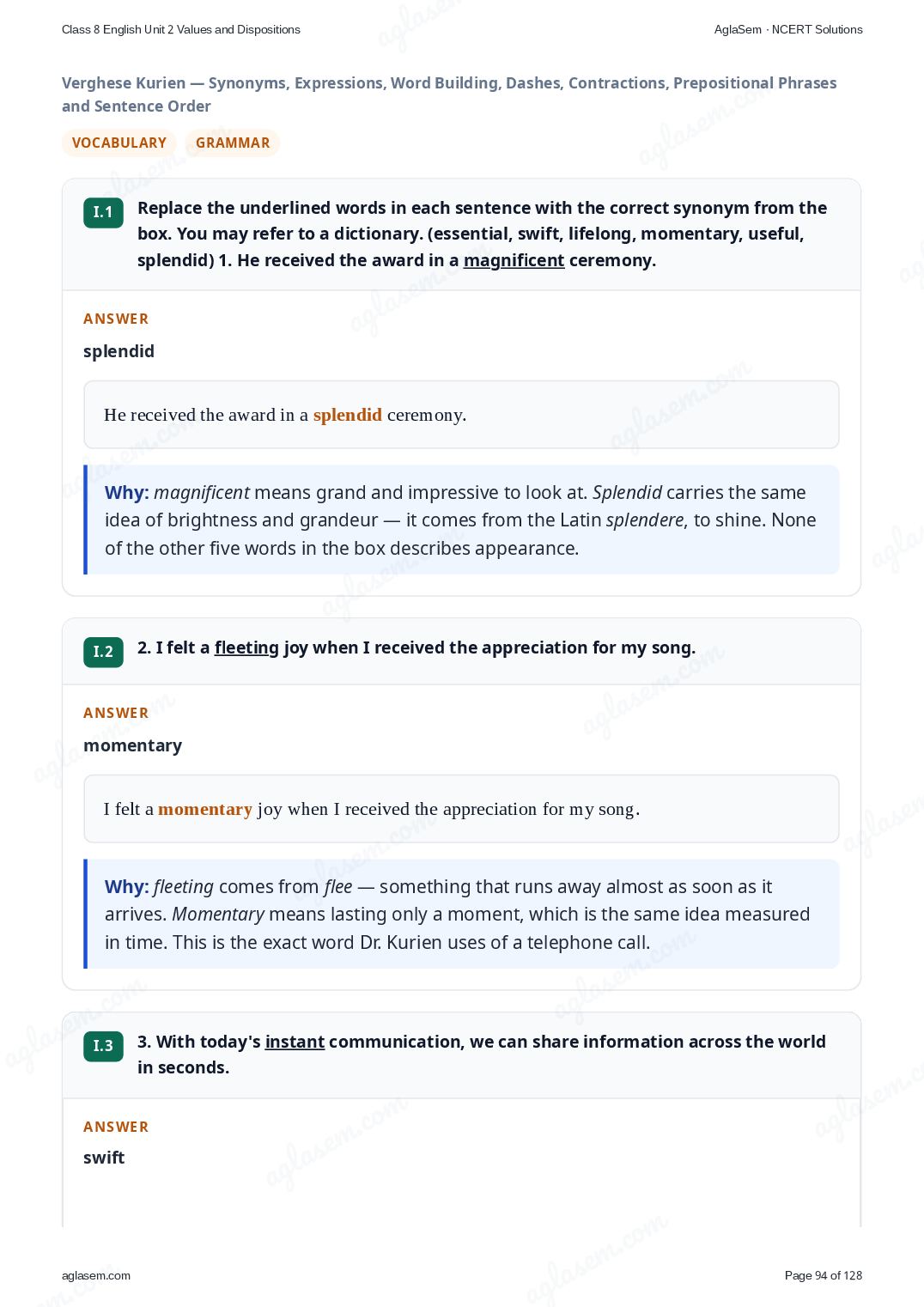
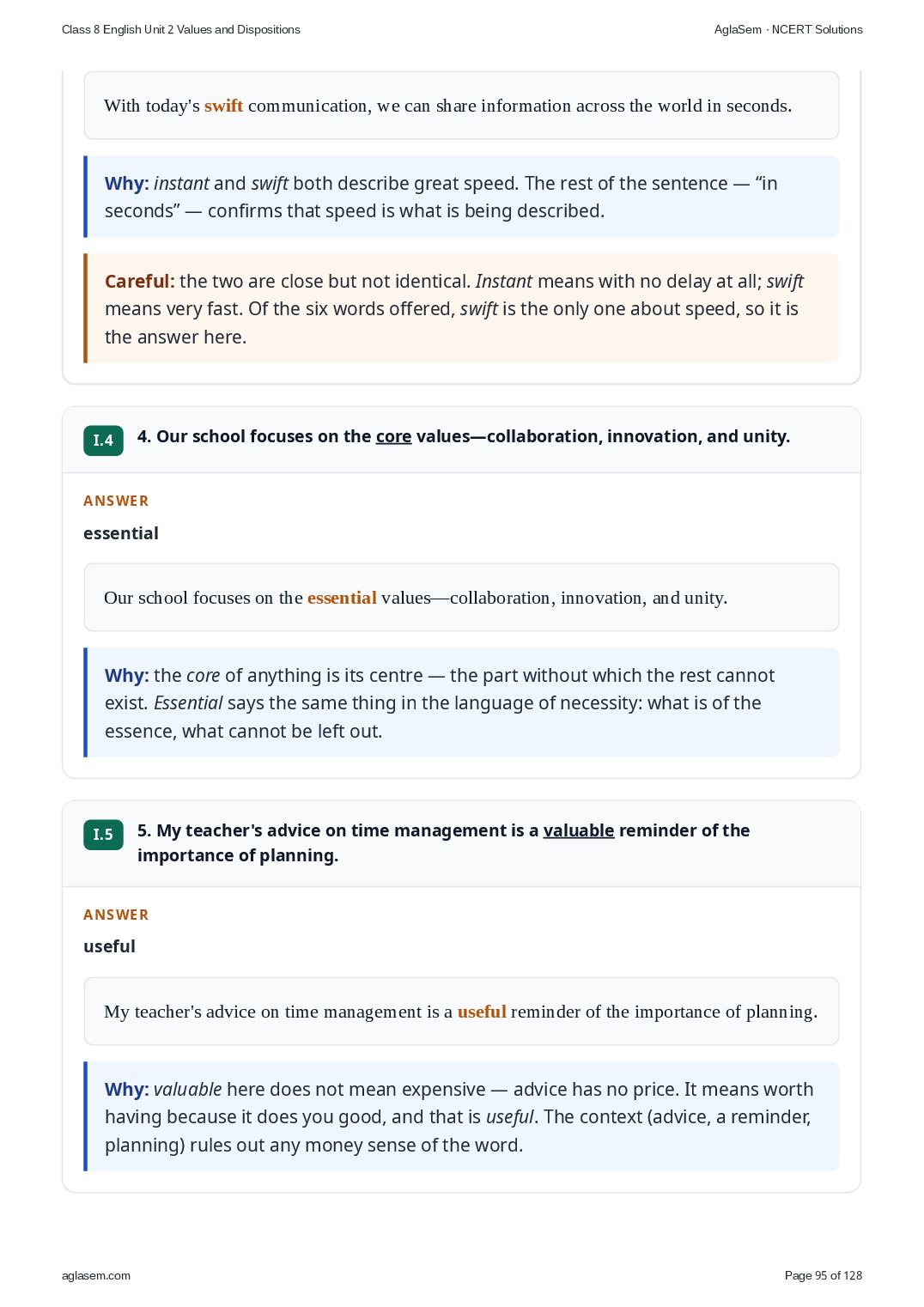
- The language work of the unit covers military collective nouns , verbs formed with over- , the advice/advise noun–verb spelling pairs, subject–verb agreement , antonyms in a word grid, idioms with “hand” , analogies , synonyms , en and em dashes , its/it's, your/you're, their/they're , and prepositional phrases .
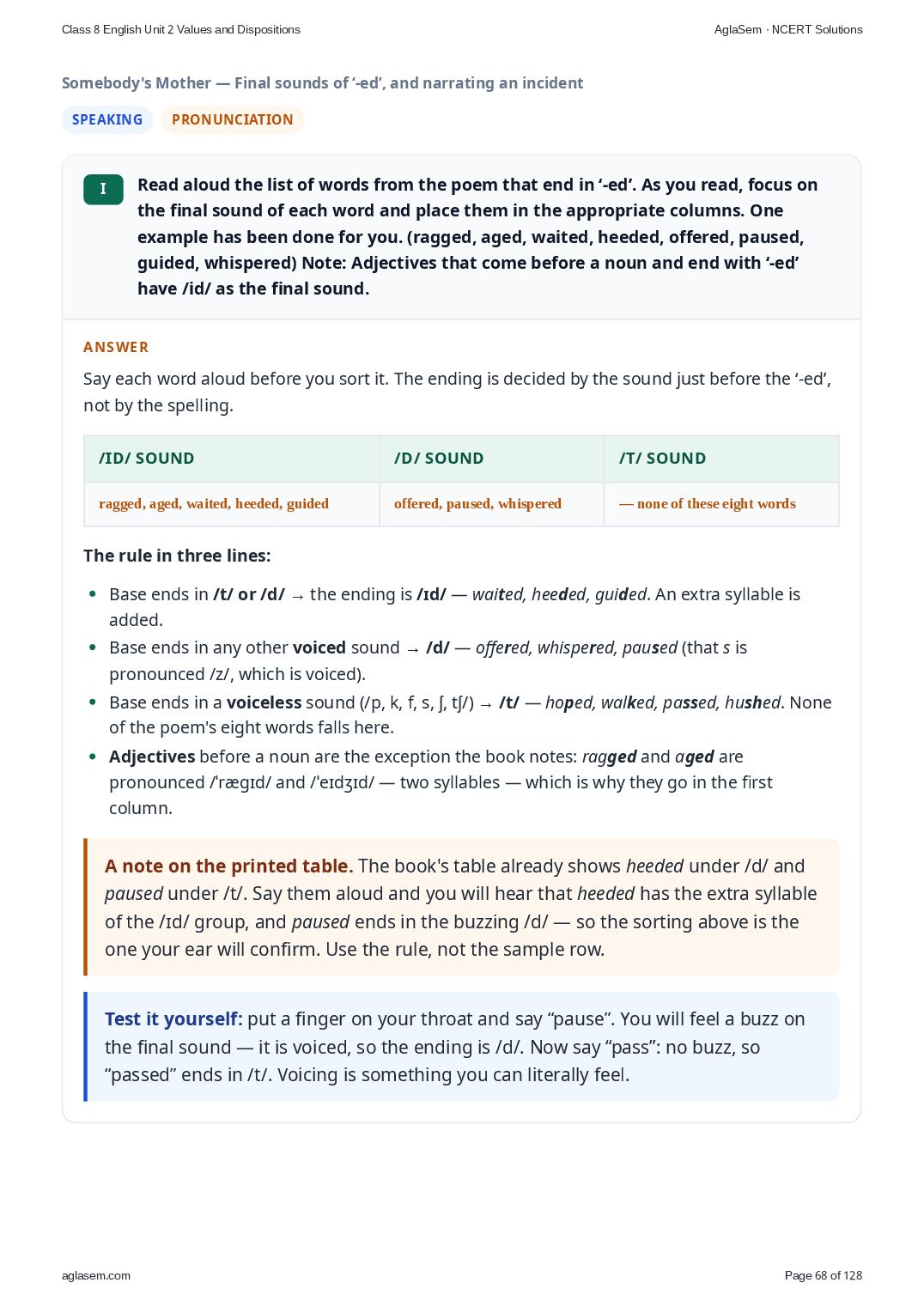
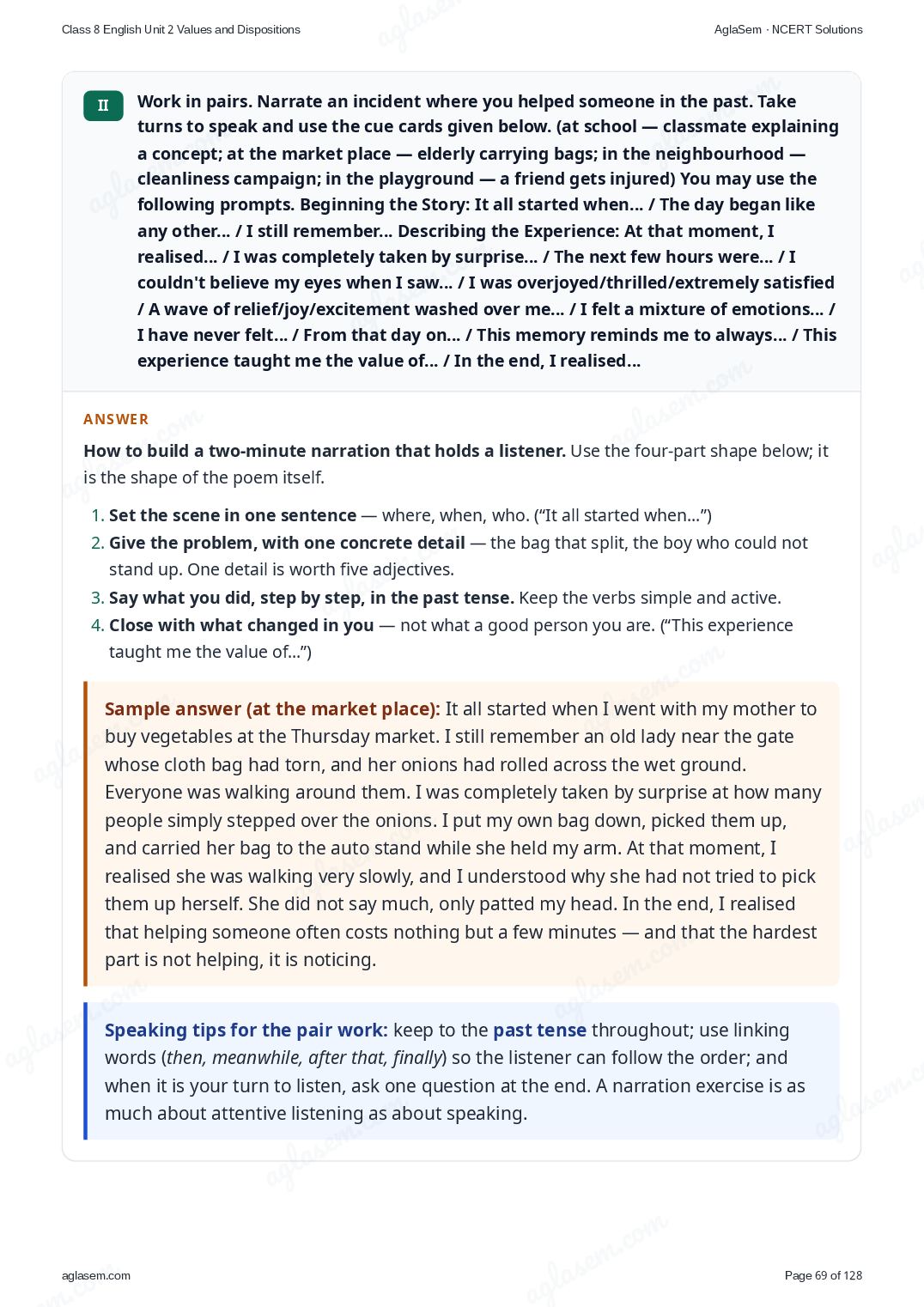
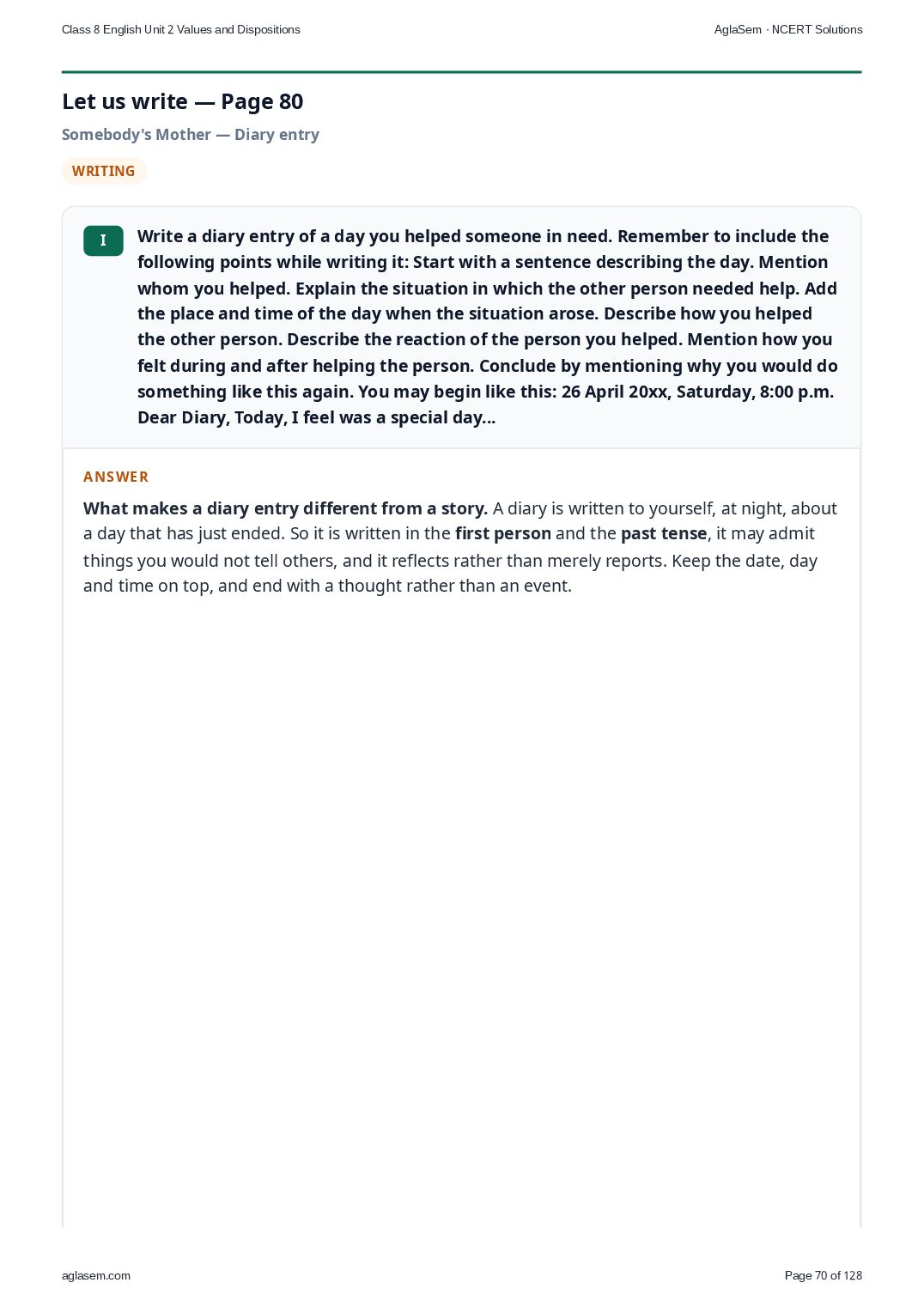
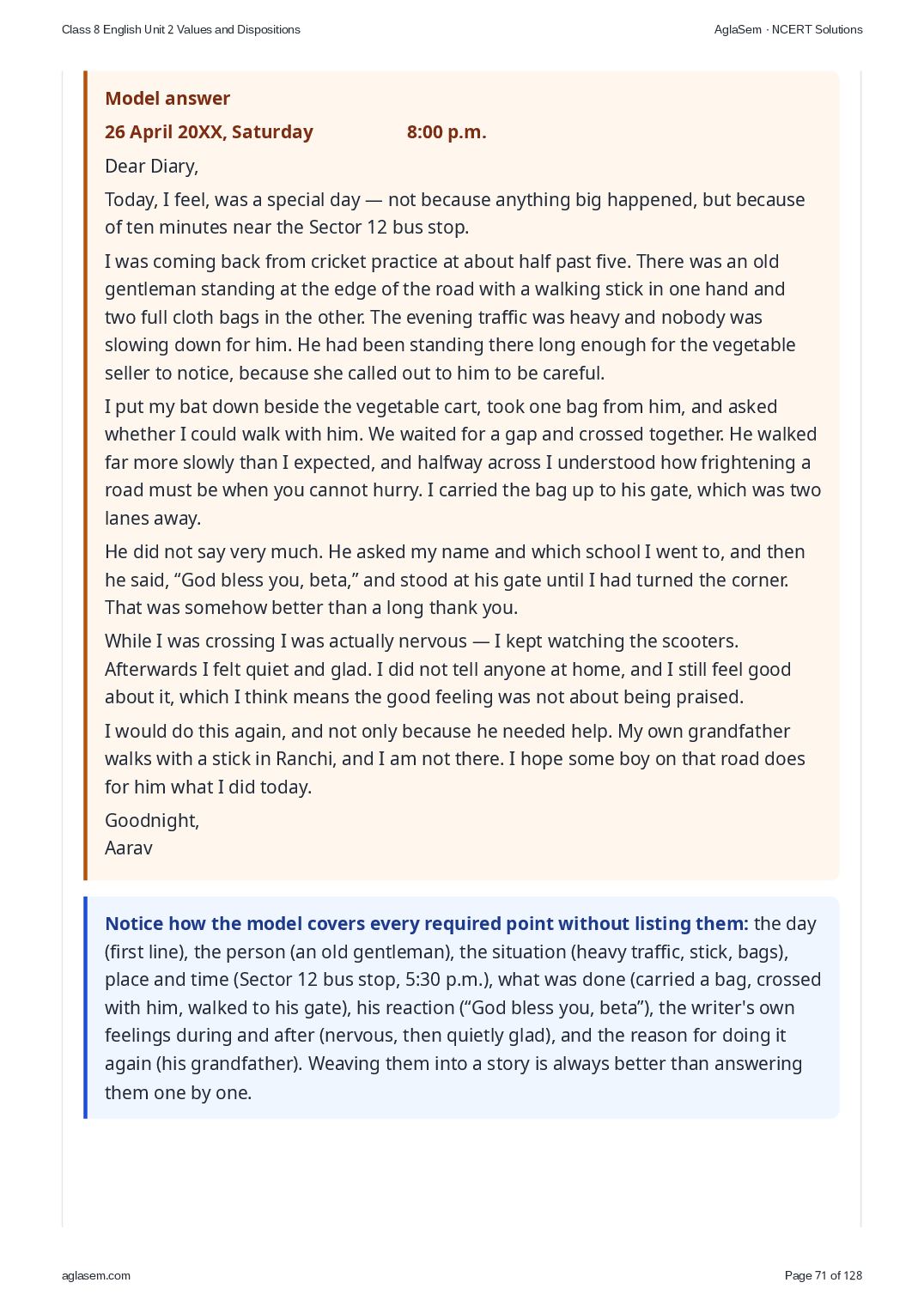
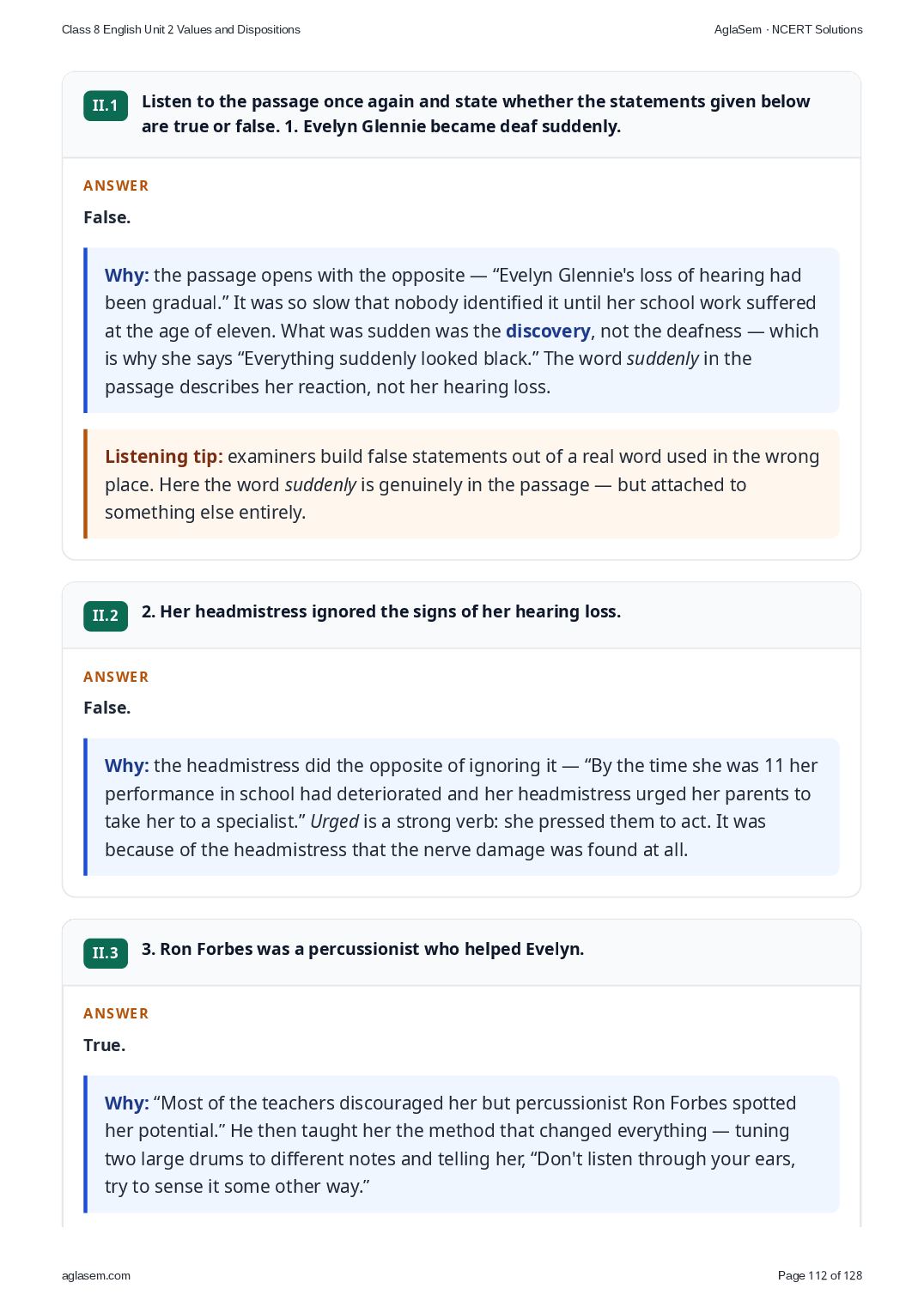
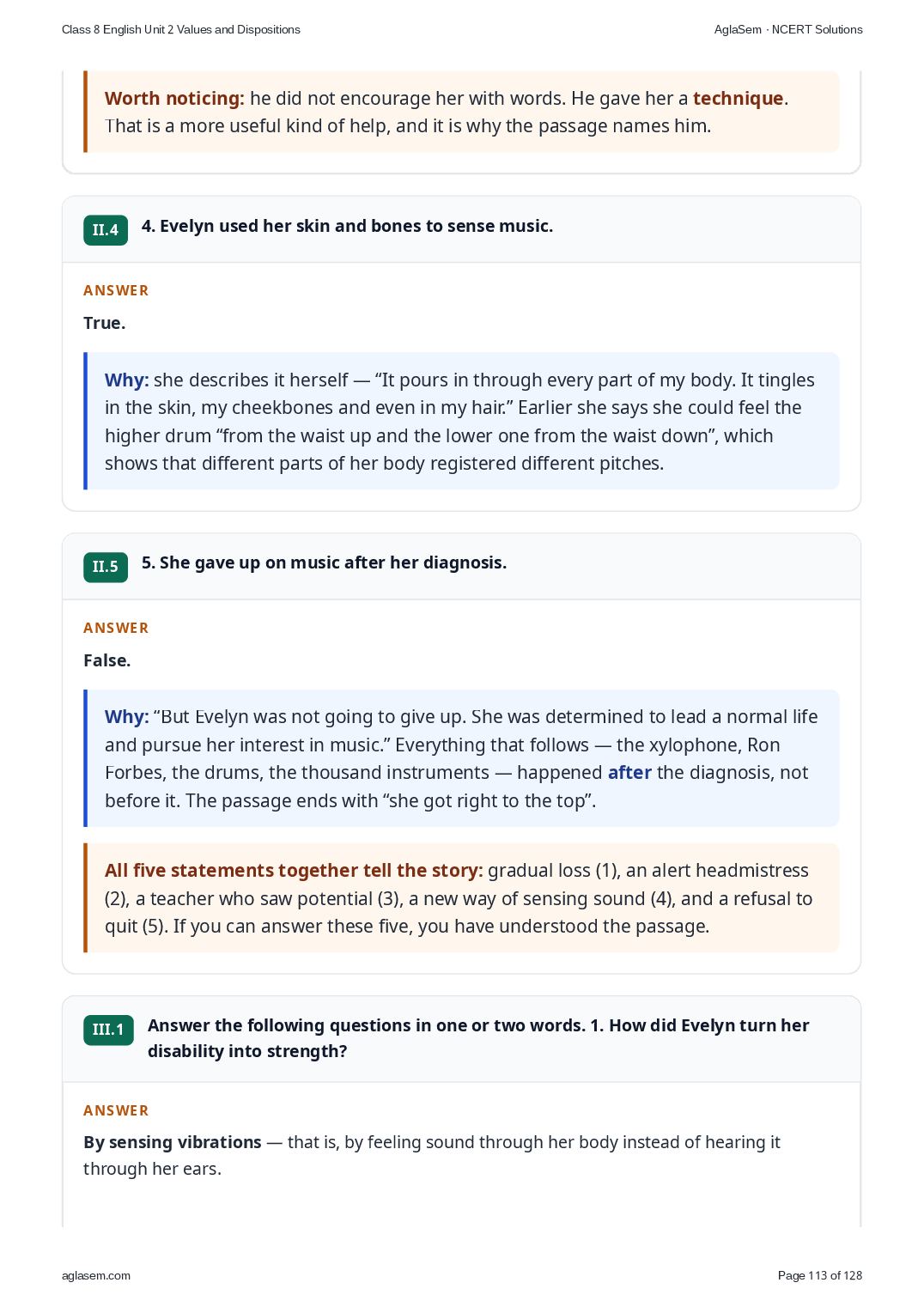
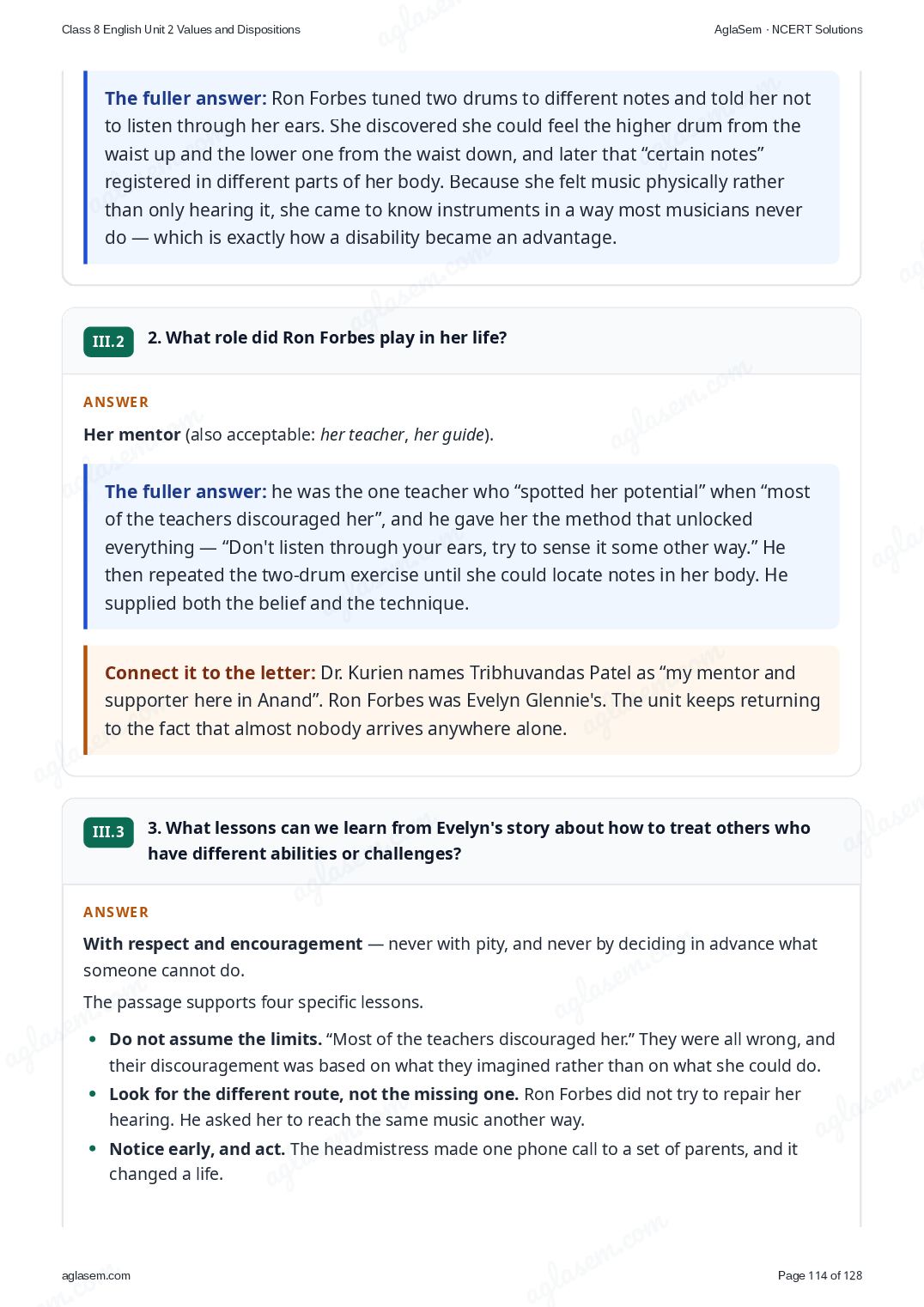
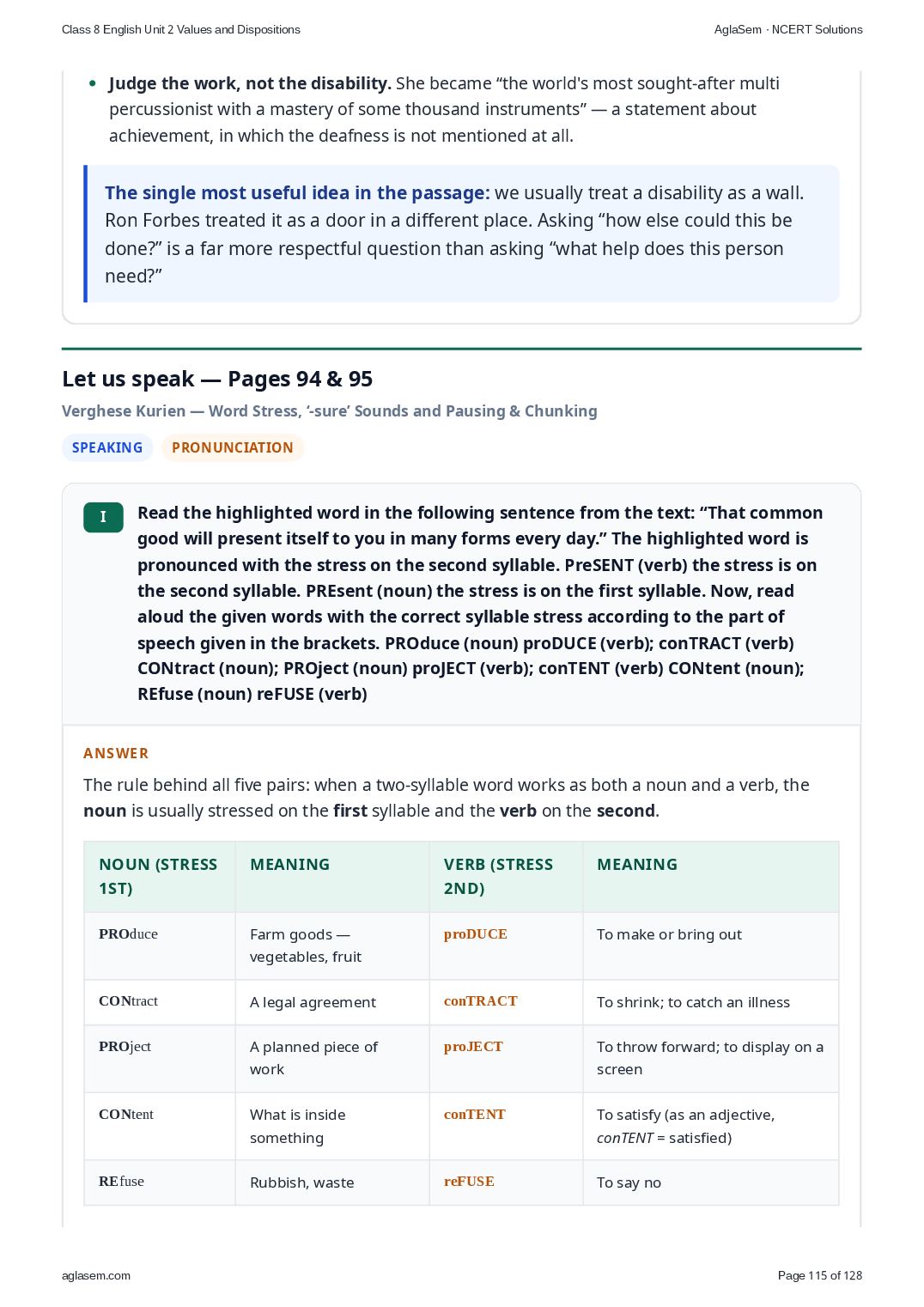
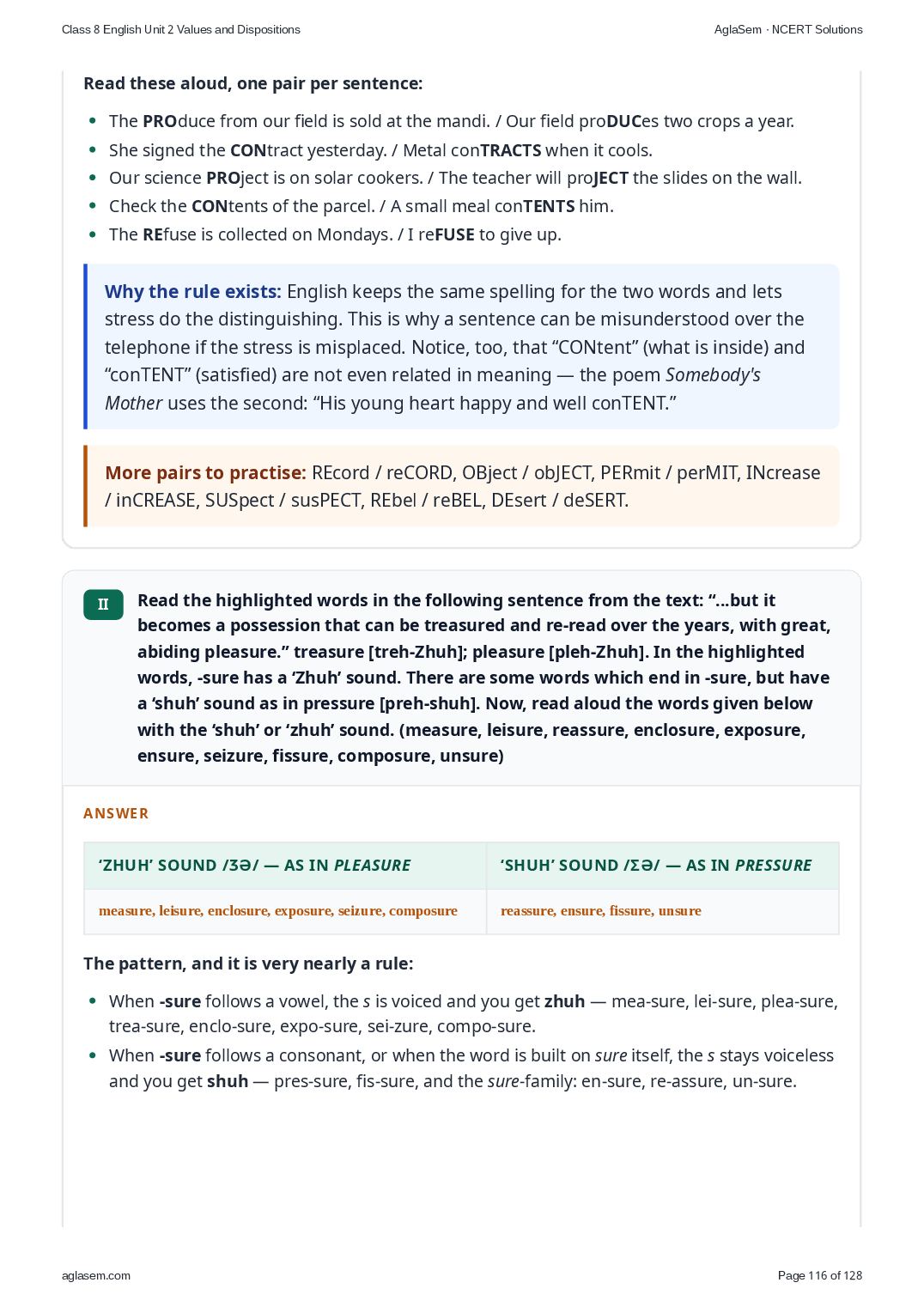
- The listening, speaking and writing tasks include a talk on the Param Vir Chakra , a news broadcast about a fifteen-year-old rescuer, a passage on the percussionist Evelyn Glennie , the /ɪd/ /d/ /t/ endings of “-ed”, noun–verb stress pairs, a letter of enquiry , a diary entry and a personal letter .
How to Download NCERT Solutions for Class 8 English Chapter 2 PDF
Follow these simple steps to get the Values and Dispositions questions-and-answers PDF from Poorvi.
- Search NCERT Solutions for Class 8 English Chapter 2 aglasem and open this page.
- Read the exercise questions with answers for Values and Dispositions shown above.
- Click the Download PDF link to save the Values and Dispositions solutions to your device.
NCERT Solutions for Class 8 English – All Chapters
There are more chapters to study besides Values and Dispositions in English. Here are the NCERT Solutions for all chapters of Class 8 English.
- Chapter 1 Wit and Wisdom
- Chapter 2 Values and Dispositions
- Chapter 3 Mystery and Magic
- Chapter 4 Environment
- Chapter 5 Science and Curiosity
NCERT Solutions for Class 8 – All Subjects
Just like Chapter 2 of English, you can get the exercise questions with answers for every other subject of Class 8. Here are the NCERT Solutions for all subjects of Class 8.
NCERT Solutions for Class 8 English Chapter 2 – An Overview
The key highlights of this study material are as follows.
| Aspects | Details |
|---|---|
| Class | Class 8 |
| Subject | English |
| Chapter Number | Chapter 2 |
| Chapter Name | Values and Dispositions |
| Book Name | Poorvi |
| Book By | NCERT (National Council of Educational Research and Training) |
| Educational Resource Here | NCERT Solutions of Class 8 English Chapter 2 for all exercises |
| More Questions Answers of This Subject | NCERT Solutions for Class 8 English |
| Download Book Chapter | NCERT Book Class 8 English |
| All Questions Answers For This Class | NCERT Solutions for Class 8 |
| Complete Solutions | NCERT Solutions |
NCERT Solutions for Class 8 English Chapter 2 Values and Dispositions – FAQs
What are the NCERT Solutions for Class 8 English Chapter 2 Values and Dispositions?
They are the complete, step-by-step answers to all the exercise and in-text questions of Chapter 2 Values and Dispositions from the NCERT Class 8 English textbook Poorvi, written by experts as per the latest NCERT syllabus.
How can I download the Class 8 English Chapter 2 solutions PDF for free?
Open this page on aglasem, read the Values and Dispositions questions with answers, and click the “Download Solutions PDF” link. The Class 8 English Chapter 2 NCERT Solutions PDF is completely free to download.
Are these NCERT Solutions as per the latest 2026-27 syllabus?
Yes. The NCERT Solutions for Class 8 English Chapter 2 are based on the latest NCERT textbook Poorvi and the current 2026-27 CBSE syllabus, so the questions and answers match what you study in class.
Where can I get NCERT Solutions for the other chapters of Class 8 English?
You can find the answers to every chapter on the NCERT Solutions for Class 8 English page, and solutions for every subject on the NCERT Solutions for Class 8 page.
How do NCERT Solutions help in exam preparation?
They show the correct method to solve each question, help you write answers the way they are expected in exams, let you check and correct your own work, and save revision time — which together improve your marks in Class 8 English.
If you have any queries on NCERT Solutions for Class 8 English Chapter 2 Values and Dispositions, then please ask in the comments below.