NCERT Solutions for Class 9 English Chapter 4 Vitamin M provide clear, step-by-step answers to every exercise and in-text question from the chapter Vitamin M of the NCERT textbook Kaveri. Prepared by subject experts as per the latest NCERT (CBSE) syllabus for 2026-27, these NCERT Solutions for Class 9 English help you understand each concept, write exam-ready answers, and check your own solutions. You can read them online below or download the free Class 9 English Chapter 4 question-answer PDF.
NCERT Solutions for Class 9 English Chapter 4 Vitamin M
- Class: Class 9
- Subject: English
- Chapter: Chapter 4 – Vitamin M
- Textbook: Kaveri (NCERT)
- Study material: NCERT Solutions – questions with answers, free PDF
These solutions answer all the exercise questions of Chapter 4 Vitamin M — including the in-text questions, short-answer and long-answer questions, and activities — with complete explanations so you can follow the method, not just the final answer. Read the full solutions below.
NCERT Solutions Class 9 English Chapter 4 Vitamin M View Download


NCERT Solutions for Class 9 English Chapter 4 PDF Download
You can read the NCERT Solutions for Class 9 English Chapter 4 online above, or download the complete question-answer PDF to study Vitamin M offline at any time.
NCERT Solutions for Class 9 English Chapter 4 PDF Download Link – Click Here to Download Solutions PDF
Questions Covered in This Chapter
Key questions solved in this chapter include:
- I. From your experience with an elderly person at home or in your neighbourhood, complete the following graphic organiser. [Graphic organiser on page 97. A central box reads CARING FOR THE ELDERLY, with four arrows leading to four boxes: ‘Why should we care for the elderly?’ (above), ‘What are the problems faced by the elderly?’ (left), ‘What could be the possible reasons for the problems faced?’ (right), ‘How can we take care of the elderly?’ (below).] Now, discuss the points written in the organiser with your classmates and teacher.
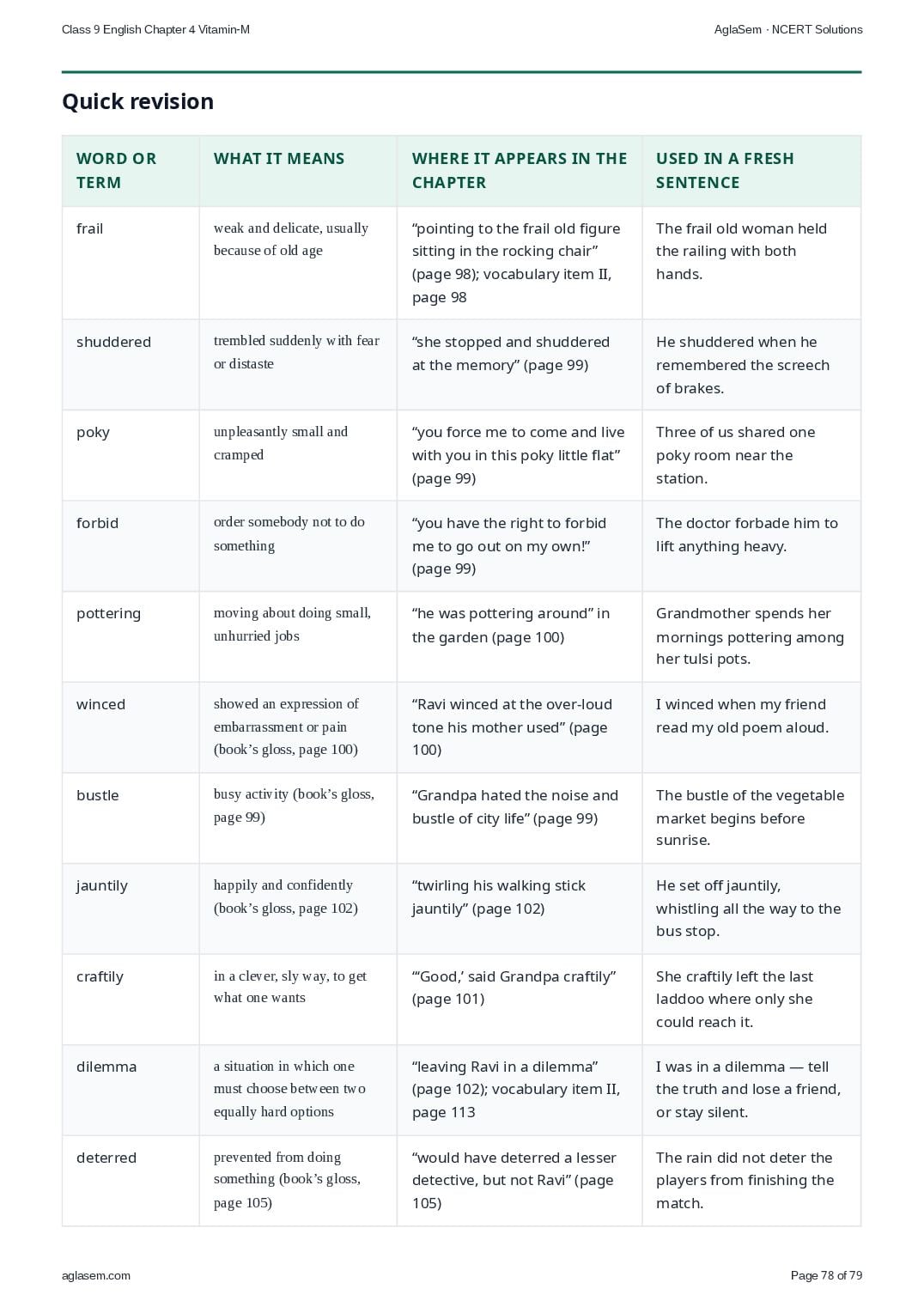
- II. Fill in the table given below. You may check your answers with the help of a dictionary. [A four-column table on page 98: ‘Not heard this word before’ / ‘Have heard this word but don’t know what it means’ / ‘I know this word. It has something to do with…’ / ‘Write the meaning of this word’, for the words: 1. frail 2. shuddered 3. poky 4. forbid 5. pottering 6. winced]
- III. Think of a tradition, story, or recipe passed down by grandparents or an elderly relative in your family. What does it mean to you? How does it connect you to your growing-up years? Share with your classmates and teacher.
- I. Why did Grandpa dislike living in the city with his daughter?
- II. Why did Vidya not want her father to go out alone?
- III. Was Ravi in favour of his mother treating Grandpa like a child? How can you say so?
- IV. Would Ravi be able to keep up his promise to his mother?
- I. Complete the flow chart by describing Grandpa’s day out. [Flow chart on page 106, read left to right along the top row, right to left along the middle row, left to right along the bottom row.] Grandpa goes out to get Tamil newspaper. → Ravi follows Grandpa → Grandpa first stops at 1. ______ → buys 2. ______ ______ and watches ______. → Ravi hides behind a bush to observe. → Grandpa next goes to 3. ______ → Ravi hides behind a banyan tree and watches. → Ravi gets scolded by 4. ______ and ________ → Grandpa drinks 5. ______ and eats ________ → Grandpa then crosses the road and enters a 6. __________ → Next Grandpa walks quickly to a 7. ________ and __________ → Ravi enters the bus only to discover that he had been fooled.
- II. Was Grandpa lost as feared by Ravi’s mother?
- III. How would Ravi feel after seeing Grandpa?
- IV. Do you think Ravi’s mother will get to know about what had happened?
- I. Describe how Ravi’s emotional reaction upon finding Grandpa safe at home reveals his feelings towards his grandfather.
- II. What might be the significance of Grandpa’s habit of giving gifts to everyone on his birthday rather than receiving them?
- III. Why do you think Grandpa gave Ravi a detective story book as a gift? What might this suggest about Grandpa’s awareness of Ravi’s actions earlier in the day?
- I. Read the extracts given below and answer the questions that follow. 1. Grandpa hated the noise and bustle of city life and when they were on their own, he often spoke longingly of his small brick house in town. “Such a wonderful place…! With that big mango tree in the garden! It is so quiet that at dusk you can even hear a leaf fall!” But then Grandpa had slipped and fallen in the garden late one evening while he was pottering around and lain outside all night because there was no one at home to help him up. (i) Choose the emotion displayed by the Grandfather. A. regretful B. apologetic C. nostalgic D. wistful (ii) Complete the following sentence with a reason. Grandpa hated the busy and noisy city life because ___________. (iii) Why did Grandpa come to the city despite his dislike for city life? (iv) Choose an expression similar in meaning to, ‘you can even hear a leaf fall’. A. end of one’s life B. arrival of autumn C. sign of good luck D. pin drop silence (v) State one advantage and one disadvantage of the Grandfather living in the house in town.
- I. 2. “I had a quiet morning, but I don’t know about Ravi. He just disappeared instead of staying at home to look after me like you told him to,” answered Grandpa coolly, while Ravi just looked confused and embarrassed. Grandpa had another surprise for Ravi. A gift-wrapped parcel! “But, Papa, Ravi’s birthday was three months ago. Have you forgotten?” exclaimed Ravi’s mother, impatiently. (i) Choose the option that displays the tone of the Grandfather’s response. A. apologetic B. hurtful C. calm D. puzzled (ii) Why was Ravi confused and embarrassed? (iii) Complete the sentence with a suitable reason. Ravi’s mother was impatient because _________________. (iv) State whether the following sentence is true or false. Grandfather forgot that Ravi’s birthday was three months ago. (v) Why did Grandpa say he didn’t know what kind of morning Ravi might have had?
- II. 1. Grandpa is portrayed as a person with failing memory in the beginning of the story. Give two evidences to disprove the statement.
- II. 2. Give two characteristic traits of each of the following characters. (i) Grandfather (ii) Ravi (iii) Ravi’s mother
- II. 3. Why was Ravi worried about what Grandfather had at the tea stall?
- II. 4. Do you think it was easy for Ravi to follow his Grandfather? If yes, why? If no, why not?
- II. 5. ‘Ravi is a good detective’. Give one argument in favour of and against the given statement.
- II. 6. Was Grandfather aware that Ravi was following him? How do you know?
- II. 7. In your opinion, who needs Vitamin-M? And why?
- II. 8. Some people believe society shows bias based on age (being young or old). Give an example where you might have experienced or observed such discrimination, when opinions were disregarded because of age.
- I. Classify the words given in the box on the next page into movement words in Column 1 and sound words in Column 2. One example has been done for you. [Word box on page 112] pottering | boomed | twirling | crouch | bustle | crawl | creeping | thudded | ducked | shrieks | zigzagging | whirr | evicted | briskly | sprinting | grunted | jumping | darted | trailing | snoring Column 1: pottering Column 2: boomed Now, fill in the blanks with appropriate words from Column 1 or Column 2. Detective Shankar, 1. _____ the mysterious suspect through the dimly lit side lanes, away from the 2. _____ of the city, quickened his pace 3. _____. The suspect’s heavy footsteps 4. _____ across the street, unaware of the pursuit. Shankar 5. _____ his magnifying glass had to 6. _____ behind the market stalls, 7. _____ through the lanes to avoid being seen. Shankar 8. _____ when he hit himself against a pole. This alarmed the suspect and he 9. _____ into the night leaving only the distant 10. _____ of the sleeping city behind.
- II. Study the highlighted word in the given sentence from the text and fill in the boxes with synonymous words. You may refer to a dictionary. Off he went, twirling his walking stick jauntily, leaving Ravi in a dilemma. 1. QU_ ND_ _ Y DILEMMA 2. PR_ D _ C _ M _ NT
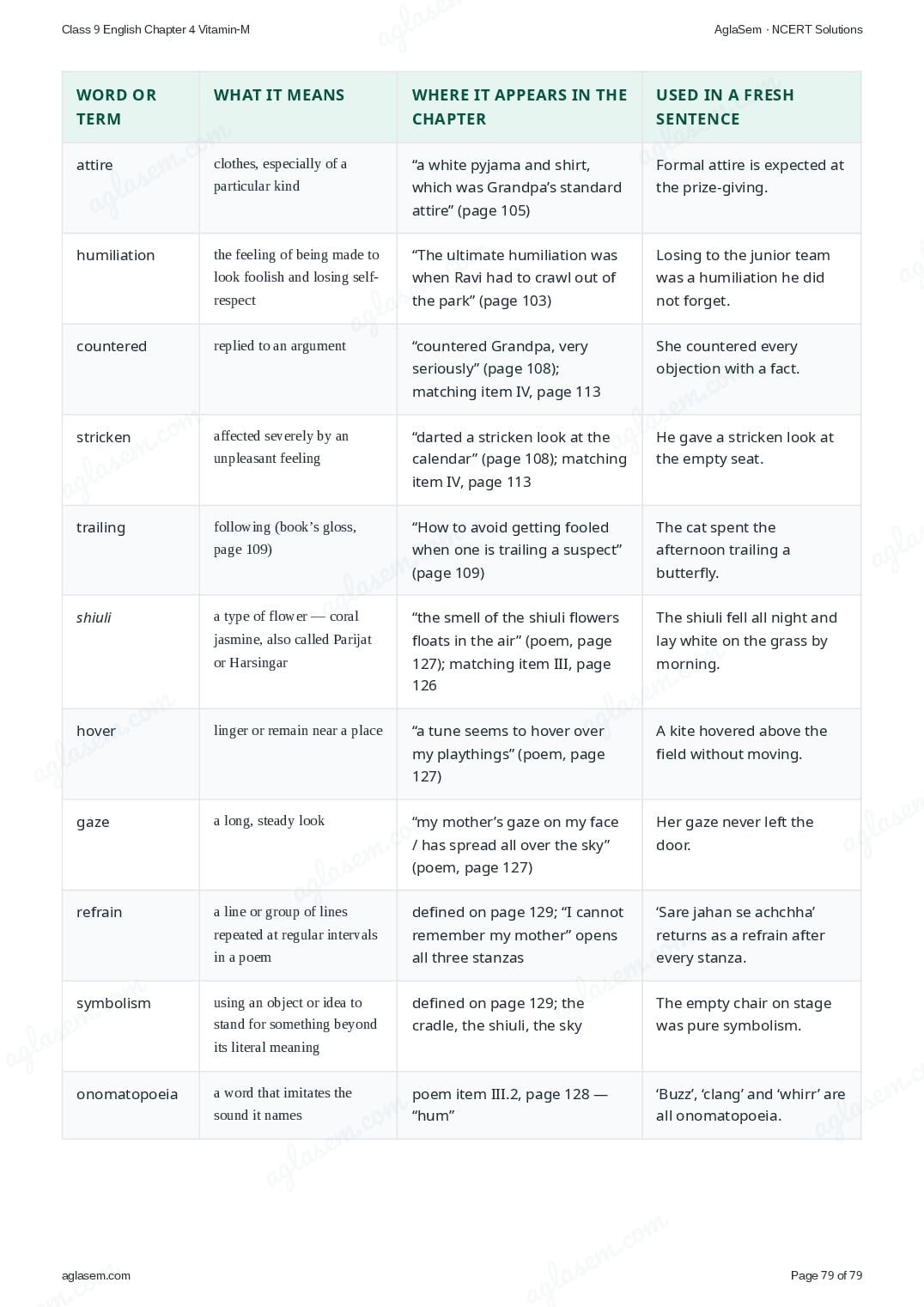
- III. Fill in the table given below. Check your answers with the help of a dictionary. [Table on page 113 with columns: Word | Meaning | Part of Speech | Synonym | Antonym, for the words: 1. craftily 2. dilemma 3. furious 4. boomed 5. humiliation 6. attire]
- IV. Match the emotions/expressions in Column 1 with their meanings in Column 2. One meaning is extra. Column 1 (Emotions/Expressions): 1. embarrassed 2. countered 3. flushed 4. stricken 5. gleam Column 2 (Meanings): (i) affected severely by an unpleasant feeling (ii) to be confused (iii) expression of emotion (iv) reply to an argument (v) felt uncomfortable (vi) became red in the face
- V. Read the highlighted words in the following phrases from the story. Now, revisit the story and underline the prepositions. 1. I’ll just walk across to the corner shop… 2. … he felt a shadow fall over him… 3. …the vendors sitting under the tree… 4. Ravi took position behind a big banyan… [Box on page 114: Prepositions are words used to show the relationship of a noun or pronoun to other words in a sentence, often indicating direction, location, time, or manner.] Now, fill in the blanks with appropriate prepositions. I walked (i) _____ (through, between, against) the village, crossed a bridge (ii) _____ (over, under, beside) a brook, and found a quiet garden (iii) _____ (among, near, across) a cottage. Sitting on a bench (iv) _____ (on, at, in) the garden, I enjoyed the peaceful surroundings. Later, I strolled (v) _____ (beside, through, along) a riverbank, exploring the forest and heading (vi) _____ (into, towards, beyond) the unknown.
- VI. Read the following dialogues from the story. 1. “Shall we play chess or watch the cricket match on TV, Grandpa?” asked Ravi. 2. “Who are you?” said the little boy’s mother. 3. “What did you both do today?” asked Ravi’s mother. 4. “Have you forgotten?” countered Grandpa. 5. A small child came up to him and asked, “Are you playing hide and seek?” Now, choose the correct answer. A. The words in the quotes are (i) _____ (exclamatory/interrogative) sentences. B. Sentences 1, 4, and 5 are (ii) _____ (Wh-/Yes, No type) interrogative sentences. C. Sentences 2 and 3 are (iii) _____ (Wh-/Yes, No type) interrogative sentences. So, there are (iv) _____ (two/three) types of interrogative sentences. [Box on page 115: The words in quotes are the exact words of the speaker, hence known as direct speech. In indirect speech or reported speech, somebody else reports these words at some other time and at some other place.] D. Let us have a quick glance at a few guidelines to remind you of the changes while transforming from direct form of speech to indirect. You can ask your teacher for more inputs. [Tables on page 115: Present → Past; Past → Past Perfect; Present Progressive → Past Progressive; Past Progressive → Past Perfect Progressive; here → there; today → that day; tomorrow → the following day; now → then. Pronouns: I → he/she; we → they; you → he/she/they; our → their. Steps to Remember: Both Wh- type and Yes/No type — convert the interrogative sentence into a declarative sentence; Yes/No type — use ‘if’ or ‘whether’ next to the reporting verb; Wh- type — use the same ‘wh’ word next to the reporting verb.]
- VII. Read the following conversation. Arvind: Do you help in taking care of your grandparents at home? Priya: Yes, I do. We take turns making sure they’re alright. Do you have grandparents living with you? Arvind: No. My parents and I visit my grandpa every weekend. How do you manage your grandparents’ medical needs? Priya: We have a schedule for giving medications and visits to the doctor. Now, complete the following sentences in reported speech. Arvind asked Priya if she 1. _______________ for which Priya replied in the afÏrmative and said that they 2. _____________. Priya further asked Arvind 3. _______________. Arvind replied in the negative and said that 4. _______________ every weekend. He further enquired 5. _______________. Priya responded by saying that they 6. _______________.
- I. You will listen to a podcast on meditation. As you listen, complete the sentences with not more than three exact words that you hear. (Transcript for teacher on page 266) 1. Meditation is a form of yoga that usually refreshes the mind and helps with ___________________. 2. Meditation leads to a better health condition both ________________. 3. Meditation also aids in lessening undesirable feelings and improving __________________. 4. It is advised that we meditate every day so that it becomes a _______________. 5. Meditating on a daily basis is beneficial in comfortably tackling ________________.
- I. Intonation refers to the pitch of the voice while speaking. In questions, intonation can indicate the sentiment or the expected response. For example: • What is your name? (In Wh and How questions we use a falling intonation towards the end.) • Are you feeling okay? (In Yes or No questions we use a rising intonation towards the end.) • This is your notebook, isn’t it? (When we have an afÏrmative main clause and negative question tag, we use a rising intonation to show we are fairly sure of the answer.) • You weren’t in the library yesterday, were you? (When we have a negative main clause and afÏrmative question tag, we use a falling intonation to show we are unsure of the answer.) • Shall we read this storybook or borrow another one? (When we have a question with choices, we use rise-fall intonation.) Now, revisit the story and select different questions. Work in pairs and practise speaking them aloud according to the examples shared.
- II. Make a presentation about a brief personal experience related to taking care of an older person. For example, mention a specific individual you cared for or an occasion when you provided assistance to that person. You may use the following prompts to structure your narration. • Background of your experience — The person I had the privilege of taking care of was… / I found myself in a caregiving role for… / I took on the responsibility of caring for… • Reflect on what you learned about yourself during this caregiving experience. Did you discover any new qualities or strengths in yourself? How did this experience contribute to your personal growth? • Caring for someone taught me valuable lessons about myself, including… / In this role, I learned that I possess the ability to… / One significant realisation about me during this experience was … • Discuss what you learned about the older person you were caring for. What insights did you gain into their needs, preferences, or challenges? How did your understanding of aging evolve through this experience? • Understanding the needs and preferences of the older person, I learned that… / Their challenges offered insights into the difÏculties of aging, such as… / Caring for them deepened my understanding of the ageing process, particularly…
- I. As you read in the story, we have a lot to learn from our elderly. Based on the lessons learned from them, write an article for your school magazine on the topic ‘Our Inspiring Elderly’. Organise the article in the manner given below. • Write the title at the top and your name and grade below it. • Paragraph 1: Give a brief introduction to the topic. Focus on the main idea, but do not give any details. • Paragraph 2: Give details to support the main idea—how the elderly inspire. Include examples, facts, and quotations. • Paragraph 3: Elaborate on how they overcame challenges and the inspiring impact on you. • Paragraph 4: Conclude with a final comment on the topic and leave the reader with the most important ideas to think about.
- I. Revisit the story and choose the image that correctly displays Grandpa’s walking stick. [Four pictures of walking sticks on page 119, each with an empty box below it. From the left: (1) a plain black handle curving over, with a brass band below it, on a dark shaft; (2) a brass/golden handle carved as a bird’s head with a hooked beak and feathered crest, with a brass collar, on a brown wooden shaft; (3) a silver handle carved as a dog’s head, on a green-and-brown shaft; (4) an ornate gold crook handle on a brown shaft.]
- II. A picture is worth a thousand words! Explore and revisit memories. Collect a few memorable photographs of yourself and your family. Make a slide show. Mention the following: • When and where was it clicked? • Who are the people in the photograph? • Why is it memorable for you?
- III. You must have read stories about taking care of the family members of all age groups in English and also in your own language. Now, read the story given below. Discuss with your classmates and teacher. [‘The Lost Child’ by Mulk Raj Anand, printed on pages 120–125.]
- I. Work in pairs. Discuss the memories from your childhood that you remember. List them and share with your classmates and teacher.
- II. Discuss how children’s relationship with their mother can influence their emotions and memories.
- III. Match the words given in Column 1 with their meanings in Column 2. Column 1: 1. hover 2. hum 3. cradle 4. shiuli 5. morning service 6. gaze Column 2: (i) sing a tune with your lips closed (ii) a type of flower (coral jasmine) (iii) look steadily for a long time (iv) rituals conducted in a temple (v) linger or remain near a place (vi) a small bed for a baby
- I. Fill in the blanks with appropriate words. Stanza 1 1. The poet remembers his mother while he ____________. 2. The poet remembers the ____________ but not the ____________. Setting: ____________ (outdoor/indoor) Stanza 2 1. The poet remembers his mother in the ____________ season. 2. The poet remembers his mother by the smell of ____________. Setting: ____________ (outdoor/indoor) Stanza 3 1. The poet feels that his mother ____________ at him from the ____________. Setting: ____________ (outdoor/indoor)
- II. The senses of olfactory (smell), auditory (hearing), and visual (sight), are three of the five basic senses in humans. Give examples of references to senses from the poem. Complete the table given below. [Table on page 128 with columns: Stanza | Lines from the Poem | Senses. The middle row is filled in: ‘…the tune of some song that she used to hum while rocking my cradle’; the ‘Senses’ column of the last row reads ‘olfactory’.]
- III. Read the poem silently once again and complete the following. 1. Two examples of alliteration from the poem are (i) __________ and (ii) ___________. 2. An example of onomatopoeia is ________________. 3. The poem uses imagery extensively. Explain. 4. Although the poem does not have a rhyme scheme, it is enjoyable because ______________. 5. What is the tone of the poet? Why do you say so? 6. What impact does the title of the poem have on the overall mood of the poem? 7. The poet uses ‘I cannot remember my mother’ as a refrain because __________________. 8. The poet uses symbolism to indicate the memory of his mother’s presence. Identify the symbols used in the poem. [Boxes on page 129: Symbolism is a literary device in which a writer uses a tangible object, abstract idea, or phenomenon that represents something beyond the literal meaning. It helps the poet convey deeper meanings and to connect with readers on an emotional level. Refrain is a poetic device defined as a line or a group of lines that is repeated at regular intervals in a poem.]
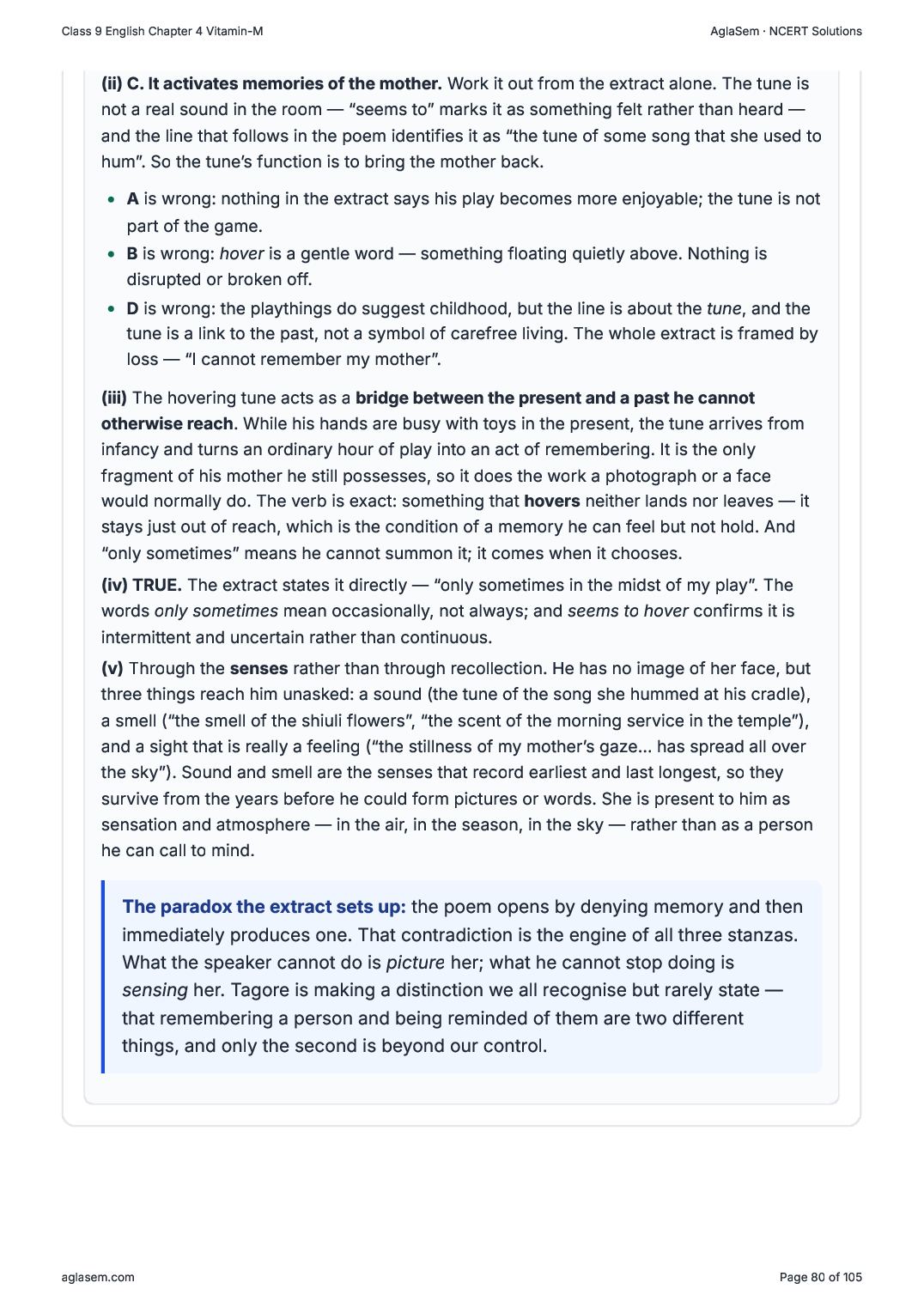
- I. Read the extracts given below and answer the questions that follow. 1. I cannot remember my mother only sometimes in the midst of my play a tune seems to hover over my playthings, (i) Complete the following sentence appropriately. The poet is reminded of his mother during his ________________. (ii) What is the primary emotion conveyed by the line ‘a tune seems to hover over my playthings’? A. It enhances the joy of play. B. It disrupts the playtime atmosphere. C. It activates memories of the mother. D. It symbolises the carefree nature of childhood. (iii) In the context of the poem, what role does the hovering tune play during the speaker’s playtime? (iv) State whether the following sentence is true or false. The poet experiences the tune lingering over playthings only occasionally during playtime. (v) How could the poet feel his mother’s presence, even though she isn’t there?
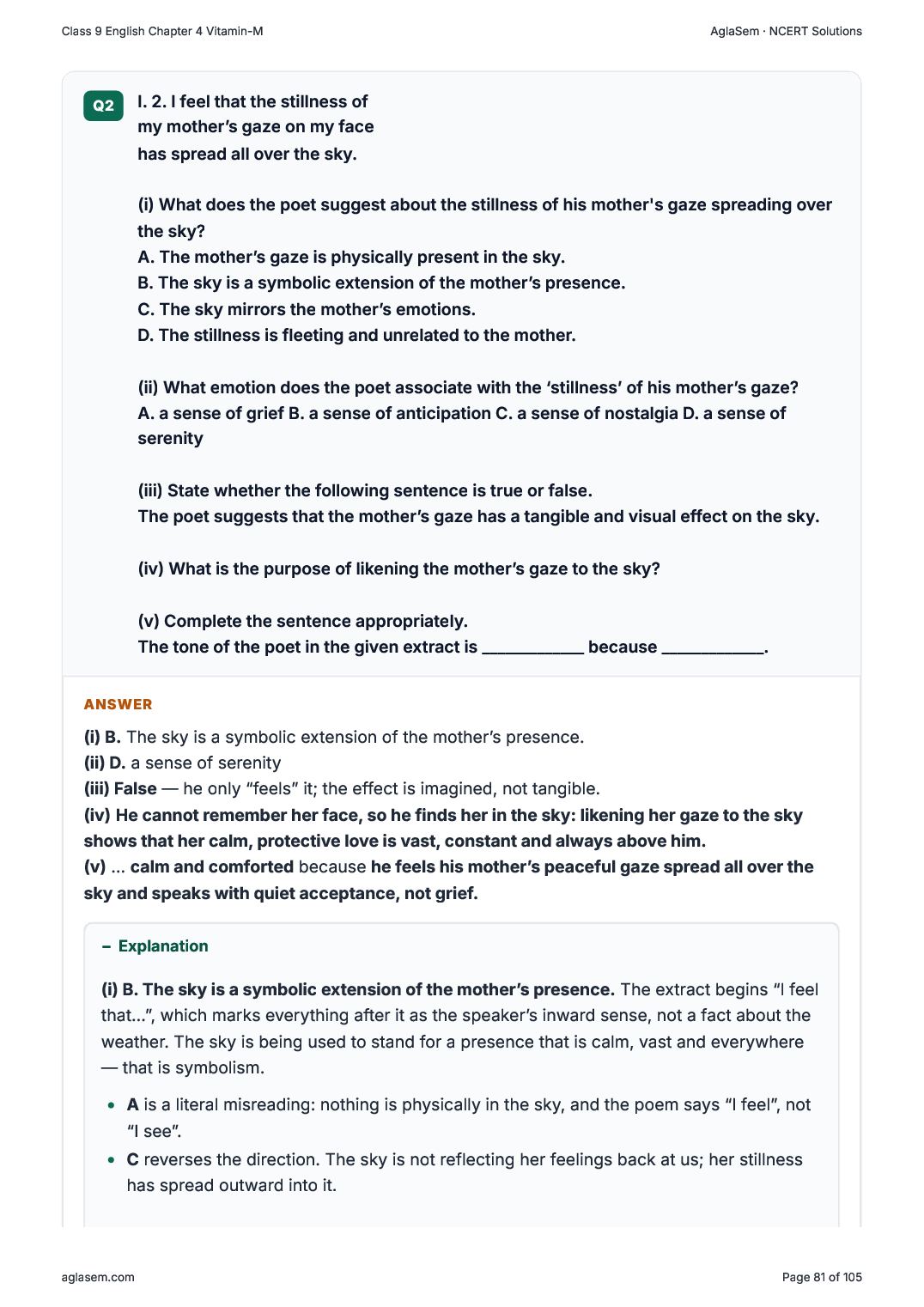
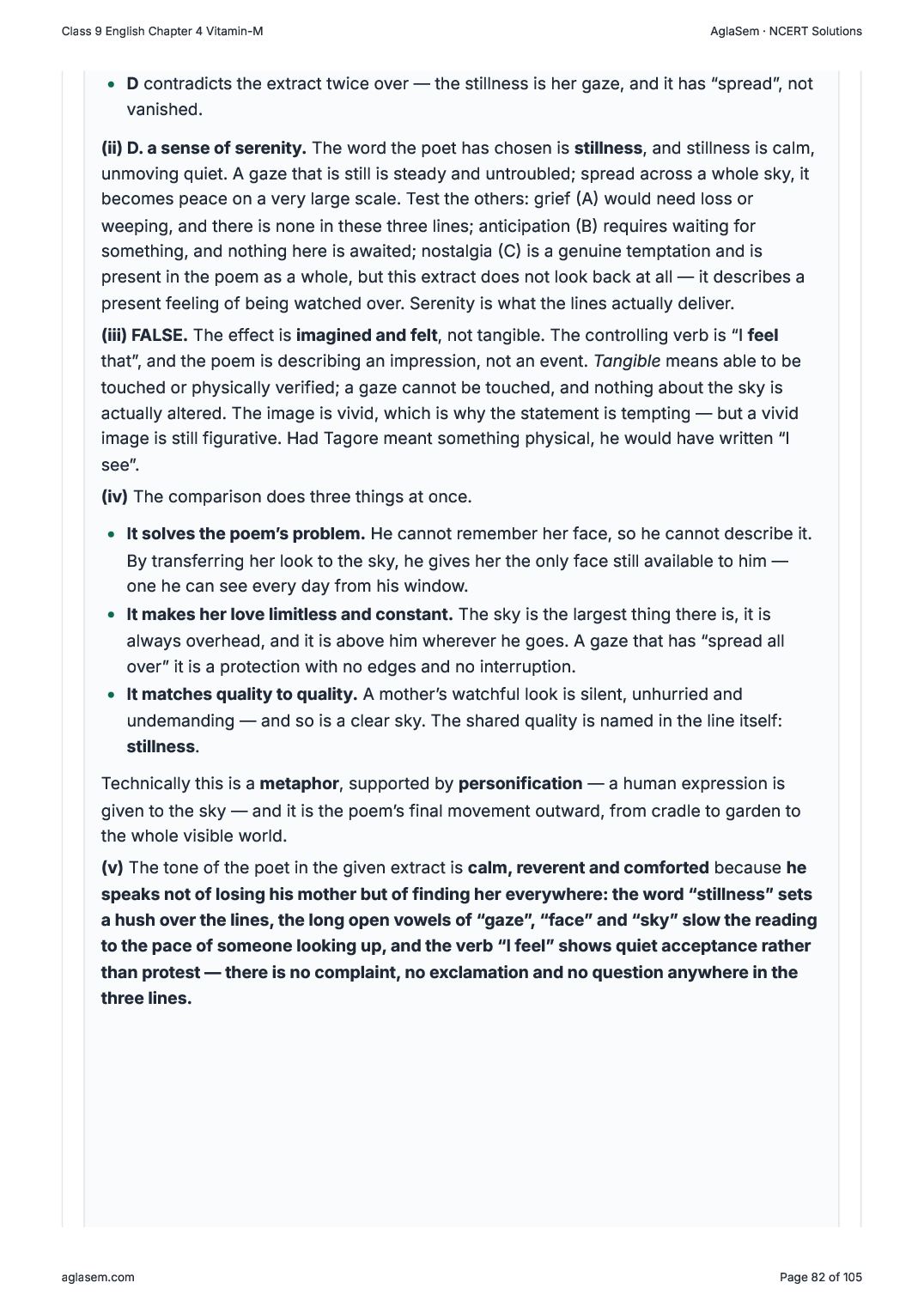
- I. 2. I feel that the stillness of my mother’s gaze on my face has spread all over the sky. (i) What does the poet suggest about the stillness of his mother's gaze spreading over the sky? A. The mother’s gaze is physically present in the sky. B. The sky is a symbolic extension of the mother’s presence. C. The sky mirrors the mother’s emotions. D. The stillness is fleeting and unrelated to the mother. (ii) What emotion does the poet associate with the ‘stillness’ of his mother’s gaze? A. a sense of grief B. a sense of anticipation C. a sense of nostalgia D. a sense of serenity (iii) State whether the following sentence is true or false. The poet suggests that the mother’s gaze has a tangible and visual effect on the sky. (iv) What is the purpose of likening the mother’s gaze to the sky? (v) Complete the sentence appropriately. The tone of the poet in the given extract is _____________ because _____________.
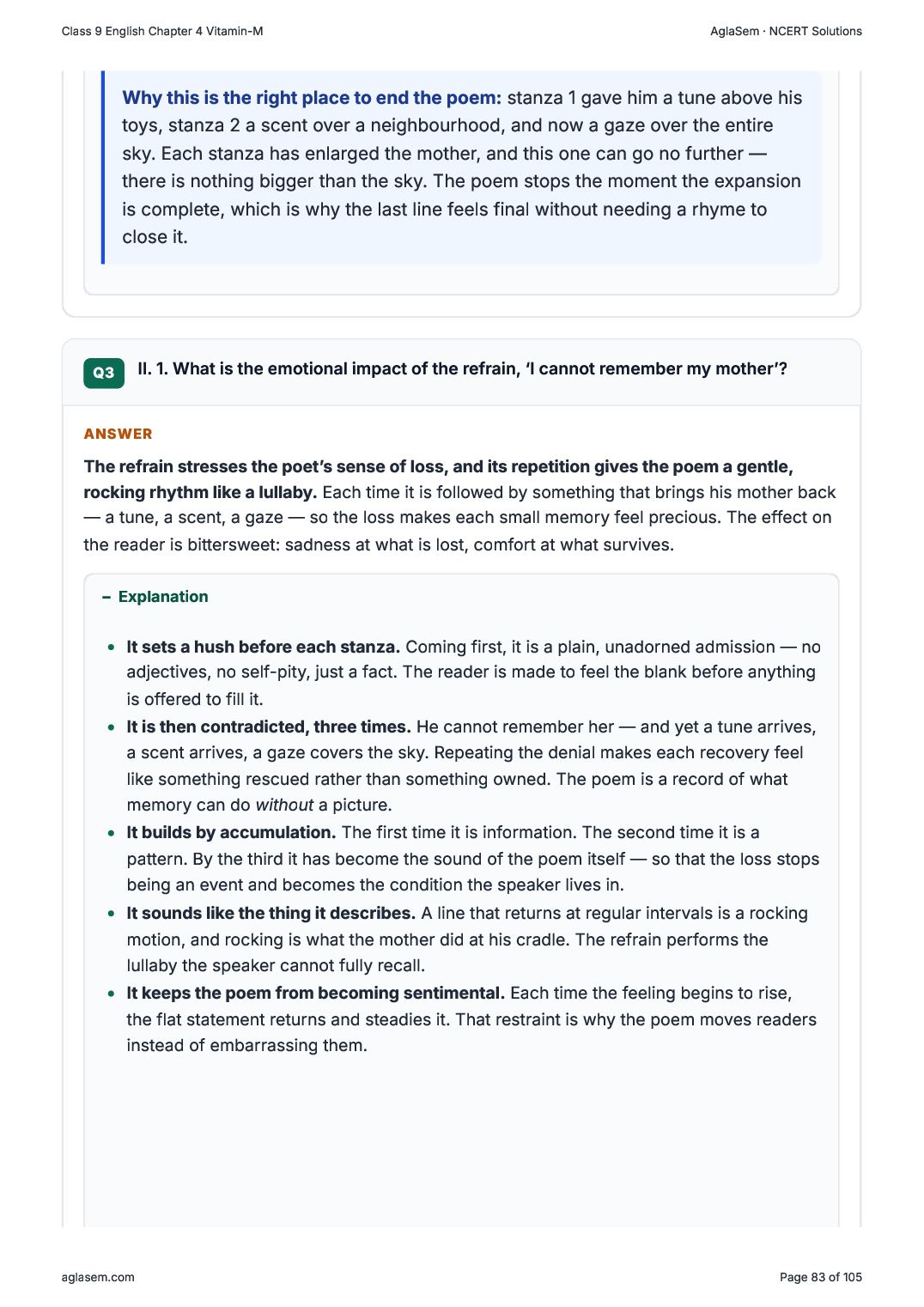
- II. 1. What is the emotional impact of the refrain, ‘I cannot remember my mother’?
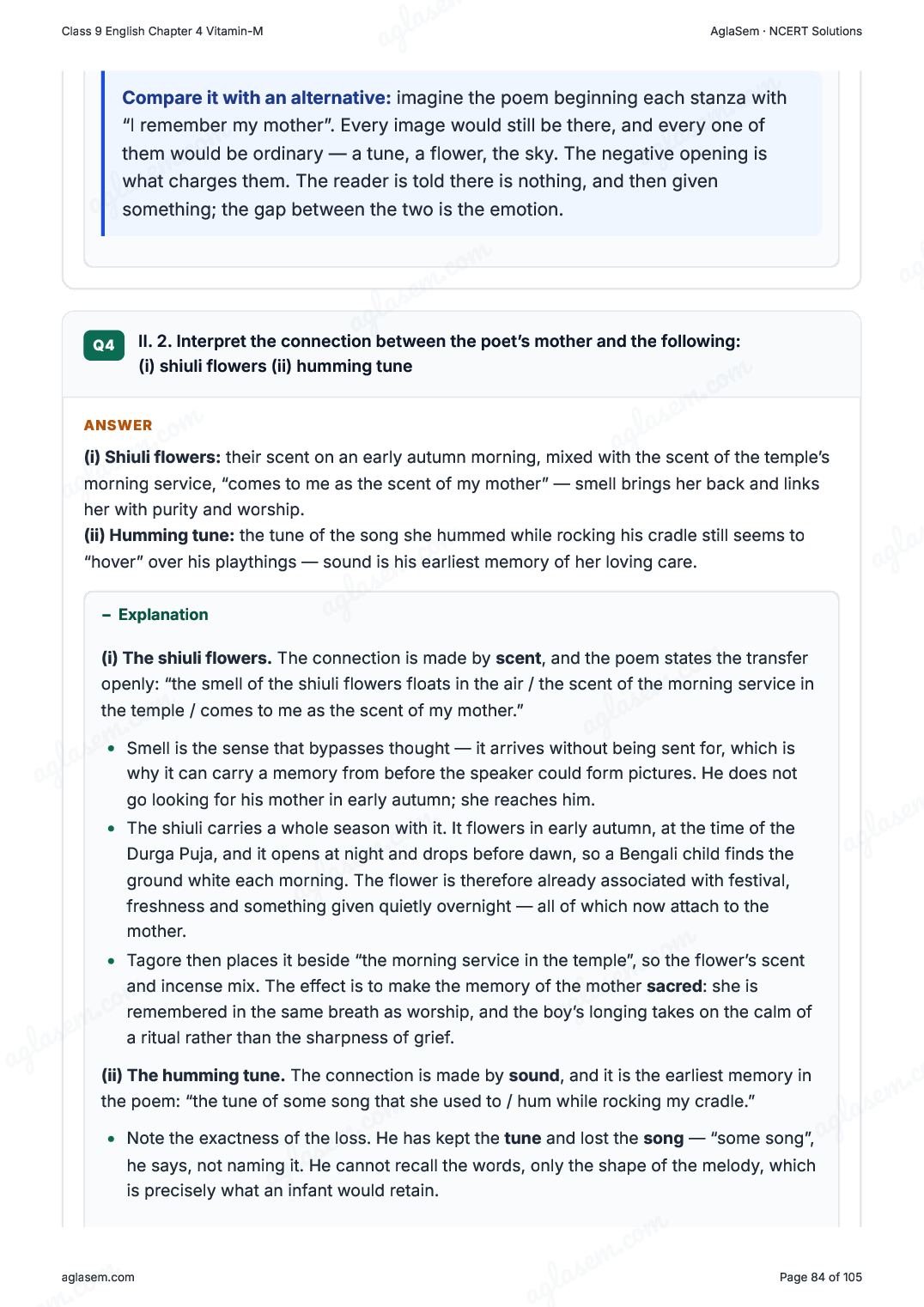
- II. 2. Interpret the connection between the poet’s mother and the following: (i) shiuli flowers (ii) humming tune
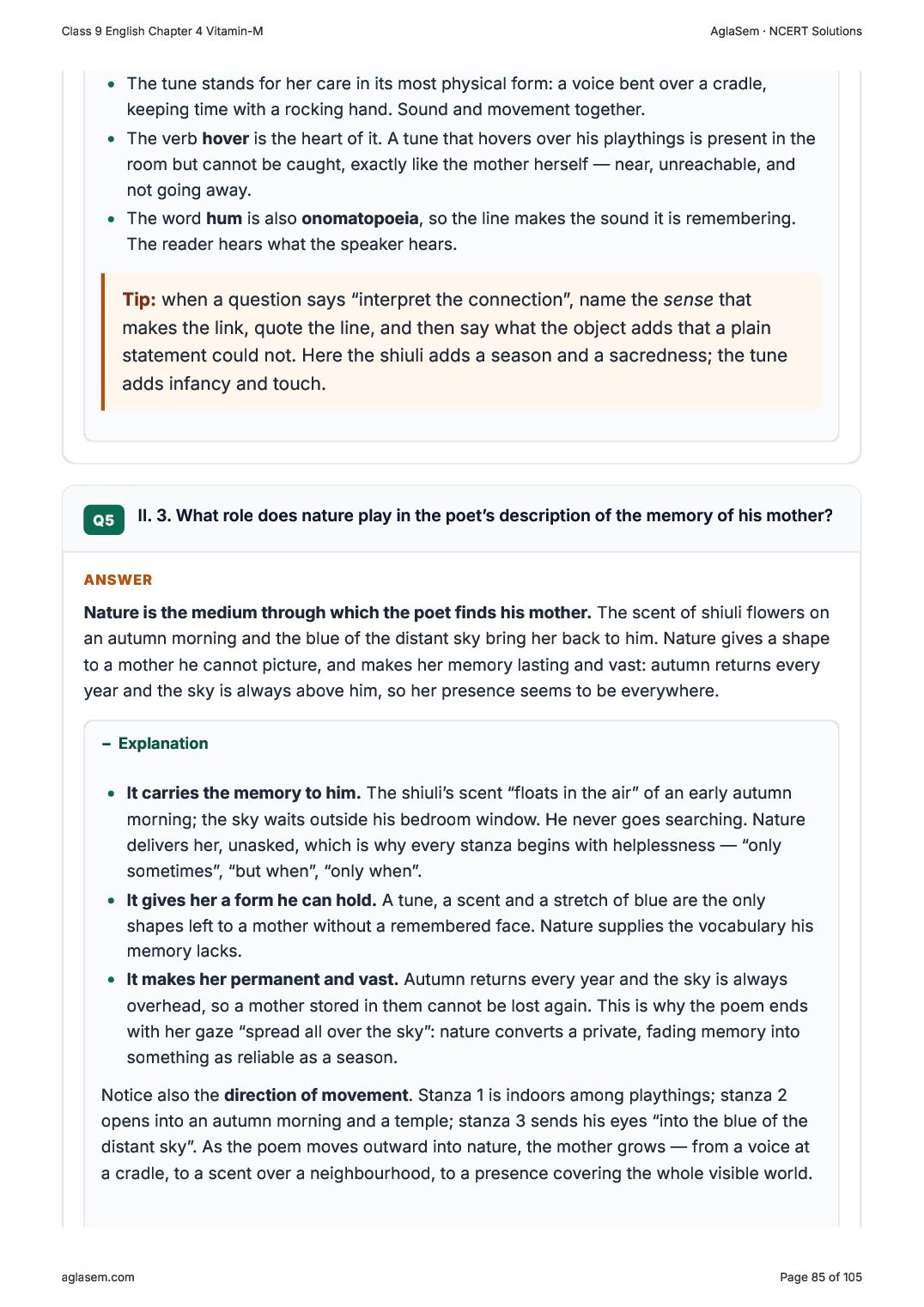
- II. 3. What role does nature play in the poet’s description of the memory of his mother?
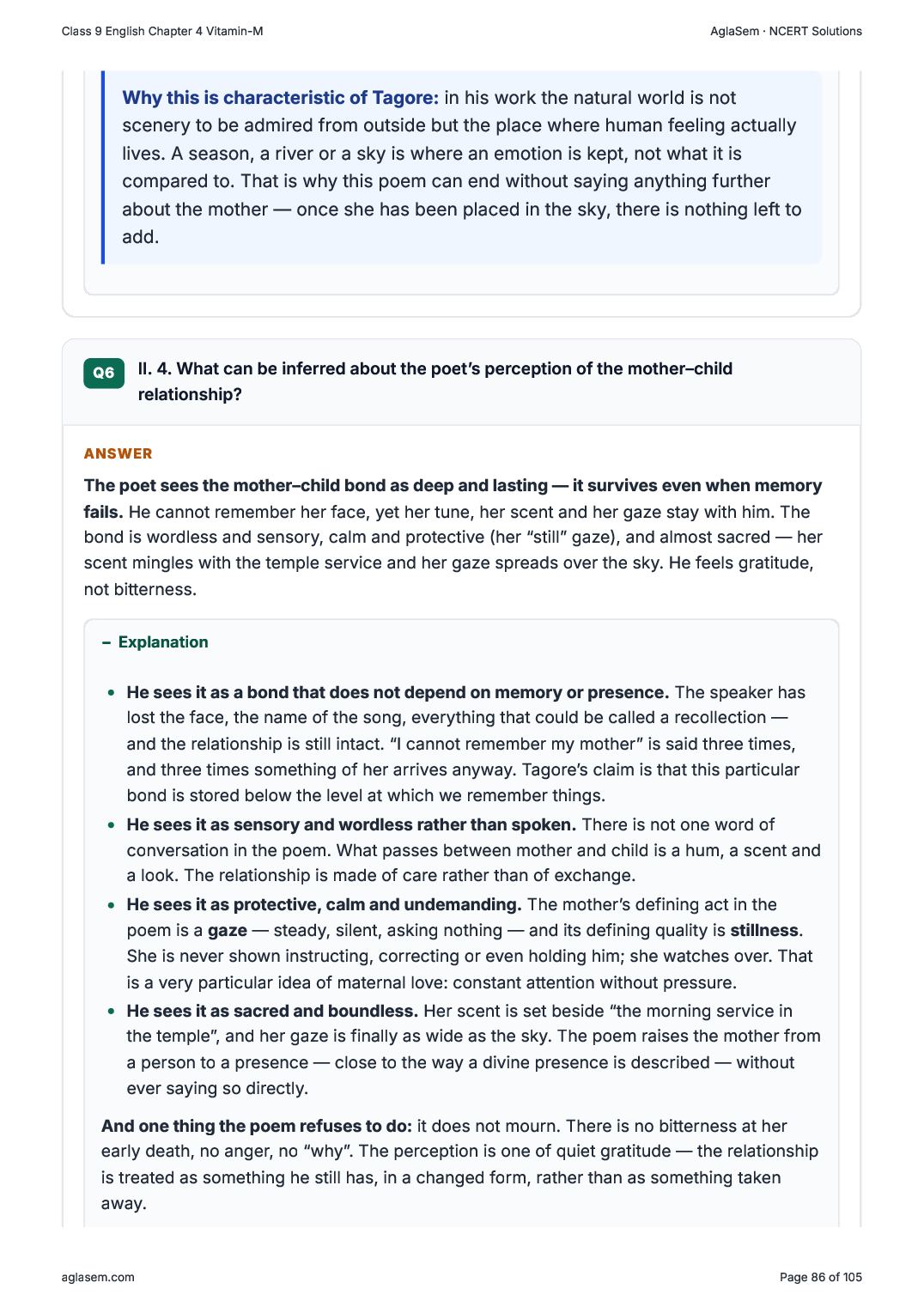
- II. 4. What can be inferred about the poet’s perception of the mother–child relationship?
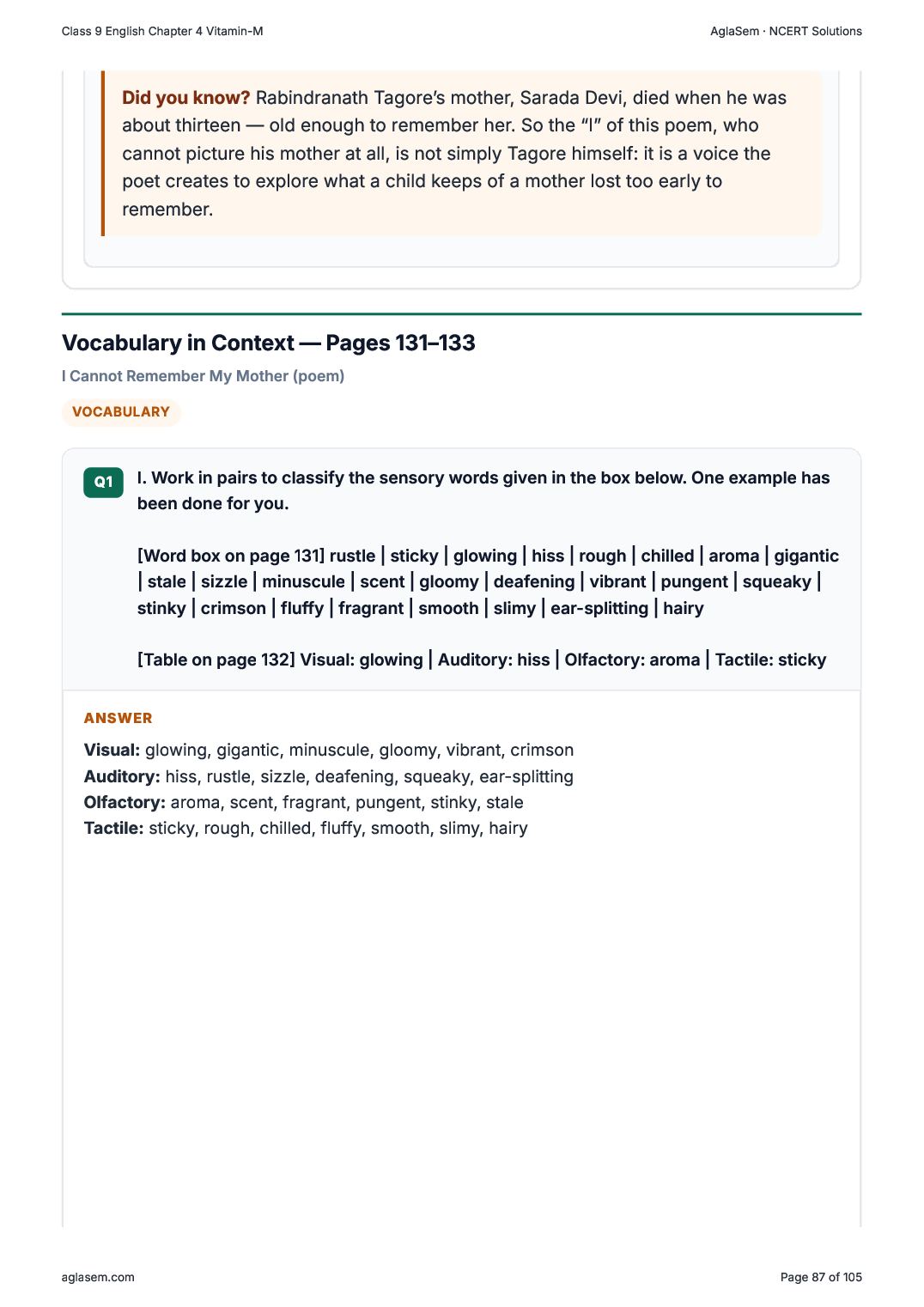
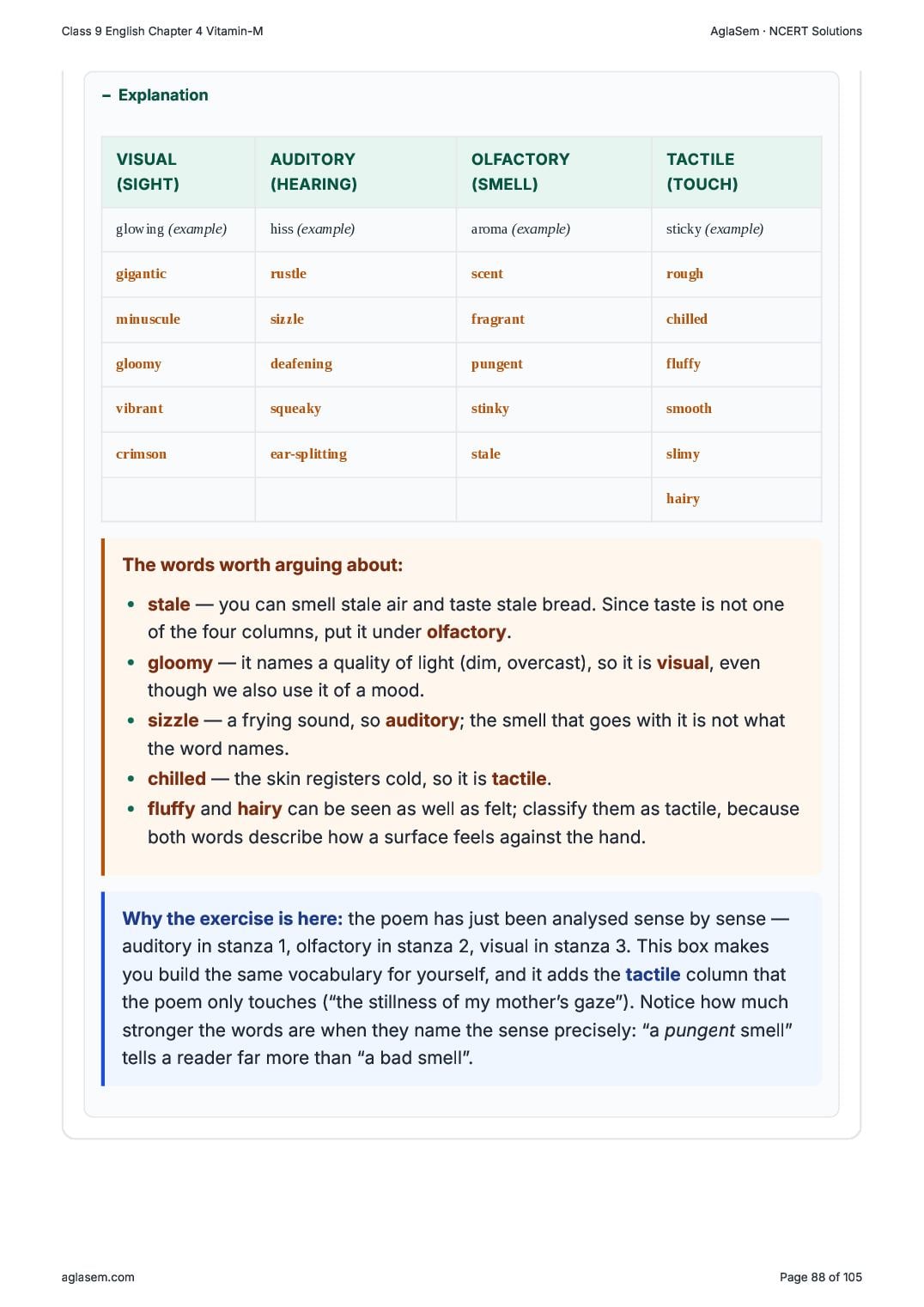
- I. Work in pairs to classify the sensory words given in the box below. One example has been done for you. [Word box on page 131] rustle | sticky | glowing | hiss | rough | chilled | aroma | gigantic | stale | sizzle | minuscule | scent | gloomy | deafening | vibrant | pungent | squeaky | stinky | crimson | fluffy | fragrant | smooth | slimy | ear-splitting | hairy [Table on page 132] Visual: glowing | Auditory: hiss | Olfactory: aroma | Tactile: sticky
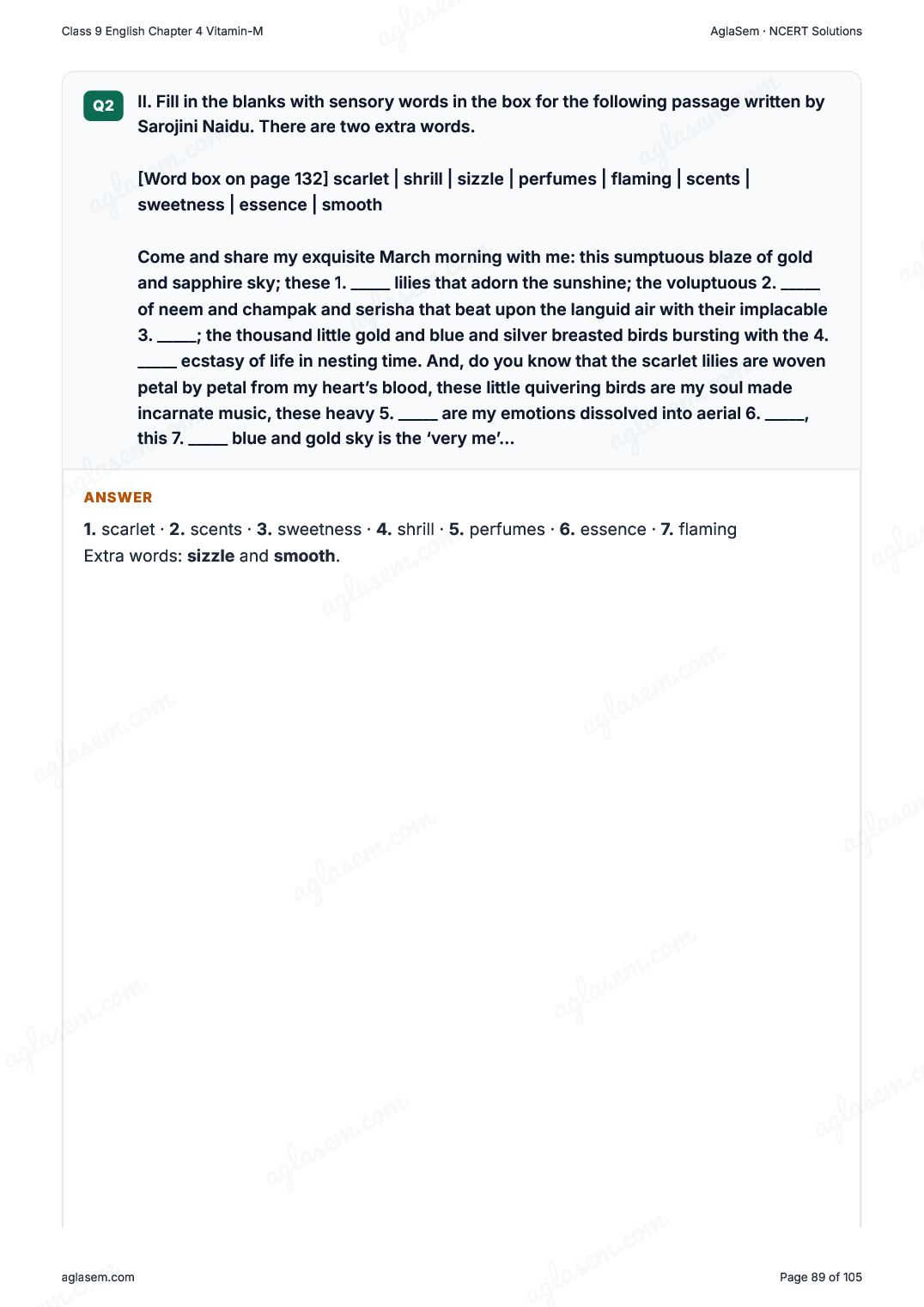
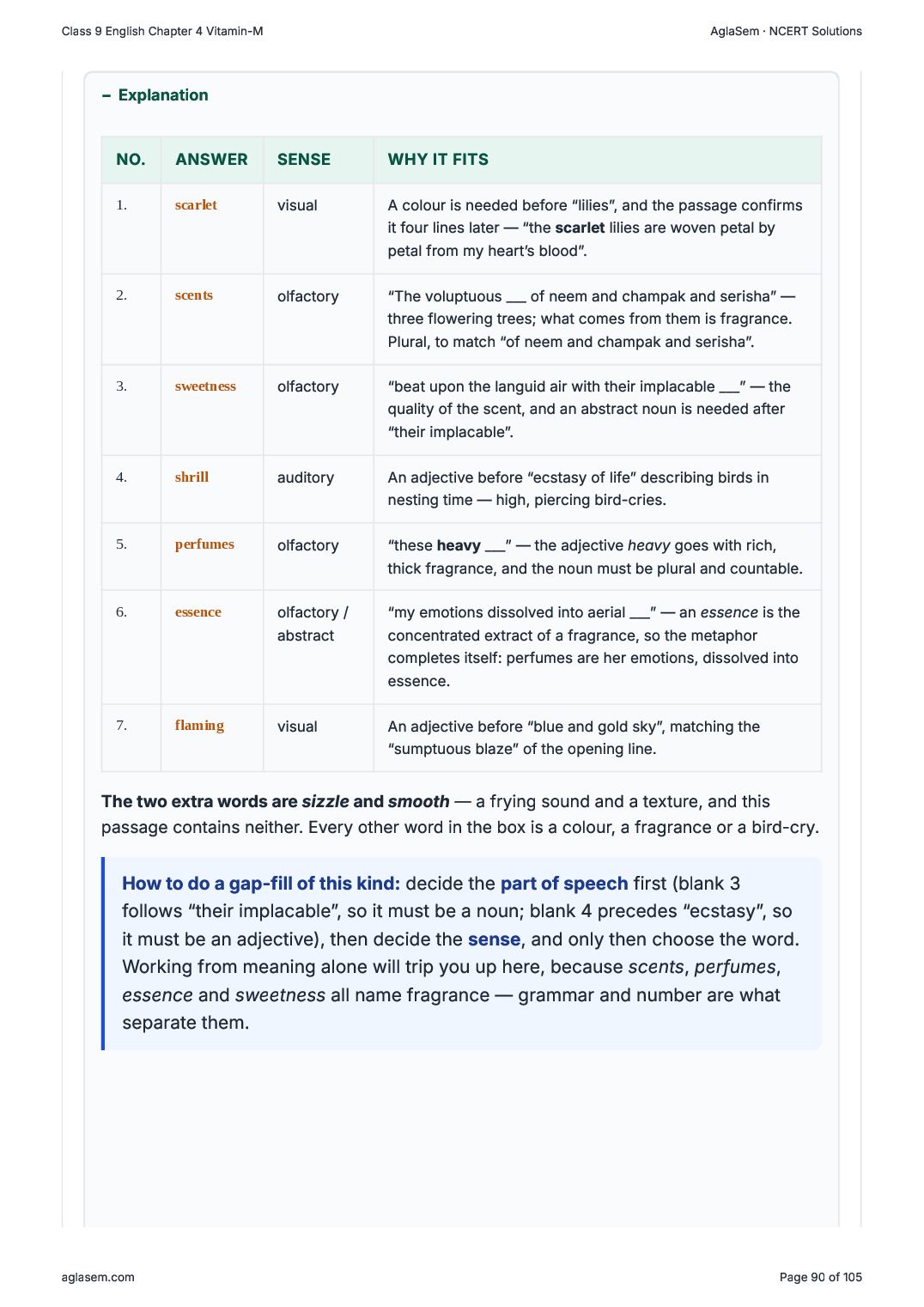
- II. Fill in the blanks with sensory words in the box for the following passage written by Sarojini Naidu. There are two extra words. [Word box on page 132] scarlet | shrill | sizzle | perfumes | flaming | scents | sweetness | essence | smooth Come and share my exquisite March morning with me: this sumptuous blaze of gold and sapphire sky; these 1. _____ lilies that adorn the sunshine; the voluptuous 2. _____ of neem and champak and serisha that beat upon the languid air with their implacable 3. _____; the thousand little gold and blue and silver breasted birds bursting with the 4. _____ ecstasy of life in nesting time. And, do you know that the scarlet lilies are woven petal by petal from my heart’s blood, these little quivering birds are my soul made incarnate music, these heavy 5. _____ are my emotions dissolved into aerial 6. _____, this 7. _____ blue and gold sky is the ‘very me’…
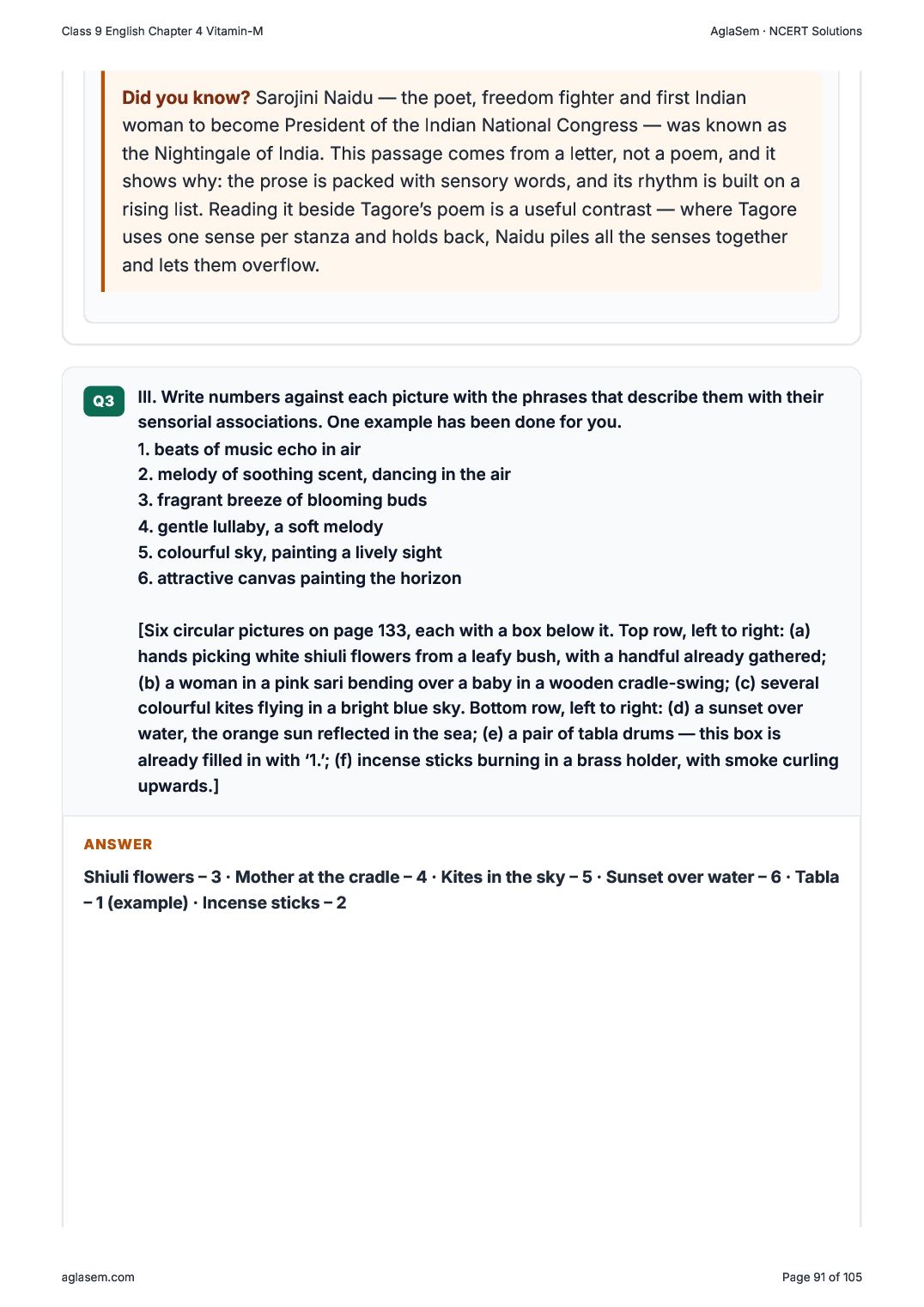
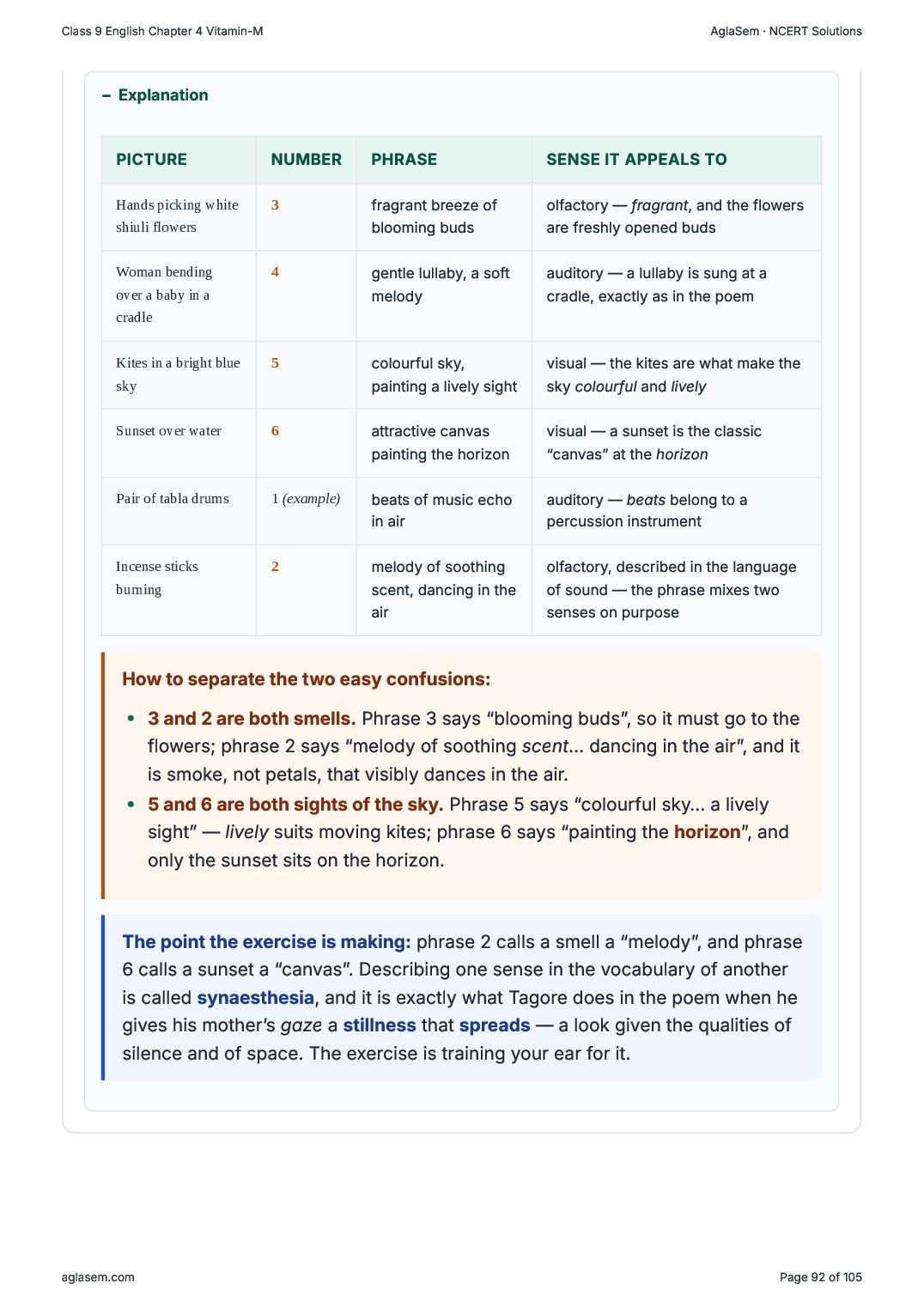
- III. Write numbers against each picture with the phrases that describe them with their sensorial associations. One example has been done for you. 1. beats of music echo in air 2. melody of soothing scent, dancing in the air 3. fragrant breeze of blooming buds 4. gentle lullaby, a soft melody 5. colourful sky, painting a lively sight 6. attractive canvas painting the horizon [Six circular pictures on page 133, each with a box below it. Top row, left to right: (a) hands picking white shiuli flowers from a leafy bush, with a handful already gathered; (b) a woman in a pink sari bending over a baby in a wooden cradle-swing; (c) several colourful kites flying in a bright blue sky. Bottom row, left to right: (d) a sunset over water, the orange sun reflected in the sea; (e) a pair of tabla drums — this box is already filled in with ‘1.’; (f) incense sticks burning in a brass holder, with smoke curling upwards.]
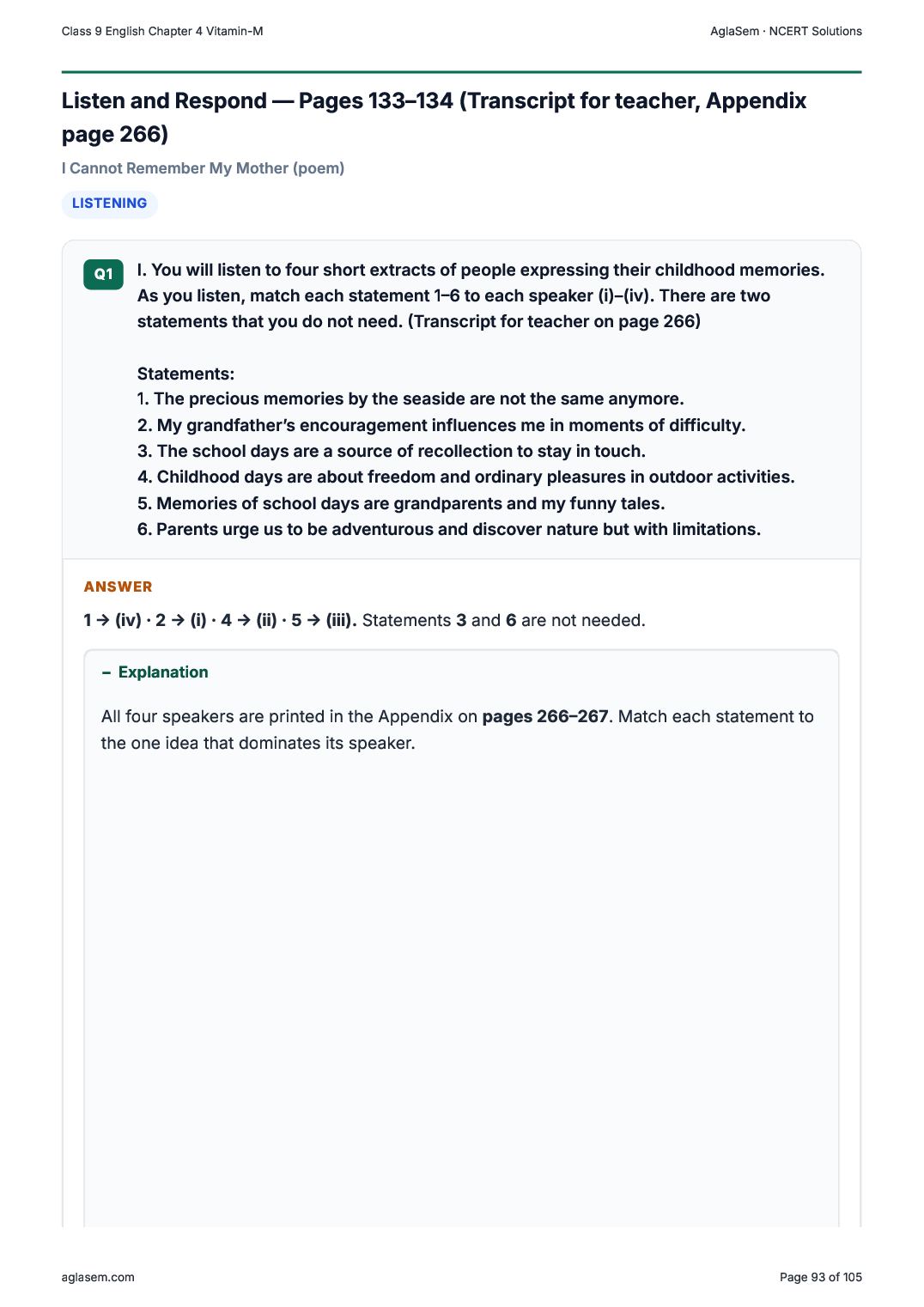
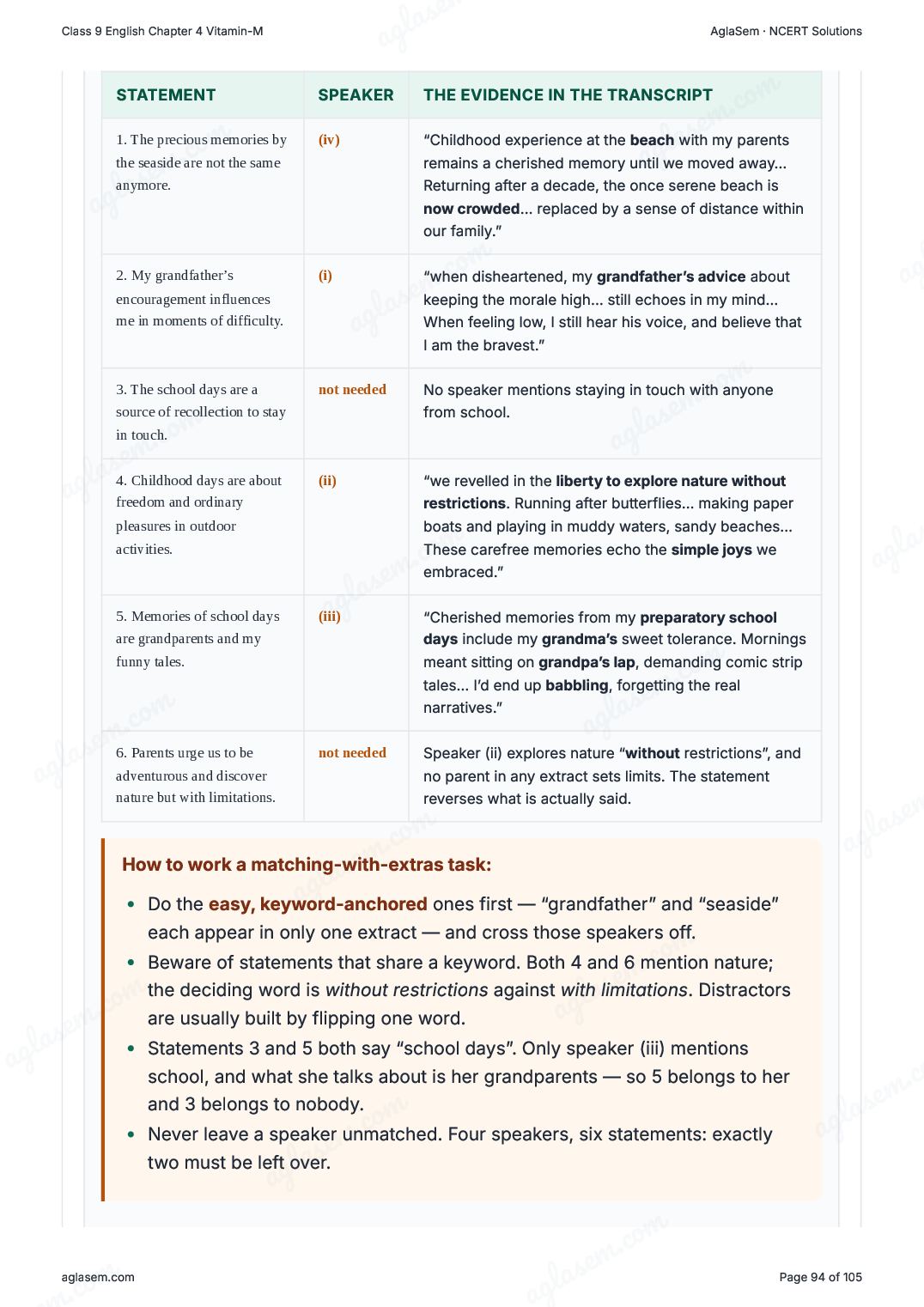
- I. You will listen to four short extracts of people expressing their childhood memories. As you listen, match each statement 1–6 to each speaker (i)–(iv). There are two statements that you do not need. (Transcript for teacher on page 266) Statements: 1. The precious memories by the seaside are not the same anymore. 2. My grandfather’s encouragement influences me in moments of difÏculty. 3. The school days are a source of recollection to stay in touch. 4. Childhood days are about freedom and ordinary pleasures in outdoor activities. 5. Memories of school days are grandparents and my funny tales. 6. Parents urge us to be adventurous and discover nature but with limitations.
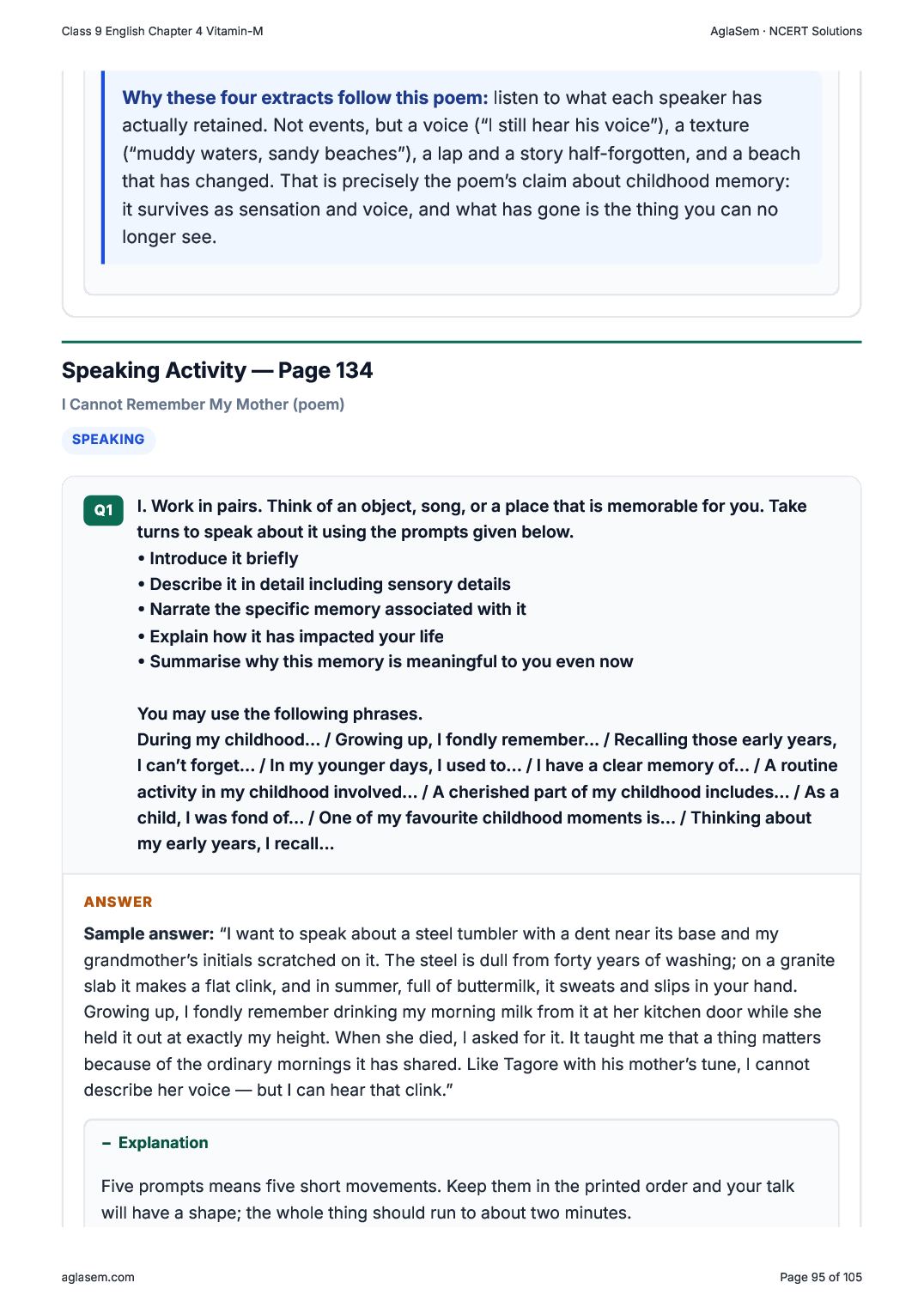
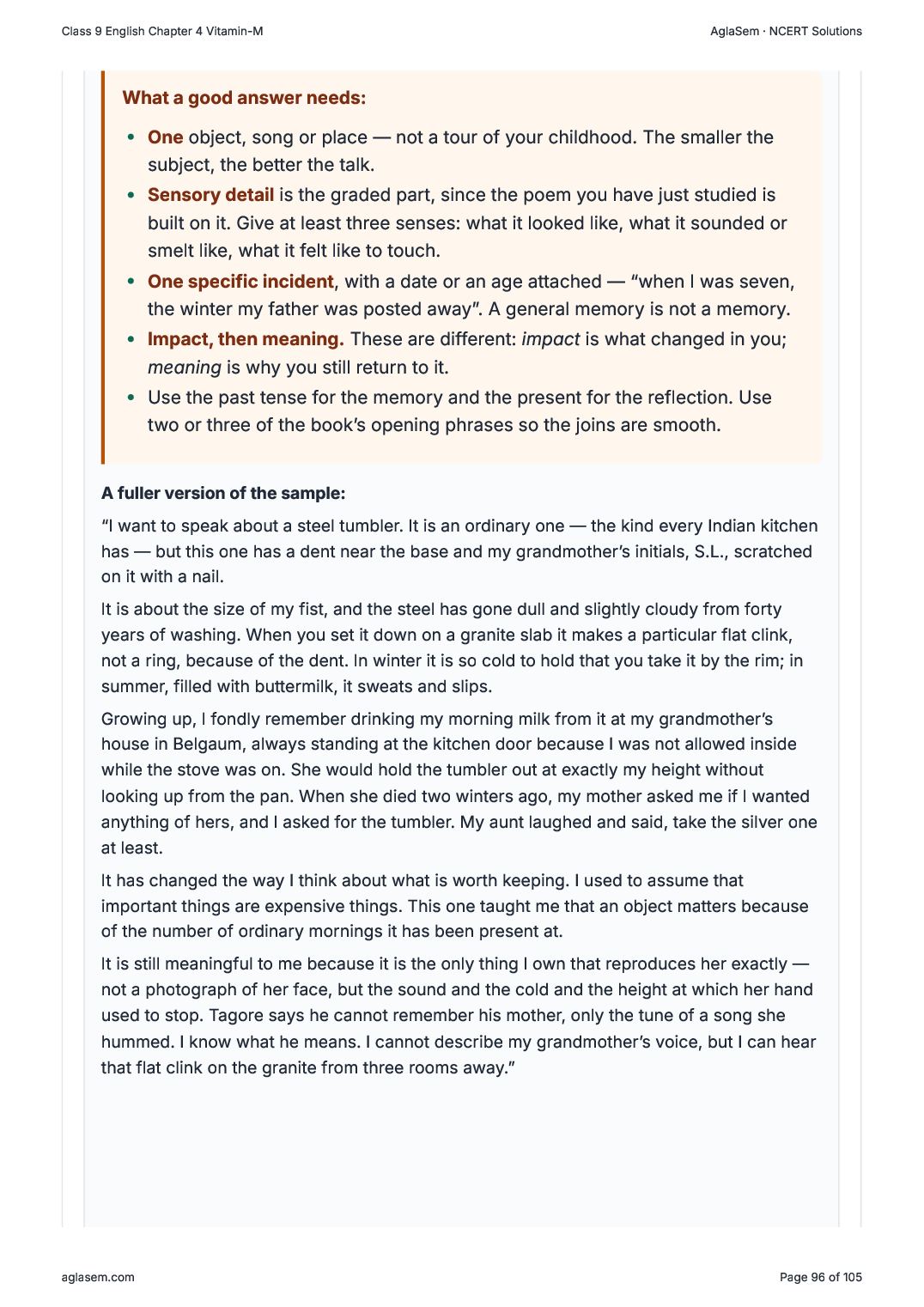
- I. Work in pairs. Think of an object, song, or a place that is memorable for you. Take turns to speak about it using the prompts given below. • Introduce it briefly • Describe it in detail including sensory details • Narrate the specific memory associated with it • Explain how it has impacted your life • Summarise why this memory is meaningful to you even now You may use the following phrases. During my childhood… / Growing up, I fondly remember… / Recalling those early years, I can’t forget… / In my younger days, I used to… / I have a clear memory of… / A routine activity in my childhood involved… / A cherished part of my childhood includes… / As a child, I was fond of… / One of my favourite childhood moments is… / Thinking about my early years, I recall…
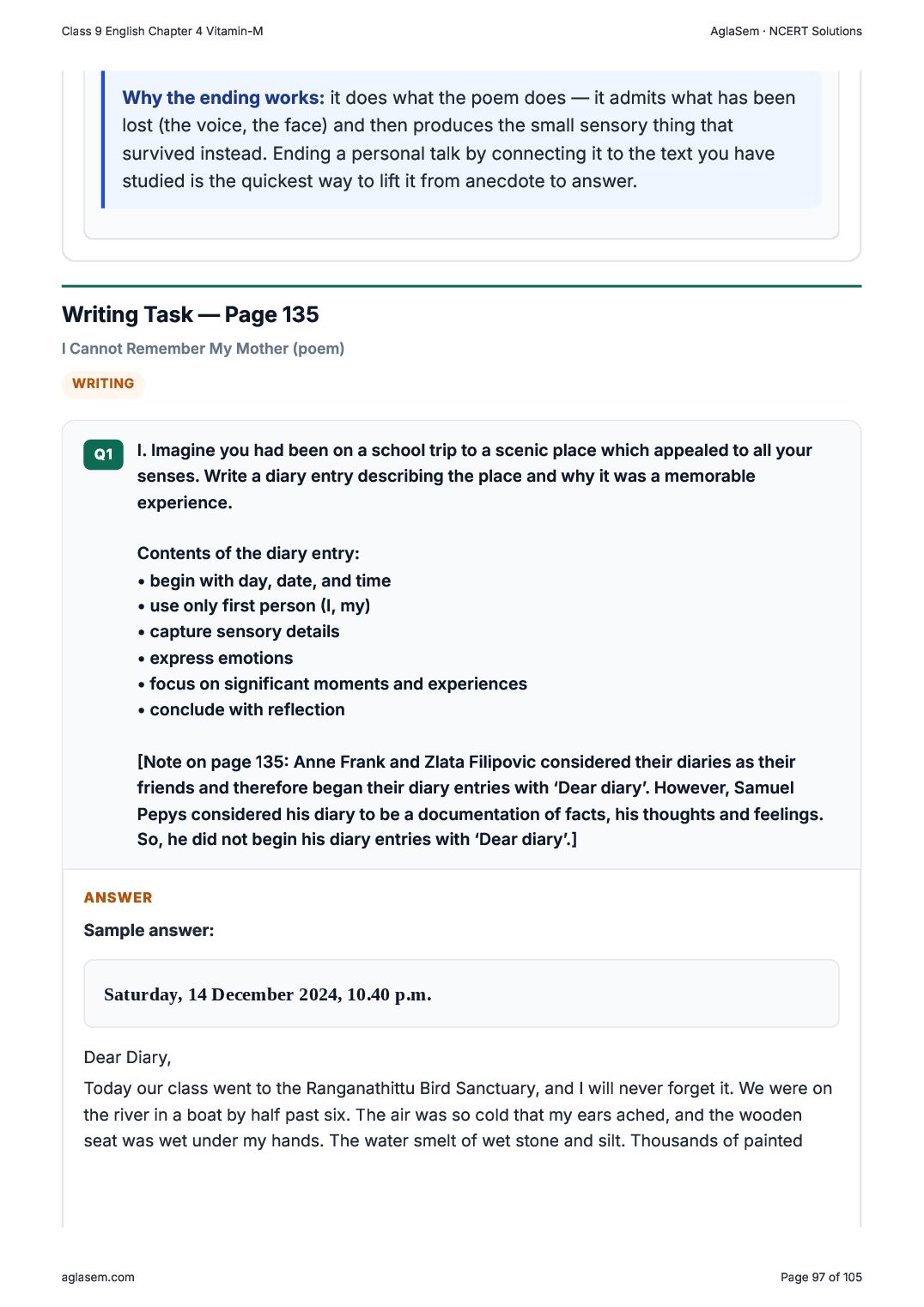
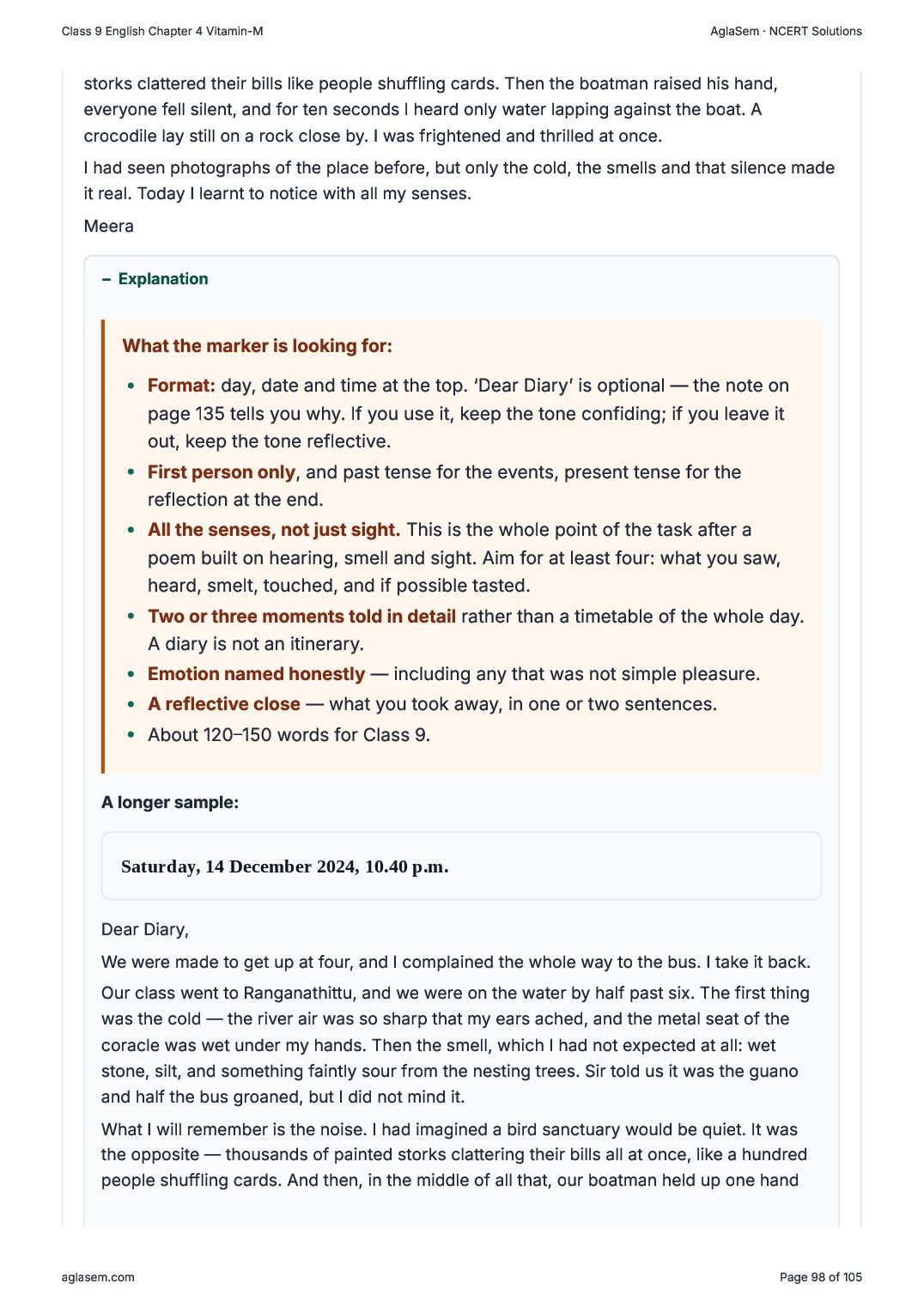
- I. Imagine you had been on a school trip to a scenic place which appealed to all your senses. Write a diary entry describing the place and why it was a memorable experience. Contents of the diary entry: • begin with day, date, and time • use only first person (I, my) • capture sensory details • express emotions • focus on significant moments and experiences • conclude with reflection [Note on page 135: Anne Frank and Zlata Filipovic considered their diaries as their friends and therefore began their diary entries with ‘Dear diary’. However, Samuel Pepys considered his diary to be a documentation of facts, his thoughts and feelings. So, he did not begin his diary entries with ‘Dear diary’.]
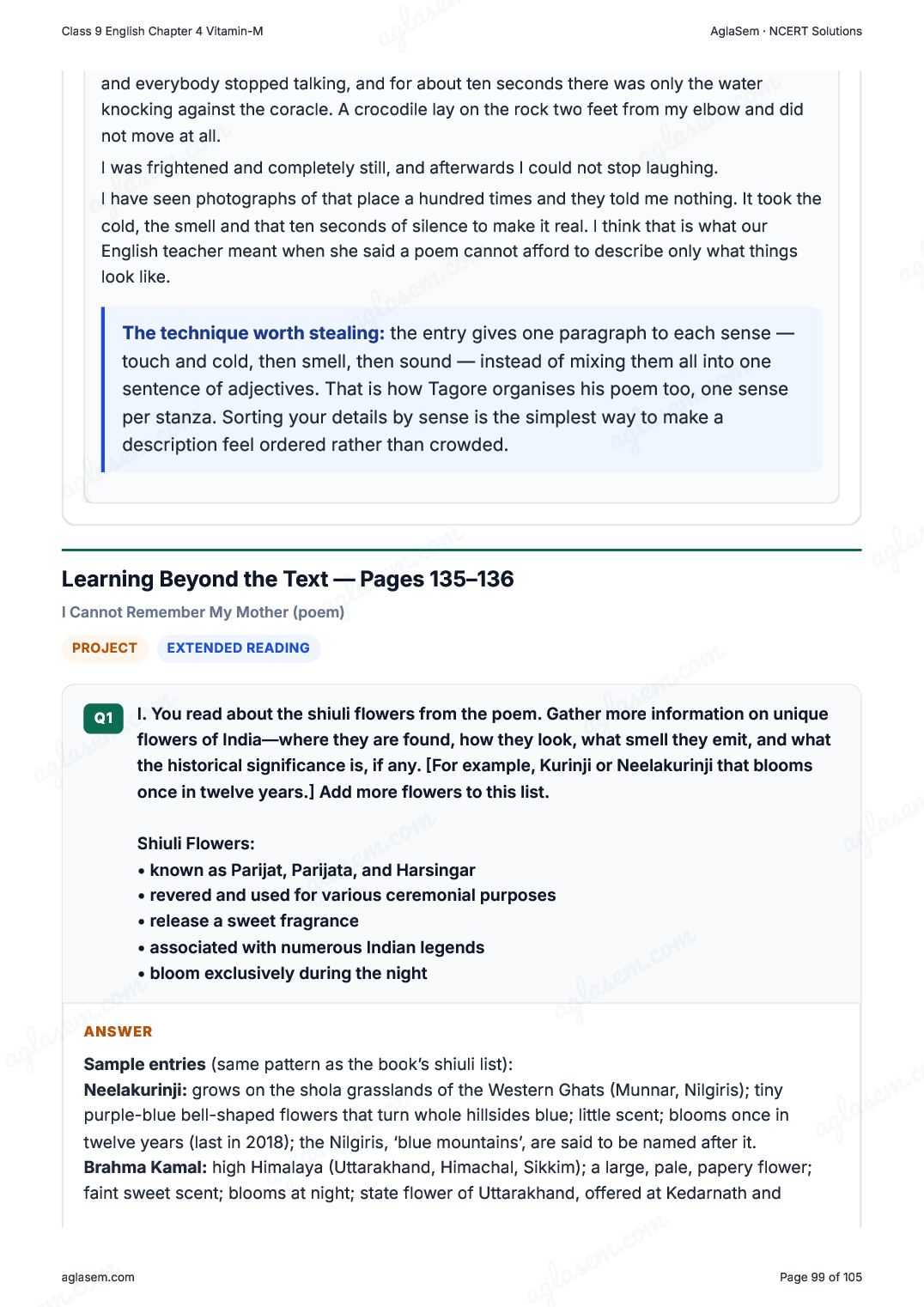
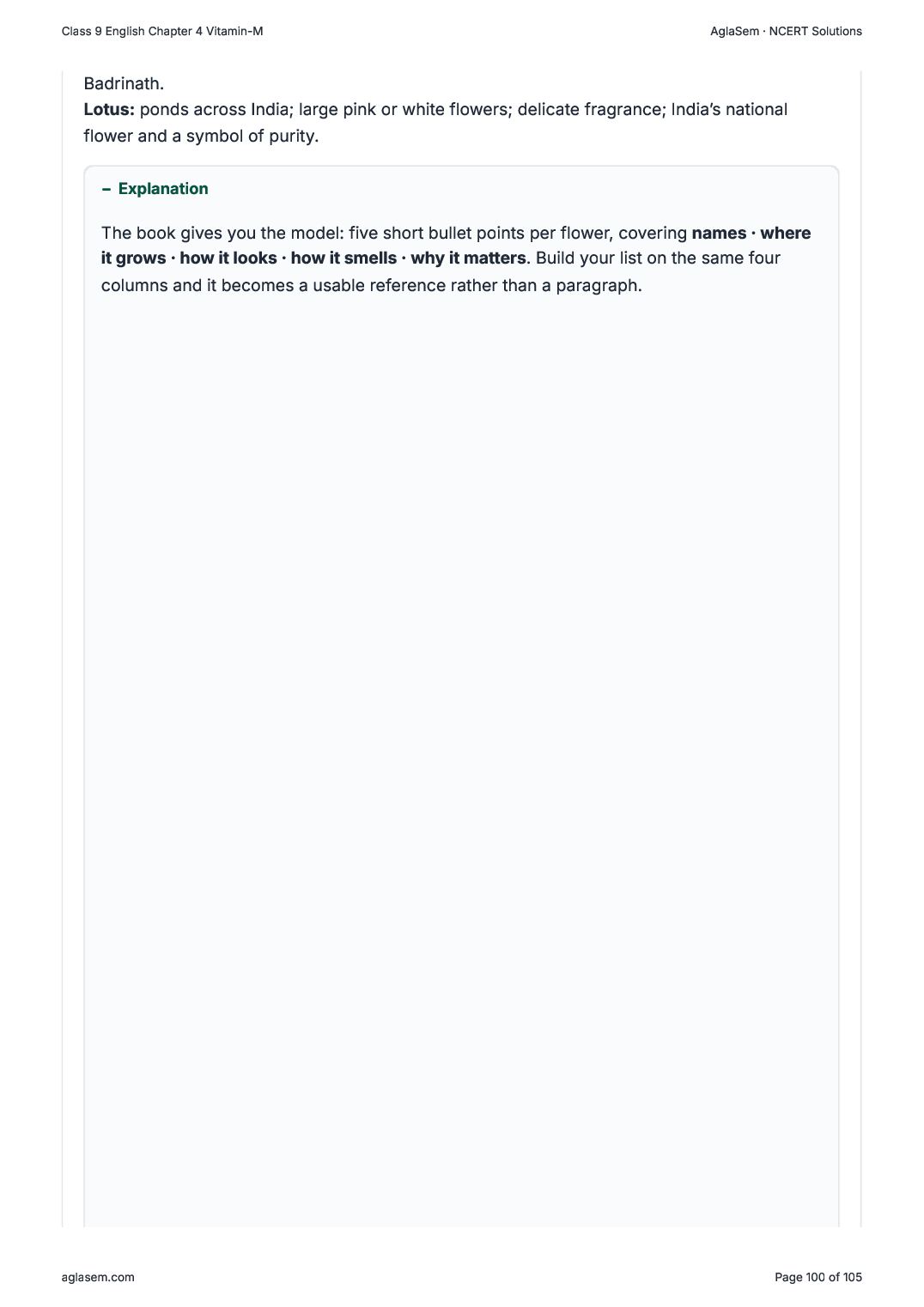
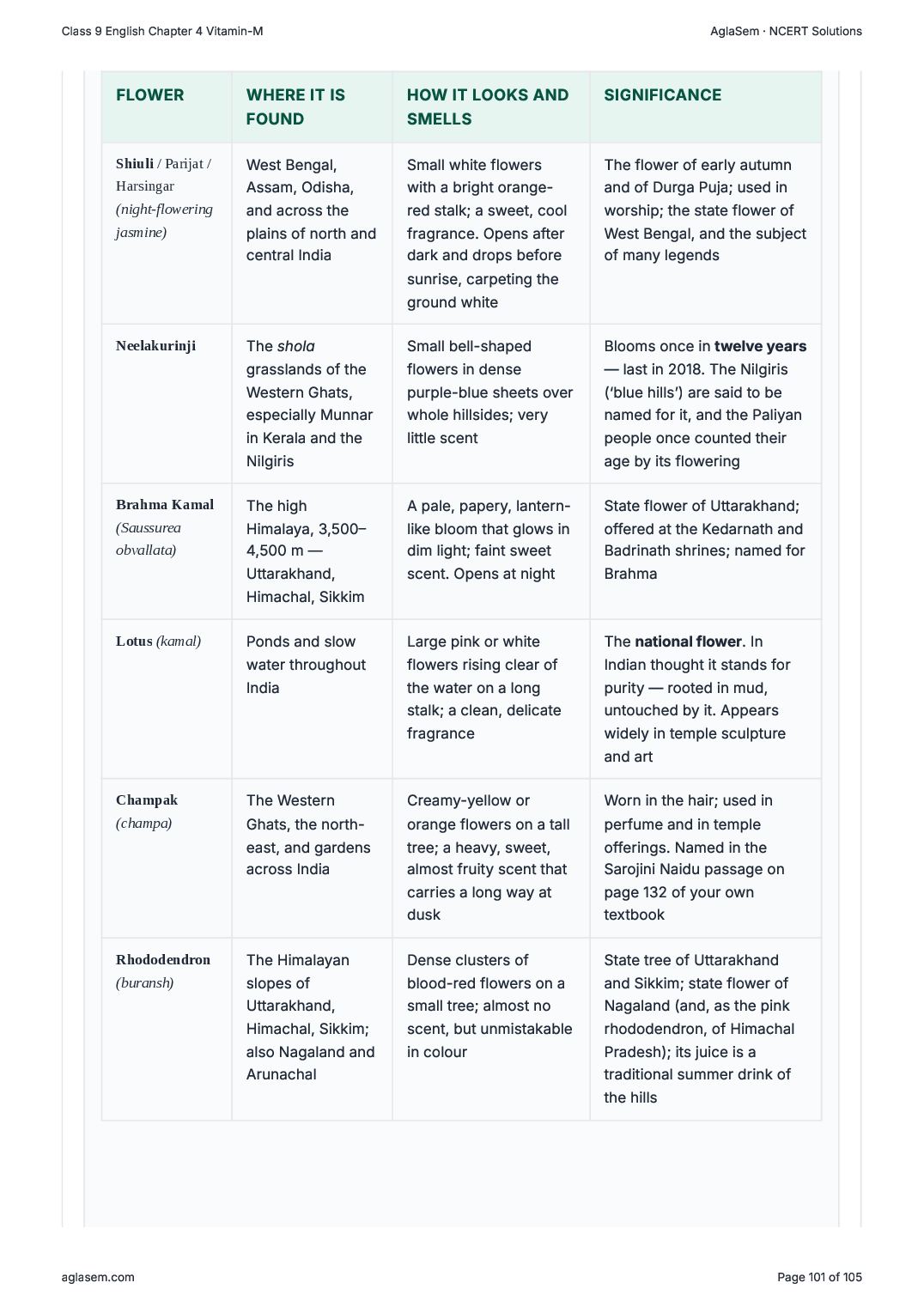
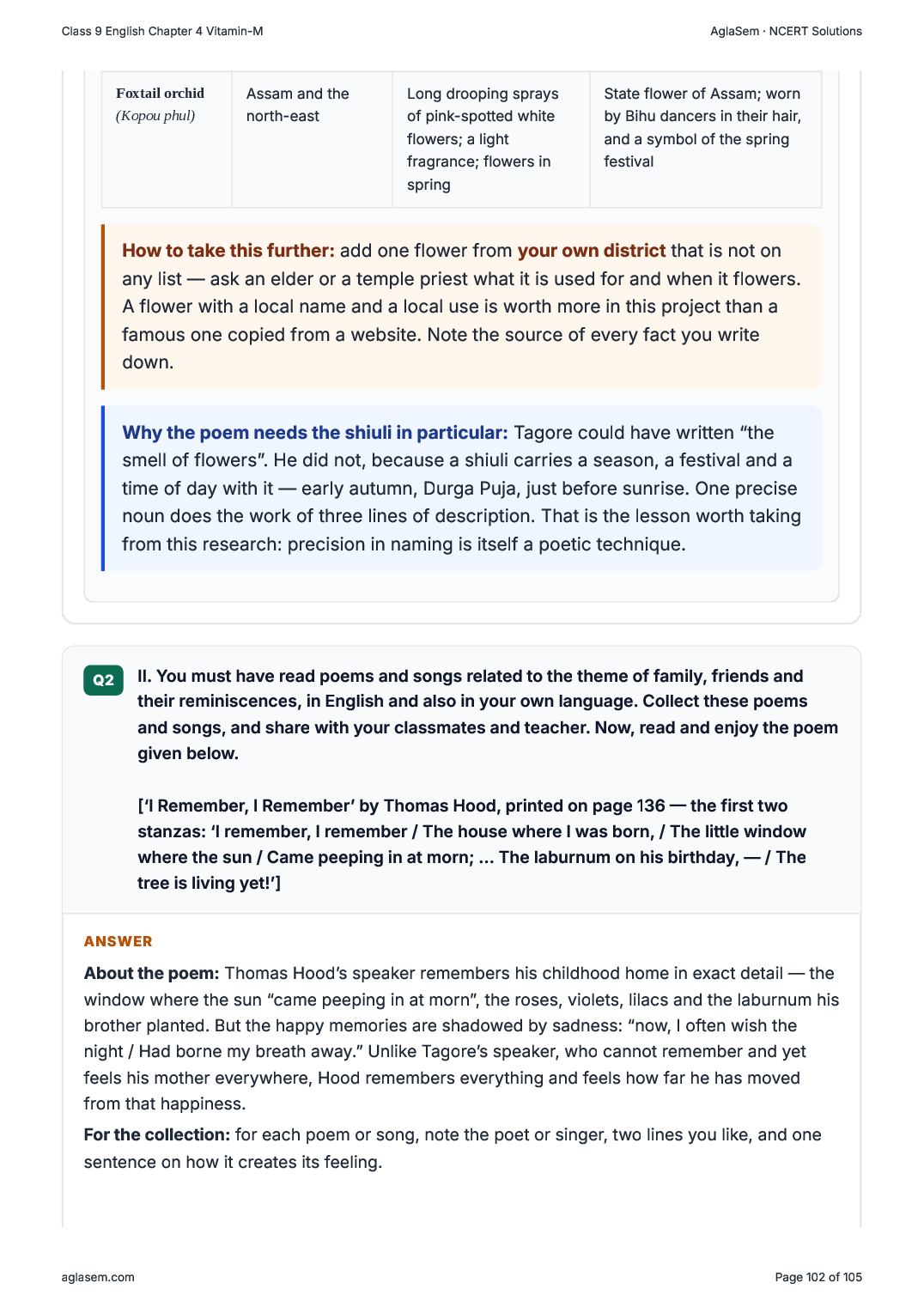
- I. You read about the shiuli flowers from the poem. Gather more information on unique flowers of India—where they are found, how they look, what smell they emit, and what the historical significance is, if any. [For example, Kurinji or Neelakurinji that blooms once in twelve years.] Add more flowers to this list. Shiuli Flowers: • known as Parijat, Parijata, and Harsingar • revered and used for various ceremonial purposes • release a sweet fragrance • associated with numerous Indian legends • bloom exclusively during the night
- … and more questions are solved in the complete PDF above.
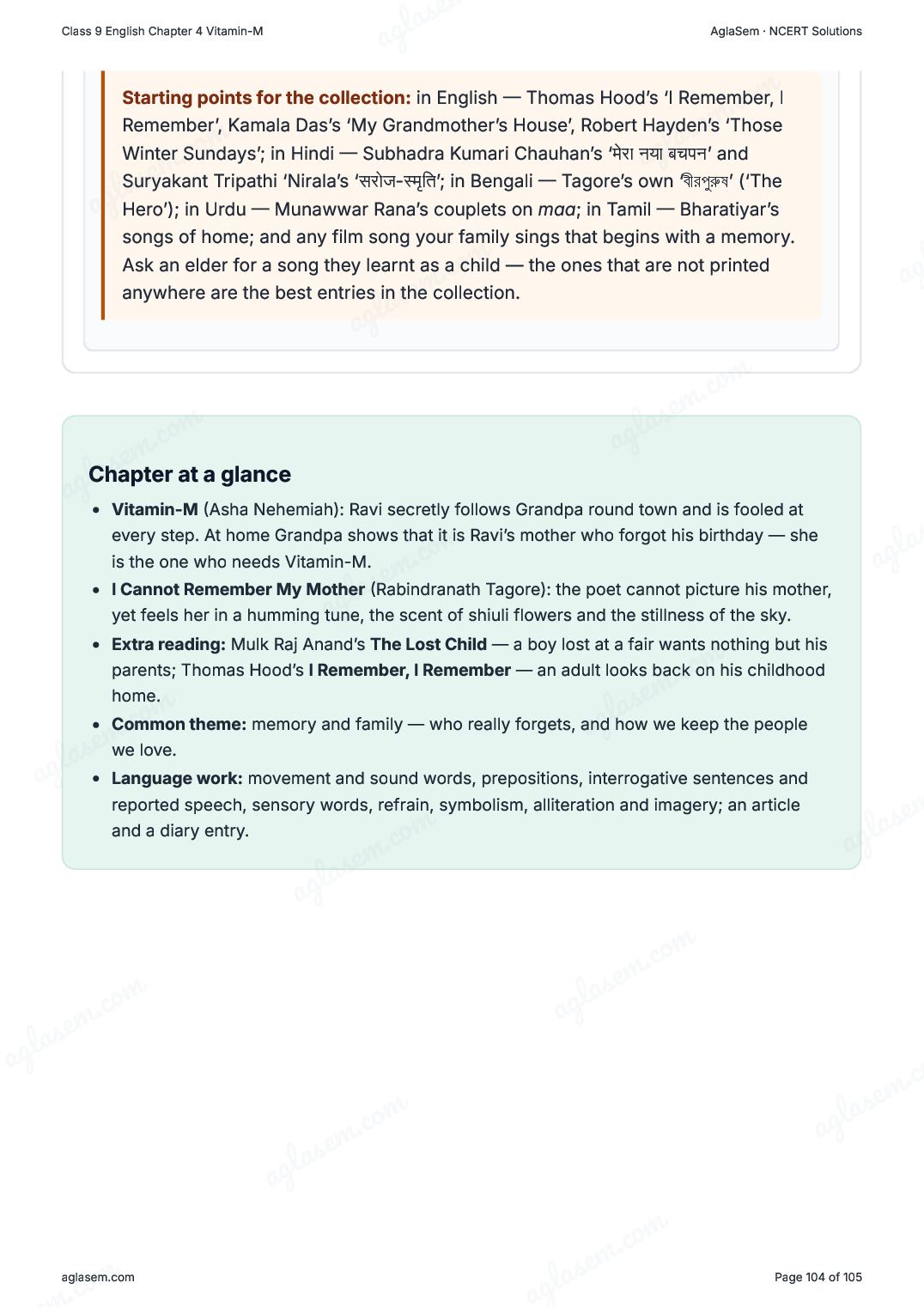
Chapter at a Glance
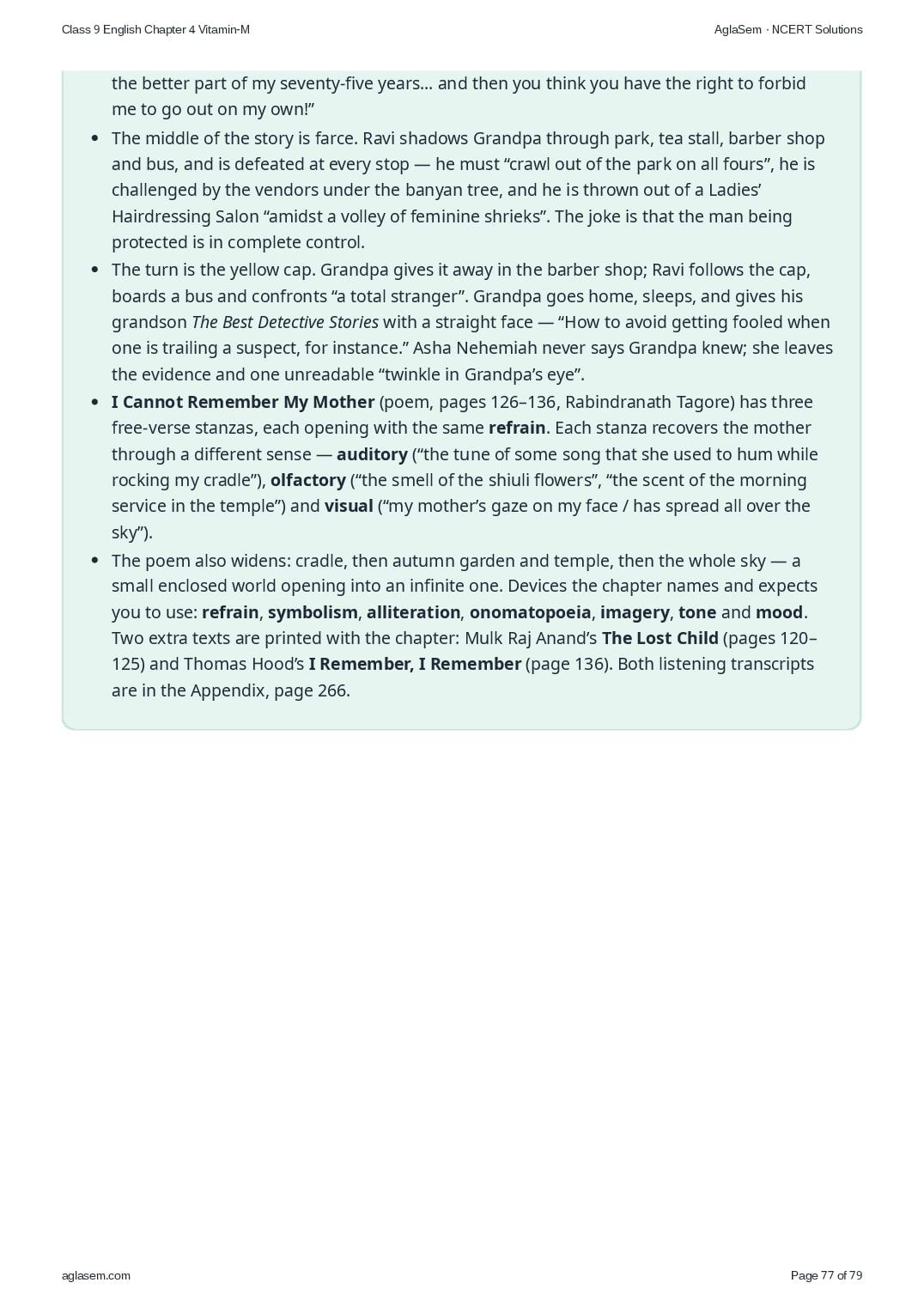
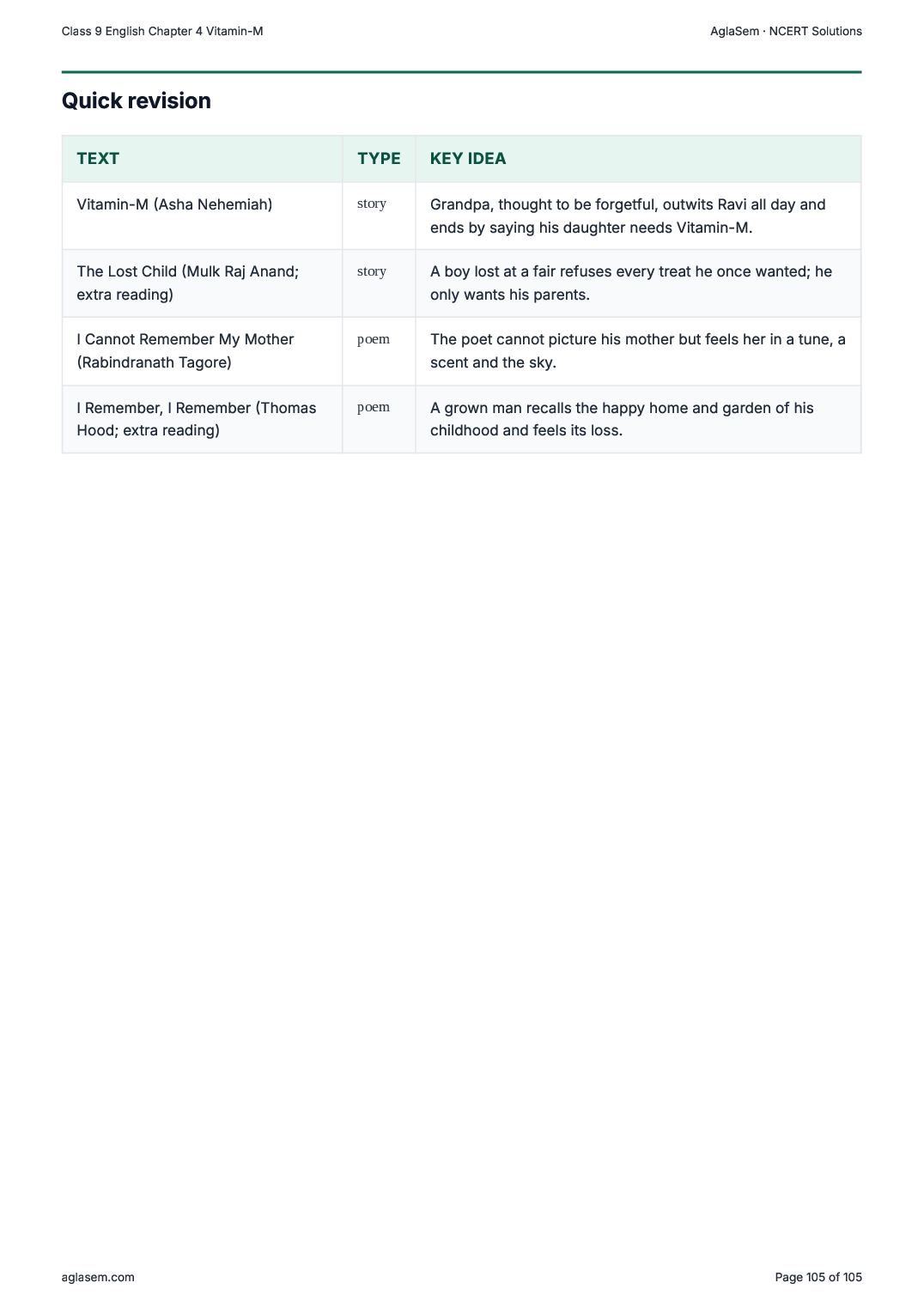
- Vitamin-M (prose, pages 97–125) is built on one long irony. Ravi’s mother wants a memory pill for “old people”; by the last page Grandpa is saying, “My daughter needs some Vitamin-M, I think—for her memory,” because she has forgotten his birthday although she herself “circled the date in red” on the calendar at the beginning of the year.
- Grandpa is seventy-five, a retired lawyer, and has been moved out of “his small brick house in town” into a “poky little flat” after he slipped in the garden and “lain outside all night”. What he resents is not the care but the loss of standing: “I’ve been looking after myself for the better part of my seventy-five years… and then you think you have the right to forbid me to go out on my own!”
- The middle of the story is farce. Ravi shadows Grandpa through park, tea stall, barber shop and bus, and is defeated at every stop — he must “crawl out of the park on all fours”, he is challenged by the vendors under the banyan tree, and he is thrown out of a Ladies’ Hairdressing Salon “amidst a volley of feminine shrieks”. The joke is that the man being protected is in complete control.
- The turn is the yellow cap. Grandpa gives it away in the barber shop; Ravi follows the cap, boards a bus and confronts “a total stranger”. Grandpa goes home, sleeps, and gives his grandson The Best Detective Stories with a straight face — “How to avoid getting fooled when one is trailing a suspect, for instance.” Asha Nehemiah never says Grandpa knew; she leaves the evidence and one unreadable “twinkle in Grandpa’s eye”.
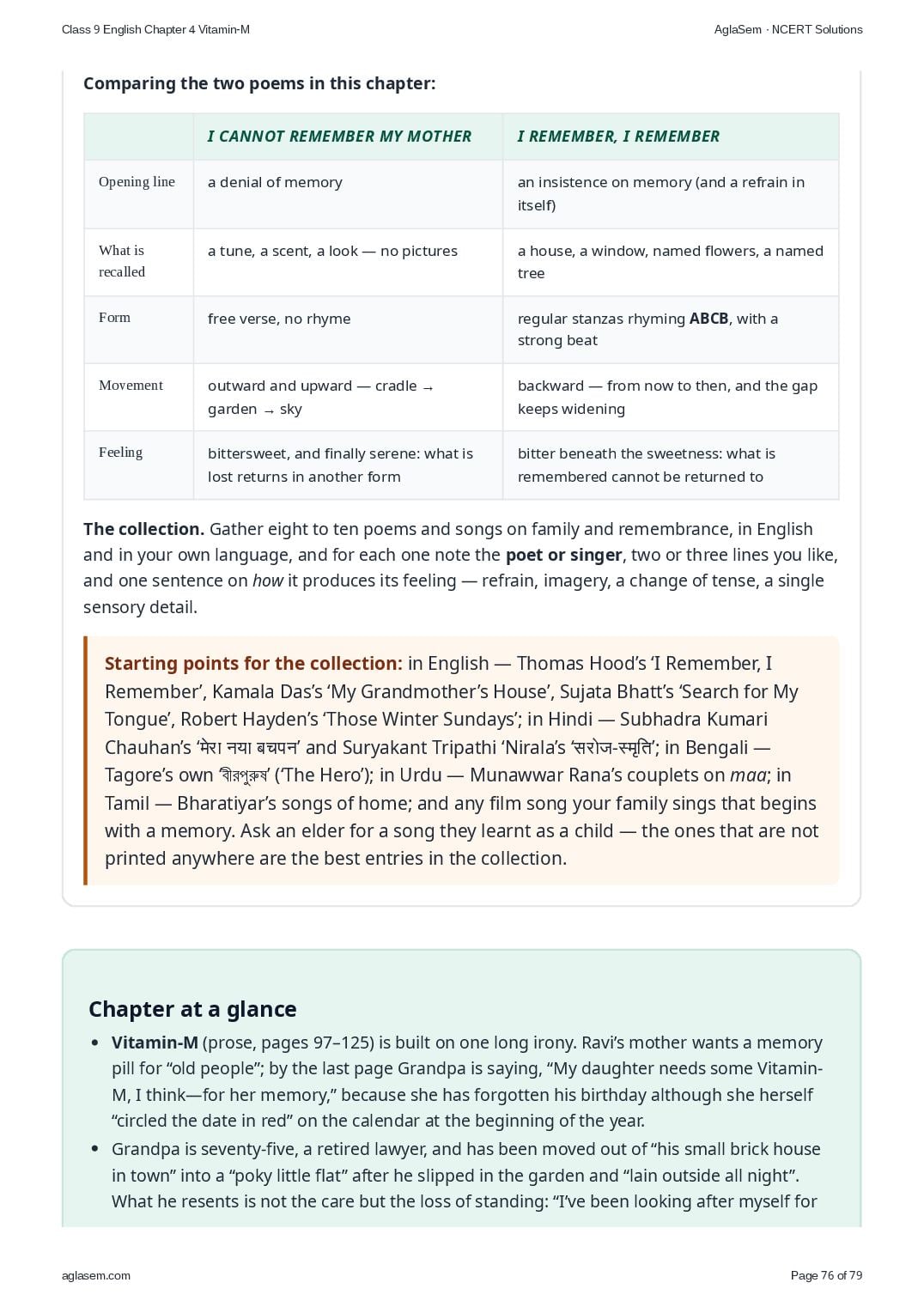
- I Cannot Remember My Mother (poem, pages 126–136, Rabindranath Tagore) has three free-verse stanzas, each opening with the same refrain . Each stanza recovers the mother through a different sense — auditory (“the tune of some song that she used to hum while rocking my cradle”), olfactory (“the smell of the shiuli flowers”, “the scent of the morning service in the temple”) and visual (“my mother’s gaze on my face / has spread all over the sky”).
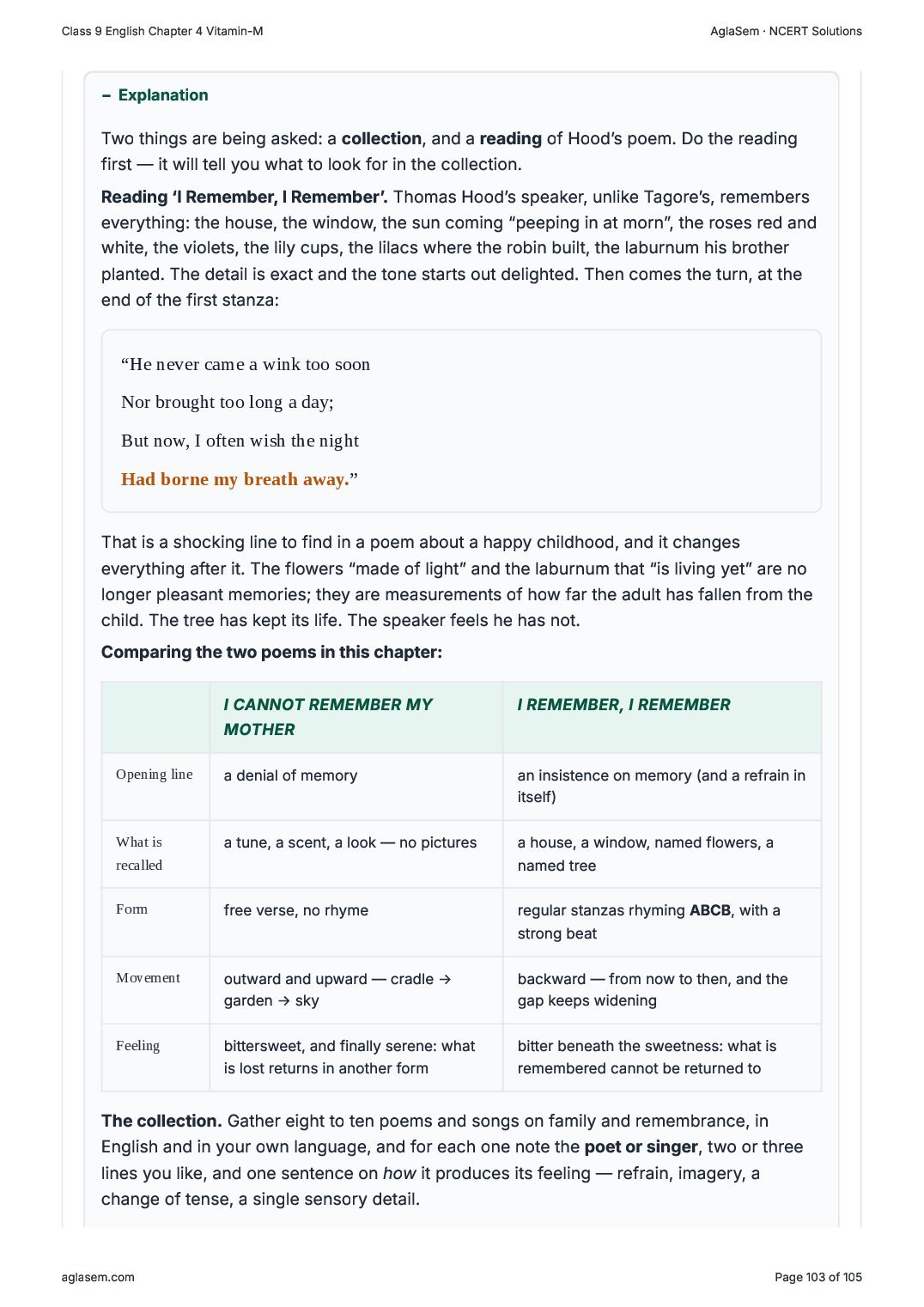
- The poem also widens: cradle, then autumn garden and temple, then the whole sky — a small enclosed world opening into an infinite one. Devices the chapter names and expects you to use: refrain , symbolism , alliteration , onomatopoeia , imagery , tone and mood . Two extra texts are printed with the chapter: Mulk Raj Anand’s The Lost Child (pages 120–125) and Thomas Hood’s I Remember, I Remember (page 136). Both listening transcripts are in the Appendix, page 266.
How to Download NCERT Solutions for Class 9 English Chapter 4 PDF
Follow these simple steps to get the Vitamin M questions-and-answers PDF from Kaveri.
- Search NCERT Solutions for Class 9 English Chapter 4 aglasem and open this page.
- Read the exercise questions with answers for Vitamin M shown above.
- Click the Download PDF link to save the Vitamin M solutions to your device.
NCERT Solutions for Class 9 English – All Chapters
There are more chapters to study besides Vitamin M in English. Here are the NCERT Solutions for all chapters of Class 9 English.
- Chapter 1 How I Taught My Grandmother to Read
- Chapter 2 The Pot Maker
- Chapter 3 Winds of Change
- Chapter 4 Vitamin M
- Chapter 5 The World of Limitless Possibilities
- Chapter 6 Twin Melodies
- Chapter 7 Carrier of Words
- Chapter 8 Follow That Dream
NCERT Solutions for Class 9 – All Subjects
Just like Chapter 4 of English, you can get the exercise questions with answers for every other subject of Class 9. Here are the NCERT Solutions for all subjects of Class 9.
NCERT Solutions for Class 9 English Chapter 4 – An Overview
The key highlights of this study material are as follows.
| Aspects | Details |
|---|---|
| Class | Class 9 |
| Subject | English |
| Chapter Number | Chapter 4 |
| Chapter Name | Vitamin M |
| Book Name | Kaveri |
| Book By | NCERT (National Council of Educational Research and Training) |
| Educational Resource Here | NCERT Solutions of Class 9 English Chapter 4 for all exercises |
| More Questions Answers of This Subject | NCERT Solutions for Class 9 English |
| Download Book Chapter | NCERT Book Class 9 English |
| All Questions Answers For This Class | NCERT Solutions for Class 9 |
| Complete Solutions | NCERT Solutions |
NCERT Solutions for Class 9 English Chapter 4 Vitamin M – FAQs
What are the NCERT Solutions for Class 9 English Chapter 4 Vitamin M?
They are the complete, step-by-step answers to all the exercise and in-text questions of Chapter 4 Vitamin M from the NCERT Class 9 English textbook Kaveri, written by experts as per the latest NCERT syllabus.
How can I download the Class 9 English Chapter 4 solutions PDF for free?
Open this page on aglasem, read the Vitamin M questions with answers, and click the “Download Solutions PDF” link. The Class 9 English Chapter 4 NCERT Solutions PDF is completely free to download.
Are these NCERT Solutions as per the latest 2026-27 syllabus?
Yes. The NCERT Solutions for Class 9 English Chapter 4 are based on the latest NCERT textbook Kaveri and the current 2026-27 CBSE syllabus, so the questions and answers match what you study in class.
Where can I get NCERT Solutions for the other chapters of Class 9 English?
You can find the answers to every chapter on the NCERT Solutions for Class 9 English page, and solutions for every subject on the NCERT Solutions for Class 9 page.
How do NCERT Solutions help in exam preparation?
They show the correct method to solve each question, help you write answers the way they are expected in exams, let you check and correct your own work, and save revision time — which together improve your marks in Class 9 English.
If you have any queries on NCERT Solutions for Class 9 English Chapter 4 Vitamin M, then please ask in the comments below.