NCERT Solutions for Class 9 English Chapter 2 The Pot Maker provide clear, step-by-step answers to every exercise and in-text question from the chapter The Pot Maker of the NCERT textbook Kaveri. Prepared by subject experts as per the latest NCERT (CBSE) syllabus for 2026-27, these NCERT Solutions for Class 9 English help you understand each concept, write exam-ready answers, and check your own solutions. You can read them online below or download the free Class 9 English Chapter 2 question-answer PDF.
NCERT Solutions for Class 9 English Chapter 2 The Pot Maker
- Class: Class 9
- Subject: English
- Chapter: Chapter 2 – The Pot Maker
- Textbook: Kaveri (NCERT)
- Study material: NCERT Solutions – questions with answers, free PDF
These solutions answer all the exercise questions of Chapter 2 The Pot Maker — including the in-text questions, short-answer and long-answer questions, and activities — with complete explanations so you can follow the method, not just the final answer. Read the full solutions below.
NCERT Solutions Class 9 English Chapter 2 the Pot Maker View Download


NCERT Solutions for Class 9 English Chapter 2 PDF Download
You can read the NCERT Solutions for Class 9 English Chapter 2 online above, or download the complete question-answer PDF to study The Pot Maker offline at any time.
NCERT Solutions for Class 9 English Chapter 2 PDF Download Link – Click Here to Download Solutions PDF
Questions Covered in This Chapter
These NCERT Solutions answer all 60 questions of this chapter. The questions solved are:
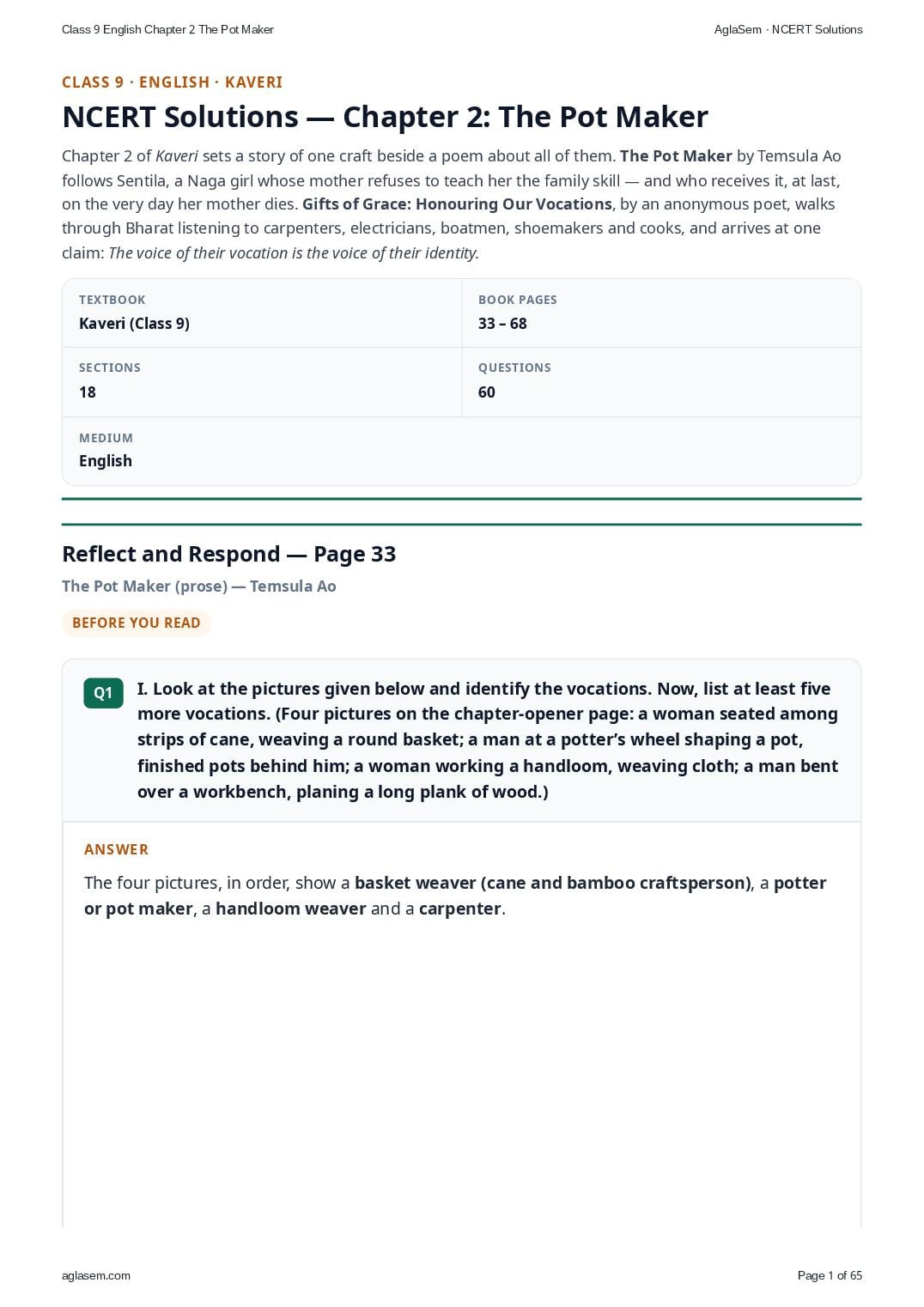
- I. Look at the pictures given below and identify the vocations. Now, list at least five more vocations. (Four pictures on the chapter-opener page: a woman seated among strips of cane, weaving a round basket; a man at a potter’s wheel shaping a pot, finished pots behind him; a woman working a handloom, weaving cloth; a man bent over a workbench, planing a long plank of wood.)
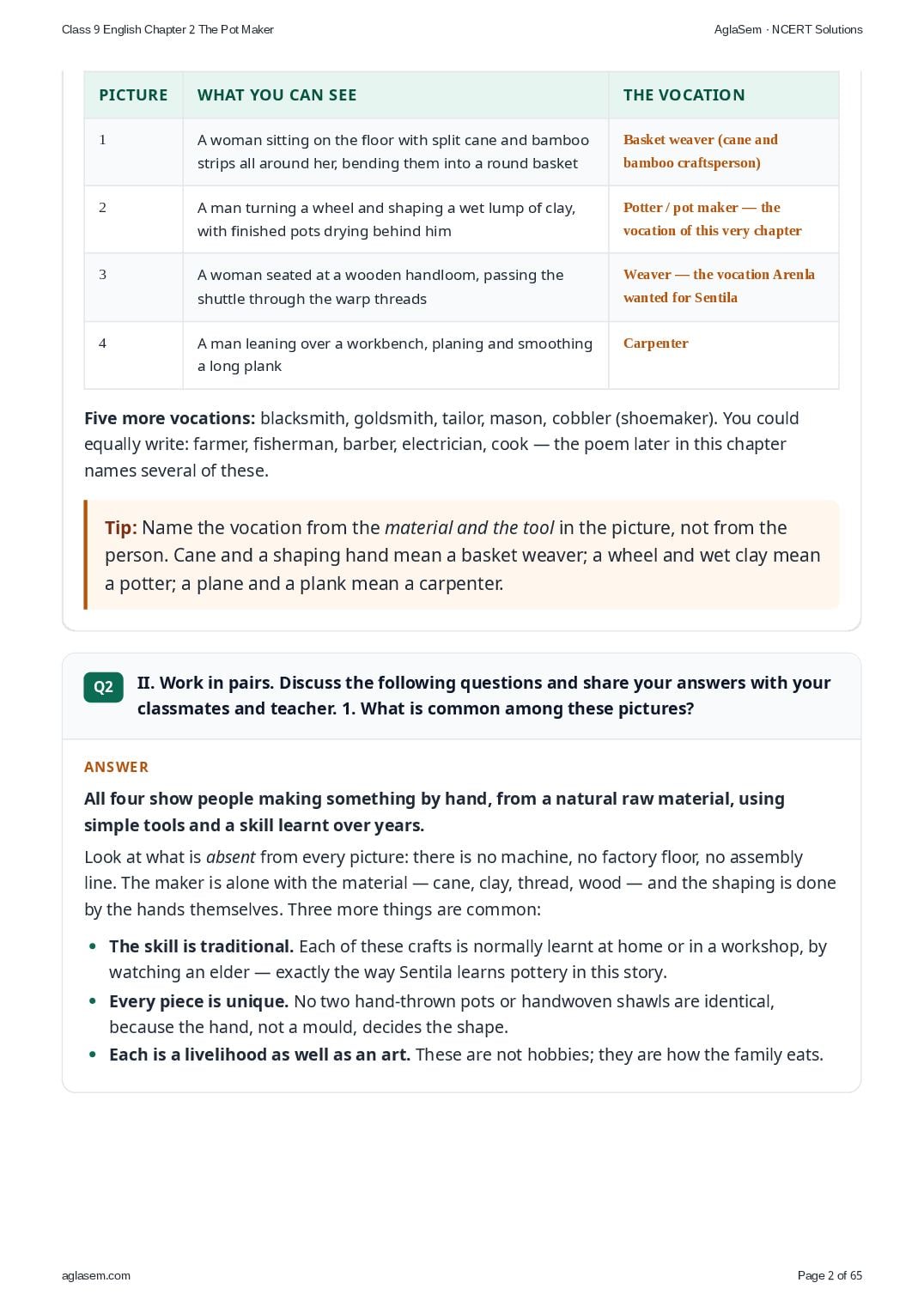
- II. Work in pairs. Discuss the following questions and share your answers with your classmates and teacher. 1. What is common among these pictures?
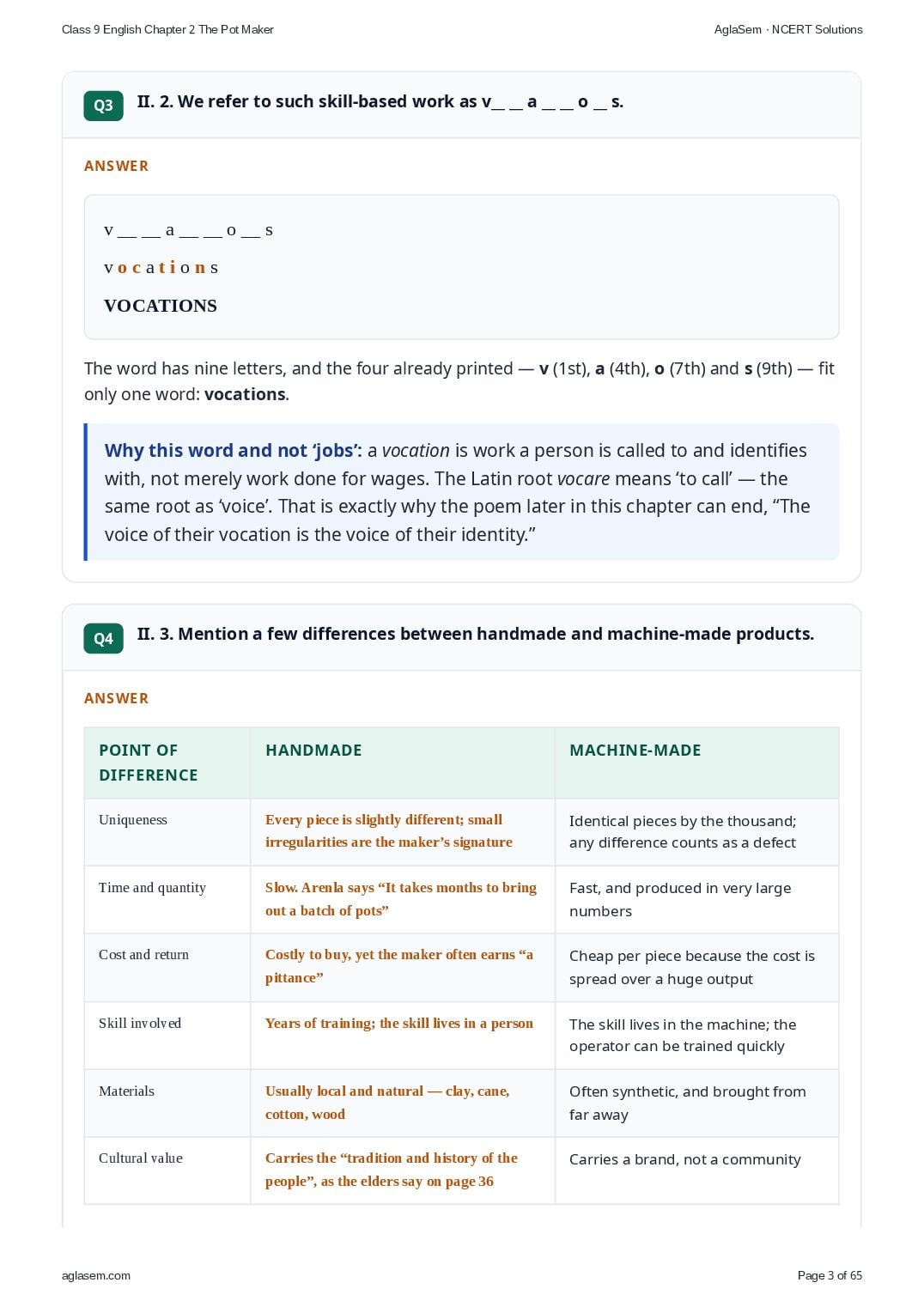
- II. 2. We refer to such skill-based work as v__ __ a __ __ o __ s.
- II. 3. Mention a few differences between handmade and machine-made products.
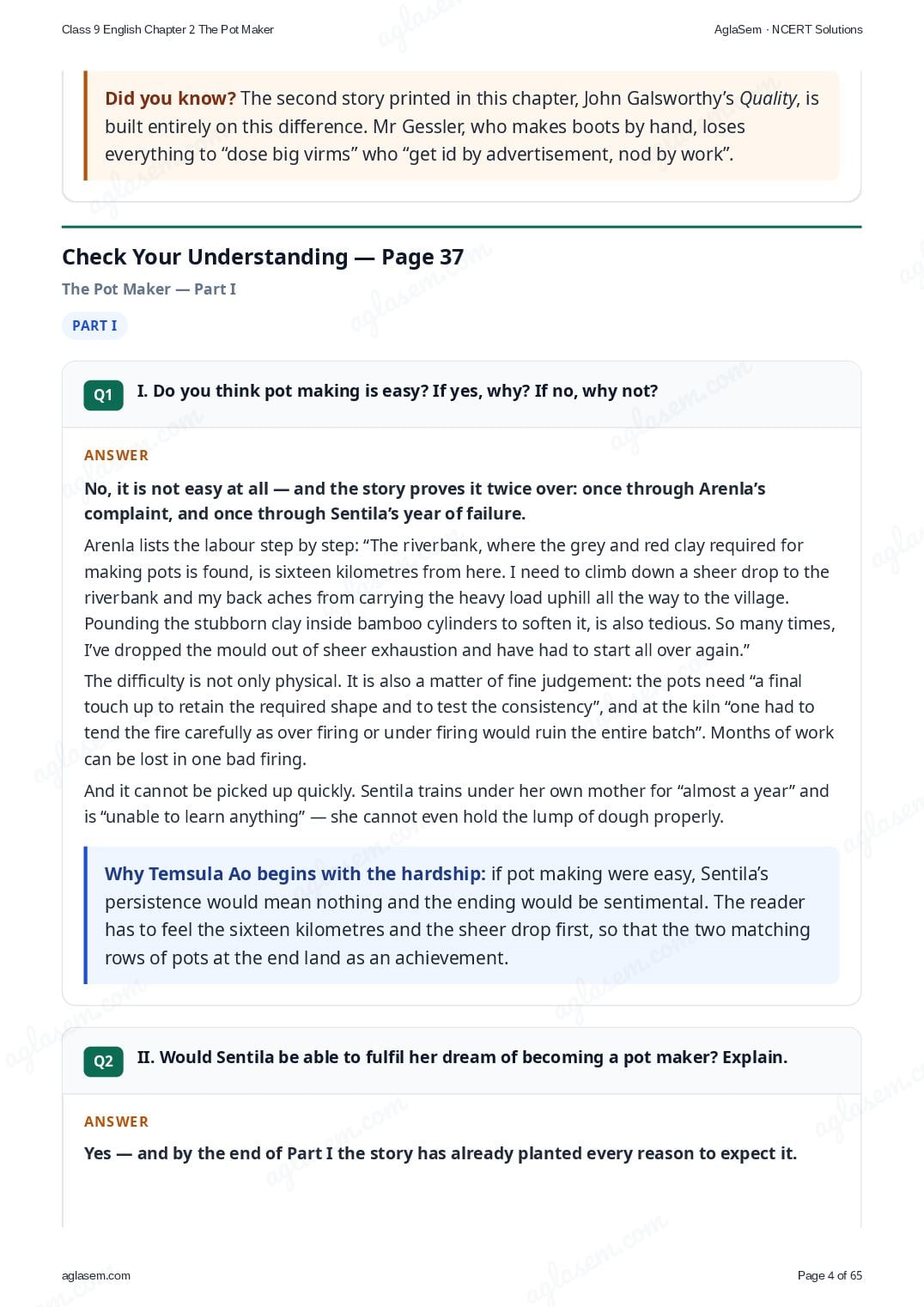
- I. Do you think pot making is easy? If yes, why? If no, why not?
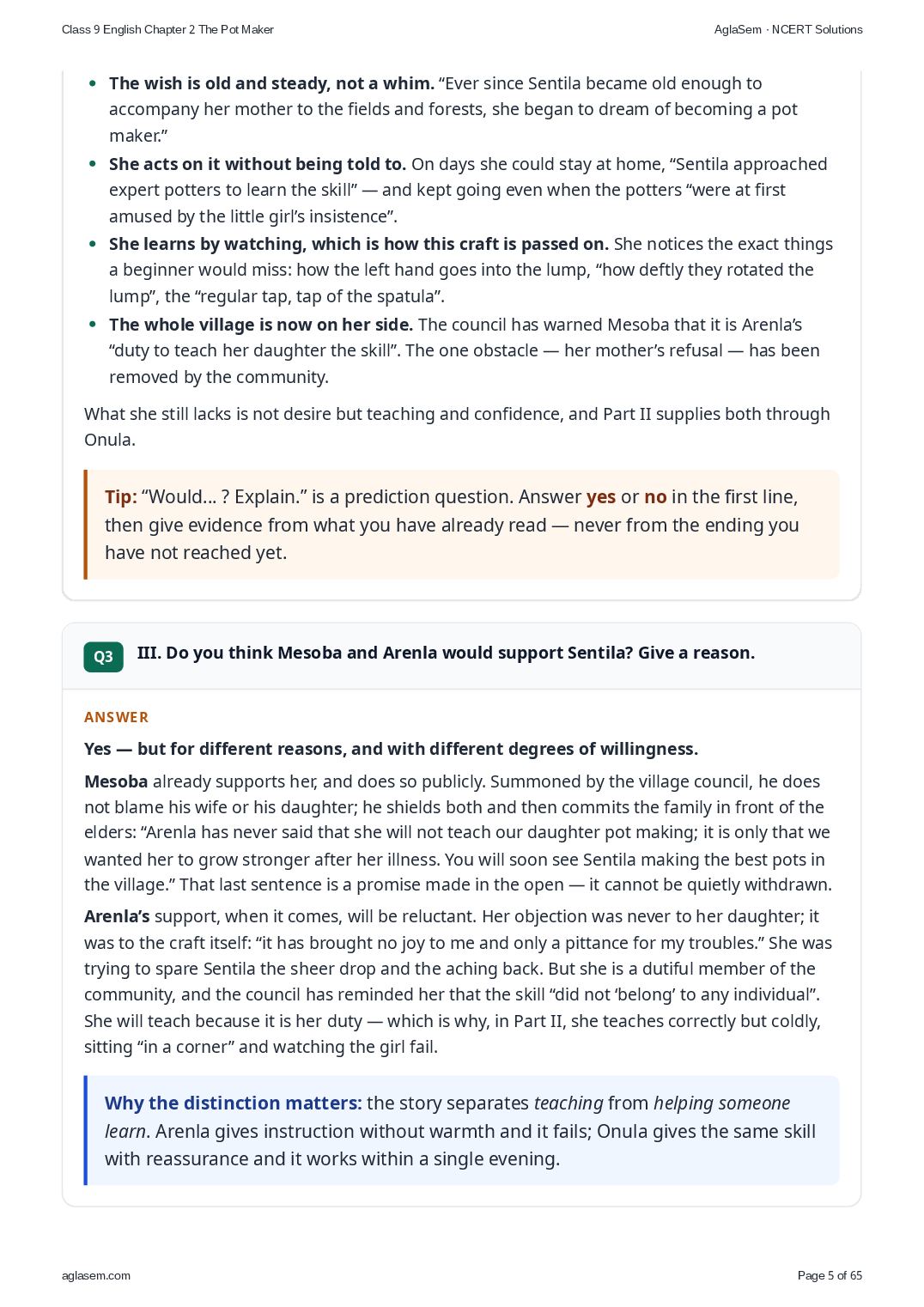
- II. Would Sentila be able to fulfil her dream of becoming a pot maker? Explain.
- III. Do you think Mesoba and Arenla would support Sentila? Give a reason.
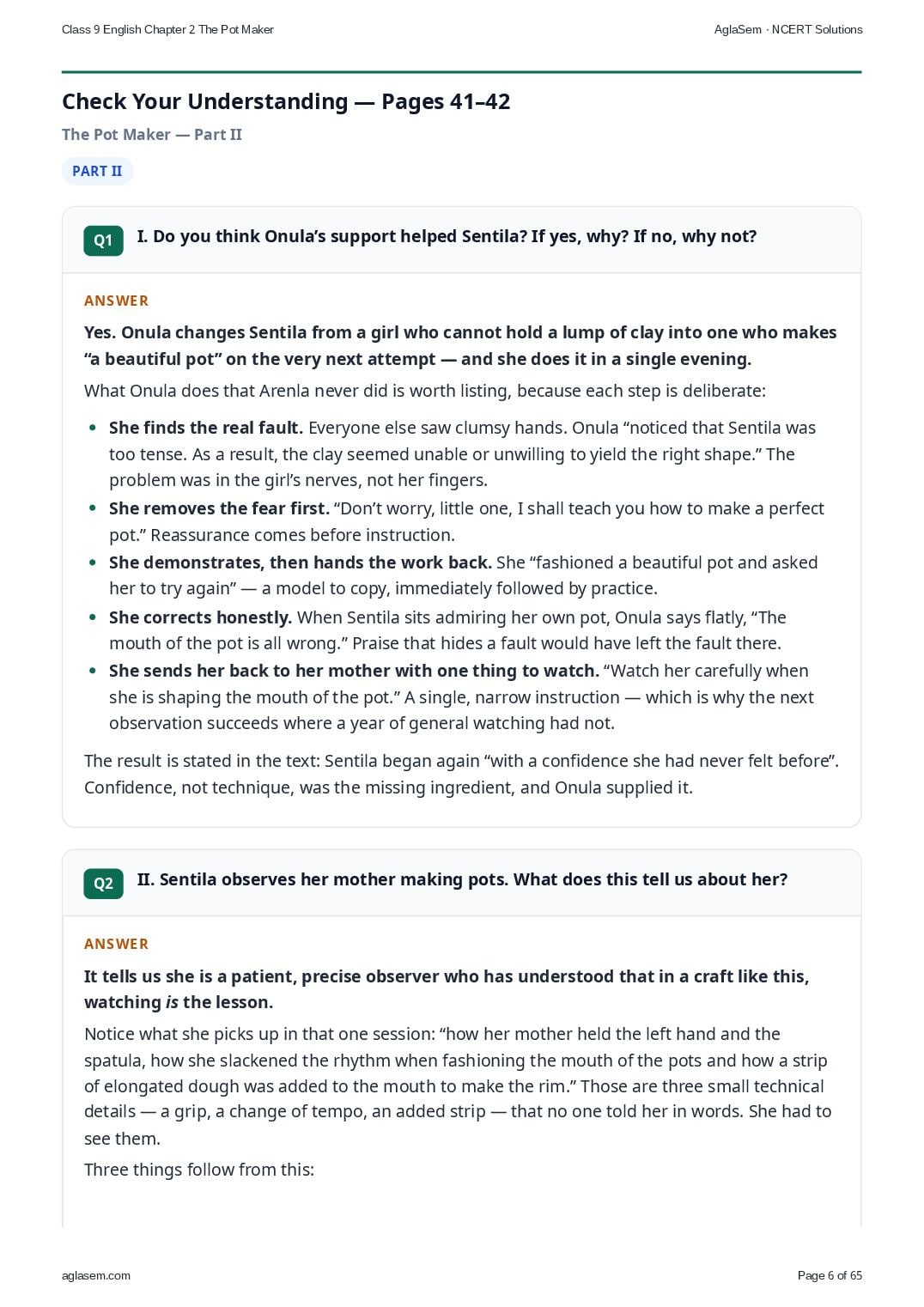
- I. Do you think Onula’s support helped Sentila? If yes, why? If no, why not?
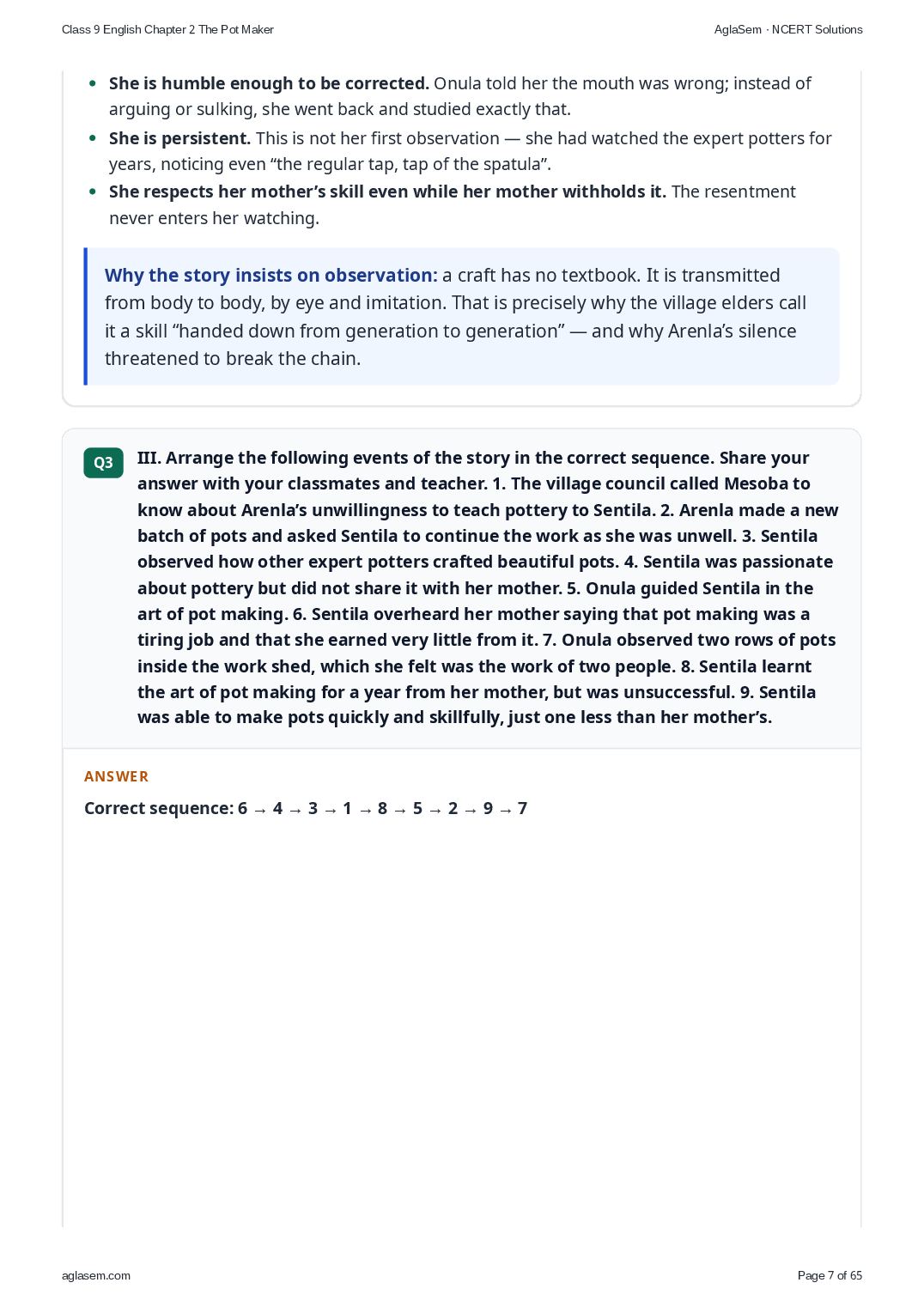
- II. Sentila observes her mother making pots. What does this tell us about her?
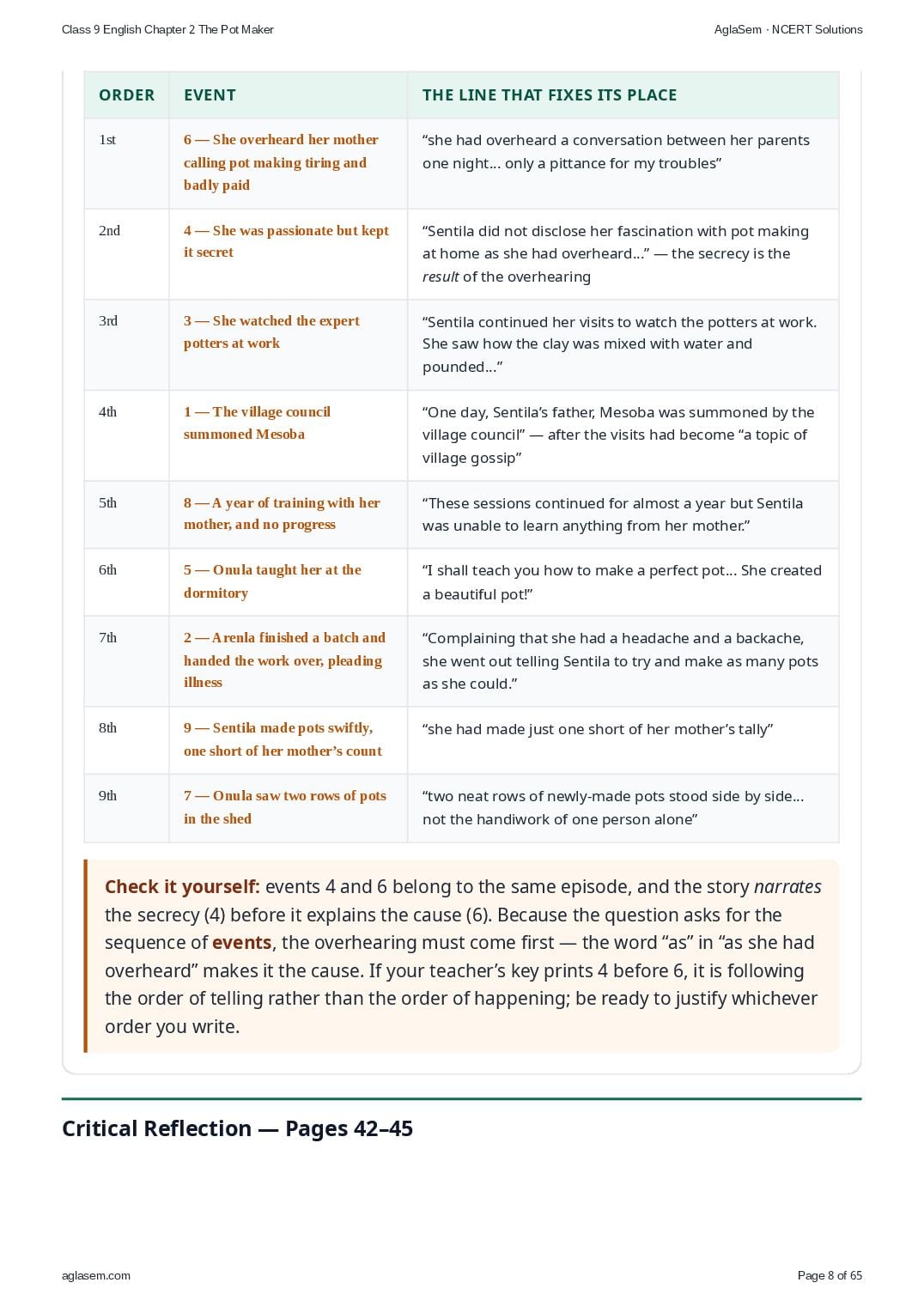
- III. Arrange the following events of the story in the correct sequence. Share your answer with your classmates and teacher. 1. The village council called Mesoba to know about Arenla’s unwillingness to teach pottery to Sentila. 2. Arenla made a new batch of pots and asked Sentila to continue the work as she was unwell. 3. Sentila observed how other expert potters crafted beautiful pots. 4. Sentila was passionate about pottery but did not share it with her mother. 5. Onula guided Sentila in the art of pot making. 6. Sentila overheard her mother saying that pot making was a tiring job and that she earned very little from it. 7. Onula observed two rows of pots inside the work shed, which she felt was the work of two people. 8. Sentila learnt the art of pot making for a year from her mother, but was unsuccessful. 9. Sentila was able to make pots quickly and skillfully, just one less than her mother’s.
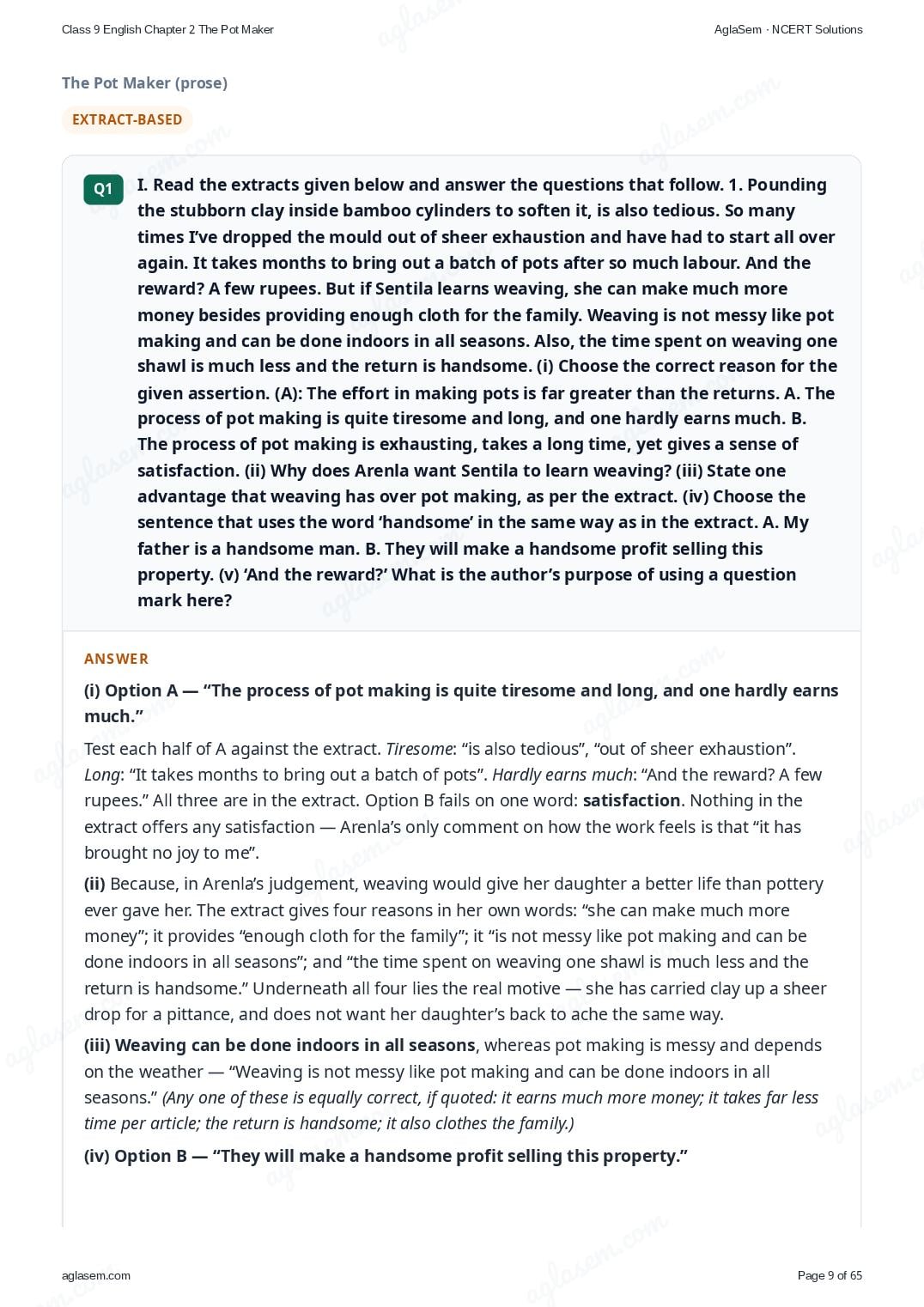
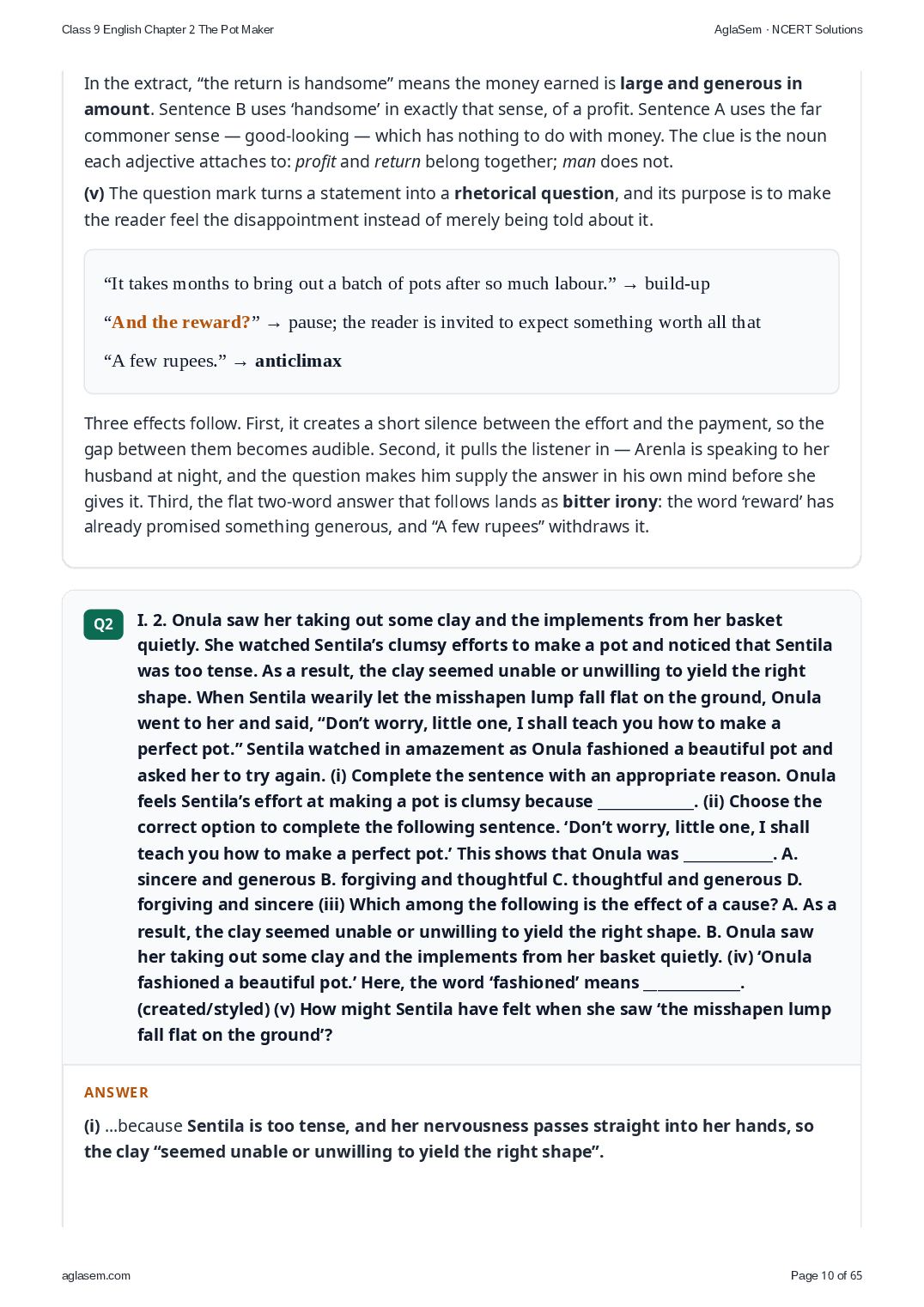
- I. Read the extracts given below and answer the questions that follow. 1. Pounding the stubborn clay inside bamboo cylinders to soften it, is also tedious. So many times I’ve dropped the mould out of sheer exhaustion and have had to start all over again. It takes months to bring out a batch of pots after so much labour. And the reward? A few rupees. But if Sentila learns weaving, she can make much more money besides providing enough cloth for the family. Weaving is not messy like pot making and can be done indoors in all seasons. Also, the time spent on weaving one shawl is much less and the return is handsome. (i) Choose the correct reason for the given assertion. (A): The effort in making pots is far greater than the returns. A. The process of pot making is quite tiresome and long, and one hardly earns much. B. The process of pot making is exhausting, takes a long time, yet gives a sense of satisfaction. (ii) Why does Arenla want Sentila to learn weaving? (iii) State one advantage that weaving has over pot making, as per the extract. (iv) Choose the sentence that uses the word ‘handsome’ in the same way as in the extract. A. My father is a handsome man. B. They will make a handsome profit selling this property. (v) ‘And the reward?’ What is the author’s purpose of using a question mark here?
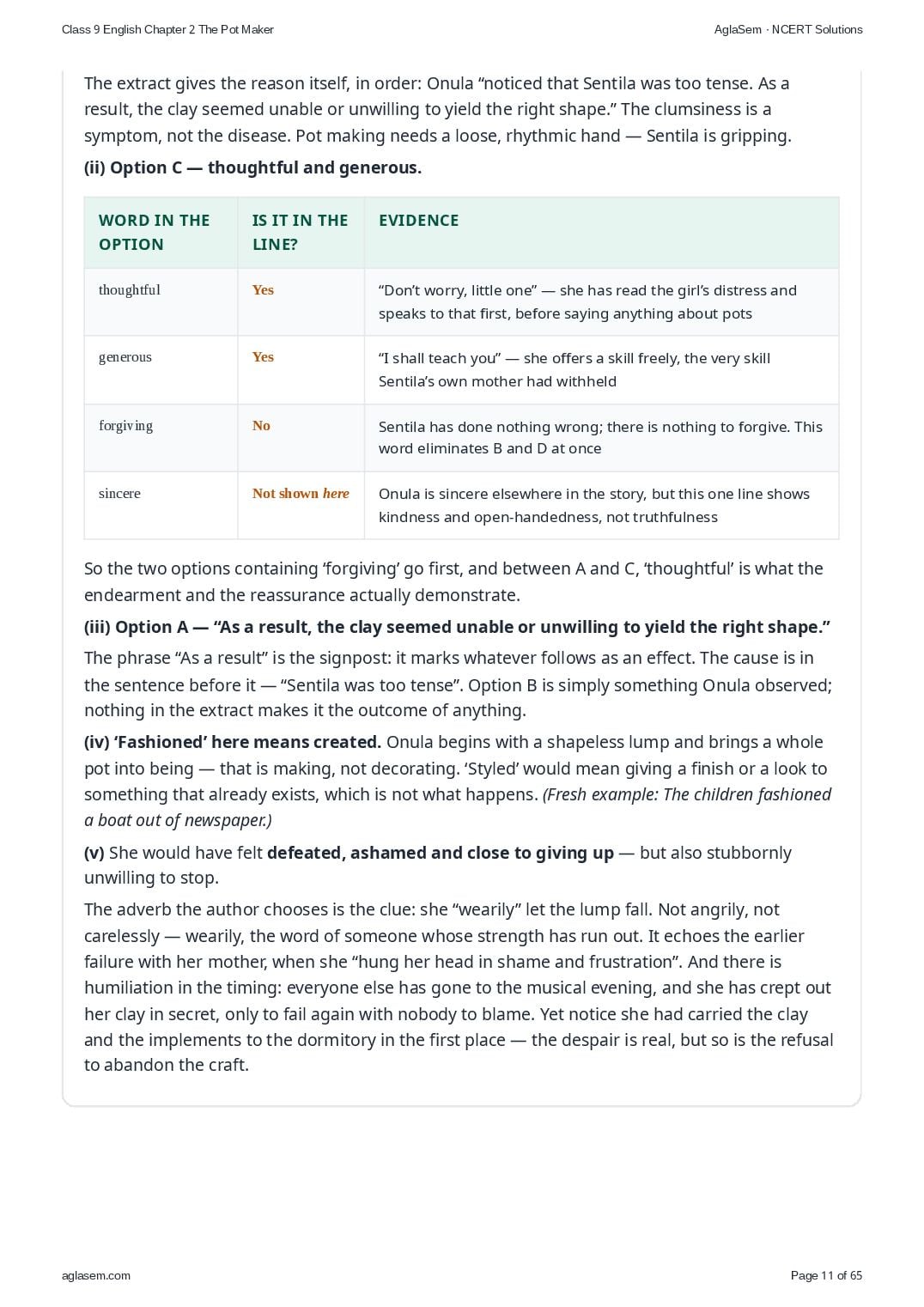
- I. 2. Onula saw her taking out some clay and the implements from her basket quietly. She watched Sentila’s clumsy efforts to make a pot and noticed that Sentila was too tense. As a result, the clay seemed unable or unwilling to yield the right shape. When Sentila wearily let the misshapen lump fall flat on the ground, Onula went to her and said, “Don’t worry, little one, I shall teach you how to make a perfect pot.” Sentila watched in amazement as Onula fashioned a beautiful pot and asked her to try again. (i) Complete the sentence with an appropriate reason. Onula feels Sentila’s effort at making a pot is clumsy because ______________. (ii) Choose the correct option to complete the following sentence. ‘Don’t worry, little one, I shall teach you how to make a perfect pot.’ This shows that Onula was _____________. A. sincere and generous B. forgiving and thoughtful C. thoughtful and generous D. forgiving and sincere (iii) Which among the following is the effect of a cause? A. As a result, the clay seemed unable or unwilling to yield the right shape. B. Onula saw her taking out some clay and the implements from her basket quietly. (iv) ‘Onula fashioned a beautiful pot.’ Here, the word ‘fashioned’ means ______________. (created/styled) (v) How might Sentila have felt when she saw ‘the misshapen lump fall flat on the ground’?
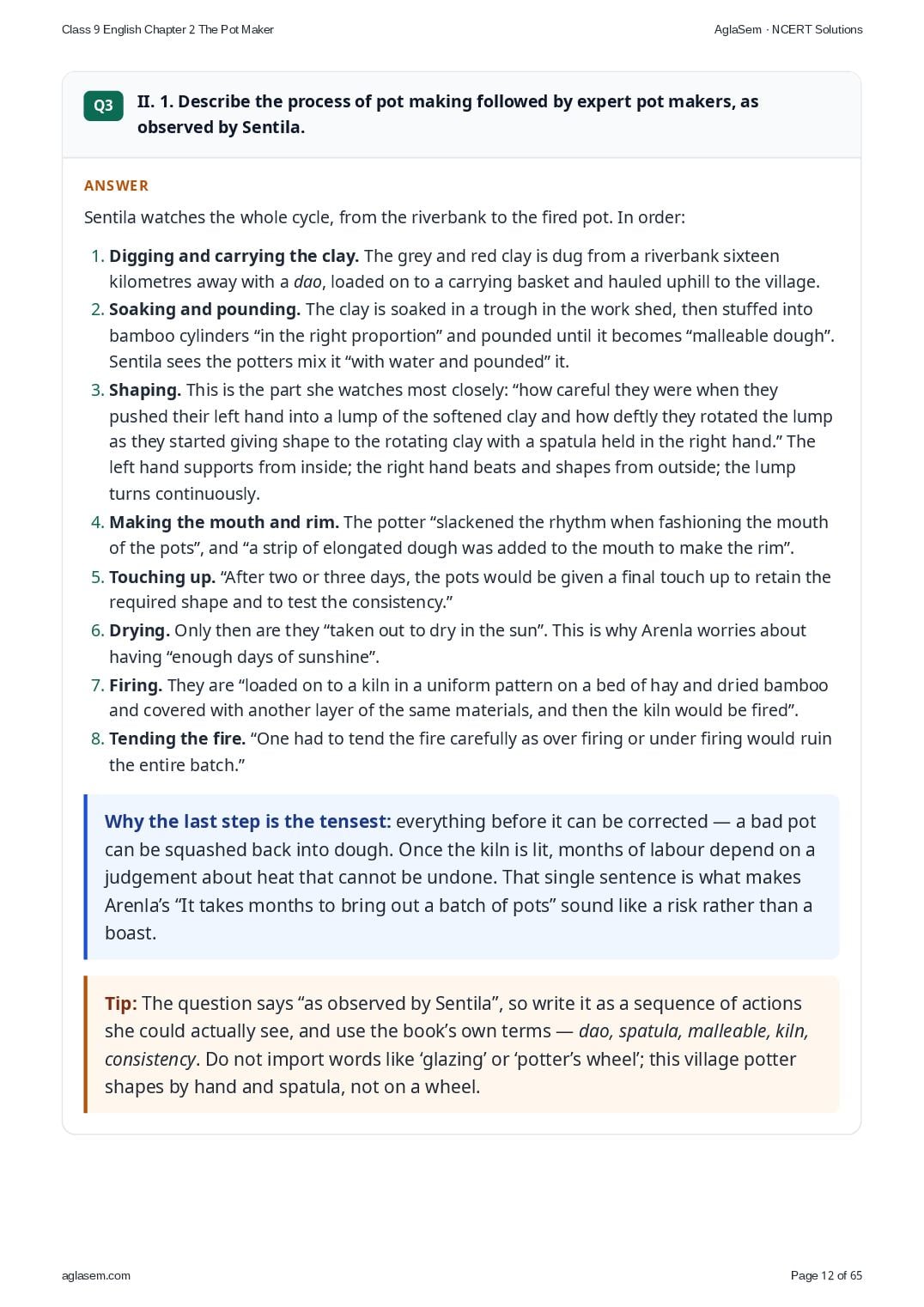
- II. 1. Describe the process of pot making followed by expert pot makers, as observed by Sentila.
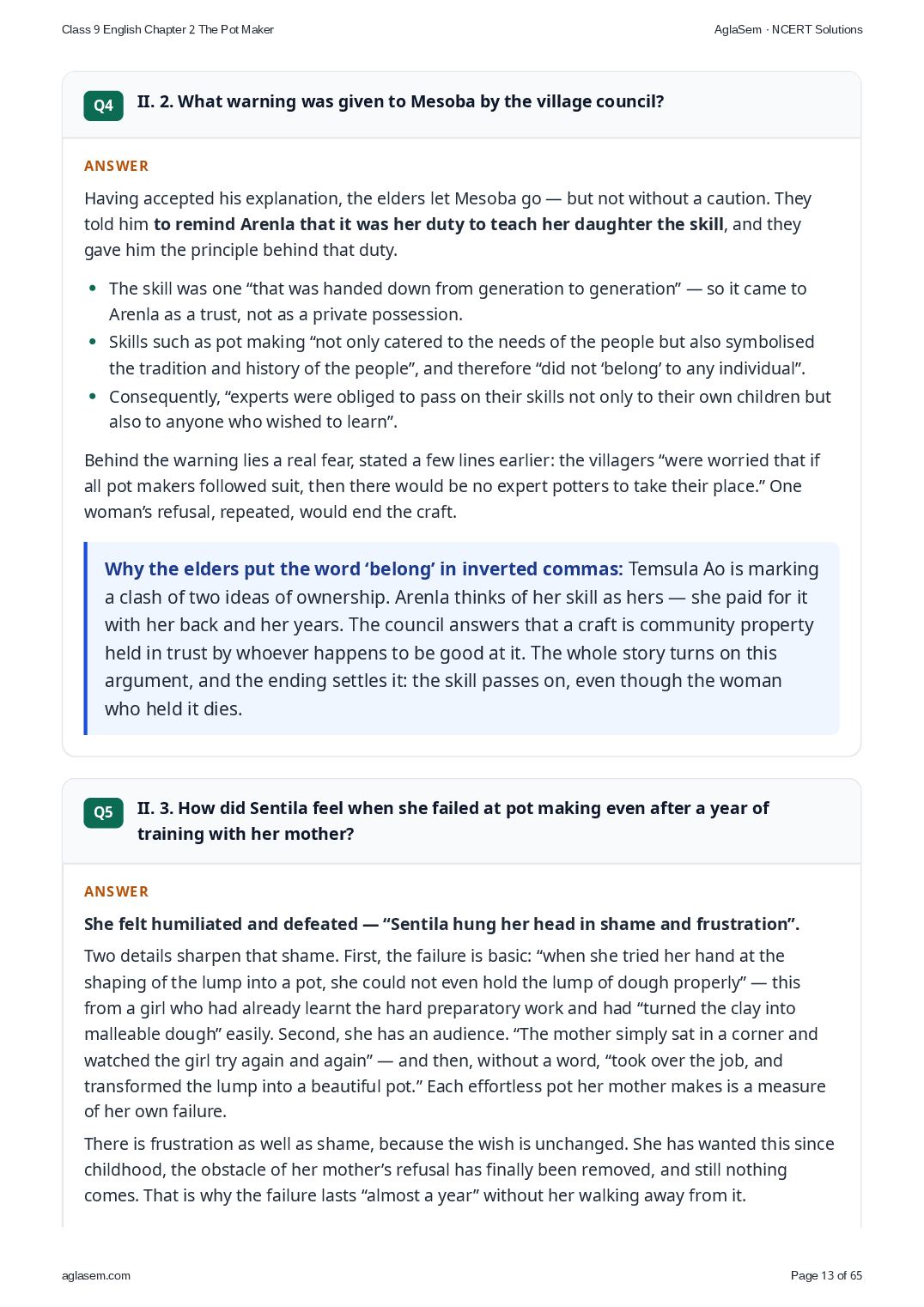
- II. 2. What warning was given to Mesoba by the village council?
- II. 3. How did Sentila feel when she failed at pot making even after a year of training with her mother?
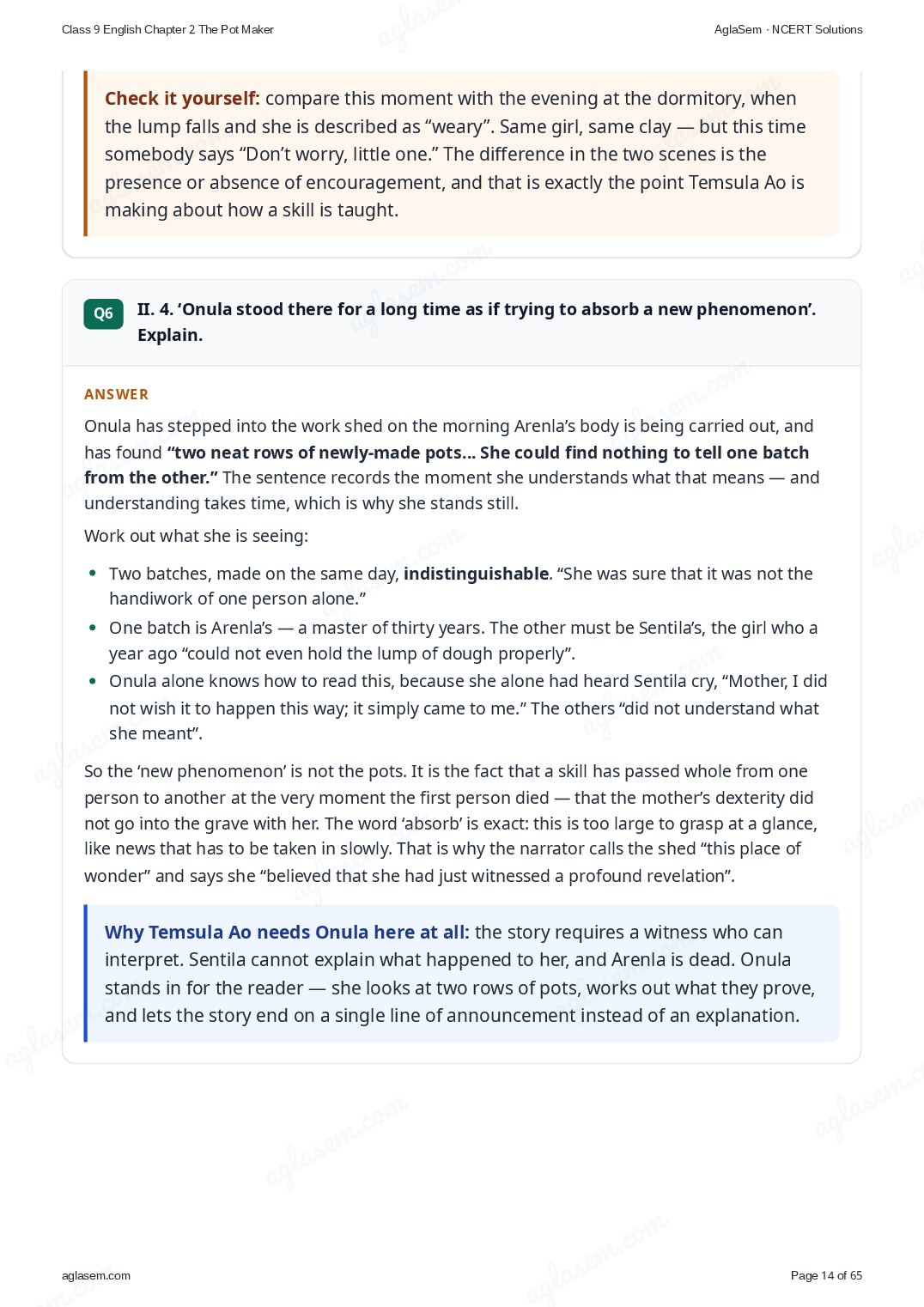
- II. 4. ‘Onula stood there for a long time as if trying to absorb a new phenomenon’. Explain.
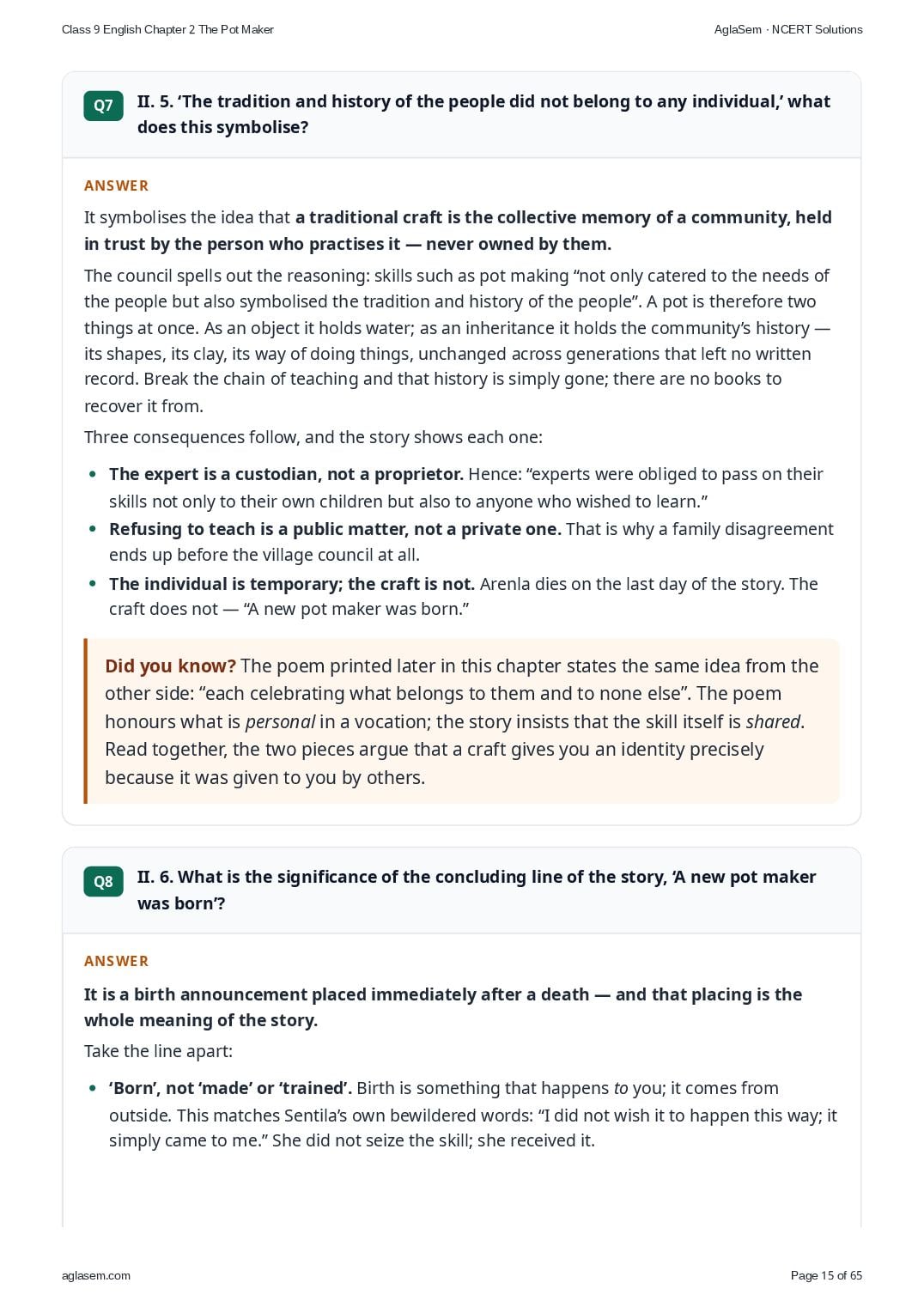
- II. 5. ‘The tradition and history of the people did not belong to any individual,’ what does this symbolise?
- II. 6. What is the significance of the concluding line of the story, ‘A new pot maker was born’?
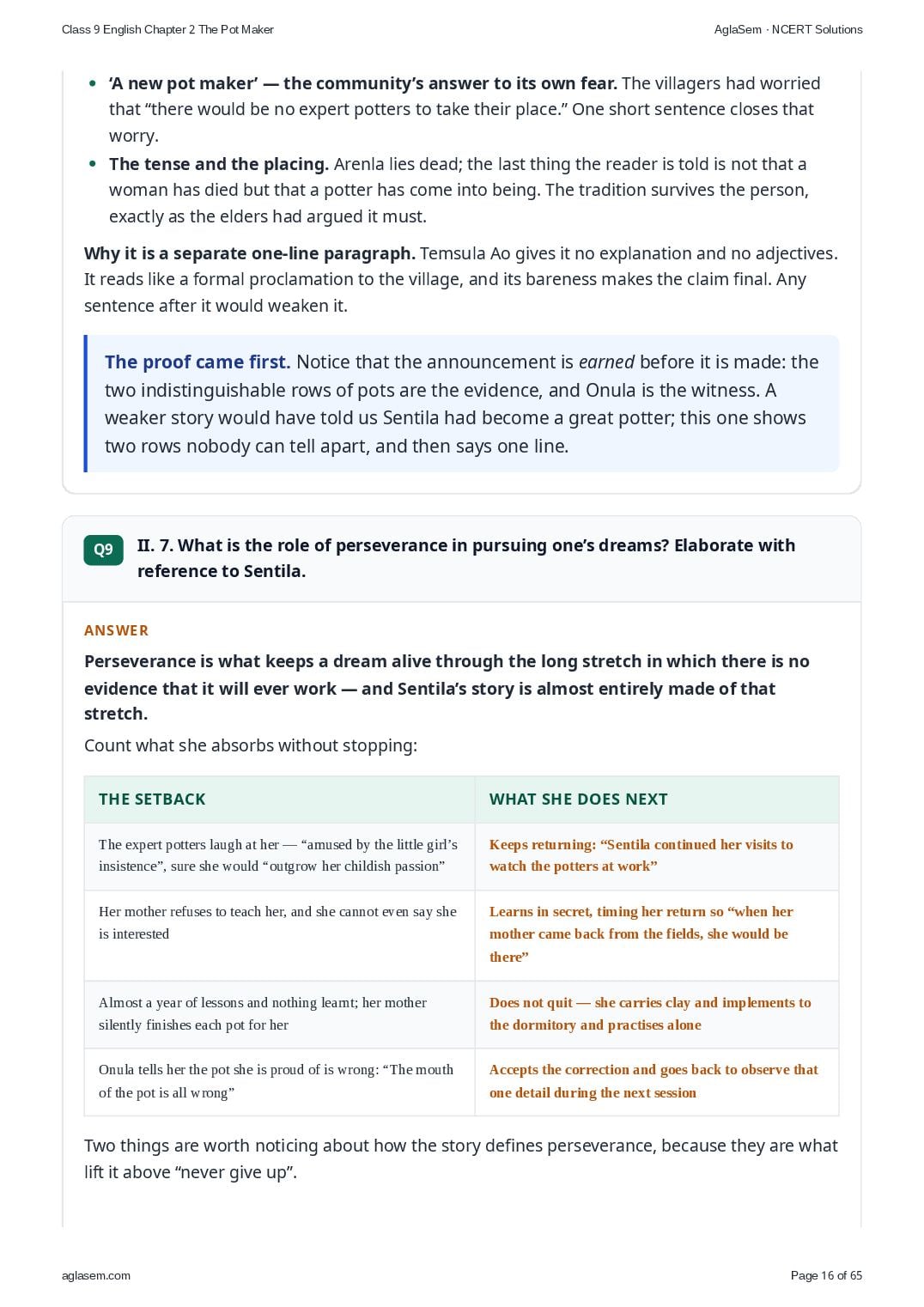
- II. 7. What is the role of perseverance in pursuing one’s dreams? Elaborate with reference to Sentila.
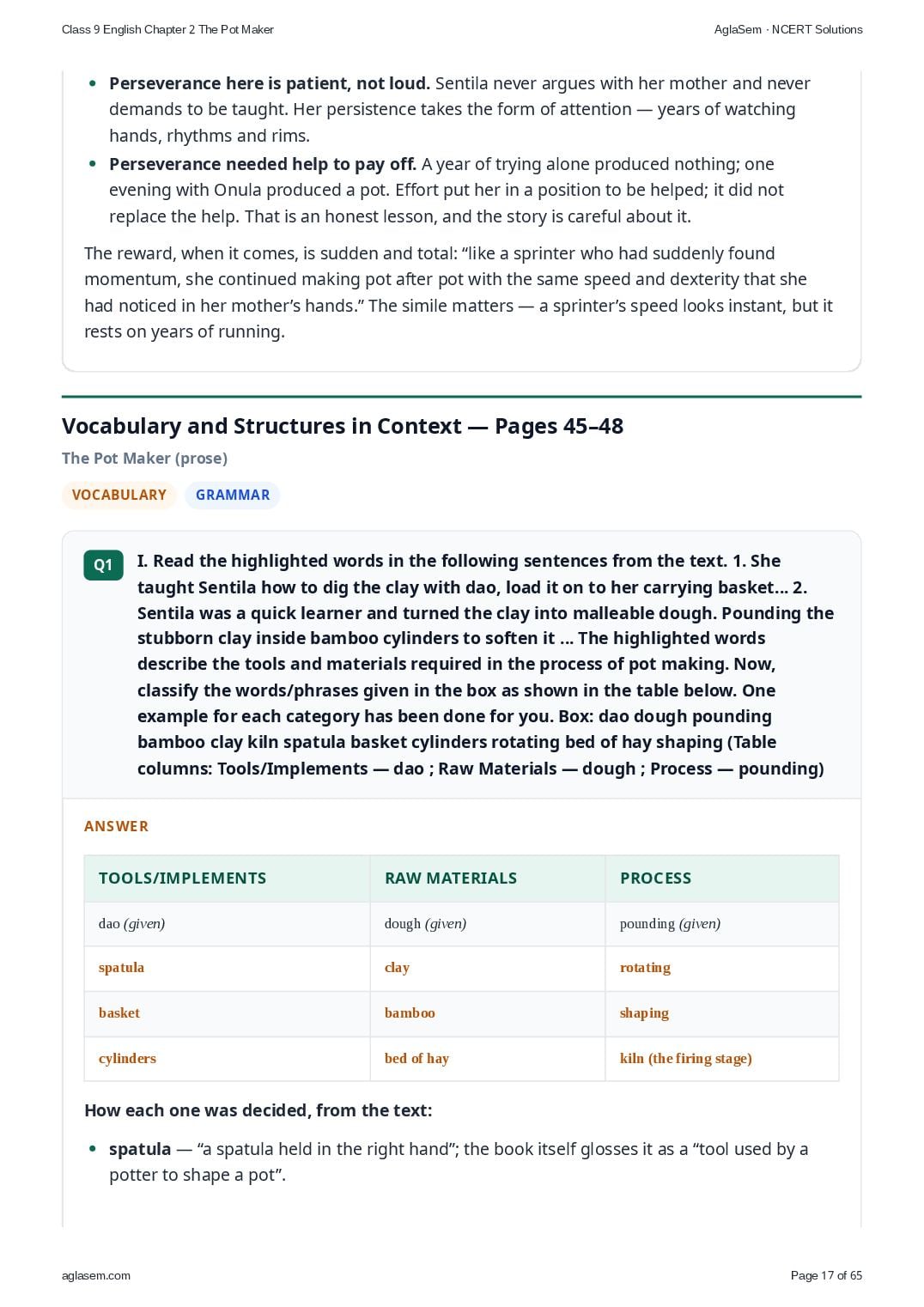
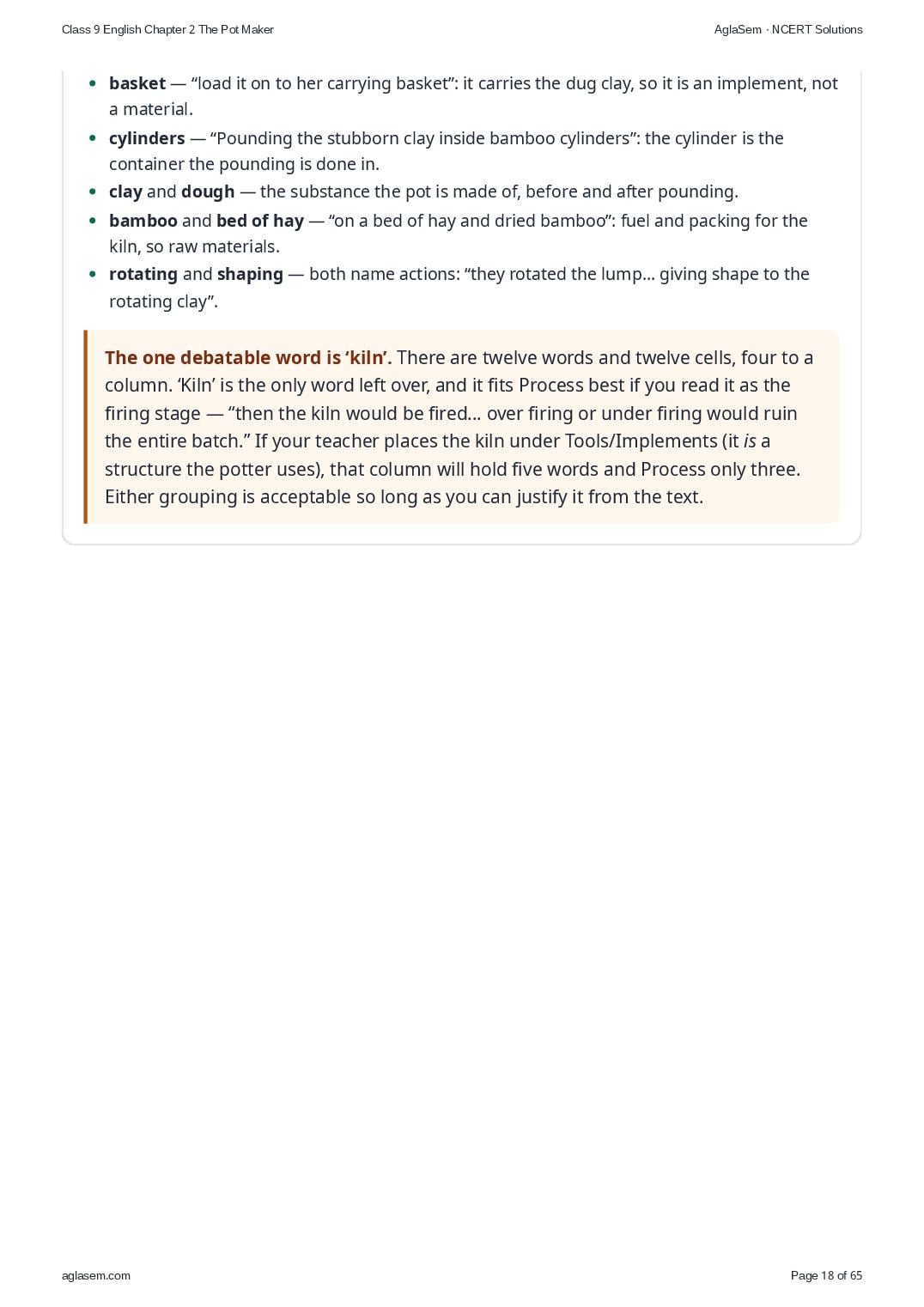
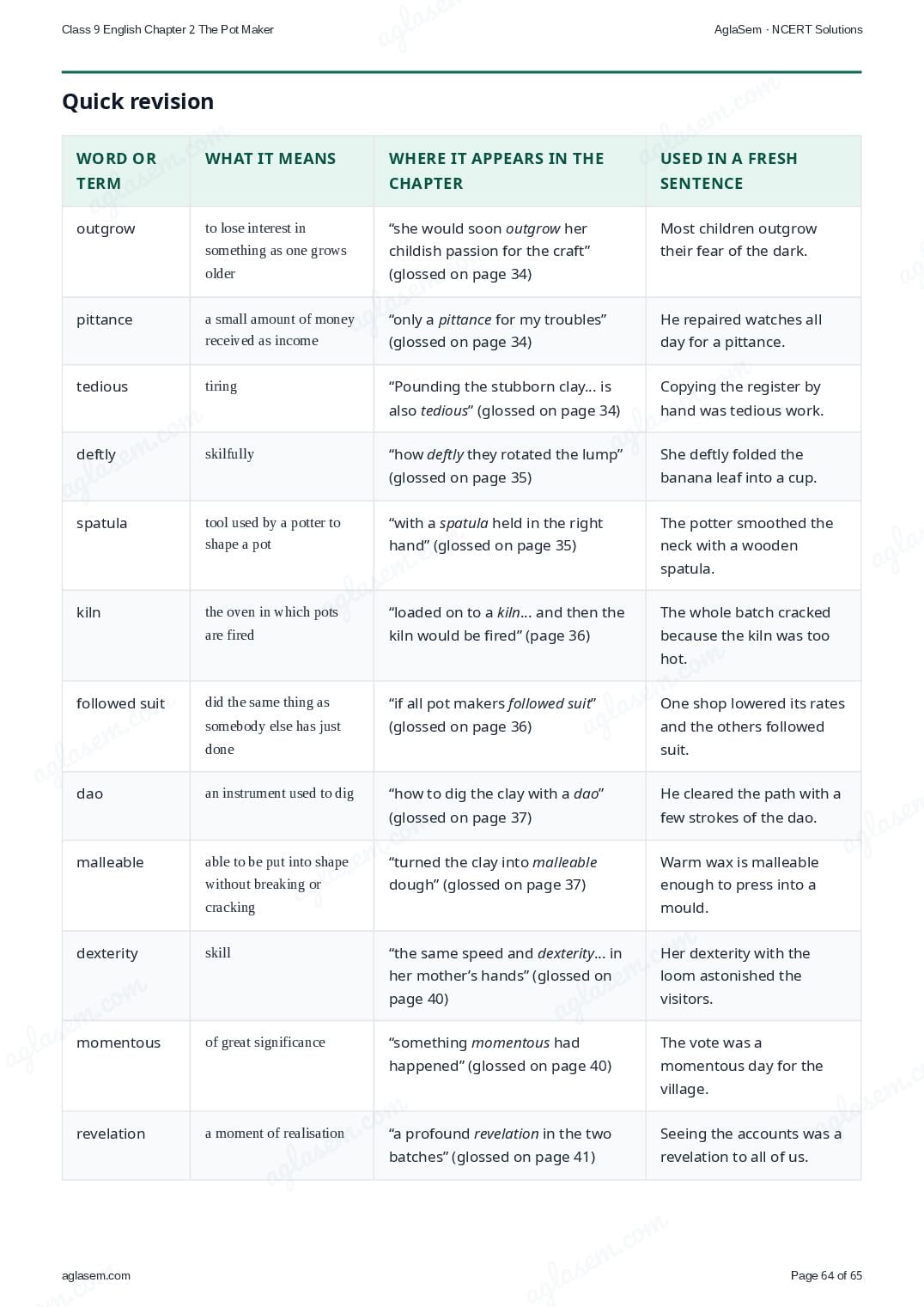
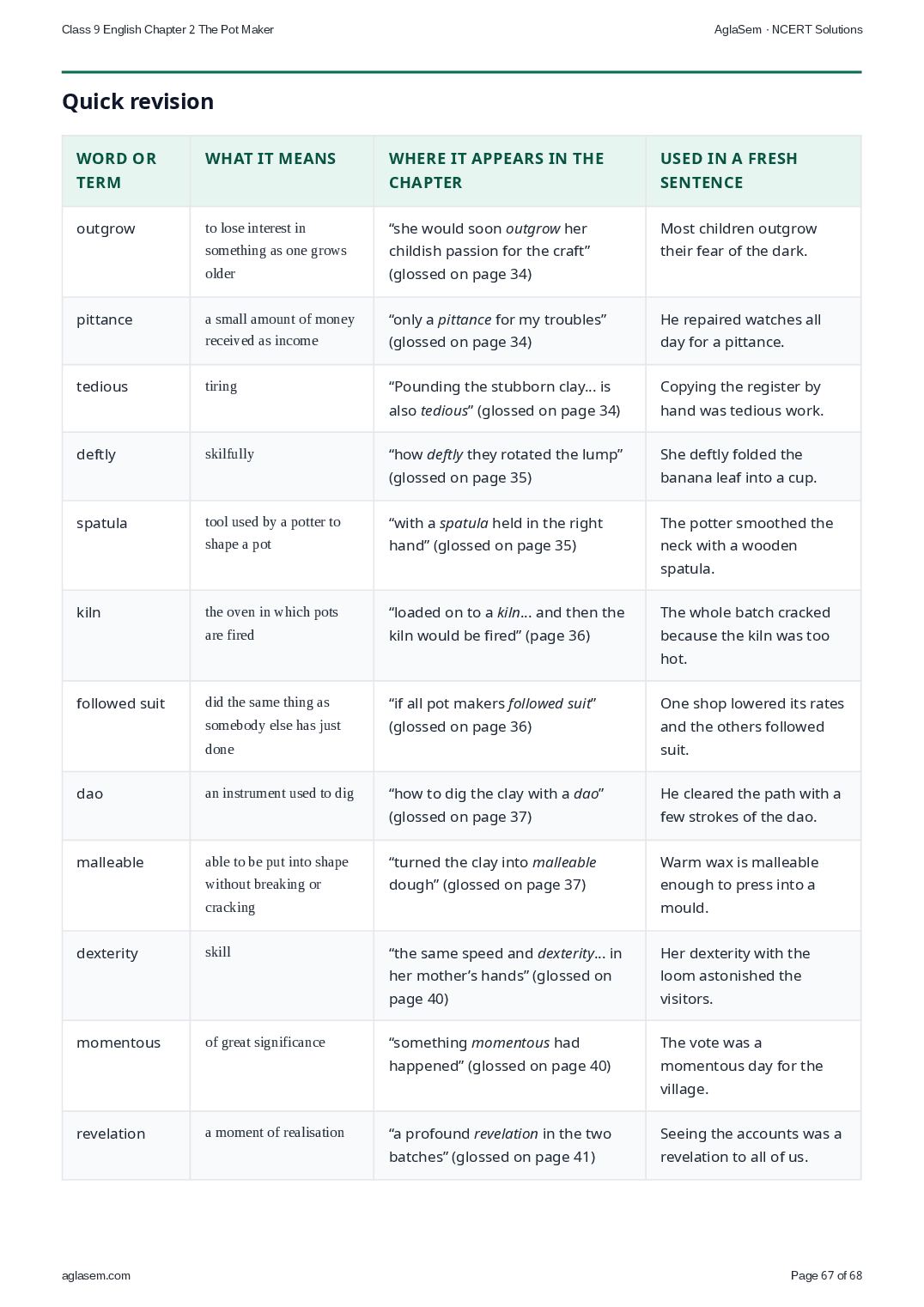
- I. Read the highlighted words in the following sentences from the text. 1. She taught Sentila how to dig the clay with dao, load it on to her carrying basket… 2. Sentila was a quick learner and turned the clay into malleable dough. Pounding the stubborn clay inside bamboo cylinders to soften it … The highlighted words describe the tools and materials required in the process of pot making. Now, classify the words/phrases given in the box as shown in the table below. One example for each category has been done for you. Box: dao dough pounding bamboo clay kiln spatula basket cylinders rotating bed of hay shaping (Table columns: Tools/Implements — dao ; Raw Materials — dough ; Process — pounding)
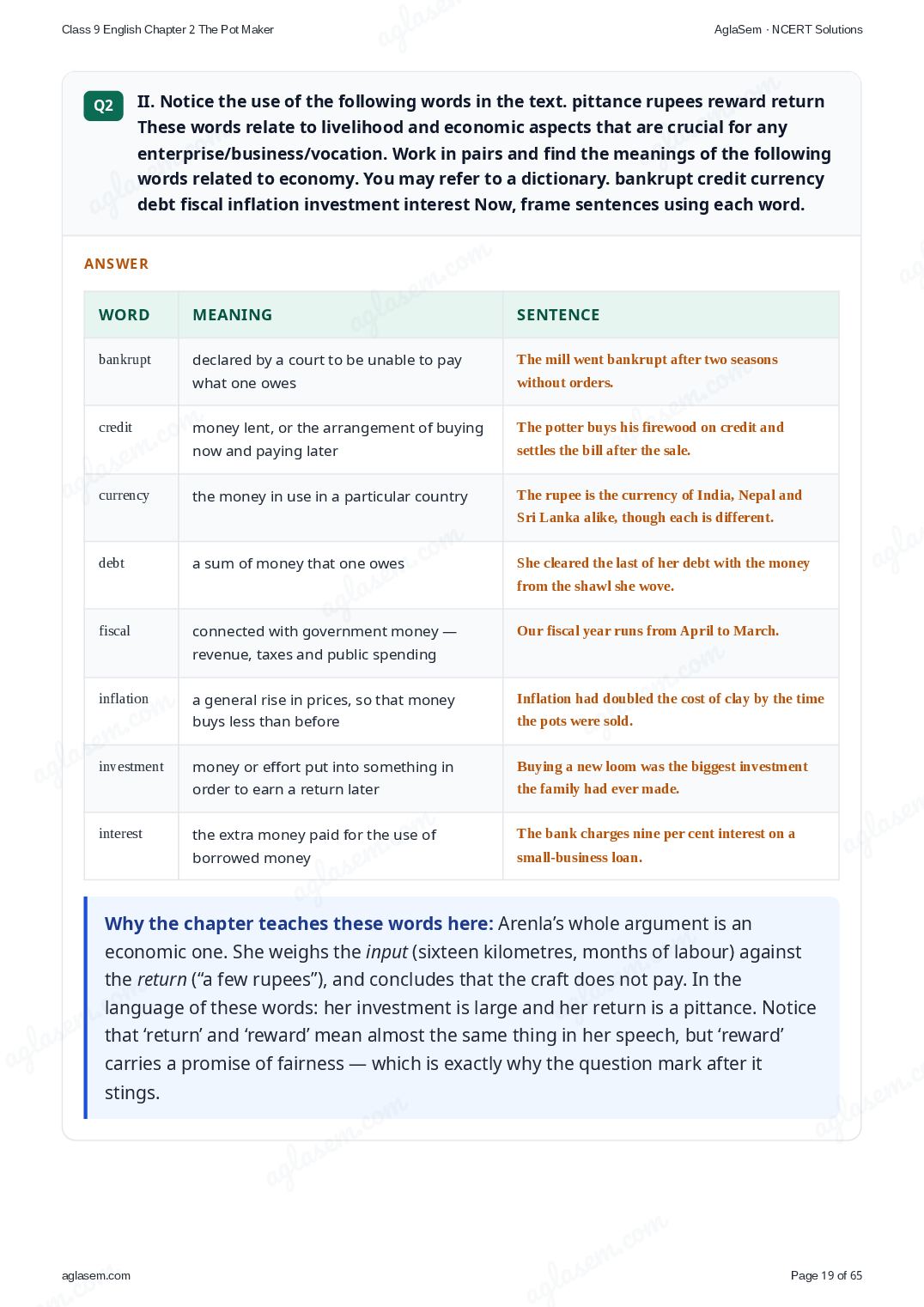
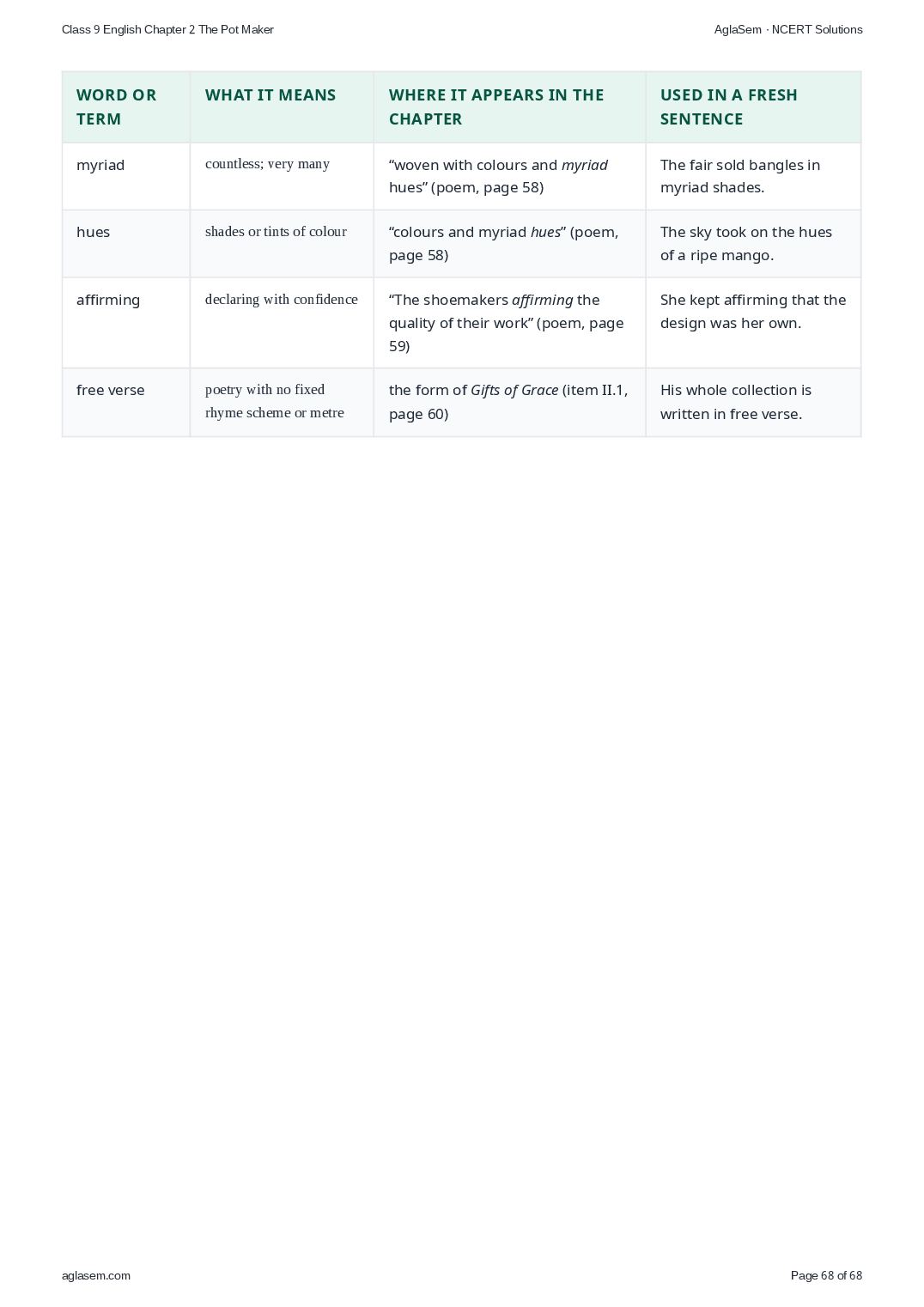
- II. Notice the use of the following words in the text. pittance rupees reward return These words relate to livelihood and economic aspects that are crucial for any enterprise/business/vocation. Work in pairs and find the meanings of the following words related to economy. You may refer to a dictionary. bankrupt credit currency debt fiscal inflation investment interest Now, frame sentences using each word.
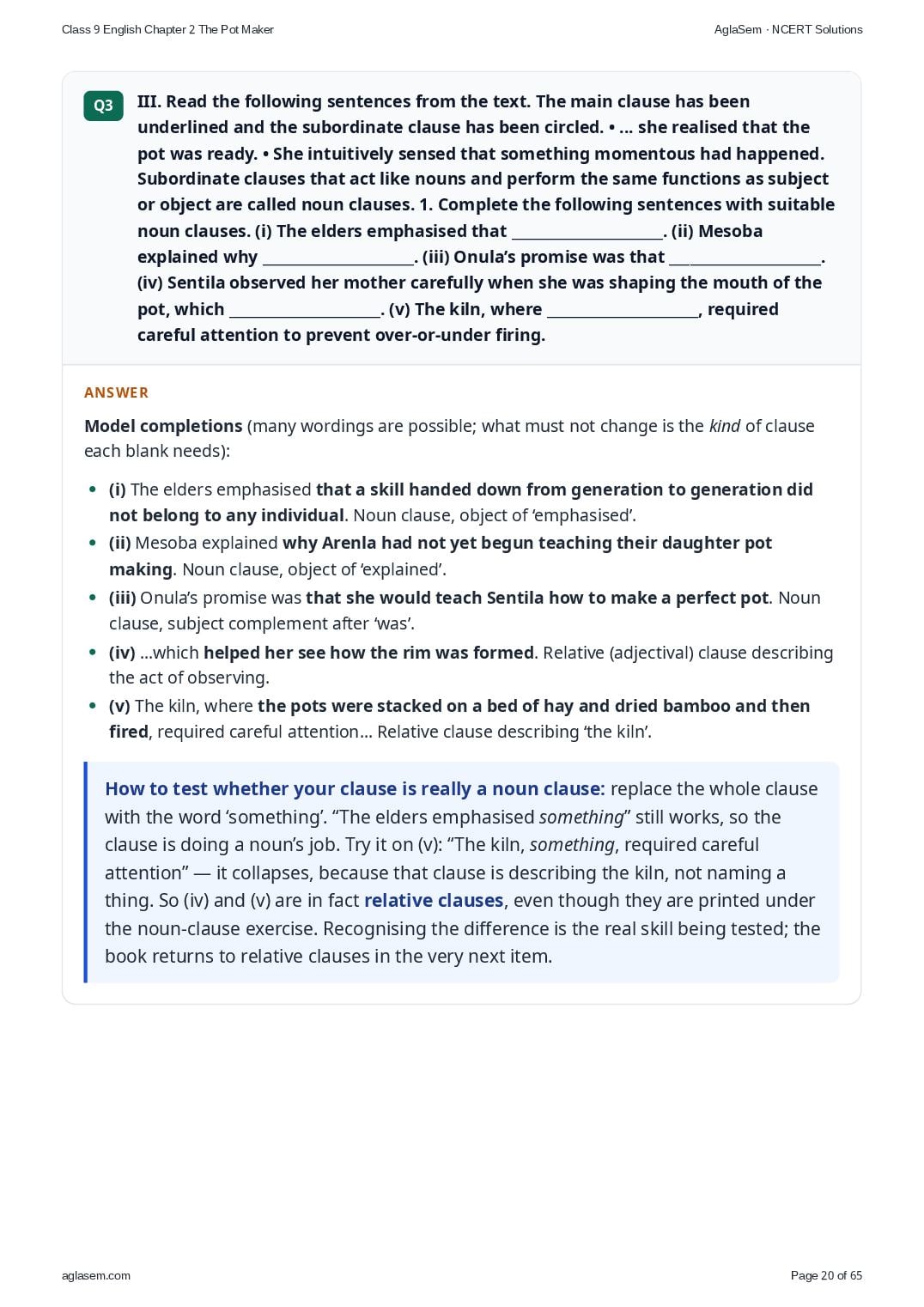
- III. Read the following sentences from the text. The main clause has been underlined and the subordinate clause has been circled. • … she realised that the pot was ready. • She intuitively sensed that something momentous had happened. Subordinate clauses that act like nouns and perform the same functions as subject or object are called noun clauses. 1. Complete the following sentences with suitable noun clauses. (i) The elders emphasised that ______________________. (ii) Mesoba explained why ______________________. (iii) Onula’s promise was that ______________________. (iv) Sentila observed her mother carefully when she was shaping the mouth of the pot, which ______________________. (v) The kiln, where ______________________, required careful attention to prevent over-or-under firing.
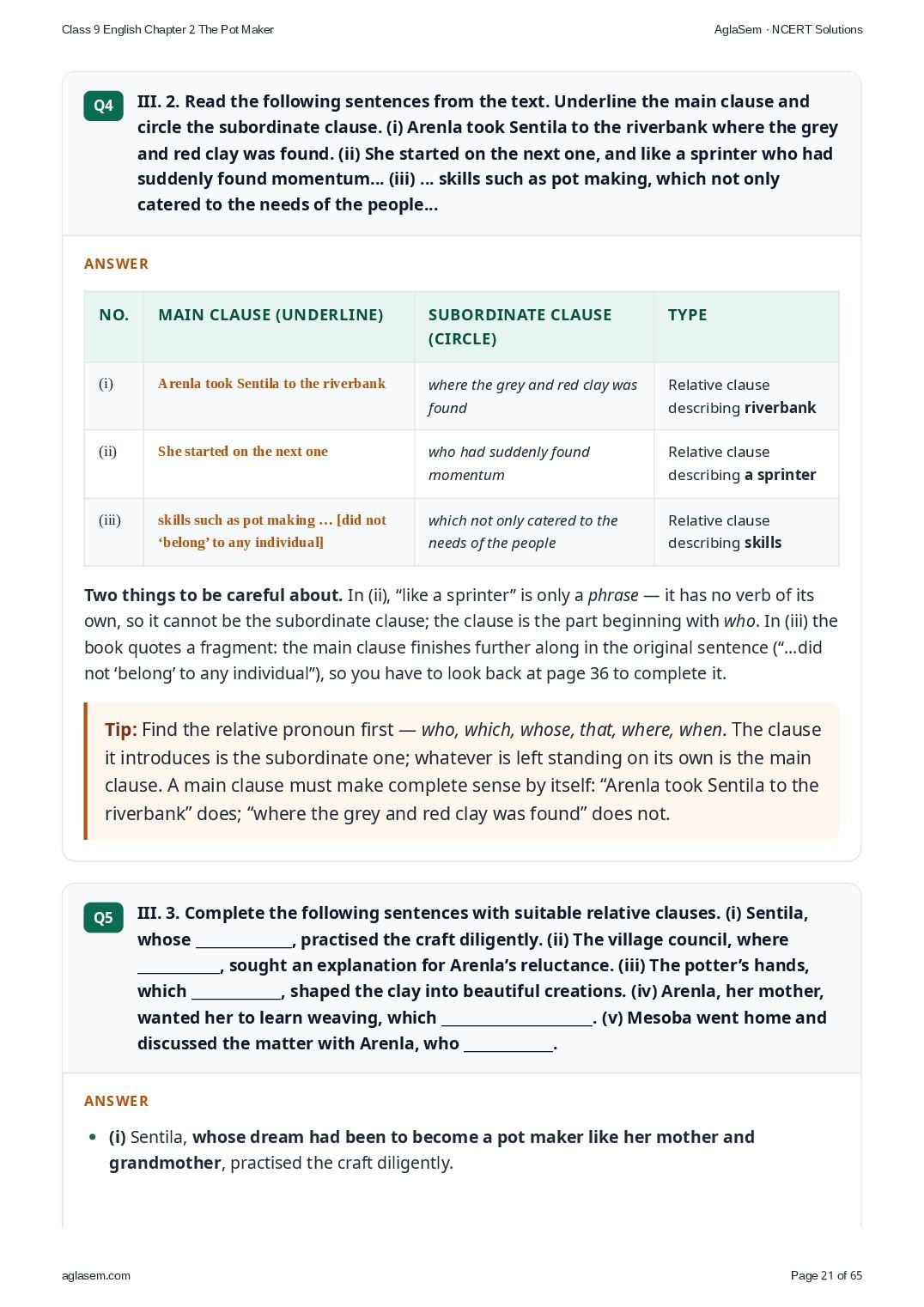
- III. 2. Read the following sentences from the text. Underline the main clause and circle the subordinate clause. (i) Arenla took Sentila to the riverbank where the grey and red clay was found. (ii) She started on the next one, and like a sprinter who had suddenly found momentum… (iii) … skills such as pot making, which not only catered to the needs of the people…
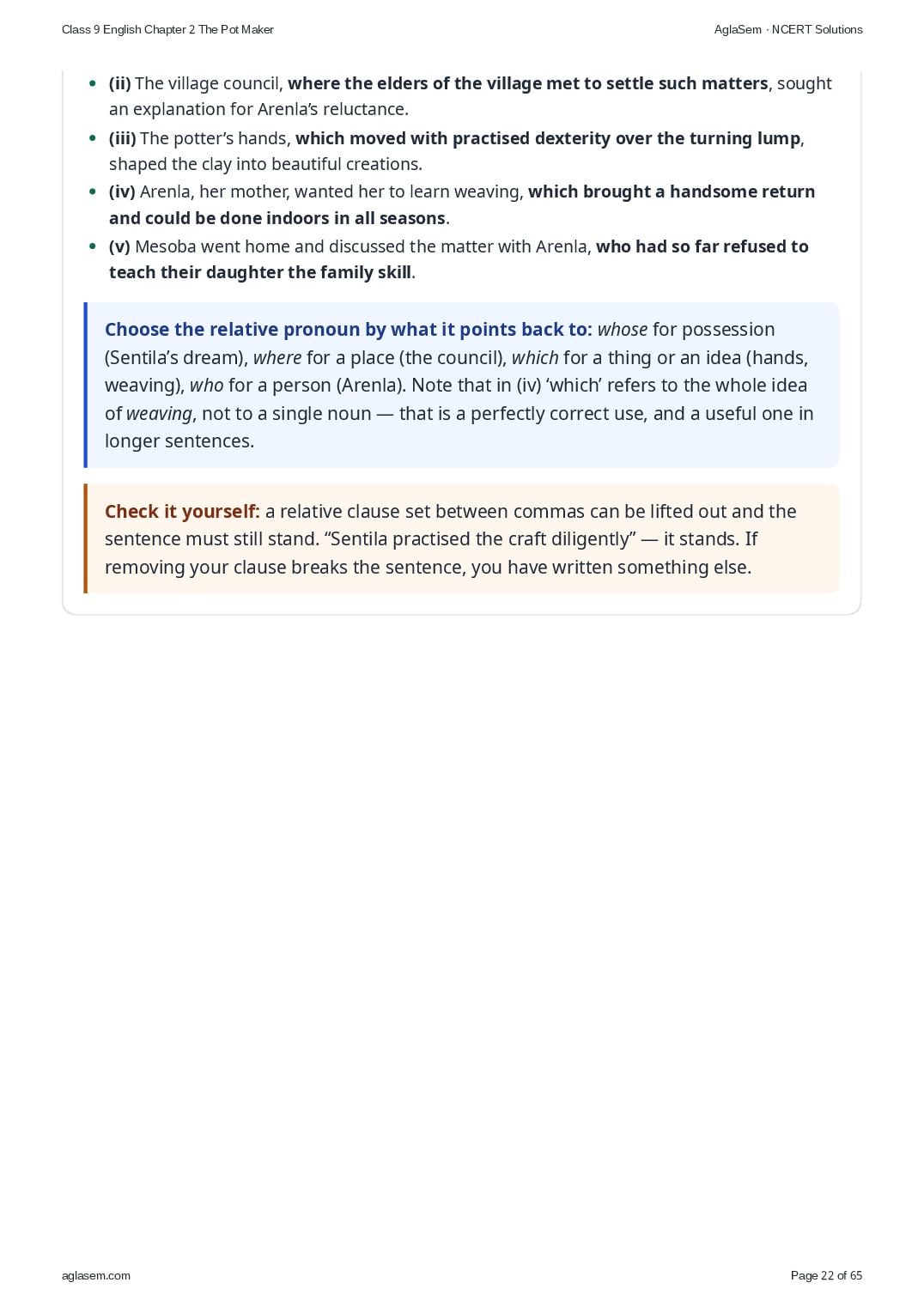
- III. 3. Complete the following sentences with suitable relative clauses. (i) Sentila, whose ______________, practised the craft diligently. (ii) The village council, where ____________, sought an explanation for Arenla’s reluctance. (iii) The potter’s hands, which _____________, shaped the clay into beautiful creations. (iv) Arenla, her mother, wanted her to learn weaving, which ______________________. (v) Mesoba went home and discussed the matter with Arenla, who _____________.
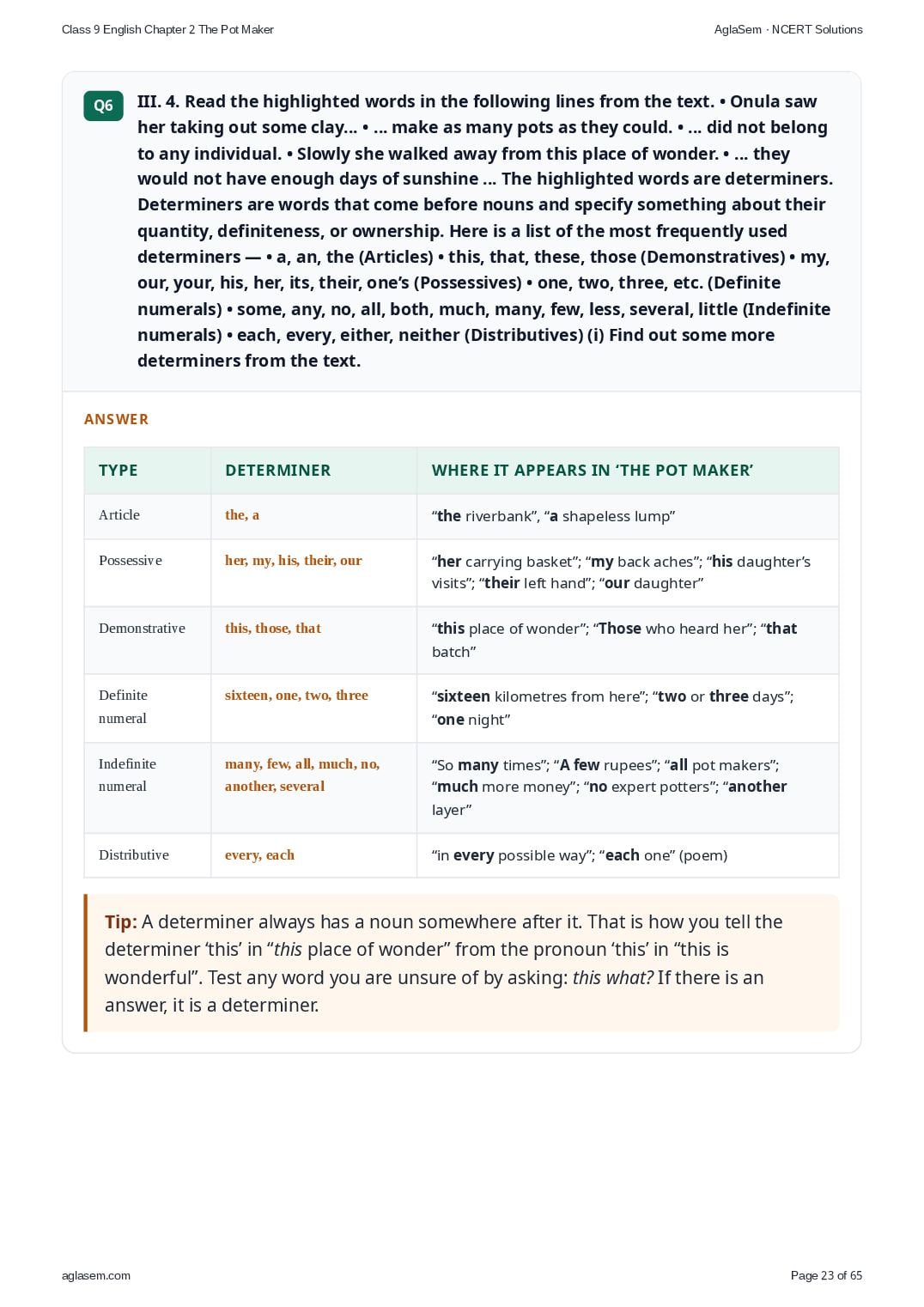
- III. 4. Read the highlighted words in the following lines from the text. • Onula saw her taking out some clay… • … make as many pots as they could. • … did not belong to any individual. • Slowly she walked away from this place of wonder. • … they would not have enough days of sunshine … The highlighted words are determiners. Determiners are words that come before nouns and specify something about their quantity, definiteness, or ownership. Here is a list of the most frequently used determiners — • a, an, the (Articles) • this, that, these, those (Demonstratives) • my, our, your, his, her, its, their, one’s (Possessives) • one, two, three, etc. (Definite numerals) • some, any, no, all, both, much, many, few, less, several, little (Indefinite numerals) • each, every, either, neither (Distributives) (i) Find out some more determiners from the text.
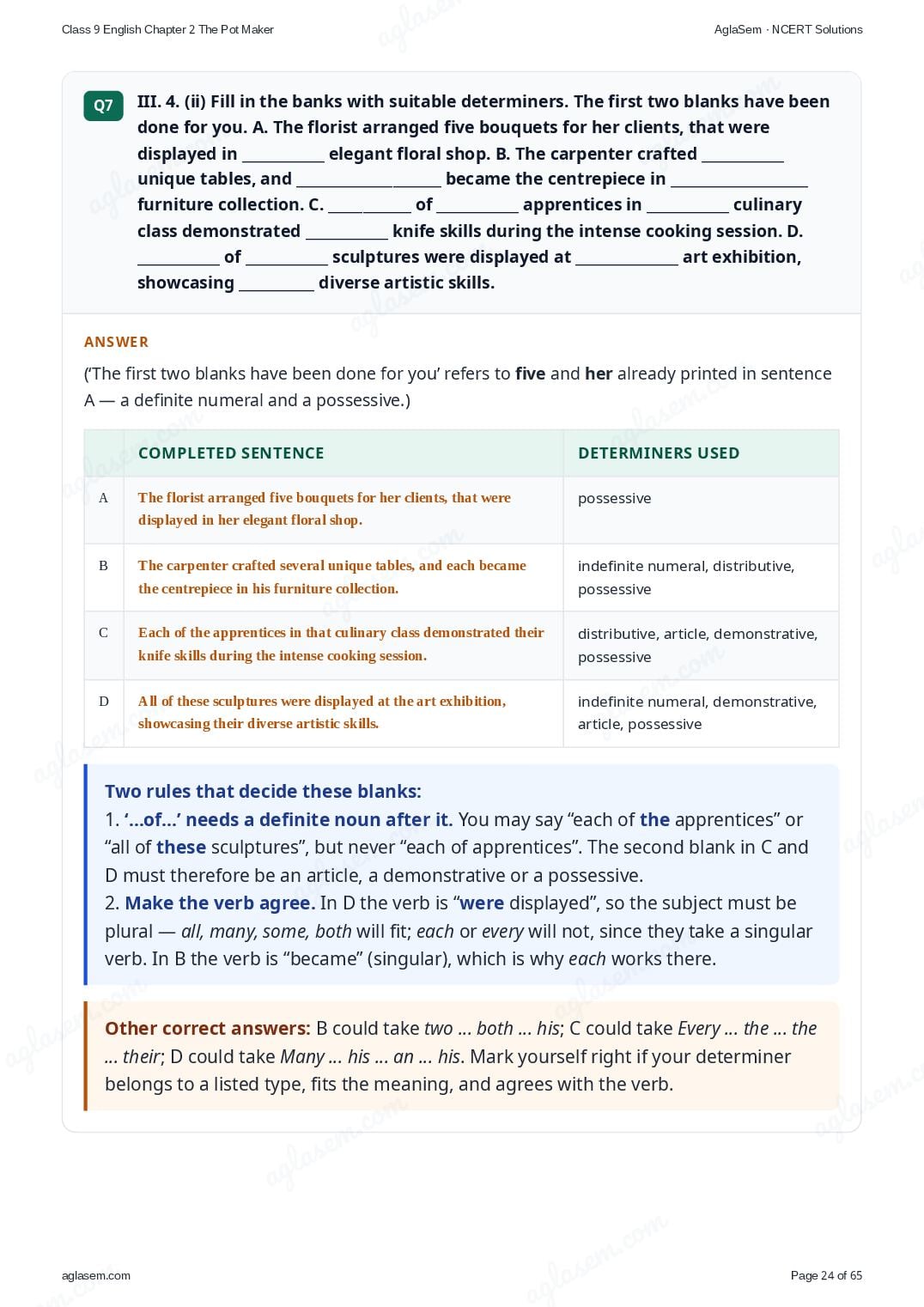
- III. 4. (ii) Fill in the banks with suitable determiners. The first two blanks have been done for you. A. The florist arranged five bouquets for her clients, that were displayed in ____________ elegant floral shop. B. The carpenter crafted ____________ unique tables, and _____________________ became the centrepiece in ____________________ furniture collection. C. ____________ of ____________ apprentices in ____________ culinary class demonstrated ____________ knife skills during the intense cooking session. D. ____________ of ____________ sculptures were displayed at _______________ art exhibition, showcasing ___________ diverse artistic skills.
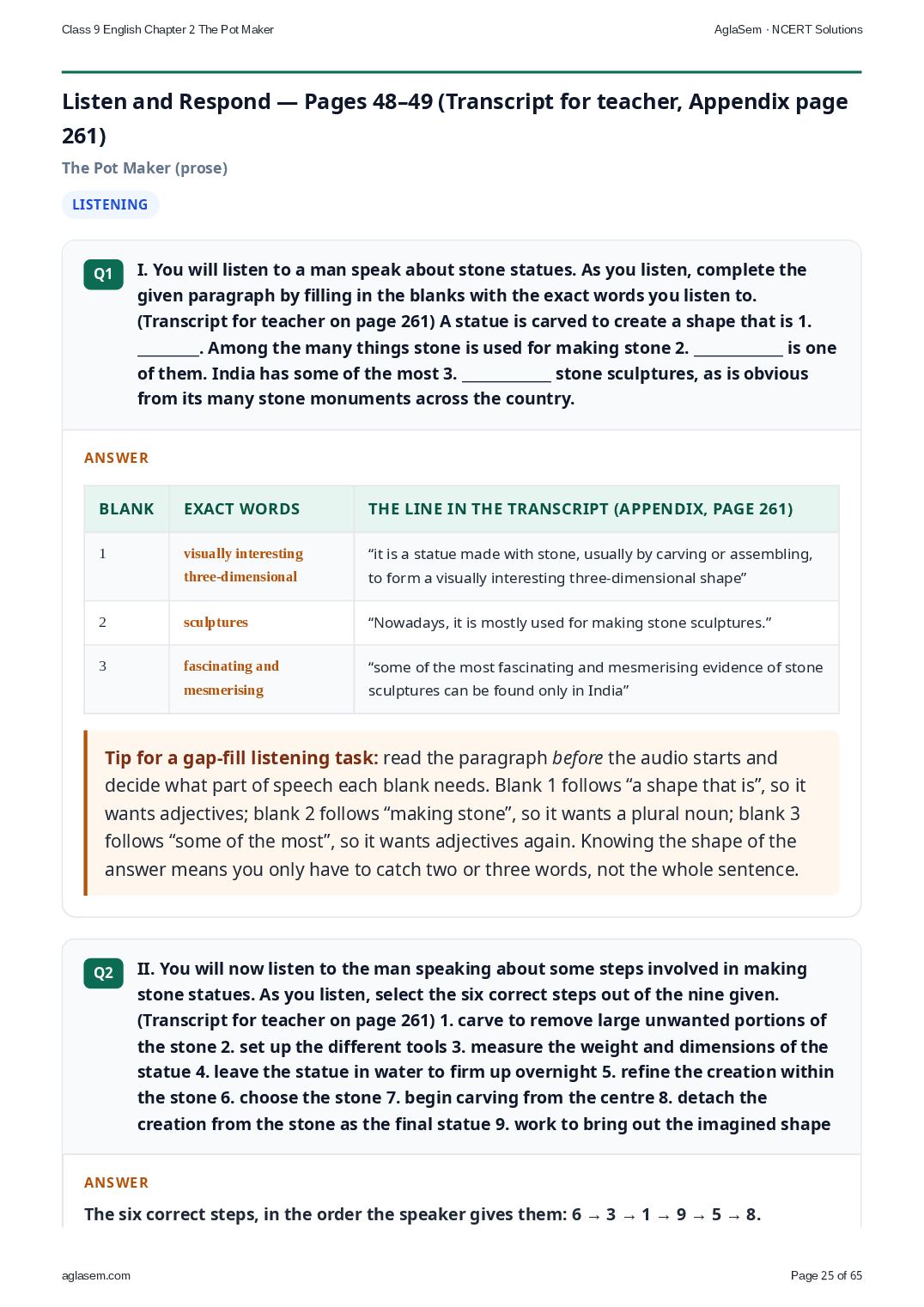
- I. You will listen to a man speak about stone statues. As you listen, complete the given paragraph by filling in the blanks with the exact words you listen to. (Transcript for teacher on page 261) A statue is carved to create a shape that is 1. _________. Among the many things stone is used for making stone 2. _____________ is one of them. India has some of the most 3. _____________ stone sculptures, as is obvious from its many stone monuments across the country.
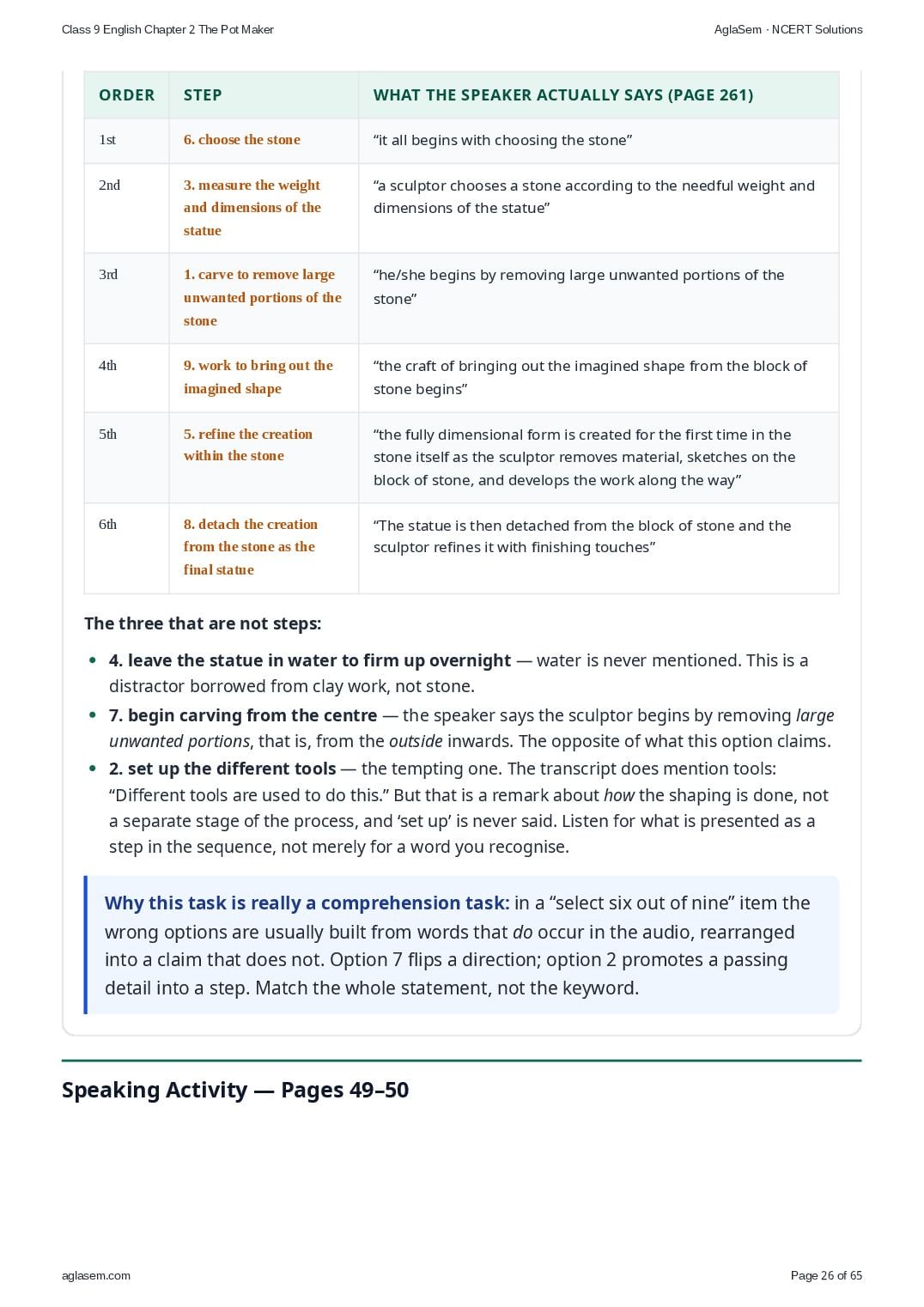
- II. You will now listen to the man speaking about some steps involved in making stone statues. As you listen, select the six correct steps out of the nine given. (Transcript for teacher on page 261) 1. carve to remove large unwanted portions of the stone 2. set up the different tools 3. measure the weight and dimensions of the statue 4. leave the statue in water to firm up overnight 5. refine the creation within the stone 6. choose the stone 7. begin carving from the centre 8. detach the creation from the stone as the final statue 9. work to bring out the imagined shape
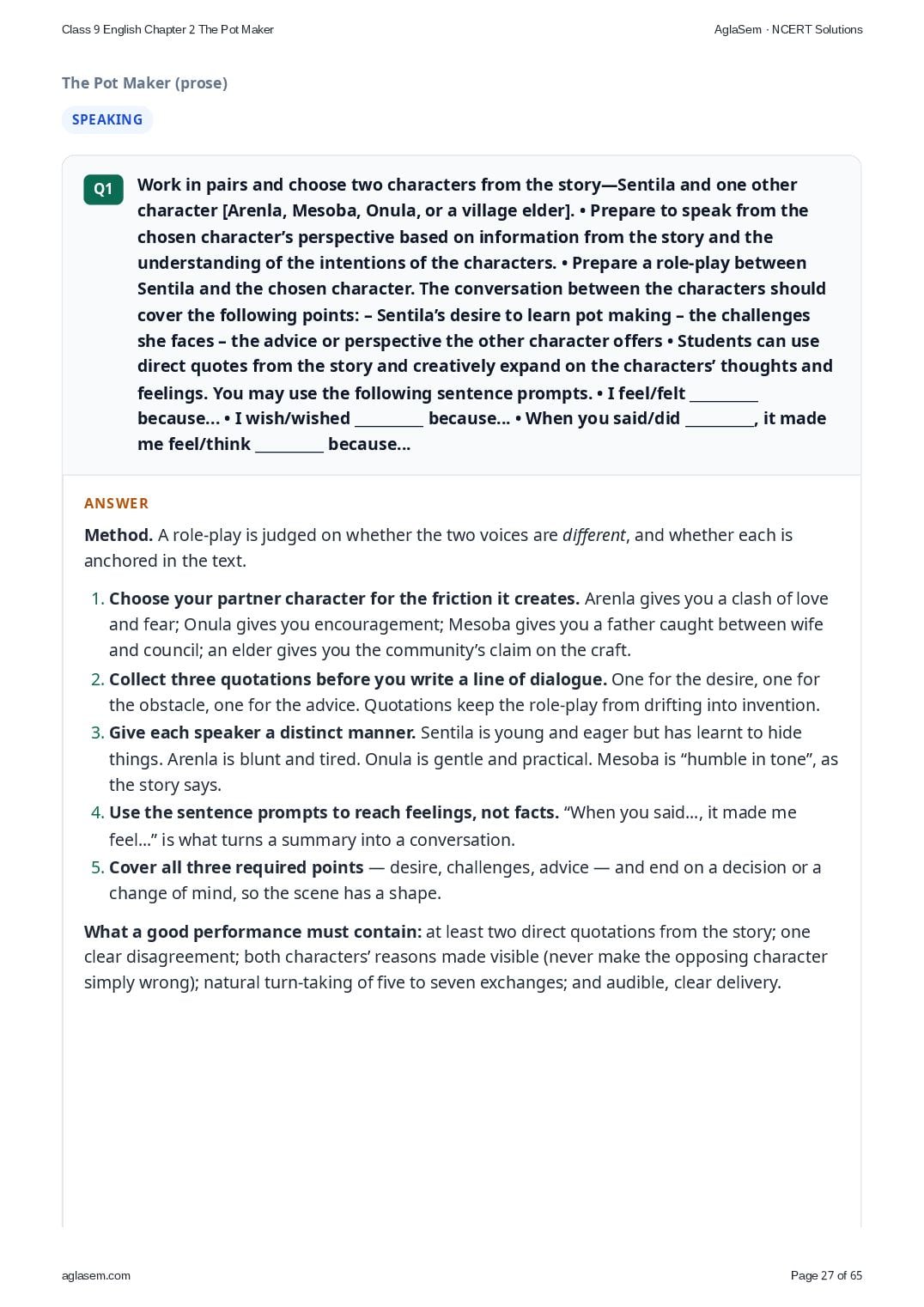
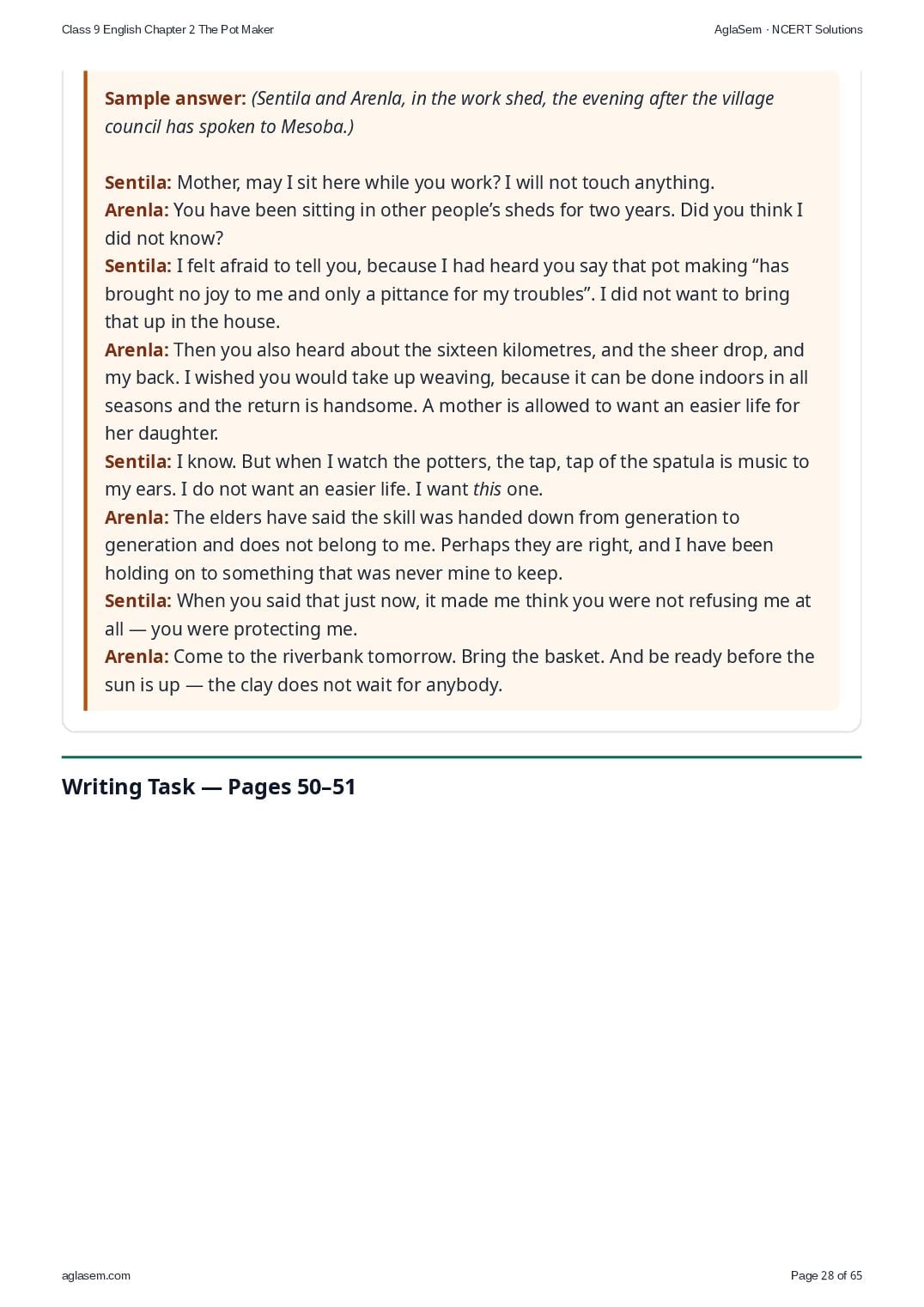
- Work in pairs and choose two characters from the story—Sentila and one other character [Arenla, Mesoba, Onula, or a village elder]. • Prepare to speak from the chosen character’s perspective based on information from the story and the understanding of the intentions of the characters. • Prepare a role-play between Sentila and the chosen character. The conversation between the characters should cover the following points: – Sentila’s desire to learn pot making – the challenges she faces – the advice or perspective the other character offers • Students can use direct quotes from the story and creatively expand on the characters’ thoughts and feelings. You may use the following sentence prompts. • I feel/felt __________ because… • I wish/wished __________ because… • When you said/did __________, it made me feel/think __________ because…
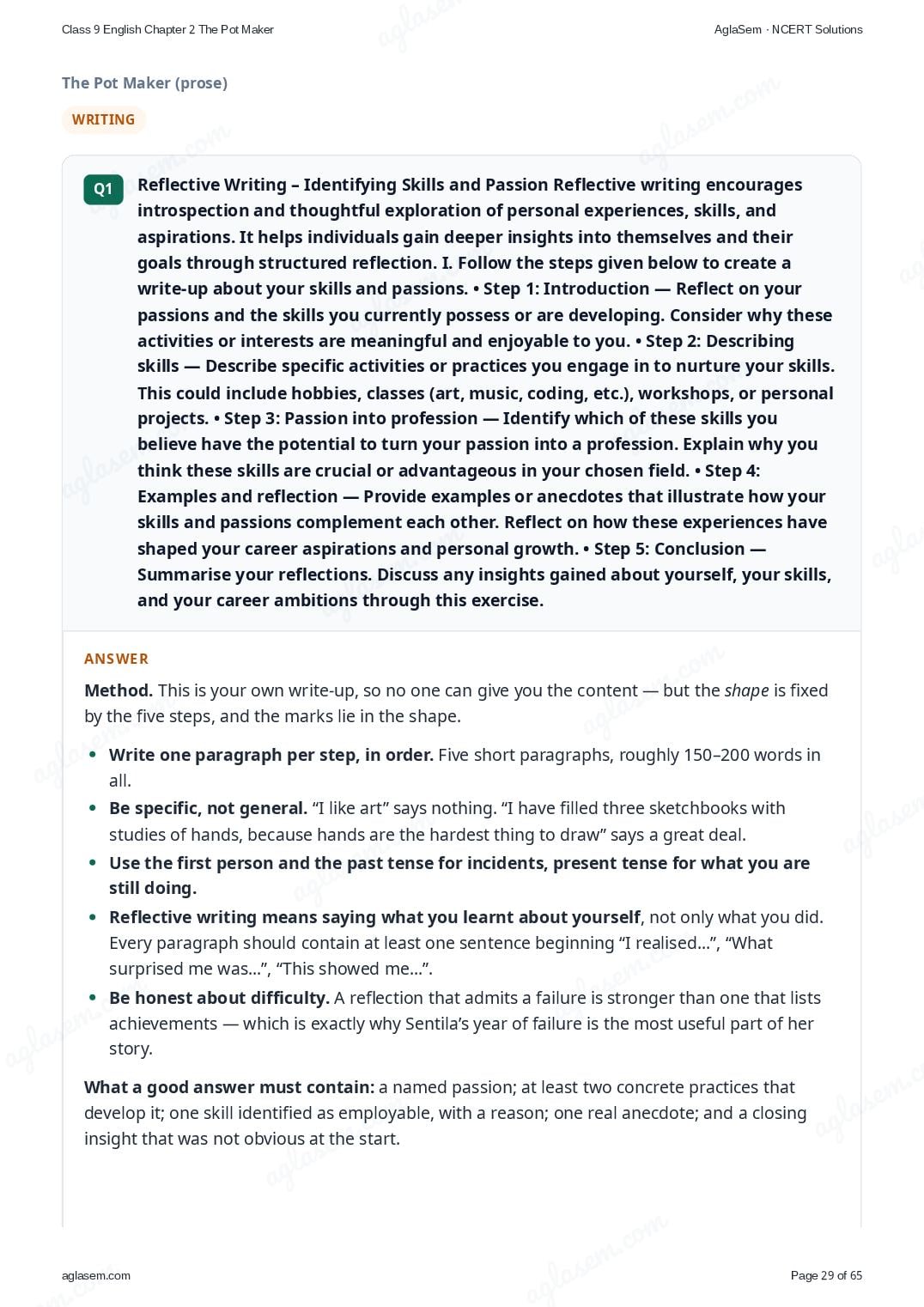
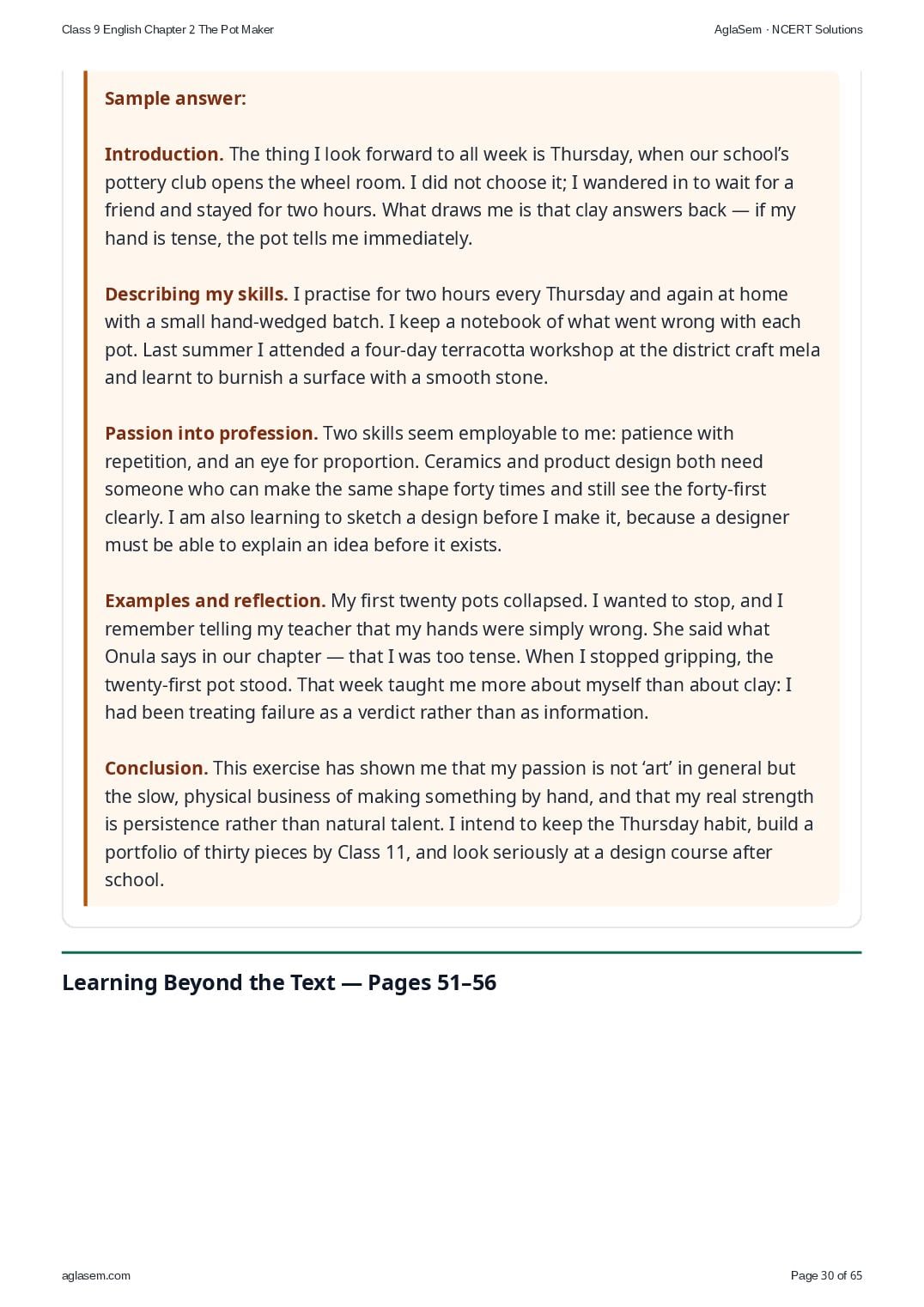
- Reflective Writing – Identifying Skills and Passion Reflective writing encourages introspection and thoughtful exploration of personal experiences, skills, and aspirations. It helps individuals gain deeper insights into themselves and their goals through structured reflection. I. Follow the steps given below to create a write-up about your skills and passions. • Step 1: Introduction — Reflect on your passions and the skills you currently possess or are developing. Consider why these activities or interests are meaningful and enjoyable to you. • Step 2: Describing skills — Describe specific activities or practices you engage in to nurture your skills. This could include hobbies, classes (art, music, coding, etc.), workshops, or personal projects. • Step 3: Passion into profession — Identify which of these skills you believe have the potential to turn your passion into a profession. Explain why you think these skills are crucial or advantageous in your chosen field. • Step 4: Examples and reflection — Provide examples or anecdotes that illustrate how your skills and passions complement each other. Reflect on how these experiences have shaped your career aspirations and personal growth. • Step 5: Conclusion — Summarise your reflections. Discuss any insights gained about yourself, your skills, and your career ambitions through this exercise.
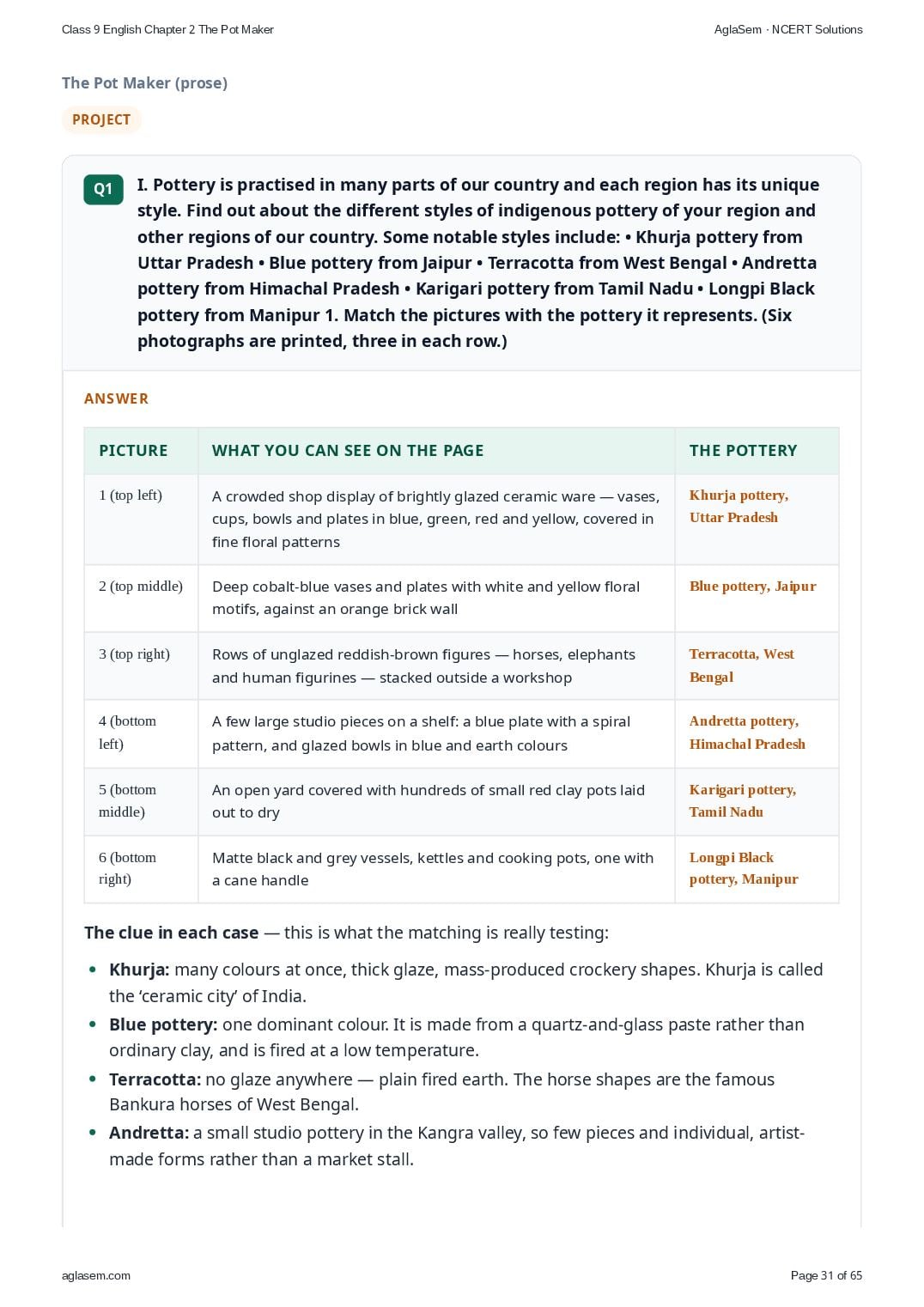
- I. Pottery is practised in many parts of our country and each region has its unique style. Find out about the different styles of indigenous pottery of your region and other regions of our country. Some notable styles include: • Khurja pottery from Uttar Pradesh • Blue pottery from Jaipur • Terracotta from West Bengal • Andretta pottery from Himachal Pradesh • Karigari pottery from Tamil Nadu • Longpi Black pottery from Manipur 1. Match the pictures with the pottery it represents. (Six photographs are printed, three in each row.)
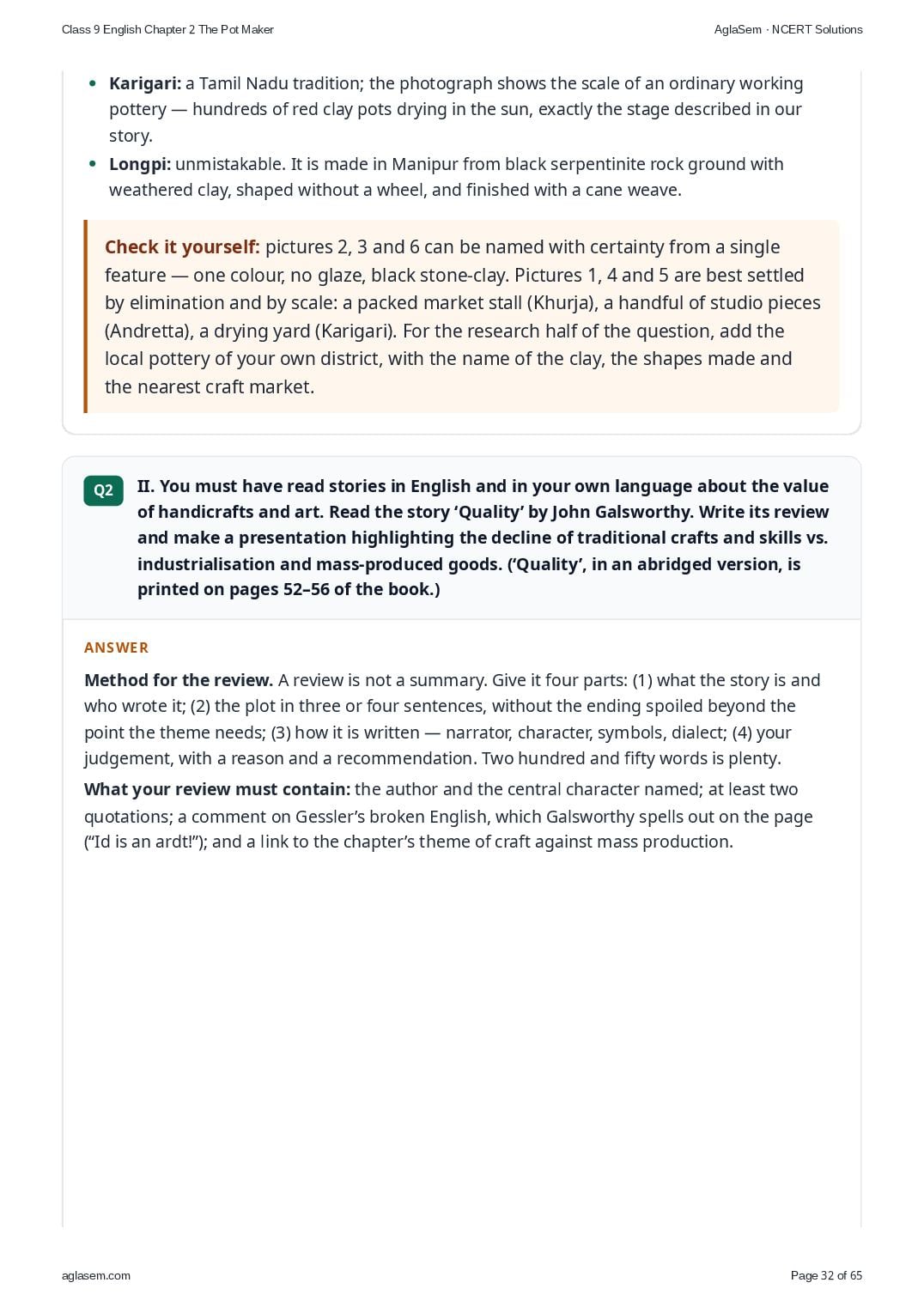
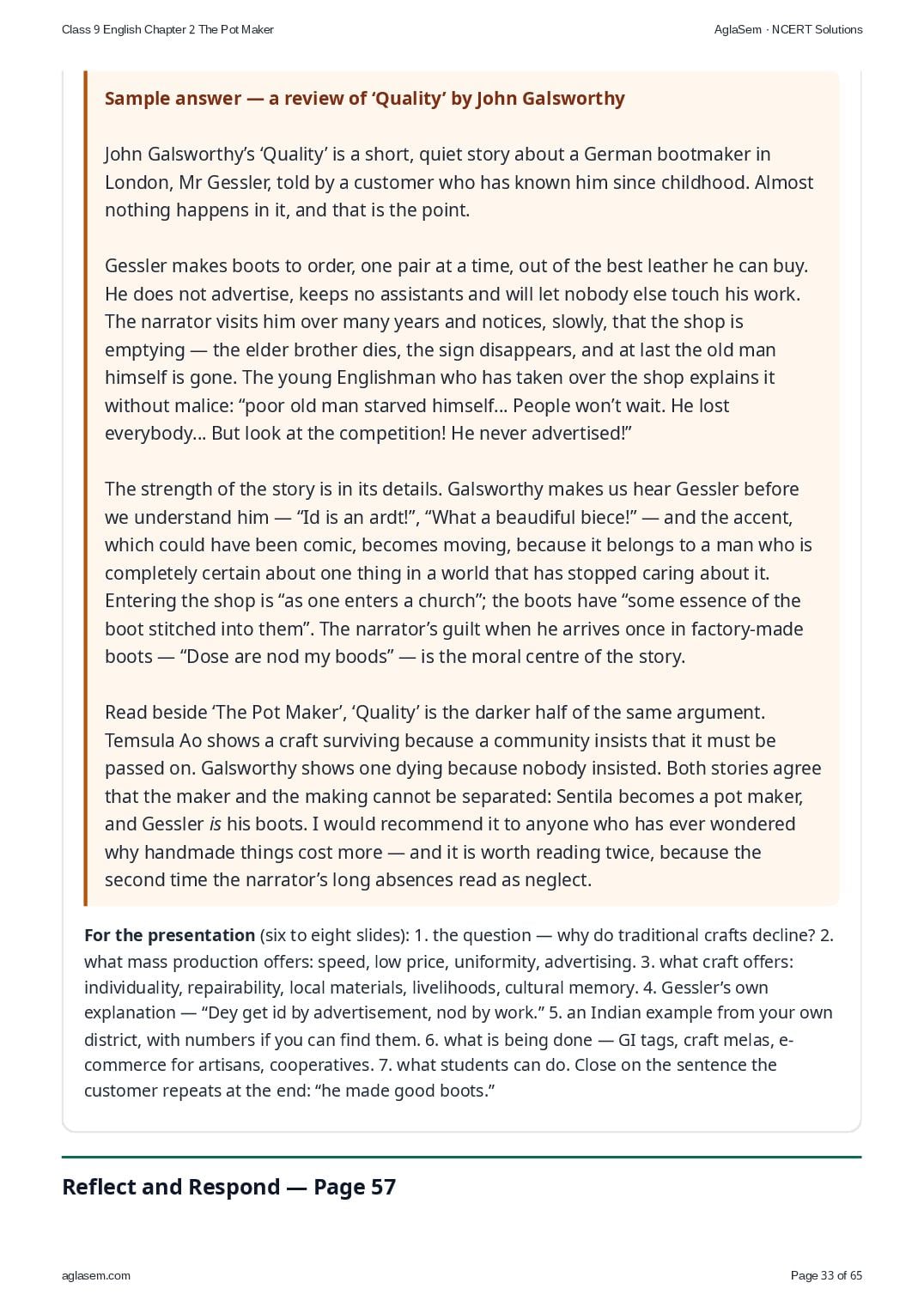
- II. You must have read stories in English and in your own language about the value of handicrafts and art. Read the story ‘Quality’ by John Galsworthy. Write its review and make a presentation highlighting the decline of traditional crafts and skills vs. industrialisation and mass-produced goods. (‘Quality’, in an abridged version, is printed on pages 52–56 of the book.)
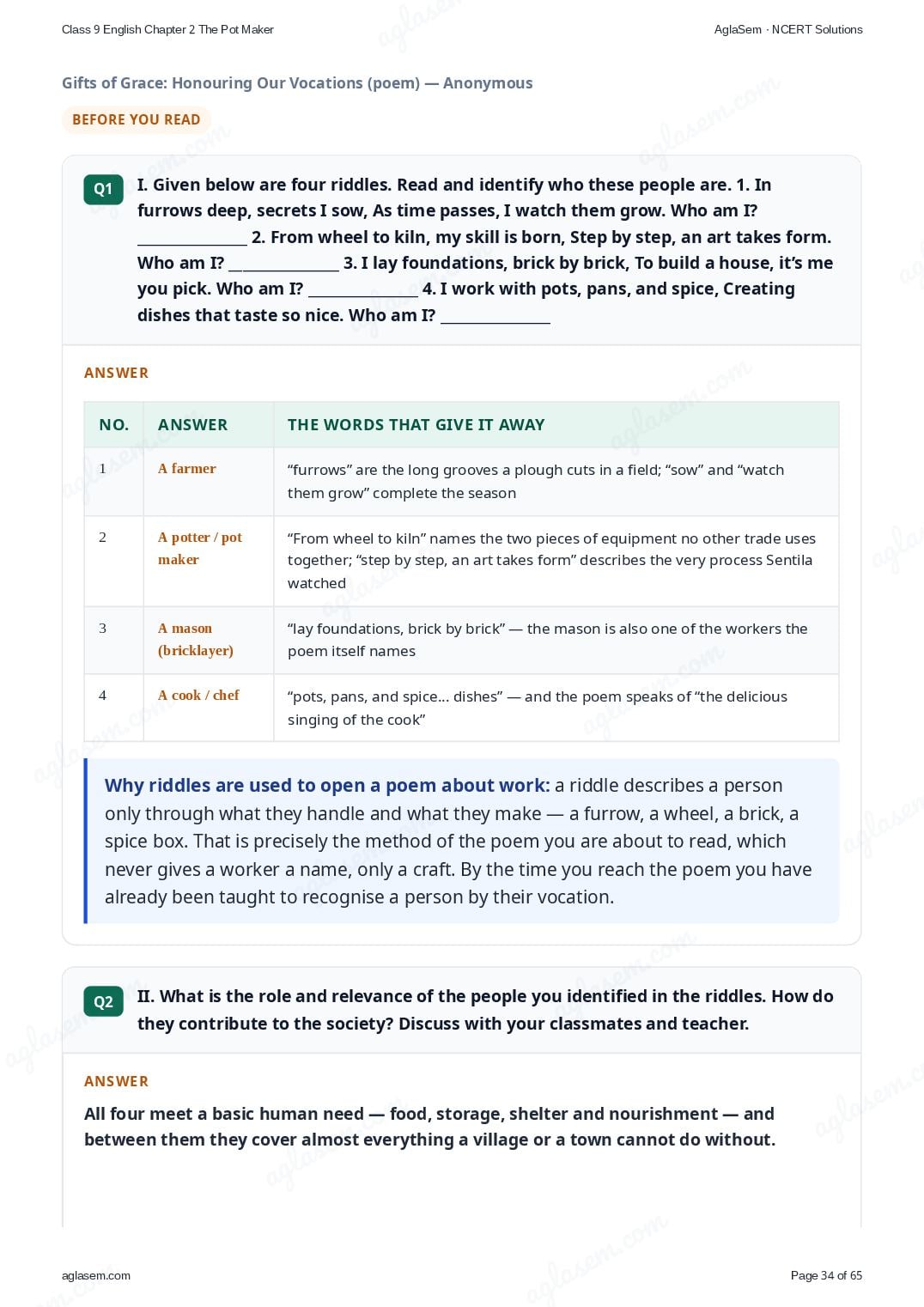
- I. Given below are four riddles. Read and identify who these people are. 1. In furrows deep, secrets I sow, As time passes, I watch them grow. Who am I? ________________ 2. From wheel to kiln, my skill is born, Step by step, an art takes form. Who am I? ________________ 3. I lay foundations, brick by brick, To build a house, it’s me you pick. Who am I? ________________ 4. I work with pots, pans, and spice, Creating dishes that taste so nice. Who am I? ________________
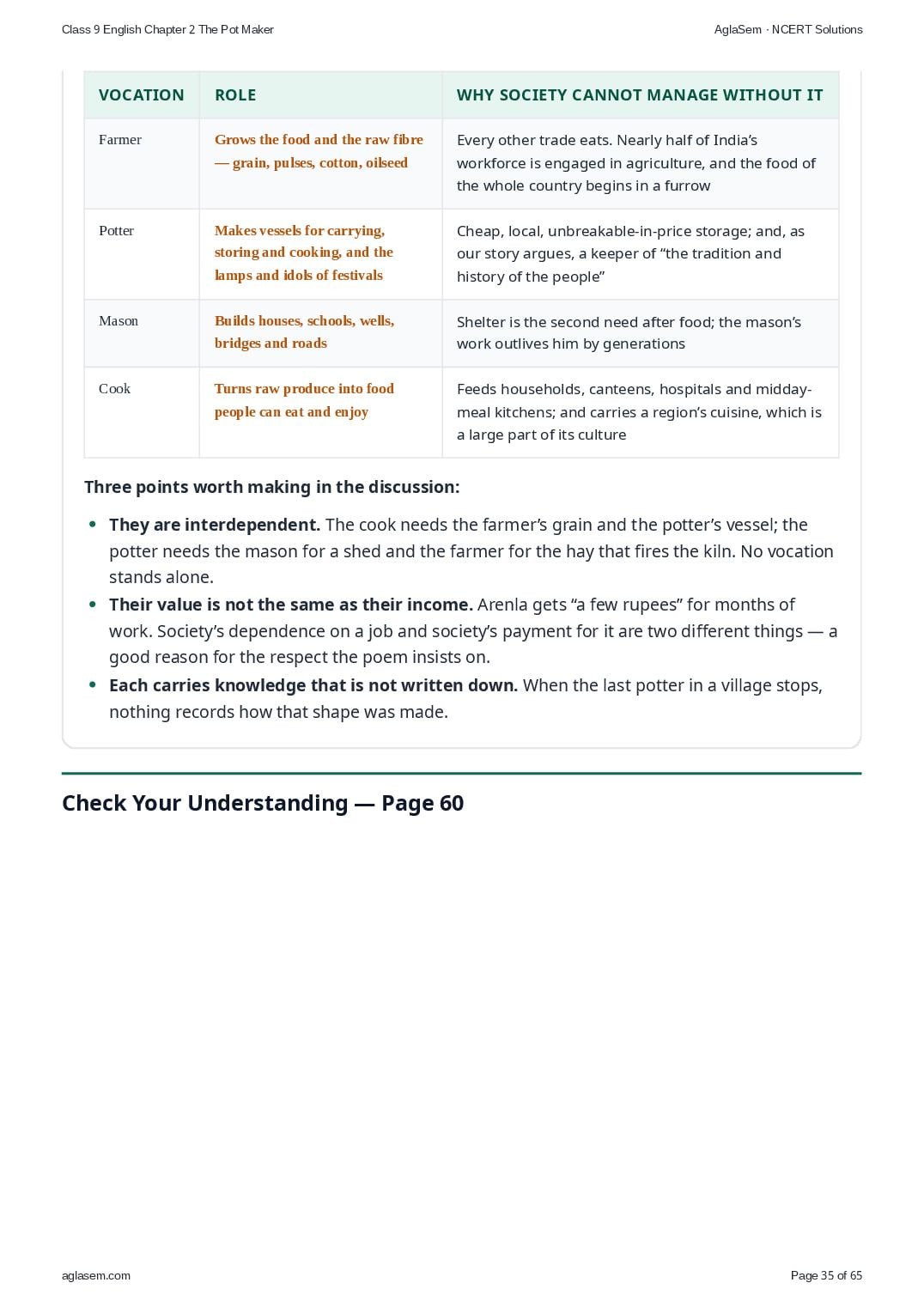
- II. What is the role and relevance of the people you identified in the riddles. How do they contribute to the society? Discuss with your classmates and teacher.
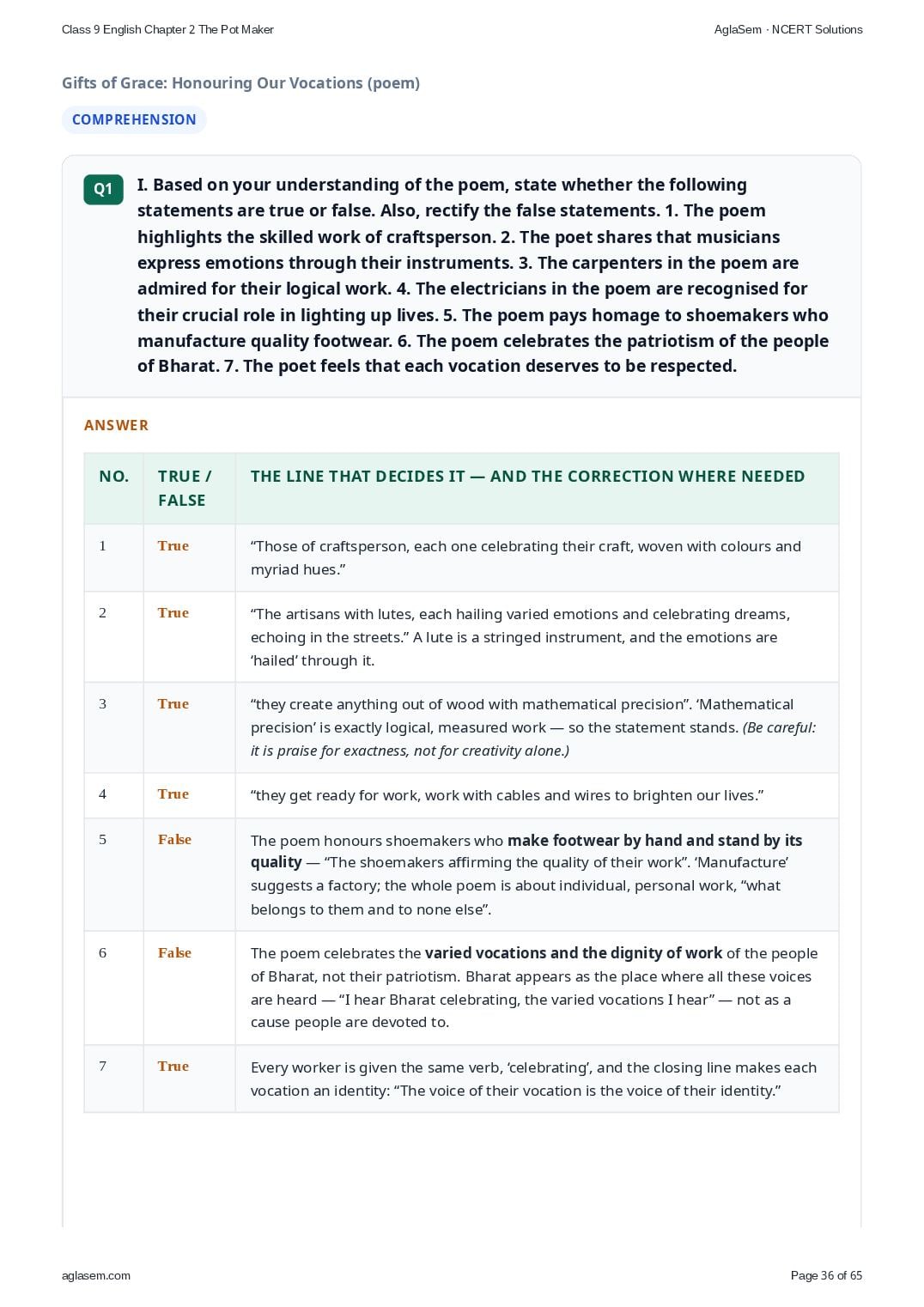
- I. Based on your understanding of the poem, state whether the following statements are true or false. Also, rectify the false statements. 1. The poem highlights the skilled work of craftsperson. 2. The poet shares that musicians express emotions through their instruments. 3. The carpenters in the poem are admired for their logical work. 4. The electricians in the poem are recognised for their crucial role in lighting up lives. 5. The poem pays homage to shoemakers who manufacture quality footwear. 6. The poem celebrates the patriotism of the people of Bharat. 7. The poet feels that each vocation deserves to be respected.
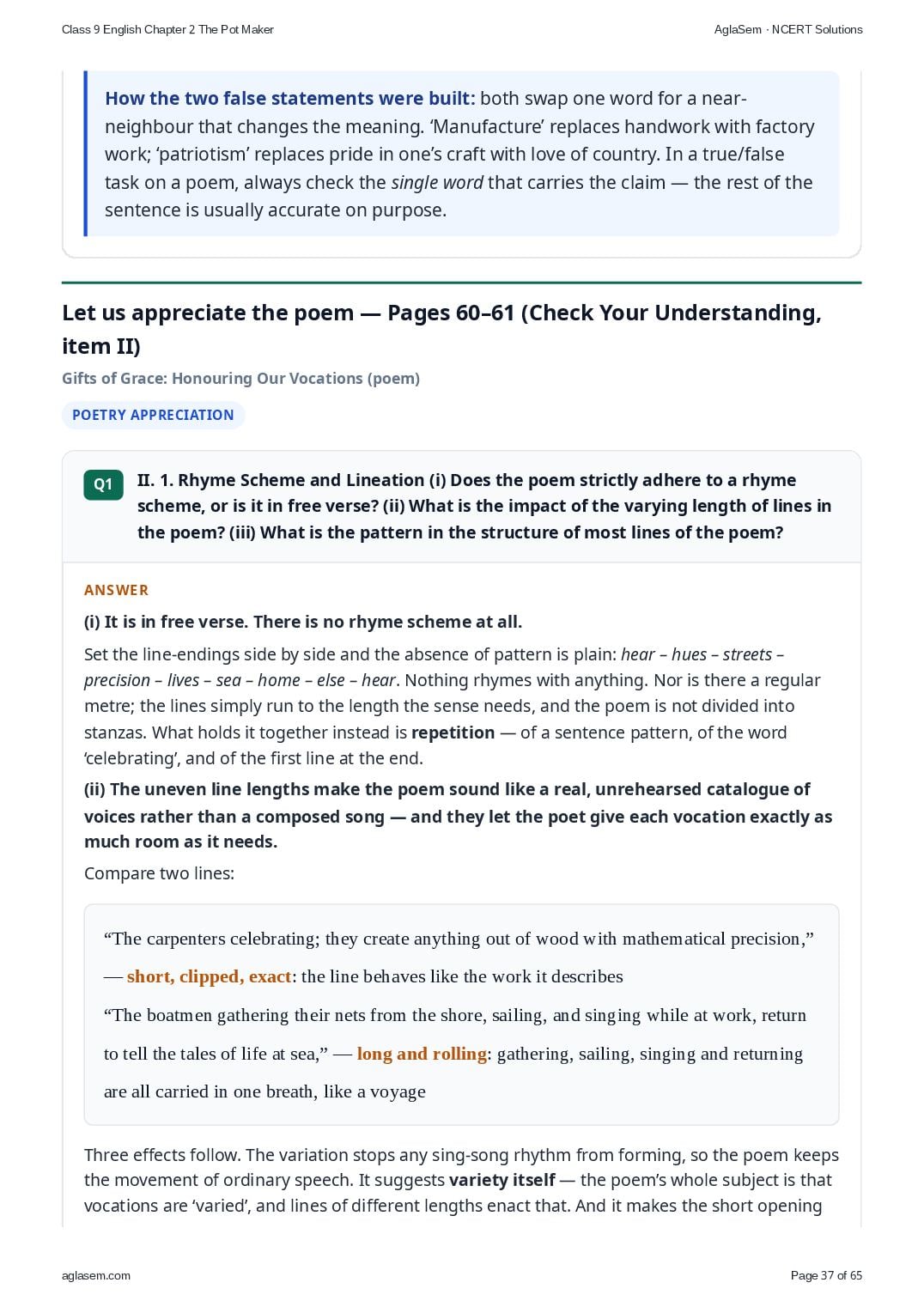
- II. 1. Rhyme Scheme and Lineation (i) Does the poem strictly adhere to a rhyme scheme, or is it in free verse? (ii) What is the impact of the varying length of lines in the poem? (iii) What is the pattern in the structure of most lines of the poem?
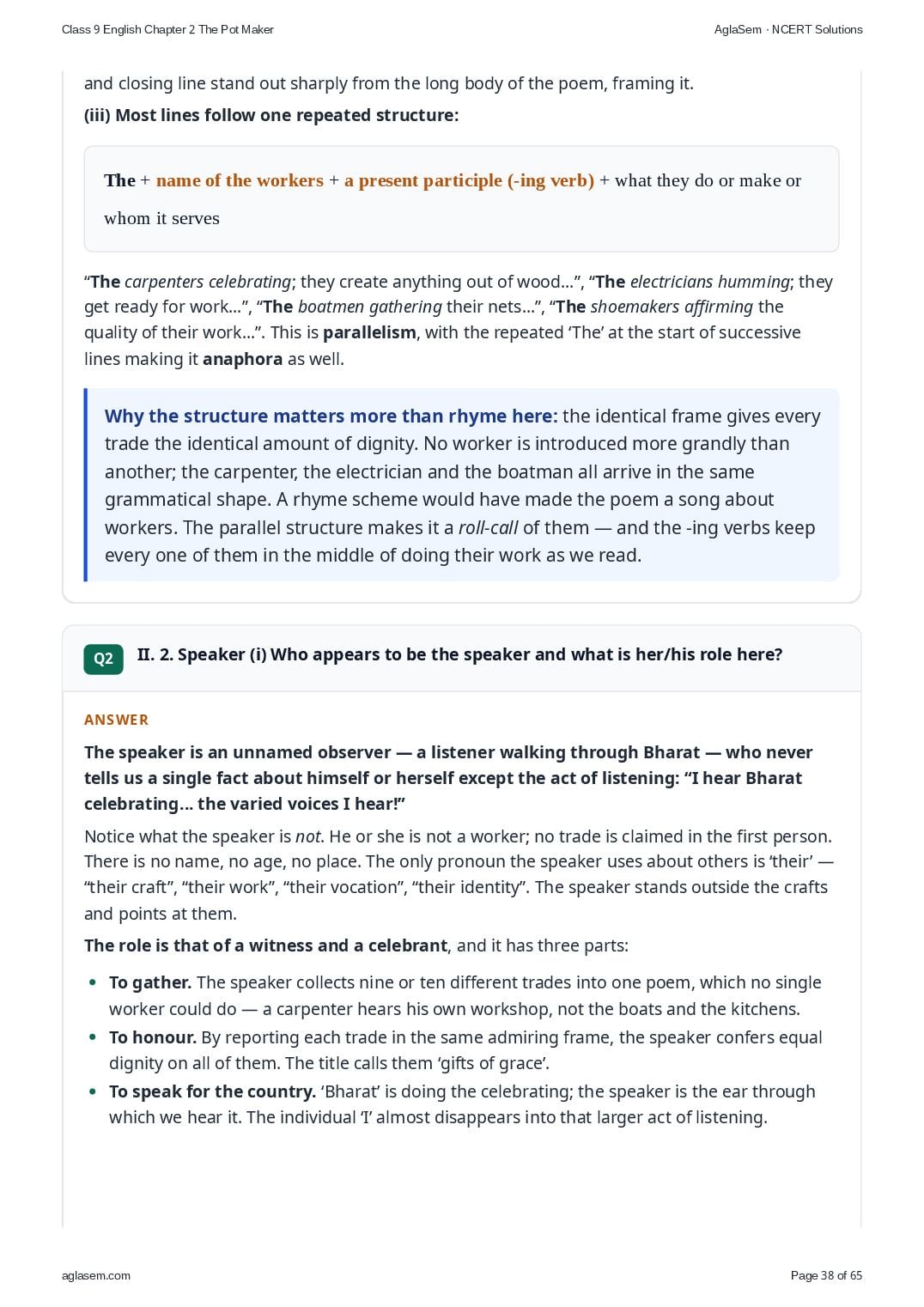
- II. 2. Speaker (i) Who appears to be the speaker and what is her/his role here?
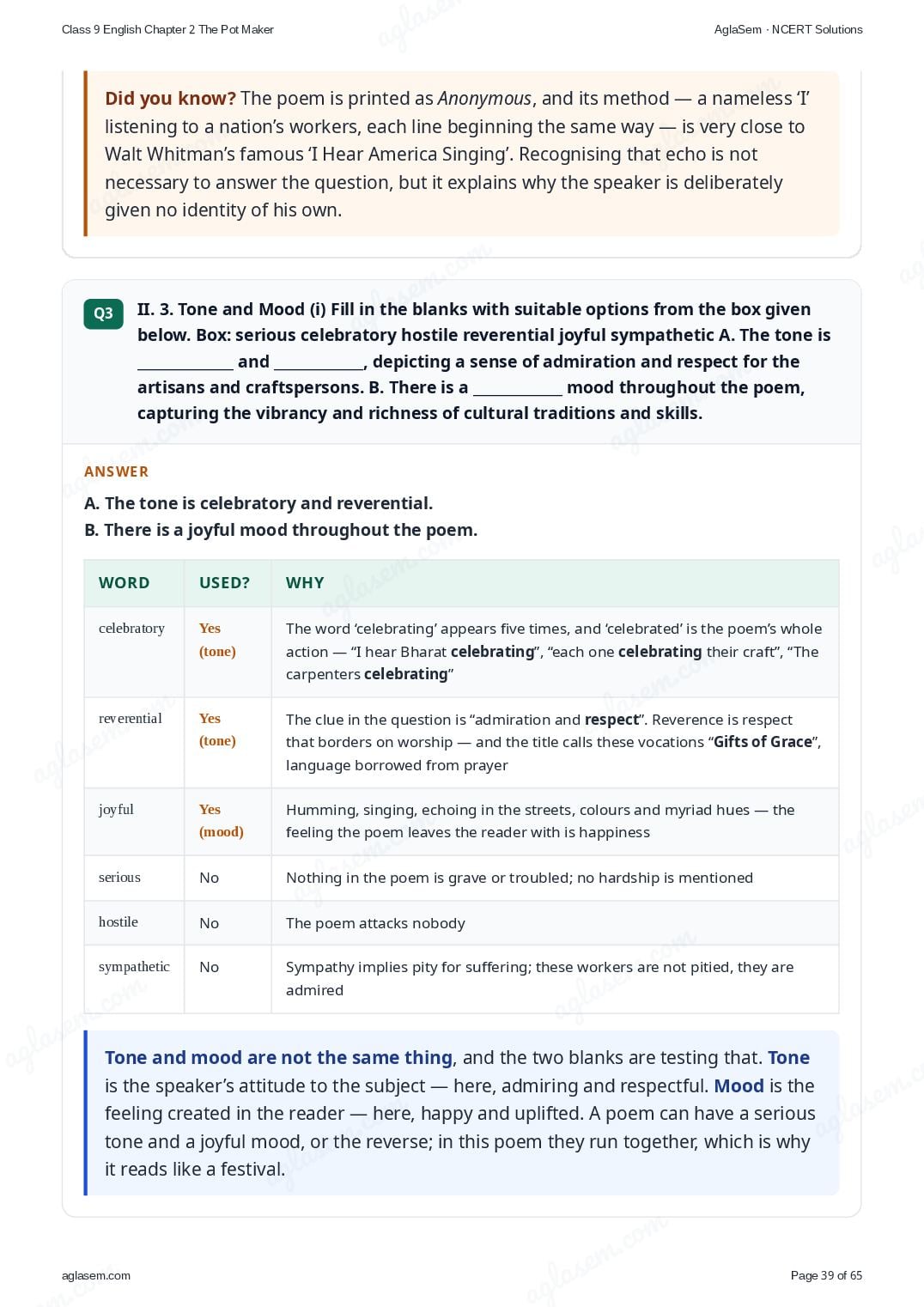
- II. 3. Tone and Mood (i) Fill in the blanks with suitable options from the box given below. Box: serious celebratory hostile reverential joyful sympathetic A. The tone is ______________ and _____________, depicting a sense of admiration and respect for the artisans and craftspersons. B. There is a _____________ mood throughout the poem, capturing the vibrancy and richness of cultural traditions and skills.
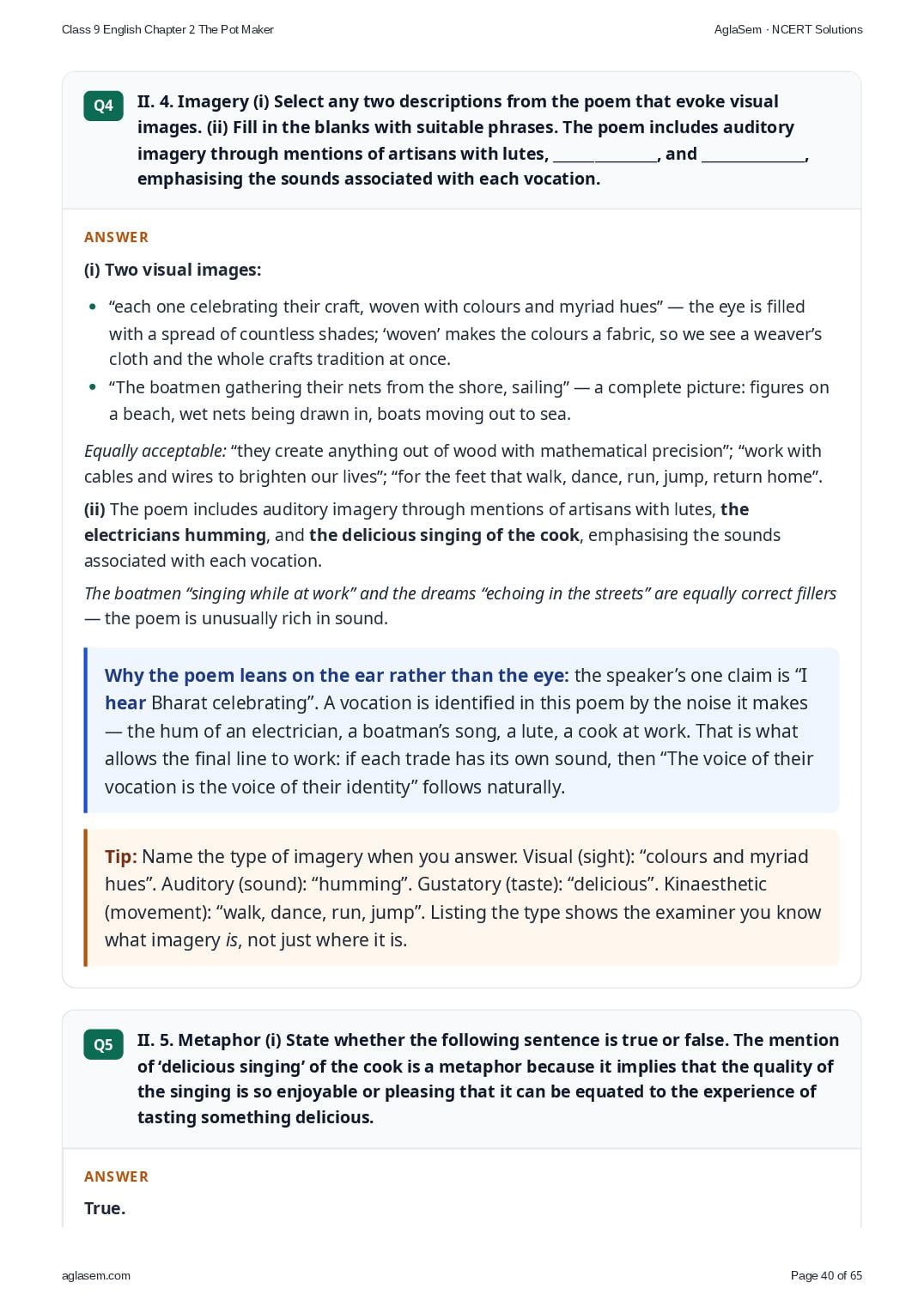
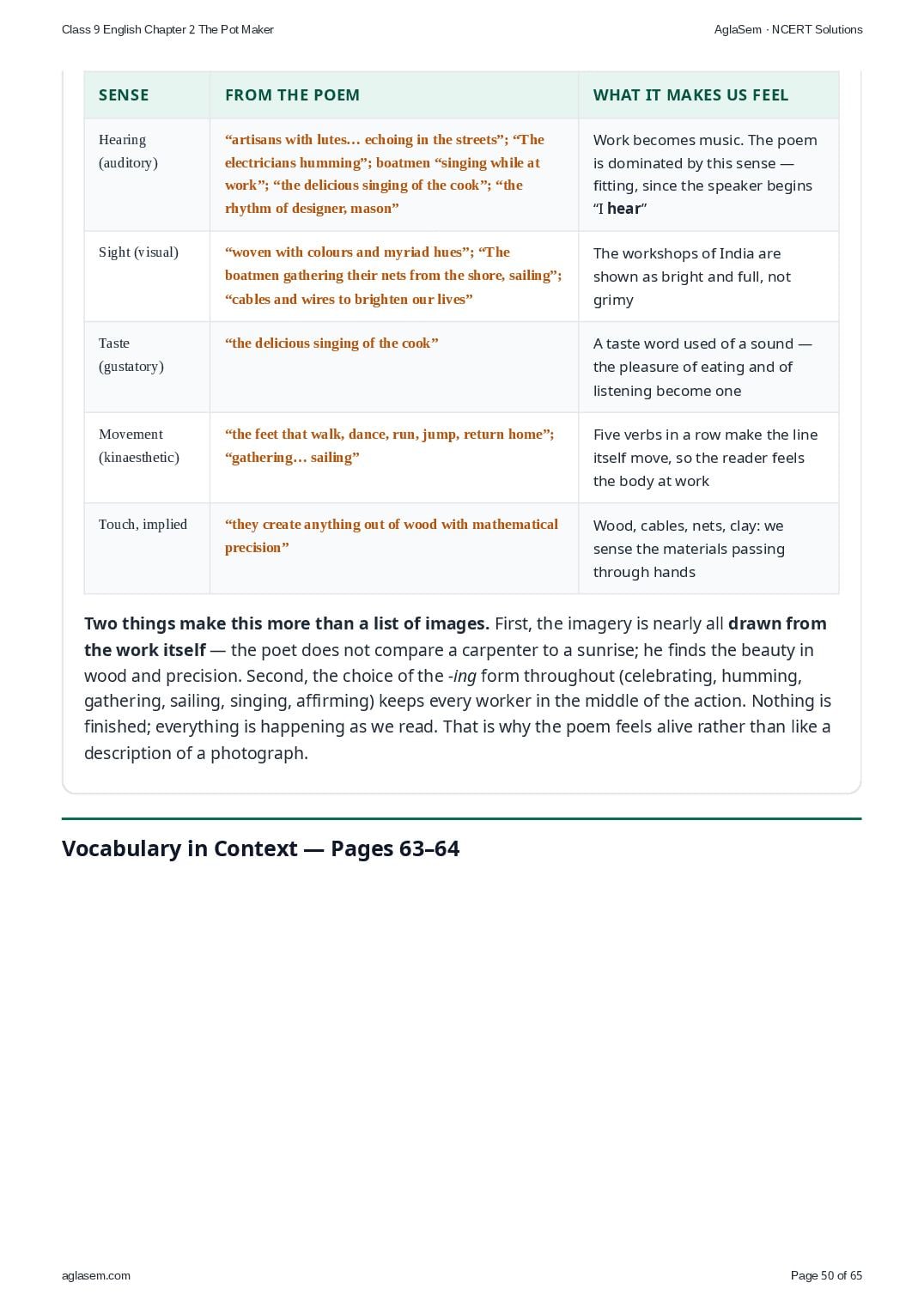
- II. 4. Imagery (i) Select any two descriptions from the poem that evoke visual images. (ii) Fill in the blanks with suitable phrases. The poem includes auditory imagery through mentions of artisans with lutes, _______________, and _______________, emphasising the sounds associated with each vocation.
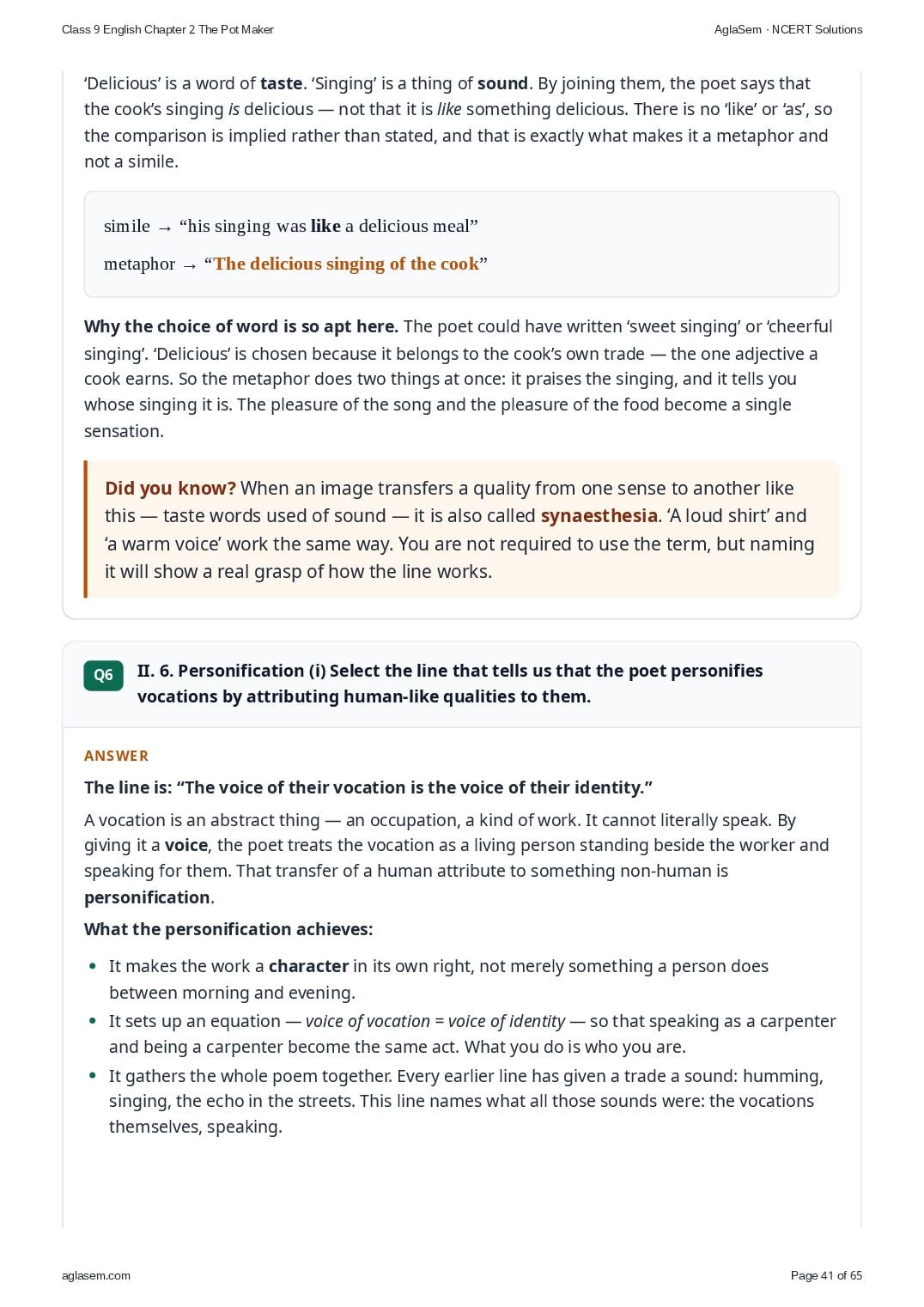
- II. 5. Metaphor (i) State whether the following sentence is true or false. The mention of ‘delicious singing’ of the cook is a metaphor because it implies that the quality of the singing is so enjoyable or pleasing that it can be equated to the experience of tasting something delicious.
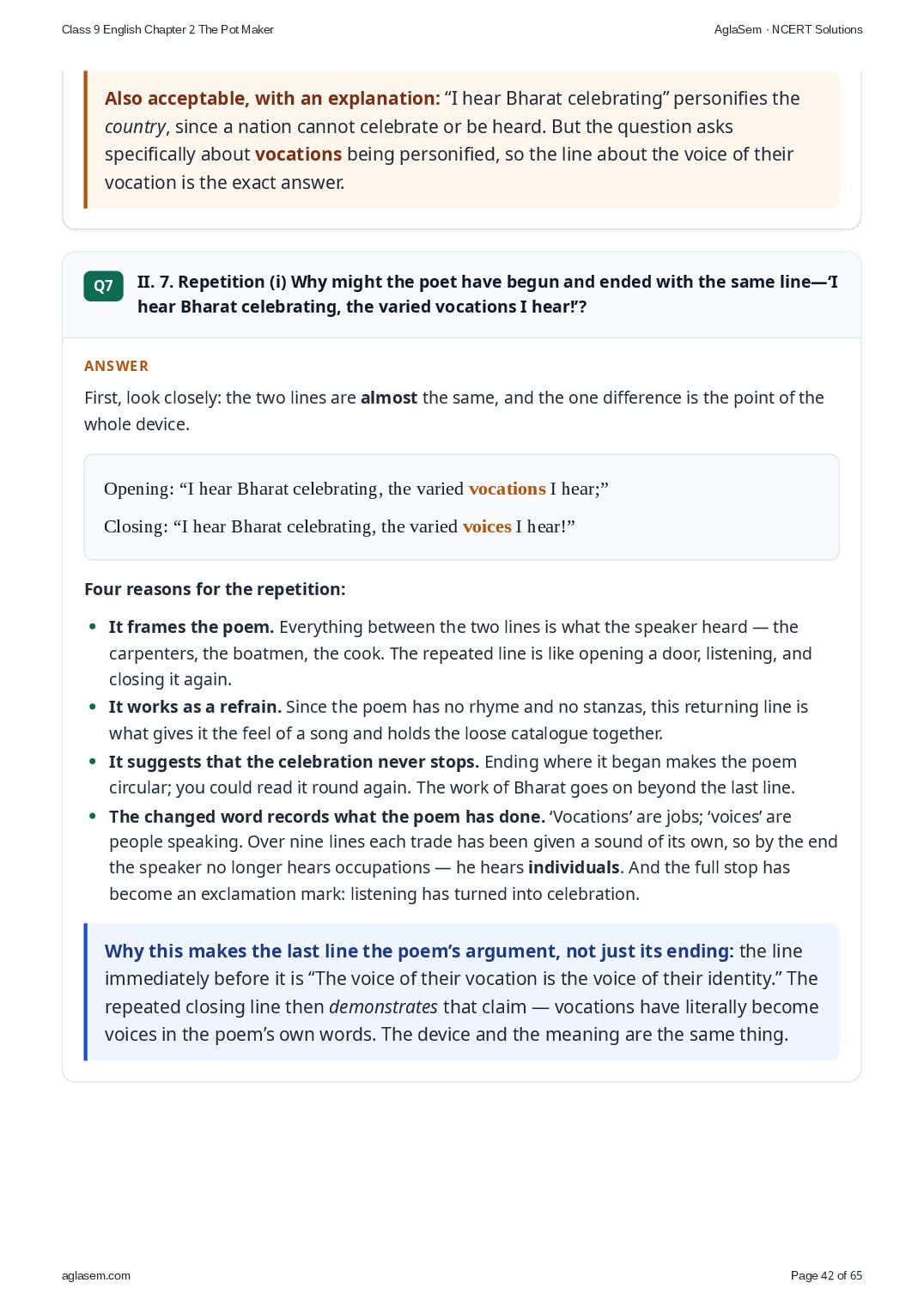
- II. 6. Personification (i) Select the line that tells us that the poet personifies vocations by attributing human-like qualities to them.
- II. 7. Repetition (i) Why might the poet have begun and ended with the same line—‘I hear Bharat celebrating, the varied vocations I hear!’?
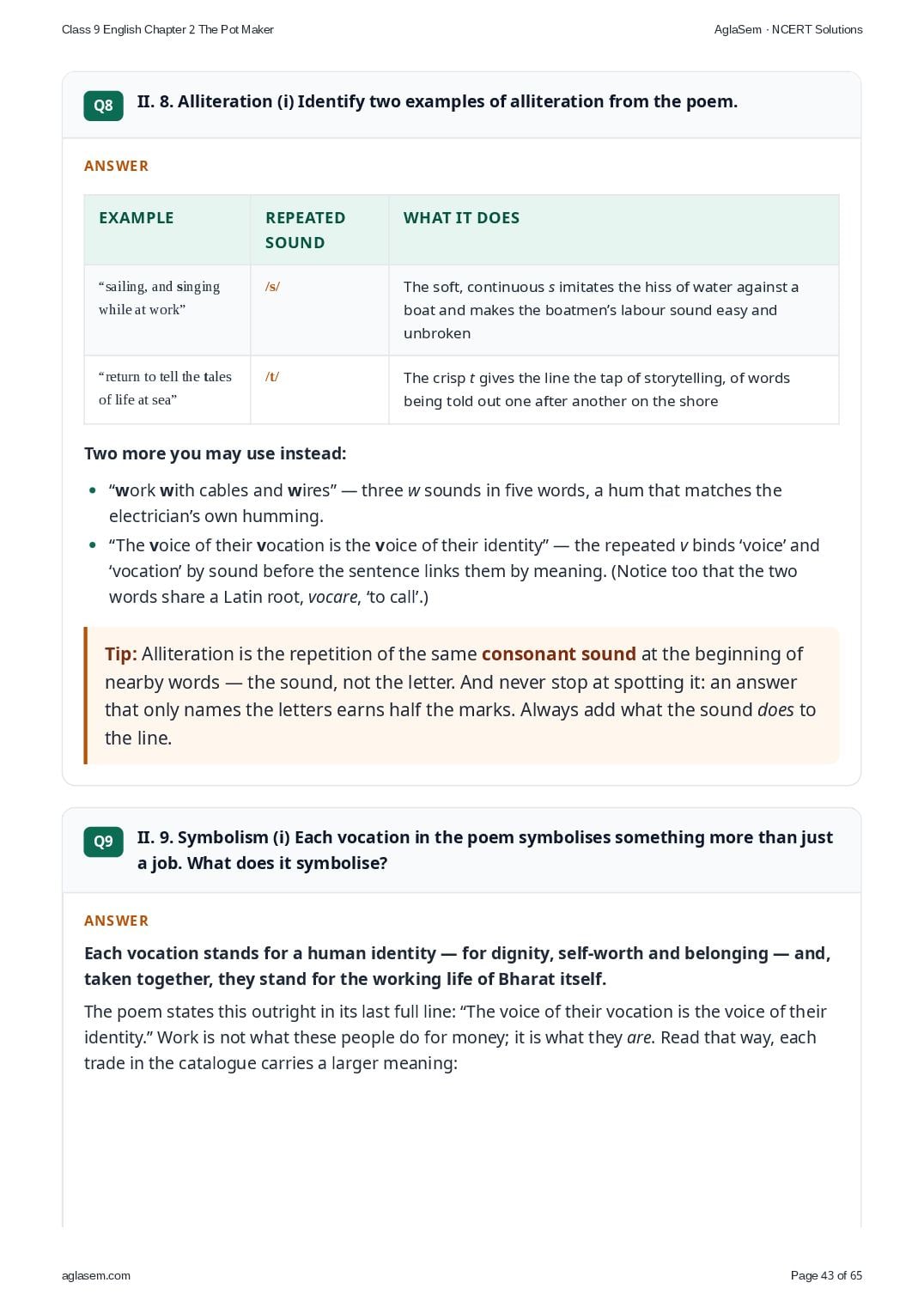
- II. 8. Alliteration (i) Identify two examples of alliteration from the poem.
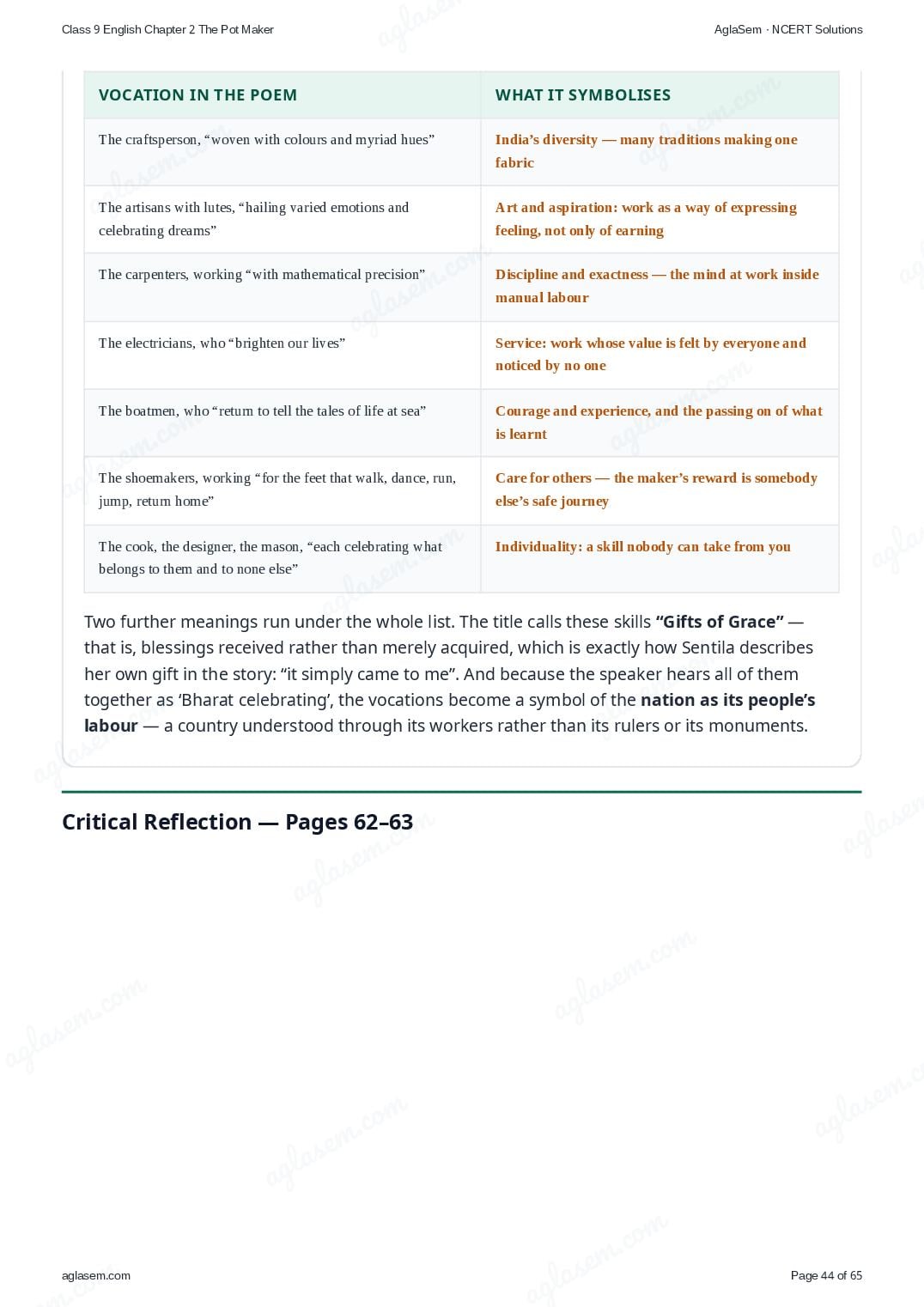
- II. 9. Symbolism (i) Each vocation in the poem symbolises something more than just a job. What does it symbolise?
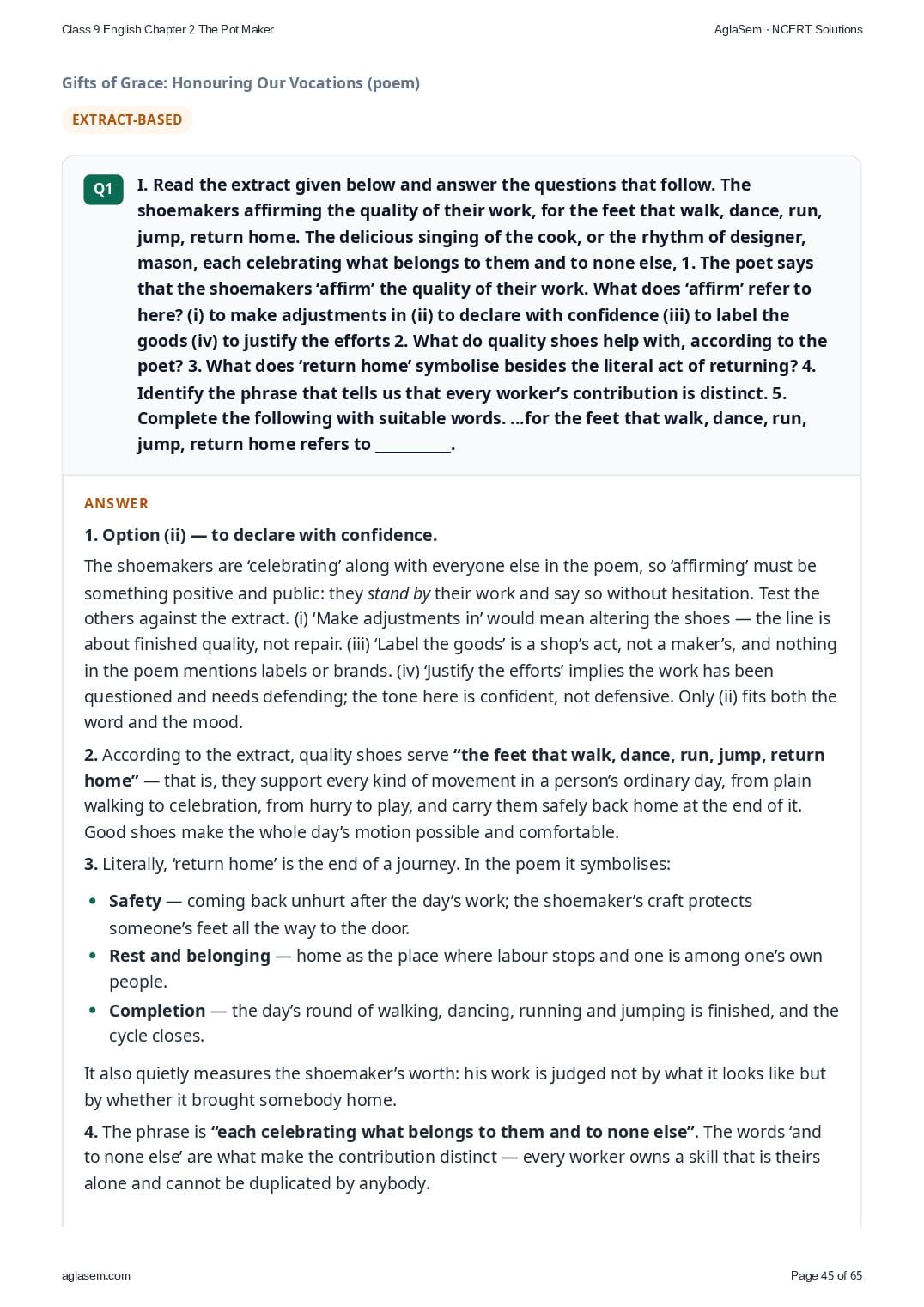
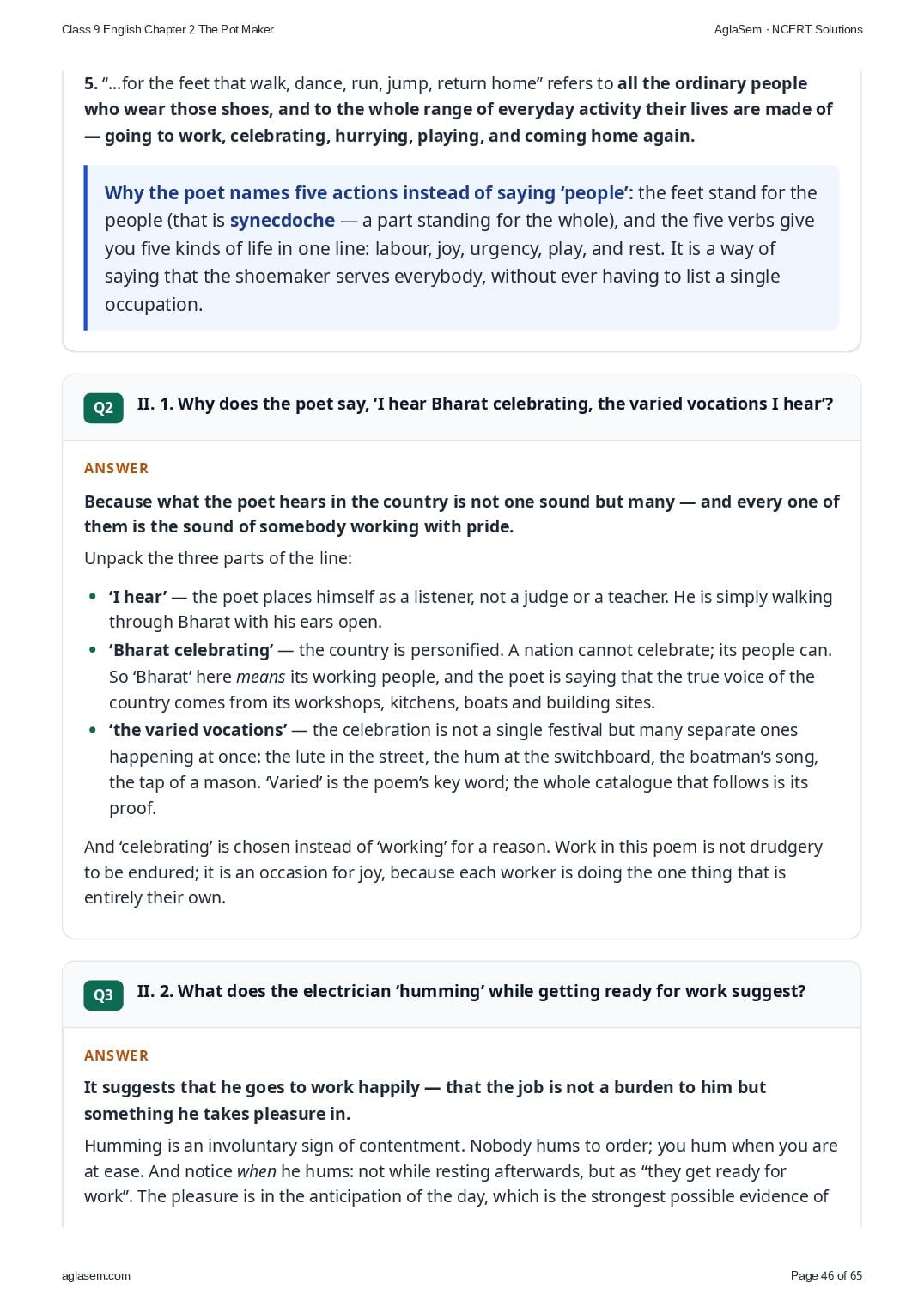
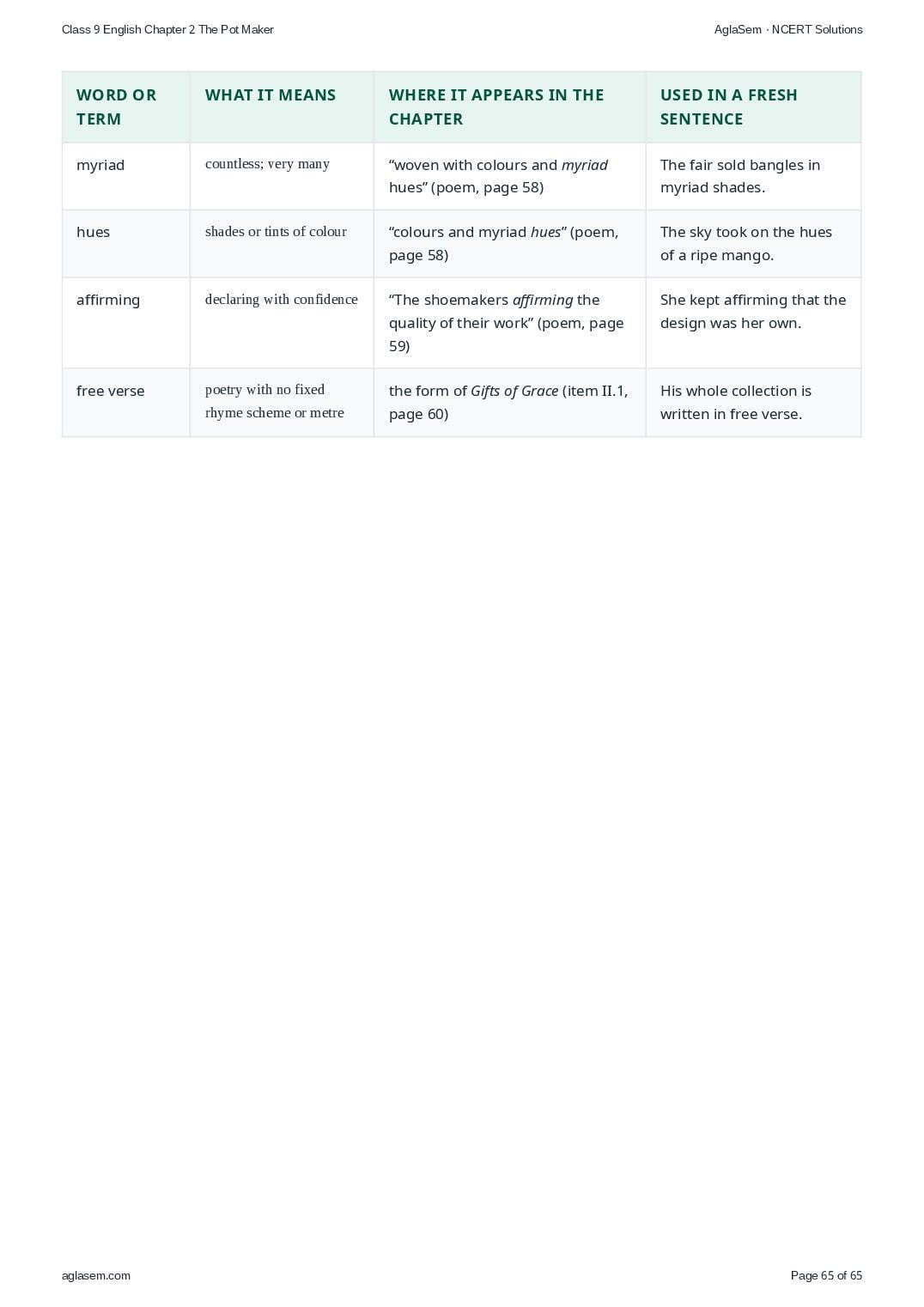
- I. Read the extract given below and answer the questions that follow. The shoemakers affirming the quality of their work, for the feet that walk, dance, run, jump, return home. The delicious singing of the cook, or the rhythm of designer, mason, each celebrating what belongs to them and to none else, 1. The poet says that the shoemakers ‘affirm’ the quality of their work. What does ‘affirm’ refer to here? (i) to make adjustments in (ii) to declare with confidence (iii) to label the goods (iv) to justify the efforts 2. What do quality shoes help with, according to the poet? 3. What does ‘return home’ symbolise besides the literal act of returning? 4. Identify the phrase that tells us that every worker’s contribution is distinct. 5. Complete the following with suitable words. …for the feet that walk, dance, run, jump, return home refers to ___________.
- II. 1. Why does the poet say, ‘I hear Bharat celebrating, the varied vocations I hear’?
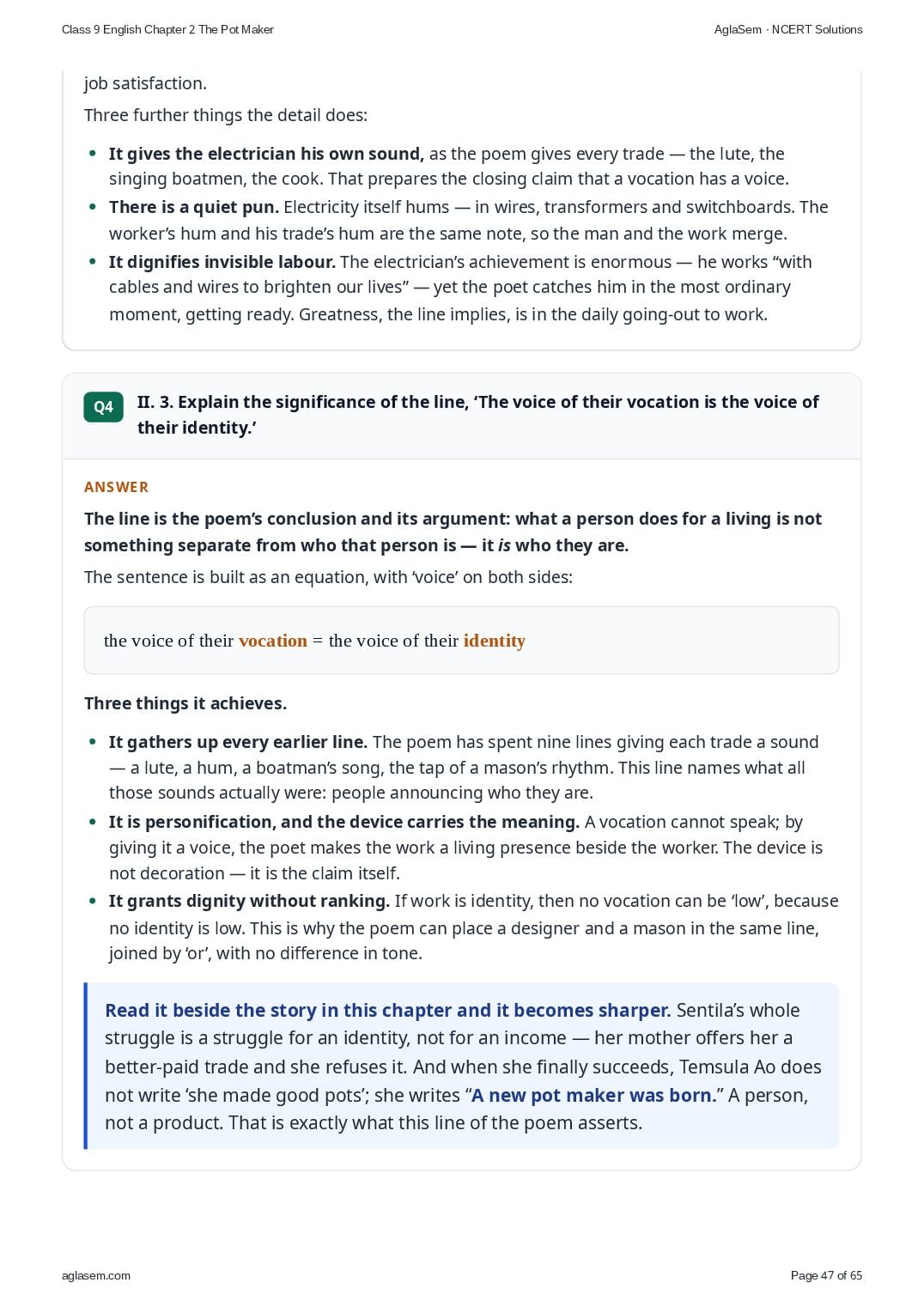
- II. 2. What does the electrician ‘humming’ while getting ready for work suggest?
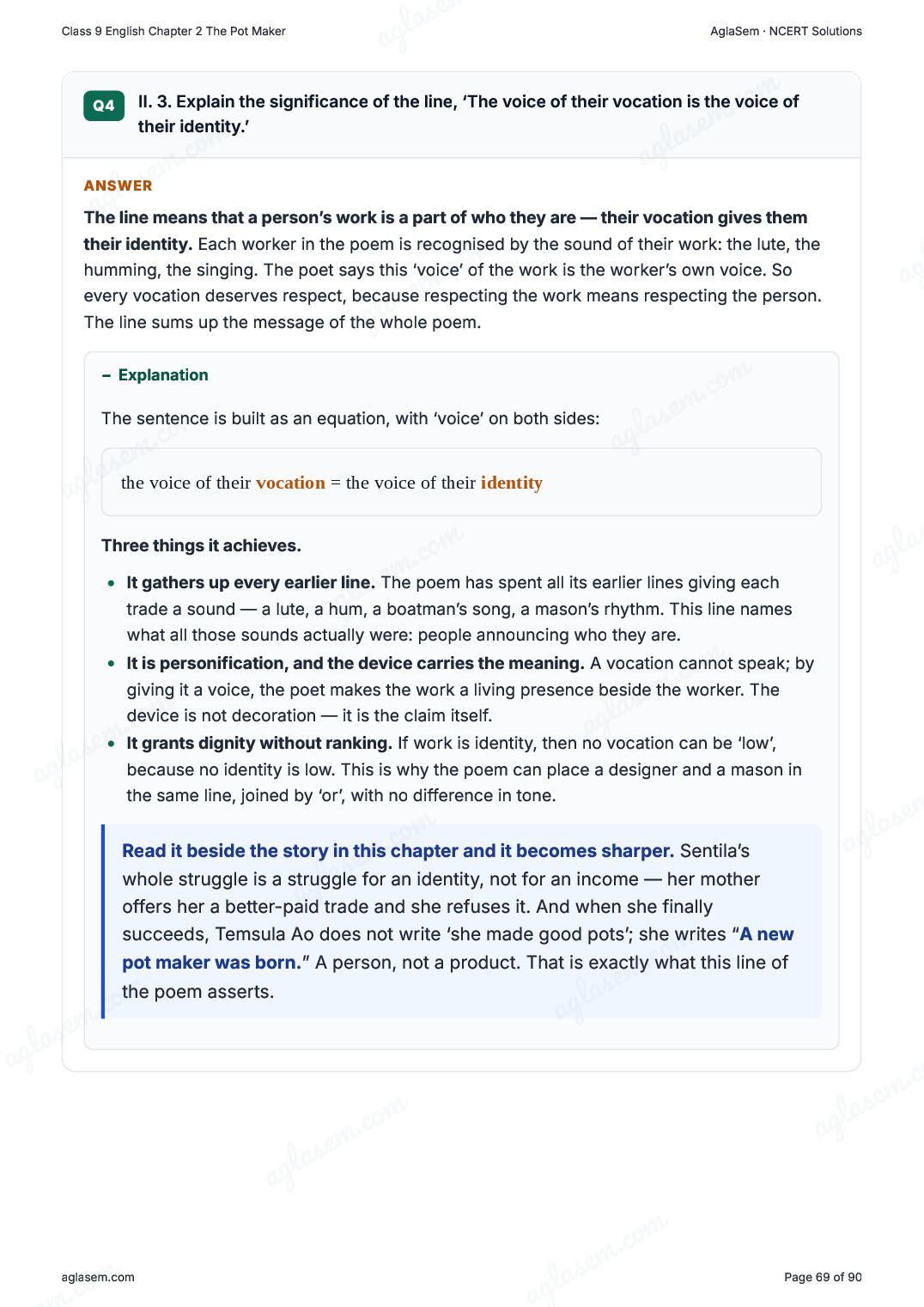
- II. 3. Explain the significance of the line, ‘The voice of their vocation is the voice of their identity.’
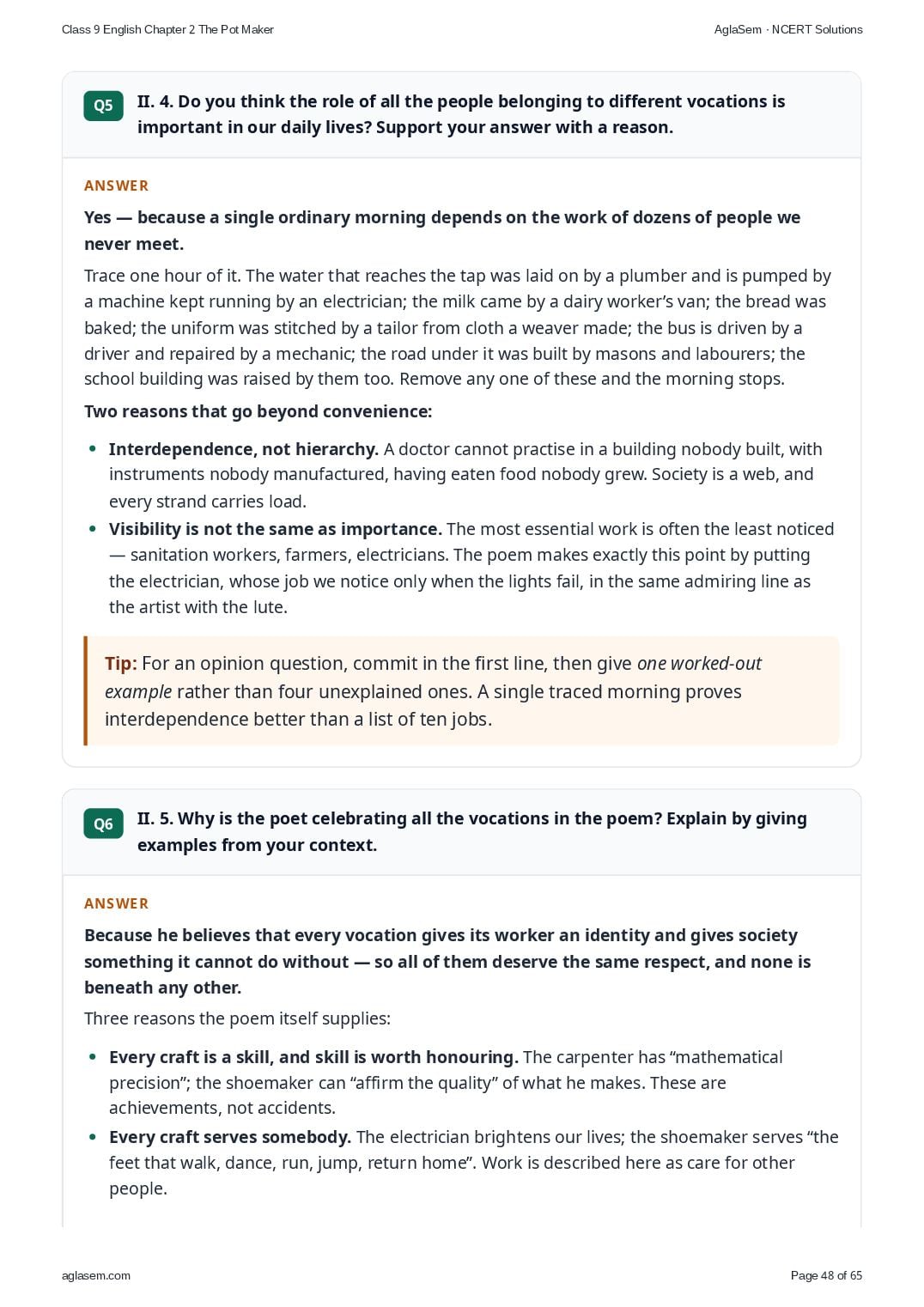
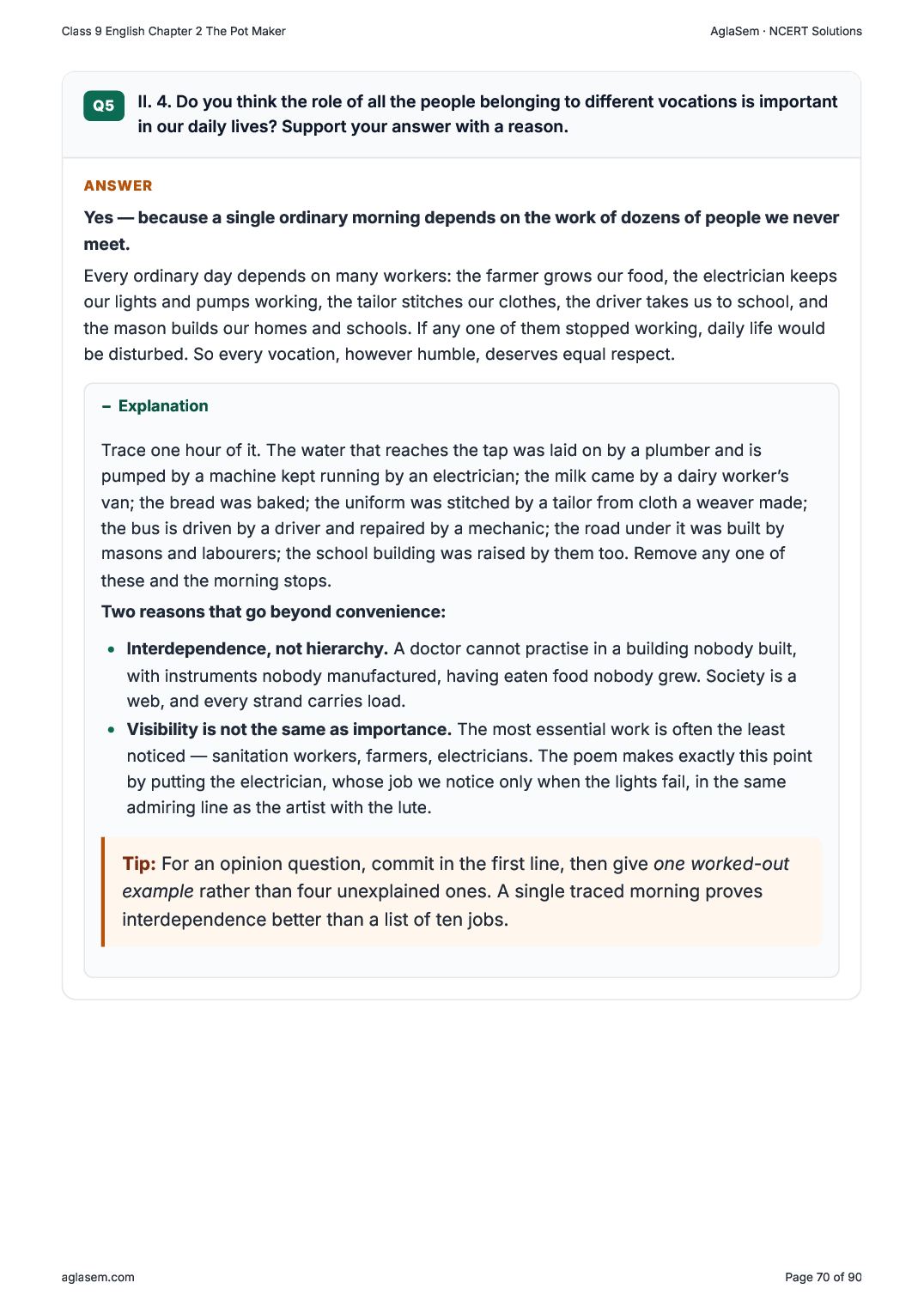
- II. 4. Do you think the role of all the people belonging to different vocations is important in our daily lives? Support your answer with a reason.
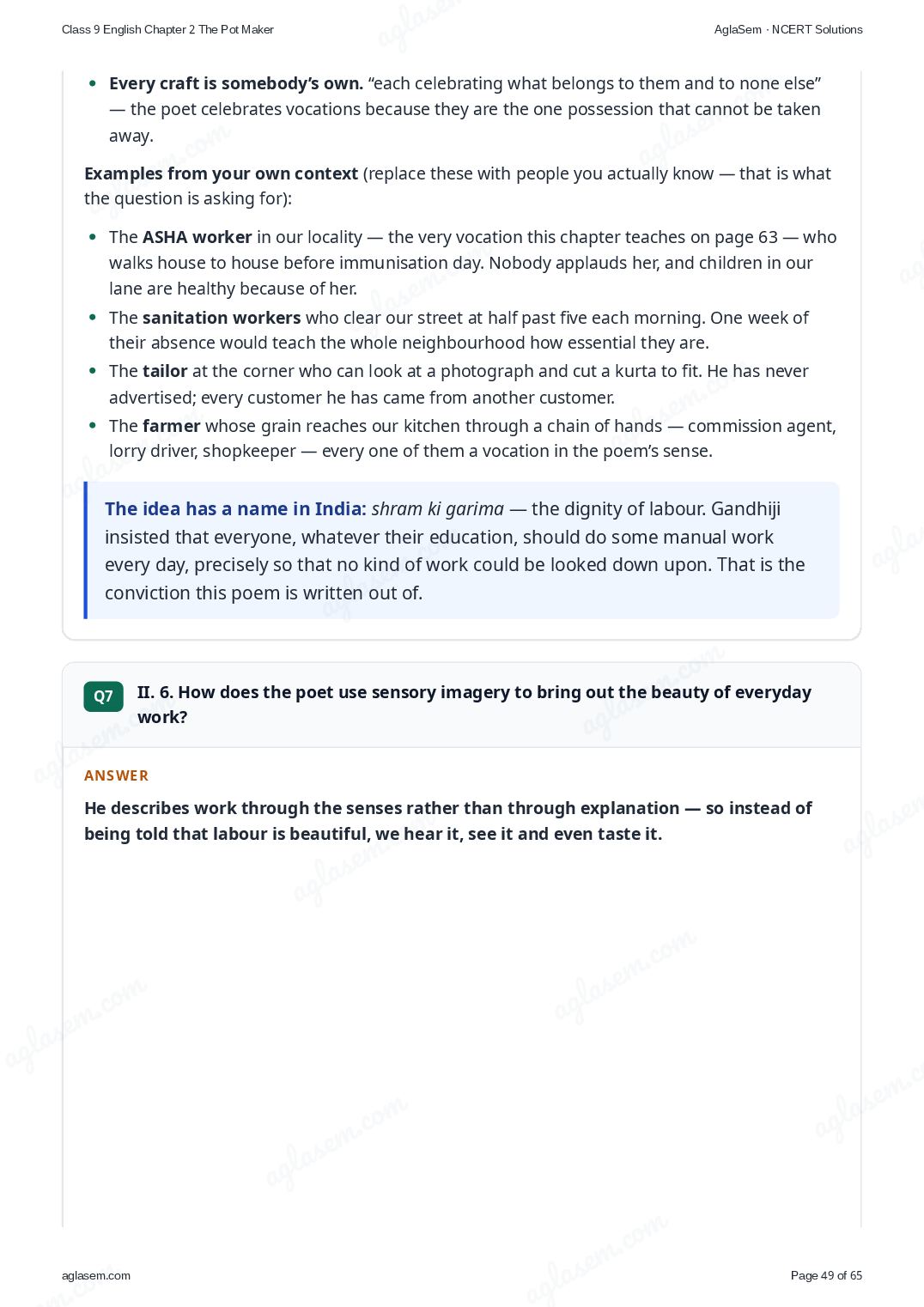
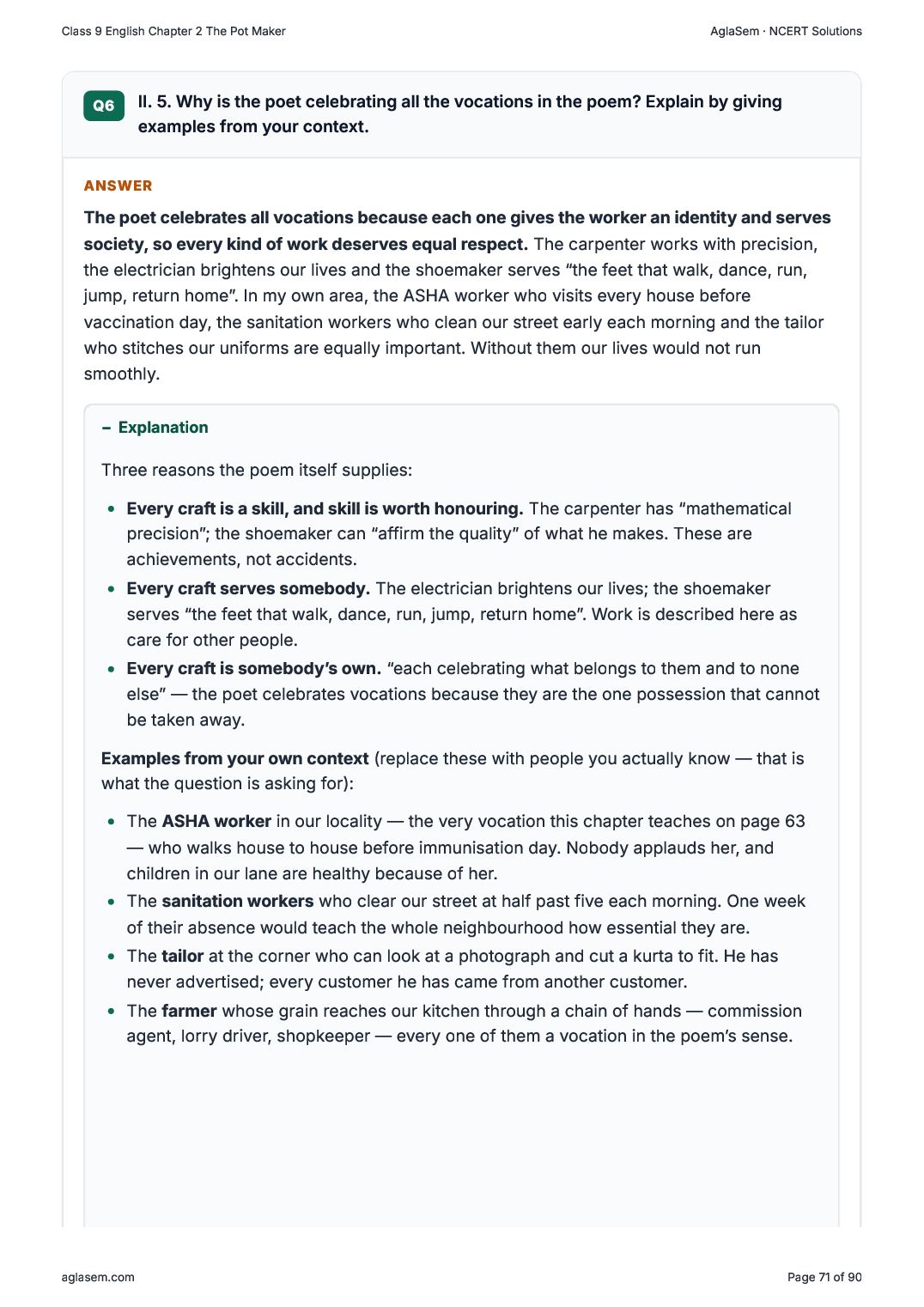
- II. 5. Why is the poet celebrating all the vocations in the poem? Explain by giving examples from your context.
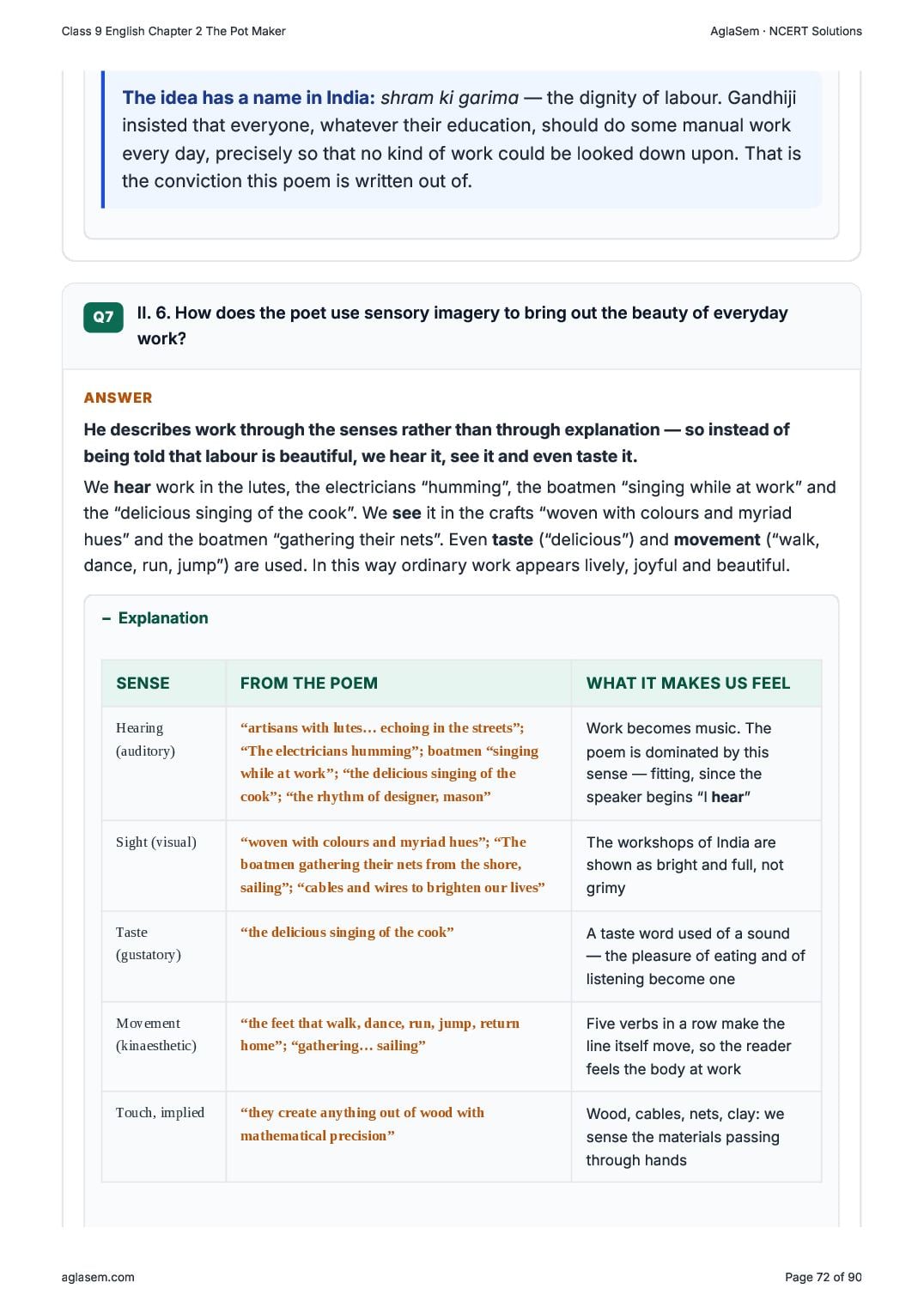
- II. 6. How does the poet use sensory imagery to bring out the beauty of everyday work?
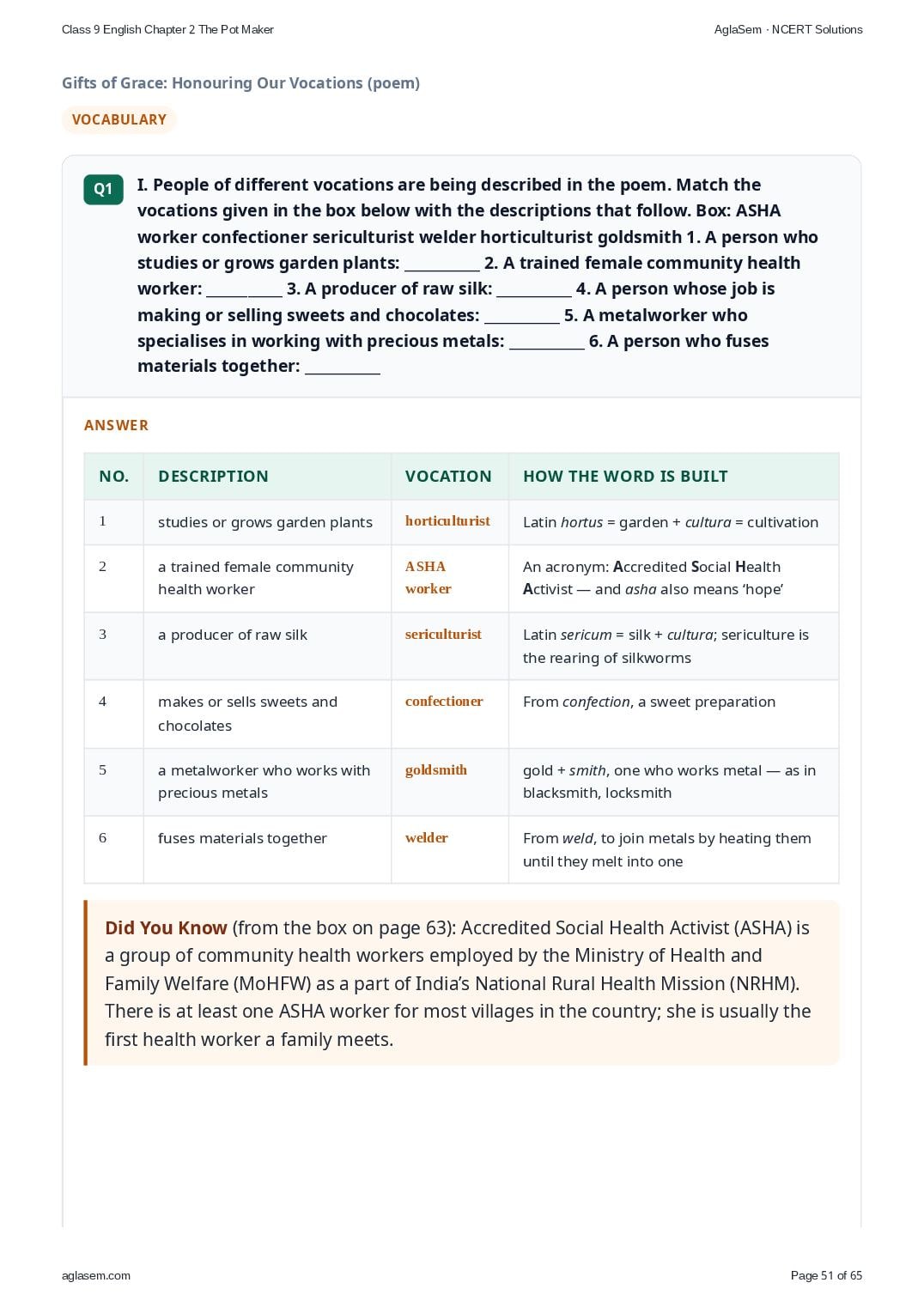
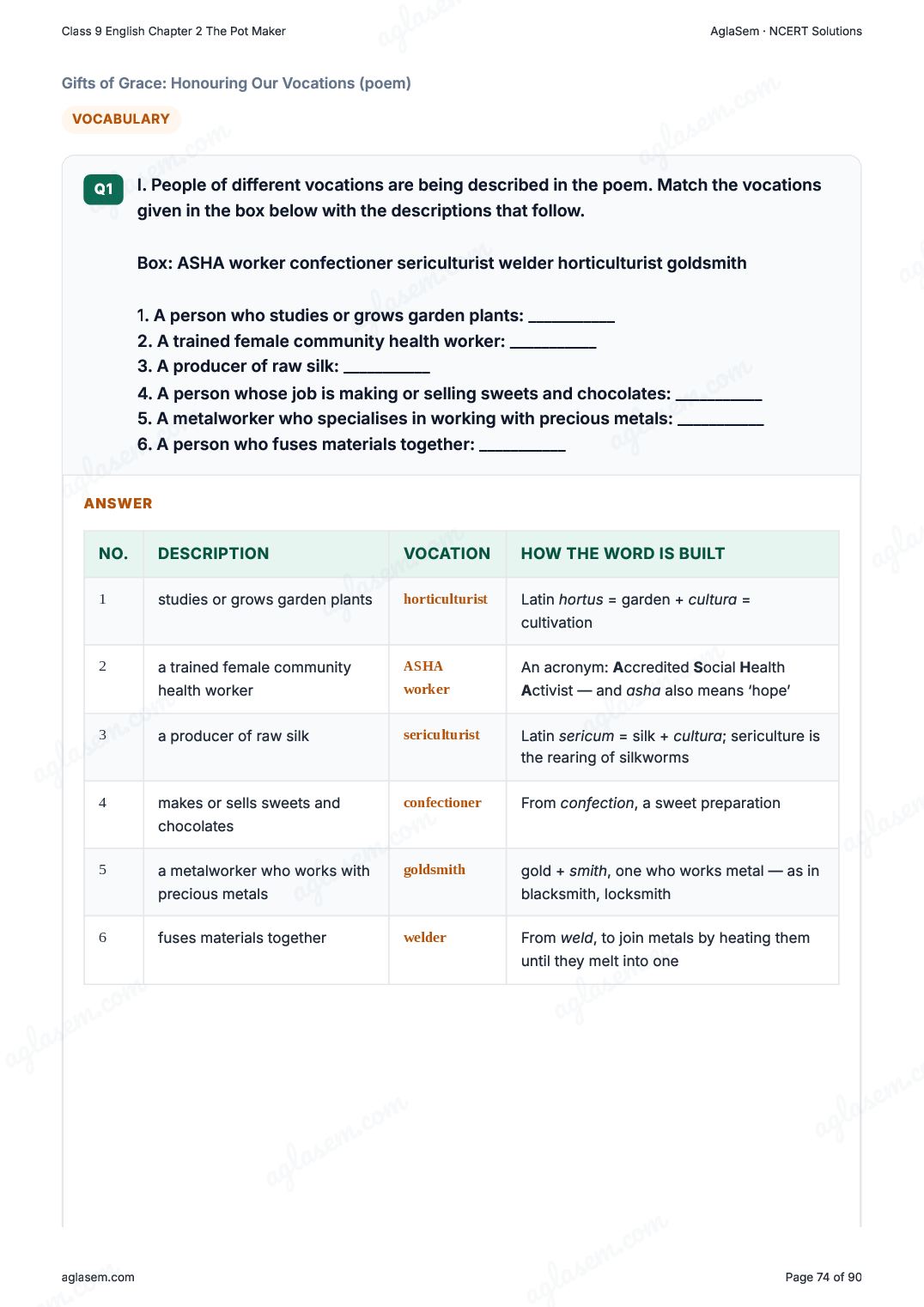
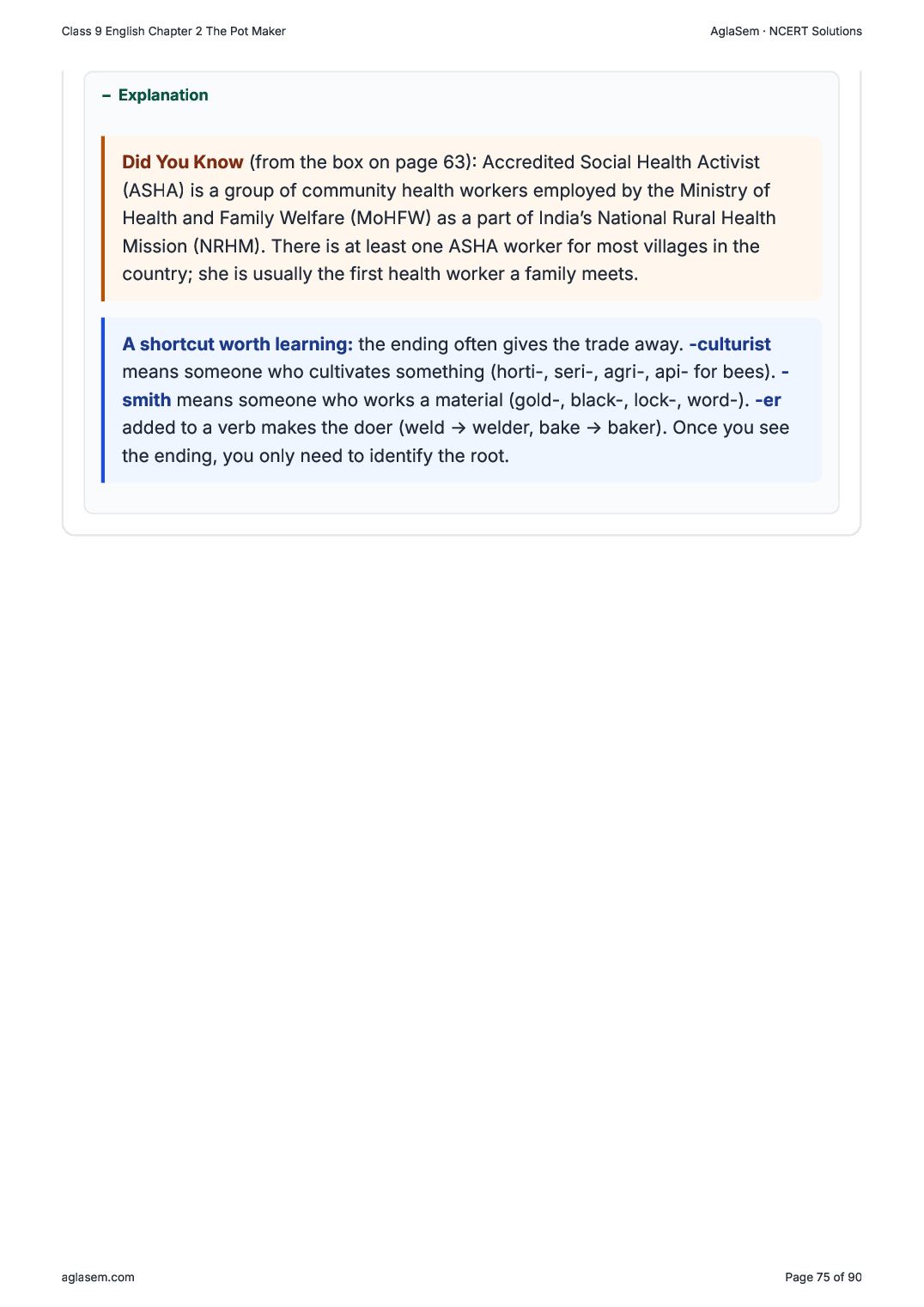
- I. People of different vocations are being described in the poem. Match the vocations given in the box below with the descriptions that follow. Box: ASHA worker confectioner sericulturist welder horticulturist goldsmith 1. A person who studies or grows garden plants: ___________ 2. A trained female community health worker: ___________ 3. A producer of raw silk: ___________ 4. A person whose job is making or selling sweets and chocolates: ___________ 5. A metalworker who specialises in working with precious metals: ___________ 6. A person who fuses materials together: ___________
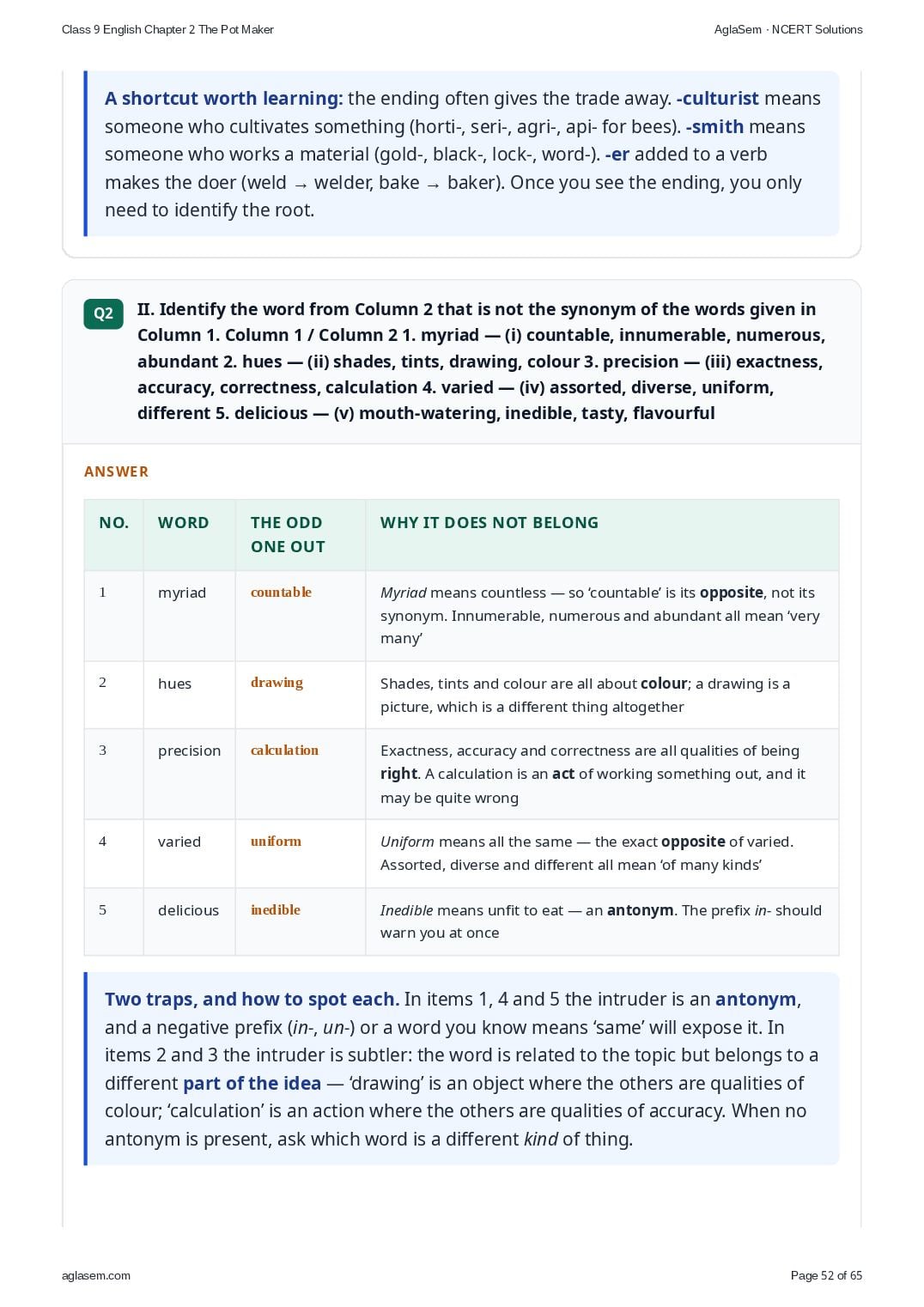
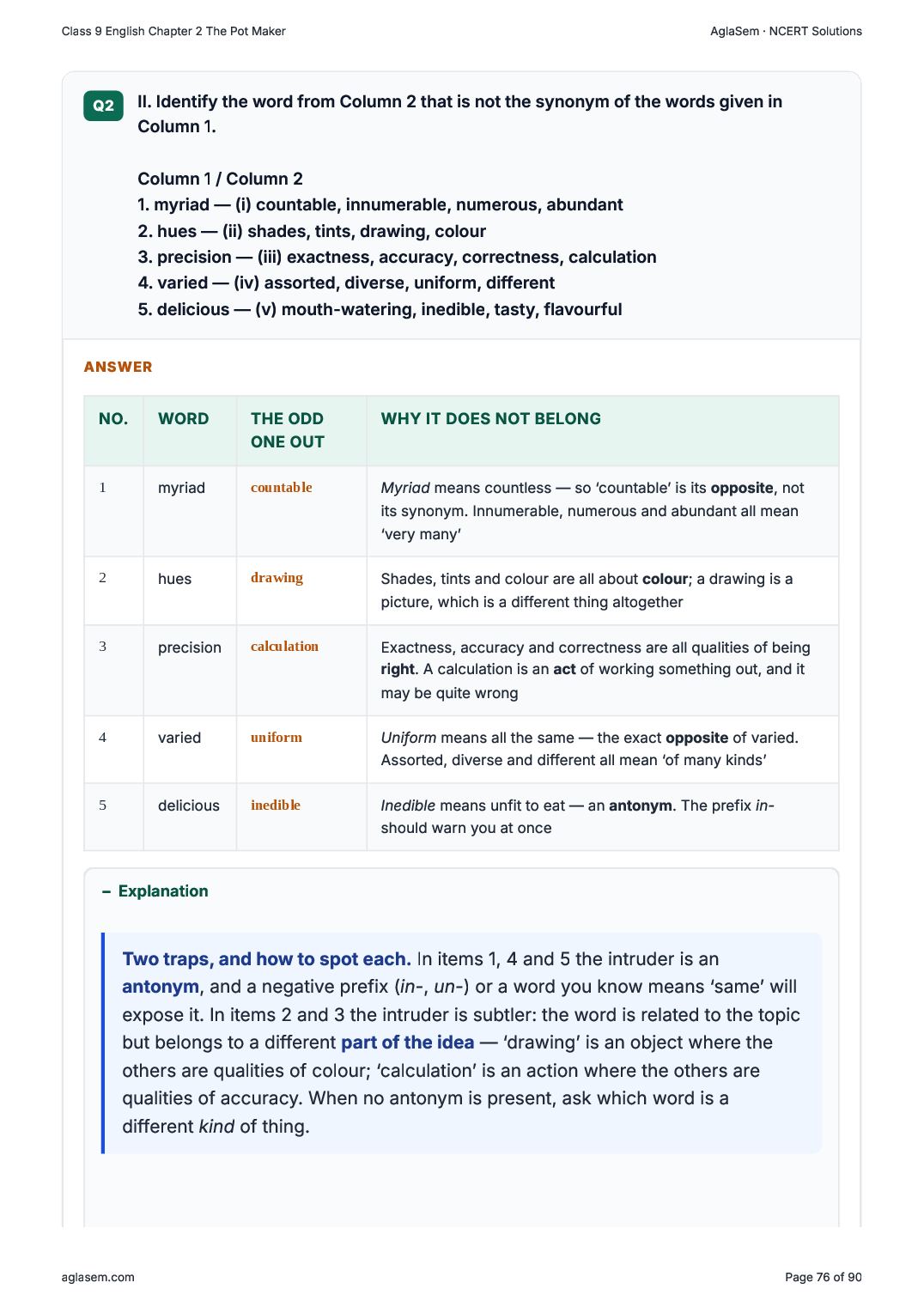
- II. Identify the word from Column 2 that is not the synonym of the words given in Column 1. Column 1 / Column 2 1. myriad — (i) countable, innumerable, numerous, abundant 2. hues — (ii) shades, tints, drawing, colour 3. precision — (iii) exactness, accuracy, correctness, calculation 4. varied — (iv) assorted, diverse, uniform, different 5. delicious — (v) mouth-watering, inedible, tasty, flavourful
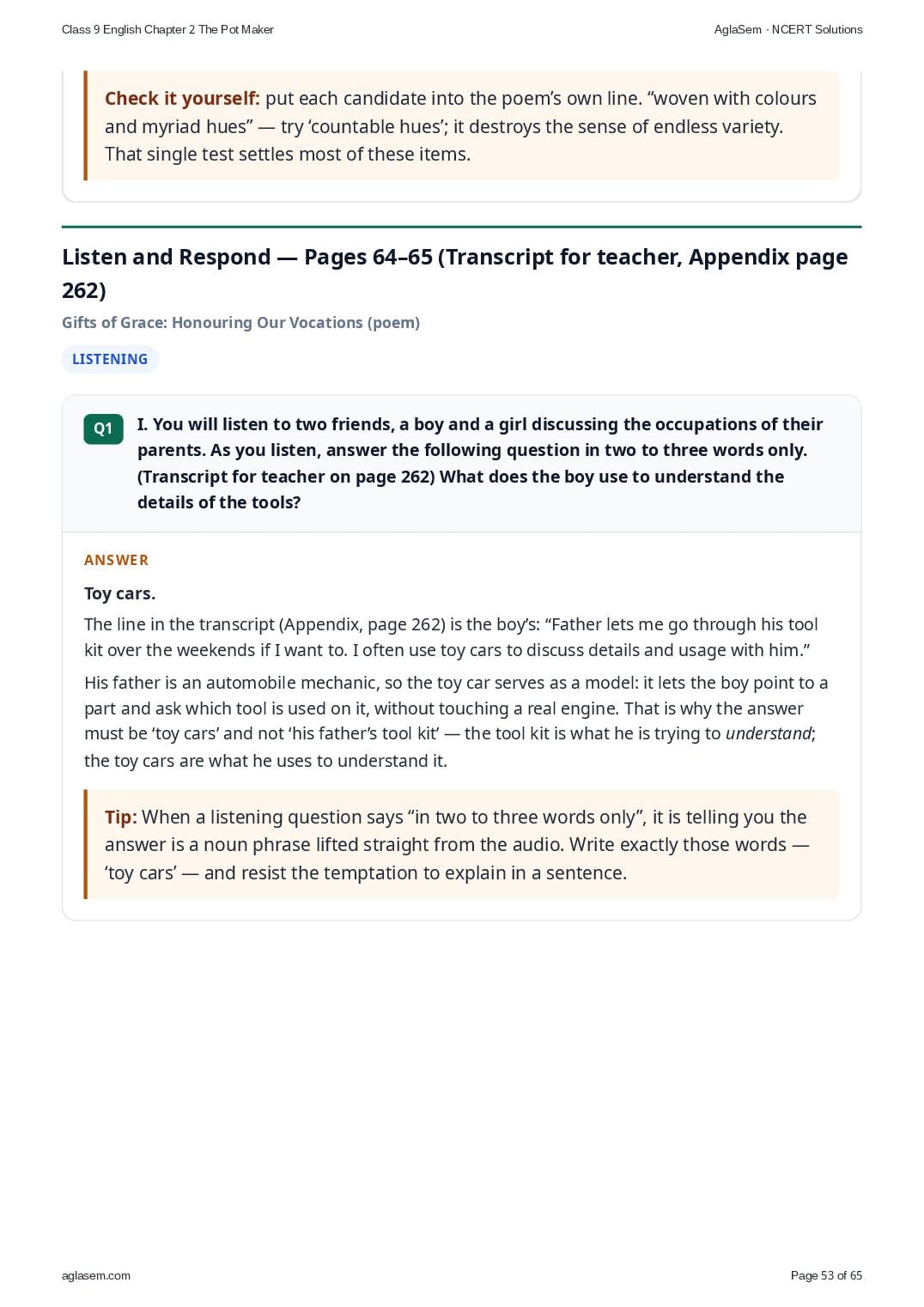
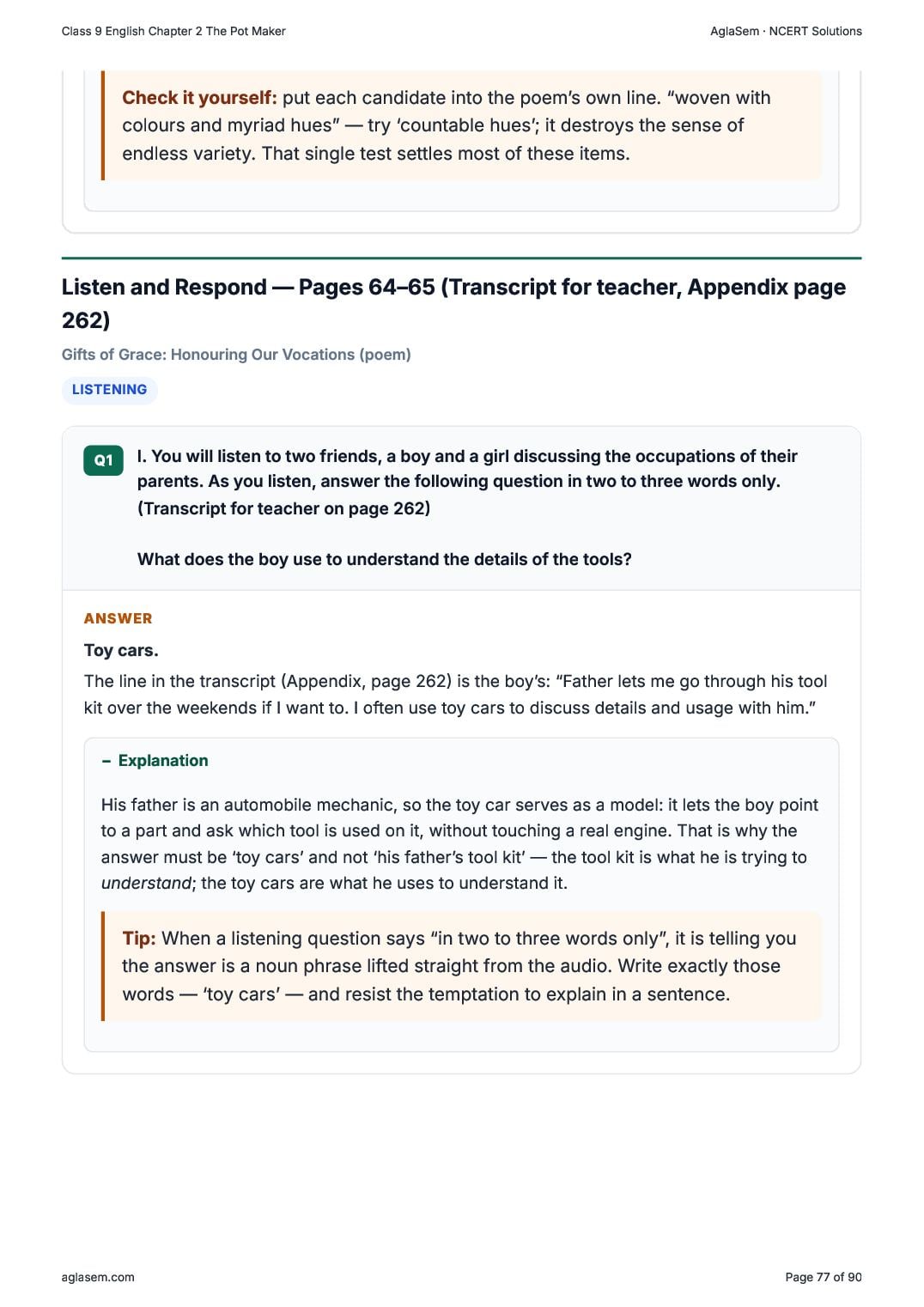
- I. You will listen to two friends, a boy and a girl discussing the occupations of their parents. As you listen, answer the following question in two to three words only. (Transcript for teacher on page 262) What does the boy use to understand the details of the tools?
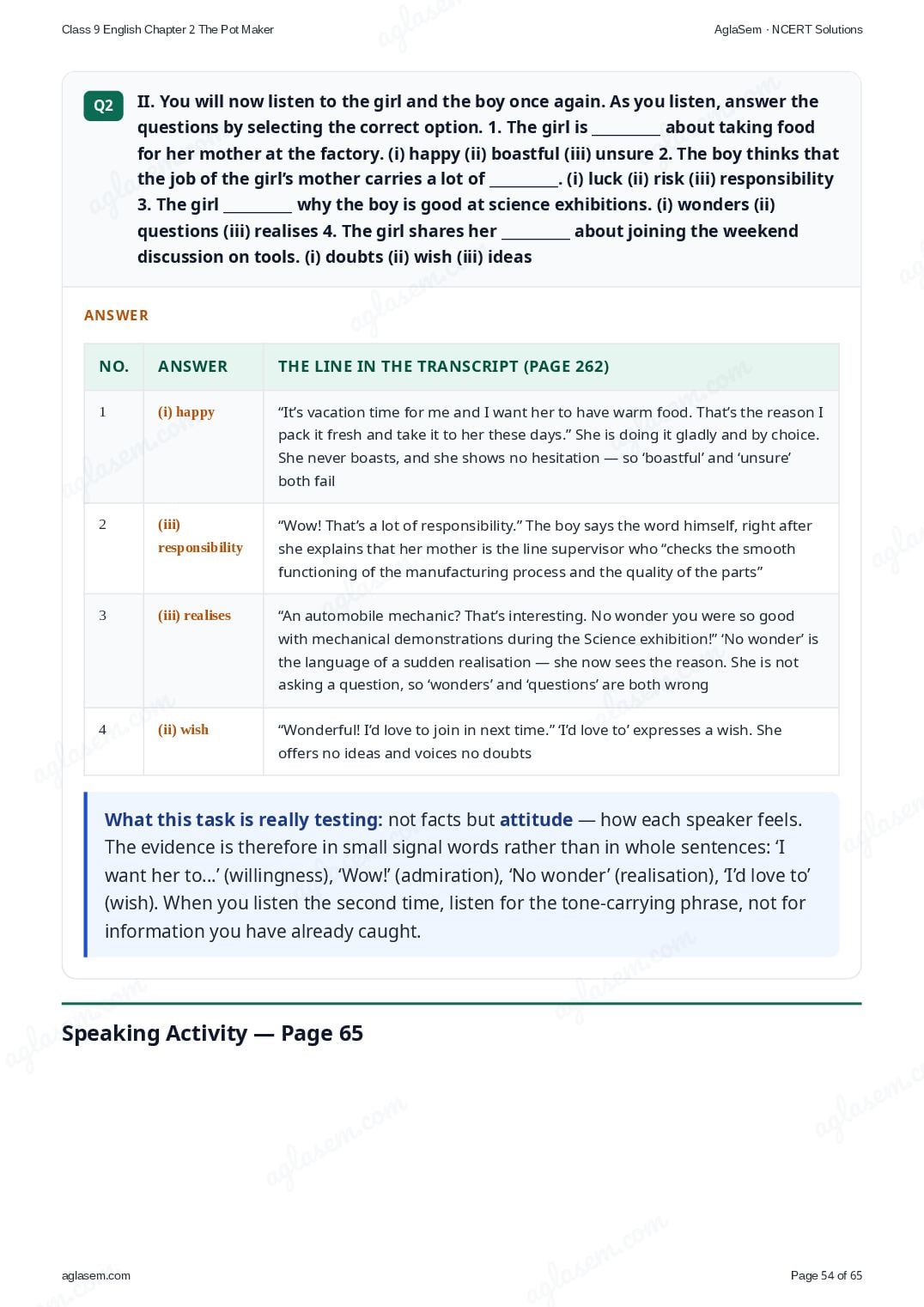
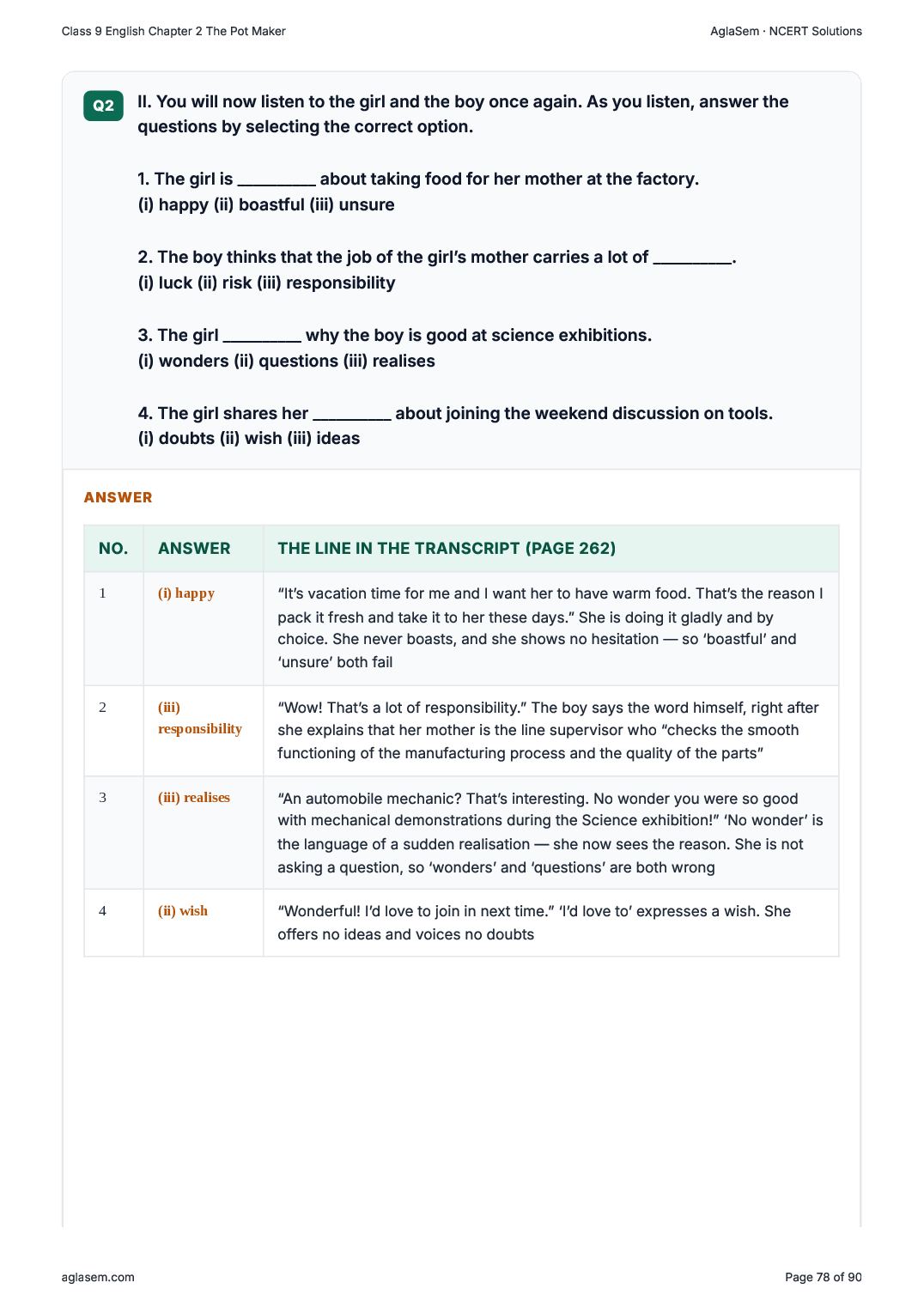
- II. You will now listen to the girl and the boy once again. As you listen, answer the questions by selecting the correct option. 1. The girl is __________ about taking food for her mother at the factory. (i) happy (ii) boastful (iii) unsure 2. The boy thinks that the job of the girl’s mother carries a lot of __________. (i) luck (ii) risk (iii) responsibility 3. The girl __________ why the boy is good at science exhibitions. (i) wonders (ii) questions (iii) realises 4. The girl shares her __________ about joining the weekend discussion on tools. (i) doubts (ii) wish (iii) ideas
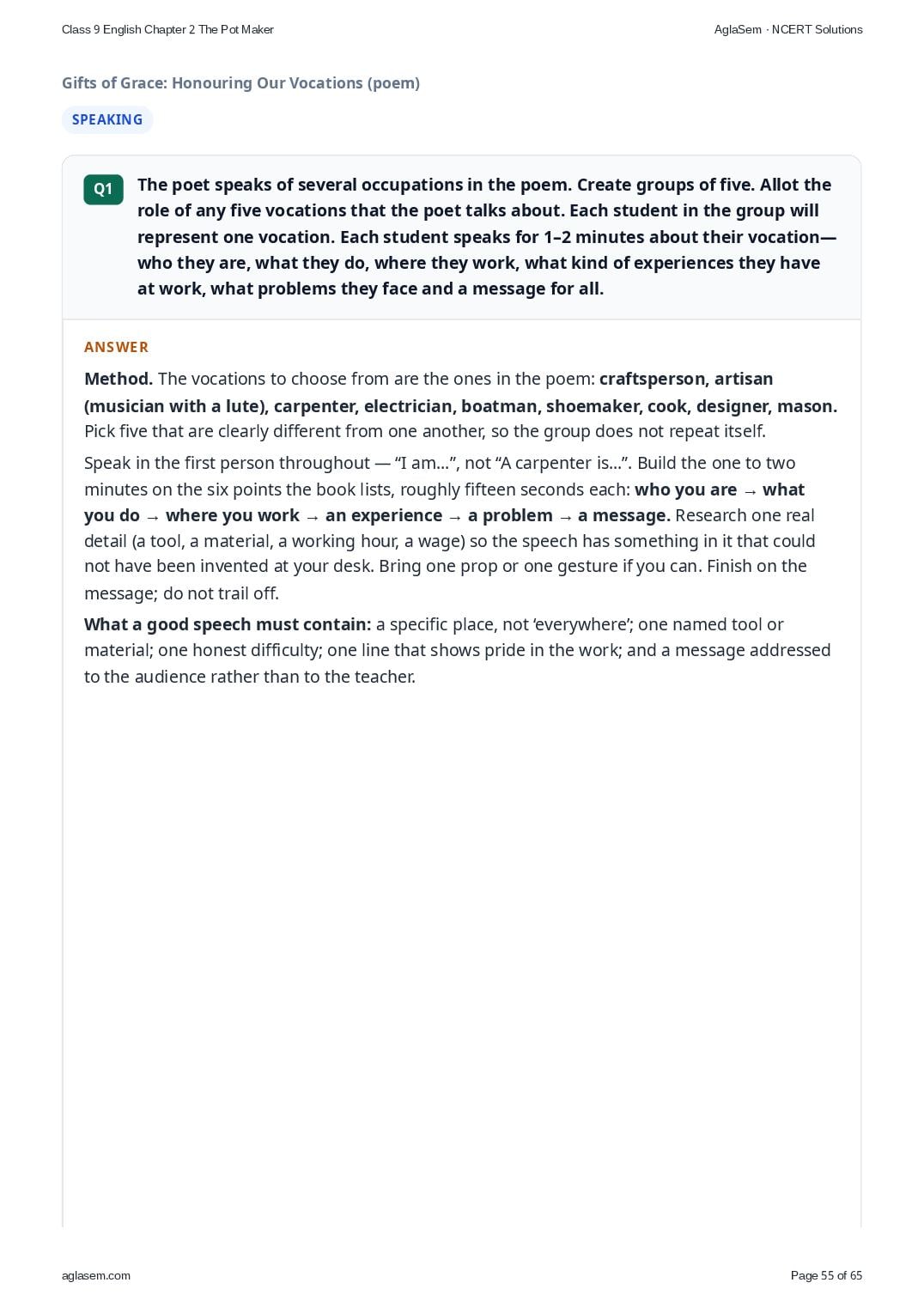
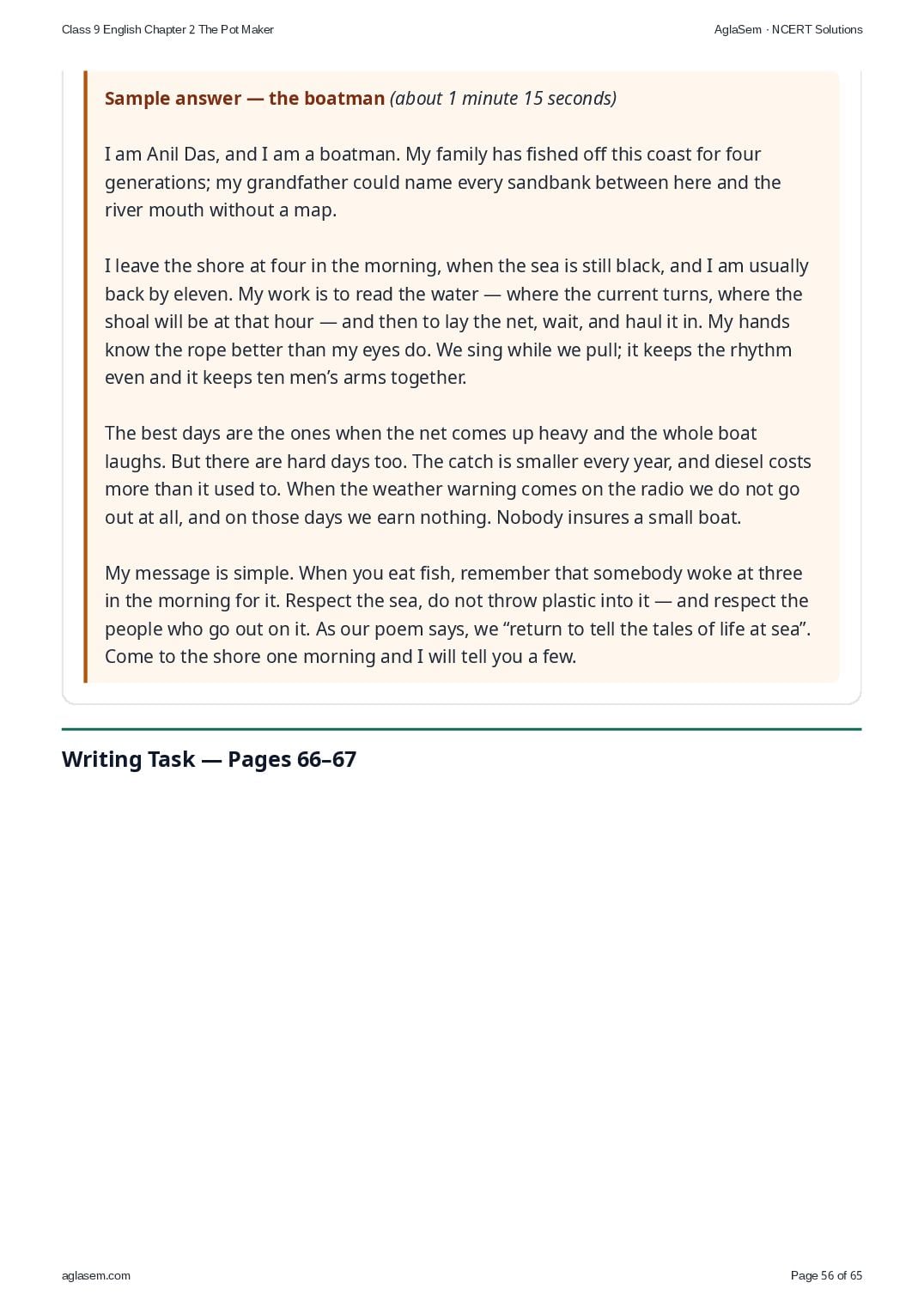
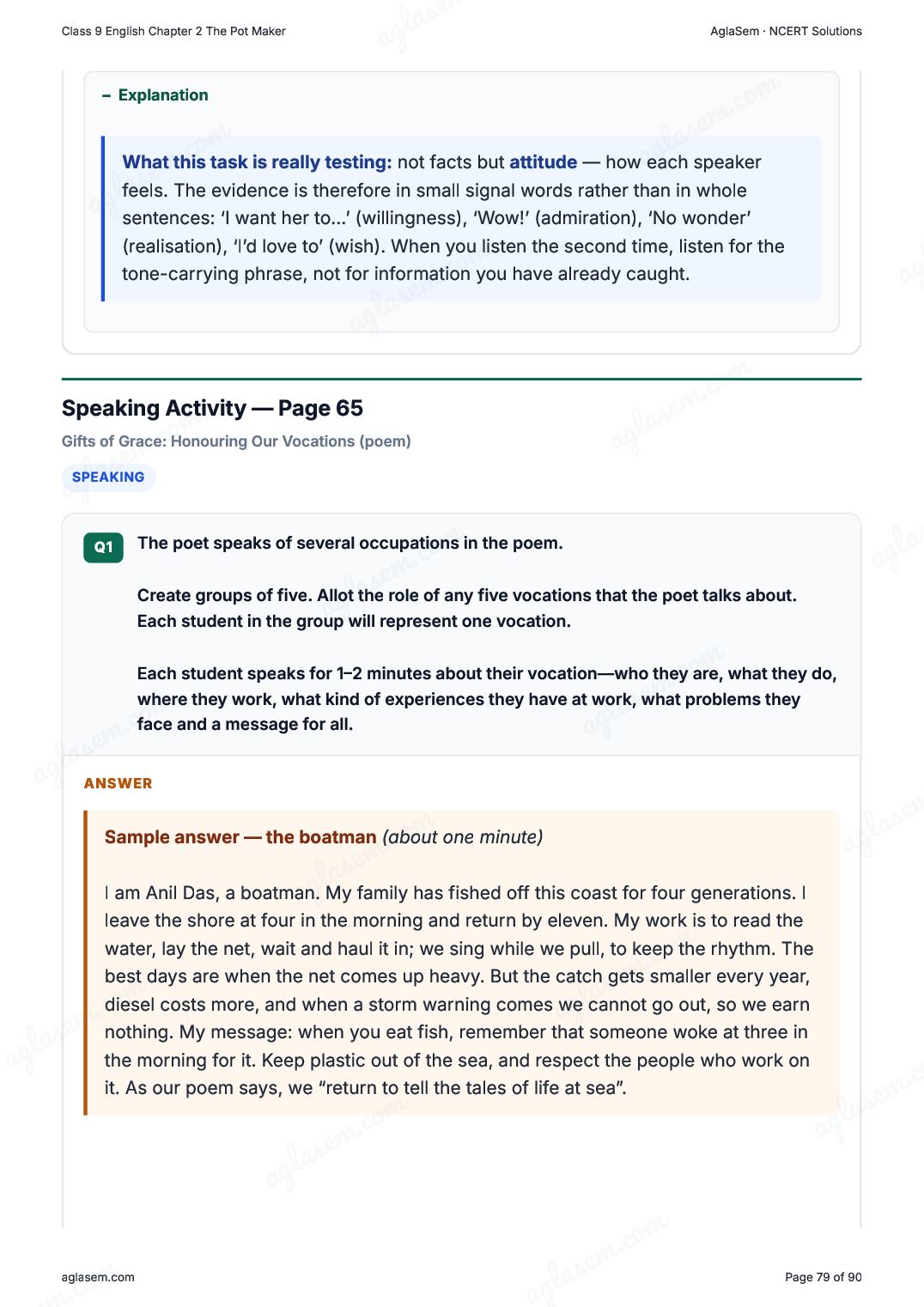
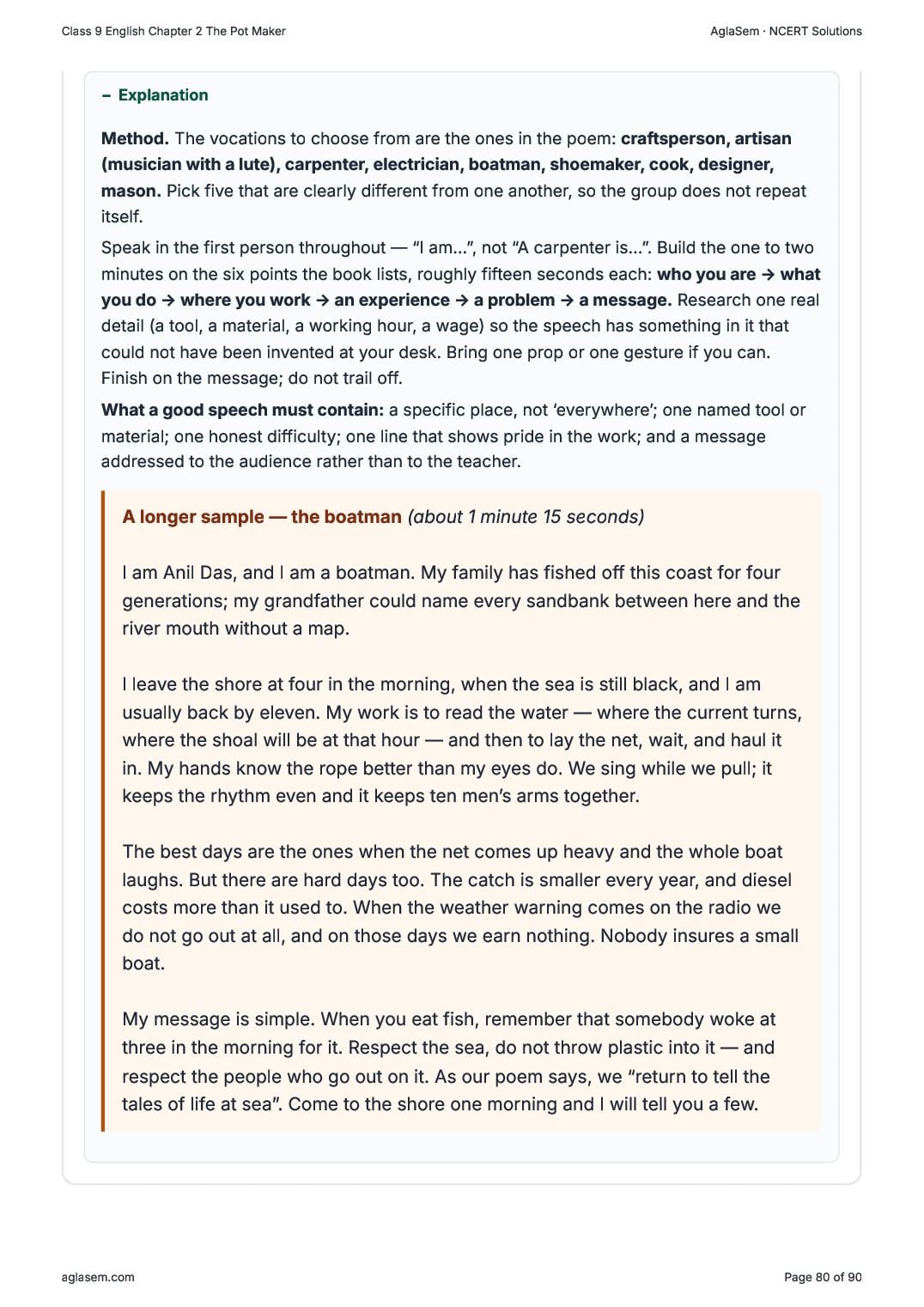
- The poet speaks of several occupations in the poem. Create groups of five. Allot the role of any five vocations that the poet talks about. Each student in the group will represent one vocation. Each student speaks for 1–2 minutes about their vocation—who they are, what they do, where they work, what kind of experiences they have at work, what problems they face and a message for all.
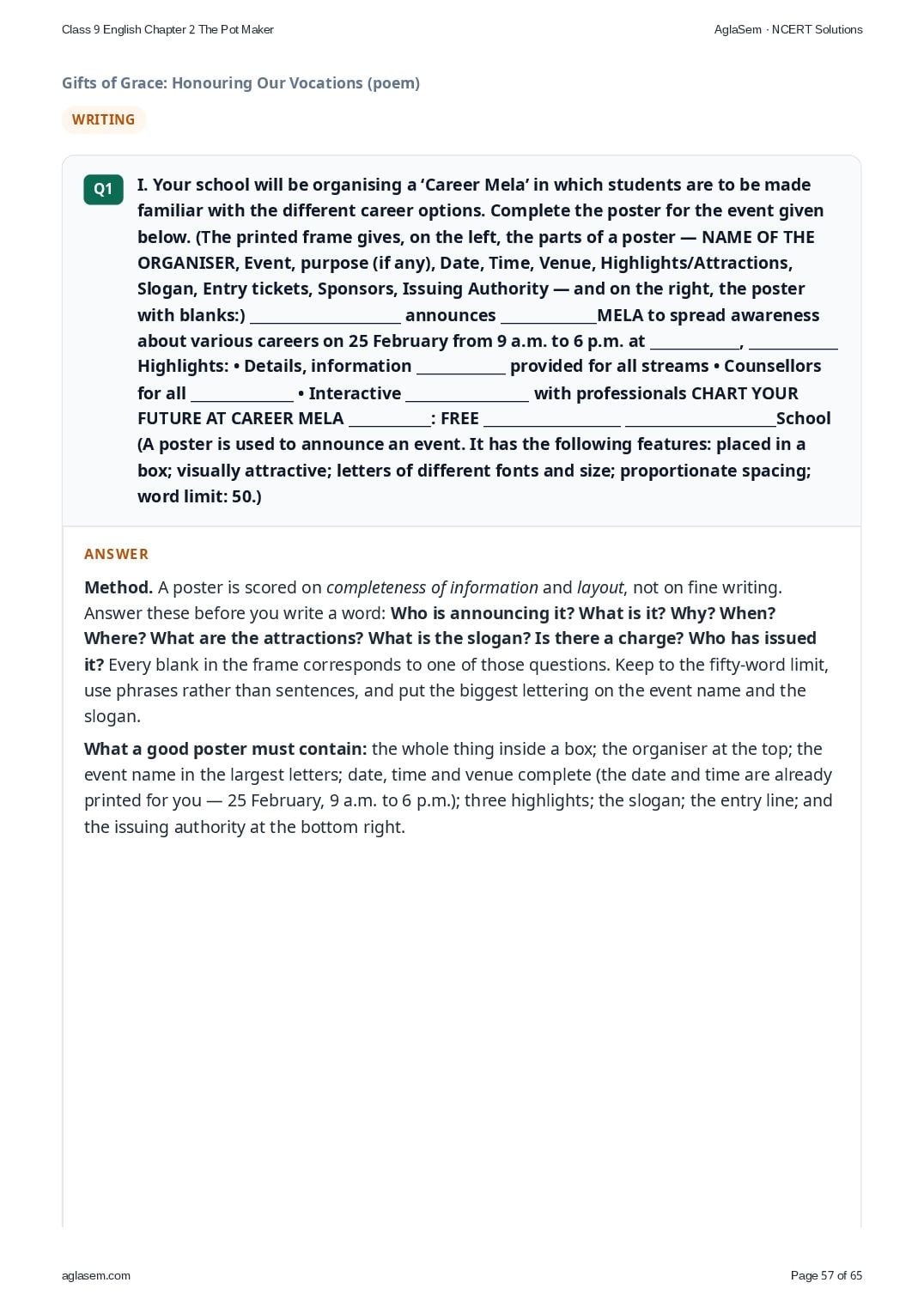
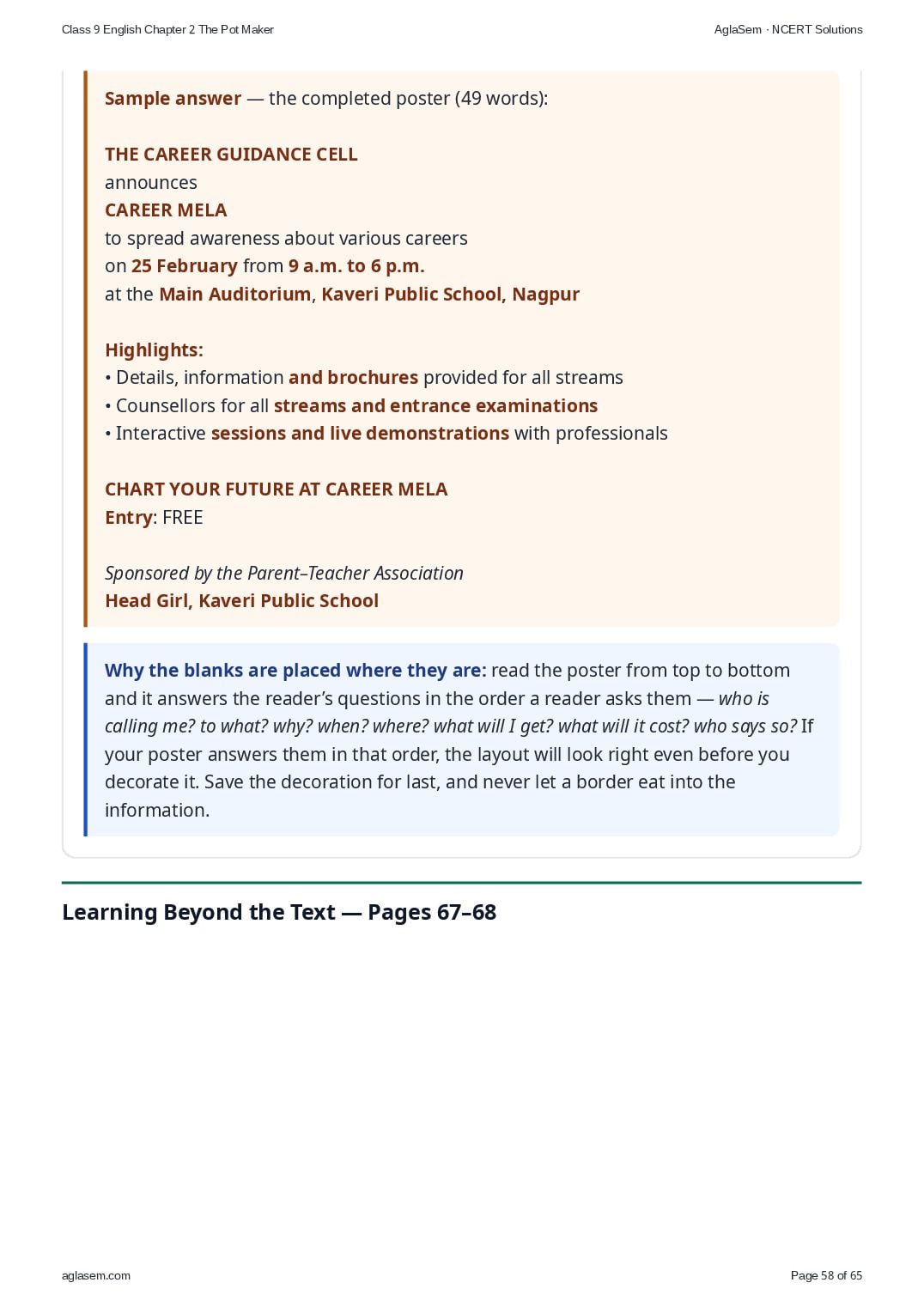
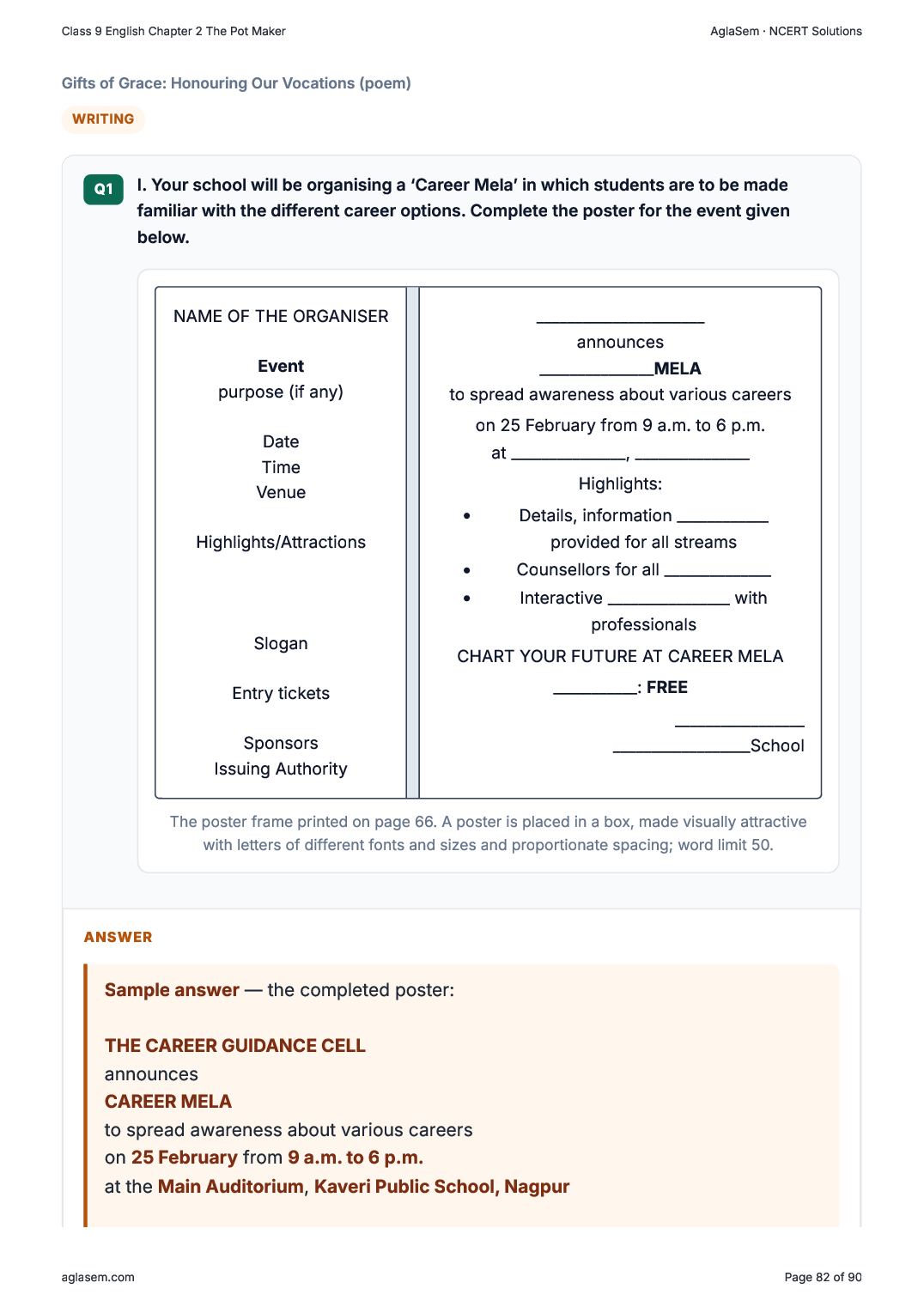
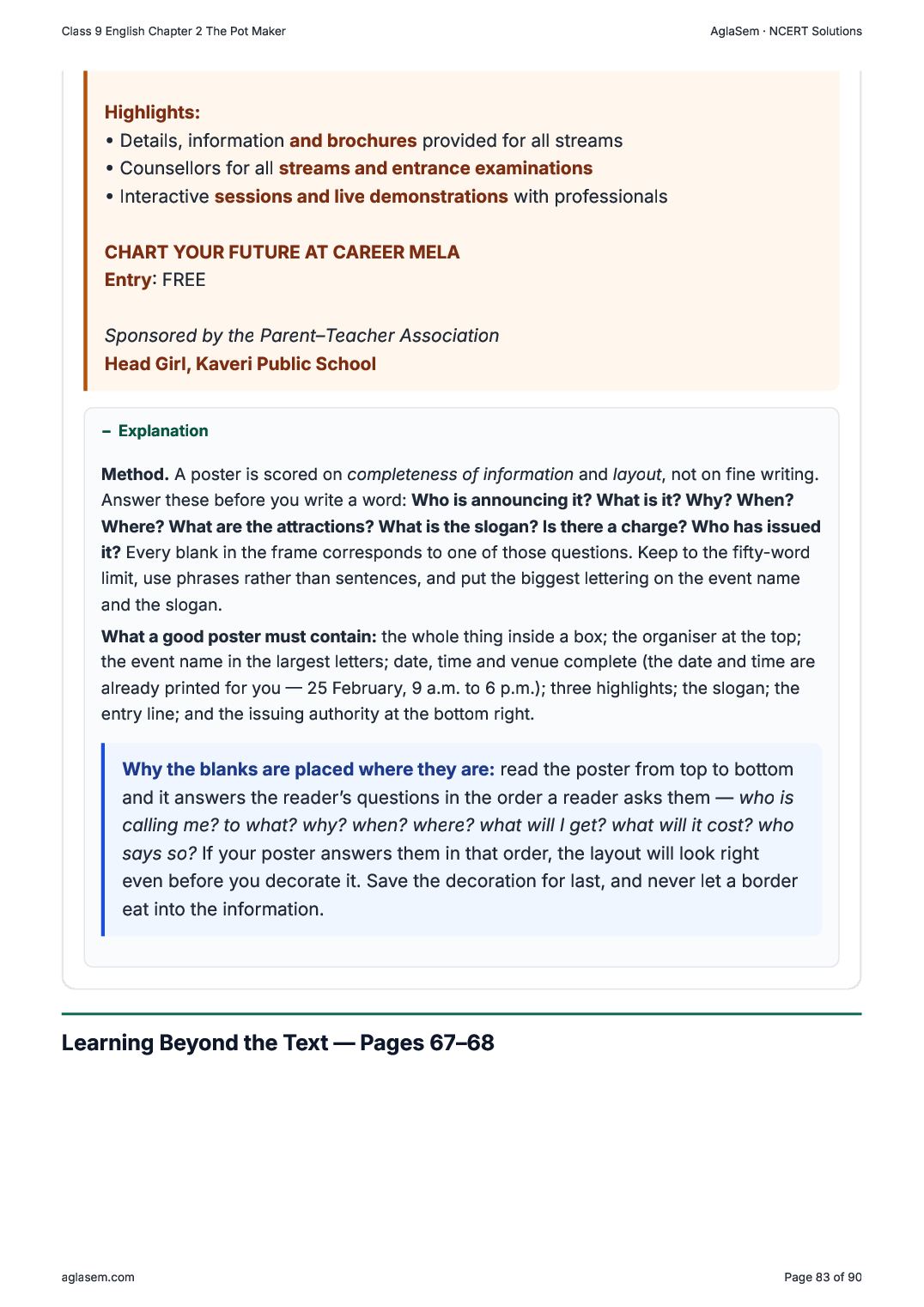
- I. Your school will be organising a ‘Career Mela’ in which students are to be made familiar with the different career options. Complete the poster for the event given below. (The printed frame gives, on the left, the parts of a poster — NAME OF THE ORGANISER, Event, purpose (if any), Date, Time, Venue, Highlights/Attractions, Slogan, Entry tickets, Sponsors, Issuing Authority — and on the right, the poster with blanks:) ______________________ announces ______________MELA to spread awareness about various careers on 25 February from 9 a.m. to 6 p.m. at _____________, _____________ Highlights: • Details, information _____________ provided for all streams • Counsellors for all _______________ • Interactive __________________ with professionals CHART YOUR FUTURE AT CAREER MELA ____________: FREE ____________________ ______________________School (A poster is used to announce an event. It has the following features: placed in a box; visually attractive; letters of different fonts and size; proportionate spacing; word limit: 50.)
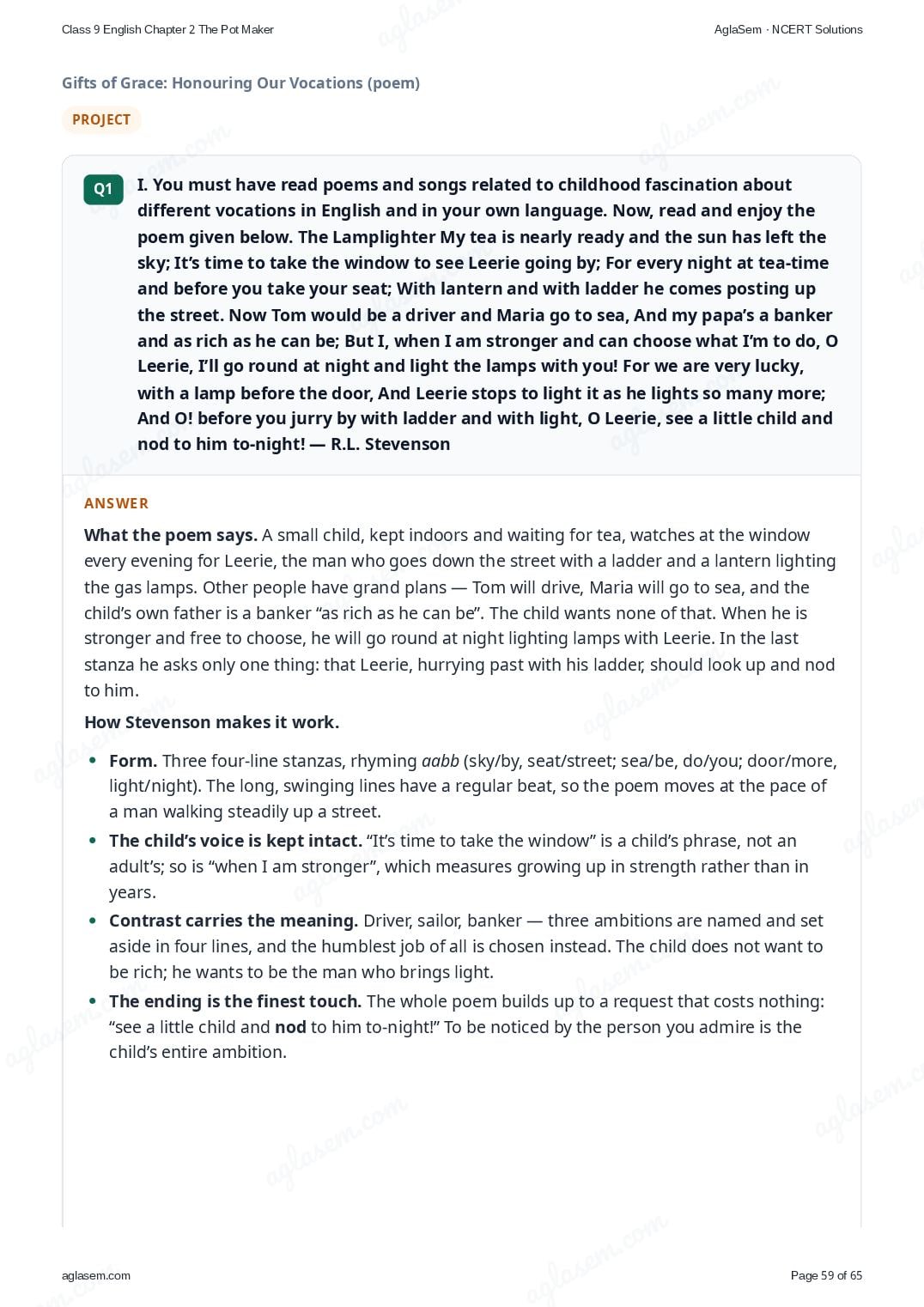
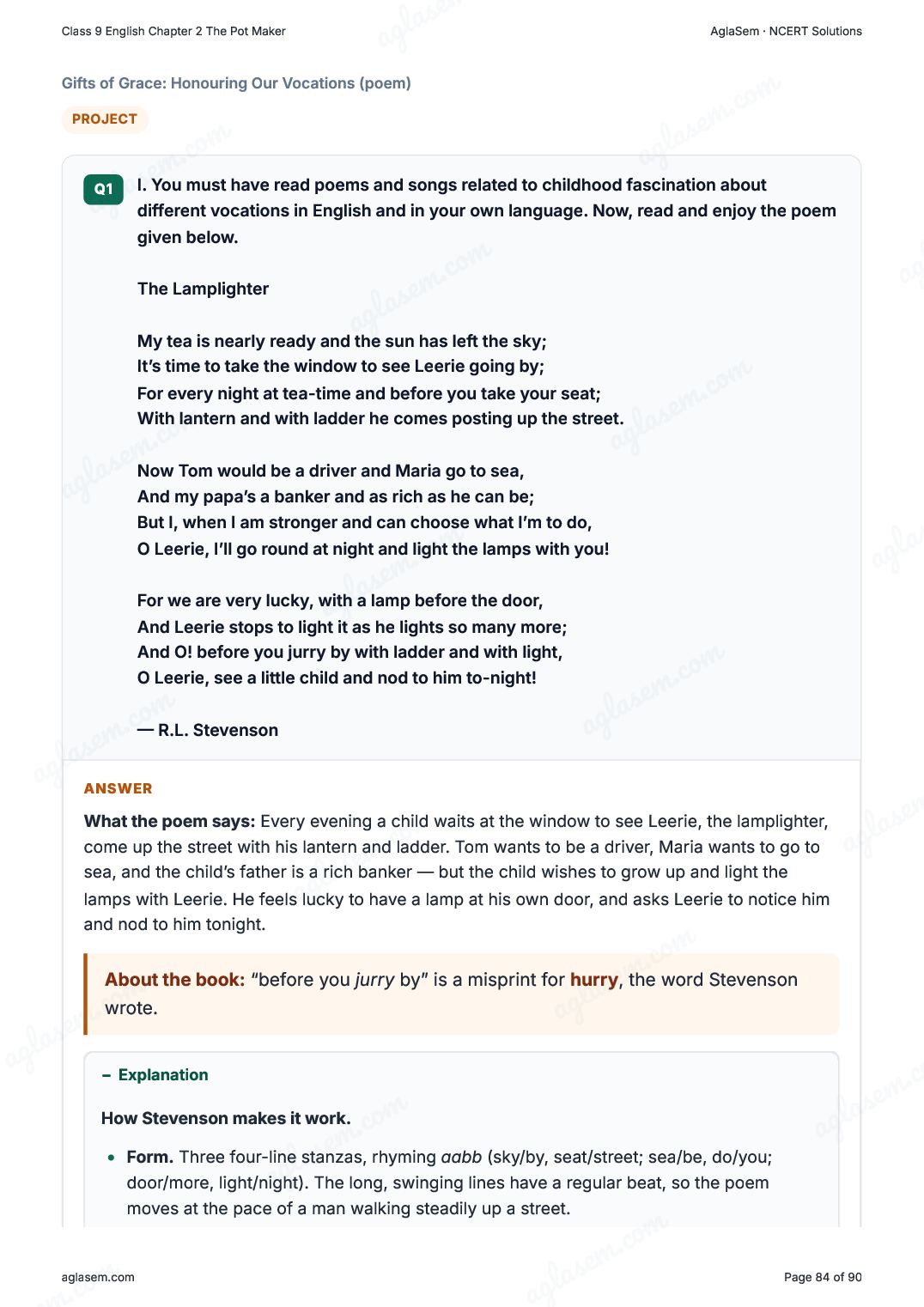
- I. You must have read poems and songs related to childhood fascination about different vocations in English and in your own language. Now, read and enjoy the poem given below. The Lamplighter My tea is nearly ready and the sun has left the sky; It’s time to take the window to see Leerie going by; For every night at tea-time and before you take your seat; With lantern and with ladder he comes posting up the street. Now Tom would be a driver and Maria go to sea, And my papa’s a banker and as rich as he can be; But I, when I am stronger and can choose what I’m to do, O Leerie, I’ll go round at night and light the lamps with you! For we are very lucky, with a lamp before the door, And Leerie stops to light it as he lights so many more; And O! before you jurry by with ladder and with light, O Leerie, see a little child and nod to him to-night! — R.L. Stevenson
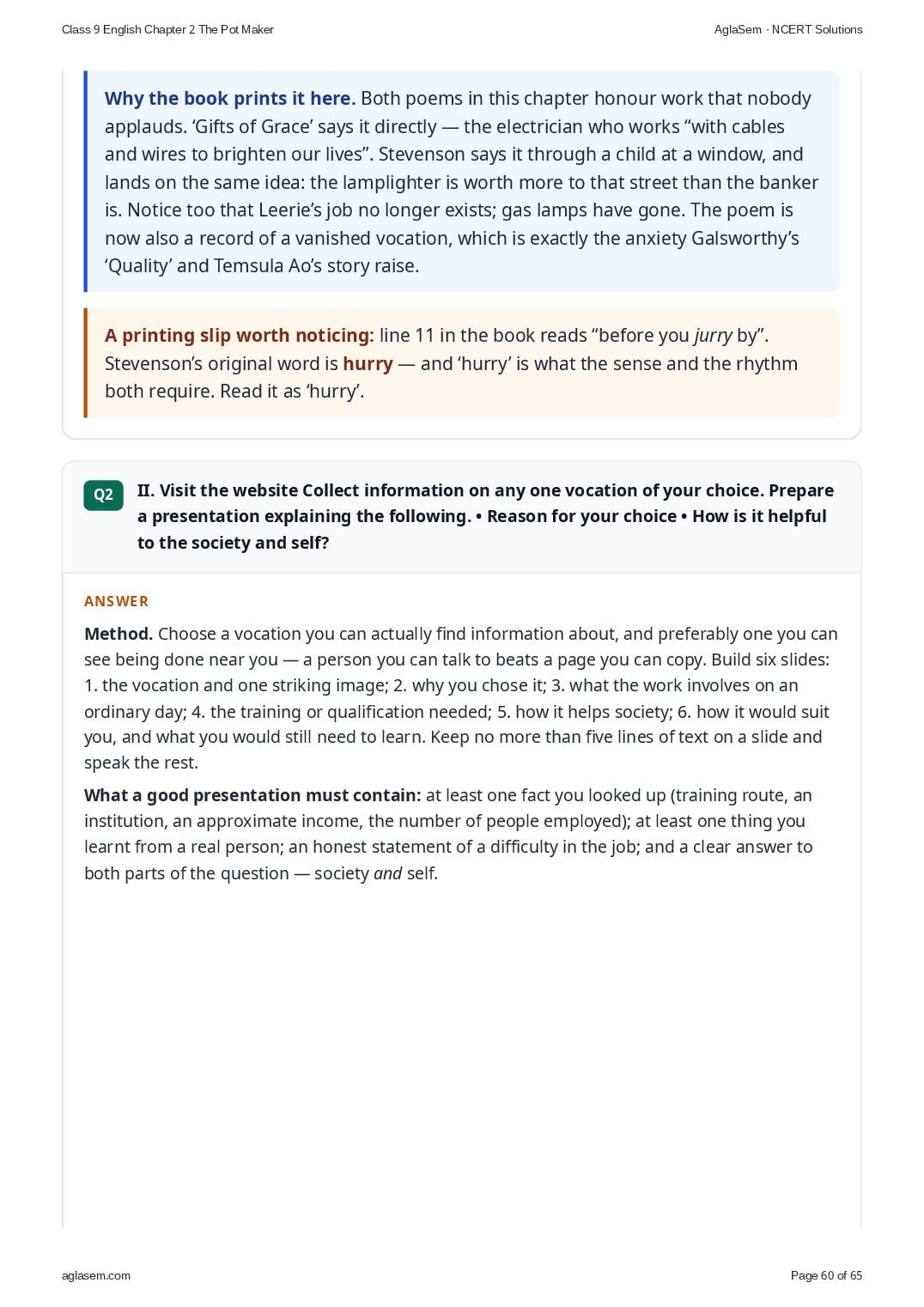
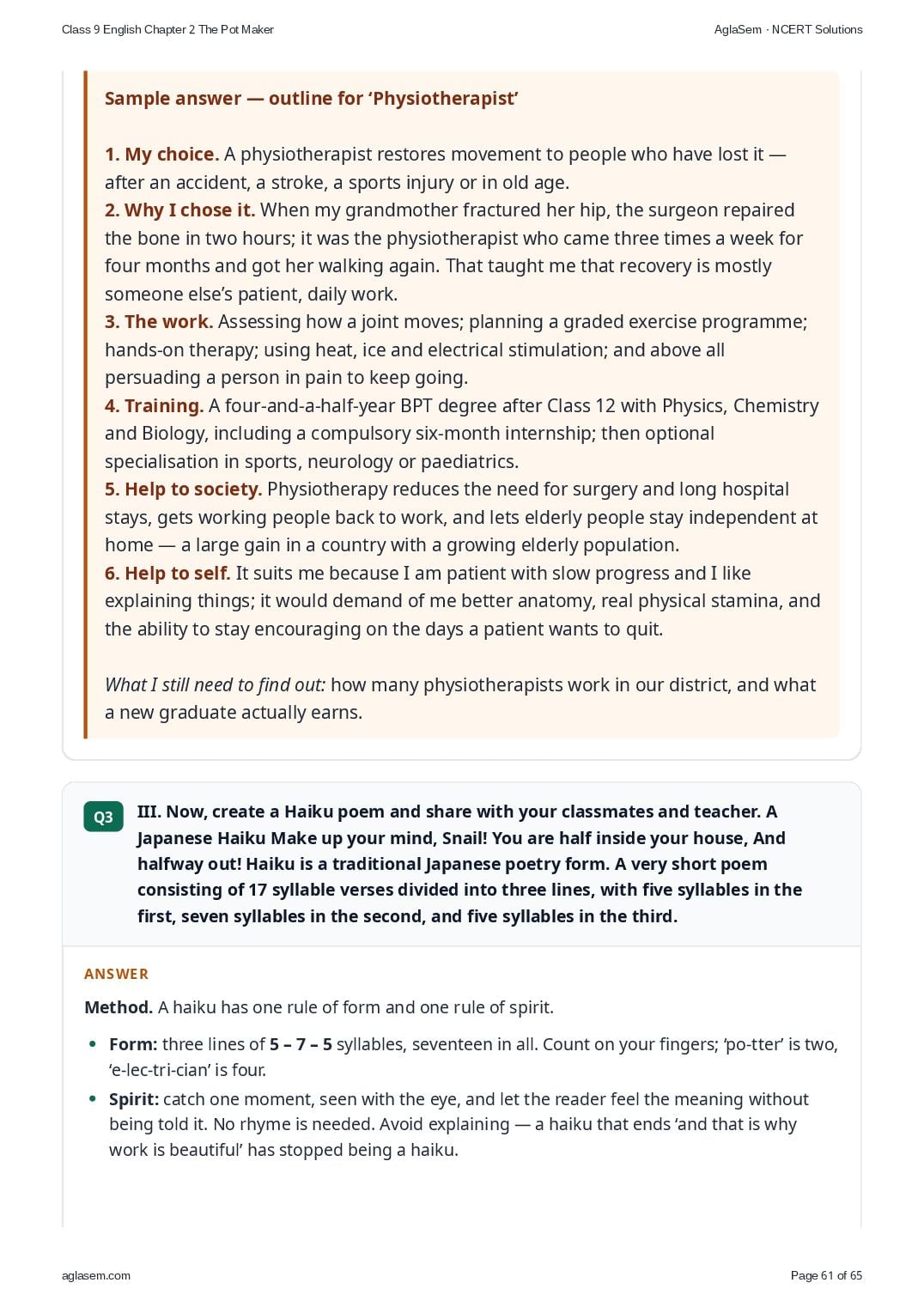
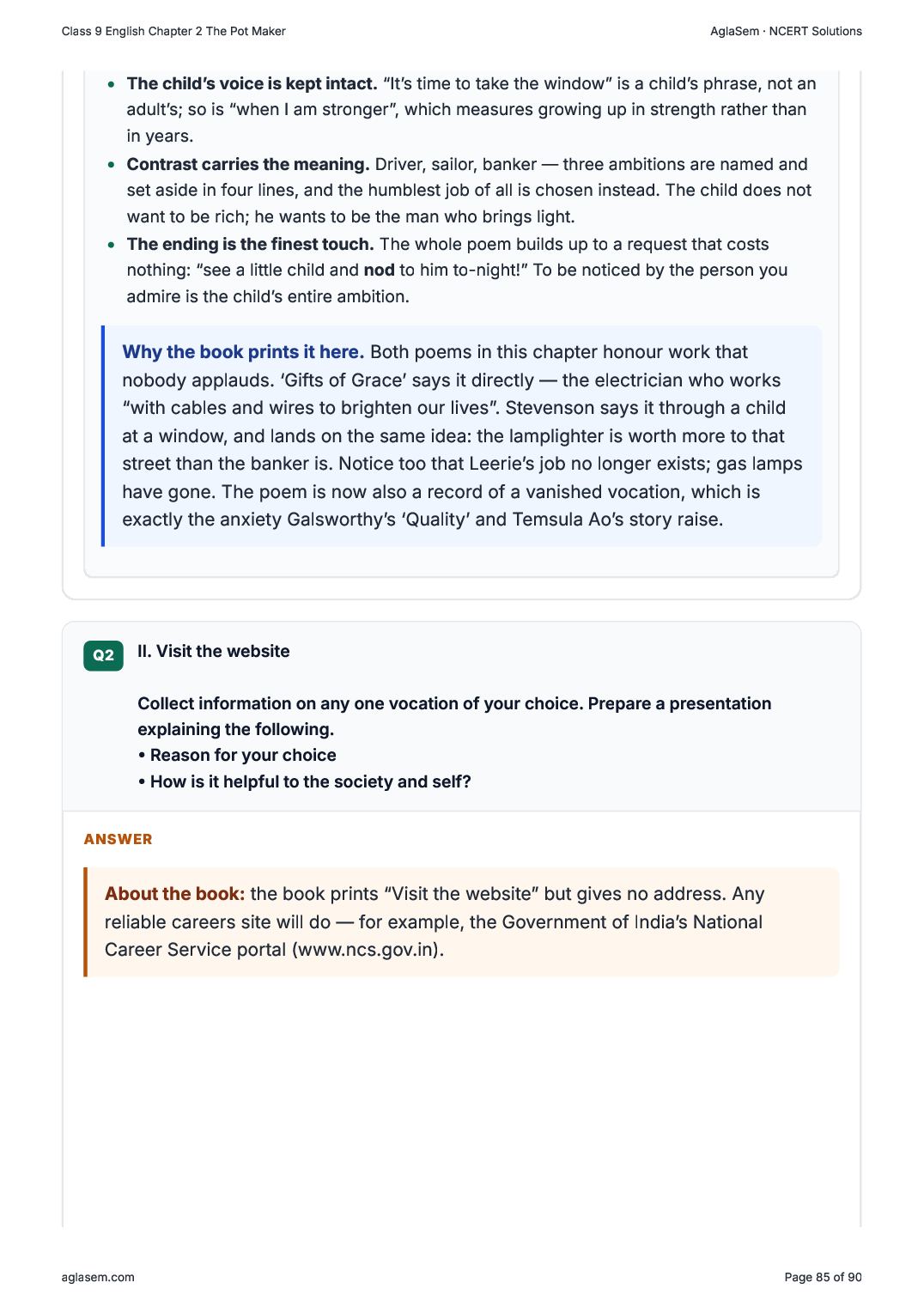
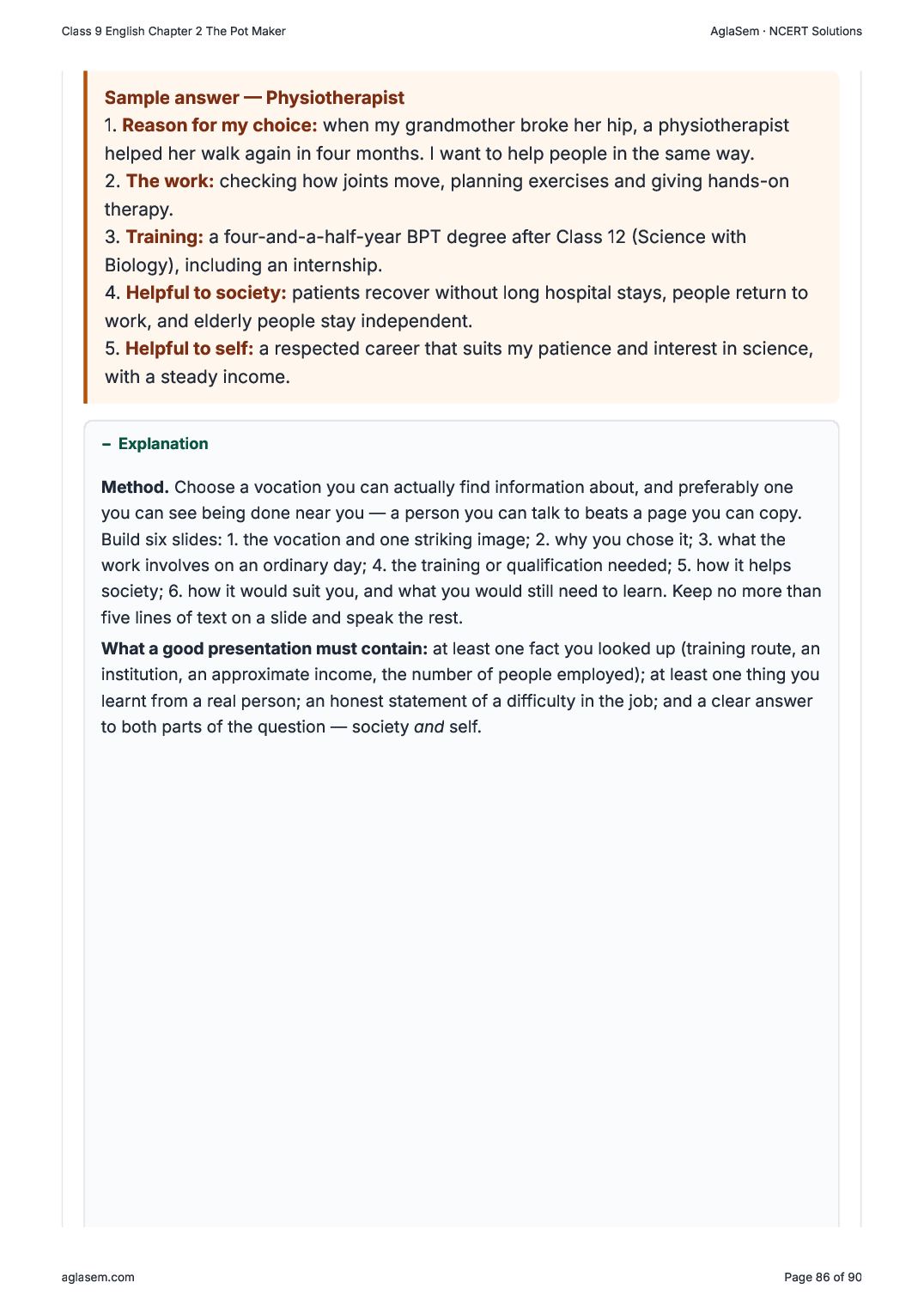
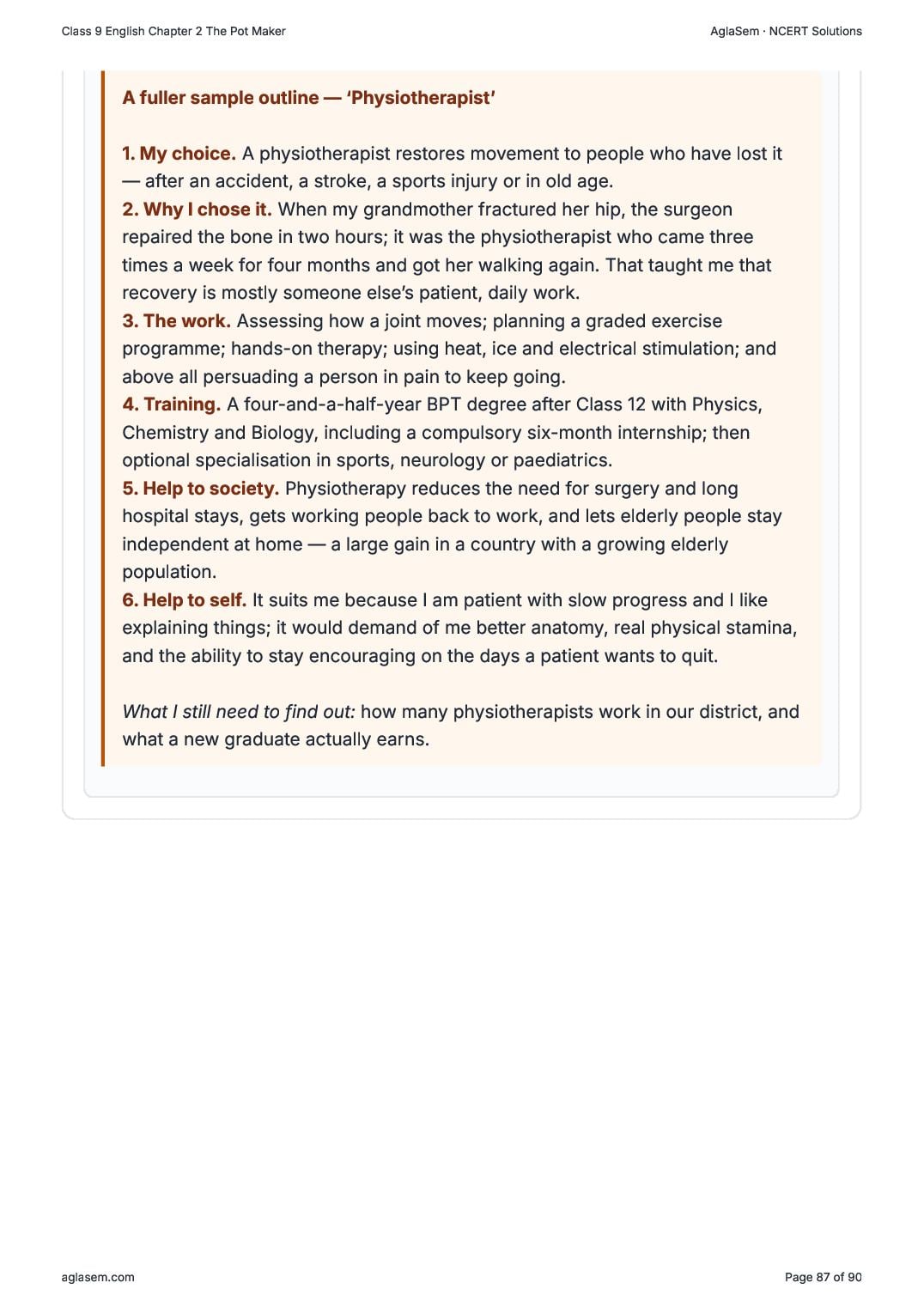
- II. Visit the website Collect information on any one vocation of your choice. Prepare a presentation explaining the following. • Reason for your choice • How is it helpful to the society and self?
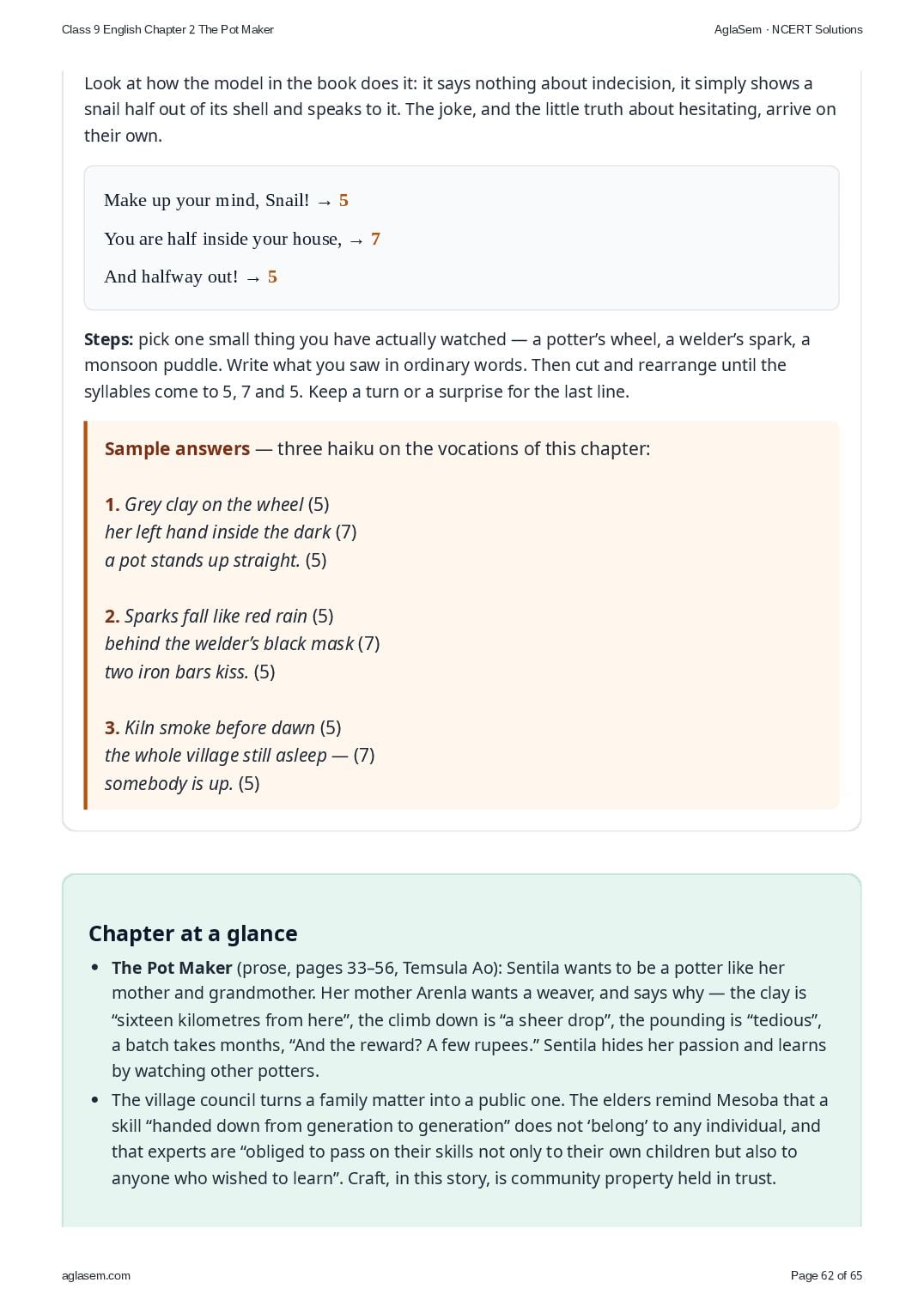
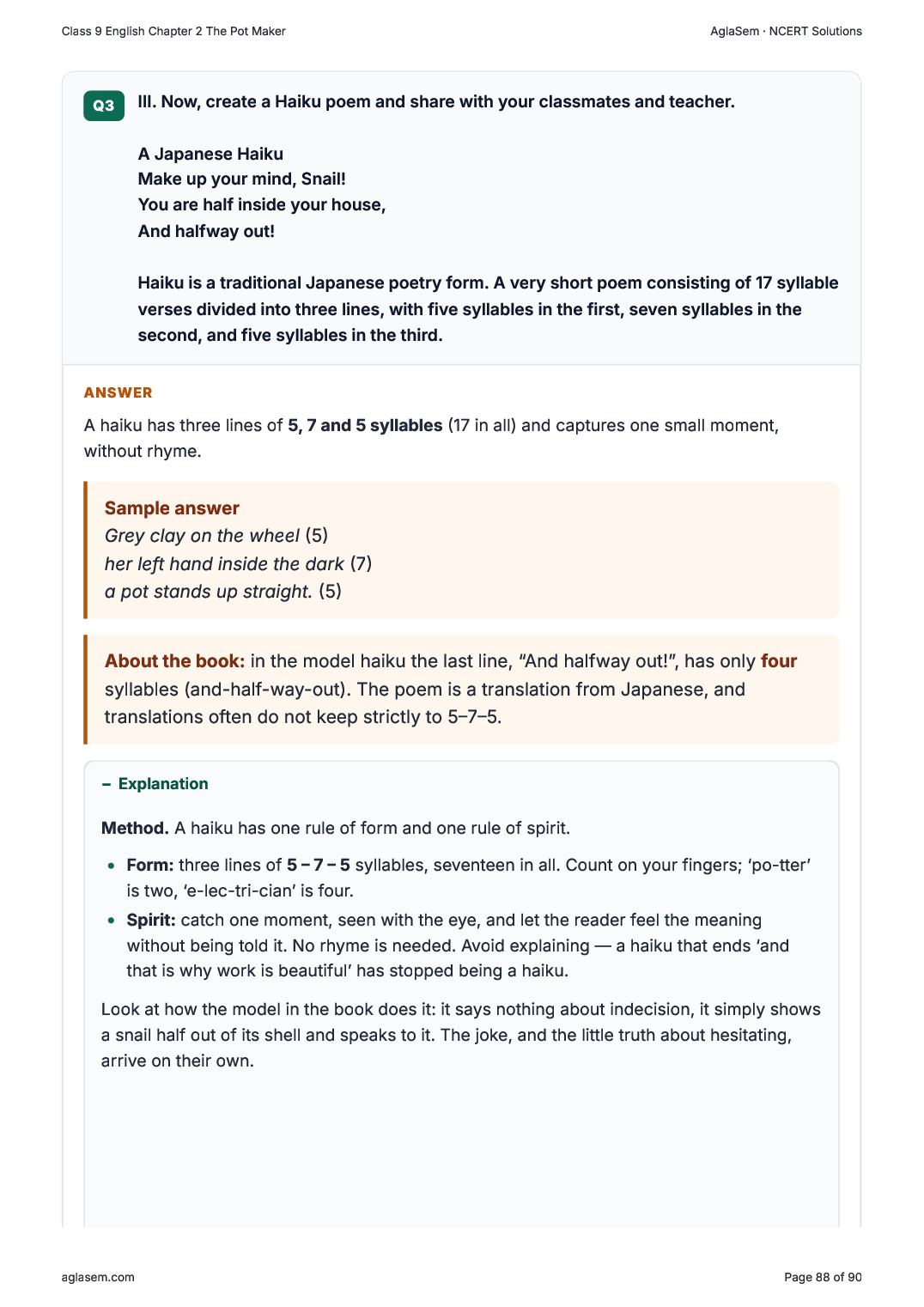
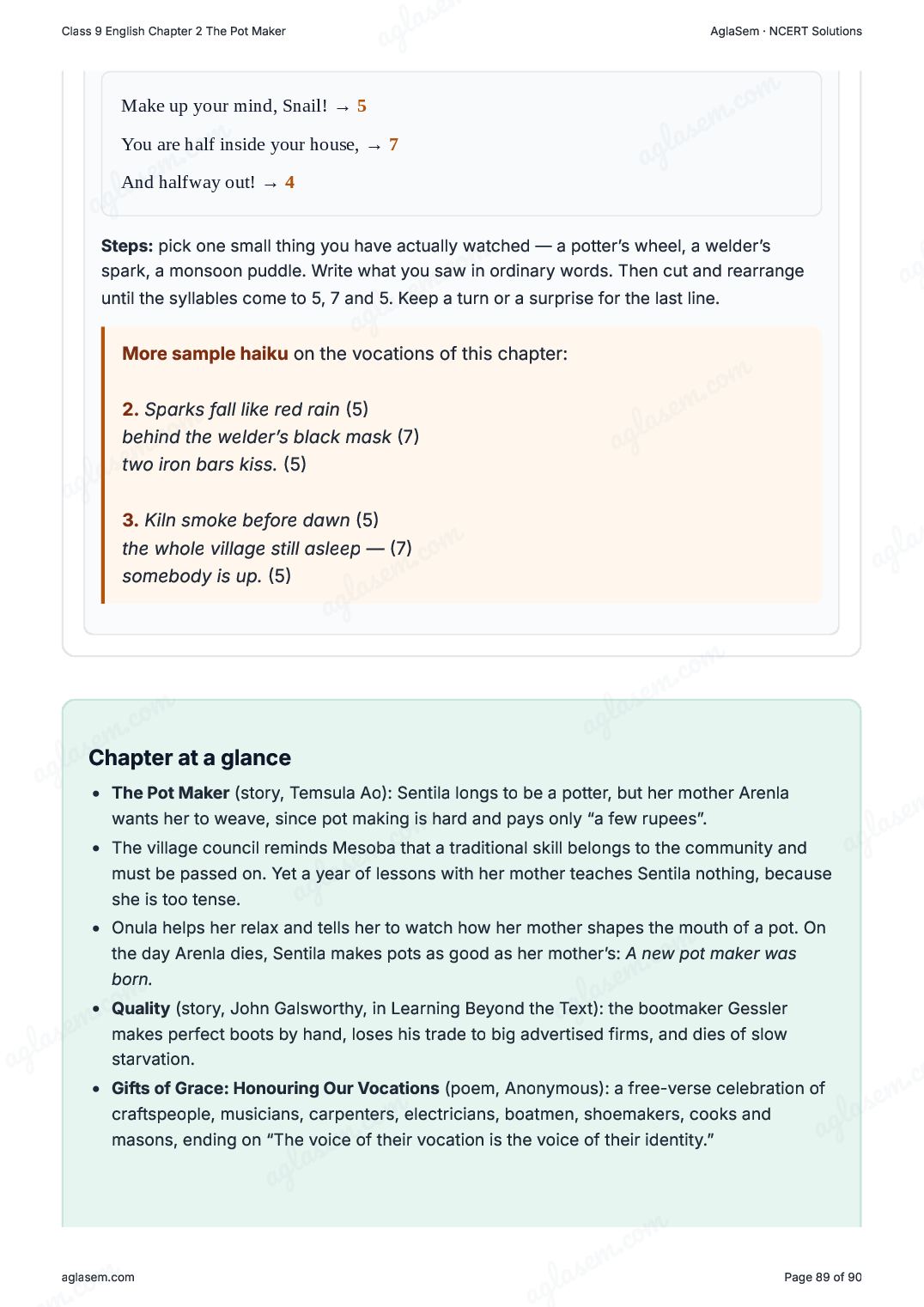
- III. Now, create a Haiku poem and share with your classmates and teacher. A Japanese Haiku Make up your mind, Snail! You are half inside your house, And halfway out! Haiku is a traditional Japanese poetry form. A very short poem consisting of 17 syllable verses divided into three lines, with five syllables in the first, seven syllables in the second, and five syllables in the third.
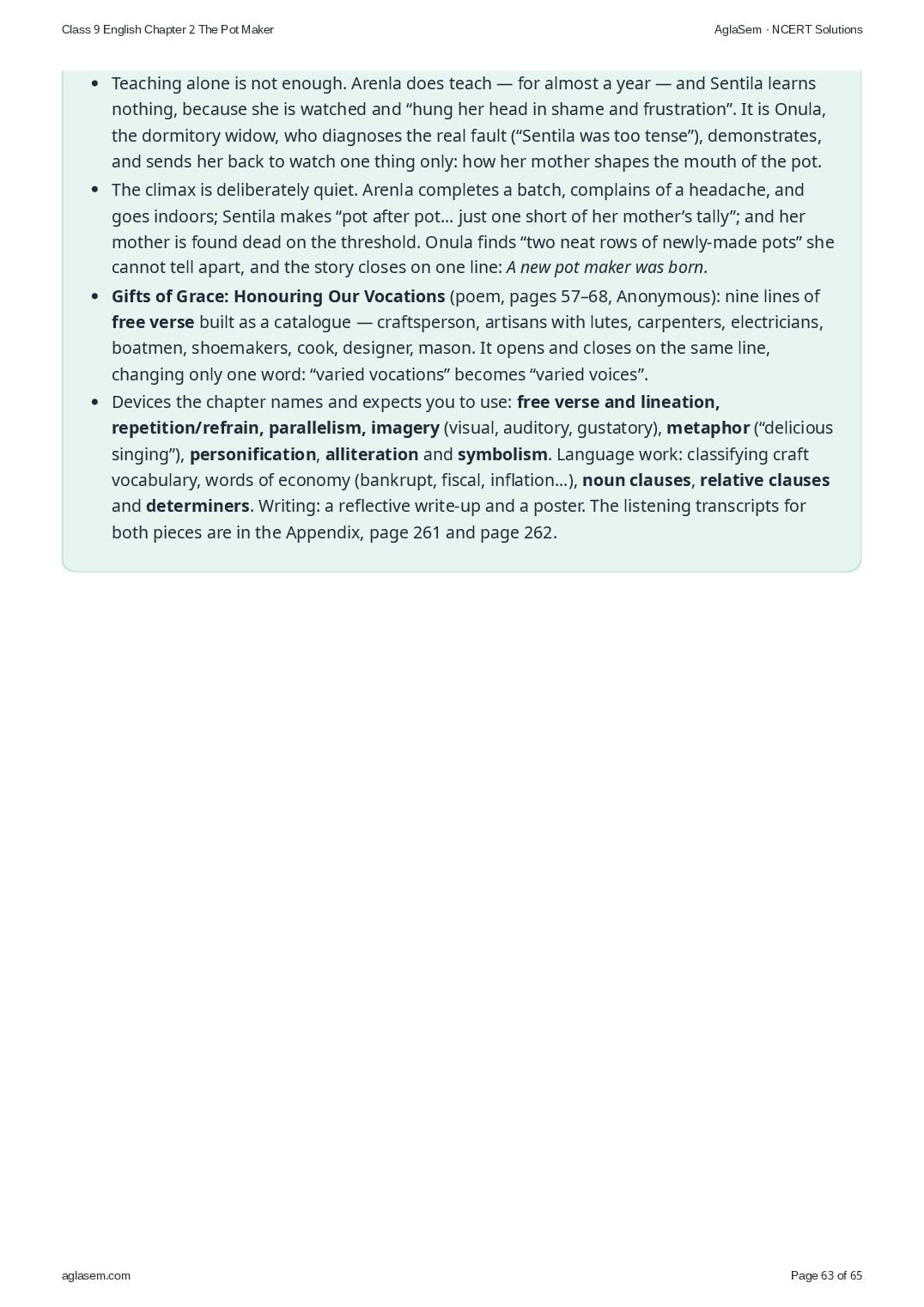
Chapter at a Glance
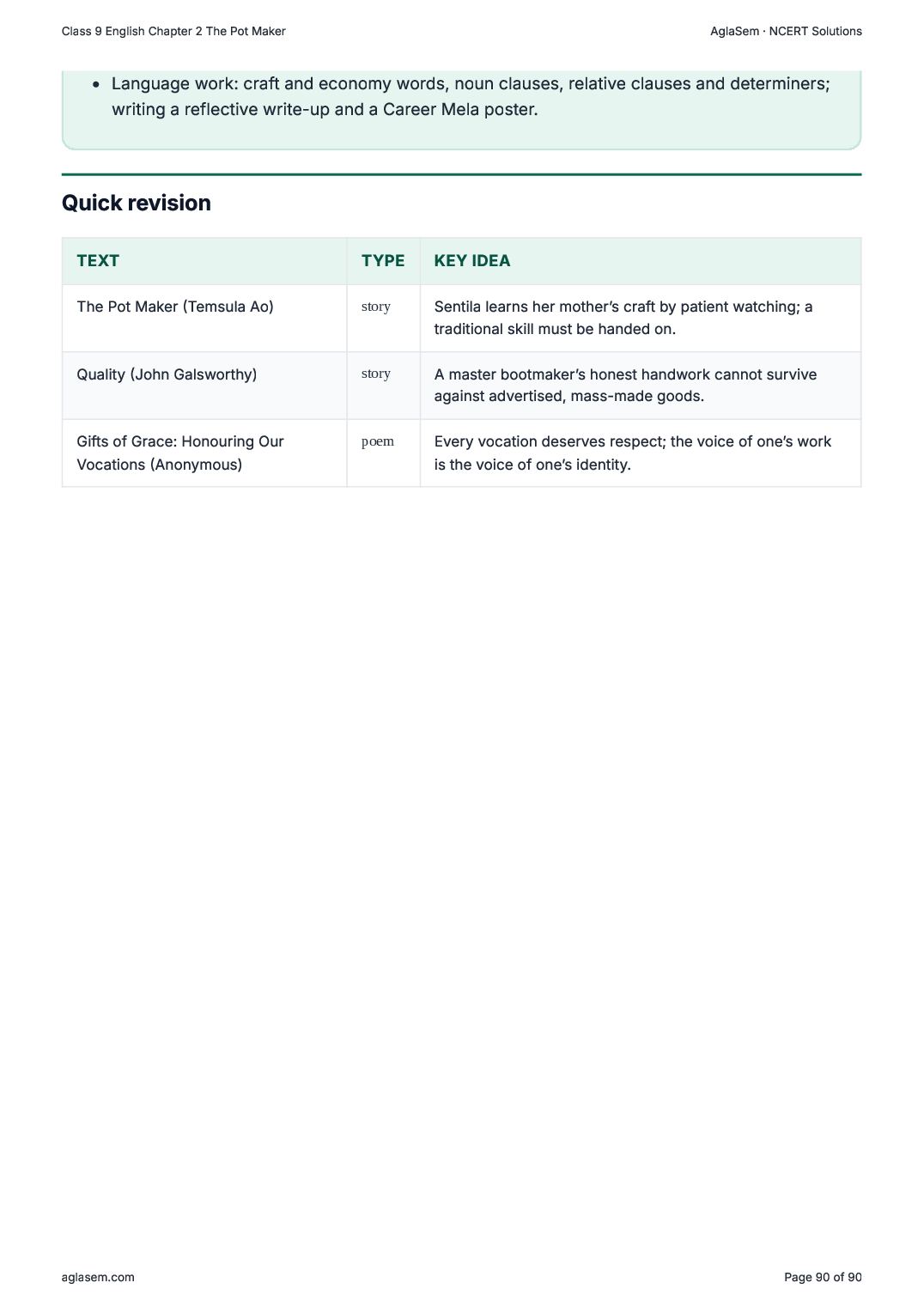
- The Pot Maker (prose, pages 33–56, Temsula Ao): Sentila wants to be a potter like her mother and grandmother. Her mother Arenla wants a weaver, and says why — the clay is “sixteen kilometres from here”, the climb down is “a sheer drop”, the pounding is “tedious”, a batch takes months, “And the reward? A few rupees.” Sentila hides her passion and learns by watching other potters.
- The village council turns a family matter into a public one. The elders remind Mesoba that a skill “handed down from generation to generation” does not ‘belong’ to any individual, and that experts are “obliged to pass on their skills not only to their own children but also to anyone who wished to learn”. Craft, in this story, is community property held in trust.
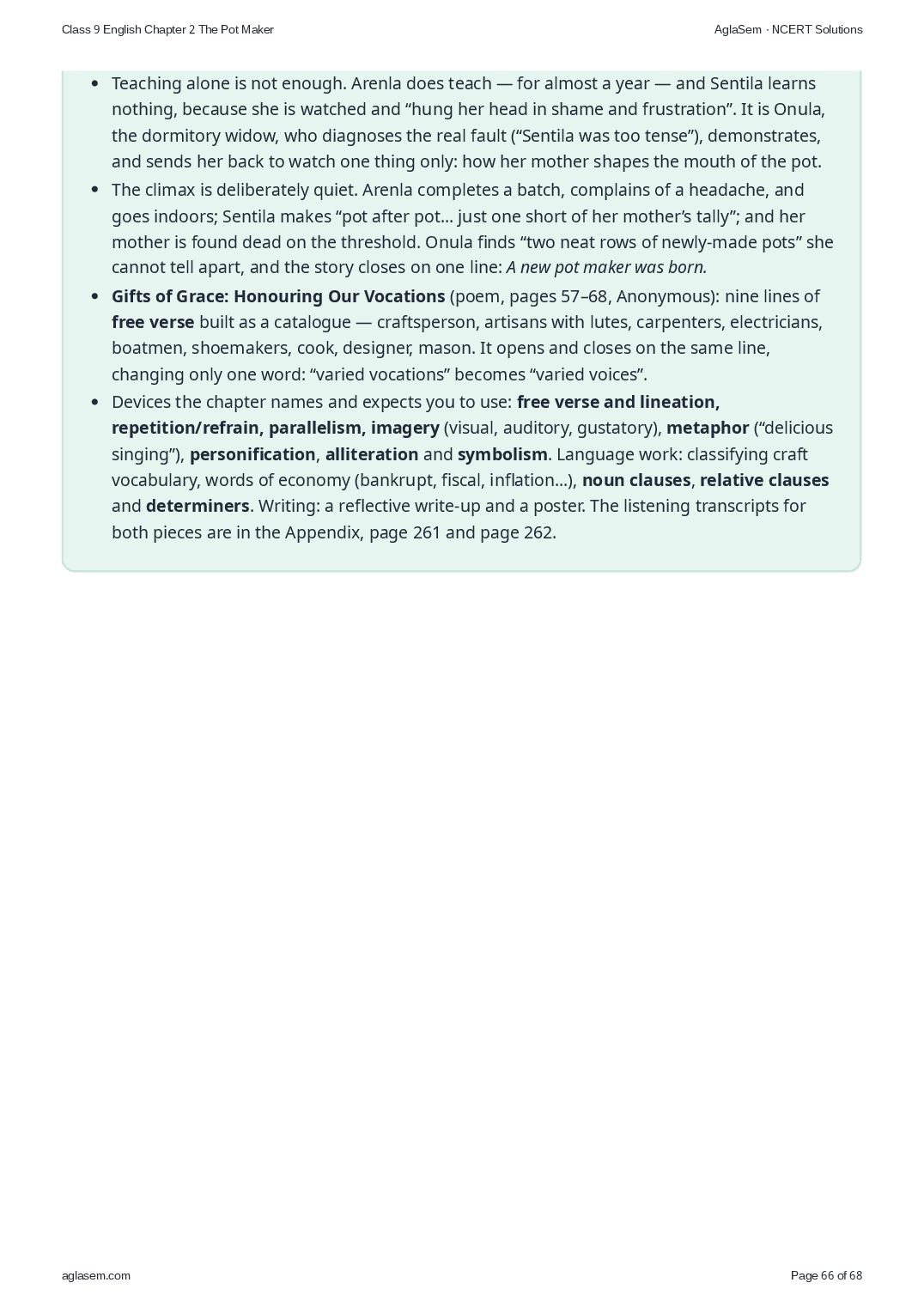
- Teaching alone is not enough. Arenla does teach — for almost a year — and Sentila learns nothing, because she is watched and “hung her head in shame and frustration”. It is Onula, the dormitory widow, who diagnoses the real fault (“Sentila was too tense”), demonstrates, and sends her back to watch one thing only: how her mother shapes the mouth of the pot.
- The climax is deliberately quiet. Arenla completes a batch, complains of a headache, and goes indoors; Sentila makes “pot after pot… just one short of her mother’s tally”; and her mother is found dead on the threshold. Onula finds “two neat rows of newly-made pots” she cannot tell apart, and the story closes on one line: A new pot maker was born.
- Gifts of Grace: Honouring Our Vocations (poem, pages 57–68, Anonymous): nine lines of free verse built as a catalogue — craftsperson, artisans with lutes, carpenters, electricians, boatmen, shoemakers, cook, designer, mason. It opens and closes on the same line, changing only one word: “varied vocations” becomes “varied voices”.
- Devices the chapter names and expects you to use: free verse and lineation, repetition/refrain, parallelism, imagery (visual, auditory, gustatory), metaphor (“delicious singing”), personification , alliteration and symbolism . Language work: classifying craft vocabulary, words of economy (bankrupt, fiscal, inflation…), noun clauses , relative clauses and determiners . Writing: a reflective write-up and a poster. The listening transcripts for both pieces are in the Appendix, page 261 and page 262.
How to Download NCERT Solutions for Class 9 English Chapter 2 PDF
Follow these simple steps to get the The Pot Maker questions-and-answers PDF from Kaveri.
- Search NCERT Solutions for Class 9 English Chapter 2 aglasem and open this page.
- Read the exercise questions with answers for The Pot Maker shown above.
- Click the Download PDF link to save the The Pot Maker solutions to your device.
NCERT Solutions for Class 9 English – All Chapters
There are more chapters to study besides The Pot Maker in English. Here are the NCERT Solutions for all chapters of Class 9 English.
- Chapter 1 How I Taught My Grandmother to Read
- Chapter 2 The Pot Maker
- Chapter 3 Winds of Change
- Chapter 4 Vitamin M
- Chapter 5 The World of Limitless Possibilities
- Chapter 6 Twin Melodies
- Chapter 7 Carrier of Words
- Chapter 8 Follow That Dream
NCERT Solutions for Class 9 – All Subjects
Just like Chapter 2 of English, you can get the exercise questions with answers for every other subject of Class 9. Here are the NCERT Solutions for all subjects of Class 9.
NCERT Solutions for Class 9 English Chapter 2 – An Overview
The key highlights of this study material are as follows.
| Aspects | Details |
|---|---|
| Class | Class 9 |
| Subject | English |
| Chapter Number | Chapter 2 |
| Chapter Name | The Pot Maker |
| Book Name | Kaveri |
| Book By | NCERT (National Council of Educational Research and Training) |
| Educational Resource Here | NCERT Solutions of Class 9 English Chapter 2 for all exercises |
| More Questions Answers of This Subject | NCERT Solutions for Class 9 English |
| Download Book Chapter | NCERT Book Class 9 English |
| All Questions Answers For This Class | NCERT Solutions for Class 9 |
| Complete Solutions | NCERT Solutions |
NCERT Solutions for Class 9 English Chapter 2 The Pot Maker – FAQs
What are the NCERT Solutions for Class 9 English Chapter 2 The Pot Maker?
They are the complete, step-by-step answers to all the exercise and in-text questions of Chapter 2 The Pot Maker from the NCERT Class 9 English textbook Kaveri, written by experts as per the latest NCERT syllabus.
How can I download the Class 9 English Chapter 2 solutions PDF for free?
Open this page on aglasem, read the The Pot Maker questions with answers, and click the “Download Solutions PDF” link. The Class 9 English Chapter 2 NCERT Solutions PDF is completely free to download.
Are these NCERT Solutions as per the latest 2026-27 syllabus?
Yes. The NCERT Solutions for Class 9 English Chapter 2 are based on the latest NCERT textbook Kaveri and the current 2026-27 CBSE syllabus, so the questions and answers match what you study in class.
Where can I get NCERT Solutions for the other chapters of Class 9 English?
You can find the answers to every chapter on the NCERT Solutions for Class 9 English page, and solutions for every subject on the NCERT Solutions for Class 9 page.
How do NCERT Solutions help in exam preparation?
They show the correct method to solve each question, help you write answers the way they are expected in exams, let you check and correct your own work, and save revision time — which together improve your marks in Class 9 English.
If you have any queries on NCERT Solutions for Class 9 English Chapter 2 The Pot Maker, then please ask in the comments below.