NCERT Solutions for Class 9 English Chapter 7 Carrier of Words provide clear, step-by-step answers to every exercise and in-text question from the chapter Carrier of Words of the NCERT textbook Kaveri. Prepared by subject experts as per the latest NCERT (CBSE) syllabus for 2026-27, these NCERT Solutions for Class 9 English help you understand each concept, write exam-ready answers, and check your own solutions. You can read them online below or download the free Class 9 English Chapter 7 question-answer PDF.
NCERT Solutions for Class 9 English Chapter 7 Carrier of Words
- Class: Class 9
- Subject: English
- Chapter: Chapter 7 – Carrier of Words
- Textbook: Kaveri (NCERT)
- Study material: NCERT Solutions – questions with answers, free PDF
These solutions answer all the exercise questions of Chapter 7 Carrier of Words — including the in-text questions, short-answer and long-answer questions, and activities — with complete explanations so you can follow the method, not just the final answer. Read the full solutions below.
NCERT Solutions Class 9 English Chapter 7 Carrier of Words View Download


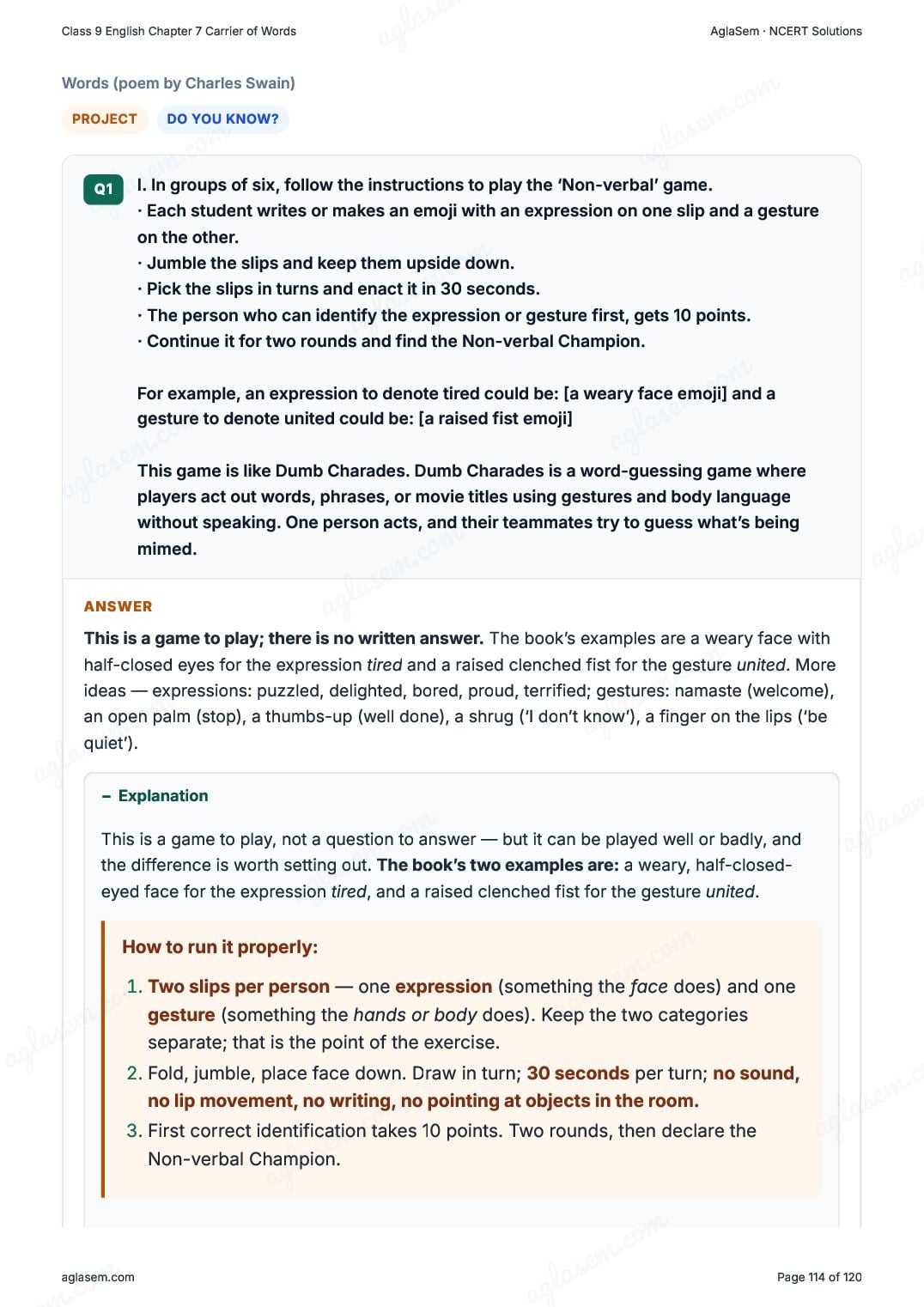
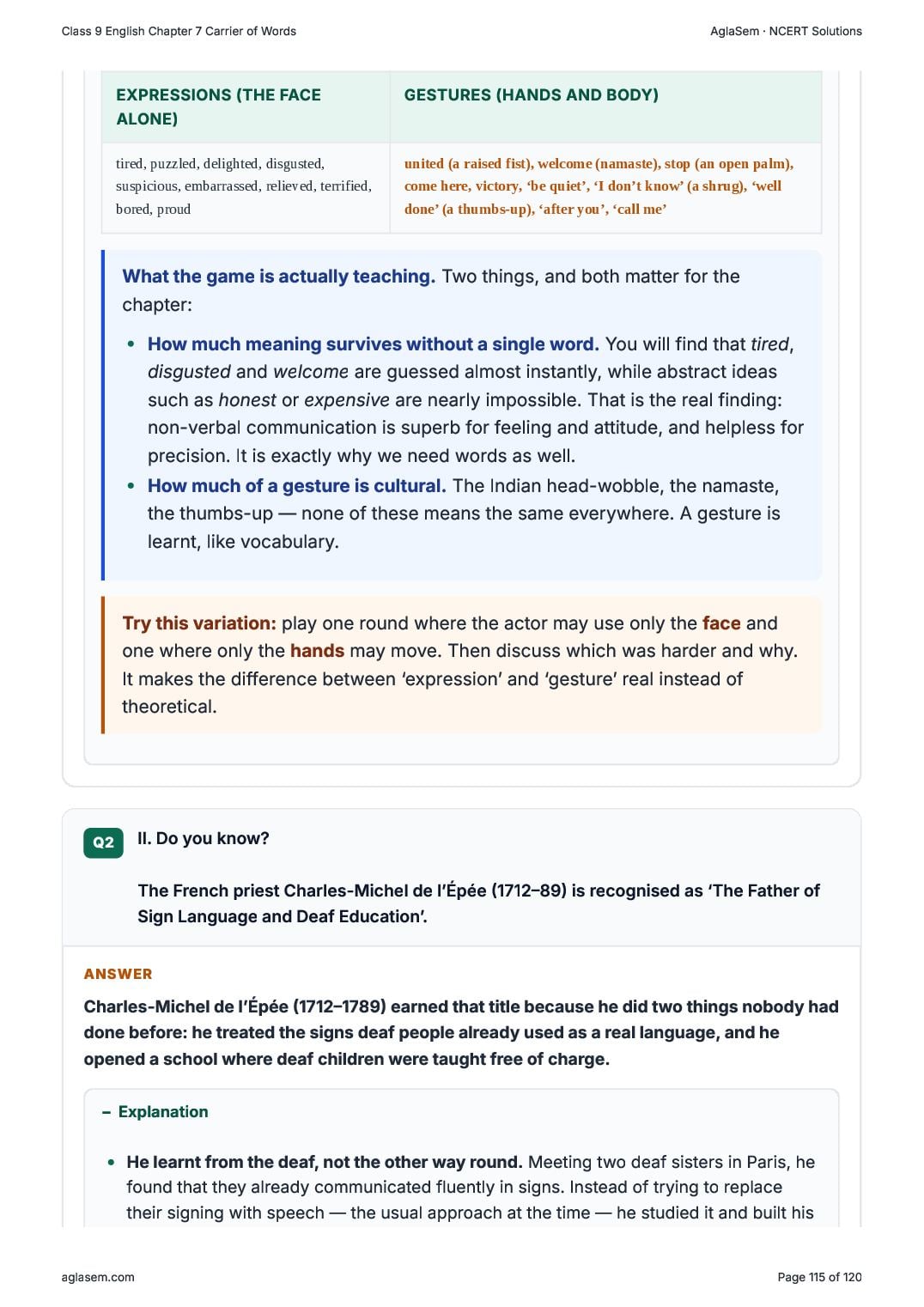
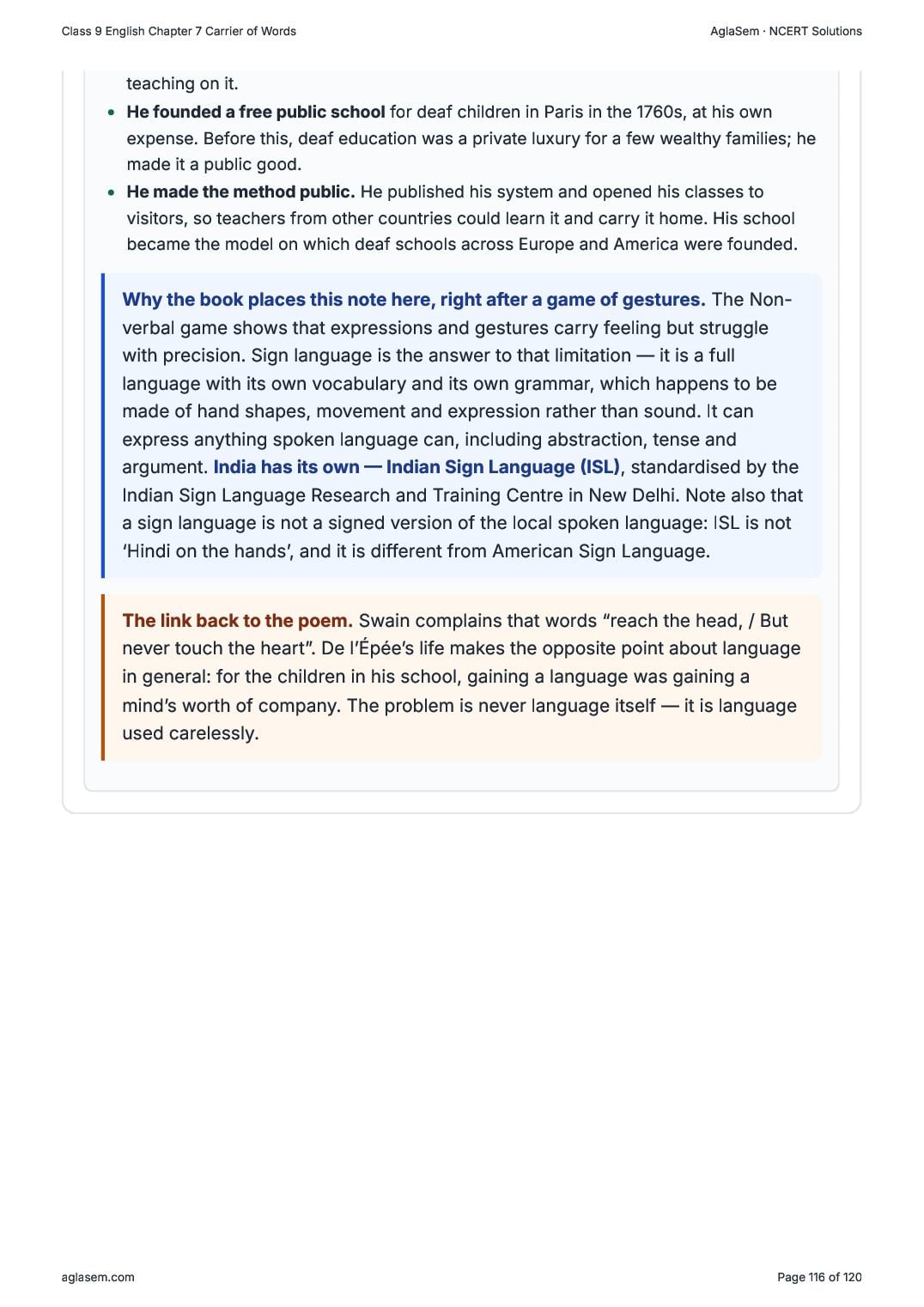
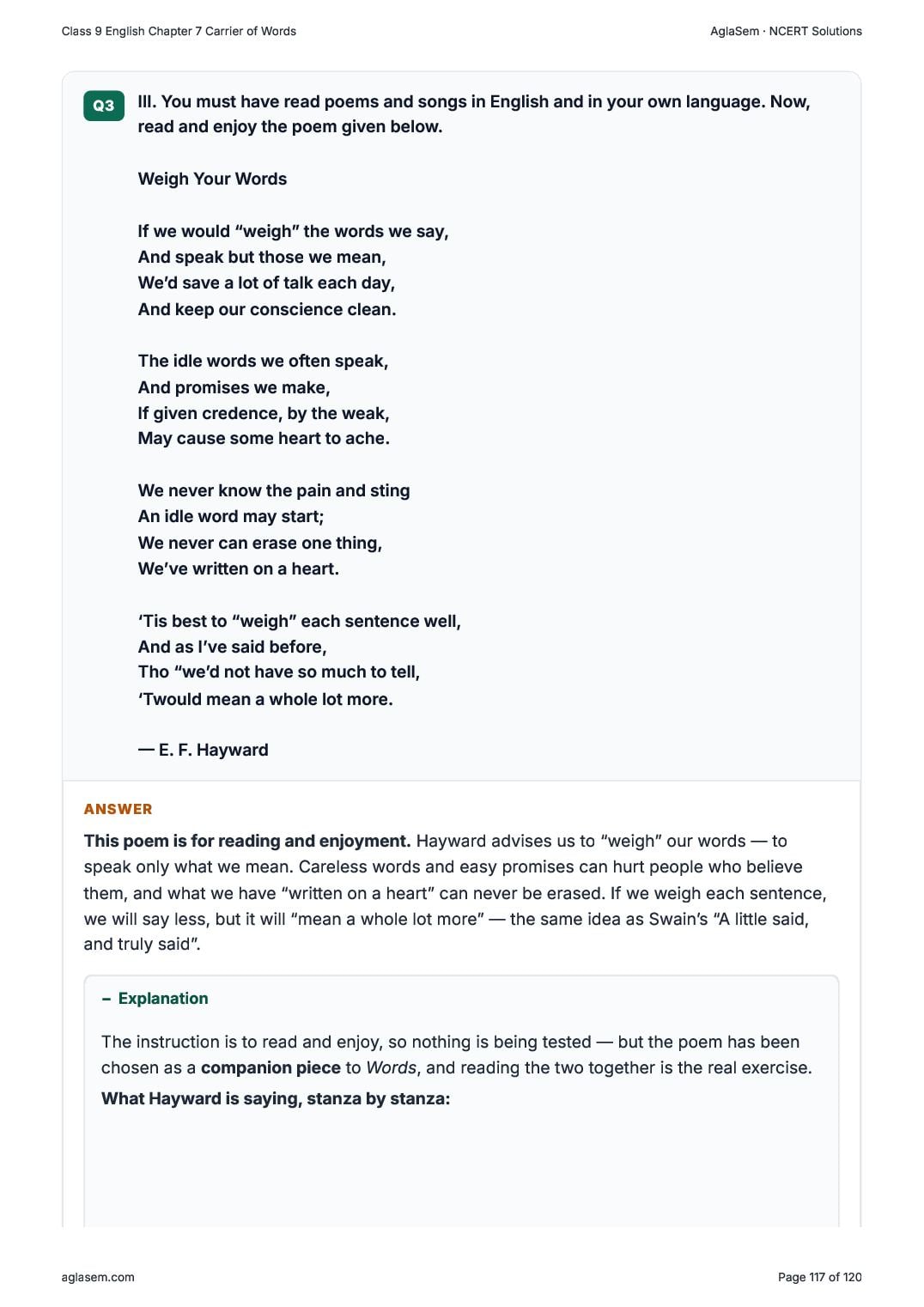

NCERT Solutions for Class 9 English Chapter 7 PDF Download
You can read the NCERT Solutions for Class 9 English Chapter 7 online above, or download the complete question-answer PDF to study Carrier of Words offline at any time.
NCERT Solutions for Class 9 English Chapter 7 PDF Download Link – Click Here to Download Solutions PDF
Questions Covered in This Chapter
Key questions solved in this chapter include:
- I. Look at the pictures given below of persons engaged in the same profession. [Four pictures: a 2004 ₹5 stamp marked ‘150 YEARS OF INDIA POST / भारतीय डाक के 150 वर्ष’ showing a dak runner with a spear-and-bells staff, a mail train on a viaduct, an ‘AIR MAIL’ label and an early biplane; a 25-paise INDIPEX-77 stamp captioned ‘EARLY POSTMAN’ showing a turbaned postman in a red tunic with a leather satchel; an old sepia photograph of a turbaned postman in uniform clearing a pillar letter box; a colour drawing of a modern postman in khaki uniform and cap with a mailbag, walking in a desert.] Discuss in pairs and share your answers with your classmates and teacher. 1. Which profession do they belong to?
- I. 2. Do they face any difficulties while doing their duty?
- I. 3. How does their profession affect the people they meet?
- II. Discuss in groups. 1. How can ‘words’ be ‘carried’?
- II. 2. Who could be a carrier of words?
- II. 3. What are the means for people to stay connected?
- III. Read the words given in the box below and place them in their appropriate context in the following passage. [Box: slumped | dunes | defying | hamlets | signals | devoid] We stepped out of the vehicle at the end of the road. Immediately, our body sent 1. _________ that our decision to visit the sand 2. _________ in the afternoon was insane. We had passed a few 3. _________ on our way to the desert. We could not find even a single soul outdoors, 4. _________ the blazing sun. Even the camels were 5. _________ in the little shade offered by the khejri trees. In this remote place people relied on Bharat Sanchar Nigam Limited (BSNL) to connect to the world as the area was 6. _________ of any other network service.
- I. Khetaram needs to submit information about himself for getting an identity card. While reading the text, fill up the following information sheet for Khetaram. Name — Khetaram Position — ______ Employer — ______ Official address — ______ Mode of transport used — ______ Key responsibilities — four blanks
- II. Discuss with your teacher. 1. Why do you think Khetaram has taken up this challenging job?
- II. 2. How do you think Khetaram would feel about taking up this challenging task every day?
- I. Complete the table given below with the situations given in Column 1 and the reasons in Column 2. Column 1 (situation) | Column 2 (reason) ______ | When the temperature is recorded as 50 degrees celsius and above, a state holiday has to be declared. Khetaram can dwell on any threshold. | ______ BSF always gave Khetaram a lift. | ______
- II. Why was a piece of jaggery offered in the village when he brought news of a birth or weddings?
- III. How would phone lines help Khetaram in his job?
- I. Read the extracts given below and answer the questions. 1. “Akaal or famine is a way of life here. In a good year, I get one crop of bajra. That cannot feed my family of five. We would starve without this job,” he says. And for each family which resides in this arid land, survival is partly dependent on money orders remitted by a relative. (i) Complete the sentence given below with an appropriate reason. One crop of bajra makes a little difference for people like Khetaram because __________________.
- (ii) Why did Khetaram term famine as ‘a way of life’?
- (iii) Give one reason why Khetaram had to take up a job to help his family to survive.
- (iv) Complete the analogy given below with a word from the extract. Other families: Money orders:: Khetaram: __________________
- (v) What would ‘a good year’ signify?
- 2. There is one letter delivery he dreads. The envelope with the right corner torn off, which signifies that the missive bears news of death. “Ashubh Samachar cannot be carried into the house,” says Khetaram. So, he stands outside, reads out the letter twice, then tears it to bits. “Bad news must be destroyed,” he mutters philosophically. (i) Choose the correct option for the following question. Who could have torn the right corner of the envelope? A. Khetaram B. Sender of the letter C. Receiver of the letter D. The postmaster
- (ii) Complete the sentence with an appropriate reason. The most likely reason for Khetaram reading the letter twice is because ___________________________.
- (iii) What was Khetaram’s philosophy regarding bad news, and how did he act upon it?
- (iv) State whether the following sentence is true or false. Khetaram’s action of tearing the letter differed from his beliefs.
- (v) Mention any one aspect of Khetaram’s temperament which is revealed through this extract.
- II. Answer the following questions. 1. Justify the statement made by Postmaster-General, Rajasthan Western Region stating that the role of GDS is ‘invaluable’.
- II. 2. How was the purpose of India Post different from that of the British postal system?
- II. 3. People trusted Gramin Dak Sewaks. Support this statement with any two instances from the text.
- II. 4. Infer the most likely reason that Khetaram was grateful to continue as GDS, even after the age of 60.
- II. 5. Explain why the author pays tribute to people like Khetaram.
- I. Study the phrases given in Column 1 and match them with their meanings in Column 2. Column 1: 1. crumbles into sand 2. give a new lease of life 3. turn into a trickle before drying out 4. bearing words across this desolate geography Column 2: (i) get a chance to continue living (ii) carrying letters to less populated areas (iii) disappears in the desert (iv) lessen gradually and then finally stop Now, use the phrases from Column 1 in sentences of your own.
- II. Identify examples of alliteration and metaphor in the extract given below. Khetaram’s khaki turban and uniform are his only protection against the desert’s furies, the scorching summer winds and swirling sandstorms which turn him into a walking sandman.
- III. Match the words in Column 1 to what they suggest in Column 2 in the context of the chapter. Column 1: 1. arid 2. concessional 3. gaunt 4. remote 5. desolate Column 2: (i) interest rate for the farmers (ii) corner of the world (iii) farmland without much yield (iv) desert stretching far and wide (v) farmer waiting for the rains Now, use the words from Column 1 in sentences of your own.
- IV. Read the underlined verbs in the sentences given in Column 1 and their functions in Column 2. 1. She has found her book. — (i) finished actions (past event — present result) 2. I have just eaten a mango. — (ii) recently completed action 3. Have you ever seen a play before? — (iii) life experiences 4. I have finished my project. — (iv) accomplishment 5. Ajay has become a good bowler in five years. — (v) changes over time 6. I have seen this book in the library many times. — (vi) multiple actions at different times 7. I have studied in this school for six years. — (vii) action completed in the past but has its impact in present All the verbs in the sentences in Column 1 are in present perfect tense. The structure is: has/have + past participle (third form of the verb).
- IV. Now, fill in the blanks by using the present perfect form of the verbs given in the brackets to complete the following paragraph. 1. I _________ (has/have) just ________ (get) a collection of postage stamps from my grandfather. He 2. ___________ (collect) these stamps over a period of 20 years. I 3. ___________ (study) most of the stamps in his collection and loved all of them. I 4. _______ (begin) my own collection of postage stamps. Grandfather 5. _________ truly ________ (inspire) me.
- V. Study the sentences given below. 1. GDS delivers the mail at the border. When the subject does the action, the sentence is in active voice. 2. The mail is delivered by the GDS at the border. This implies that the ‘mail’ receives the action ‘deliver’. This sentence is in passive voice because the subject is receiving the action.
- V. 3. Khetaram’s nephew wants to join the GDS. He asks Khetaram how to prepare for it. Khetaram gives him the following advice. (i) You will need a lot of stamina for this job. (ii) Practise reading clearly as some of the villagers will expect you to read out the letters. (iii) Write words neatly as some villagers will ask you to draft replies. (iv) Wear full-sleeved shirts and trousers to protect yourself from the heat. Now, complete the following paragraph about the advice given by Khetaram. One example has been done for you. To begin with, a lot of stamina will be needed for this job. Next, reading clearly A. ________________________, as you B. ________________________ to read out the letters by some of the villagers. Words C. ________________________ neatly as you D. ________________________ to draft replies by some villagers. Full sleeved-shirts and trousers E. ________________________ to protect yourself from the heat.
- I. You will listen to a girl talking about an event. As you listen, fill in the blank with the suitable word from the brackets. (Transcript for teacher on page 272) The speaker concluded her talk with a ___________. (suggestion/request/advice)
- II. You will listen to the girl talking about the event again. As you listen, choose the correct option for the following questions. 1. What was the occasion that the speaker was talking about? (i) Letter writing carnival (ii) Philately day (iii) Indian Postal Day
- II. 2. India Post is famous for having the most extensive network _________. (i) in India (ii) in the world (iii) among design institutes
- II. 3. Letter writing is being revived as this art form has been _________. (i) celebrated (ii) appreciated (iii) forgotten
- II. 4. Which of the following will be a part of the letter writing carnival? (i) calligraphy and graphology (ii) origami and designing (iii) letter posting and philately
- II. 5. What will the postal department add to the event? (i) interactive demonstrations (ii) theatre and dance (iii) workshop for letter writing
- I. The postcard, inland letter, envelope, and money order form were engaged in a discussion on who the most important one was. In groups of four, select one each and reason with each other logically. You may use the points for discussion given in Column 1 and the cues given in Column 2 to express your opinion. Column 1 (Points for discussion): utility · cost effective · privacy · space to write · possibility of enclosures Column 2 (Verbal cues to present opinion): It seems to me that… · Some people say that… · I would like to point out that… · I totally agree that… · That’s one way to look at it but…
- A condolence message communicates your feelings to someone whose relative or a person close to them has just passed away. It mentions how sorry you feel for the loss and your prayers for strength to the family members. I. Khetaram saw a letter with a torn corner. It had news about Bhawar Singh’s uncle passing away. Read the condolence message that Sawant Singh sent to his cousin as a reply to the letter. 16 July 20XX Dear Bhawar Bhai, I am deeply saddened to hear about the loss of Kunwar uncle. Please accept my condolences. I extend my deepest sympathy to you and your family in this hour of grief. May God give eternal peace to the departed soul and courage to the family to bear the loss. Yours sincerely, Sawant Singh [Addressed to: Bhawar Singh, Village: Veer Nagar, Jodhpur, Rajasthan, 342001] Now, on behalf of your parents draft an imaginary condolence message for your aunt on the recent passing away of her father.
- I. The unique ‘Daakroom’ carnival was conceptualised by the Ministry of Culture to re-introduce children and larger audiences to letter writing in innovative, creative, and engaging ways. It also hosted competitions and workshops around writing and post. The one-of-a-kind letter writing event, supported by India Post, Ministry of Culture, Gandhi Smriti and Darshan Samiti is aimed to give a digital detox with the aim of reviving the art of letter writing in India. Source:
- II. Did you know? The study of postage stamps and postal history is called philately. It is possible to be a philatelist without owning any stamps. The stamps that you study may be rare ones and found only in museums.
- II. 1. Study the postage stamps given below and discuss who or what they depict. [Five stamps: a portrait stamp of a woman, dated 1879–1949; a ₹5.00 stamp with the portrait of a man in a white hat; a ₹5.00 stamp captioned ‘तीज TEEJ’ showing women in festival dress under a crescent moon; a ₹4.00 stamp captioned ‘PAINTED STORK’; a ₹15.00 stamp showing a stone temple.]
- II. 2. Work in groups of five. Find information about stamps on the following categories and note details as directed. · personalities: name and the field they belong to · celebrations: festivals/national events—name and significance · centenaries: name of person/occasion and significance · nature: name and significance · our heritage: monuments/music/dance—name and significance Now, prepare a class board on ‘Philately–Upholding Our Heritage’ with your findings.
- III. In the past, telegram was a mode of fast communication, commonly used to quickly send short and specific messages, such as greetings and condolences. Its pricing structure was based on the number of words to be transmitted, and therefore, needed to be precise. The following form was used for sending such telegrams. [An INLAND TELEGRAM form, with boxes marked: Prefix · Handed in · FOR POSTAGE STAMPS (‘For Conditions of acceptance, see over’) · SERVICE INSTRUCTIONS · Charge · Chargeable Words · Actual Words · Counter Number · To … · ADDRESS · ‘If you wish to pay for a reply insert R.P. here’, and ruled lines for the message.]
- I. Why are words important? Can we communicate without words? How? Share your answers with your classmates and teacher.
- II. Use the given sentences as clues to find words from the grid and fill the blanks. One example has been done for you. My mother summoned me to introduce her friends. Column 1 — Horizontal 1. We eat food to _______ our hunger.
- II. Column 1 — Horizontal. 2. The train will _______ from the station at 5.00 p.m.
- II. Column 1 — Horizontal. 3. The gardener was removing the _______ to clean the flower beds.
- II. Column 2 — Vertical. 4. The view from the top of the hill was _______ the difficult climb.
- II. Column 2 — Vertical. 5. The herbs and spices _______ flavour to food.
- II. Column 2 — Vertical. 6. Flowers _______ in spring.
- II. Column 2 — Vertical. 7. We enjoyed a delicious _______ after the ceremony.
- I. Fill in the blanks with one word from the poem. One example has been done for you. In this poem, the poet reflects that words fail to truly satisfy what the heart wants to convey. Words are compared to summer birds who 1. __________, leaving nothing behind. The heart, is equated to a 2. __________ who finds that words are as worthless as 3. __________ when needed. He feels that a few sincere words can bring more 4. __________ than many meaningless ones. He adds that a voice that brings happiness to a 5. __________ place does not say much, but the few words it does, are very precious. Moreover, if words could satisfy us, the 6. __________ would celebrate but words often fail to do that. The poem ends on the note that empty words may look impressive with lots of flowers, but they cannot produce anything valuable, like a 7. __________.
- II. Let us appreciate the poem. 1. Read the poem again. Find any four sets of rhyming words and also write the rhyme scheme of the poem.
- II. 2. Read the following phrases and sentences taken from the poem. Identify the poetic device in each of them and explain what the poet wants to communicate through their usage. (i) But words, like summer birds, depart…
- II. 2. (ii) heart, a pilgrim upon earth…
- II. 2. (iii) words are of as little worth / As just so many weeds
- II. 2. (iv) If words could satisfy the chest … Oft satisfy the least!
- II. 2. (v) The world might hold a feast…
- II. 2. (vi) Like plants that make a gaudy show / All blossom to the root
- II. 2. (vii) But whose poor nature cannot grow / One particle of fruit!
- II. 3. Which words are repeated in the poem? Why does the poet use repetition?
- II. 4. The stanzas 4, 5, and 6 end with exclamation marks. Choose the option that displays the emotions being expressed through them. (i) 4. disillusionment 5. admiration and 6. frustration (ii) 4. frustration 5. admiration and 6. disillusionment (iii) 4. admiration 5. frustration and 6. disillusionment (iv) 4. frustration 5. disillusionment and 6. admiration
- III. Identify examples of hyperbole from the given lines. If words could satisfy the chest, The world might hold a feast.
- III. Work in pairs. Complete the sentences given below with hyperboles. Use the hints given in the brackets. 1. I have ______________ things to do on this weekend. (lots of/tonnes of)
- III. 2. The player missed the basket by ______________. (a mile/ an inch)
- III. 3. My mother is so tired that she can sleep for a ______________. (night/decade)
- III. 4. I will be back in ______________. (five minutes/two seconds)
- IV. Rhythm gives a lyrical quality to a poem. The rhythm (pattern of beats) in a line of poetry is described by a metrical form. A metre is formed by a stressed and an unstressed syllable. Syllable is the name given to a single unit of speech/beats of spoken language. The metrical form in the first four lines is given below. The stressed syllables have been underlined. If words could sa tis fy the heart, The heart might find less care; But words, like sum mer birds, de part, And leave but emp ty air. Now, listen to the teacher read the poem. As you listen, underline the syllables that are stressed in all the lines of the poem. Share your answers with the teacher.
- I. Read the following lines and answer the questions. 1. The heart, a pilgrim upon earth, Finds often, when it needs, That words are of as little worth As just so many weeds. (i) Why has the poet referred to the heart as ‘a pilgrim’?
- (ii) When would a heart ‘need’ words?
- (iii) Complete the sentence with an appropriate reason. The words are like weeds because ____________.
- (iv) Mention two emotions the heart might be experiencing when it finds words to be of ‘little worth’.
- (v) What do these lines suggest about the nature of communication?
- 2. If words could satisfy the chest, The world might hold a feast; But words, when summoned to the test, Oft satisfy the least! (i) How can words ‘satisfy the chest’?
- (ii) How can words be ‘summoned to the test’?
- (iii) What does ‘the world’ holding ‘a feast’ imply?
- (iv) Complete the sentence with an appropriate reason. The poet mentions that words satisfy the least because ______________.
- (v) Select the word that does not mean the same as ‘oft’. A. always B. usually C. frequently D. often
- II. Answer the following questions. 1. What is the comparison that the poet draws between words and ‘empty air’?
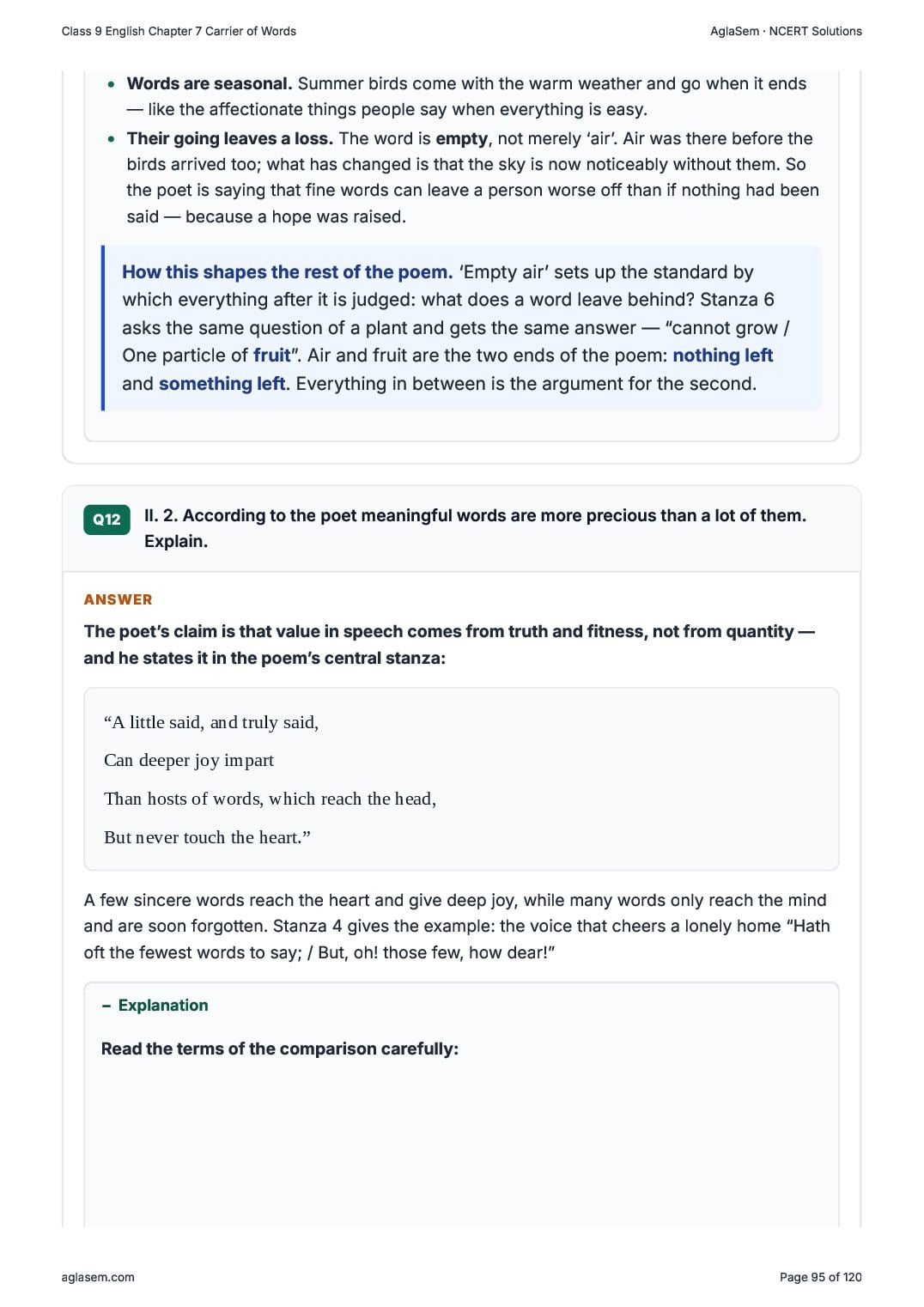
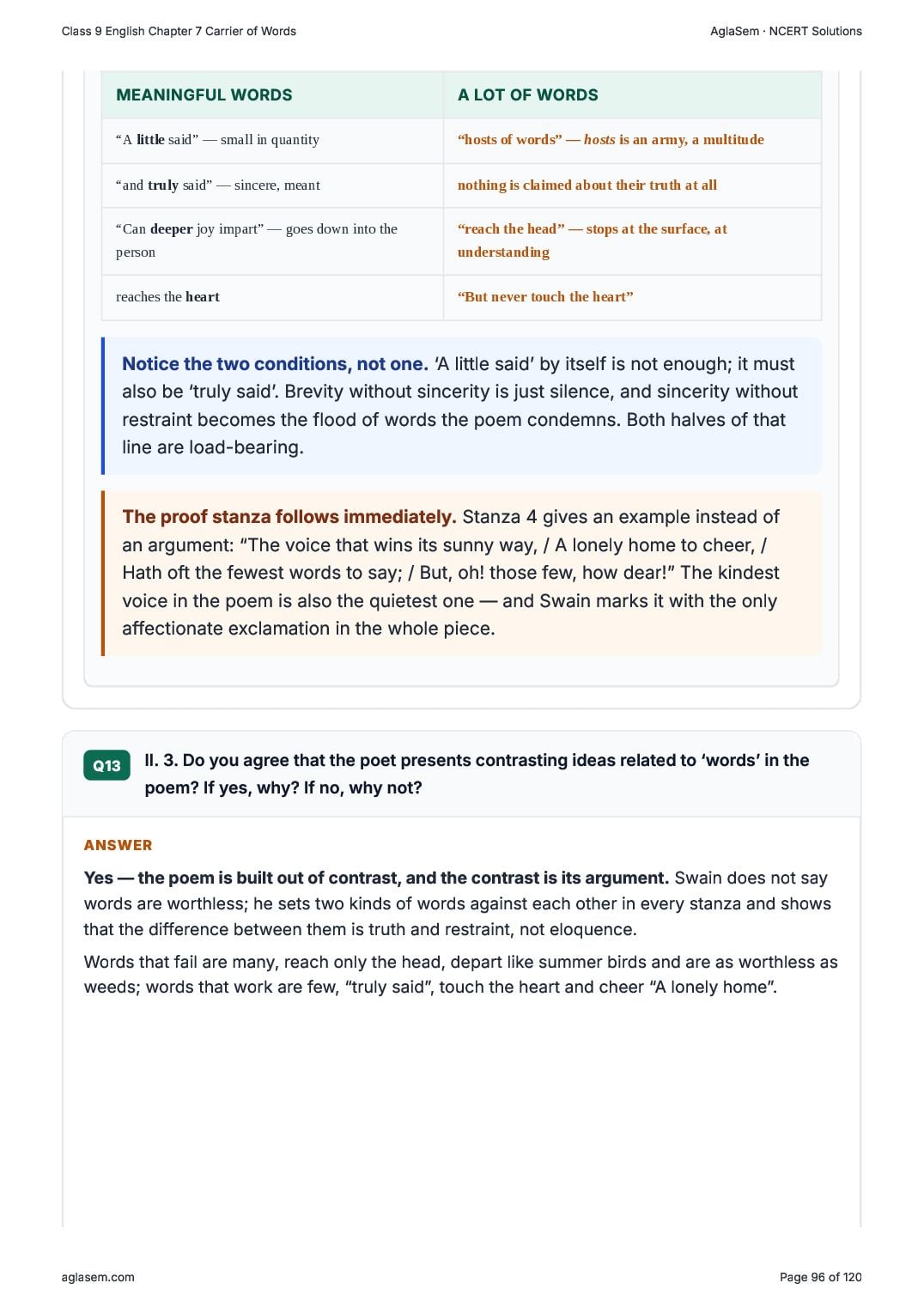
- II. 2. According to the poet meaningful words are more precious than a lot of them. Explain.
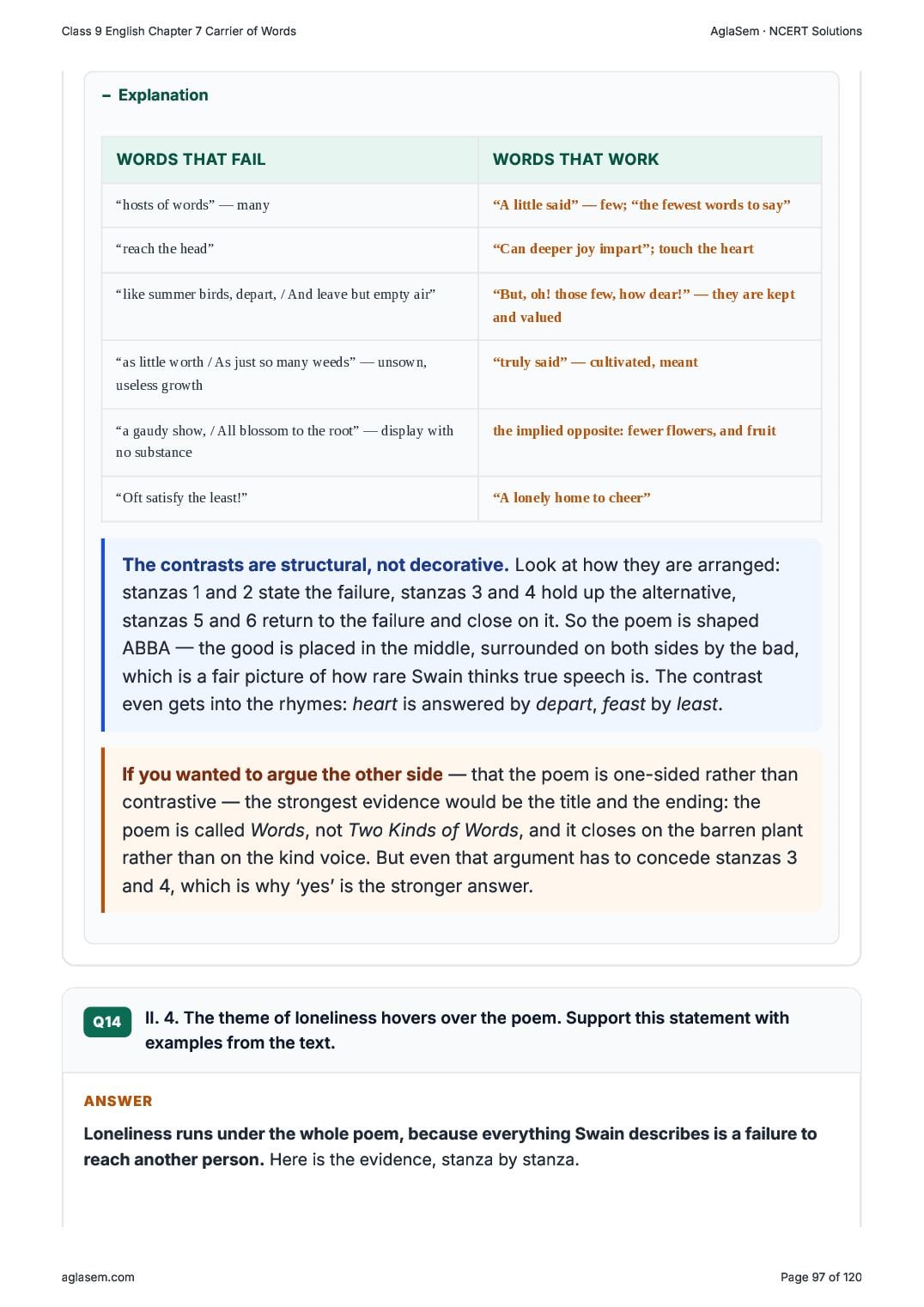
- II. 3. Do you agree that the poet presents contrasting ideas related to ‘words’ in the poem? If yes, why? If no, why not?
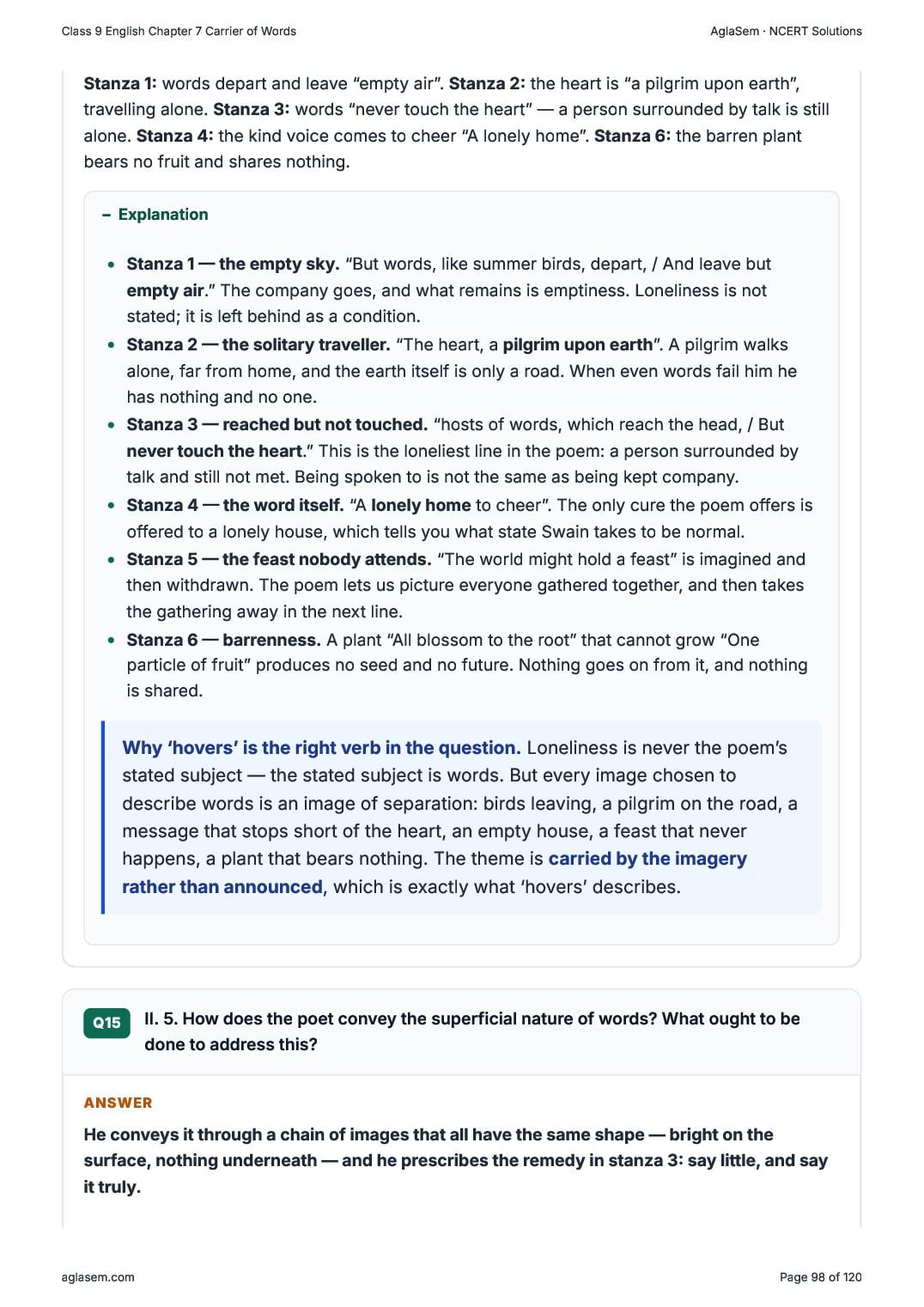
- II. 4. The theme of loneliness hovers over the poem. Support this statement with examples from the text.
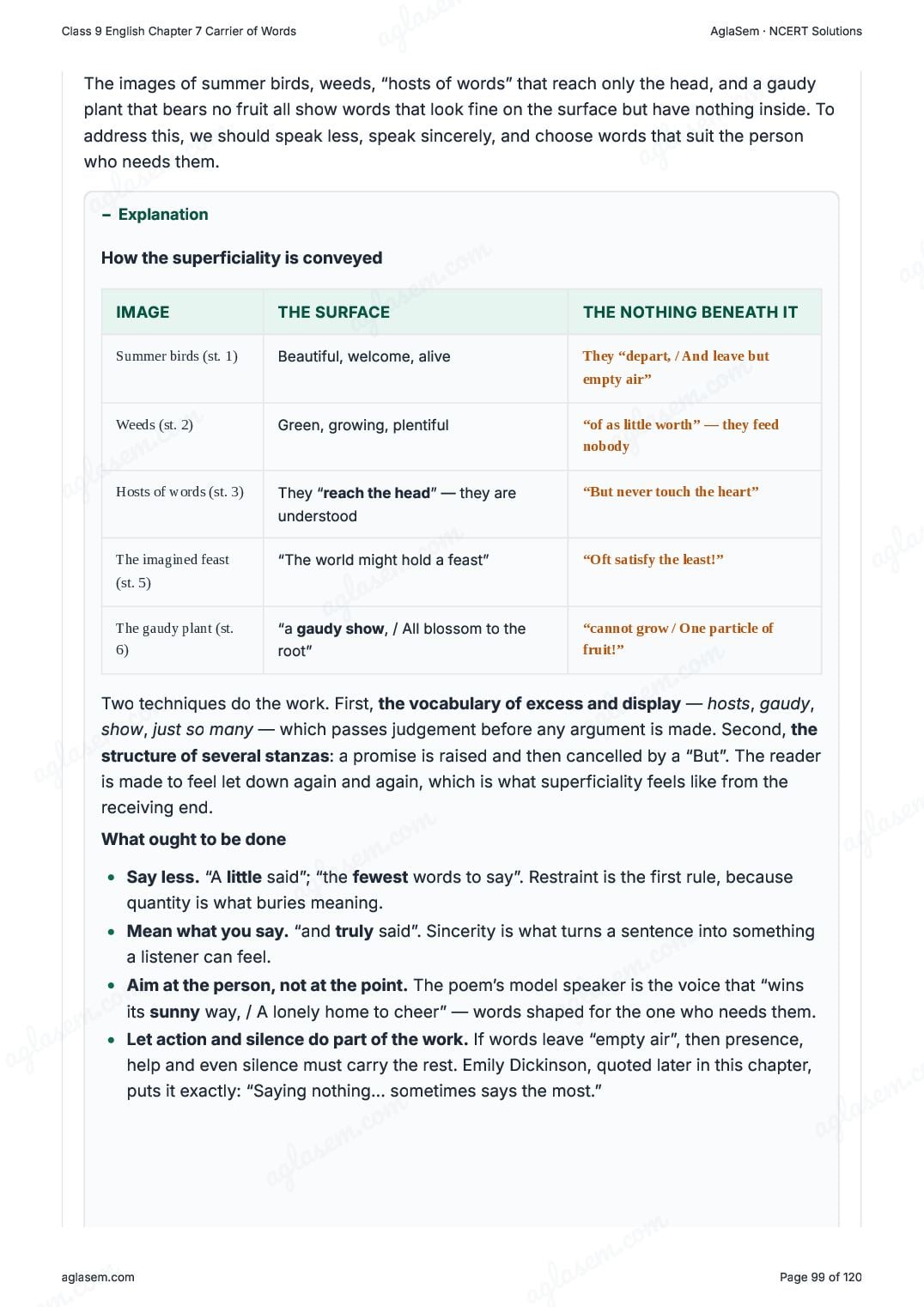
- II. 5. How does the poet convey the superficial nature of words? What ought to be done to address this?
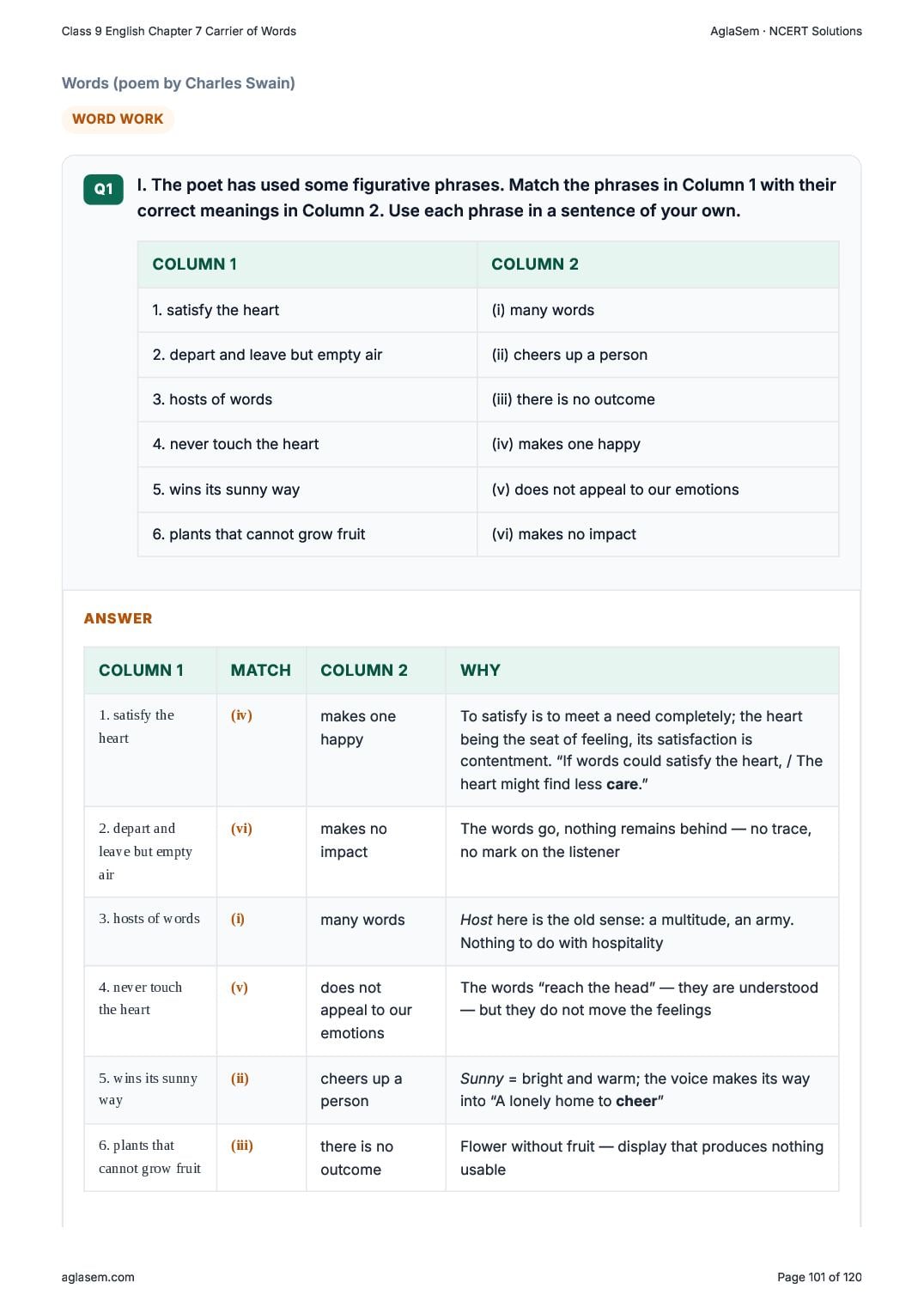
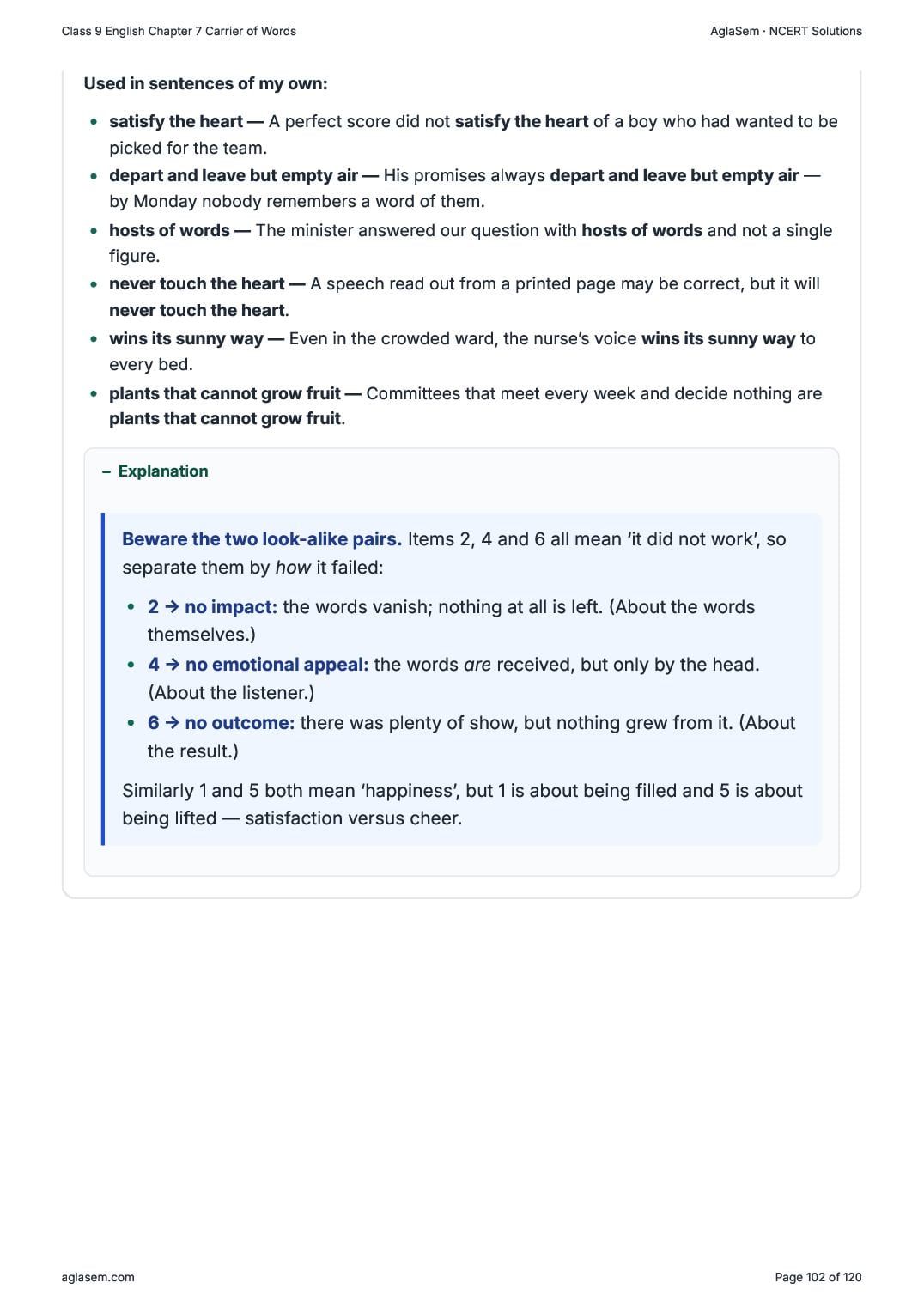
- I. The poet has used some figurative phrases. Match the phrases in Column 1 with their correct meanings in Column 2. Use each phrase in a sentence of your own. Column 1: 1. satisfy the heart 2. depart and leave but empty air 3. hosts of words 4. never touch the heart 5. wins its sunny way 6. plants that cannot grow fruit Column 2: (i) many words (ii) cheers up a person (iii) there is no outcome (iv) makes one happy (v) does not appeal to our emotions (vi) makes no impact
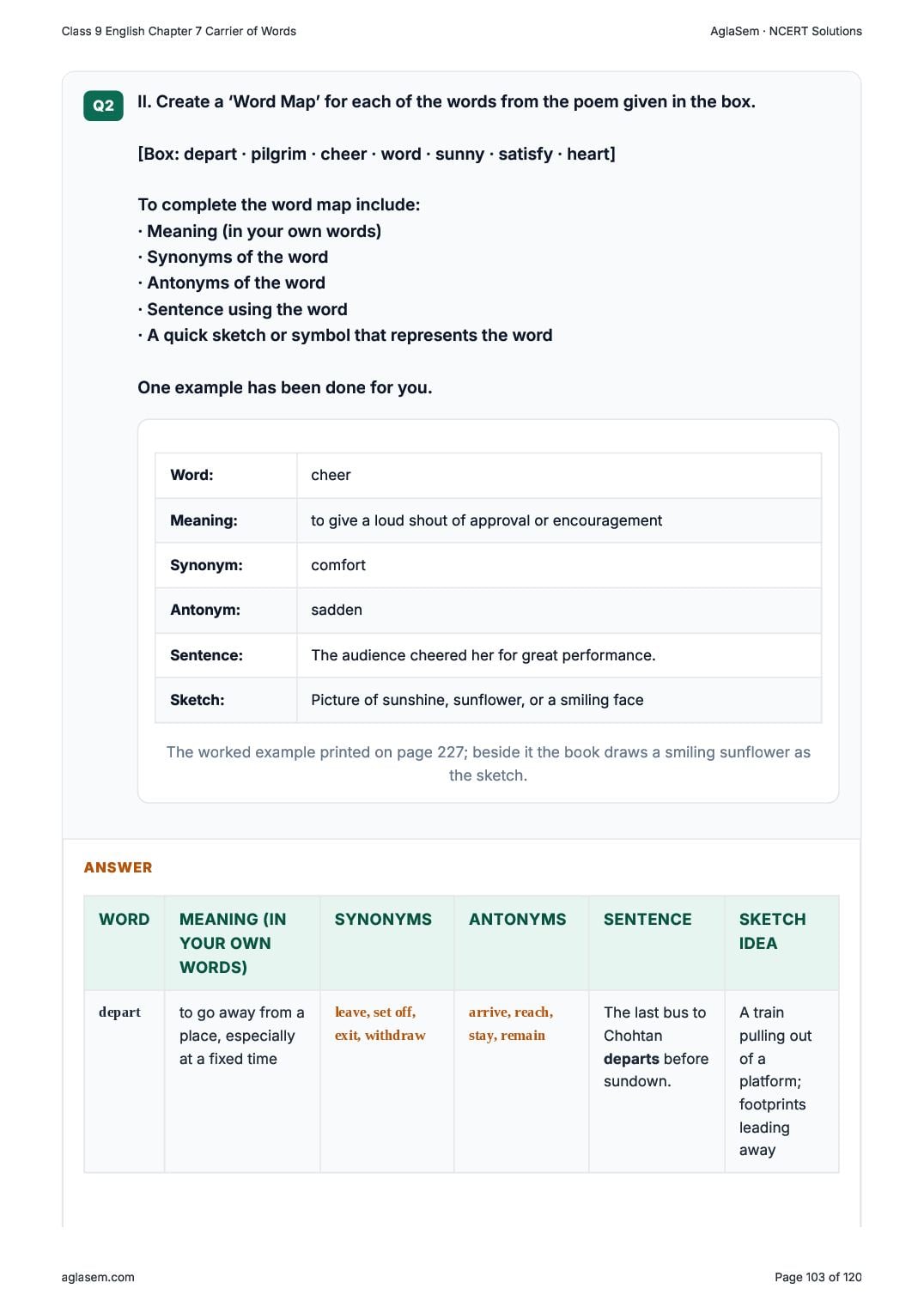
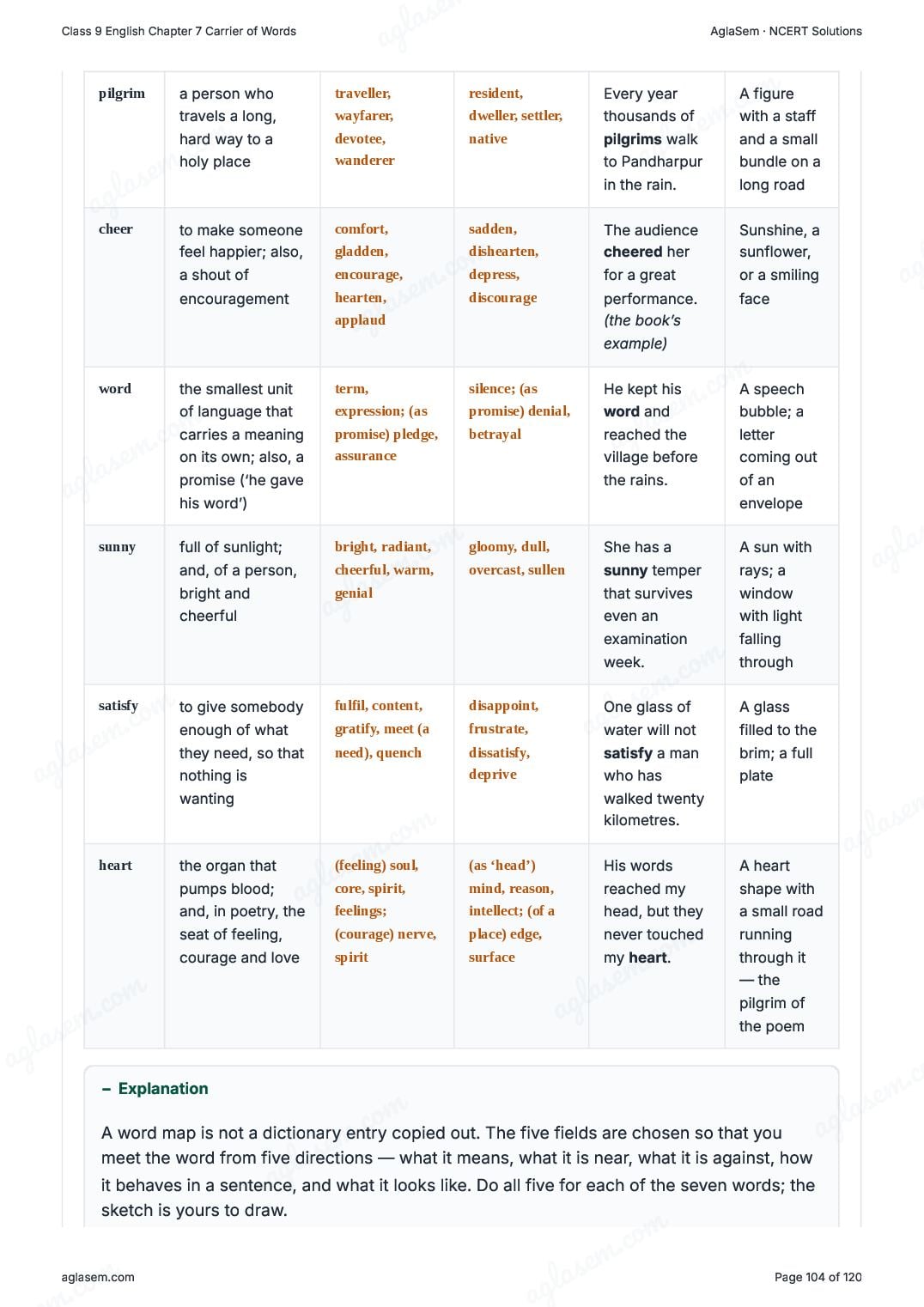
- II. Create a ‘Word Map’ for each of the words from the poem given in the box. [Box: depart · pilgrim · cheer · word · sunny · satisfy · heart] To complete the word map include: · Meaning (in your own words) · Synonyms of the word · Antonyms of the word · Sentence using the word · A quick sketch or symbol that represents the word One example has been done for you. [Example given in the book — Word: cheer / Meaning: to give a loud shout of approval or encouragement / Synonym: comfort / Antonym: sadden / Sentence: The audience cheered her for great performance. / Sketch: Picture of sunshine, sunflower, or a smiling face]
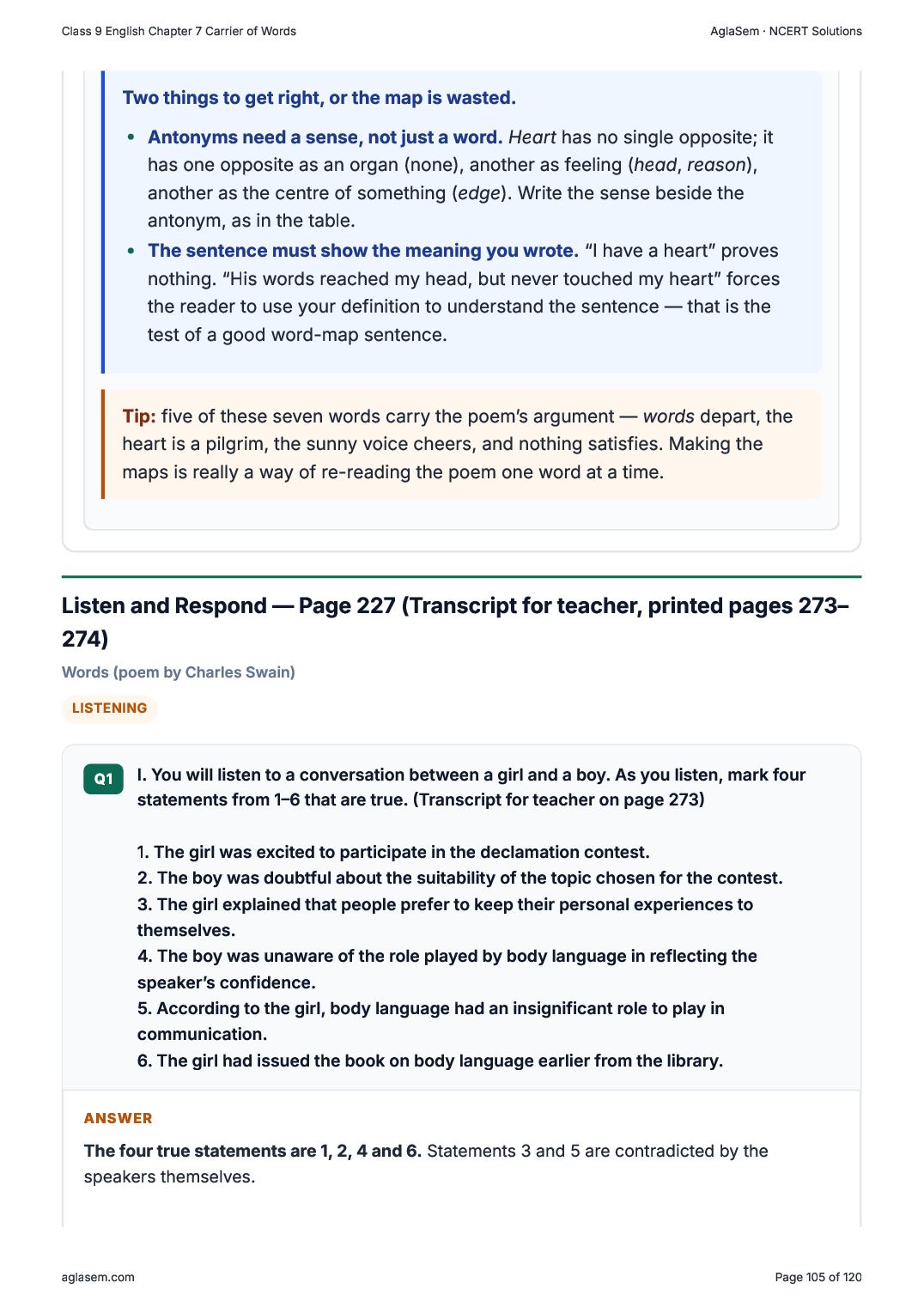
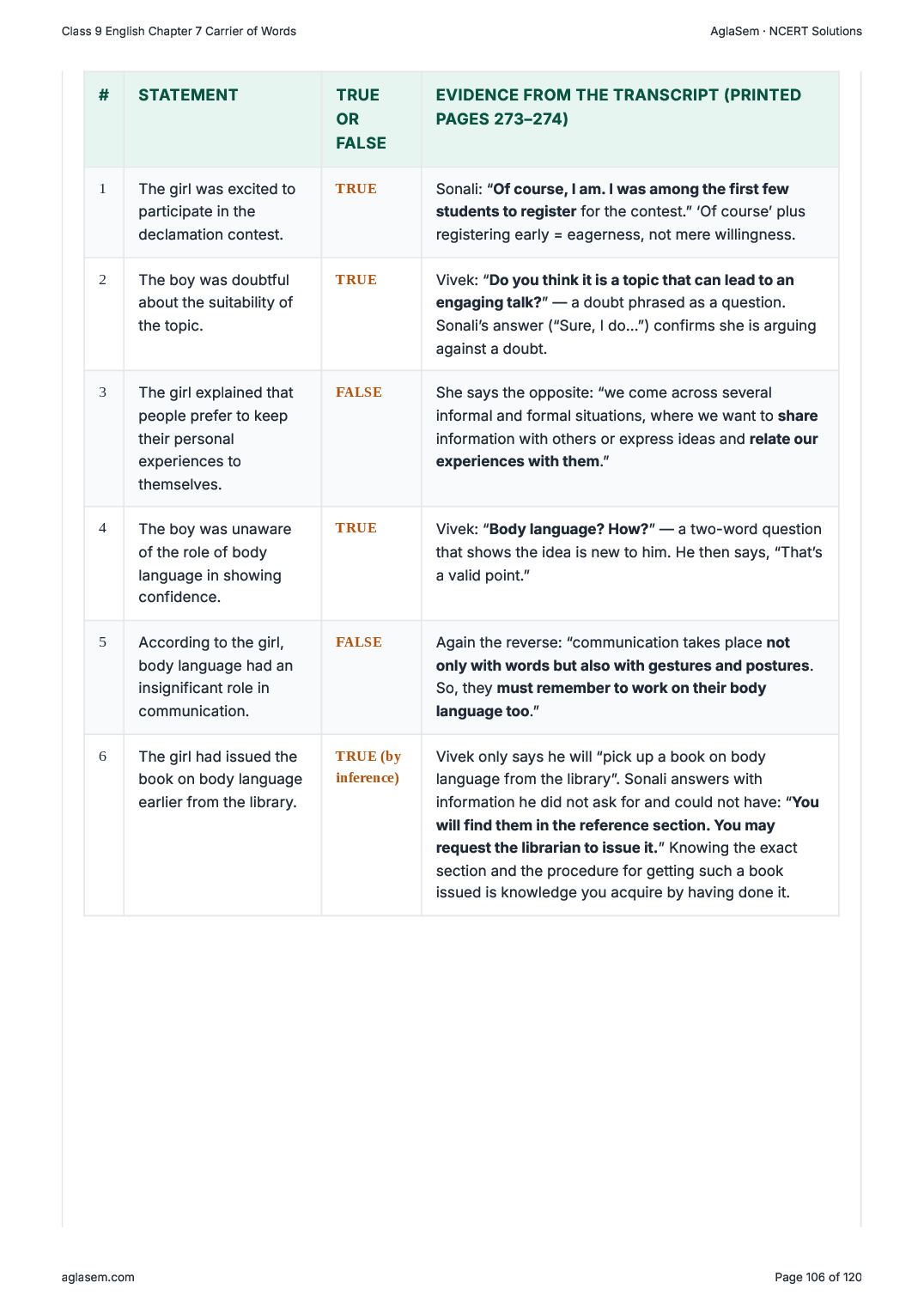
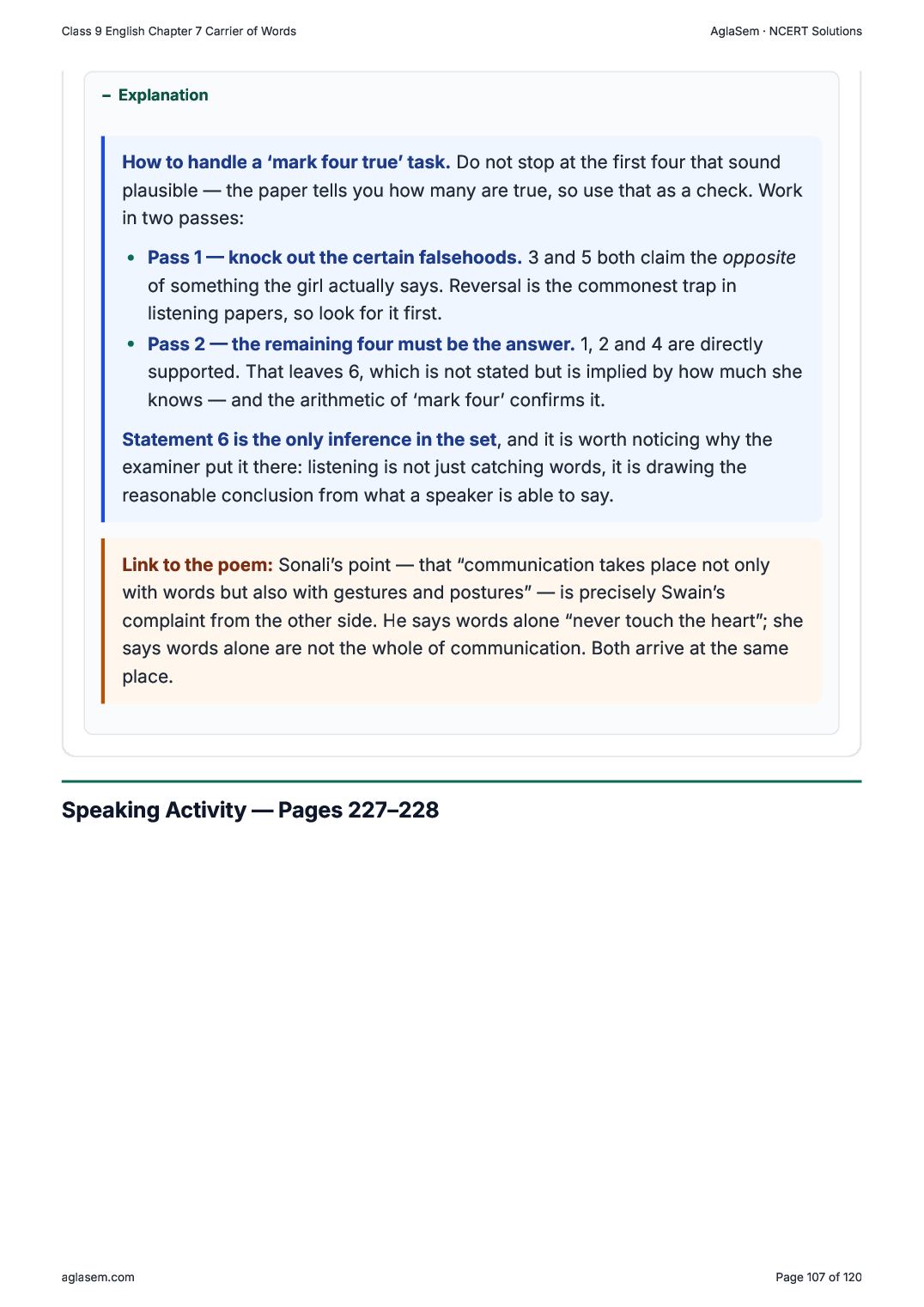
- I. You will listen to a conversation between a girl and a boy. As you listen, mark four statements from 1–6 that are true. (Transcript for teacher on page 273) 1. The girl was excited to participate in the declamation contest. 2. The boy was doubtful about the suitability of the topic chosen for the contest. 3. The girl explained that people prefer to keep their personal experiences to themselves. 4. The boy was unaware of the role played by body language in reflecting the speaker’s confidence. 5. According to the girl, body language had an insignificant role to play in communication. 6. The girl had issued the book on body language earlier from the library.
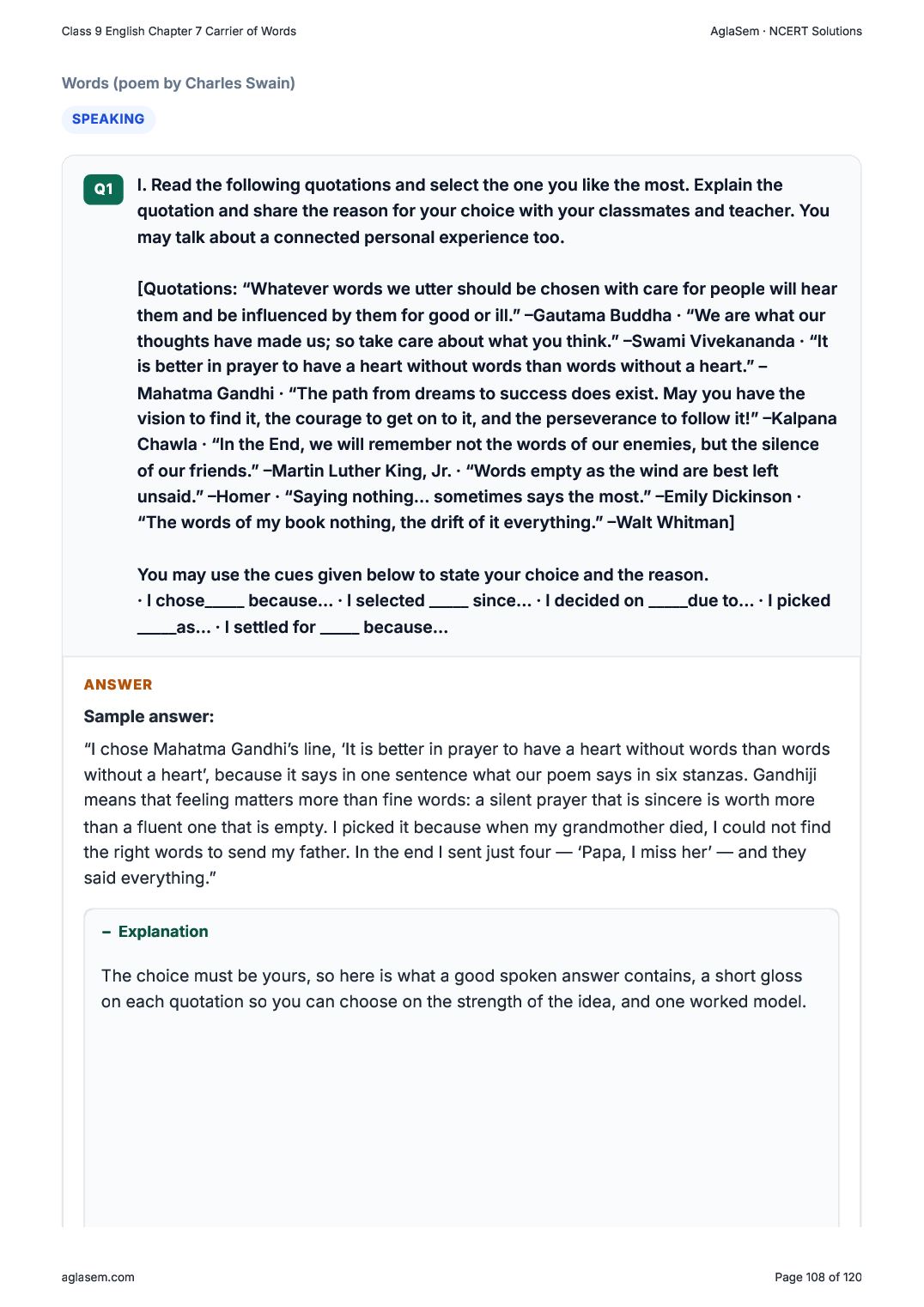
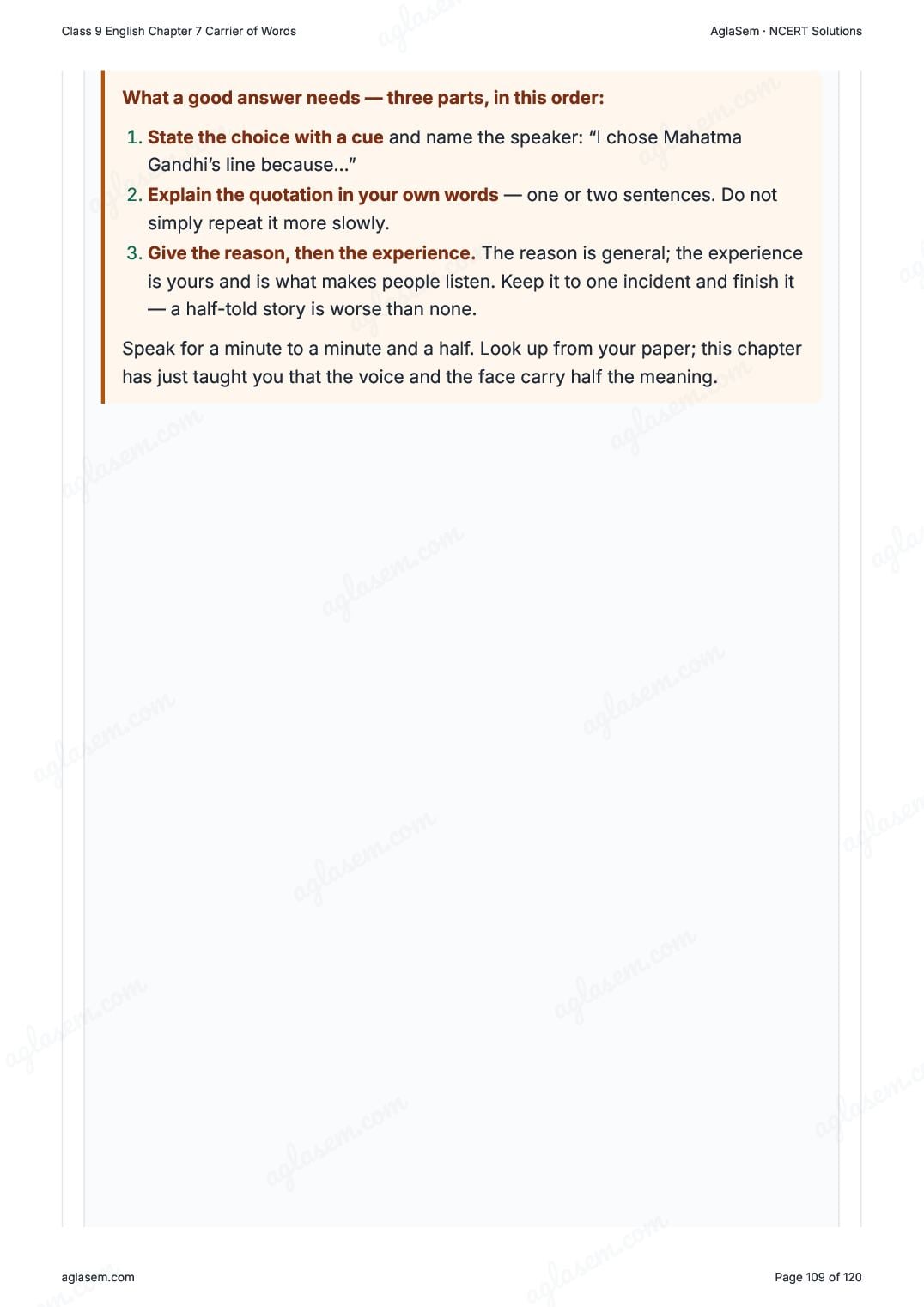
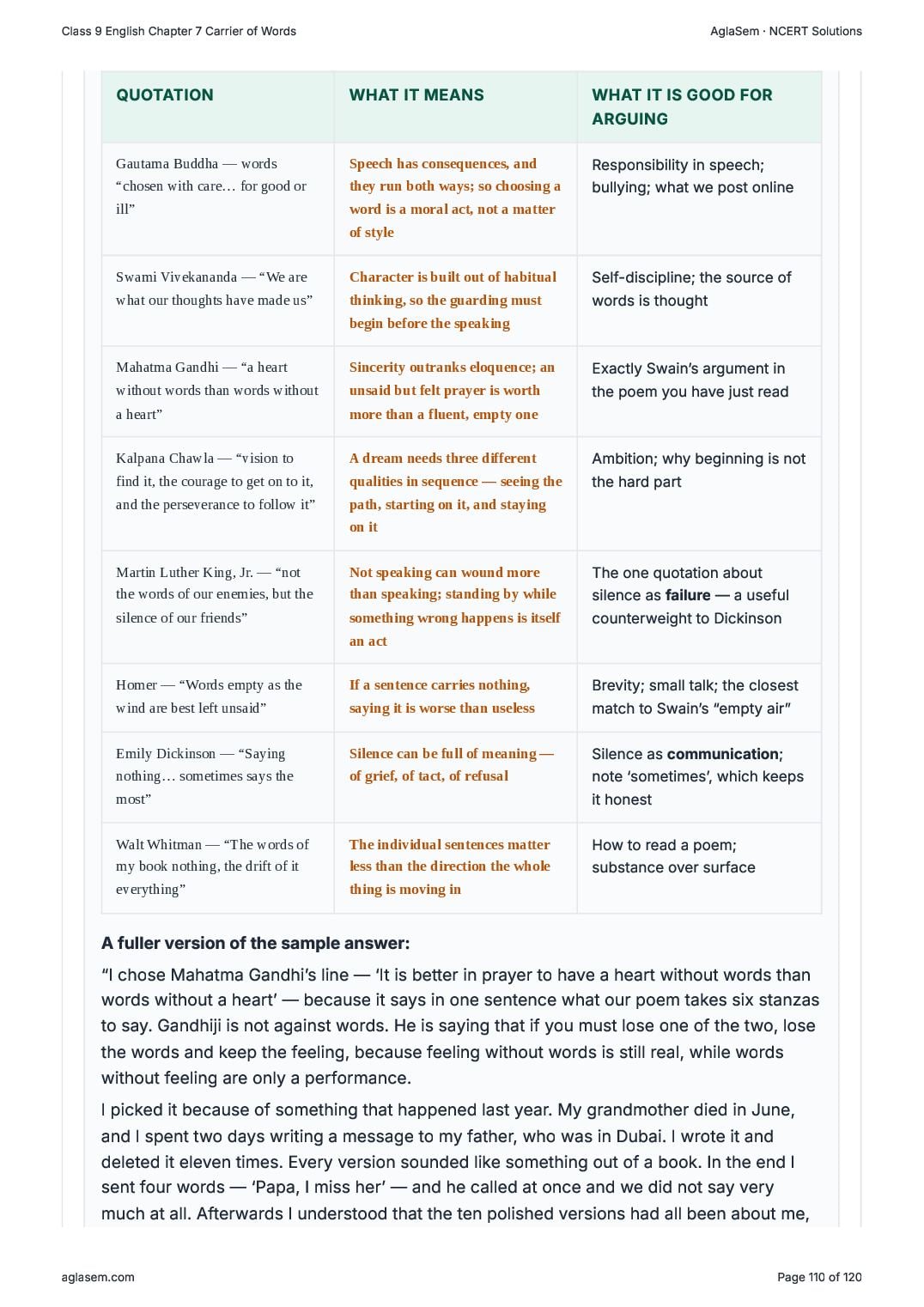
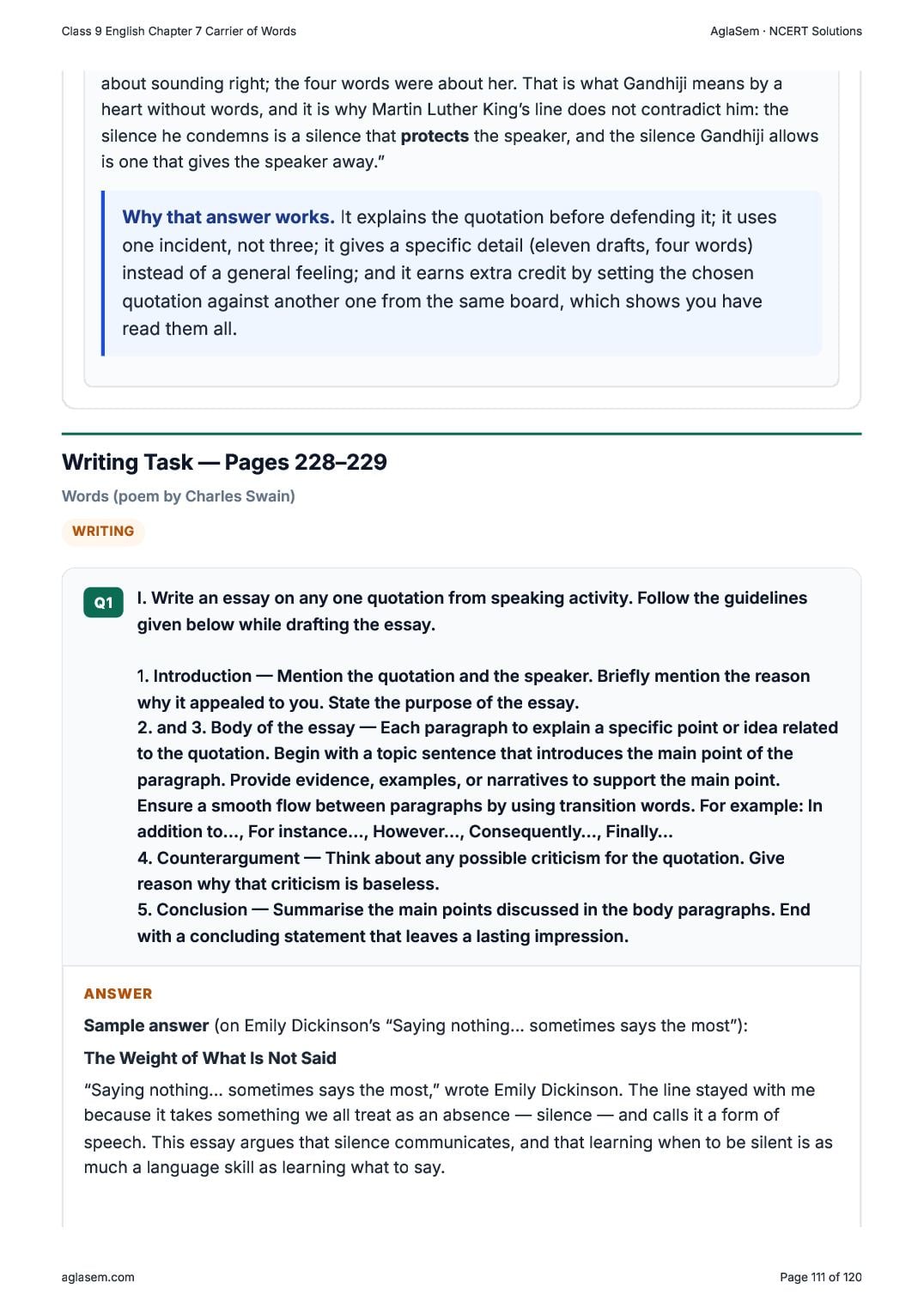
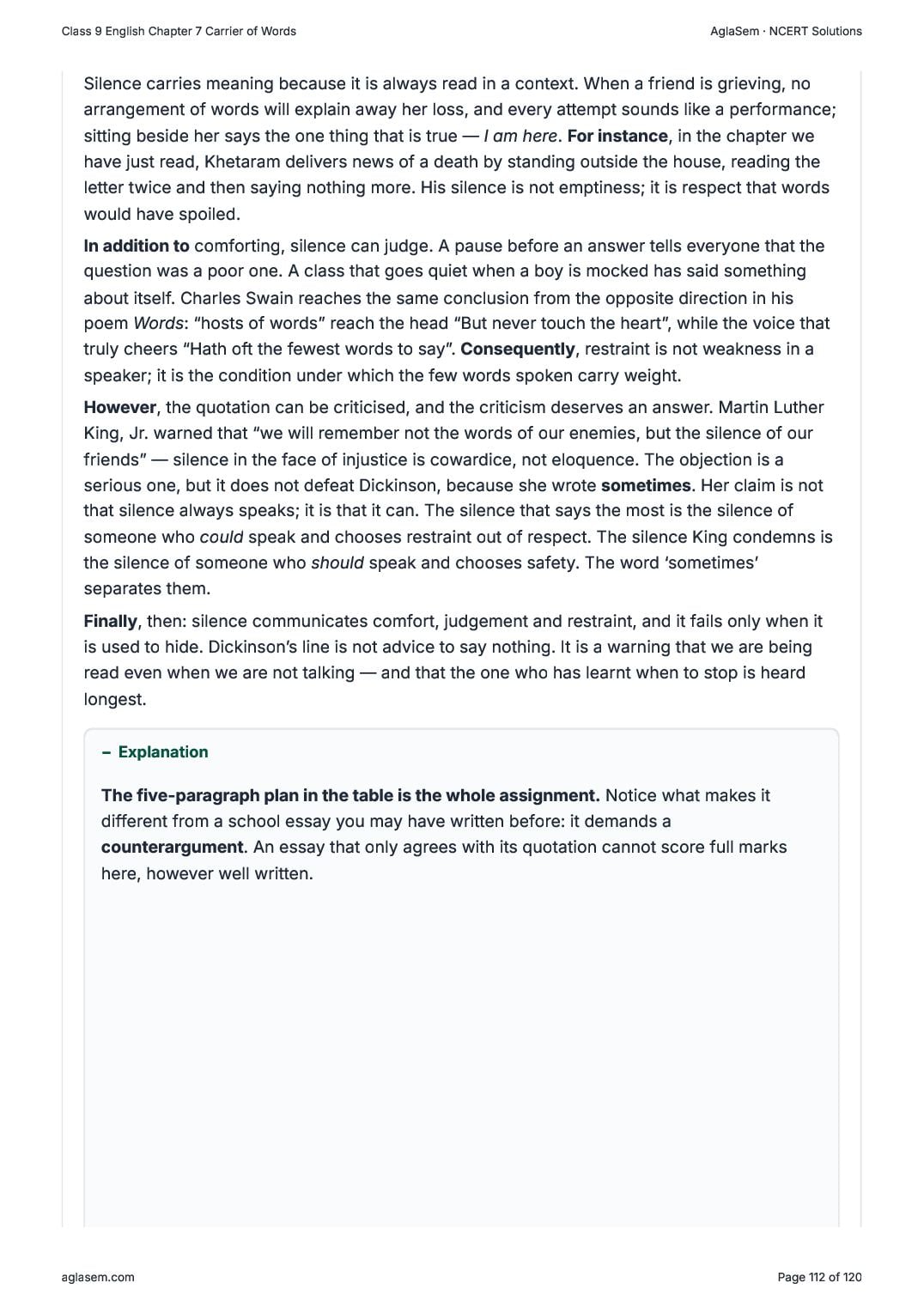
- I. Read the following quotations and select the one you like the most. Explain the quotation and share the reason for your choice with your classmates and teacher. You may talk about a connected personal experience too. [Quotations: “Whatever words we utter should be chosen with care for people will hear them and be influenced by them for good or ill.” –Gautama Buddha · “We are what our thoughts have made us; so take care about what you think.” –Swami Vivekananda · “It is better in prayer to have a heart without words than words without a heart.” –Mahatma Gandhi · “The path from dreams to success does exist. May you have the vision to find it, the courage to get on to it, and the perseverance to follow it!” –Kalpana Chawla · “In the End, we will remember not the words of our enemies, but the silence of our friends.” –Martin Luther King, Jr. · “Words empty as the wind are best left unsaid.” –Homer · “Saying nothing… sometimes says the most.” –Emily Dickinson · “The words of my book nothing, the drift of it everything.” –Walt Whitman] You may use the cues given below to state your choice and the reason. · I chose_____ because… · I selected _____ since… · I decided on _____due to… · I picked _____as… · I settled for _____ because…
- … and more questions are solved in the complete PDF above.
Chapter at a Glance
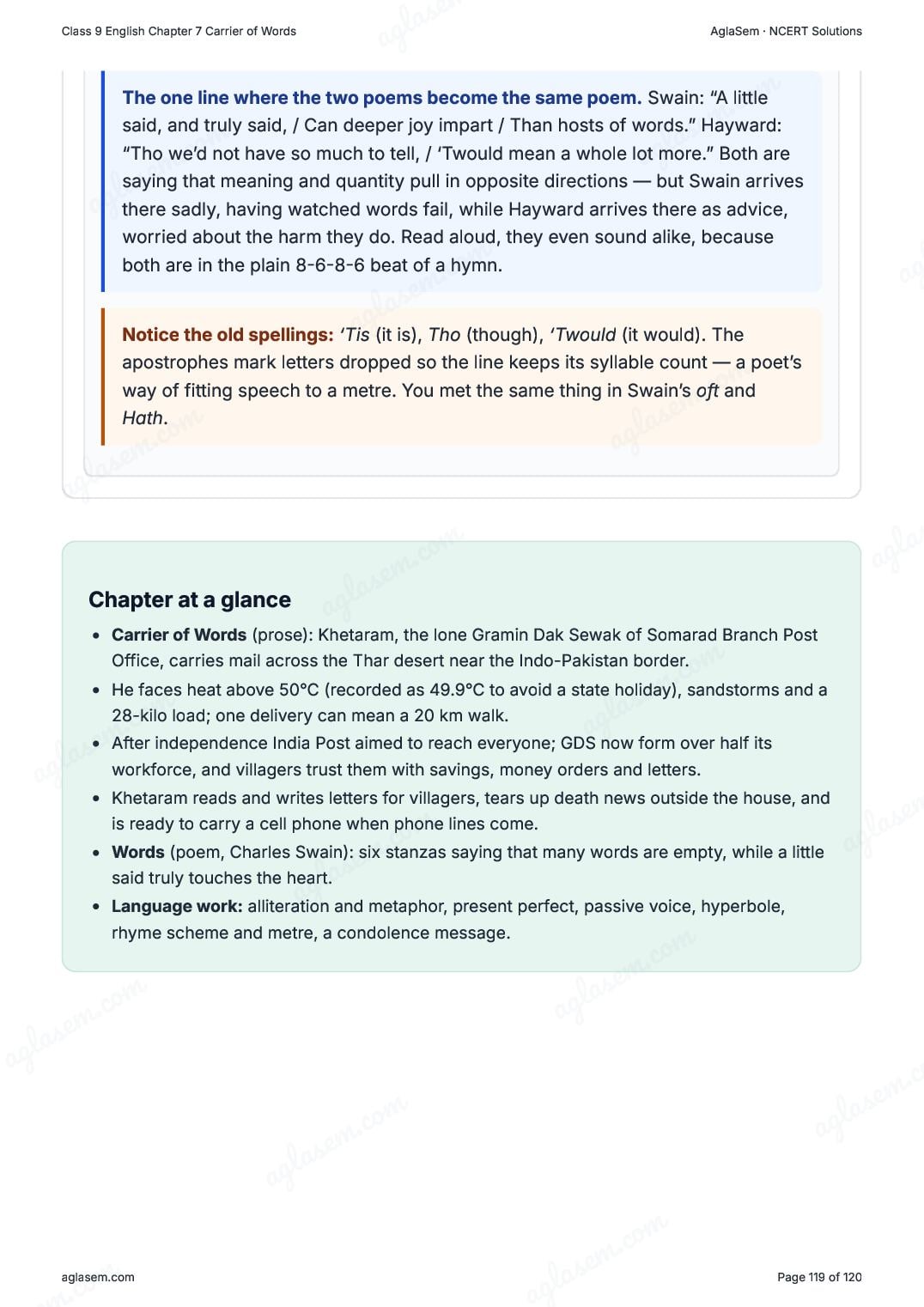
- Carrier of Words (prose, printed pages 203–219) is a factual feature, not a story: it follows one named man, Khetaram , “the sole postman of Somarad Branch Post Office”, whose “left shoulder slumped from years of carrying a mailbag”. The writing works by piling up measured facts — 120 km beyond the last railhead at Barmer, 50 km beyond the last phone, 10 km beyond where the road “crumbles into sand”, a 28-kilo regulation load, 20 km for a single delivery, 330 km from Jodhpur in under 24 hours.
- The chapter’s sharpest fact is a small one: on days when the heat crosses 50°C it “is recorded as 49.9 degrees celsius, since 50 degrees celsius would mean a state holiday.” One decimal point decides whether a man walks into a furnace. That single sentence carries the whole argument about who bears the cost of a public service.
- Two institutional points sit behind the human story. First, the purpose of the post changed at Independence: the British system relayed “company dak between administrative centres”, while India Post’s mandate “was to bring the entire population within the mailing ambit” — 25,000 post offices in 1947 to more than a lakh and a half today. Second, Gramin Dak Sewaks (the 2001 renaming of ‘delivery agents’) now number over three lakh and make up more than 50 per cent of the total workforce.
- Trust is the theme that ties the piece together — rural depositors “entrust their monthly savings to the post office”; a proposal to hand the GDS job to patwaris was “summarily rejected” (“We knew they would not be able to do the job”); Khetaram “can dwell on any threshold”, reads out letters and drafts replies. Even his handling of death — standing outside, reading the letter twice, tearing it to bits because “Ashubh Samachar cannot be carried into the house” — is trust, of a harder kind.
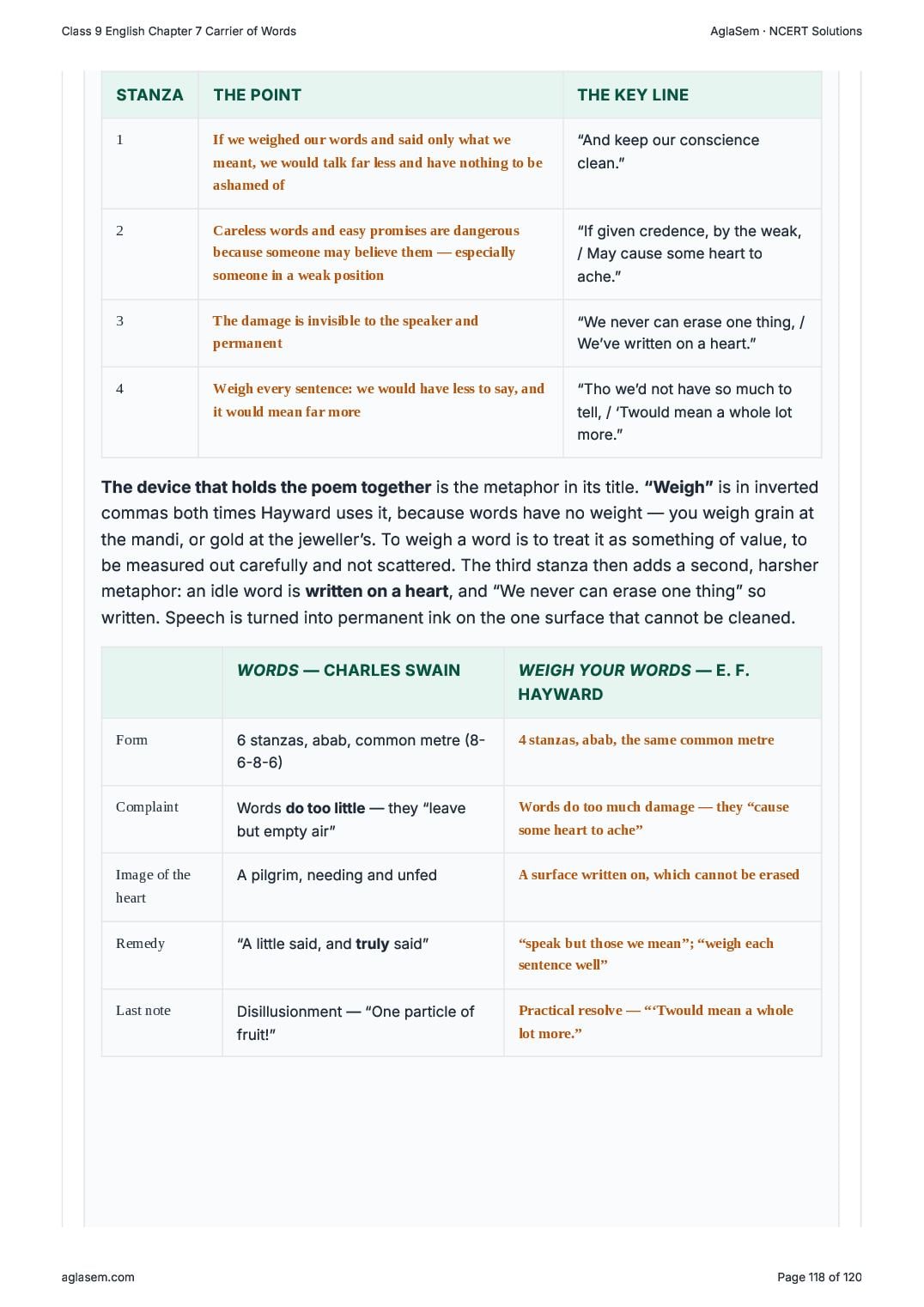
- Words (poem, printed pages 220–230) is six four-line stanzas in common metre (8-6-8-6 syllables) rhyming abab . Its method is comparison after comparison: words are summer birds that depart, the heart is a pilgrim upon earth , words are worth no more than weeds , and empty talk is a plant “All blossom to the root” that “cannot grow / One particle of fruit!” The turn comes in stanzas 3 and 4 — little said truly “Can deeper joy impart / Than hosts of words, which reach the head, / But never touch the heart”, and the kindest voice “Hath oft the fewest words to say; / But, oh! those few, how dear!” — before stanza 5 repeats the opening line with chest for heart and closes the trap: “But words, when summoned to the test, / Oft satisfy the least!”
- The language work in the chapter is heavy: a word-box cloze, two matching grids, alliteration and metaphor , the present perfect and its seven uses, the passive voice , hyperbole , rhyme scheme and metre , plus a word-search grid, a condolence message, philately and an obsolete telegram form. Both Unit 7 listening transcripts are in the Appendix, printed pages 272 (prose) and 273–274 (poem).
How to Download NCERT Solutions for Class 9 English Chapter 7 PDF
Follow these simple steps to get the Carrier of Words questions-and-answers PDF from Kaveri.
- Search NCERT Solutions for Class 9 English Chapter 7 aglasem and open this page.
- Read the exercise questions with answers for Carrier of Words shown above.
- Click the Download PDF link to save the Carrier of Words solutions to your device.
NCERT Solutions for Class 9 English – All Chapters
There are more chapters to study besides Carrier of Words in English. Here are the NCERT Solutions for all chapters of Class 9 English.
- Chapter 1 How I Taught My Grandmother to Read
- Chapter 2 The Pot Maker
- Chapter 3 Winds of Change
- Chapter 4 Vitamin M
- Chapter 5 The World of Limitless Possibilities
- Chapter 6 Twin Melodies
- Chapter 7 Carrier of Words
- Chapter 8 Follow That Dream
NCERT Solutions for Class 9 – All Subjects
Just like Chapter 7 of English, you can get the exercise questions with answers for every other subject of Class 9. Here are the NCERT Solutions for all subjects of Class 9.
NCERT Solutions for Class 9 English Chapter 7 – An Overview
The key highlights of this study material are as follows.
| Aspects | Details |
|---|---|
| Class | Class 9 |
| Subject | English |
| Chapter Number | Chapter 7 |
| Chapter Name | Carrier of Words |
| Book Name | Kaveri |
| Book By | NCERT (National Council of Educational Research and Training) |
| Educational Resource Here | NCERT Solutions of Class 9 English Chapter 7 for all exercises |
| More Questions Answers of This Subject | NCERT Solutions for Class 9 English |
| Download Book Chapter | NCERT Book Class 9 English |
| All Questions Answers For This Class | NCERT Solutions for Class 9 |
| Complete Solutions | NCERT Solutions |
NCERT Solutions for Class 9 English Chapter 7 Carrier of Words – FAQs
What are the NCERT Solutions for Class 9 English Chapter 7 Carrier of Words?
They are the complete, step-by-step answers to all the exercise and in-text questions of Chapter 7 Carrier of Words from the NCERT Class 9 English textbook Kaveri, written by experts as per the latest NCERT syllabus.
How can I download the Class 9 English Chapter 7 solutions PDF for free?
Open this page on aglasem, read the Carrier of Words questions with answers, and click the “Download Solutions PDF” link. The Class 9 English Chapter 7 NCERT Solutions PDF is completely free to download.
Are these NCERT Solutions as per the latest 2026-27 syllabus?
Yes. The NCERT Solutions for Class 9 English Chapter 7 are based on the latest NCERT textbook Kaveri and the current 2026-27 CBSE syllabus, so the questions and answers match what you study in class.
Where can I get NCERT Solutions for the other chapters of Class 9 English?
You can find the answers to every chapter on the NCERT Solutions for Class 9 English page, and solutions for every subject on the NCERT Solutions for Class 9 page.
How do NCERT Solutions help in exam preparation?
They show the correct method to solve each question, help you write answers the way they are expected in exams, let you check and correct your own work, and save revision time — which together improve your marks in Class 9 English.
If you have any queries on NCERT Solutions for Class 9 English Chapter 7 Carrier of Words, then please ask in the comments below.