NCERT Solutions for Class 9 Science Chapter 11 Reproduction How Life Continues provide clear, step-by-step answers to every exercise and in-text question from the chapter Reproduction How Life Continues of the NCERT textbook Exploration. Prepared by subject experts as per the latest NCERT (CBSE) syllabus for 2026-27, these NCERT Solutions for Class 9 Science help you understand each concept, write exam-ready answers, and check your own solutions. You can read them online below or download the free Class 9 Science Chapter 11 question-answer PDF.
NCERT Solutions for Class 9 Science Chapter 11 Reproduction How Life Continues
- Class: Class 9
- Subject: Science
- Chapter: Chapter 11 – Reproduction How Life Continues
- Textbook: Exploration (NCERT)
- Study material: NCERT Solutions – questions with answers, free PDF
These solutions answer all the exercise questions of Chapter 11 Reproduction How Life Continues — including the in-text questions, short-answer and long-answer questions, and activities — with complete explanations so you can follow the method, not just the final answer. Read the full solutions below.
NCERT Solutions Class 9 Science Chapter 11 Reproduction How Life Continues View Download
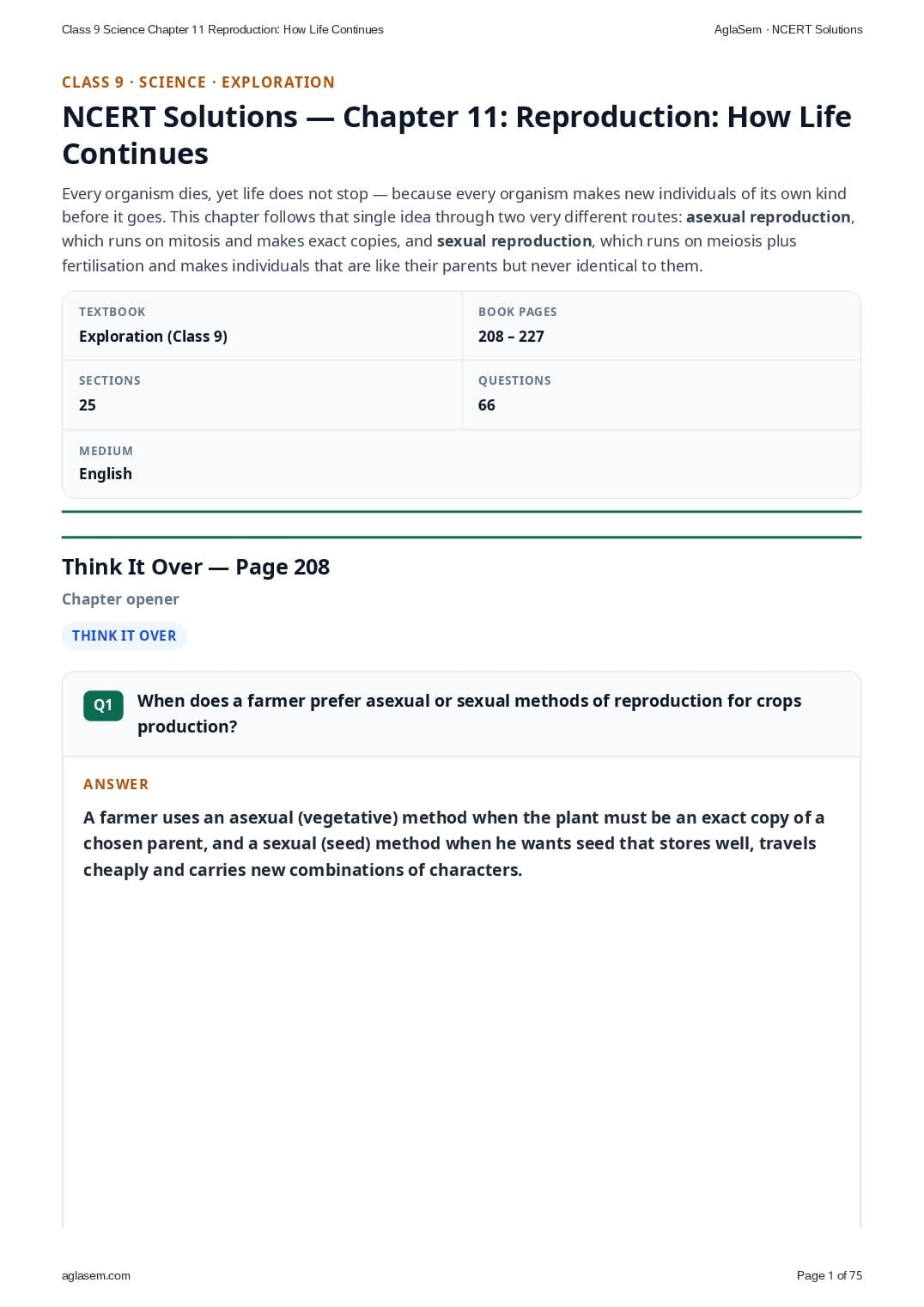


NCERT Solutions for Class 9 Science Chapter 11 PDF Download
You can read the NCERT Solutions for Class 9 Science Chapter 11 online above, or download the complete question-answer PDF to study Reproduction How Life Continues offline at any time.
NCERT Solutions for Class 9 Science Chapter 11 PDF Download Link – Click Here to Download Solutions PDF
Questions Covered in This Chapter
These NCERT Solutions answer all 66 questions of this chapter. The questions solved are:
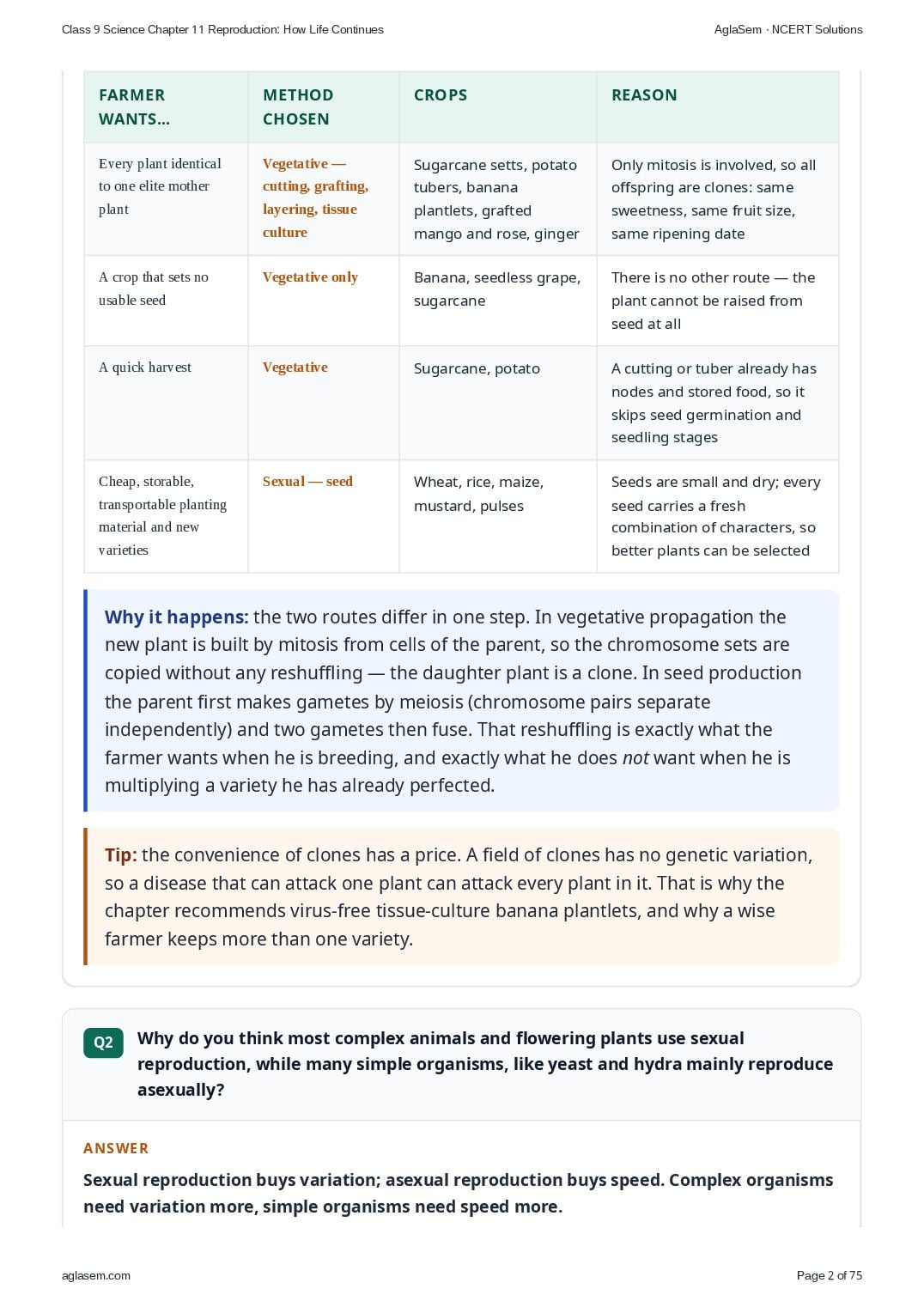
- When does a farmer prefer asexual or sexual methods of reproduction for crops production?
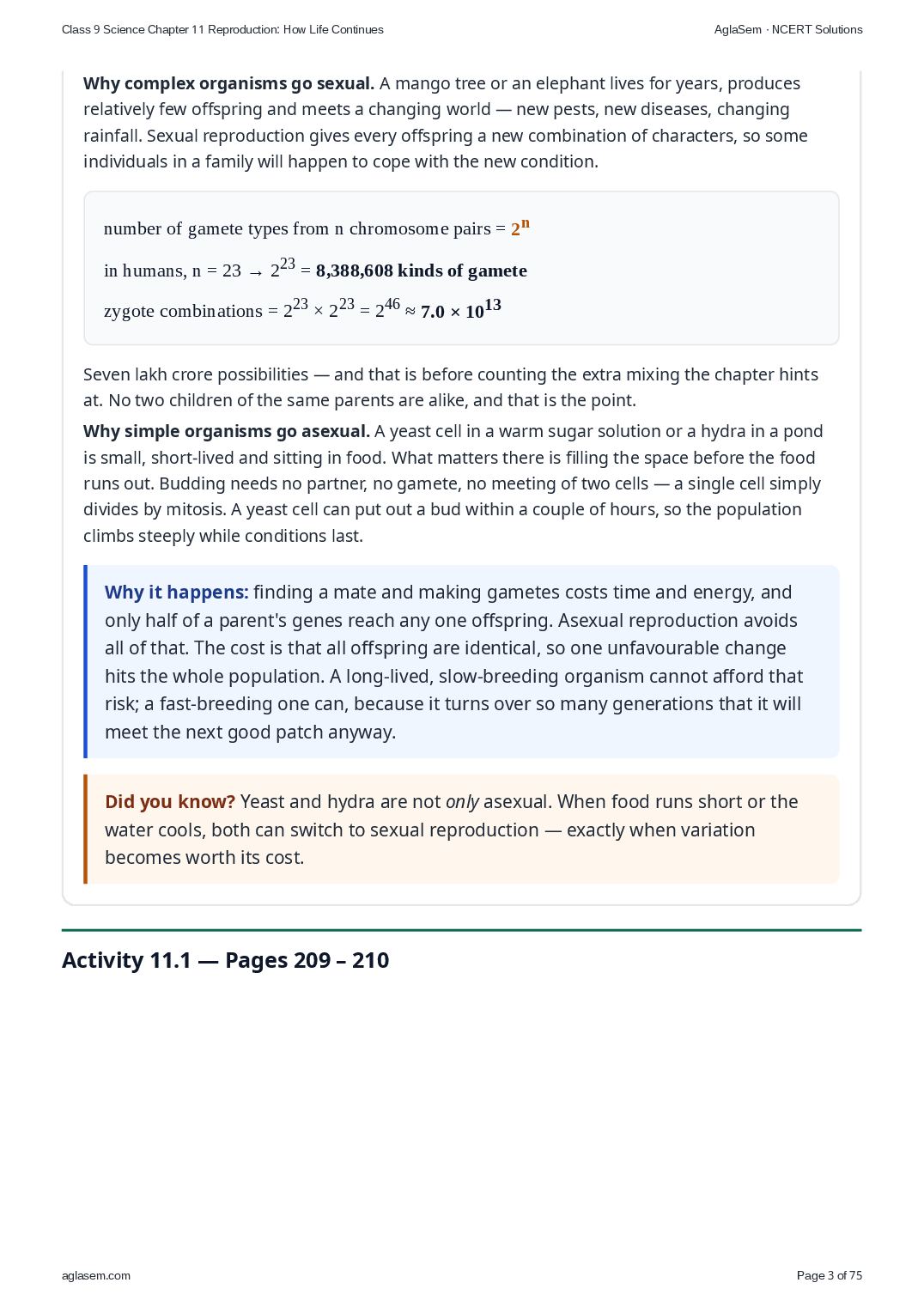
- Why do you think most complex animals and flowering plants use sexual reproduction, while many simple organisms, like yeast and hydra mainly reproduce asexually?
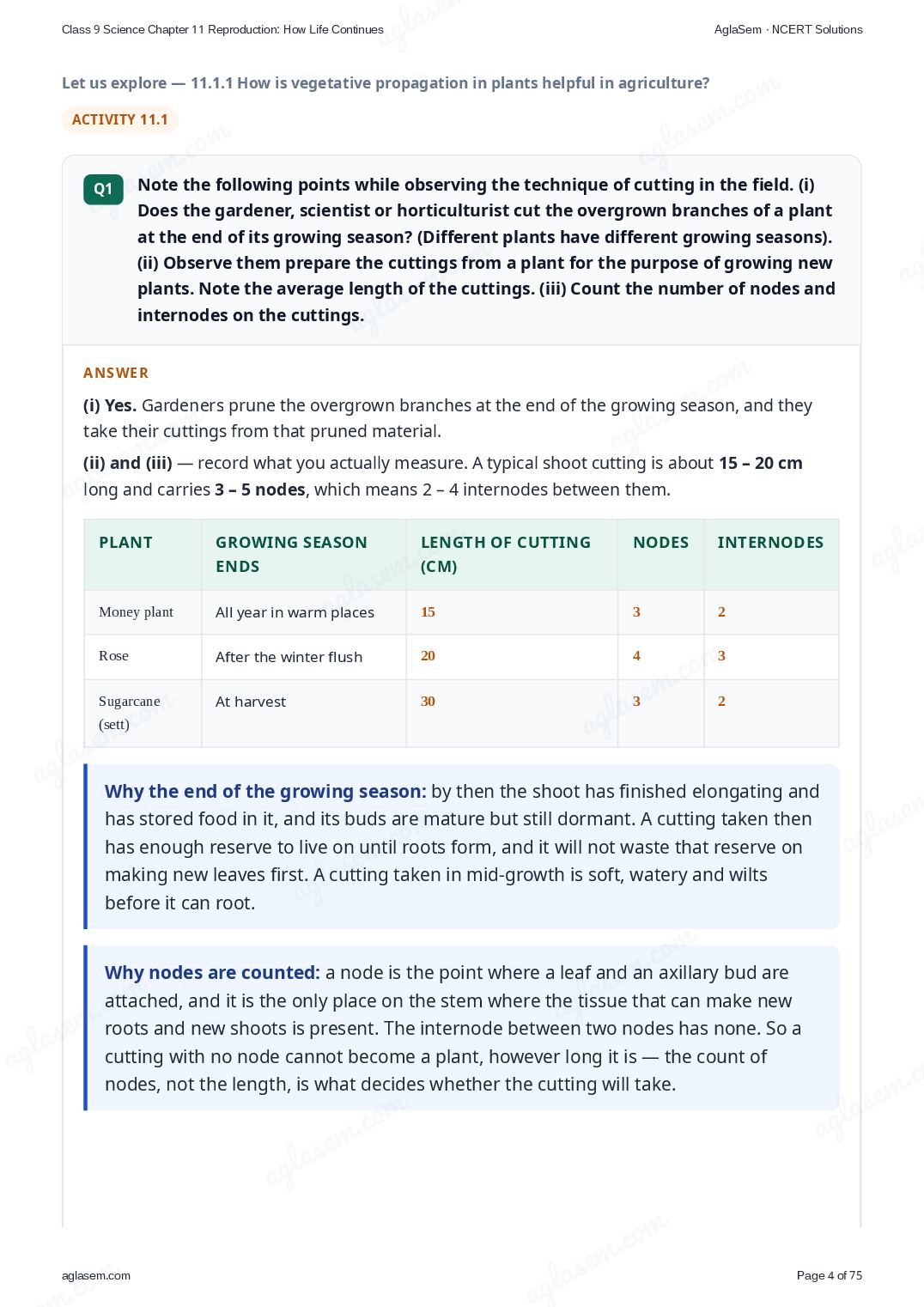
- Note the following points while observing the technique of cutting in the field. (i) Does the gardener, scientist or horticulturist cut the overgrown branches of a plant at the end of its growing season? (Different plants have different growing seasons). (ii) Observe them prepare the cuttings from a plant for the purpose of growing new plants. Note the average length of the cuttings. (iii) Count the number of nodes and internodes on the cuttings.
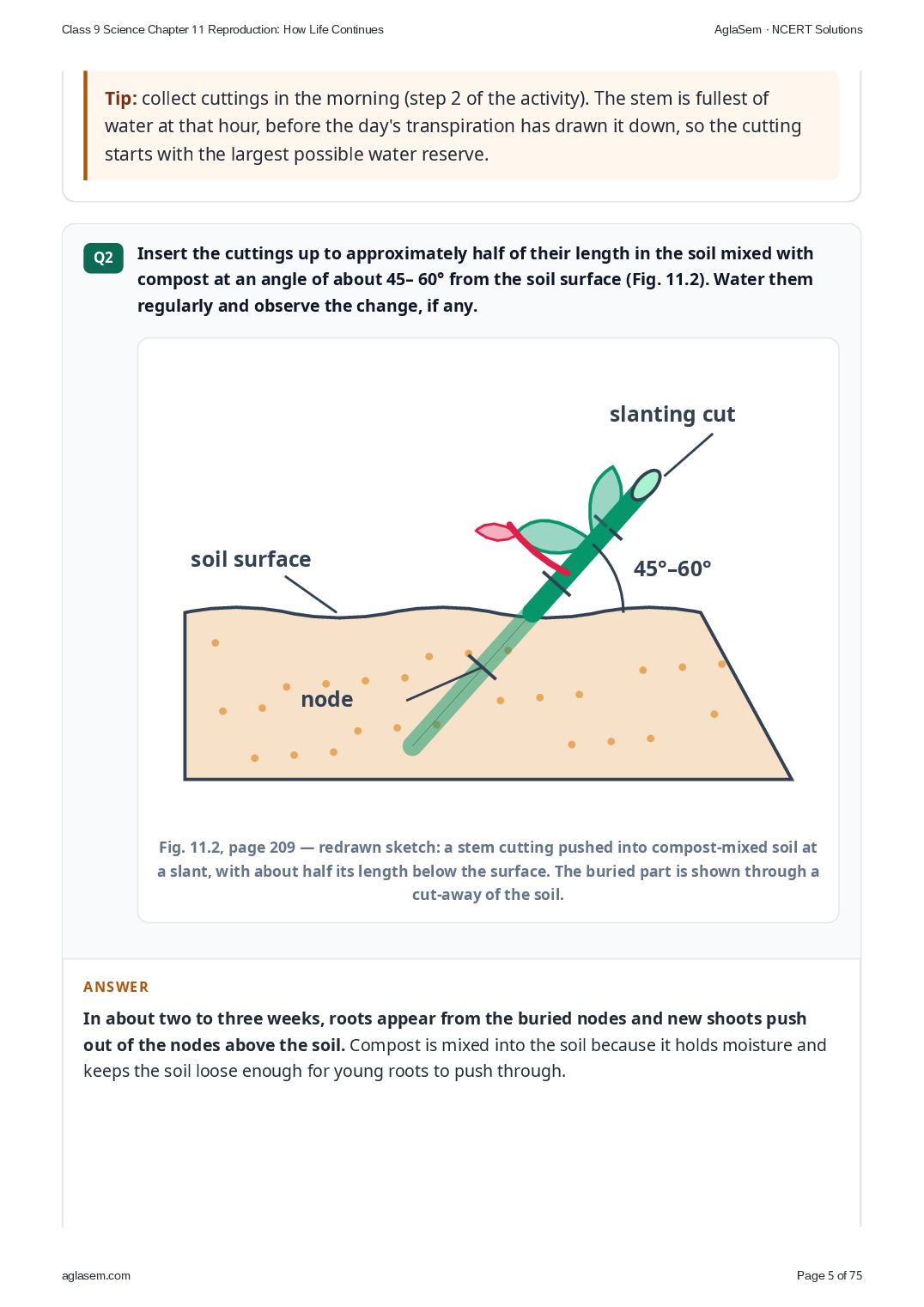
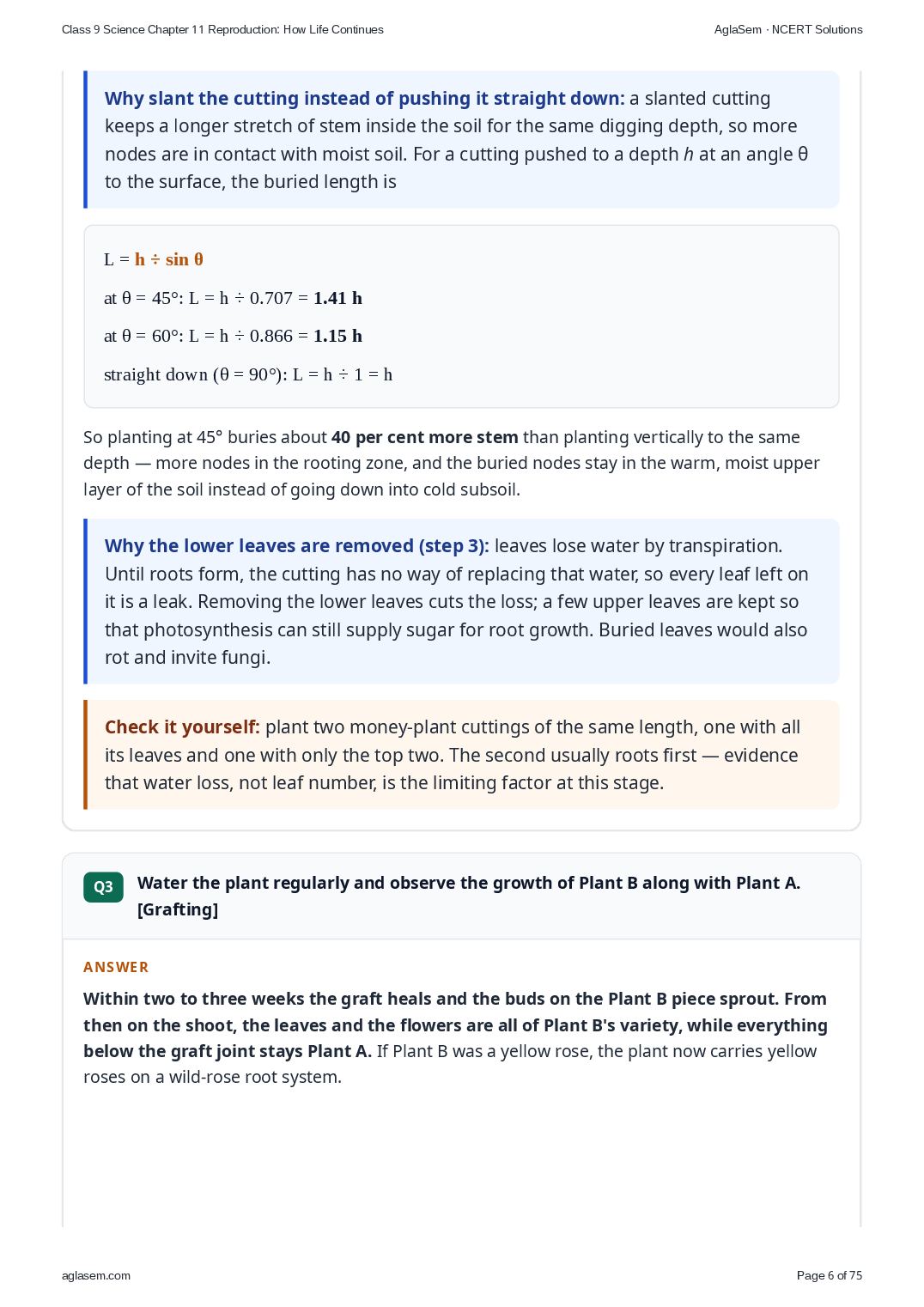
- Insert the cuttings up to approximately half of their length in the soil mixed with compost at an angle of about 45– 60° from the soil surface (Fig. 11.2). Water them regularly and observe the change, if any.
- Water the plant regularly and observe the growth of Plant B along with Plant A. [Grafting]
- Water it regularly and observe the growth of new leaves on the twig buried in the soil. After 10 – 15 days, the roots will develop from the area of the twig buried in the soil. [Layering]
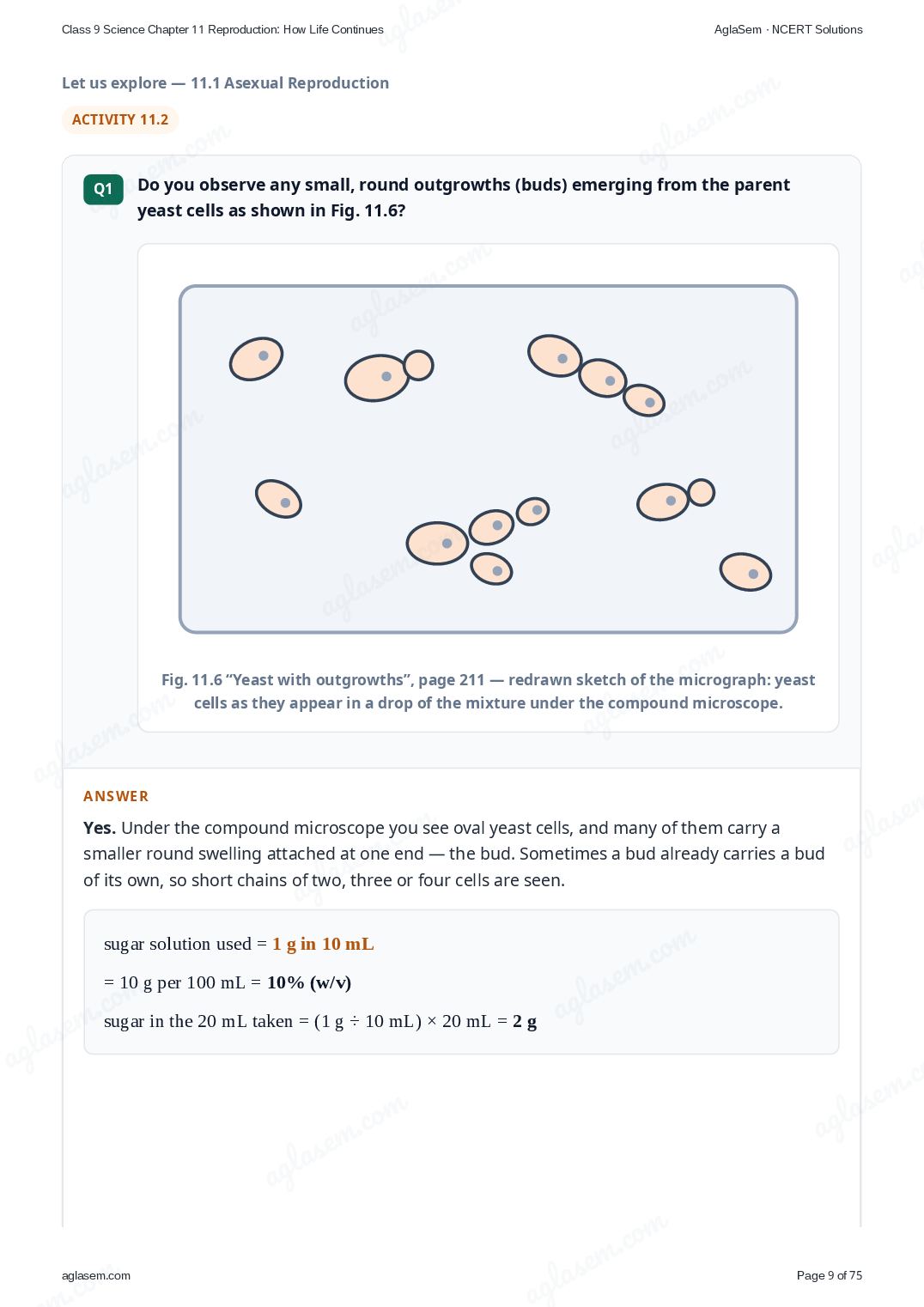
- Do you observe any small, round outgrowths (buds) emerging from the parent yeast cells as shown in Fig. 11.6?
- Do these features indicate that the yeast is duplicating?
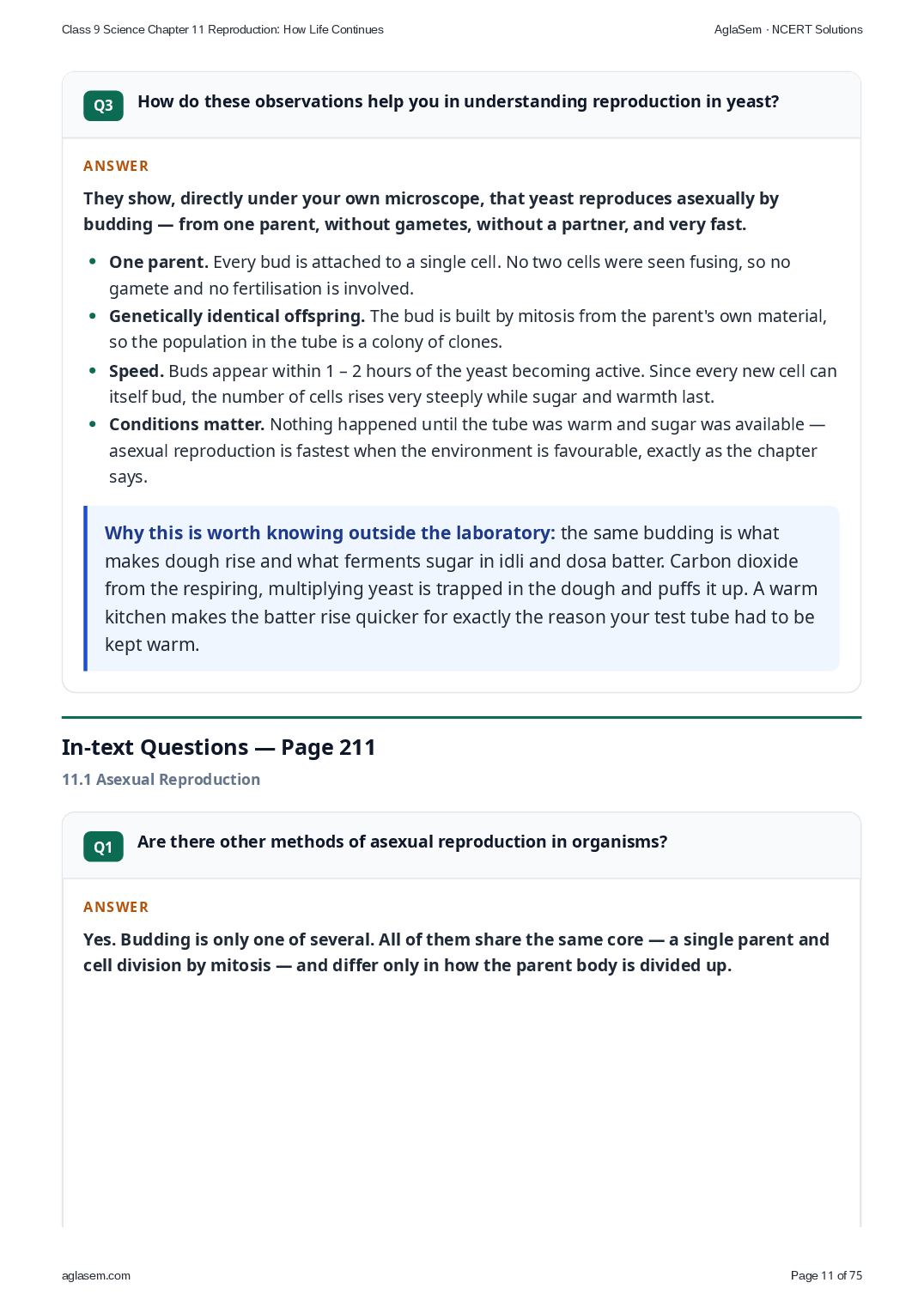
- How do these observations help you in understanding reproduction in yeast?
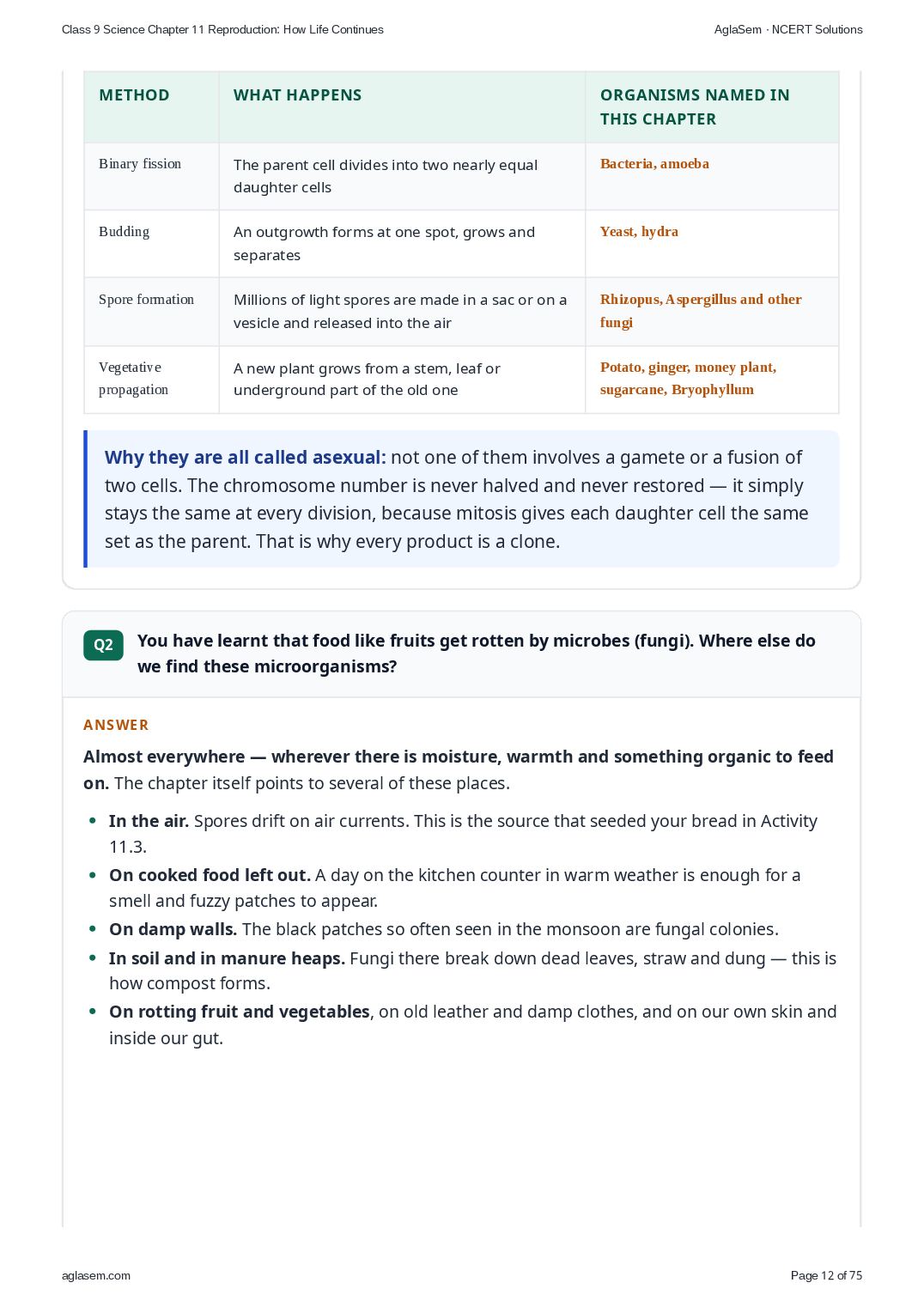
- Are there other methods of asexual reproduction in organisms?
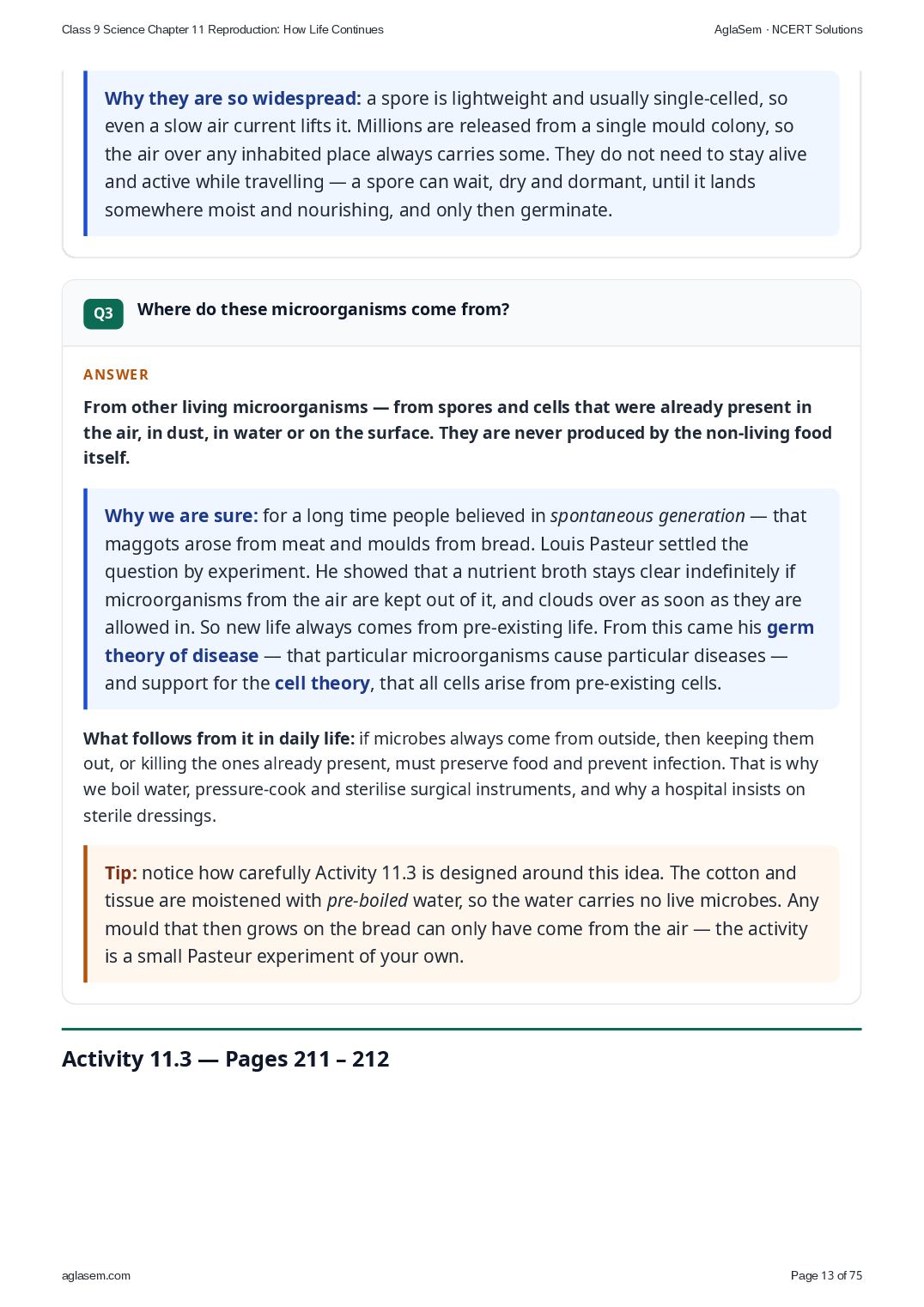
- You have learnt that food like fruits get rotten by microbes (fungi). Where else do we find these microorganisms?
- Where do these microorganisms come from?
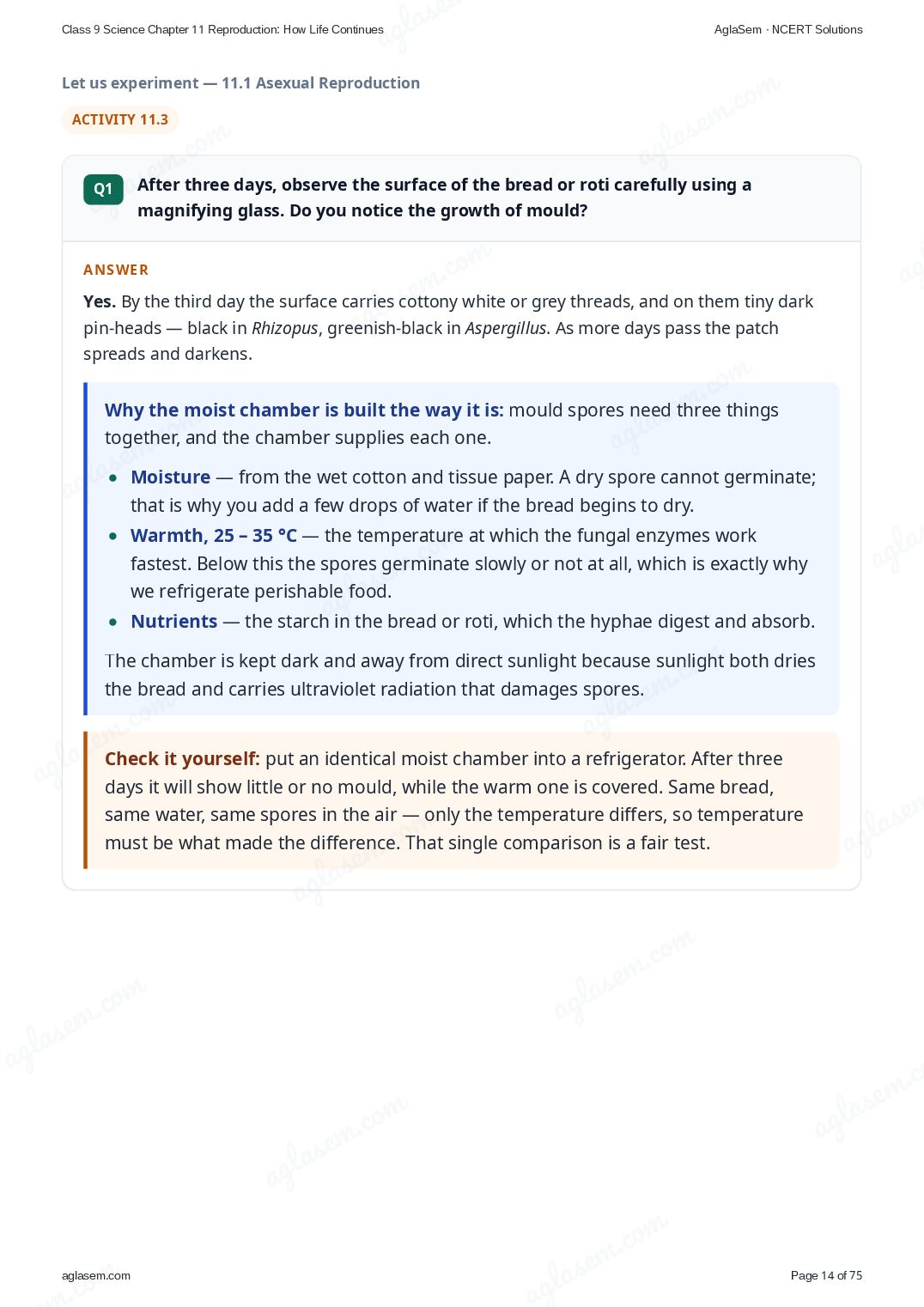
- After three days, observe the surface of the bread or roti carefully using a magnifying glass. Do you notice the growth of mould?
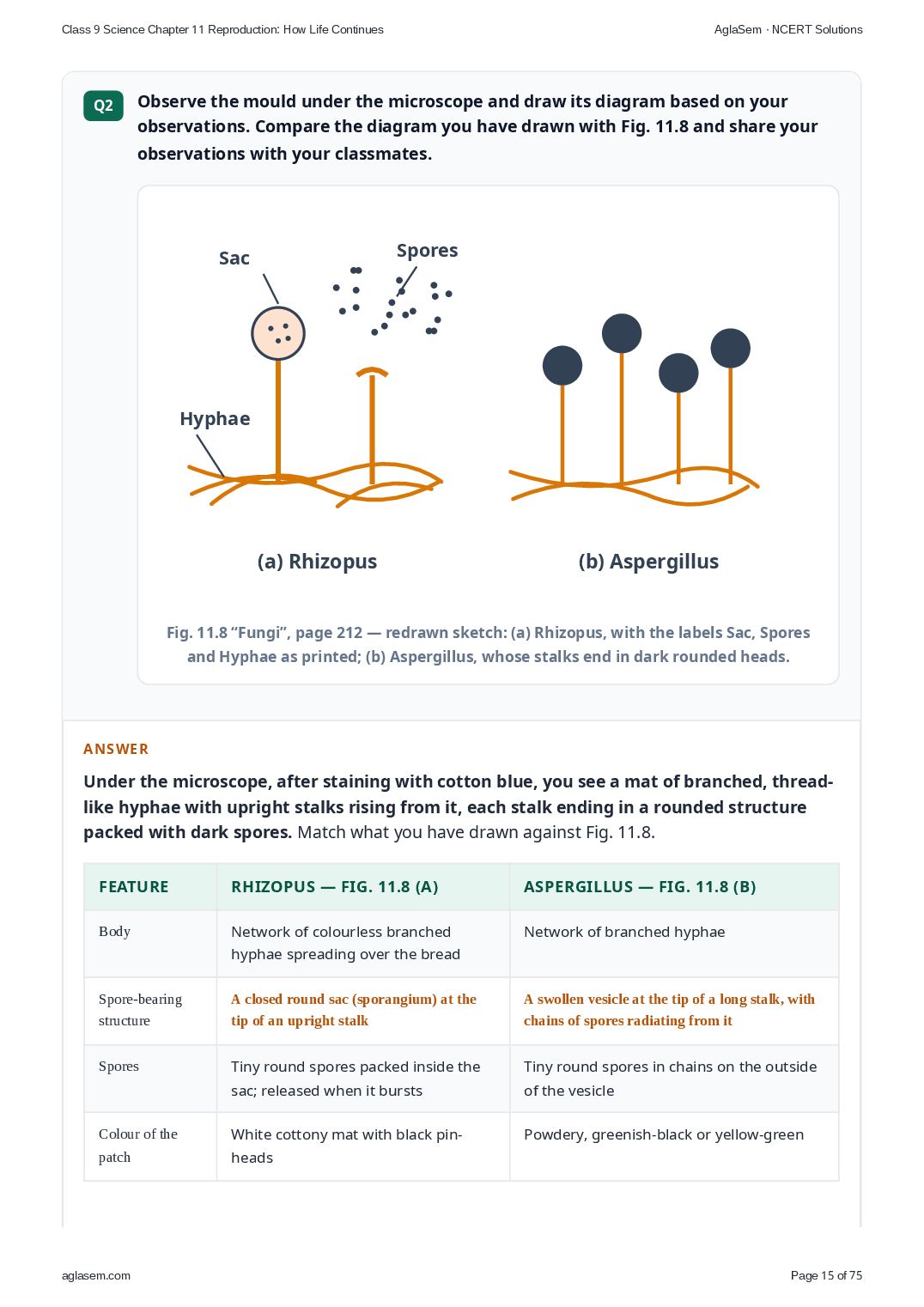
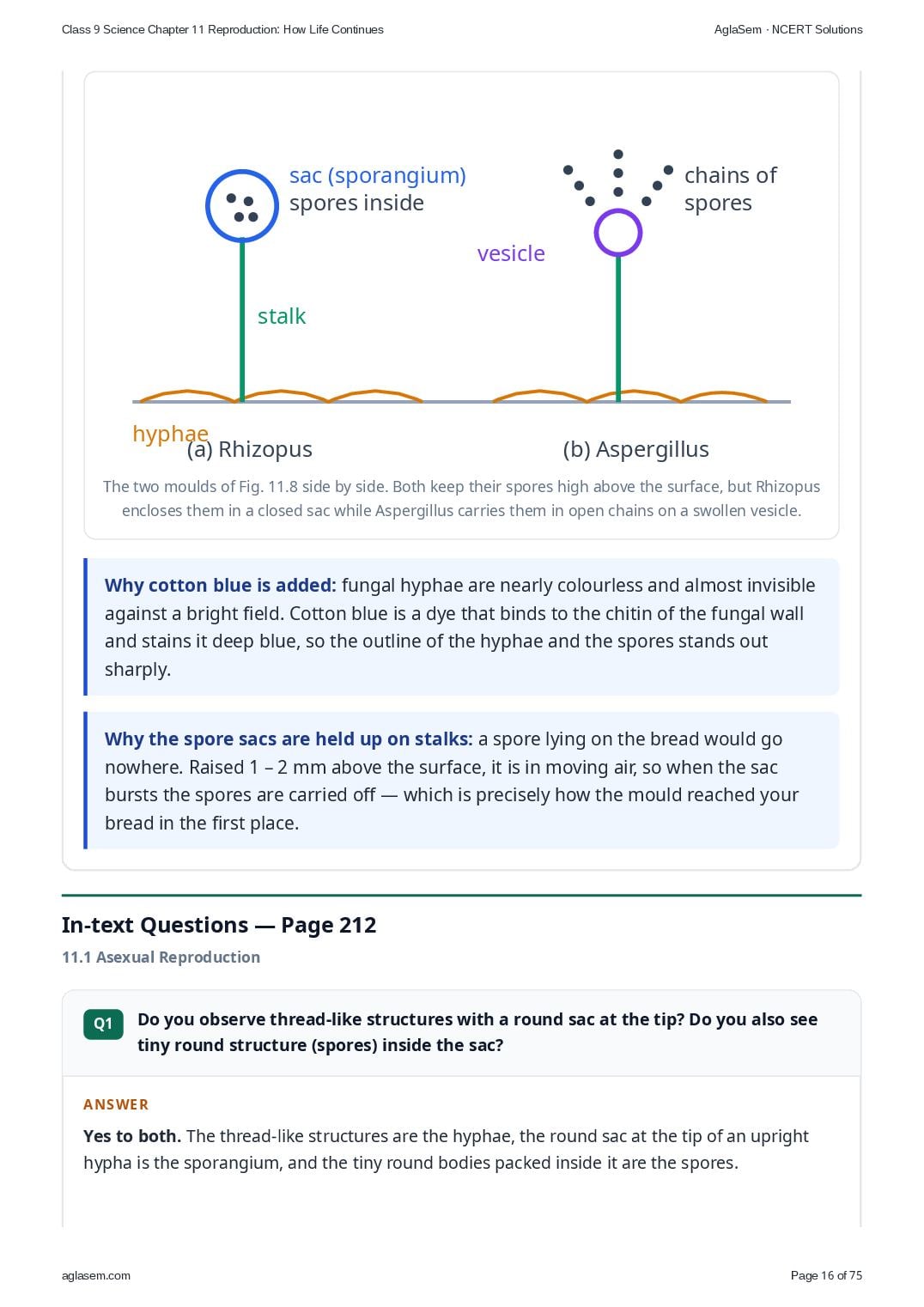
- Observe the mould under the microscope and draw its diagram based on your observations. Compare the diagram you have drawn with Fig. 11.8 and share your observations with your classmates.
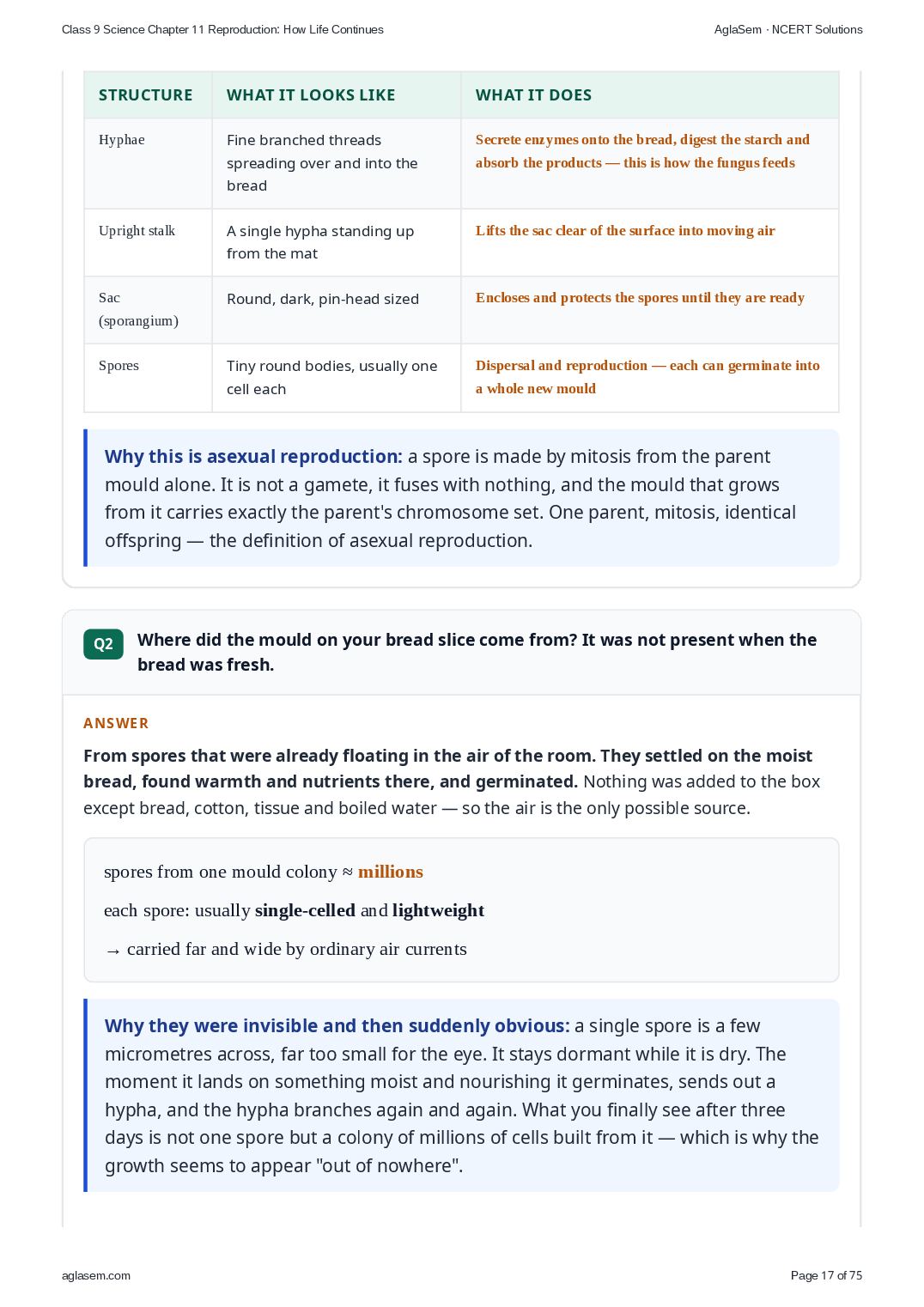
- Do you observe thread-like structures with a round sac at the tip? Do you also see tiny round structure (spores) inside the sac?
- Where did the mould on your bread slice come from? It was not present when the bread was fresh.
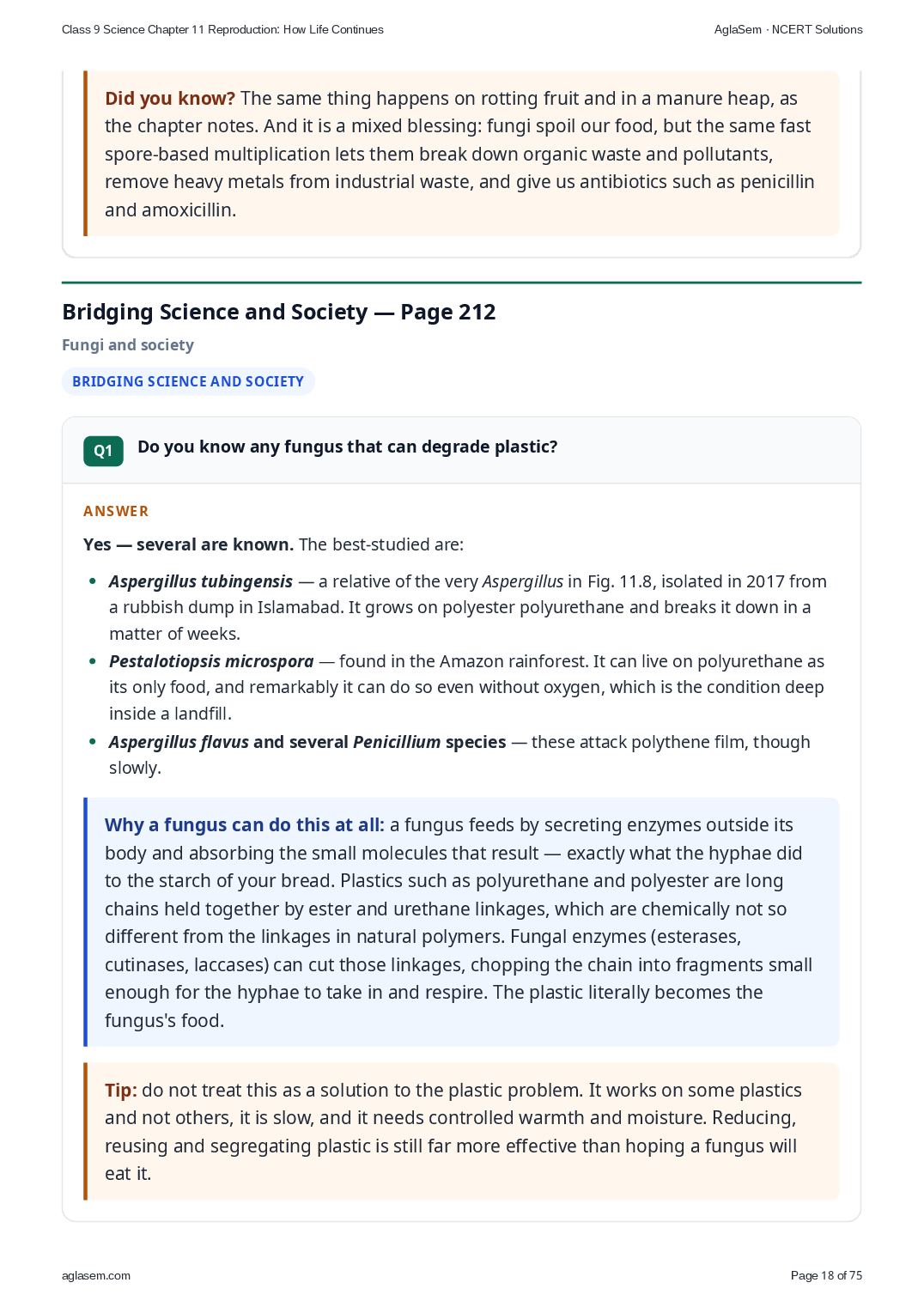
- Do you know any fungus that can degrade plastic?
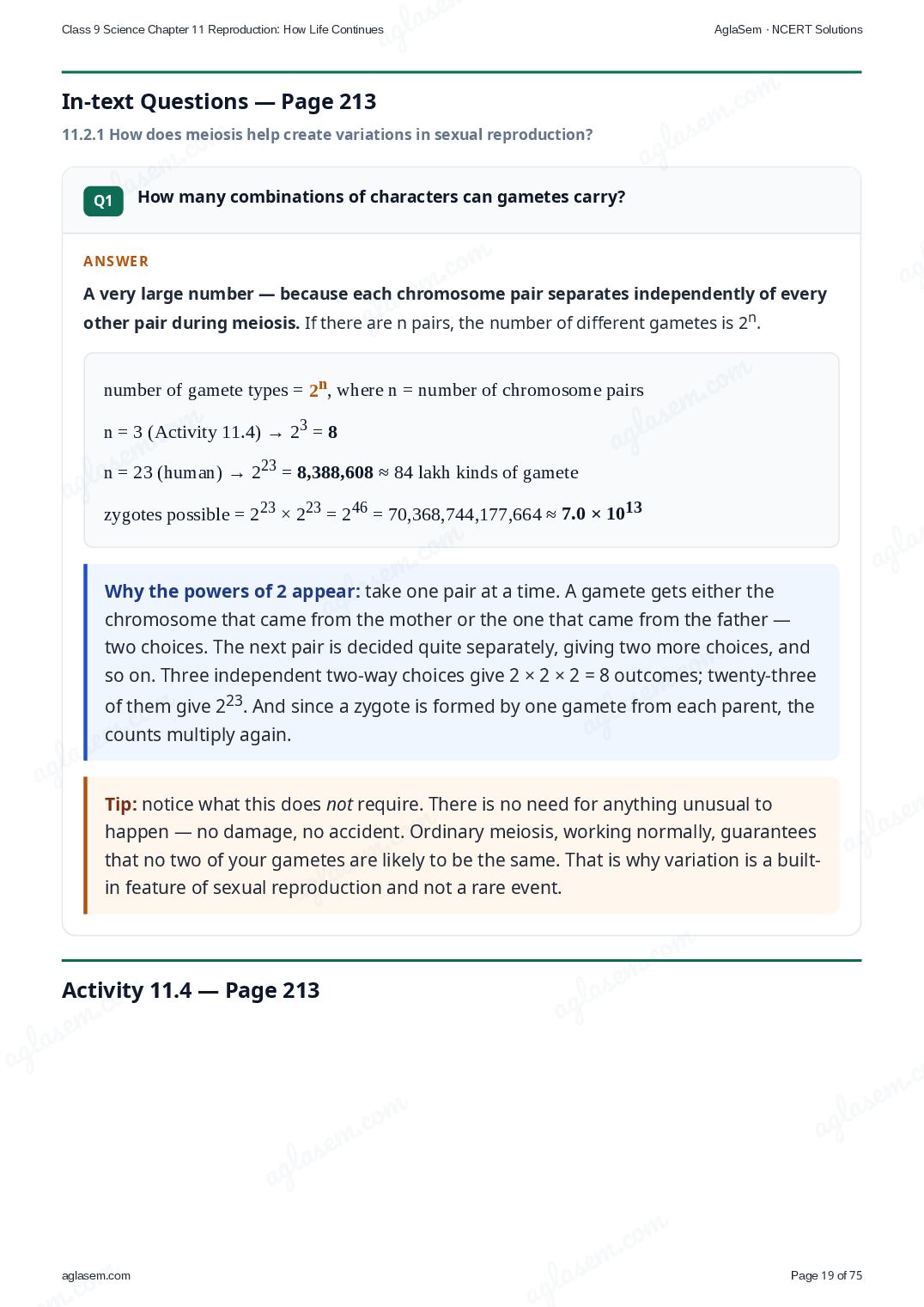
- How many combinations of characters can gametes carry?
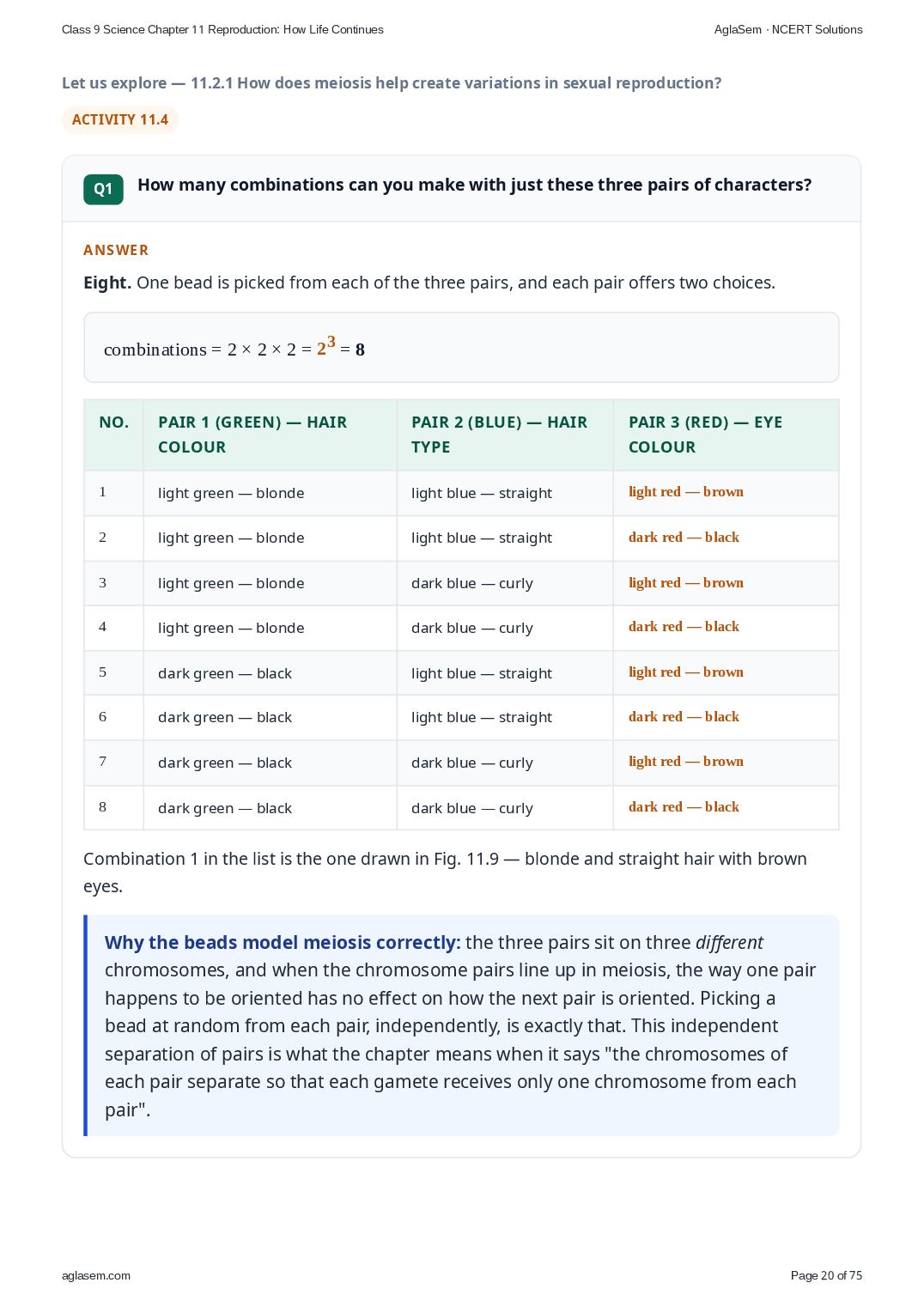
- How many combinations can you make with just these three pairs of characters?
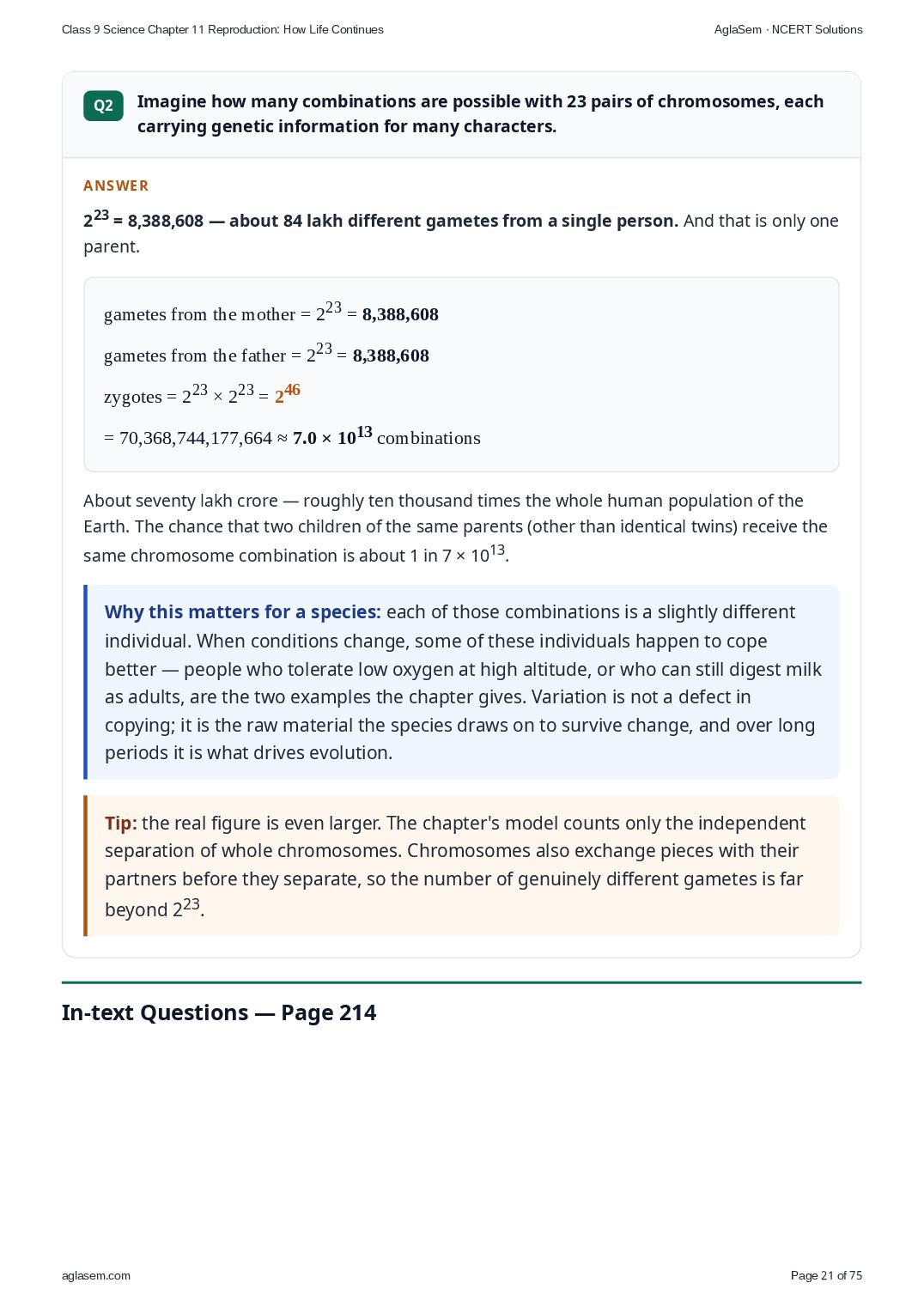
- Imagine how many combinations are possible with 23 pairs of chromosomes, each carrying genetic information for many characters.
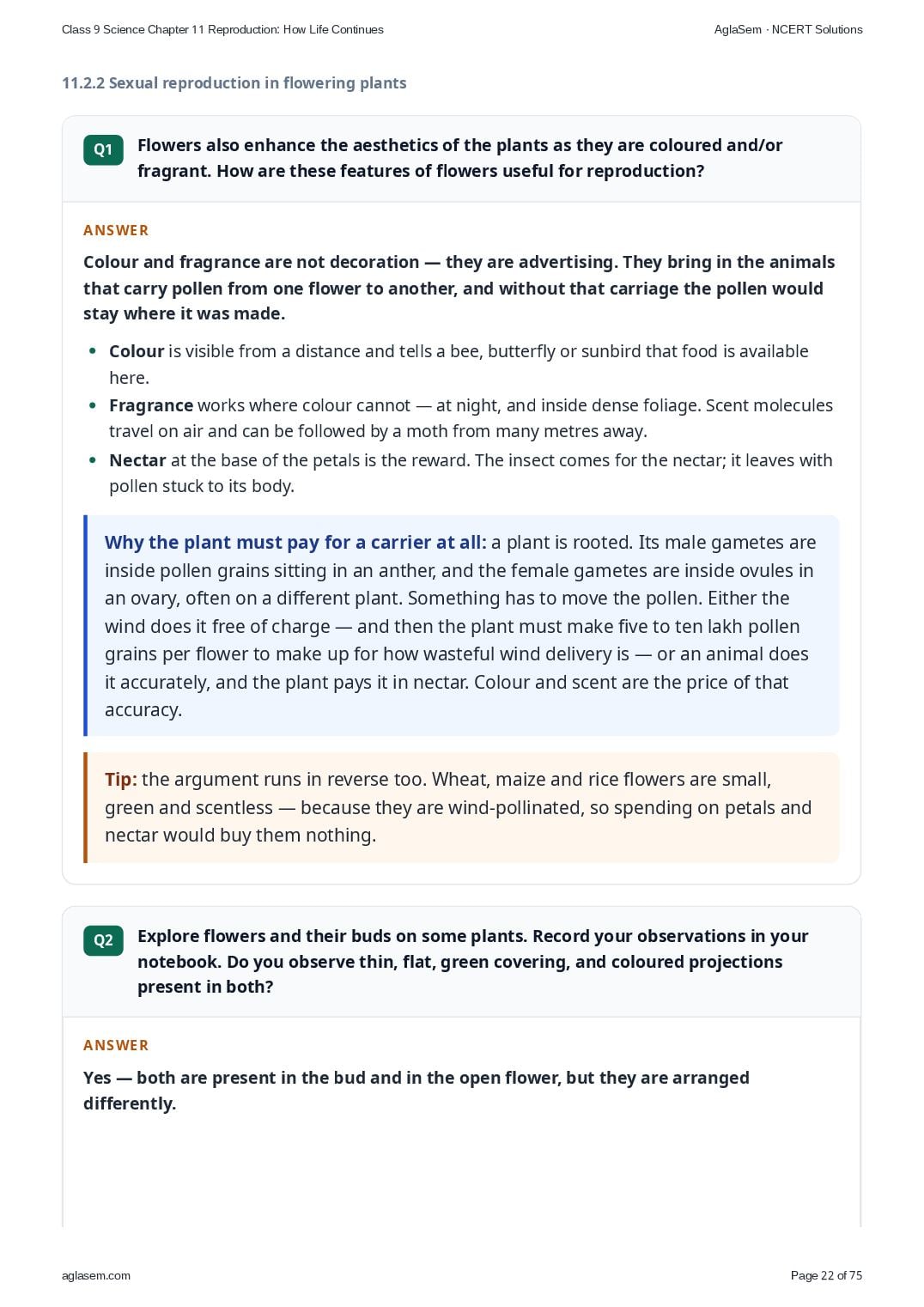
- Flowers also enhance the aesthetics of the plants as they are coloured and/or fragrant. How are these features of flowers useful for reproduction?
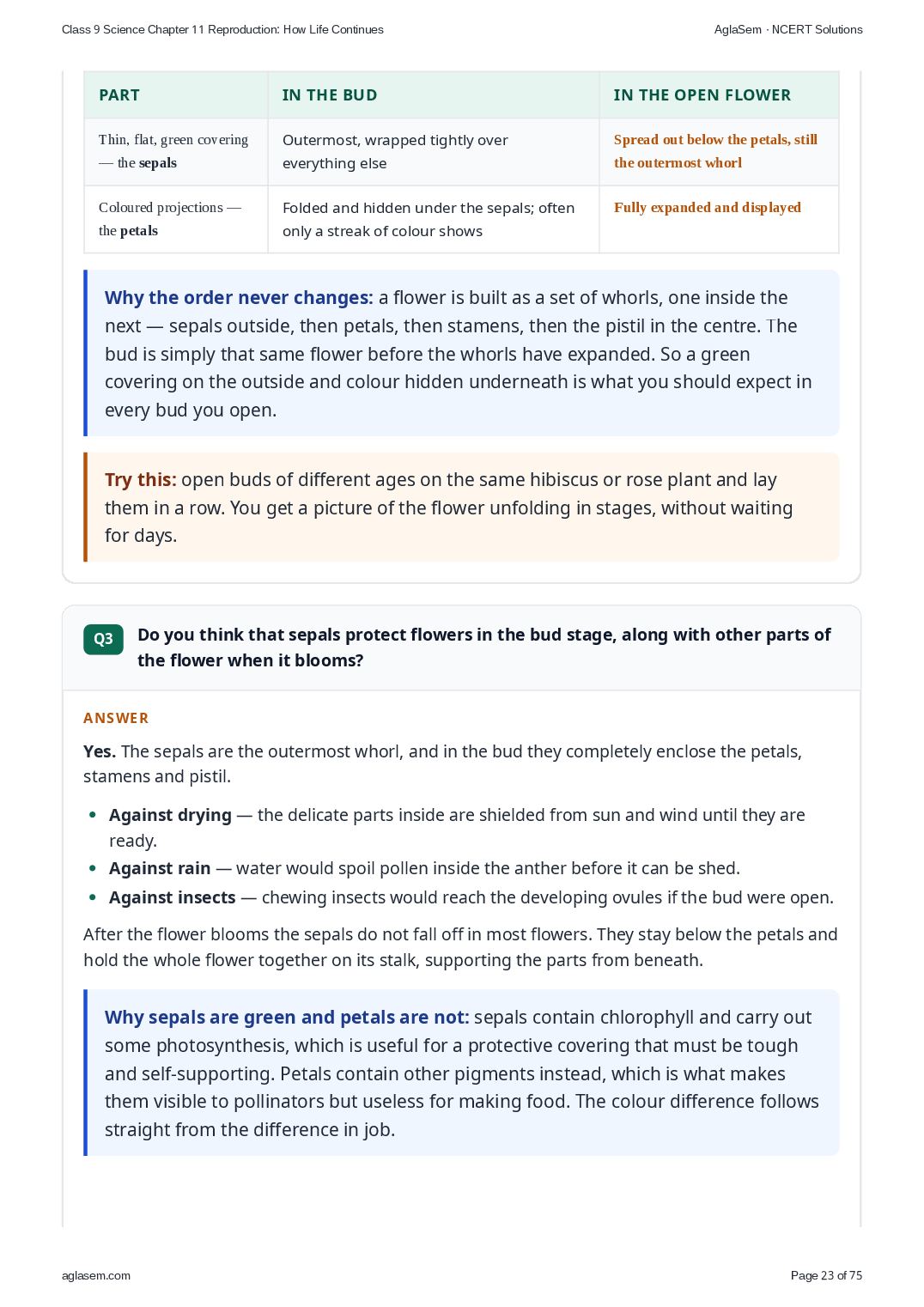
- Explore flowers and their buds on some plants. Record your observations in your notebook. Do you observe thin, flat, green covering, and coloured projections present in both?
- Do you think that sepals protect flowers in the bud stage, along with other parts of the flower when it blooms?
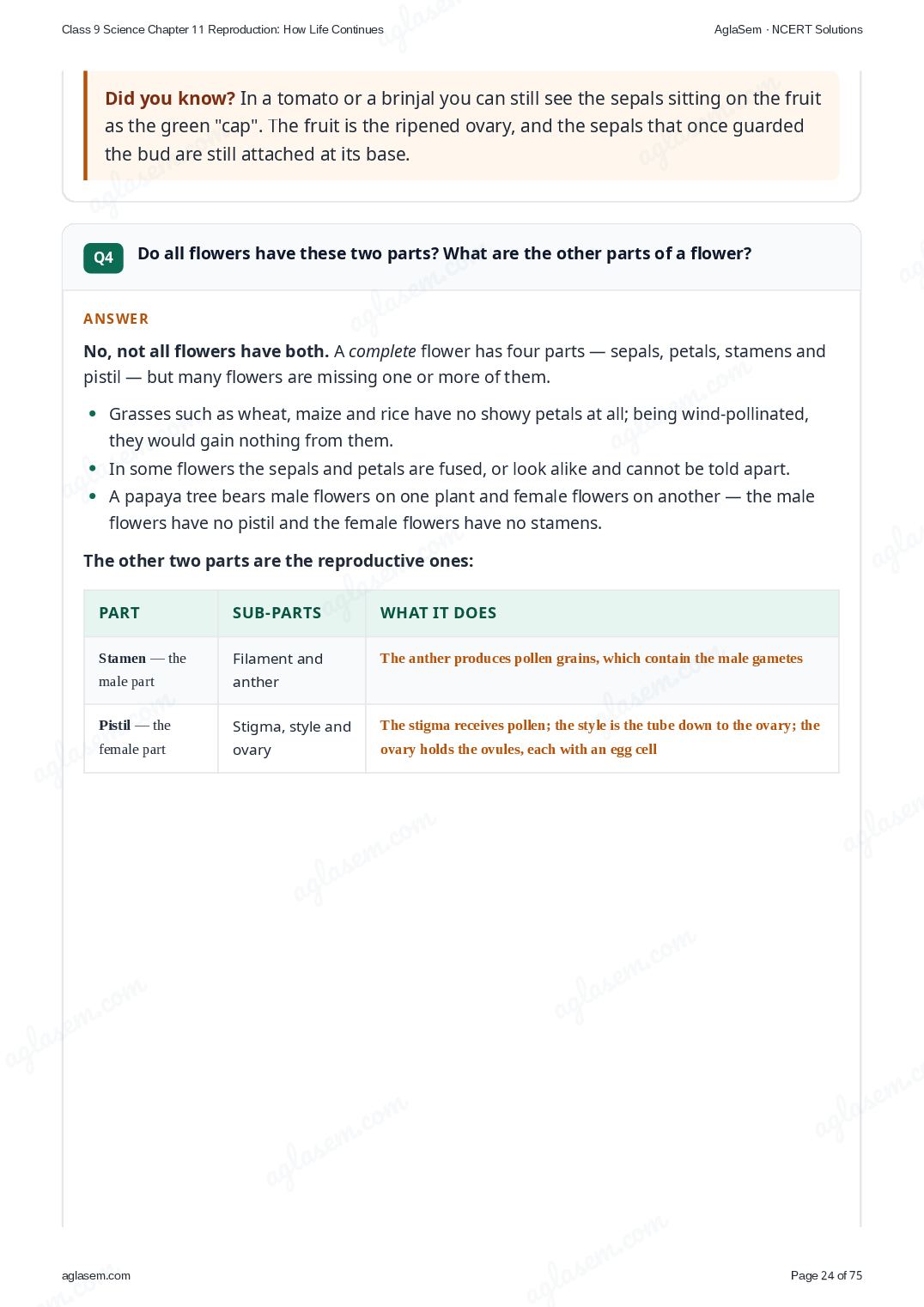
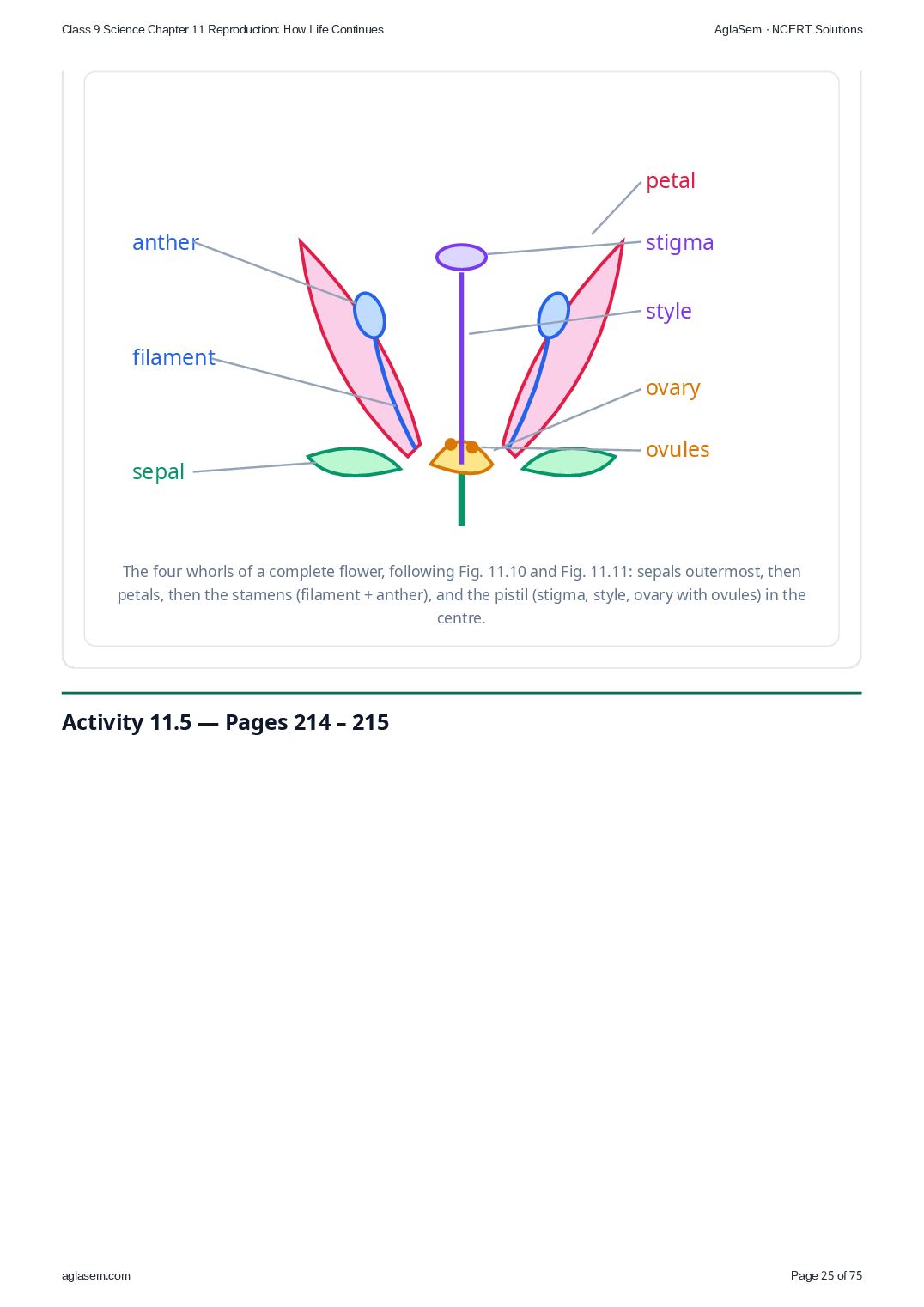
- Do all flowers have these two parts? What are the other parts of a flower?
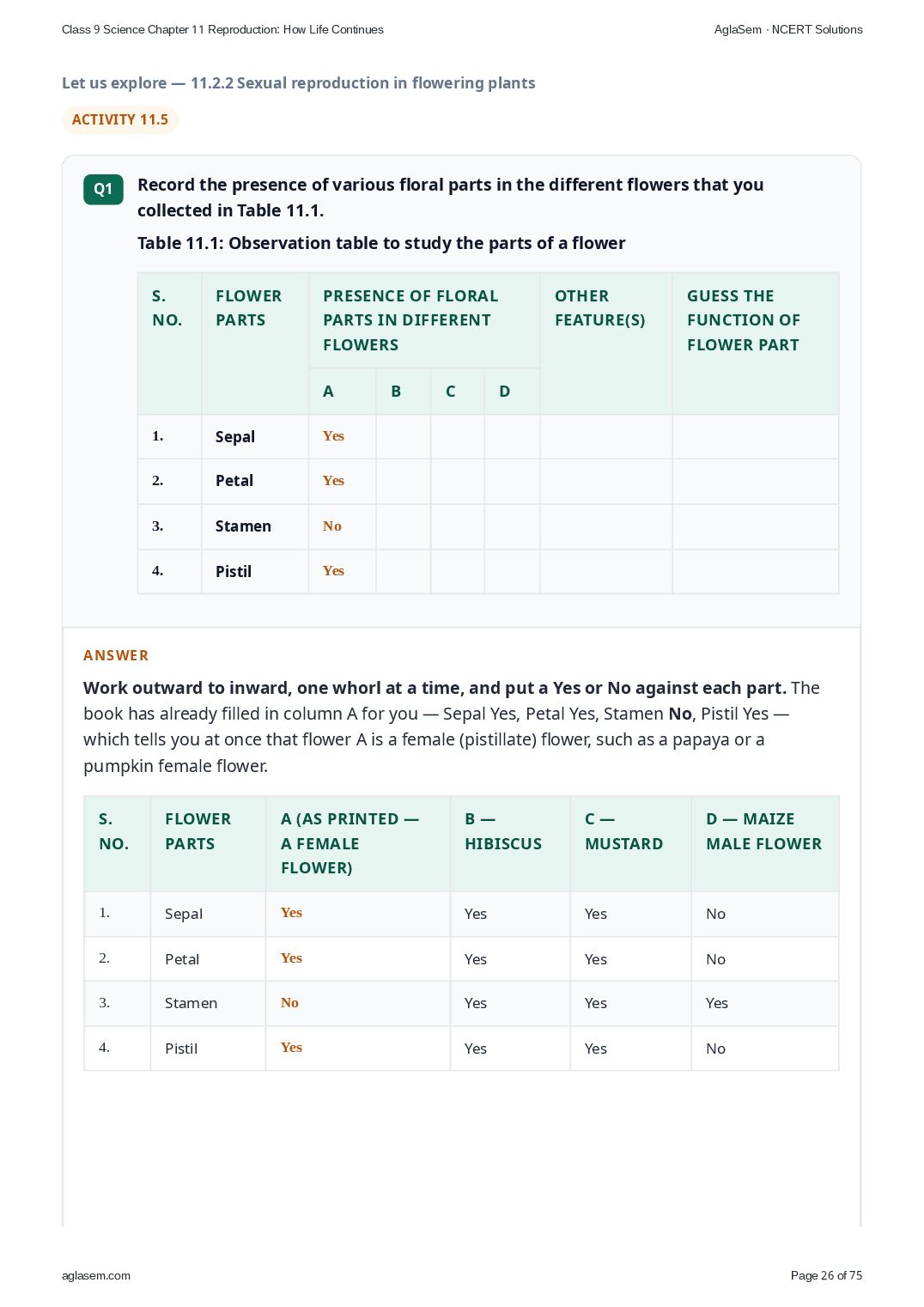
- Record the presence of various floral parts in the different flowers that you collected in Table 11.1.
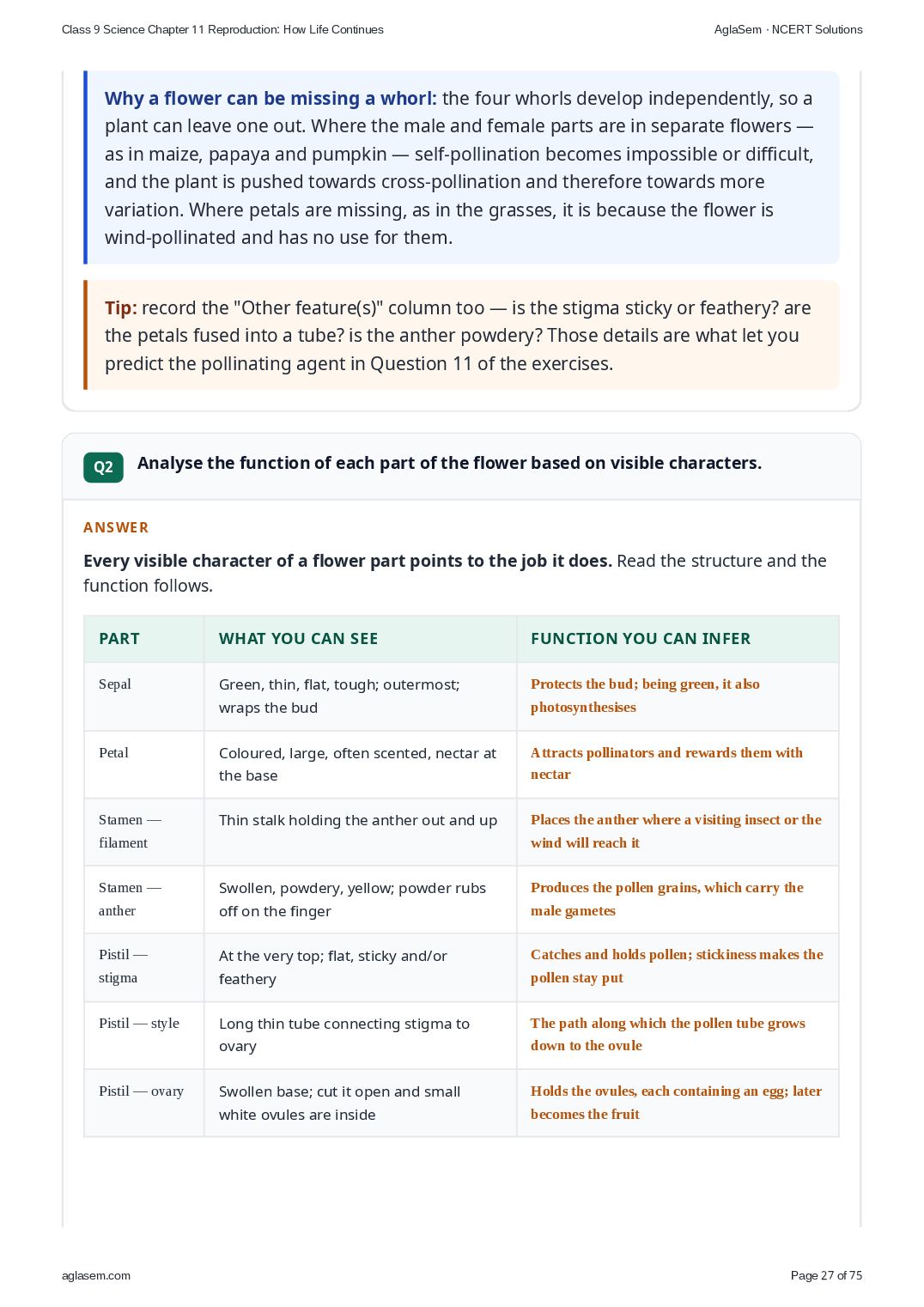
- Analyse the function of each part of the flower based on visible characters.
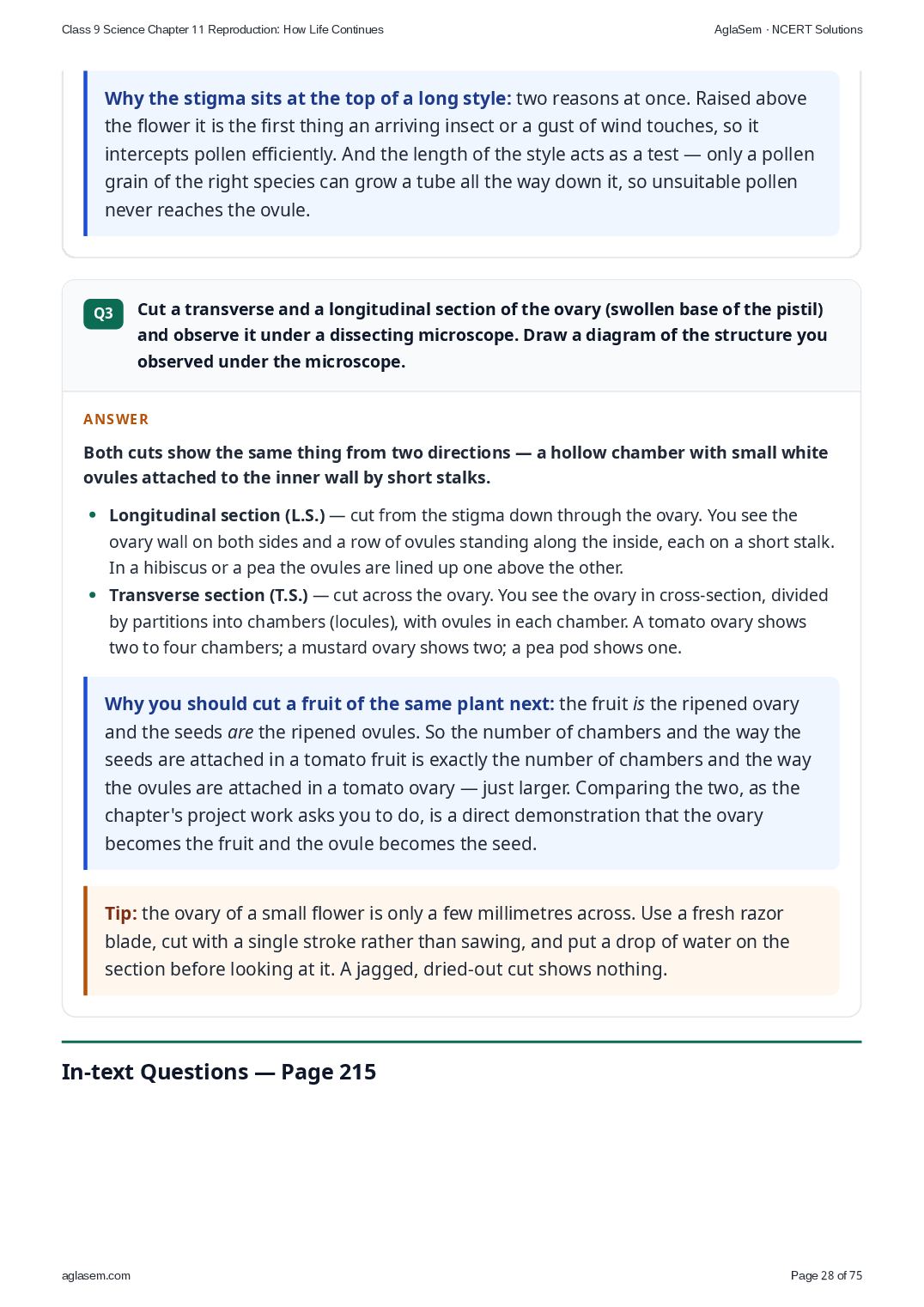
- Cut a transverse and a longitudinal section of the ovary (swollen base of the pistil) and observe it under a dissecting microscope. Draw a diagram of the structure you observed under the microscope.
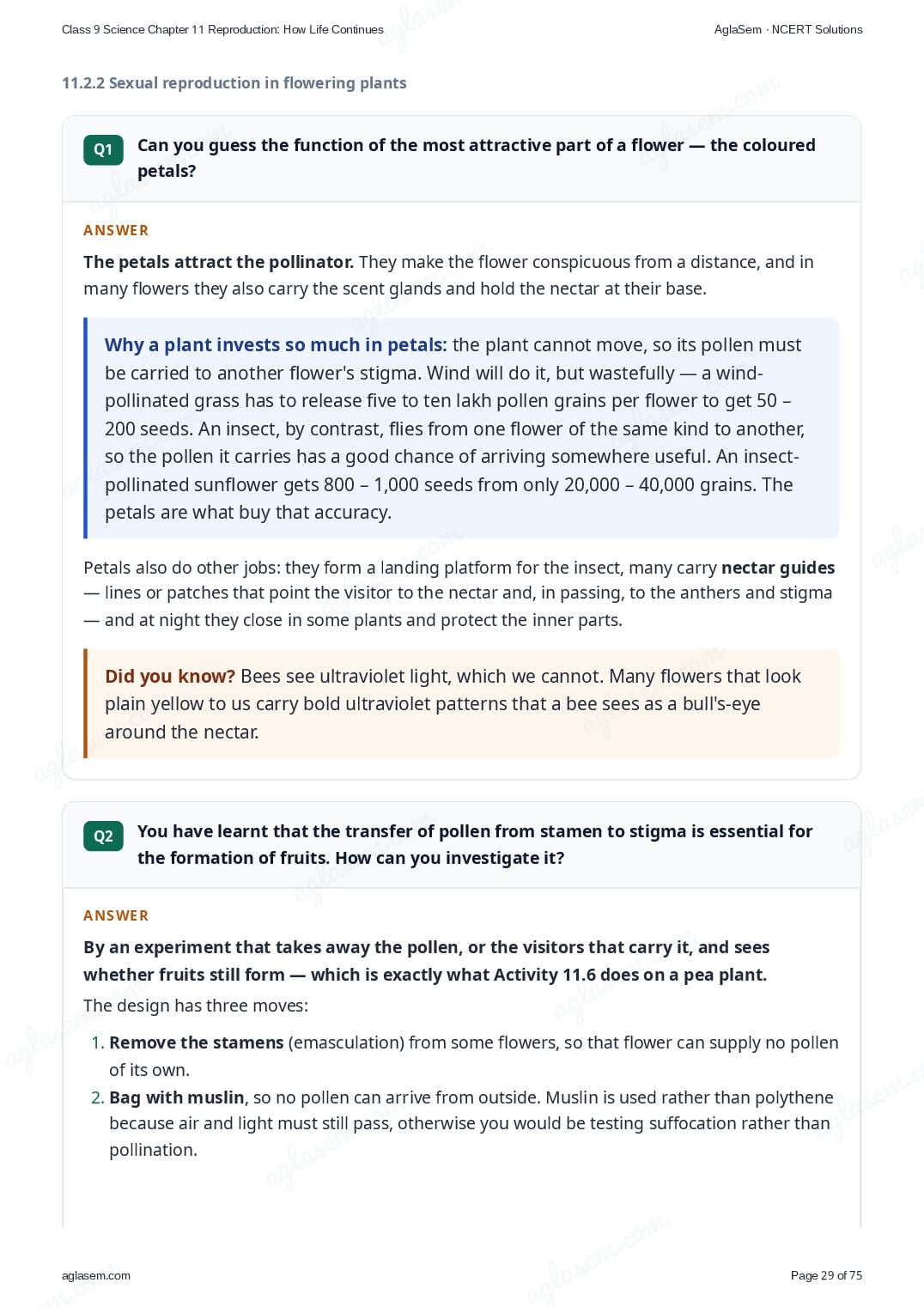
- Can you guess the function of the most attractive part of a flower — the coloured petals?
- You have learnt that the transfer of pollen from stamen to stigma is essential for the formation of fruits. How can you investigate it?
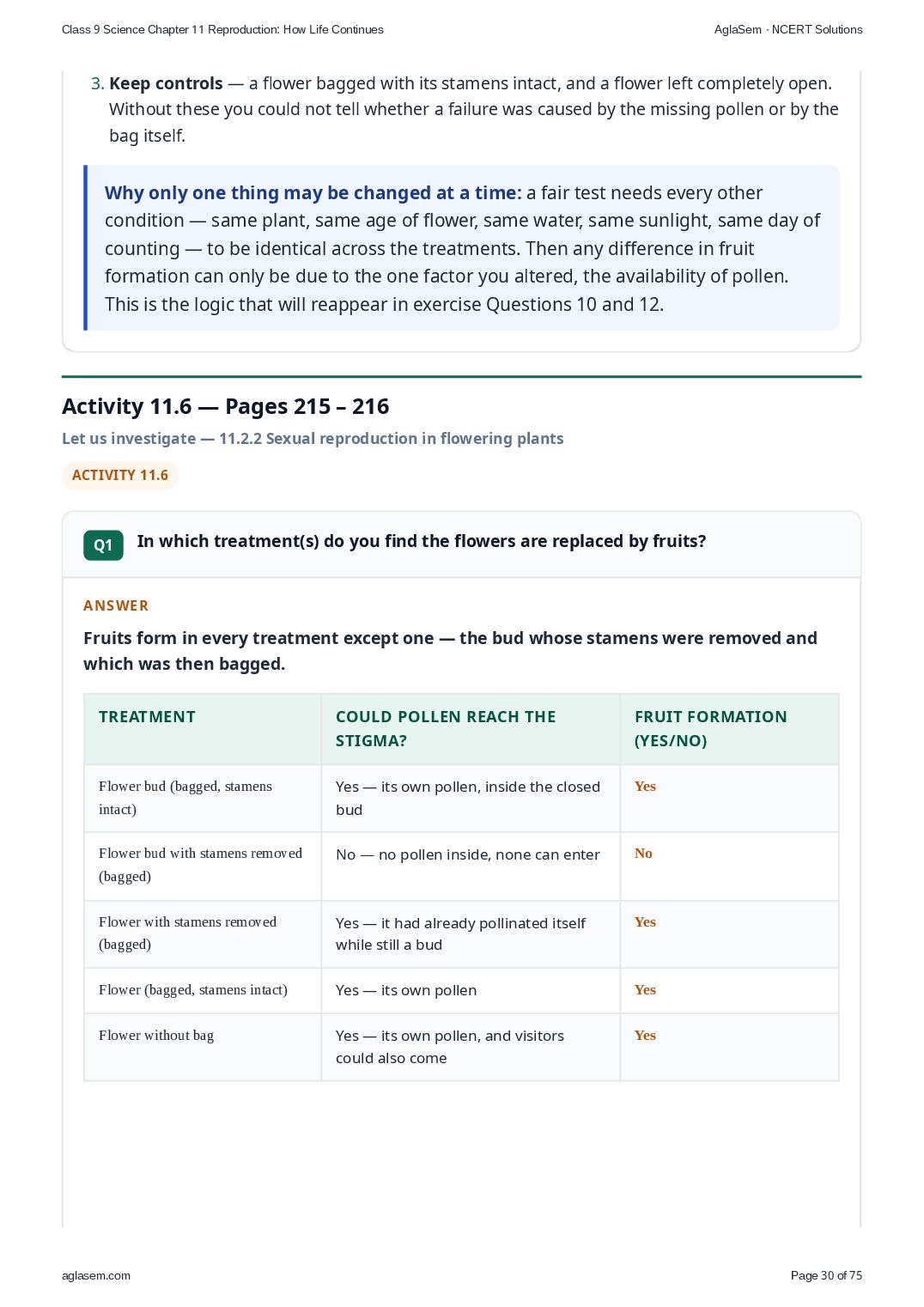
- In which treatment(s) do you find the flowers are replaced by fruits?
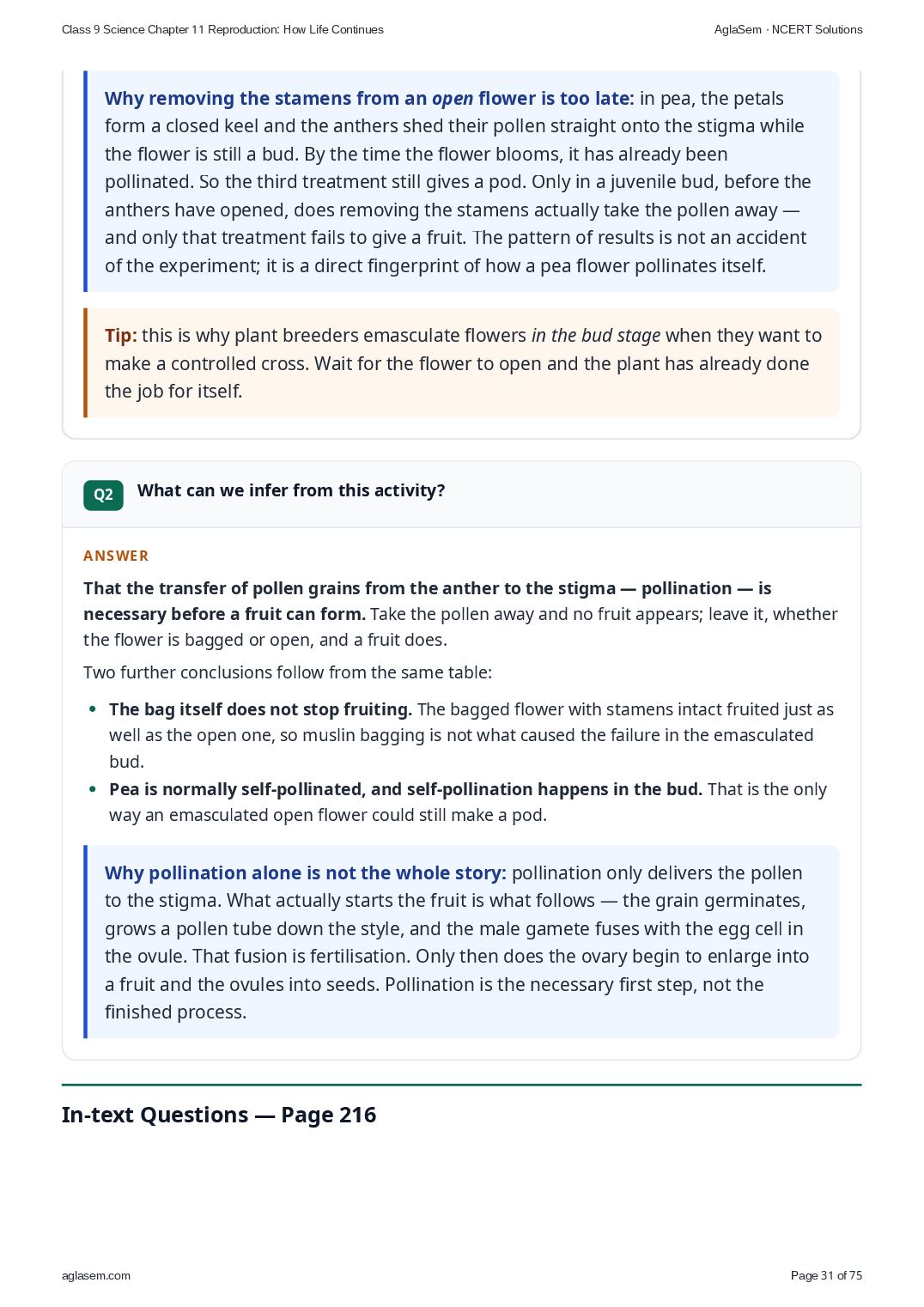
- What can we infer from this activity?
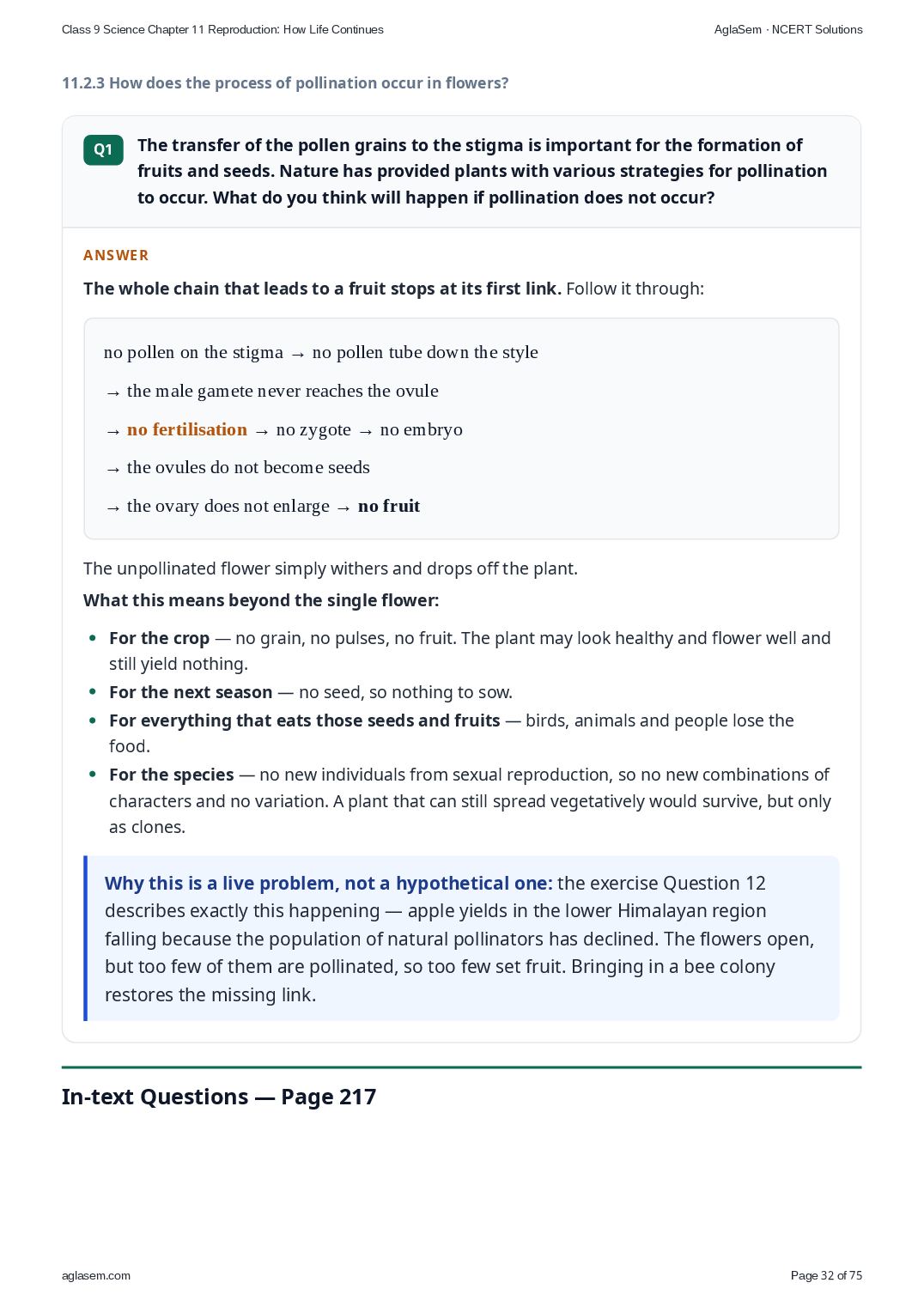
- The transfer of the pollen grains to the stigma is important for the formation of fruits and seeds. Nature has provided plants with various strategies for pollination to occur. What do you think will happen if pollination does not occur?
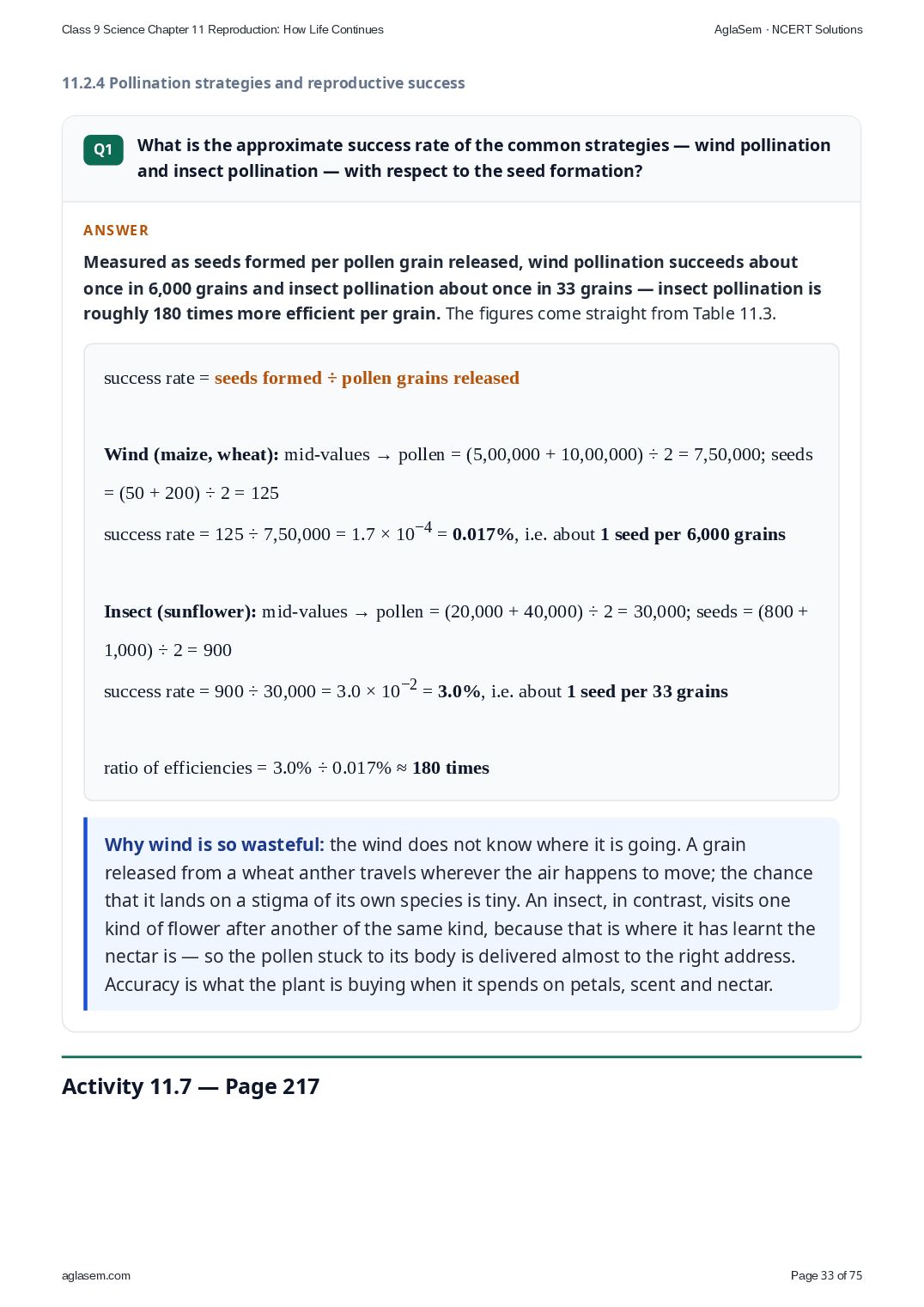
- What is the approximate success rate of the common strategies — wind pollination and insect pollination — with respect to the seed formation?
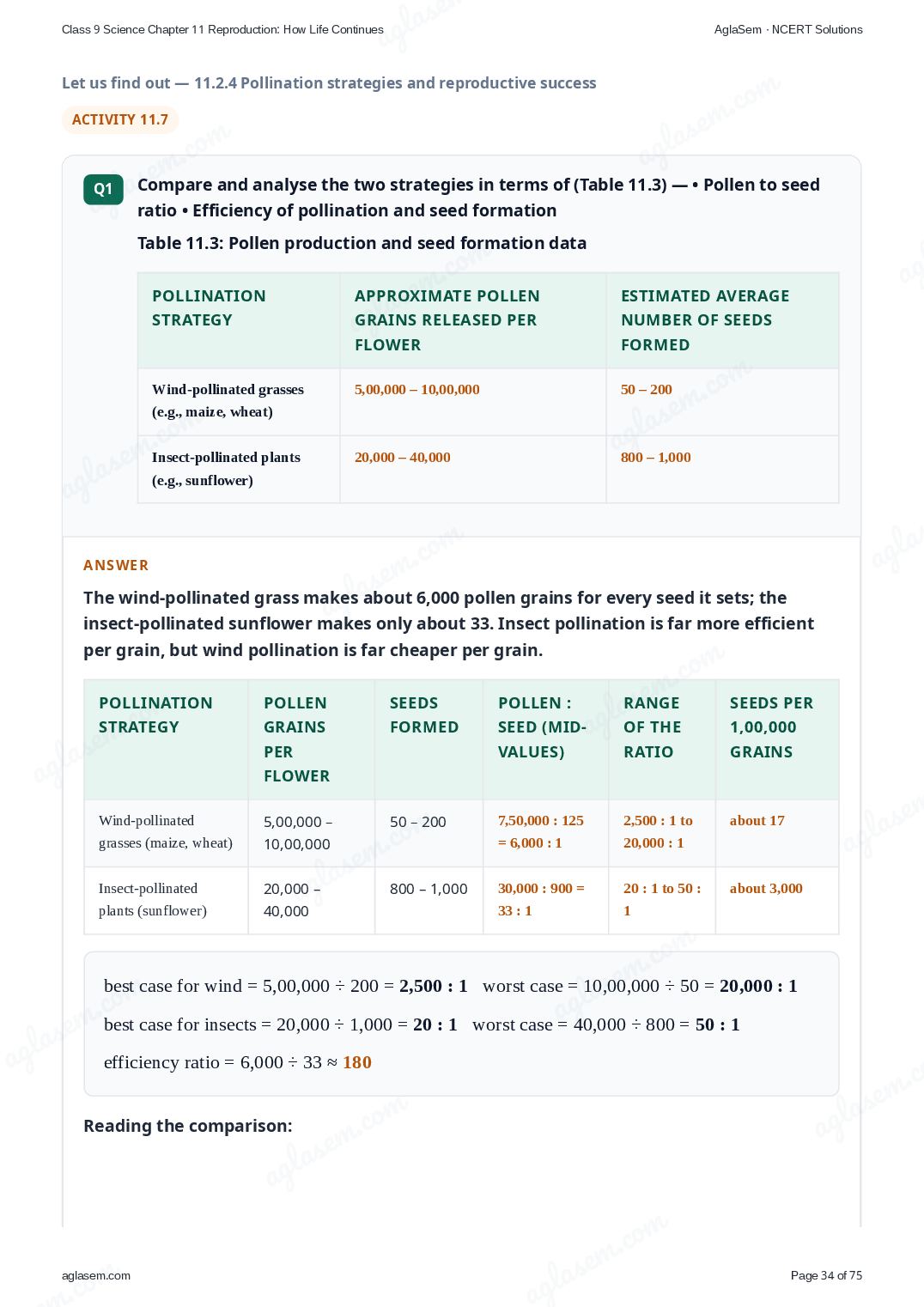
- Compare and analyse the two strategies in terms of (Table 11.3) — • Pollen to seed ratio • Efficiency of pollination and seed formation
- Explain why producing a very large number of pollen grains can still be an effective pollination strategy.
- In a china-rose (hibiscus or gudhal) plant, a pollen tube grows and continues through the style after pollen lands on the stigma. Which process is about to happen next?
- Look at the pictures (Fig. 11.16) of calotropis (madar) seeds and dandelion seeds given below. Can you guess what kind of seed dispersal these seeds are adapted for?
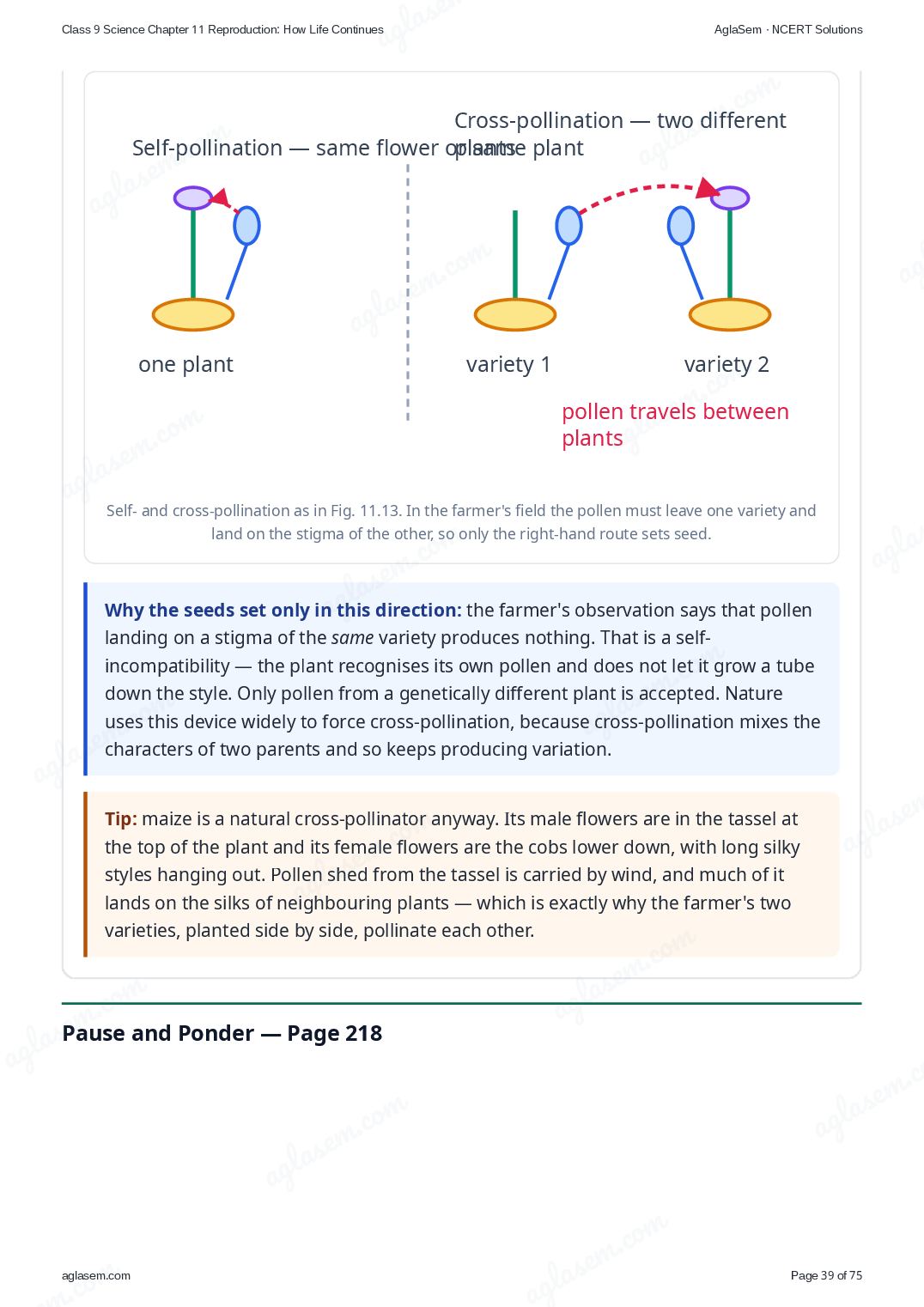
- A farmer plants two varieties of maize side by side, but notices that seeds form only when pollen from one variety reaches the stigma of the other. What type of pollination is this?
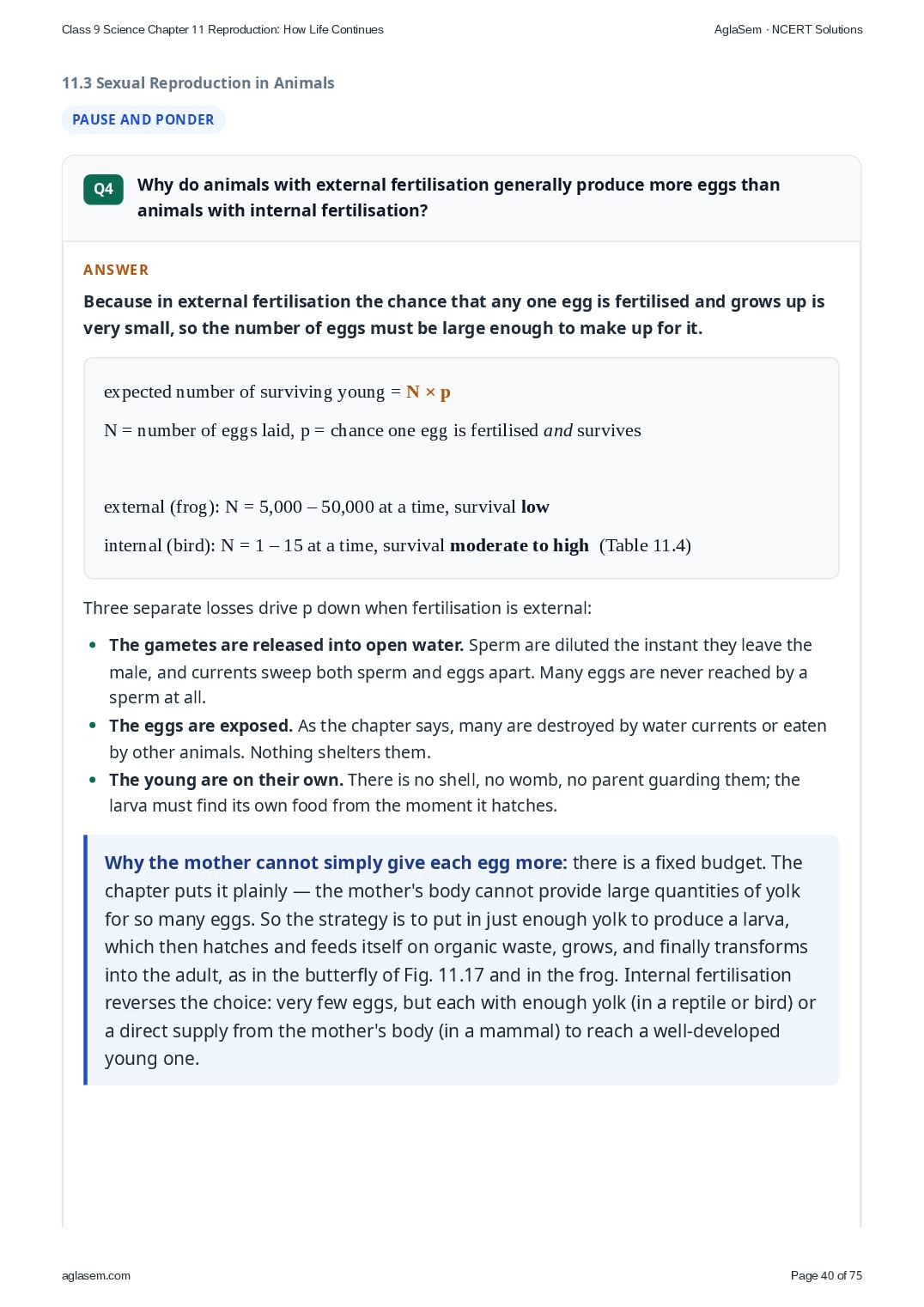
- Why do animals with external fertilisation generally produce more eggs than animals with internal fertilisation?
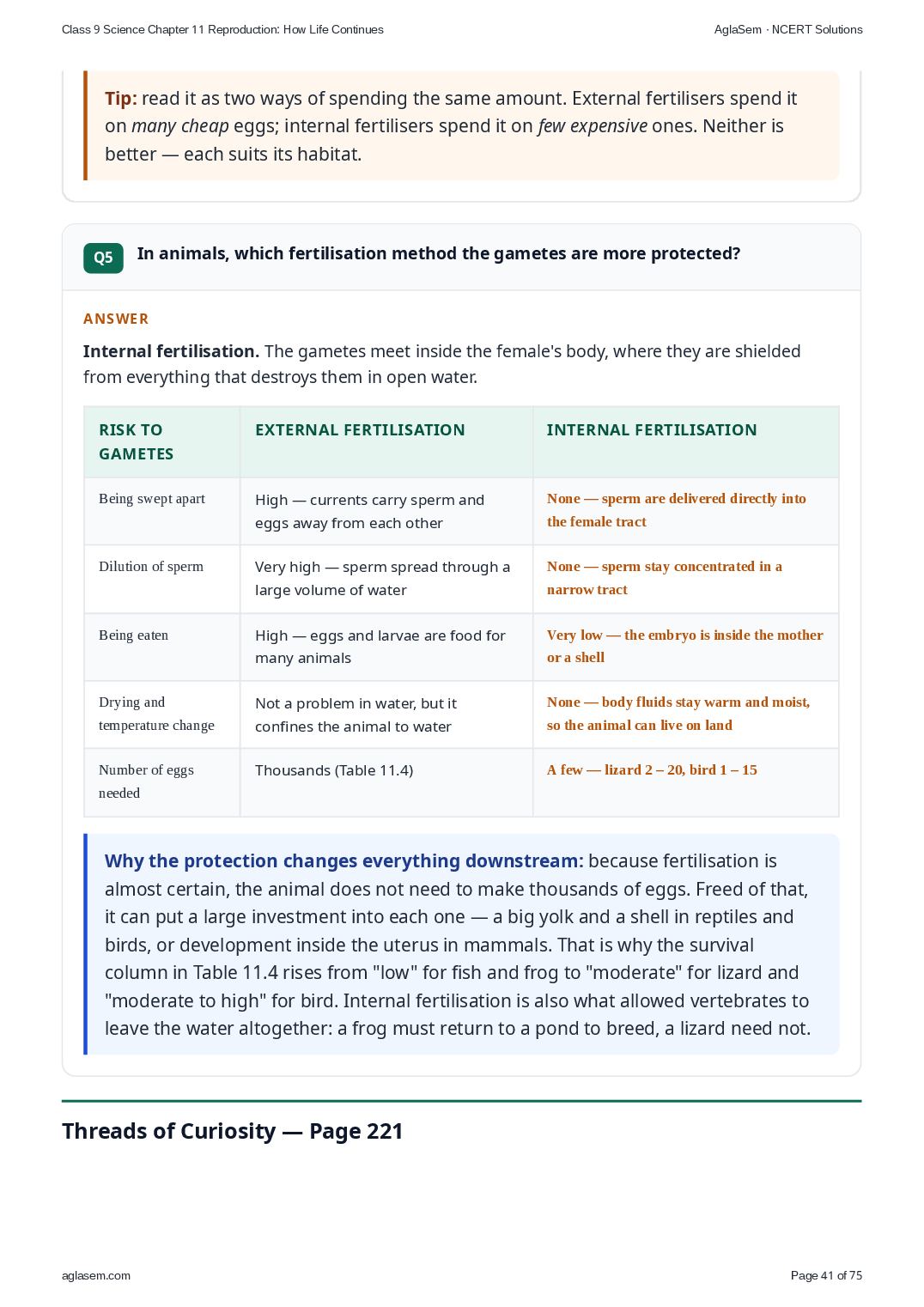
- In animals, which fertilisation method the gametes are more protected?
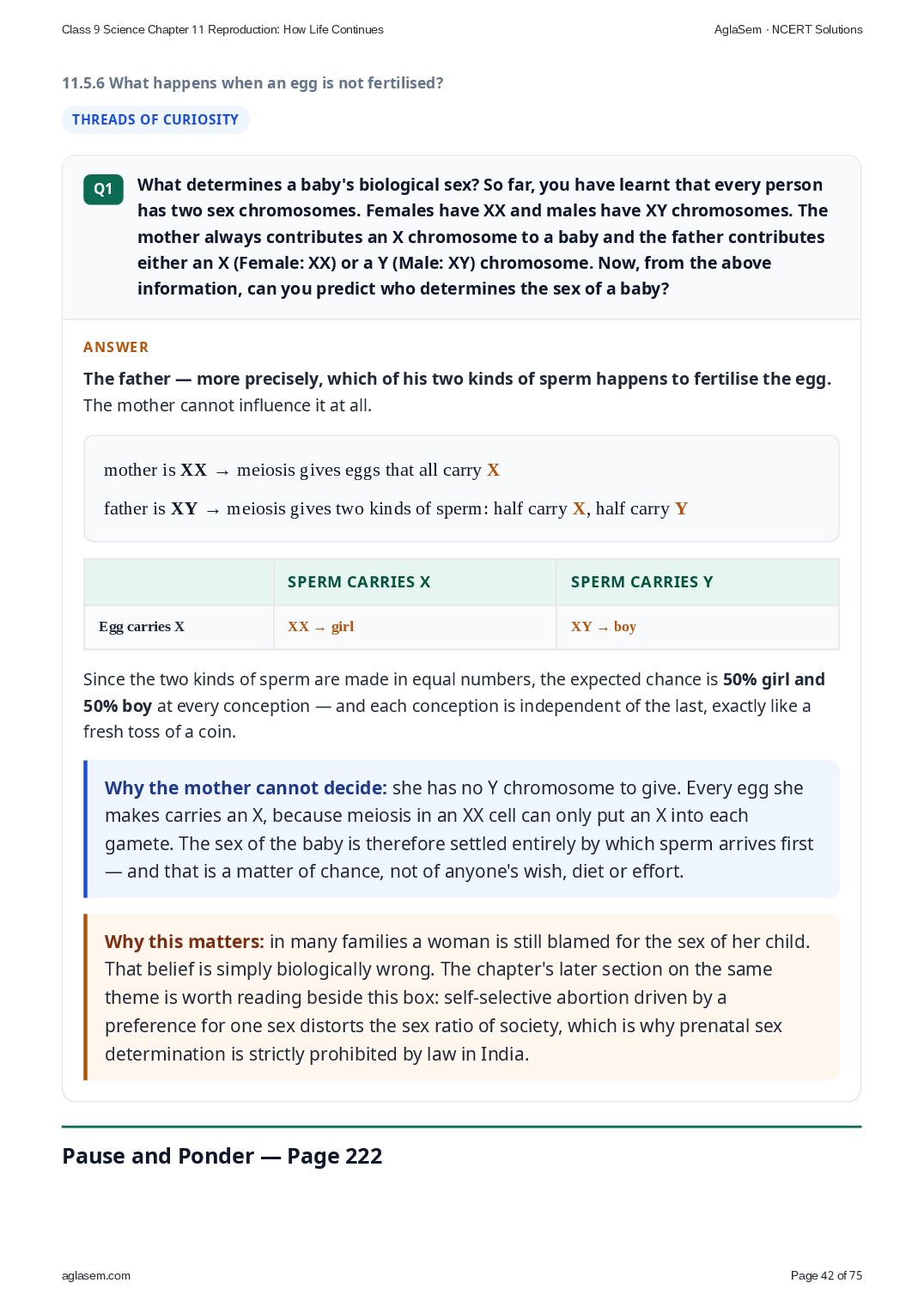
- What determines a baby's biological sex? So far, you have learnt that every person has two sex chromosomes. Females have XX and males have XY chromosomes. The mother always contributes an X chromosome to a baby and the father contributes either an X (Female: XX) or a Y (Male: XY) chromosome. Now, from the above information, can you predict who determines the sex of a baby?
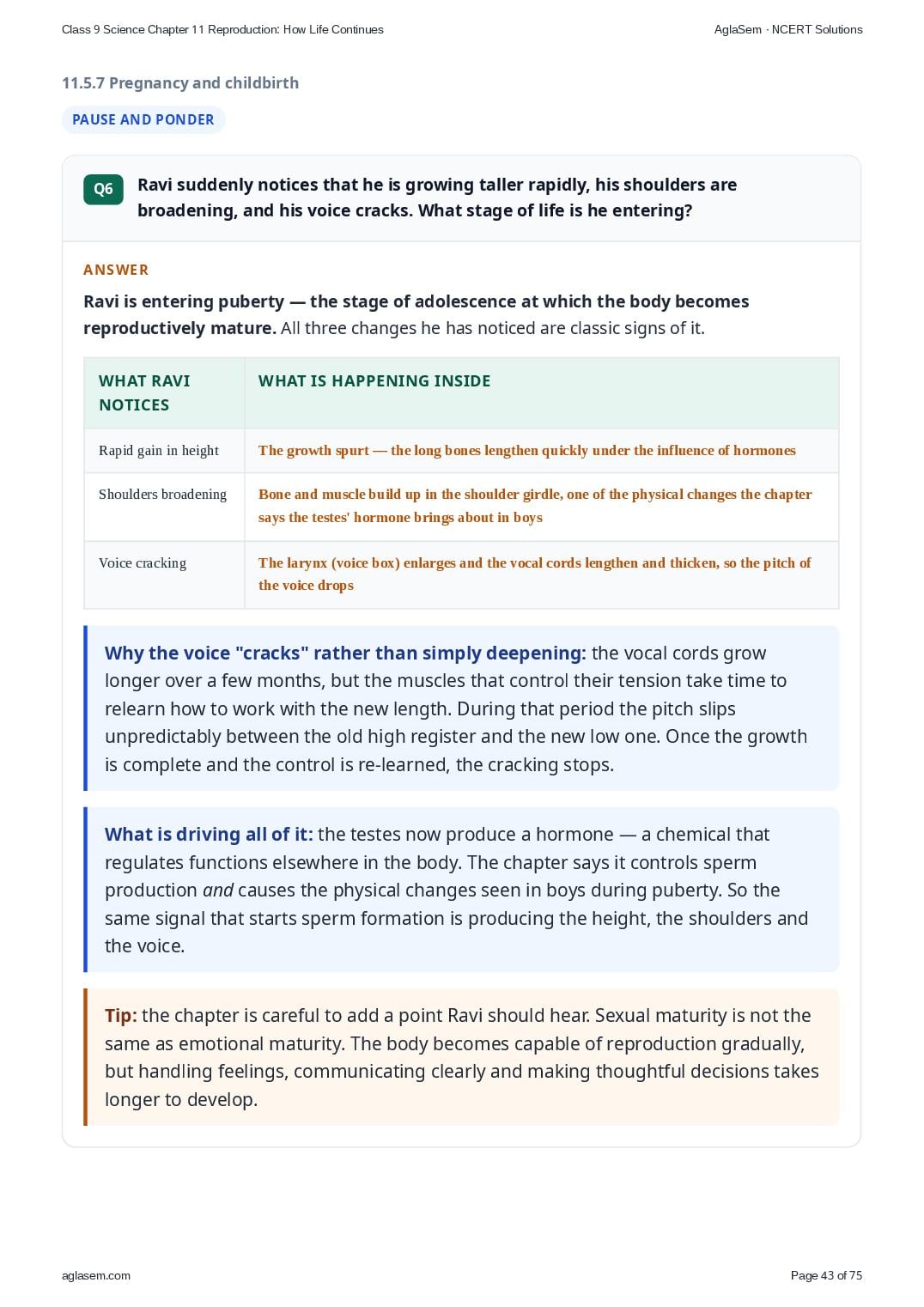
- Ravi suddenly notices that he is growing taller rapidly, his shoulders are broadening, and his voice cracks. What stage of life is he entering?
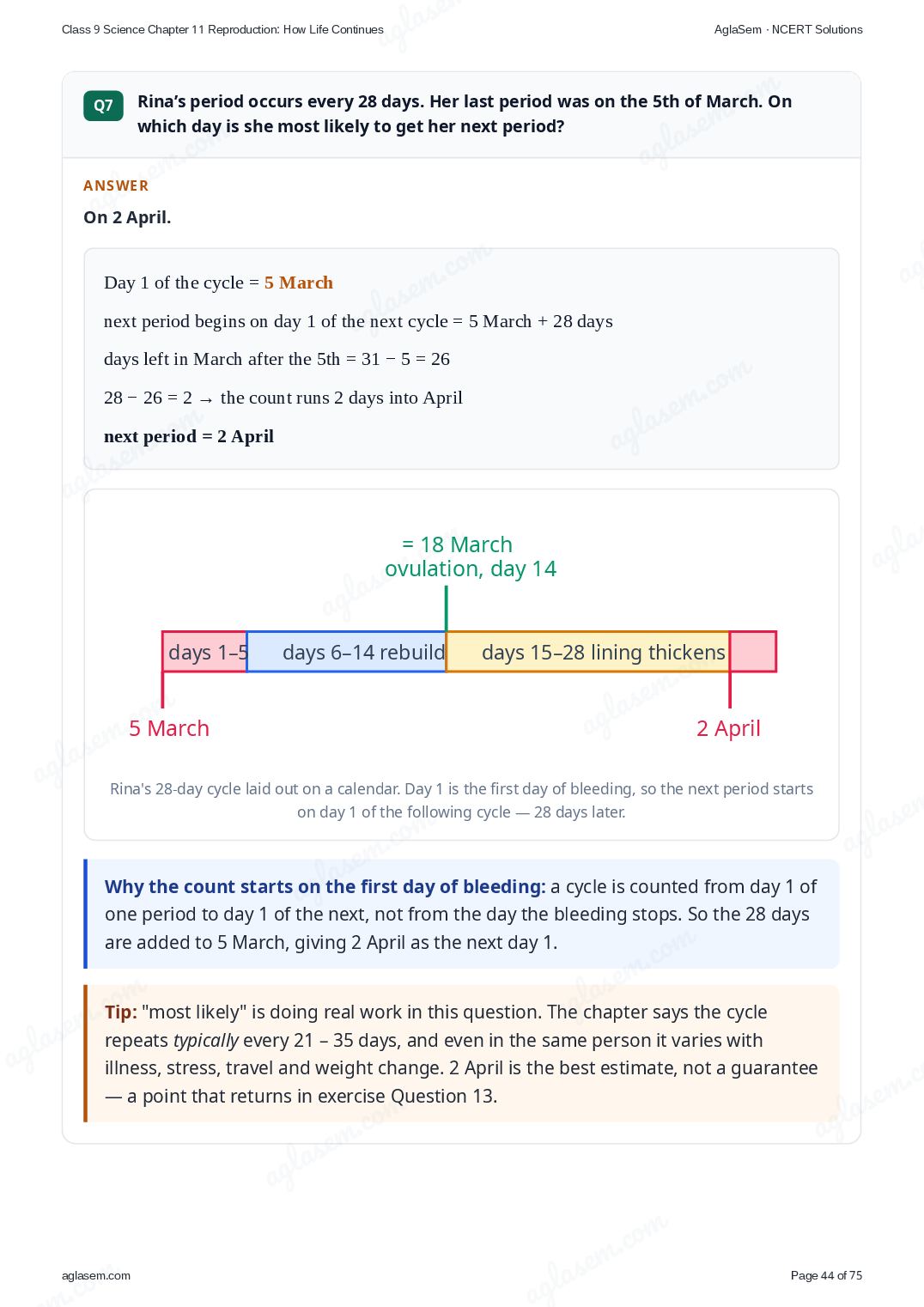
- Rina’s period occurs every 28 days. Her last period was on the 5th of March. On which day is she most likely to get her next period?
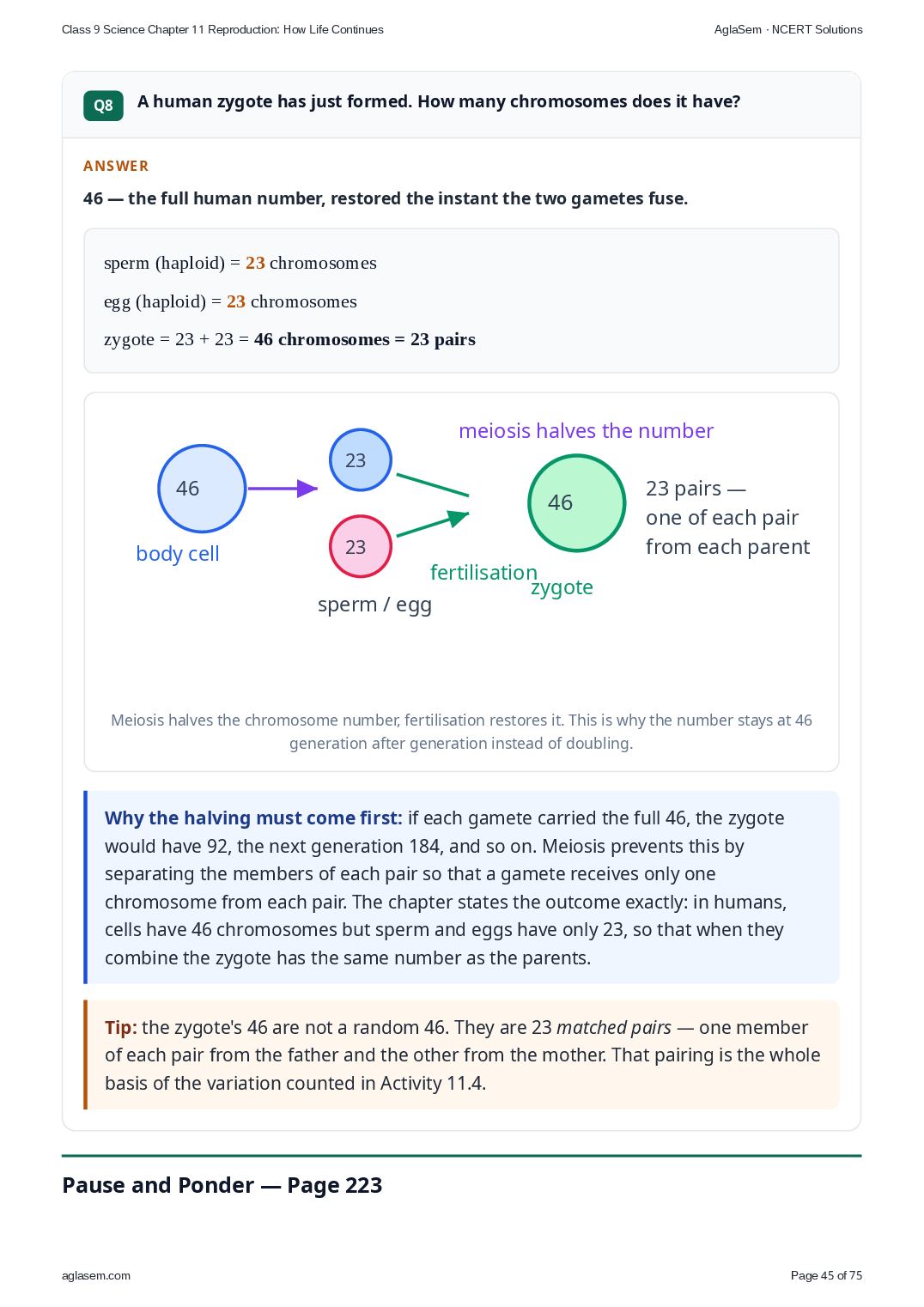
- A human zygote has just formed. How many chromosomes does it have?
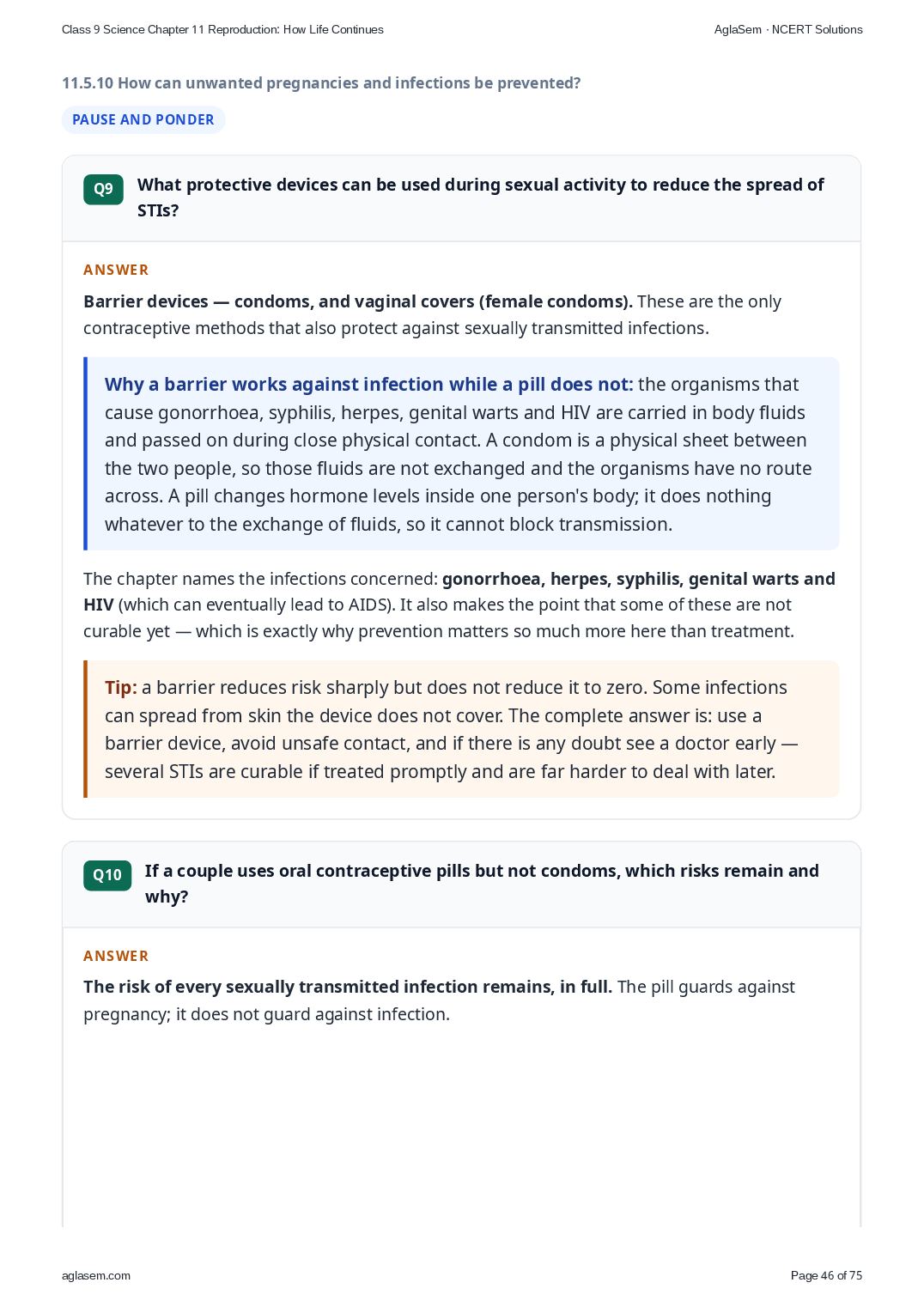
- What protective devices can be used during sexual activity to reduce the spread of STIs?
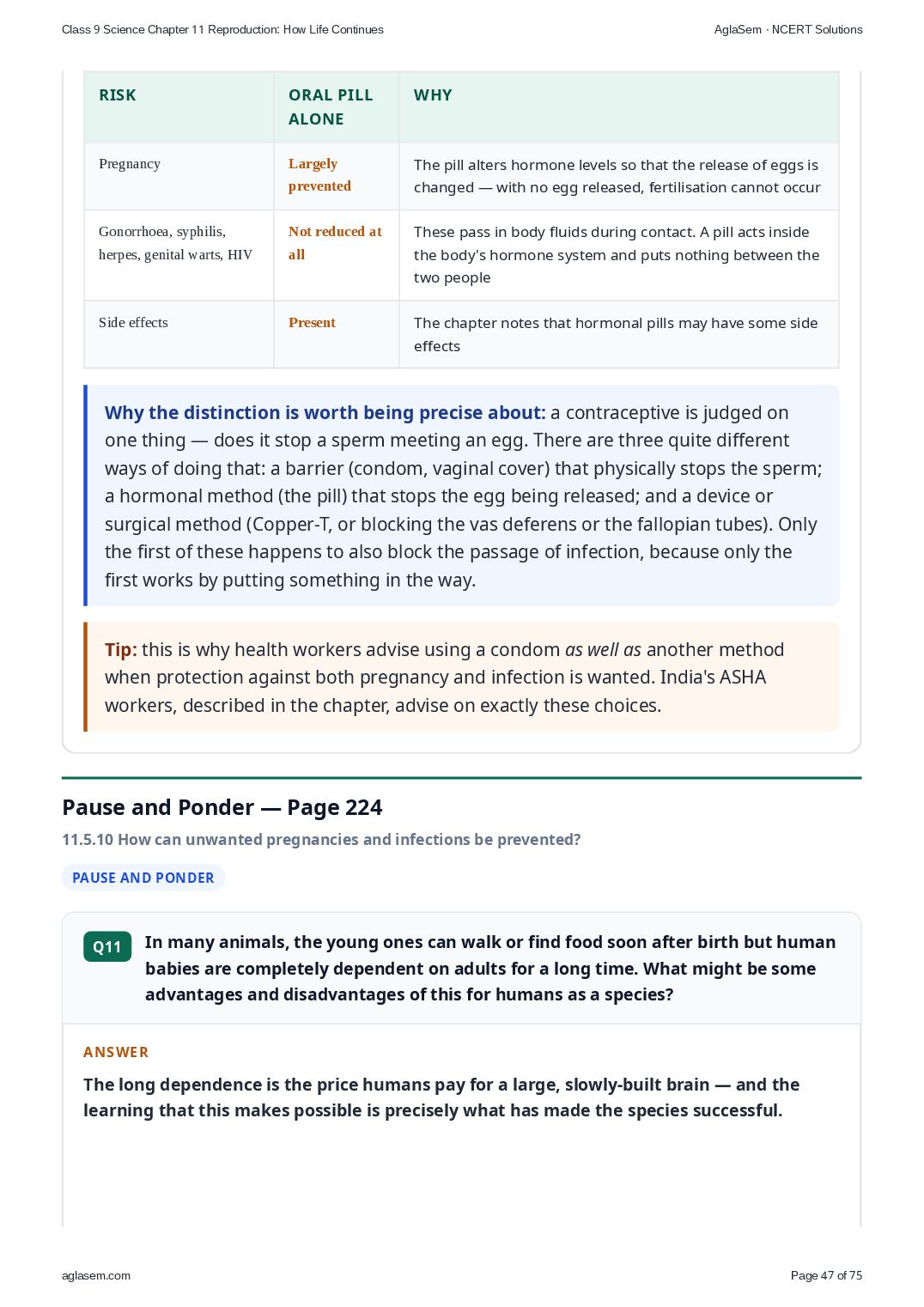
- If a couple uses oral contraceptive pills but not condoms, which risks remain and why?
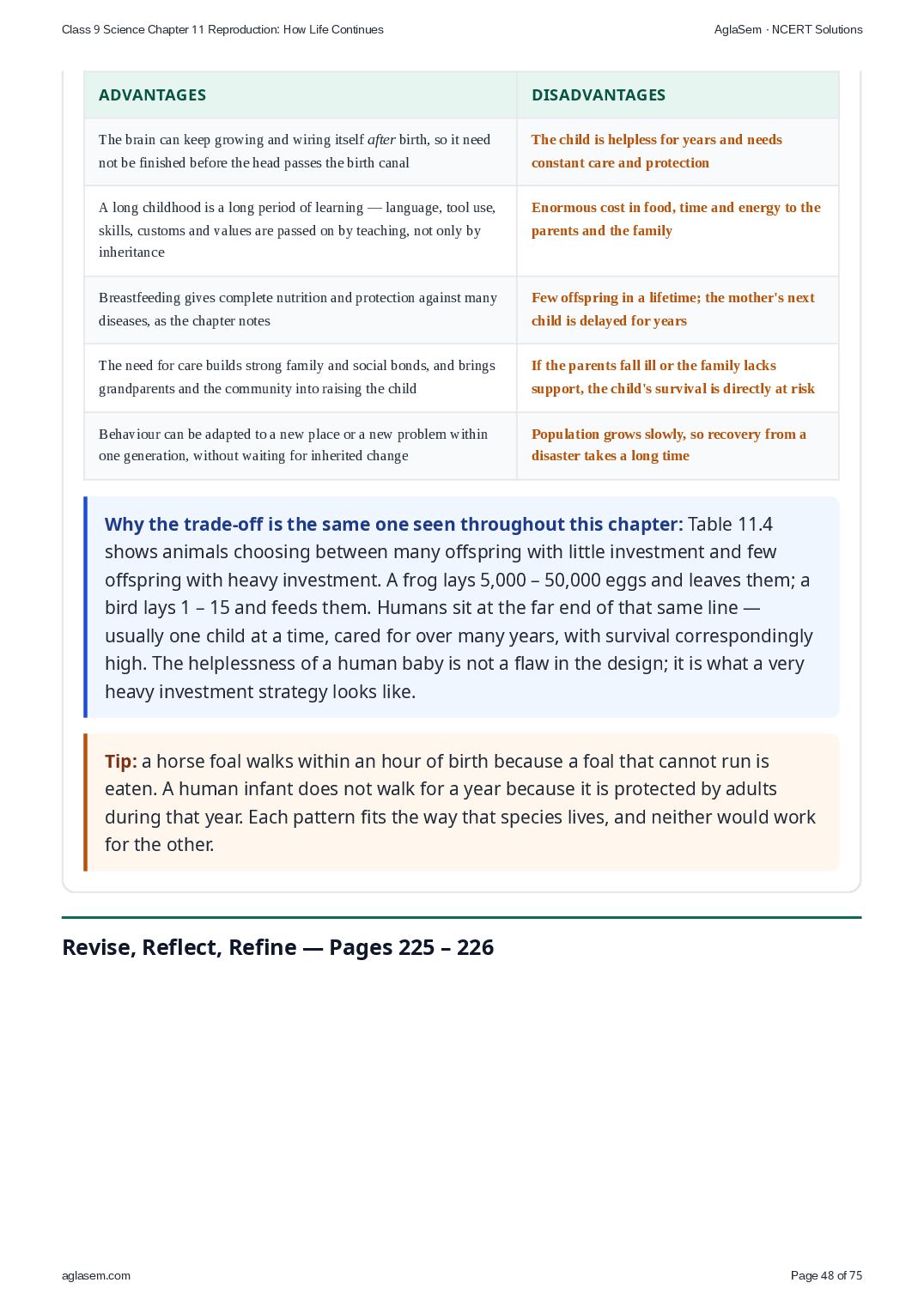
- In many animals, the young ones can walk or find food soon after birth but human babies are completely dependent on adults for a long time. What might be some advantages and disadvantages of this for humans as a species?
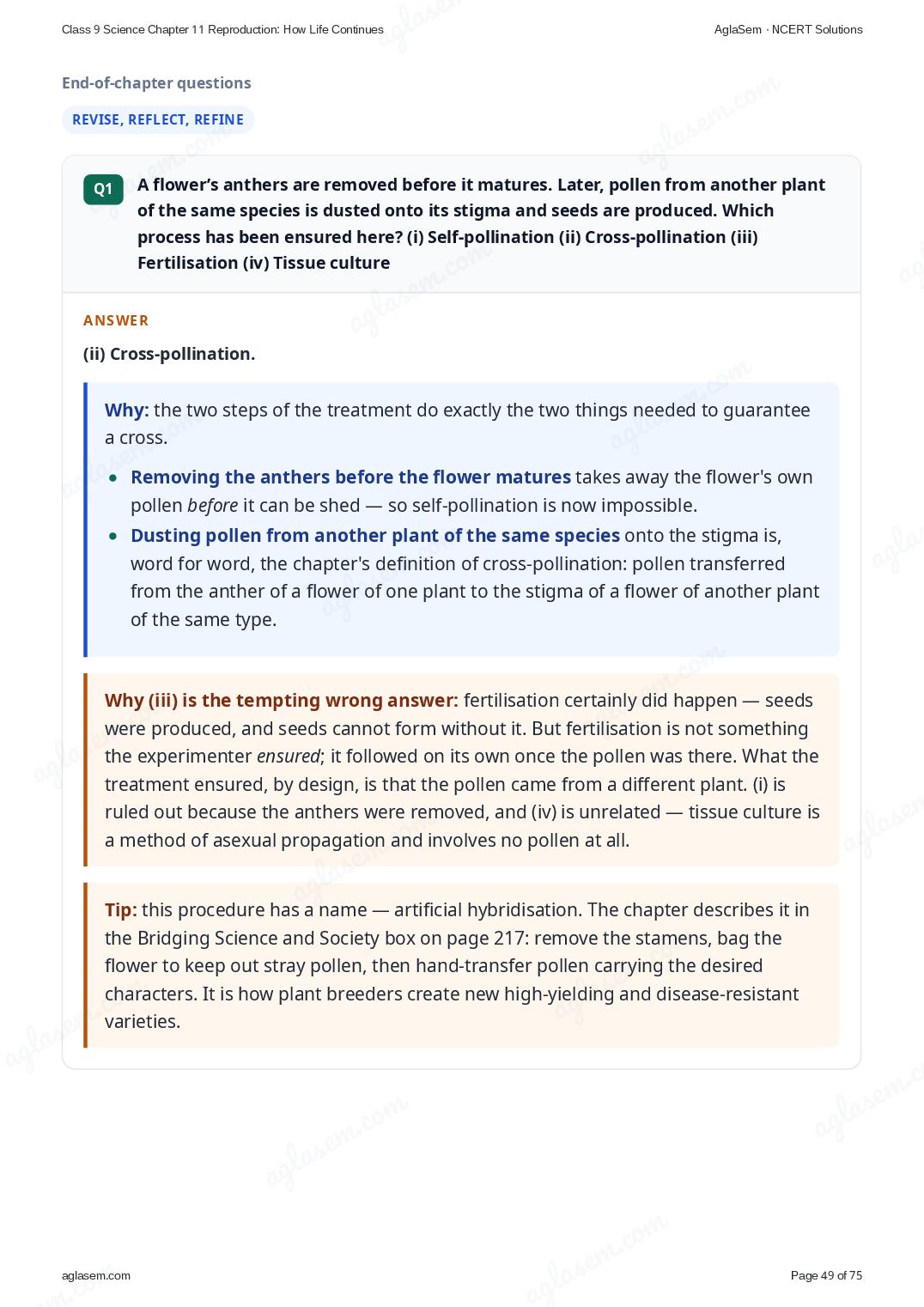
- A flower’s anthers are removed before it matures. Later, pollen from another plant of the same species is dusted onto its stigma and seeds are produced. Which process has been ensured here? (i) Self-pollination (ii) Cross-pollination (iii) Fertilisation (iv) Tissue culture
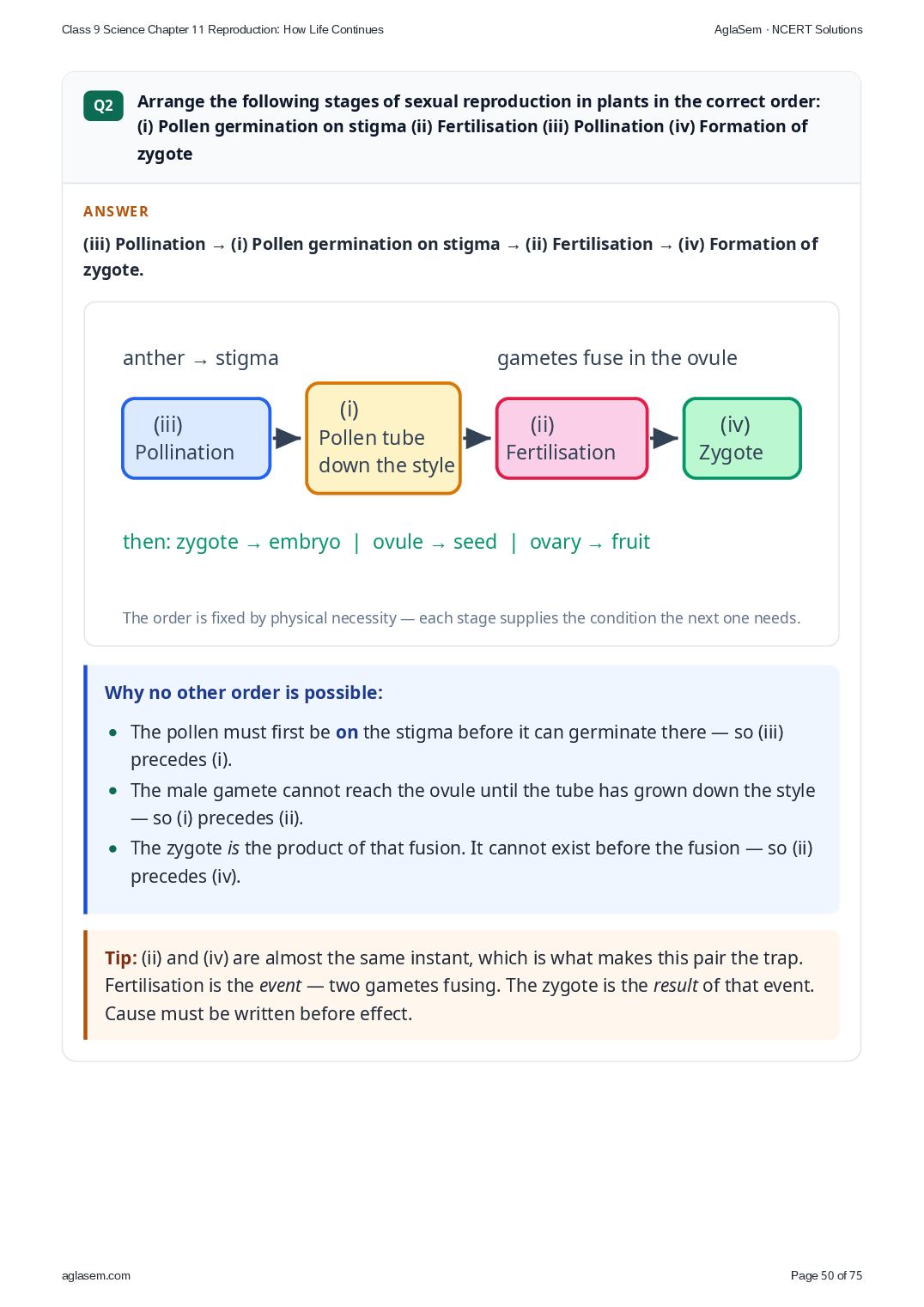
- Arrange the following stages of sexual reproduction in plants in the correct order: (i) Pollen germination on stigma (ii) Fertilisation (iii) Pollination (iv) Formation of zygote
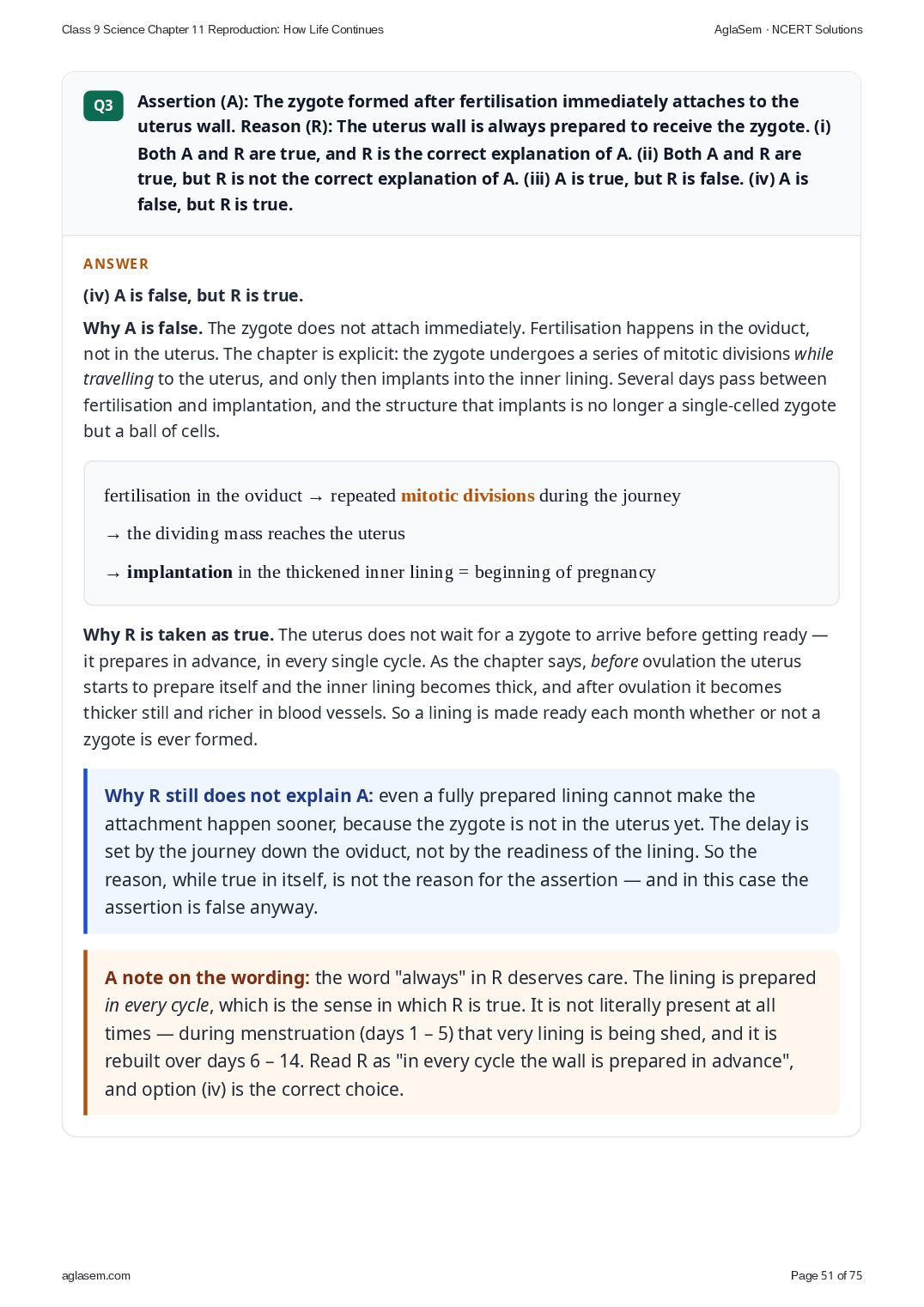
- Assertion (A): The zygote formed after fertilisation immediately attaches to the uterus wall. Reason (R): The uterus wall is always prepared to receive the zygote. (i) Both A and R are true, and R is the correct explanation of A. (ii) Both A and R are true, but R is not the correct explanation of A. (iii) A is true, but R is false. (iv) A is false, but R is true.
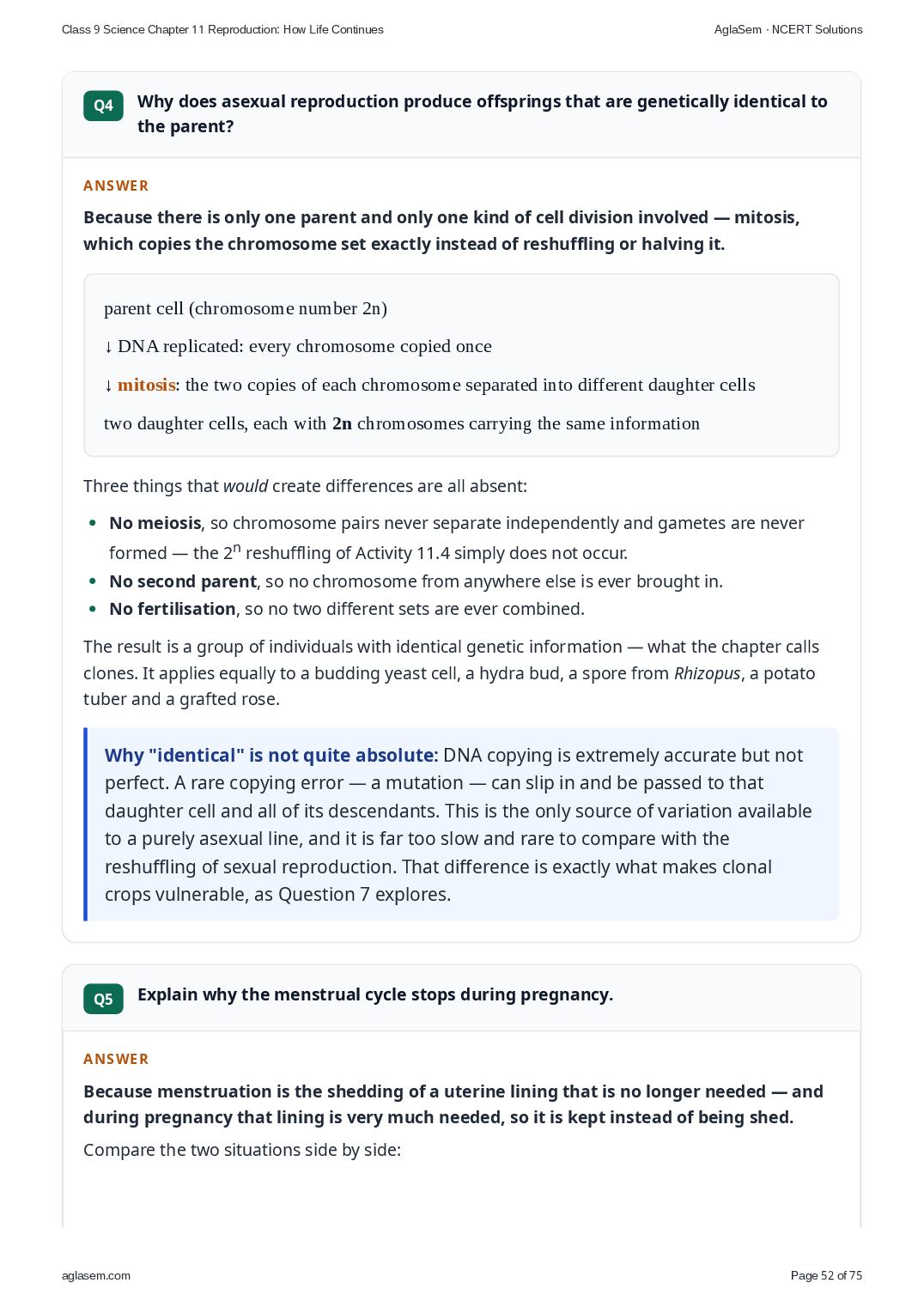
- Why does asexual reproduction produce offsprings that are genetically identical to the parent?
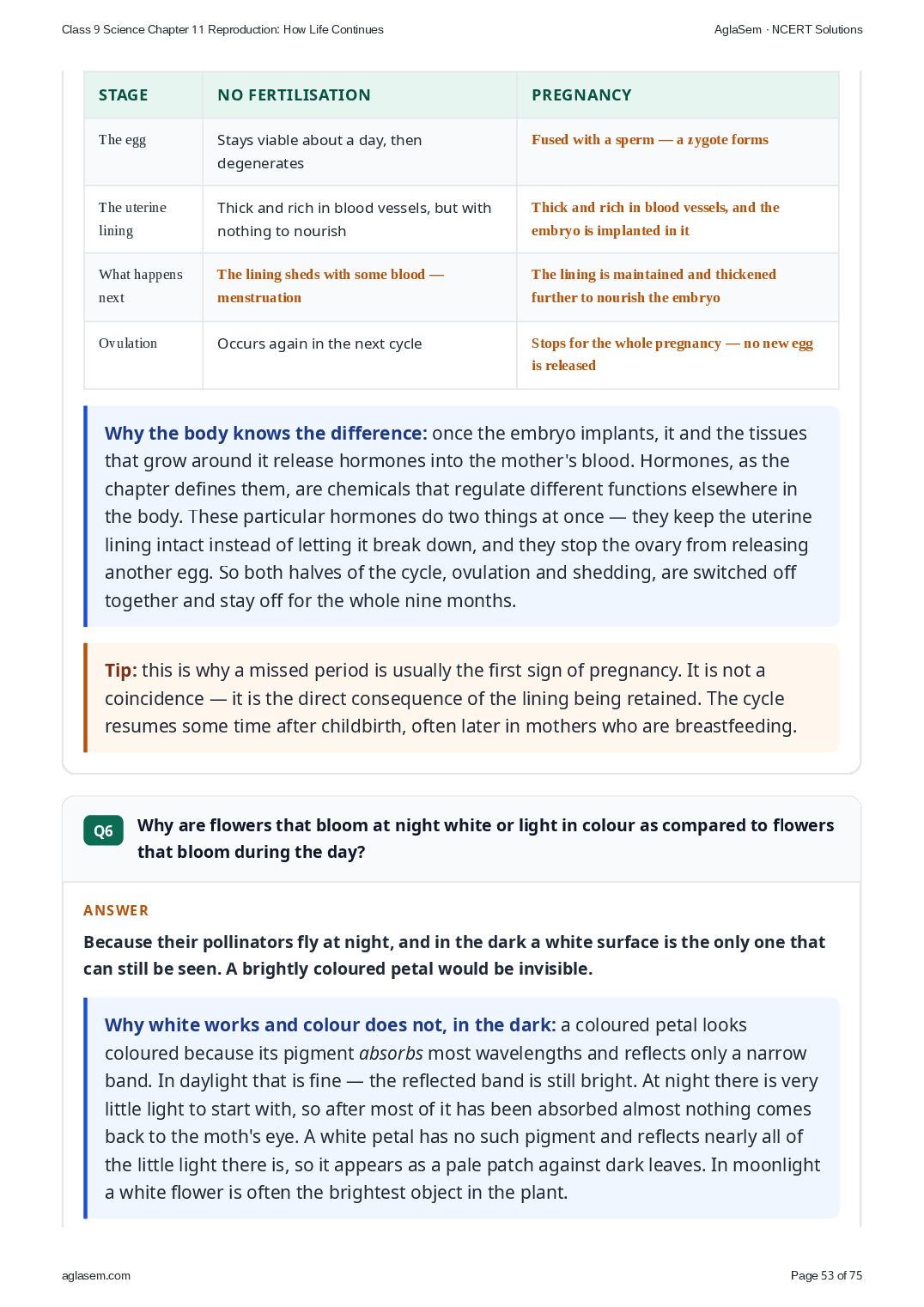
- Explain why the menstrual cycle stops during pregnancy.
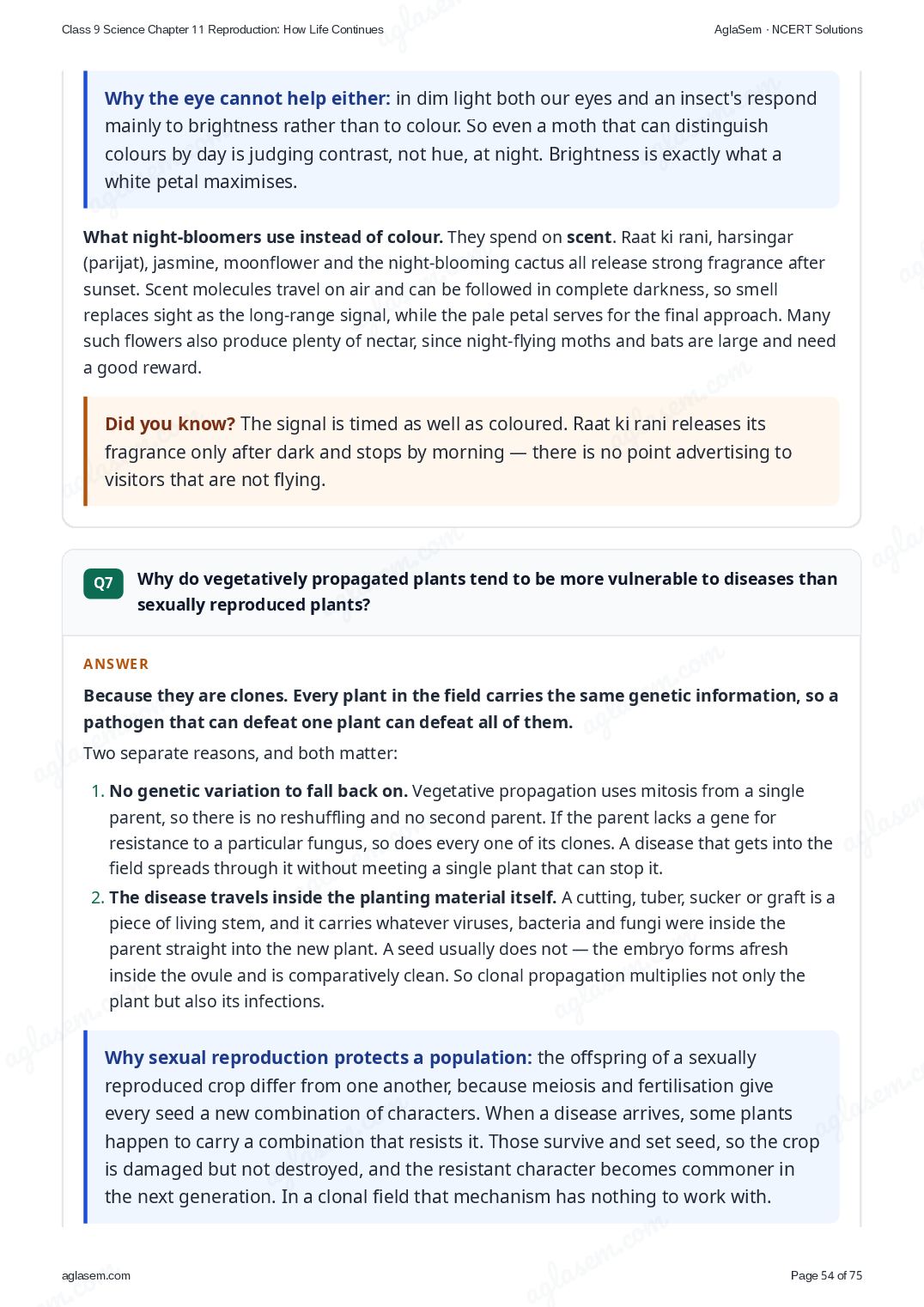
- Why are flowers that bloom at night white or light in colour as compared to flowers that bloom during the day?
- Why do vegetatively propagated plants tend to be more vulnerable to diseases than sexually reproduced plants?
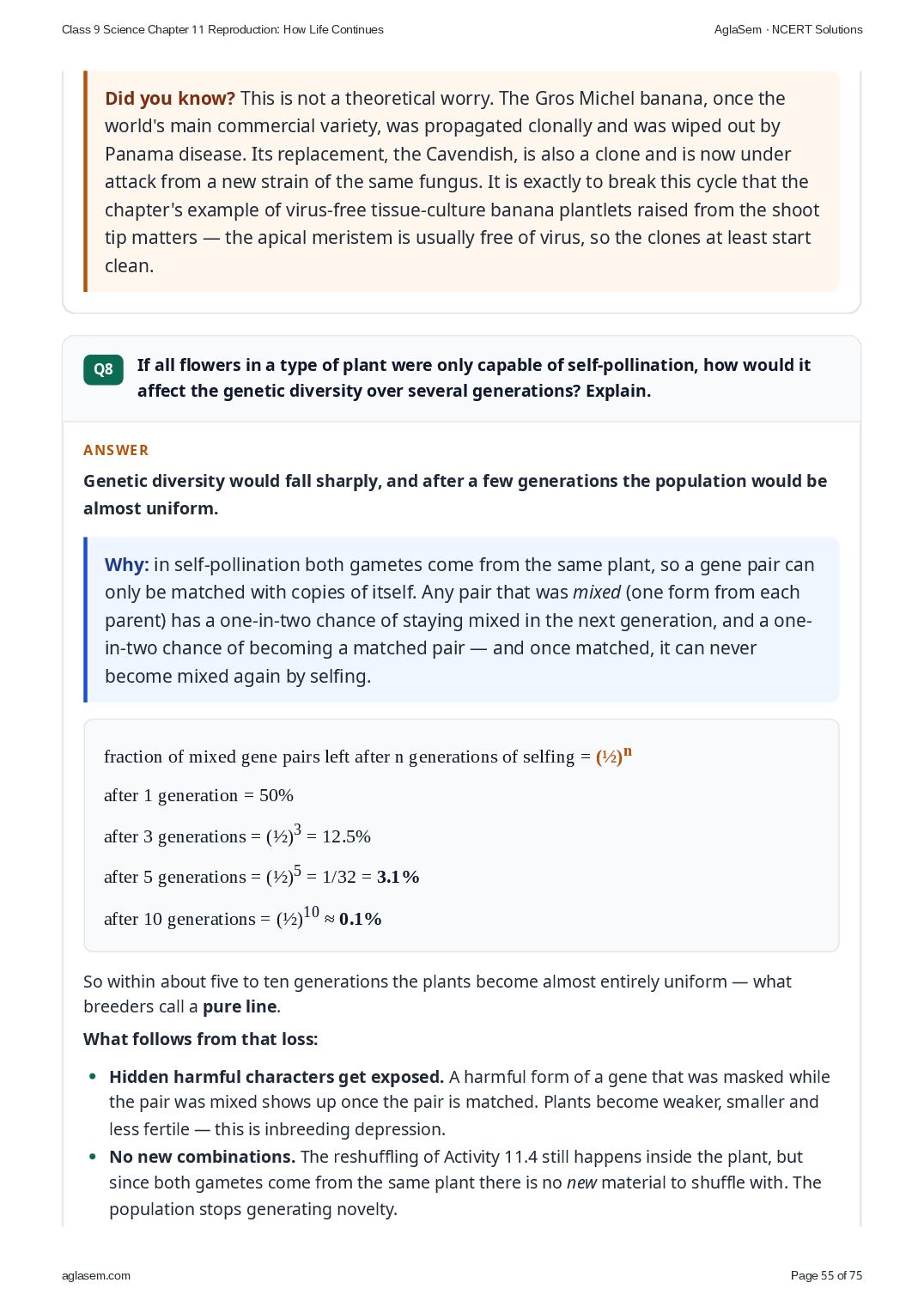
- If all flowers in a type of plant were only capable of self-pollination, how would it affect the genetic diversity over several generations? Explain.
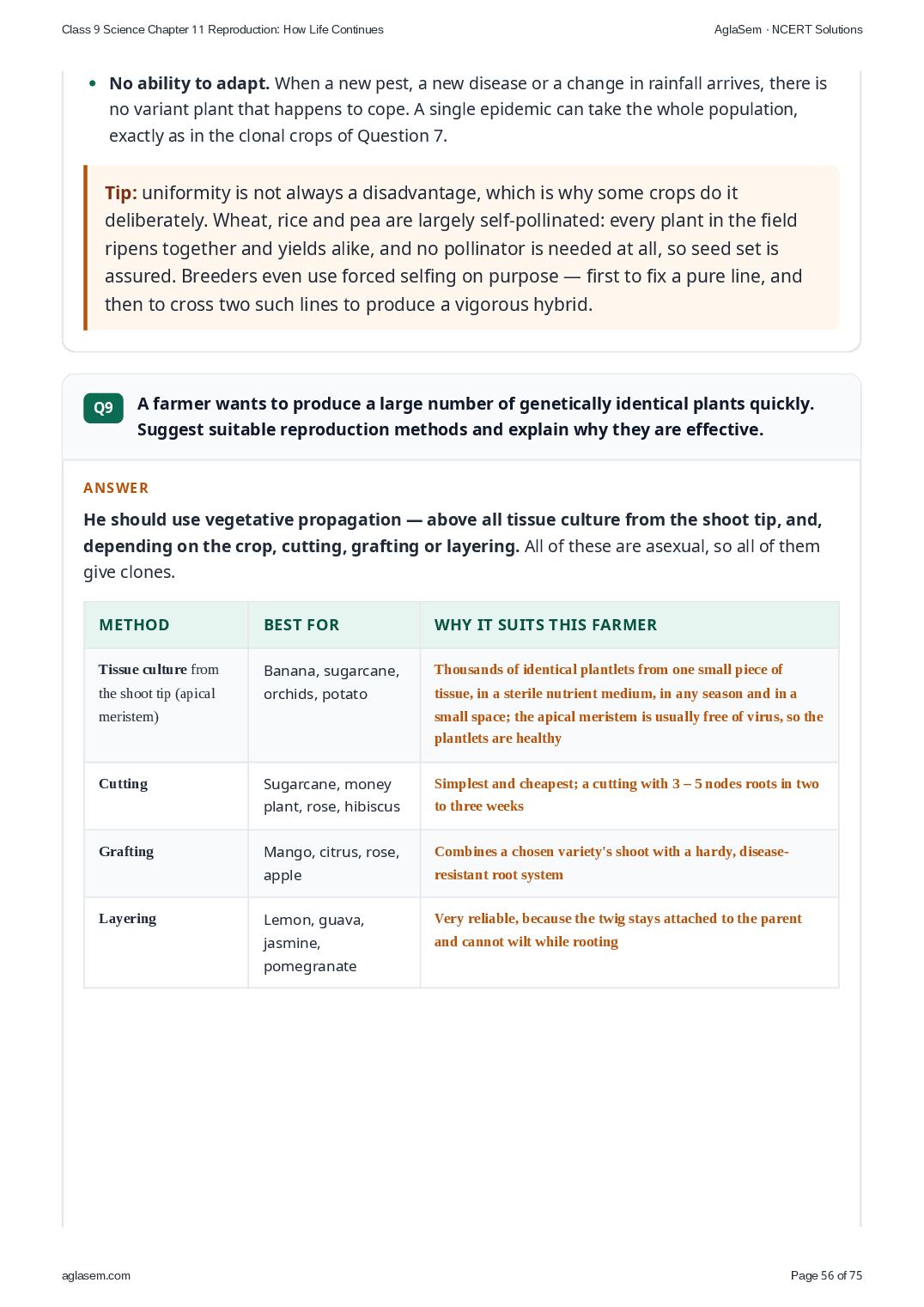
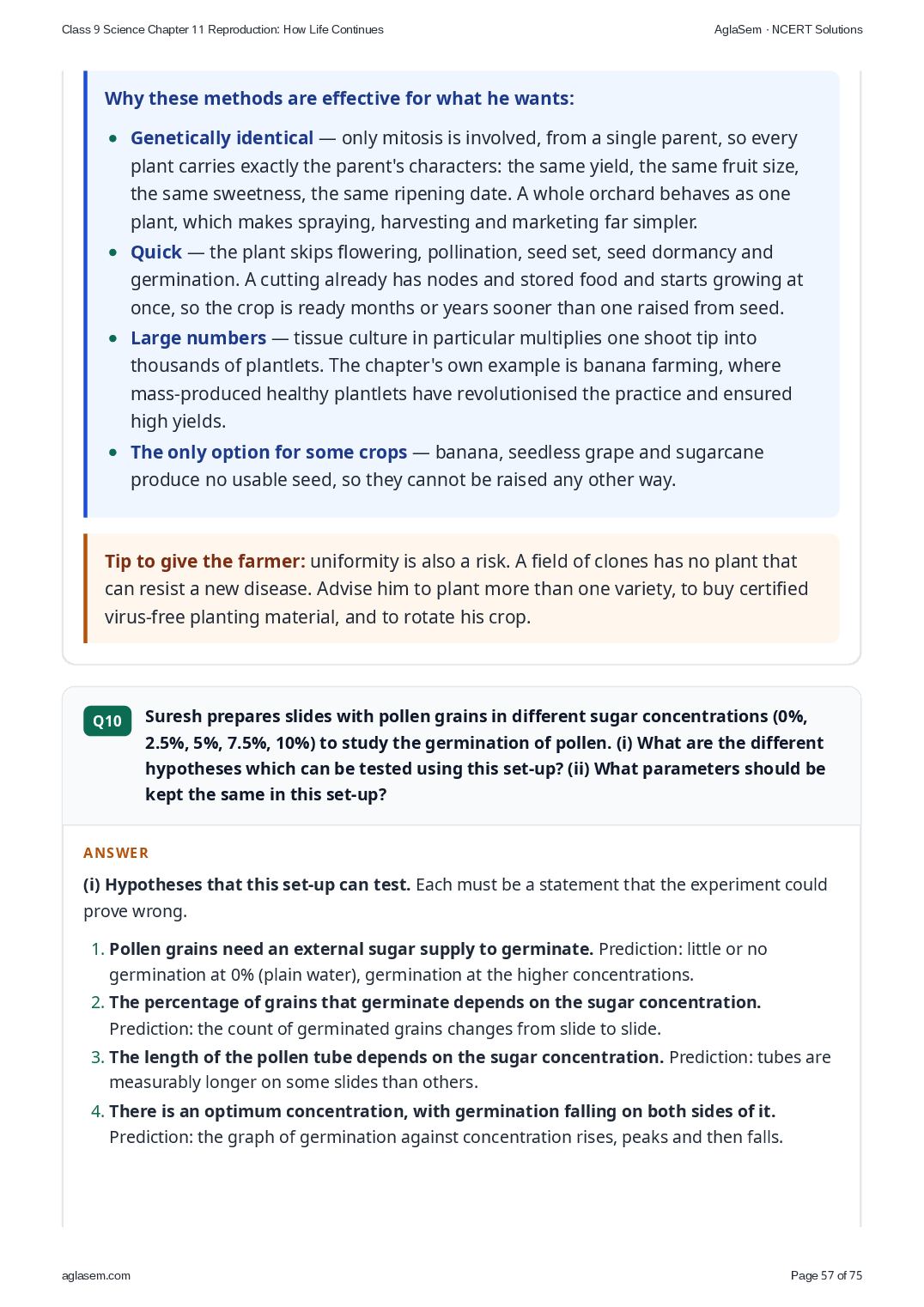
- A farmer wants to produce a large number of genetically identical plants quickly. Suggest suitable reproduction methods and explain why they are effective.
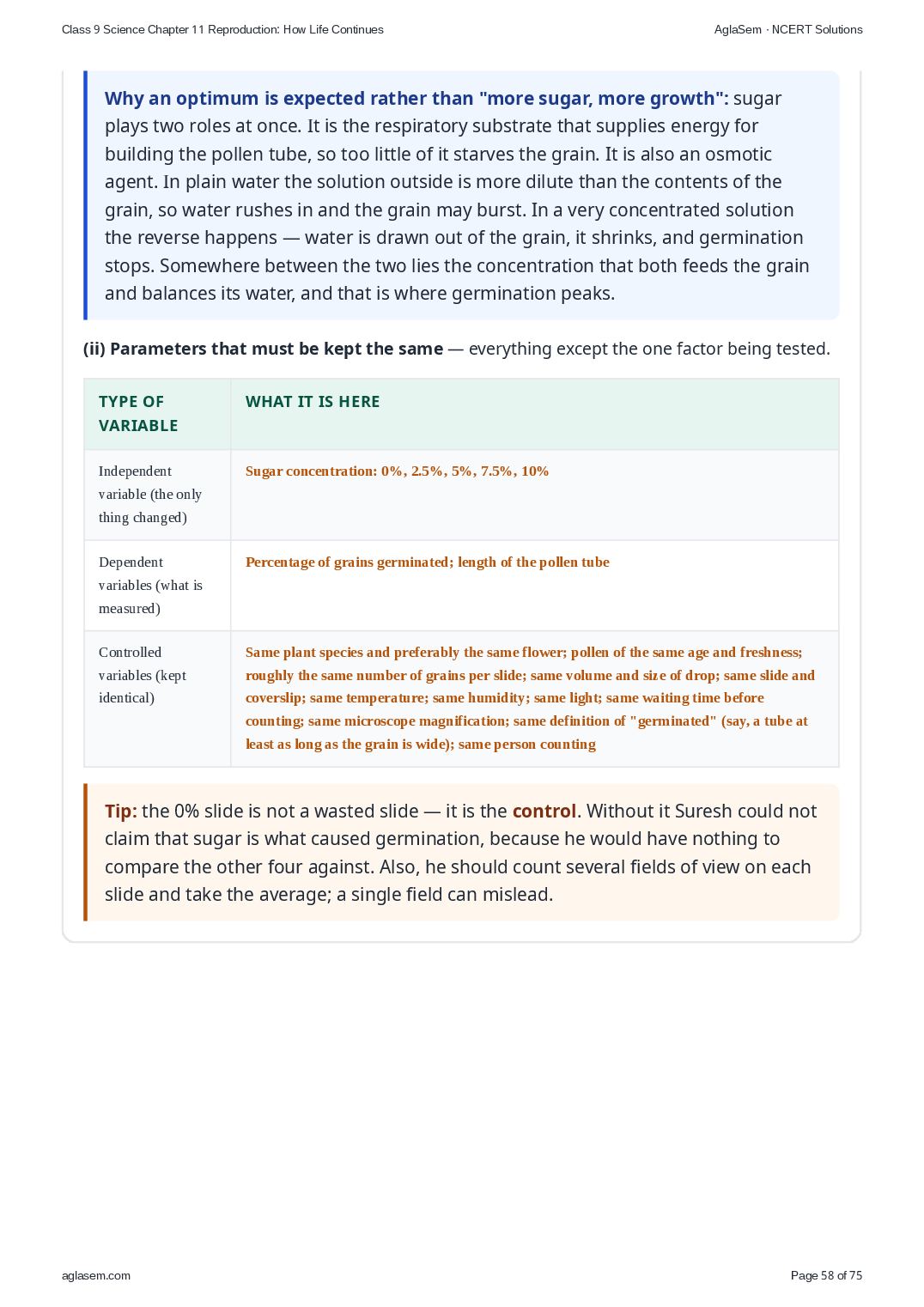
- Suresh prepares slides with pollen grains in different sugar concentrations (0%, 2.5%, 5%, 7.5%, 10%) to study the germination of pollen. (i) What are the different hypotheses which can be tested using this set-up? (ii) What parameters should be kept the same in this set-up?
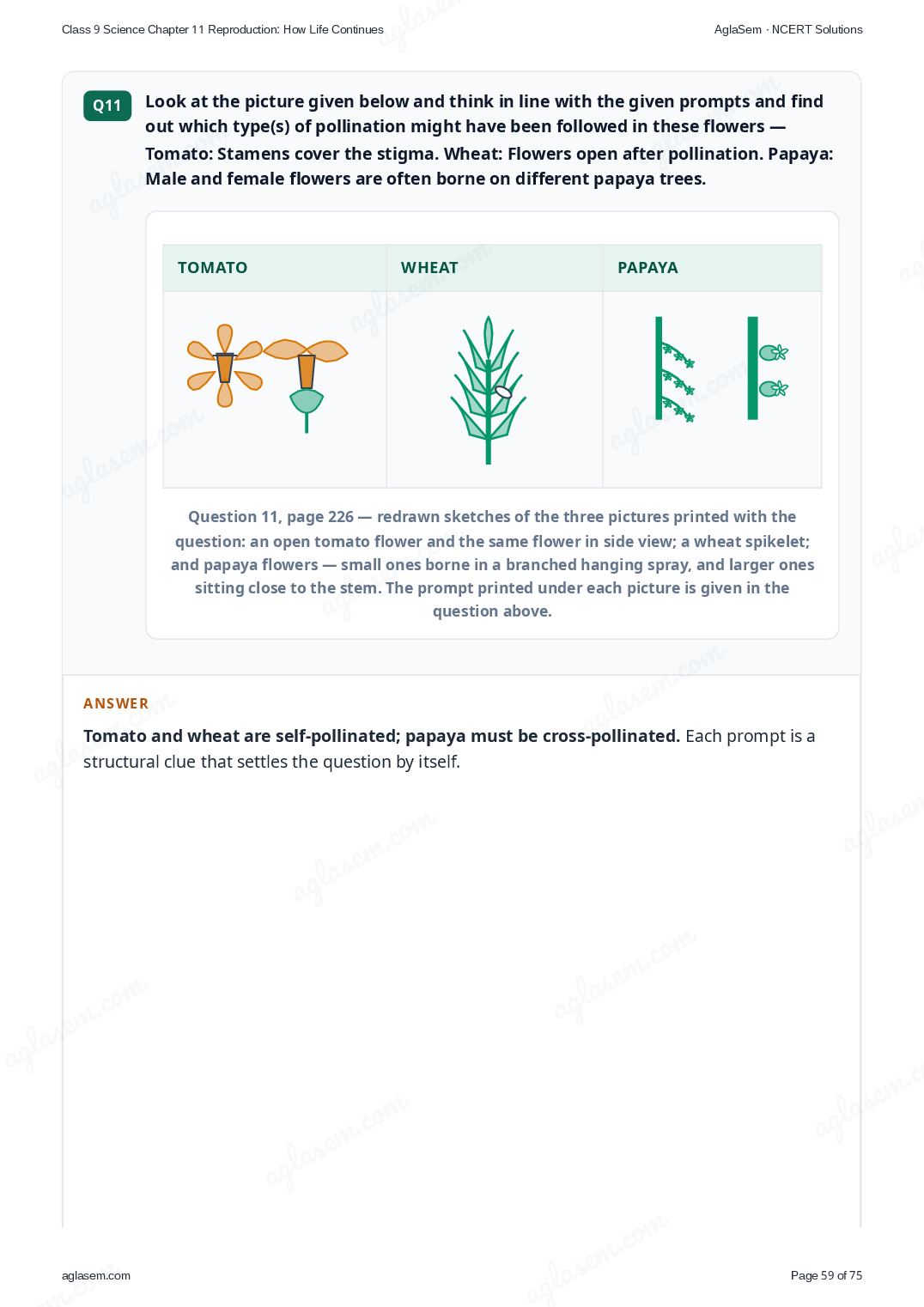
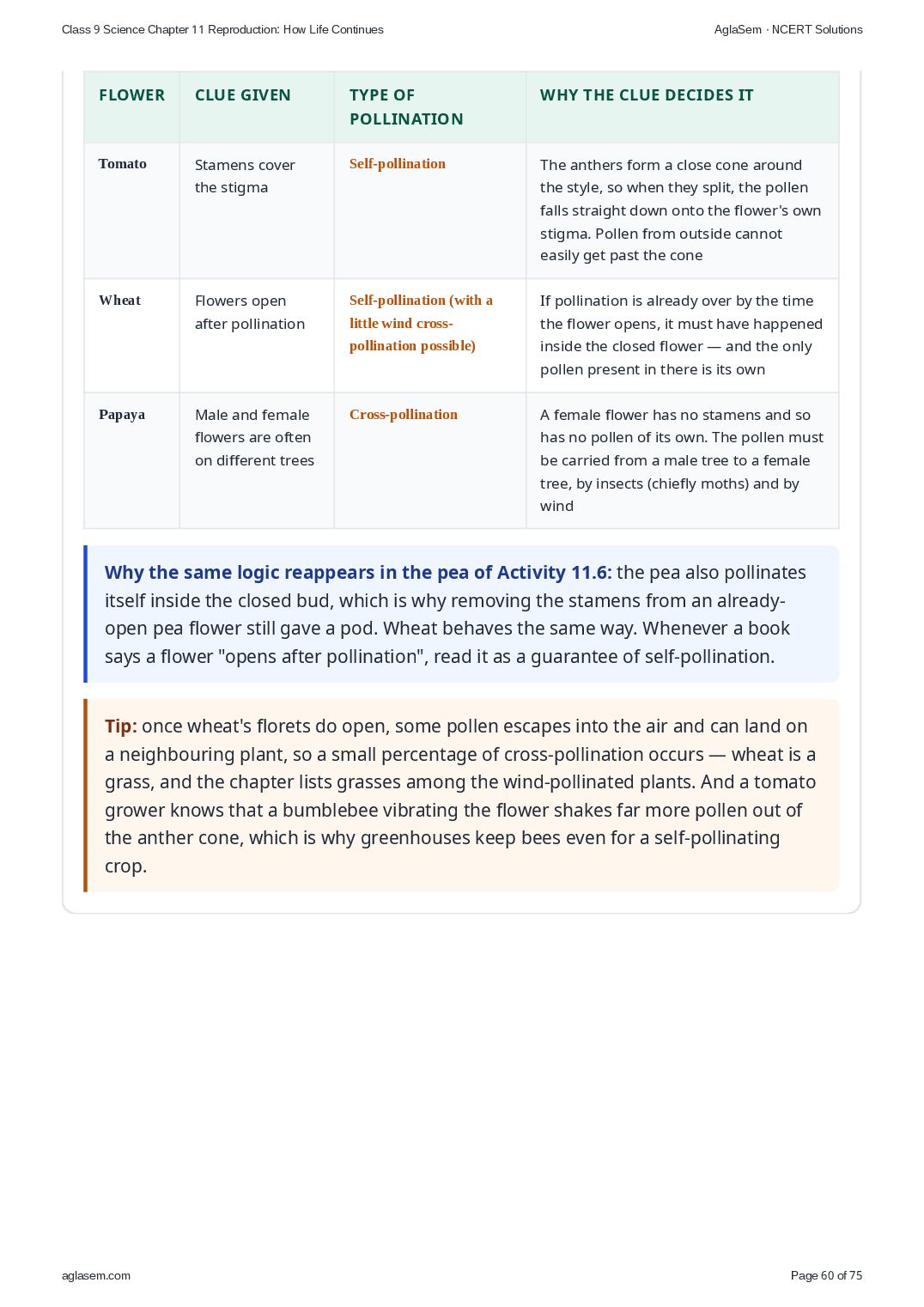
- Look at the picture given below and think in line with the given prompts and find out which type(s) of pollination might have been followed in these flowers — Tomato: Stamens cover the stigma. Wheat: Flowers open after pollination. Papaya: Male and female flowers are often borne on different papaya trees.
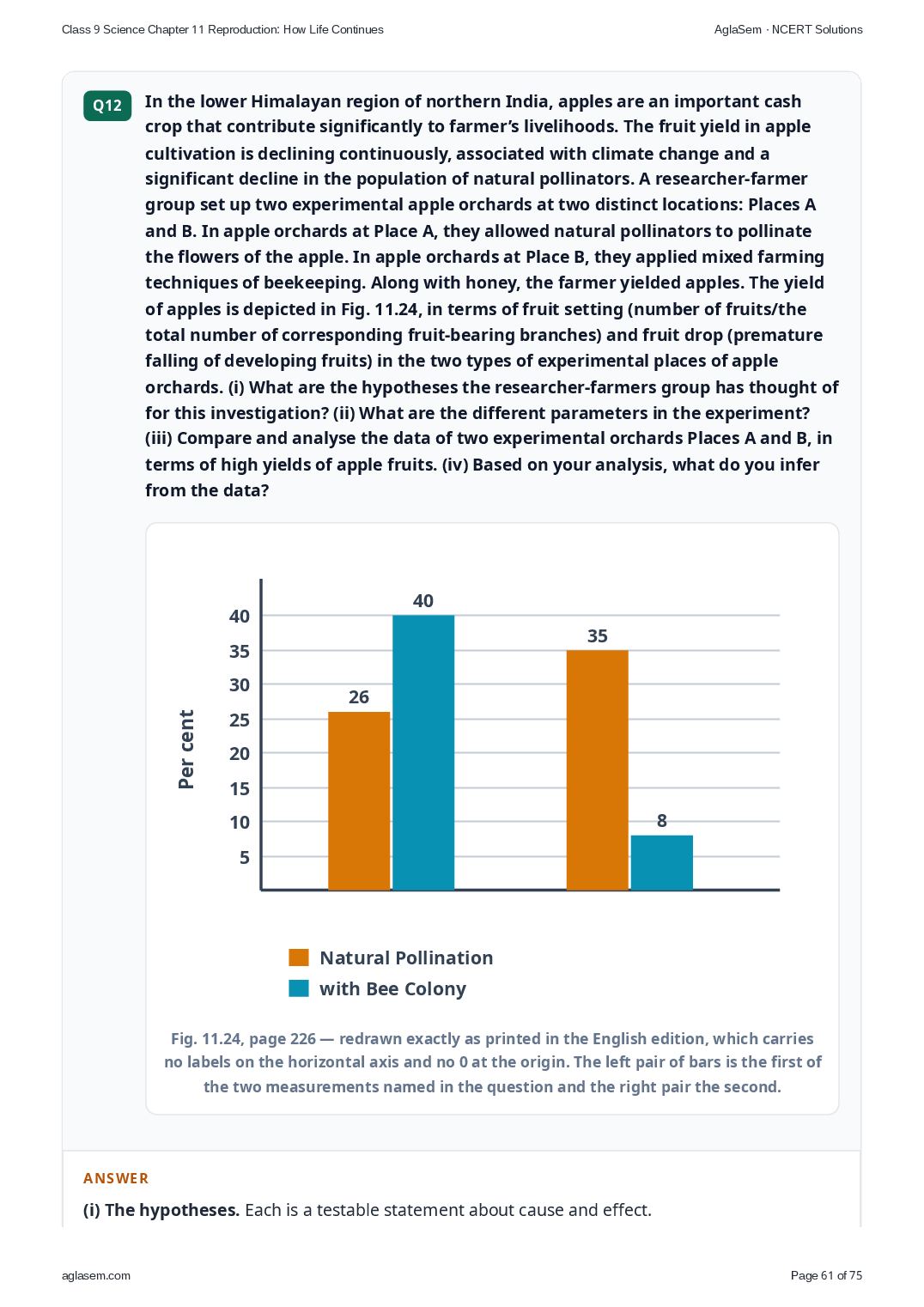
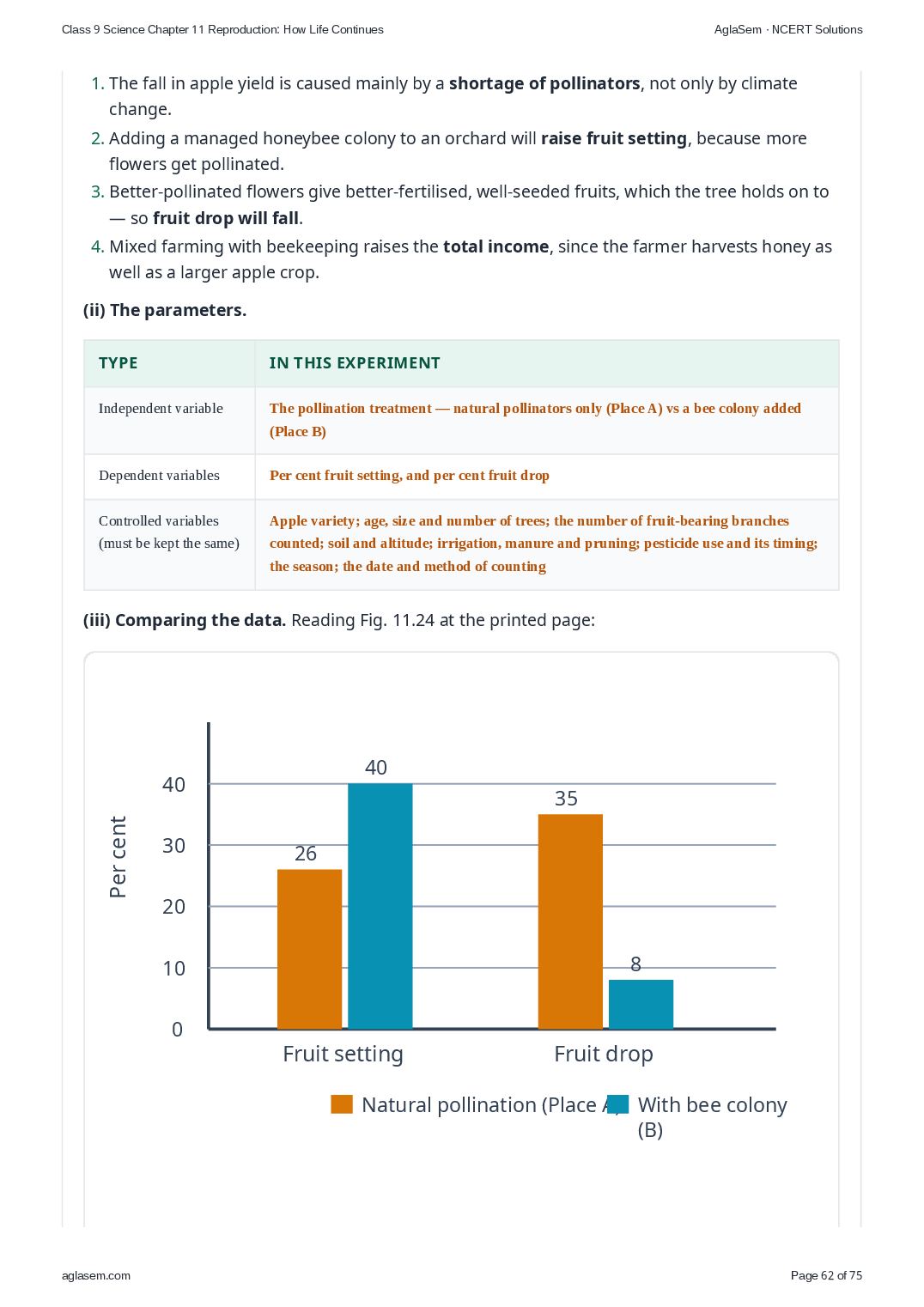
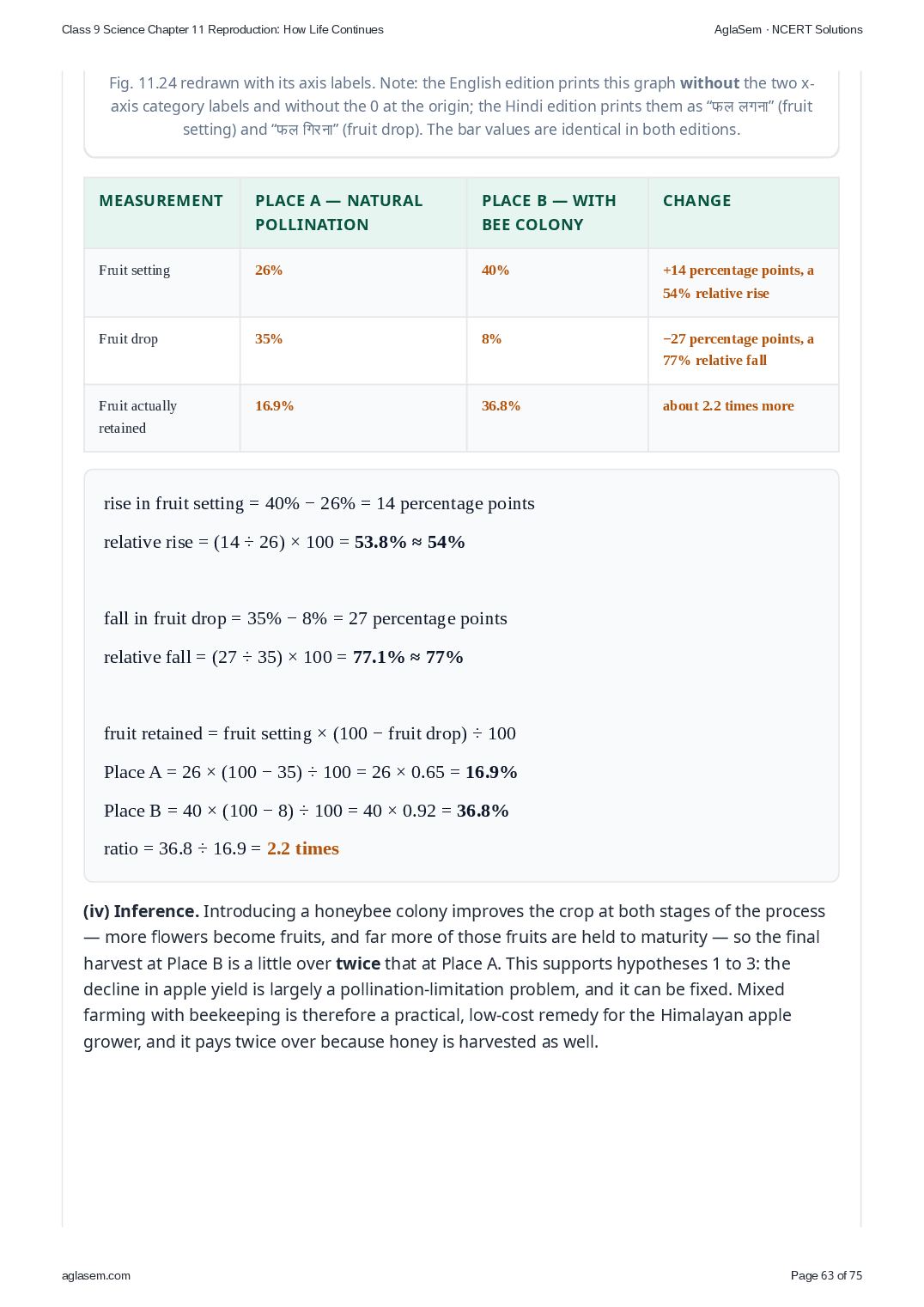
- In the lower Himalayan region of northern India, apples are an important cash crop that contribute significantly to farmer’s livelihoods. The fruit yield in apple cultivation is declining continuously, associated with climate change and a significant decline in the population of natural pollinators. A researcher-farmer group set up two experimental apple orchards at two distinct locations: Places A and B. In apple orchards at Place A, they allowed natural pollinators to pollinate the flowers of the apple. In apple orchards at Place B, they applied mixed farming techniques of beekeeping. Along with honey, the farmer yielded apples. The yield of apples is depicted in Fig. 11.24, in terms of fruit setting (number of fruits/the total number of corresponding fruit-bearing branches) and fruit drop (premature falling of developing fruits) in the two types of experimental places of apple orchards. (i) What are the hypotheses the researcher-farmers group has thought of for this investigation? (ii) What are the different parameters in the experiment? (iii) Compare and analyse the data of two experimental orchards Places A and B, in terms of high yields of apple fruits. (iv) Based on your analysis, what do you infer from the data?
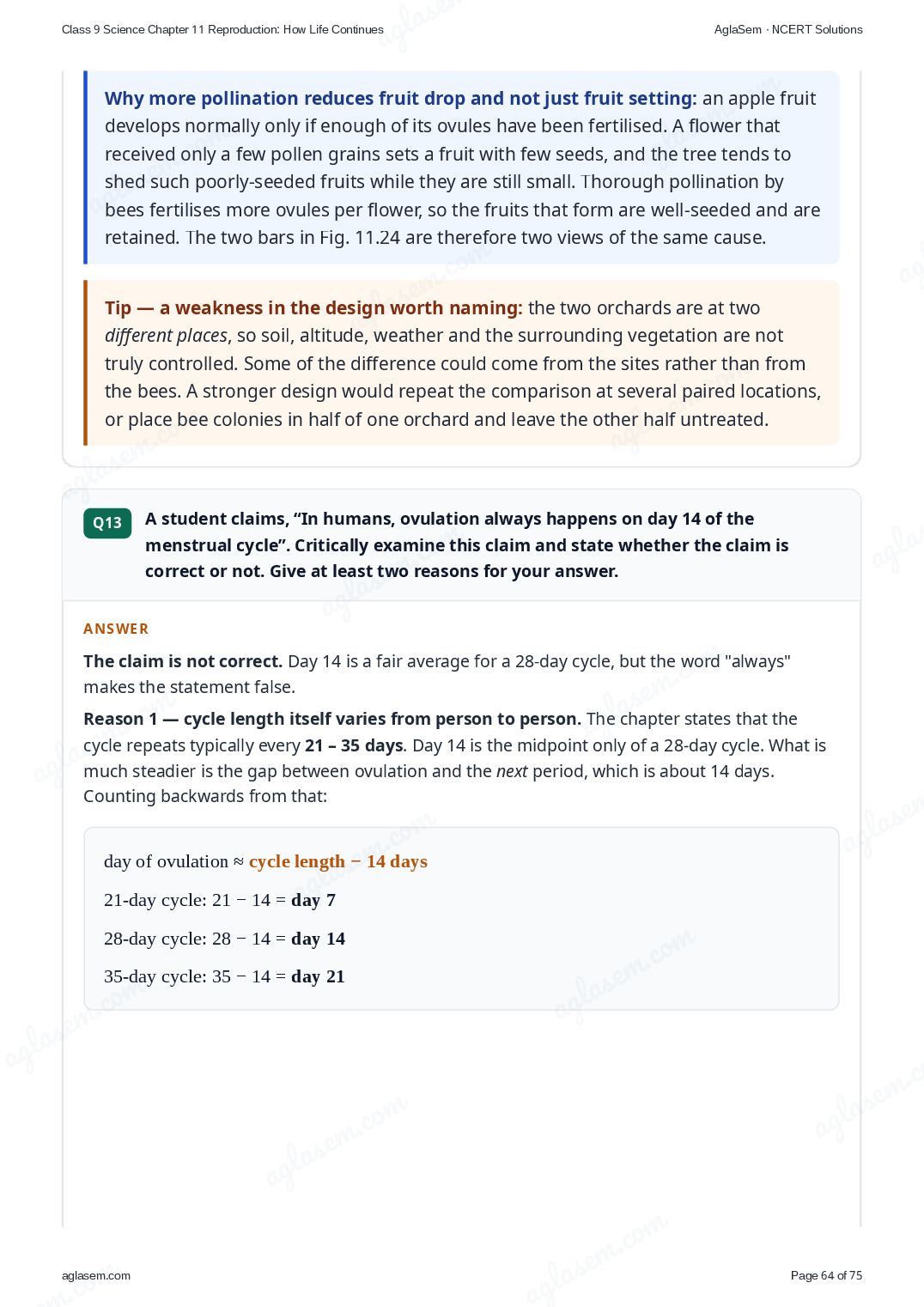
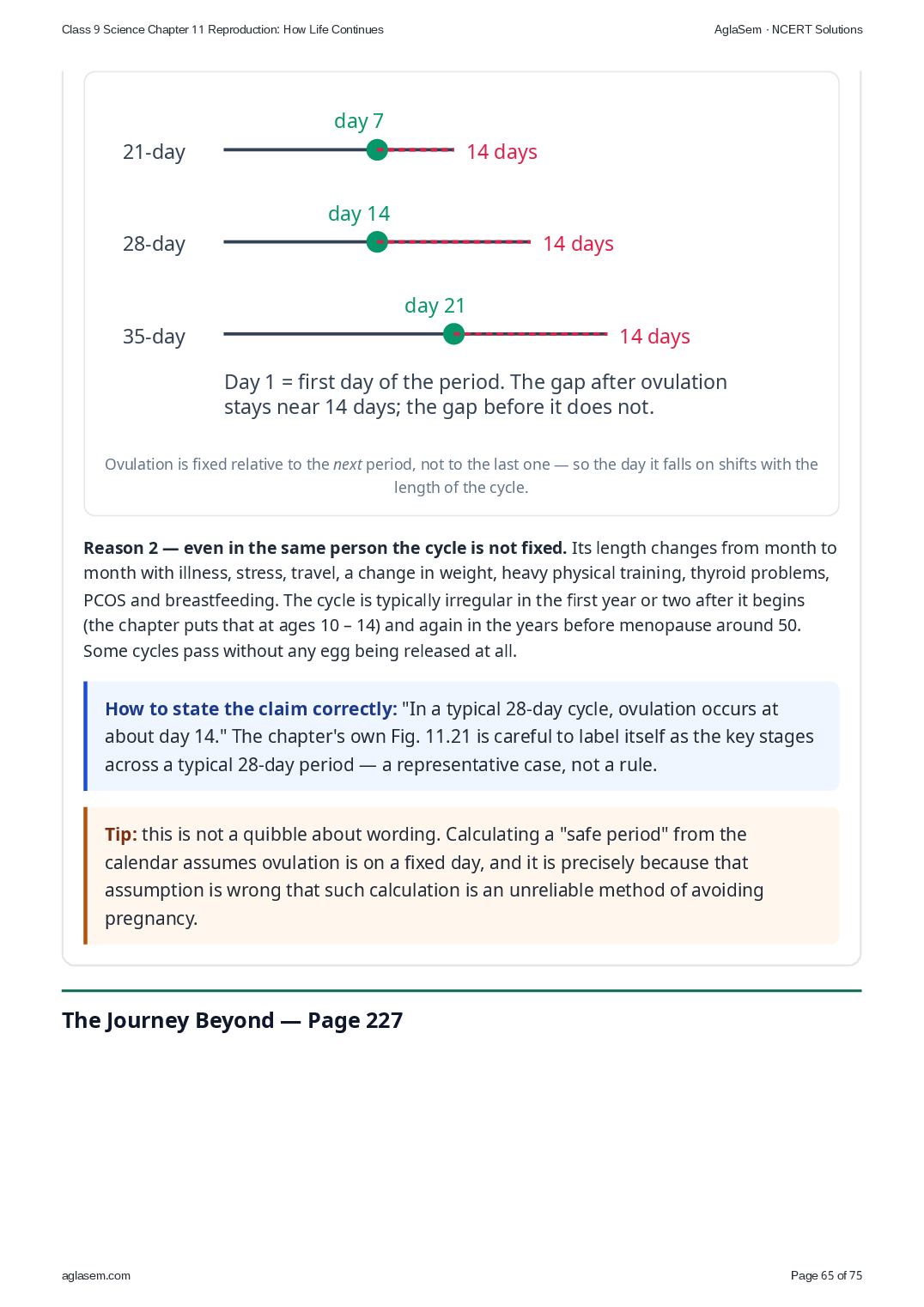
- A student claims, “In humans, ovulation always happens on day 14 of the menstrual cycle”. Critically examine this claim and state whether the claim is correct or not. Give at least two reasons for your answer.
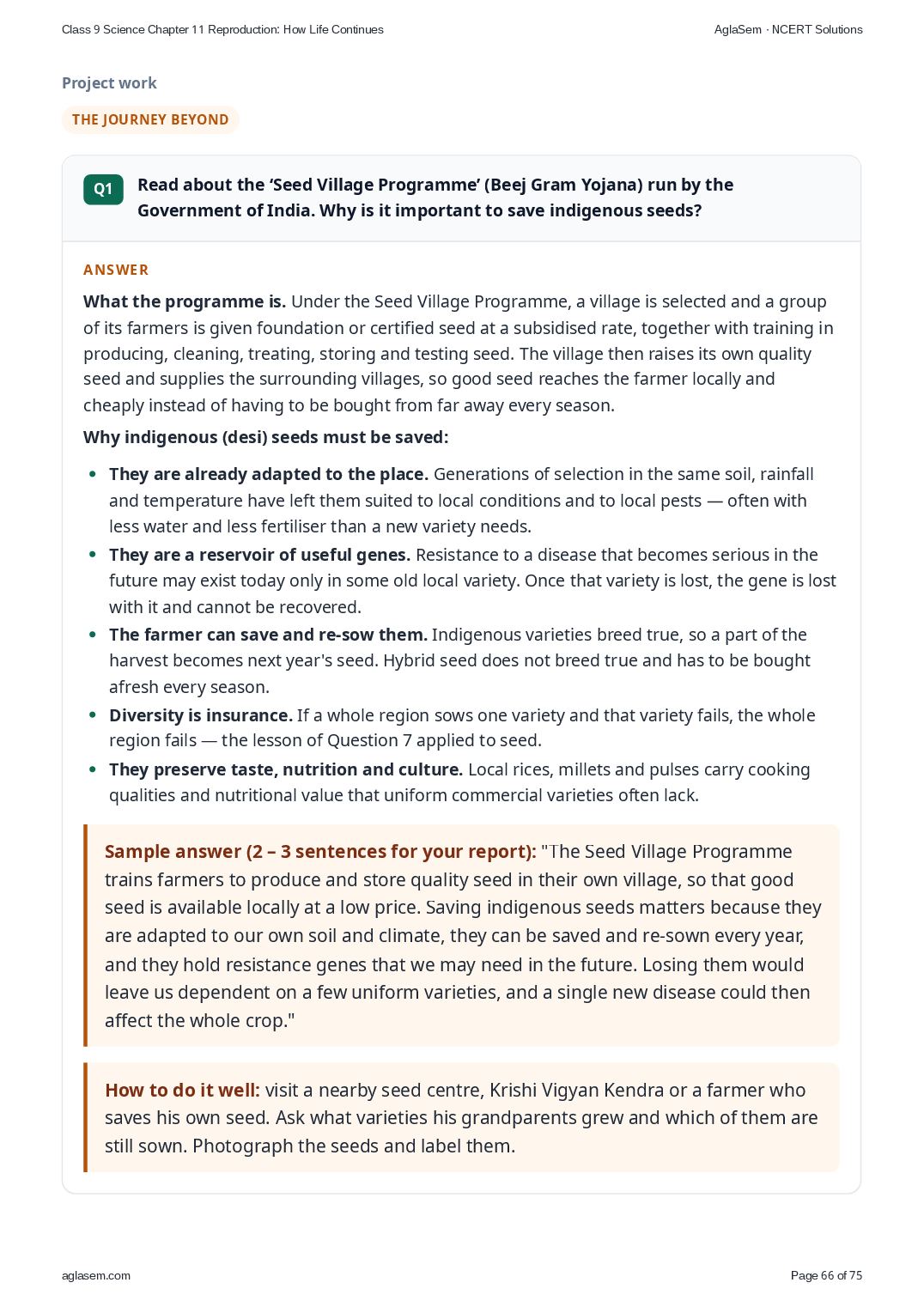
- Read about the ‘Seed Village Programme’ (Beej Gram Yojana) run by the Government of India. Why is it important to save indigenous seeds?
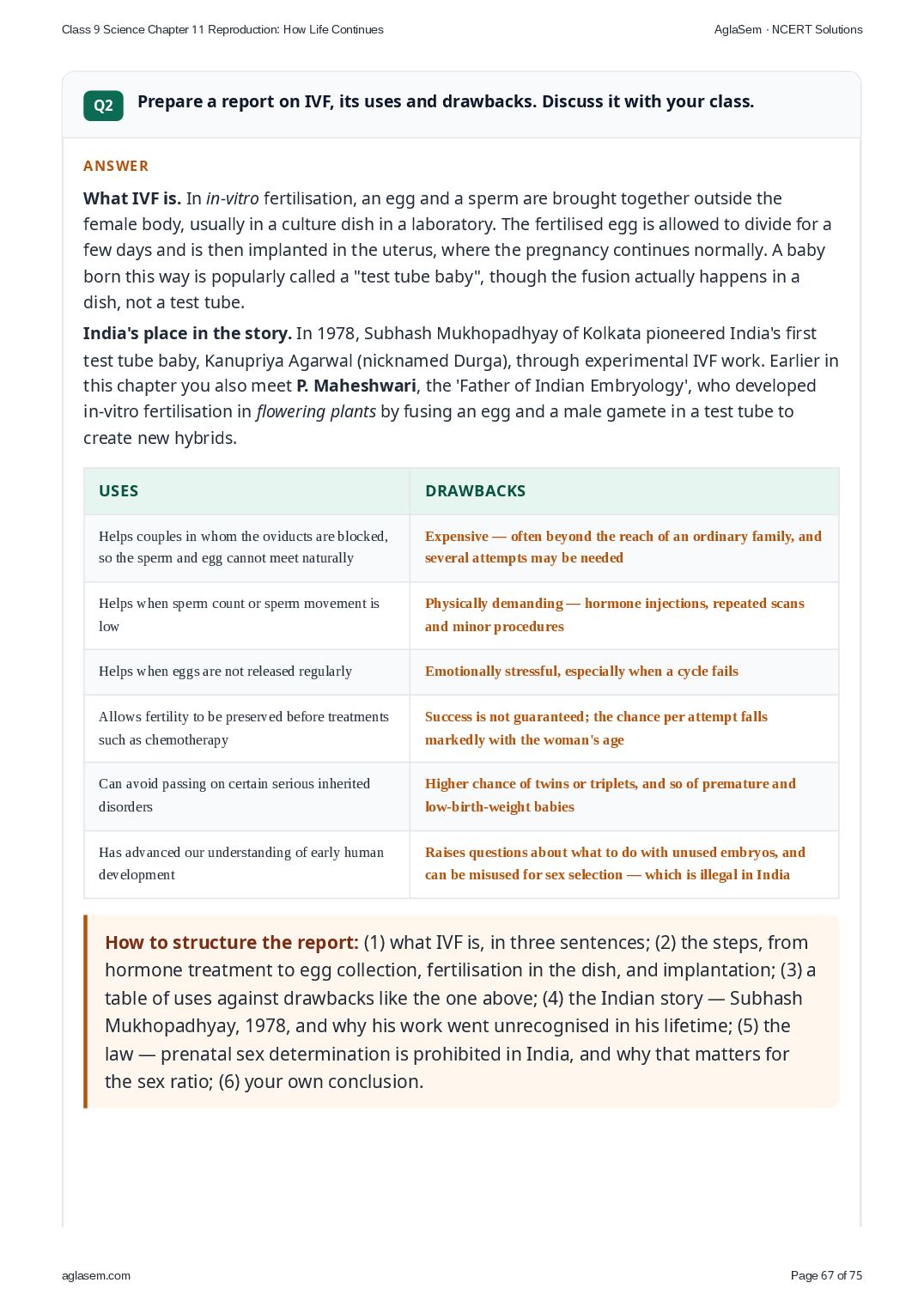
- Prepare a report on IVF, its uses and drawbacks. Discuss it with your class.
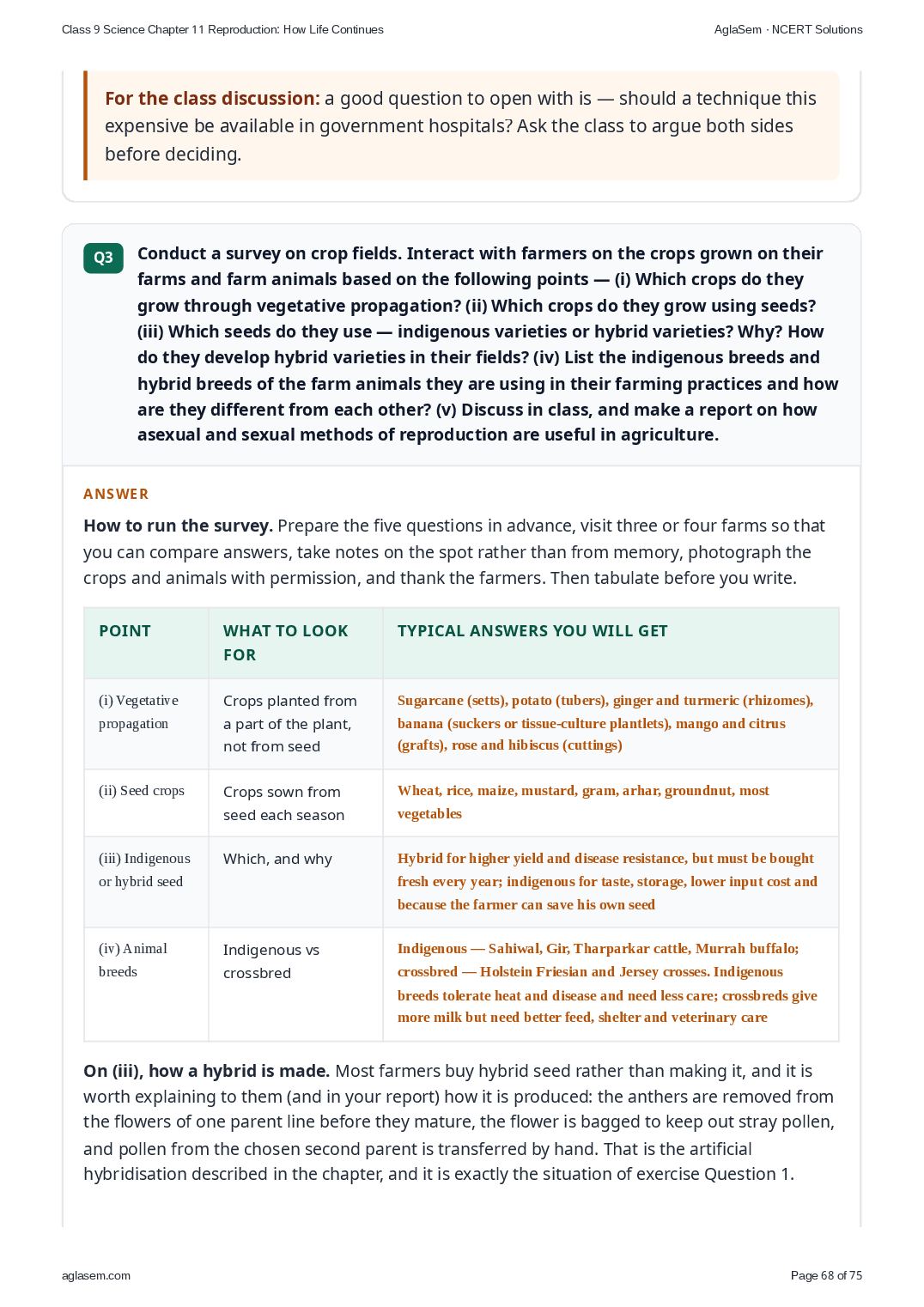
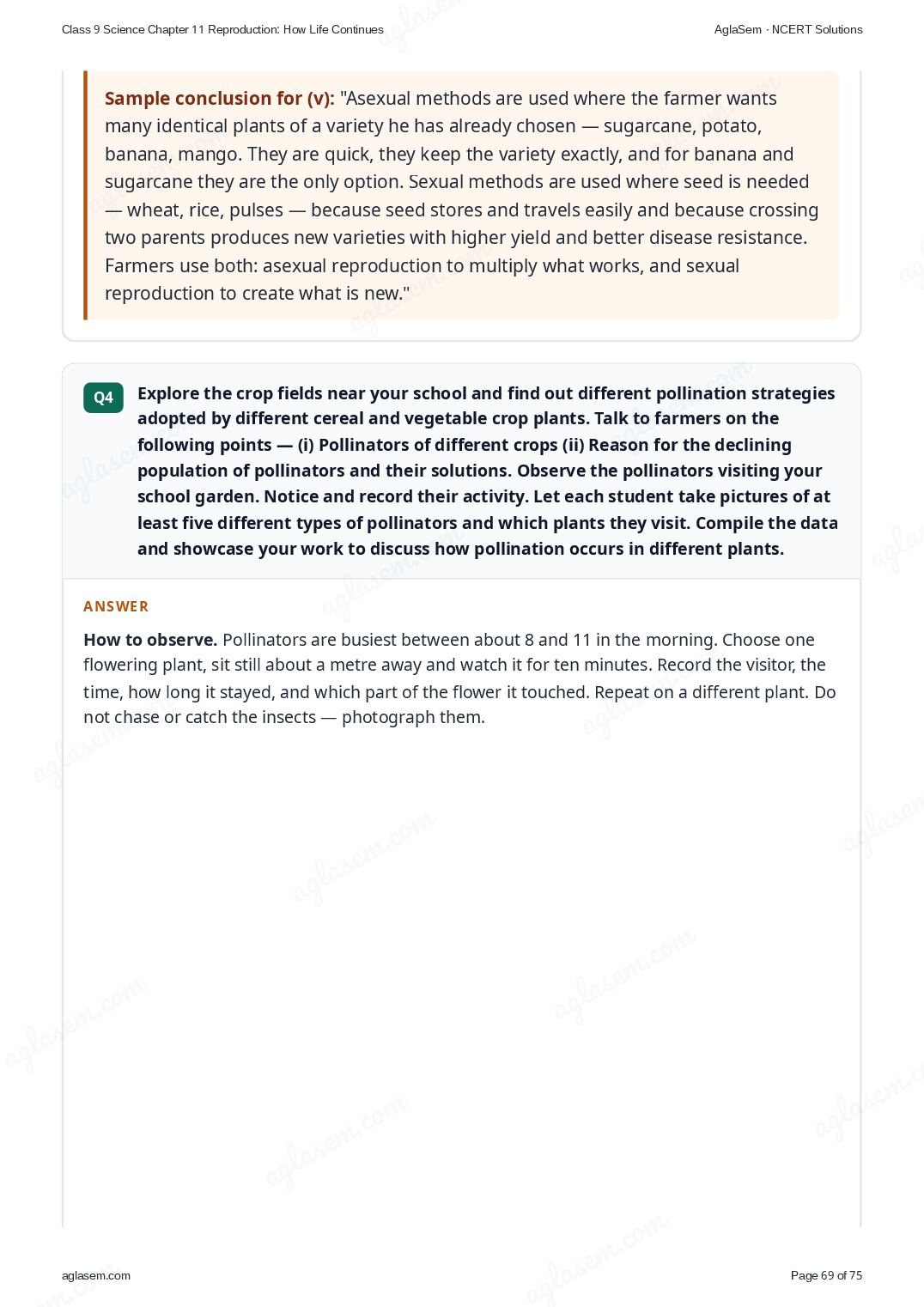
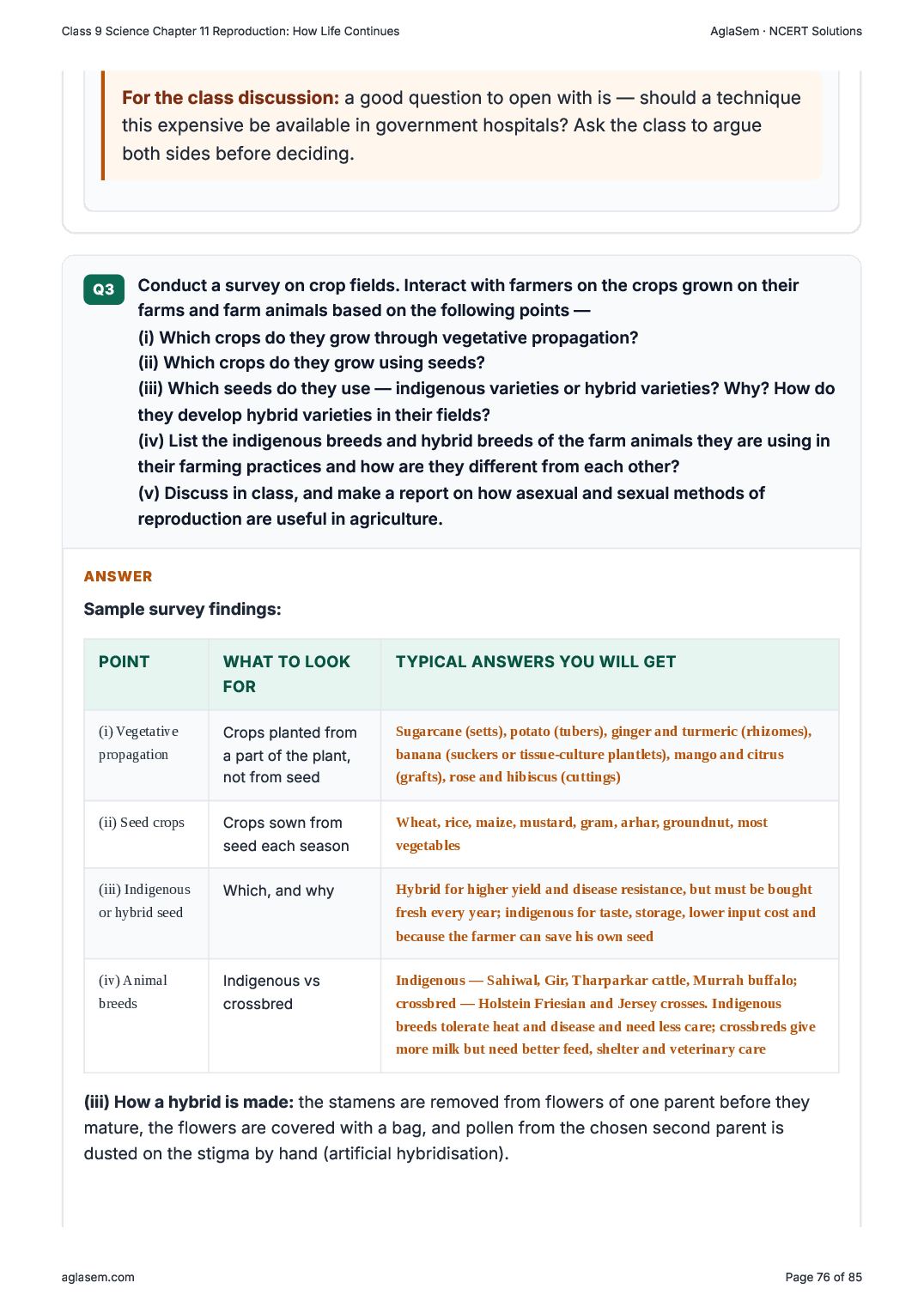
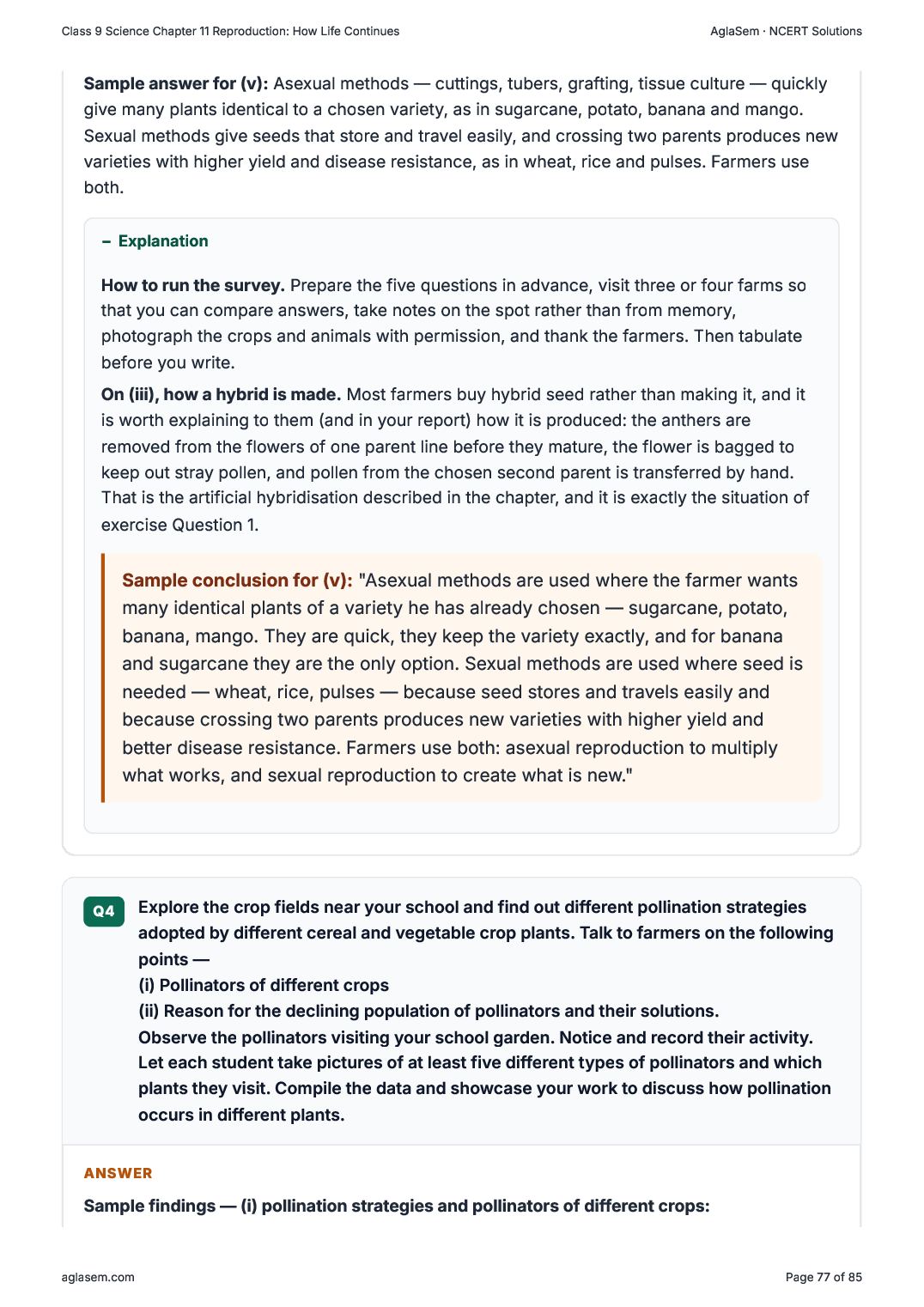
- Conduct a survey on crop fields. Interact with farmers on the crops grown on their farms and farm animals based on the following points — (i) Which crops do they grow through vegetative propagation? (ii) Which crops do they grow using seeds? (iii) Which seeds do they use — indigenous varieties or hybrid varieties? Why? How do they develop hybrid varieties in their fields? (iv) List the indigenous breeds and hybrid breeds of the farm animals they are using in their farming practices and how are they different from each other? (v) Discuss in class, and make a report on how asexual and sexual methods of reproduction are useful in agriculture.
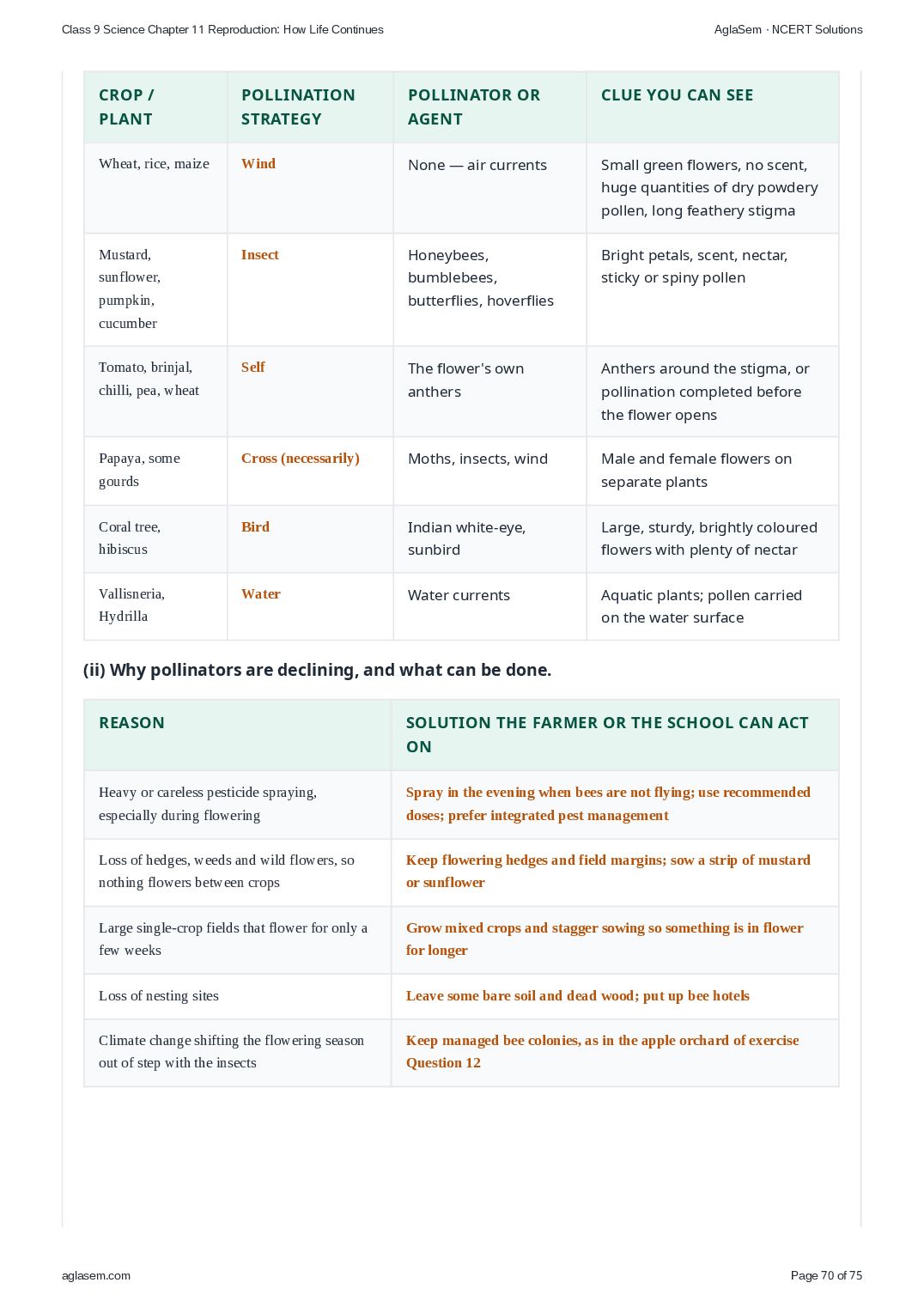
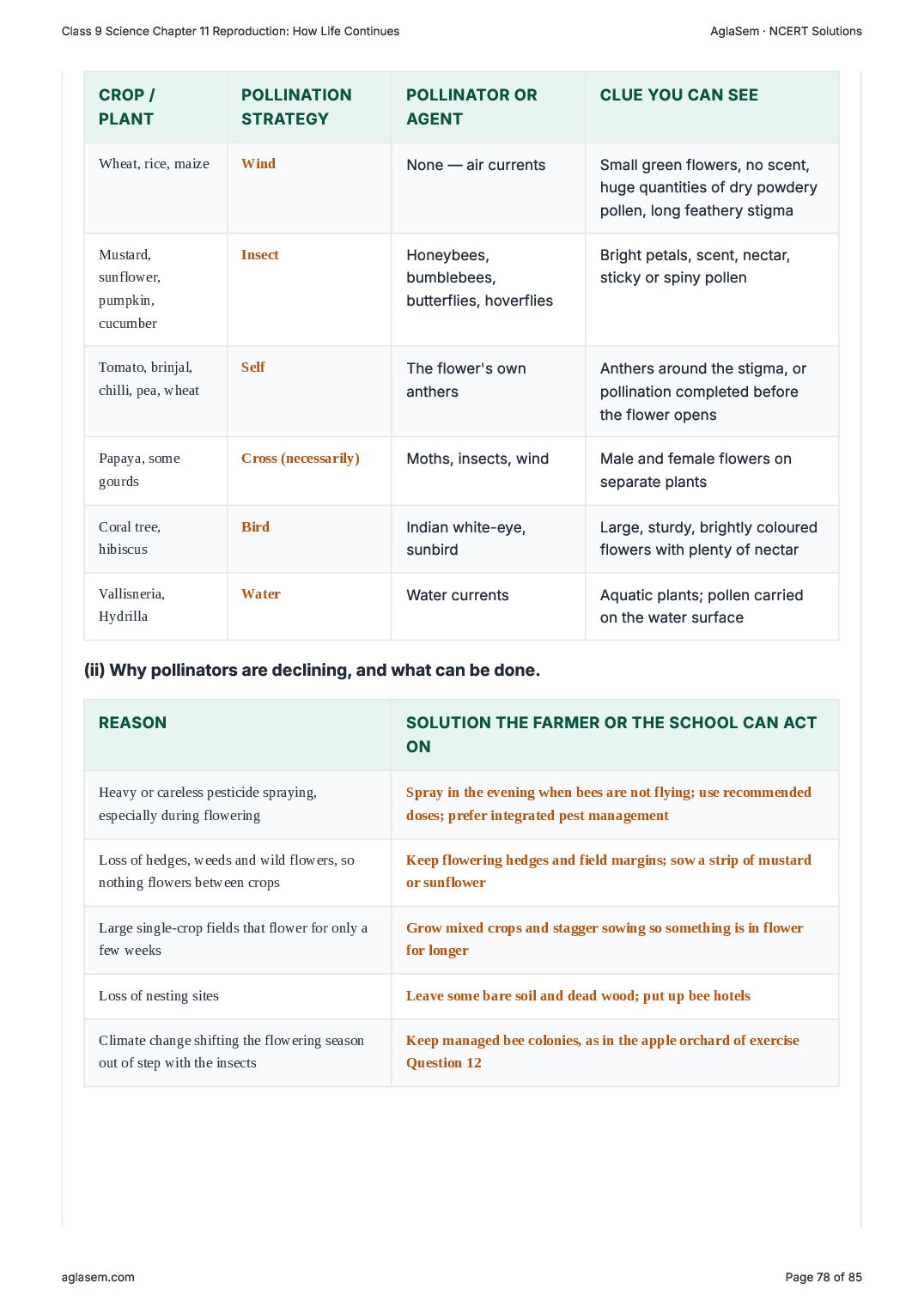
- Explore the crop fields near your school and find out different pollination strategies adopted by different cereal and vegetable crop plants. Talk to farmers on the following points — (i) Pollinators of different crops (ii) Reason for the declining population of pollinators and their solutions. Observe the pollinators visiting your school garden. Notice and record their activity. Let each student take pictures of at least five different types of pollinators and which plants they visit. Compile the data and showcase your work to discuss how pollination occurs in different plants.
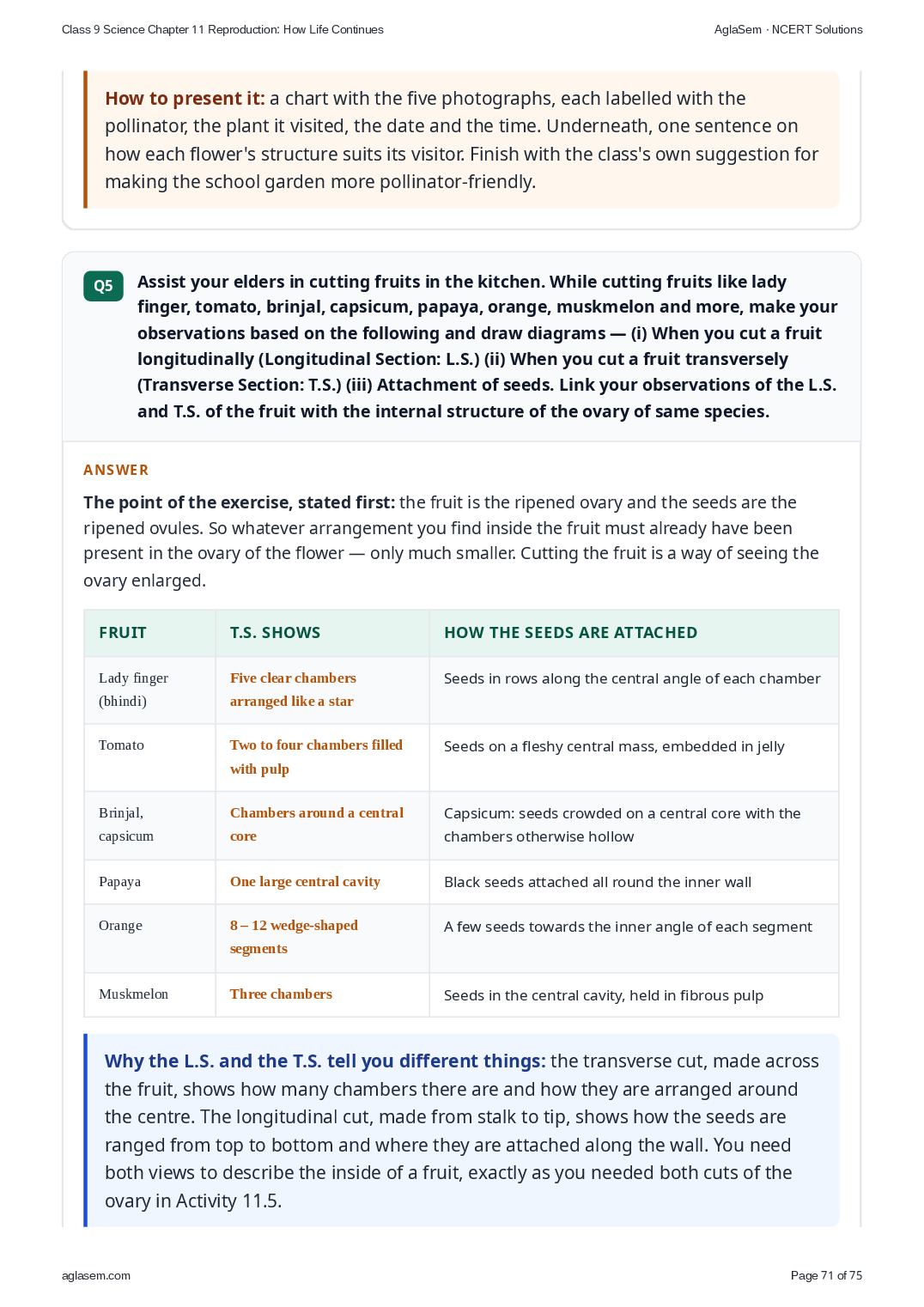
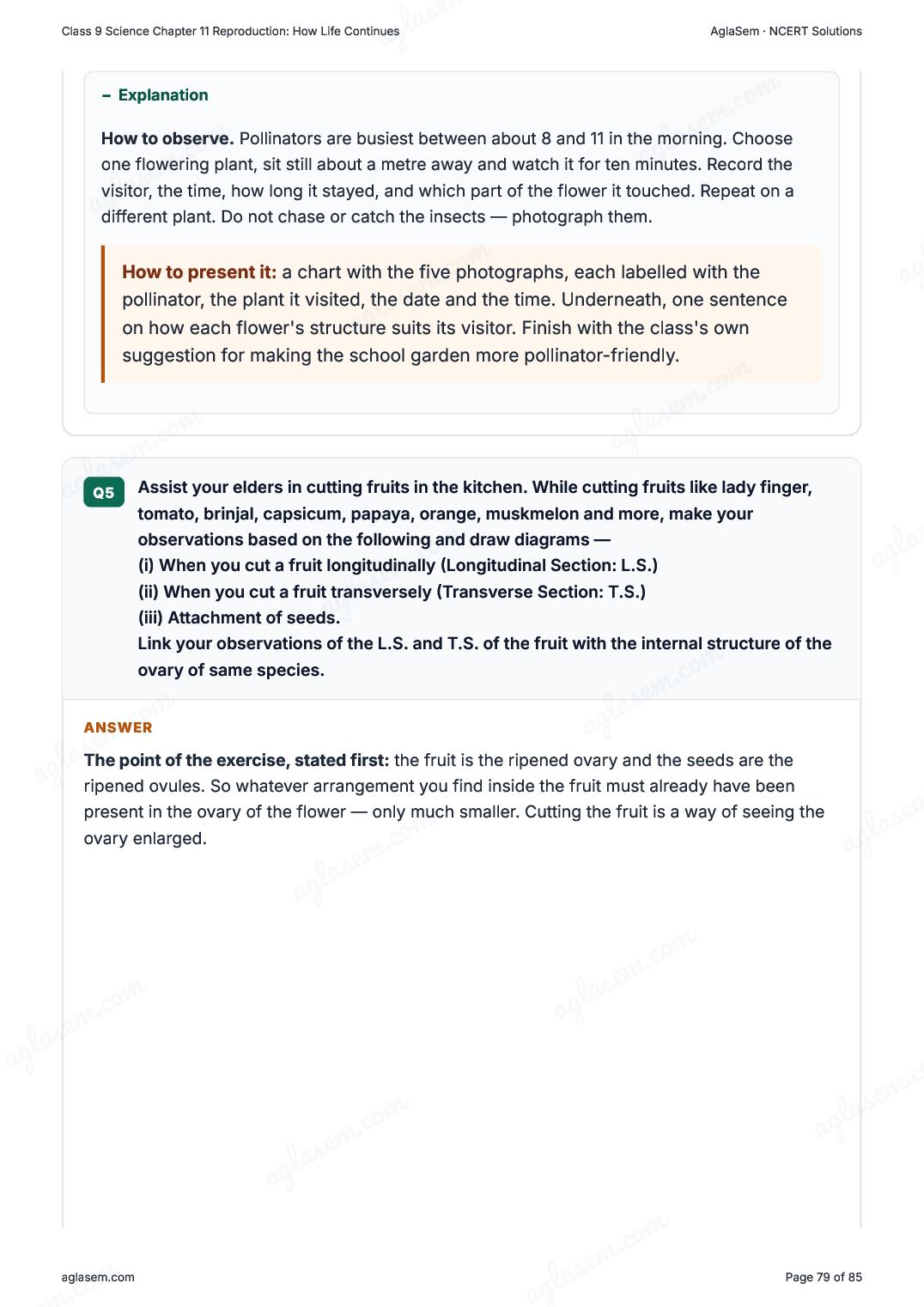
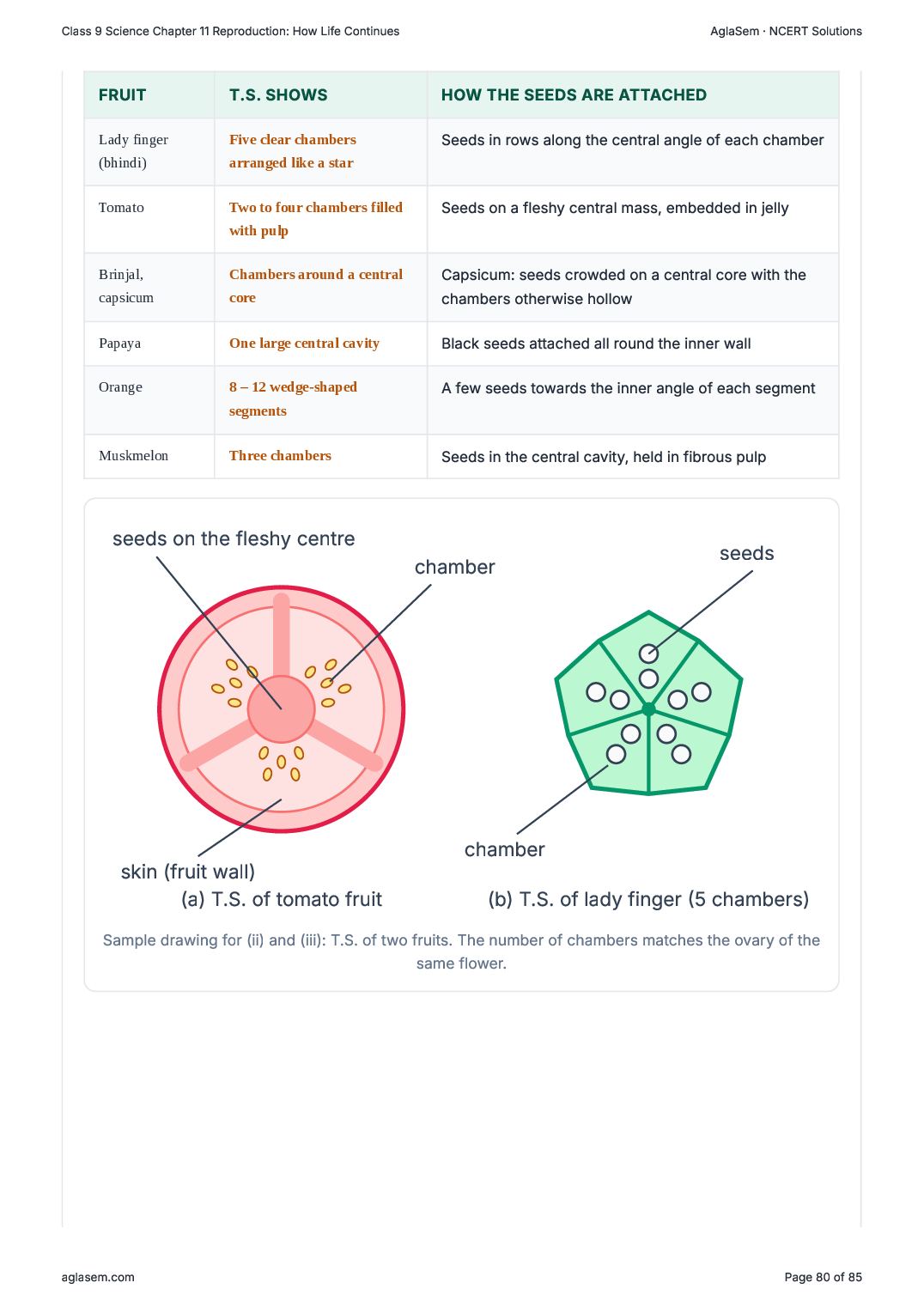
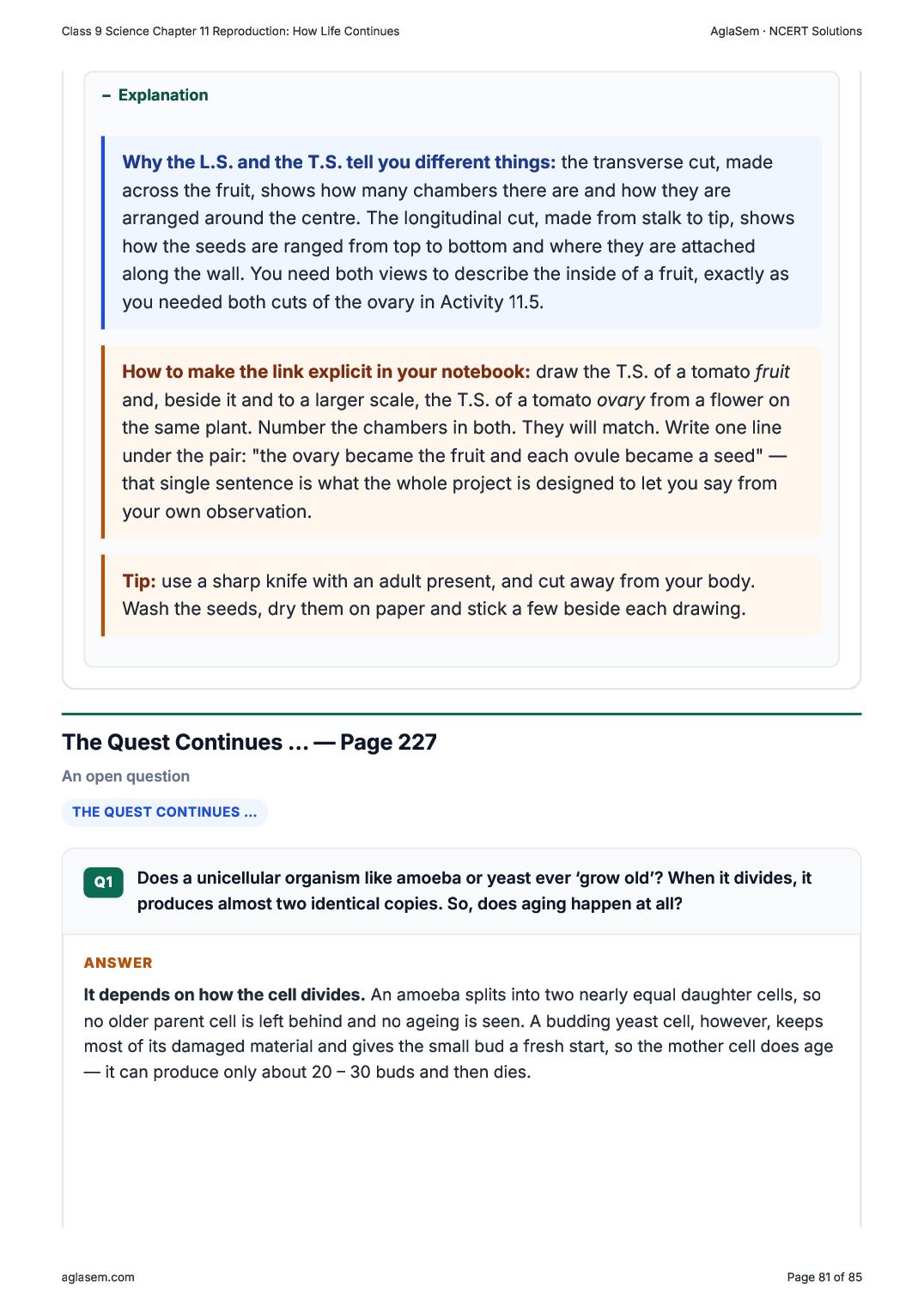
- Assist your elders in cutting fruits in the kitchen. While cutting fruits like lady finger, tomato, brinjal, capsicum, papaya, orange, muskmelon and more, make your observations based on the following and draw diagrams — (i) When you cut a fruit longitudinally (Longitudinal Section: L.S.) (ii) When you cut a fruit transversely (Transverse Section: T.S.) (iii) Attachment of seeds. Link your observations of the L.S. and T.S. of the fruit with the internal structure of the ovary of same species.
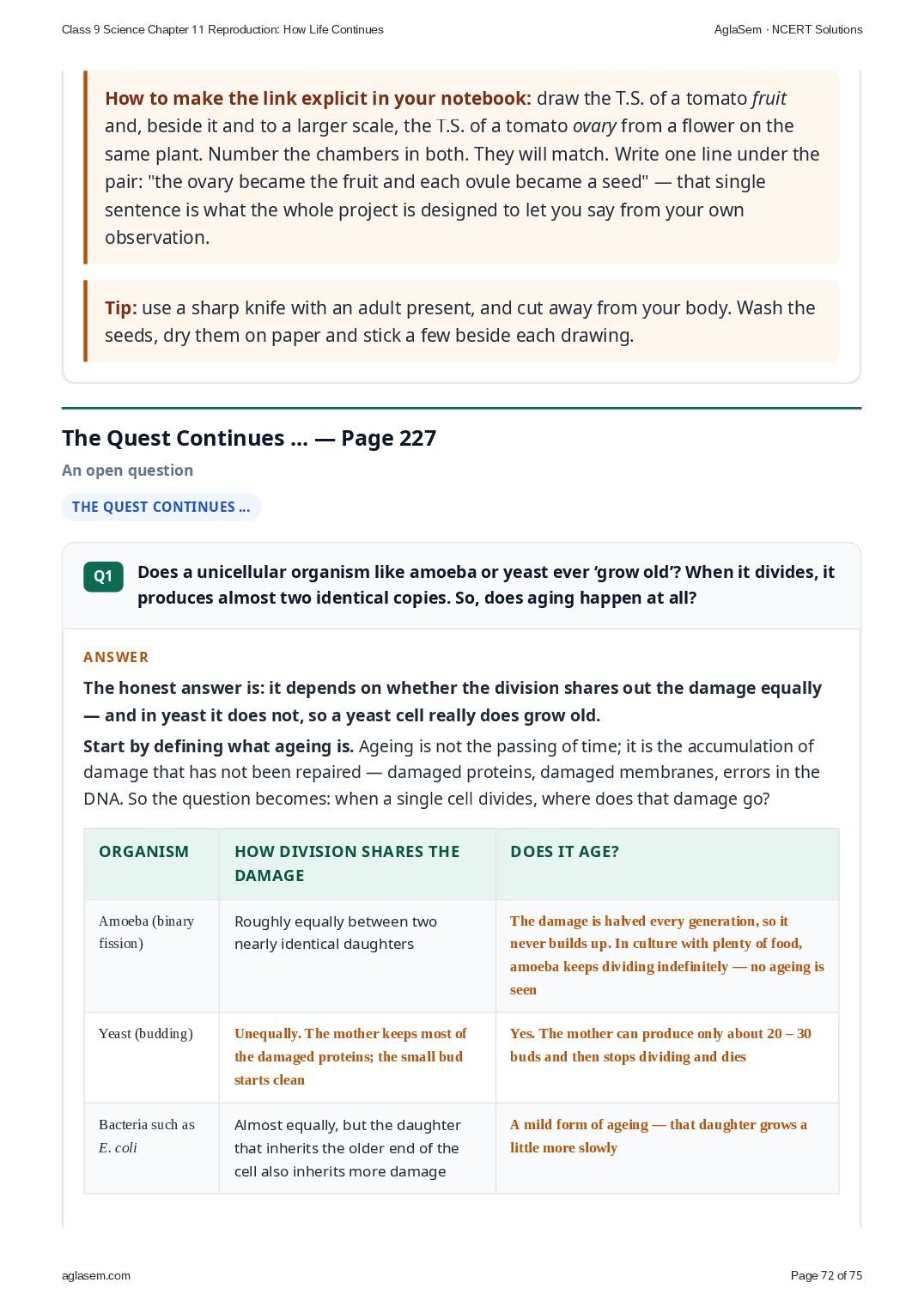
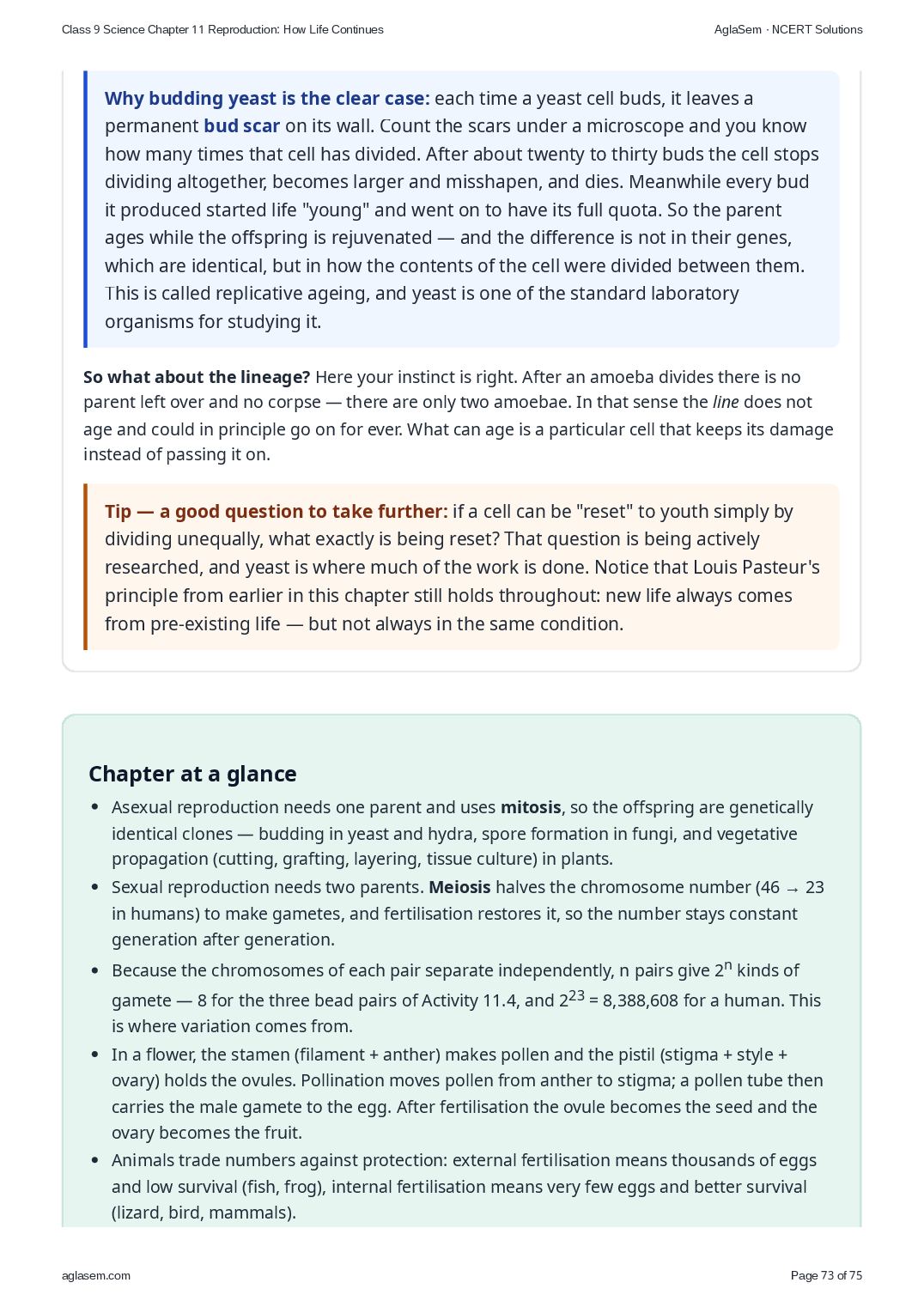
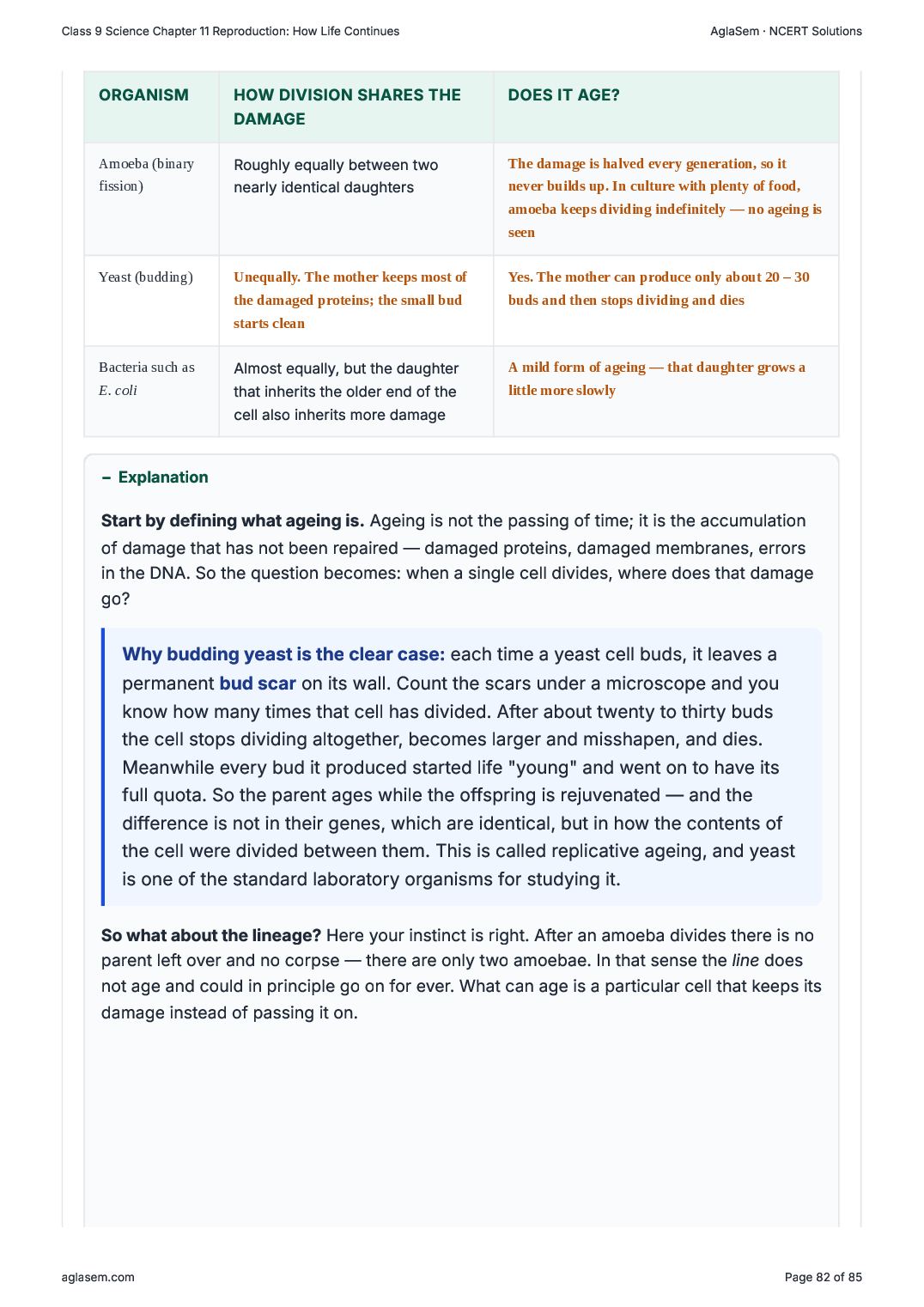
- Does a unicellular organism like amoeba or yeast ever ‘grow old’? When it divides, it produces almost two identical copies. So, does aging happen at all?
Chapter at a Glance
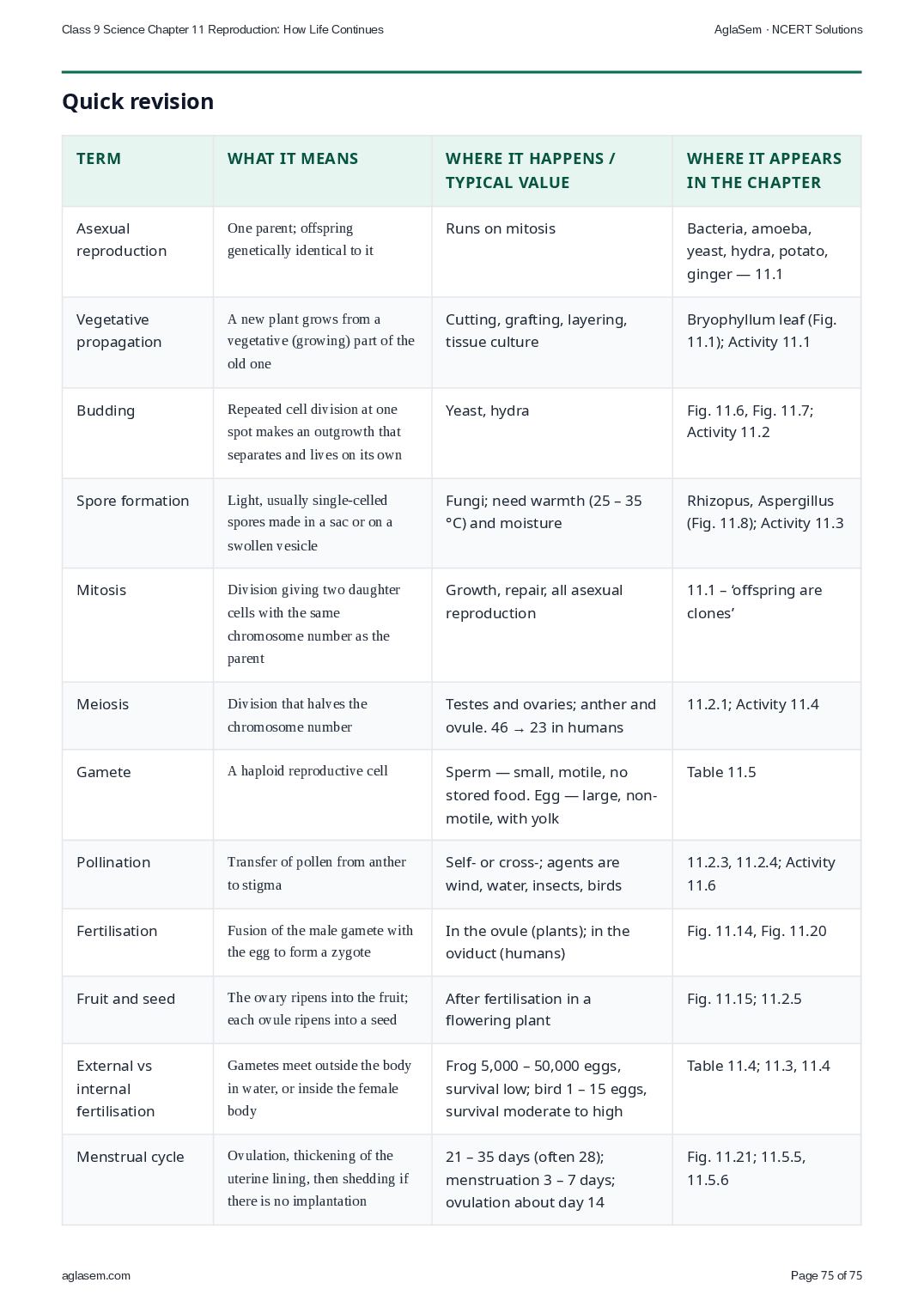
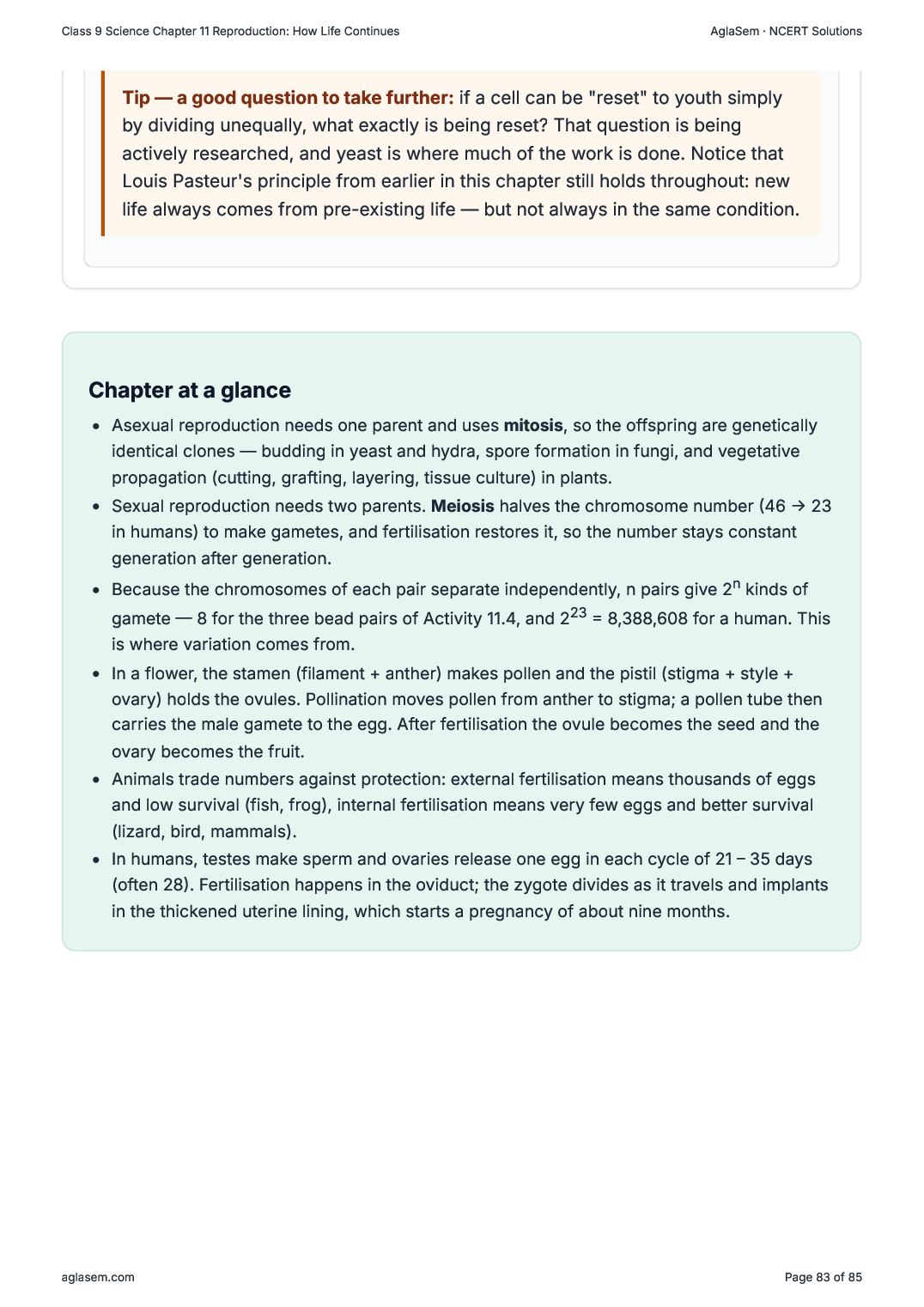
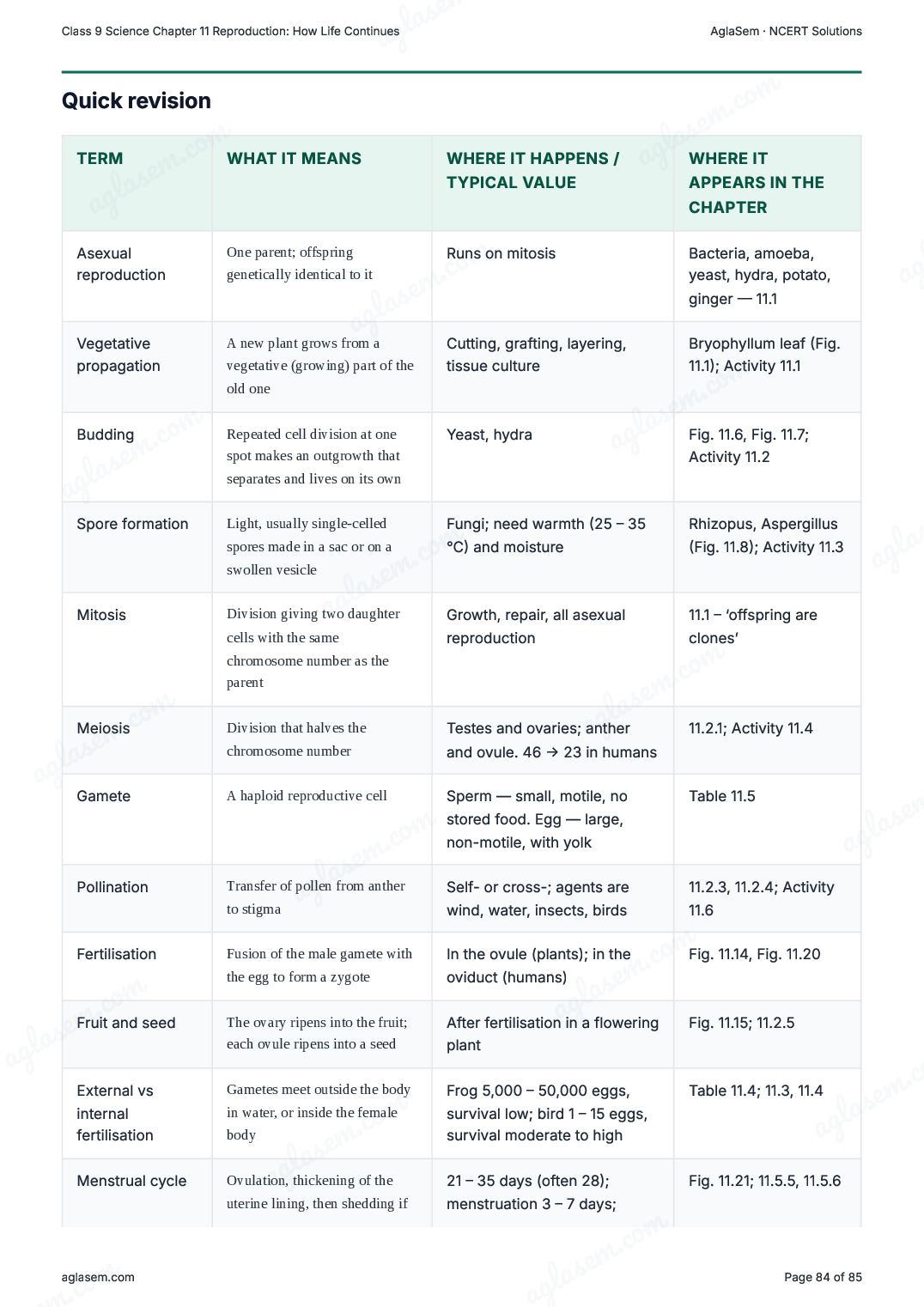
- Asexual reproduction needs one parent and uses mitosis , so the offspring are genetically identical clones — budding in yeast and hydra, spore formation in fungi, and vegetative propagation (cutting, grafting, layering, tissue culture) in plants.
- Sexual reproduction needs two parents. Meiosis halves the chromosome number (46 → 23 in humans) to make gametes, and fertilisation restores it, so the number stays constant generation after generation.
- Because the chromosomes of each pair separate independently, n pairs give 2 n kinds of gamete — 8 for the three bead pairs of Activity 11.4, and 2 23 = 8,388,608 for a human. This is where variation comes from.
- In a flower, the stamen (filament + anther) makes pollen and the pistil (stigma + style + ovary) holds the ovules. Pollination moves pollen from anther to stigma; a pollen tube then carries the male gamete to the egg. After fertilisation the ovule becomes the seed and the ovary becomes the fruit.
- Animals trade numbers against protection: external fertilisation means thousands of eggs and low survival (fish, frog), internal fertilisation means very few eggs and better survival (lizard, bird, mammals).
- In humans, testes make sperm and ovaries release one egg in each cycle of 21 – 35 days (often 28). Fertilisation happens in the oviduct; the zygote divides as it travels and implants in the thickened uterine lining, which starts a pregnancy of about nine months.
How to Download NCERT Solutions for Class 9 Science Chapter 11 PDF
Follow these simple steps to get the Reproduction How Life Continues questions-and-answers PDF from Exploration.
- Search NCERT Solutions for Class 9 Science Chapter 11 aglasem and open this page.
- Read the exercise questions with answers for Reproduction How Life Continues shown above.
- Click the Download PDF link to save the Reproduction How Life Continues solutions to your device.
NCERT Solutions for Class 9 Science – All Chapters
There are more chapters to study besides Reproduction How Life Continues in Science. Here are the NCERT Solutions for all chapters of Class 9 Science.
- Chapter 1 Exploration Entering the World of Secondary Science
- Chapter 2 Cell the Building Block of Life
- Chapter 3 Tissues in Action
- Chapter 4 Describing Motion Around Us
- Chapter 5 Exploring Mixtures and Their Separation
- Chapter 6 How Forces Affect Motion
- Chapter 7 Work Energy and Simple Machines
- Chapter 8 Journey Inside the Atom
- Chapter 9 Atomic Foundations of Matter
- Chapter 10 Sound Waves Characteristics and Applications
- Chapter 11 Reproduction How Life Continues
- Chapter 12 Patterns in Life Diversity and Classification
- Chapter 13 Earth As a System Energy Matter and Life
NCERT Solutions for Class 9 – All Subjects
Just like Chapter 11 of Science, you can get the exercise questions with answers for every other subject of Class 9. Here are the NCERT Solutions for all subjects of Class 9.
NCERT Solutions for Class 9 Science Chapter 11 – An Overview
The key highlights of this study material are as follows.
| Aspects | Details |
|---|---|
| Class | Class 9 |
| Subject | Science |
| Chapter Number | Chapter 11 |
| Chapter Name | Reproduction How Life Continues |
| Book Name | Exploration |
| Book By | NCERT (National Council of Educational Research and Training) |
| Educational Resource Here | NCERT Solutions of Class 9 Science Chapter 11 for all exercises |
| More Questions Answers of This Subject | NCERT Solutions for Class 9 Science |
| Download Book Chapter | NCERT Book Class 9 Science |
| All Questions Answers For This Class | NCERT Solutions for Class 9 |
| Complete Solutions | NCERT Solutions |
NCERT Solutions for Class 9 Science Chapter 11 Reproduction How Life Continues – FAQs
What are the NCERT Solutions for Class 9 Science Chapter 11 Reproduction How Life Continues?
They are the complete, step-by-step answers to all the exercise and in-text questions of Chapter 11 Reproduction How Life Continues from the NCERT Class 9 Science textbook Exploration, written by experts as per the latest NCERT syllabus.
How can I download the Class 9 Science Chapter 11 solutions PDF for free?
Open this page on aglasem, read the Reproduction How Life Continues questions with answers, and click the “Download Solutions PDF” link. The Class 9 Science Chapter 11 NCERT Solutions PDF is completely free to download.
Are these NCERT Solutions as per the latest 2026-27 syllabus?
Yes. The NCERT Solutions for Class 9 Science Chapter 11 are based on the latest NCERT textbook Exploration and the current 2026-27 CBSE syllabus, so the questions and answers match what you study in class.
Where can I get NCERT Solutions for the other chapters of Class 9 Science?
You can find the answers to every chapter on the NCERT Solutions for Class 9 Science page, and solutions for every subject on the NCERT Solutions for Class 9 page.
How do NCERT Solutions help in exam preparation?
They show the correct method to solve each question, help you write answers the way they are expected in exams, let you check and correct your own work, and save revision time — which together improve your marks in Class 9 Science.
If you have any queries on NCERT Solutions for Class 9 Science Chapter 11 Reproduction How Life Continues, then please ask in the comments below.