NCERT Solutions for Class 9 Science Chapter 10 Sound Waves Characteristics and Applications provide clear, step-by-step answers to every exercise and in-text question from the chapter Sound Waves Characteristics and Applications of the NCERT textbook Exploration. Prepared by subject experts as per the latest NCERT (CBSE) syllabus for 2026-27, these NCERT Solutions for Class 9 Science help you understand each concept, write exam-ready answers, and check your own solutions. You can read them online below or download the free Class 9 Science Chapter 10 question-answer PDF.
NCERT Solutions for Class 9 Science Chapter 10 Sound Waves Characteristics and Applications
- Class: Class 9
- Subject: Science
- Chapter: Chapter 10 – Sound Waves Characteristics and Applications
- Textbook: Exploration (NCERT)
- Study material: NCERT Solutions – questions with answers, free PDF
These solutions answer all the exercise questions of Chapter 10 Sound Waves Characteristics and Applications — including the in-text questions, short-answer and long-answer questions, and activities — with complete explanations so you can follow the method, not just the final answer. Read the full solutions below.
NCERT Solutions Class 9 Science Chapter 10 Sound Waves Characteristics and Applications View Download
NCERT Solutions for Class 9 Science Chapter 10 PDF Download
You can read the NCERT Solutions for Class 9 Science Chapter 10 online above, or download the complete question-answer PDF to study Sound Waves Characteristics and Applications offline at any time.
NCERT Solutions for Class 9 Science Chapter 10 PDF Download Link – Click Here to Download Solutions PDF
Questions Covered in This Chapter
These NCERT Solutions answer all 63 questions of this chapter. The questions solved are:
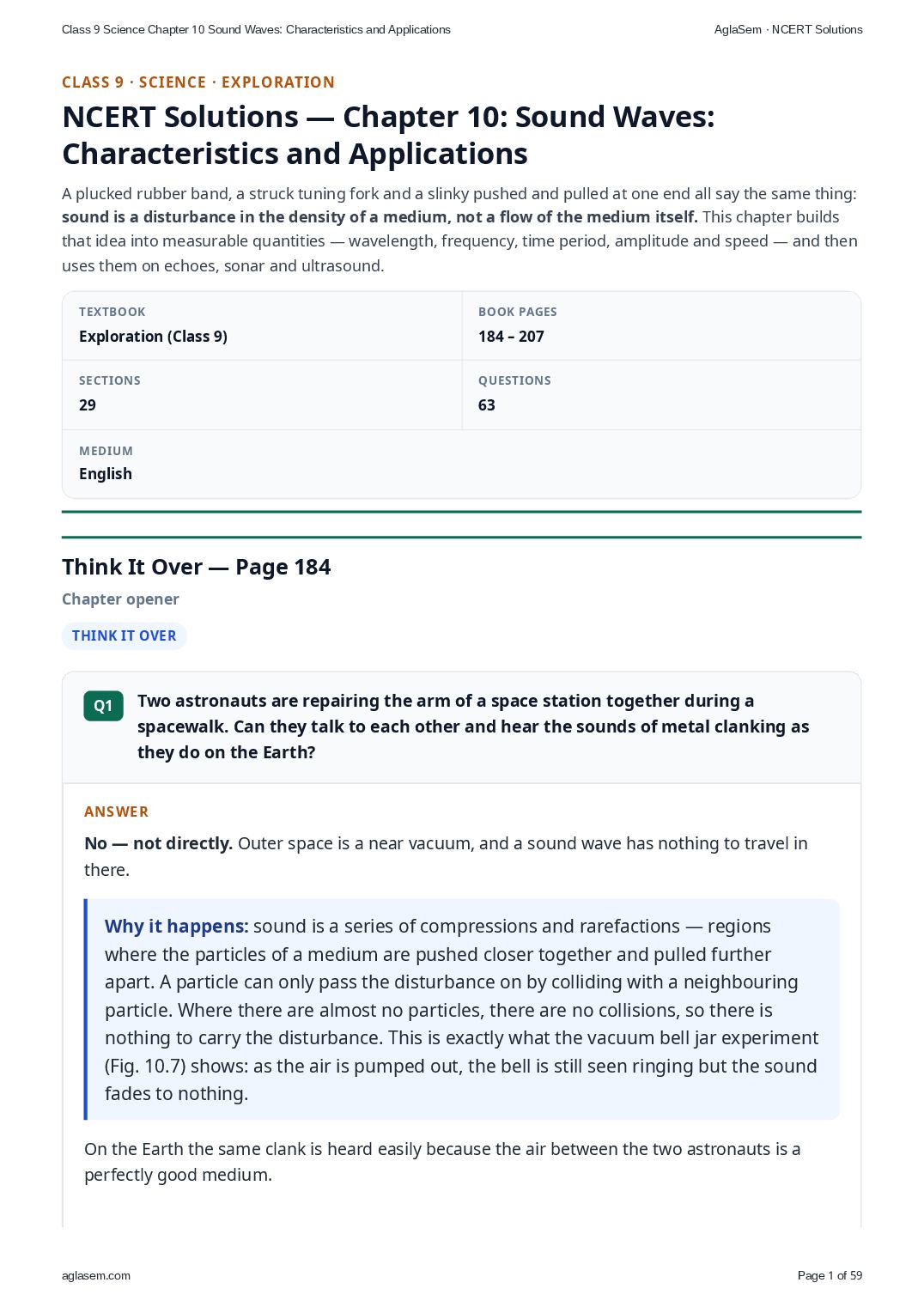
- Two astronauts are repairing the arm of a space station together during a spacewalk. Can they talk to each other and hear the sounds of metal clanking as they do on the Earth?
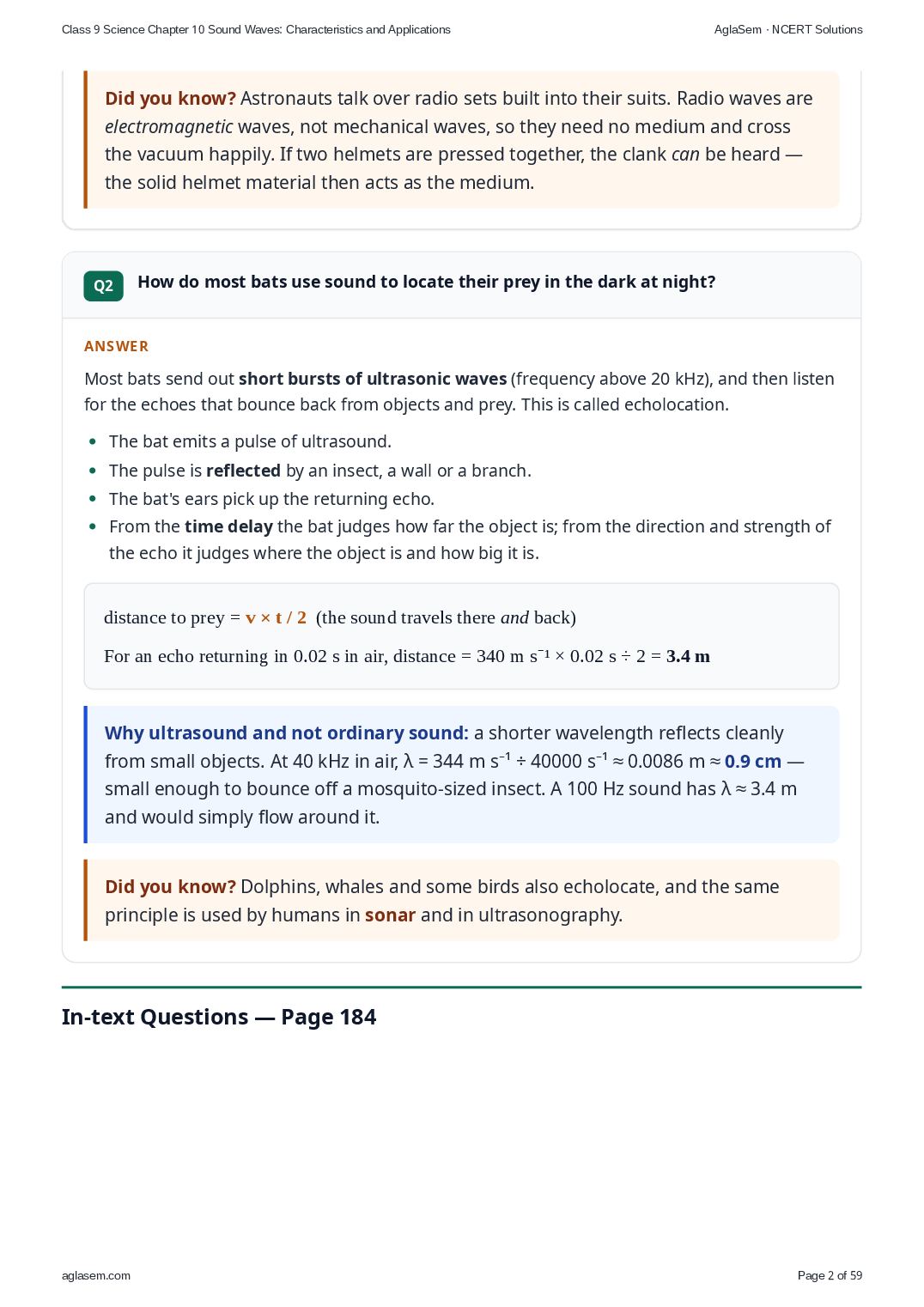
- How do most bats use sound to locate their prey in the dark at night?
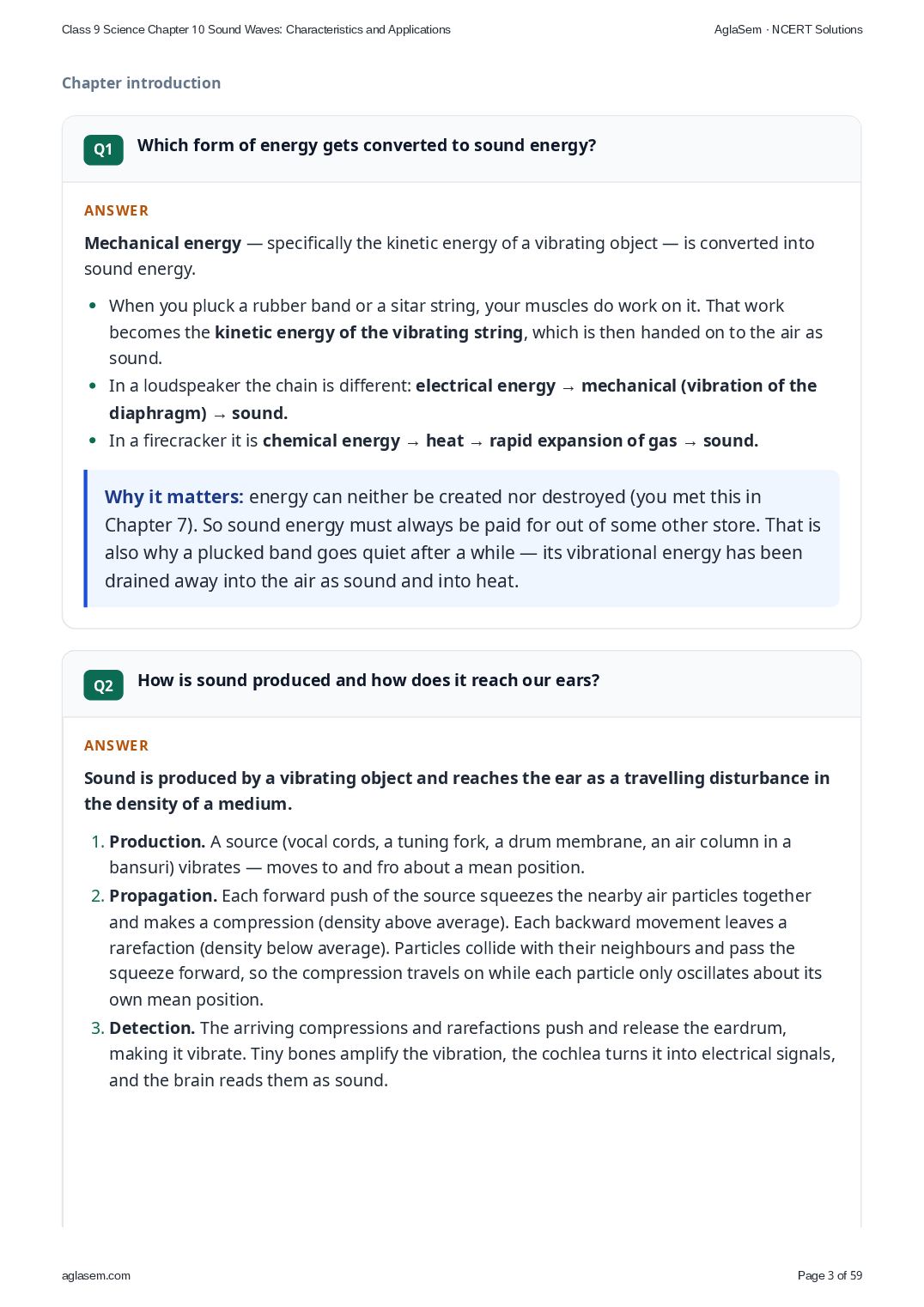
- Which form of energy gets converted to sound energy?
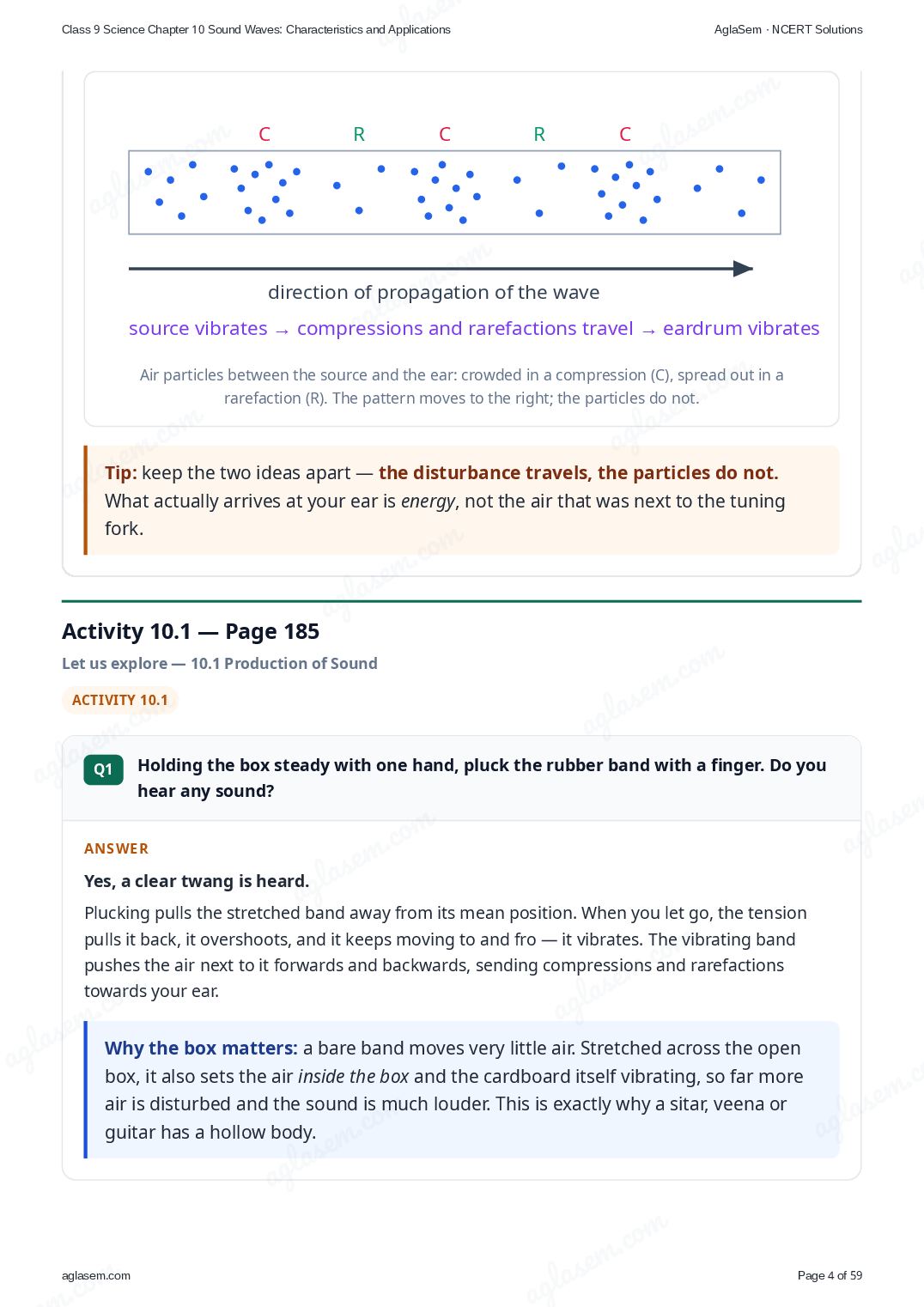
- How is sound produced and how does it reach our ears?
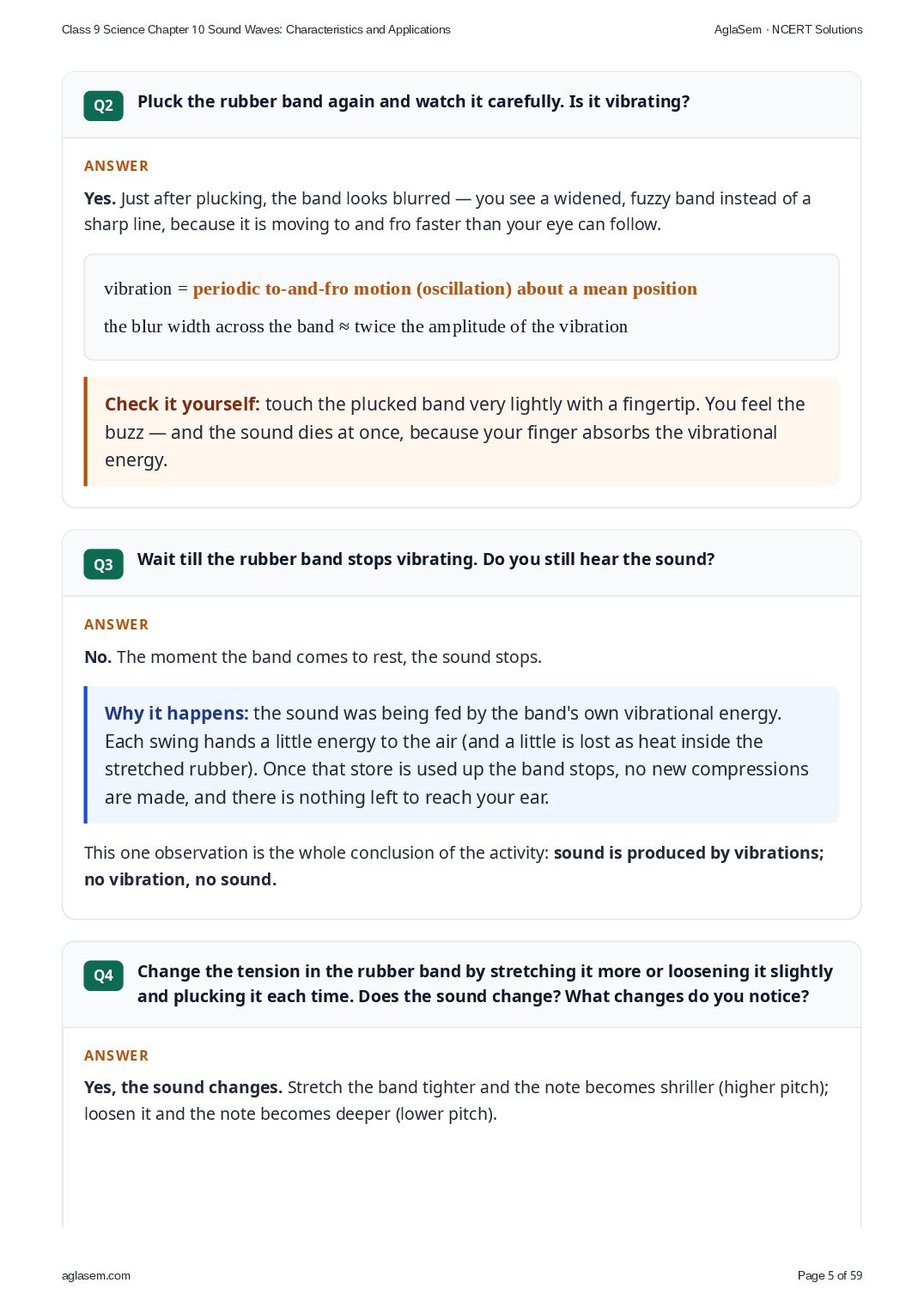
- Holding the box steady with one hand, pluck the rubber band with a finger. Do you hear any sound?
- Pluck the rubber band again and watch it carefully. Is it vibrating?
- Wait till the rubber band stops vibrating. Do you still hear the sound?
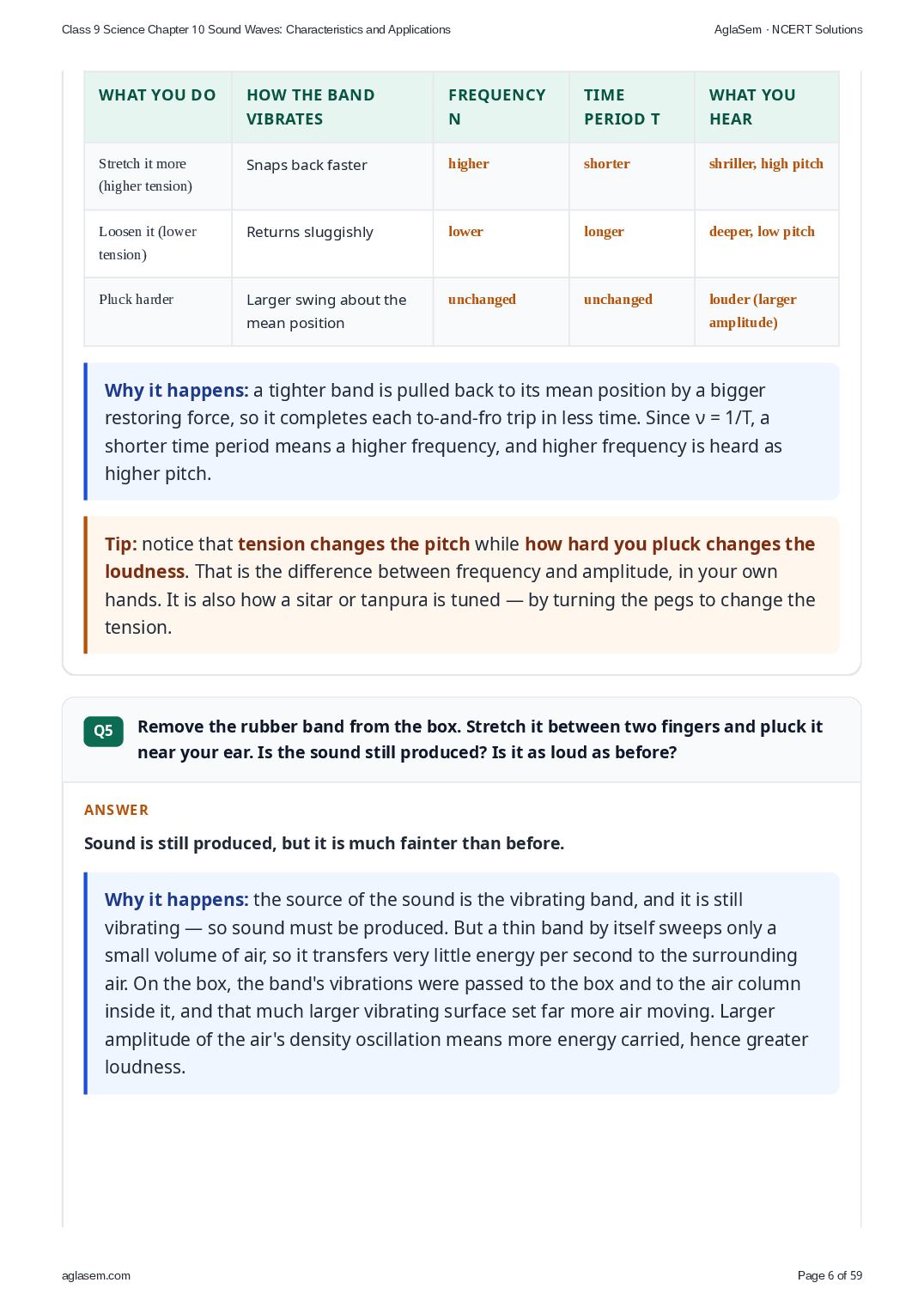
- Change the tension in the rubber band by stretching it more or loosening it slightly and plucking it each time. Does the sound change? What changes do you notice?
- Remove the rubber band from the box. Stretch it between two fingers and pluck it near your ear. Is the sound still produced? Is it as loud as before?
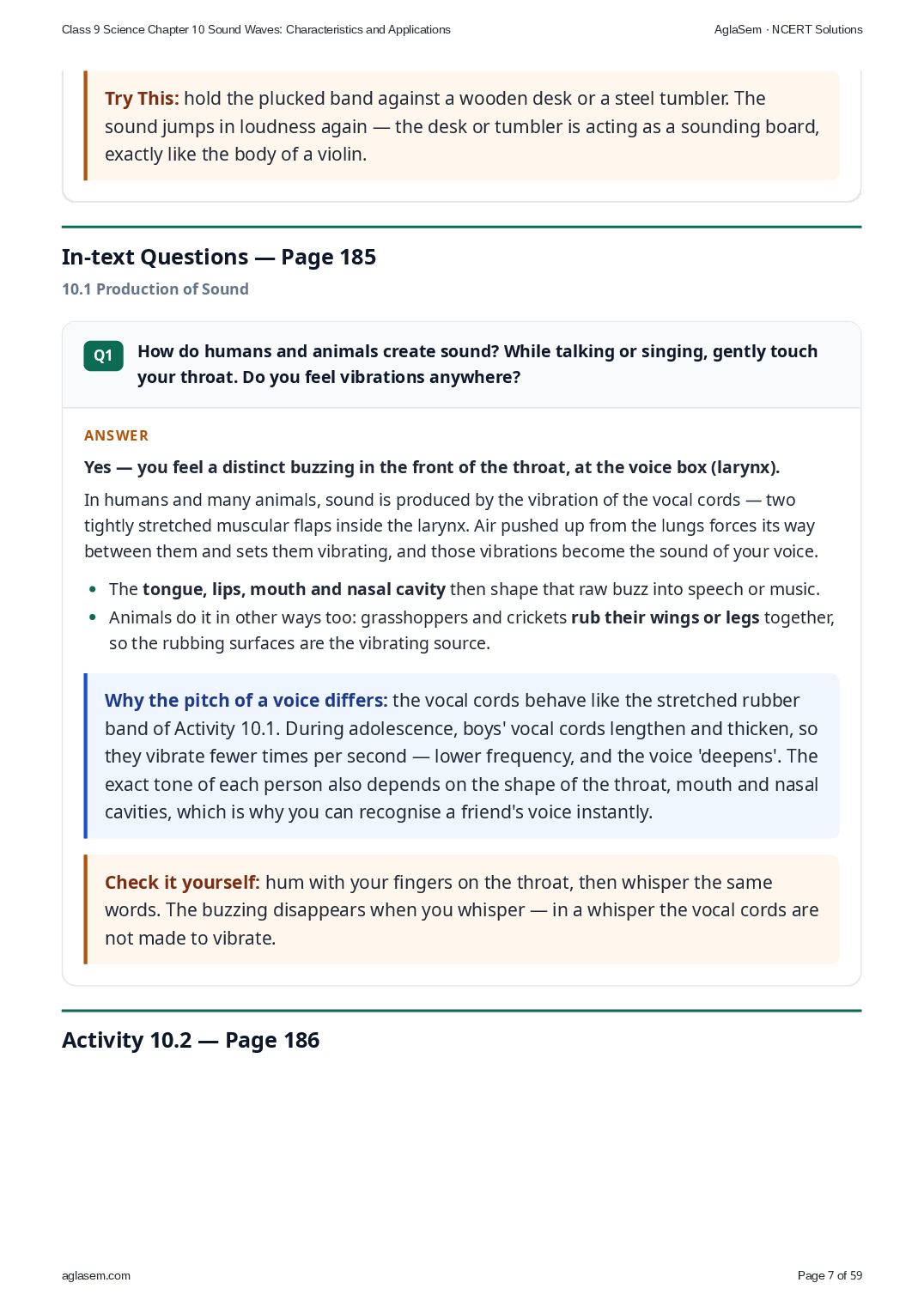
- How do humans and animals create sound? While talking or singing, gently touch your throat. Do you feel vibrations anywhere?
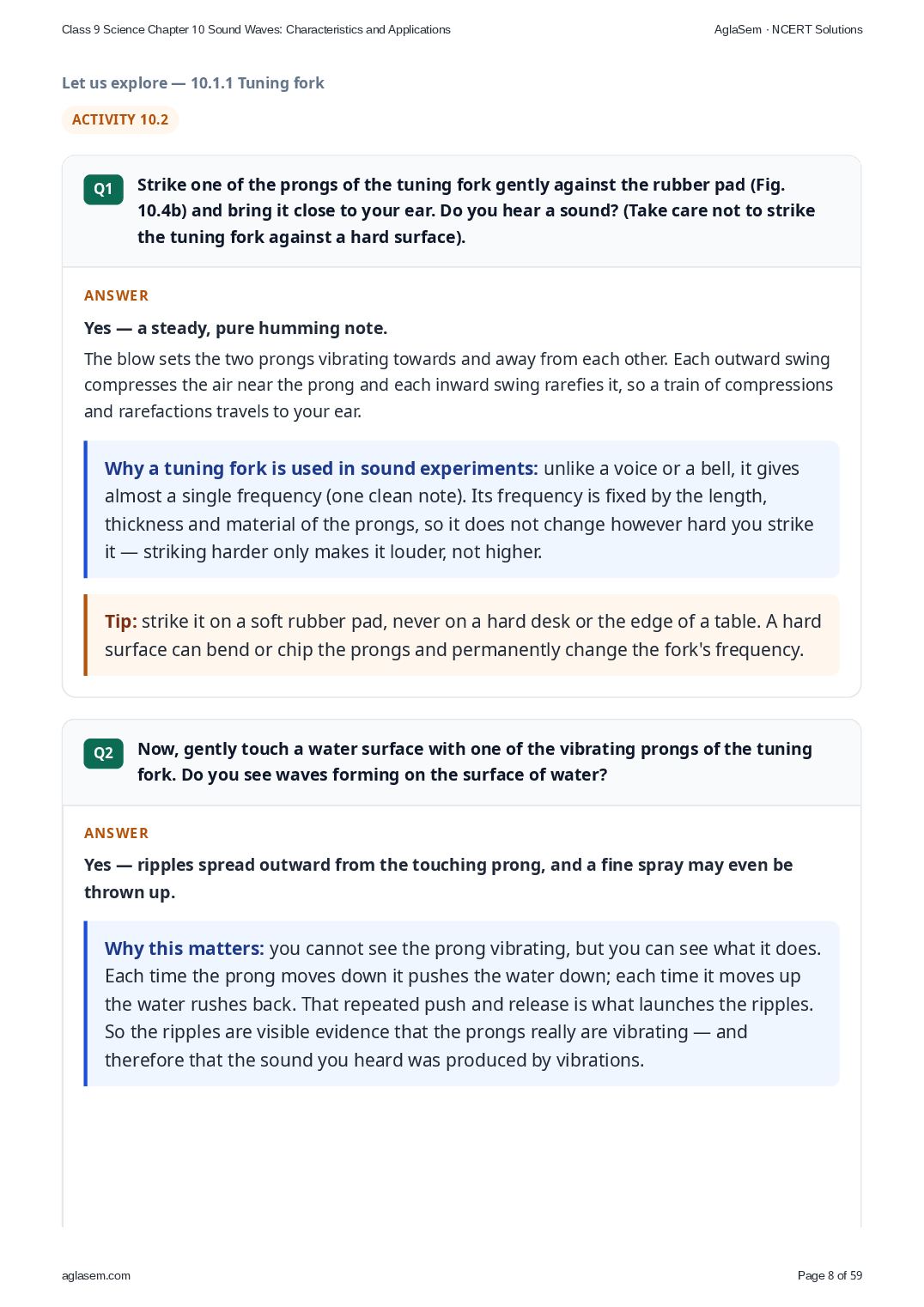
- Strike one of the prongs of the tuning fork gently against the rubber pad (Fig. 10.4b) and bring it close to your ear. Do you hear a sound? (Take care not to strike the tuning fork against a hard surface).
- Now, gently touch a water surface with one of the vibrating prongs of the tuning fork. Do you see waves forming on the surface of water?
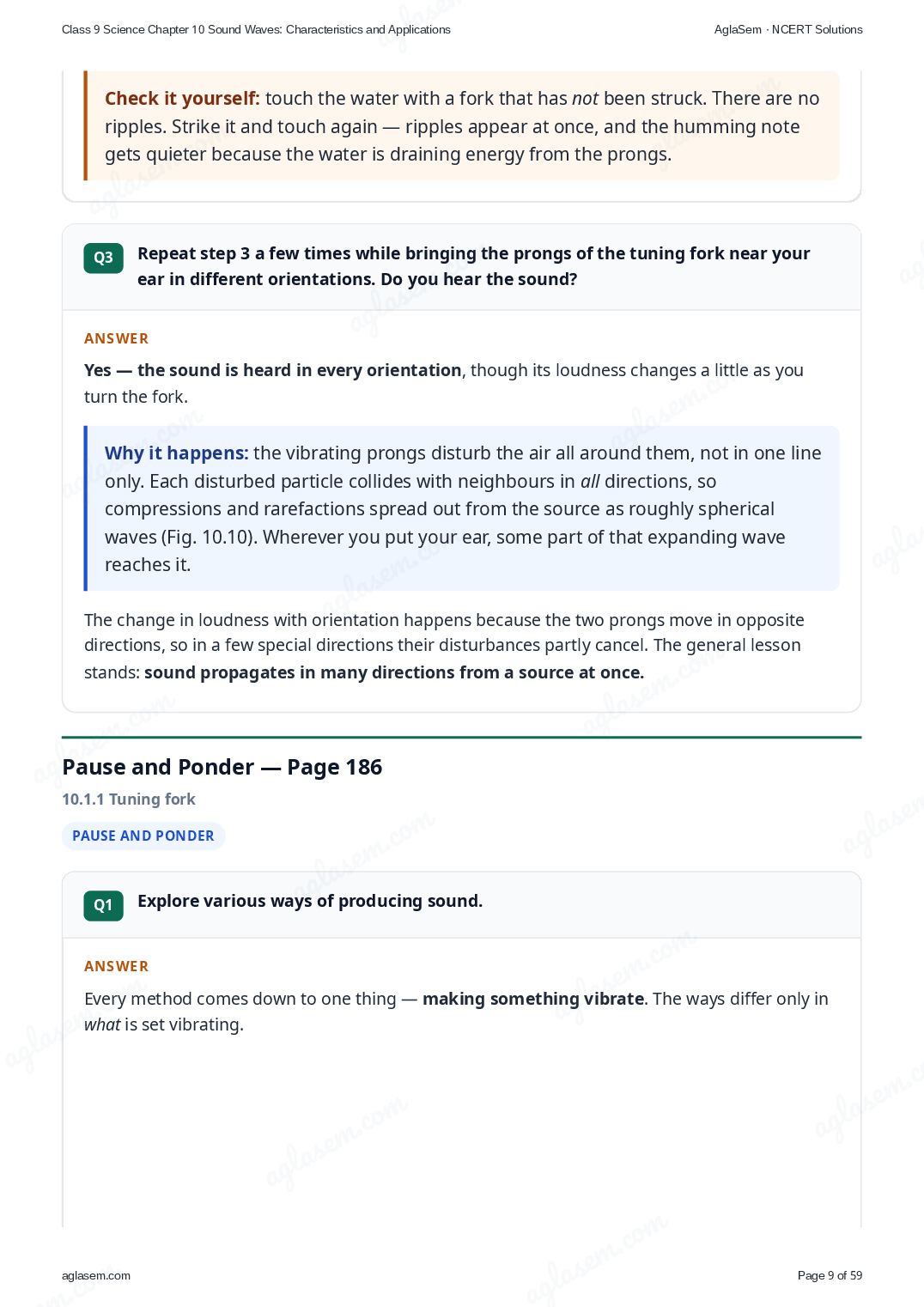
- Repeat step 3 a few times while bringing the prongs of the tuning fork near your ear in different orientations. Do you hear the sound?
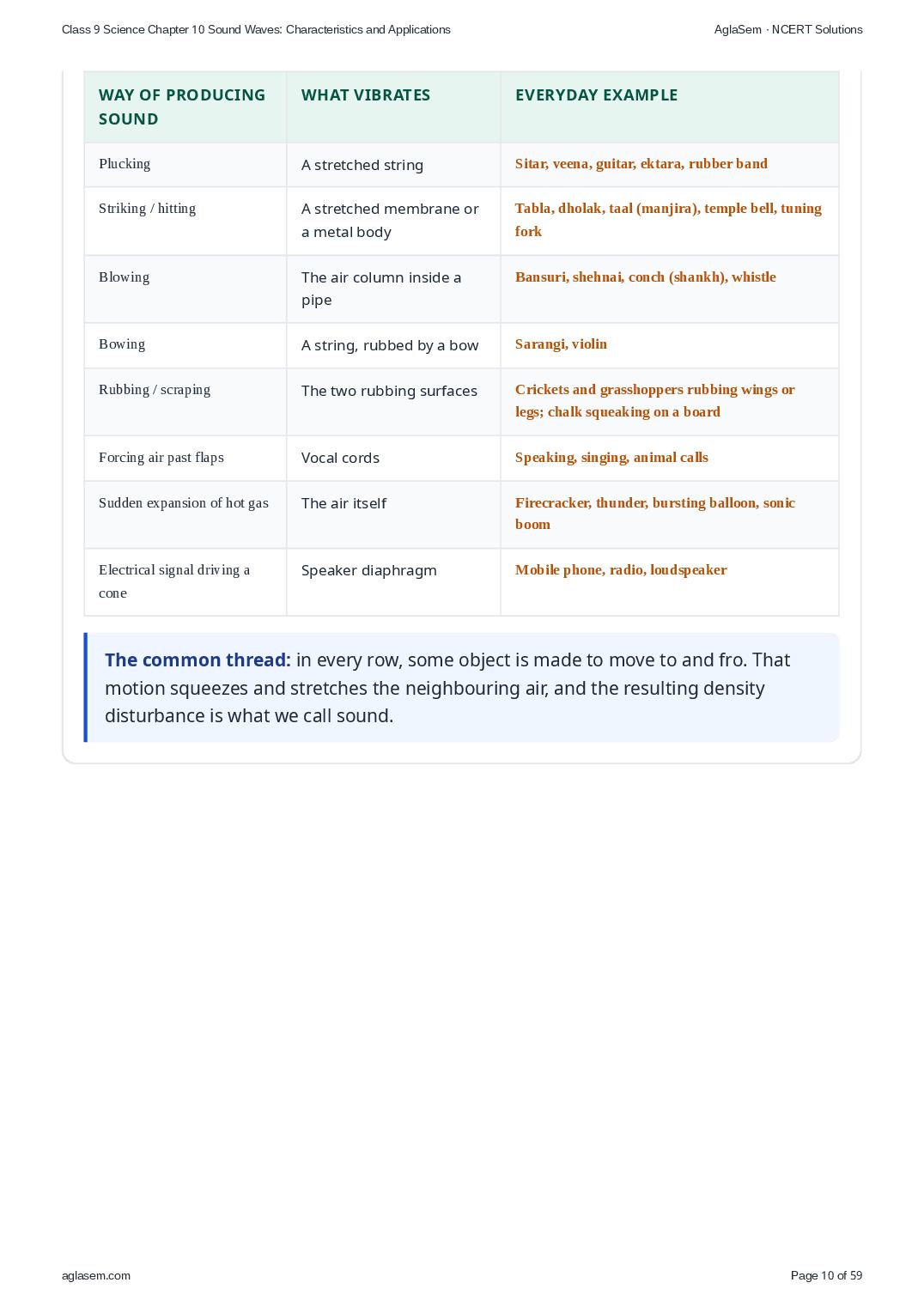
- Explore various ways of producing sound.
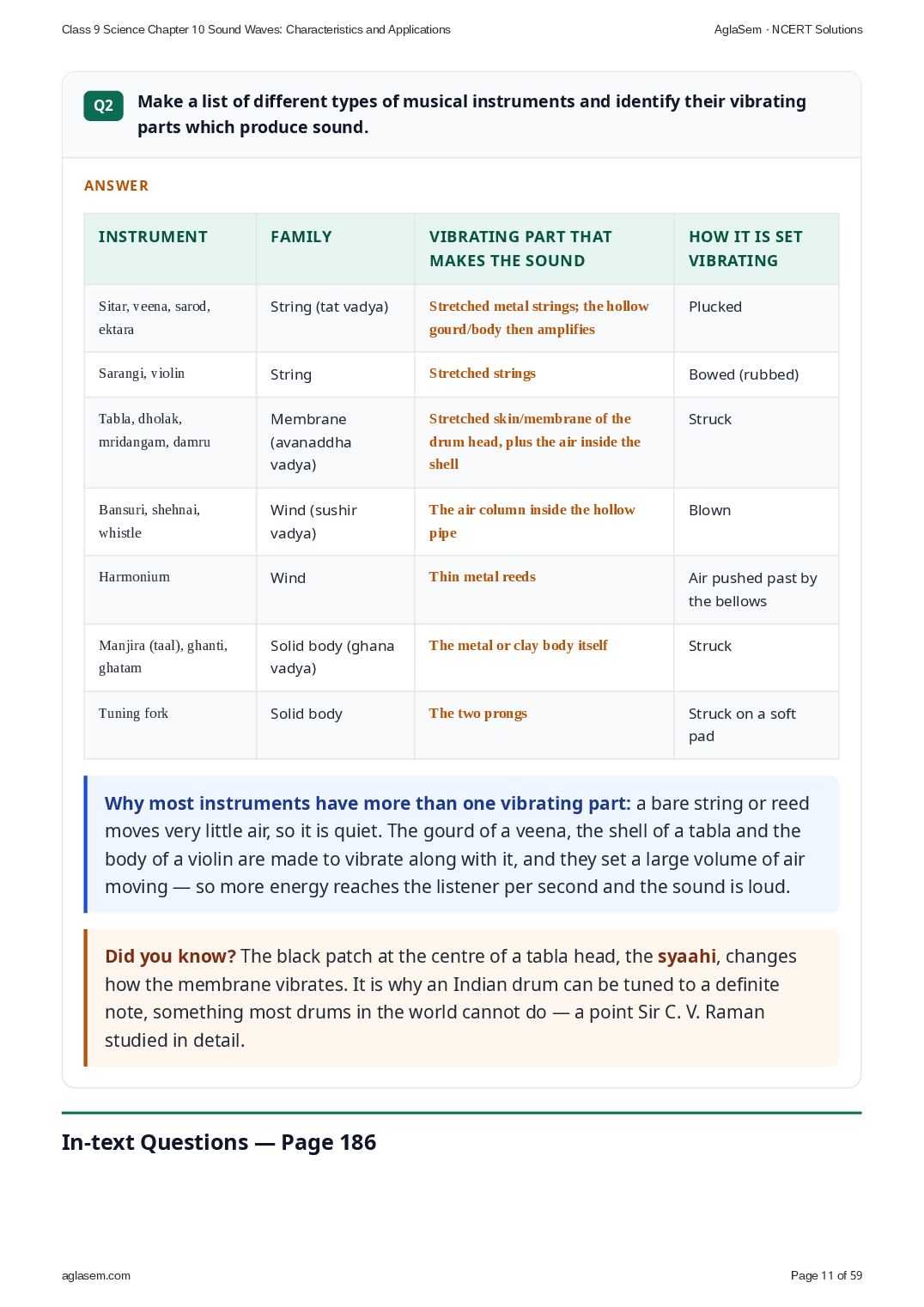
- Make a list of different types of musical instruments and identify their vibrating parts which produce sound.
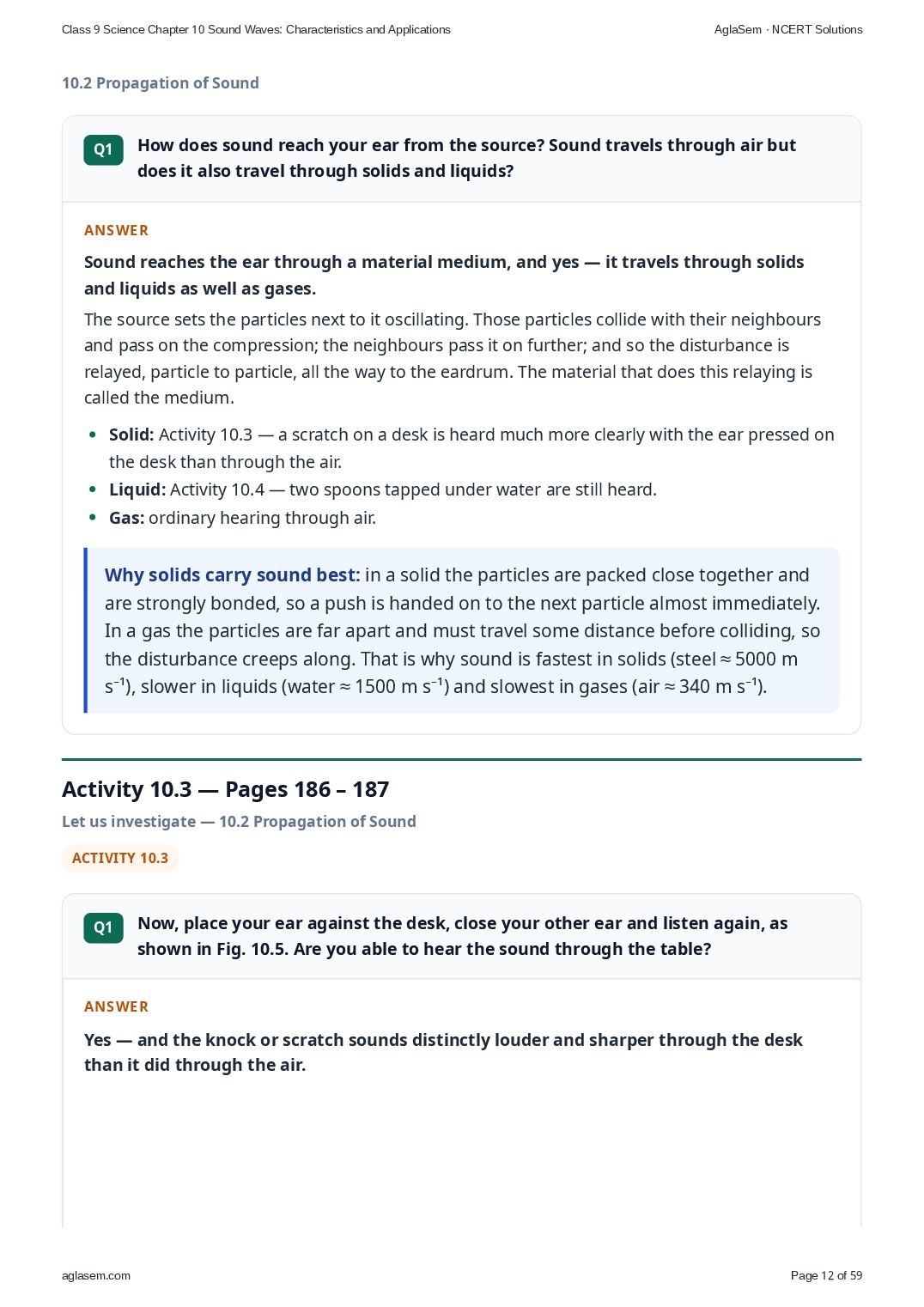
- How does sound reach your ear from the source? Sound travels through air but does it also travel through solids and liquids?
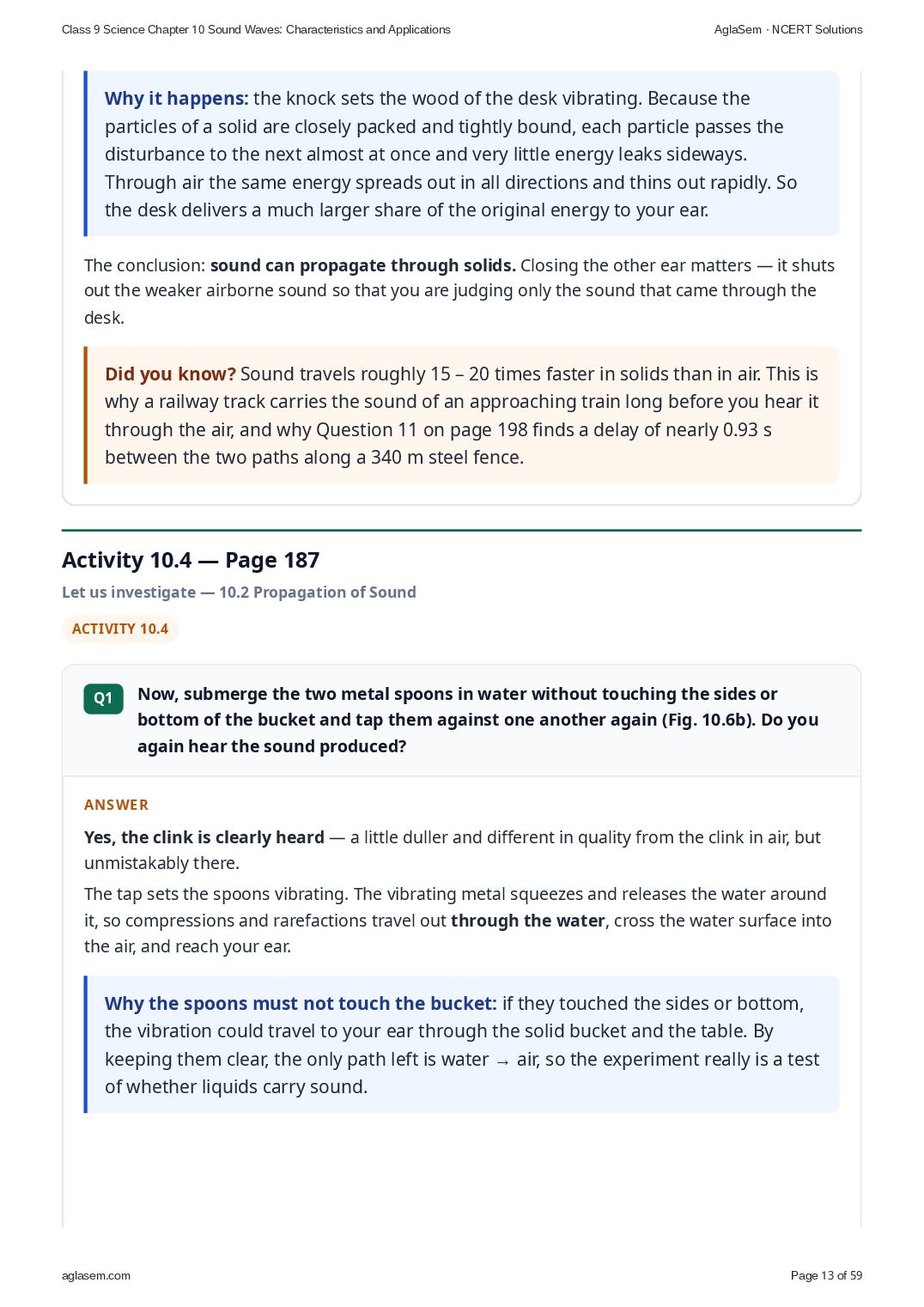
- Now, place your ear against the desk, close your other ear and listen again, as shown in Fig. 10.5. Are you able to hear the sound through the table?
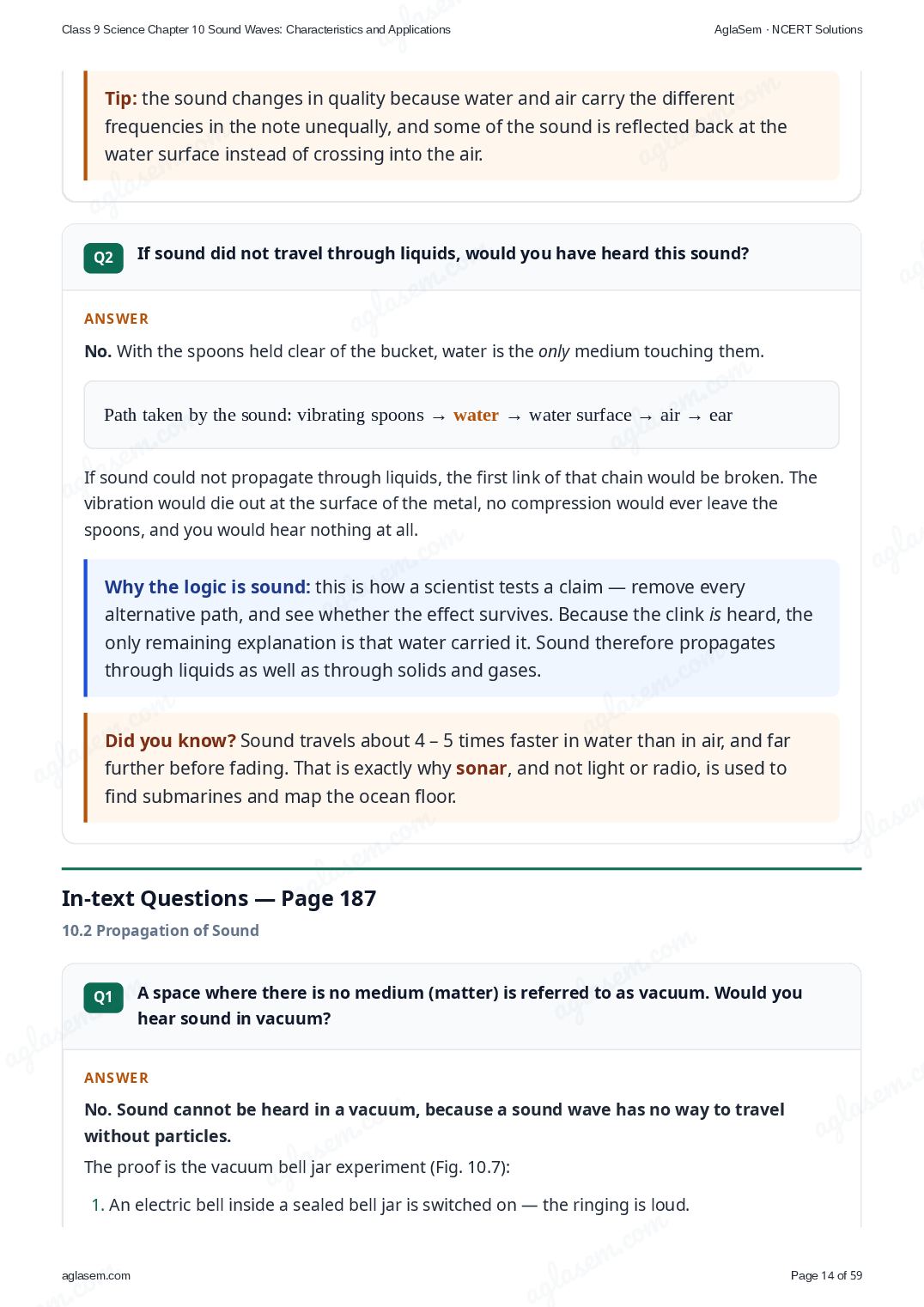
- Now, submerge the two metal spoons in water without touching the sides or bottom of the bucket and tap them against one another again (Fig. 10.6b). Do you again hear the sound produced?
- If sound did not travel through liquids, would you have heard this sound?
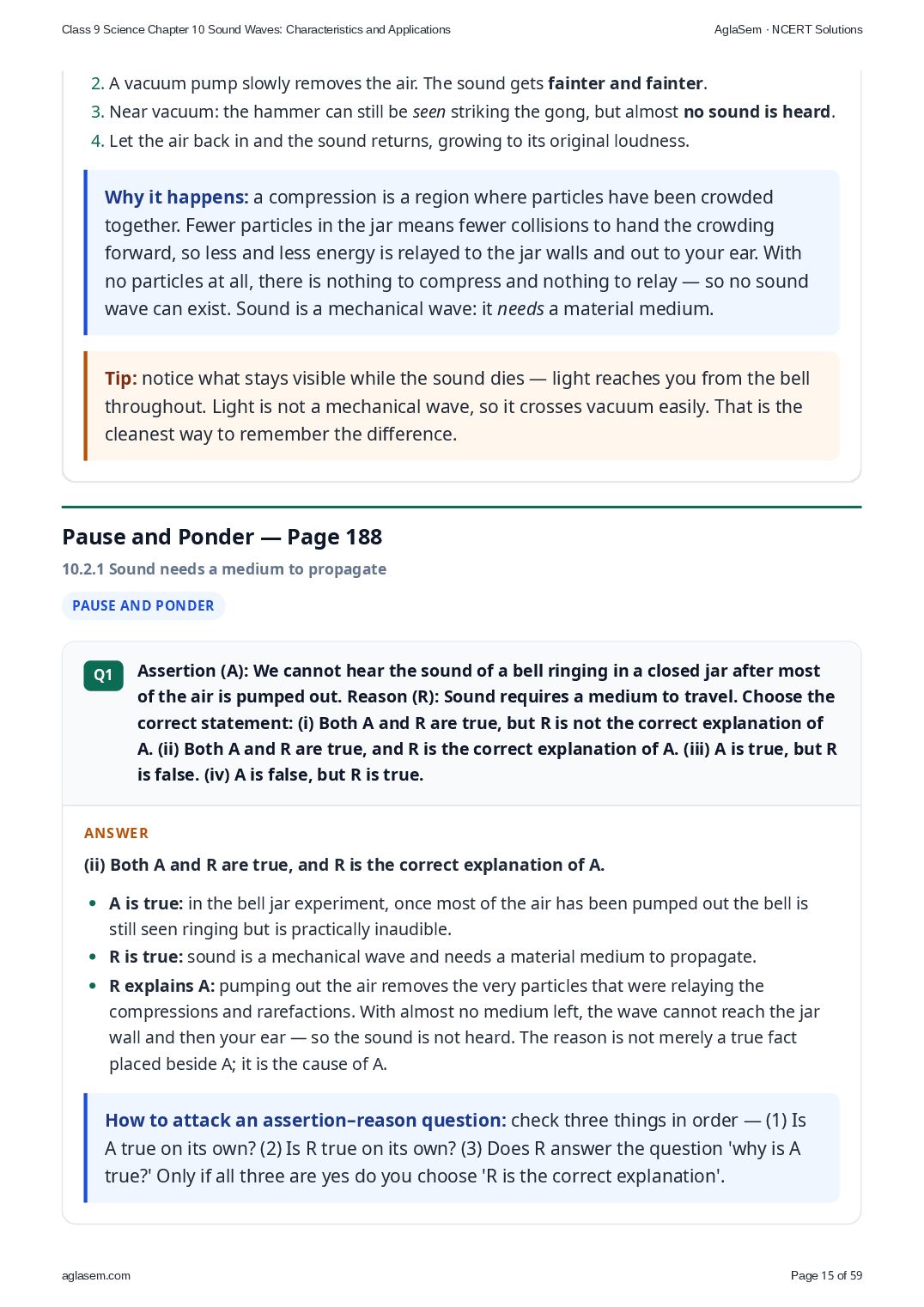
- A space where there is no medium (matter) is referred to as vacuum. Would you hear sound in vacuum?
- Assertion (A): We cannot hear the sound of a bell ringing in a closed jar after most of the air is pumped out. Reason (R): Sound requires a medium to travel. Choose the correct statement: (i) Both A and R are true, but R is not the correct explanation of A. (ii) Both A and R are true, and R is the correct explanation of A. (iii) A is true, but R is false. (iv) A is false, but R is true.
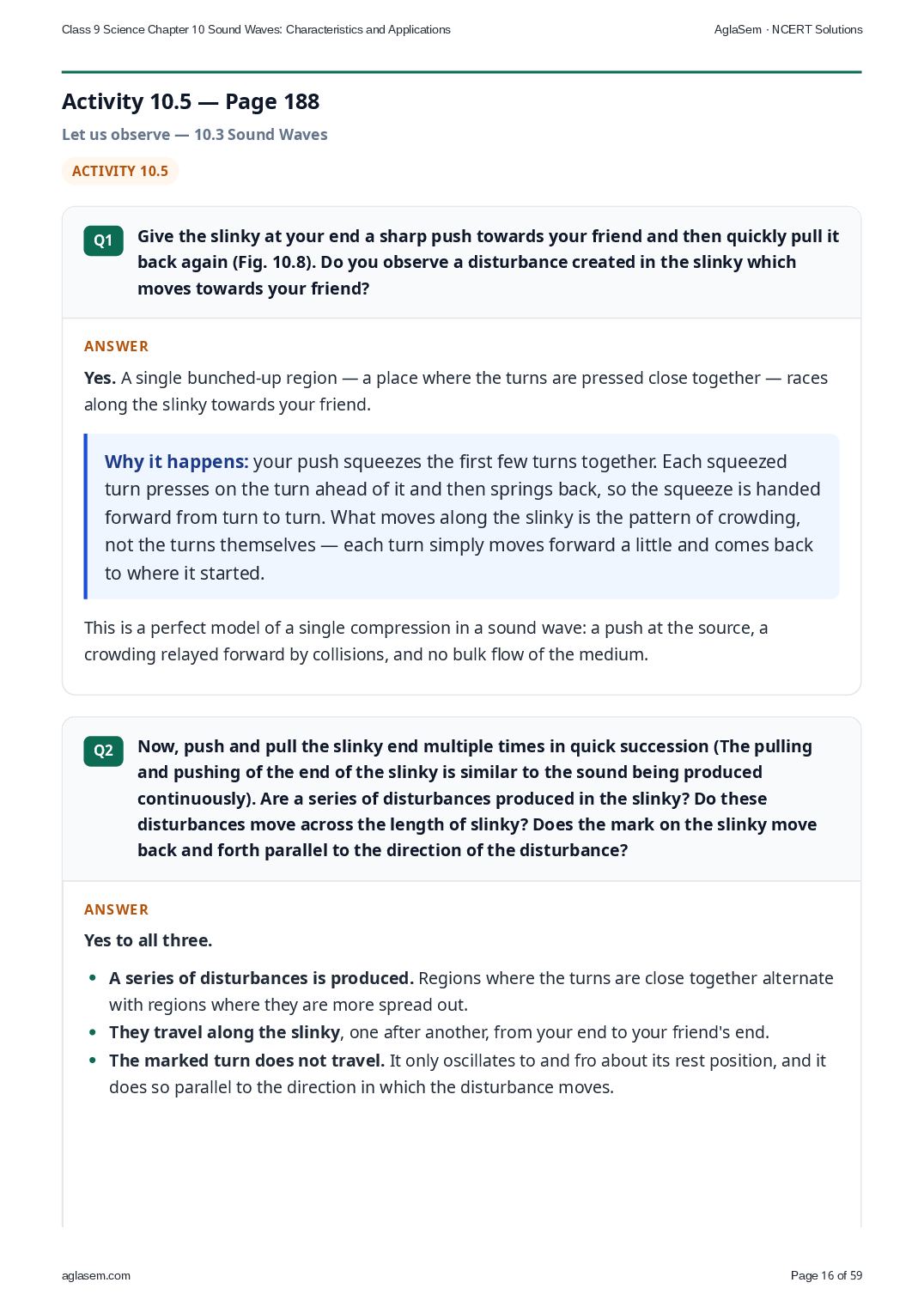
- Give the slinky at your end a sharp push towards your friend and then quickly pull it back again (Fig. 10.8). Do you observe a disturbance created in the slinky which moves towards your friend?
- Now, push and pull the slinky end multiple times in quick succession (The pulling and pushing of the end of the slinky is similar to the sound being produced continuously). Are a series of disturbances produced in the slinky? Do these disturbances move across the length of slinky? Does the mark on the slinky move back and forth parallel to the direction of the disturbance?
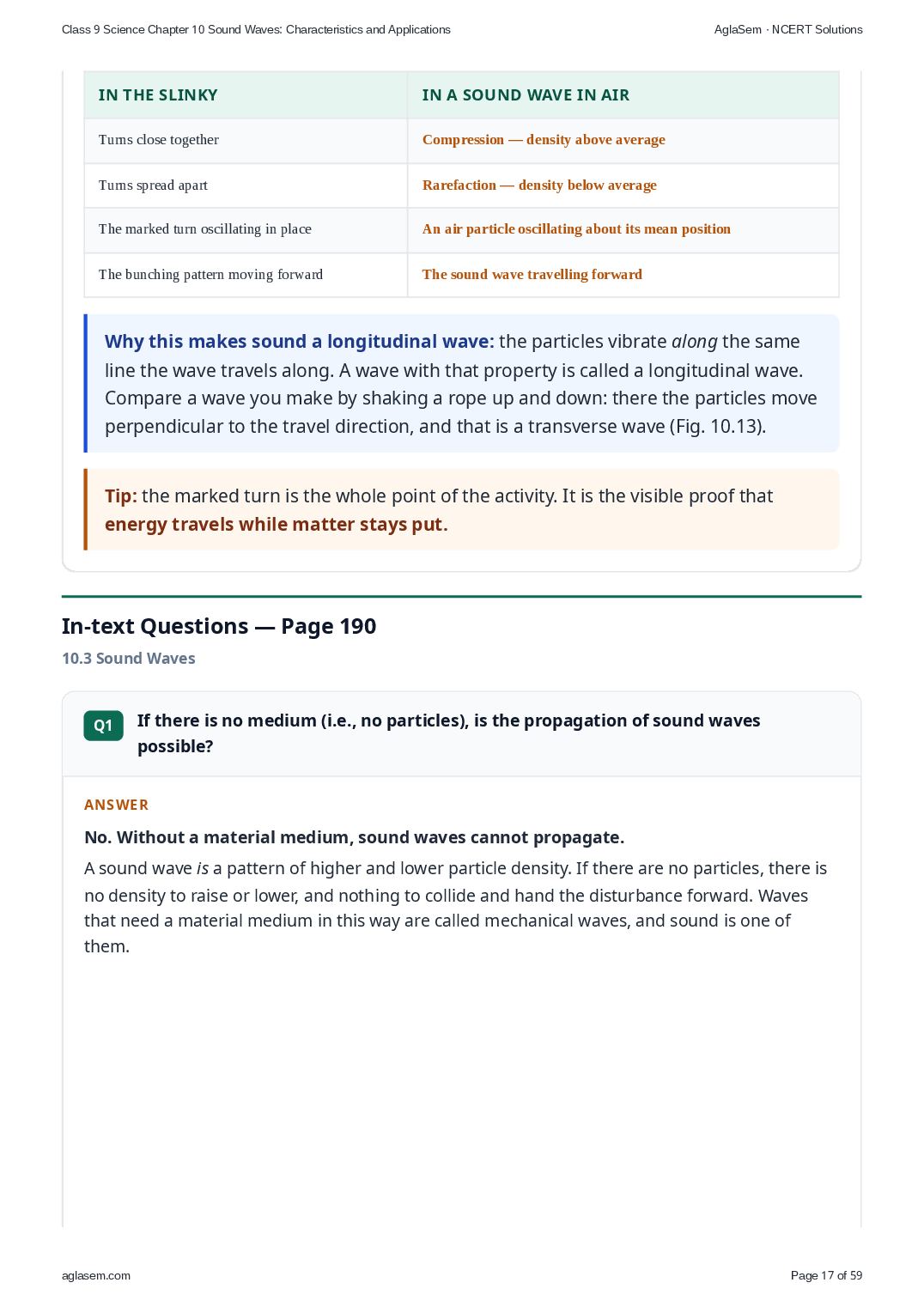
- If there is no medium (i.e., no particles), is the propagation of sound waves possible?
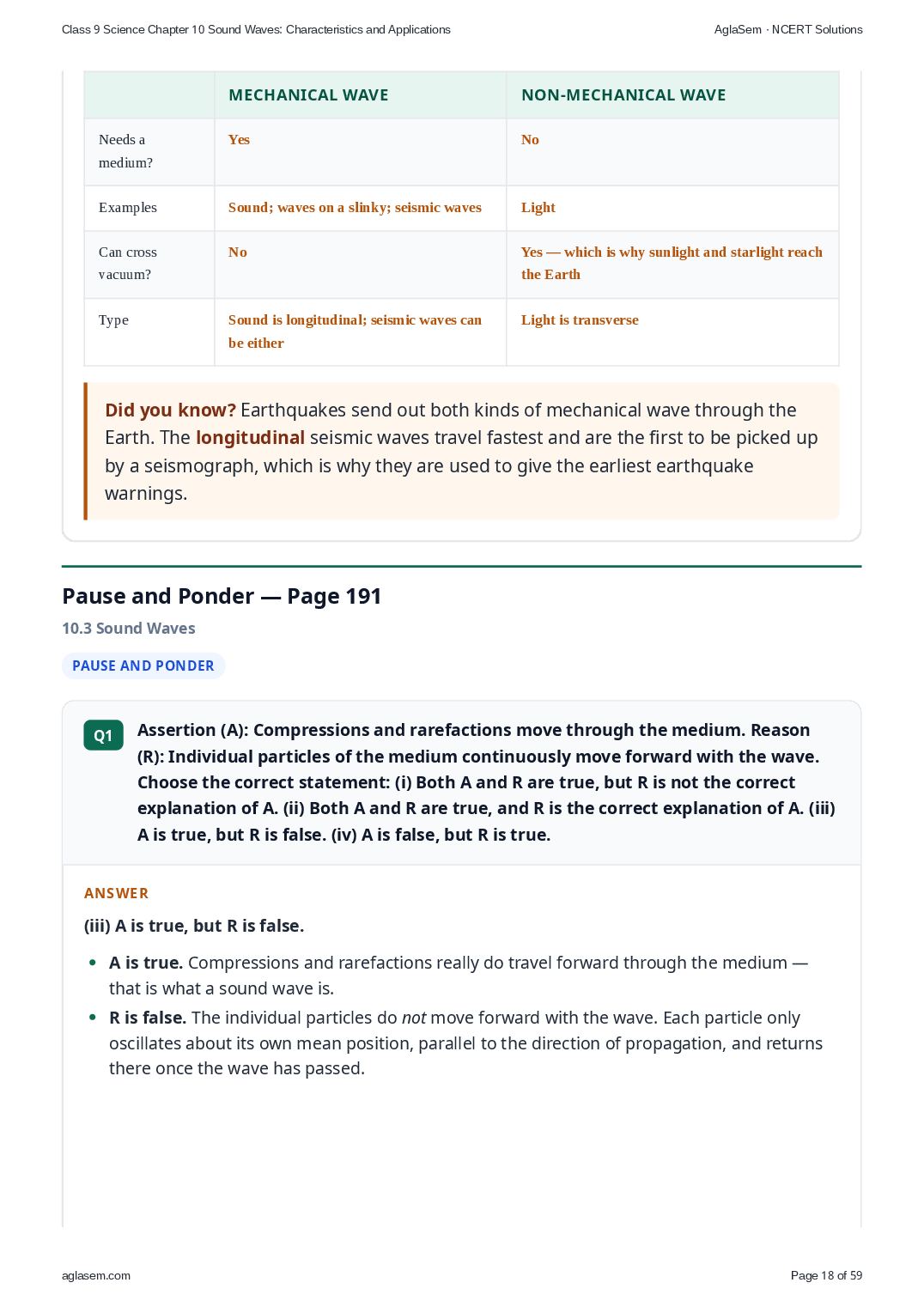
- Assertion (A): Compressions and rarefactions move through the medium. Reason (R): Individual particles of the medium continuously move forward with the wave. Choose the correct statement: (i) Both A and R are true, but R is not the correct explanation of A. (ii) Both A and R are true, and R is the correct explanation of A. (iii) A is true, but R is false. (iv) A is false, but R is true.
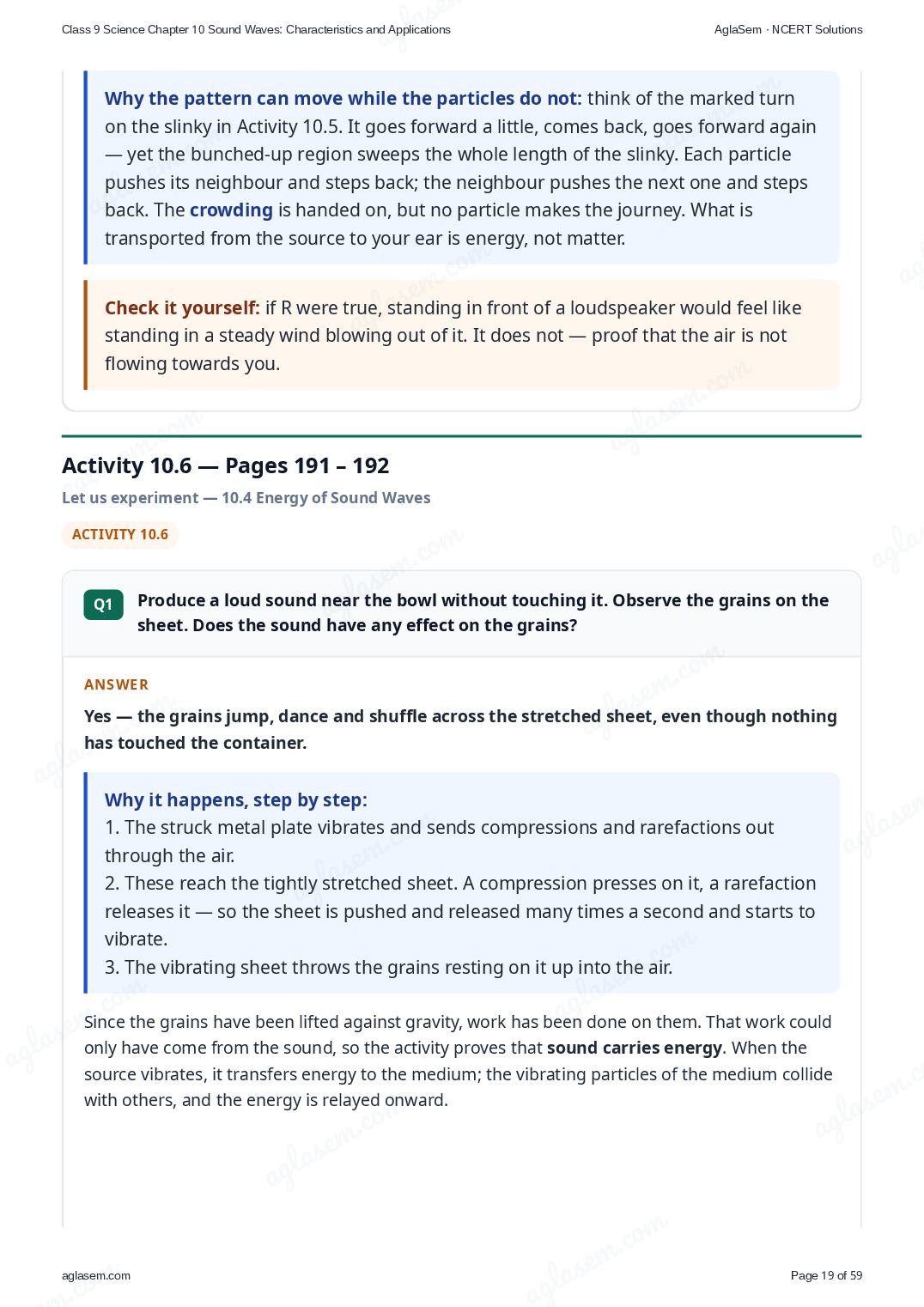
- Produce a loud sound near the bowl without touching it. Observe the grains on the sheet. Does the sound have any effect on the grains?
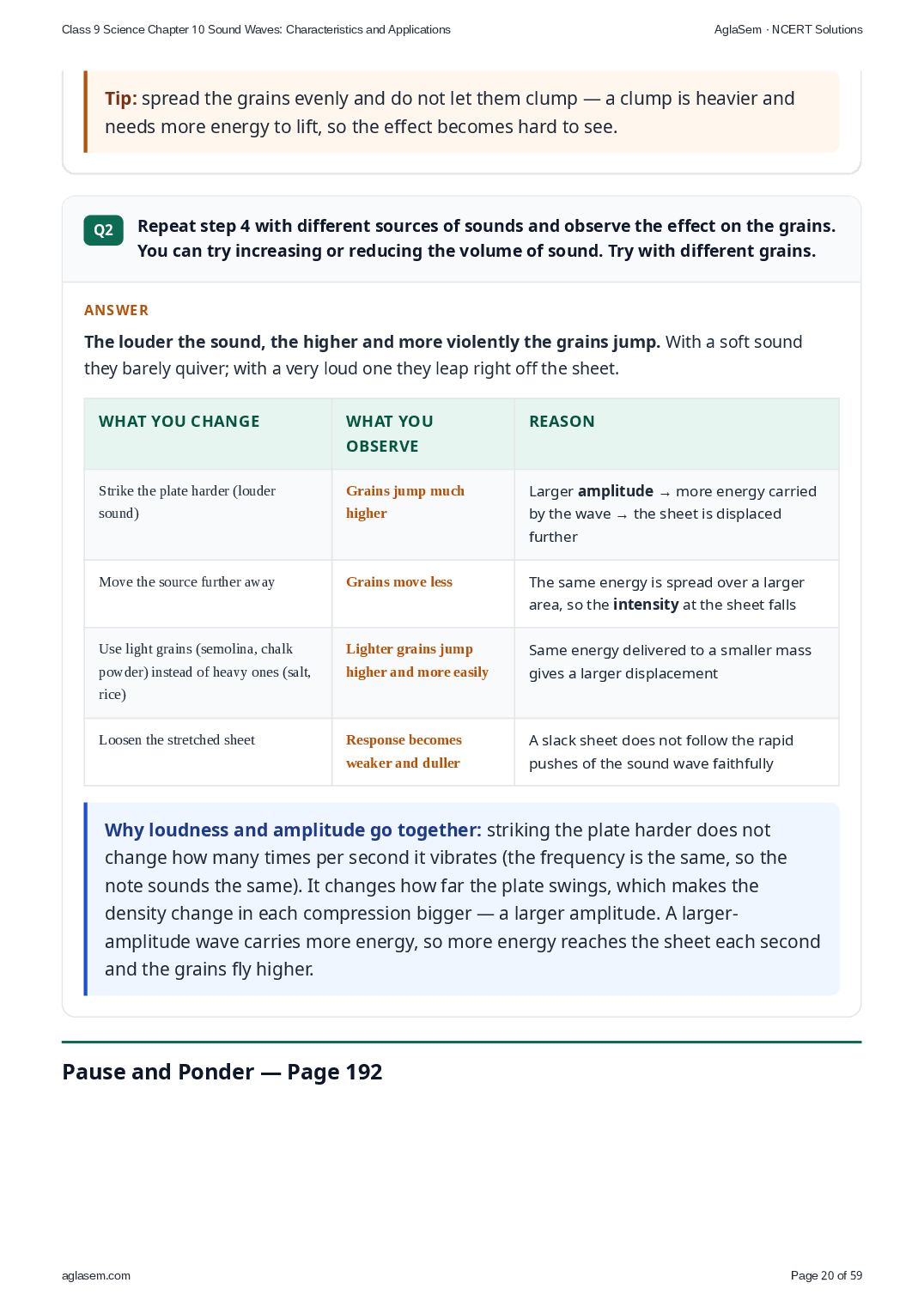
- Repeat step 4 with different sources of sounds and observe the effect on the grains. You can try increasing or reducing the volume of sound. Try with different grains.
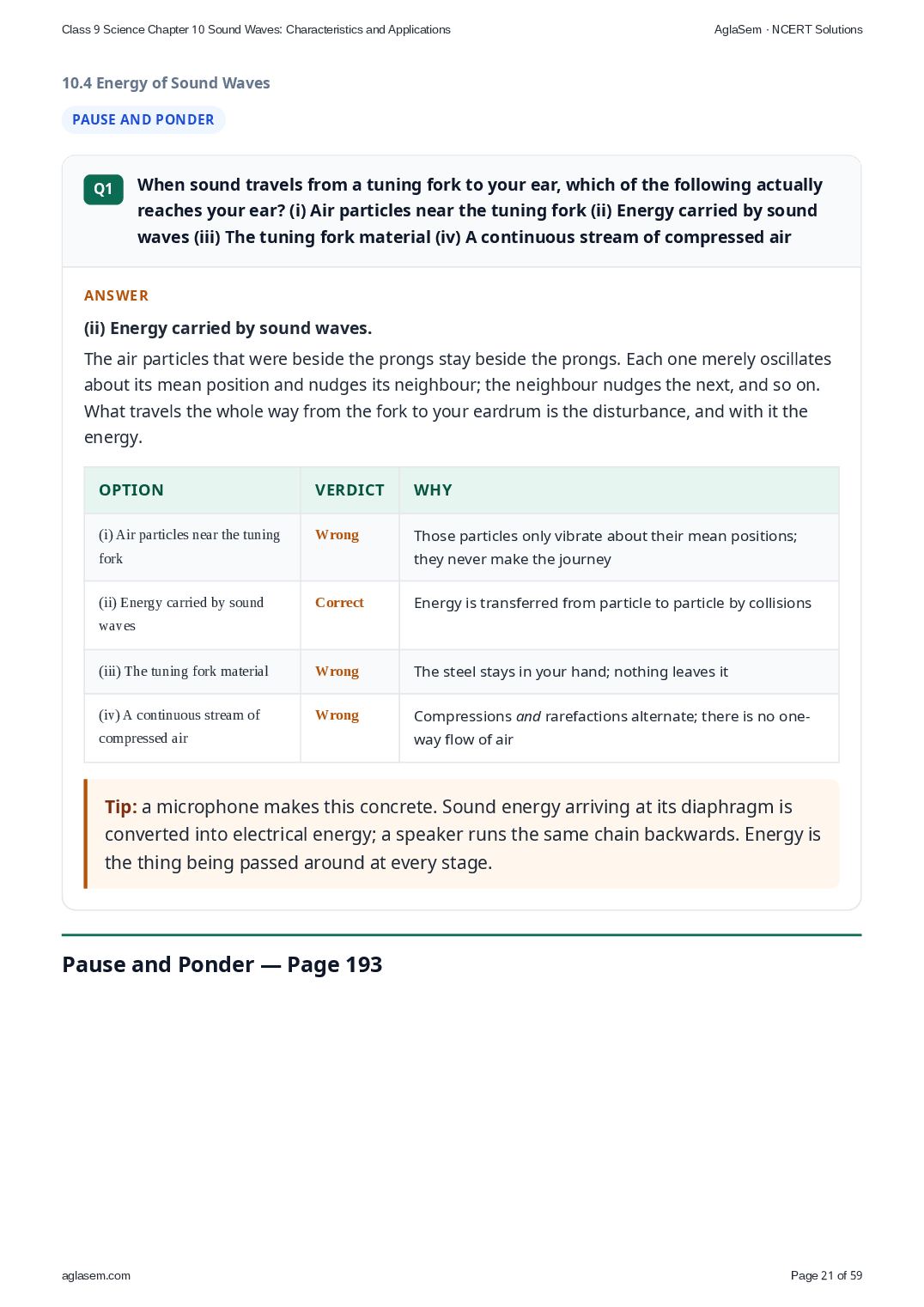
- When sound travels from a tuning fork to your ear, which of the following actually reaches your ear? (i) Air particles near the tuning fork (ii) Energy carried by sound waves (iii) The tuning fork material (iv) A continuous stream of compressed air
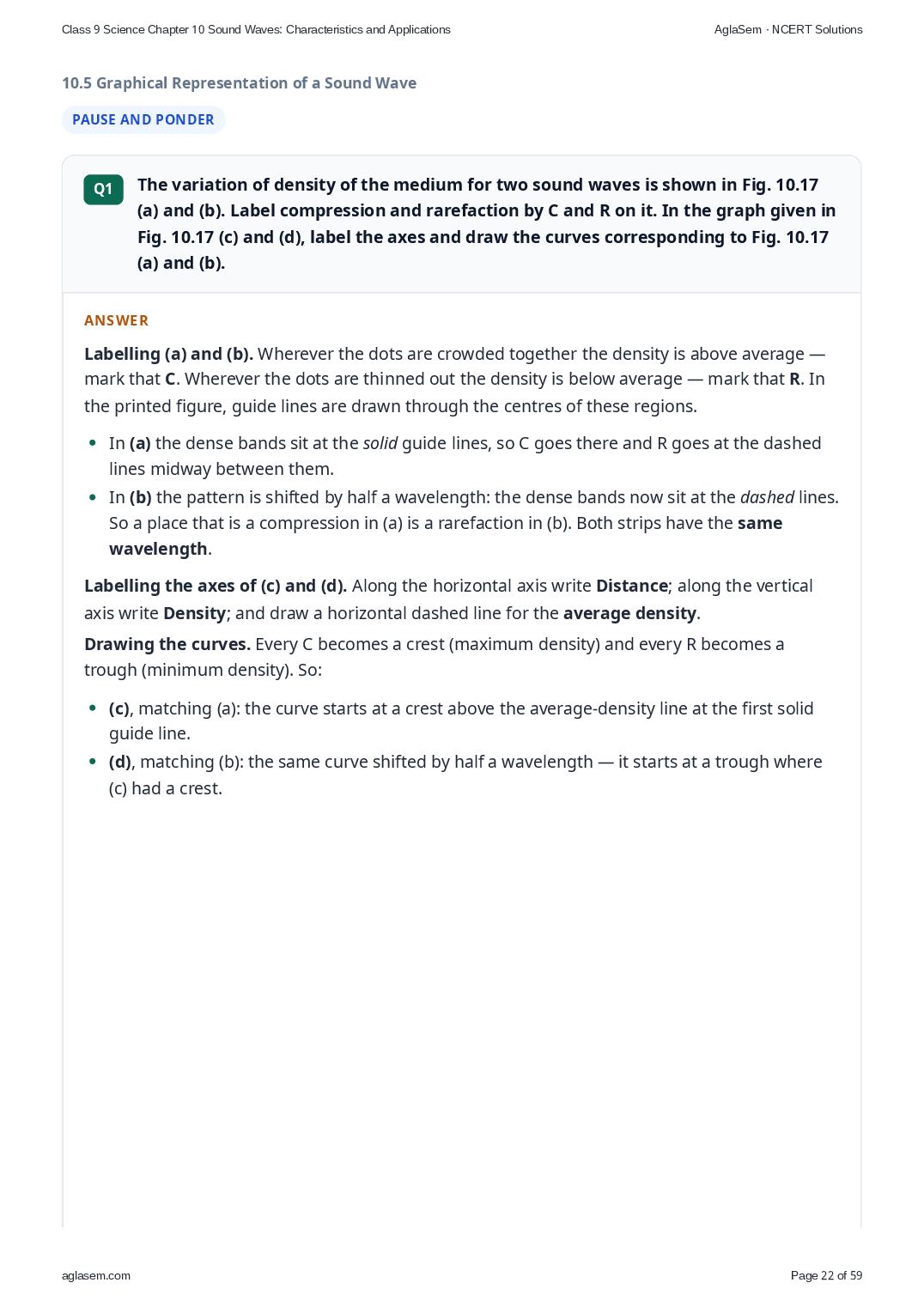
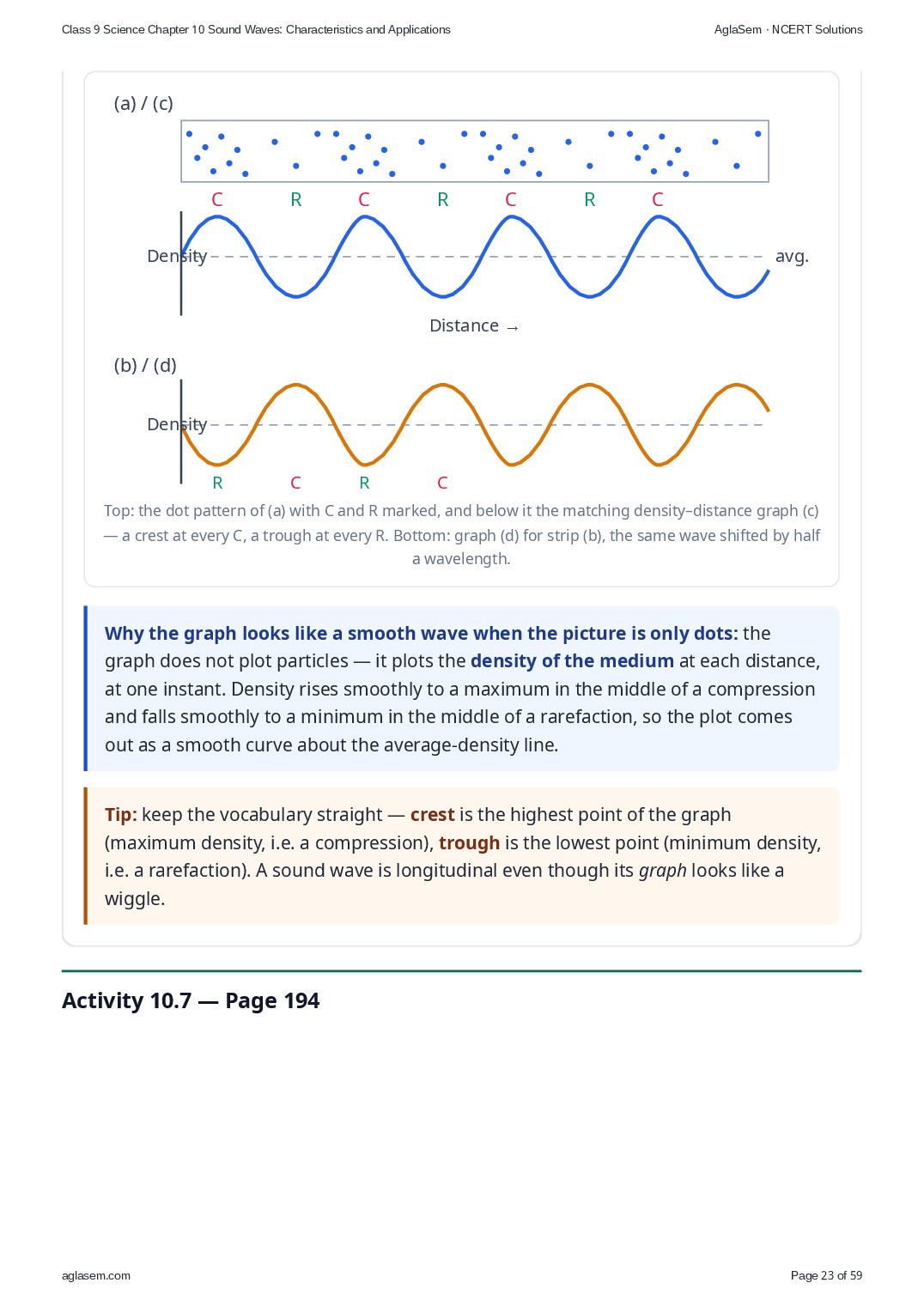
- The variation of density of the medium for two sound waves is shown in Fig. 10.17 (a) and (b). Label compression and rarefaction by C and R on it. In the graph given in Fig. 10.17 (c) and (d), label the axes and draw the curves corresponding to Fig. 10.17 (a) and (b).
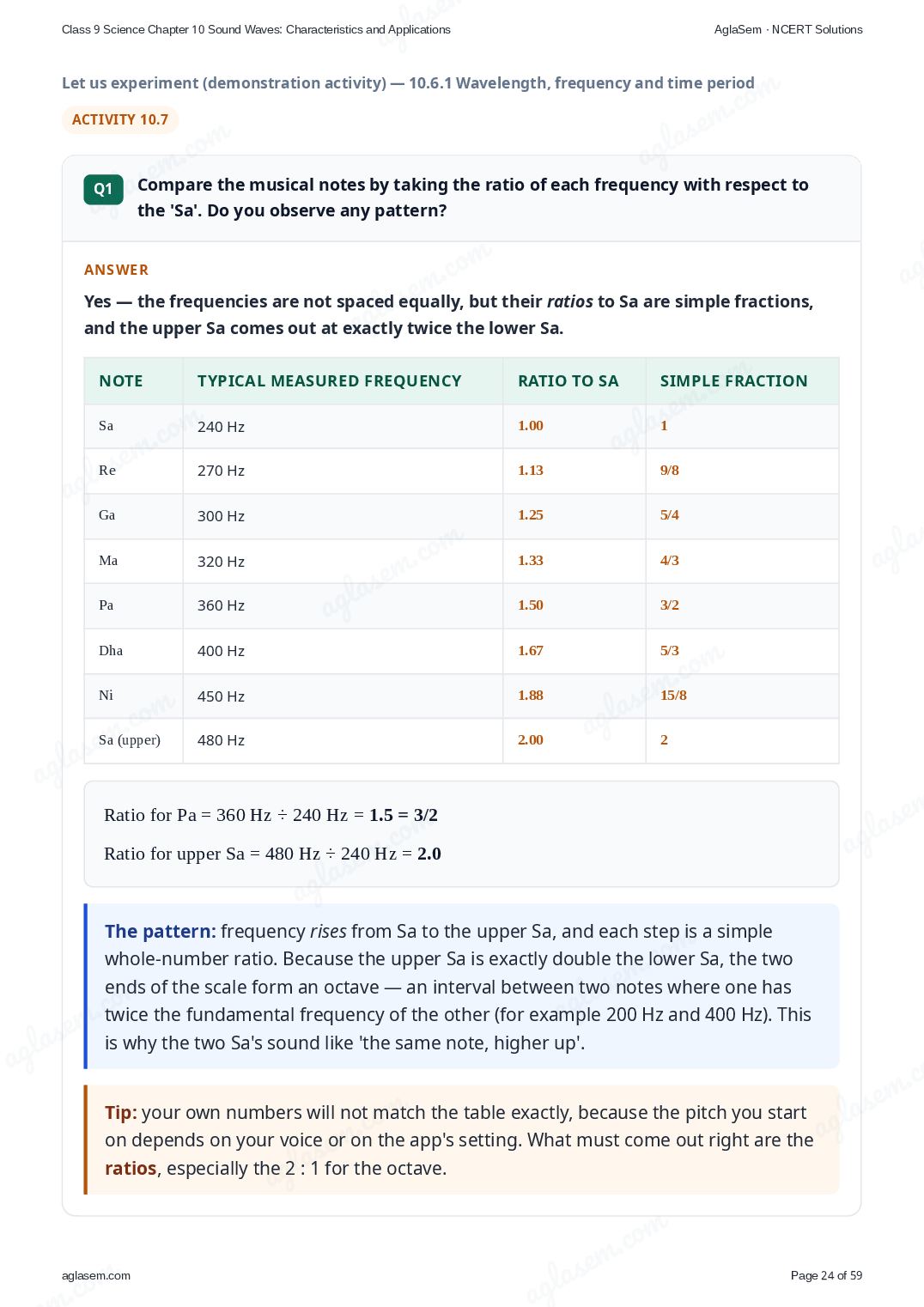
- Compare the musical notes by taking the ratio of each frequency with respect to the 'Sa'. Do you observe any pattern?
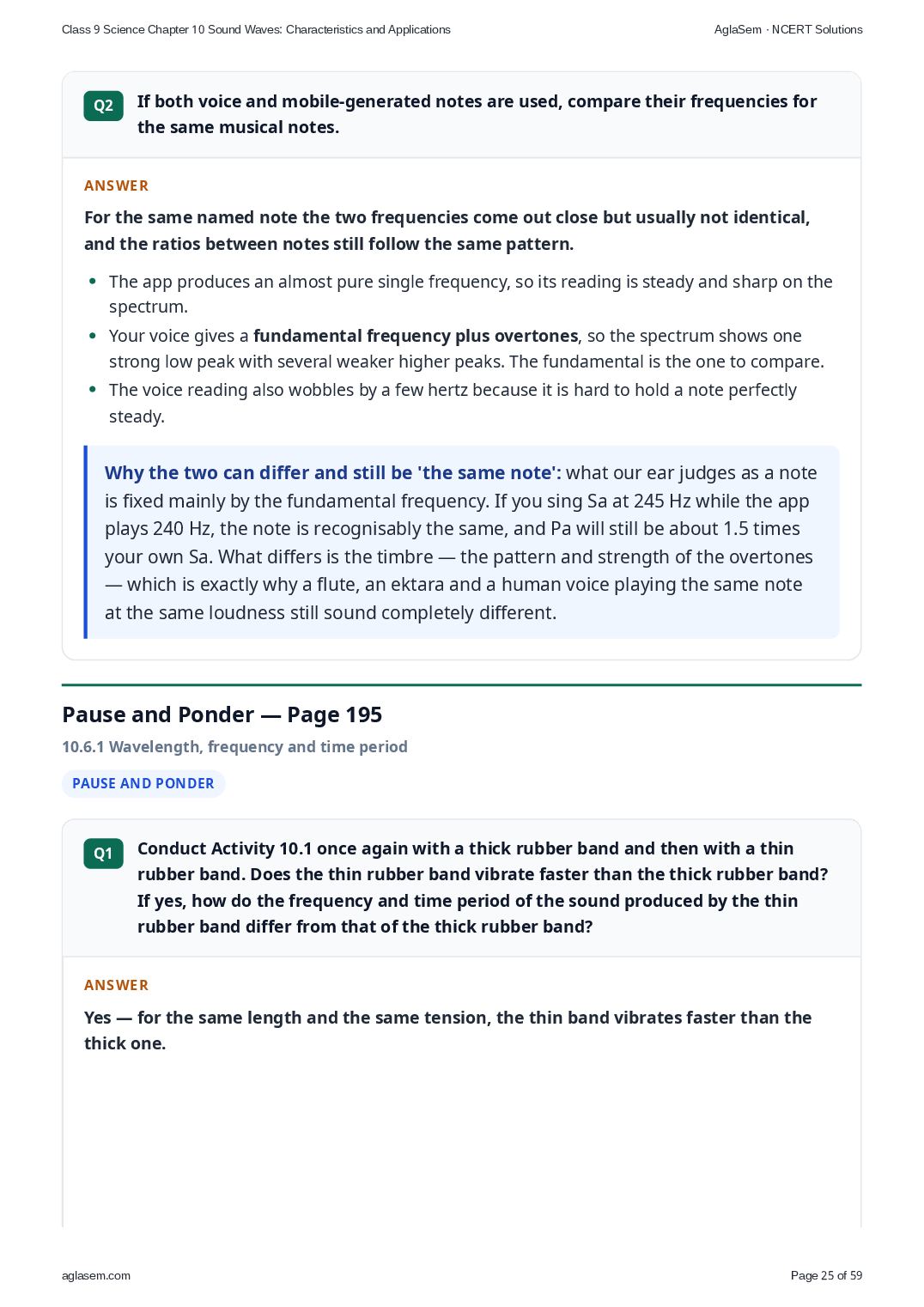
- If both voice and mobile-generated notes are used, compare their frequencies for the same musical notes.
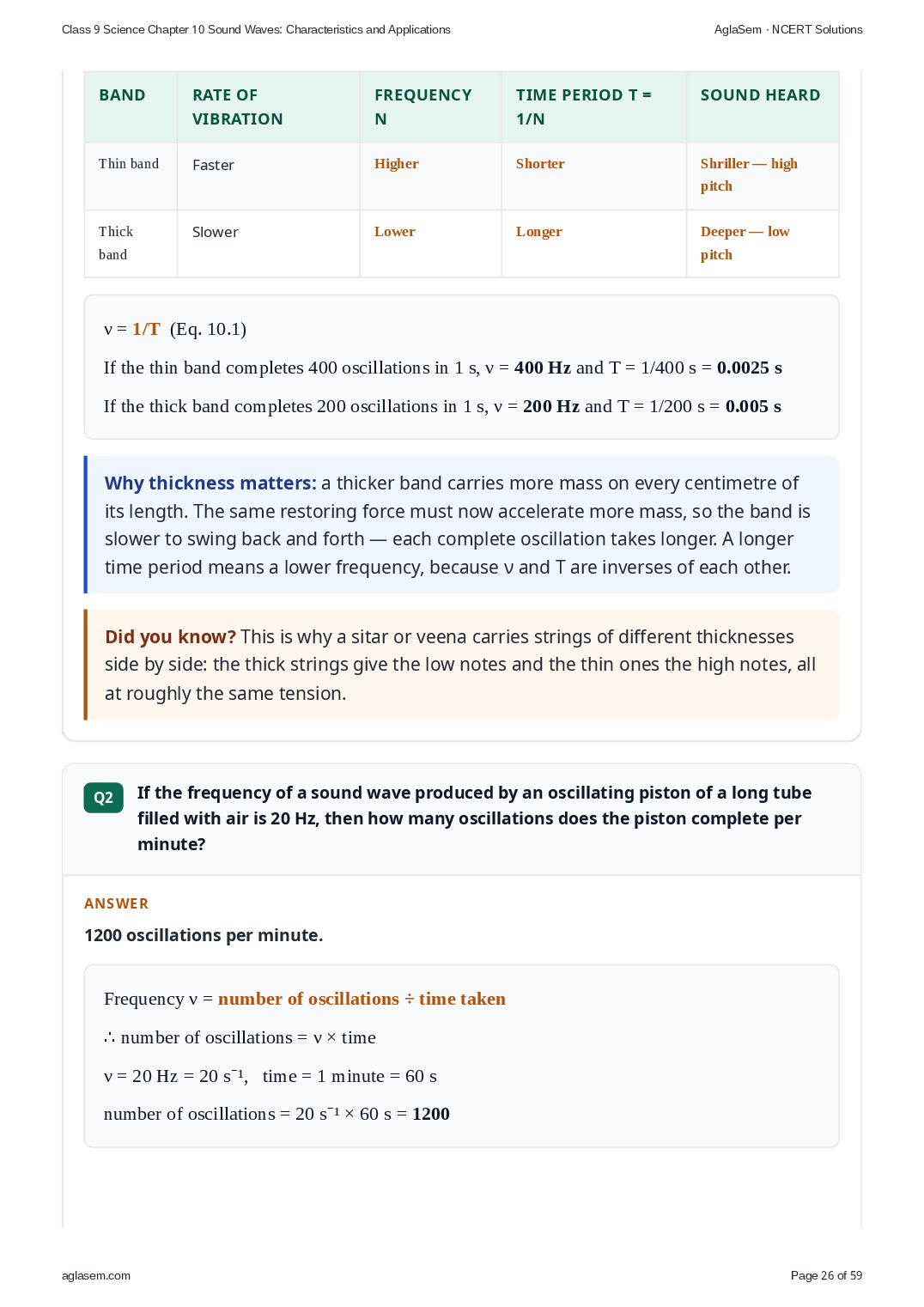
- Conduct Activity 10.1 once again with a thick rubber band and then with a thin rubber band. Does the thin rubber band vibrate faster than the thick rubber band? If yes, how do the frequency and time period of the sound produced by the thin rubber band differ from that of the thick rubber band?
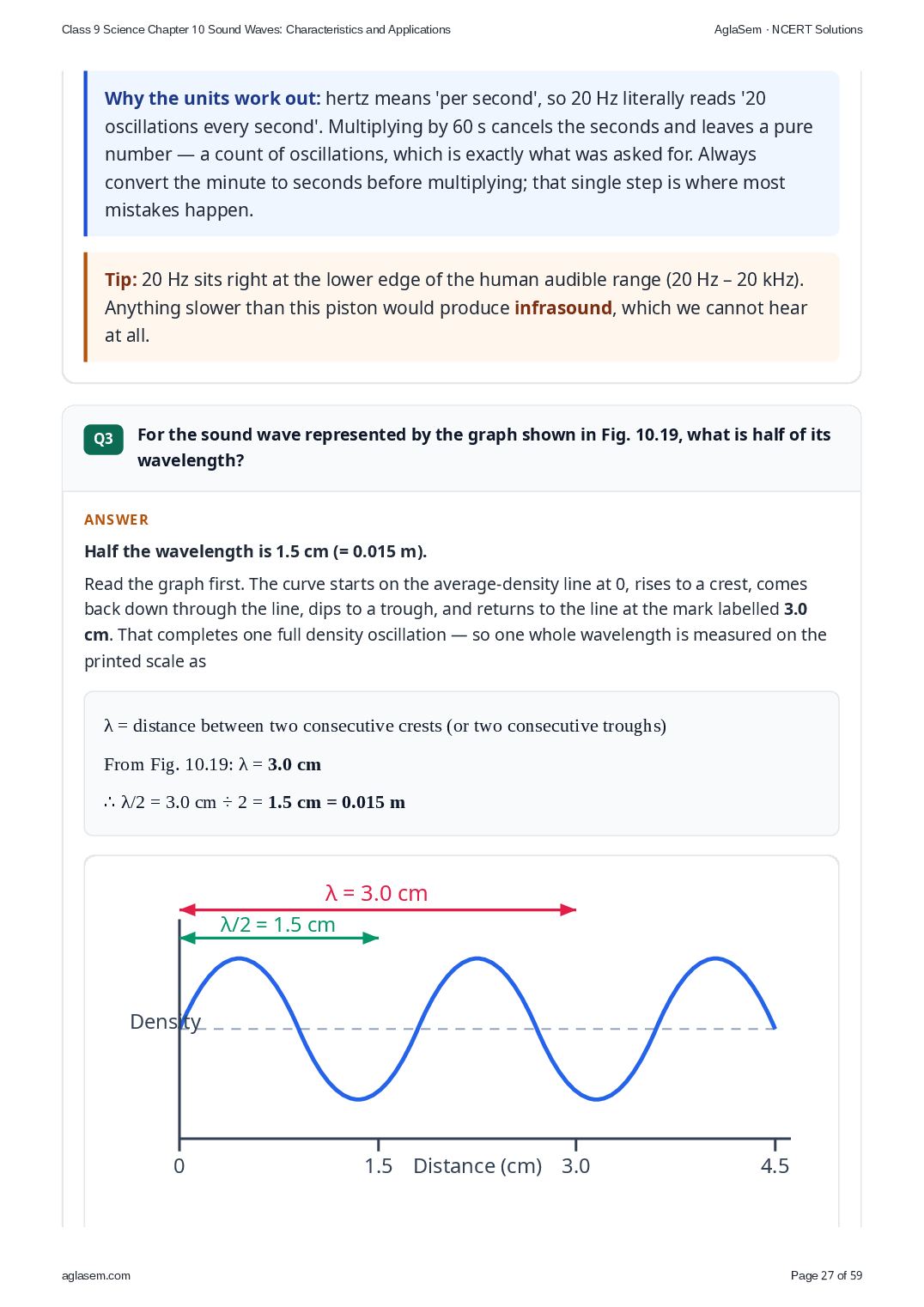
- If the frequency of a sound wave produced by an oscillating piston of a long tube filled with air is 20 Hz, then how many oscillations does the piston complete per minute?
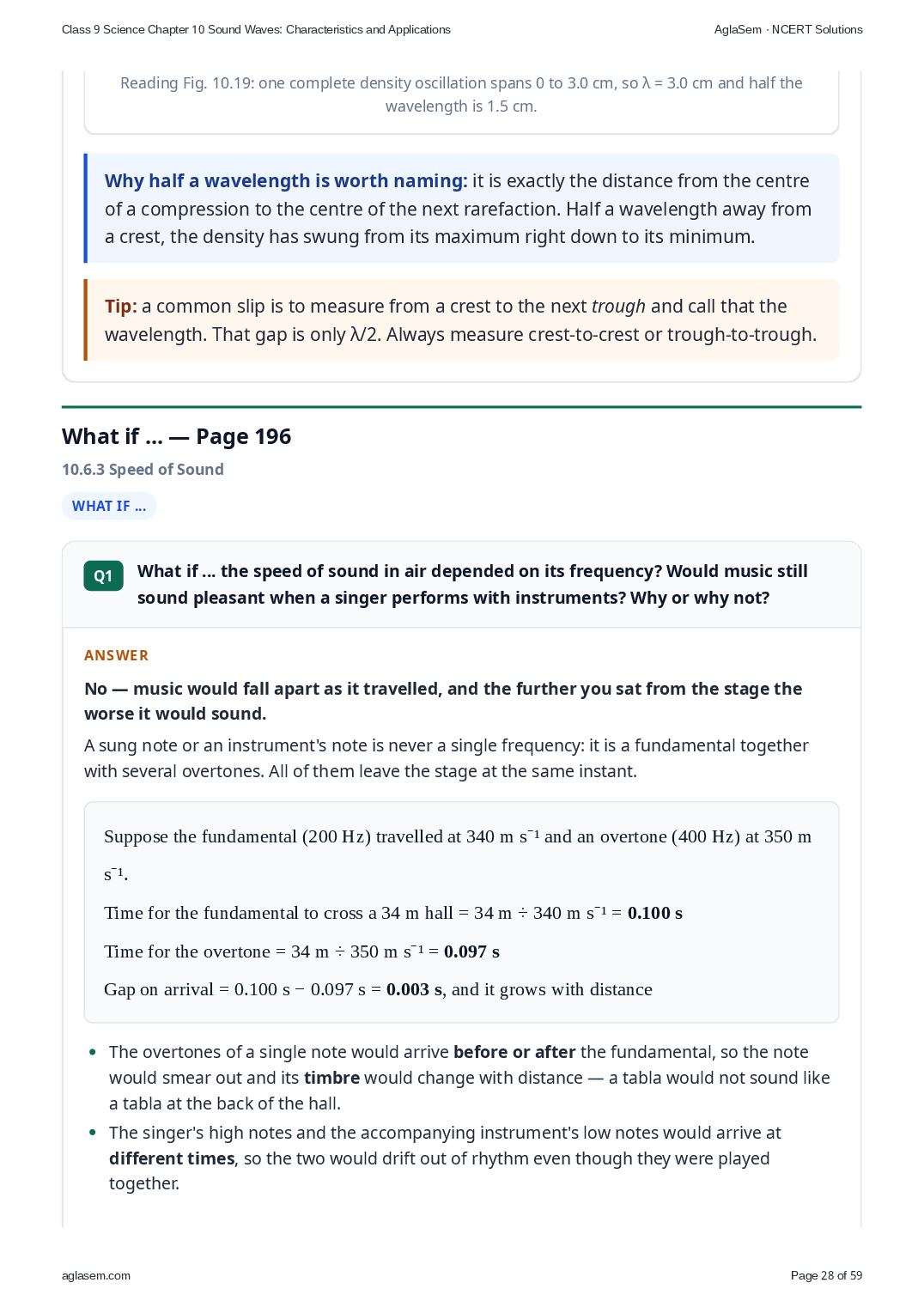
- For the sound wave represented by the graph shown in Fig. 10.19, what is half of its wavelength?
- What if … the speed of sound in air depended on its frequency? Would music still sound pleasant when a singer performs with instruments? Why or why not?
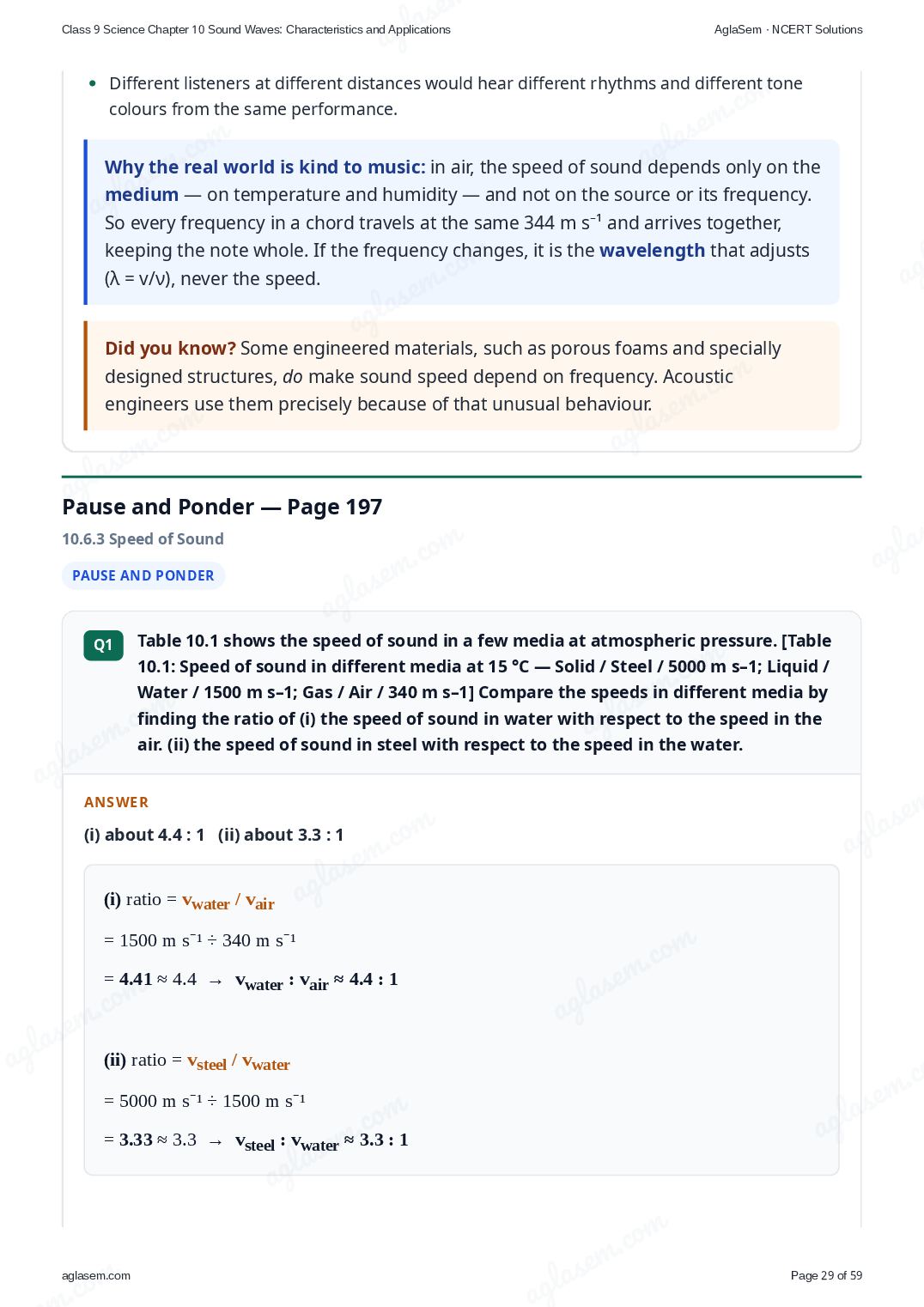
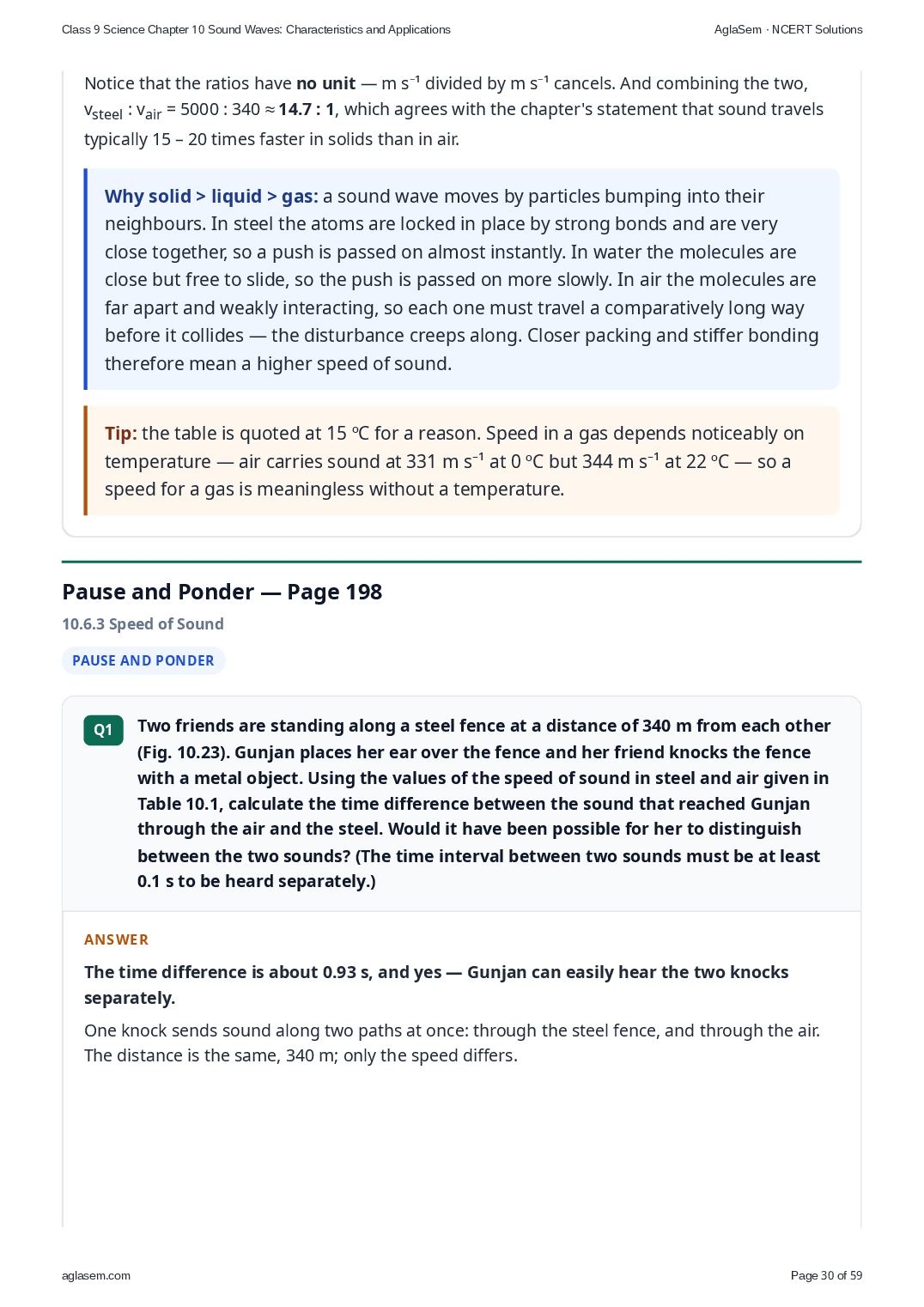
- Table 10.1 shows the speed of sound in a few media at atmospheric pressure. [Table 10.1: Speed of sound in different media at 15 °C — Solid / Steel / 5000 m s–1; Liquid / Water / 1500 m s–1; Gas / Air / 340 m s–1] Compare the speeds in different media by finding the ratio of (i) the speed of sound in water with respect to the speed in the air. (ii) the speed of sound in steel with respect to the speed in the water.
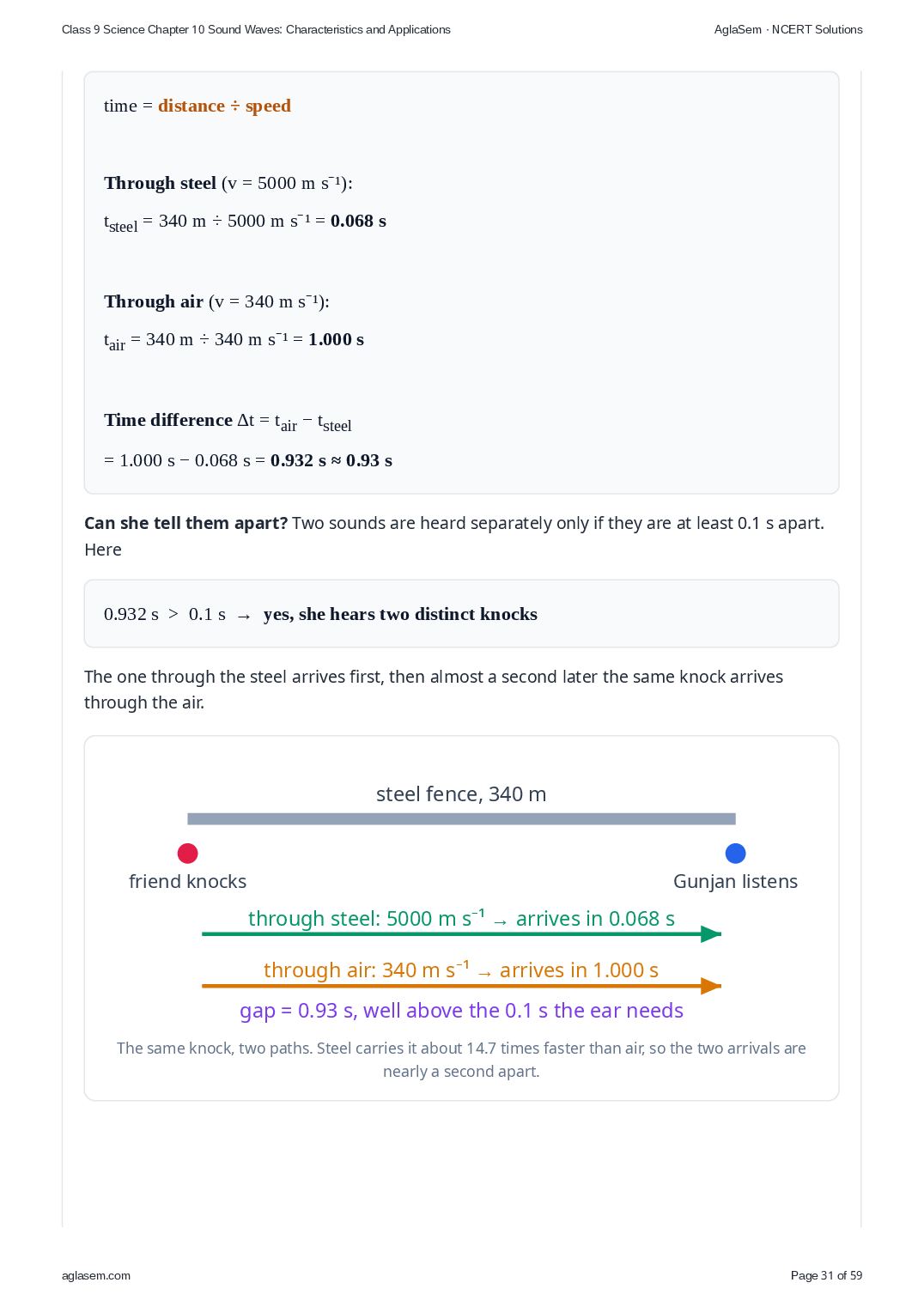
- Two friends are standing along a steel fence at a distance of 340 m from each other (Fig. 10.23). Gunjan places her ear over the fence and her friend knocks the fence with a metal object. Using the values of the speed of sound in steel and air given in Table 10.1, calculate the time difference between the sound that reached Gunjan through the air and the steel. Would it have been possible for her to distinguish between the two sounds? (The time interval between two sounds must be at least 0.1 s to be heard separately.)
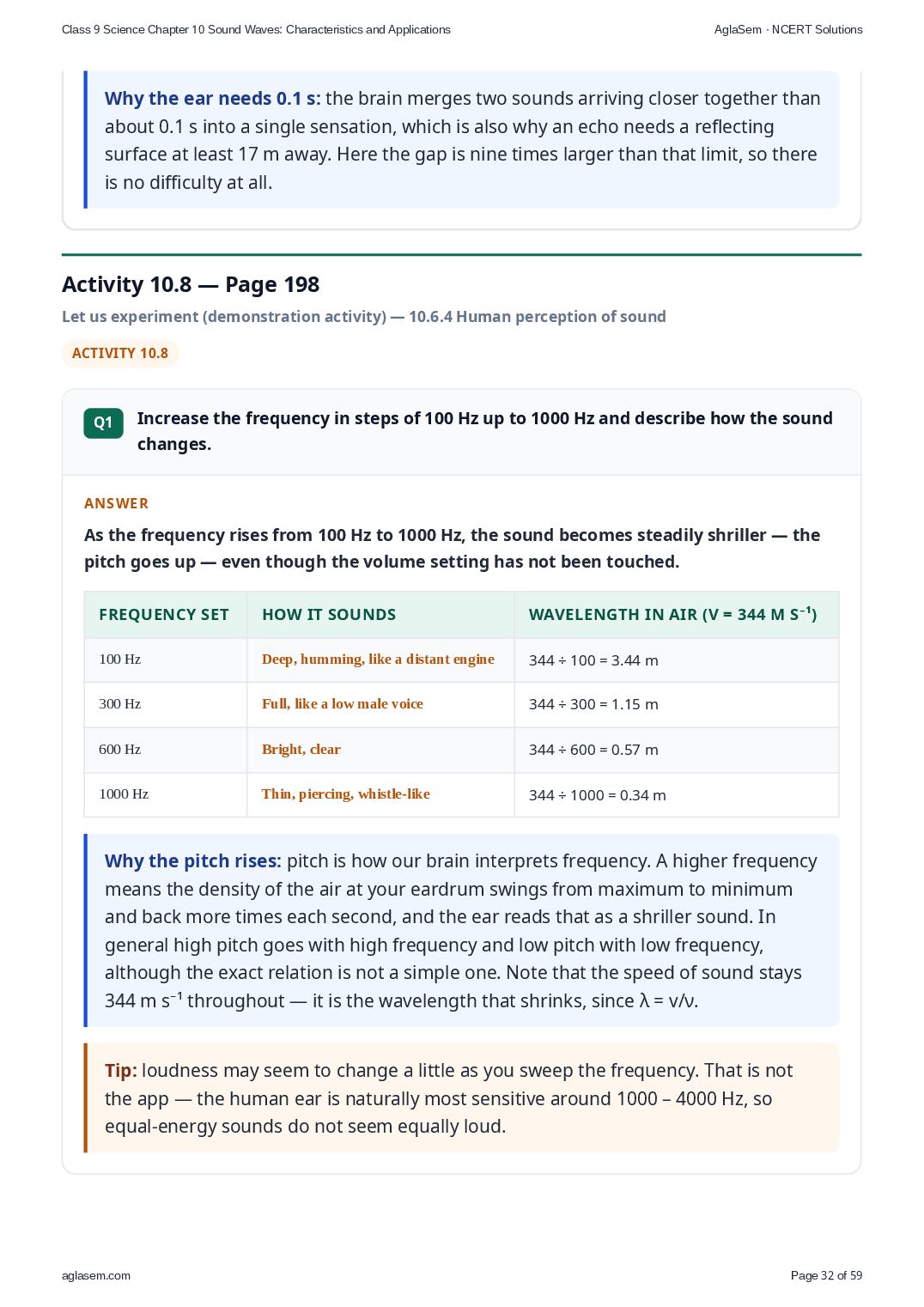
- Increase the frequency in steps of 100 Hz up to 1000 Hz and describe how the sound changes.
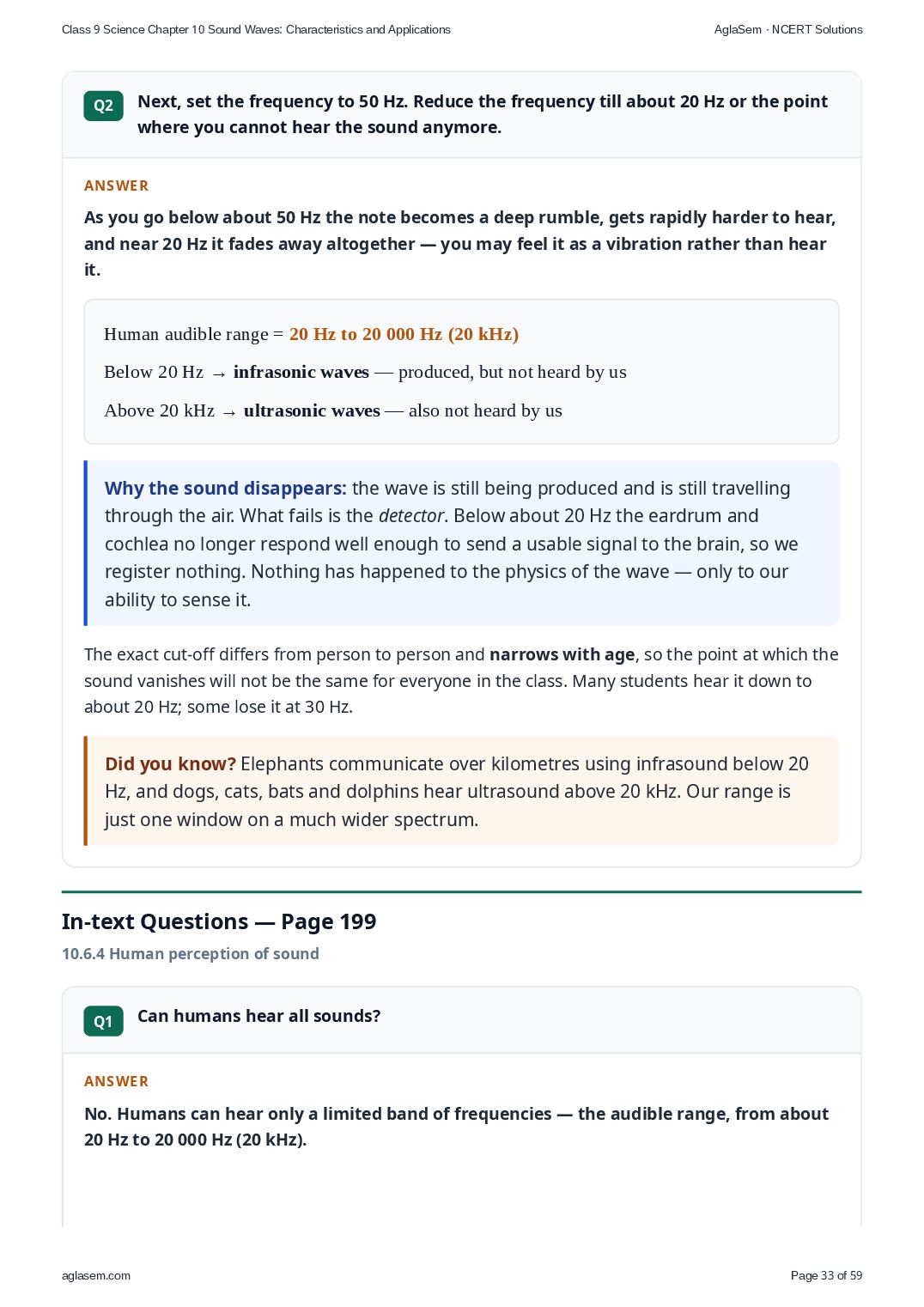
- Next, set the frequency to 50 Hz. Reduce the frequency till about 20 Hz or the point where you cannot hear the sound anymore.
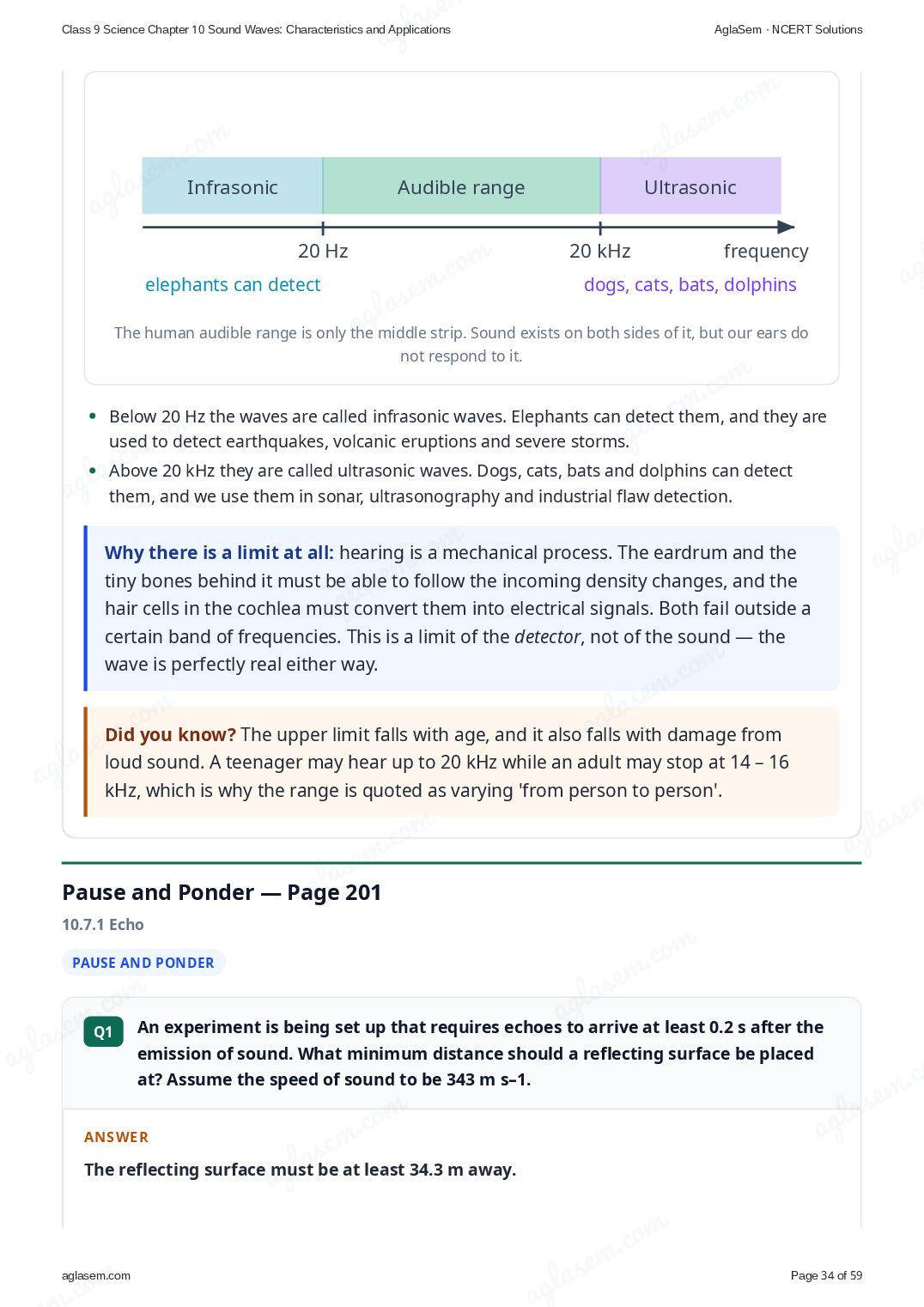
- Can humans hear all sounds?
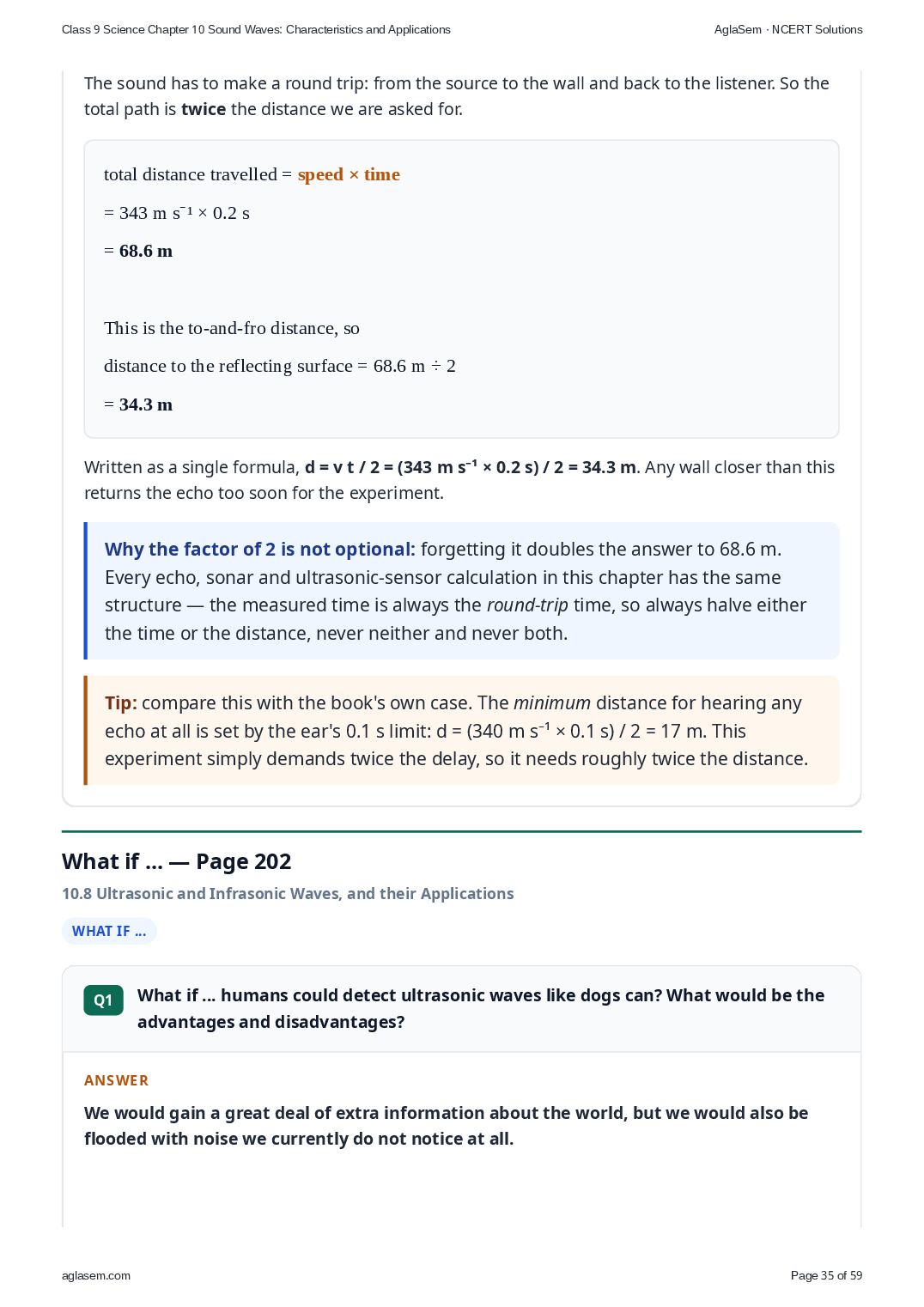
- An experiment is being set up that requires echoes to arrive at least 0.2 s after the emission of sound. What minimum distance should a reflecting surface be placed at? Assume the speed of sound to be 343 m s–1.
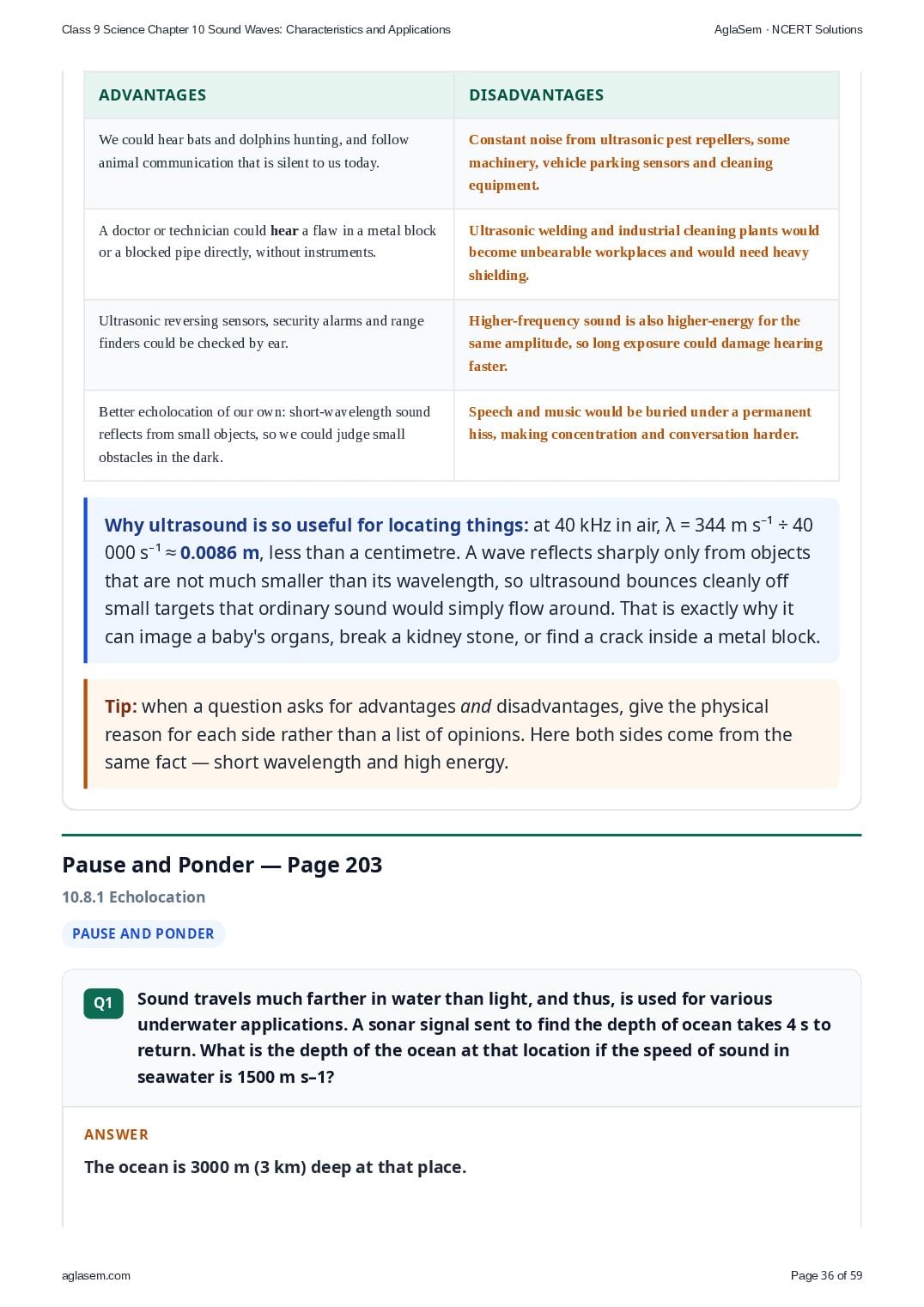
- What if … humans could detect ultrasonic waves like dogs can? What would be the advantages and disadvantages?
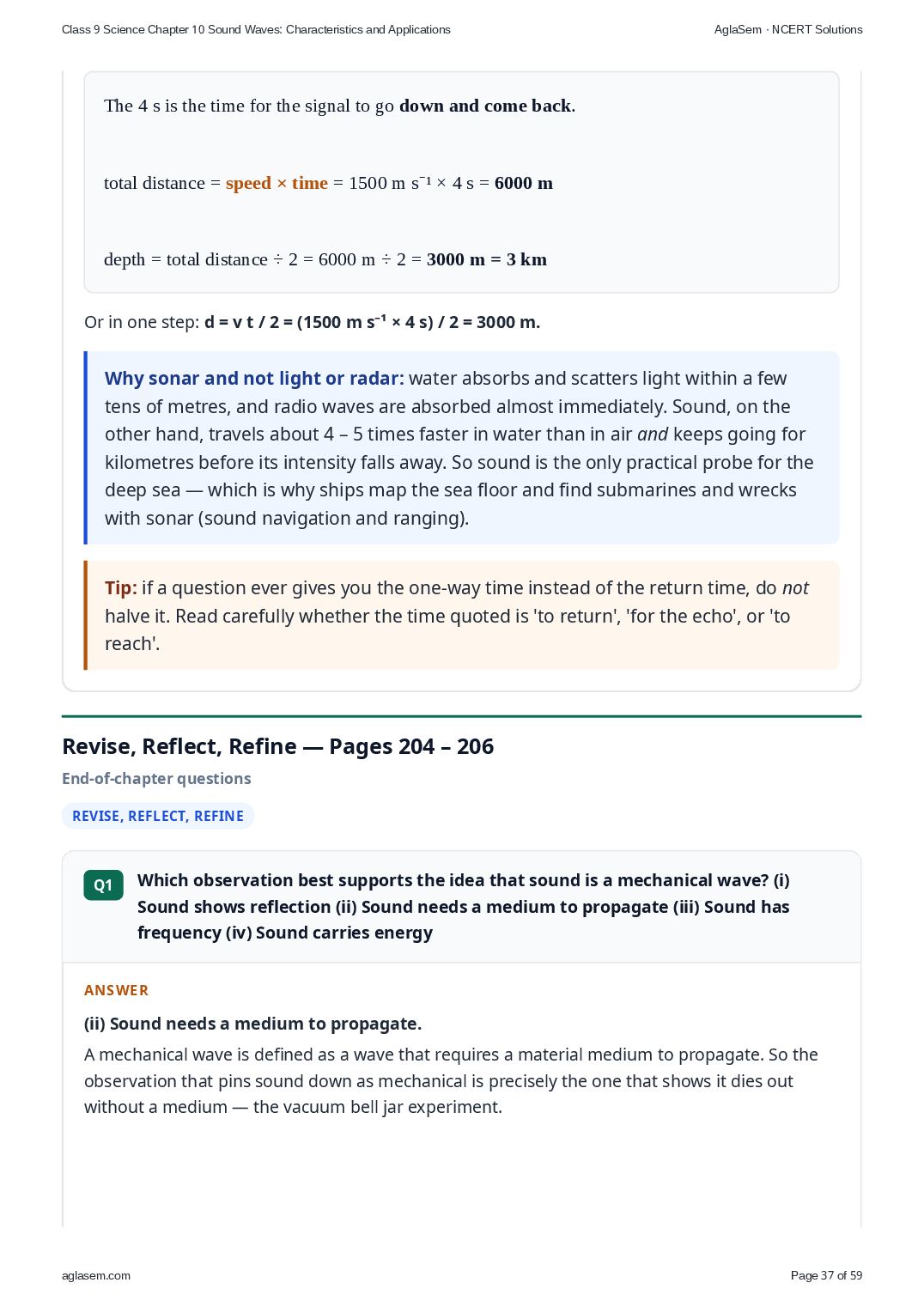
- Sound travels much farther in water than light, and thus, is used for various underwater applications. A sonar signal sent to find the depth of ocean takes 4 s to return. What is the depth of the ocean at that location if the speed of sound in seawater is 1500 m s–1?
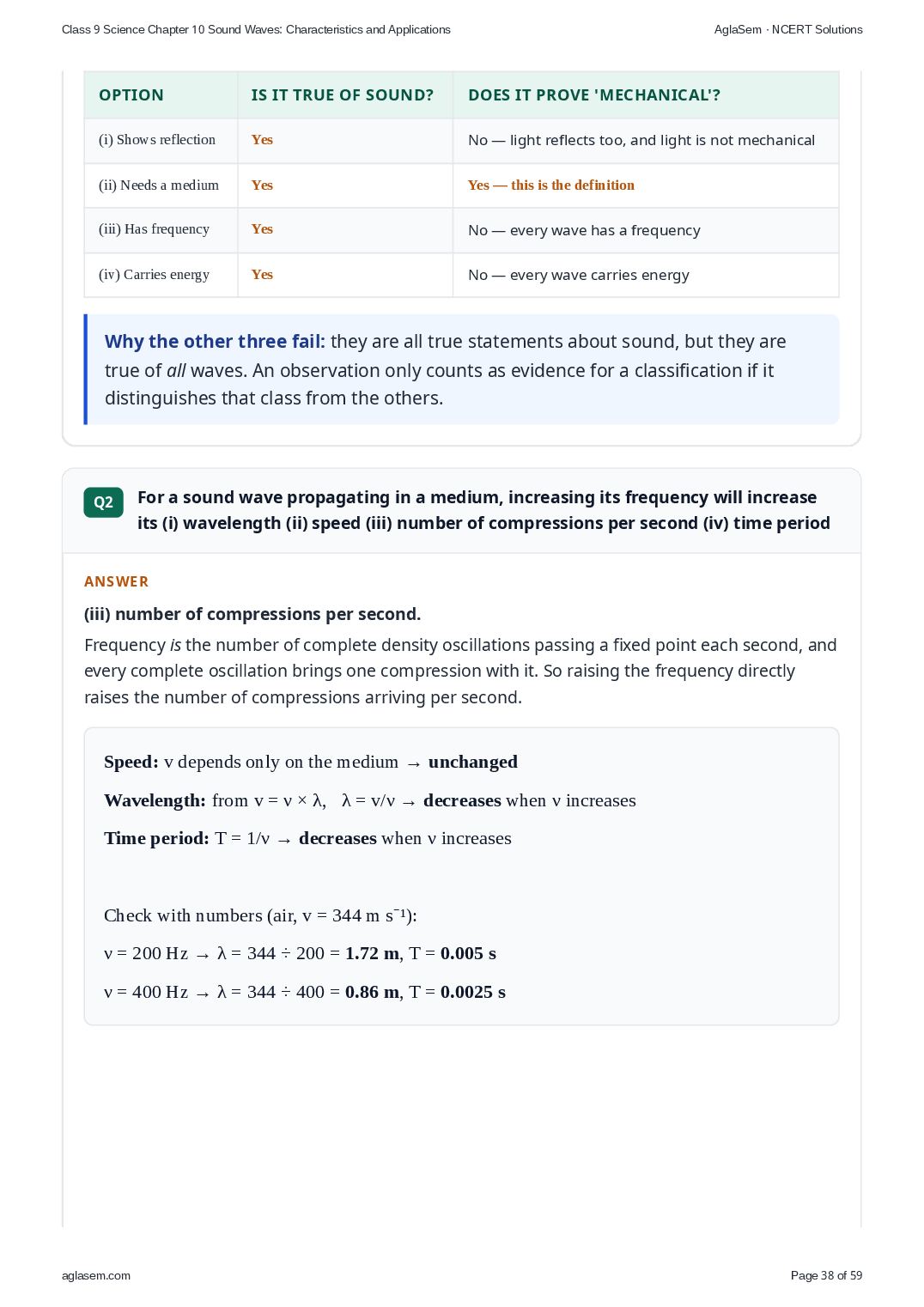
- Which observation best supports the idea that sound is a mechanical wave? (i) Sound shows reflection (ii) Sound needs a medium to propagate (iii) Sound has frequency (iv) Sound carries energy
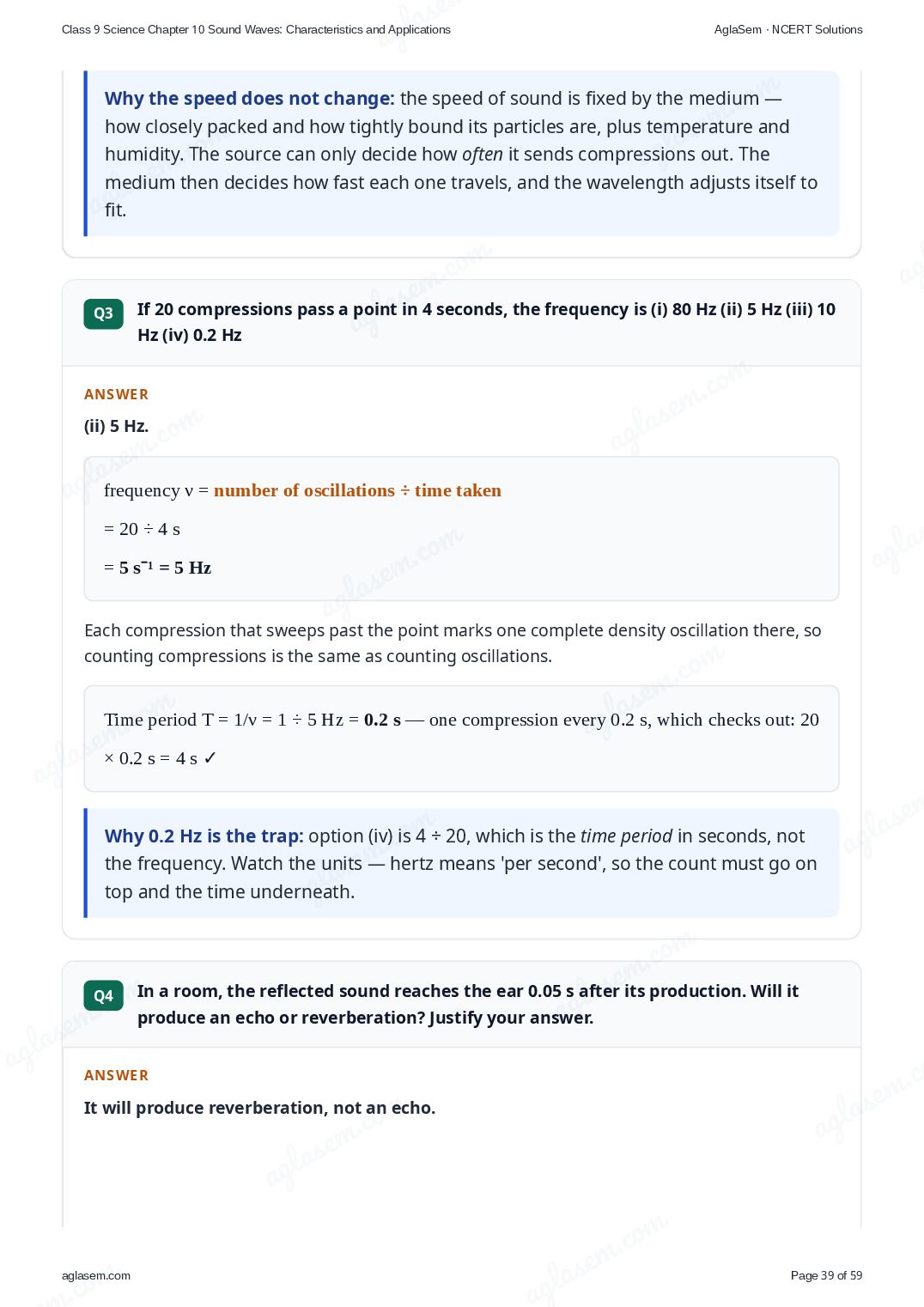
- For a sound wave propagating in a medium, increasing its frequency will increase its (i) wavelength (ii) speed (iii) number of compressions per second (iv) time period
- If 20 compressions pass a point in 4 seconds, the frequency is (i) 80 Hz (ii) 5 Hz (iii) 10 Hz (iv) 0.2 Hz
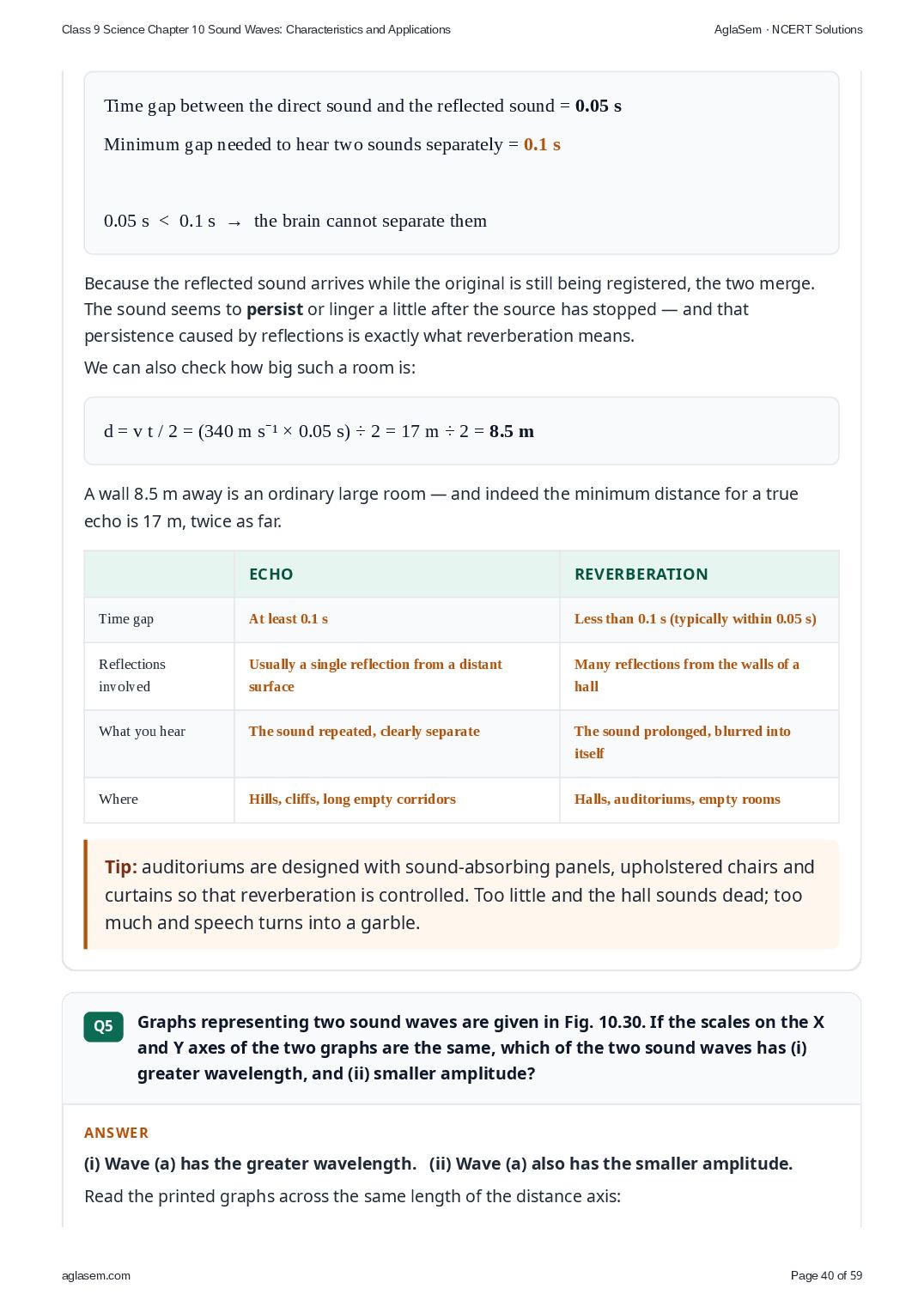
- In a room, the reflected sound reaches the ear 0.05 s after its production. Will it produce an echo or reverberation? Justify your answer.
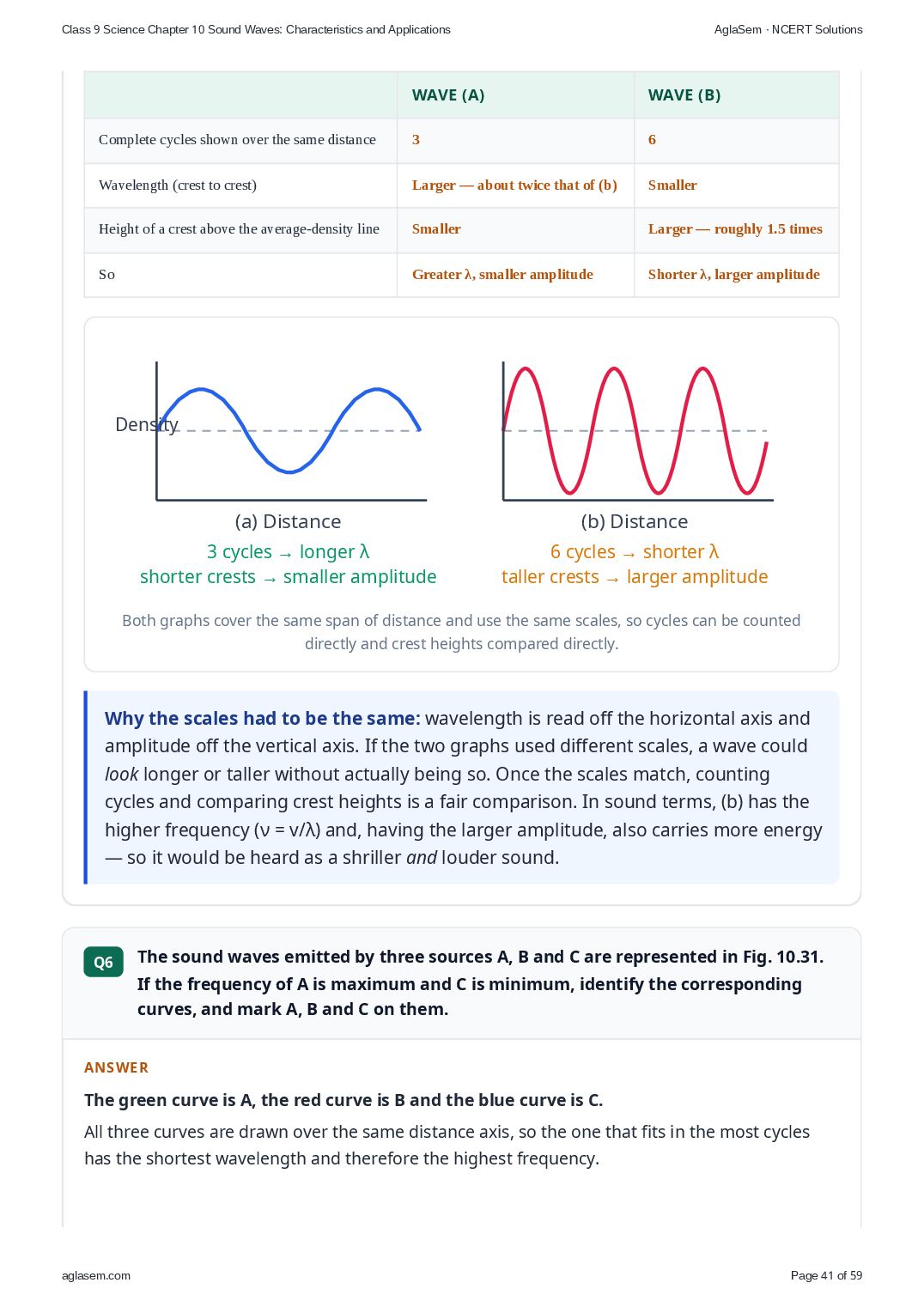
- Graphs representing two sound waves are given in Fig. 10.30. If the scales on the X and Y axes of the two graphs are the same, which of the two sound waves has (i) greater wavelength, and (ii) smaller amplitude?
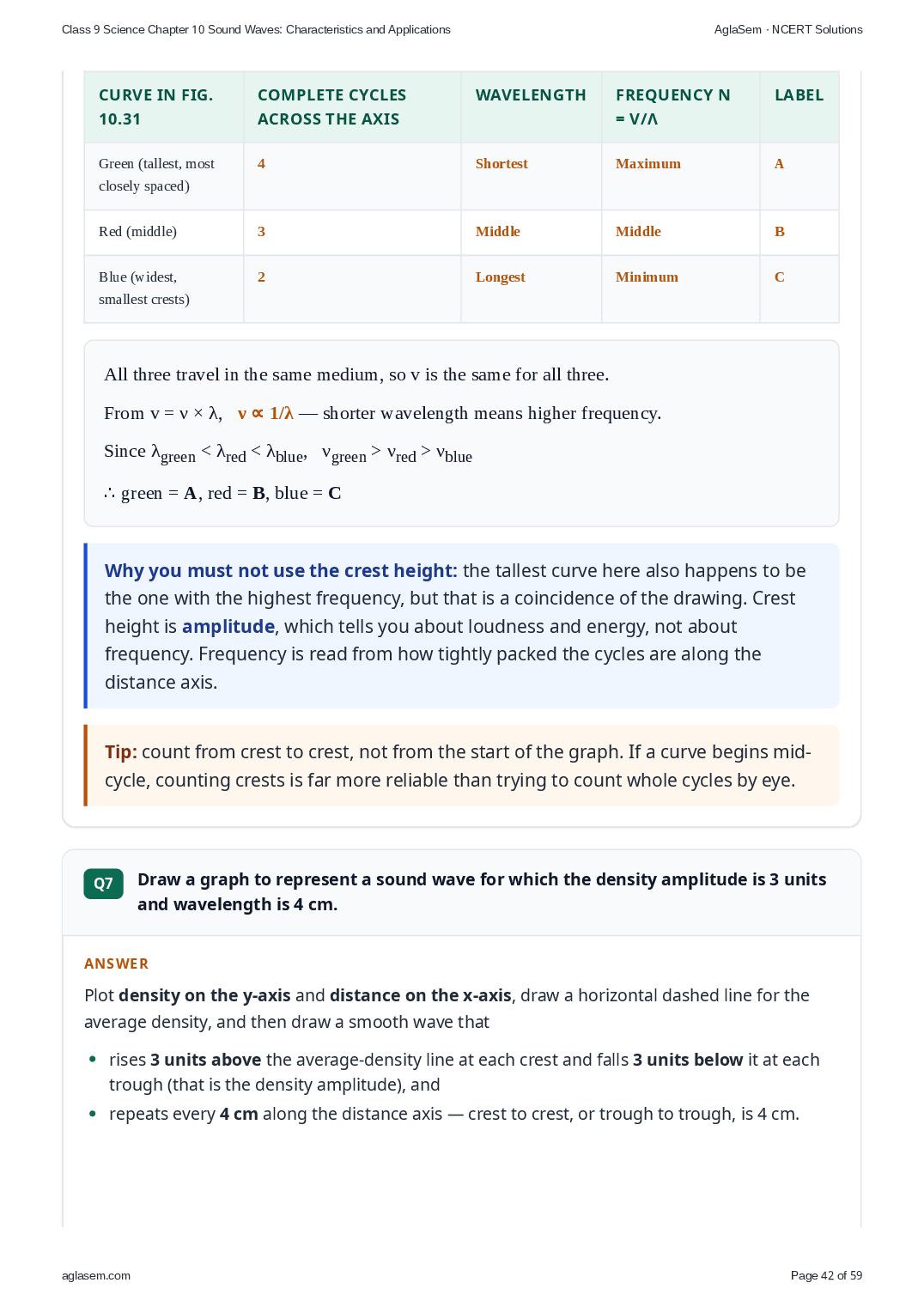
- The sound waves emitted by three sources A, B and C are represented in Fig. 10.31. If the frequency of A is maximum and C is minimum, identify the corresponding curves, and mark A, B and C on them.
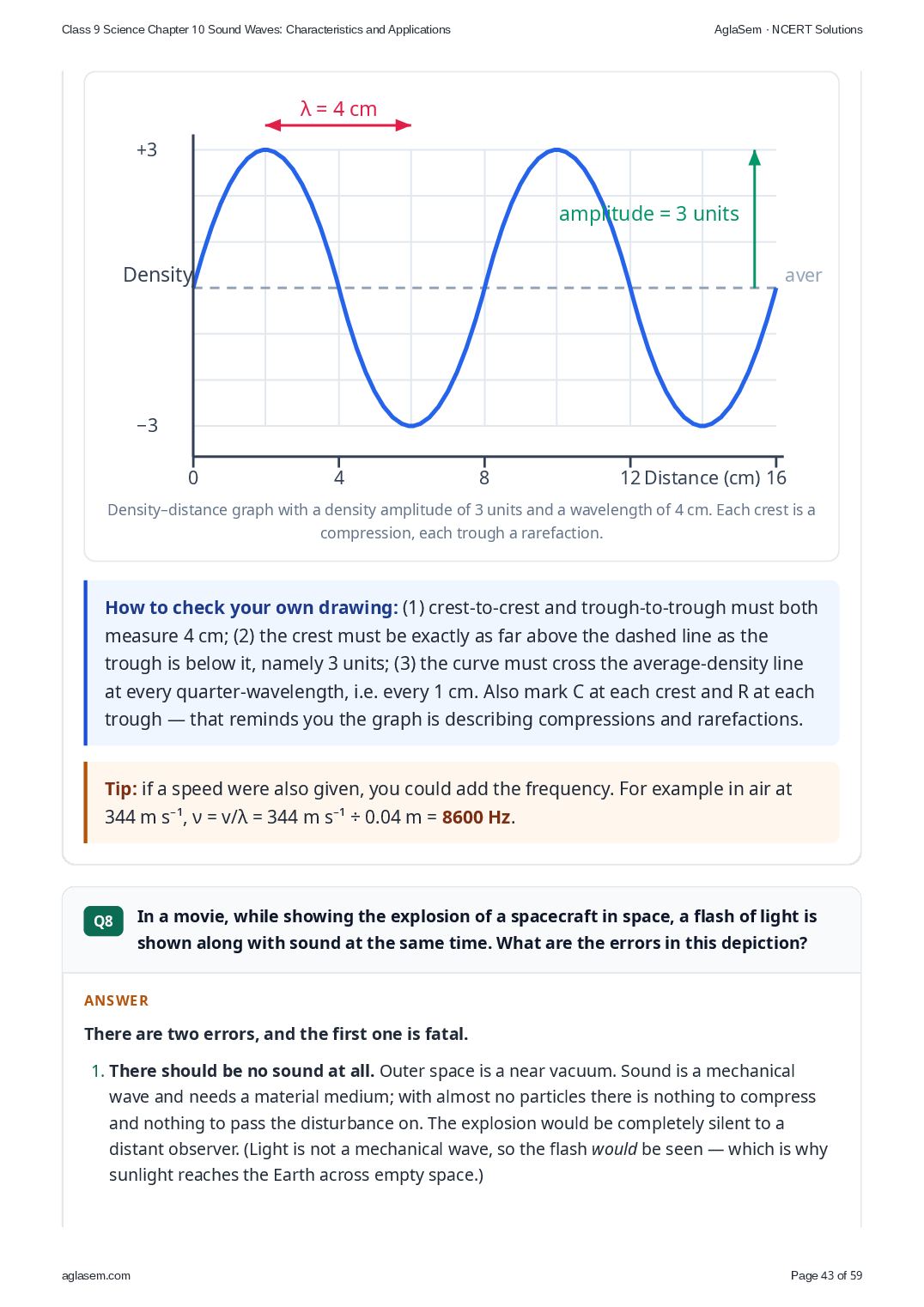
- Draw a graph to represent a sound wave for which the density amplitude is 3 units and wavelength is 4 cm.
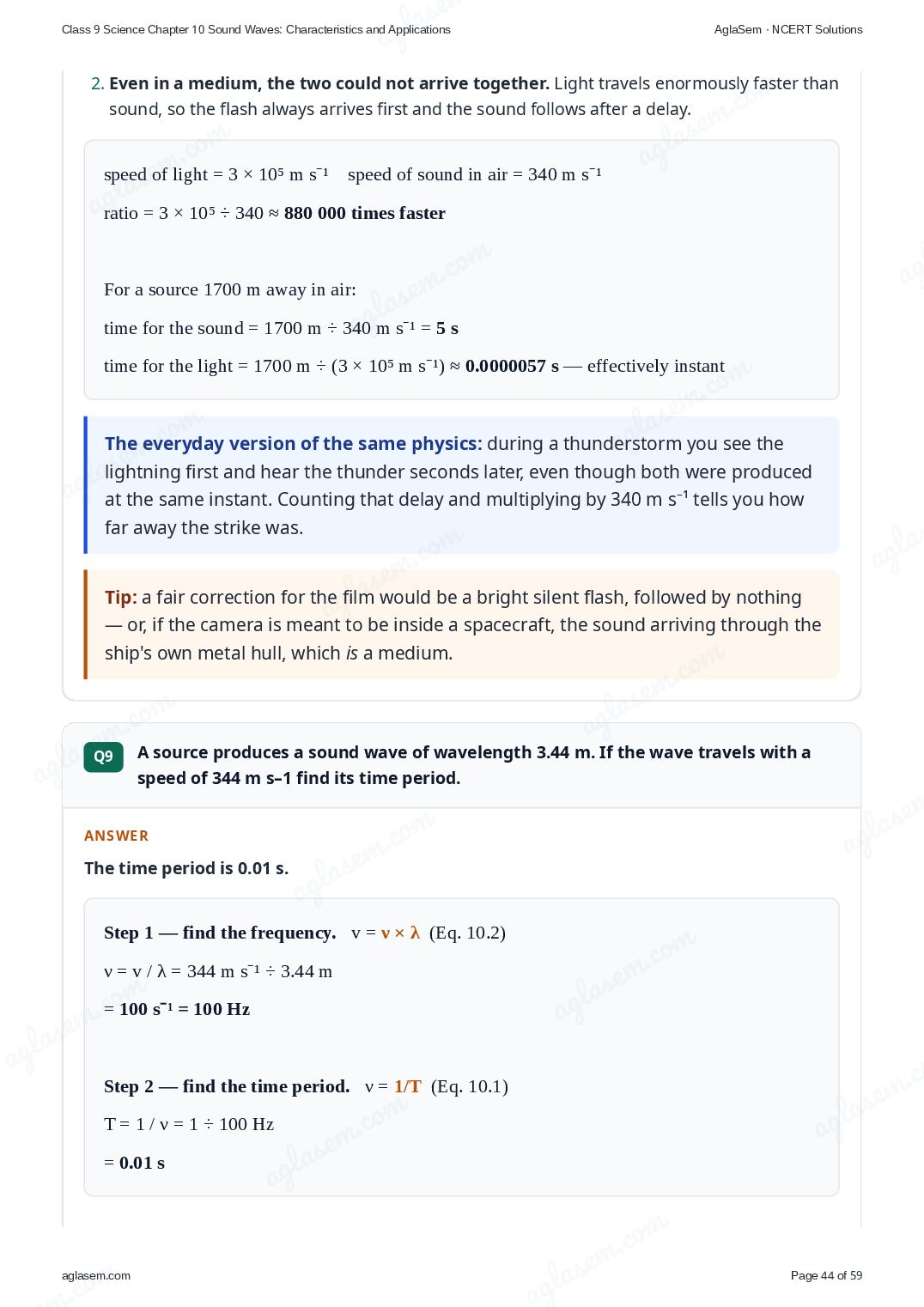
- In a movie, while showing the explosion of a spacecraft in space, a flash of light is shown along with sound at the same time. What are the errors in this depiction?
- A source produces a sound wave of wavelength 3.44 m. If the wave travels with a speed of 344 m s–1 find its time period.
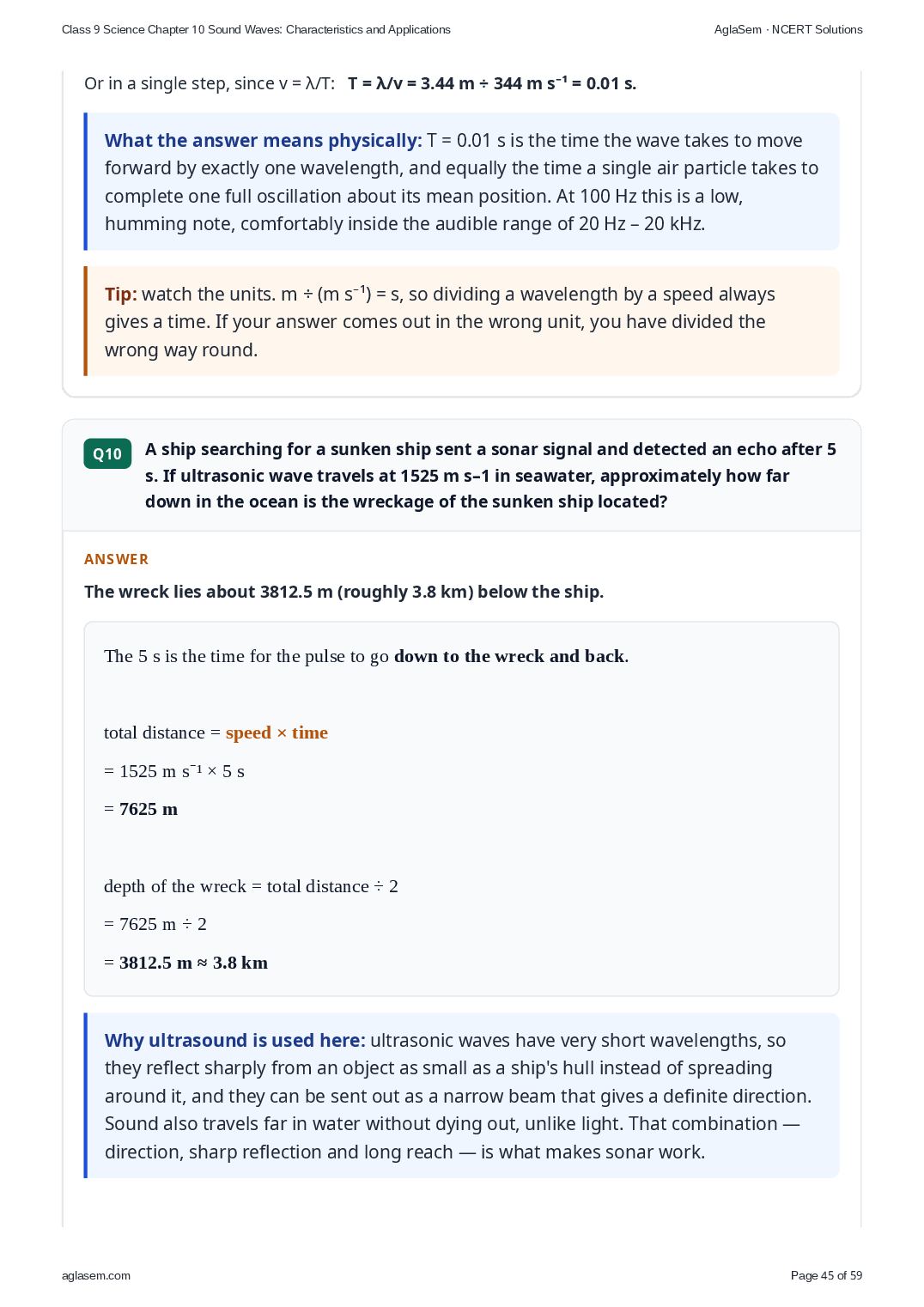
- A ship searching for a sunken ship sent a sonar signal and detected an echo after 5 s. If ultrasonic wave travels at 1525 m s–1 in seawater, approximately how far down in the ocean is the wreckage of the sunken ship located?
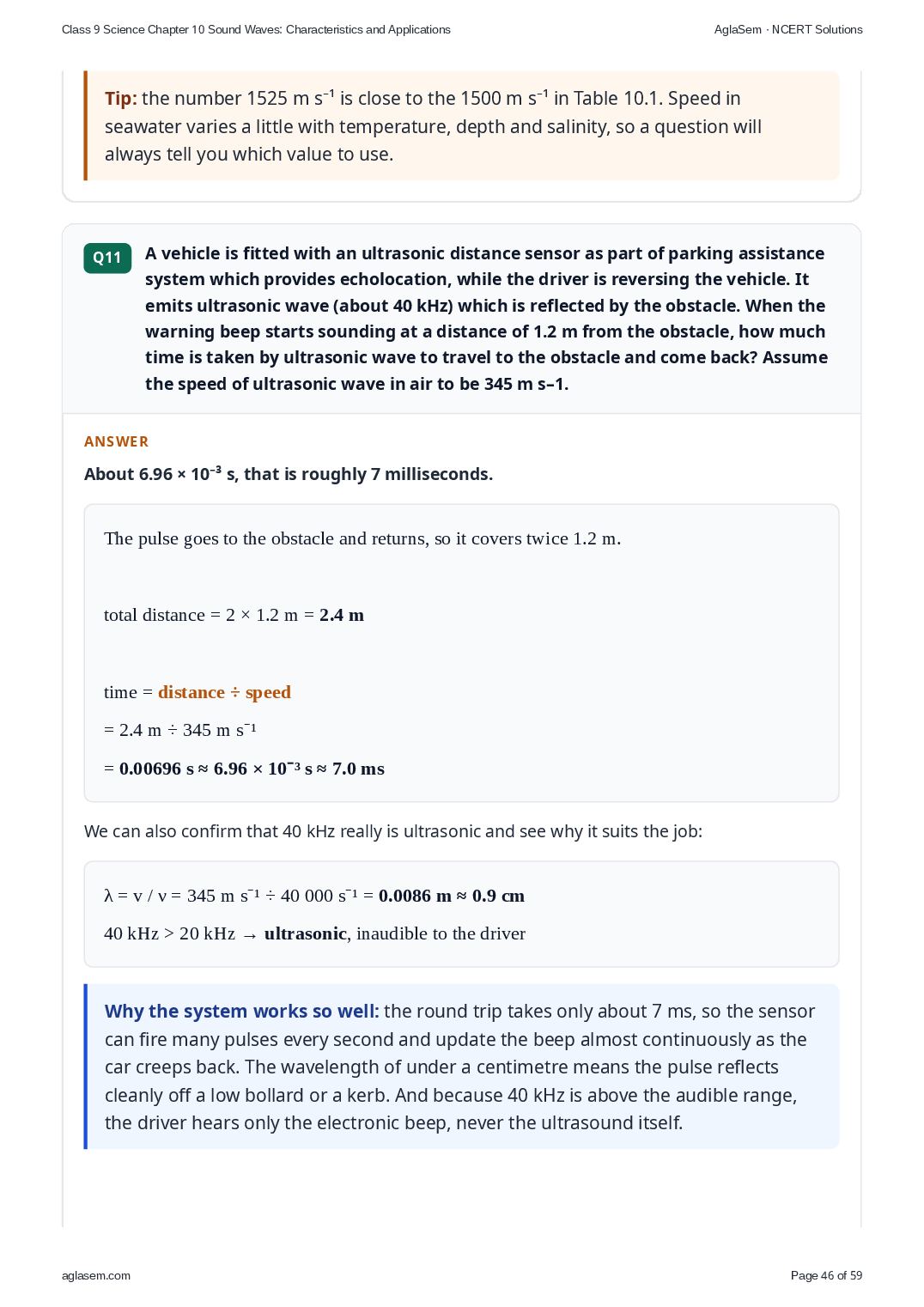
- A vehicle is fitted with an ultrasonic distance sensor as part of parking assistance system which provides echolocation, while the driver is reversing the vehicle. It emits ultrasonic wave (about 40 kHz) which is reflected by the obstacle. When the warning beep starts sounding at a distance of 1.2 m from the obstacle, how much time is taken by ultrasonic wave to travel to the obstacle and come back? Assume the speed of ultrasonic wave in air to be 345 m s–1.
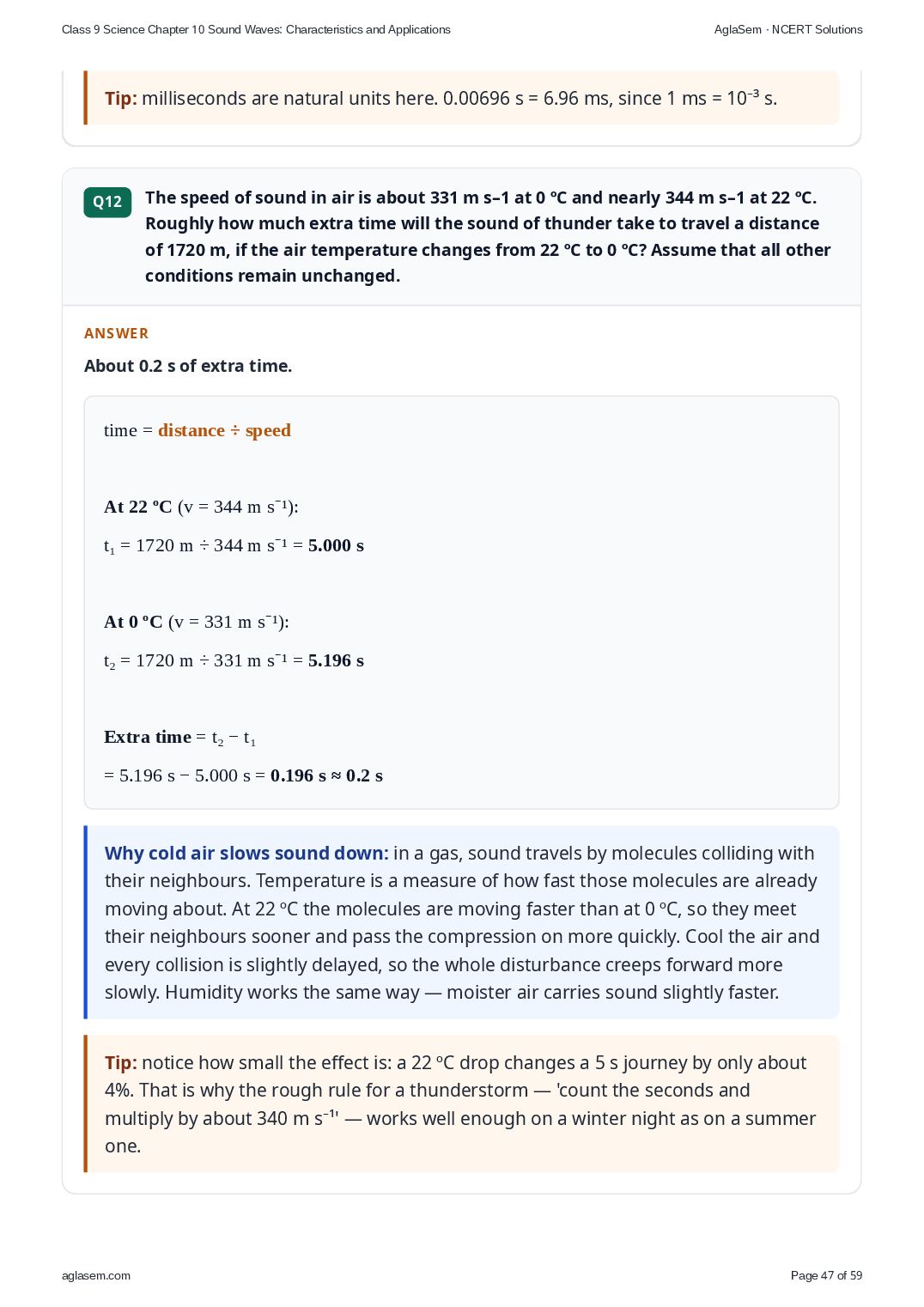
- The speed of sound in air is about 331 m s–1 at 0 ºC and nearly 344 m s–1 at 22 ºC. Roughly how much extra time will the sound of thunder take to travel a distance of 1720 m, if the air temperature changes from 22 ºC to 0 ºC? Assume that all other conditions remain unchanged.
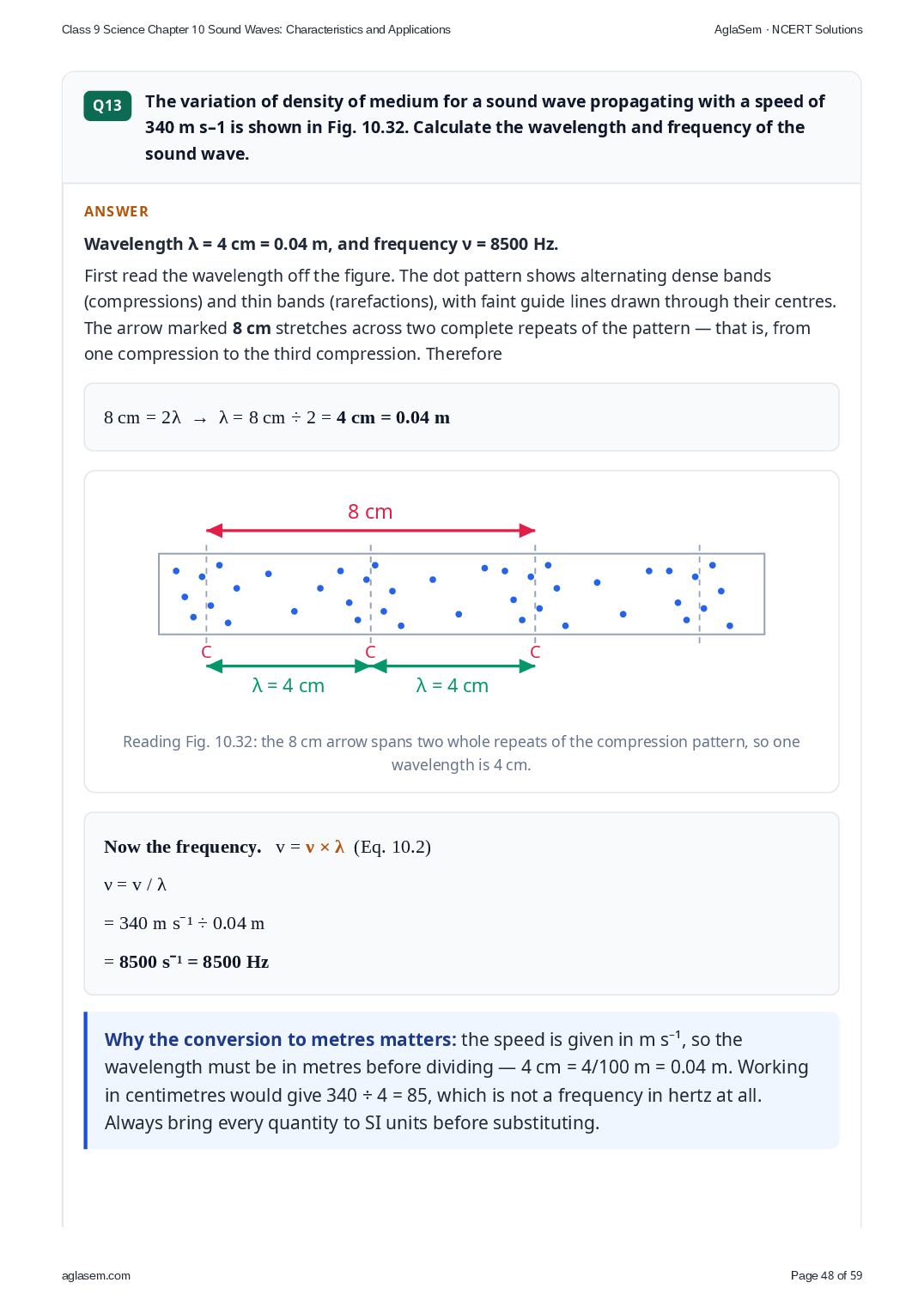
- The variation of density of medium for a sound wave propagating with a speed of 340 m s–1 is shown in Fig. 10.32. Calculate the wavelength and frequency of the sound wave.
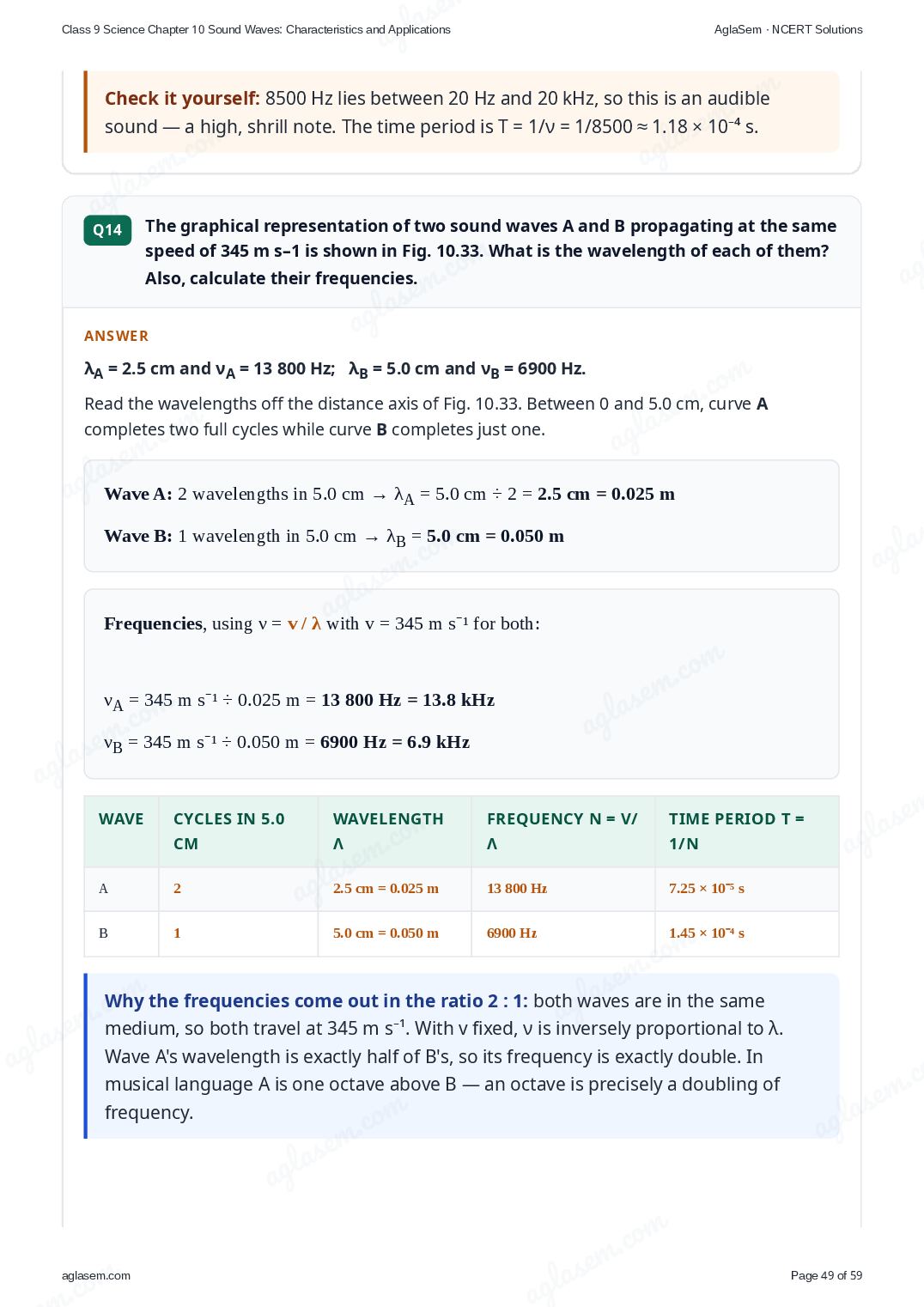
- The graphical representation of two sound waves A and B propagating at the same speed of 345 m s–1 is shown in Fig. 10.33. What is the wavelength of each of them? Also, calculate their frequencies.
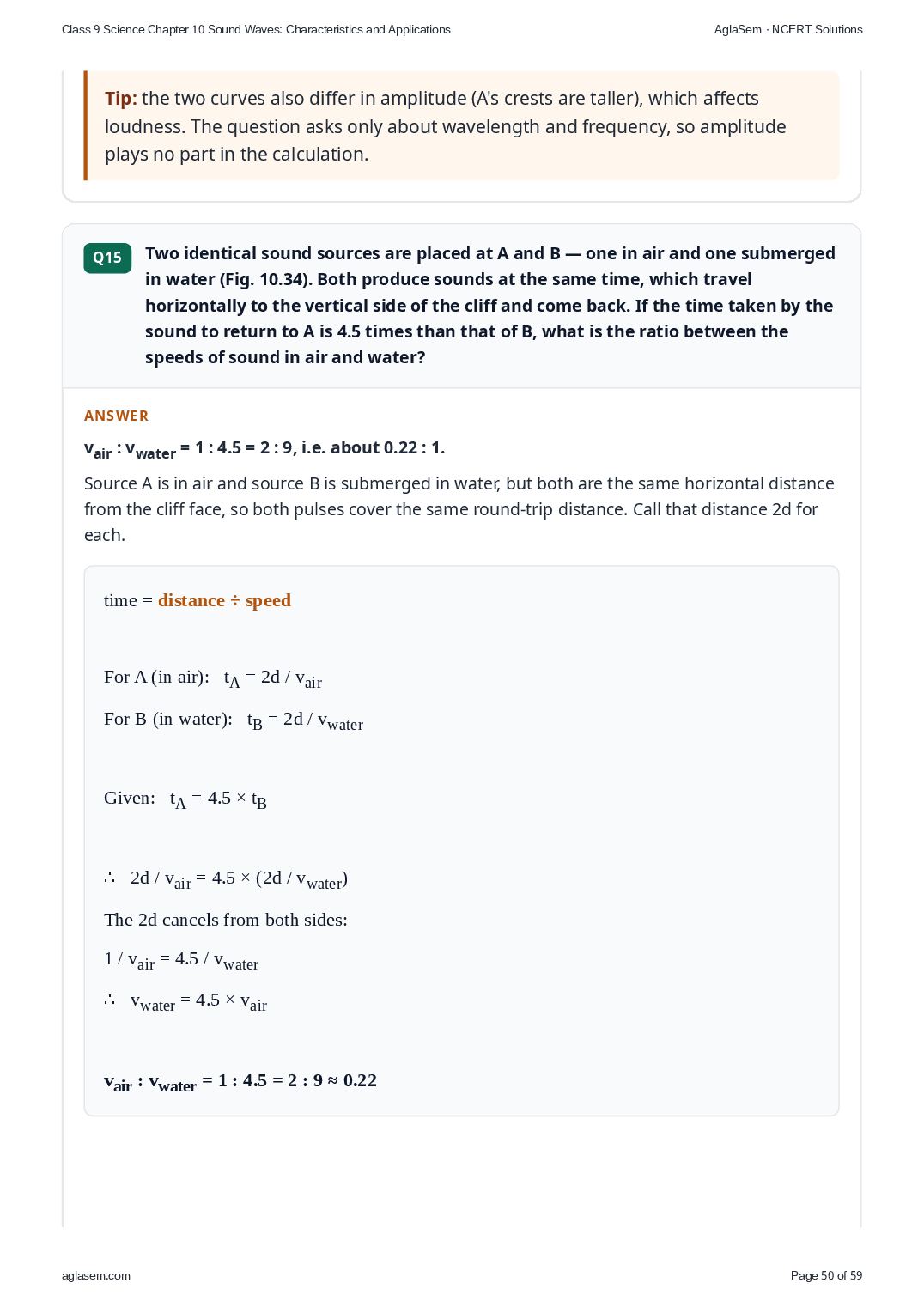
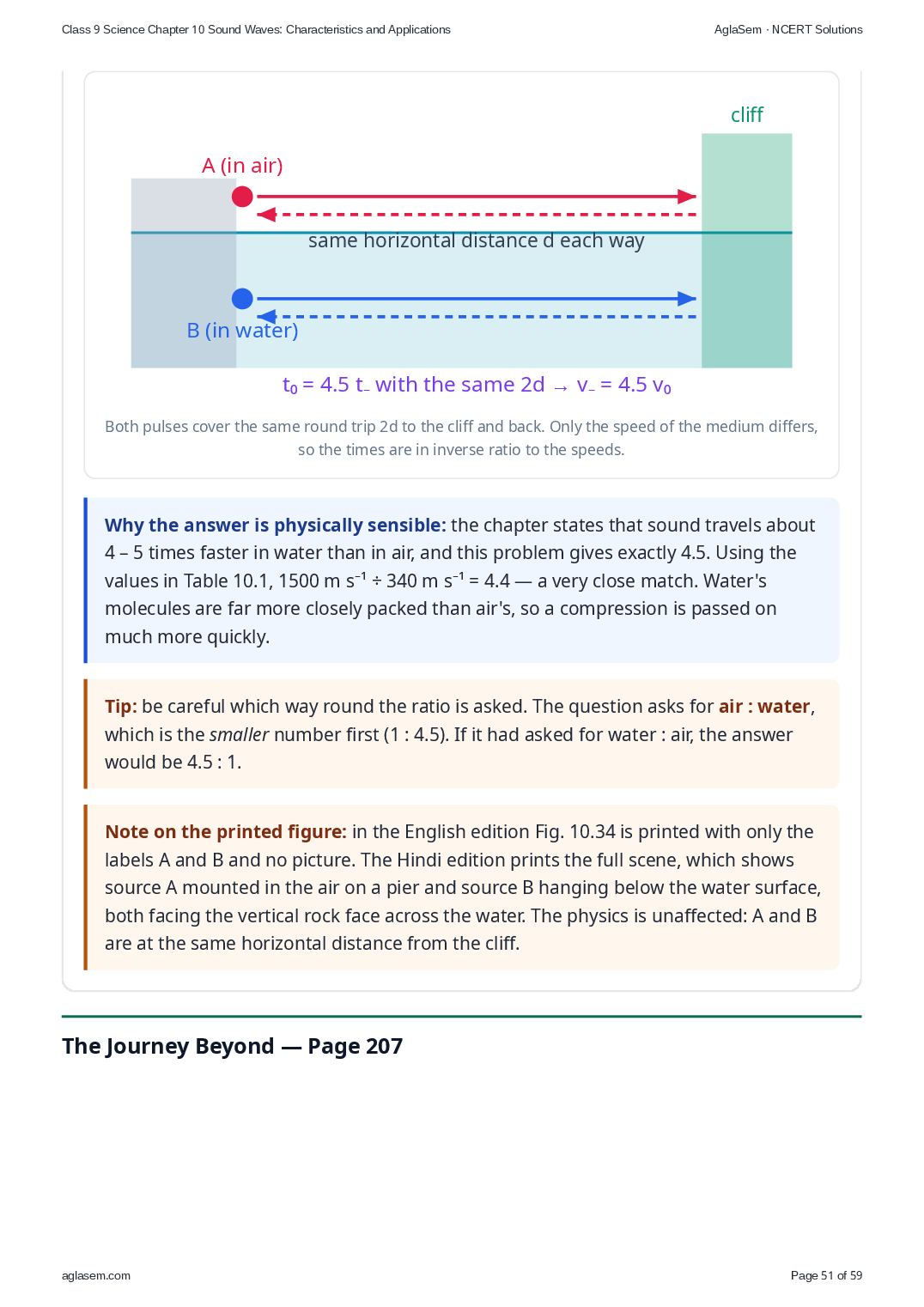
- Two identical sound sources are placed at A and B — one in air and one submerged in water (Fig. 10.34). Both produce sounds at the same time, which travel horizontally to the vertical side of the cliff and come back. If the time taken by the sound to return to A is 4.5 times than that of B, what is the ratio between the speeds of sound in air and water?
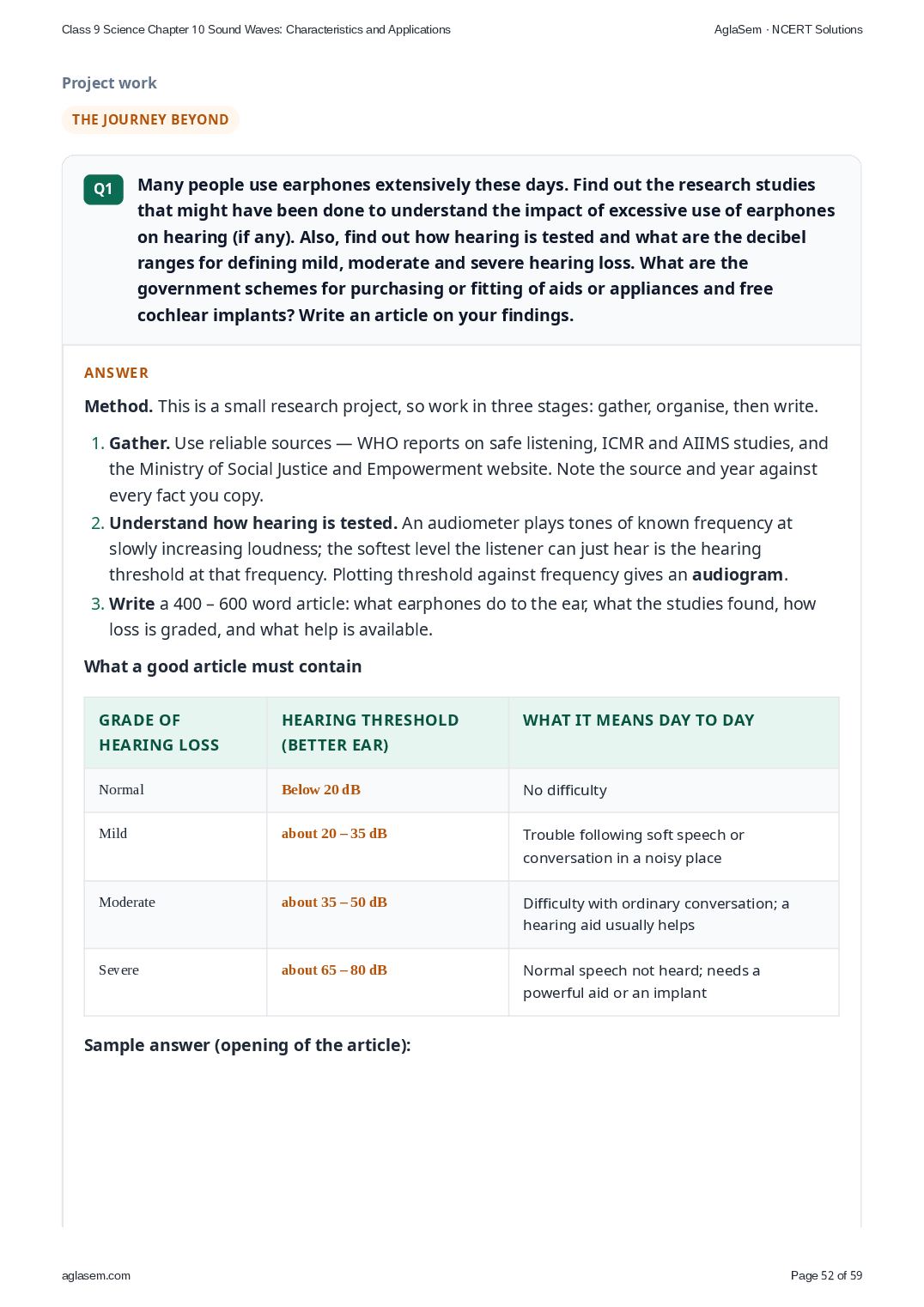
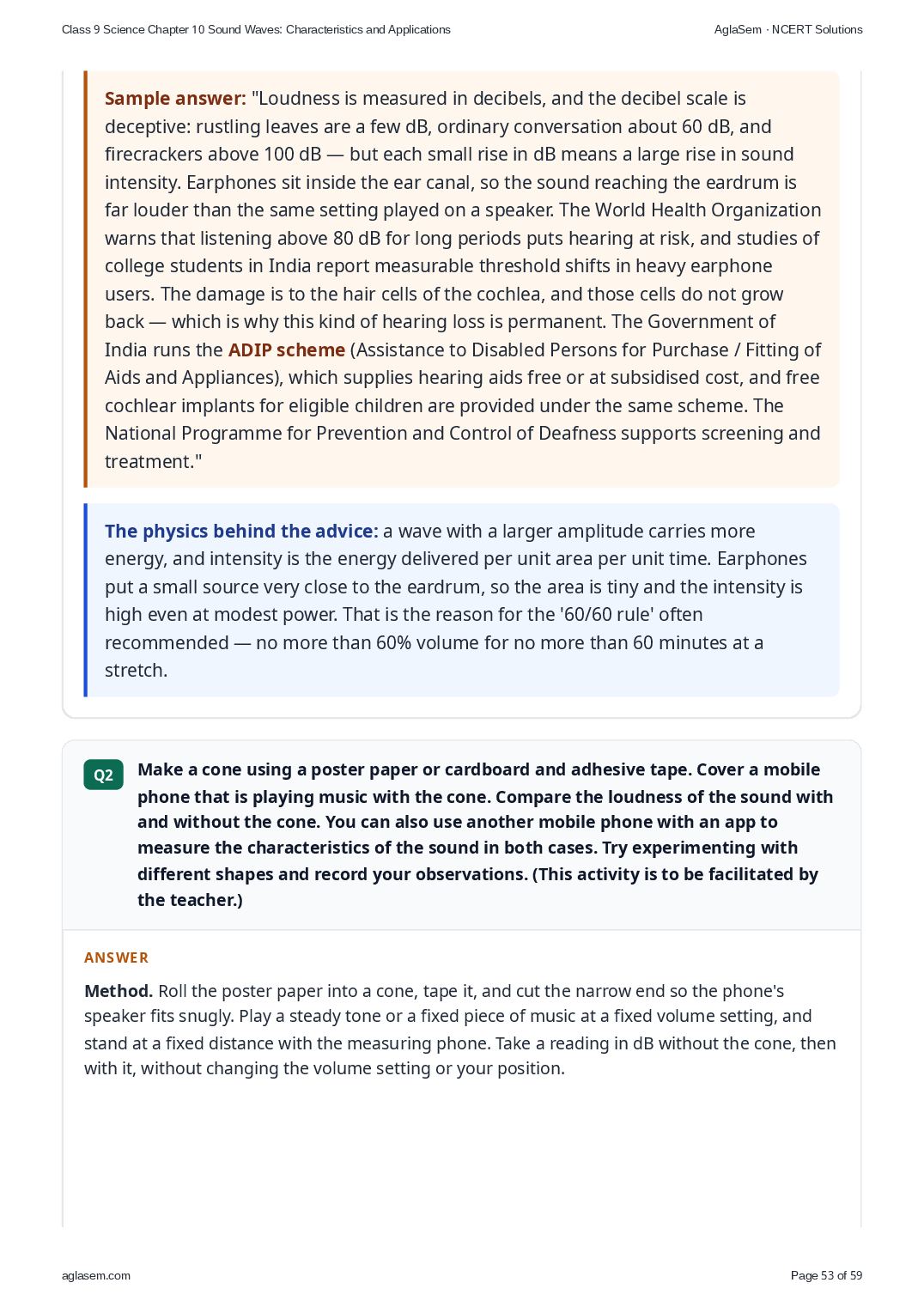
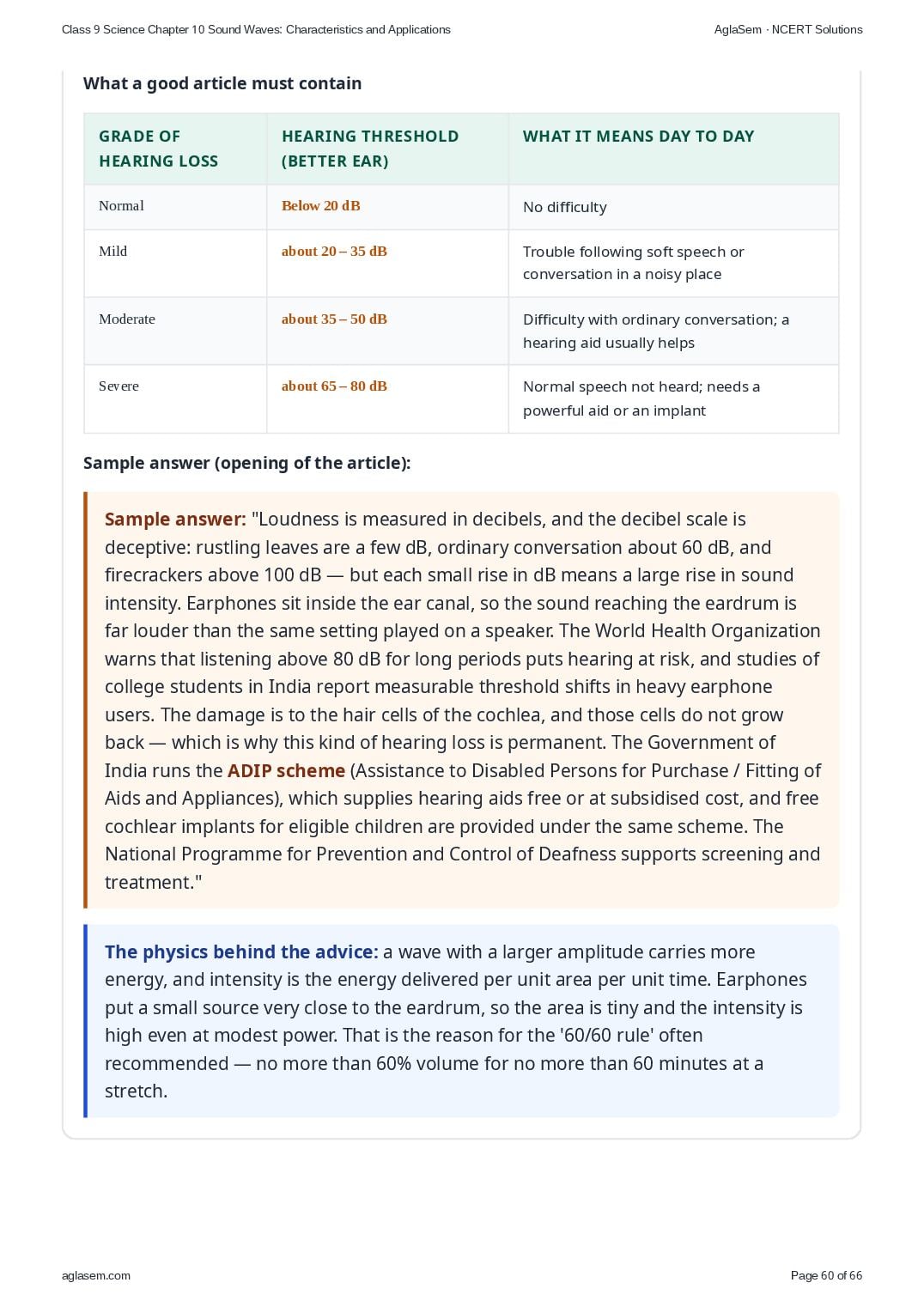
- Many people use earphones extensively these days. Find out the research studies that might have been done to understand the impact of excessive use of earphones on hearing (if any). Also, find out how hearing is tested and what are the decibel ranges for defining mild, moderate and severe hearing loss. What are the government schemes for purchasing or fitting of aids or appliances and free cochlear implants? Write an article on your findings.
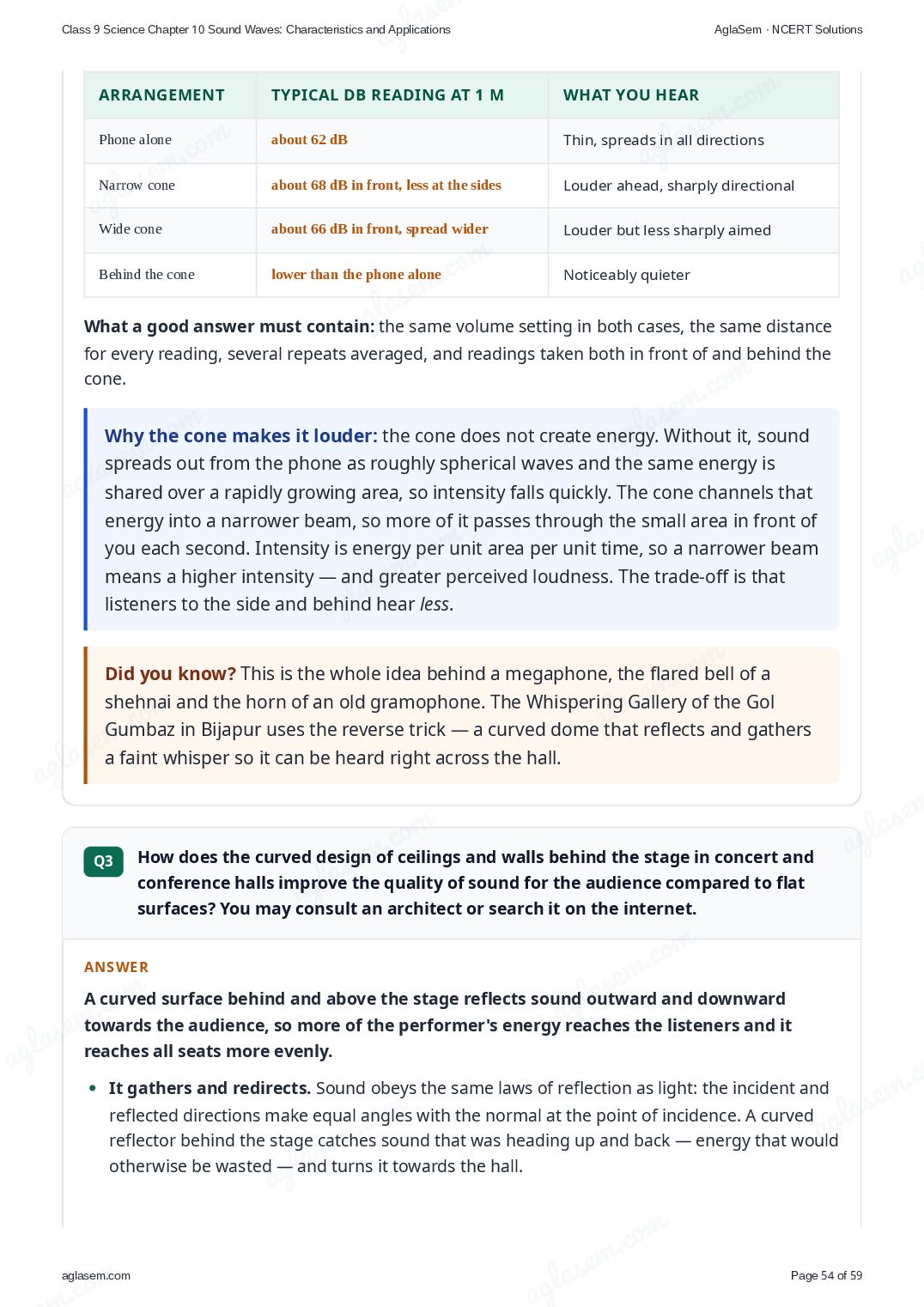
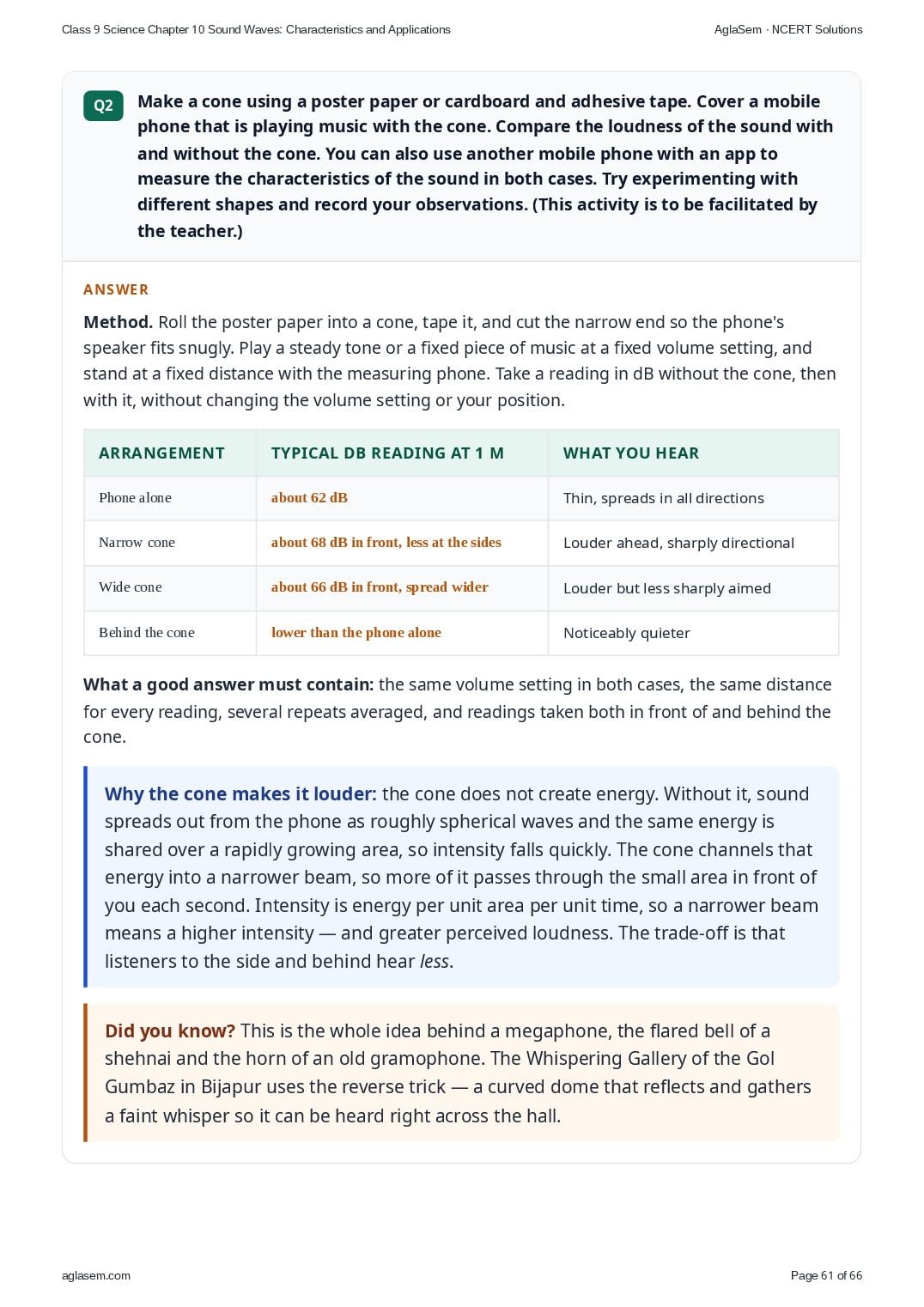
- Make a cone using a poster paper or cardboard and adhesive tape. Cover a mobile phone that is playing music with the cone. Compare the loudness of the sound with and without the cone. You can also use another mobile phone with an app to measure the characteristics of the sound in both cases. Try experimenting with different shapes and record your observations. (This activity is to be facilitated by the teacher.)
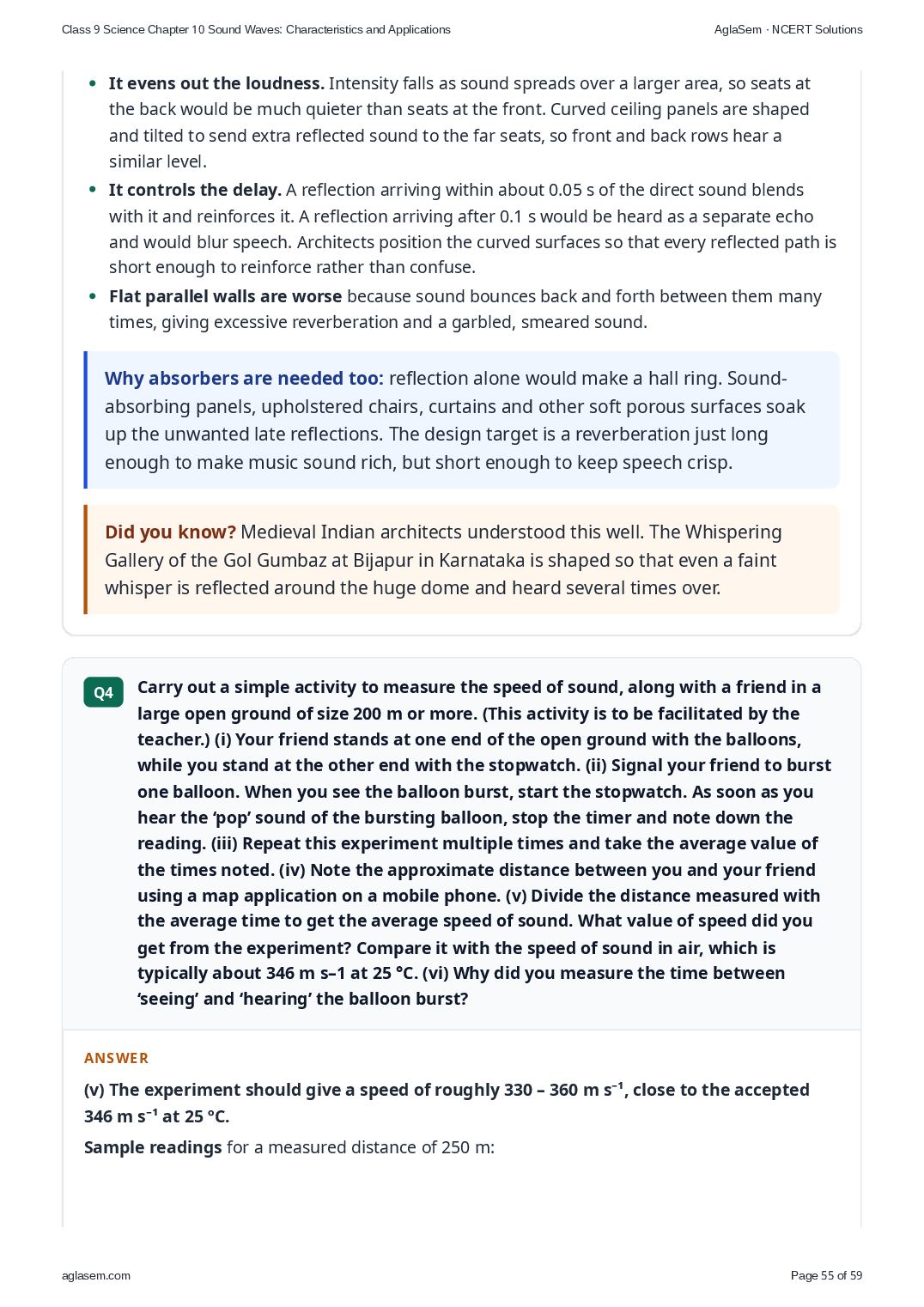
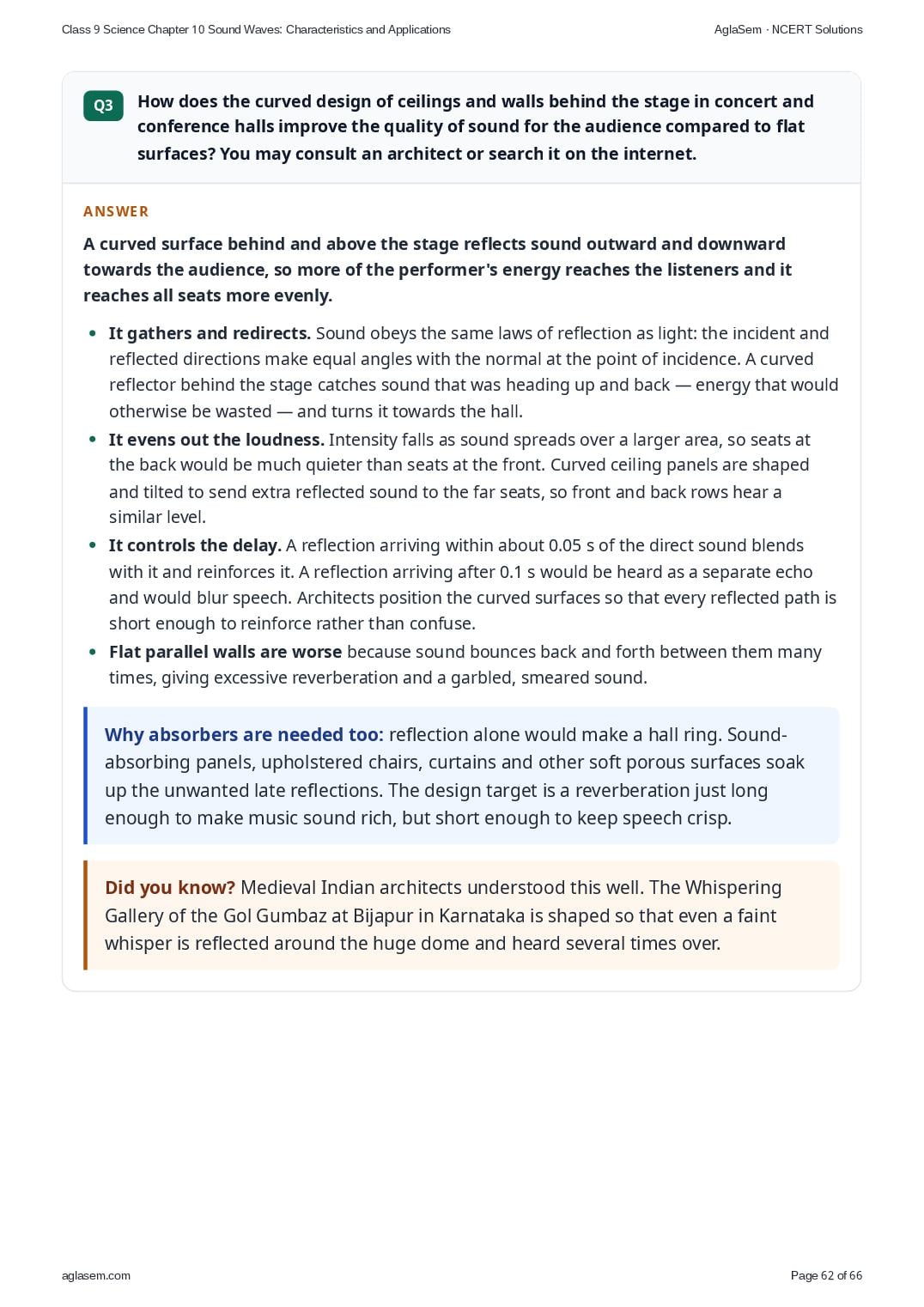
- How does the curved design of ceilings and walls behind the stage in concert and conference halls improve the quality of sound for the audience compared to flat surfaces? You may consult an architect or search it on the internet.
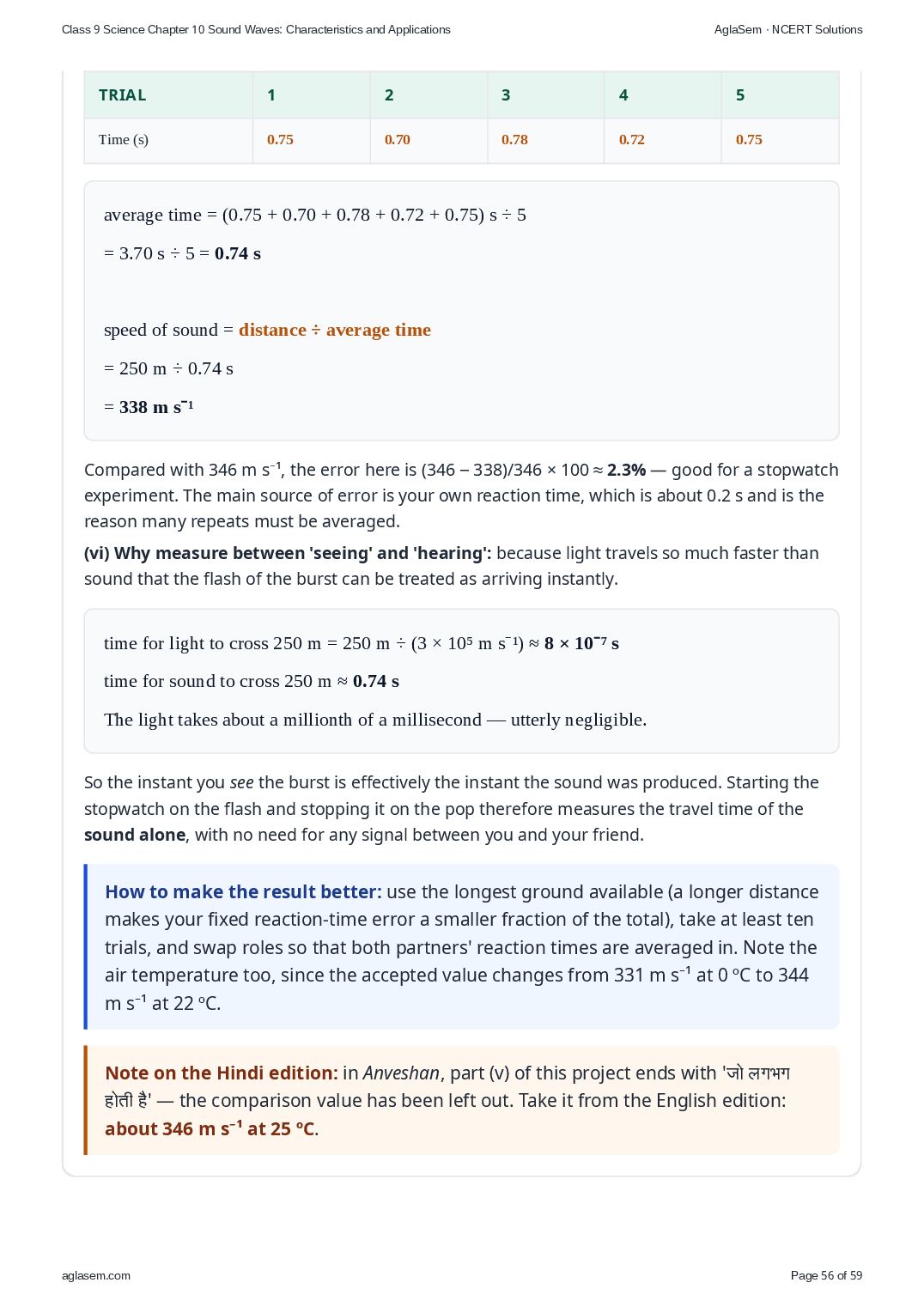
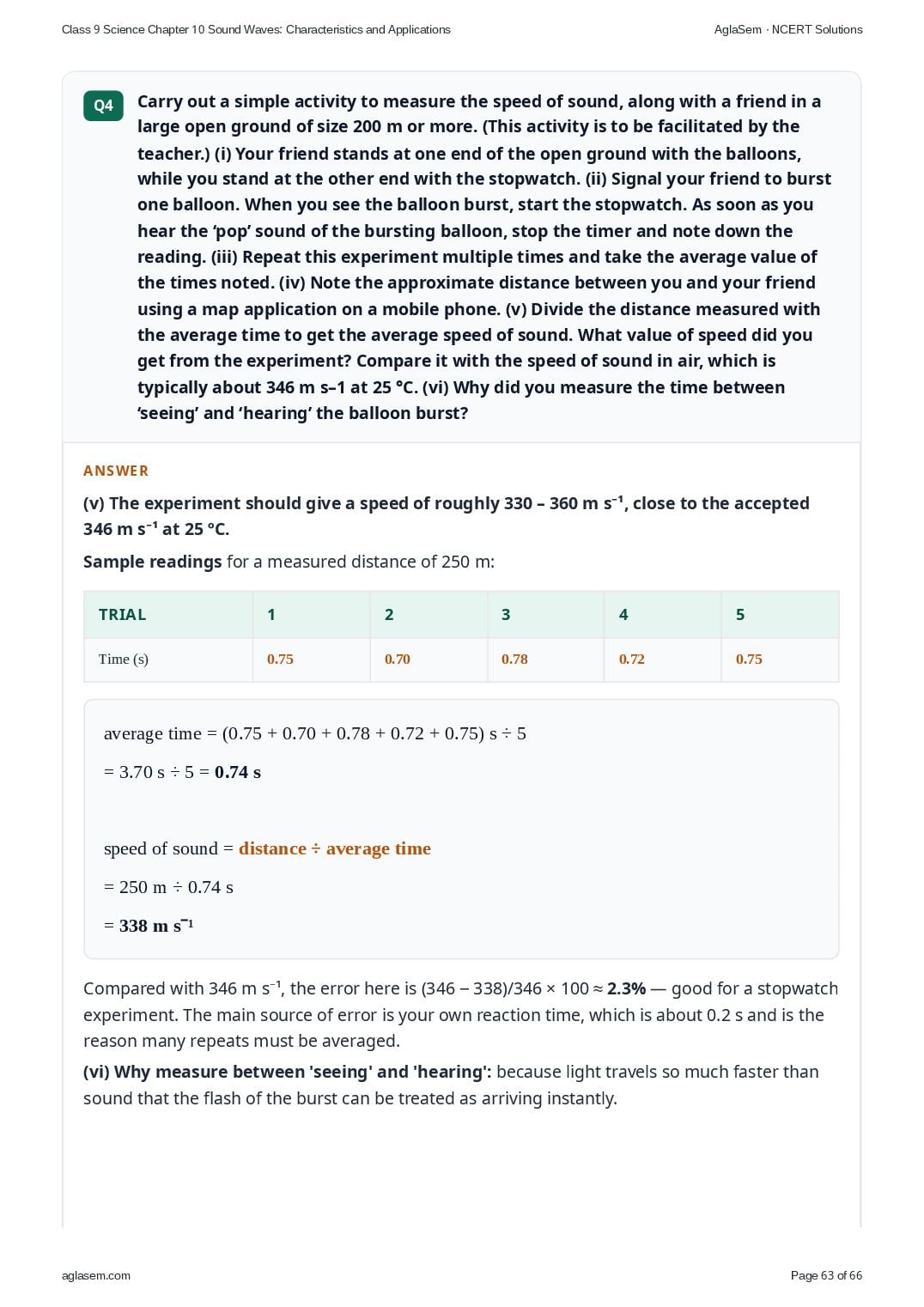
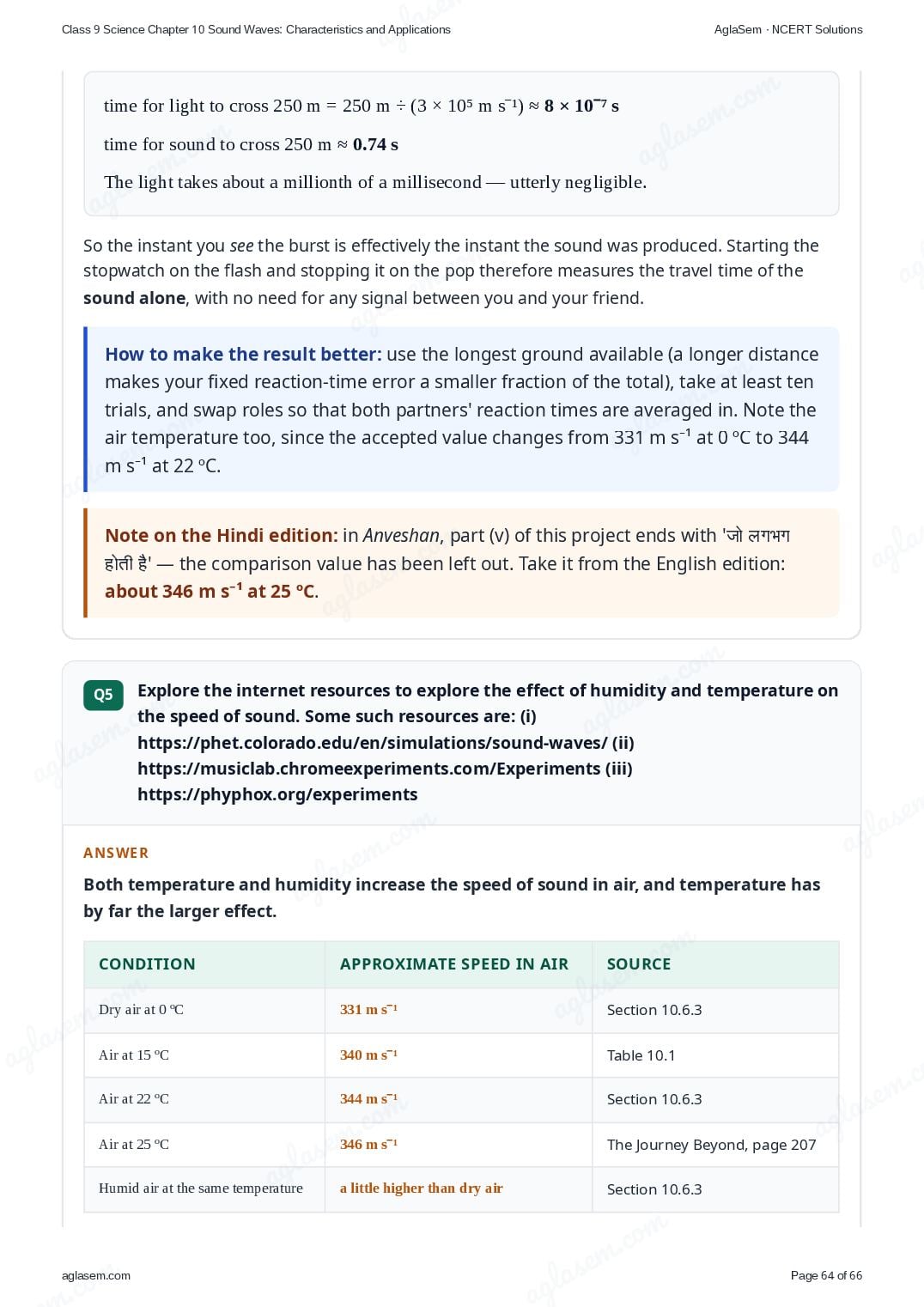
- Carry out a simple activity to measure the speed of sound, along with a friend in a large open ground of size 200 m or more. (This activity is to be facilitated by the teacher.) (i) Your friend stands at one end of the open ground with the balloons, while you stand at the other end with the stopwatch. (ii) Signal your friend to burst one balloon. When you see the balloon burst, start the stopwatch. As soon as you hear the ‘pop’ sound of the bursting balloon, stop the timer and note down the reading. (iii) Repeat this experiment multiple times and take the average value of the times noted. (iv) Note the approximate distance between you and your friend using a map application on a mobile phone. (v) Divide the distance measured with the average time to get the average speed of sound. What value of speed did you get from the experiment? Compare it with the speed of sound in air, which is typically about 346 m s–1 at 25 °C. (vi) Why did you measure the time between ‘seeing’ and ‘hearing’ the balloon burst?
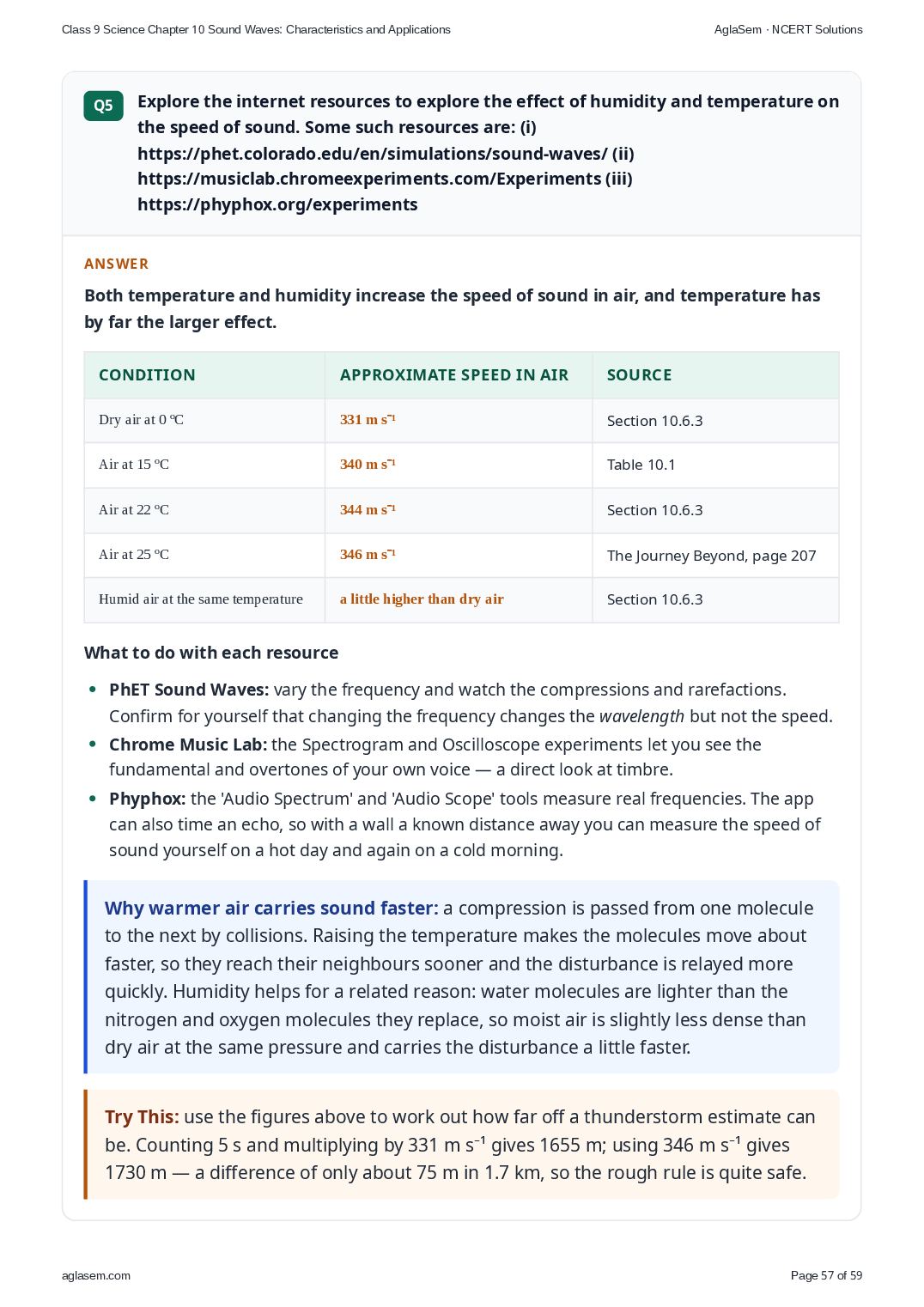
- Explore the internet resources to explore the effect of humidity and temperature on the speed of sound. Some such resources are: (i) https://phet.colorado.edu/en/simulations/sound-waves/ (ii) https://musiclab.chromeexperiments.com/Experiments (iii) https://phyphox.org/experiments
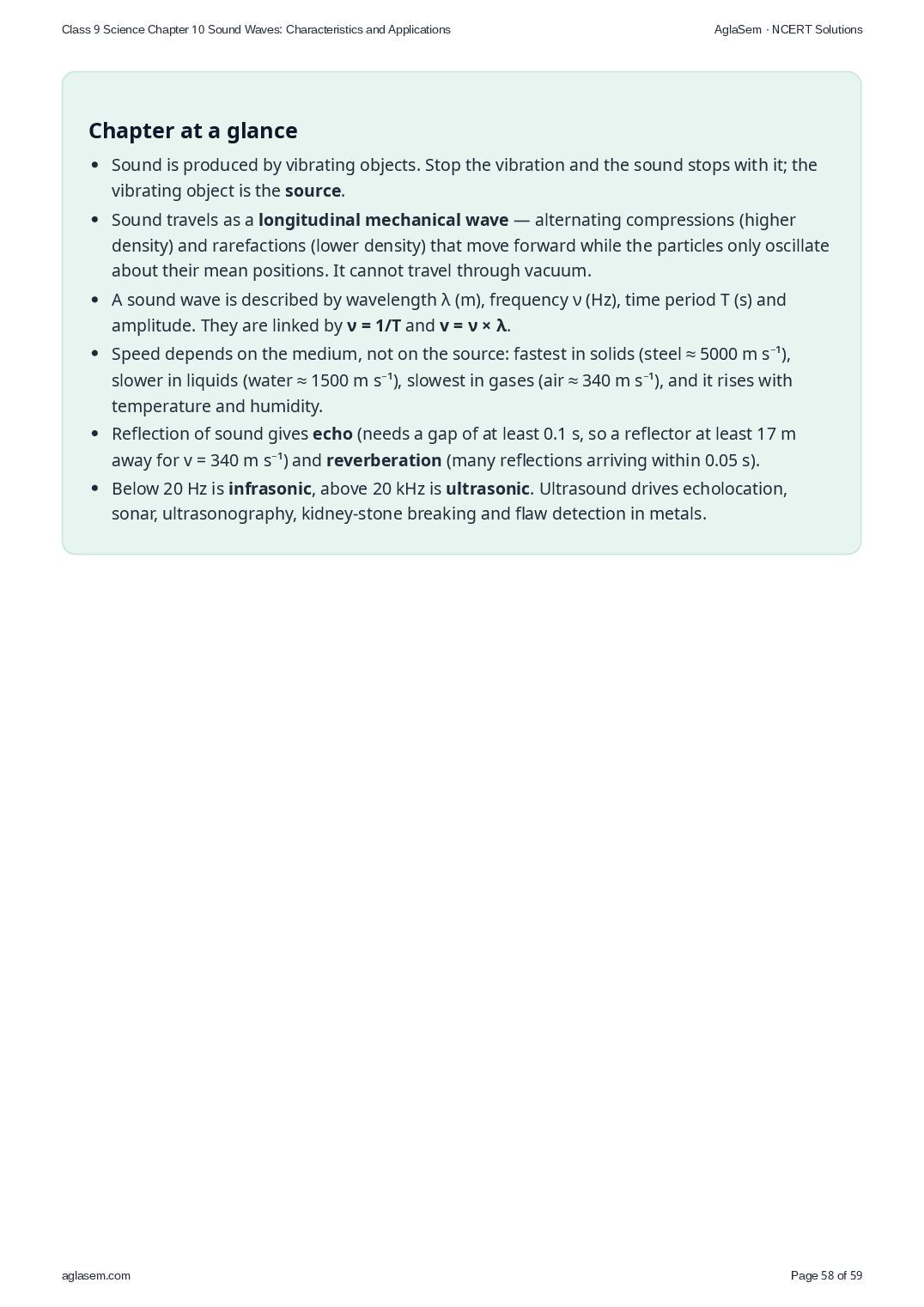
Chapter at a Glance
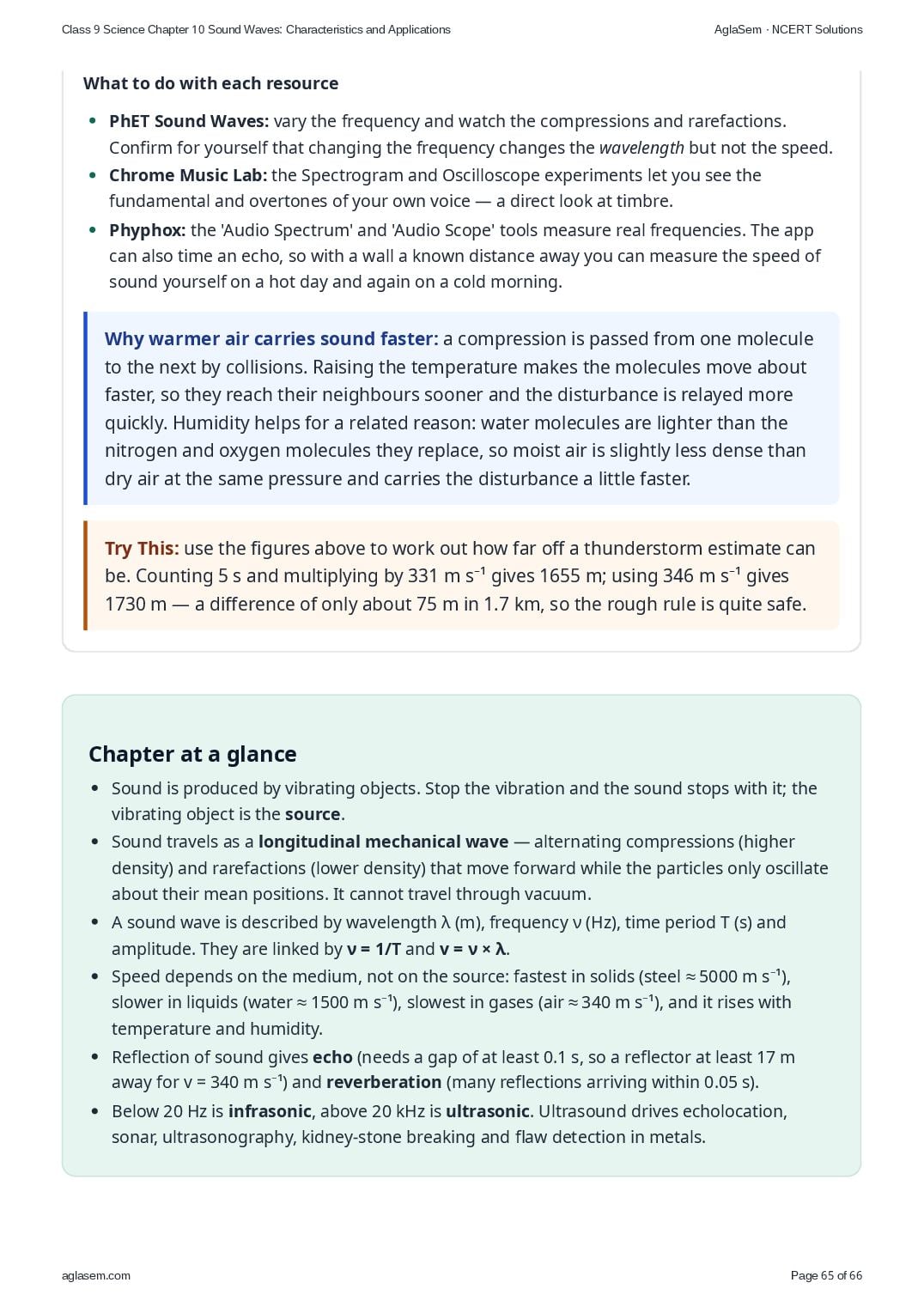
- Sound is produced by vibrating objects. Stop the vibration and the sound stops with it; the vibrating object is the source .
- Sound travels as a longitudinal mechanical wave — alternating compressions (higher density) and rarefactions (lower density) that move forward while the particles only oscillate about their mean positions. It cannot travel through vacuum.
- A sound wave is described by wavelength λ (m), frequency ν (Hz), time period T (s) and amplitude. They are linked by ν = 1/T and v = ν × λ .
- Speed depends on the medium, not on the source: fastest in solids (steel ≈ 5000 m s⁻¹), slower in liquids (water ≈ 1500 m s⁻¹), slowest in gases (air ≈ 340 m s⁻¹), and it rises with temperature and humidity.
- Reflection of sound gives echo (needs a gap of at least 0.1 s, so a reflector at least 17 m away for v = 340 m s⁻¹) and reverberation (many reflections arriving within 0.05 s).
- Below 20 Hz is infrasonic , above 20 kHz is ultrasonic . Ultrasound drives echolocation, sonar, ultrasonography, kidney-stone breaking and flaw detection in metals.
How to Download NCERT Solutions for Class 9 Science Chapter 10 PDF
Follow these simple steps to get the Sound Waves Characteristics and Applications questions-and-answers PDF from Exploration.
- Search NCERT Solutions for Class 9 Science Chapter 10 aglasem and open this page.
- Read the exercise questions with answers for Sound Waves Characteristics and Applications shown above.
- Click the Download PDF link to save the Sound Waves Characteristics and Applications solutions to your device.
NCERT Solutions for Class 9 Science – All Chapters
There are more chapters to study besides Sound Waves Characteristics and Applications in Science. Here are the NCERT Solutions for all chapters of Class 9 Science.
- Chapter 1 Exploration Entering the World of Secondary Science
- Chapter 2 Cell the Building Block of Life
- Chapter 3 Tissues in Action
- Chapter 4 Describing Motion Around Us
- Chapter 5 Exploring Mixtures and Their Separation
- Chapter 6 How Forces Affect Motion
- Chapter 7 Work Energy and Simple Machines
- Chapter 8 Journey Inside the Atom
- Chapter 9 Atomic Foundations of Matter
- Chapter 10 Sound Waves Characteristics and Applications
- Chapter 11 Reproduction How Life Continues
- Chapter 12 Patterns in Life Diversity and Classification
- Chapter 13 Earth As a System Energy Matter and Life
NCERT Solutions for Class 9 – All Subjects
Just like Chapter 10 of Science, you can get the exercise questions with answers for every other subject of Class 9. Here are the NCERT Solutions for all subjects of Class 9.
NCERT Solutions for Class 9 Science Chapter 10 – An Overview
The key highlights of this study material are as follows.
| Aspects | Details |
|---|---|
| Class | Class 9 |
| Subject | Science |
| Chapter Number | Chapter 10 |
| Chapter Name | Sound Waves Characteristics and Applications |
| Book Name | Exploration |
| Book By | NCERT (National Council of Educational Research and Training) |
| Educational Resource Here | NCERT Solutions of Class 9 Science Chapter 10 for all exercises |
| More Questions Answers of This Subject | NCERT Solutions for Class 9 Science |
| Download Book Chapter | NCERT Book Class 9 Science |
| All Questions Answers For This Class | NCERT Solutions for Class 9 |
| Complete Solutions | NCERT Solutions |
NCERT Solutions for Class 9 Science Chapter 10 Sound Waves Characteristics and Applications – FAQs
What are the NCERT Solutions for Class 9 Science Chapter 10 Sound Waves Characteristics and Applications?
They are the complete, step-by-step answers to all the exercise and in-text questions of Chapter 10 Sound Waves Characteristics and Applications from the NCERT Class 9 Science textbook Exploration, written by experts as per the latest NCERT syllabus.
How can I download the Class 9 Science Chapter 10 solutions PDF for free?
Open this page on aglasem, read the Sound Waves Characteristics and Applications questions with answers, and click the “Download Solutions PDF” link. The Class 9 Science Chapter 10 NCERT Solutions PDF is completely free to download.
Are these NCERT Solutions as per the latest 2026-27 syllabus?
Yes. The NCERT Solutions for Class 9 Science Chapter 10 are based on the latest NCERT textbook Exploration and the current 2026-27 CBSE syllabus, so the questions and answers match what you study in class.
Where can I get NCERT Solutions for the other chapters of Class 9 Science?
You can find the answers to every chapter on the NCERT Solutions for Class 9 Science page, and solutions for every subject on the NCERT Solutions for Class 9 page.
How do NCERT Solutions help in exam preparation?
They show the correct method to solve each question, help you write answers the way they are expected in exams, let you check and correct your own work, and save revision time — which together improve your marks in Class 9 Science.
If you have any queries on NCERT Solutions for Class 9 Science Chapter 10 Sound Waves Characteristics and Applications, then please ask in the comments below.