NCERT Solutions for Class 9 Science Chapter 8 Journey Inside the Atom provide clear, step-by-step answers to every exercise and in-text question from the chapter Journey Inside the Atom of the NCERT textbook Exploration. Prepared by subject experts as per the latest NCERT (CBSE) syllabus for 2026-27, these NCERT Solutions for Class 9 Science help you understand each concept, write exam-ready answers, and check your own solutions. You can read them online below or download the free Class 9 Science Chapter 8 question-answer PDF.
NCERT Solutions for Class 9 Science Chapter 8 Journey Inside the Atom
- Class: Class 9
- Subject: Science
- Chapter: Chapter 8 – Journey Inside the Atom
- Textbook: Exploration (NCERT)
- Study material: NCERT Solutions – questions with answers, free PDF
These solutions answer all the exercise questions of Chapter 8 Journey Inside the Atom — including the in-text questions, short-answer and long-answer questions, and activities — with complete explanations so you can follow the method, not just the final answer. Read the full solutions below.
NCERT Solutions Class 9 Science Chapter 8 Journey Inside the Atom View Download



NCERT Solutions for Class 9 Science Chapter 8 PDF Download
You can read the NCERT Solutions for Class 9 Science Chapter 8 online above, or download the complete question-answer PDF to study Journey Inside the Atom offline at any time.
NCERT Solutions for Class 9 Science Chapter 8 PDF Download Link – Click Here to Download Solutions PDF
Questions Covered in This Chapter
These NCERT Solutions answer all 63 questions of this chapter. The questions solved are:
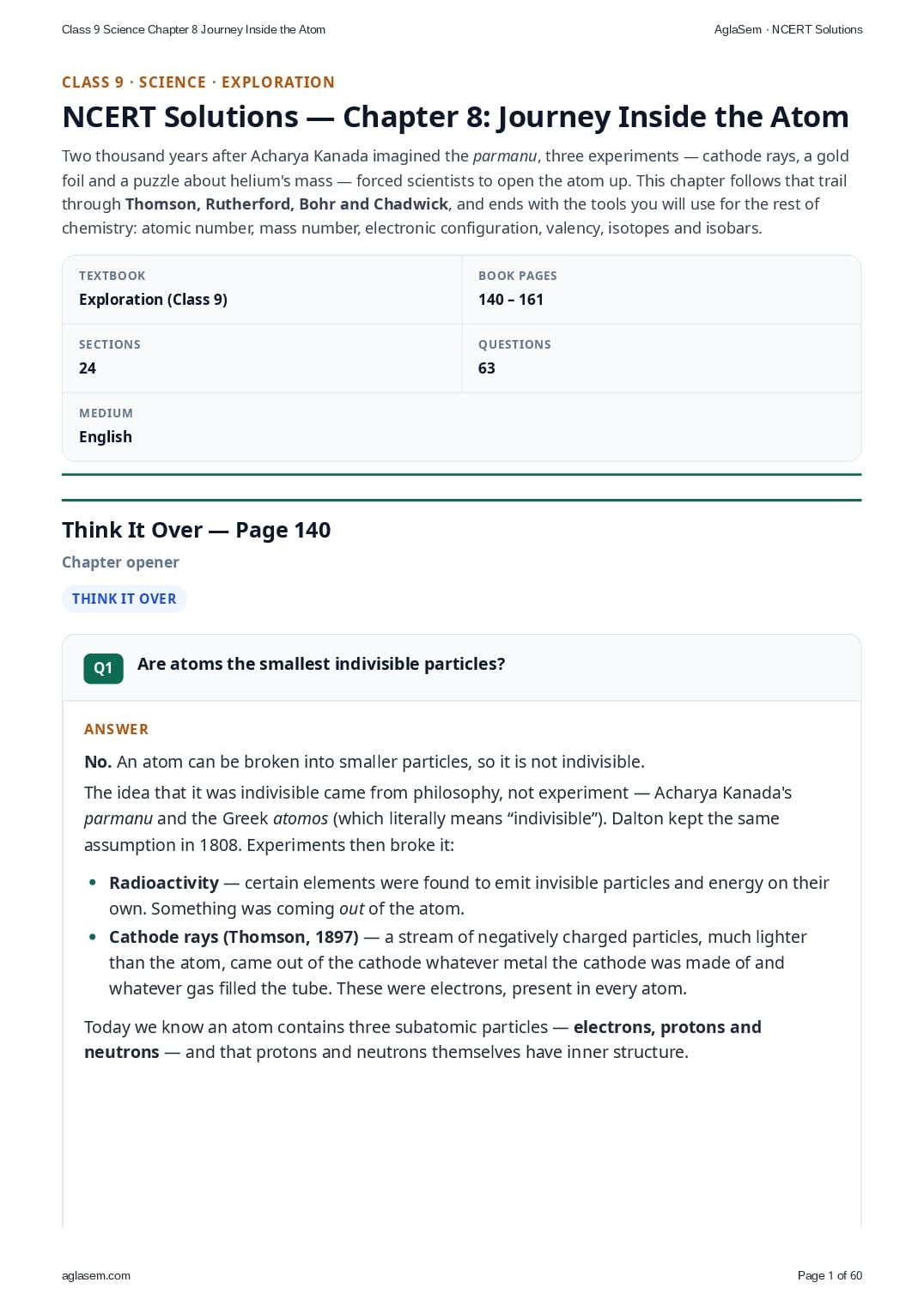
- Are atoms the smallest indivisible particles?
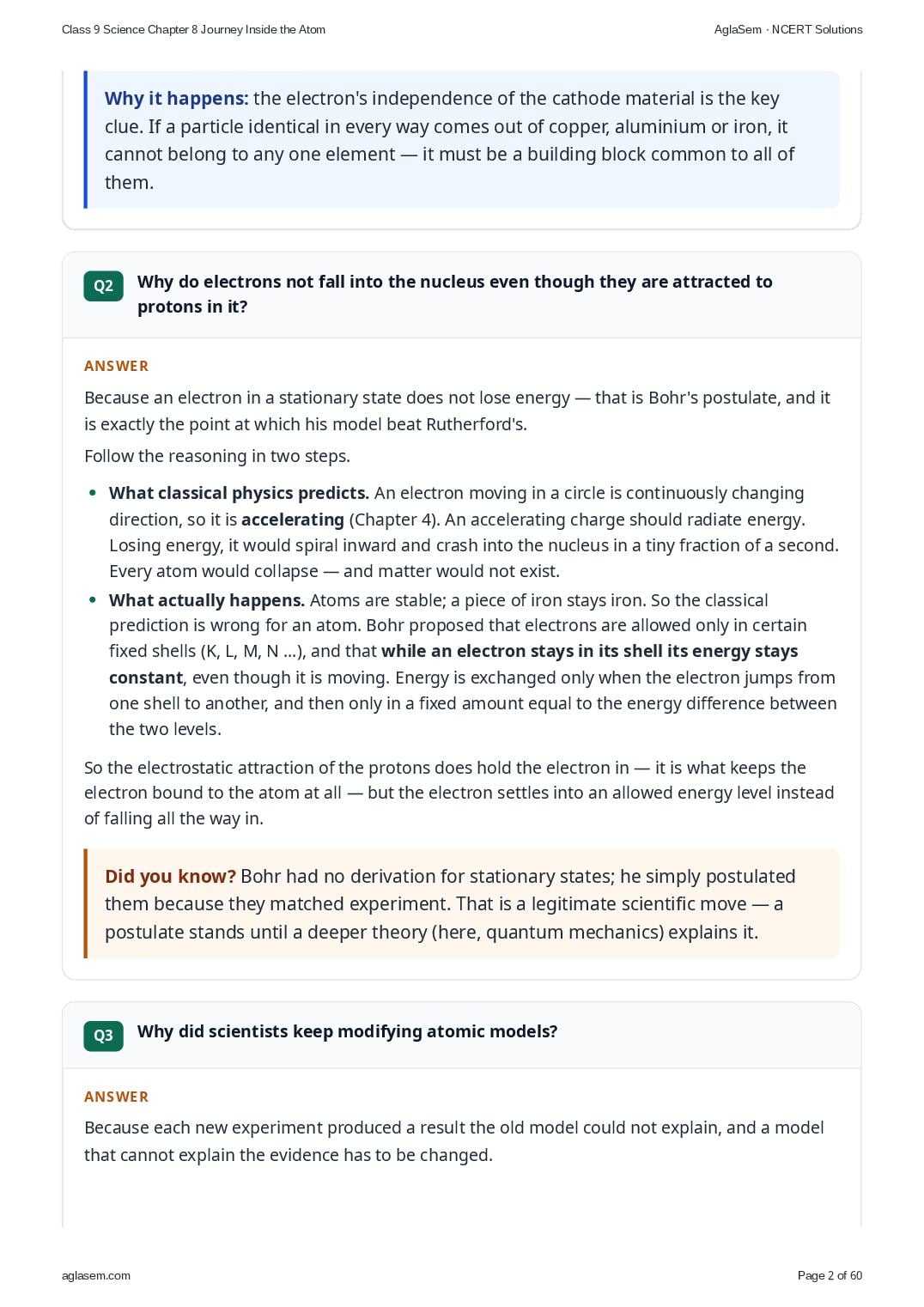
- Why do electrons not fall into the nucleus even though they are attracted to protons in it?
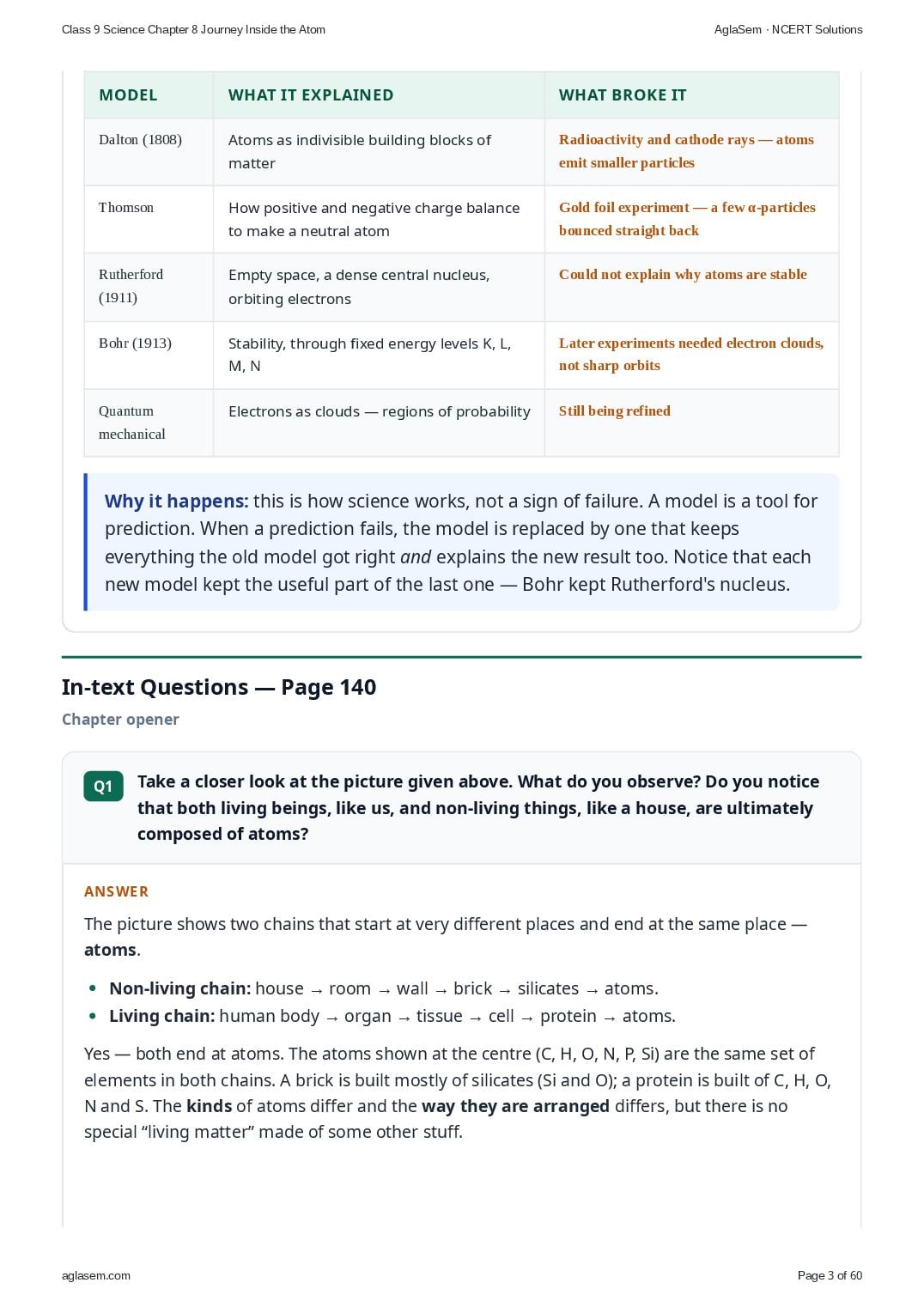
- Why did scientists keep modifying atomic models?
- Take a closer look at the picture given above. What do you observe? Do you notice that both living beings, like us, and non-living things, like a house, are ultimately composed of atoms?
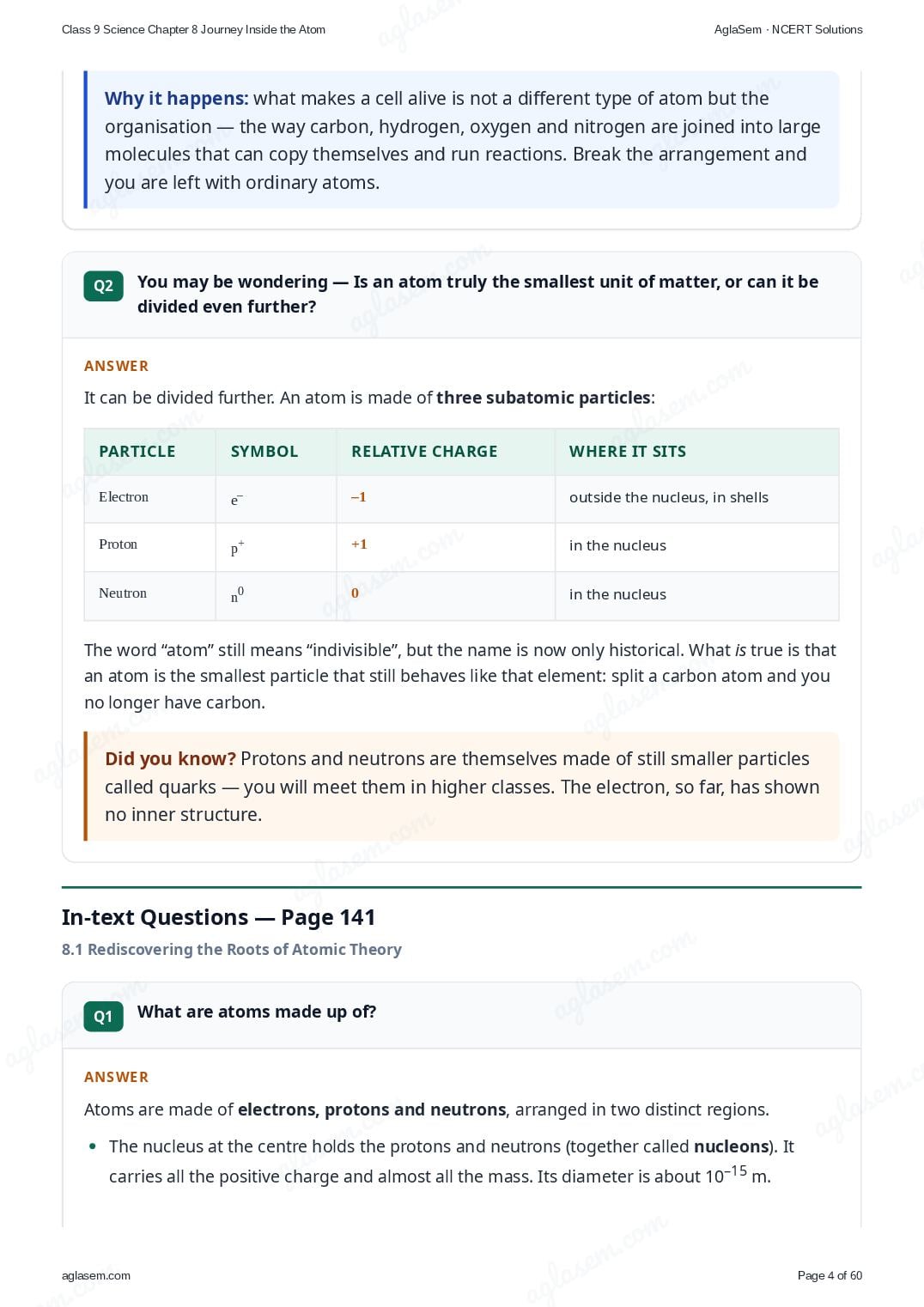
- You may be wondering — Is an atom truly the smallest unit of matter, or can it be divided even further?
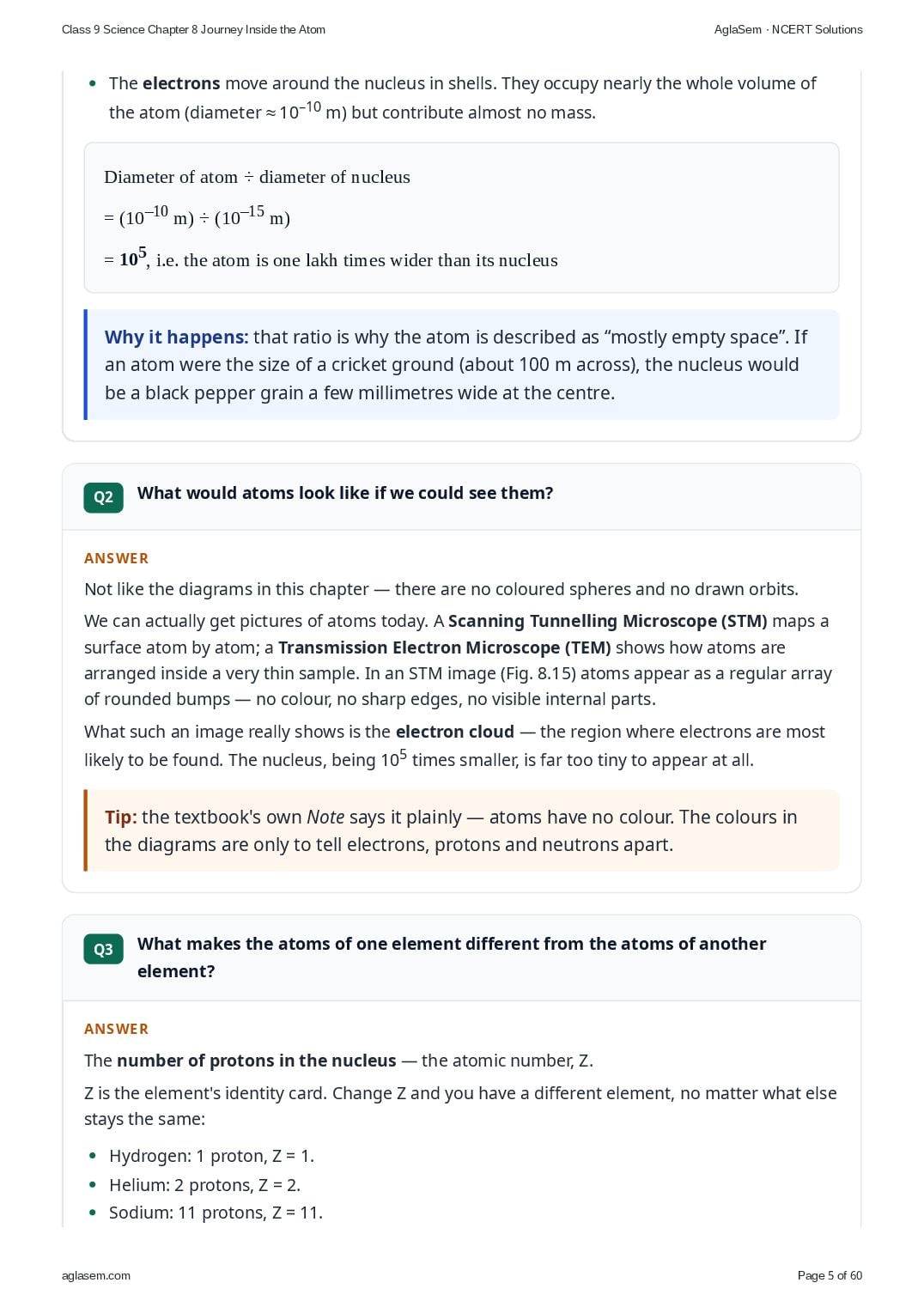
- What are atoms made up of?
- What would atoms look like if we could see them?
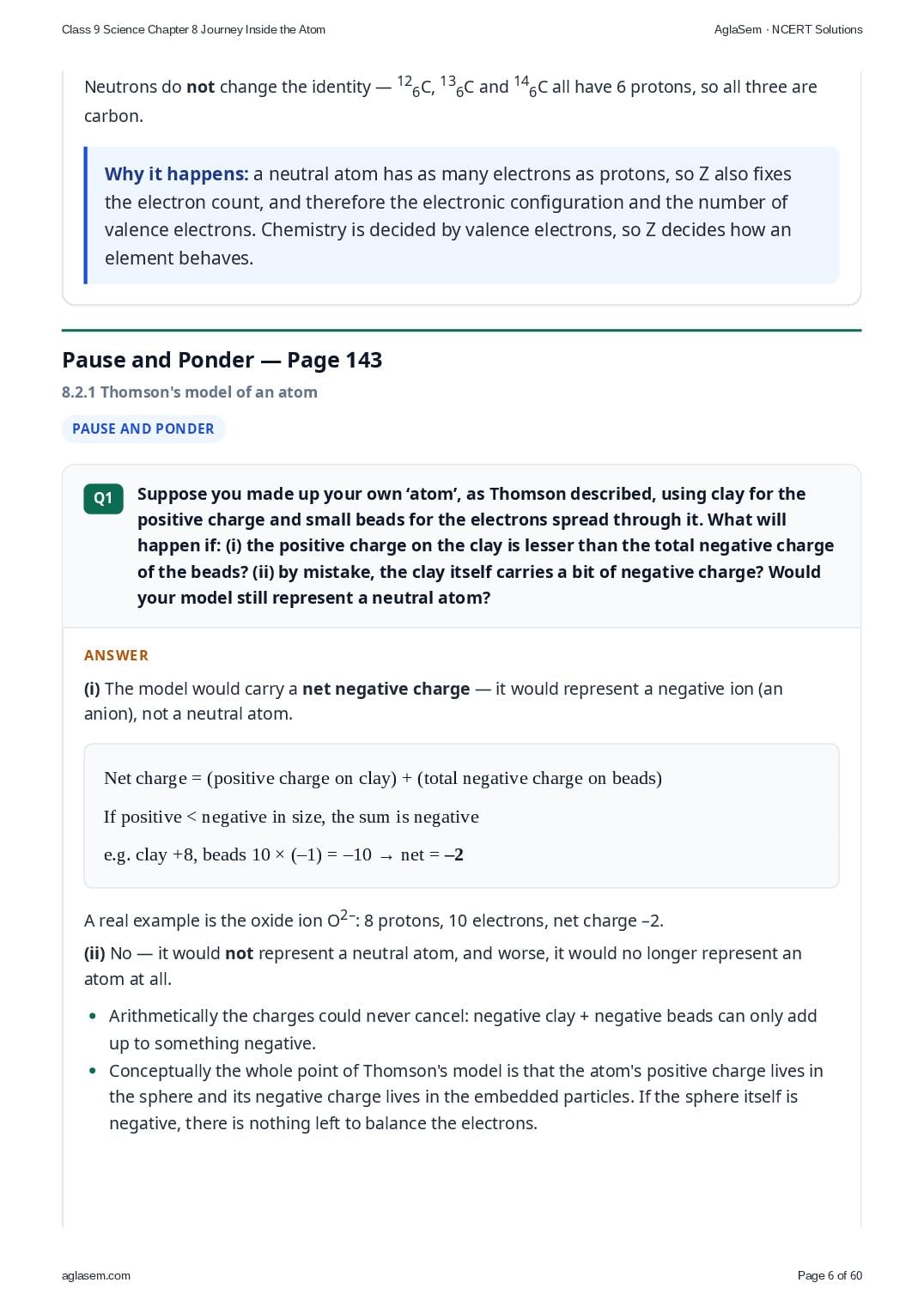
- What makes the atoms of one element different from the atoms of another element?
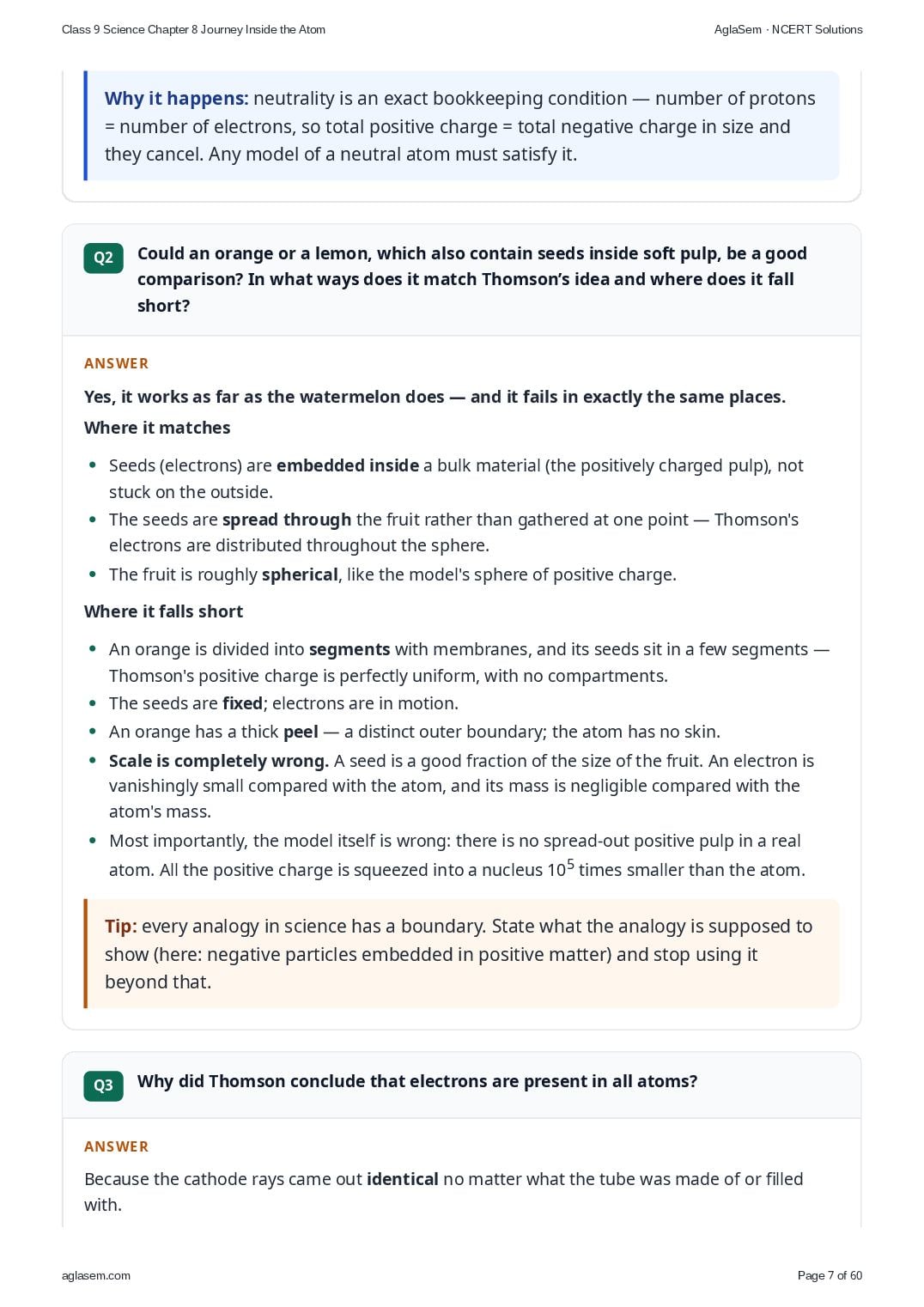
- Suppose you made up your own ‘atom’, as Thomson described, using clay for the positive charge and small beads for the electrons spread through it. What will happen if: (i) the positive charge on the clay is lesser than the total negative charge of the beads? (ii) by mistake, the clay itself carries a bit of negative charge? Would your model still represent a neutral atom?
- Could an orange or a lemon, which also contain seeds inside soft pulp, be a good comparison? In what ways does it match Thomson’s idea and where does it fall short?
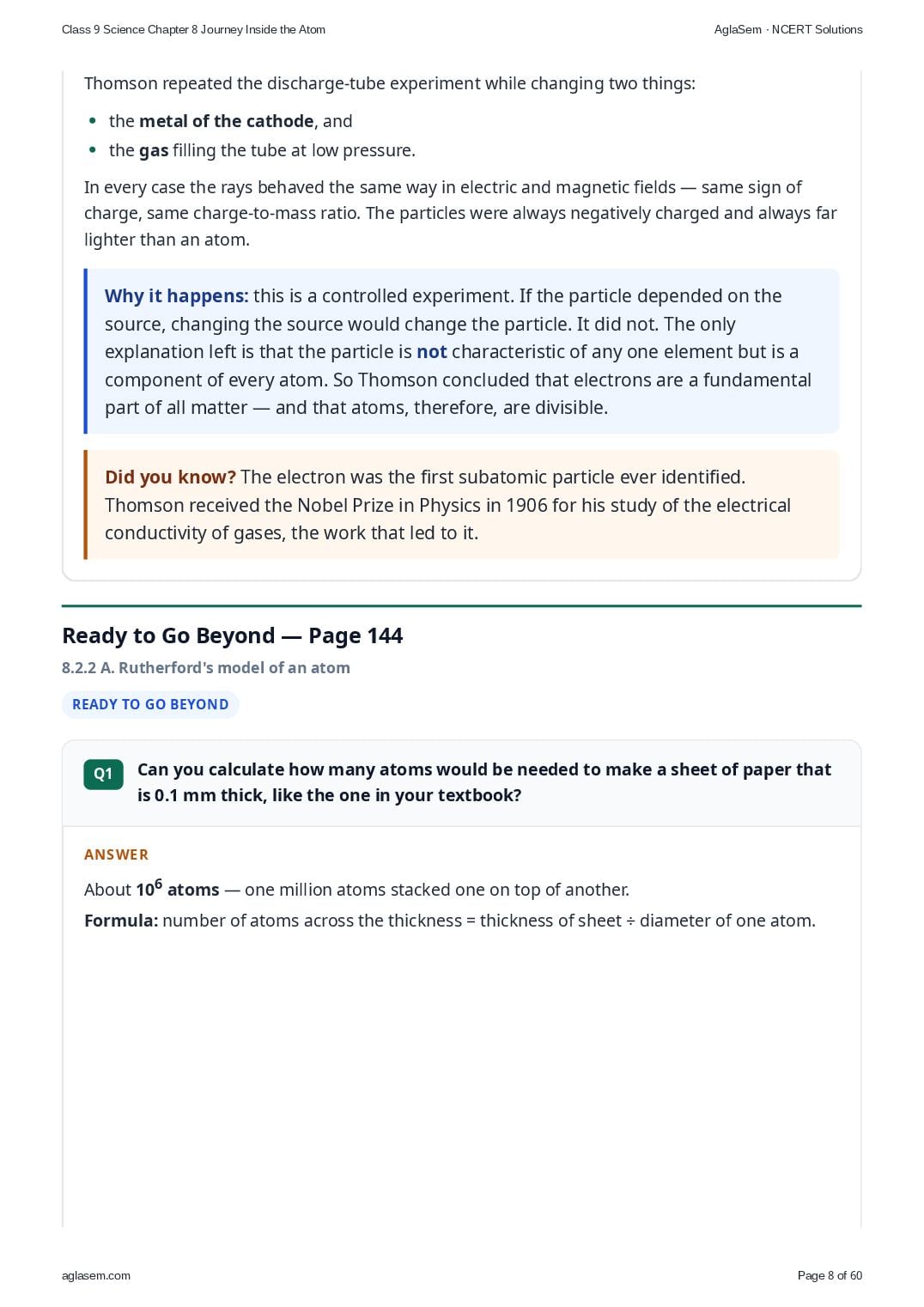
- Why did Thomson conclude that electrons are present in all atoms?
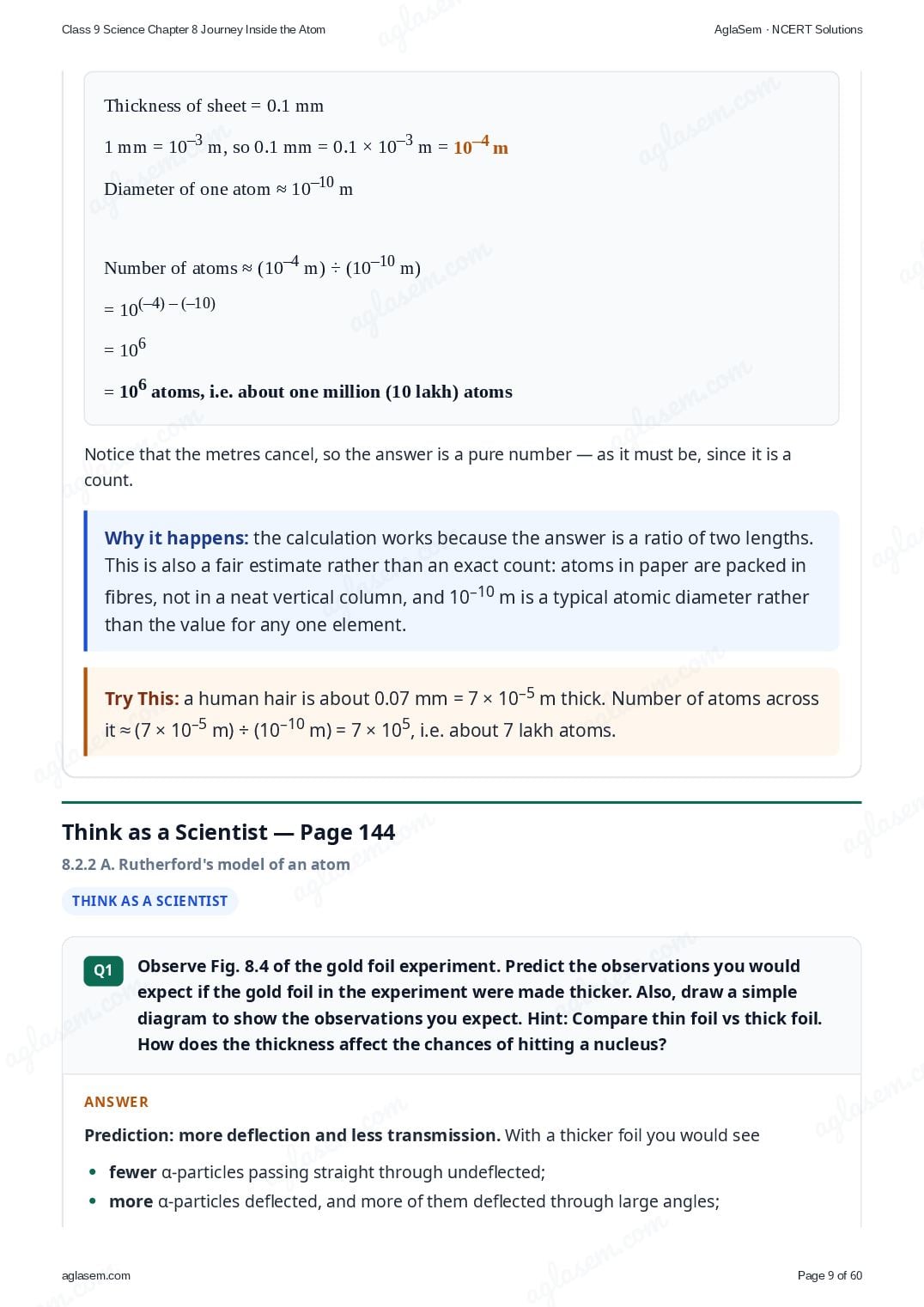
- Can you calculate how many atoms would be needed to make a sheet of paper that is 0.1 mm thick, like the one in your textbook?
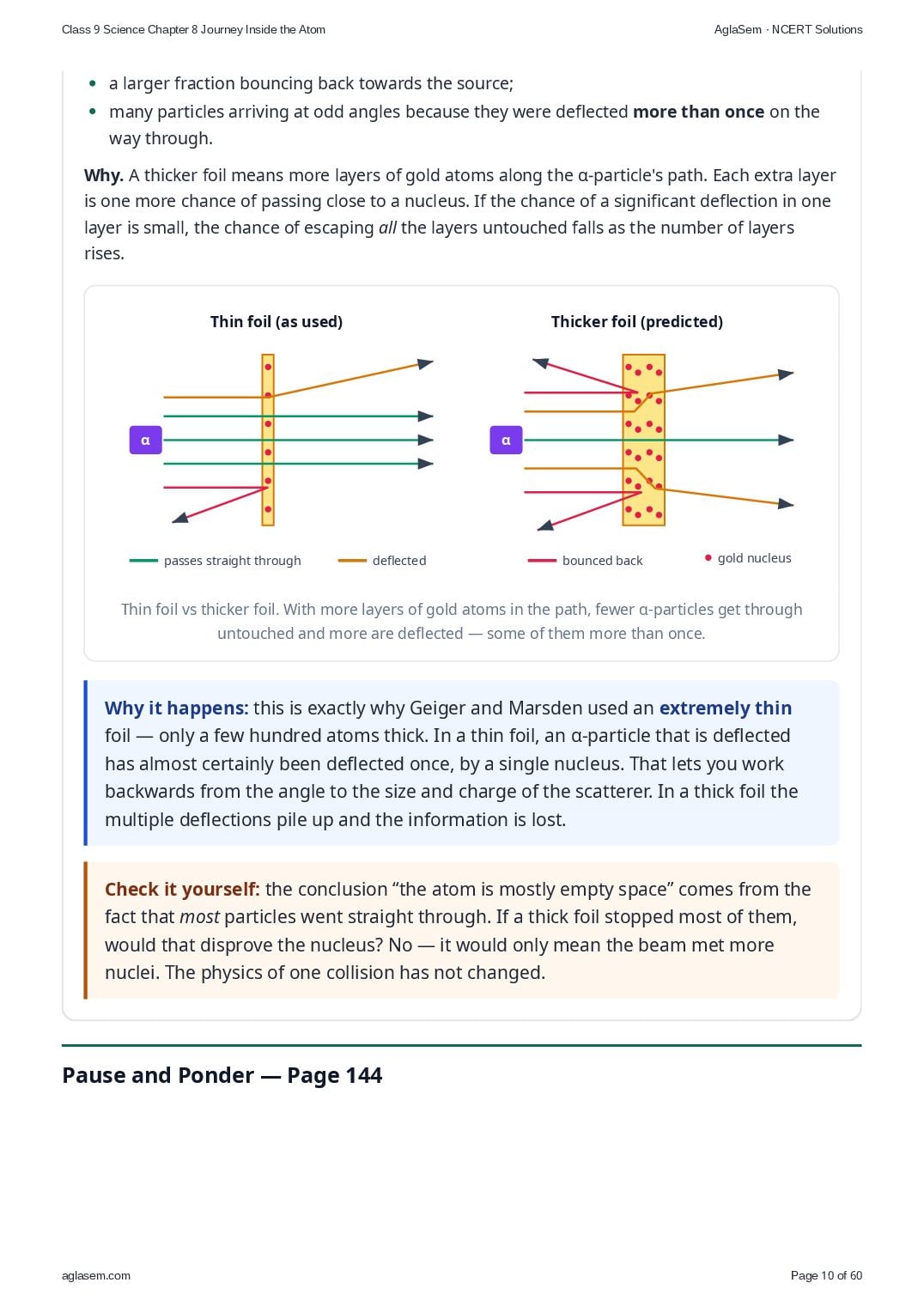
- Observe Fig. 8.4 of the gold foil experiment. Predict the observations you would expect if the gold foil in the experiment were made thicker. Also, draw a simple diagram to show the observations you expect. Hint: Compare thin foil vs thick foil. How does the thickness affect the chances of hitting a nucleus?
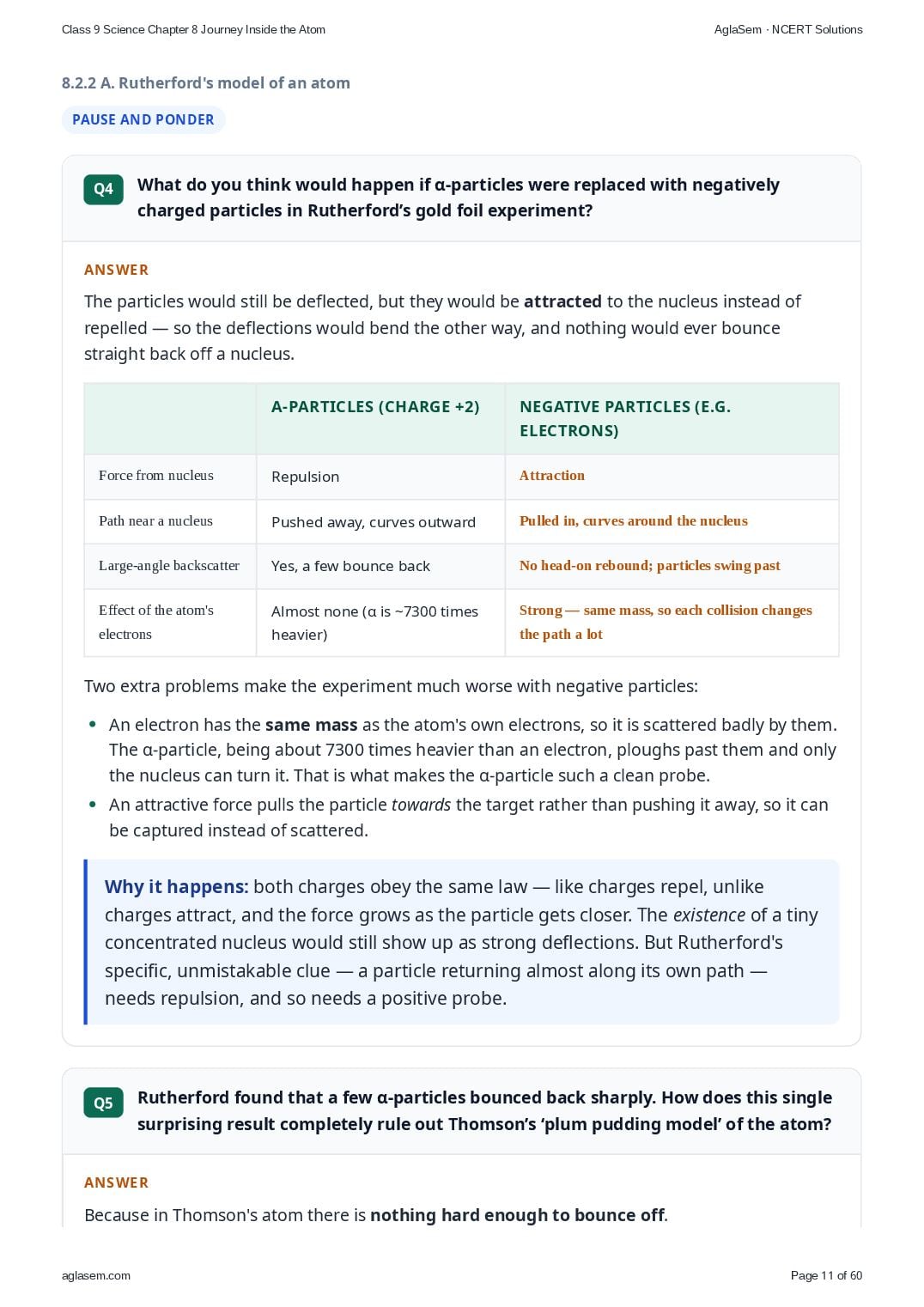
- What do you think would happen if α-particles were replaced with negatively charged particles in Rutherford’s gold foil experiment?
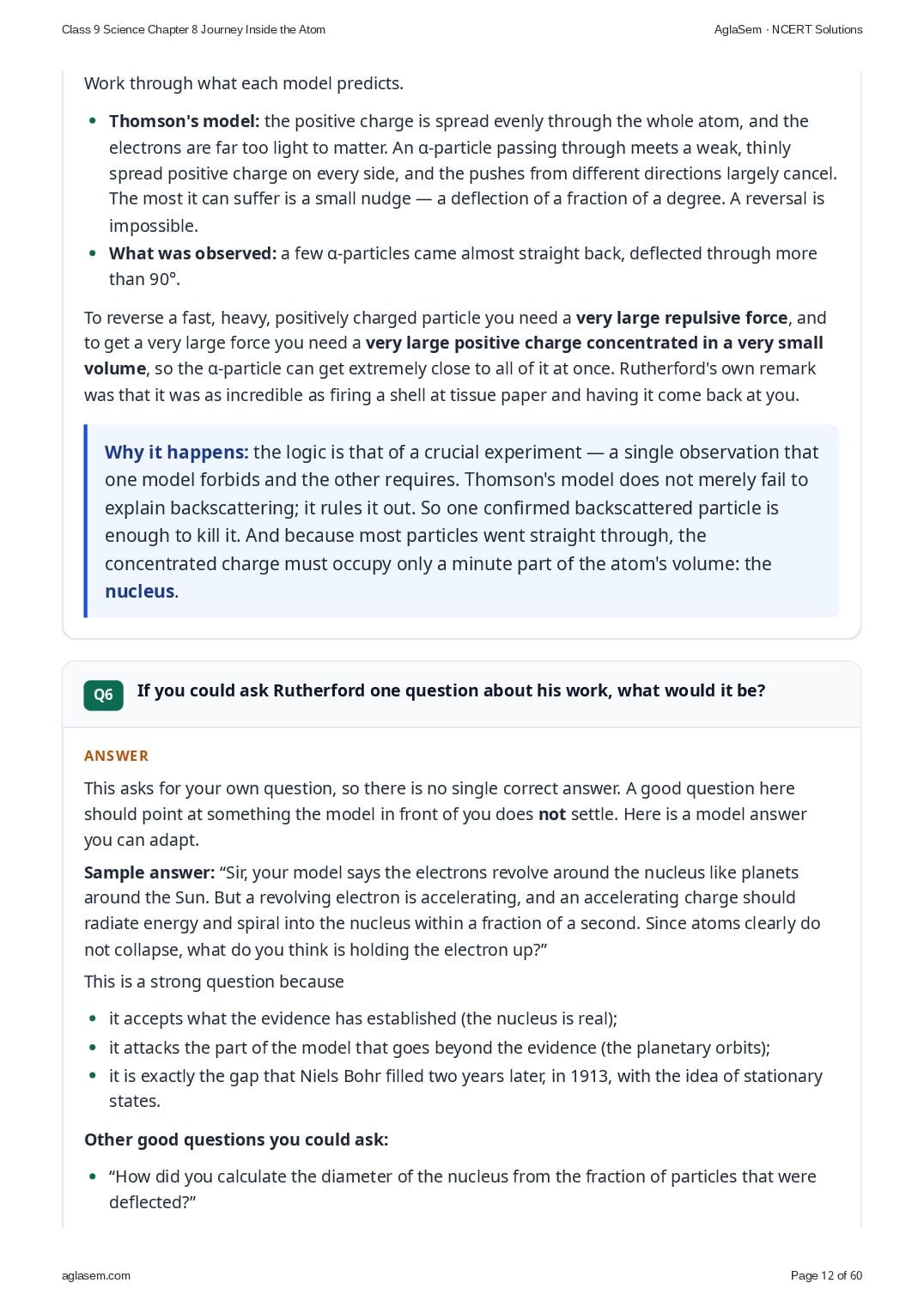
- Rutherford found that a few α-particles bounced back sharply. How does this single surprising result completely rule out Thomson’s ʻplum pudding modelʼ of the atom?
- If you could ask Rutherford one question about his work, what would it be?
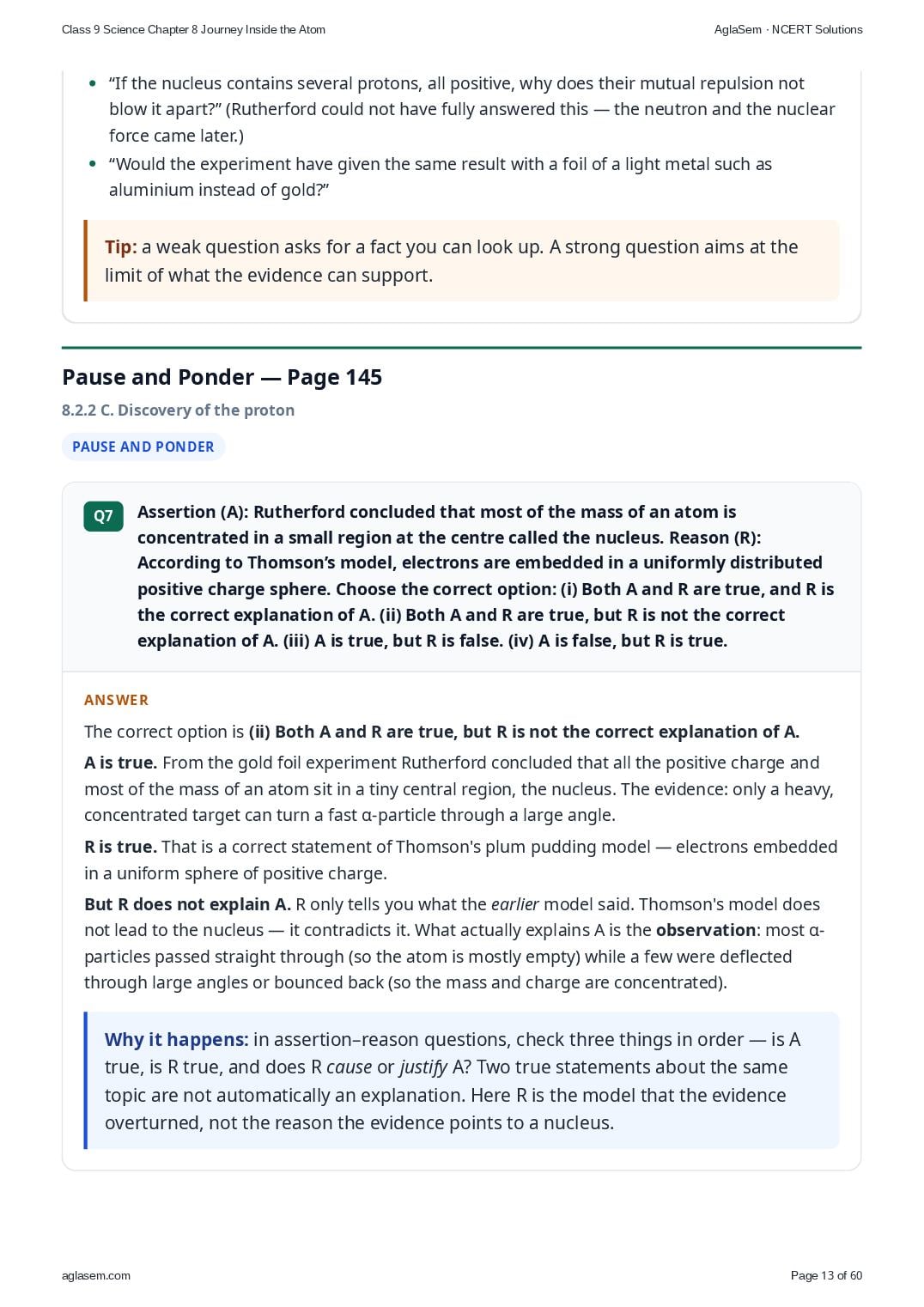
- Assertion (A): Rutherford concluded that most of the mass of an atom is concentrated in a small region at the centre called the nucleus. Reason (R): According to Thomson’s model, electrons are embedded in a uniformly distributed positive charge sphere. Choose the correct option: (i) Both A and R are true, and R is the correct explanation of A. (ii) Both A and R are true, but R is not the correct explanation of A. (iii) A is true, but R is false. (iv) A is false, but R is true.
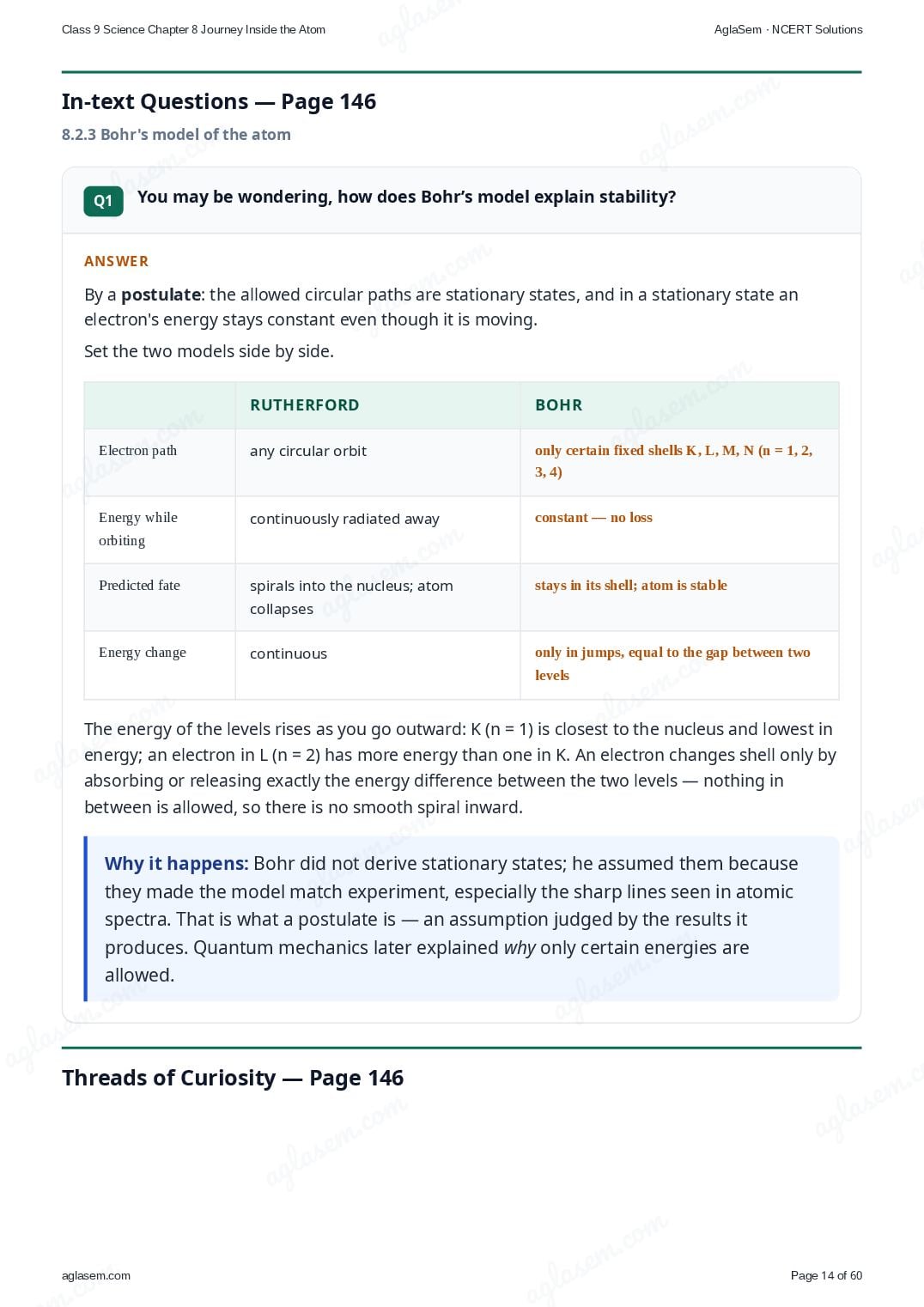
- You may be wondering, how does Bohr’s model explain stability?
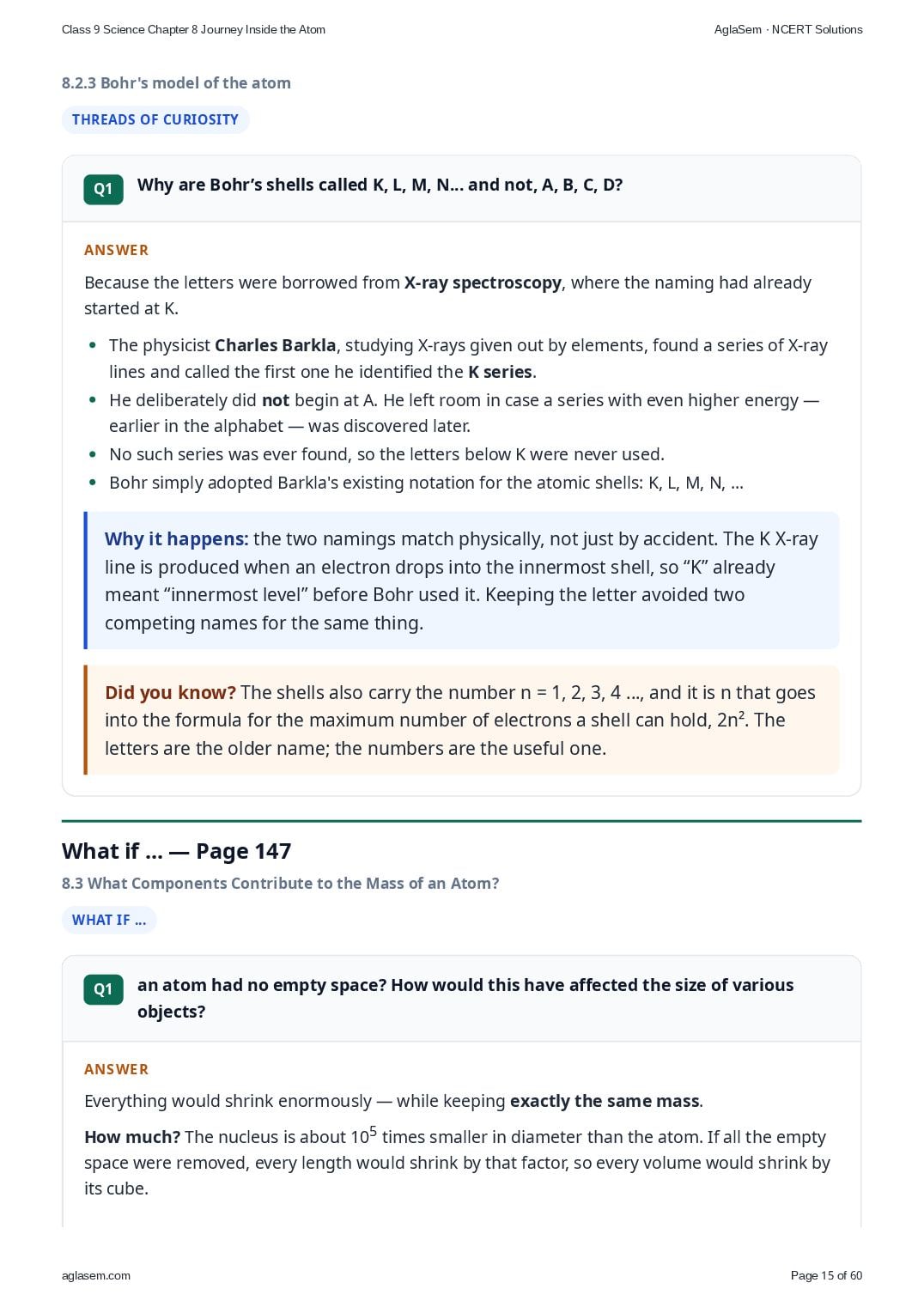
- Why are Bohr’s shells called K, L, M, N… and not, A, B, C, D?
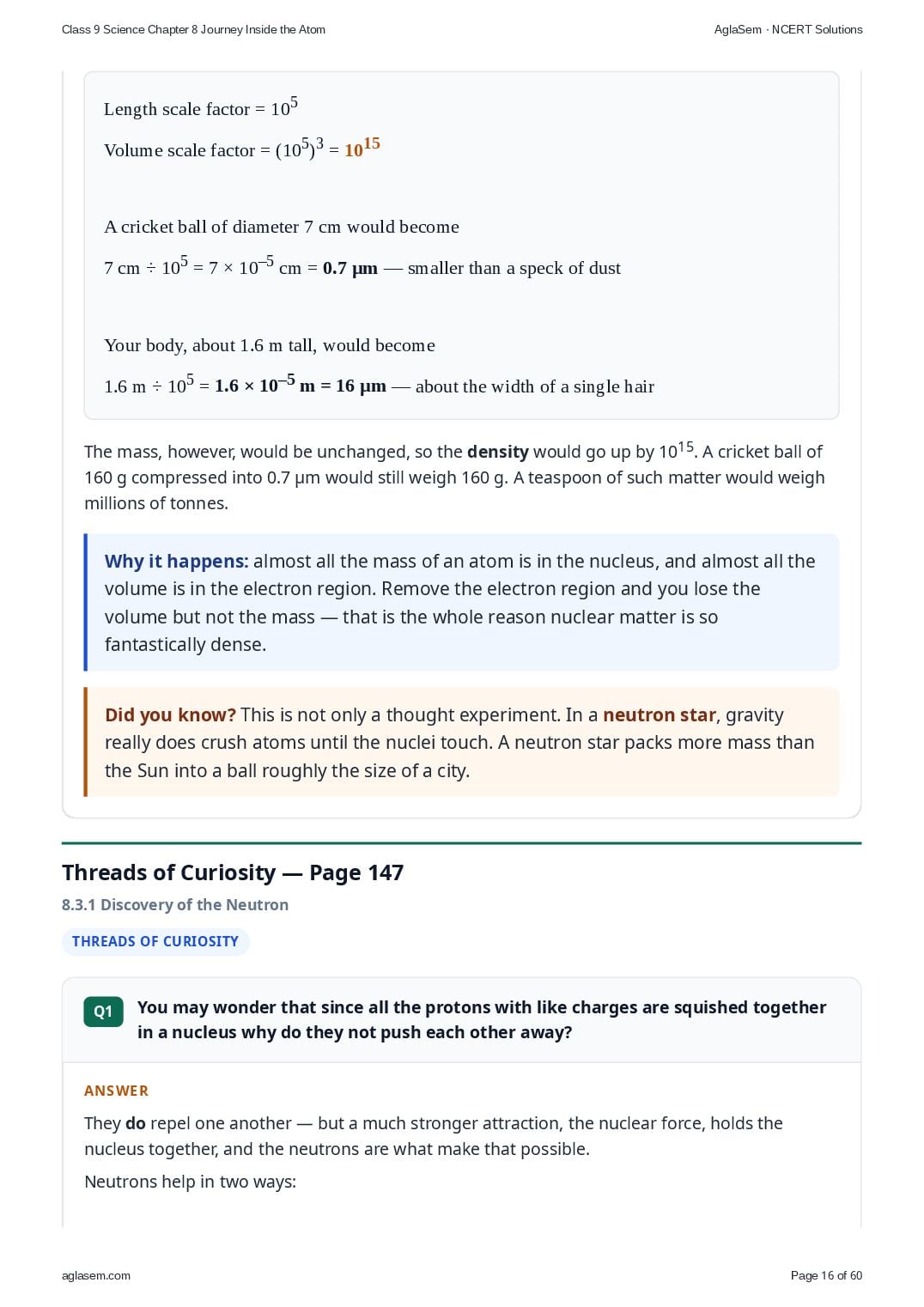
- an atom had no empty space? How would this have affected the size of various objects?
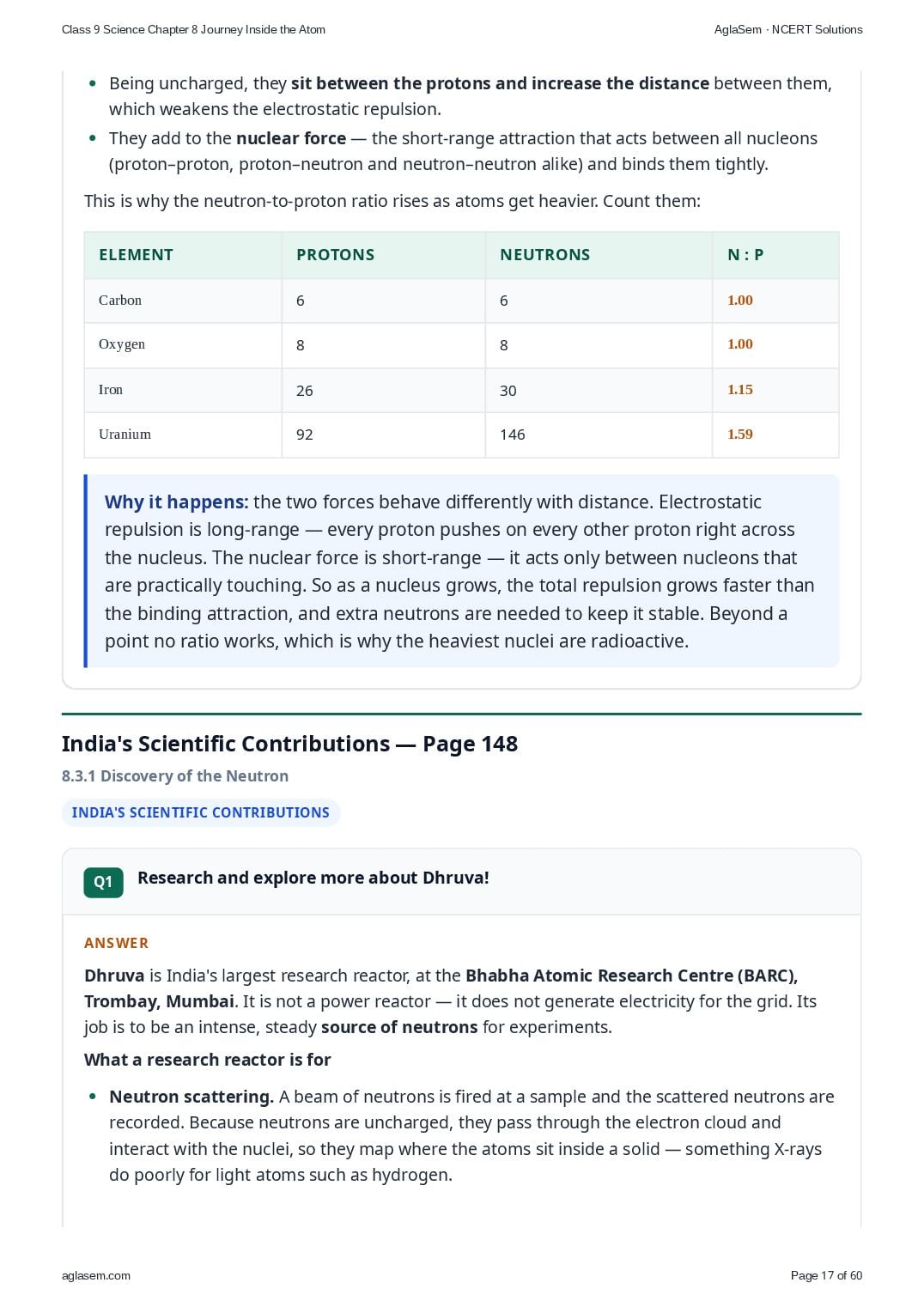
- You may wonder that since all the protons with like charges are squished together in a nucleus why do they not push each other away?
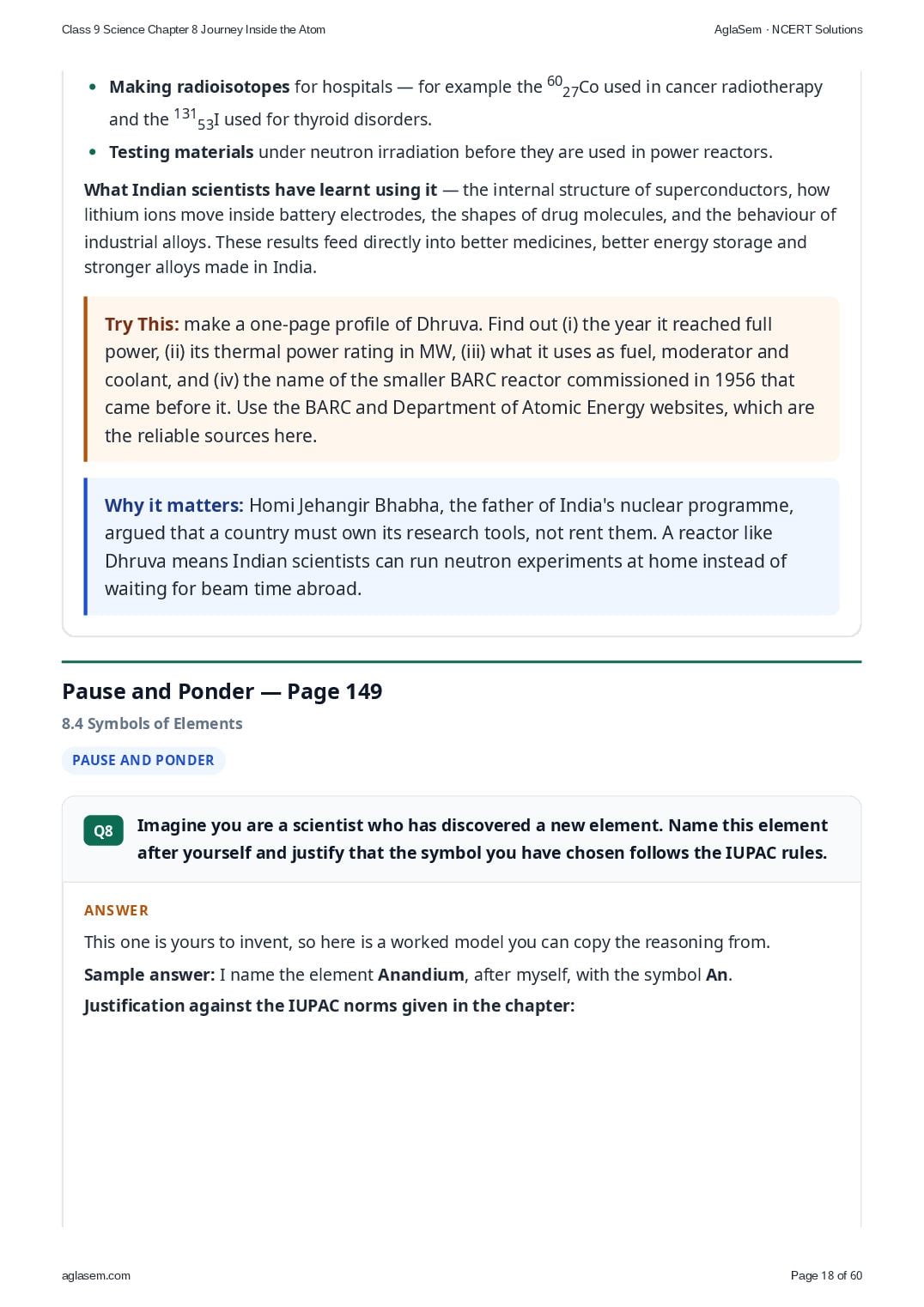
- Research and explore more about Dhruva!
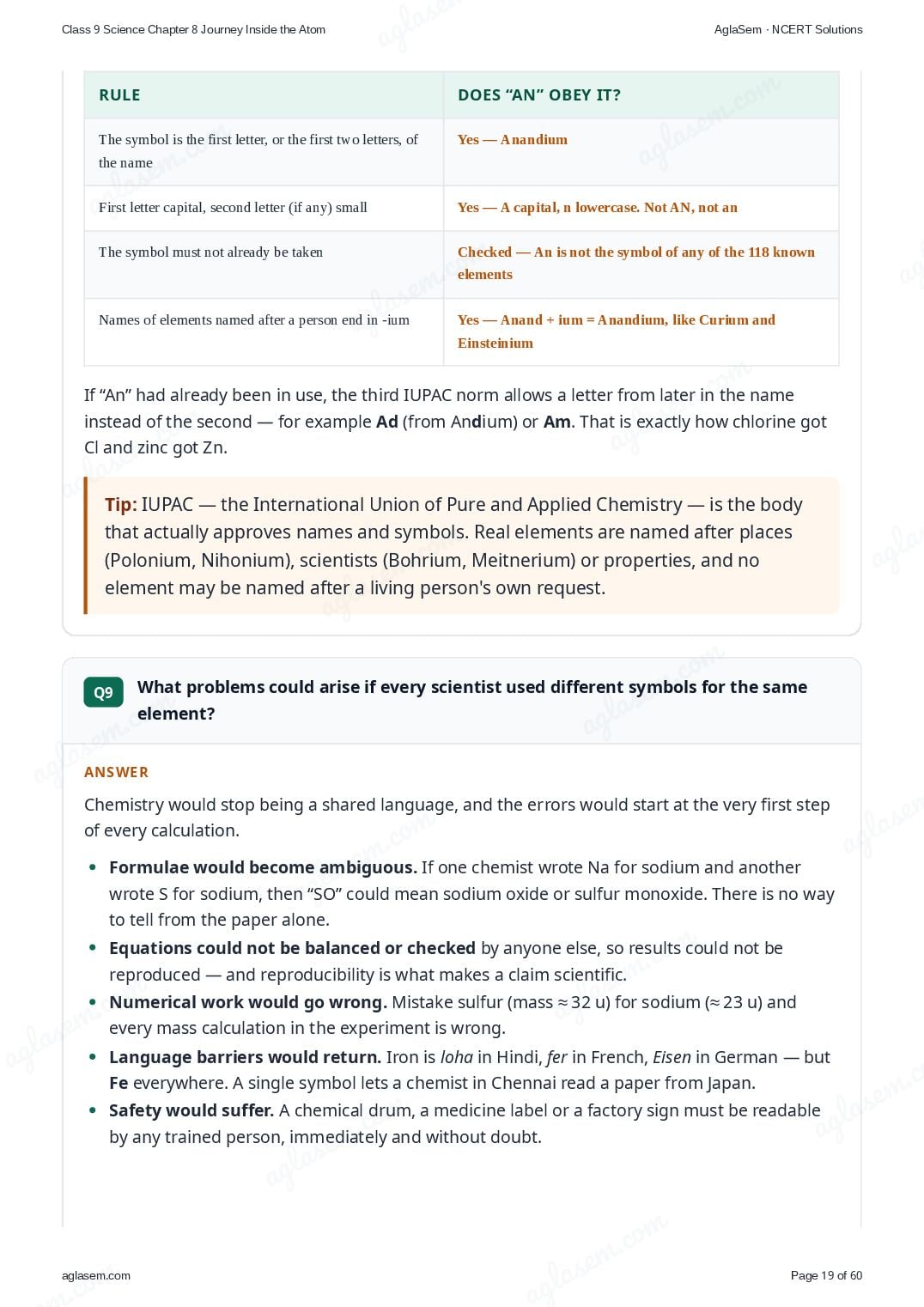
- Imagine you are a scientist who has discovered a new element. Name this element after yourself and justify that the symbol you have chosen follows the IUPAC rules.
- What problems could arise if every scientist used different symbols for the same element?
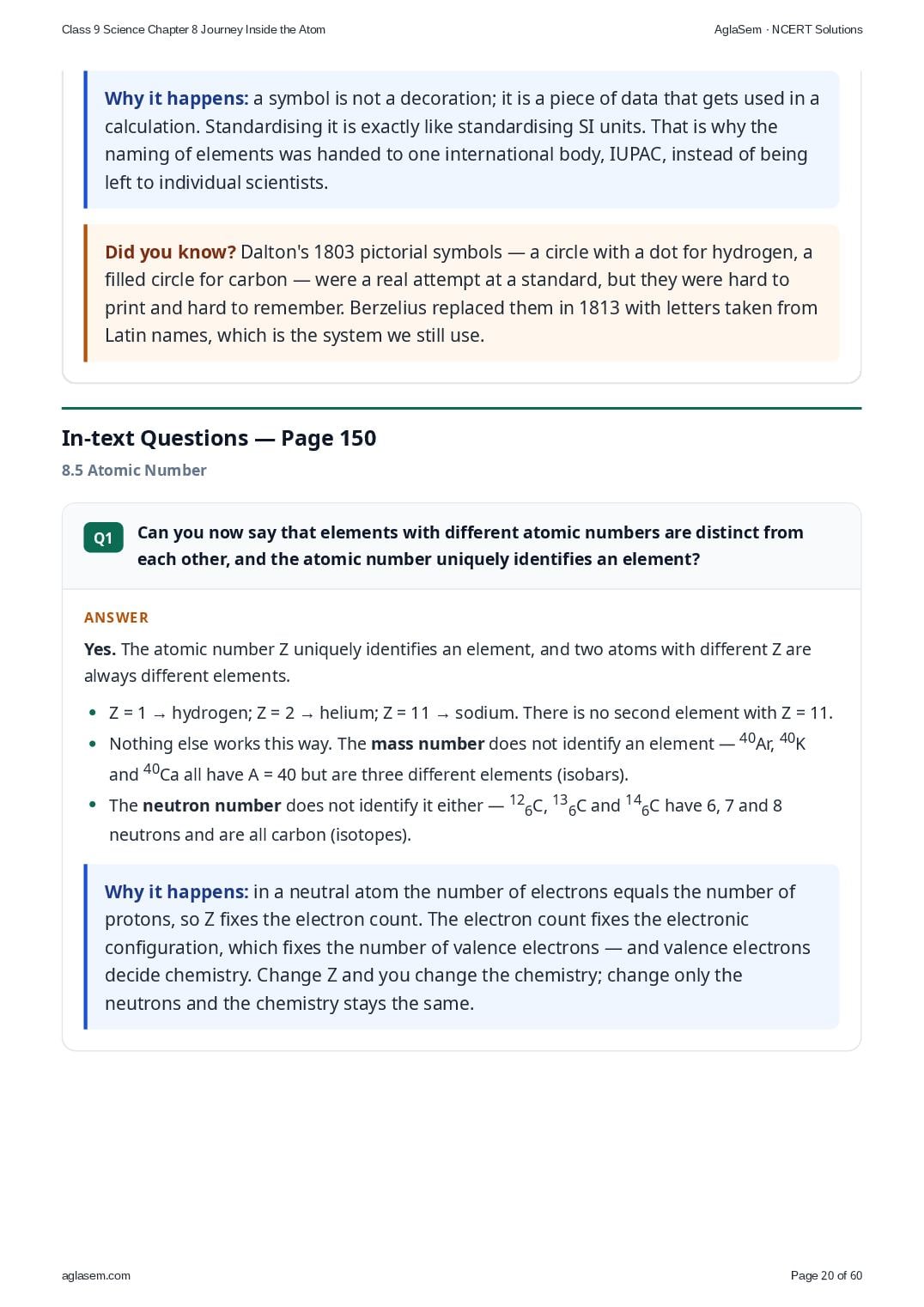
- Can you now say that elements with different atomic numbers are distinct from each other, and the atomic number uniquely identifies an element?
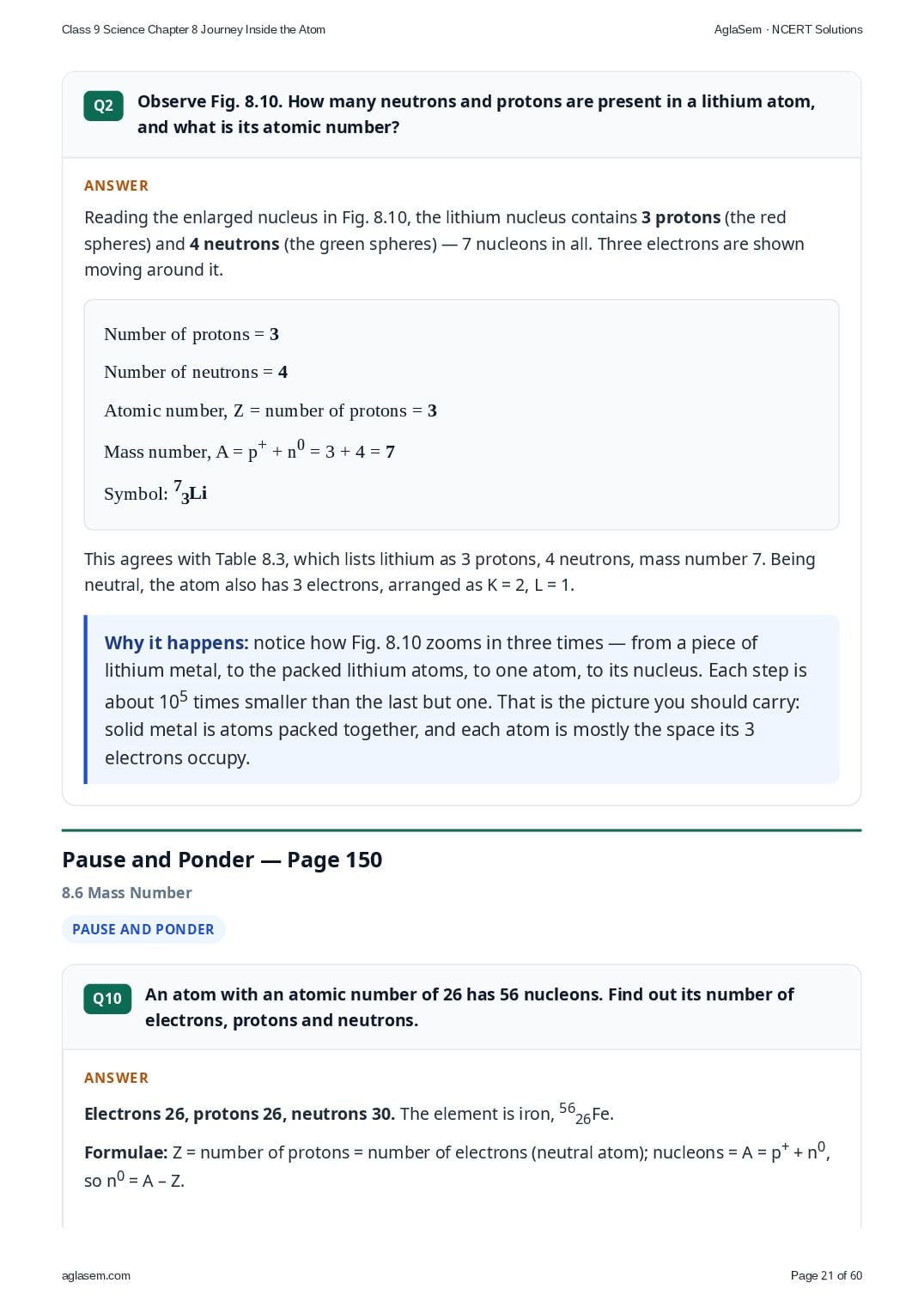
- Observe Fig. 8.10. How many neutrons and protons are present in a lithium atom, and what is its atomic number?
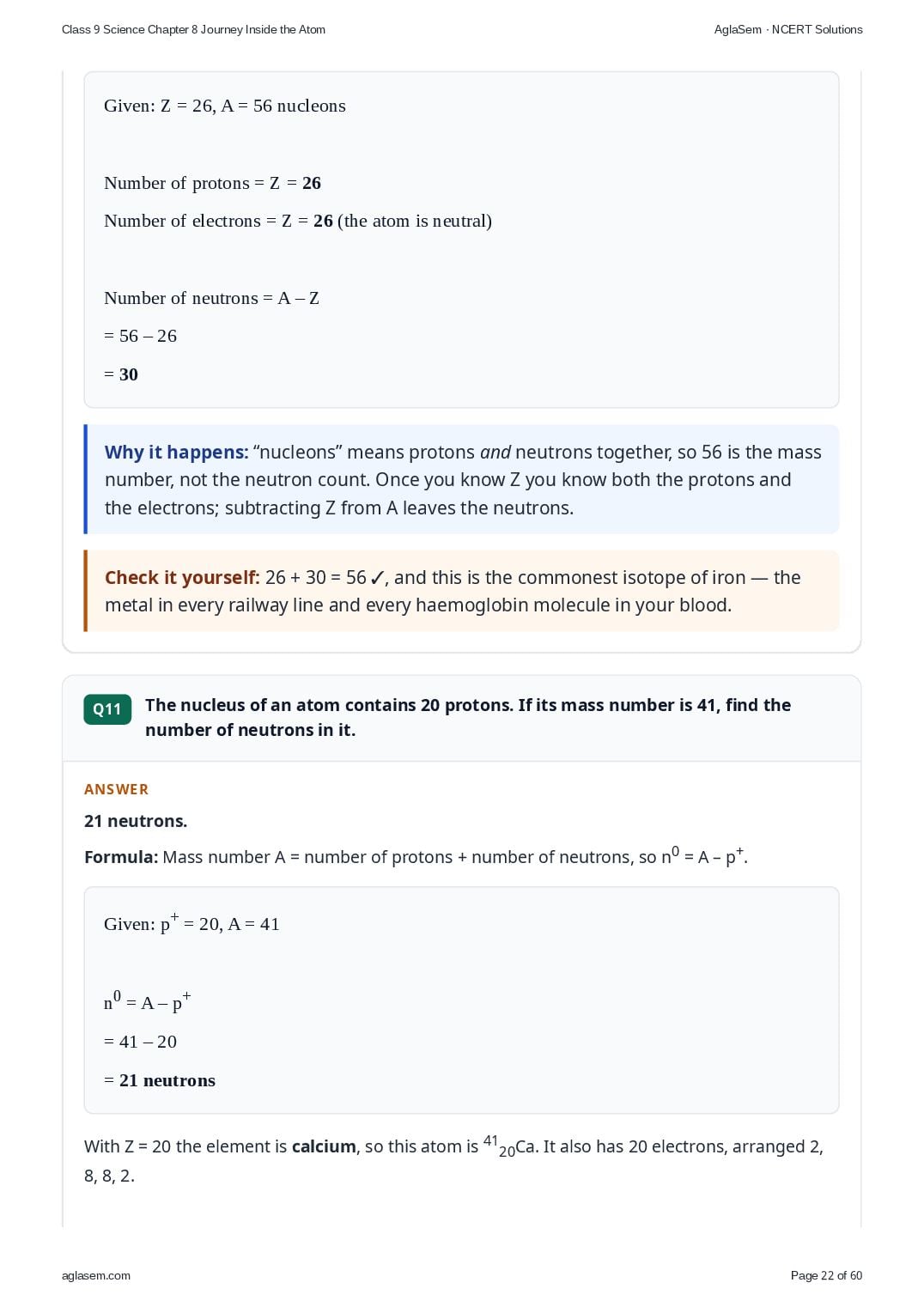
- An atom with an atomic number of 26 has 56 nucleons. Find out its number of electrons, protons and neutrons.
- The nucleus of an atom contains 20 protons. If its mass number is 41, find the number of neutrons in it.
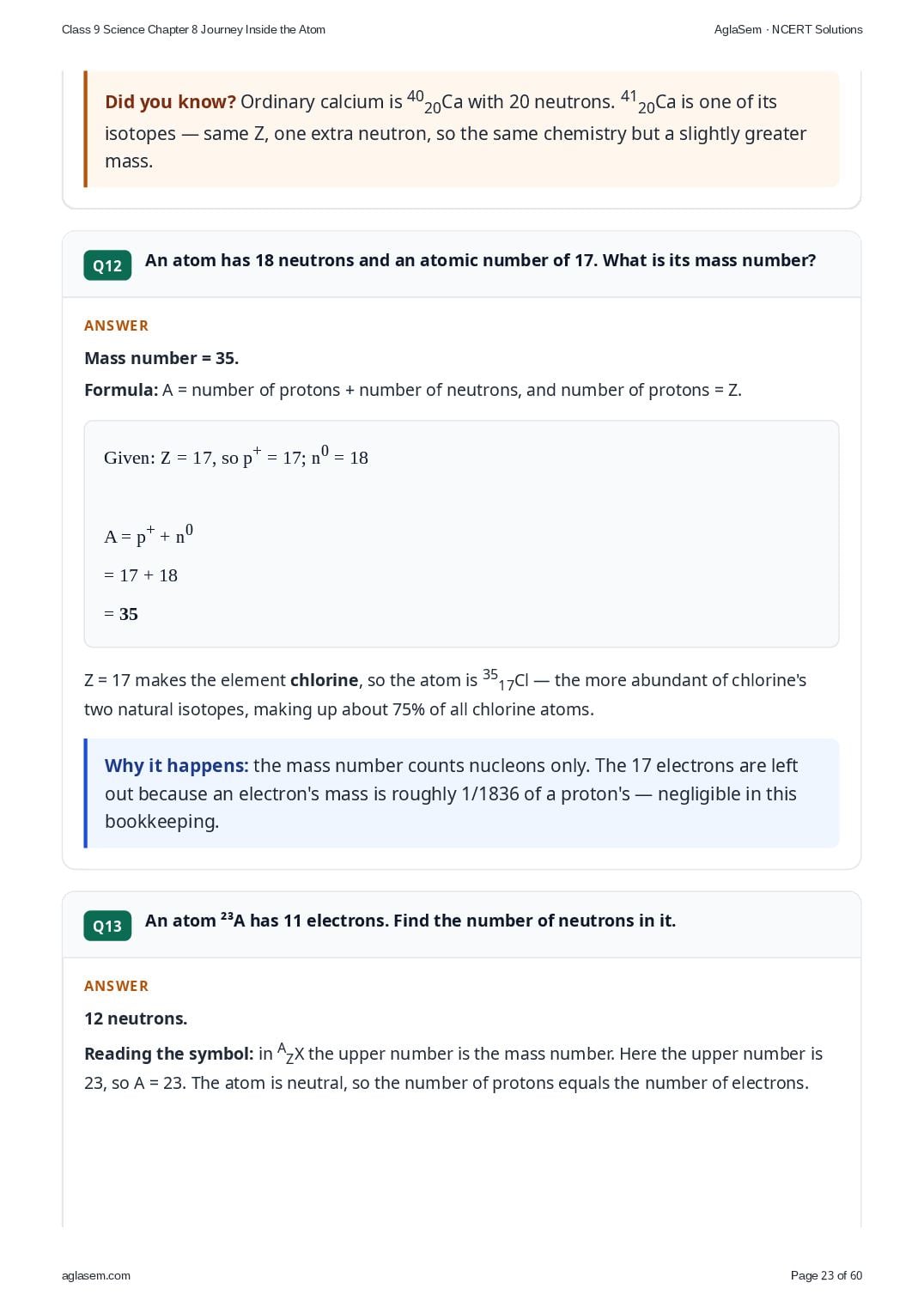
- An atom has 18 neutrons and an atomic number of 17. What is its mass number?
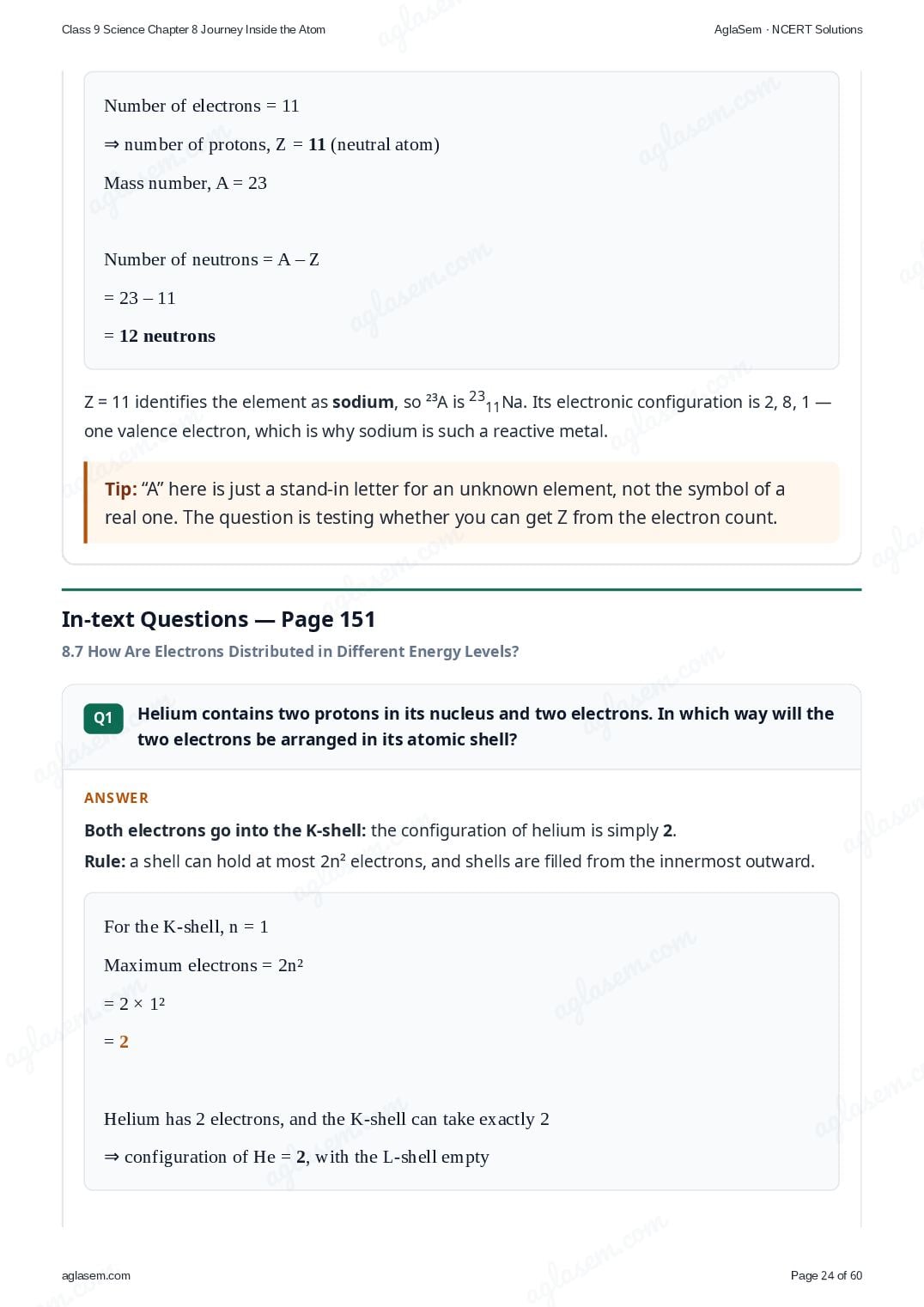
- An atom ²³A has 11 electrons. Find the number of neutrons in it.
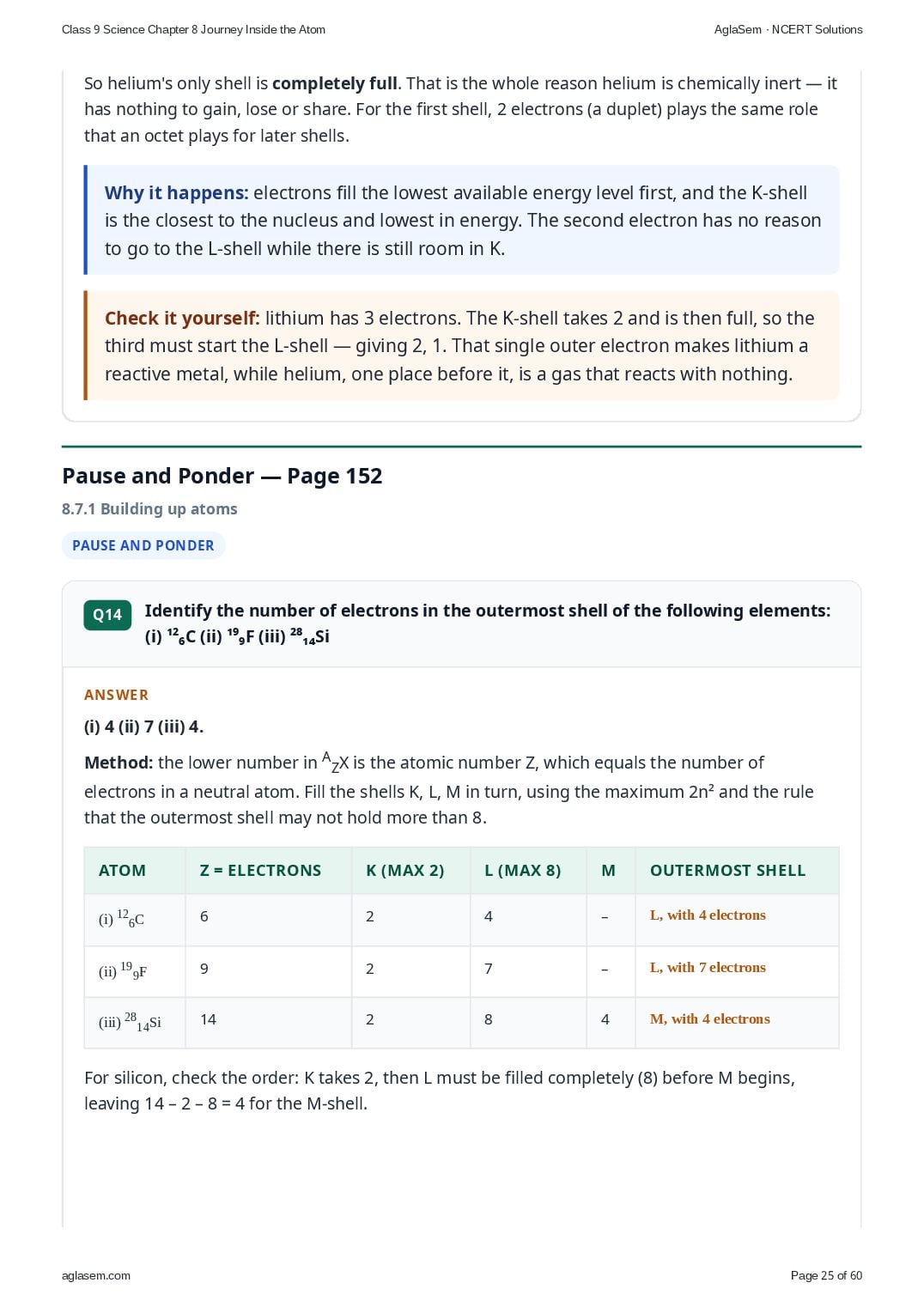
- Helium contains two protons in its nucleus and two electrons. In which way will the two electrons be arranged in its atomic shell?
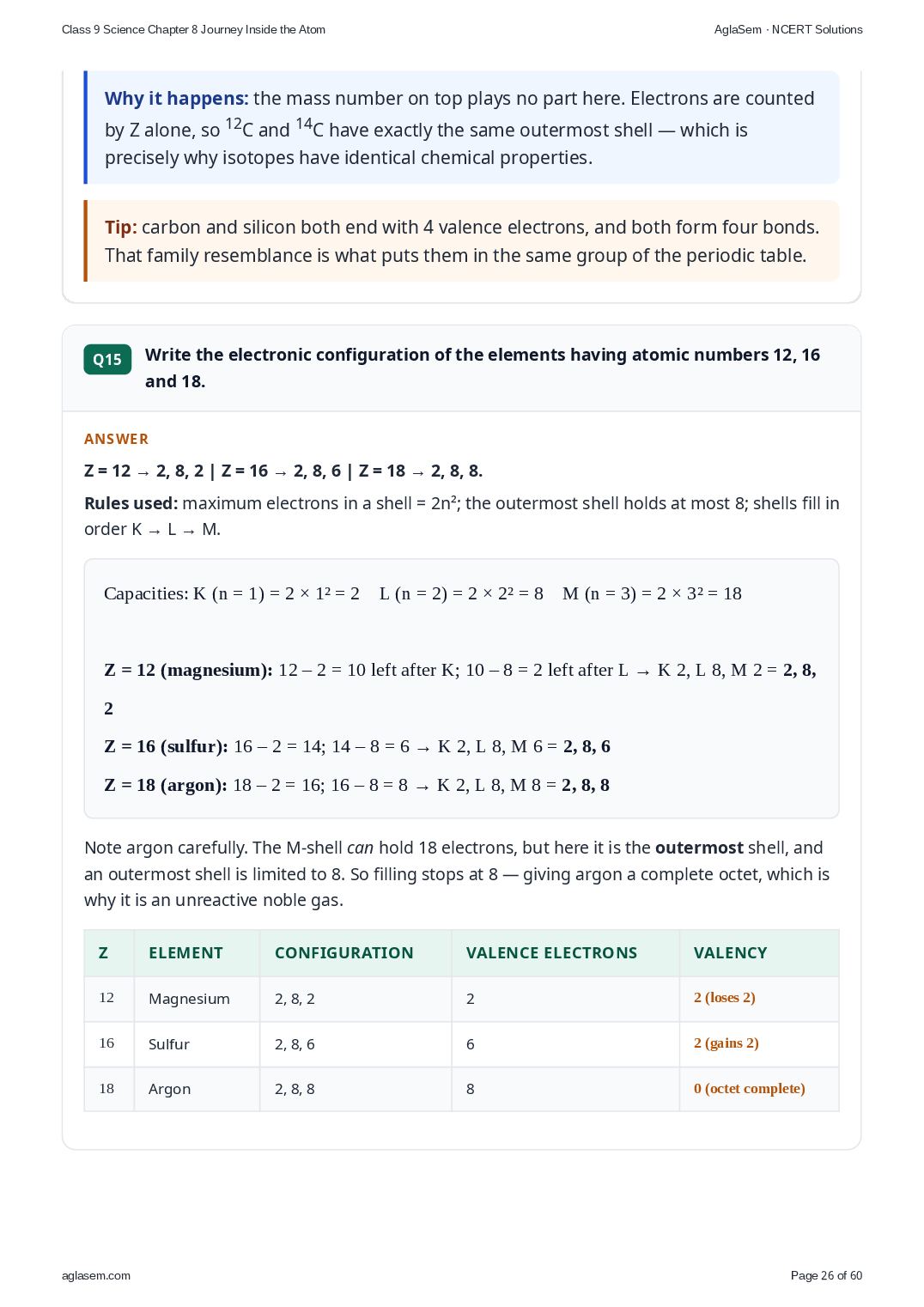
- Identify the number of electrons in the outermost shell of the following elements: (i) ¹²₆C (ii) ¹⁹₉F (iii) ²⁸₁₄Si
- Write the electronic configuration of the elements having atomic numbers 12, 16 and 18.
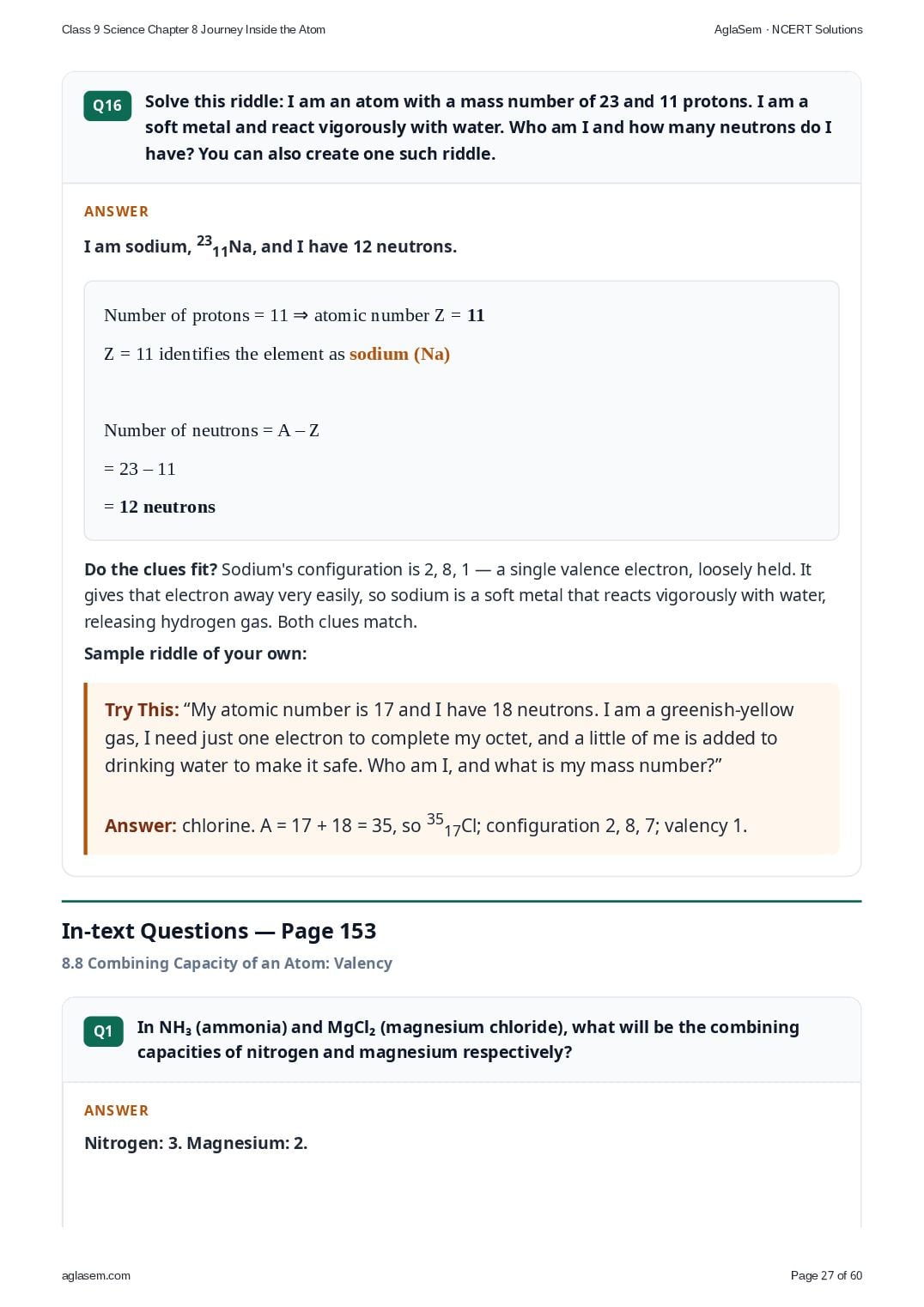
- Solve this riddle: I am an atom with a mass number of 23 and 11 protons. I am a soft metal and react vigorously with water. Who am I and how many neutrons do I have? You can also create one such riddle.
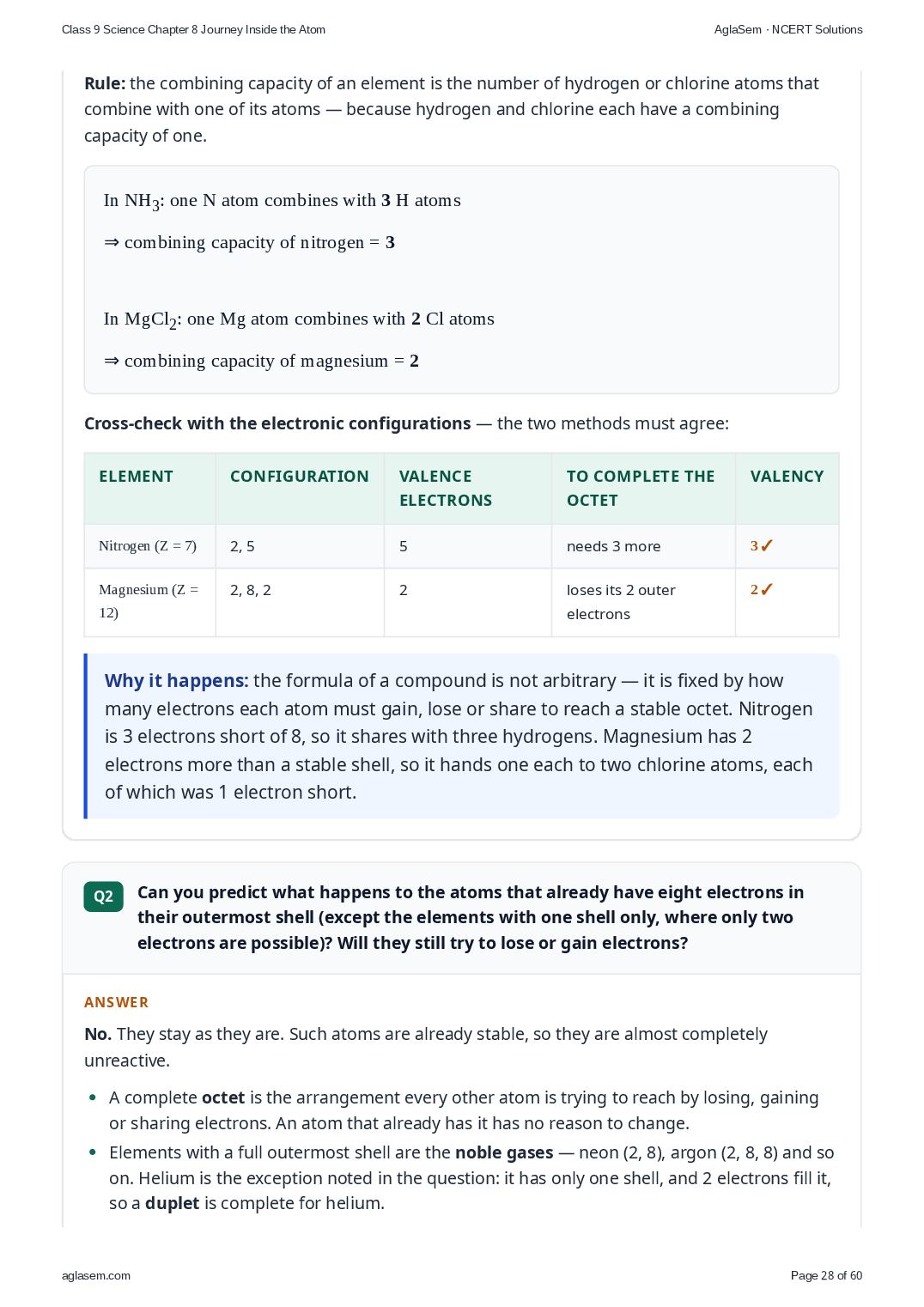
- In NH₃ (ammonia) and MgCl₂ (magnesium chloride), what will be the combining capacities of nitrogen and magnesium respectively?
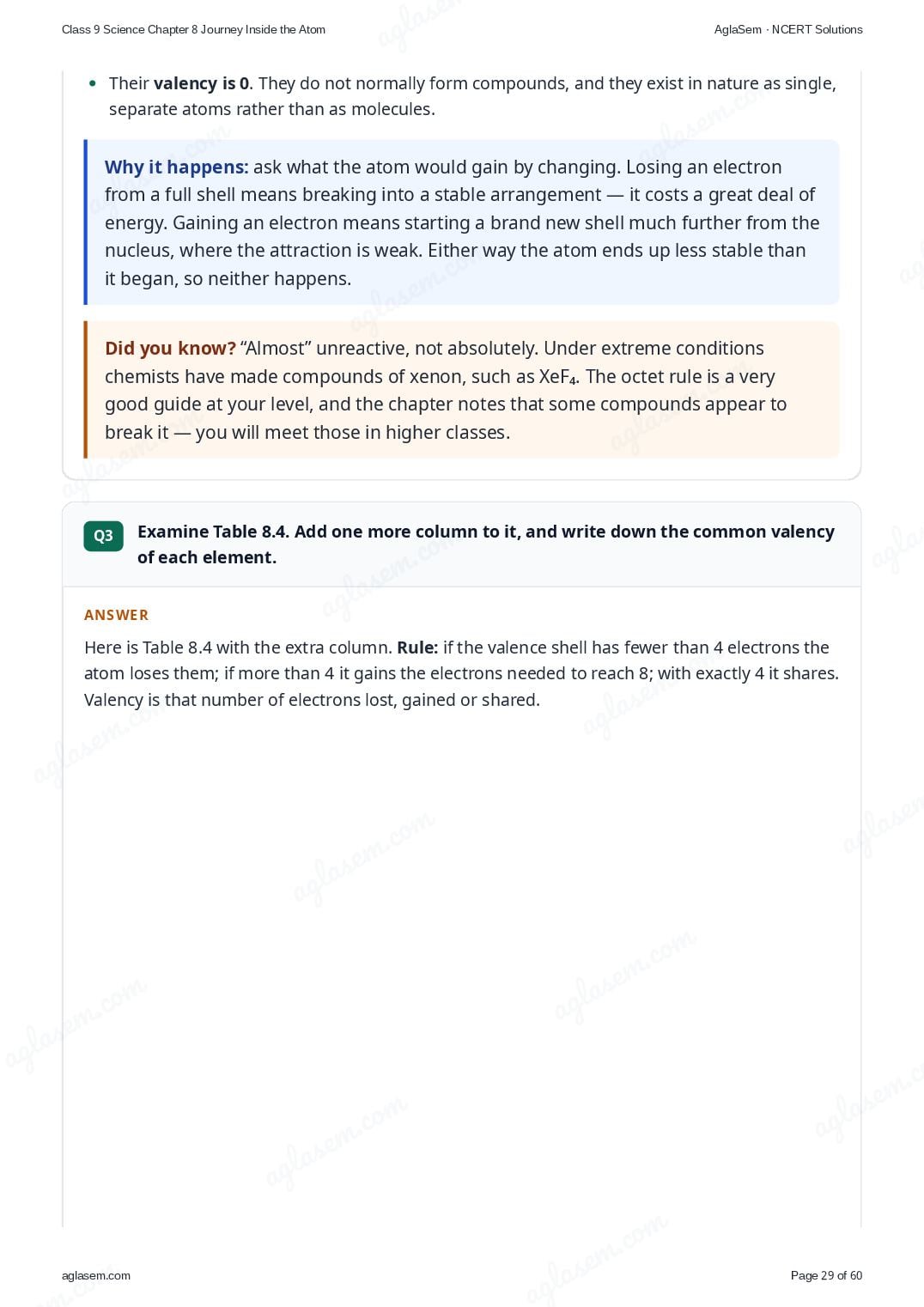
- Can you predict what happens to the atoms that already have eight electrons in their outermost shell (except the elements with one shell only, where only two electrons are possible)? Will they still try to lose or gain electrons?
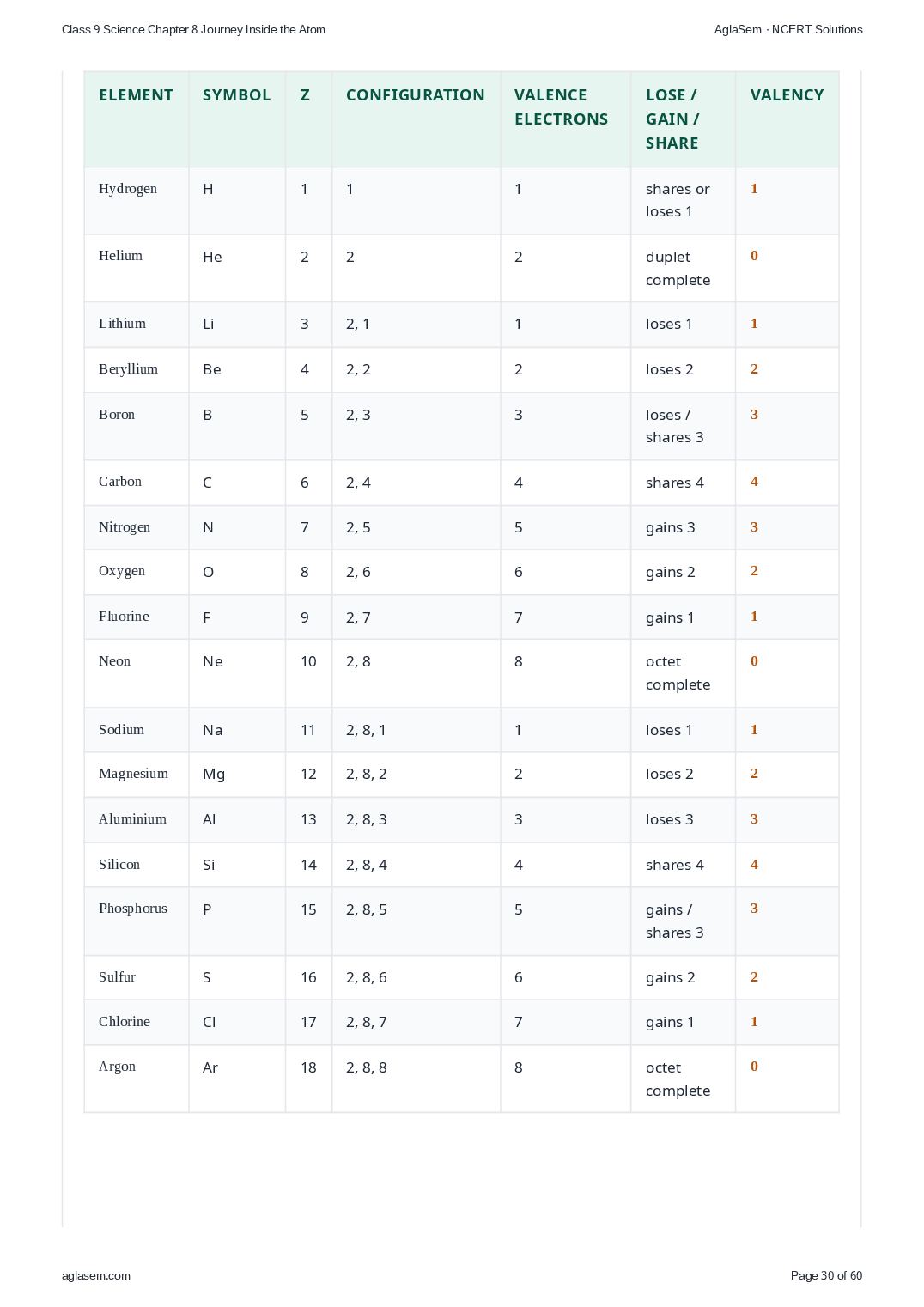
- Examine Table 8.4. Add one more column to it, and write down the common valency of each element.
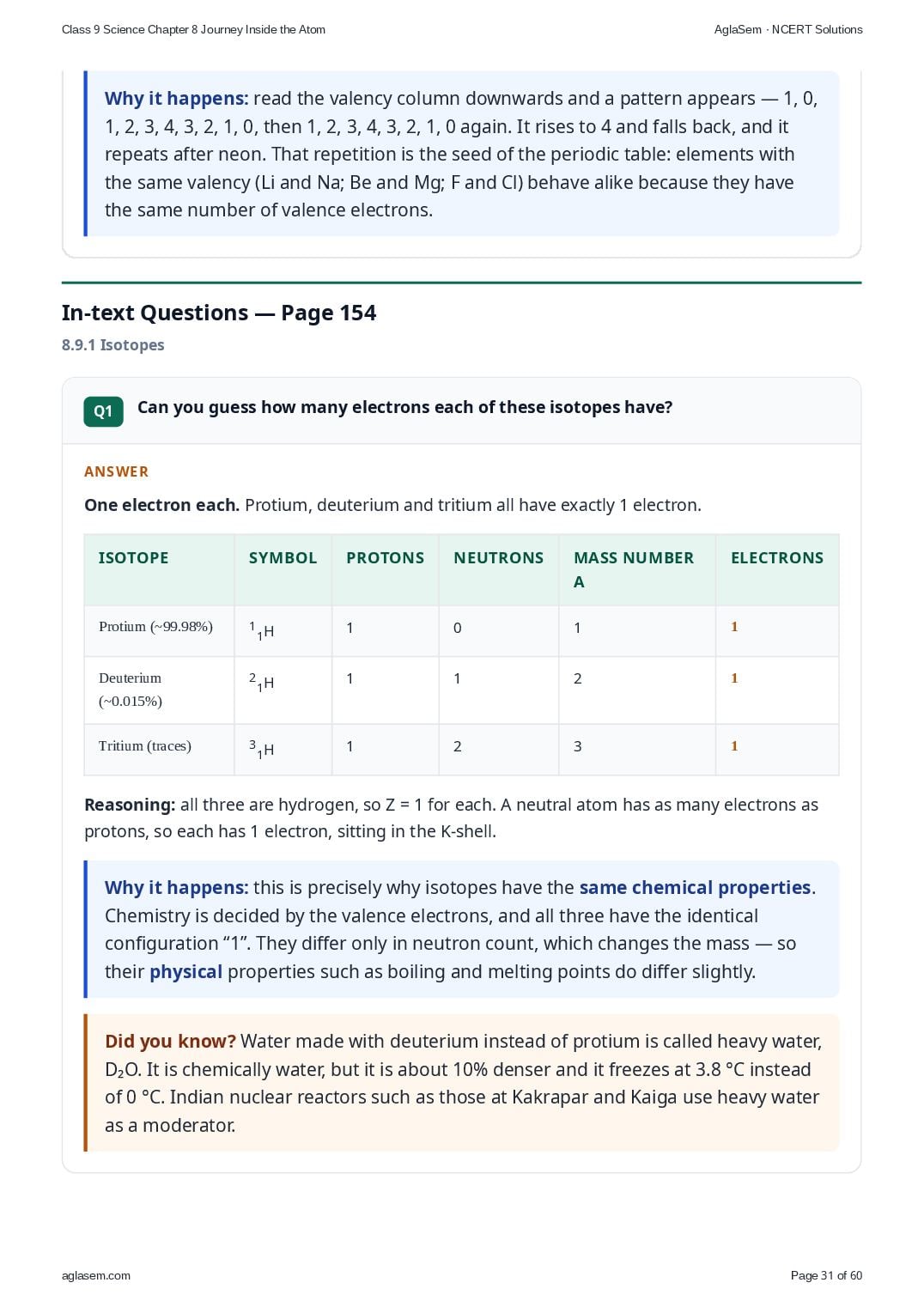
- Can you guess how many electrons each of these isotopes have?
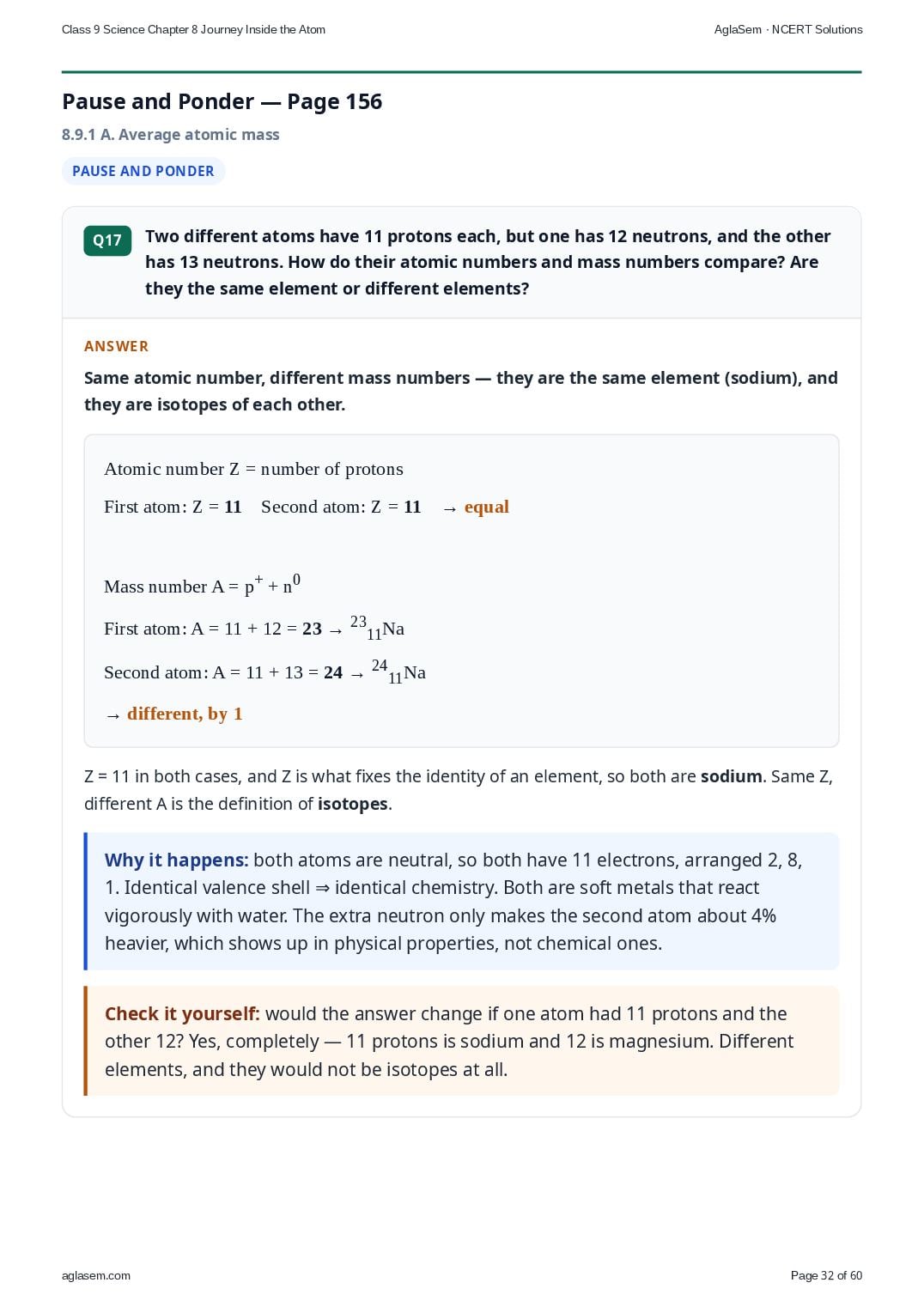
- Two different atoms have 11 protons each, but one has 12 neutrons, and the other has 13 neutrons. How do their atomic numbers and mass numbers compare? Are they the same element or different elements?
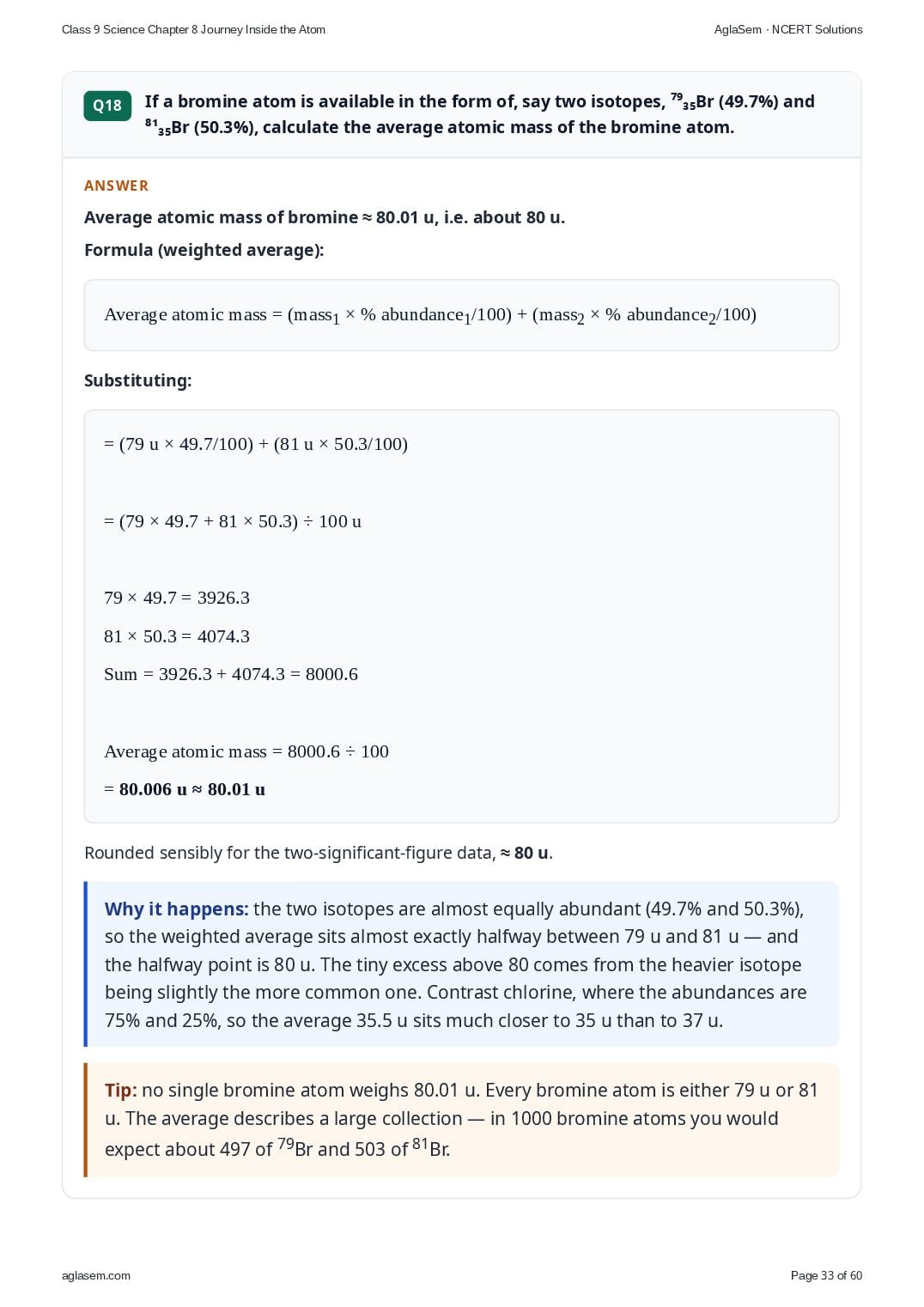
- If a bromine atom is available in the form of, say two isotopes, ⁷⁹₃₅Br (49.7%) and ⁸¹₃₅Br (50.3%), calculate the average atomic mass of the bromine atom.
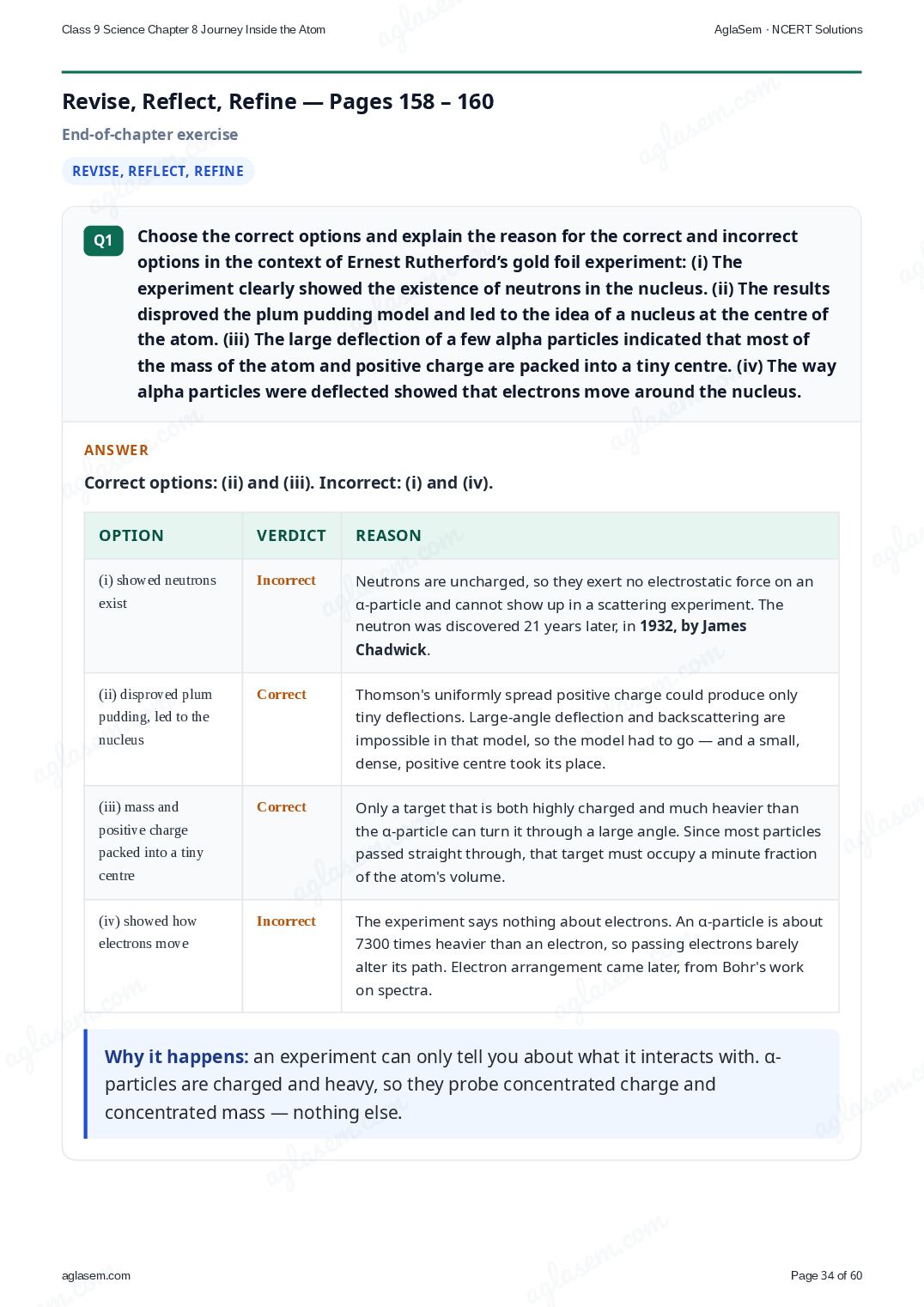
- Choose the correct options and explain the reason for the correct and incorrect options in the context of Ernest Rutherford’s gold foil experiment: (i) The experiment clearly showed the existence of neutrons in the nucleus. (ii) The results disproved the plum pudding model and led to the idea of a nucleus at the centre of the atom. (iii) The large deflection of a few alpha particles indicated that most of the mass of the atom and positive charge are packed into a tiny centre. (iv) The way alpha particles were deflected showed that electrons move around the nucleus.
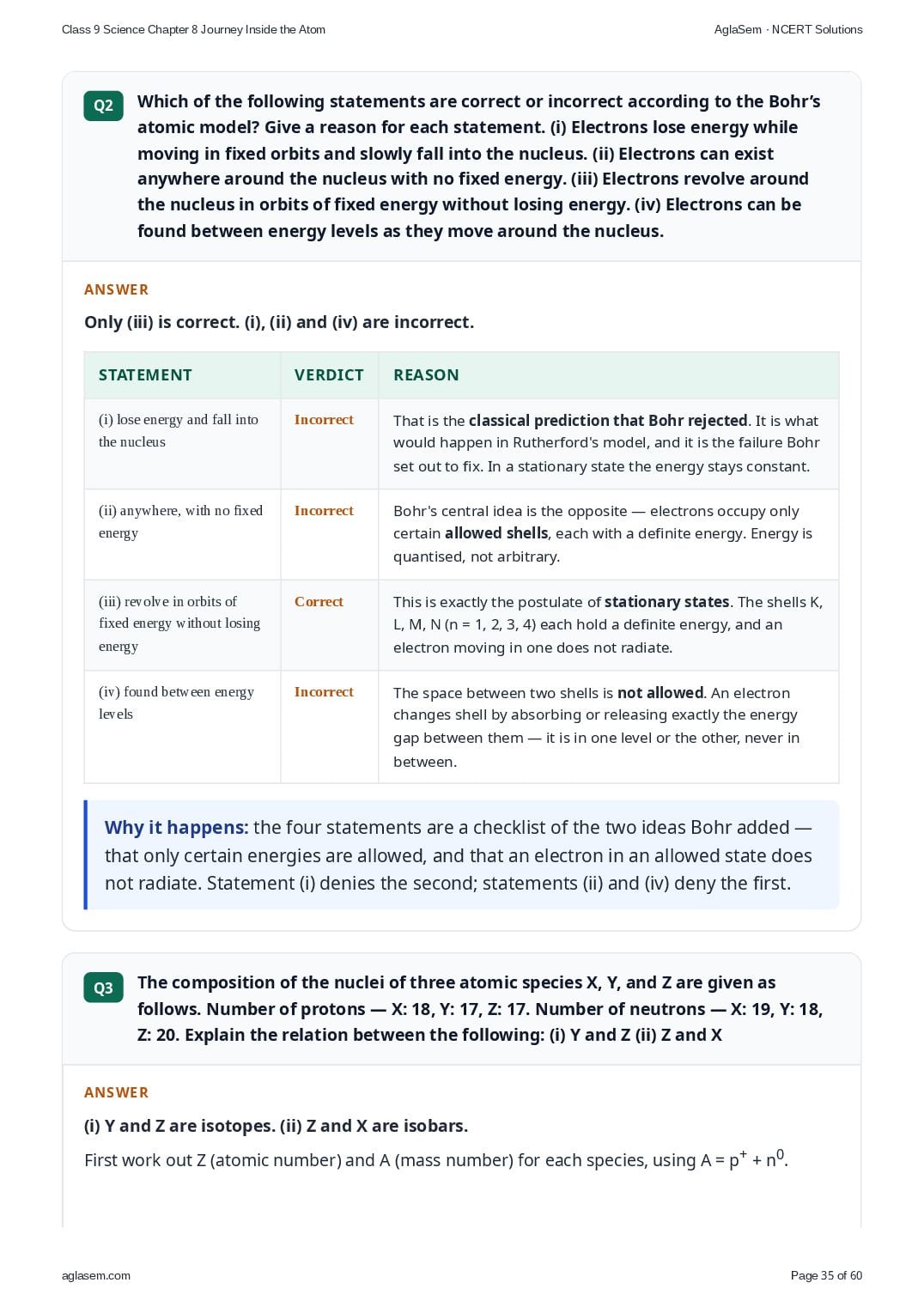
- Which of the following statements are correct or incorrect according to the Bohr’s atomic model? Give a reason for each statement. (i) Electrons lose energy while moving in fixed orbits and slowly fall into the nucleus. (ii) Electrons can exist anywhere around the nucleus with no fixed energy. (iii) Electrons revolve around the nucleus in orbits of fixed energy without losing energy. (iv) Electrons can be found between energy levels as they move around the nucleus.
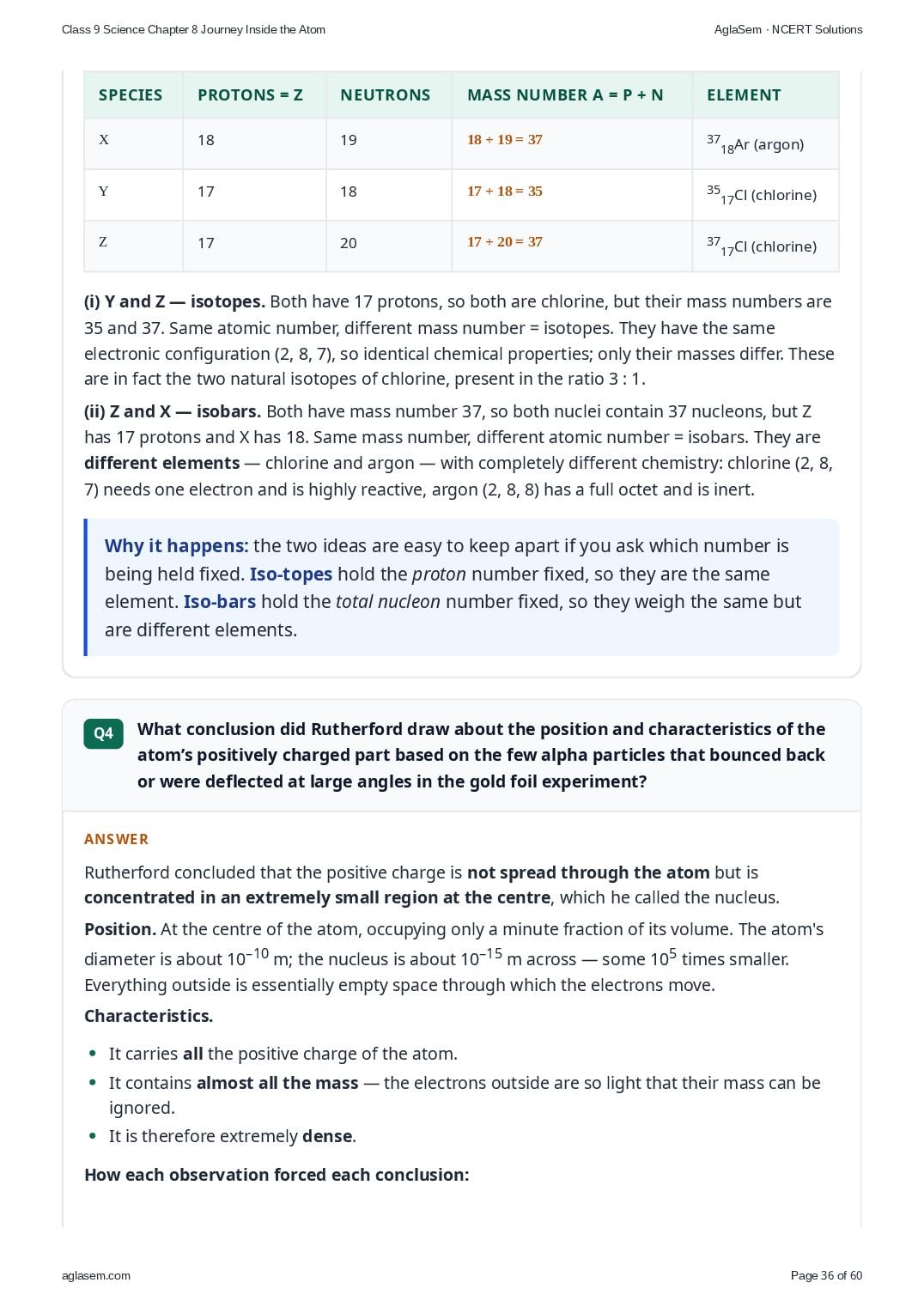
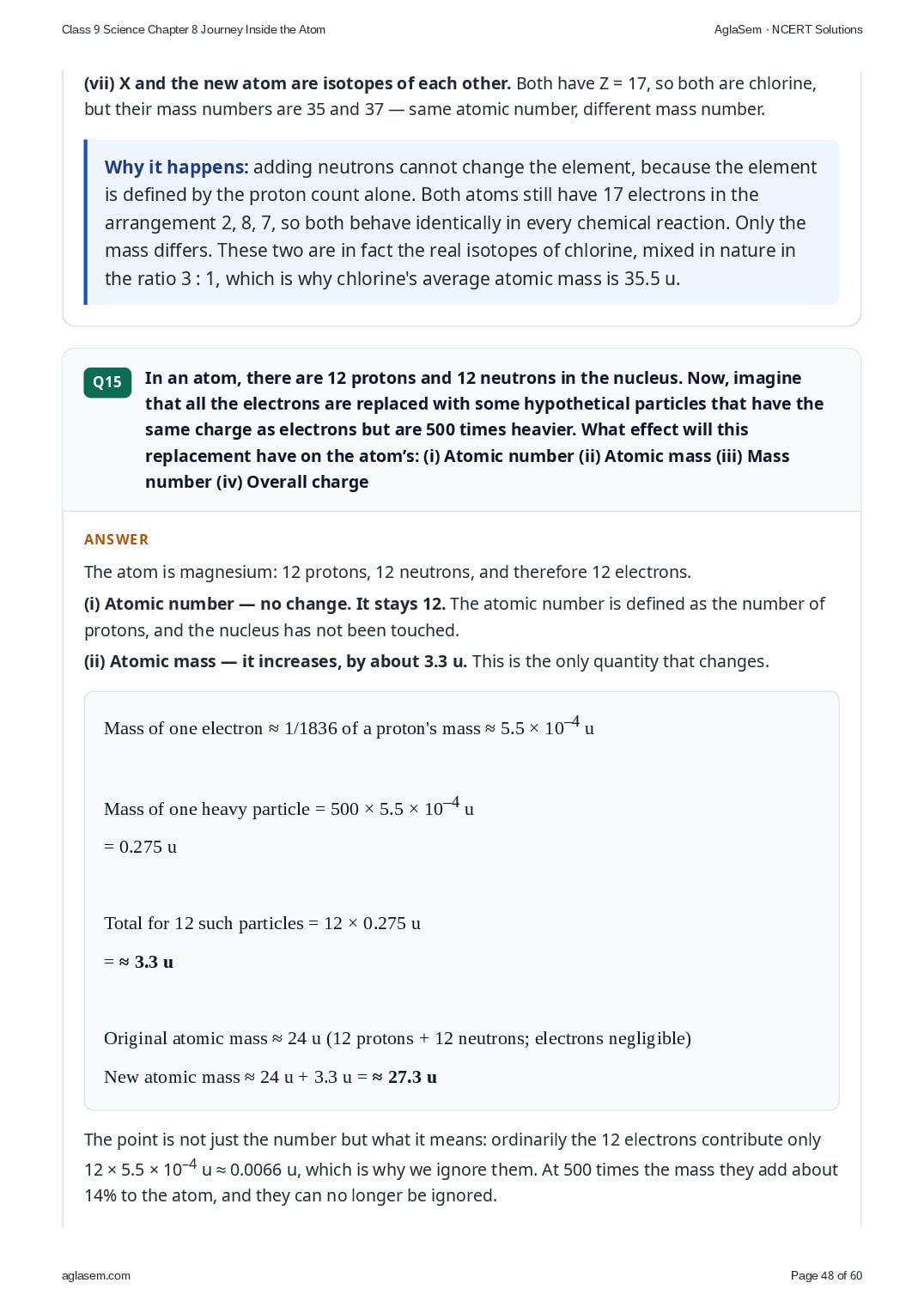
- The composition of the nuclei of three atomic species X, Y, and Z are given as follows. Number of protons — X: 18, Y: 17, Z: 17. Number of neutrons — X: 19, Y: 18, Z: 20. Explain the relation between the following: (i) Y and Z (ii) Z and X
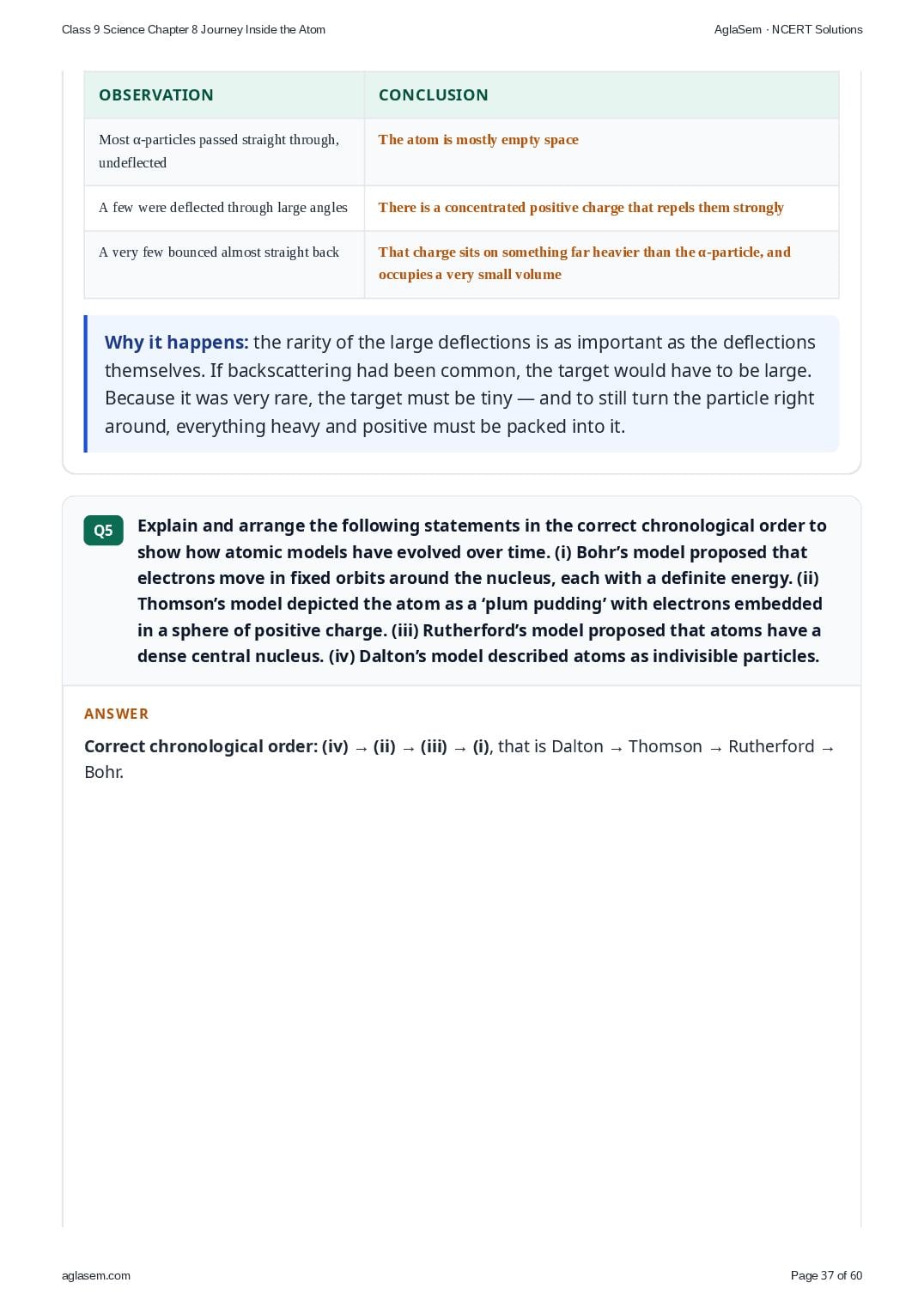
- What conclusion did Rutherford draw about the position and characteristics of the atom’s positively charged part based on the few alpha particles that bounced back or were deflected at large angles in the gold foil experiment?
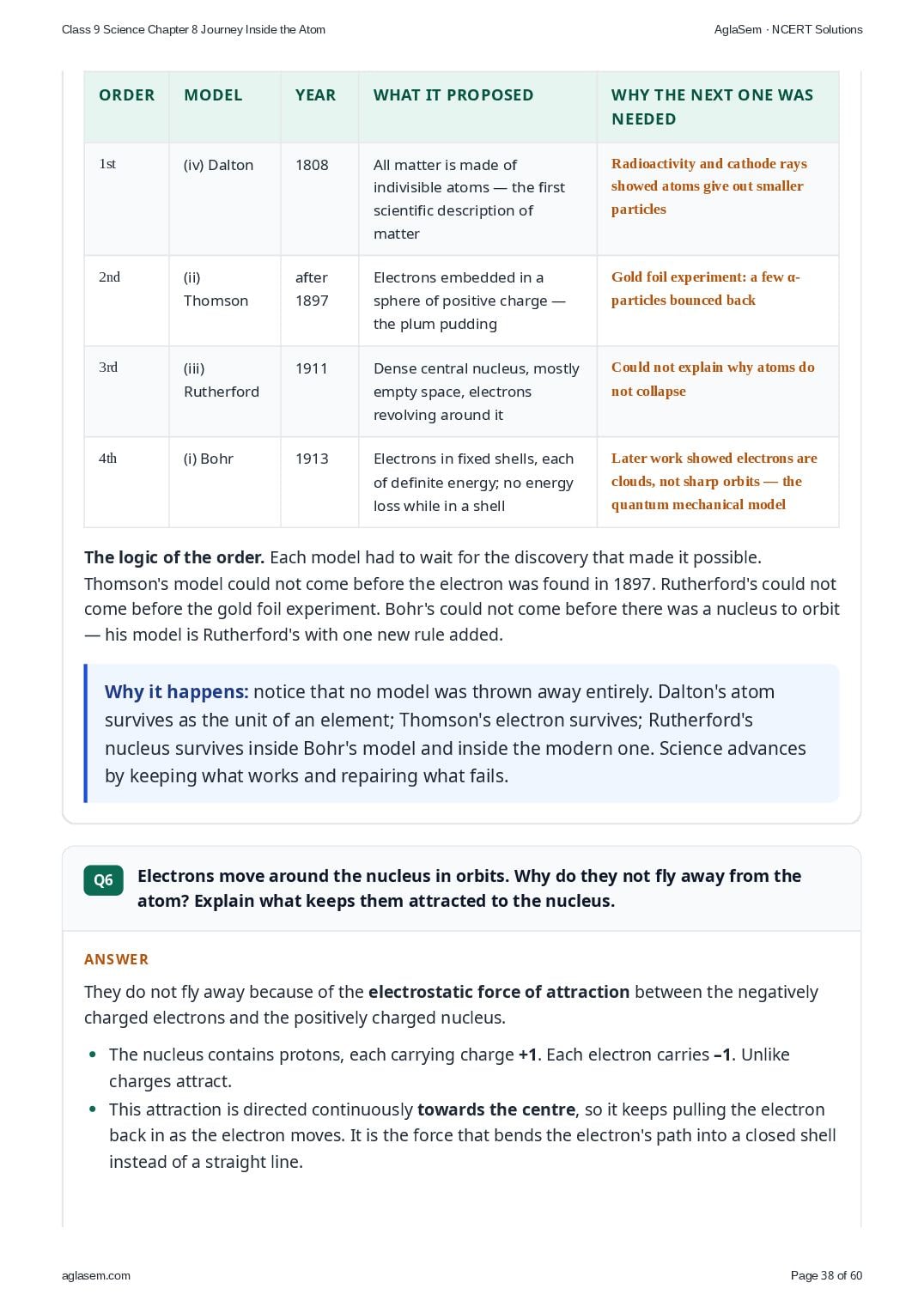
- Explain and arrange the following statements in the correct chronological order to show how atomic models have evolved over time. (i) Bohr’s model proposed that electrons move in fixed orbits around the nucleus, each with a definite energy. (ii) Thomson’s model depicted the atom as a ʻplum puddingʼ with electrons embedded in a sphere of positive charge. (iii) Rutherford’s model proposed that atoms have a dense central nucleus. (iv) Dalton’s model described atoms as indivisible particles.
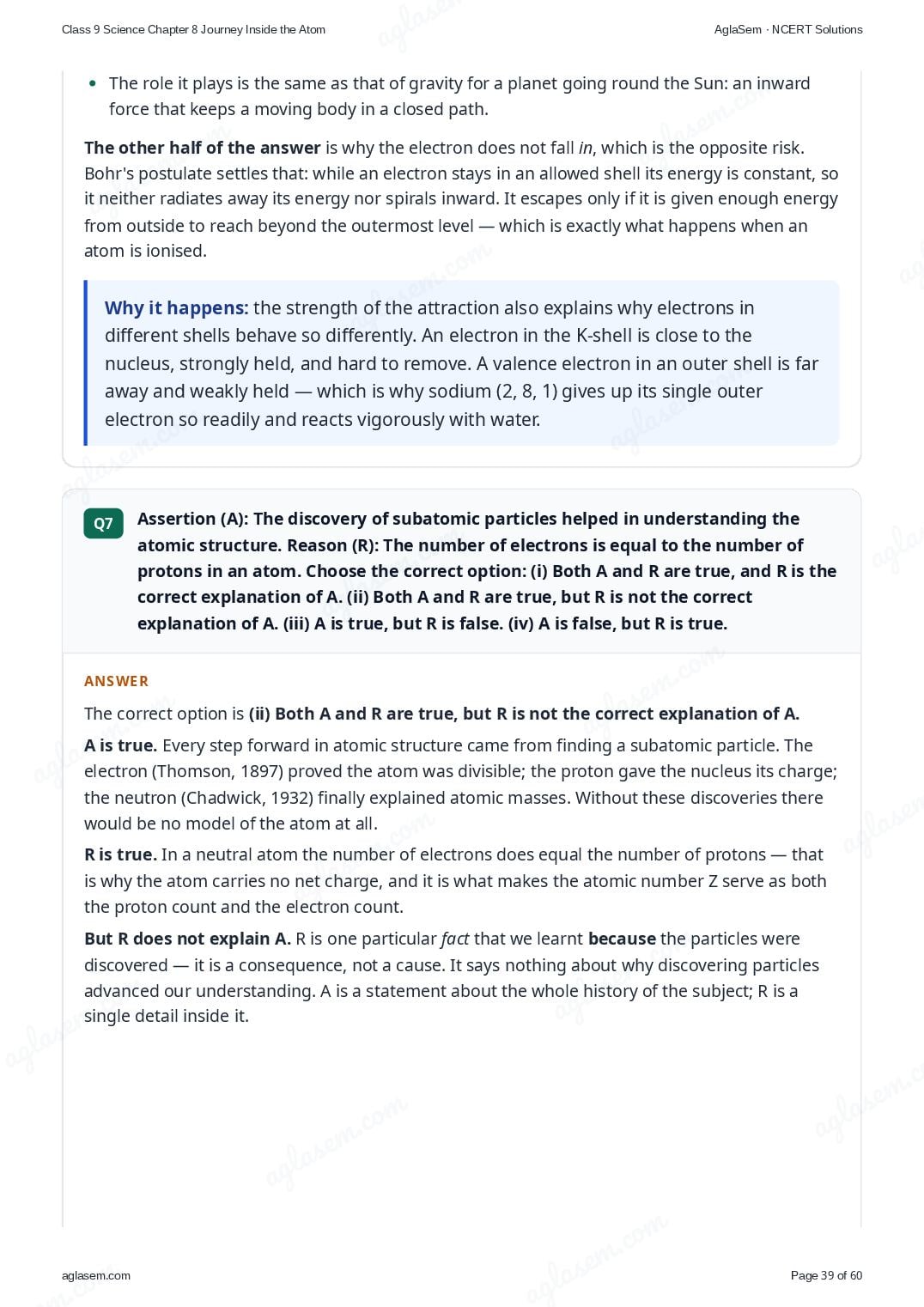
- Electrons move around the nucleus in orbits. Why do they not fly away from the atom? Explain what keeps them attracted to the nucleus.
- Assertion (A): The discovery of subatomic particles helped in understanding the atomic structure. Reason (R): The number of electrons is equal to the number of protons in an atom. Choose the correct option: (i) Both A and R are true, and R is the correct explanation of A. (ii) Both A and R are true, but R is not the correct explanation of A. (iii) A is true, but R is false. (iv) A is false, but R is true.
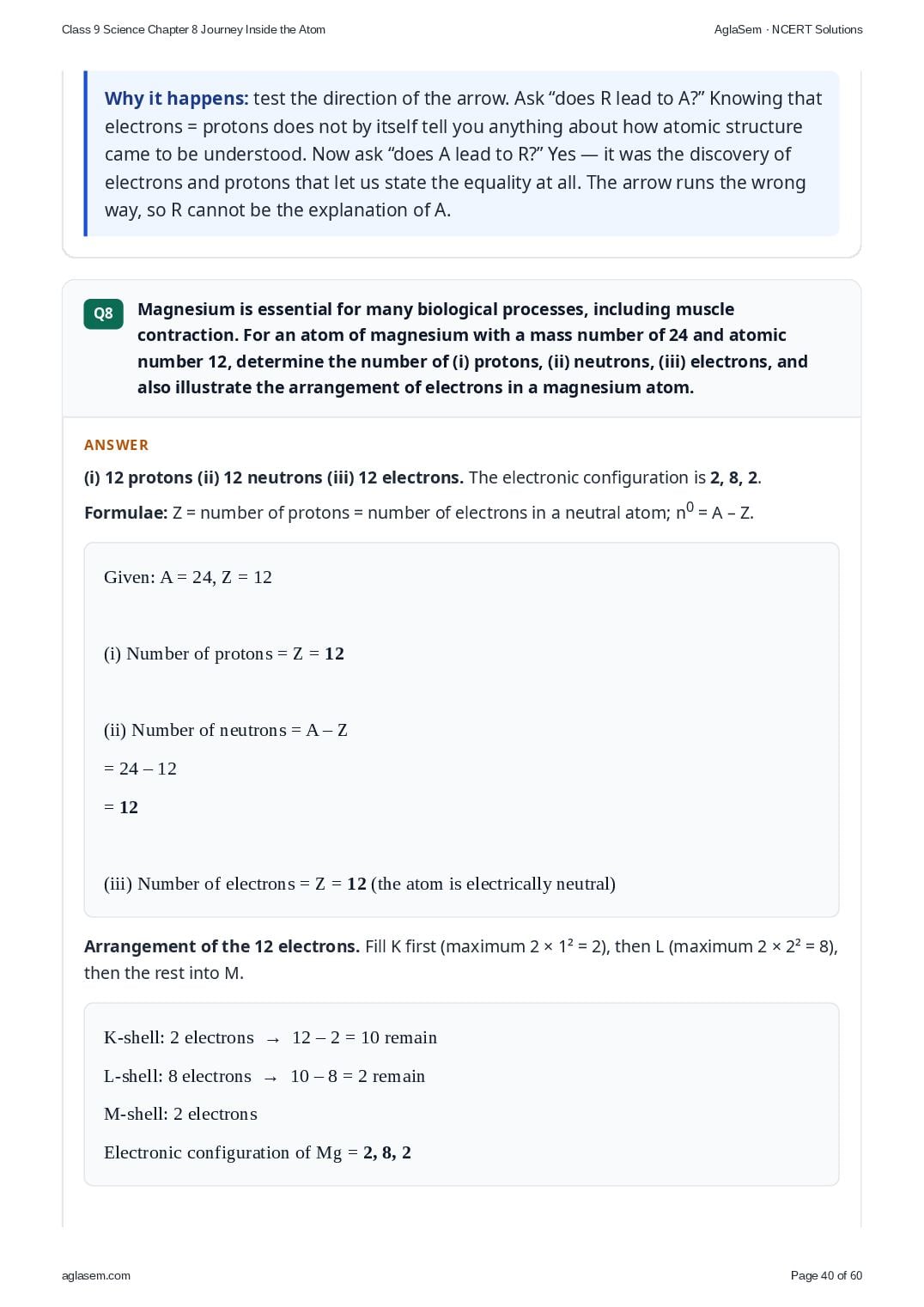
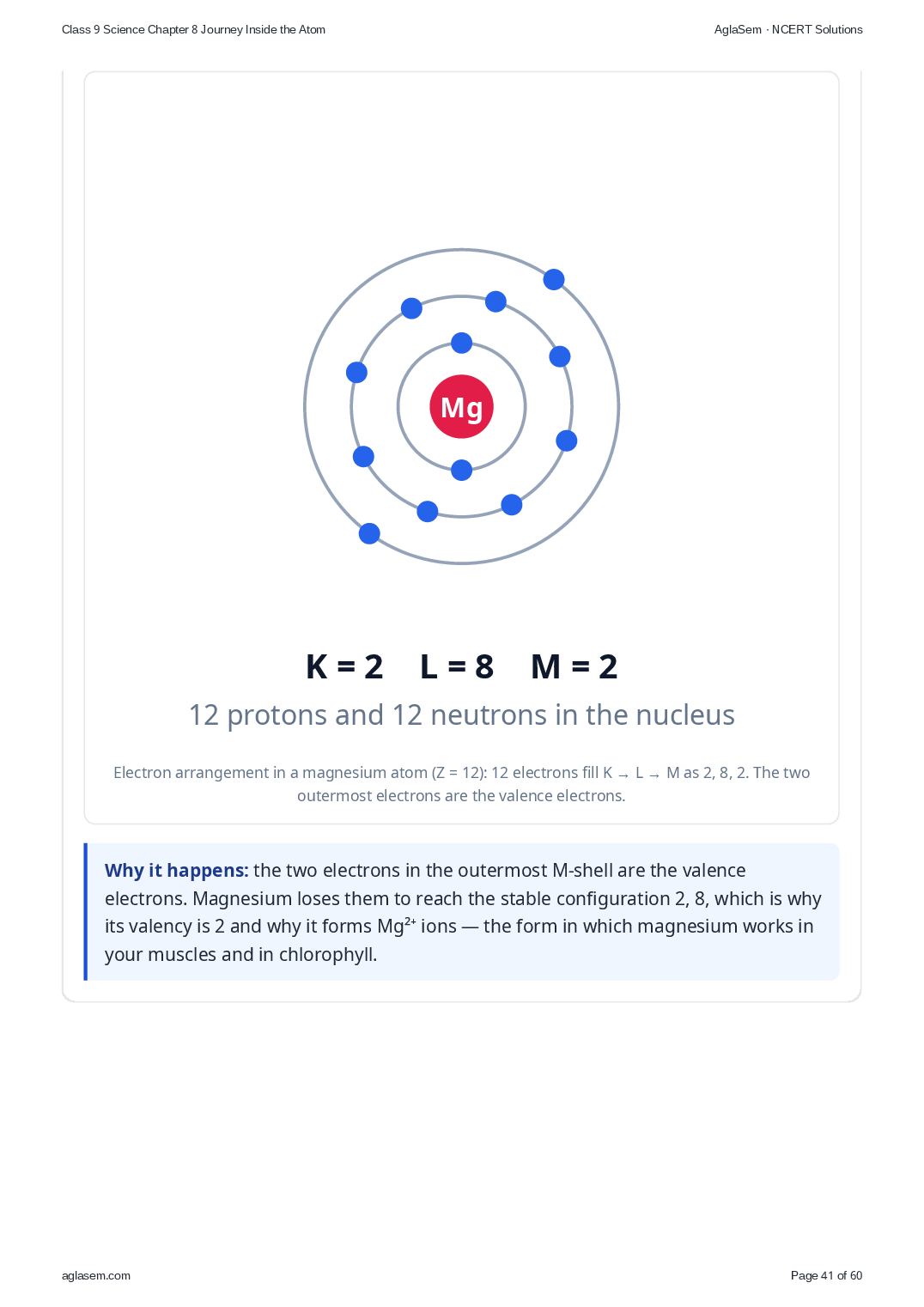
- Magnesium is essential for many biological processes, including muscle contraction. For an atom of magnesium with a mass number of 24 and atomic number 12, determine the number of (i) protons, (ii) neutrons, (iii) electrons, and also illustrate the arrangement of electrons in a magnesium atom.
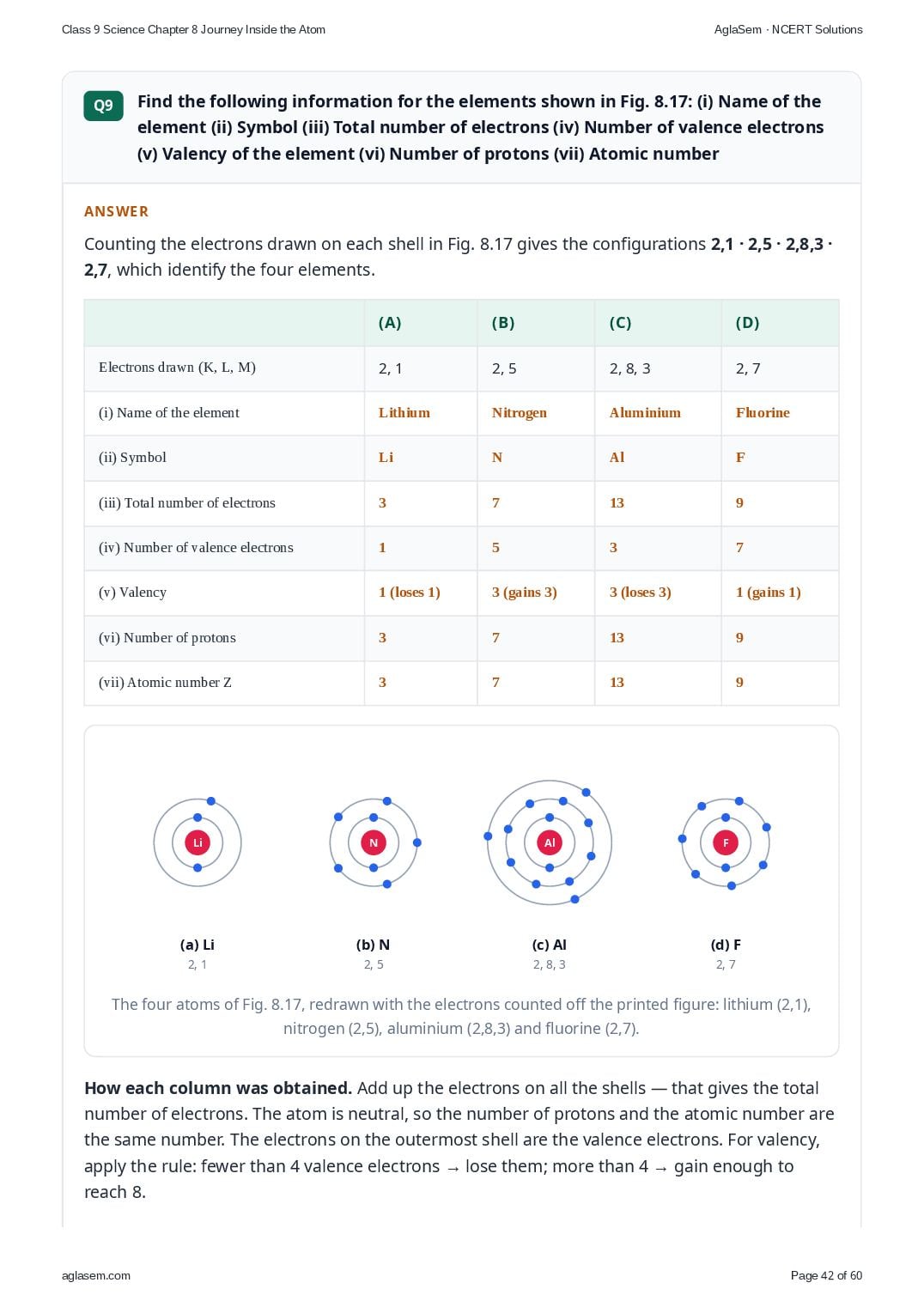
- Find the following information for the elements shown in Fig. 8.17: (i) Name of the element (ii) Symbol (iii) Total number of electrons (iv) Number of valence electrons (v) Valency of the element (vi) Number of protons (vii) Atomic number
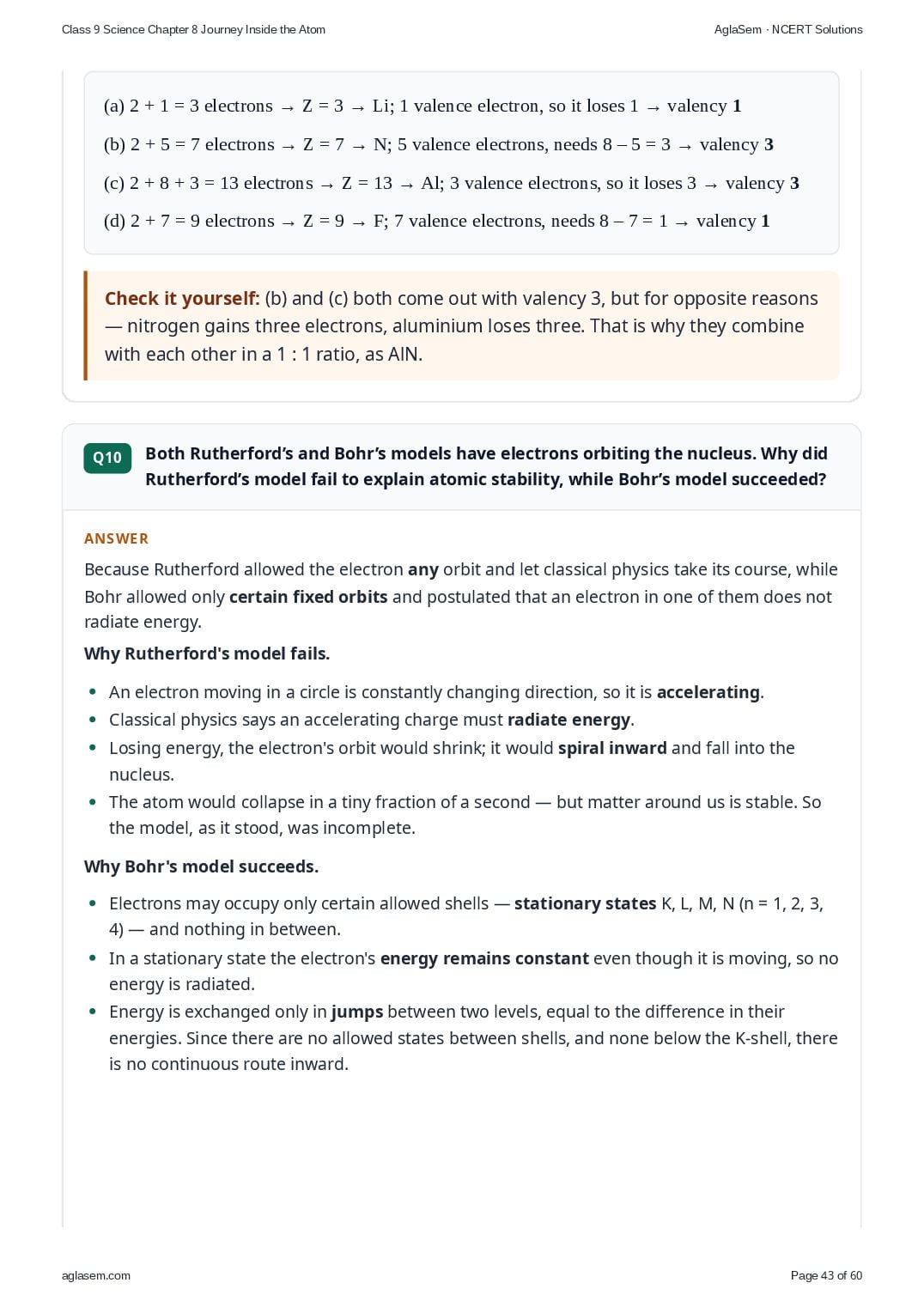
- Both Rutherford’s and Bohr’s models have electrons orbiting the nucleus. Why did Rutherford’s model fail to explain atomic stability, while Bohr’s model succeeded?
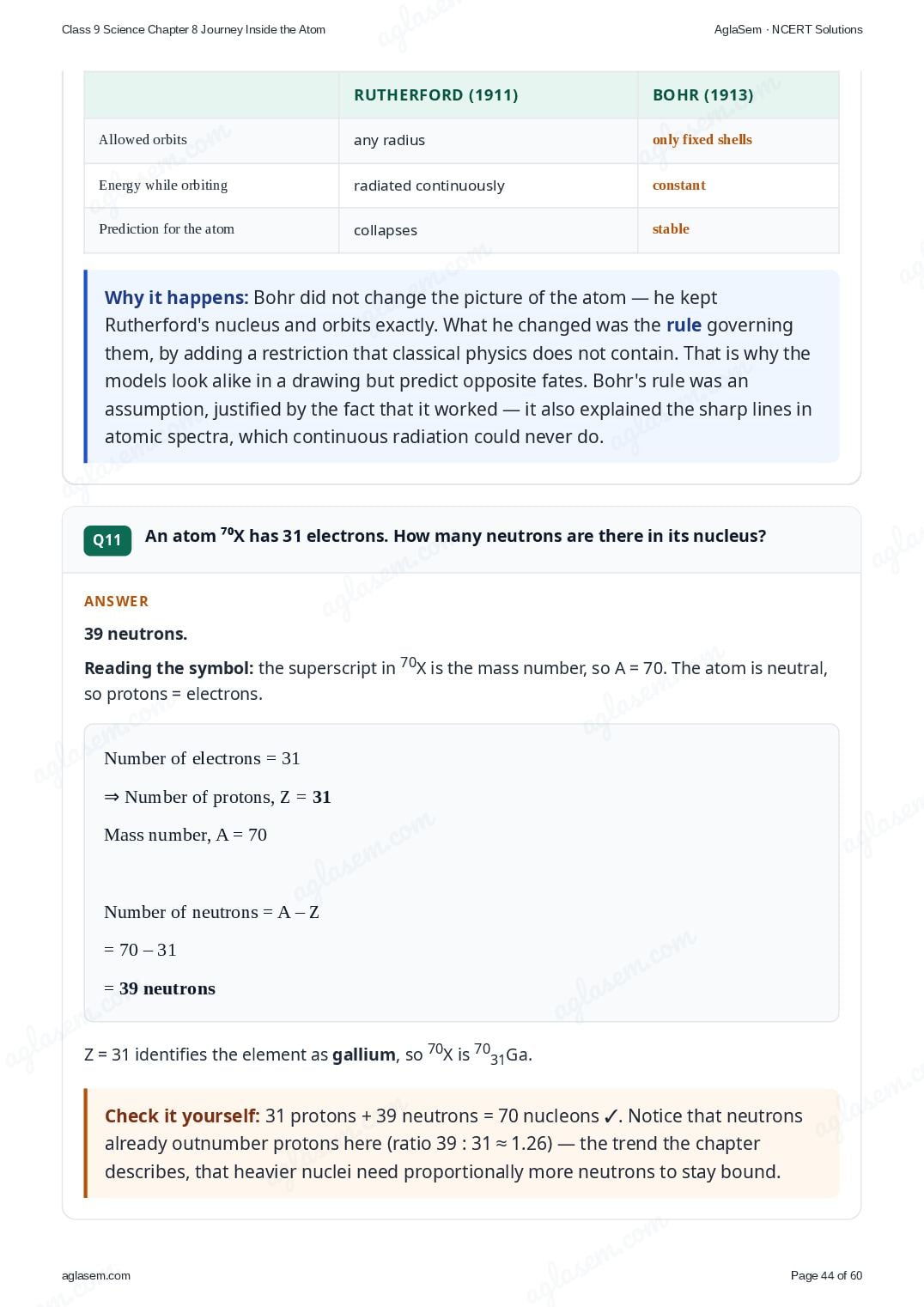
- An atom ⁷⁰X has 31 electrons. How many neutrons are there in its nucleus?
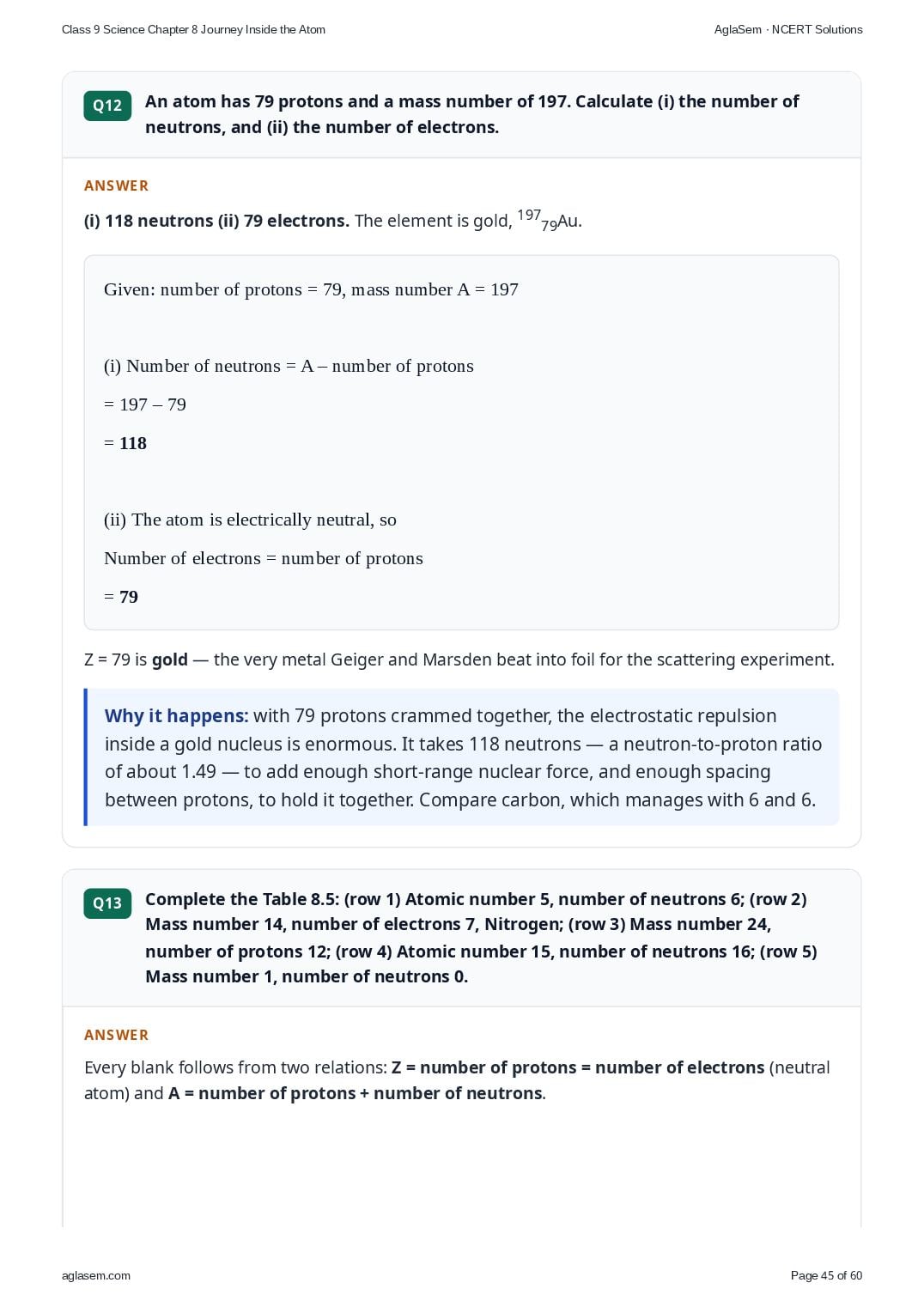
- An atom has 79 protons and a mass number of 197. Calculate (i) the number of neutrons, and (ii) the number of electrons.
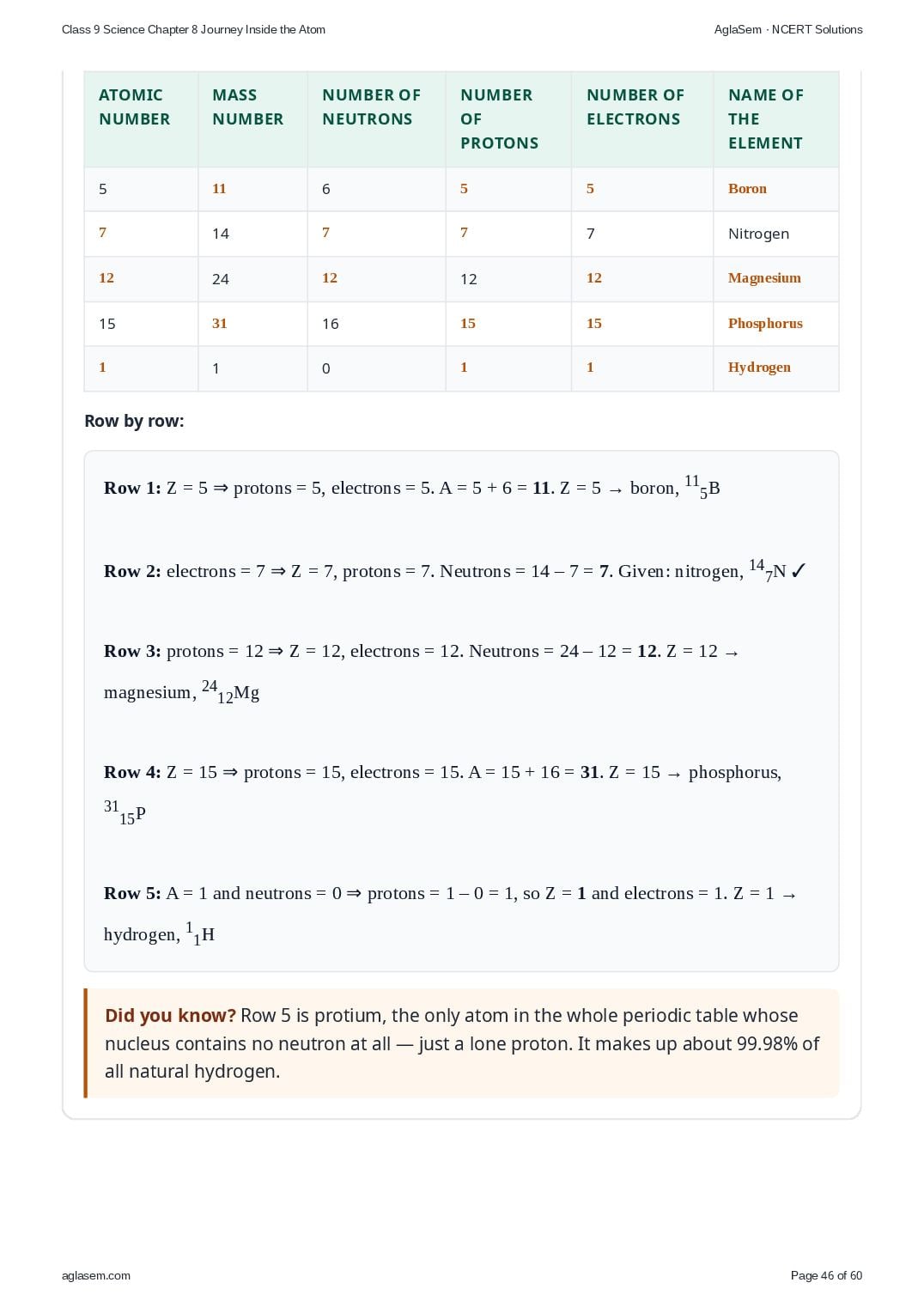
- Complete the Table 8.5: (row 1) Atomic number 5, number of neutrons 6; (row 2) Mass number 14, number of electrons 7, Nitrogen; (row 3) Mass number 24, number of protons 12; (row 4) Atomic number 15, number of neutrons 16; (row 5) Mass number 1, number of neutrons 0.
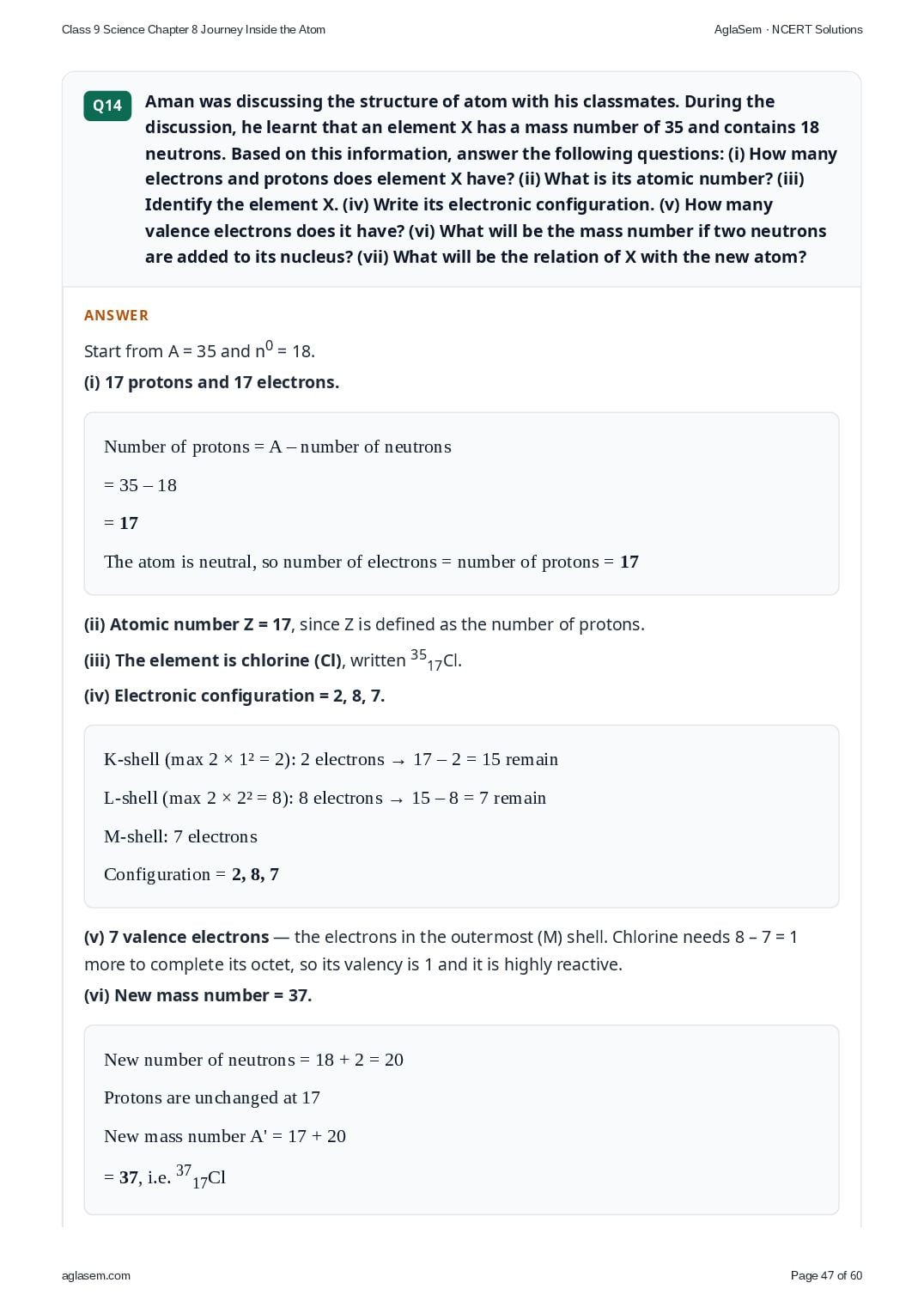
- Aman was discussing the structure of atom with his classmates. During the discussion, he learnt that an element X has a mass number of 35 and contains 18 neutrons. Based on this information, answer the following questions: (i) How many electrons and protons does element X have? (ii) What is its atomic number? (iii) Identify the element X. (iv) Write its electronic configuration. (v) How many valence electrons does it have? (vi) What will be the mass number if two neutrons are added to its nucleus? (vii) What will be the relation of X with the new atom?
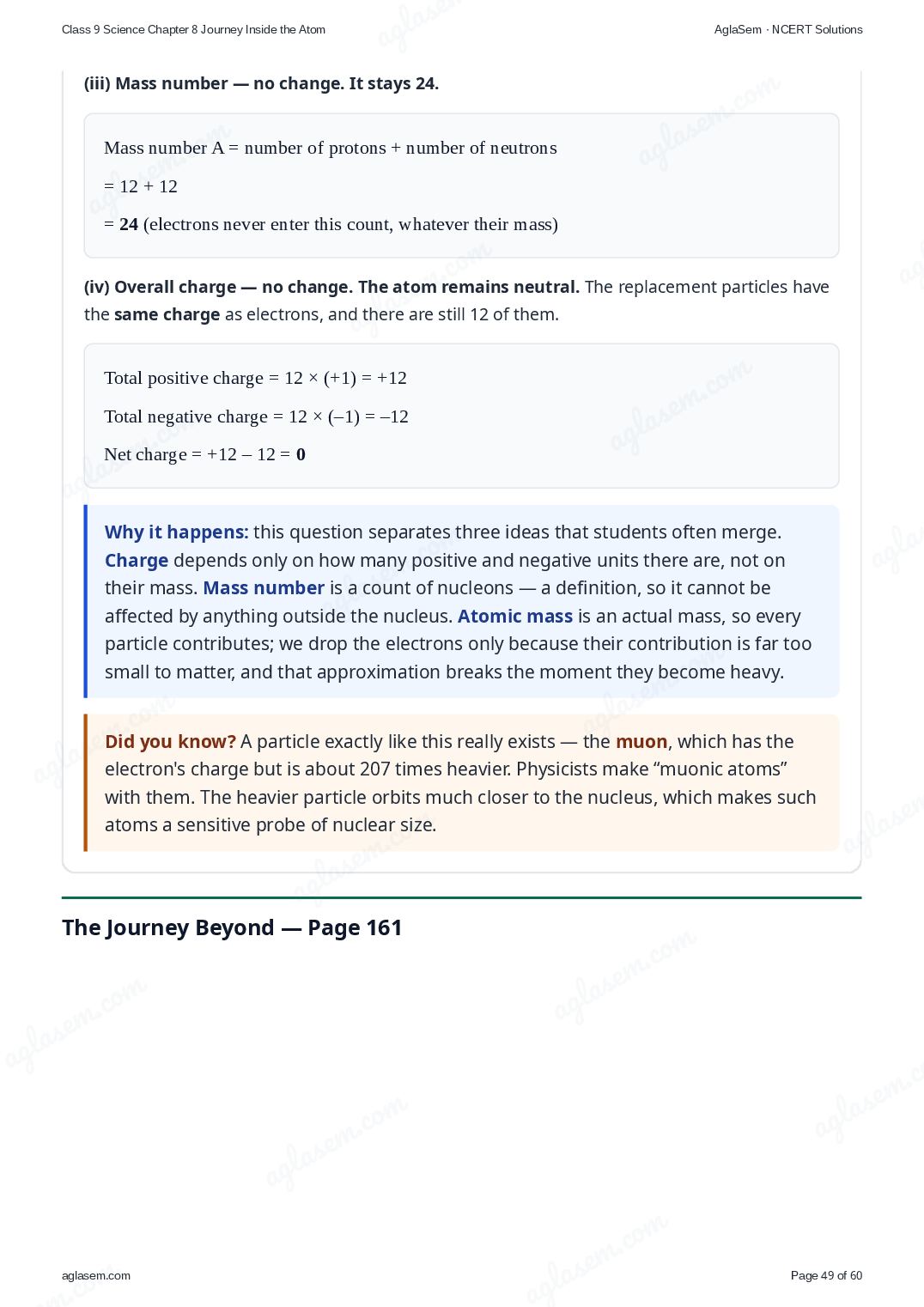
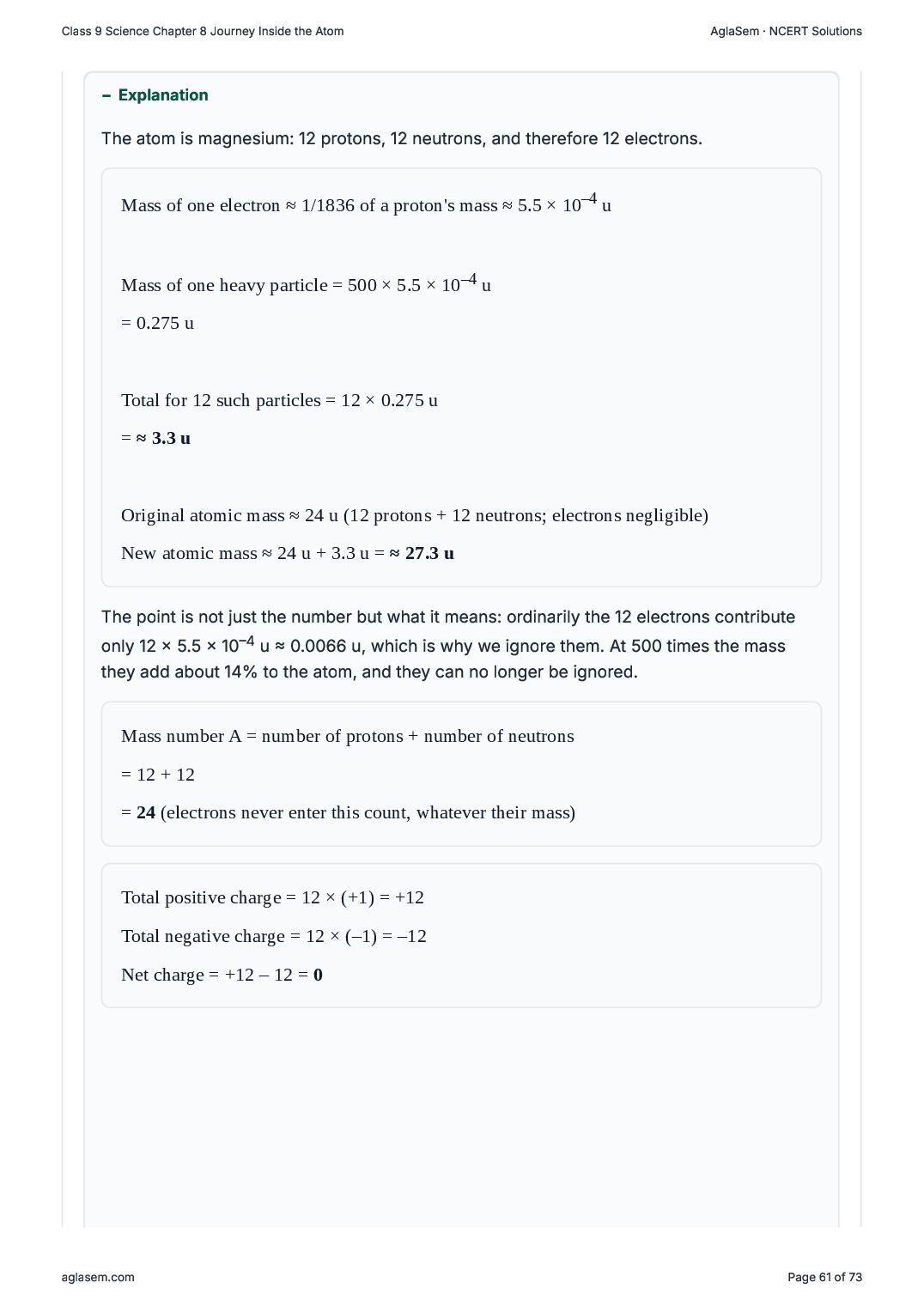
- In an atom, there are 12 protons and 12 neutrons in the nucleus. Now, imagine that all the electrons are replaced with some hypothetical particles that have the same charge as electrons but are 500 times heavier. What effect will this replacement have on the atom’s: (i) Atomic number (ii) Atomic mass (iii) Mass number (iv) Overall charge
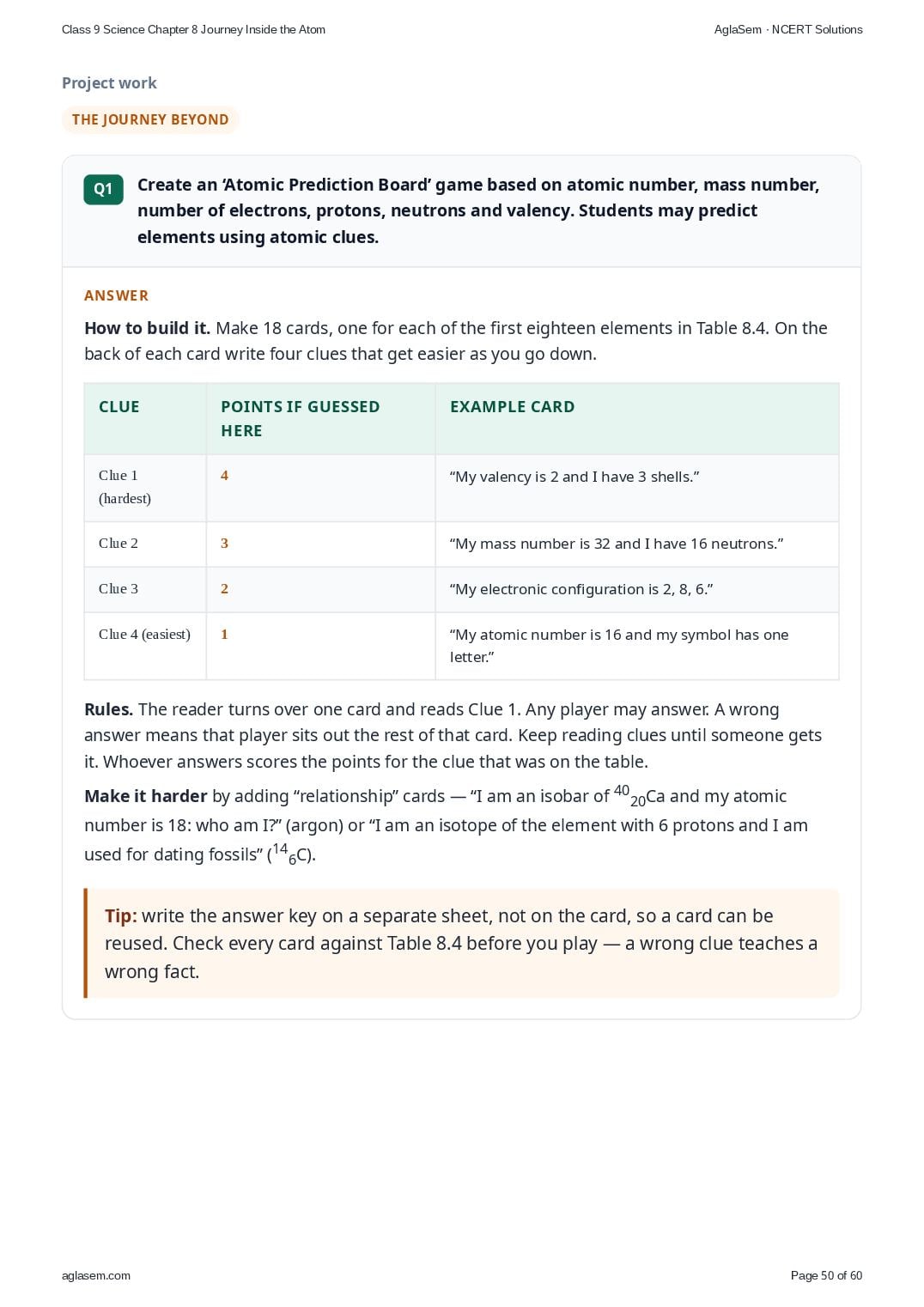
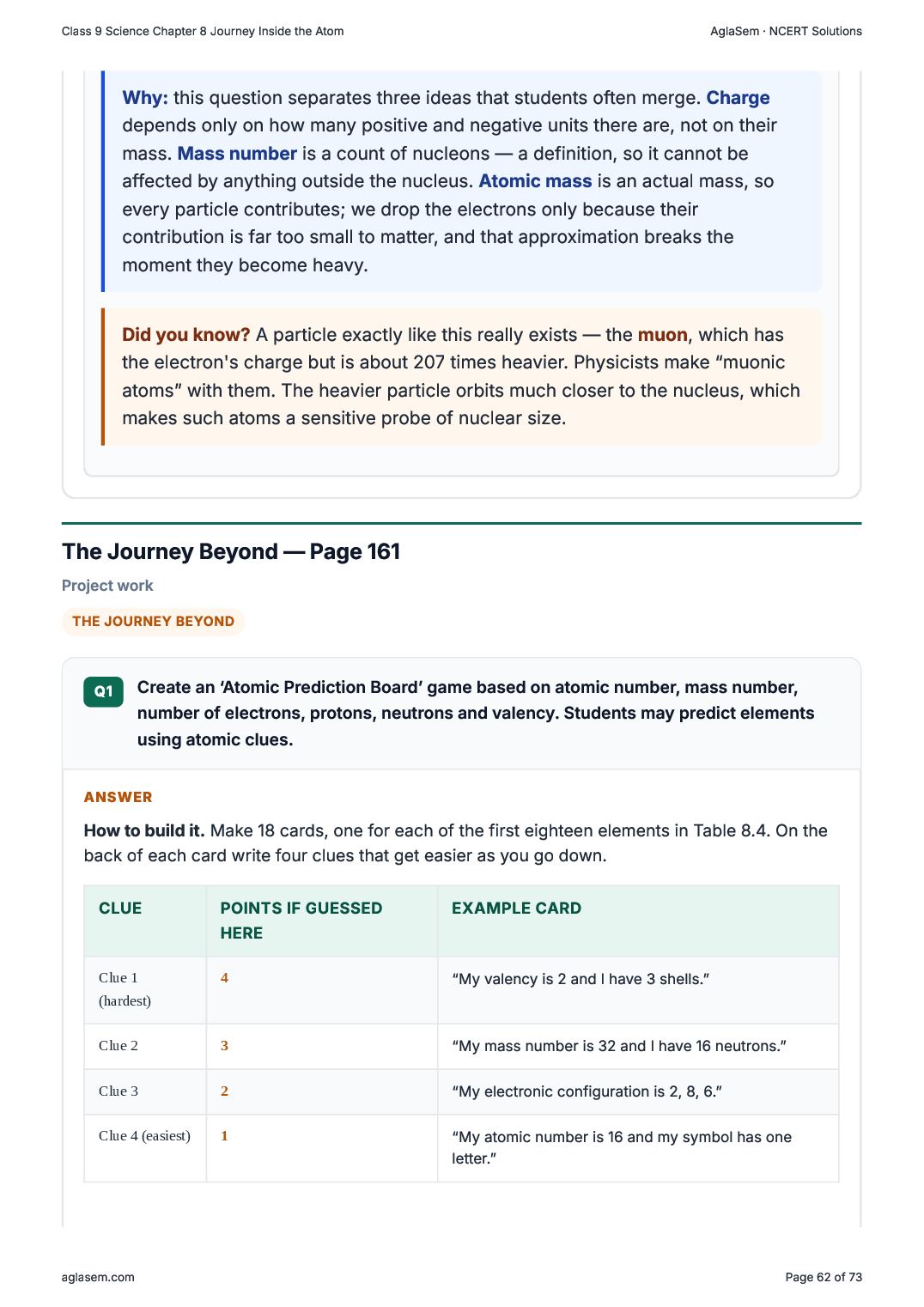
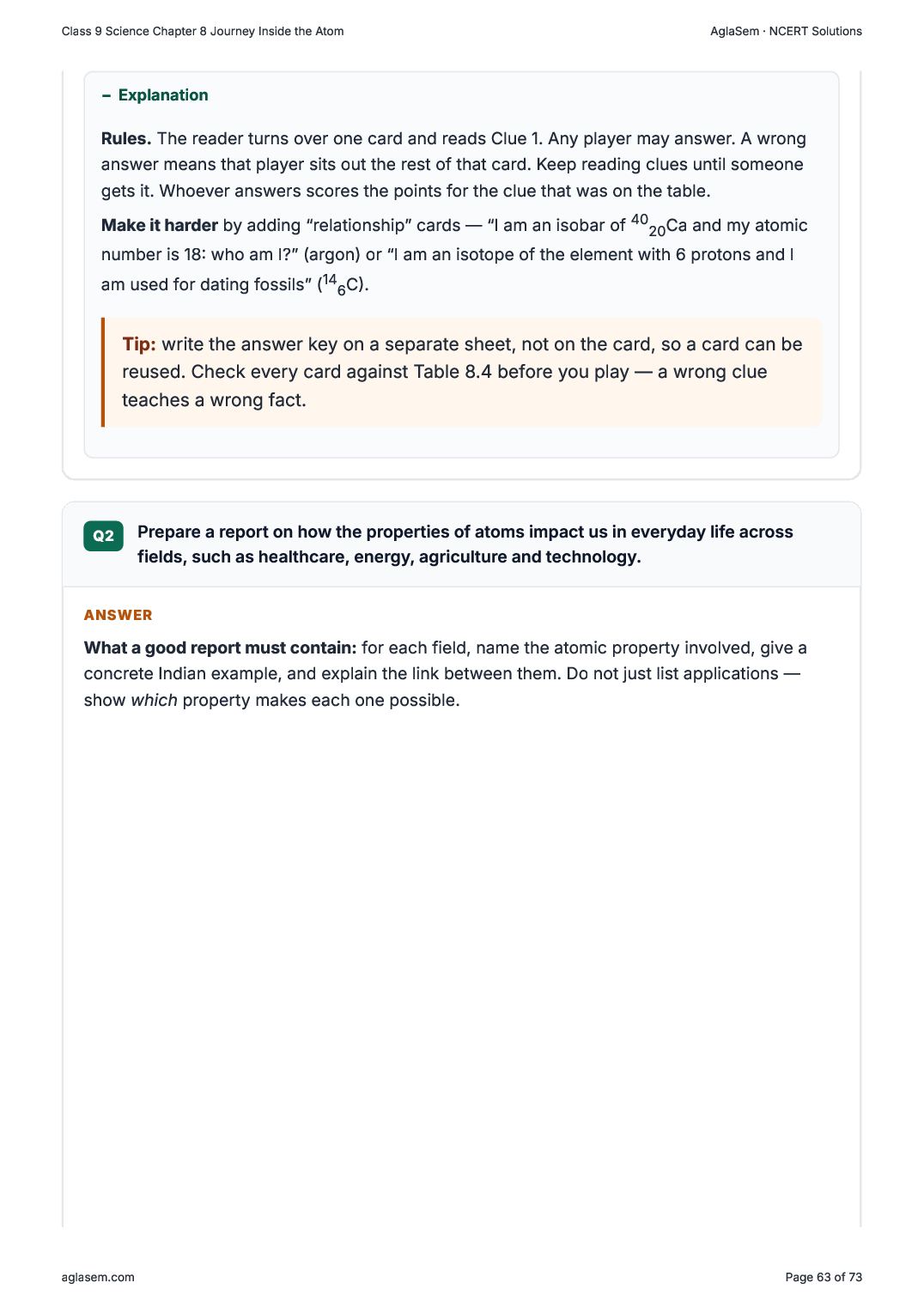
- Create an ‘Atomic Prediction Board’ game based on atomic number, mass number, number of electrons, protons, neutrons and valency. Students may predict elements using atomic clues.
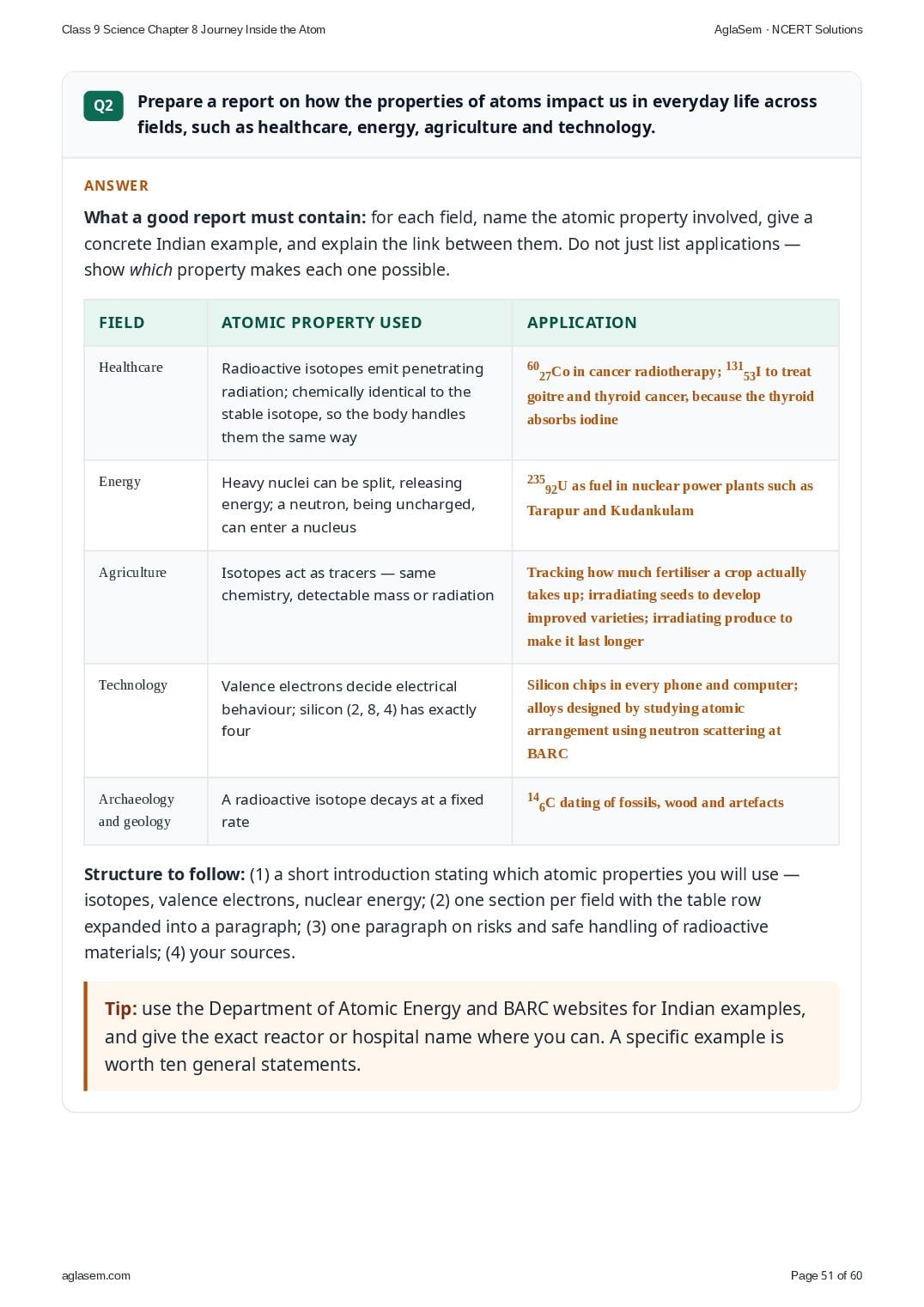
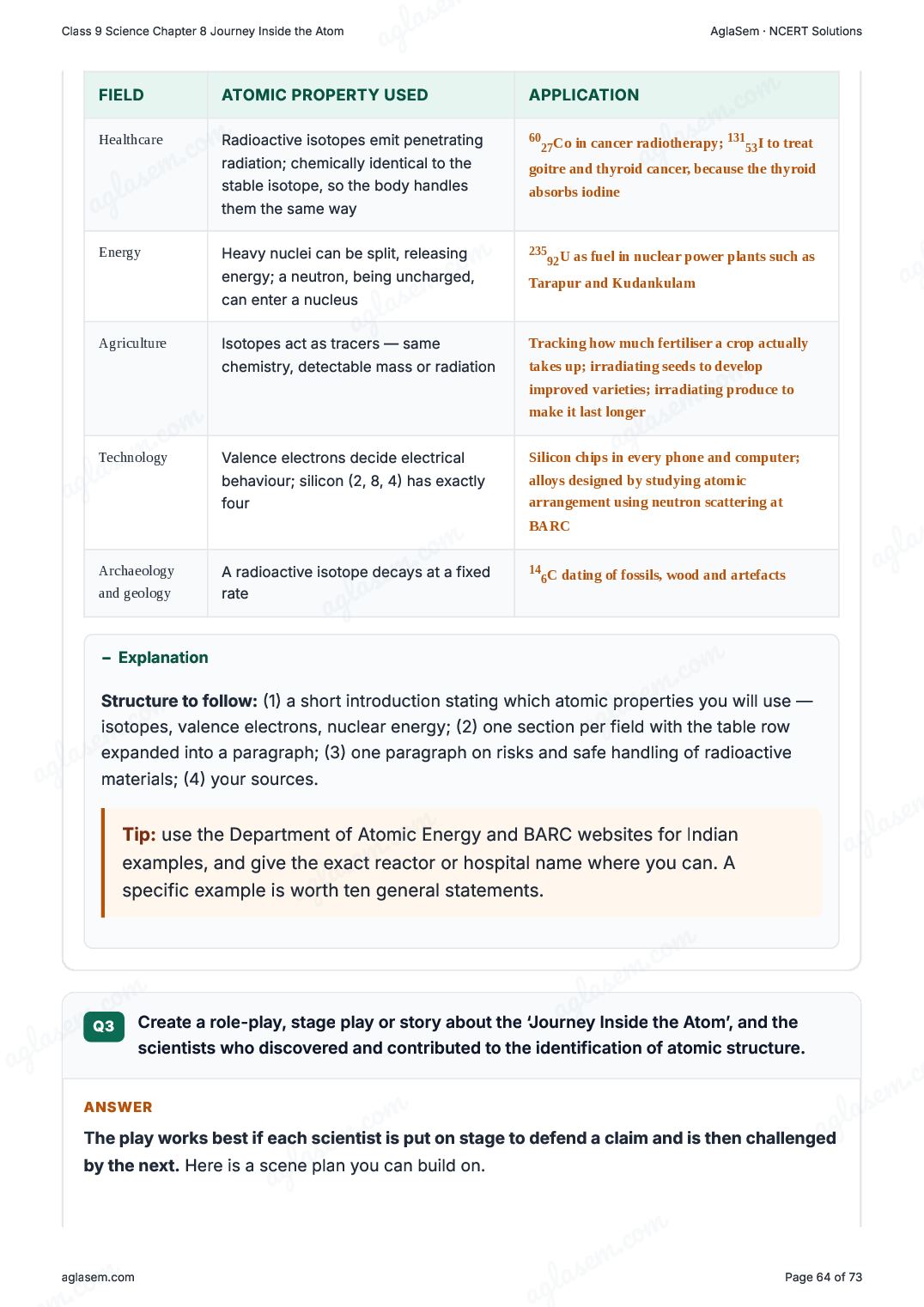
- Prepare a report on how the properties of atoms impact us in everyday life across fields, such as healthcare, energy, agriculture and technology.
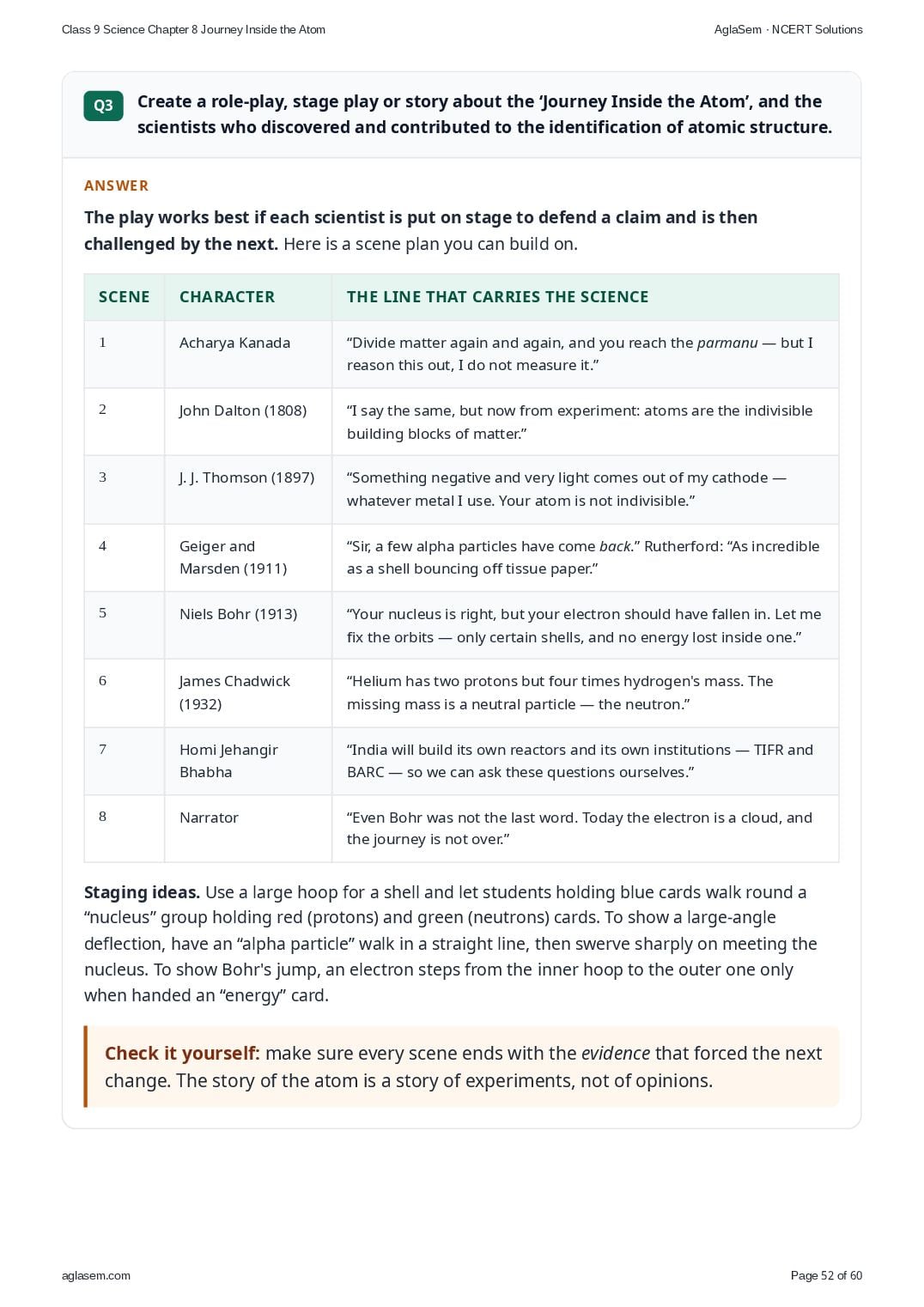
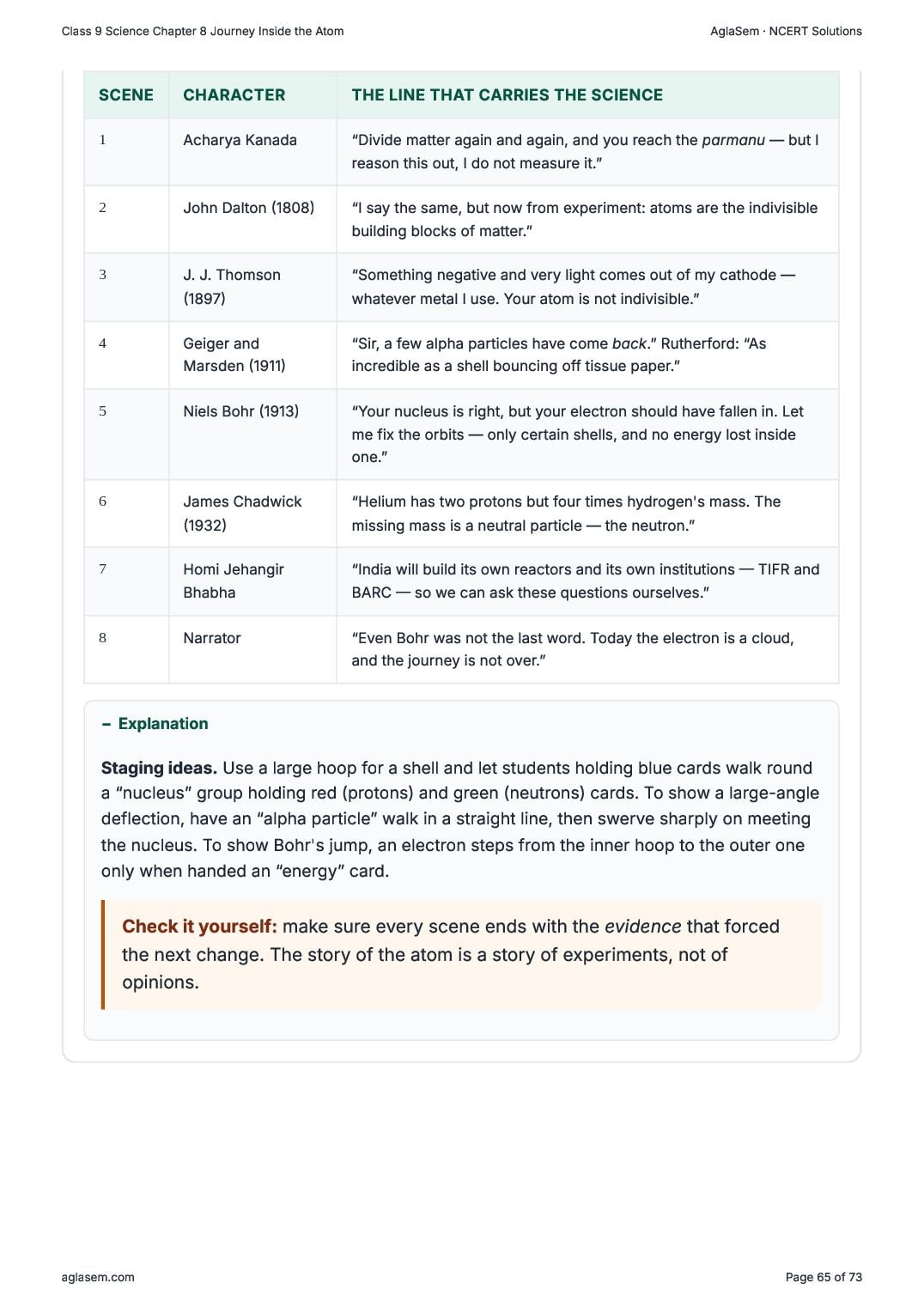
- Create a role-play, stage play or story about the ‘Journey Inside the Atom’, and the scientists who discovered and contributed to the identification of atomic structure.
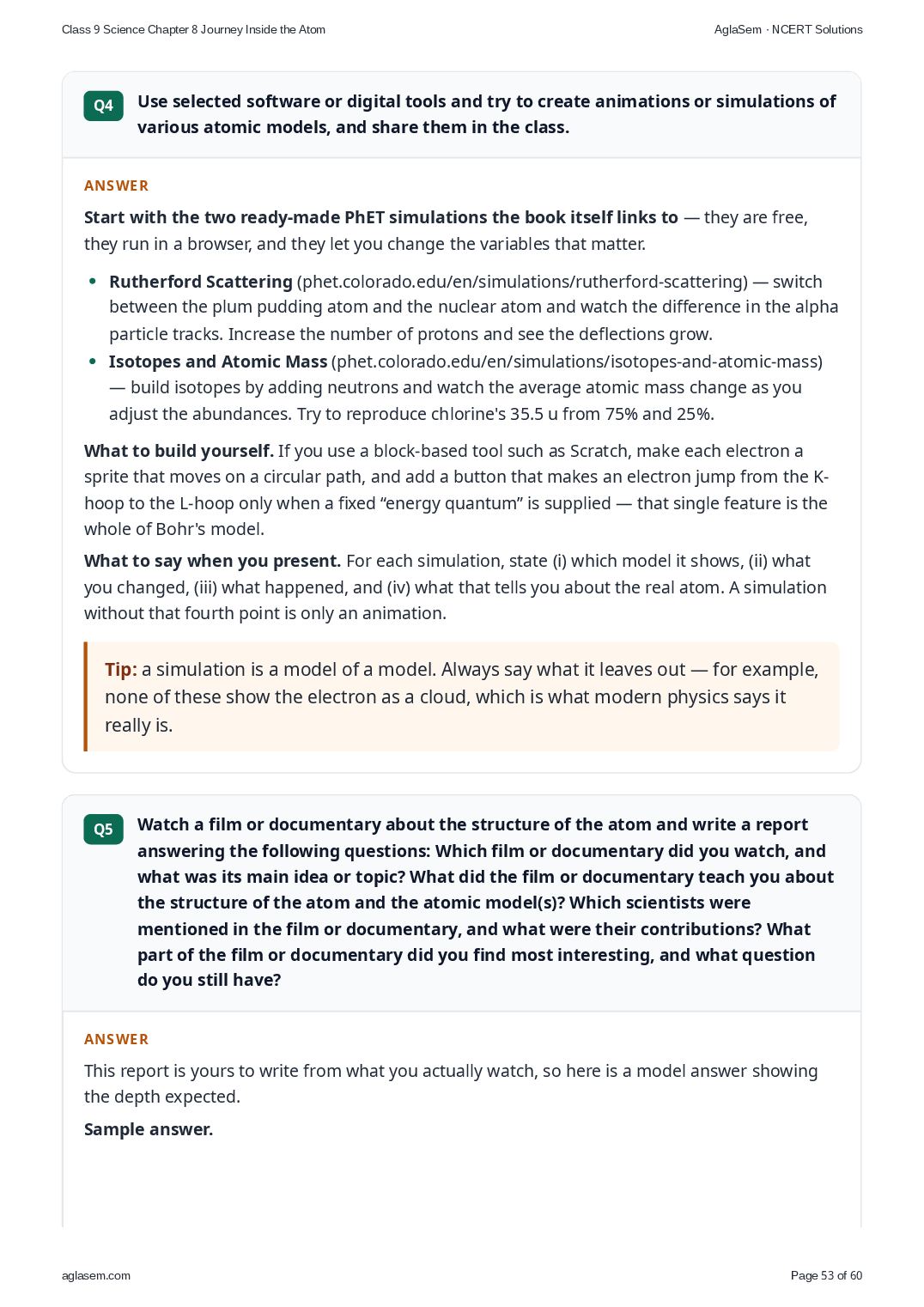
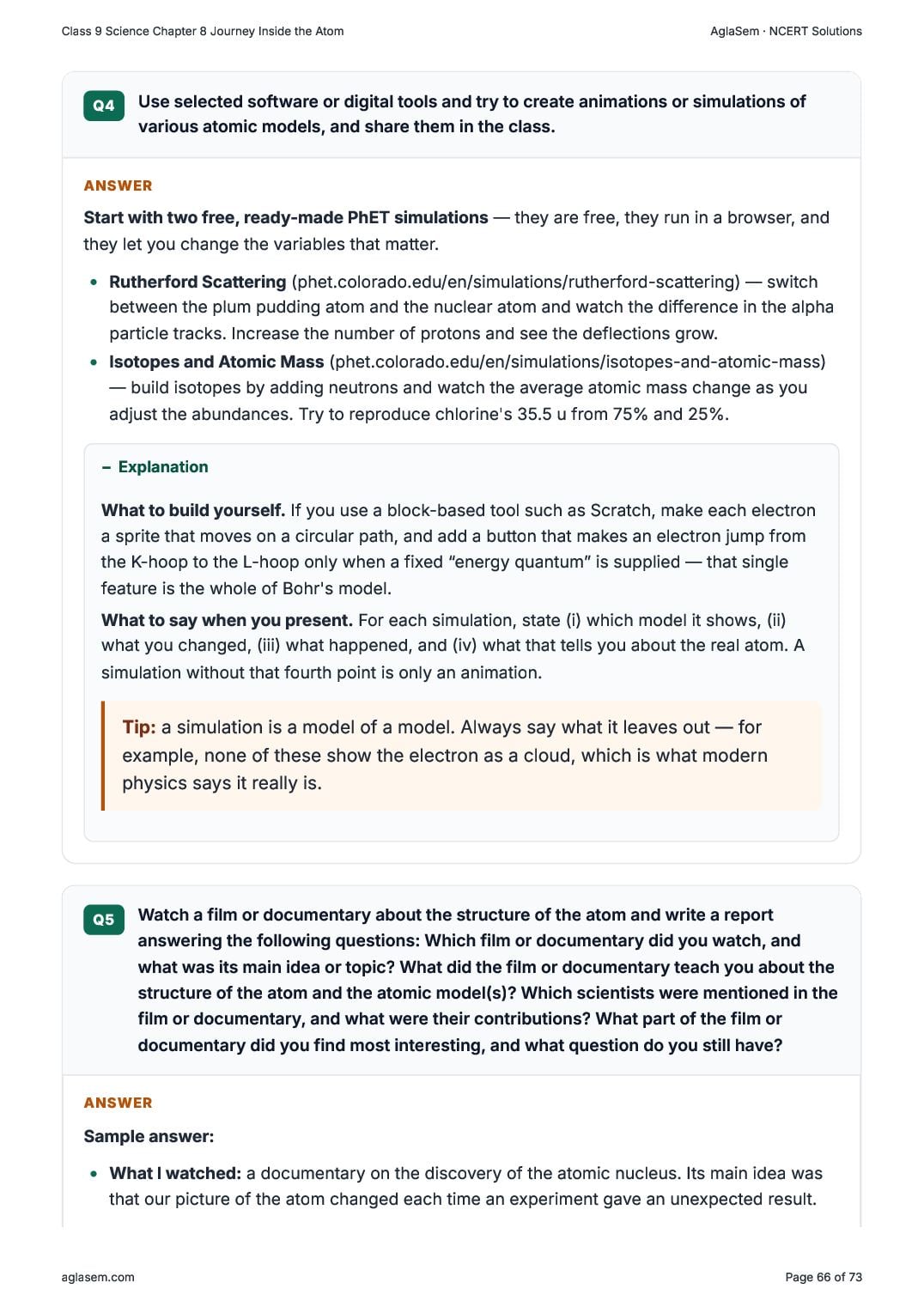
- Use selected software or digital tools and try to create animations or simulations of various atomic models, and share them in the class.
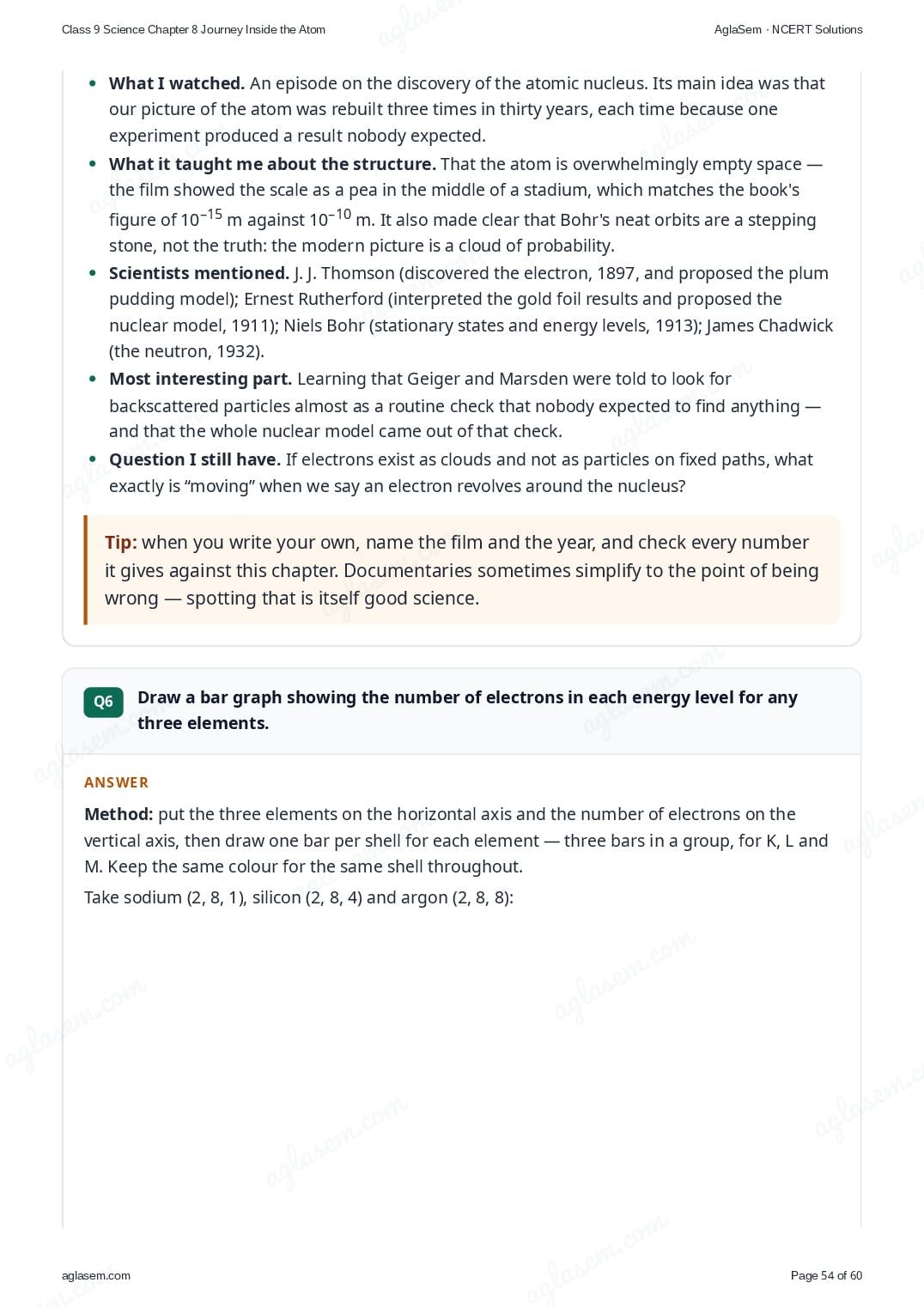
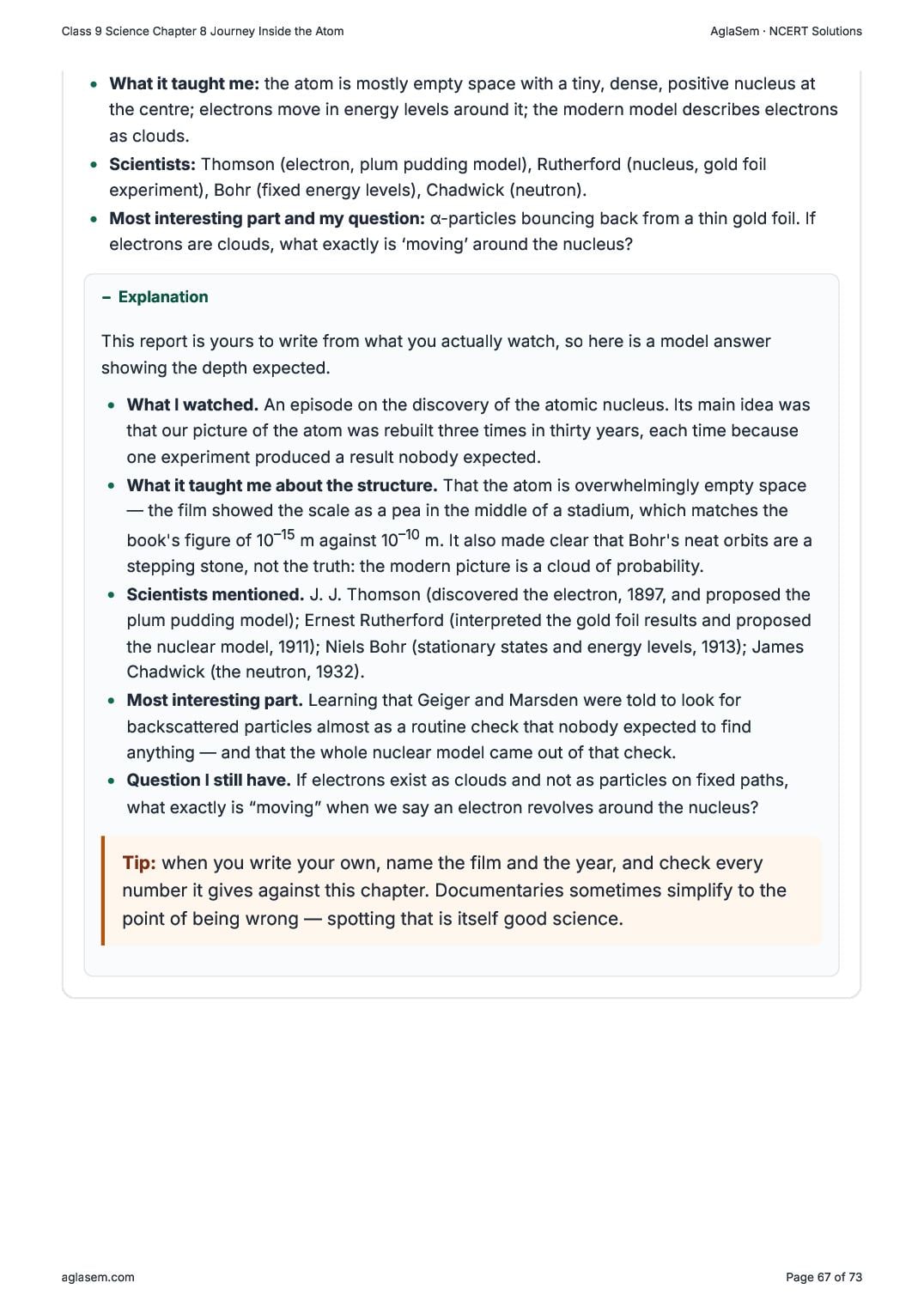
- Watch a film or documentary about the structure of the atom and write a report answering the following questions: Which film or documentary did you watch, and what was its main idea or topic? What did the film or documentary teach you about the structure of the atom and the atomic model(s)? Which scientists were mentioned in the film or documentary, and what were their contributions? What part of the film or documentary did you find most interesting, and what question do you still have?
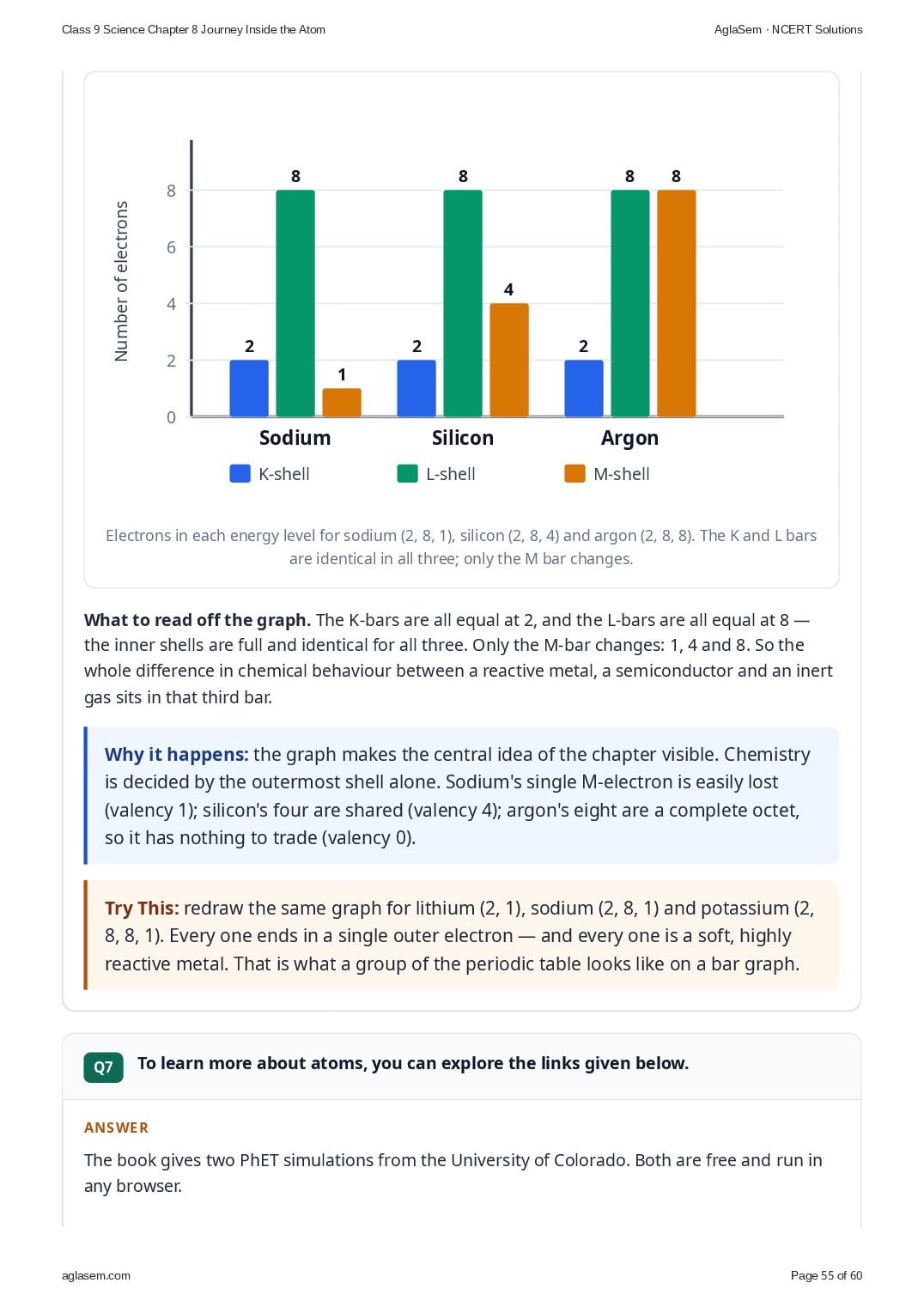
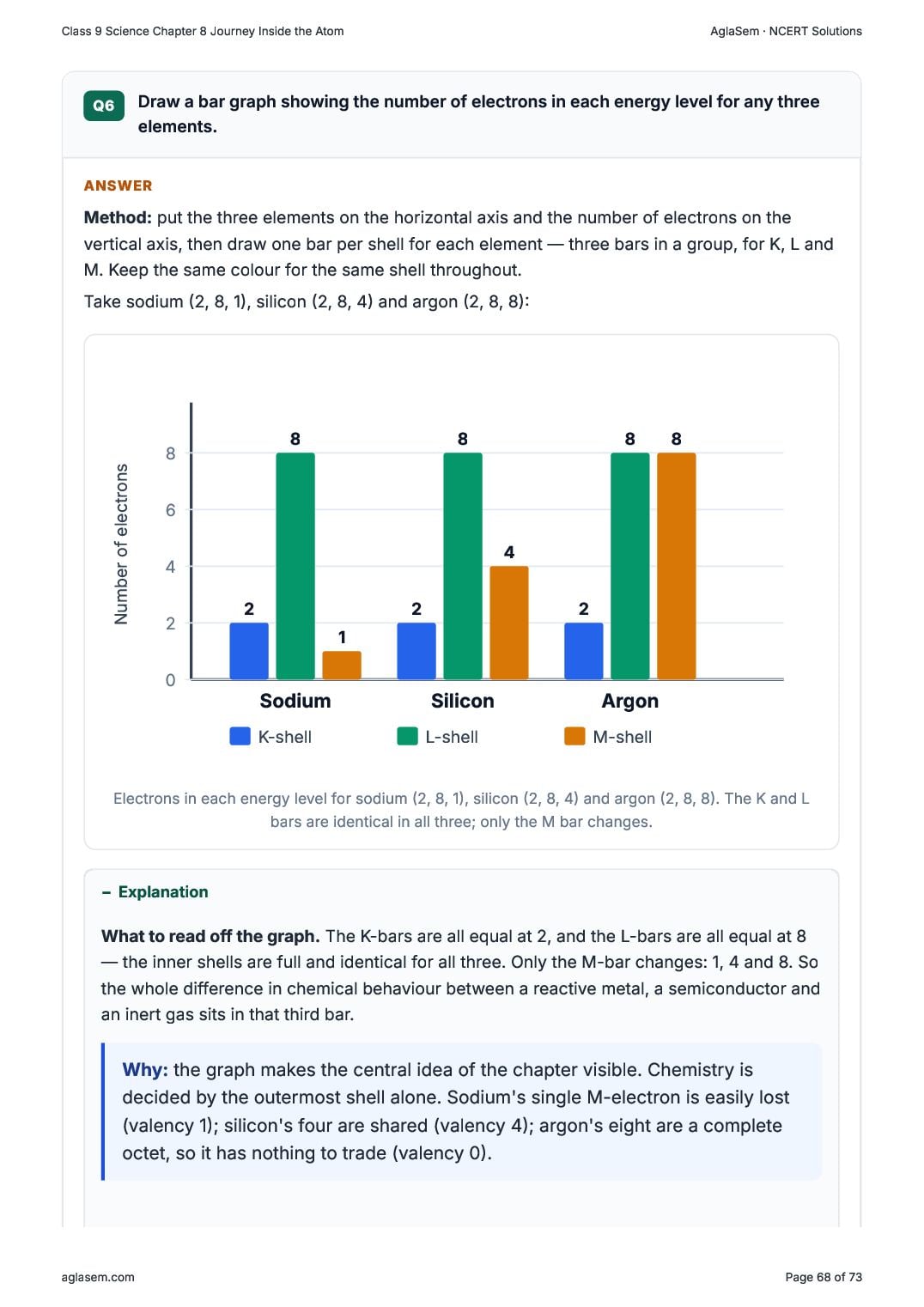
- Draw a bar graph showing the number of electrons in each energy level for any three elements.
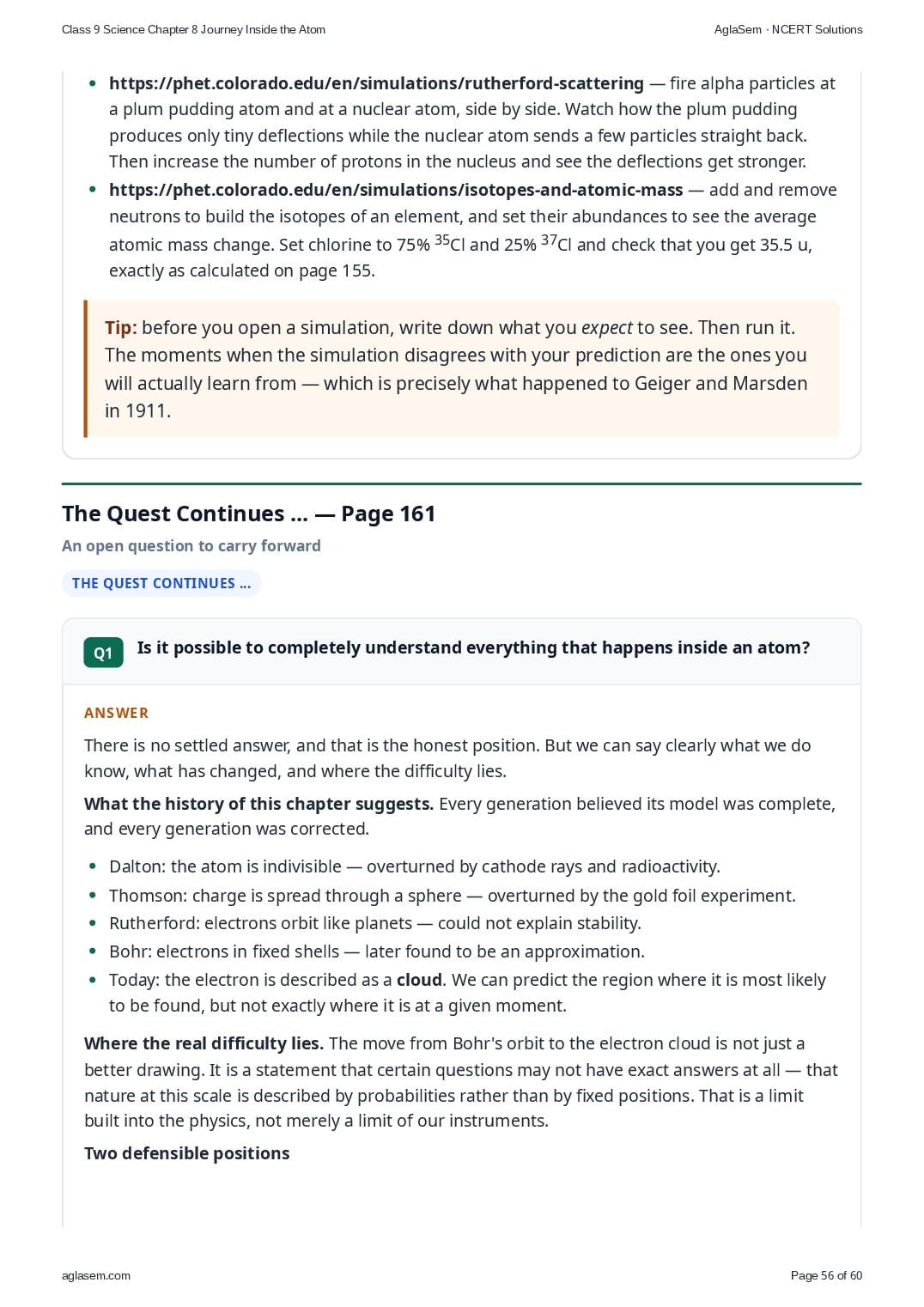
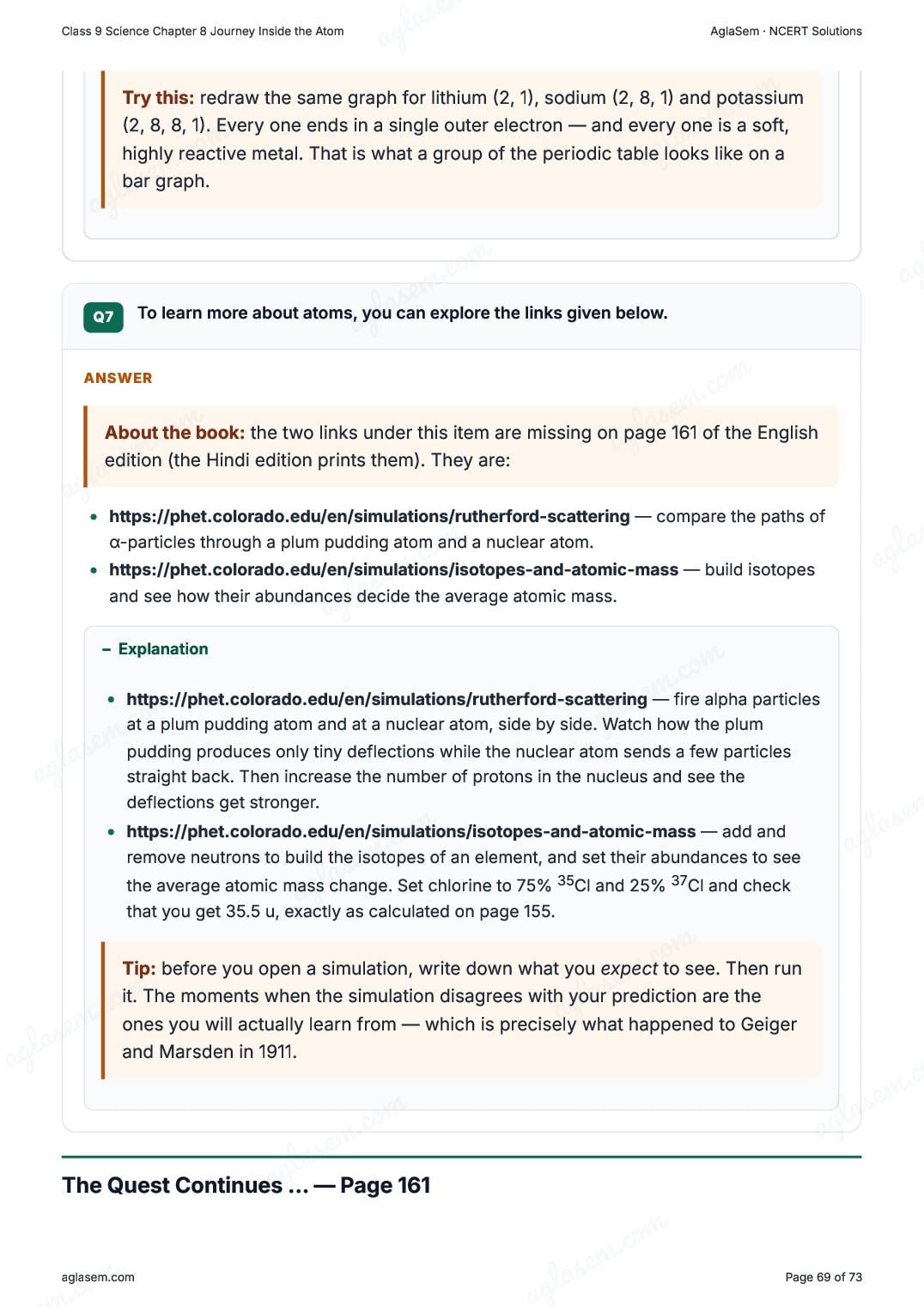
- To learn more about atoms, you can explore the links given below.
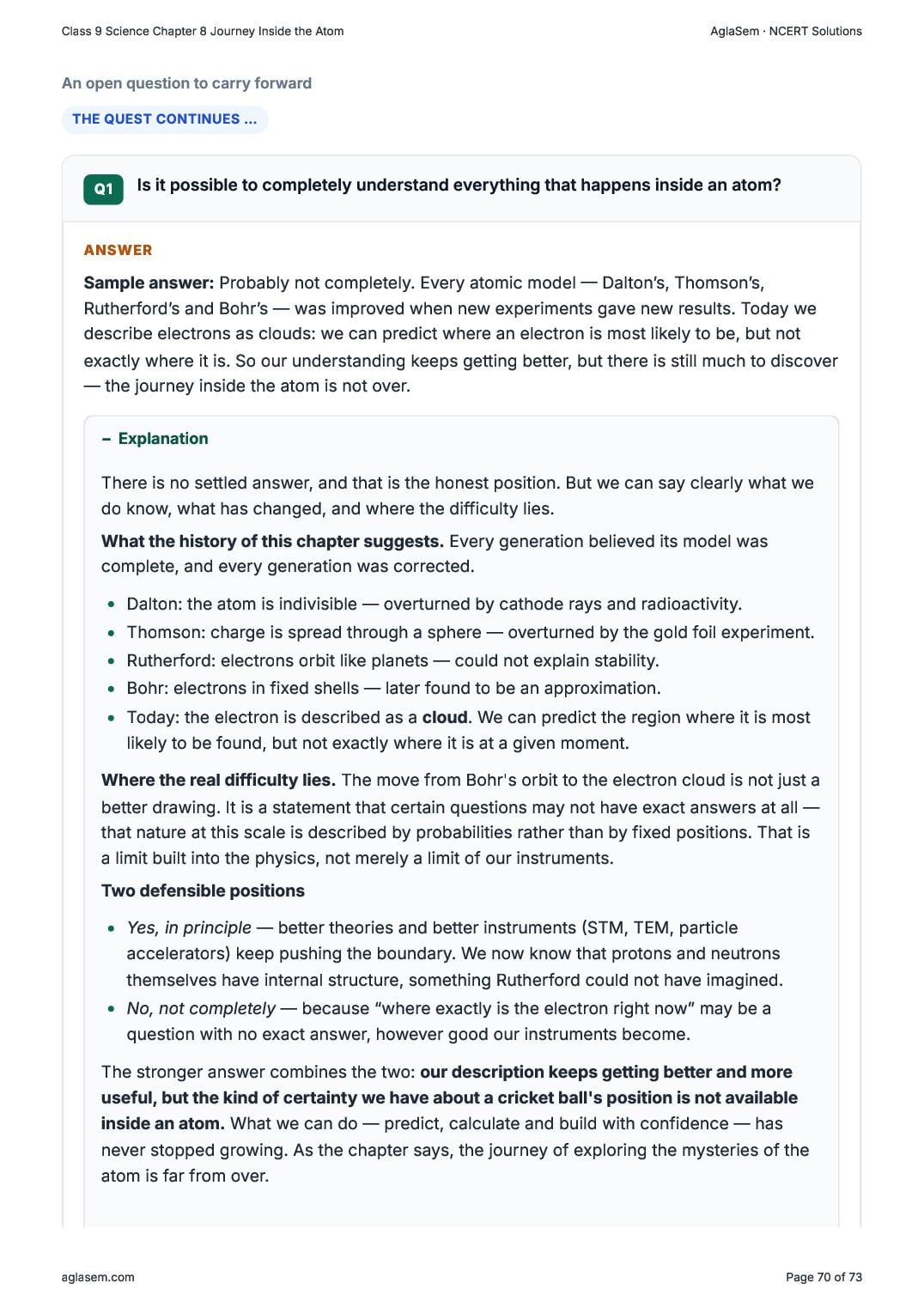
- Is it possible to completely understand everything that happens inside an atom?
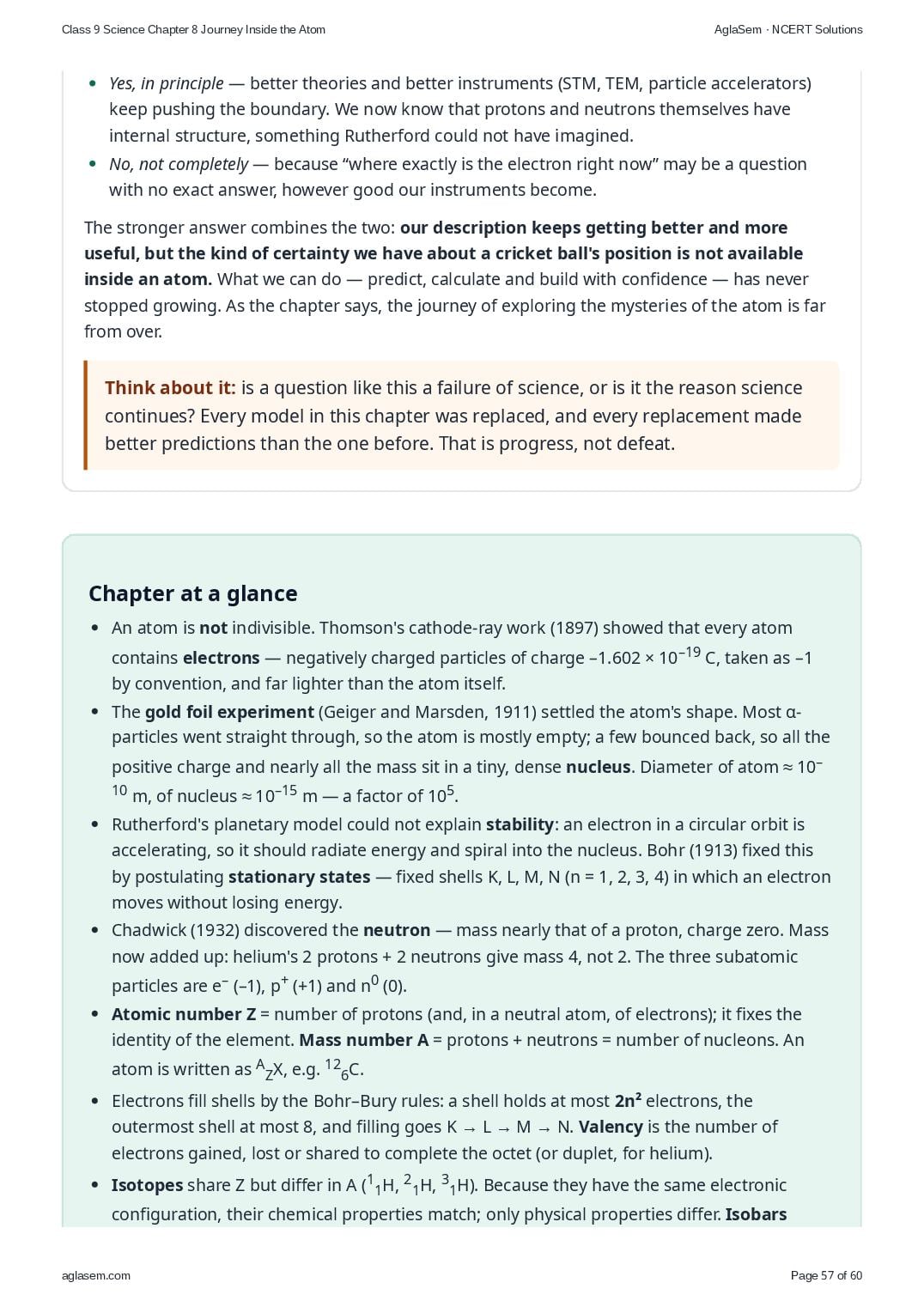
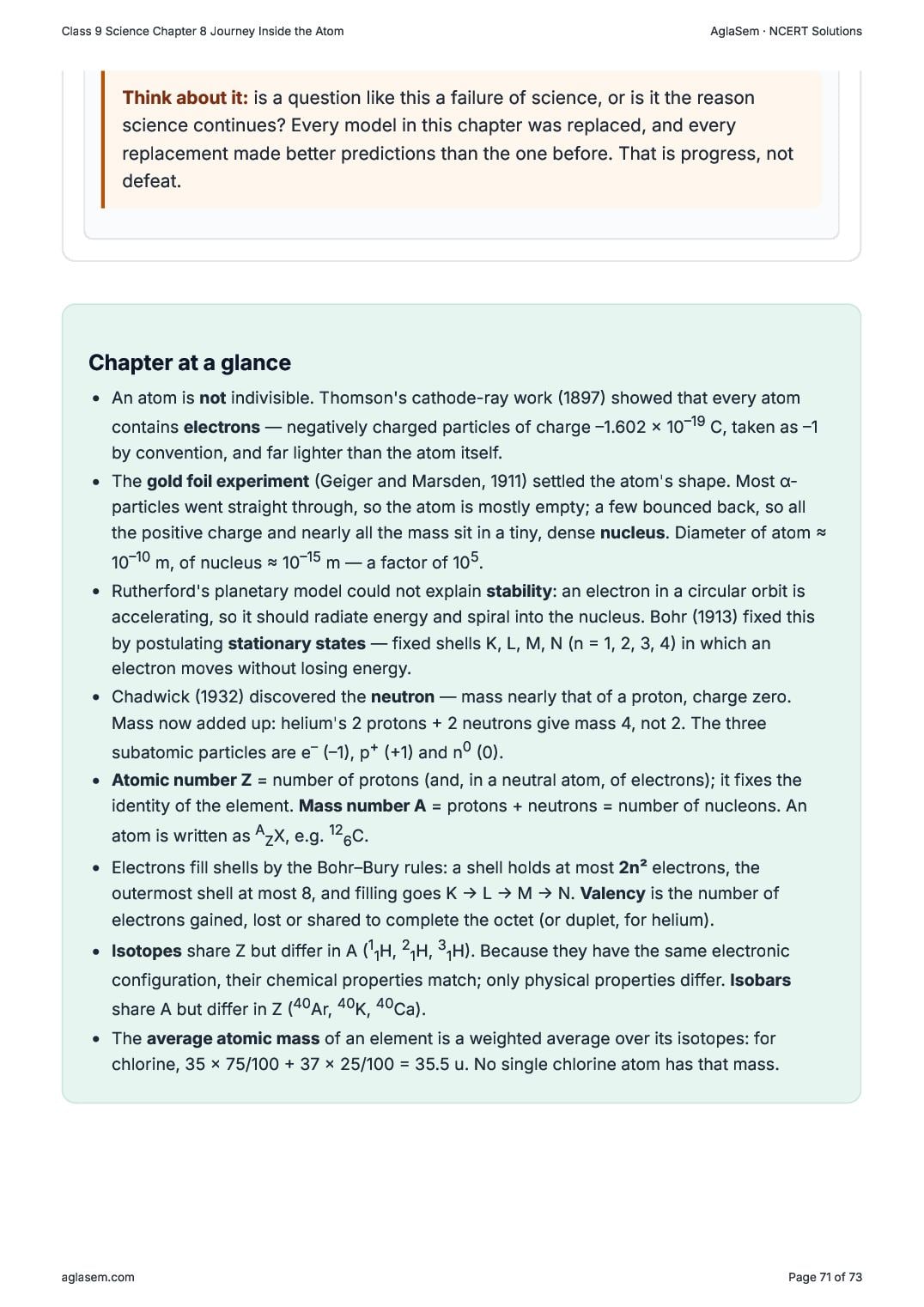
Chapter at a Glance
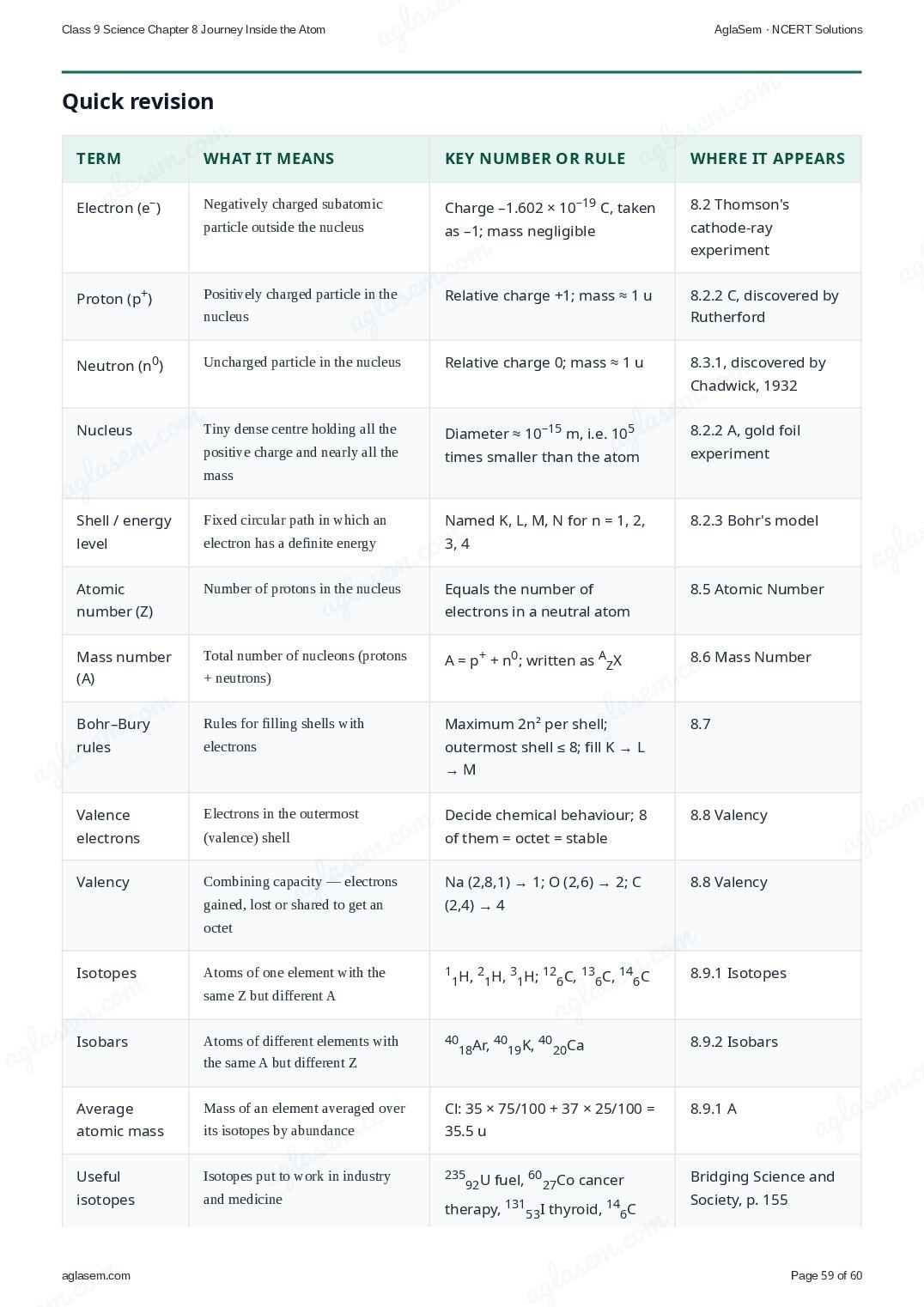
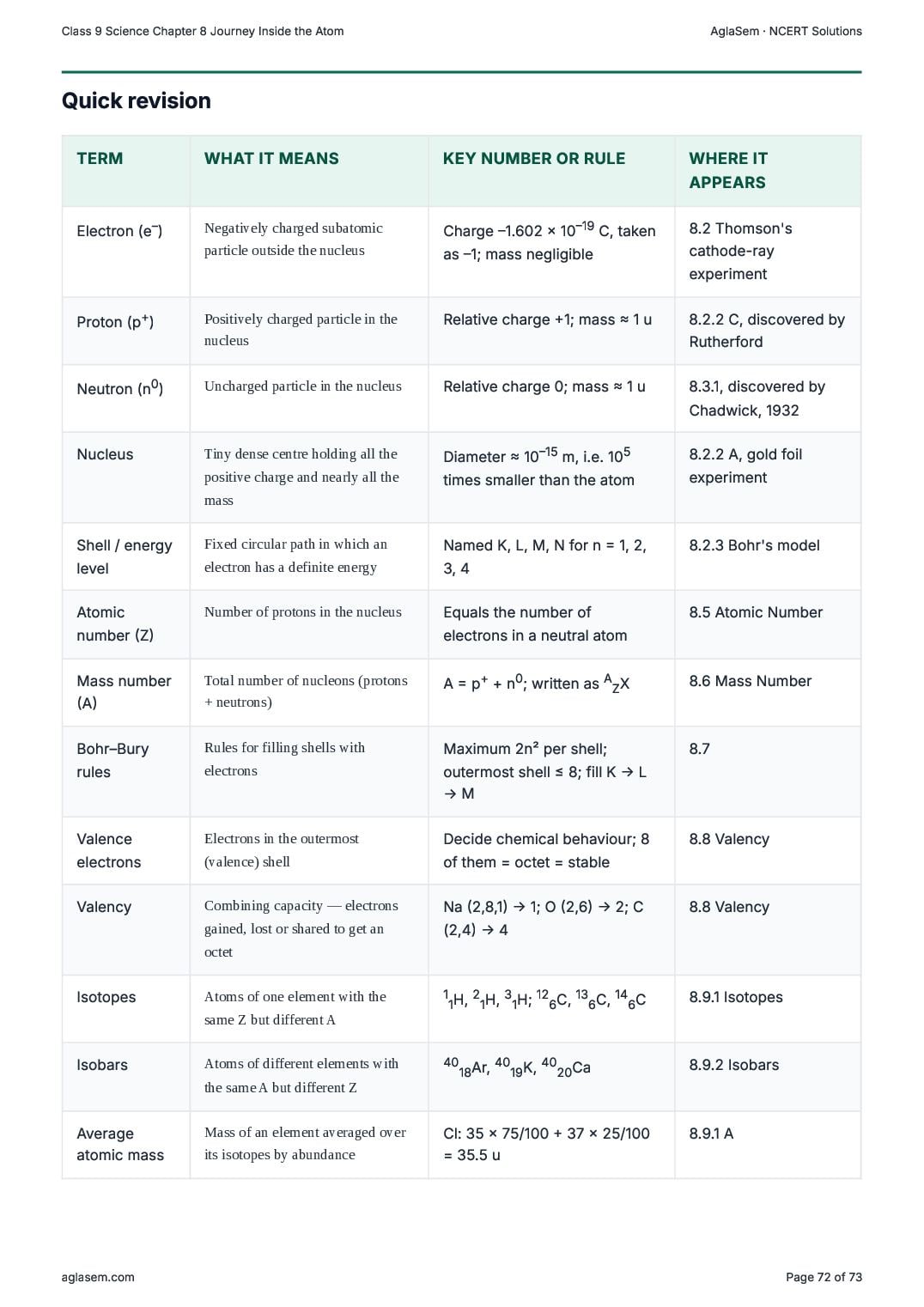
- An atom is not indivisible. Thomson's cathode-ray work (1897) showed that every atom contains electrons — negatively charged particles of charge –1.602 × 10 –19 C, taken as –1 by convention, and far lighter than the atom itself.
- The gold foil experiment (Geiger and Marsden, 1911) settled the atom's shape. Most α-particles went straight through, so the atom is mostly empty; a few bounced back, so all the positive charge and nearly all the mass sit in a tiny, dense nucleus . Diameter of atom ≈ 10 –10 m, of nucleus ≈ 10 –15 m — a factor of 10 5 .
- Rutherford's planetary model could not explain stability : an electron in a circular orbit is accelerating, so it should radiate energy and spiral into the nucleus. Bohr (1913) fixed this by postulating stationary states — fixed shells K, L, M, N (n = 1, 2, 3, 4) in which an electron moves without losing energy.
- Chadwick (1932) discovered the neutron — mass nearly that of a proton, charge zero. Mass now added up: helium's 2 protons + 2 neutrons give mass 4, not 2. The three subatomic particles are e – (–1), p + (+1) and n 0 (0).
- Atomic number Z = number of protons (and, in a neutral atom, of electrons); it fixes the identity of the element. Mass number A = protons + neutrons = number of nucleons. An atom is written as A Z X, e.g. 12 6 C.
- Electrons fill shells by the Bohr–Bury rules: a shell holds at most 2n² electrons, the outermost shell at most 8, and filling goes K → L → M → N. Valency is the number of electrons gained, lost or shared to complete the octet (or duplet, for helium).
- Isotopes share Z but differ in A ( 1 1 H, 2 1 H, 3 1 H). Because they have the same electronic configuration, their chemical properties match; only physical properties differ. Isobars share A but differ in Z ( 40 Ar, 40 K, 40 Ca).
- The average atomic mass of an element is a weighted average over its isotopes: for chlorine, 35 × 75/100 + 37 × 25/100 = 35.5 u. No single chlorine atom has that mass.
How to Download NCERT Solutions for Class 9 Science Chapter 8 PDF
Follow these simple steps to get the Journey Inside the Atom questions-and-answers PDF from Exploration.
- Search NCERT Solutions for Class 9 Science Chapter 8 aglasem and open this page.
- Read the exercise questions with answers for Journey Inside the Atom shown above.
- Click the Download PDF link to save the Journey Inside the Atom solutions to your device.
NCERT Solutions for Class 9 Science – All Chapters
There are more chapters to study besides Journey Inside the Atom in Science. Here are the NCERT Solutions for all chapters of Class 9 Science.
- Chapter 1 Exploration Entering the World of Secondary Science
- Chapter 2 Cell the Building Block of Life
- Chapter 3 Tissues in Action
- Chapter 4 Describing Motion Around Us
- Chapter 5 Exploring Mixtures and Their Separation
- Chapter 6 How Forces Affect Motion
- Chapter 7 Work Energy and Simple Machines
- Chapter 8 Journey Inside the Atom
- Chapter 9 Atomic Foundations of Matter
- Chapter 10 Sound Waves Characteristics and Applications
- Chapter 11 Reproduction How Life Continues
- Chapter 12 Patterns in Life Diversity and Classification
- Chapter 13 Earth As a System Energy Matter and Life
NCERT Solutions for Class 9 – All Subjects
Just like Chapter 8 of Science, you can get the exercise questions with answers for every other subject of Class 9. Here are the NCERT Solutions for all subjects of Class 9.
NCERT Solutions for Class 9 Science Chapter 8 – An Overview
The key highlights of this study material are as follows.
| Aspects | Details |
|---|---|
| Class | Class 9 |
| Subject | Science |
| Chapter Number | Chapter 8 |
| Chapter Name | Journey Inside the Atom |
| Book Name | Exploration |
| Book By | NCERT (National Council of Educational Research and Training) |
| Educational Resource Here | NCERT Solutions of Class 9 Science Chapter 8 for all exercises |
| More Questions Answers of This Subject | NCERT Solutions for Class 9 Science |
| Download Book Chapter | NCERT Book Class 9 Science |
| All Questions Answers For This Class | NCERT Solutions for Class 9 |
| Complete Solutions | NCERT Solutions |
NCERT Solutions for Class 9 Science Chapter 8 Journey Inside the Atom – FAQs
What are the NCERT Solutions for Class 9 Science Chapter 8 Journey Inside the Atom?
They are the complete, step-by-step answers to all the exercise and in-text questions of Chapter 8 Journey Inside the Atom from the NCERT Class 9 Science textbook Exploration, written by experts as per the latest NCERT syllabus.
How can I download the Class 9 Science Chapter 8 solutions PDF for free?
Open this page on aglasem, read the Journey Inside the Atom questions with answers, and click the “Download Solutions PDF” link. The Class 9 Science Chapter 8 NCERT Solutions PDF is completely free to download.
Are these NCERT Solutions as per the latest 2026-27 syllabus?
Yes. The NCERT Solutions for Class 9 Science Chapter 8 are based on the latest NCERT textbook Exploration and the current 2026-27 CBSE syllabus, so the questions and answers match what you study in class.
Where can I get NCERT Solutions for the other chapters of Class 9 Science?
You can find the answers to every chapter on the NCERT Solutions for Class 9 Science page, and solutions for every subject on the NCERT Solutions for Class 9 page.
How do NCERT Solutions help in exam preparation?
They show the correct method to solve each question, help you write answers the way they are expected in exams, let you check and correct your own work, and save revision time — which together improve your marks in Class 9 Science.
If you have any queries on NCERT Solutions for Class 9 Science Chapter 8 Journey Inside the Atom, then please ask in the comments below.