NCERT Solutions for Class 9 Science Chapter 5 Exploring Mixtures and Their Separation provide clear, step-by-step answers to every exercise and in-text question from the chapter Exploring Mixtures and Their Separation of the NCERT textbook Exploration. Prepared by subject experts as per the latest NCERT (CBSE) syllabus for 2026-27, these NCERT Solutions for Class 9 Science help you understand each concept, write exam-ready answers, and check your own solutions. You can read them online below or download the free Class 9 Science Chapter 5 question-answer PDF.
NCERT Solutions for Class 9 Science Chapter 5 Exploring Mixtures and Their Separation
- Class: Class 9
- Subject: Science
- Chapter: Chapter 5 – Exploring Mixtures and Their Separation
- Textbook: Exploration (NCERT)
- Study material: NCERT Solutions – questions with answers, free PDF
These solutions answer all the exercise questions of Chapter 5 Exploring Mixtures and Their Separation — including the in-text questions, short-answer and long-answer questions, and activities — with complete explanations so you can follow the method, not just the final answer. Read the full solutions below.
NCERT Solutions Class 9 Science Chapter 5 Exploring Mixtures and Their Separation View Download


NCERT Solutions for Class 9 Science Chapter 5 PDF Download
You can read the NCERT Solutions for Class 9 Science Chapter 5 online above, or download the complete question-answer PDF to study Exploring Mixtures and Their Separation offline at any time.
NCERT Solutions for Class 9 Science Chapter 5 PDF Download Link – Click Here to Download Solutions PDF
Questions Covered in This Chapter
These NCERT Solutions answer all 81 questions of this chapter. The questions solved are:
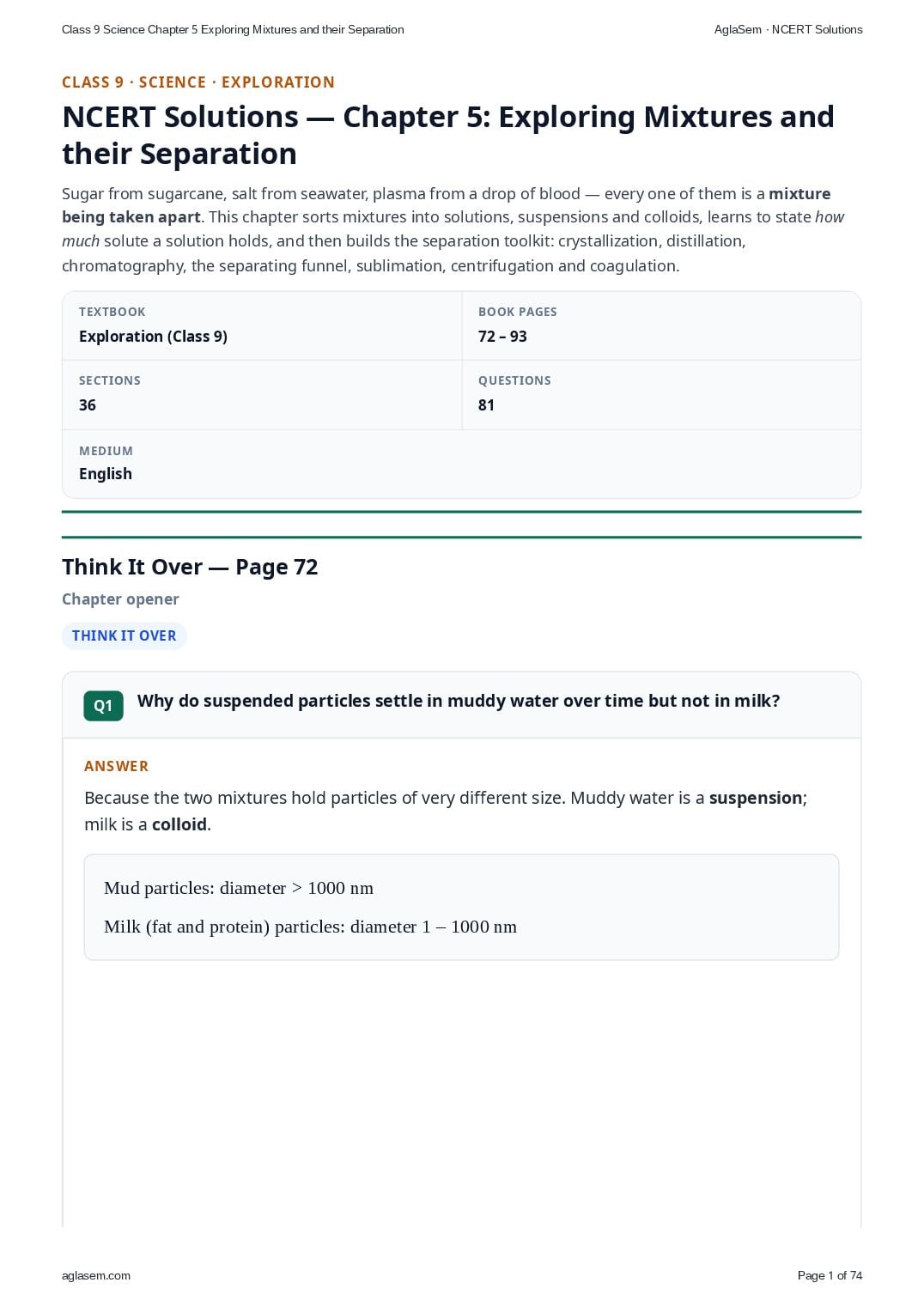
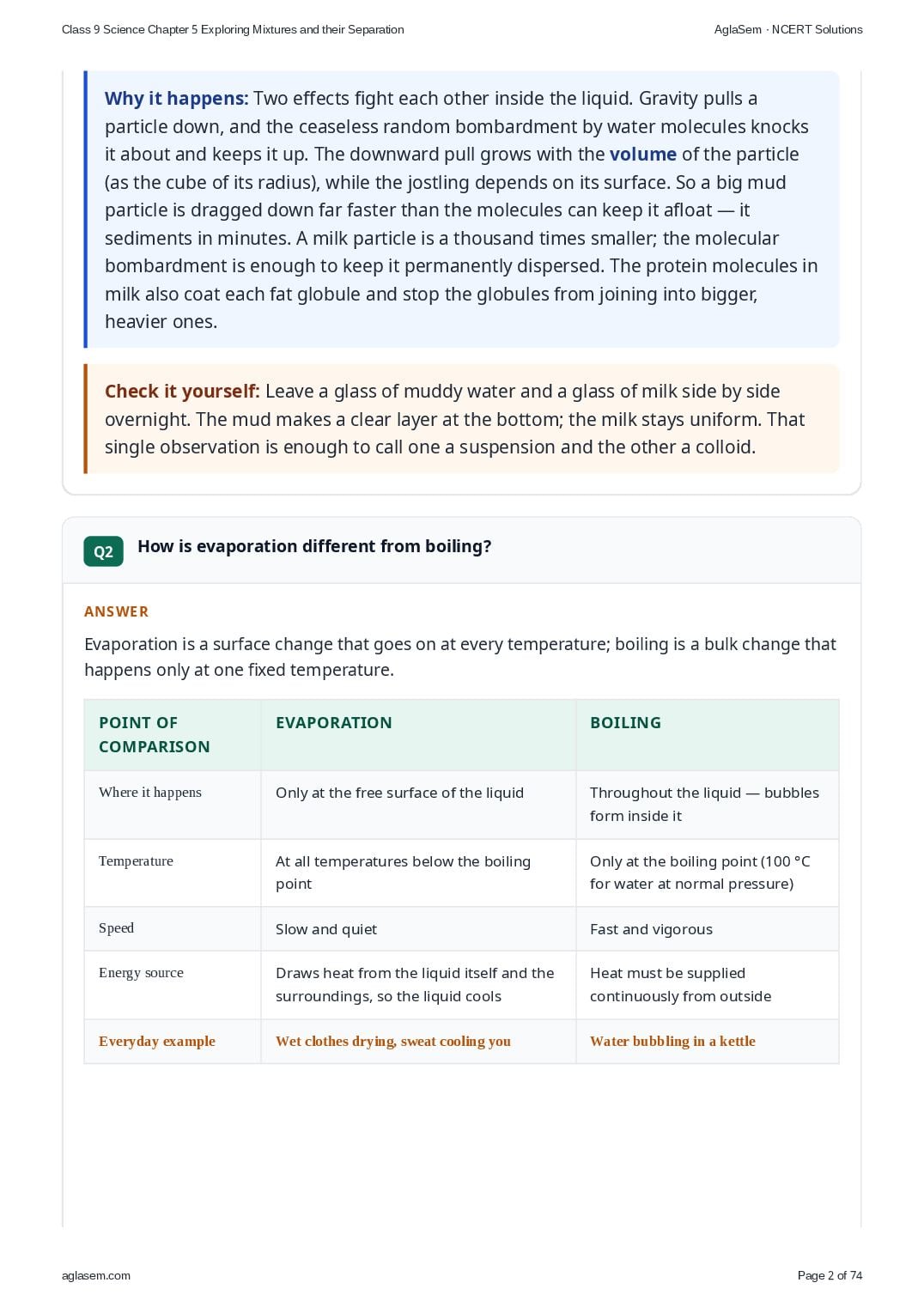
- Why do suspended particles settle in muddy water over time but not in milk?
- How is evaporation different from boiling?
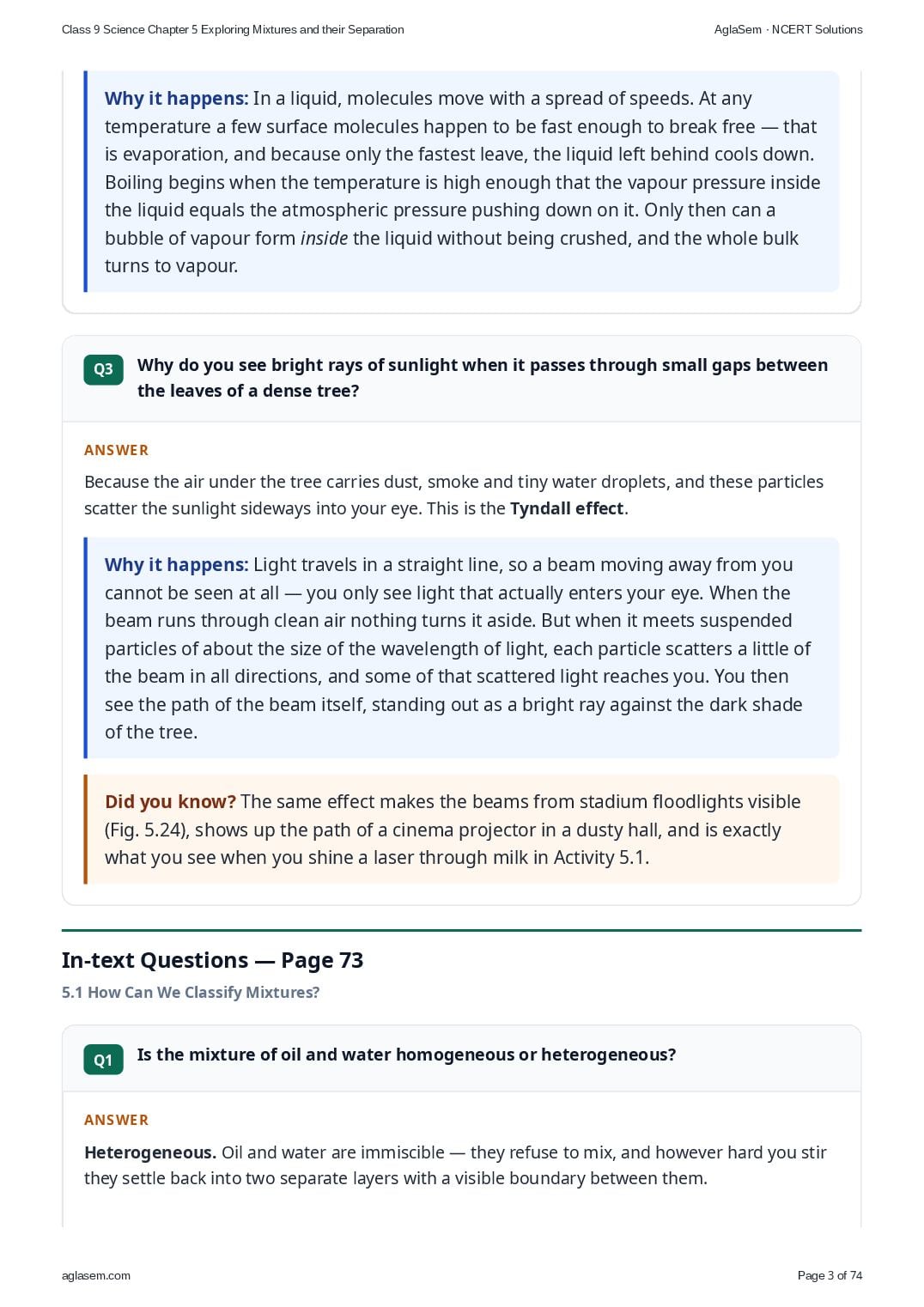
- Why do you see bright rays of sunlight when it passes through small gaps between the leaves of a dense tree?
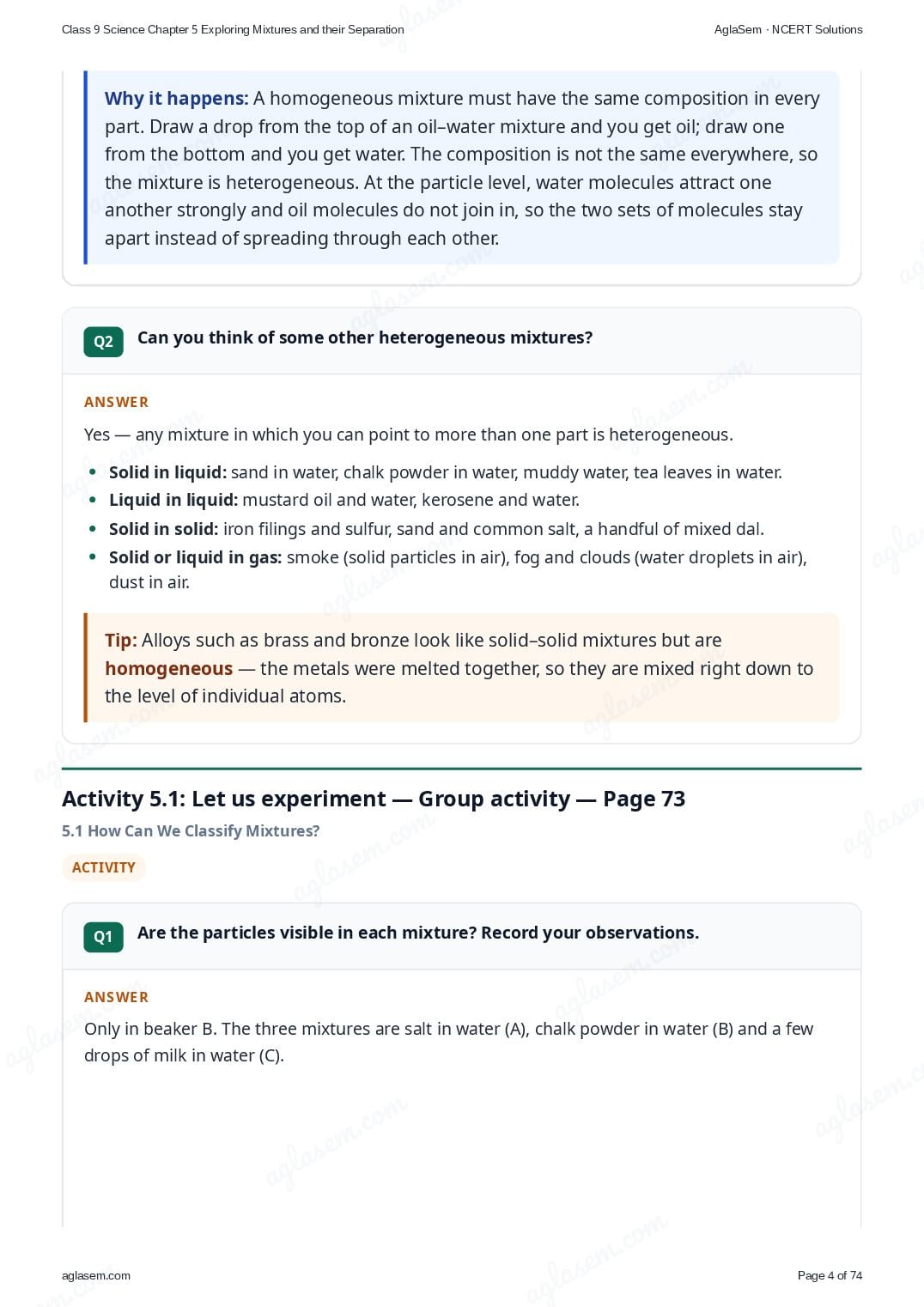
- Is the mixture of oil and water homogeneous or heterogeneous?
- Can you think of some other heterogeneous mixtures?
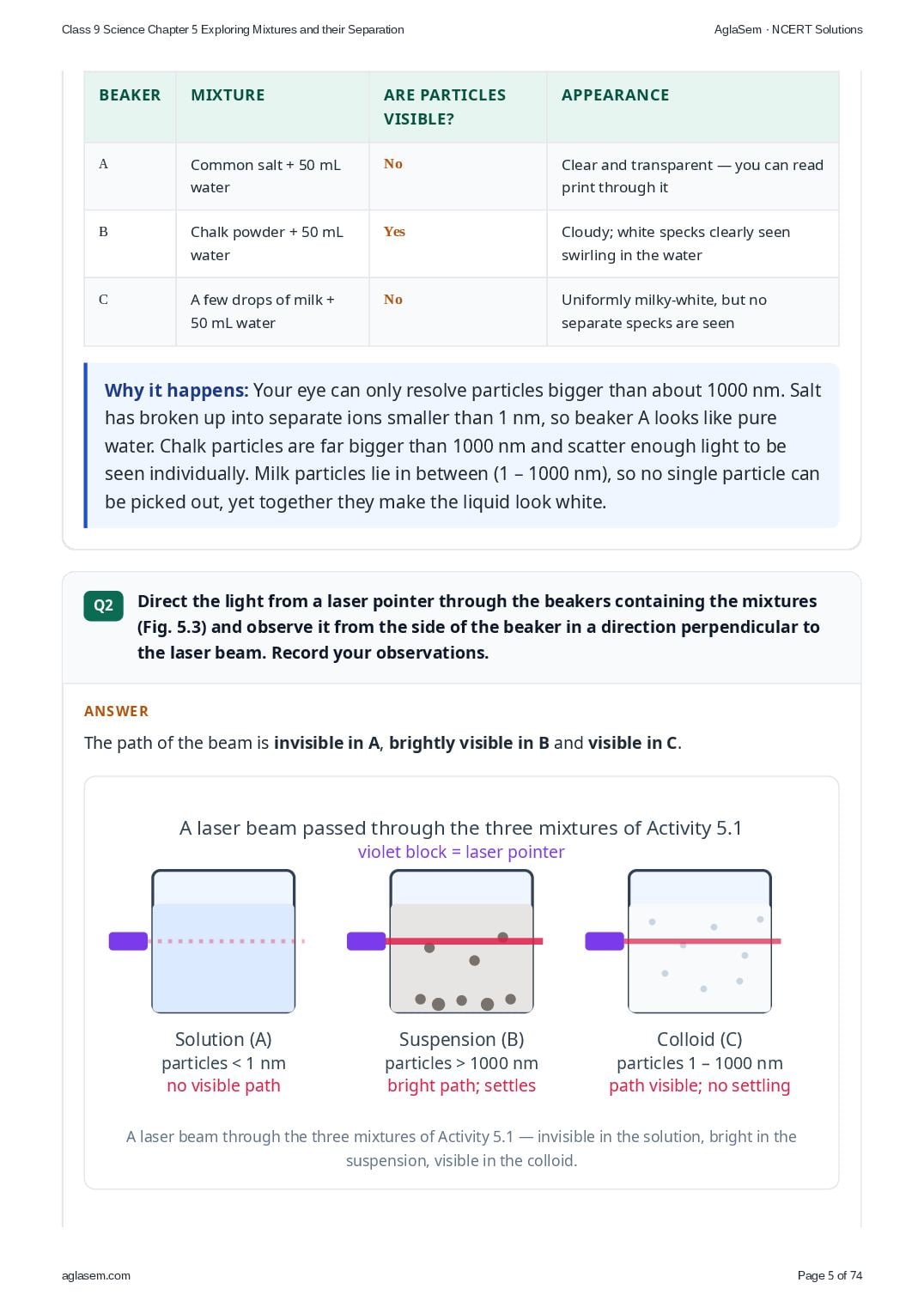
- Are the particles visible in each mixture? Record your observations.
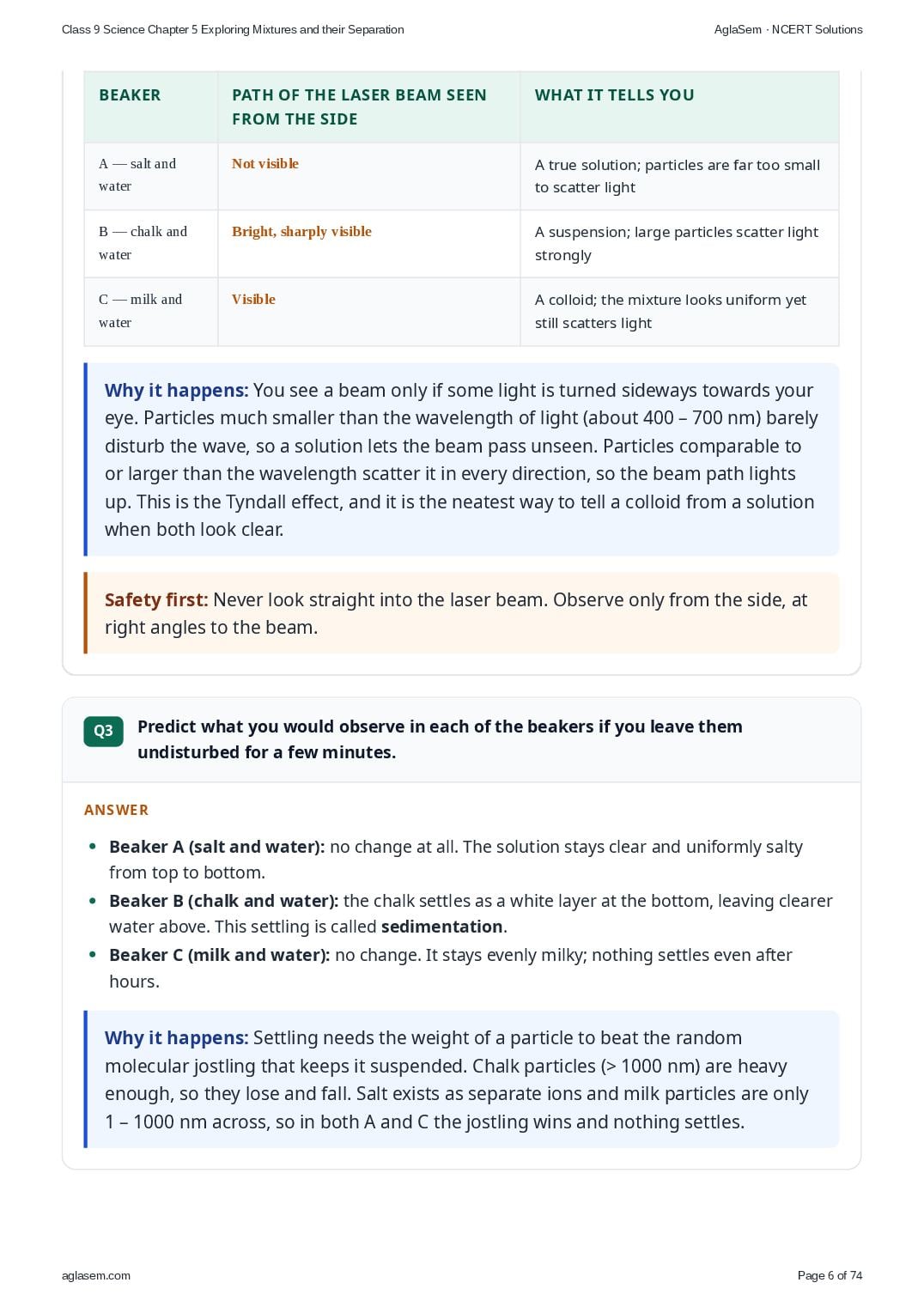
- Direct the light from a laser pointer through the beakers containing the mixtures (Fig. 5.3) and observe it from the side of the beaker in a direction perpendicular to the laser beam. Record your observations.
- Predict what you would observe in each of the beakers if you leave them undisturbed for a few minutes.
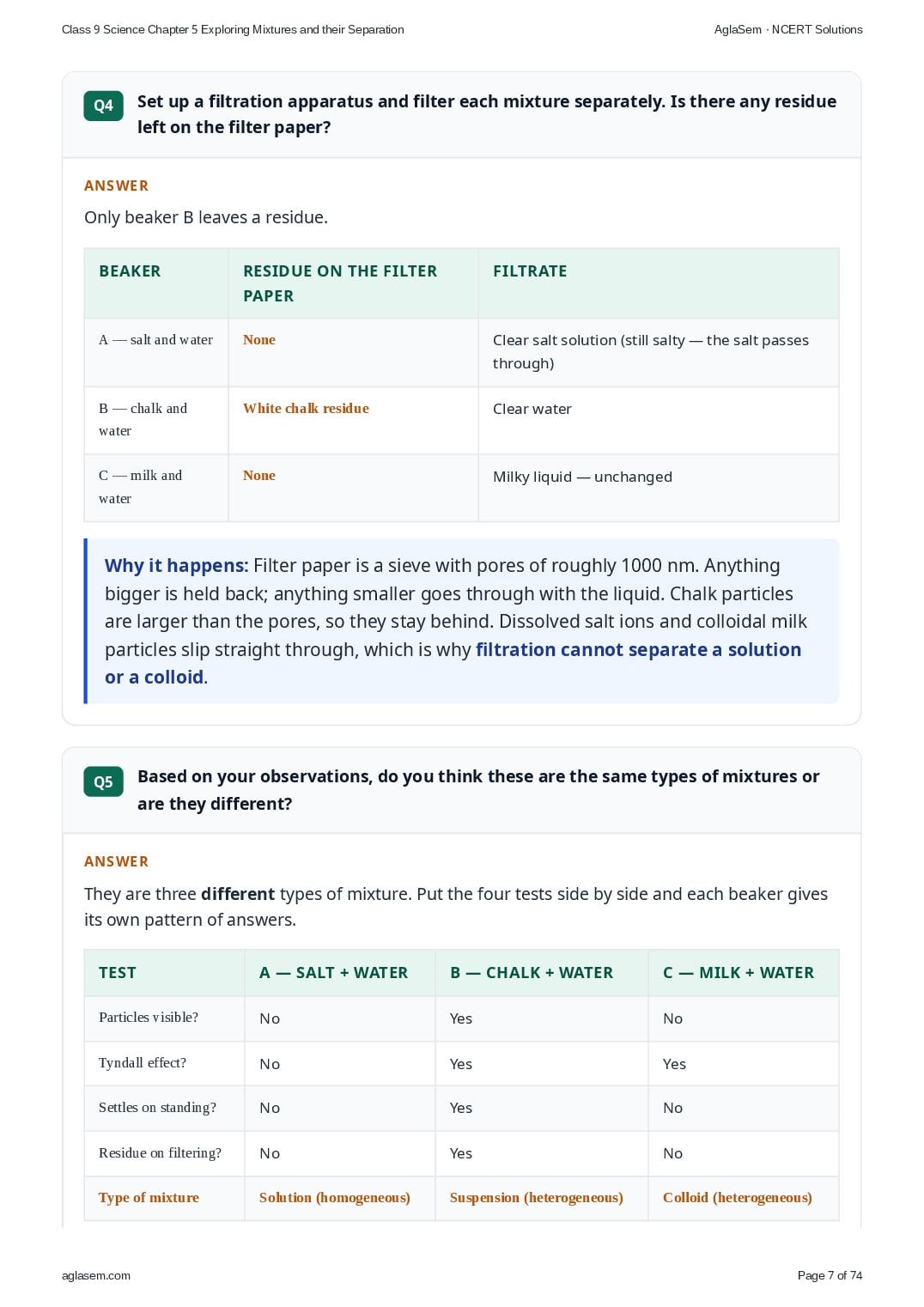
- Set up a filtration apparatus and filter each mixture separately. Is there any residue left on the filter paper?
- Based on your observations, do you think these are the same types of mixtures or are they different?
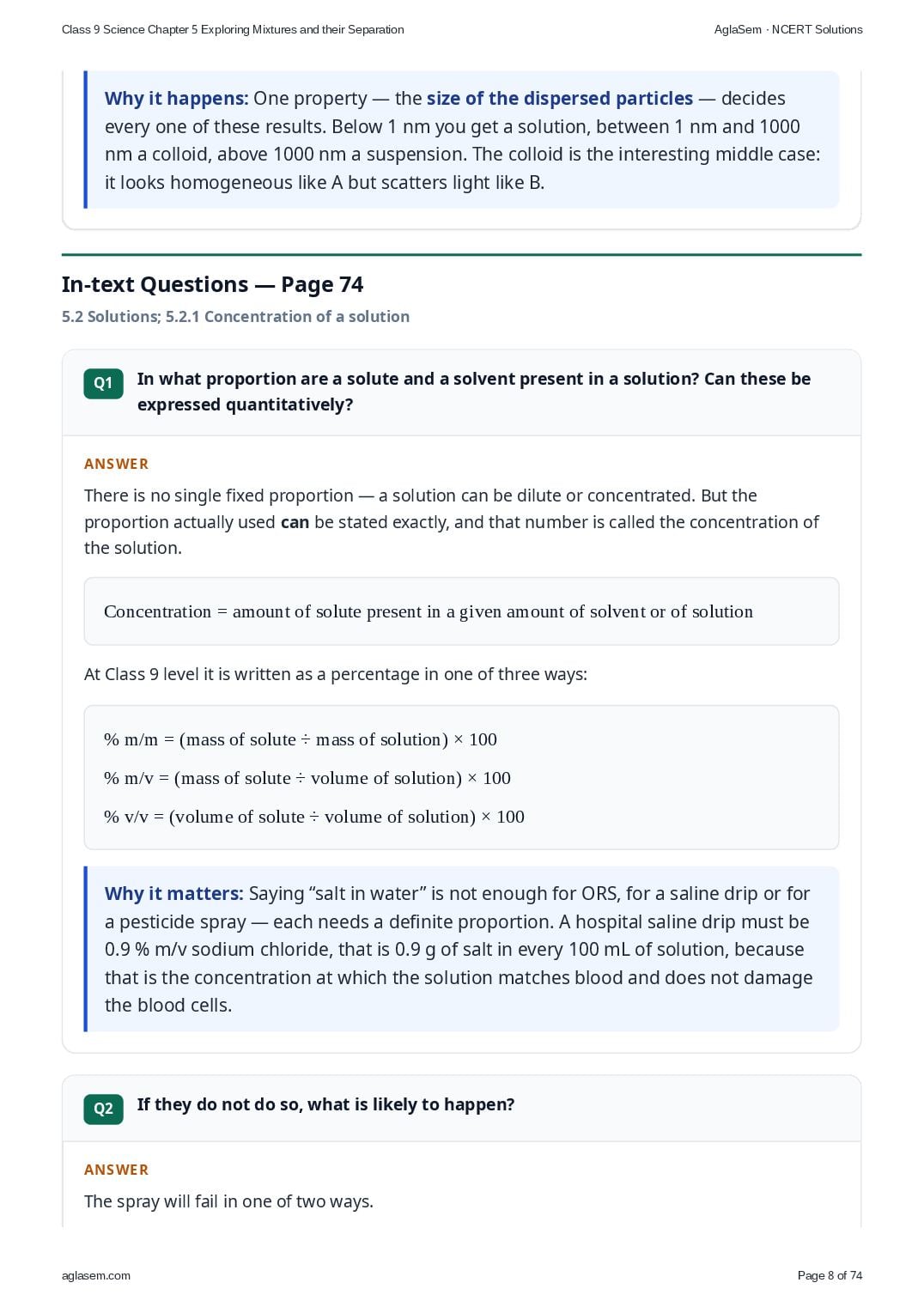
- In what proportion are a solute and a solvent present in a solution? Can these be expressed quantitatively?
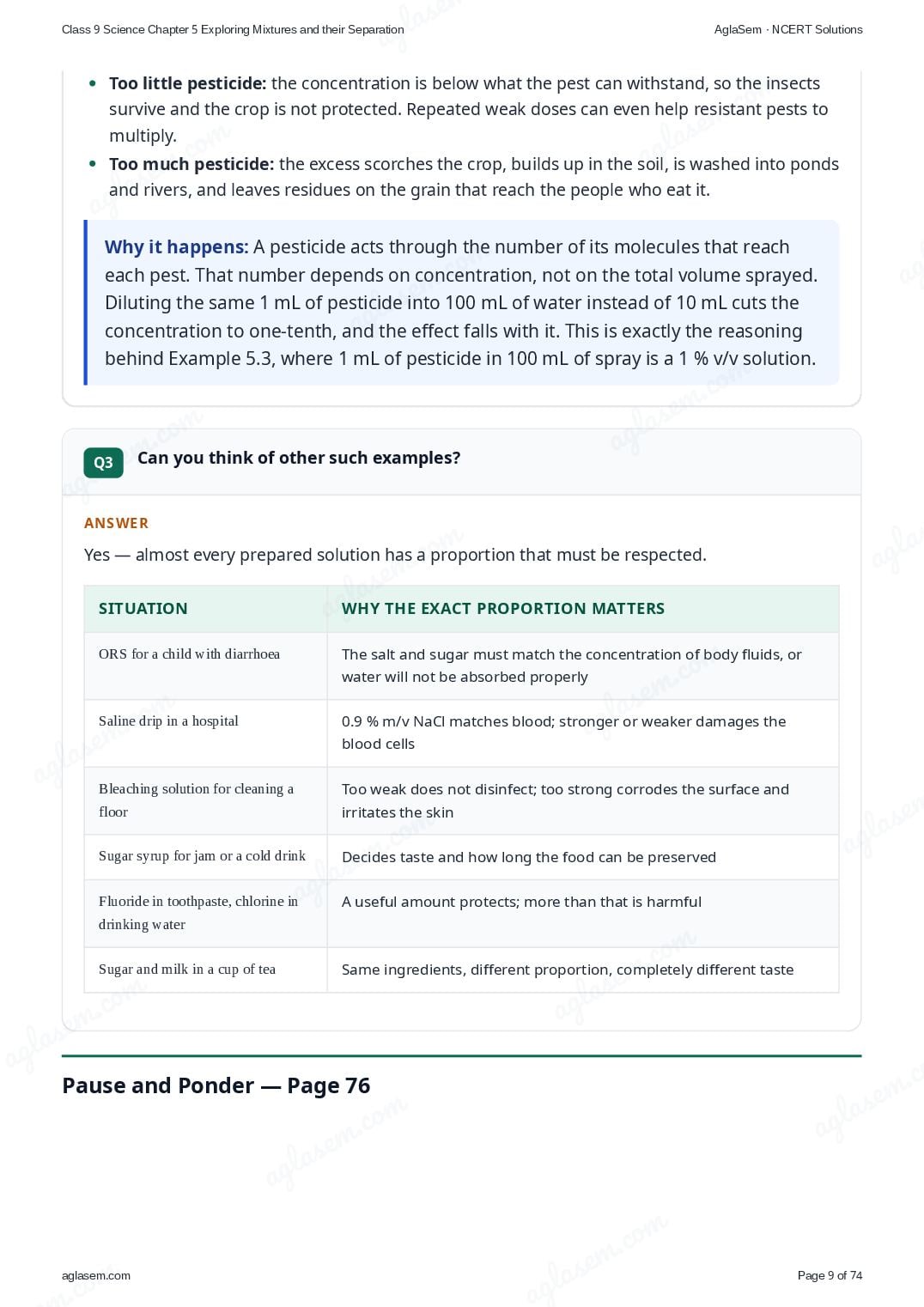
- If they do not do so, what is likely to happen?
- Can you think of other such examples?
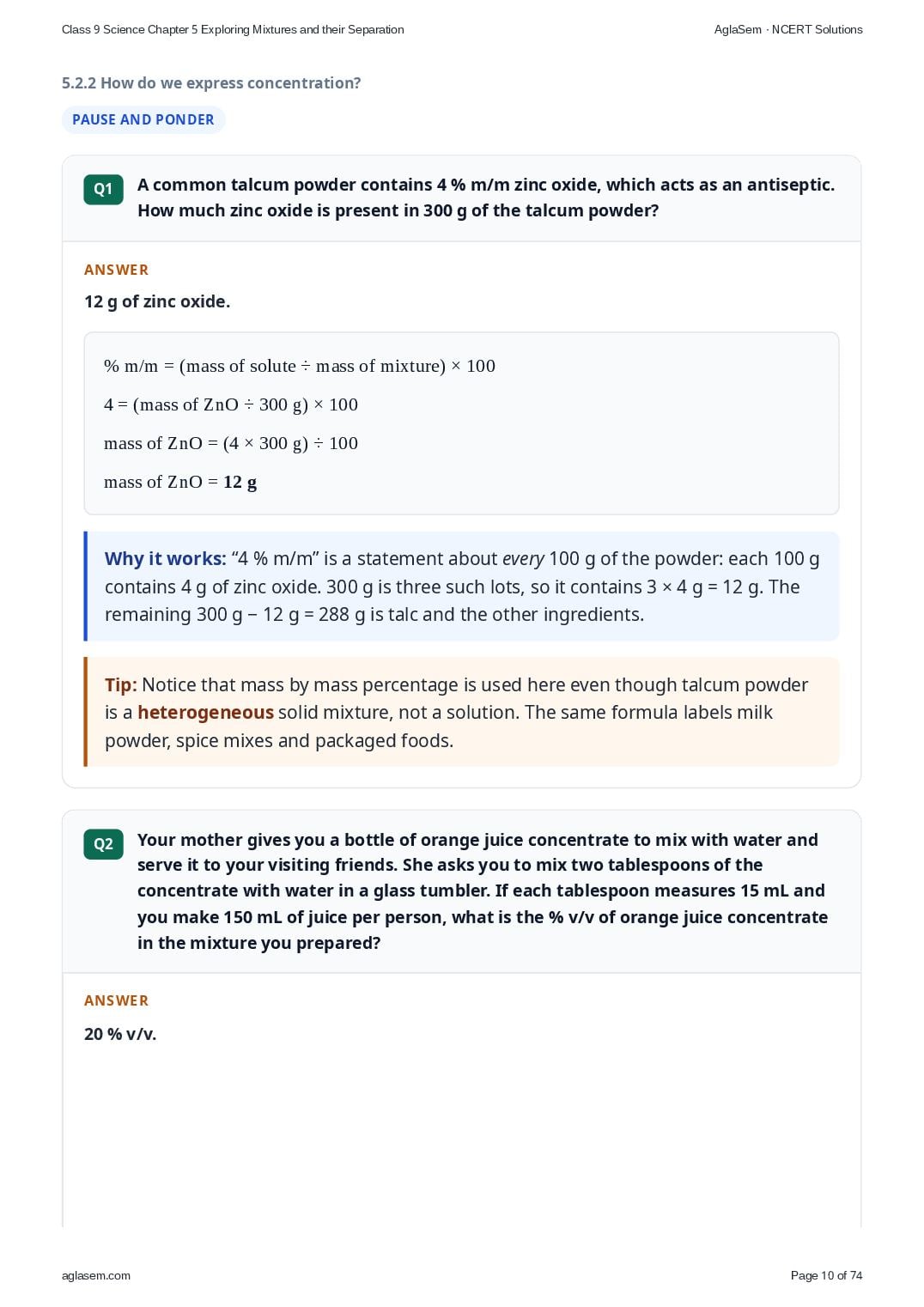
- A common talcum powder contains 4 % m/m zinc oxide, which acts as an antiseptic. How much zinc oxide is present in 300 g of the talcum powder?
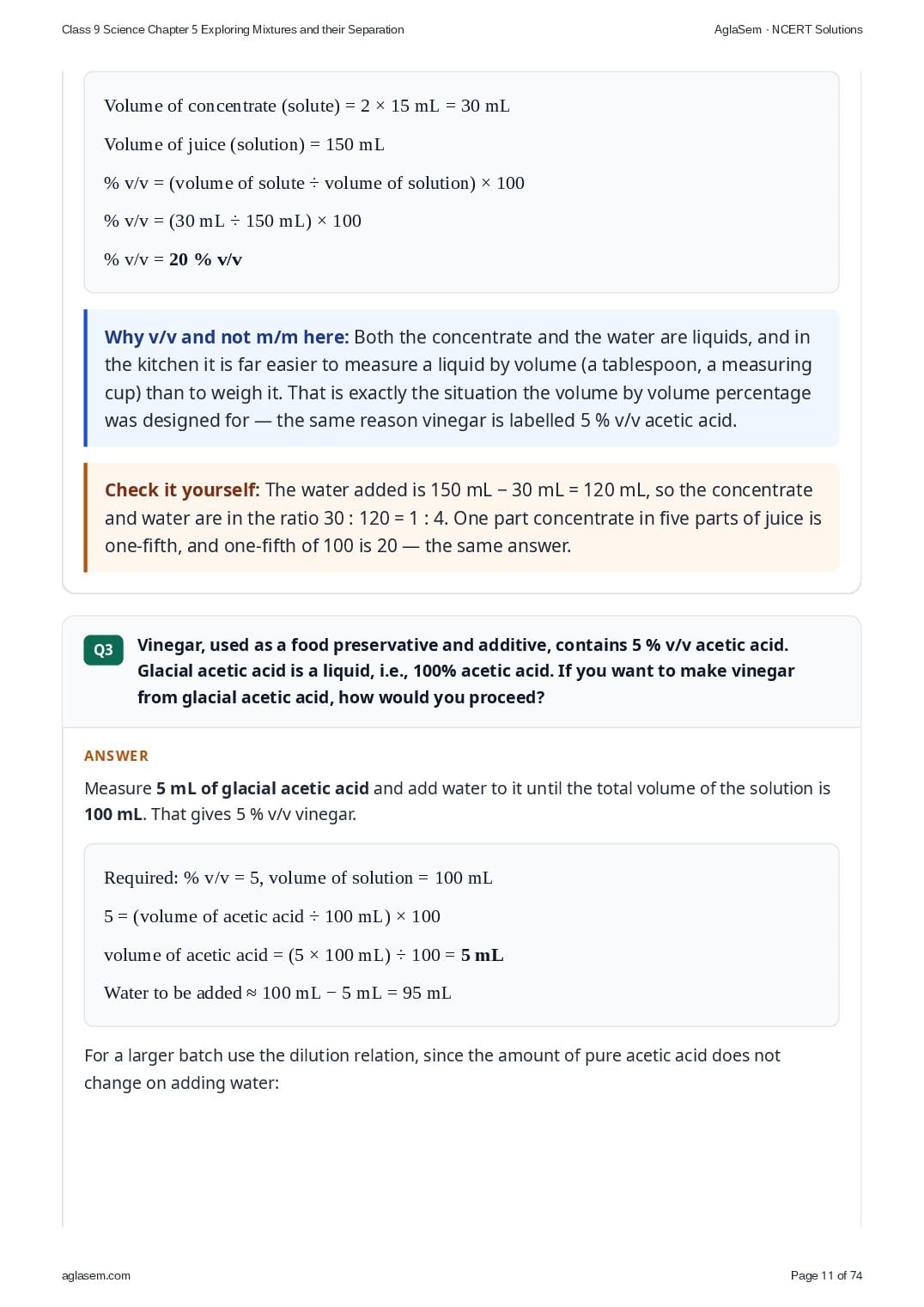
- Your mother gives you a bottle of orange juice concentrate to mix with water and serve it to your visiting friends. She asks you to mix two tablespoons of the concentrate with water in a glass tumbler. If each tablespoon measures 15 mL and you make 150 mL of juice per person, what is the % v/v of orange juice concentrate in the mixture you prepared?
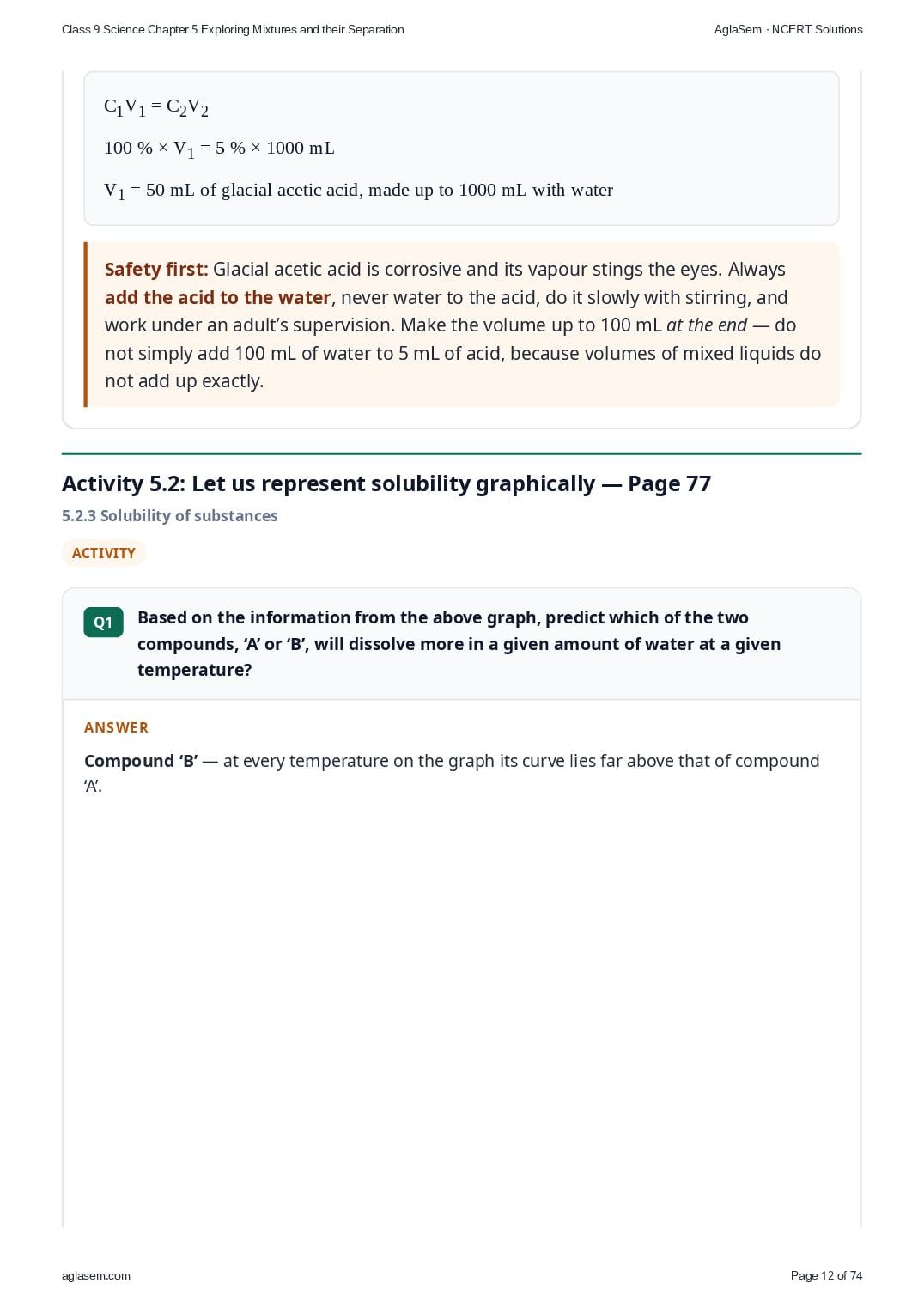
- Vinegar, used as a food preservative and additive, contains 5 % v/v acetic acid. Glacial acetic acid is a liquid, i.e., 100% acetic acid. If you want to make vinegar from glacial acetic acid, how would you proceed?
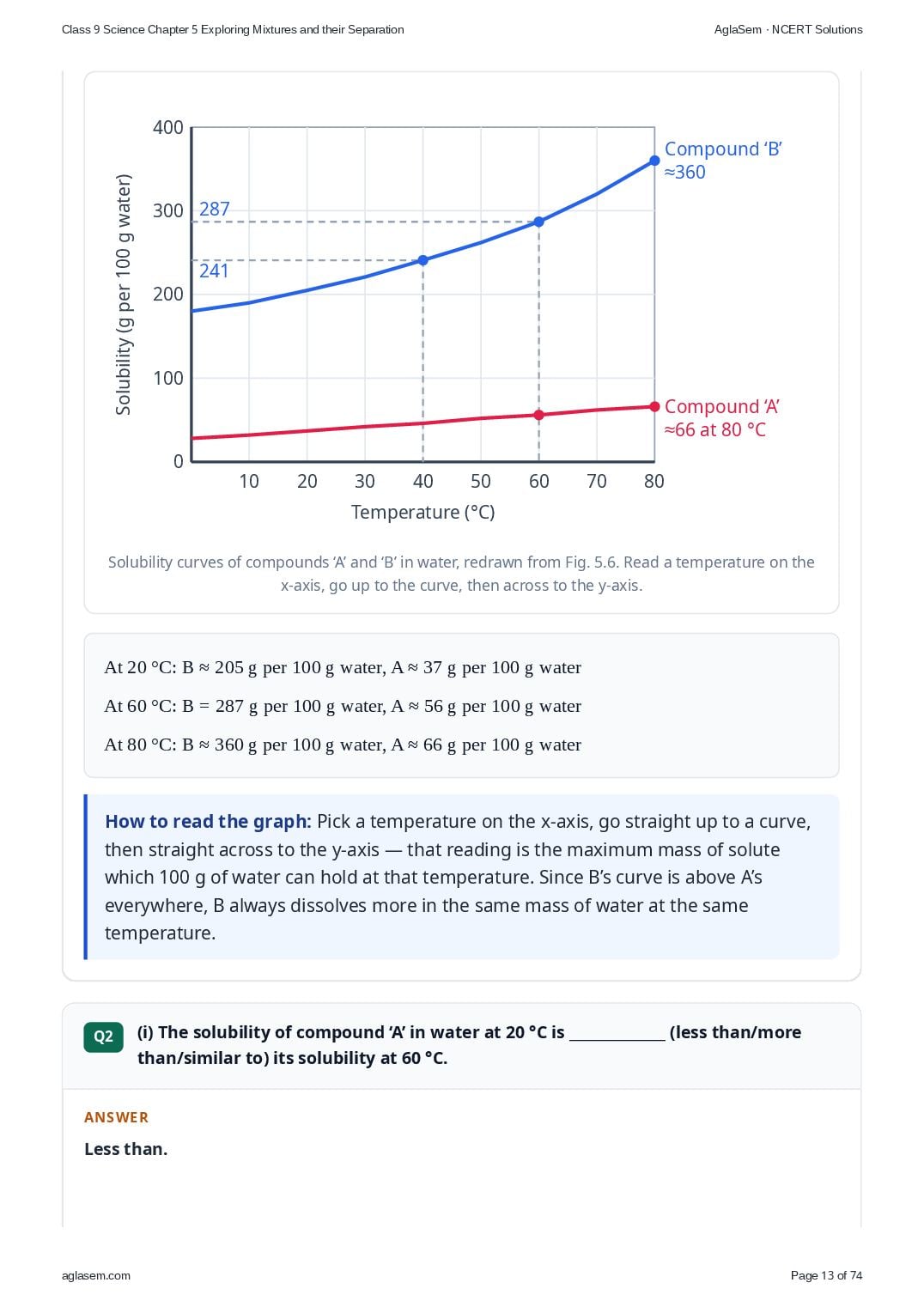
- Based on the information from the above graph, predict which of the two compounds, ‘A’ or ‘B’, will dissolve more in a given amount of water at a given temperature?
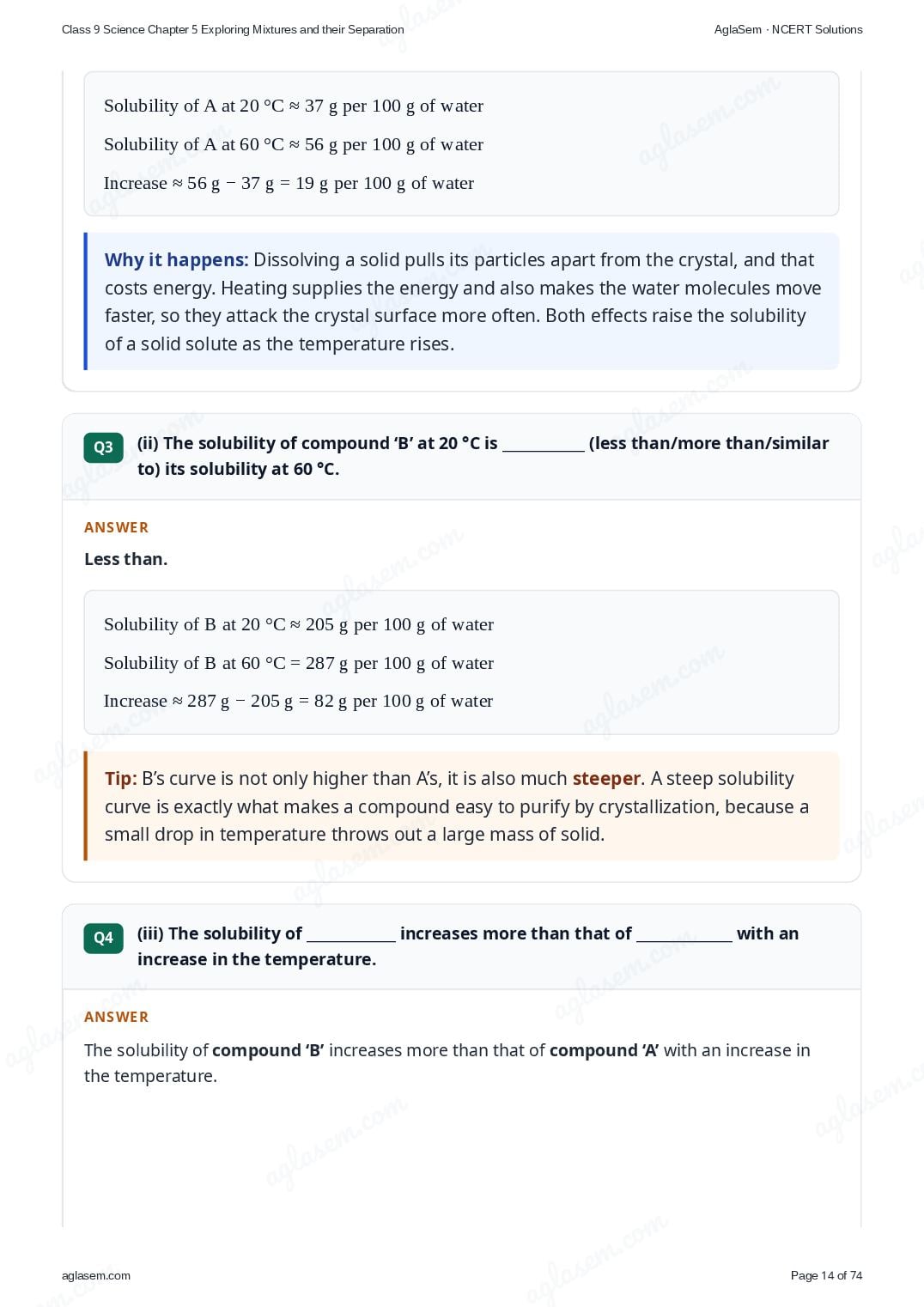
- (i) The solubility of compound ‘A’ in water at 20 °C is ______________ (less than/more than/similar to) its solubility at 60 °C.
- (ii) The solubility of compound ‘B’ at 20 °C is ____________ (less than/more than/similar to) its solubility at 60 °C.
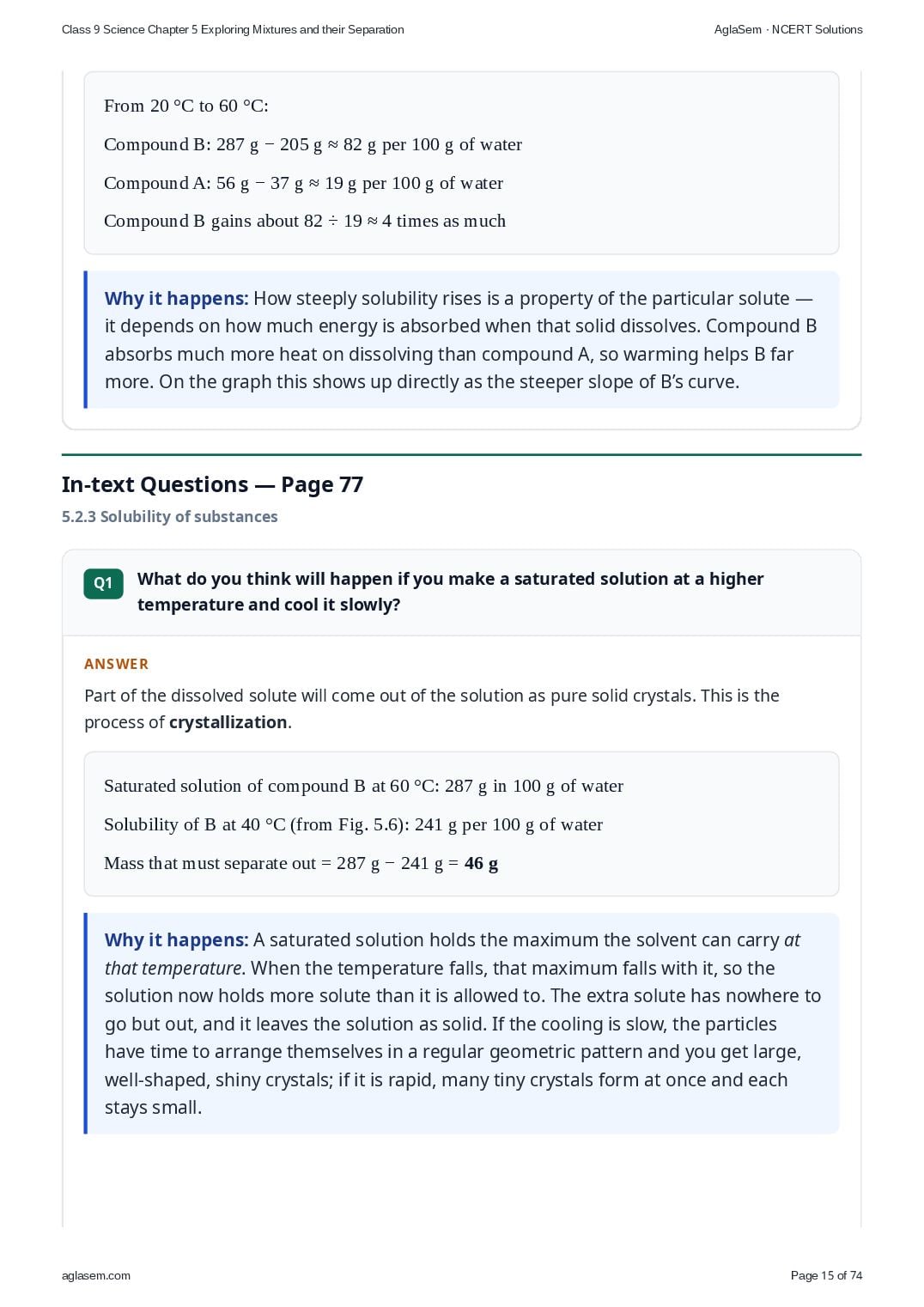
- (iii) The solubility of _____________ increases more than that of ______________ with an increase in the temperature.
- What do you think will happen if you make a saturated solution at a higher temperature and cool it slowly?
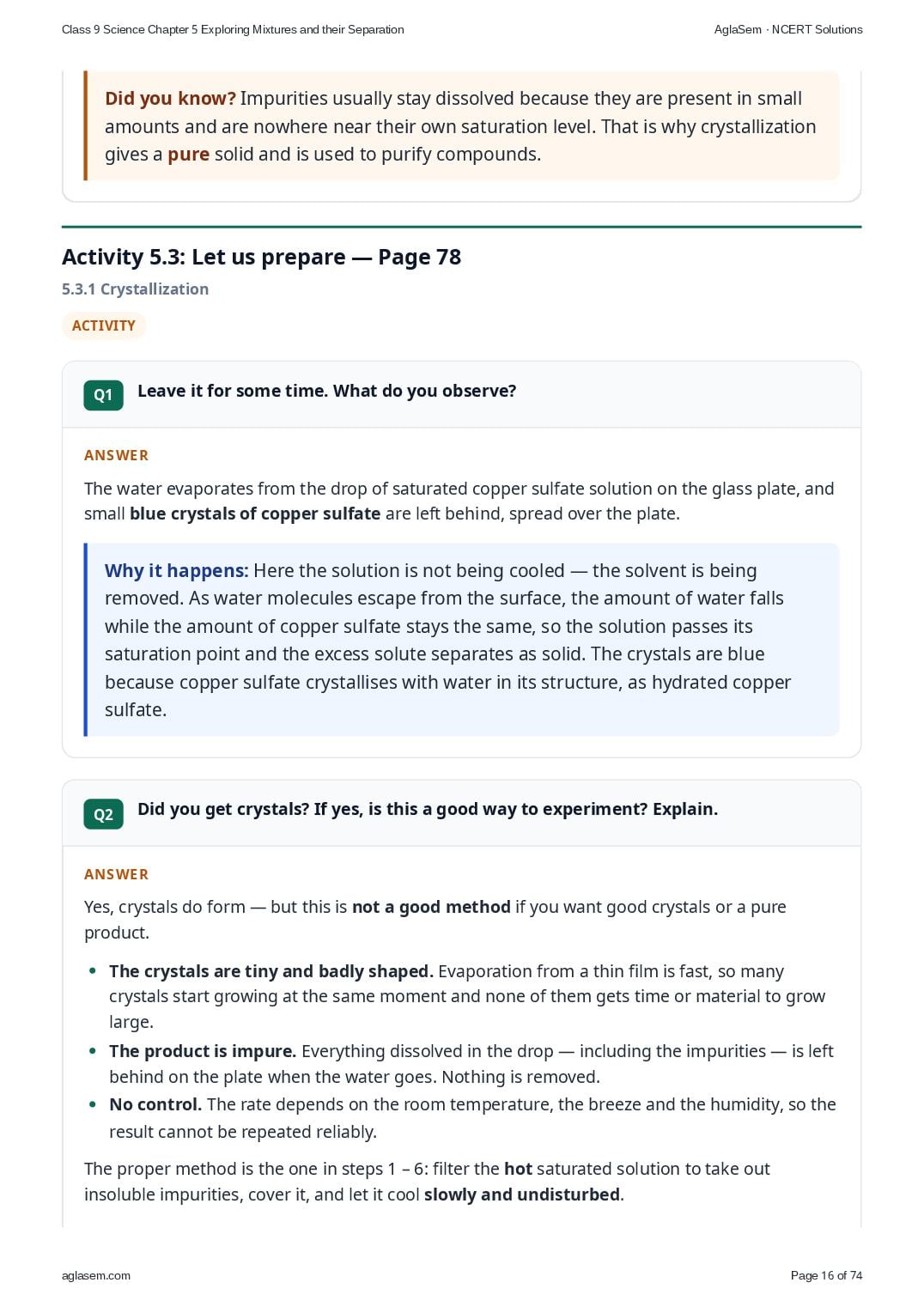
- Leave it for some time. What do you observe?
- Did you get crystals? If yes, is this a good way to experiment? Explain.
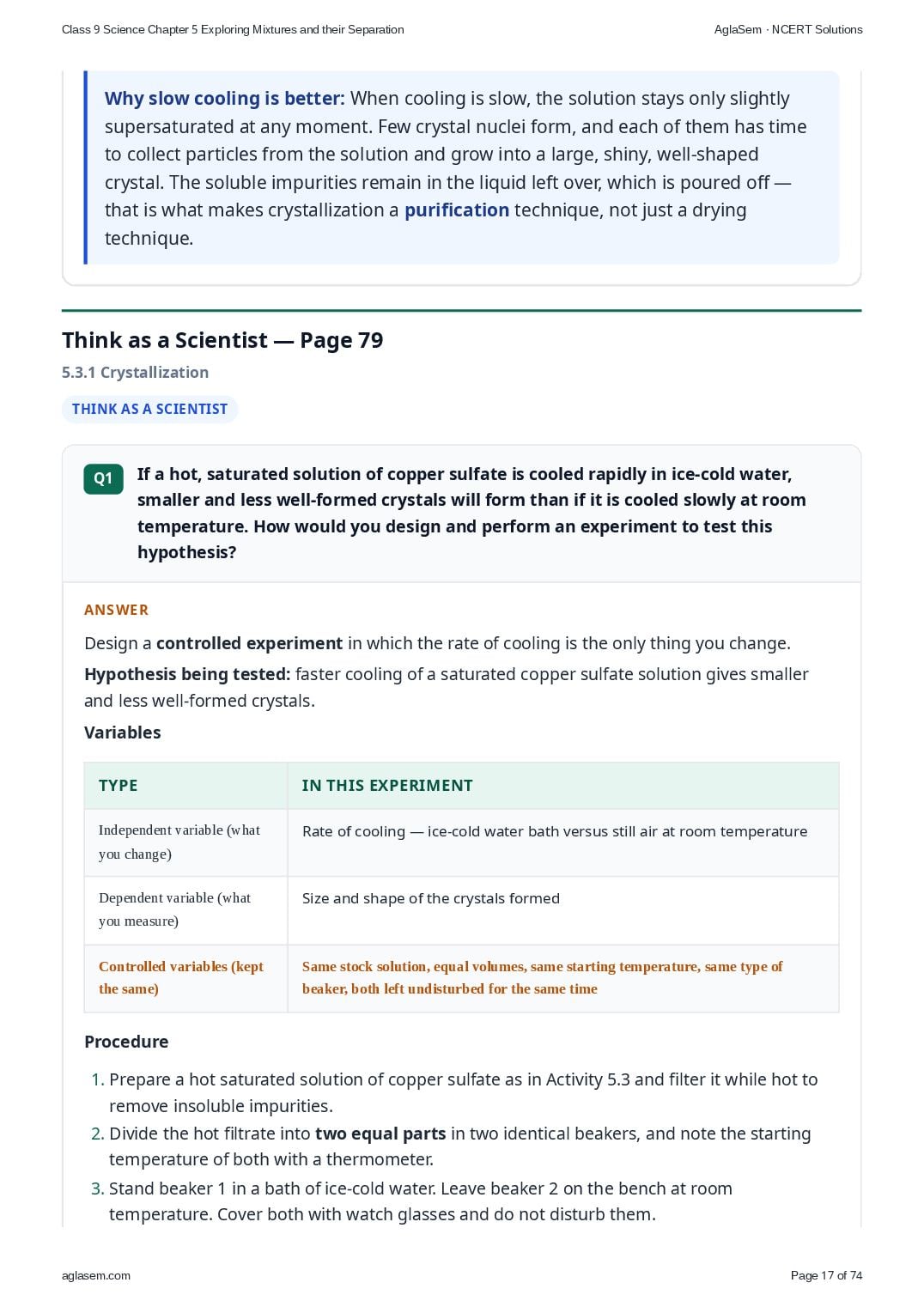
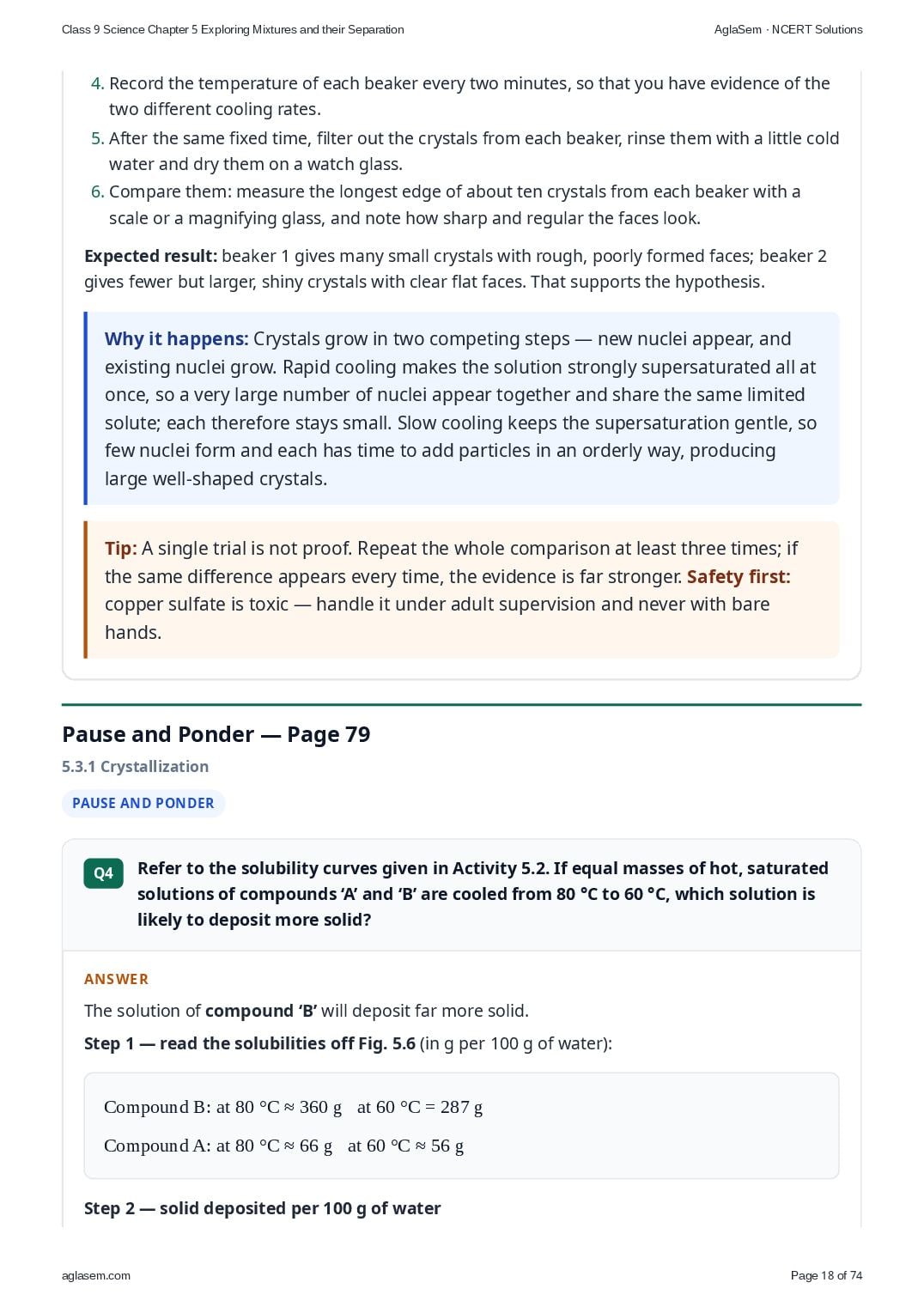
- If a hot, saturated solution of copper sulfate is cooled rapidly in ice-cold water, smaller and less well-formed crystals will form than if it is cooled slowly at room temperature. How would you design and perform an experiment to test this hypothesis?
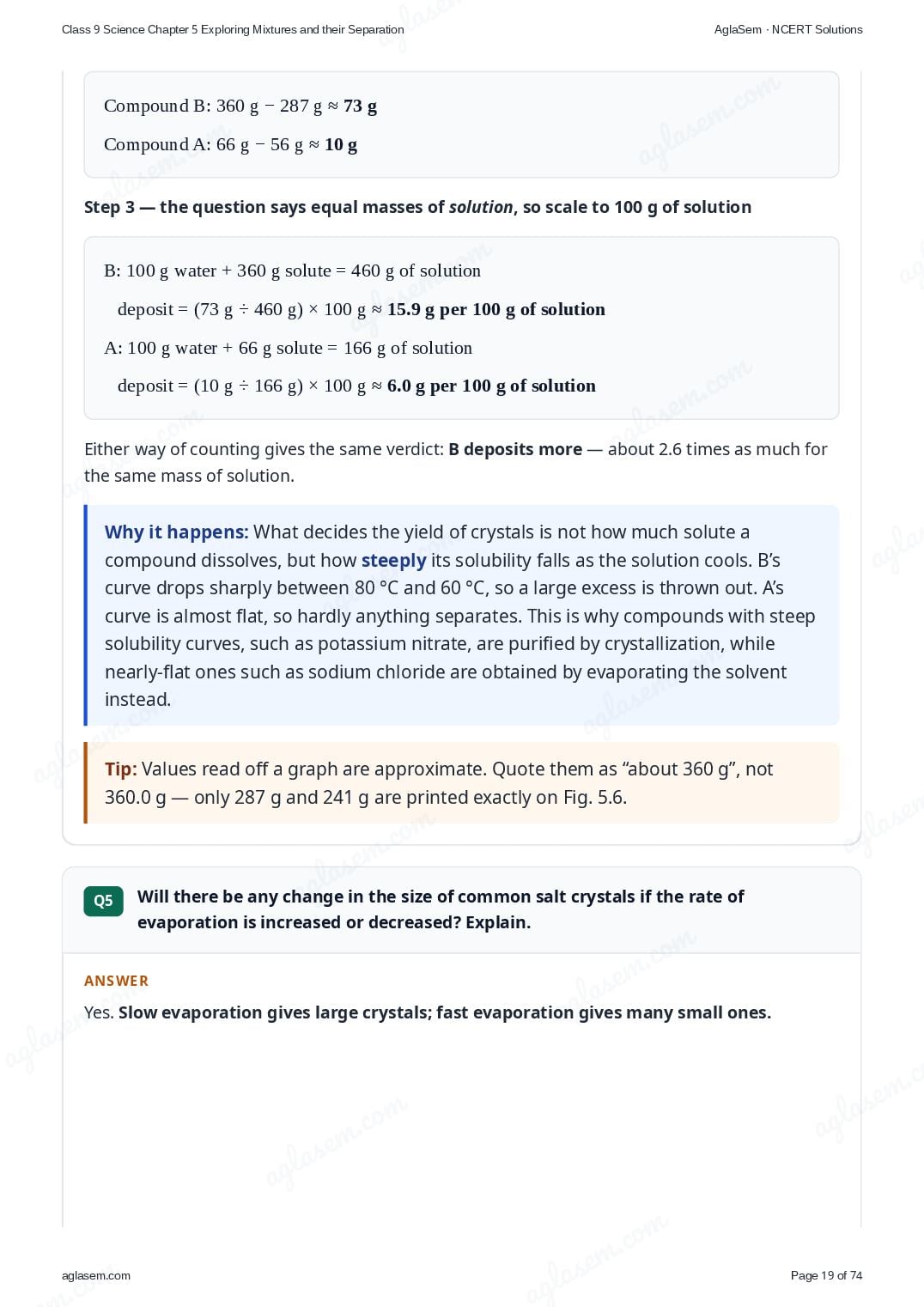
- Refer to the solubility curves given in Activity 5.2. If equal masses of hot, saturated solutions of compounds ‘A’ and ‘B’ are cooled from 80 °C to 60 °C, which solution is likely to deposit more solid?
- Will there be any change in the size of common salt crystals if the rate of evaporation is increased or decreased? Explain.
- Observe Fig. 5.9, it shows how salt crystals are obtained from seawater. Can you describe the process in your own words?
- Have you visited a place where large crystal deposits can be observed in nature?
- However, we may also want to recover the solvent. What should we do then?
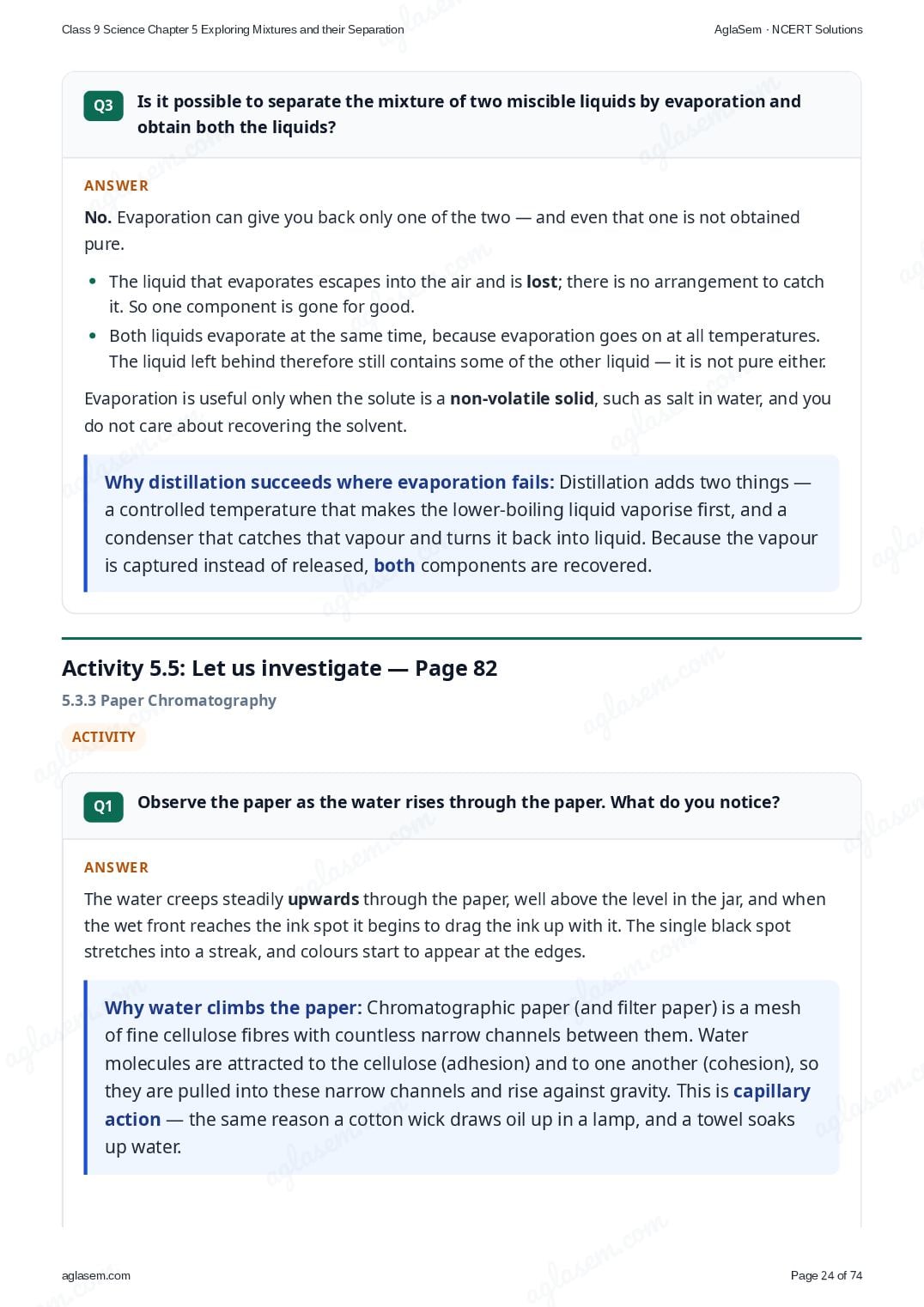
- How can we separate the two miscible liquids?
- Is it possible to separate the mixture of two miscible liquids by evaporation and obtain both the liquids?
- Observe the paper as the water rises through the paper. What do you notice?
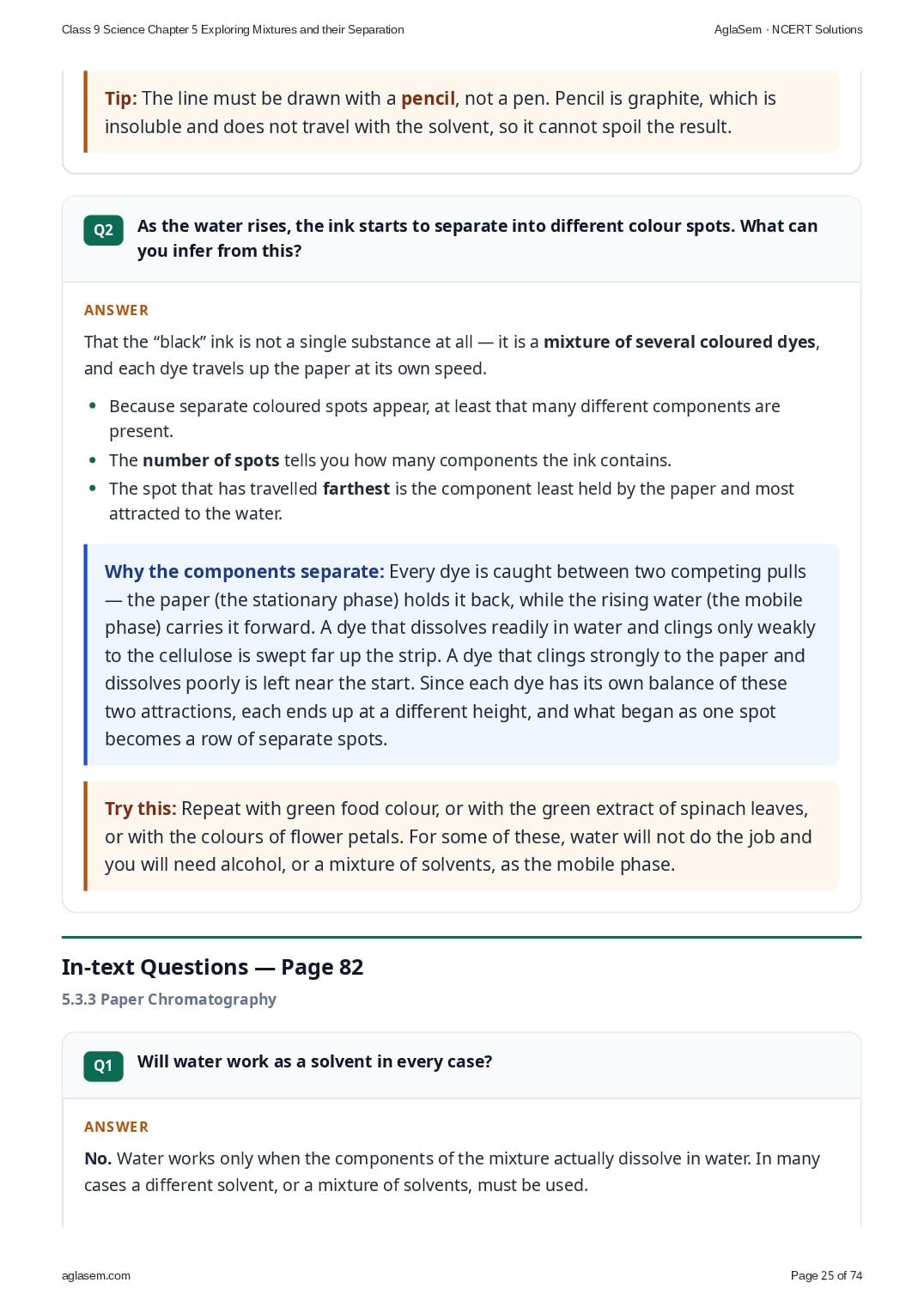
- As the water rises, the ink starts to separate into different colour spots. What can you infer from this?
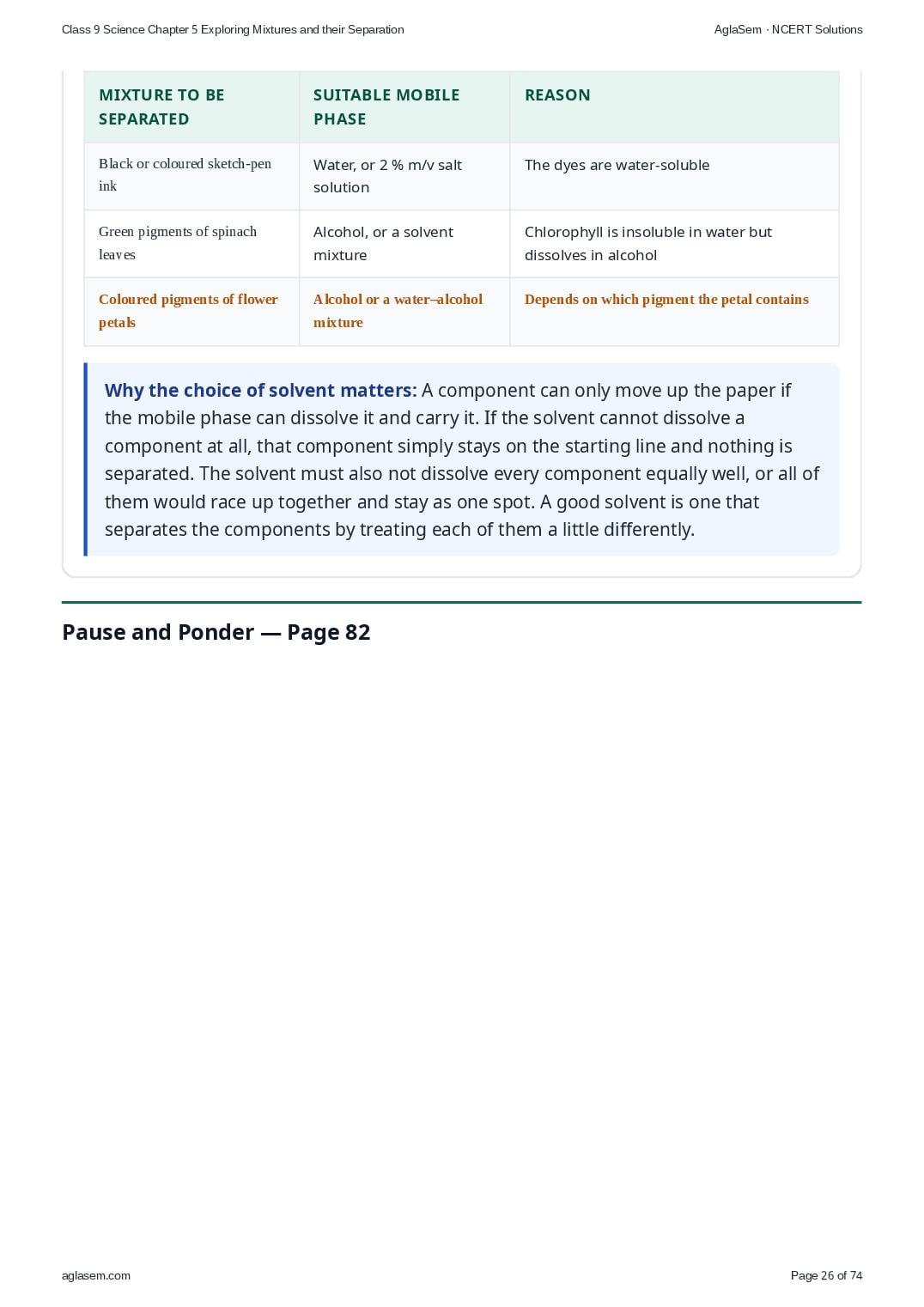
- Will water work as a solvent in every case?
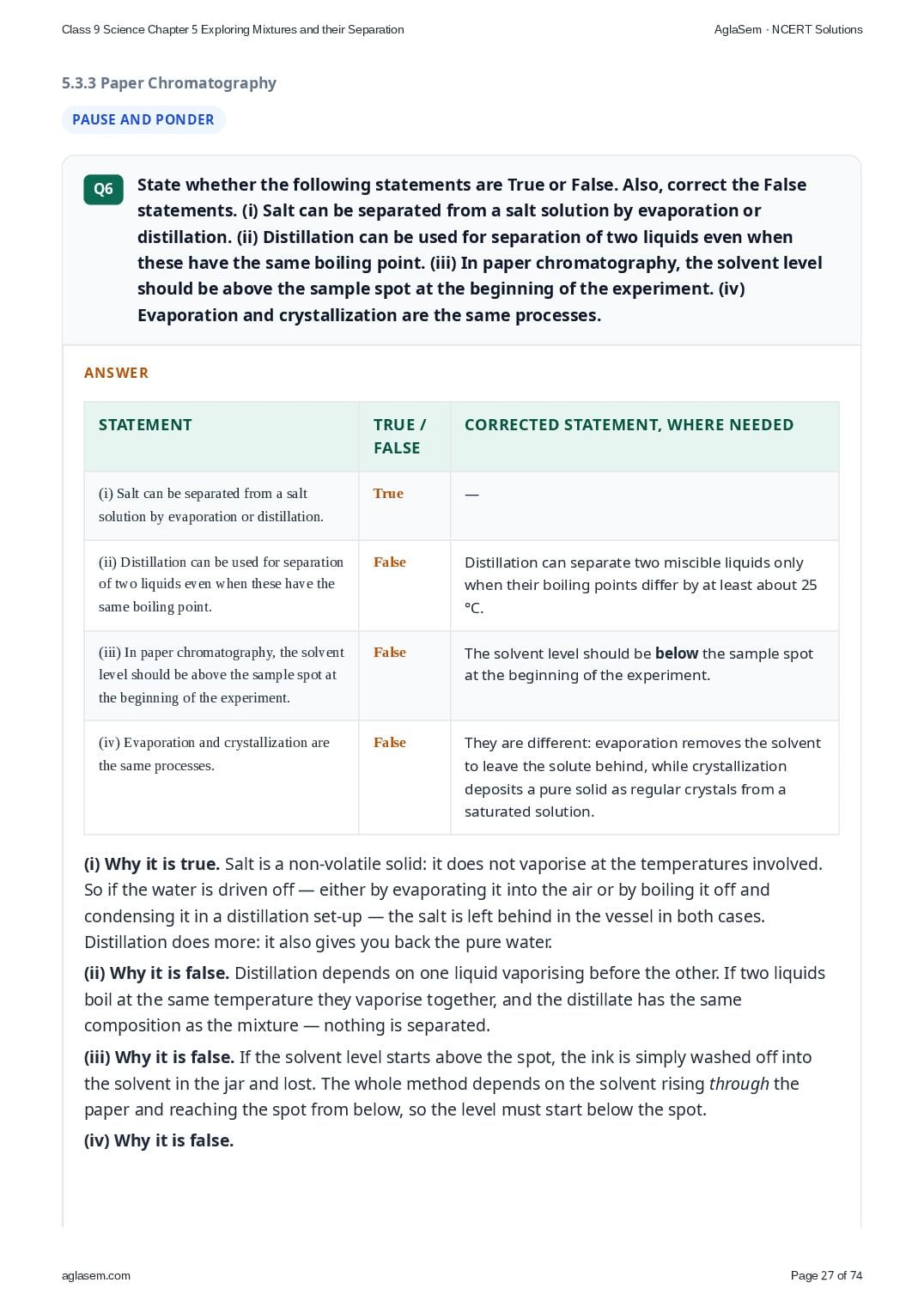
- State whether the following statements are True or False. Also, correct the False statements. (i) Salt can be separated from a salt solution by evaporation or distillation. (ii) Distillation can be used for separation of two liquids even when these have the same boiling point. (iii) In paper chromatography, the solvent level should be above the sample spot at the beginning of the experiment. (iv) Evaporation and crystallization are the same processes.
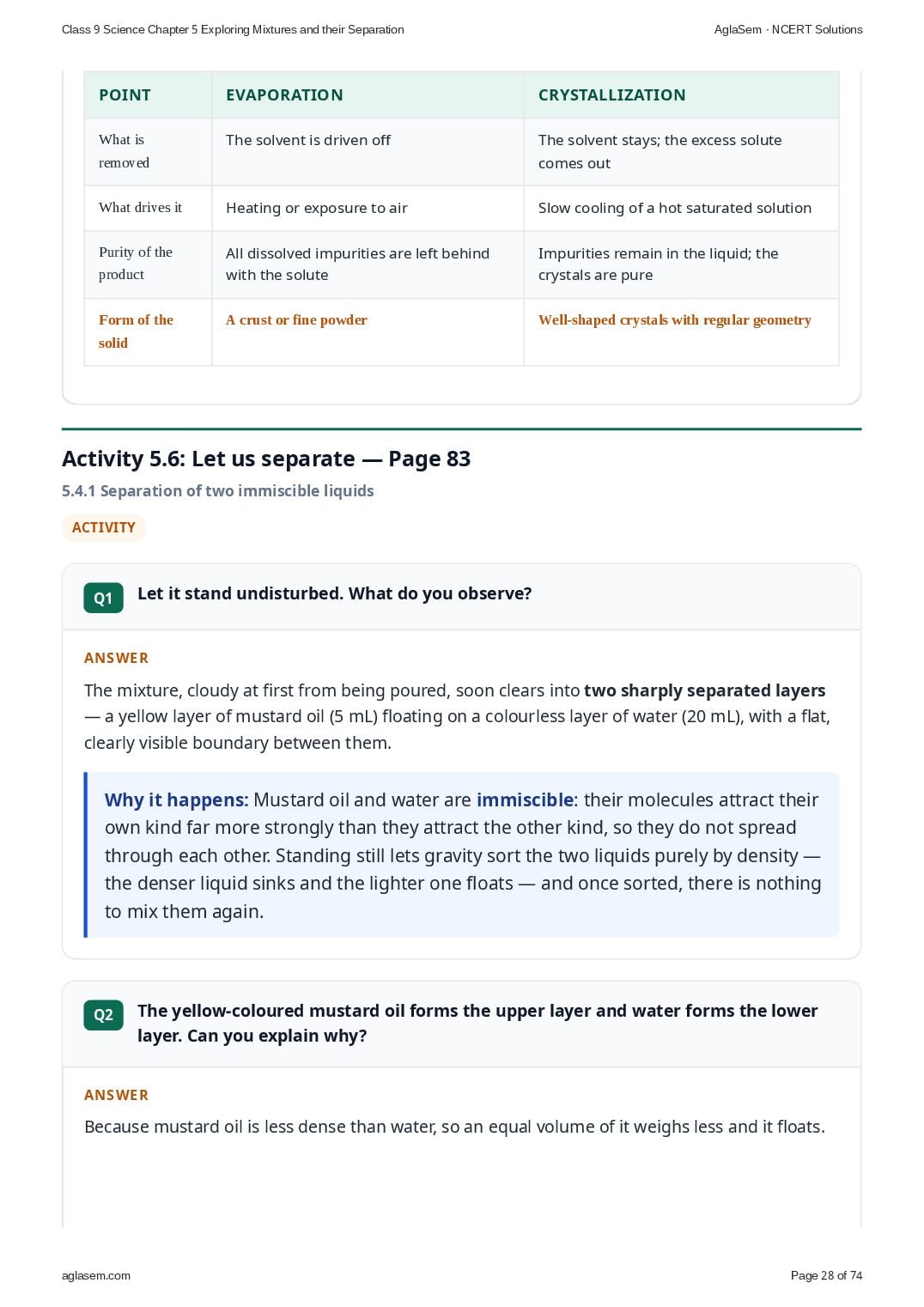
- Let it stand undisturbed. What do you observe?
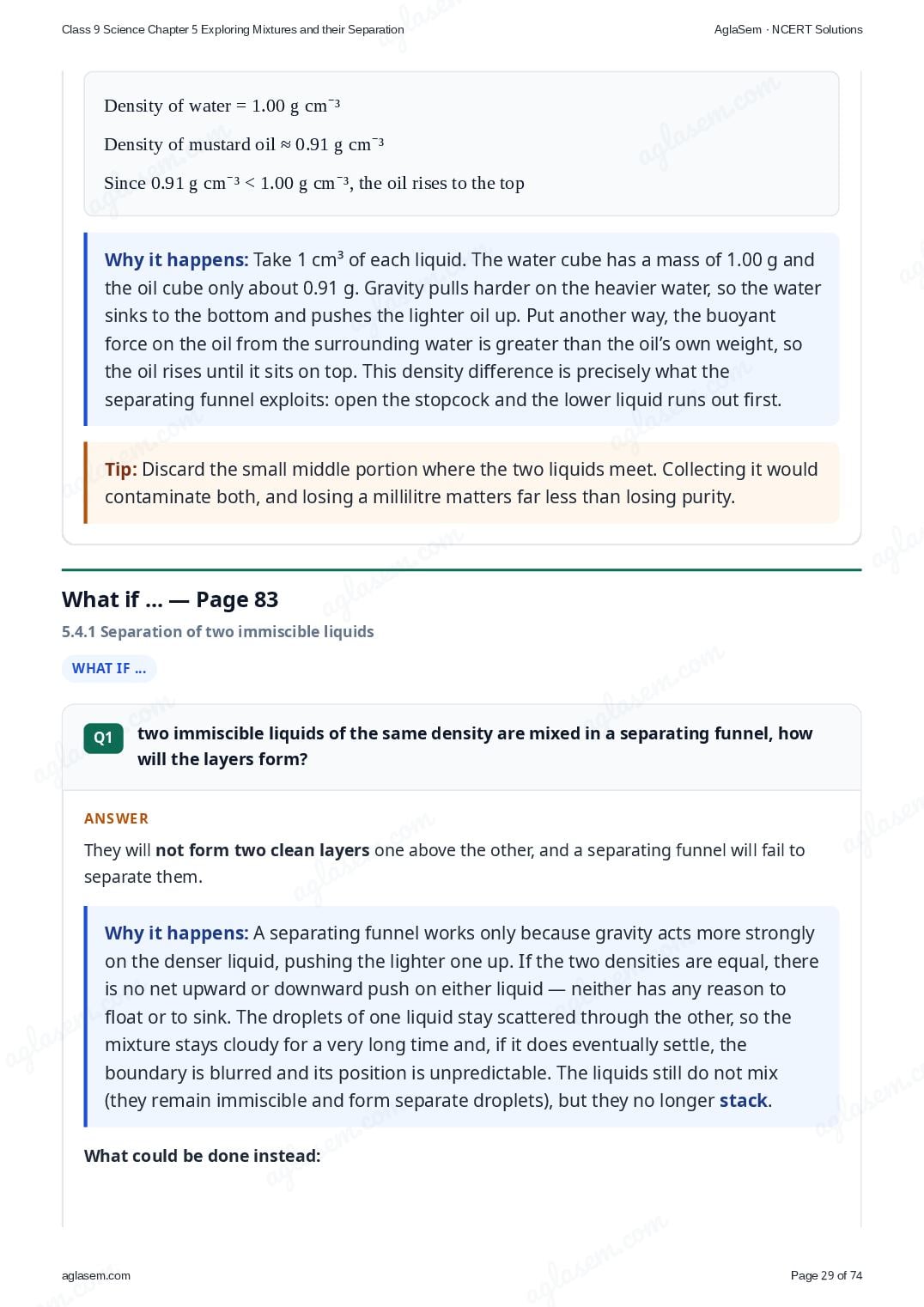
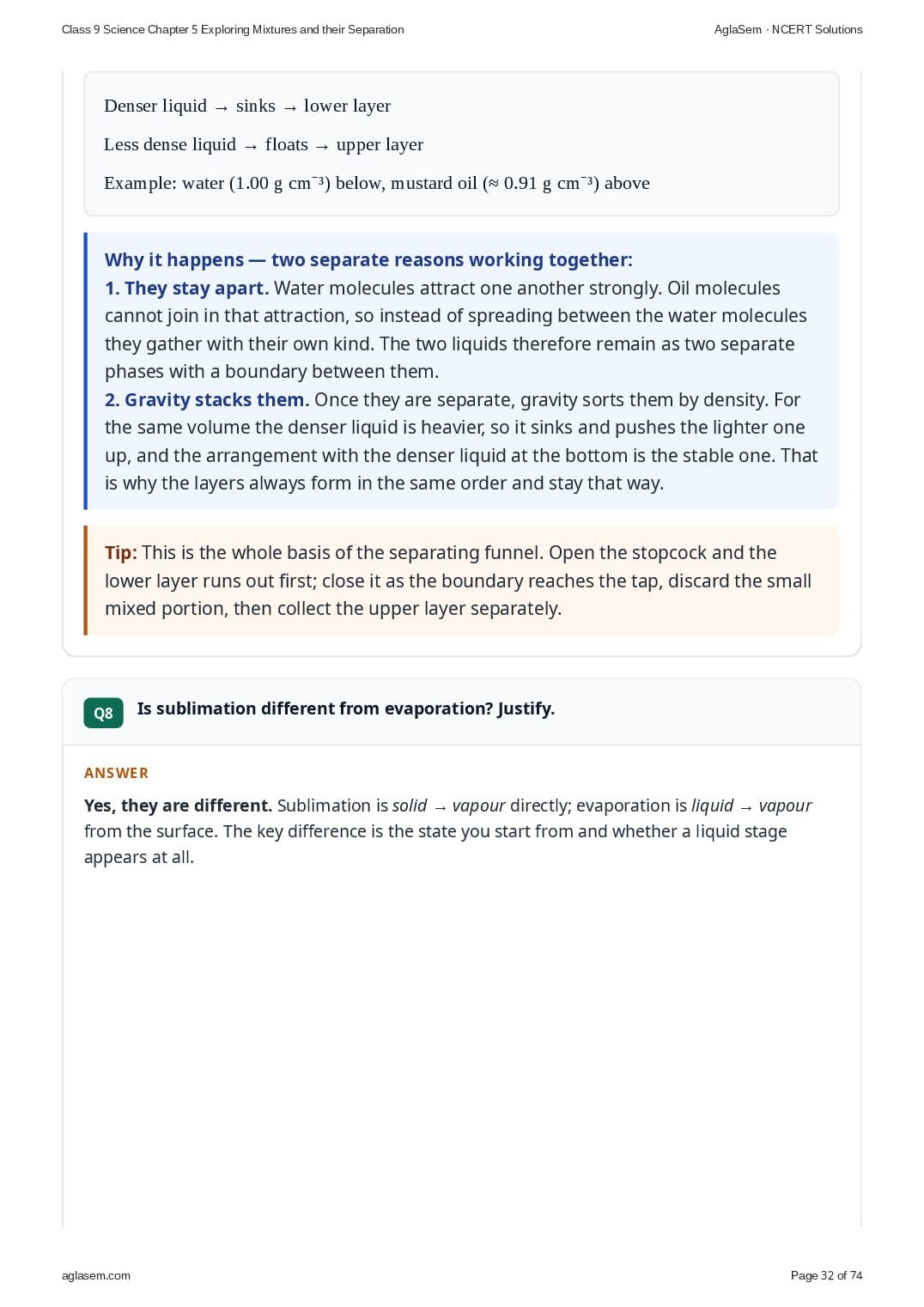
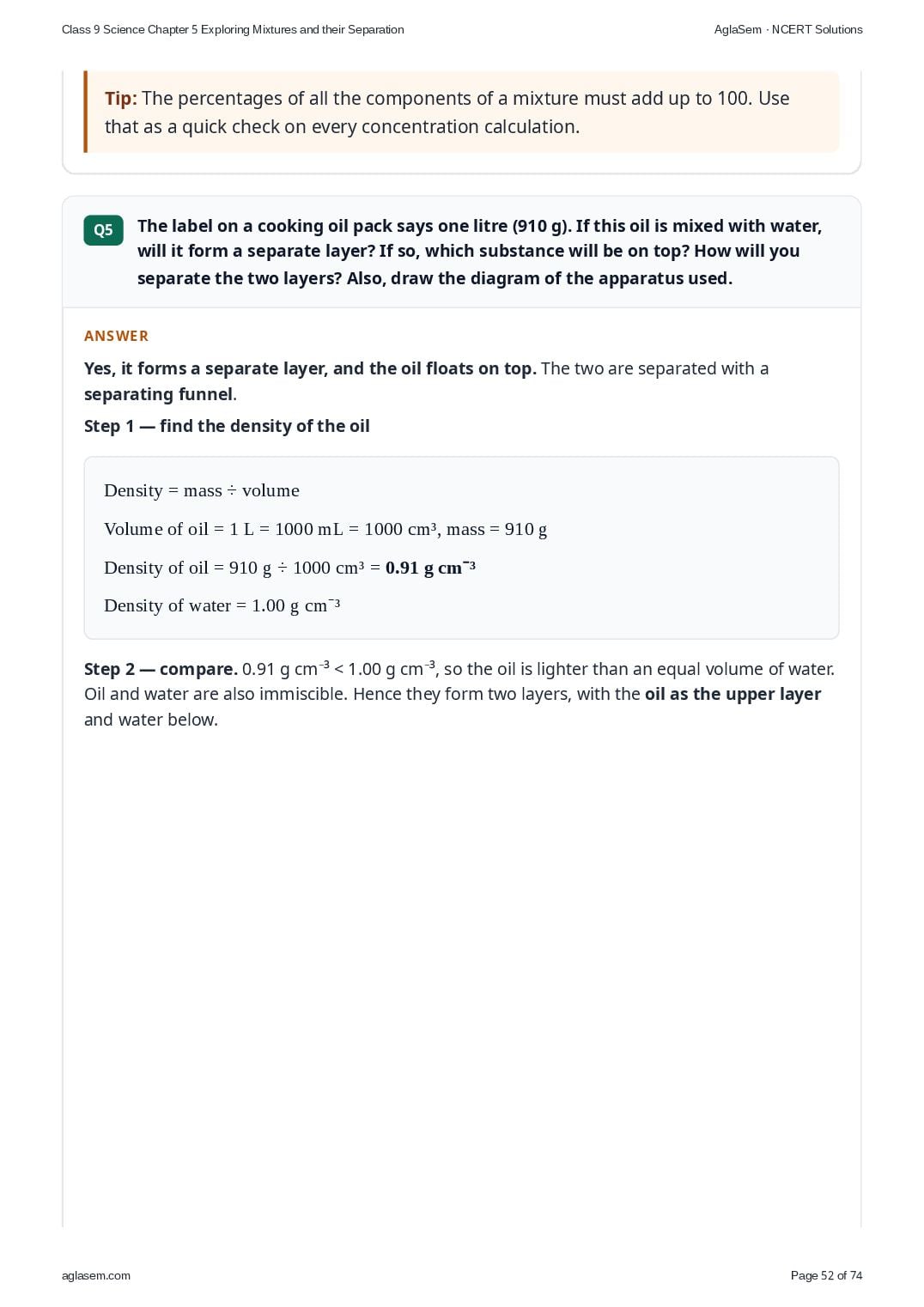
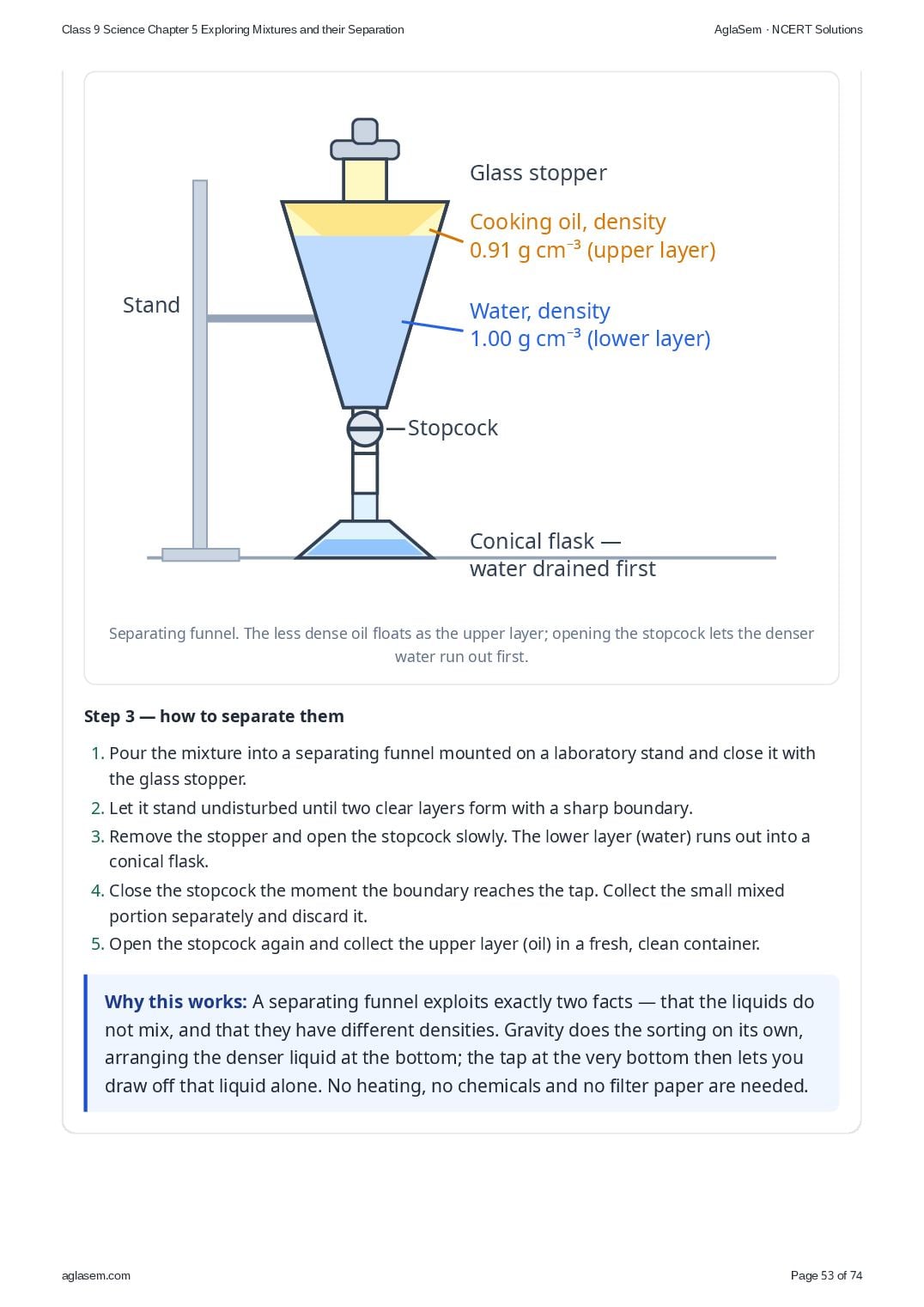
- The yellow-coloured mustard oil forms the upper layer and water forms the lower layer. Can you explain why?
- two immiscible liquids of the same density are mixed in a separating funnel, how will the layers form?
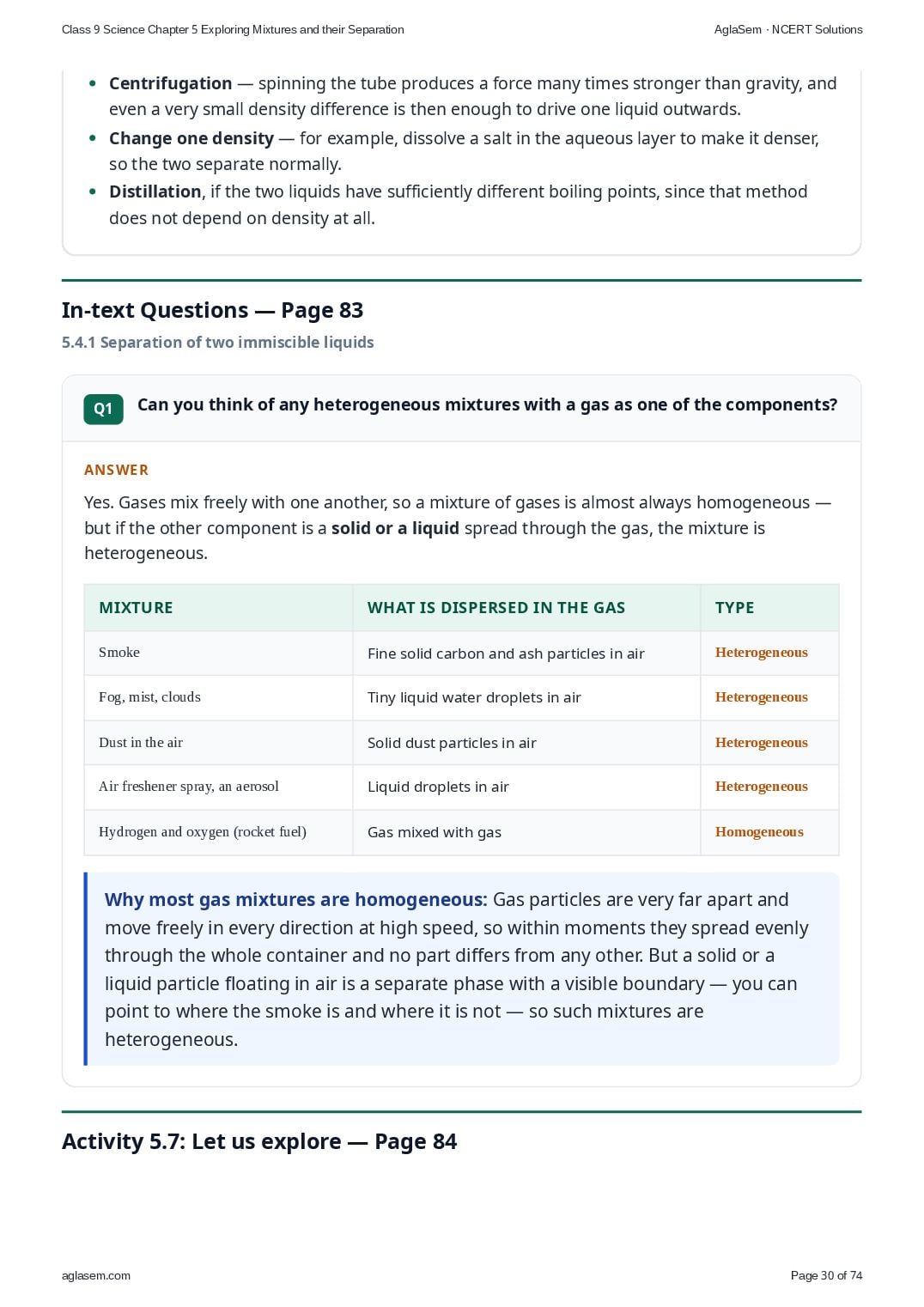
- Can you think of any heterogeneous mixtures with a gas as one of the components?
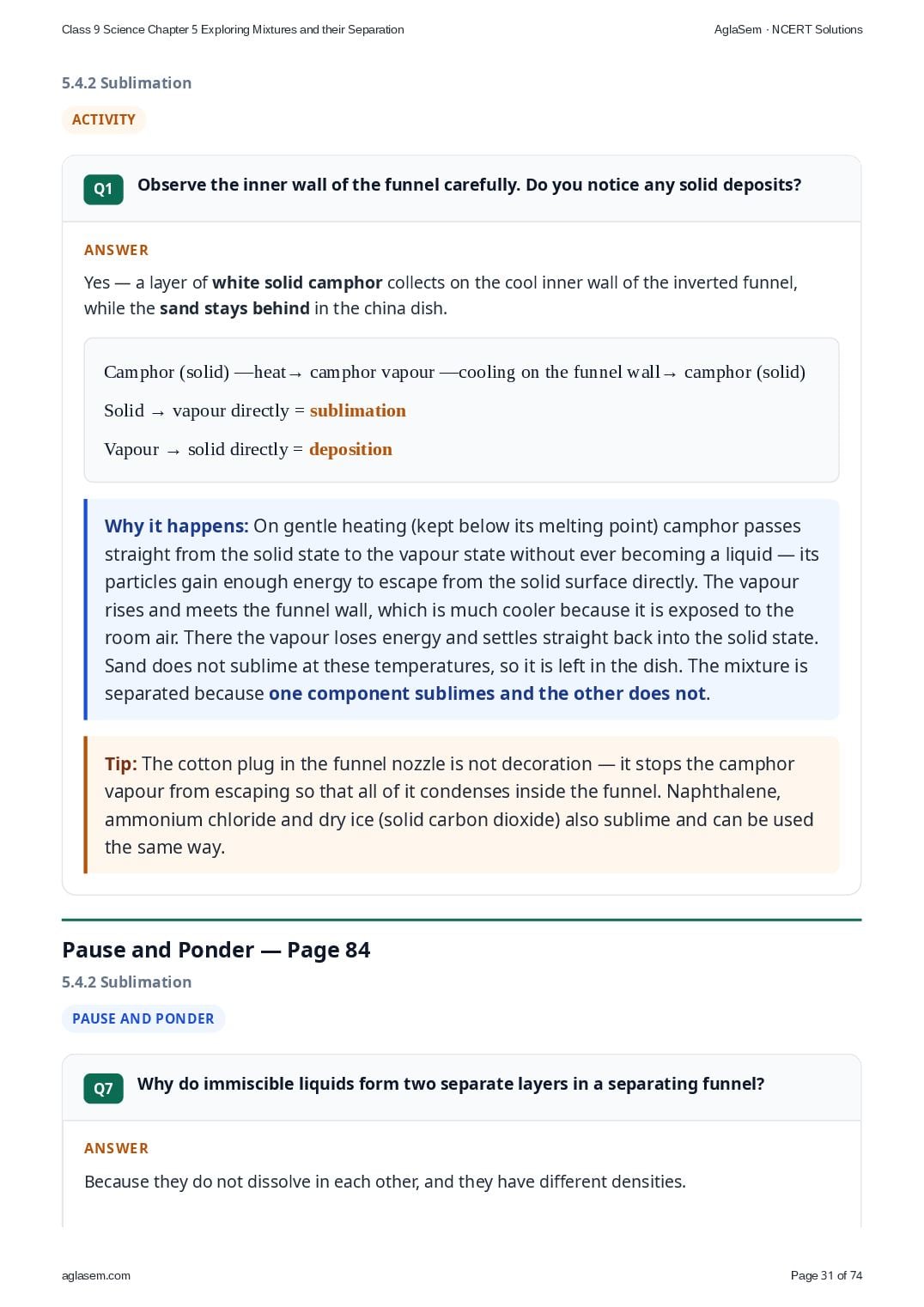
- Observe the inner wall of the funnel carefully. Do you notice any solid deposits?
- Why do immiscible liquids form two separate layers in a separating funnel?
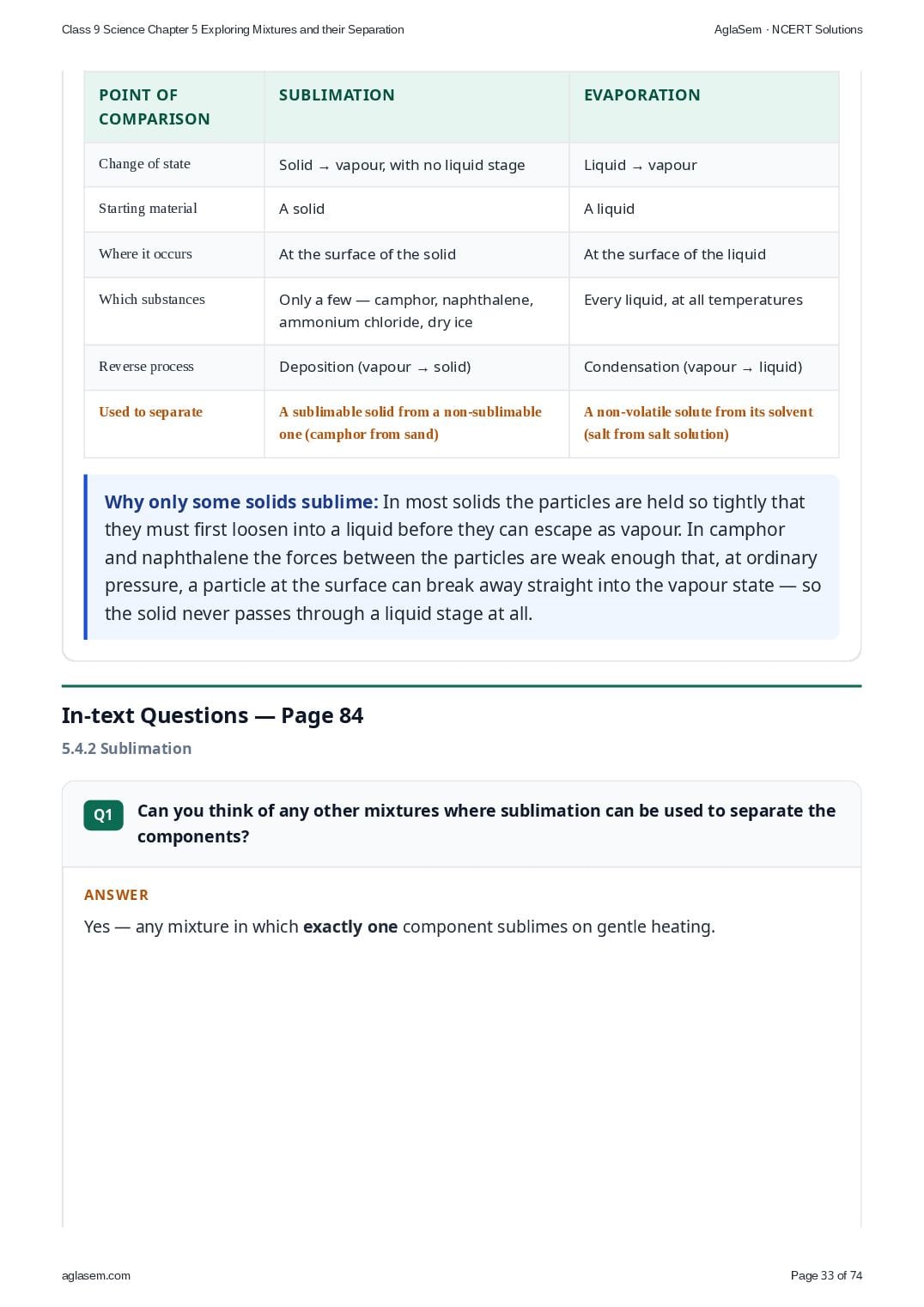
- Is sublimation different from evaporation? Justify.
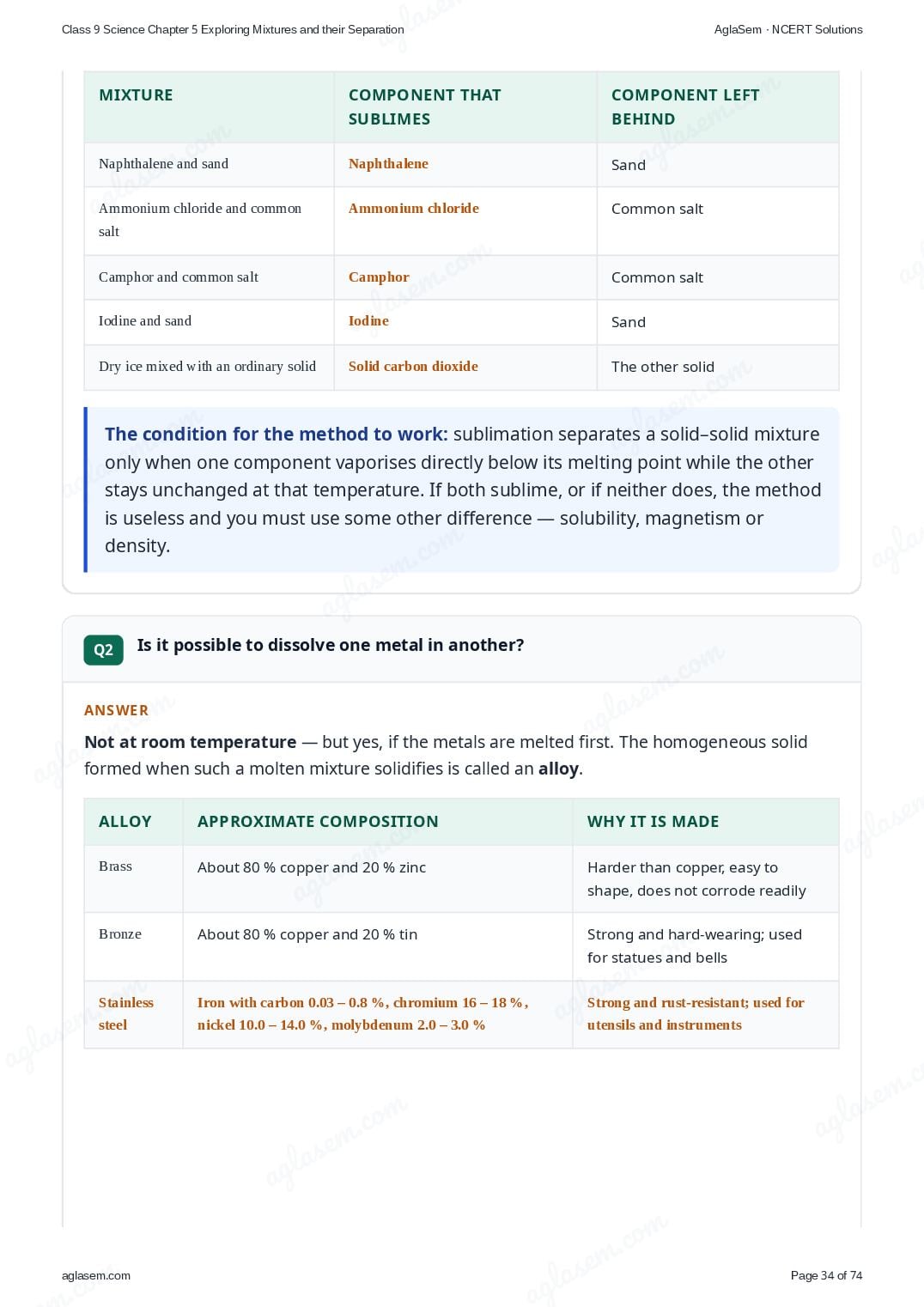
- Can you think of any other mixtures where sublimation can be used to separate the components?
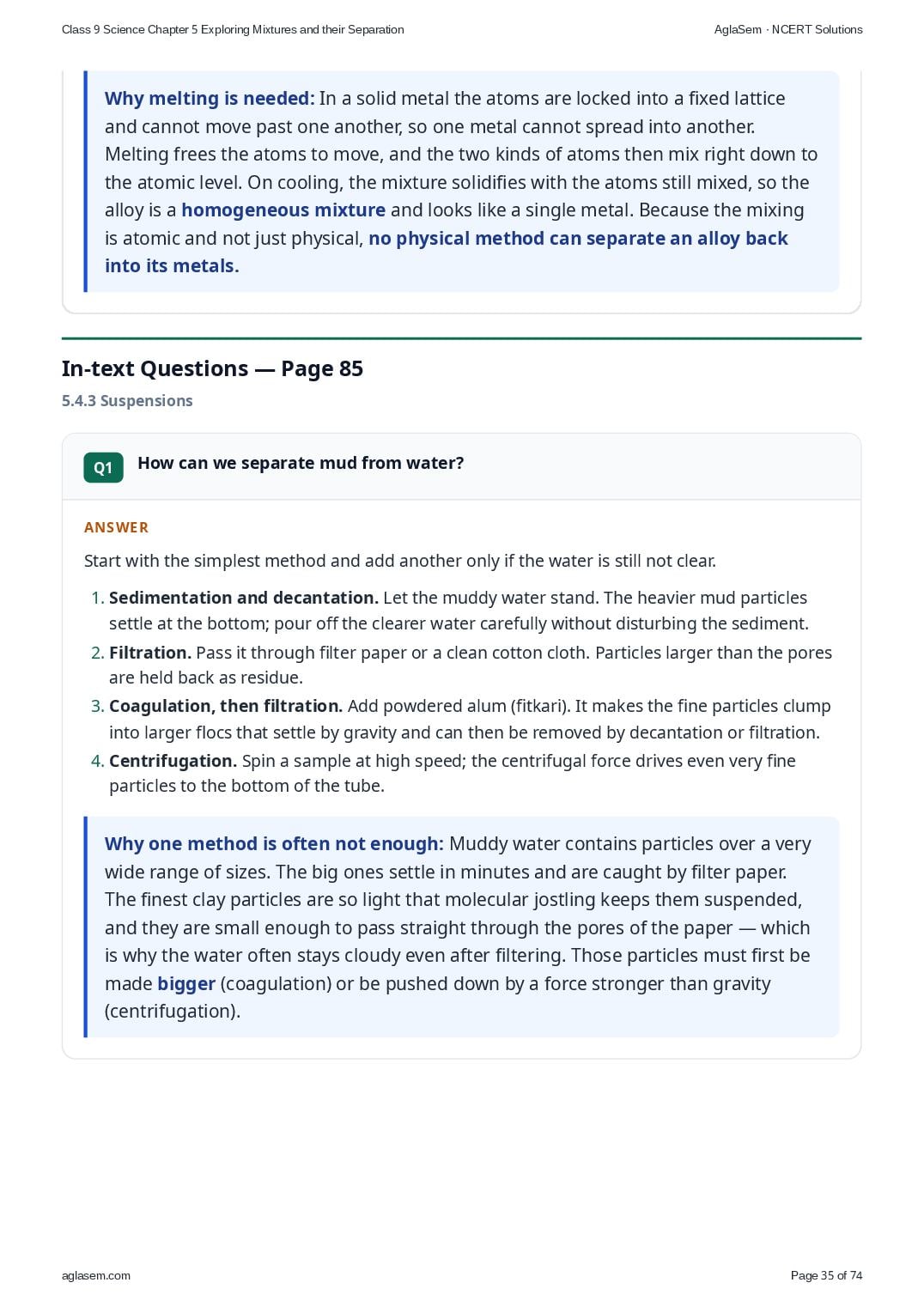
- Is it possible to dissolve one metal in another?
- How can we separate mud from water?
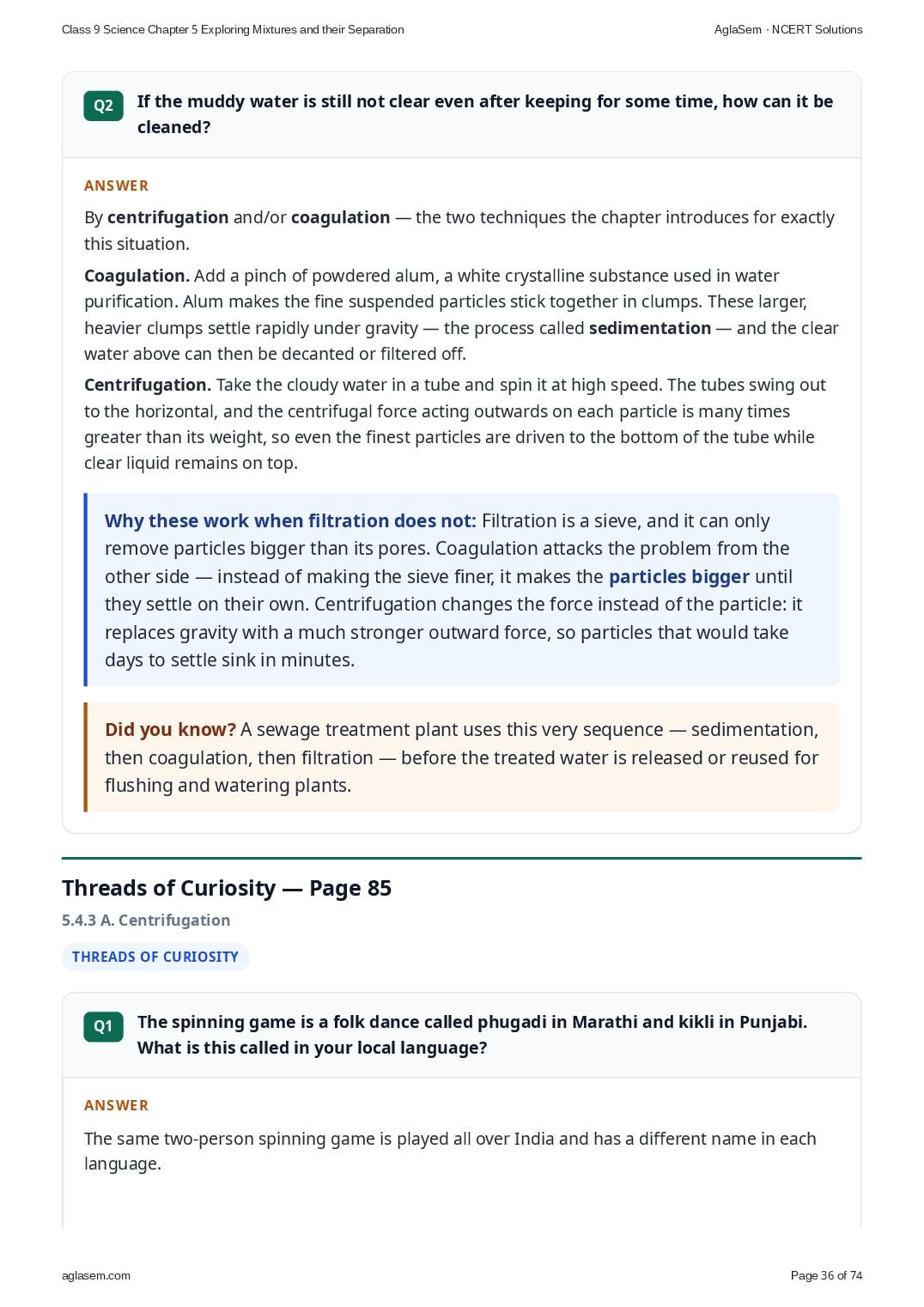
- If the muddy water is still not clear even after keeping for some time, how can it be cleaned?
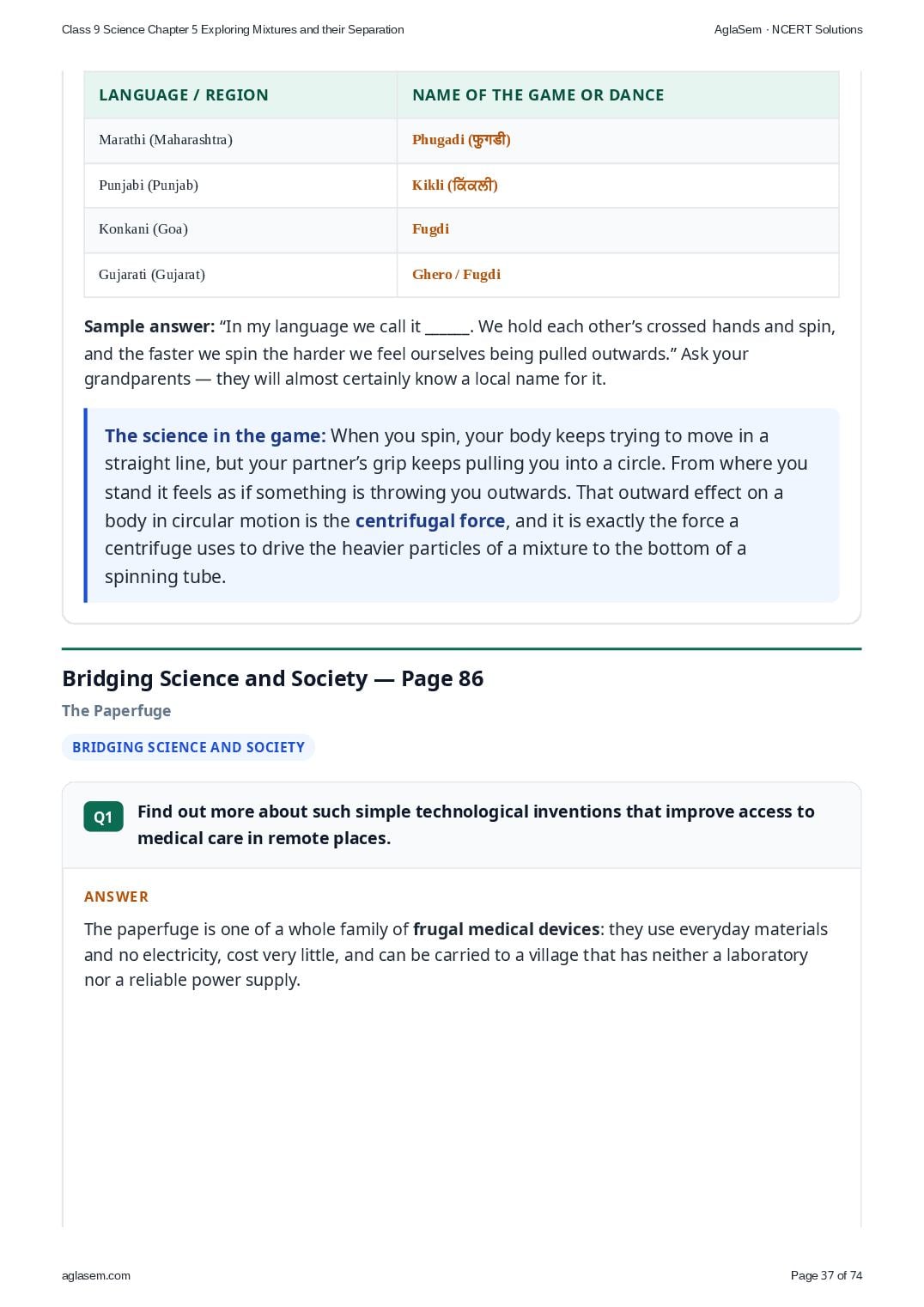
- The spinning game is a folk dance called phugadi in Marathi and kikli in Punjabi. What is this called in your local language?
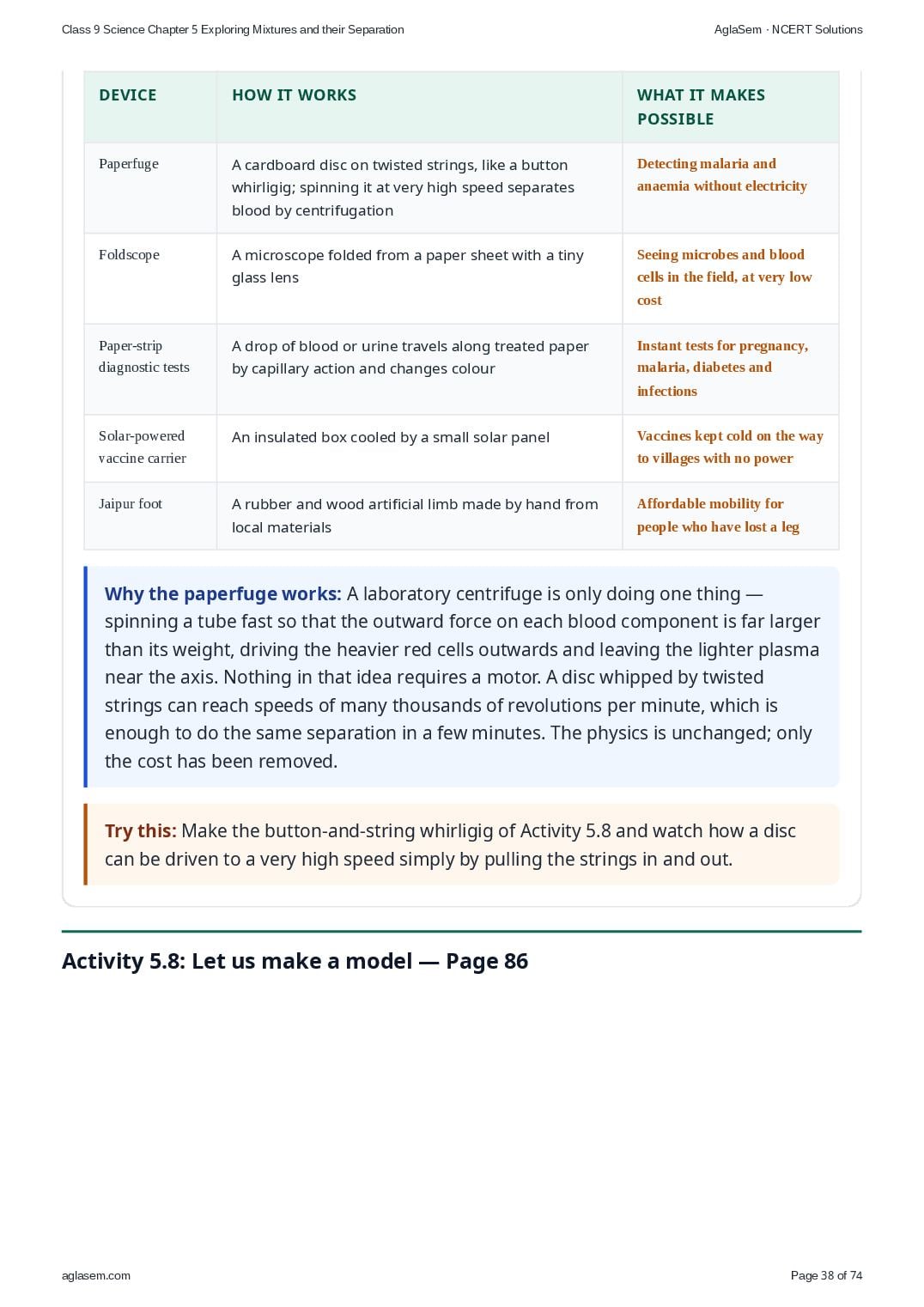
- Find out more about such simple technological inventions that improve access to medical care in remote places.
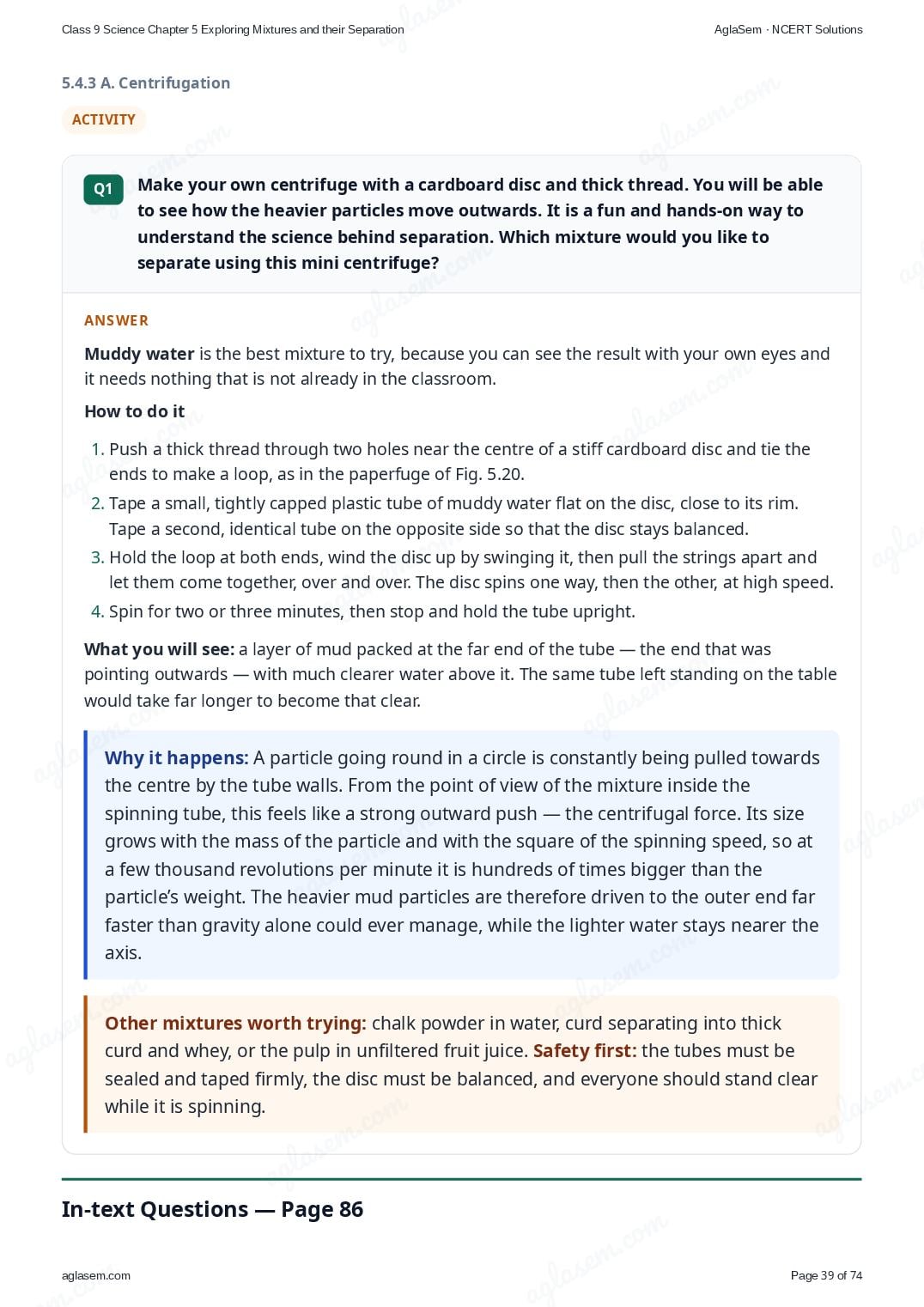
- Make your own centrifuge with a cardboard disc and thick thread. You will be able to see how the heavier particles move outwards. It is a fun and hands-on way to understand the science behind separation. Which mixture would you like to separate using this mini centrifuge?
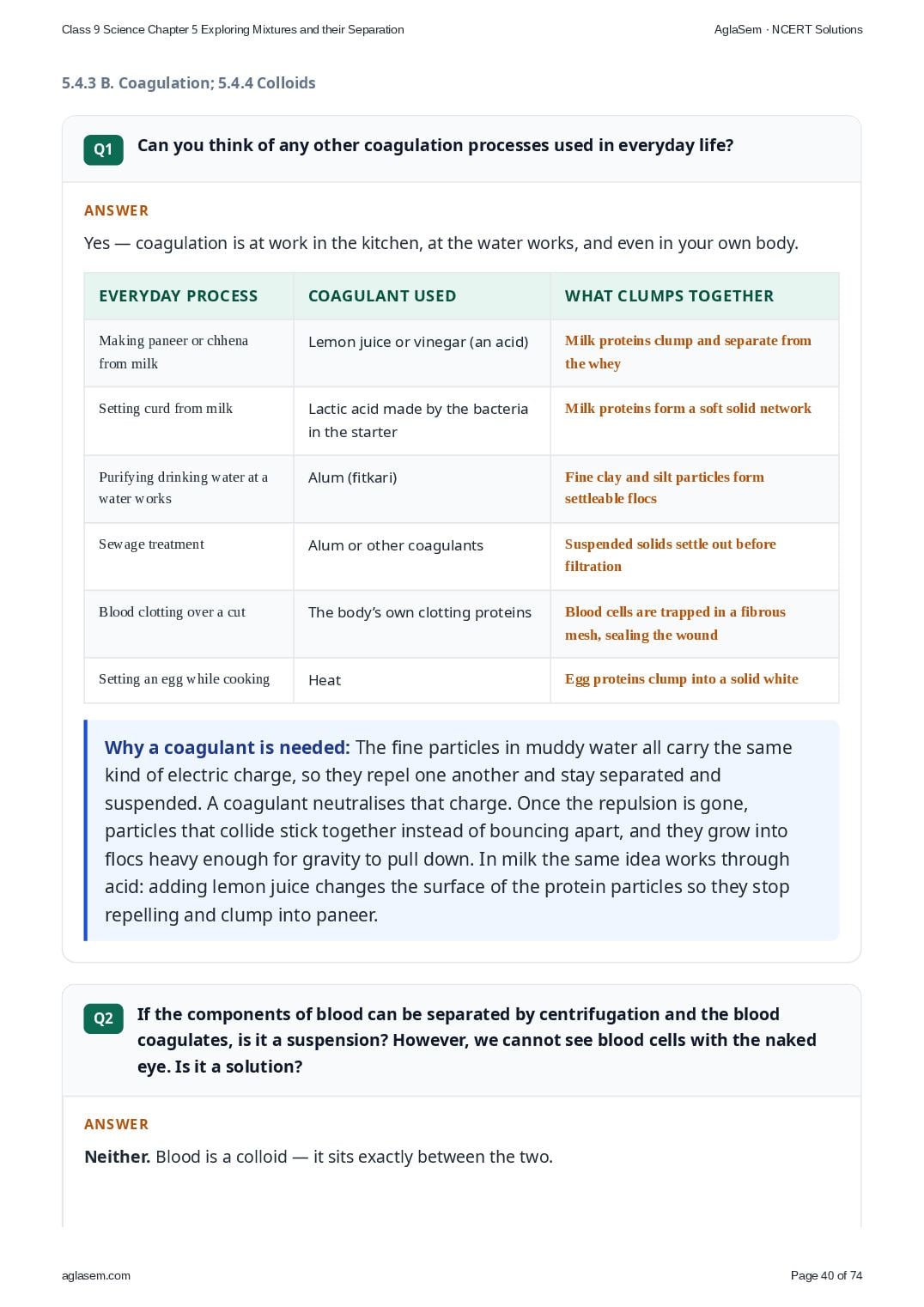
- Can you think of any other coagulation processes used in everyday life?
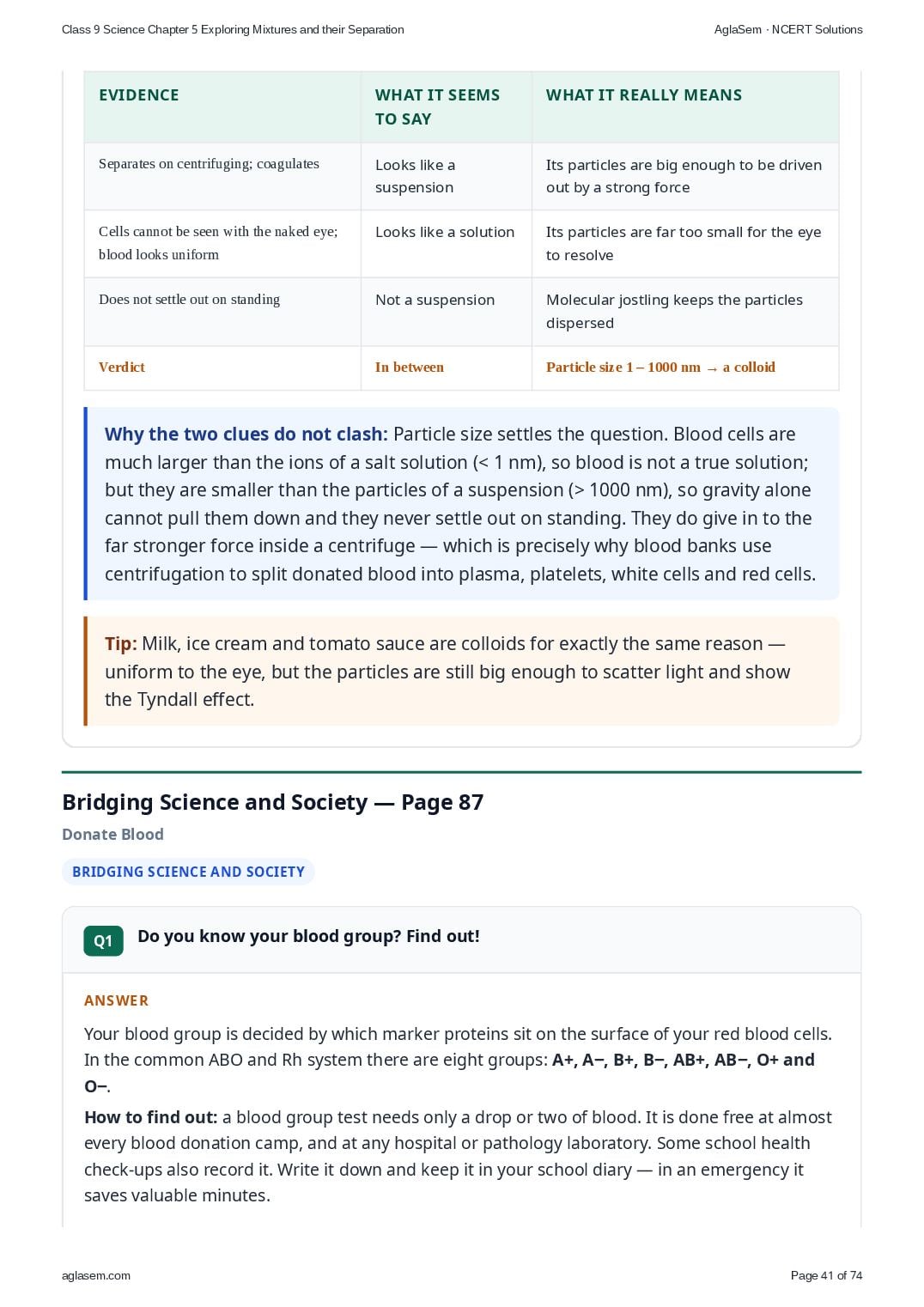
- If the components of blood can be separated by centrifugation and the blood coagulates, is it a suspension? However, we cannot see blood cells with the naked eye. Is it a solution?
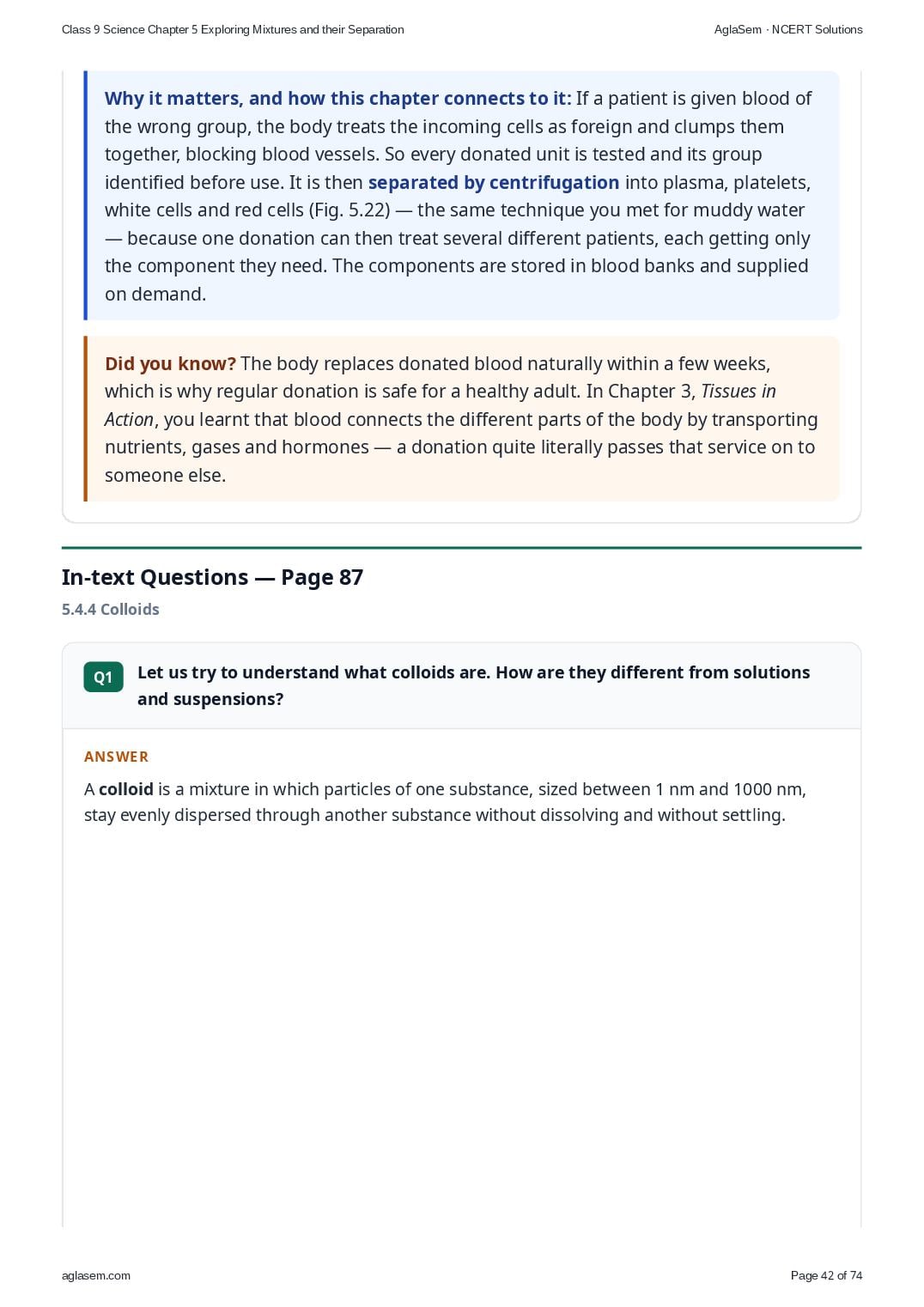
- Do you know your blood group? Find out!
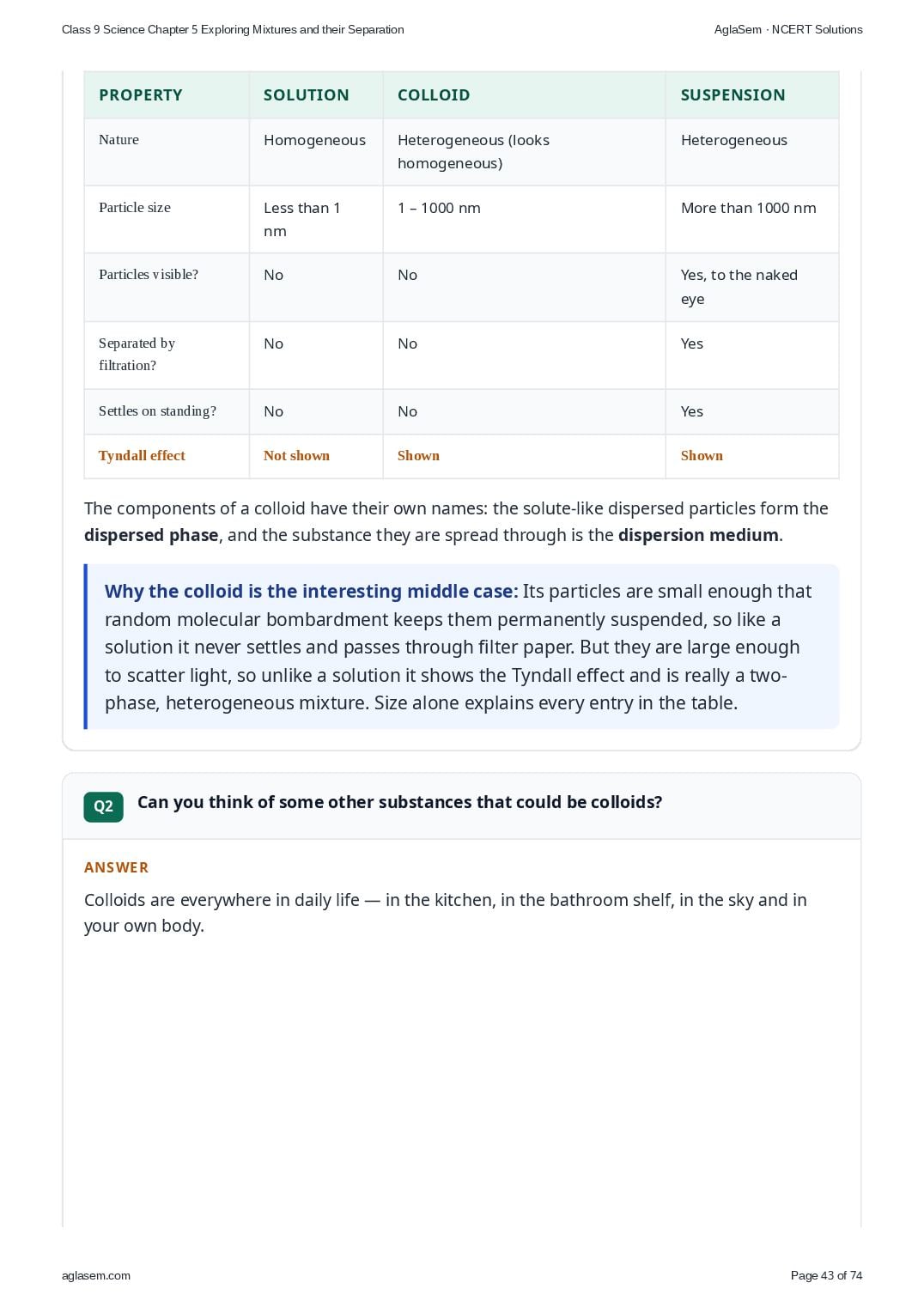
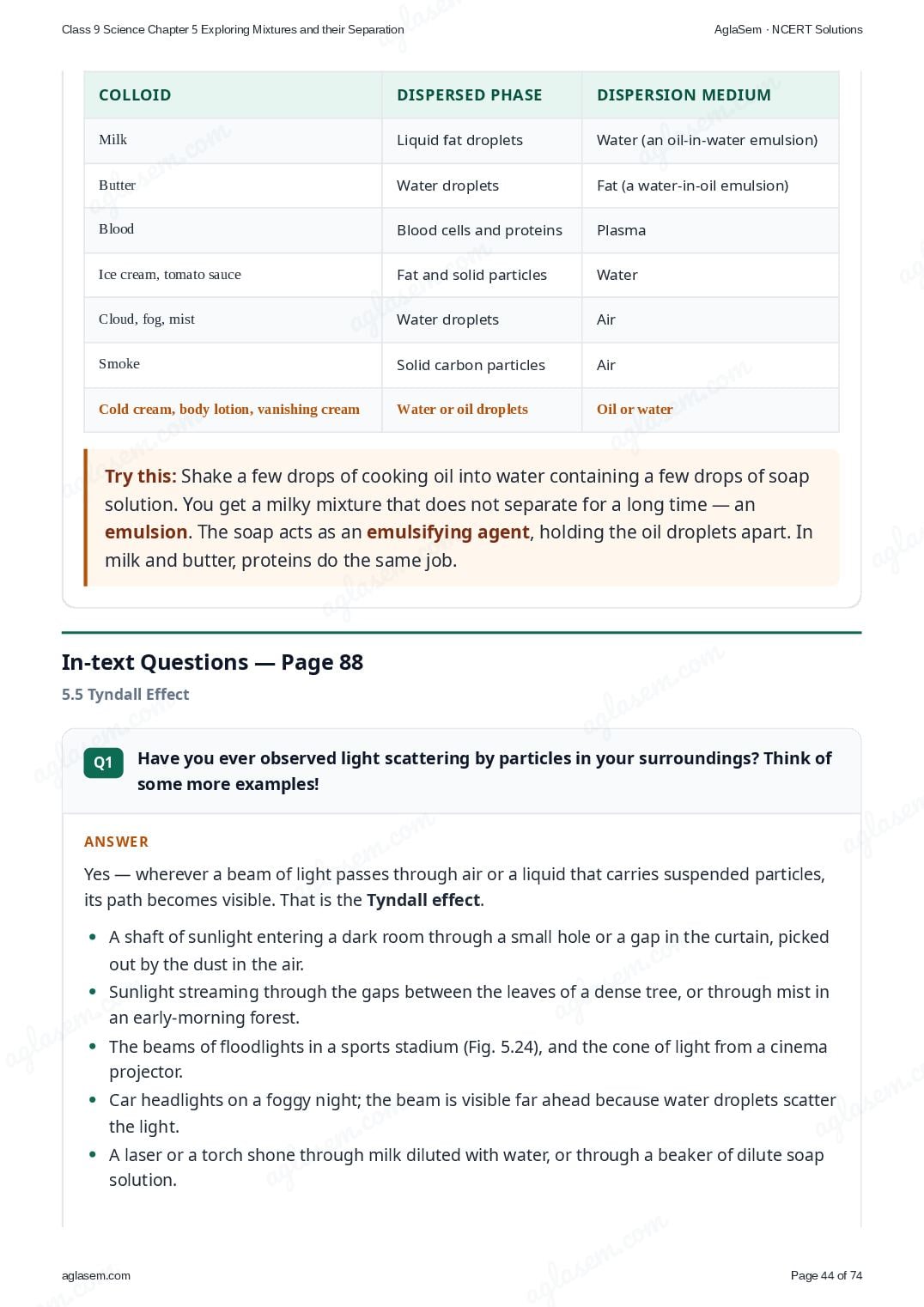
- Let us try to understand what colloids are. How are they different from solutions and suspensions?
- Can you think of some other substances that could be colloids?
- Have you ever observed light scattering by particles in your surroundings? Think of some more examples!
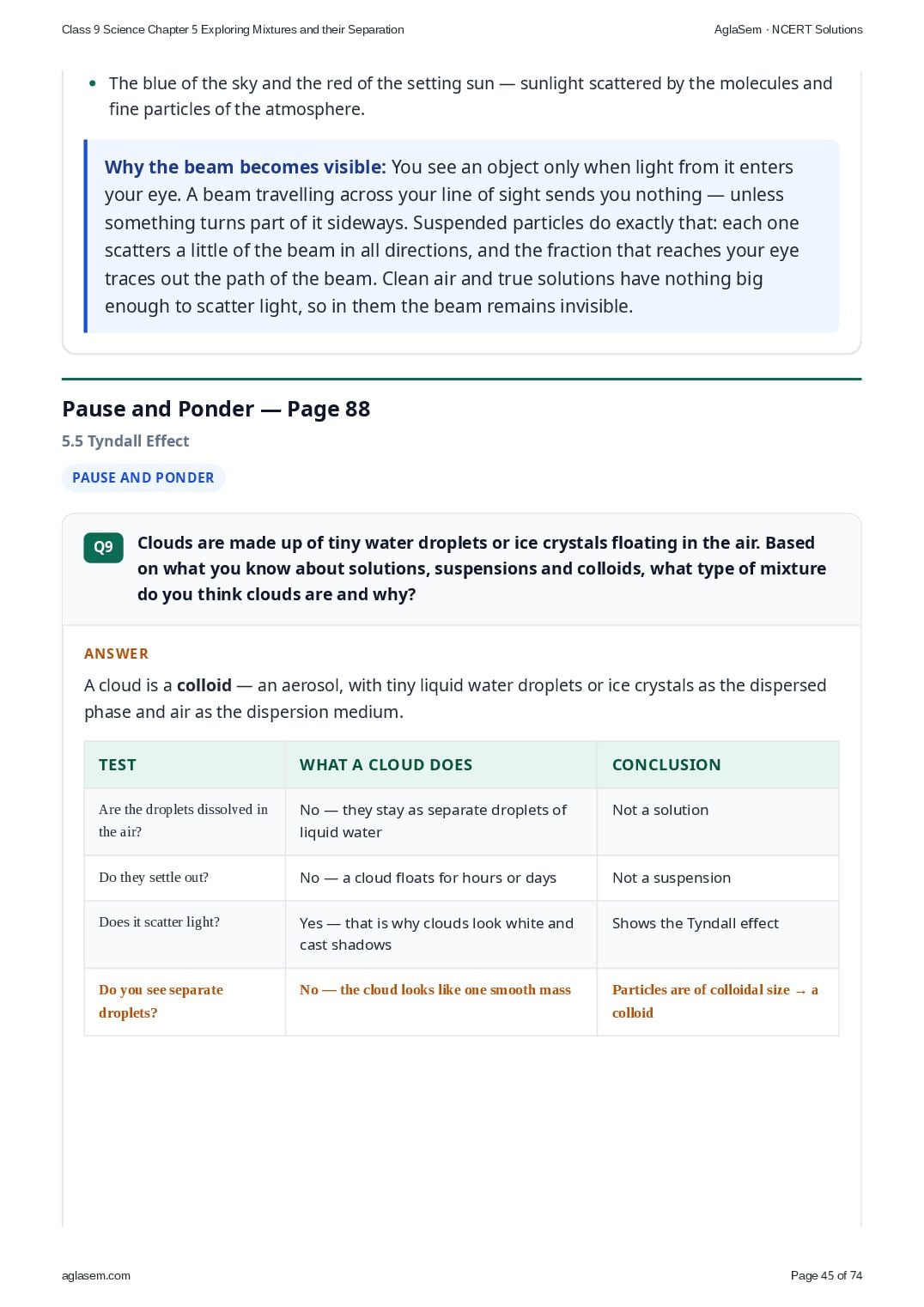
- Clouds are made up of tiny water droplets or ice crystals floating in the air. Based on what you know about solutions, suspensions and colloids, what type of mixture do you think clouds are and why?
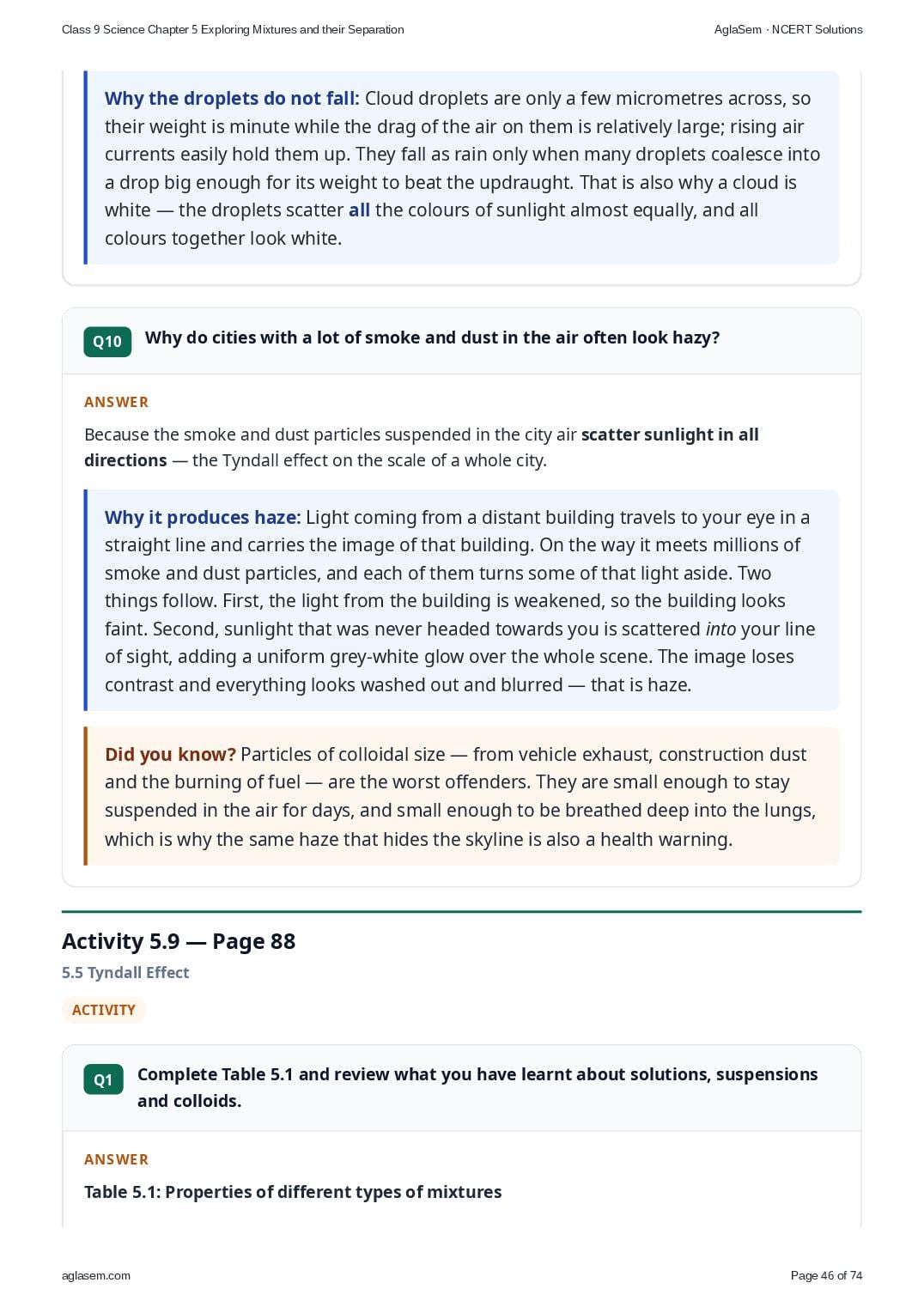
- Why do cities with a lot of smoke and dust in the air often look hazy?
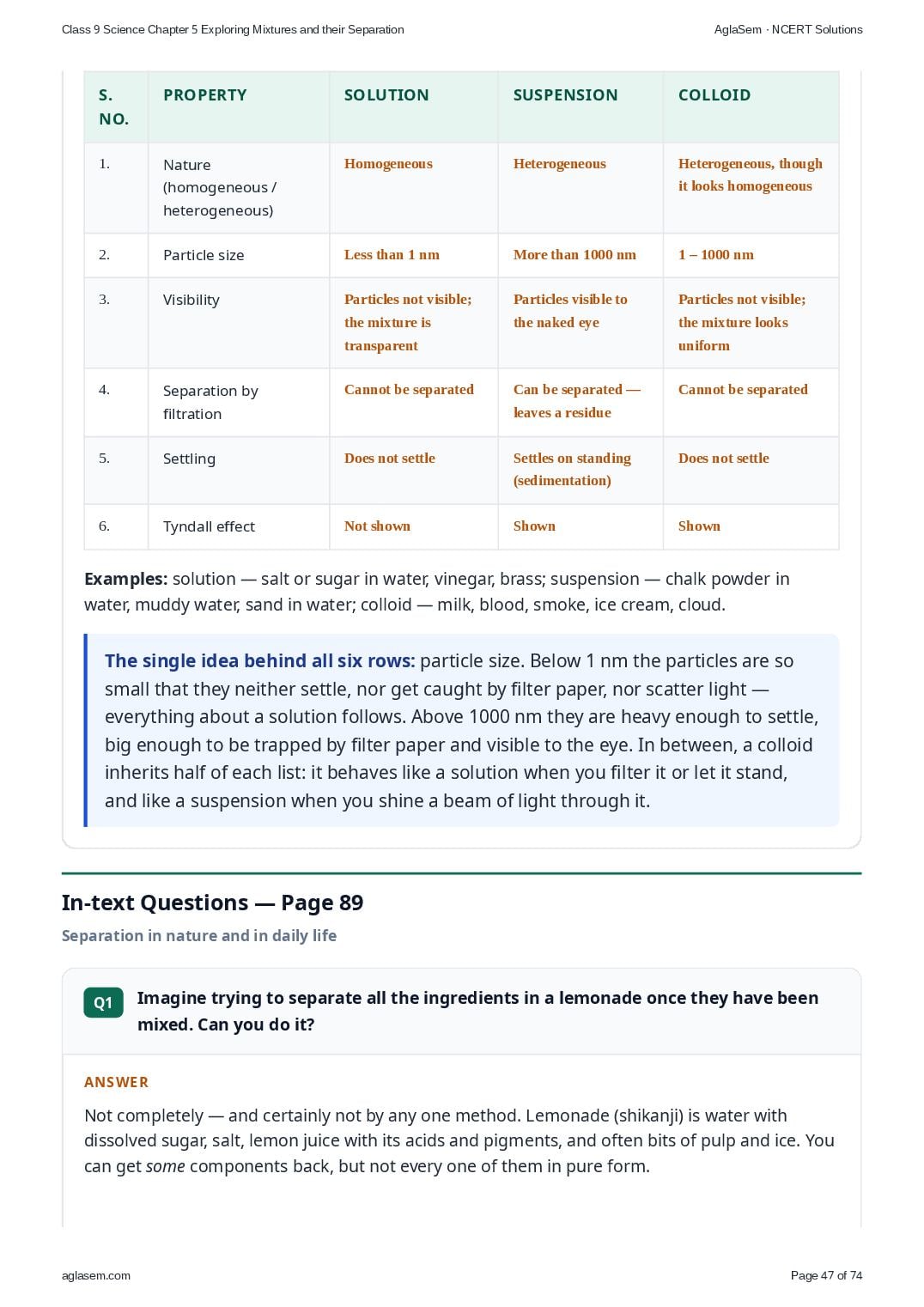
- Complete Table 5.1 and review what you have learnt about solutions, suspensions and colloids.
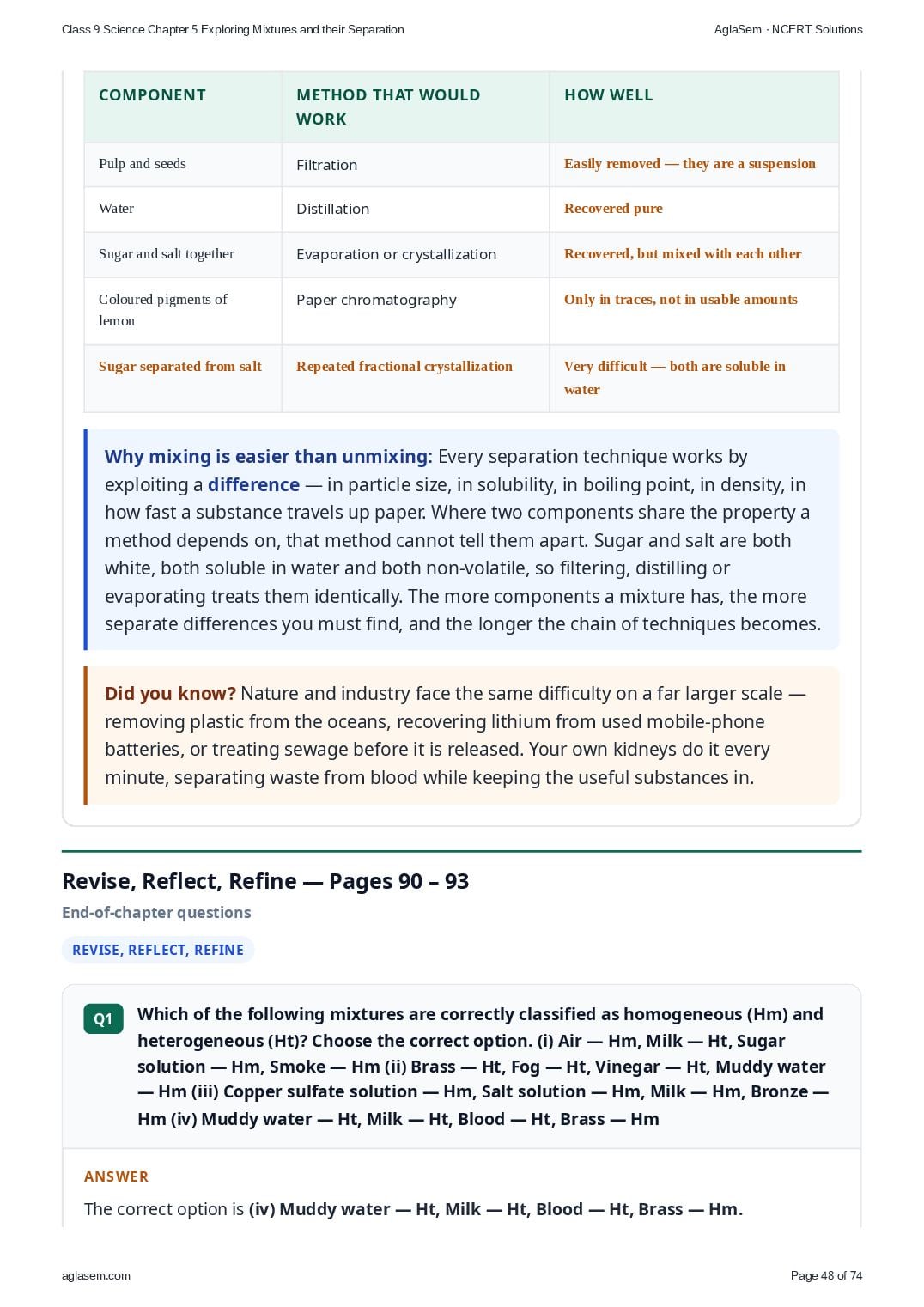
- Imagine trying to separate all the ingredients in a lemonade once they have been mixed. Can you do it?
- Which of the following mixtures are correctly classified as homogeneous (Hm) and heterogeneous (Ht)? Choose the correct option. (i) Air — Hm, Milk — Ht, Sugar solution — Hm, Smoke — Hm (ii) Brass — Ht, Fog — Ht, Vinegar — Ht, Muddy water — Hm (iii) Copper sulfate solution — Hm, Salt solution — Hm, Milk — Hm, Bronze — Hm (iv) Muddy water — Ht, Milk — Ht, Blood — Ht, Brass — Hm
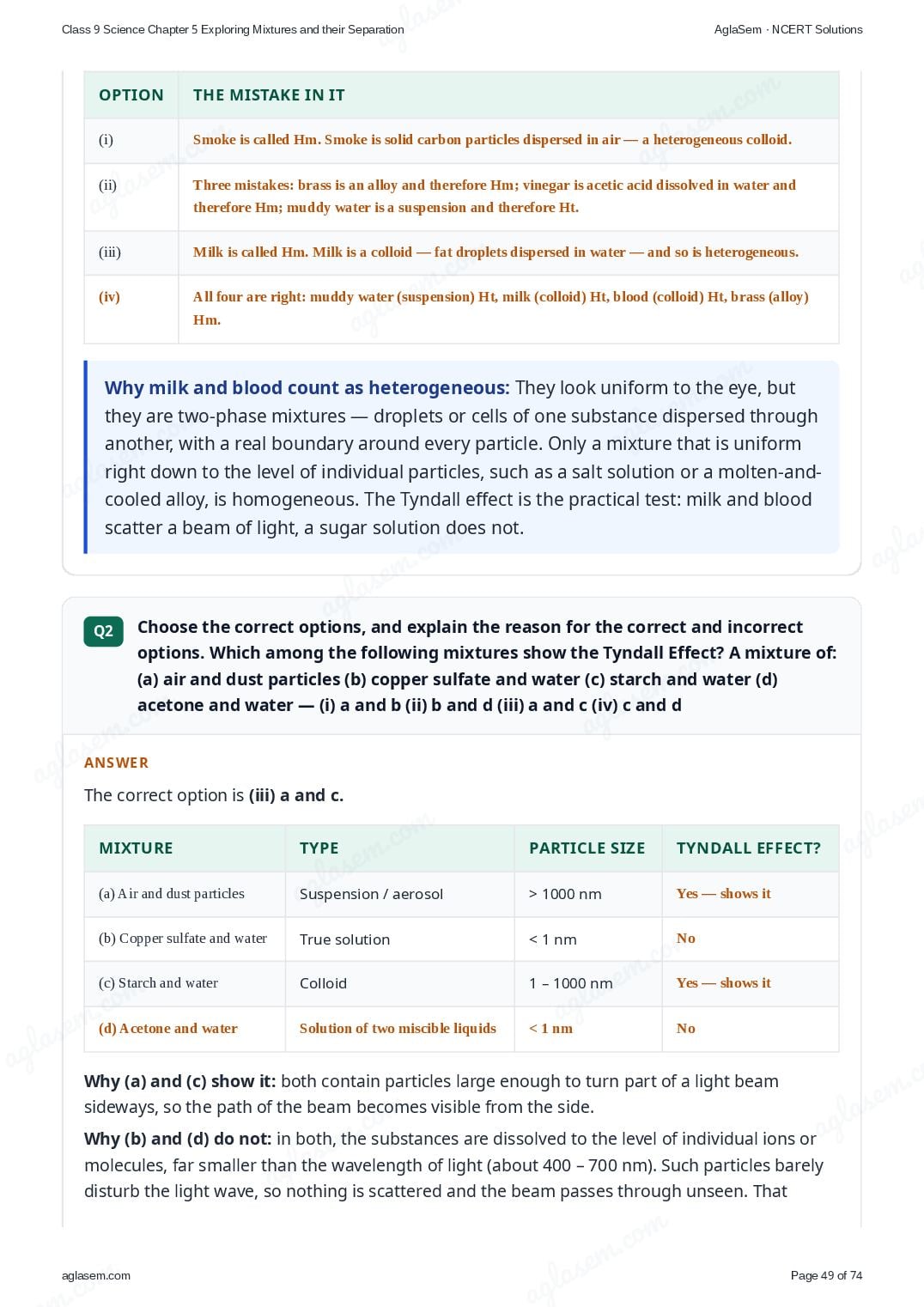
- Choose the correct options, and explain the reason for the correct and incorrect options. Which among the following mixtures show the Tyndall Effect? A mixture of: (a) air and dust particles (b) copper sulfate and water (c) starch and water (d) acetone and water — (i) a and b (ii) b and d (iii) a and c (iv) c and d
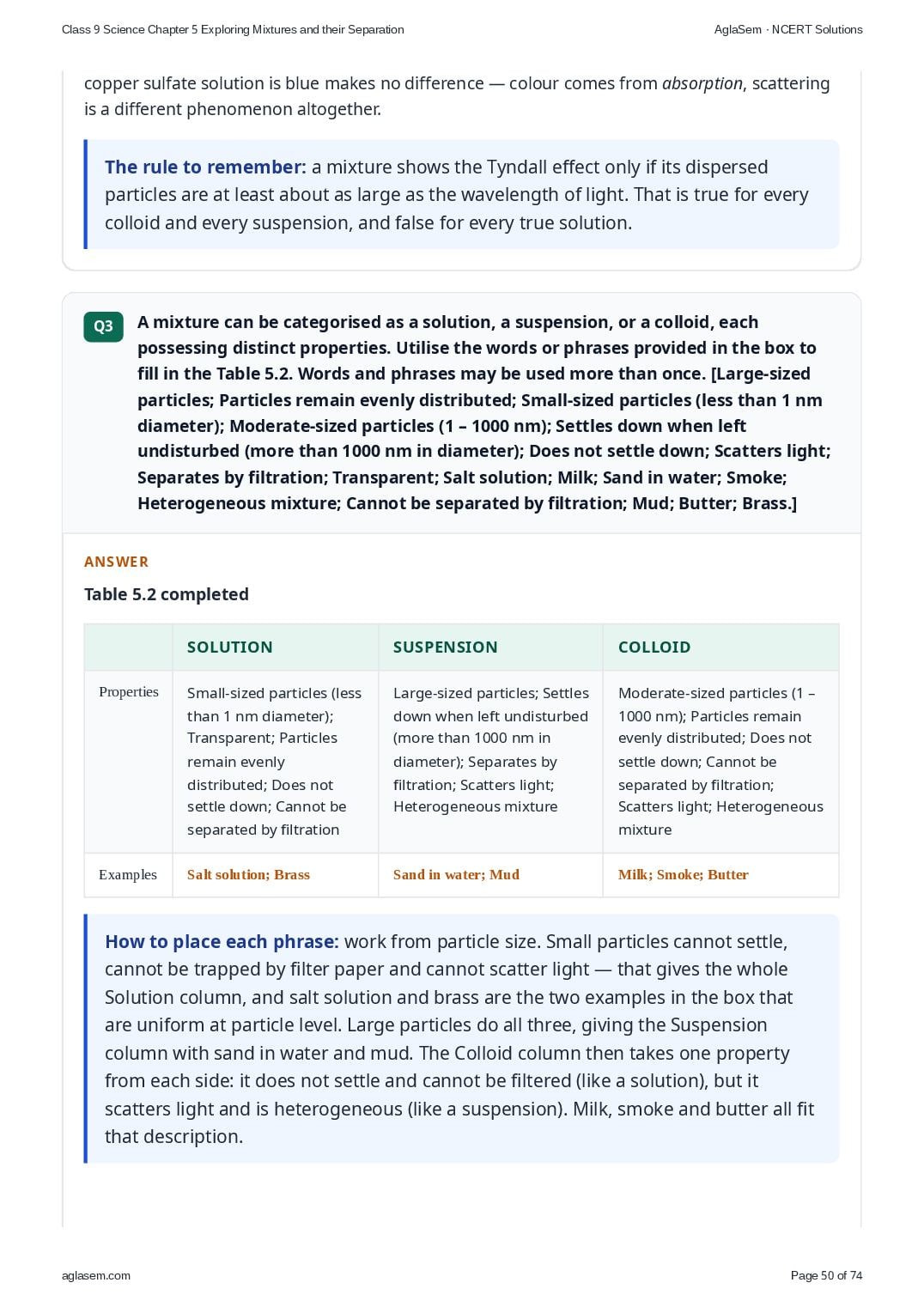
- A mixture can be categorised as a solution, a suspension, or a colloid, each possessing distinct properties. Utilise the words or phrases provided in the box to fill in the Table 5.2. Words and phrases may be used more than once. [Large-sized particles; Particles remain evenly distributed; Small-sized particles (less than 1 nm diameter); Moderate-sized particles (1 – 1000 nm); Settles down when left undisturbed (more than 1000 nm in diameter); Does not settle down; Scatters light; Separates by filtration; Transparent; Salt solution; Milk; Sand in water; Smoke; Heterogeneous mixture; Cannot be separated by filtration; Mud; Butter; Brass.]
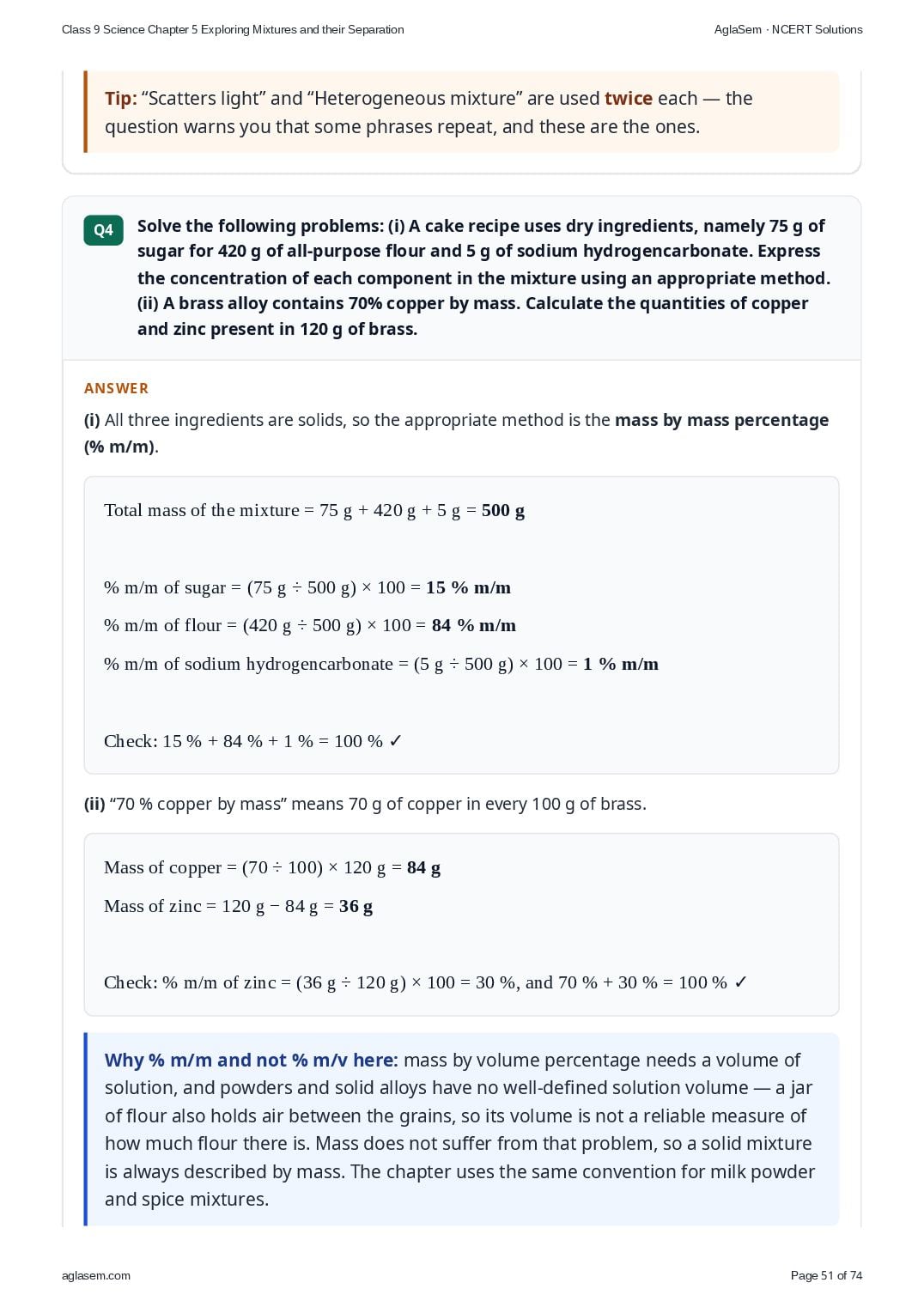
- Solve the following problems: (i) A cake recipe uses dry ingredients, namely 75 g of sugar for 420 g of all-purpose flour and 5 g of sodium hydrogencarbonate. Express the concentration of each component in the mixture using an appropriate method. (ii) A brass alloy contains 70% copper by mass. Calculate the quantities of copper and zinc present in 120 g of brass.
- The label on a cooking oil pack says one litre (910 g). If this oil is mixed with water, will it form a separate layer? If so, which substance will be on top? How will you separate the two layers? Also, draw the diagram of the apparatus used.
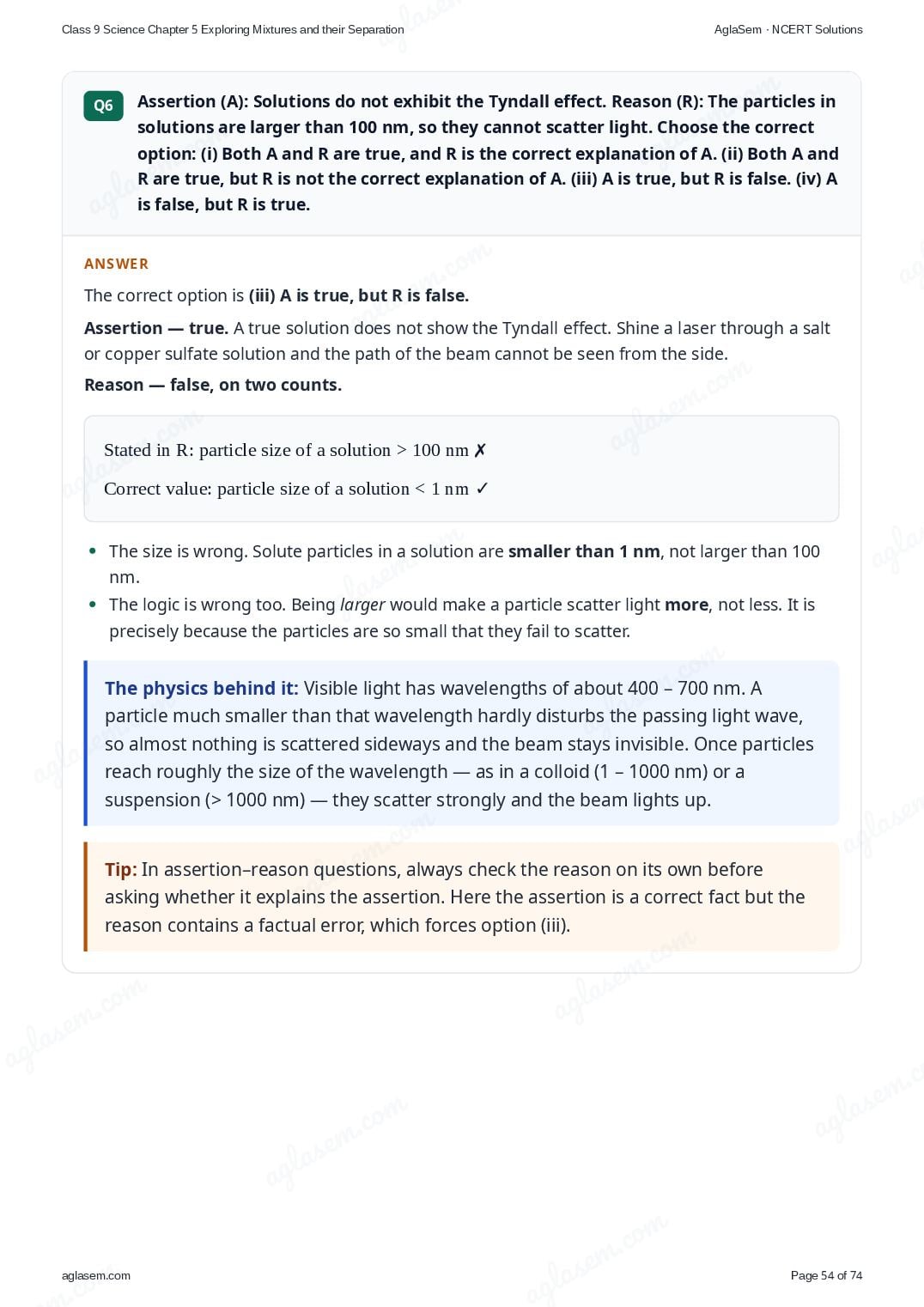
- Assertion (A): Solutions do not exhibit the Tyndall effect. Reason (R): The particles in solutions are larger than 100 nm, so they cannot scatter light. Choose the correct option: (i) Both A and R are true, and R is the correct explanation of A. (ii) Both A and R are true, but R is not the correct explanation of A. (iii) A is true, but R is false. (iv) A is false, but R is true.
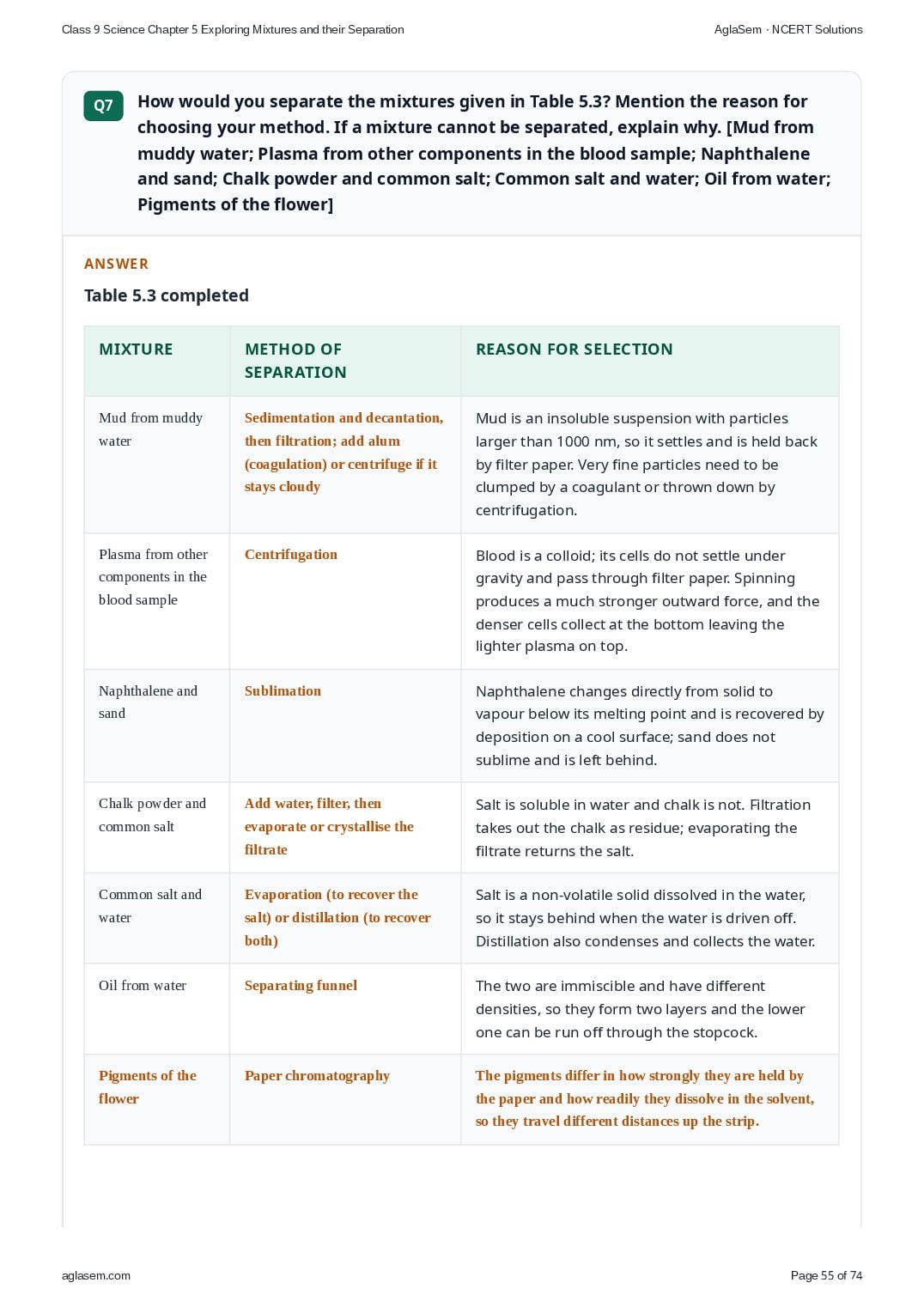
- How would you separate the mixtures given in Table 5.3? Mention the reason for choosing your method. If a mixture cannot be separated, explain why. [Mud from muddy water; Plasma from other components in the blood sample; Naphthalene and sand; Chalk powder and common salt; Common salt and water; Oil from water; Pigments of the flower]
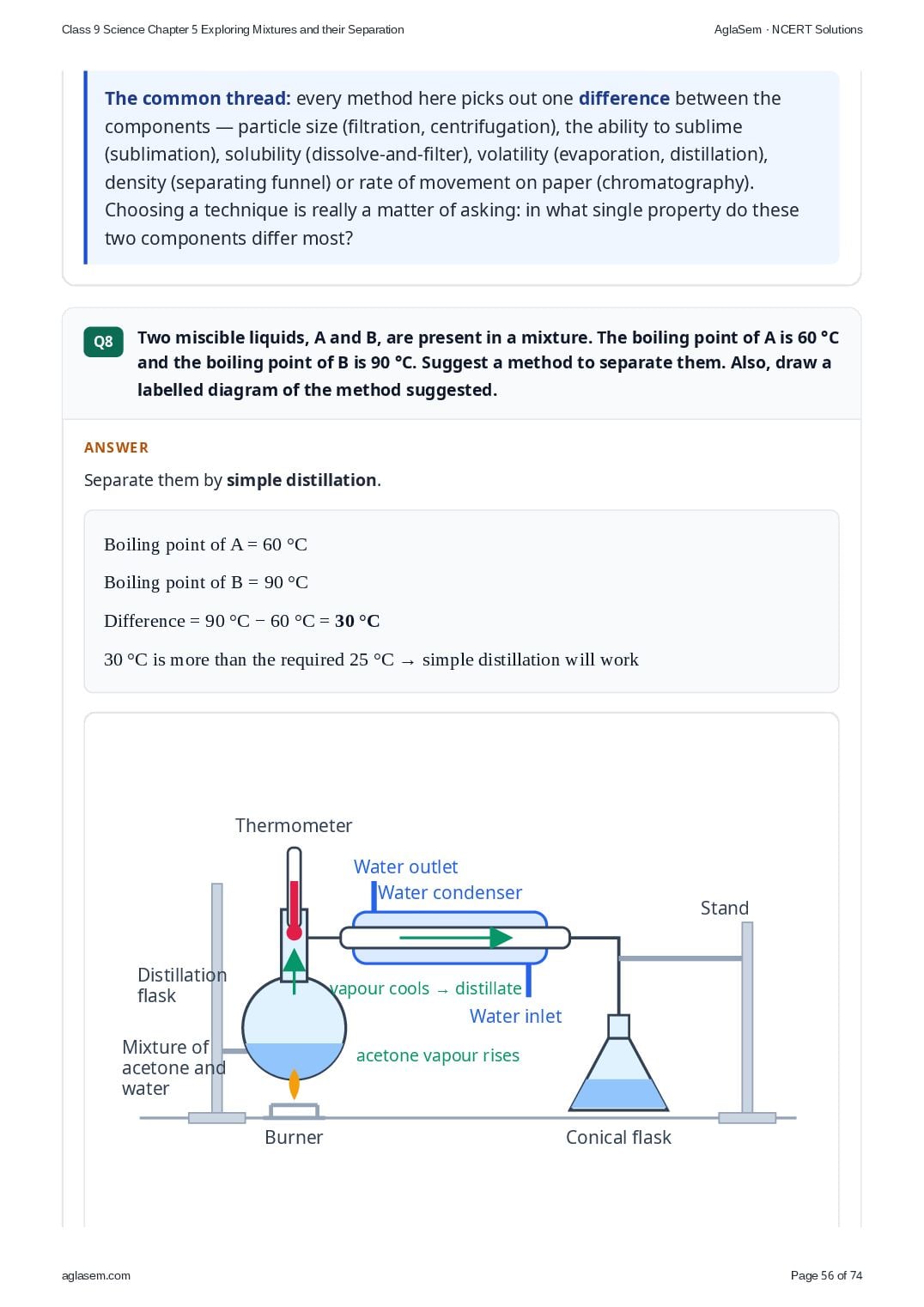
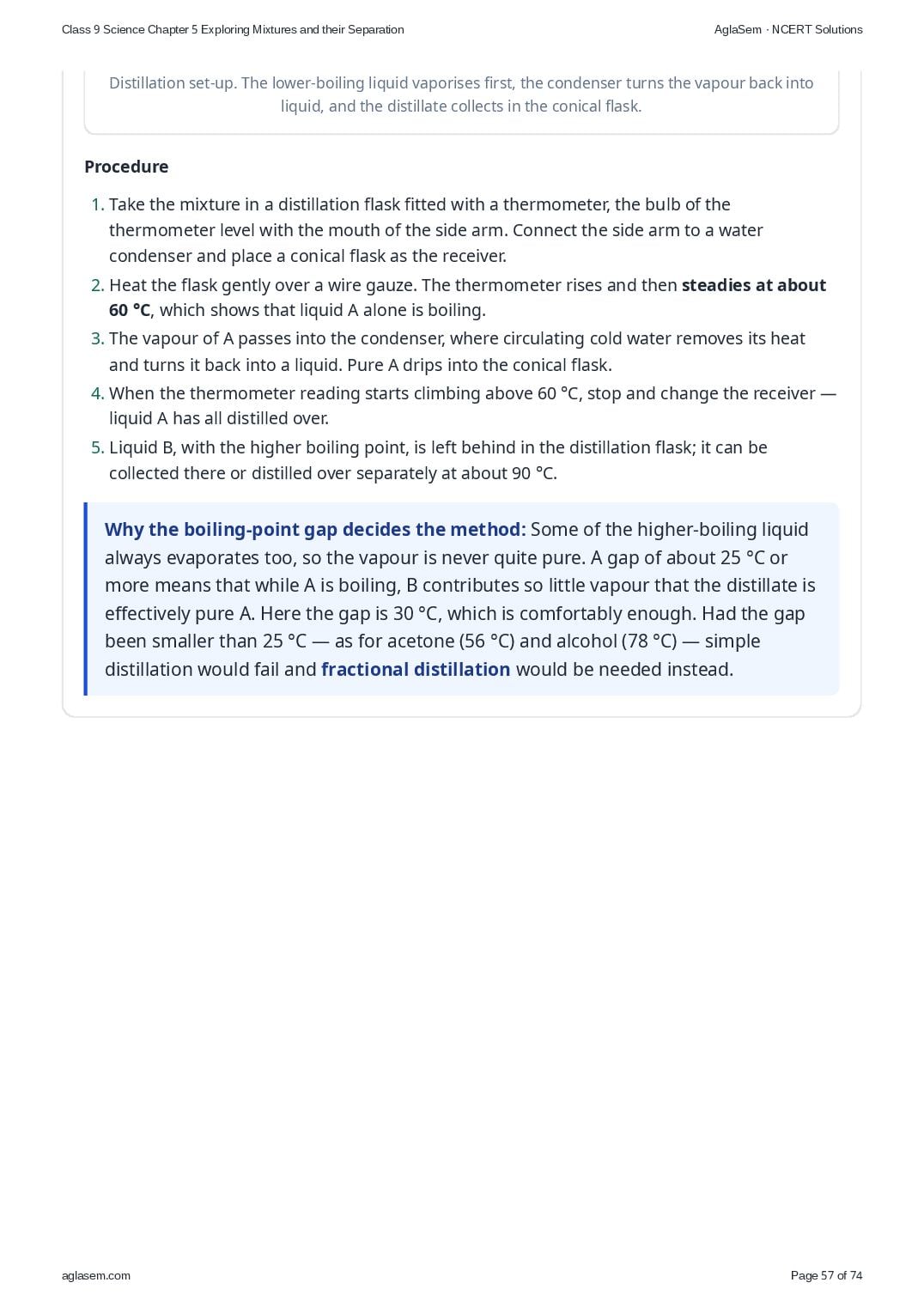
- Two miscible liquids, A and B, are present in a mixture. The boiling point of A is 60 °C and the boiling point of B is 90 °C. Suggest a method to separate them. Also, draw a labelled diagram of the method suggested.
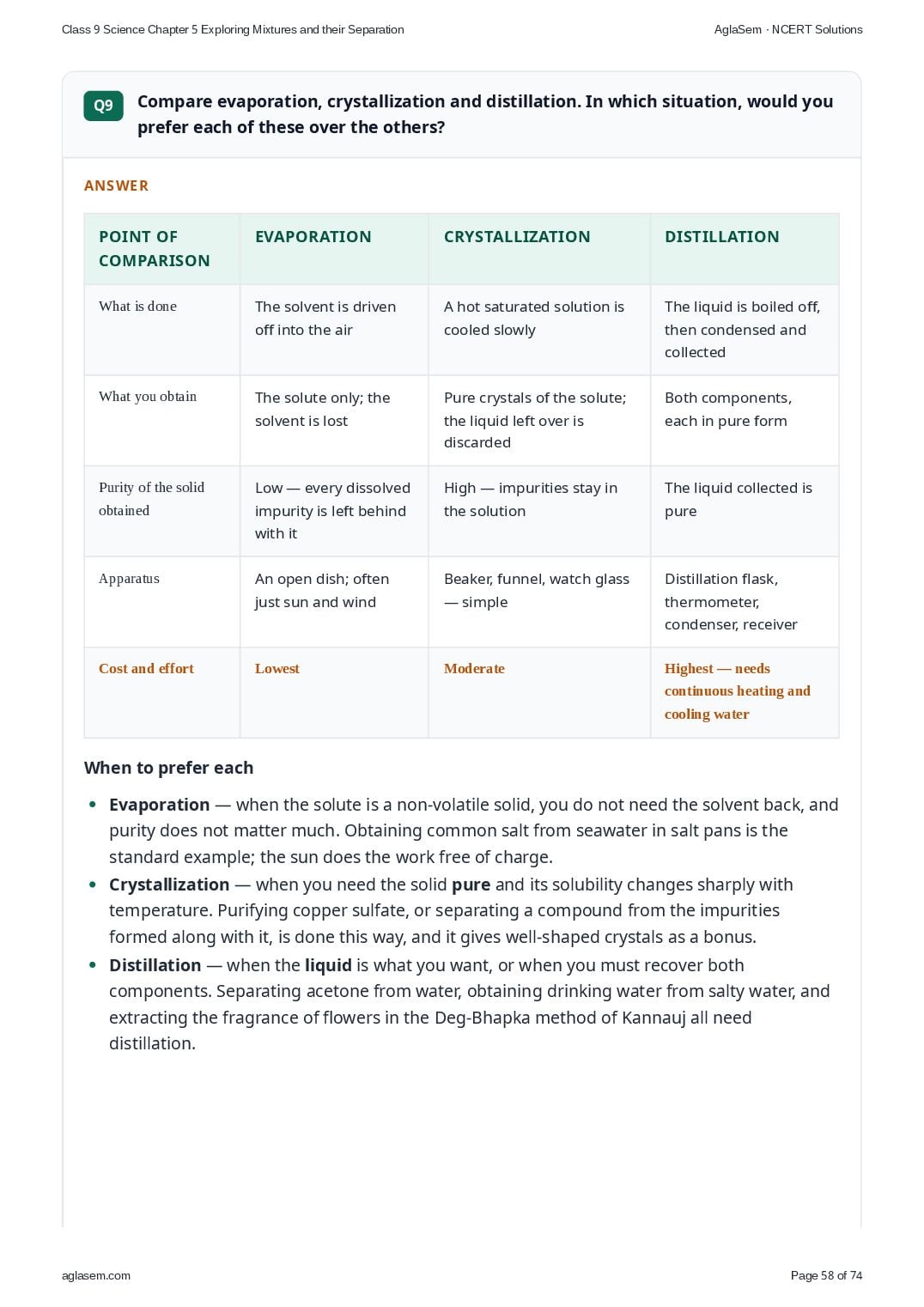
- Compare evaporation, crystallization and distillation. In which situation, would you prefer each of these over the others?
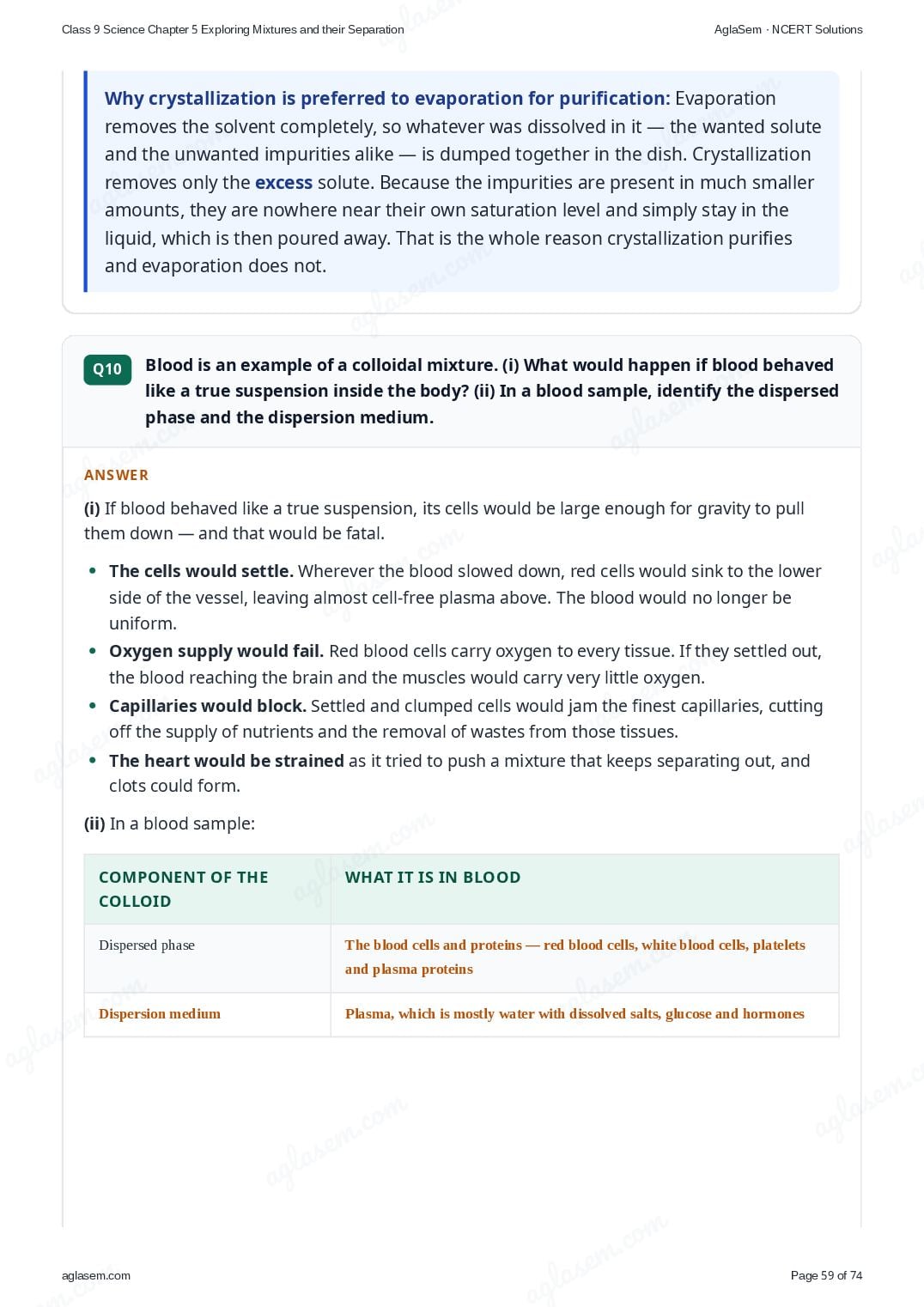
- Blood is an example of a colloidal mixture. (i) What would happen if blood behaved like a true suspension inside the body? (ii) In a blood sample, identify the dispersed phase and the dispersion medium.
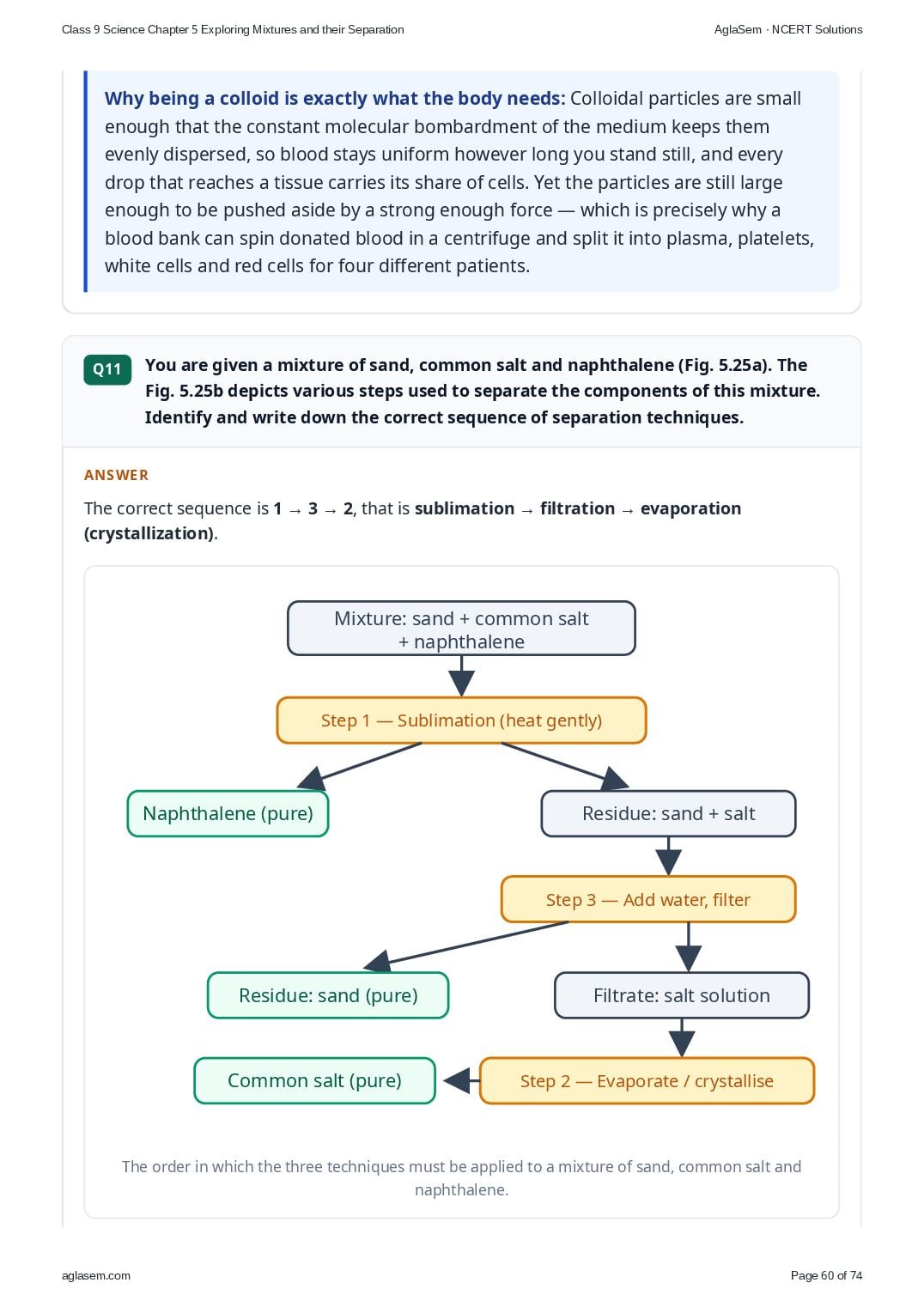
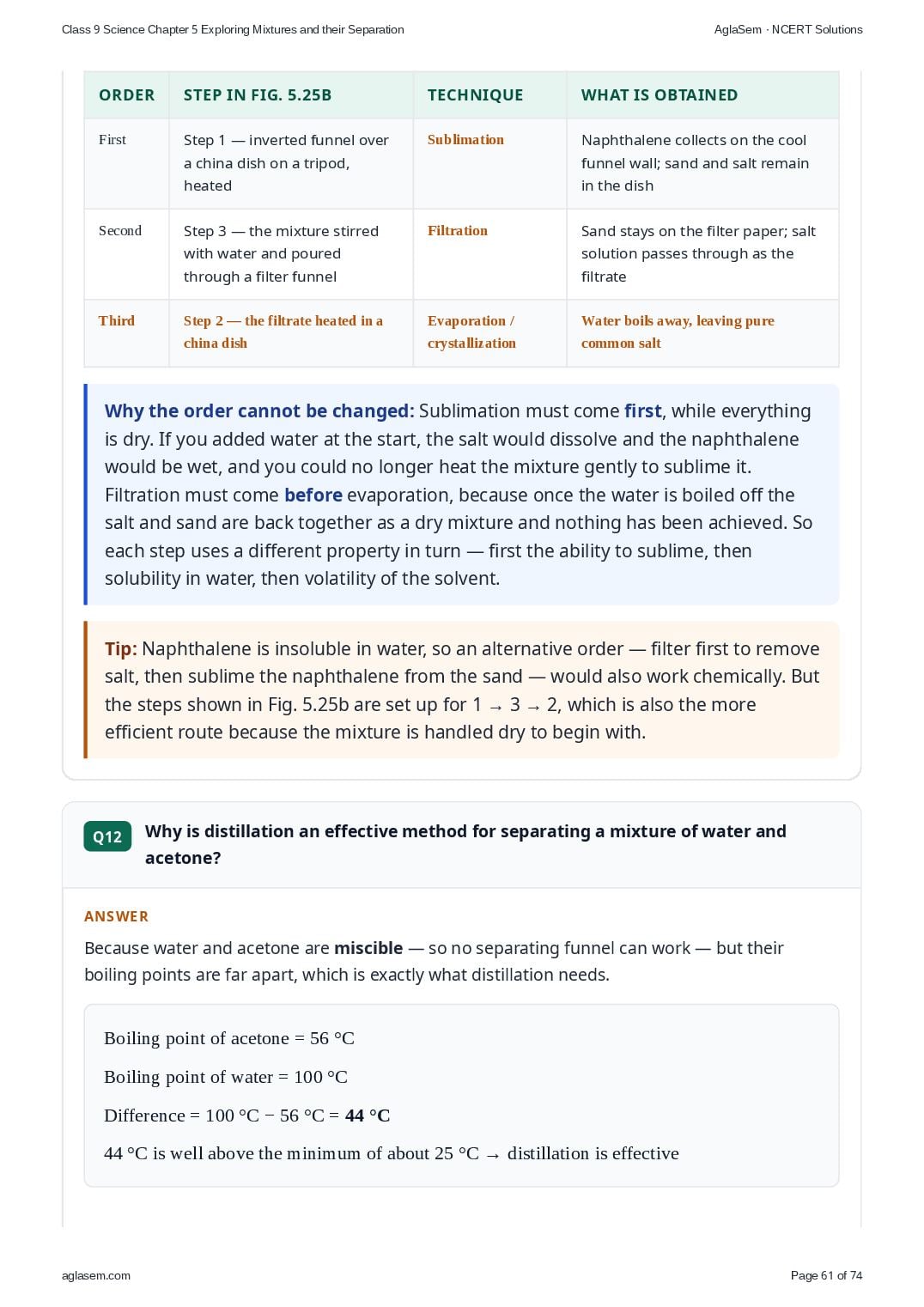
- You are given a mixture of sand, common salt and naphthalene (Fig. 5.25a). The Fig. 5.25b depicts various steps used to separate the components of this mixture. Identify and write down the correct sequence of separation techniques.
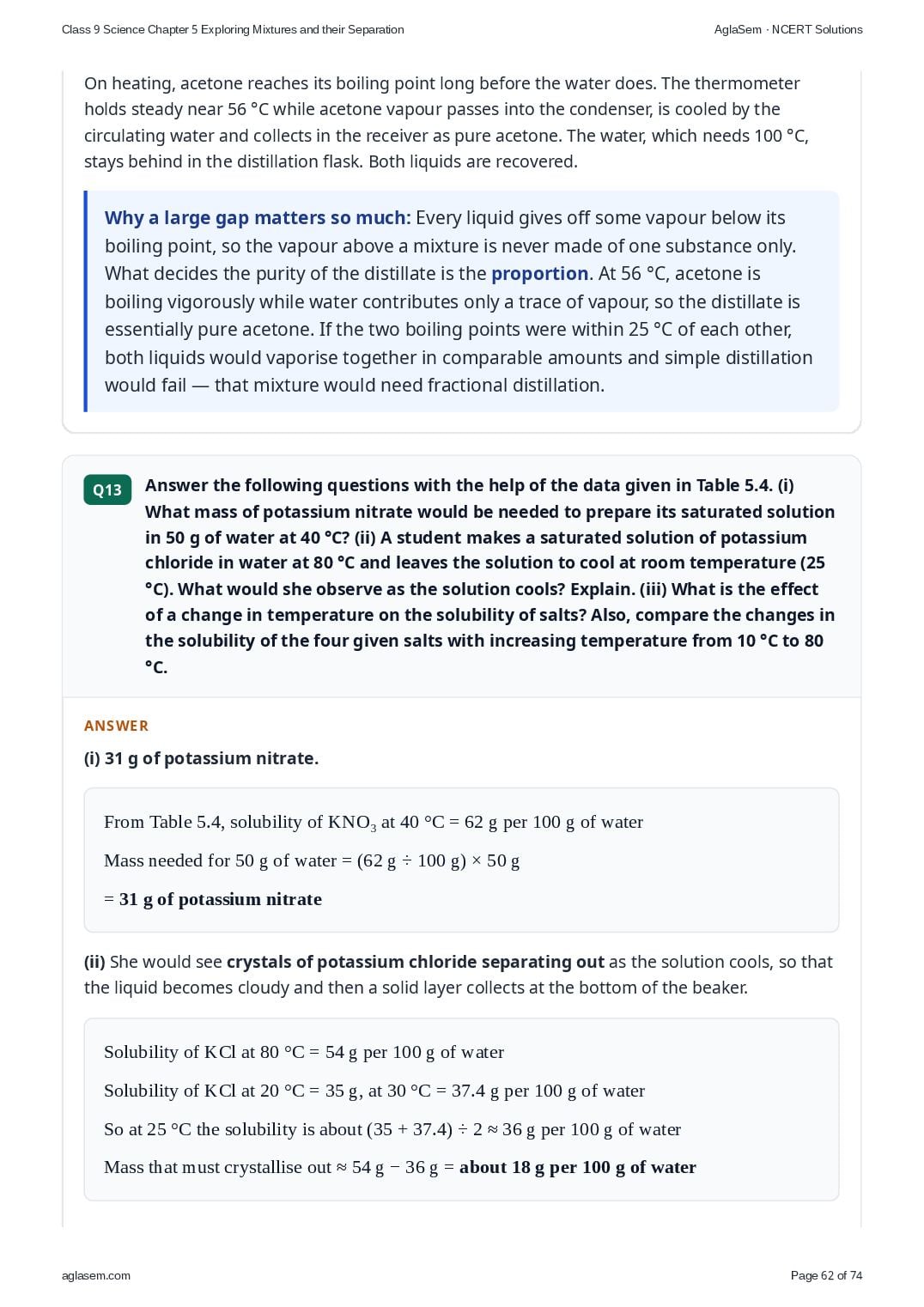
- Why is distillation an effective method for separating a mixture of water and acetone?
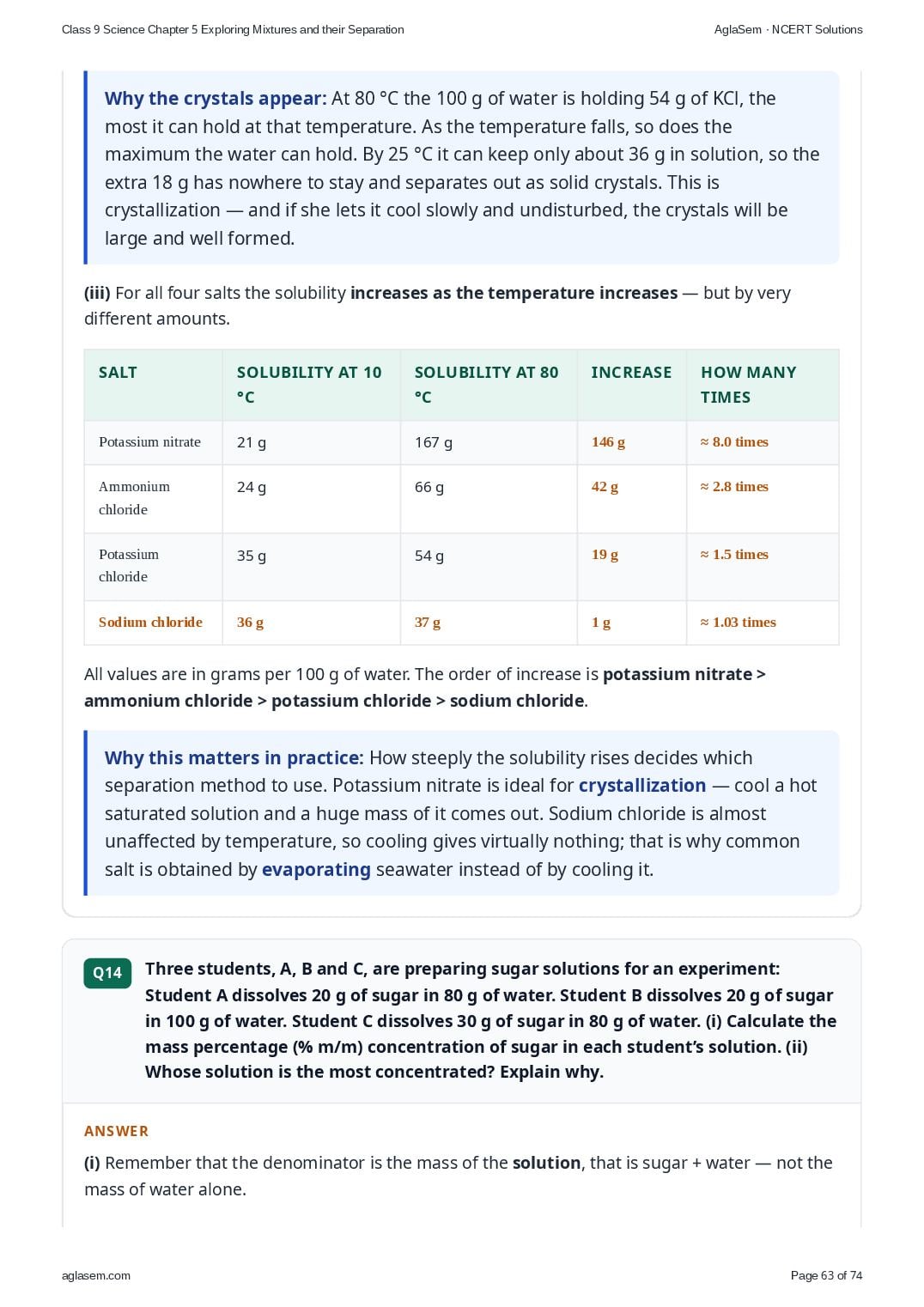
- Answer the following questions with the help of the data given in Table 5.4. (i) What mass of potassium nitrate would be needed to prepare its saturated solution in 50 g of water at 40 °C? (ii) A student makes a saturated solution of potassium chloride in water at 80 °C and leaves the solution to cool at room temperature (25 °C). What would she observe as the solution cools? Explain. (iii) What is the effect of a change in temperature on the solubility of salts? Also, compare the changes in the solubility of the four given salts with increasing temperature from 10 °C to 80 °C.
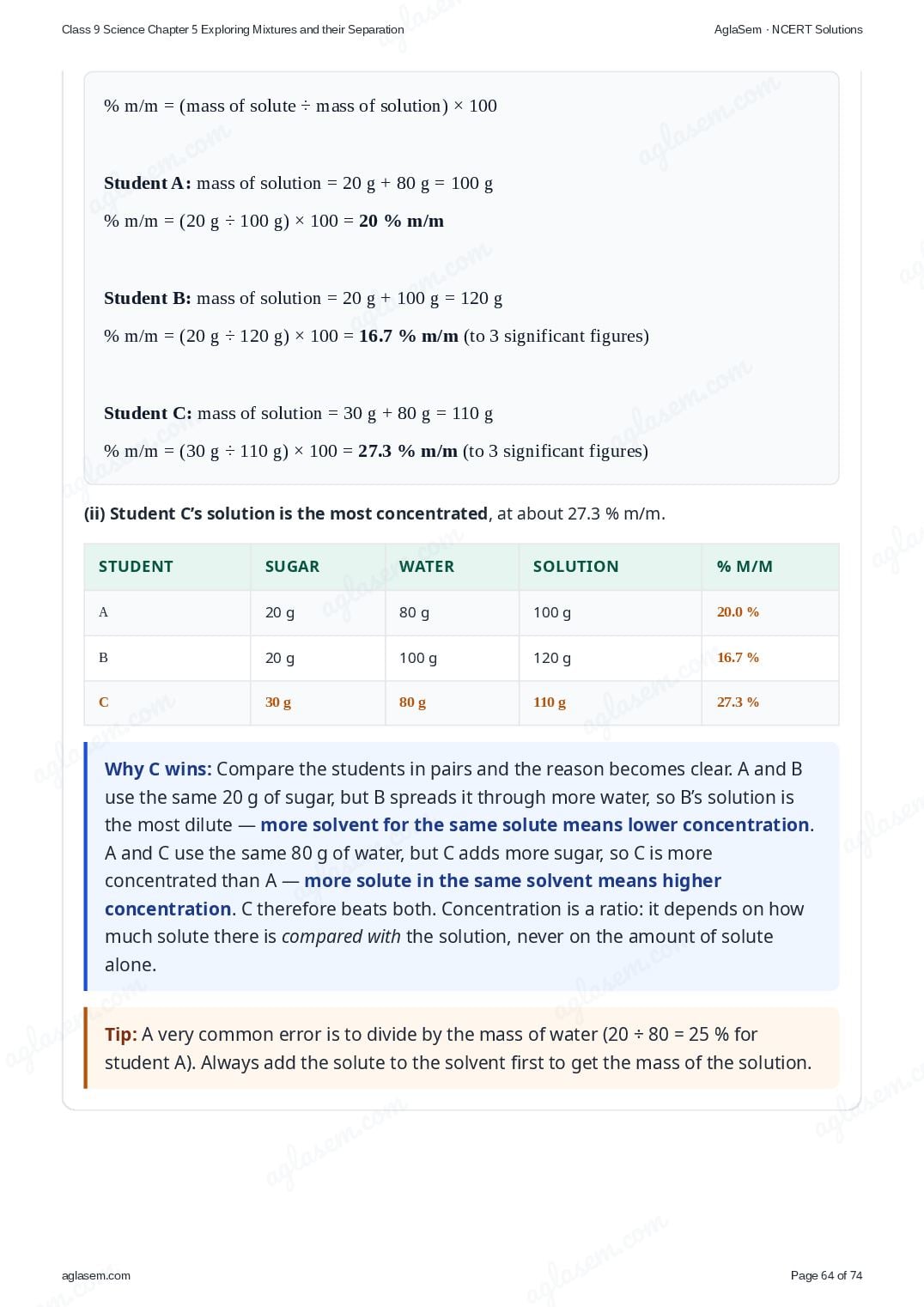
- Three students, A, B and C, are preparing sugar solutions for an experiment: Student A dissolves 20 g of sugar in 80 g of water. Student B dissolves 20 g of sugar in 100 g of water. Student C dissolves 30 g of sugar in 80 g of water. (i) Calculate the mass percentage (% m/m) concentration of sugar in each student’s solution. (ii) Whose solution is the most concentrated? Explain why.
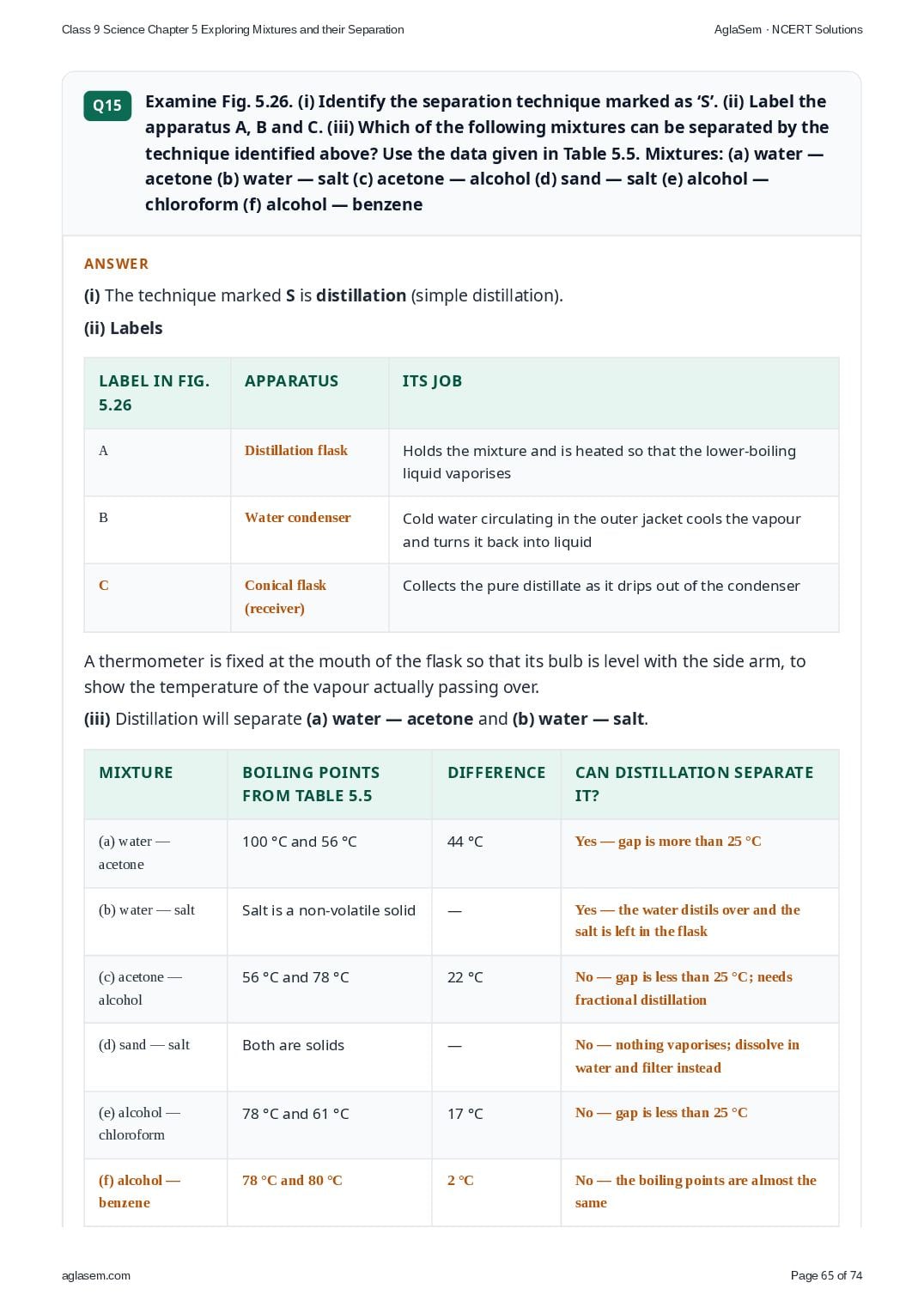
- Examine Fig. 5.26. (i) Identify the separation technique marked as ‘S’. (ii) Label the apparatus A, B and C. (iii) Which of the following mixtures can be separated by the technique identified above? Use the data given in Table 5.5. Mixtures: (a) water — acetone (b) water — salt (c) acetone — alcohol (d) sand — salt (e) alcohol — chloroform (f) alcohol — benzene
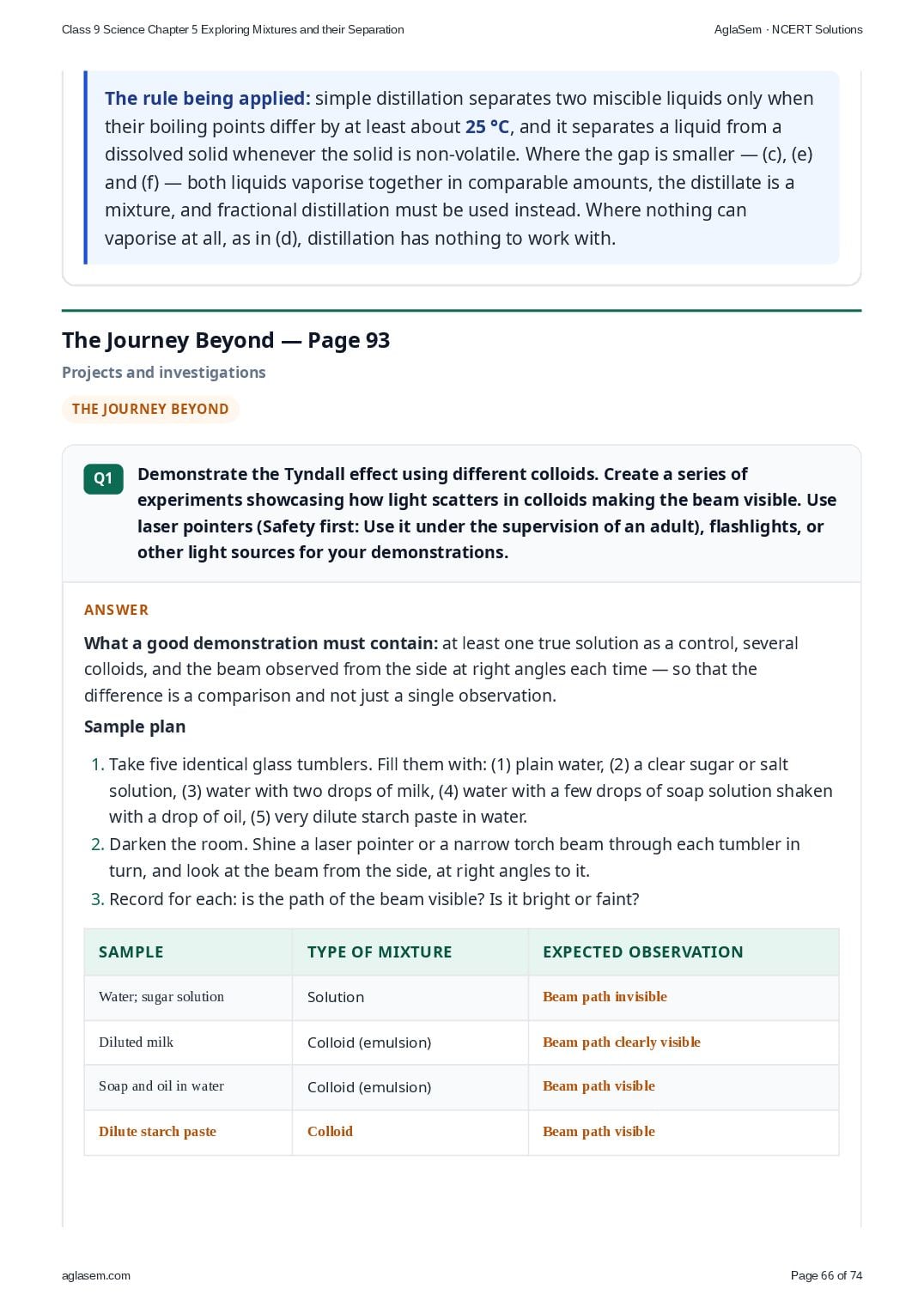
- Demonstrate the Tyndall effect using different colloids. Create a series of experiments showcasing how light scatters in colloids making the beam visible. Use laser pointers (Safety first: Use it under the supervision of an adult), flashlights, or other light sources for your demonstrations.
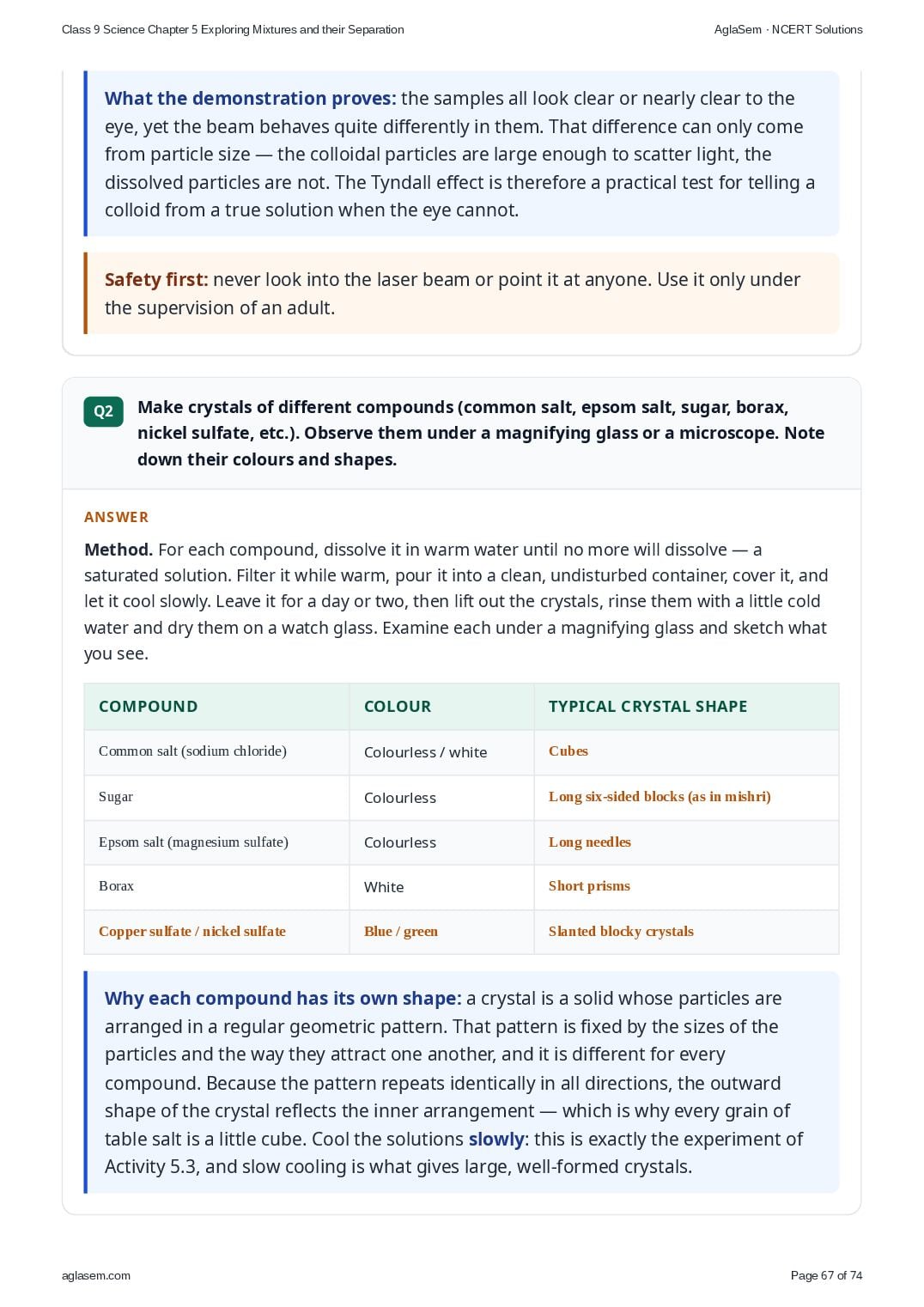
- Make crystals of different compounds (common salt, epsom salt, sugar, borax, nickel sulfate, etc.). Observe them under a magnifying glass or a microscope. Note down their colours and shapes.
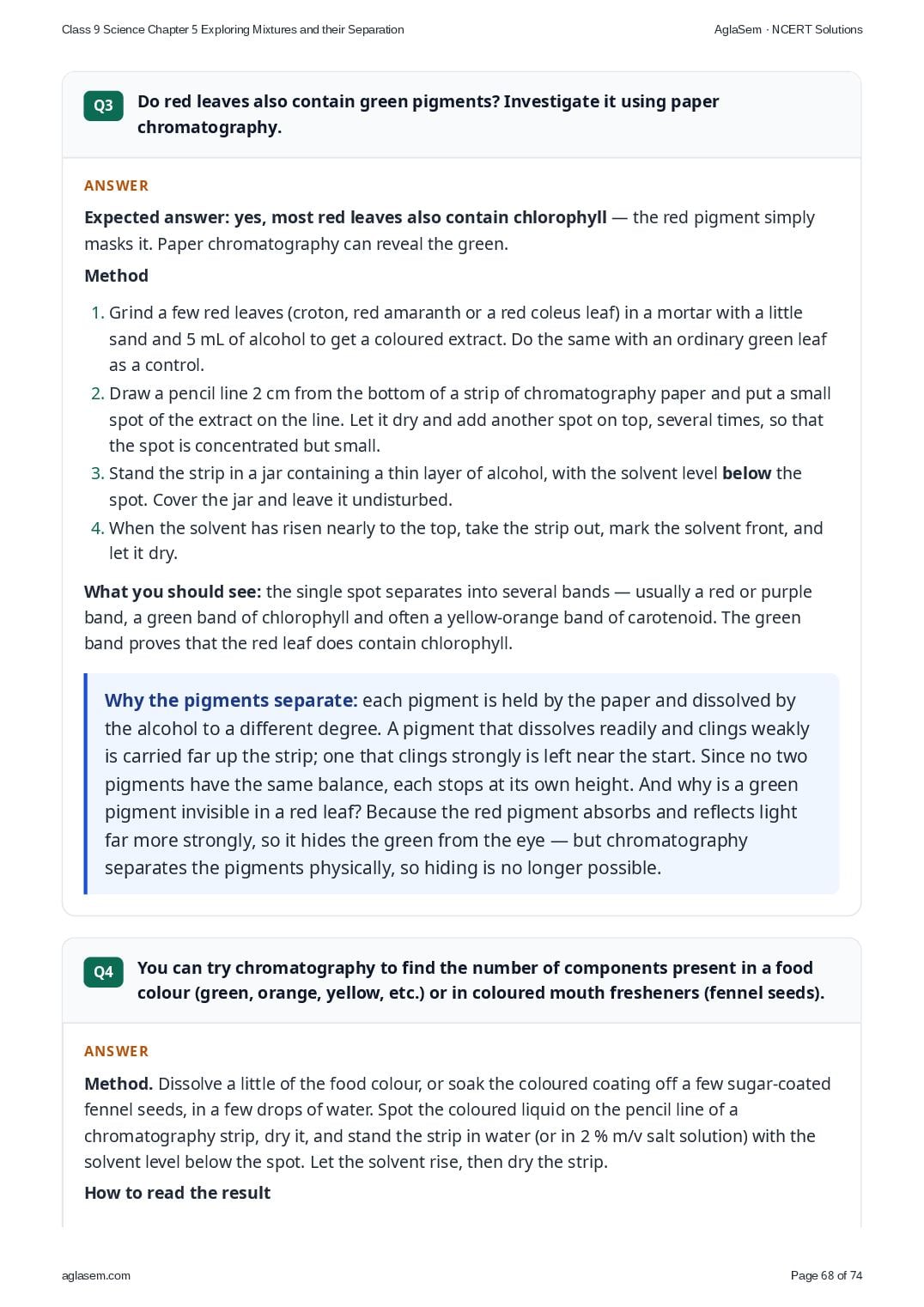
- Do red leaves also contain green pigments? Investigate it using paper chromatography.
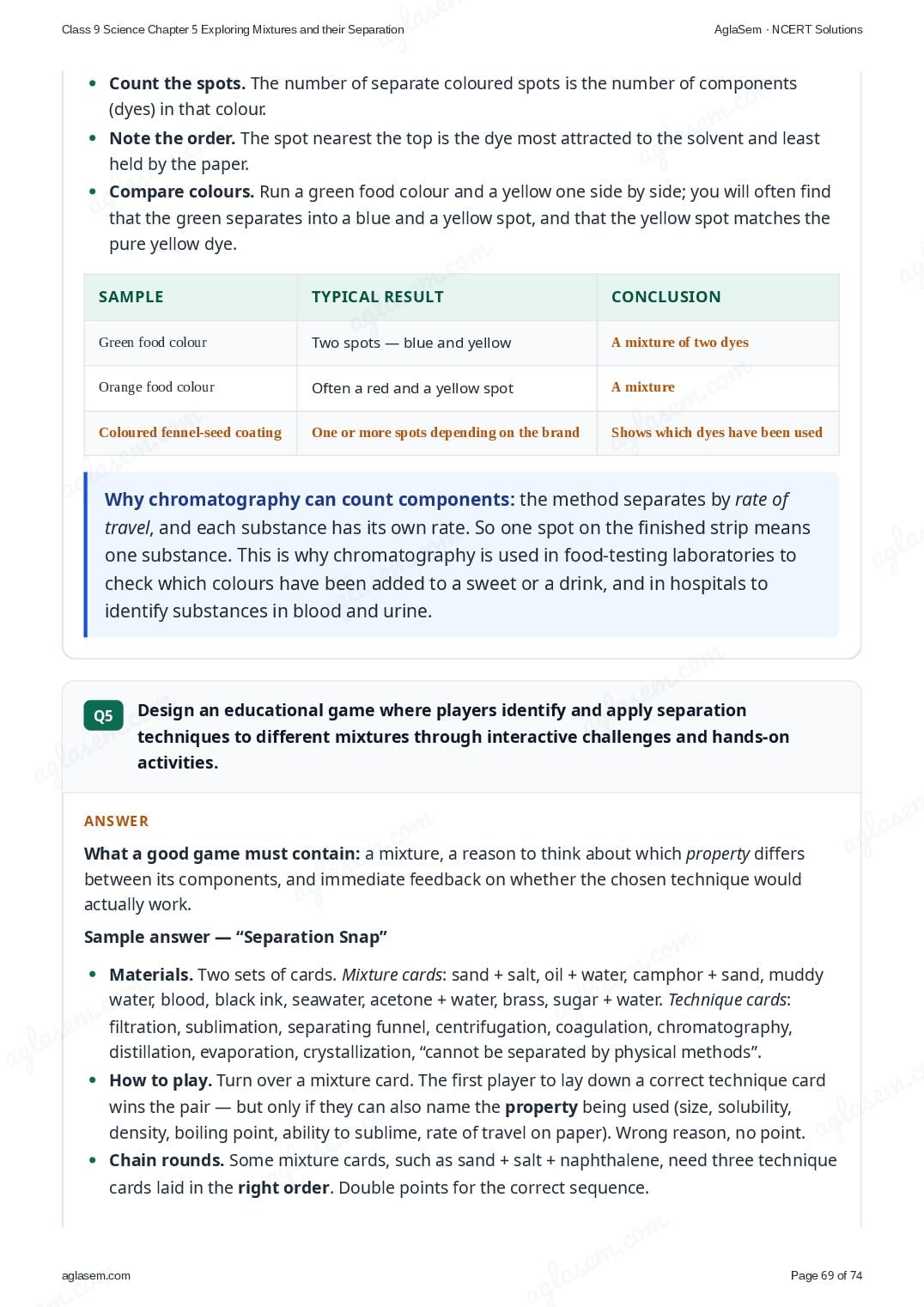
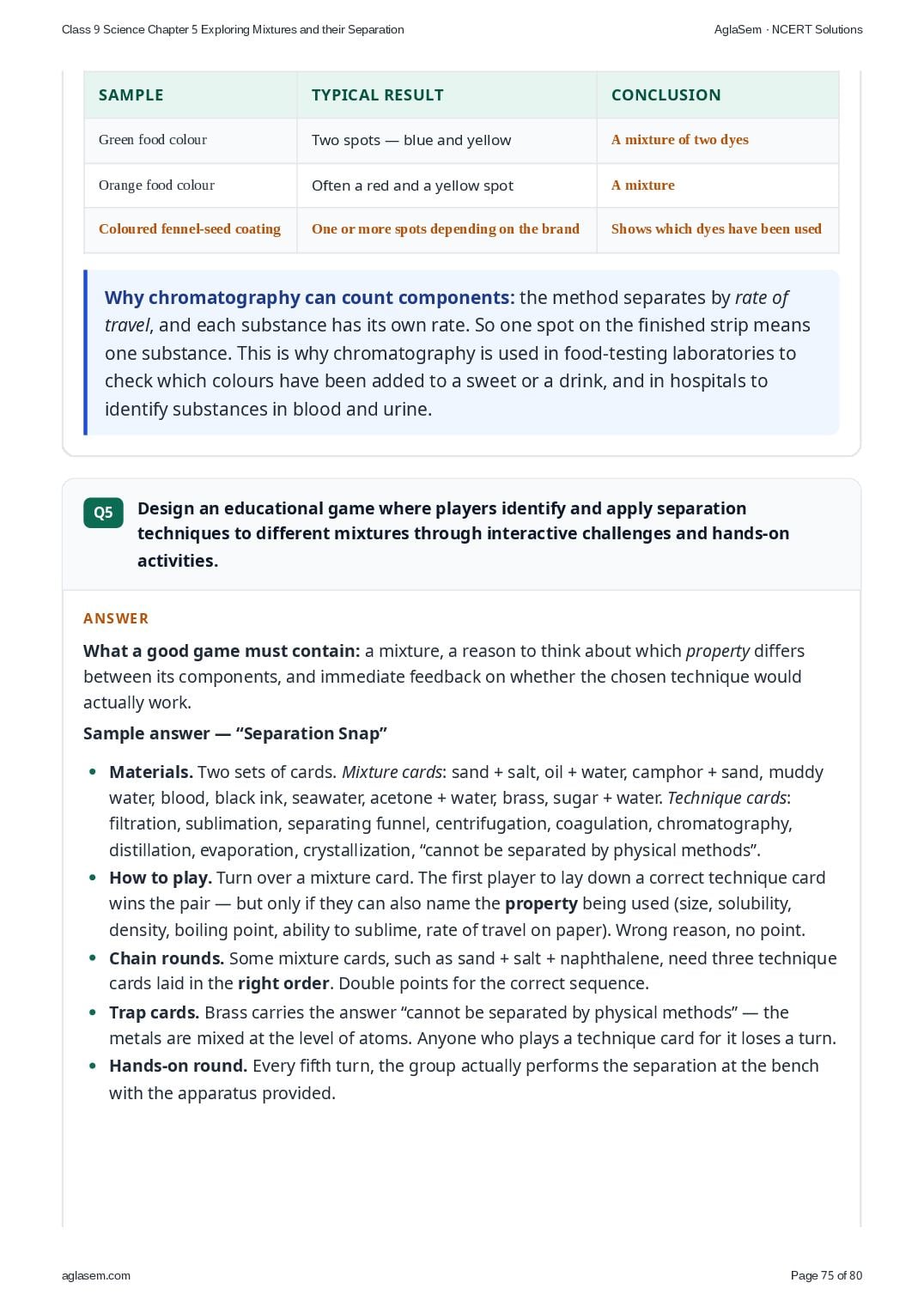
- You can try chromatography to find the number of components present in a food colour (green, orange, yellow, etc.) or in coloured mouth fresheners (fennel seeds).
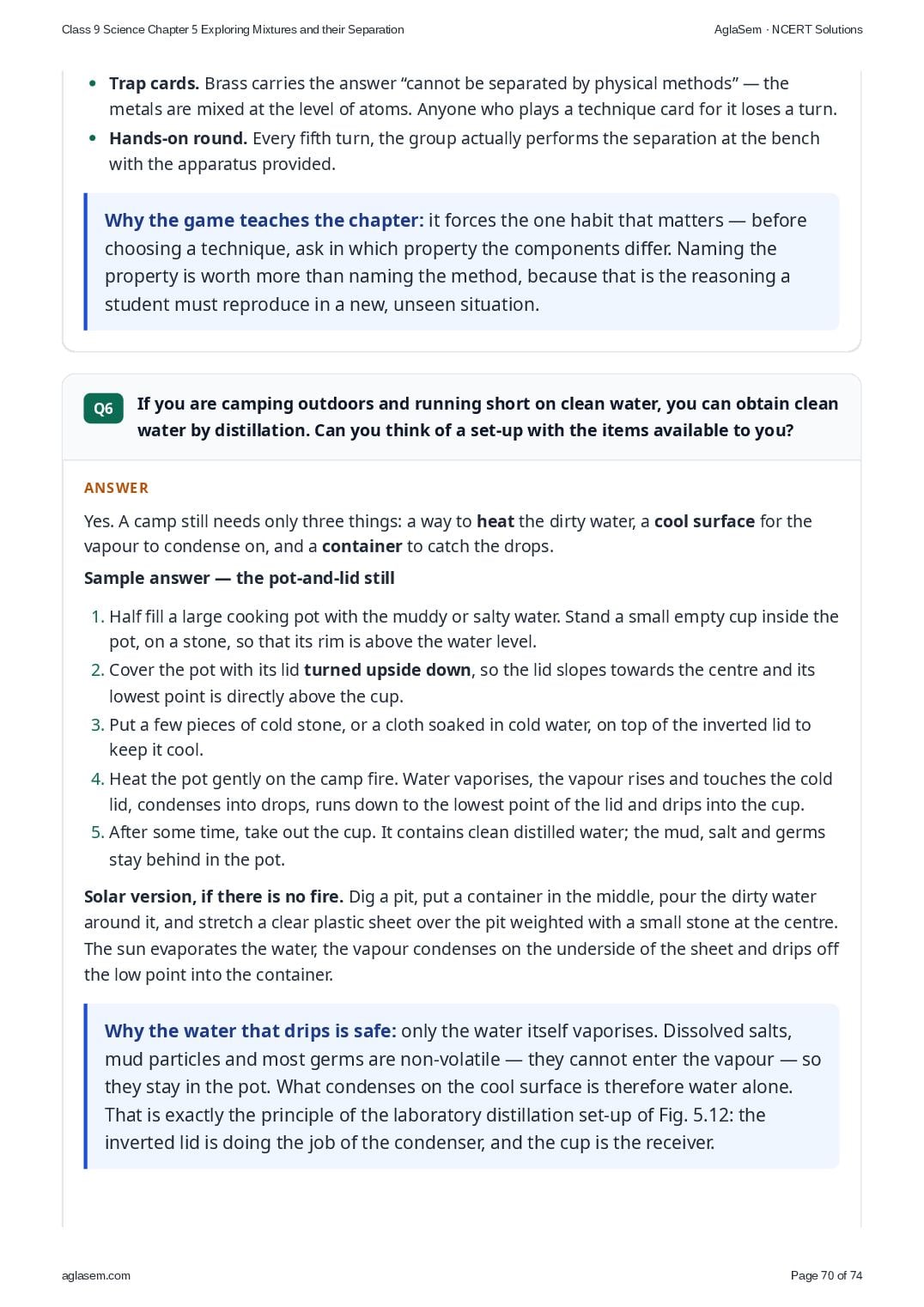
- Design an educational game where players identify and apply separation techniques to different mixtures through interactive challenges and hands-on activities.
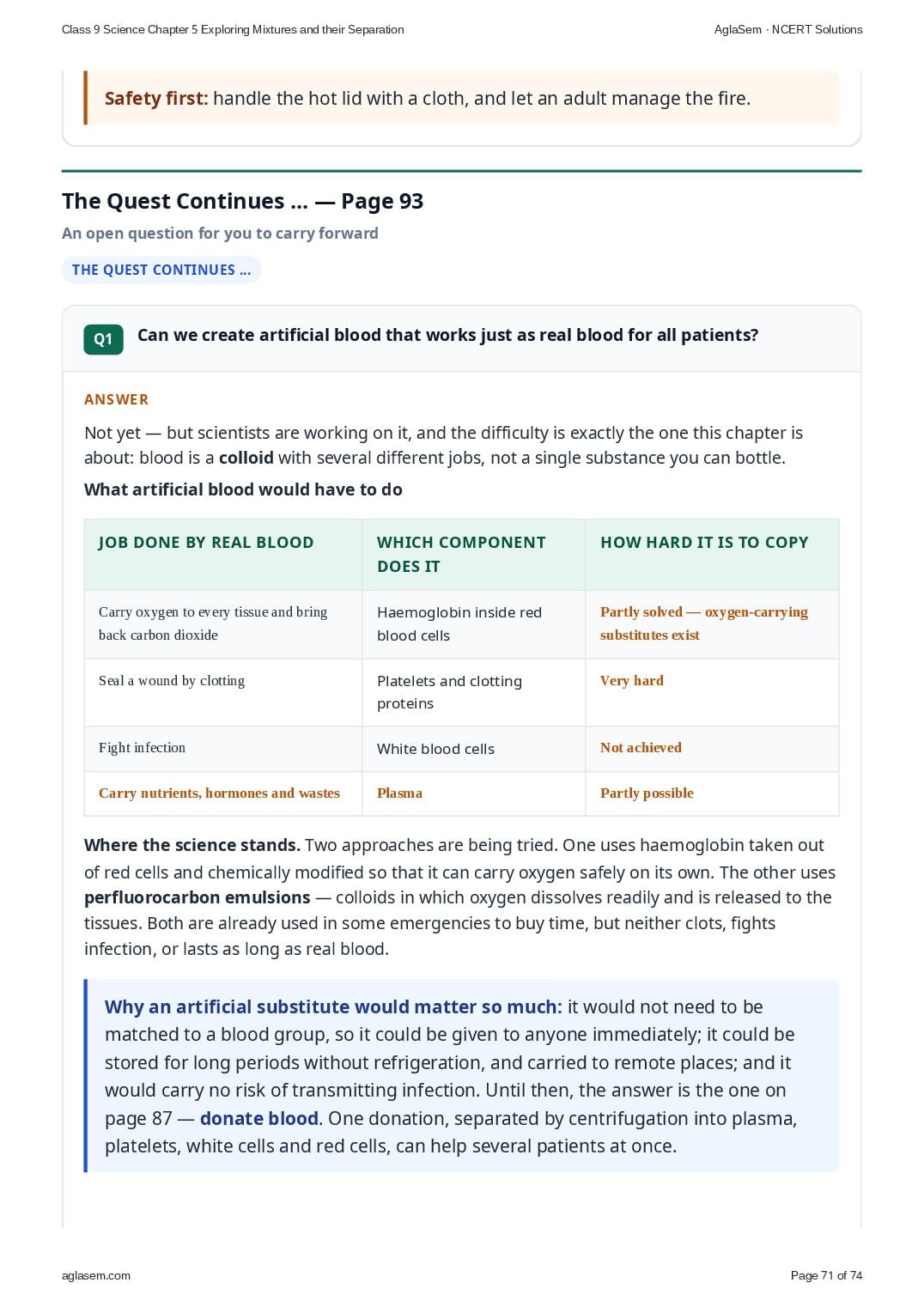
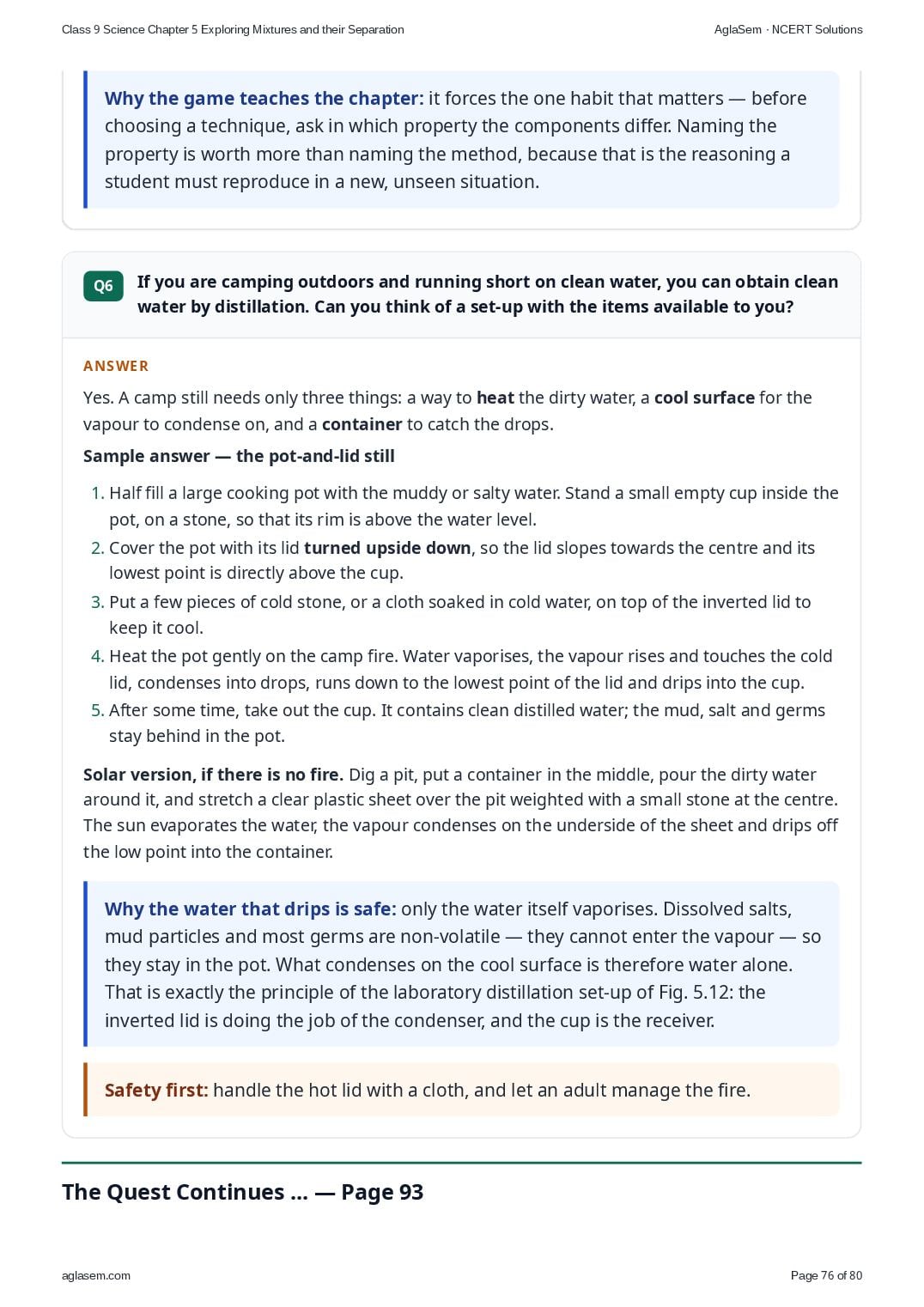
- If you are camping outdoors and running short on clean water, you can obtain clean water by distillation. Can you think of a set-up with the items available to you?
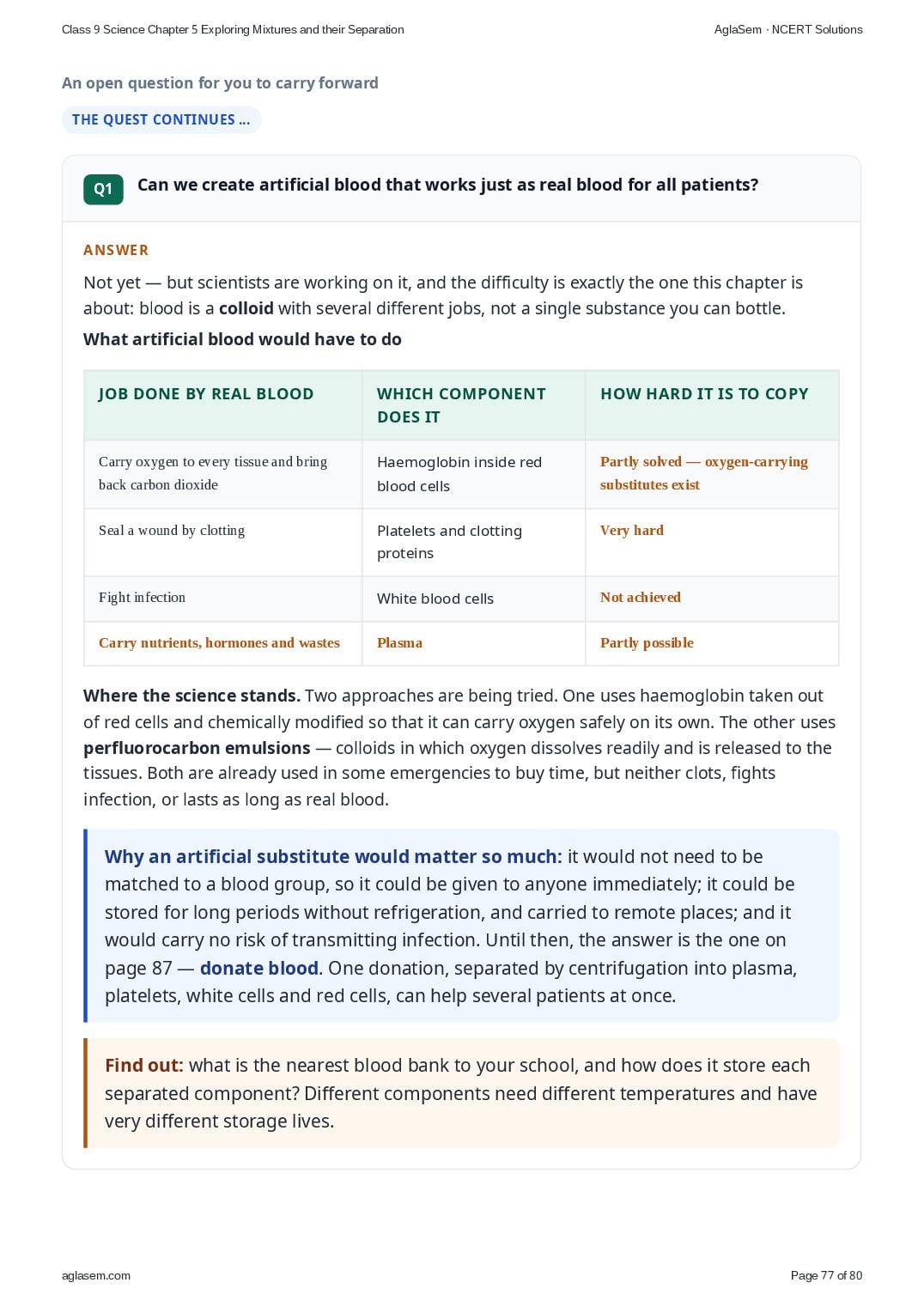
- Can we create artificial blood that works just as real blood for all patients?
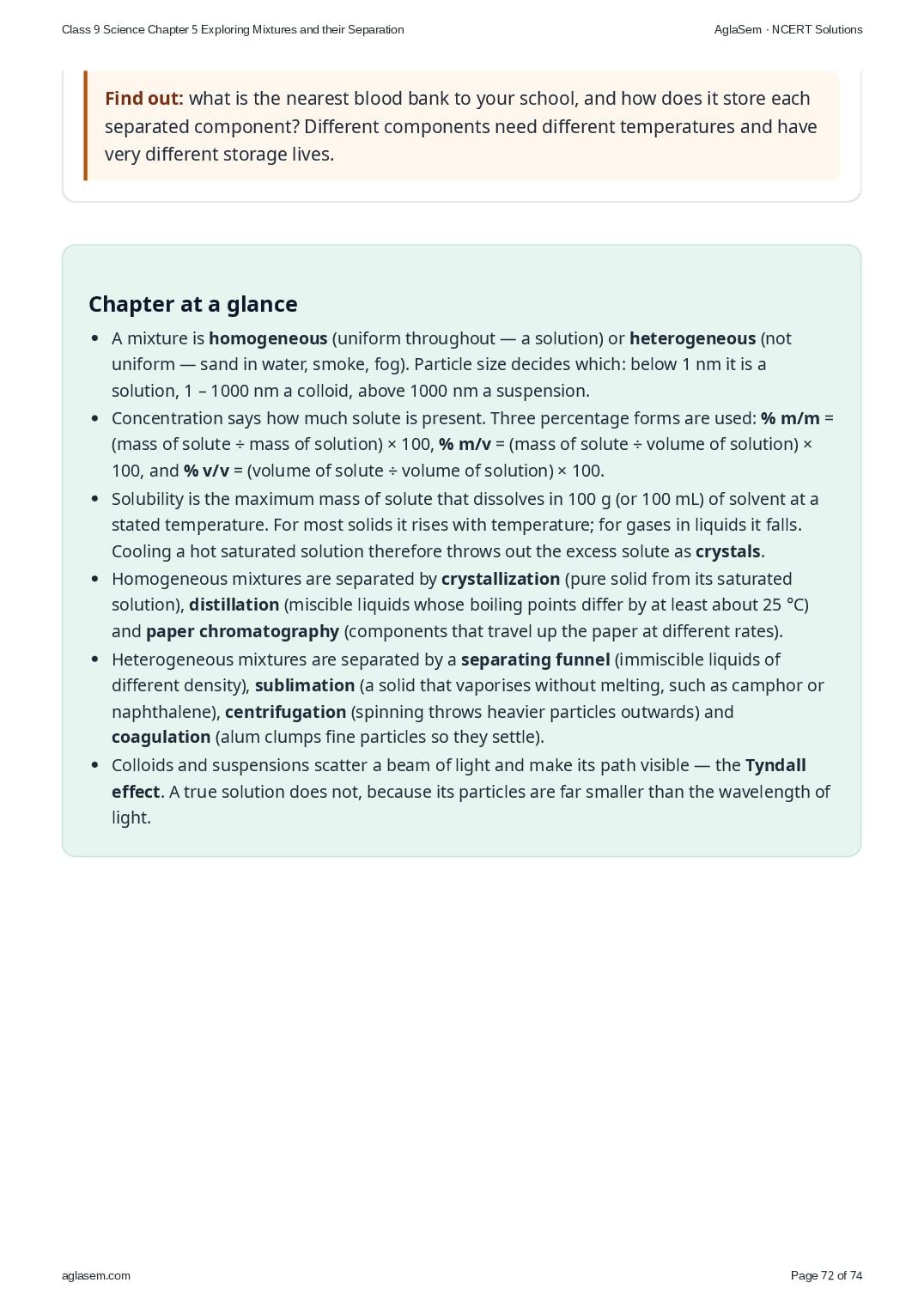
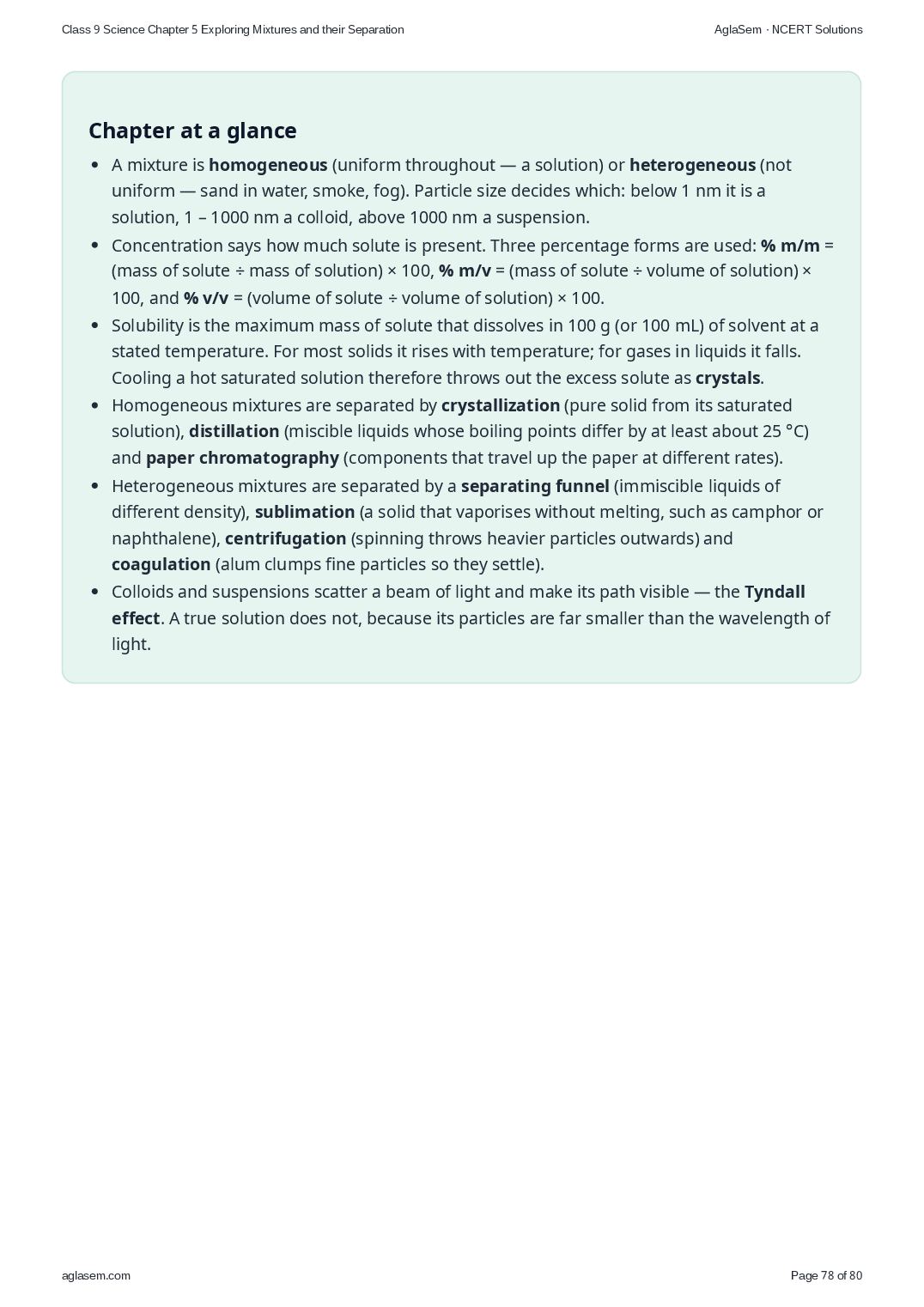
Chapter at a Glance
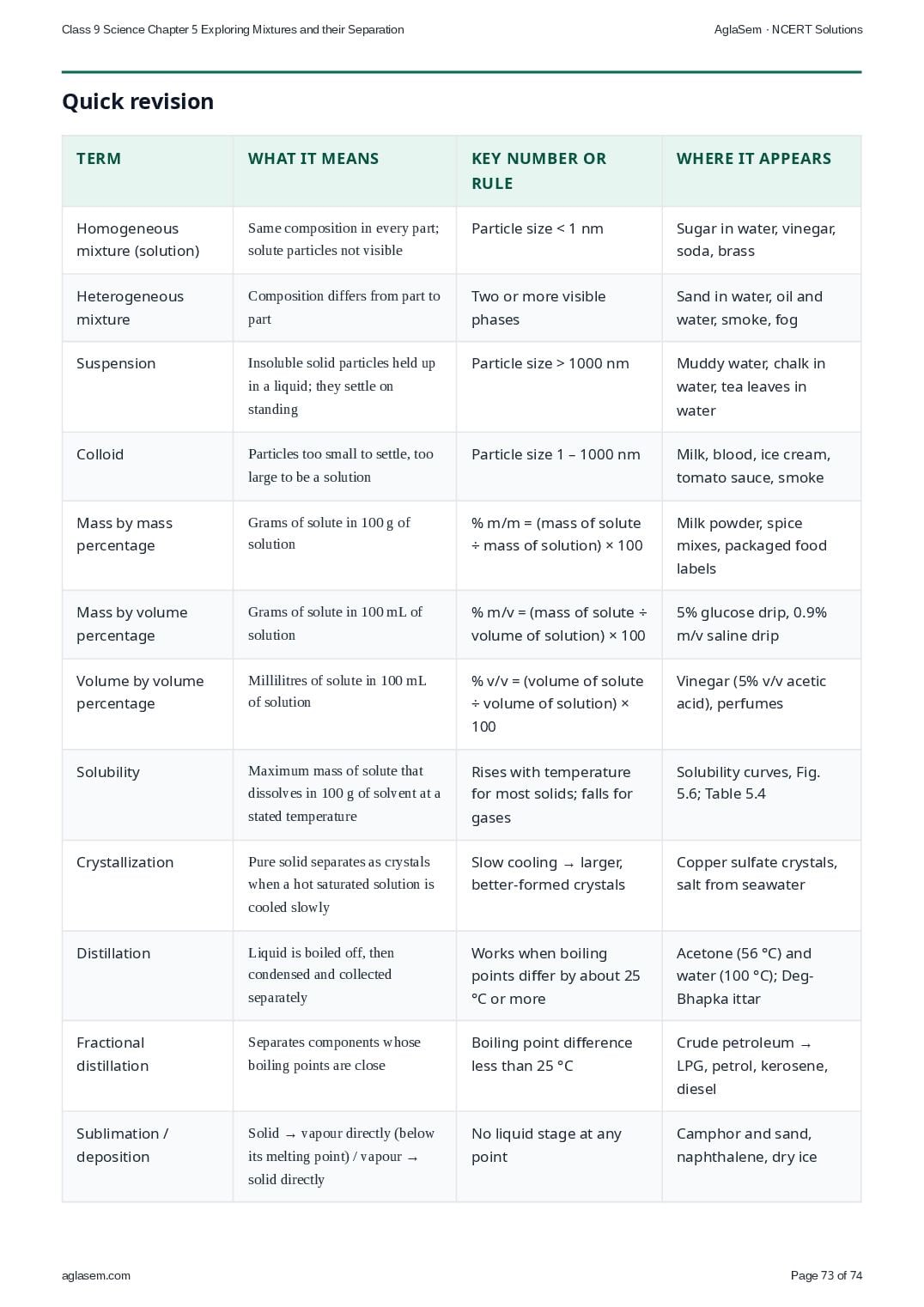
- A mixture is homogeneous (uniform throughout — a solution) or heterogeneous (not uniform — sand in water, smoke, fog). Particle size decides which: below 1 nm it is a solution, 1 – 1000 nm a colloid, above 1000 nm a suspension.
- Concentration says how much solute is present. Three percentage forms are used: % m/m = (mass of solute ÷ mass of solution) × 100, % m/v = (mass of solute ÷ volume of solution) × 100, and % v/v = (volume of solute ÷ volume of solution) × 100.
- Solubility is the maximum mass of solute that dissolves in 100 g (or 100 mL) of solvent at a stated temperature. For most solids it rises with temperature; for gases in liquids it falls. Cooling a hot saturated solution therefore throws out the excess solute as crystals .
- Homogeneous mixtures are separated by crystallization (pure solid from its saturated solution), distillation (miscible liquids whose boiling points differ by at least about 25 °C) and paper chromatography (components that travel up the paper at different rates).
- Heterogeneous mixtures are separated by a separating funnel (immiscible liquids of different density), sublimation (a solid that vaporises without melting, such as camphor or naphthalene), centrifugation (spinning throws heavier particles outwards) and coagulation (alum clumps fine particles so they settle).
- Colloids and suspensions scatter a beam of light and make its path visible — the Tyndall effect . A true solution does not, because its particles are far smaller than the wavelength of light.
How to Download NCERT Solutions for Class 9 Science Chapter 5 PDF
Follow these simple steps to get the Exploring Mixtures and Their Separation questions-and-answers PDF from Exploration.
- Search NCERT Solutions for Class 9 Science Chapter 5 aglasem and open this page.
- Read the exercise questions with answers for Exploring Mixtures and Their Separation shown above.
- Click the Download PDF link to save the Exploring Mixtures and Their Separation solutions to your device.
NCERT Solutions for Class 9 Science – All Chapters
There are more chapters to study besides Exploring Mixtures and Their Separation in Science. Here are the NCERT Solutions for all chapters of Class 9 Science.
- Chapter 1 Exploration Entering the World of Secondary Science
- Chapter 2 Cell the Building Block of Life
- Chapter 3 Tissues in Action
- Chapter 4 Describing Motion Around Us
- Chapter 5 Exploring Mixtures and Their Separation
- Chapter 6 How Forces Affect Motion
- Chapter 7 Work Energy and Simple Machines
- Chapter 8 Journey Inside the Atom
- Chapter 9 Atomic Foundations of Matter
- Chapter 10 Sound Waves Characteristics and Applications
- Chapter 11 Reproduction How Life Continues
- Chapter 12 Patterns in Life Diversity and Classification
- Chapter 13 Earth As a System Energy Matter and Life
NCERT Solutions for Class 9 – All Subjects
Just like Chapter 5 of Science, you can get the exercise questions with answers for every other subject of Class 9. Here are the NCERT Solutions for all subjects of Class 9.
NCERT Solutions for Class 9 Science Chapter 5 – An Overview
The key highlights of this study material are as follows.
| Aspects | Details |
|---|---|
| Class | Class 9 |
| Subject | Science |
| Chapter Number | Chapter 5 |
| Chapter Name | Exploring Mixtures and Their Separation |
| Book Name | Exploration |
| Book By | NCERT (National Council of Educational Research and Training) |
| Educational Resource Here | NCERT Solutions of Class 9 Science Chapter 5 for all exercises |
| More Questions Answers of This Subject | NCERT Solutions for Class 9 Science |
| Download Book Chapter | NCERT Book Class 9 Science |
| All Questions Answers For This Class | NCERT Solutions for Class 9 |
| Complete Solutions | NCERT Solutions |
NCERT Solutions for Class 9 Science Chapter 5 Exploring Mixtures and Their Separation – FAQs
What are the NCERT Solutions for Class 9 Science Chapter 5 Exploring Mixtures and Their Separation?
They are the complete, step-by-step answers to all the exercise and in-text questions of Chapter 5 Exploring Mixtures and Their Separation from the NCERT Class 9 Science textbook Exploration, written by experts as per the latest NCERT syllabus.
How can I download the Class 9 Science Chapter 5 solutions PDF for free?
Open this page on aglasem, read the Exploring Mixtures and Their Separation questions with answers, and click the “Download Solutions PDF” link. The Class 9 Science Chapter 5 NCERT Solutions PDF is completely free to download.
Are these NCERT Solutions as per the latest 2026-27 syllabus?
Yes. The NCERT Solutions for Class 9 Science Chapter 5 are based on the latest NCERT textbook Exploration and the current 2026-27 CBSE syllabus, so the questions and answers match what you study in class.
Where can I get NCERT Solutions for the other chapters of Class 9 Science?
You can find the answers to every chapter on the NCERT Solutions for Class 9 Science page, and solutions for every subject on the NCERT Solutions for Class 9 page.
How do NCERT Solutions help in exam preparation?
They show the correct method to solve each question, help you write answers the way they are expected in exams, let you check and correct your own work, and save revision time — which together improve your marks in Class 9 Science.
If you have any queries on NCERT Solutions for Class 9 Science Chapter 5 Exploring Mixtures and Their Separation, then please ask in the comments below.