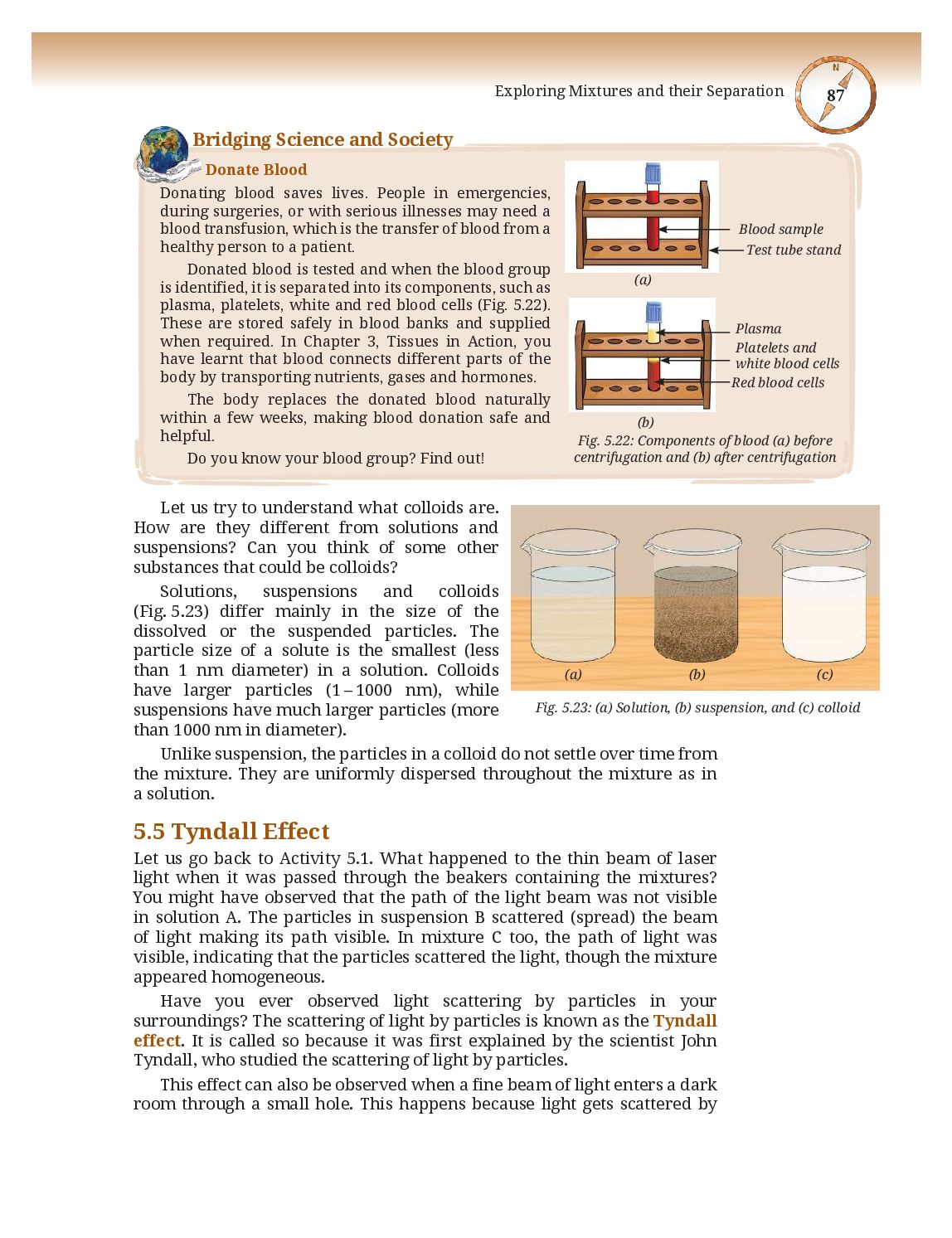
Download Exploring Mixtures and their Separation – NCERT Class 9 Science Chapter 5 PDF from the new NCERT Class 9 Science book Exploration (2026-27). Read the chapter online or download the free PDF. A mixture is homogeneous (uniform throughout — a solution) or heterogeneous (not uniform — sand in water, smoke, fog). Particle size decides which: below 1 nm it is a solution, 1 – 1000 nm a colloid, above 1000 nm a suspension.
Exploring Mixtures and their Separation PDF – Chapter 5 of Exploration
Read the chapter online or download the PDF.
| Chapter | Download | |
|---|---|---|
| Chapter 5 PDF | Exploring Mixtures and their Separation | View PDF |
| Full book | NCERT Class 9 Science – Exploration | View Book |
Read Online
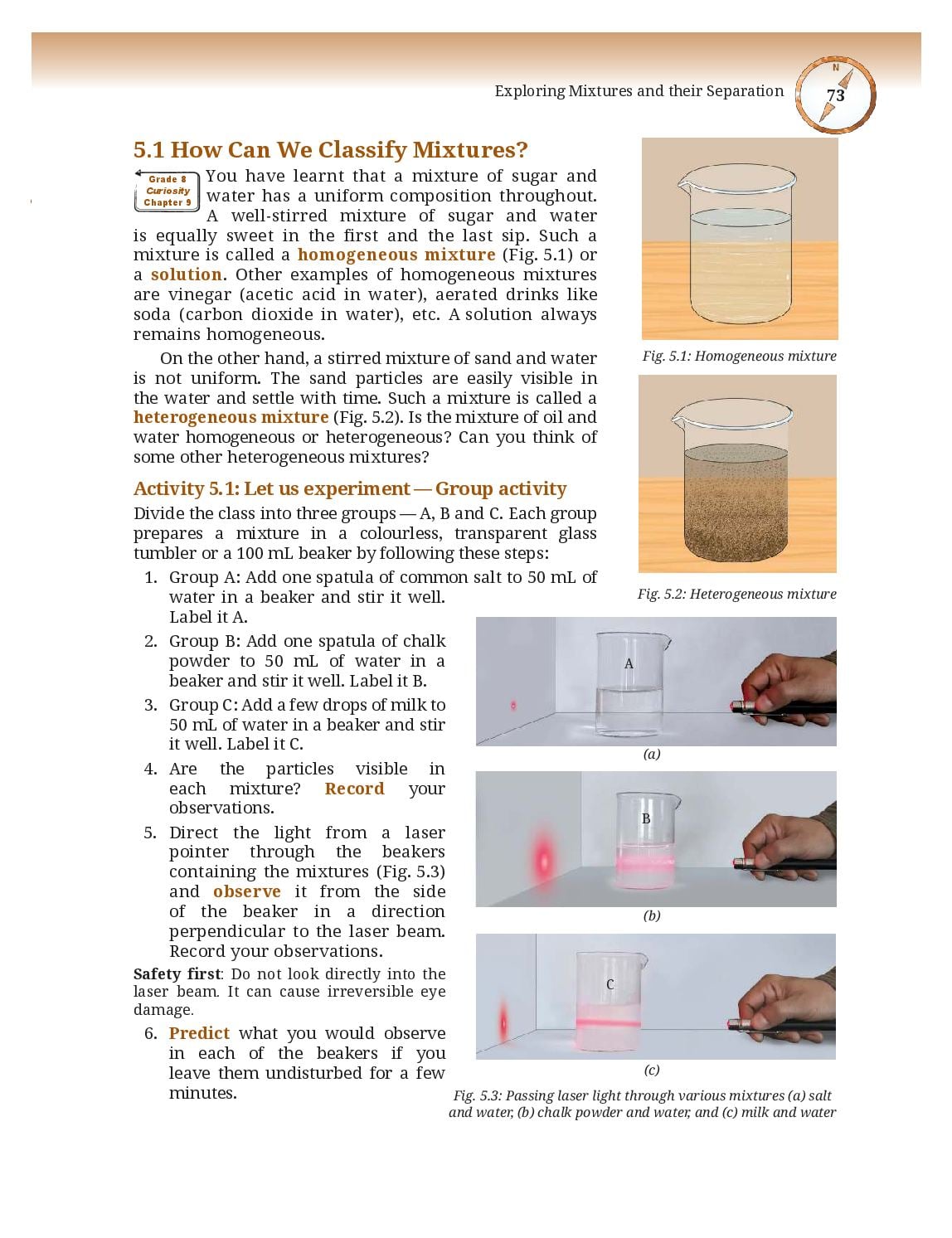
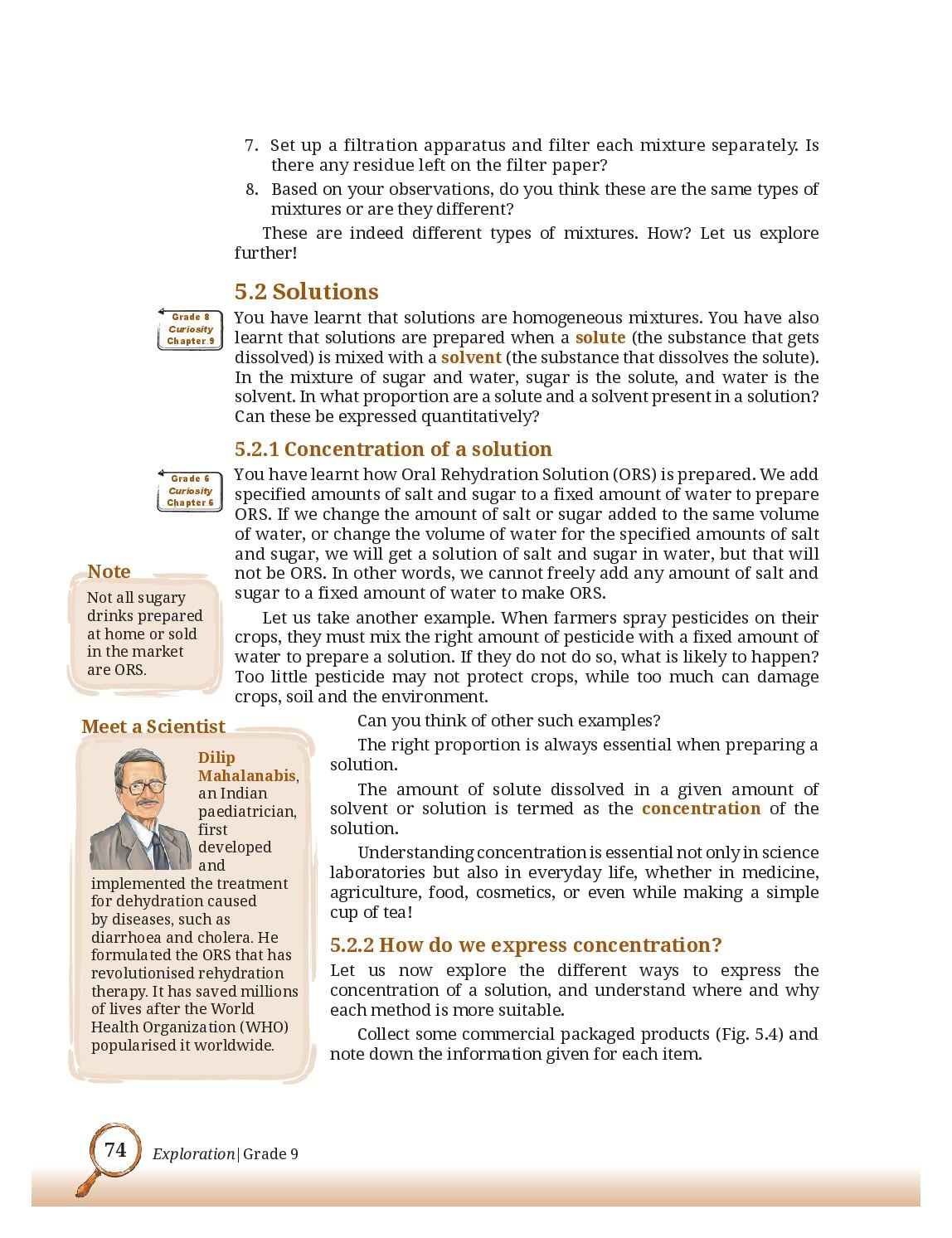
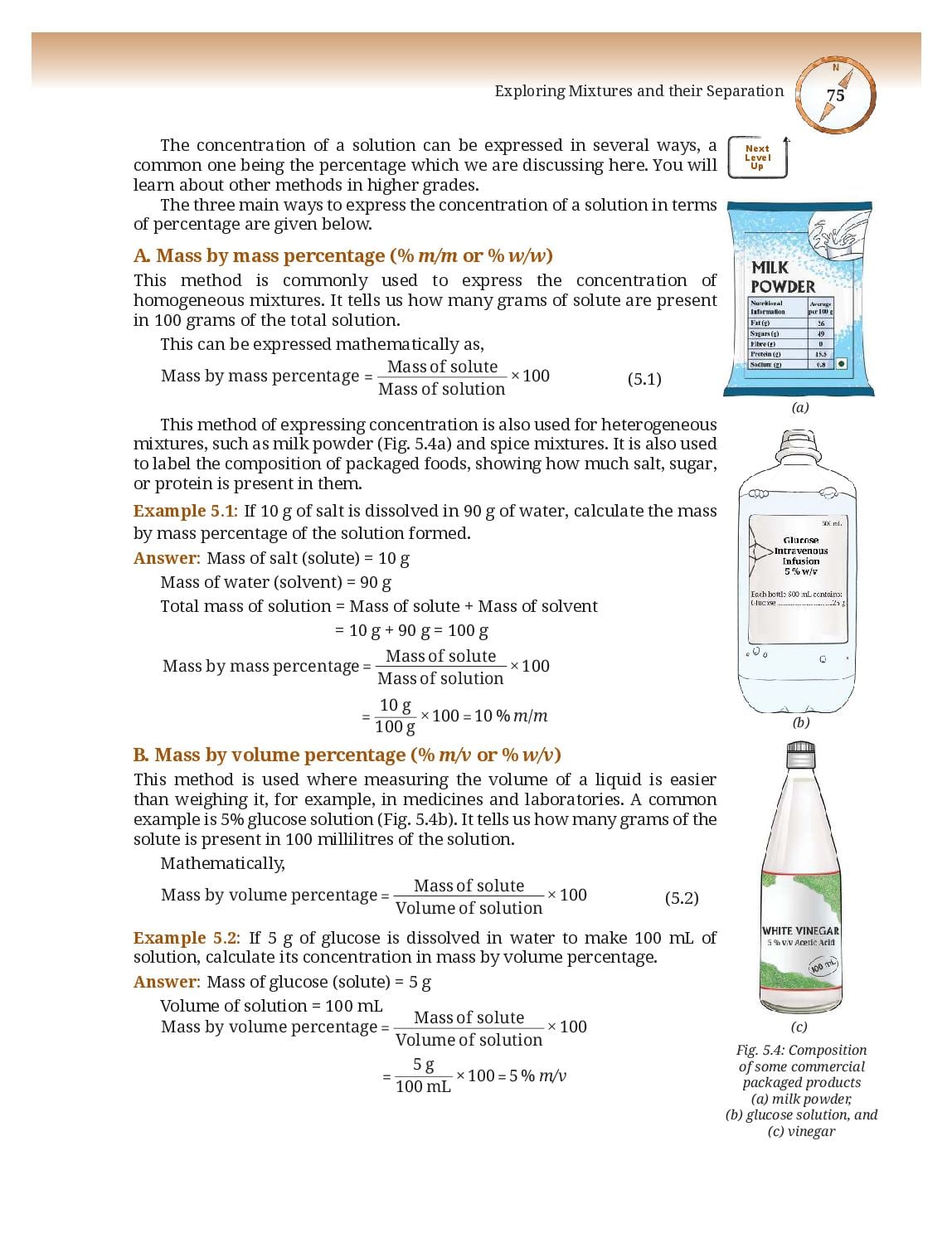
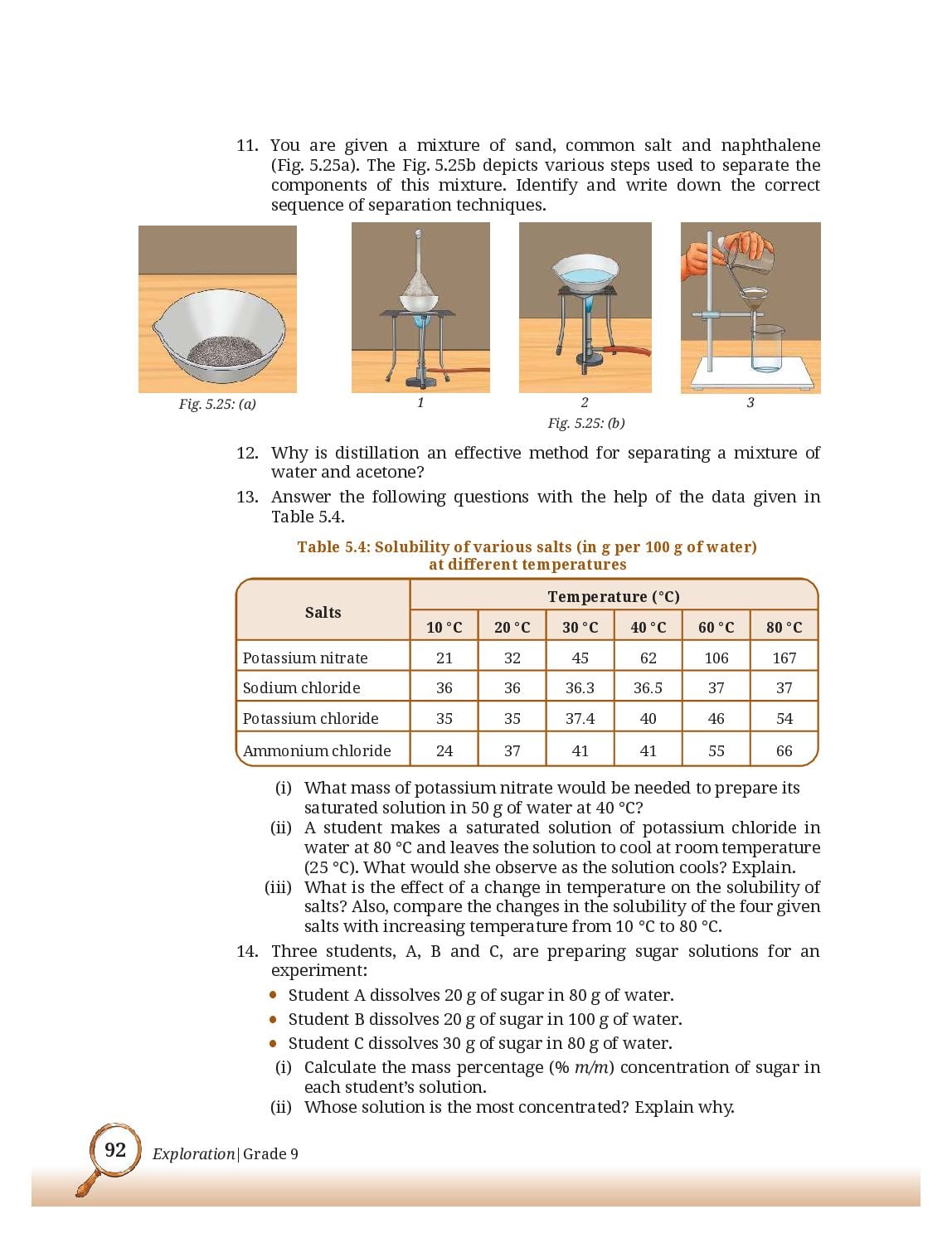
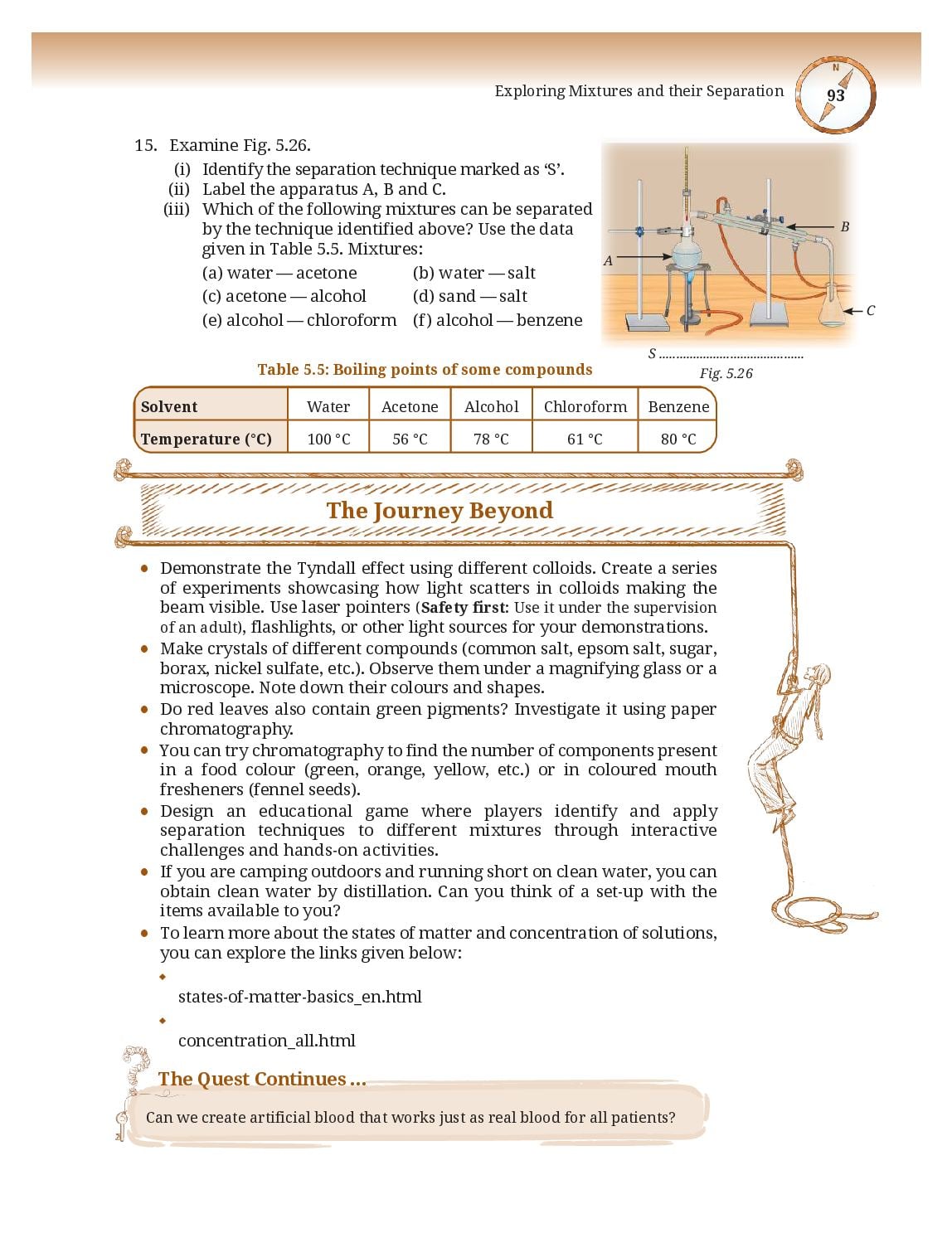
What Is in Exploring Mixtures and their Separation? (Class 9 Science Chapter 5)
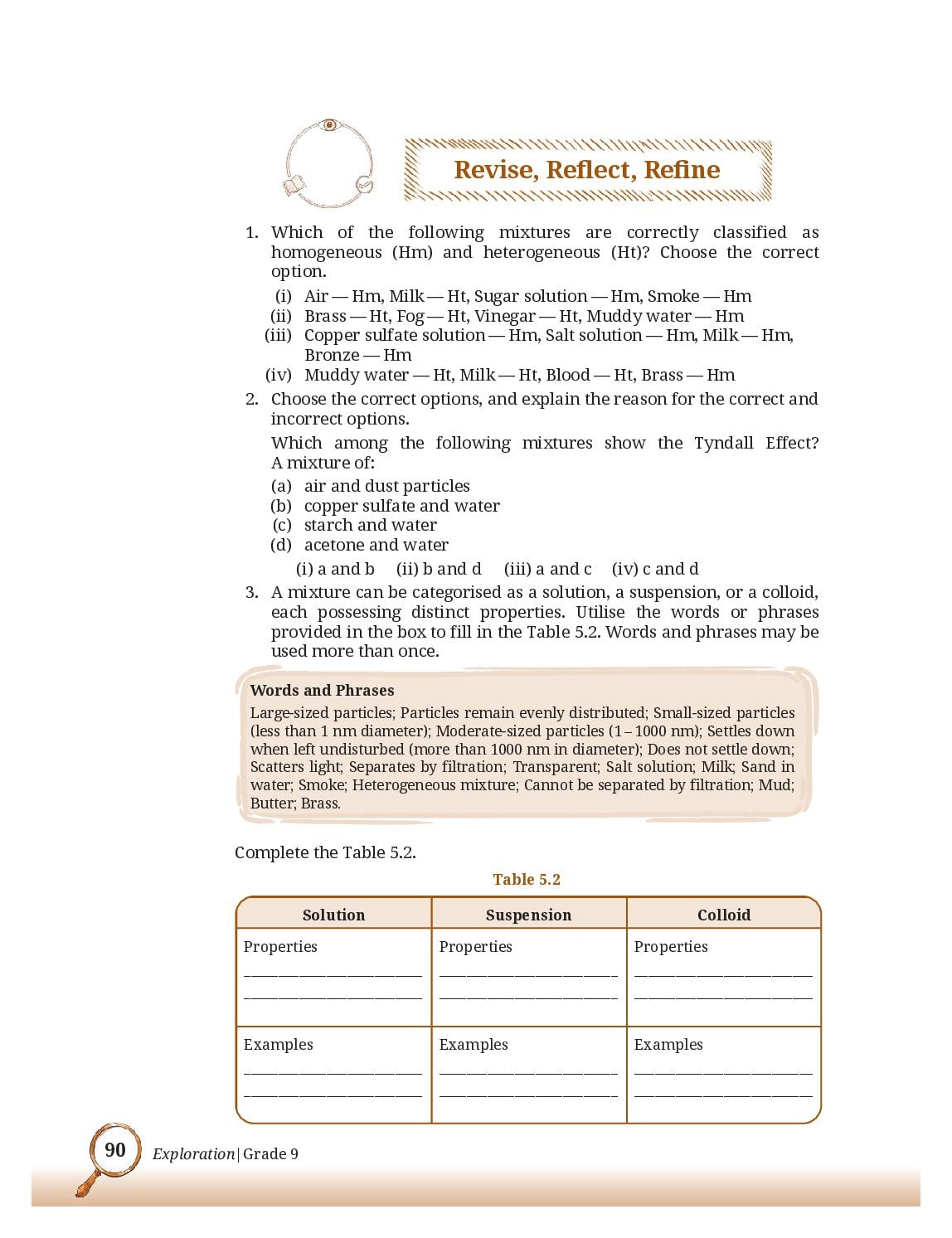
- A mixture is homogeneous (uniform throughout — a solution) or heterogeneous (not uniform — sand in water, smoke, fog). Particle size decides which: below 1 nm it is a solution, 1 – 1000 nm a colloid, above 1000 nm a suspension.
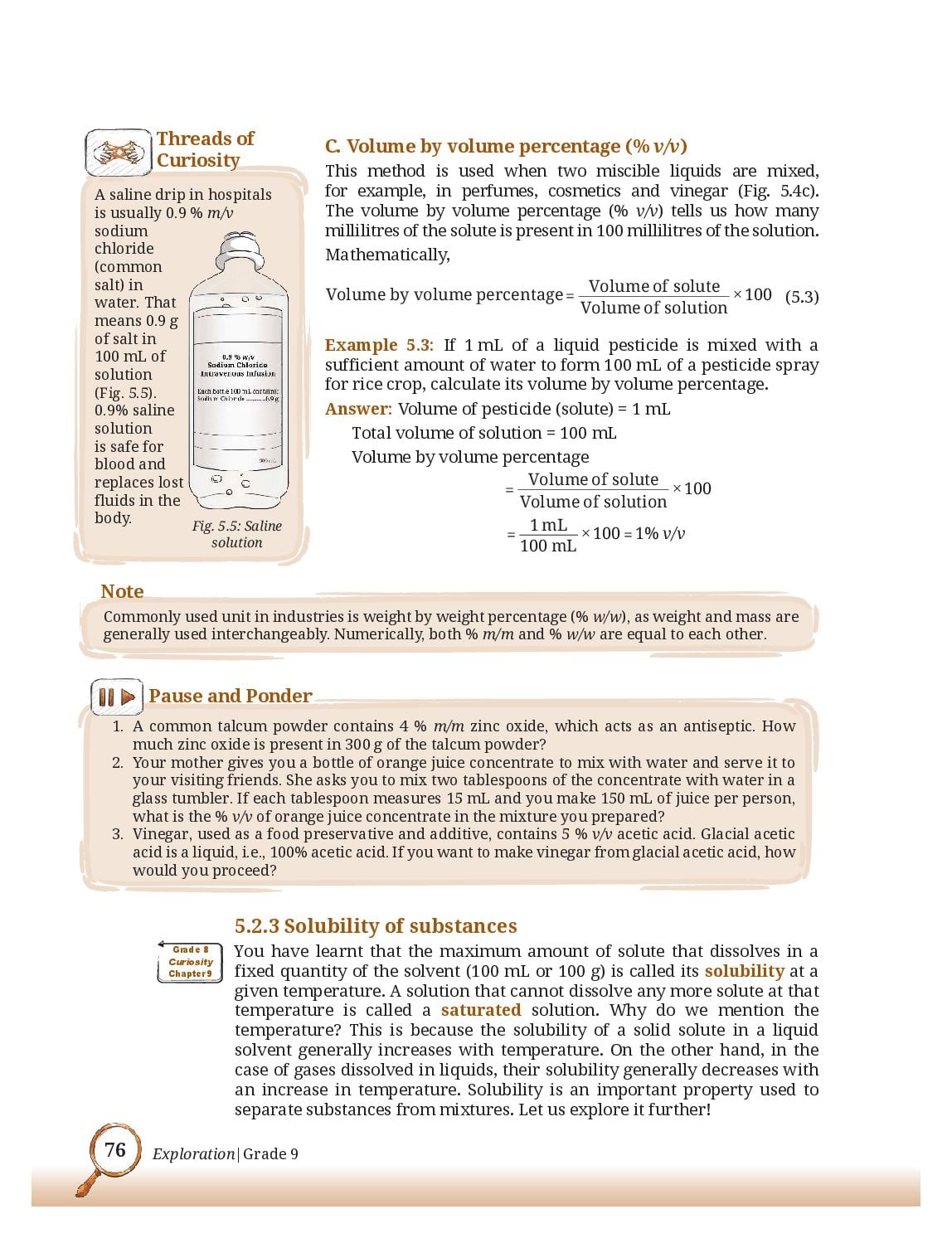
- Concentration says how much solute is present. Three percentage forms are used: % m/m = (mass of solute ÷ mass of solution) × 100, % m/v = (mass of solute ÷ volume of solution) × 100, and % v/v = (volume of solute ÷ volume of solution) × 100.
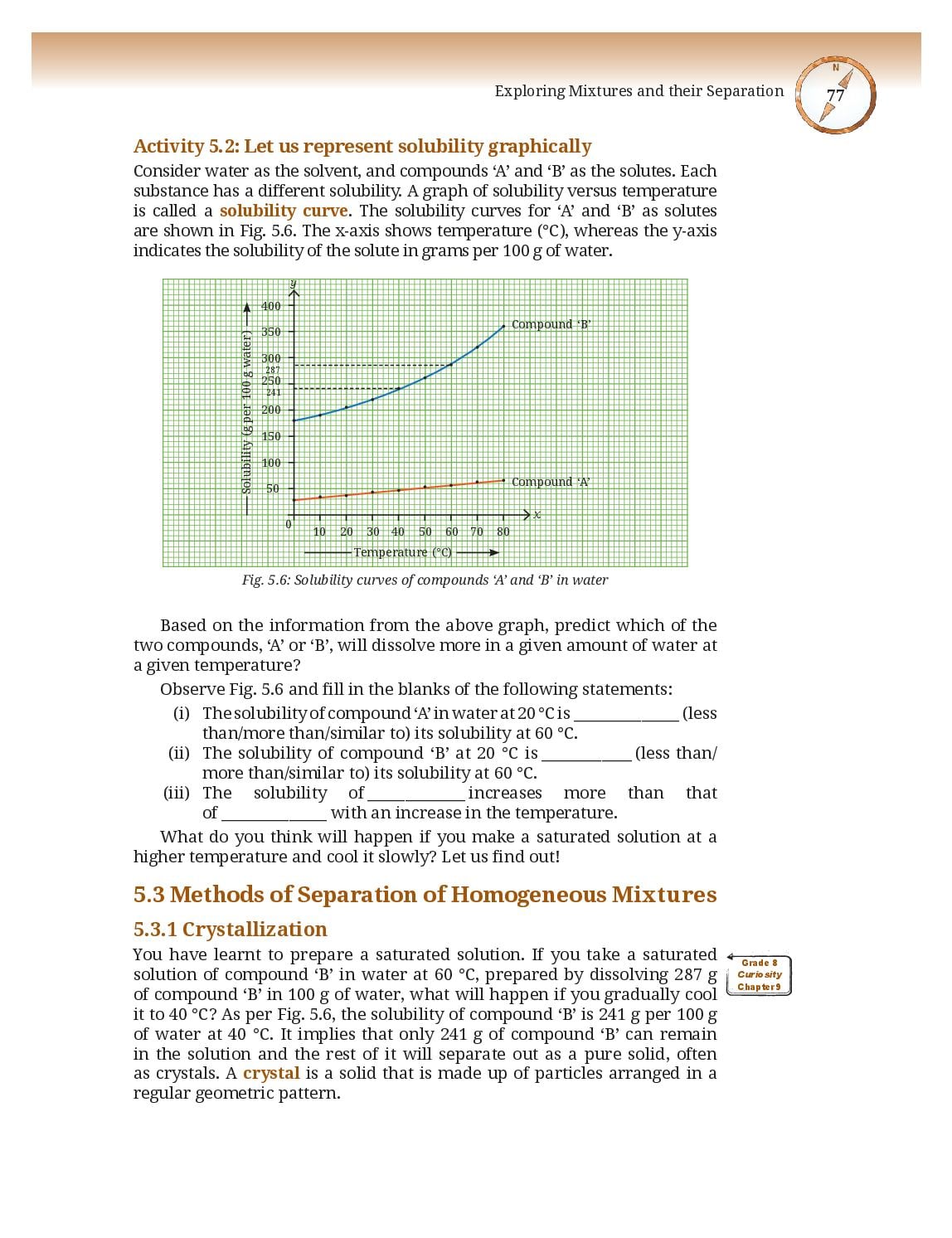
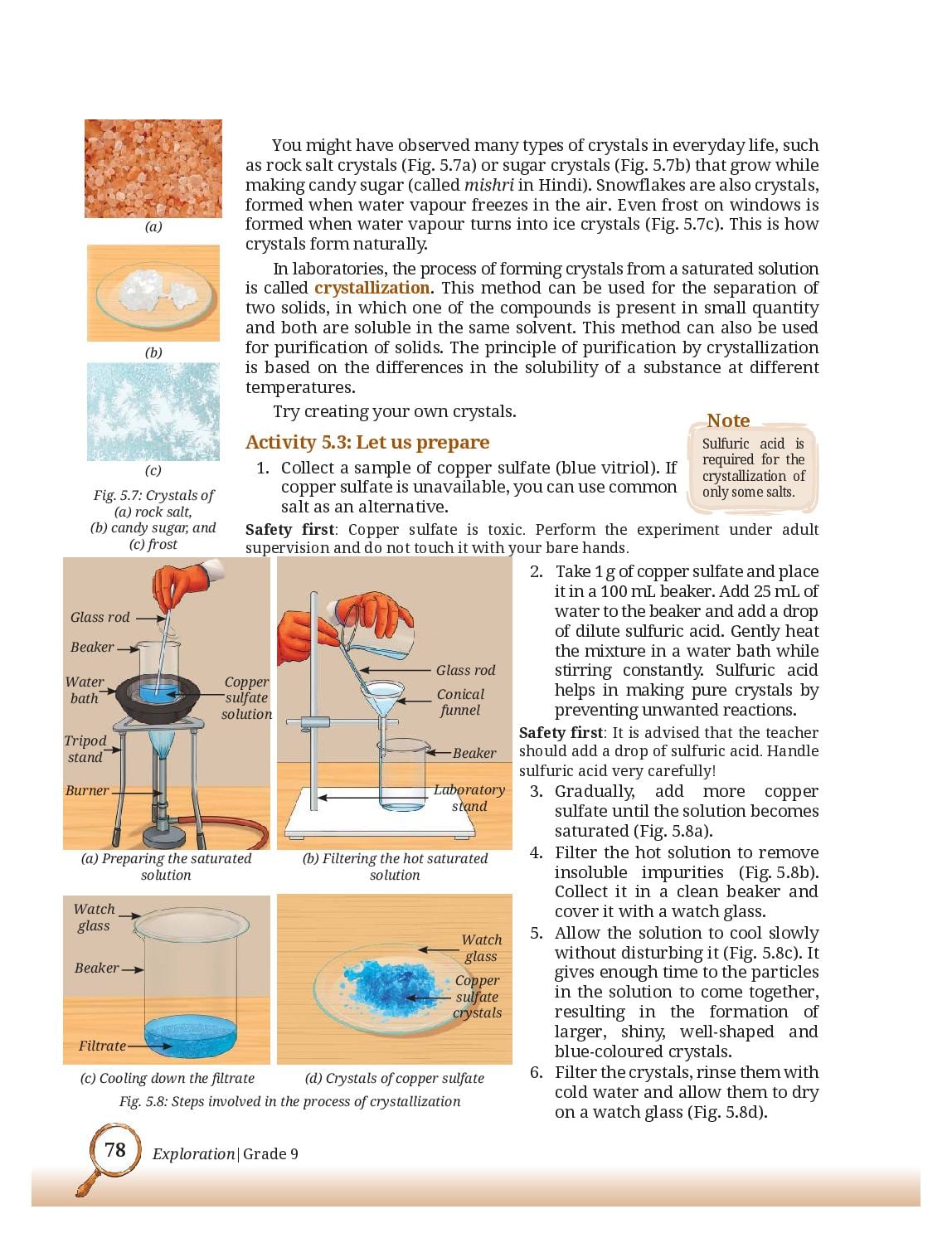
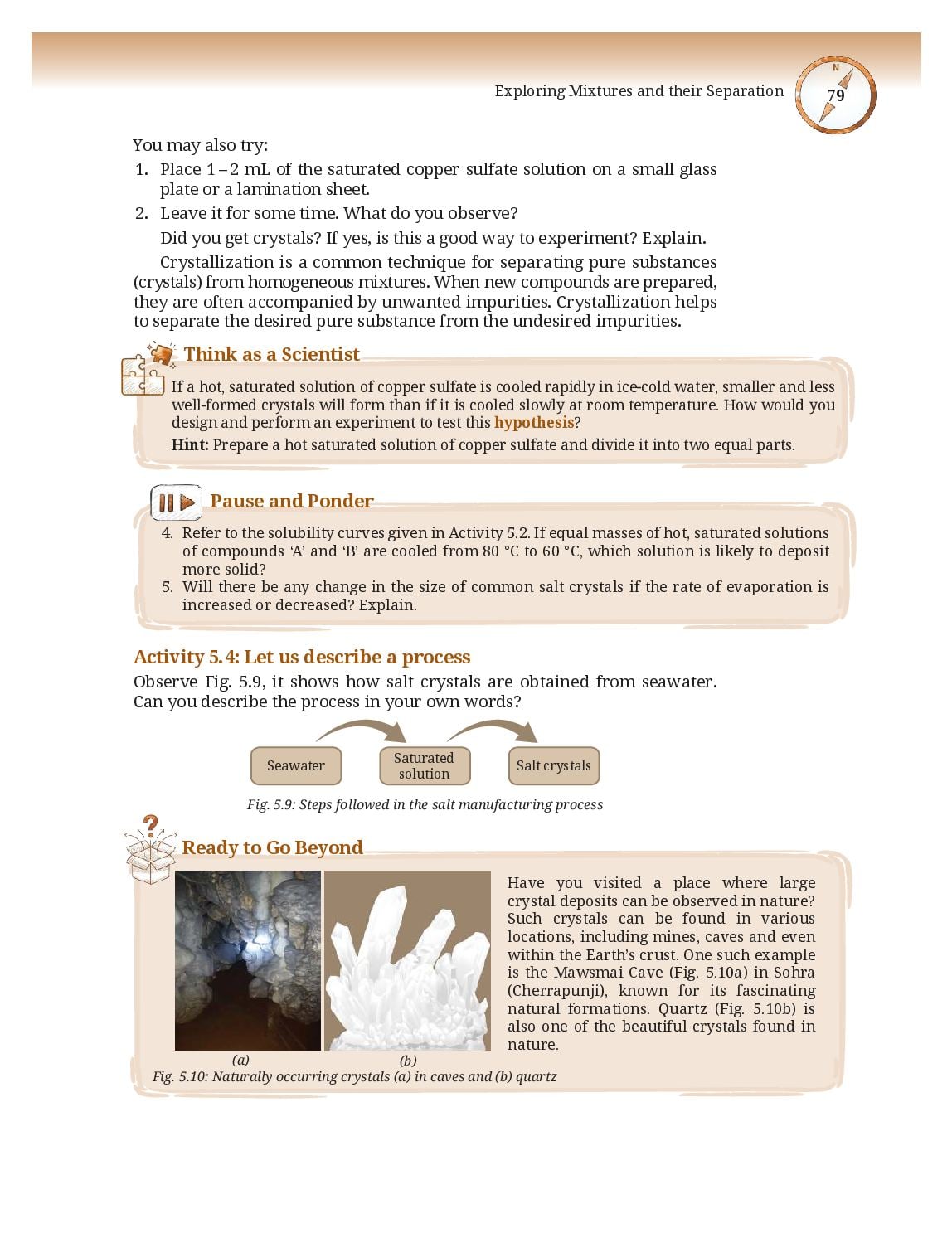
- Solubility is the maximum mass of solute that dissolves in 100 g (or 100 mL) of solvent at a stated temperature. For most solids it rises with temperature; for gases in liquids it falls. Cooling a hot saturated solution therefore throws out the excess solute as crystals.
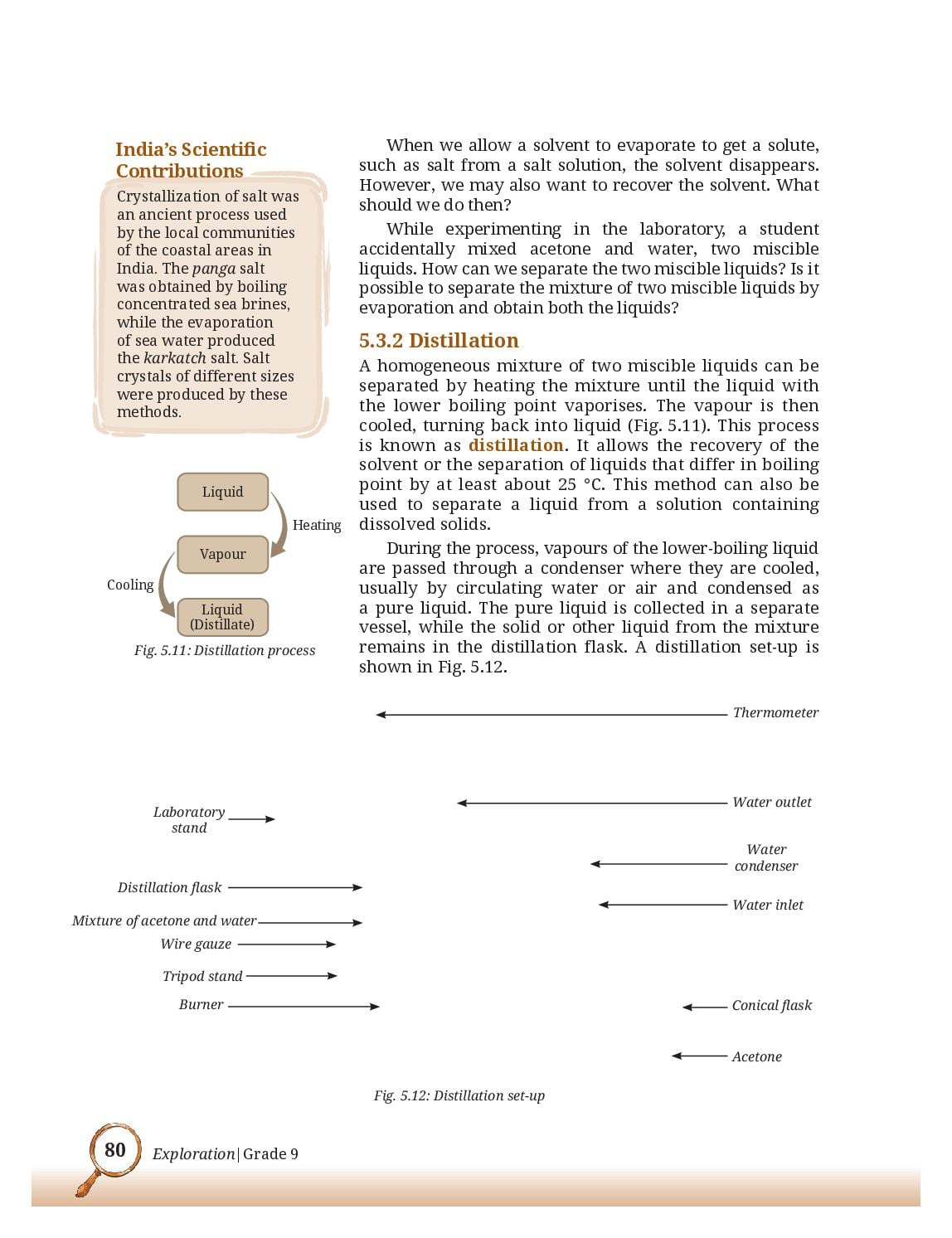
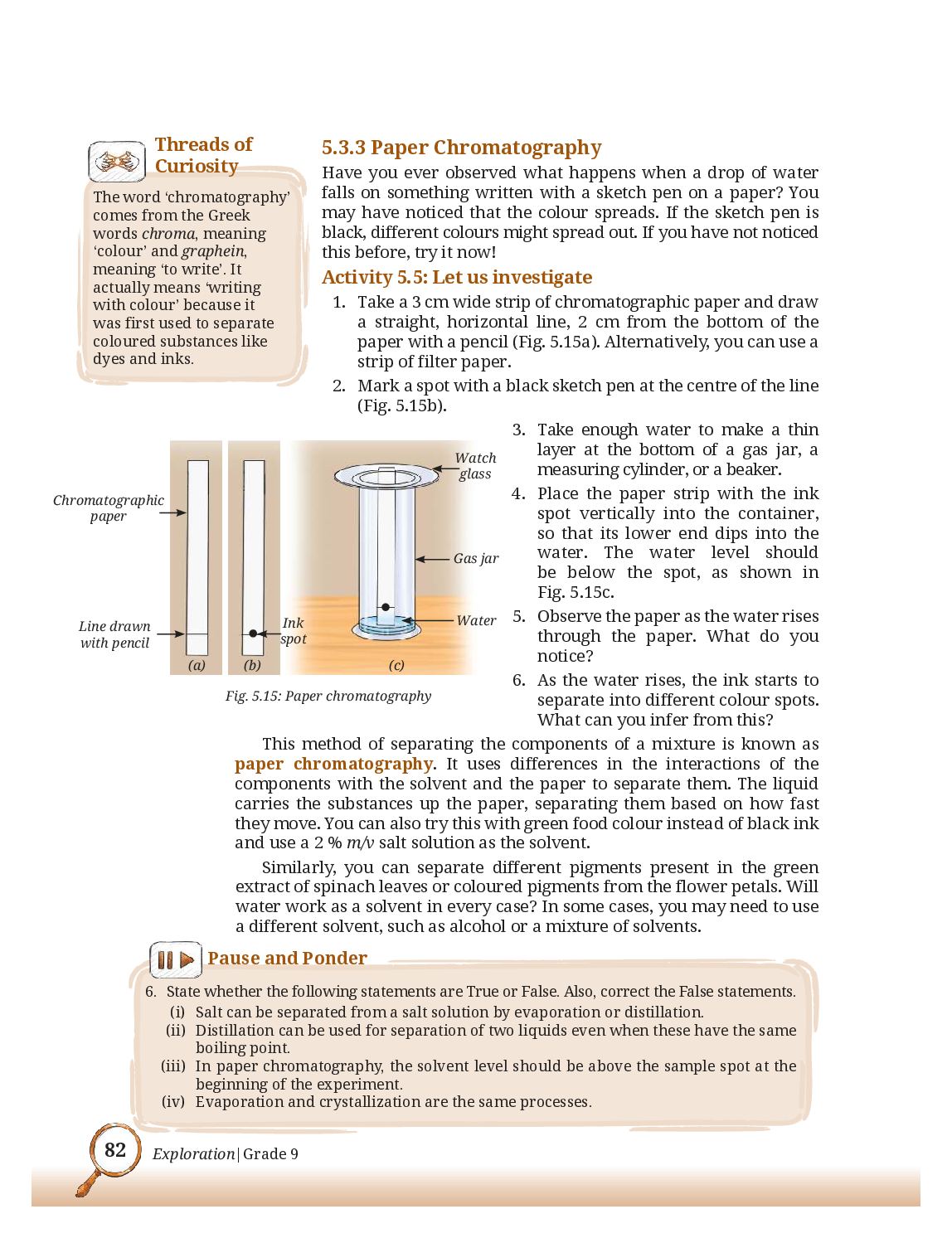
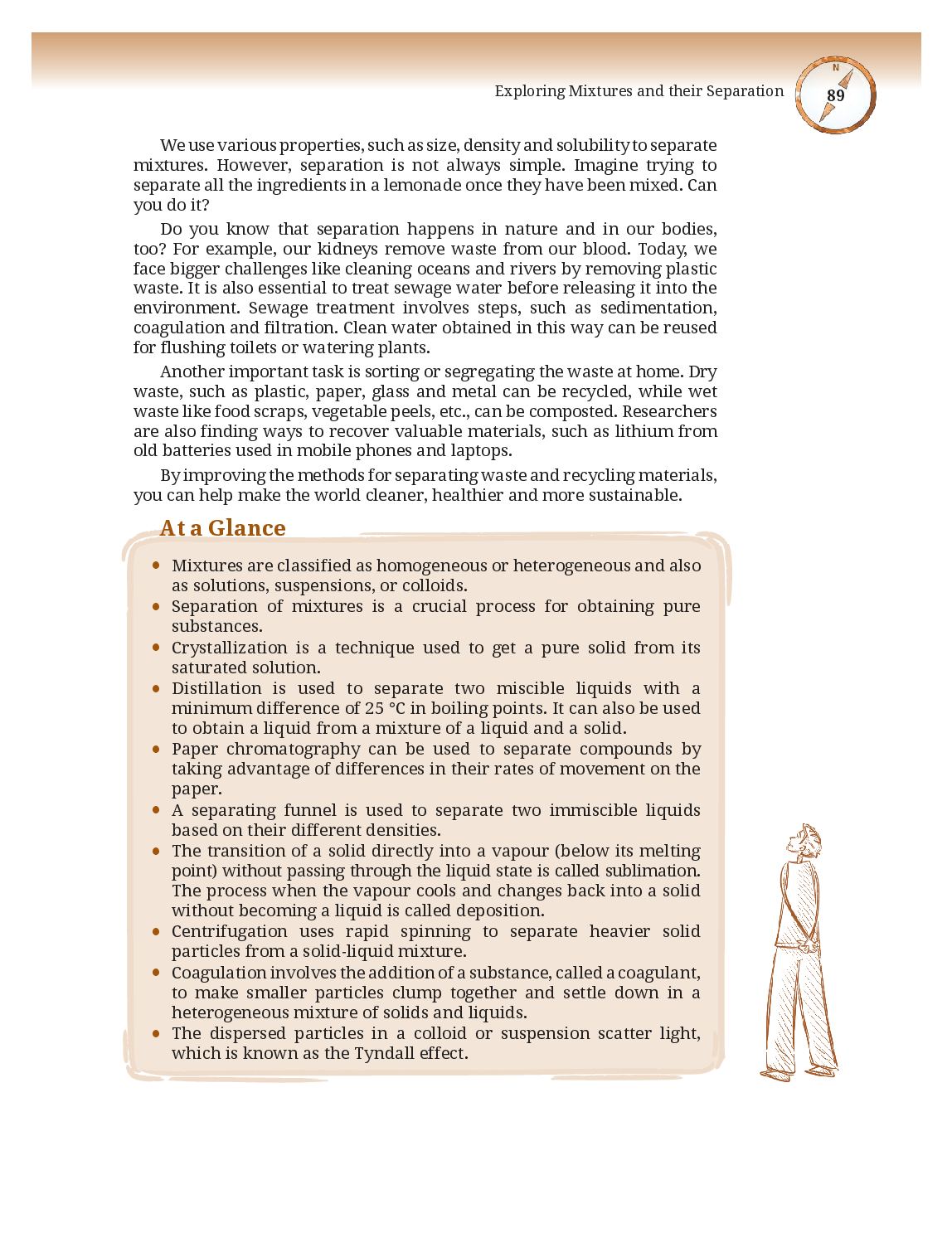
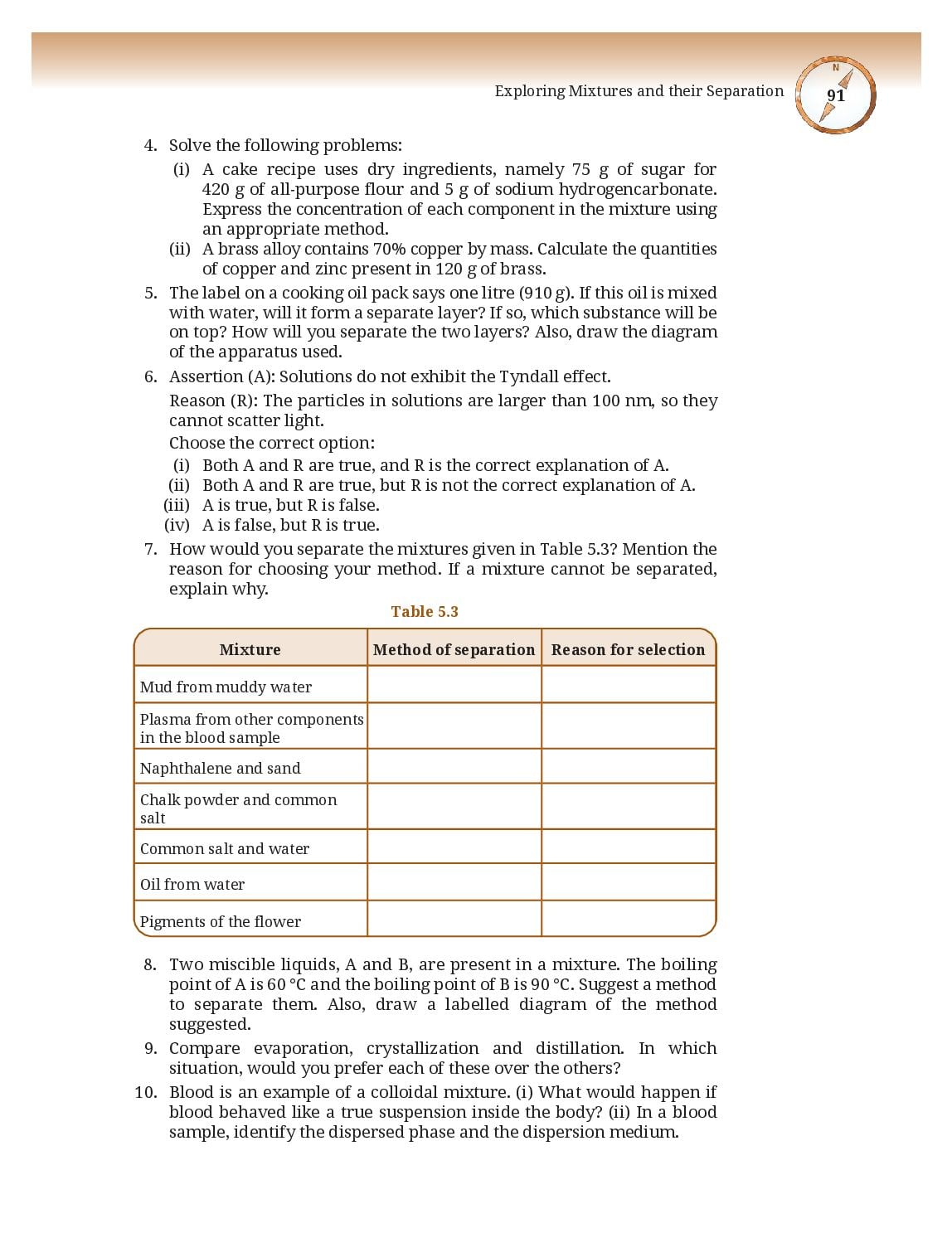
- Homogeneous mixtures are separated by crystallization (pure solid from its saturated solution), distillation (miscible liquids whose boiling points differ by at least about 25 °C) and paper chromatography (components that travel up the paper at different rates).
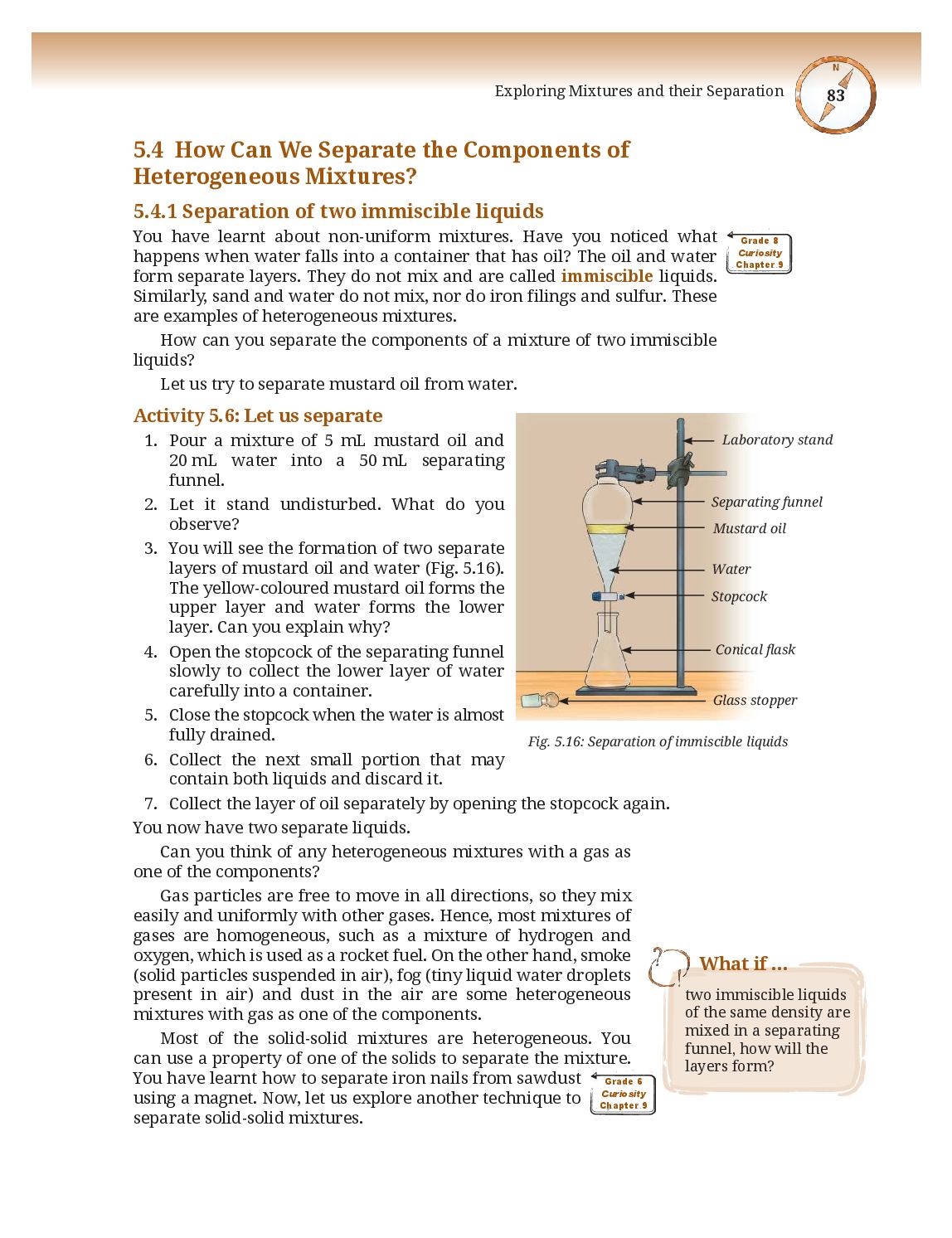
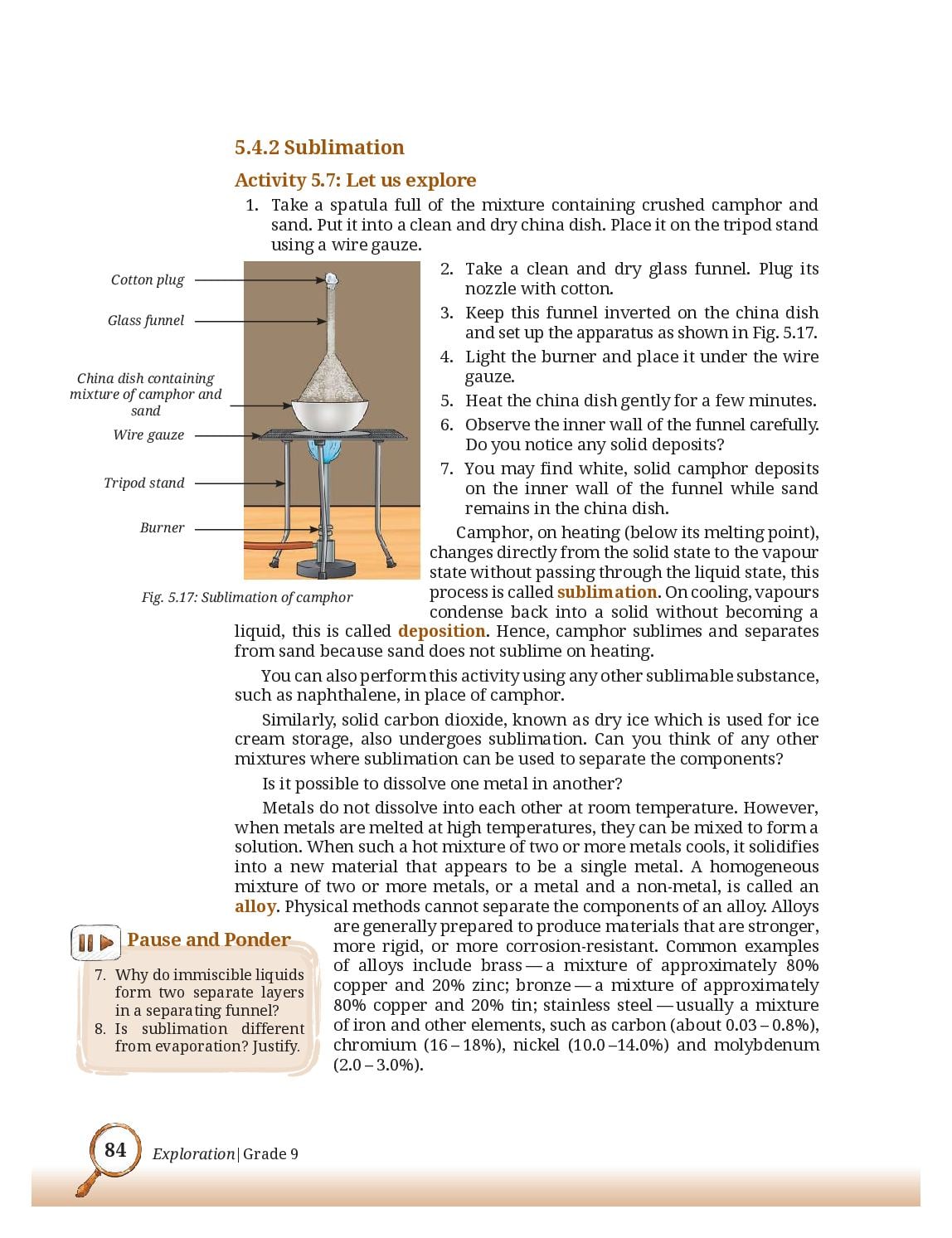
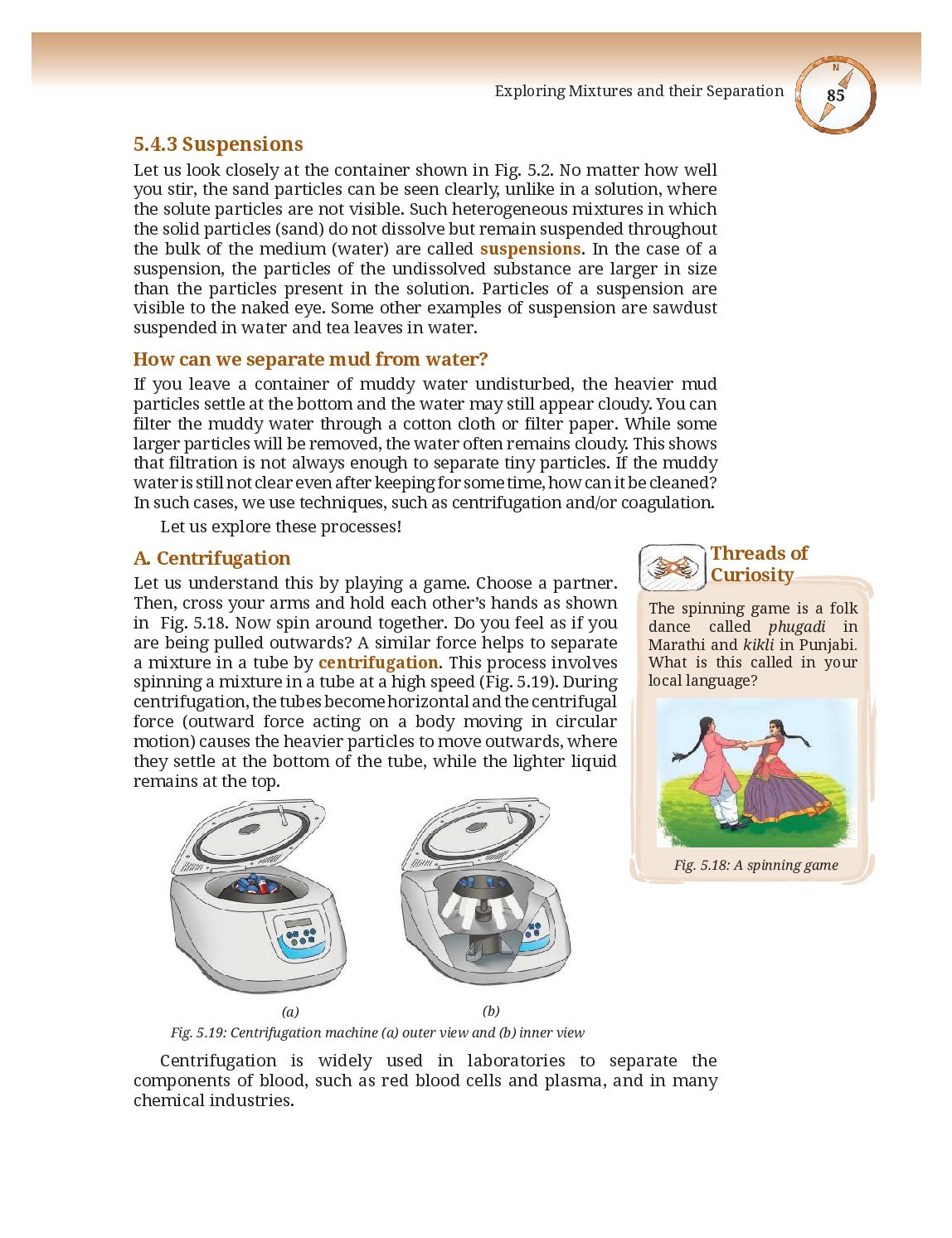
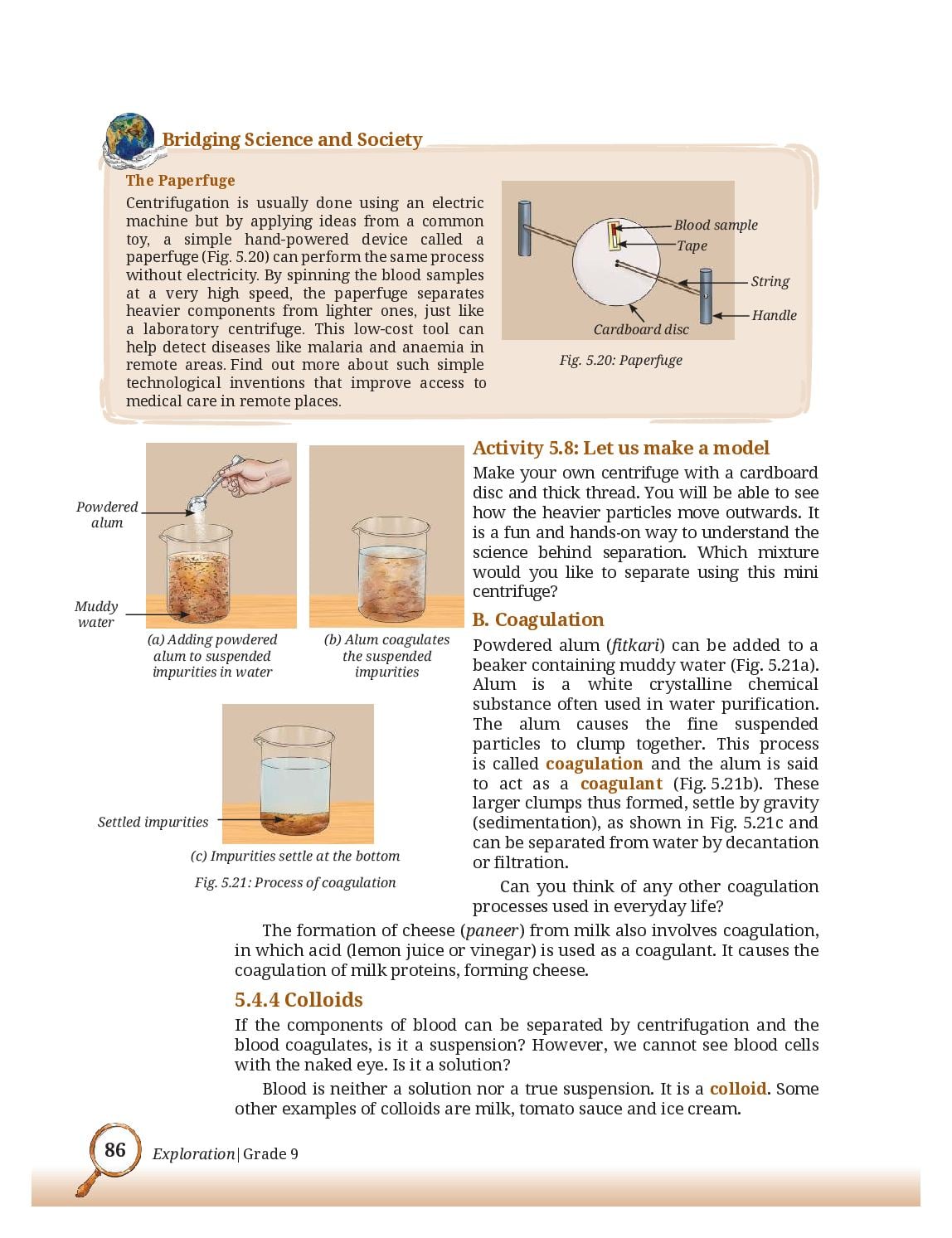
- Heterogeneous mixtures are separated by a separating funnel (immiscible liquids of different density), sublimation (a solid that vaporises without melting, such as camphor or naphthalene), centrifugation (spinning throws heavier particles outwards) and coagulation (alum clumps fine particles so they settle).
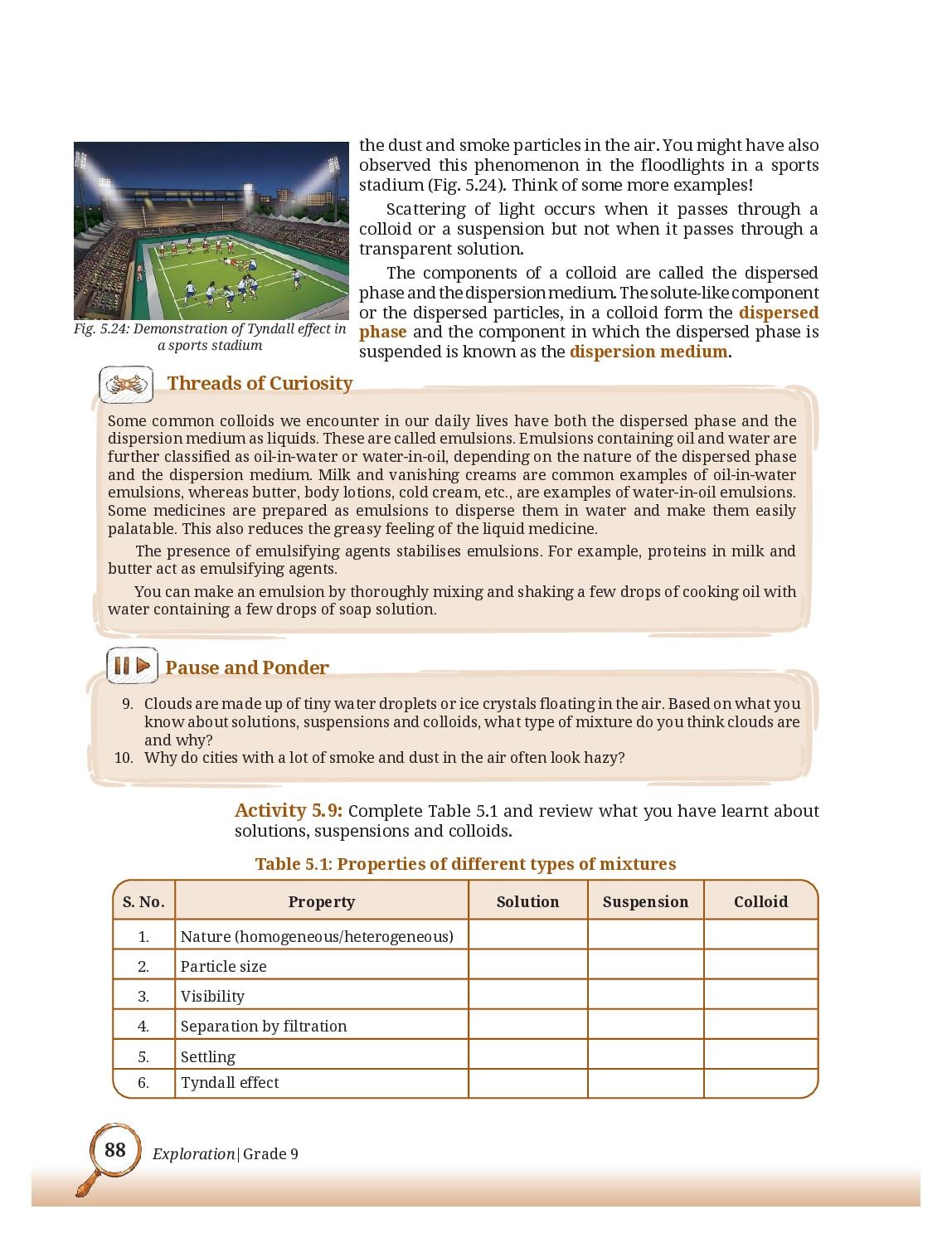
- Colloids and suspensions scatter a beam of light and make its path visible — the Tyndall effect. A true solution does not, because its particles are far smaller than the wavelength of light.
Quick revision – Exploring Mixtures and their Separation
| Term | What it means | Key number or rule | Where it appears |
|---|---|---|---|
| Homogeneous mixture (solution) | Same composition in every part; solute particles not visible | Particle size < 1 nm | Sugar in water, vinegar, soda, brass |
| Heterogeneous mixture | Composition differs from part to part | Two or more visible phases | Sand in water, oil and water, smoke, fog |
| Suspension | Insoluble solid particles held up in a liquid; they settle on standing | Particle size > 1000 nm | Muddy water, chalk in water, tea leaves in water |
| Colloid | Particles too small to settle, too large to be a solution | Particle size 1 – 1000 nm | Milk, blood, ice cream, tomato sauce, smoke |
| Mass by mass percentage | Grams of solute in 100 g of solution | % m/m = (mass of solute ÷ mass of solution) × 100 | Milk powder, spice mixes, packaged food labels |
| Mass by volume percentage | Grams of solute in 100 mL of solution | % m/v = (mass of solute ÷ volume of solution) × 100 | 5% glucose drip, 0.9% m/v saline drip |
| Volume by volume percentage | Millilitres of solute in 100 mL of solution | % v/v = (volume of solute ÷ volume of solution) × 100 | Vinegar (5% v/v acetic acid), perfumes |
| Solubility | Maximum mass of solute that dissolves in 100 g of solvent at a stated temperature | Rises with temperature for most solids; falls for gases | Solubility curves, Fig. 5.6; Table 5.4 |
| Crystallization | Pure solid separates as crystals when a hot saturated solution is cooled slowly | Slow cooling → larger, better-formed crystals | Copper sulfate crystals, salt from seawater |
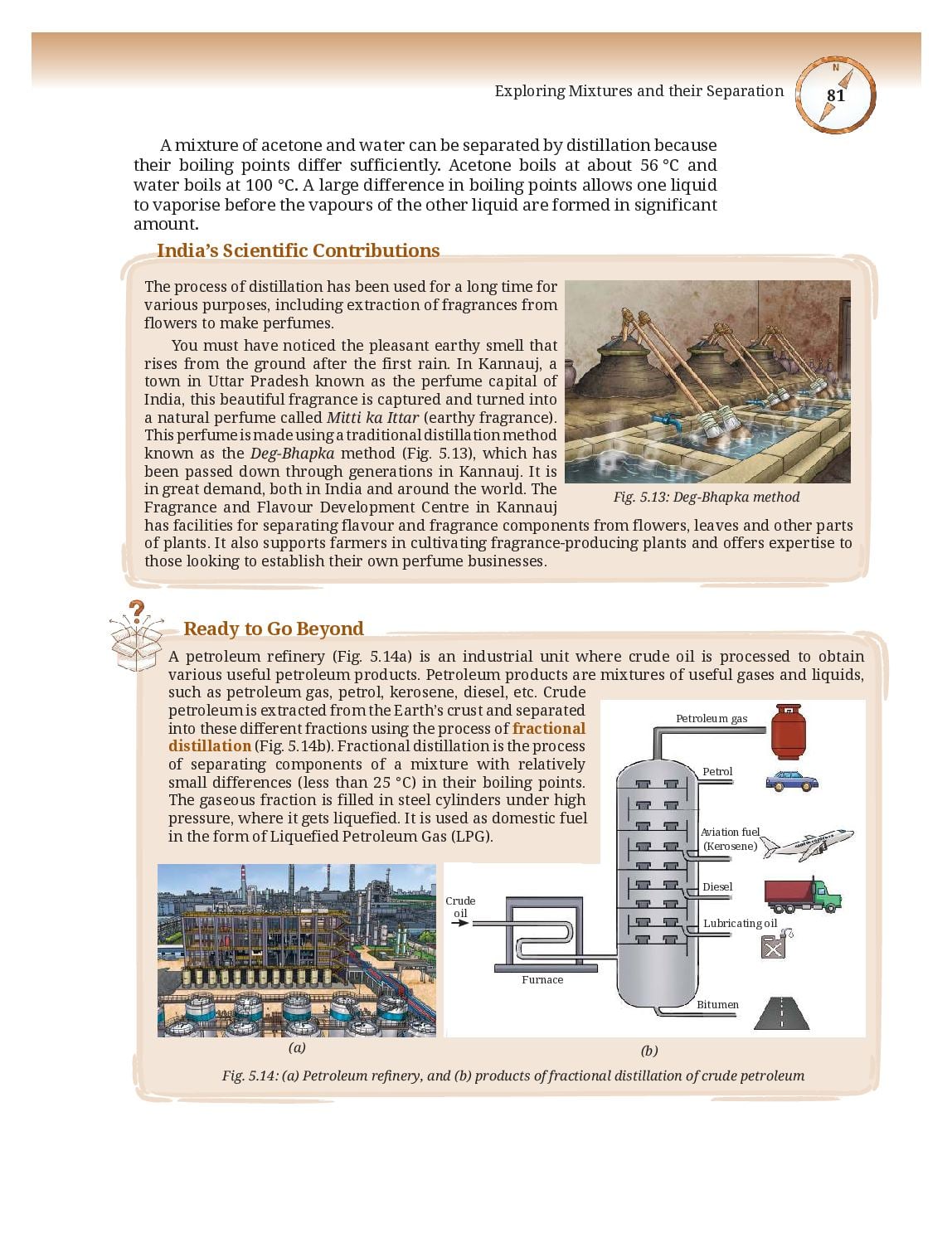
| Distillation | Liquid is boiled off, then condensed and collected separately | Works when boiling points differ by about 25 °C or more | Acetone (56 °C) and water (100 °C); Deg-Bhapka ittar |
| Fractional distillation | Separates components whose boiling points are close | Boiling point difference less than 25 °C | Crude petroleum → LPG, petrol, kerosene, diesel |
| Sublimation / deposition | Solid → vapour directly (below its melting point) / vapour → solid directly | No liquid stage at any point | Camphor and sand, naphthalene, dry ice |
| Centrifugation | Rapid spinning; the centrifugal force drives heavier particles outwards and down | Used where filtration is too coarse | Blood → plasma, platelets, WBC, RBC; the paperfuge |
| Coagulation | A coagulant makes fine particles clump so that they settle | Alum (fitkari) in muddy water; lemon juice in milk | Water purification, making paneer |
Old NCERT vs New – Class 9 Science
This chapter is from Exploration, the new NCERT Class 9 Science book (NCF-SE 2023, used from 2026-27). It replaced the old book “Science”, so chapter numbers and names differ from older PDFs.
Solutions and All Chapters
Answers to the exercises and the full chapter list of Exploration:
Exploring Mixtures and their Separation – Overview
| Class | Class 9 |
| Subject | Science |
| Book | Exploration – new NCERT book |
| Chapter | 5 of 13 – Exploring Mixtures and their Separation |
| Book pages | 72 – 93 |
| Edition | Latest NCERT edition (2026-27) |
| Session | 2026-27 |
| Free – read online or download |
Class 9 Science Chapter 5 – FAQs
Where can I download Exploring Mixtures and their Separation Class 9 PDF?
From the download table on this page – the chapter PDF is free, and the full book is linked too.
What is Class 9 Science Chapter 5 about?
A mixture is homogeneous (uniform throughout — a solution) or heterogeneous (not uniform — sand in water, smoke, fog). Particle size decides which: below 1 nm it is a solution, 1 – 1000 nm a colloid, above 1000 nm a suspension.
Is Exploring Mixtures and their Separation from the new NCERT Class 9 Science book?
Yes. It is chapter 5 of exploration, the new NCERT Class 9 Science book for 2026-27.
Is this the latest NCERT edition for 2026-27?
Yes – the PDF is NCERT’s latest edition for the 2026-27 session.
Where are the NCERT Solutions for Class 9 Science Chapter 5?
Open the NCERT Solutions link above for answers to the exercise questions.