Download Atomic Foundations of Matter – NCERT Class 9 Science Chapter 9 PDF from the new NCERT Class 9 Science book Exploration (2026-27). Read the chapter online or download the free PDF. Law of Conservation of Mass (Lavoisier, 1789): in a chemical reaction matter is neither created nor destroyed, so the total mass of the reactants equals the total mass of the products. It only looks violated in an open vessel, because a gaseous…
Atomic Foundations of Matter PDF – Chapter 9 of Exploration
Read the chapter online or download the PDF.
| Chapter | Download | |
|---|---|---|
| Chapter 9 PDF | Atomic Foundations of Matter | View PDF |
| Full book | NCERT Class 9 Science – Exploration | View Book |
Read Online
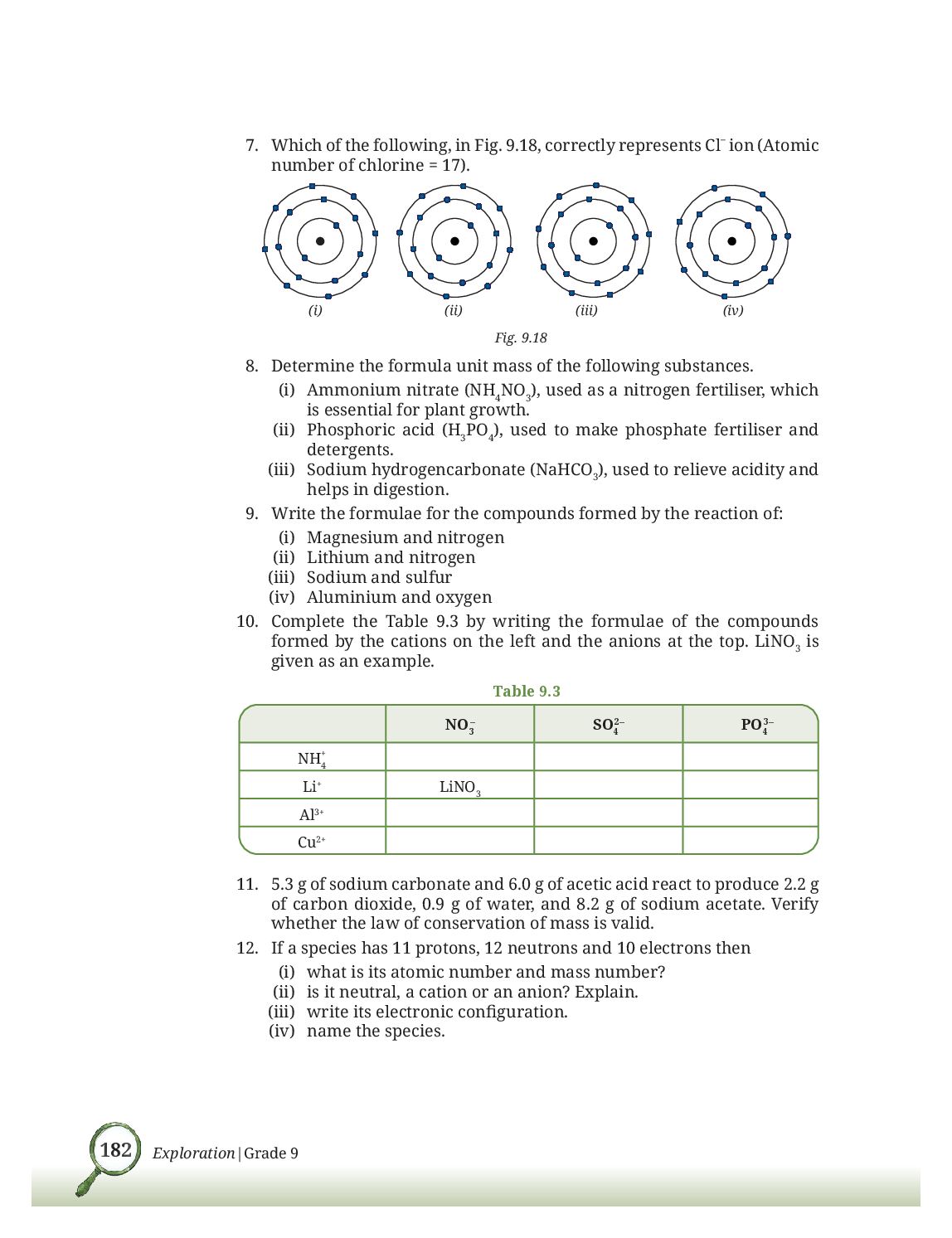
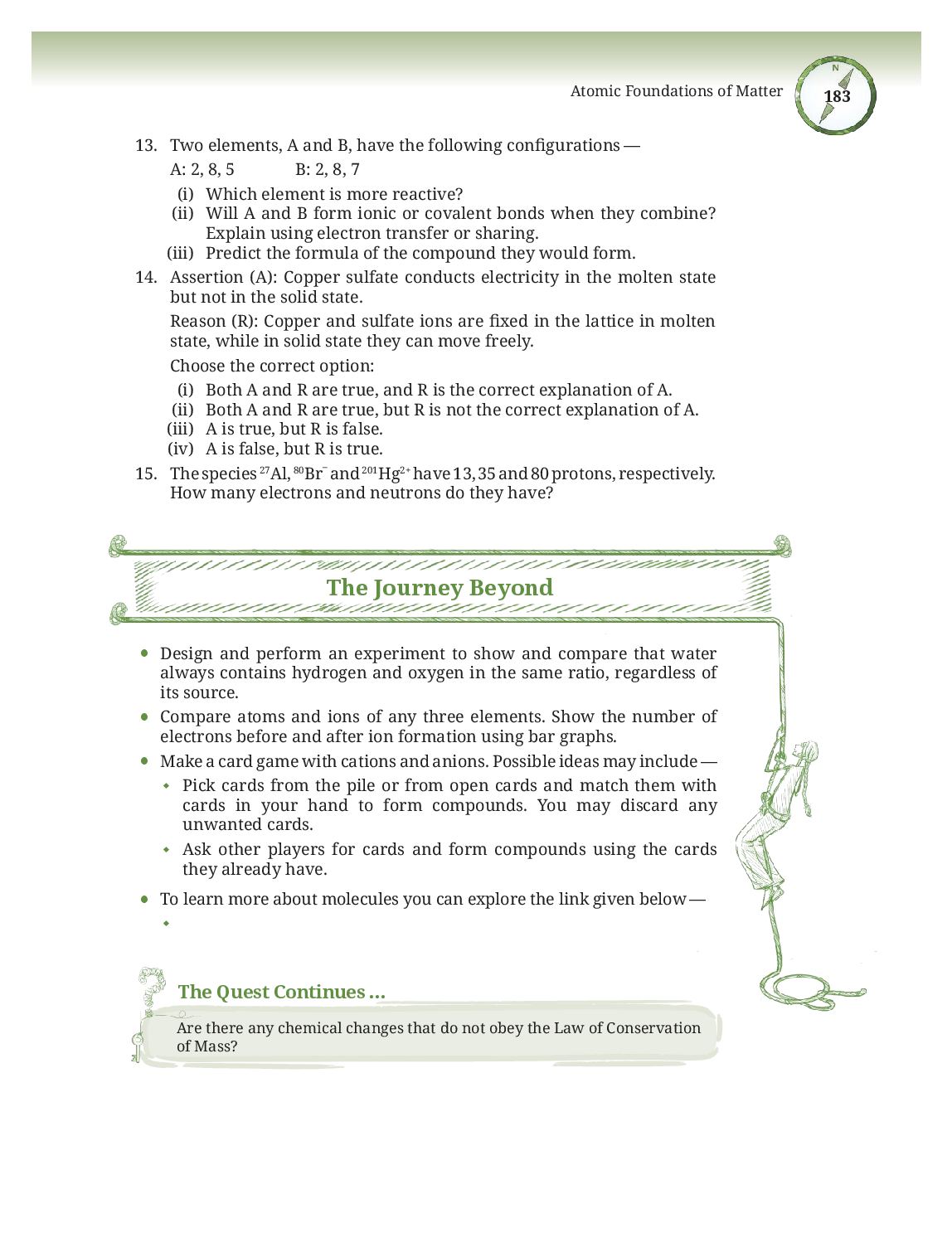
What Is in Atomic Foundations of Matter? (Class 9 Science Chapter 9)
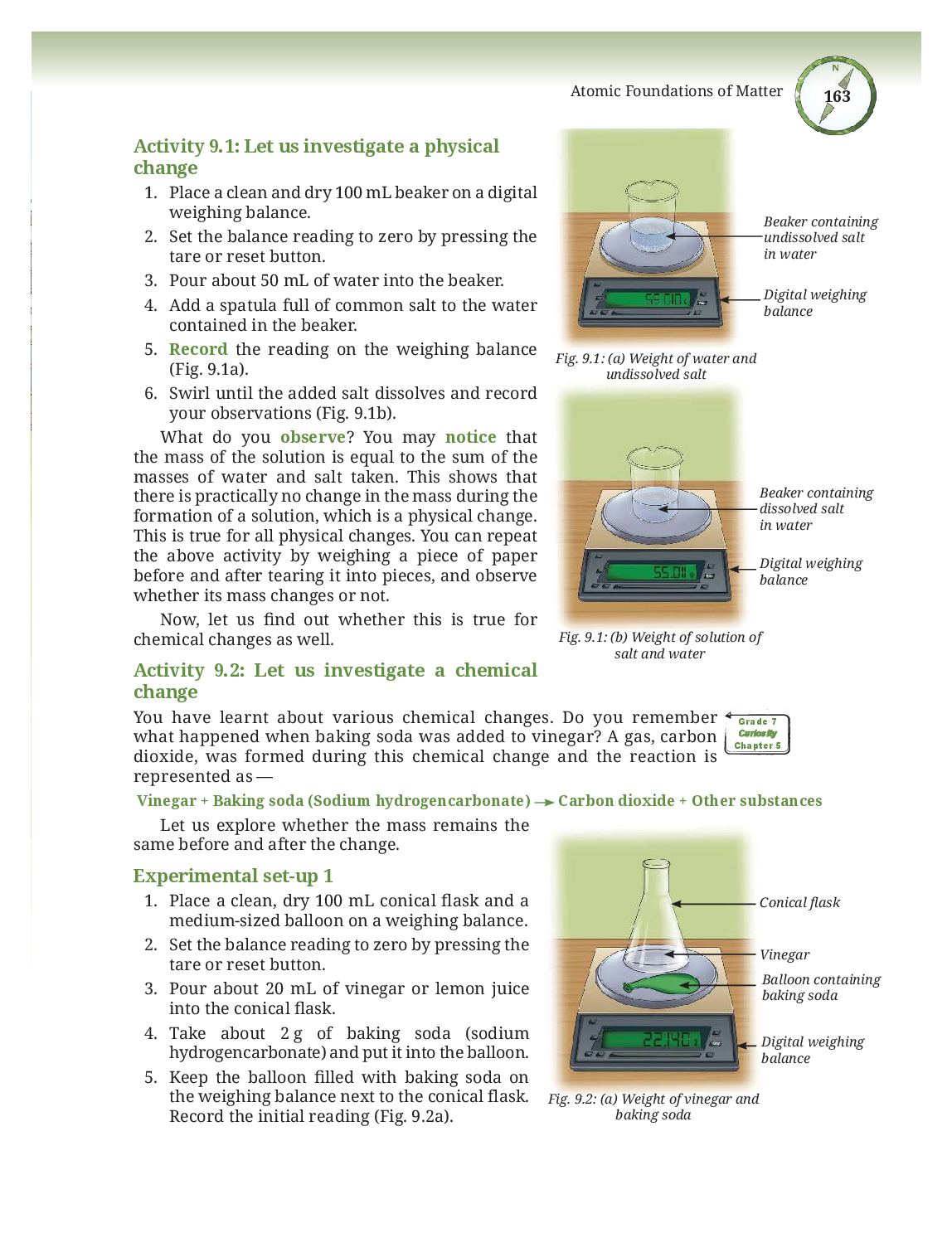
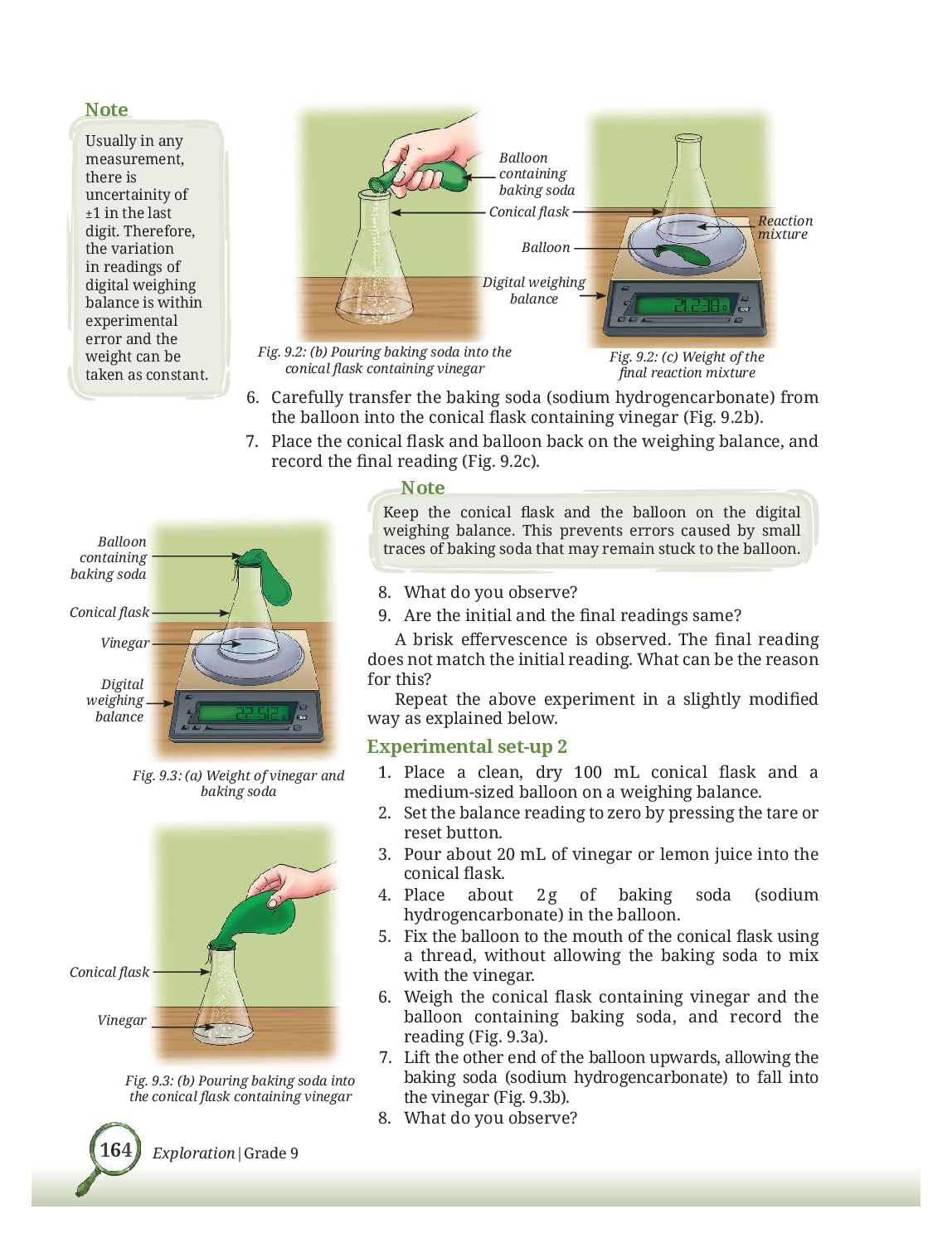
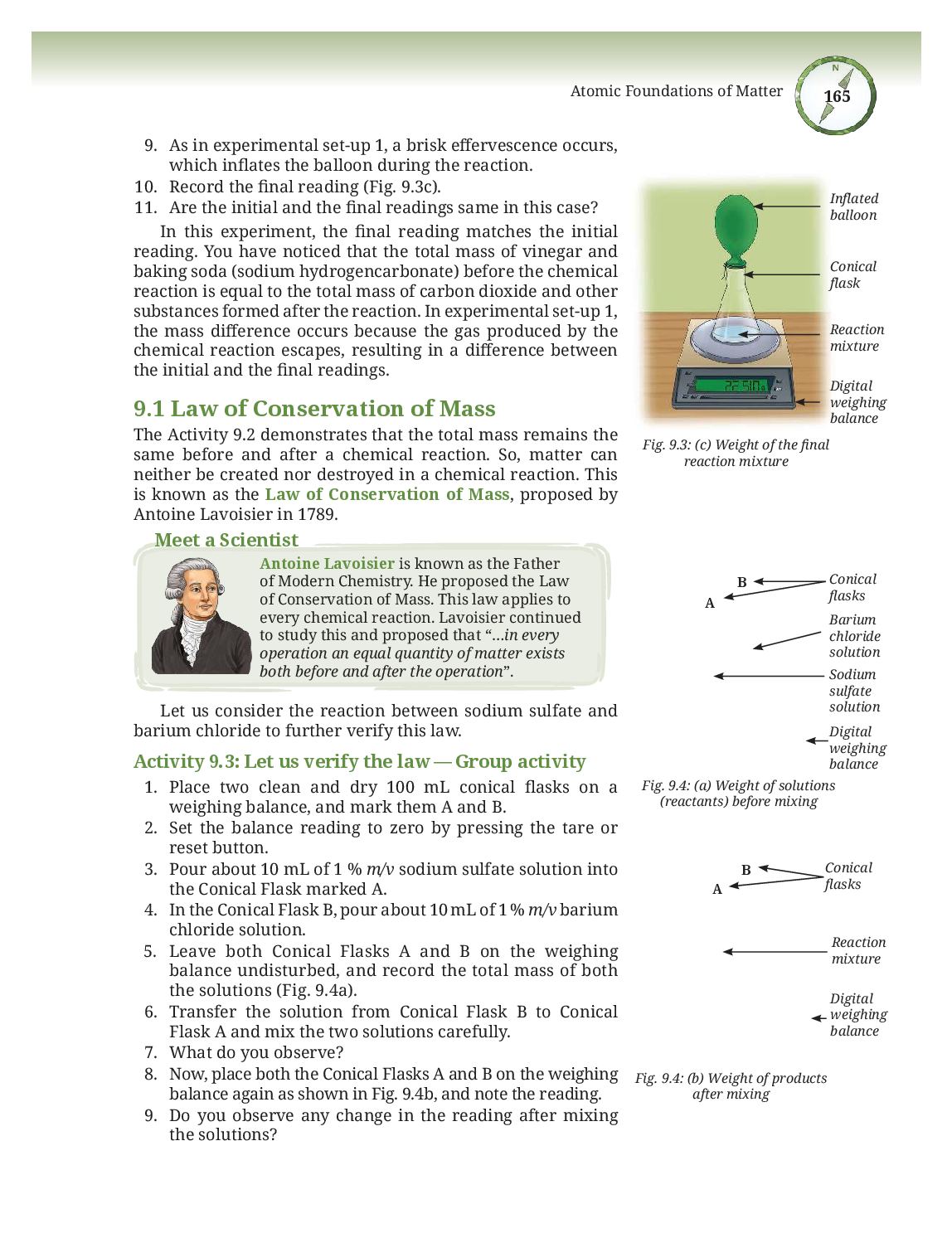
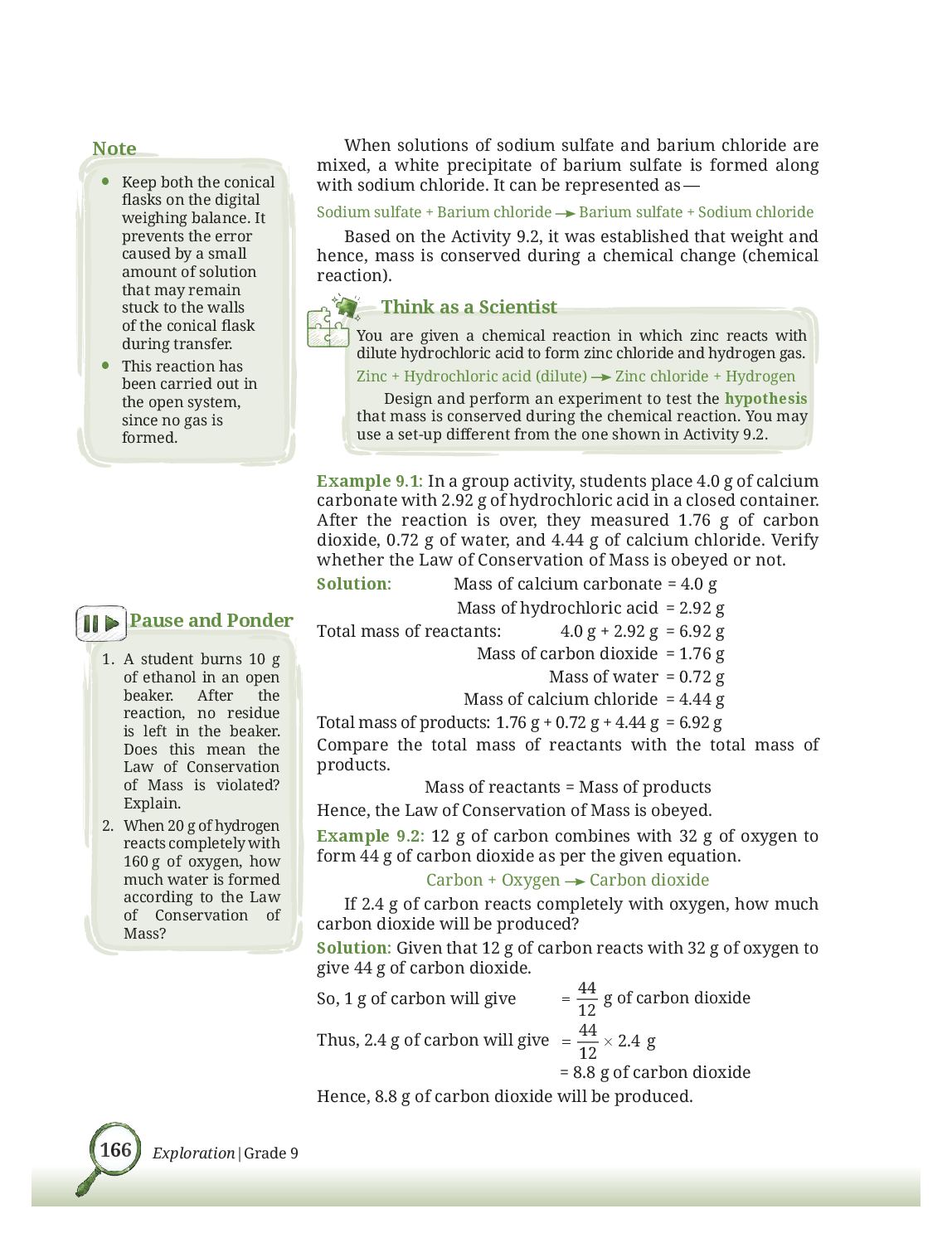
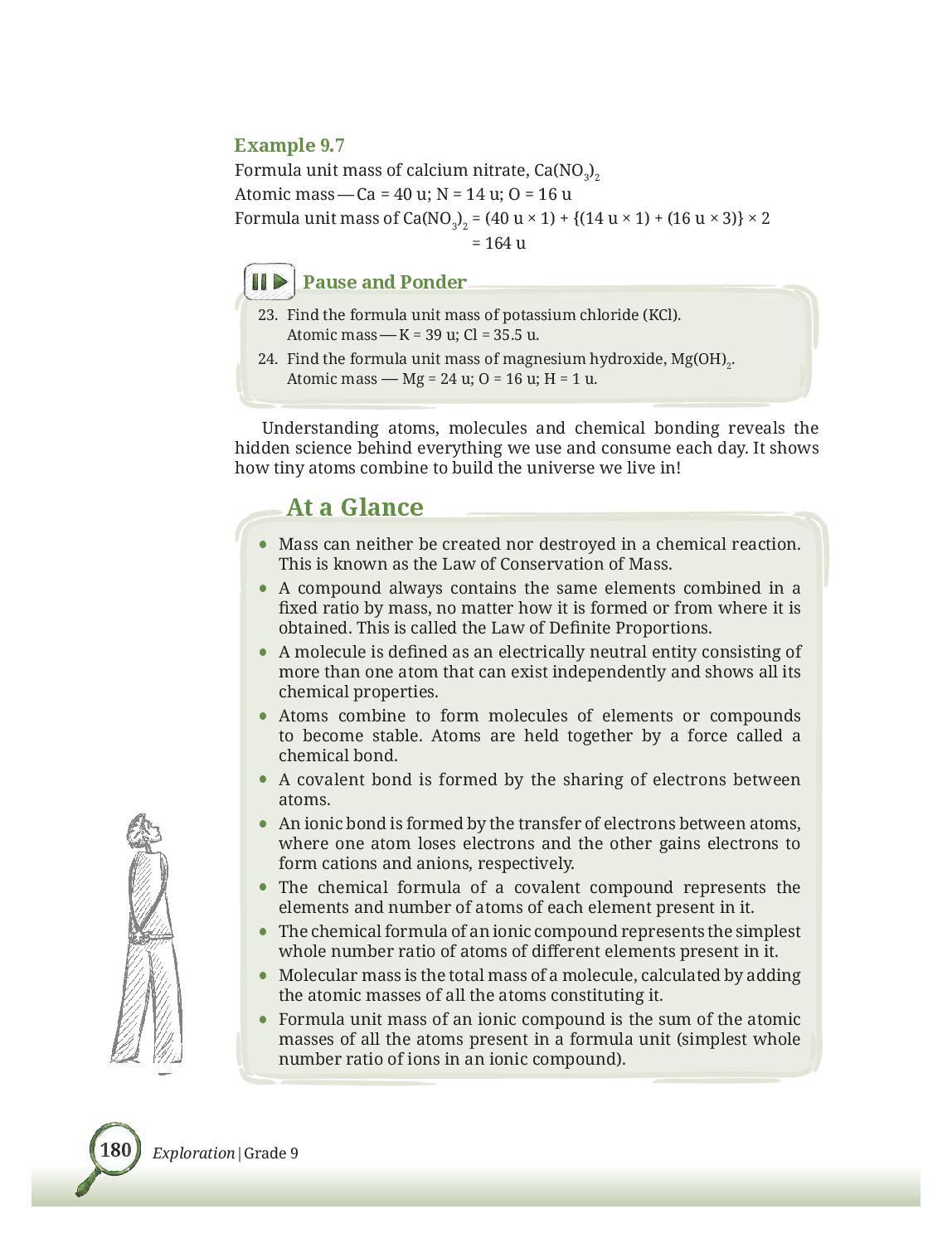
- Law of Conservation of Mass (Lavoisier, 1789): in a chemical reaction matter is neither created nor destroyed, so the total mass of the reactants equals the total mass of the products. It only looks violated in an open vessel, because a gaseous product walks off the balance pan.
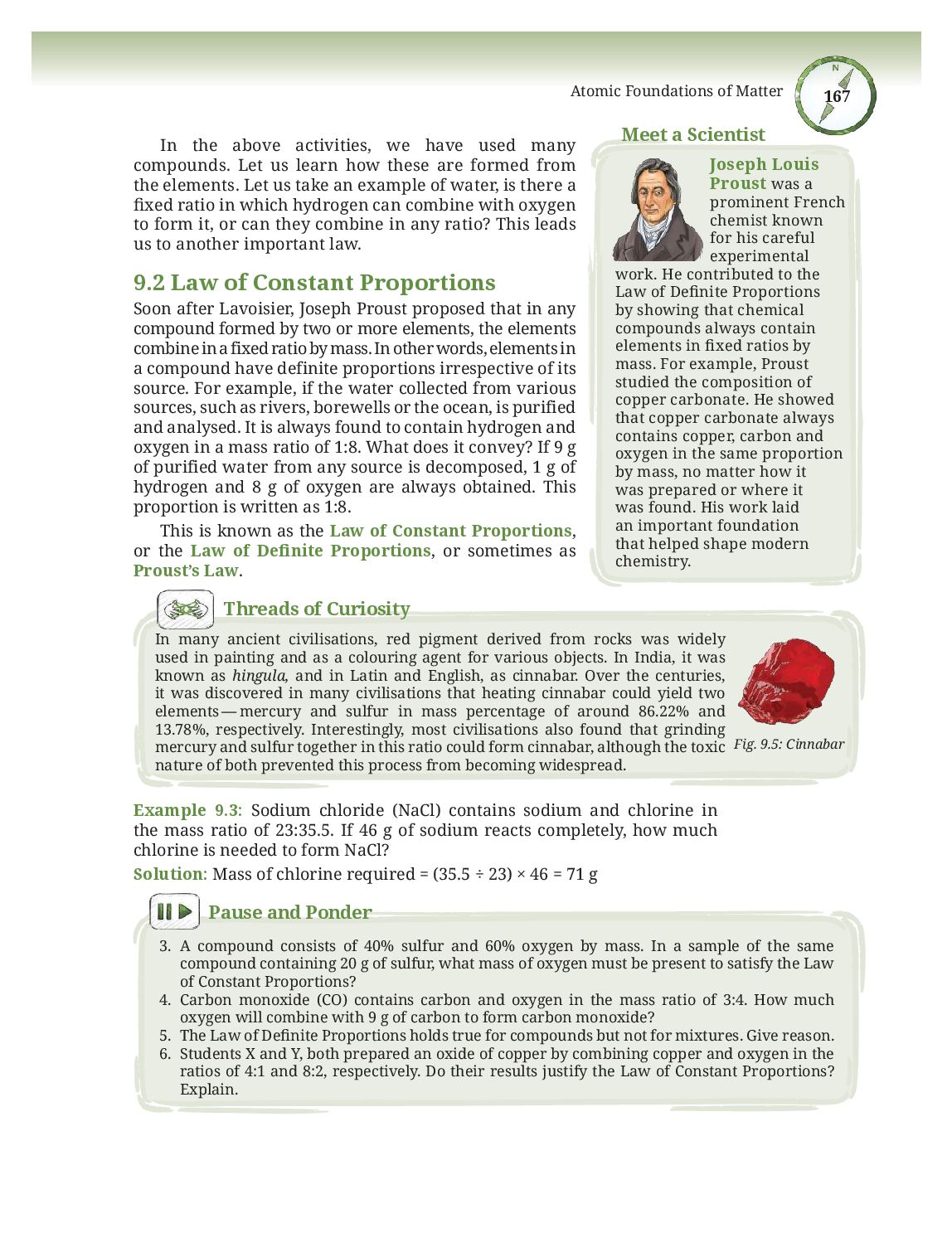
- Law of Constant Proportions (Proust): a compound always contains the same elements in the same fixed ratio by mass, whatever its source. Pure water from a river, a borewell or the ocean is always H : O = 1 : 8 by mass.
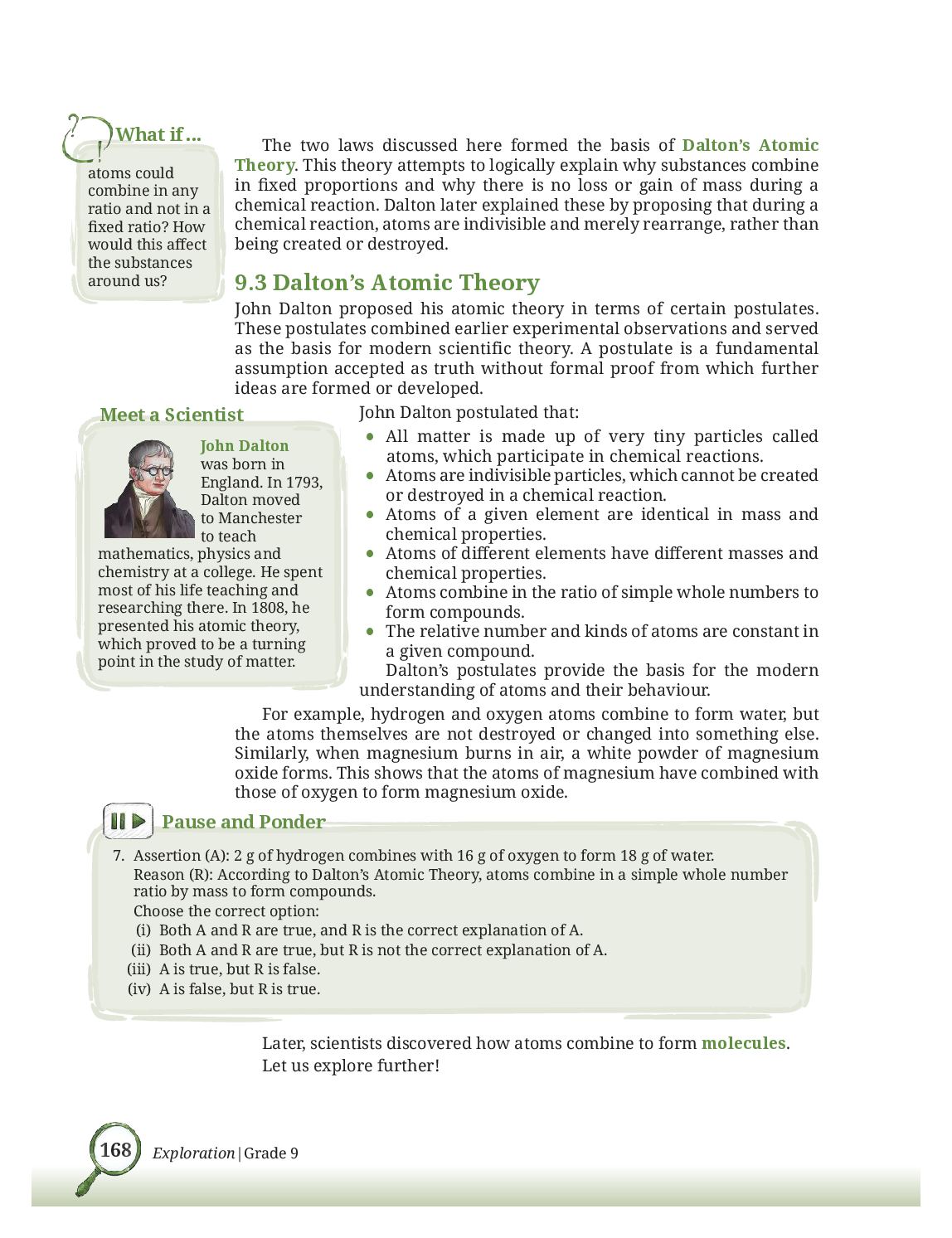
- Dalton’s atomic theory explains both laws with one picture — atoms are indivisible in a chemical reaction and merely rearrange, atoms of one element are identical in mass, and atoms combine in simple whole-number ratios.
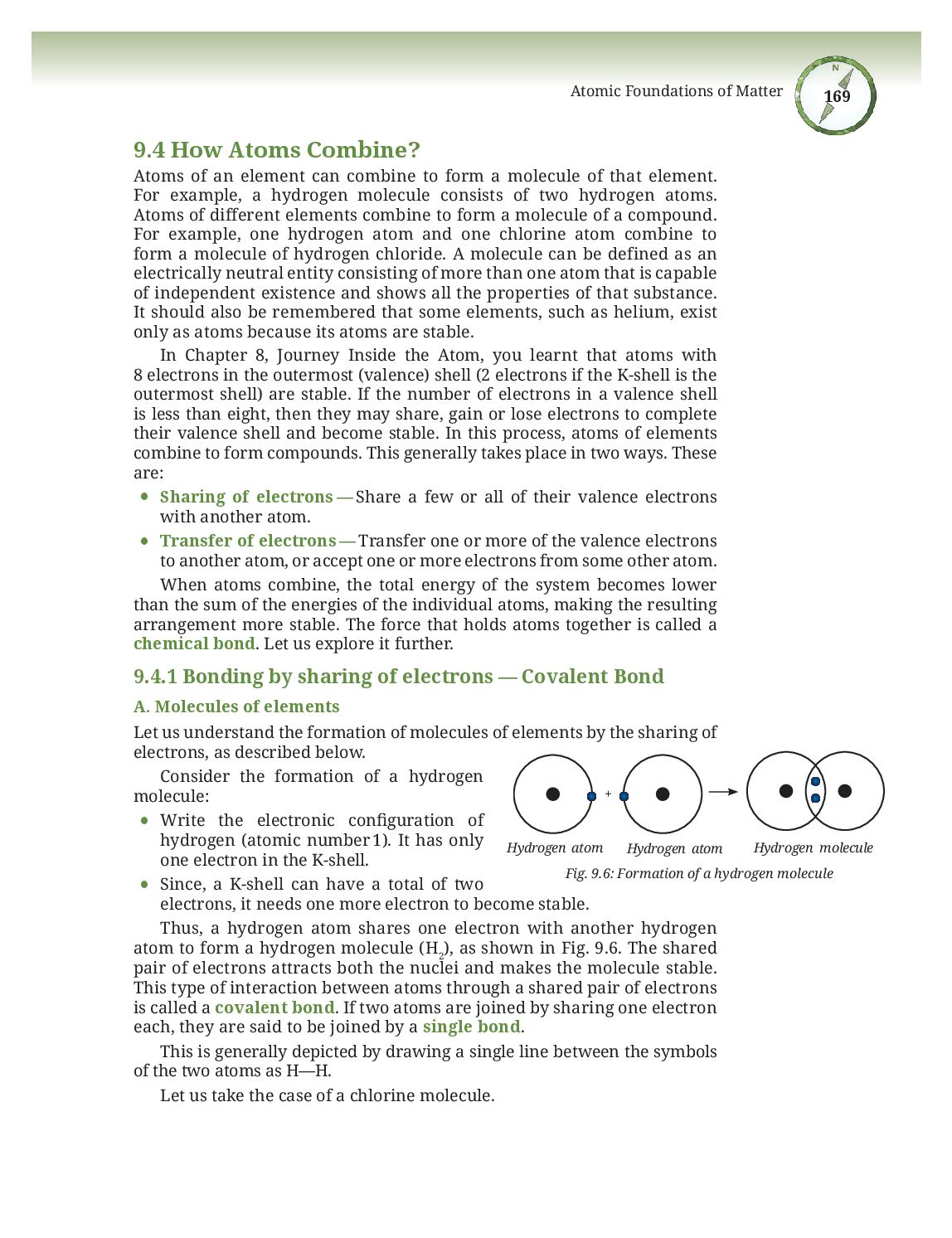
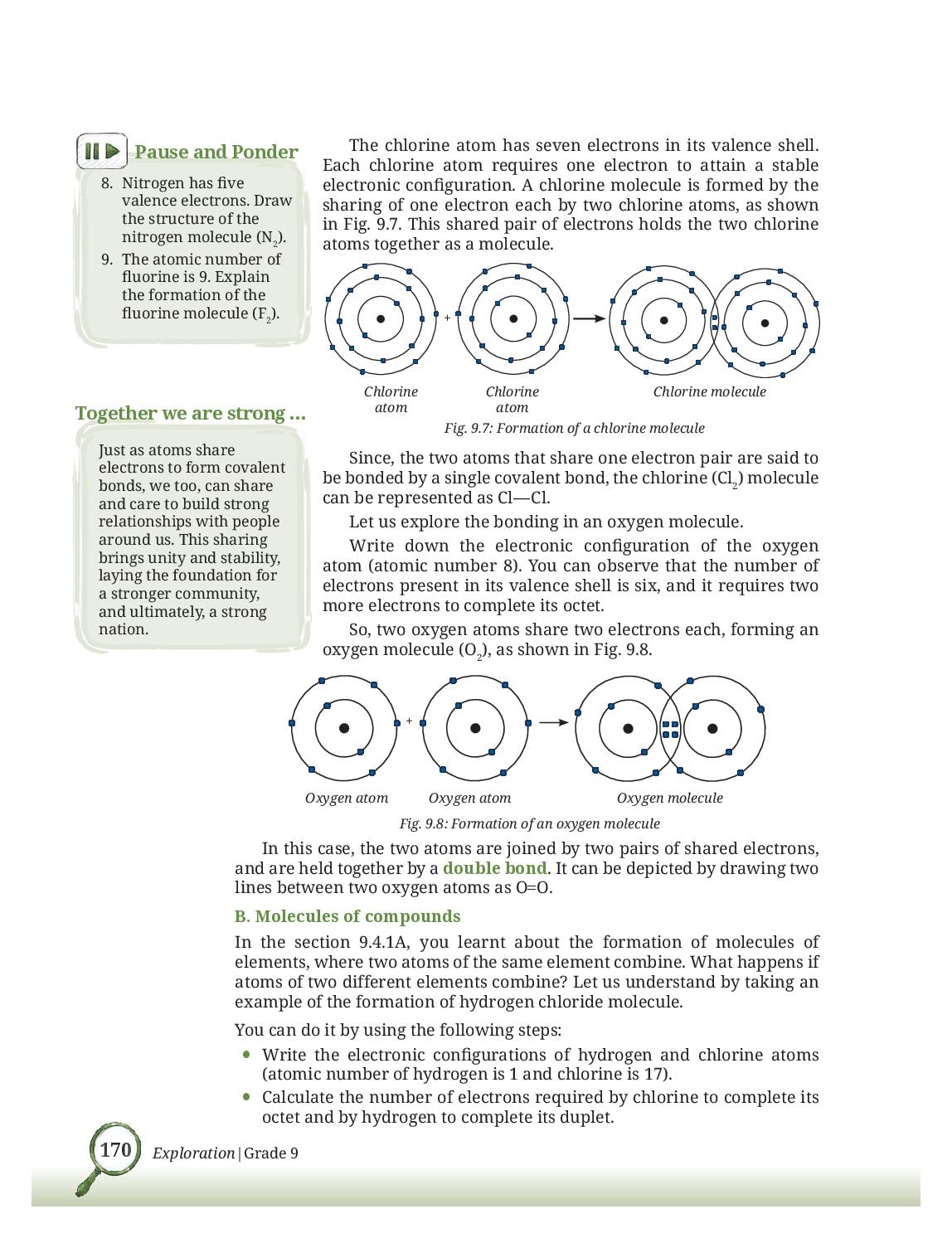
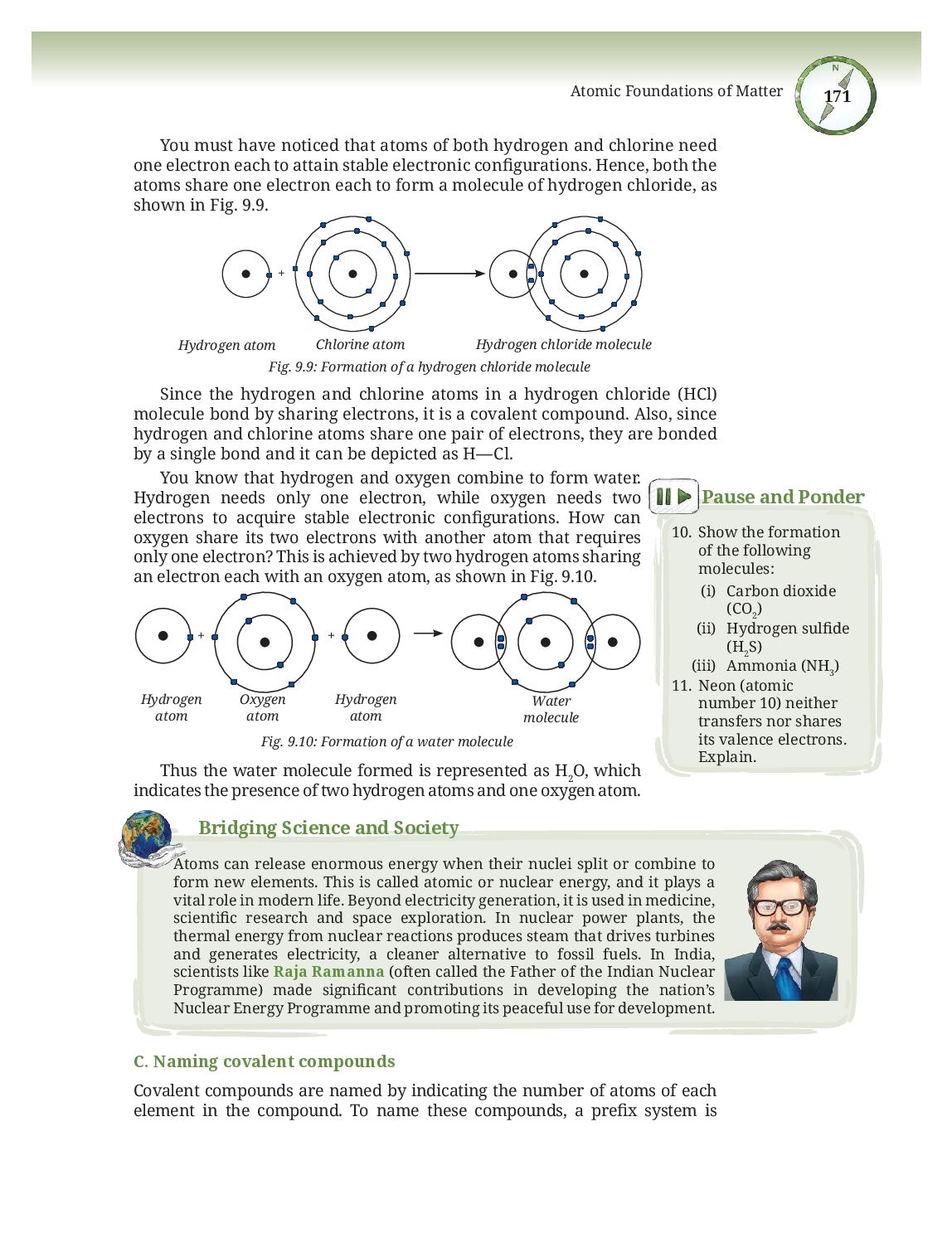
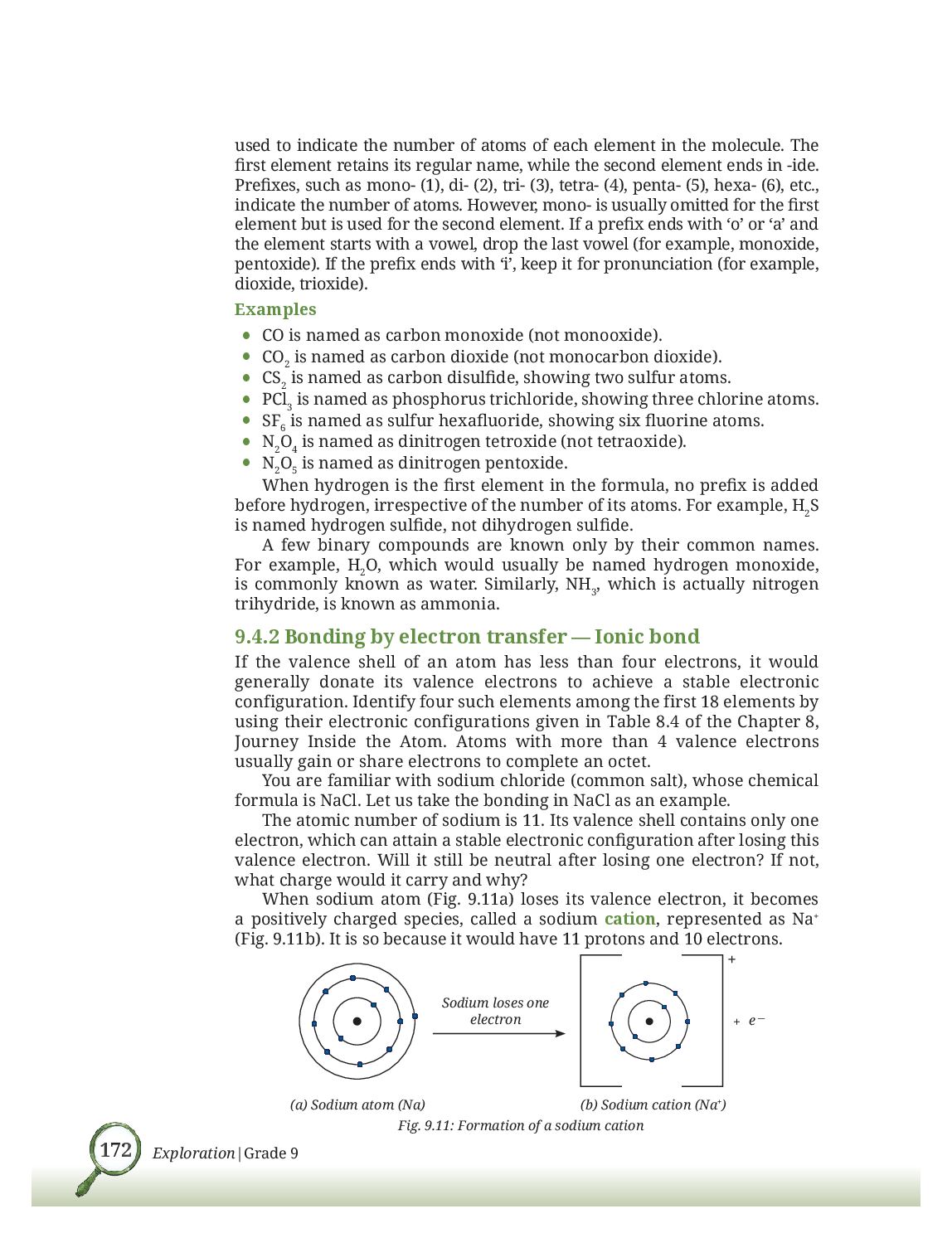
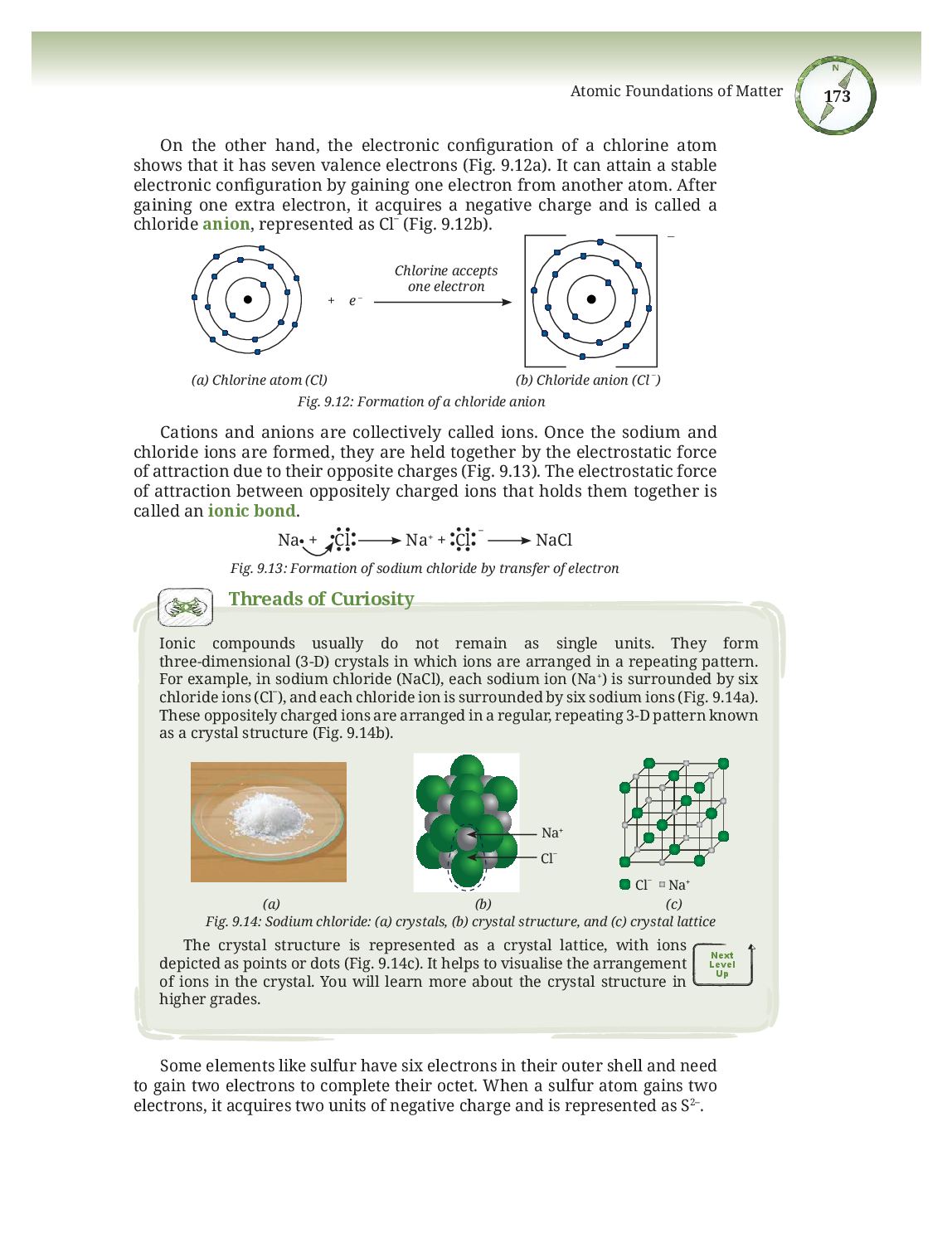
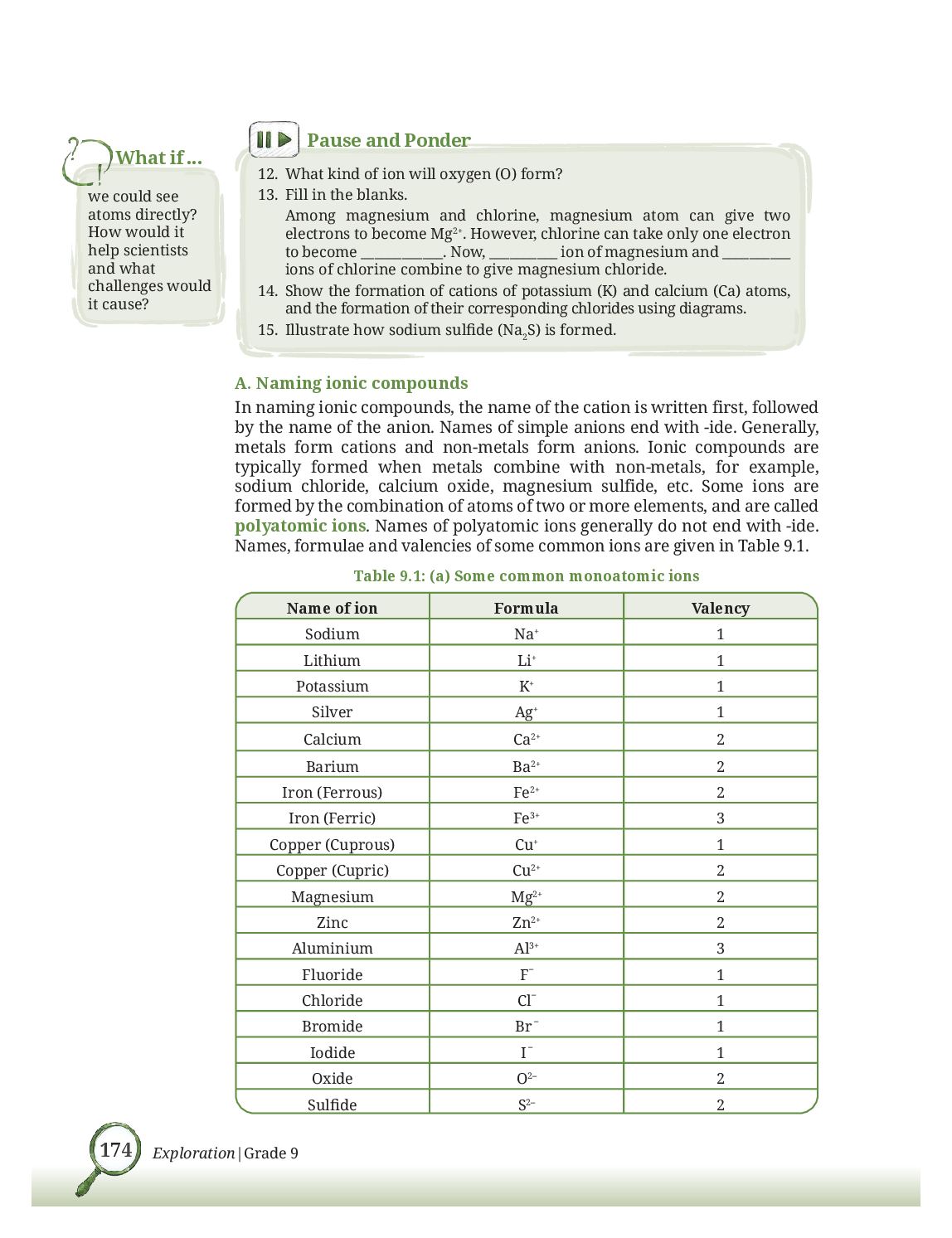
- Atoms combine to reach a stable octet (a duplet for the K-shell). They do it in two ways: by sharing electrons — a covalent bond (H—H, O=O, N≡N, H—Cl) — or by transferring them, giving a cation and an anion held by electrostatic attraction — an ionic bond (Na⁺Cl⁻).
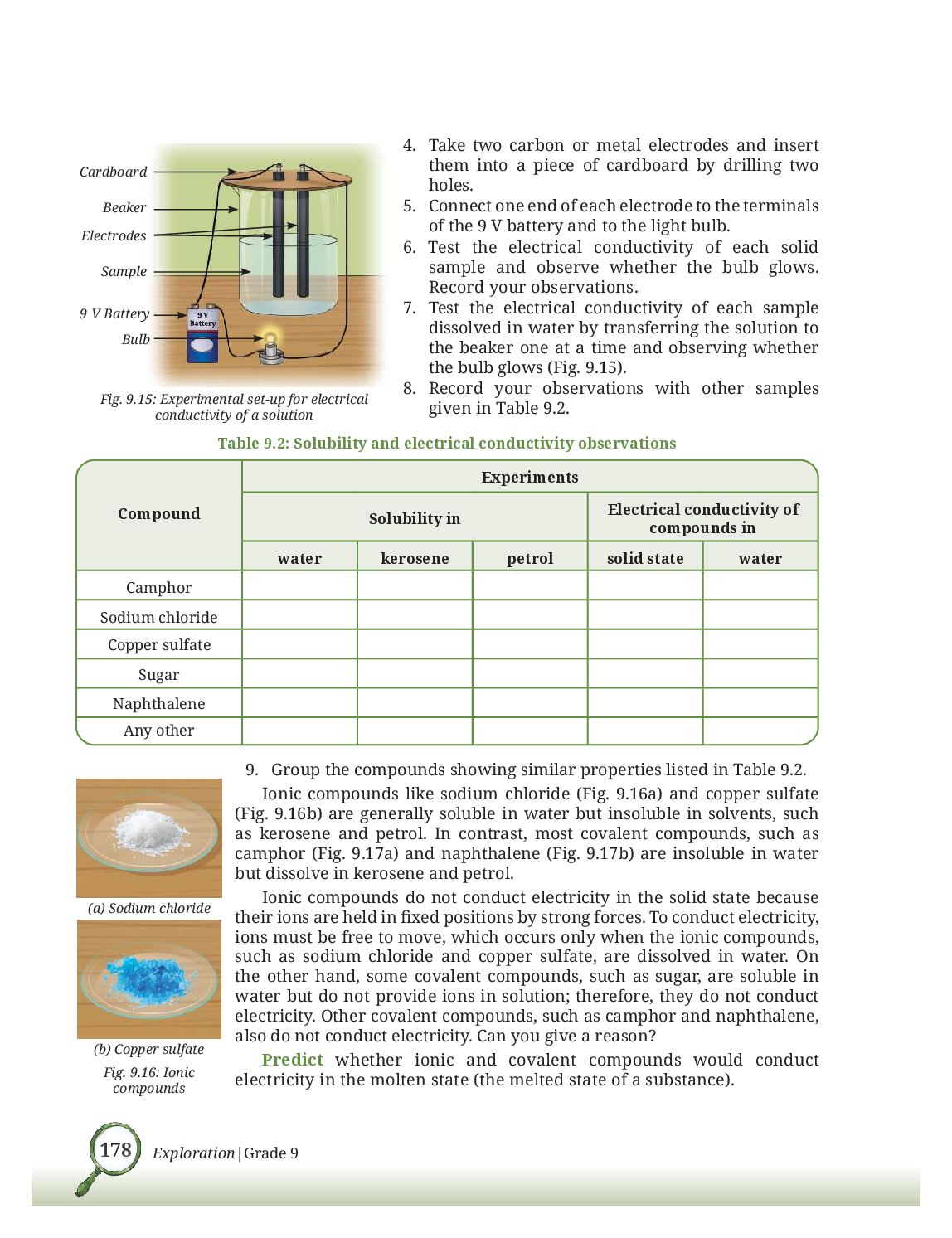
- Ionic solids are 3-D crystal lattices, not molecules; they are usually soluble in water, insoluble in kerosene and petrol, have high melting points, and conduct only when their ions are free to move (dissolved or molten). Covalent compounds are the reverse on nearly every count.
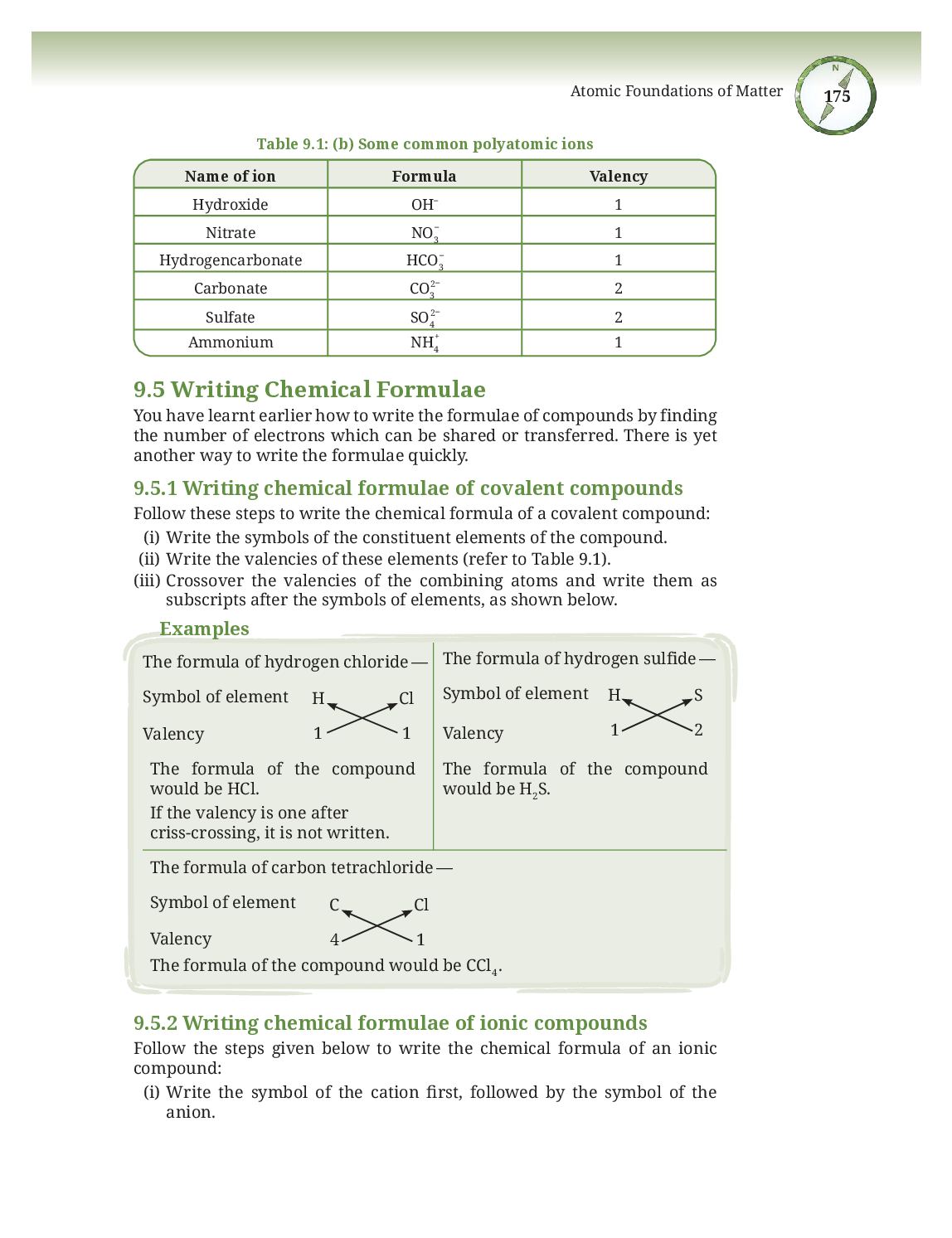
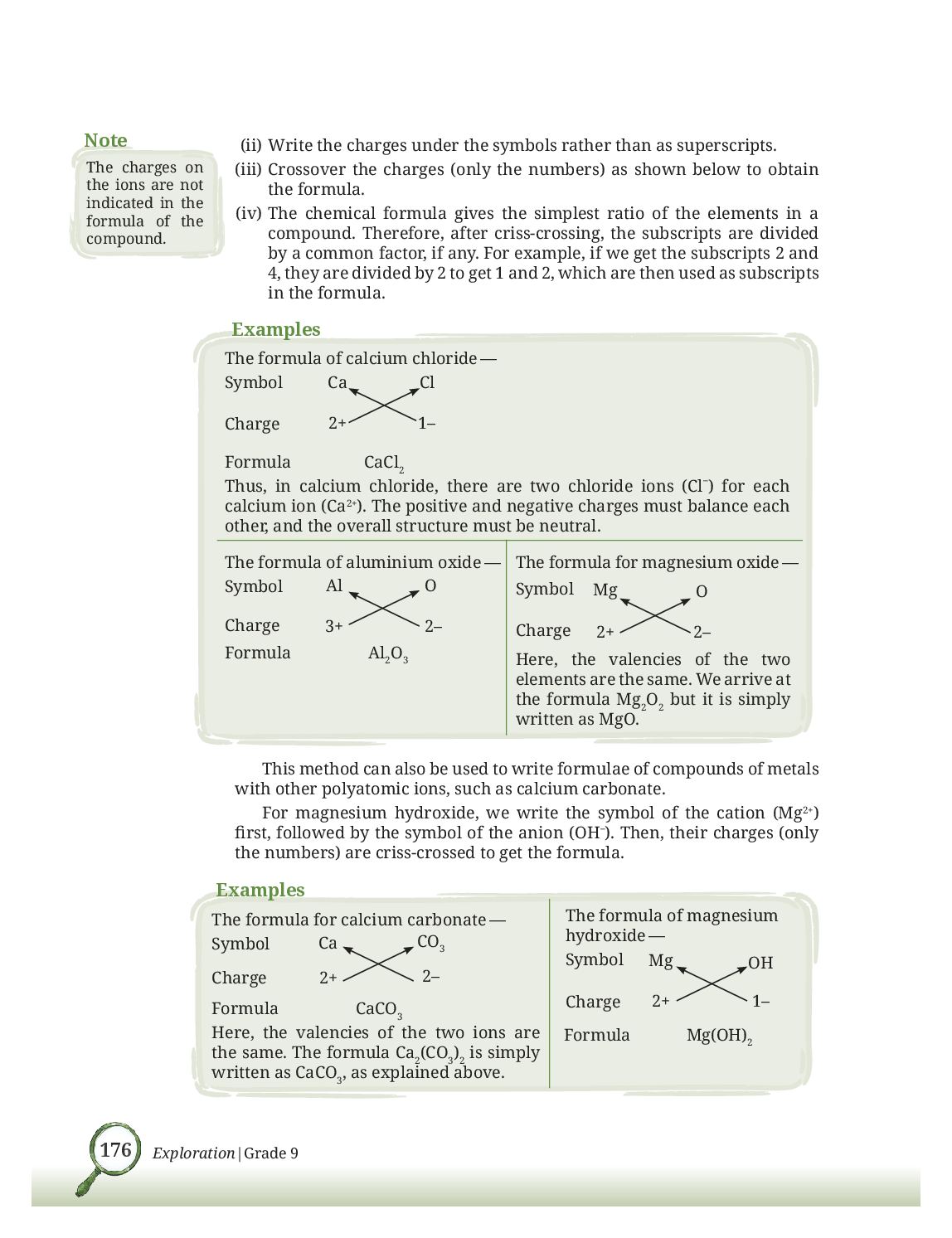
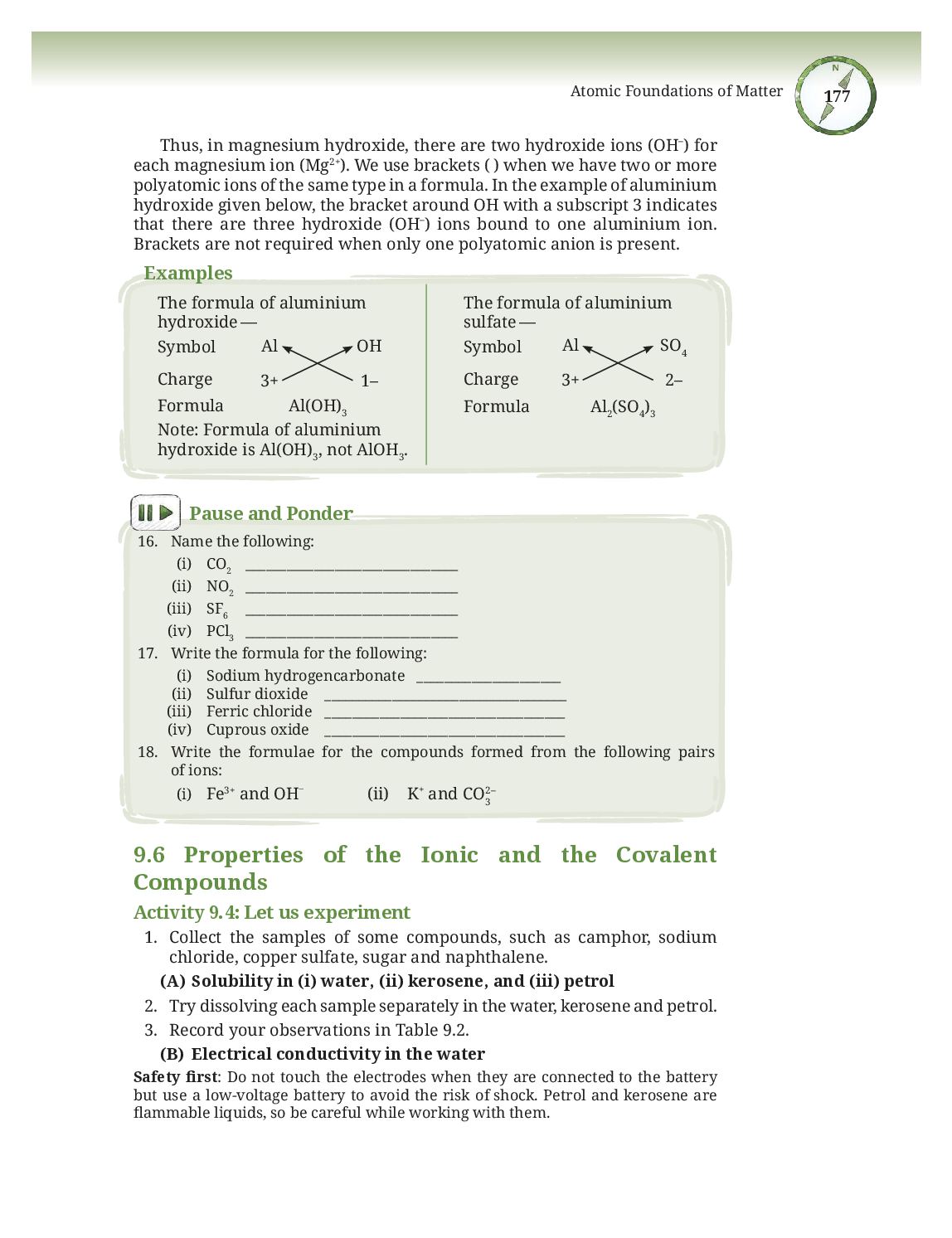
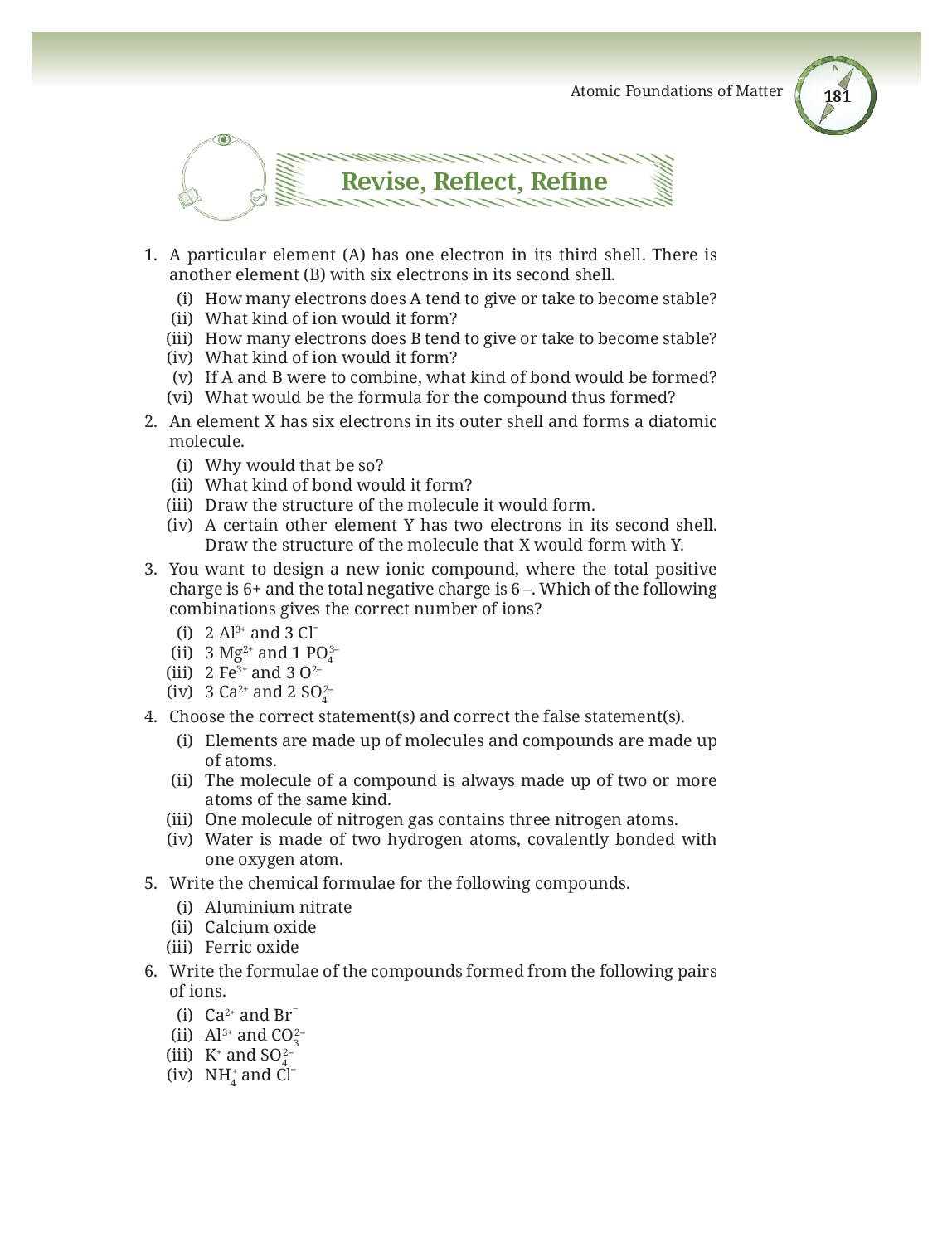
- A chemical formula is written by criss-crossing valencies or charges and then dividing by any common factor: Ca²⁺ + Cl⁻ → CaCl₂; Al³⁺ + O²⁻ → Al₂O₃; Mg²⁺ + OH⁻ → Mg(OH)₂.
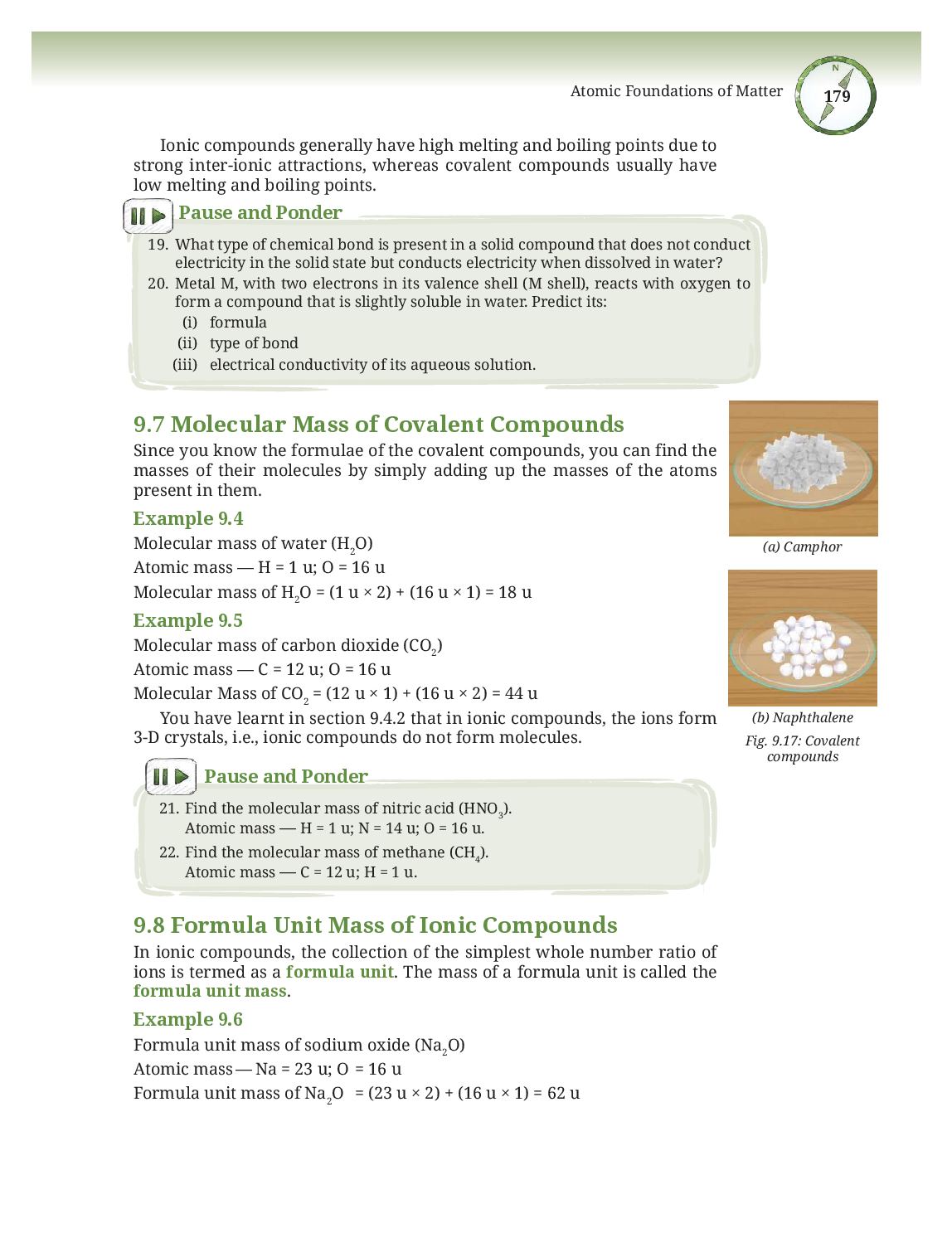
- Molecular mass (covalent compounds) and formula unit mass (ionic compounds) are both got by adding up the atomic masses of every atom in the formula: H₂O = 18 u, CO₂ = 44 u, Na₂O = 62 u, Ca(NO₃)₂ = 164 u.
Quick revision – Atomic Foundations of Matter
| Term | What it means | Worked example | Where it appears |
|---|---|---|---|
| Law of Conservation of Mass | Total mass of reactants = total mass of products in a chemical reaction | 4.0 g CaCO₃ + 2.92 g HCl → 1.76 g CO₂ + 0.72 g H₂O + 4.44 g CaCl₂; 6.92 g = 6.92 g | 9.1, Activity 9.2, Example 9.1 |
| Law of Constant Proportions | A compound has a fixed composition by mass, whatever its source | 9 g of pure water always gives 1 g H and 8 g O — ratio 1 : 8 | 9.2, Example 9.3 |
| Postulate | A basic assumption accepted without formal proof, from which further ideas are built | “Atoms are indivisible particles” — Dalton | 9.3 Dalton’s Atomic Theory |
| Molecule | Electrically neutral entity of more than one atom that can exist independently and shows all the properties of the substance | H₂, Cl₂, O₂, HCl, H₂O | 9.4 |
| Covalent bond | Bond formed by a shared pair of electrons between two atoms | H—H (single), O=O (double), N≡N (triple) | 9.4.1 |
| Ionic bond | Electrostatic force of attraction between oppositely charged ions formed by electron transfer | Na → Na⁺ + e⁻; Cl + e⁻ → Cl⁻; Na⁺Cl⁻ | 9.4.2 |
| Cation / anion | Positive ion (lost electrons) / negative ion (gained electrons) | Na⁺ (11 p⁺, 10 e⁻); Cl⁻ (17 p⁺, 18 e⁻); S²⁻ | 9.4.2, Table 9.1 |
| Polyatomic ion | An ion made of atoms of two or more elements | OH⁻, NO₃⁻, HCO₃⁻, CO₃²⁻, SO₄²⁻, NH₄⁺ | Table 9.1 (b) |
| Criss-cross method | Swap the valencies (or charge numbers) and write them as subscripts; then divide by any common factor | Al³⁺, O²⁻ → Al₂O₃; Mg²⁺, O²⁻ → Mg₂O₂ = MgO | 9.5 |
| Prefix naming (covalent) | Mono-, di-, tri-, tetra-, penta-, hexa- show how many atoms; second element ends in -ide | CO carbon monoxide, PCl₃ phosphorus trichloride, SF₆ sulfur hexafluoride | 9.4.1 C |
| Crystal lattice | Regular repeating 3-D arrangement of ions in an ionic solid | In NaCl each Na⁺ is surrounded by 6 Cl⁻ and each Cl⁻ by 6 Na⁺ | Threads of Curiosity, p. 173 |
| Molecular mass | Sum of the atomic masses of all atoms in one molecule | CO₂ = (12 u × 1) + (16 u × 2) = 44 u | 9.7 |
| Formula unit mass | Sum of the atomic masses of all atoms in one formula unit of an ionic compound | Na₂O = (23 u × 2) + (16 u × 1) = 62 u | 9.8 |
Old NCERT vs New – Class 9 Science
This chapter is from Exploration, the new NCERT Class 9 Science book (NCF-SE 2023, used from 2026-27). It replaced the old book “Science”, so chapter numbers and names differ from older PDFs.
Solutions and All Chapters
Answers to the exercises and the full chapter list of Exploration:
Atomic Foundations of Matter – Overview
| Class | Class 9 |
| Subject | Science |
| Book | Exploration – new NCERT book |
| Chapter | 9 of 13 – Atomic Foundations of Matter |
| Book pages | 162 – 183 |
| Edition | Latest NCERT edition (2026-27) |
| Session | 2026-27 |
| Free – read online or download |
Class 9 Science Chapter 9 – FAQs
Where can I download Atomic Foundations of Matter Class 9 PDF?
From the download table on this page – the chapter PDF is free, and the full book is linked too.
What is Class 9 Science Chapter 9 about?
Law of Conservation of Mass (Lavoisier, 1789): in a chemical reaction matter is neither created nor destroyed, so the total mass of the reactants equals the total mass of the products. It only looks violated in an open vessel, because a gaseous product walks off the balance pan.
Is Atomic Foundations of Matter from the new NCERT Class 9 Science book?
Yes. It is chapter 9 of exploration, the new NCERT Class 9 Science book for 2026-27.
Is this the latest NCERT edition for 2026-27?
Yes – the PDF is NCERT’s latest edition for the 2026-27 session.
Where are the NCERT Solutions for Class 9 Science Chapter 9?
Open the NCERT Solutions link above for answers to the exercise questions.