Download How Forces Affect Motion – NCERT Class 9 Science Chapter 6 PDF from the new NCERT Class 9 Science book Exploration (2026-27). Read the chapter online or download the free PDF. A force has magnitude and direction. Its SI unit is the newton (N), measured with a spring balance. One newton is the force that gives a 1 kg object an acceleration of 1 m s–2.
How Forces Affect Motion PDF – Chapter 6 of Exploration
Read the chapter online or download the PDF.
| Chapter | Download | |
|---|---|---|
| Chapter 6 PDF | How Forces Affect Motion | View PDF |
| Full book | NCERT Class 9 Science – Exploration | View Book |
Read Online
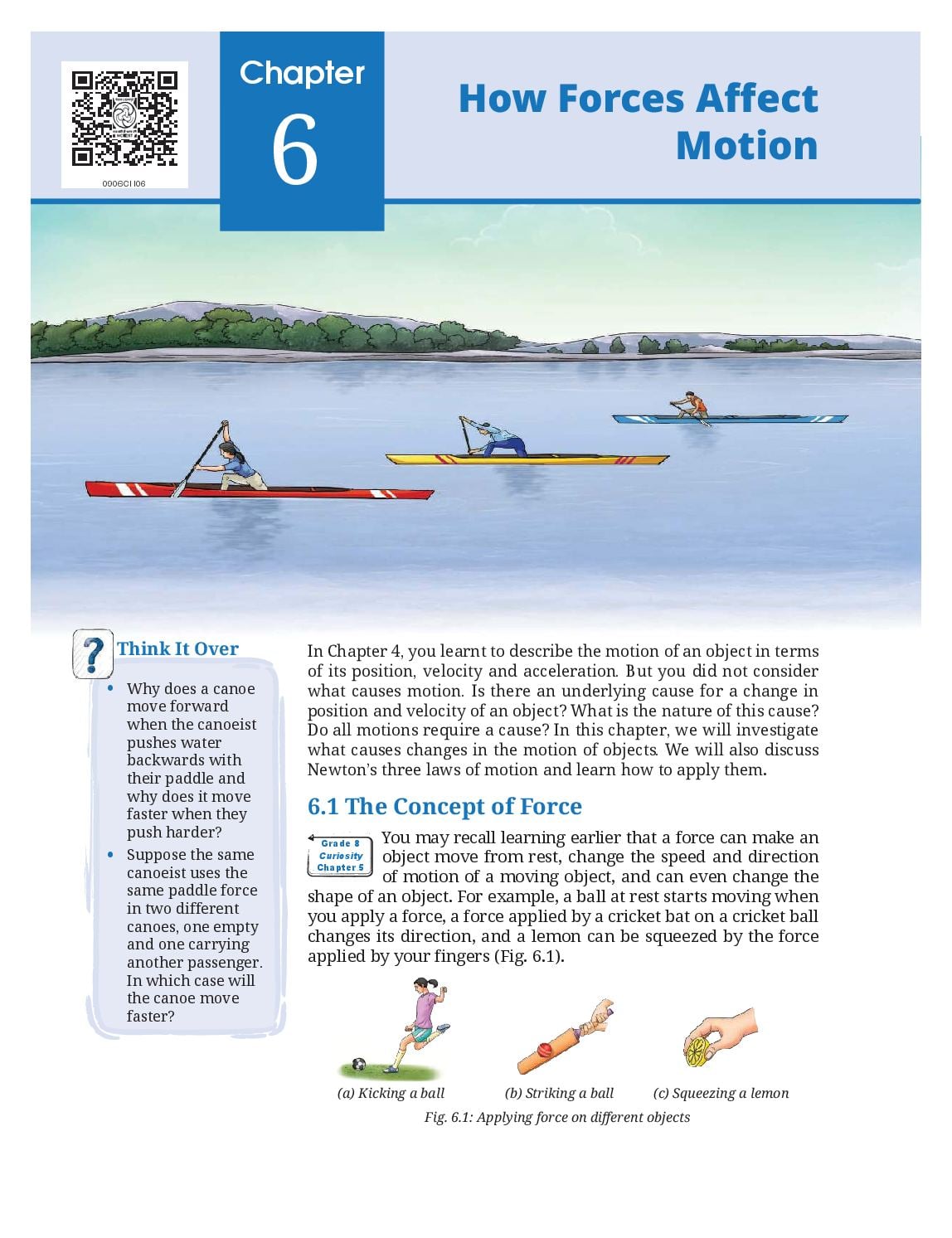
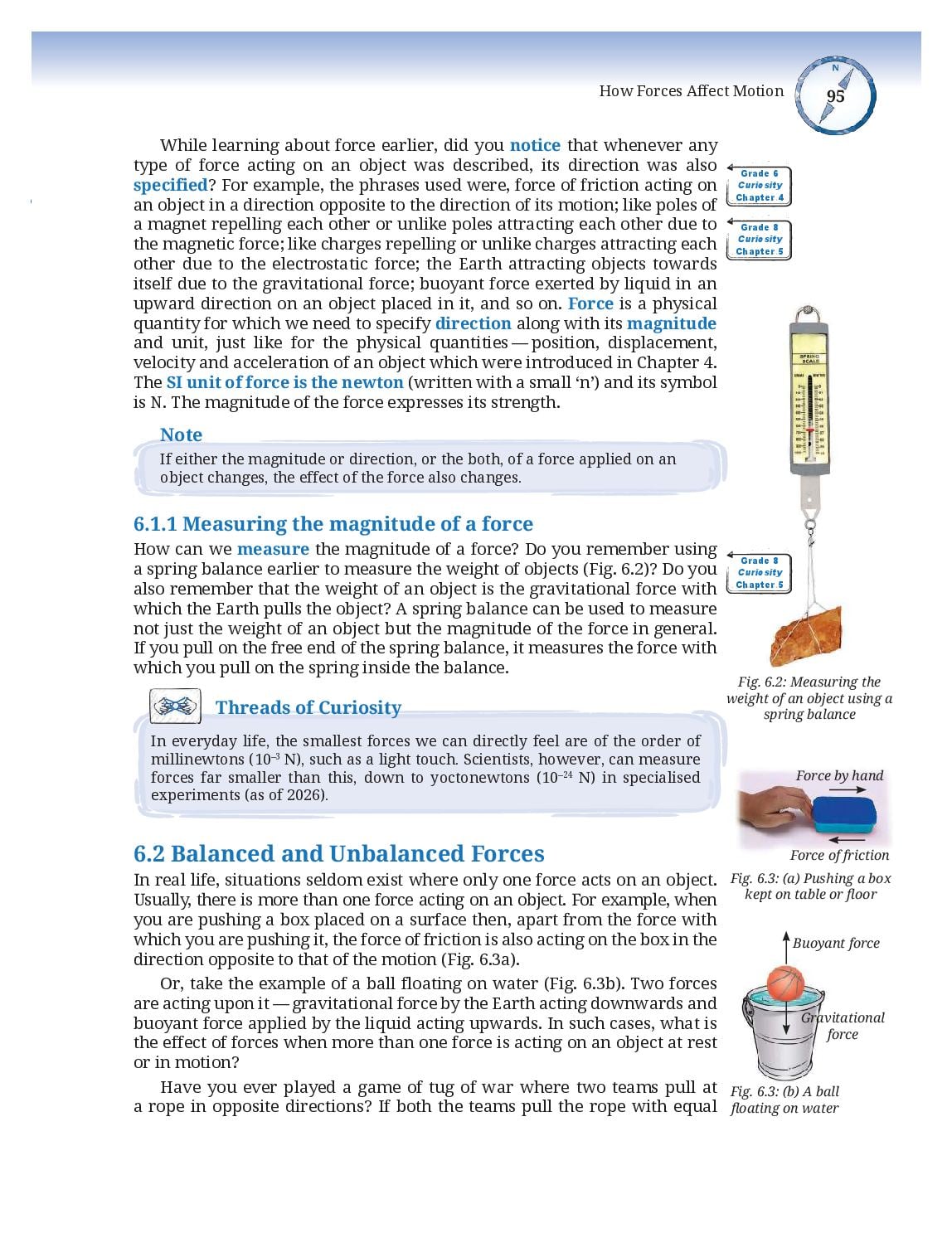
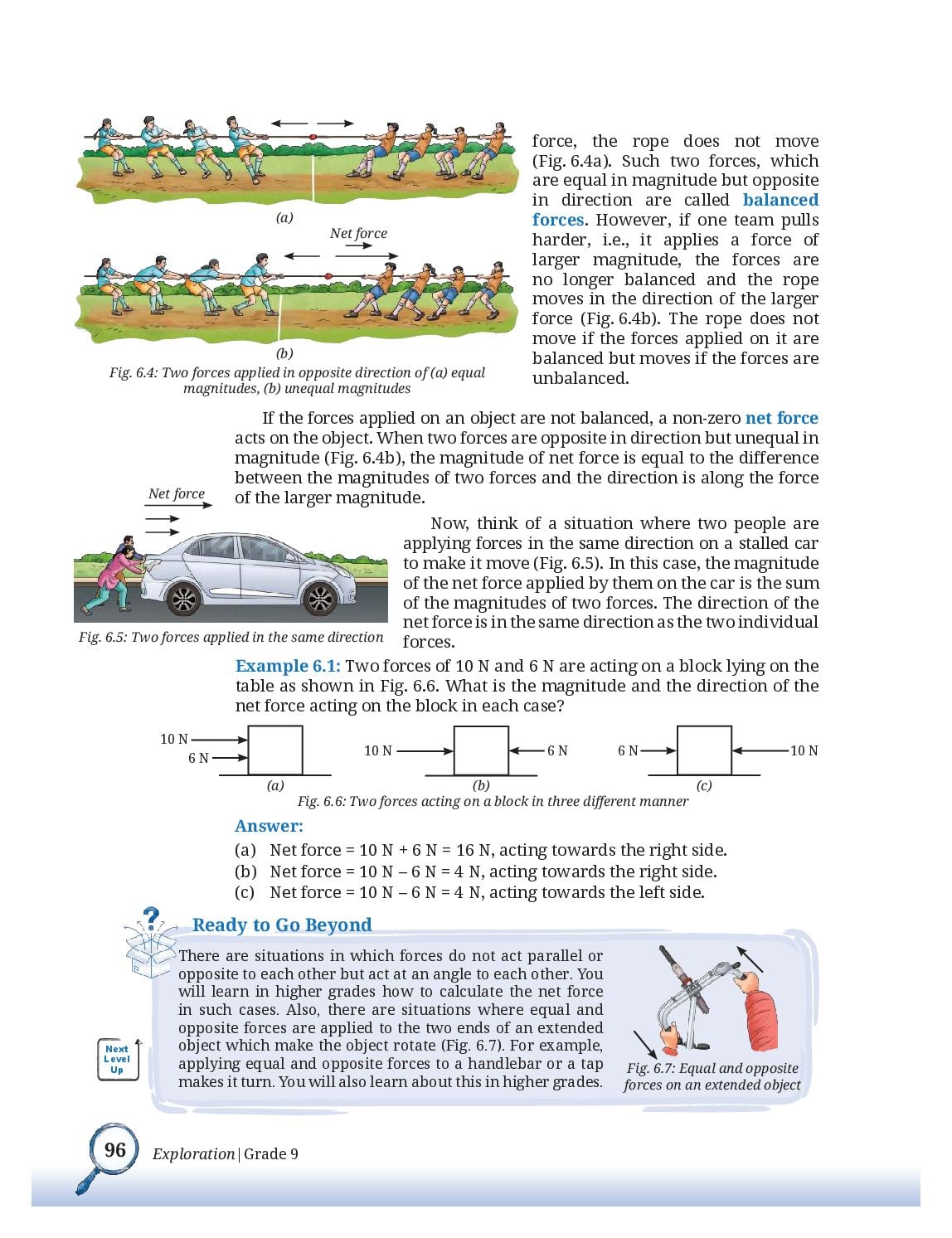
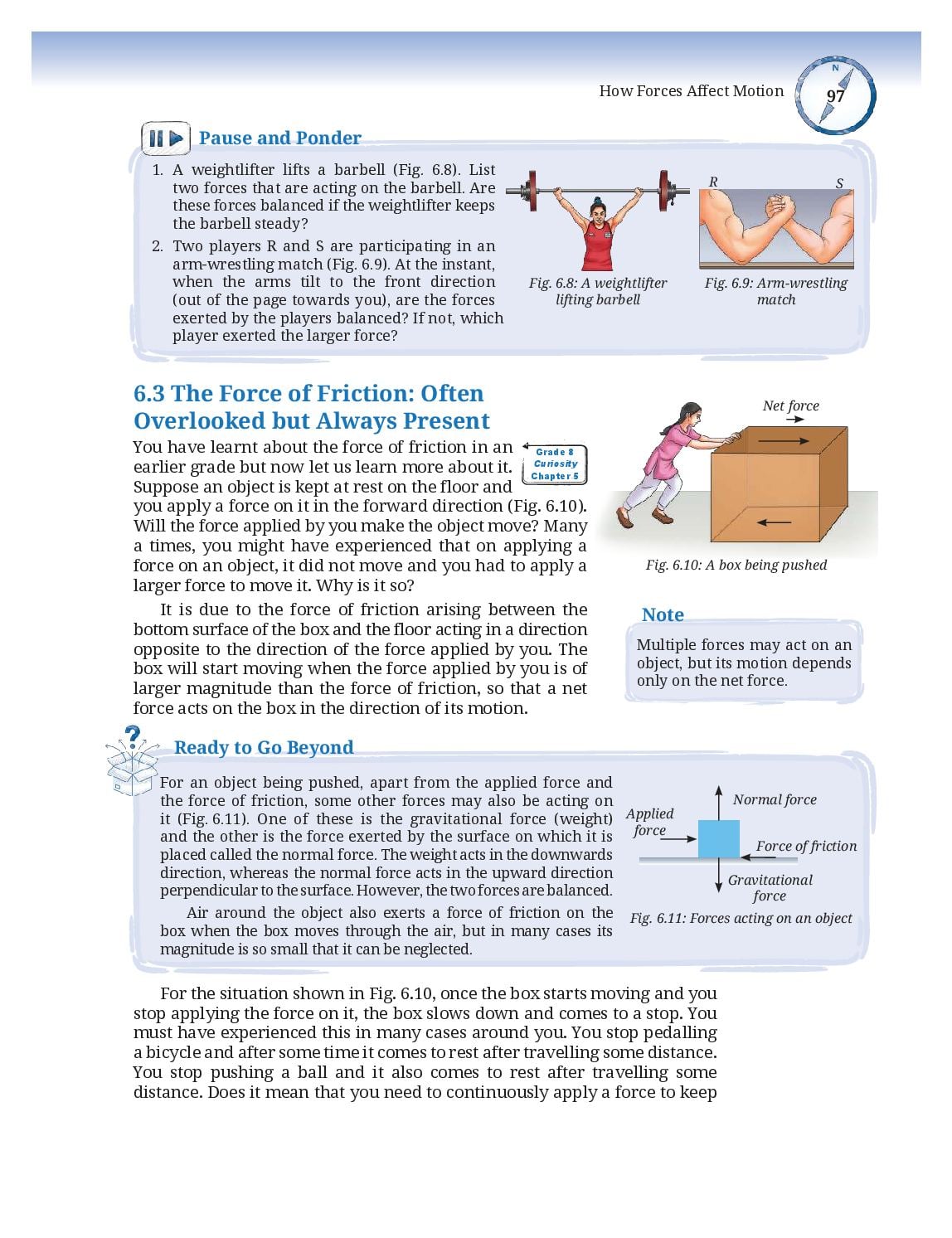
What Is in How Forces Affect Motion? (Class 9 Science Chapter 6)
- A force has magnitude and direction. Its SI unit is the newton (N), measured with a spring balance. One newton is the force that gives a 1 kg object an acceleration of 1 m s–2.
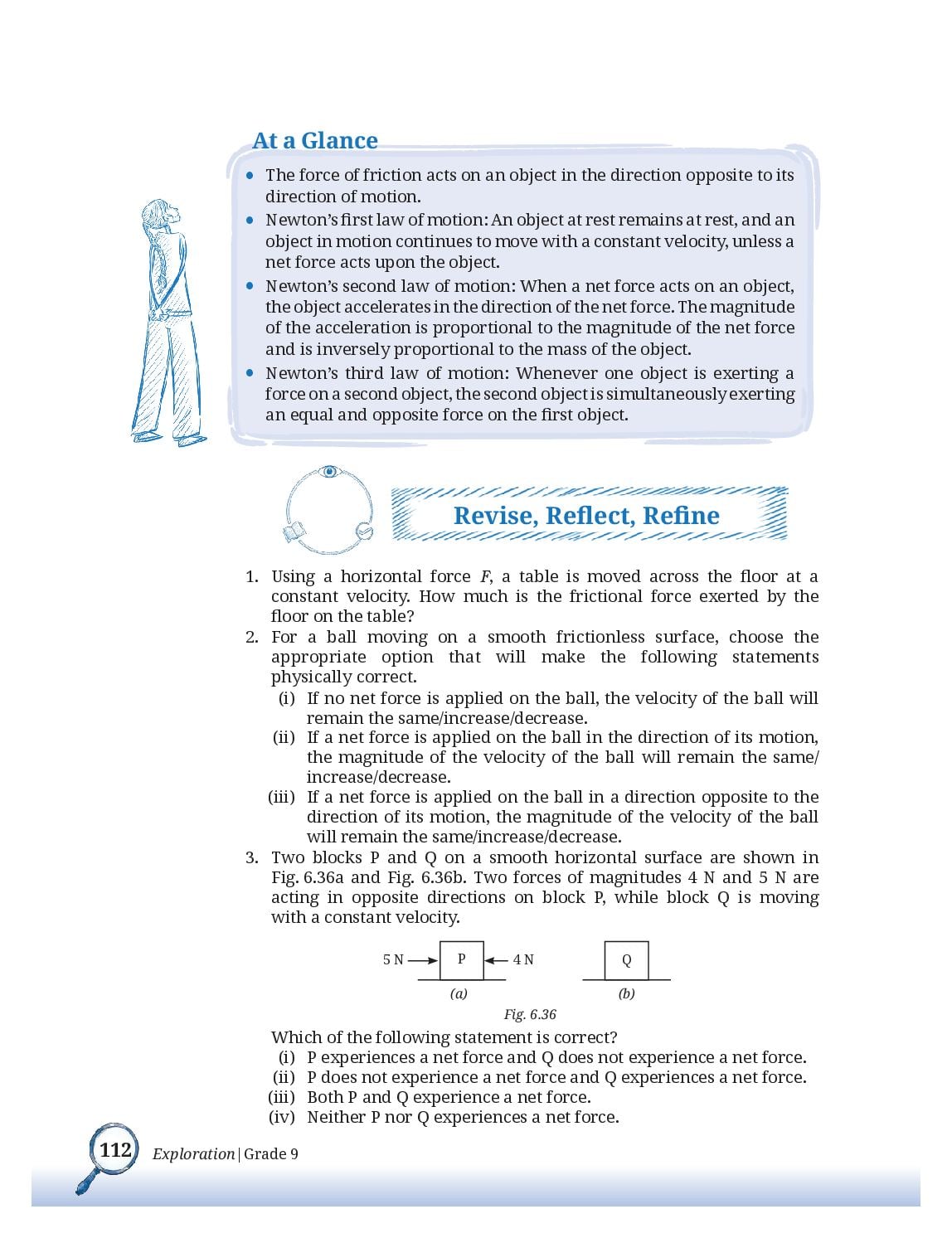
- Forces equal in magnitude and opposite in direction are balanced; the net force is zero. Unbalanced forces give a non-zero net force — added when the forces point the same way, subtracted when they oppose. Motion depends only on the net force.
- Friction always acts opposite to the direction of motion (or attempted motion). It depends on the nature of the surfaces in contact. Without it, a moving object would never slow down on its own.
- Newton’s first law: an object at rest stays at rest and an object in motion keeps moving with constant velocity unless a net force acts on it. Zero net force means zero acceleration — never ‘zero velocity’.
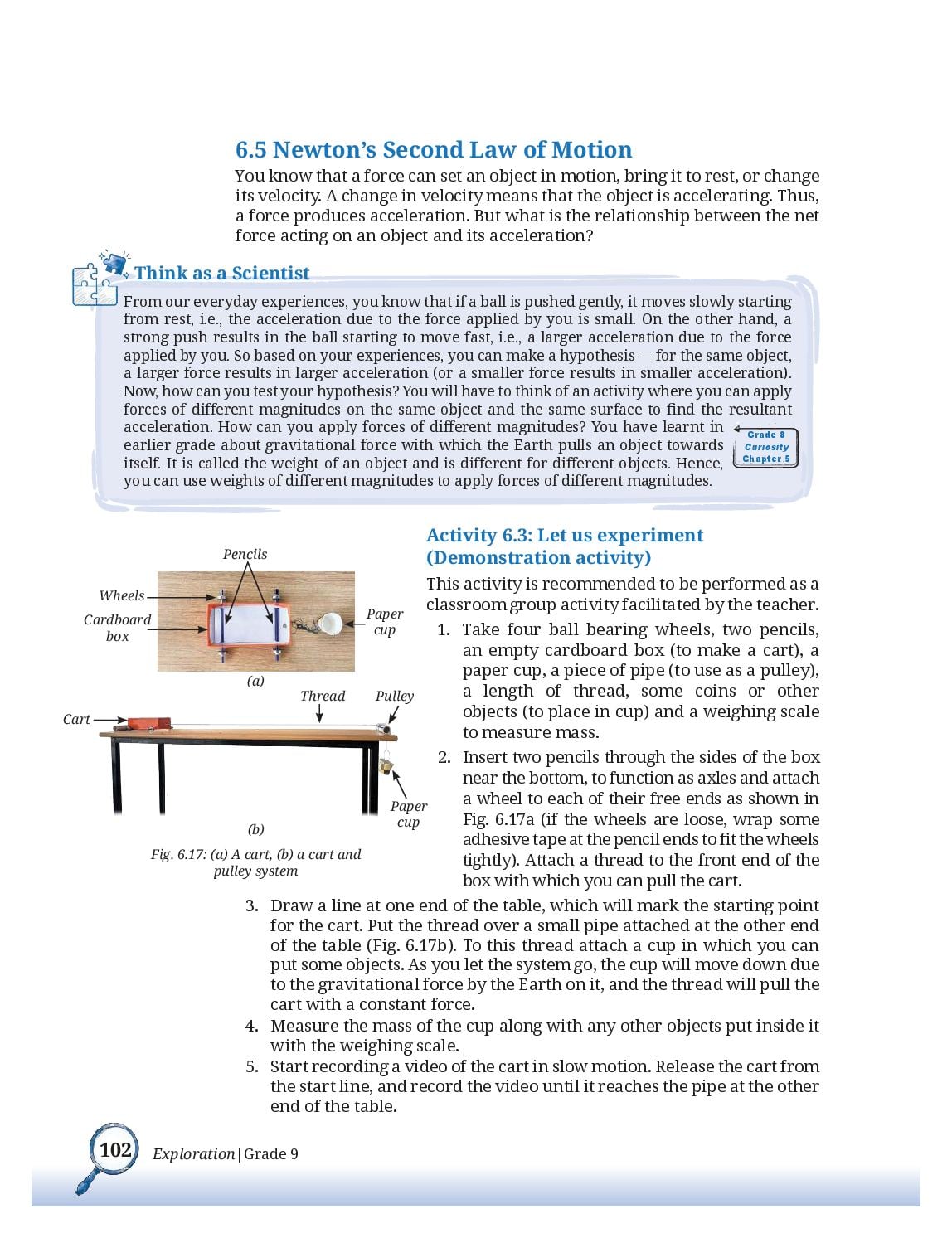
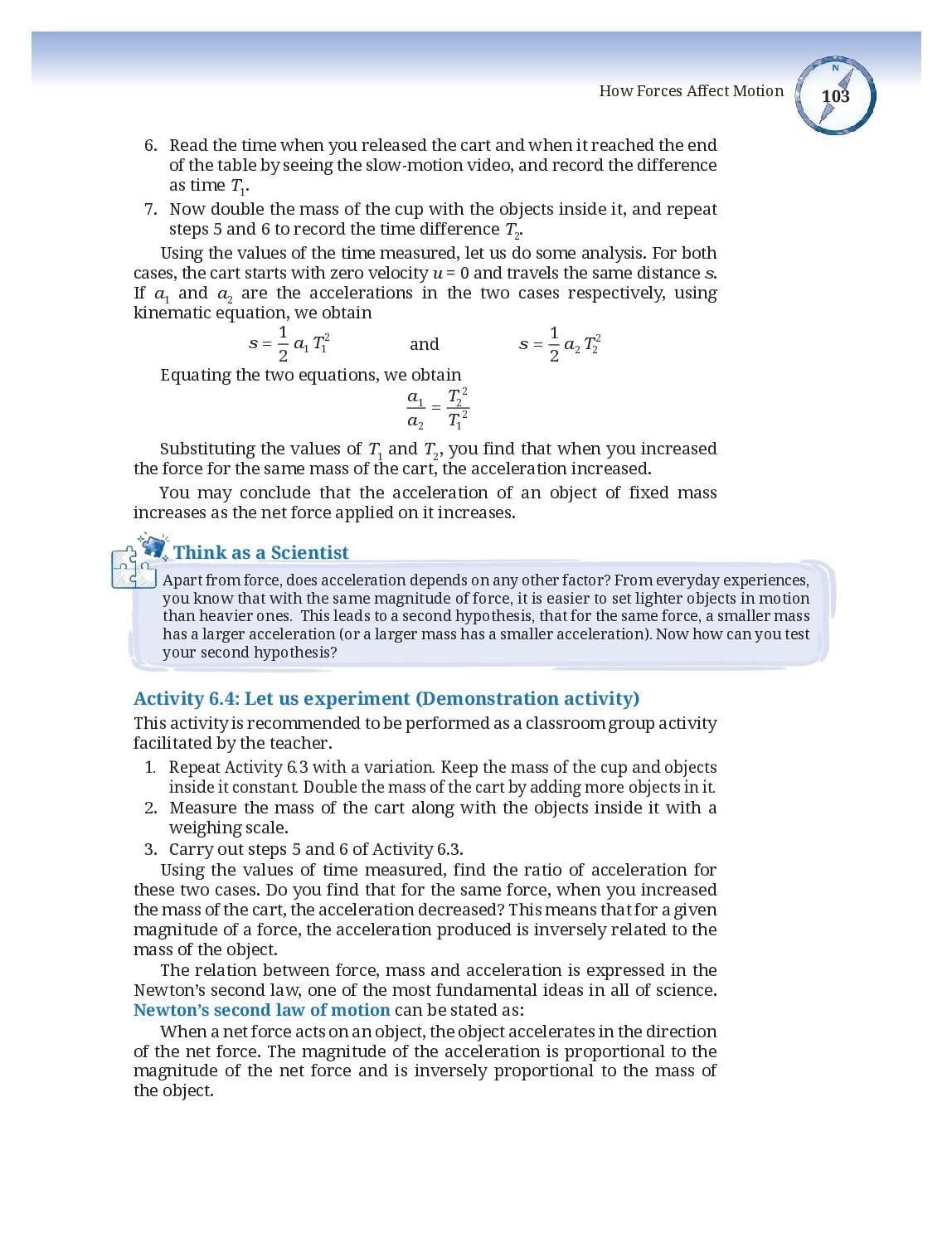
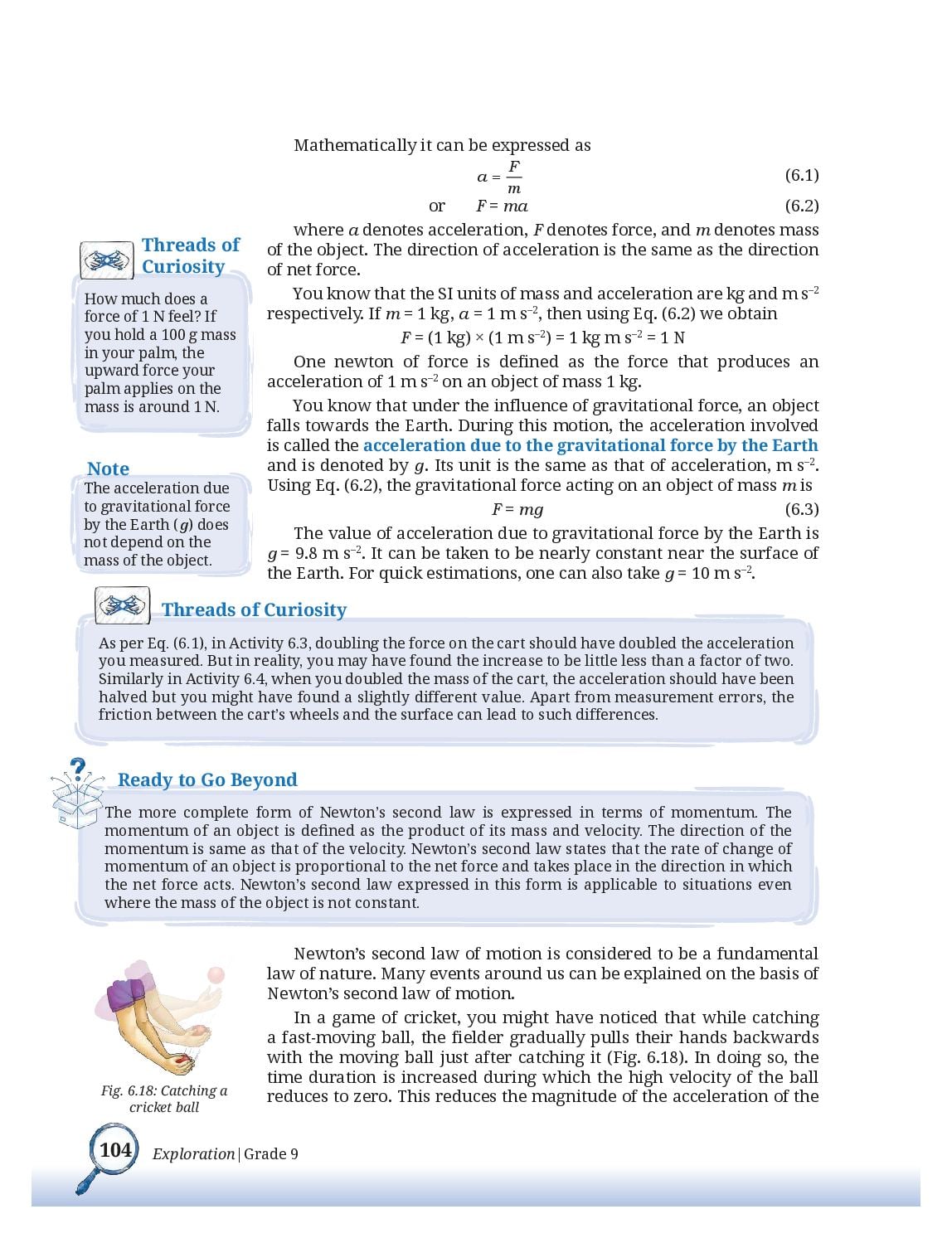
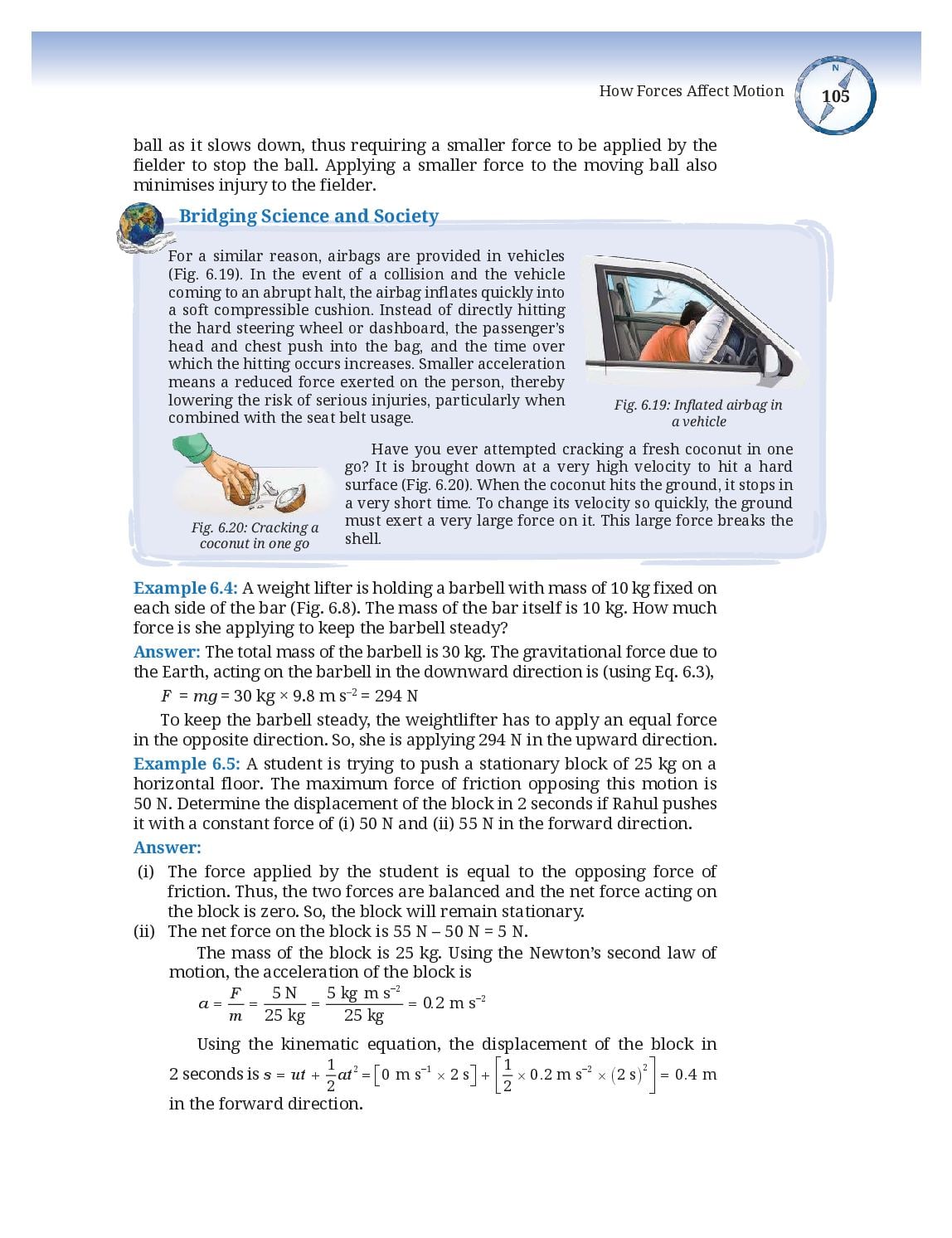
- Newton’s second law: a = F/m, or F = ma. Acceleration is along the net force, proportional to it, and inversely proportional to mass. The weight of an object is F = mg, with g = 9.8 m s–2 near the Earth’s surface.
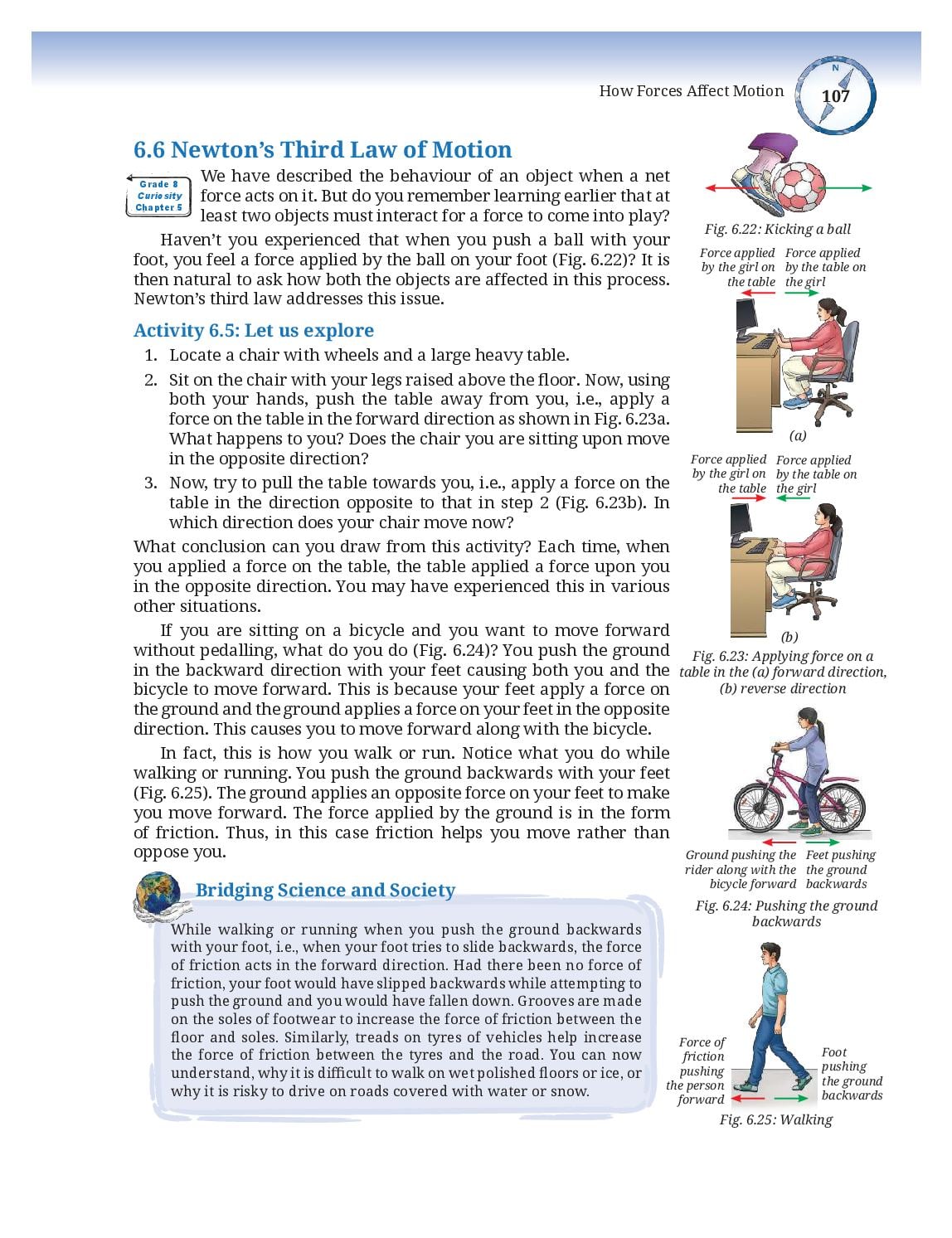
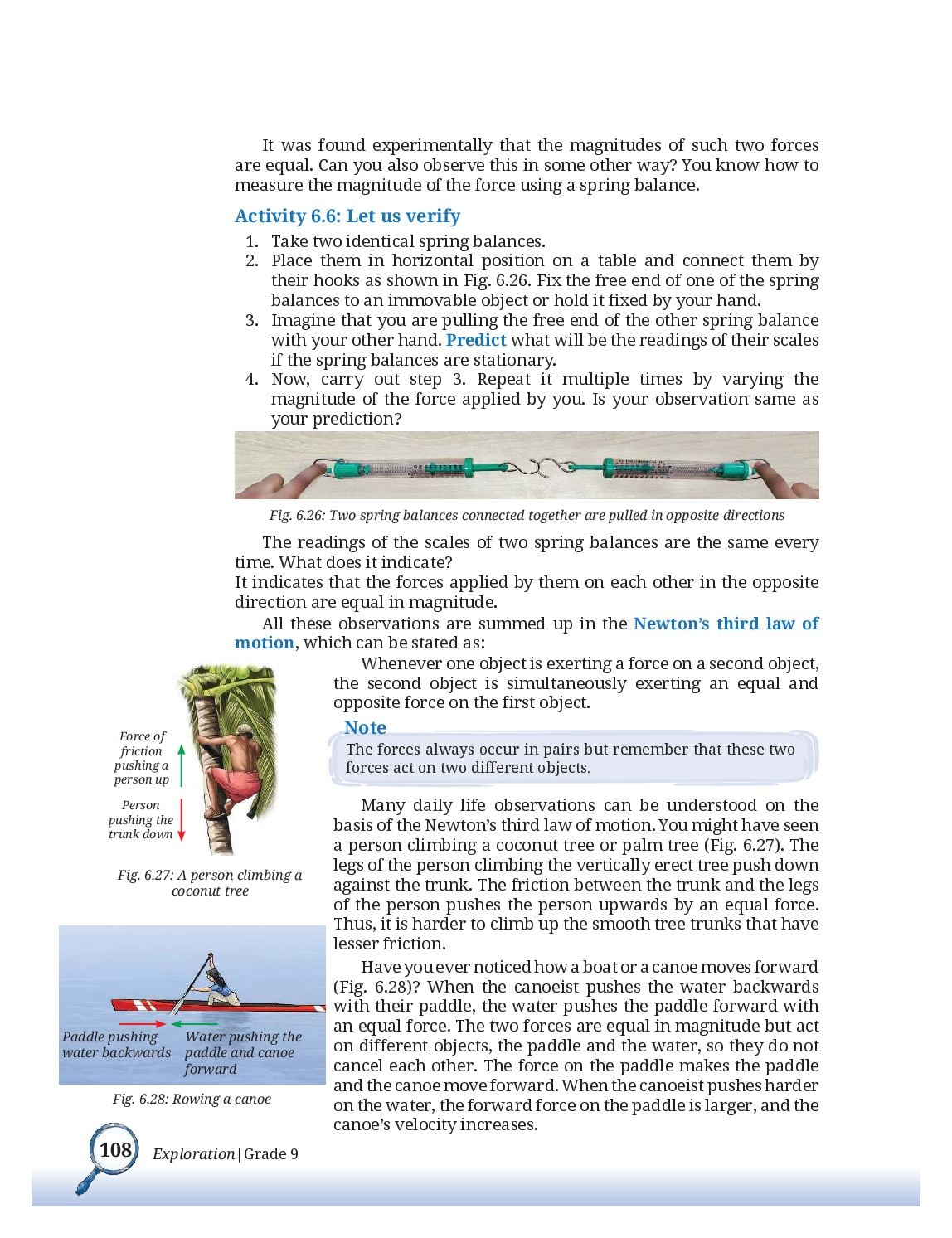
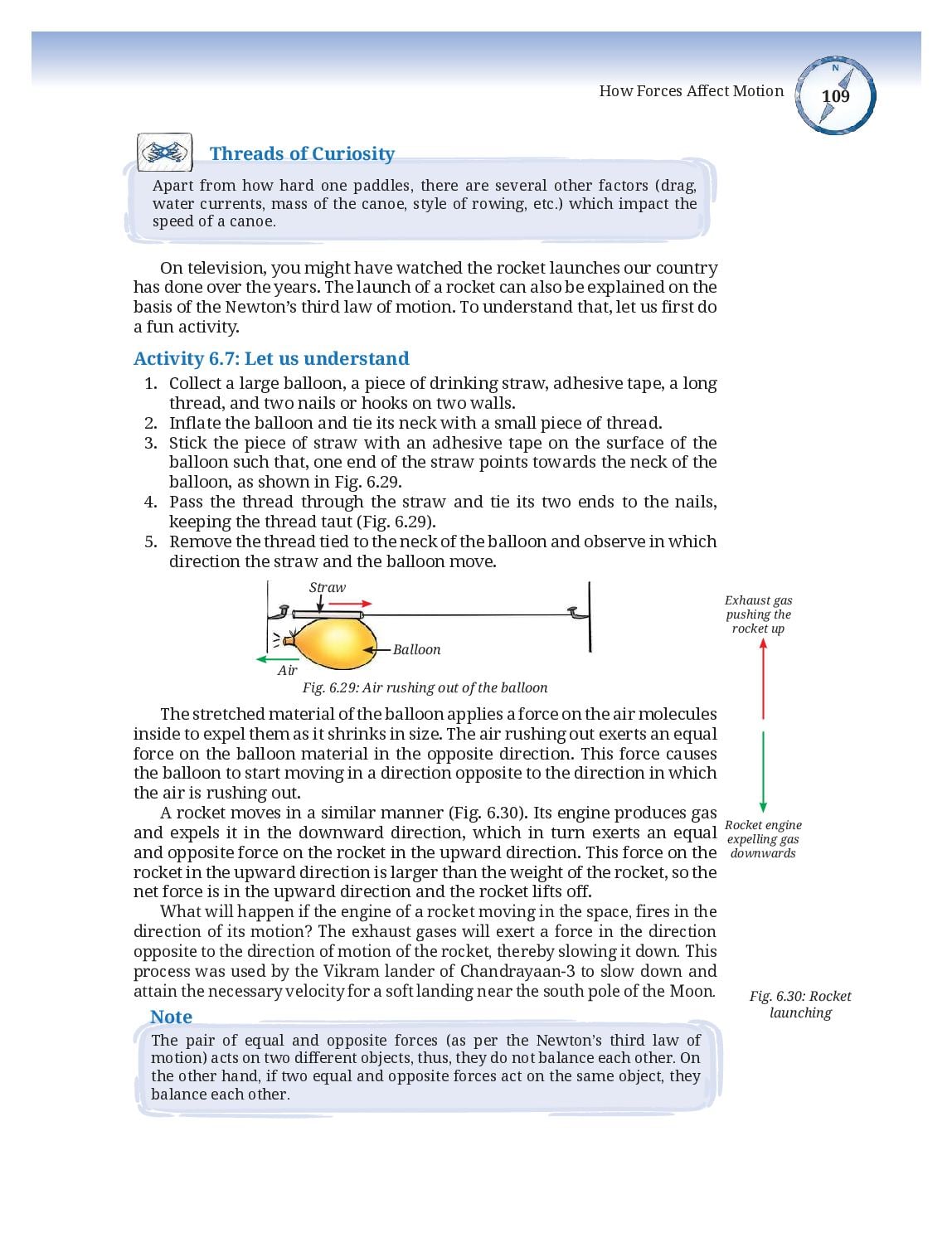
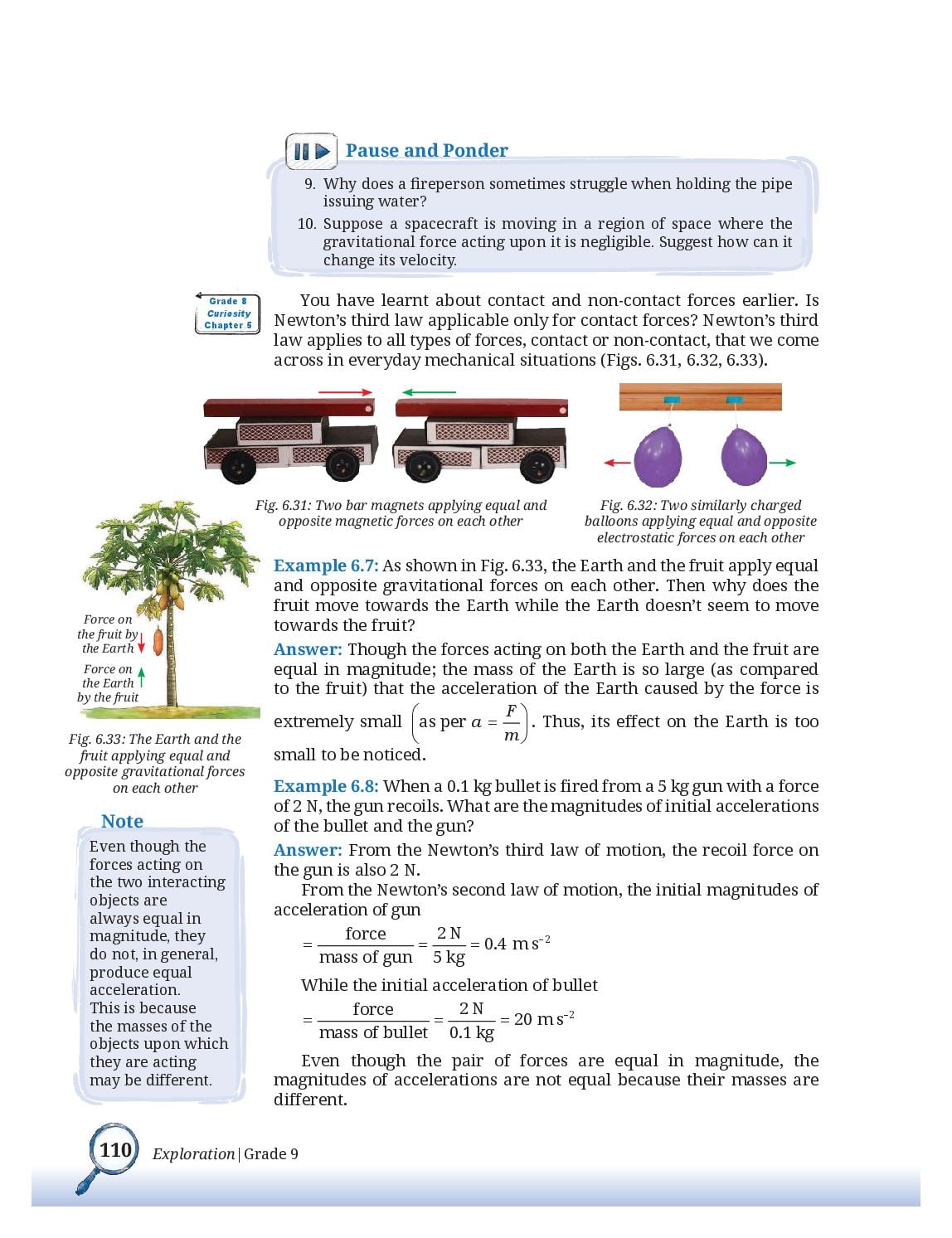
- Newton’s third law: if object A pushes B, then B pushes A with an equal and opposite force at the same instant. The two forces act on different objects, so they never cancel each other. Equal forces need not produce equal accelerations, because masses differ.
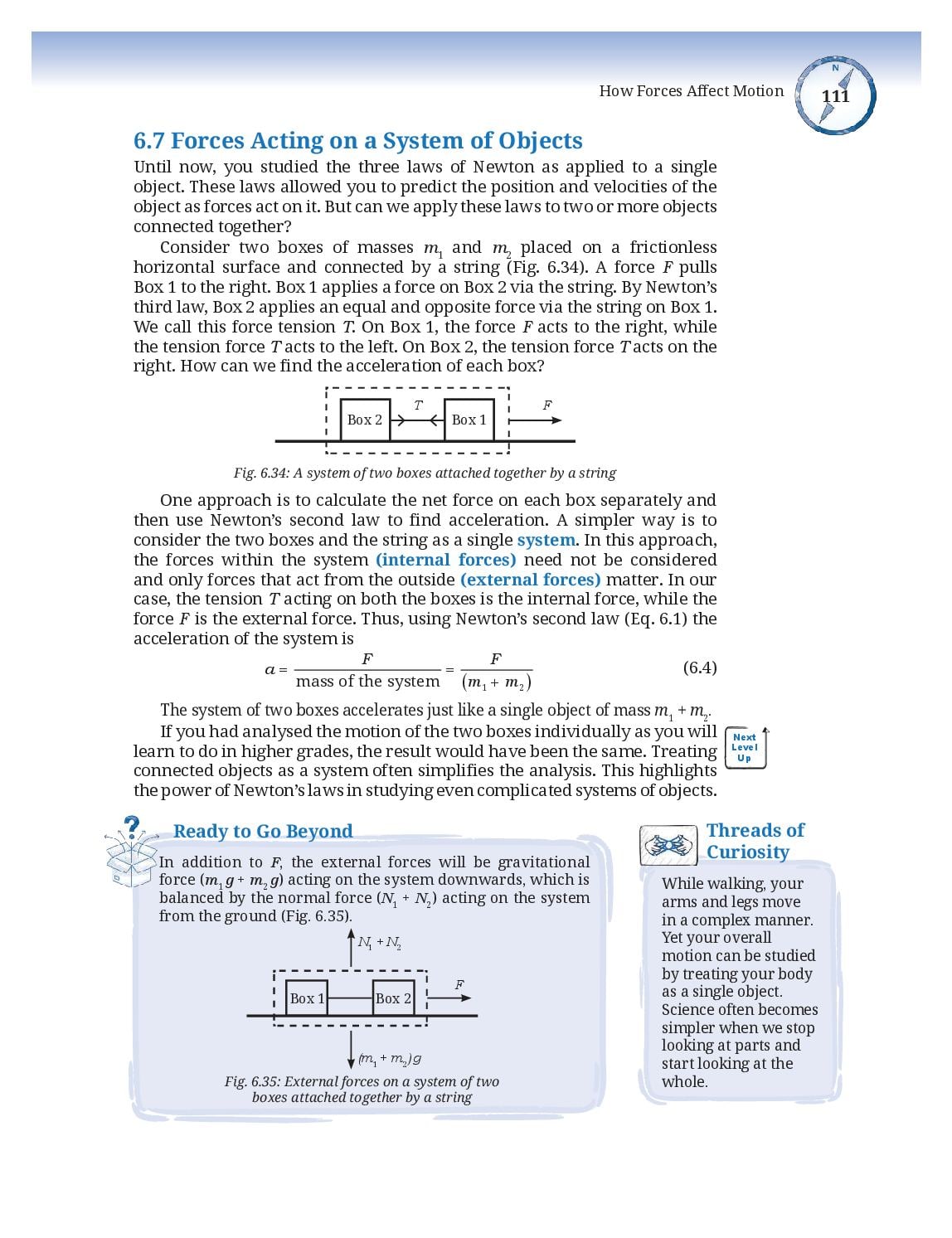
- Connected objects can be treated as one system. Internal forces (like the tension in the joining string) cancel out, and a = F ÷ (m1 + m2).
Quick revision – How Forces Affect Motion
| Term | What it means | Formula or key rule | Where it appears in the chapter |
|---|---|---|---|
| Force | A push or pull; a vector quantity — magnitude, direction and unit must all be stated | SI unit newton (N); 1 N = 1 kg m s–2 | Section 6.1; Fig. 6.1 kicking, striking, squeezing |
| Spring balance | Instrument that measures the magnitude of a force from the stretch of a spring | Reading in N; can measure weight or any pull | Fig. 6.2; Activities 6.2 and 6.6 |
| Balanced forces | Equal in magnitude, opposite in direction; net force zero | Net force = 0 → acceleration = 0 | Tug of war, Fig. 6.4a; weight and normal force |
| Net force | The single force that has the same effect as all the forces acting together | Same direction: F1 + F2; opposite: |F1 – F2| along the larger | Example 6.1; Fig. 6.5, Fig. 6.6 |
| Force of friction | Contact force opposing relative motion between two surfaces | Depends on the nature of the surfaces; measured by the spring balance reading just as motion starts | Section 6.3; Activities 6.1, 6.2 |
| Normal force | Push of a surface on the object resting on it, perpendicular to the surface | Balances the weight on a horizontal surface | Fig. 6.11 |
| Inertia | Tendency of an object to resist a change in its state of rest or of uniform motion | Newton’s word; the idea behind the first law | Meet a Scientist, page 100 |
| Newton’s first law | No net force → no change in velocity | A = 0 when net F = 0 | Section 6.4; Examples 6.2, 6.3 |
| Newton’s second law | Net force produces acceleration along itself | A = F/m, i.e. F = ma | Section 6.5; Eqs. 6.1, 6.2 |
| Weight | Gravitational force with which the Earth pulls an object | F = mg, g = 9.8 m s–2 (10 m s–2 for quick estimates) | Eq. 6.3; Example 6.4 |
| Newton’s third law | Forces occur in pairs on two different objects, equal and opposite | FAB = – FBA, acting on different bodies | Section 6.6; Activities 6.5, 6.6, 6.7 |
| Momentum | Mass × velocity; the fuller form of the second law uses its rate of change | Direction same as velocity; works even when mass changes | Ready to Go Beyond, page 104 |
| System of objects | Two or more connected bodies treated as one object | A = F ÷ (m1 + m2); internal forces ignored | Section 6.7; Eq. 6.4, Figs. 6.34, 6.35 |
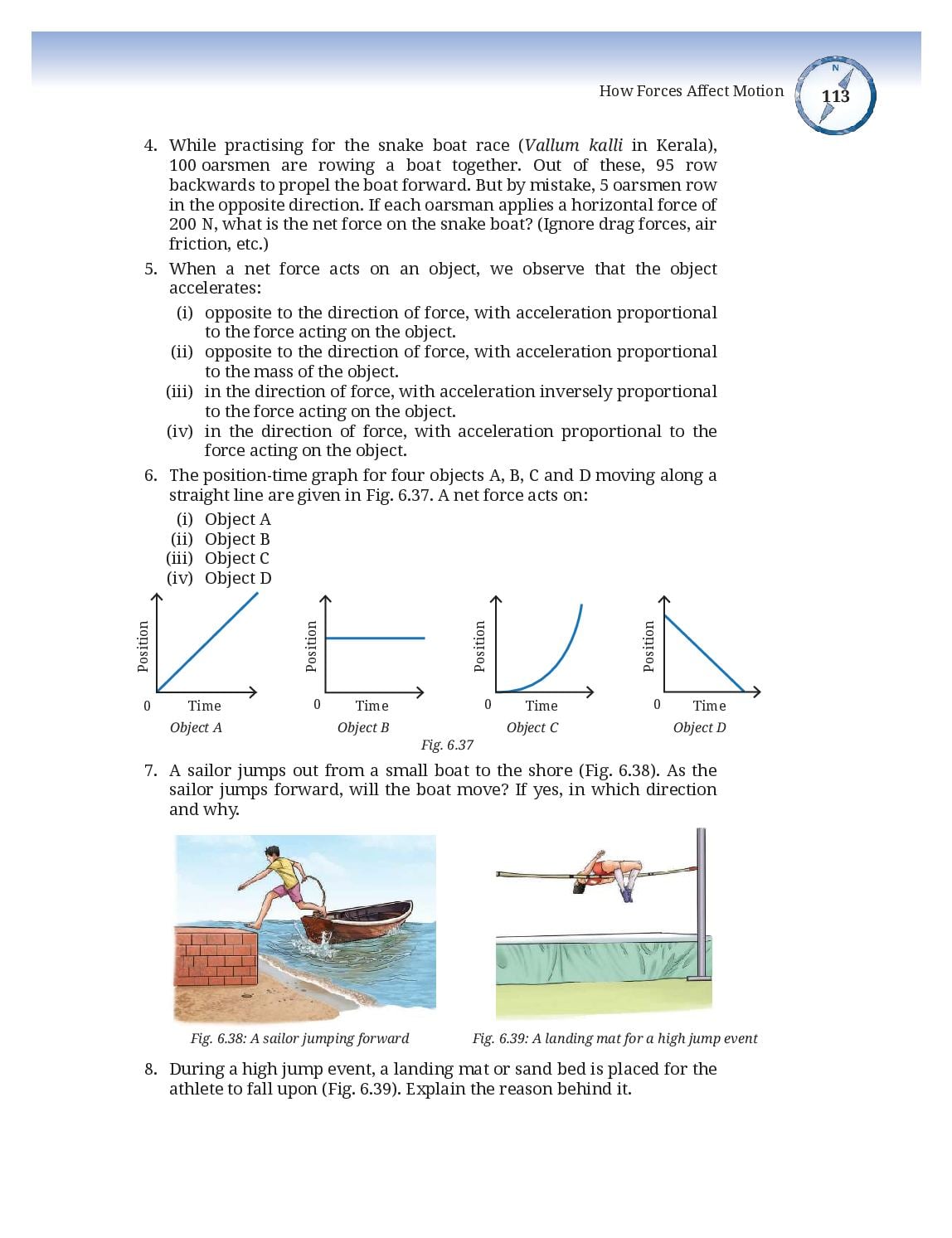
| Increasing the collision time | Longer stopping time → smaller acceleration → smaller force | F = ma with a = (v – u)/t | Catching a ball, airbags, landing mats, bubble wrap |
Old NCERT vs New – Class 9 Science
This chapter is from Exploration, the new NCERT Class 9 Science book (NCF-SE 2023, used from 2026-27). It replaced the old book “Science”, so chapter numbers and names differ from older PDFs.
Solutions and All Chapters
Answers to the exercises and the full chapter list of Exploration:
How Forces Affect Motion – Overview
| Class | Class 9 |
| Subject | Science |
| Book | Exploration – new NCERT book |
| Chapter | 6 of 13 – How Forces Affect Motion |
| Book pages | 94 – 115 |
| Edition | Latest NCERT edition (2026-27) |
| Session | 2026-27 |
| Free – read online or download |
Class 9 Science Chapter 6 – FAQs
Where can I download How Forces Affect Motion Class 9 PDF?
From the download table on this page – the chapter PDF is free, and the full book is linked too.
What is Class 9 Science Chapter 6 about?
A force has magnitude and direction. Its SI unit is the newton (N), measured with a spring balance. One newton is the force that gives a 1 kg object an acceleration of 1 m s–2.
Is How Forces Affect Motion from the new NCERT Class 9 Science book?
Yes. It is chapter 6 of exploration, the new NCERT Class 9 Science book for 2026-27.
Is this the latest NCERT edition for 2026-27?
Yes – the PDF is NCERT’s latest edition for the 2026-27 session.
Where are the NCERT Solutions for Class 9 Science Chapter 6?
Open the NCERT Solutions link above for answers to the exercise questions.