Download Reproduction: How Life Continues – NCERT Class 9 Science Chapter 11 PDF from the new NCERT Class 9 Science book Exploration (2026-27). Read the chapter online or download the free PDF. Asexual reproduction needs one parent and uses mitosis, so the offspring are genetically identical clones — budding in yeast and hydra, spore formation in fungi, and vegetative propagation (cutting, grafting, layering, tissue culture) in plants.
Reproduction: How Life Continues PDF – Chapter 11 of Exploration
Read the chapter online or download the PDF.
| Chapter | Download | |
|---|---|---|
| Chapter 11 PDF | Reproduction: How Life Continues | View PDF |
| Full book | NCERT Class 9 Science – Exploration | View Book |
Read Online
What Is in Reproduction: How Life Continues? (Class 9 Science Chapter 11)
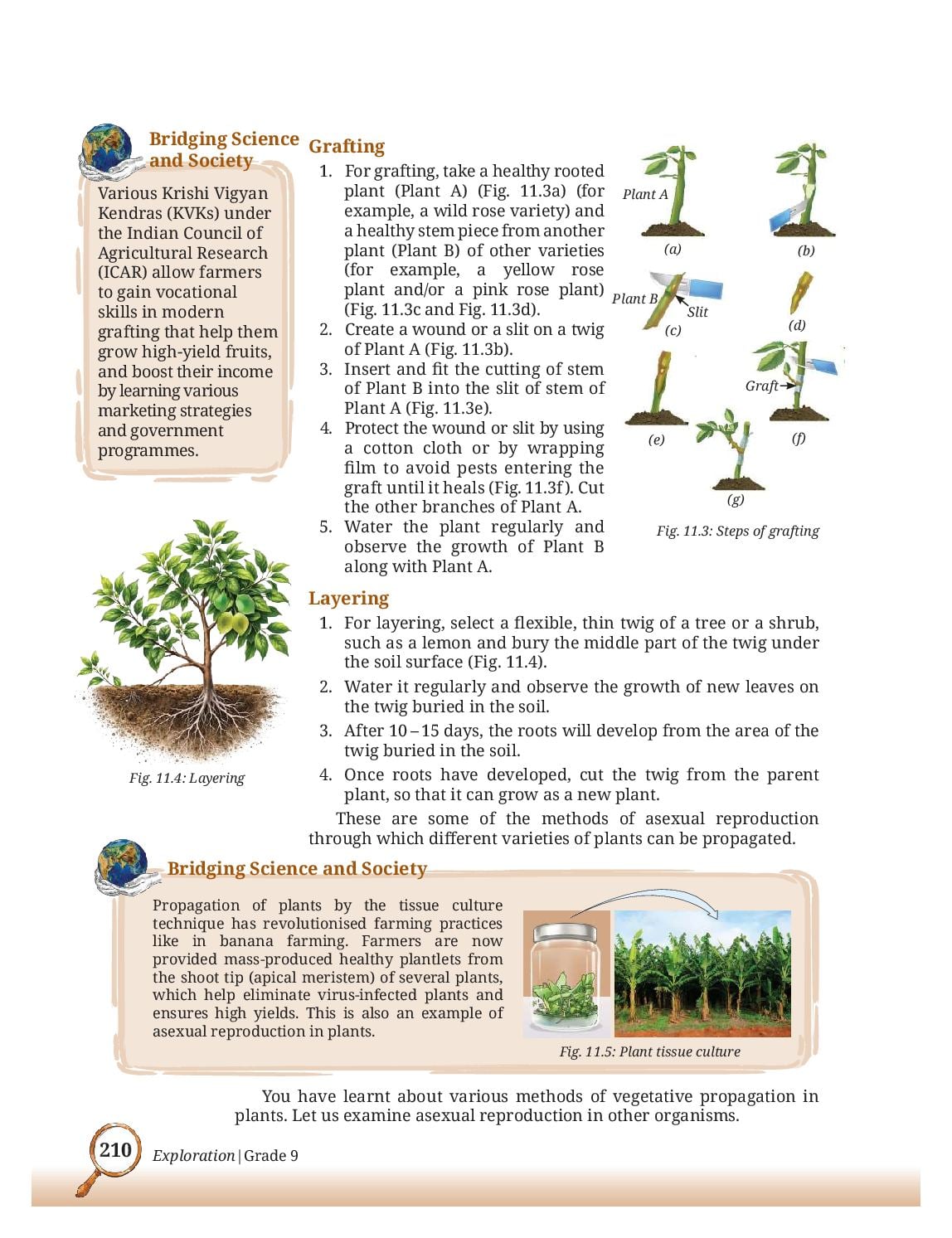
- Asexual reproduction needs one parent and uses mitosis, so the offspring are genetically identical clones — budding in yeast and hydra, spore formation in fungi, and vegetative propagation (cutting, grafting, layering, tissue culture) in plants.
- Sexual reproduction needs two parents. Meiosis halves the chromosome number (46 → 23 in humans) to make gametes, and fertilisation restores it, so the number stays constant generation after generation.
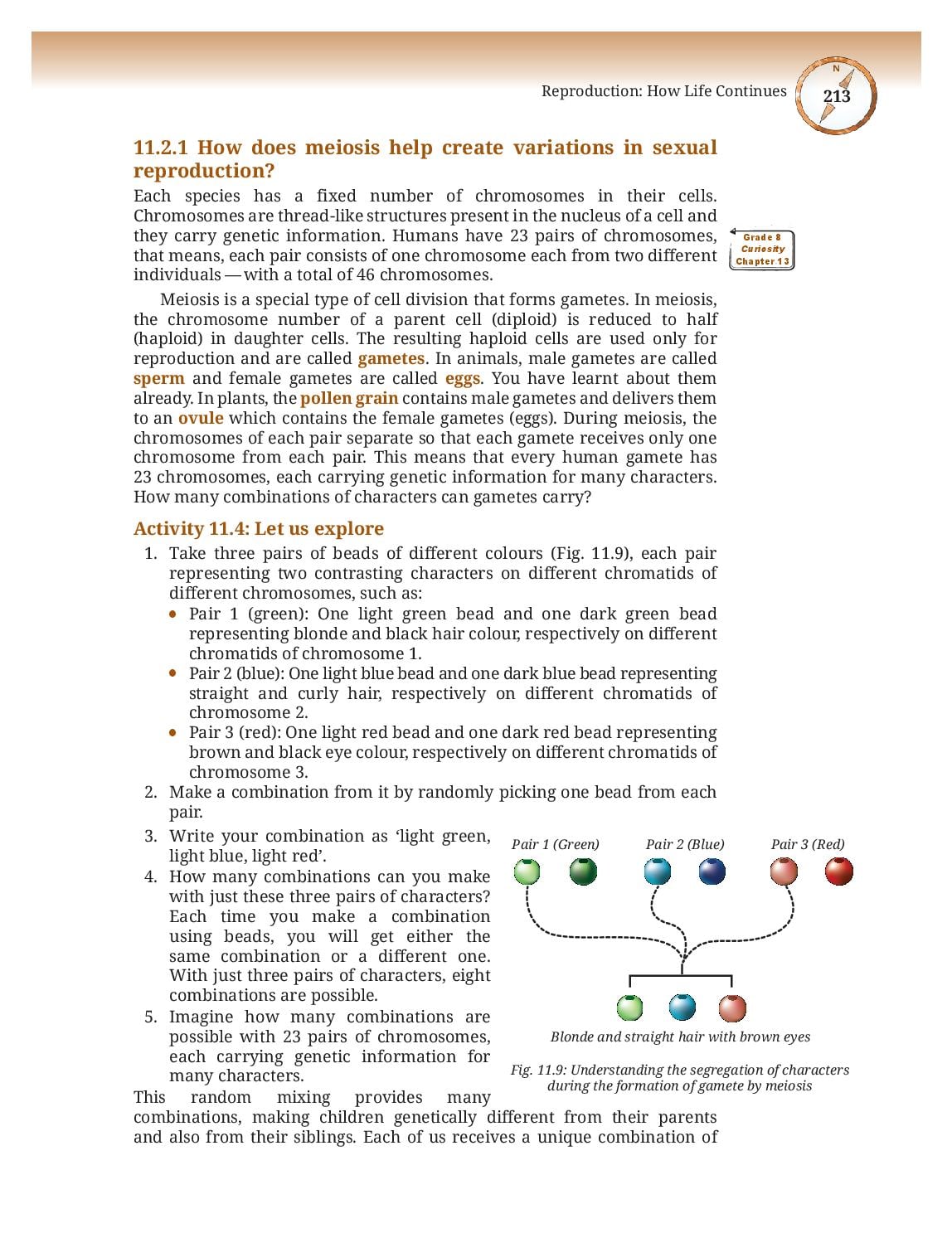
- Because the chromosomes of each pair separate independently, n pairs give 2n kinds of gamete — 8 for the three bead pairs of Activity 11.4, and 223 = 8,388,608 for a human. This is where variation comes from.
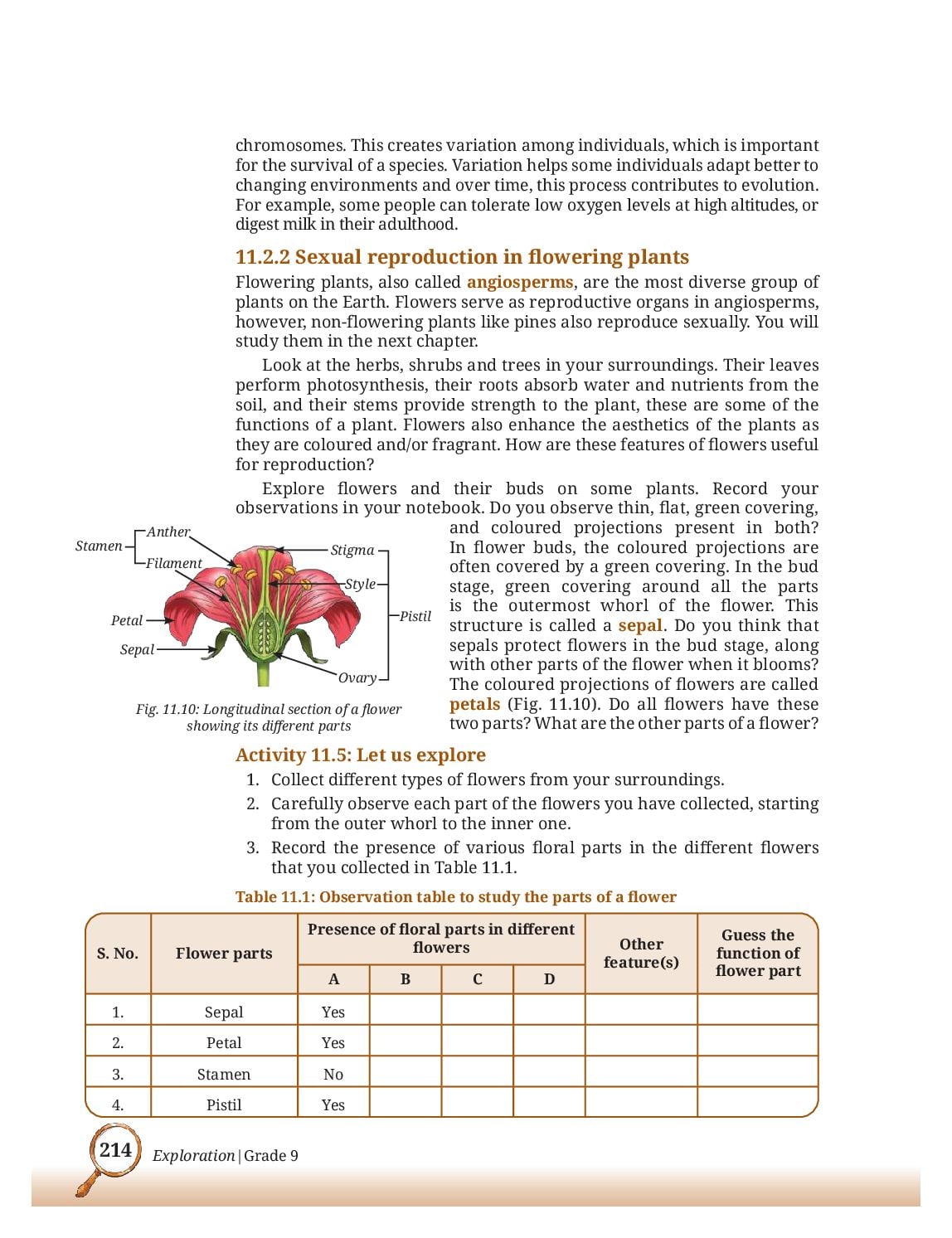
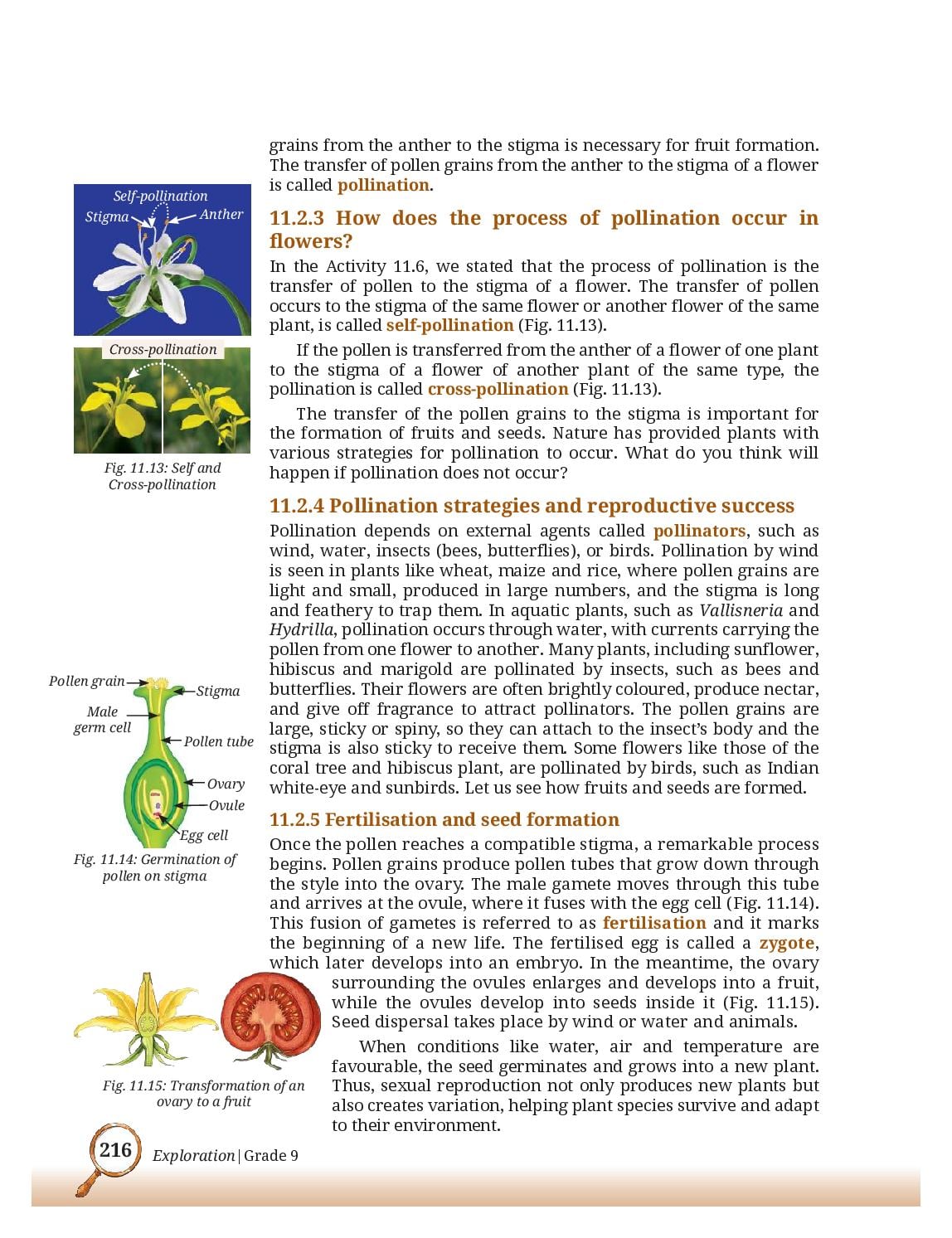
- In a flower, the stamen (filament + anther) makes pollen and the pistil (stigma + style + ovary) holds the ovules. Pollination moves pollen from anther to stigma; a pollen tube then carries the male gamete to the egg. After fertilisation the ovule becomes the seed and the ovary becomes the fruit.
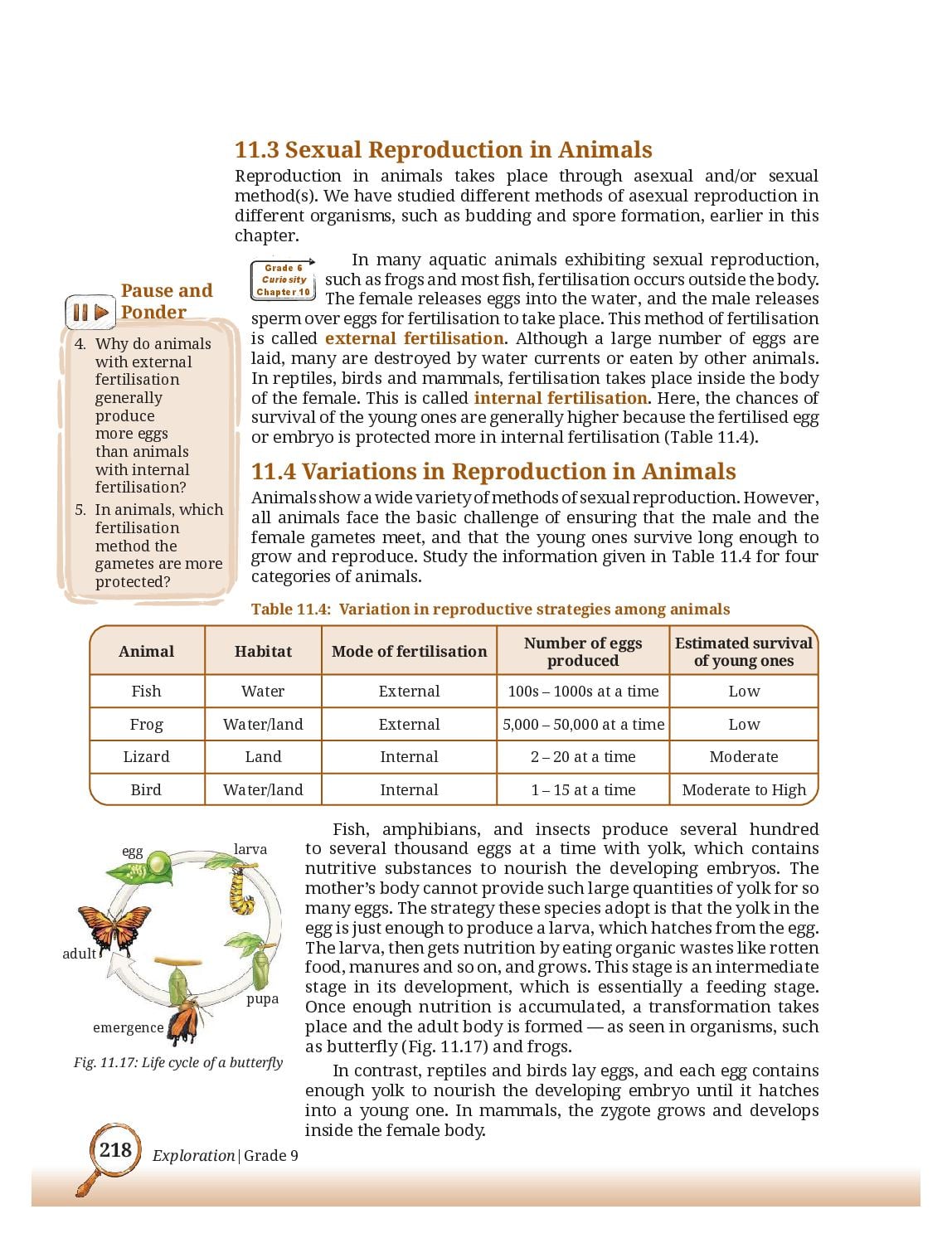
- Animals trade numbers against protection: external fertilisation means thousands of eggs and low survival (fish, frog), internal fertilisation means very few eggs and better survival (lizard, bird, mammals).
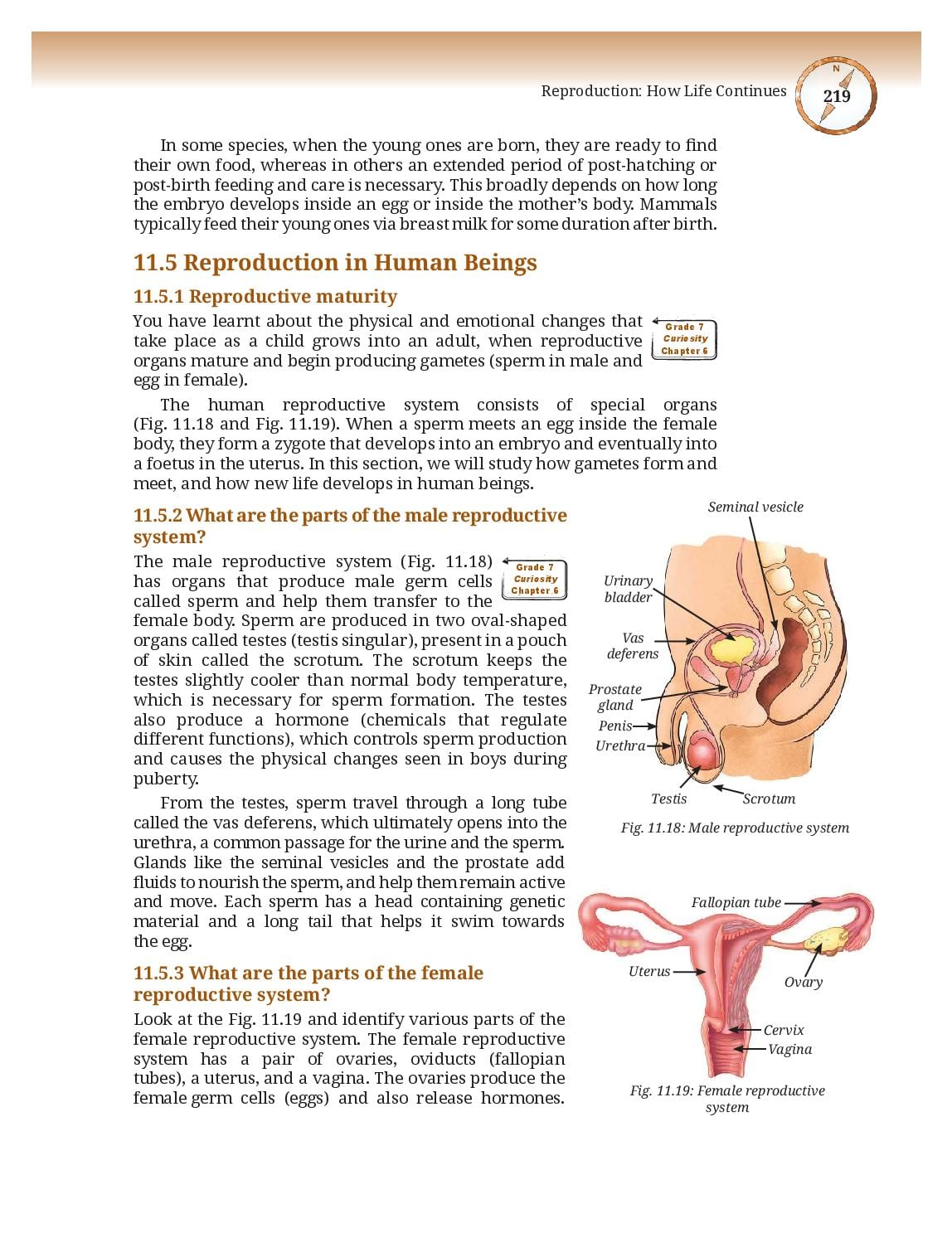
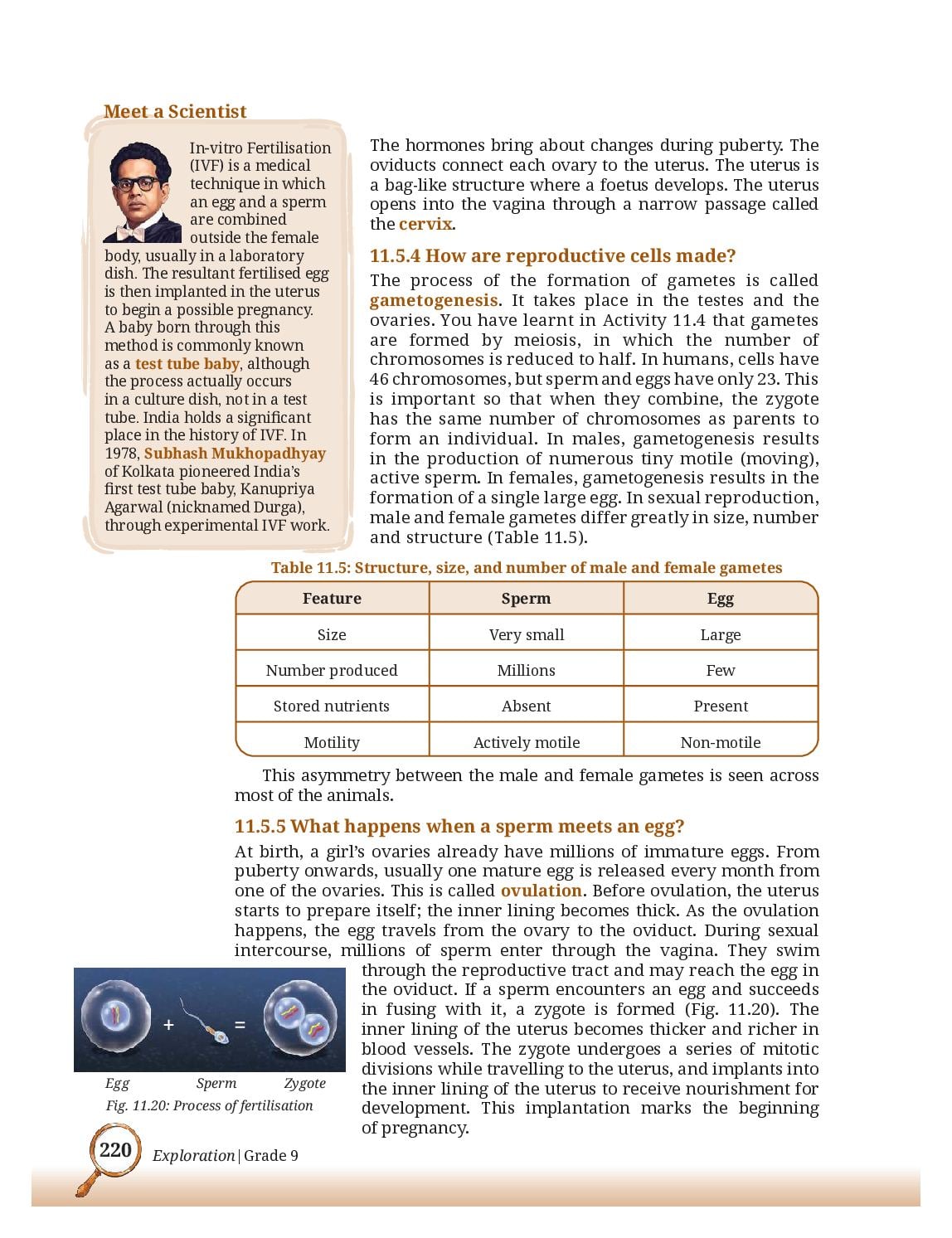
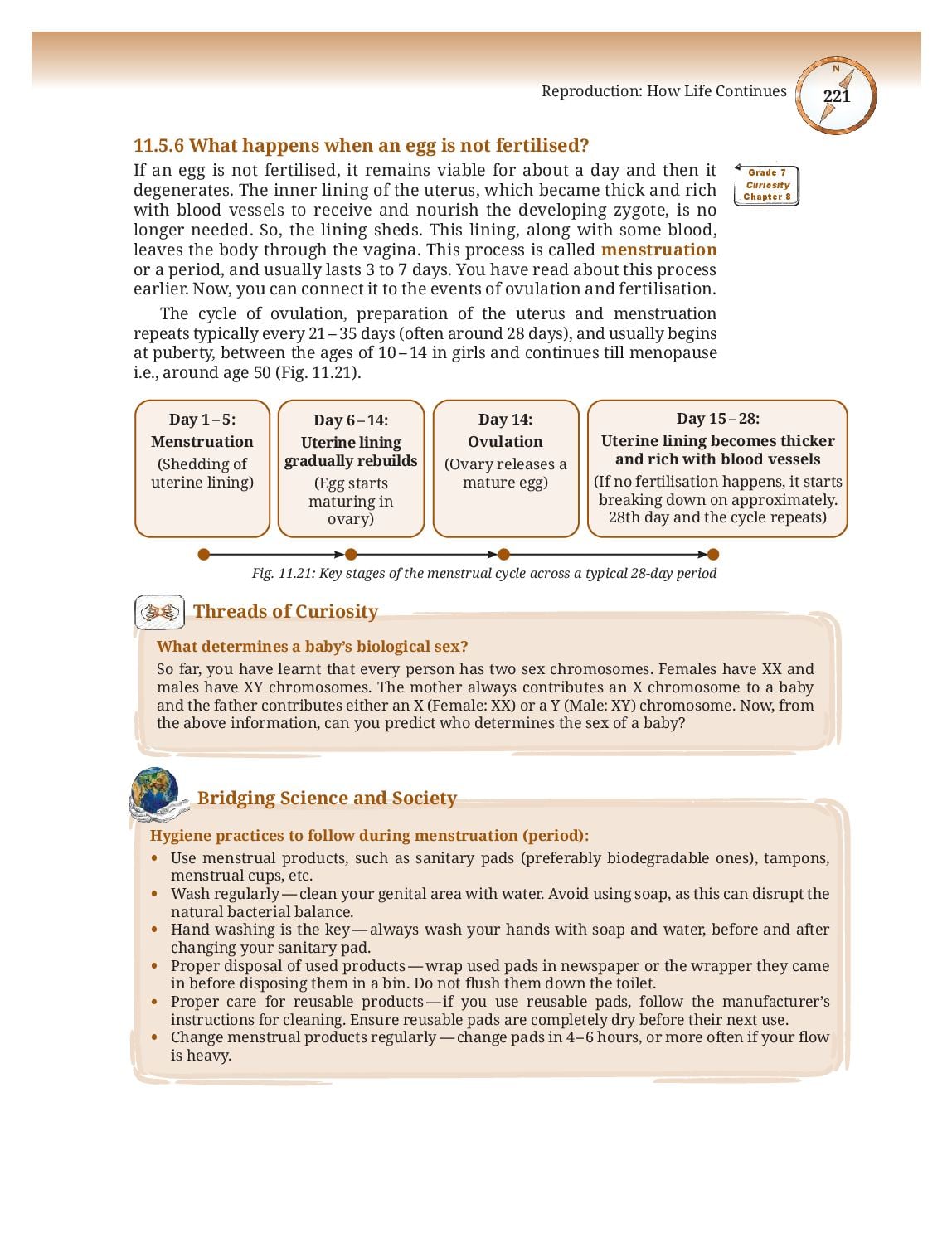
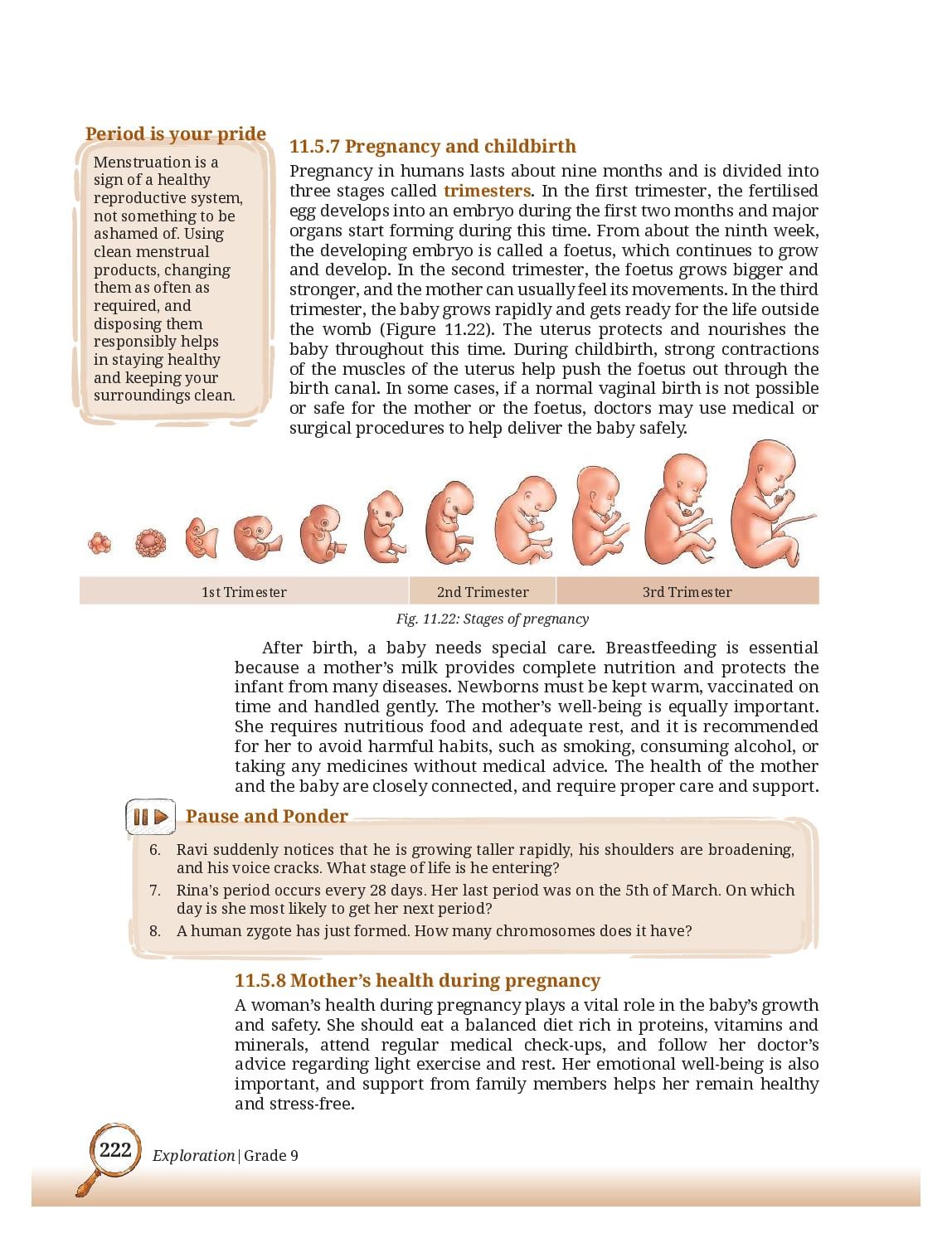
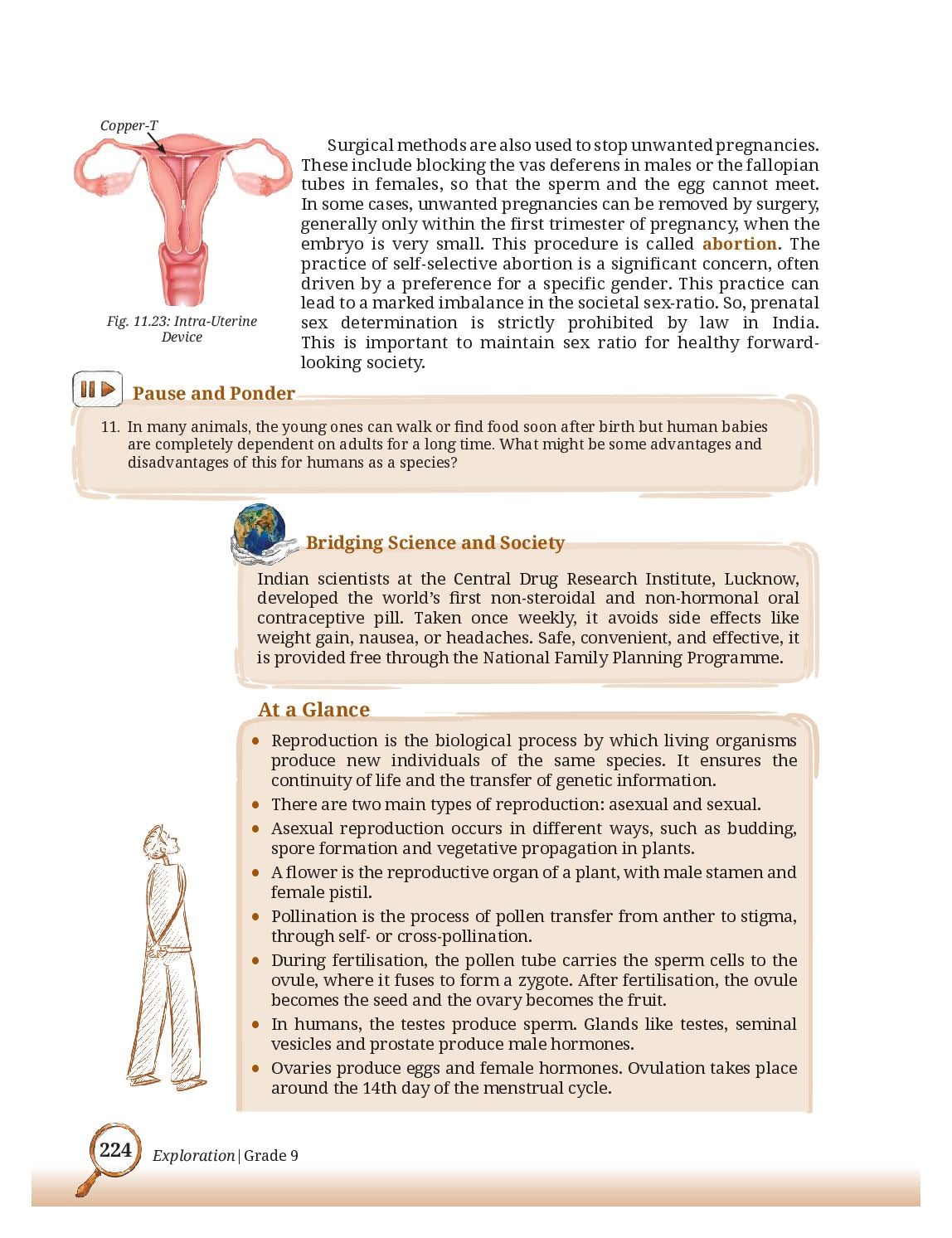
- In humans, testes make sperm and ovaries release one egg in each cycle of 21 – 35 days (often 28). Fertilisation happens in the oviduct; the zygote divides as it travels and implants in the thickened uterine lining, which starts a pregnancy of about nine months.
Quick revision – Reproduction: How Life Continues
| Term | What it means | Where it happens / typical value | Where it appears in the chapter |
|---|---|---|---|
| Asexual reproduction | One parent; offspring genetically identical to it | Runs on mitosis | Bacteria, amoeba, yeast, hydra, potato, ginger — 11.1 |
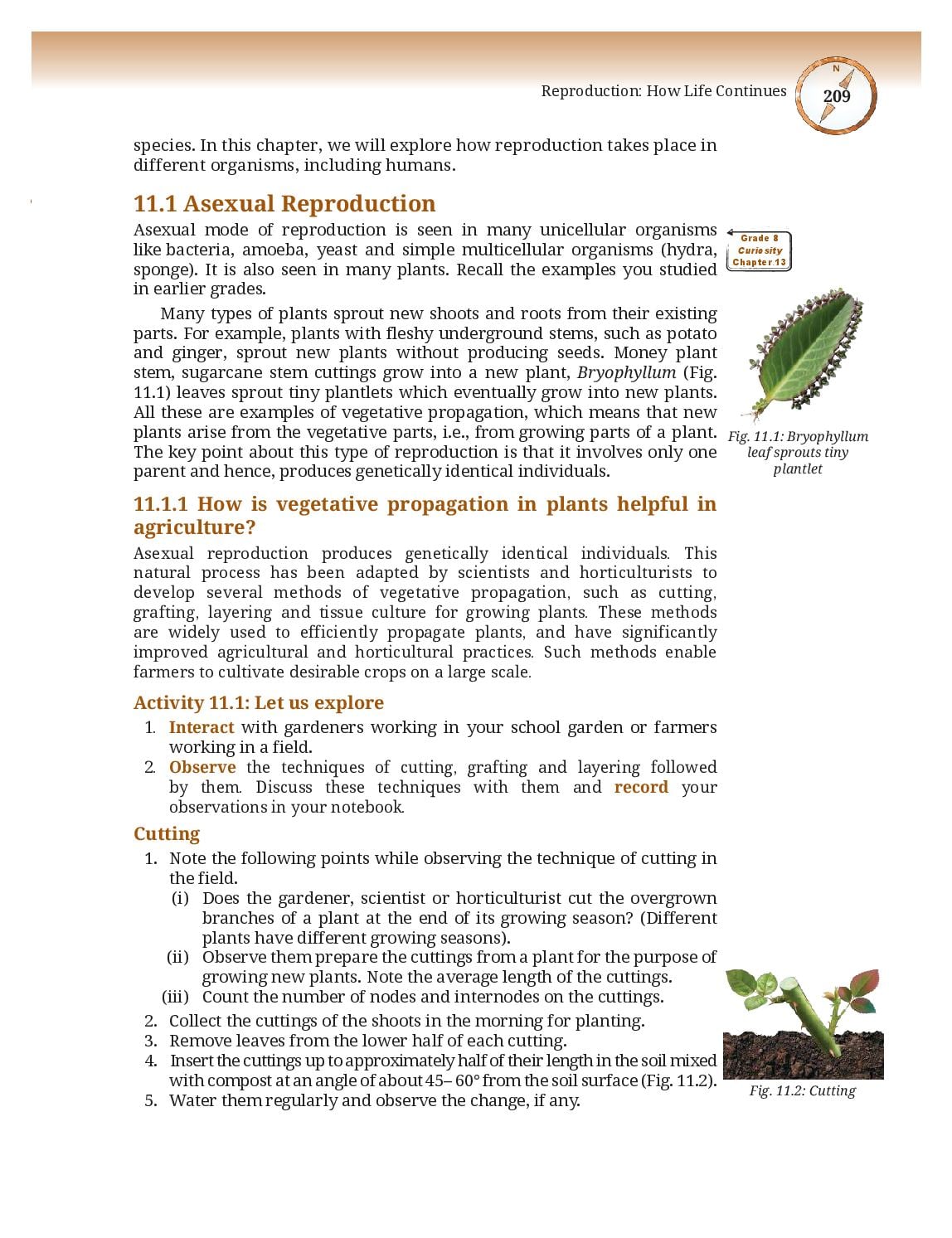
| Vegetative propagation | A new plant grows from a vegetative (growing) part of the old one | Cutting, grafting, layering, tissue culture | Bryophyllum leaf (Fig. 11.1); Activity 11.1 |
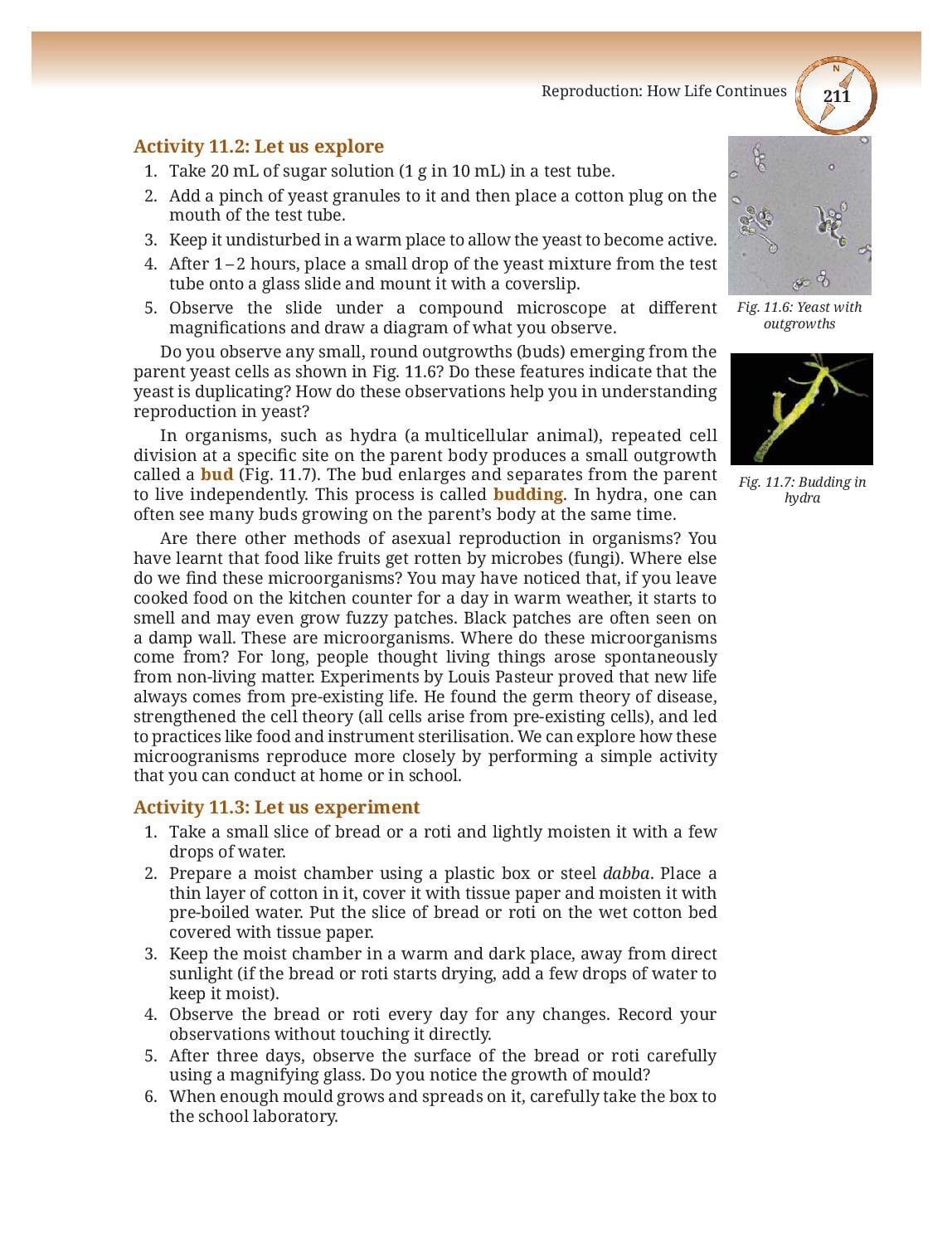
| Budding | Repeated cell division at one spot makes an outgrowth that separates and lives on its own | Yeast, hydra | Fig. 11.6, Fig. 11.7; Activity 11.2 |
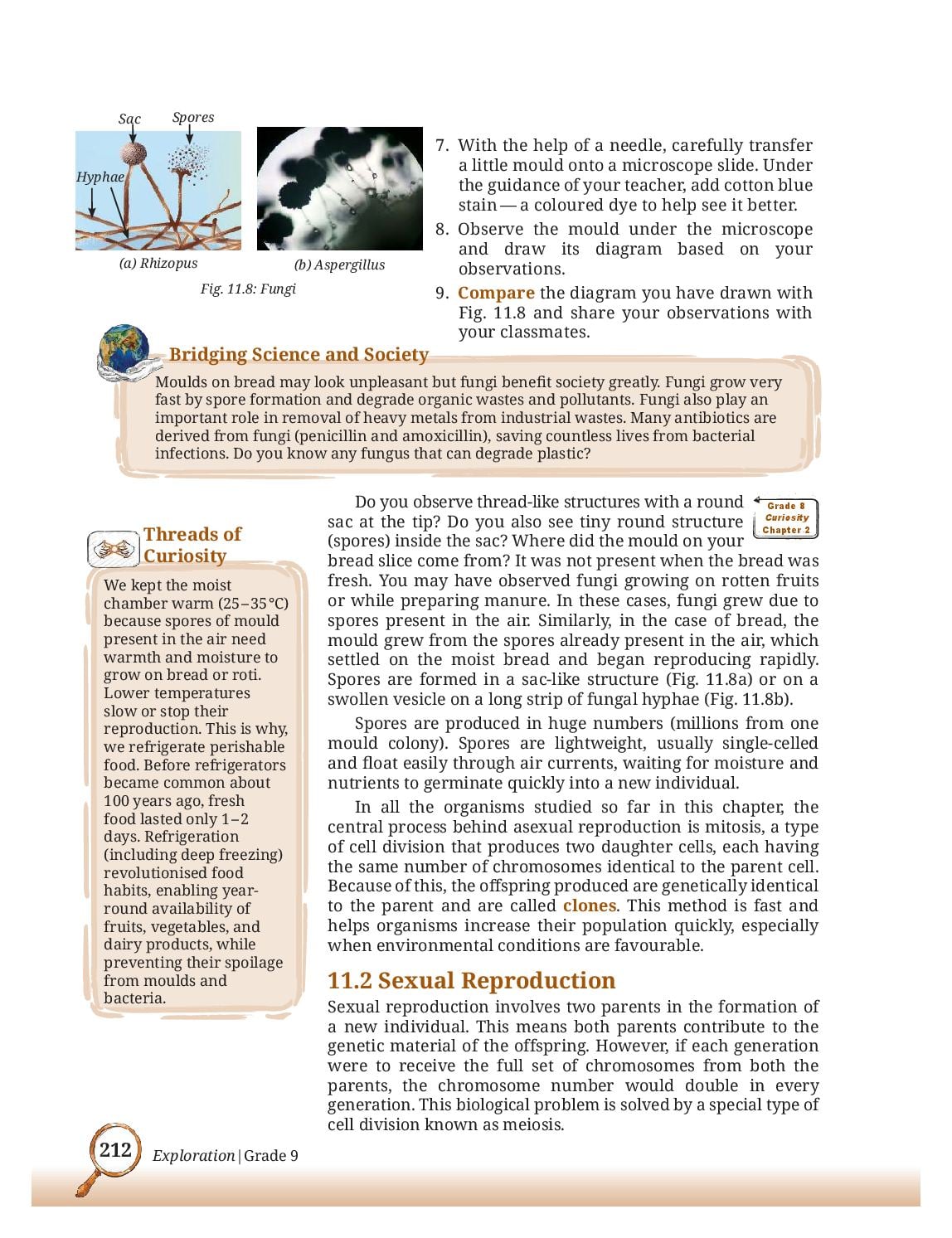
| Spore formation | Light, usually single-celled spores made in a sac or on a swollen vesicle | Fungi; need warmth (25 – 35 °C) and moisture | Rhizopus, Aspergillus (Fig. 11.8); Activity 11.3 |
| Mitosis | Division giving two daughter cells with the same chromosome number as the parent | Growth, repair, all asexual reproduction | 11.1 – ‘offspring are clones’ |
| Meiosis | Division that halves the chromosome number | Testes and ovaries; anther and ovule. 46 → 23 in humans | 11.2.1; Activity 11.4 |
| Gamete | A haploid reproductive cell | Sperm — small, motile, no stored food. Egg — large, non-motile, with yolk | Table 11.5 |
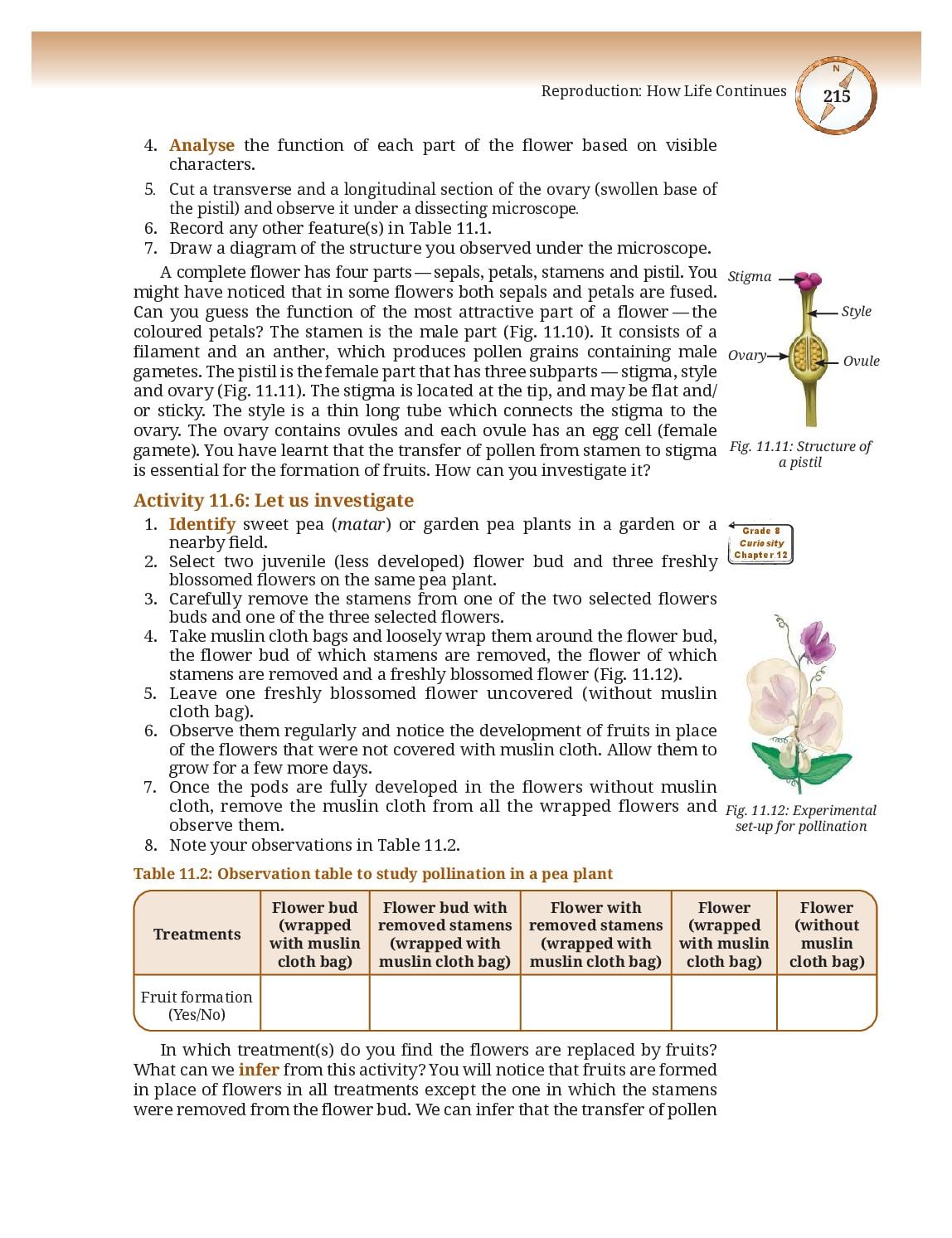
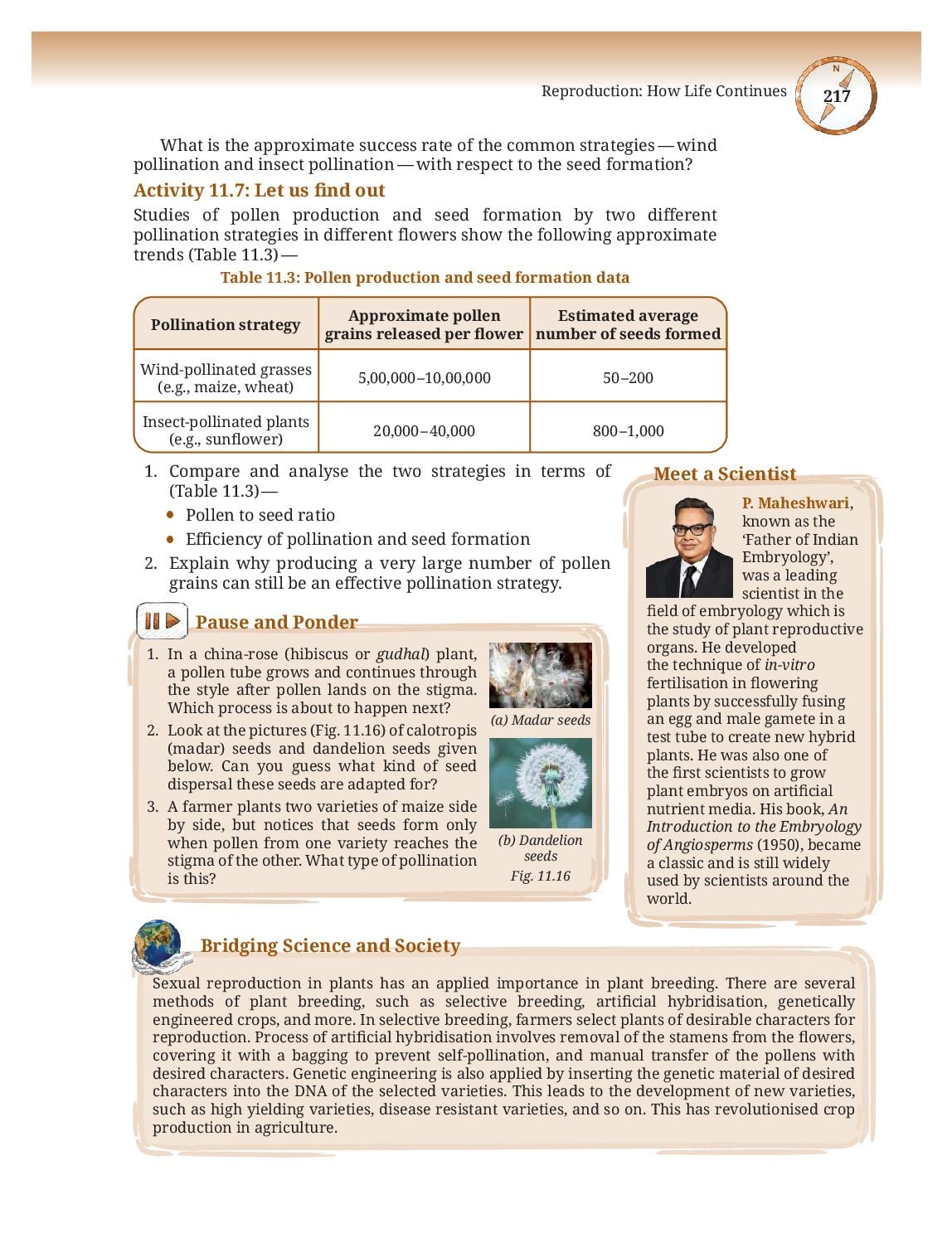
| Pollination | Transfer of pollen from anther to stigma | Self- or cross-; agents are wind, water, insects, birds | 11.2.3, 11.2.4; Activity 11.6 |
| Fertilisation | Fusion of the male gamete with the egg to form a zygote | In the ovule (plants); in the oviduct (humans) | Fig. 11.14, Fig. 11.20 |
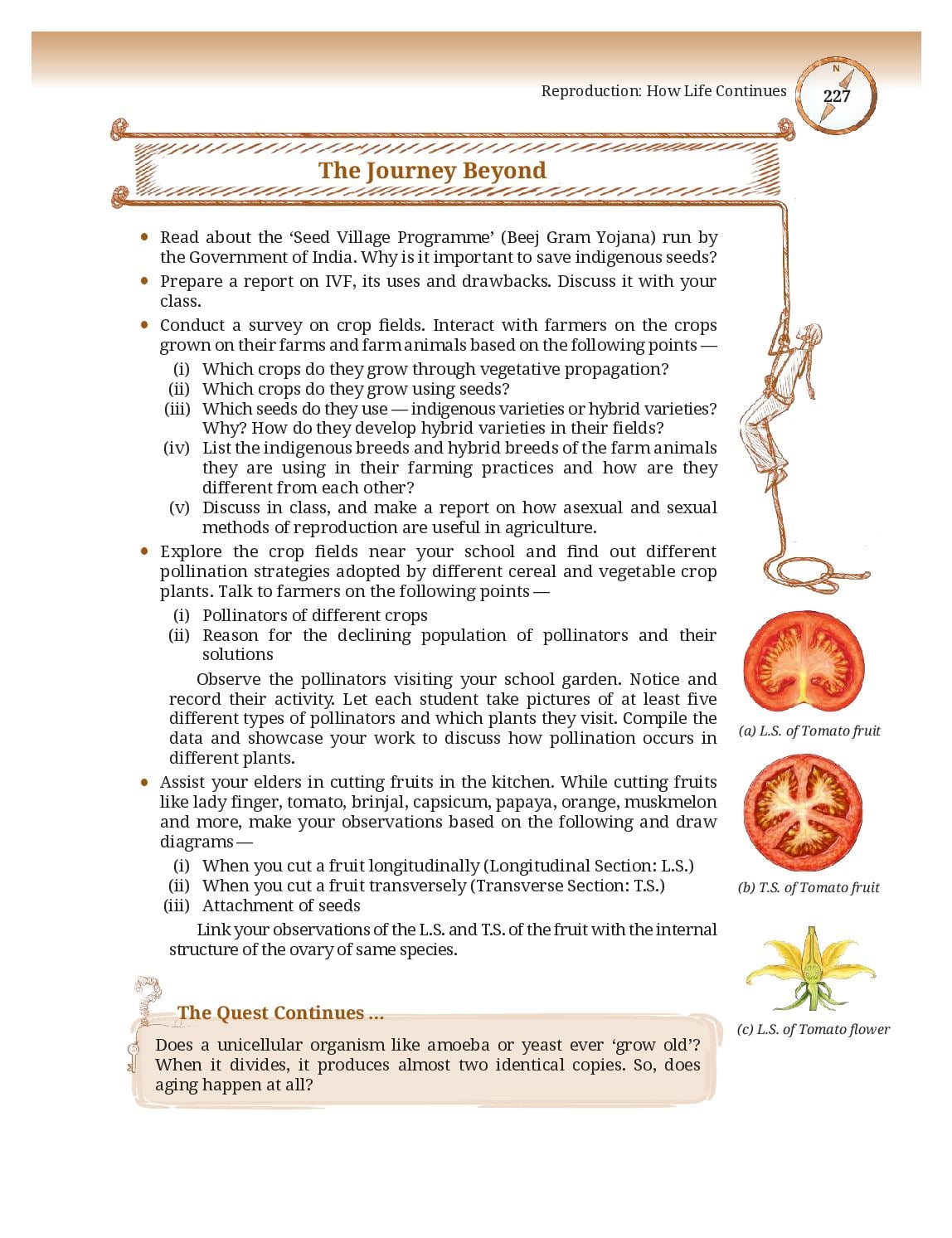
| Fruit and seed | The ovary ripens into the fruit; each ovule ripens into a seed | After fertilisation in a flowering plant | Fig. 11.15; 11.2.5 |
| External vs internal fertilisation | Gametes meet outside the body in water, or inside the female body | Frog 5,000 – 50,000 eggs, survival low; bird 1 – 15 eggs, survival moderate to high | Table 11.4; 11.3, 11.4 |
| Menstrual cycle | Ovulation, thickening of the uterine lining, then shedding if there is no implantation | 21 – 35 days (often 28); menstruation 3 – 7 days; ovulation about day 14 | Fig. 11.21; 11.5.5, 11.5.6 |
Old NCERT vs New – Class 9 Science
This chapter is from Exploration, the new NCERT Class 9 Science book (NCF-SE 2023, used from 2026-27). It replaced the old book “Science”, so chapter numbers and names differ from older PDFs.
Solutions and All Chapters
Answers to the exercises and the full chapter list of Exploration:
Reproduction: How Life Continues – Overview
| Class | Class 9 |
| Subject | Science |
| Book | Exploration – new NCERT book |
| Chapter | 11 of 13 – Reproduction: How Life Continues |
| Book pages | 208 – 227 |
| Edition | Latest NCERT edition (2026-27) |
| Session | 2026-27 |
| Free – read online or download |
Class 9 Science Chapter 11 – FAQs
Where can I download Reproduction: How Life Continues Class 9 PDF?
From the download table on this page – the chapter PDF is free, and the full book is linked too.
What is Class 9 Science Chapter 11 about?
Asexual reproduction needs one parent and uses mitosis, so the offspring are genetically identical clones — budding in yeast and hydra, spore formation in fungi, and vegetative propagation (cutting, grafting, layering, tissue culture) in plants.
Is Reproduction: How Life Continues from the new NCERT Class 9 Science book?
Yes. It is chapter 11 of exploration, the new NCERT Class 9 Science book for 2026-27.
Is this the latest NCERT edition for 2026-27?
Yes – the PDF is NCERT’s latest edition for the 2026-27 session.
Where are the NCERT Solutions for Class 9 Science Chapter 11?
Open the NCERT Solutions link above for answers to the exercise questions.