Download Sound Waves: Characteristics and Applications – NCERT Class 9 Science Chapter 10 PDF from the new NCERT Class 9 Science book Exploration (2026-27). Read the chapter online or download the free PDF. Sound is produced by vibrating objects. Stop the vibration and the sound stops with it; the vibrating object is the source.
Sound Waves: Characteristics and Applications PDF – Chapter 10 of Exploration
Read the chapter online or download the PDF.
| Chapter | Download | |
|---|---|---|
| Chapter 10 PDF | Sound Waves: Characteristics and Applications | View PDF |
| Full book | NCERT Class 9 Science – Exploration | View Book |
Read Online
What Is in Sound Waves: Characteristics and Applications? (Class 9 Science Chapter 10)
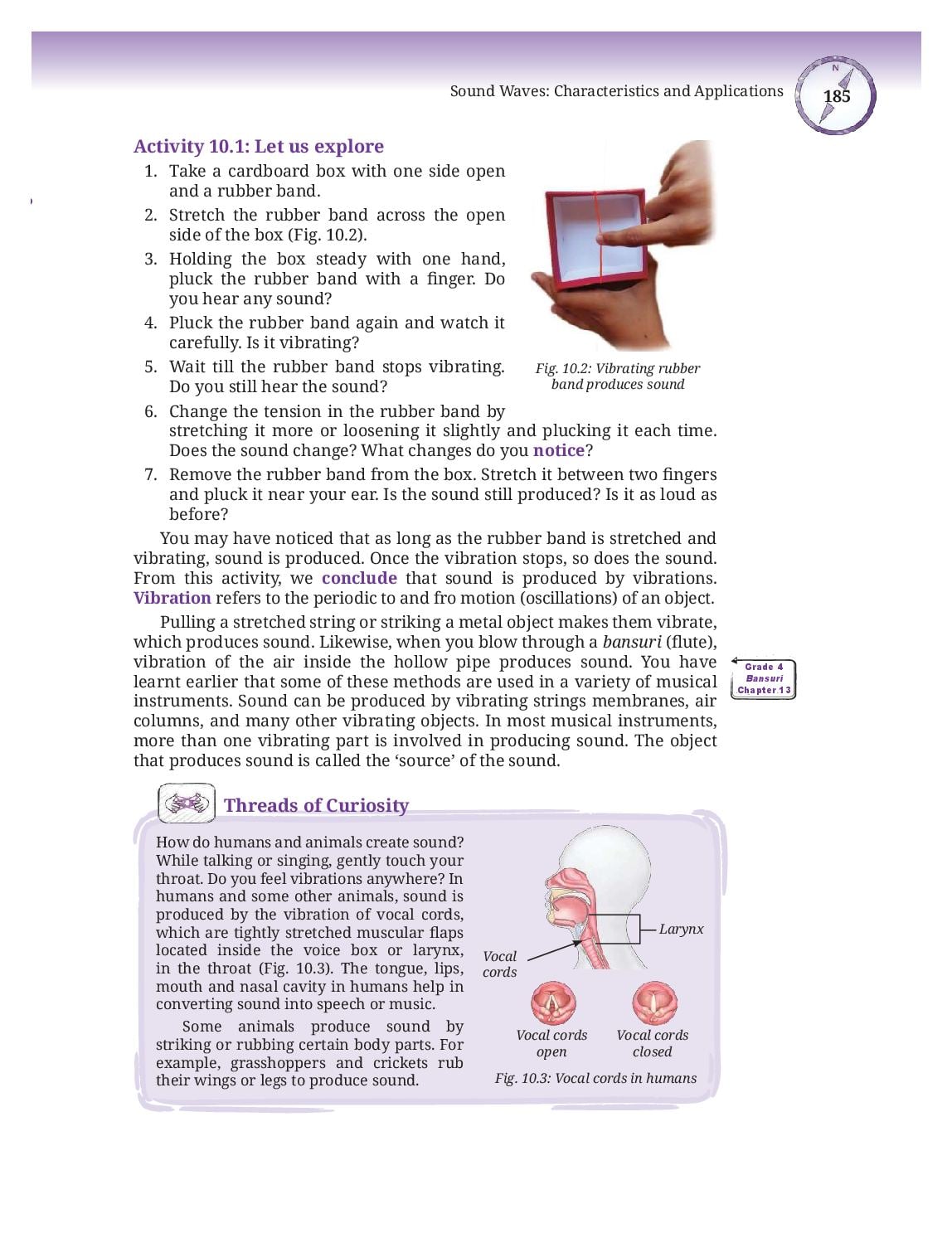
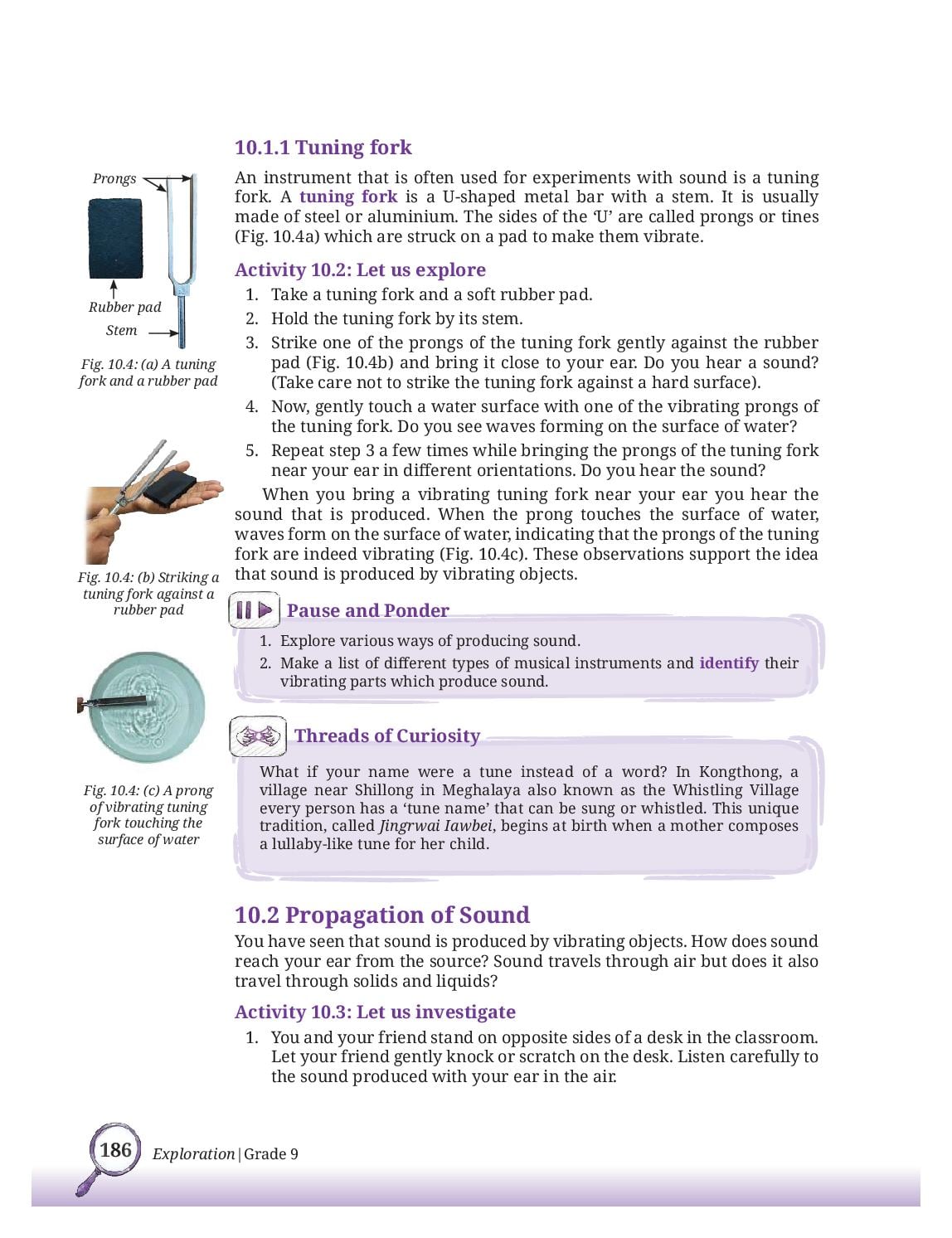
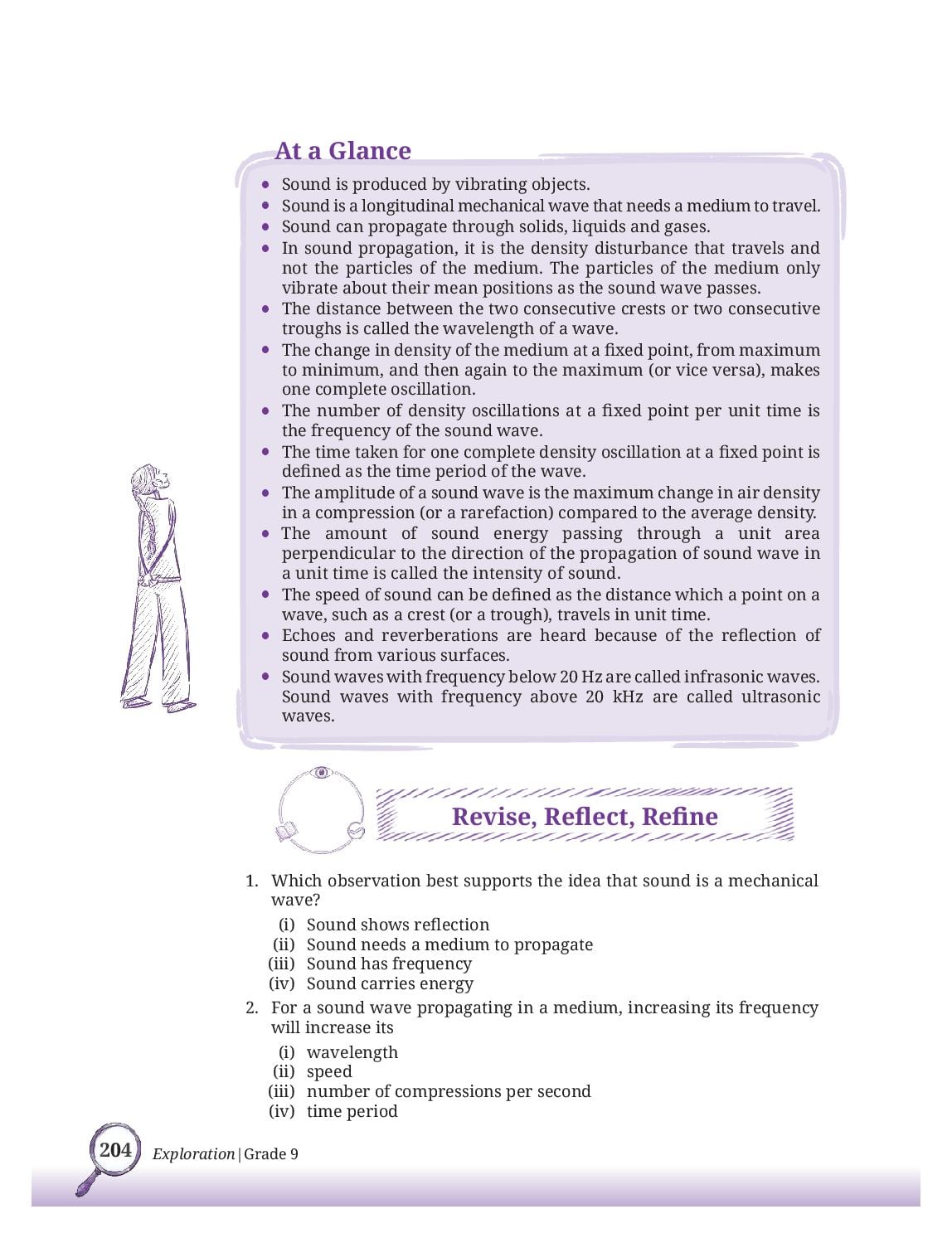
- Sound is produced by vibrating objects. Stop the vibration and the sound stops with it; the vibrating object is the source.
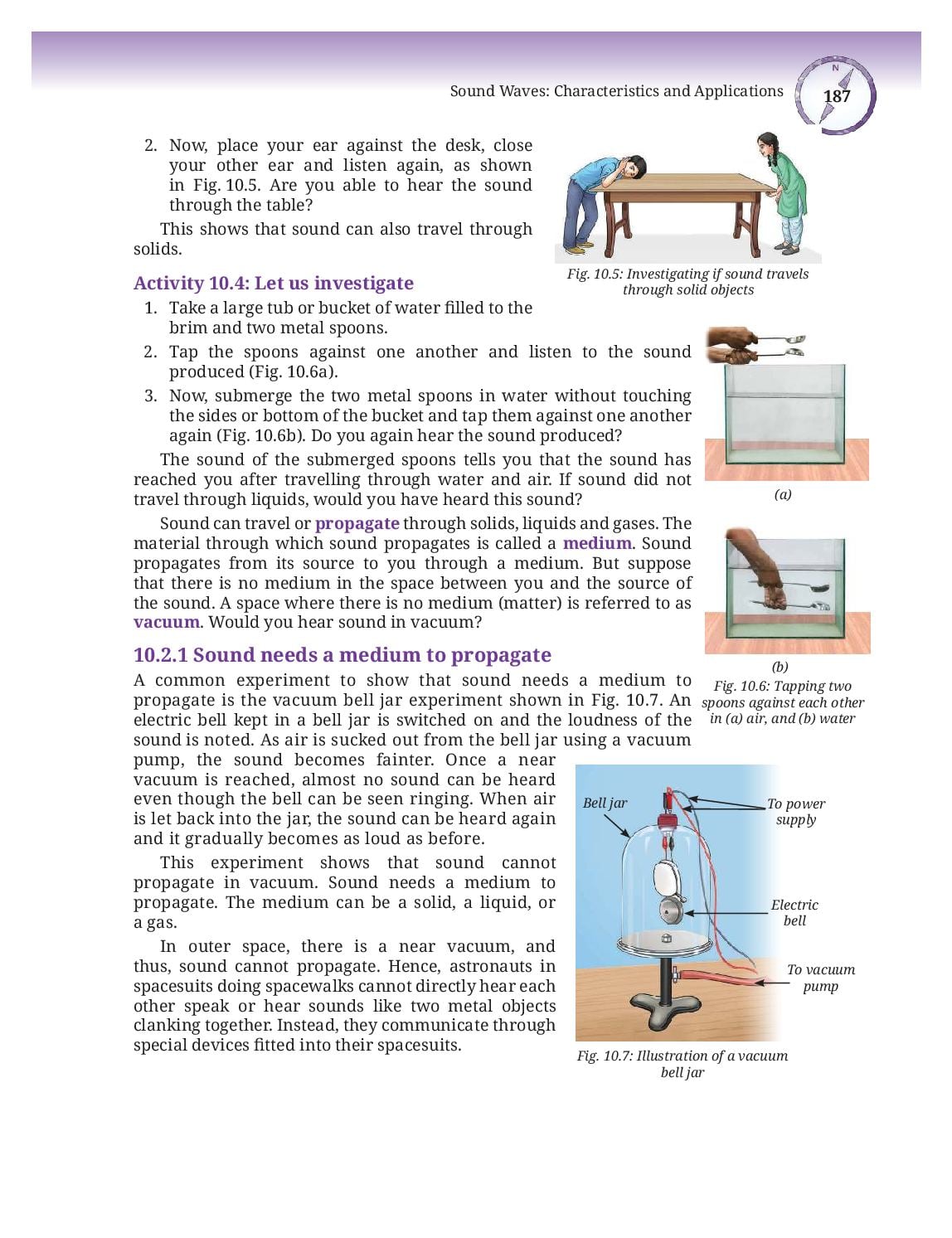
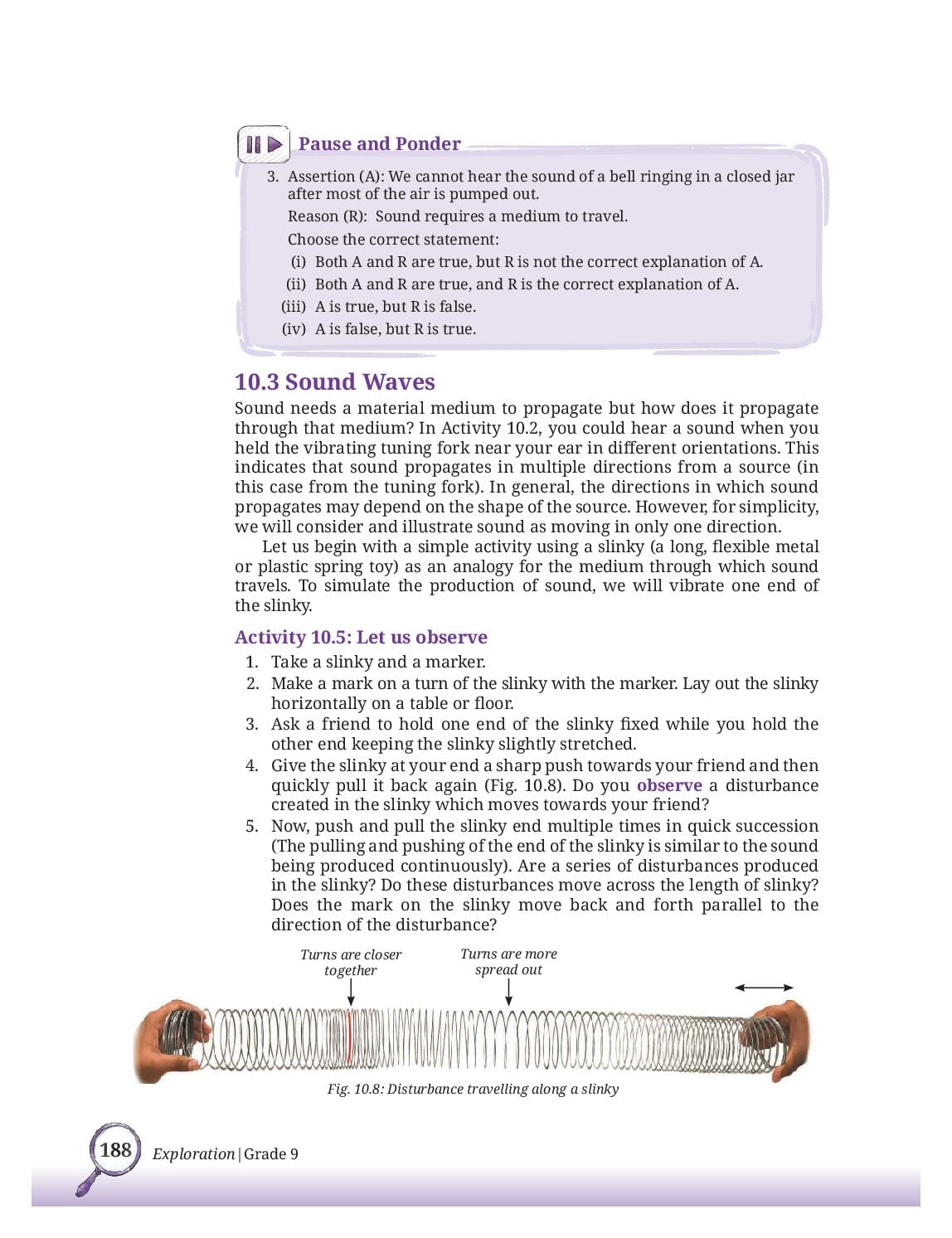
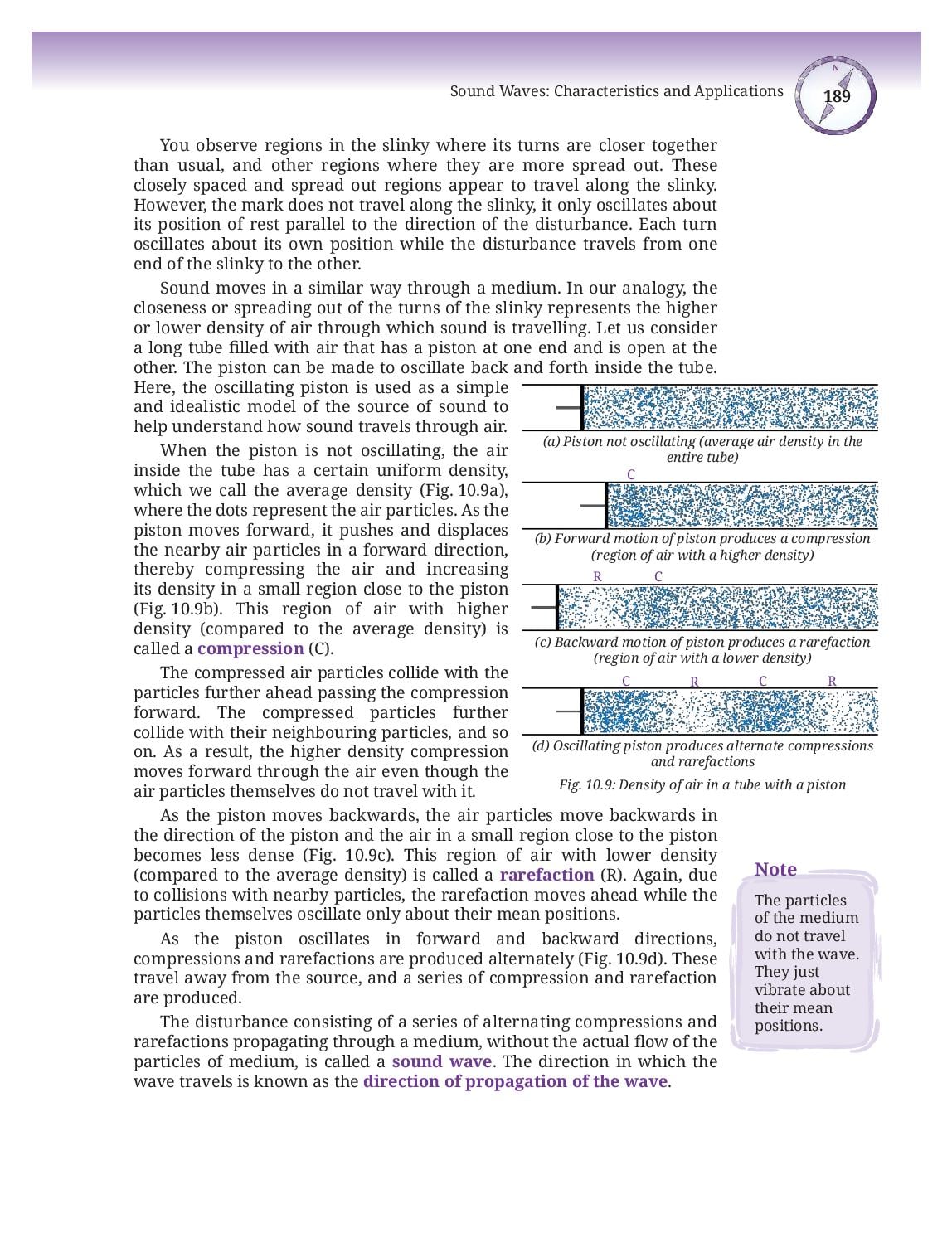
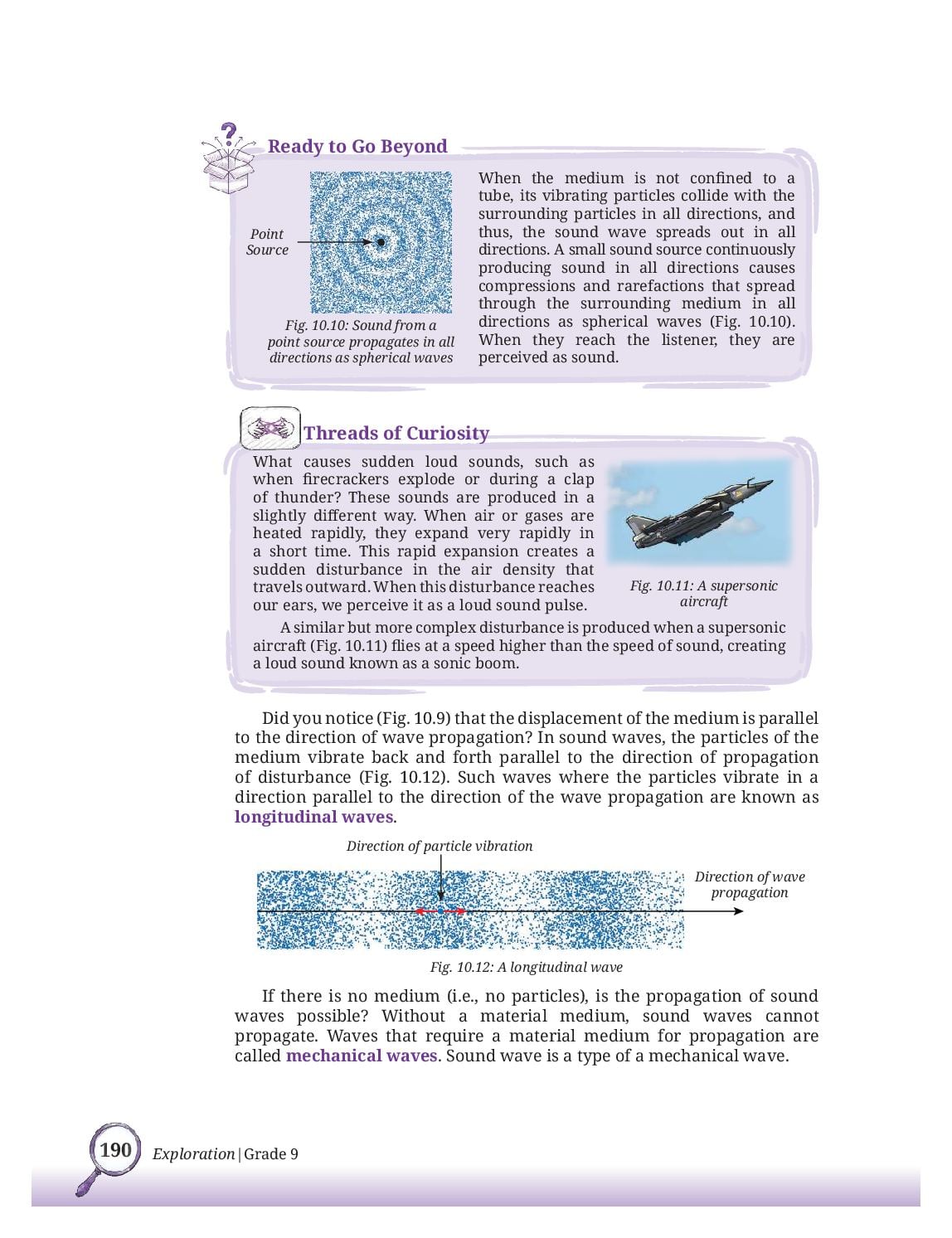
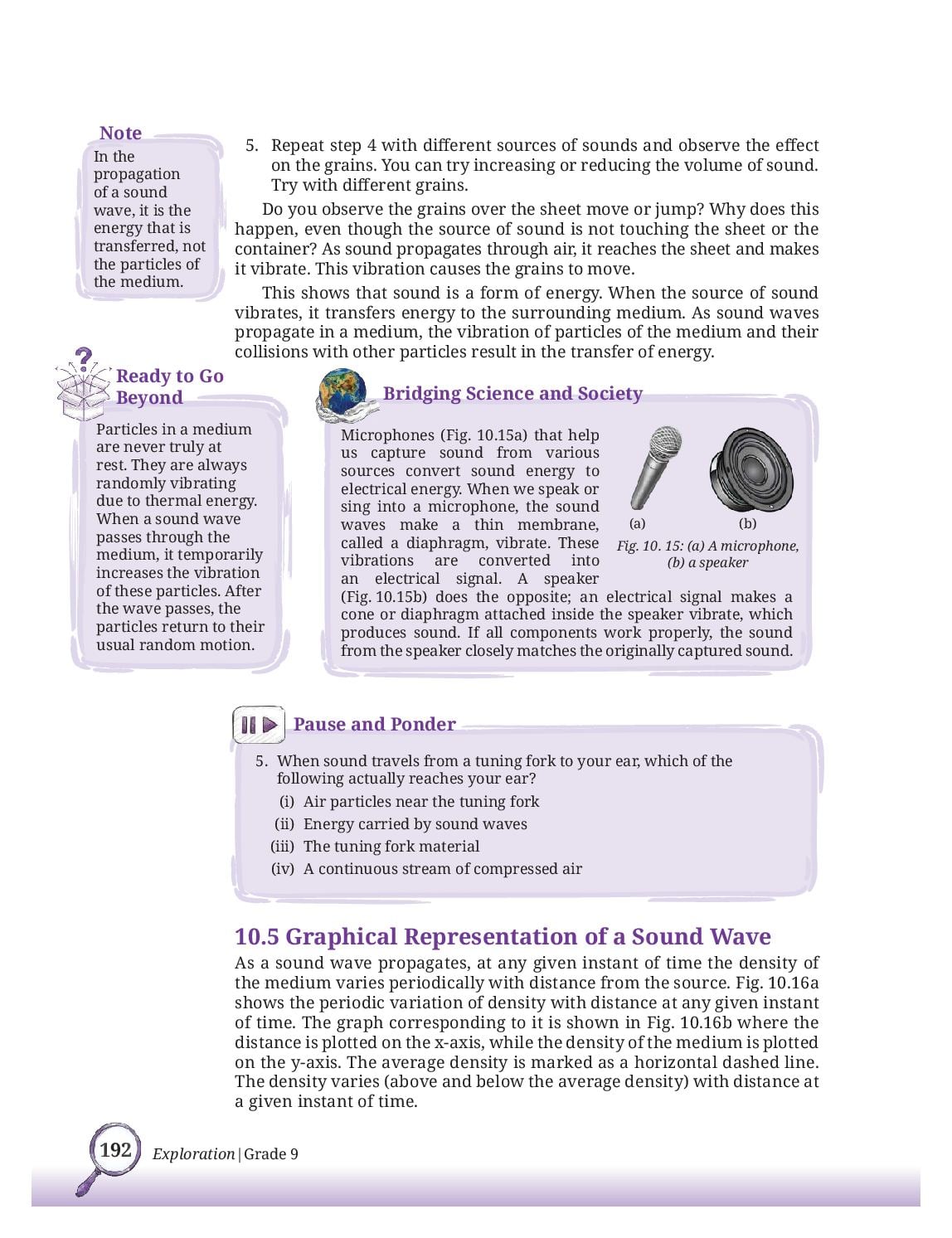
- Sound travels as a longitudinal mechanical wave — alternating compressions (higher density) and rarefactions (lower density) that move forward while the particles only oscillate about their mean positions. It cannot travel through vacuum.
- A sound wave is described by wavelength λ (m), frequency ν (Hz), time period T (s) and amplitude. They are linked by ν = 1/T and v = ν × λ.
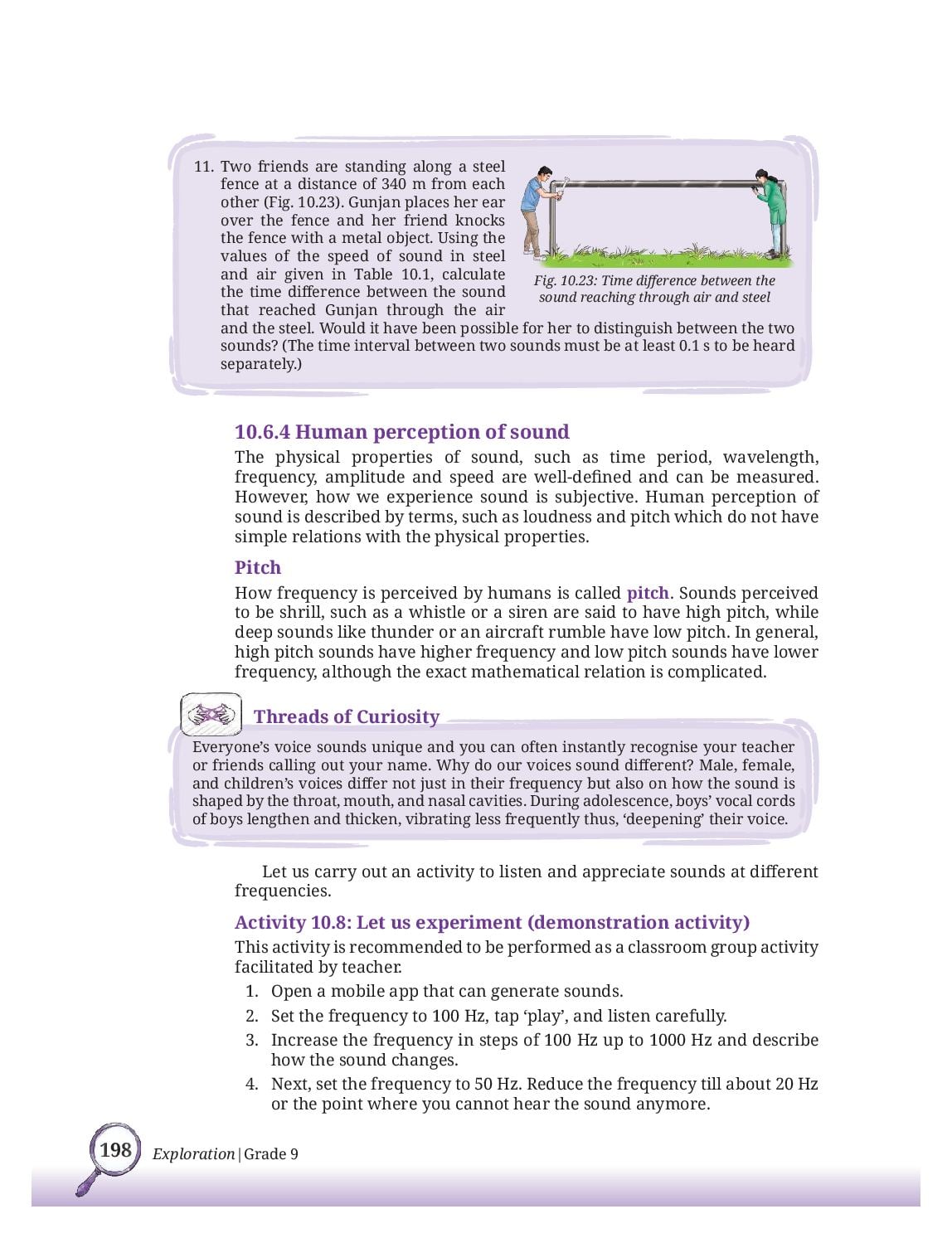
- Speed depends on the medium, not on the source: fastest in solids (steel ≈ 5000 m s⁻¹), slower in liquids (water ≈ 1500 m s⁻¹), slowest in gases (air ≈ 340 m s⁻¹), and it rises with temperature and humidity.
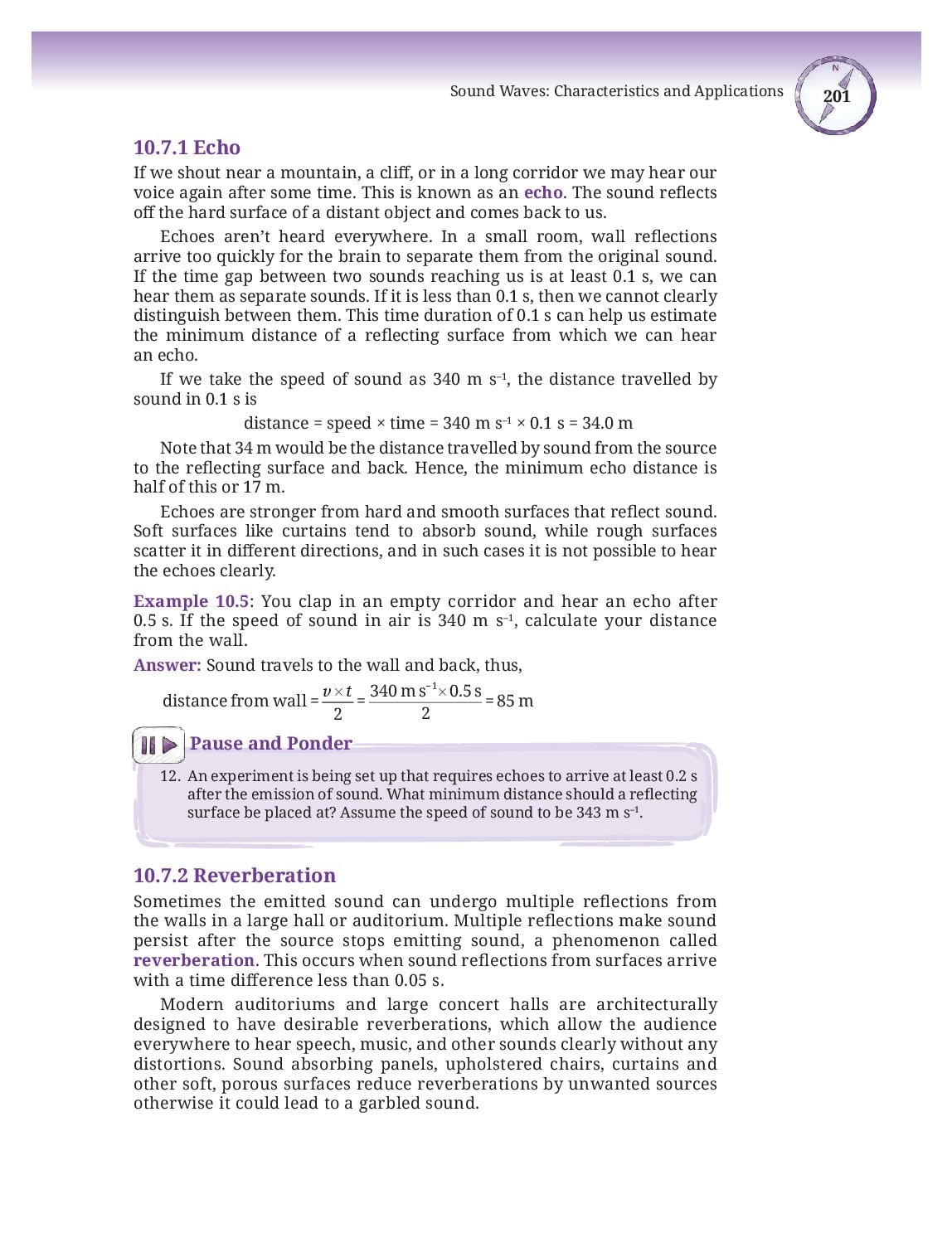
- Reflection of sound gives echo (needs a gap of at least 0.1 s, so a reflector at least 17 m away for v = 340 m s⁻¹) and reverberation (many reflections arriving within 0.05 s).
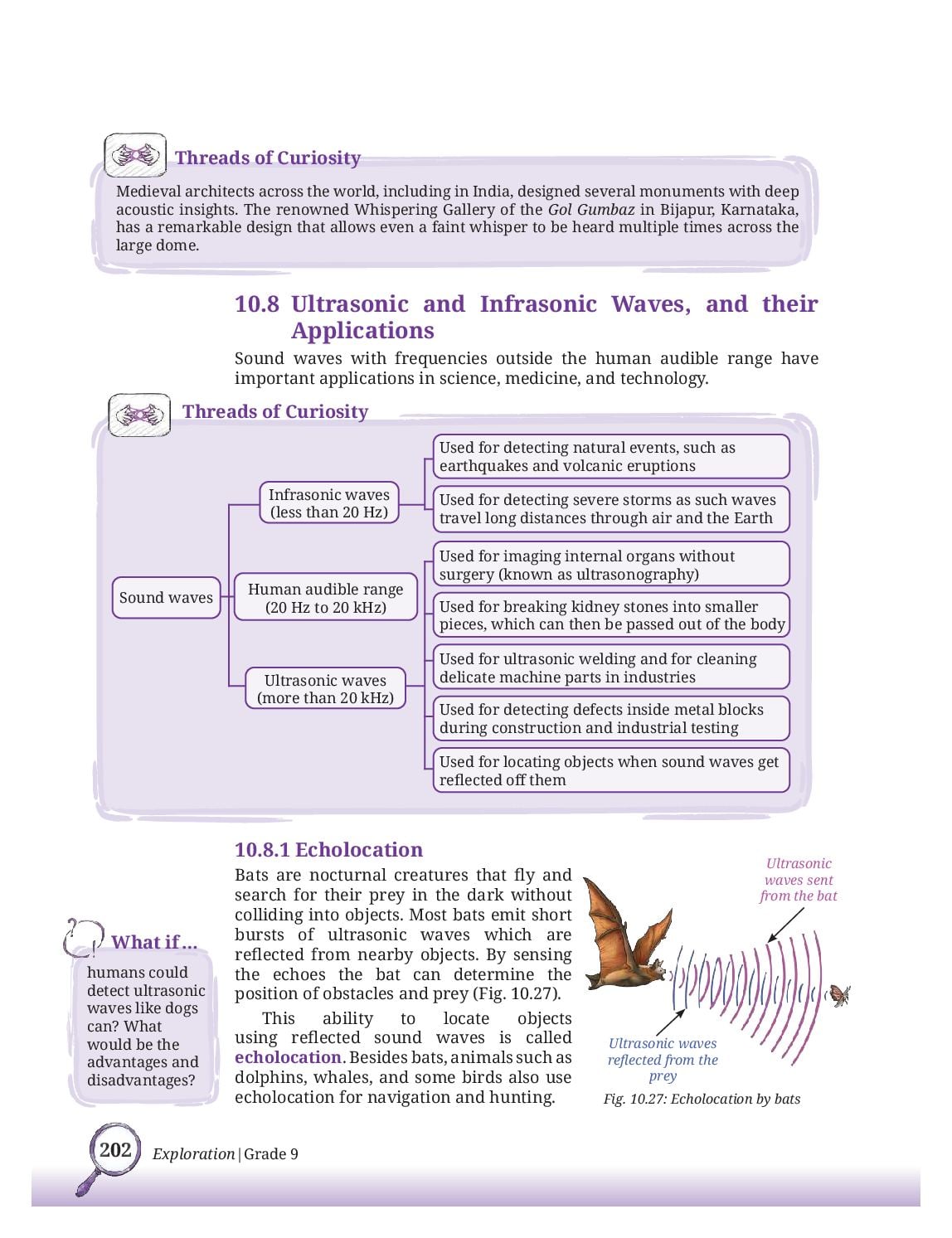
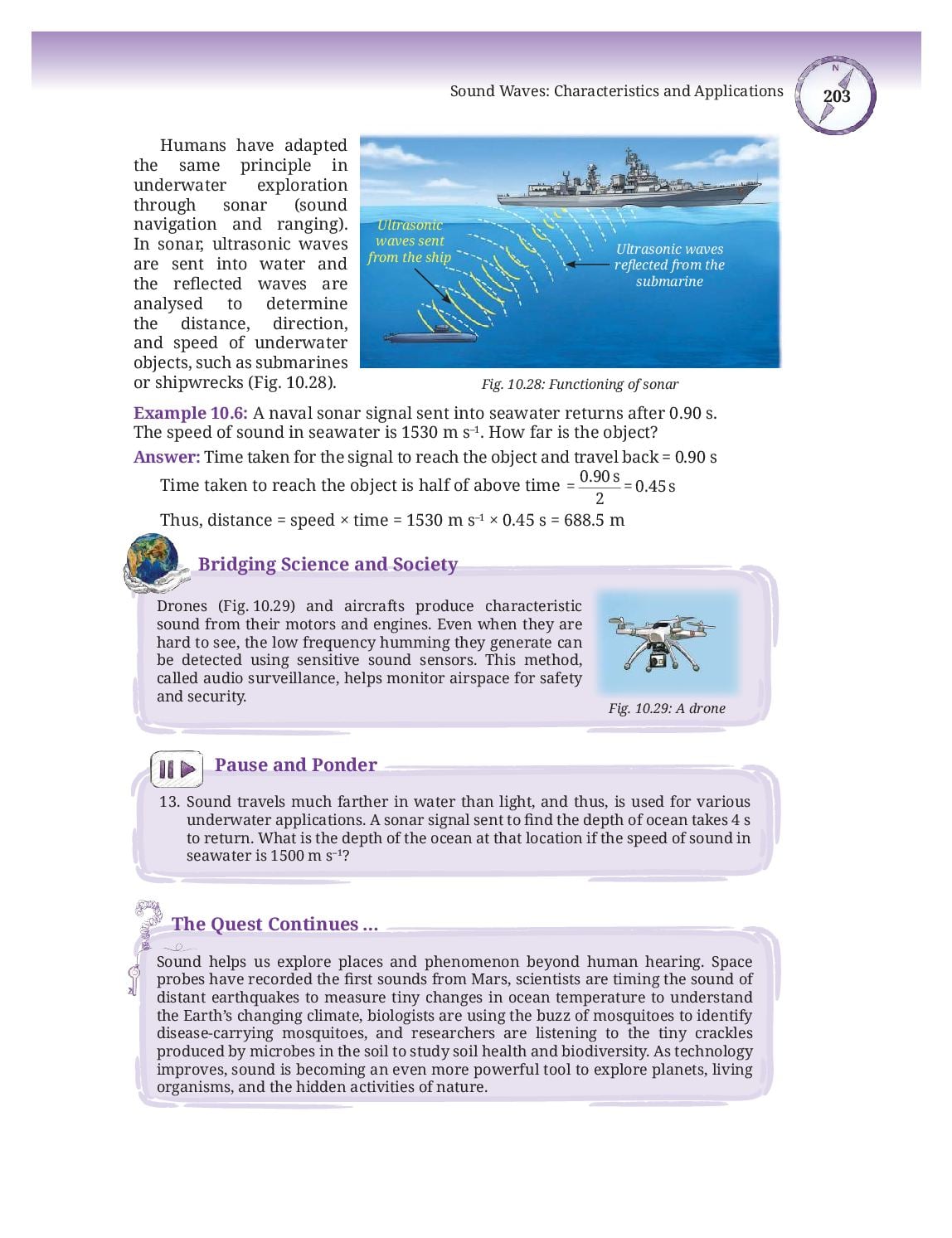
- Below 20 Hz is infrasonic, above 20 kHz is ultrasonic. Ultrasound drives echolocation, sonar, ultrasonography, kidney-stone breaking and flaw detection in metals.
Quick revision – Sound Waves: Characteristics and Applications
| Term | What it means | Formula / typical value | Where it appears |
|---|---|---|---|
| Vibration | Periodic to-and-fro motion (oscillation) of an object | — | Section 10.1, Activity 10.1 |
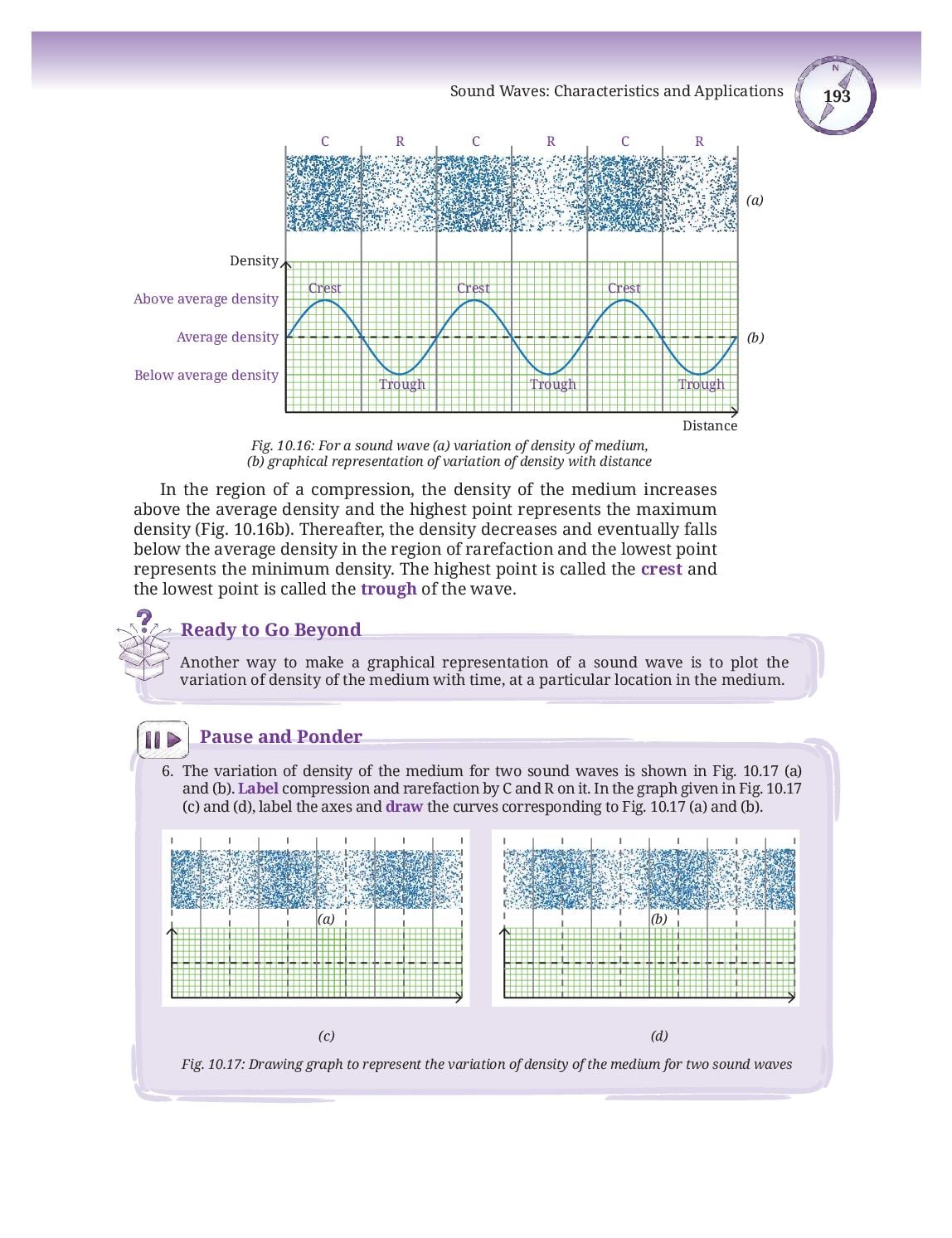
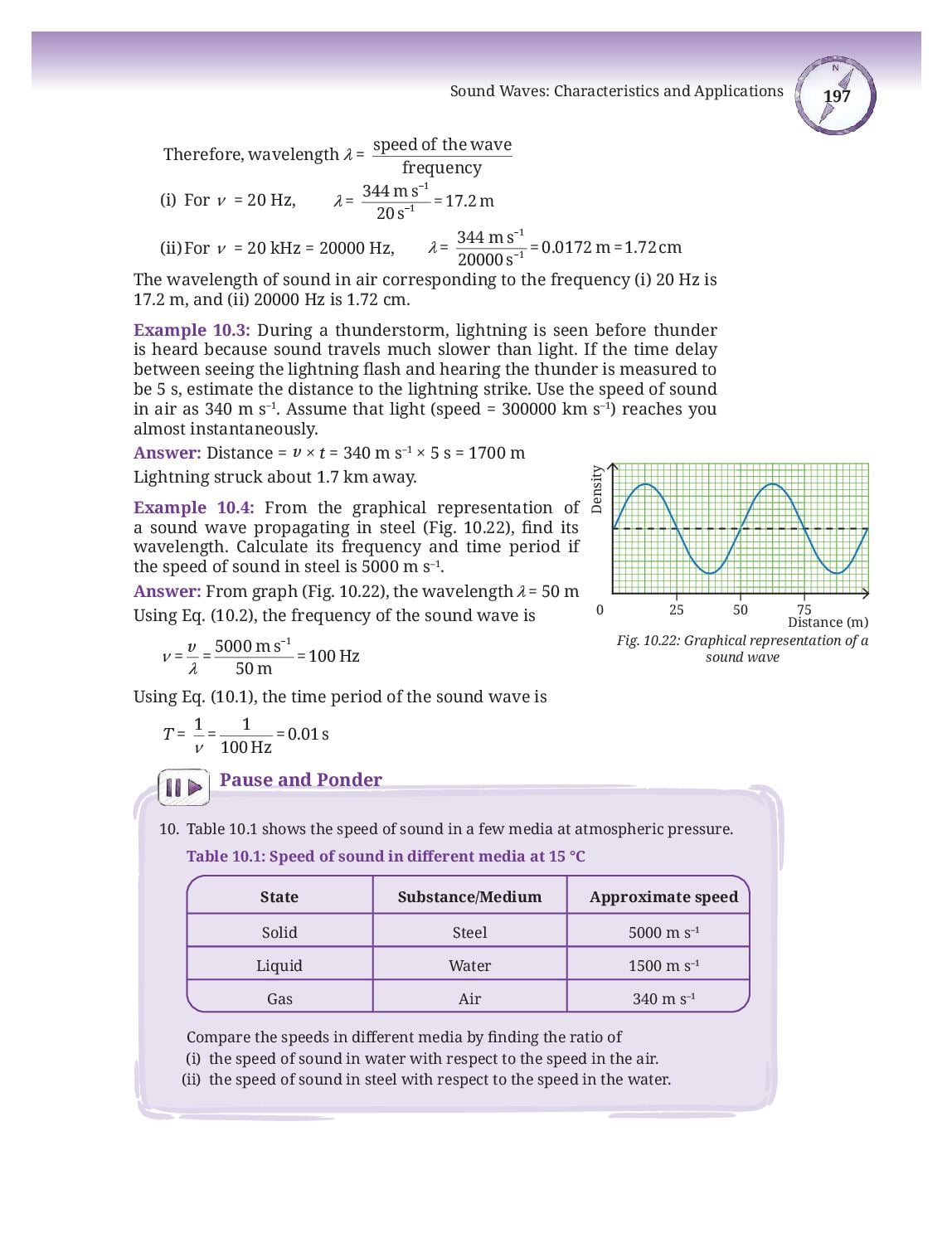
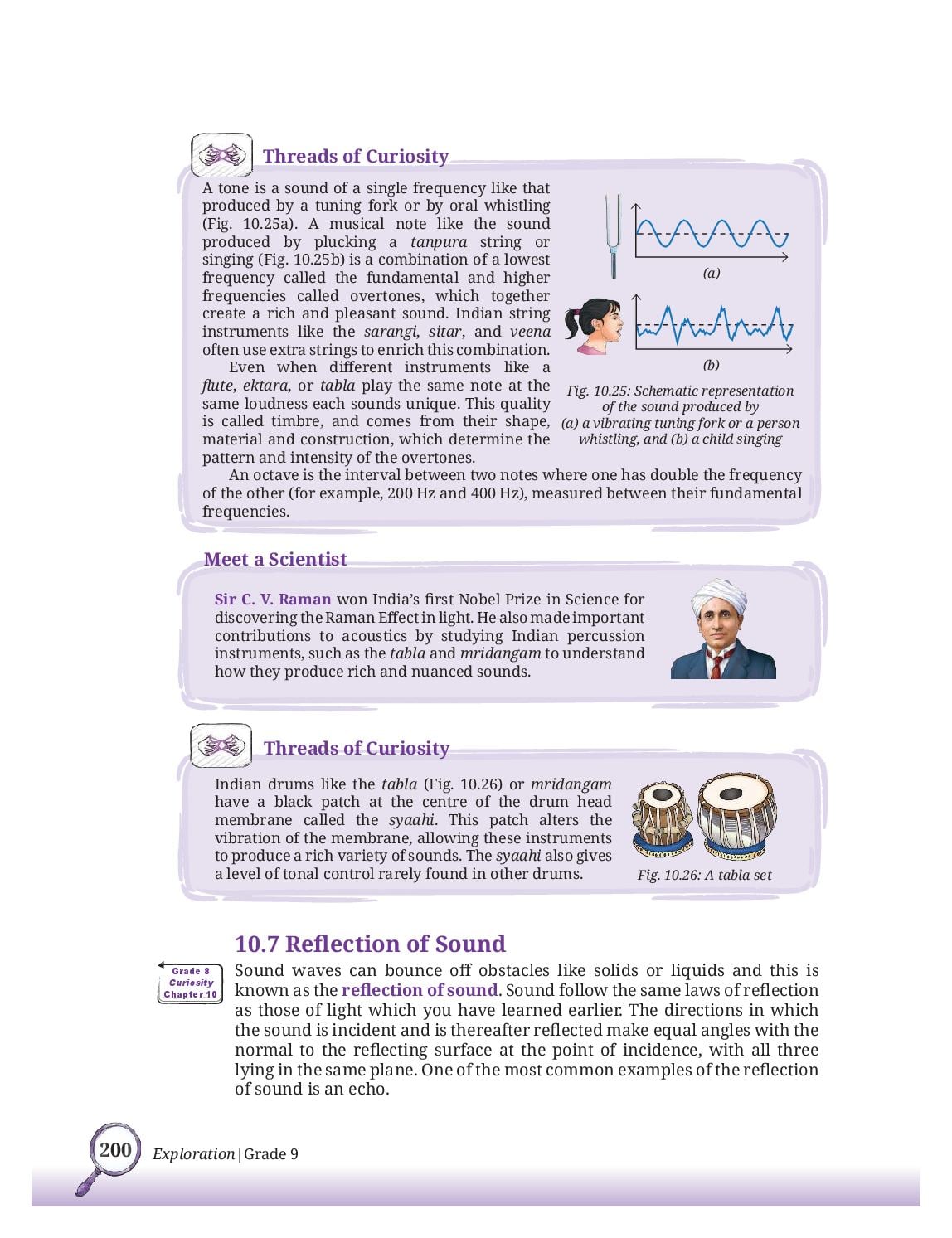
| Compression (C) | Region of the medium with density above the average density | Crest on the density–distance graph | Fig. 10.9b, Fig. 10.16 |
| Rarefaction (R) | Region of the medium with density below the average density | Trough on the density–distance graph | Fig. 10.9c, Fig. 10.16 |
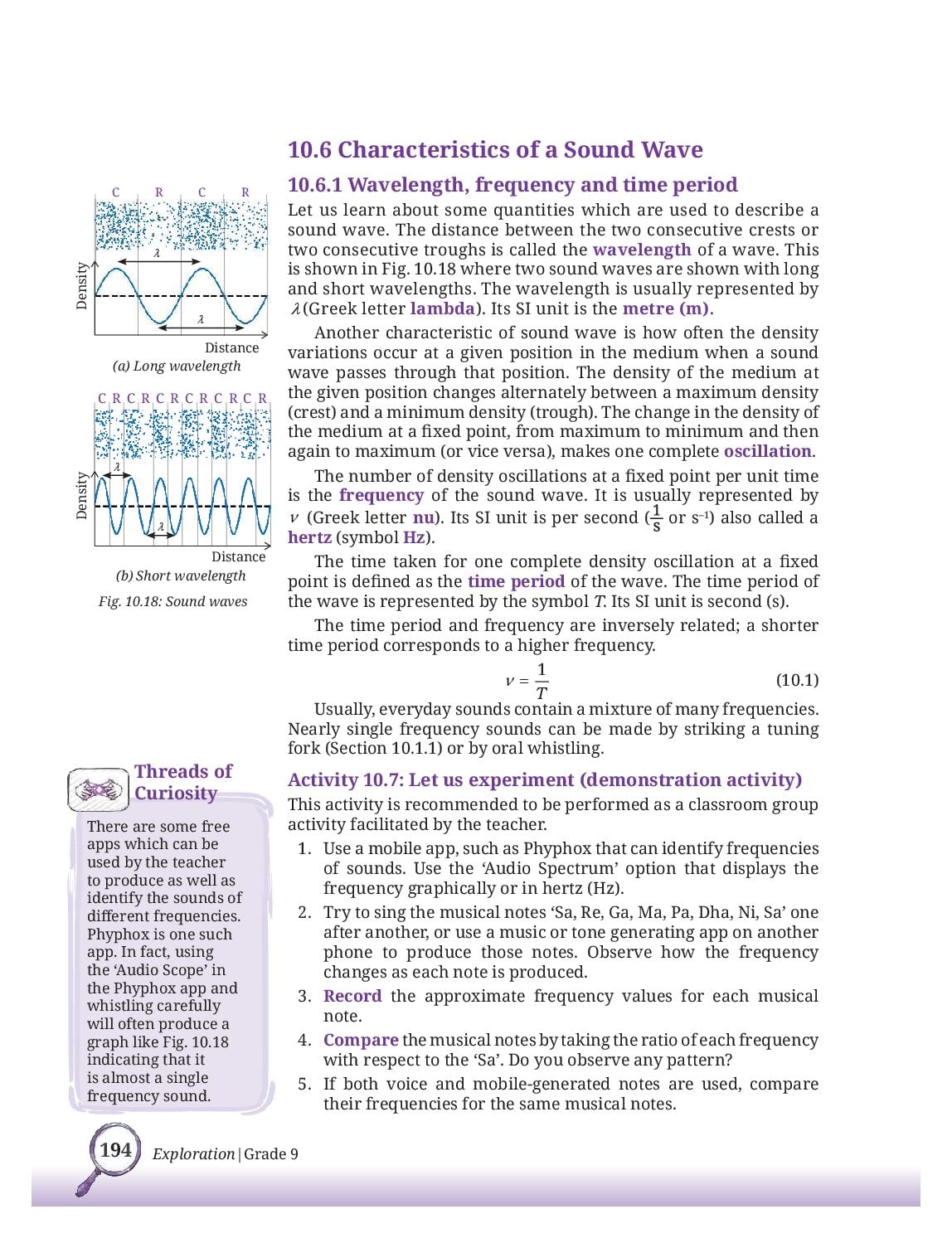
| Wavelength (λ) | Distance between two consecutive crests or two consecutive troughs | SI unit: metre (m) | Section 10.6.1, Fig. 10.18 |
| Frequency (ν) | Number of density oscillations at a fixed point per unit time | ν = 1/T; SI unit hertz (Hz = s⁻¹) | Eq. 10.1, Example 10.1 |
| Time period (T) | Time for one complete density oscillation at a fixed point | T = 1/ν; SI unit second (s) | Section 10.6.1 |
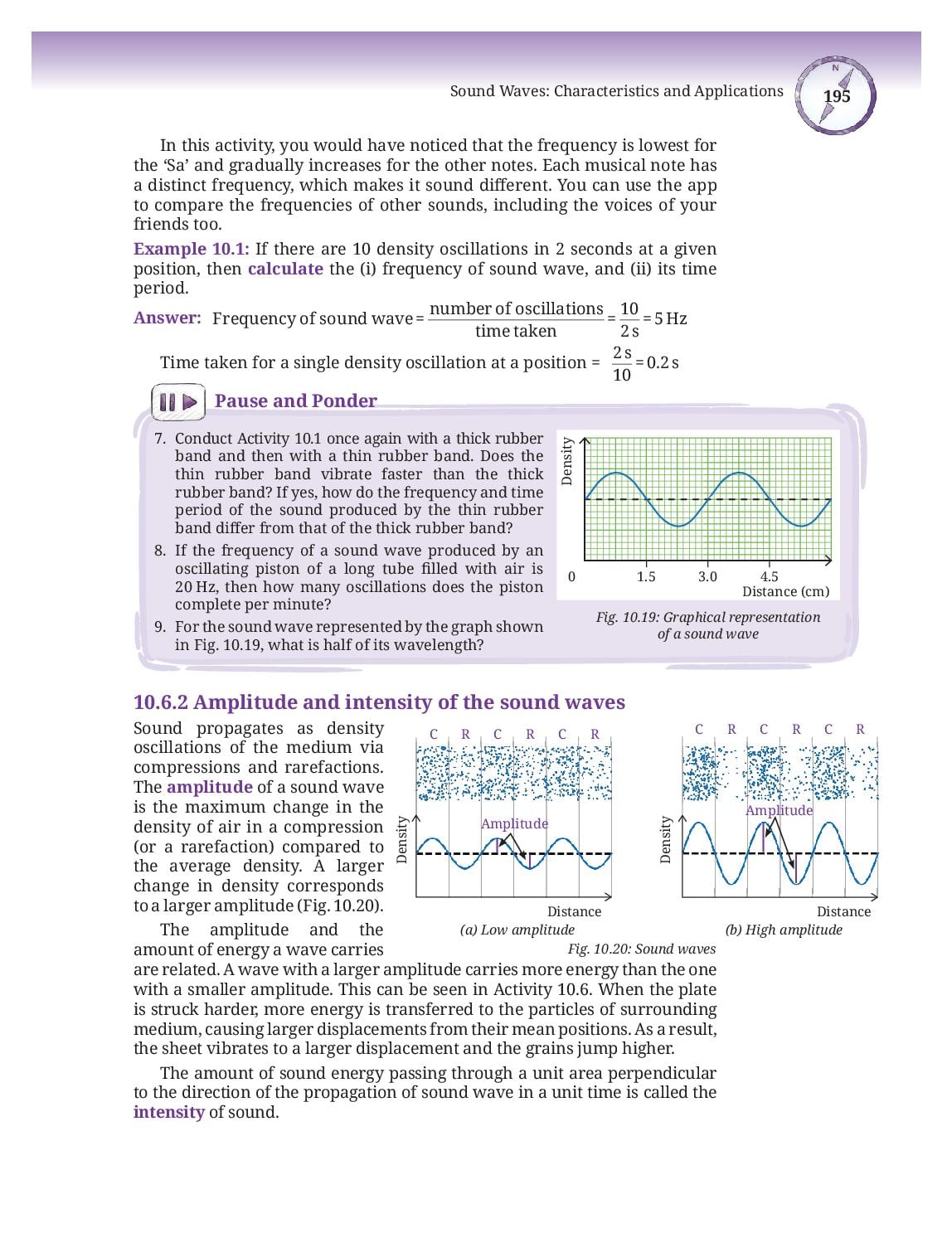
| Amplitude | Maximum change in air density in a compression (or rarefaction) from the average density | Larger amplitude → more energy | Section 10.6.2, Fig. 10.20 |
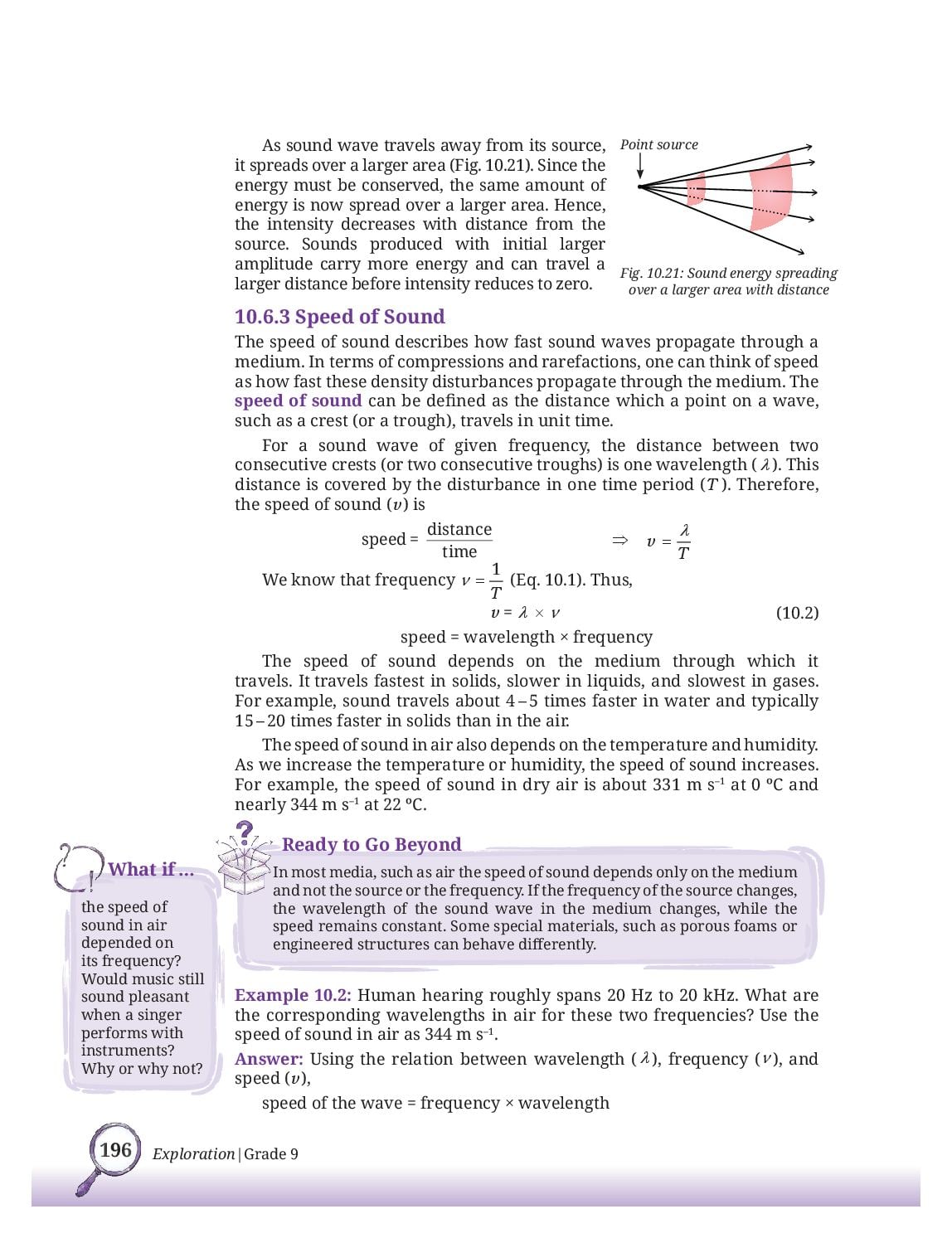
| Intensity | Sound energy passing per unit area per unit time, perpendicular to the direction of propagation | Falls as distance from the source grows | Section 10.6.2, Fig. 10.21 |
| Speed of sound (v) | Distance a crest (or trough) travels in unit time | V = ν × λ; air 331 m s⁻¹ at 0 ºC, 344 m s⁻¹ at 22 ºC | Eq. 10.2, Section 10.6.3 |
| Pitch / Loudness | How we perceive frequency / amplitude | Loudness measured in decibel (dB) | Section 10.6.4 |
| Echo | A reflected sound heard separately from the original | Needs ≥ 0.1 s gap → reflector ≥ 17 m away | Section 10.7.1, Example 10.5 |
| Reverberation | Persistence of sound due to multiple reflections in a hall | Reflections arriving within 0.05 s | Section 10.7.2 |
| Ultrasonic / Infrasonic | Sound above 20 kHz / below 20 Hz | Human audible range 20 Hz – 20 kHz | Section 10.8, Fig. 10.27, 10.28 |
Old NCERT vs New – Class 9 Science
This chapter is from Exploration, the new NCERT Class 9 Science book (NCF-SE 2023, used from 2026-27). It replaced the old book “Science”, so chapter numbers and names differ from older PDFs.
Solutions and All Chapters
Answers to the exercises and the full chapter list of Exploration:
Sound Waves: Characteristics and Applications – Overview
| Class | Class 9 |
| Subject | Science |
| Book | Exploration – new NCERT book |
| Chapter | 10 of 13 – Sound Waves: Characteristics and Applications |
| Book pages | 184 – 207 |
| Edition | Latest NCERT edition (2026-27) |
| Session | 2026-27 |
| Free – read online or download |
Class 9 Science Chapter 10 – FAQs
Where can I download Sound Waves: Characteristics and Applications Class 9 PDF?
From the download table on this page – the chapter PDF is free, and the full book is linked too.
What is Class 9 Science Chapter 10 about?
Sound is produced by vibrating objects. Stop the vibration and the sound stops with it; the vibrating object is the source.
Is Sound Waves: Characteristics and Applications from the new NCERT Class 9 Science book?
Yes. It is chapter 10 of exploration, the new NCERT Class 9 Science book for 2026-27.
Is this the latest NCERT edition for 2026-27?
Yes – the PDF is NCERT’s latest edition for the 2026-27 session.
Where are the NCERT Solutions for Class 9 Science Chapter 10?
Open the NCERT Solutions link above for answers to the exercise questions.