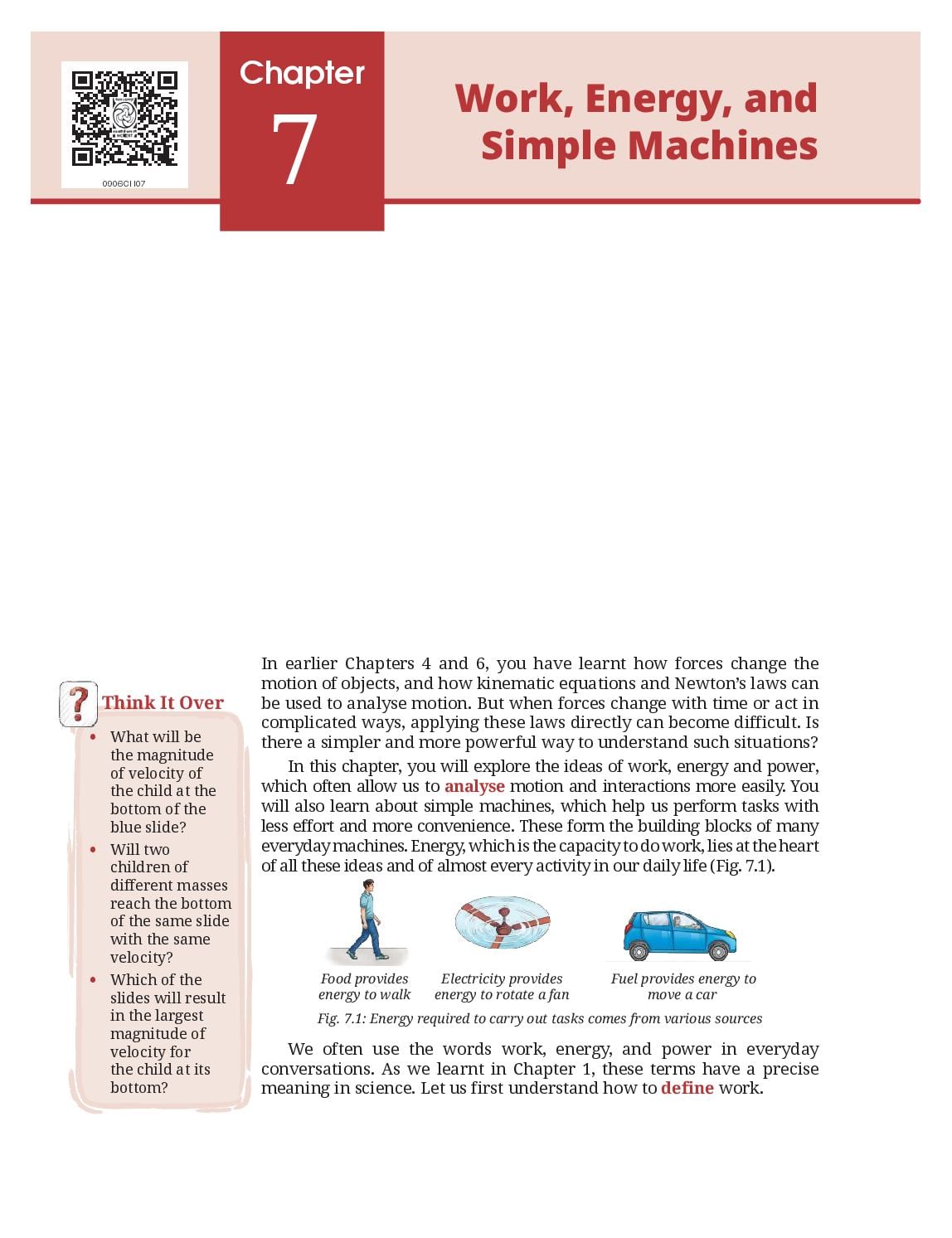
Download Work, Energy, and Simple Machines – NCERT Class 9 Science Chapter 7 PDF from the new NCERT Class 9 Science book Exploration (2026-27). Read the chapter online or download the free PDF. Work done by a constant force = force × displacement in the direction of the force, W = F × s. Its SI unit is the joule: 1 J = 1 N × 1 m = 1 kg m2 s–2. Work is zero when F = 0, when s = 0, or when the force is perpendicular to the…
Work, Energy, and Simple Machines PDF – Chapter 7 of Exploration
Read the chapter online or download the PDF.
| Chapter | Download | |
|---|---|---|
| Chapter 7 PDF | Work, Energy, and Simple Machines | View PDF |
| Full book | NCERT Class 9 Science – Exploration | View Book |
Read Online
What Is in Work, Energy, and Simple Machines? (Class 9 Science Chapter 7)
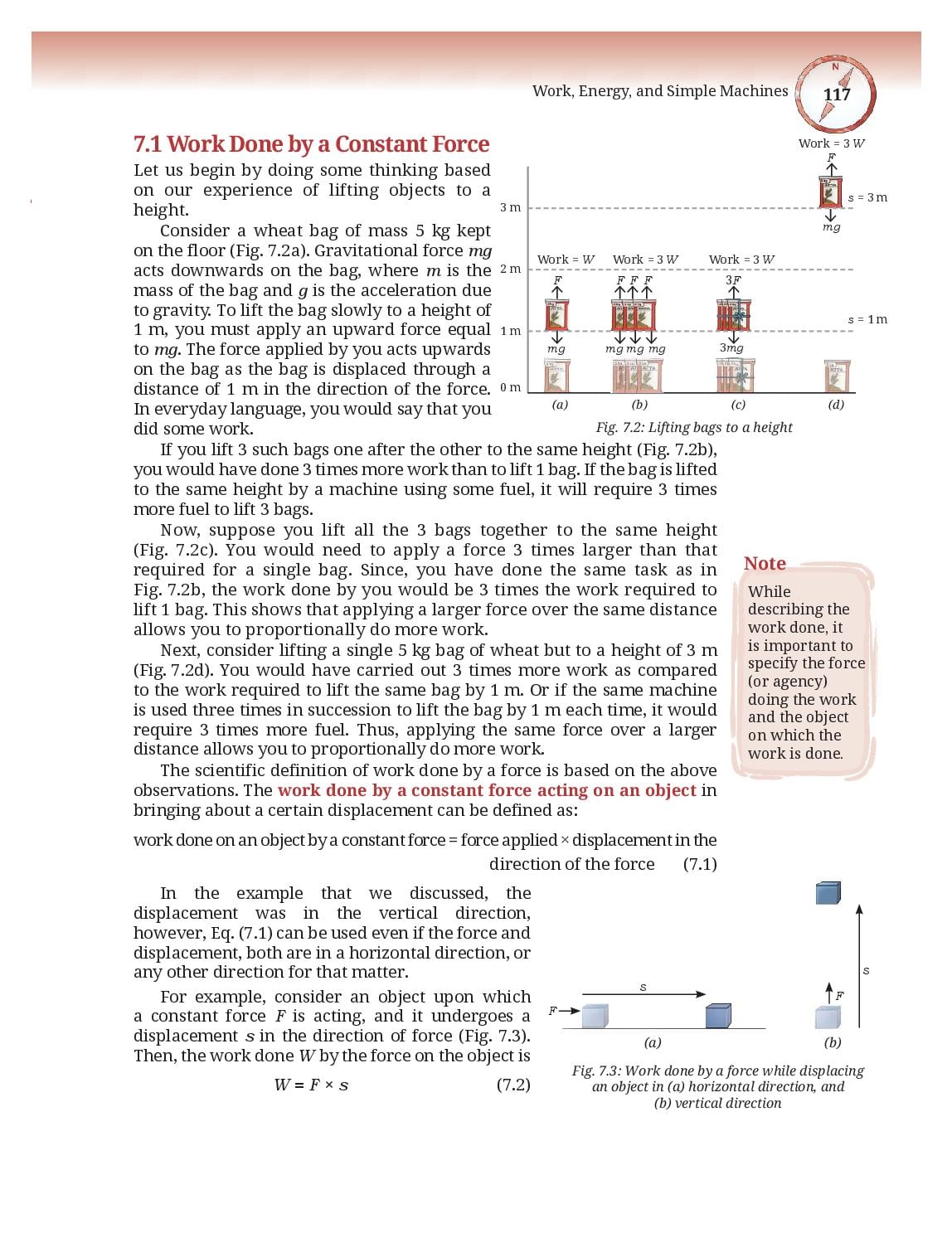
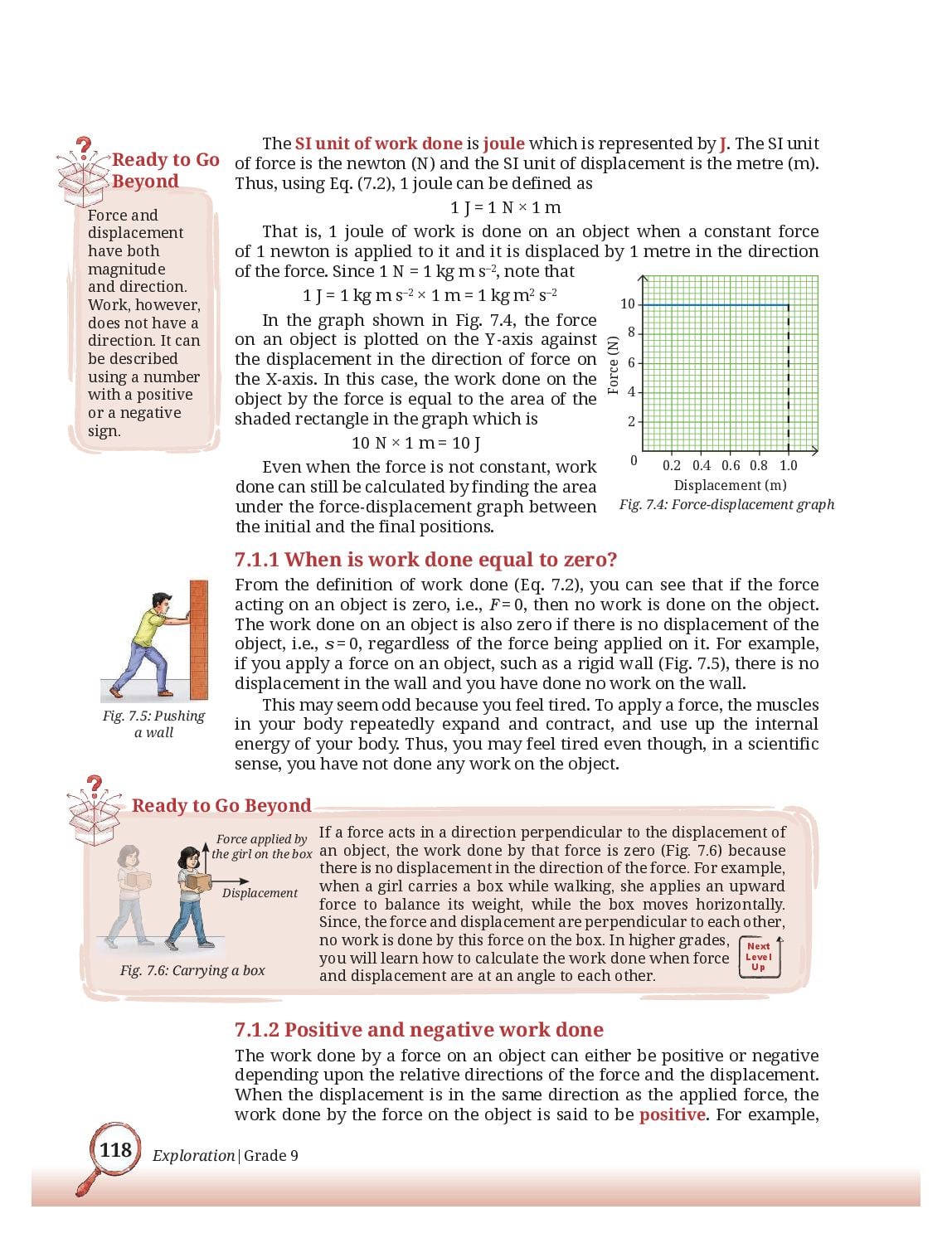
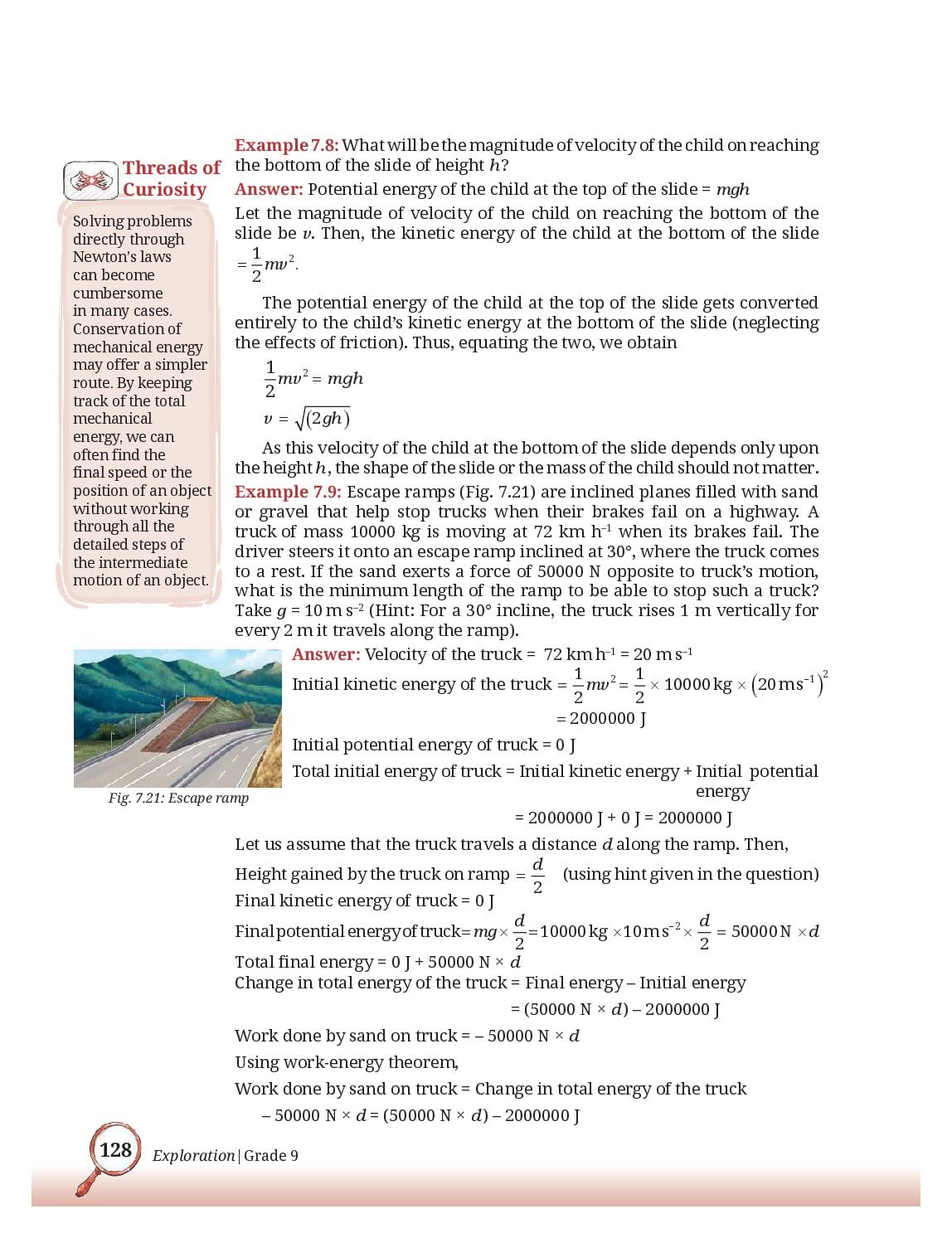
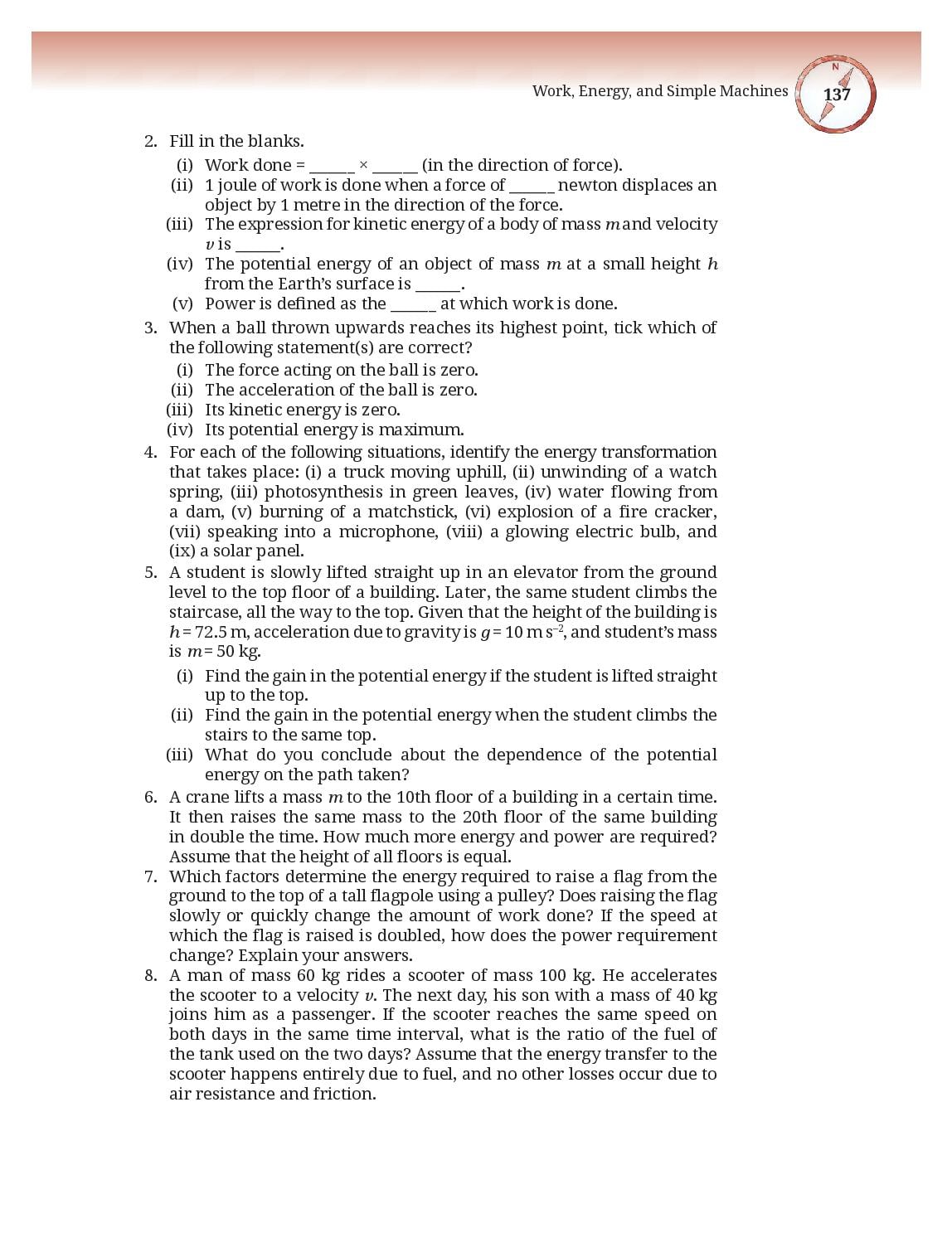
- Work done by a constant force = force × displacement in the direction of the force, W = F × s. Its SI unit is the joule: 1 J = 1 N × 1 m = 1 kg m2 s–2. Work is zero when F = 0, when s = 0, or when the force is perpendicular to the displacement.
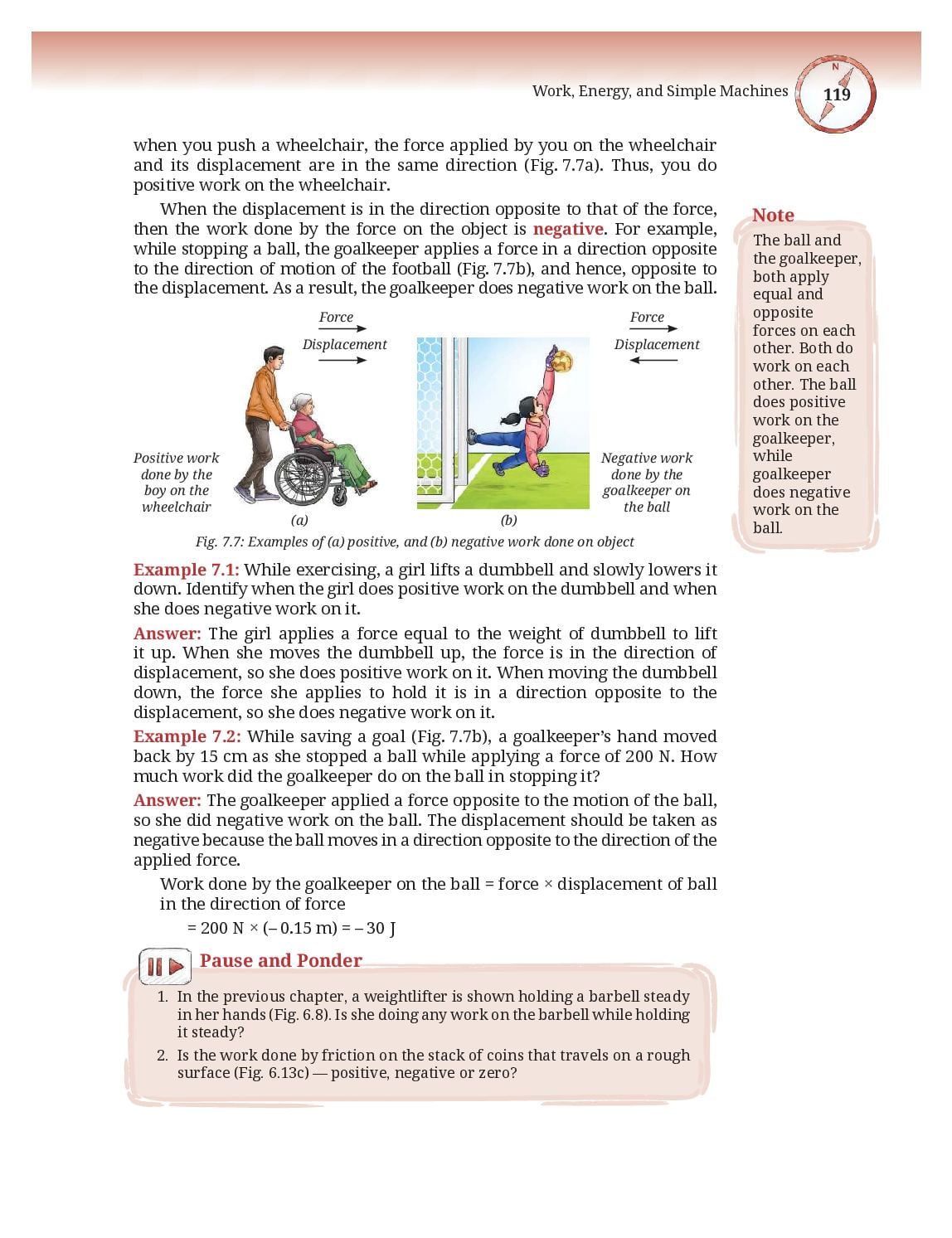
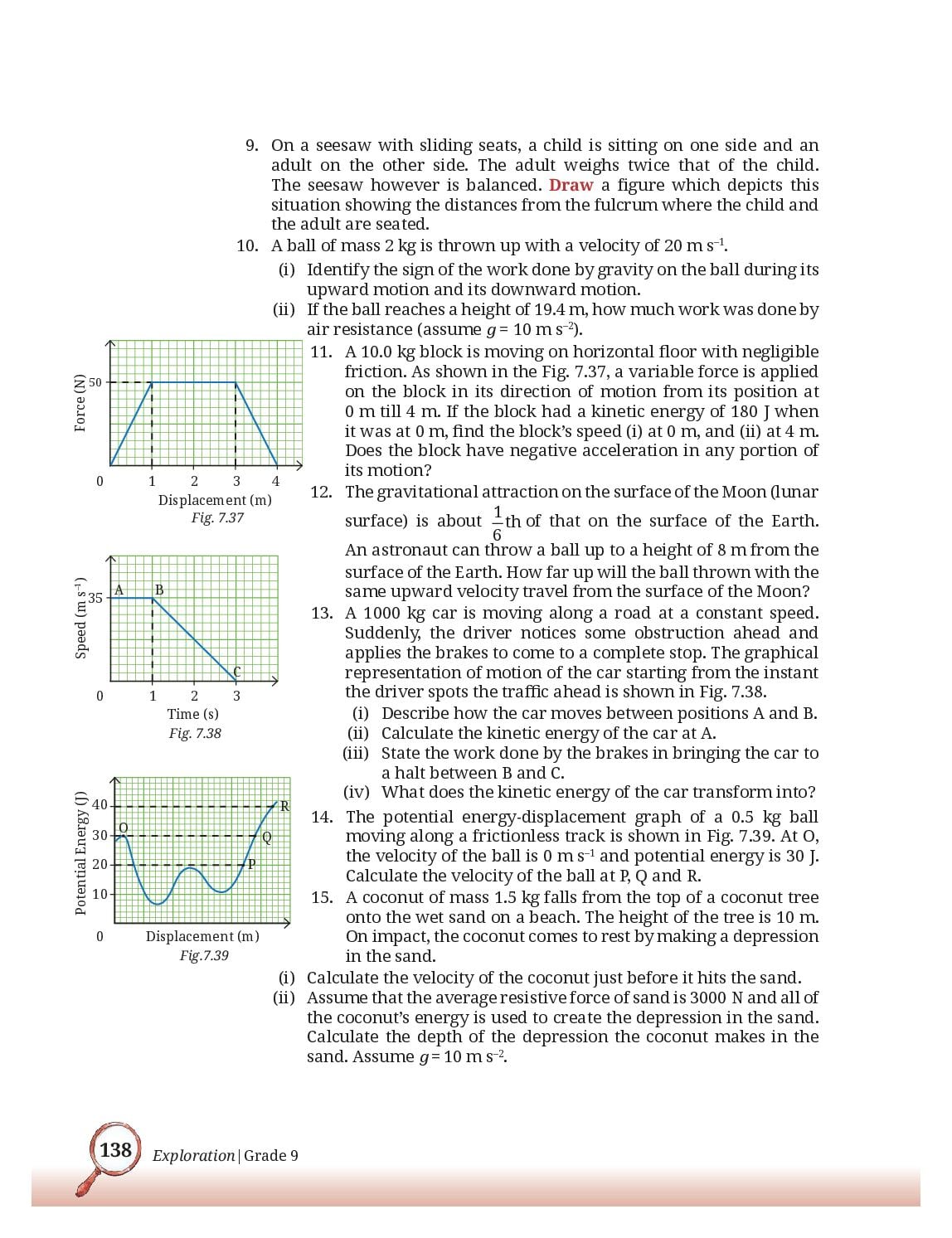
- Work is positive when the displacement is along the force and negative when it opposes the force. Work has no direction — only a sign. For a force that varies, the work done is the area under the force–displacement graph.
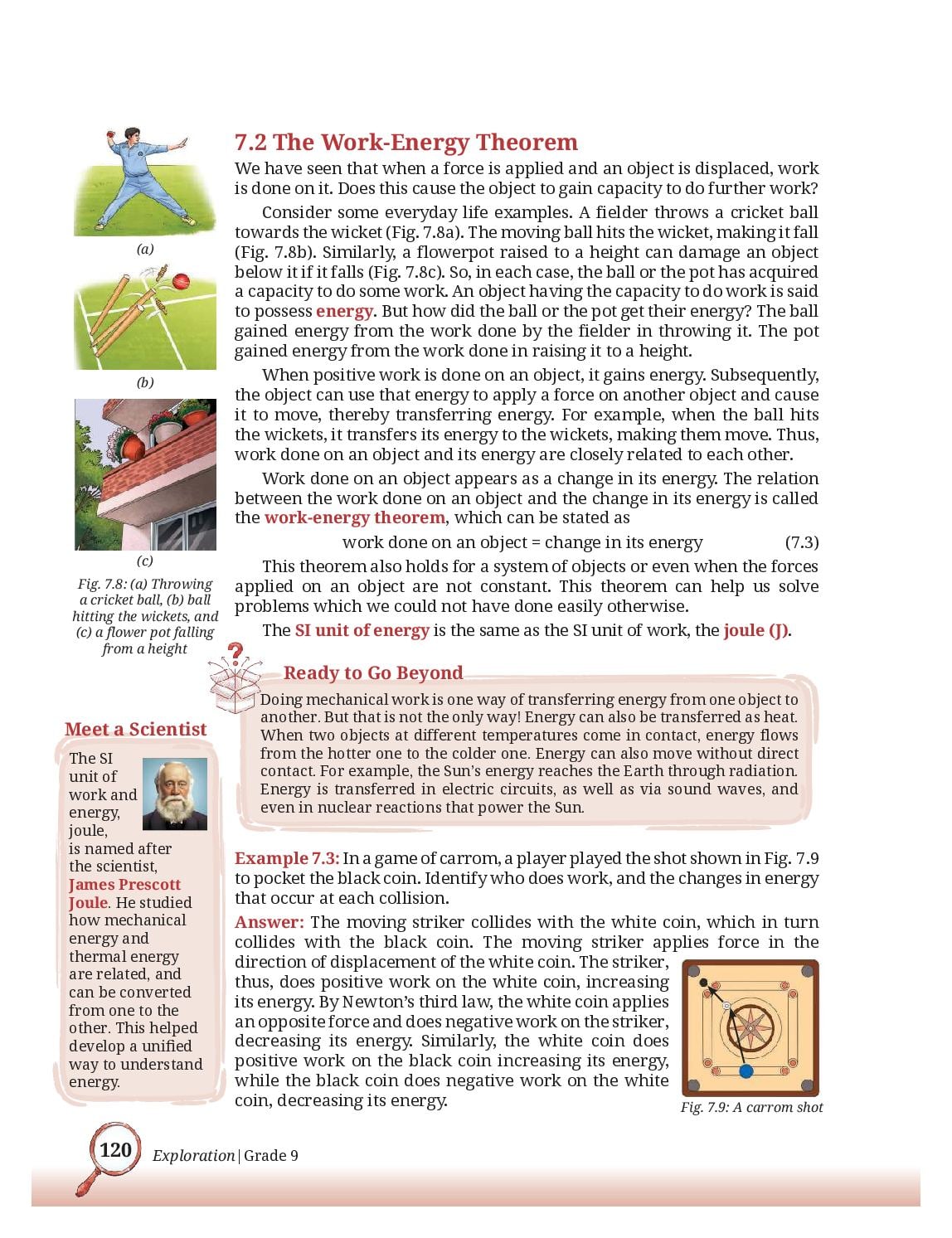
- Work–energy theorem: work done on an object (or system) = change in its energy. This holds even when the forces are not constant, and it is the tool that gives every other formula in the chapter.
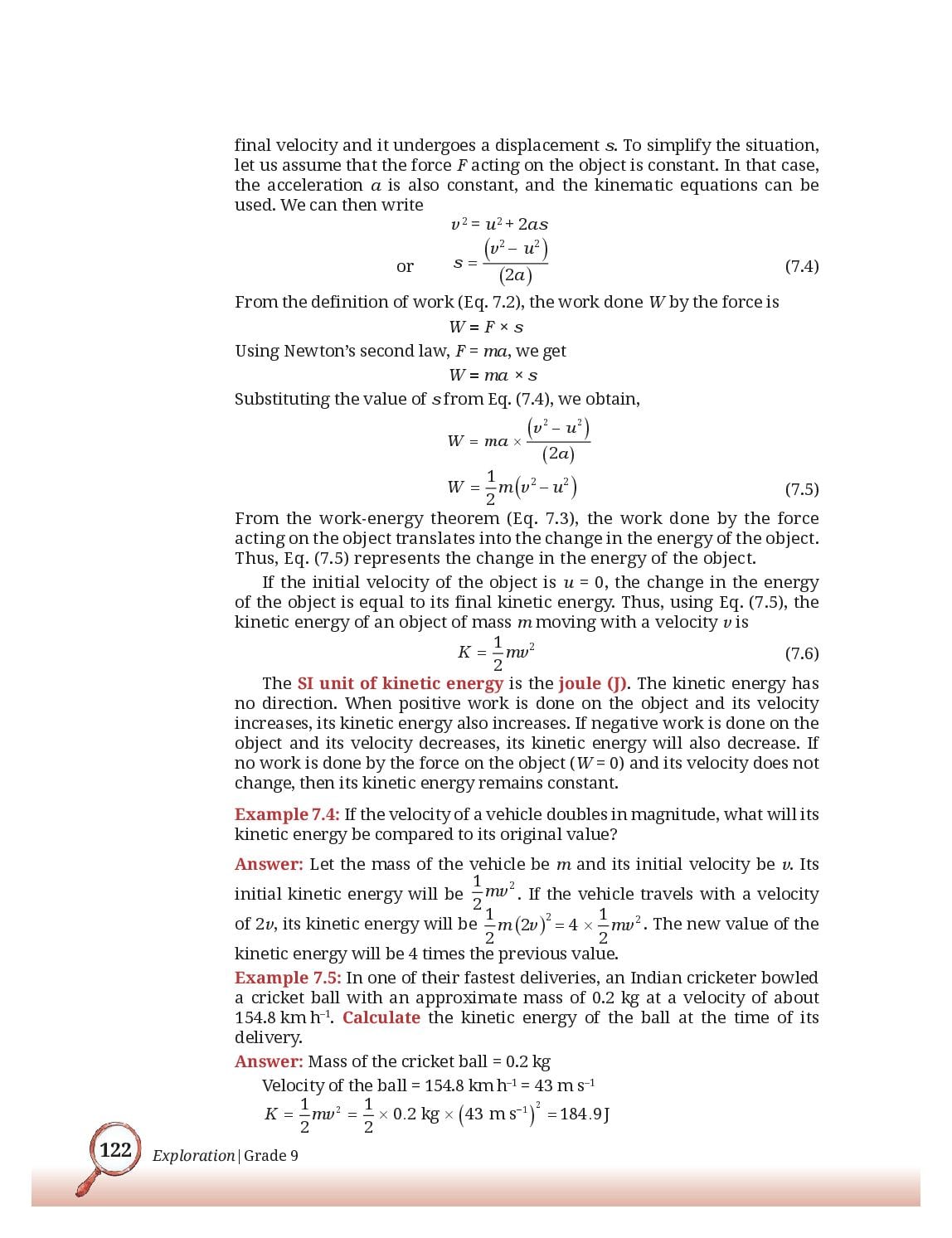
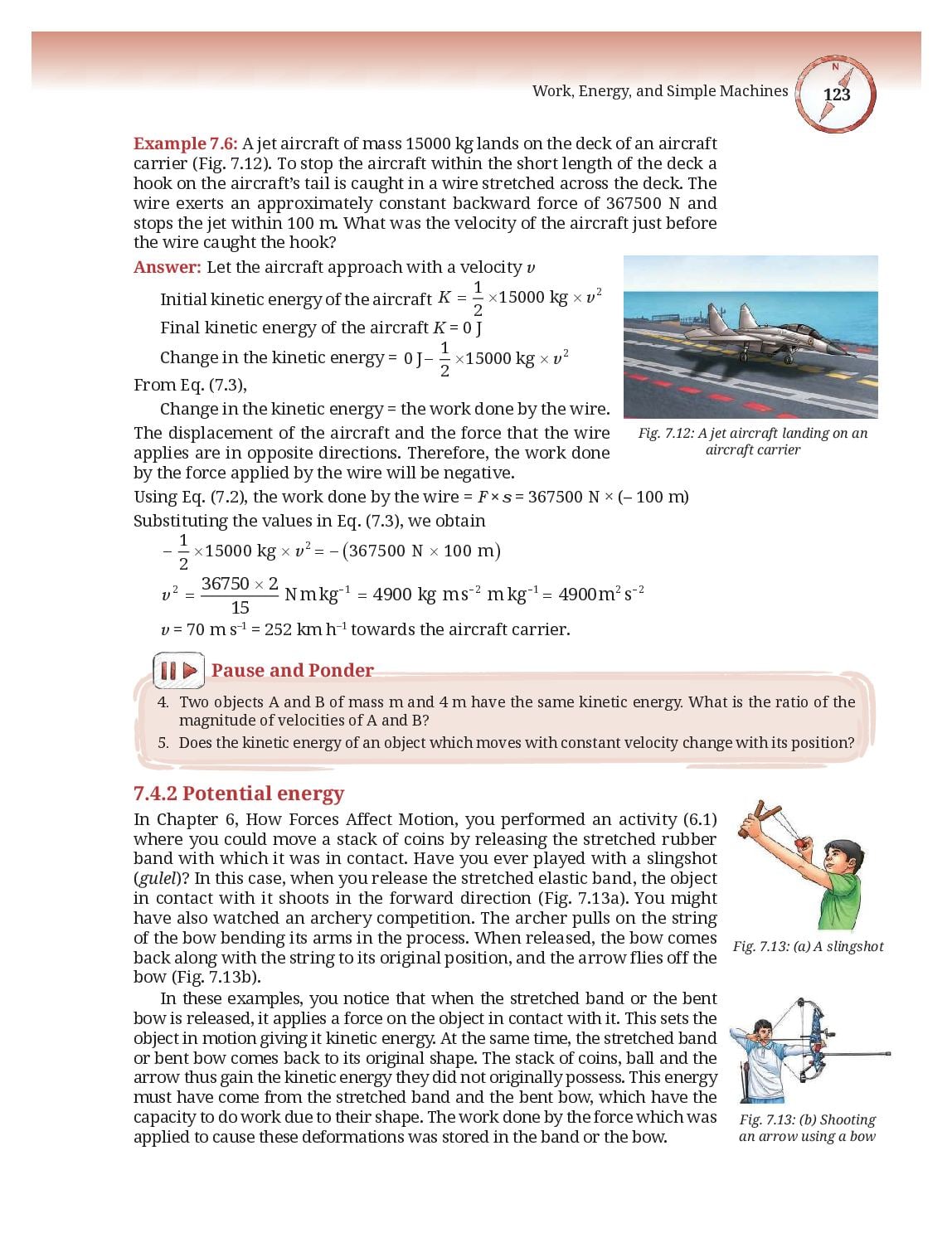
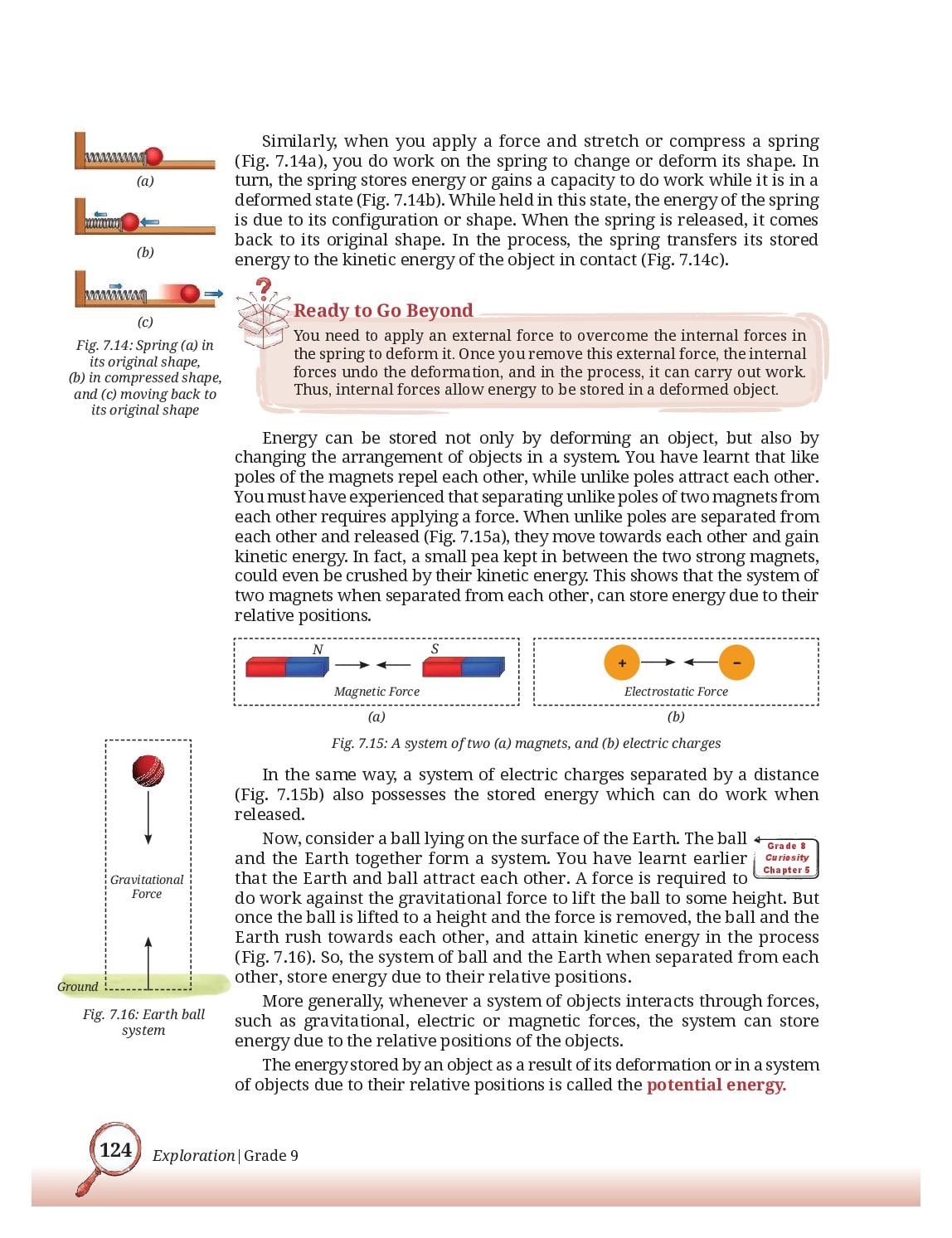
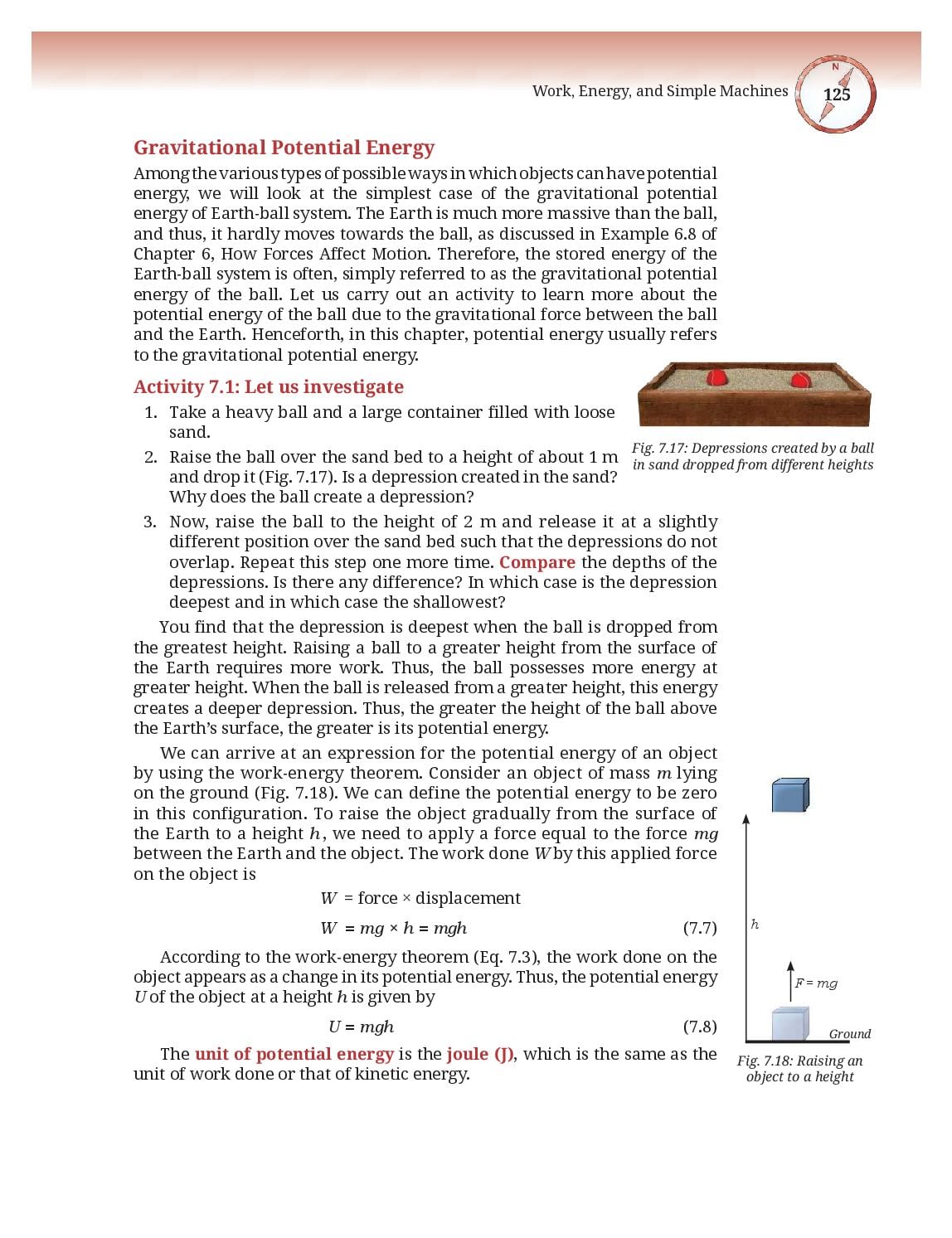
- Kinetic energy K = ½mv2 — the energy of motion. Gravitational potential energy U = mgh near the Earth’s surface — the energy of position. Both are measured in joules.
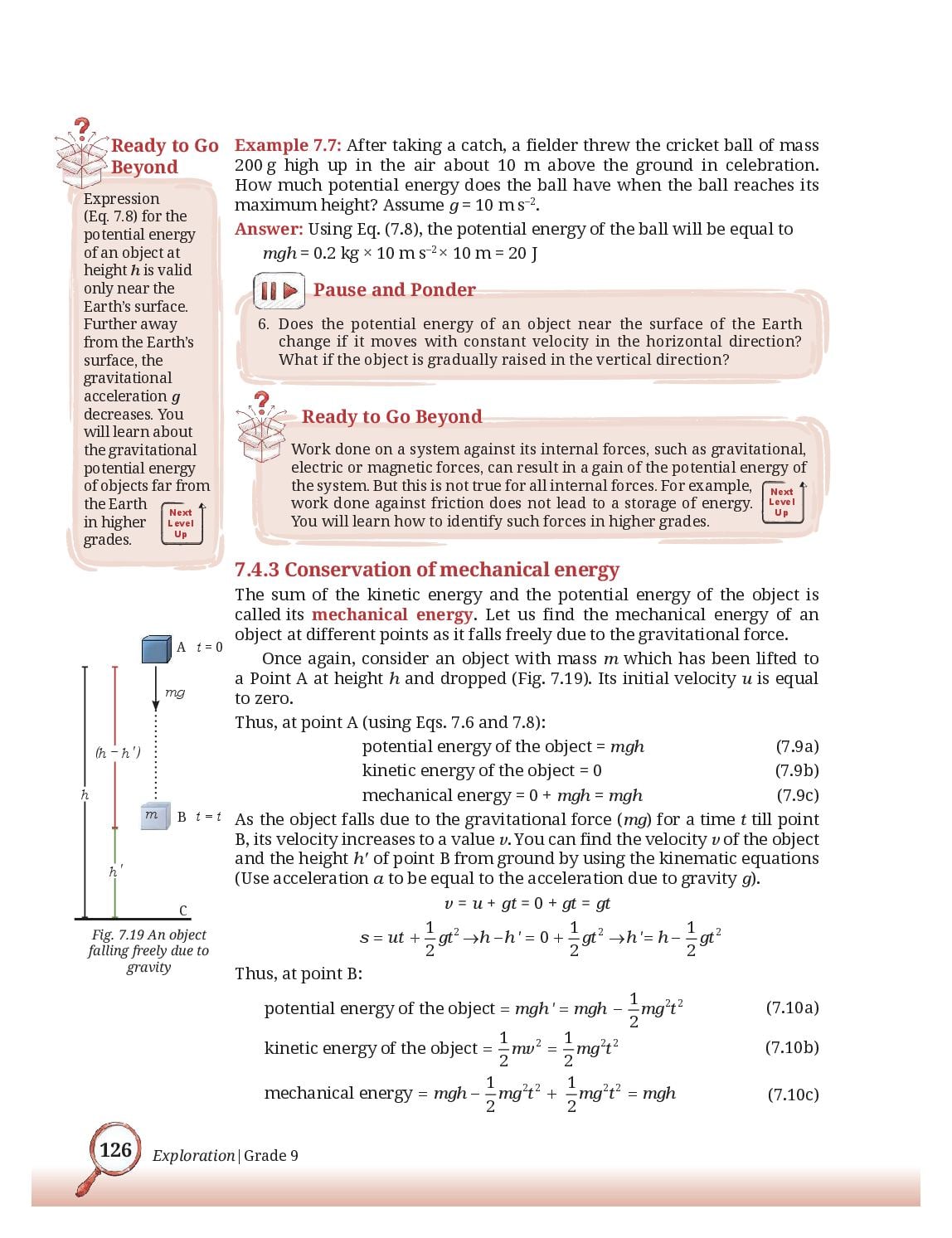
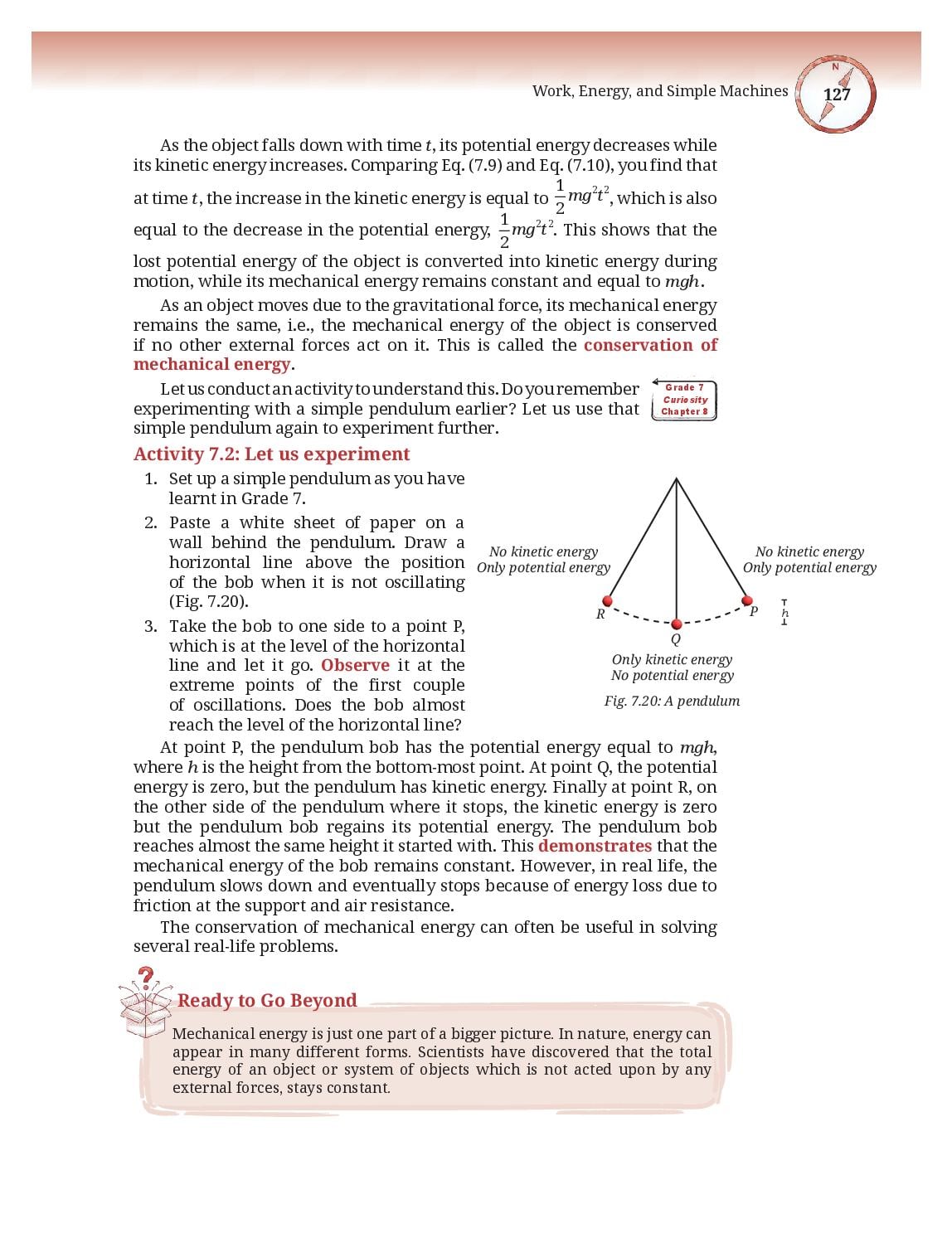
- Conservation of mechanical energy: for an object moving only under gravity, K + U stays constant. A falling body at height h′ has mgh′ + ½mg2t2 = mgh at every instant.
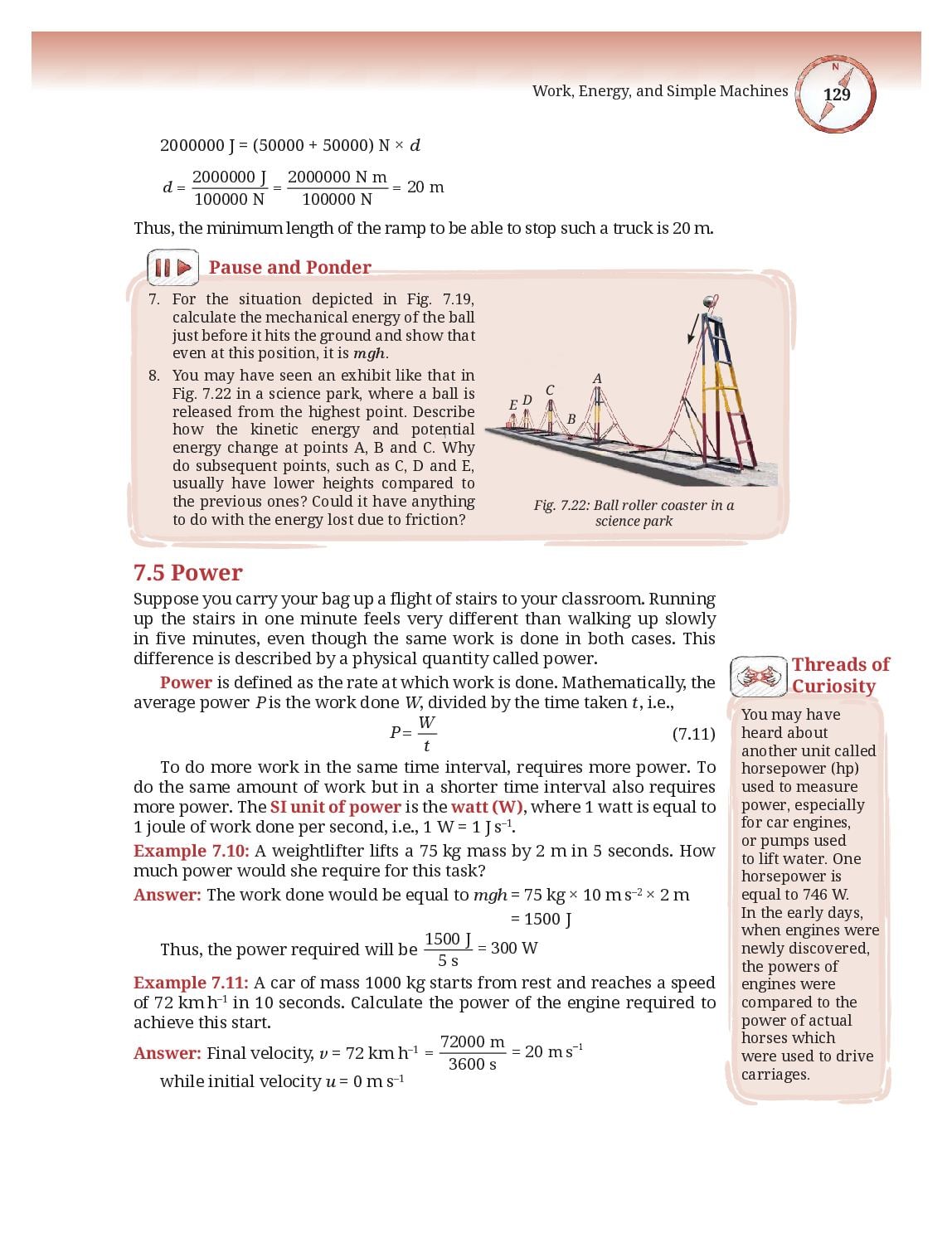
- Power is the rate of doing work, P = W/t. 1 watt = 1 joule per second; 1 horsepower = 746 W. The same work done in half the time needs twice the power.
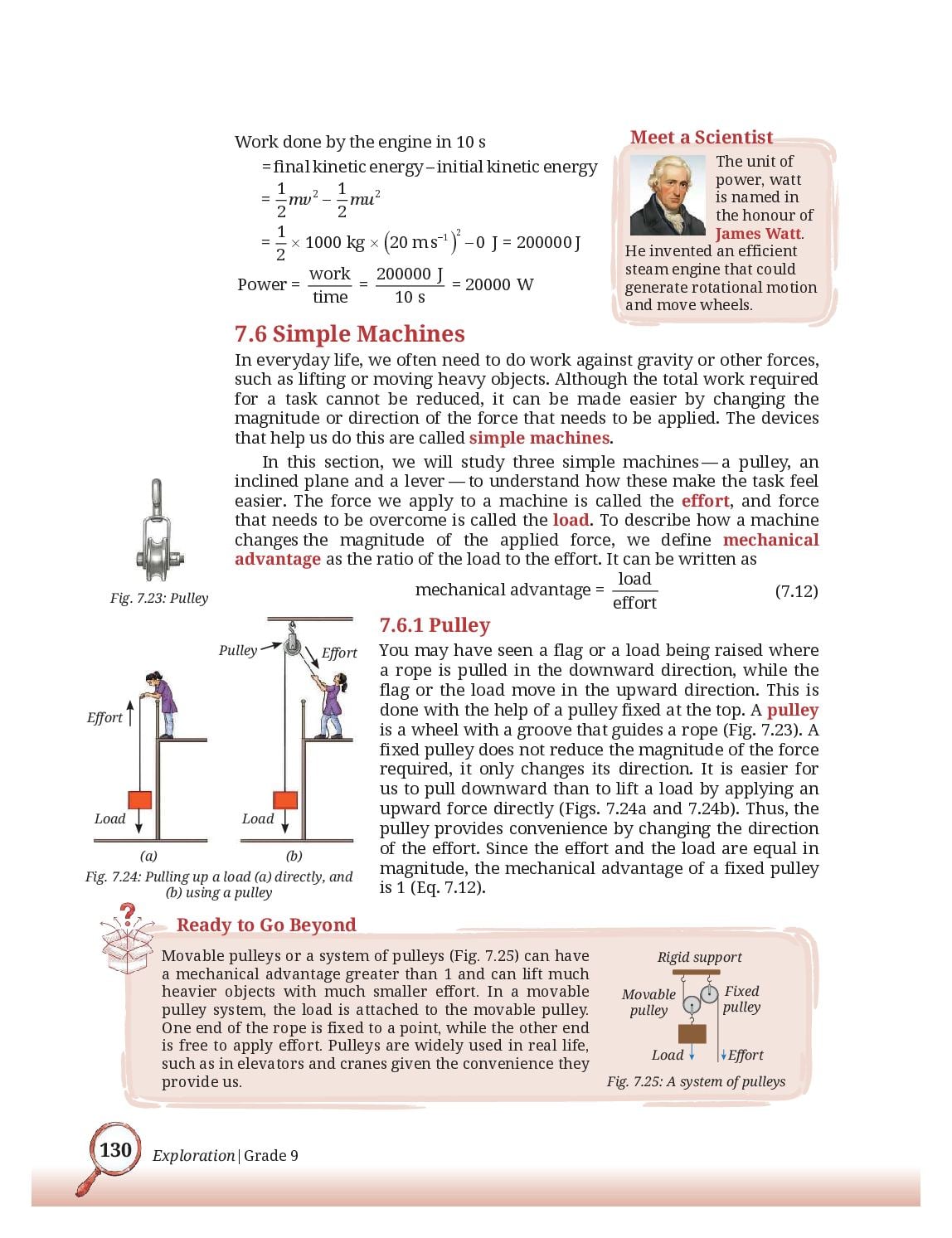
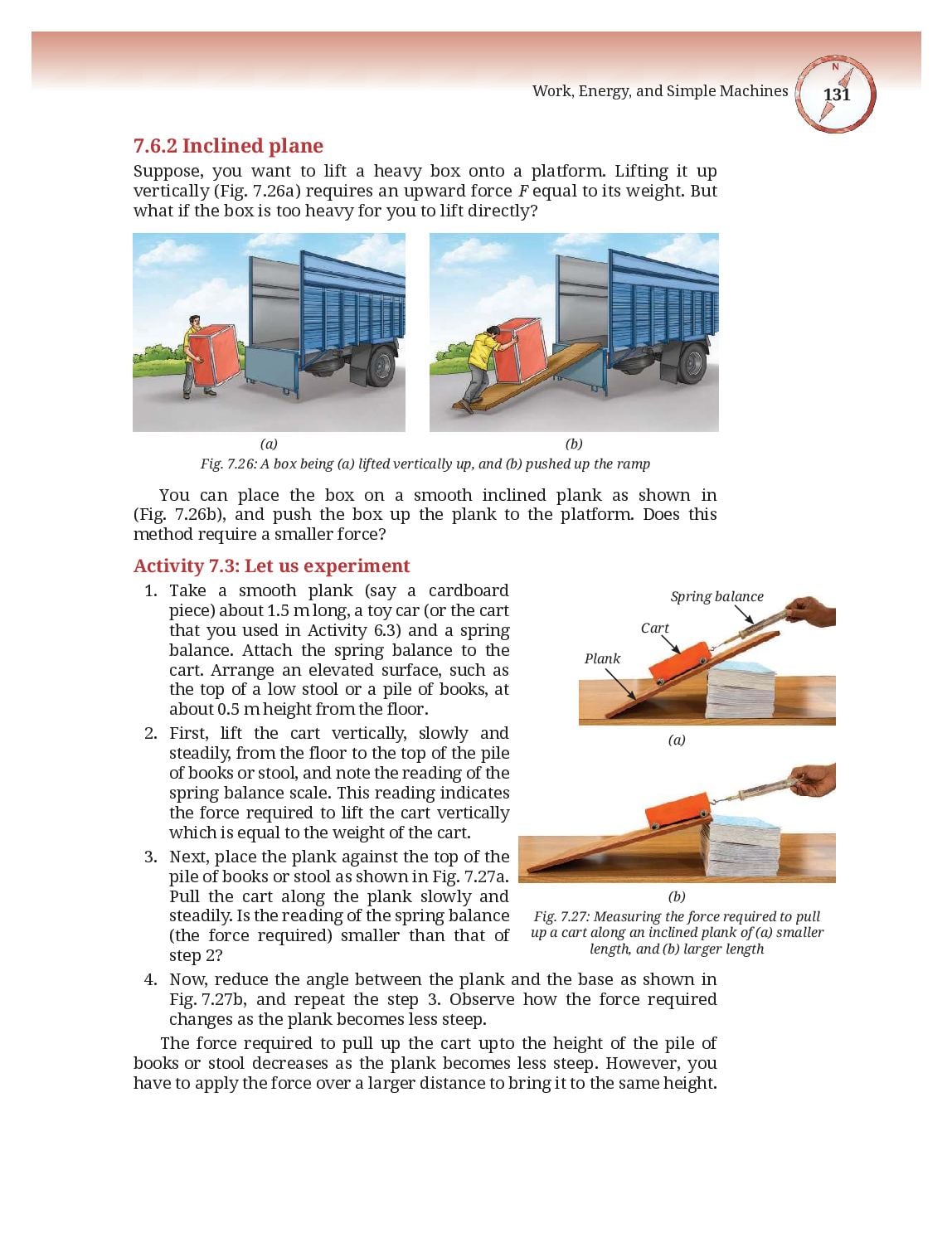
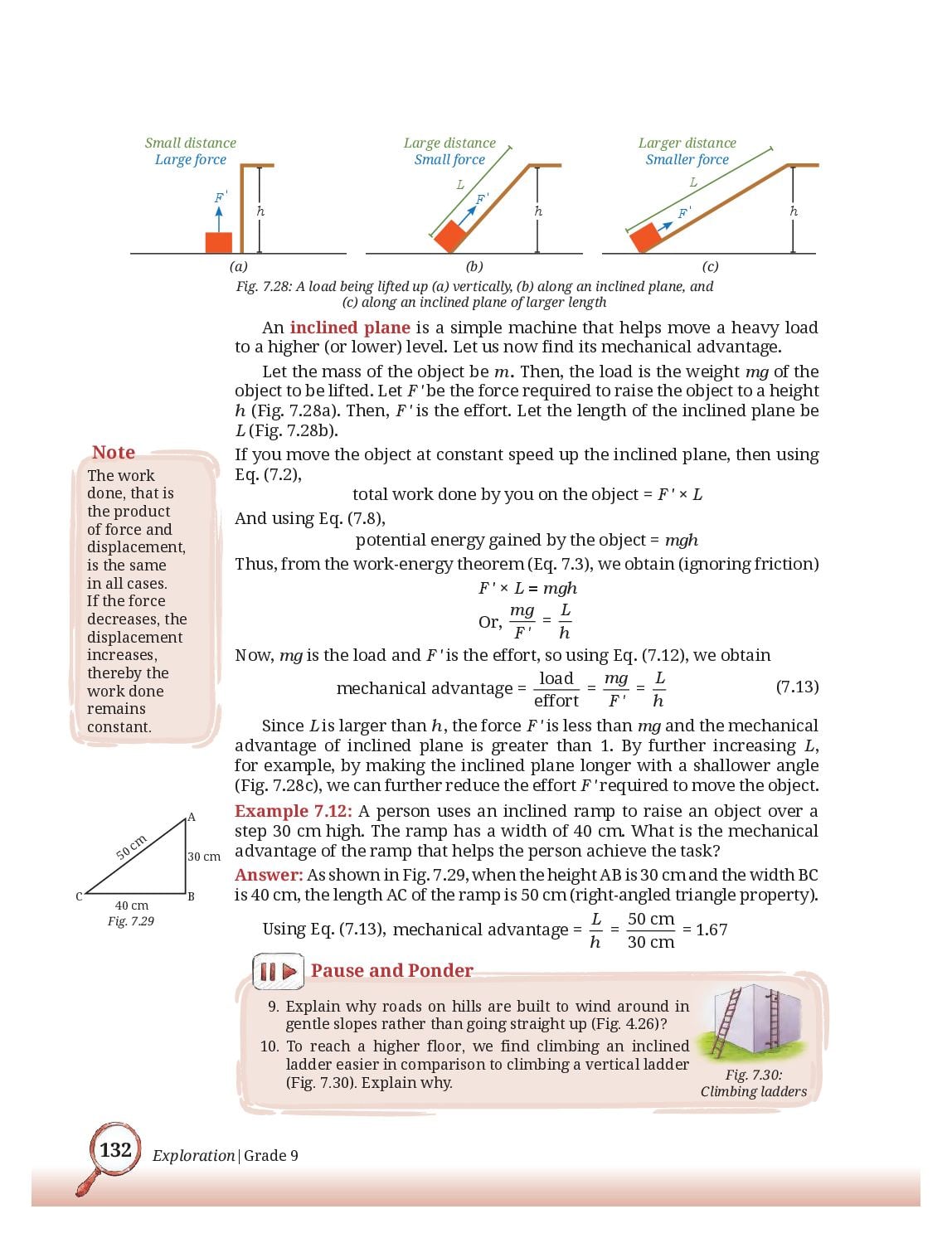
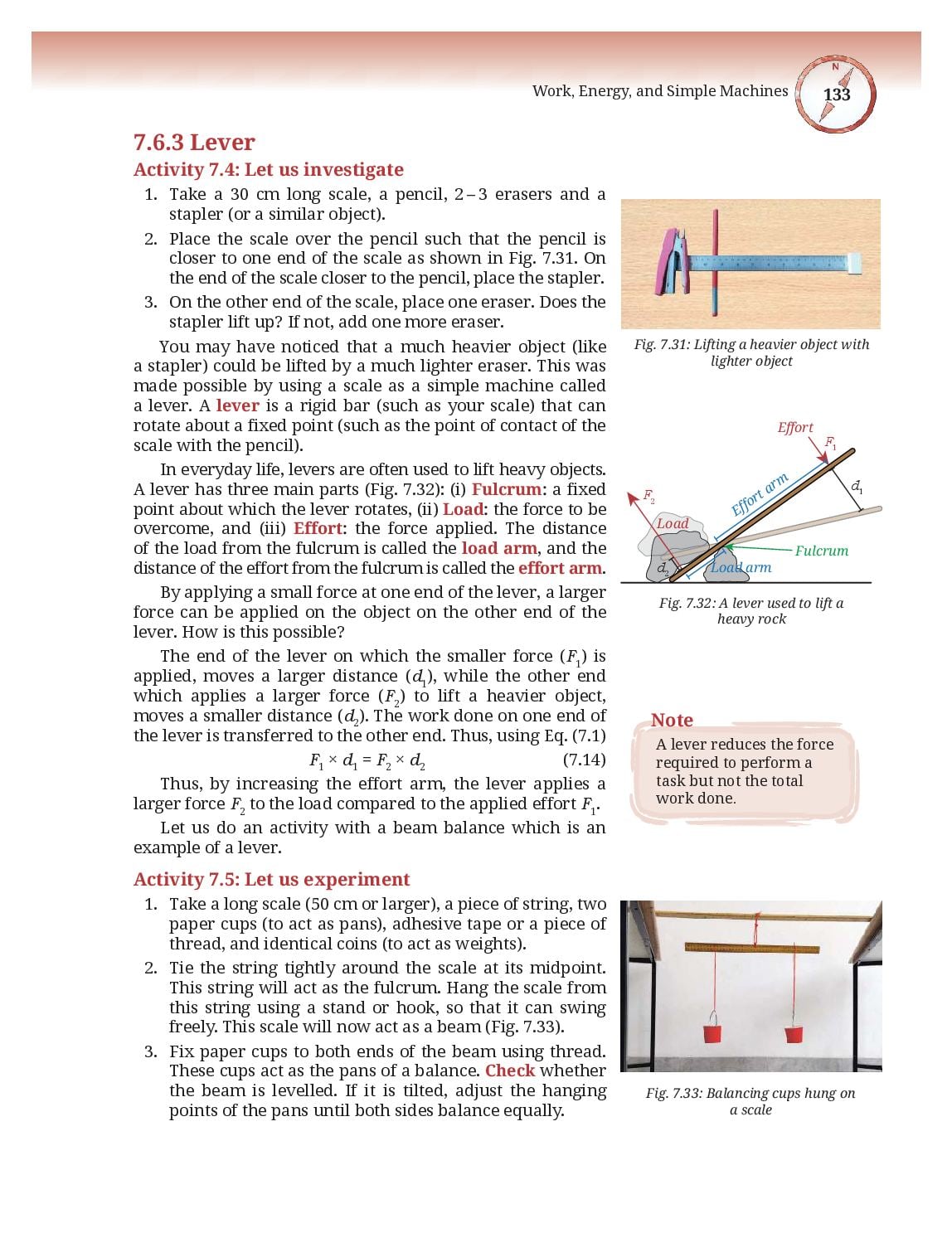
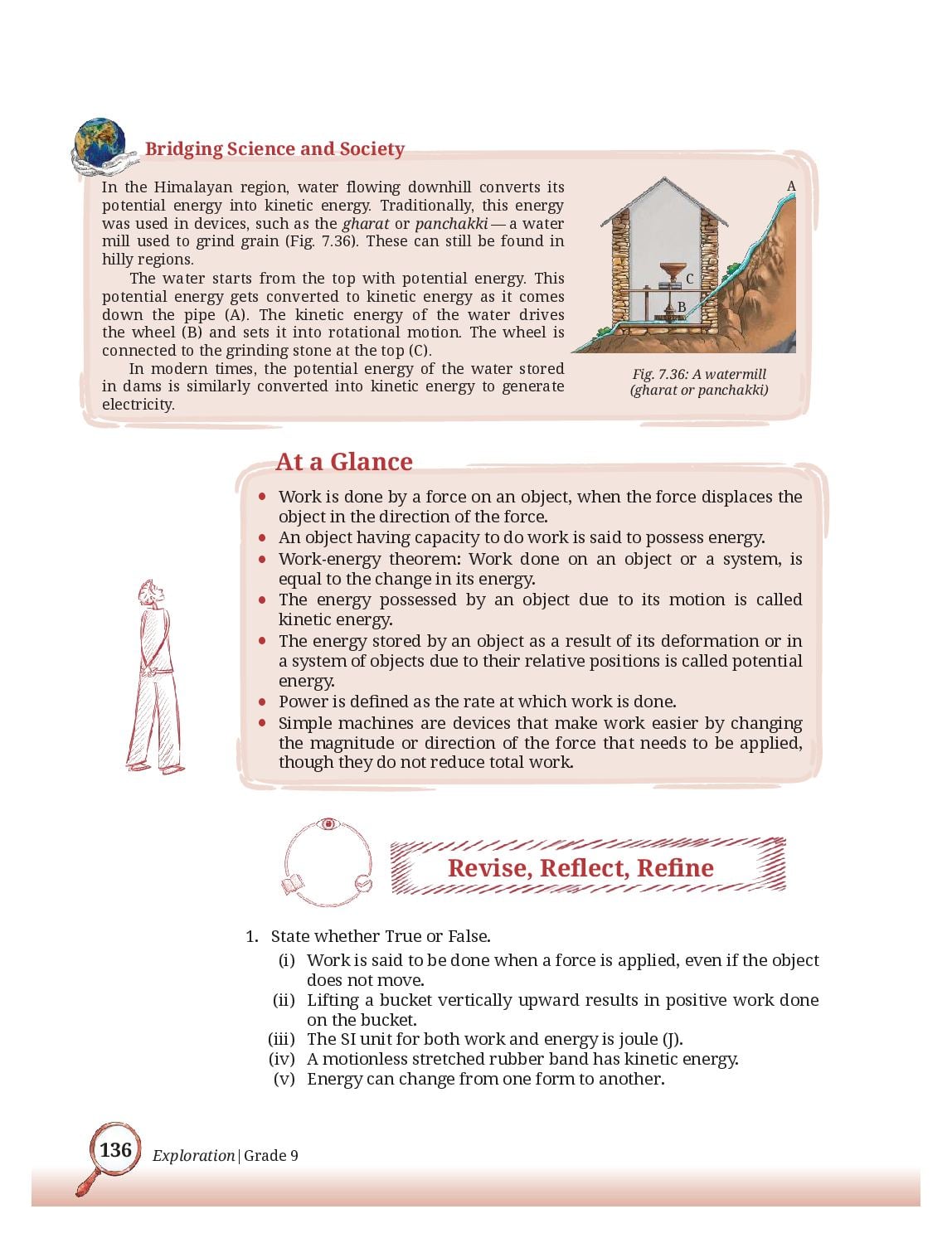
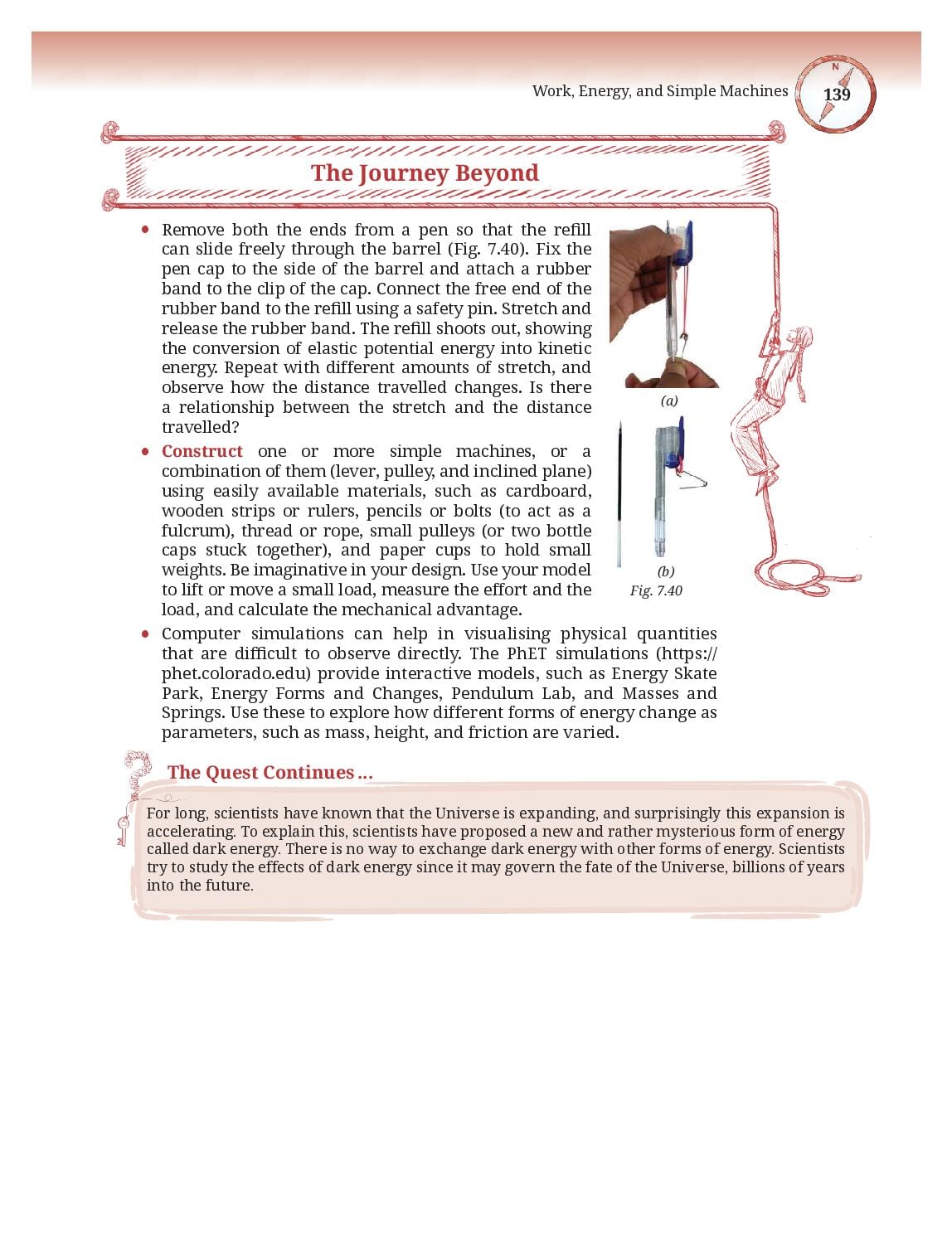
- Simple machines — pulley, inclined plane, lever — change the size or direction of the force you must apply. Mechanical advantage = load / effort. A machine never reduces the total work: if the force falls, the distance rises in the same proportion.
Quick revision – Work, Energy, and Simple Machines
| Term | What it means | Formula or key rule | Where it appears in the chapter |
|---|---|---|---|
| Work | Force acting on an object while the object is displaced along that force | W = F × s; SI unit joule (J), 1 J = 1 N m | Section 7.1, Eqs. 7.1 and 7.2; Fig. 7.2 lifting wheat bags |
| Zero work | No force, no displacement, or force perpendicular to displacement | W = 0 even though you feel tired | Section 7.1.1; Fig. 7.5 pushing a wall, Fig. 7.6 carrying a box |
| Negative work | Force opposite to the displacement — the force takes energy away | W = F × (– s) | Section 7.1.2; Example 7.2, goalkeeper stopping a ball |
| Force–displacement graph | Area under the graph gives the work done, even for a varying force | Area = work; 10 N × 1 m = 10 J | Fig. 7.4, page 118; Question 11, Fig. 7.37 |
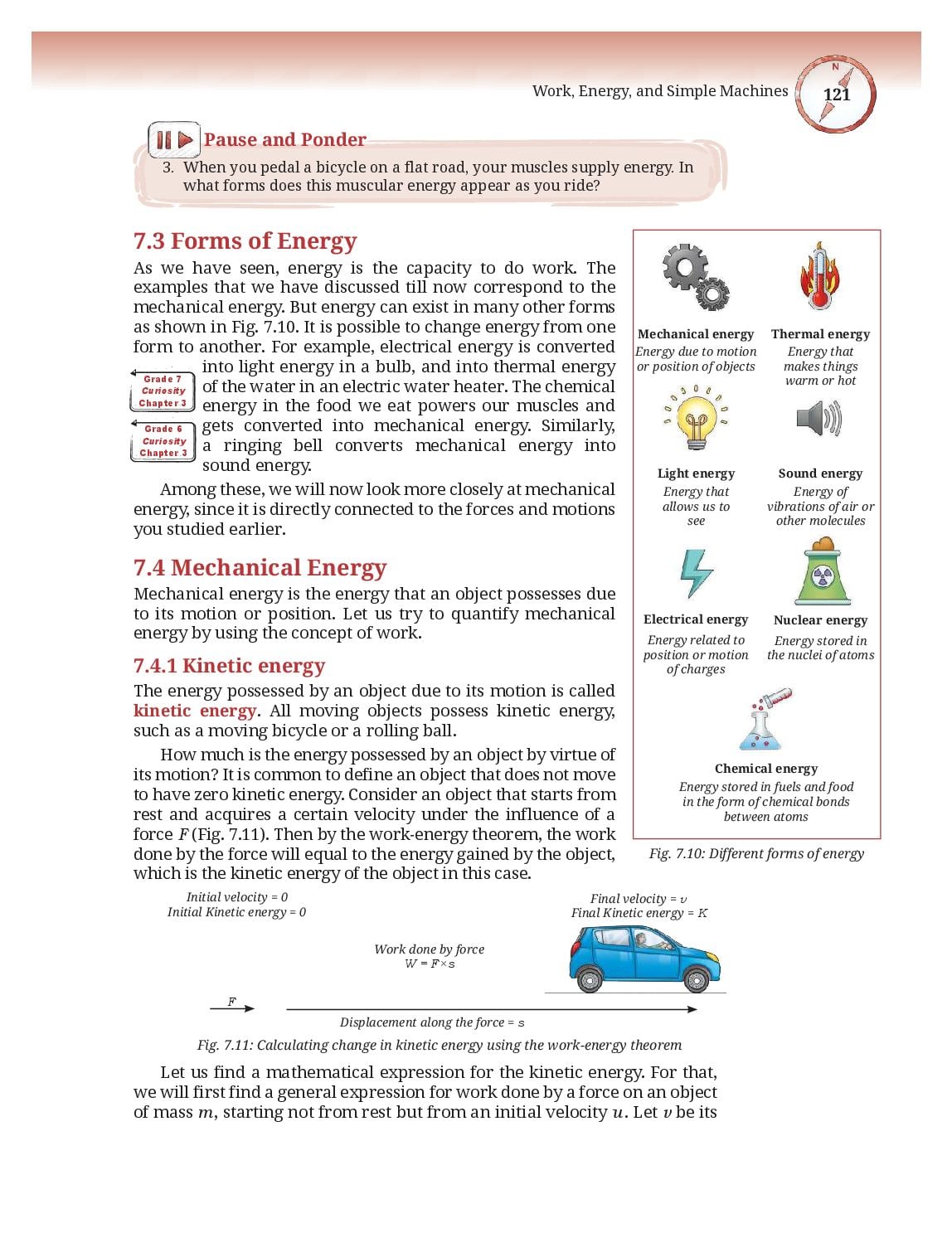
| Energy | Capacity to do work; joule (J) is its SI unit too | Mechanical, thermal, light, sound, electrical, chemical, nuclear | Section 7.3, Fig. 7.10 |
| Work–energy theorem | Work done on an object appears as a change in its energy | Work done = change in energy (Eq. 7.3) | Section 7.2; used to derive Eqs. 7.5, 7.6 and 7.8 |
| Kinetic energy | Energy an object has because it is moving | K = ½mv2 (Eq. 7.6); W = ½m(v2 – u2) | Section 7.4.1; Examples 7.4, 7.5, 7.6 |
| Potential energy | Energy stored by deformation, or by the relative positions of objects in a system | U = mgh near the Earth’s surface (Eq. 7.8) | Section 7.4.2; Activity 7.1, Example 7.7 |
| Conservation of mechanical energy | K + U stays constant when only gravity acts | Mgh at the top = ½mv2 at the bottom | Section 7.4.3; Fig. 7.19, Activity 7.2, Examples 7.8, 7.9 |
| Power | Rate at which work is done | P = W/t (Eq. 7.11); 1 W = 1 J s–1; 1 hp = 746 W | Section 7.5; Examples 7.10, 7.11 |
| Mechanical advantage | How much a machine multiplies the force you apply | MA = load / effort (Eq. 7.12) | Section 7.6 |
| Pulley | Grooved wheel guiding a rope; a fixed pulley only changes the direction of the effort | MA of a fixed pulley = 1 | Section 7.6.1; Figs. 7.23–7.25 |
| Inclined plane | Ramp that raises a load with a smaller force over a longer path | MA = L/h (Eq. 7.13); F′ × L = mgh | Section 7.6.2; Activity 7.3, Example 7.12 |
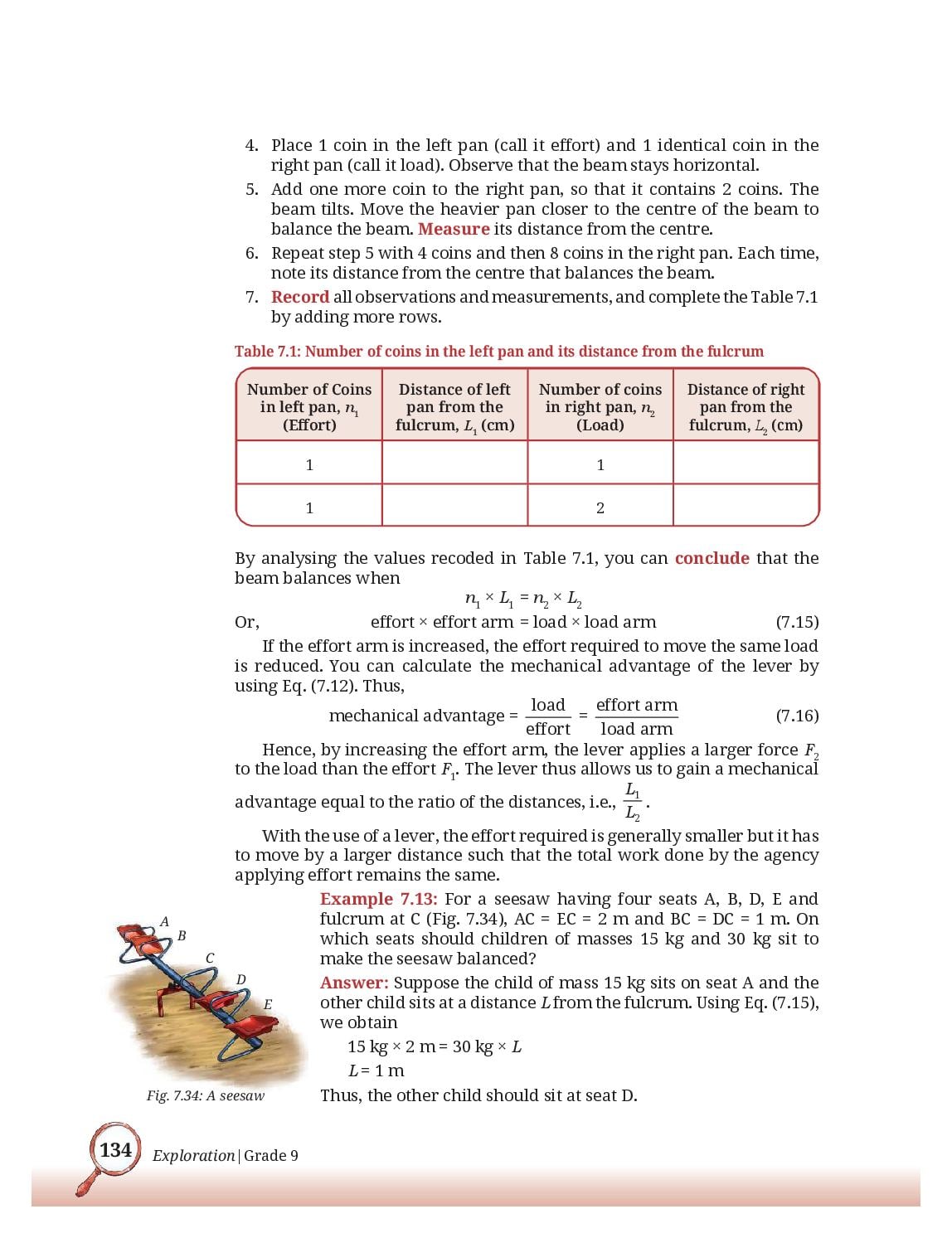
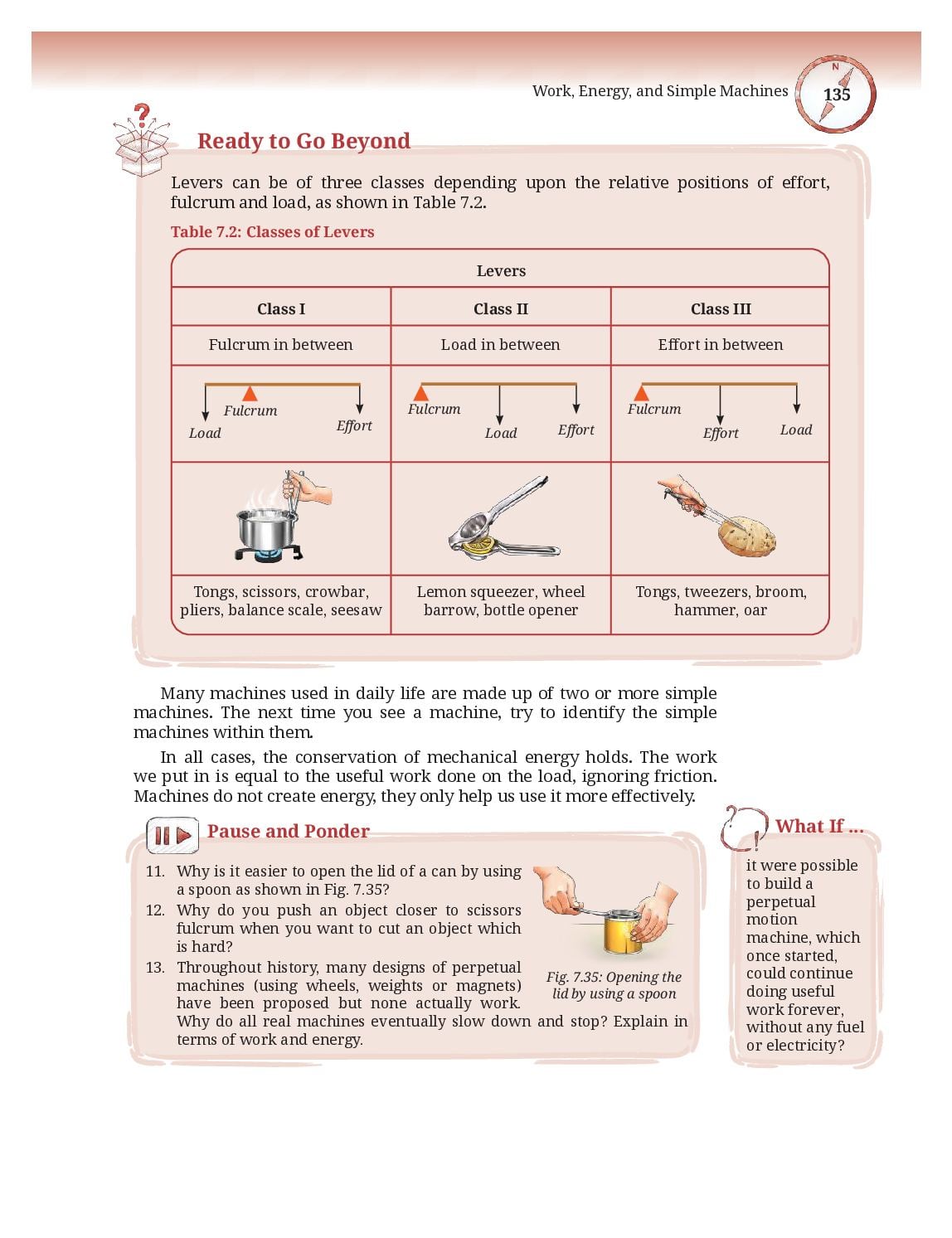
| Lever | Rigid bar turning about a fulcrum; three classes by the order of fulcrum, load and effort | Effort × effort arm = load × load arm (Eq. 7.15); MA = effort arm / load arm | Section 7.6.3; Activities 7.4 and 7.5, Table 7.2, Example 7.13 |
Old NCERT vs New – Class 9 Science
This chapter is from Exploration, the new NCERT Class 9 Science book (NCF-SE 2023, used from 2026-27). It replaced the old book “Science”, so chapter numbers and names differ from older PDFs.
Solutions and All Chapters
Answers to the exercises and the full chapter list of Exploration:
Work, Energy, and Simple Machines – Overview
| Class | Class 9 |
| Subject | Science |
| Book | Exploration – new NCERT book |
| Chapter | 7 of 13 – Work, Energy, and Simple Machines |
| Book pages | 116 – 139 |
| Edition | Latest NCERT edition (2026-27) |
| Session | 2026-27 |
| Free – read online or download |
Class 9 Science Chapter 7 – FAQs
Where can I download Work, Energy, and Simple Machines Class 9 PDF?
From the download table on this page – the chapter PDF is free, and the full book is linked too.
What is Class 9 Science Chapter 7 about?
Work done by a constant force = force × displacement in the direction of the force, W = F × s. Its SI unit is the joule: 1 J = 1 N × 1 m = 1 kg m2 s–2. Work is zero when F = 0, when s = 0, or when the force is perpendicular to the displacement.
Is Work, Energy, and Simple Machines from the new NCERT Class 9 Science book?
Yes. It is chapter 7 of exploration, the new NCERT Class 9 Science book for 2026-27.
Is this the latest NCERT edition for 2026-27?
Yes – the PDF is NCERT’s latest edition for the 2026-27 session.
Where are the NCERT Solutions for Class 9 Science Chapter 7?
Open the NCERT Solutions link above for answers to the exercise questions.