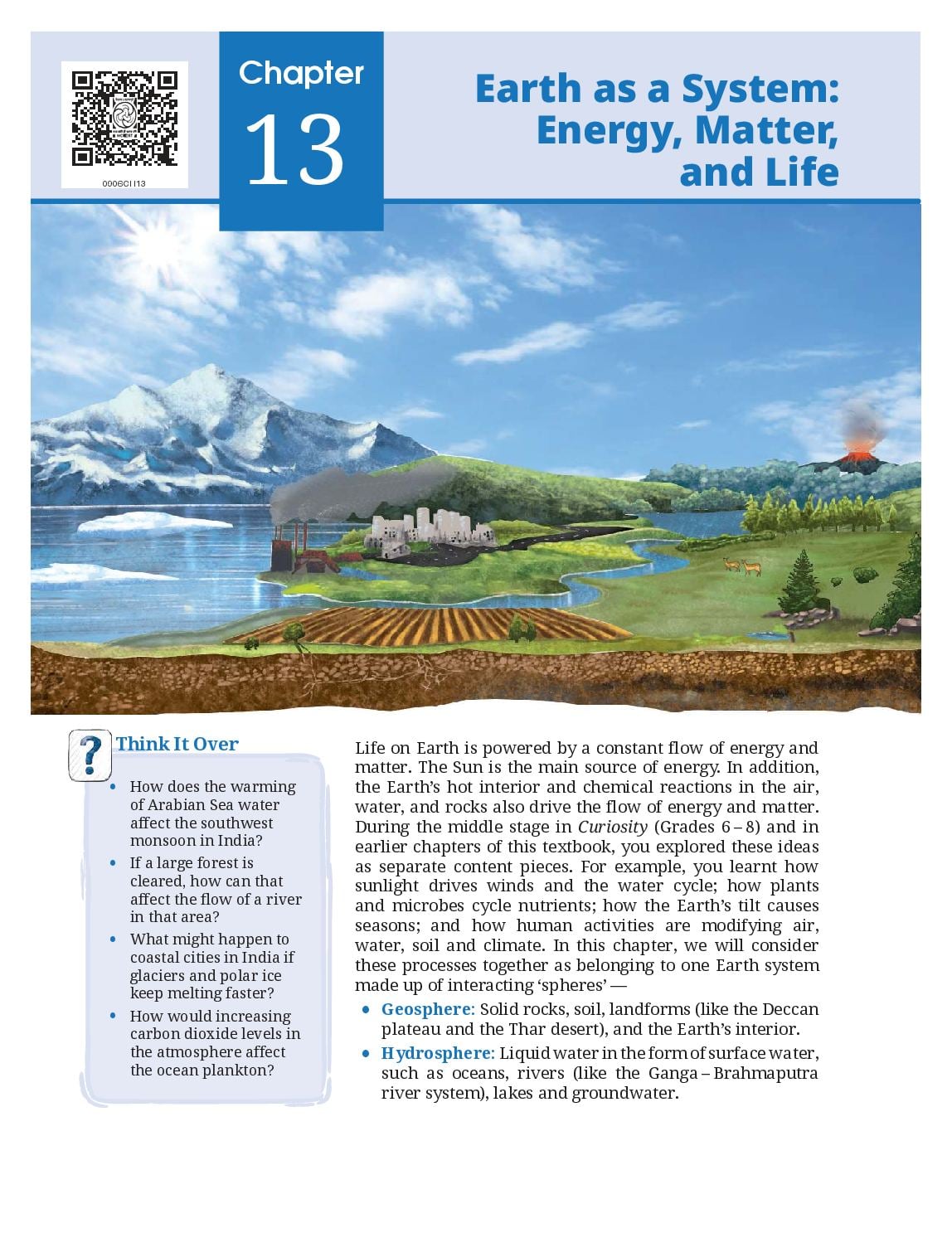
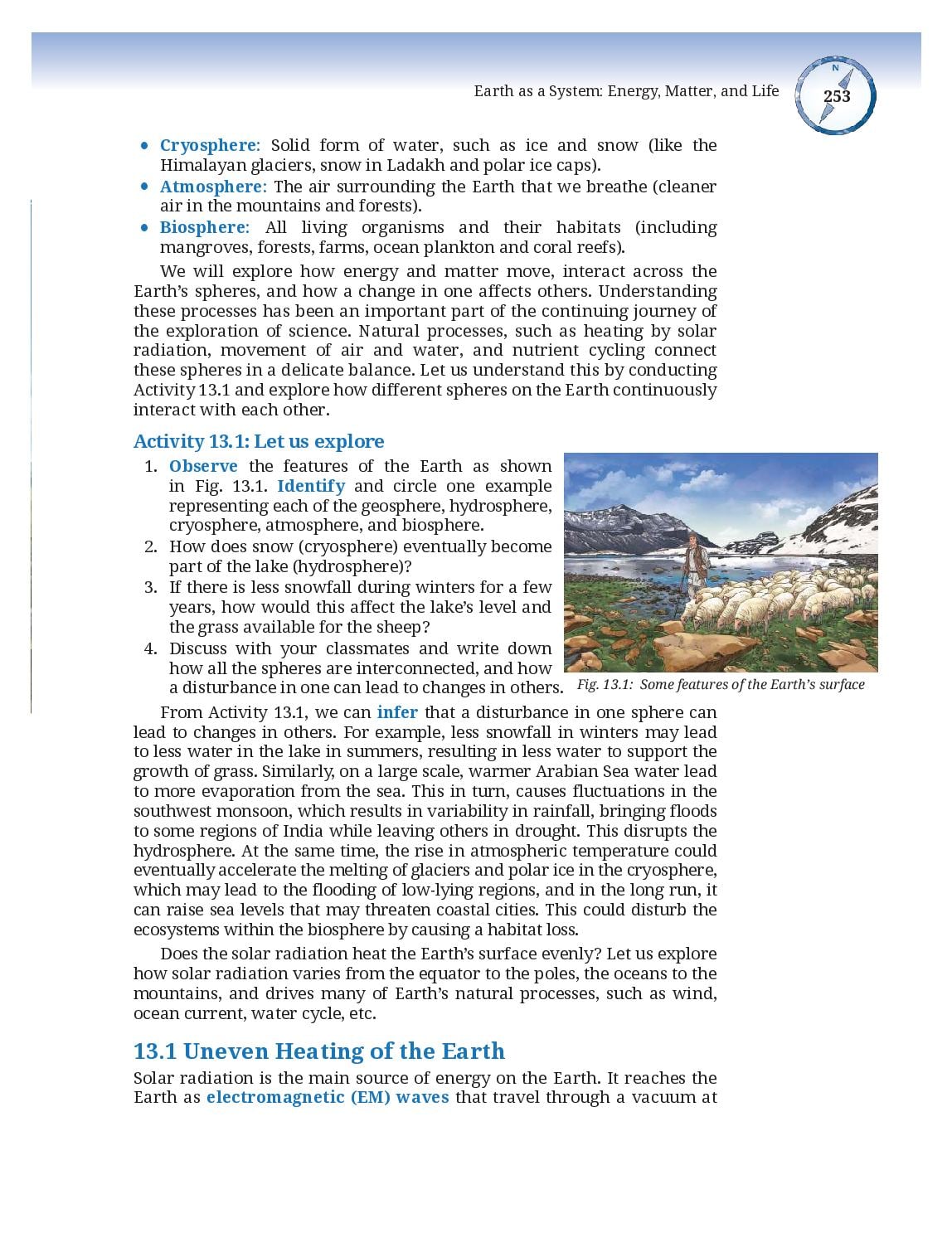
Download Earth as a System: Energy, Matter, and Life – NCERT Class 9 Science Chapter 13 PDF from the new NCERT Class 9 Science book Exploration (2026-27). Read the chapter online or download the free PDF. The Earth is a single system of five interacting spheres — geosphere (rock, soil, interior), hydrosphere (liquid water), cryosphere (ice and snow), atmosphere (air) and biosphere (all life). A disturbance in one sphere shows up as a change in the others.
Earth as a System: Energy, Matter, and Life PDF – Chapter 13 of Exploration
Read the chapter online or download the PDF.
| Chapter | Download | |
|---|---|---|
| Chapter 13 PDF | Earth as a System: Energy, Matter, and Life | View PDF |
| Full book | NCERT Class 9 Science – Exploration | View Book |
Read Online

What Is in Earth as a System: Energy, Matter, and Life? (Class 9 Science Chapter 13)
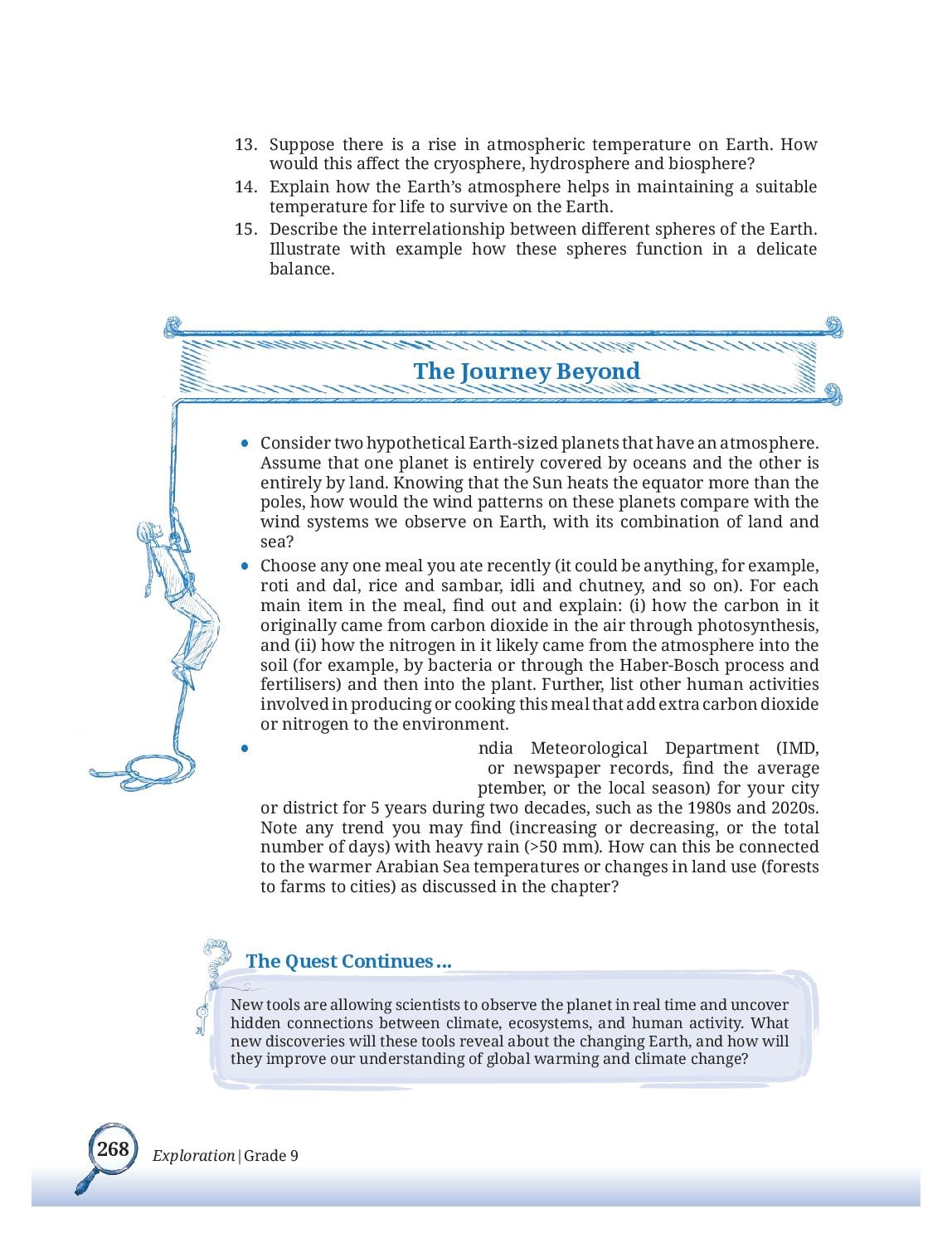
- The Earth is a single system of five interacting spheres — geosphere (rock, soil, interior), hydrosphere (liquid water), cryosphere (ice and snow), atmosphere (air) and biosphere (all life). A disturbance in one sphere shows up as a change in the others.
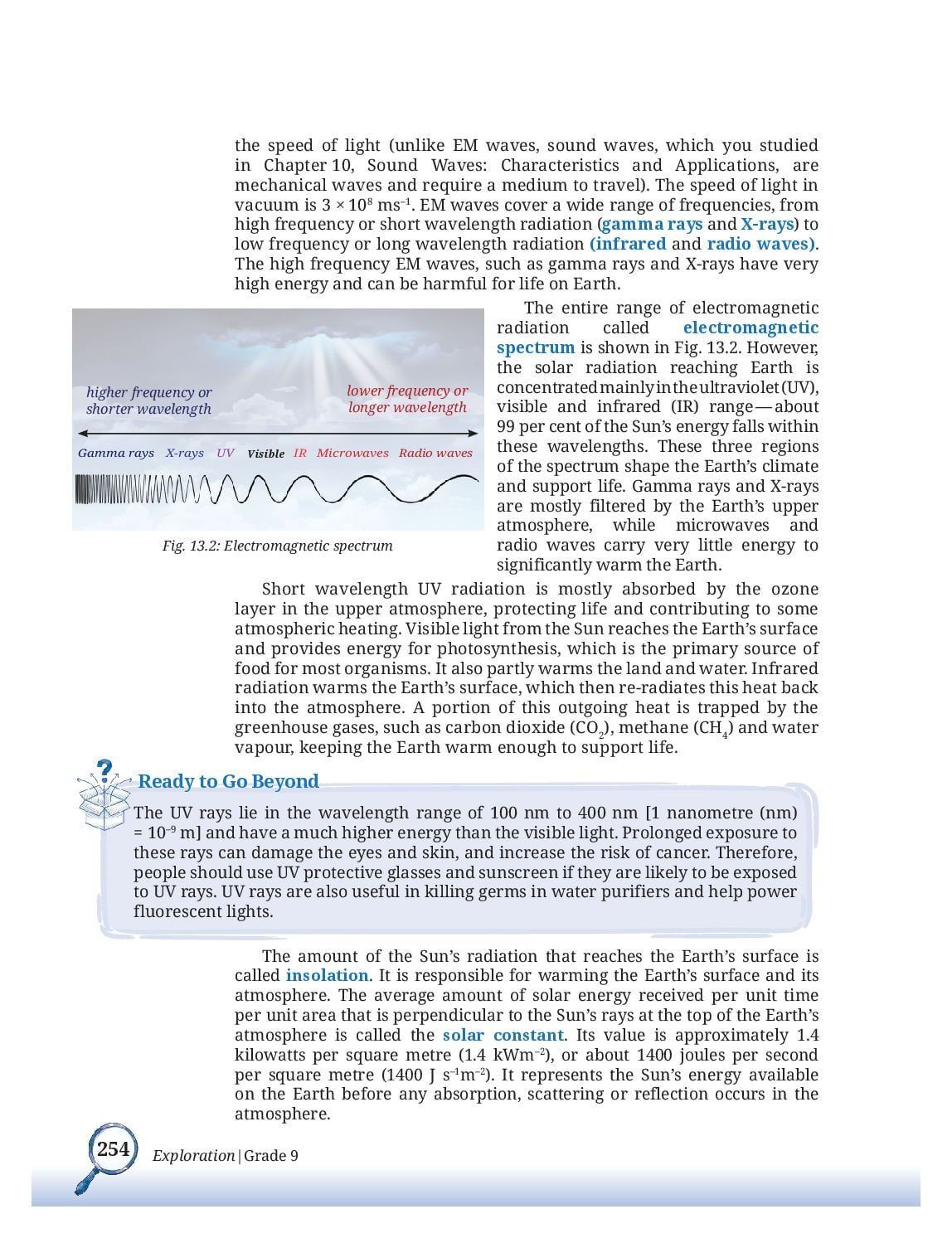
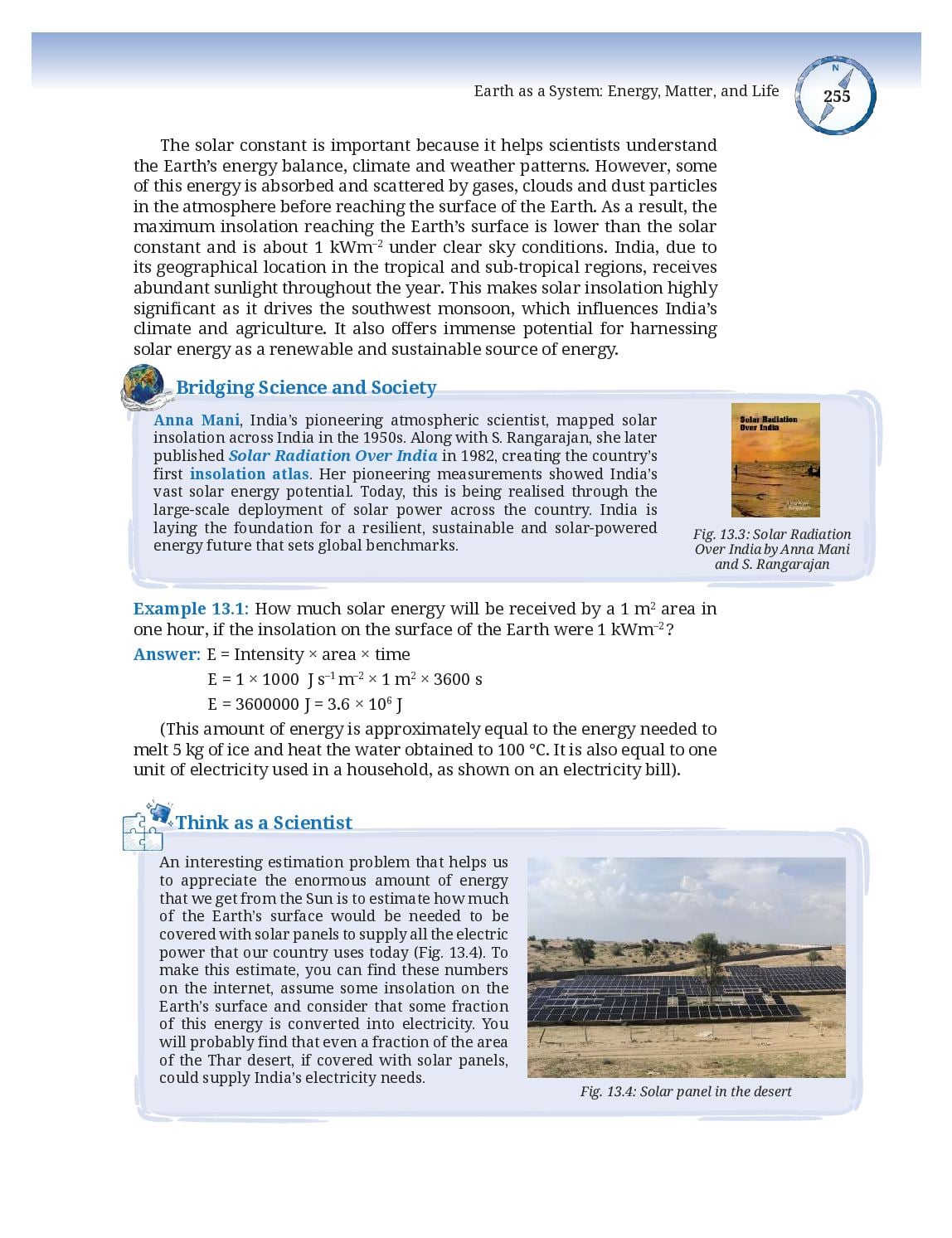
- Solar radiation reaches us as electromagnetic waves travelling at 3 × 10⁸ m s–1 through vacuum. About 99 per cent of the Sun’s energy lies in the UV, visible and infrared bands. The solar constant is 1.4 kW m–2 (1400 J s–1 m–2); after absorption and scattering, the maximum insolation at the surface is about 1 kW m–2.
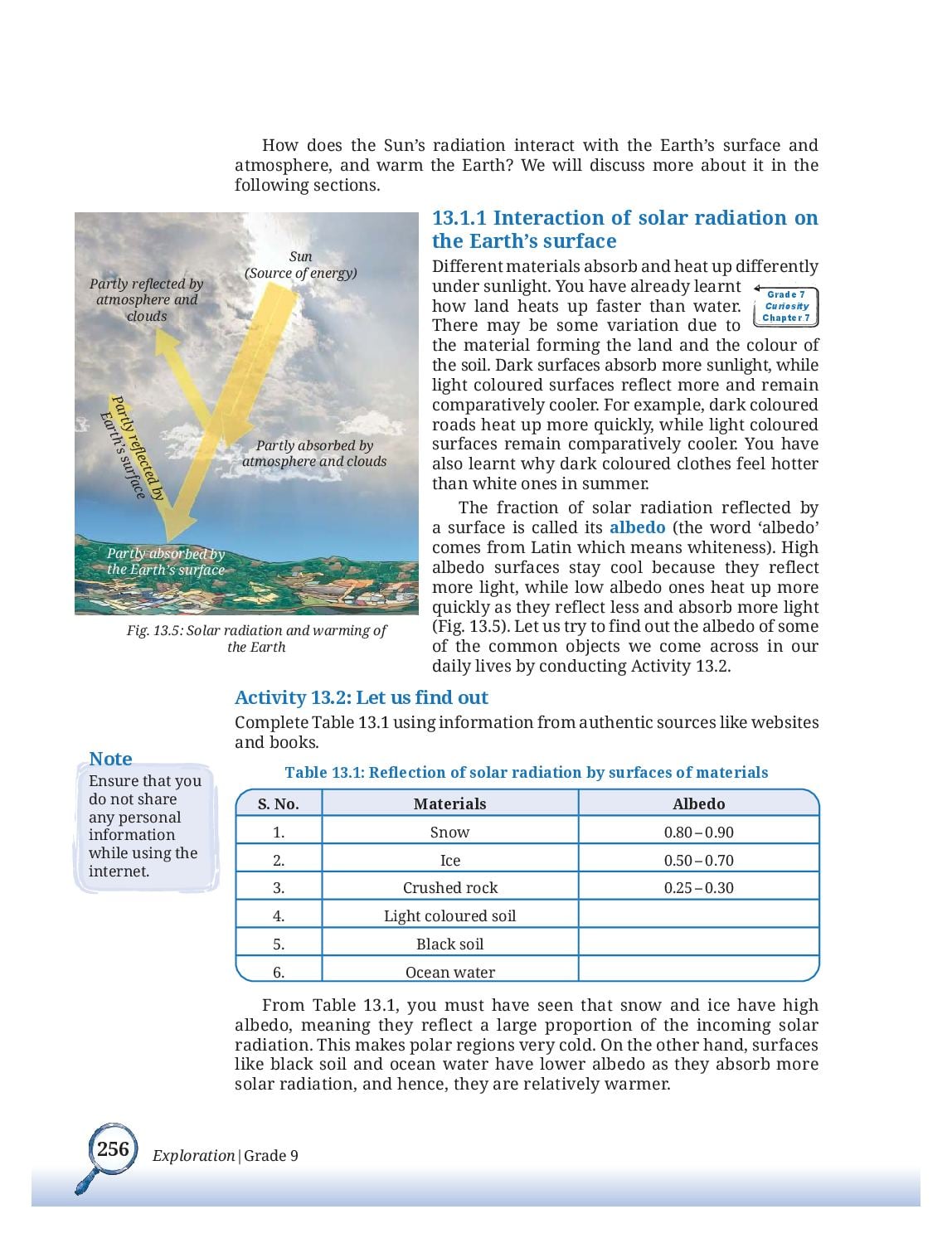
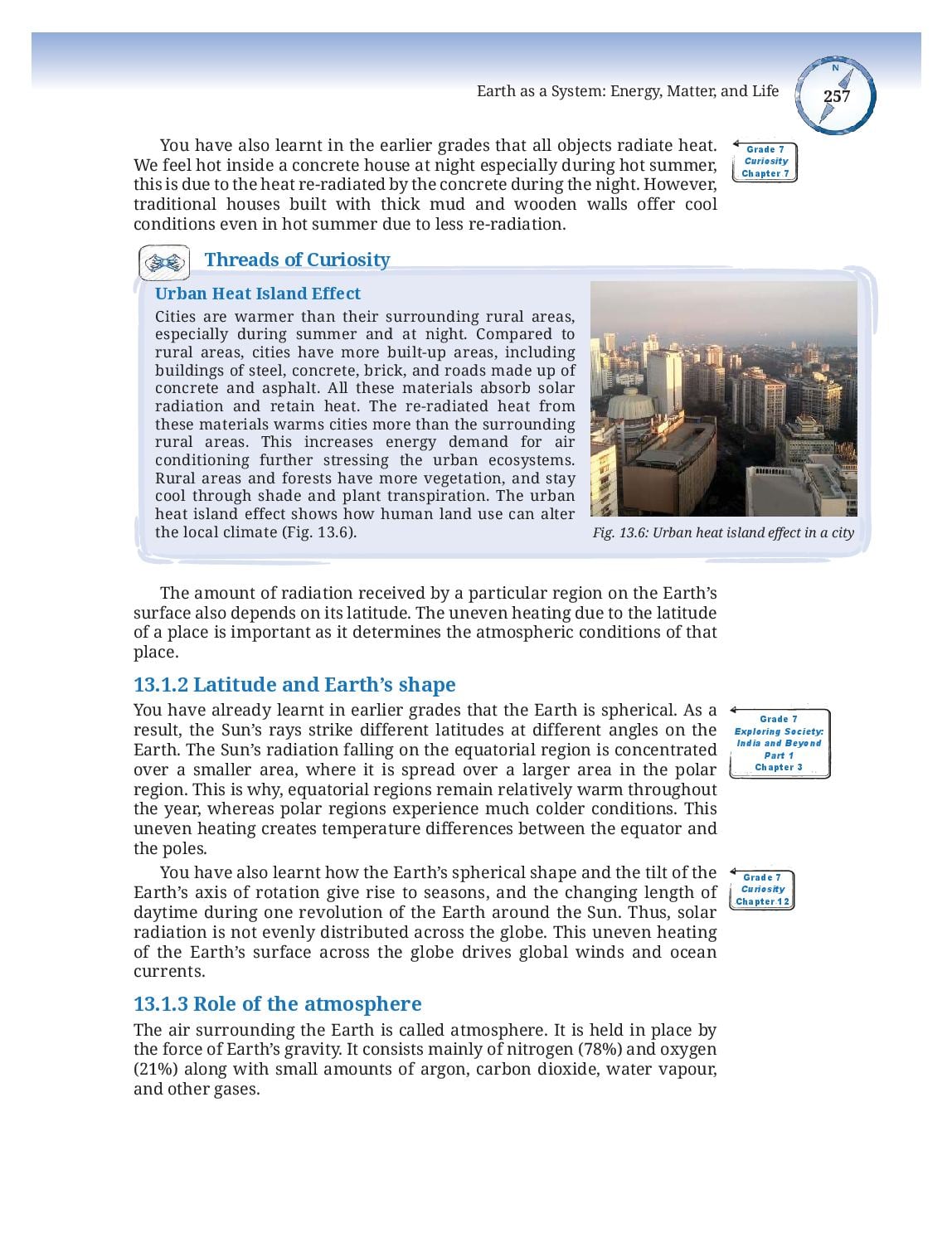
- Heating is uneven because of albedo (snow reflects 0.80 – 0.90, black soil and ocean water reflect very little), because of latitude (the same beam is spread over a larger area near the poles) and because of the tilt of the Earth’s axis.
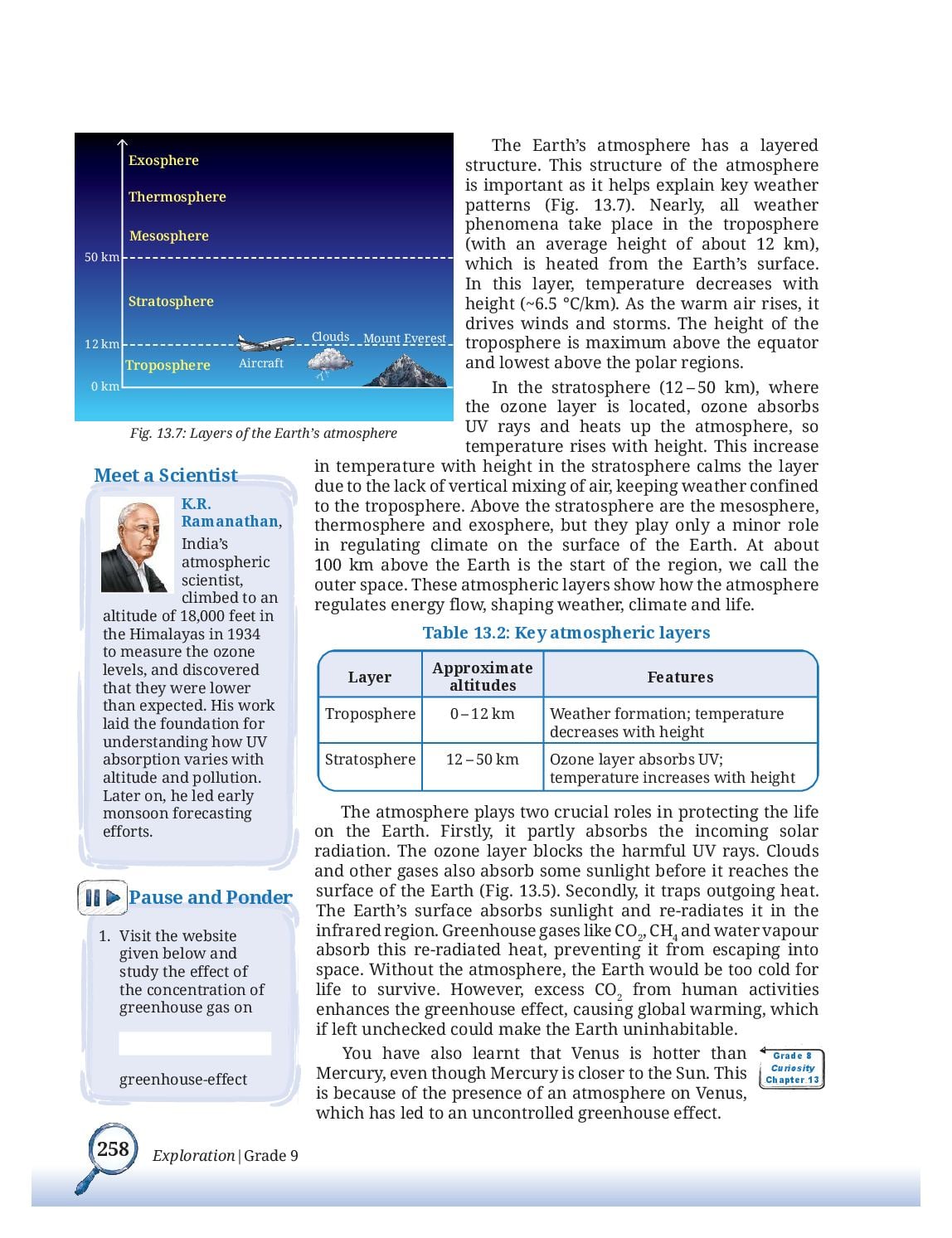
- The atmosphere is layered. Weather happens in the troposphere (0 – 12 km, temperature falls ~6.5 °C km–1); the ozone layer sits in the stratosphere (12 – 50 km, temperature rises with height, so the layer is calm).
- The atmosphere protects life twice over — the ozone layer absorbs harmful UV on the way in, and greenhouse gases (CO2, CH4, water vapour) absorb the infrared the surface re-radiates on the way out.
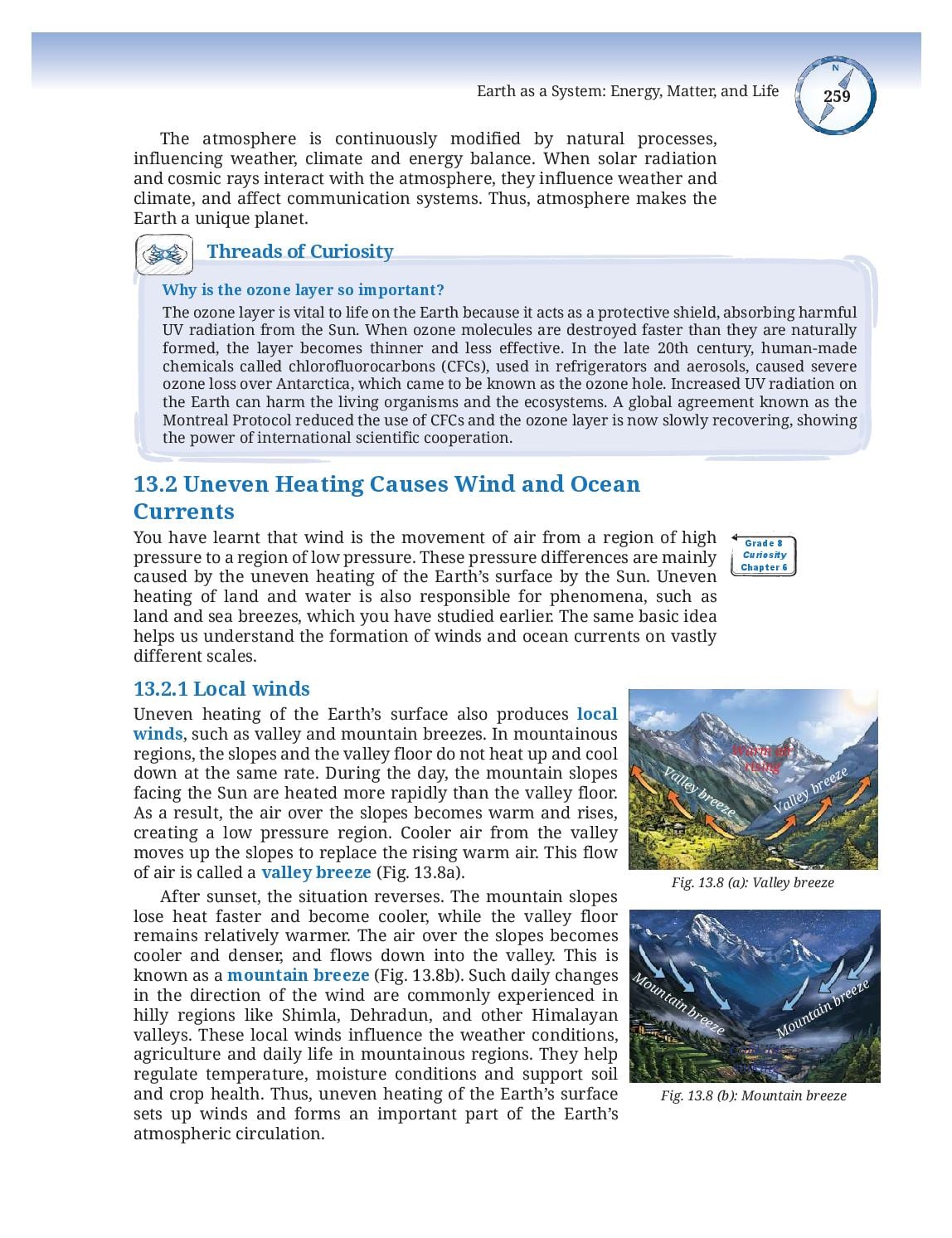
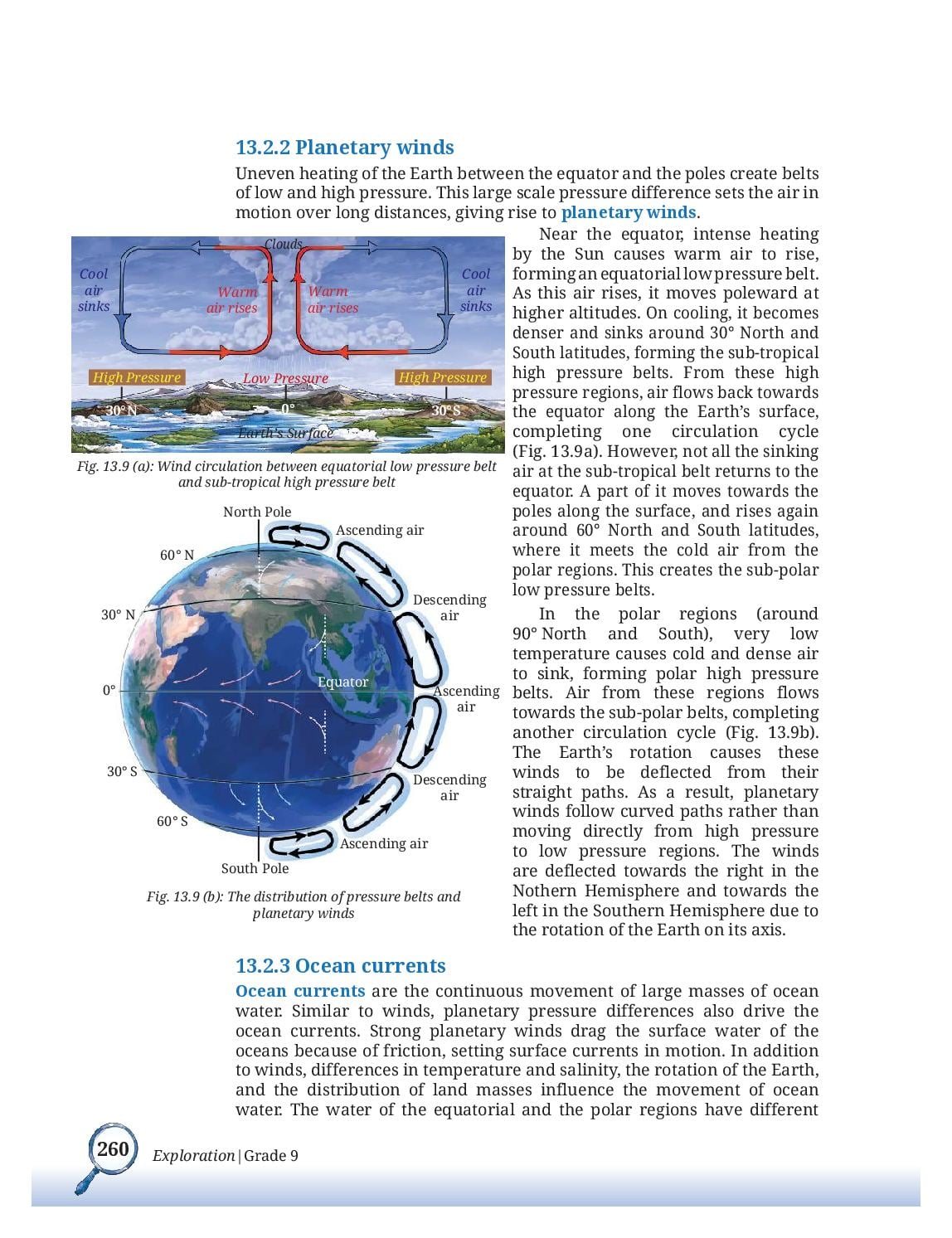
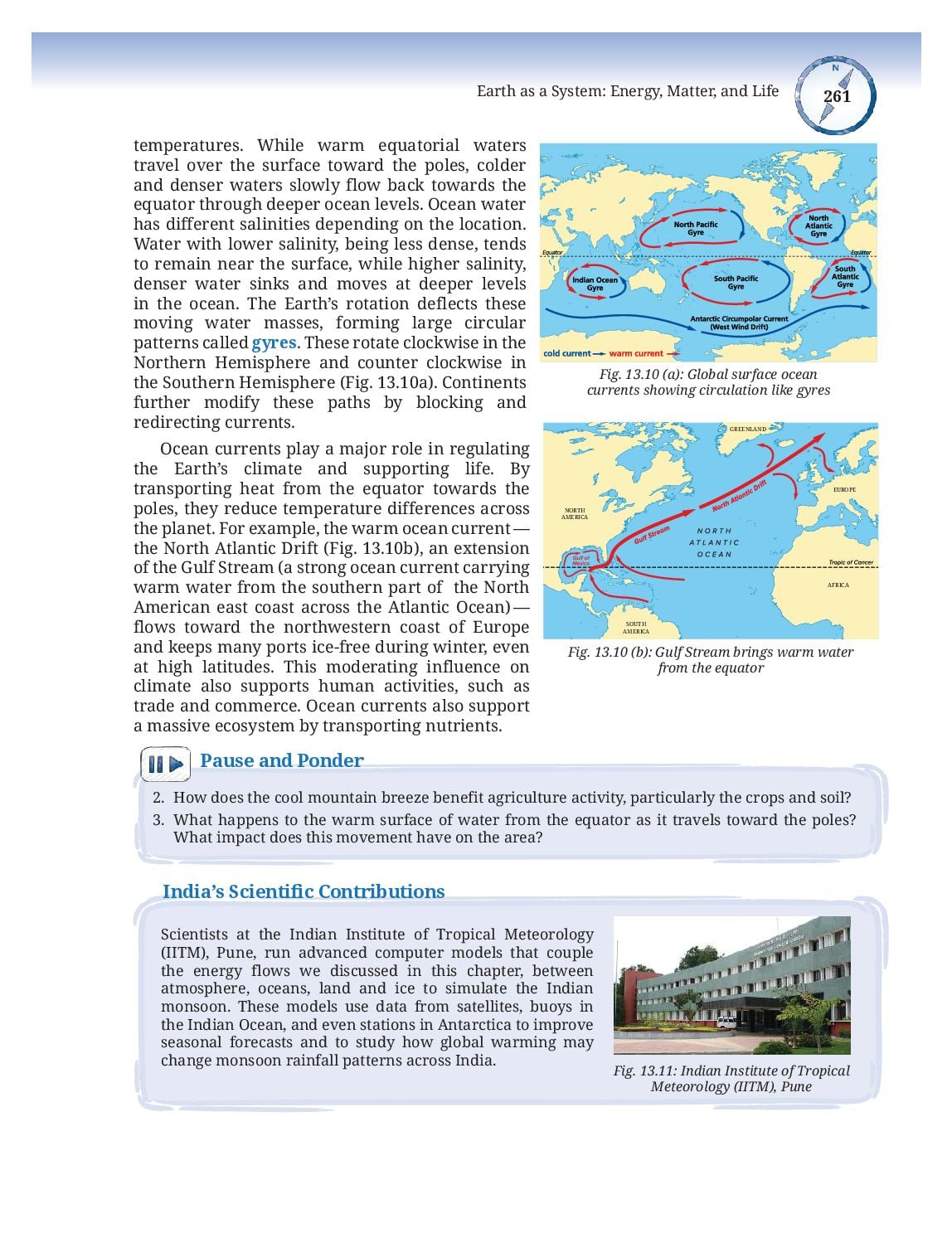
- Uneven heating creates pressure differences, and pressure differences drive local winds (valley and mountain breezes), planetary winds between the pressure belts, and ocean currents, which the Earth’s rotation bends into circular gyres.
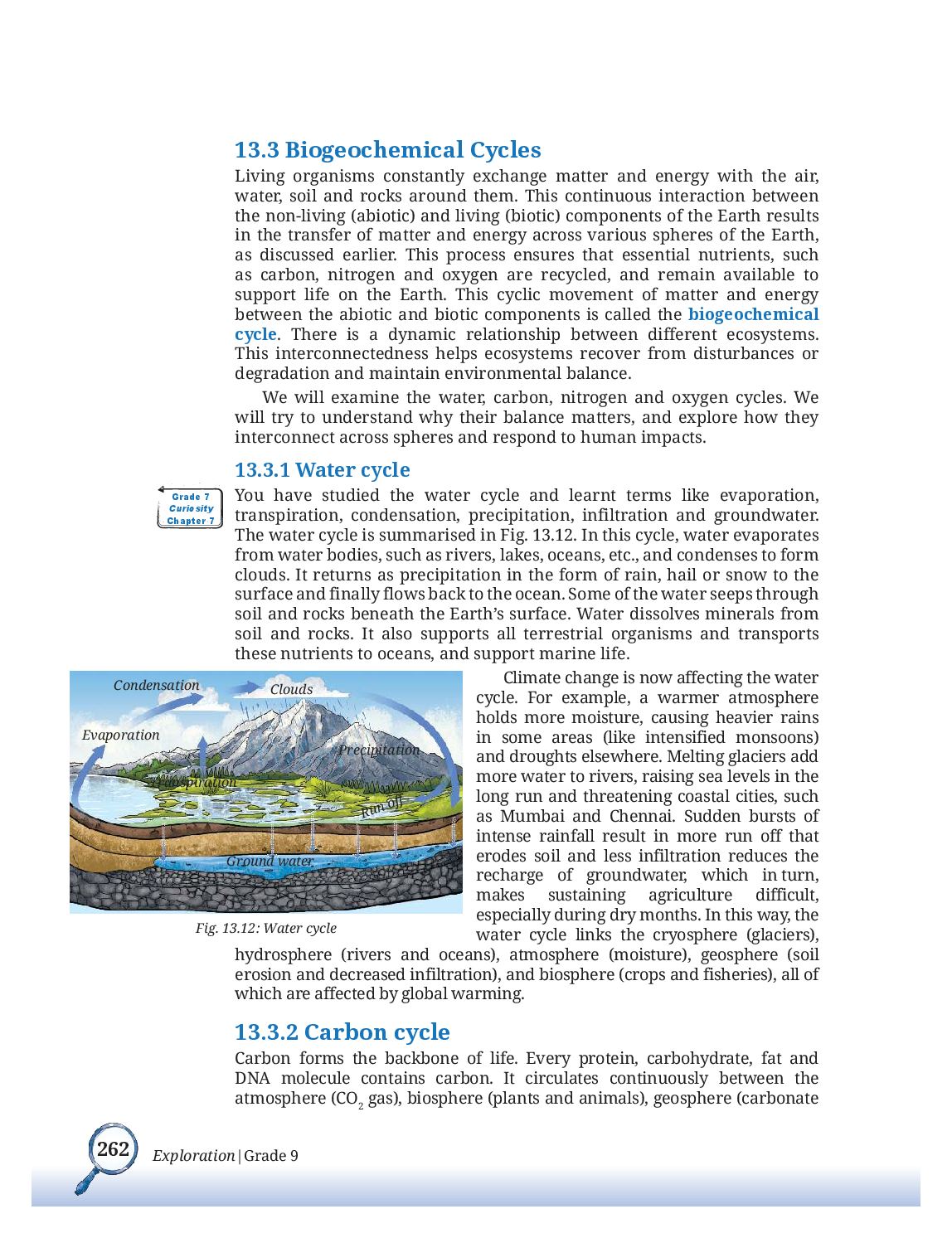
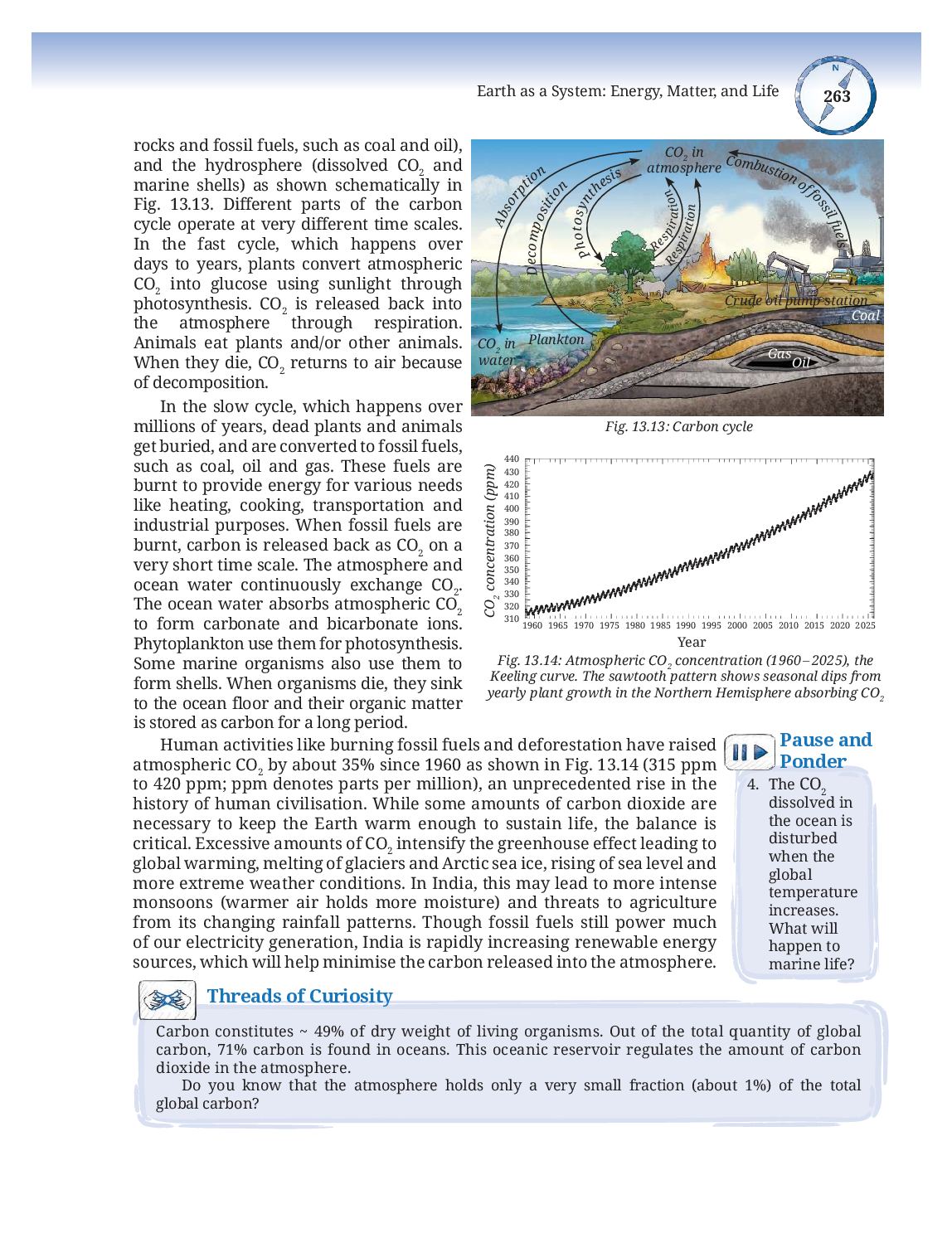
- In the biogeochemical cycles — water, carbon, nitrogen and oxygen — matter moves in a closed loop between the non-living (abiotic) and living (biotic) parts of the Earth, so the same atoms are used again and again.
- Human activity is now the strongest single disturbance: burning fossil fuels has raised atmospheric CO2 from about 315 ppm in 1960 to about 420 ppm today, fertiliser run-off causes eutrophication, and deforestation cuts photosynthesis, transpiration and soil holding all at once.
Quick revision – Earth as a System: Energy, Matter, and Life
| Term | What it means | Value / example from the chapter | Where it appears |
|---|---|---|---|
| Solar constant | Average solar energy received per unit time on unit area held perpendicular to the Sun’s rays at the top of the atmosphere | 1.4 kW m–2 = 1400 J s–1 m–2 | Section 13.1 |
| Insolation | The solar radiation that actually reaches the Earth’s surface | About 1 kW m–2 under a clear sky | Section 13.1 |
| Albedo | Fraction of the solar radiation a surface reflects (Latin albedo = whiteness) | Snow 0.80 – 0.90; ice 0.50 – 0.70; crushed rock 0.25 – 0.30 | Table 13.1 |
| Troposphere | Lowest layer, heated from below by the Earth’s surface; carries almost all weather | 0 – 12 km; temperature falls at about 6.5 °C km–1 | Table 13.2 |
| Stratosphere | Holds the ozone layer; UV absorption warms it, so temperature rises with height and the layer stays calm | 12 – 50 km | Table 13.2 |
| Greenhouse gases | Gases that absorb the infrared radiated back by the warm Earth and stop it escaping to space | CO2, CH4, water vapour | Section 13.1.3 |
| Valley breeze | Daytime wind — sunlit slope heats, air rises, cool valley air flows up the slope | Shimla, Dehradun and other Himalayan valleys | Fig. 13.8(a) |
| Mountain breeze | Night wind — slope cools fast, dense cold air slides down into the valley | Shimla, Dehradun and other Himalayan valleys | Fig. 13.8(b) |
| Pressure belts | Bands of high and low pressure set up by uneven heating between equator and poles | Equatorial low, sub-tropical high (30°), sub-polar low (60°), polar high (90°) | Fig. 13.9(b) |
| Gyre | Large circular pattern of ocean currents made by the Earth’s rotation deflecting moving water | Clockwise in the Northern Hemisphere, anticlockwise in the Southern | Fig. 13.10(a) |
| Biogeochemical cycle | Cyclic movement of matter and energy between the abiotic and biotic components of the Earth | Water, carbon, nitrogen and oxygen cycles | Section 13.3 |
| Nitrogen fixation | Converting unreactive N2 into ammonia that living things can use | Rhizobium in root nodules, Azotobacter in soil, lightning, Haber–Bosch process | Section 13.3.3 |
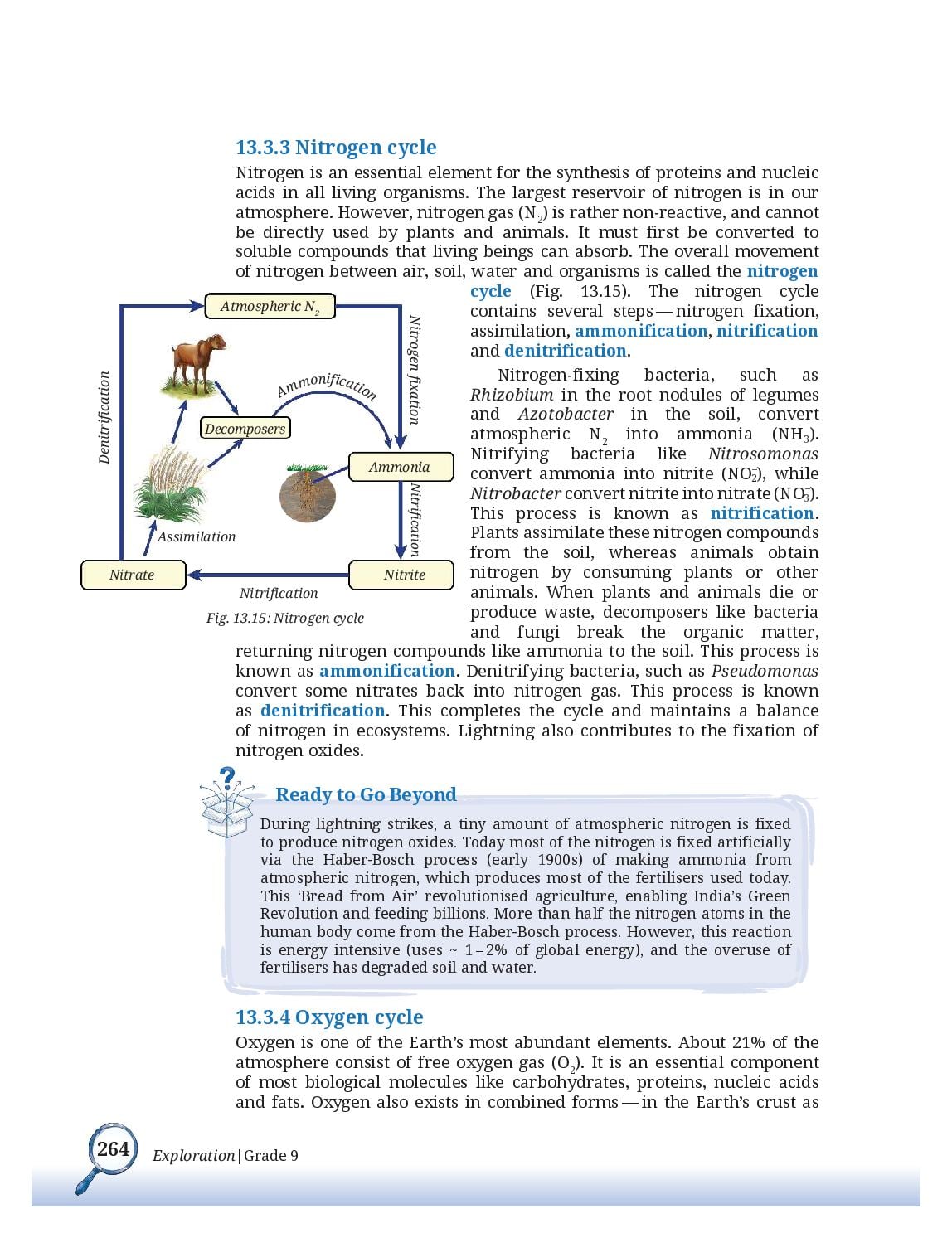
| Nitrification / Denitrification | NH3 → NO2– → NO3–, and nitrate back to N2 gas | Nitrosomonas, Nitrobacter; Pseudomonas | Fig. 13.15 |
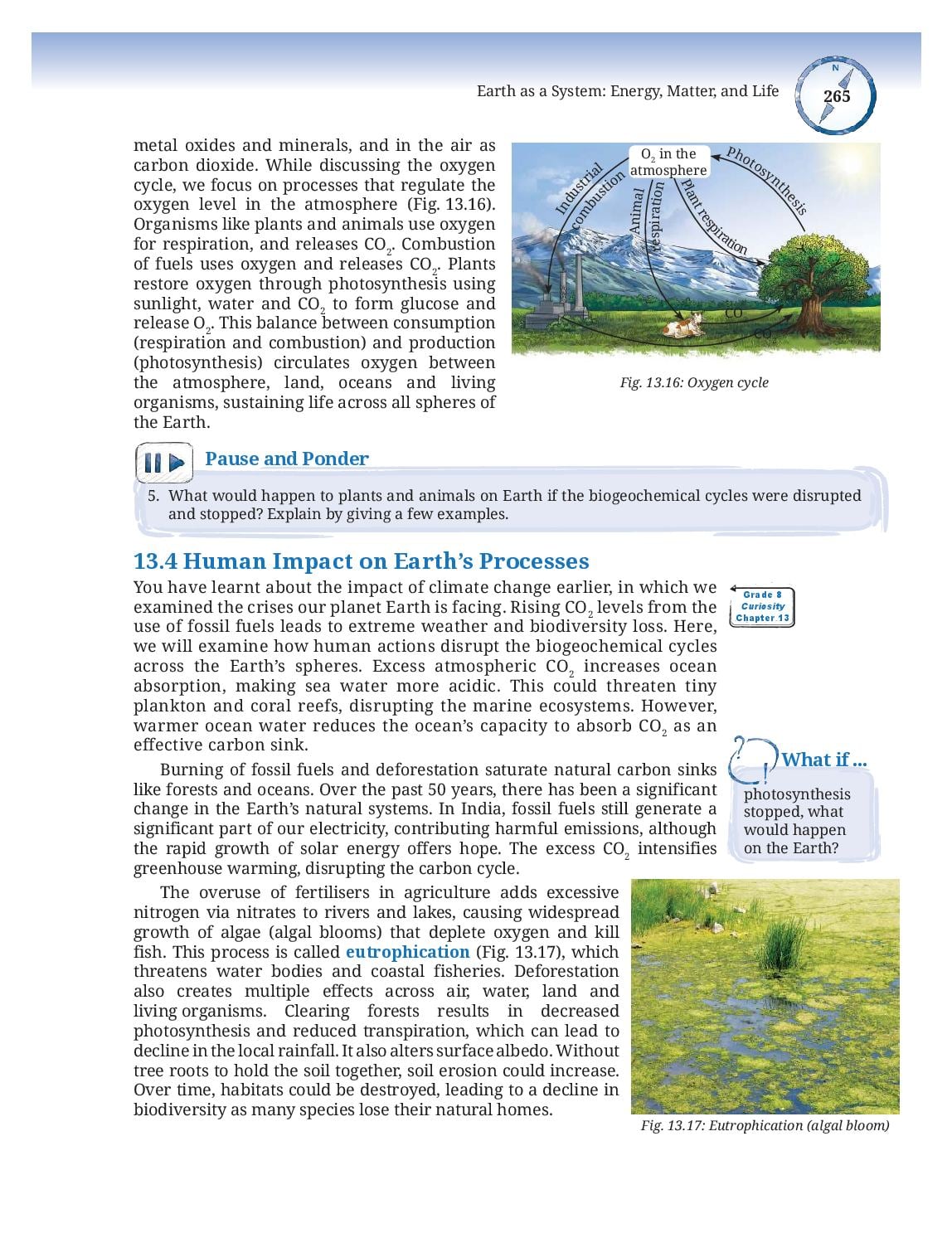
| Eutrophication | Excess nitrate causes an algal bloom, the algae use up dissolved oxygen and fish die | Fig. 13.17 | Section 13.4 |
Old NCERT vs New – Class 9 Science
This chapter is from Exploration, the new NCERT Class 9 Science book (NCF-SE 2023, used from 2026-27). It replaced the old book “Science”, so chapter numbers and names differ from older PDFs.
Solutions and All Chapters
Answers to the exercises and the full chapter list of Exploration:
Earth as a System: Energy, Matter, and Life – Overview
| Class | Class 9 |
| Subject | Science |
| Book | Exploration – new NCERT book |
| Chapter | 13 of 13 – Earth as a System: Energy, Matter, and Life |
| Book pages | 252 – 269 |
| Edition | Latest NCERT edition (2026-27) |
| Session | 2026-27 |
| Free – read online or download |
Class 9 Science Chapter 13 – FAQs
Where can I download Earth as a System: Energy, Matter, and Life Class 9 PDF?
From the download table on this page – the chapter PDF is free, and the full book is linked too.
What is Class 9 Science Chapter 13 about?
The Earth is a single system of five interacting spheres — geosphere (rock, soil, interior), hydrosphere (liquid water), cryosphere (ice and snow), atmosphere (air) and biosphere (all life). A disturbance in one sphere shows up as a change in the others.
Is Earth as a System: Energy, Matter, and Life from the new NCERT Class 9 Science book?
Yes. It is chapter 13 of exploration, the new NCERT Class 9 Science book for 2026-27.
Is this the latest NCERT edition for 2026-27?
Yes – the PDF is NCERT’s latest edition for the 2026-27 session.
Where are the NCERT Solutions for Class 9 Science Chapter 13?
Open the NCERT Solutions link above for answers to the exercise questions.