Download Journey Inside the Atom – NCERT Class 9 Science Chapter 8 PDF from the new NCERT Class 9 Science book Exploration (2026-27). Read the chapter online or download the free PDF. An atom is not indivisible. Thomson’s cathode-ray work (1897) showed that every atom contains electrons — negatively charged particles of charge –1.602 × 10⁻¹⁹ C, taken as –1 by convention, and far lighter than the atom itself.
Journey Inside the Atom PDF – Chapter 8 of Exploration
Read the chapter online or download the PDF.
| Chapter | Download | |
|---|---|---|
| Chapter 8 PDF | Journey Inside the Atom | View PDF |
| Full book | NCERT Class 9 Science – Exploration | View Book |
Read Online
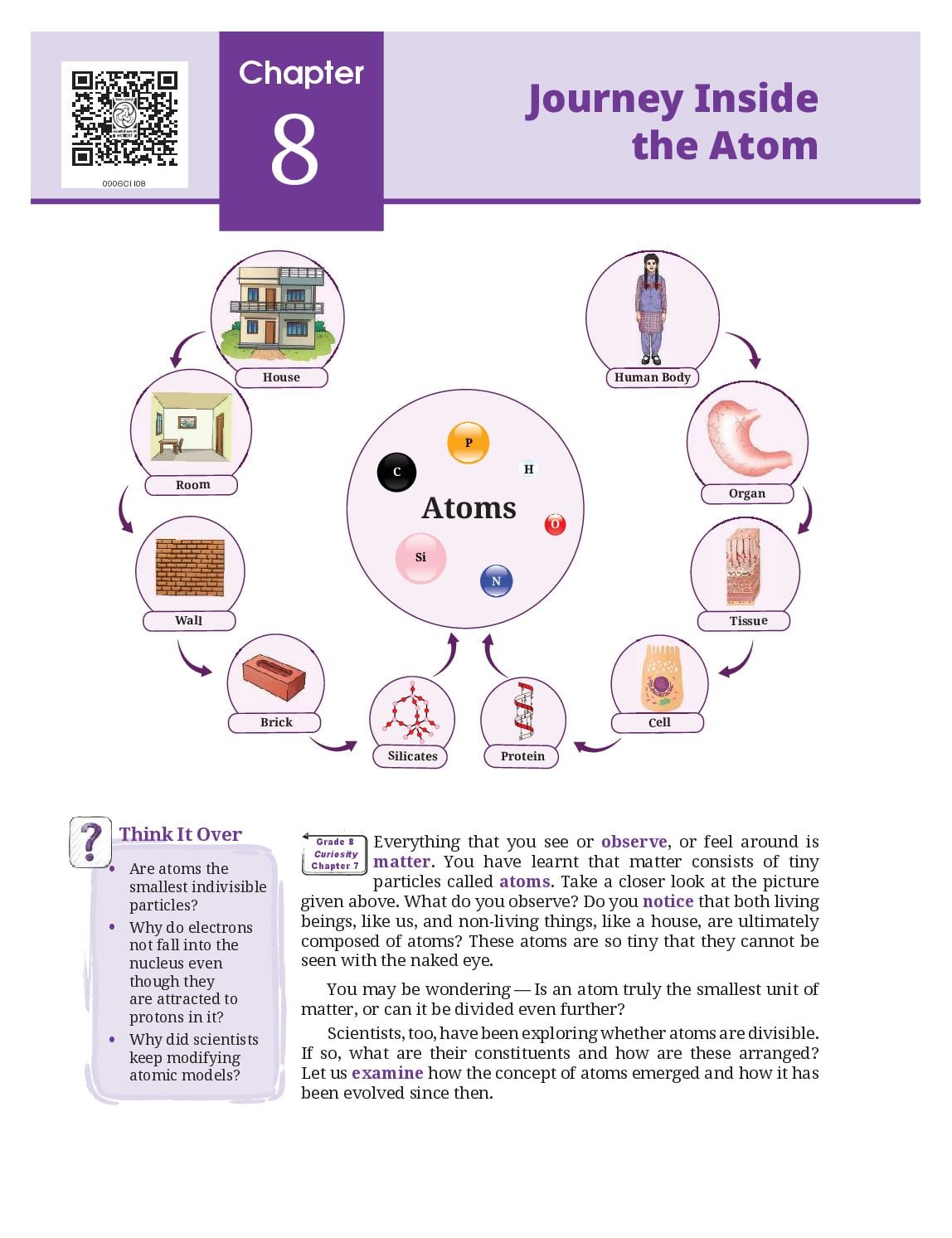
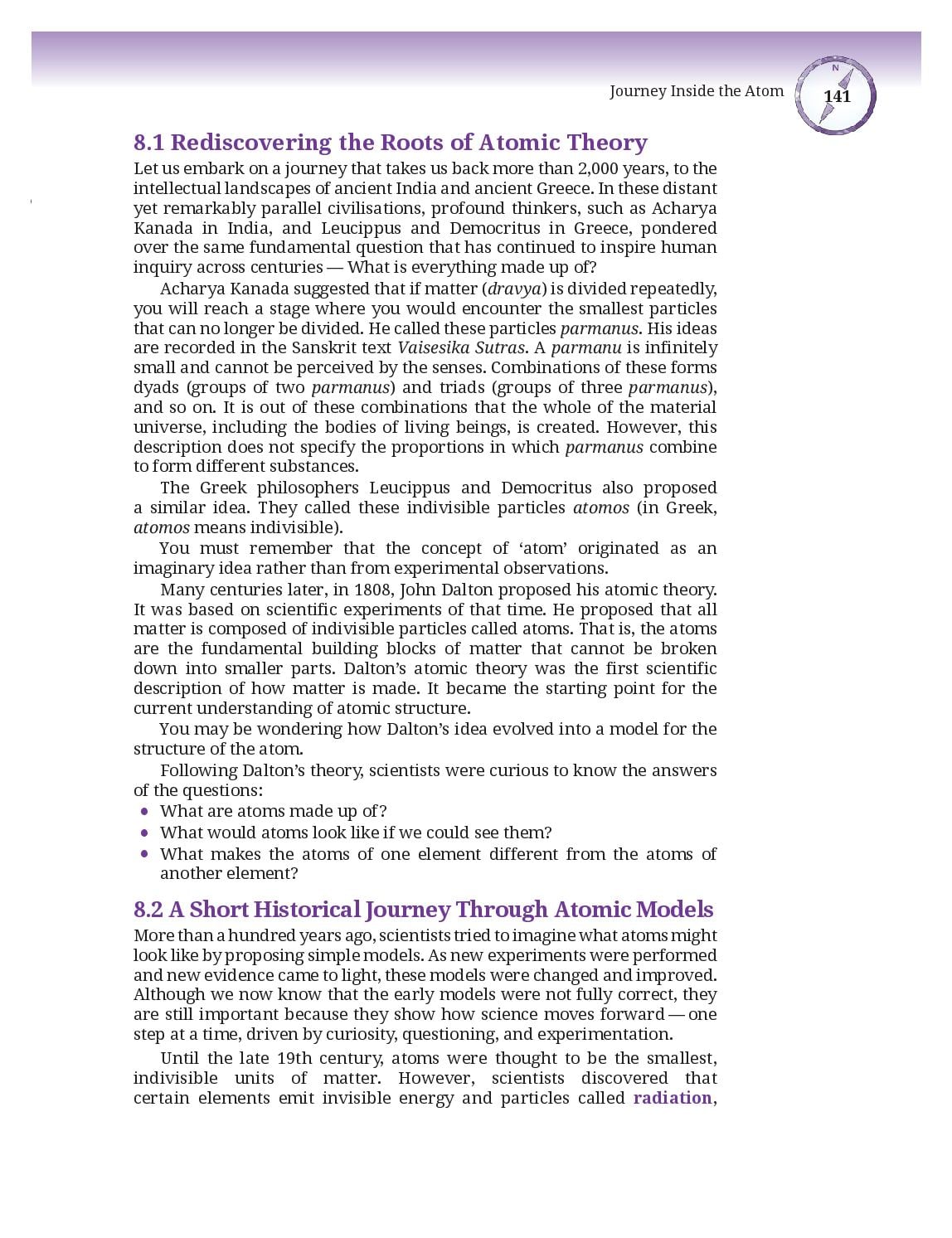
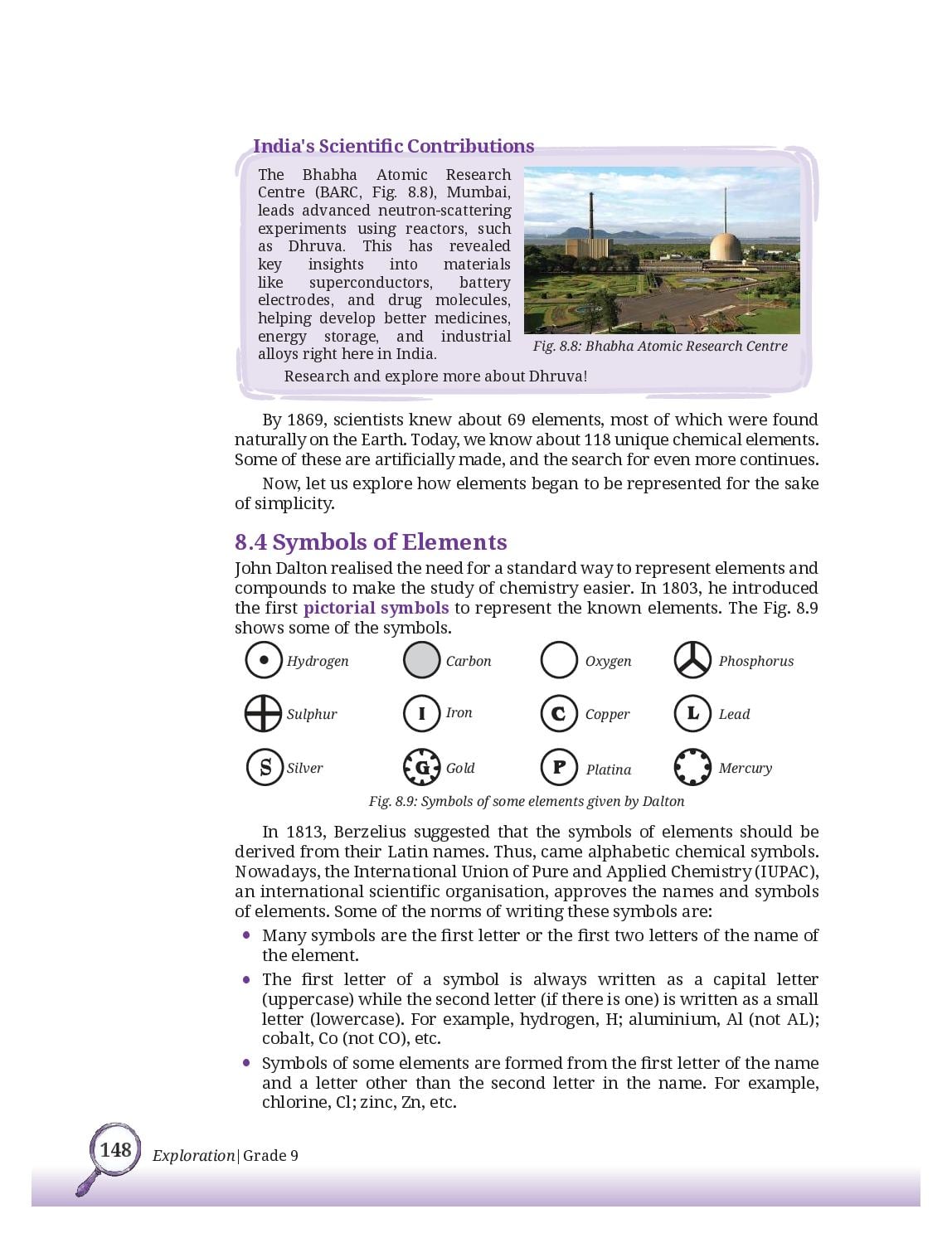
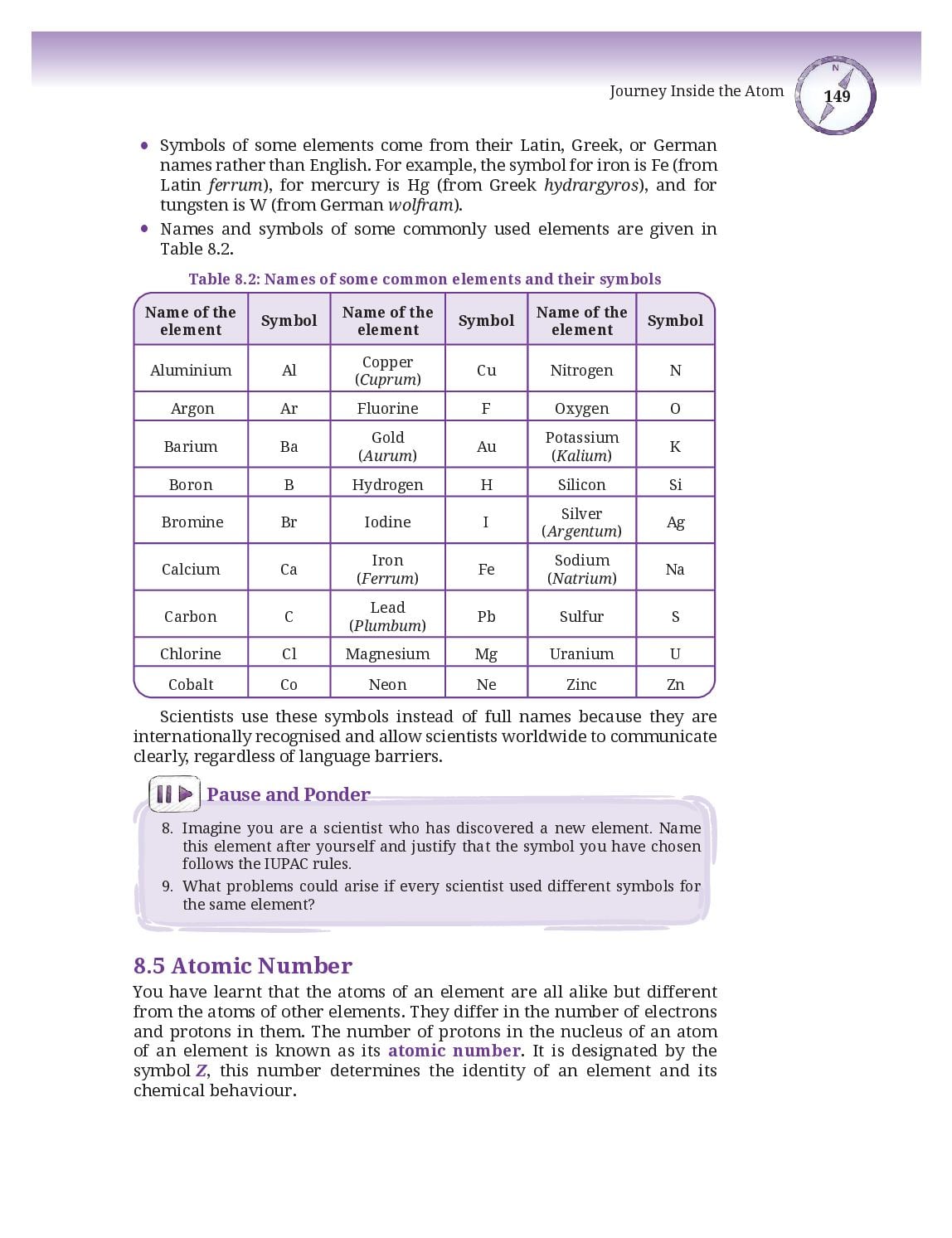
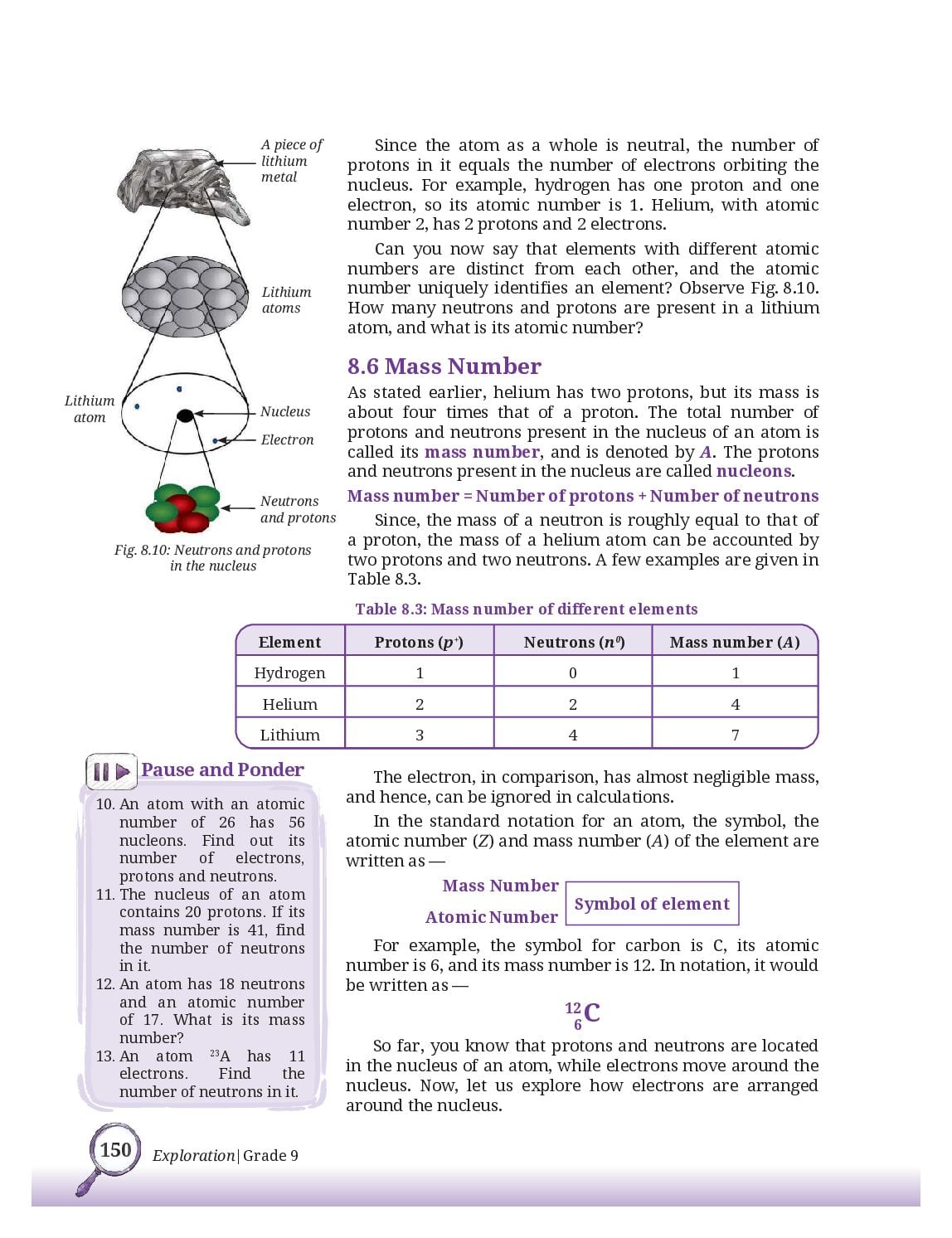
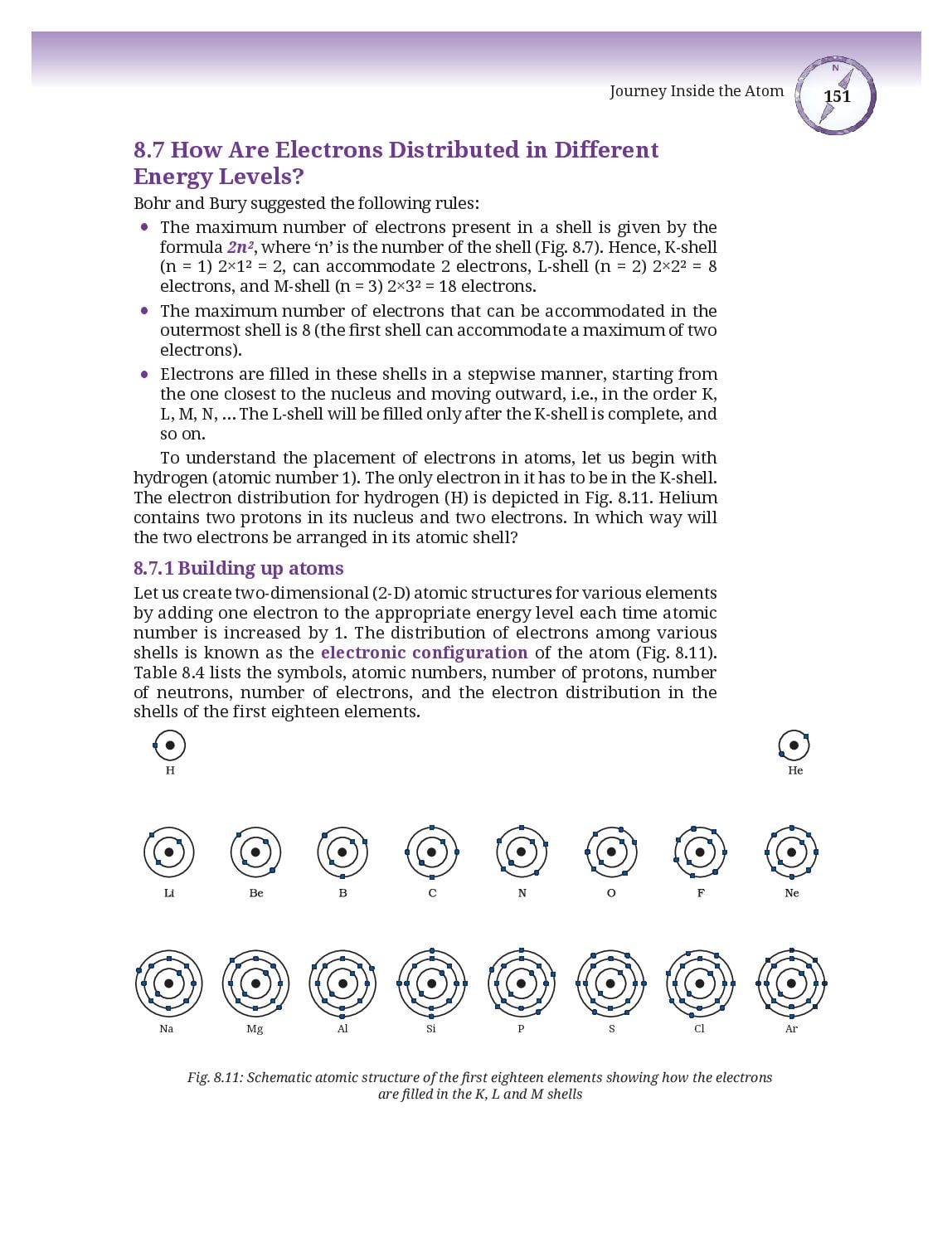
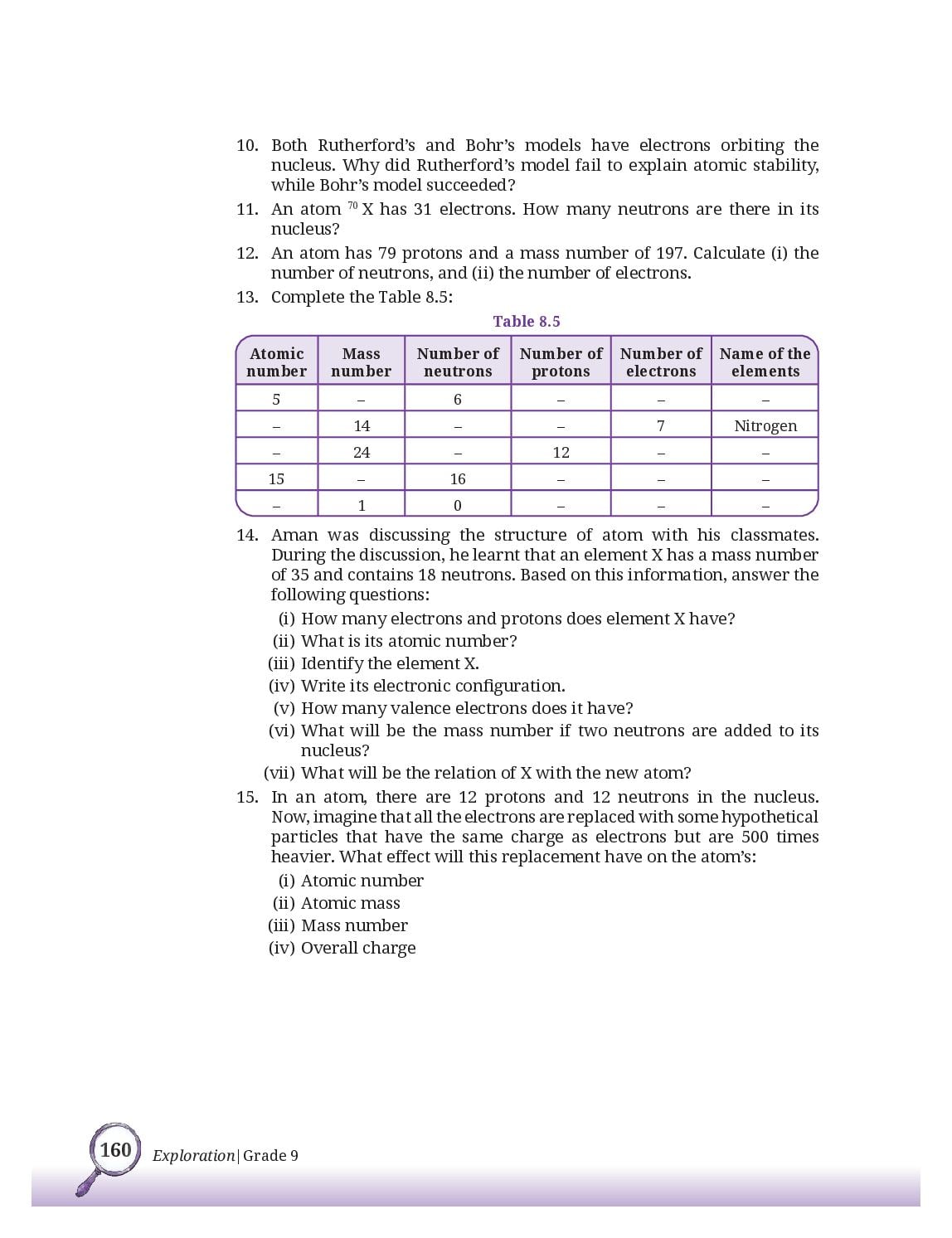
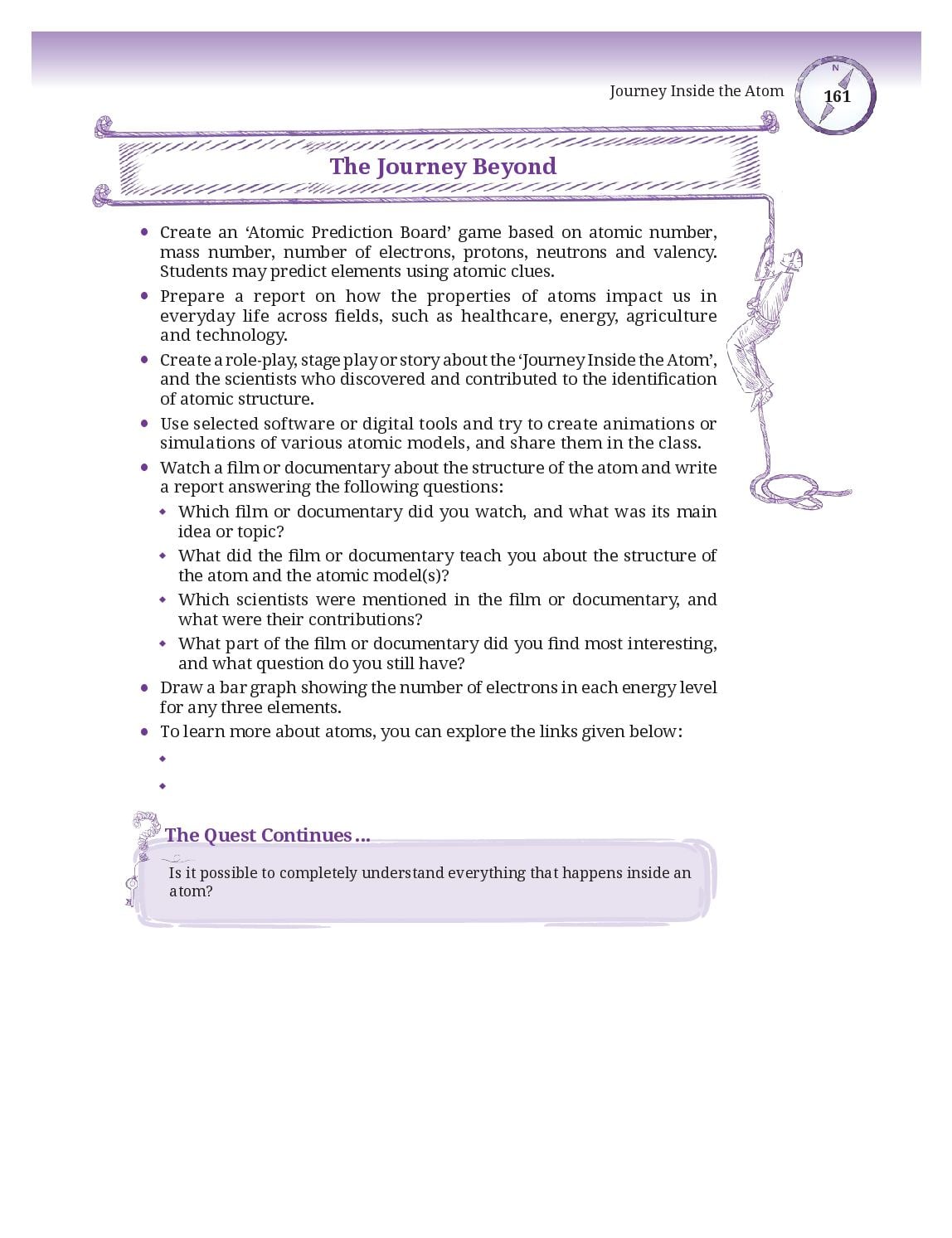
What Is in Journey Inside the Atom? (Class 9 Science Chapter 8)
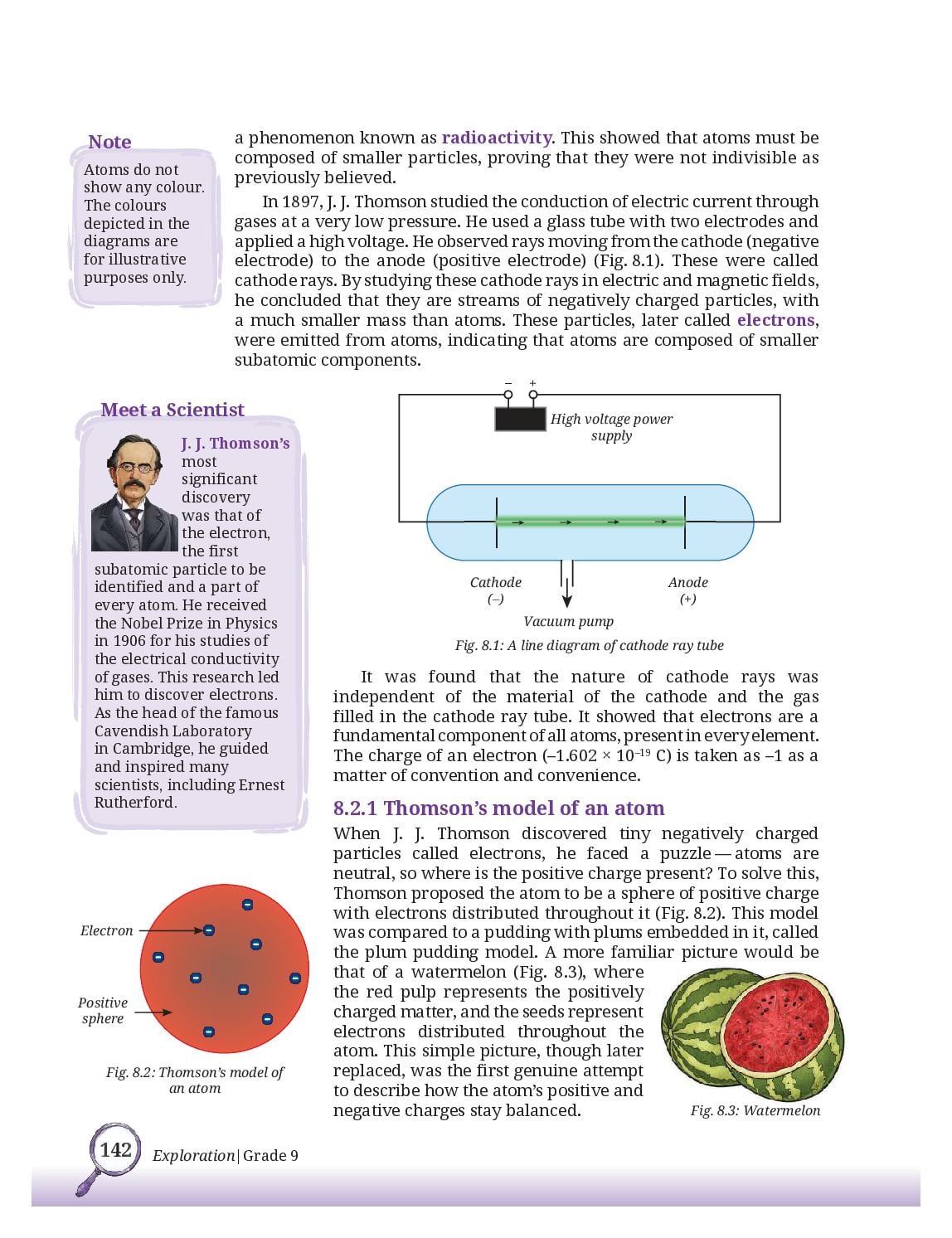
- An atom is not indivisible. Thomson’s cathode-ray work (1897) showed that every atom contains electrons — negatively charged particles of charge –1.602 × 10⁻¹⁹ C, taken as –1 by convention, and far lighter than the atom itself.
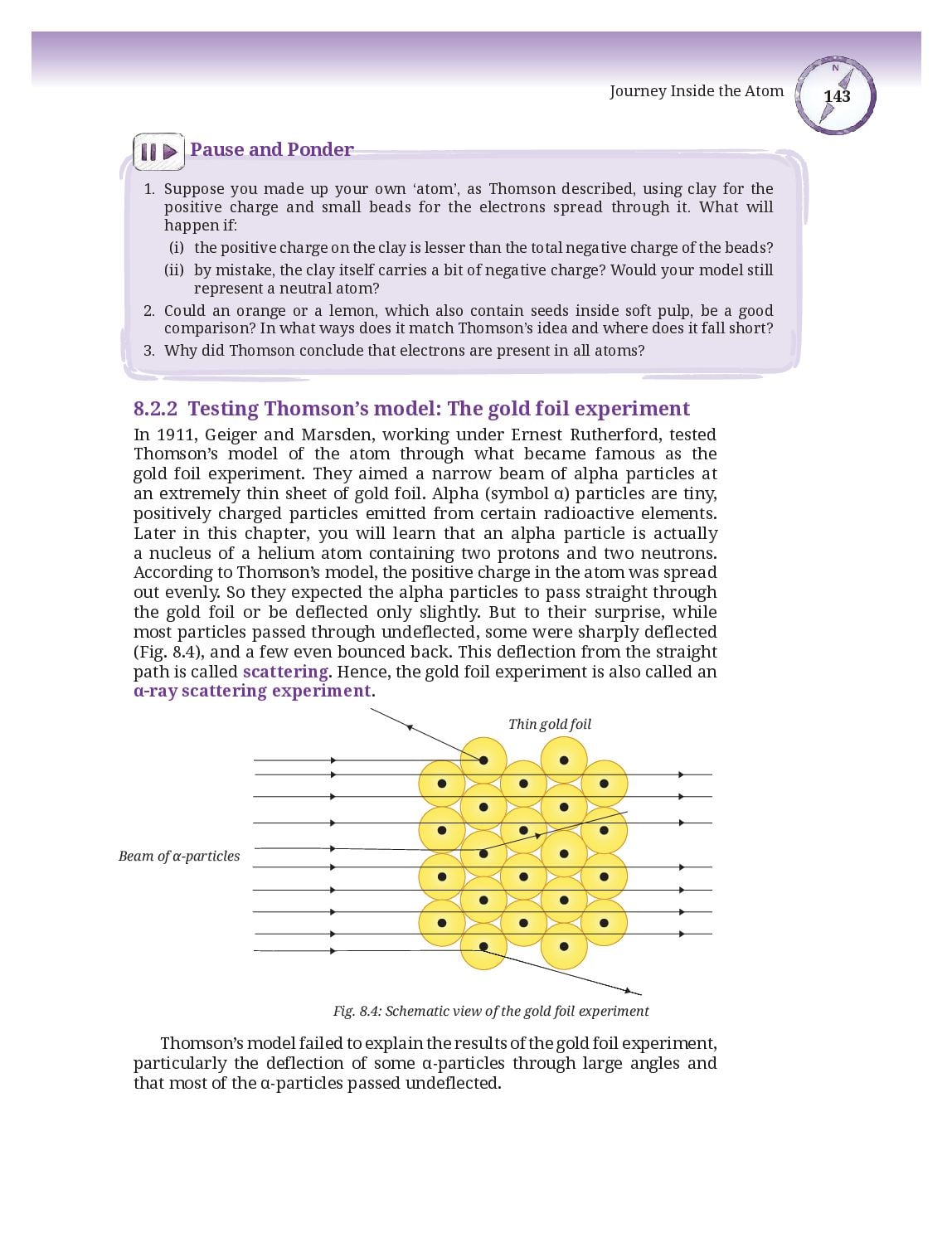
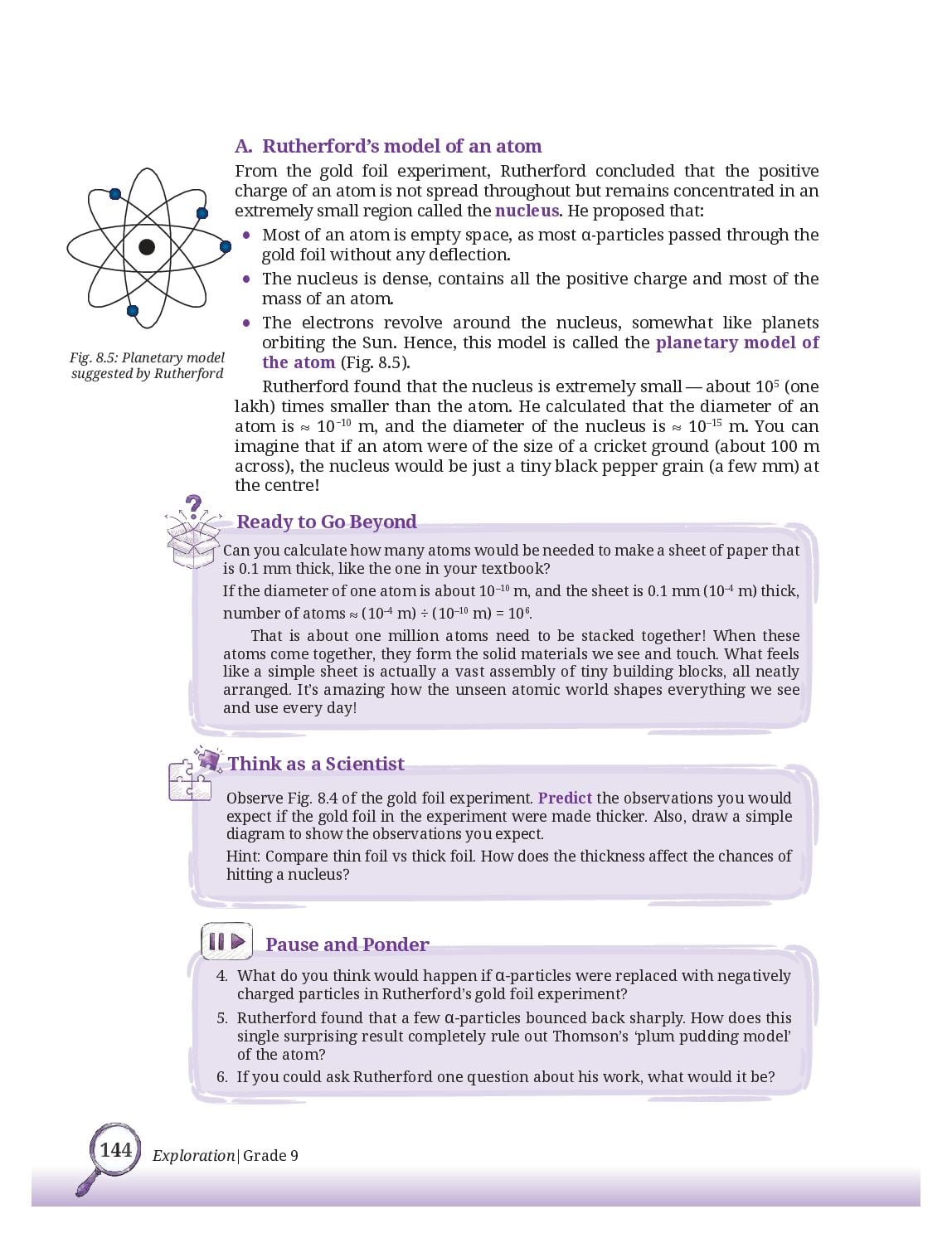
- The gold foil experiment (Geiger and Marsden, 1911) settled the atom’s shape. Most α-particles went straight through, so the atom is mostly empty; a few bounced back, so all the positive charge and nearly all the mass sit in a tiny, dense nucleus. Diameter of atom ≈ 10–10 m, of nucleus ≈ 10–15 m — a factor of 105.
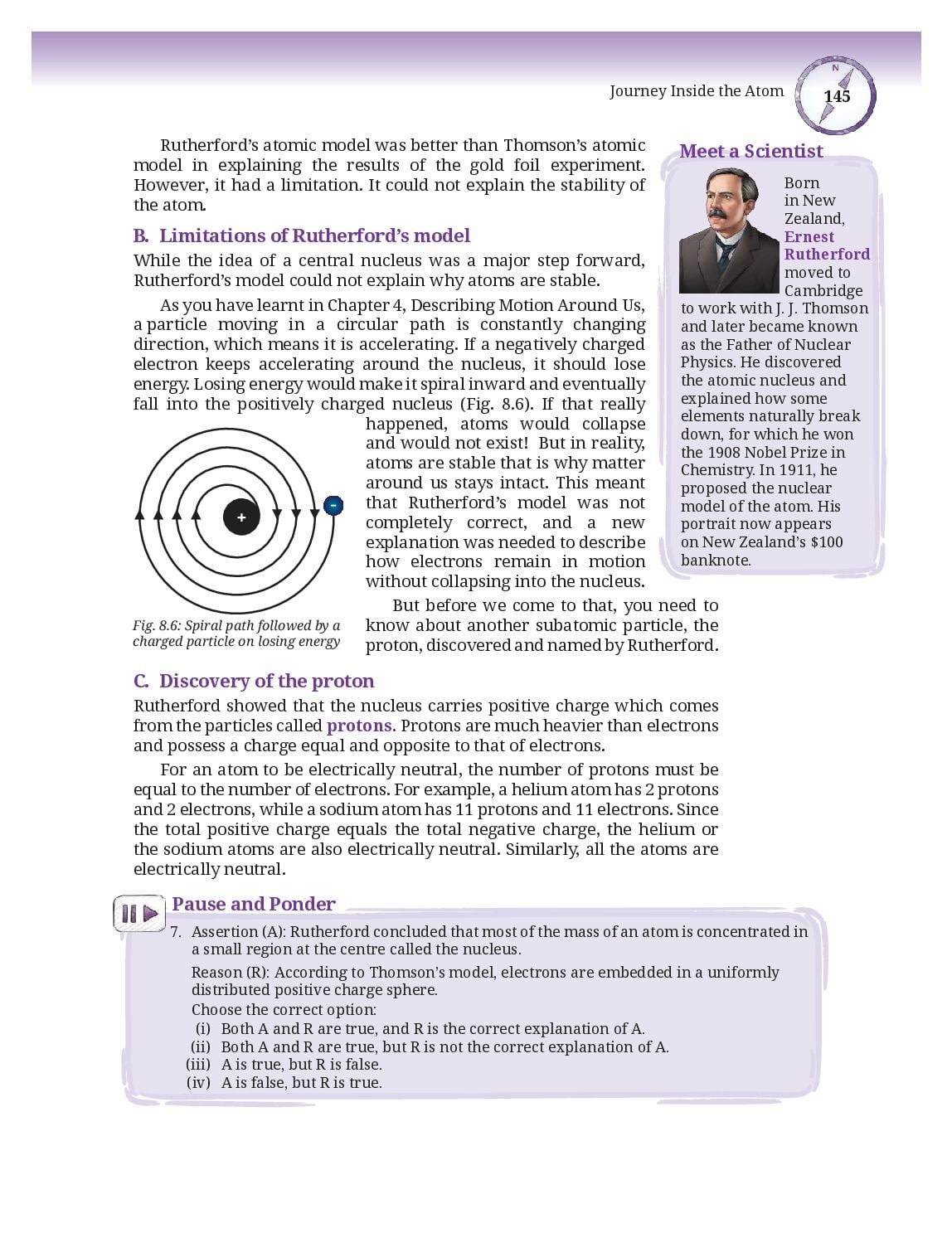
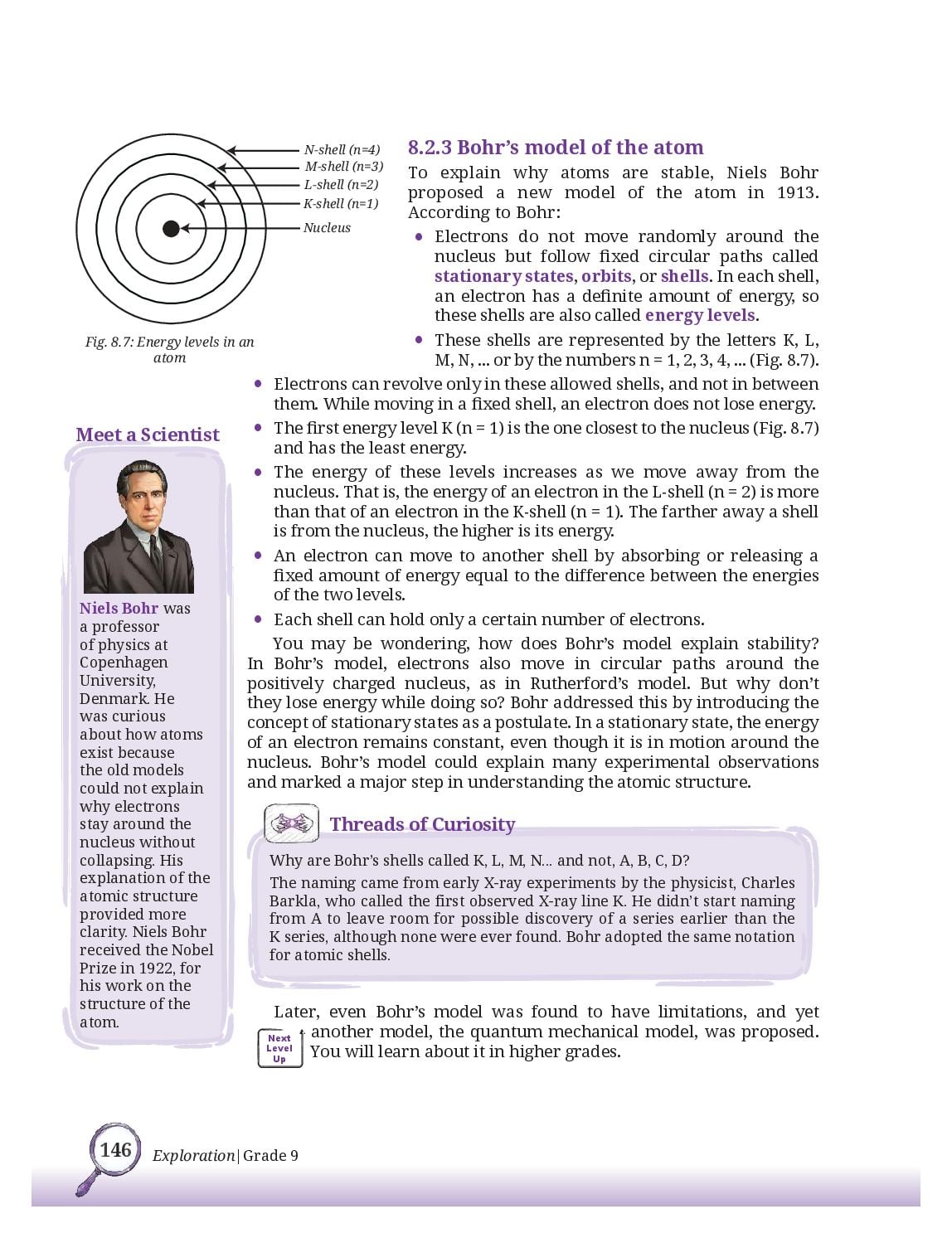
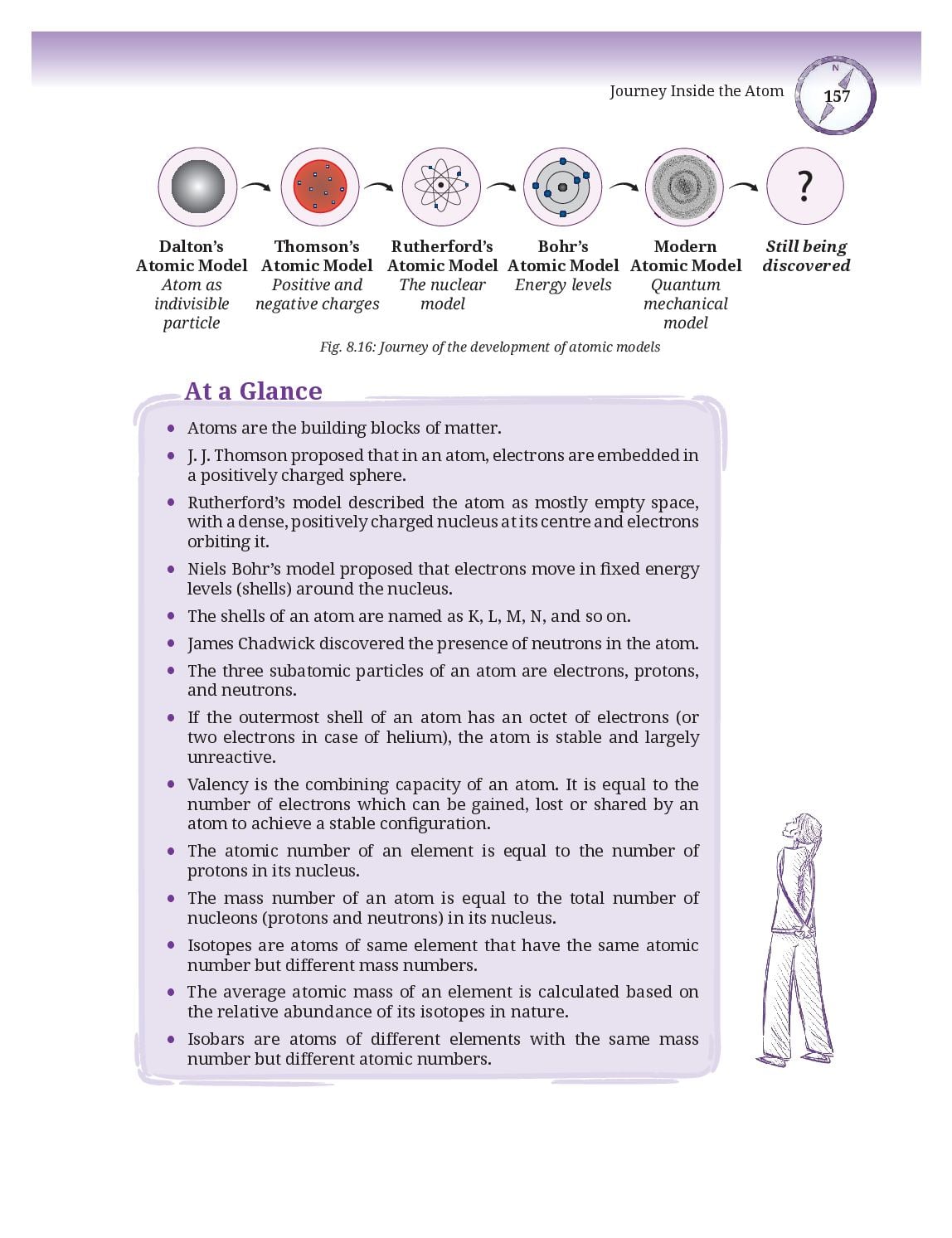
- Rutherford’s planetary model could not explain stability: an electron in a circular orbit is accelerating, so it should radiate energy and spiral into the nucleus. Bohr (1913) fixed this by postulating stationary states — fixed shells K, L, M, N (n = 1, 2, 3, 4) in which an electron moves without losing energy.
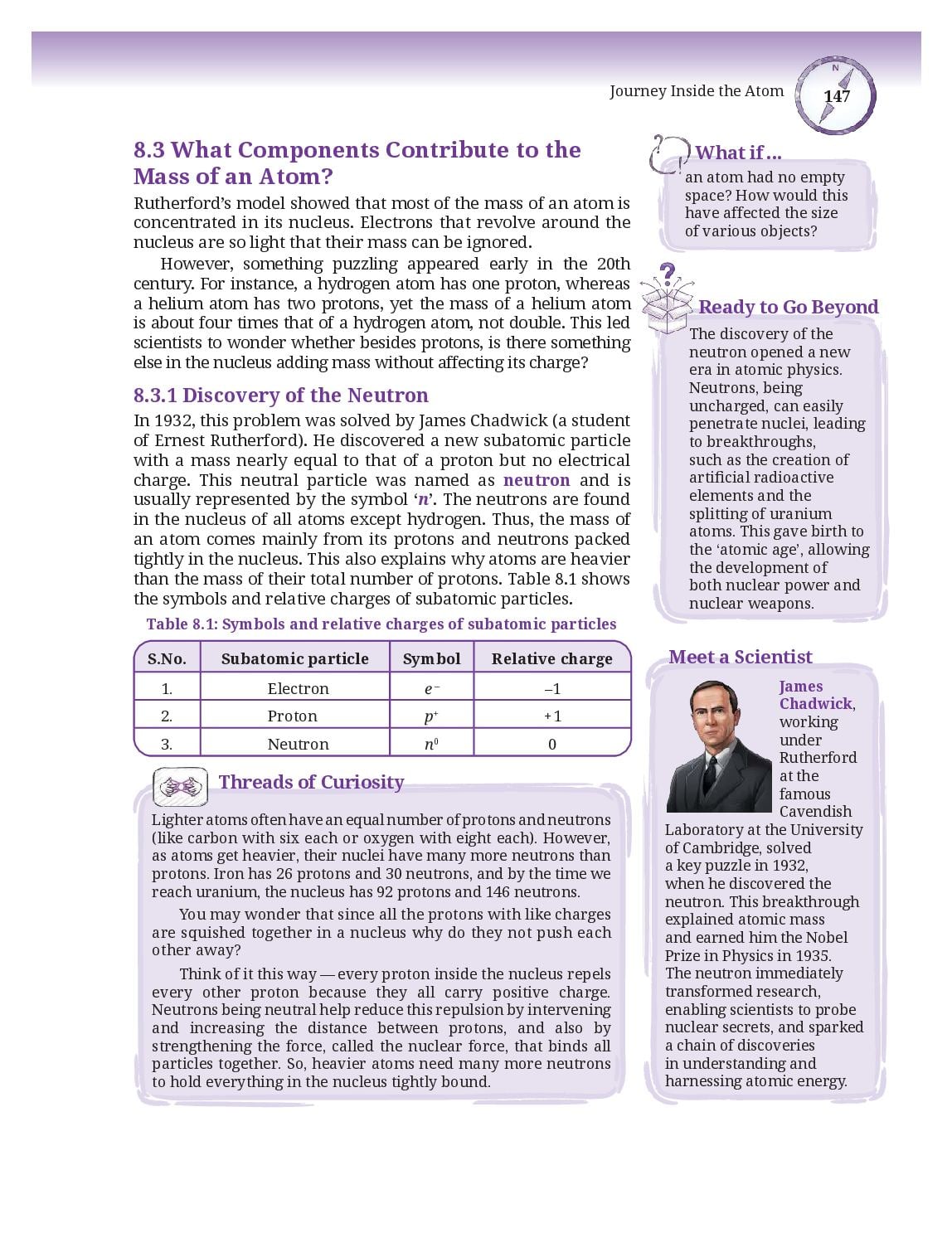
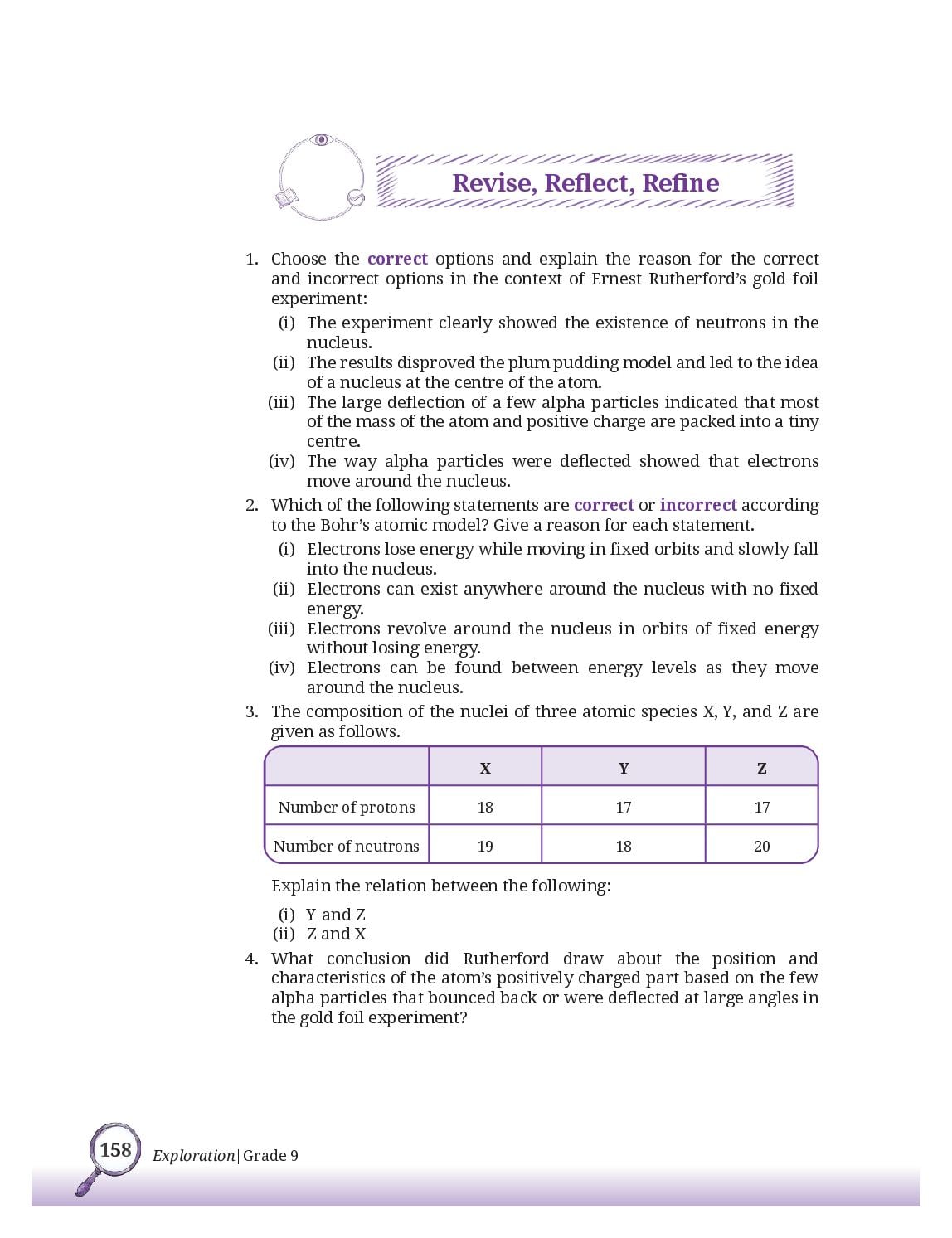
- Chadwick (1932) discovered the neutron — mass nearly that of a proton, charge zero. Mass now added up: helium’s 2 protons + 2 neutrons give mass 4, not 2. The three subatomic particles are e– (–1), p+ (+1) and n0 (0).
- Atomic number Z = number of protons (and, in a neutral atom, of electrons); it fixes the identity of the element. Mass number A = protons + neutrons = number of nucleons. An atom is written as AZX, e.g. 126C.
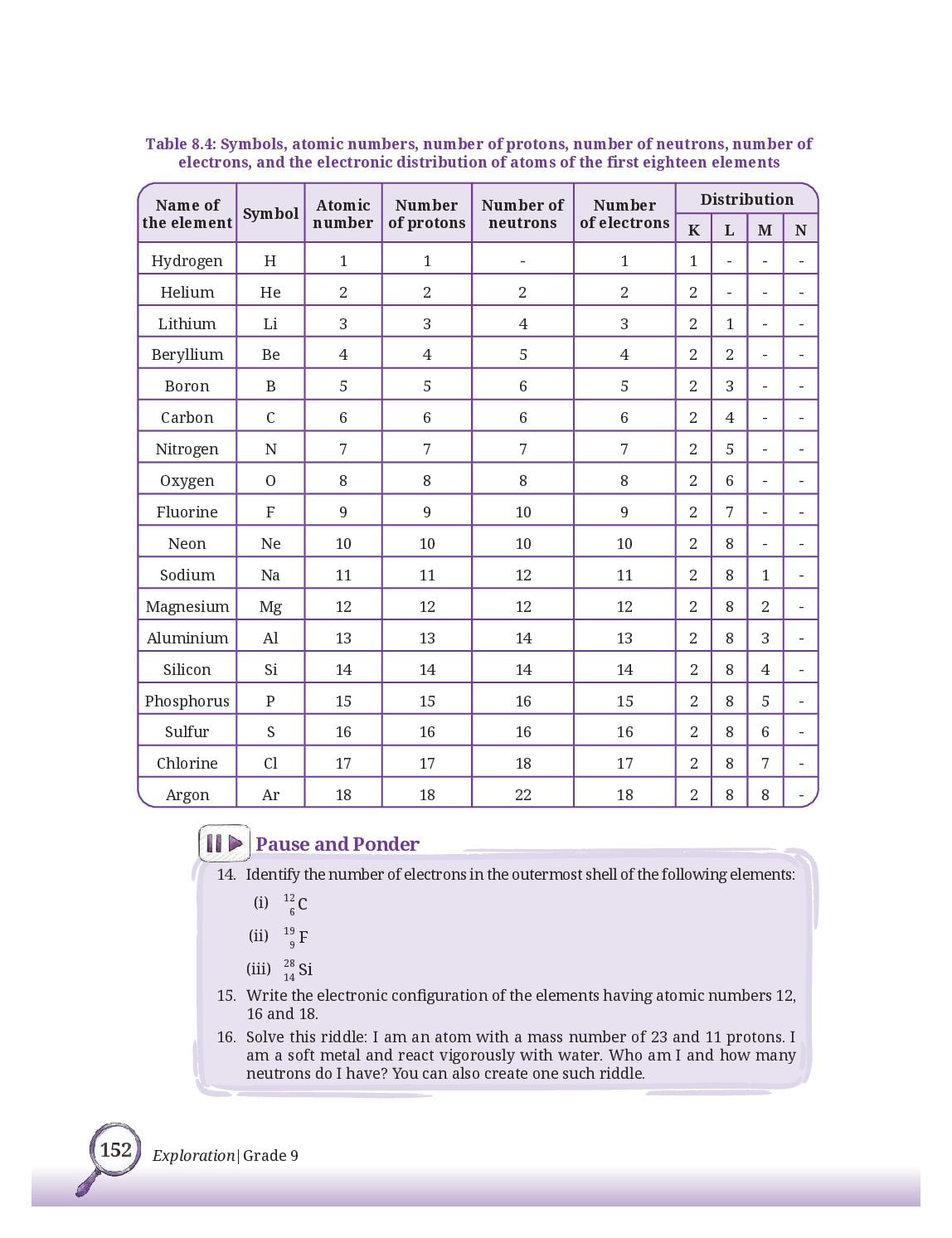
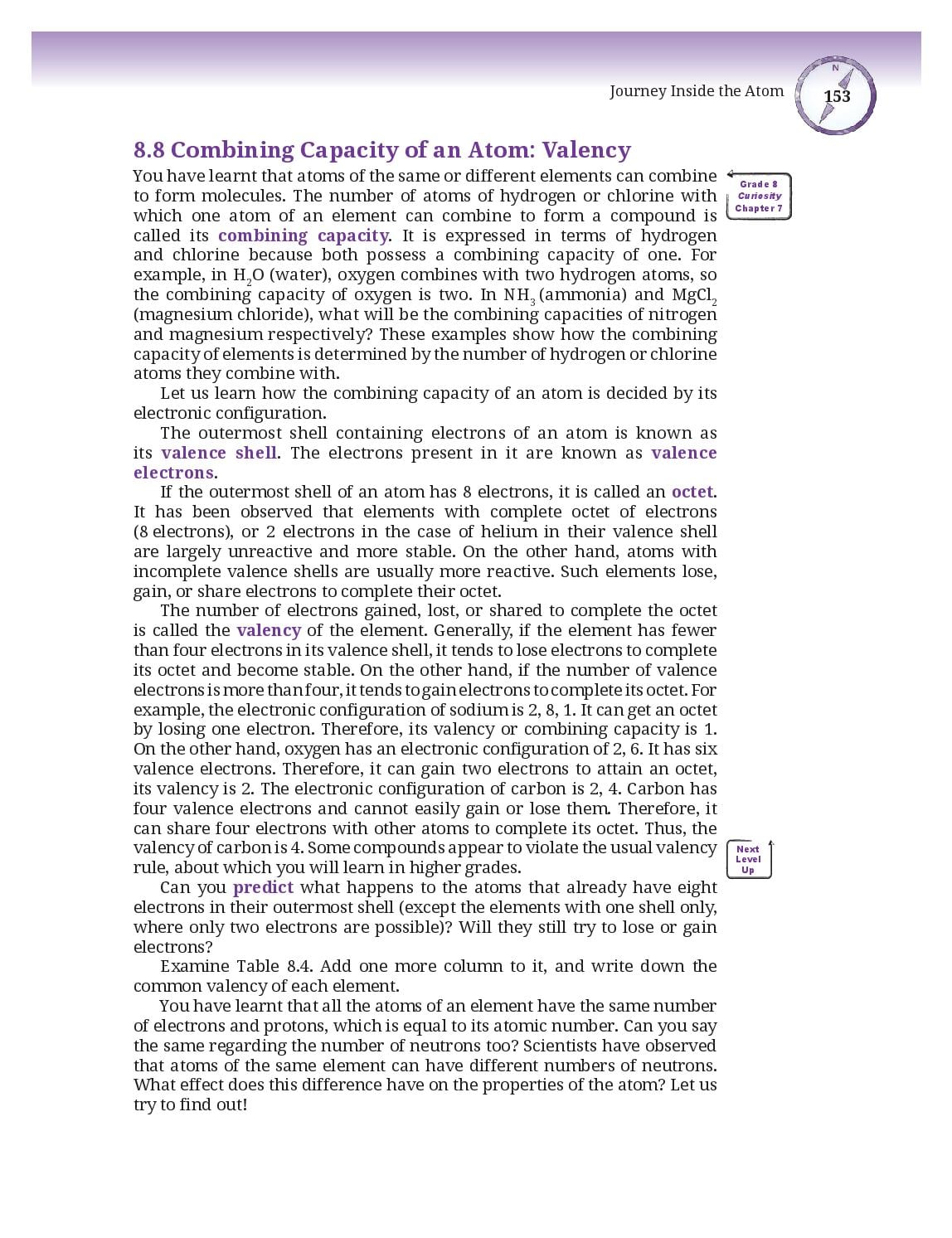
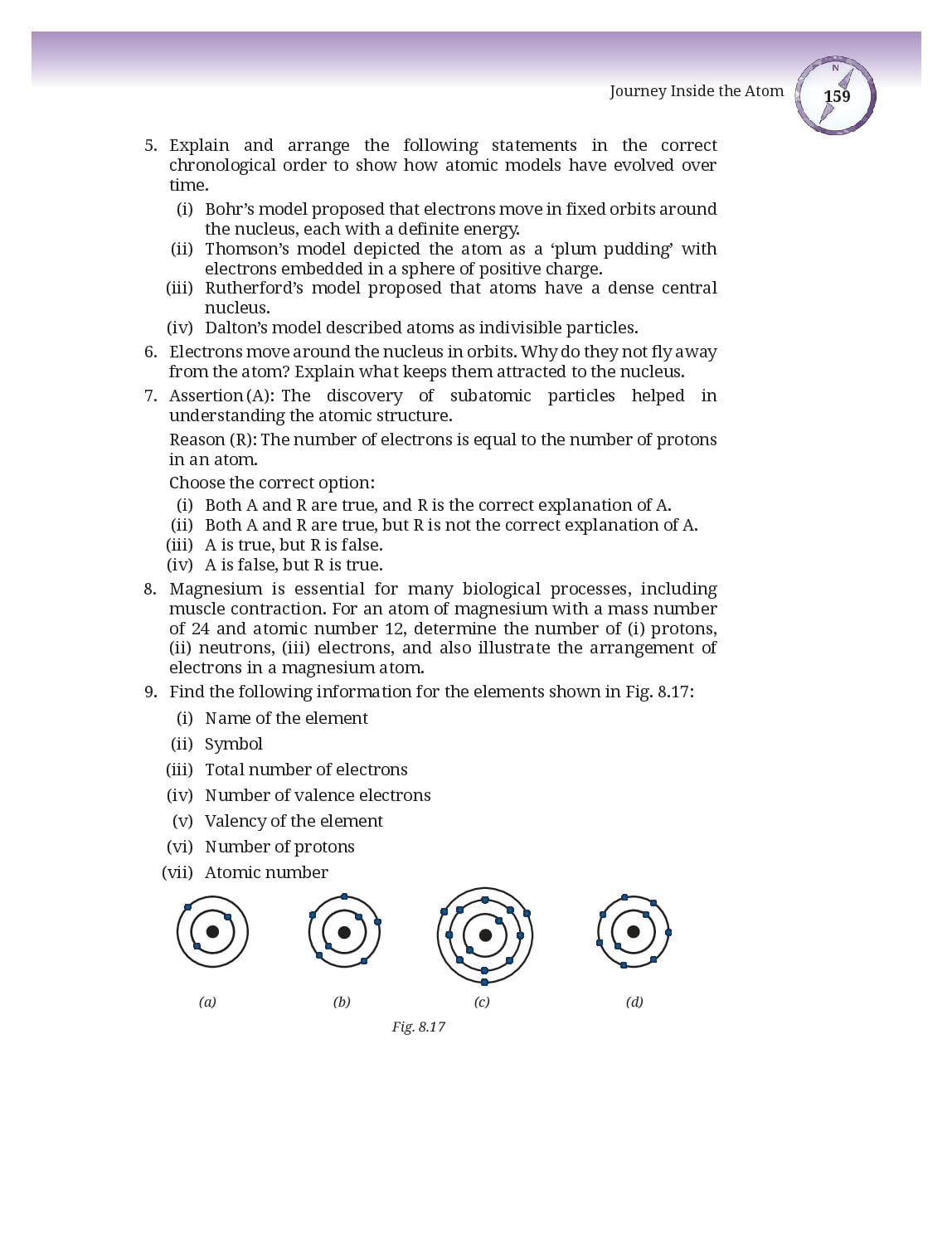
- Electrons fill shells by the Bohr–Bury rules: a shell holds at most 2n² electrons, the outermost shell at most 8, and filling goes K → L → M → N. Valency is the number of electrons gained, lost or shared to complete the octet (or duplet, for helium).
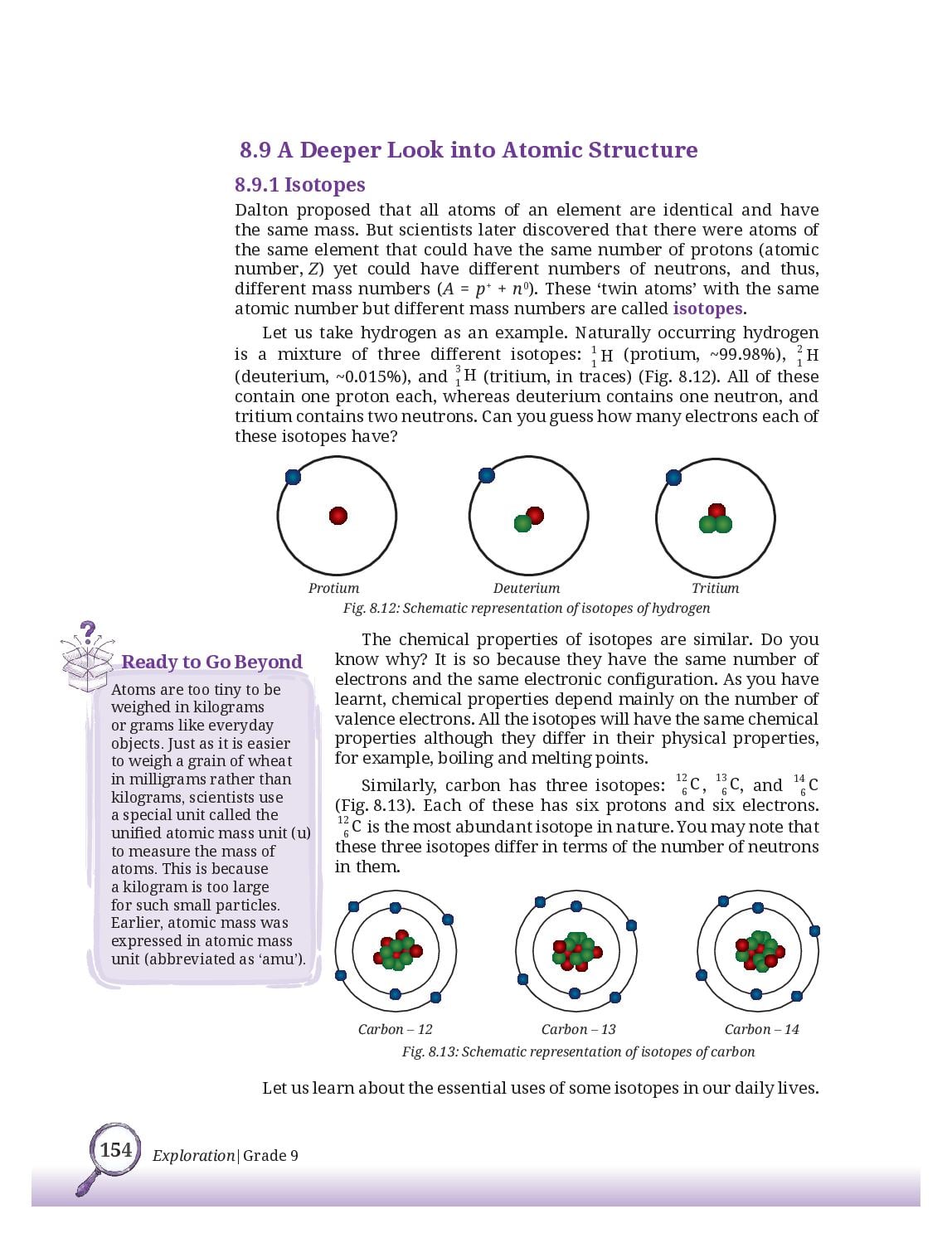
- Isotopes share Z but differ in A (11H, 21H, 31H). Because they have the same electronic configuration, their chemical properties match; only physical properties differ. Isobars share A but differ in Z (40Ar, 40K, 40Ca).
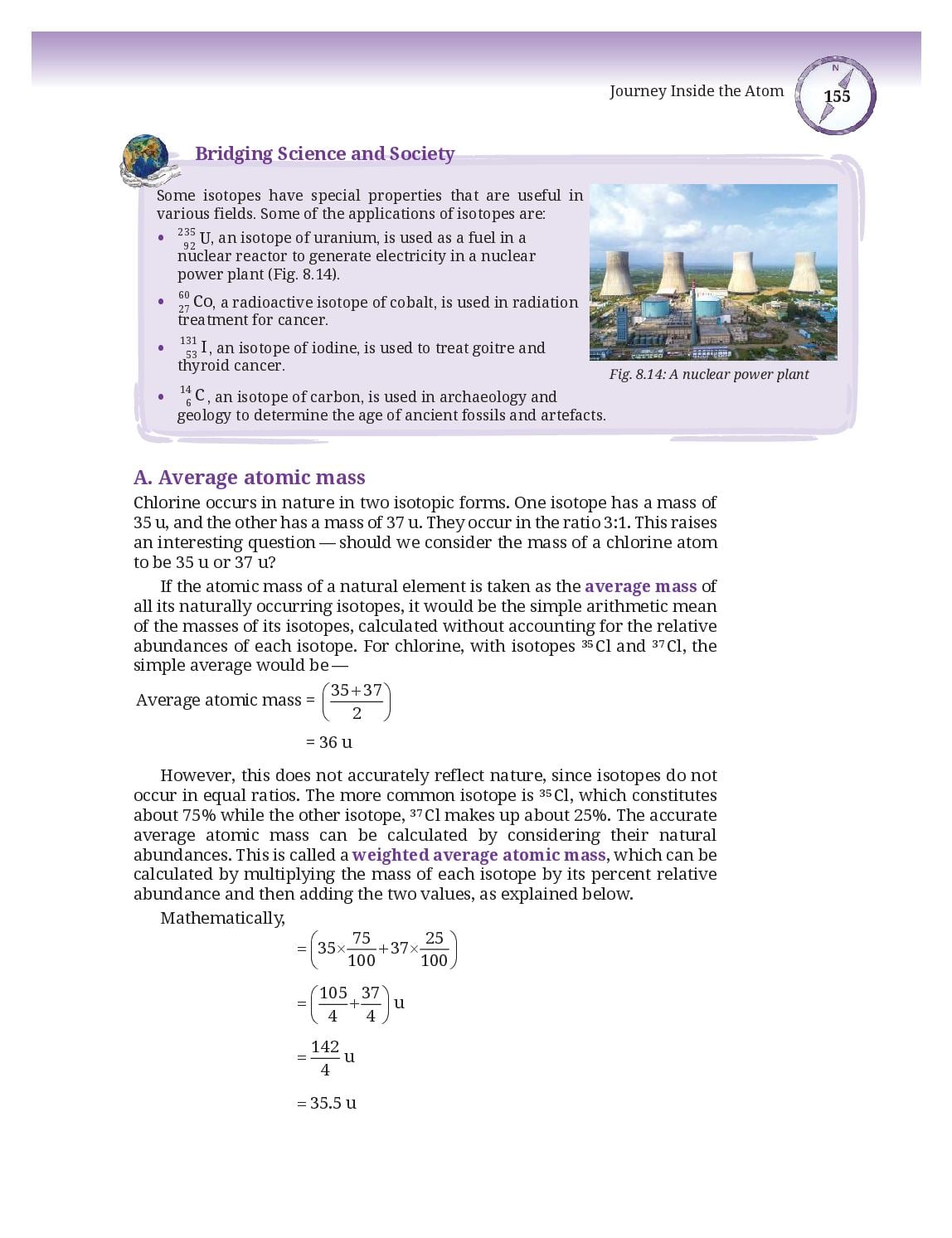
- The average atomic mass of an element is a weighted average over its isotopes: for chlorine, 35 × 75/100 + 37 × 25/100 = 35.5 u. No single chlorine atom has that mass.
Quick revision – Journey Inside the Atom
| Term | What it means | Key number or rule | Where it appears |
|---|---|---|---|
| Electron (e–) | Negatively charged subatomic particle outside the nucleus | Charge –1.602 × 10⁻¹⁹ C, taken as –1; mass negligible | 8.2 Thomson’s cathode-ray experiment |
| Proton (p+) | Positively charged particle in the nucleus | Relative charge +1; mass ≈ 1 u | 8.2.2 C, discovered by Rutherford |
| Neutron (n0) | Uncharged particle in the nucleus | Relative charge 0; mass ≈ 1 u | 8.3.1, discovered by Chadwick, 1932 |
| Nucleus | Tiny dense centre holding all the positive charge and nearly all the mass | Diameter ≈ 10–15 m, i.e. 105 times smaller than the atom | 8.2.2 A, gold foil experiment |
| Shell / energy level | Fixed circular path in which an electron has a definite energy | Named K, L, M, N for n = 1, 2, 3, 4 | 8.2.3 Bohr’s model |
| Atomic number (Z) | Number of protons in the nucleus | Equals the number of electrons in a neutral atom | 8.5 Atomic Number |
| Mass number (A) | Total number of nucleons (protons + neutrons) | A = p+ + n0; written as AZX | 8.6 Mass Number |
| Bohr–Bury rules | Rules for filling shells with electrons | Maximum 2n² per shell; outermost shell ≤ 8; fill K → L → M | 8.7 |
| Valence electrons | Electrons in the outermost (valence) shell | Decide chemical behaviour; 8 of them = octet = stable | 8.8 Valency |
| Valency | Combining capacity — electrons gained, lost or shared to get an octet | Na (2,8,1) → 1; O (2,6) → 2; C (2,4) → 4 | 8.8 Valency |
| Isotopes | Atoms of one element with the same Z but different A | 11H, 21H, 31H; 126C, 136C, 146C | 8.9.1 Isotopes |
| Isobars | Atoms of different elements with the same A but different Z | 4018Ar, 4019K, 4020Ca | 8.9.2 Isobars |
| Average atomic mass | Mass of an element averaged over its isotopes by abundance | Cl: 35 × 75/100 + 37 × 25/100 = 35.5 u | 8.9.1 A |
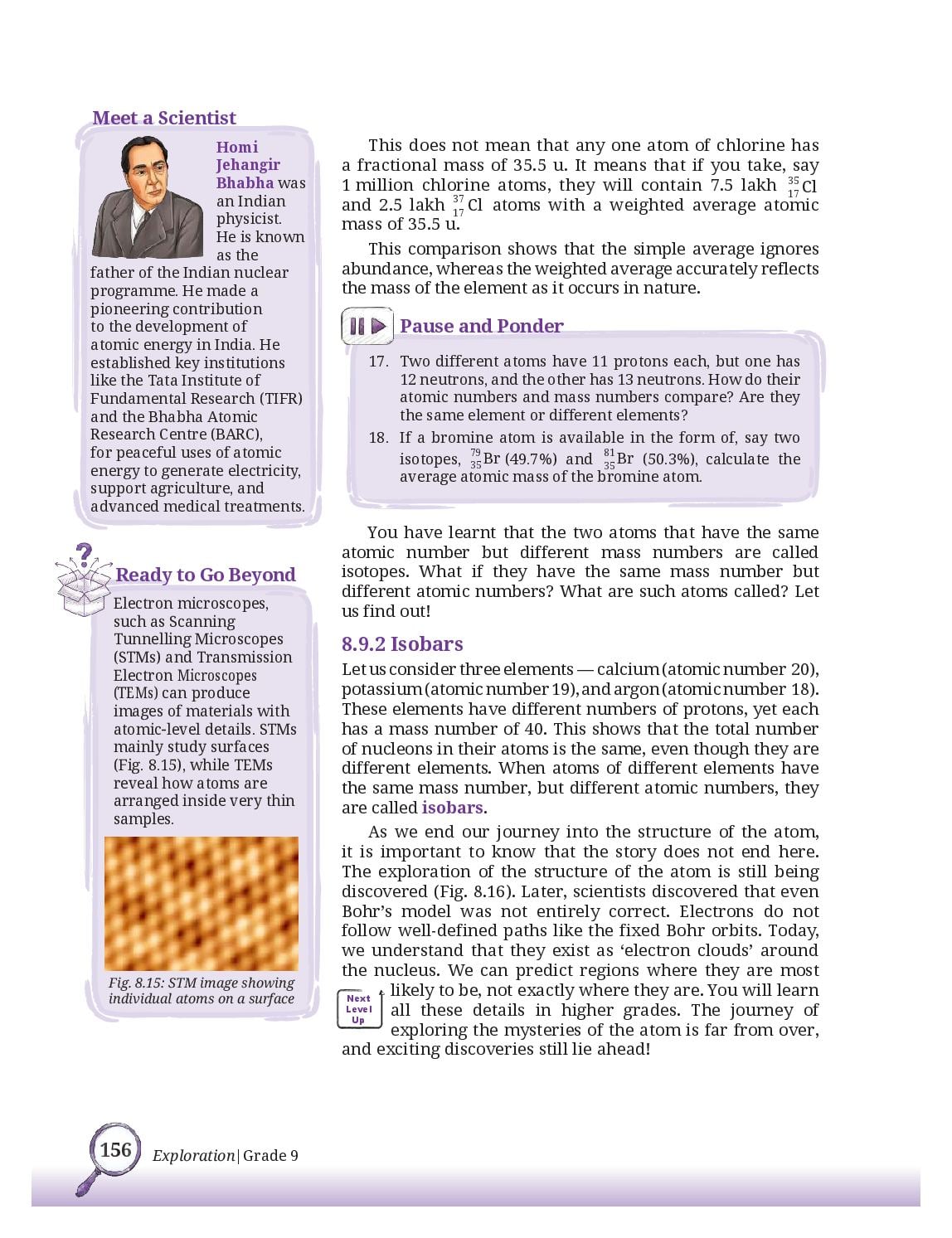
| Useful isotopes | Isotopes put to work in industry and medicine | 23592U fuel, 6027Co cancer therapy, 13153I thyroid, 146C dating | Bridging Science and Society, p. 155 |
Old NCERT vs New – Class 9 Science
In the old NCERT Class 9 Science book this topic was Chapter 4, “Structure of the Atom”. In the new Exploration book it is Chapter 8.
Solutions and All Chapters
Answers to the exercises and the full chapter list of Exploration:
Journey Inside the Atom – Overview
| Class | Class 9 |
| Subject | Science |
| Book | Exploration – new NCERT book |
| Chapter | 8 of 13 – Journey Inside the Atom |
| Book pages | 140 – 161 |
| Edition | Latest NCERT edition (2026-27) |
| Session | 2026-27 |
| Free – read online or download |
Class 9 Science Chapter 8 – FAQs
Where can I download Journey Inside the Atom Class 9 PDF?
From the download table on this page – the chapter PDF is free, and the full book is linked too.
What is Class 9 Science Chapter 8 about?
An atom is not indivisible. Thomson’s cathode-ray work (1897) showed that every atom contains electrons — negatively charged particles of charge –1.602 × 10⁻¹⁹ C, taken as –1 by convention, and far lighter than the atom itself.
Is Journey Inside the Atom from the new NCERT Class 9 Science book?
Yes. It is chapter 8 of exploration, the new NCERT Class 9 Science book for 2026-27.
Is this the latest NCERT edition for 2026-27?
Yes – the PDF is NCERT’s latest edition for the 2026-27 session.
Where are the NCERT Solutions for Class 9 Science Chapter 8?
Open the NCERT Solutions link above for answers to the exercise questions.