Download Measuring Space: Perimeter and Area – NCERT Class 9 Maths Chapter 6 PDF from the new NCERT Class 9 Maths book Ganita Manjari (2026-27). Read the chapter online or download the free PDF. For every circle the ratio of circumference to diameter is the same number, π. So C = 2πr = πd. π is irrational (Lambert, 1761), so no fraction equals it: π ≈ 22/7 but π ≠ 22/7. Better approximations are 355/113 (Zu Chongzhi) and 3.1416 (Āryabhaṭa);…
Measuring Space: Perimeter and Area PDF – Chapter 6 of Ganita Manjari (Part I)
Read the chapter online or download the PDF.
| Chapter | Download | |
|---|---|---|
| Chapter 6 PDF | Measuring Space: Perimeter and Area | View PDF |
| Full book | NCERT Class 9 Maths – Ganita Manjari | View Book |
Read Online
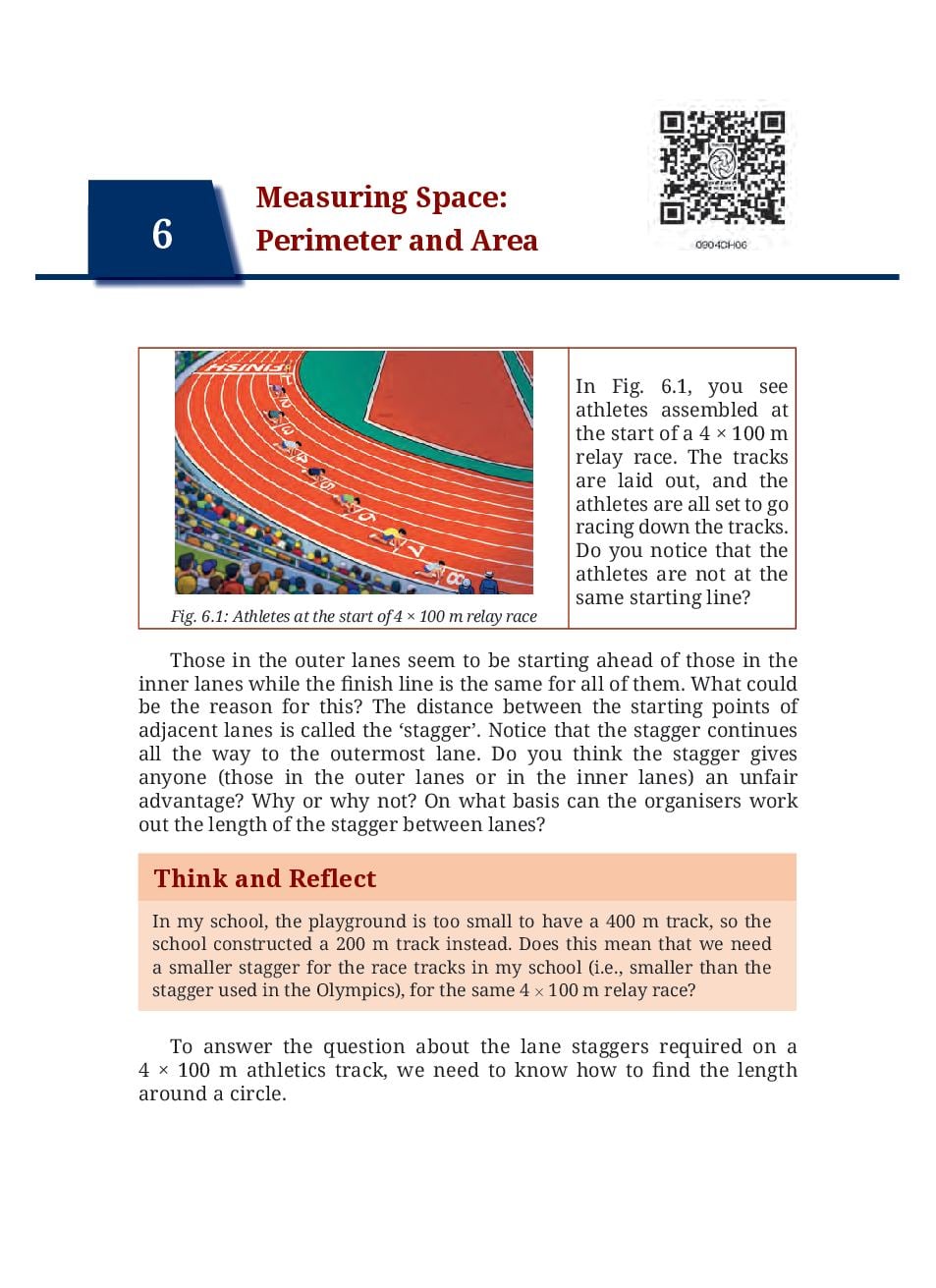
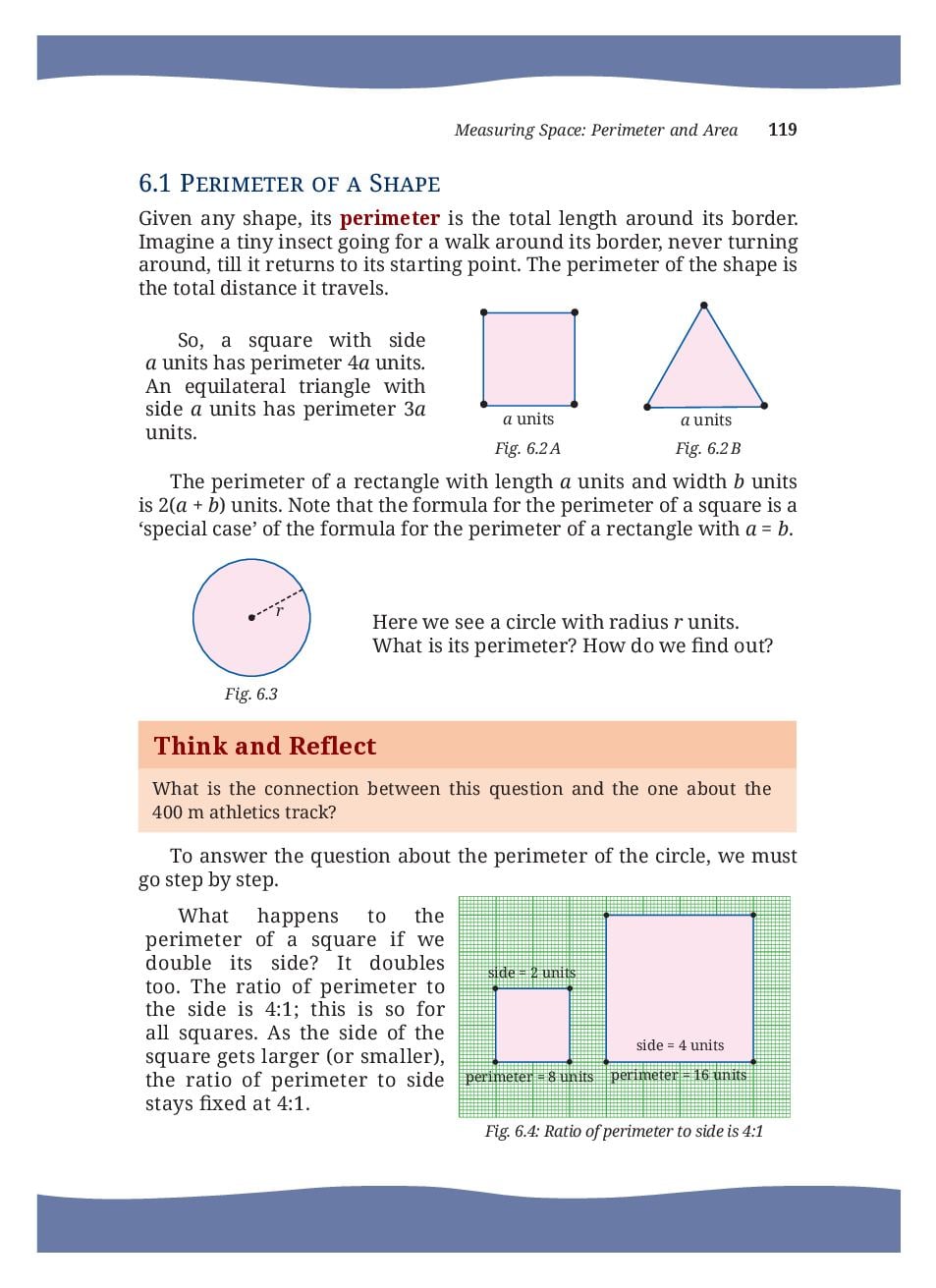
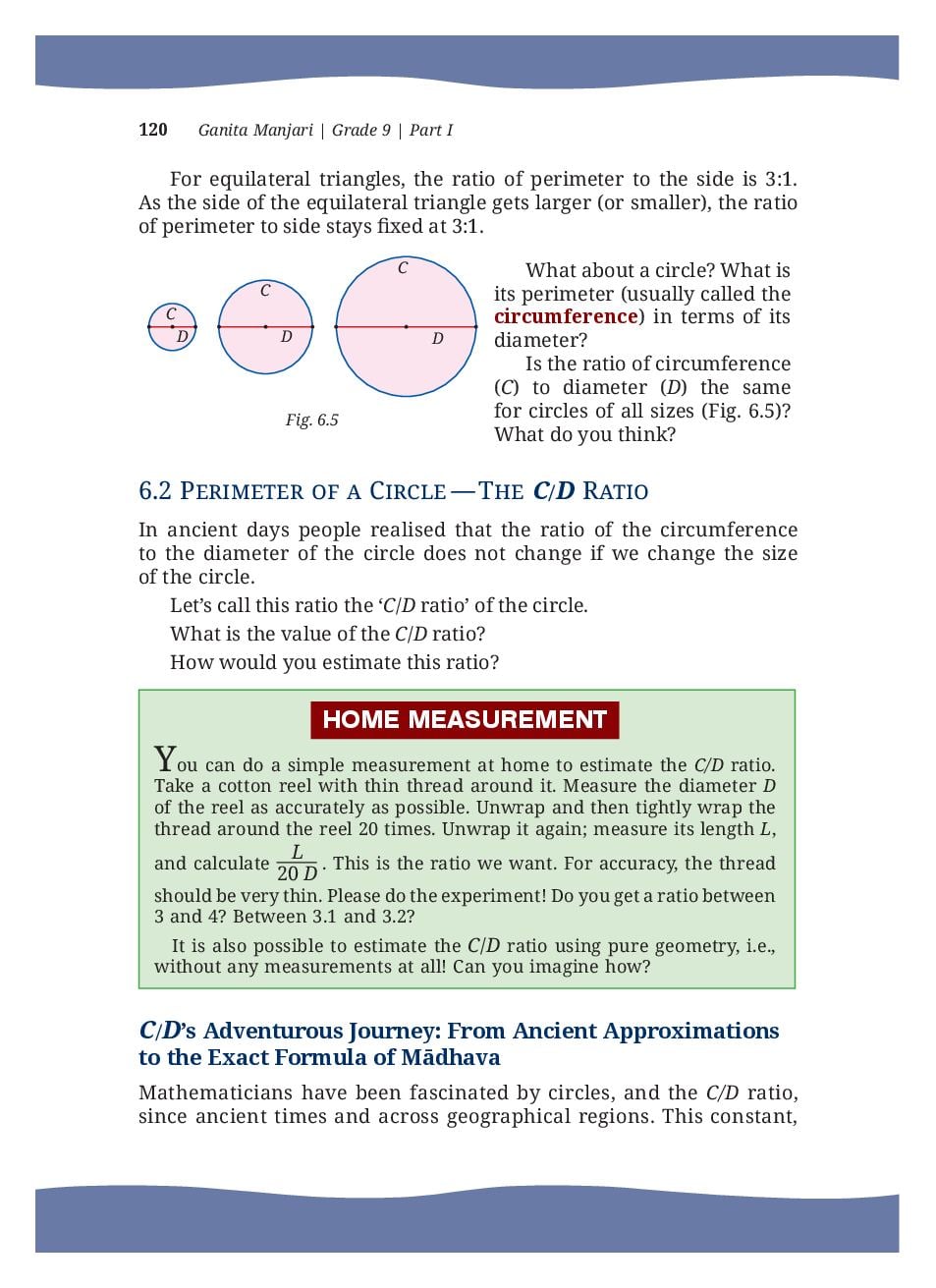
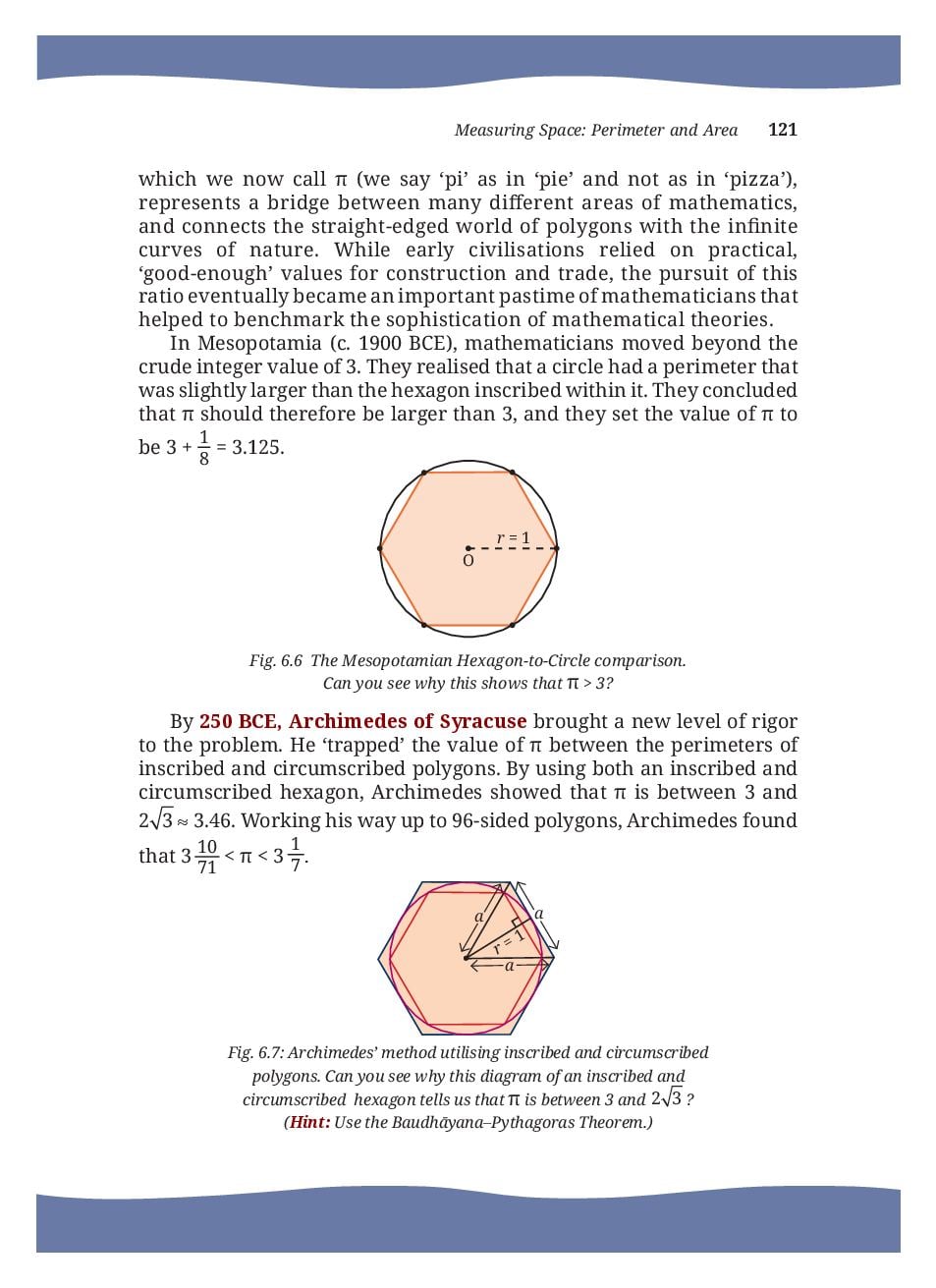
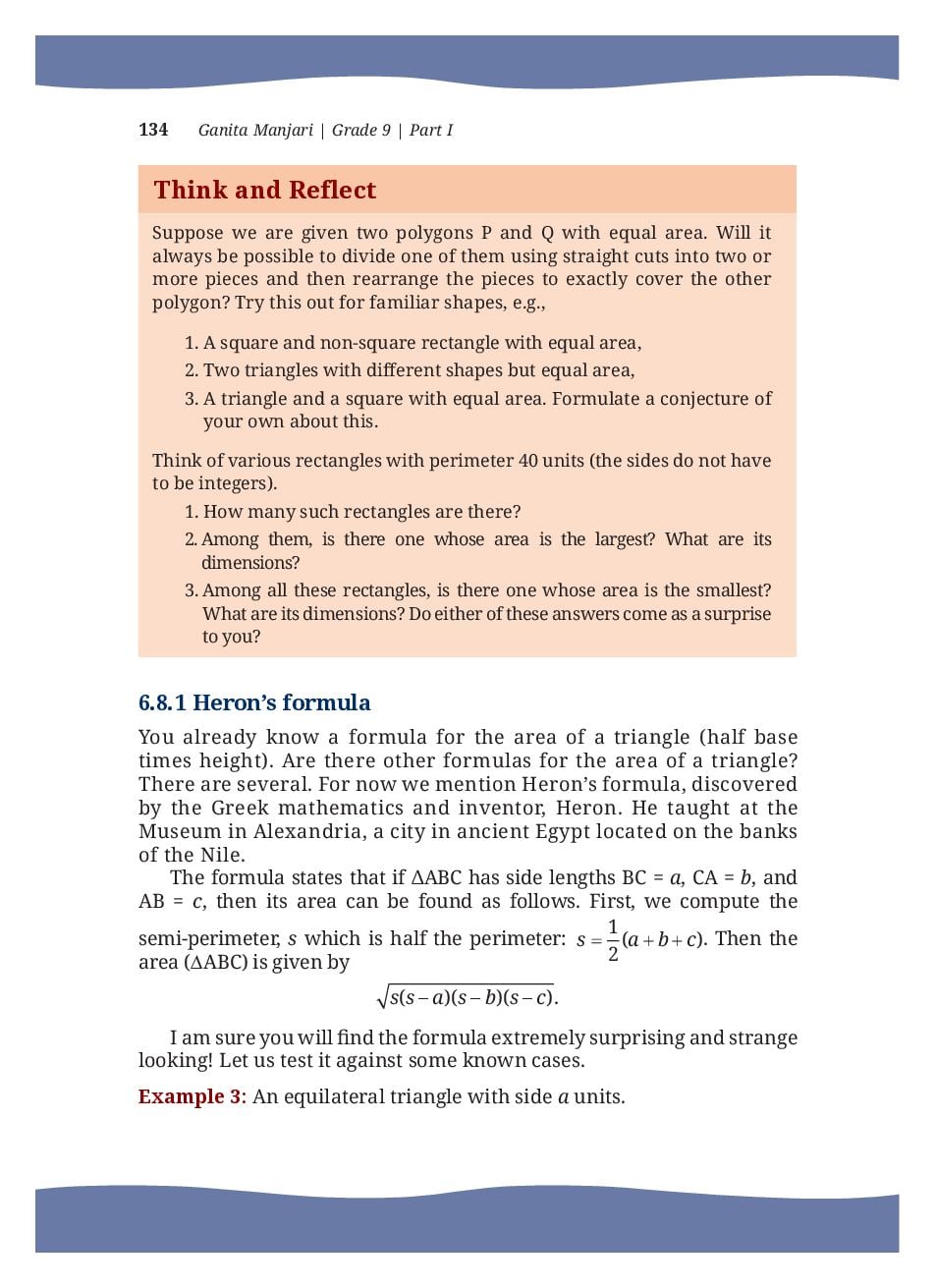
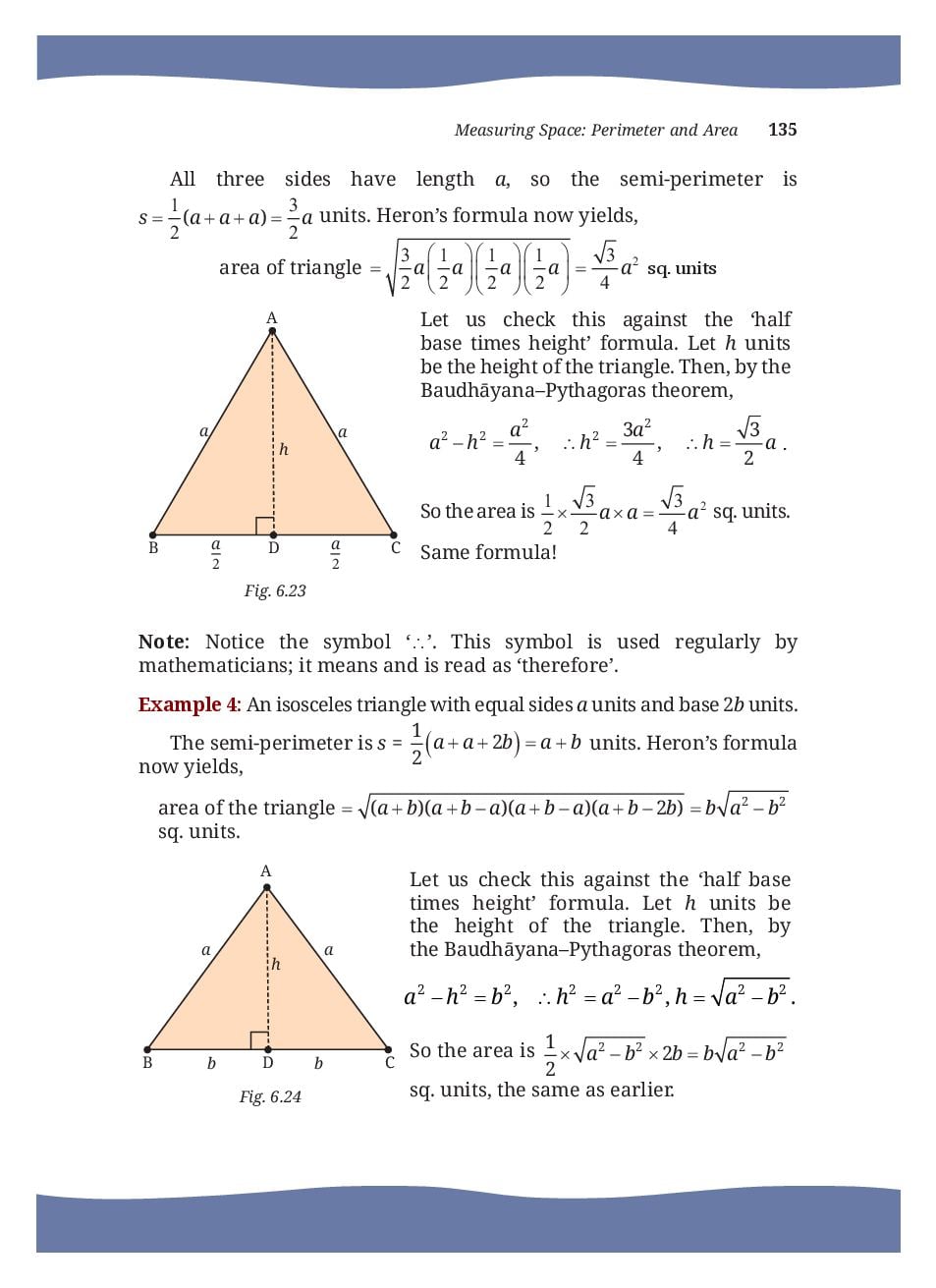
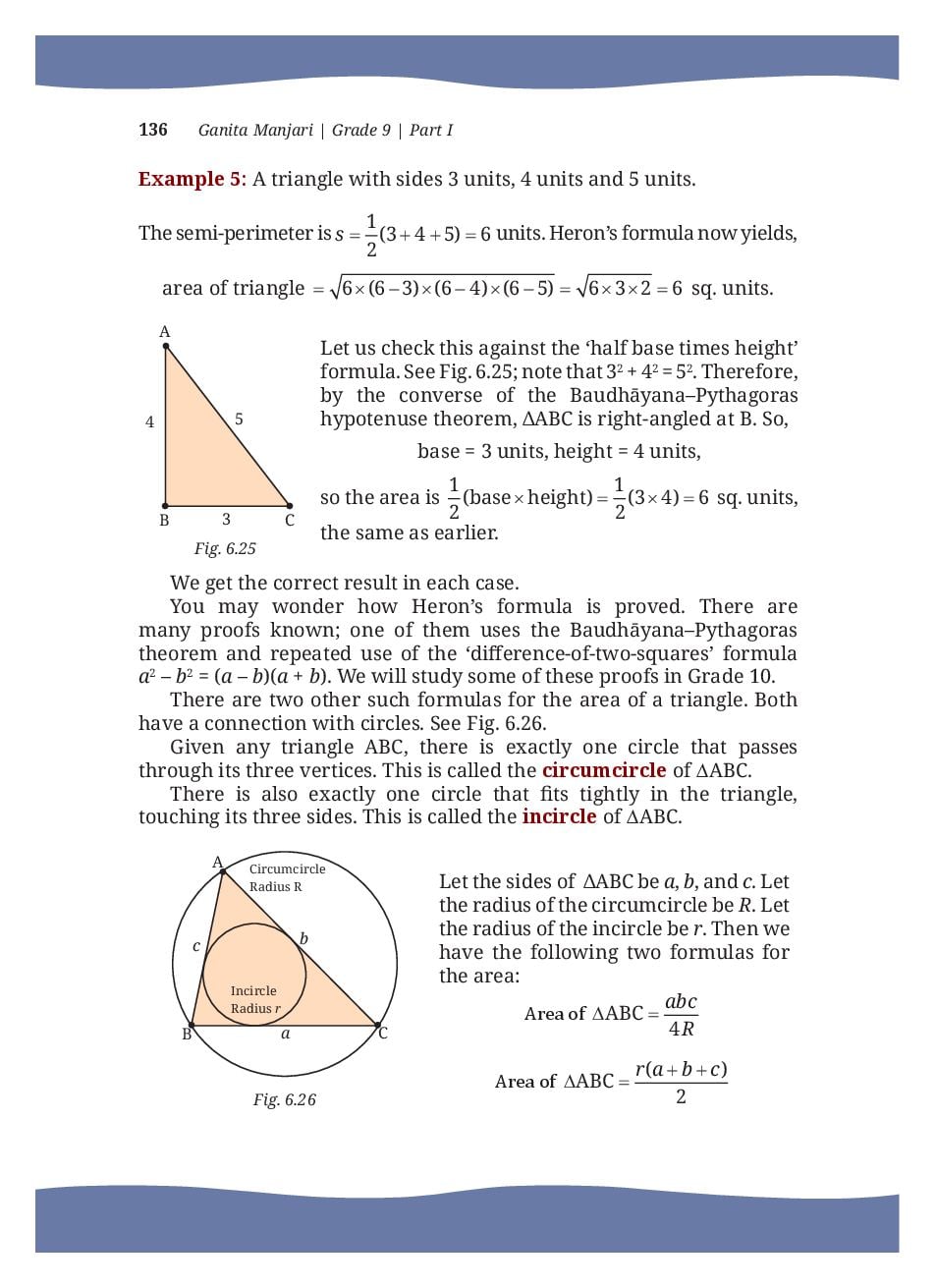
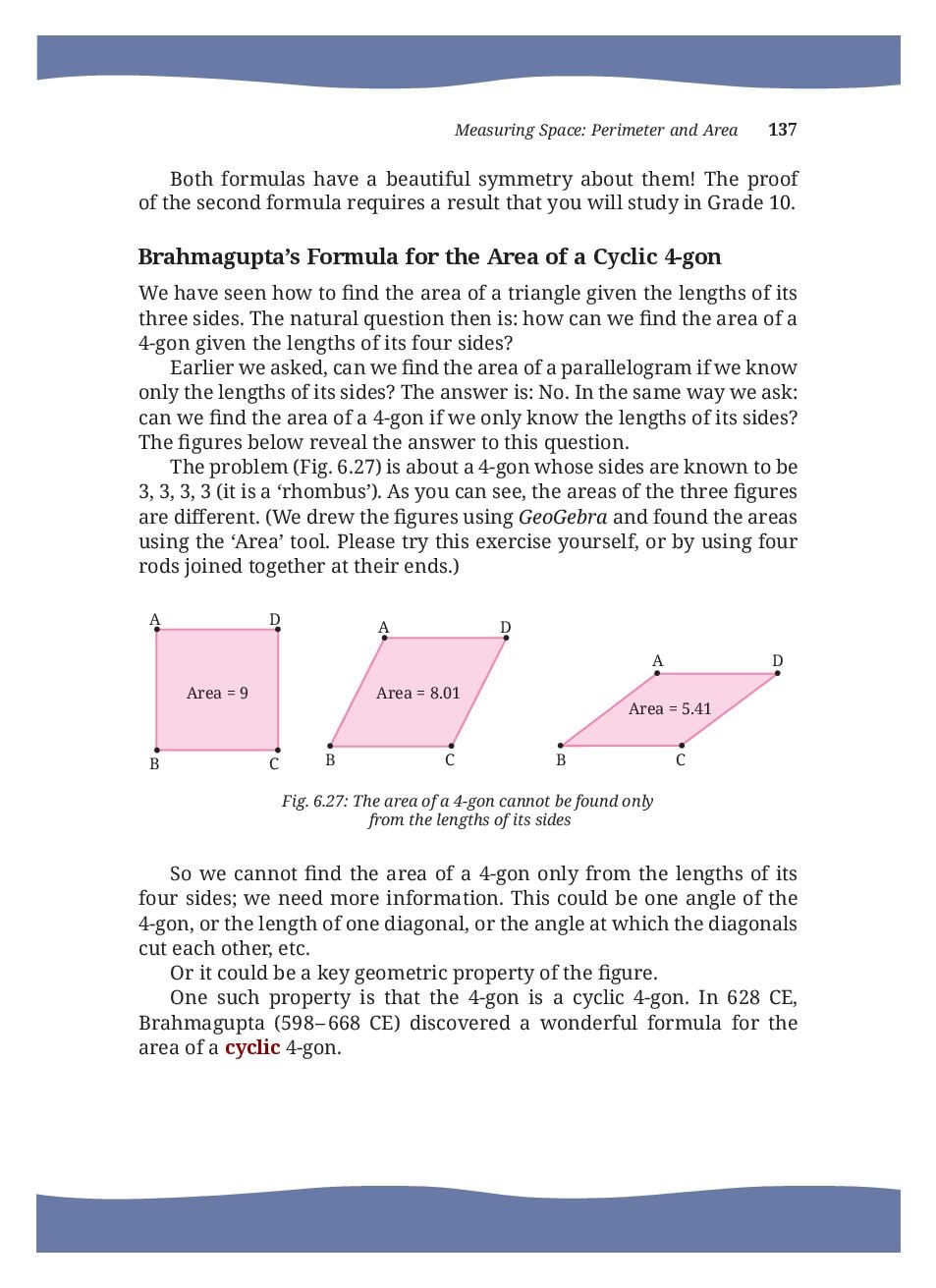
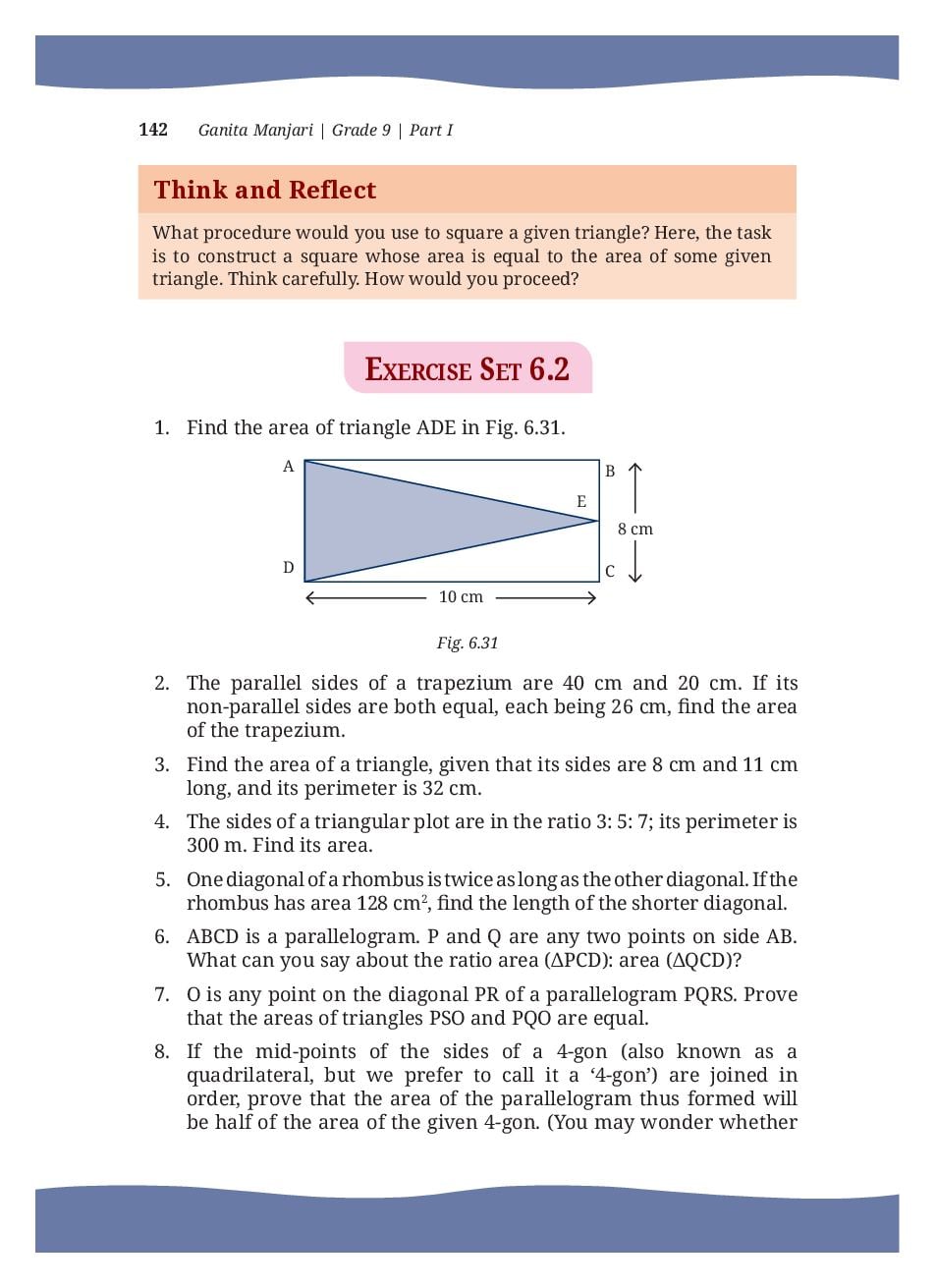
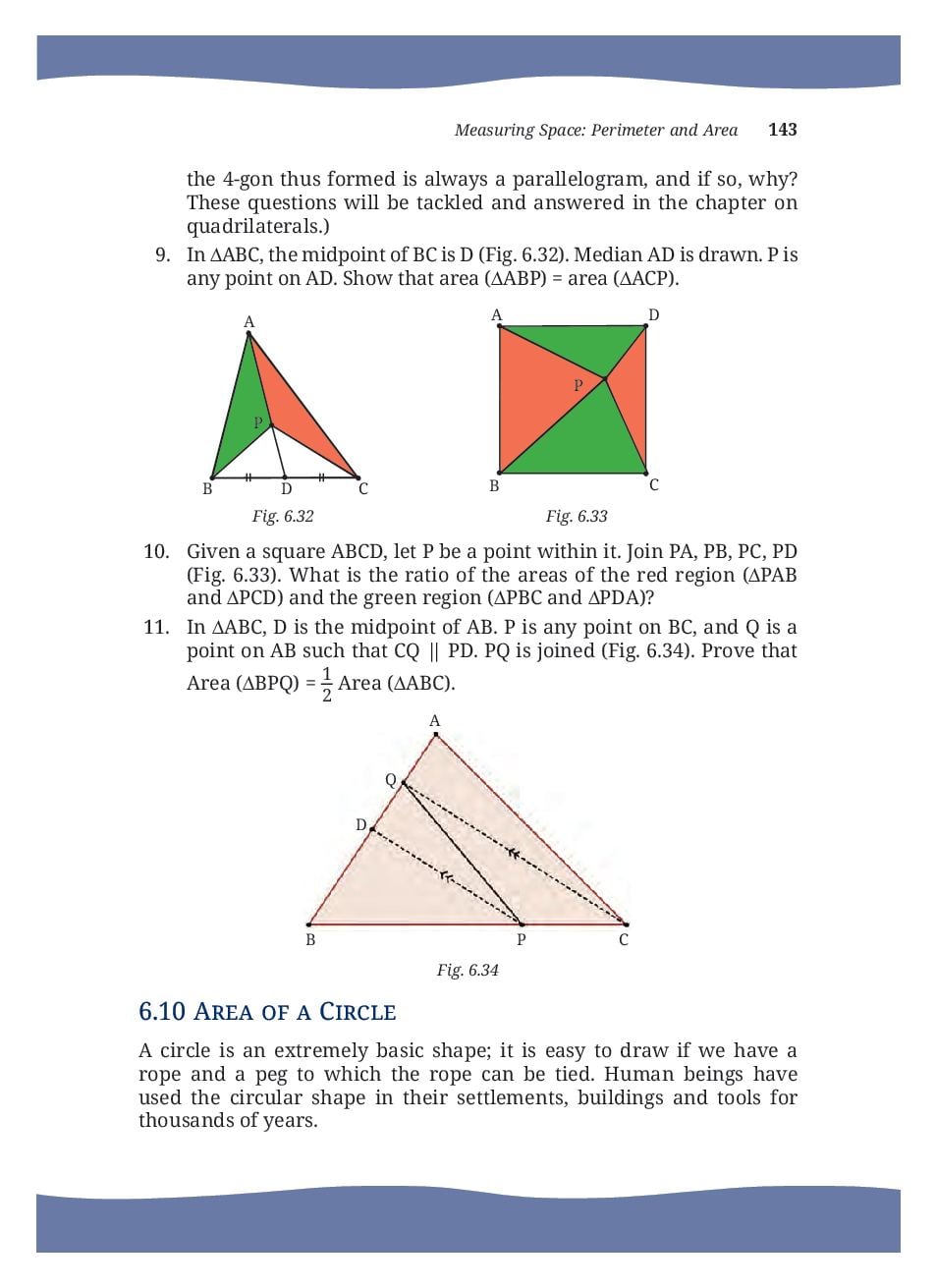
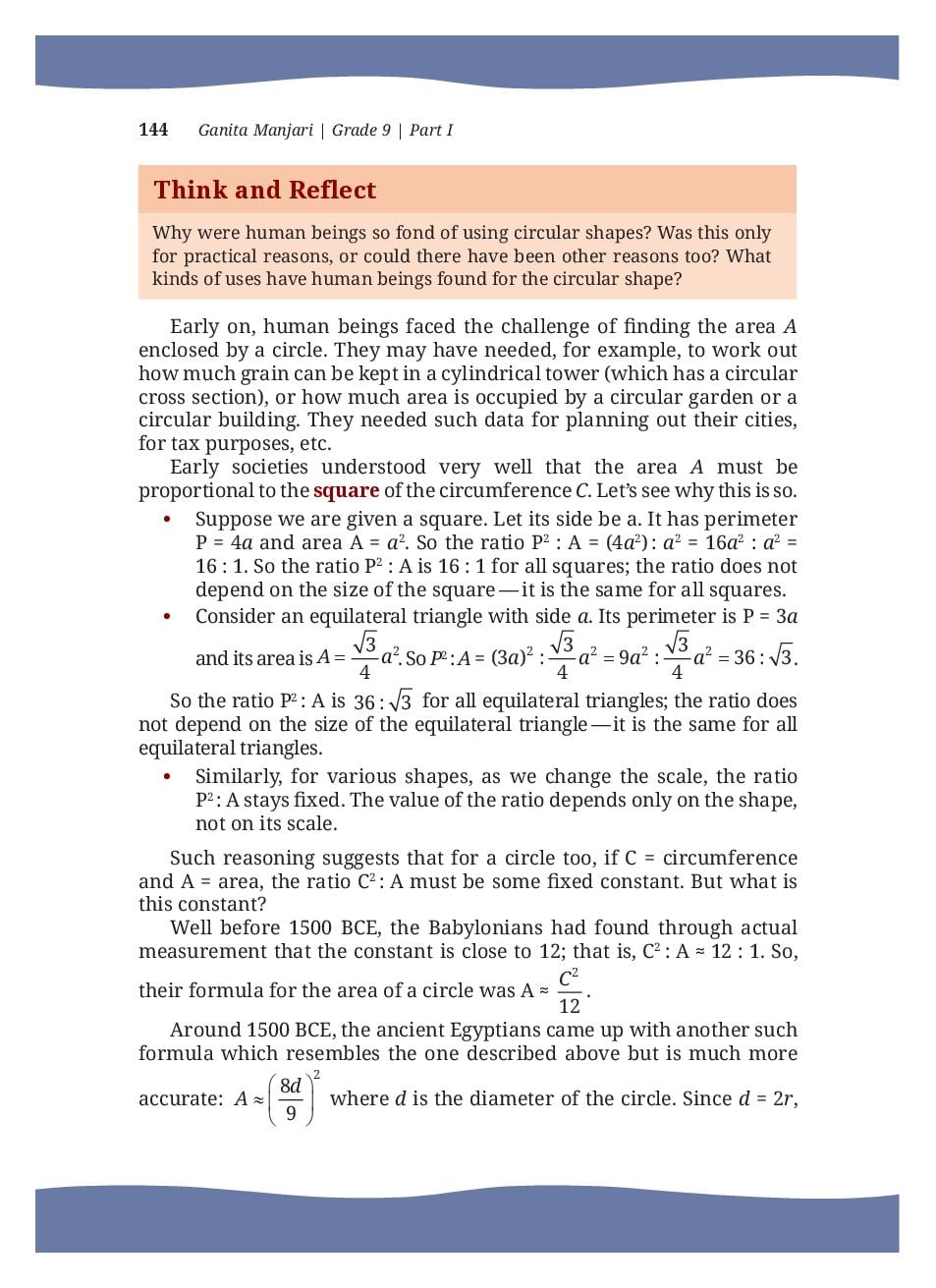
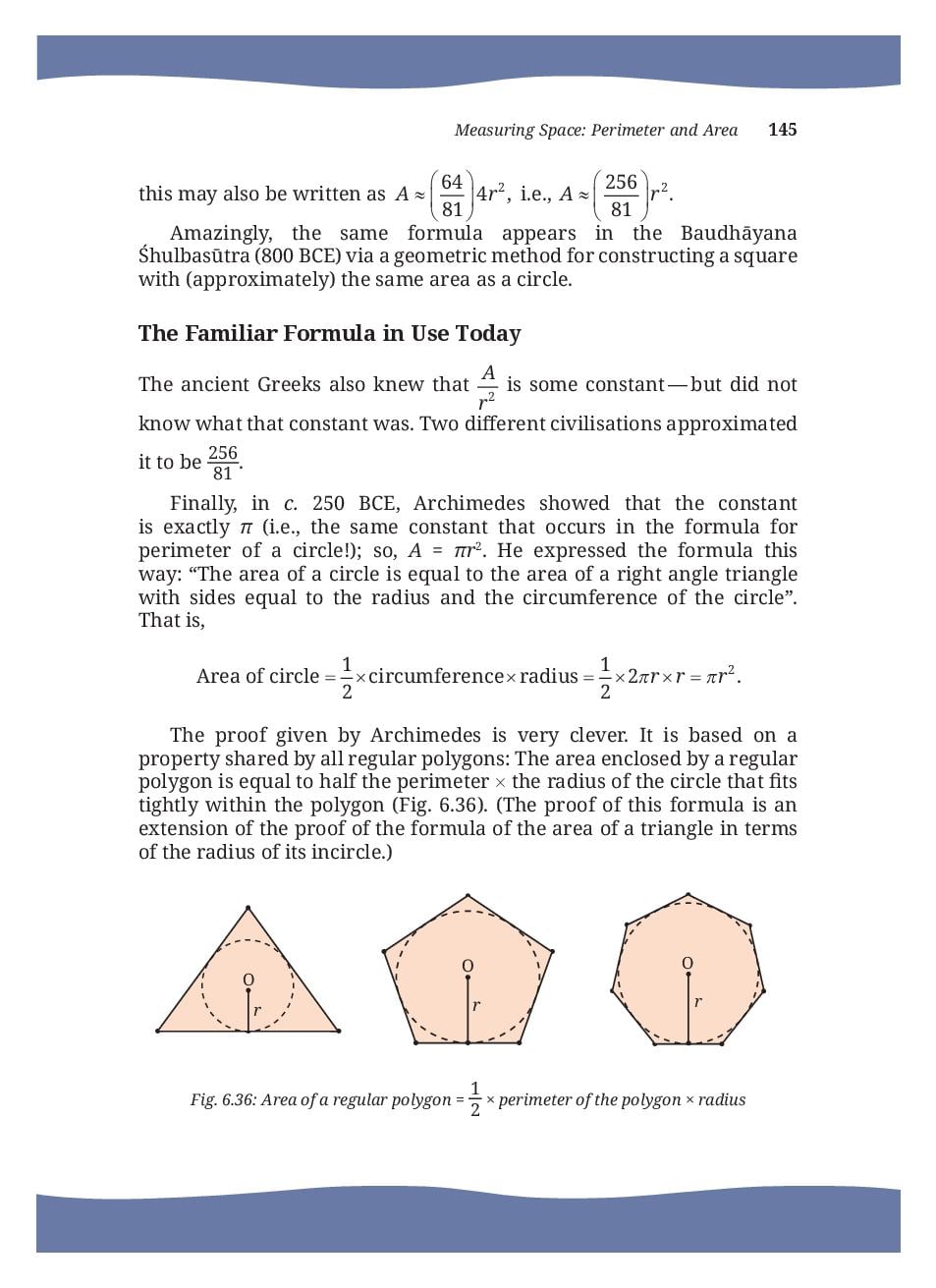
What Is in Measuring Space: Perimeter and Area? (Class 9 Maths Chapter 6)
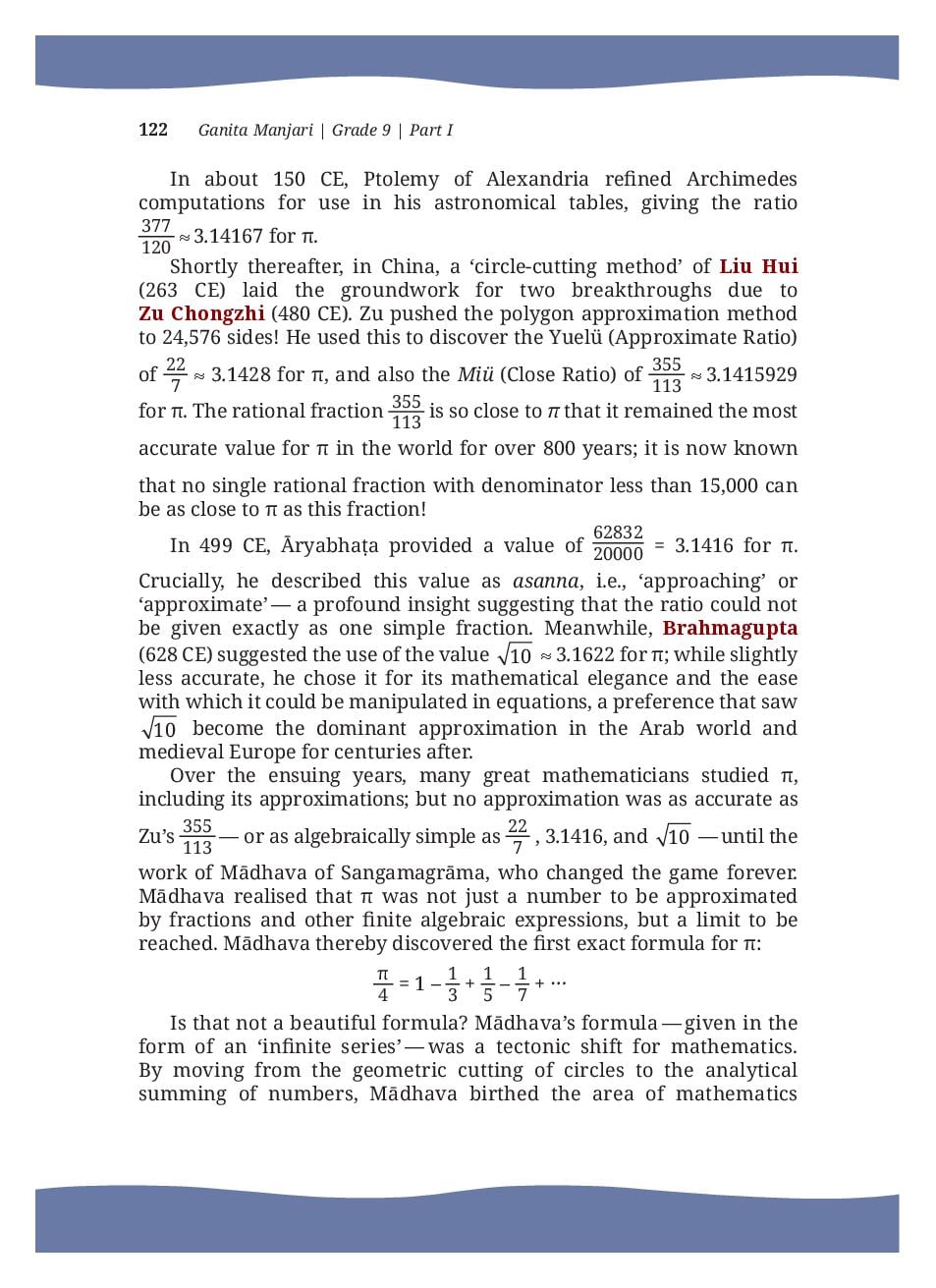
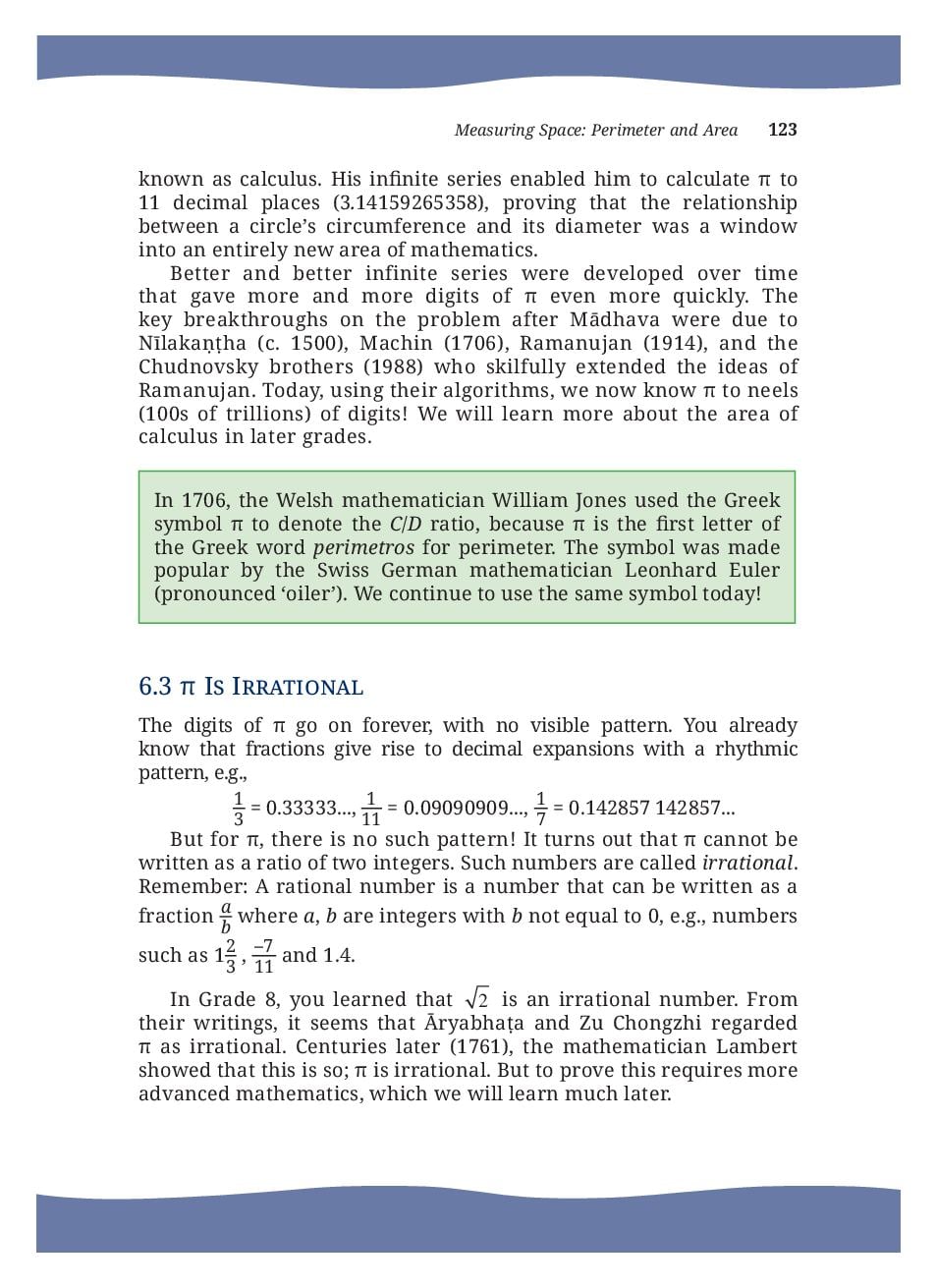
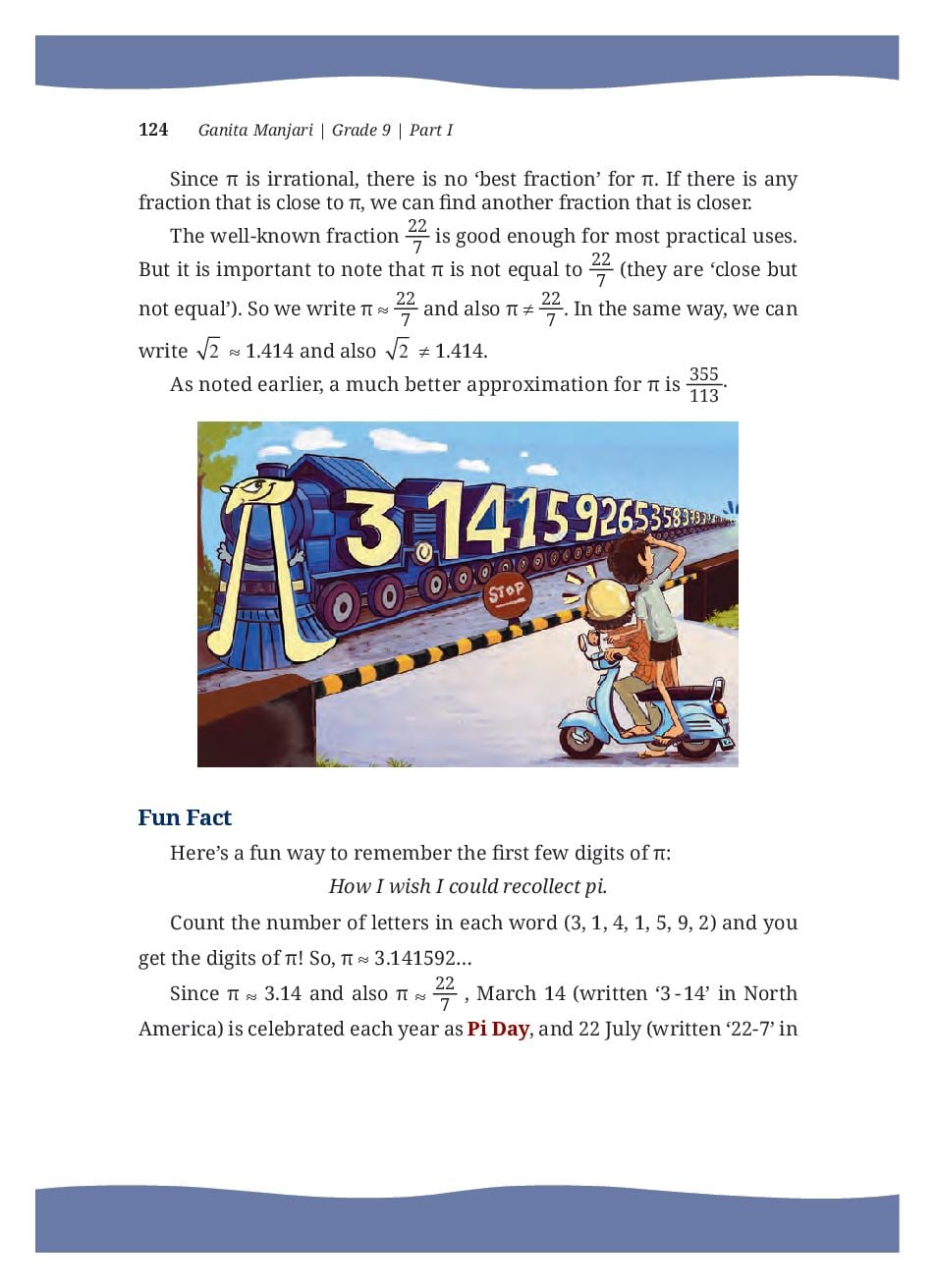
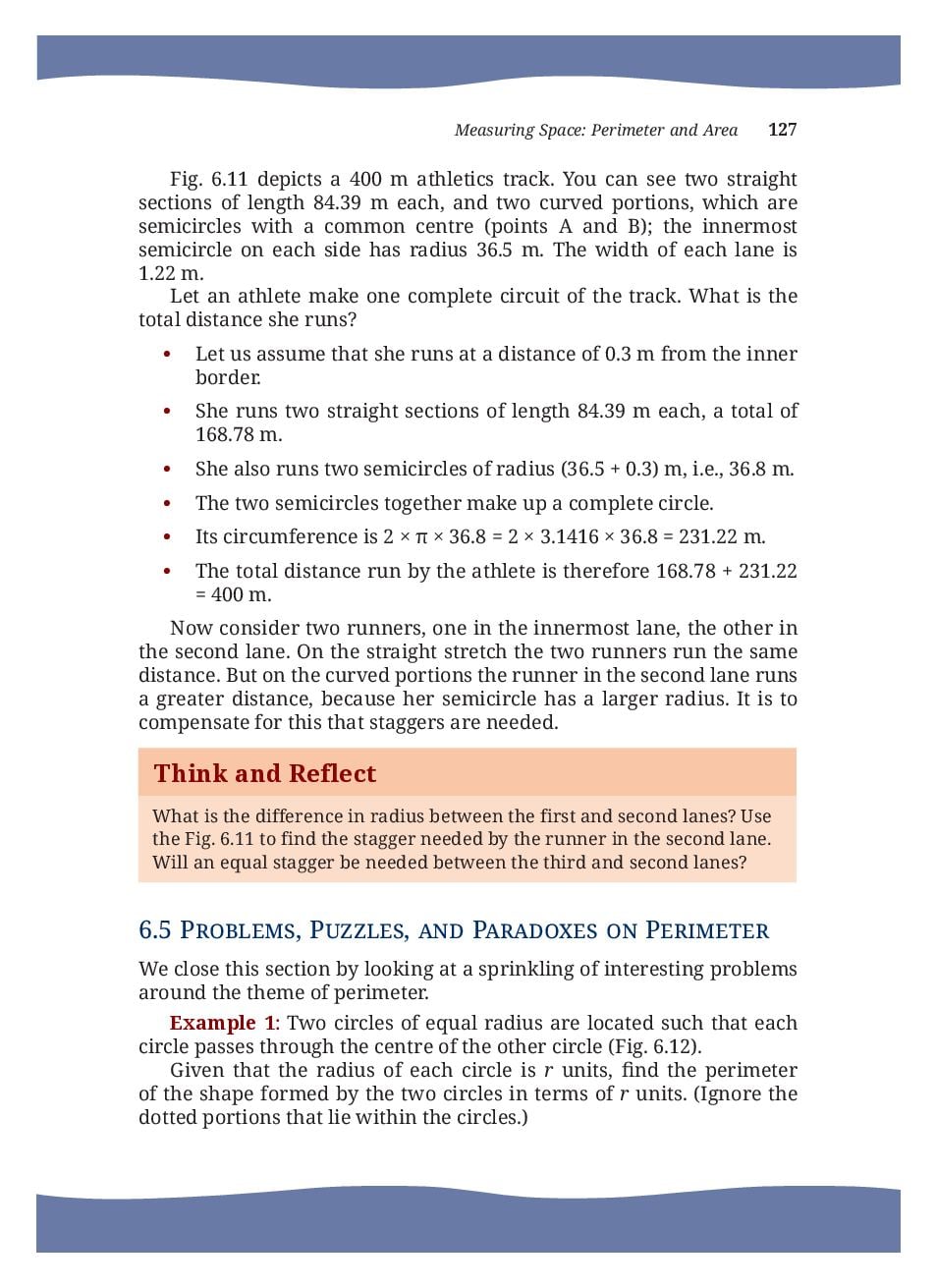
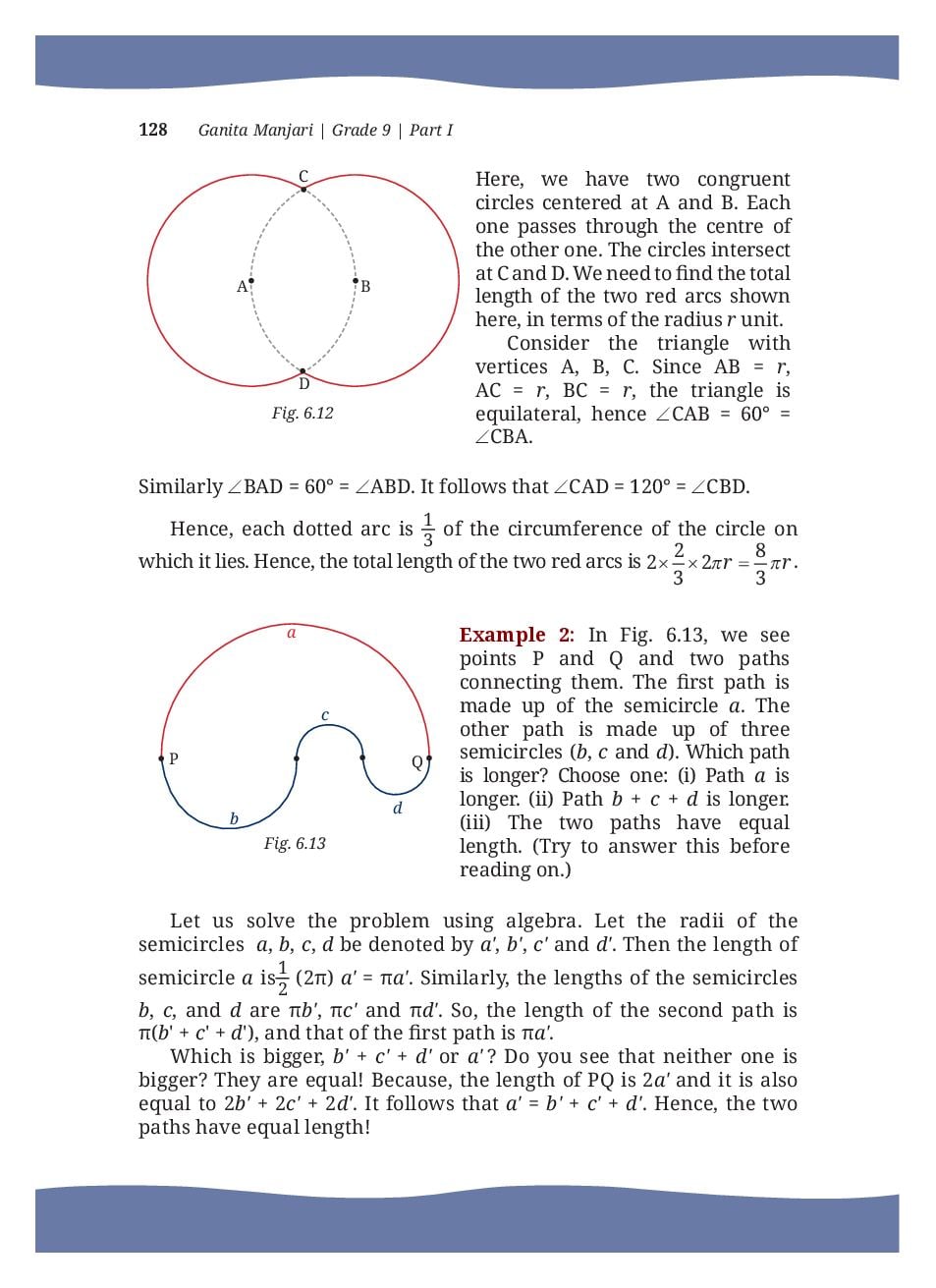
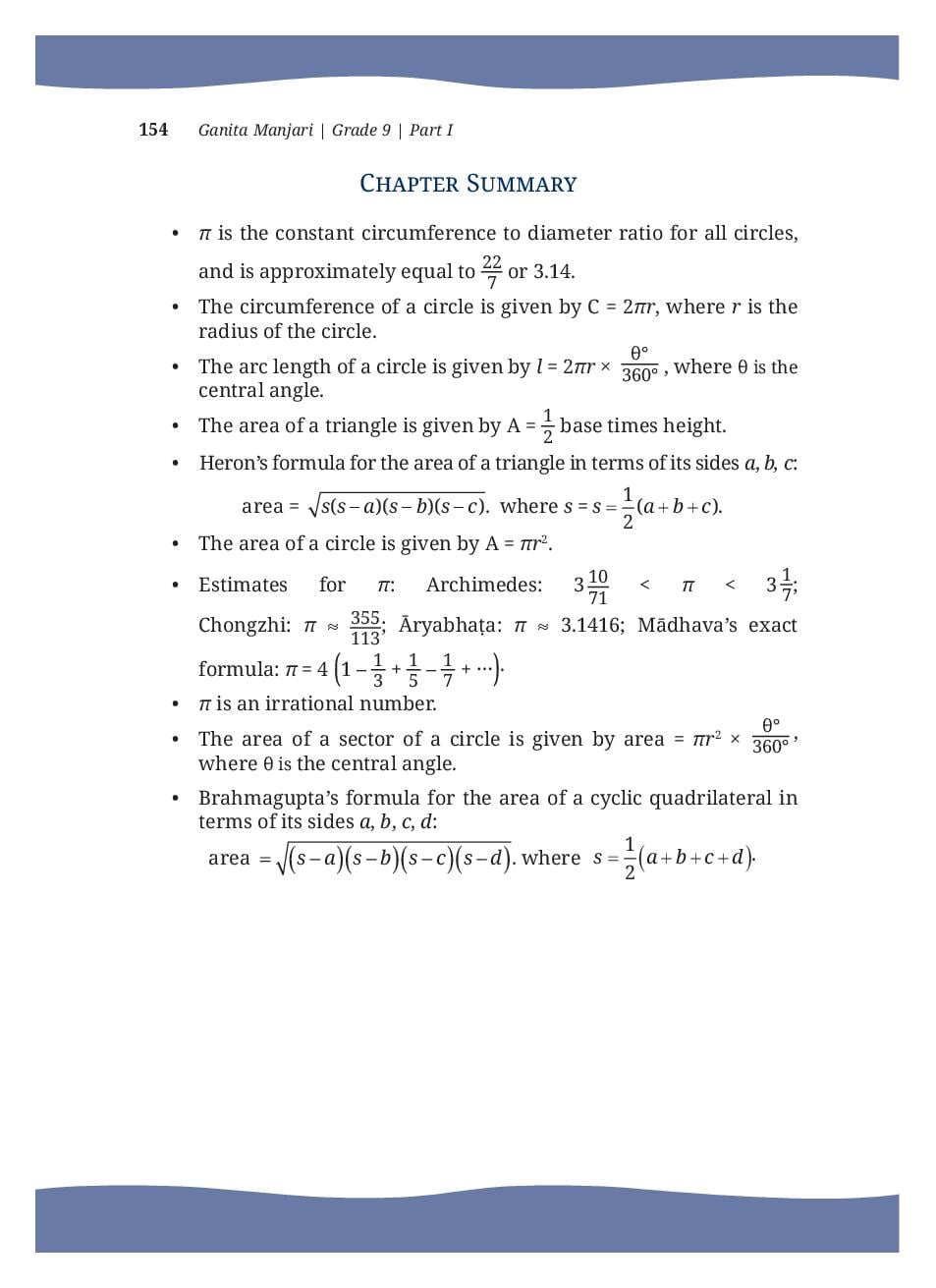
- For every circle the ratio of circumference to diameter is the same number, π. So C = 2πr = πd. π is irrational (Lambert, 1761), so no fraction equals it: π ≈ 22/7 but π ≠ 22/7. Better approximations are 355/113 (Zu Chongzhi) and 3.1416 (Āryabhaṭa); Mādhava gave the first exact formula, π/4 = 1 − 1/3 + 1/5 − 1/7 + …
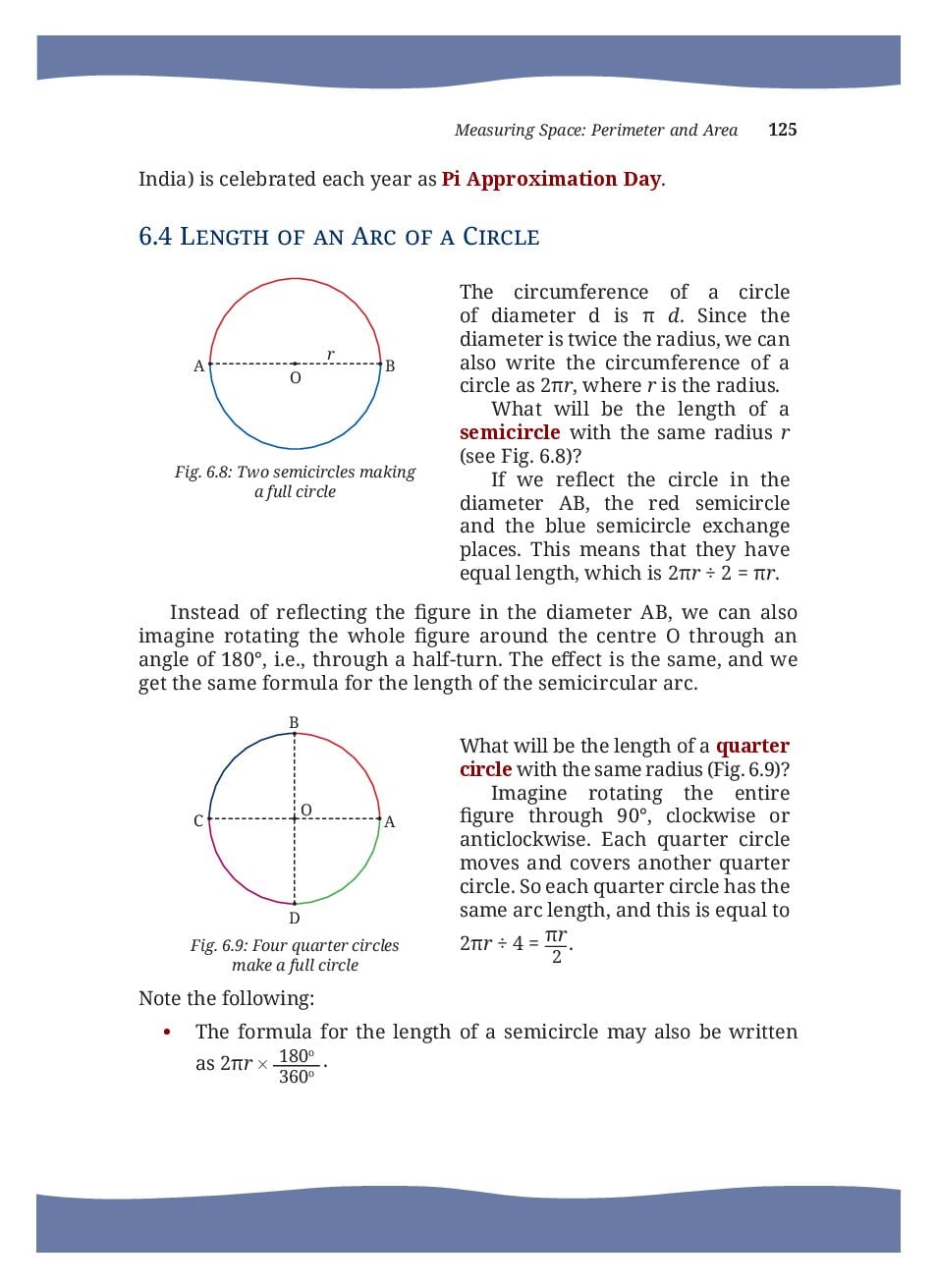
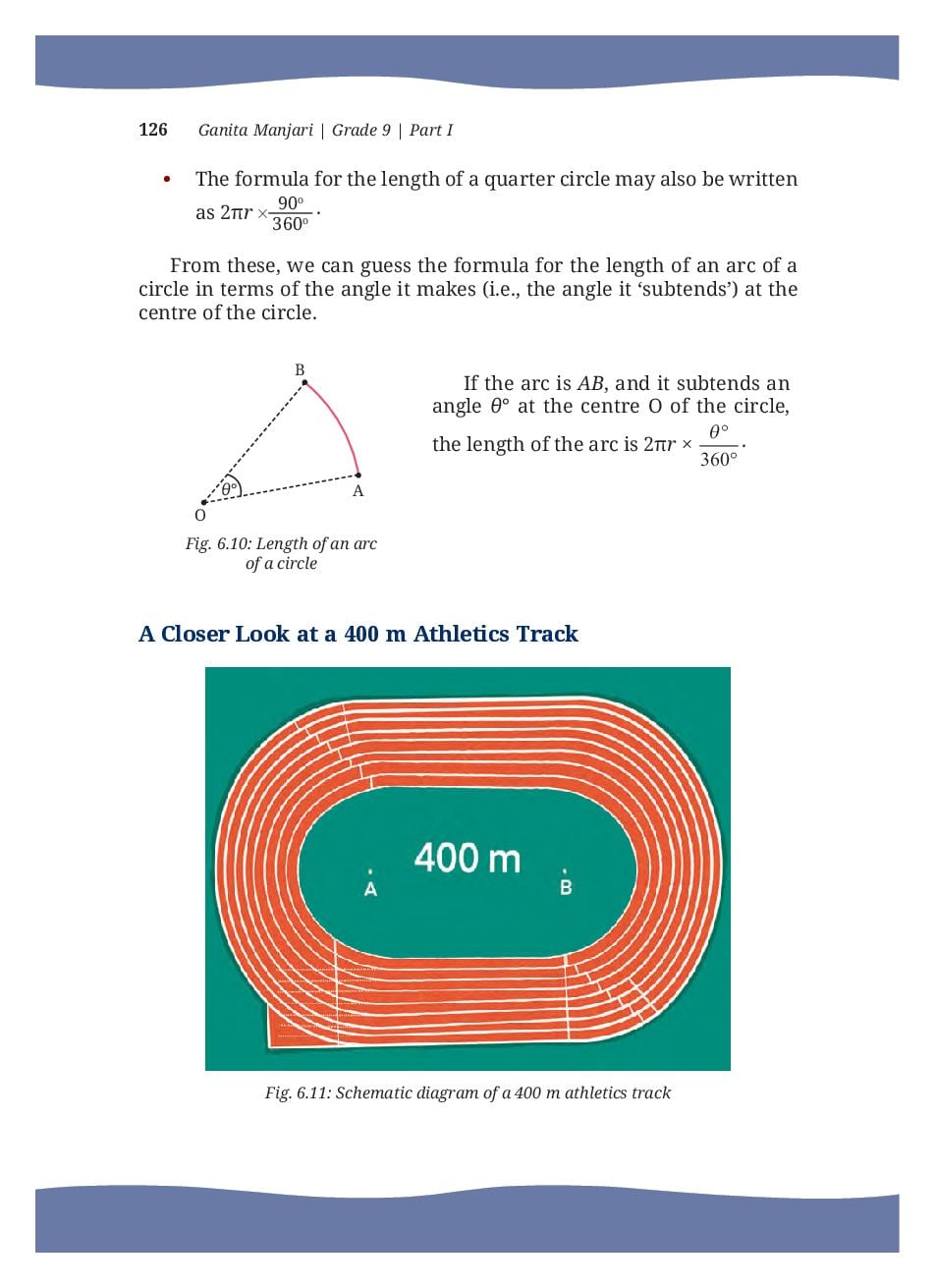
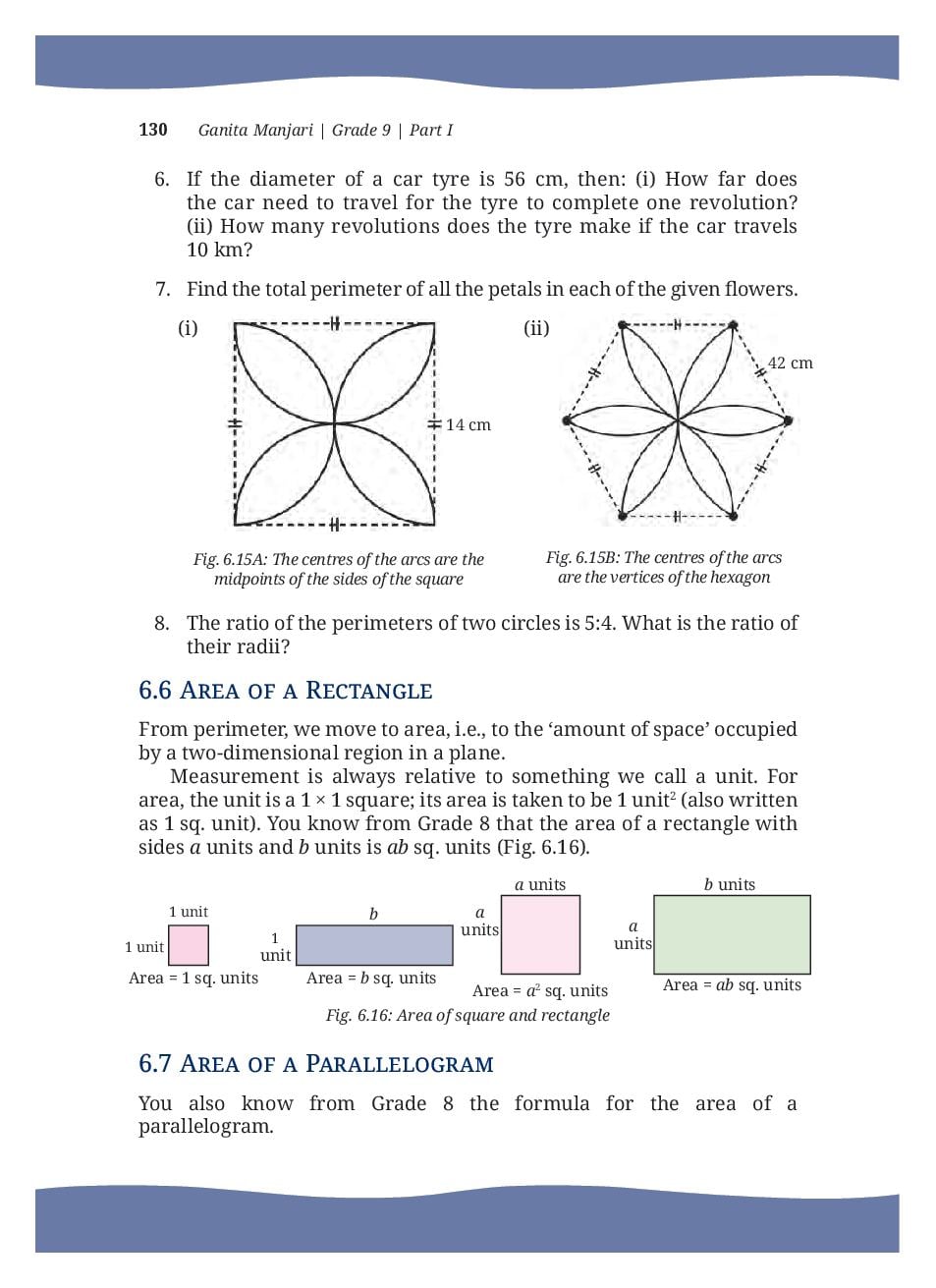
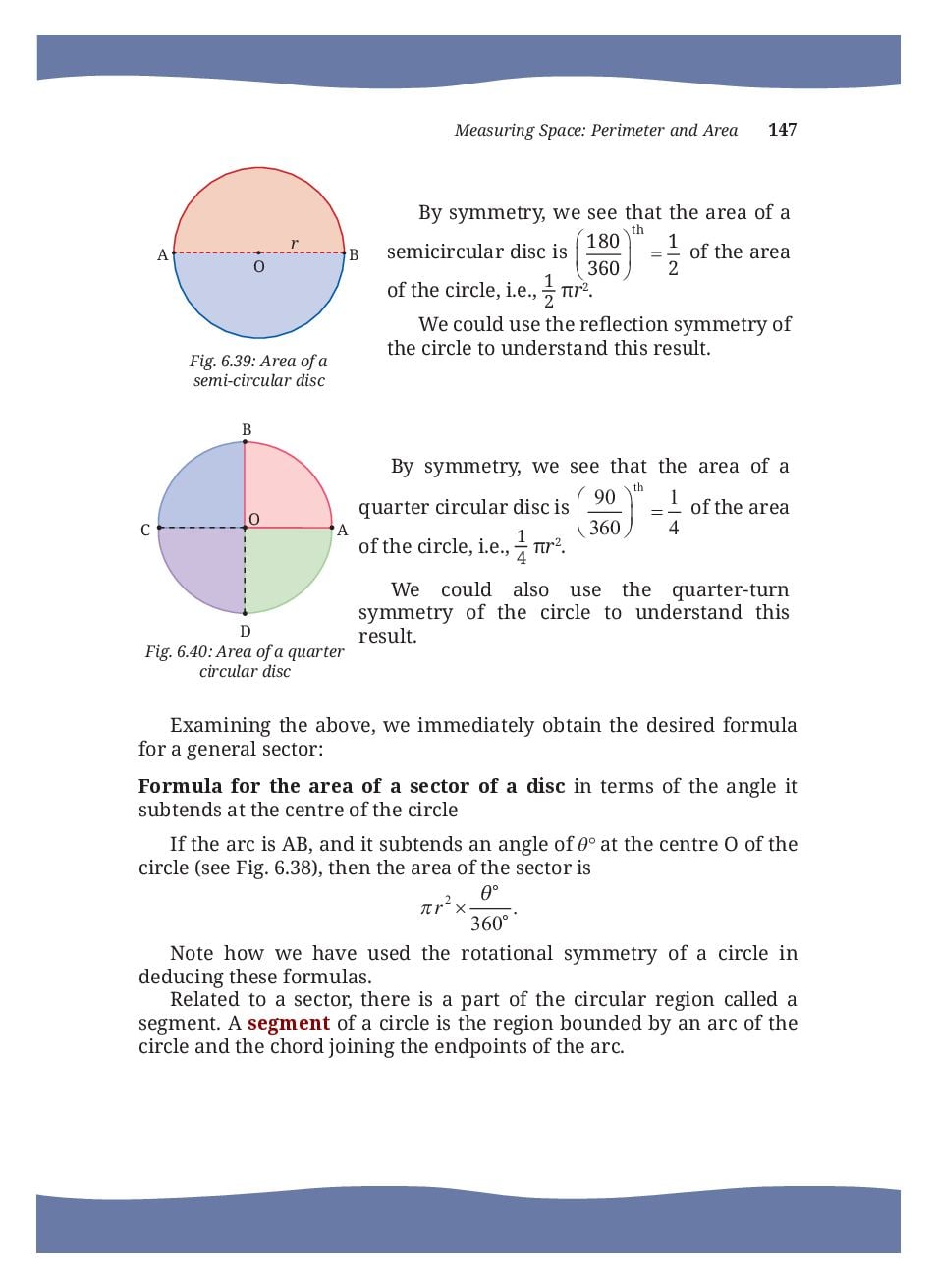
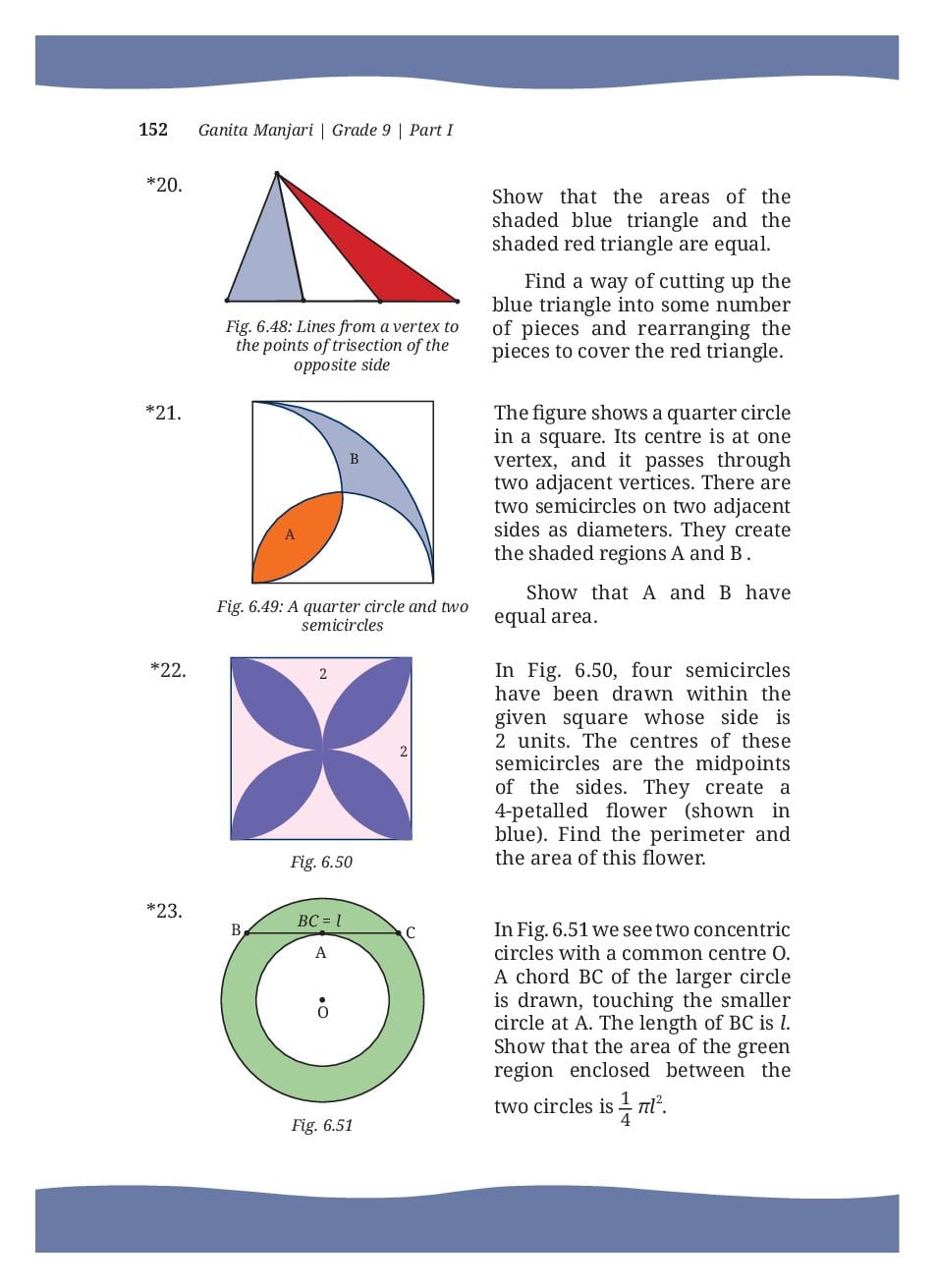
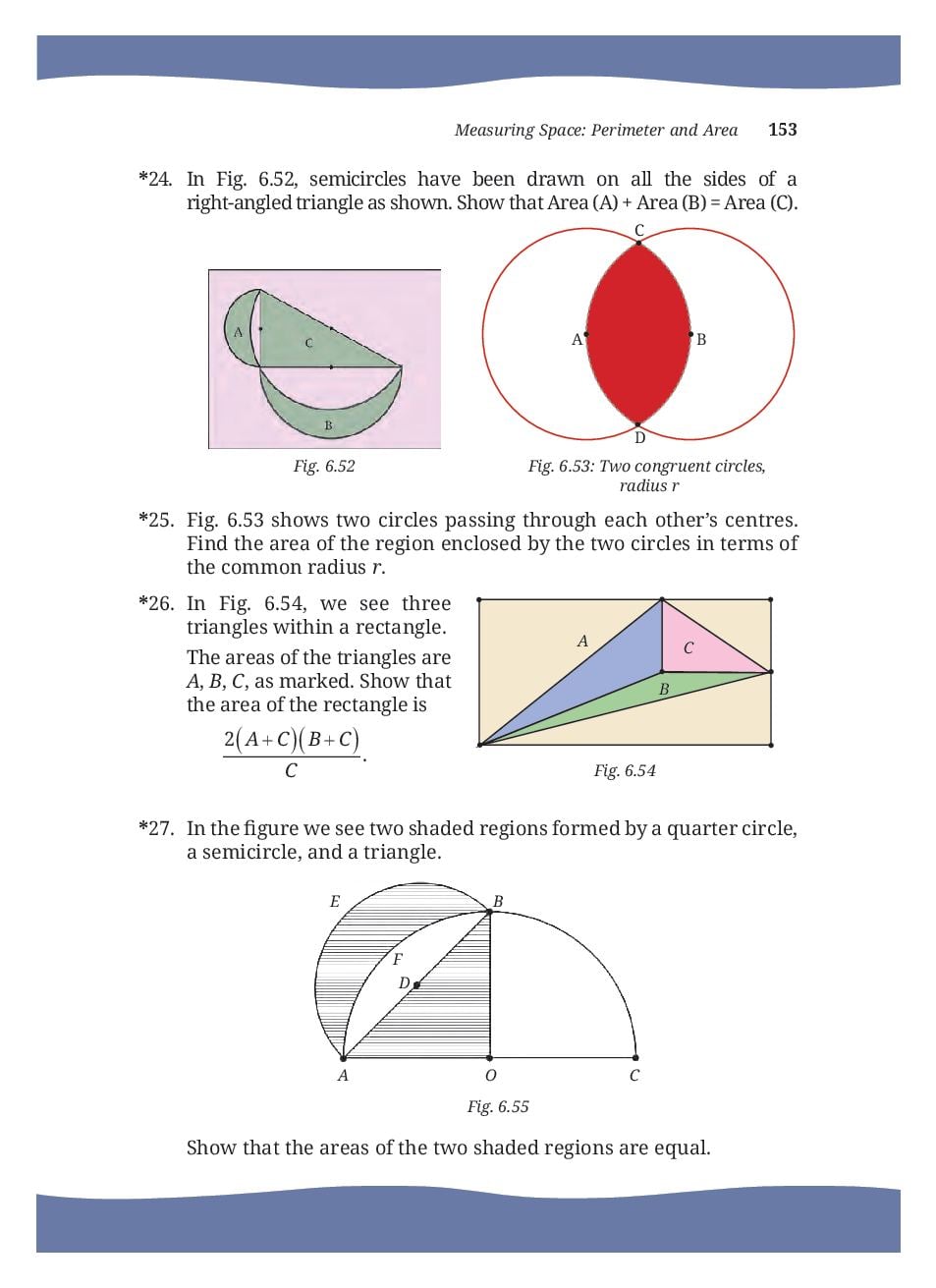
- A circle has rotational symmetry, so an arc turning through θ° at the centre is the fraction θ/360 of the whole circle. Hence arc length = 2πr × θ°/360° and area of a sector = πr² × θ°/360°. The half-turn and quarter-turn cases (πr and πr/2) are just θ = 180° and θ = 90°.
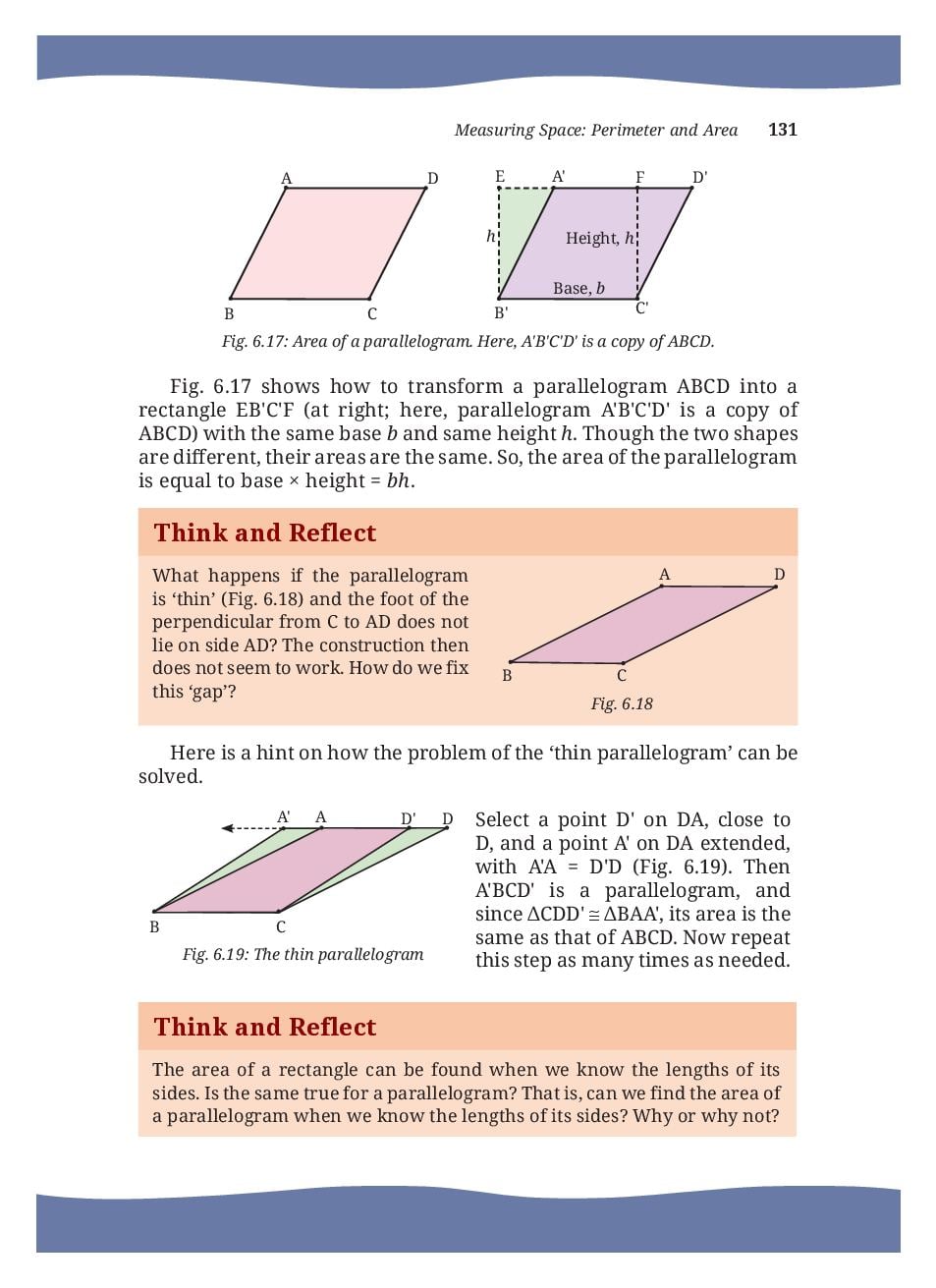
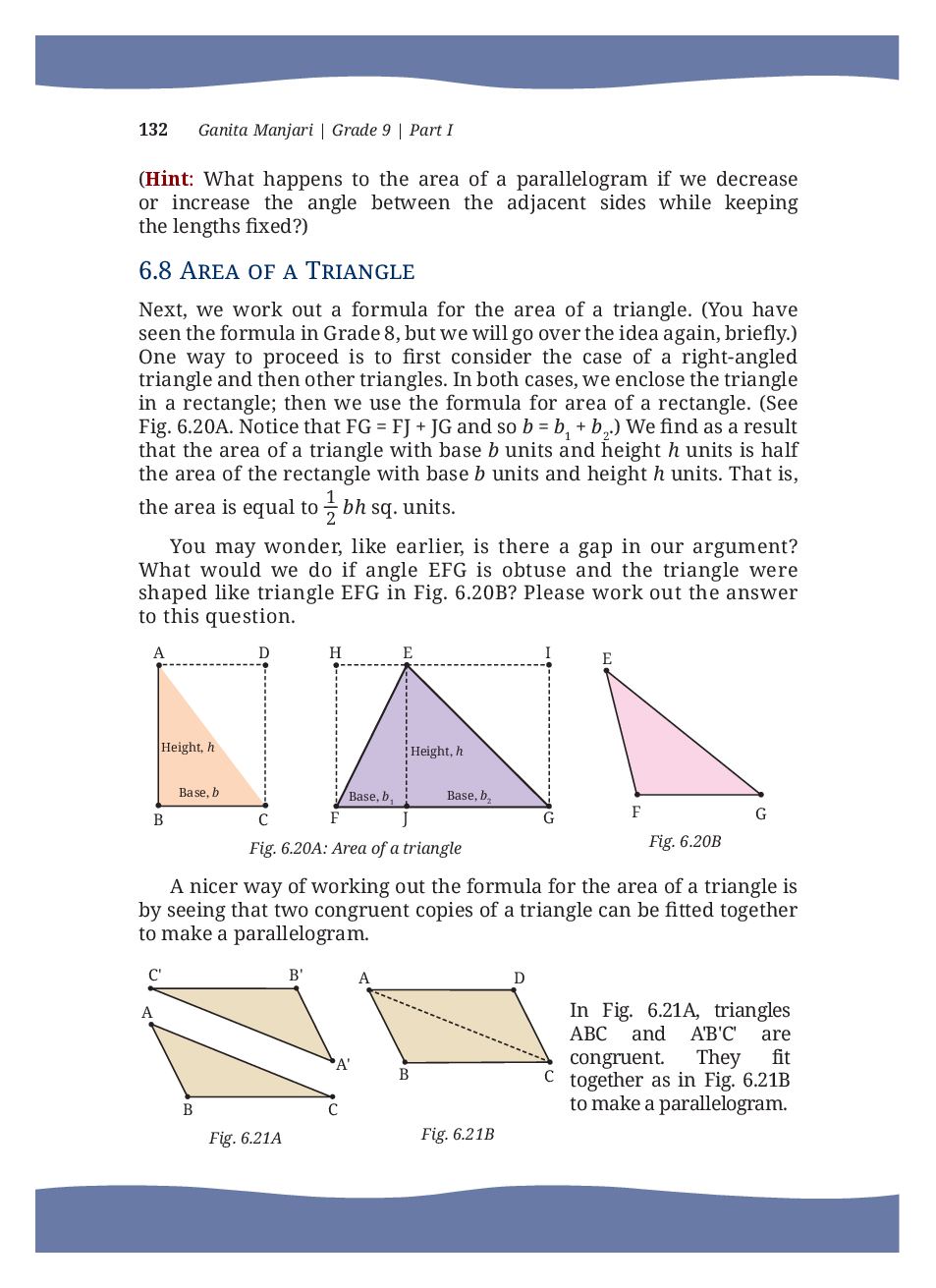
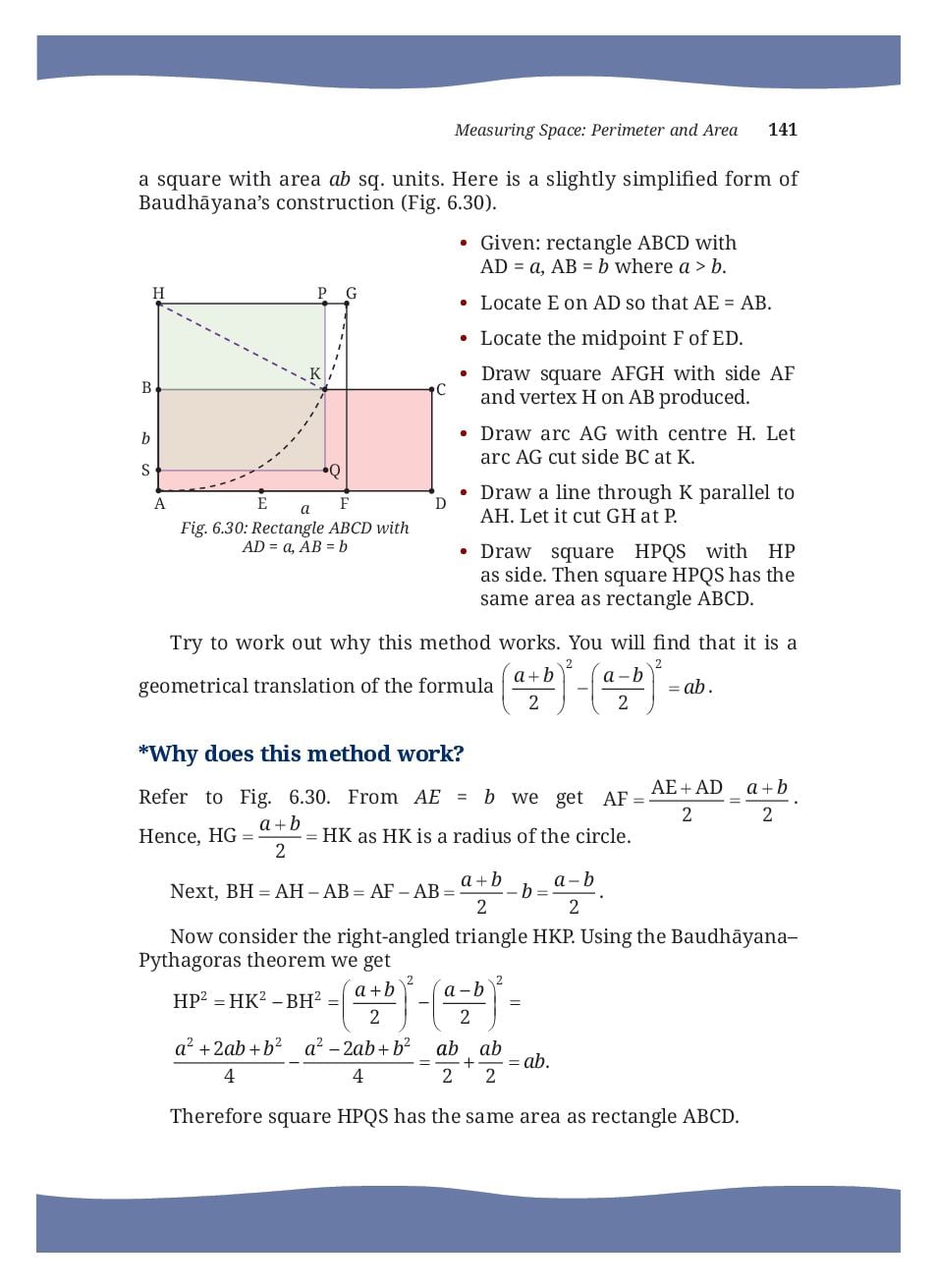
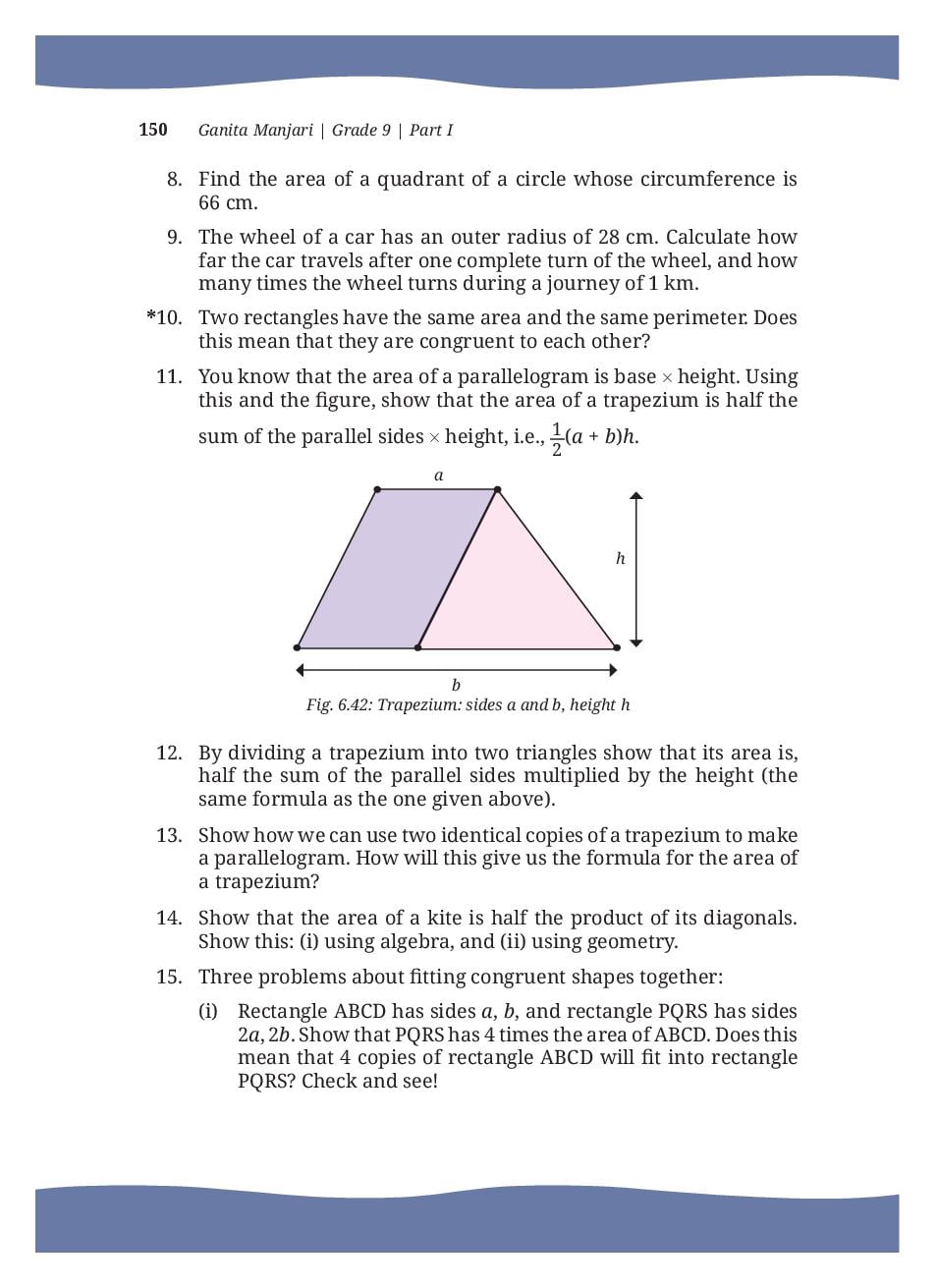
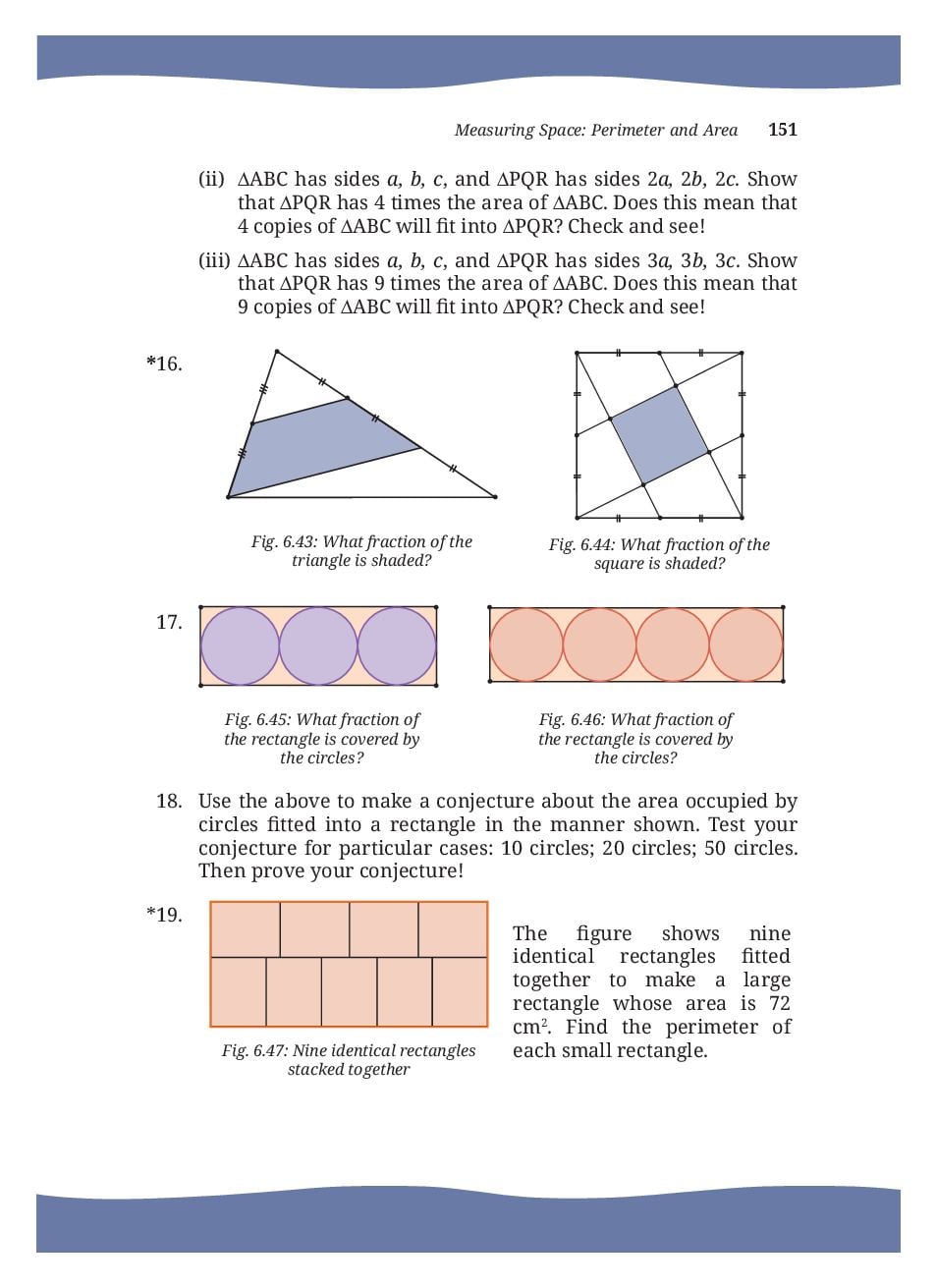
- Area of a rectangle = ab; of a parallelogram = base × height (cut a triangle off one end and slide it to the other); of a triangle = ½ × base × height (two congruent copies make a parallelogram). The sides alone never determine the area of a parallelogram or of a 4-gon — the shape can be flexed.
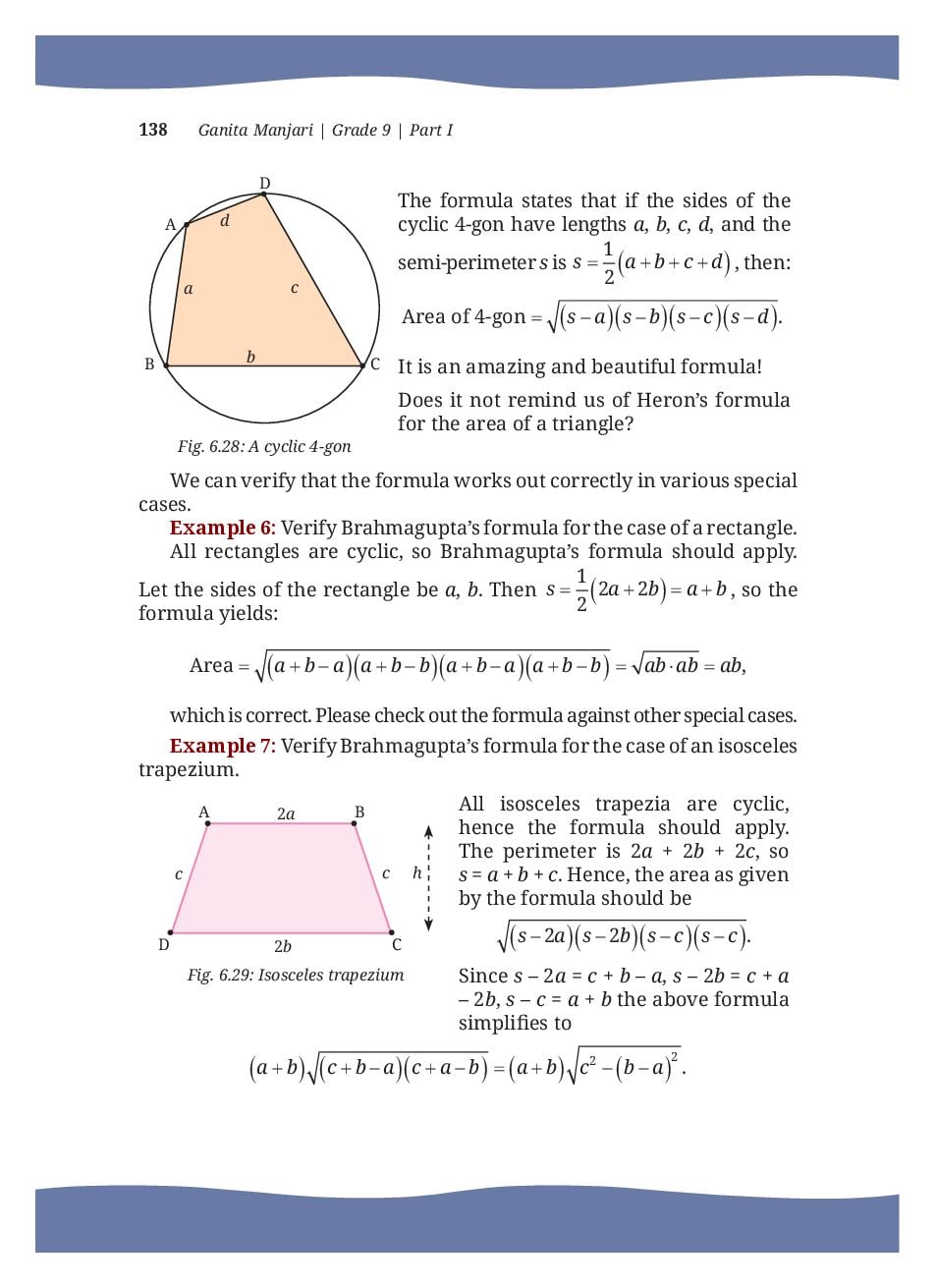
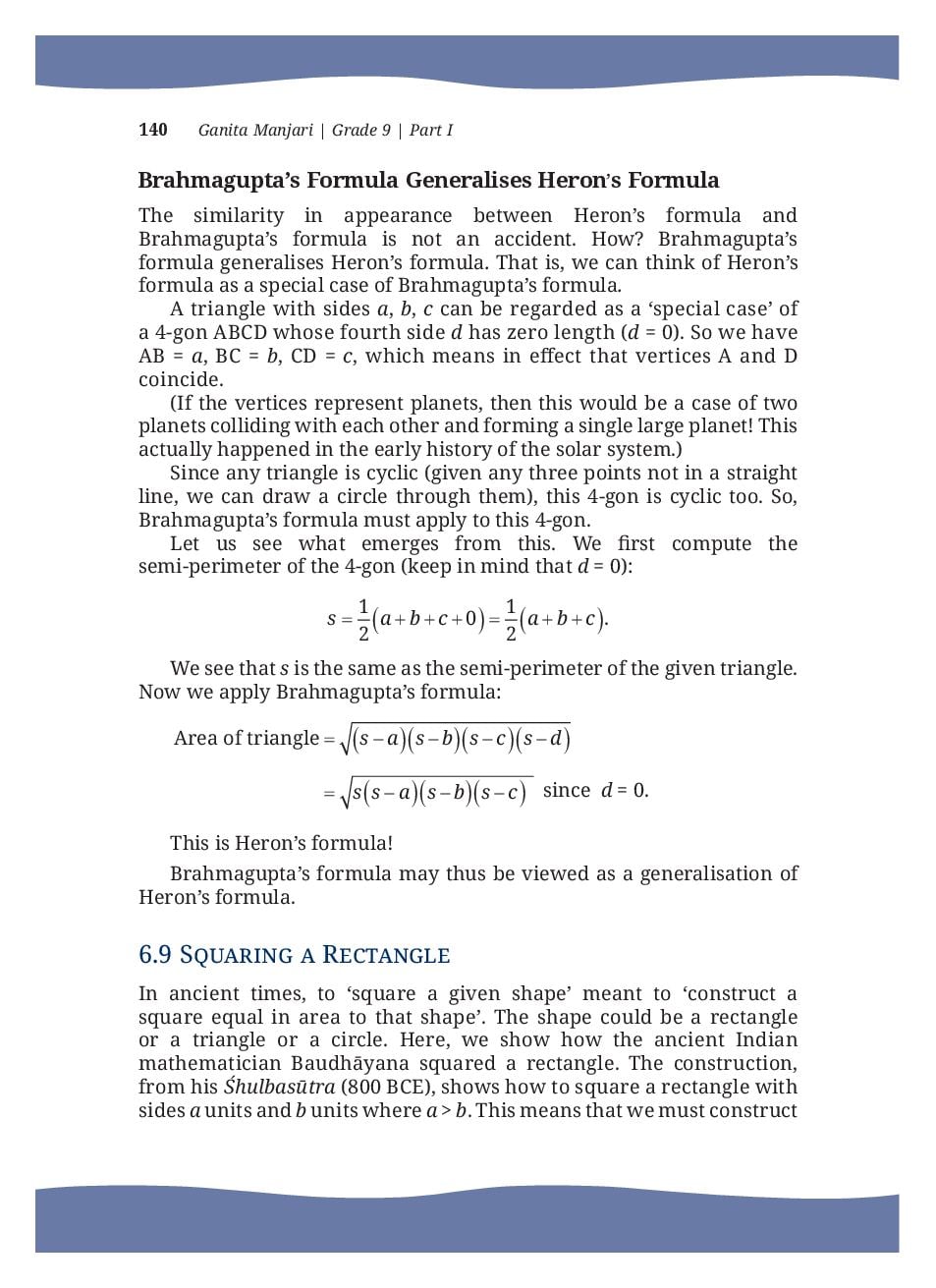
- Heron’s formula: area = √(s(s−a)(s−b)(s−c)) with s = ½(a+b+c). Use it when the three sides are known but no height is. Brahmagupta’s formula for a cyclic 4-gon, √((s−a)(s−b)(s−c)(s−d)), generalises it — put d = 0 and Heron’s formula falls out.
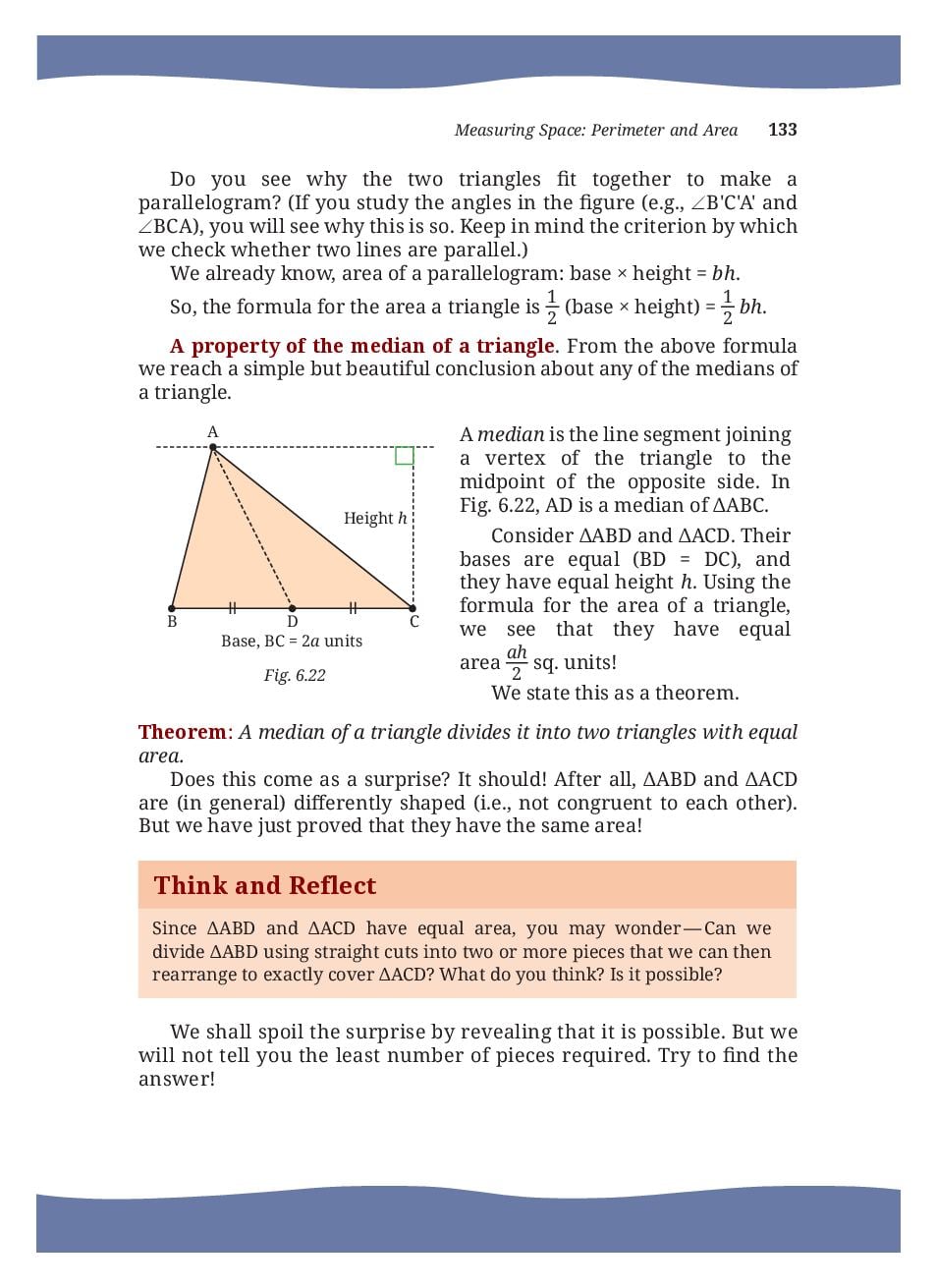
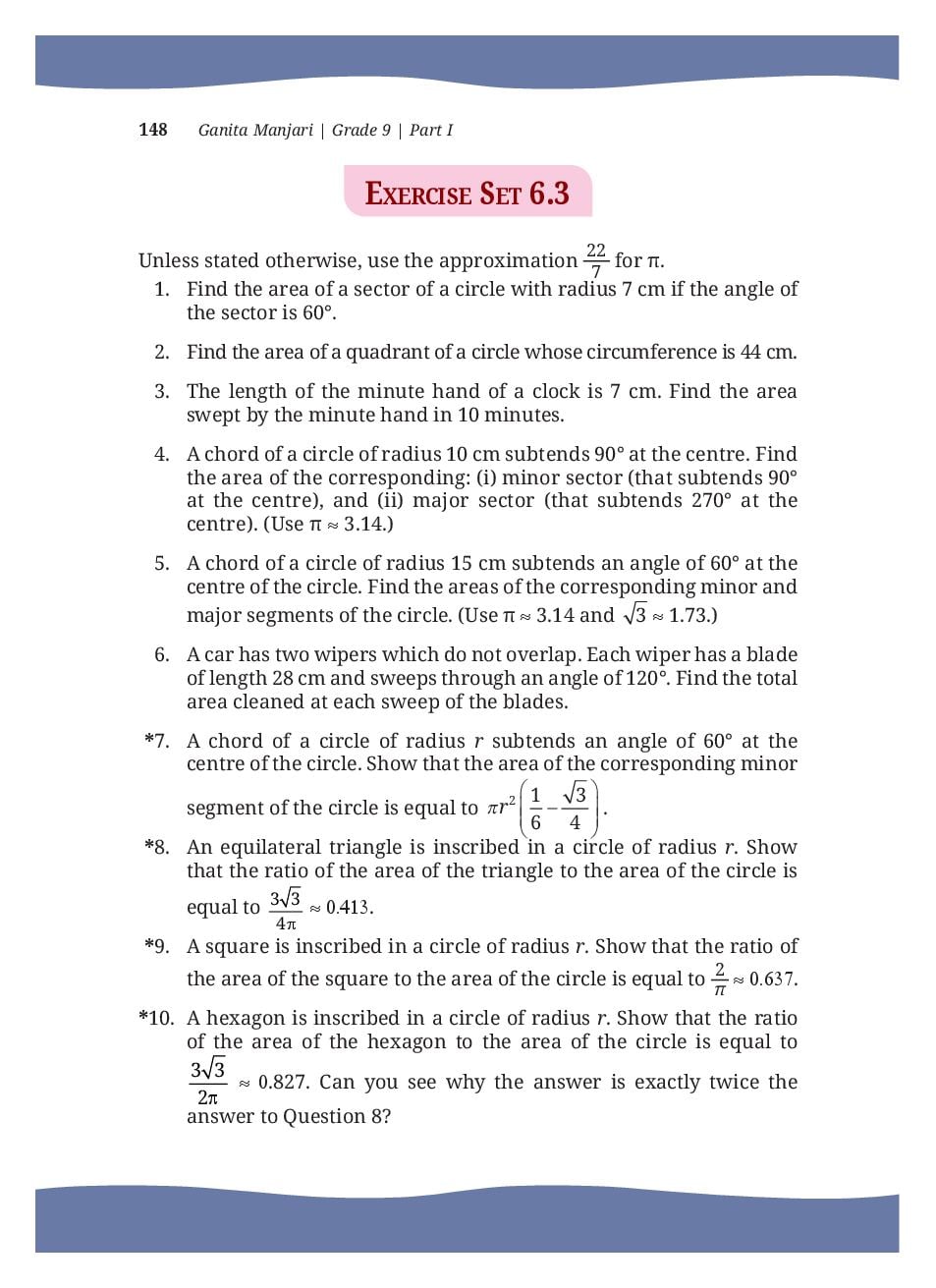
- A median divides a triangle into two triangles of equal area, because the two halves have equal bases and the same height — even though they are usually not congruent. This one theorem settles most of Exercise Set 6.2.
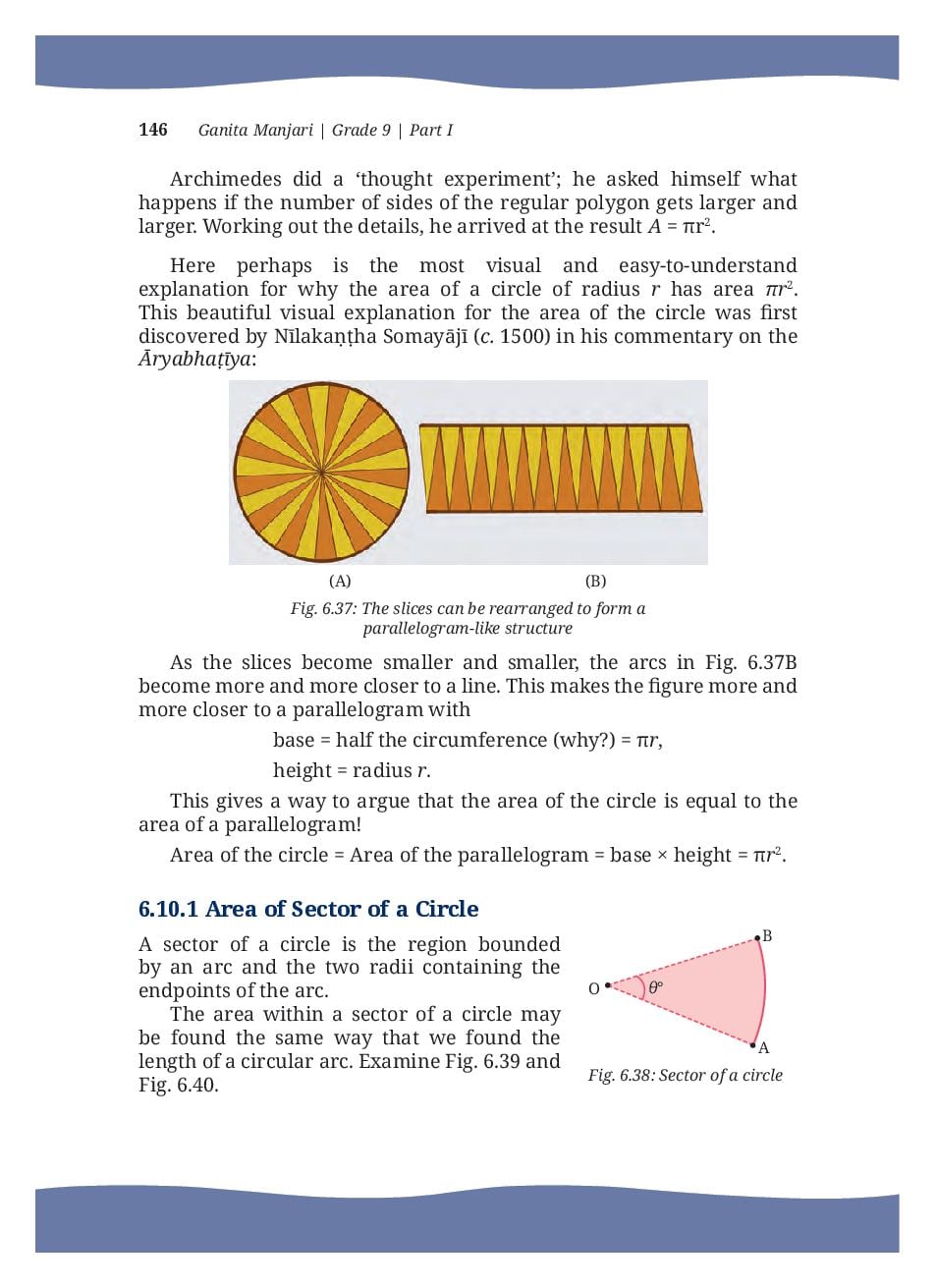
- Area of a circle = πr². Archimedes proved it by squeezing regular polygons (area of a regular polygon = ½ × perimeter × inradius); Nīlakaṇṭha’s slice-and-rearrange picture turns the disc into a parallelogram of base πr and height r.
Quick revision – Measuring Space: Perimeter and Area
| Quantity | Formula | Where it comes from | Watch out for |
|---|---|---|---|
| Circumference of a circle | C = 2πr = πd | Π is the fixed C/D ratio of every circle | Π ≈ 22/7, but π ≠ 22/7 |
| Length of an arc | L = 2πr × θ°/360° | The arc is the fraction θ/360 of the whole circle | Θ must be the angle at the centre |
| Perimeter of a sector | 2πr × θ°/360° + 2r | Curved arc plus the two bounding radii | The two radii are easy to forget |
| Area of a circle | A = πr² | ½ × circumference × radius (Archimedes) | Use the radius, not the diameter |
| Area of a sector | A = πr² × θ°/360° | Same proportion argument as the arc | A sector is not a segment |
| Area of a segment | Sector − triangle | The chord slices the triangle off the sector | Minor segment for θ < 180° |
| Area of a triangle | ½ × base × height | Half of the rectangle that encloses it | Height must be perpendicular to that base |
| Heron’s formula | √(s(s−a)(s−b)(s−c)), s = ½(a+b+c) | Needs only the three side lengths | Best when no height is given |
| Area of a parallelogram | Base × height | Cut a triangle off one end, slide it to the other | The two sides alone are not enough |
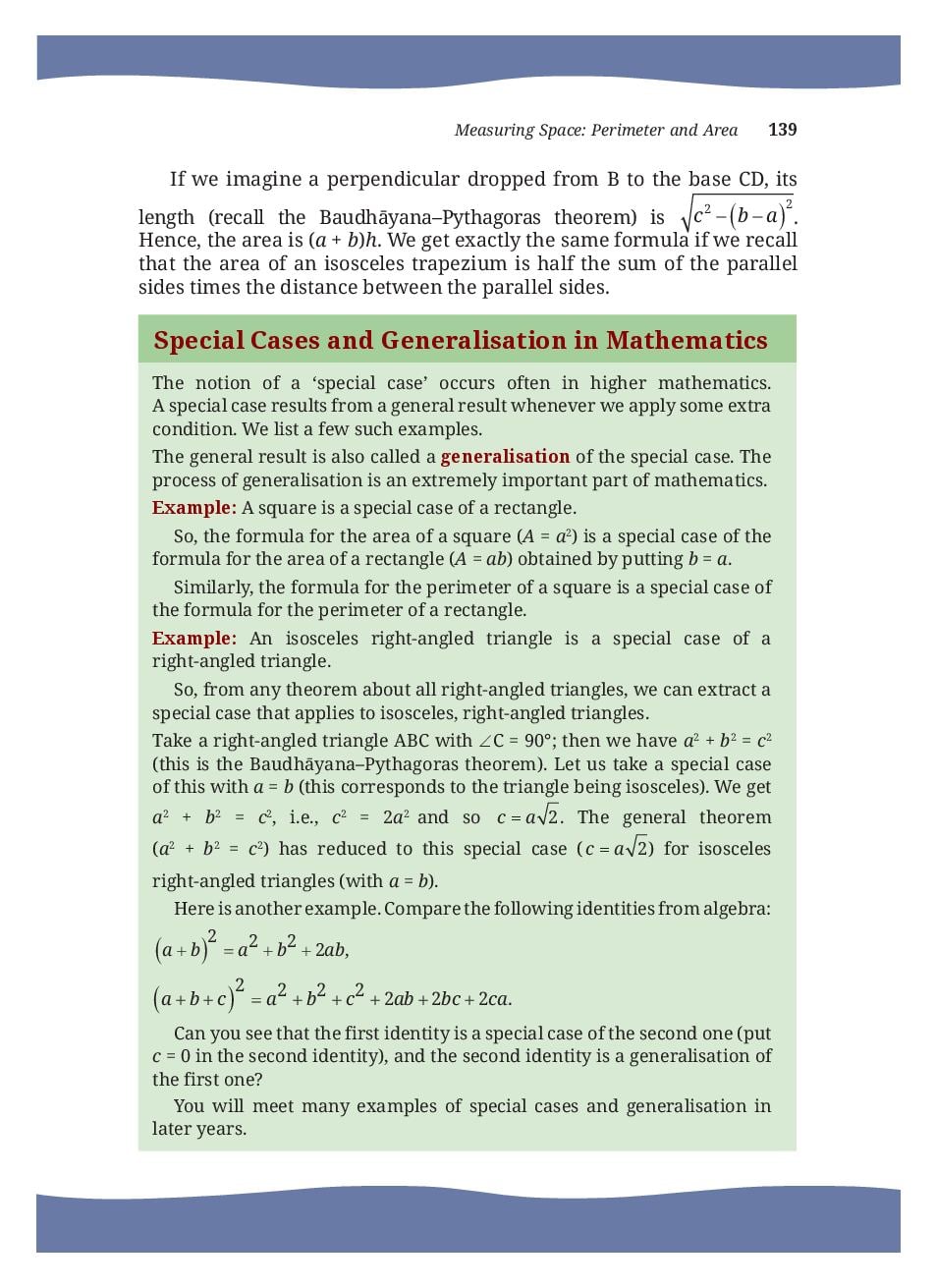
| Area of a trapezium | ½(a + b)h | Two copies make a parallelogram of base a+b | A and b are the parallel sides |
| Area of a cyclic 4-gon | √((s−a)(s−b)(s−c)(s−d)) | Brahmagupta; Heron is the case d = 0 | Only for 4-gons with a circumcircle |
| Median of a triangle | Splits it into two equal areas | Equal bases BD = DC, same height | The two halves are usually not congruent |
Old NCERT vs New – Class 9 Maths
This chapter is from Ganita Manjari, the new NCERT Class 9 Maths book (NCF-SE 2023, used from 2026-27). It replaced the old book “Mathematics”, so chapter numbers and names differ from older PDFs.
Solutions and All Chapters
Answers to the exercises and the full chapter list of Ganita Manjari:
Measuring Space: Perimeter and Area – Overview
| Class | Class 9 |
| Subject | Maths |
| Book | Ganita Manjari – new NCERT book |
| Part | Part I |
| Chapter | 6 of 14 – Measuring Space: Perimeter and Area |
| Book pages | 118 – 154 |
| Edition | Latest NCERT edition (2026-27) |
| Session | 2026-27 |
| Free – read online or download |
Class 9 Maths Chapter 6 – FAQs
Where can I download Measuring Space: Perimeter and Area Class 9 PDF?
From the download table on this page – the chapter PDF is free, and the full book is linked too.
What is Class 9 Maths Chapter 6 about?
For every circle the ratio of circumference to diameter is the same number, π. So C = 2πr = πd. π is irrational (Lambert, 1761), so no fraction equals it: π ≈ 22/7 but π ≠ 22/7. Better approximations are 355/113 (Zu Chongzhi) and 3.1416 (Āryabhaṭa); Mādhava gave the first exact formula, π/4 = 1 − 1/3 + 1/5 − 1/7 + …
Is Measuring Space: Perimeter and Area from the new NCERT Class 9 Maths book?
Yes. It is chapter 6 of ganita manjari (part i), the new NCERT Class 9 Maths book for 2026-27.
Is this the latest NCERT edition for 2026-27?
Yes – the PDF is NCERT’s latest edition for the 2026-27 session.
Where are the NCERT Solutions for Class 9 Maths Chapter 6?
Open the NCERT Solutions link above for answers to the exercise questions.