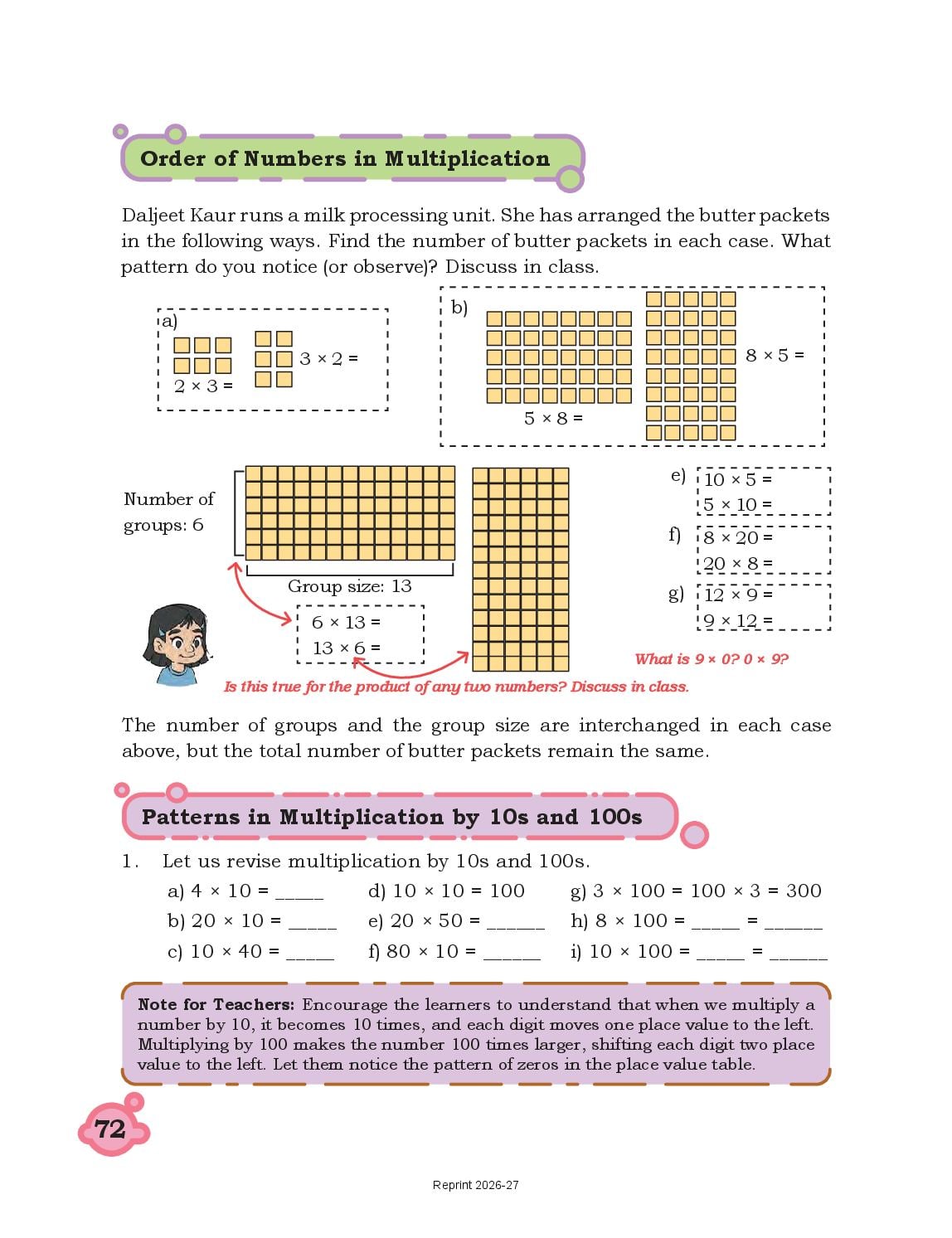
Download The Dairy Farm – NCERT Class 5 Maths Chapter 6 PDF from the new NCERT Class 5 Maths book Maths Mela (2026-27). Read the chapter online or download the free PDF. Order does not change a product. Daljeet Kaur puts 6 groups of 13 butter packets on a tray. Turn the tray sideways and it becomes 13 groups of 6. The packets did not move, so the total is the same: 6 × 13 = 13 × 6 = 78. This is true for every pair of numbers.
The Dairy Farm PDF – Chapter 6 of Maths Mela
Read the chapter online or download the PDF.
| Chapter | Download | |
|---|---|---|
| Chapter 6 PDF | The Dairy Farm | View PDF |
| Full book | NCERT Class 5 Maths – Maths Mela | View Book |
Read Online
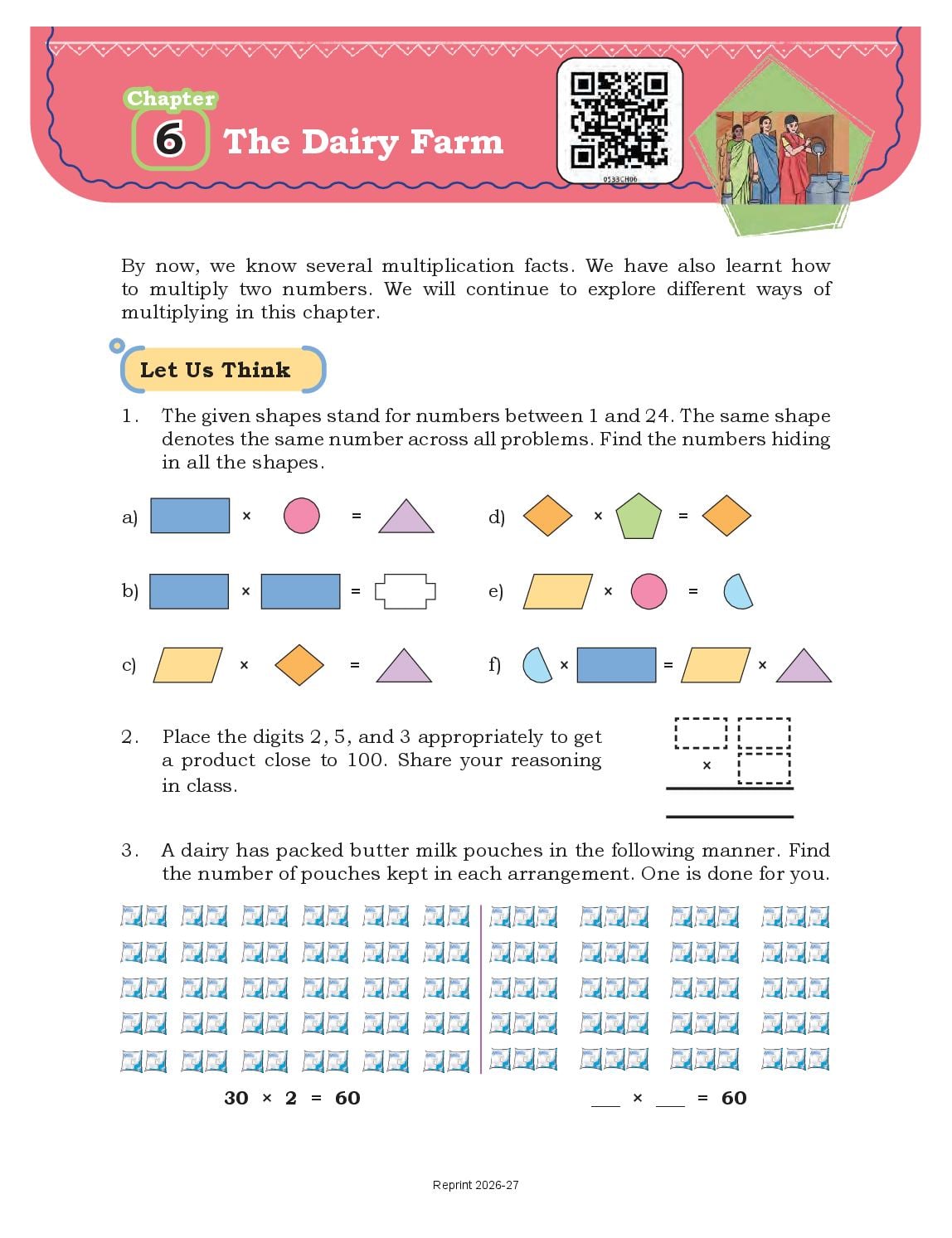
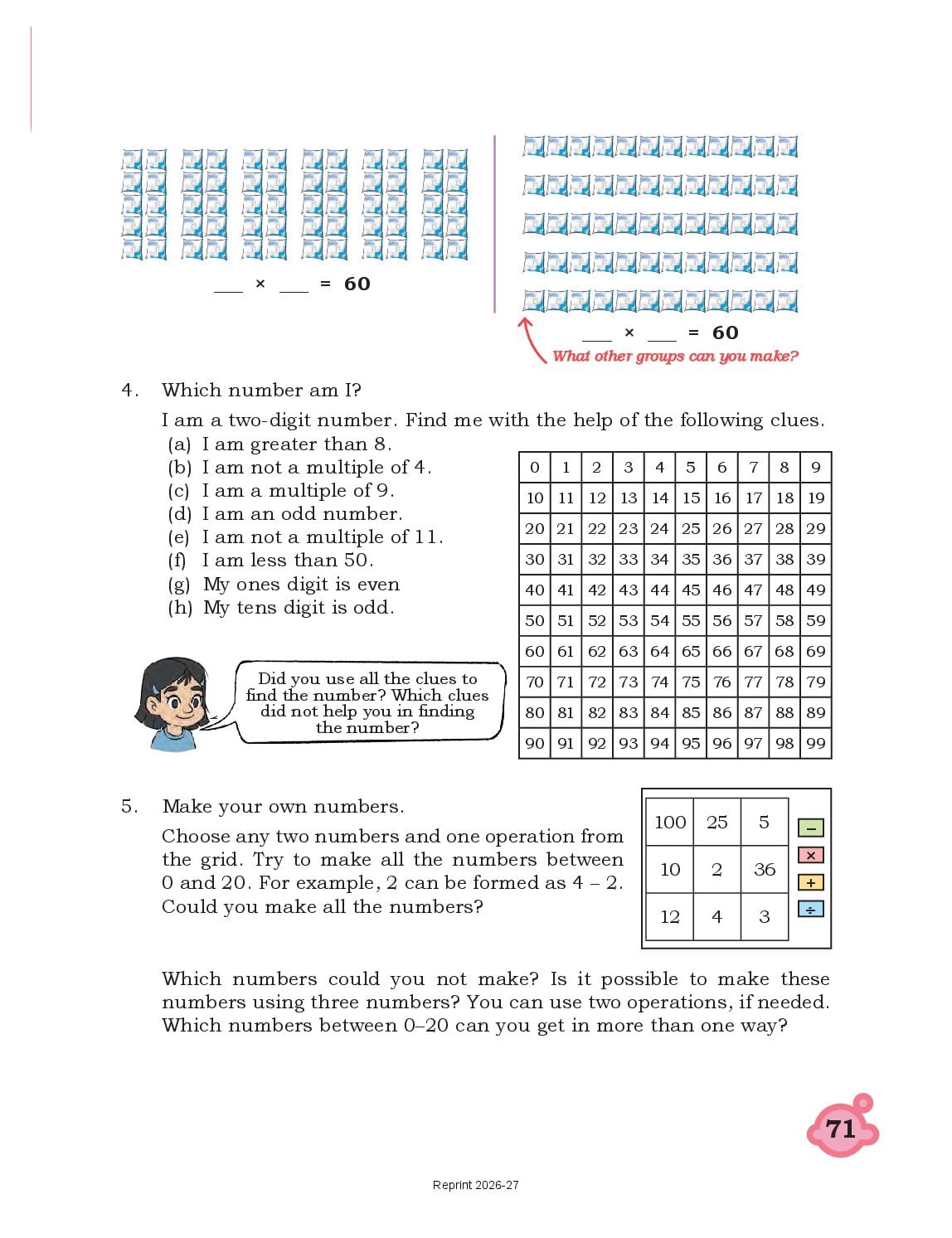
What Is in The Dairy Farm? (Class 5 Maths Chapter 6)
- Order does not change a product. Daljeet Kaur puts 6 groups of 13 butter packets on a tray. Turn the tray sideways and it becomes 13 groups of 6. The packets did not move, so the total is the same: 6 × 13 = 13 × 6 = 78. This is true for every pair of numbers.
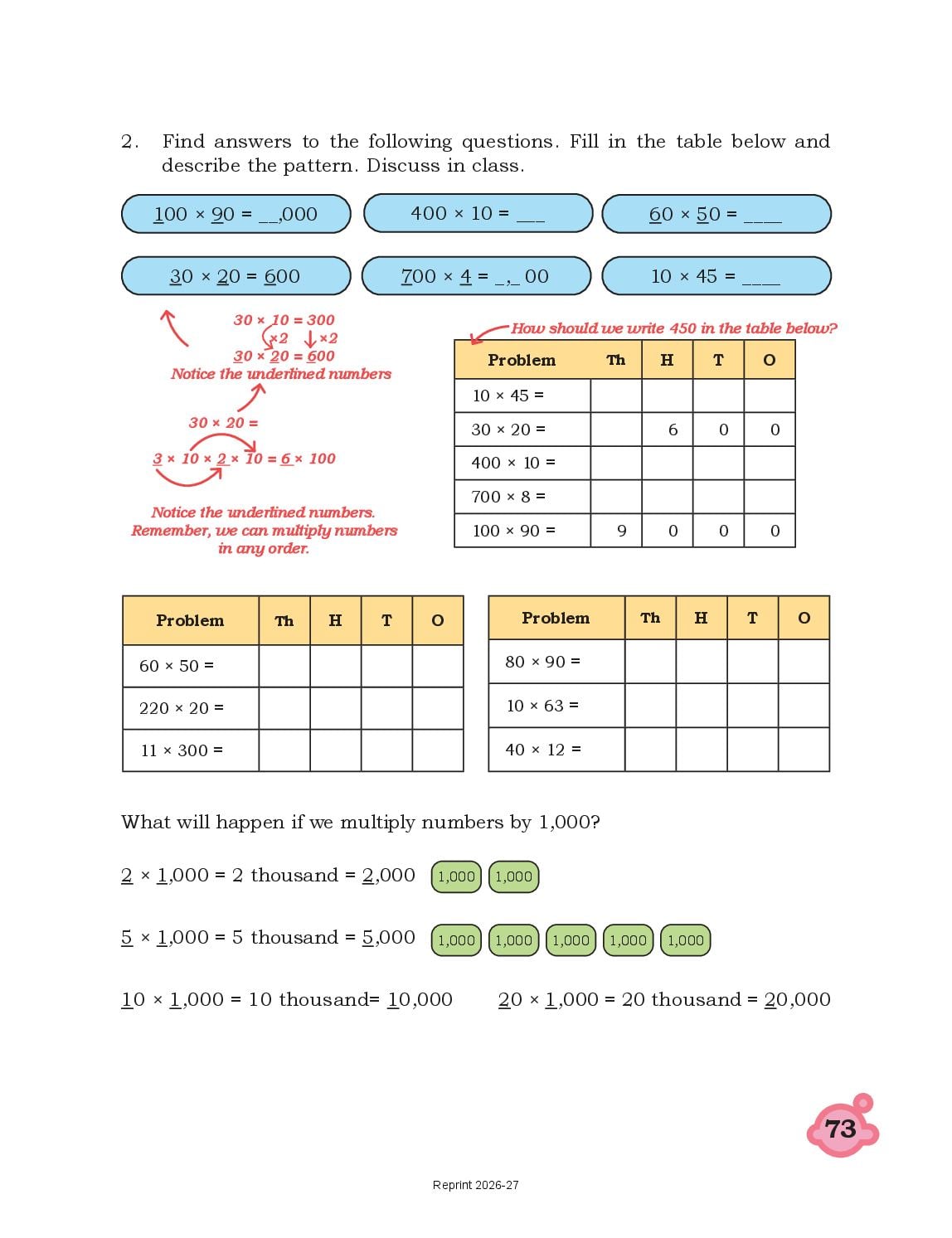
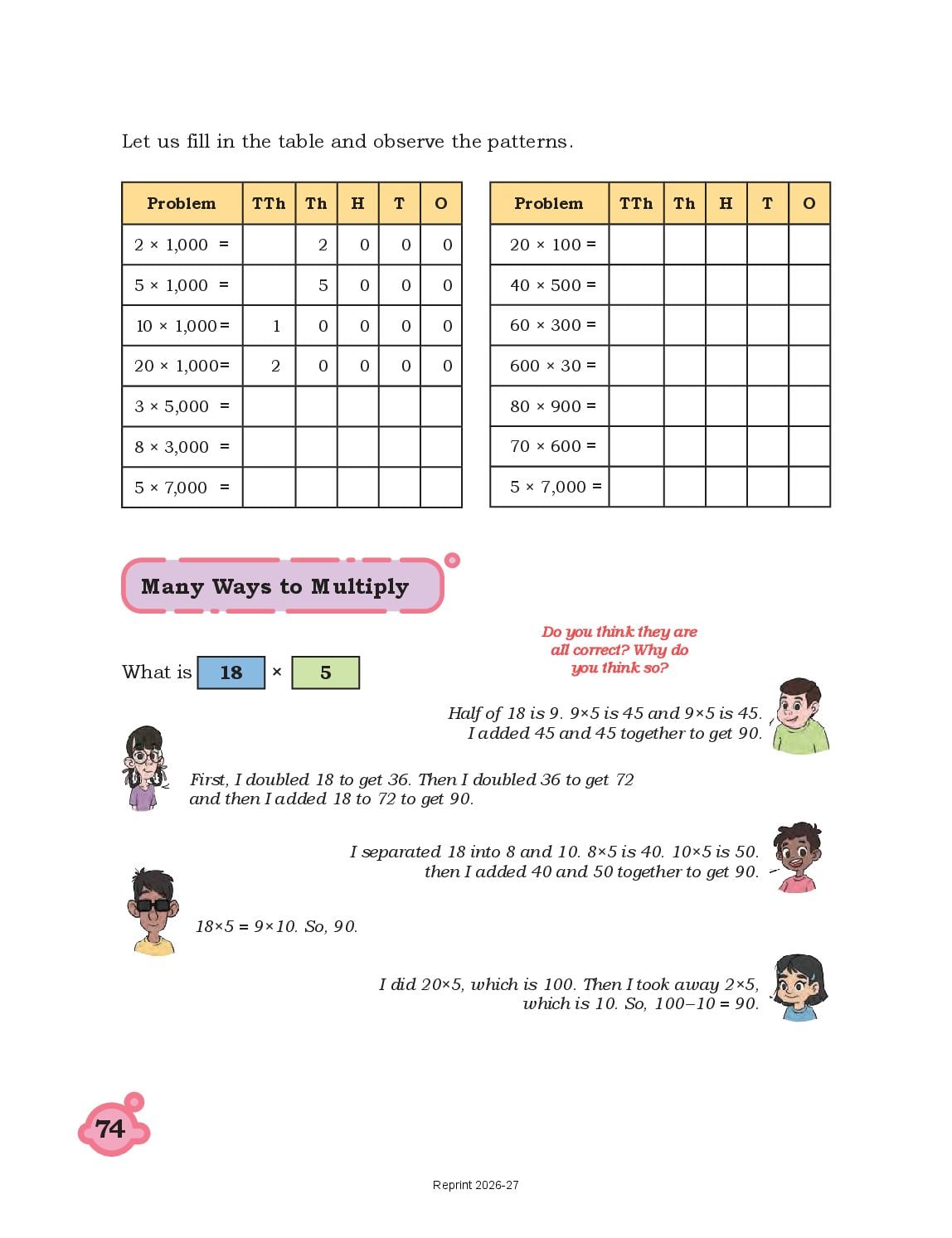
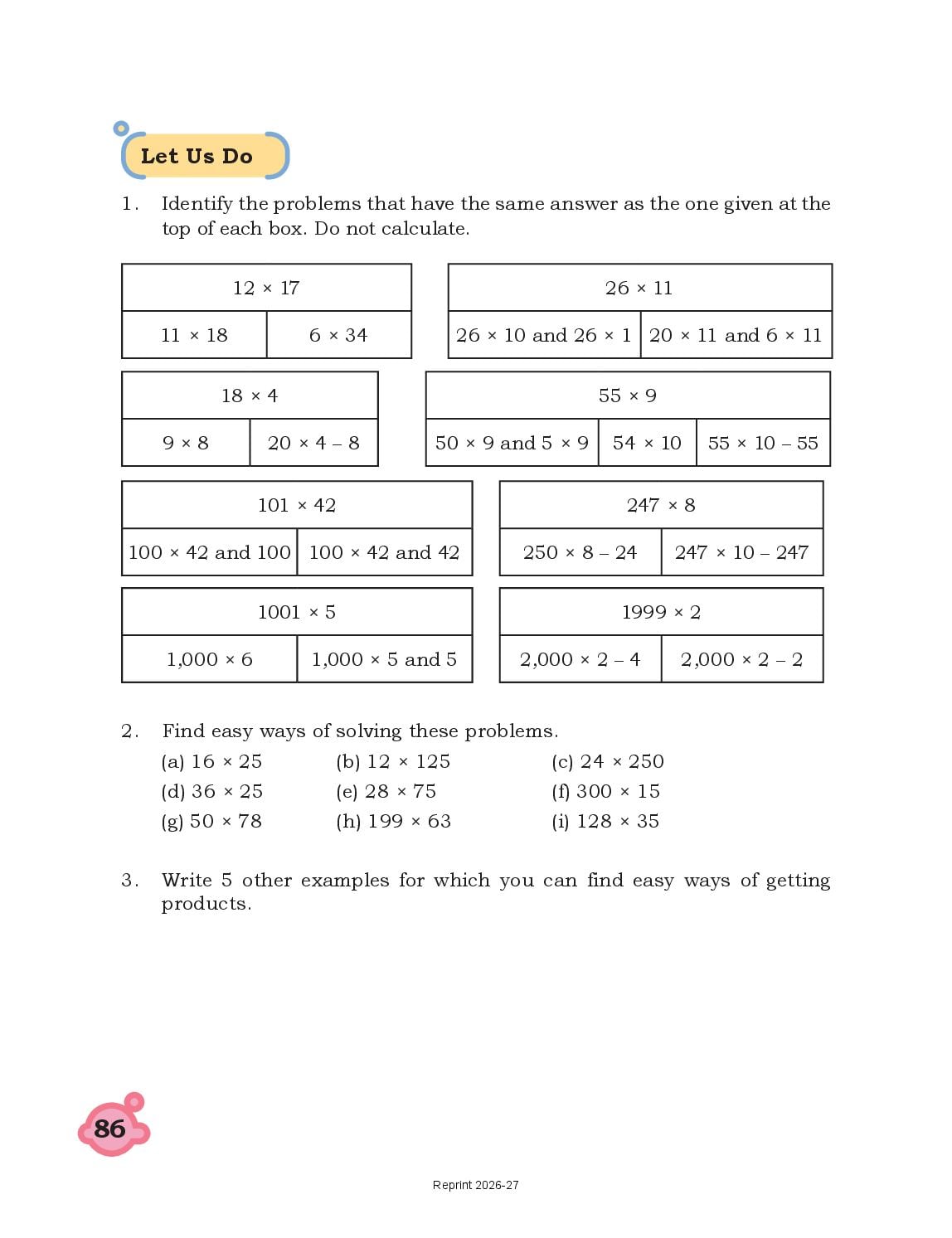
- Multiplying by 10, 100 and 1,000. Multiply by 10 and every digit shifts one place to the left, so a zero appears at the end: 45 × 10 = 450. Multiply by 100 and the digits shift two places: 8 × 100 = 800. Multiply by 1,000 and they shift three: 5 × 1,000 = 5,000. That is why 30 × 20 is easy — think 3 × 10 × 2 × 10 = 6 × 100 = 600.
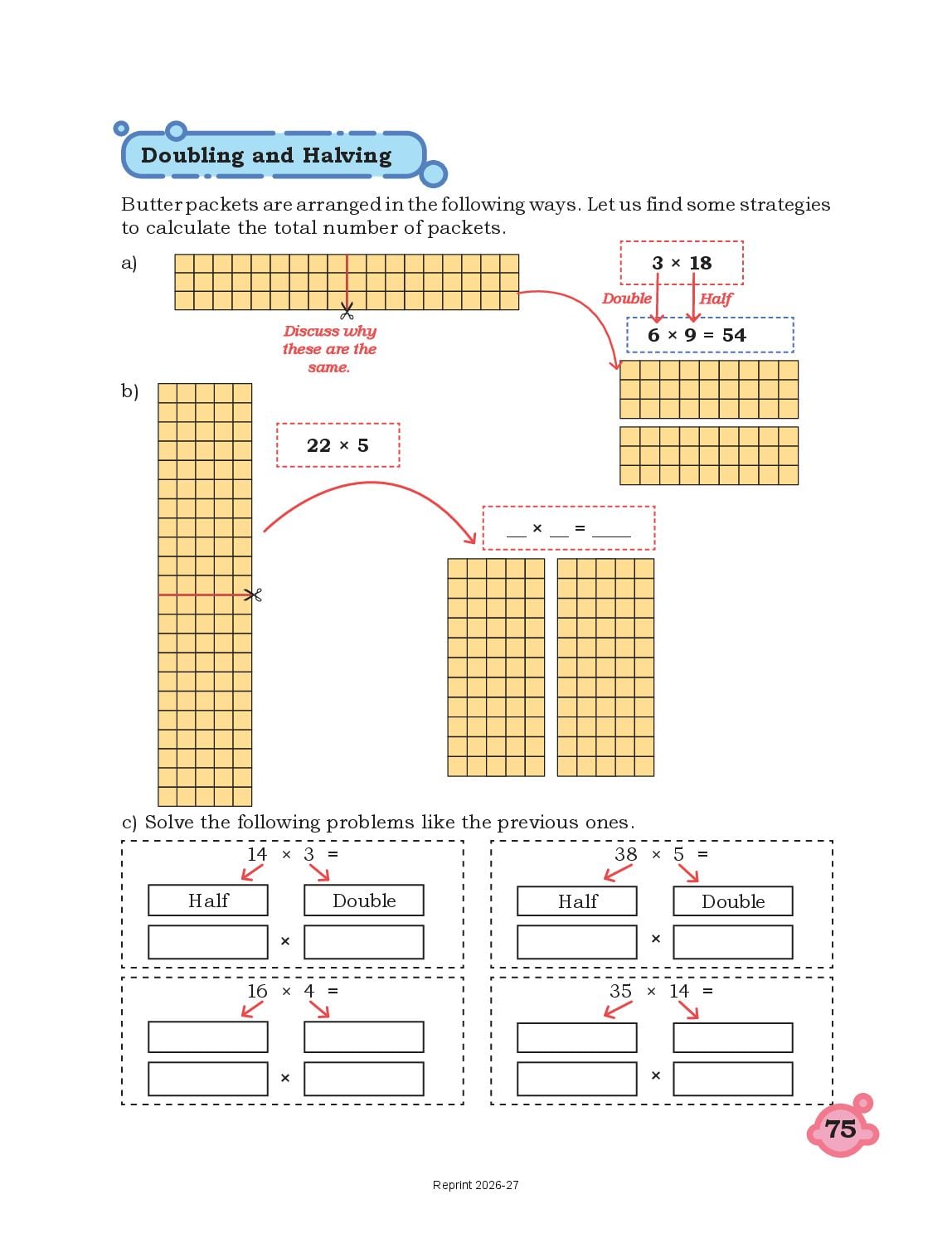
- Doubling and halving. A block of butter packets 3 rows deep and 18 across can be cut in half and the two pieces stacked. Now it is 6 rows deep and 9 across. Nothing was added or thrown away, so 3 × 18 = 6 × 9 = 54. Double one number, halve the other, and the product stays the same. This is a gift when one number is 5 or 25, because doubling 5 gives 10 and doubling 25 twice gives 100.
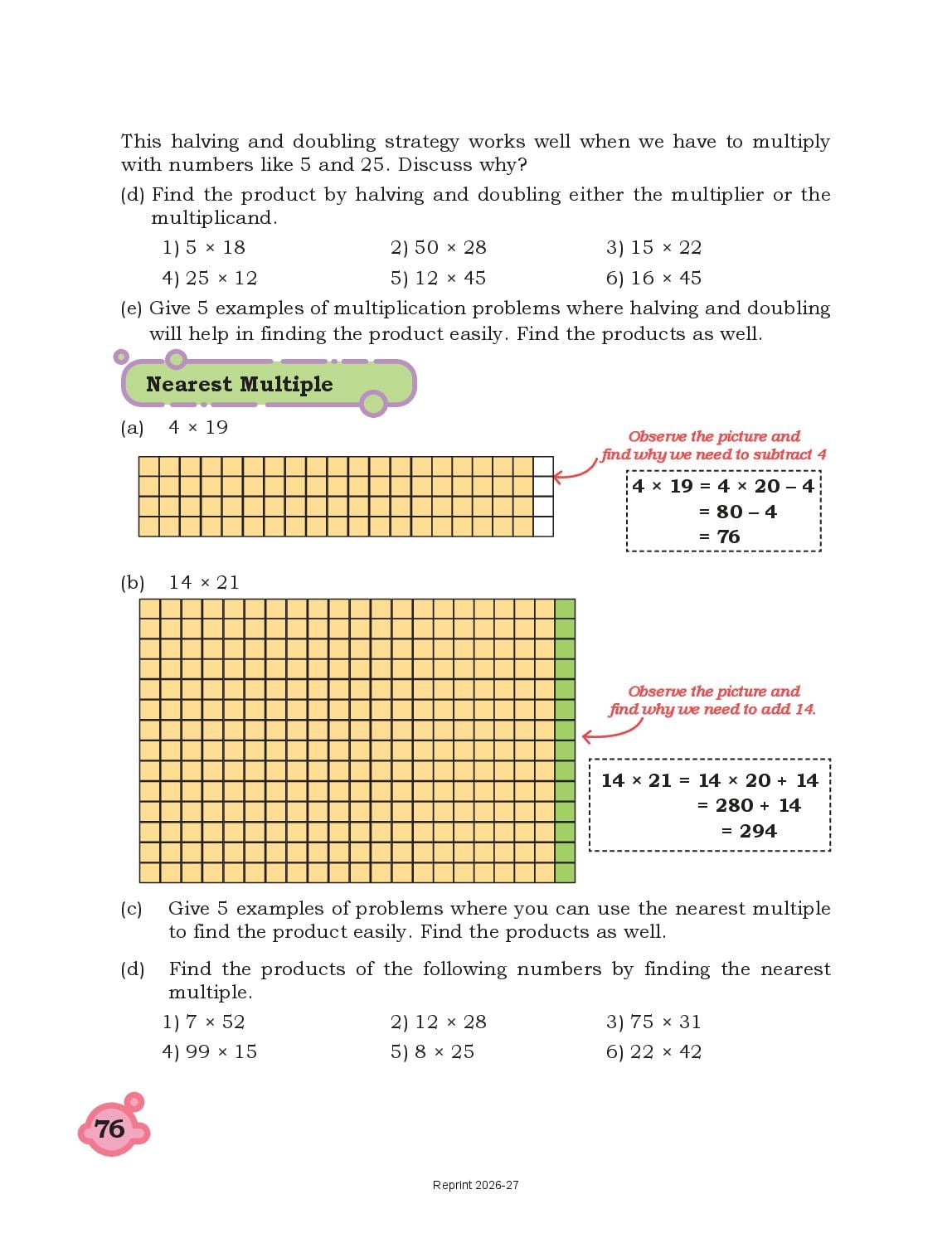
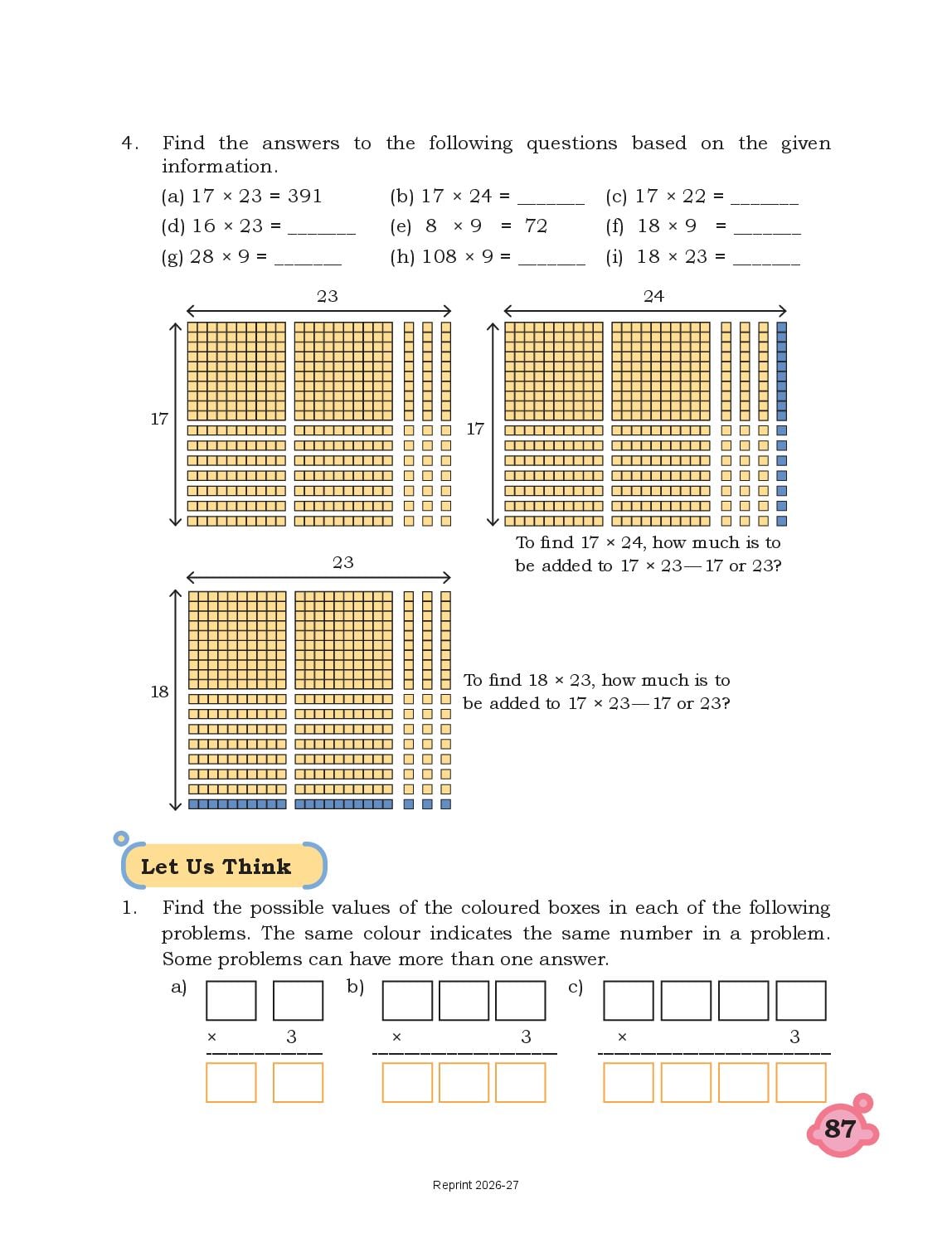
- Nearest multiple. 4 × 19 is hard, but 4 × 20 is easy. Draw 4 rows of 20 and rub out one column of 4: 4 × 19 = 80 − 4 = 76. The same trick works upwards. 14 × 21 is one extra column of 14 more than 14 × 20, so 14 × 21 = 280 + 14 = 294.
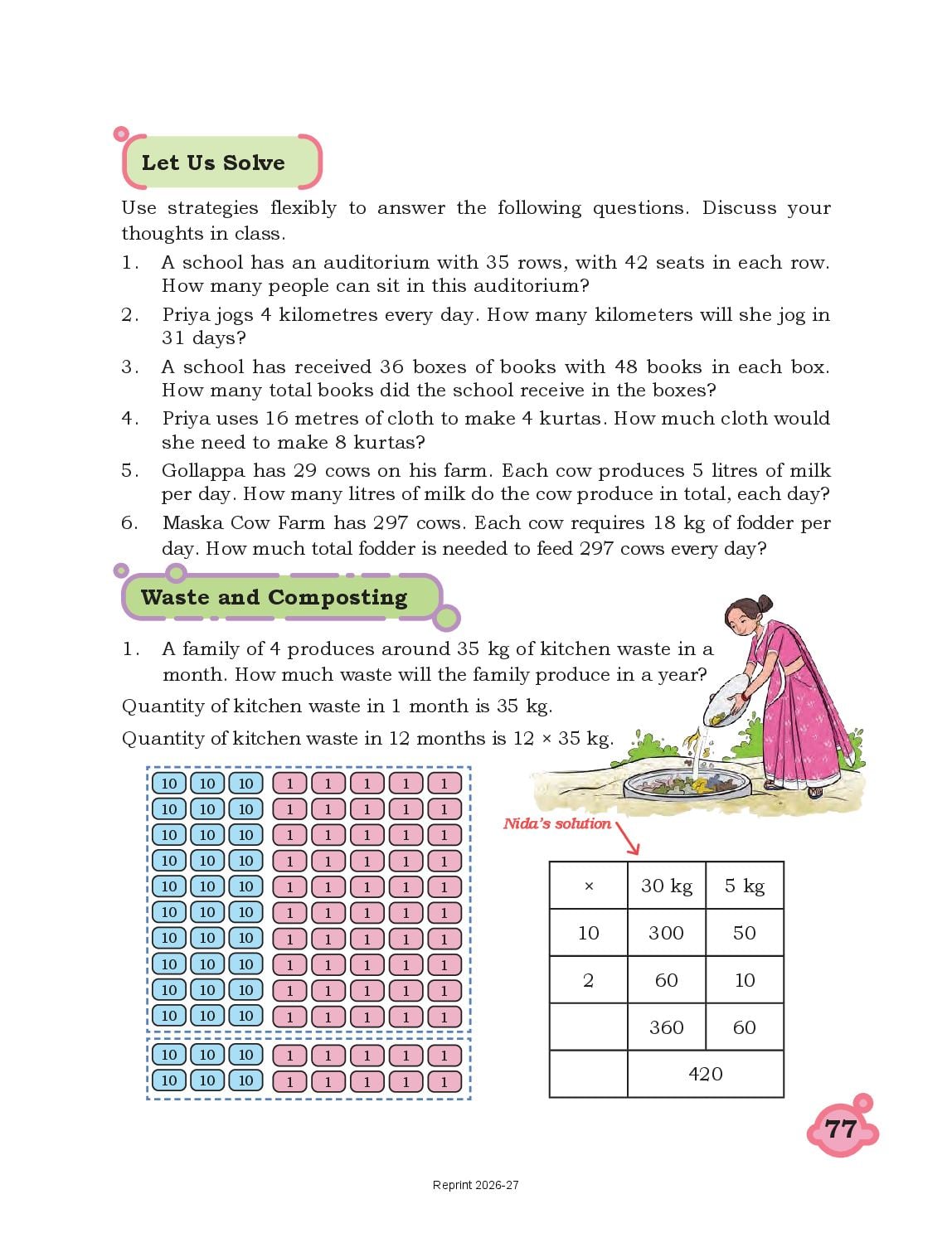
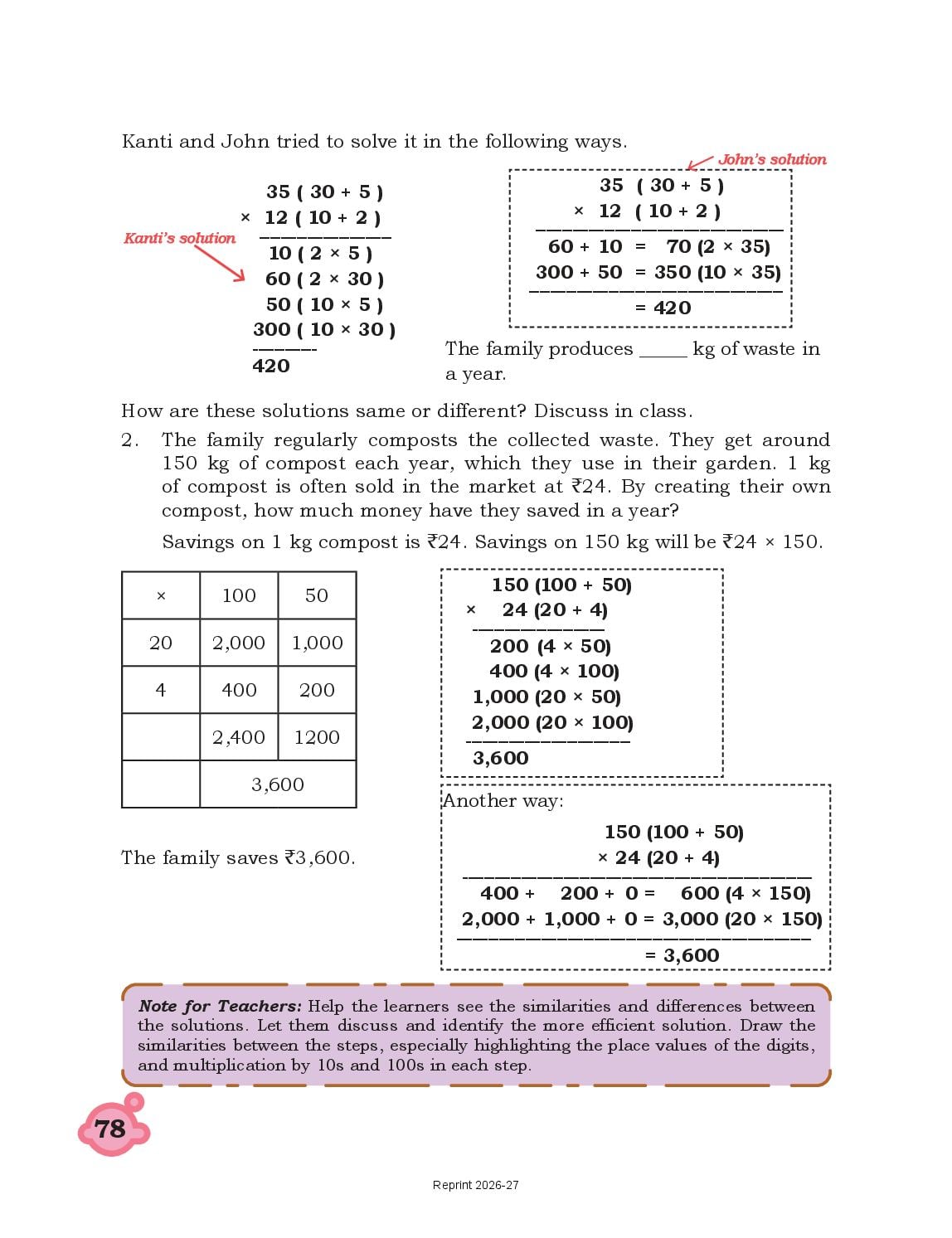
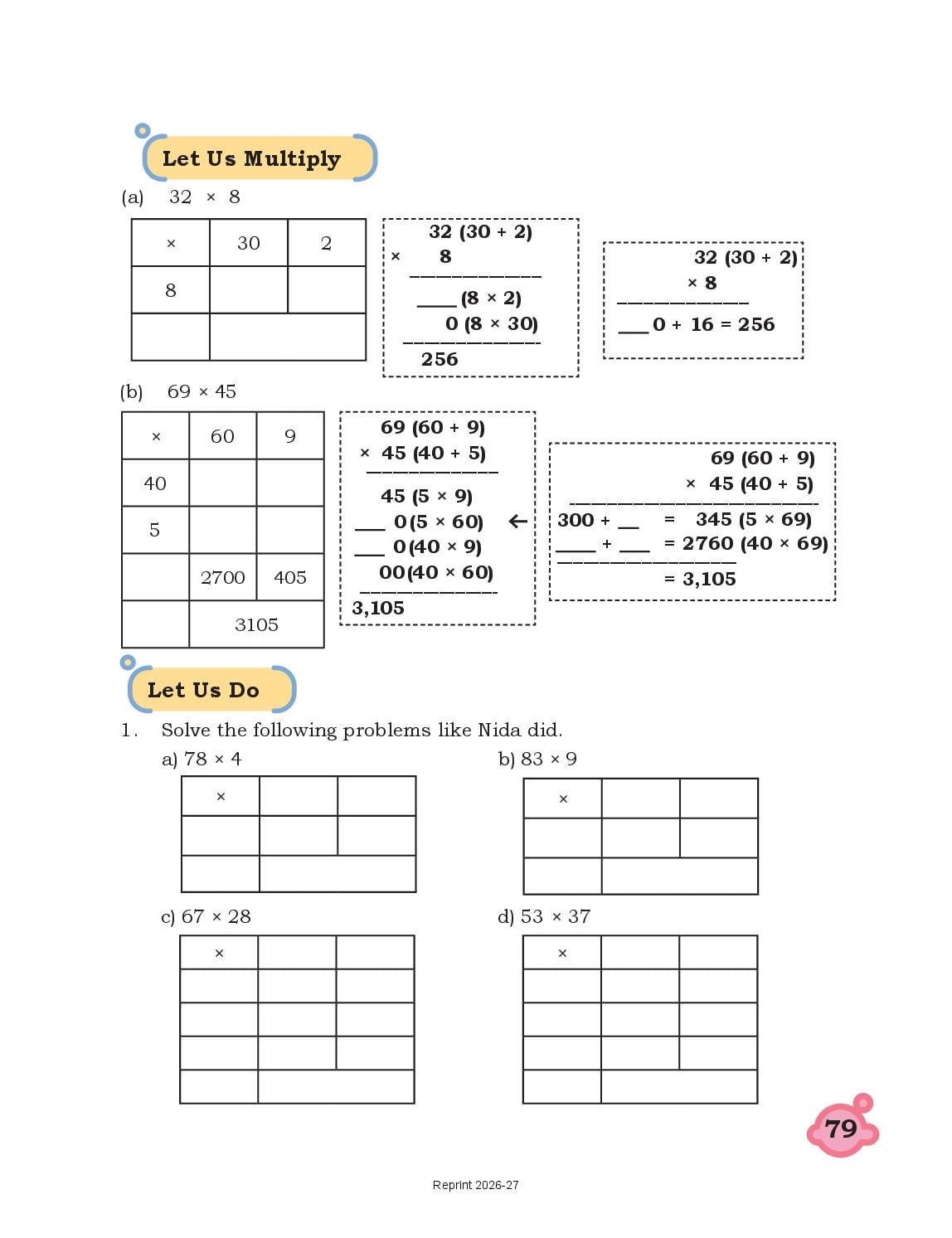
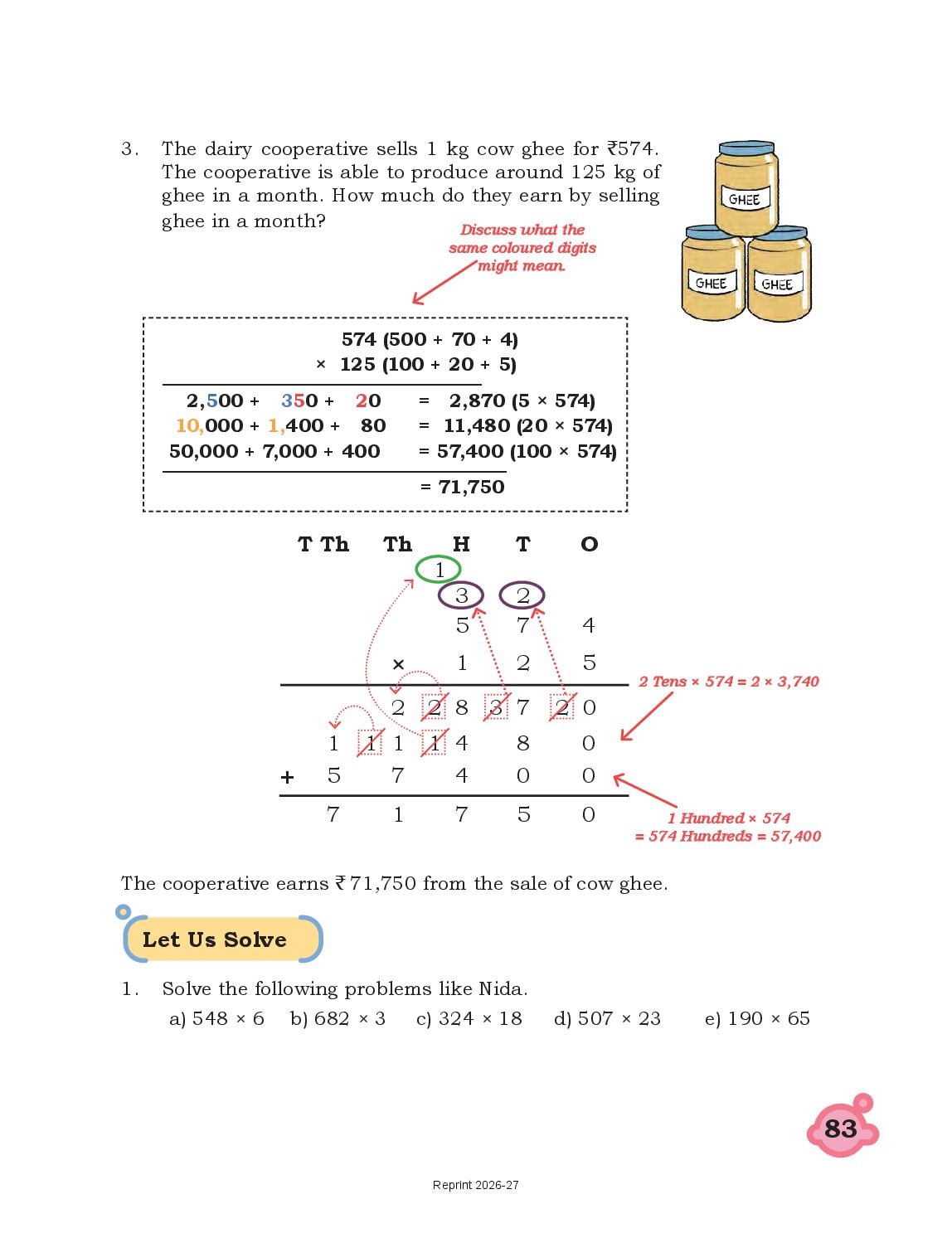
- Breaking a number into place values. 35 is 30 + 5 and 12 is 10 + 2. So 35 × 12 has four small pieces: 10 + 60 + 50 + 300 = 420. Kanti writes all four pieces. John collects them into two rows: 2 × 35 = 70 and 10 × 35 = 350, then 70 + 350 = 420. Nida draws the same idea as a grid. Three pictures, one answer.
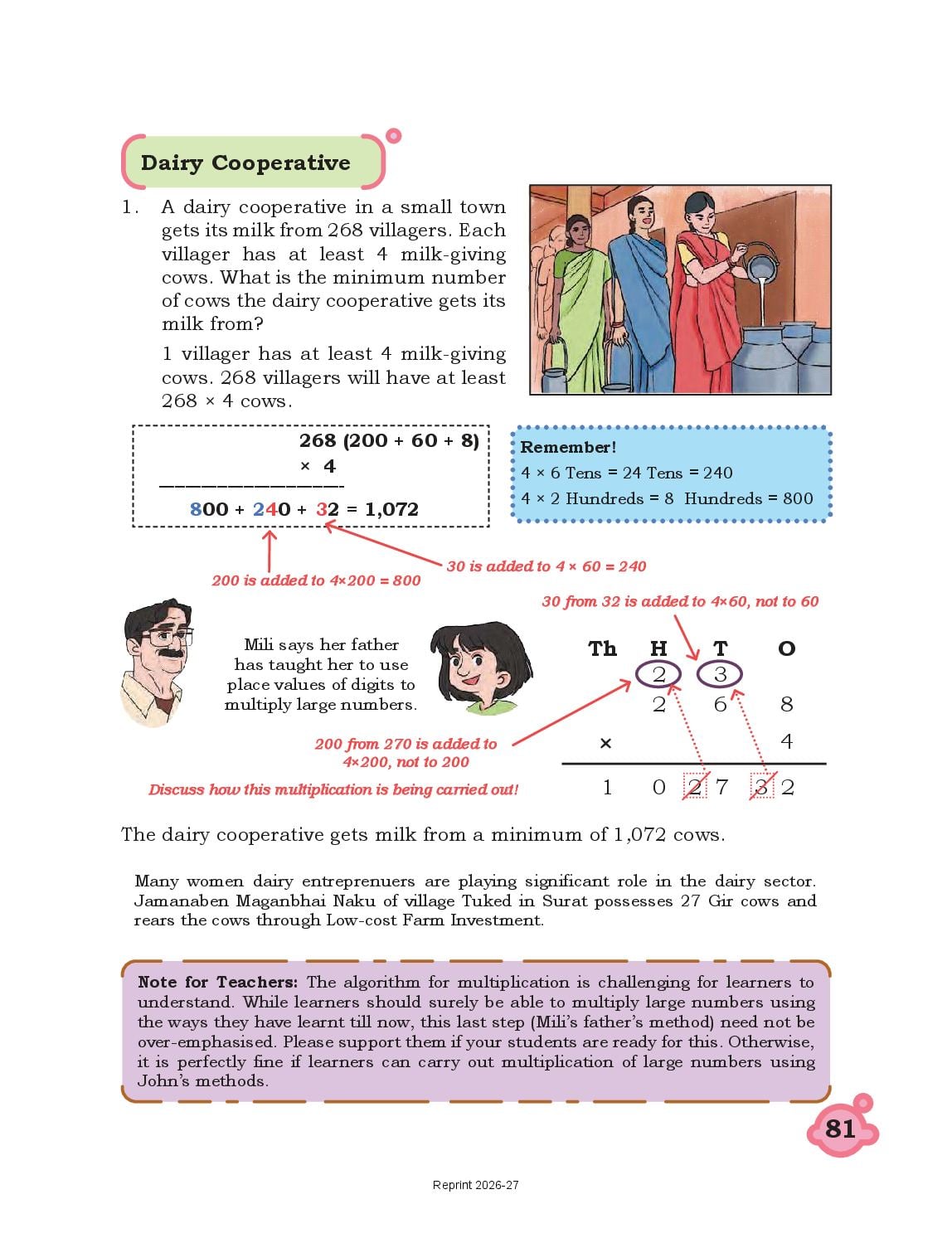
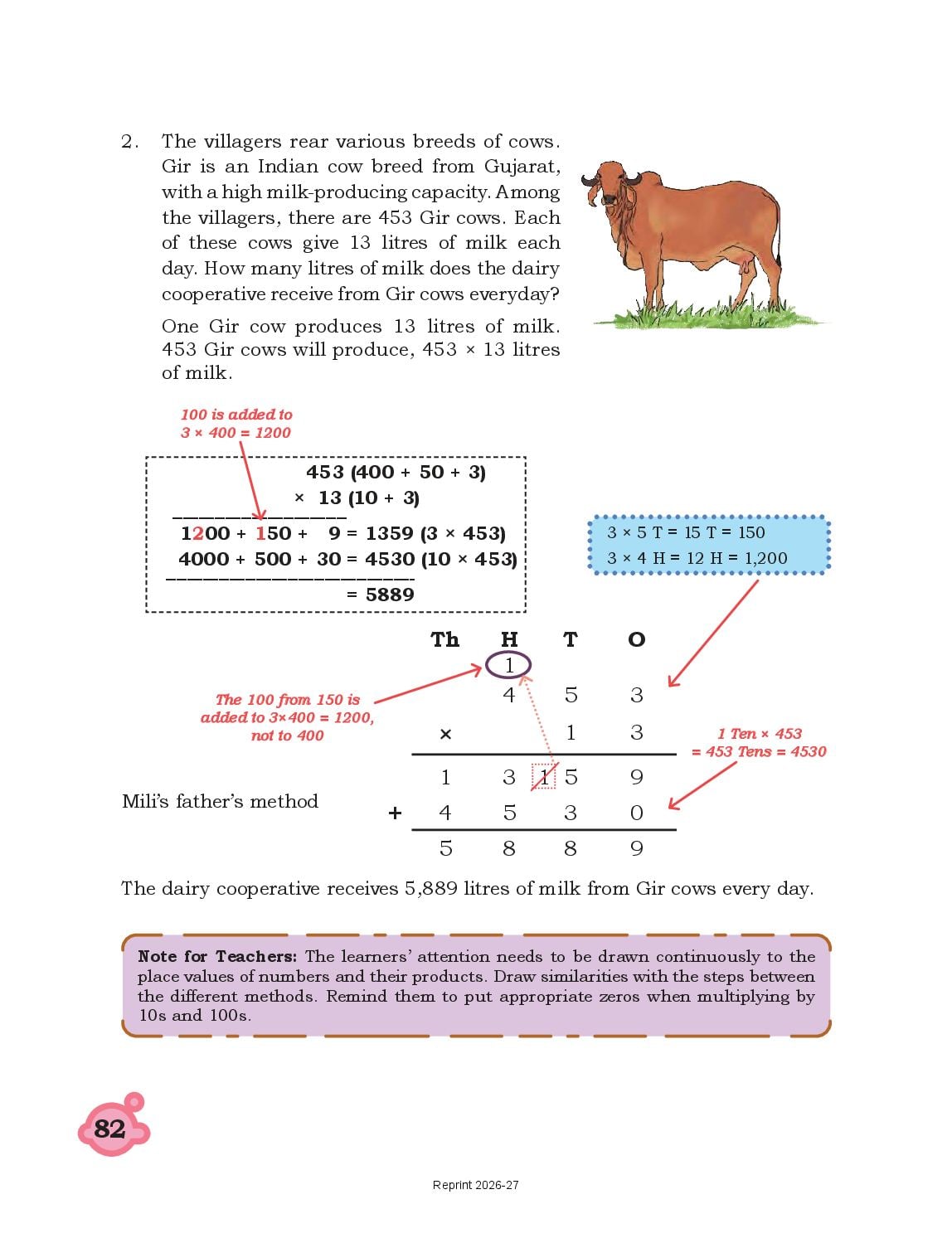
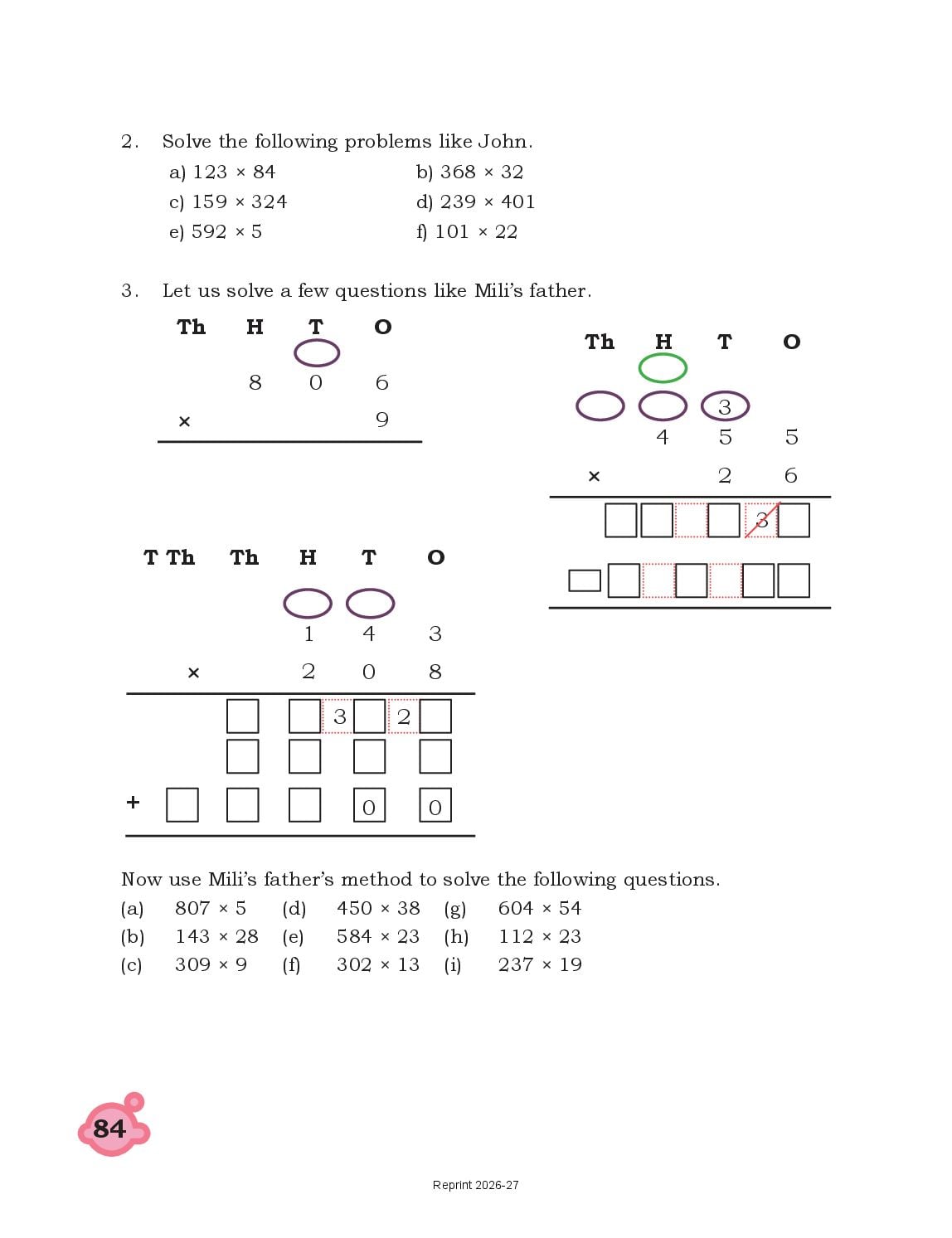
- Mili’s father’s method. This is the short column method with carrying. In 268 × 4, the ones give 4 × 8 = 32. The 30 in that 32 is 3 tens, so it is added to 4 × 60 = 240, not to 60. Keeping track of what each carried digit is worth is the whole secret: 268 × 4 = 1,072.
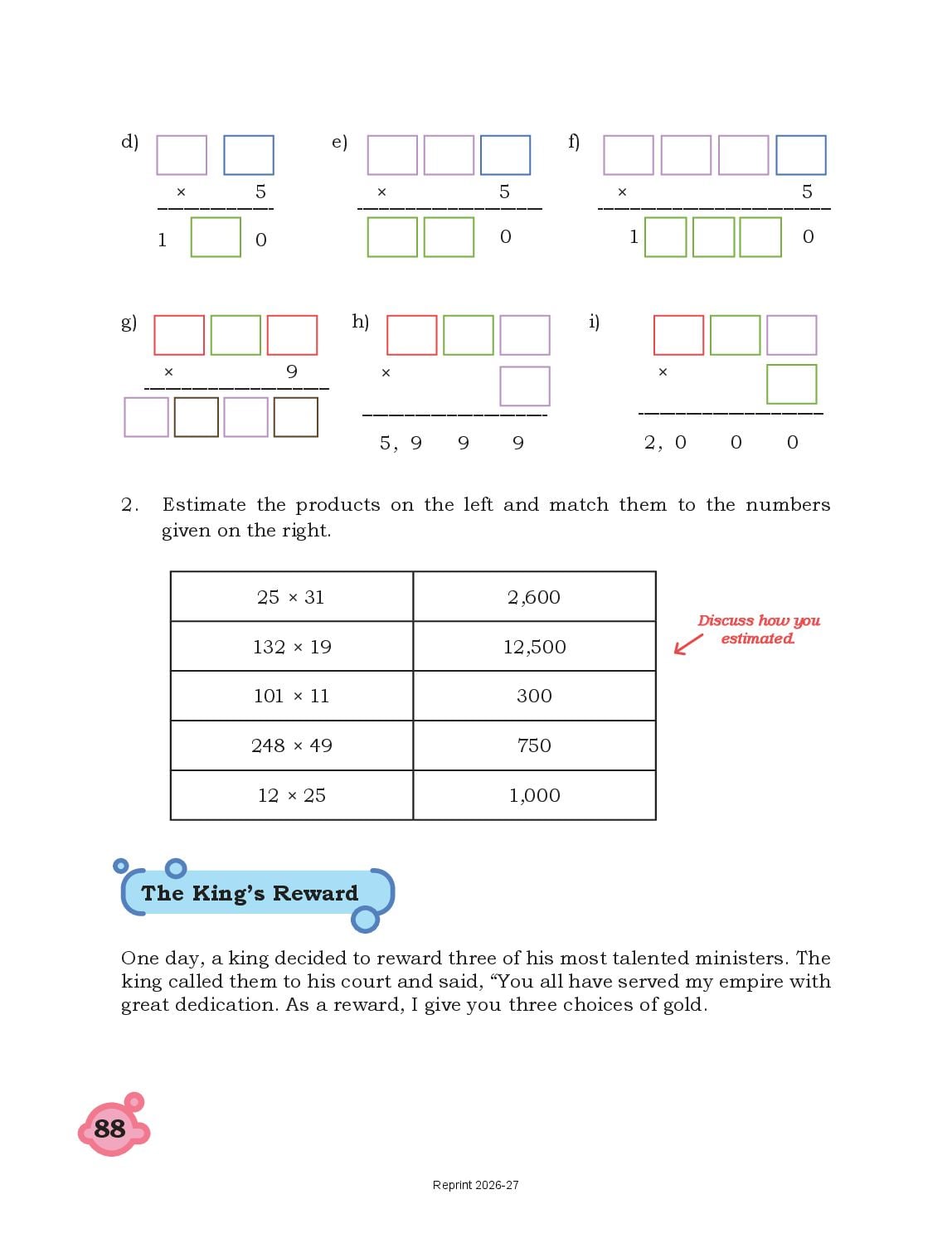
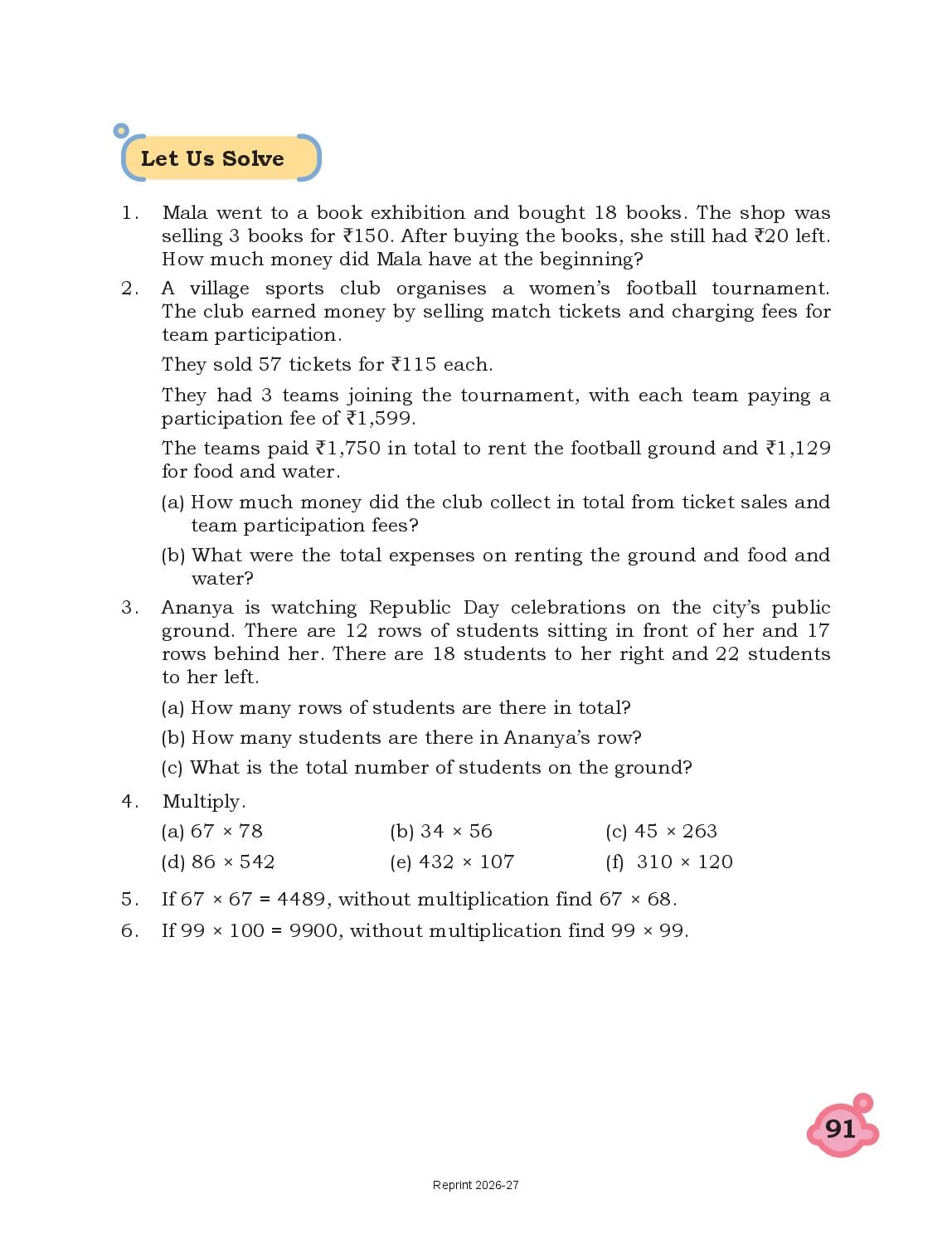
- Estimating. You do not always need the exact answer. 248 × 49 is close to 250 × 50 = 12,500. 25 × 31 is close to 25 × 30 = 750. Rounding each number to a friendly one gives an answer that is near enough to check your work against.
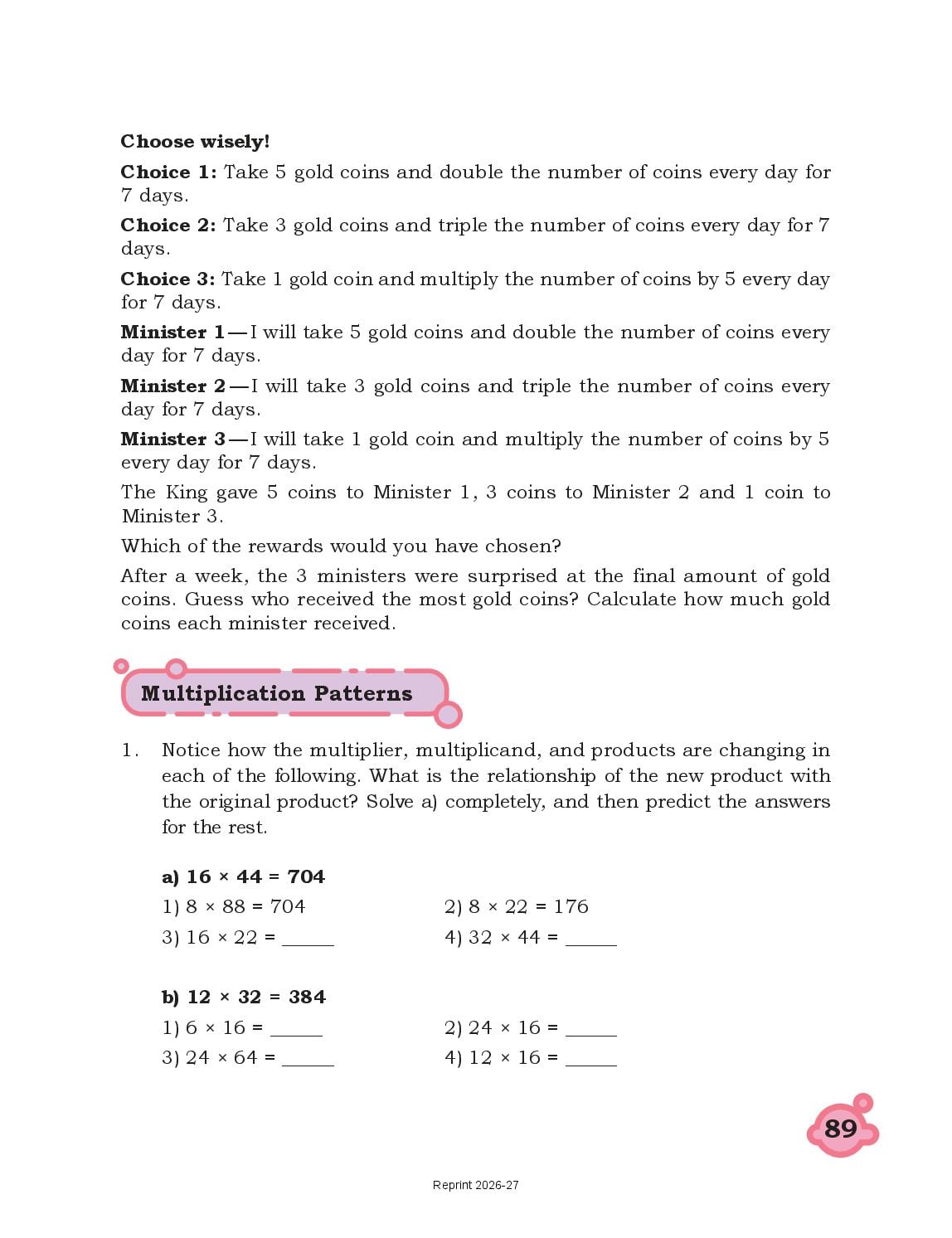
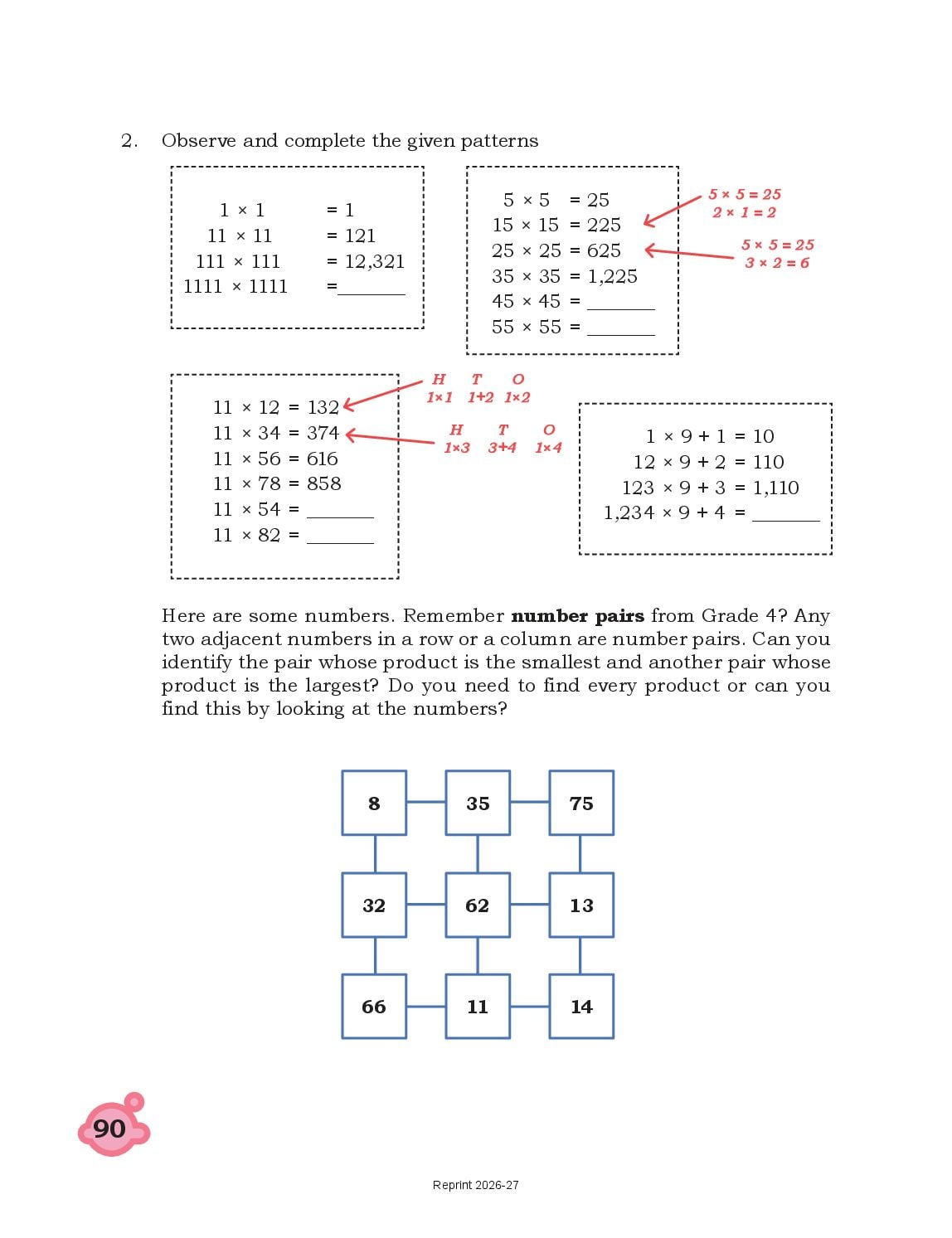
- Patterns are shortcuts you can see. Halve one number and the product halves: 16 × 22 is half of 16 × 44. Double one number and the product doubles. Double both and the product becomes four times as big. And a chain like 1 × 1 = 1, 11 × 11 = 121, 111 × 111 = 12,321 lets you write the next answer without multiplying at all.
Quick revision – The Dairy Farm
| Word | What it means | Where it appears | Example |
|---|---|---|---|
| Product | The answer you get when you multiply | Page 72 onwards | The product of 6 and 13 is 78 |
| Multiplicand | The number being multiplied | Doubling and Halving, page 76 | In 14 × 3, the multiplicand is 14 |
| Multiplier | The number you multiply by | Doubling and Halving, page 76 | In 14 × 3, the multiplier is 3 |
| Number of groups | How many equal groups there are | Order of Numbers in Multiplication, page 72 | 6 groups of 13 packets |
| Group size | How many things are in one group | Order of Numbers in Multiplication, page 72 | Group size 13 |
| Place value | What a digit is worth because of where it sits | Pages 73, 81, 82 | In 268, the 6 is worth 6 tens = 60 |
| Doubling and halving | Double one number and halve the other; the product does not change | Doubling and Halving, page 75 | 3 × 18 = 6 × 9 = 54 |
| Nearest multiple | A friendly number close by, like 20 or 100, that is easy to multiply | Nearest Multiple, page 76 | 4 × 19 = 4 × 20 − 4 = 76 |
| Estimate | A quick answer that is close, not exact | Page 88 | 248 × 49 is about 12,500 |
| Multiple | A number you reach by counting in steps of another number | Page 71 | 18, 27, 36 are multiples of 9 |
| Carrying | Moving a ten, hundred or thousand from one column to the next | Dairy Cooperative, pages 81–83 | The 30 in 32 goes to the tens column |
| Number pair | Two numbers that sit next to each other in a row or a column | Page 90 | 11 and 14 in the grid |
Old NCERT vs New – Class 5 Maths
This chapter is from Maths Mela, the new NCERT Class 5 Maths book (NCF-SE 2023, used from 2025-26). It replaced the old book “Math-Magic”, so chapter numbers and names differ from older PDFs.
Solutions and All Chapters
Answers to the exercises and the full chapter list of Maths Mela:
The Dairy Farm – Overview
| Class | Class 5 |
| Subject | Maths |
| Book | Maths Mela – new NCERT book |
| Chapter | 6 of 15 – The Dairy Farm |
| Book pages | 70 – 91 |
| Edition | NCERT Reprint 2026-27 |
| Session | 2026-27 |
| Free – read online or download |
Class 5 Maths Chapter 6 – FAQs
Where can I download The Dairy Farm Class 5 PDF?
From the download table on this page – the chapter PDF is free, and the full book is linked too.
What is Class 5 Maths Chapter 6 about?
Order does not change a product. Daljeet Kaur puts 6 groups of 13 butter packets on a tray. Turn the tray sideways and it becomes 13 groups of 6. The packets did not move, so the total is the same: 6 × 13 = 13 × 6 = 78. This is true for every pair of numbers.
Is The Dairy Farm from the new NCERT Class 5 Maths book?
Yes. It is chapter 6 of maths mela, the new NCERT Class 5 Maths book for 2026-27.
Is this the latest NCERT edition for 2026-27?
Yes – the PDF is NCERT’s latest edition for the 2026-27 session.
Where are the NCERT Solutions for Class 5 Maths Chapter 6?
Open the NCERT Solutions link above for answers to the exercise questions.