Download Far and Near – NCERT Class 5 Maths Chapter 5 PDF from the new NCERT Class 5 Maths book Maths Mela (2026-27). Read the chapter online or download the free PDF. Choose the unit that fits the thing. A handkerchief is about 40 cm long. India Gate is about 42 m tall. Both use the number 40-something, but one needs centimetres and the other needs metres. Ask yourself: is this thing about as big as my hand, my…
Far and Near PDF – Chapter 5 of Maths Mela
Read the chapter online or download the PDF.
| Chapter | Download | |
|---|---|---|
| Chapter 5 PDF | Far and Near | View PDF |
| Full book | NCERT Class 5 Maths – Maths Mela | View Book |
Read Online
What Is in Far and Near? (Class 5 Maths Chapter 5)
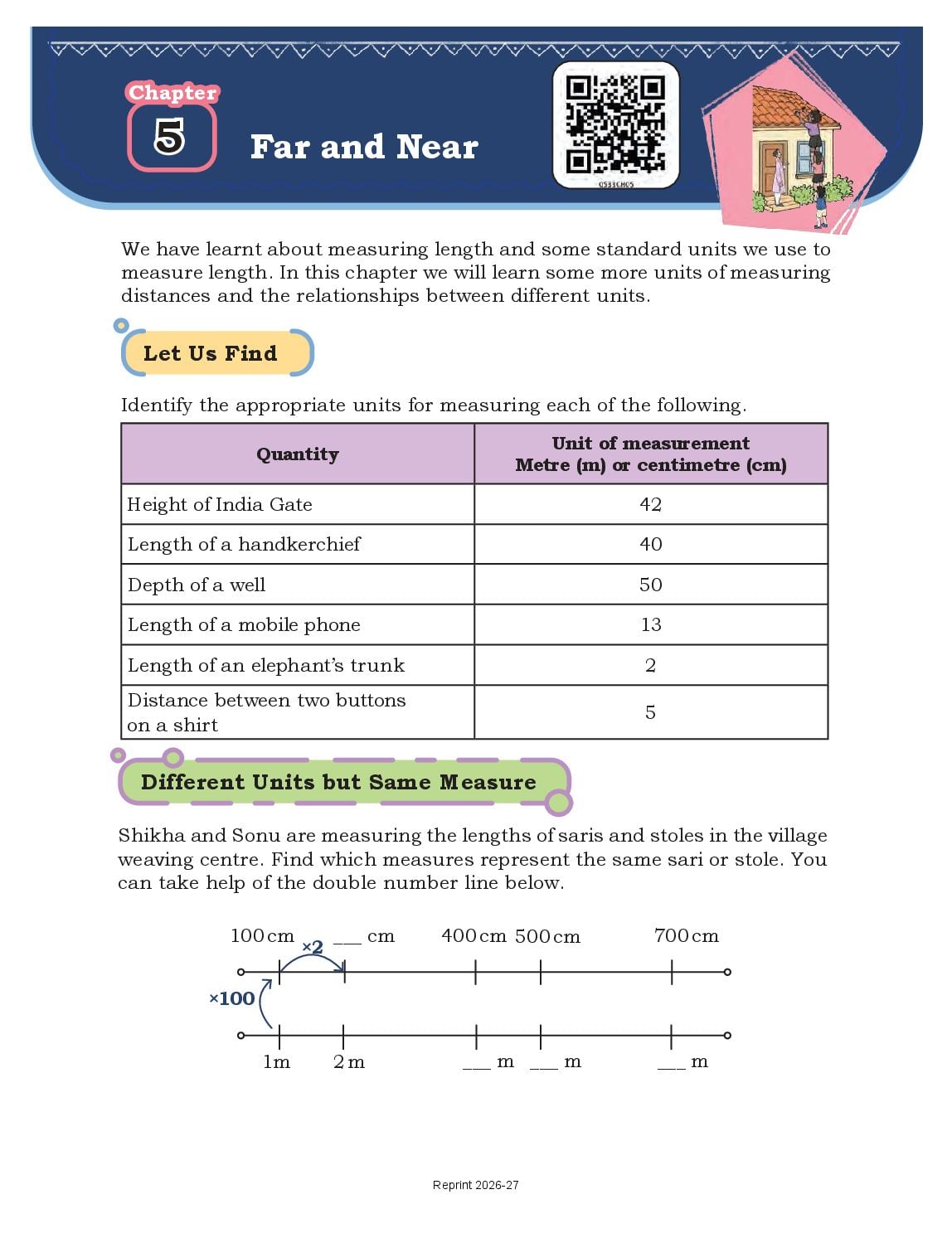
- Choose the unit that fits the thing. A handkerchief is about 40 cm long. India Gate is about 42 m tall. Both use the number 40-something, but one needs centimetres and the other needs metres. Ask yourself: is this thing about as big as my hand, my classroom, or my village? Small things take cm, room-sized things take m, far-away places take km.
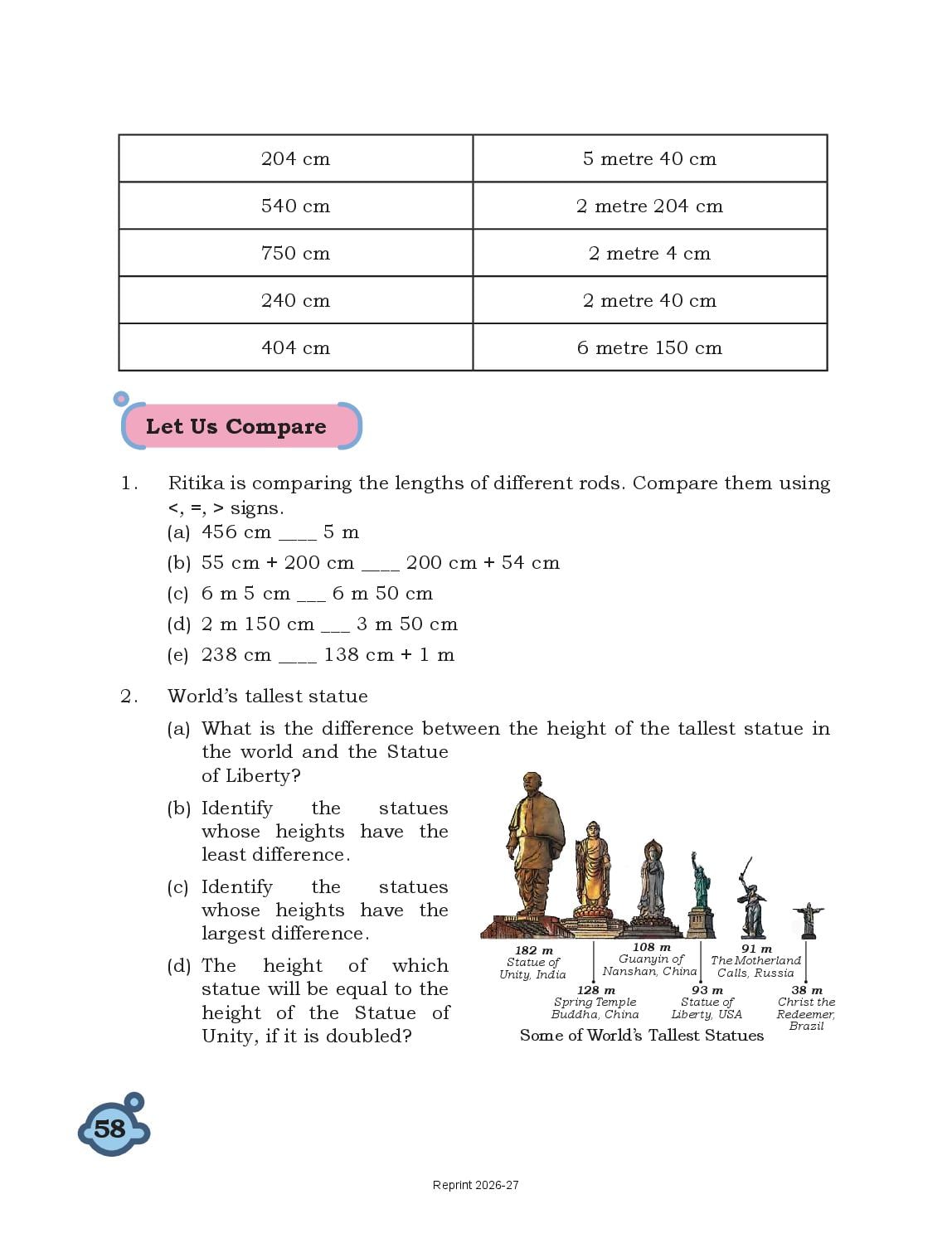
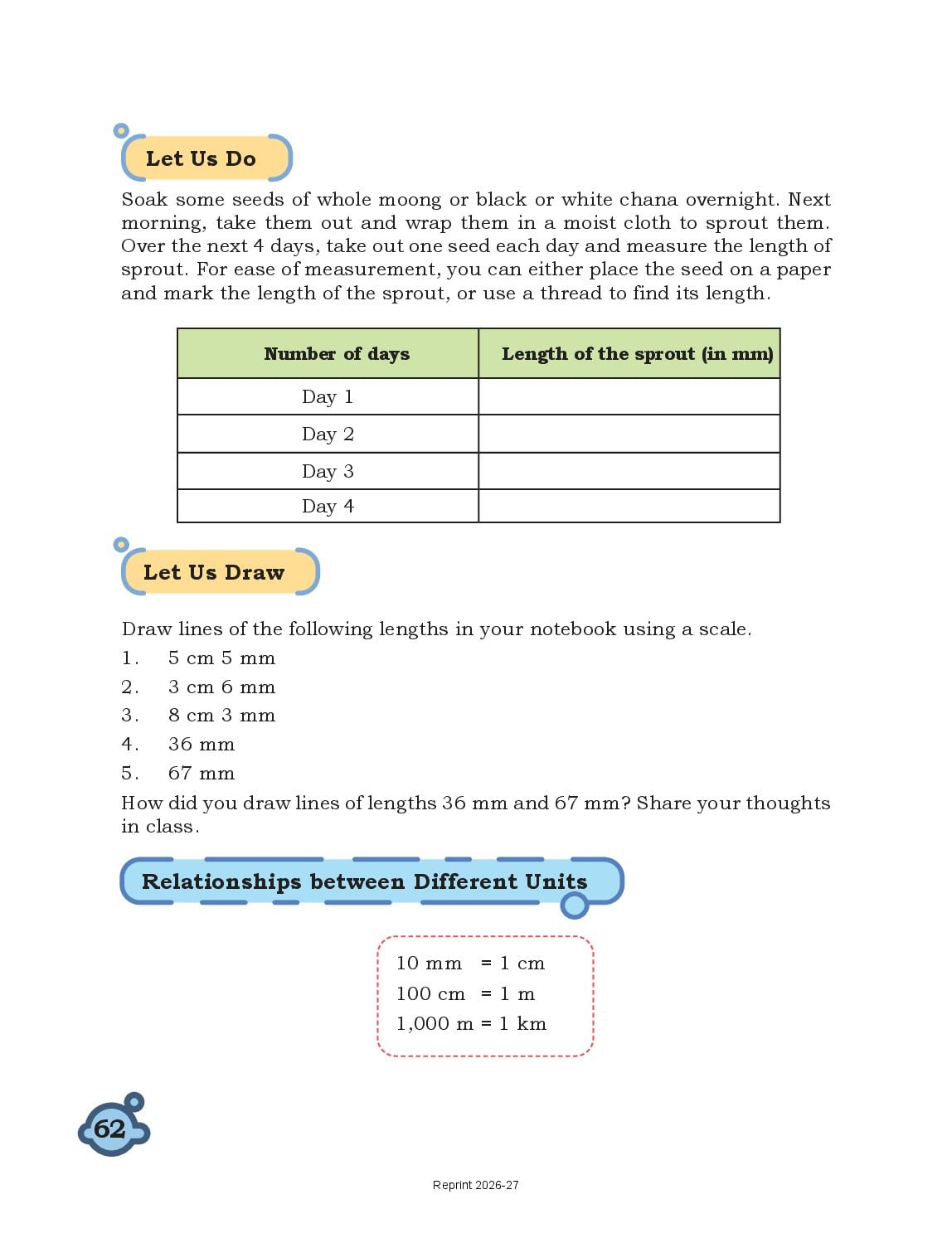
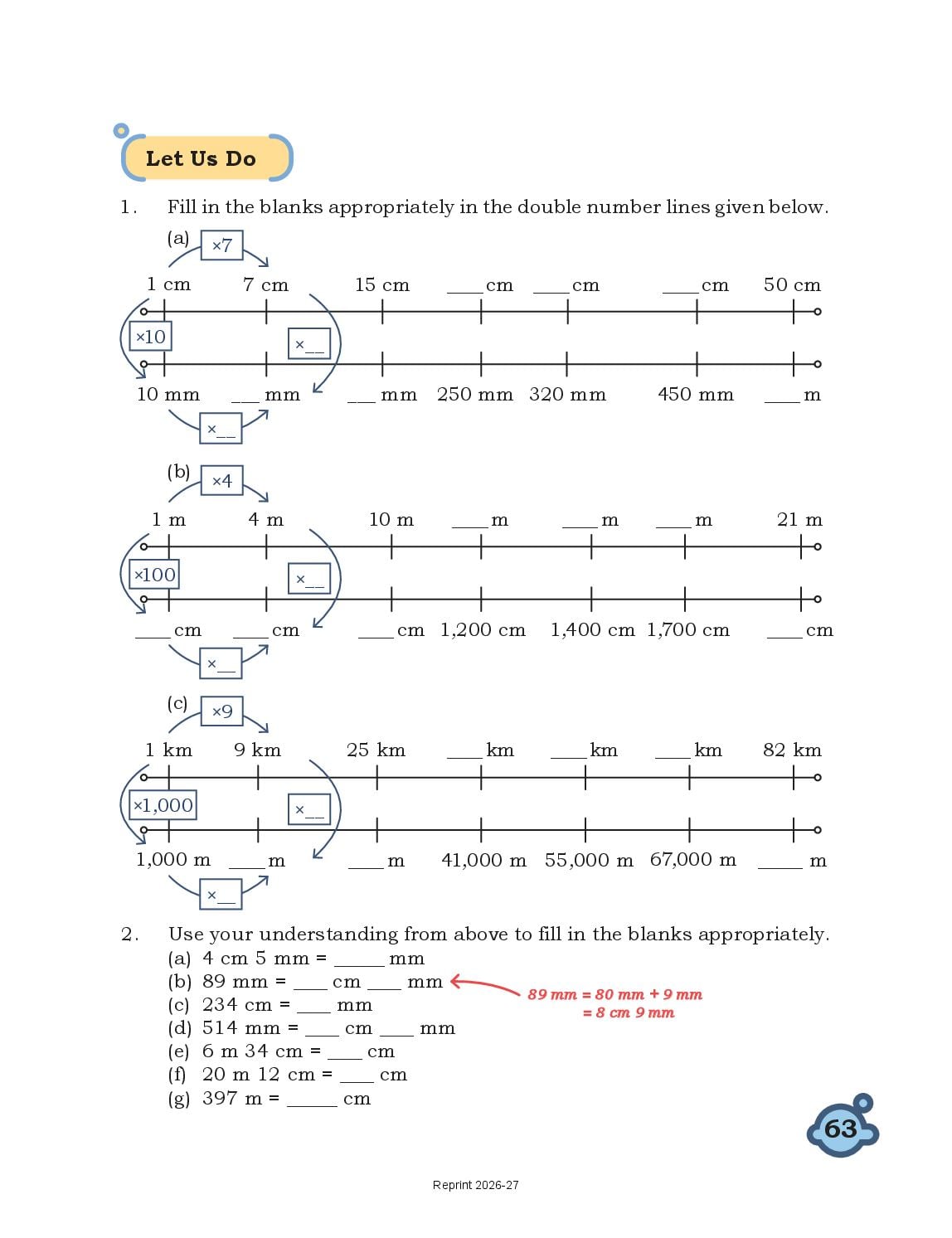
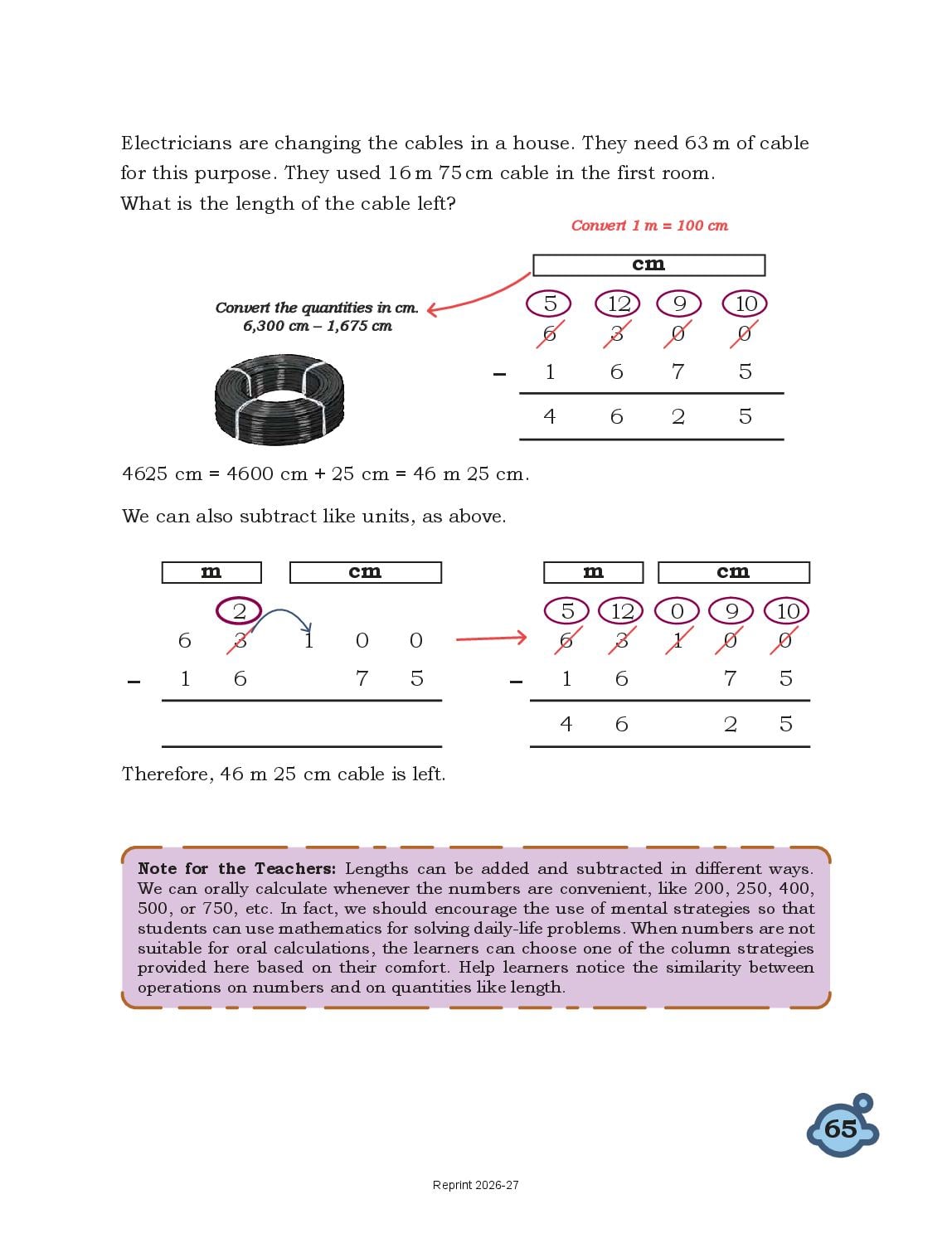
- 1 m = 100 cm. So a metre is a hundred centimetres joined in a line. To change metres into centimetres, multiply by 100. 6 m = 6 × 100 = 600 cm. To change centimetres into metres, see how many hundreds are inside. 540 cm = 500 cm + 40 cm = 5 m 40 cm.
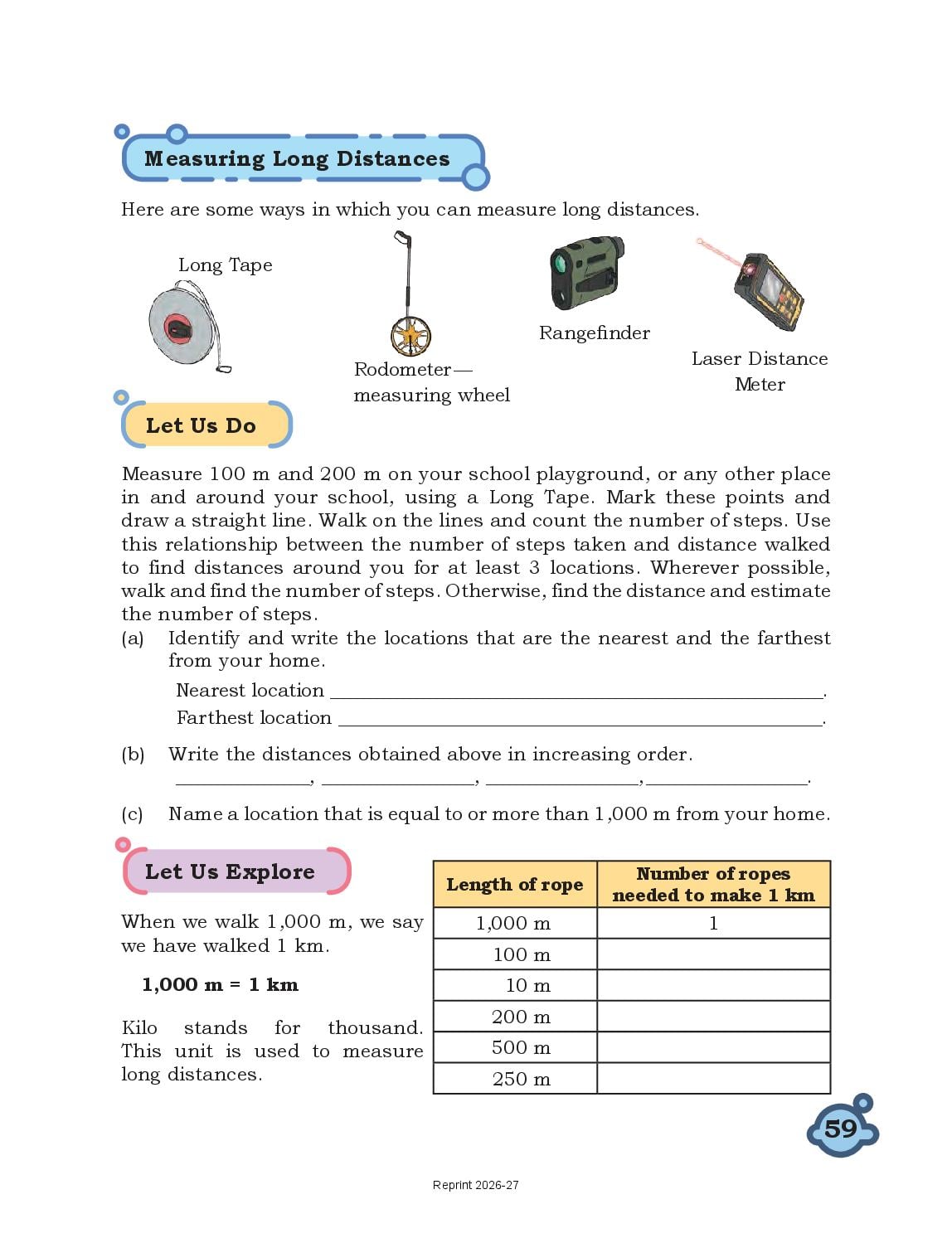
- 1 km = 1,000 m. Kilo means thousand. When you walk 1,000 m, you have walked 1 km. This is the unit for long distances — the road to the next town, a train journey, a race. 34 km = 34 × 1,000 = 34,000 m.
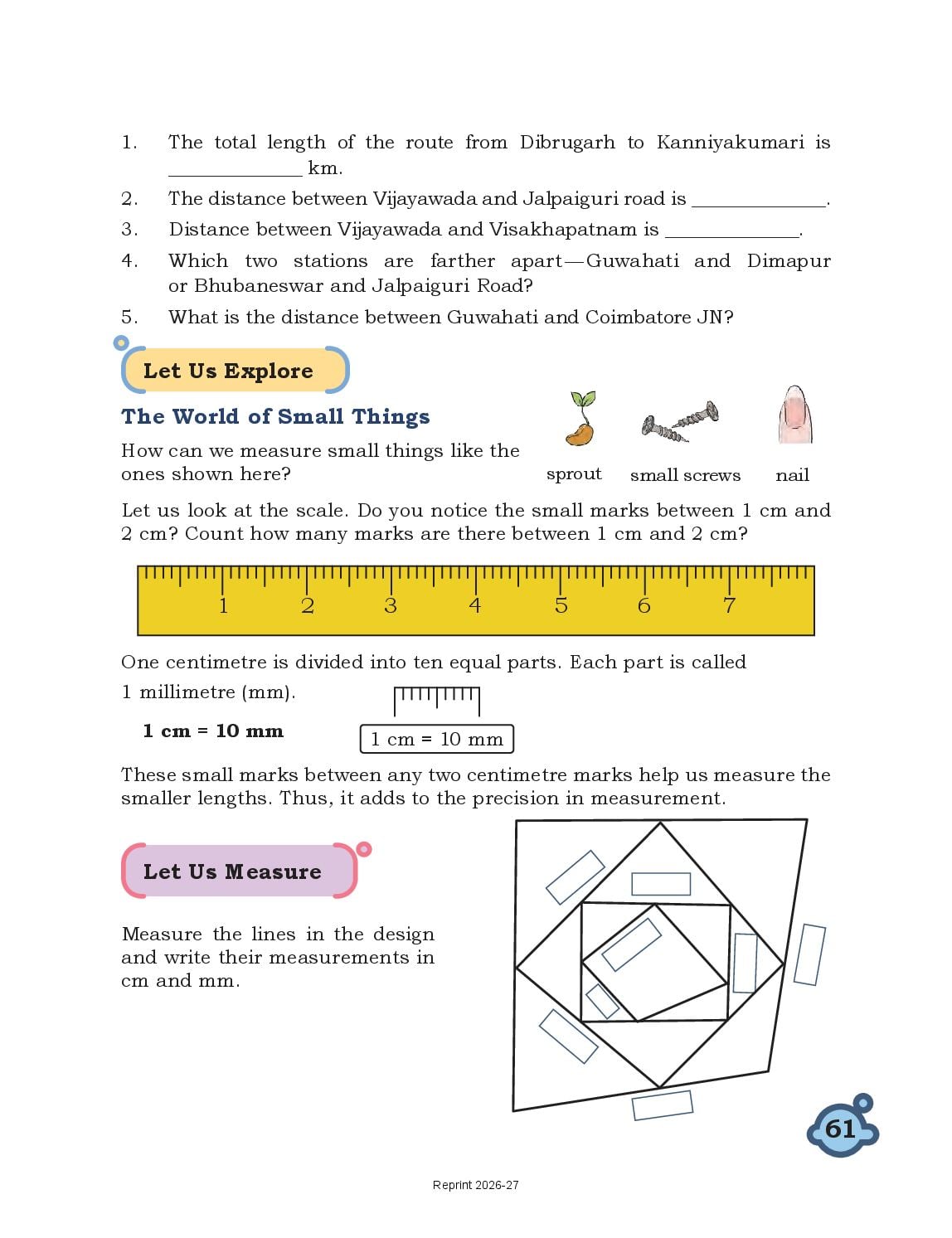
- 1 cm = 10 mm. Look at your ruler. Between the 1 and the 2 there are nine small lines, which cut that centimetre into ten equal parts. Each tiny part is one millimetre. Millimetres let us measure small things — a sprout, a screw, a nail. 89 mm = 80 mm + 9 mm = 8 cm 9 mm.
- The same length can be written in two ways. 750 cm and 6 m 150 cm look different but they are the same length, because 6 m 150 cm = 600 cm + 150 cm = 750 cm. Before you compare two lengths, always change both into the same unit. Then compare like ordinary numbers.
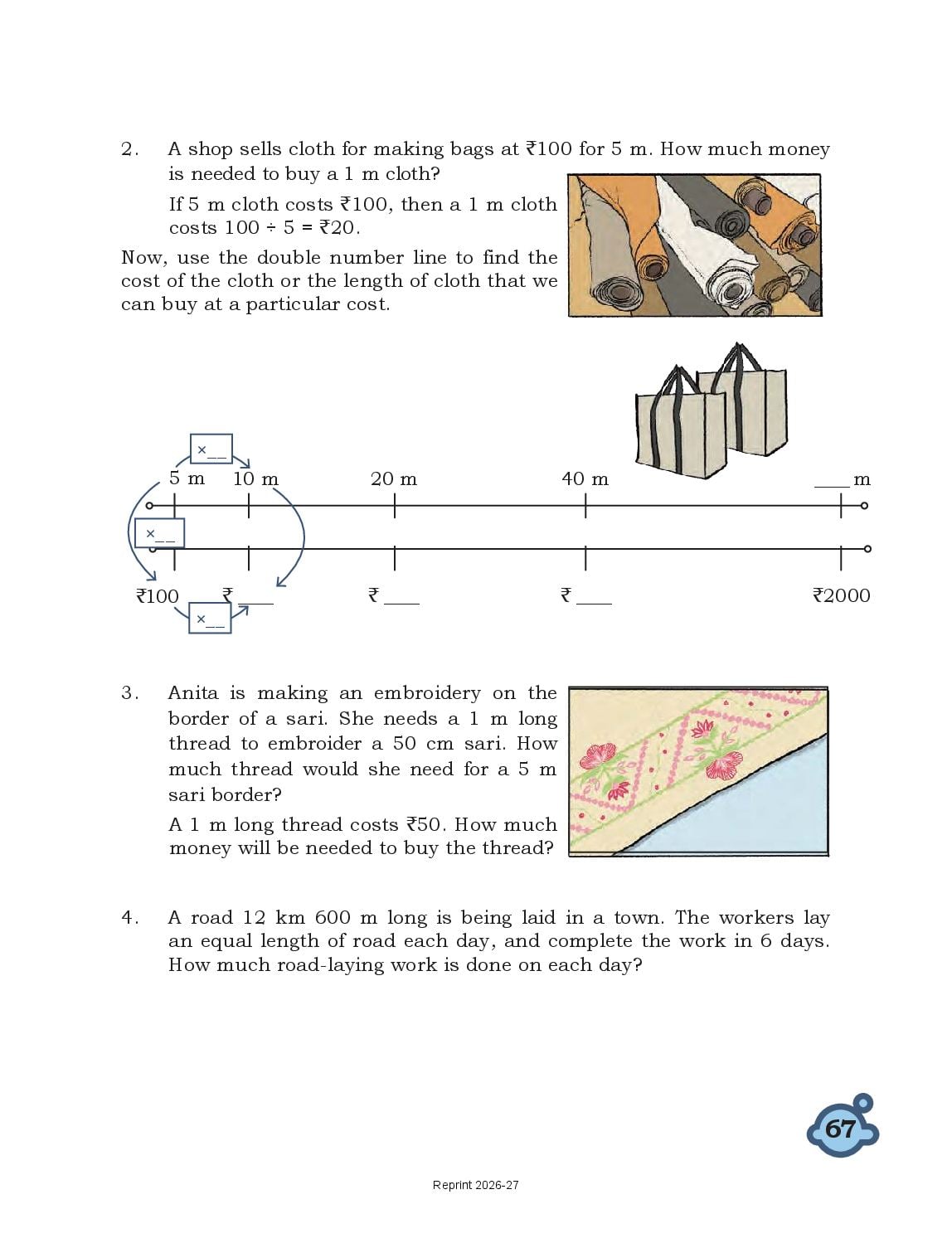
- A double number line shows two units together. One line is marked in cm, the line below it in mm, and the two lines are lined up tick for tick. Jumping from the top line to the bottom line means multiplying by 10. Jumping sideways along a line means multiplying by 7, or 4, or whatever the step is. It is a picture of a conversion.
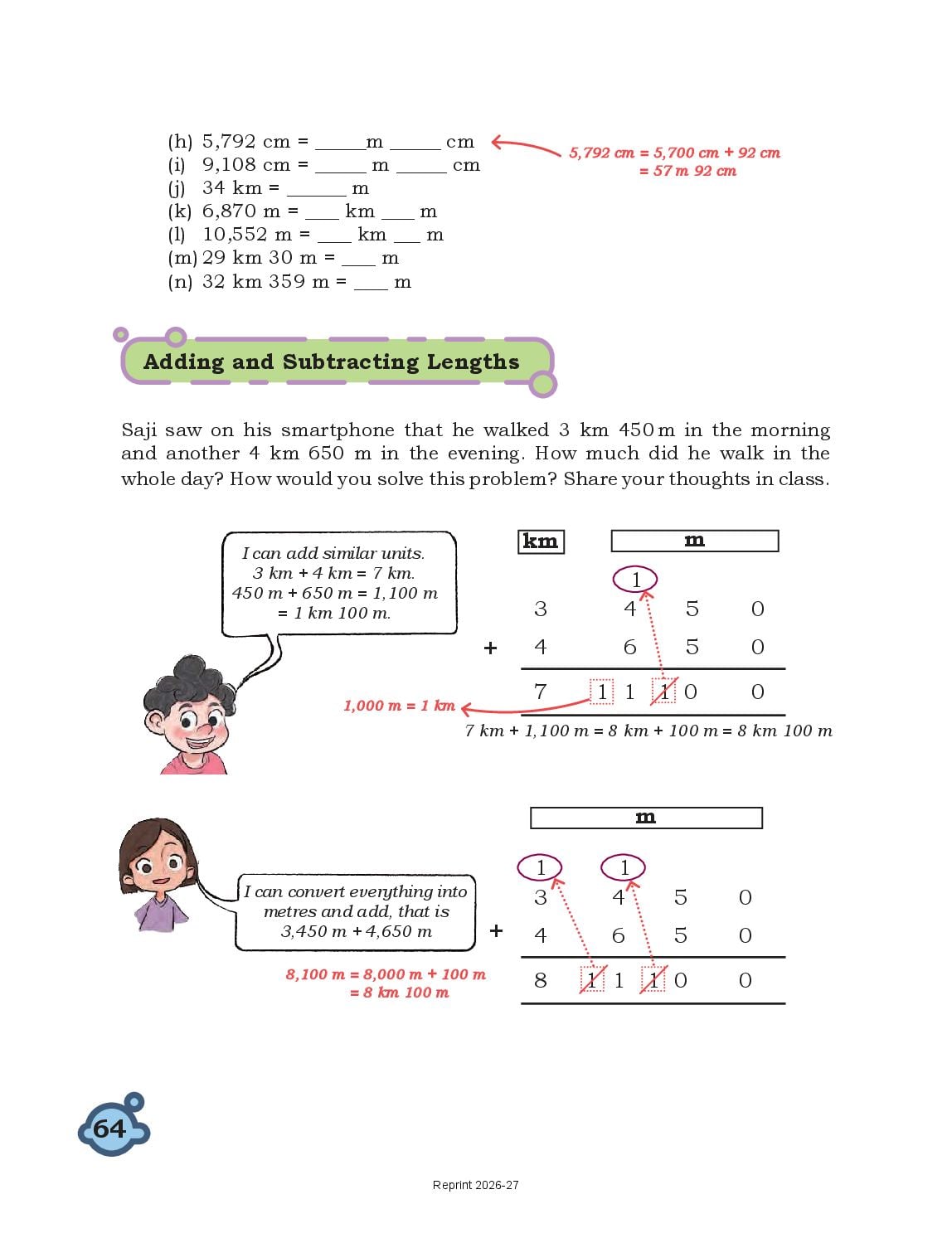
- Adding and subtracting lengths. There are two safe ways. Way 1 — add the same units together: 3 km + 4 km = 7 km, and 450 m + 650 m = 1,100 m, which is 1 km 100 m, so the total is 8 km 100 m. Way 2 — change everything into the smaller unit first: 3,450 m + 4,650 m = 8,100 m = 8 km 100 m. Both give the same answer.
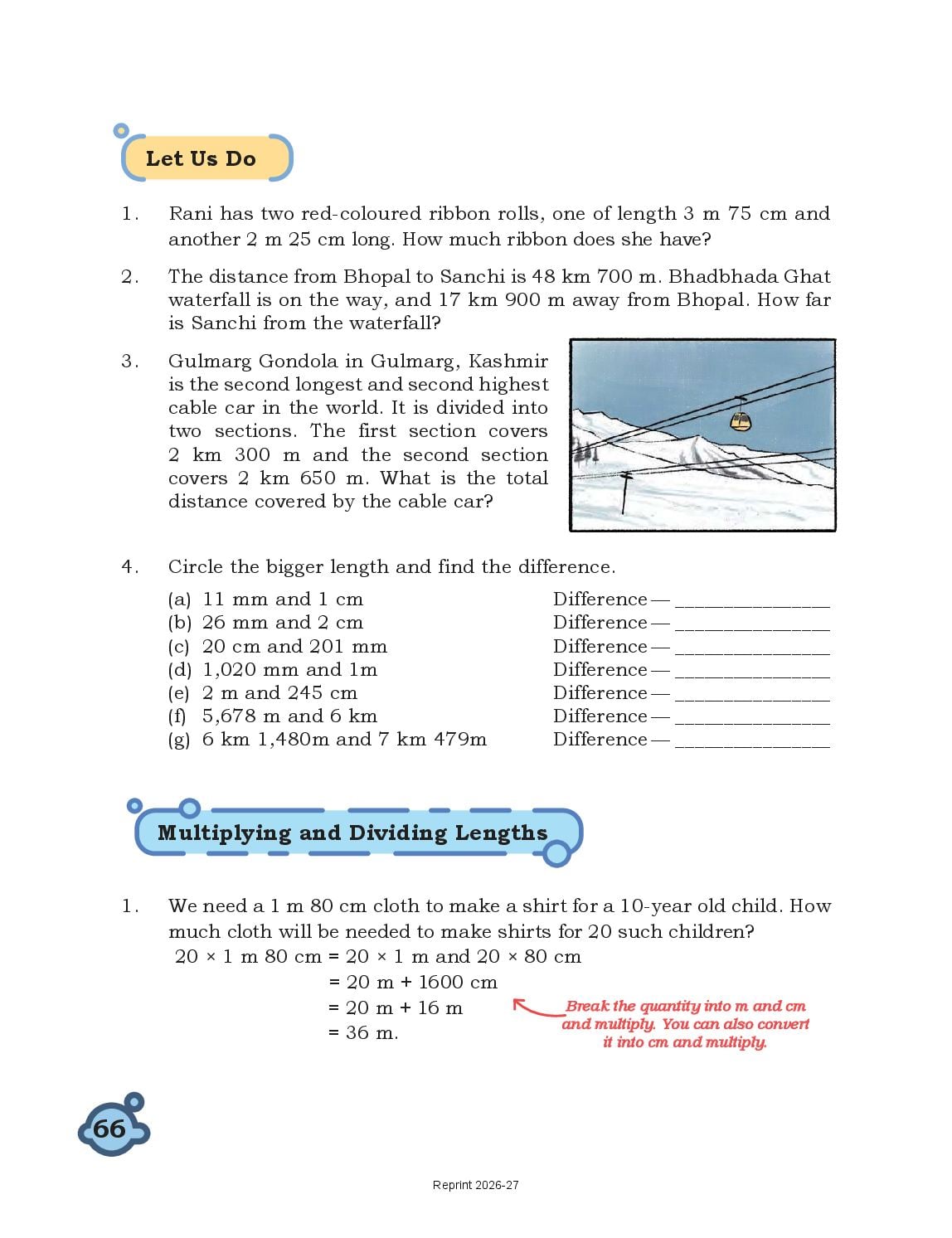
- Multiplying and dividing lengths. Break the length into its two parts and work on each. 20 shirts × 1 m 80 cm = (20 × 1 m) + (20 × 80 cm) = 20 m + 1,600 cm = 20 m + 16 m = 36 m. For dividing, change into the smaller unit: 12 km 600 m ÷ 6 = 12,600 m ÷ 6 = 2,100 m = 2 km 100 m each day.
Quick revision – Far and Near
| Word | What it means | Where it appears | Example |
|---|---|---|---|
| Length | How long a thing is from end to end | Page 57, first paragraph | A handkerchief is 40 cm long |
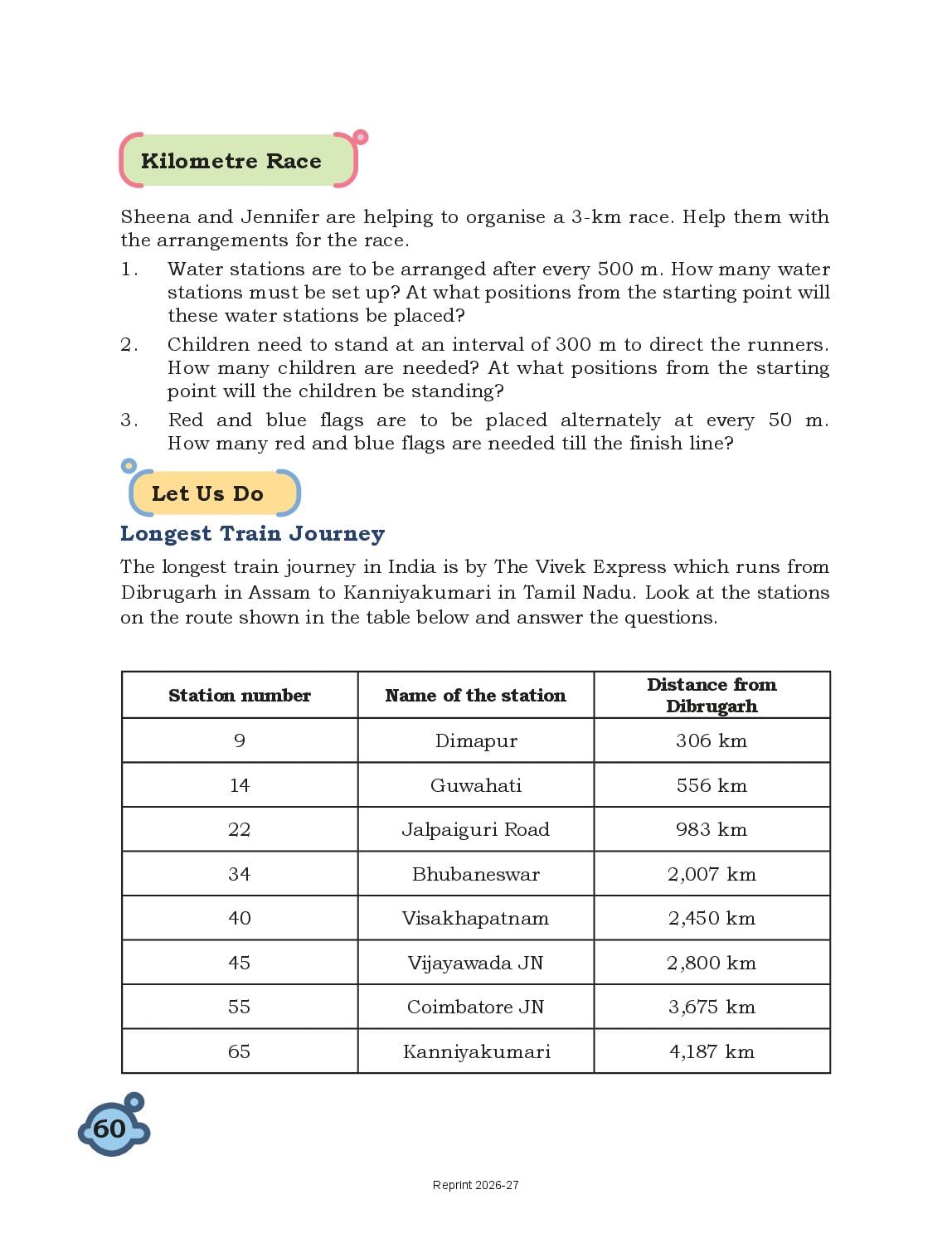
| Distance | How far apart two places are | Chapter title Far and Near, page 57 | Dibrugarh to Kanniyakumari is 4,187 km |
| Centimetre (cm) | A small standard unit; the numbered marks on your ruler | Let Us Find, page 57 | A mobile phone is about 13 cm long |
| Metre (m) | 100 centimetres joined in a line | Let Us Find, page 57 | A well can be 50 m deep |
| Millimetre (mm) | One of the ten equal parts of a centimetre | The World of Small Things, page 61 | 1 cm = 10 mm |
| Kilometre (km) | 1,000 metres; used for long distances | Let Us Explore, page 59 | 3-km race = 3,000 m |
| Kilo | A word meaning thousand | Page 59 | Kilometre = thousand metres |
| Double number line | Two number lines drawn one below the other, lined up, showing the same lengths in two units | Pages 57, 63 and 67 | 1 cm on top, 10 mm below it |
| Long tape | A very long measuring tape used on a playground | Measuring Long Distances, page 59 | Used to mark 100 m and 200 m |
| Rodometer (measuring wheel) | A wheel you push along the ground; it counts how far it has rolled | Measuring Long Distances, page 59 | Used to measure a road |
| Rangefinder / Laser distance meter | Tools that measure a distance without walking it | Measuring Long Distances, page 59 | Used to measure across a field |
| Precision | How exact a measurement is | The World of Small Things, page 61 | Millimetre marks add precision |
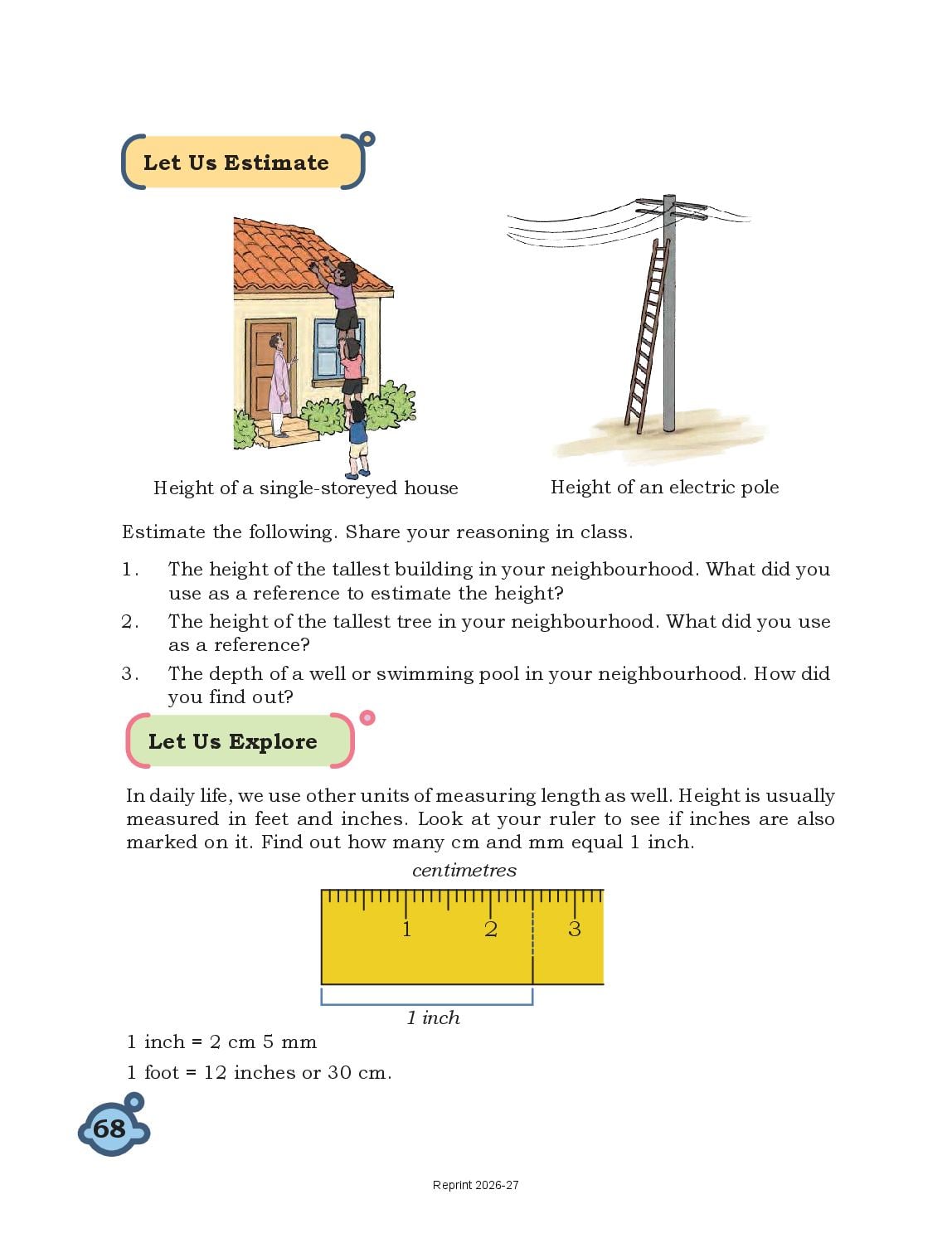
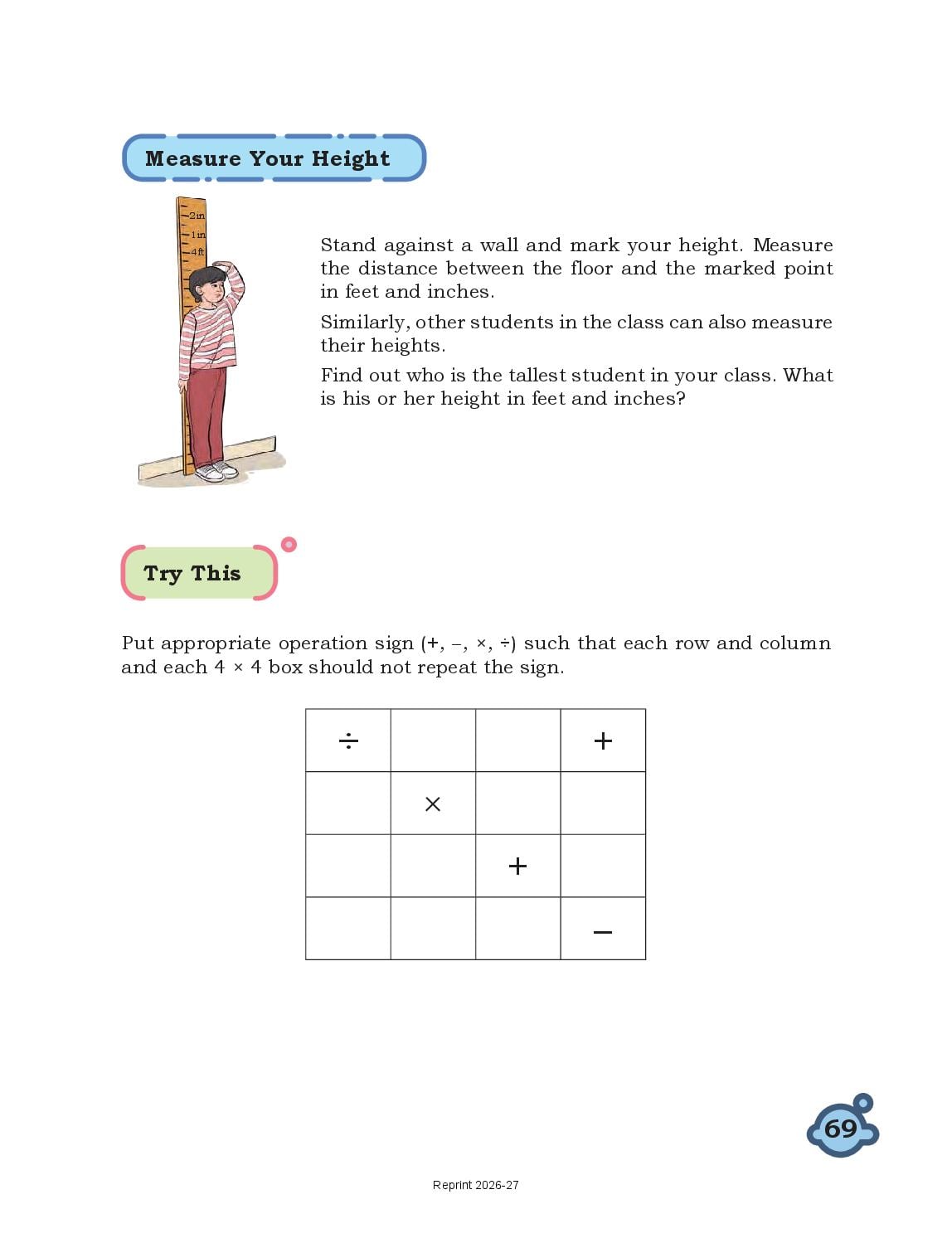
| Inch | A unit used for height; a little more than 2½ cm | Let Us Explore, page 68 | 1 inch = 2 cm 5 mm |
| Foot | 12 inches, about 30 cm | Let Us Explore, page 68 | A child may be 4 ft 2 in tall |
Old NCERT vs New – Class 5 Maths
This chapter is from Maths Mela, the new NCERT Class 5 Maths book (NCF-SE 2023, used from 2025-26). It replaced the old book “Math-Magic”, so chapter numbers and names differ from older PDFs.
Solutions and All Chapters
Answers to the exercises and the full chapter list of Maths Mela:
Far and Near – Overview
| Class | Class 5 |
| Subject | Maths |
| Book | Maths Mela – new NCERT book |
| Chapter | 5 of 15 – Far and Near |
| Book pages | 57 – 69 |
| Edition | NCERT Reprint 2026-27 |
| Session | 2026-27 |
| Free – read online or download |
Class 5 Maths Chapter 5 – FAQs
Where can I download Far and Near Class 5 PDF?
From the download table on this page – the chapter PDF is free, and the full book is linked too.
What is Class 5 Maths Chapter 5 about?
Choose the unit that fits the thing. A handkerchief is about 40 cm long. India Gate is about 42 m tall. Both use the number 40-something, but one needs centimetres and the other needs metres. Ask yourself: is this thing about as big as my hand, my classroom, or my village? Small things take cm, room-sized things take m, far-away places take km.
Is Far and Near from the new NCERT Class 5 Maths book?
Yes. It is chapter 5 of maths mela, the new NCERT Class 5 Maths book for 2026-27.
Is this the latest NCERT edition for 2026-27?
Yes – the PDF is NCERT’s latest edition for the 2026-27 session.
Where are the NCERT Solutions for Class 5 Maths Chapter 5?
Open the NCERT Solutions link above for answers to the exercise questions.