NCERT Solutions for Class 5 Maths Chapter 5 Far and Near provide clear, step-by-step answers to every exercise and in-text question from the chapter Far and Near of the NCERT textbook Math Mela. Prepared by subject experts as per the latest NCERT (CBSE) syllabus for 2026-27, these NCERT Solutions for Class 5 Maths help you understand each concept, write exam-ready answers, and check your own solutions. You can read them online below or download the free Class 5 Maths Chapter 5 question-answer PDF.
NCERT Solutions for Class 5 Maths Chapter 5 Far and Near
- Class: Class 5
- Subject: Maths
- Chapter: Chapter 5 – Far and Near
- Textbook: Math Mela (NCERT)
- Study material: NCERT Solutions – questions with answers, free PDF
These solutions answer all the exercise questions of Chapter 5 Far and Near — including the in-text questions, short-answer and long-answer questions, and activities — with complete explanations so you can follow the method, not just the final answer. Read the full solutions below.
NCERT Solutions Class 5 Maths Chapter 5 Far and Near View Download
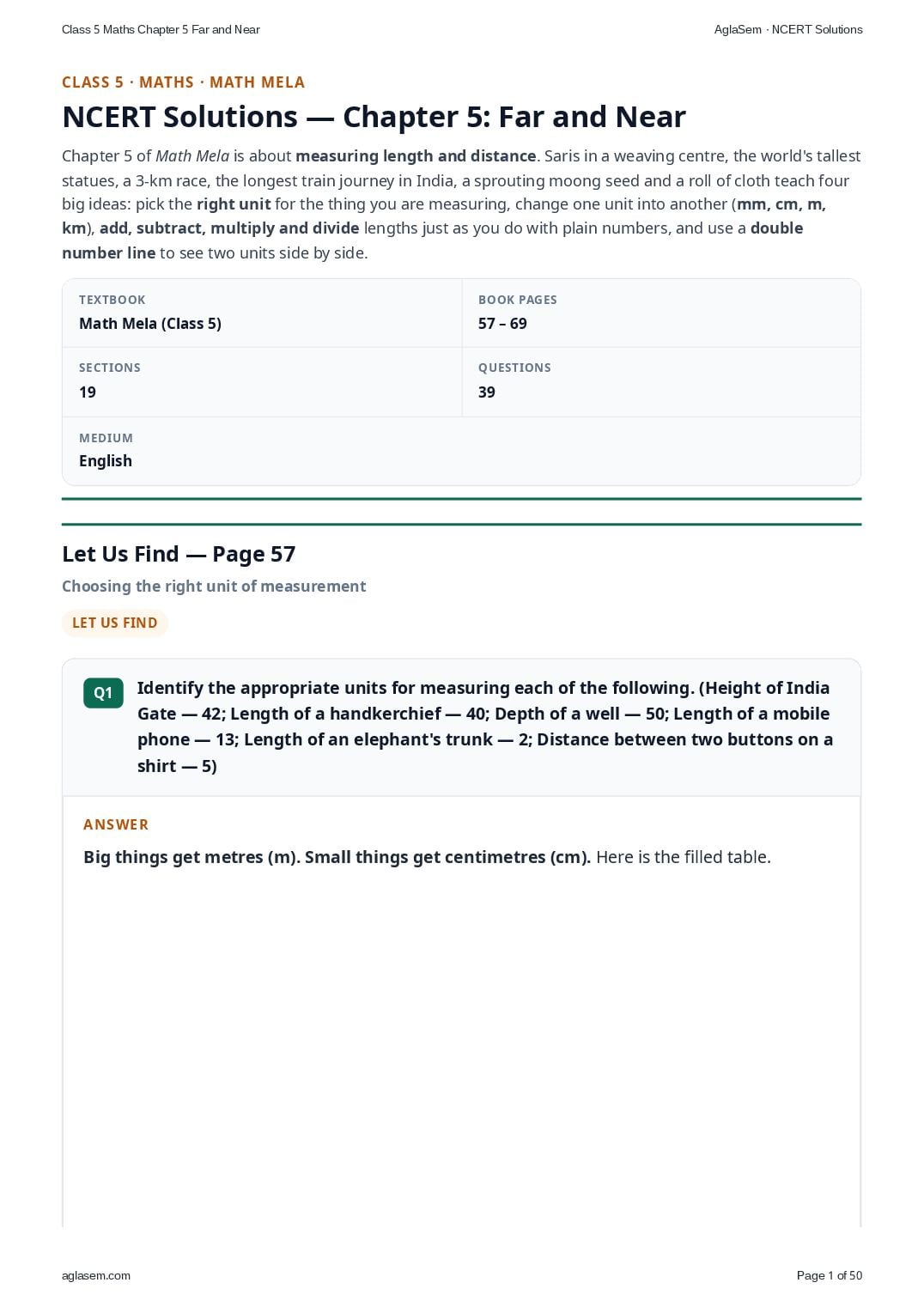
NCERT Solutions for Class 5 Maths Chapter 5 PDF Download
You can read the NCERT Solutions for Class 5 Maths Chapter 5 online above, or download the complete question-answer PDF to study Far and Near offline at any time.
NCERT Solutions for Class 5 Maths Chapter 5 PDF Download Link – Click Here to Download Solutions PDF
Questions Covered in This Chapter
These NCERT Solutions answer all 39 questions of this chapter. The questions solved are:
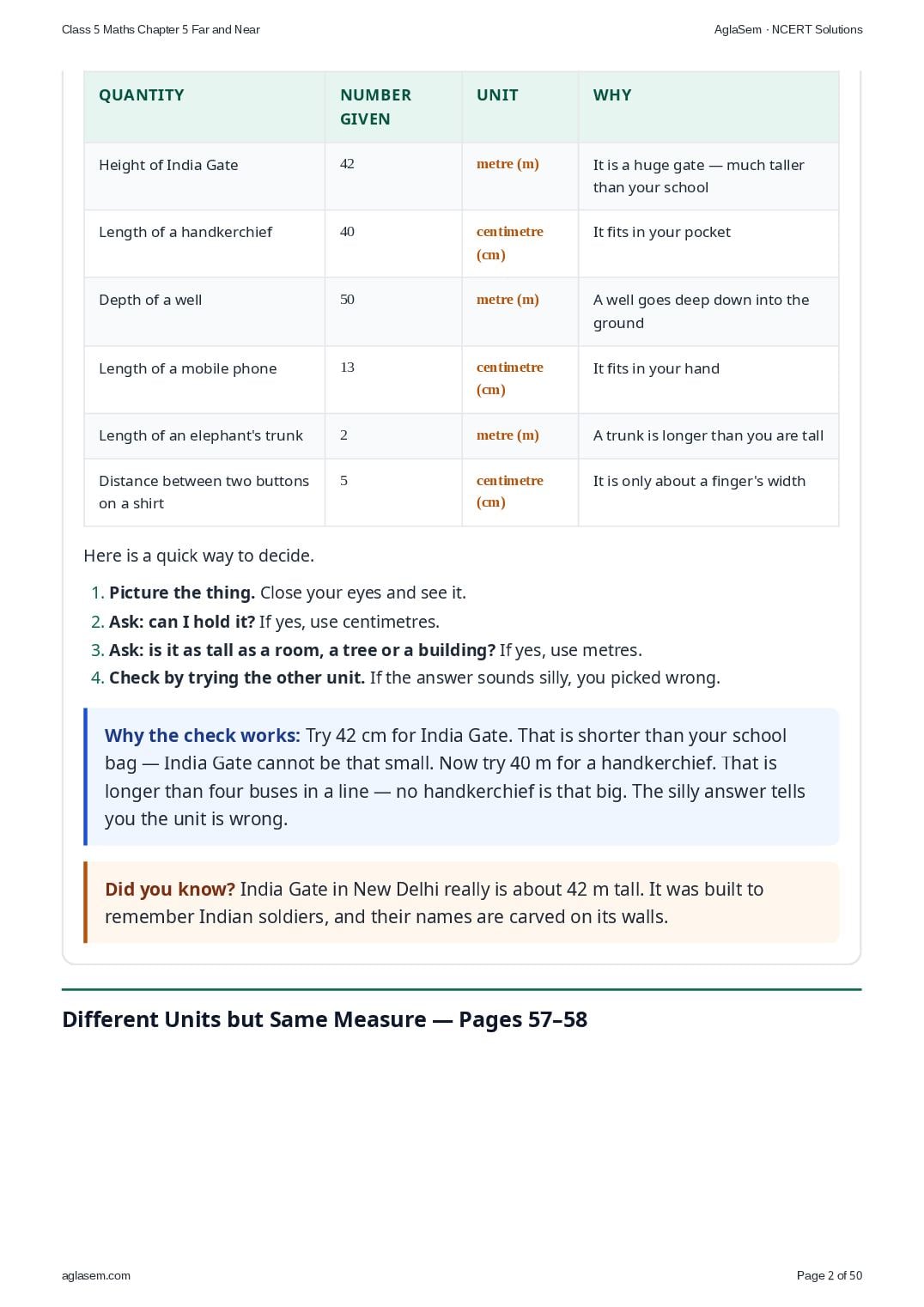
- Identify the appropriate units for measuring each of the following. (Height of India Gate — 42; Length of a handkerchief — 40; Depth of a well — 50; Length of a mobile phone — 13; Length of an elephant’s trunk — 2; Distance between two buttons on a shirt — 5)
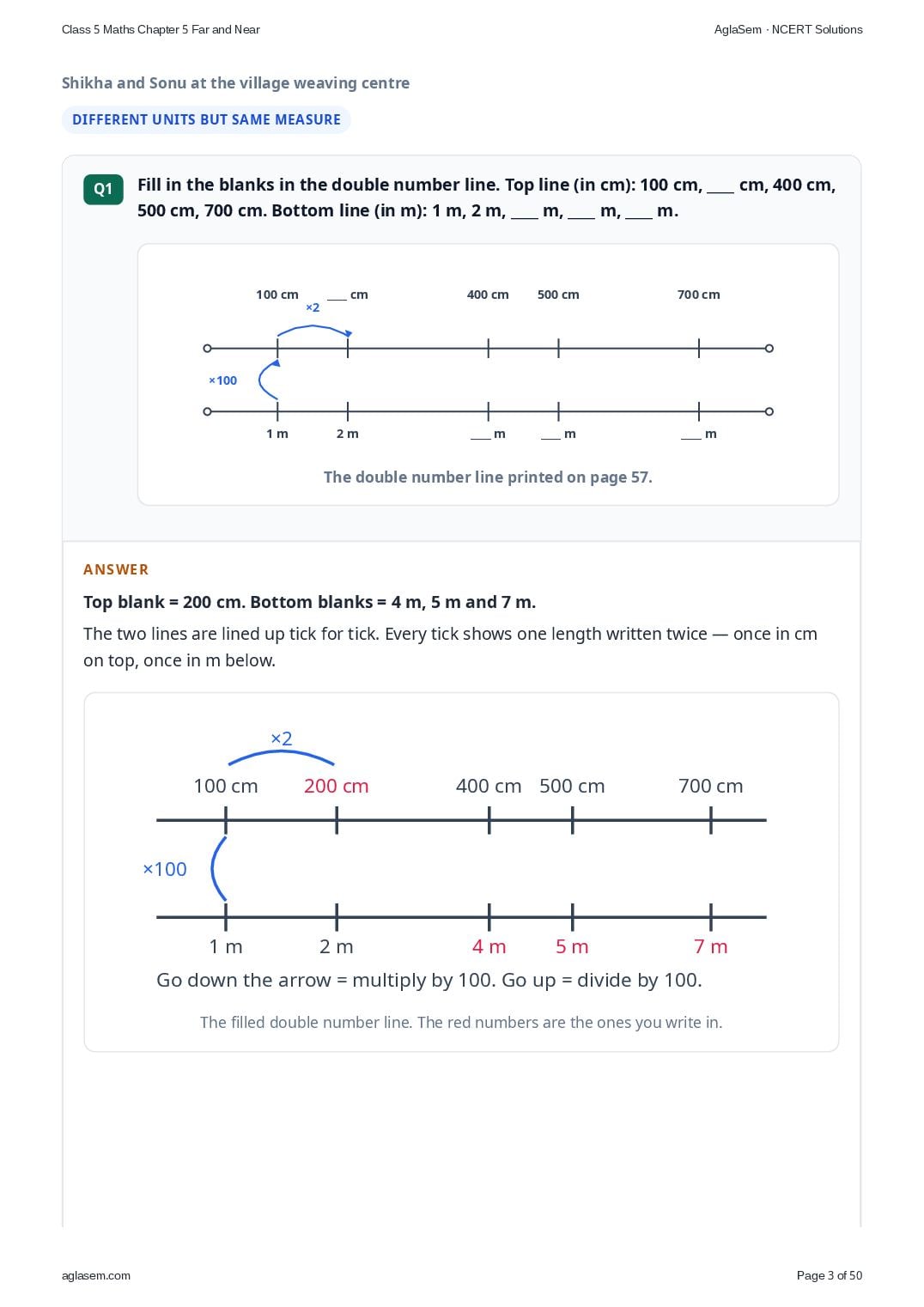
- Fill in the blanks in the double number line. Top line (in cm): 100 cm, ____ cm, 400 cm, 500 cm, 700 cm. Bottom line (in m): 1 m, 2 m, ____ m, ____ m, ____ m. 100 cm____ cm400 cm500 cm700 cm1 m2 m____ m____ m____ m×2×100The double number line printed on page 57.
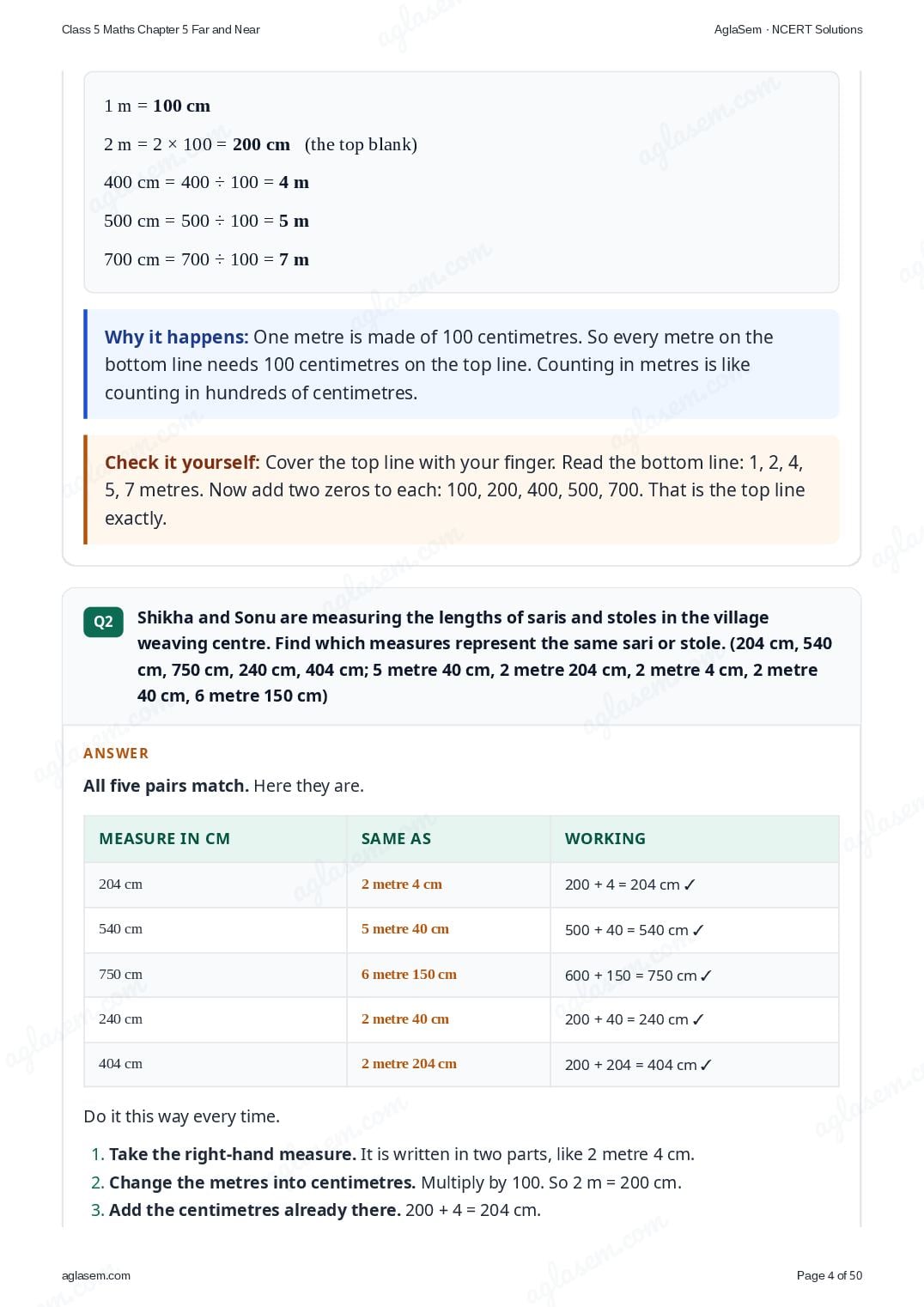
- Shikha and Sonu are measuring the lengths of saris and stoles in the village weaving centre. Find which measures represent the same sari or stole. (204 cm, 540 cm, 750 cm, 240 cm, 404 cm; 5 metre 40 cm, 2 metre 204 cm, 2 metre 4 cm, 2 metre 40 cm, 6 metre 150 cm)
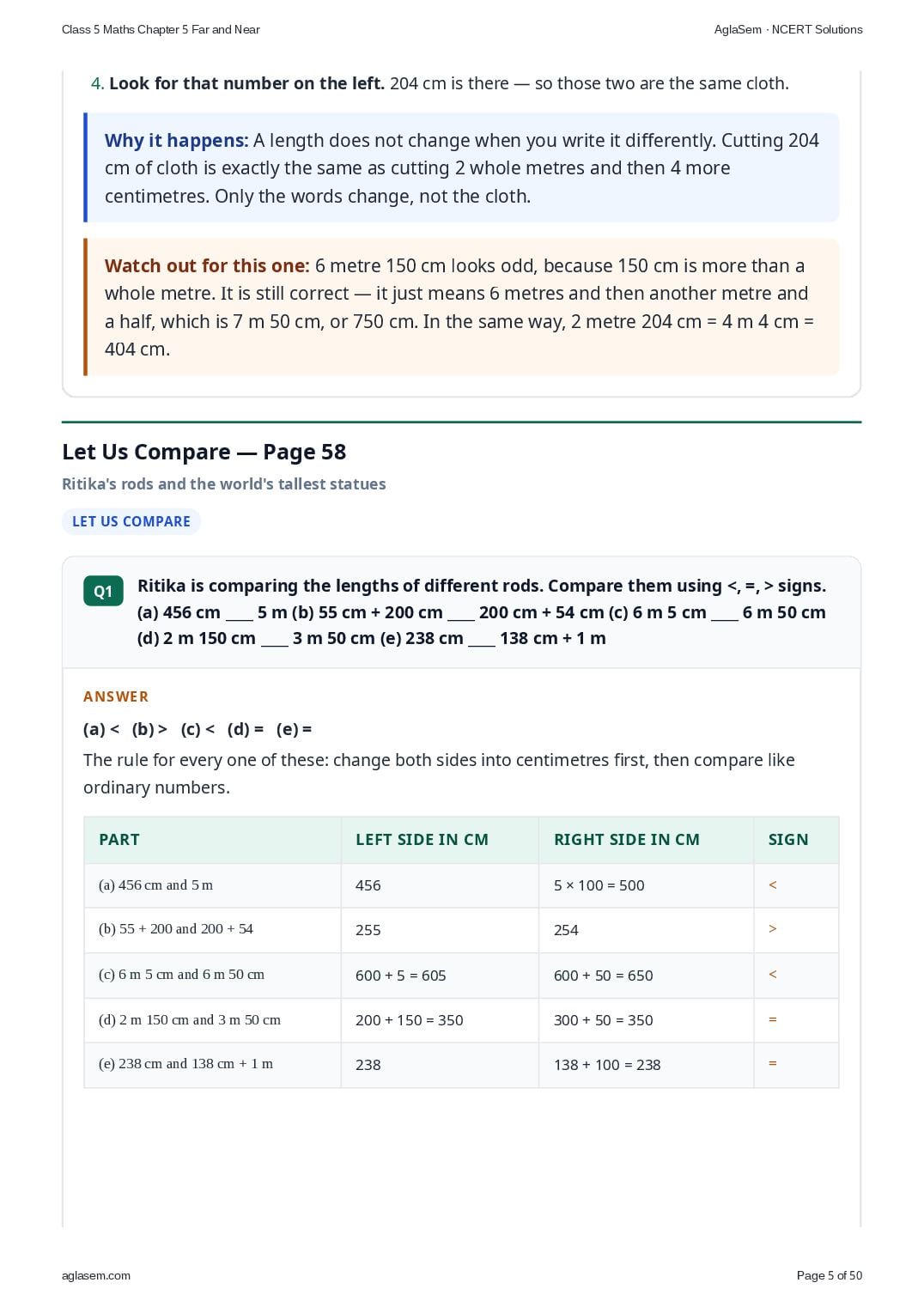
- Ritika is comparing the lengths of different rods. Compare them using <, =, > signs. (a) 456 cm ____ 5 m (b) 55 cm + 200 cm ____ 200 cm + 54 cm (c) 6 m 5 cm ____ 6 m 50 cm (d) 2 m 150 cm ____ 3 m 50 cm (e) 238 cm ____ 138 cm + 1 m
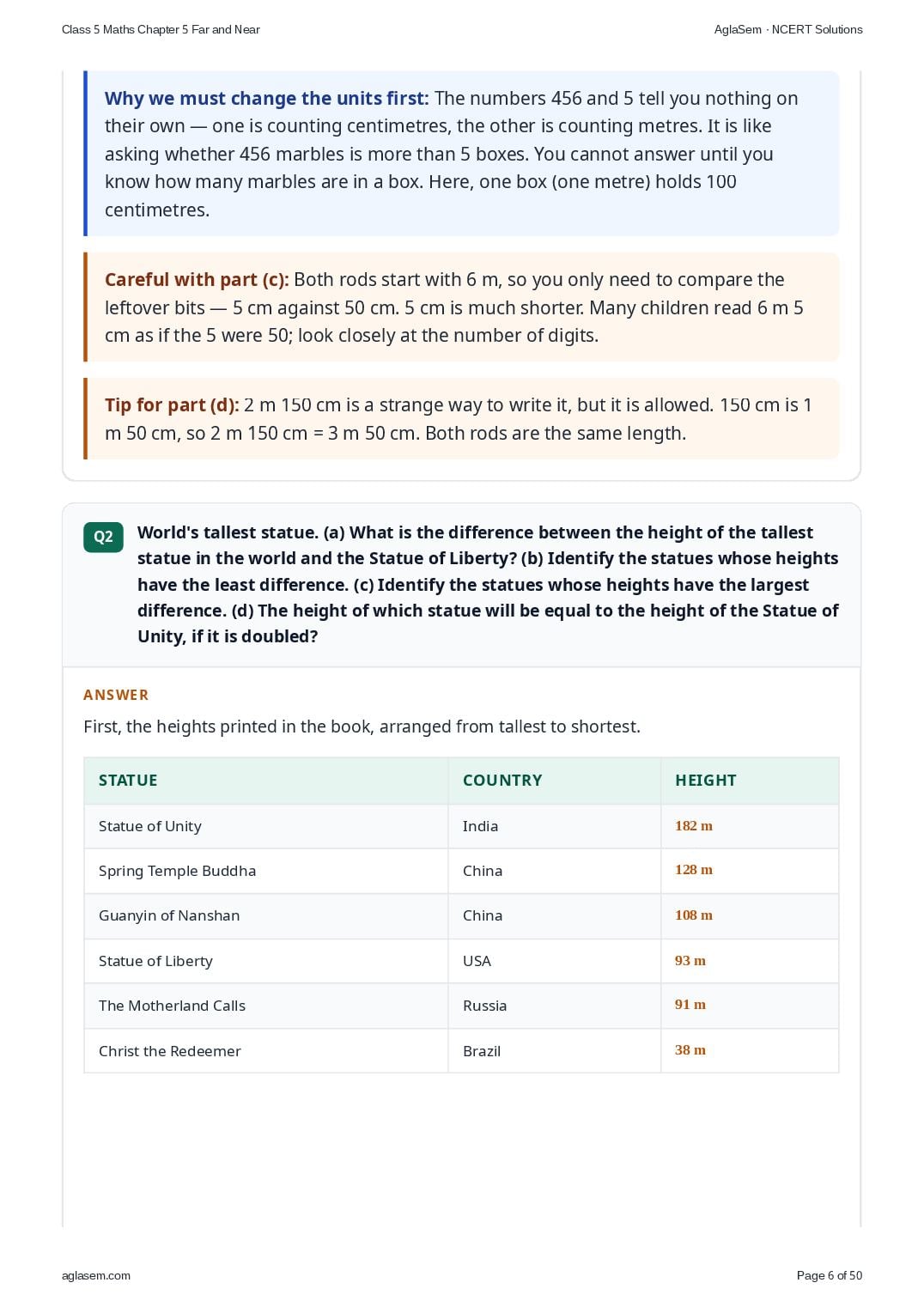
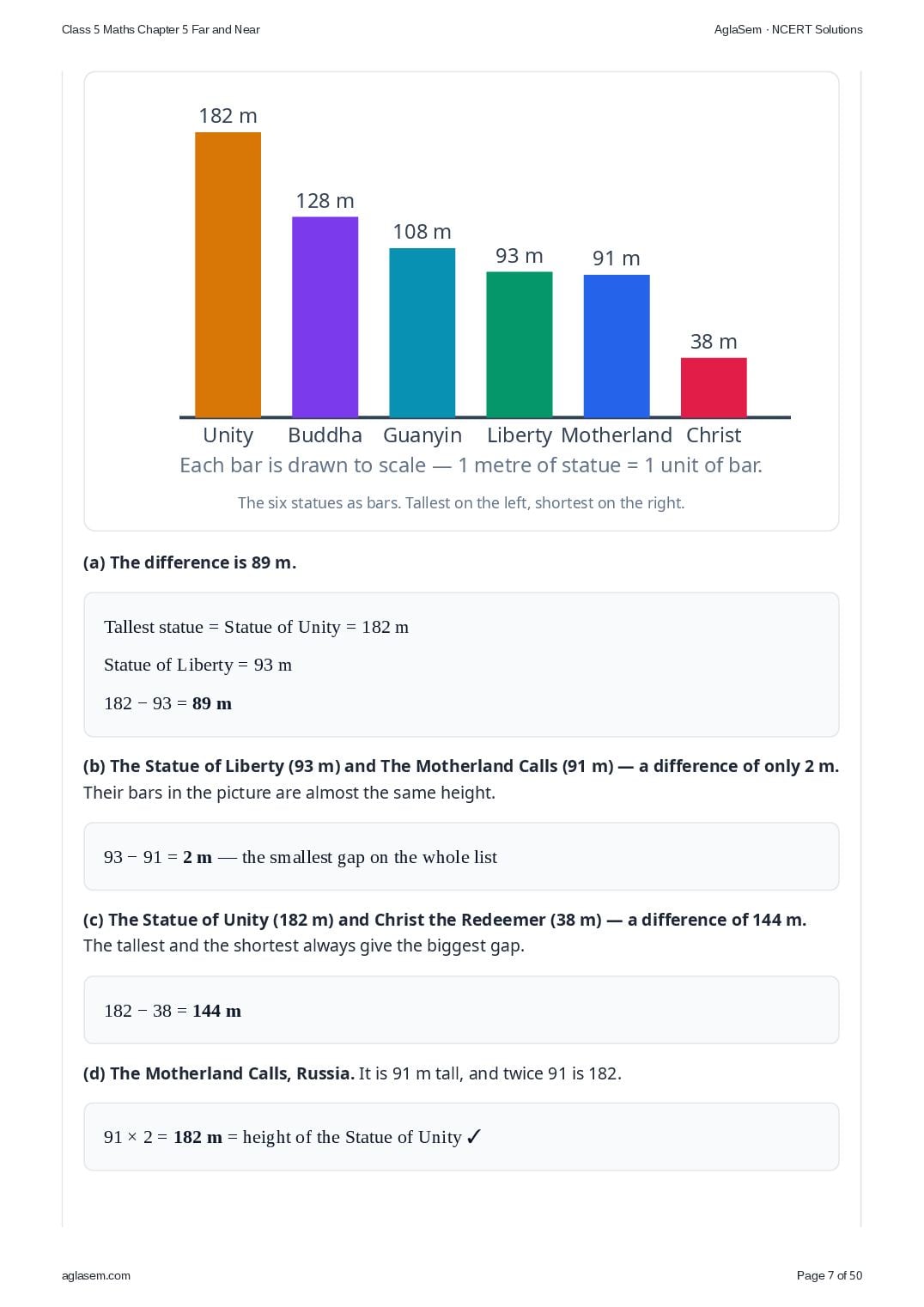
- World’s tallest statue. (a) What is the difference between the height of the tallest statue in the world and the Statue of Liberty? (b) Identify the statues whose heights have the least difference. (c) Identify the statues whose heights have the largest difference. (d) The height of which statue will be equal to the height of the Statue of Unity, if it is doubled?
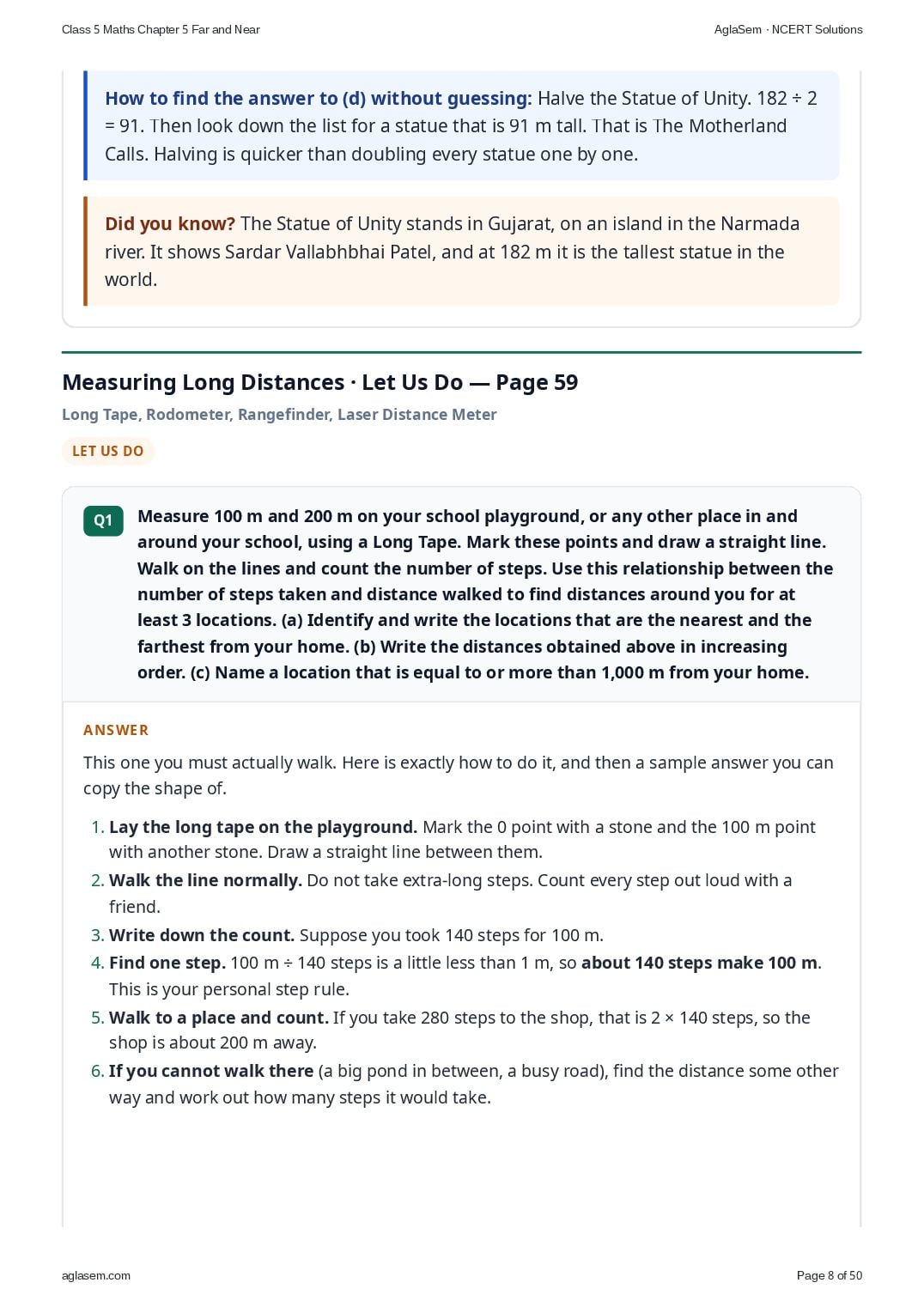
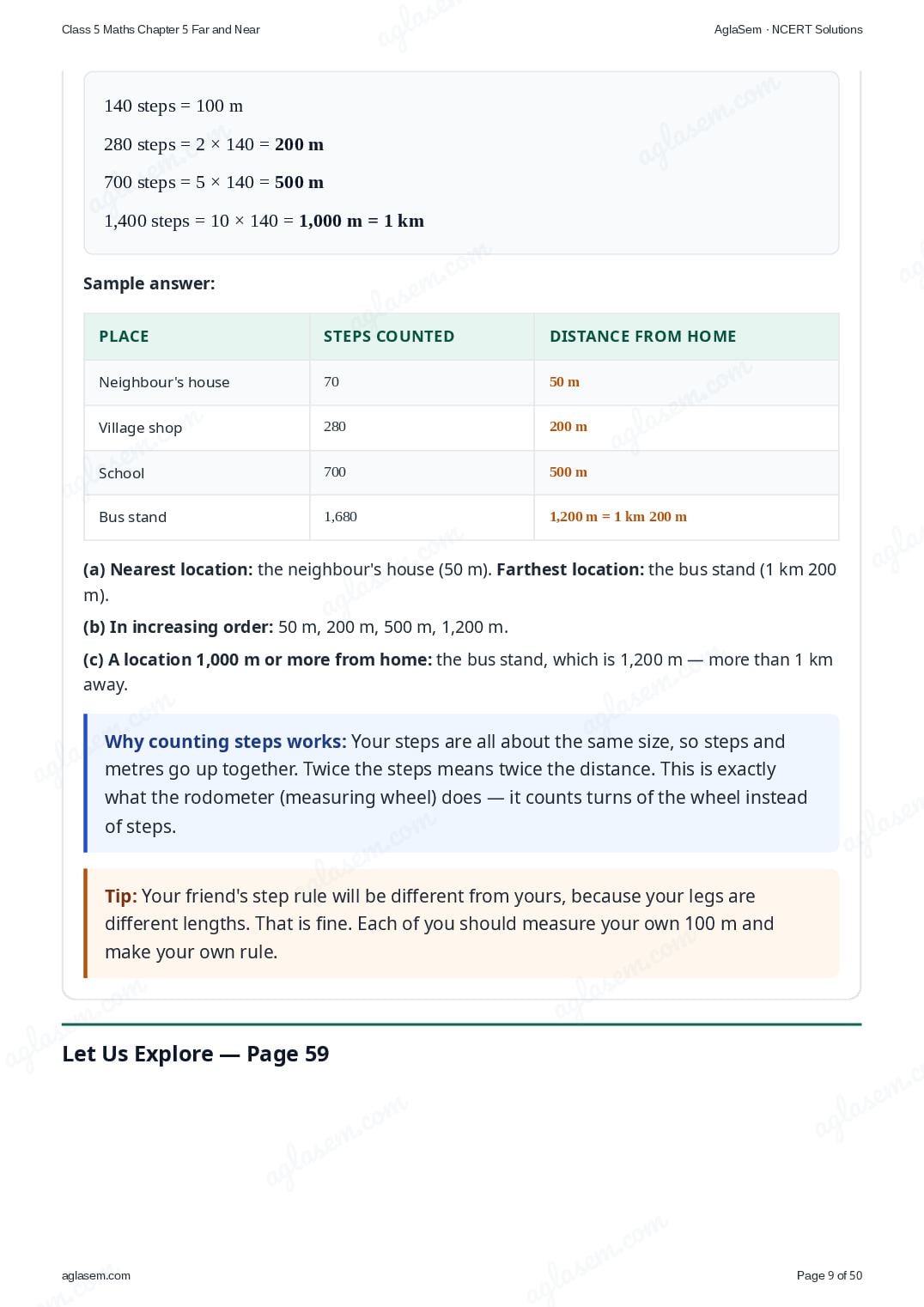
- Measure 100 m and 200 m on your school playground, or any other place in and around your school, using a Long Tape. Mark these points and draw a straight line. Walk on the lines and count the number of steps. Use this relationship between the number of steps taken and distance walked to find distances around you for at least 3 locations. (a) Identify and write the locations that are the nearest and the farthest from your home. (b) Write the distances obtained above in increasing order. (c) Name a location that is equal to or more than 1,000 m from your home.
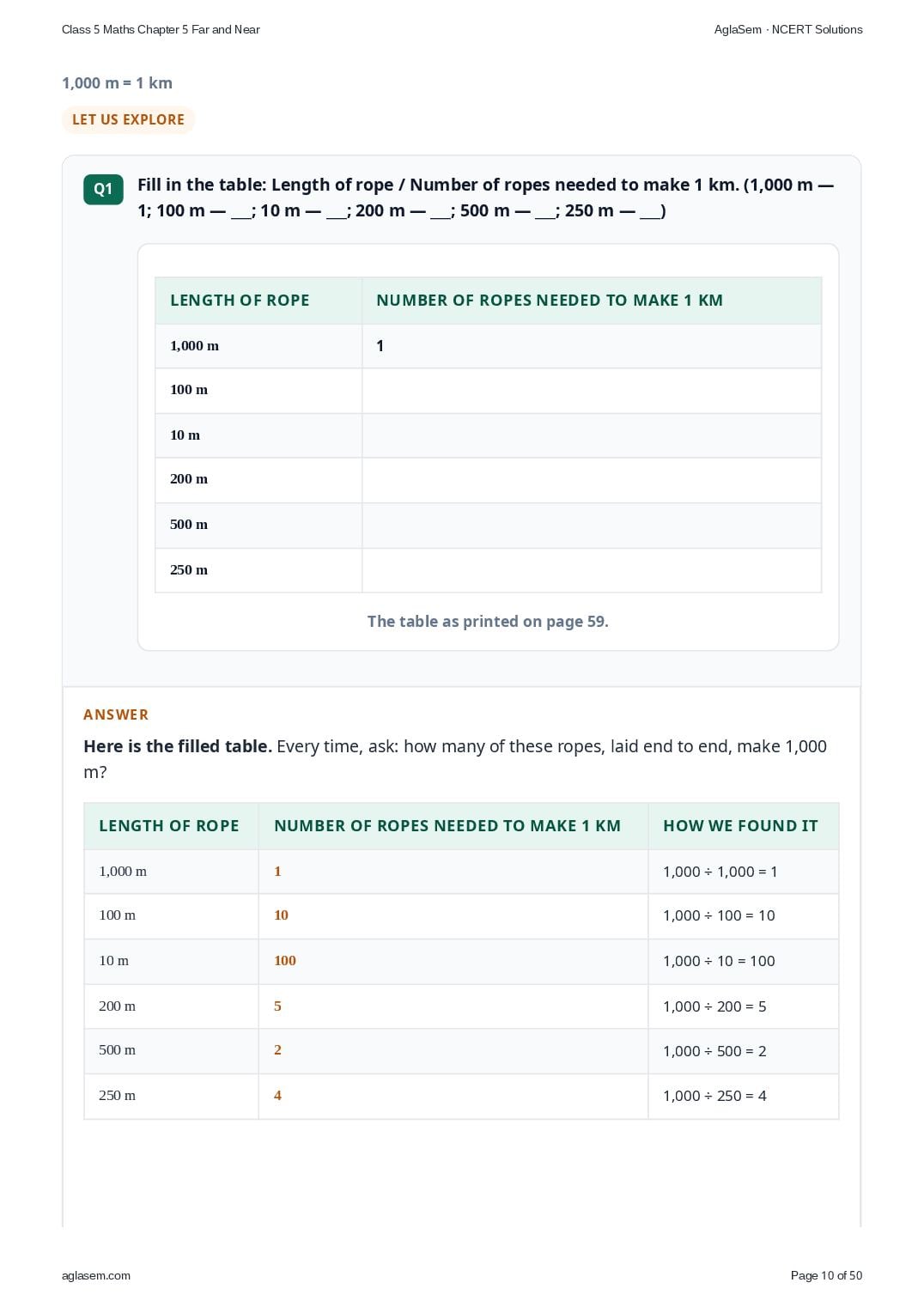
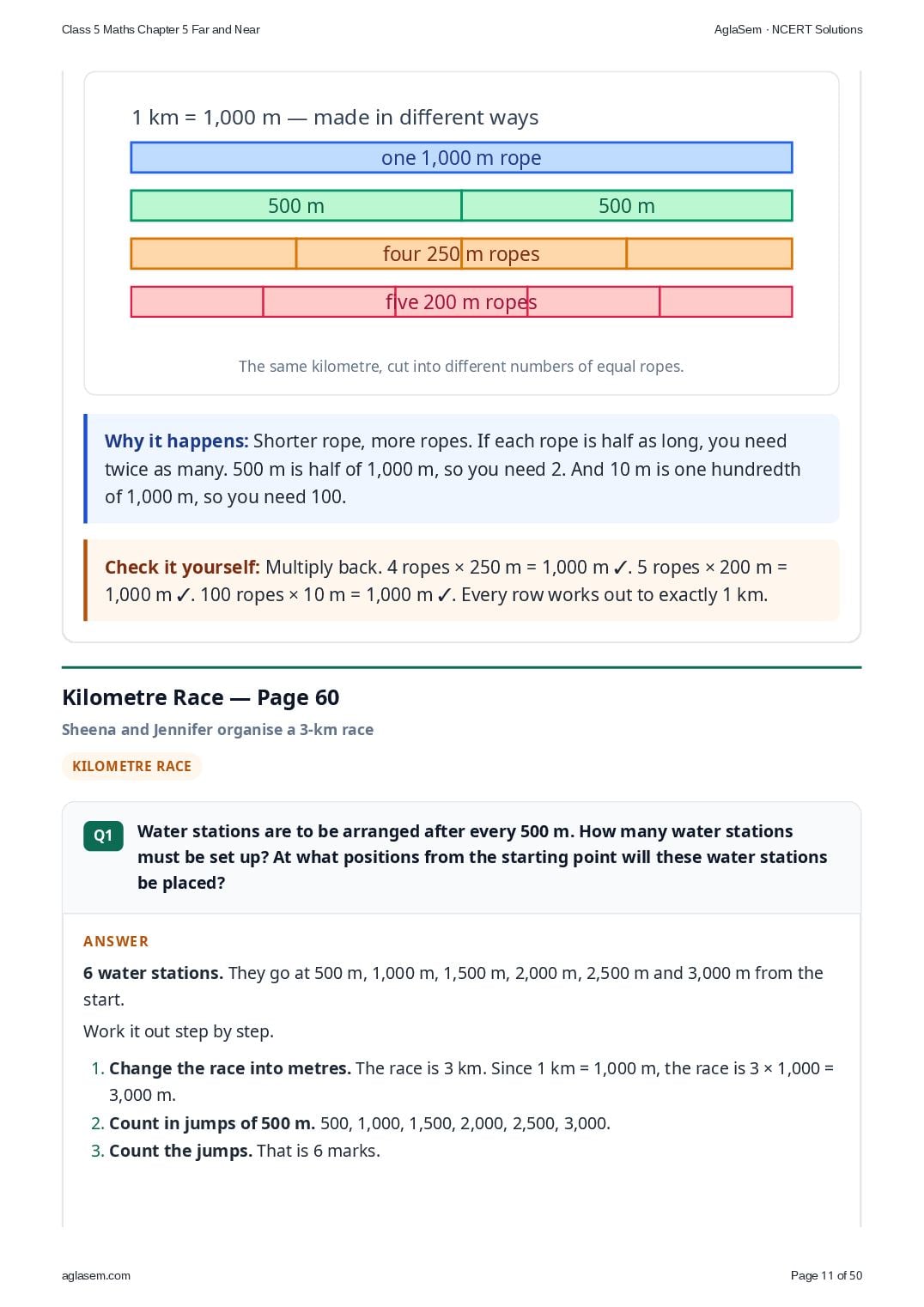
- Fill in the table: Length of rope / Number of ropes needed to make 1 km. (1,000 m — 1; 100 m — ___; 10 m — ___; 200 m — ___; 500 m — ___; 250 m — ___) Length of ropeNumber of ropes needed to make 1 km1,000 m1100 m 10 m 200 m 500 m 250 m The table as printed on page 59.
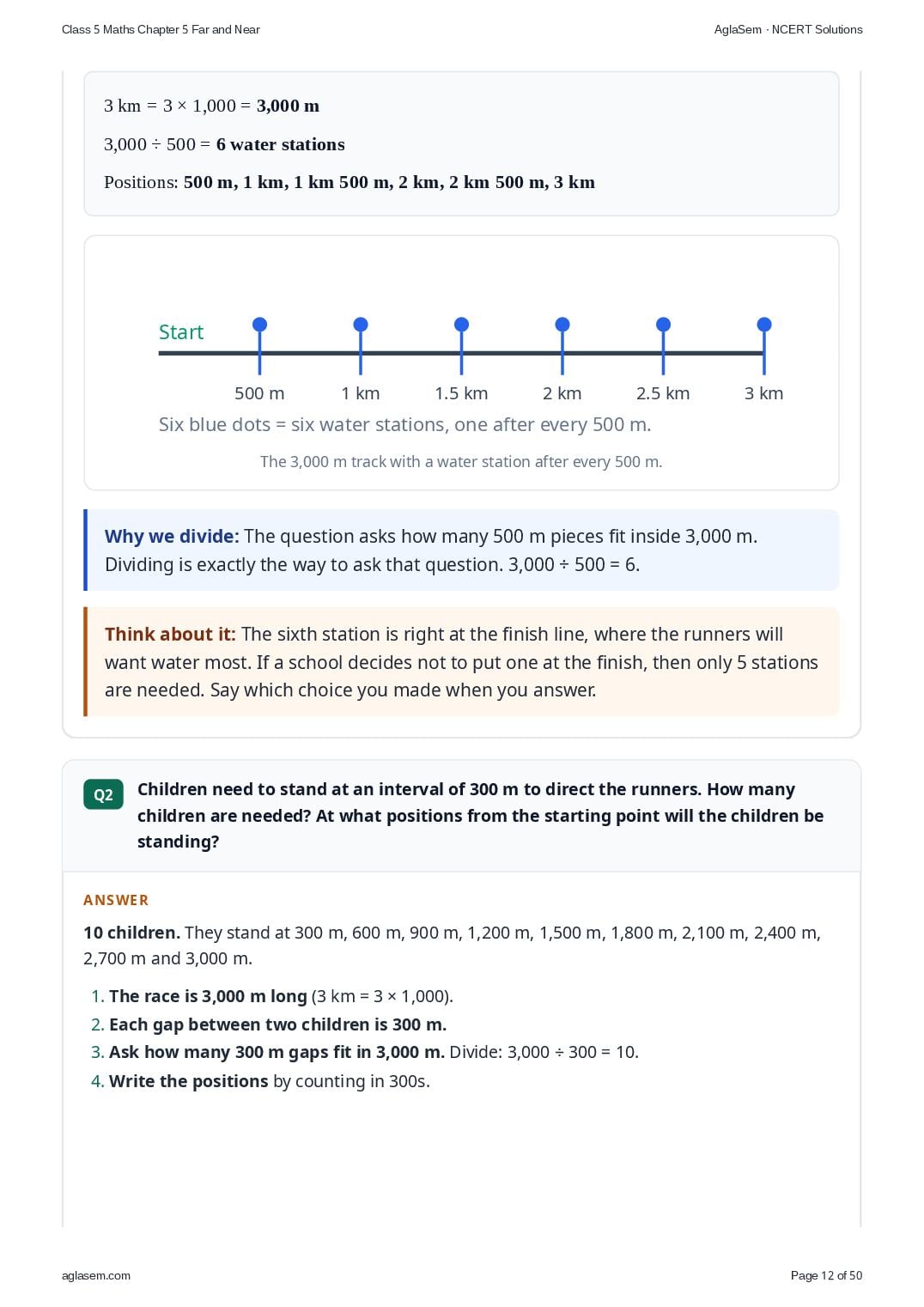
- Water stations are to be arranged after every 500 m. How many water stations must be set up? At what positions from the starting point will these water stations be placed?
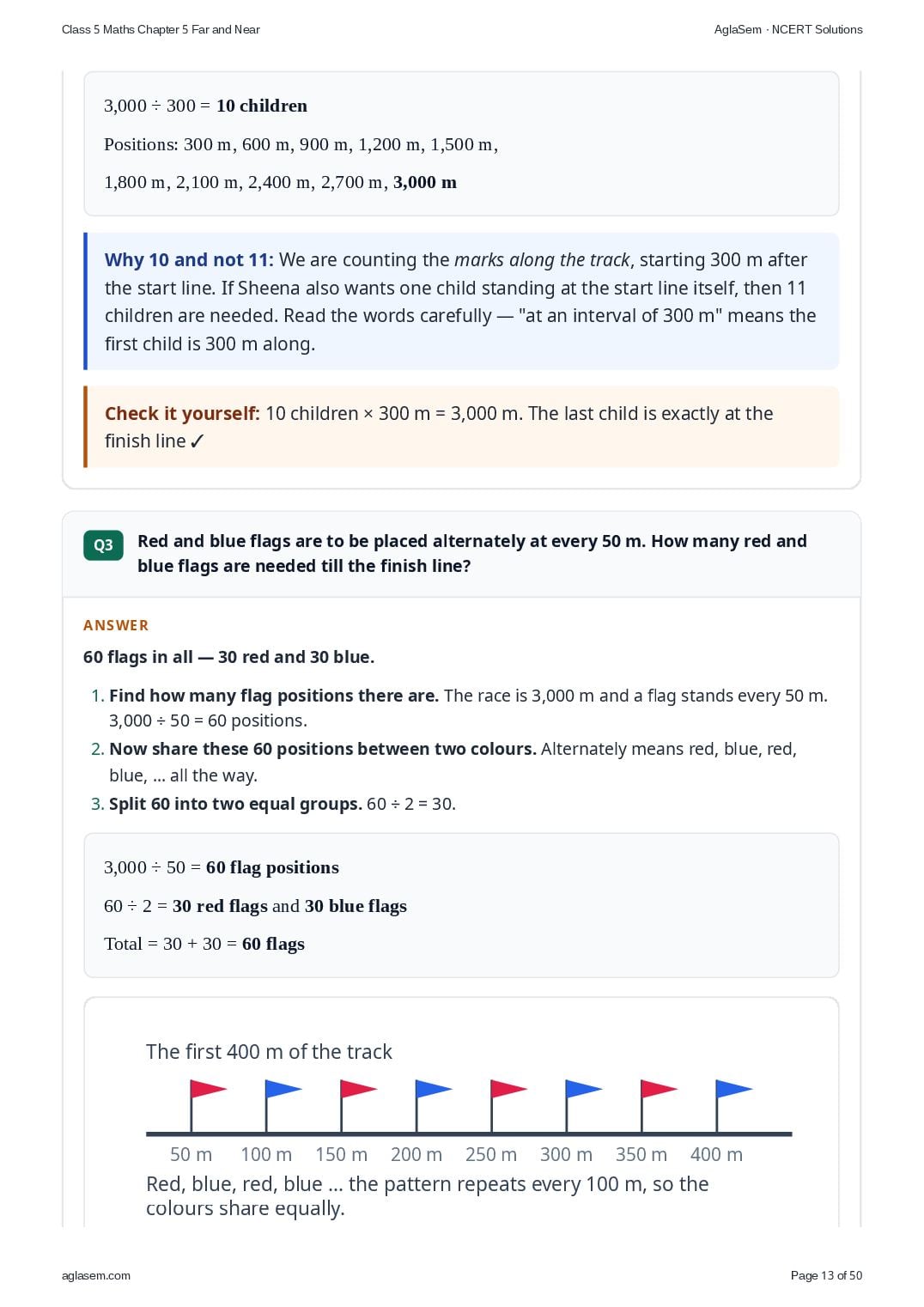
- Children need to stand at an interval of 300 m to direct the runners. How many children are needed? At what positions from the starting point will the children be standing?
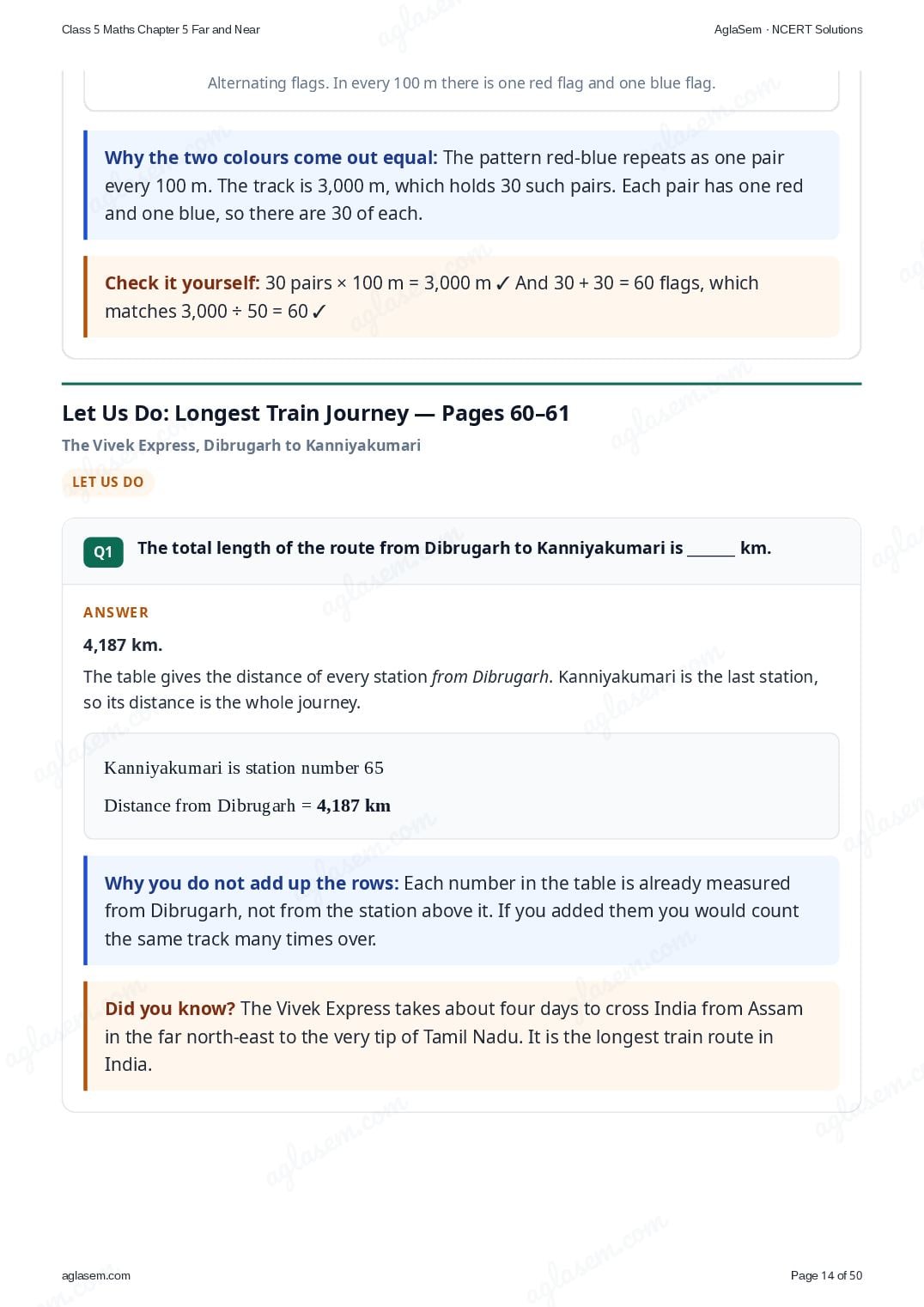
- Red and blue flags are to be placed alternately at every 50 m. How many red and blue flags are needed till the finish line?
- The total length of the route from Dibrugarh to Kanniyakumari is _______ km.
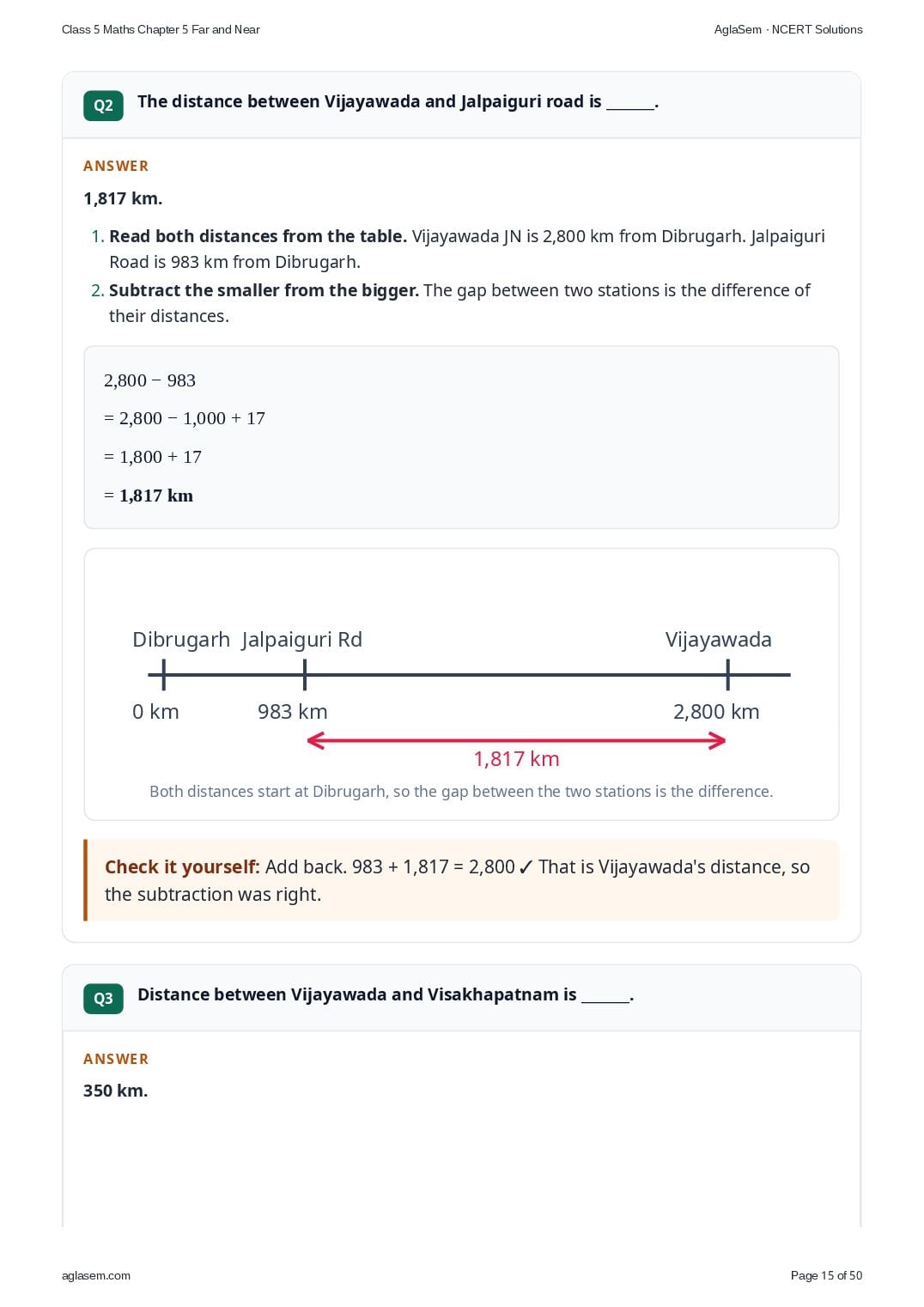
- The distance between Vijayawada and Jalpaiguri road is _______.
- Distance between Vijayawada and Visakhapatnam is _______.
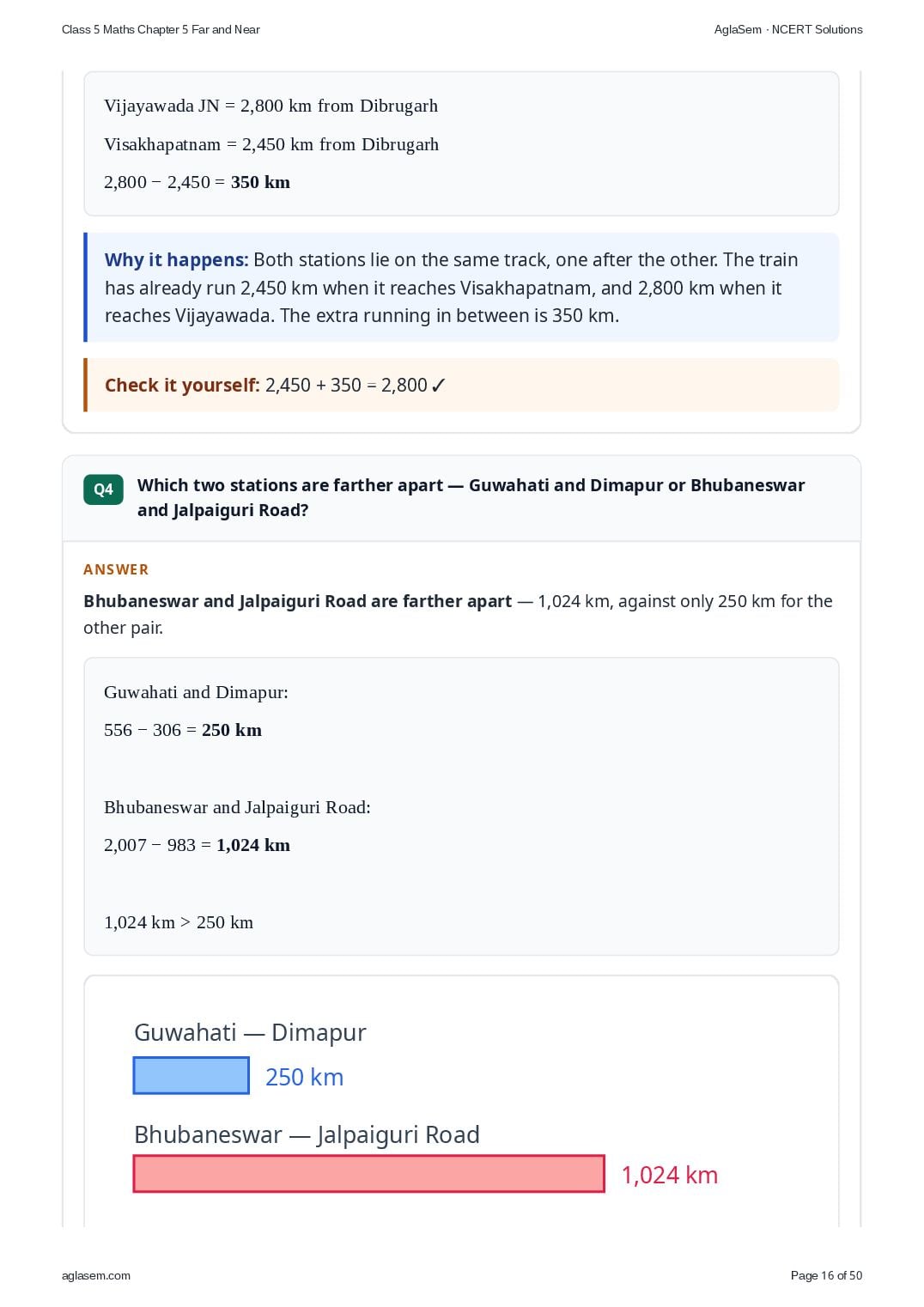
- Which two stations are farther apart — Guwahati and Dimapur or Bhubaneswar and Jalpaiguri Road?
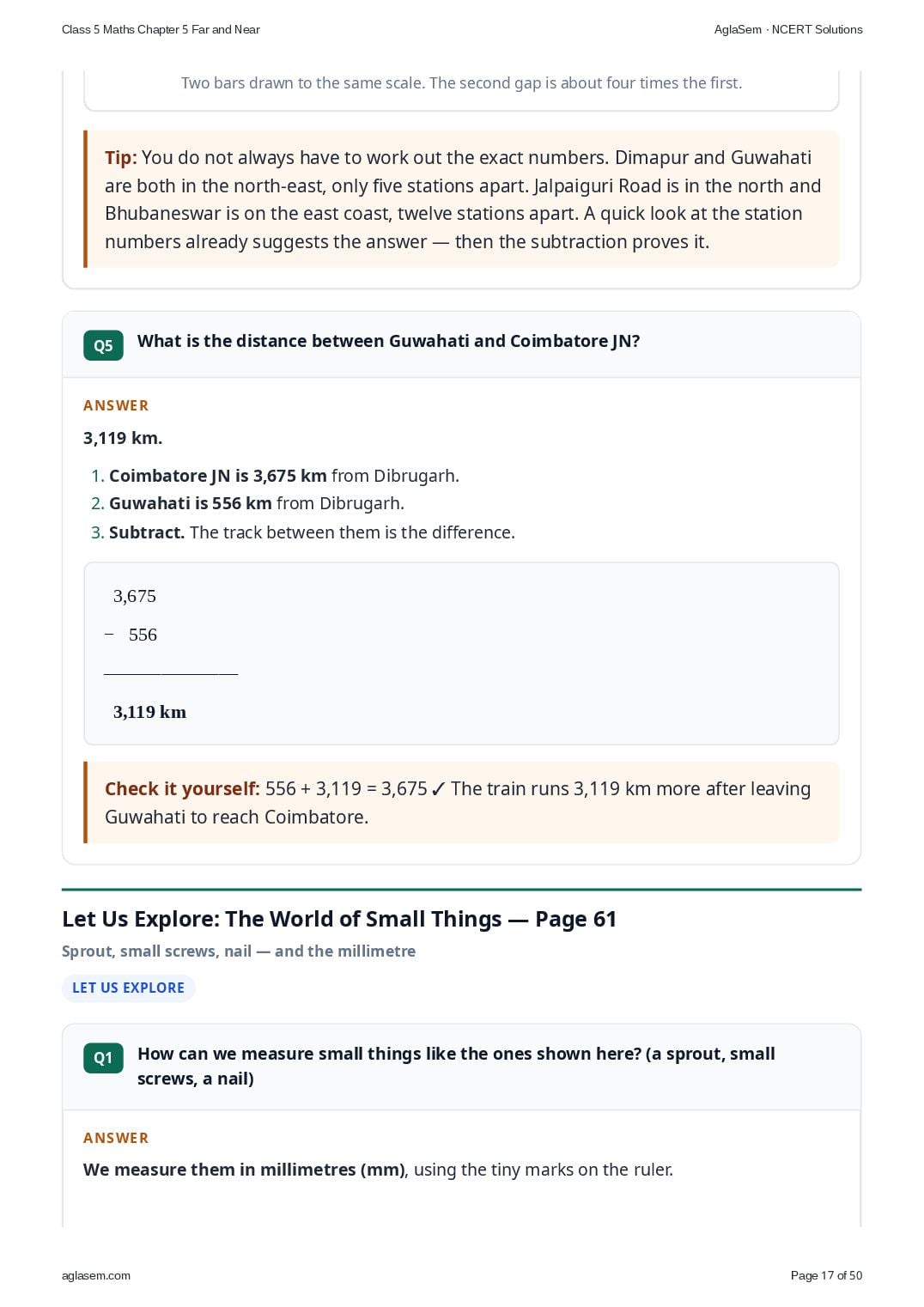
- What is the distance between Guwahati and Coimbatore JN?
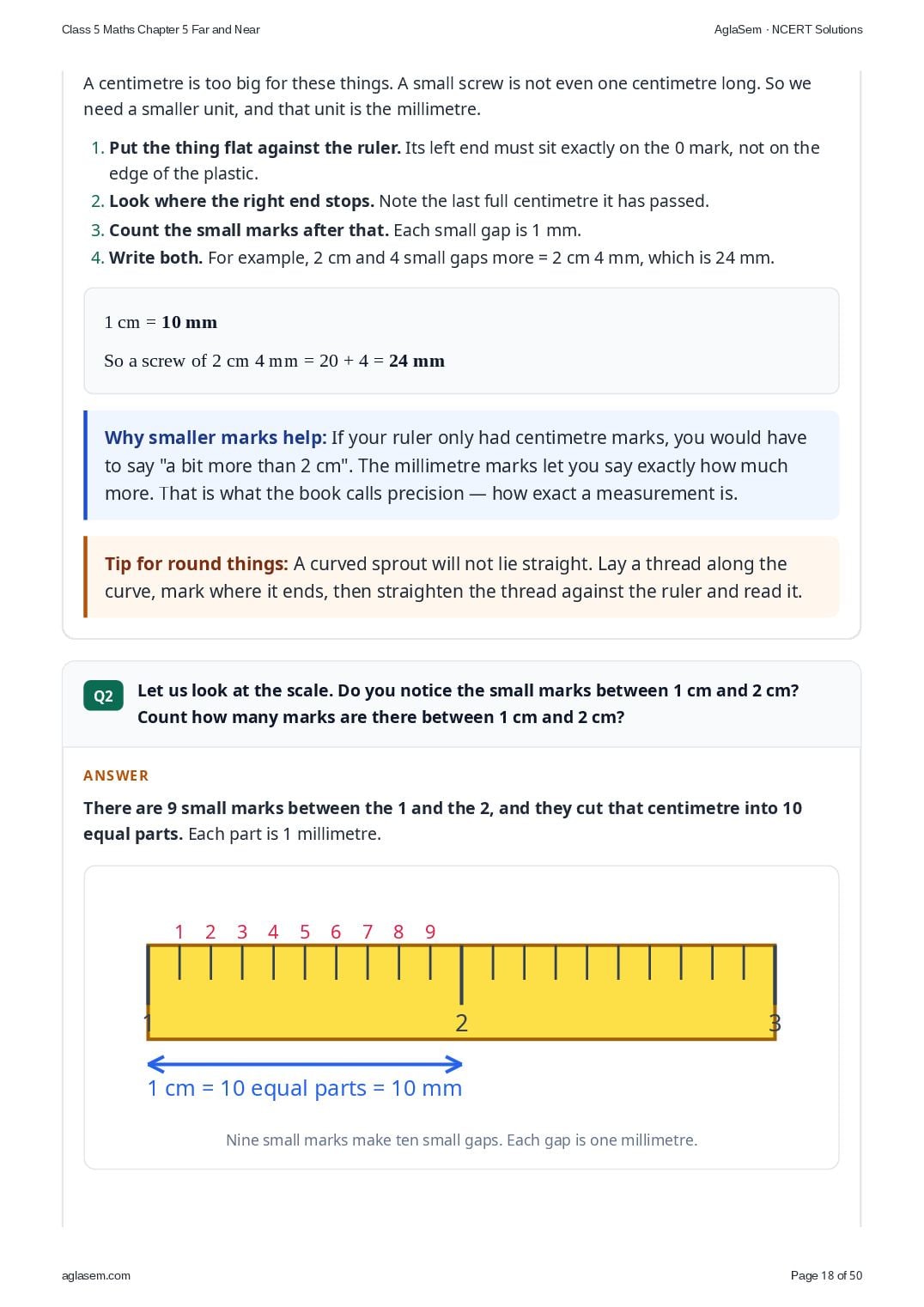
- How can we measure small things like the ones shown here? (a sprout, small screws, a nail)
- Let us look at the scale. Do you notice the small marks between 1 cm and 2 cm? Count how many marks are there between 1 cm and 2 cm?
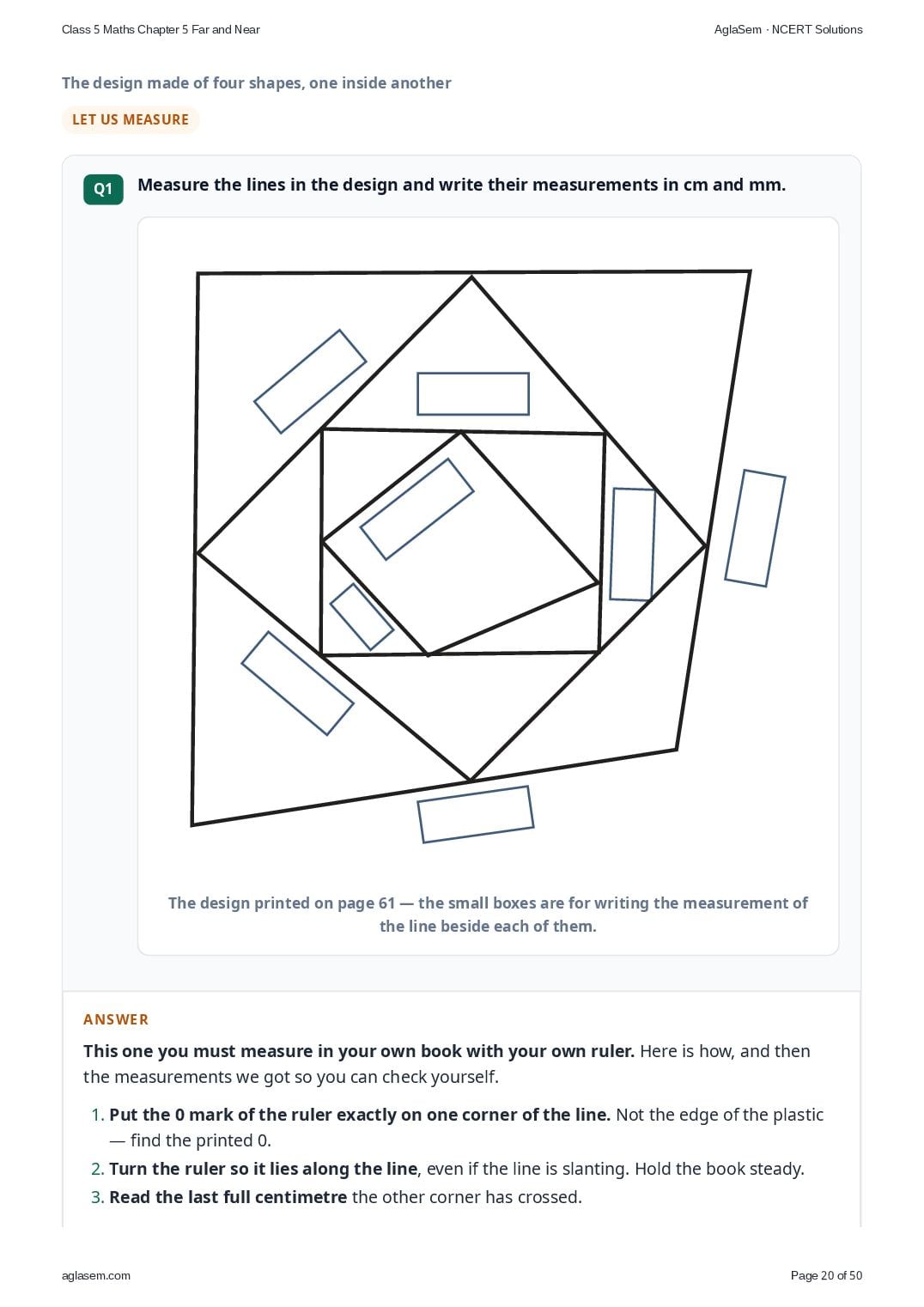
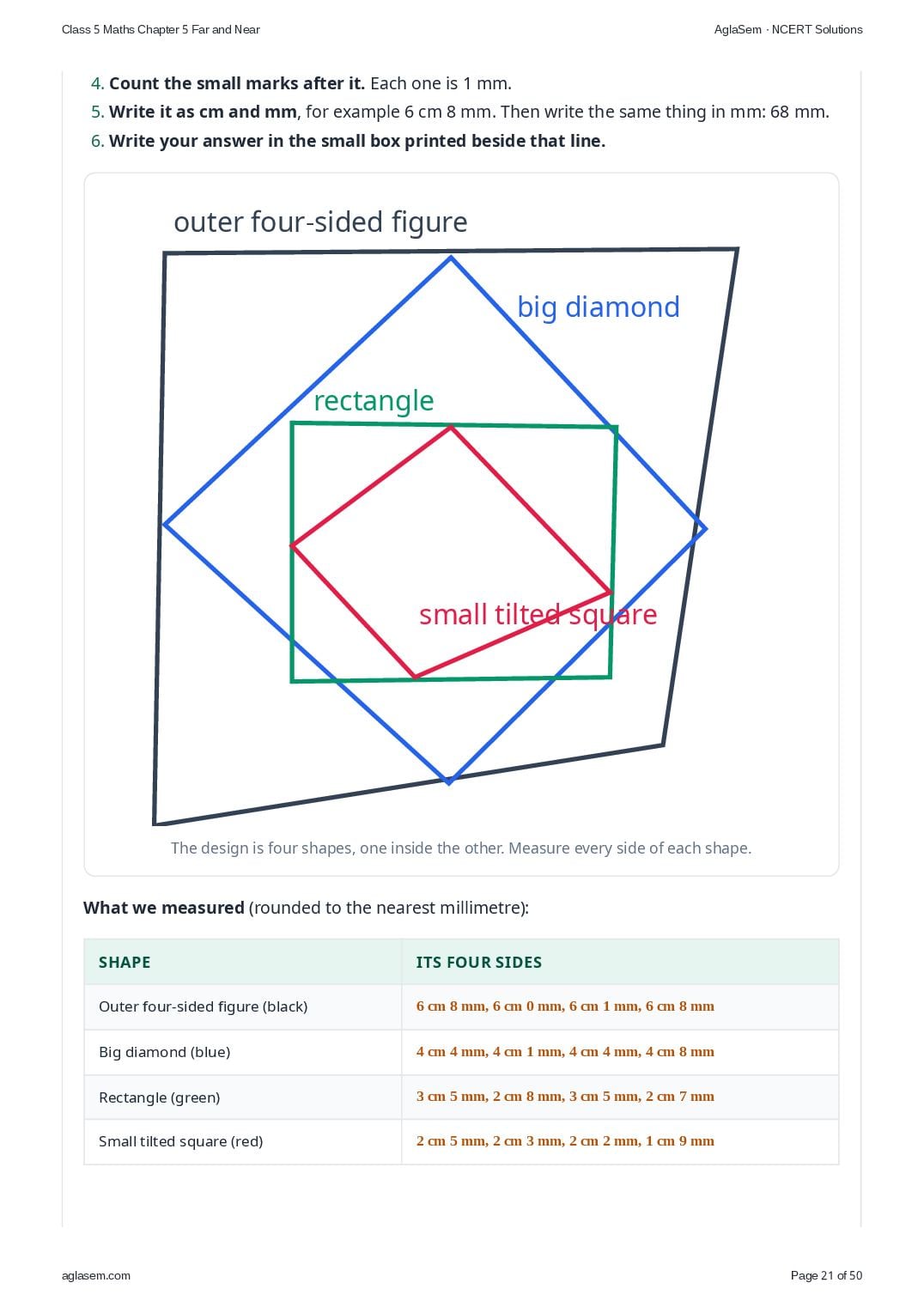
- Measure the lines in the design and write their measurements in cm and mm. The design printed on page 61 — the small boxes are for writing the measurement of the line beside each of them.
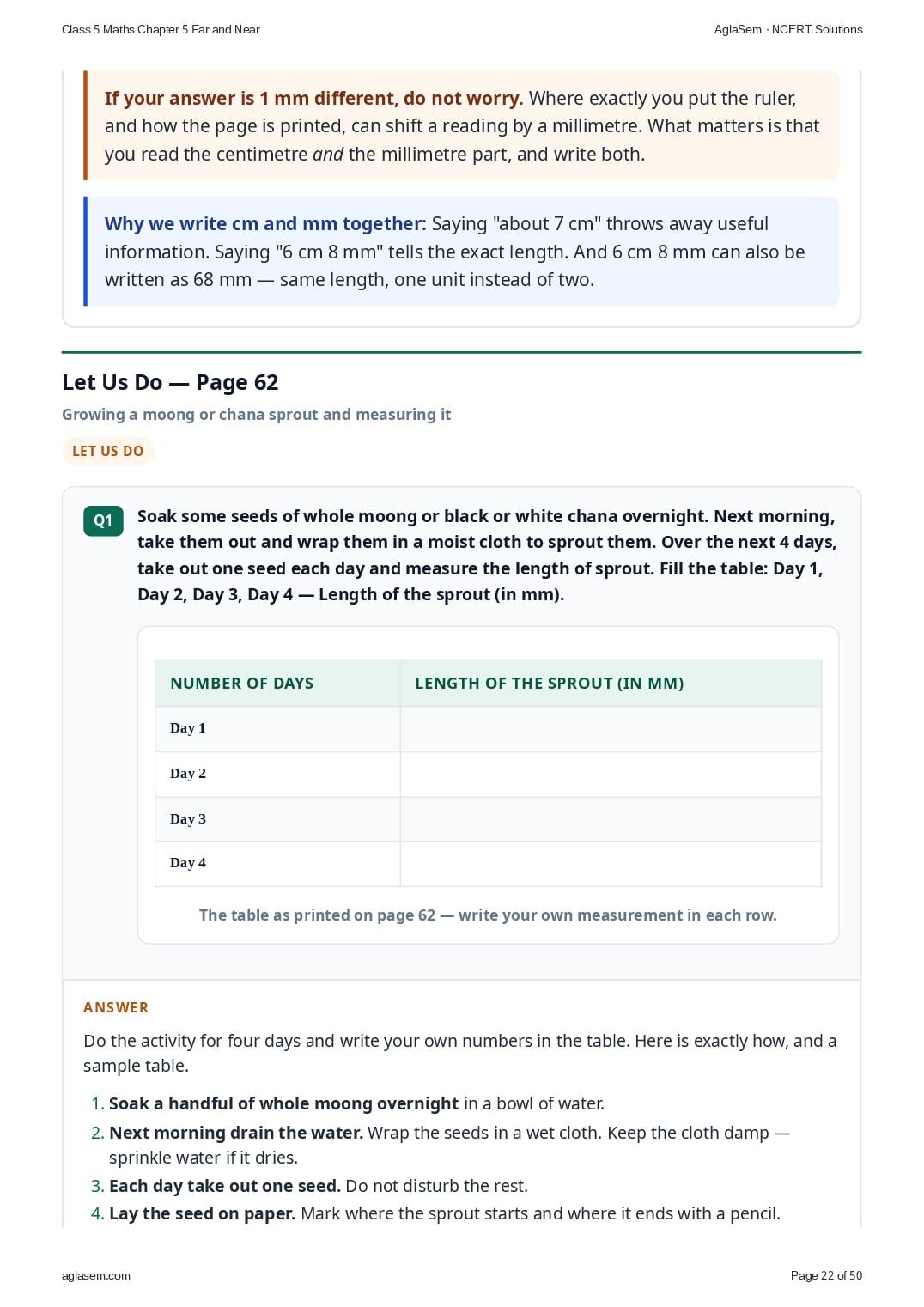
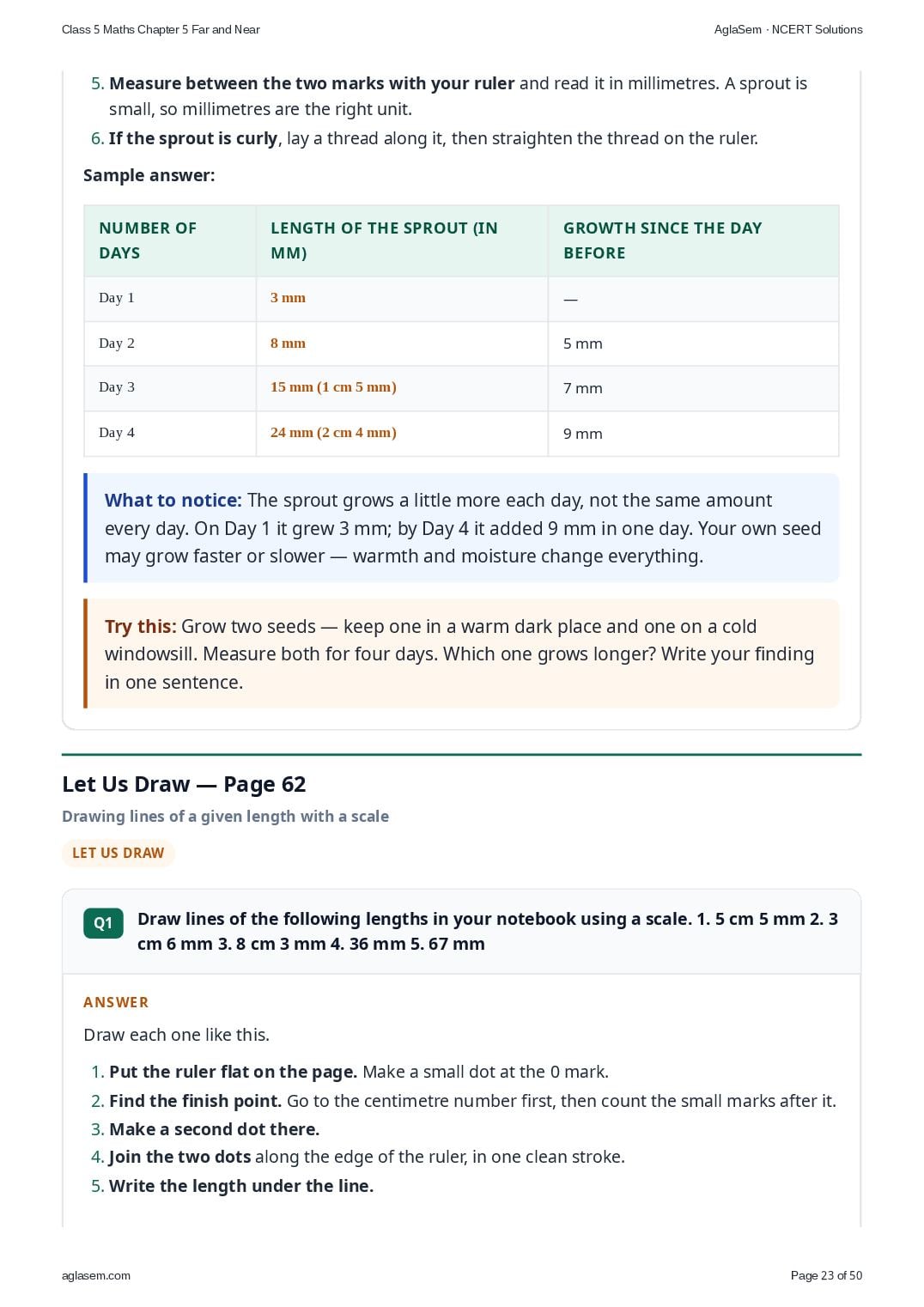
- Soak some seeds of whole moong or black or white chana overnight. Next morning, take them out and wrap them in a moist cloth to sprout them. Over the next 4 days, take out one seed each day and measure the length of sprout. Fill the table: Day 1, Day 2, Day 3, Day 4 — Length of the sprout (in mm). Number of daysLength of the sprout (in mm)Day 1 Day 2 Day 3 Day 4 The table as printed on page 62 — write your own measurement in each row.
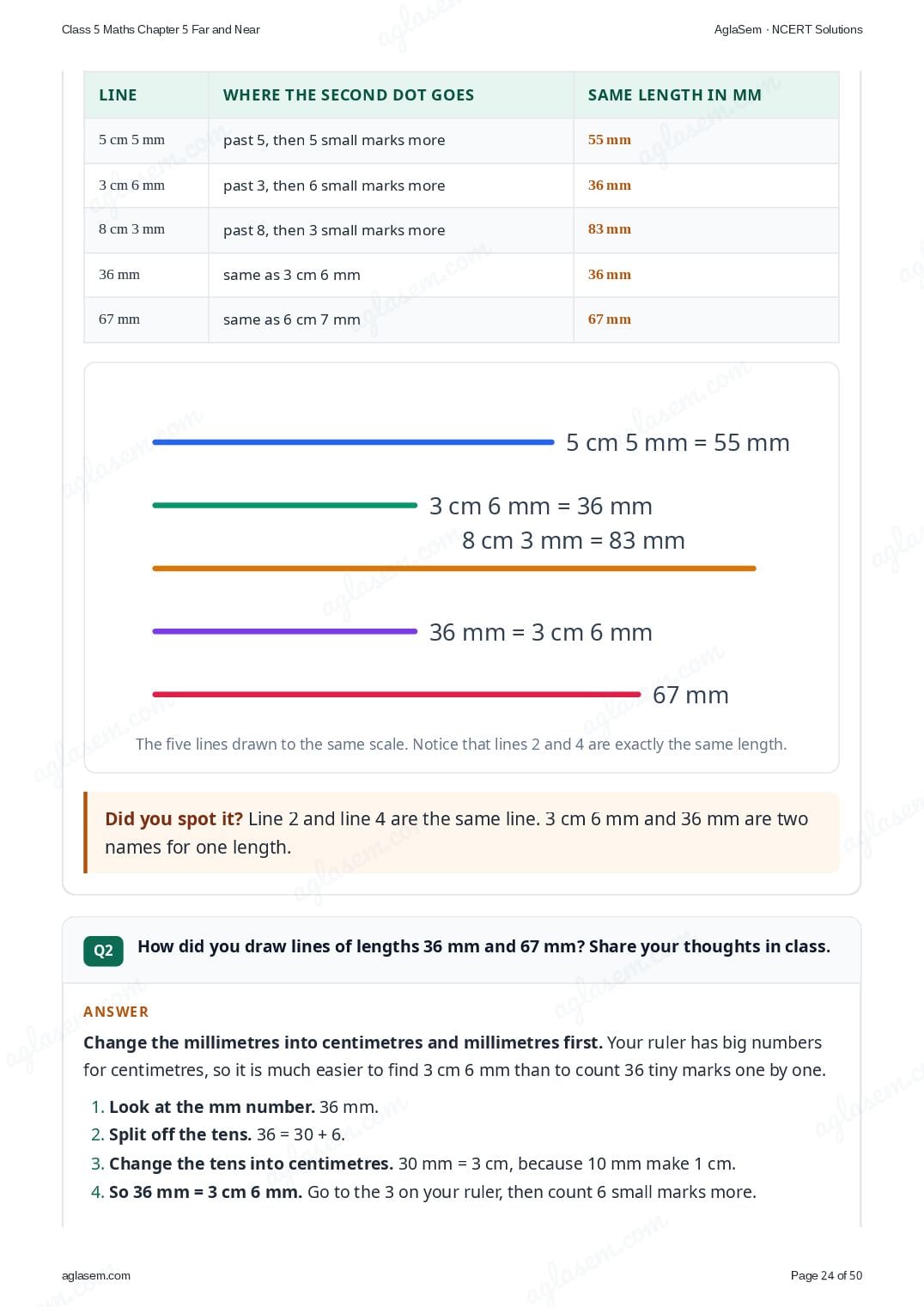
- Draw lines of the following lengths in your notebook using a scale. 1. 5 cm 5 mm 2. 3 cm 6 mm 3. 8 cm 3 mm 4. 36 mm 5. 67 mm
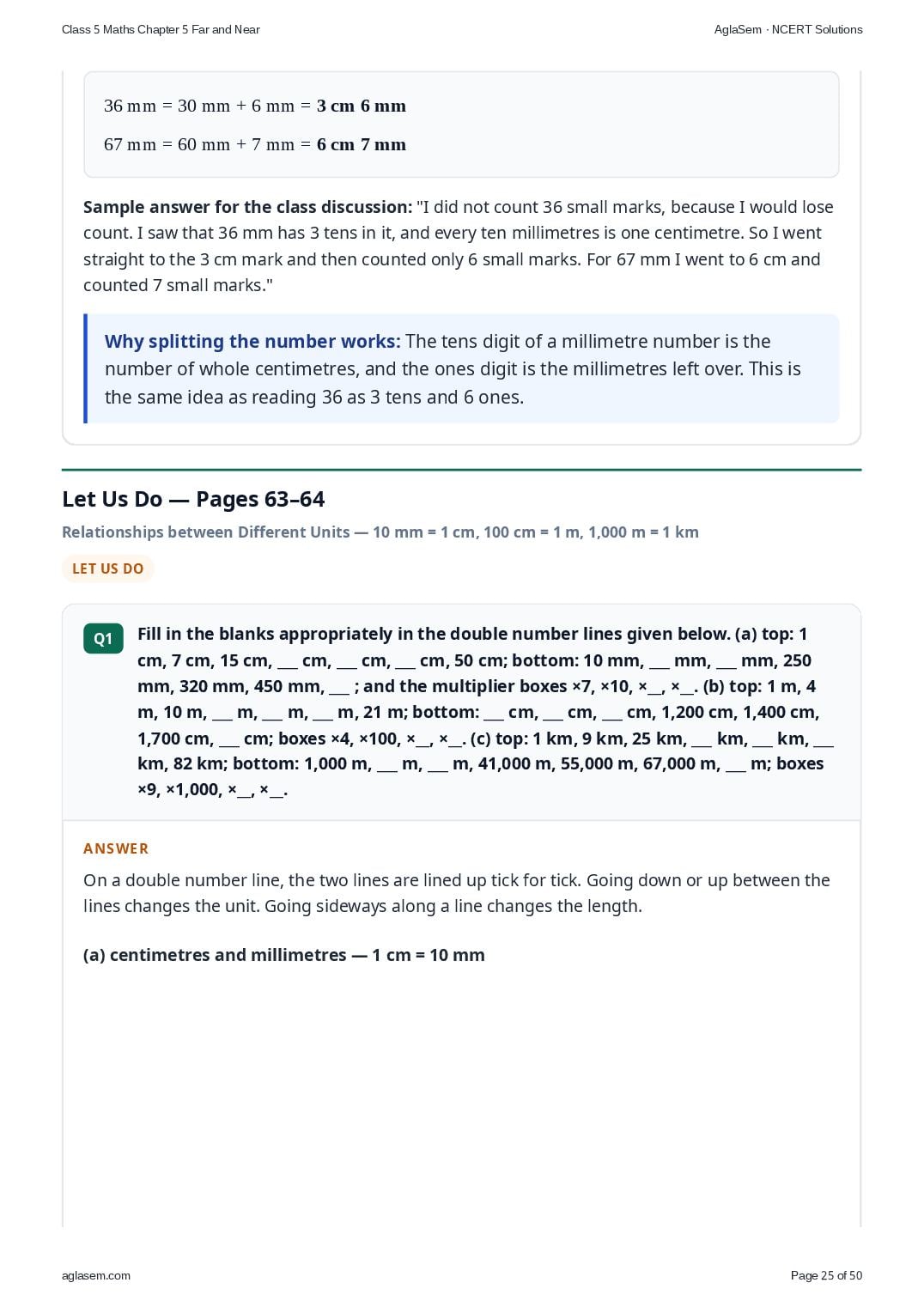
- How did you draw lines of lengths 36 mm and 67 mm? Share your thoughts in class.
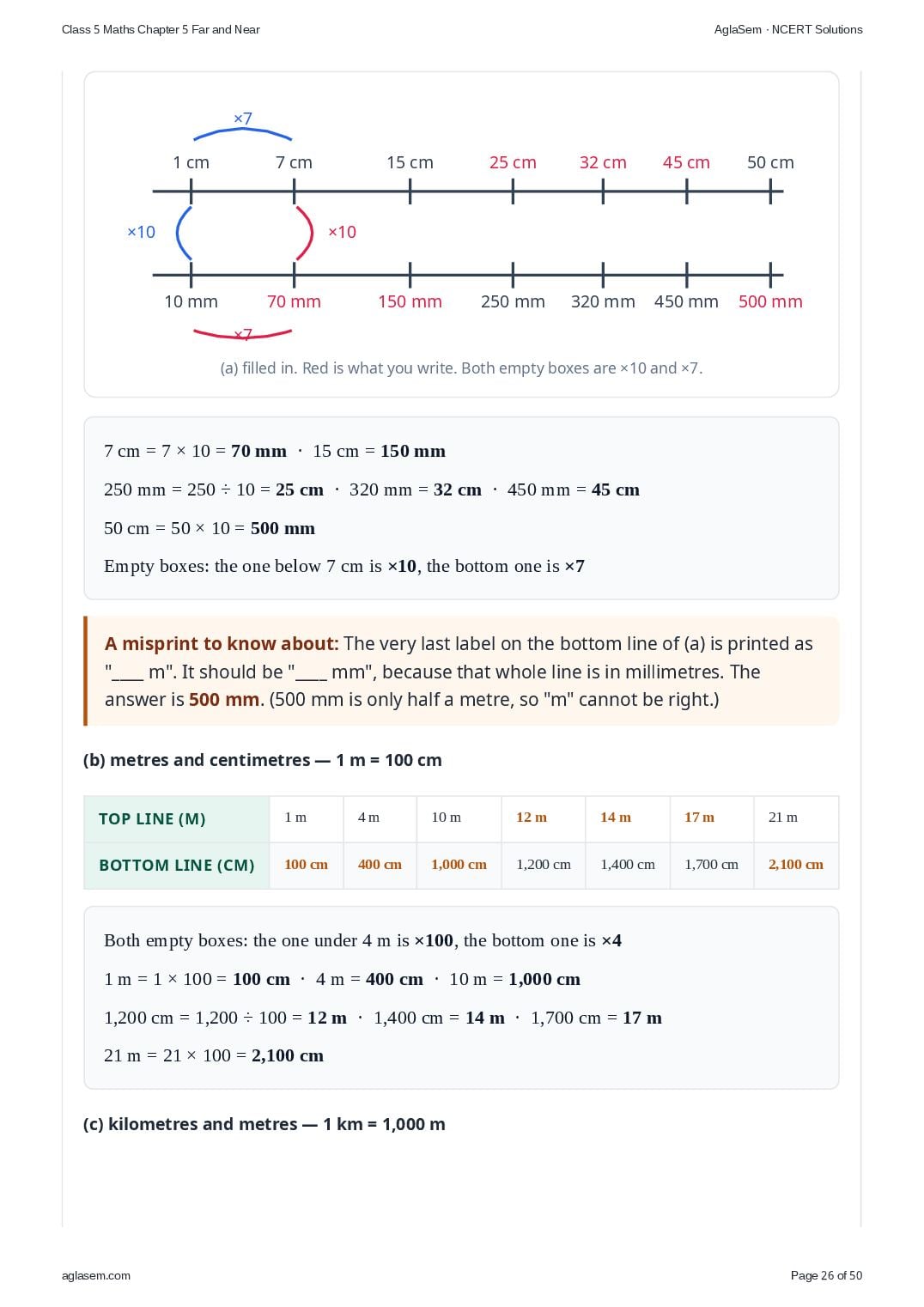
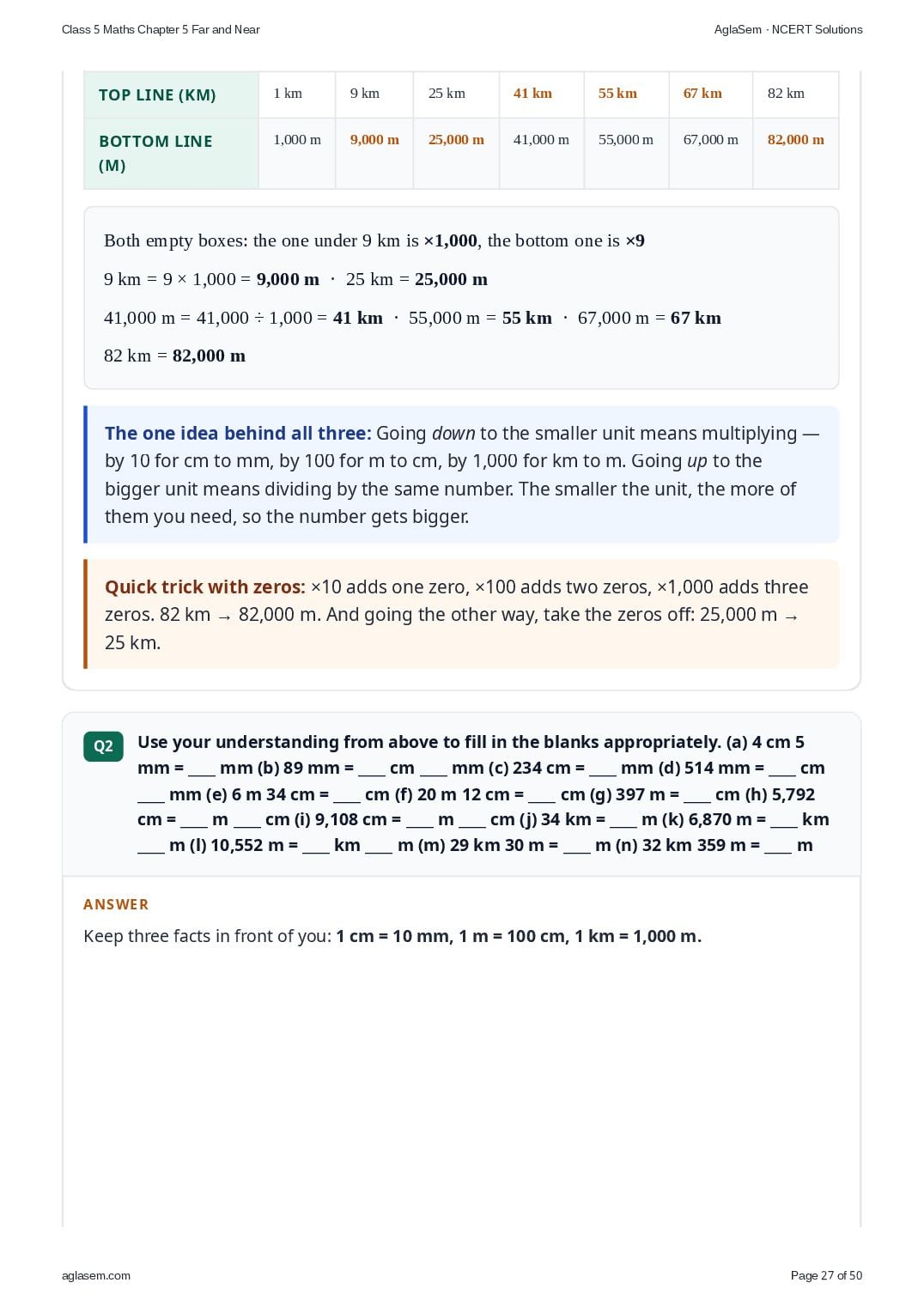
- Fill in the blanks appropriately in the double number lines given below. (a) top: 1 cm, 7 cm, 15 cm, ___ cm, ___ cm, ___ cm, 50 cm; bottom: 10 mm, ___ mm, ___ mm, 250 mm, 320 mm, 450 mm, ___ ; and the multiplier boxes ×7, ×10, ×__, ×__. (b) top: 1 m, 4 m, 10 m, ___ m, ___ m, ___ m, 21 m; bottom: ___ cm, ___ cm, ___ cm, 1,200 cm, 1,400 cm, 1,700 cm, ___ cm; boxes ×4, ×100, ×__, ×__. (c) top: 1 km, 9 km, 25 km, ___ km, ___ km, ___ km, 82 km; bottom: 1,000 m, ___ m, ___ m, 41,000 m, 55,000 m, 67,000 m, ___ m; boxes ×9, ×1,000, ×__, ×__.
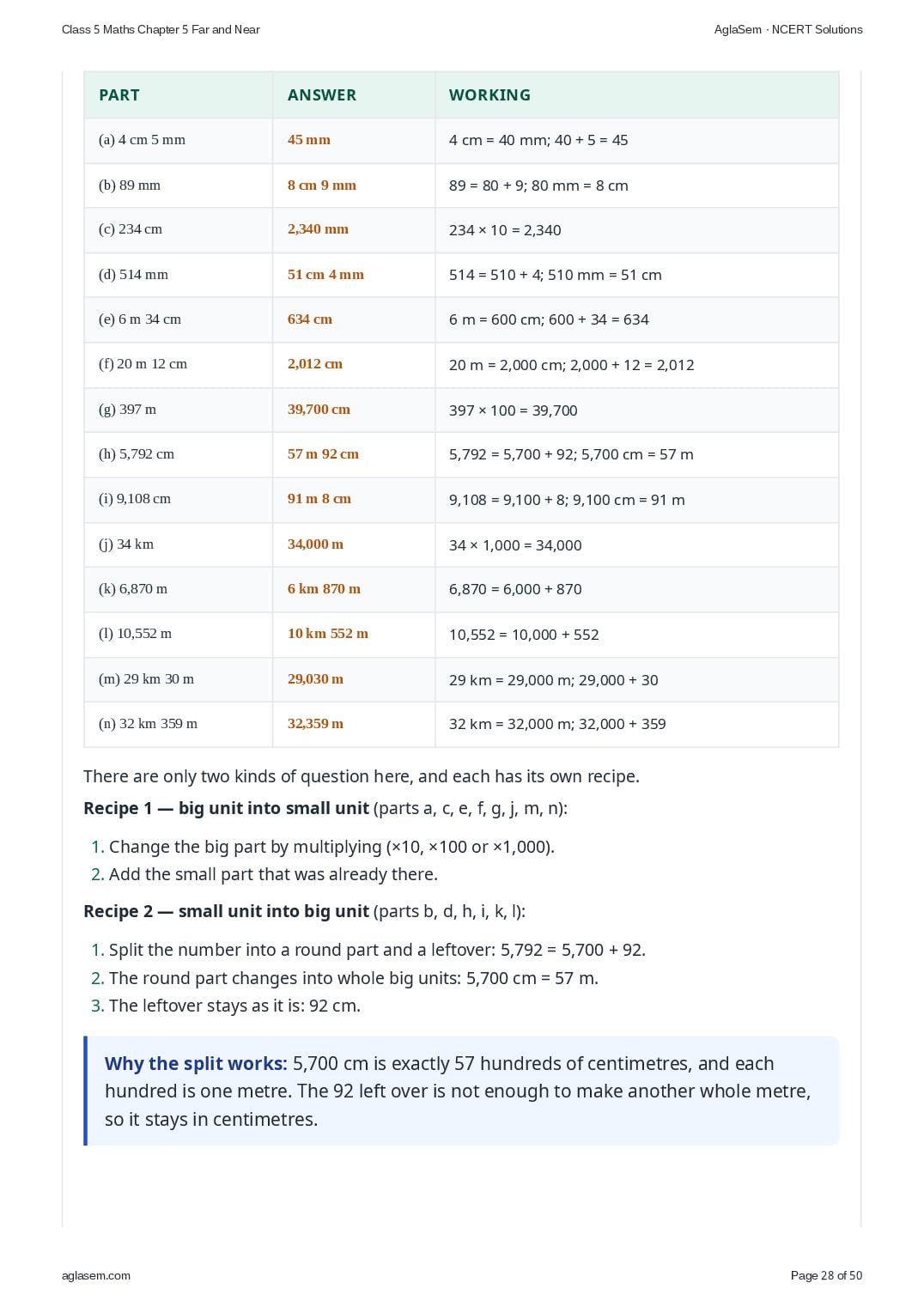
- Use your understanding from above to fill in the blanks appropriately. (a) 4 cm 5 mm = ____ mm (b) 89 mm = ____ cm ____ mm (c) 234 cm = ____ mm (d) 514 mm = ____ cm ____ mm (e) 6 m 34 cm = ____ cm (f) 20 m 12 cm = ____ cm (g) 397 m = ____ cm (h) 5,792 cm = ____ m ____ cm (i) 9,108 cm = ____ m ____ cm (j) 34 km = ____ m (k) 6,870 m = ____ km ____ m (l) 10,552 m = ____ km ____ m (m) 29 km 30 m = ____ m (n) 32 km 359 m = ____ m
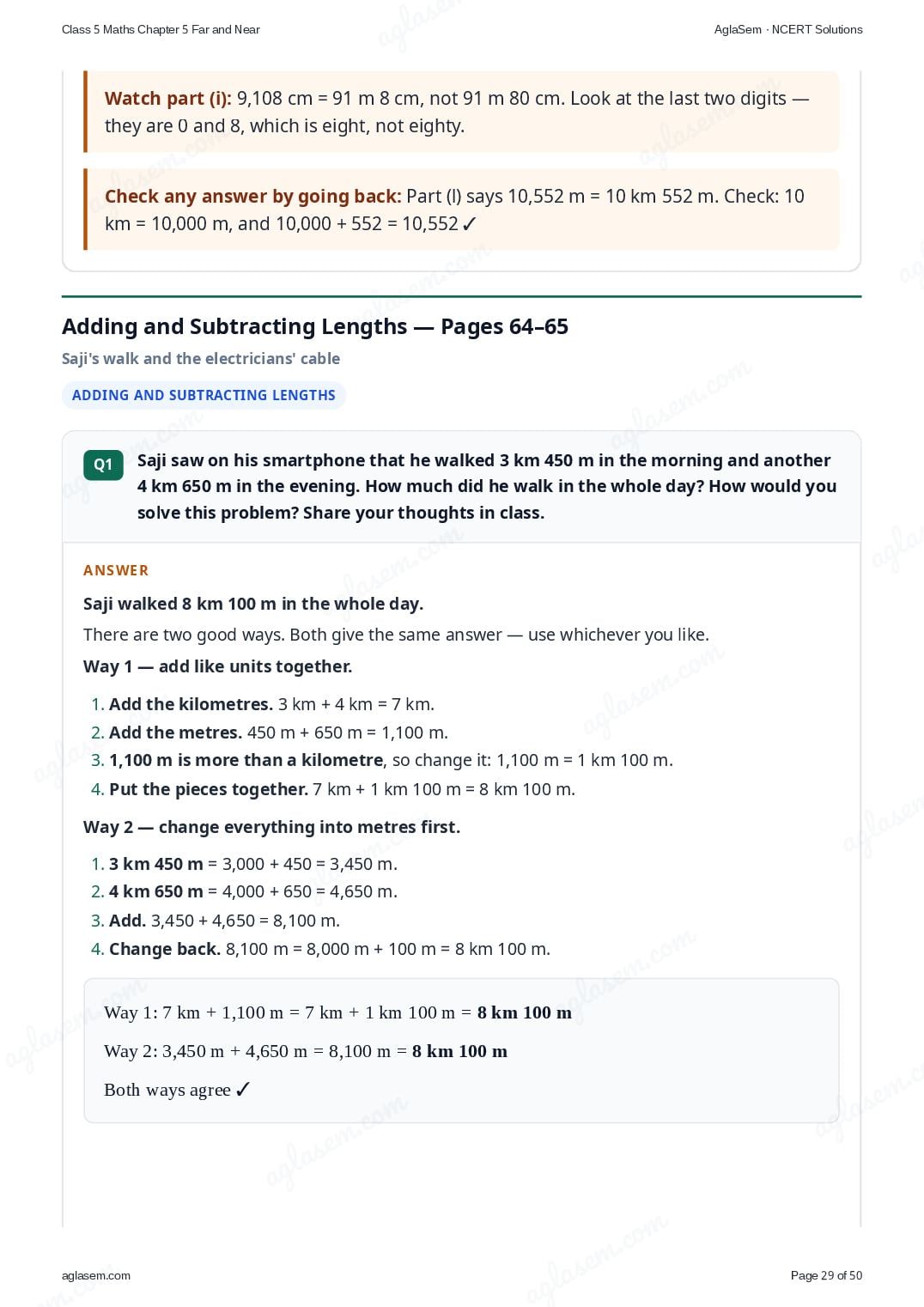
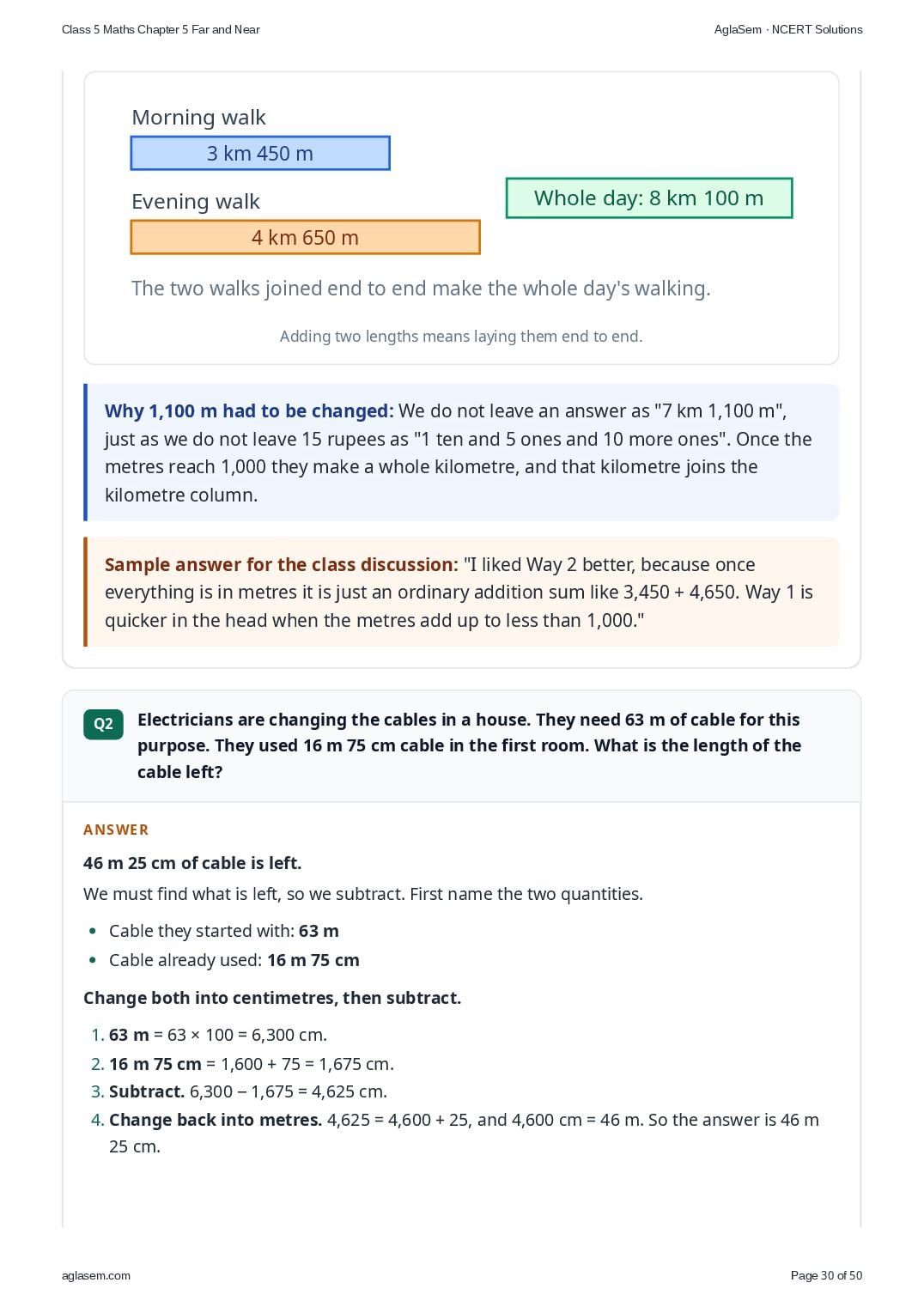
- Saji saw on his smartphone that he walked 3 km 450 m in the morning and another 4 km 650 m in the evening. How much did he walk in the whole day? How would you solve this problem? Share your thoughts in class.
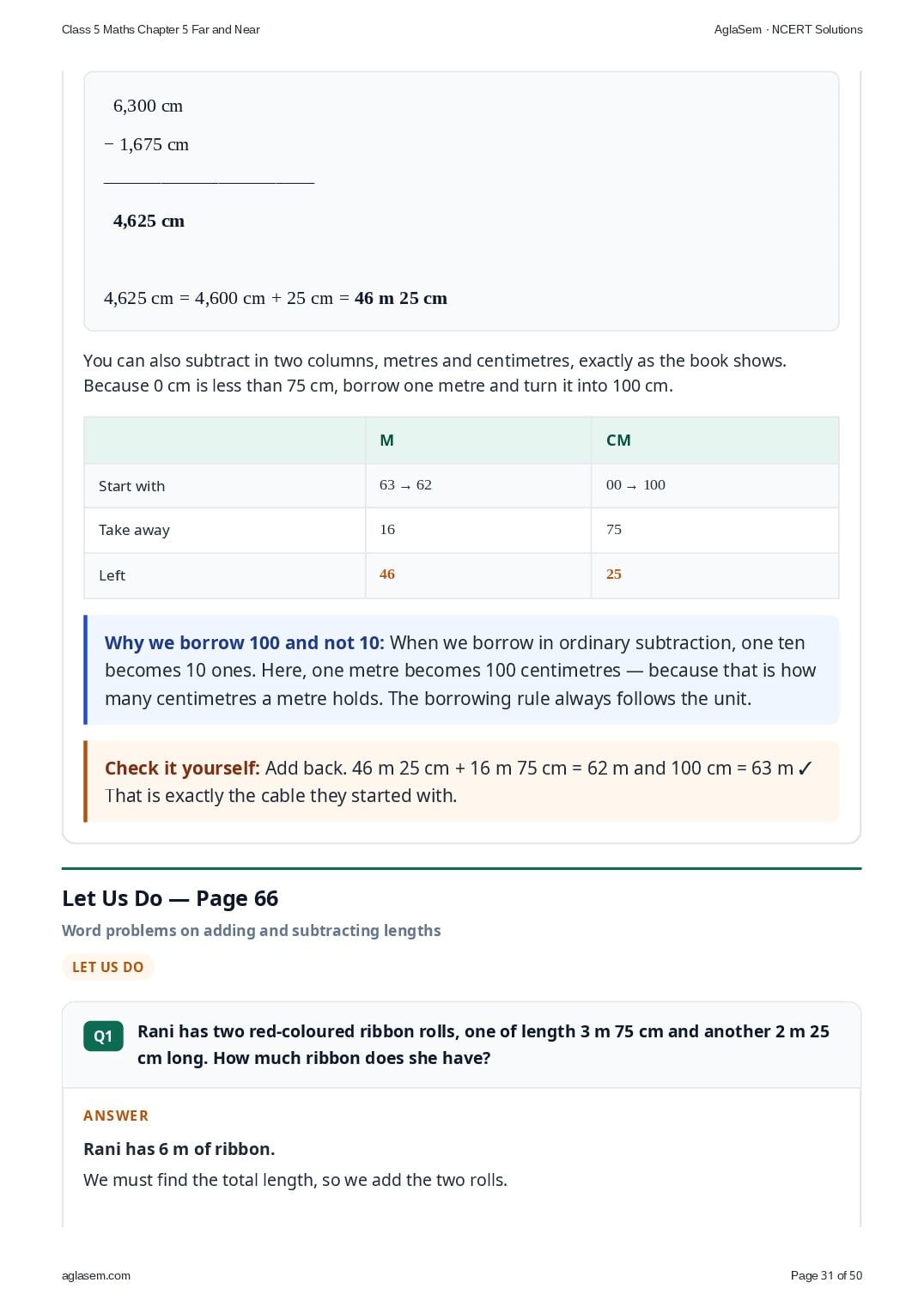
- Electricians are changing the cables in a house. They need 63 m of cable for this purpose. They used 16 m 75 cm cable in the first room. What is the length of the cable left?
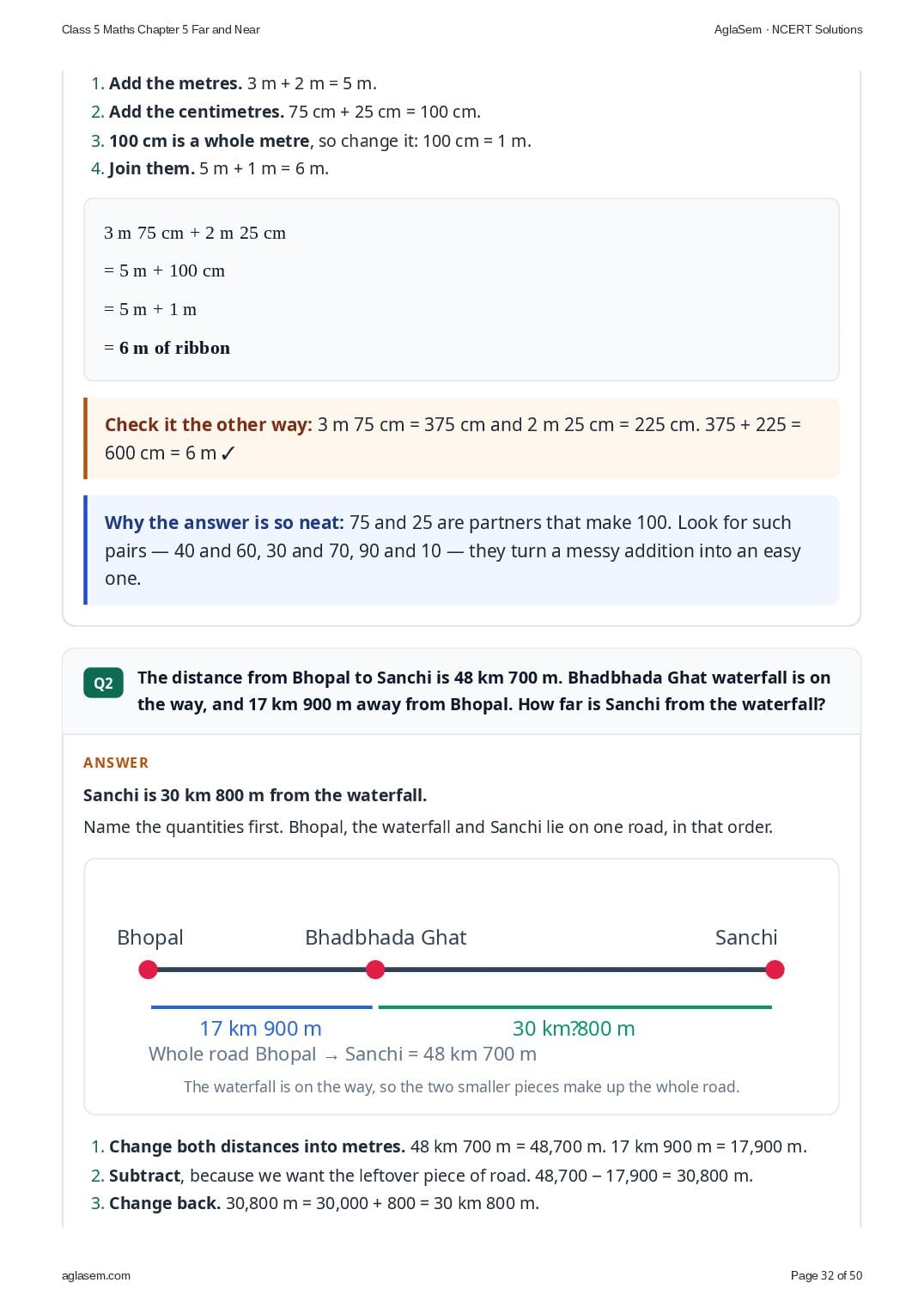
- Rani has two red-coloured ribbon rolls, one of length 3 m 75 cm and another 2 m 25 cm long. How much ribbon does she have?
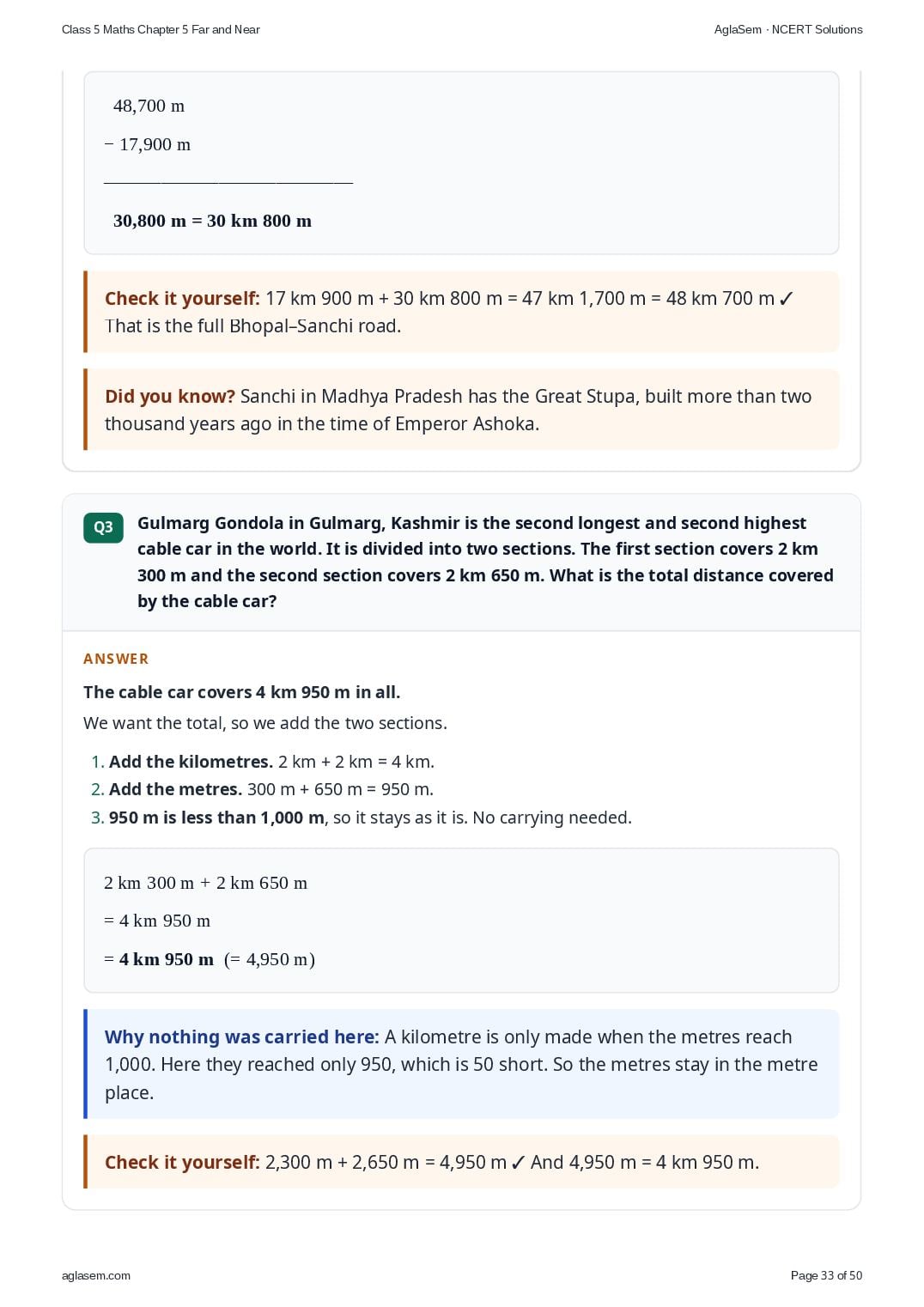
- The distance from Bhopal to Sanchi is 48 km 700 m. Bhadbhada Ghat waterfall is on the way, and 17 km 900 m away from Bhopal. How far is Sanchi from the waterfall?
- Gulmarg Gondola in Gulmarg, Kashmir is the second longest and second highest cable car in the world. It is divided into two sections. The first section covers 2 km 300 m and the second section covers 2 km 650 m. What is the total distance covered by the cable car?
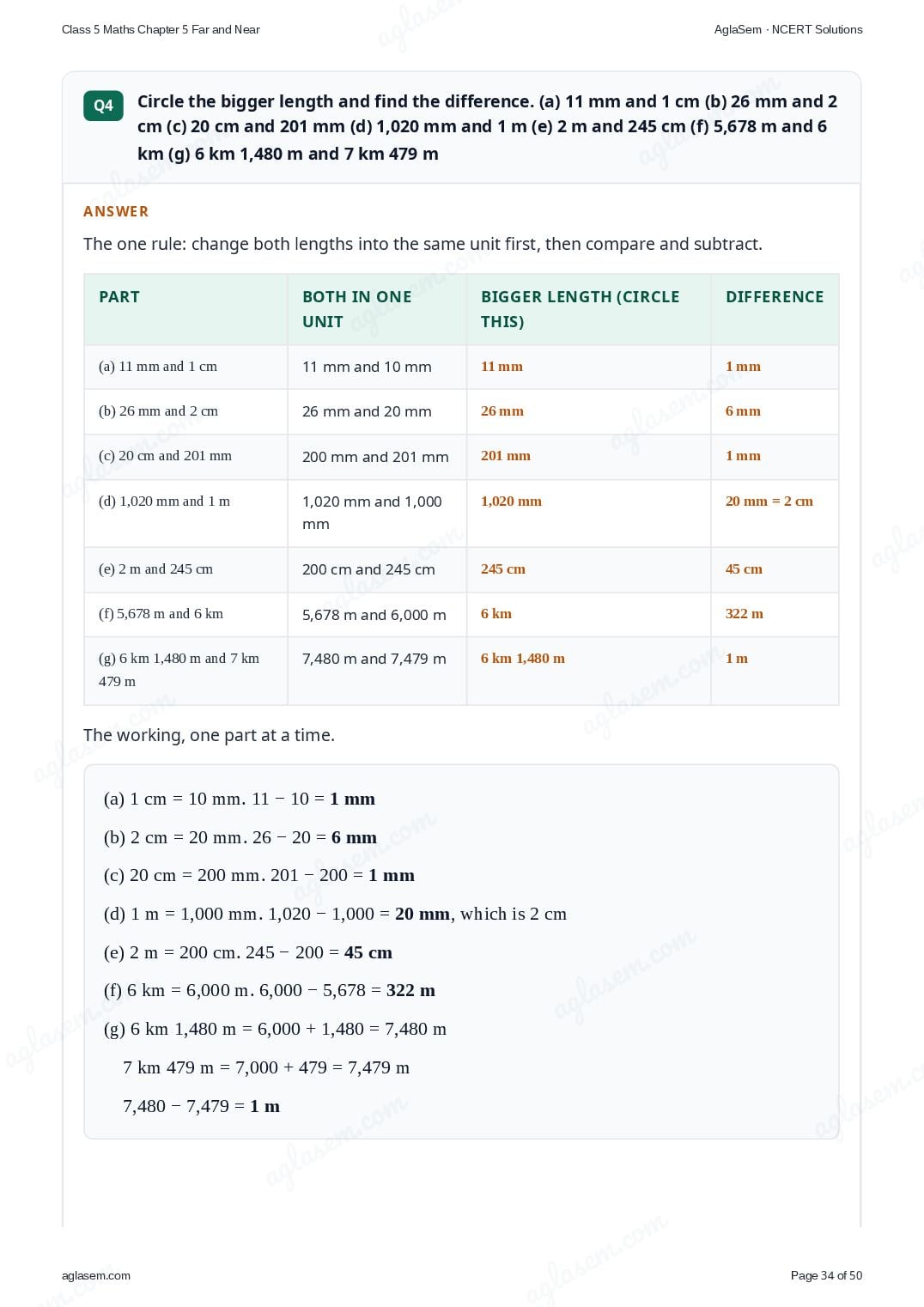
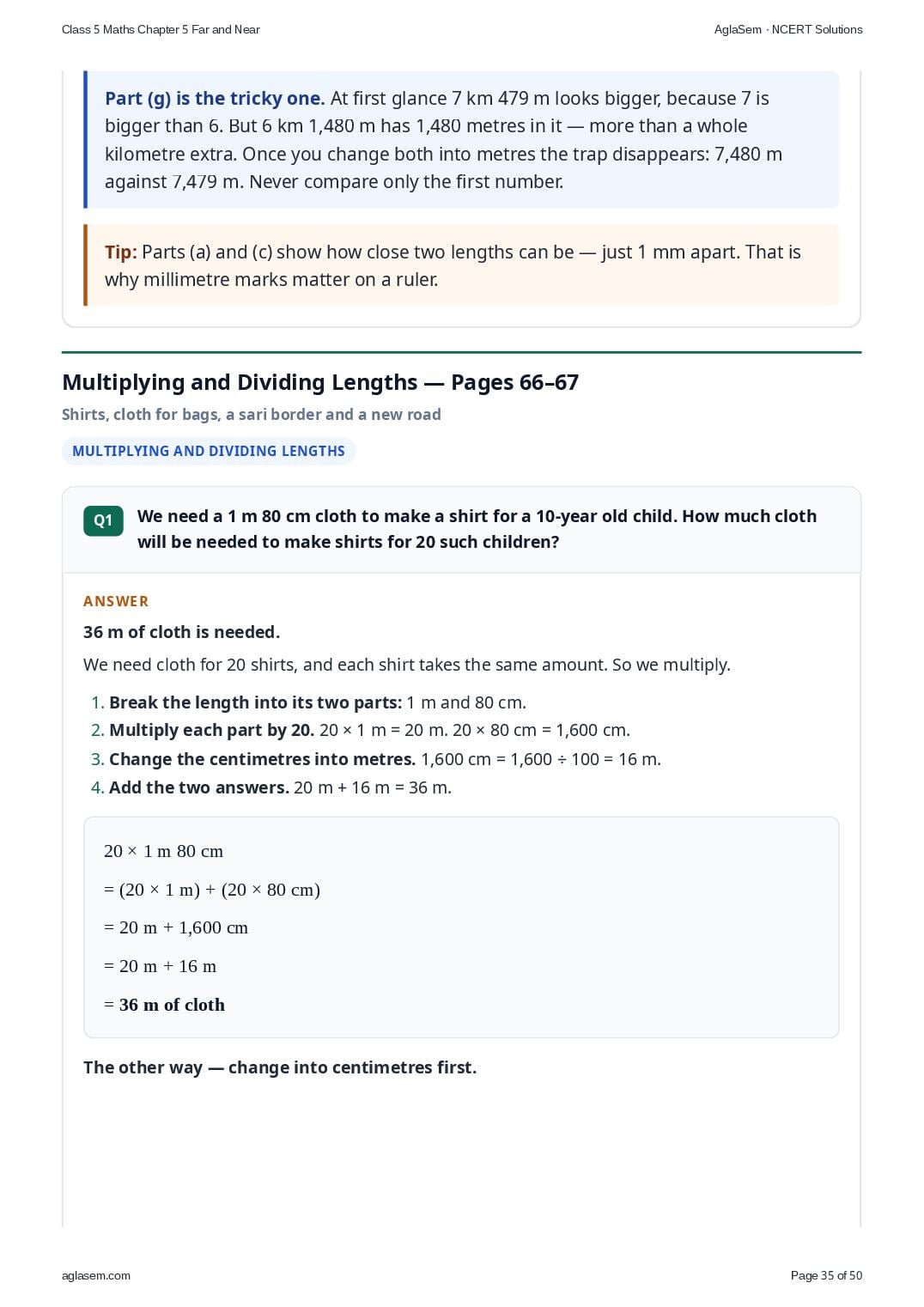
- Circle the bigger length and find the difference. (a) 11 mm and 1 cm (b) 26 mm and 2 cm (c) 20 cm and 201 mm (d) 1,020 mm and 1 m (e) 2 m and 245 cm (f) 5,678 m and 6 km (g) 6 km 1,480 m and 7 km 479 m
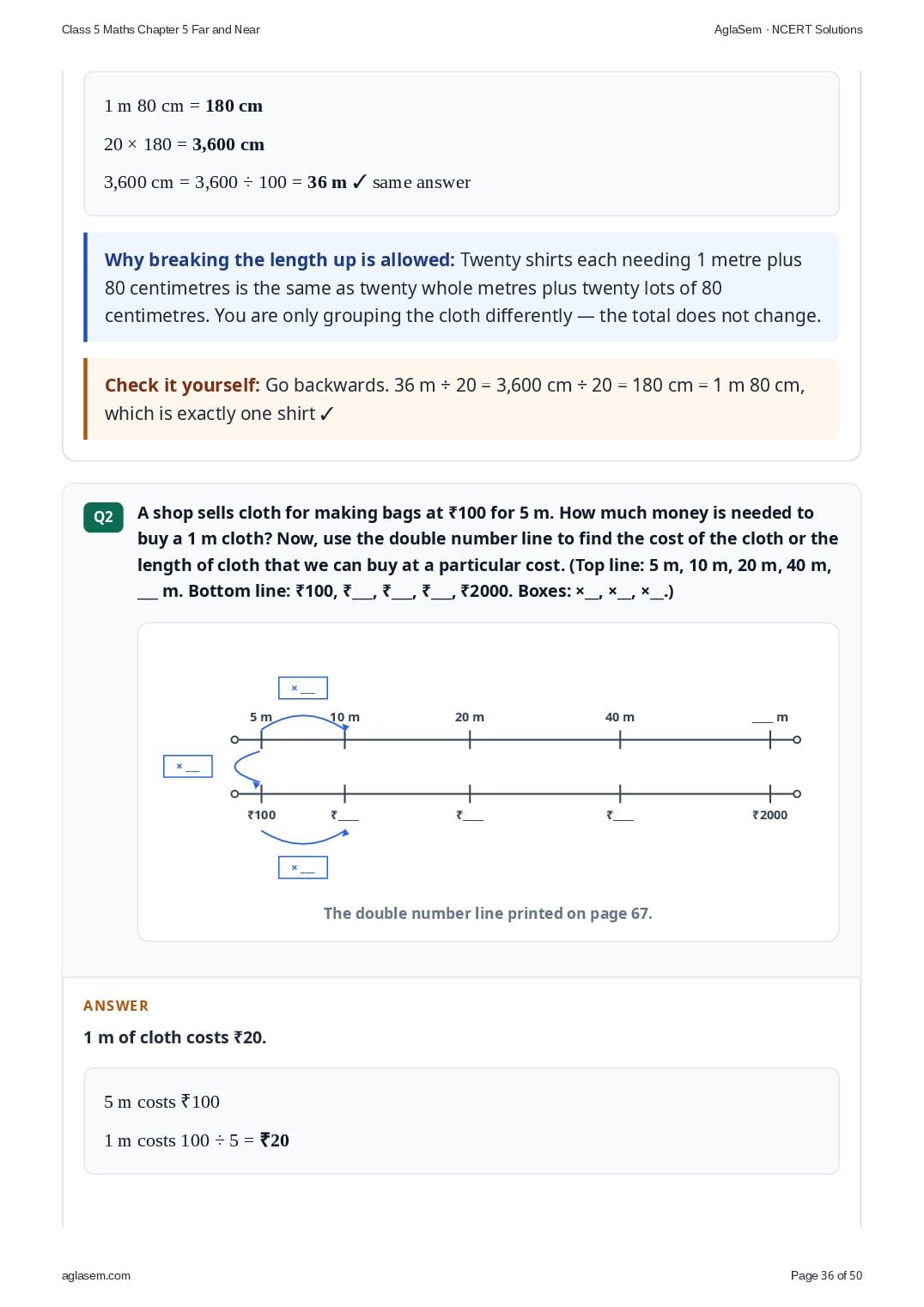
- We need a 1 m 80 cm cloth to make a shirt for a 10-year old child. How much cloth will be needed to make shirts for 20 such children?
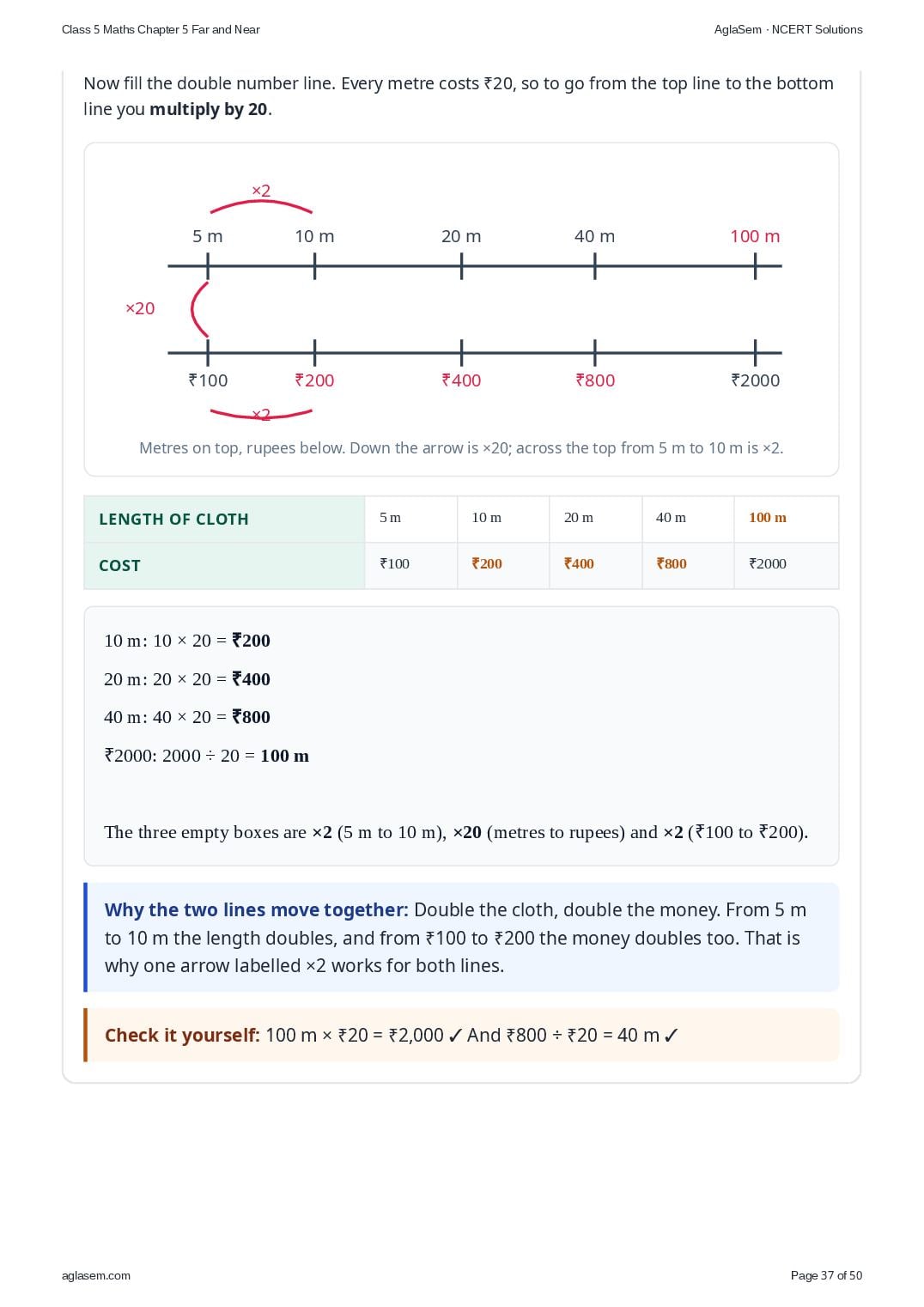
- A shop sells cloth for making bags at ₹100 for 5 m. How much money is needed to buy a 1 m cloth? Now, use the double number line to find the cost of the cloth or the length of cloth that we can buy at a particular cost. (Top line: 5 m, 10 m, 20 m, 40 m, ___ m. Bottom line: ₹100, ₹___, ₹___, ₹___, ₹2000. Boxes: ×__, ×__, ×__.) 5 m10 m20 m40 m____ m₹100₹____₹____₹____₹2000× ___× ___× ___The double number line printed on page 67.
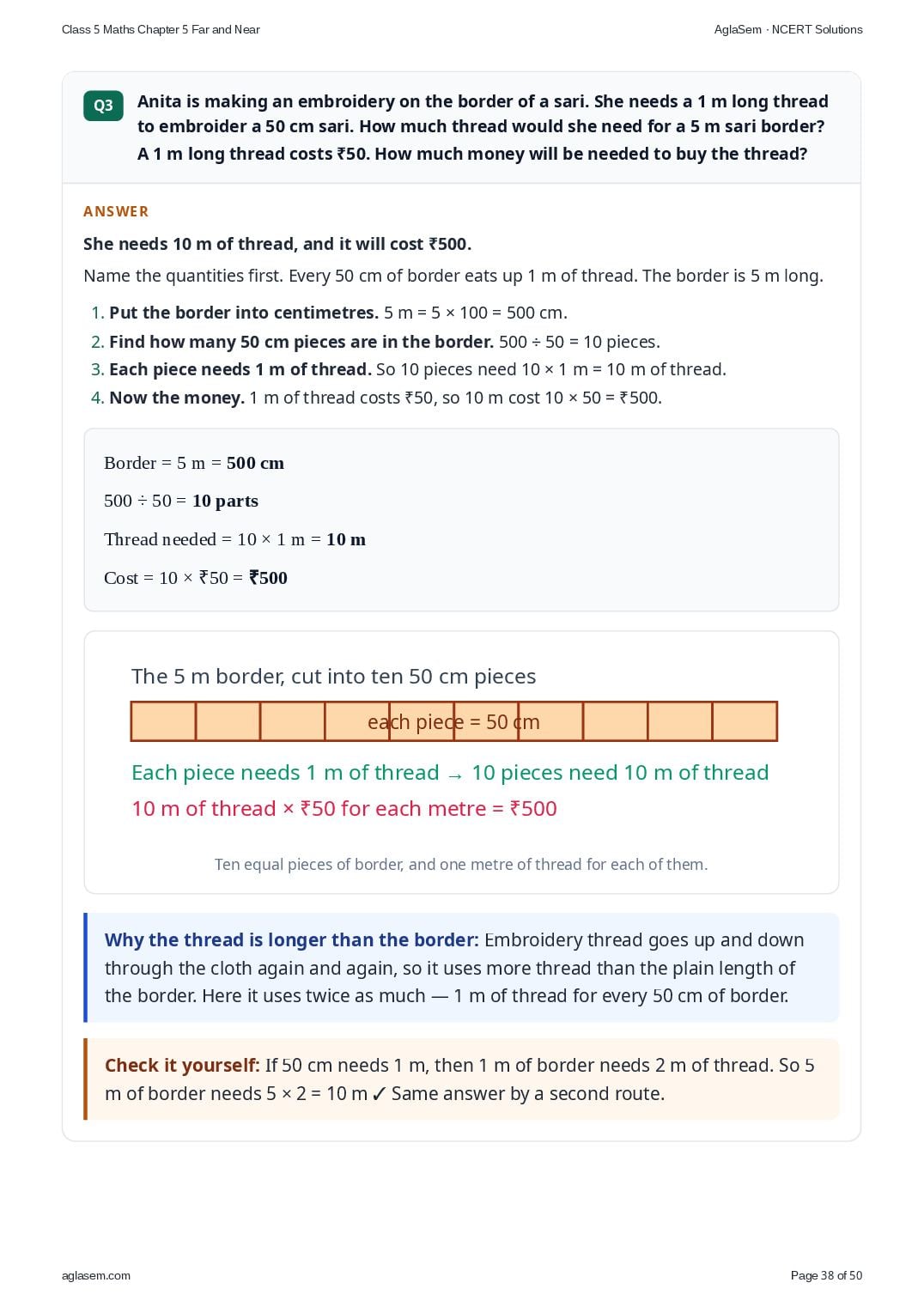
- Anita is making an embroidery on the border of a sari. She needs a 1 m long thread to embroider a 50 cm sari. How much thread would she need for a 5 m sari border? A 1 m long thread costs ₹50. How much money will be needed to buy the thread?
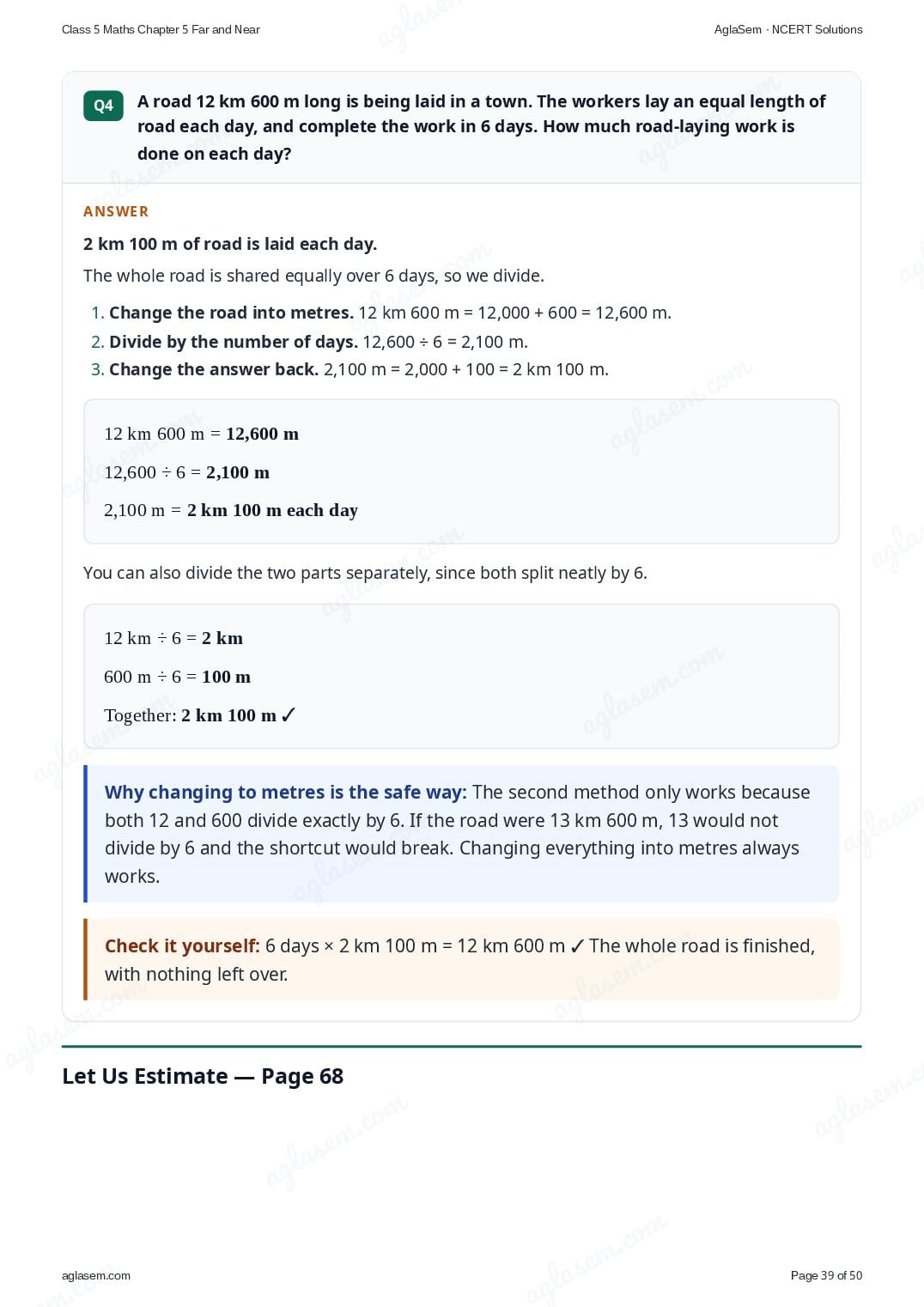
- A road 12 km 600 m long is being laid in a town. The workers lay an equal length of road each day, and complete the work in 6 days. How much road-laying work is done on each day?
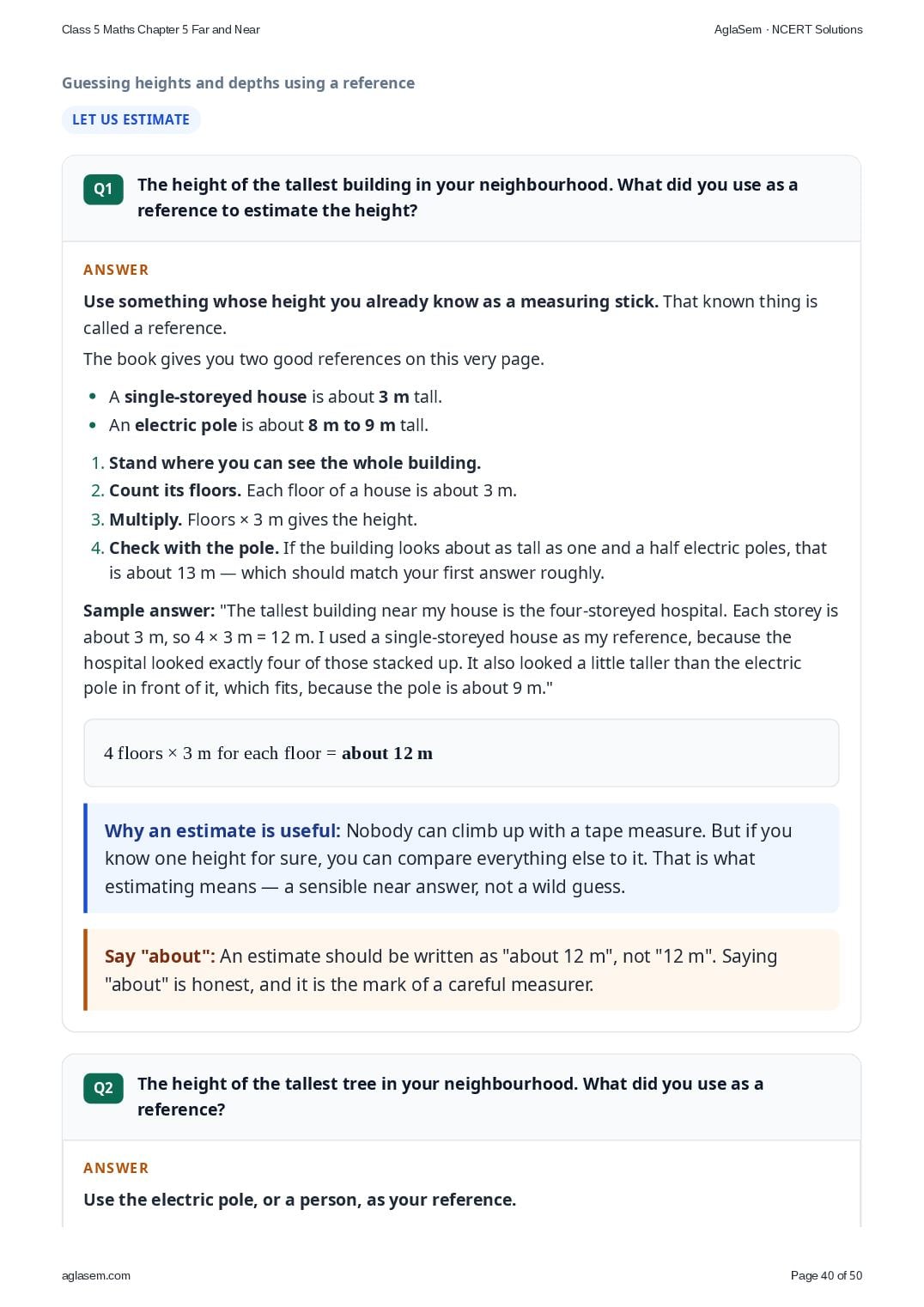
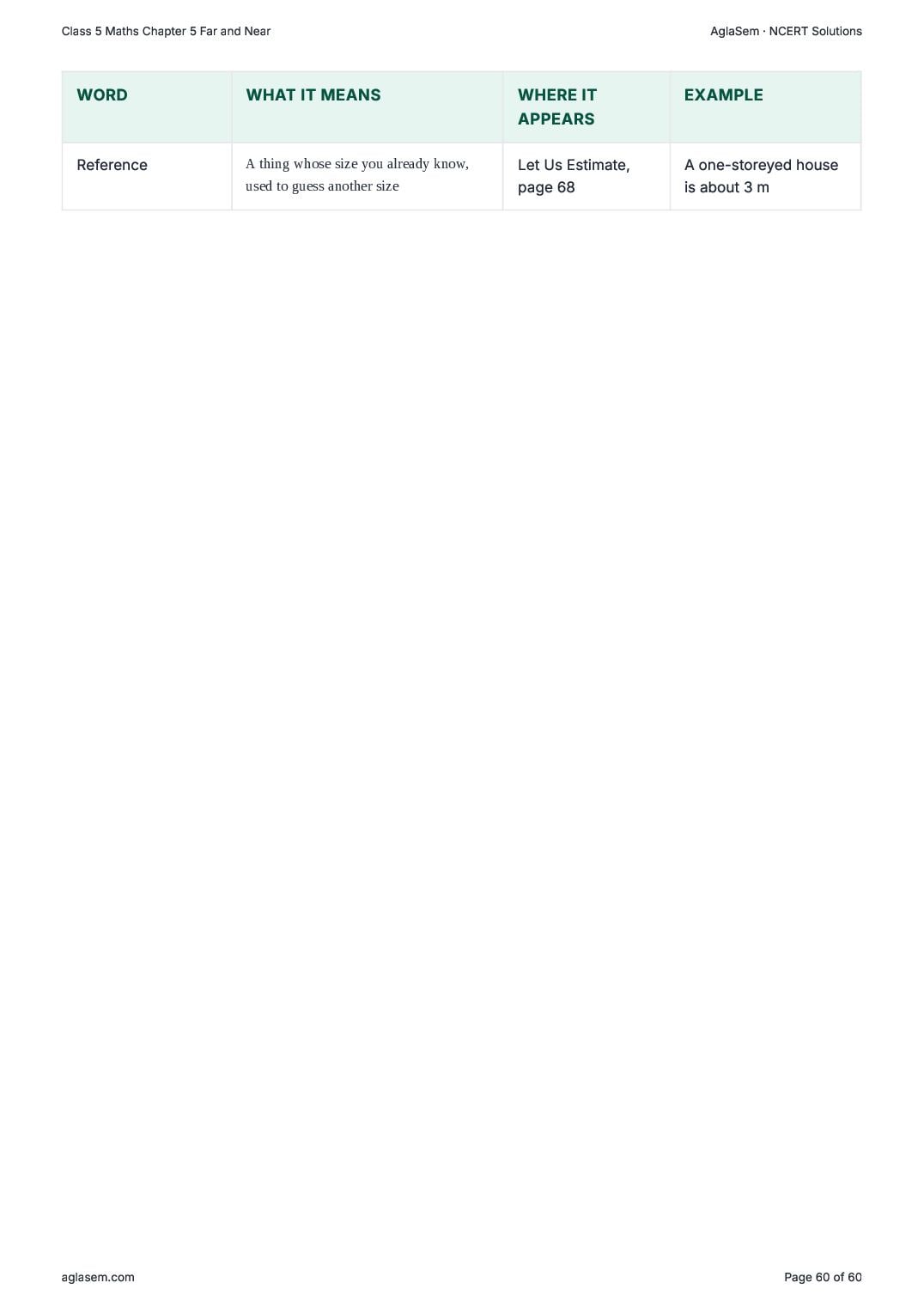
- The height of the tallest building in your neighbourhood. What did you use as a reference to estimate the height?
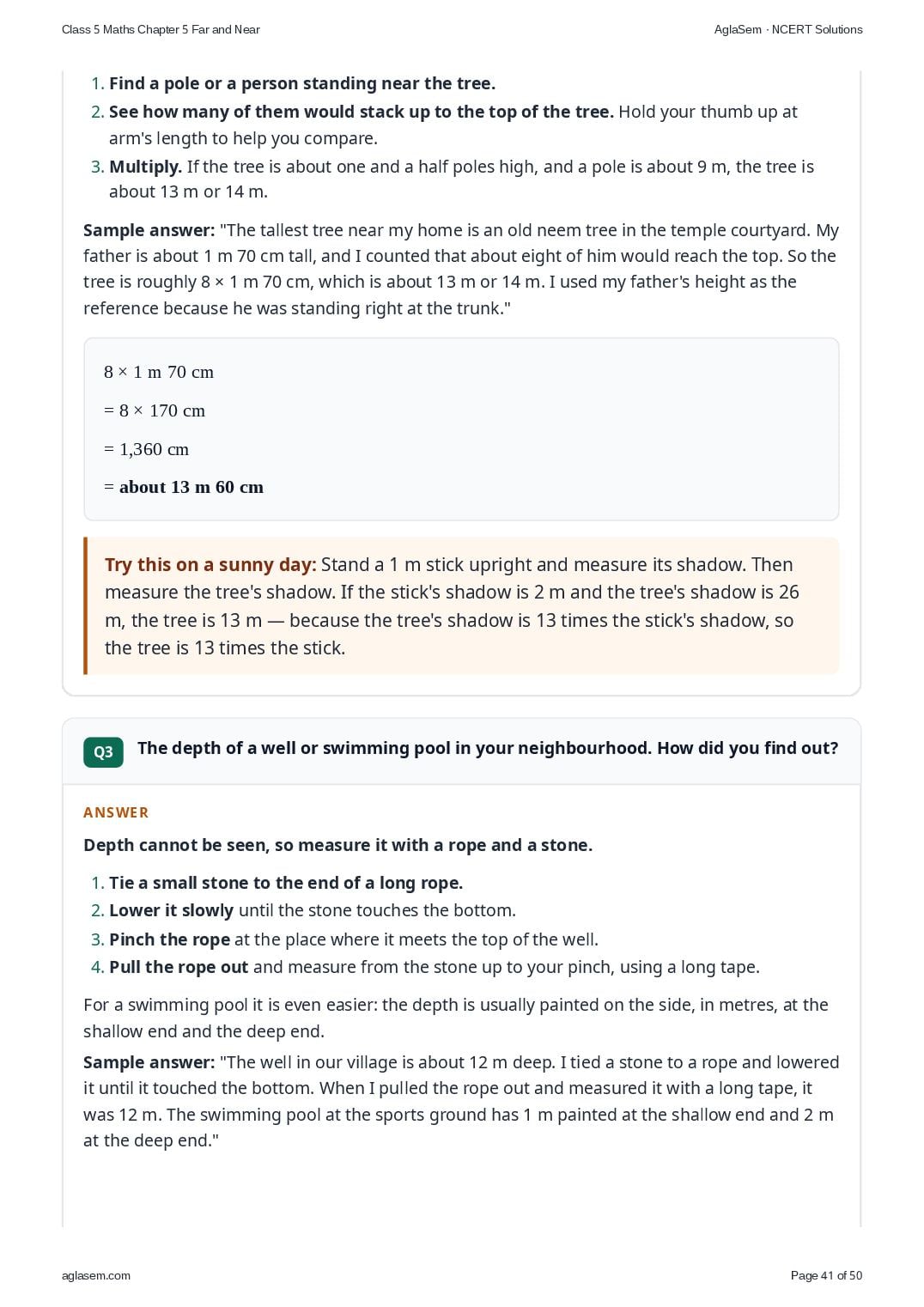
- The height of the tallest tree in your neighbourhood. What did you use as a reference?
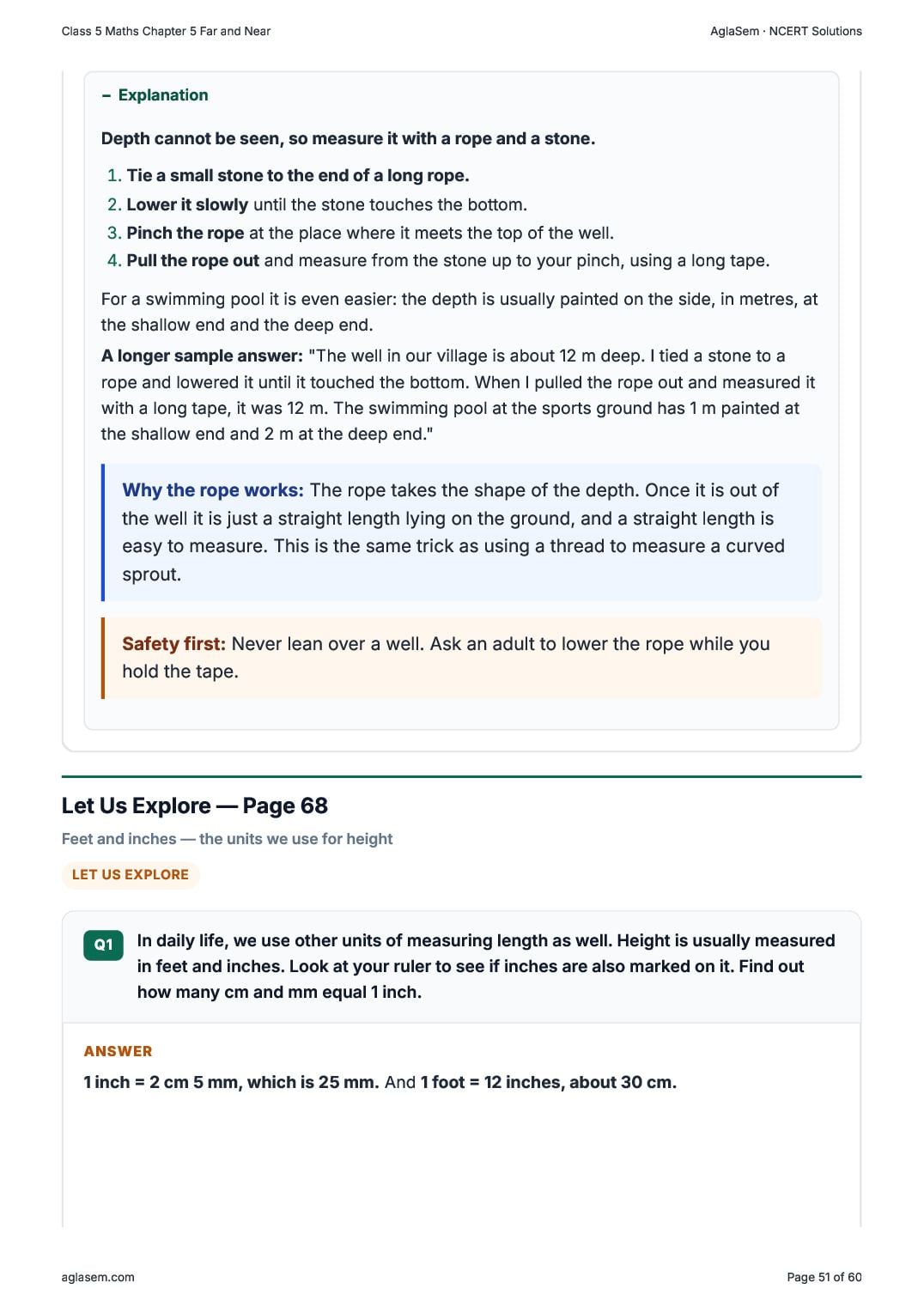
- The depth of a well or swimming pool in your neighbourhood. How did you find out?
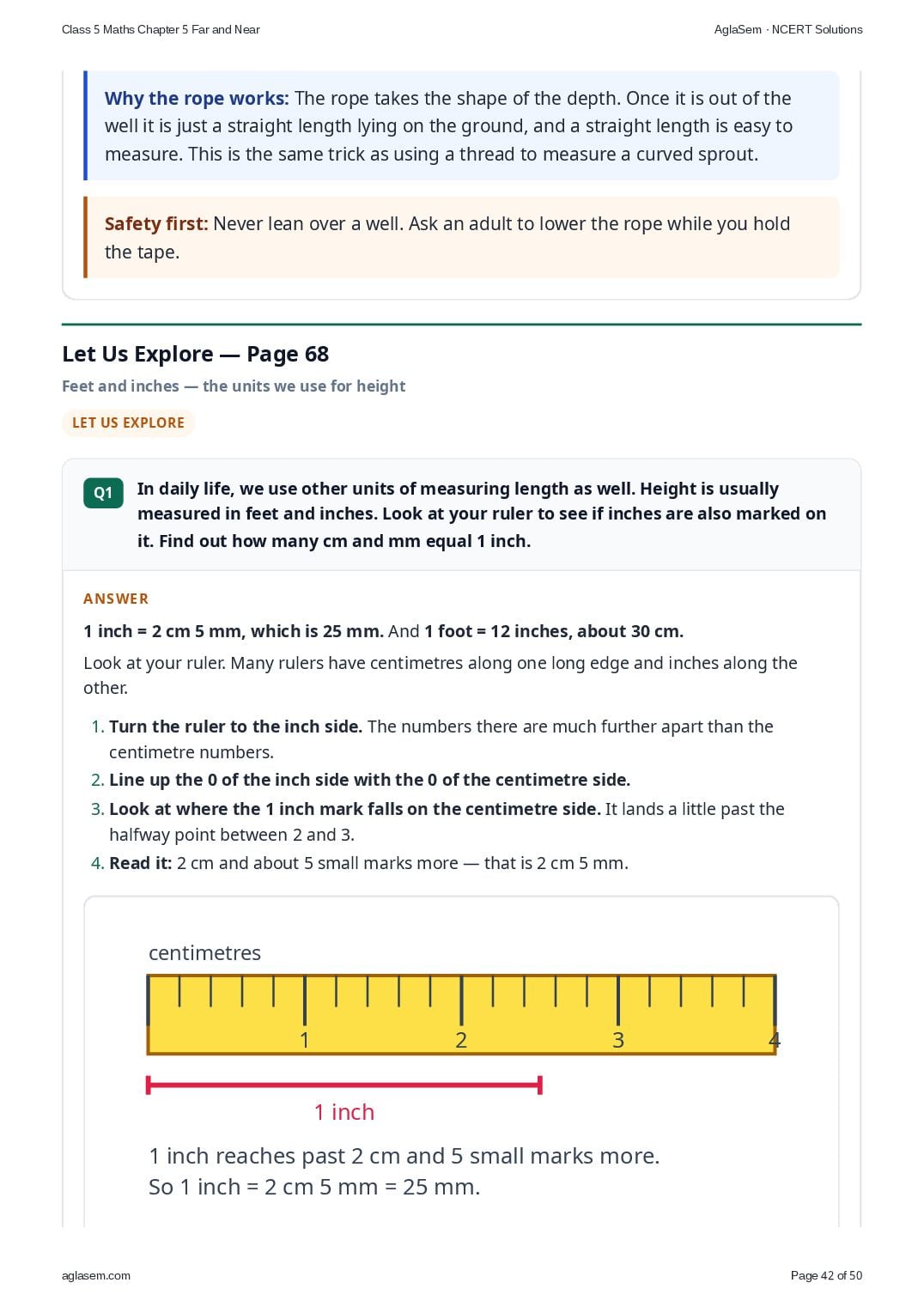
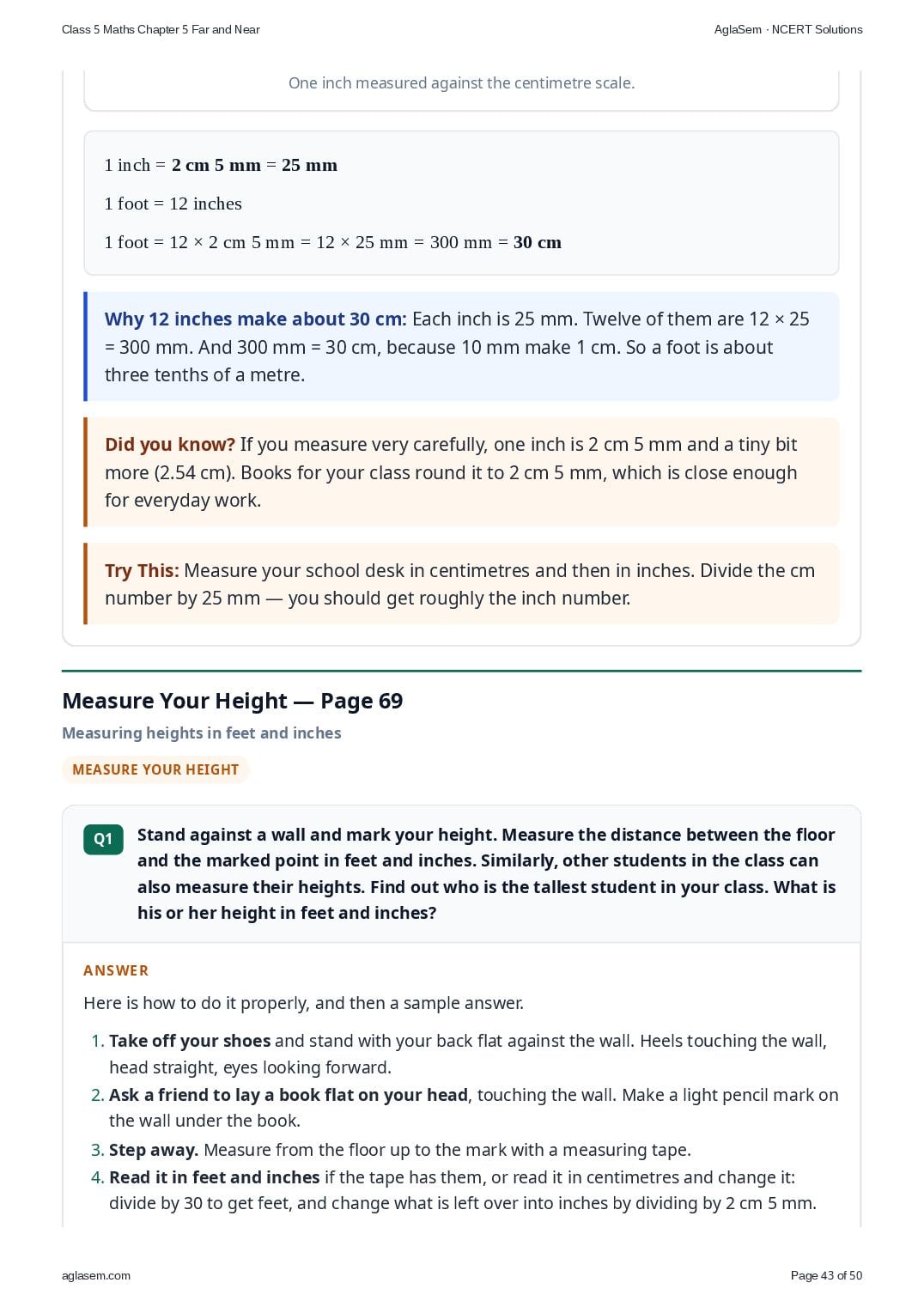
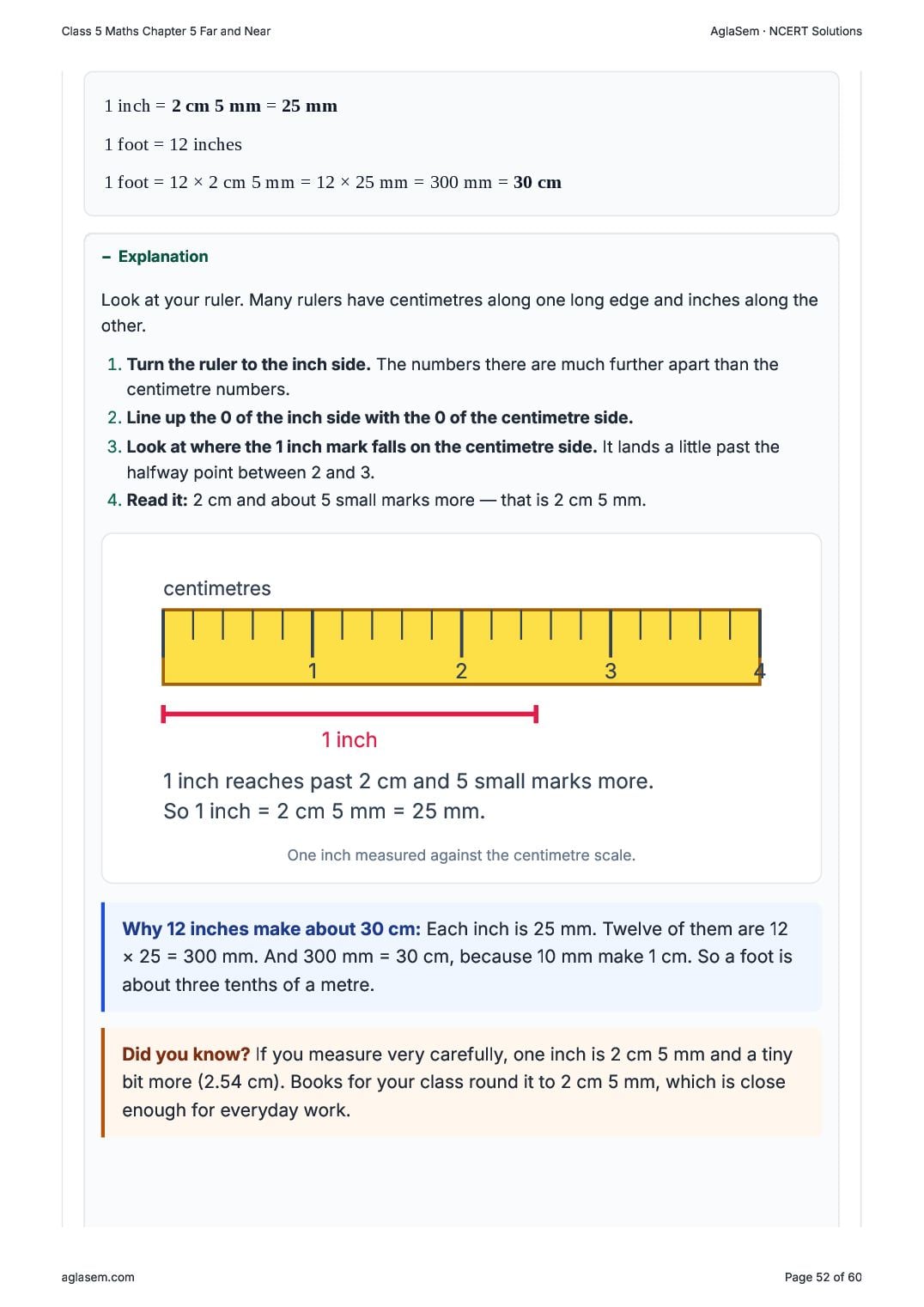
- In daily life, we use other units of measuring length as well. Height is usually measured in feet and inches. Look at your ruler to see if inches are also marked on it. Find out how many cm and mm equal 1 inch.
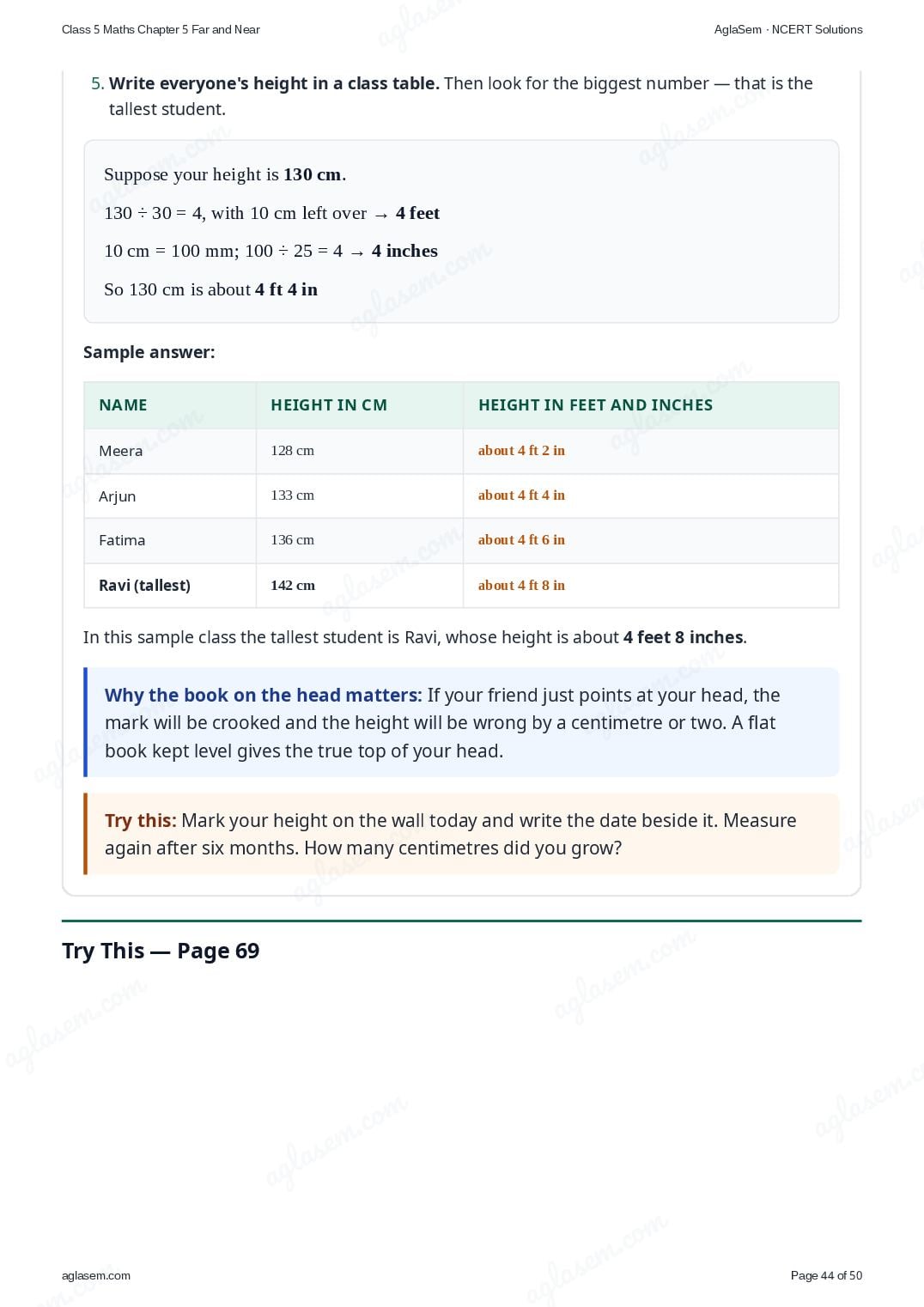
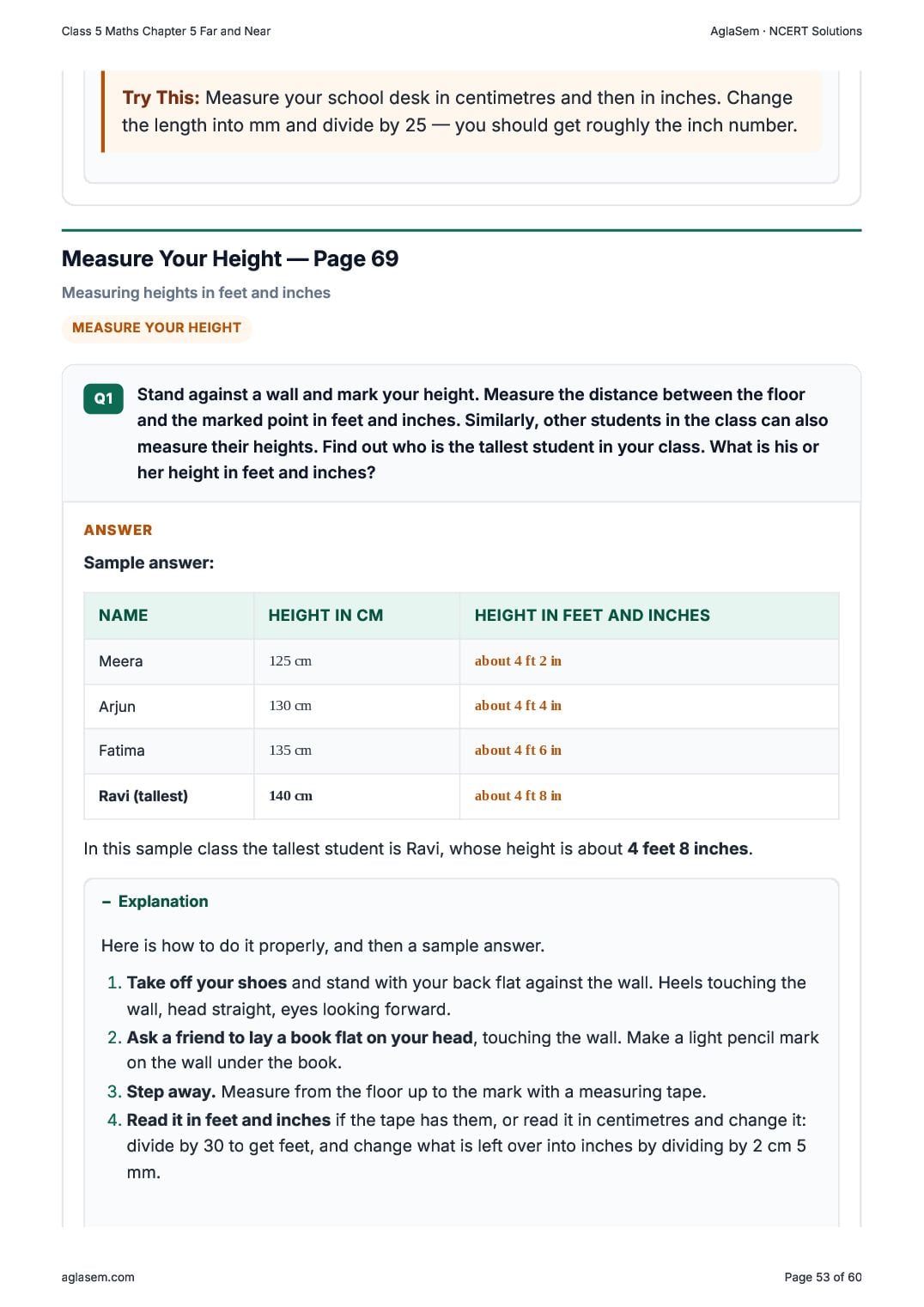
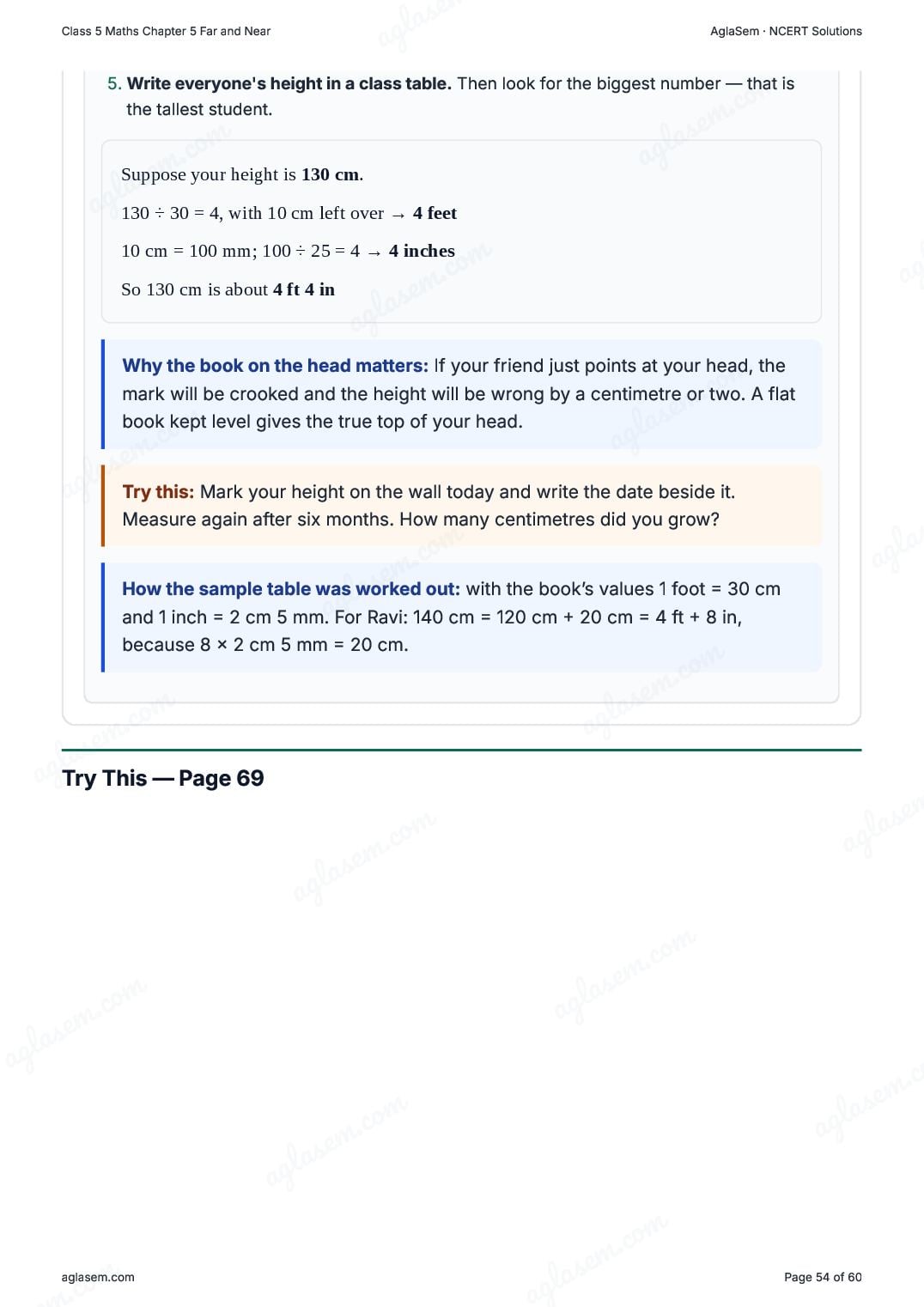
- Stand against a wall and mark your height. Measure the distance between the floor and the marked point in feet and inches. Similarly, other students in the class can also measure their heights. Find out who is the tallest student in your class. What is his or her height in feet and inches?
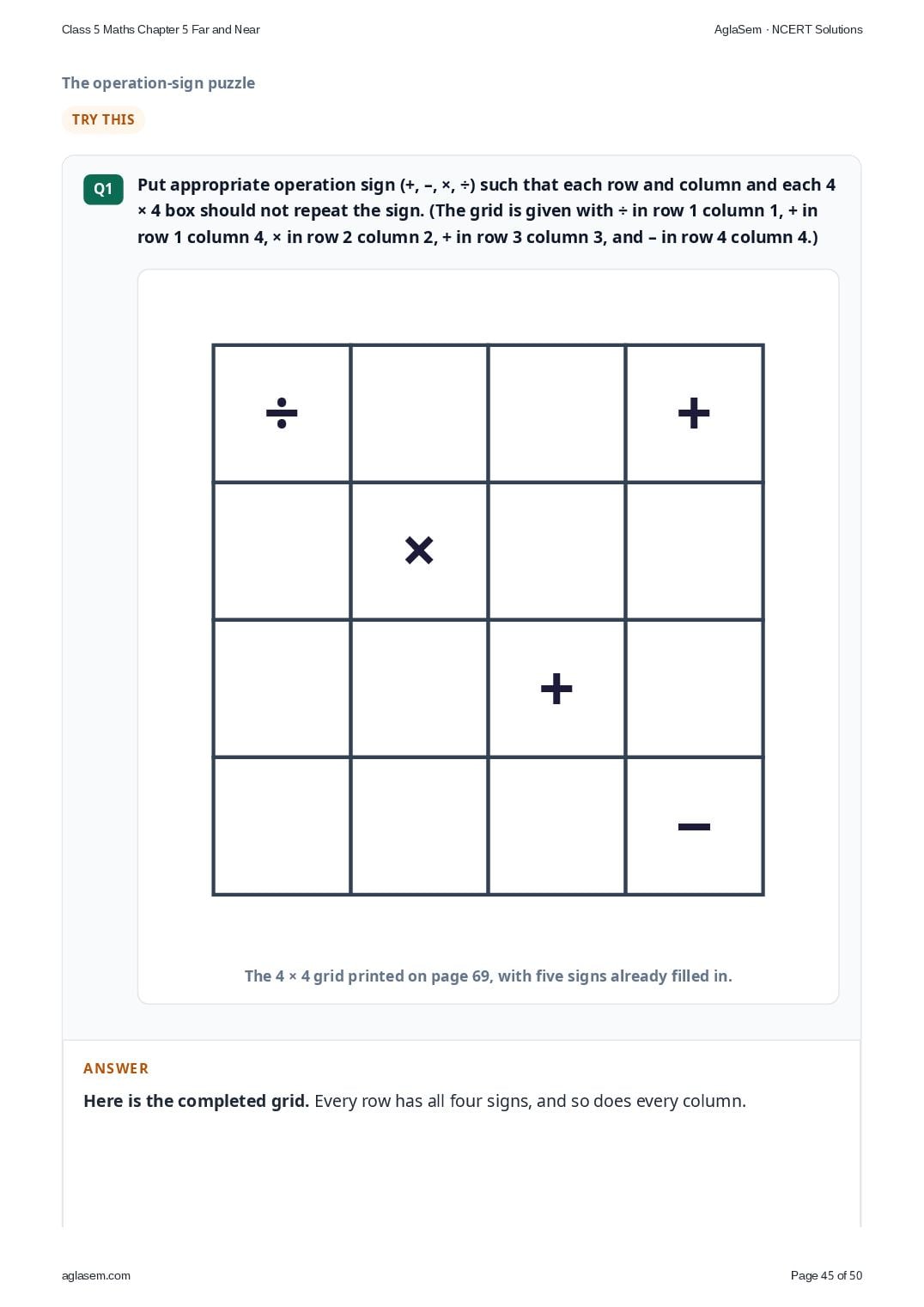
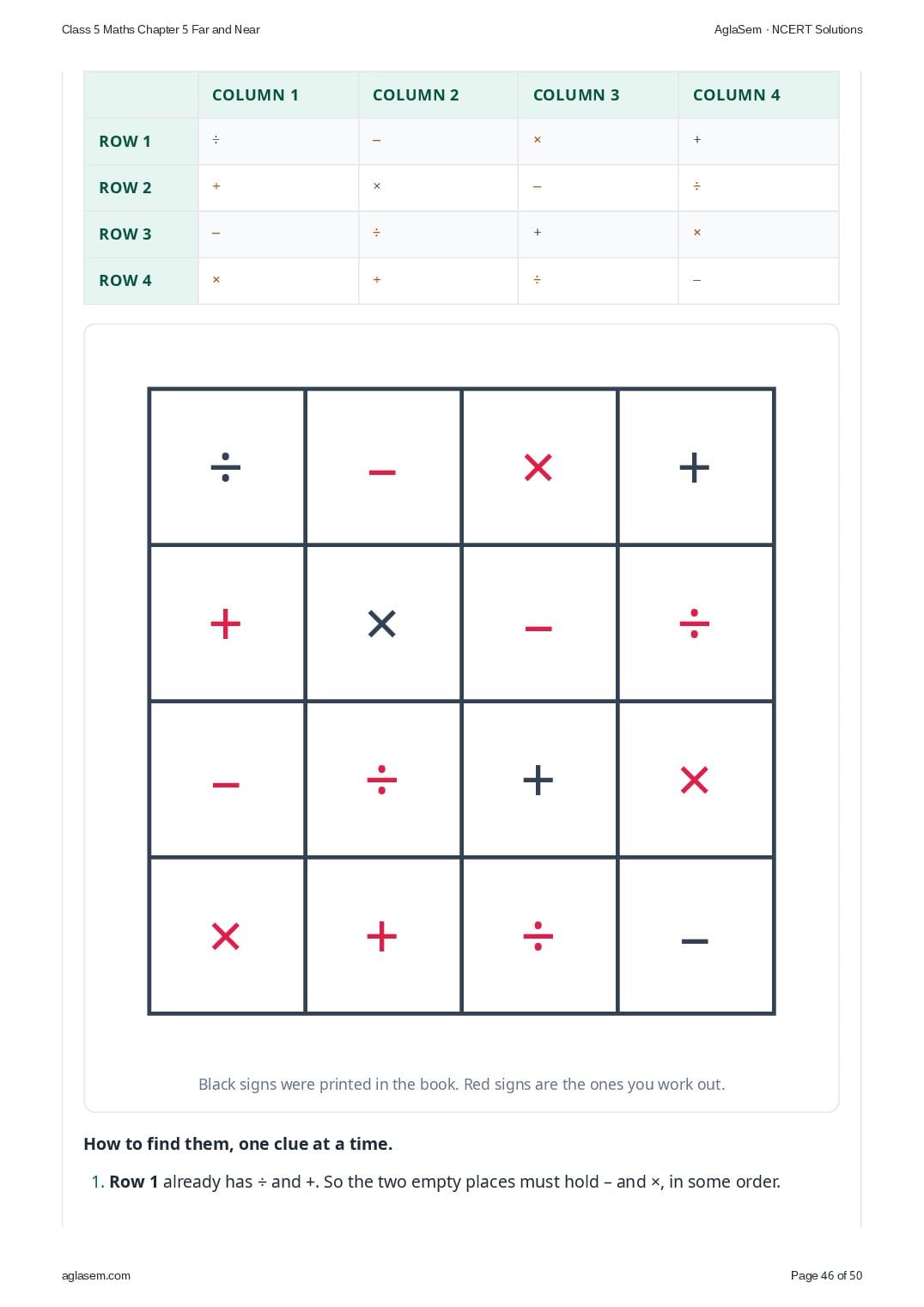
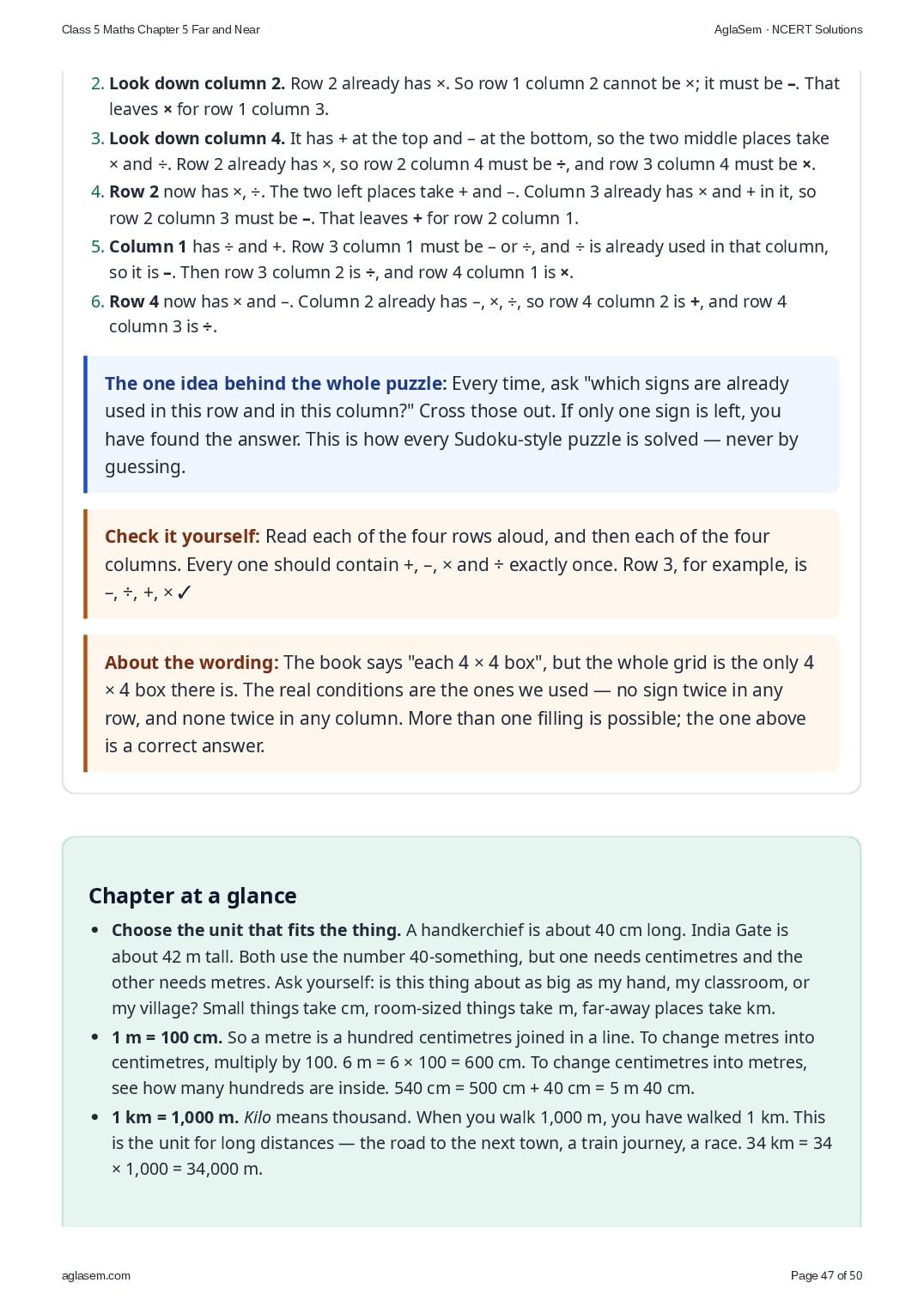
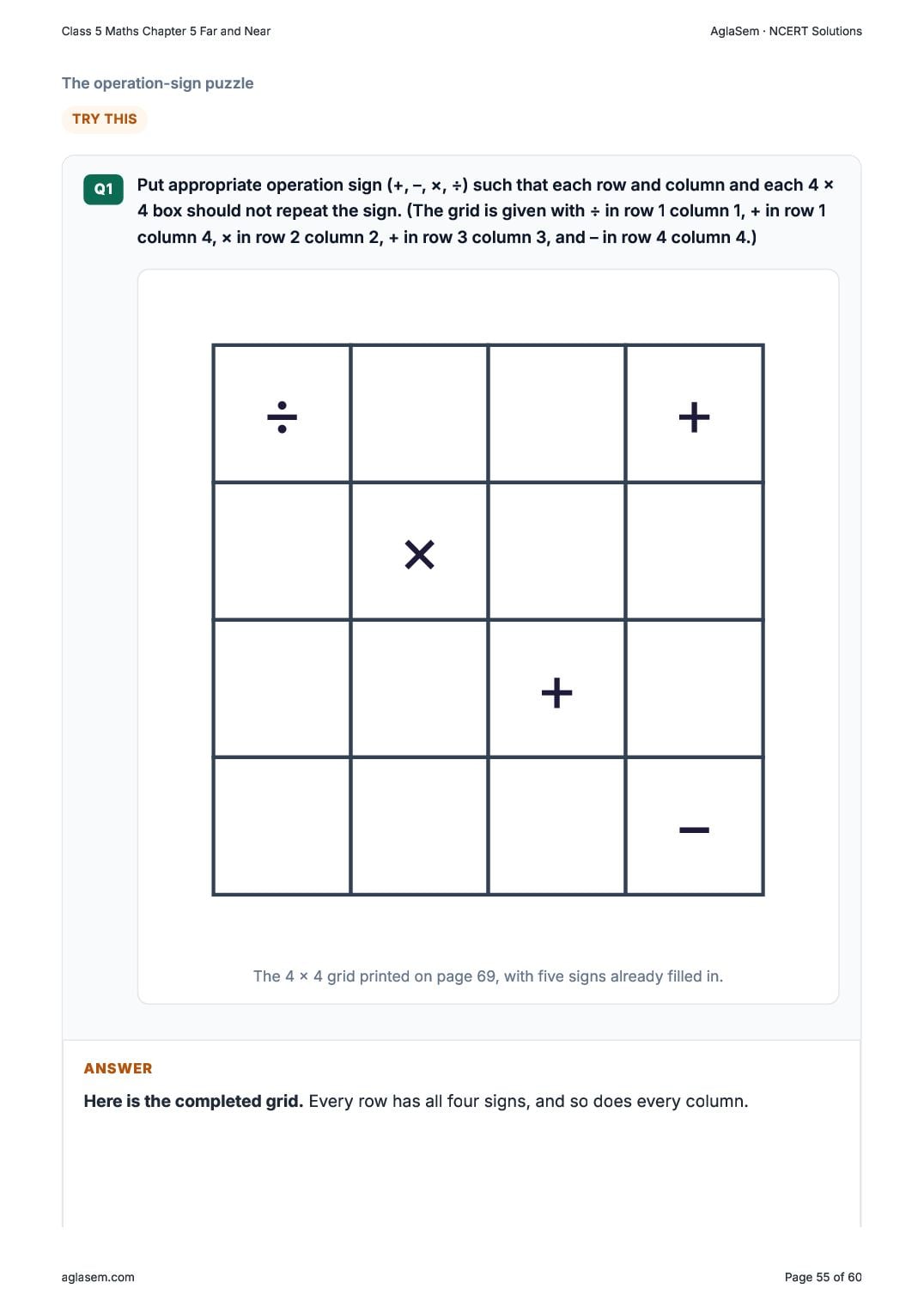
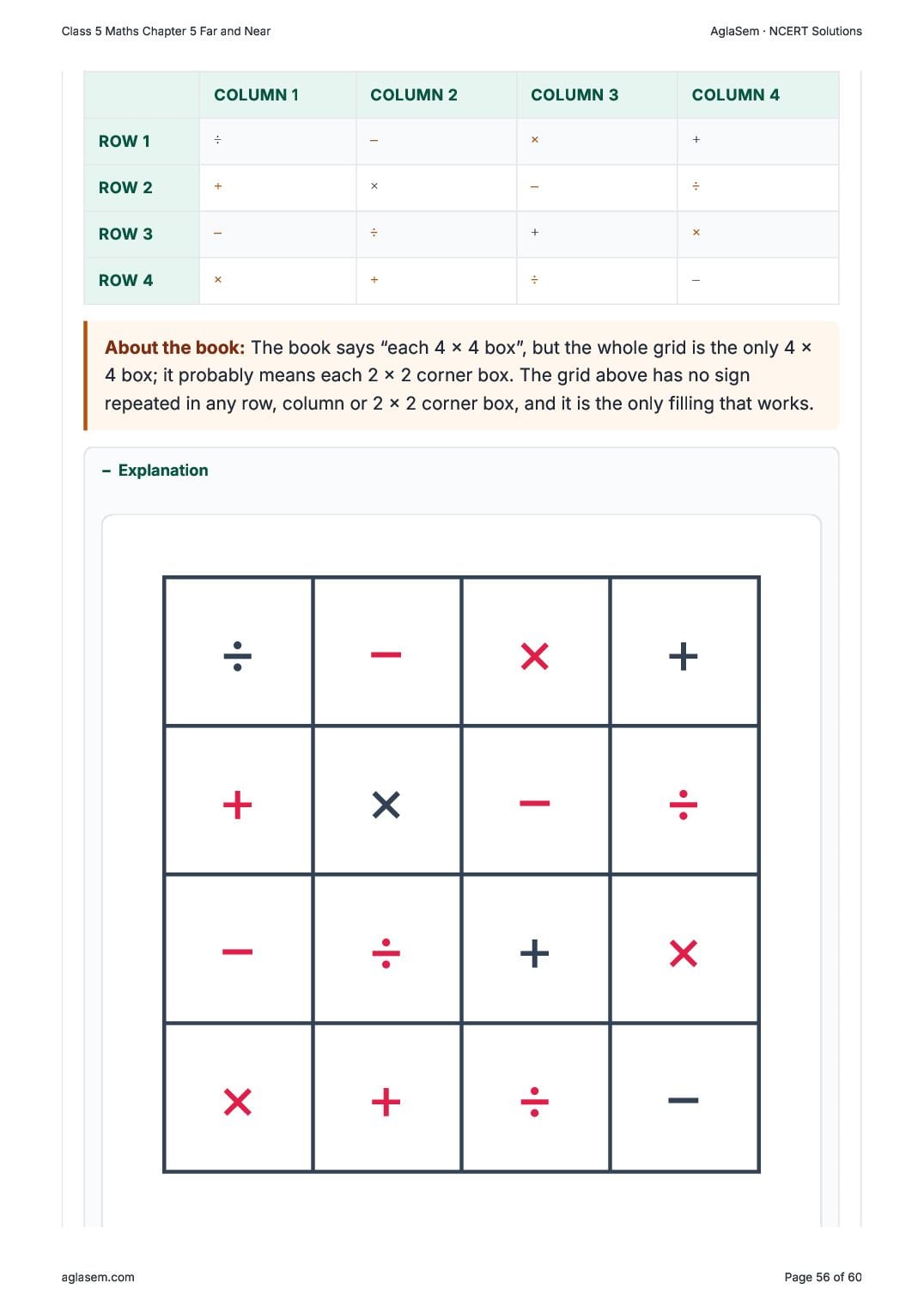
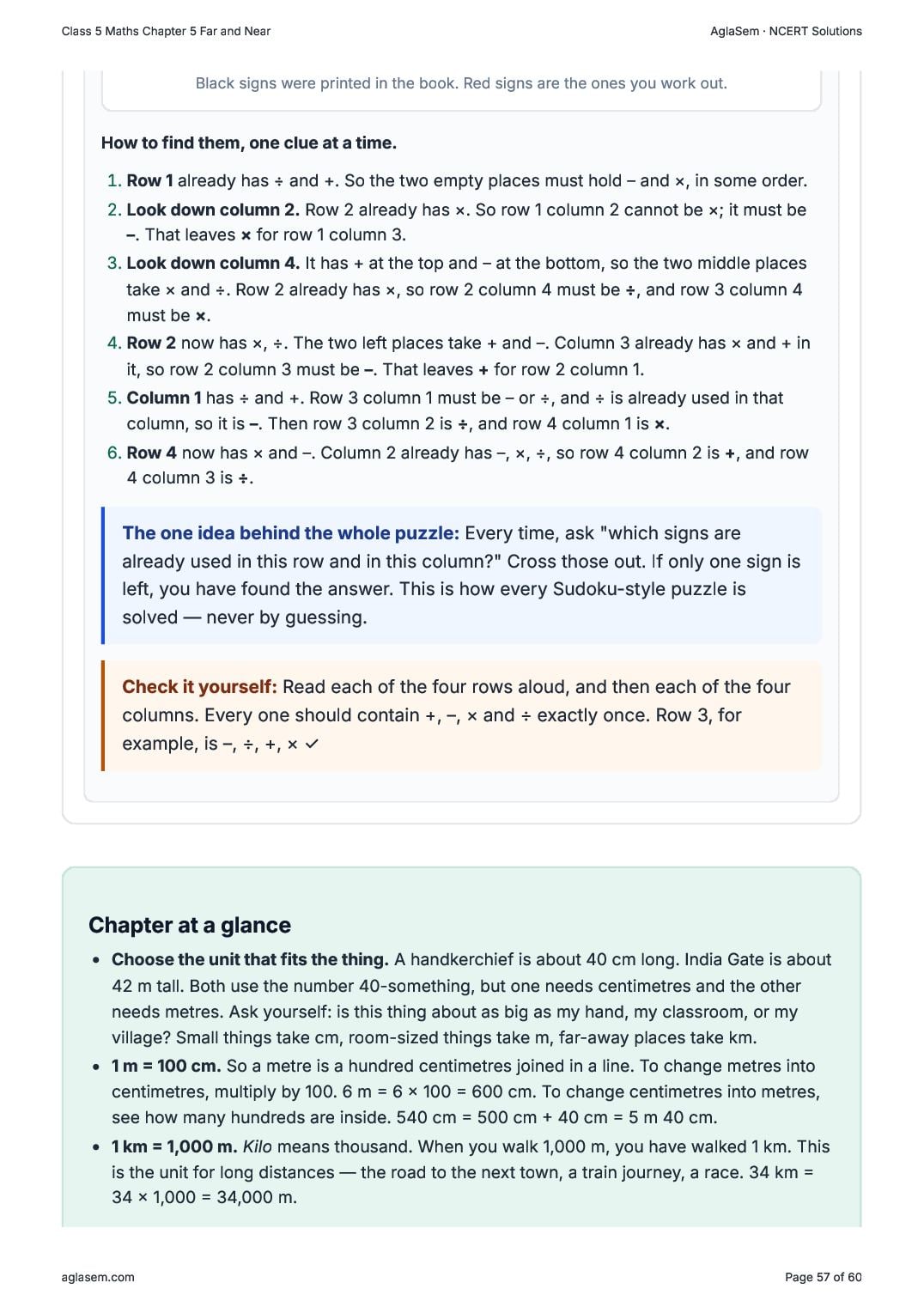
- Put appropriate operation sign (+, –, ×, ÷) such that each row and column and each 4 × 4 box should not repeat the sign. (The grid is given with ÷ in row 1 column 1, + in row 1 column 4, × in row 2 column 2, + in row 3 column 3, and – in row 4 column 4.) ÷+×+−The 4 × 4 grid printed on page 69, with five signs already filled in.
Chapter at a Glance
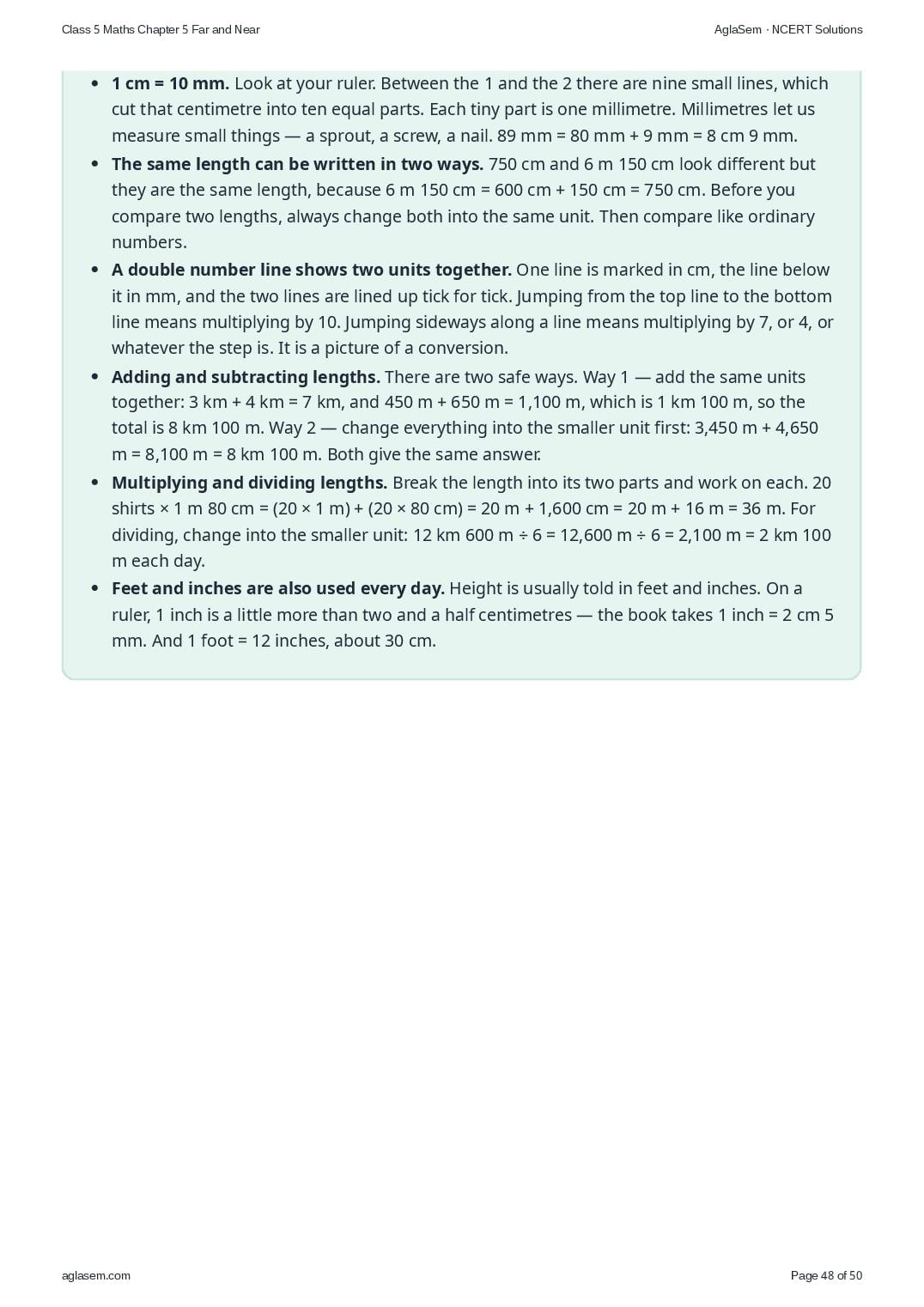
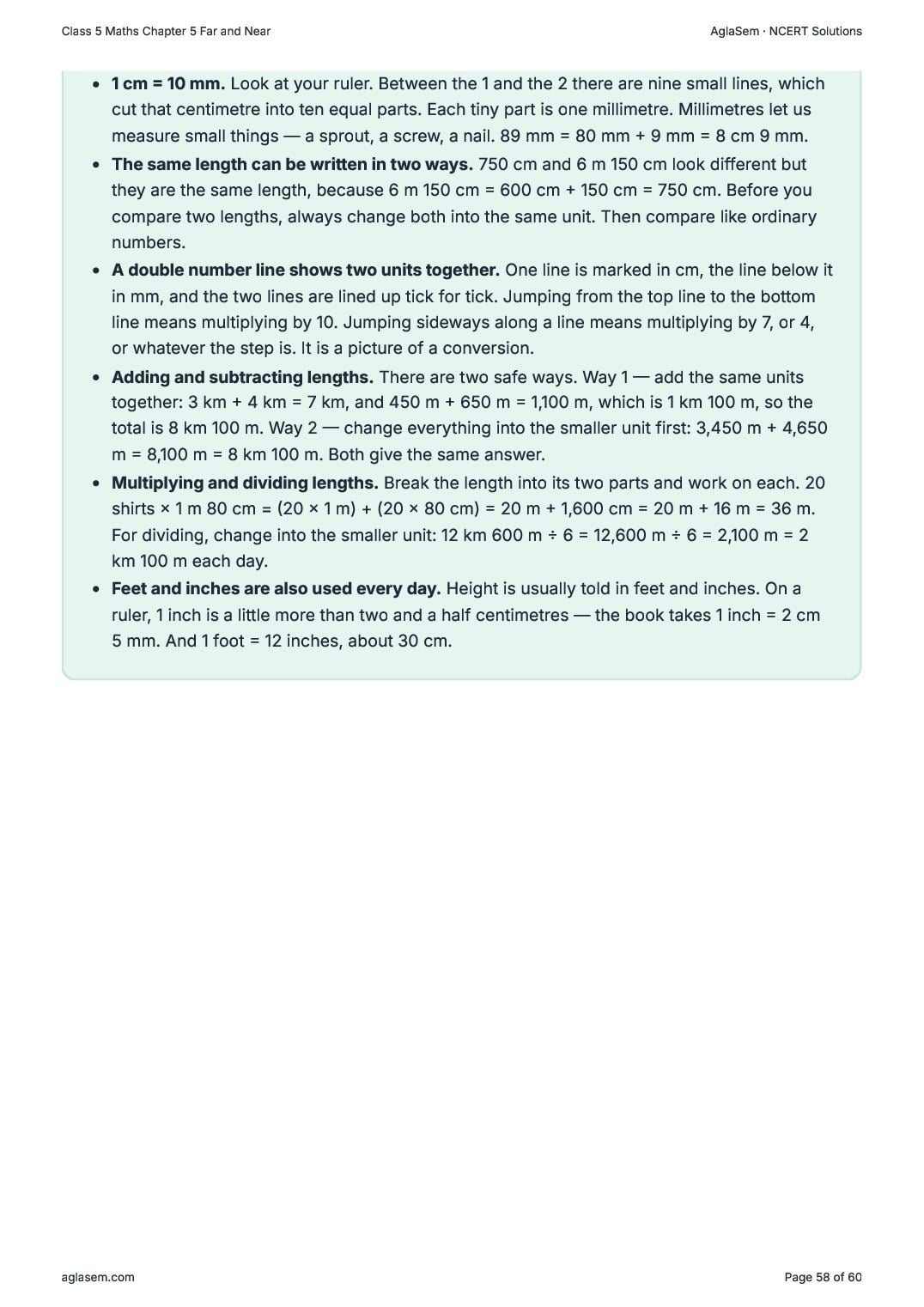
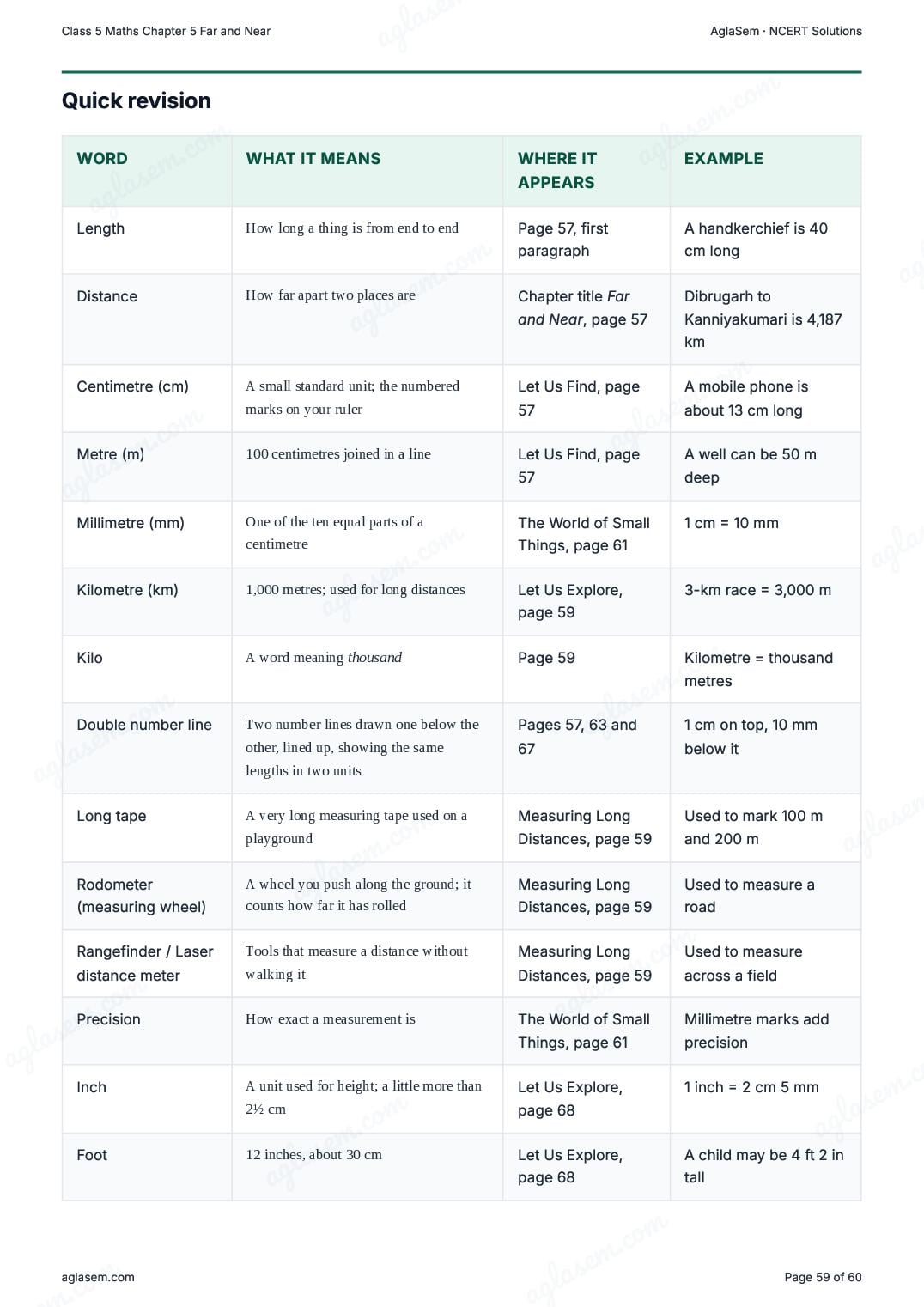
- Choose the unit that fits the thing. A handkerchief is about 40 cm long. India Gate is about 42 m tall. Both use the number 40-something, but one needs centimetres and the other needs metres. Ask yourself: is this thing about as big as my hand, my classroom, or my village? Small things take cm, room-sized things take m, far-away places take km.
- 1 m = 100 cm. So a metre is a hundred centimetres joined in a line. To change metres into centimetres, multiply by 100. 6 m = 6 × 100 = 600 cm. To change centimetres into metres, see how many hundreds are inside. 540 cm = 500 cm + 40 cm = 5 m 40 cm.
- 1 km = 1,000 m. Kilo means thousand. When you walk 1,000 m, you have walked 1 km. This is the unit for long distances — the road to the next town, a train journey, a race. 34 km = 34 × 1,000 = 34,000 m.
- 1 cm = 10 mm. Look at your ruler. Between the 1 and the 2 there are nine small lines, which cut that centimetre into ten equal parts. Each tiny part is one millimetre. Millimetres let us measure small things — a sprout, a screw, a nail. 89 mm = 80 mm + 9 mm = 8 cm 9 mm.
- The same length can be written in two ways. 750 cm and 6 m 150 cm look different but they are the same length, because 6 m 150 cm = 600 cm + 150 cm = 750 cm. Before you compare two lengths, always change both into the same unit. Then compare like ordinary numbers.
- A double number line shows two units together. One line is marked in cm, the line below it in mm, and the two lines are lined up tick for tick. Jumping from the top line to the bottom line means multiplying by 10. Jumping sideways along a line means multiplying by 7, or 4, or whatever the step is. It is a picture of a conversion.
- Adding and subtracting lengths. There are two safe ways. Way 1 — add the same units together: 3 km + 4 km = 7 km, and 450 m + 650 m = 1,100 m, which is 1 km 100 m, so the total is 8 km 100 m. Way 2 — change everything into the smaller unit first: 3,450 m + 4,650 m = 8,100 m = 8 km 100 m. Both give the same answer.
- Multiplying and dividing lengths. Break the length into its two parts and work on each. 20 shirts × 1 m 80 cm = (20 × 1 m) + (20 × 80 cm) = 20 m + 1,600 cm = 20 m + 16 m = 36 m. For dividing, change into the smaller unit: 12 km 600 m ÷ 6 = 12,600 m ÷ 6 = 2,100 m = 2 km 100 m each day.
- Feet and inches are also used every day. Height is usually told in feet and inches. On a ruler, 1 inch is a little more than two and a half centimetres — the book takes 1 inch = 2 cm 5 mm. And 1 foot = 12 inches, about 30 cm.
How to Download NCERT Solutions for Class 5 Maths Chapter 5 PDF
Follow these simple steps to get the Far and Near questions-and-answers PDF from Math Mela.
- Search NCERT Solutions for Class 5 Maths Chapter 5 aglasem and open this page.
- Read the exercise questions with answers for Far and Near shown above.
- Click the Download PDF link to save the Far and Near solutions to your device.
NCERT Solutions for Class 5 Maths – All Chapters
There are more chapters to study besides Far and Near in Maths. Here are the NCERT Solutions for all chapters of Class 5 Maths.
- Chapter 1 We the Travellers I
- Chapter 2 Fractions
- Chapter 3 Angles As Turns
- Chapter 4 We the Travellers Ii
- Chapter 5 Far and Near
- Chapter 6 the Dairy Farm
- Chapter 7 Shapes and Patterns
- Chapter 8 Weight and Capacity
- Chapter 9 Coconut Farm
- Chapter 10 Symmetrical Designs
- Chapter 11 Grandmother s Quilt
- Chapter 12 Racing Seconds
- Chapter 13 Animal Jumps
- Chapter 14 Maps and Locations
- Chapter 15 Data Through Pictures
NCERT Solutions for Class 5 – All Subjects
Just like Chapter 5 of Maths, you can get the exercise questions with answers for every other subject of Class 5. Here are the NCERT Solutions for all subjects of Class 5.
NCERT Solutions for Class 5 Maths Chapter 5 – An Overview
The key highlights of this study material are as follows.
| Aspects | Details |
|---|---|
| Class | Class 5 |
| Subject | Maths |
| Chapter Number | Chapter 5 |
| Chapter Name | Far and Near |
| Book Name | Math Mela |
| Book By | NCERT (National Council of Educational Research and Training) |
| Educational Resource Here | NCERT Solutions of Class 5 Maths Chapter 5 for all exercises |
| More Questions Answers of This Subject | NCERT Solutions for Class 5 Maths |
| Download Book Chapter | NCERT Book Class 5 Maths |
| All Questions Answers For This Class | NCERT Solutions for Class 5 |
| Complete Solutions | NCERT Solutions |
NCERT Solutions for Class 5 Maths Chapter 5 Far and Near – FAQs
What are the NCERT Solutions for Class 5 Maths Chapter 5 Far and Near?
They are the complete, step-by-step answers to all the exercise and in-text questions of Chapter 5 Far and Near from the NCERT Class 5 Maths textbook Math Mela, written by experts as per the latest NCERT syllabus.
How can I download the Class 5 Maths Chapter 5 solutions PDF for free?
Open this page on aglasem, read the Far and Near questions with answers, and click the “Download Solutions PDF” link. The Class 5 Maths Chapter 5 NCERT Solutions PDF is completely free to download.
Are these NCERT Solutions as per the latest 2026-27 syllabus?
Yes. The NCERT Solutions for Class 5 Maths Chapter 5 are based on the latest NCERT textbook Math Mela and the current 2026-27 CBSE syllabus, so the questions and answers match what you study in class.
Where can I get NCERT Solutions for the other chapters of Class 5 Maths?
You can find the answers to every chapter on the NCERT Solutions for Class 5 Maths page, and solutions for every subject on the NCERT Solutions for Class 5 page.
How do NCERT Solutions help in exam preparation?
They show the correct method to solve each question, help you write answers the way they are expected in exams, let you check and correct your own work, and save revision time — which together improve your marks in Class 5 Maths.
If you have any queries on NCERT Solutions for Class 5 Maths Chapter 5 Far and Near, then please ask in the comments below.