NCERT Solutions for Class 5 Maths Chapter 1 We the Travellers I provide clear, step-by-step answers to every exercise and in-text question from the chapter We the Travellers I of the NCERT textbook Math Mela. Prepared by subject experts as per the latest NCERT (CBSE) syllabus for 2026-27, these NCERT Solutions for Class 5 Maths help you understand each concept, write exam-ready answers, and check your own solutions. You can read them online below or download the free Class 5 Maths Chapter 1 question-answer PDF.
NCERT Solutions for Class 5 Maths Chapter 1 We the Travellers I
- Class: Class 5
- Subject: Maths
- Chapter: Chapter 1 – We the Travellers I
- Textbook: Math Mela (NCERT)
- Study material: NCERT Solutions – questions with answers, free PDF
These solutions answer all the exercise questions of Chapter 1 We the Travellers I — including the in-text questions, short-answer and long-answer questions, and activities — with complete explanations so you can follow the method, not just the final answer. Read the full solutions below.
NCERT Solutions Class 5 Maths Chapter 1 We the Travellers I View Download
NCERT Solutions for Class 5 Maths Chapter 1 PDF Download
You can read the NCERT Solutions for Class 5 Maths Chapter 1 online above, or download the complete question-answer PDF to study We the Travellers I offline at any time.
NCERT Solutions for Class 5 Maths Chapter 1 PDF Download Link – Click Here to Download Solutions PDF
Questions Covered in This Chapter
These NCERT Solutions answer all 96 questions of this chapter. The questions solved are:
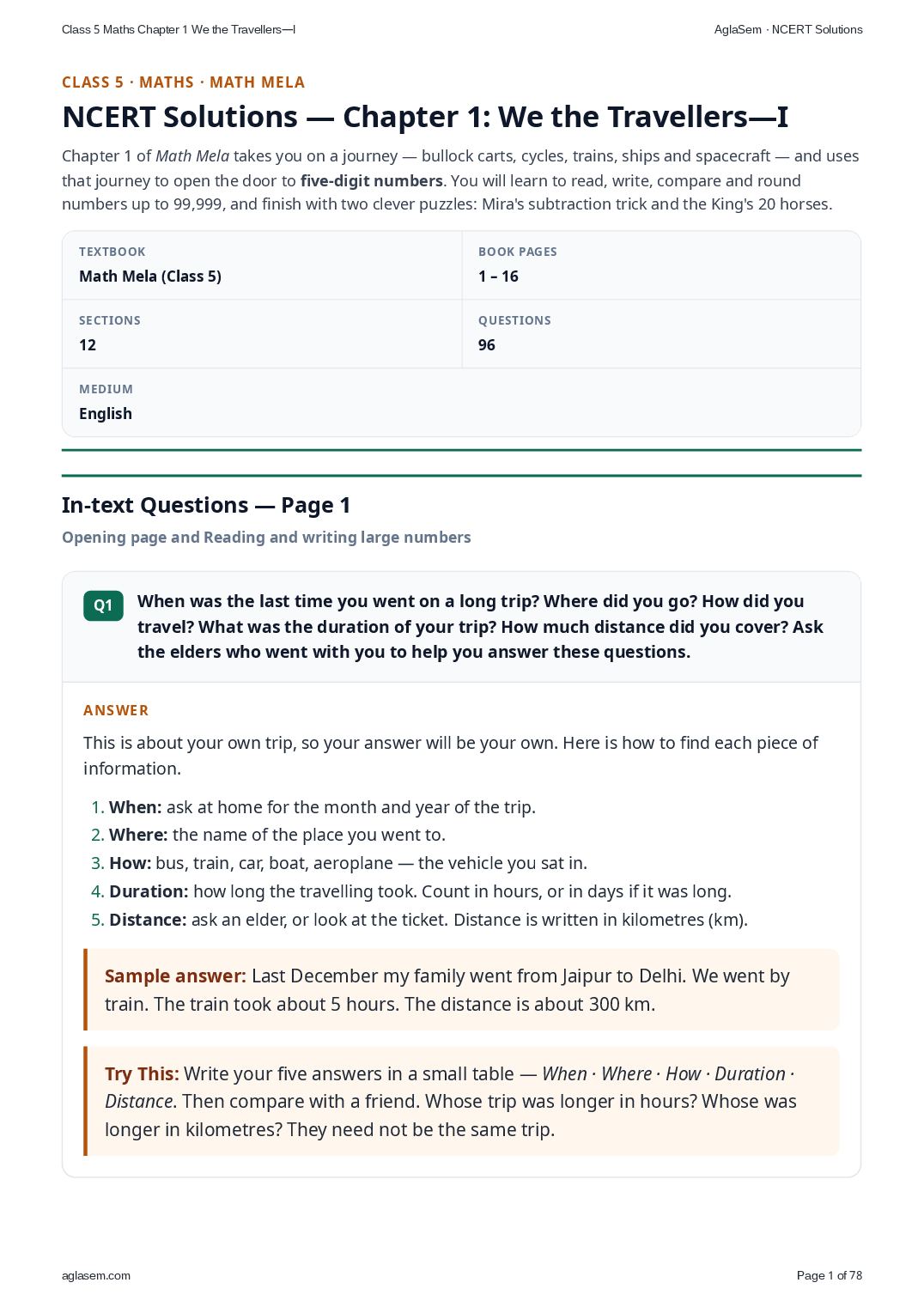
- When was the last time you went on a long trip? Where did you go? How did you travel? What was the duration of your trip? How much distance did you cover? Ask the elders who went with you to help you answer these questions.
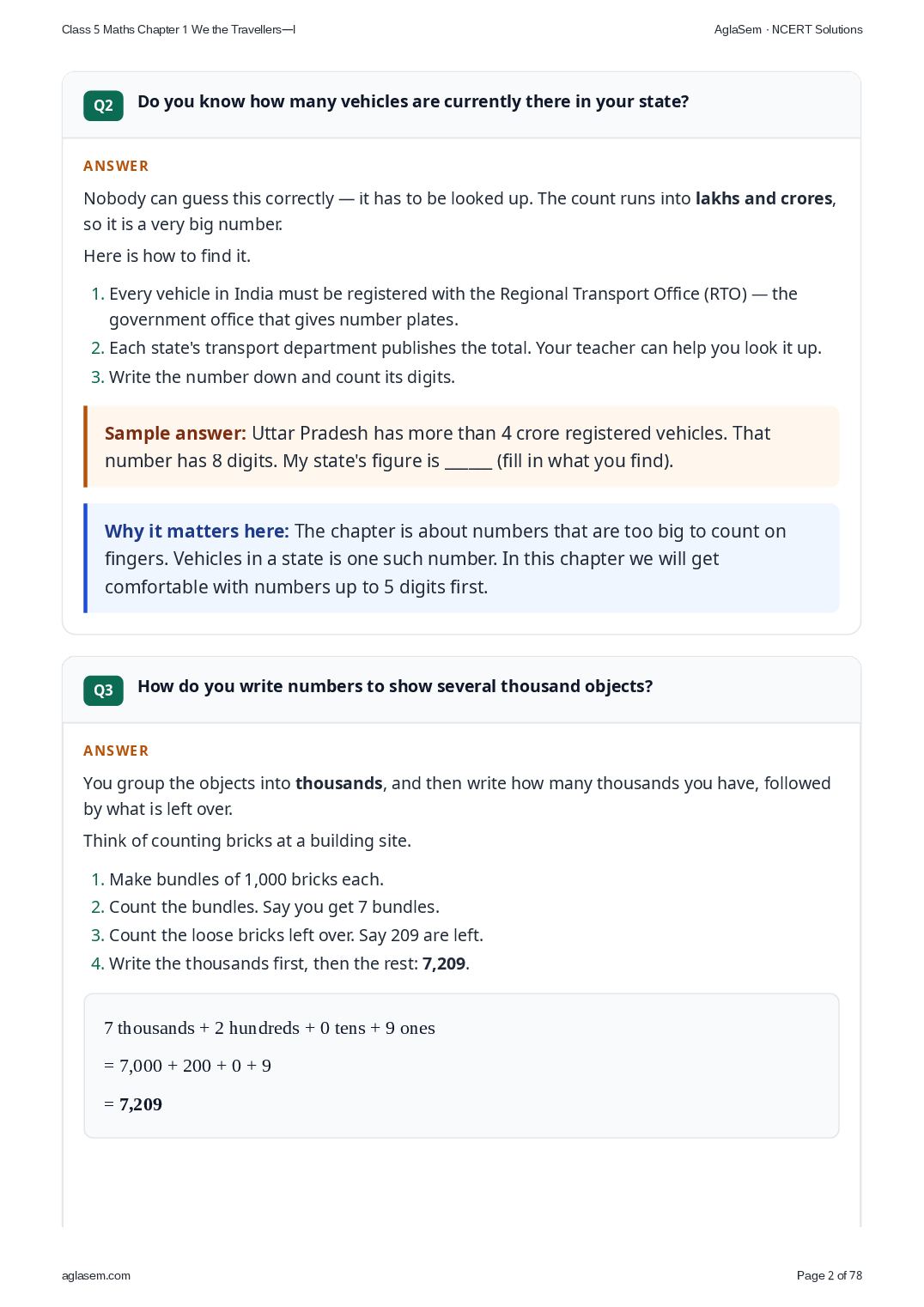
- Do you know how many vehicles are currently there in your state?
- How do you write numbers to show several thousand objects?
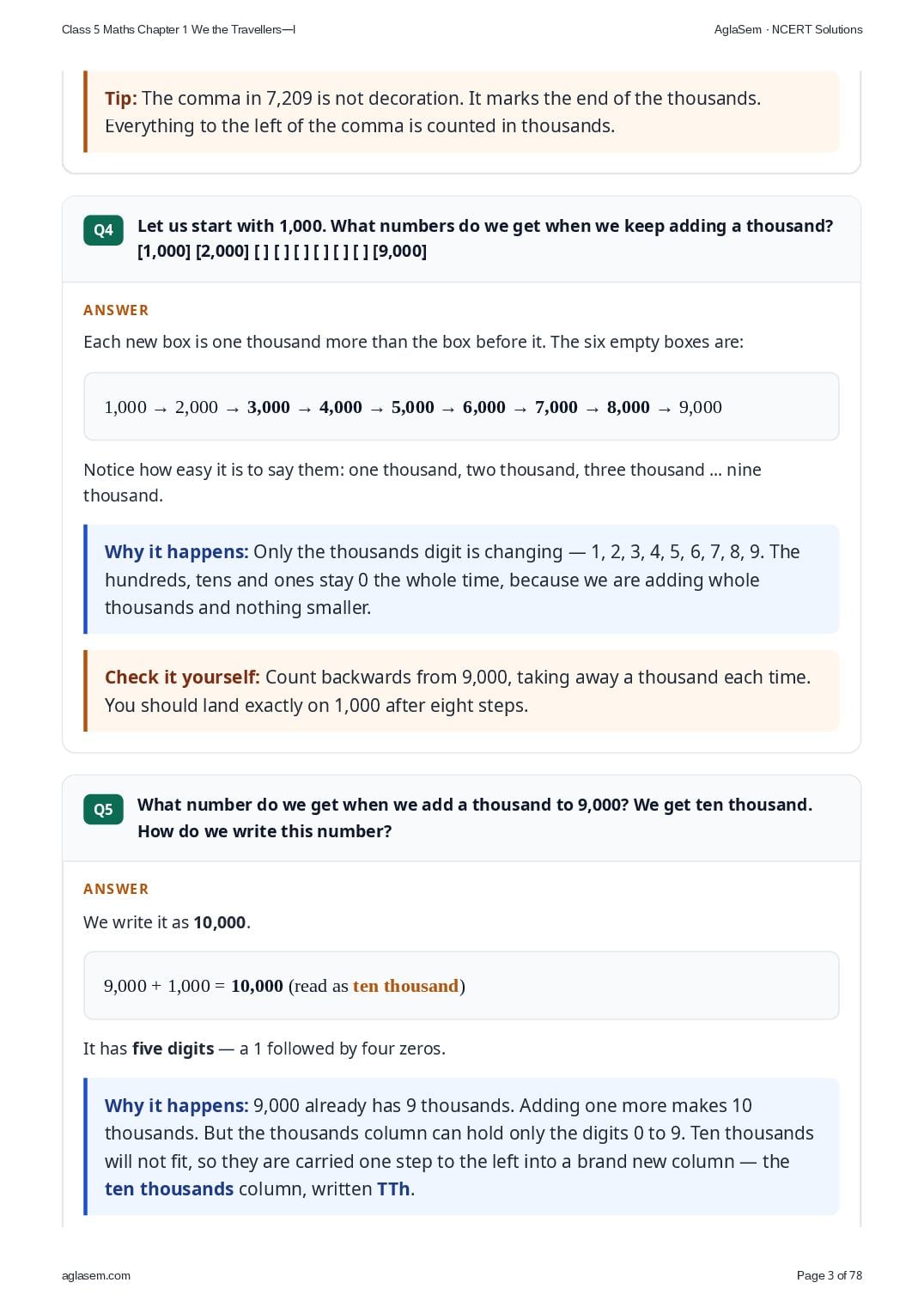
- Let us start with 1,000. What numbers do we get when we keep adding a thousand? [1,000] [2,000] [ ] [ ] [ ] [ ] [ ] [ ] [9,000]
- What number do we get when we add a thousand to 9,000? We get ten thousand. How do we write this number?
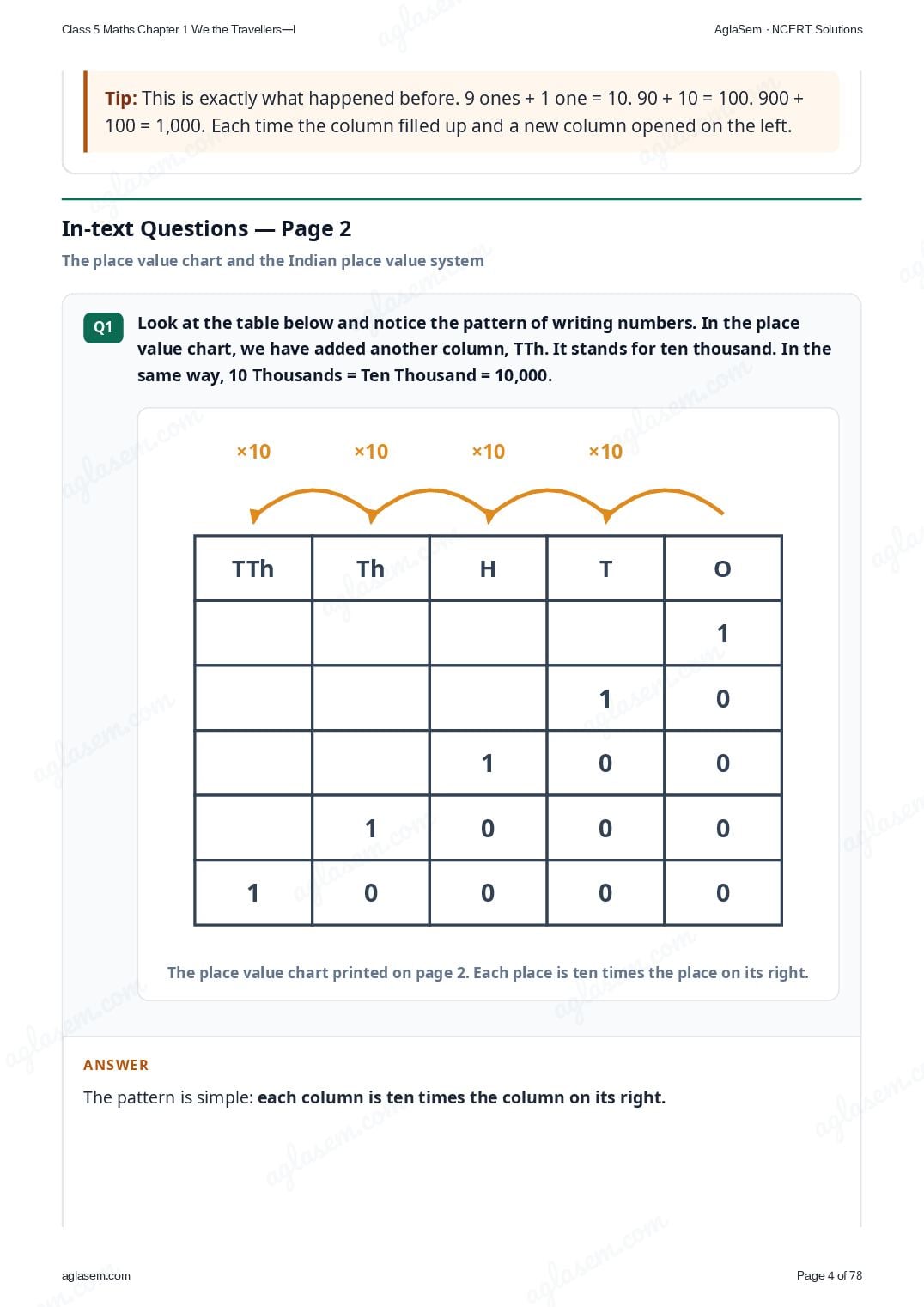
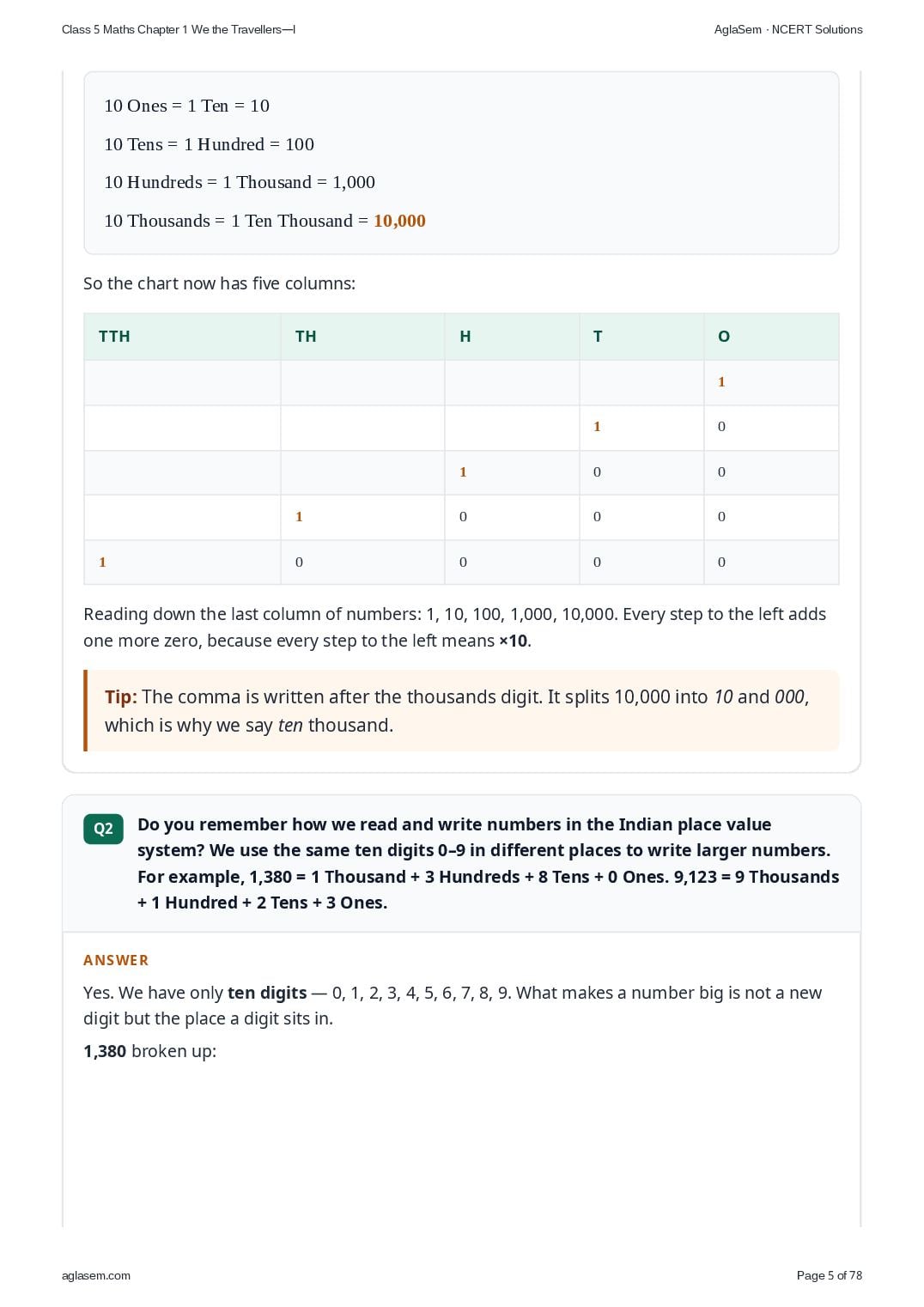
- Look at the table below and notice the pattern of writing numbers. In the place value chart, we have added another column, TTh. It stands for ten thousand. In the same way, 10 Thousands = Ten Thousand = 10,000. ×10×10×10×10TThThHTO110100100010000The place value chart printed on page 2. Each place is ten times the place on its right.
- Do you remember how we read and write numbers in the Indian place value system? We use the same ten digits 0–9 in different places to write larger numbers. For example, 1,380 = 1 Thousand + 3 Hundreds + 8 Tens + 0 Ones. 9,123 = 9 Thousands + 1 Hundred + 2 Tens + 3 Ones.
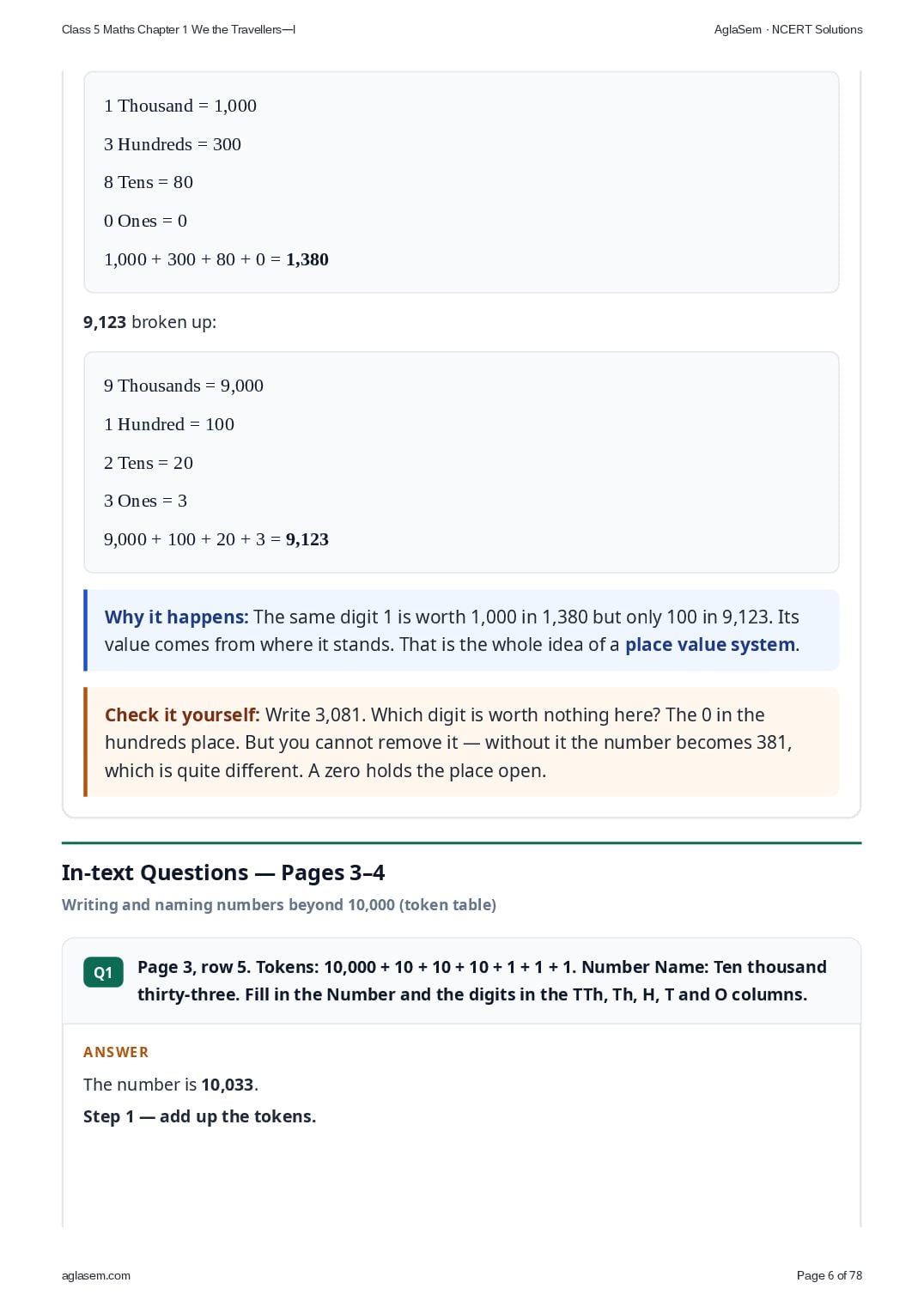
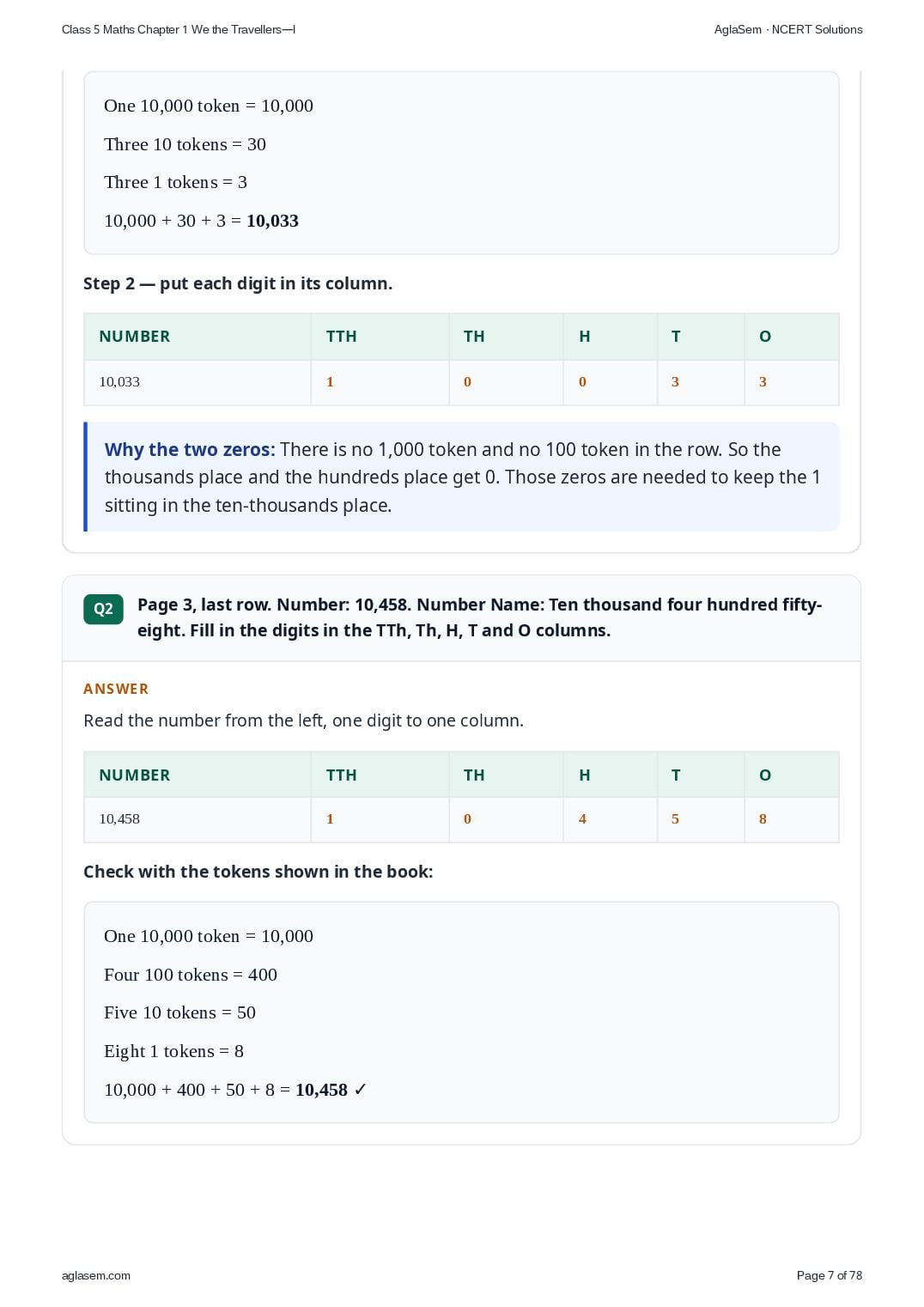
- Page 3, row 5. Tokens: 10,000 + 10 + 10 + 10 + 1 + 1 + 1. Number Name: Ten thousand thirty-three. Fill in the Number and the digits in the TTh, Th, H, T and O columns.
- Page 3, last row. Number: 10,458. Number Name: Ten thousand four hundred fifty-eight. Fill in the digits in the TTh, Th, H, T and O columns.
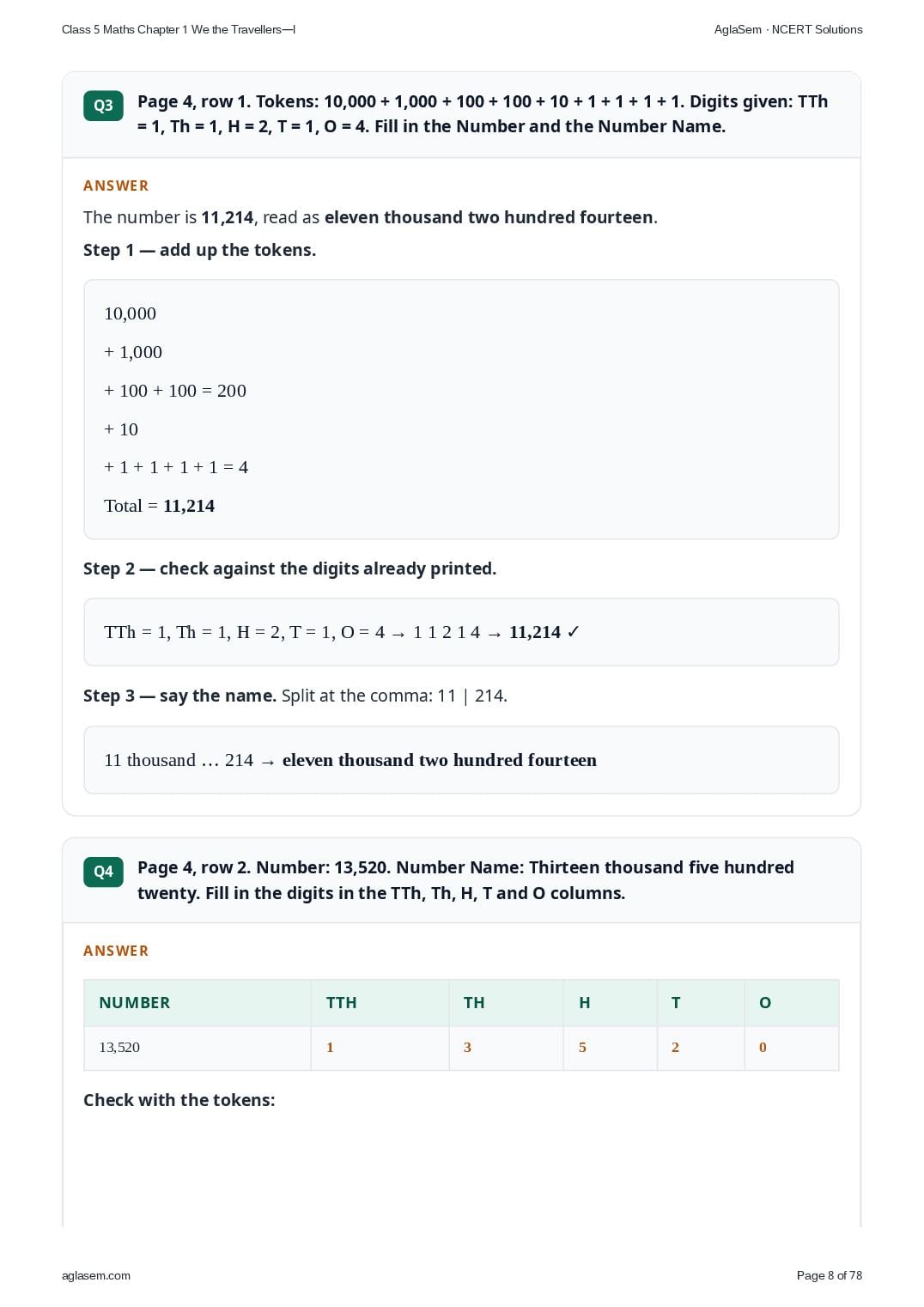
- Page 4, row 1. Tokens: 10,000 + 1,000 + 100 + 100 + 10 + 1 + 1 + 1 + 1. Digits given: TTh = 1, Th = 1, H = 2, T = 1, O = 4. Fill in the Number and the Number Name.
- Page 4, row 2. Number: 13,520. Number Name: Thirteen thousand five hundred twenty. Fill in the digits in the TTh, Th, H, T and O columns.
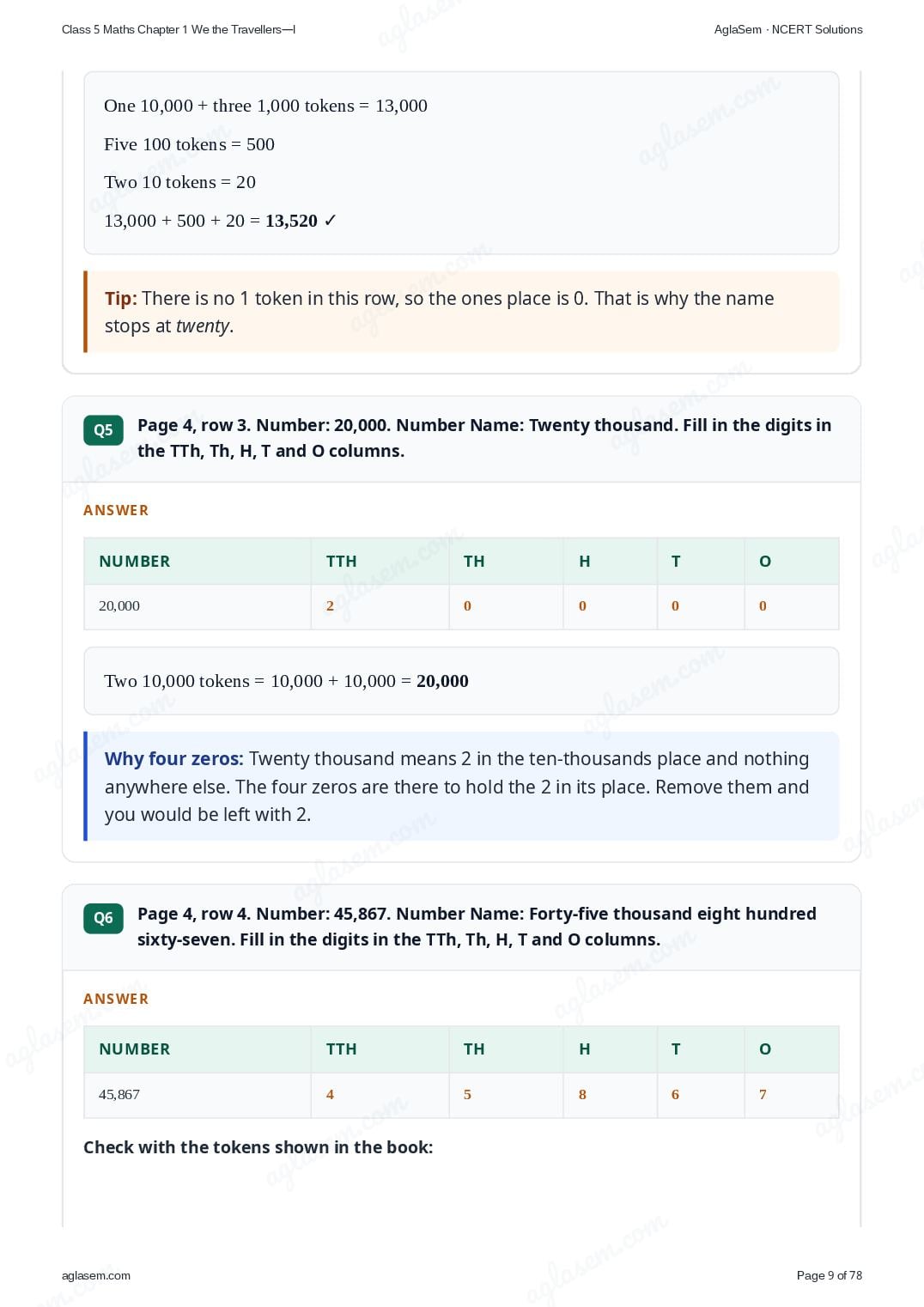
- Page 4, row 3. Number: 20,000. Number Name: Twenty thousand. Fill in the digits in the TTh, Th, H, T and O columns.
- Page 4, row 4. Number: 45,867. Number Name: Forty-five thousand eight hundred sixty-seven. Fill in the digits in the TTh, Th, H, T and O columns.
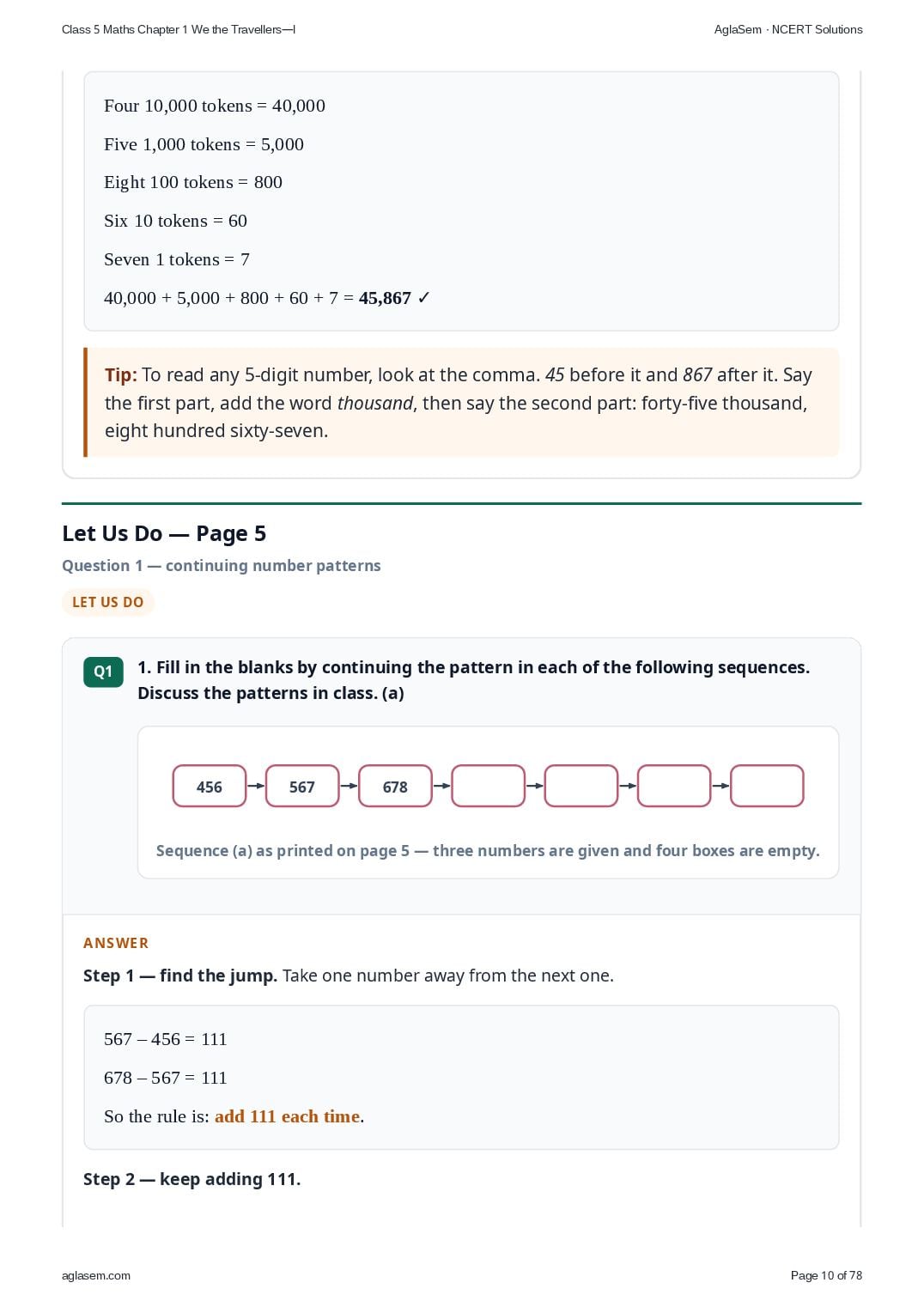
- 1. Fill in the blanks by continuing the pattern in each of the following sequences. Discuss the patterns in class. (a) 456567678Sequence (a) as printed on page 5 — three numbers are given and four boxes are empty.
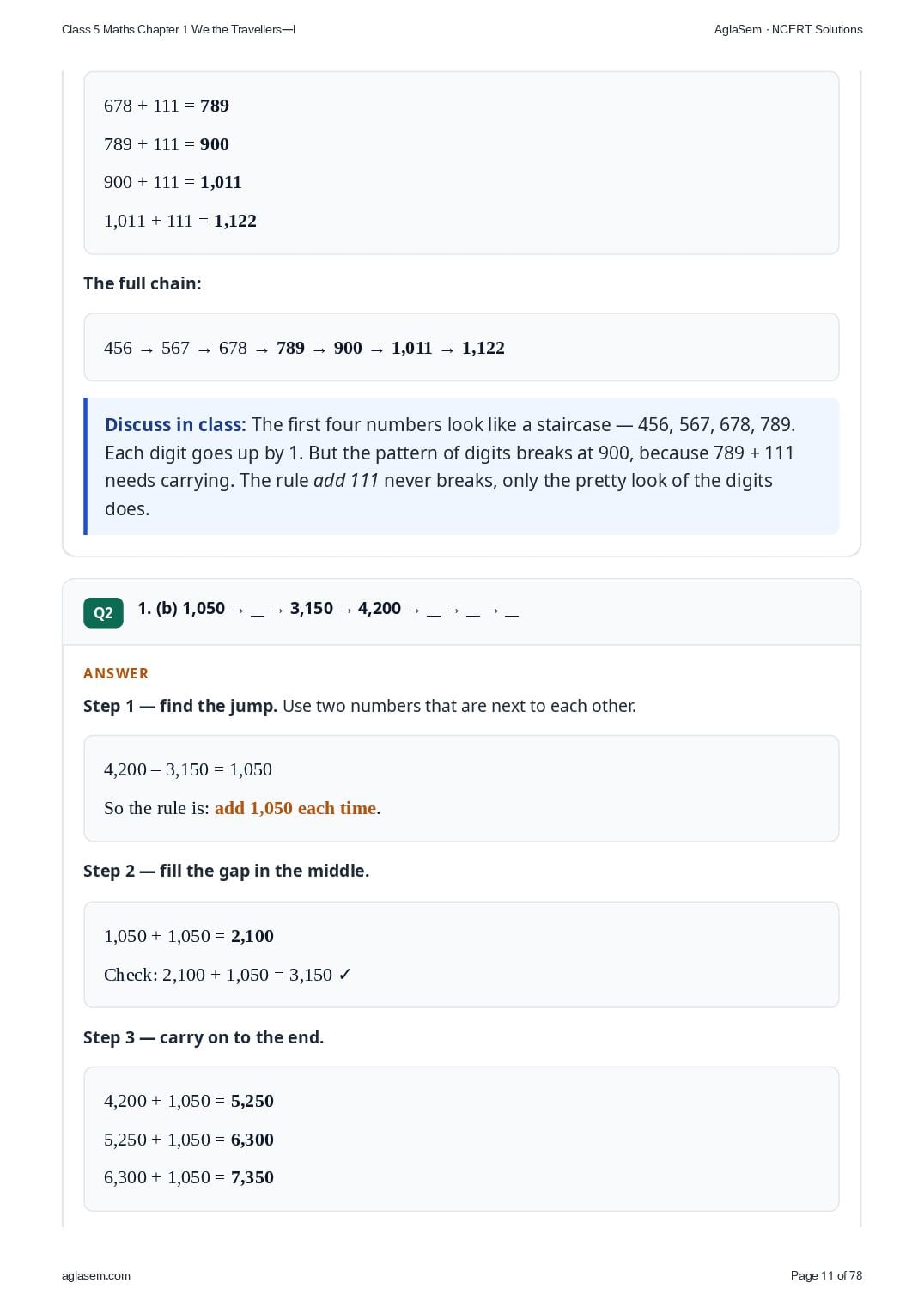
- 1. (b) 1,050 → __ → 3,150 → 4,200 → __ → __ → __
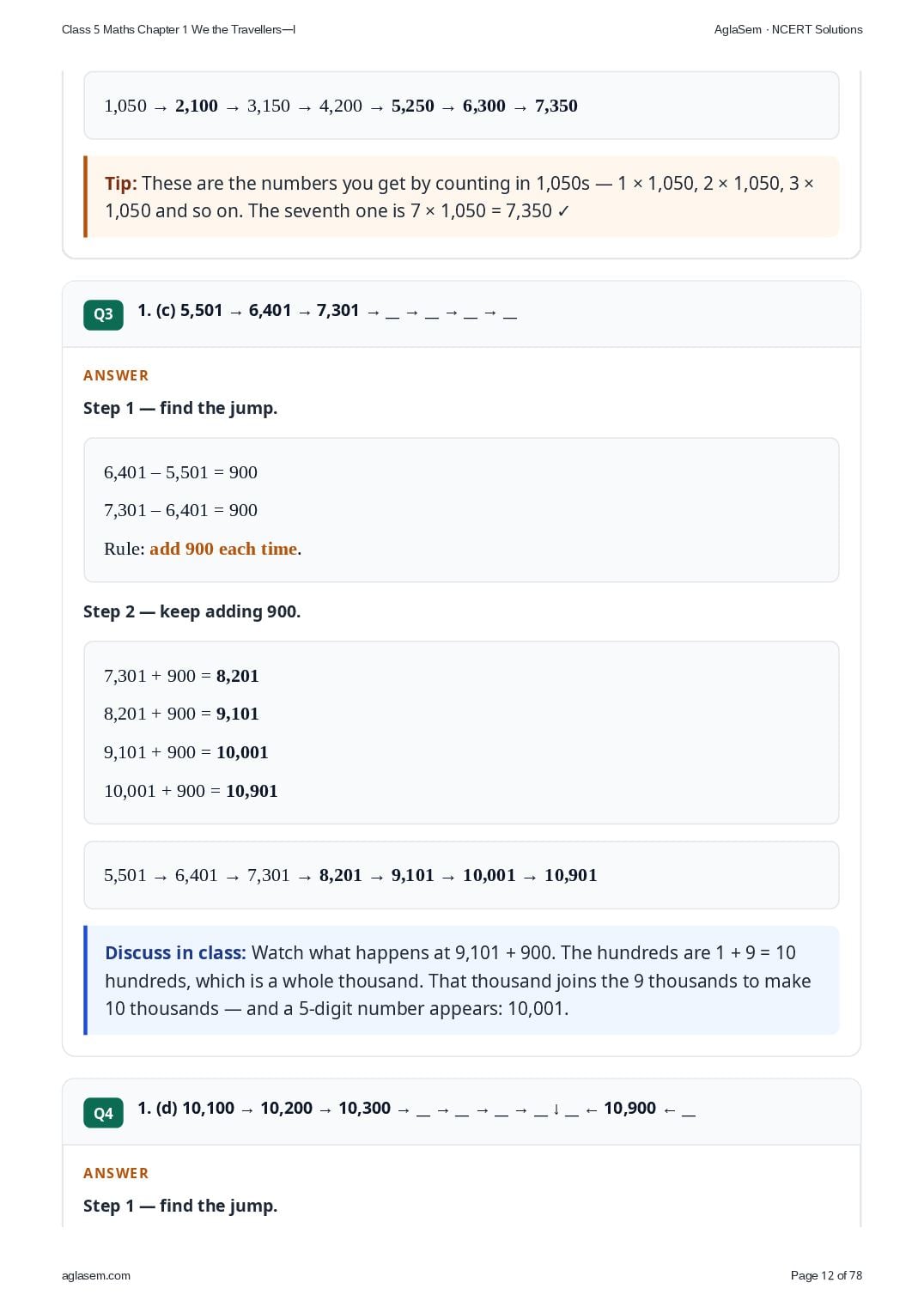
- 1. (c) 5,501 → 6,401 → 7,301 → __ → __ → __ → __
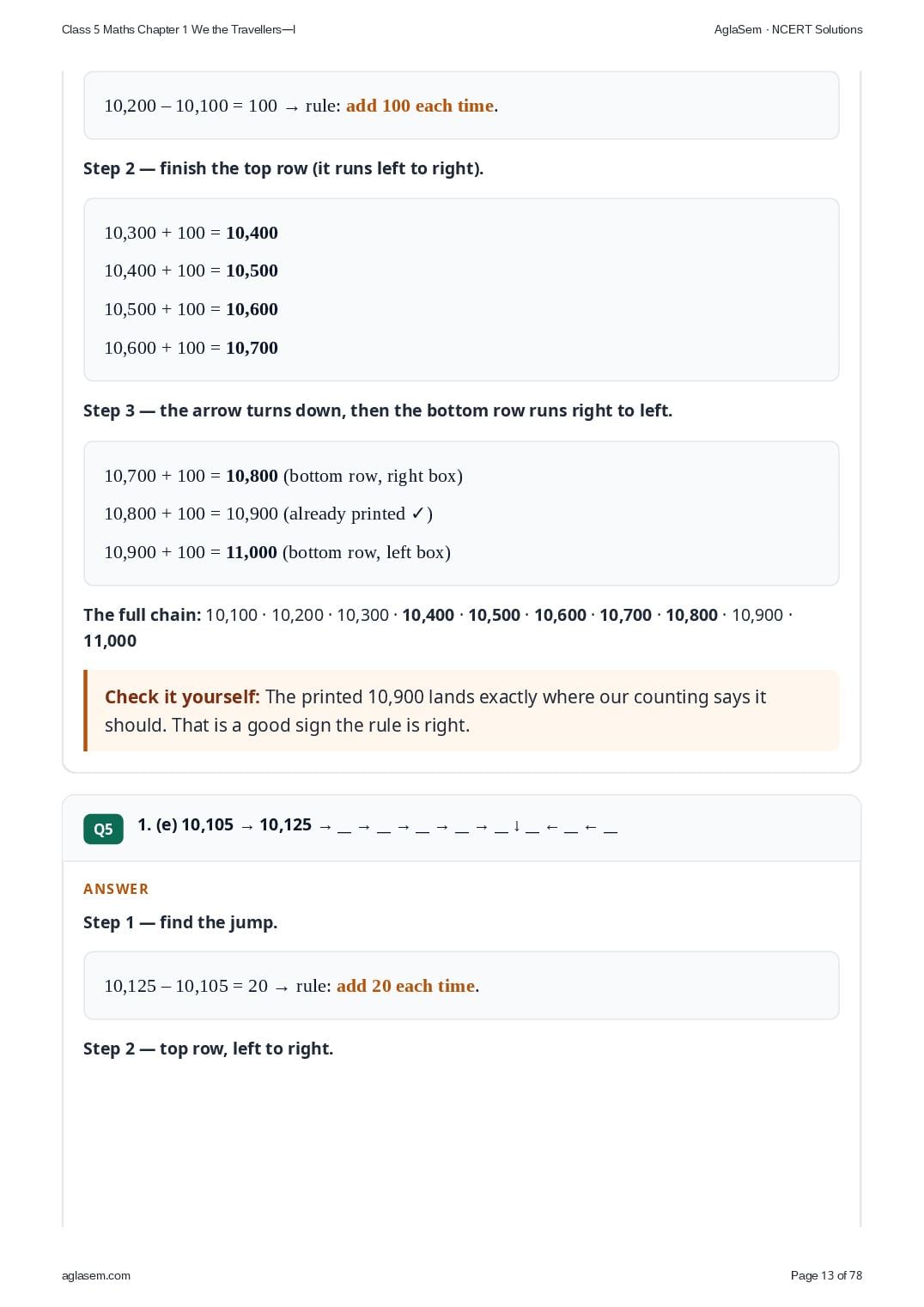
- 1. (d) 10,100 → 10,200 → 10,300 → __ → __ → __ → __ ↓ __ ← 10,900 ← __
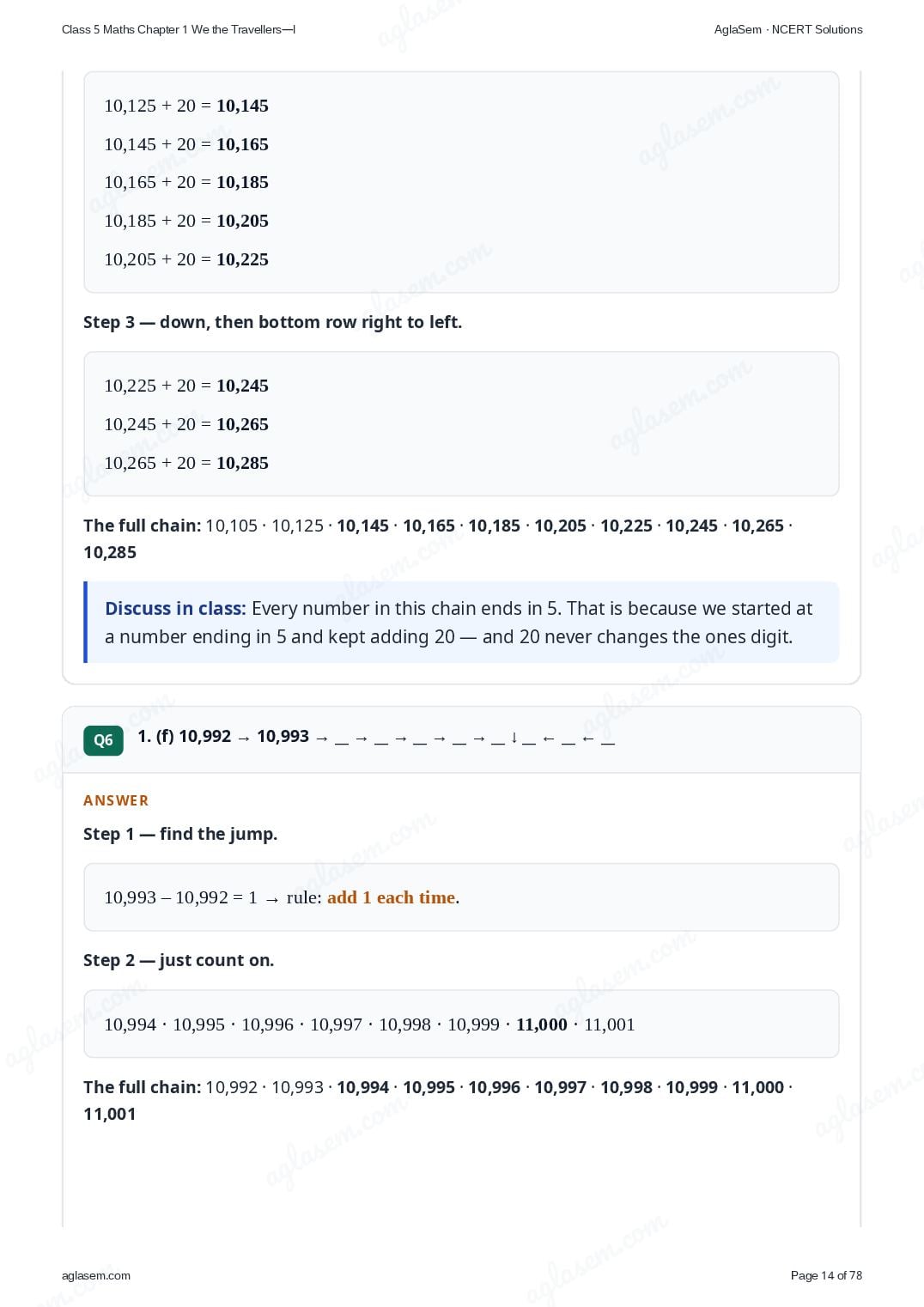
- 1. (e) 10,105 → 10,125 → __ → __ → __ → __ → __ ↓ __ ← __ ← __
- 1. (f) 10,992 → 10,993 → __ → __ → __ → __ → __ ↓ __ ← __ ← __
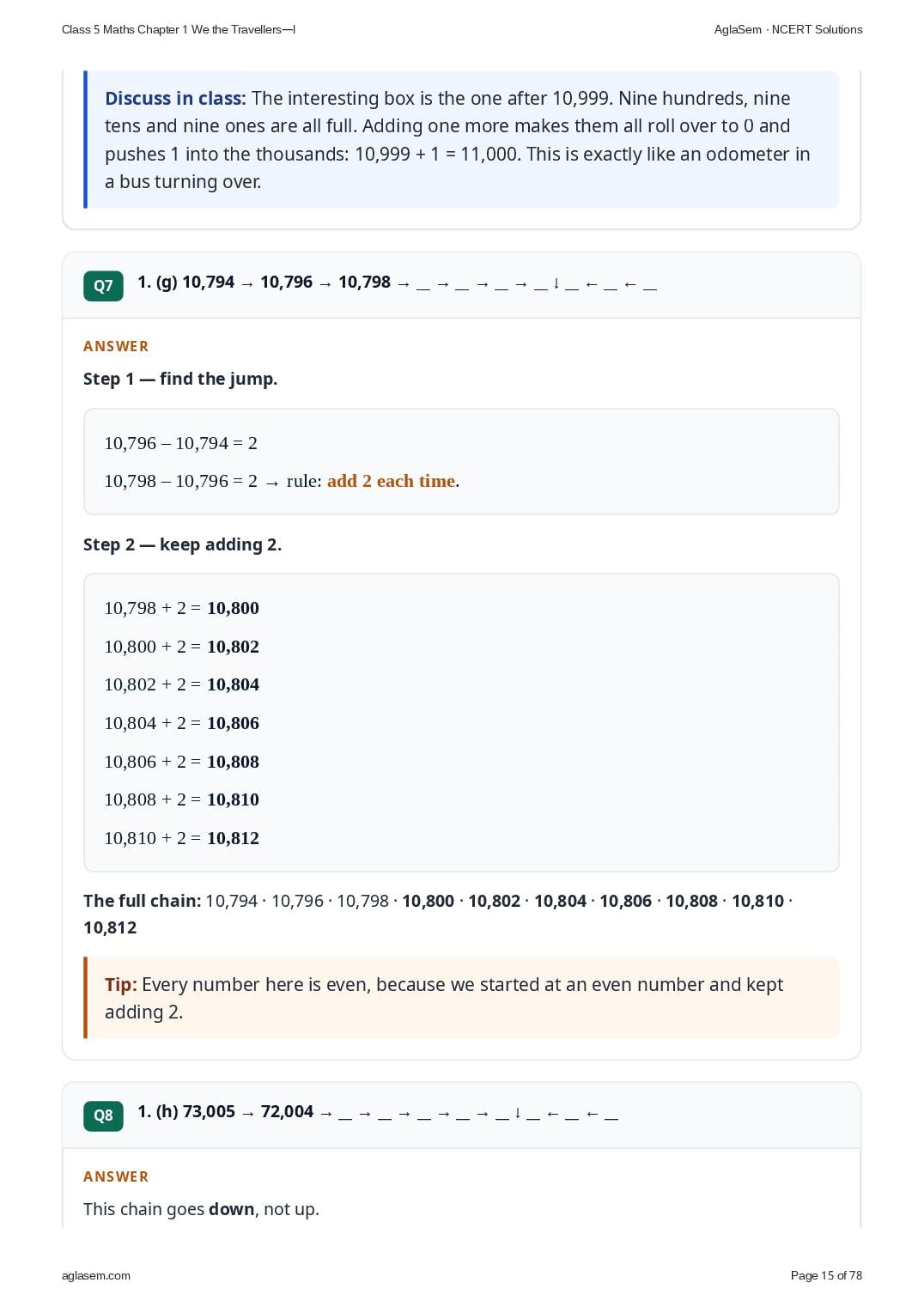
- 1. (g) 10,794 → 10,796 → 10,798 → __ → __ → __ → __ ↓ __ ← __ ← __
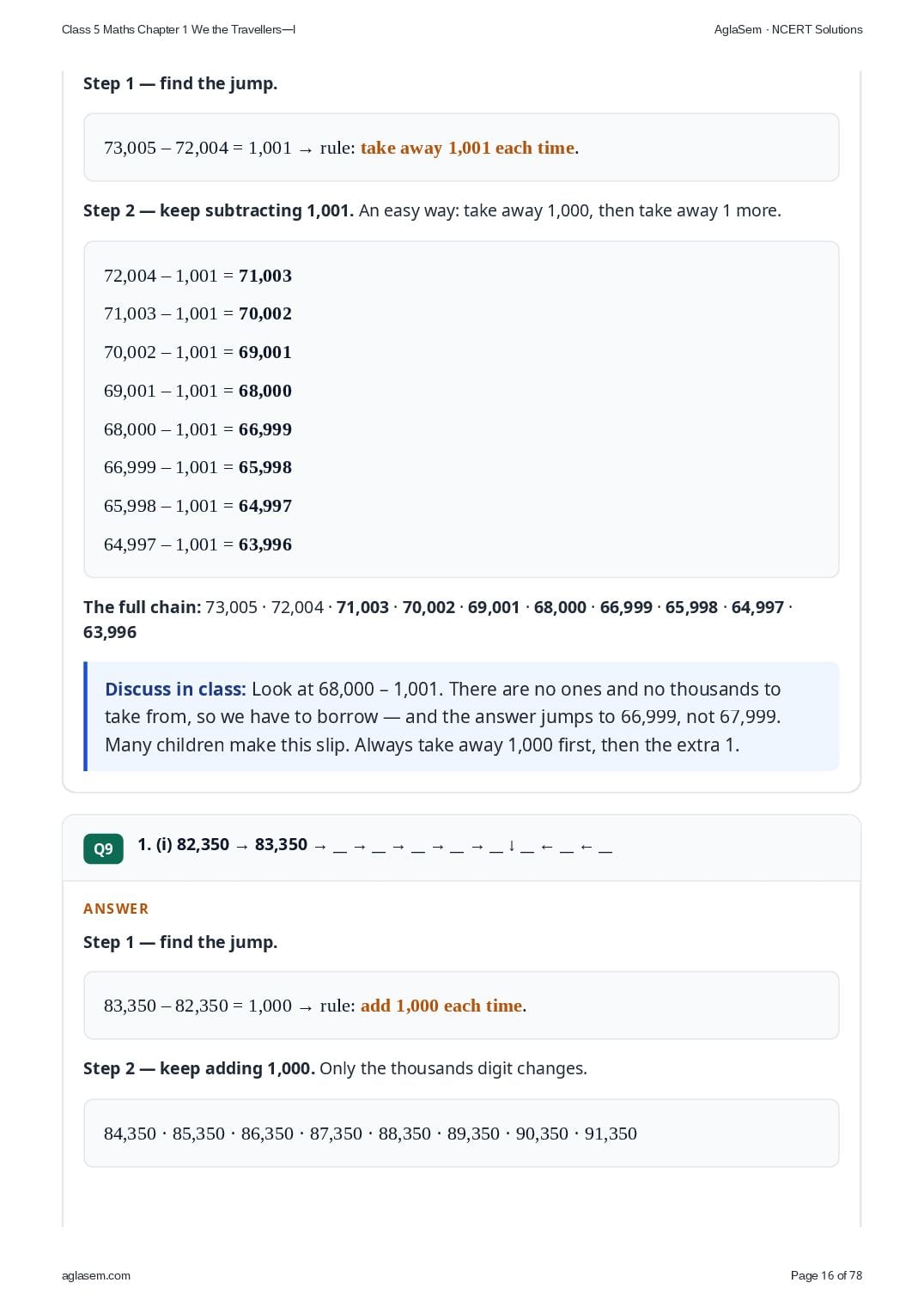
- 1. (h) 73,005 → 72,004 → __ → __ → __ → __ → __ ↓ __ ← __ ← __
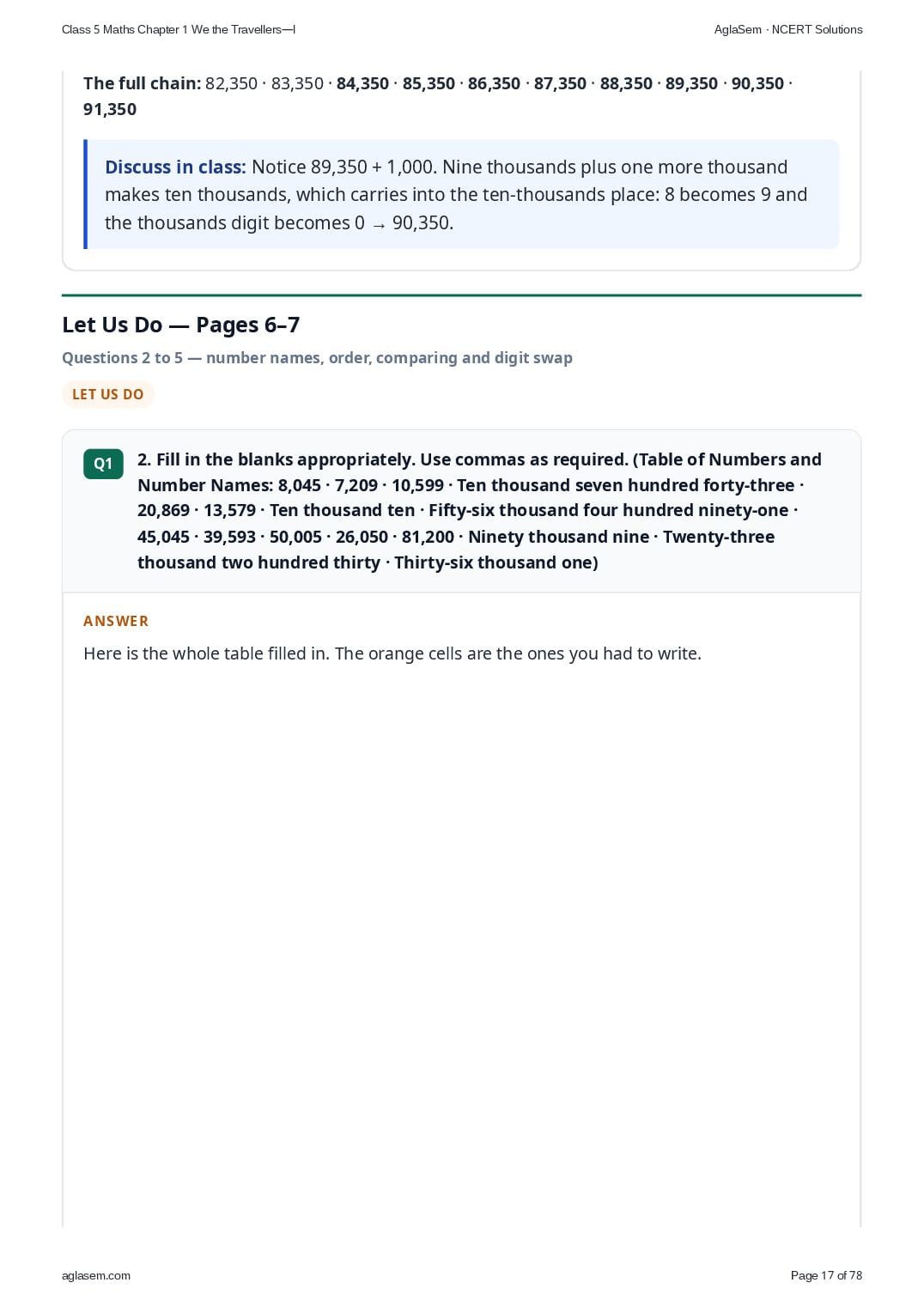
- 1. (i) 82,350 → 83,350 → __ → __ → __ → __ → __ ↓ __ ← __ ← __
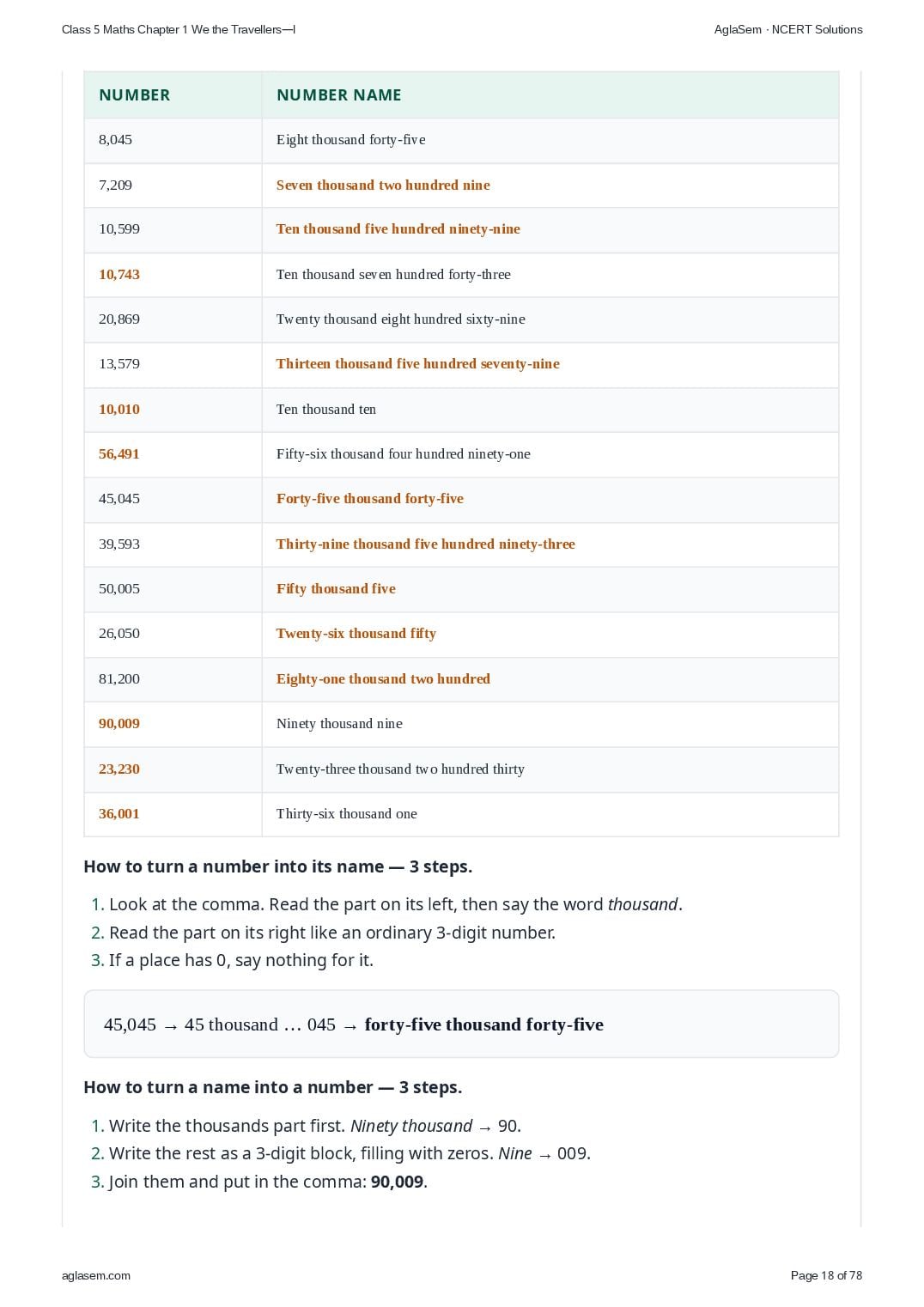
- 2. Fill in the blanks appropriately. Use commas as required. (Table of Numbers and Number Names: 8,045 · 7,209 · 10,599 · Ten thousand seven hundred forty-three · 20,869 · 13,579 · Ten thousand ten · Fifty-six thousand four hundred ninety-one · 45,045 · 39,593 · 50,005 · 26,050 · 81,200 · Ninety thousand nine · Twenty-three thousand two hundred thirty · Thirty-six thousand one)
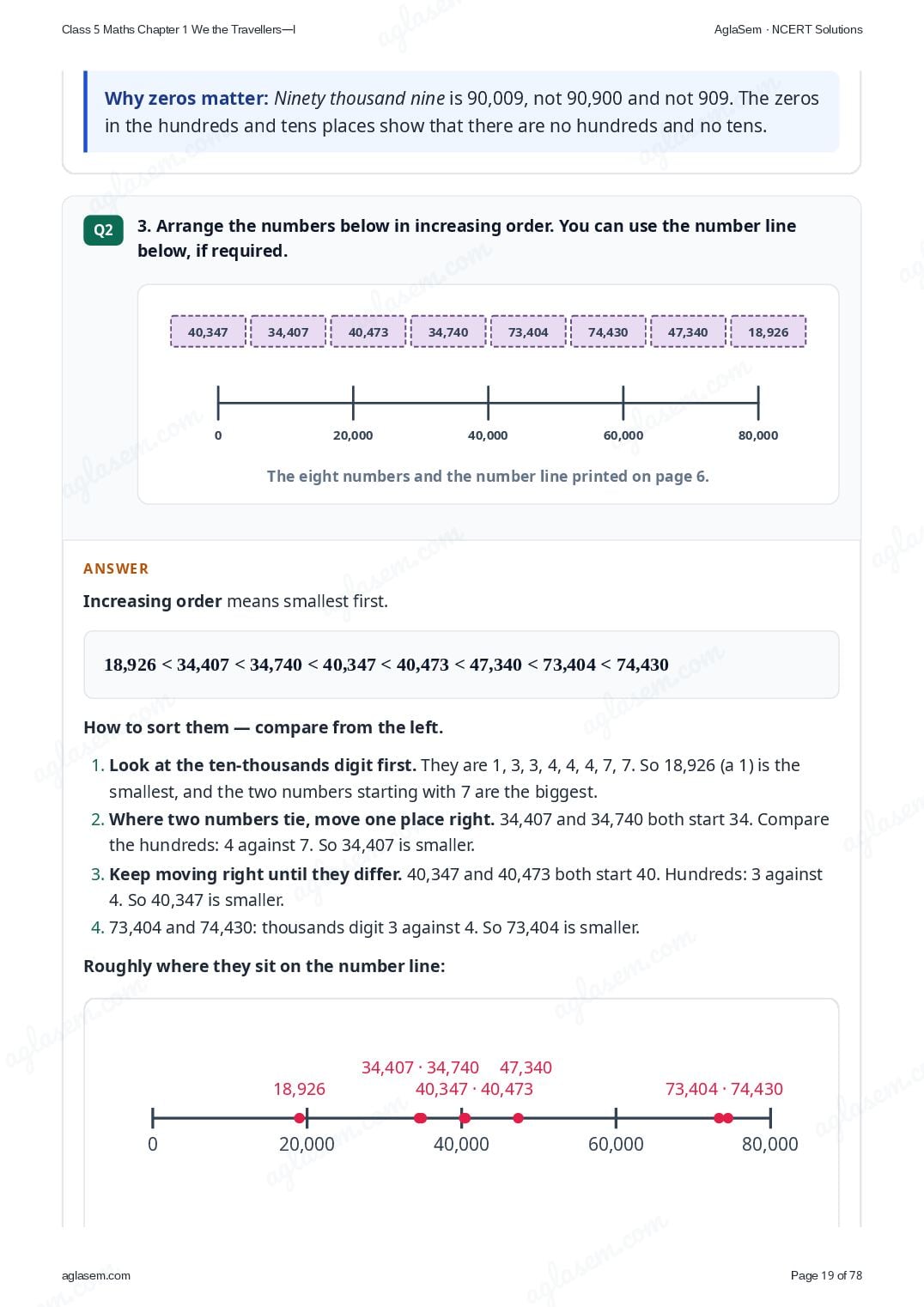
- 3. Arrange the numbers below in increasing order. You can use the number line below, if required. 40,34734,40740,47334,74073,40474,43047,34018,926020,00040,00060,00080,000The eight numbers and the number line printed on page 6.
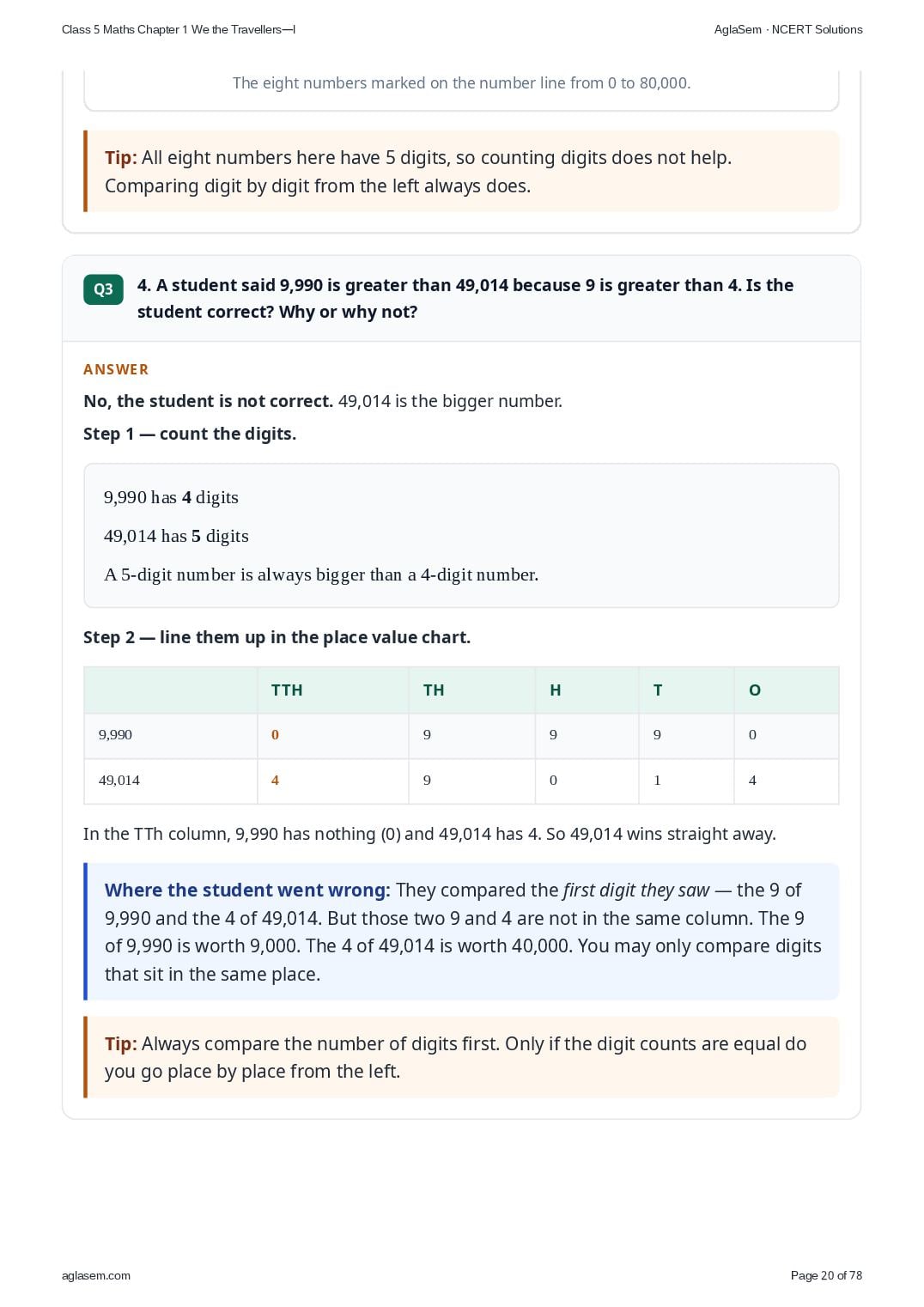
- 4. A student said 9,990 is greater than 49,014 because 9 is greater than 4. Is the student correct? Why or why not?
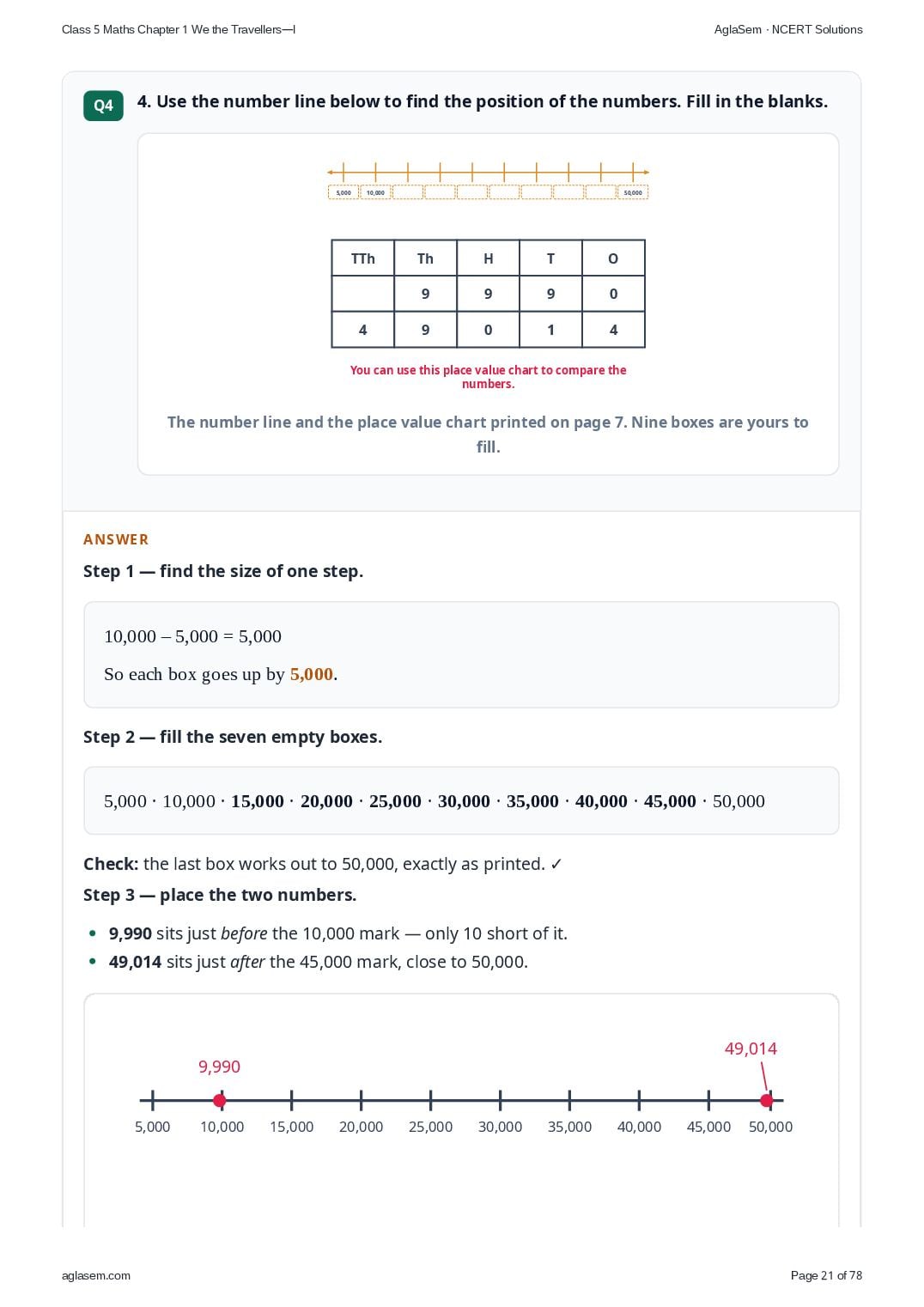
- 4. Use the number line below to find the position of the numbers. Fill in the blanks. 5,00010,00050,000TThThHTO999049014You can use this place value chart to compare thenumbers.The number line and the place value chart printed on page 7. Nine boxes are yours to fill.
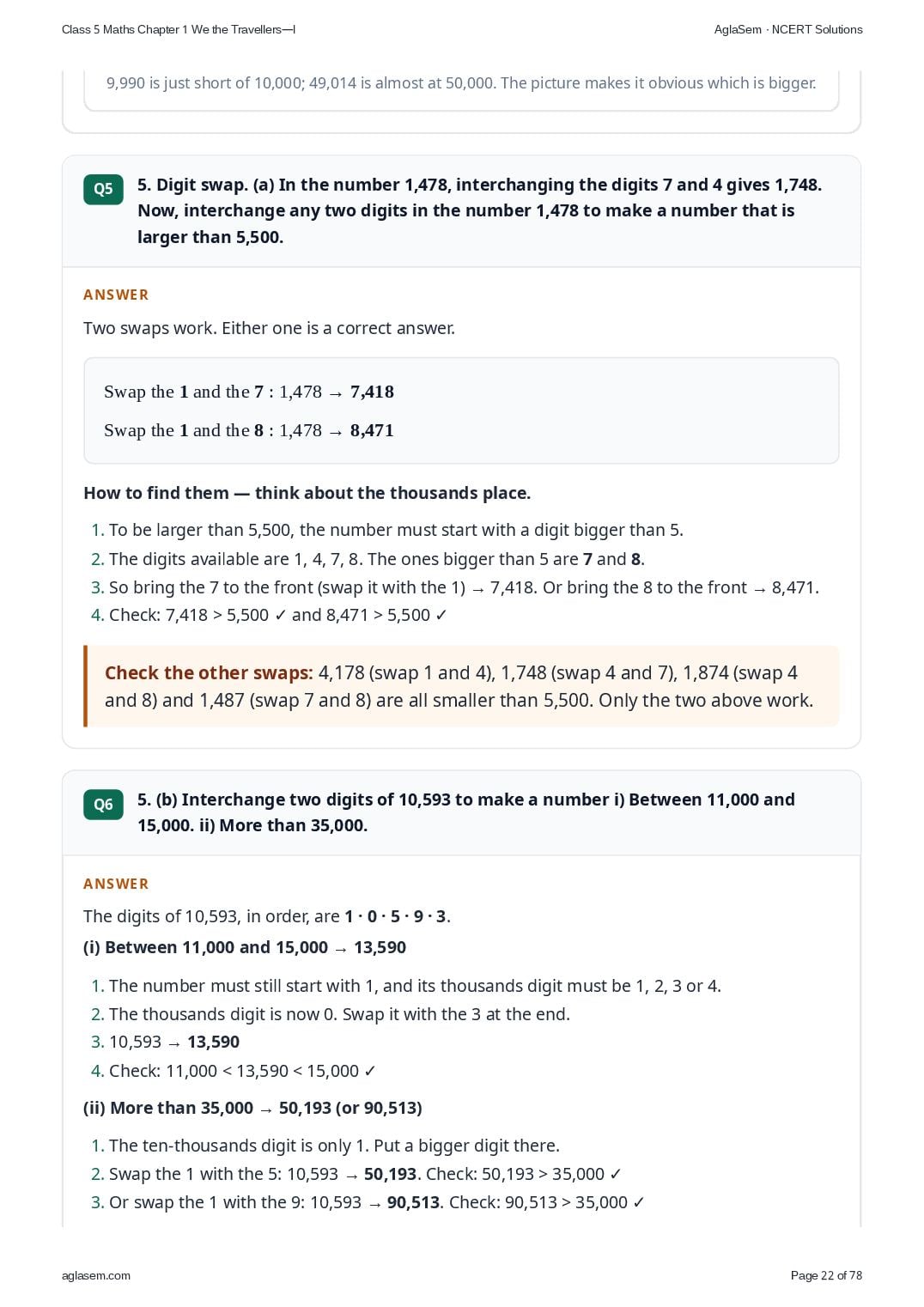
- 5. Digit swap. (a) In the number 1,478, interchanging the digits 7 and 4 gives 1,748. Now, interchange any two digits in the number 1,478 to make a number that is larger than 5,500.
- 5. (b) Interchange two digits of 10,593 to make a number i) Between 11,000 and 15,000. ii) More than 35,000.
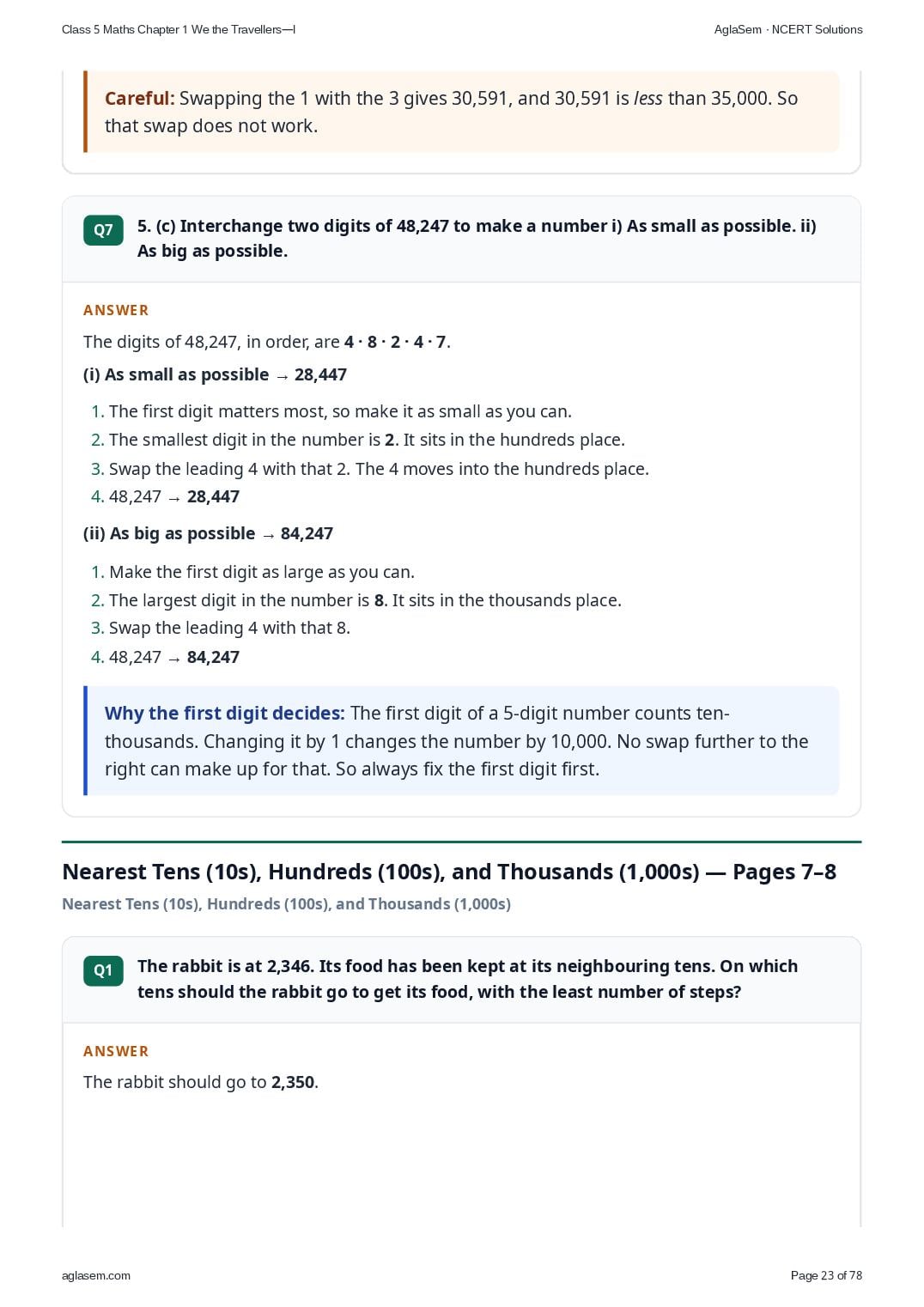
- 5. (c) Interchange two digits of 48,247 to make a number i) As small as possible. ii) As big as possible.
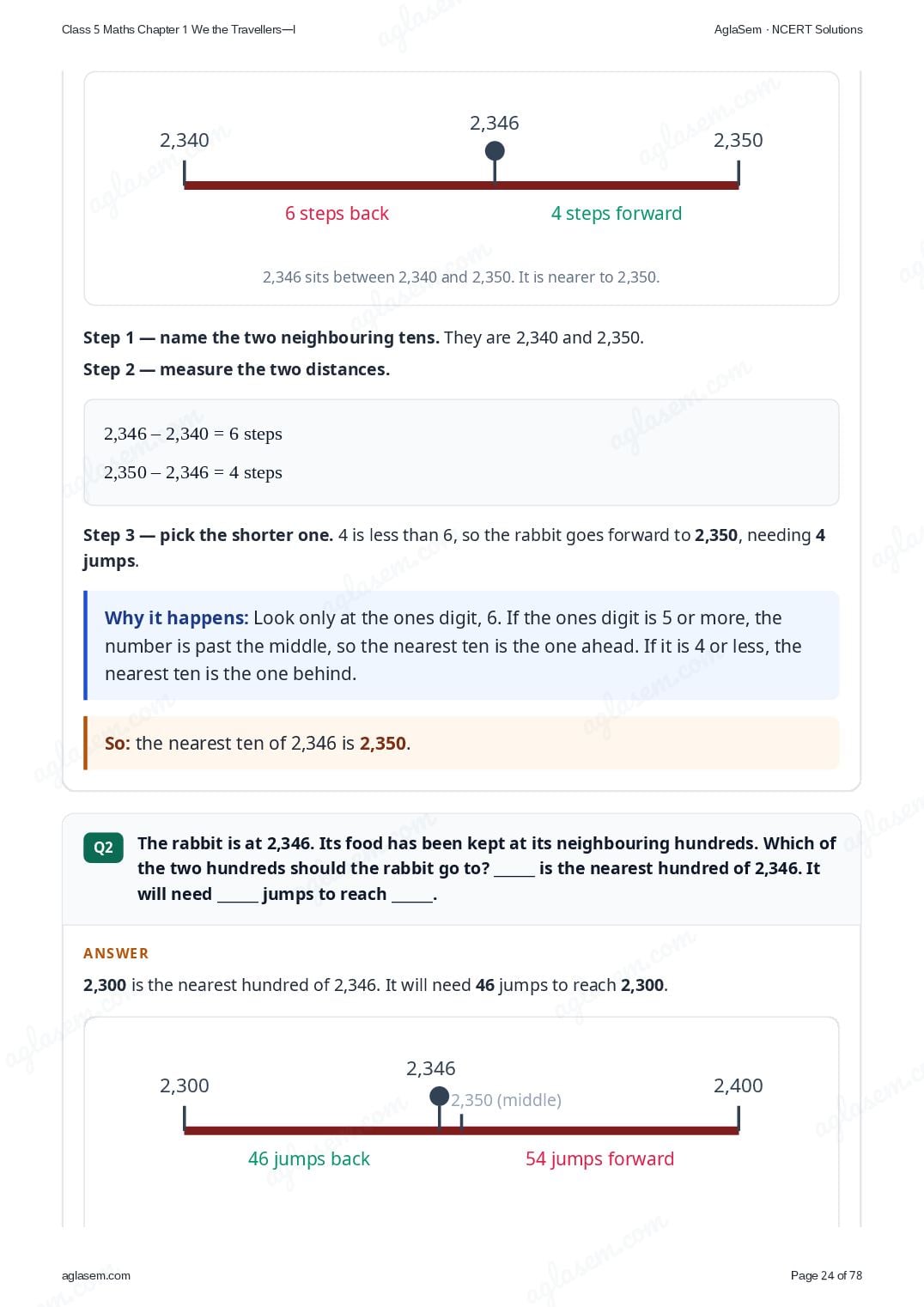
- The rabbit is at 2,346. Its food has been kept at its neighbouring tens. On which tens should the rabbit go to get its food, with the least number of steps?
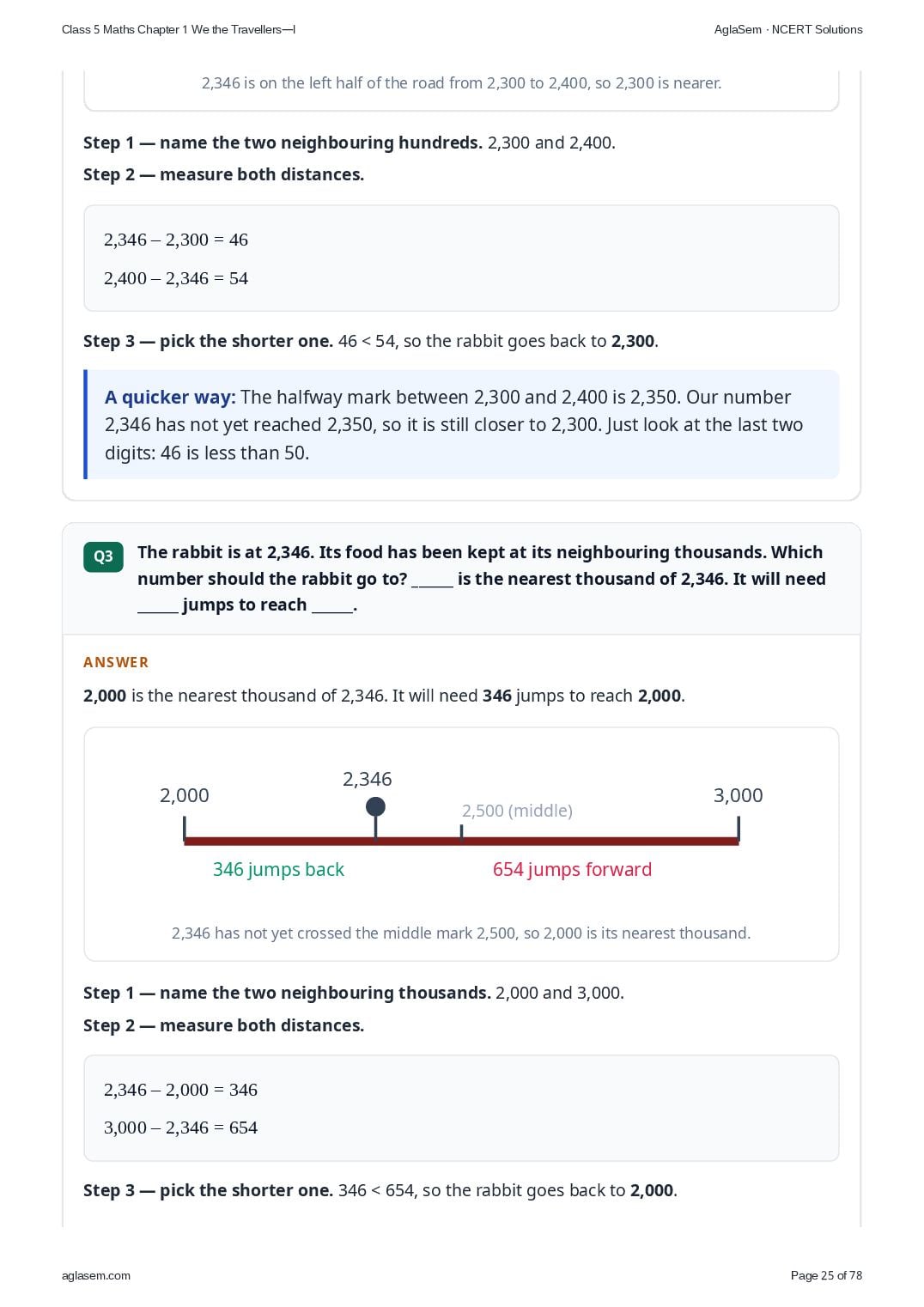
- The rabbit is at 2,346. Its food has been kept at its neighbouring hundreds. Which of the two hundreds should the rabbit go to? ______ is the nearest hundred of 2,346. It will need ______ jumps to reach ______.
- The rabbit is at 2,346. Its food has been kept at its neighbouring thousands. Which number should the rabbit go to? ______ is the nearest thousand of 2,346. It will need ______ jumps to reach ______.
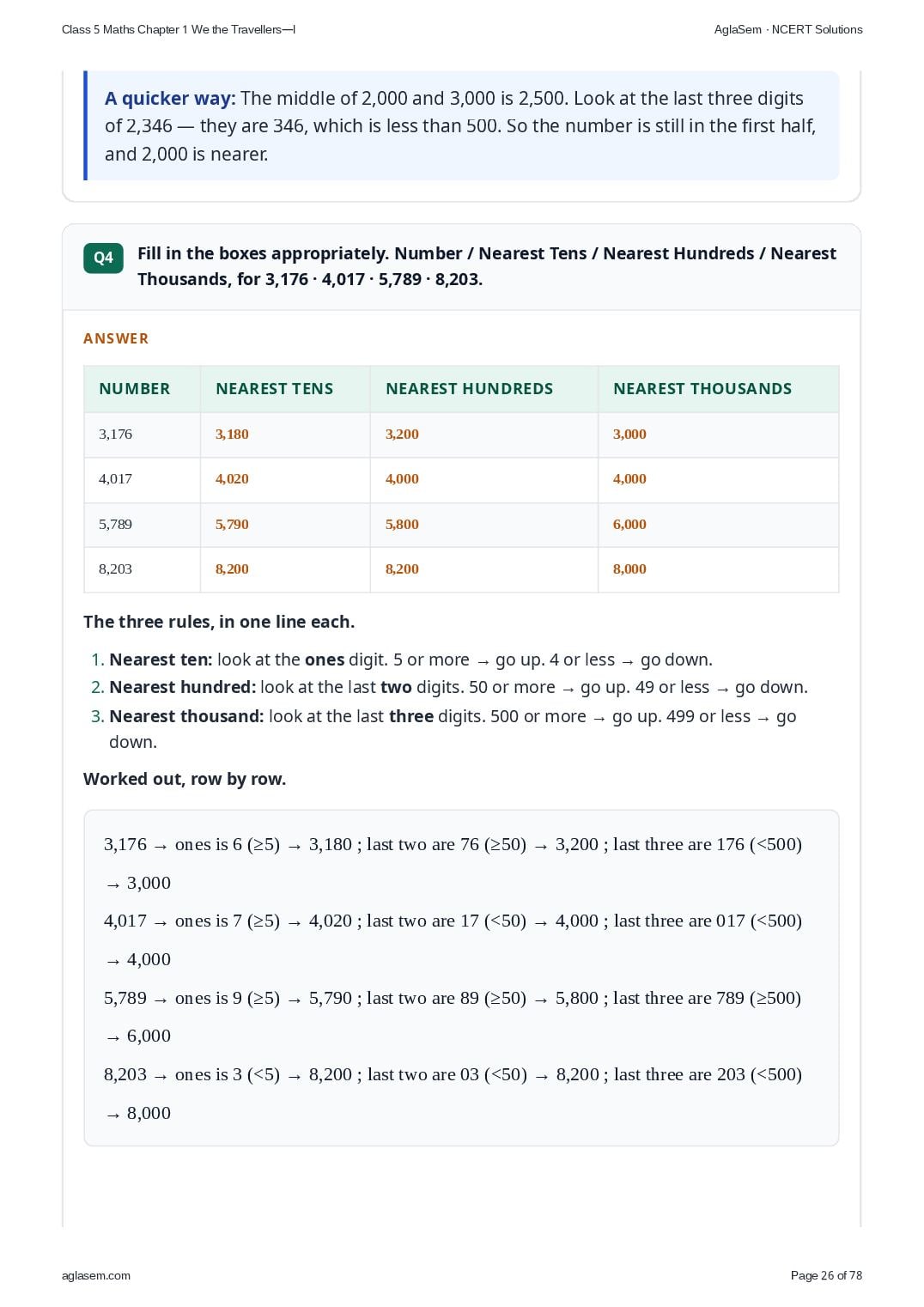
- Fill in the boxes appropriately. Number / Nearest Tens / Nearest Hundreds / Nearest Thousands, for 3,176 · 4,017 · 5,789 · 8,203.
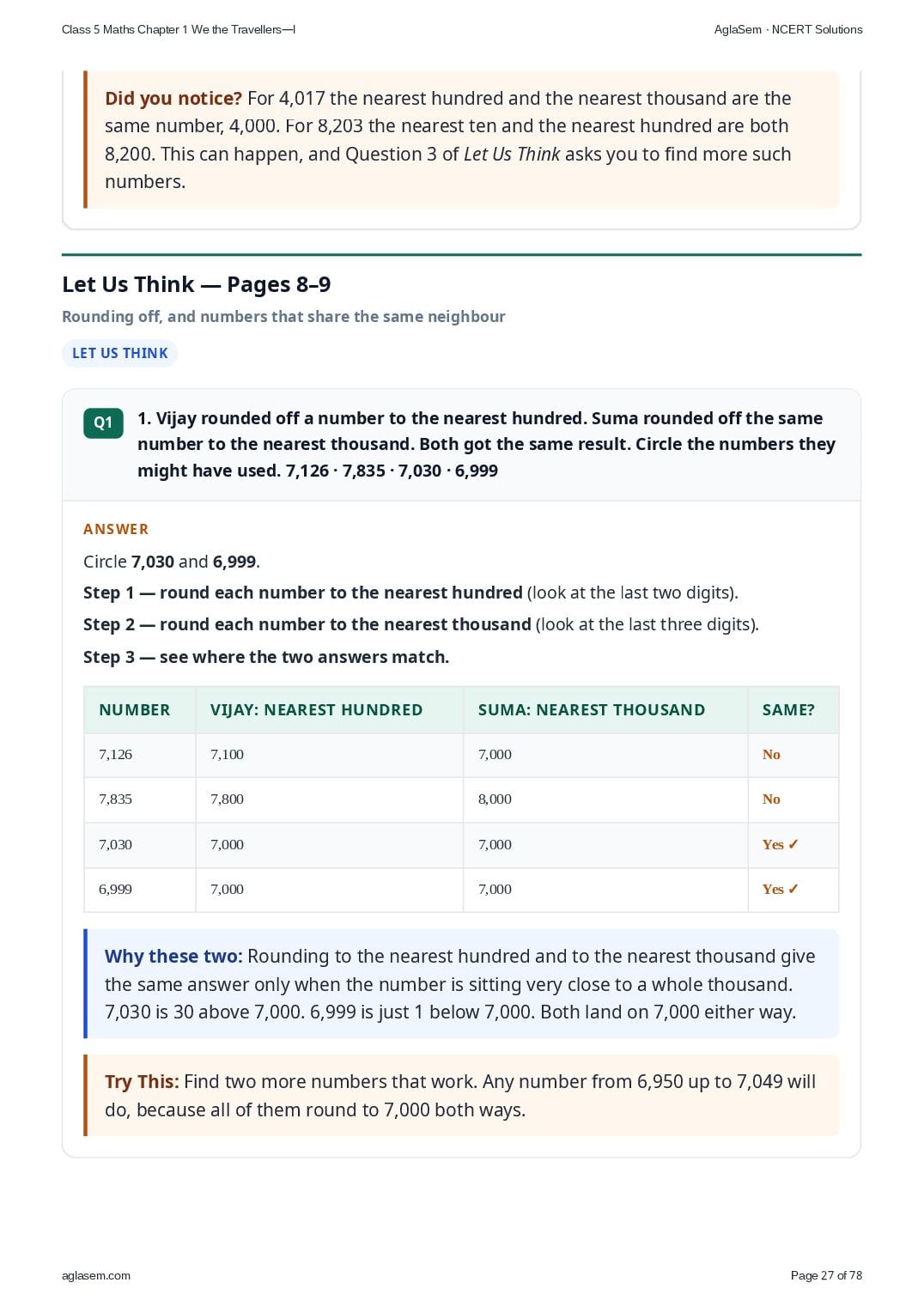
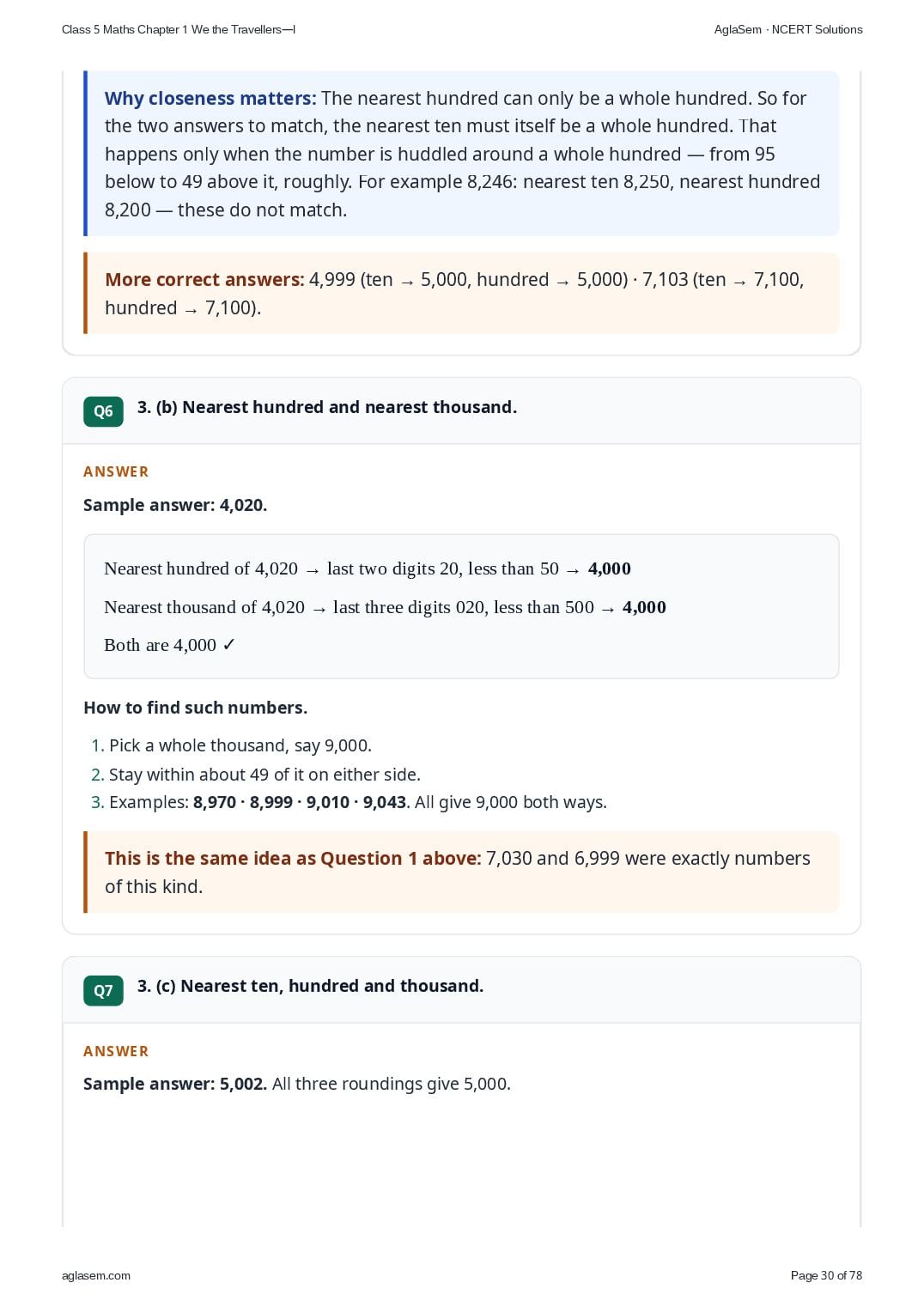
- 1. Vijay rounded off a number to the nearest hundred. Suma rounded off the same number to the nearest thousand. Both got the same result. Circle the numbers they might have used. 7,126 · 7,835 · 7,030 · 6,999
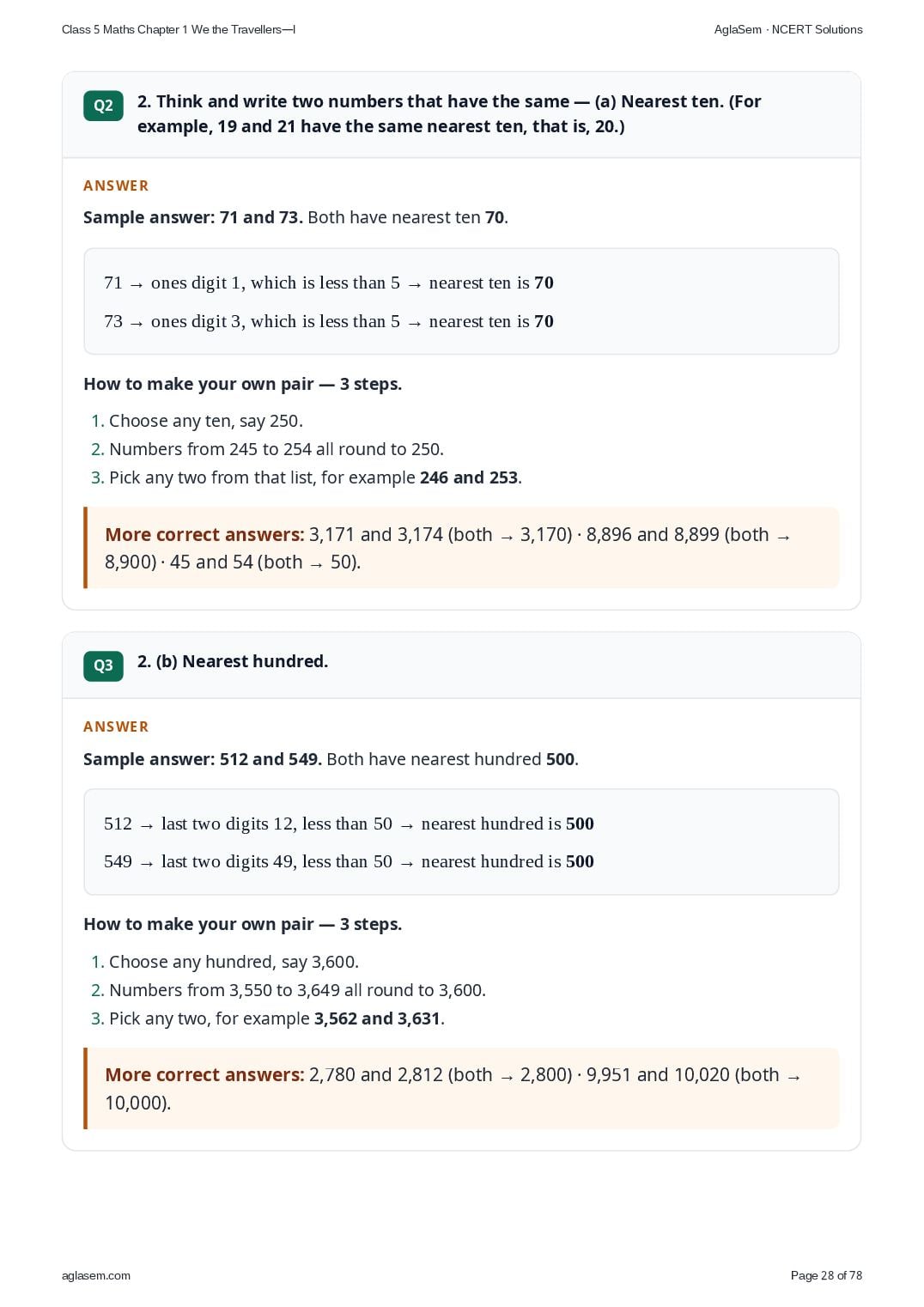
- 2. Think and write two numbers that have the same — (a) Nearest ten. (For example, 19 and 21 have the same nearest ten, that is, 20.)
- 2. (b) Nearest hundred.
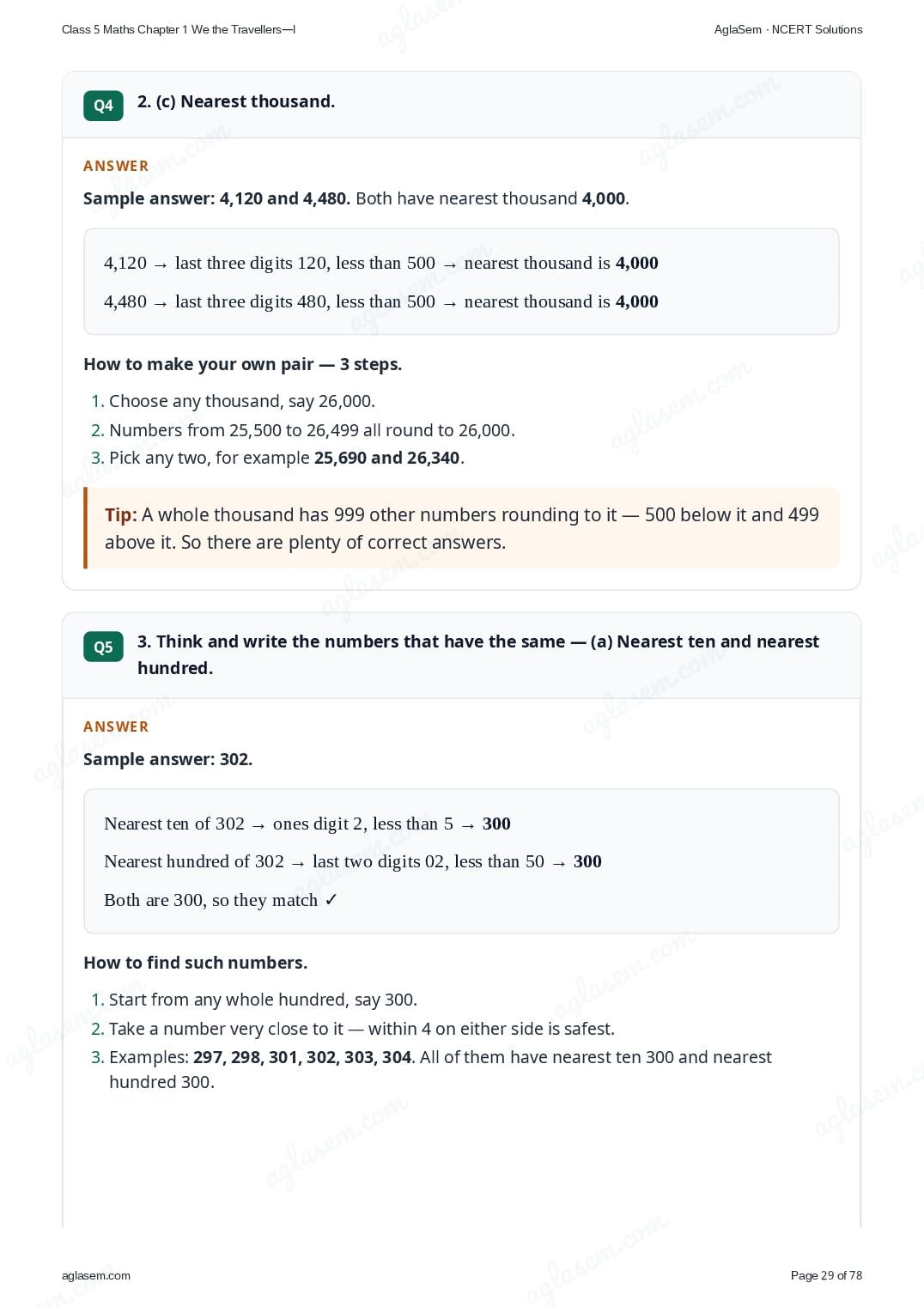
- 2. (c) Nearest thousand.
- 3. Think and write the numbers that have the same — (a) Nearest ten and nearest hundred.
- 3. (b) Nearest hundred and nearest thousand.
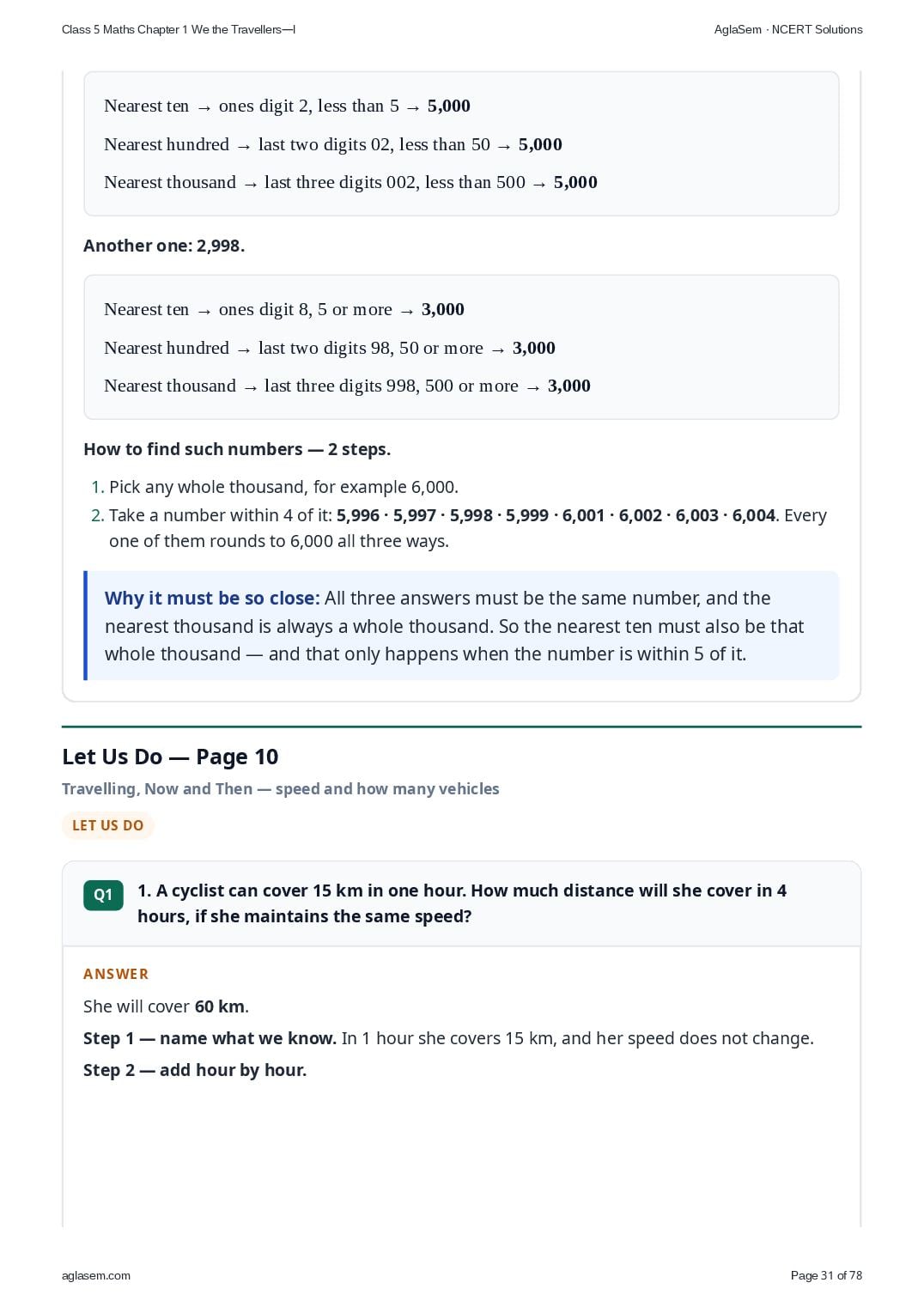
- 3. (c) Nearest ten, hundred and thousand.
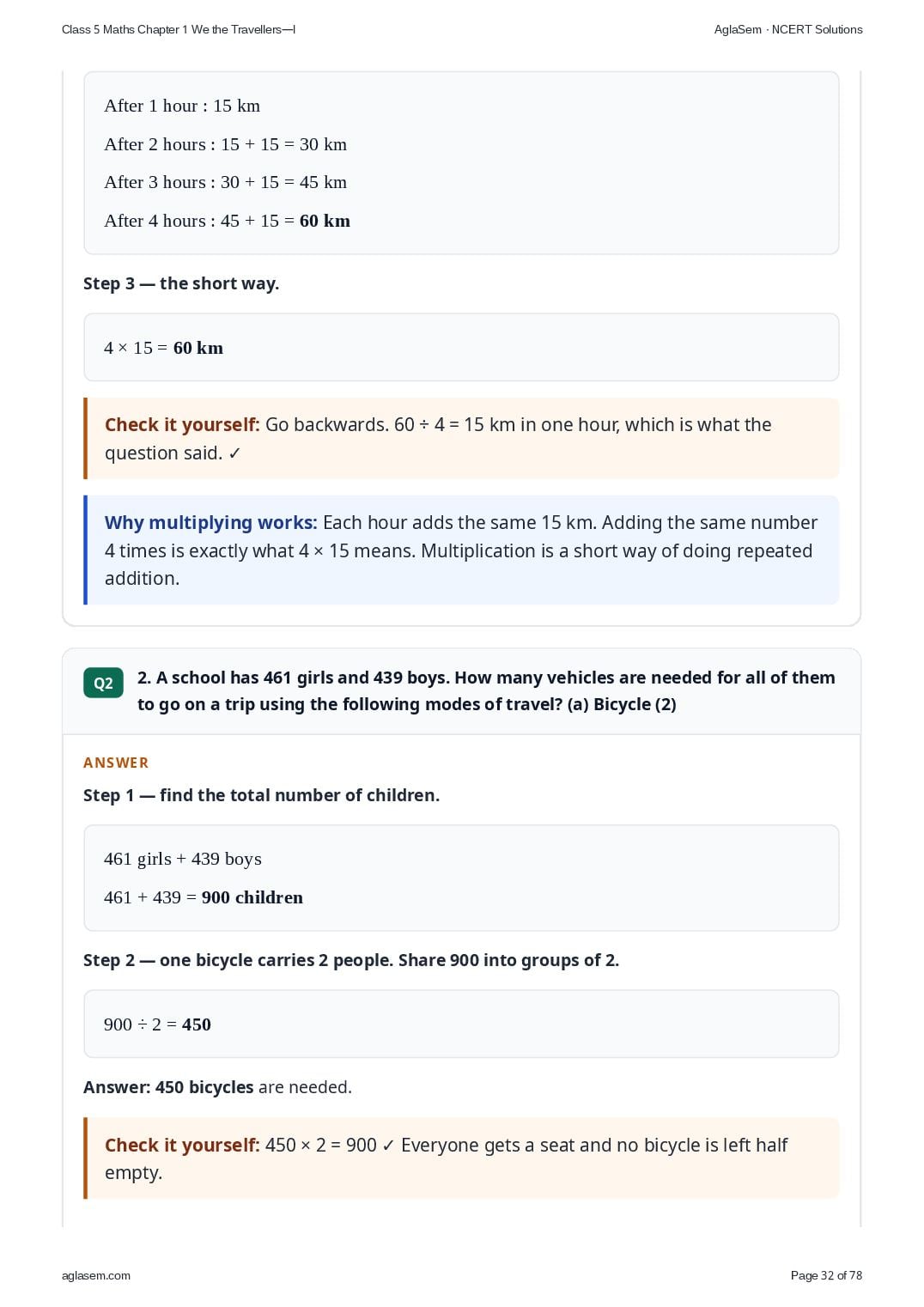
- 1. A cyclist can cover 15 km in one hour. How much distance will she cover in 4 hours, if she maintains the same speed?
- 2. A school has 461 girls and 439 boys. How many vehicles are needed for all of them to go on a trip using the following modes of travel? (a) Bicycle (2)
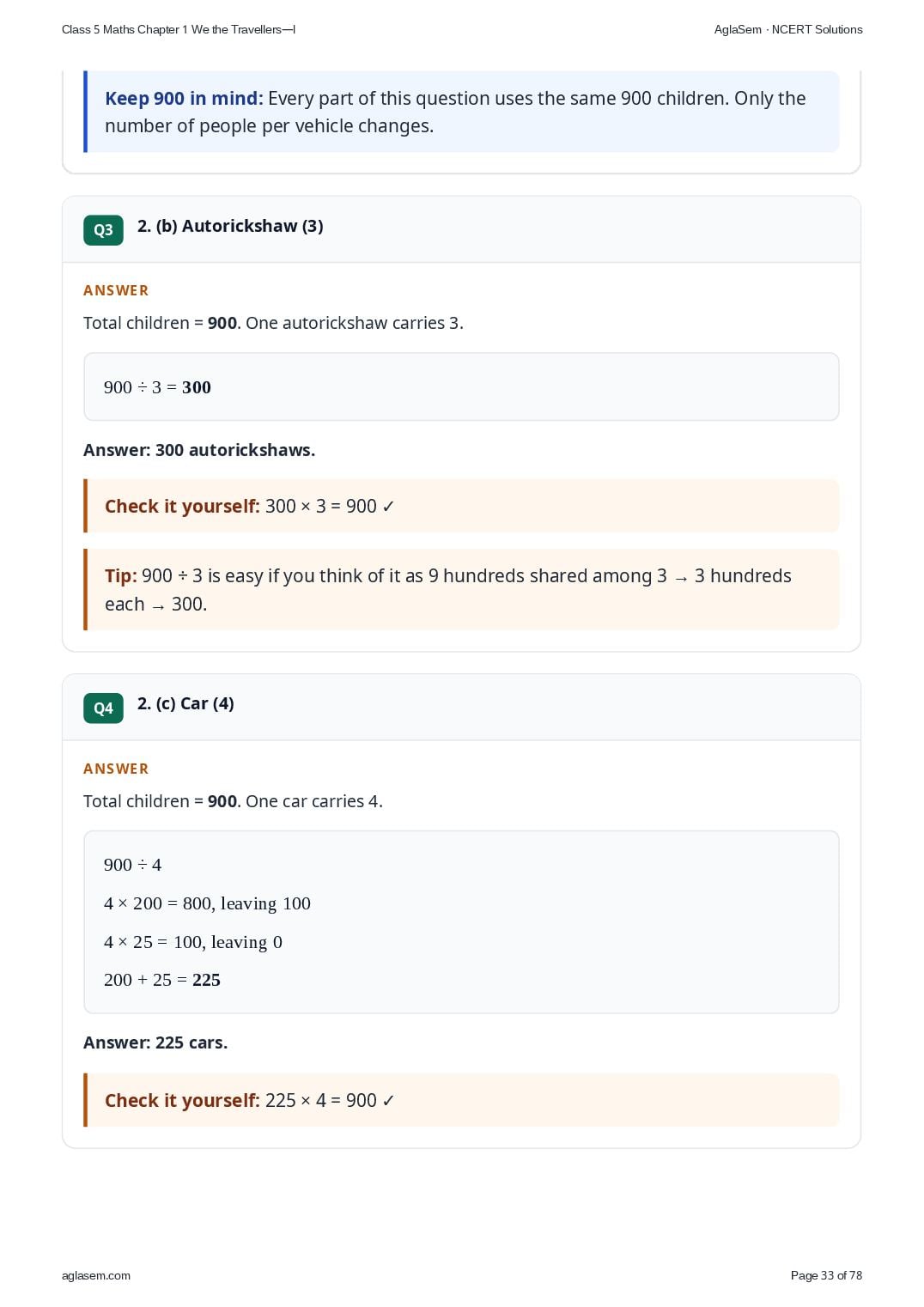
- 2. (b) Autorickshaw (3)
- 2. (c) Car (4)
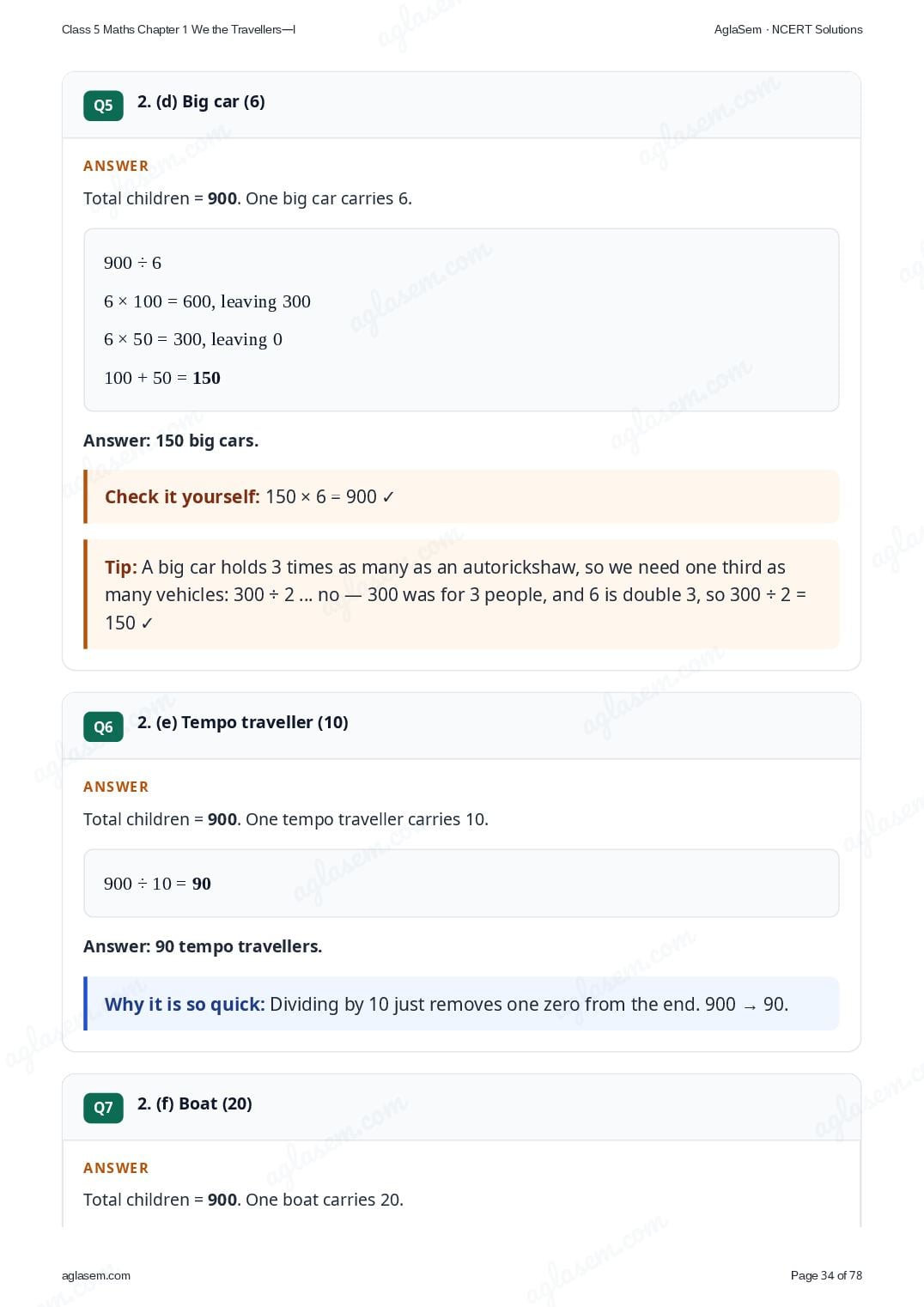
- 2. (d) Big car (6)
- 2. (e) Tempo traveller (10)
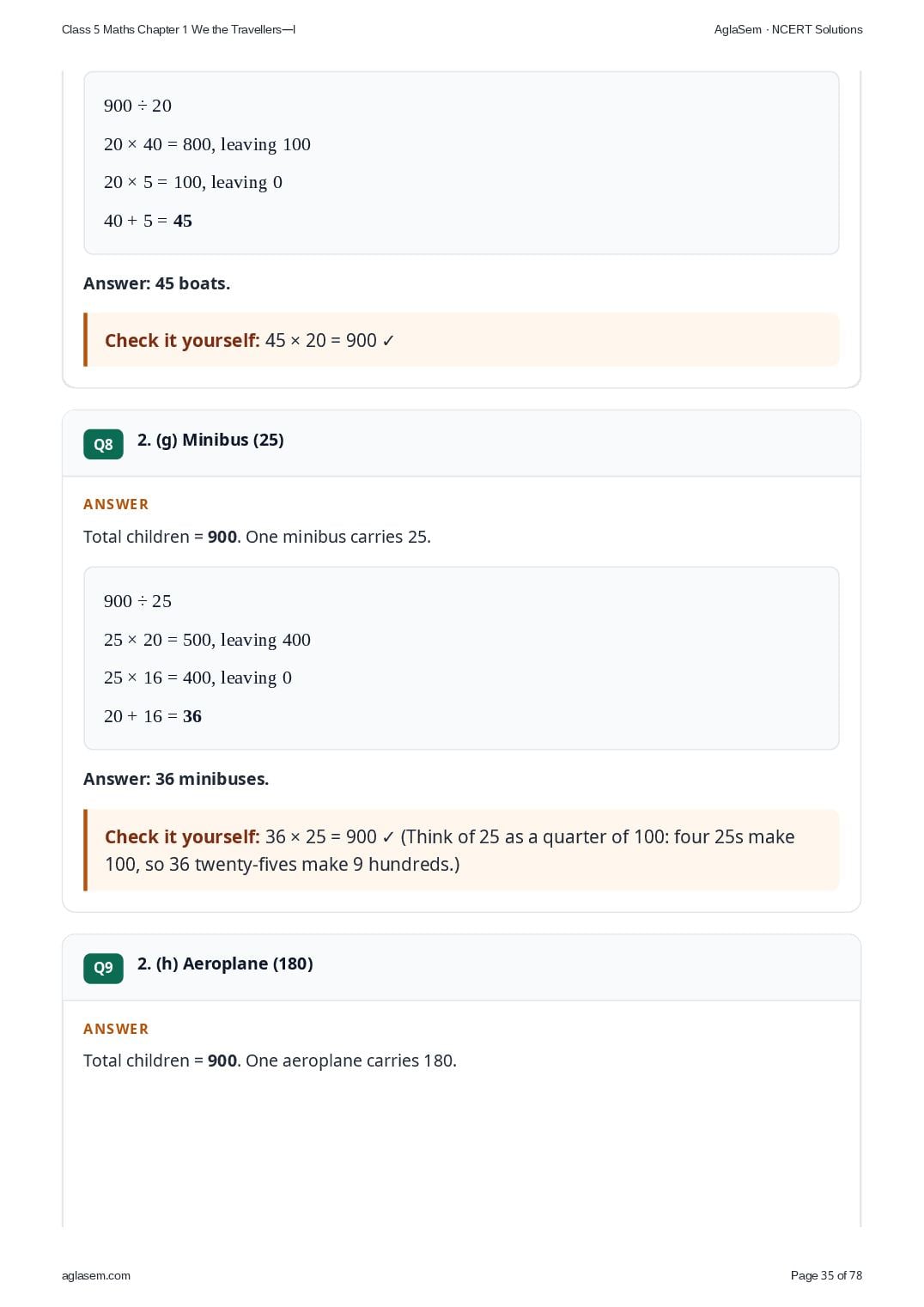
- 2. (f) Boat (20)
- 2. (g) Minibus (25)
- 2. (h) Aeroplane (180)
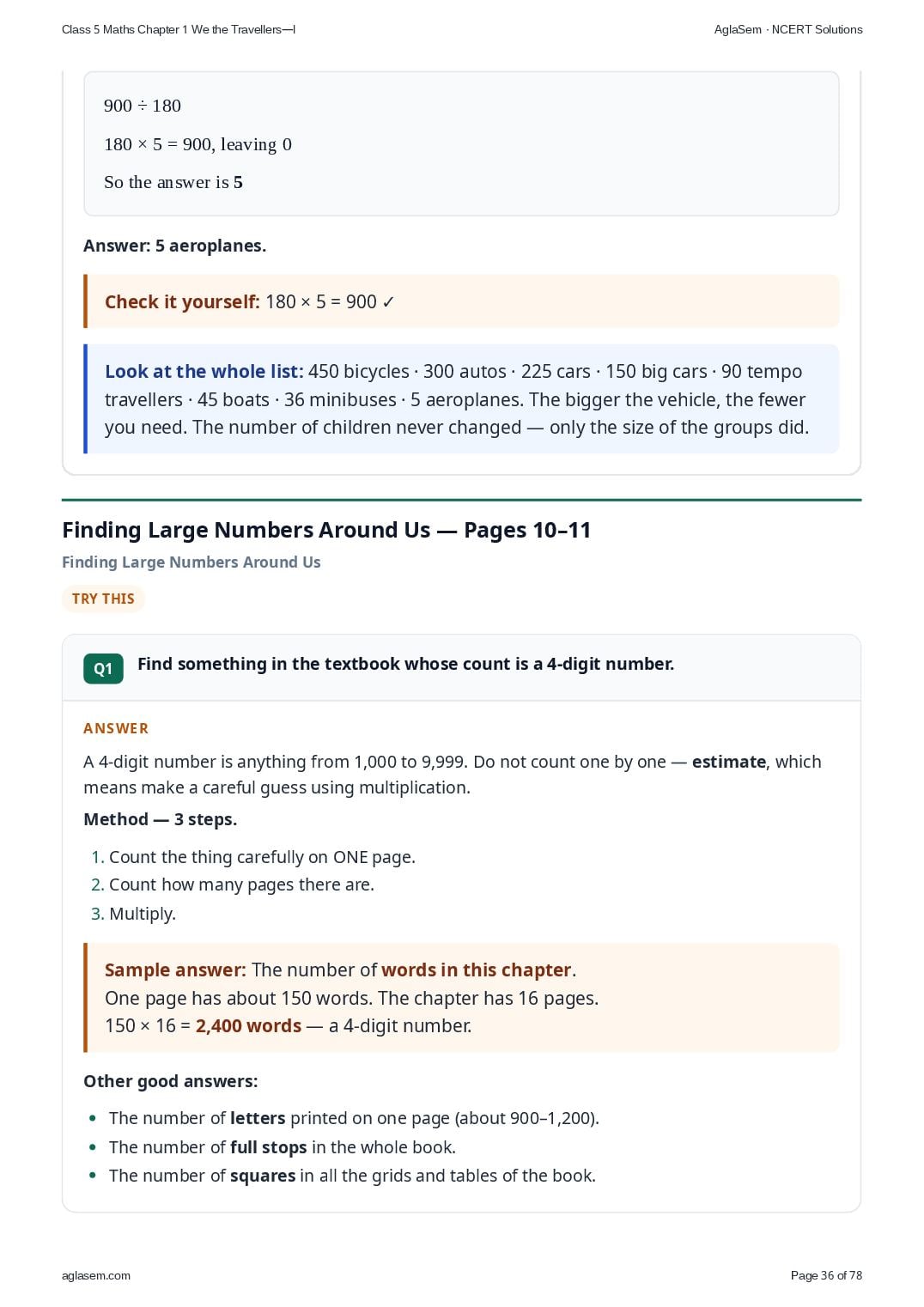
- Find something in the textbook whose count is a 4-digit number.
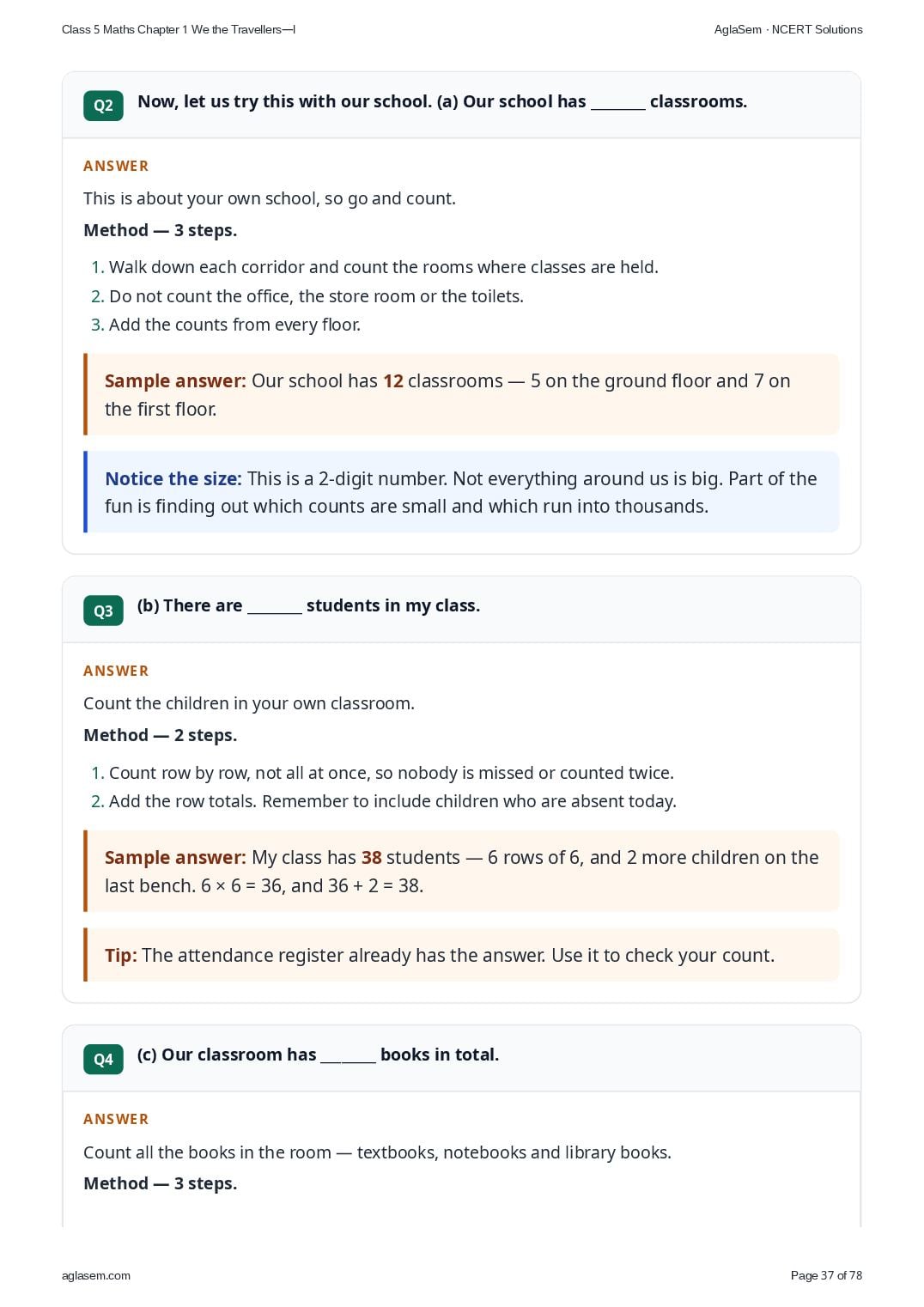
- Now, let us try this with our school. (a) Our school has ________ classrooms.
- (b) There are ________ students in my class.
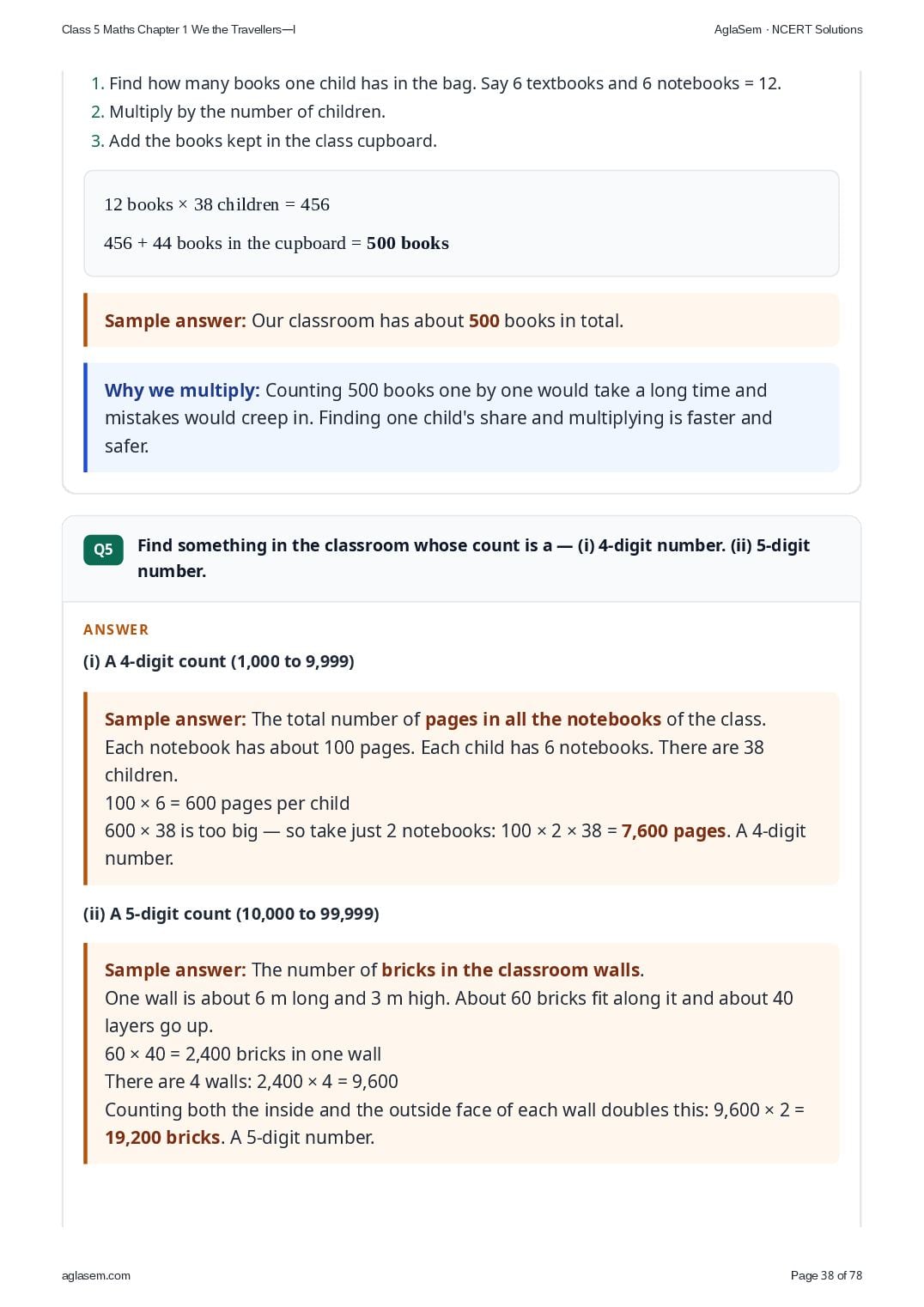
- (c) Our classroom has ________ books in total.
- Find something in the classroom whose count is a — (i) 4-digit number. (ii) 5-digit number.
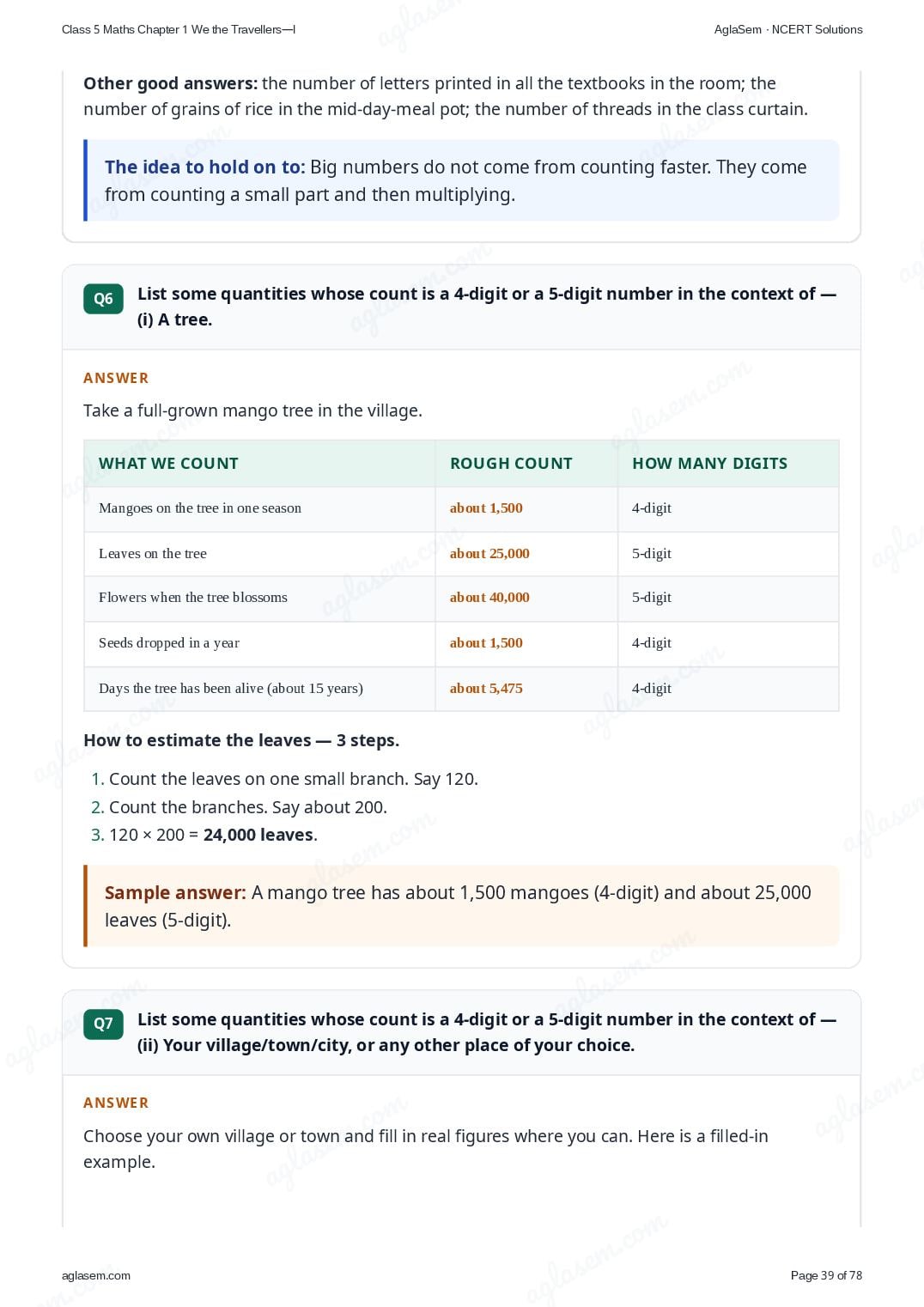
- List some quantities whose count is a 4-digit or a 5-digit number in the context of — (i) A tree.
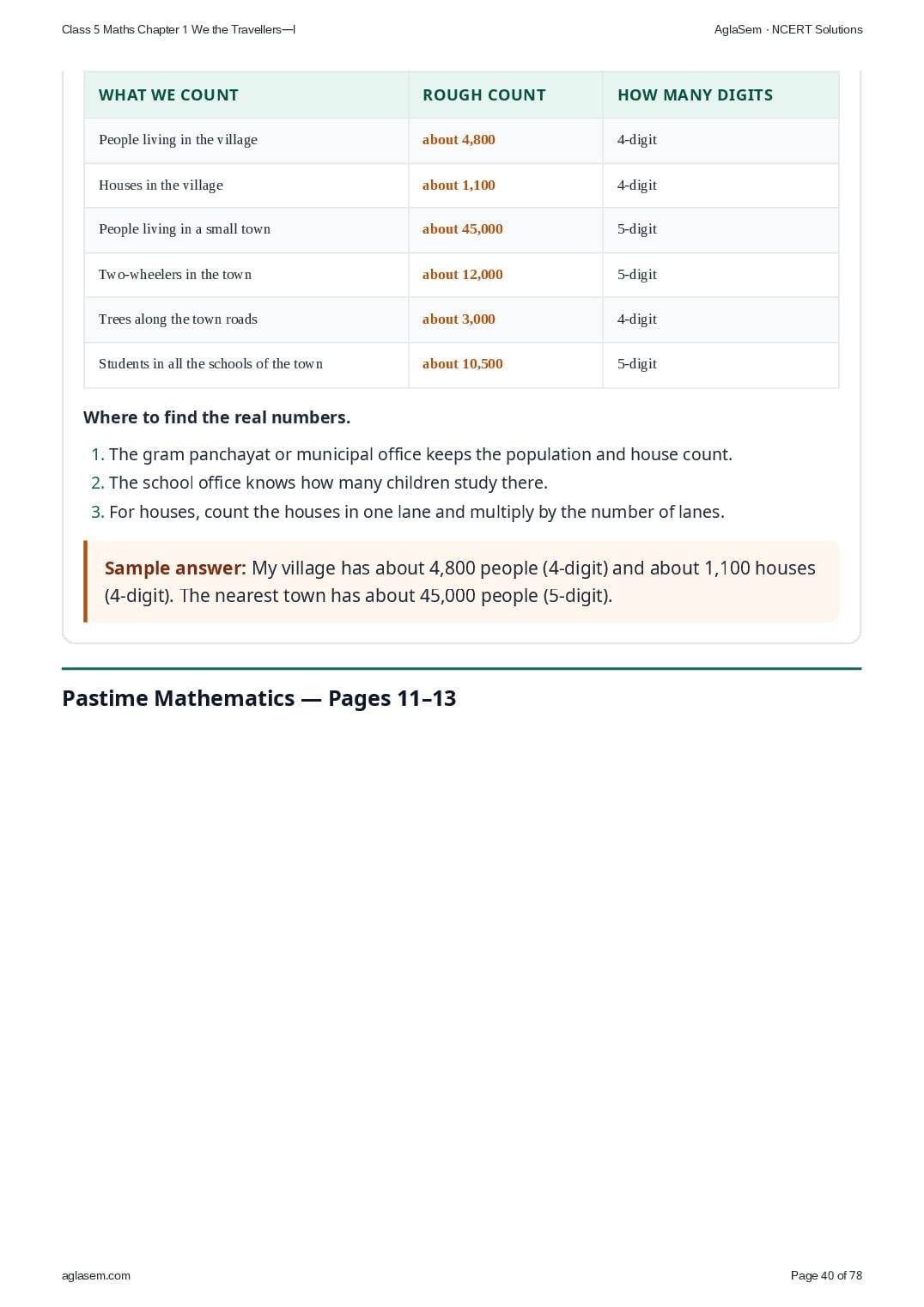
- List some quantities whose count is a 4-digit or a 5-digit number in the context of — (ii) Your village/town/city, or any other place of your choice.
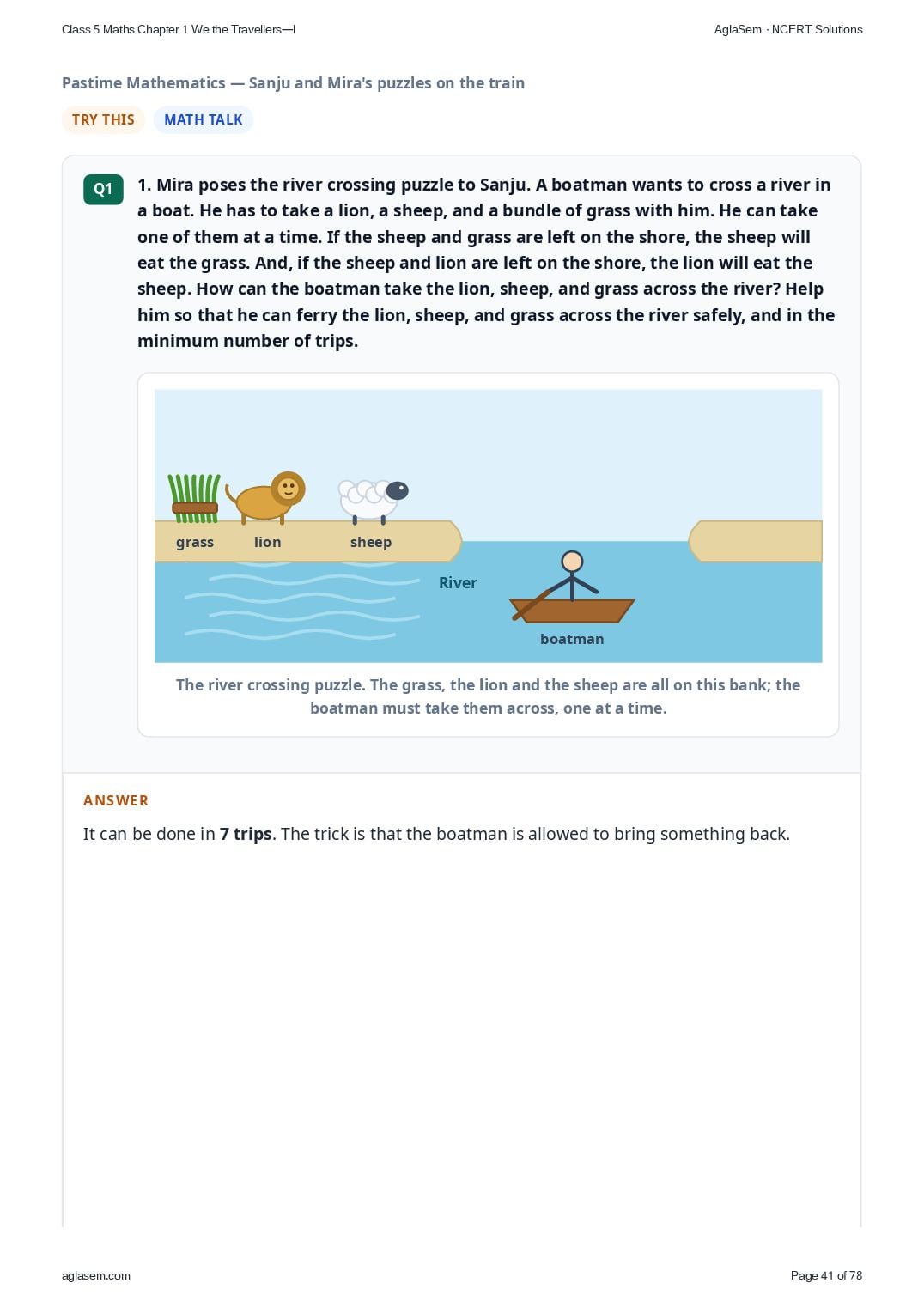
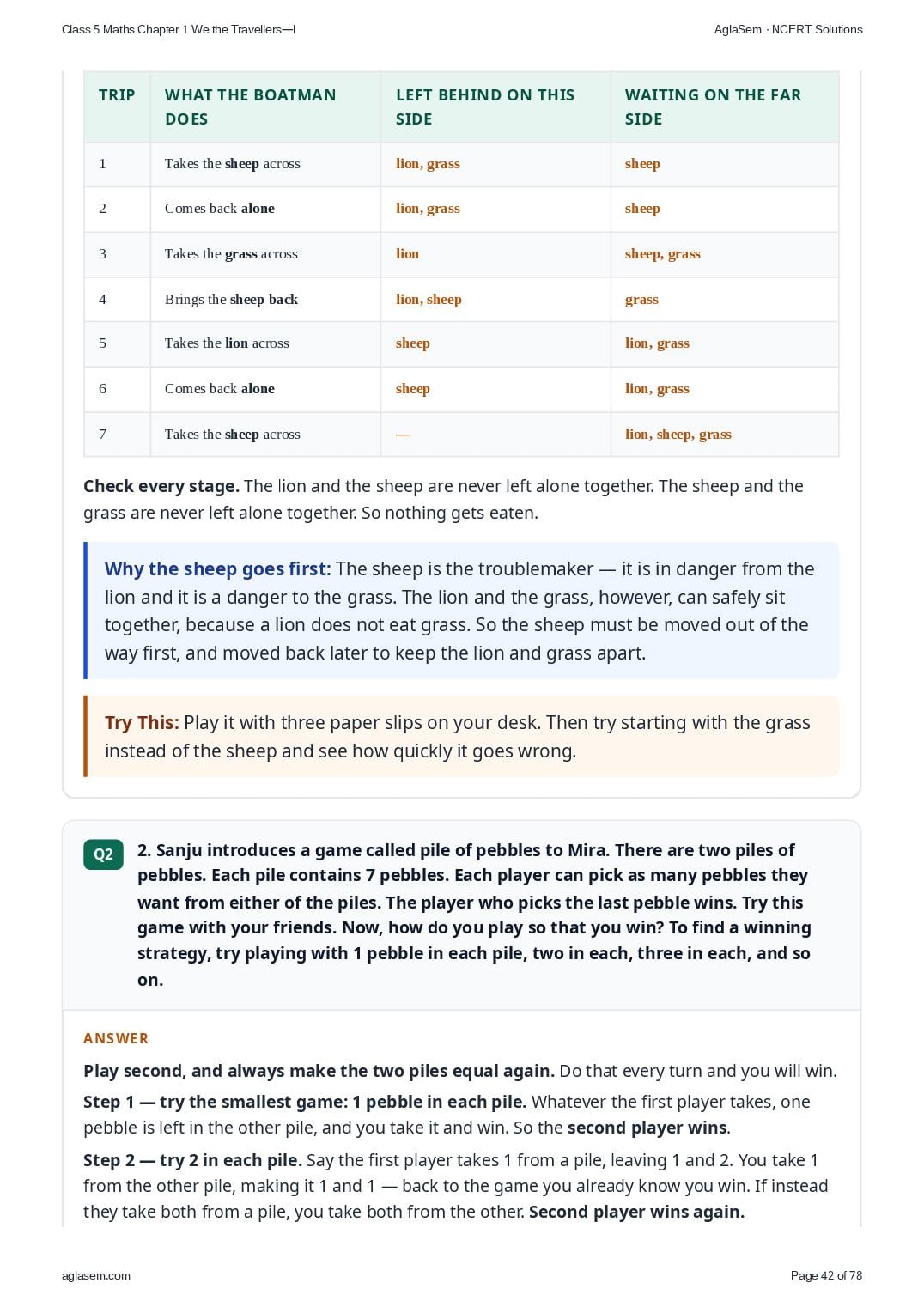
- 1. Mira poses the river crossing puzzle to Sanju. A boatman wants to cross a river in a boat. He has to take a lion, a sheep, and a bundle of grass with him. He can take one of them at a time. If the sheep and grass are left on the shore, the sheep will eat the grass. And, if the sheep and lion are left on the shore, the lion will eat the sheep. How can the boatman take the lion, sheep, and grass across the river? Help him so that he can ferry the lion, sheep, and grass across the river safely, and in the minimum number of trips. grasslionsheepboatmanRiverThe river crossing puzzle. The grass, the lion and the sheep are all on this bank; the boatman must take them across, one at a time.
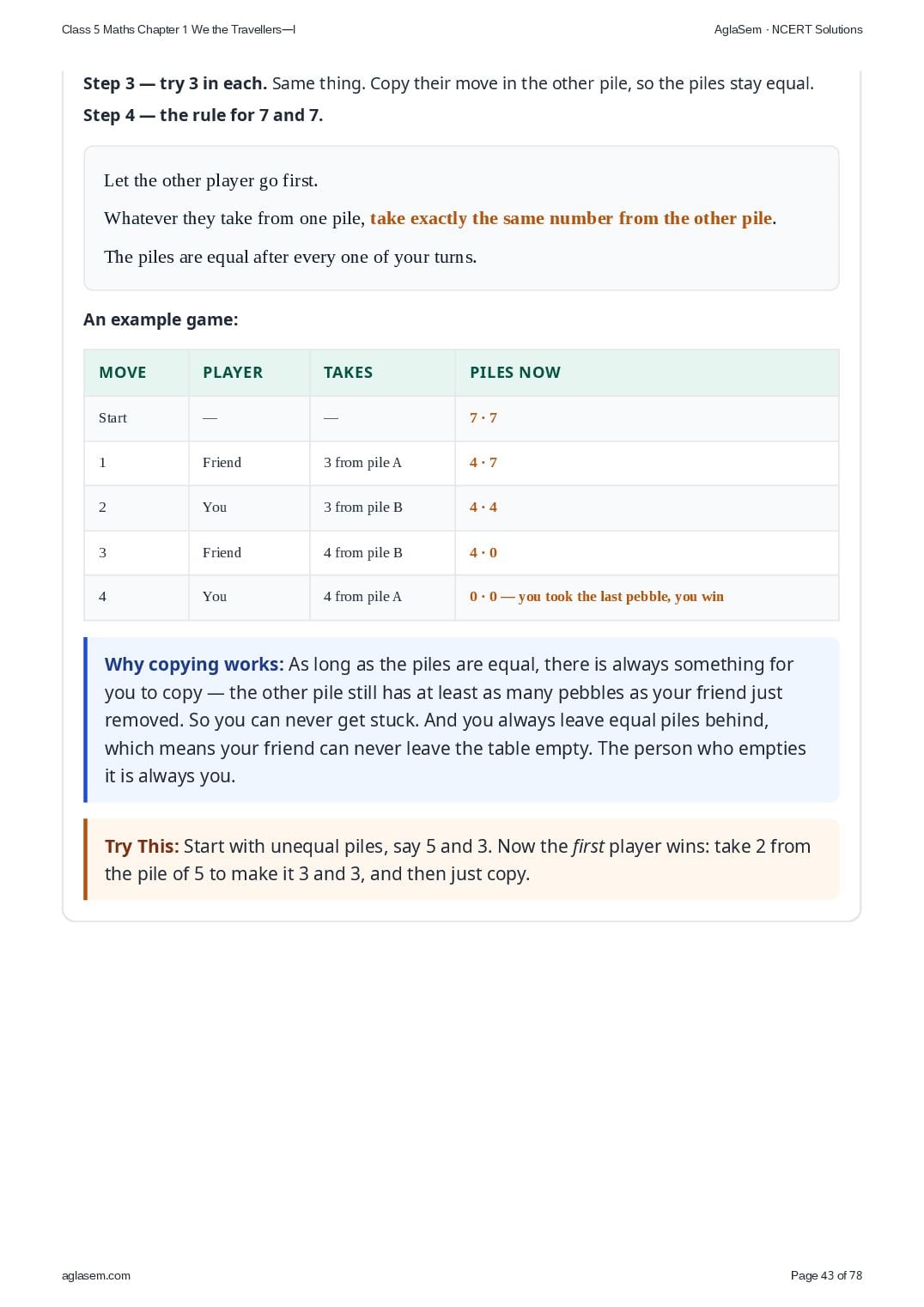
- 2. Sanju introduces a game called pile of pebbles to Mira. There are two piles of pebbles. Each pile contains 7 pebbles. Each player can pick as many pebbles they want from either of the piles. The player who picks the last pebble wins. Try this game with your friends. Now, how do you play so that you win? To find a winning strategy, try playing with 1 pebble in each pile, two in each, three in each, and so on.
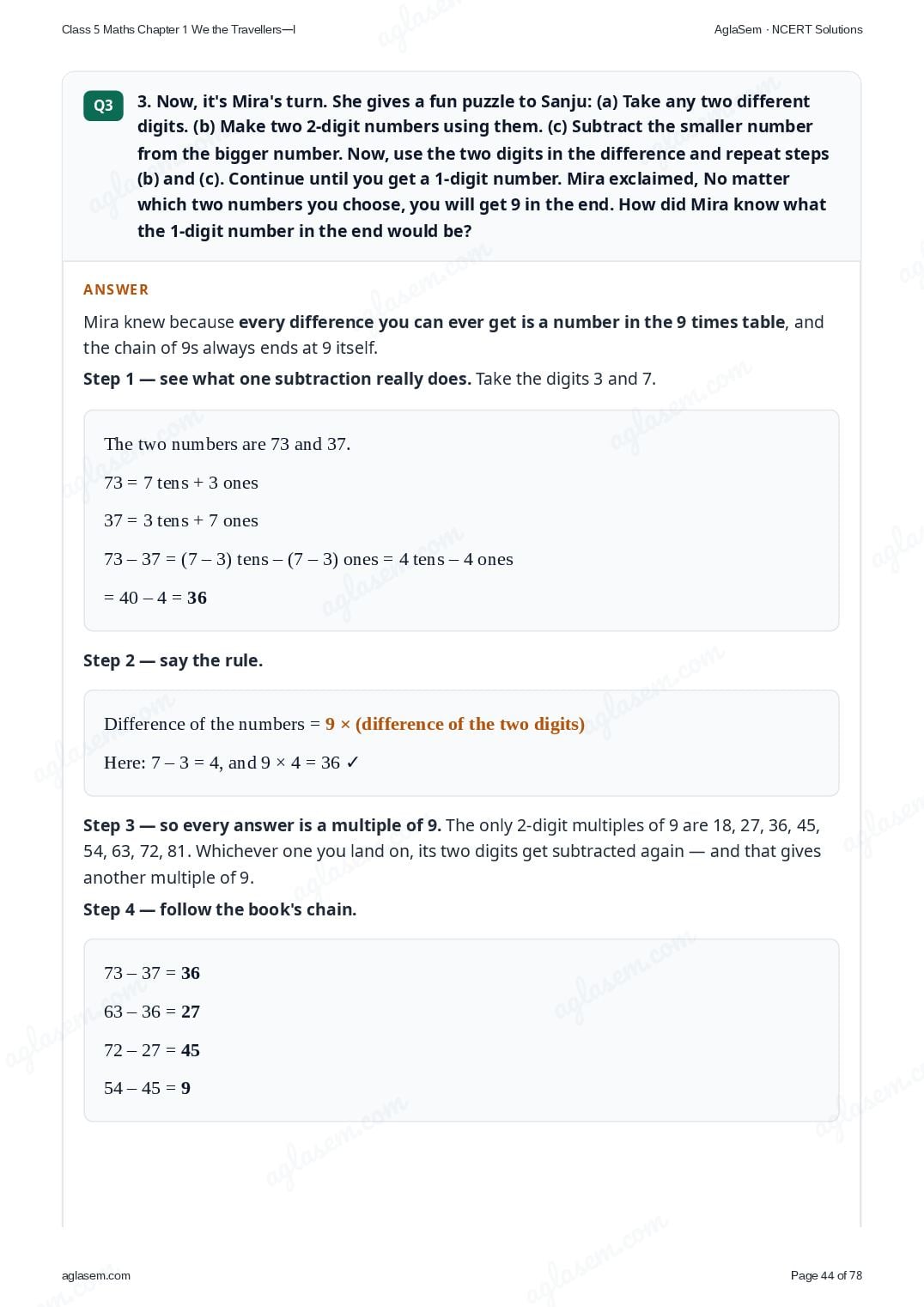
- 3. Now, it’s Mira’s turn. She gives a fun puzzle to Sanju: (a) Take any two different digits. (b) Make two 2-digit numbers using them. (c) Subtract the smaller number from the bigger number. Now, use the two digits in the difference and repeat steps (b) and (c). Continue until you get a 1-digit number. Mira exclaimed, No matter which two numbers you choose, you will get 9 in the end. How did Mira know what the 1-digit number in the end would be?
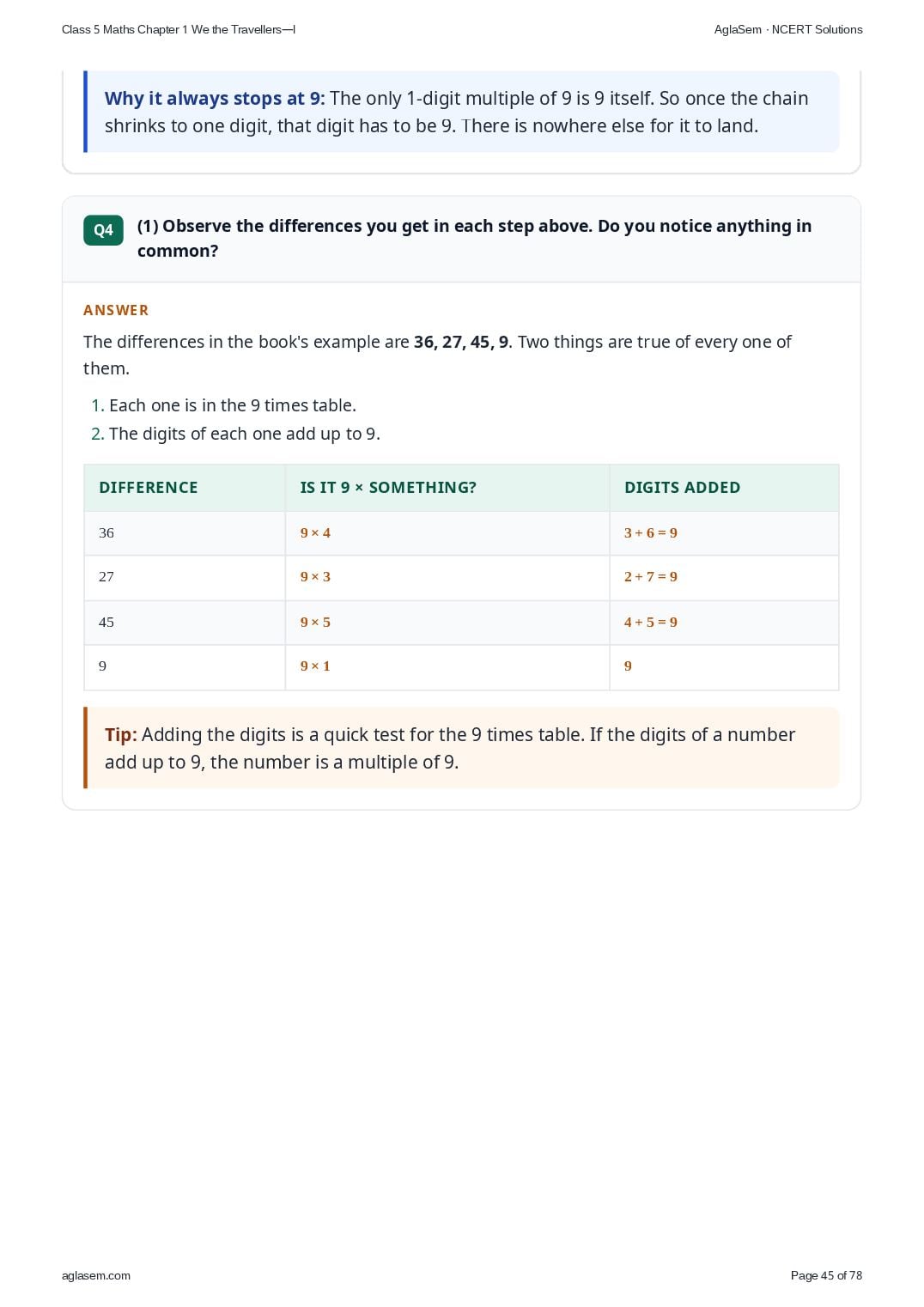
- (1) Observe the differences you get in each step above. Do you notice anything in common?
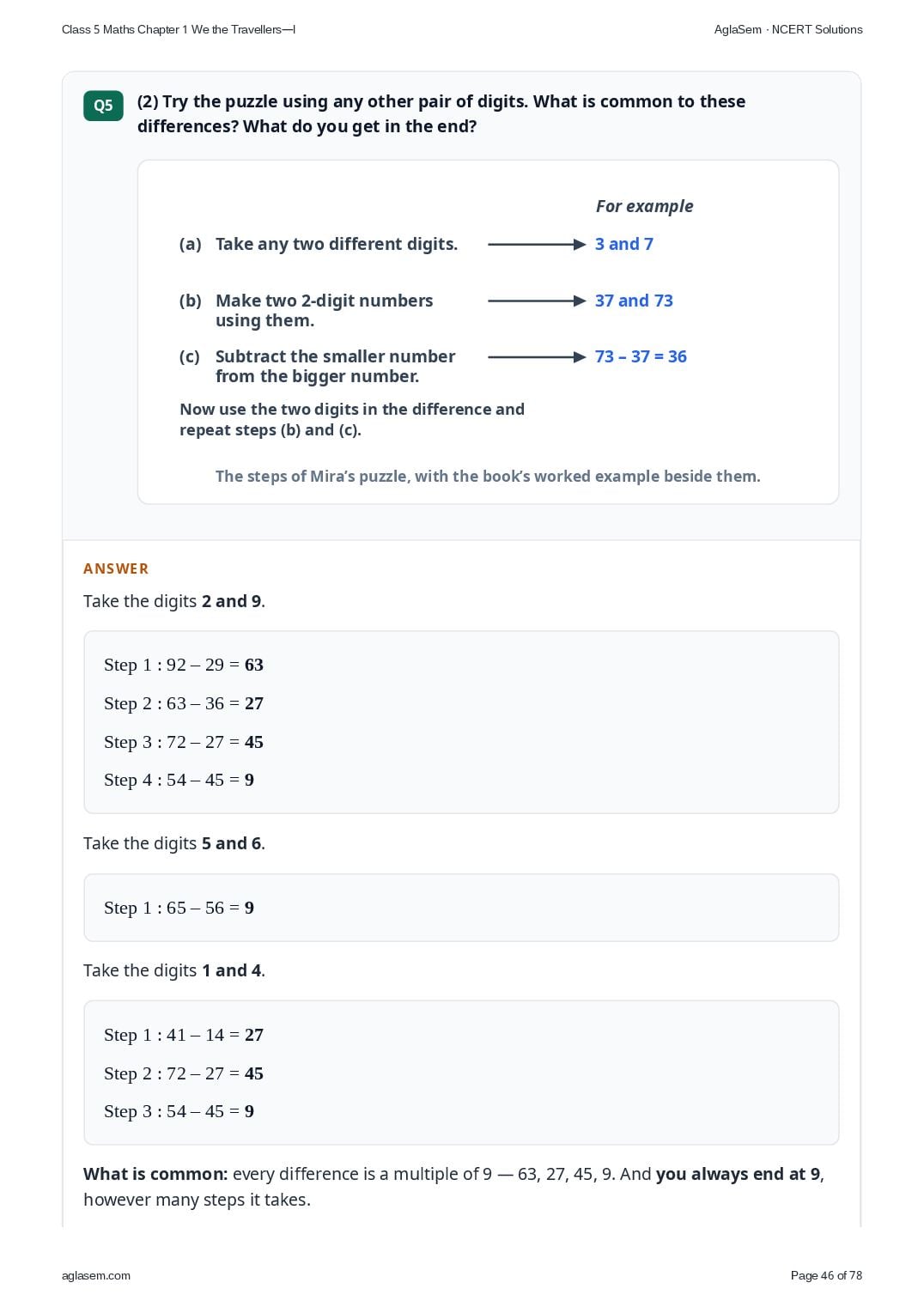
- (2) Try the puzzle using any other pair of digits. What is common to these differences? What do you get in the end? For example(a)Take any two different digits.3 and 7(b)Make two 2-digit numbersusing them.37 and 73(c)Subtract the smaller numberfrom the bigger number.73 – 37 = 36Now use the two digits in the difference andrepeat steps (b) and (c).The steps of Mira’s puzzle, with the book’s worked example beside them.
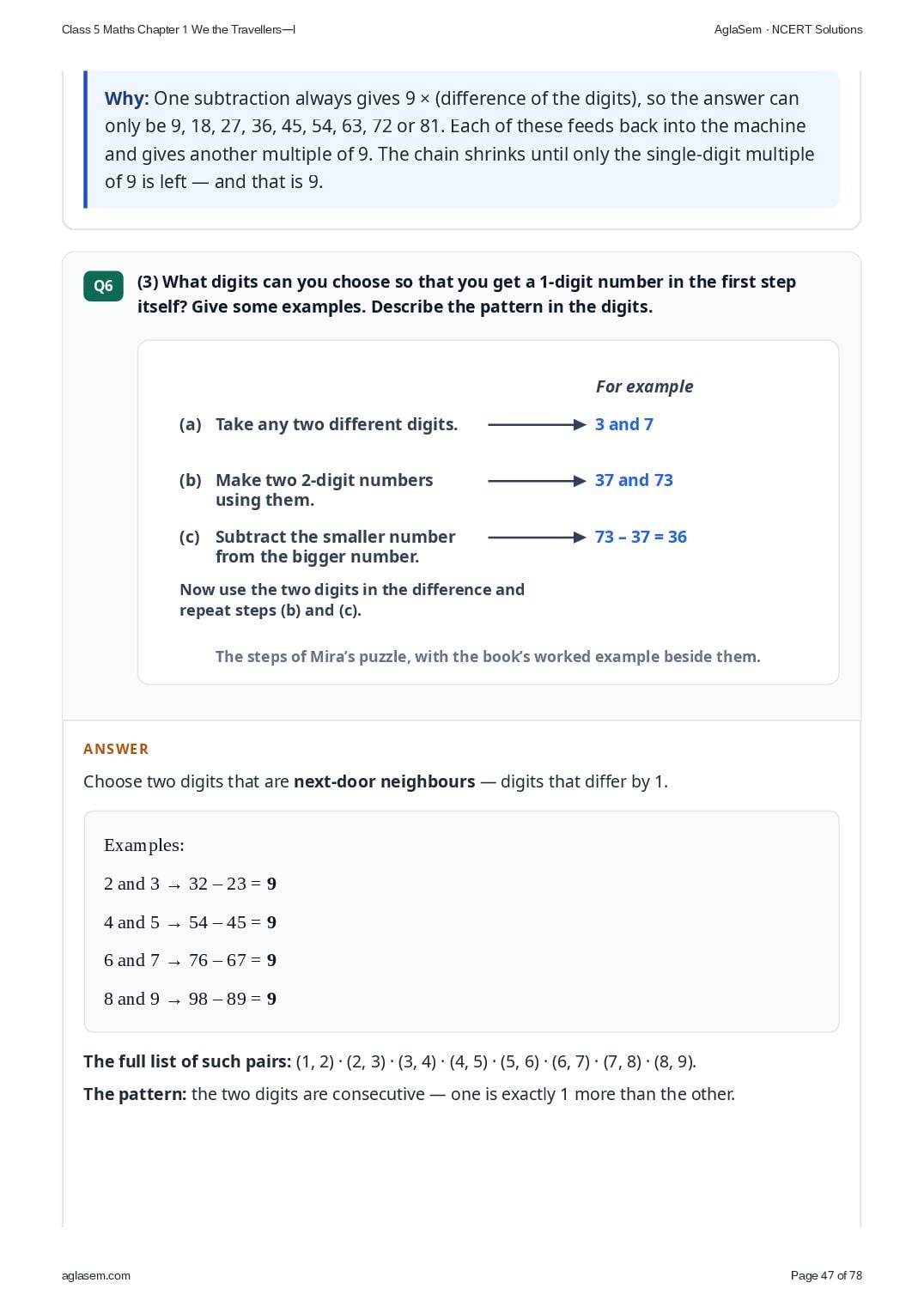
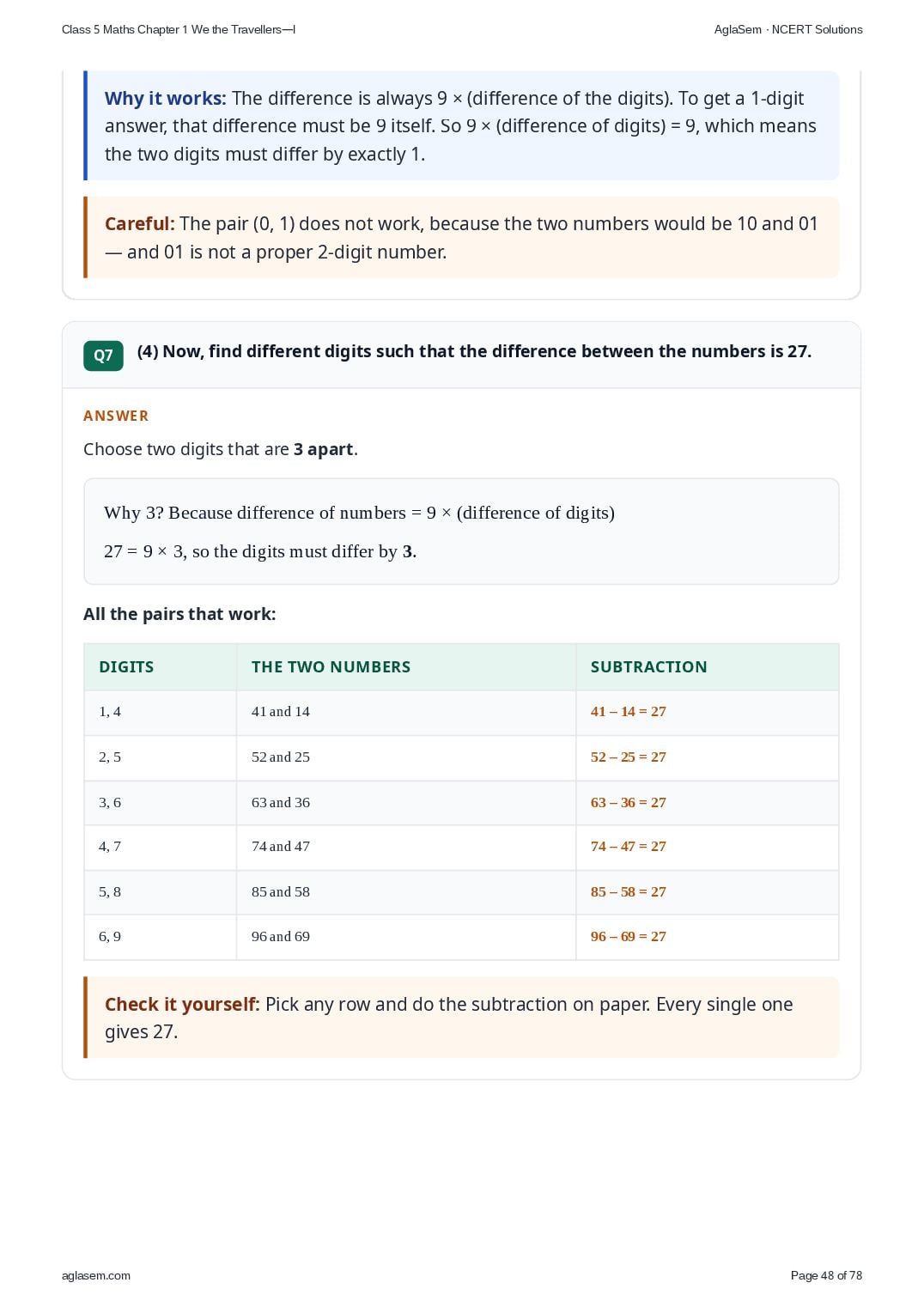
- (3) What digits can you choose so that you get a 1-digit number in the first step itself? Give some examples. Describe the pattern in the digits. For example(a)Take any two different digits.3 and 7(b)Make two 2-digit numbersusing them.37 and 73(c)Subtract the smaller numberfrom the bigger number.73 – 37 = 36Now use the two digits in the difference andrepeat steps (b) and (c).The steps of Mira’s puzzle, with the book’s worked example beside them.
- (4) Now, find different digits such that the difference between the numbers is 27.
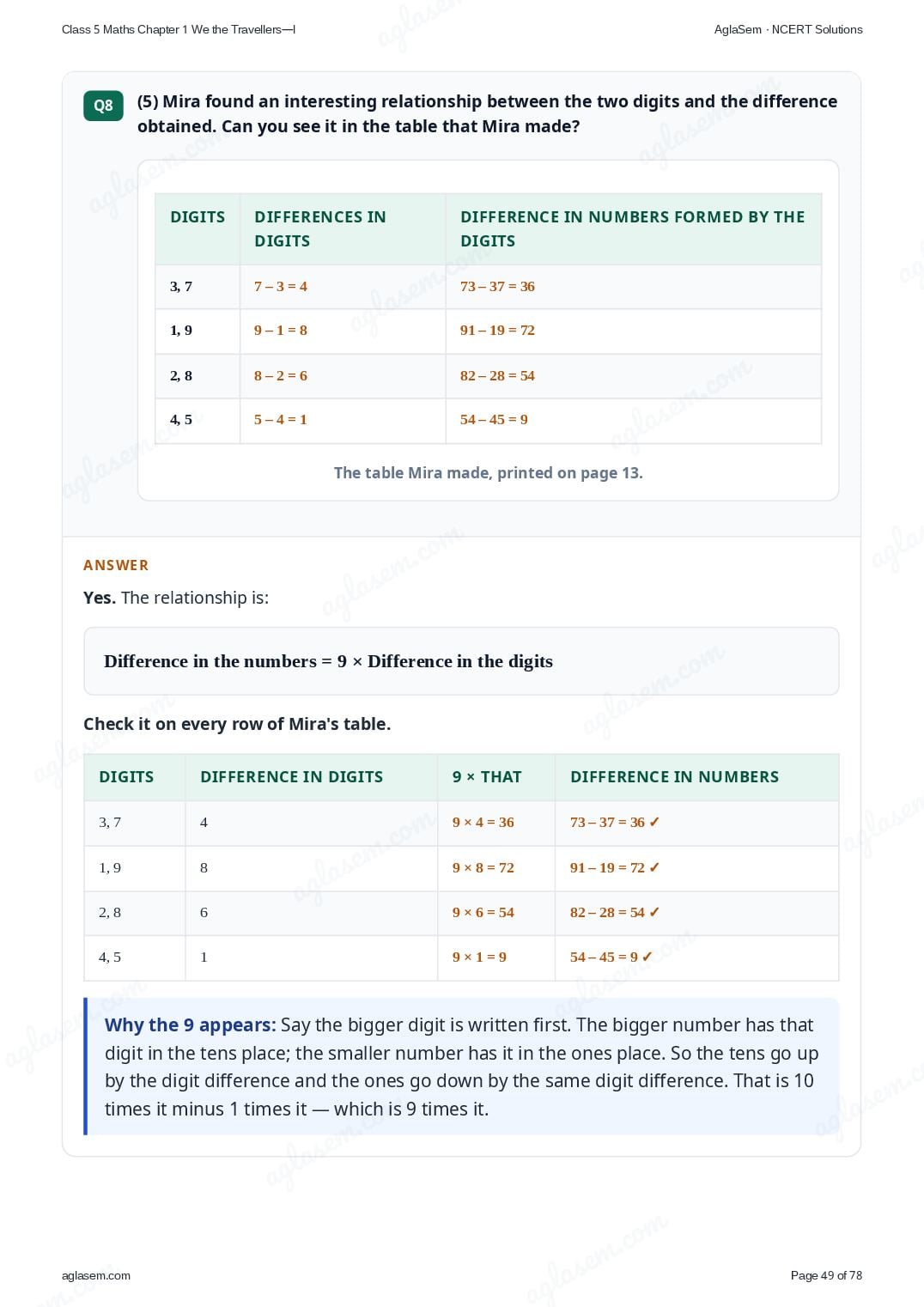
- (5) Mira found an interesting relationship between the two digits and the difference obtained. Can you see it in the table that Mira made? DigitsDifferences in digitsDifference in numbers formed by the digits3, 77 – 3 = 473 – 37 = 361, 99 – 1 = 891 – 19 = 722, 88 – 2 = 682 – 28 = 544, 55 – 4 = 154 – 45 = 9The table Mira made, printed on page 13.
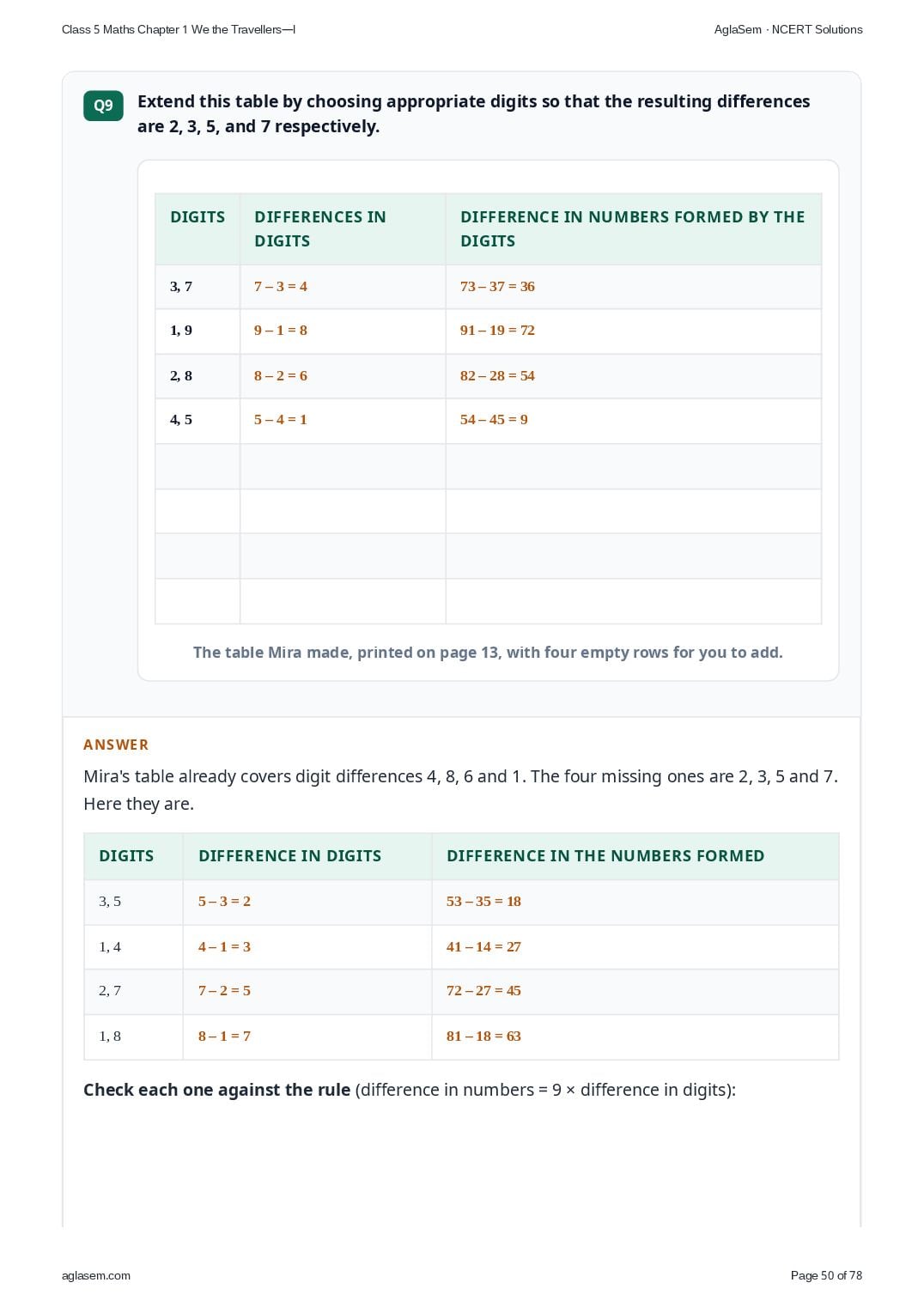
- Extend this table by choosing appropriate digits so that the resulting differences are 2, 3, 5, and 7 respectively. DigitsDifferences in digitsDifference in numbers formed by the digits3, 77 – 3 = 473 – 37 = 361, 99 – 1 = 891 – 19 = 722, 88 – 2 = 682 – 28 = 544, 55 – 4 = 154 – 45 = 9 The table Mira made, printed on page 13, with four empty rows for you to add.
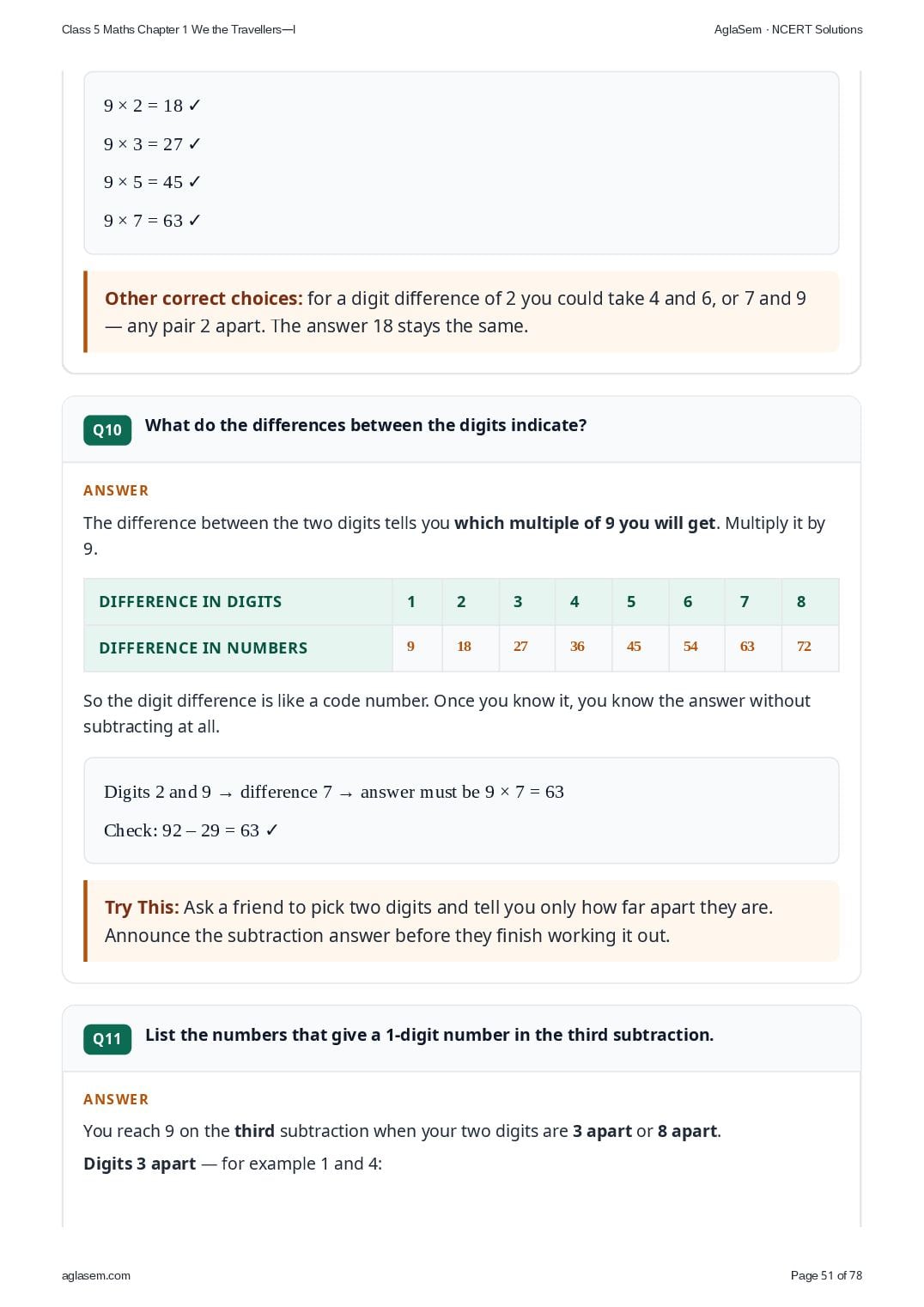
- What do the differences between the digits indicate?
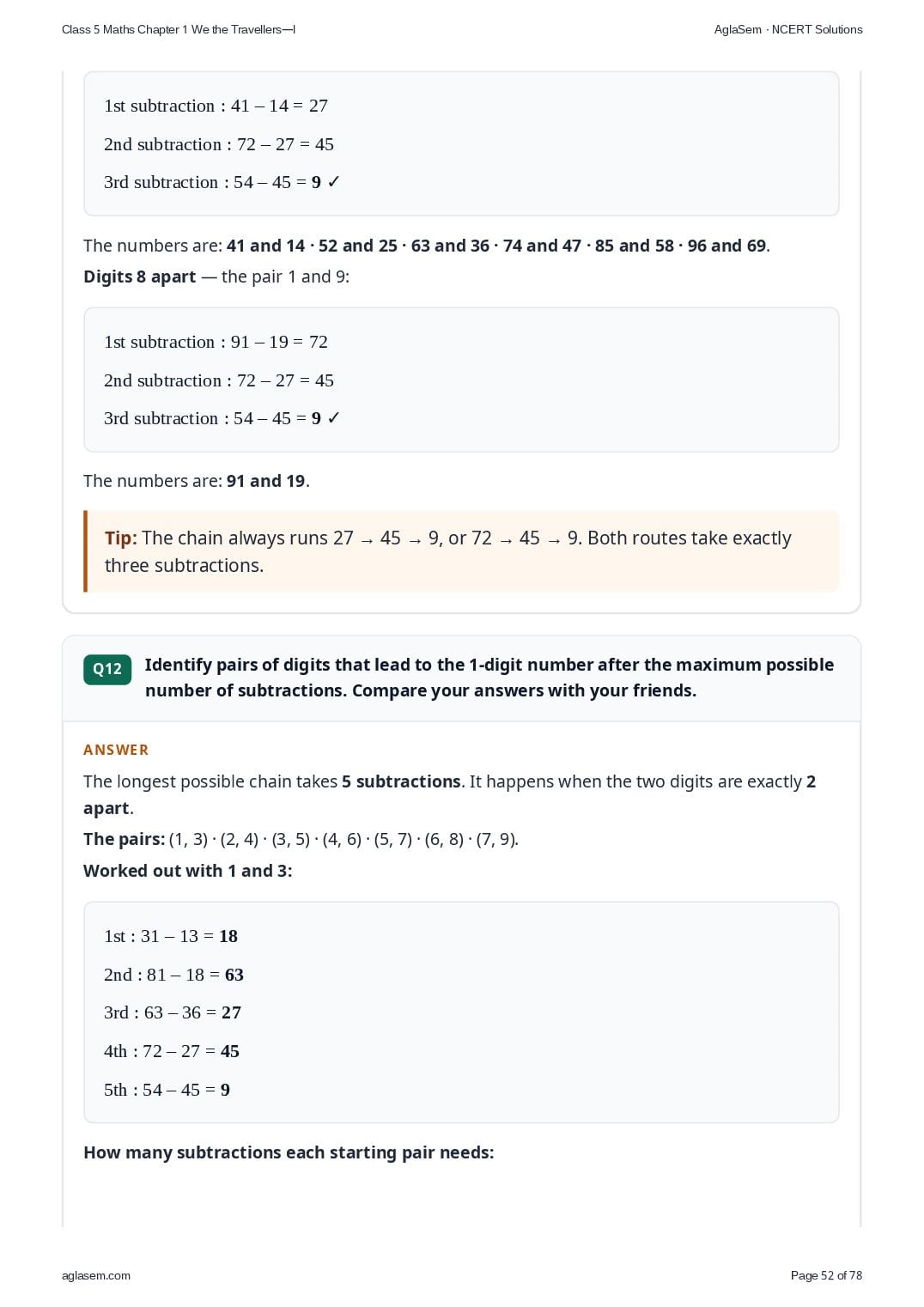
- List the numbers that give a 1-digit number in the third subtraction.
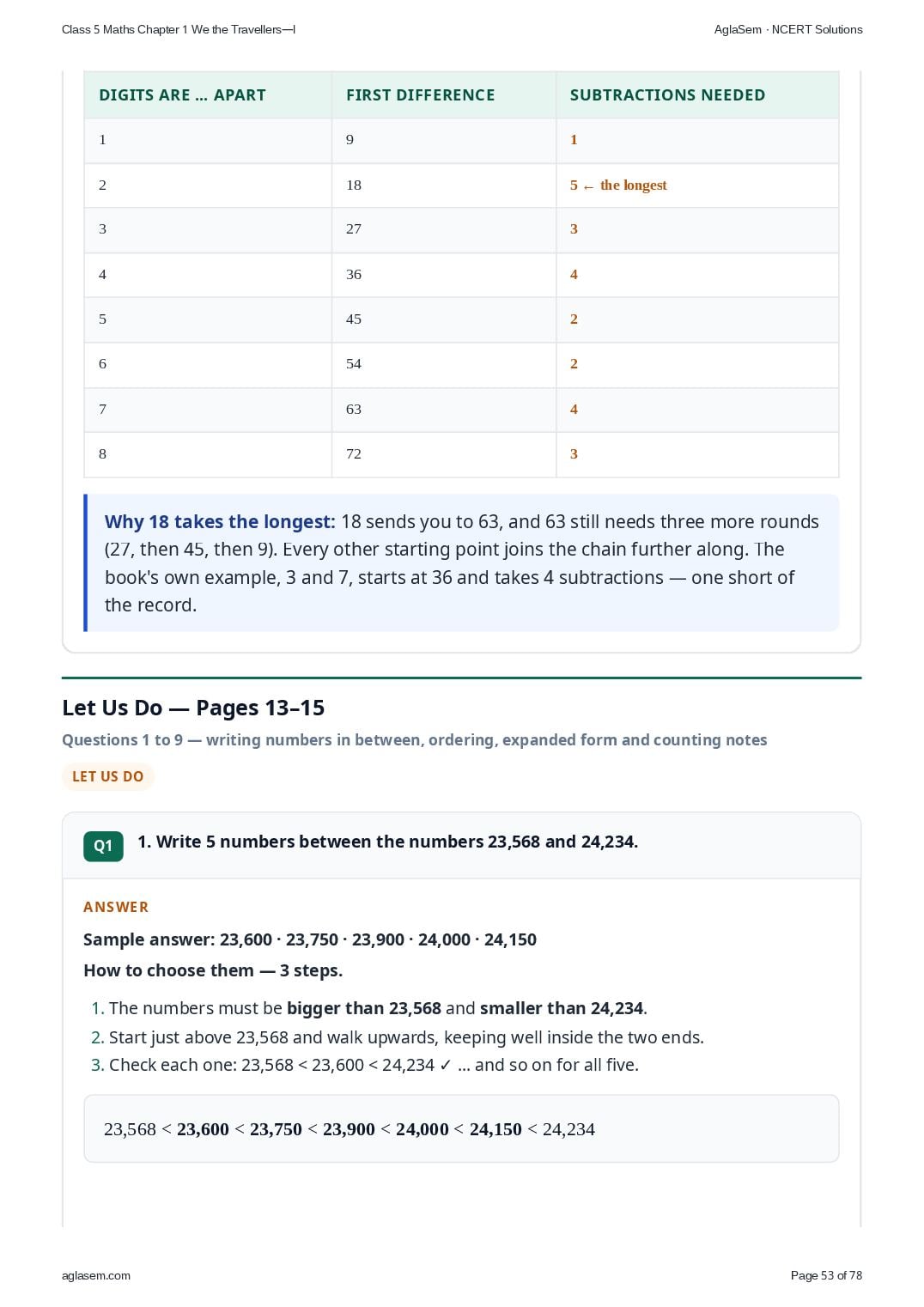
- Identify pairs of digits that lead to the 1-digit number after the maximum possible number of subtractions. Compare your answers with your friends.
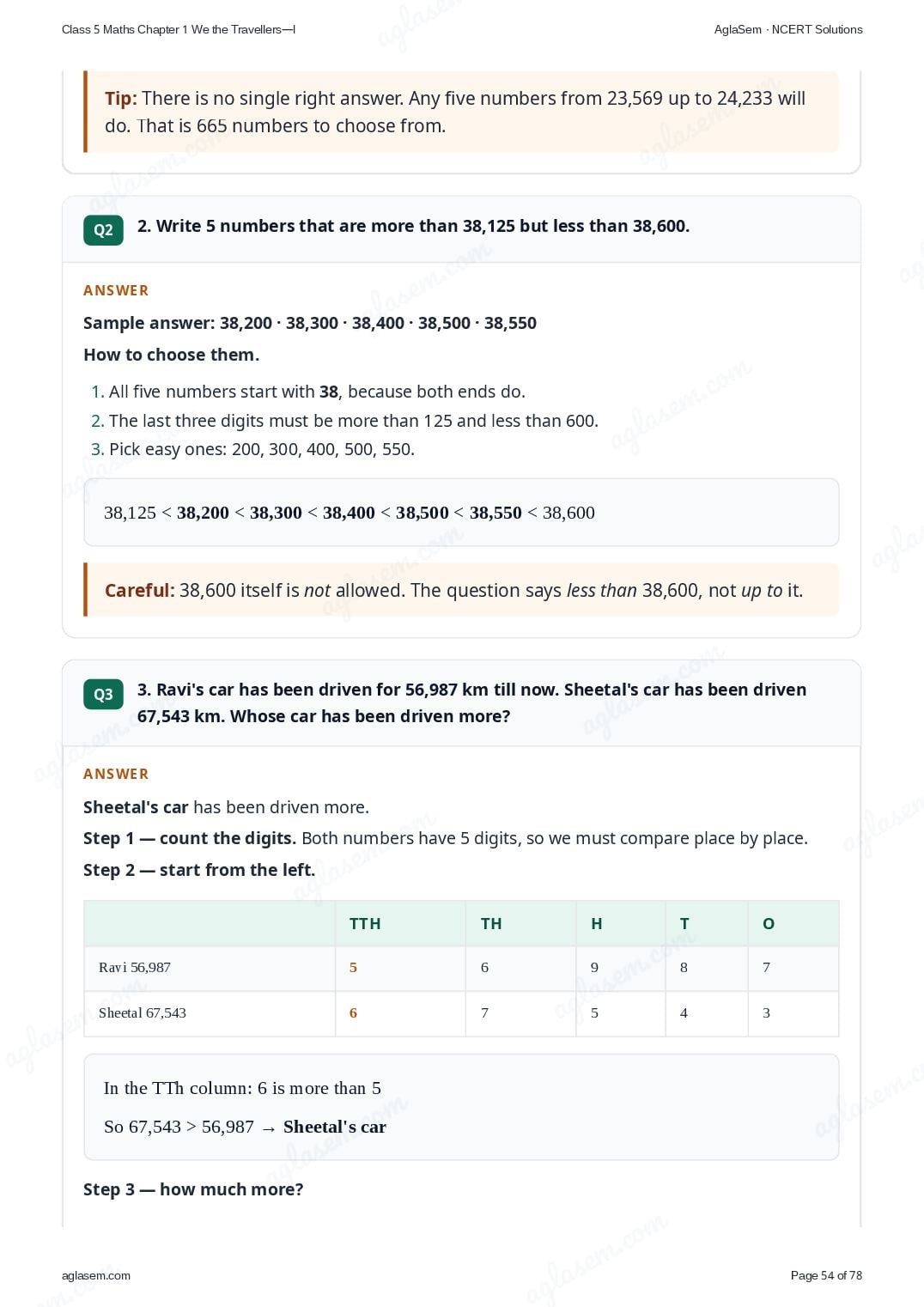
- 1. Write 5 numbers between the numbers 23,568 and 24,234.
- 2. Write 5 numbers that are more than 38,125 but less than 38,600.
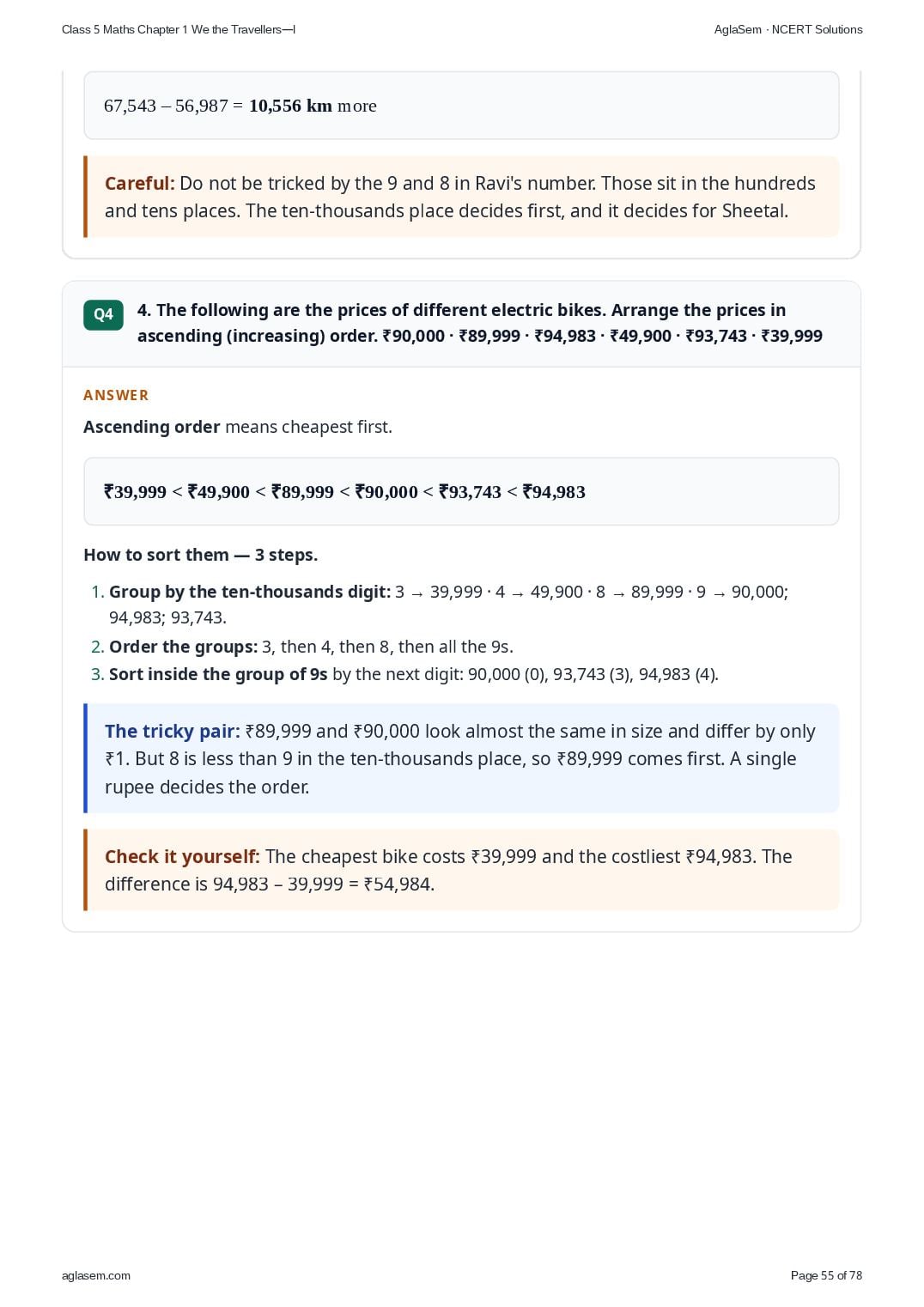
- 3. Ravi’s car has been driven for 56,987 km till now. Sheetal’s car has been driven 67,543 km. Whose car has been driven more?
- 4. The following are the prices of different electric bikes. Arrange the prices in ascending (increasing) order. ₹90,000 · ₹89,999 · ₹94,983 · ₹49,900 · ₹93,743 · ₹39,999
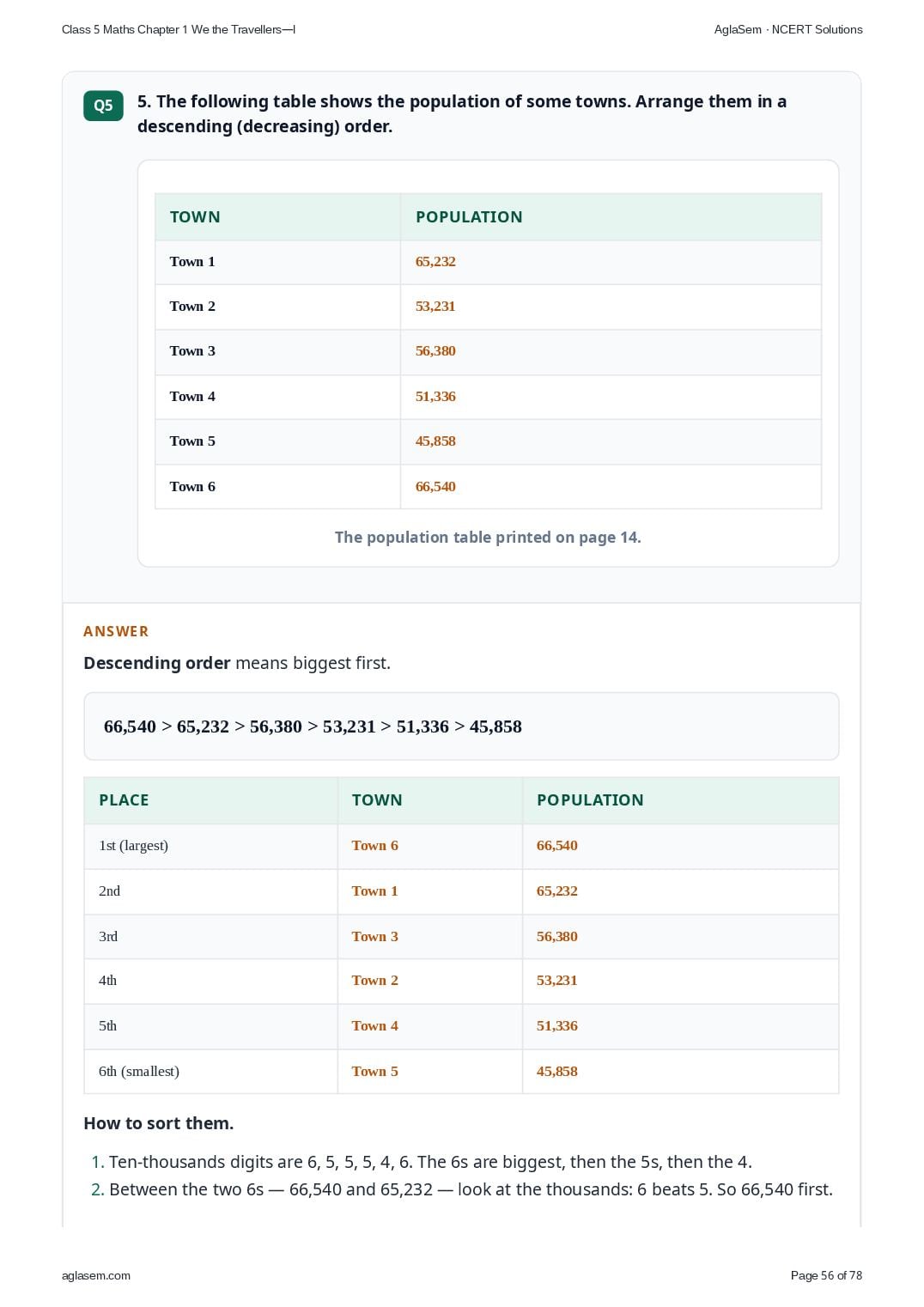
- 5. The following table shows the population of some towns. Arrange them in a descending (decreasing) order. TownPopulationTown 165,232Town 253,231Town 356,380Town 451,336Town 545,858Town 666,540The population table printed on page 14.
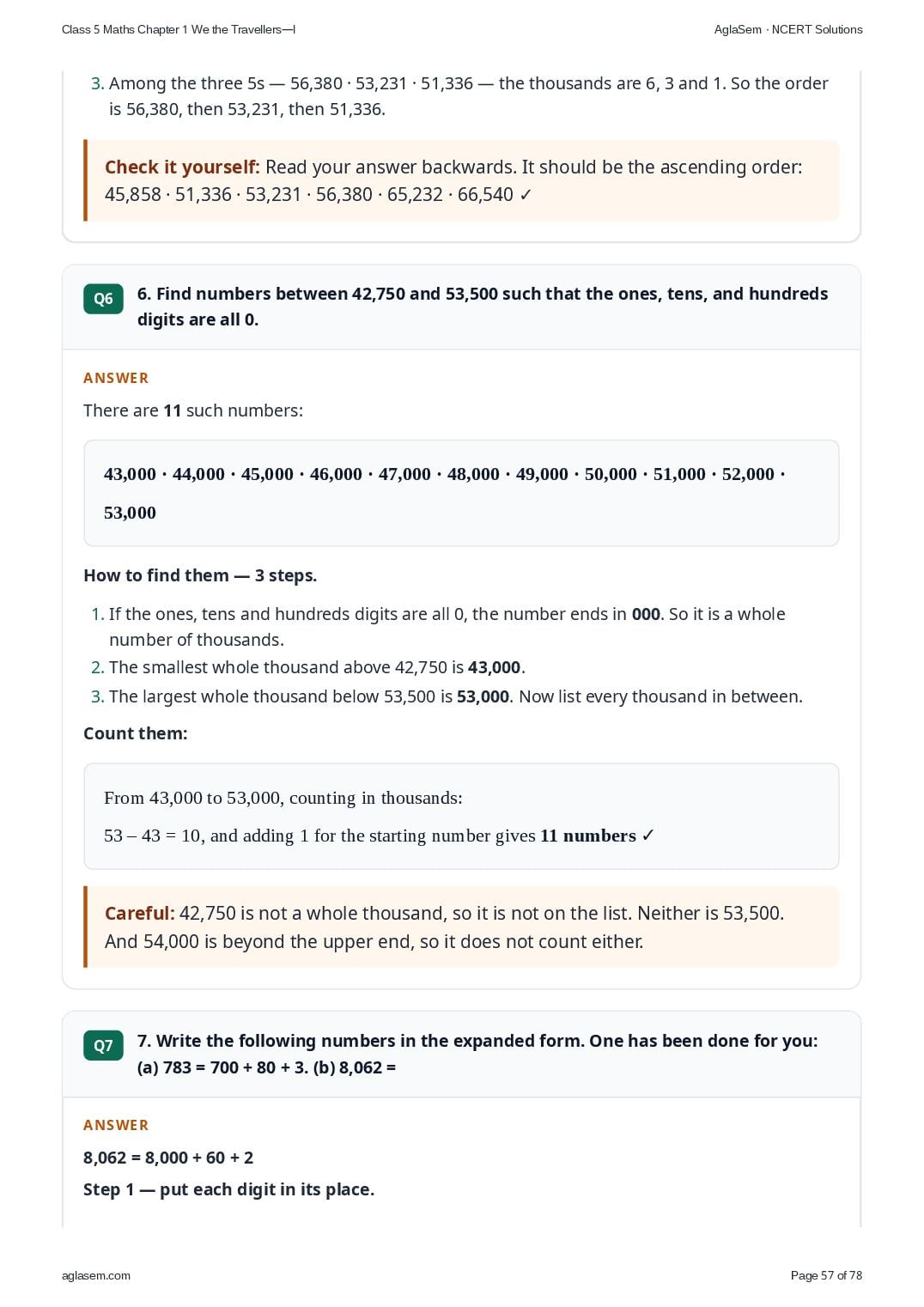
- 6. Find numbers between 42,750 and 53,500 such that the ones, tens, and hundreds digits are all 0.
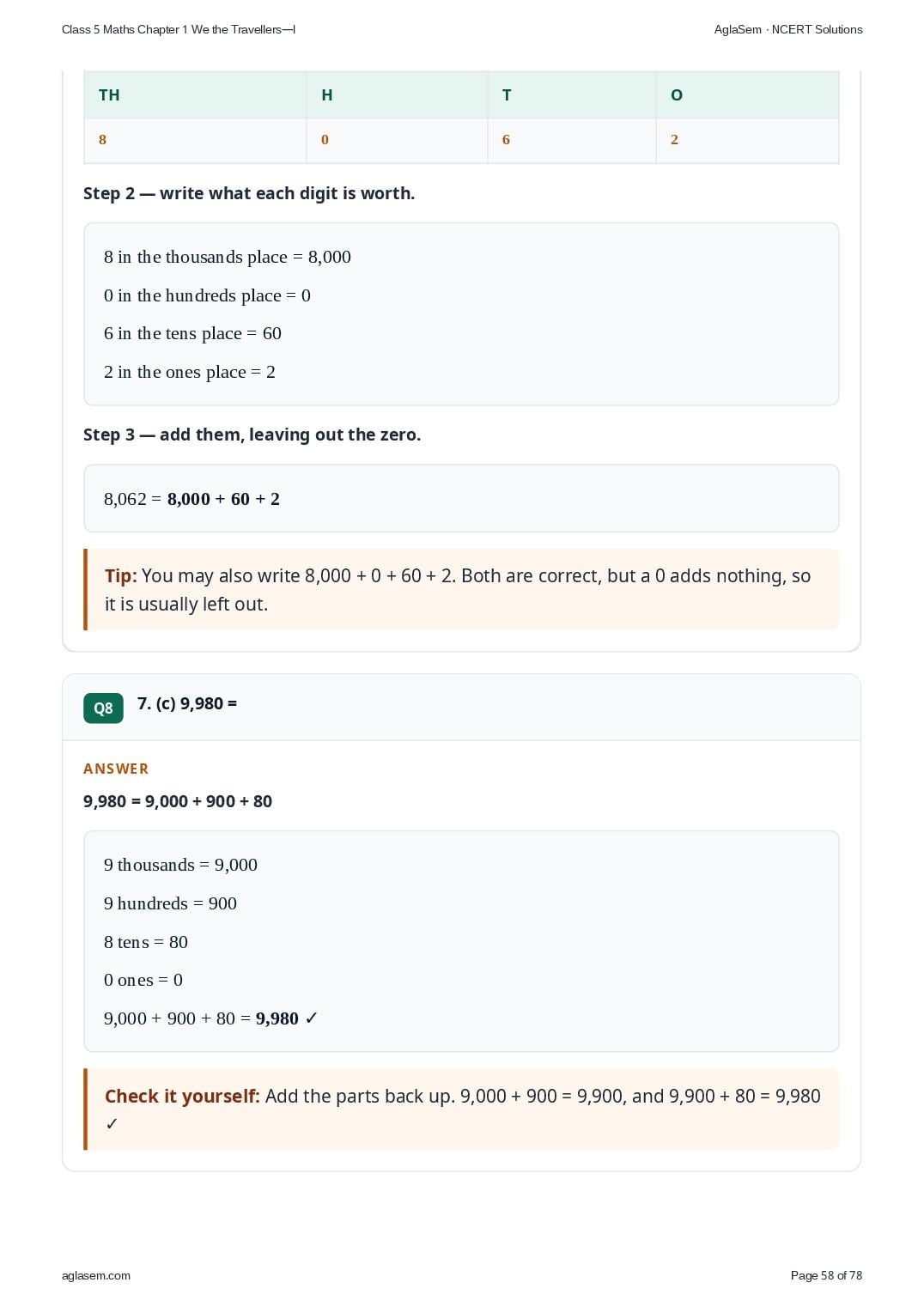
- 7. Write the following numbers in the expanded form. One has been done for you: (a) 783 = 700 + 80 + 3. (b) 8,062 =
- 7. (c) 9,980 =
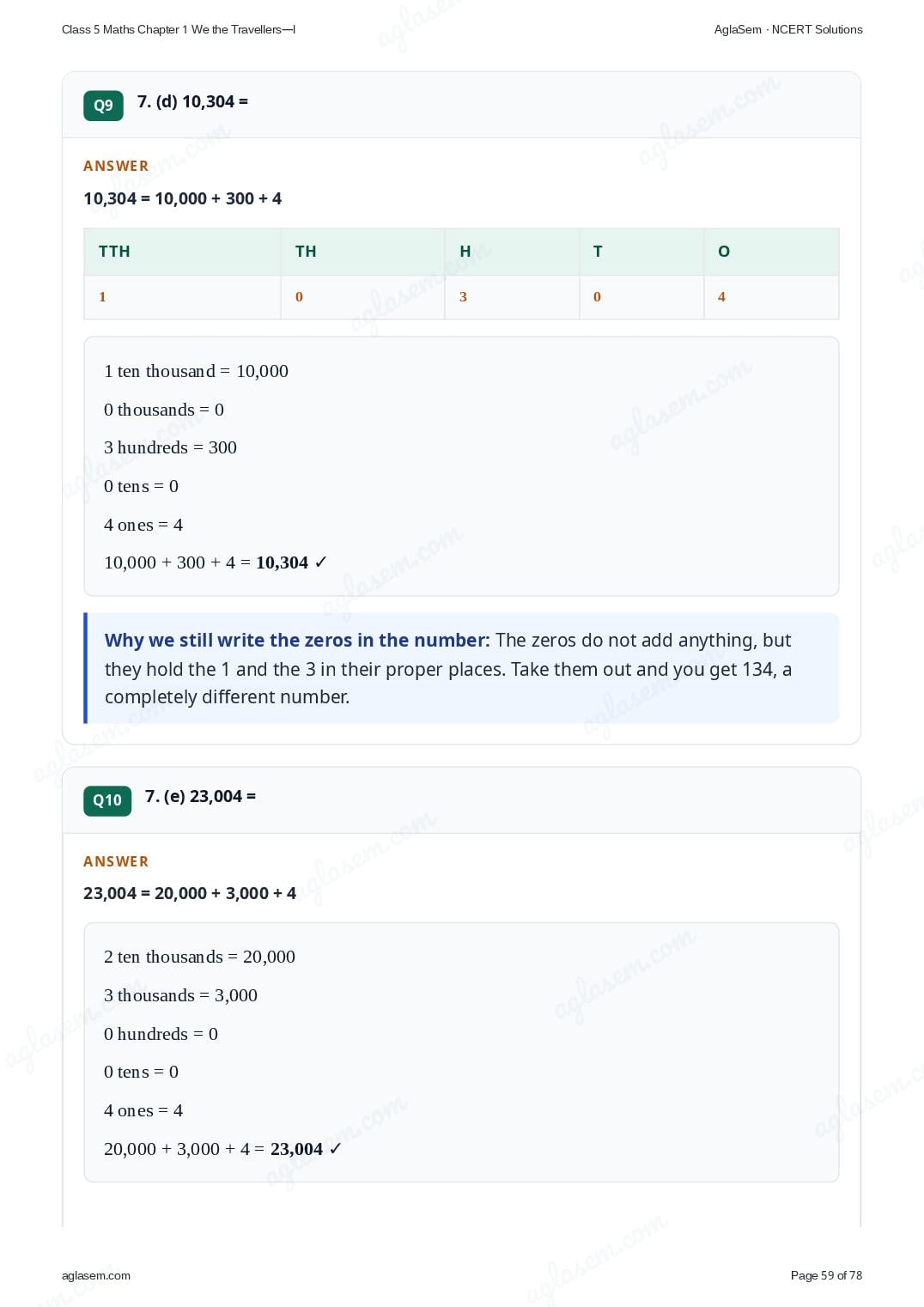
- 7. (d) 10,304 =
- 7. (e) 23,004 =
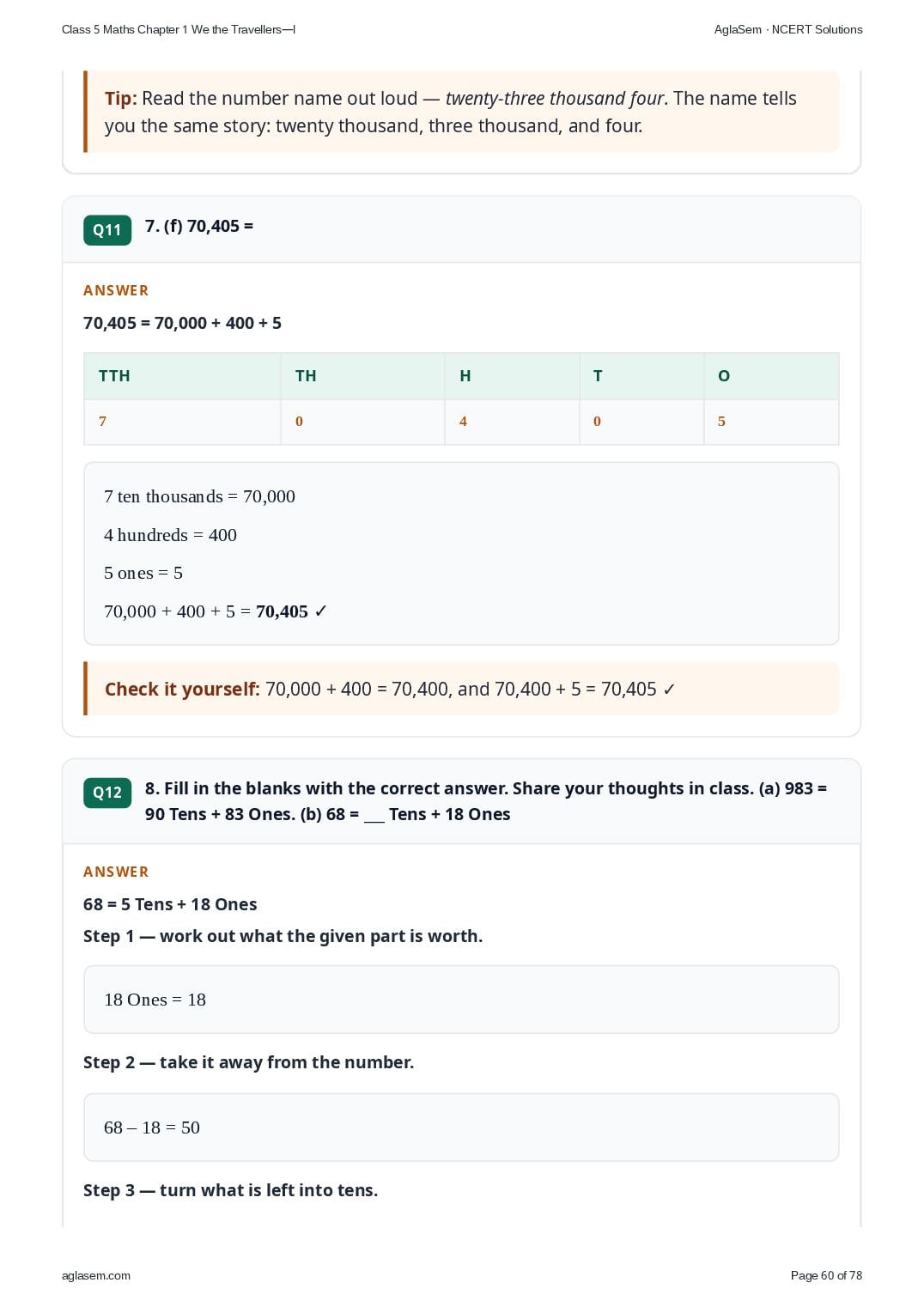
- 7. (f) 70,405 =
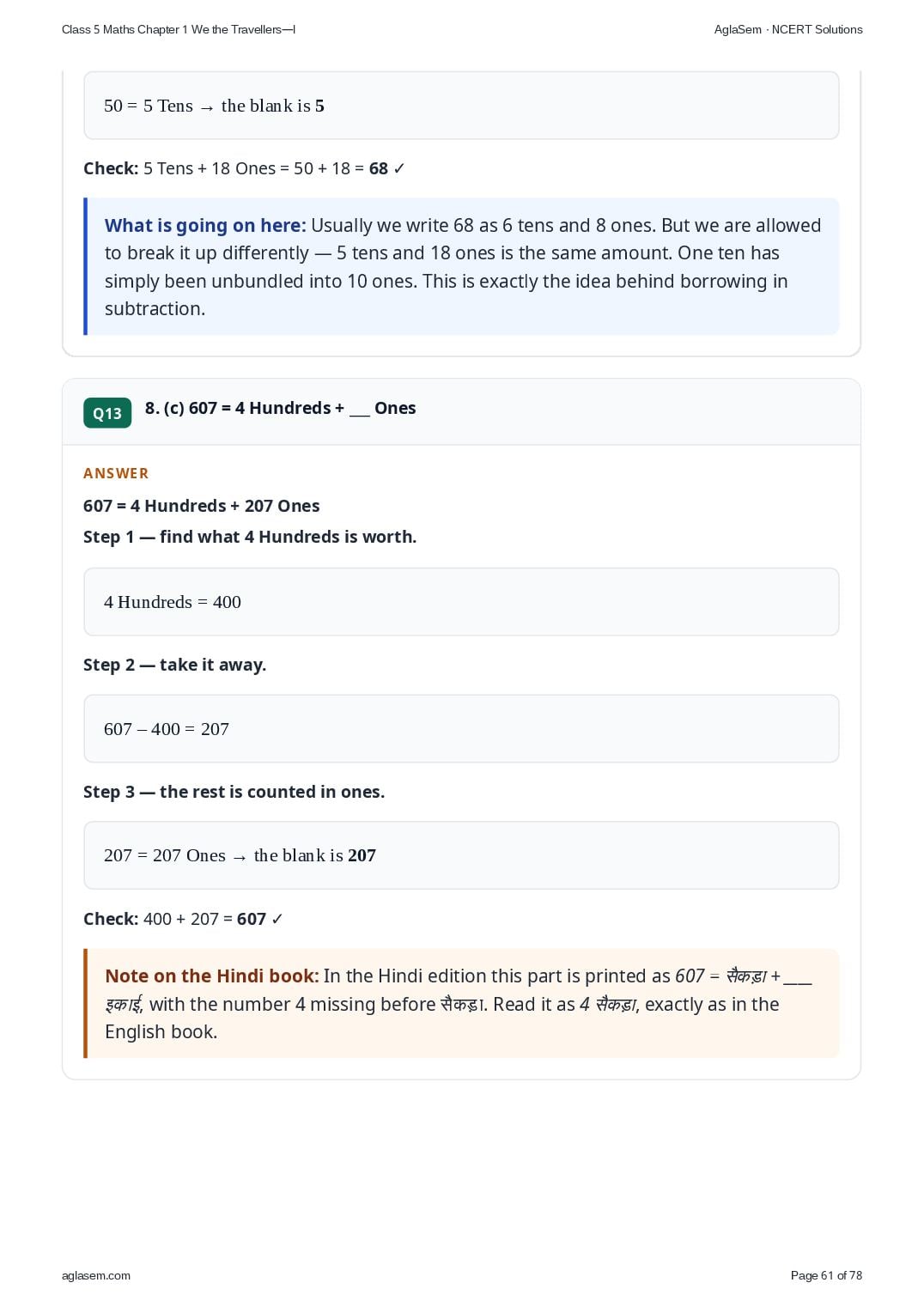
- 8. Fill in the blanks with the correct answer. Share your thoughts in class. (a) 983 = 90 Tens + 83 Ones. (b) 68 = ___ Tens + 18 Ones
- 8. (c) 607 = 4 Hundreds + ___ Ones
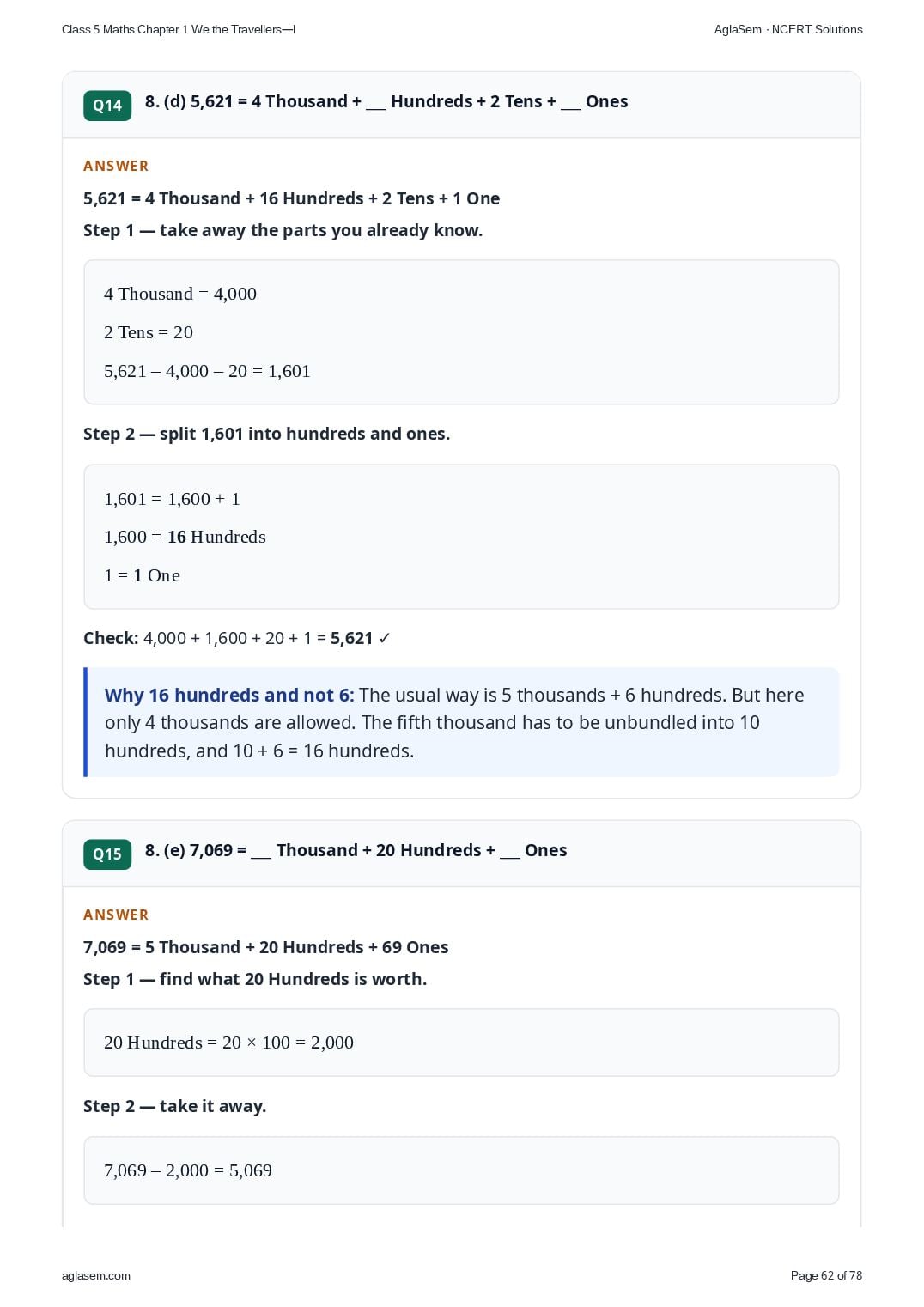
- 8. (d) 5,621 = 4 Thousand + ___ Hundreds + 2 Tens + ___ Ones
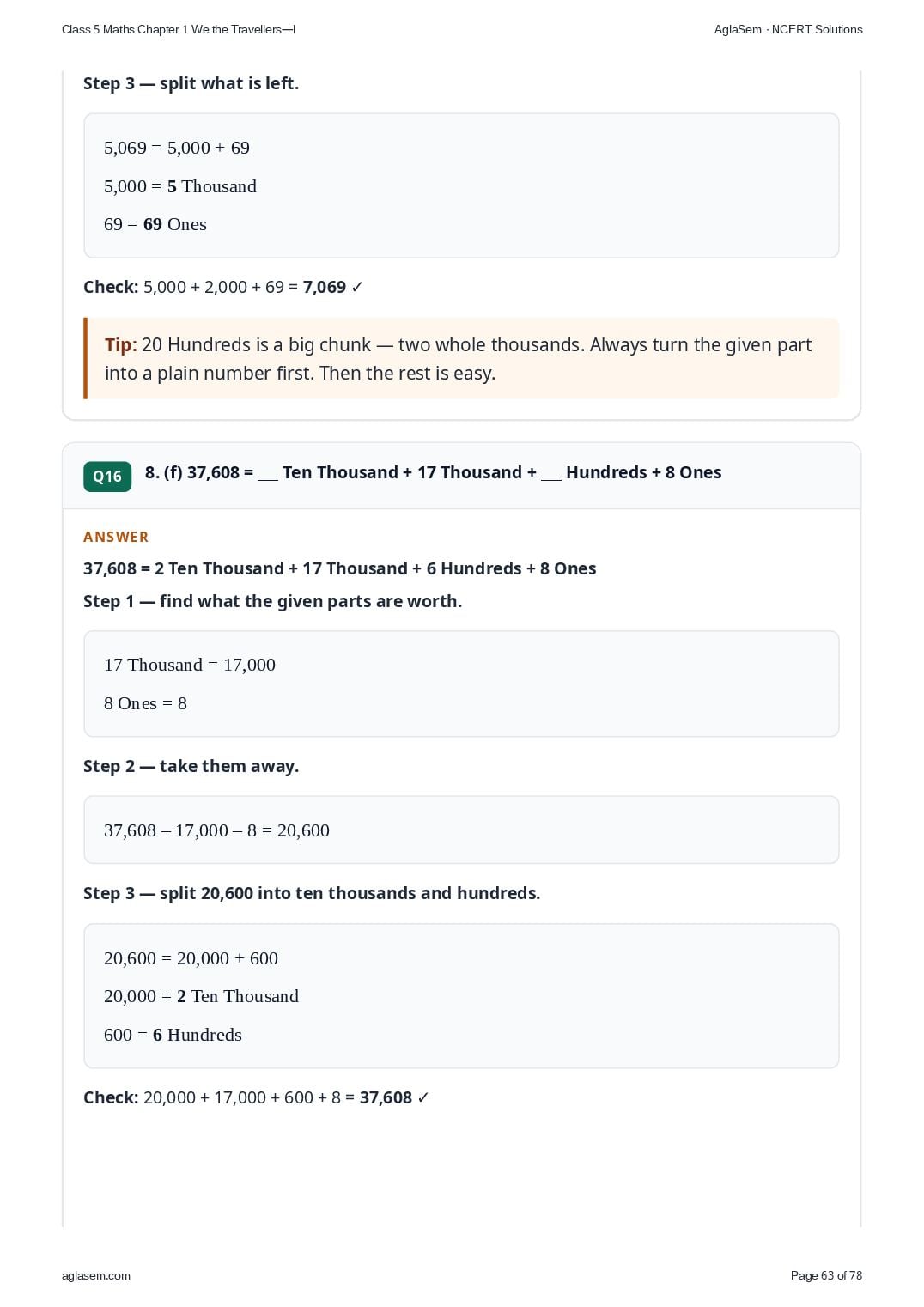
- 8. (e) 7,069 = ___ Thousand + 20 Hundreds + ___ Ones
- 8. (f) 37,608 = ___ Ten Thousand + 17 Thousand + ___ Hundreds + 8 Ones
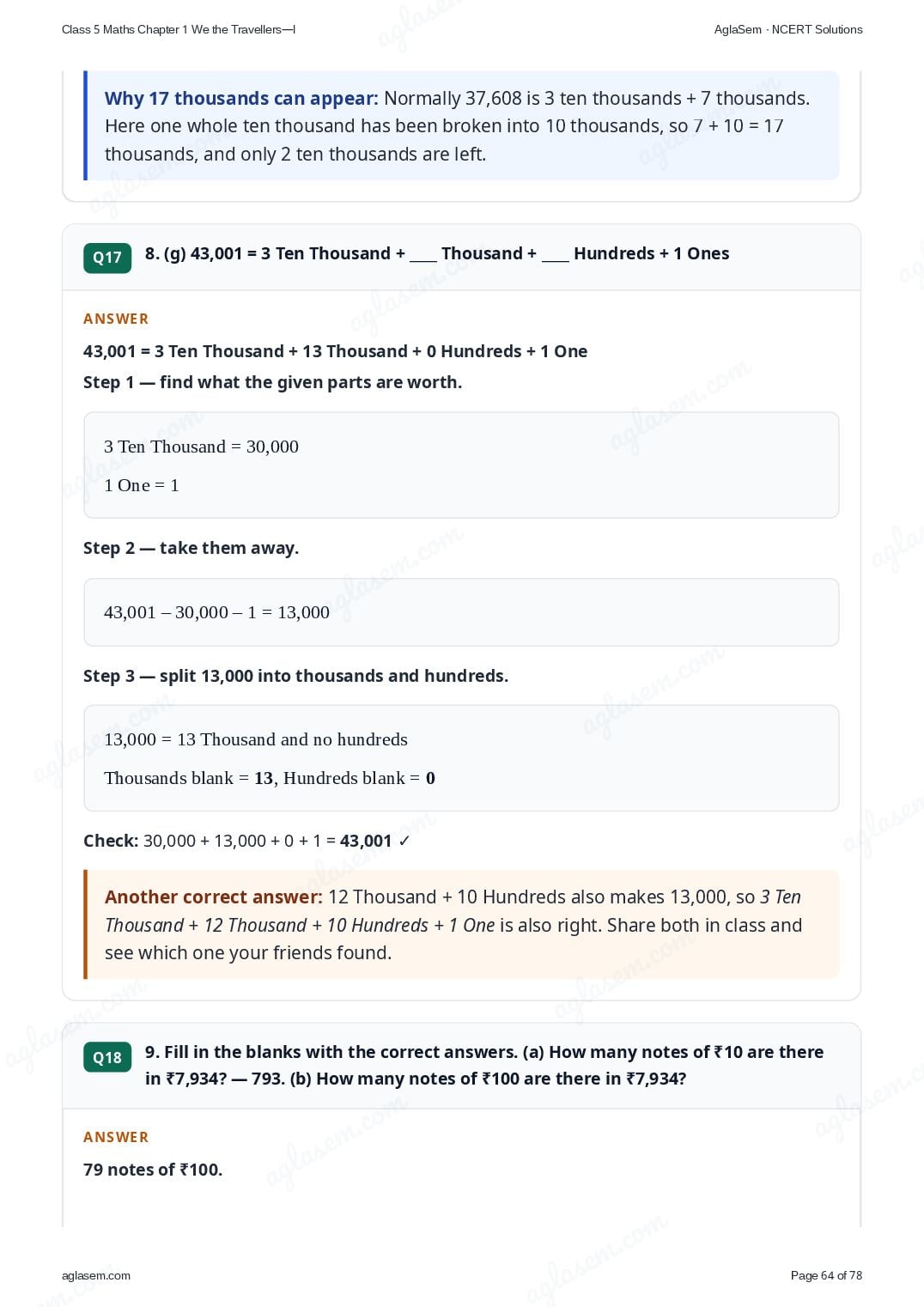
- 8. (g) 43,001 = 3 Ten Thousand + ____ Thousand + ____ Hundreds + 1 Ones
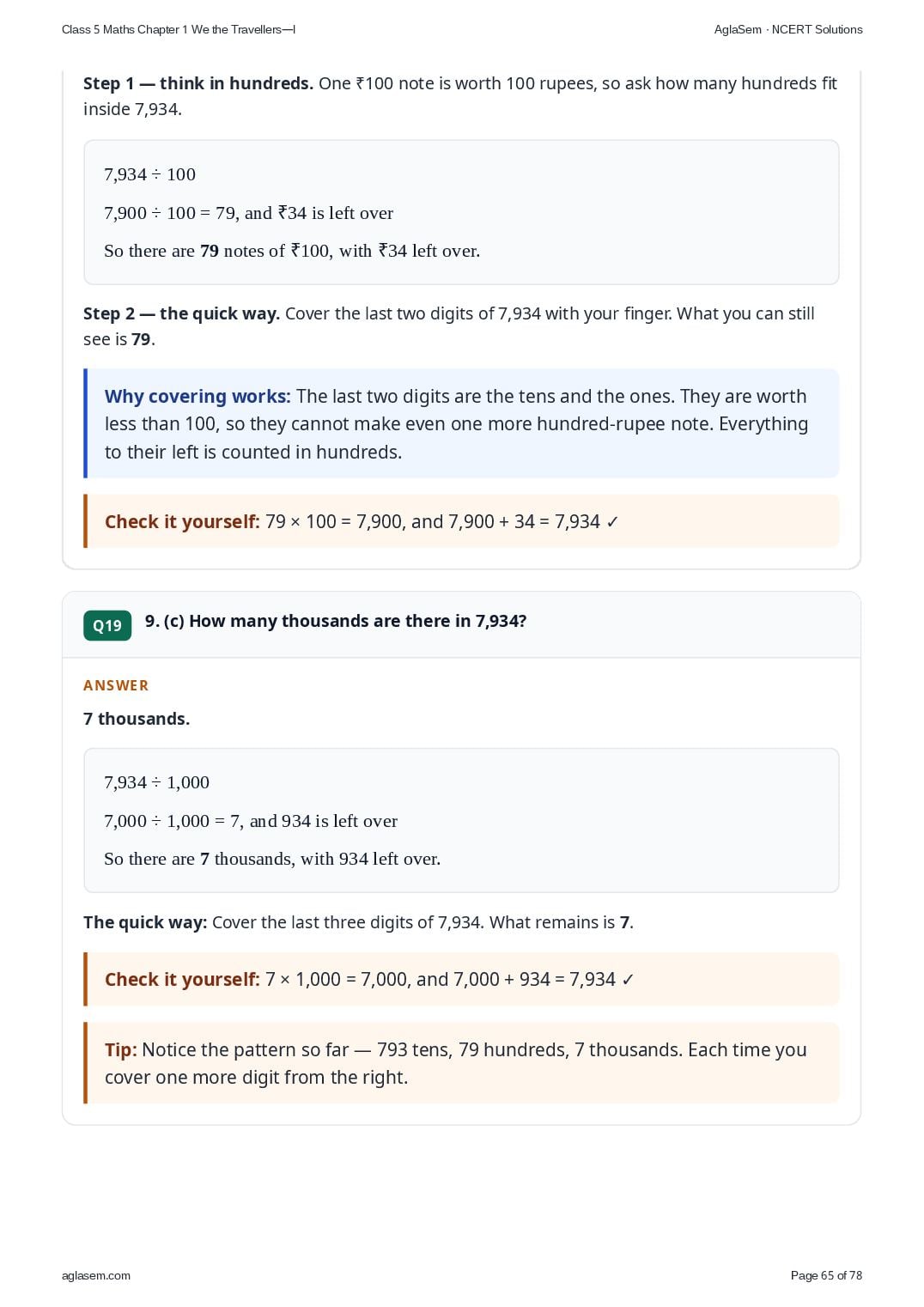
- 9. Fill in the blanks with the correct answers. (a) How many notes of ₹10 are there in ₹7,934? — 793. (b) How many notes of ₹100 are there in ₹7,934?
- 9. (c) How many thousands are there in 7,934?
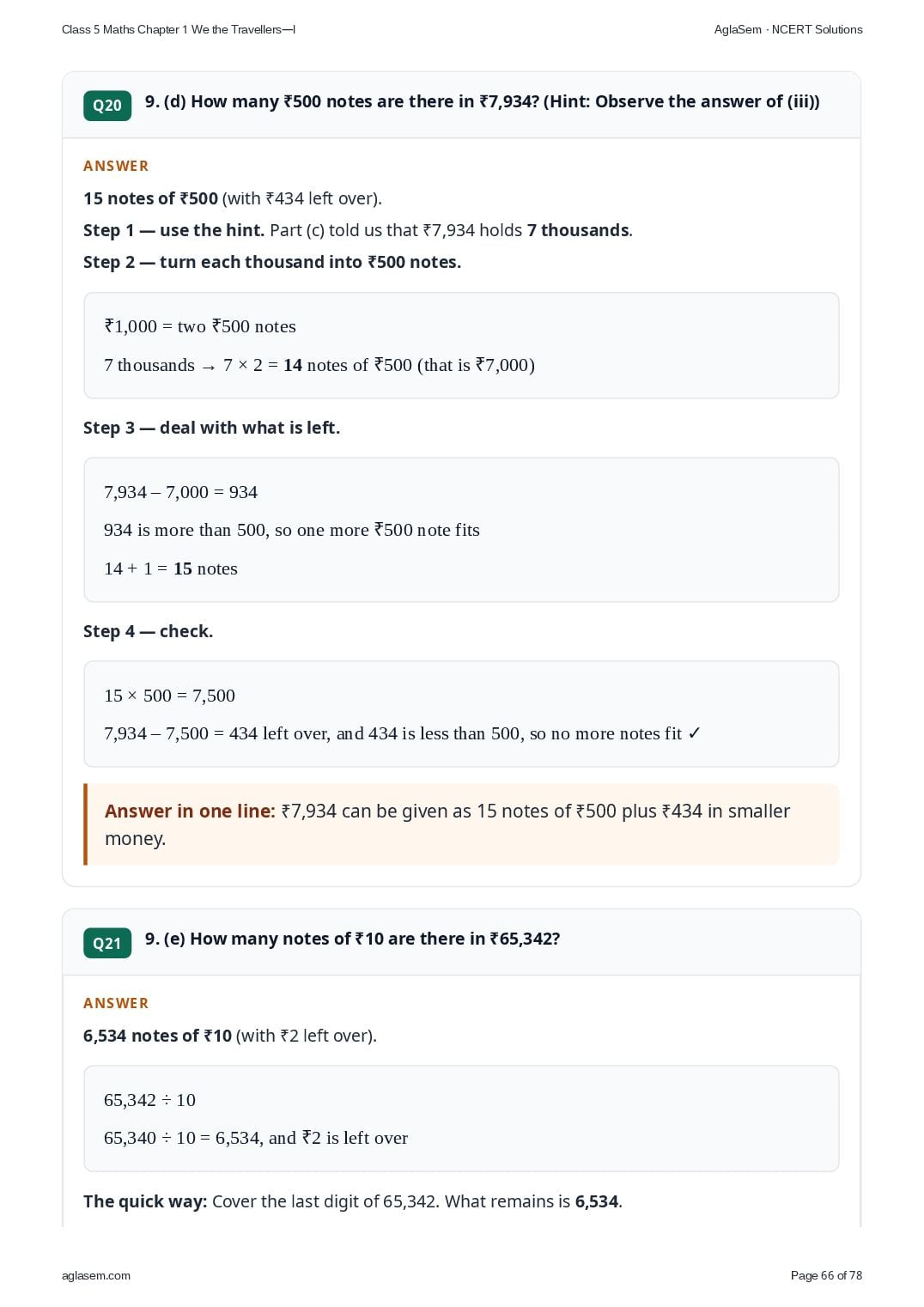
- 9. (d) How many ₹500 notes are there in ₹7,934? (Hint: Observe the answer of (iii))
- 9. (e) How many notes of ₹10 are there in ₹65,342?
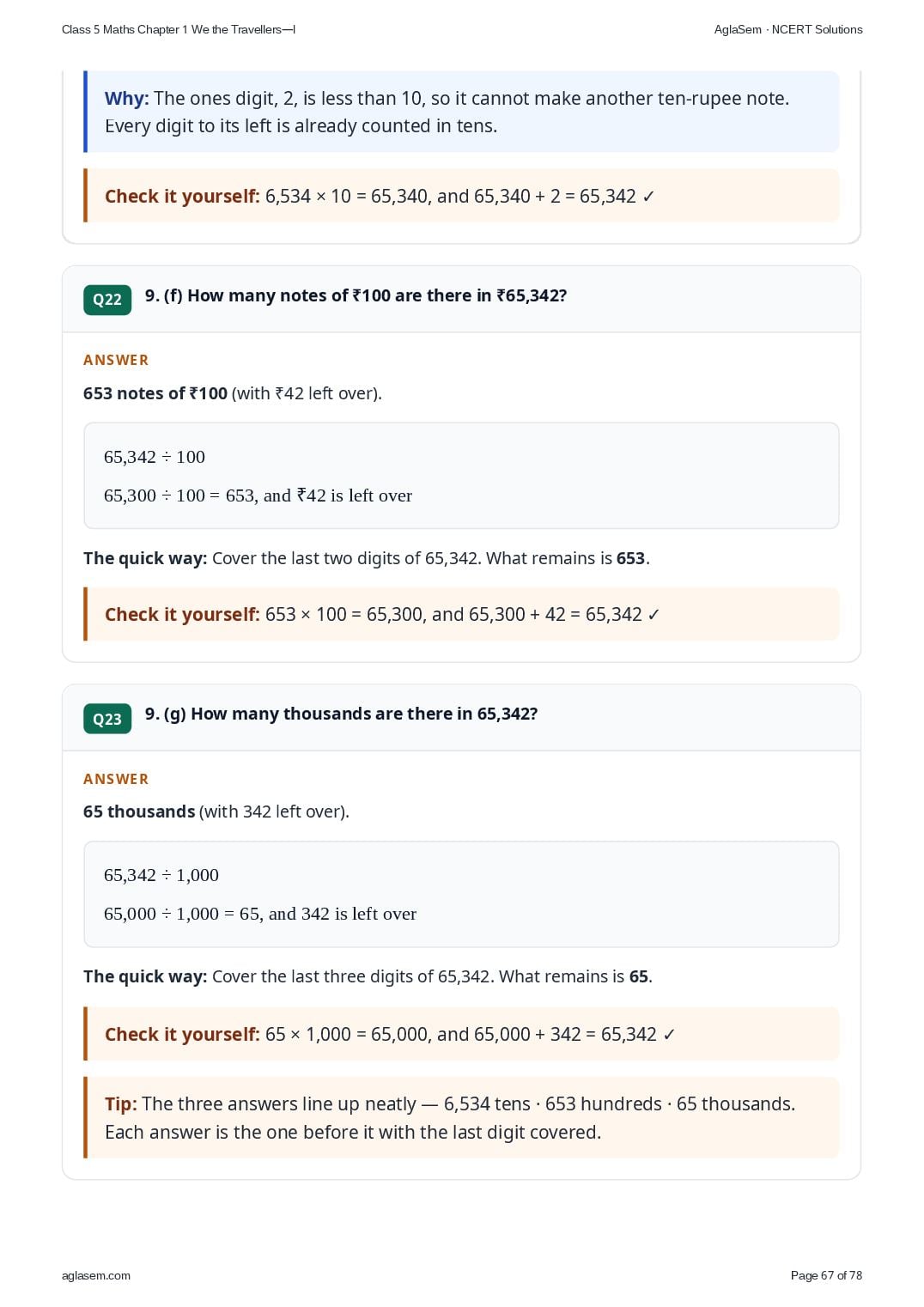
- 9. (f) How many notes of ₹100 are there in ₹65,342?
- 9. (g) How many thousands are there in 65,342?
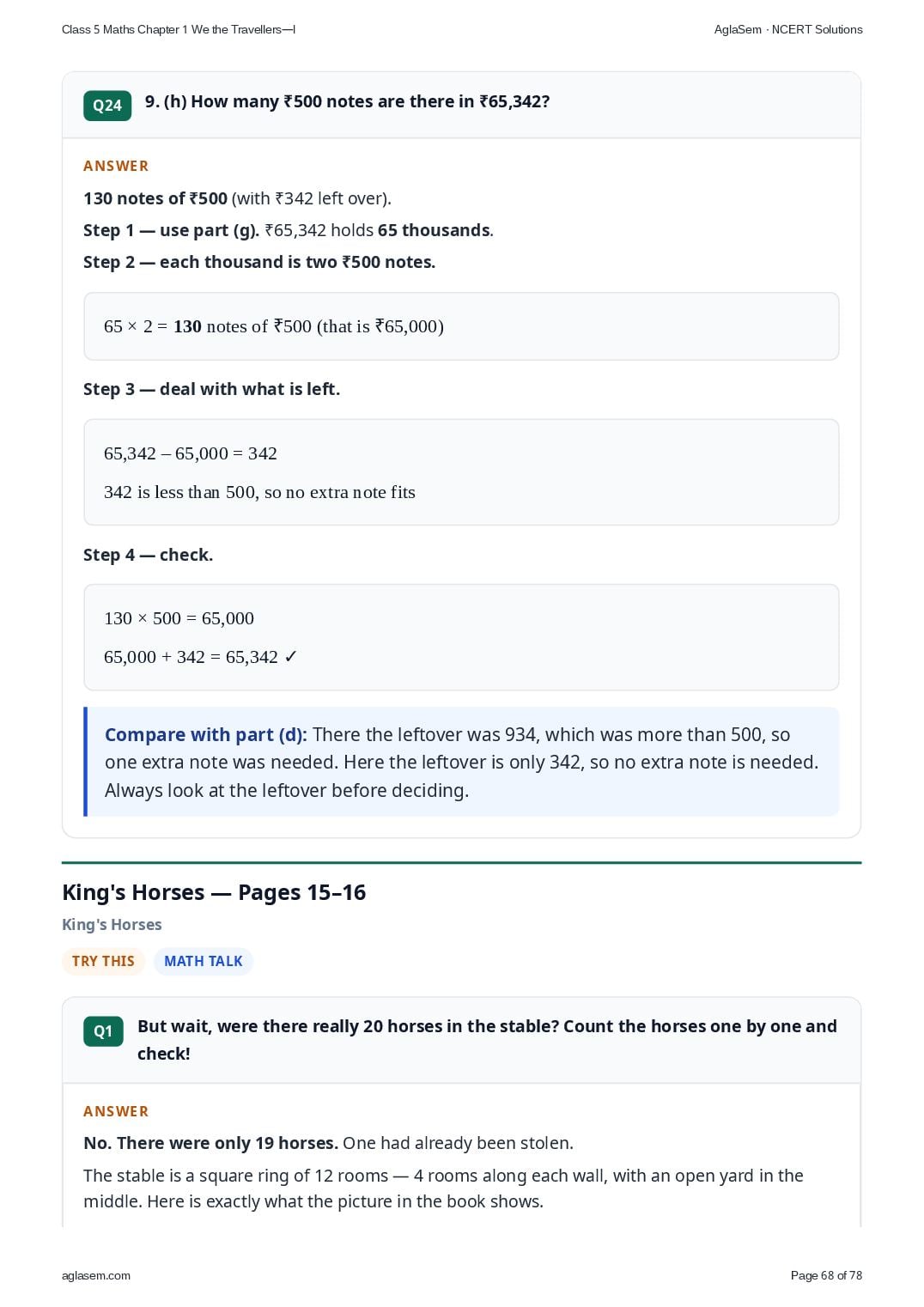
- 9. (h) How many ₹500 notes are there in ₹65,342?
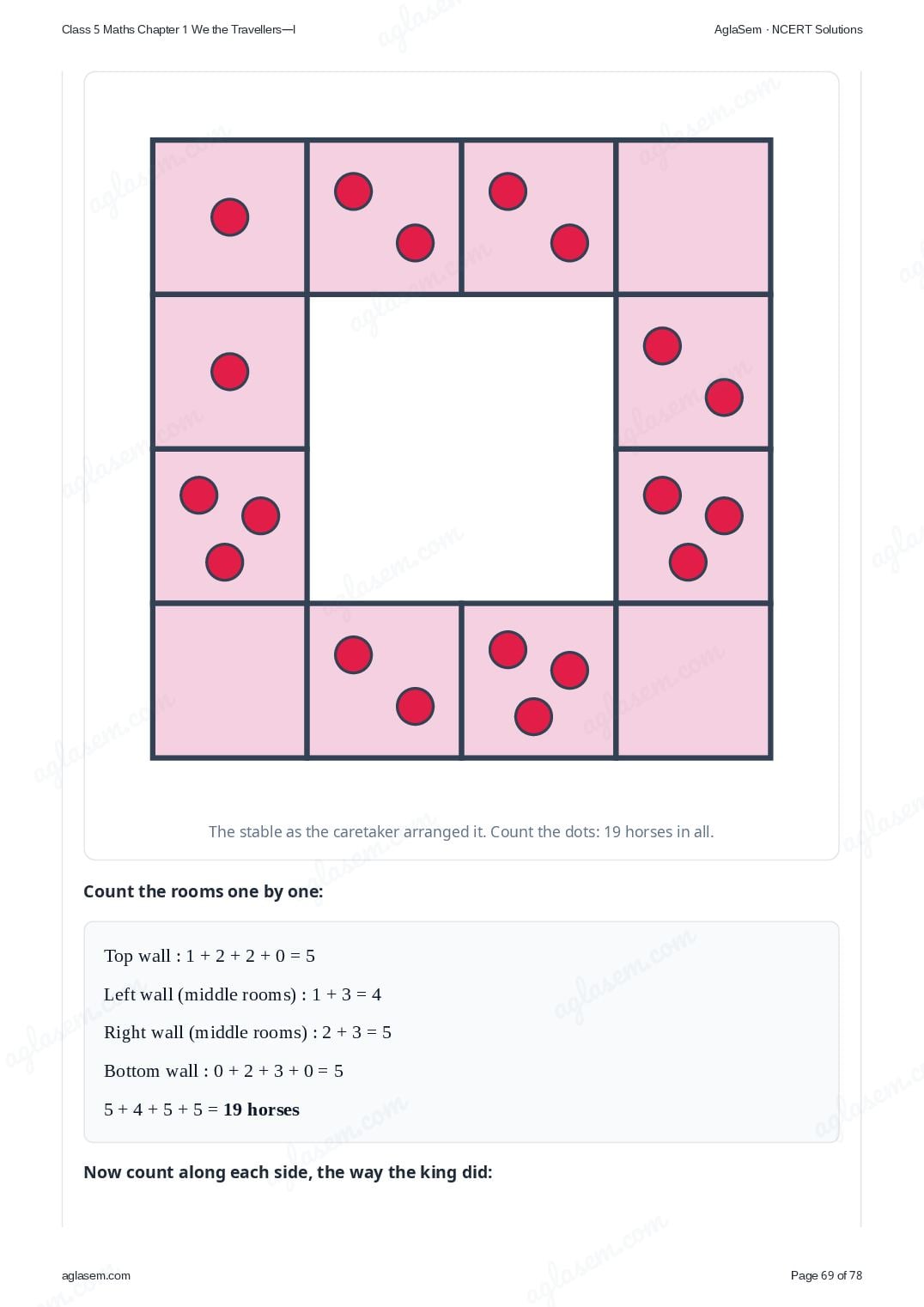
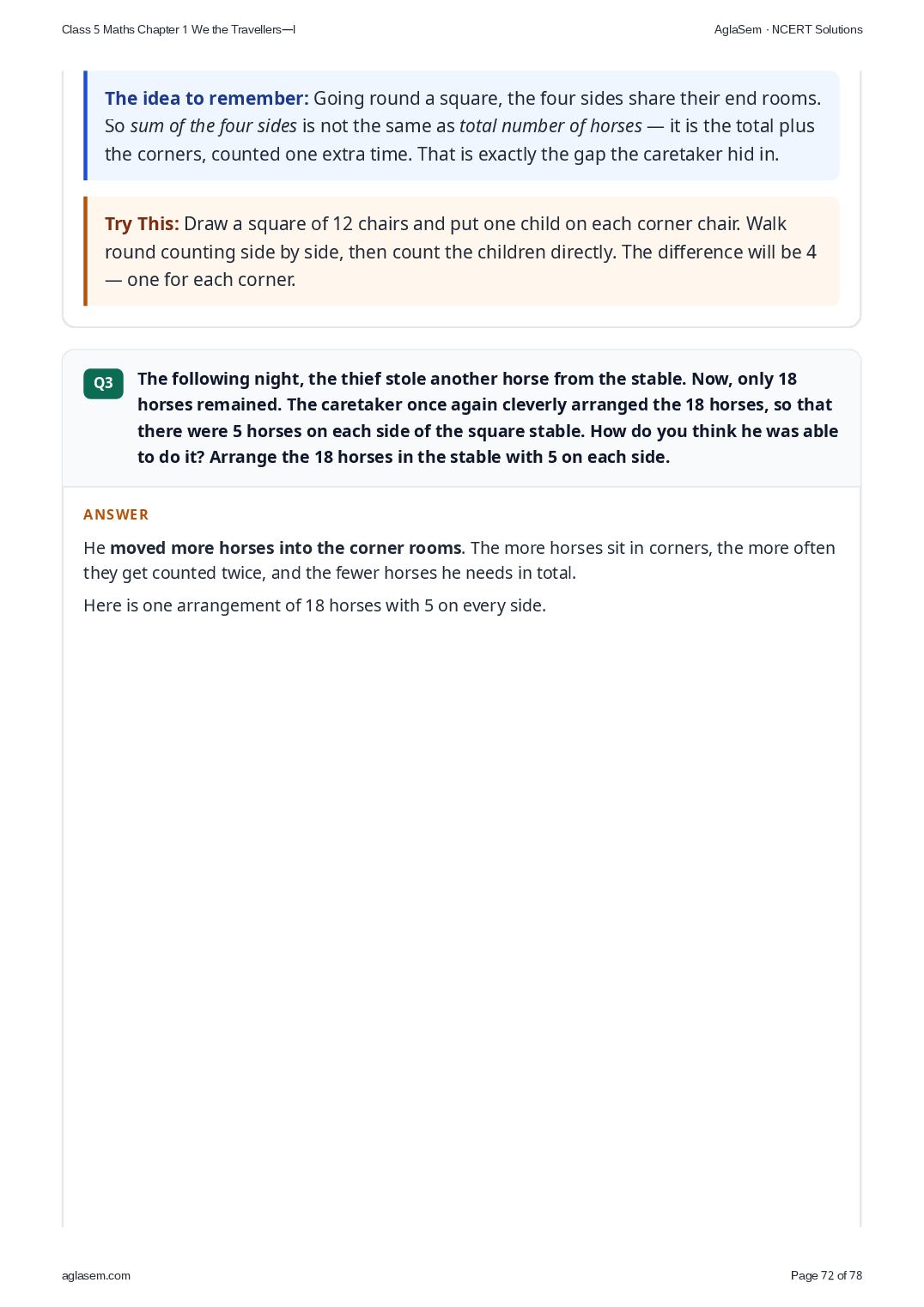
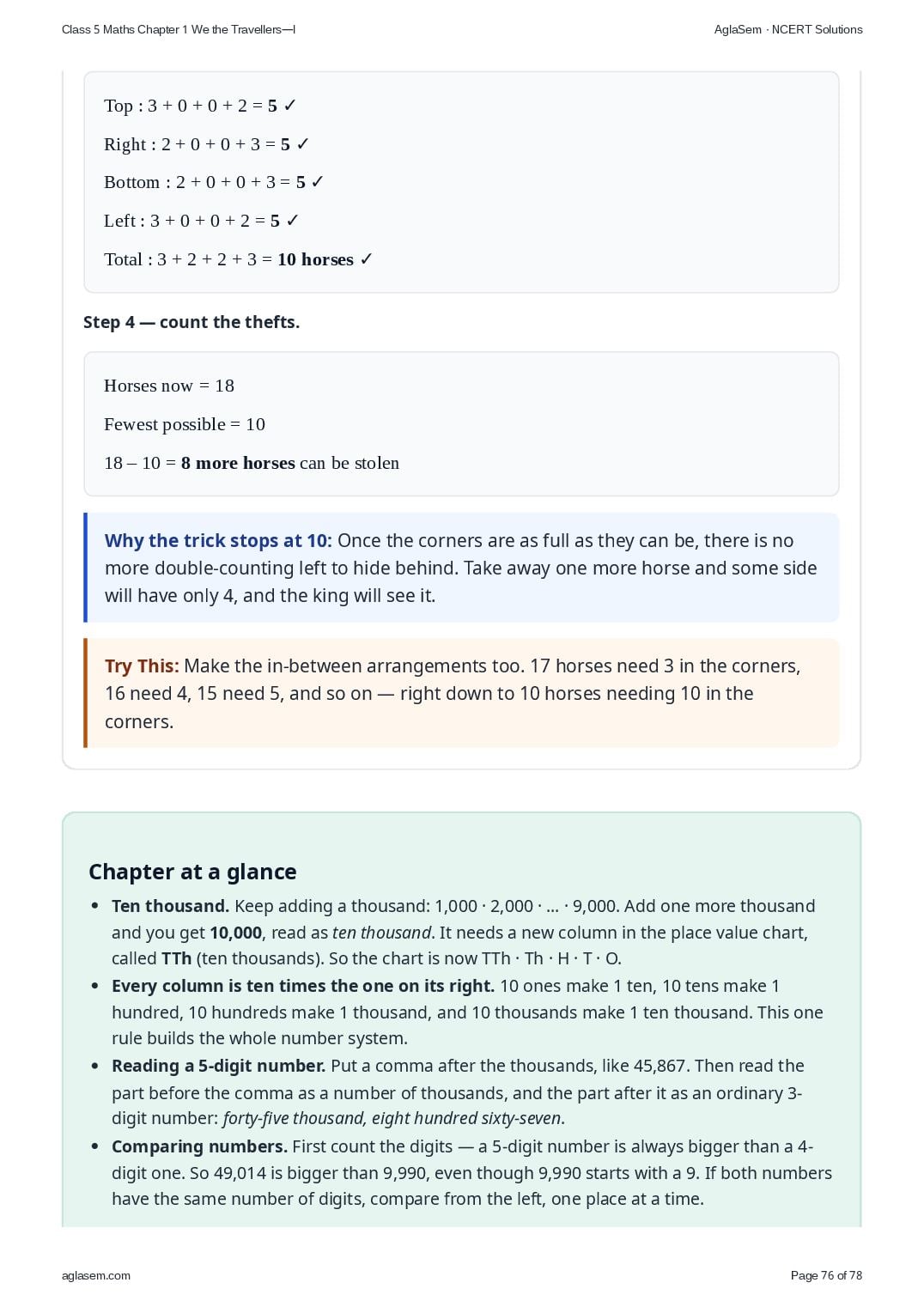
- But wait, were there really 20 horses in the stable? Count the horses one by one and check!
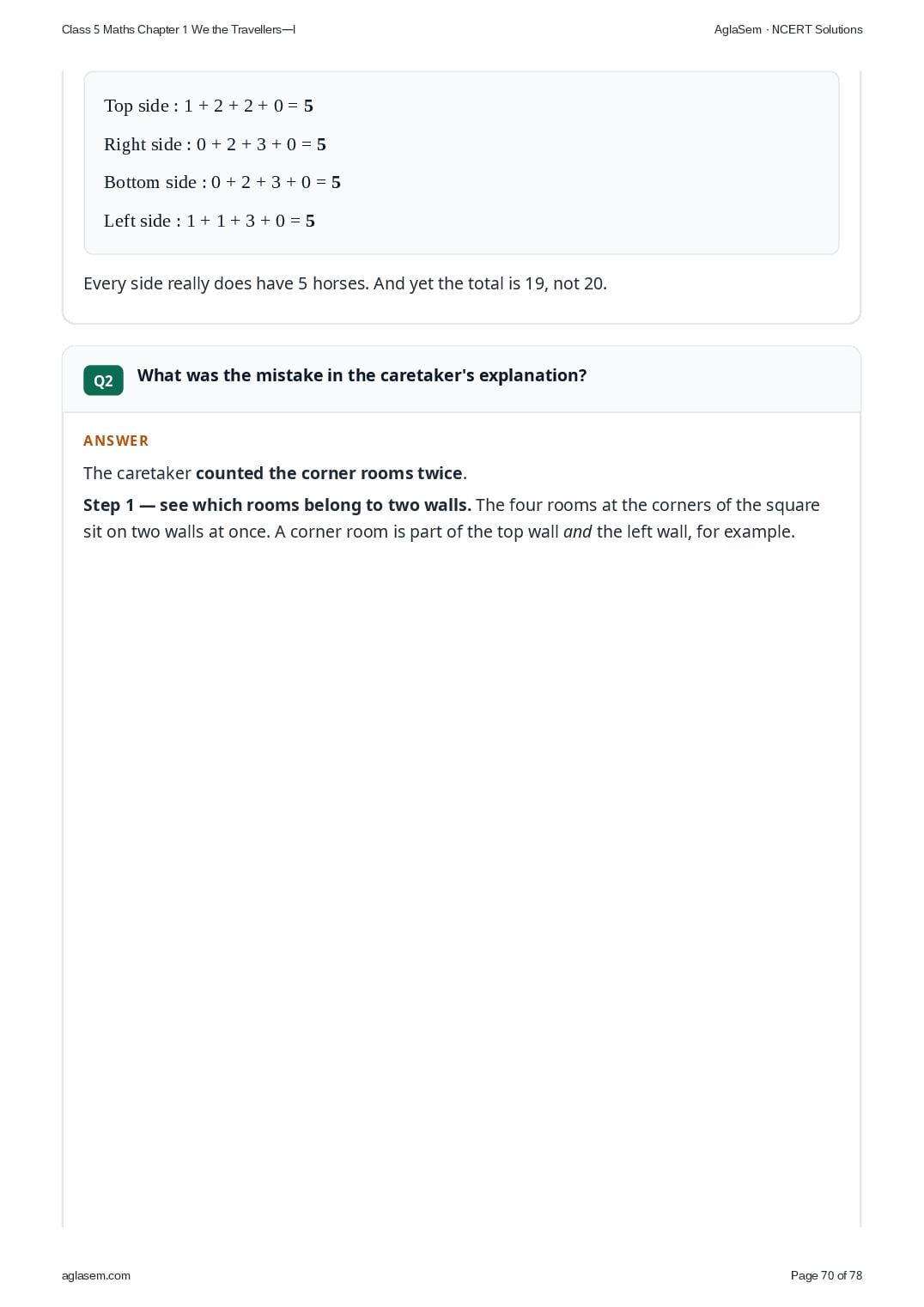
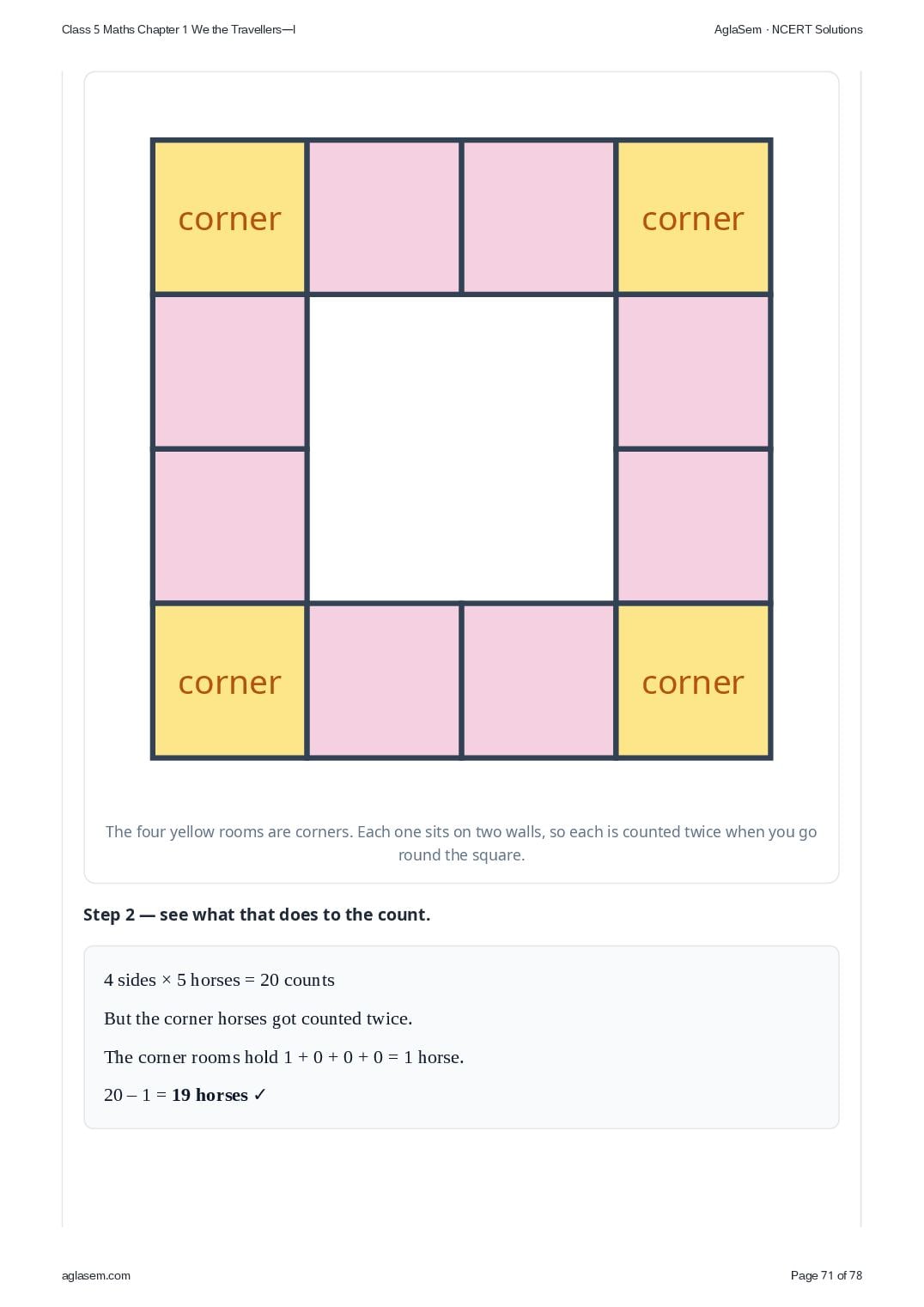
- What was the mistake in the caretaker’s explanation?
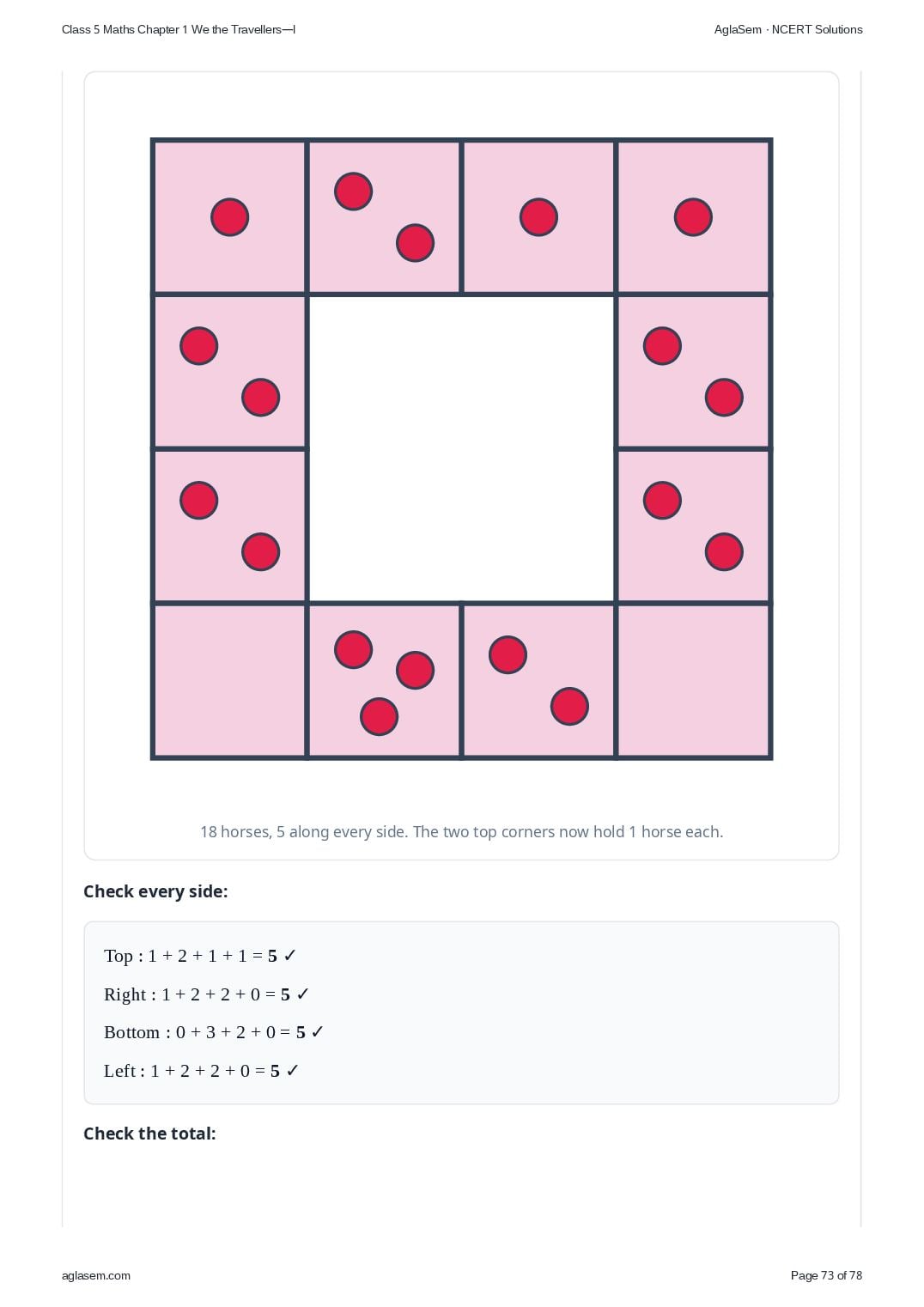
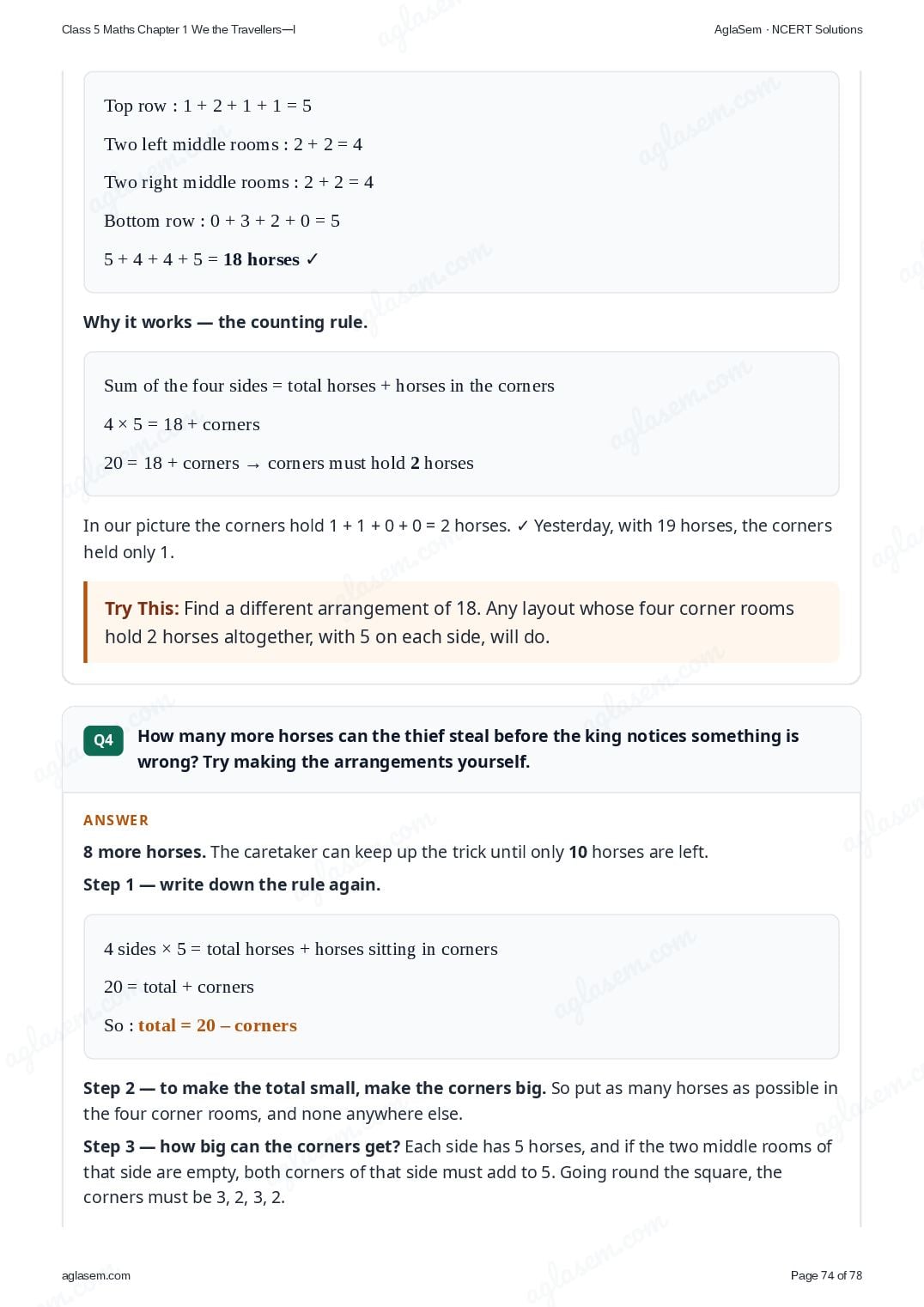
- The following night, the thief stole another horse from the stable. Now, only 18 horses remained. The caretaker once again cleverly arranged the 18 horses, so that there were 5 horses on each side of the square stable. How do you think he was able to do it? Arrange the 18 horses in the stable with 5 on each side.
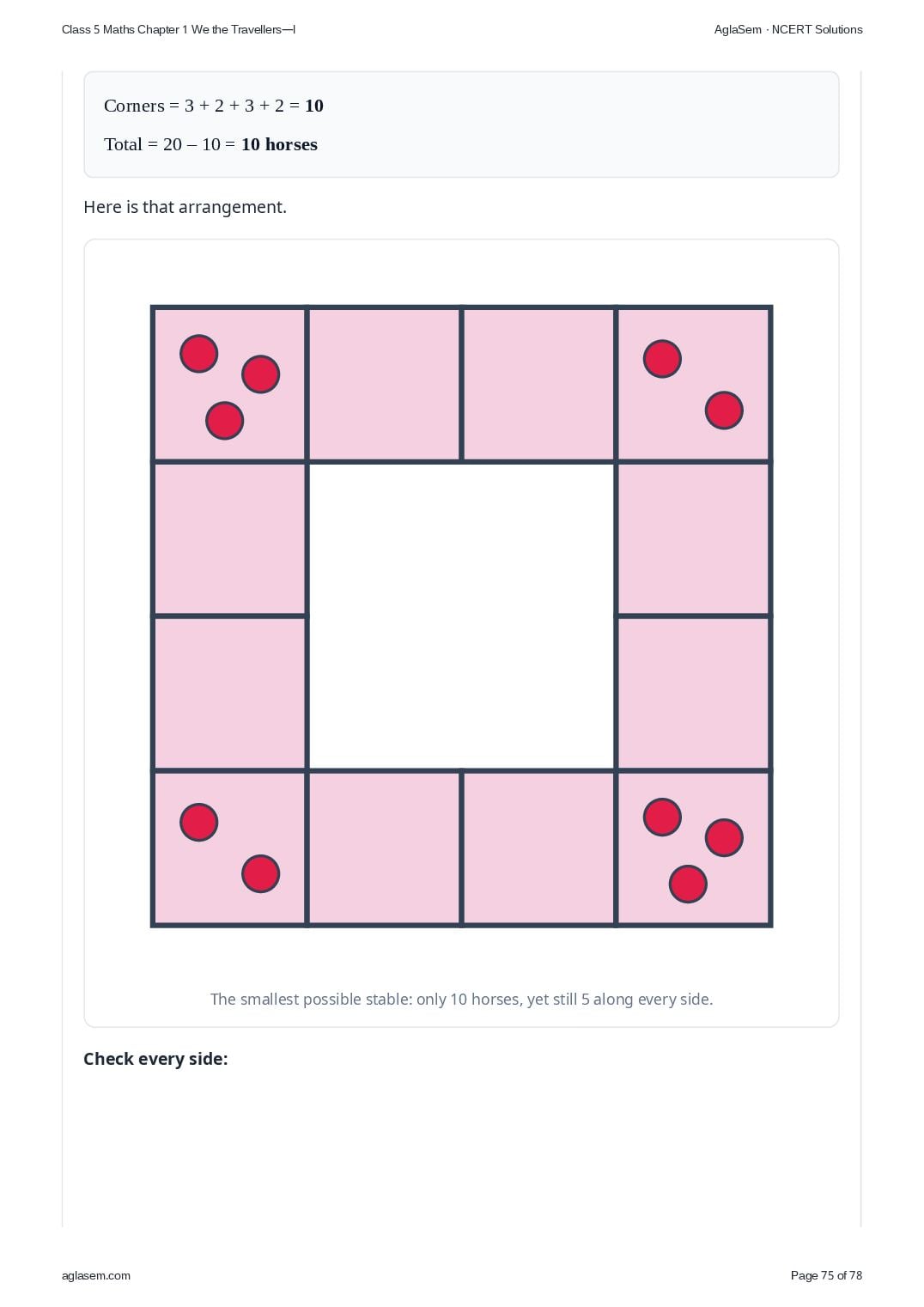
- How many more horses can the thief steal before the king notices something is wrong? Try making the arrangements yourself.
Chapter at a Glance
- Ten thousand. Keep adding a thousand: 1,000 · 2,000 · … · 9,000. Add one more thousand and you get 10,000, read as ten thousand. It needs a new column in the place value chart, called TTh (ten thousands). So the chart is now TTh · Th · H · T · O.
- Every column is ten times the one on its right. 10 ones make 1 ten, 10 tens make 1 hundred, 10 hundreds make 1 thousand, and 10 thousands make 1 ten thousand. This one rule builds the whole number system.
- Reading a 5-digit number. Put a comma after the thousands, like 45,867. Then read the part before the comma as a number of thousands, and the part after it as an ordinary 3-digit number: forty-five thousand, eight hundred sixty-seven.
- Comparing numbers. First count the digits — a 5-digit number is always bigger than a 4-digit one. So 49,014 is bigger than 9,990, even though 9,990 starts with a 9. If both numbers have the same number of digits, compare from the left, one place at a time.
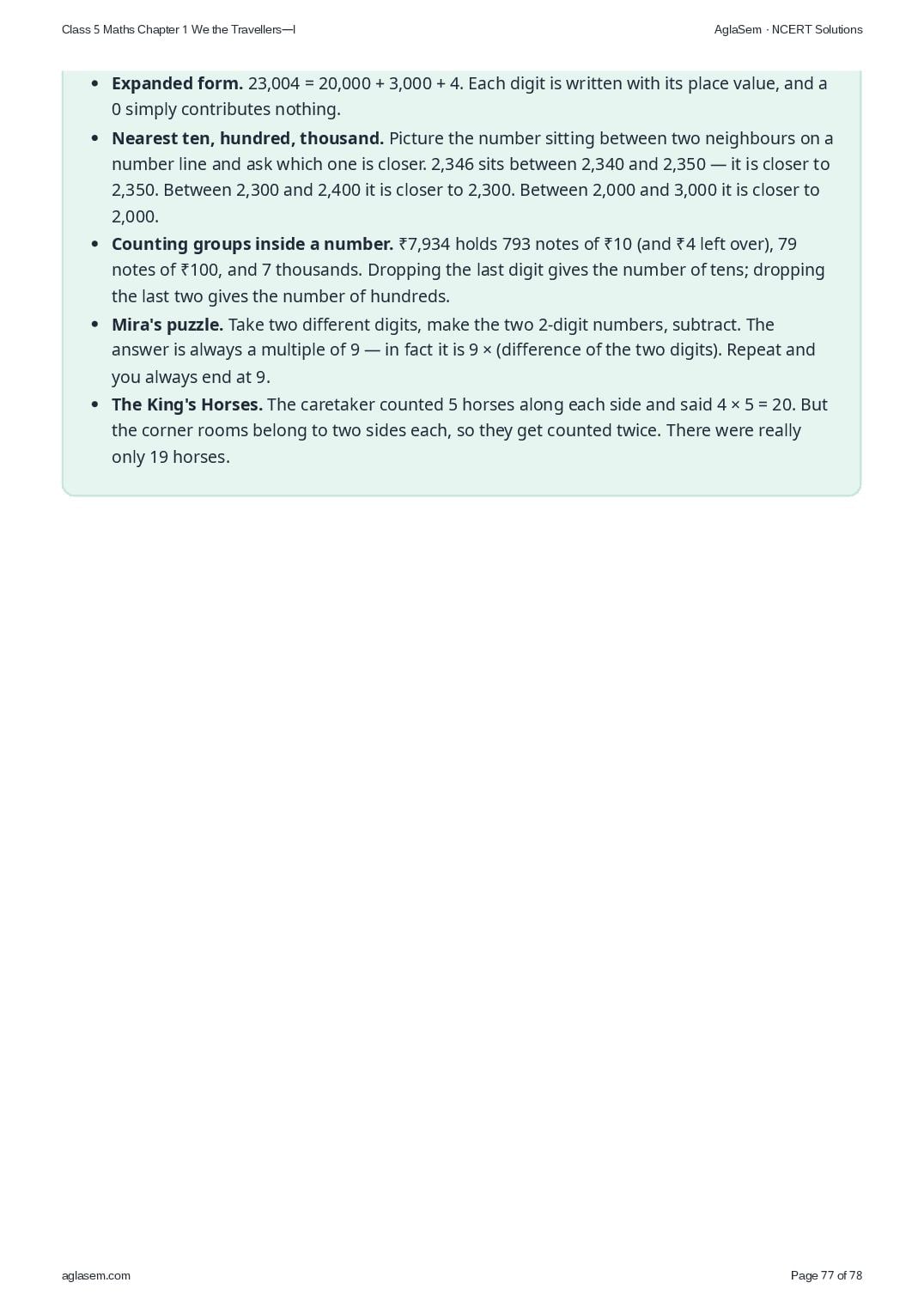
- Expanded form. 23,004 = 20,000 + 3,000 + 4. Each digit is written with its place value, and a 0 simply contributes nothing.
- Nearest ten, hundred, thousand. Picture the number sitting between two neighbours on a number line and ask which one is closer. 2,346 sits between 2,340 and 2,350 — it is closer to 2,350. Between 2,300 and 2,400 it is closer to 2,300. Between 2,000 and 3,000 it is closer to 2,000.
- Counting groups inside a number. ₹7,934 holds 793 notes of ₹10 (and ₹4 left over), 79 notes of ₹100, and 7 thousands. Dropping the last digit gives the number of tens; dropping the last two gives the number of hundreds.
- Mira’s puzzle. Take two different digits, make the two 2-digit numbers, subtract. The answer is always a multiple of 9 — in fact it is 9 × (difference of the two digits). Repeat and you always end at 9.
- The King’s Horses. The caretaker counted 5 horses along each side and said 4 × 5 = 20. But the corner rooms belong to two sides each, so they get counted twice. There were really only 19 horses.
How to Download NCERT Solutions for Class 5 Maths Chapter 1 PDF
Follow these simple steps to get the We the Travellers I questions-and-answers PDF from Math Mela.
- Search NCERT Solutions for Class 5 Maths Chapter 1 aglasem and open this page.
- Read the exercise questions with answers for We the Travellers I shown above.
- Click the Download PDF link to save the We the Travellers I solutions to your device.
NCERT Solutions for Class 5 Maths – All Chapters
There are more chapters to study besides We the Travellers I in Maths. Here are the NCERT Solutions for all chapters of Class 5 Maths.
- Chapter 1 We the Travellers I
- Chapter 2 Fractions
- Chapter 3 Angles As Turns
- Chapter 4 We the Travellers Ii
- Chapter 5 Far and Near
- Chapter 6 the Dairy Farm
- Chapter 7 Shapes and Patterns
- Chapter 8 Weight and Capacity
- Chapter 9 Coconut Farm
- Chapter 10 Symmetrical Designs
- Chapter 11 Grandmother s Quilt
- Chapter 12 Racing Seconds
- Chapter 13 Animal Jumps
- Chapter 14 Maps and Locations
- Chapter 15 Data Through Pictures
NCERT Solutions for Class 5 – All Subjects
Just like Chapter 1 of Maths, you can get the exercise questions with answers for every other subject of Class 5. Here are the NCERT Solutions for all subjects of Class 5.
NCERT Solutions for Class 5 Maths Chapter 1 – An Overview
The key highlights of this study material are as follows.
| Aspects | Details |
|---|---|
| Class | Class 5 |
| Subject | Maths |
| Chapter Number | Chapter 1 |
| Chapter Name | We the Travellers I |
| Book Name | Math Mela |
| Book By | NCERT (National Council of Educational Research and Training) |
| Educational Resource Here | NCERT Solutions of Class 5 Maths Chapter 1 for all exercises |
| More Questions Answers of This Subject | NCERT Solutions for Class 5 Maths |
| Download Book Chapter | NCERT Book Class 5 Maths |
| All Questions Answers For This Class | NCERT Solutions for Class 5 |
| Complete Solutions | NCERT Solutions |
NCERT Solutions for Class 5 Maths Chapter 1 We the Travellers I – FAQs
What are the NCERT Solutions for Class 5 Maths Chapter 1 We the Travellers I?
They are the complete, step-by-step answers to all the exercise and in-text questions of Chapter 1 We the Travellers I from the NCERT Class 5 Maths textbook Math Mela, written by experts as per the latest NCERT syllabus.
How can I download the Class 5 Maths Chapter 1 solutions PDF for free?
Open this page on aglasem, read the We the Travellers I questions with answers, and click the “Download Solutions PDF” link. The Class 5 Maths Chapter 1 NCERT Solutions PDF is completely free to download.
Are these NCERT Solutions as per the latest 2026-27 syllabus?
Yes. The NCERT Solutions for Class 5 Maths Chapter 1 are based on the latest NCERT textbook Math Mela and the current 2026-27 CBSE syllabus, so the questions and answers match what you study in class.
Where can I get NCERT Solutions for the other chapters of Class 5 Maths?
You can find the answers to every chapter on the NCERT Solutions for Class 5 Maths page, and solutions for every subject on the NCERT Solutions for Class 5 page.
How do NCERT Solutions help in exam preparation?
They show the correct method to solve each question, help you write answers the way they are expected in exams, let you check and correct your own work, and save revision time — which together improve your marks in Class 5 Maths.
If you have any queries on NCERT Solutions for Class 5 Maths Chapter 1 We the Travellers I, then please ask in the comments below.