NCERT Solutions for Class 5 Maths Chapter 11 Grandmother s Quilt provide clear, step-by-step answers to every exercise and in-text question from the chapter Grandmother s Quilt of the NCERT textbook Math Mela. Prepared by subject experts as per the latest NCERT (CBSE) syllabus for 2026-27, these NCERT Solutions for Class 5 Maths help you understand each concept, write exam-ready answers, and check your own solutions. You can read them online below or download the free Class 5 Maths Chapter 11 question-answer PDF.
NCERT Solutions for Class 5 Maths Chapter 11 Grandmother s Quilt
- Class: Class 5
- Subject: Maths
- Chapter: Chapter 11 – Grandmother s Quilt
- Textbook: Math Mela (NCERT)
- Study material: NCERT Solutions – questions with answers, free PDF
These solutions answer all the exercise questions of Chapter 11 Grandmother s Quilt — including the in-text questions, short-answer and long-answer questions, and activities — with complete explanations so you can follow the method, not just the final answer. Read the full solutions below.
NCERT Solutions Class 5 Maths Chapter 11 Grandmother s Quilt View Download
NCERT Solutions for Class 5 Maths Chapter 11 PDF Download
You can read the NCERT Solutions for Class 5 Maths Chapter 11 online above, or download the complete question-answer PDF to study Grandmother s Quilt offline at any time.
NCERT Solutions for Class 5 Maths Chapter 11 PDF Download Link – Click Here to Download Solutions PDF
Questions Covered in This Chapter
These NCERT Solutions answer all 59 questions of this chapter. The questions solved are:
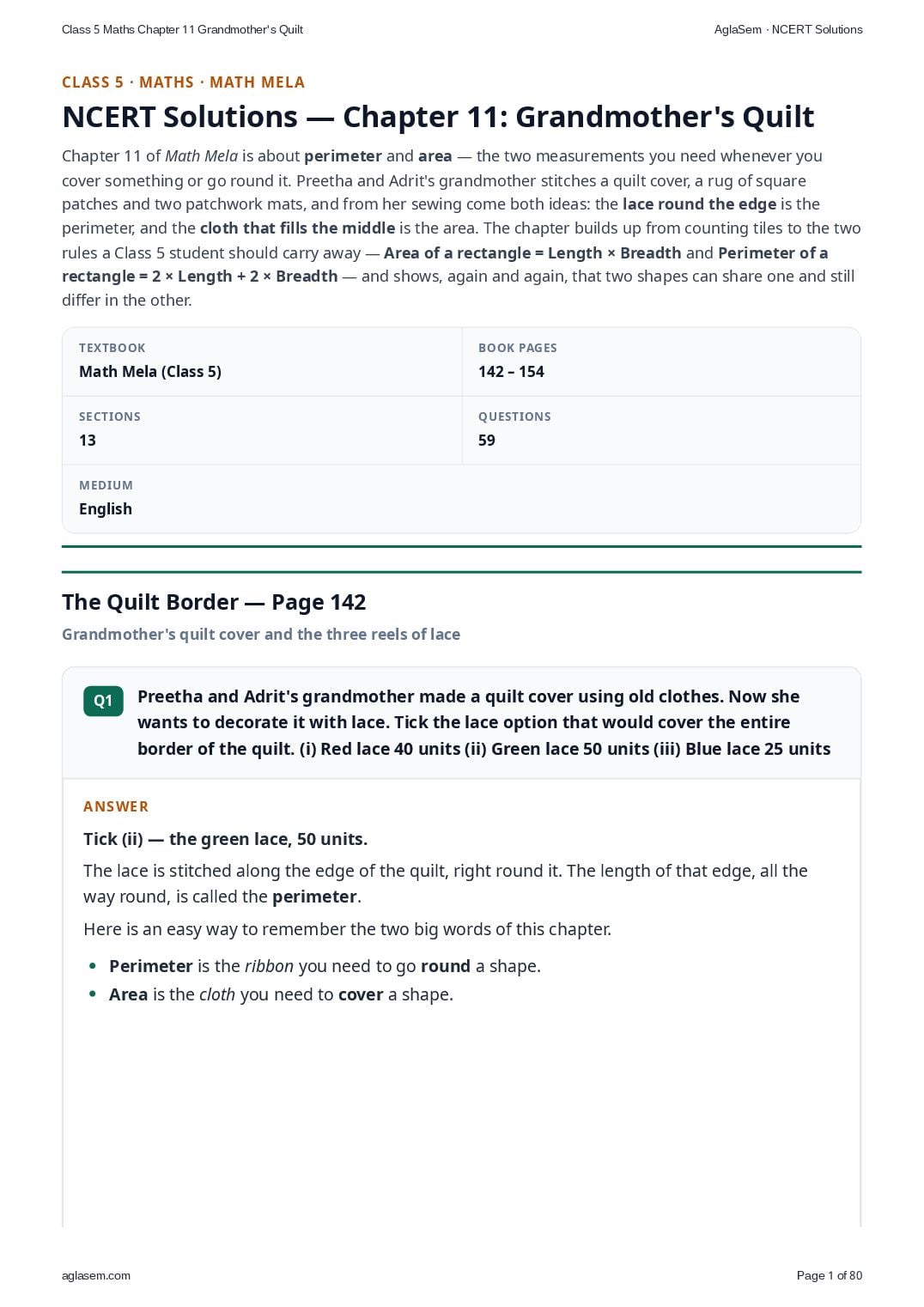
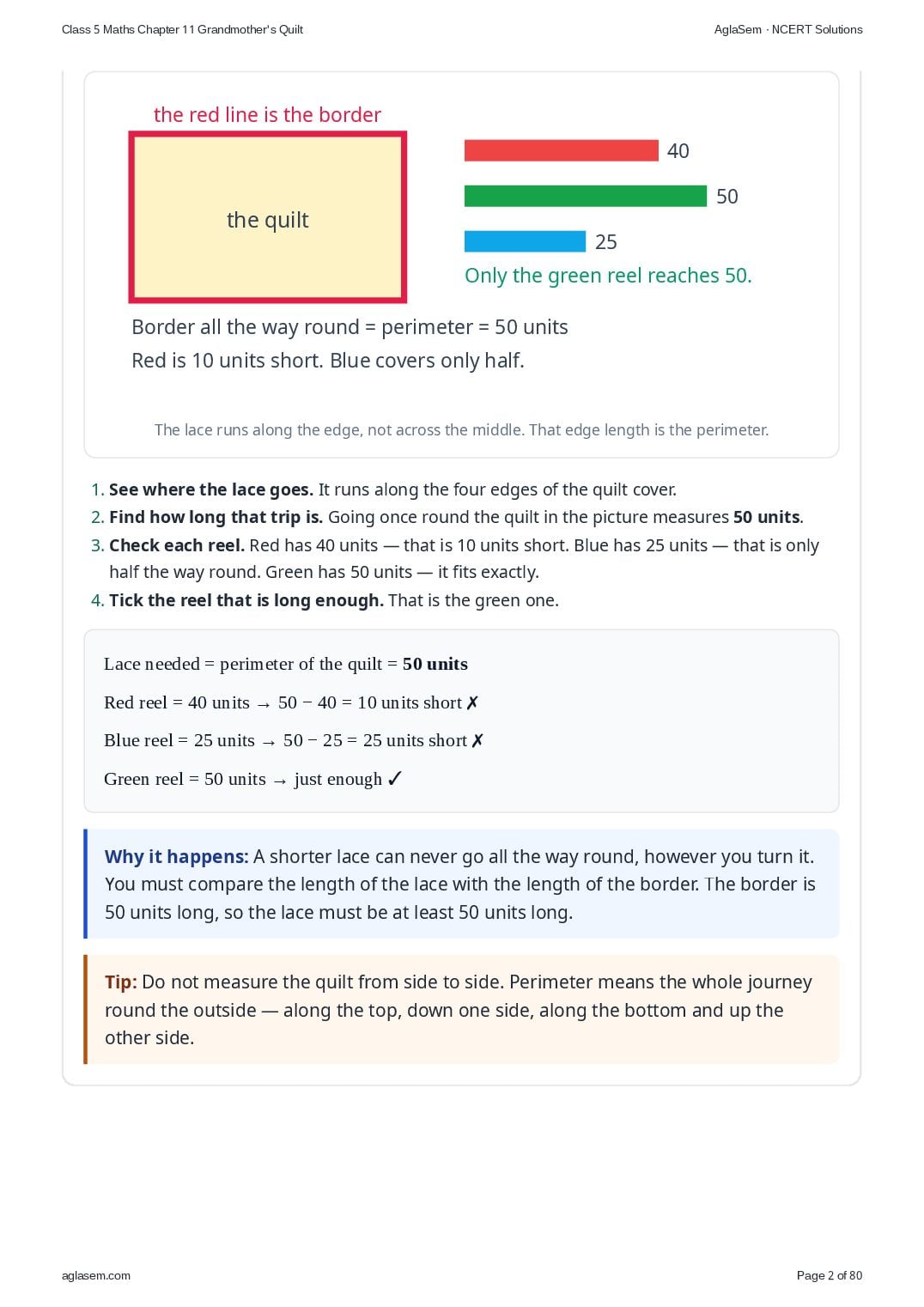
- Preetha and Adrit’s grandmother made a quilt cover using old clothes. Now she wants to decorate it with lace. Tick the lace option that would cover the entire border of the quilt. (i) Red lace 40 units (ii) Green lace 50 units (iii) Blue lace 25 units
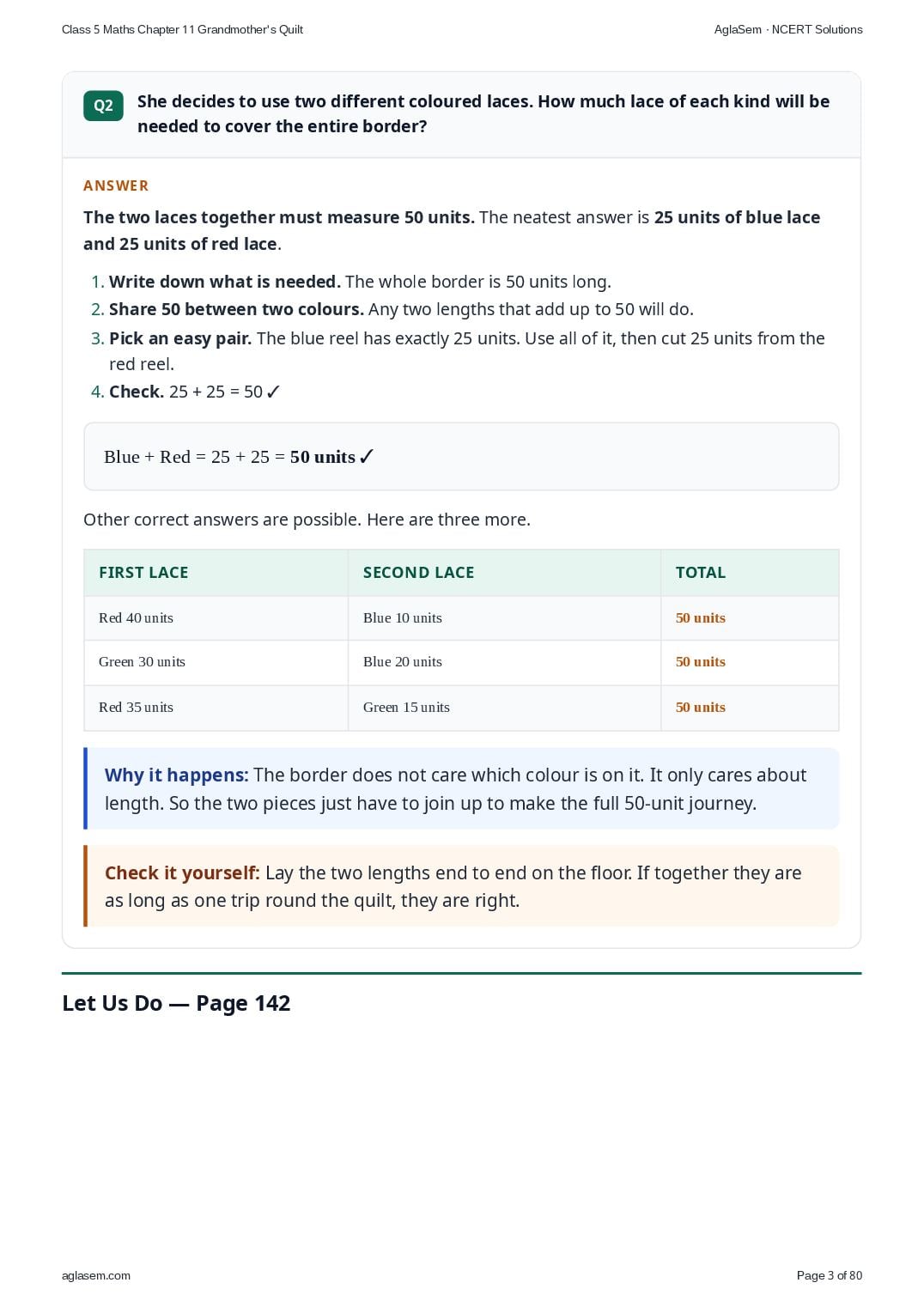
- She decides to use two different coloured laces. How much lace of each kind will be needed to cover the entire border?
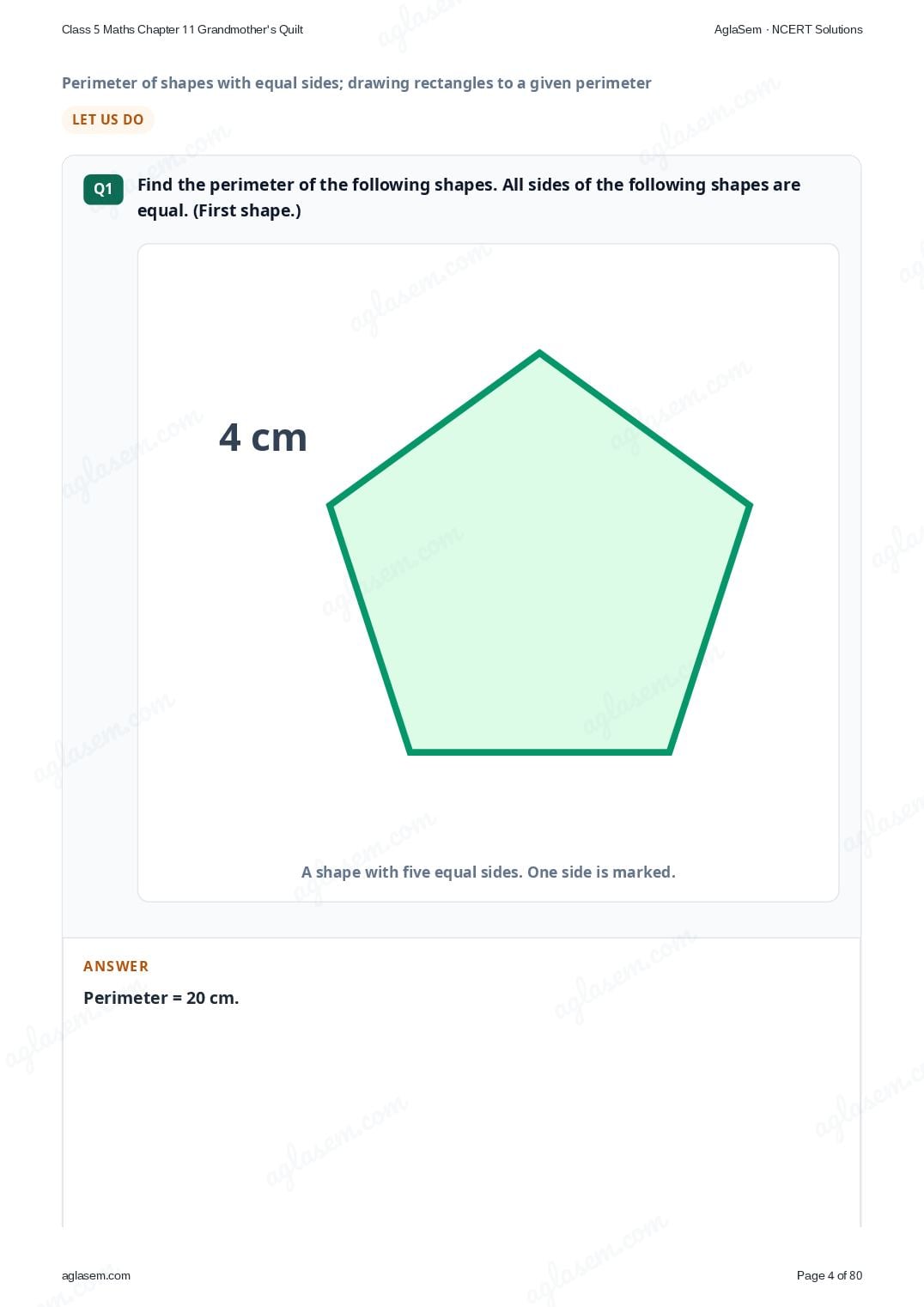
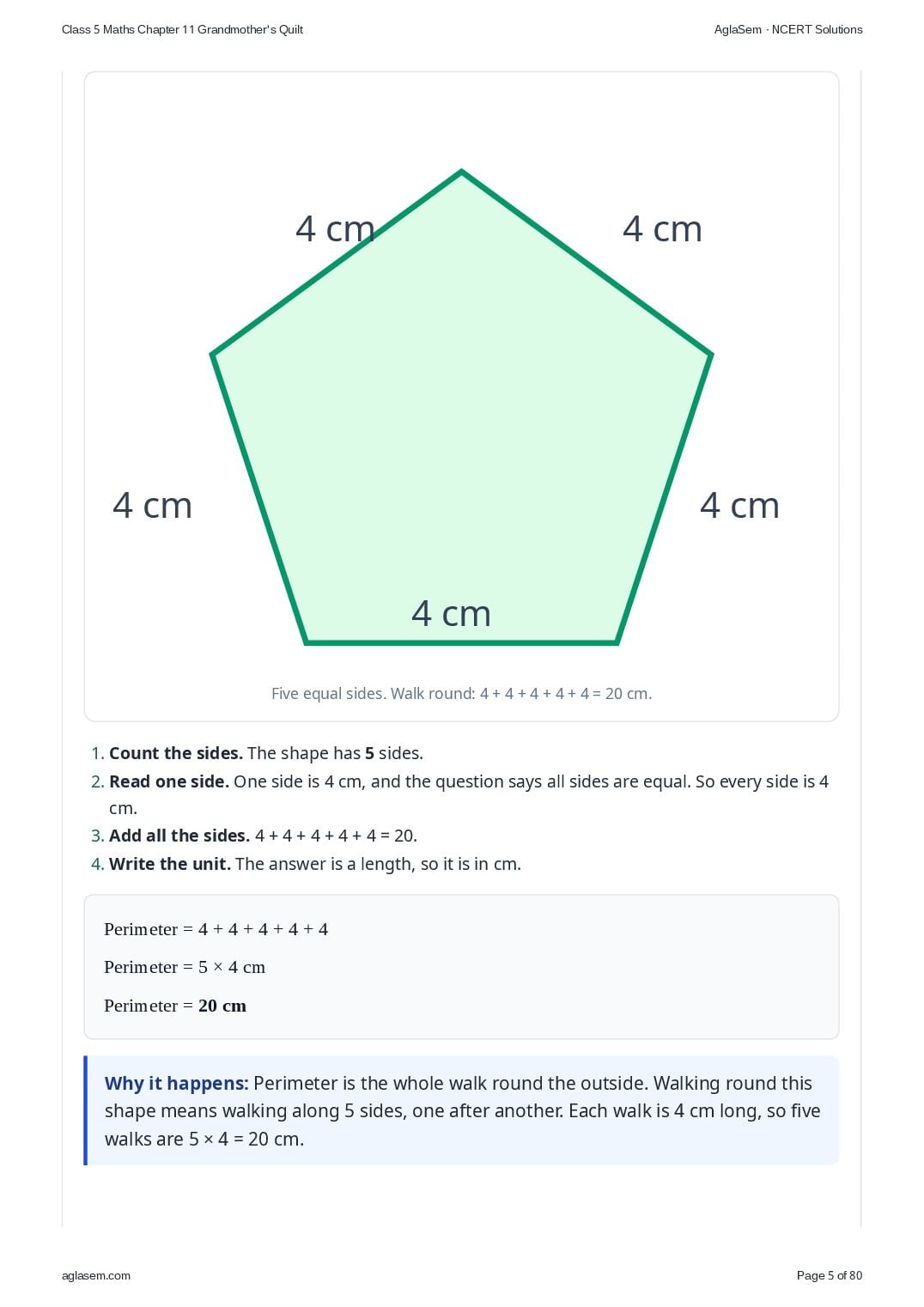
- Find the perimeter of the following shapes. All sides of the following shapes are equal. (First shape.) 4 cmA shape with five equal sides. One side is marked.
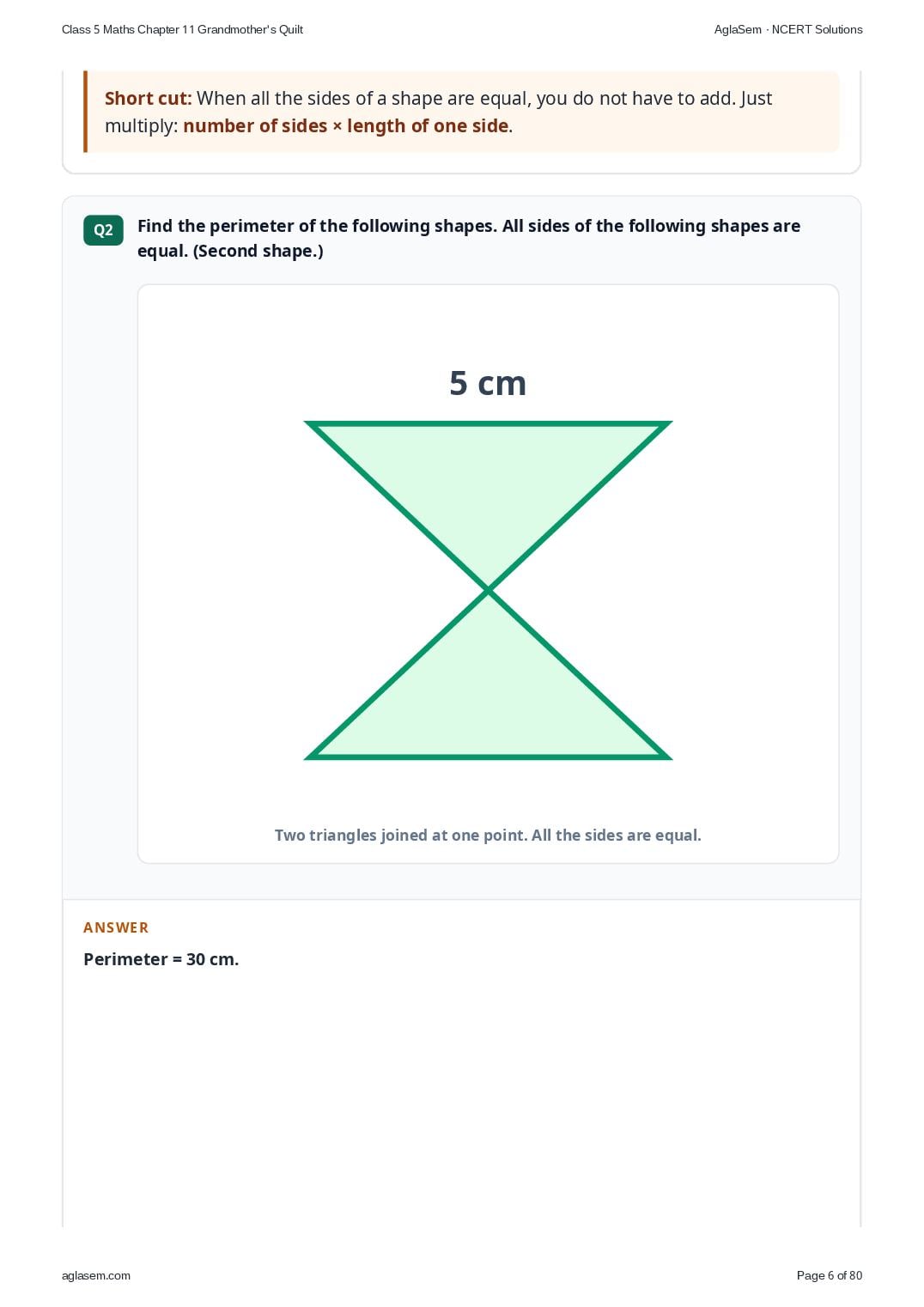
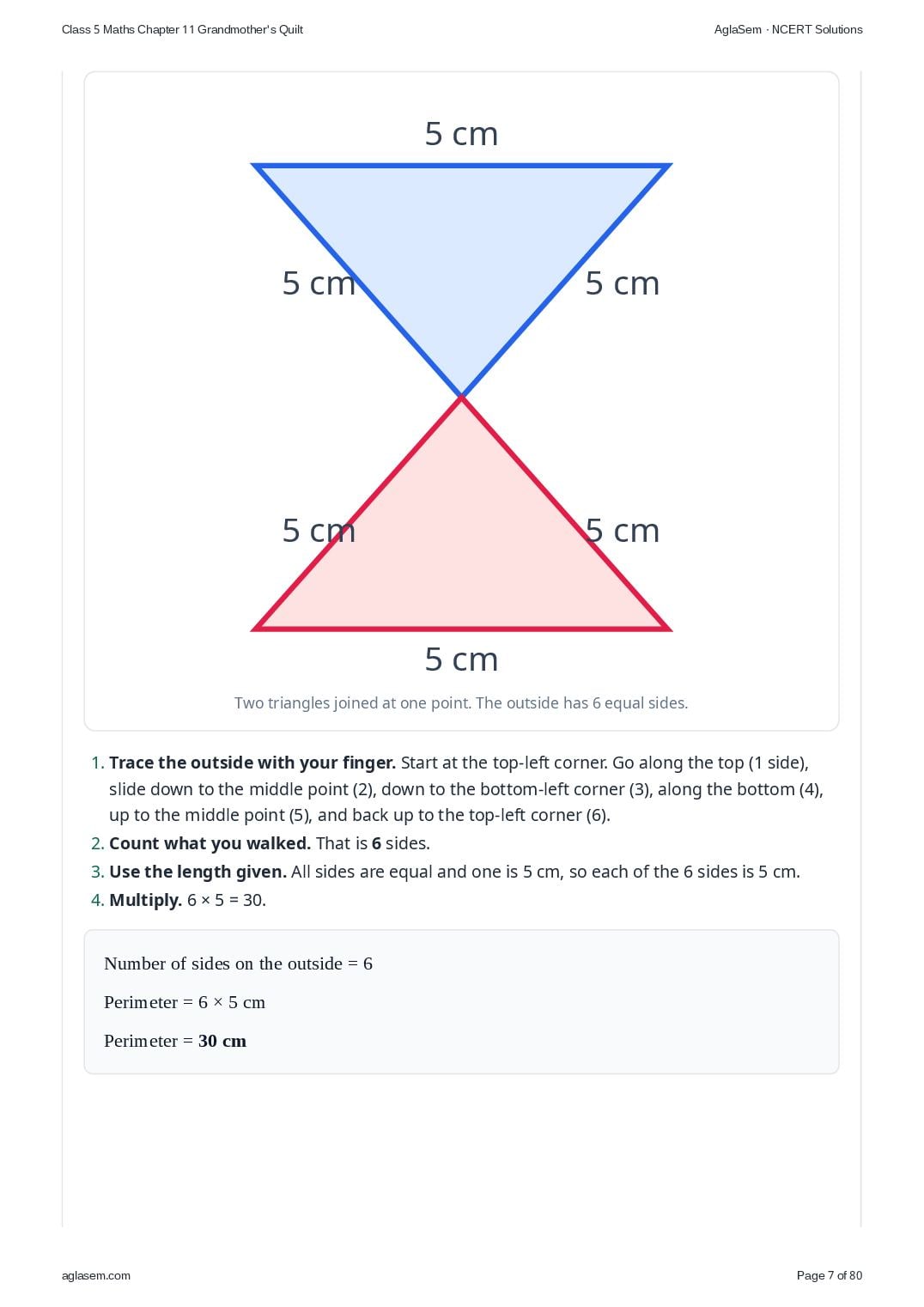
- Find the perimeter of the following shapes. All sides of the following shapes are equal. (Second shape.) 5 cmTwo triangles joined at one point. All the sides are equal.
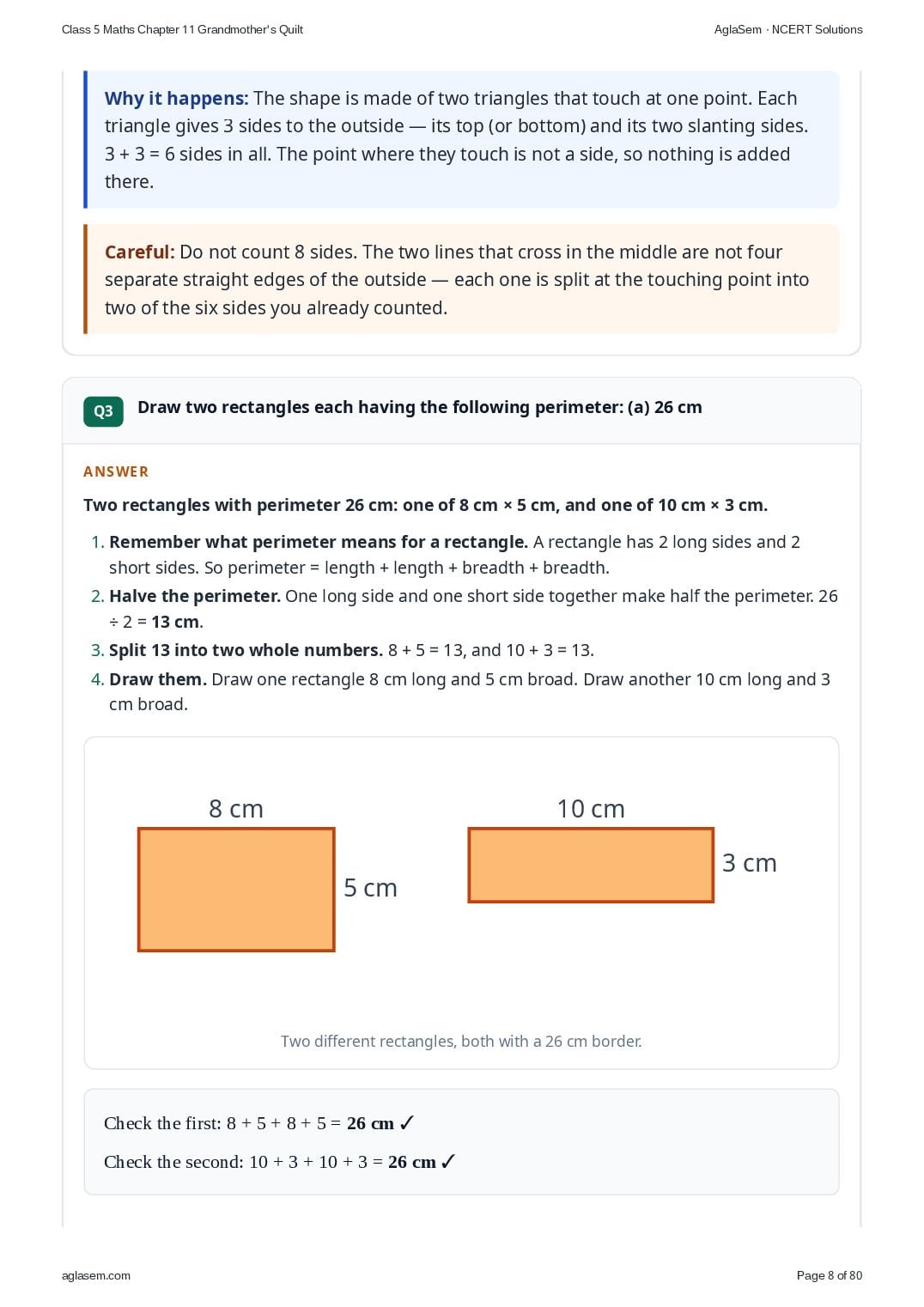
- Draw two rectangles each having the following perimeter: (a) 26 cm
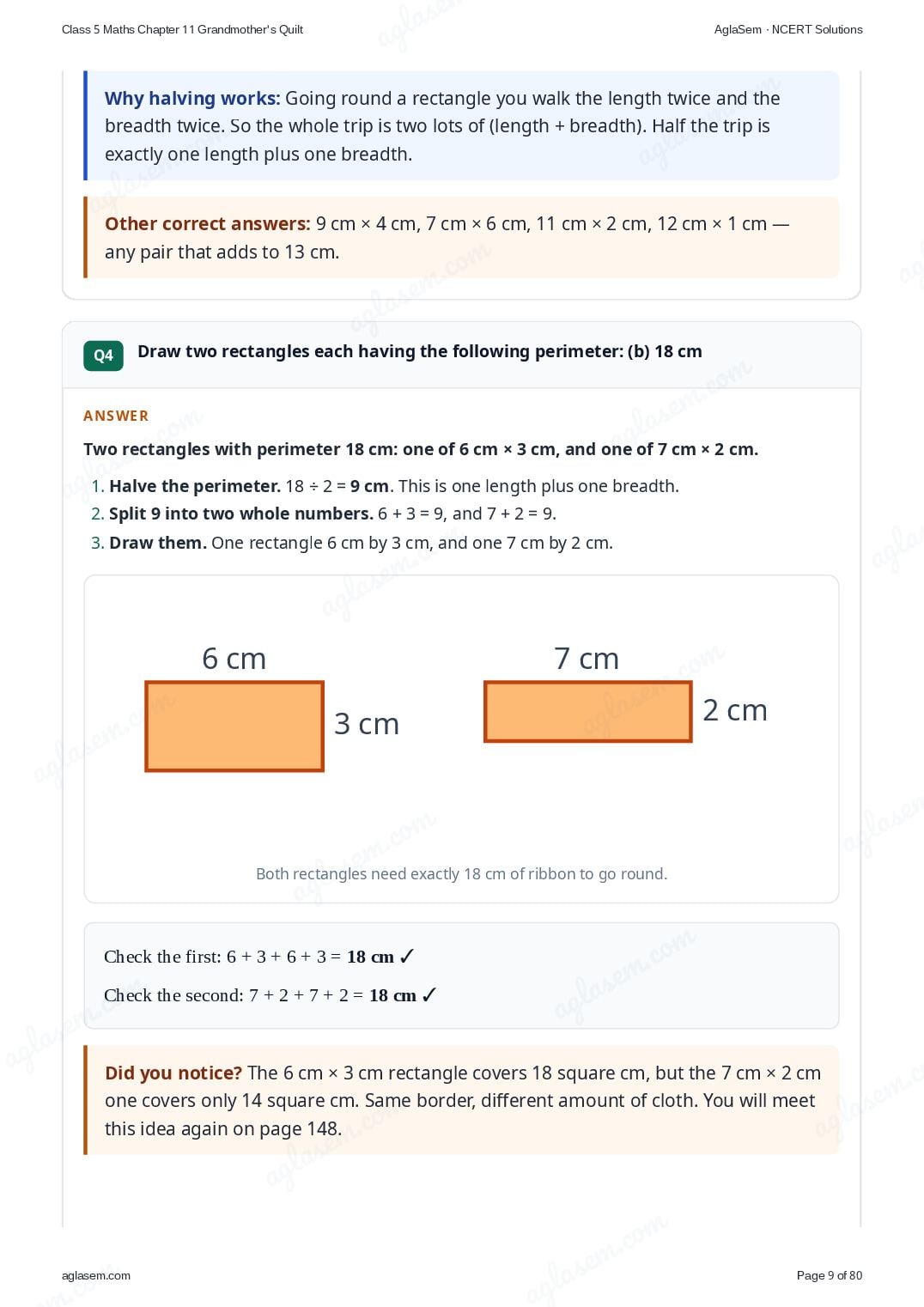
- Draw two rectangles each having the following perimeter: (b) 18 cm
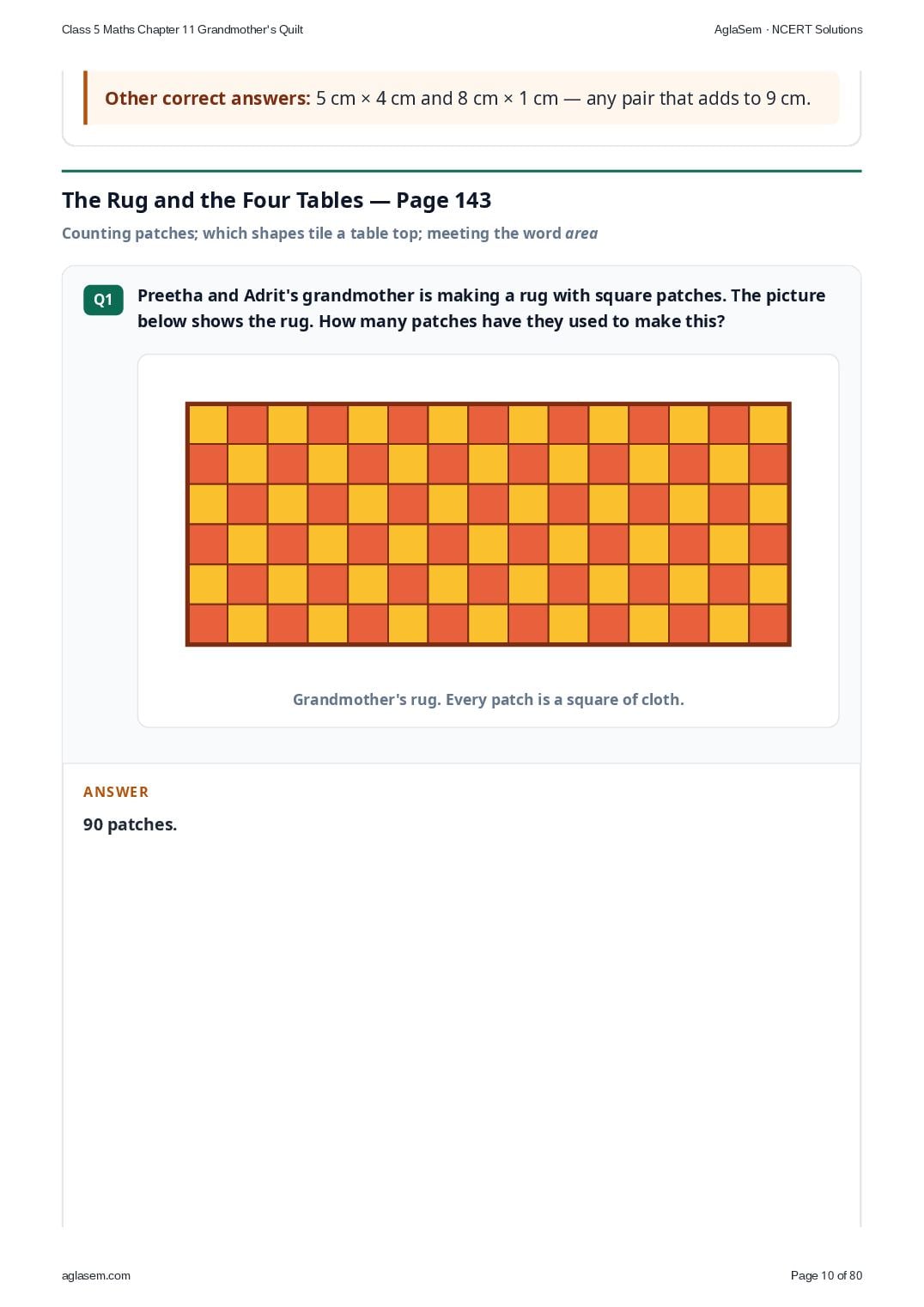
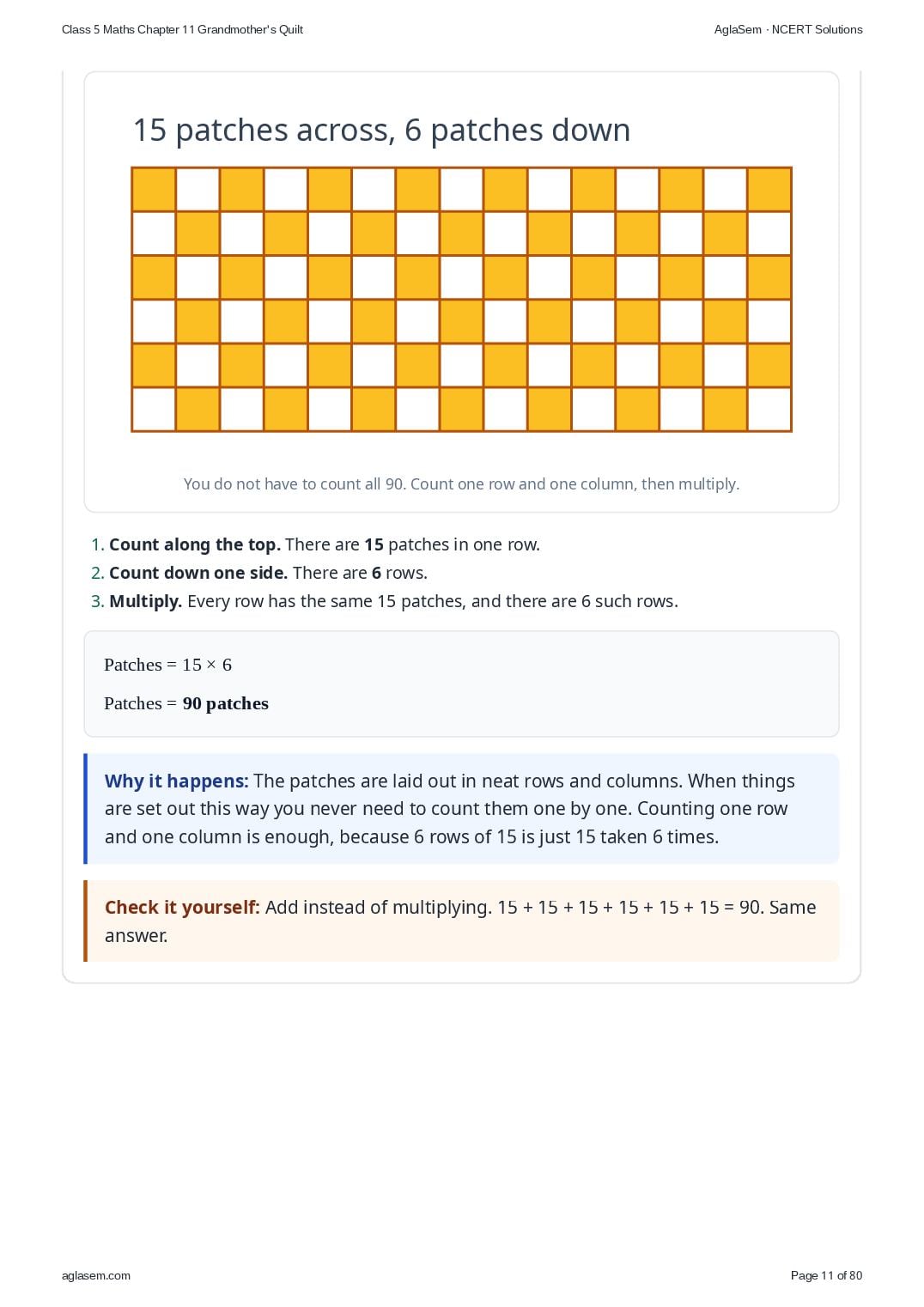
- Preetha and Adrit’s grandmother is making a rug with square patches. The picture below shows the rug. How many patches have they used to make this? Grandmother’s rug. Every patch is a square of cloth.
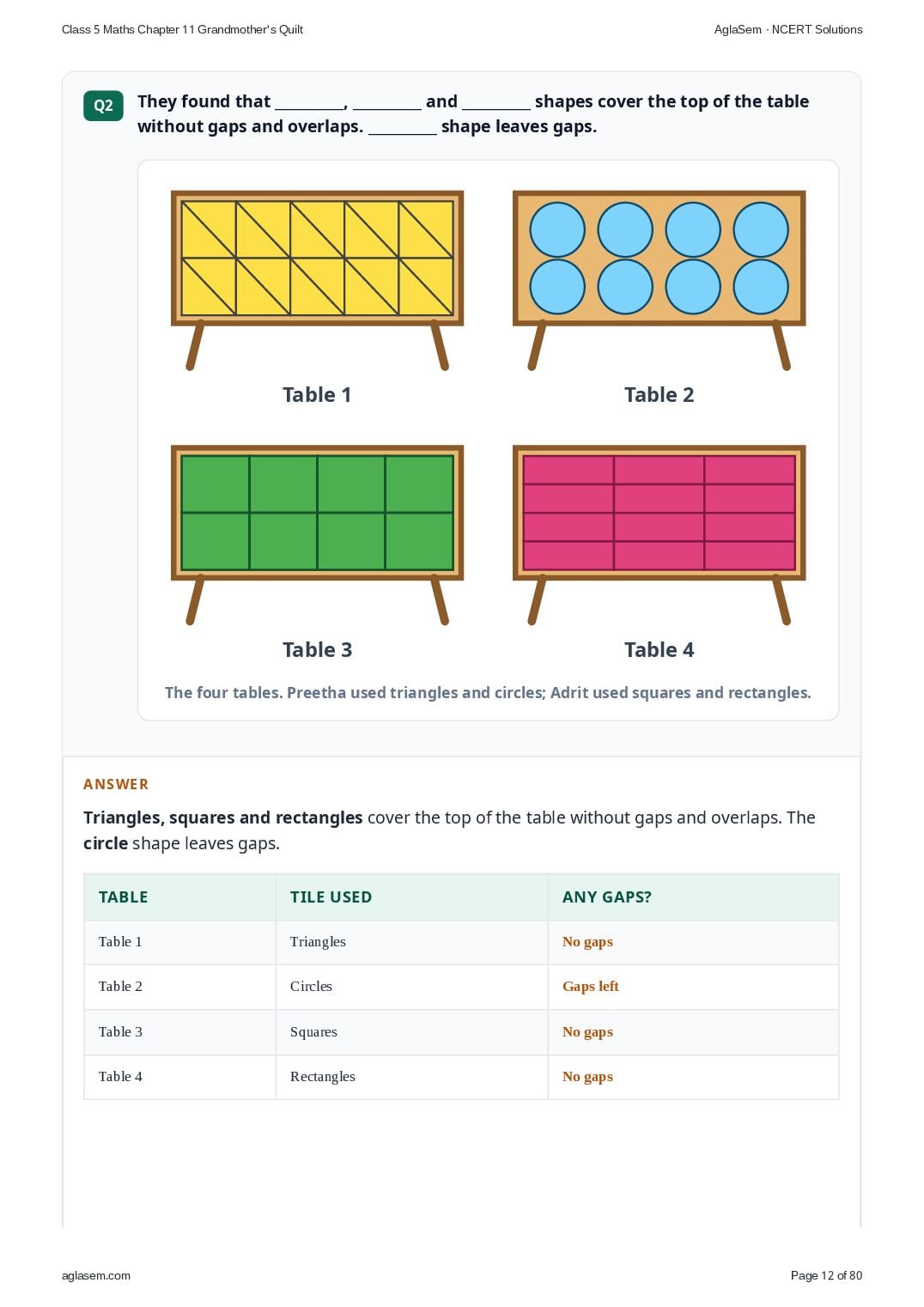
- They found that __________, __________ and __________ shapes cover the top of the table without gaps and overlaps. __________ shape leaves gaps. Table 1Table 2Table 3Table 4The four tables. Preetha used triangles and circles; Adrit used squares and rectangles.
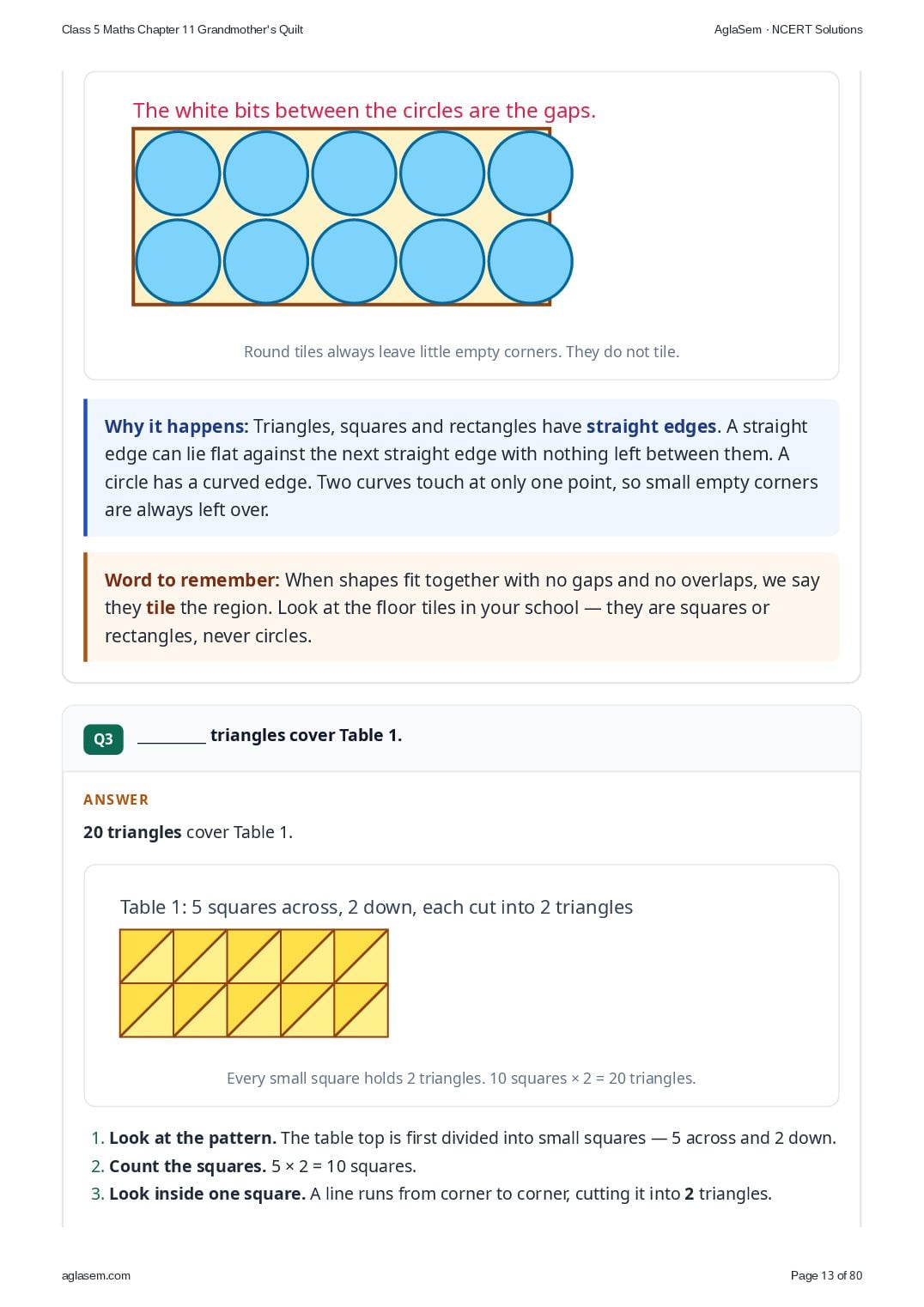
- __________ triangles cover Table 1.
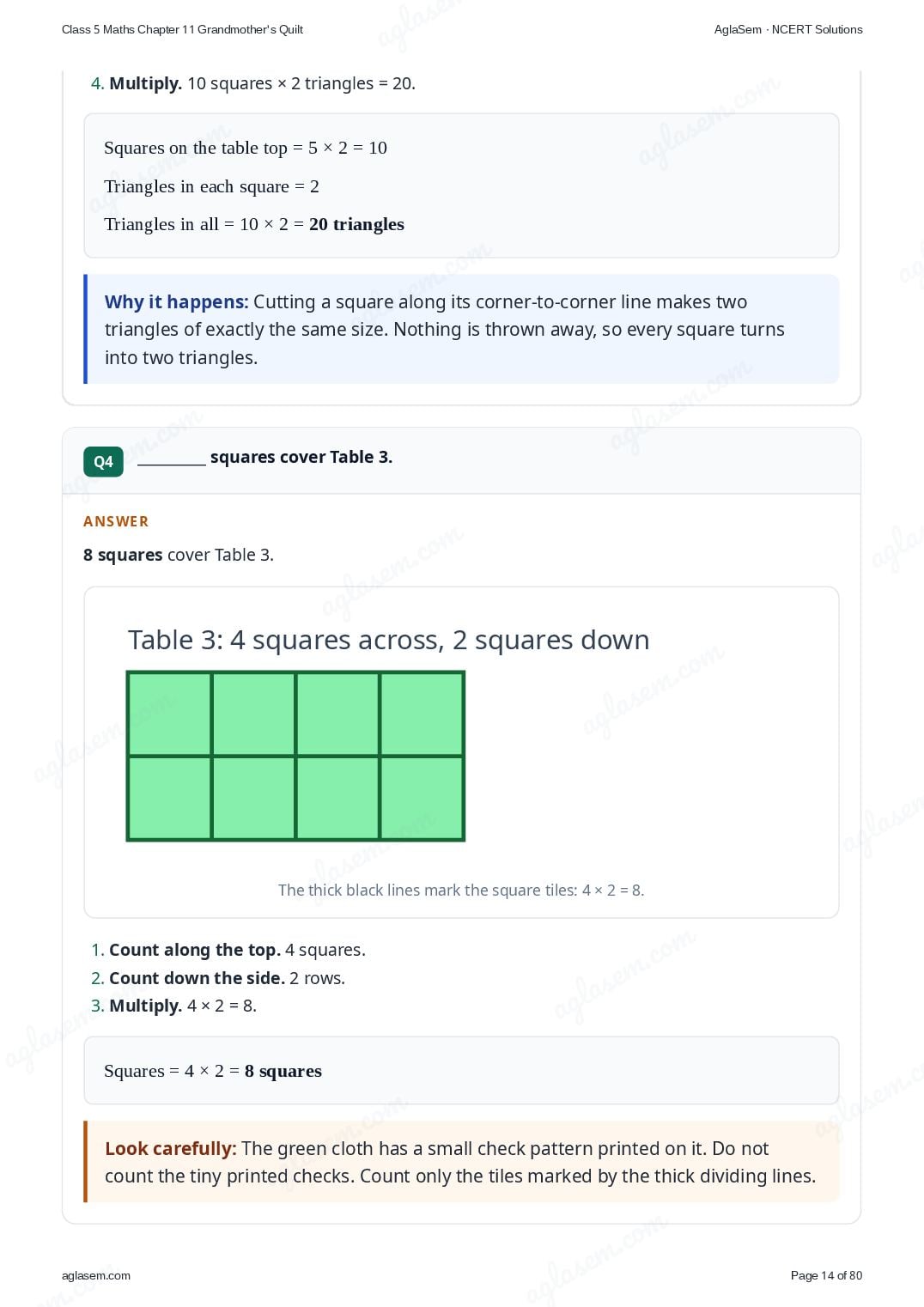
- __________ squares cover Table 3.
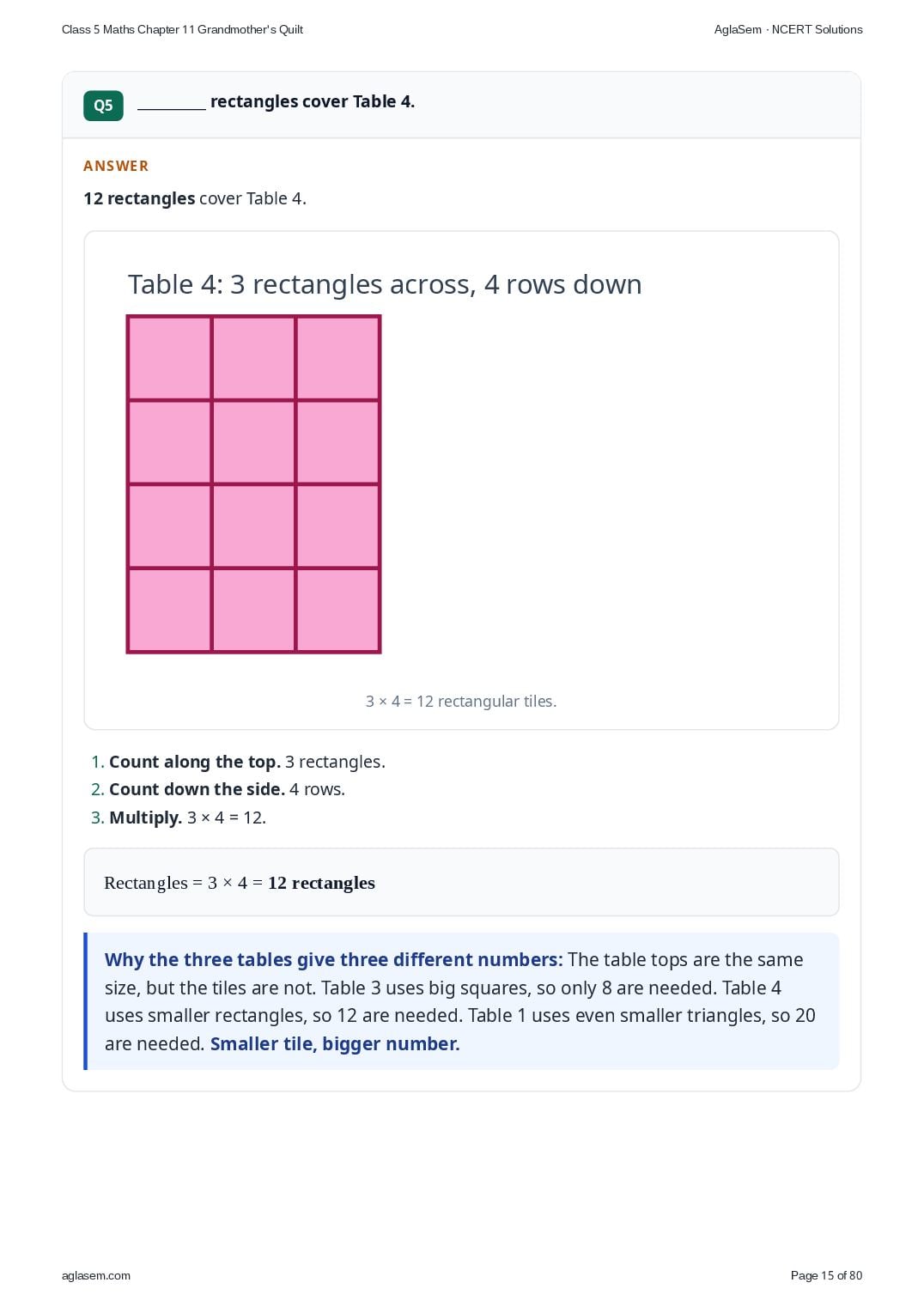
- __________ rectangles cover Table 4.
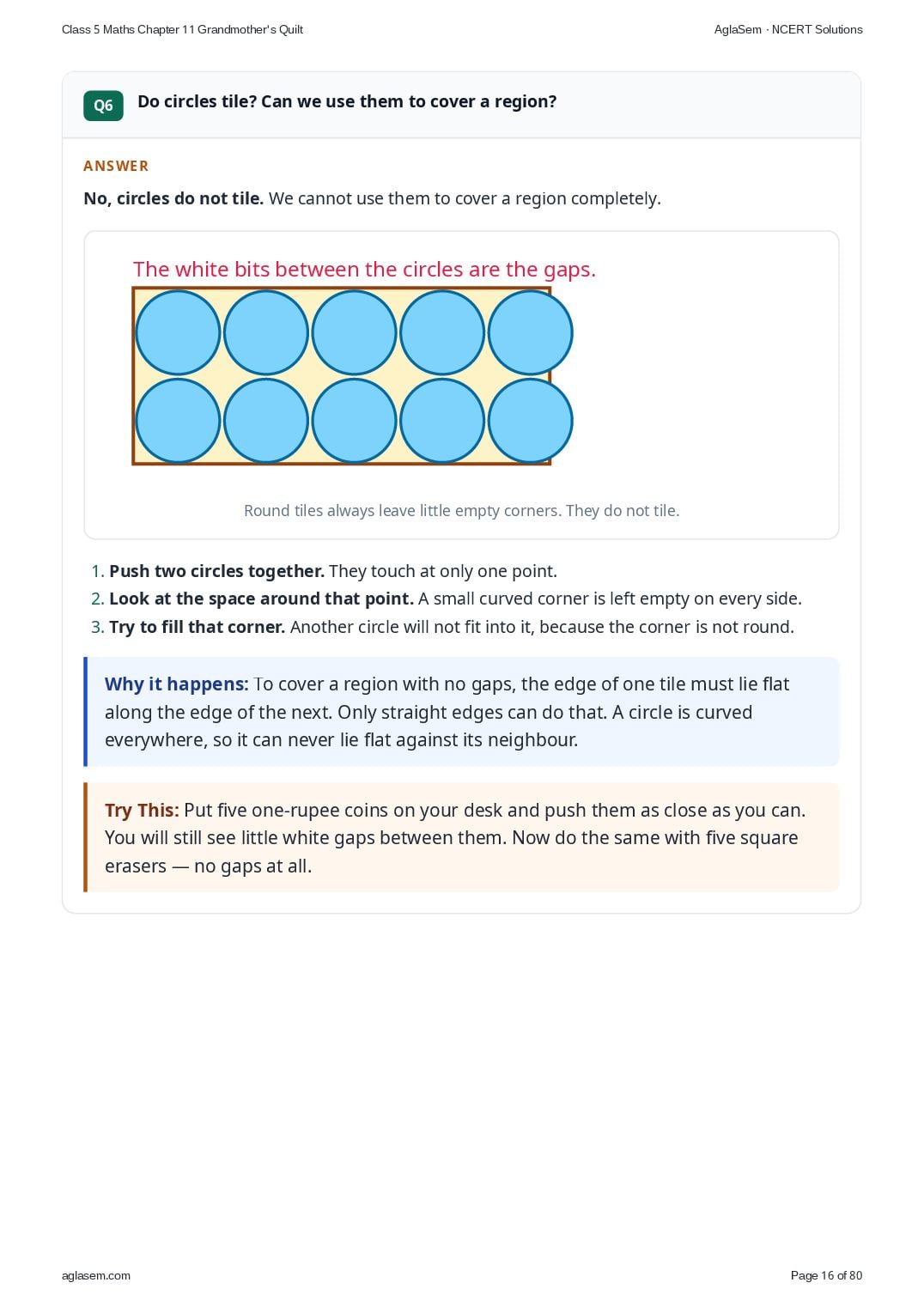
- Do circles tile? Can we use them to cover a region?
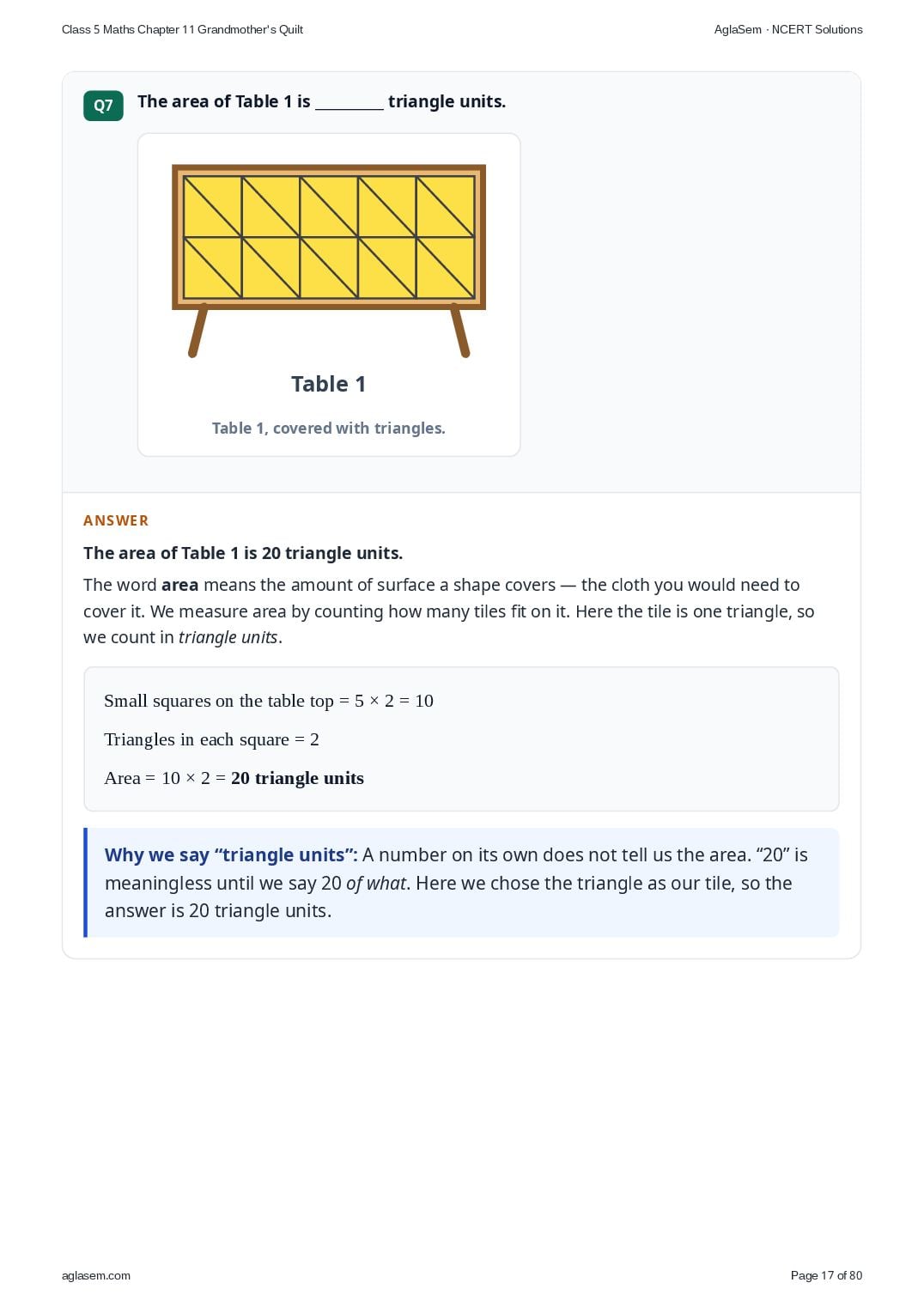
- The area of Table 1 is __________ triangle units. Table 1Table 1, covered with triangles.
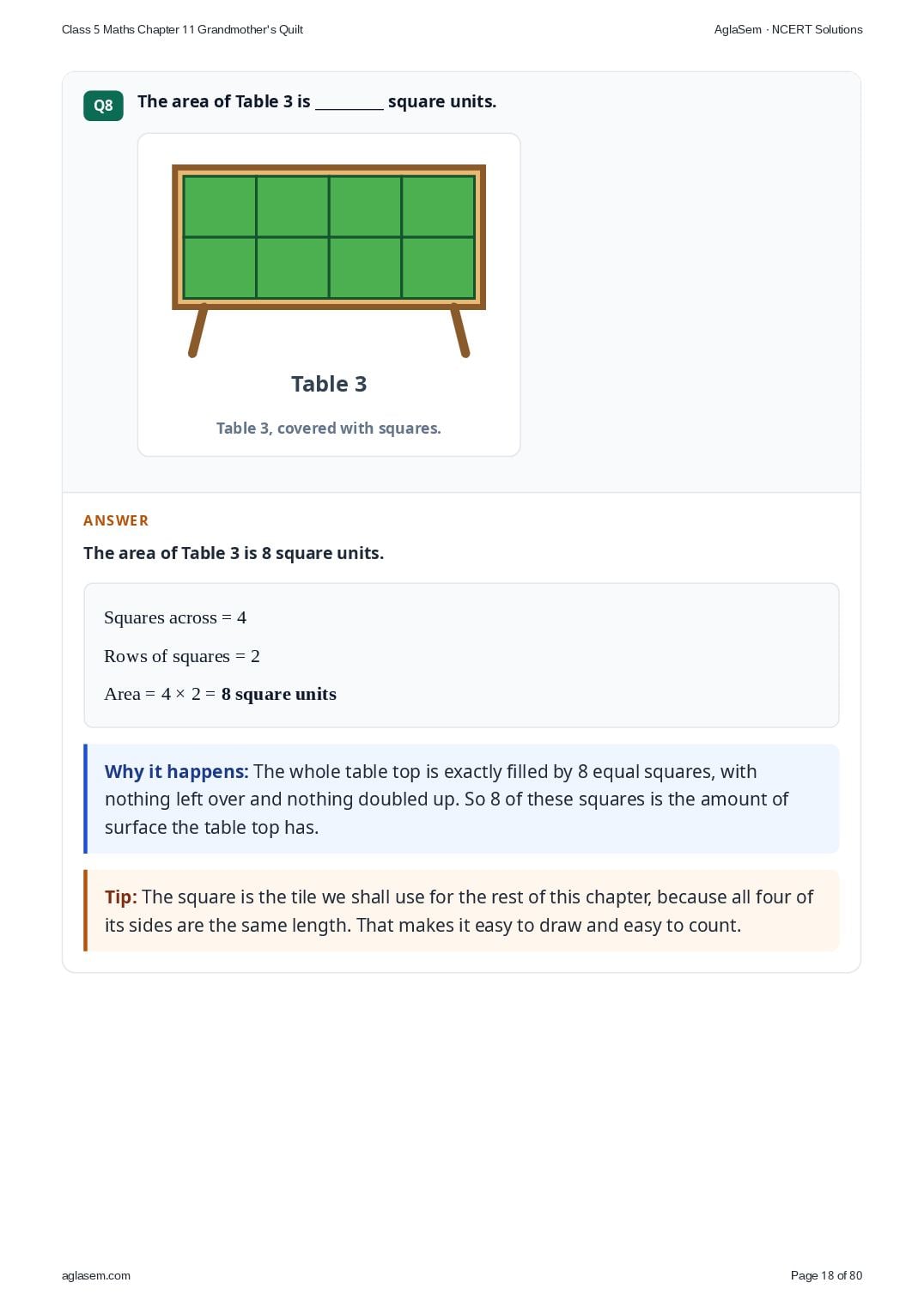
- The area of Table 3 is __________ square units. Table 3Table 3, covered with squares.
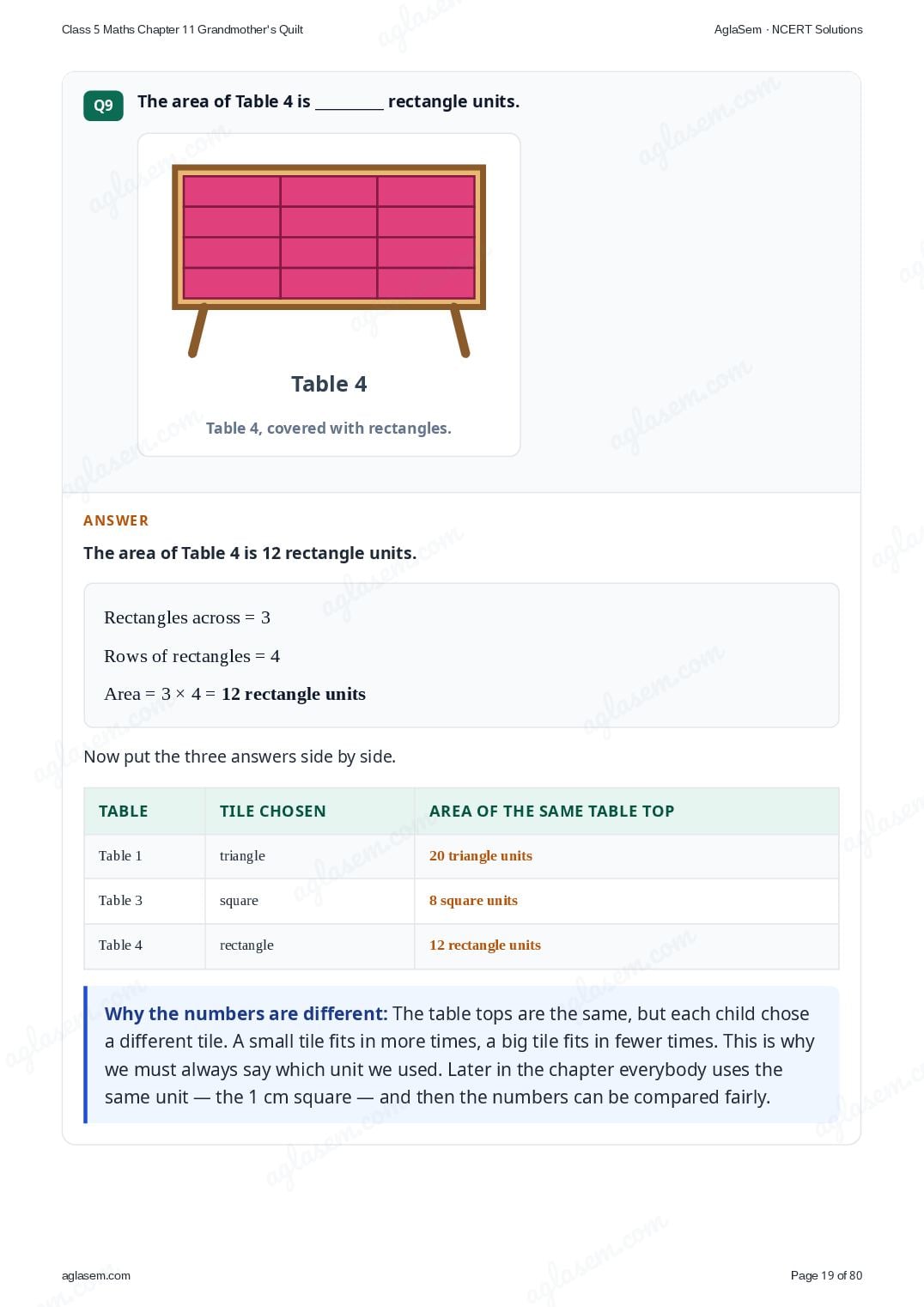
- The area of Table 4 is __________ rectangle units. Table 4Table 4, covered with rectangles.
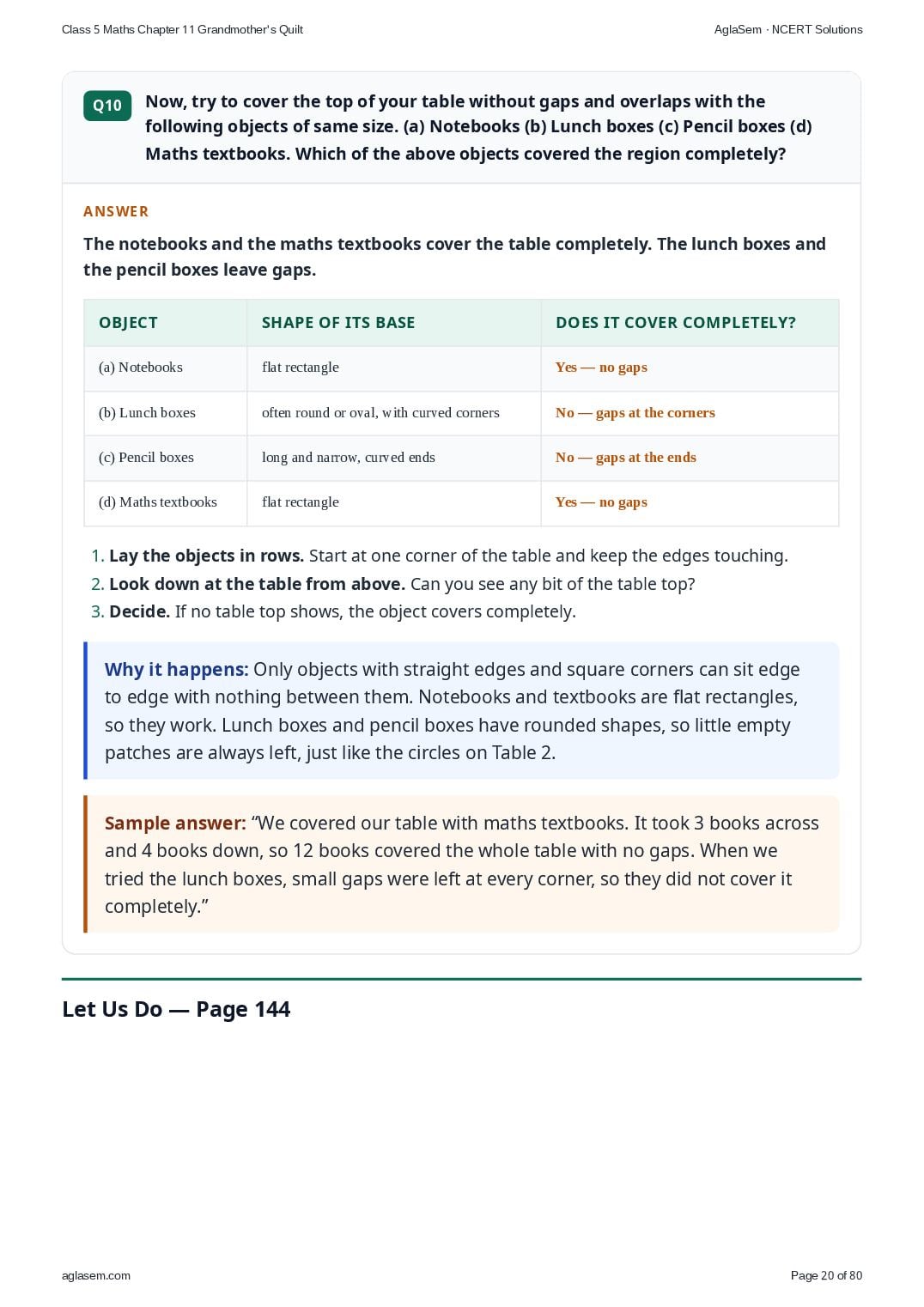
- Now, try to cover the top of your table without gaps and overlaps with the following objects of same size. (a) Notebooks (b) Lunch boxes (c) Pencil boxes (d) Maths textbooks. Which of the above objects covered the region completely?
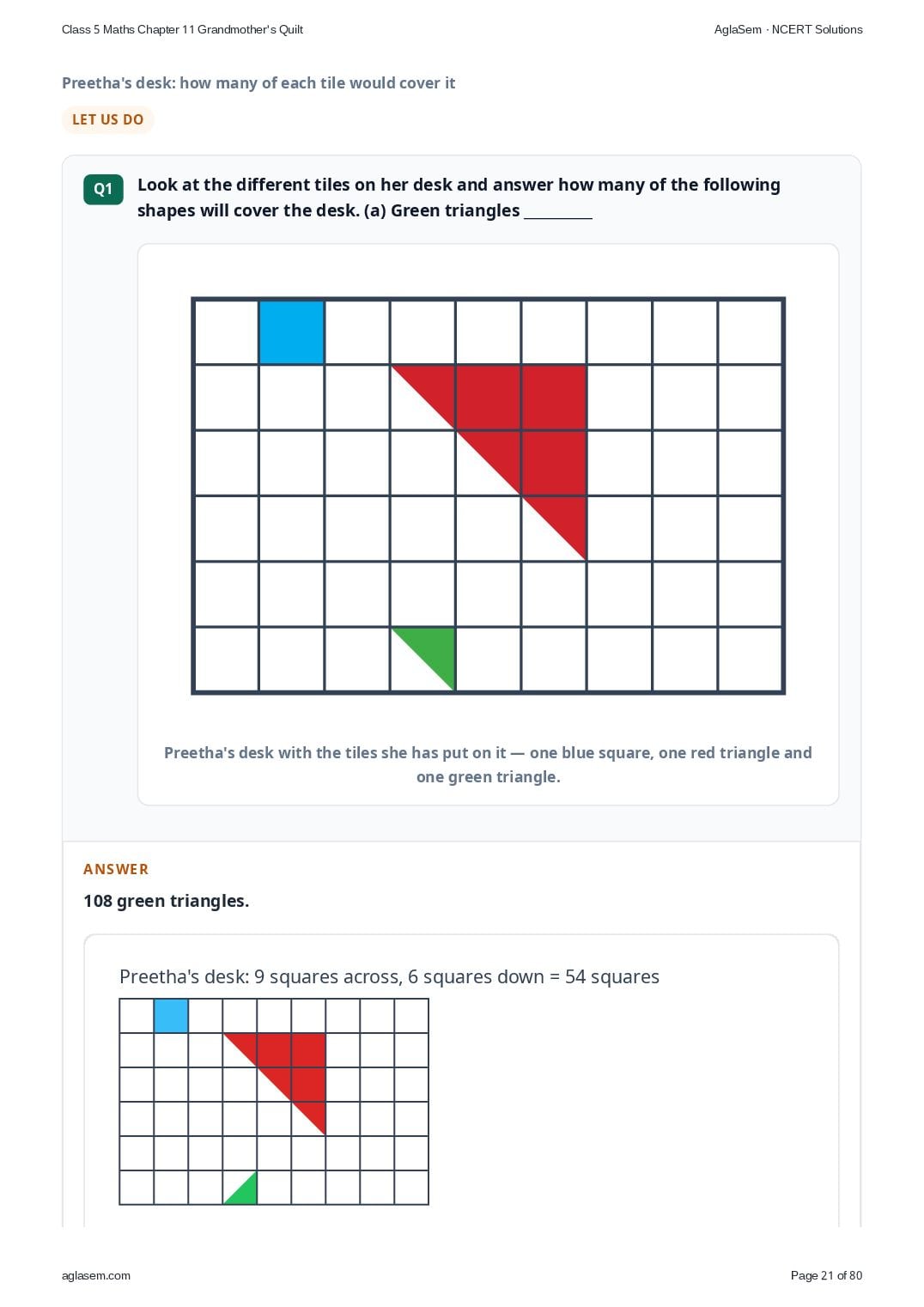
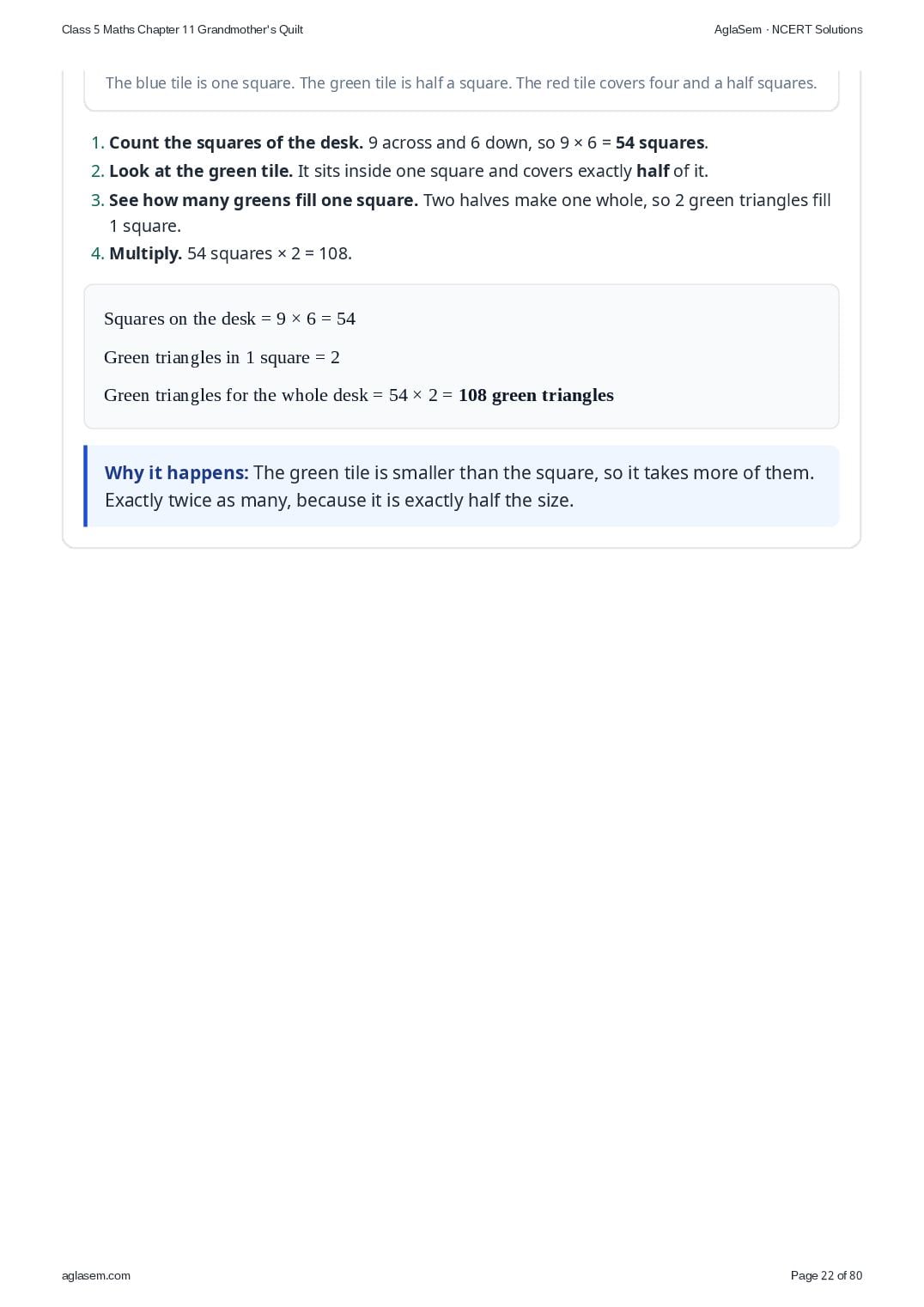
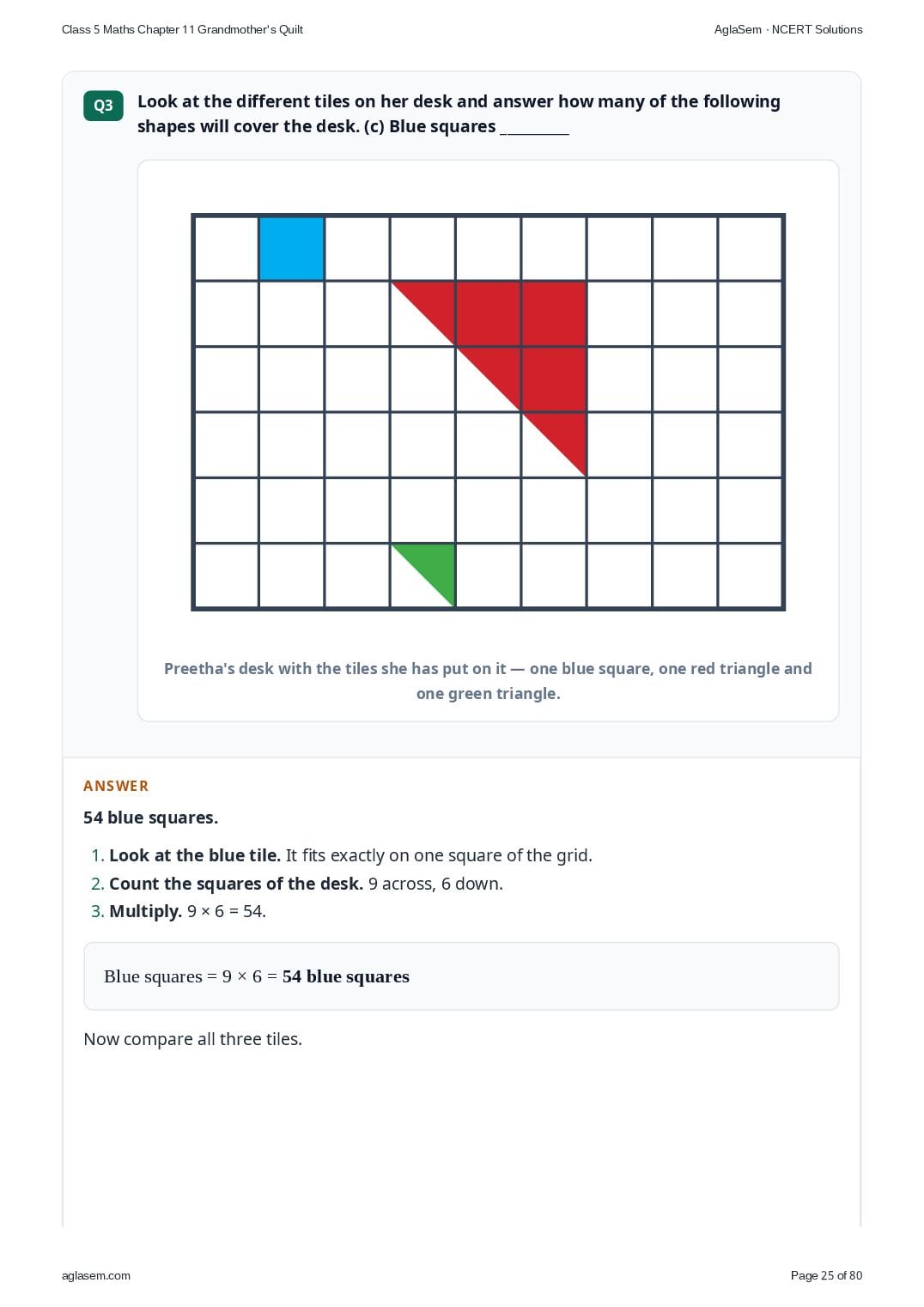
- Look at the different tiles on her desk and answer how many of the following shapes will cover the desk. (a) Green triangles __________ Preetha’s desk with the tiles she has put on it — one blue square, one red triangle and one green triangle.
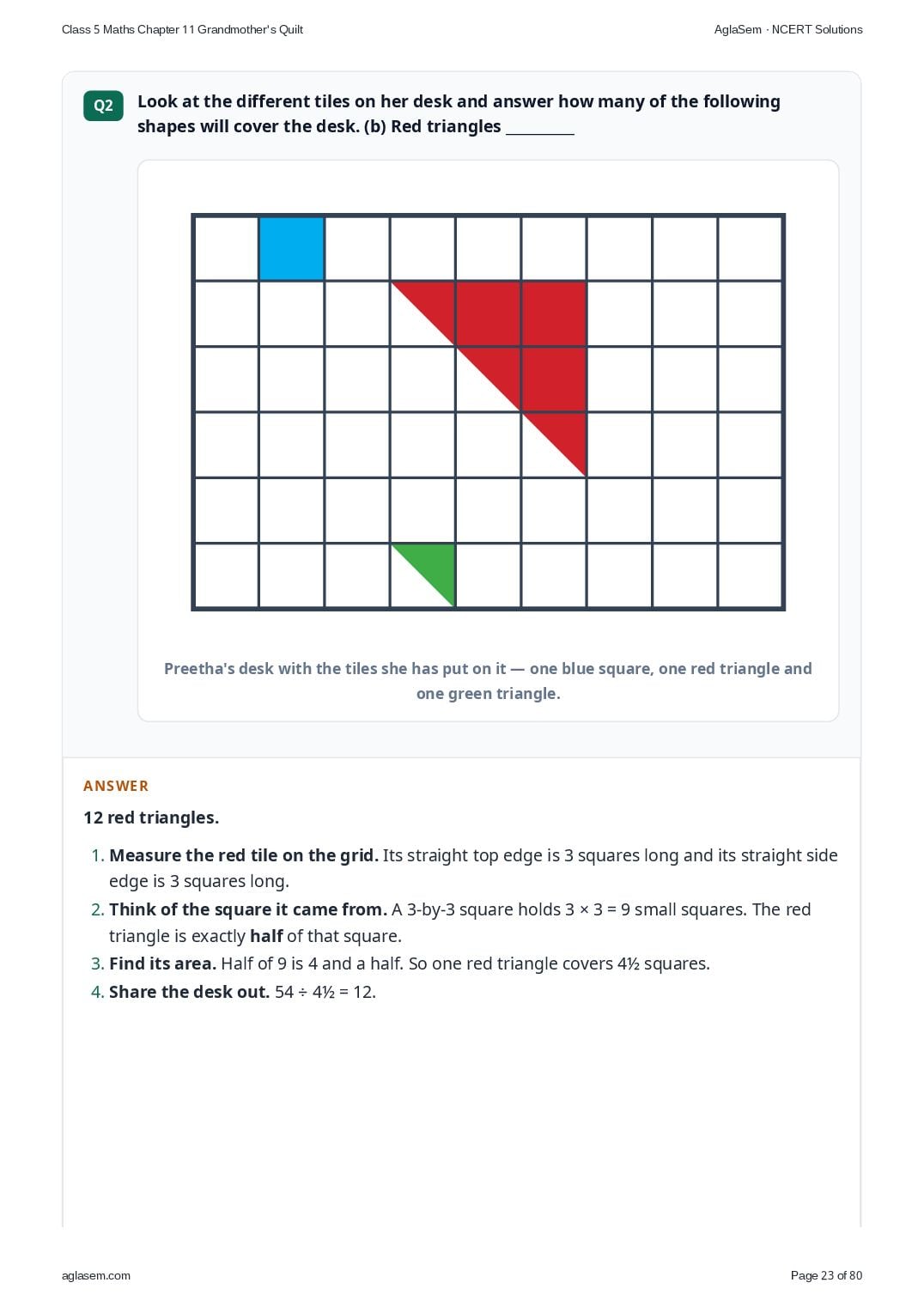
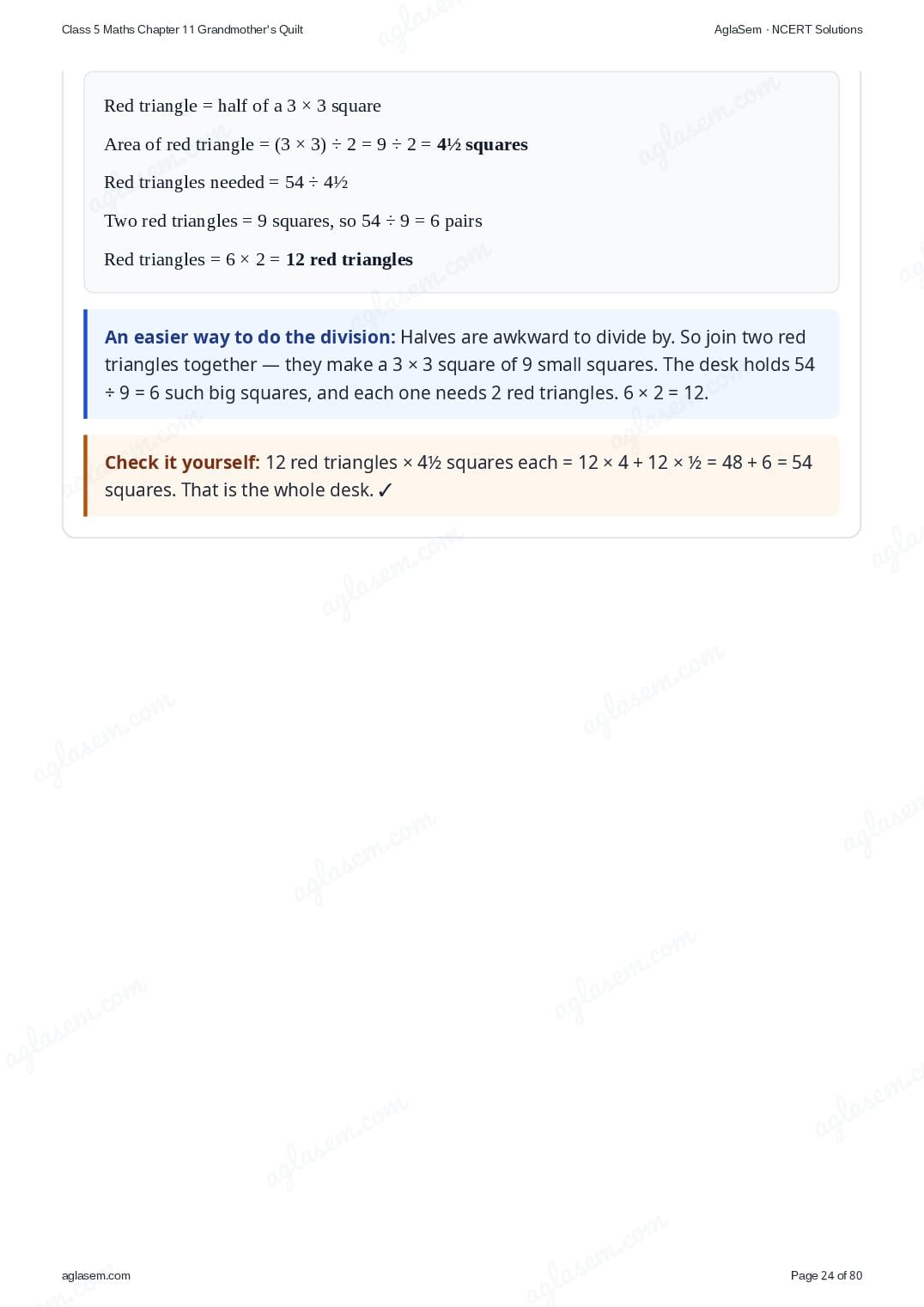
- Look at the different tiles on her desk and answer how many of the following shapes will cover the desk. (b) Red triangles __________ Preetha’s desk with the tiles she has put on it — one blue square, one red triangle and one green triangle.
- Look at the different tiles on her desk and answer how many of the following shapes will cover the desk. (c) Blue squares __________ Preetha’s desk with the tiles she has put on it — one blue square, one red triangle and one green triangle.
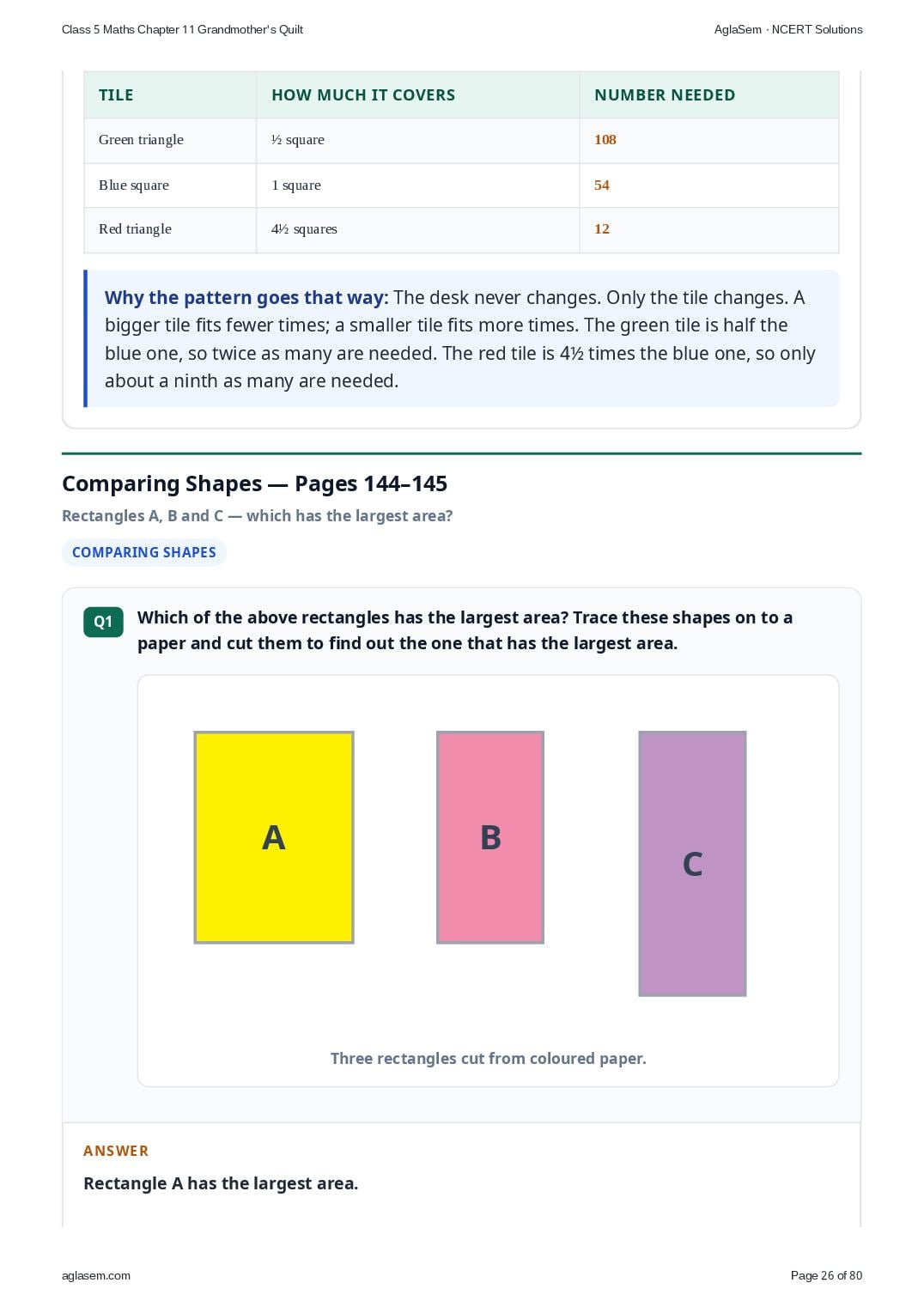
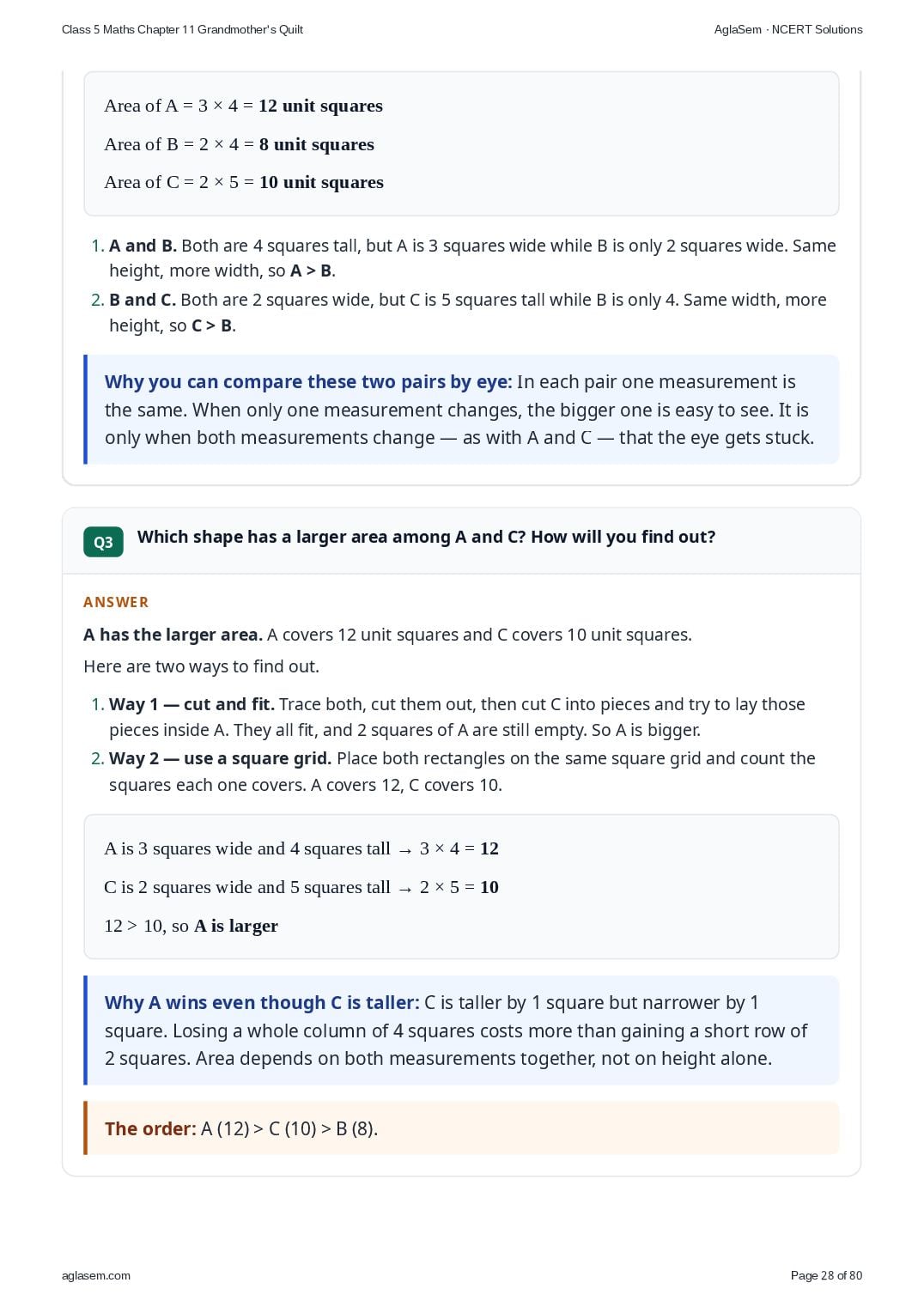
- Which of the above rectangles has the largest area? Trace these shapes on to a paper and cut them to find out the one that has the largest area. ABCThree rectangles cut from coloured paper.
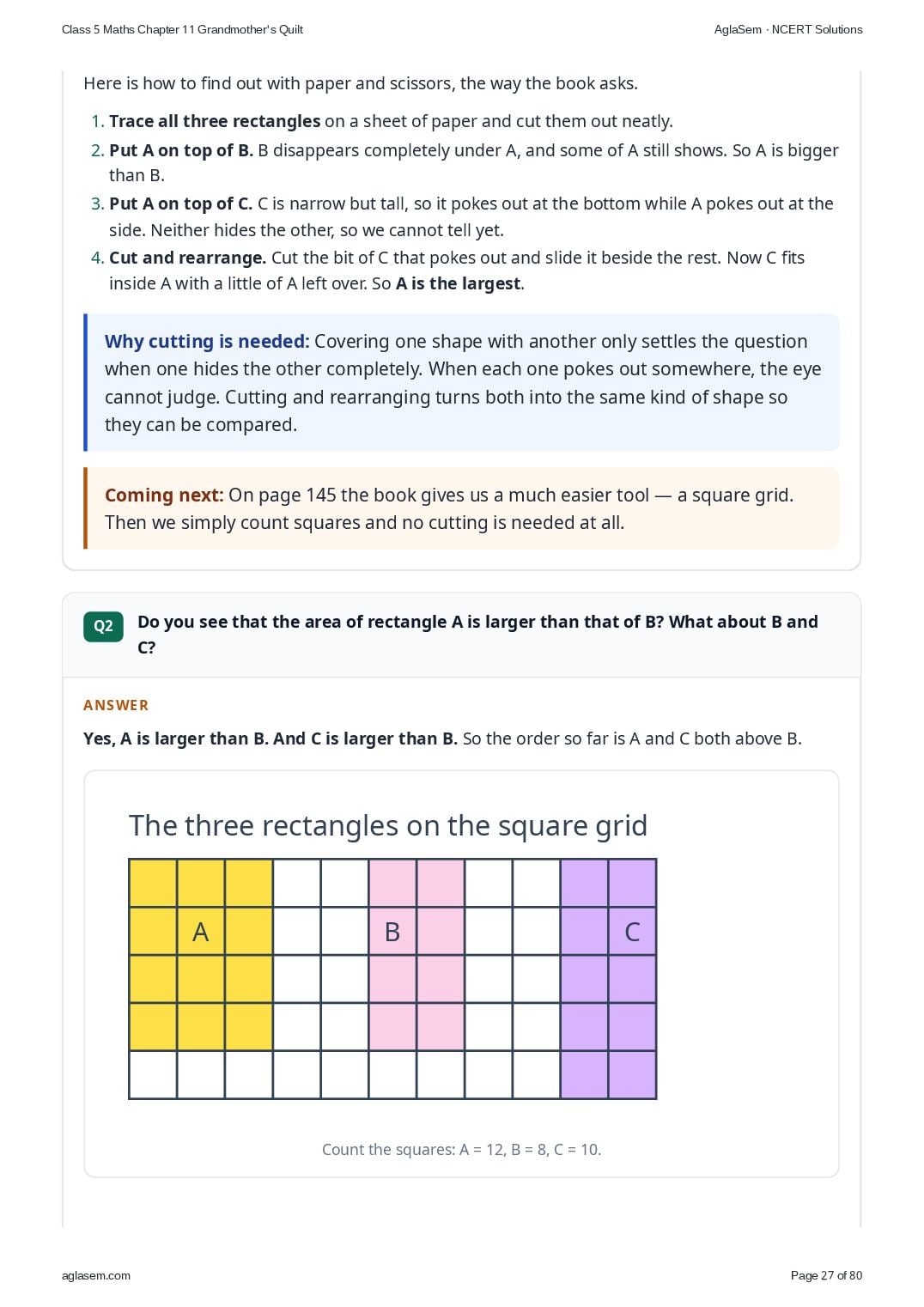
- Do you see that the area of rectangle A is larger than that of B? What about B and C?
- Which shape has a larger area among A and C? How will you find out?
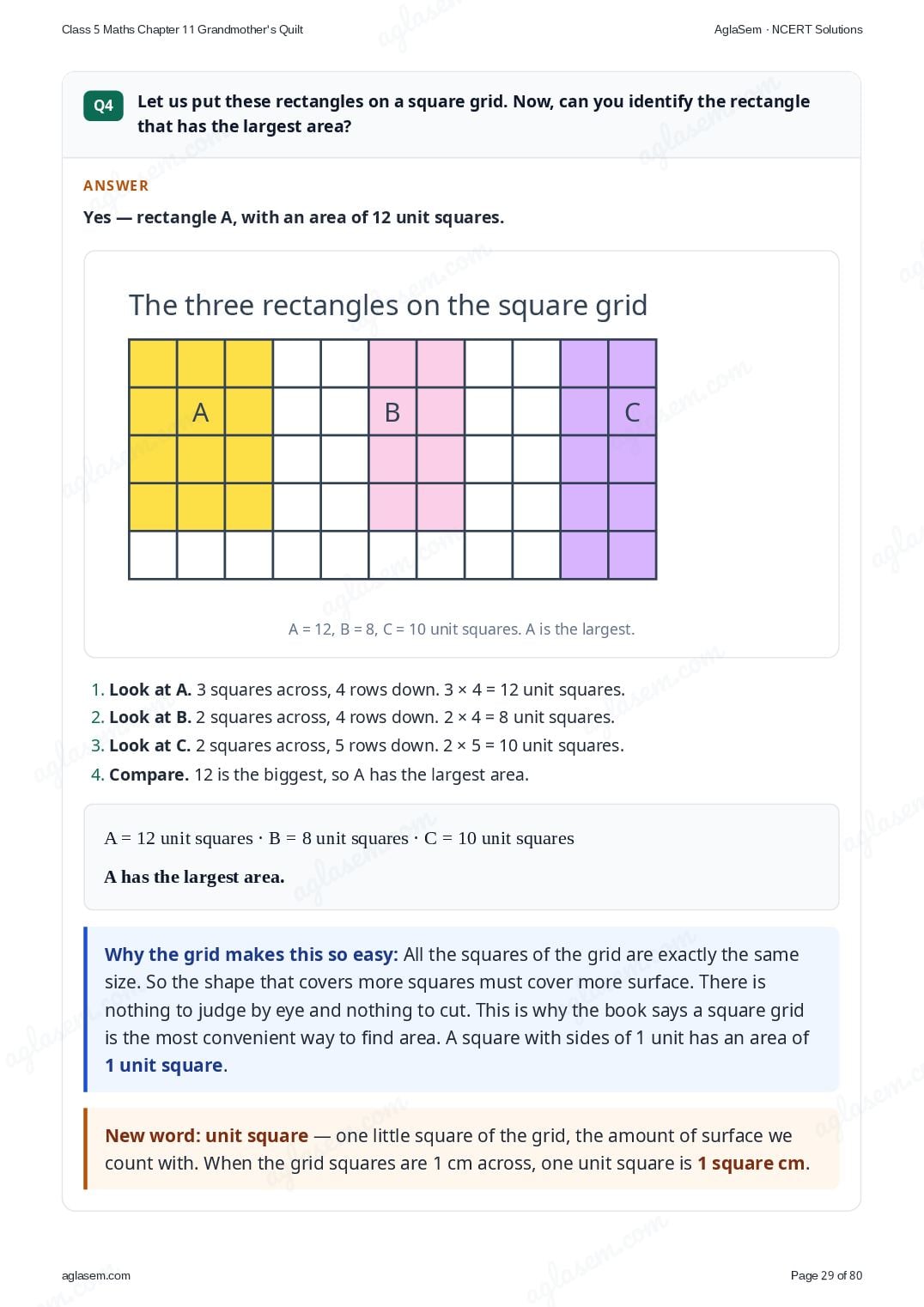
- Let us put these rectangles on a square grid. Now, can you identify the rectangle that has the largest area?
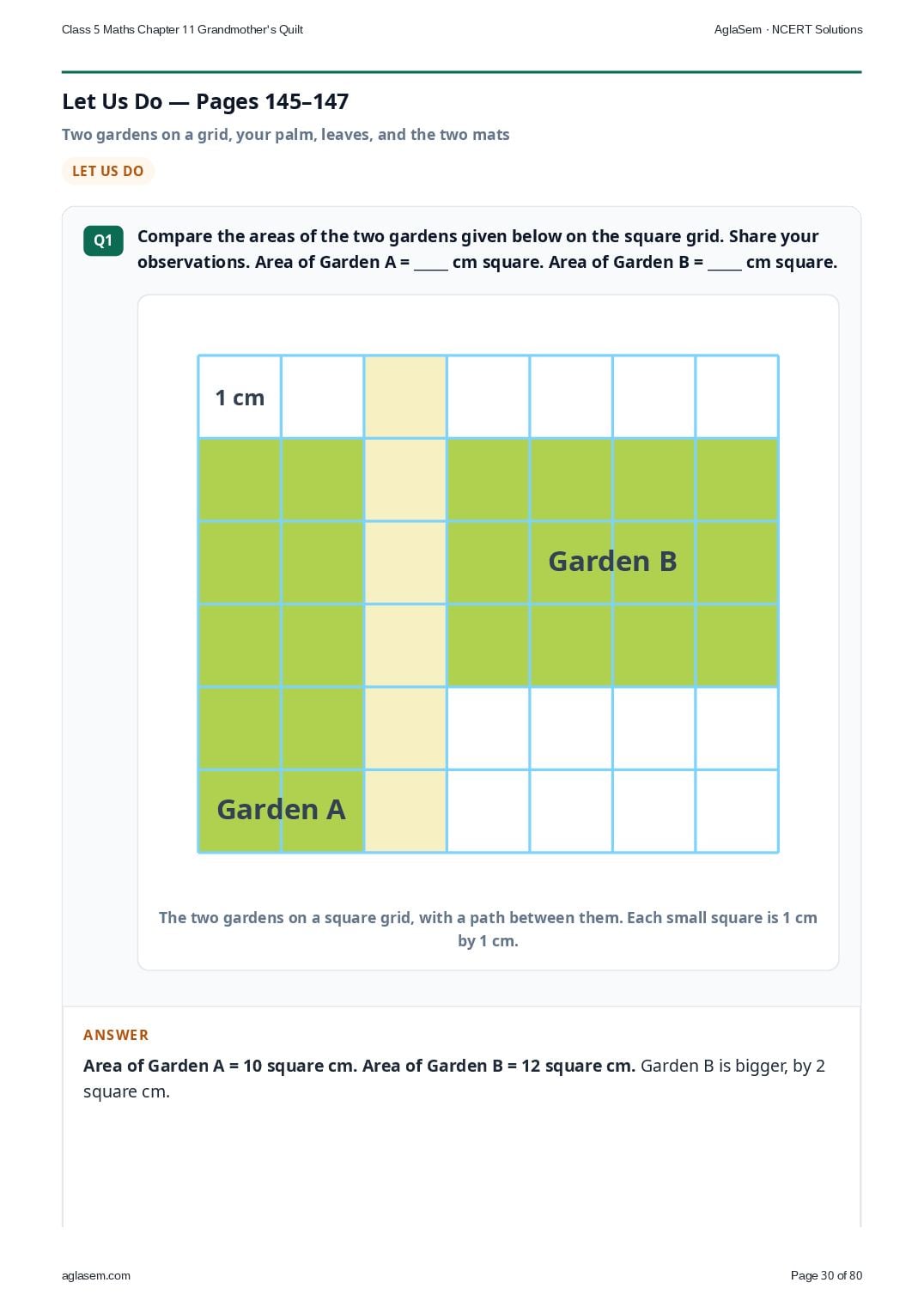
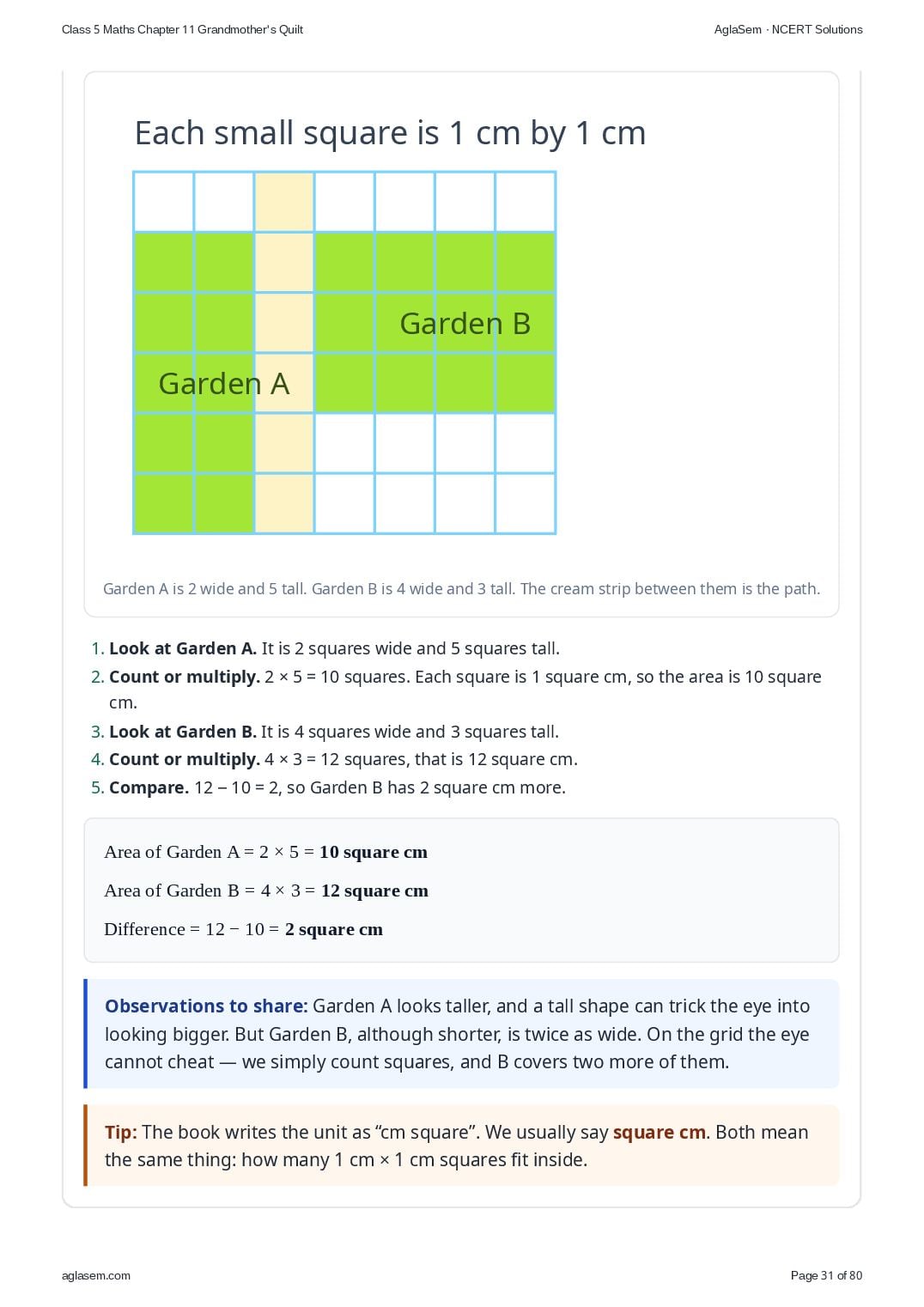
- Compare the areas of the two gardens given below on the square grid. Share your observations. Area of Garden A = _____ cm square. Area of Garden B = _____ cm square. 1 cmGarden AGarden BThe two gardens on a square grid, with a path between them. Each small square is 1 cm by 1 cm.
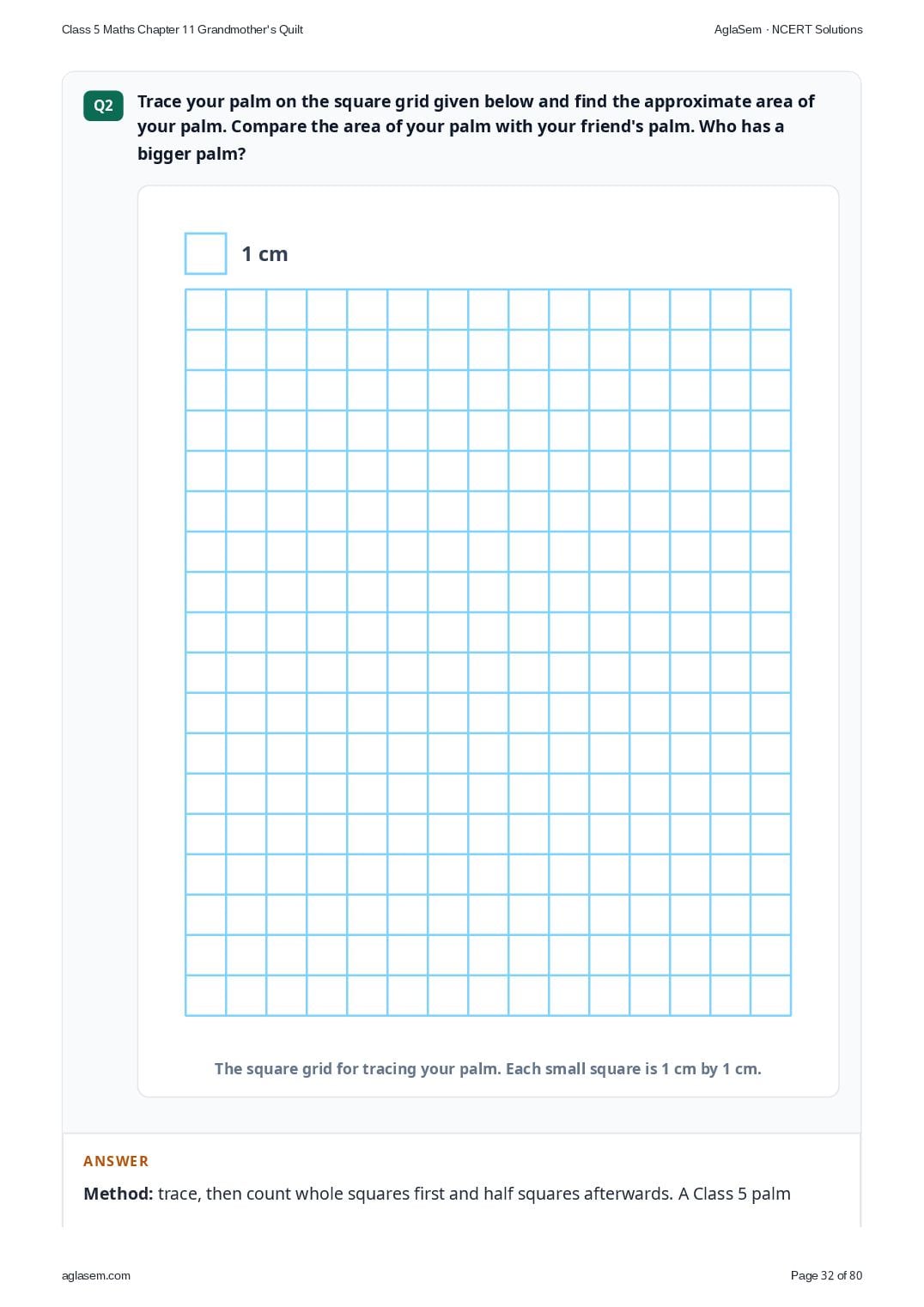
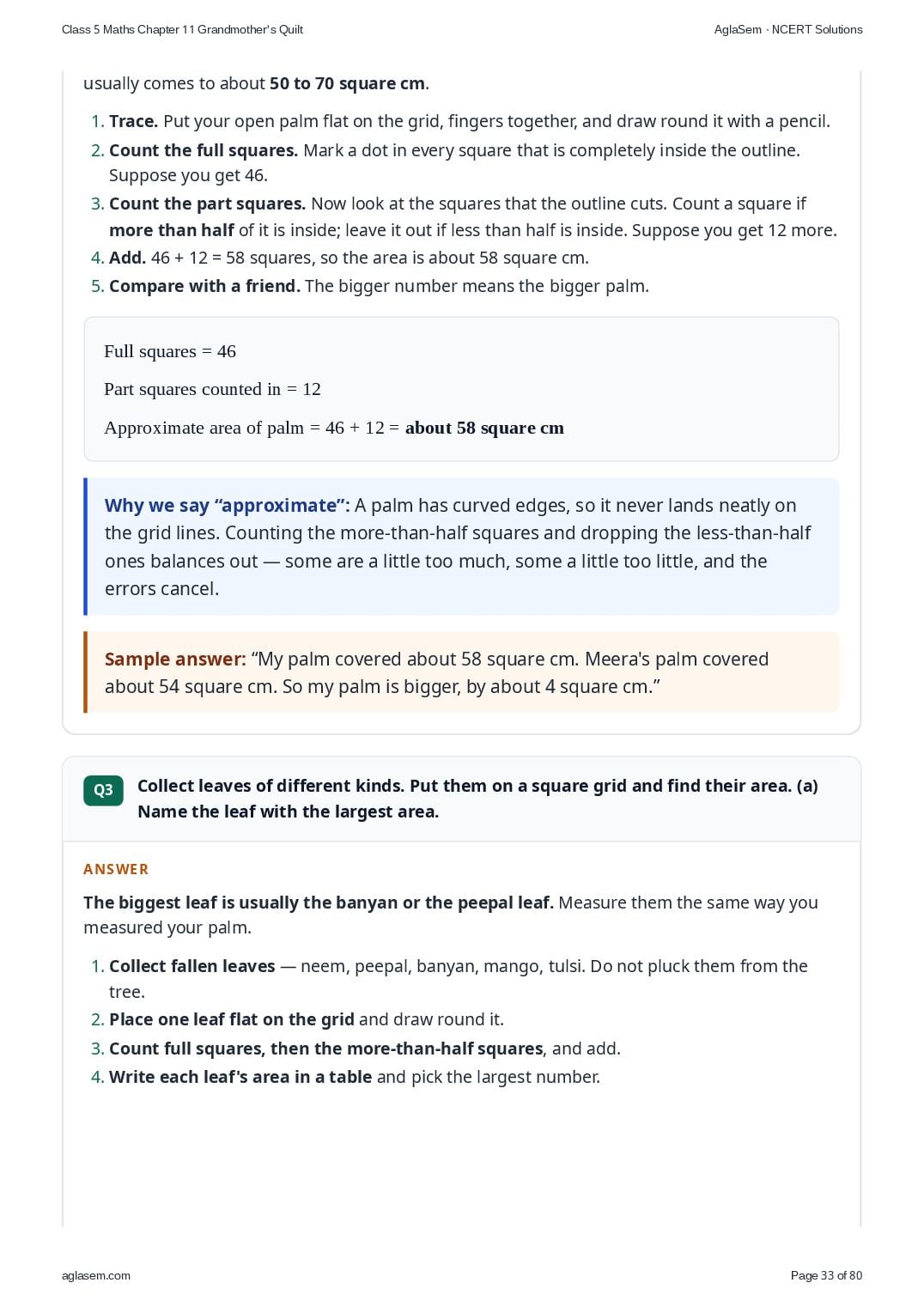
- Trace your palm on the square grid given below and find the approximate area of your palm. Compare the area of your palm with your friend’s palm. Who has a bigger palm? 1 cmThe square grid for tracing your palm. Each small square is 1 cm by 1 cm.
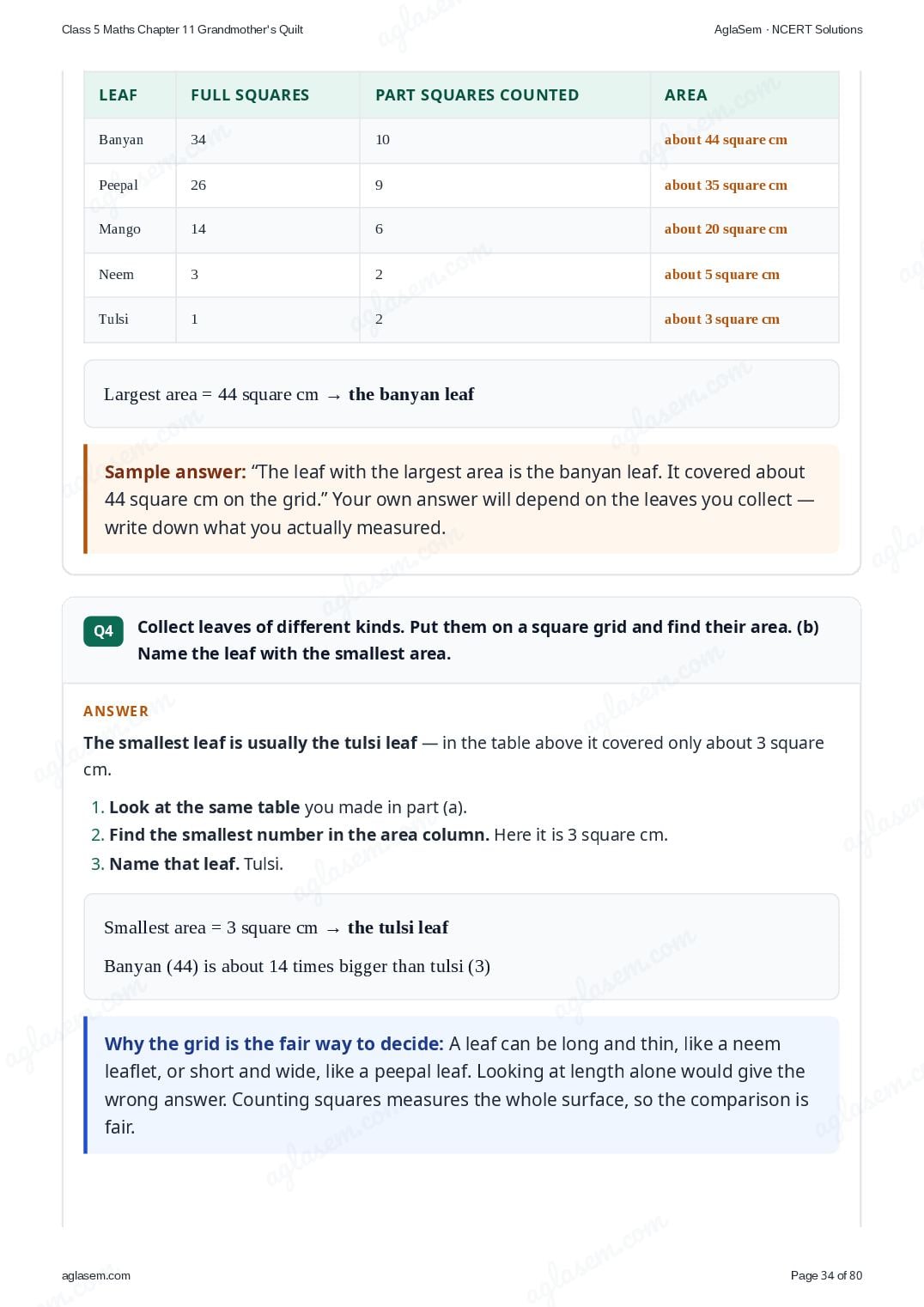
- Collect leaves of different kinds. Put them on a square grid and find their area. (a) Name the leaf with the largest area.
- Collect leaves of different kinds. Put them on a square grid and find their area. (b) Name the leaf with the smallest area.
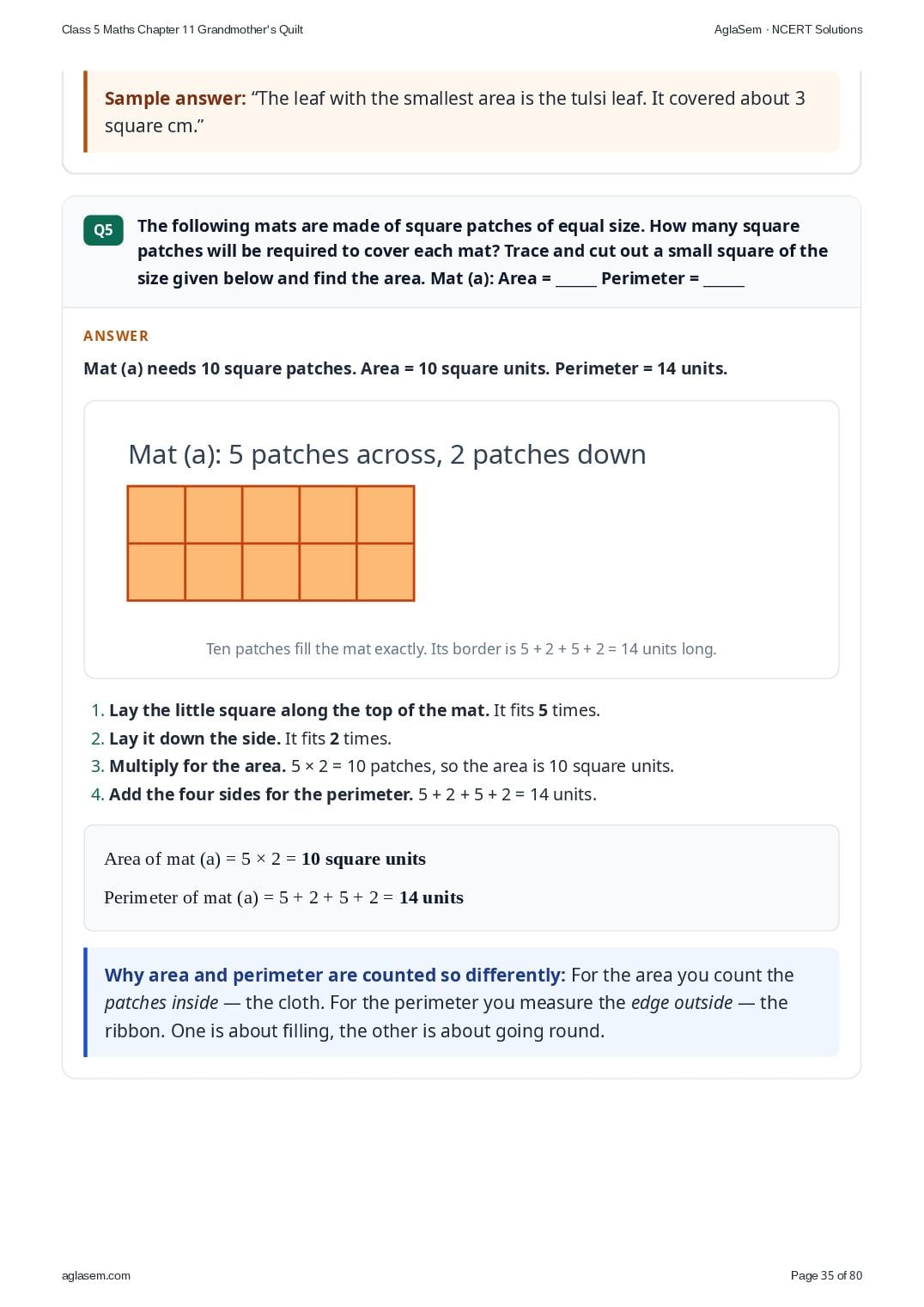
- The following mats are made of square patches of equal size. How many square patches will be required to cover each mat? Trace and cut out a small square of the size given below and find the area. Mat (a): Area = ______ Perimeter = ______
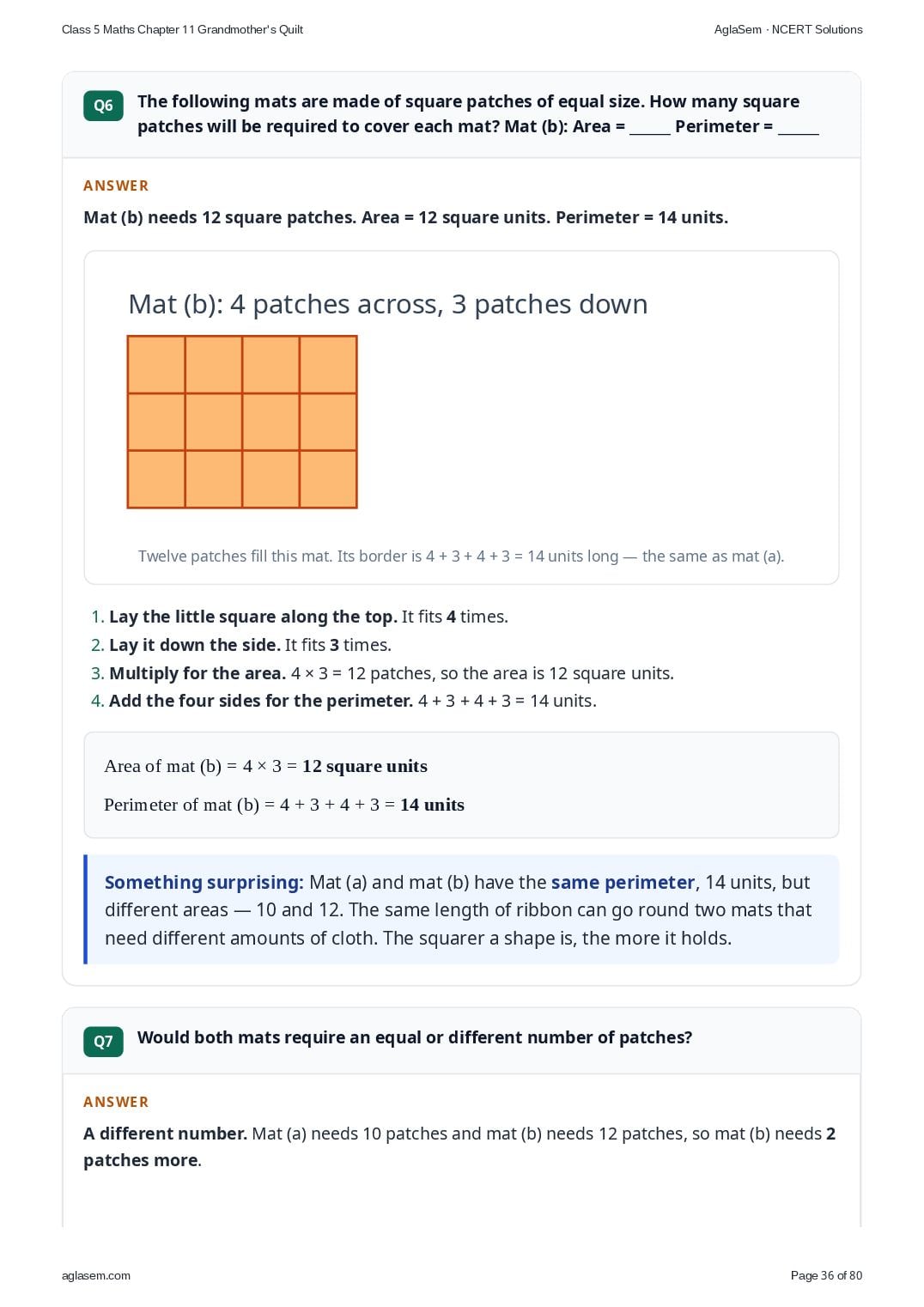
- The following mats are made of square patches of equal size. How many square patches will be required to cover each mat? Mat (b): Area = ______ Perimeter = ______
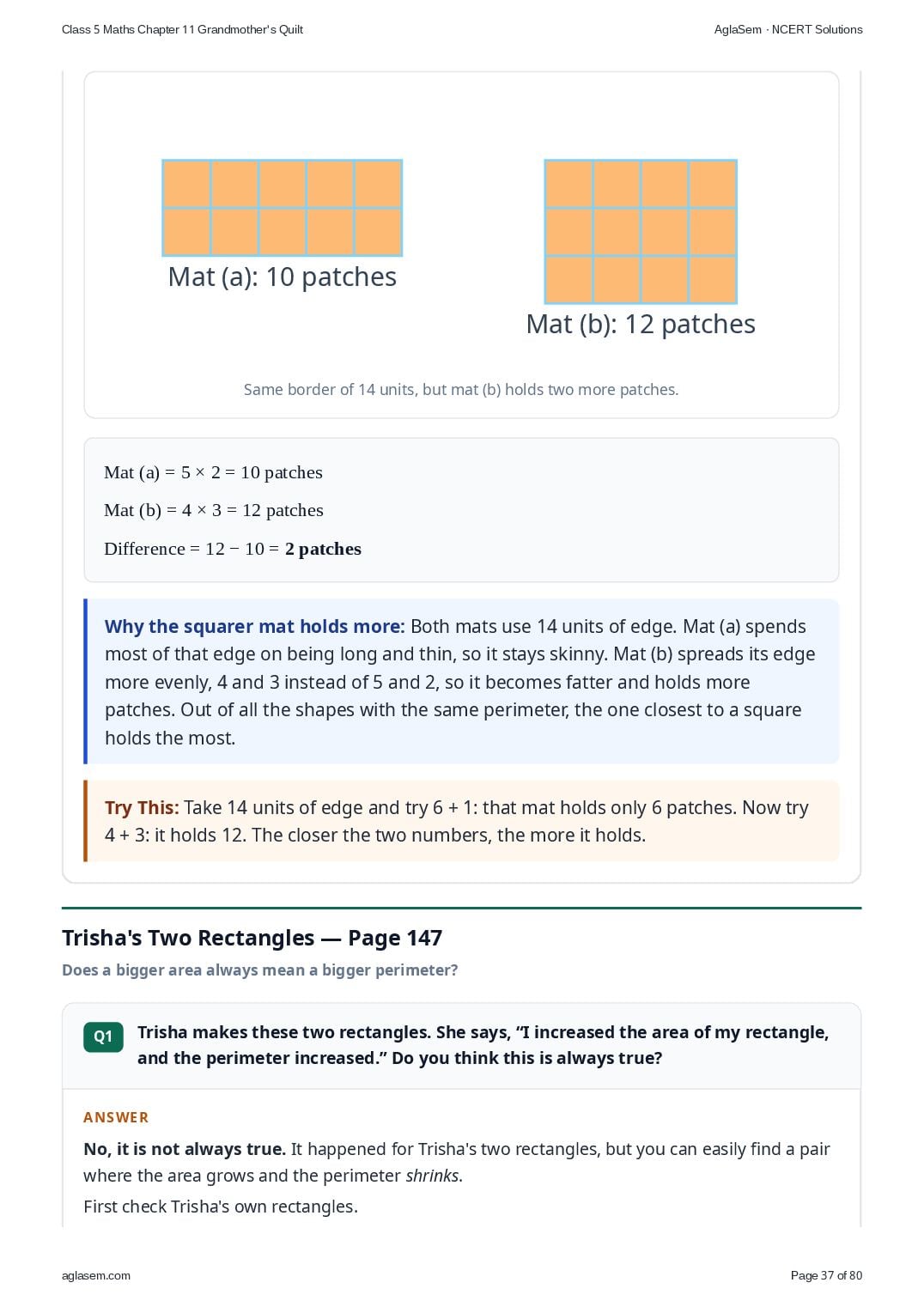
- Would both mats require an equal or different number of patches?
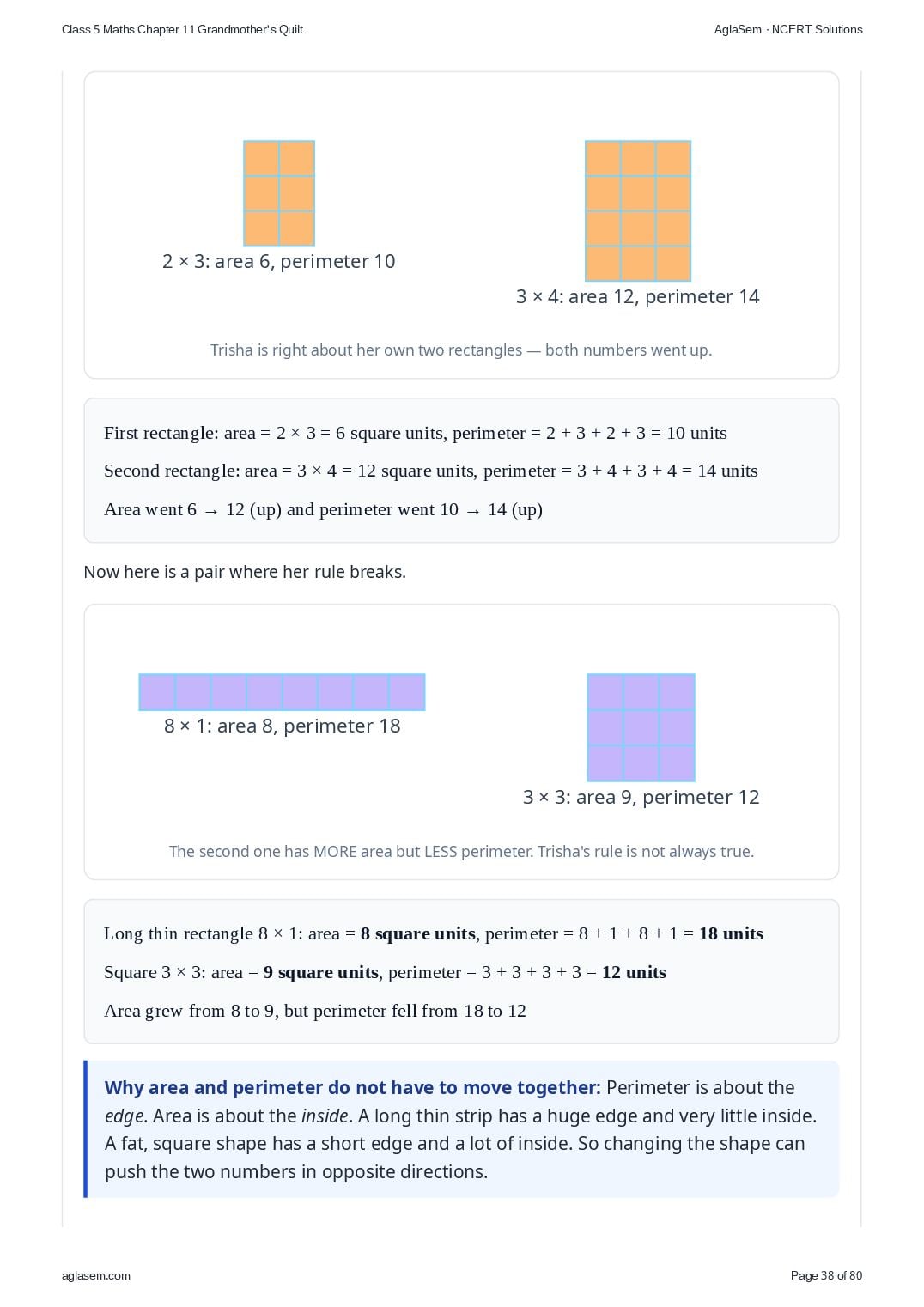
- Trisha makes these two rectangles. She says, “I increased the area of my rectangle, and the perimeter increased.” Do you think this is always true?
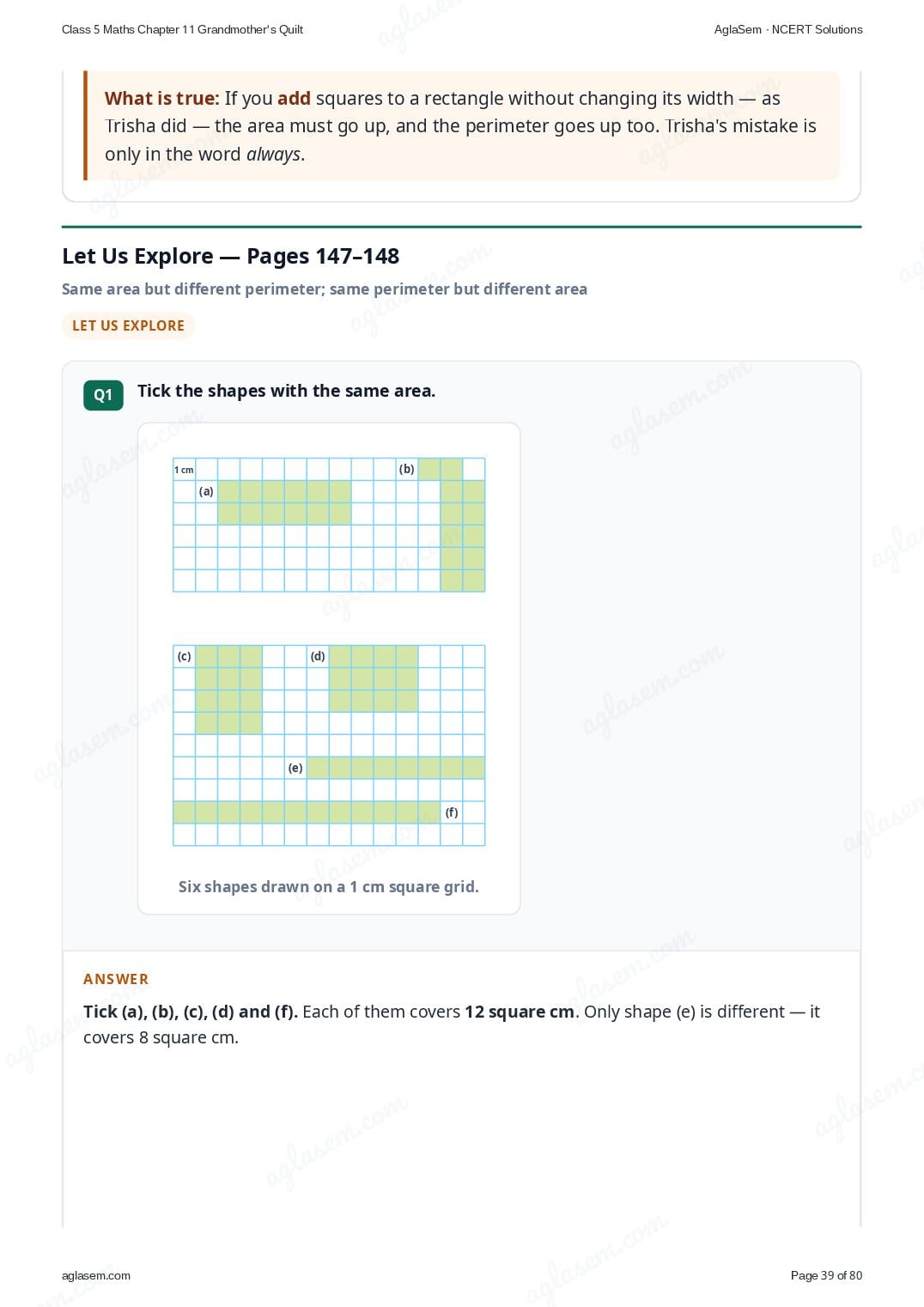
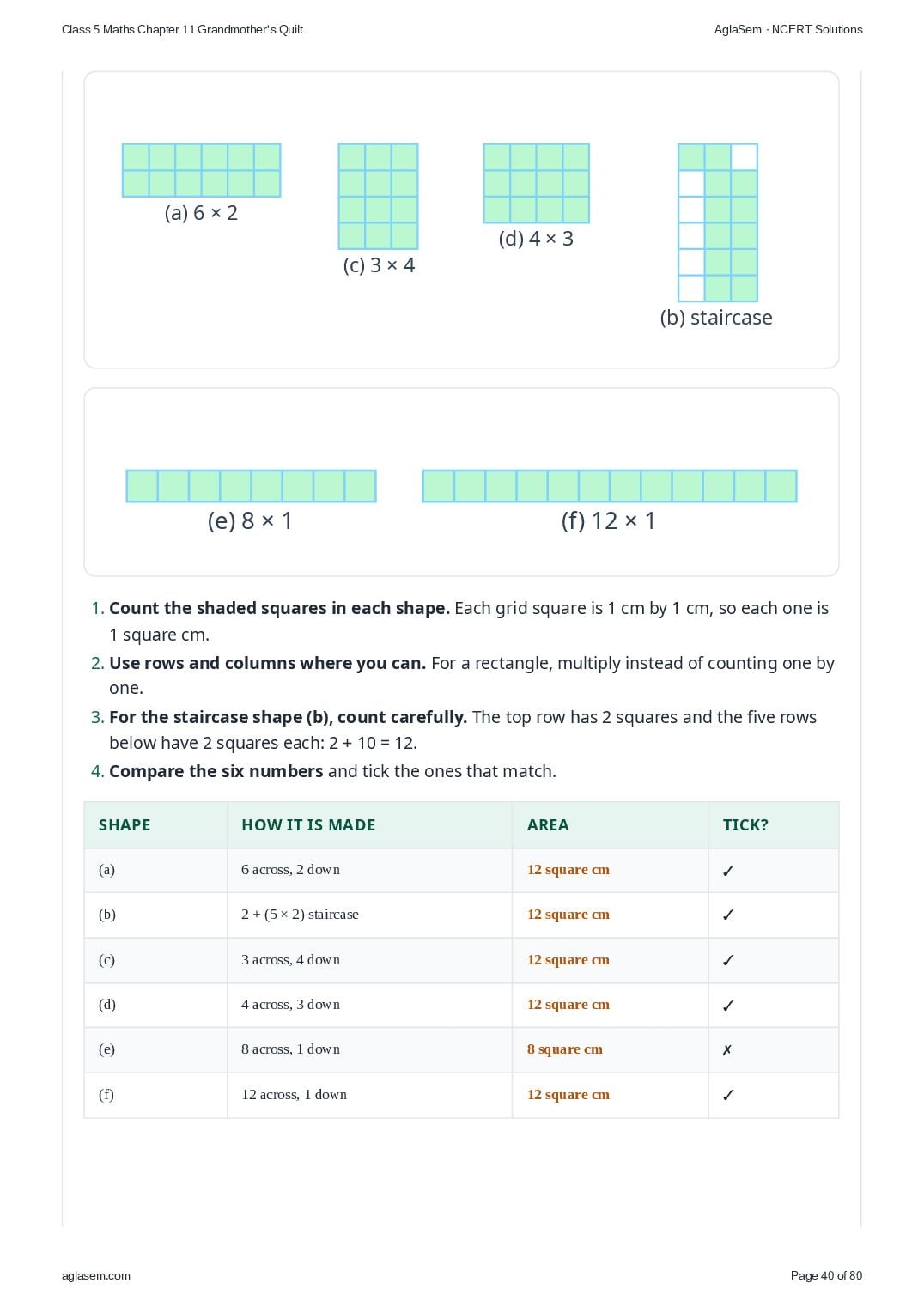
- Tick the shapes with the same area. 1 cm(a)(b)(c)(d)(e)(f)Six shapes drawn on a 1 cm square grid.
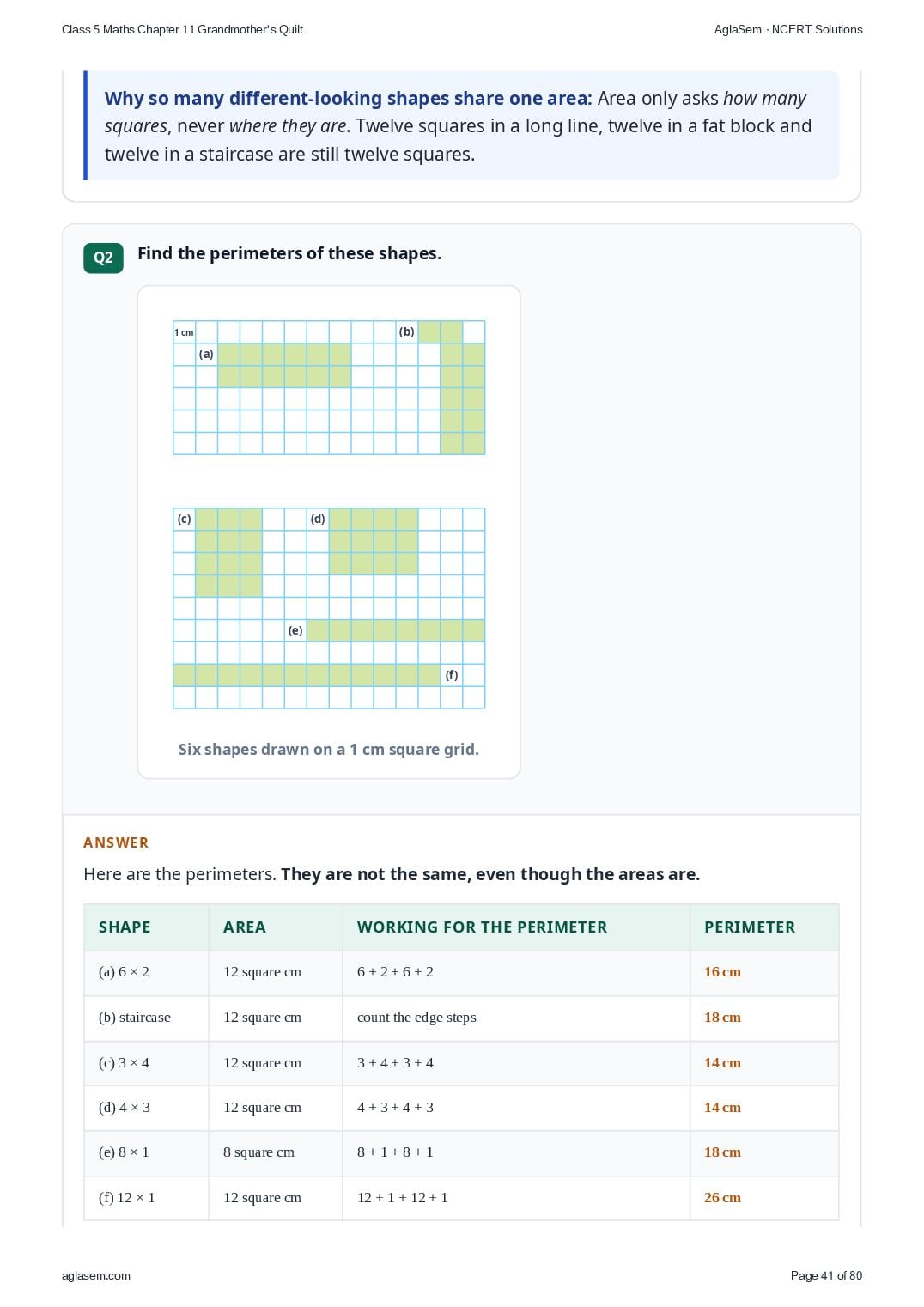
- Find the perimeters of these shapes. 1 cm(a)(b)(c)(d)(e)(f)Six shapes drawn on a 1 cm square grid.
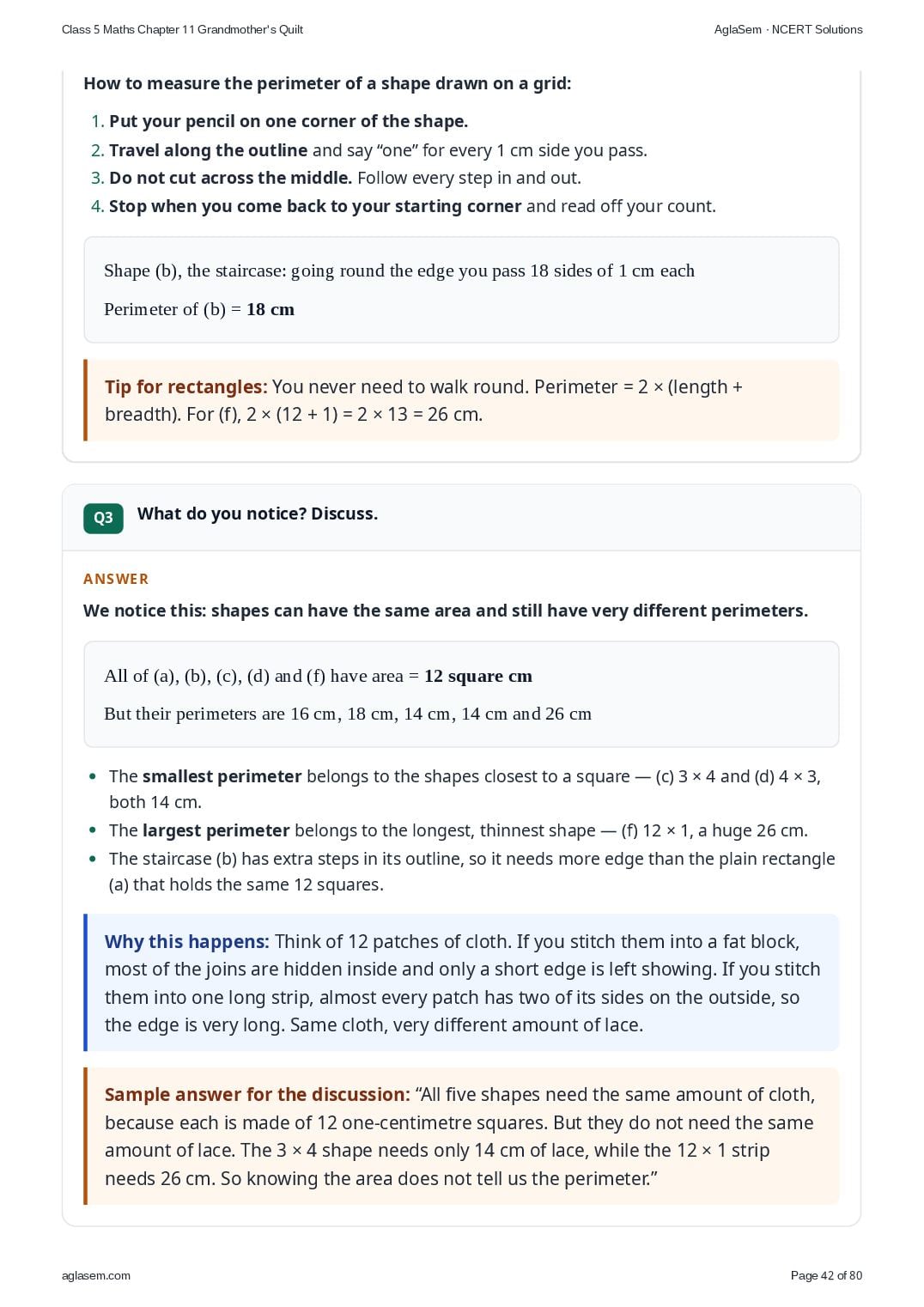
- What do you notice? Discuss.
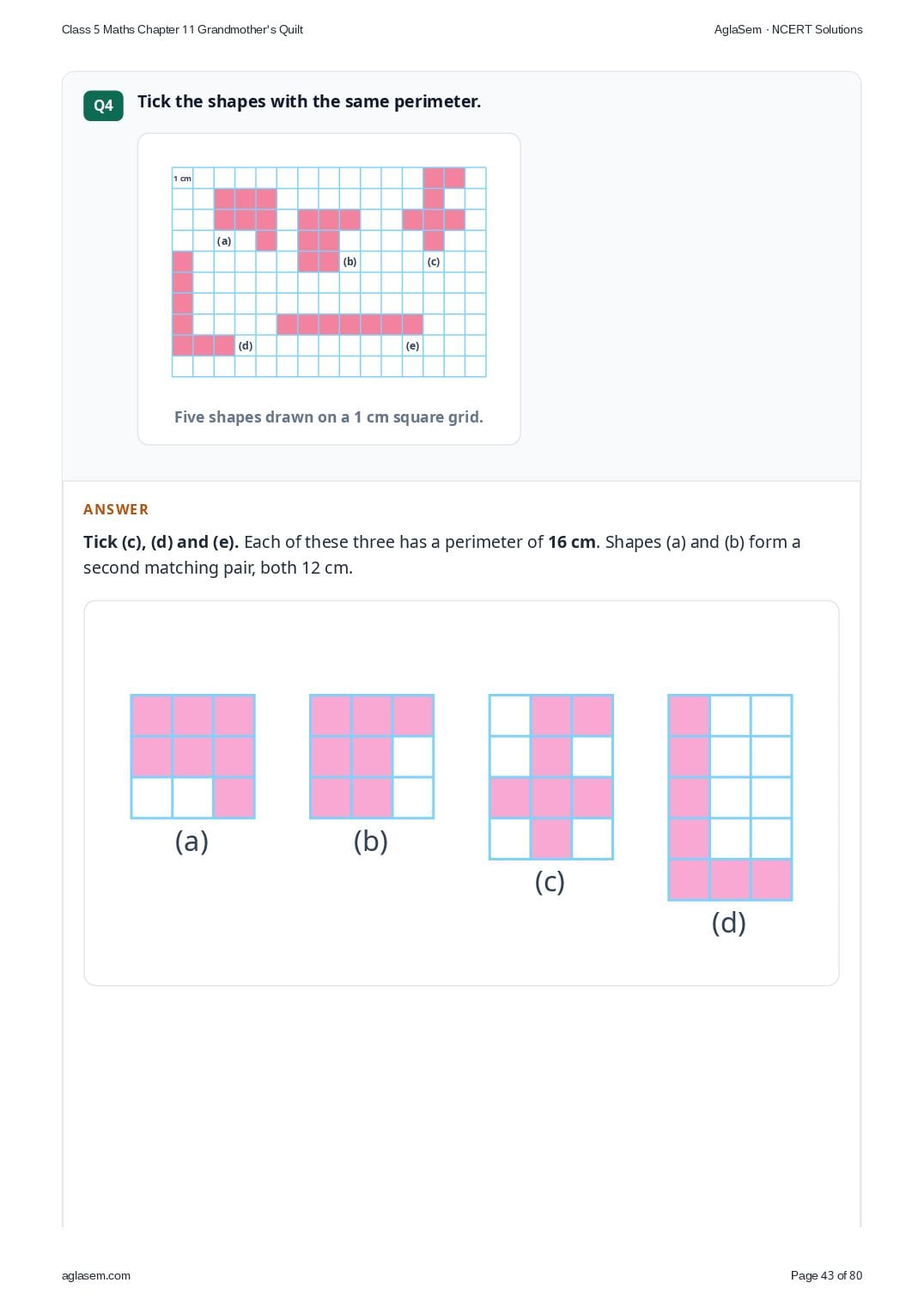
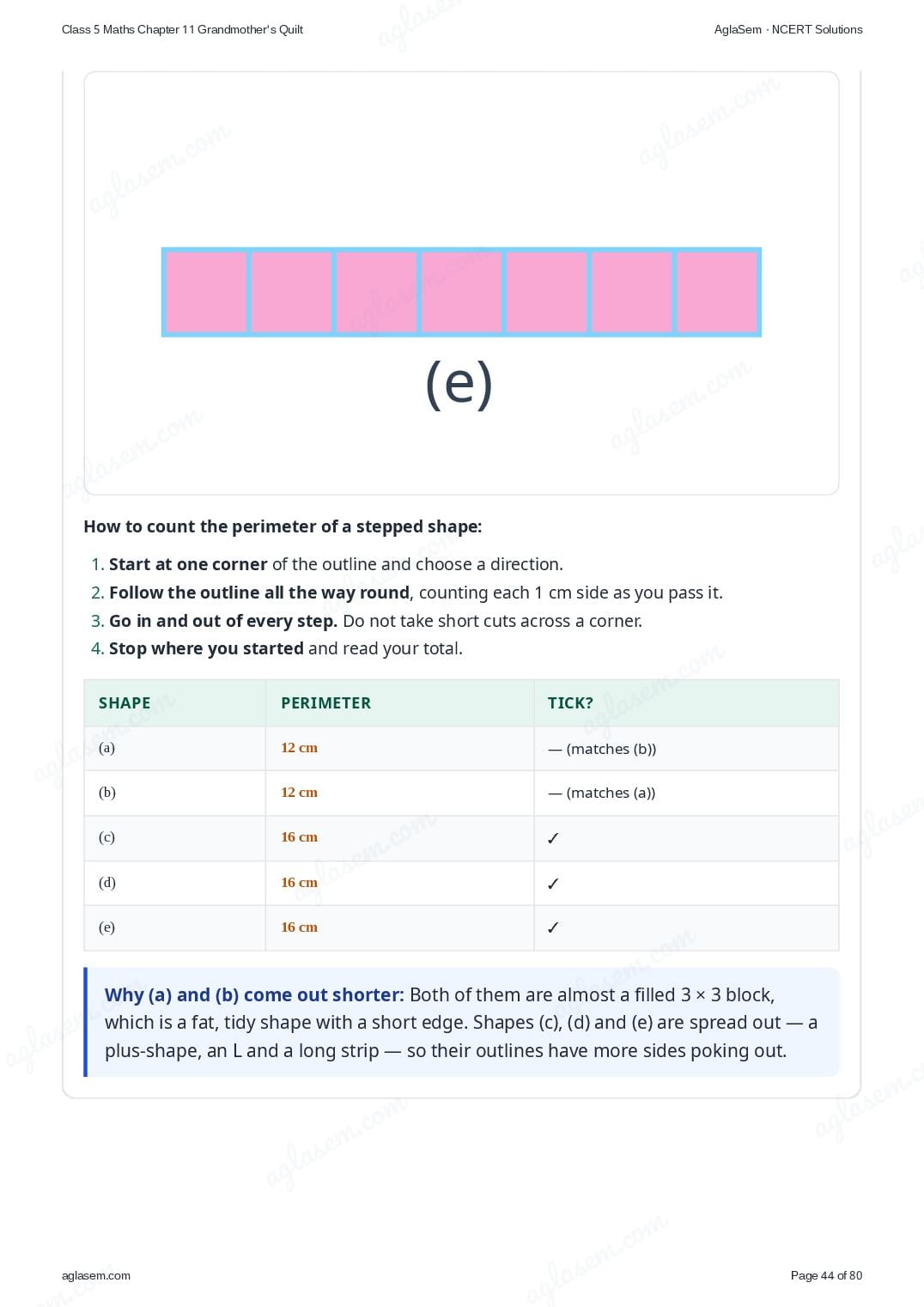
- Tick the shapes with the same perimeter. 1 cm(a)(b)(c)(d)(e)Five shapes drawn on a 1 cm square grid.
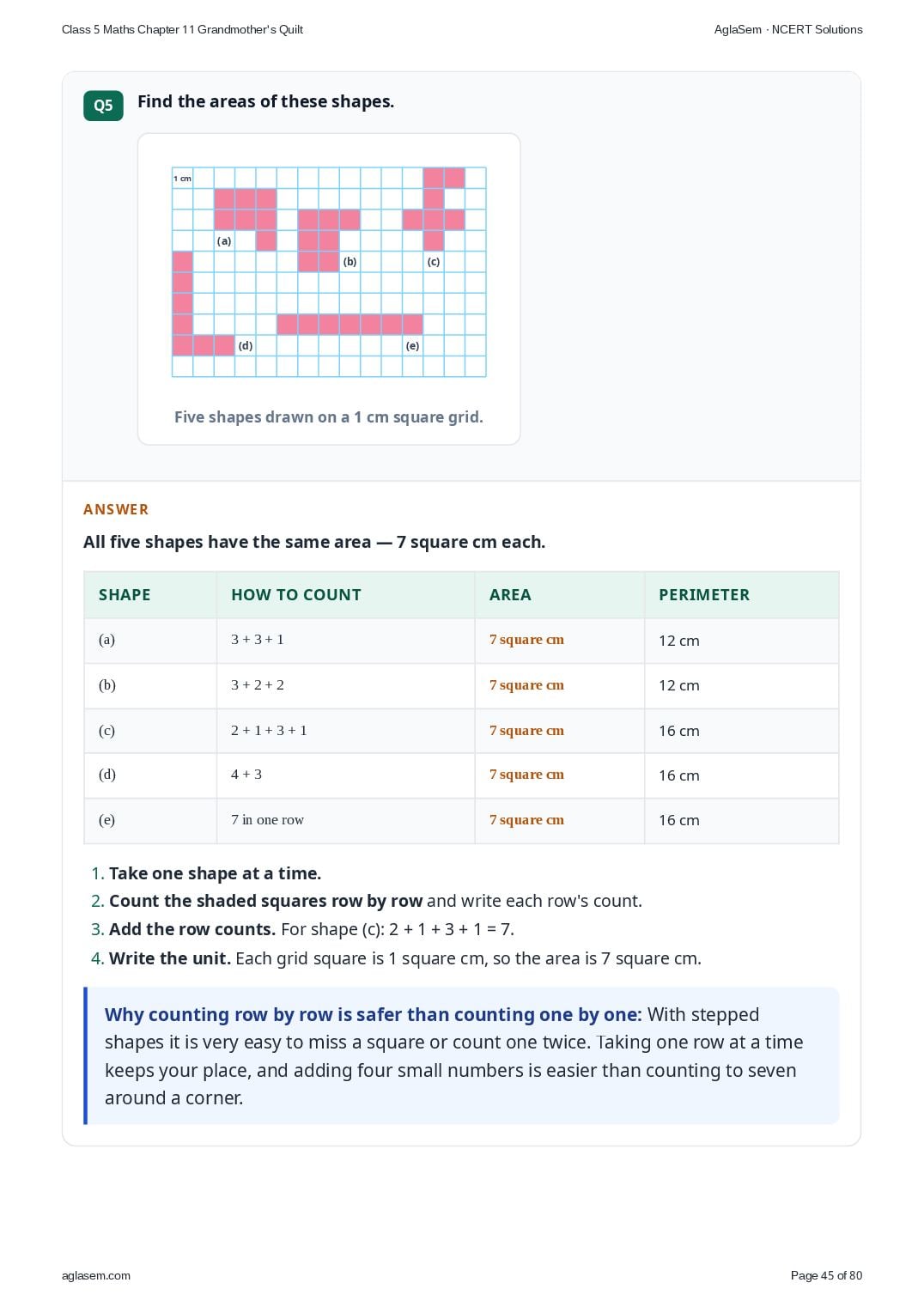
- Find the areas of these shapes. 1 cm(a)(b)(c)(d)(e)Five shapes drawn on a 1 cm square grid.
- What do you notice? Discuss.
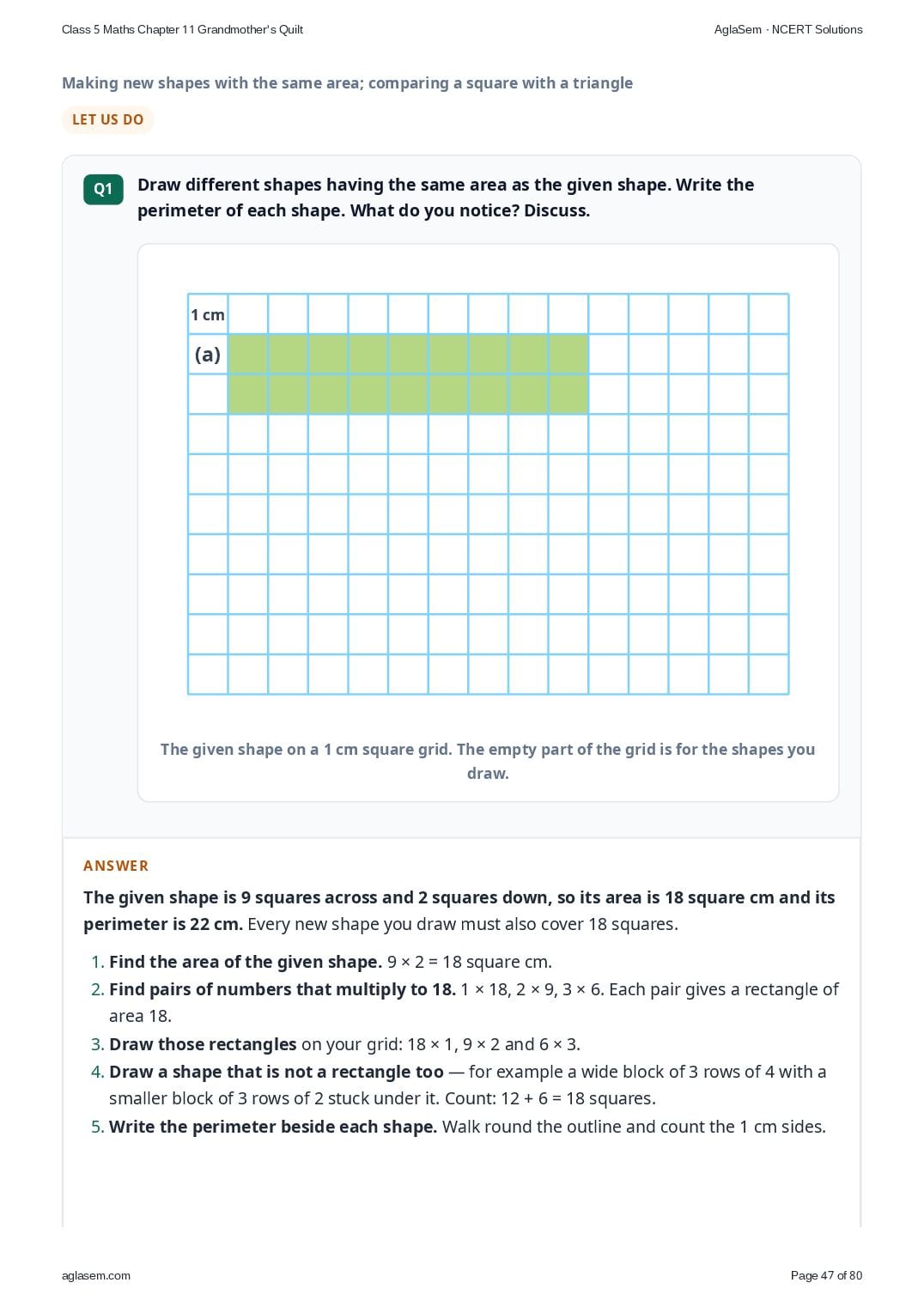
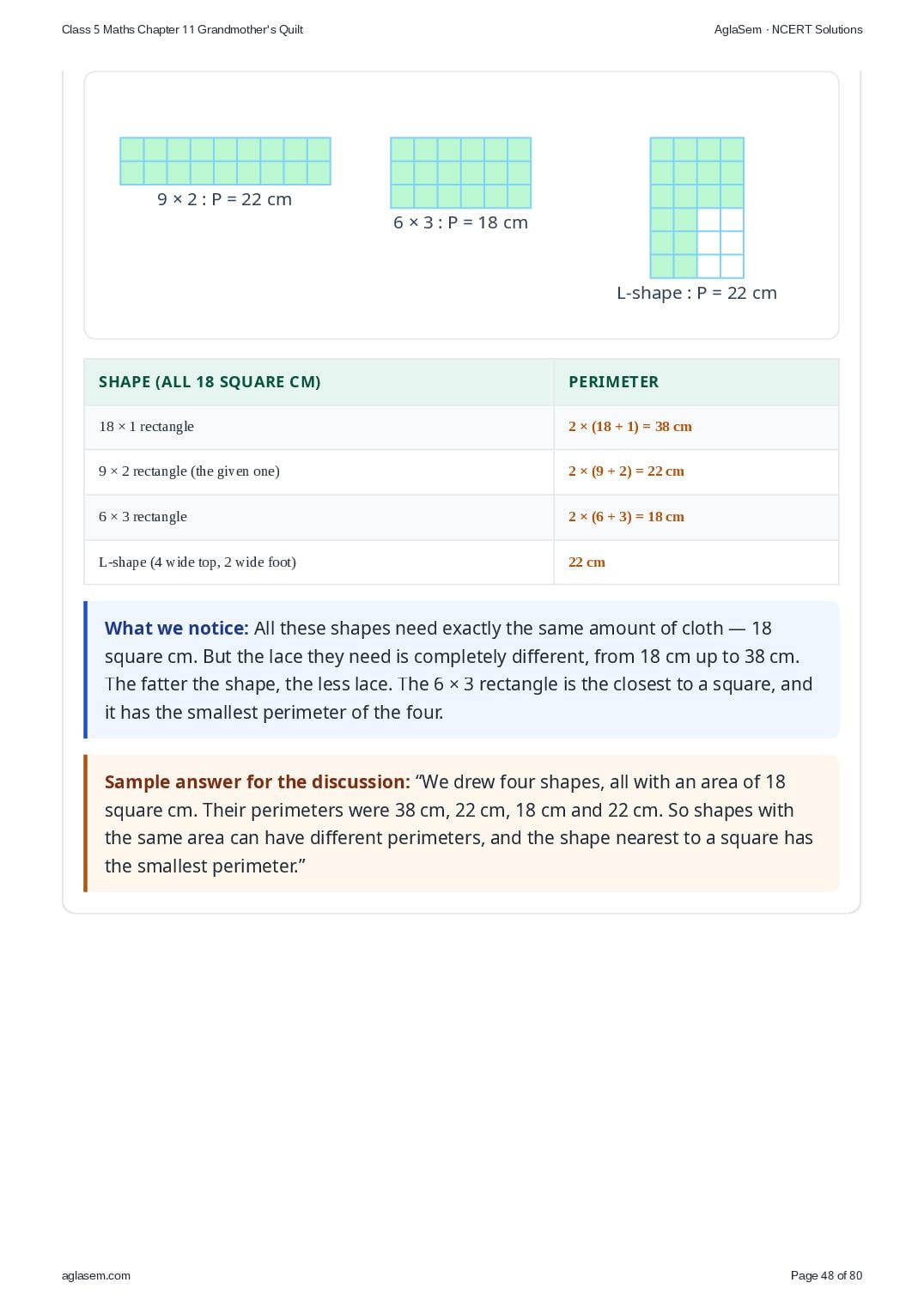
- Draw different shapes having the same area as the given shape. Write the perimeter of each shape. What do you notice? Discuss. 1 cm(a)The given shape on a 1 cm square grid. The empty part of the grid is for the shapes you draw.
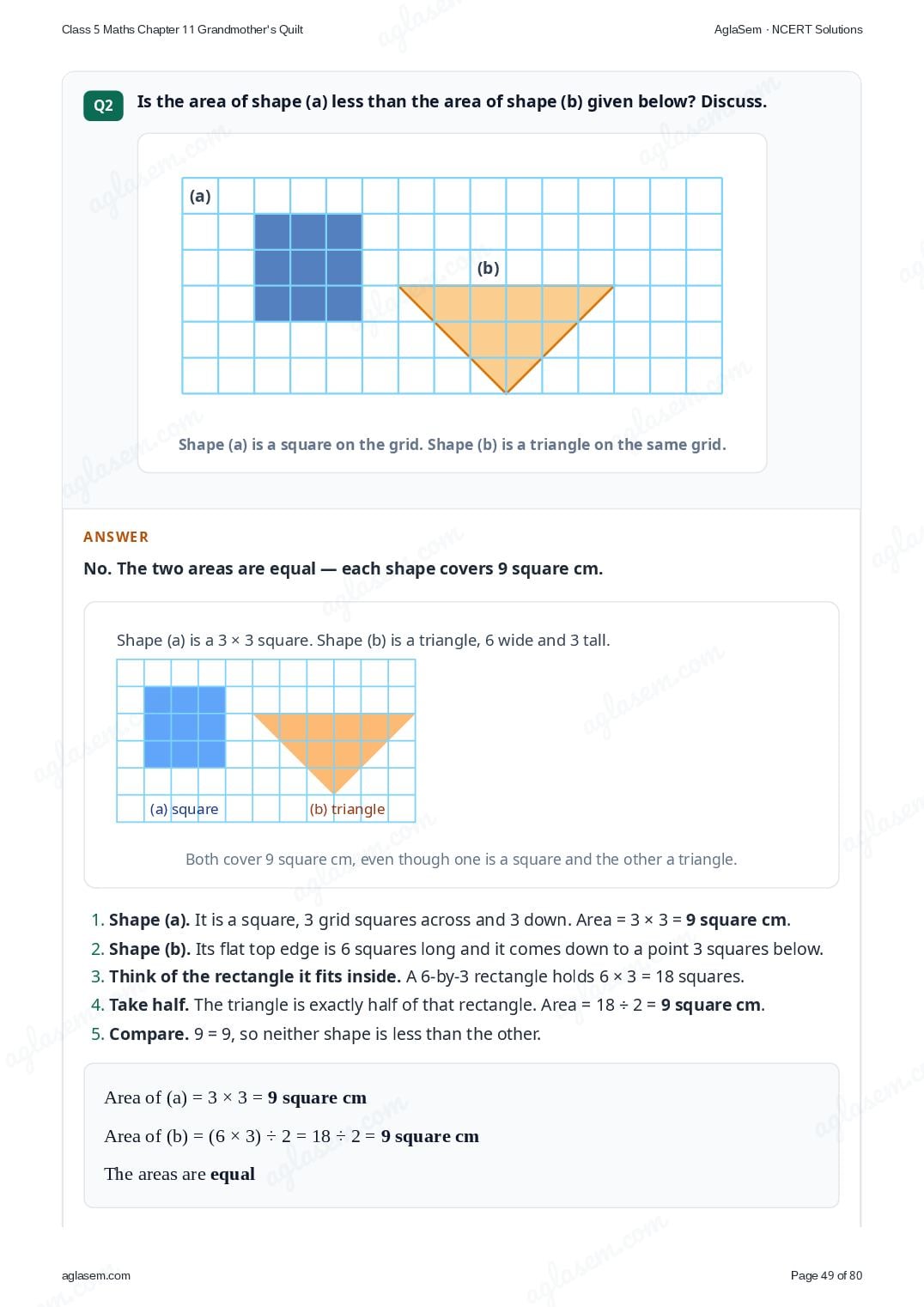
- Is the area of shape (a) less than the area of shape (b) given below? Discuss. (a)(b)Shape (a) is a square on the grid. Shape (b) is a triangle on the same grid.
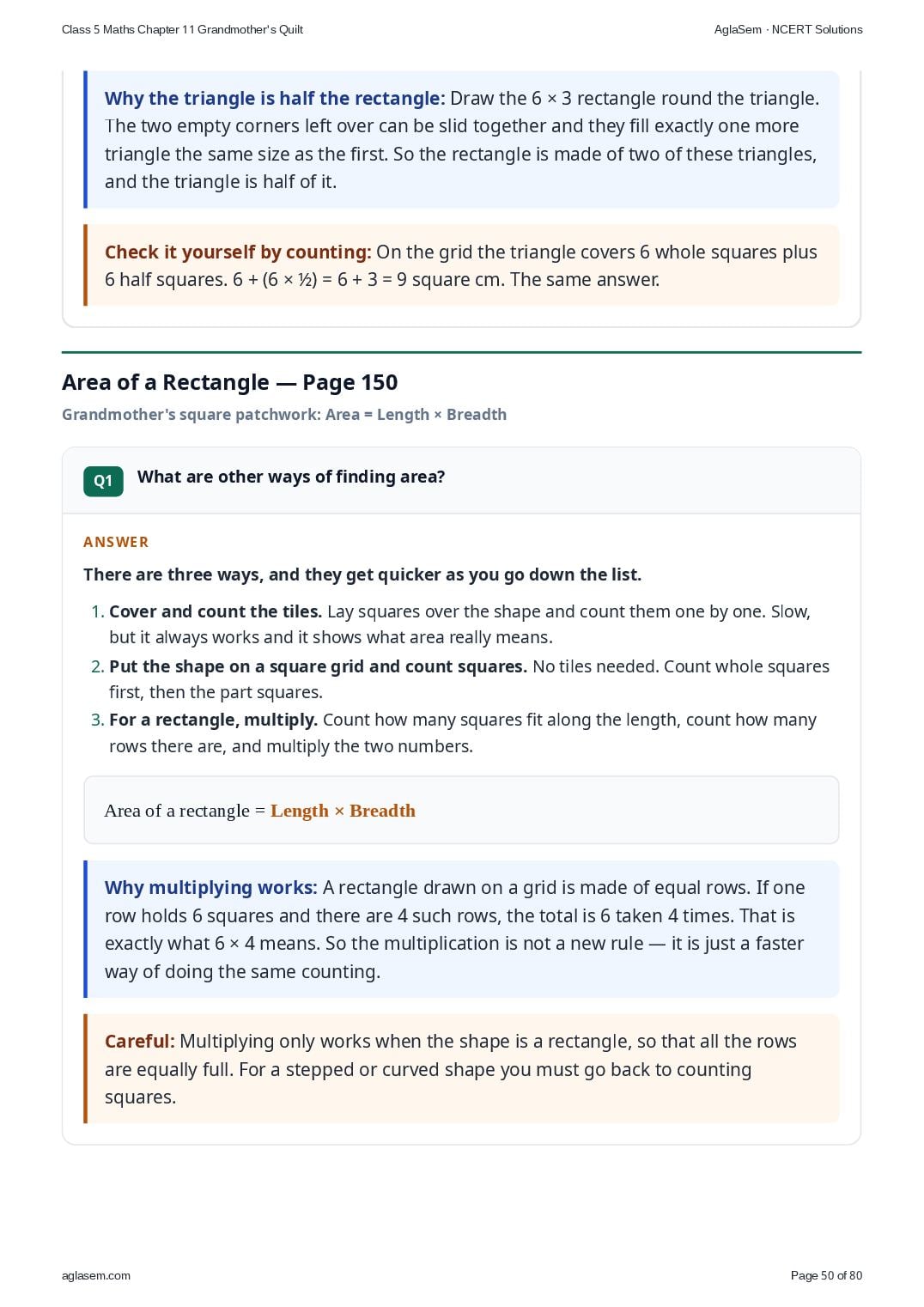
- What are other ways of finding area?
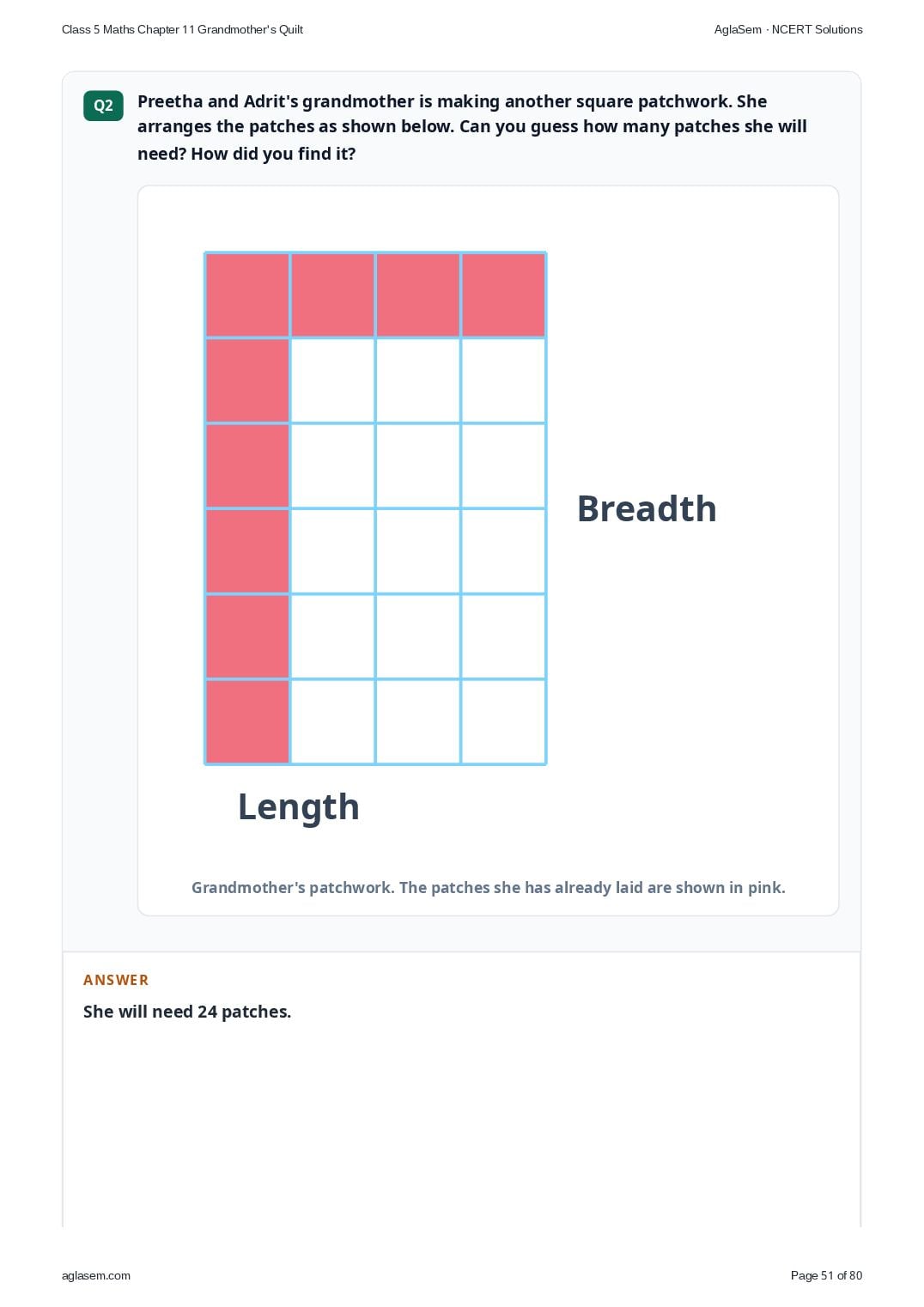
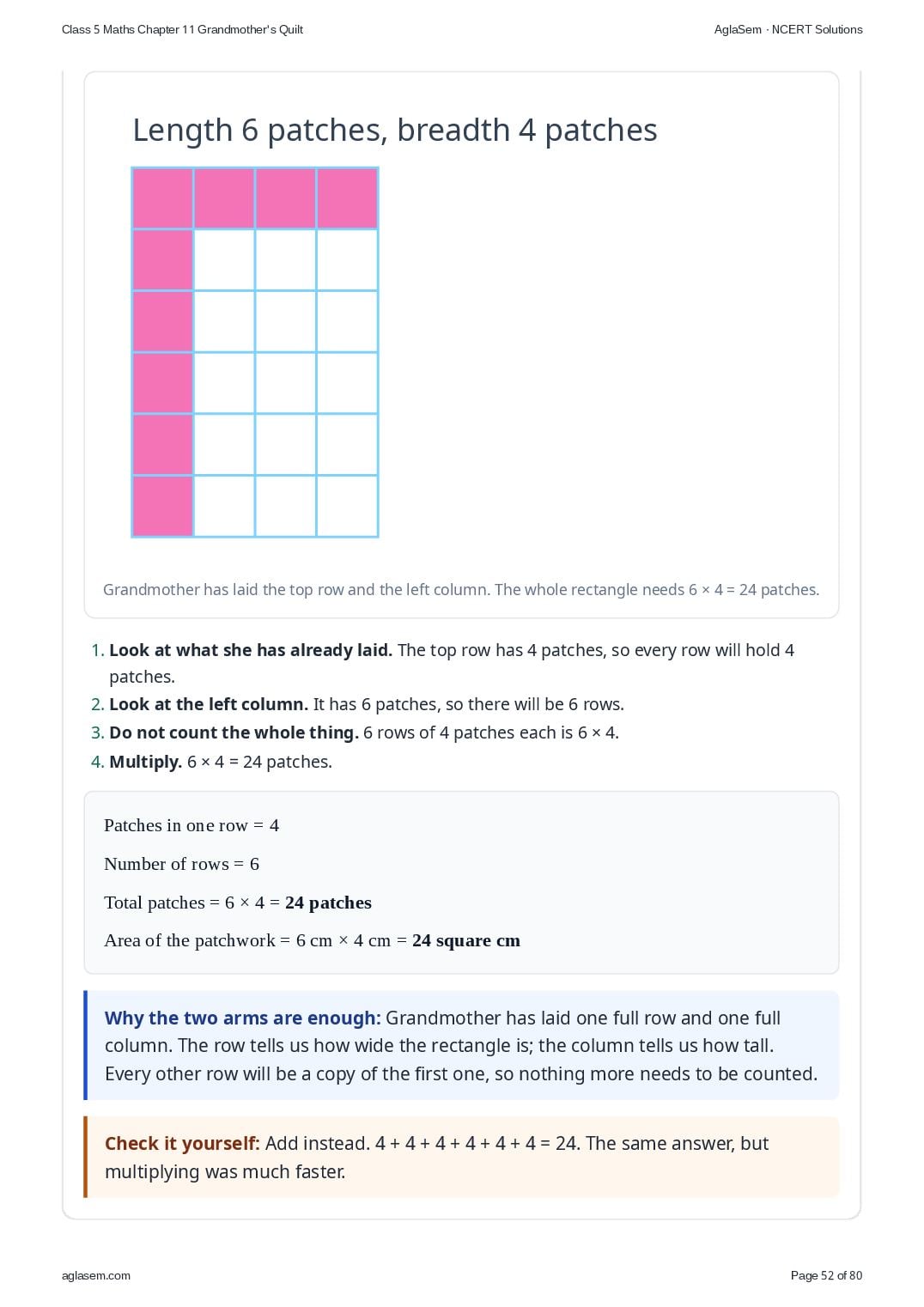
- Preetha and Adrit’s grandmother is making another square patchwork. She arranges the patches as shown below. Can you guess how many patches she will need? How did you find it? BreadthLengthGrandmother’s patchwork. The patches she has already laid are shown in pink.
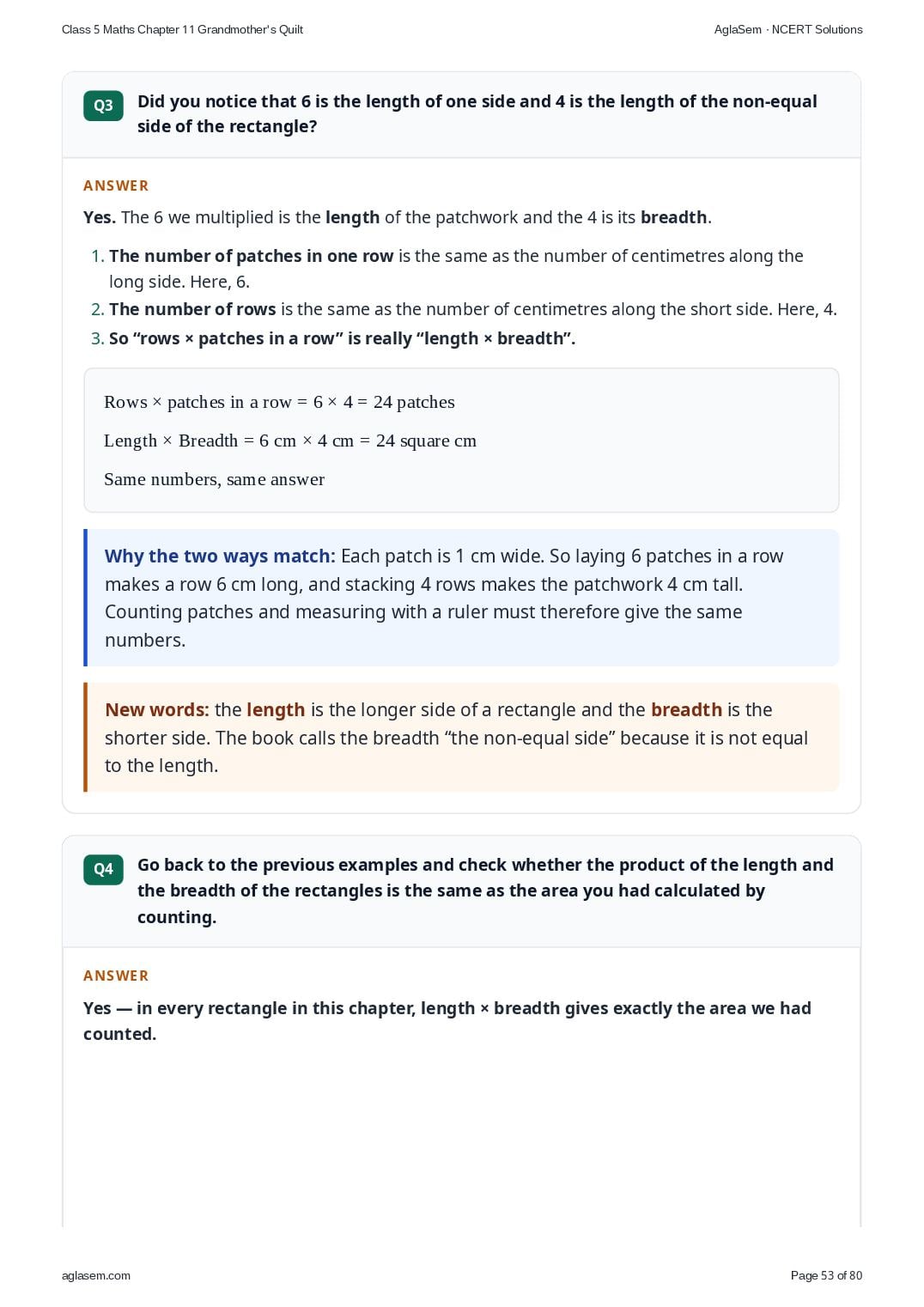
- Did you notice that 6 is the length of one side and 4 is the length of the non-equal side of the rectangle?
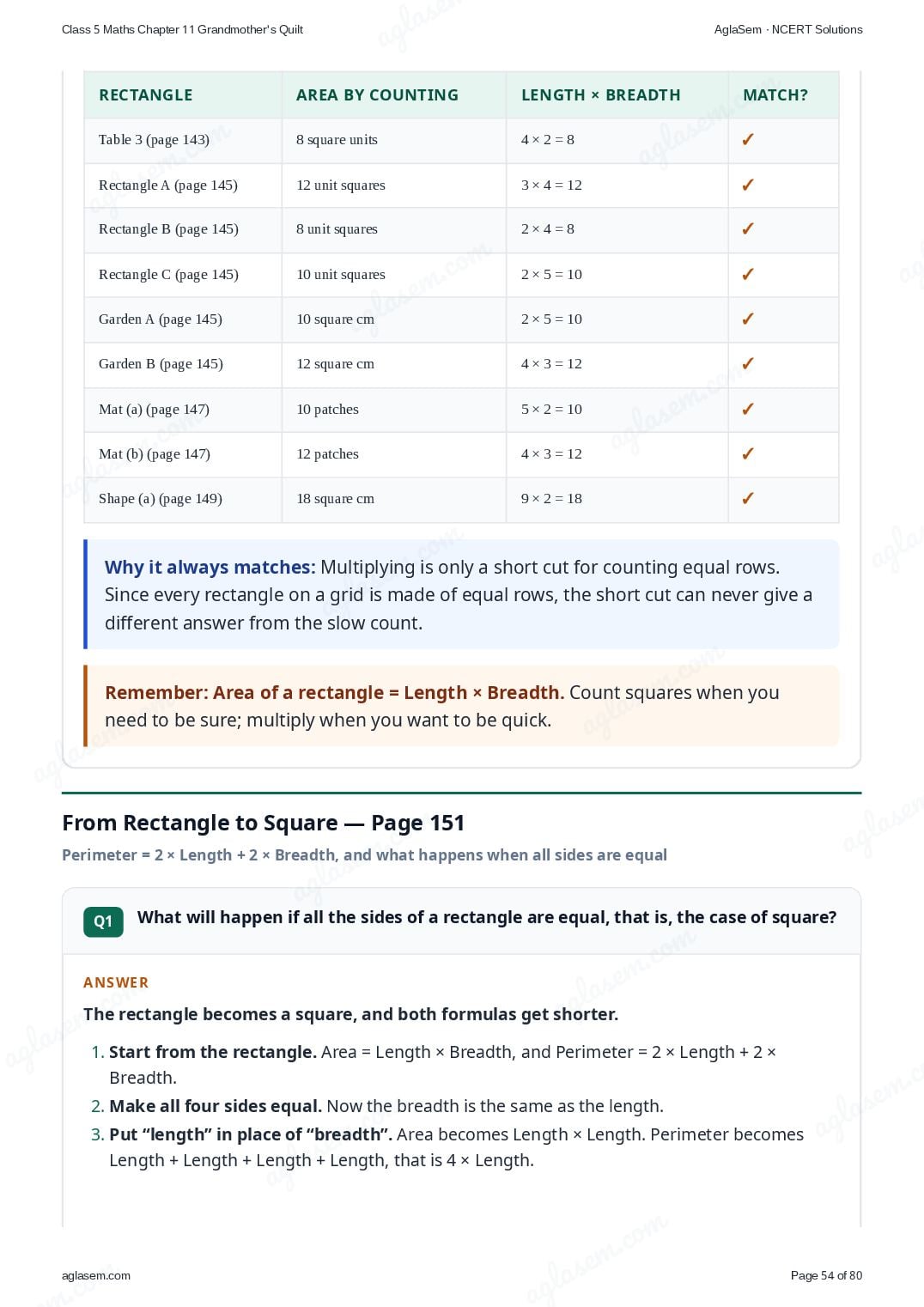
- Go back to the previous examples and check whether the product of the length and the breadth of the rectangles is the same as the area you had calculated by counting.
- What will happen if all the sides of a rectangle are equal, that is, the case of square?
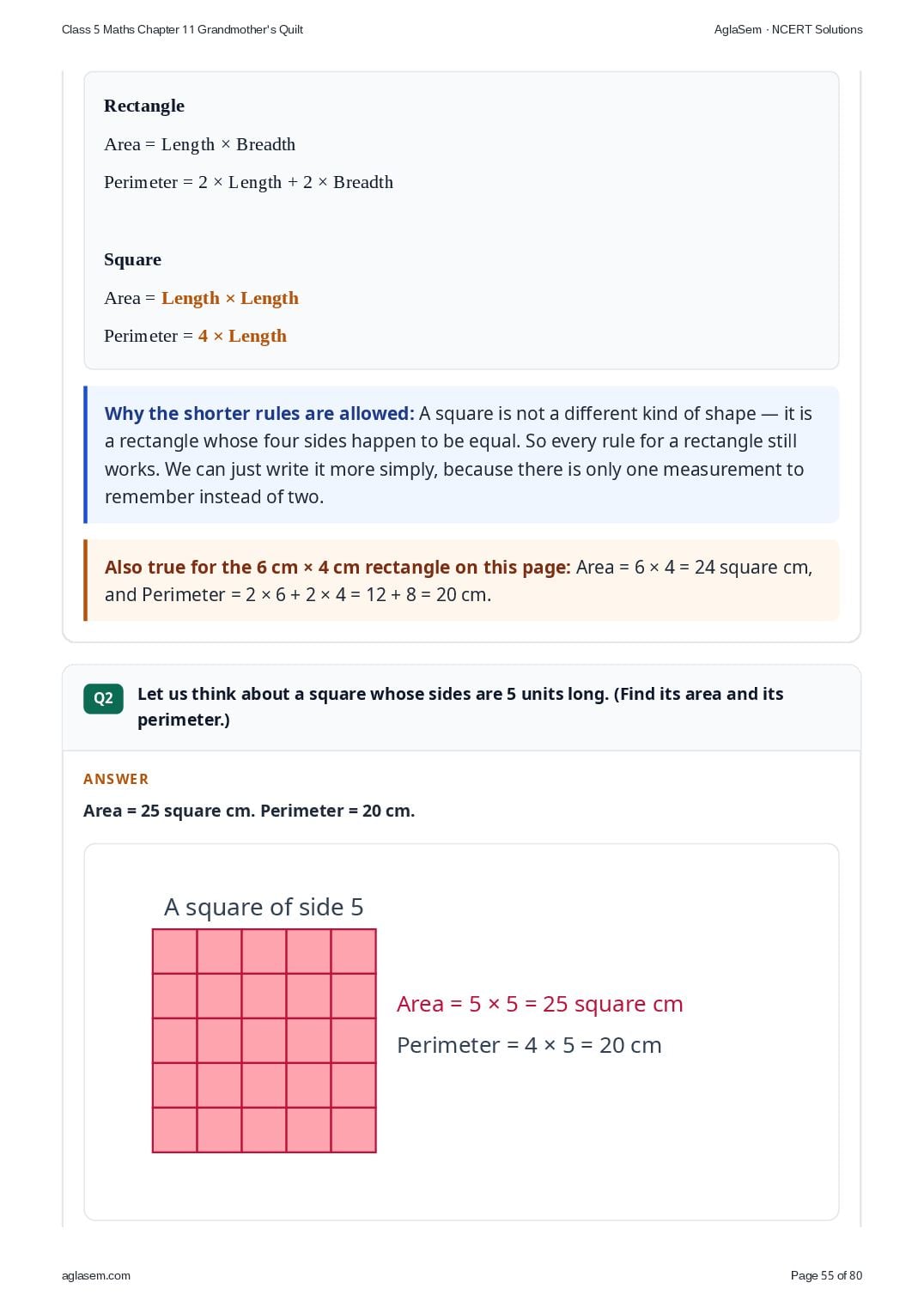
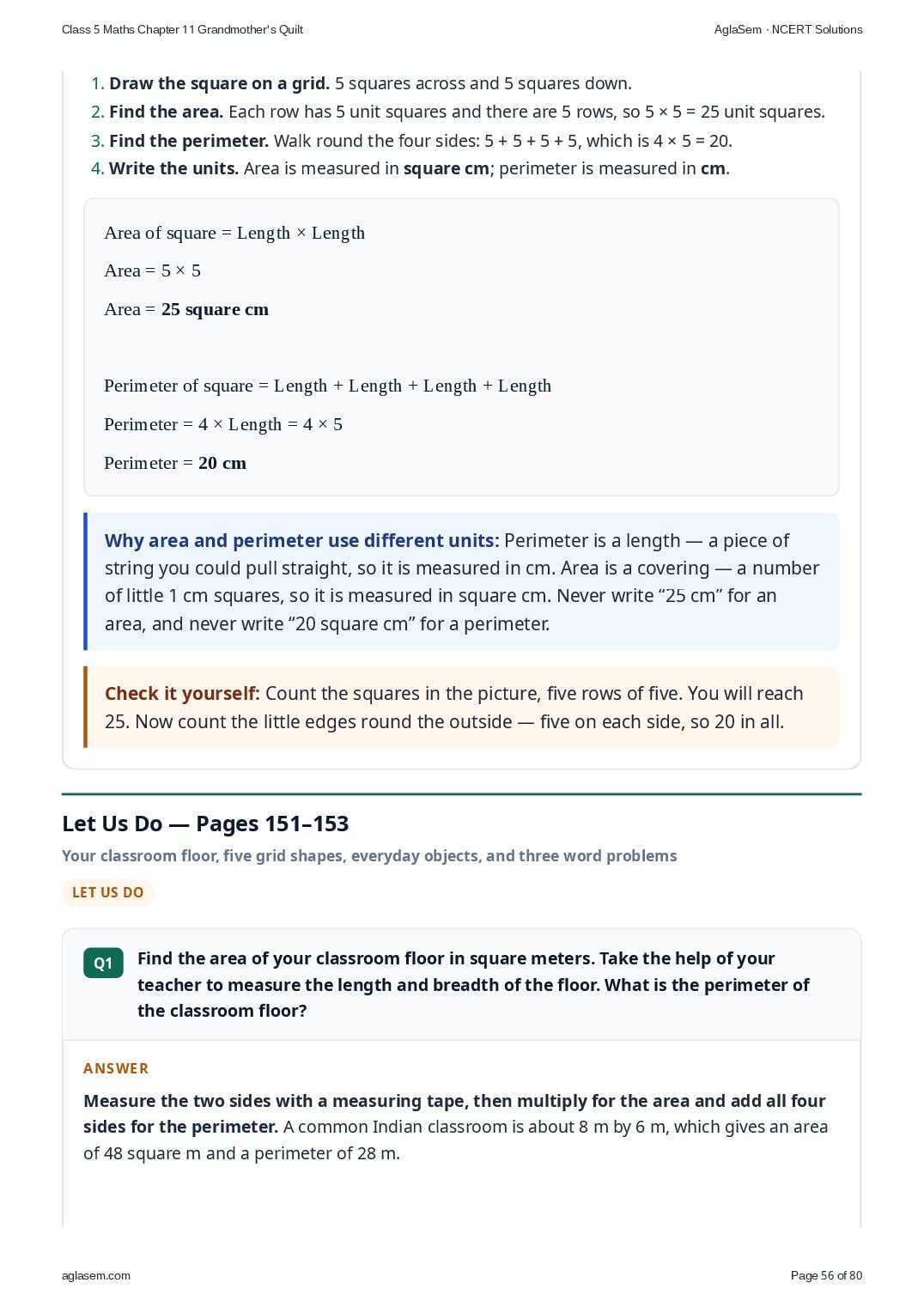
- Let us think about a square whose sides are 5 units long. (Find its area and its perimeter.)
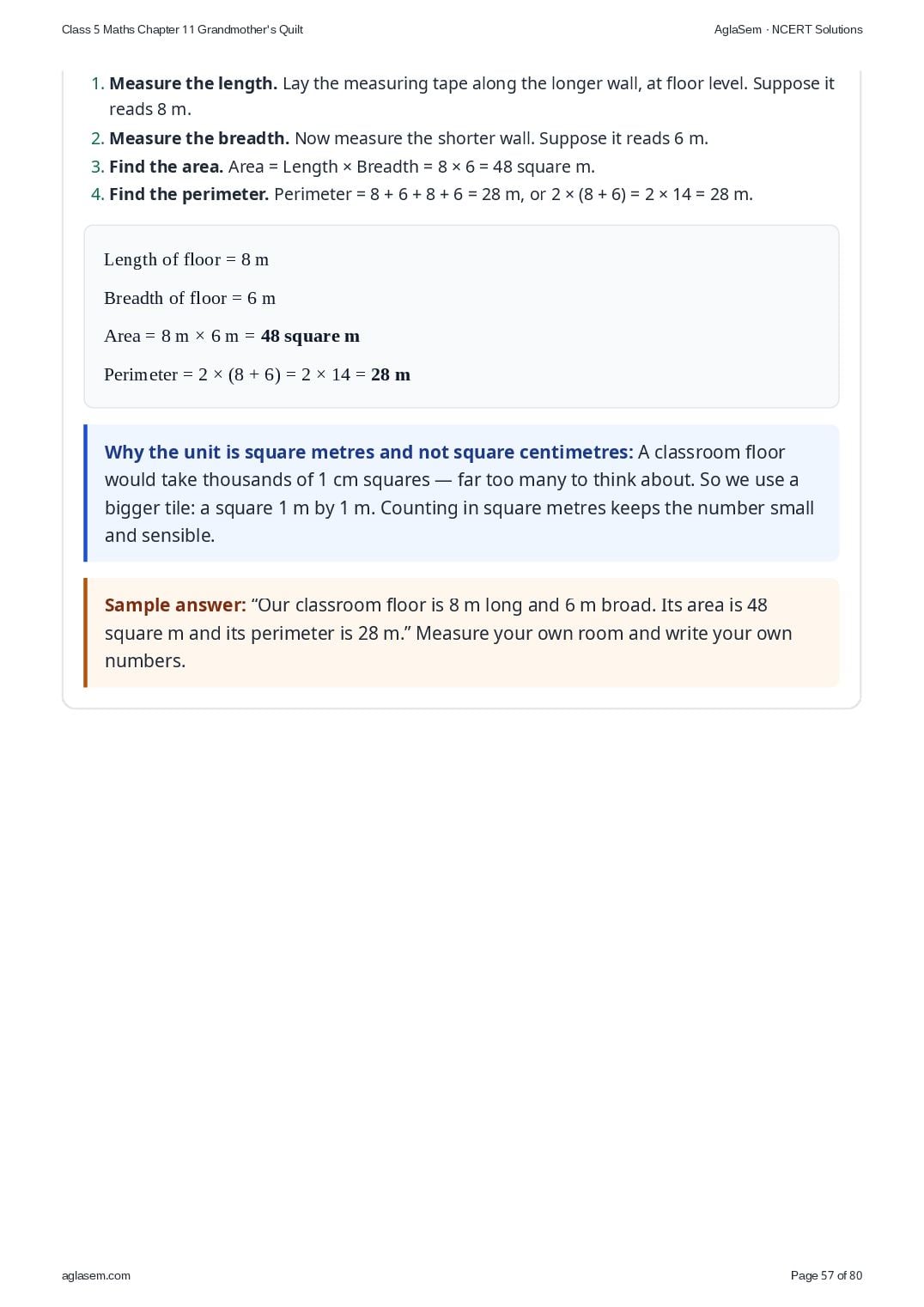
- Find the area of your classroom floor in square meters. Take the help of your teacher to measure the length and breadth of the floor. What is the perimeter of the classroom floor?
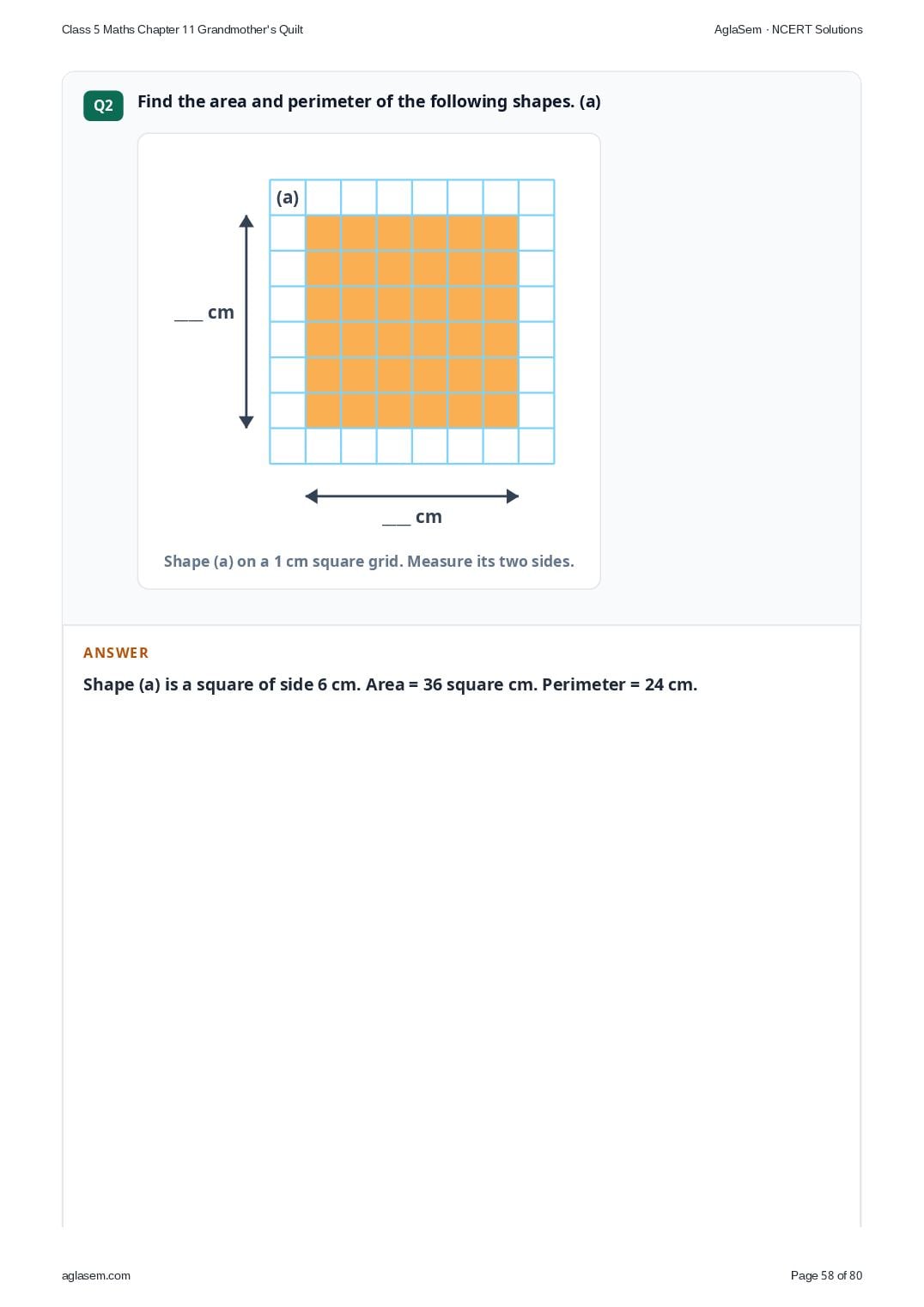
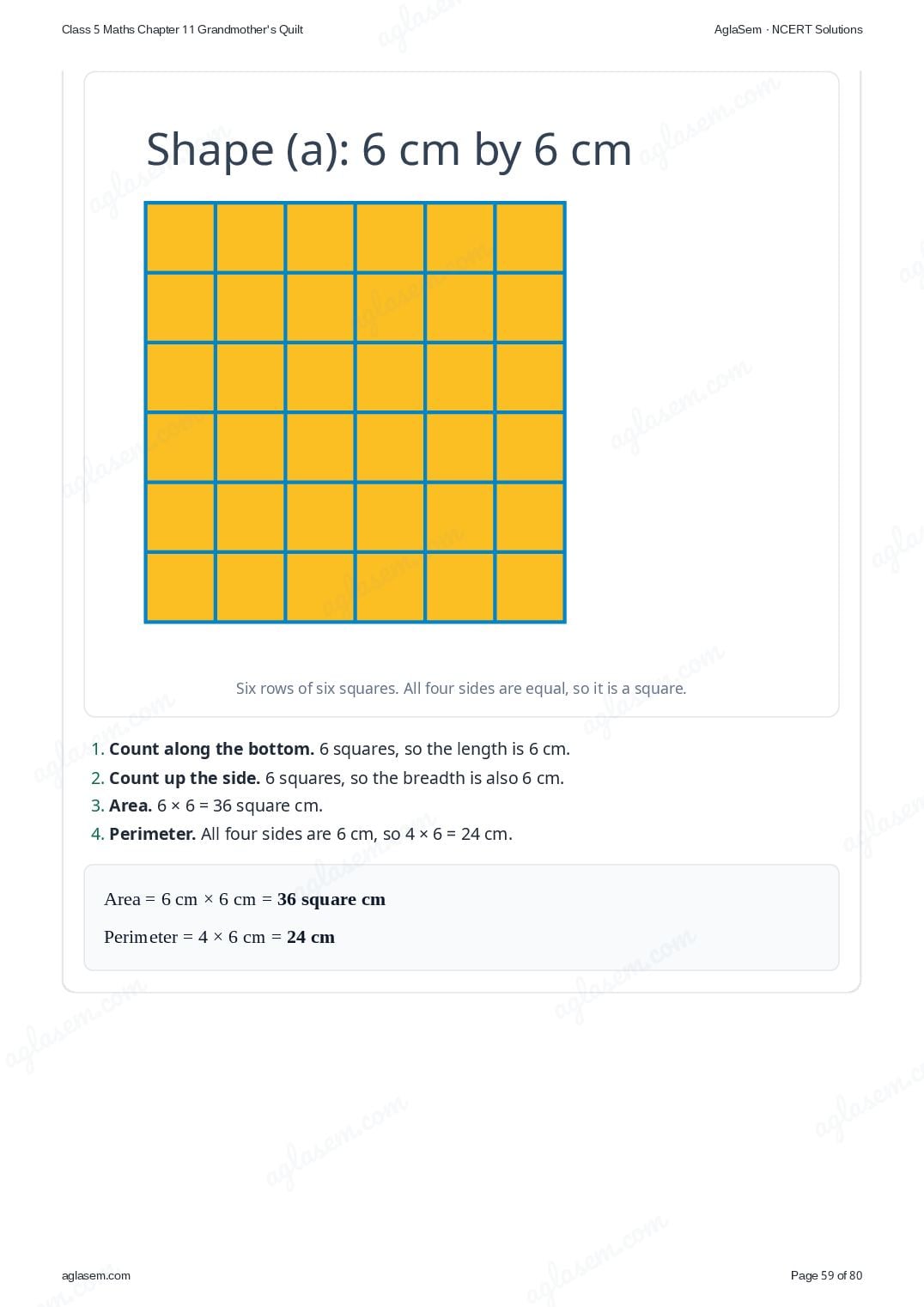
- Find the area and perimeter of the following shapes. (a) (a)____ cm____ cmShape (a) on a 1 cm square grid. Measure its two sides.
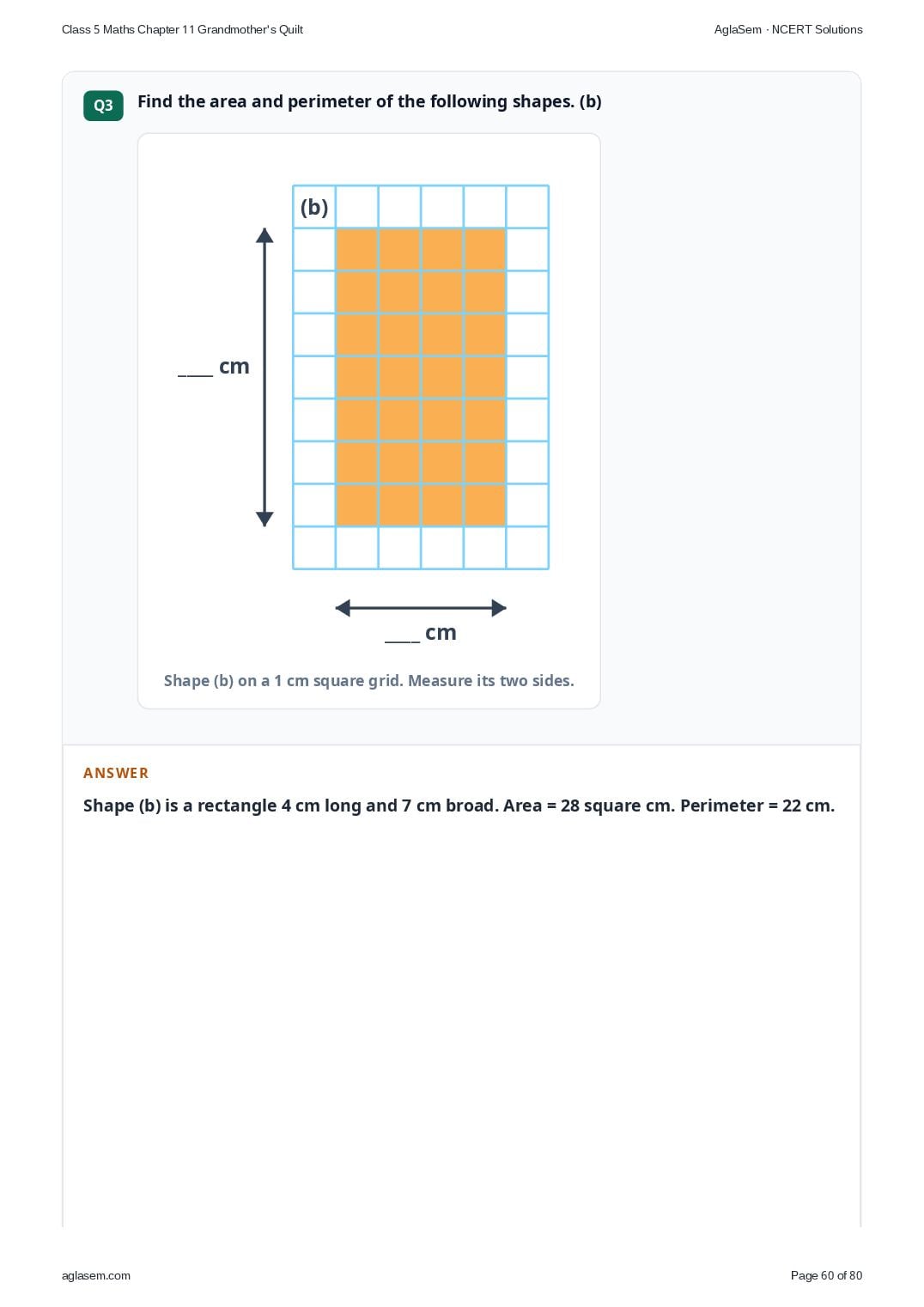
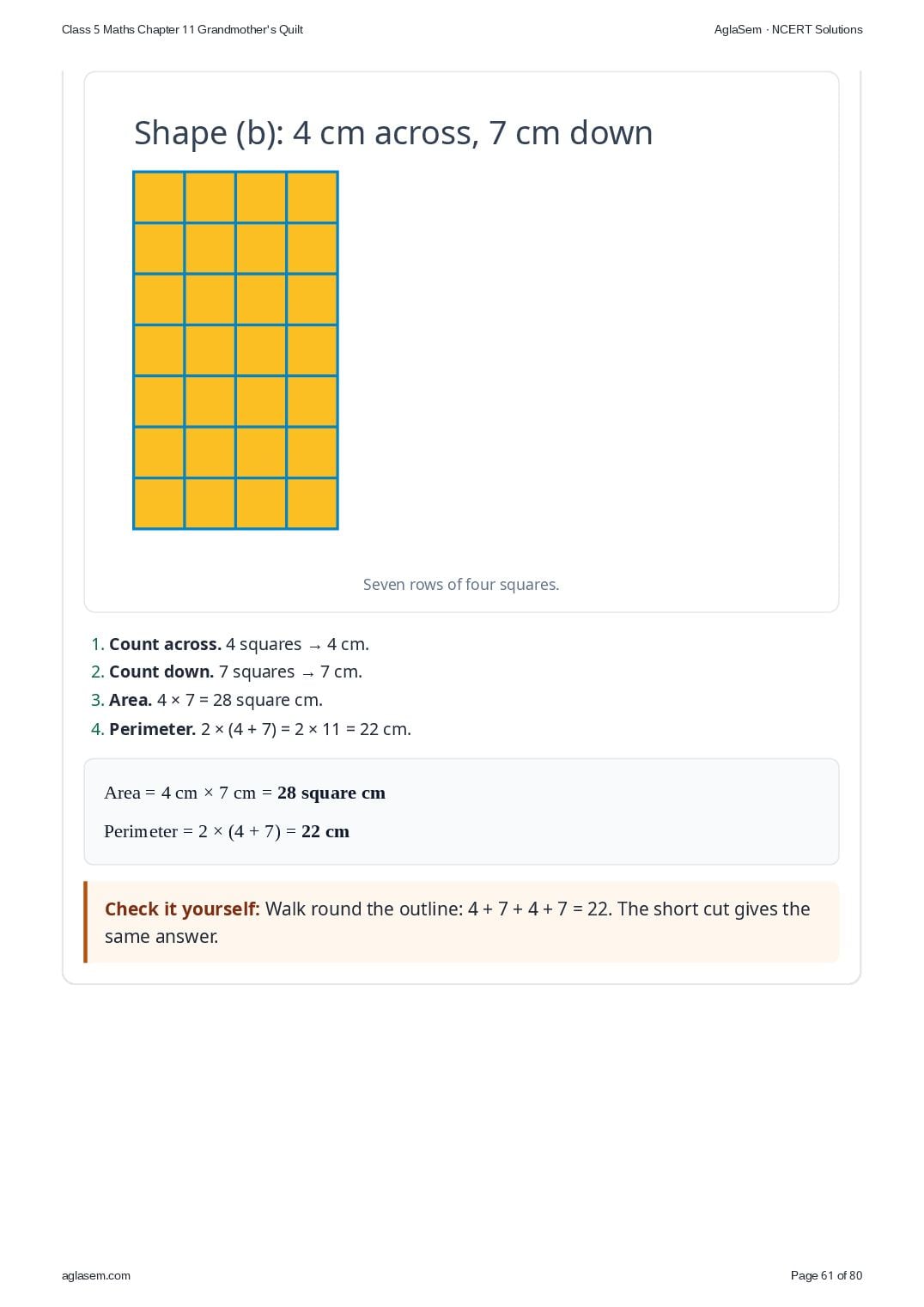
- Find the area and perimeter of the following shapes. (b) (b)____ cm____ cmShape (b) on a 1 cm square grid. Measure its two sides.
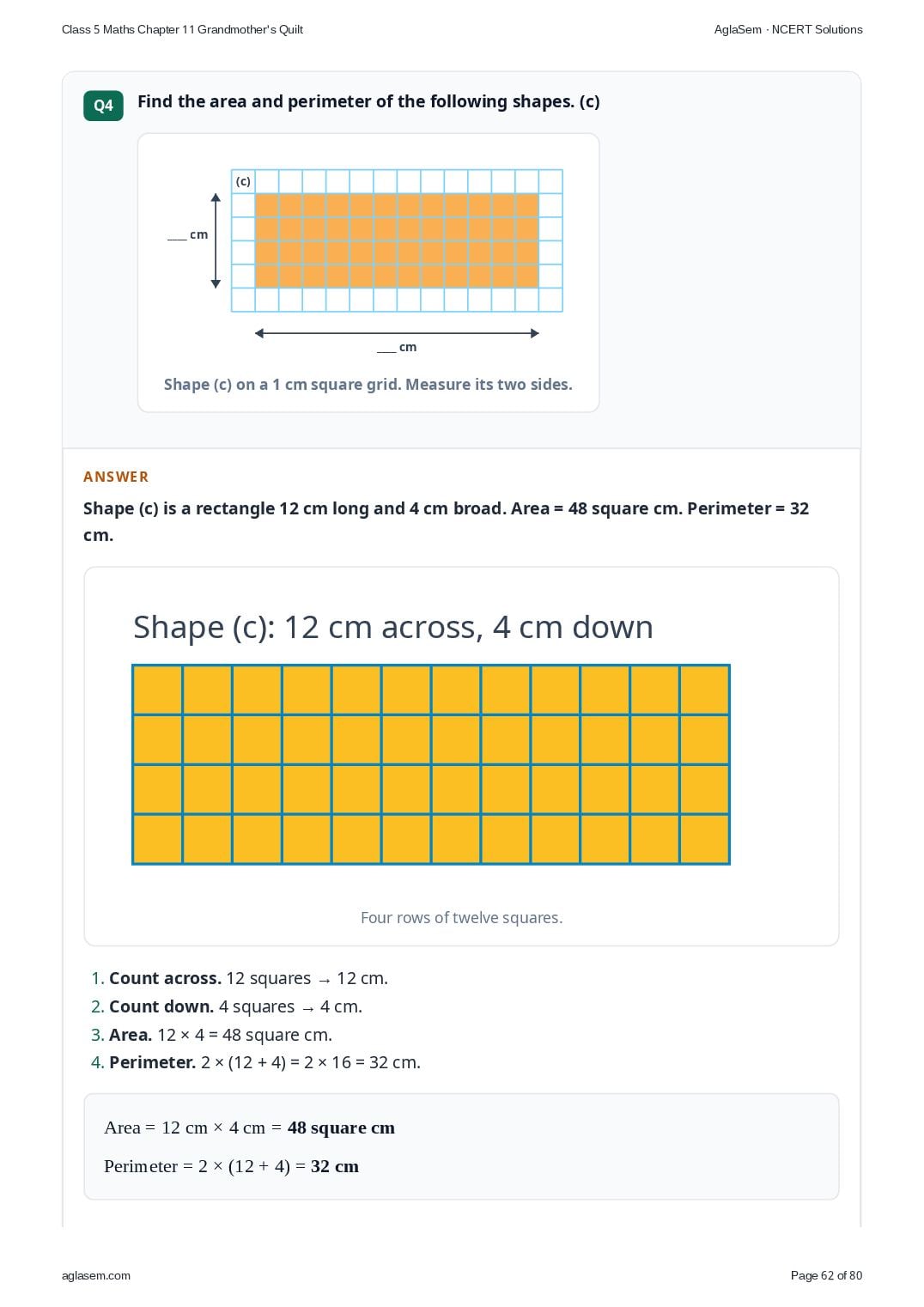
- Find the area and perimeter of the following shapes. (c) (c)____ cm____ cmShape (c) on a 1 cm square grid. Measure its two sides.
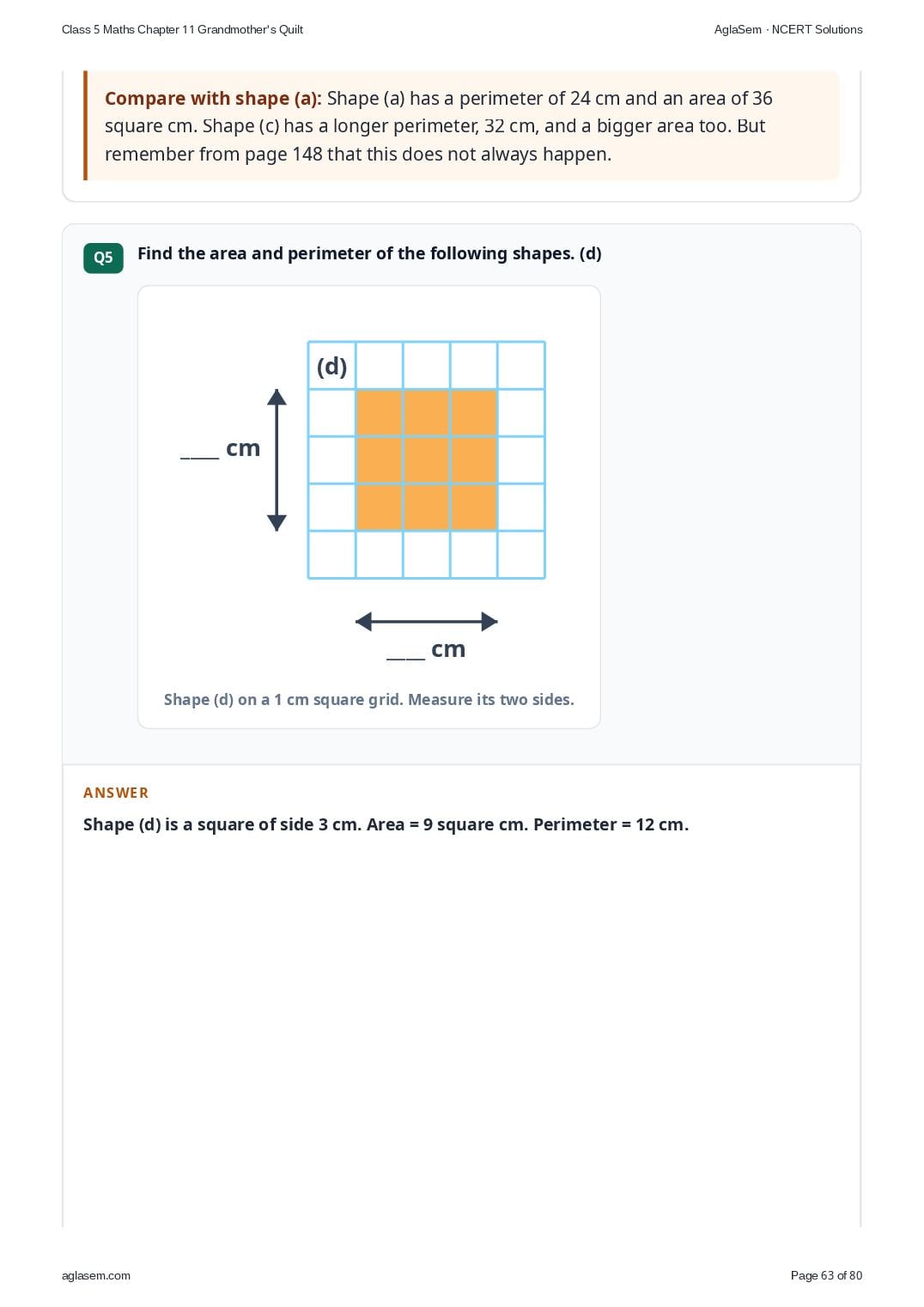
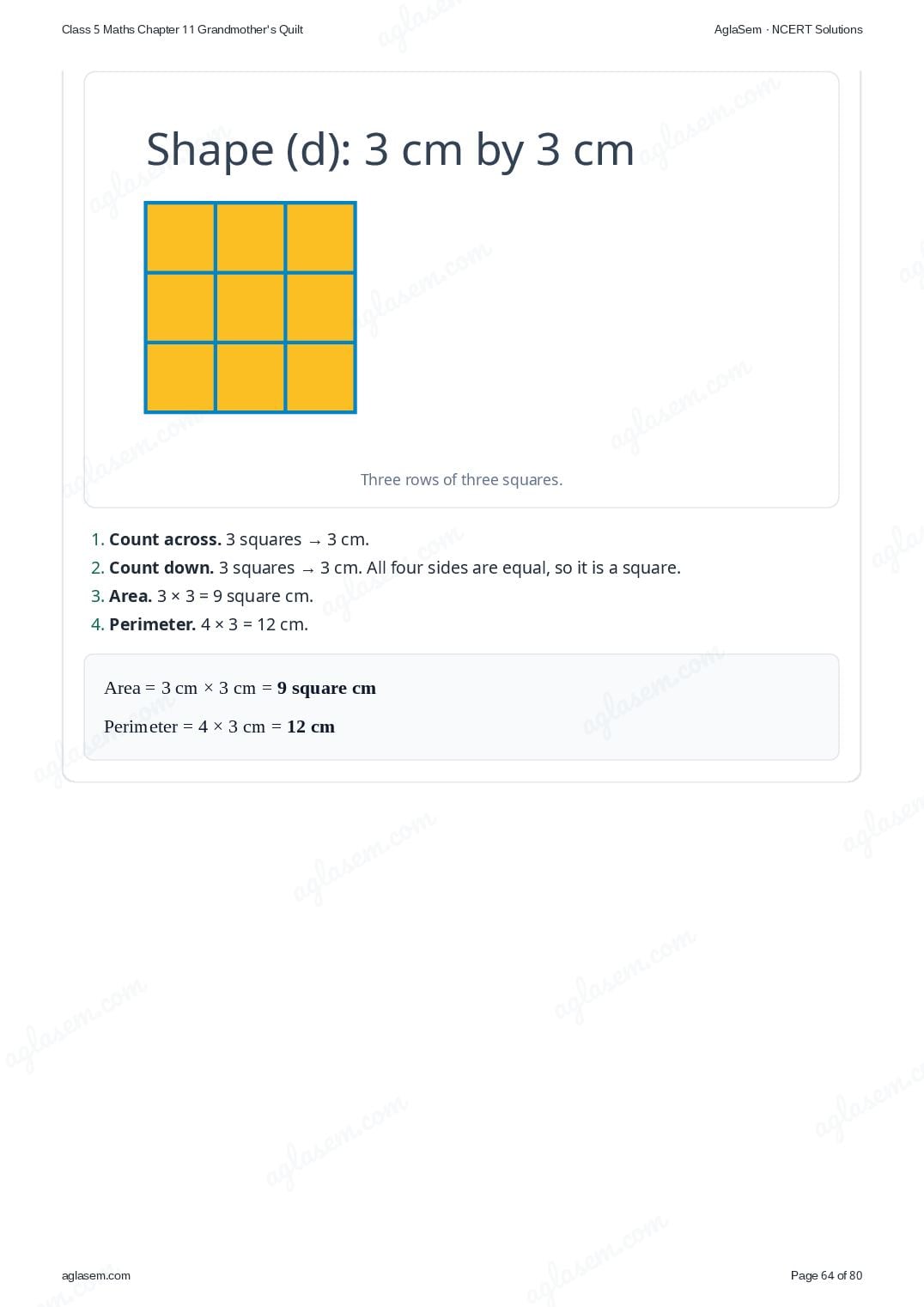
- Find the area and perimeter of the following shapes. (d) (d)____ cm____ cmShape (d) on a 1 cm square grid. Measure its two sides.
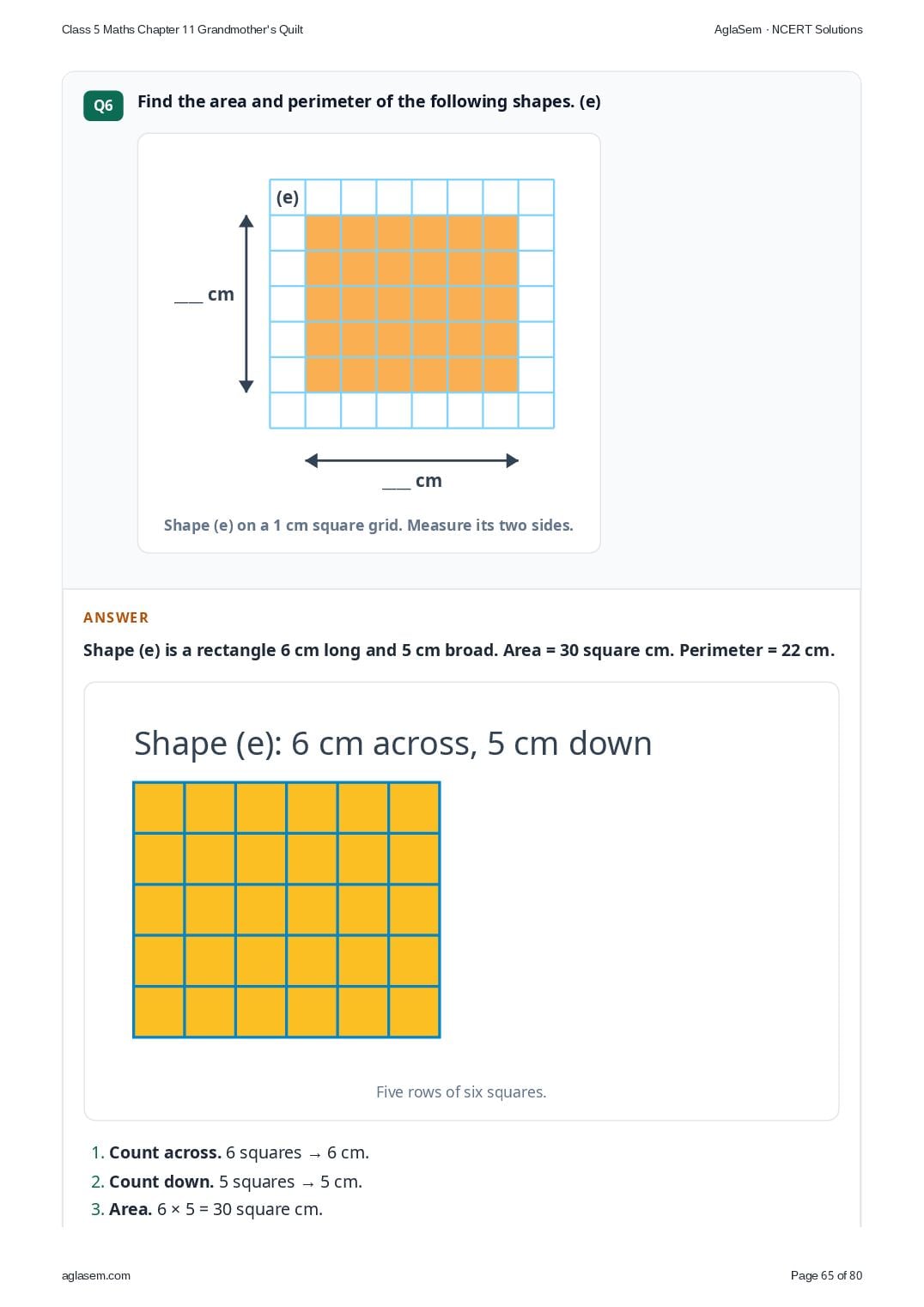
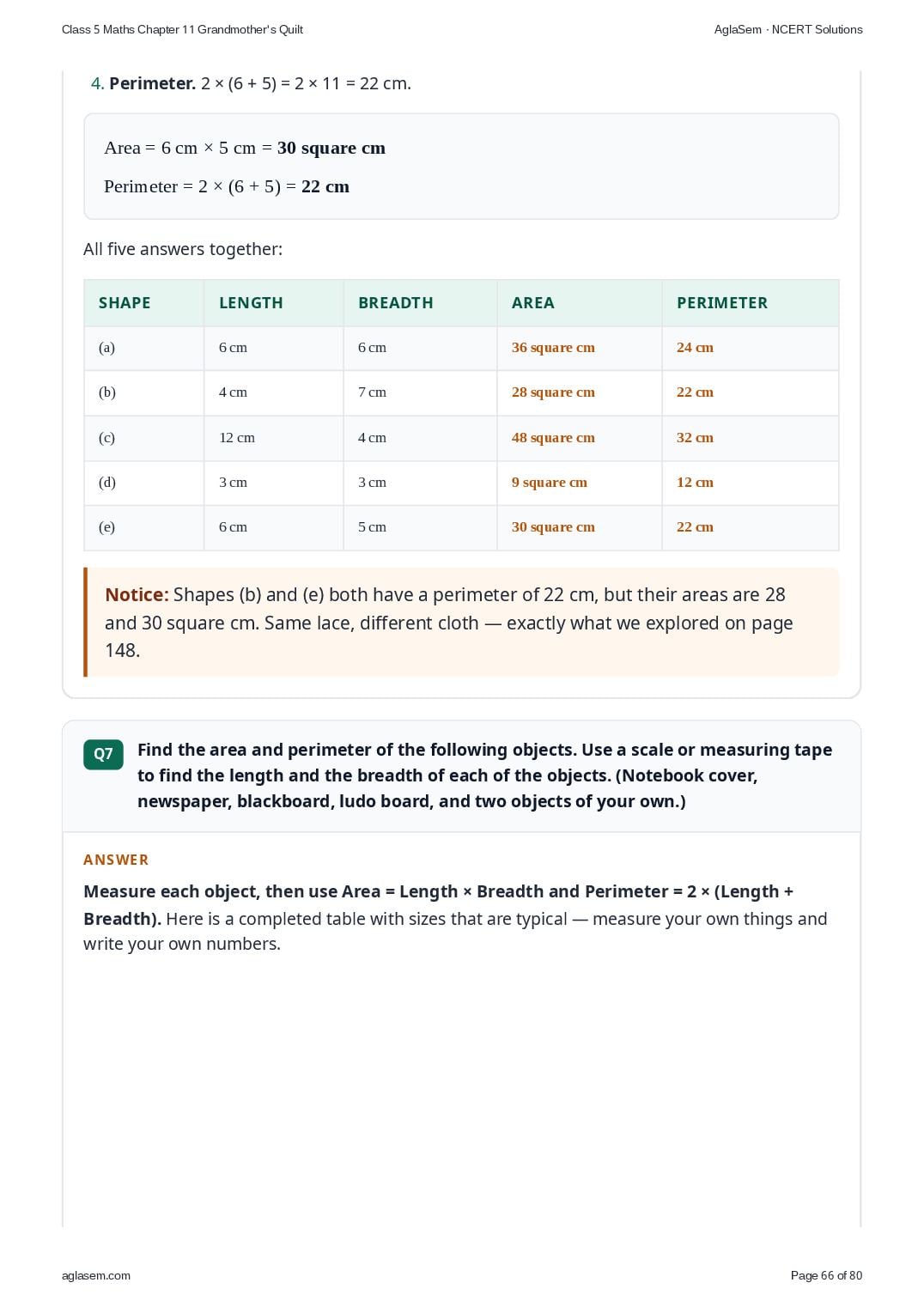
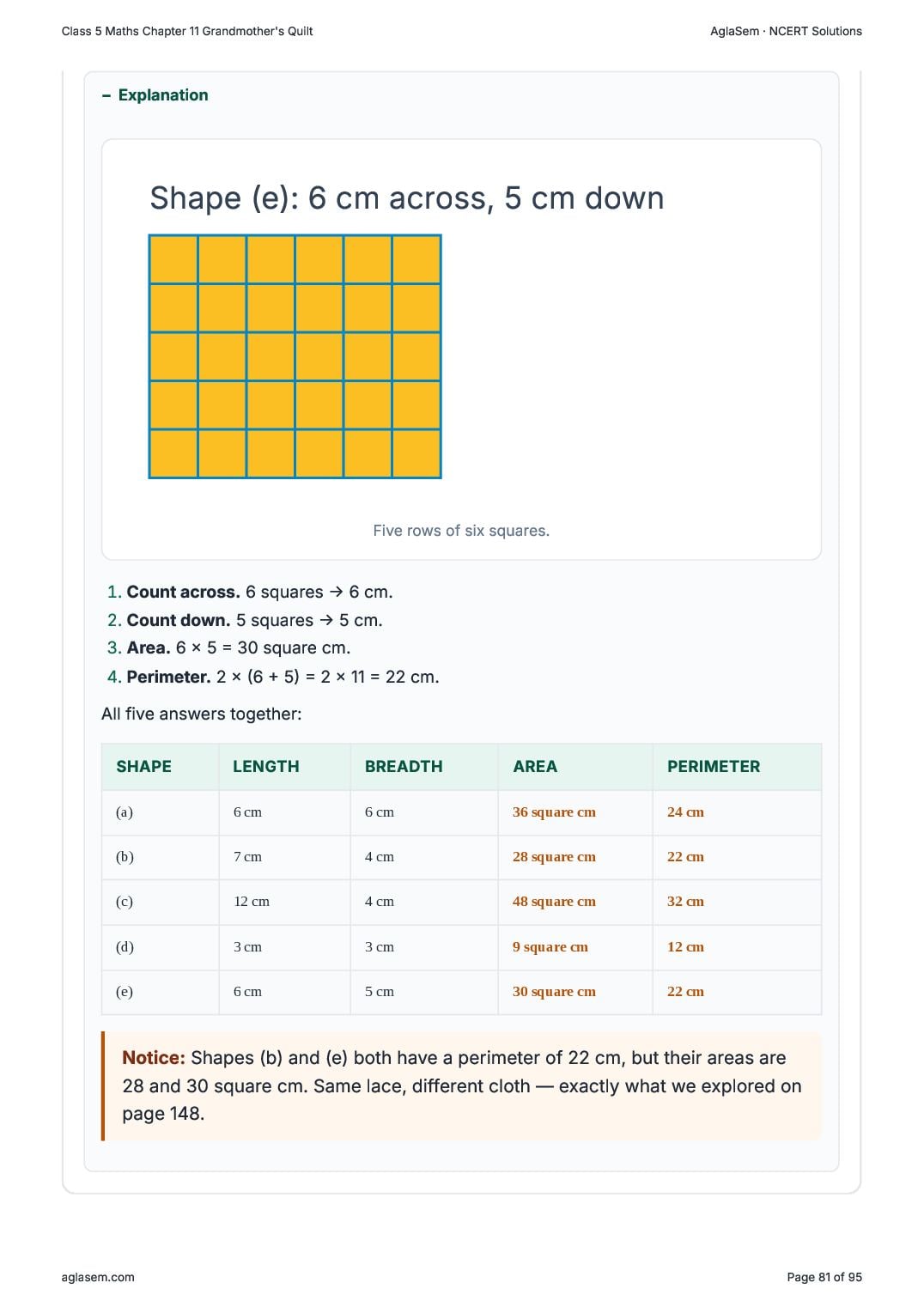
- Find the area and perimeter of the following shapes. (e) (e)____ cm____ cmShape (e) on a 1 cm square grid. Measure its two sides.
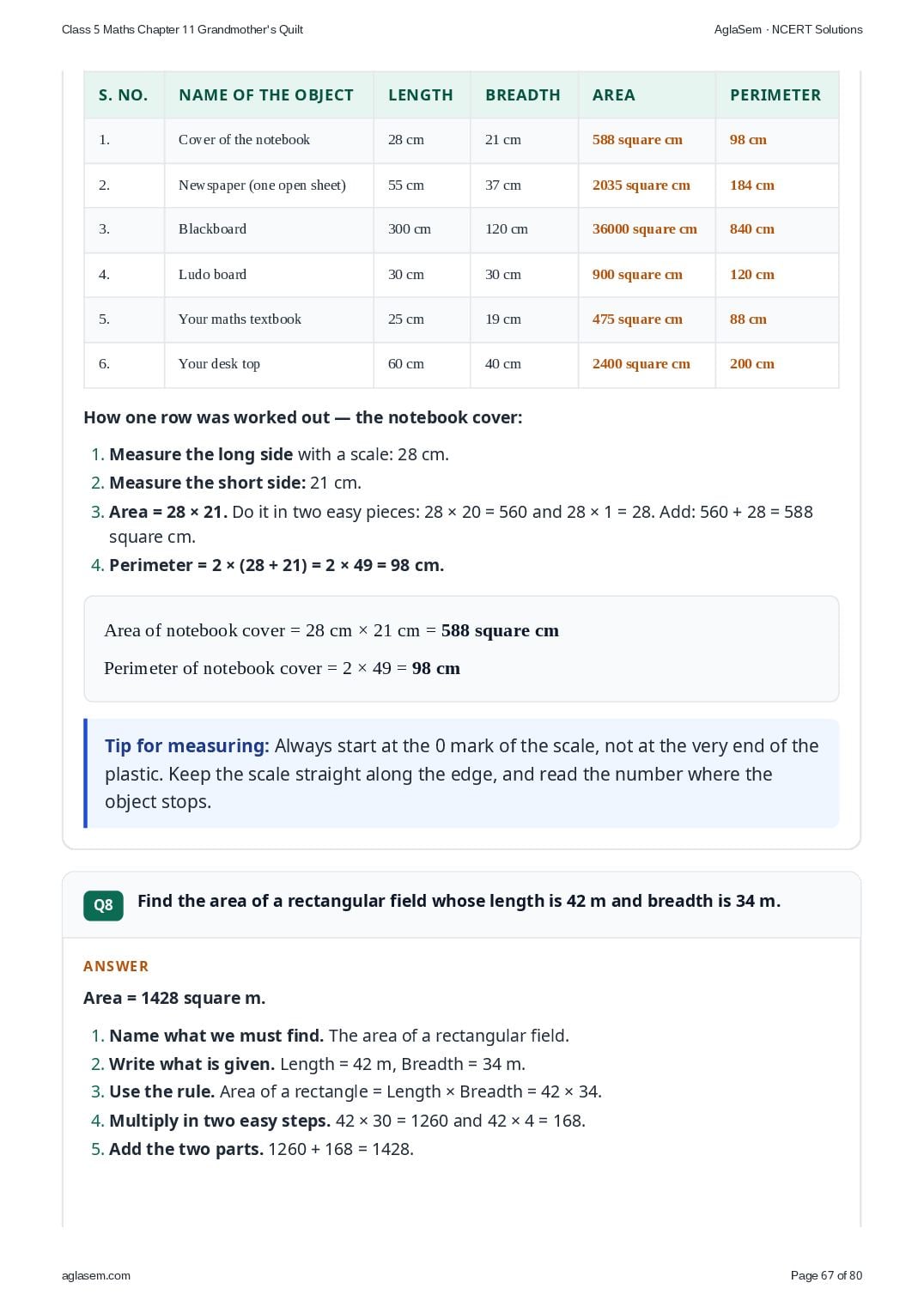
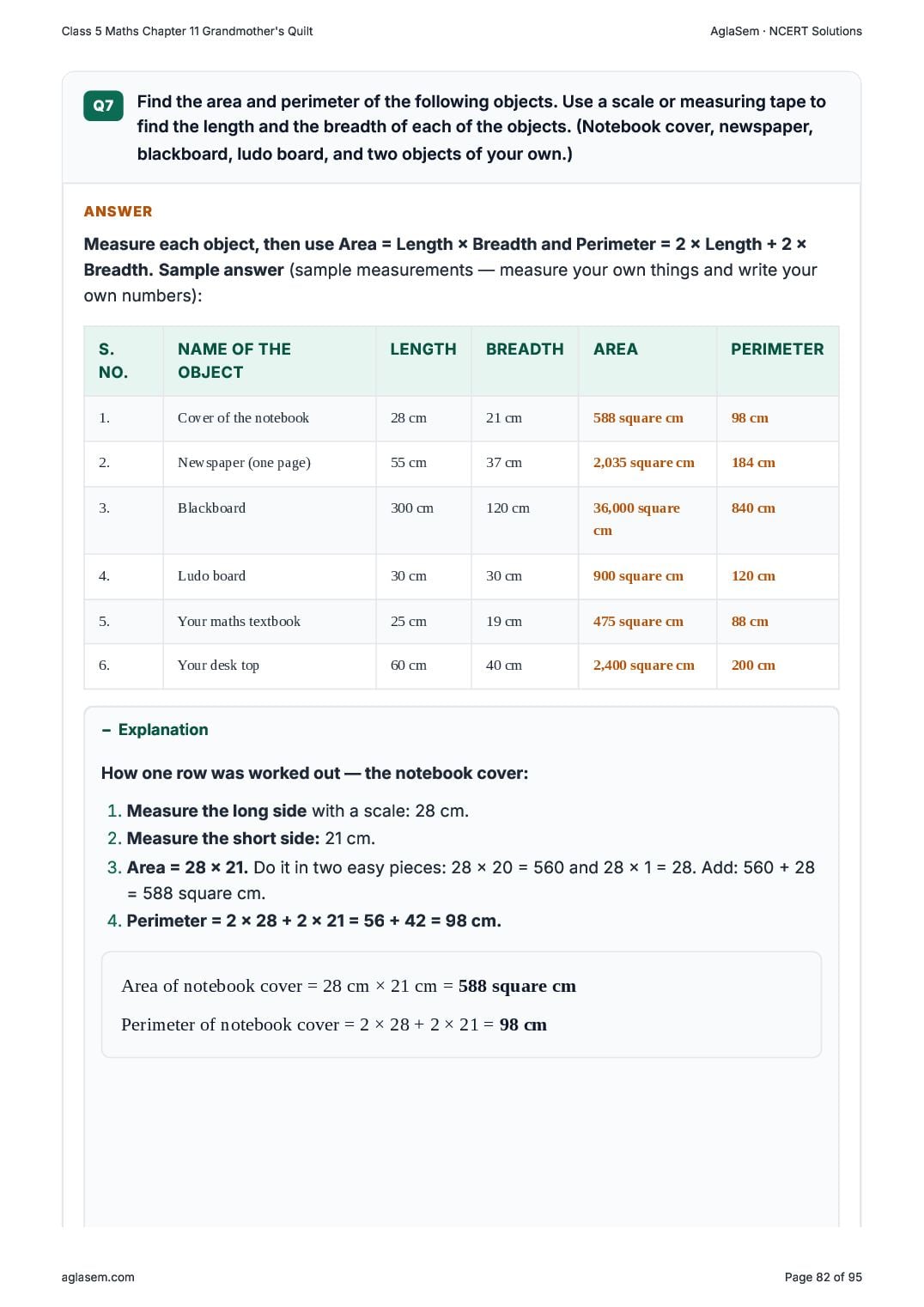
- Find the area and perimeter of the following objects. Use a scale or measuring tape to find the length and the breadth of each of the objects. (Notebook cover, newspaper, blackboard, ludo board, and two objects of your own.)
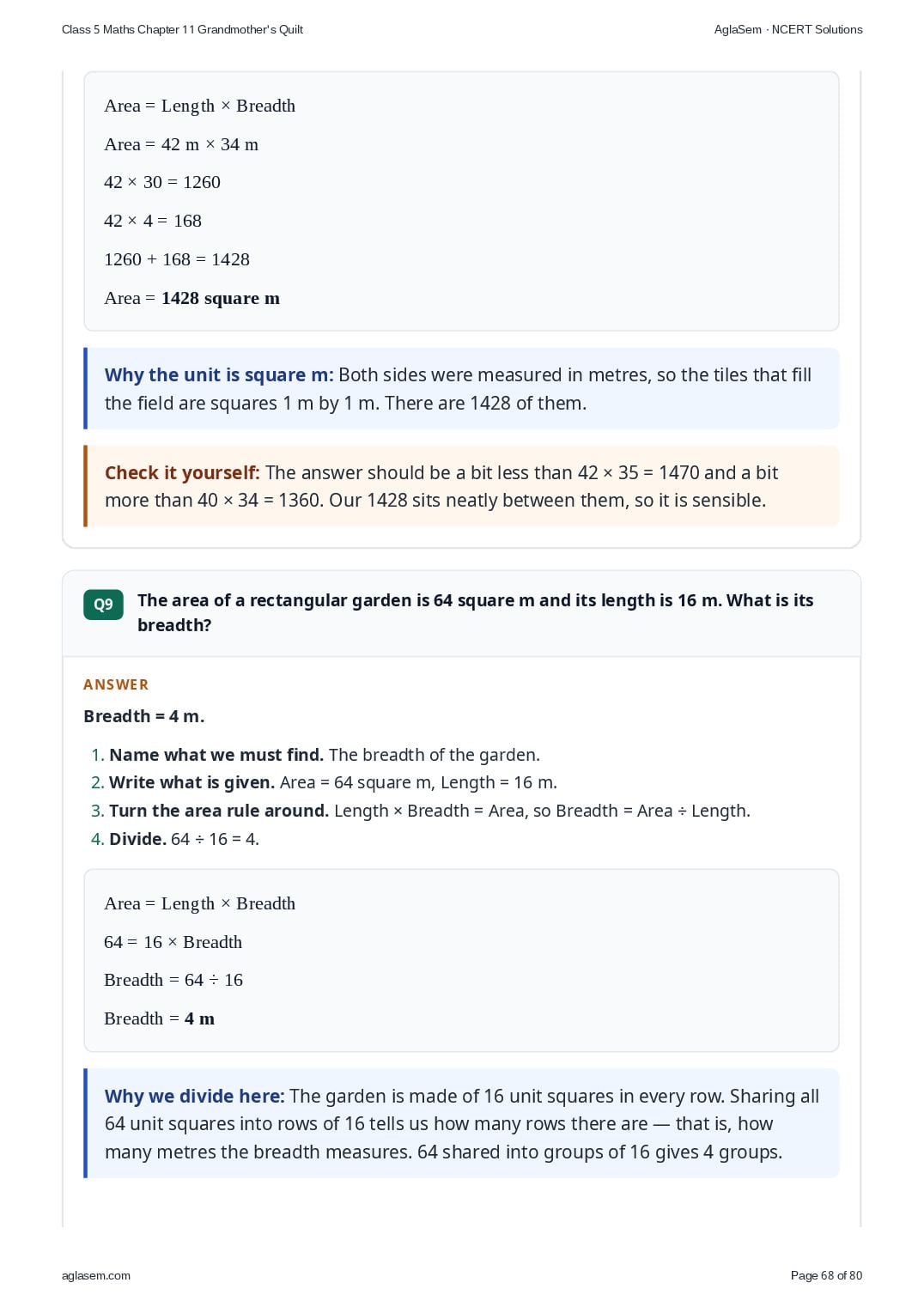
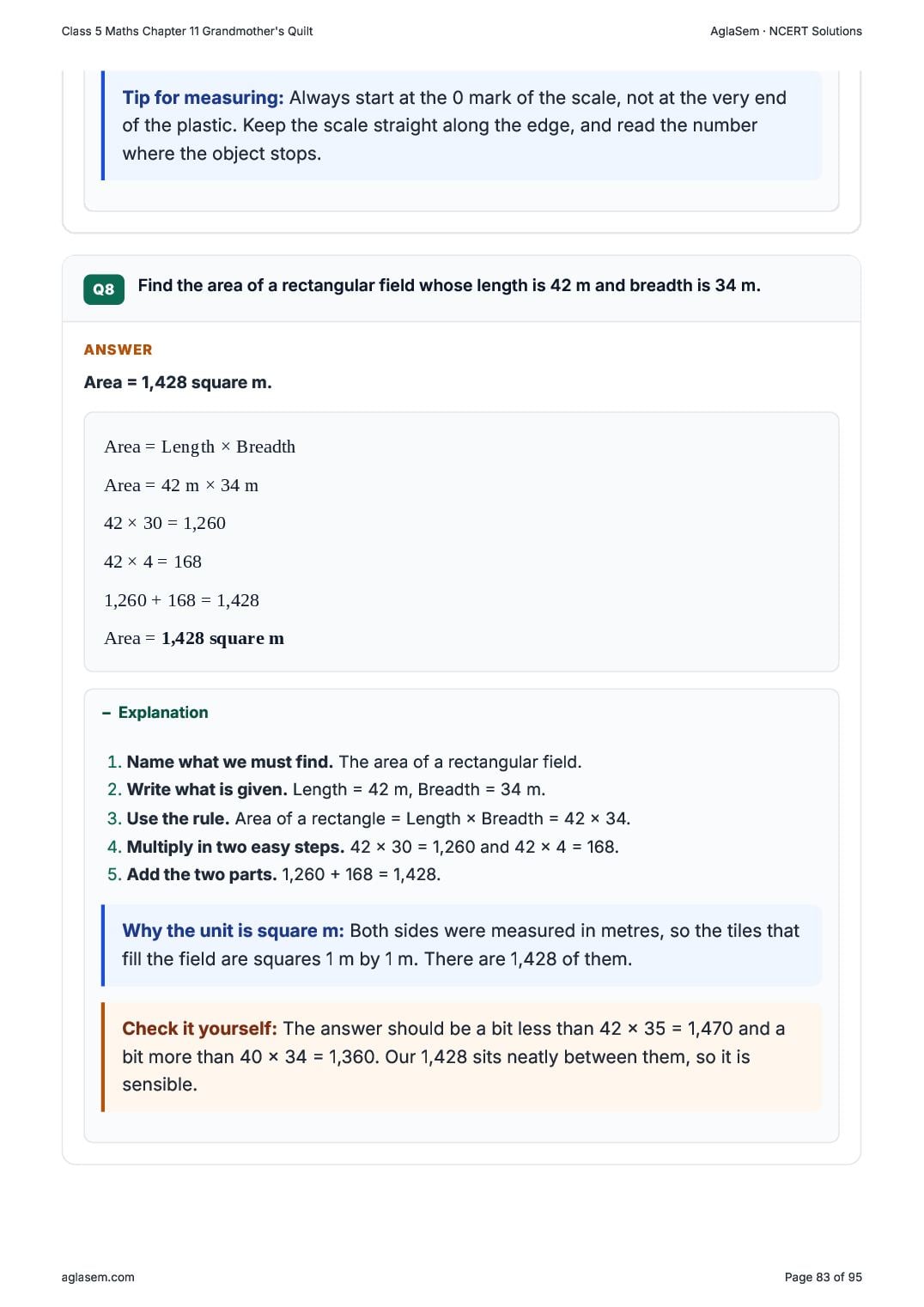
- Find the area of a rectangular field whose length is 42 m and breadth is 34 m.
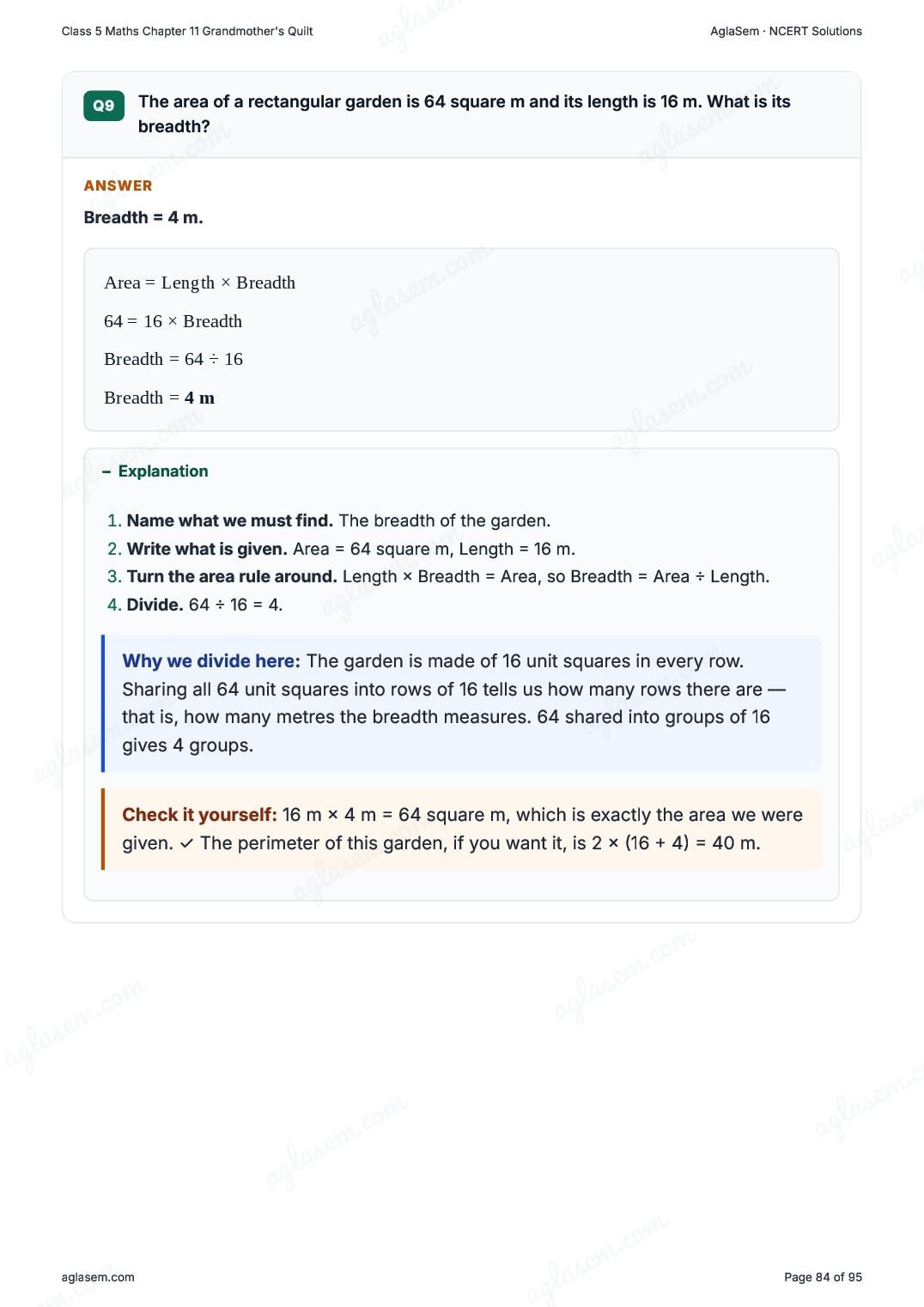
- The area of a rectangular garden is 64 square m and its length is 16 m. What is its breadth?
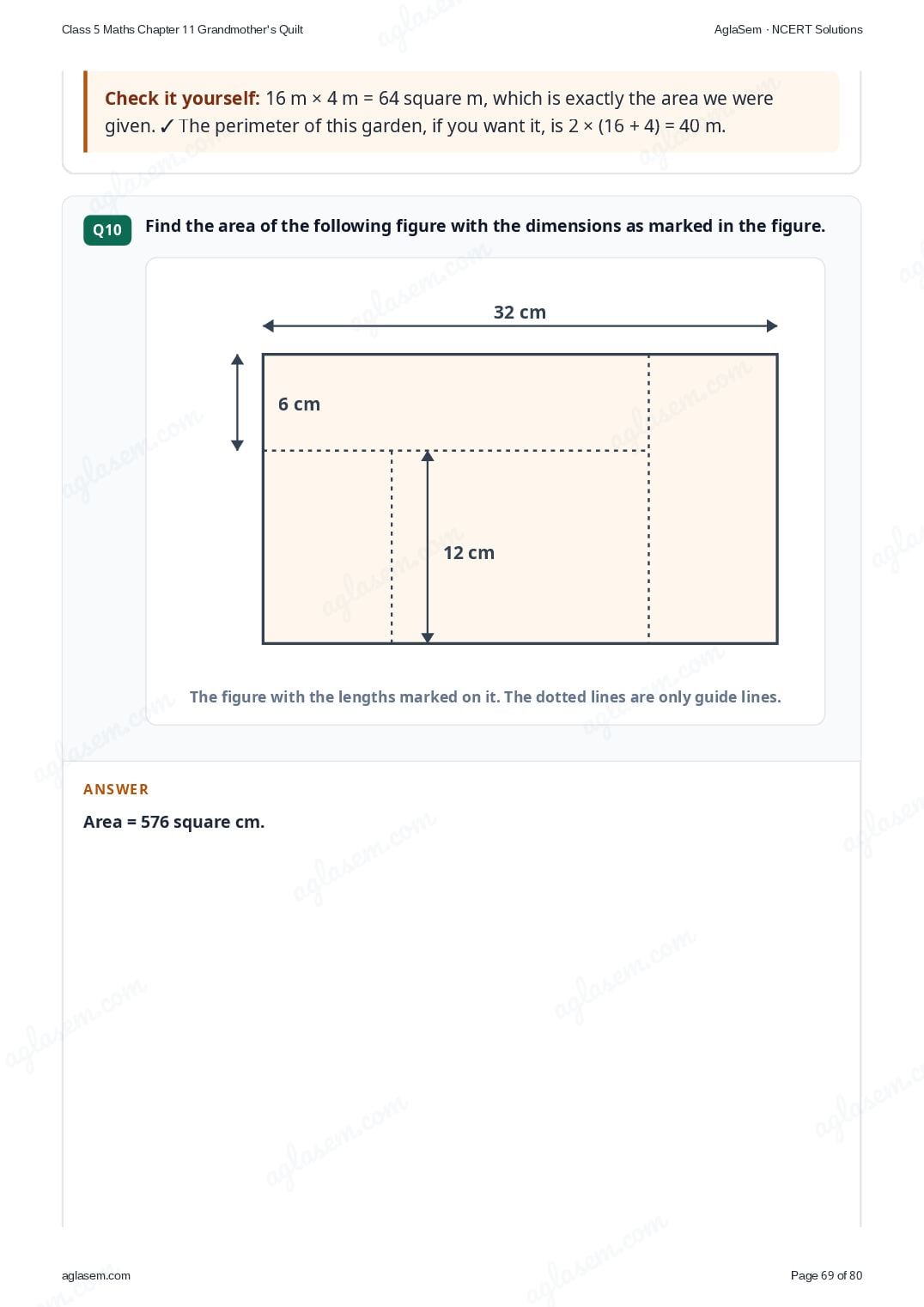
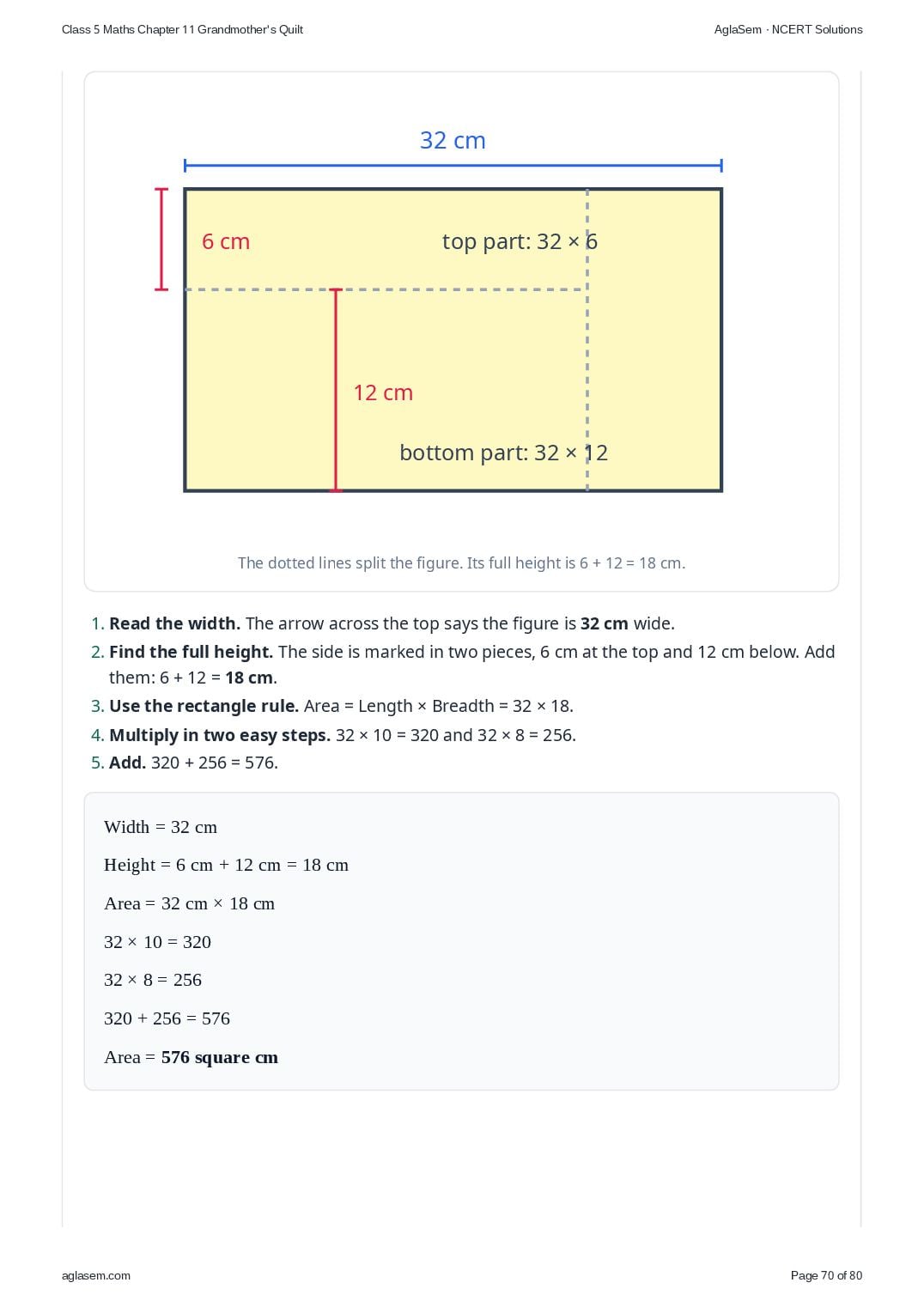
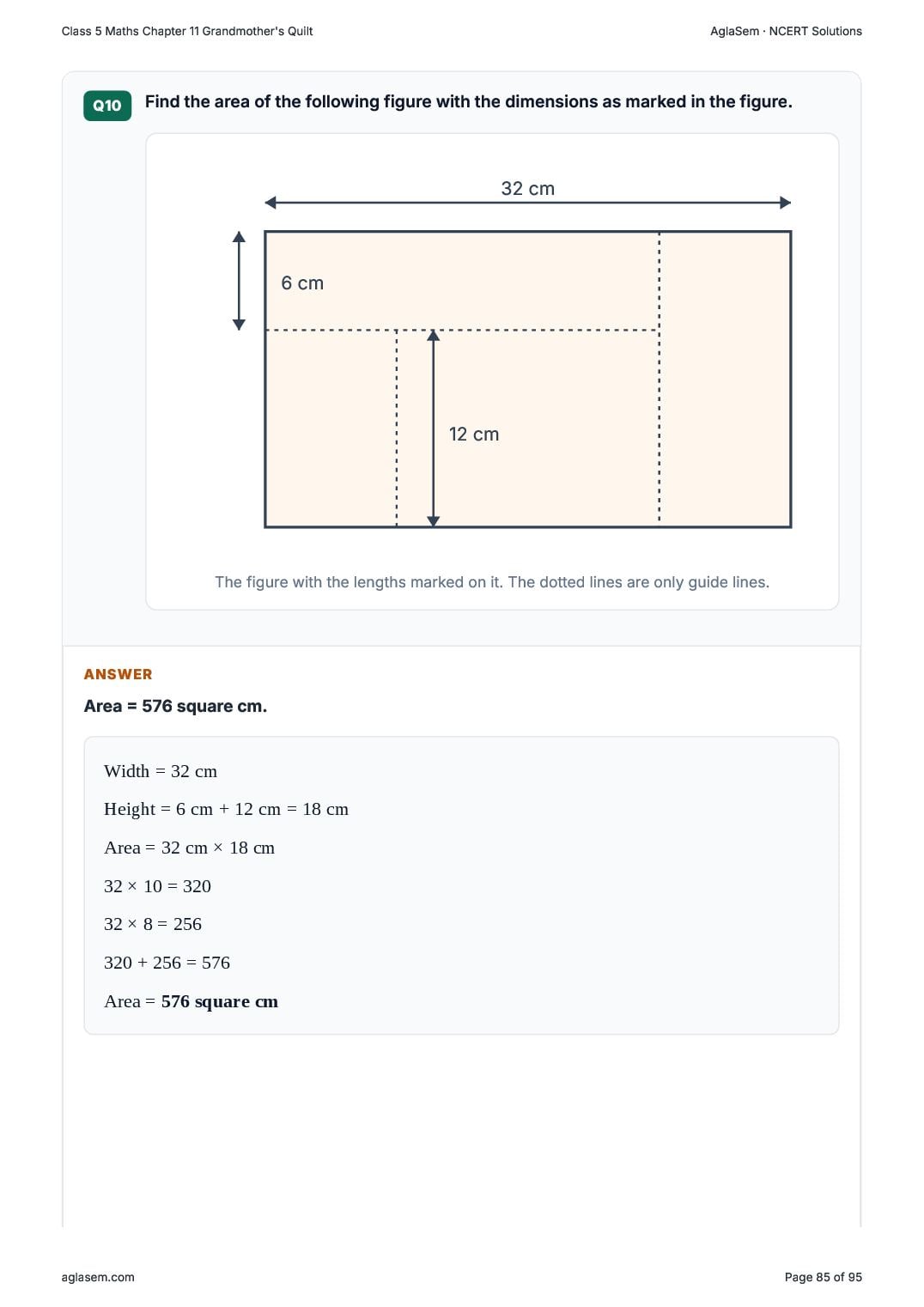
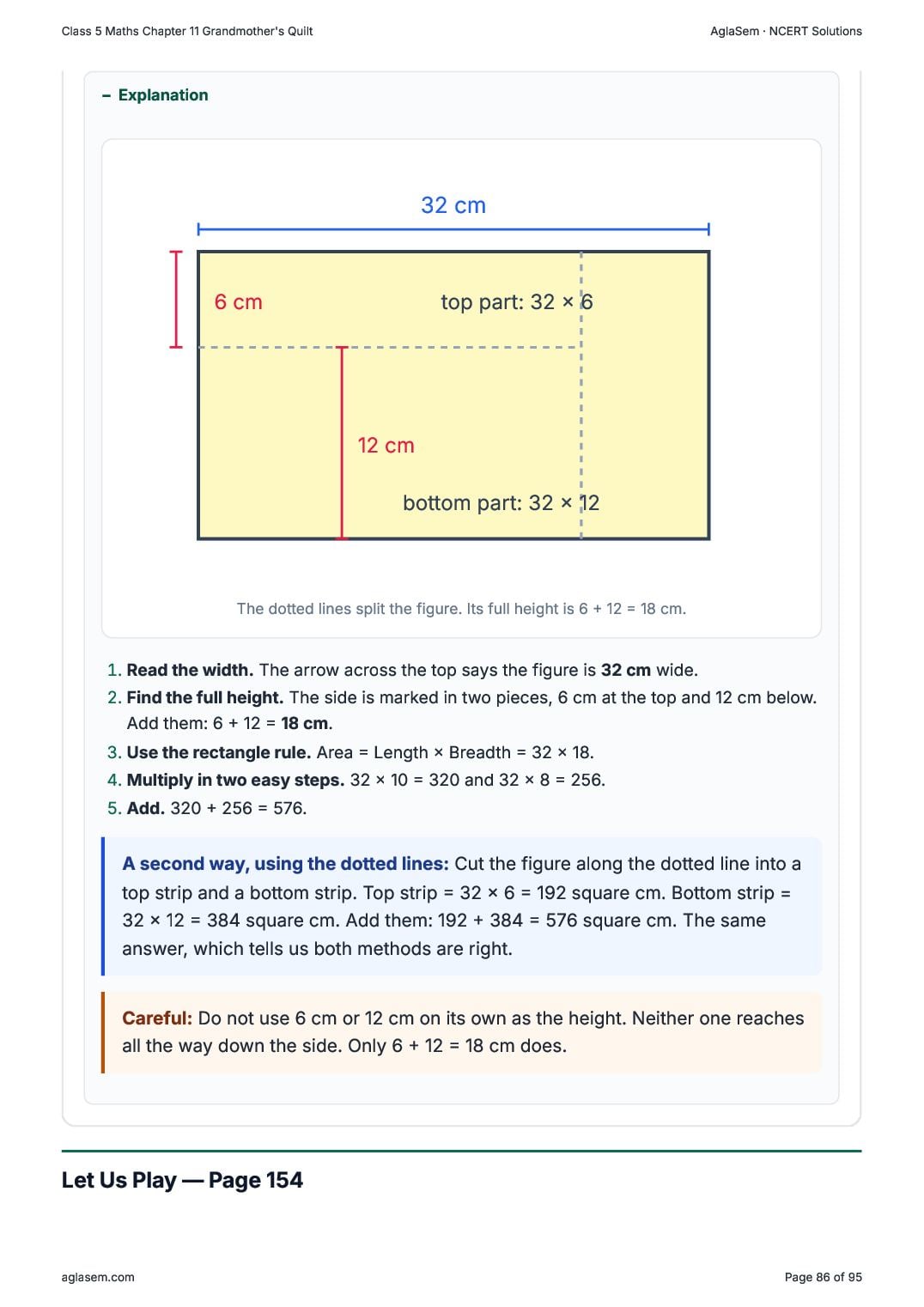
- Find the area of the following figure with the dimensions as marked in the figure. 32 cm6 cm12 cmThe figure with the lengths marked on it. The dotted lines are only guide lines.
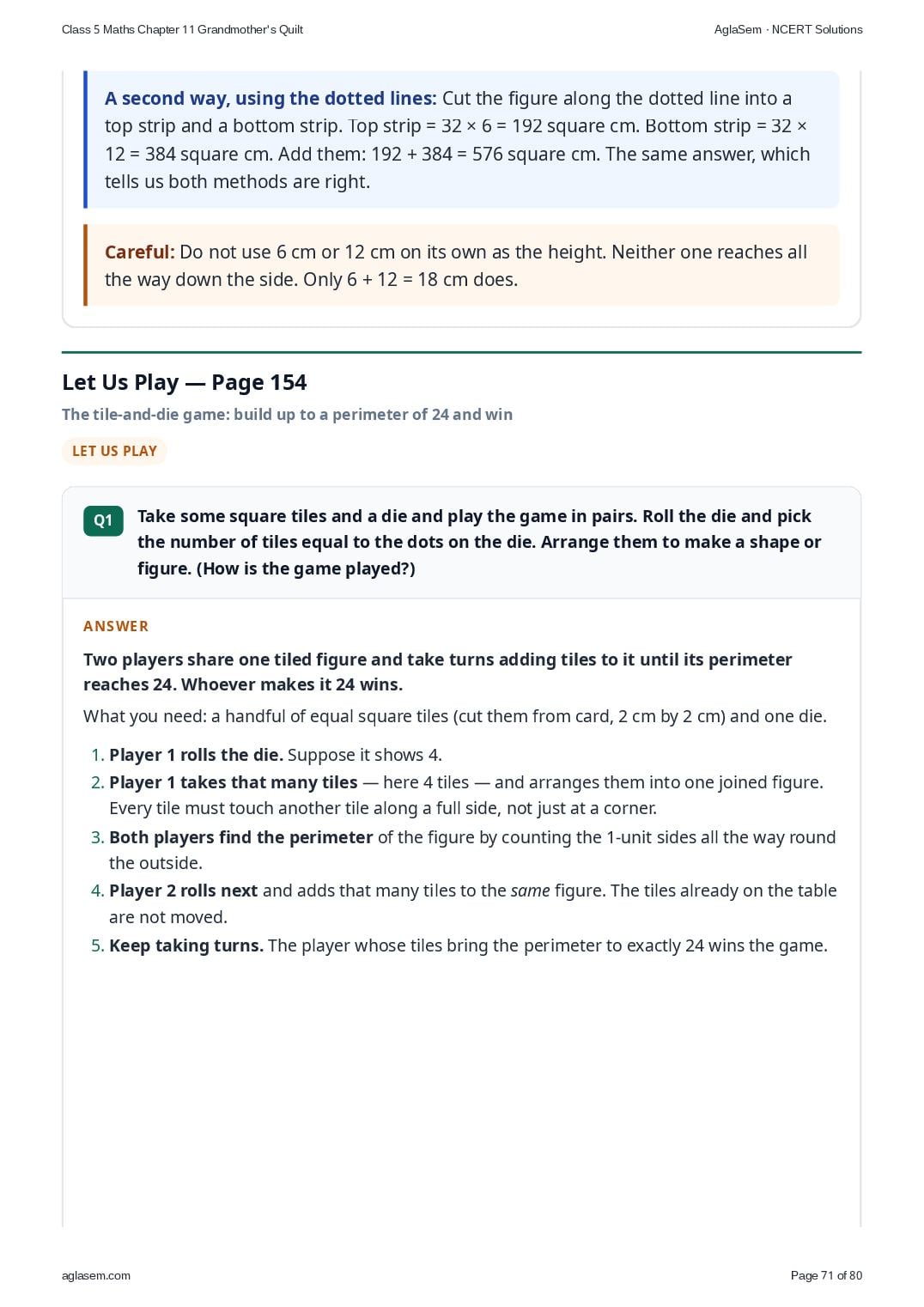
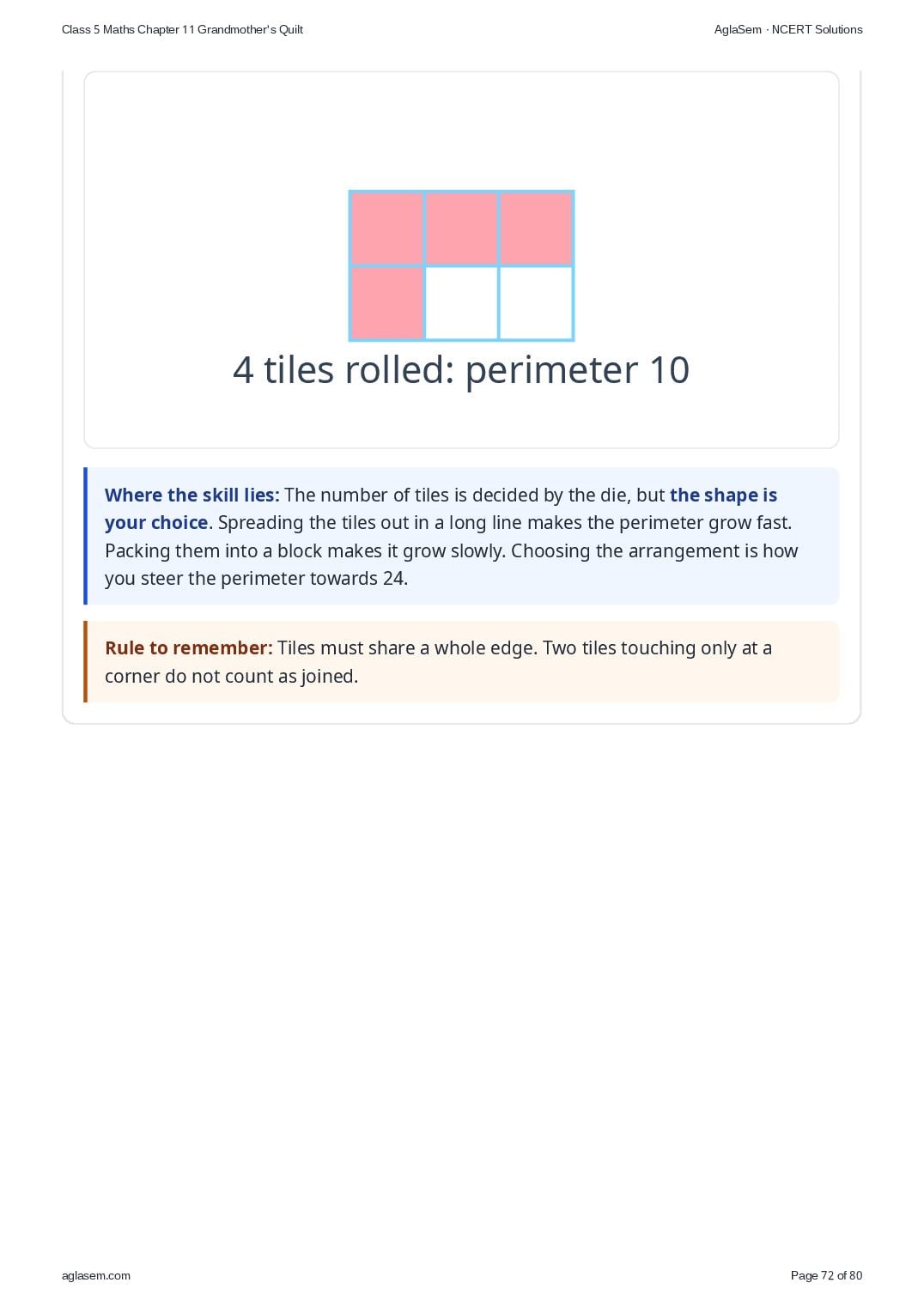
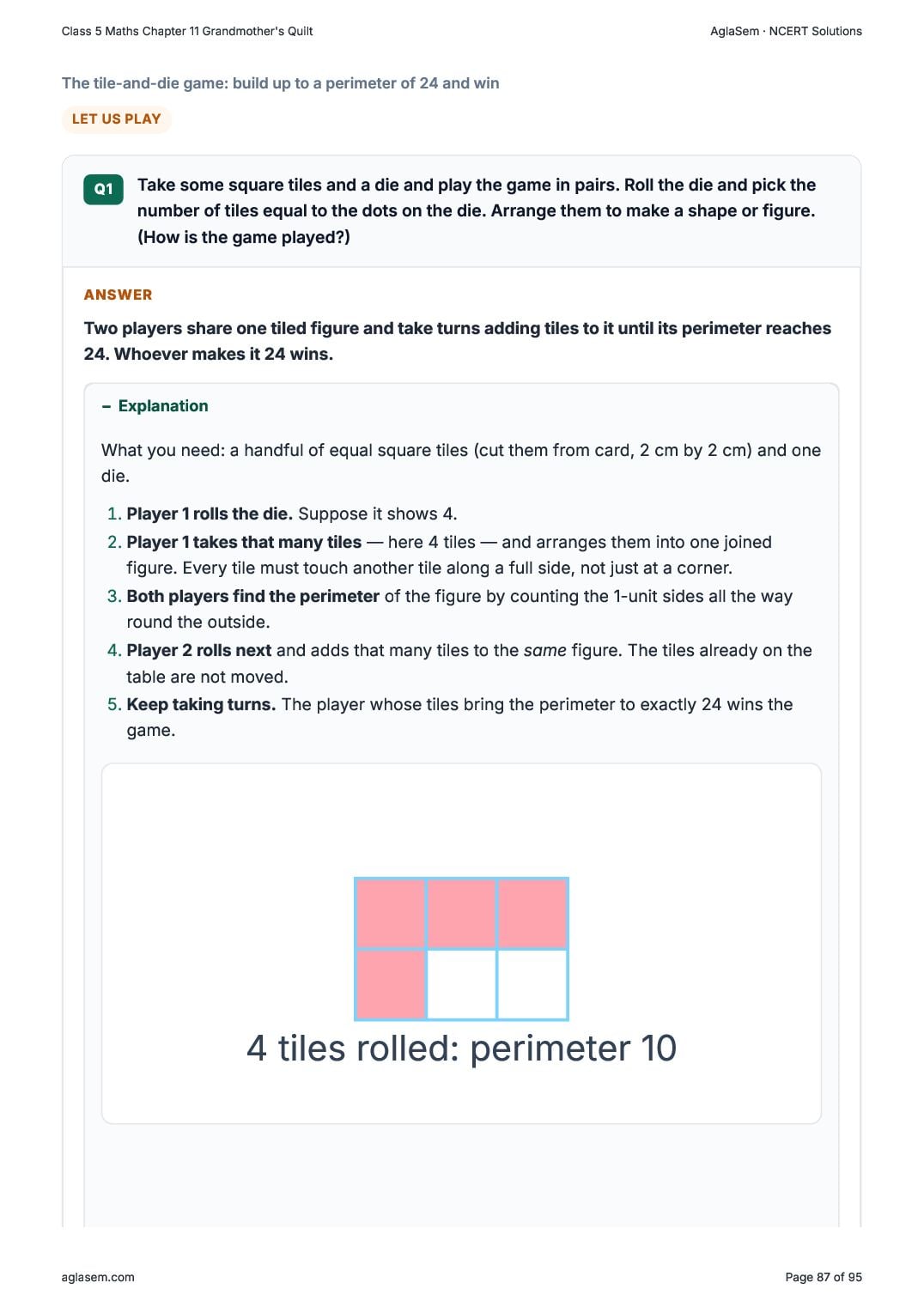
- Take some square tiles and a die and play the game in pairs. Roll the die and pick the number of tiles equal to the dots on the die. Arrange them to make a shape or figure. (How is the game played?)
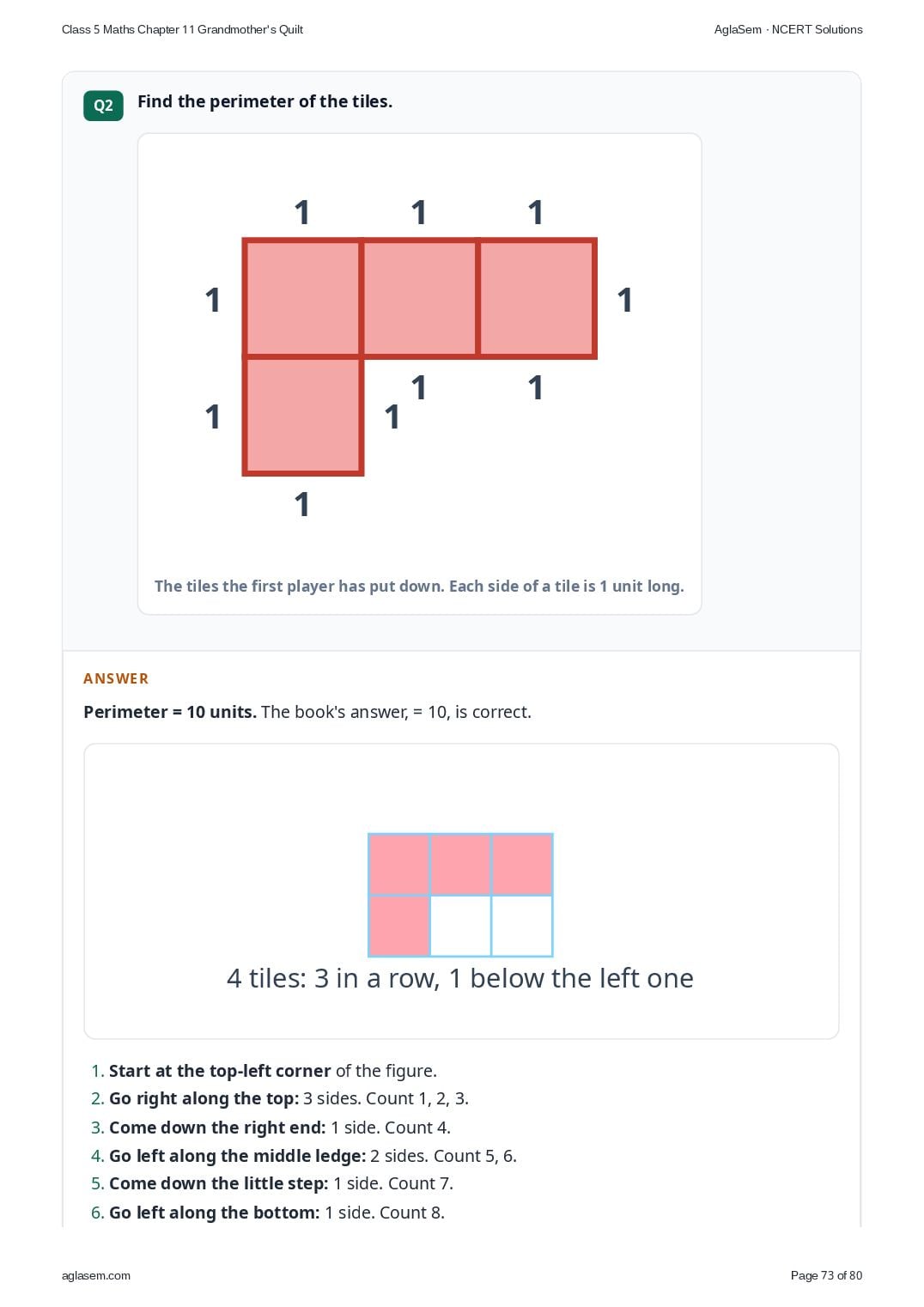
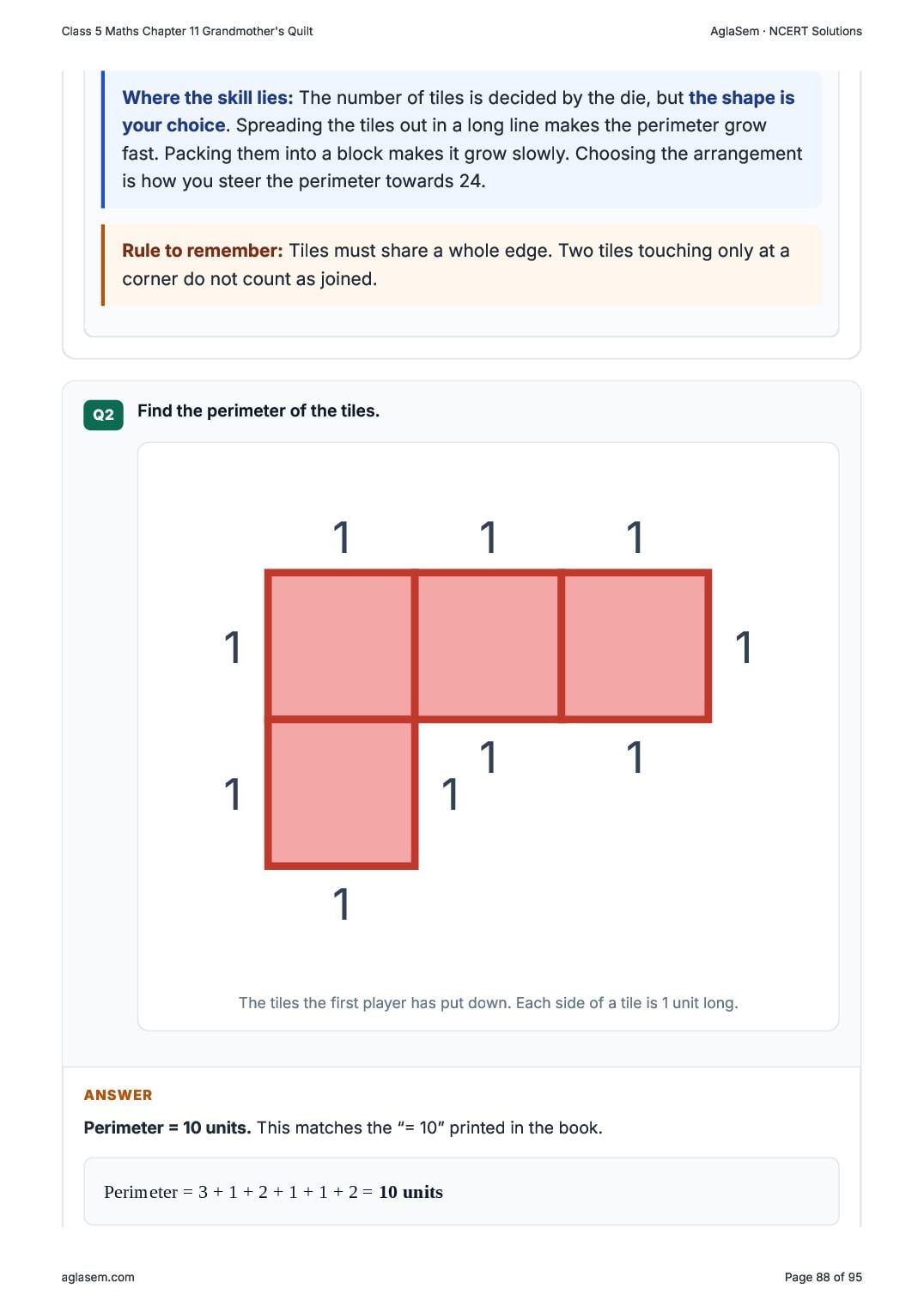
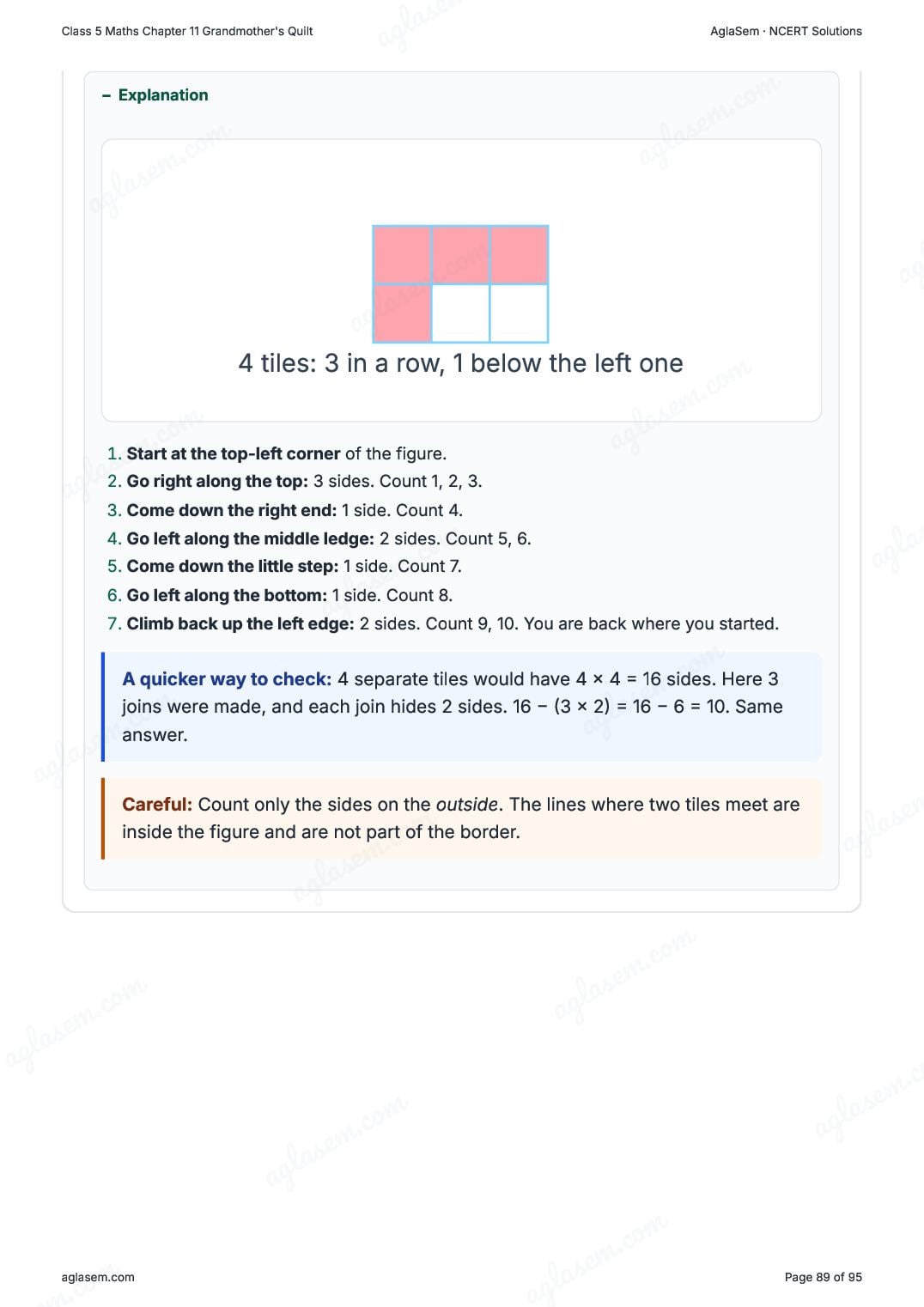
- Find the perimeter of the tiles. 1111111111The tiles the first player has put down. Each side of a tile is 1 unit long.
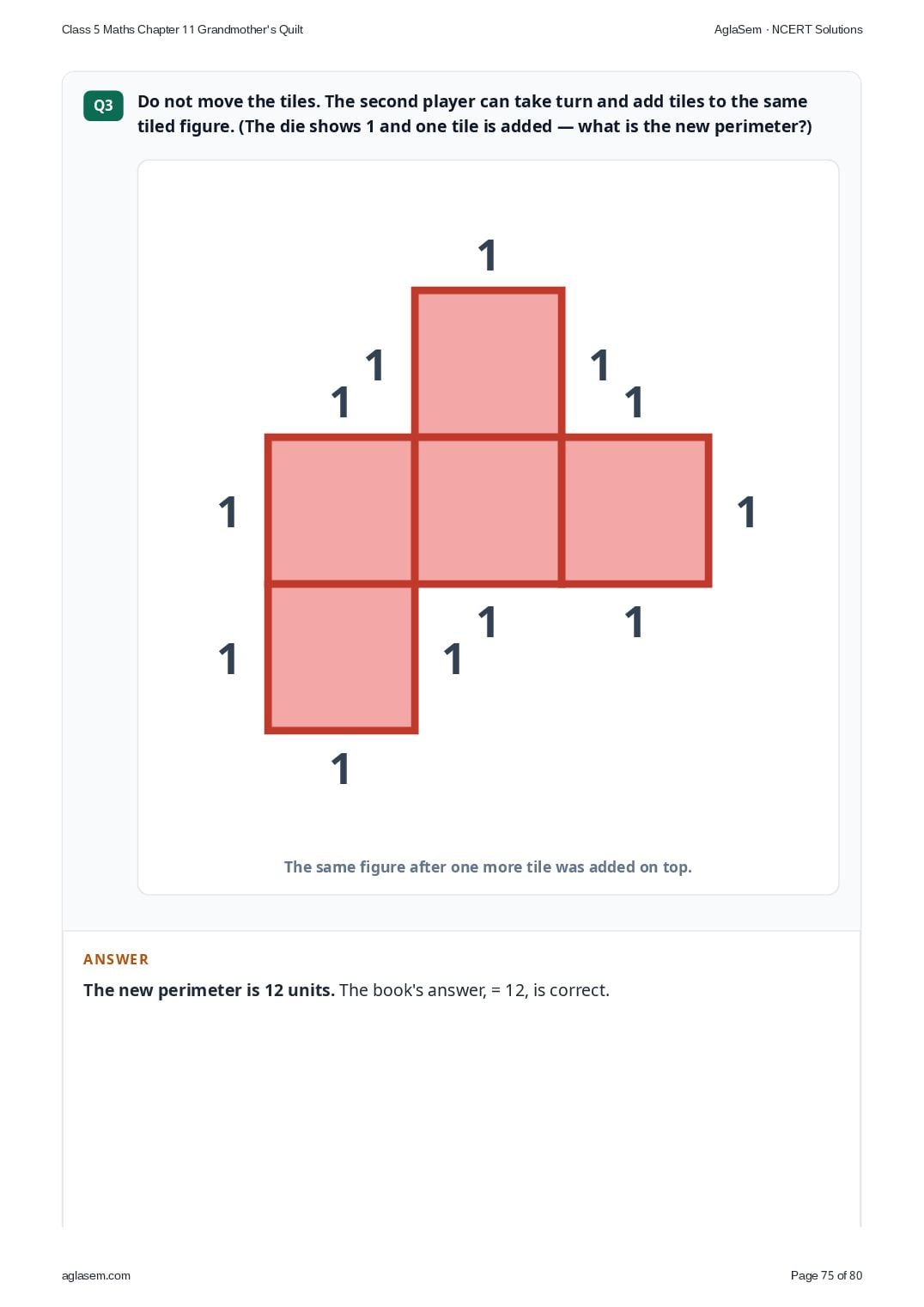
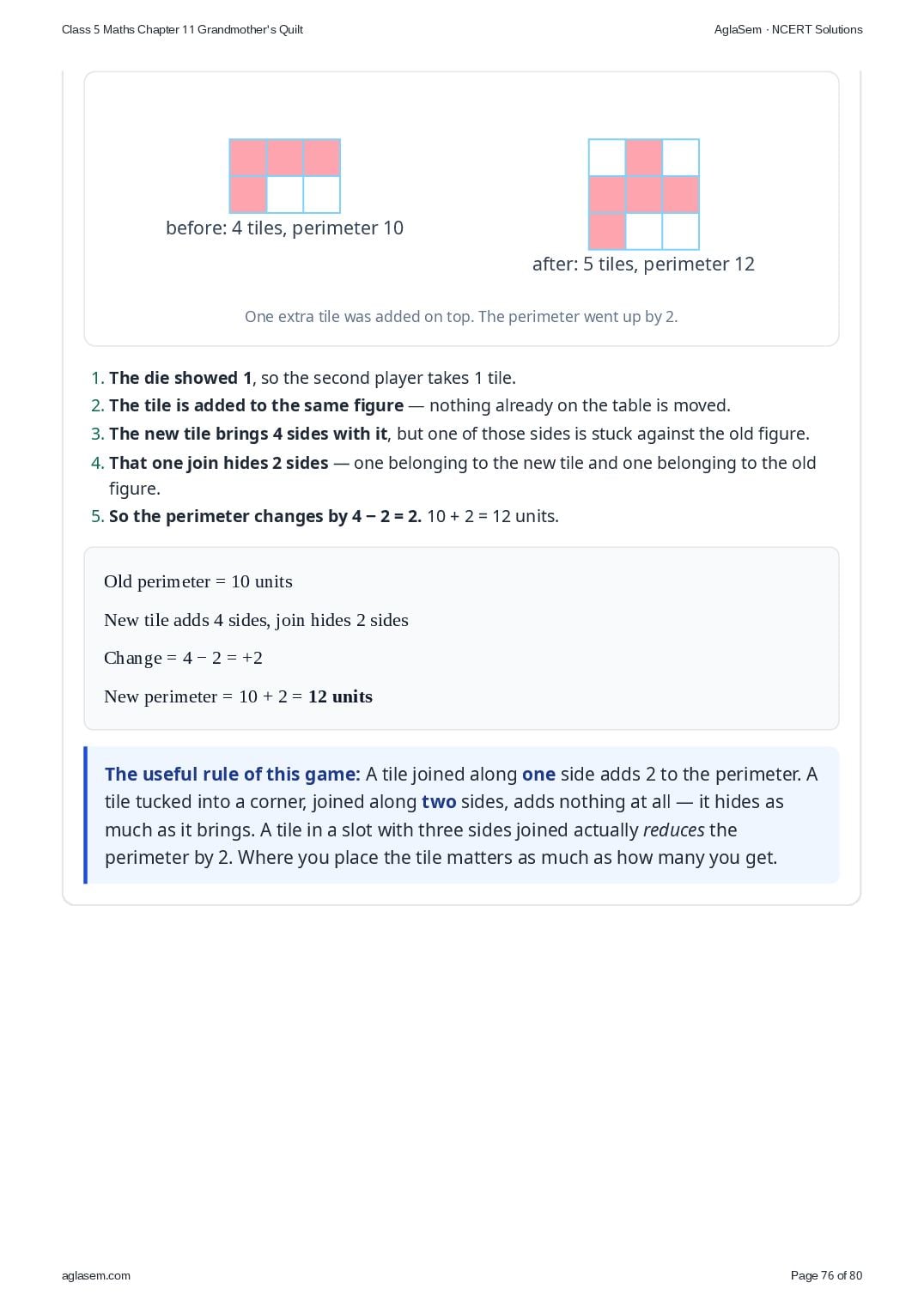
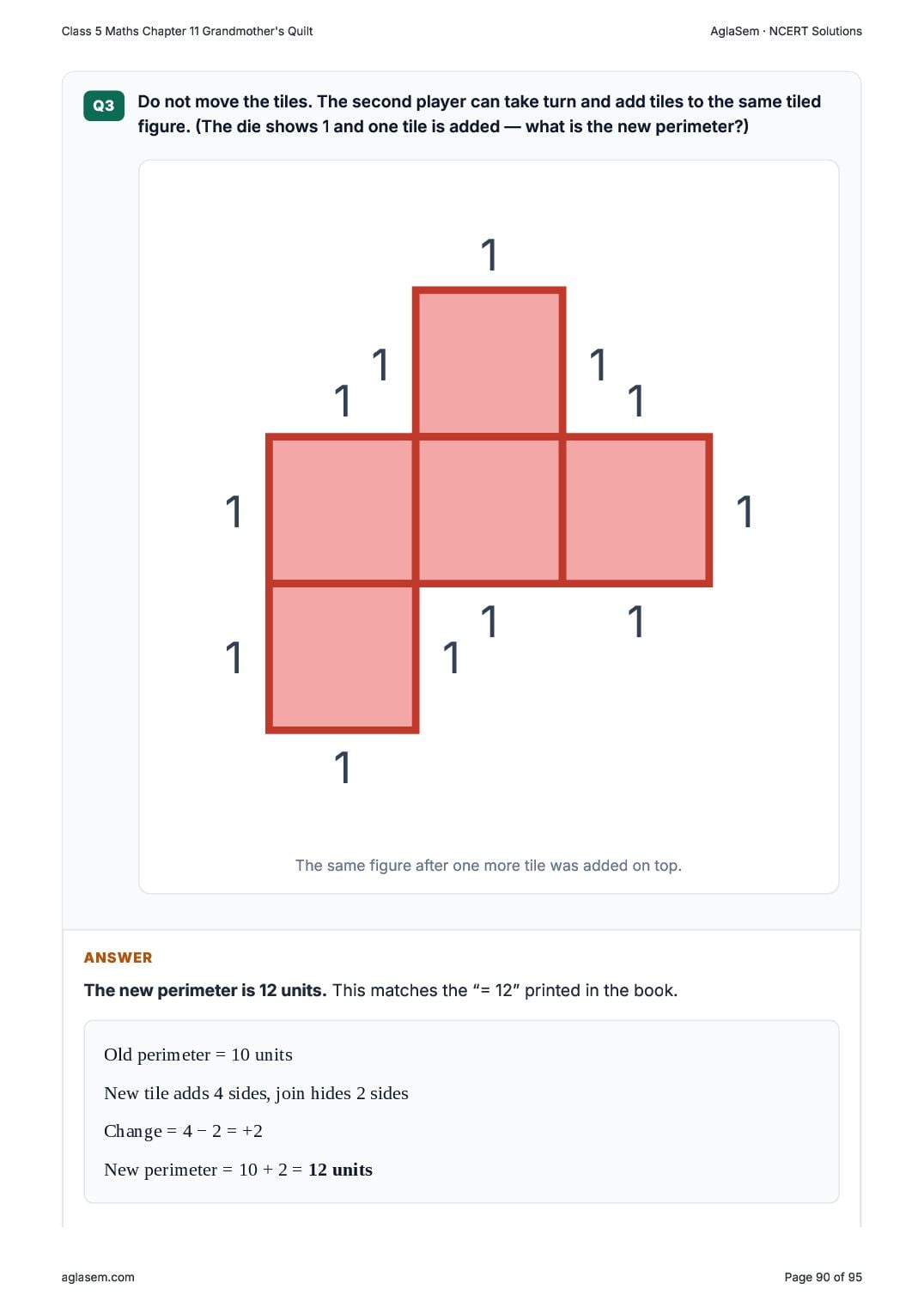
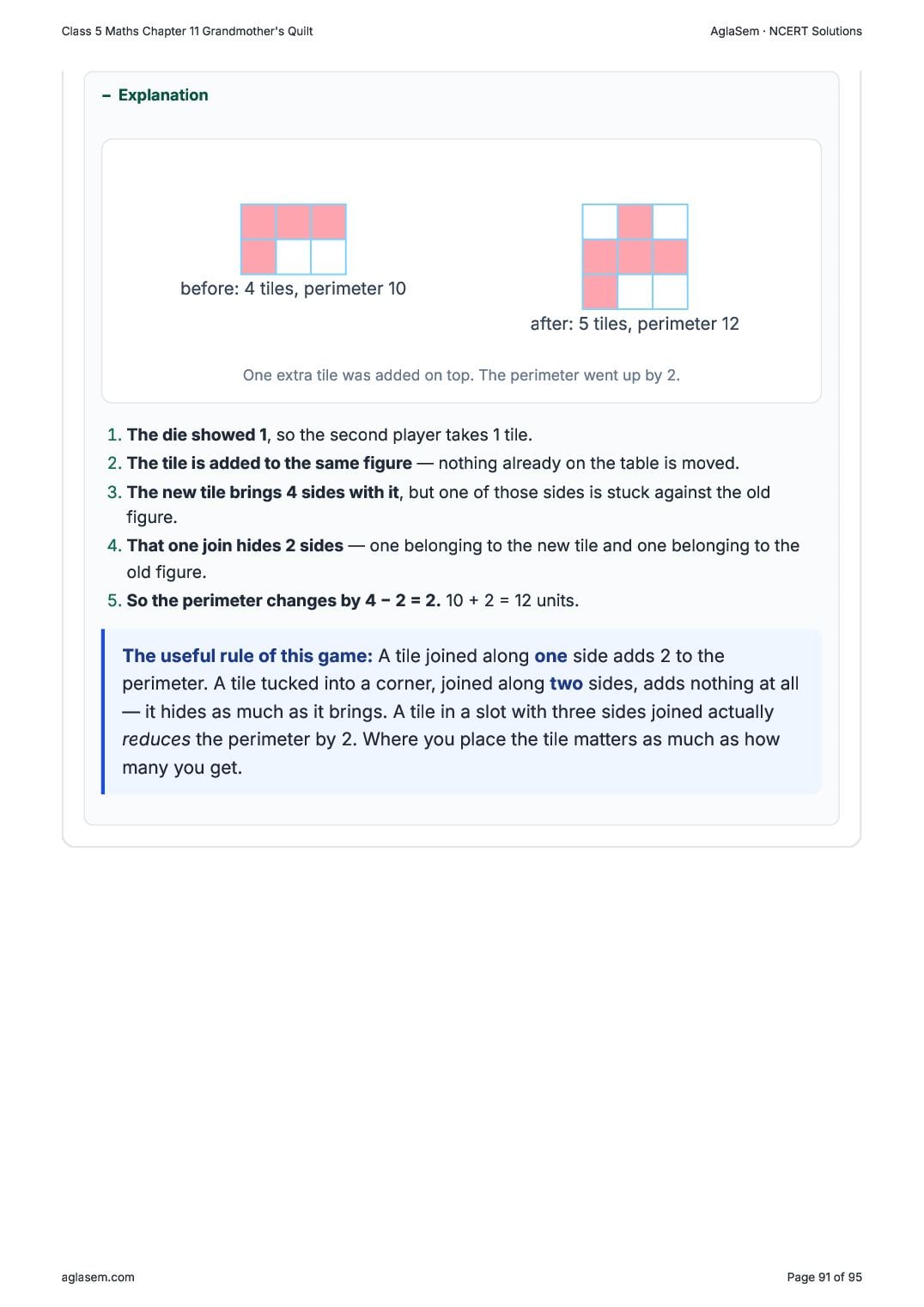
- Do not move the tiles. The second player can take turn and add tiles to the same tiled figure. (The die shows 1 and one tile is added — what is the new perimeter?) 111111111111The same figure after one more tile was added on top.
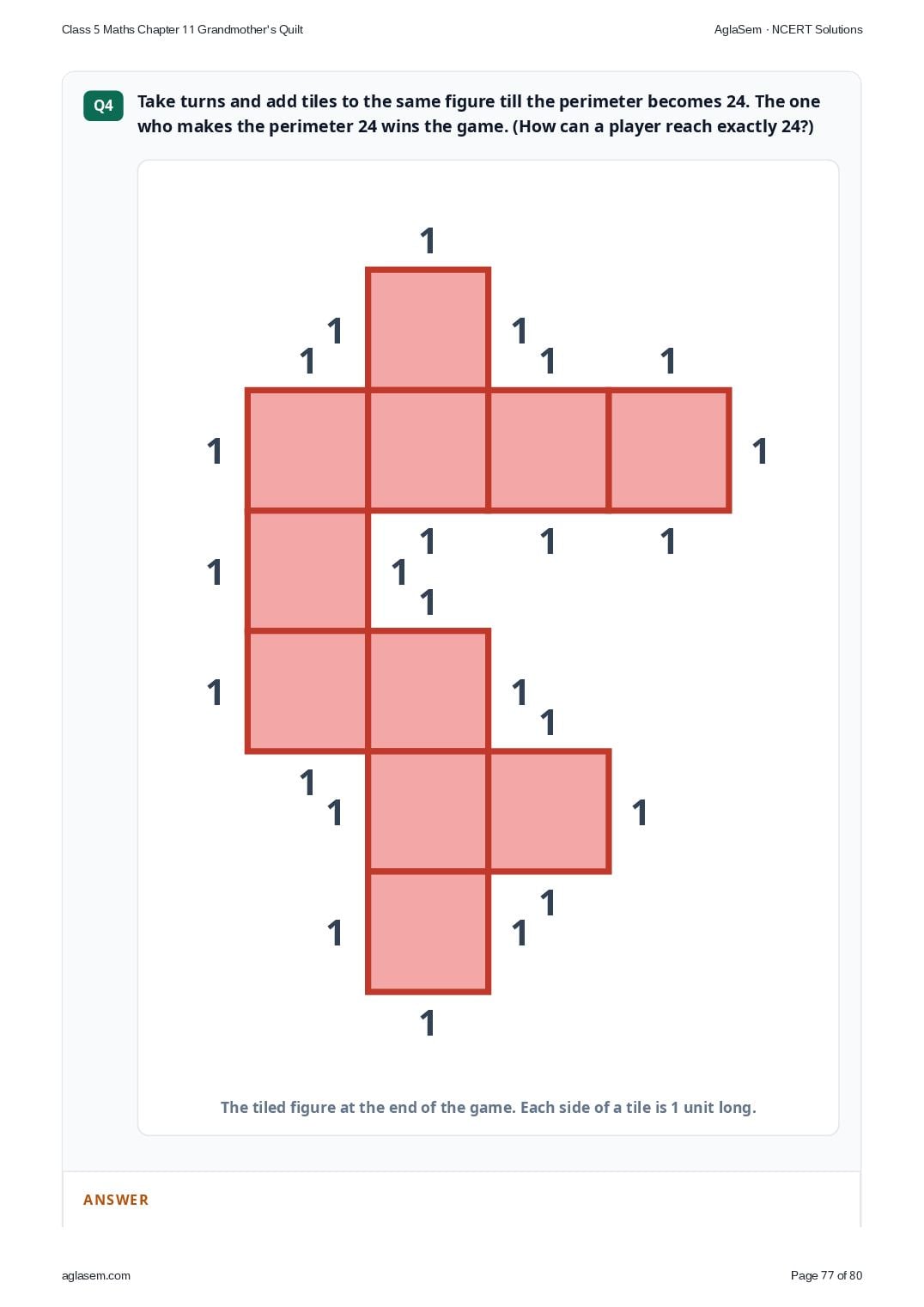
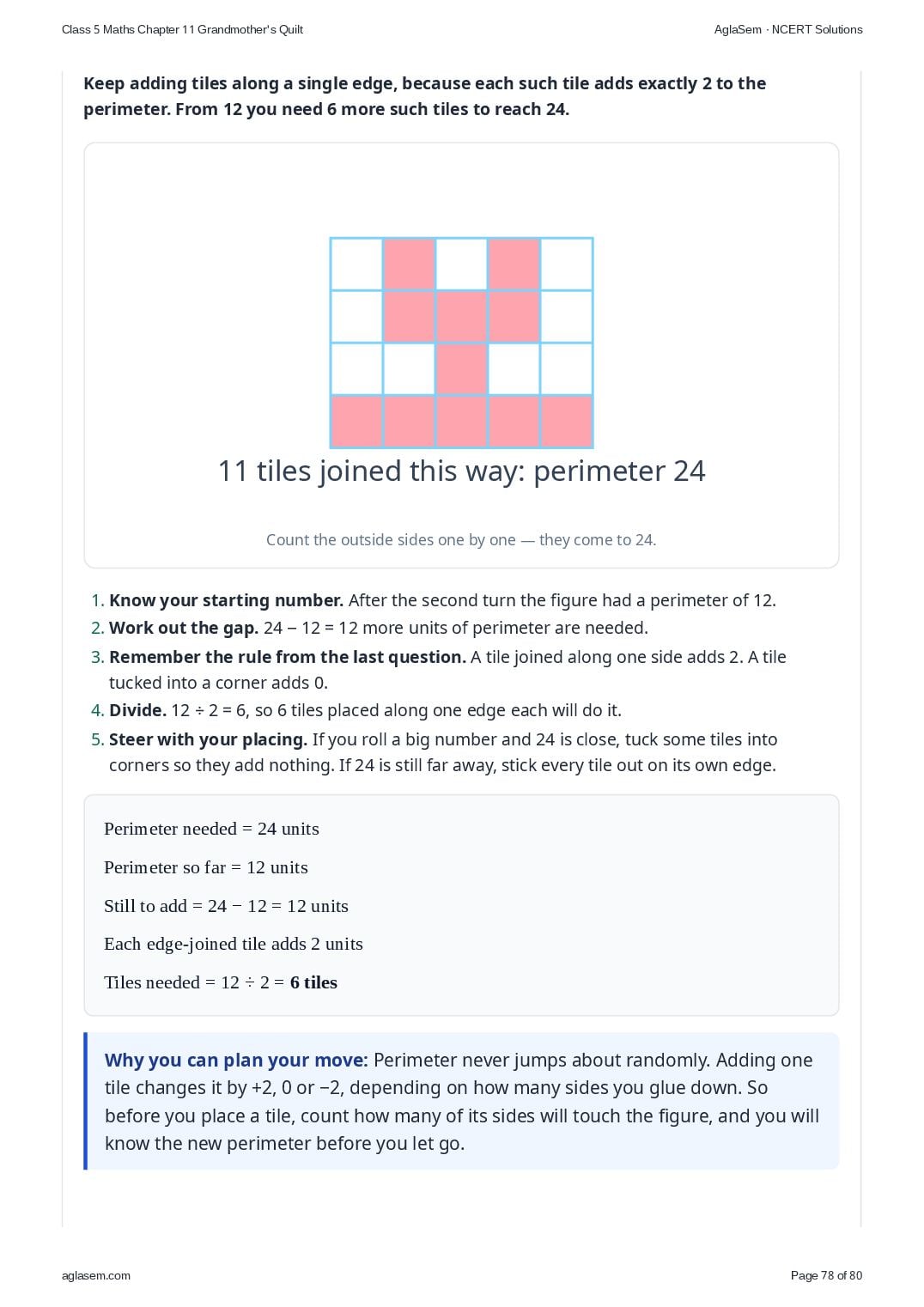
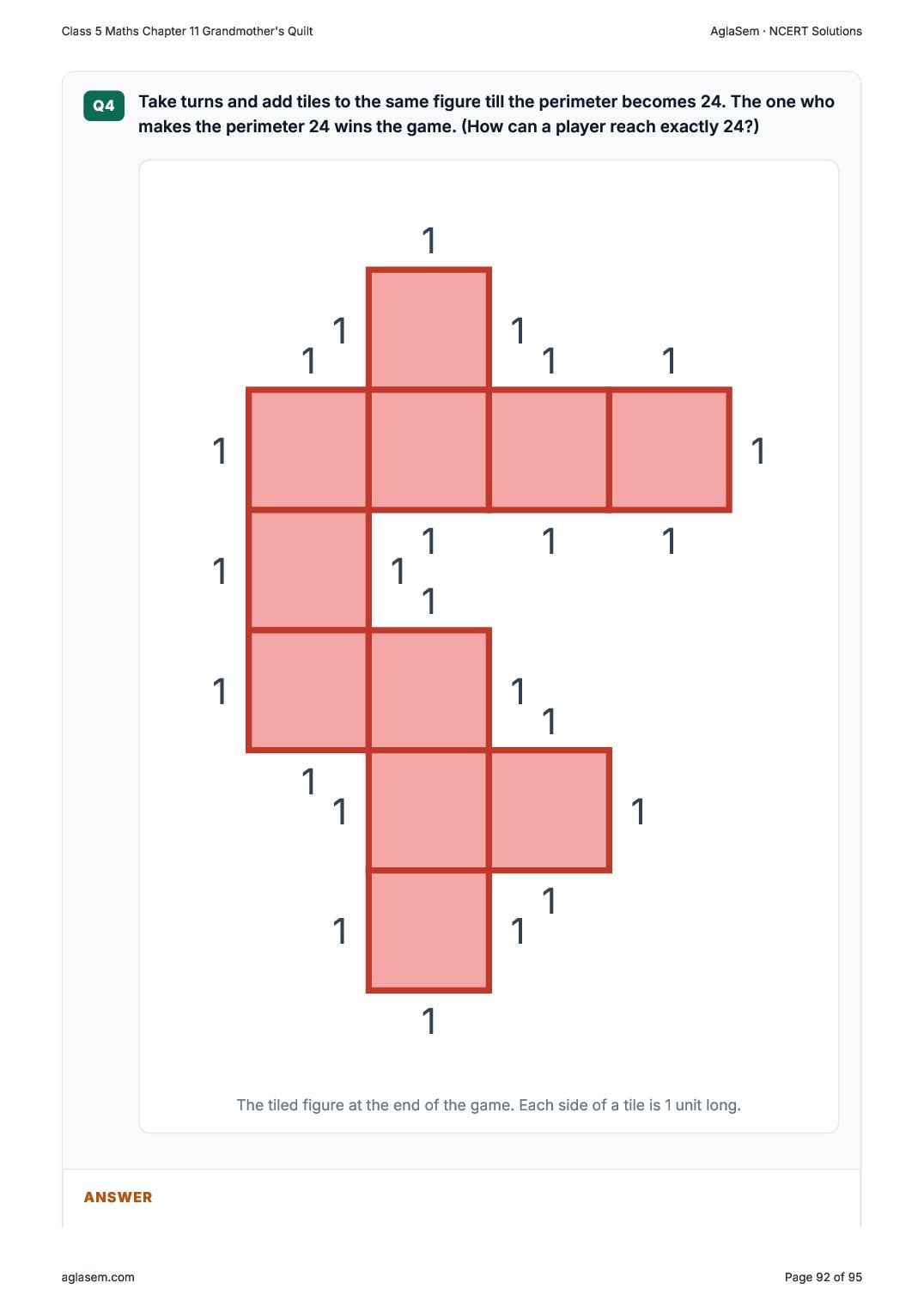
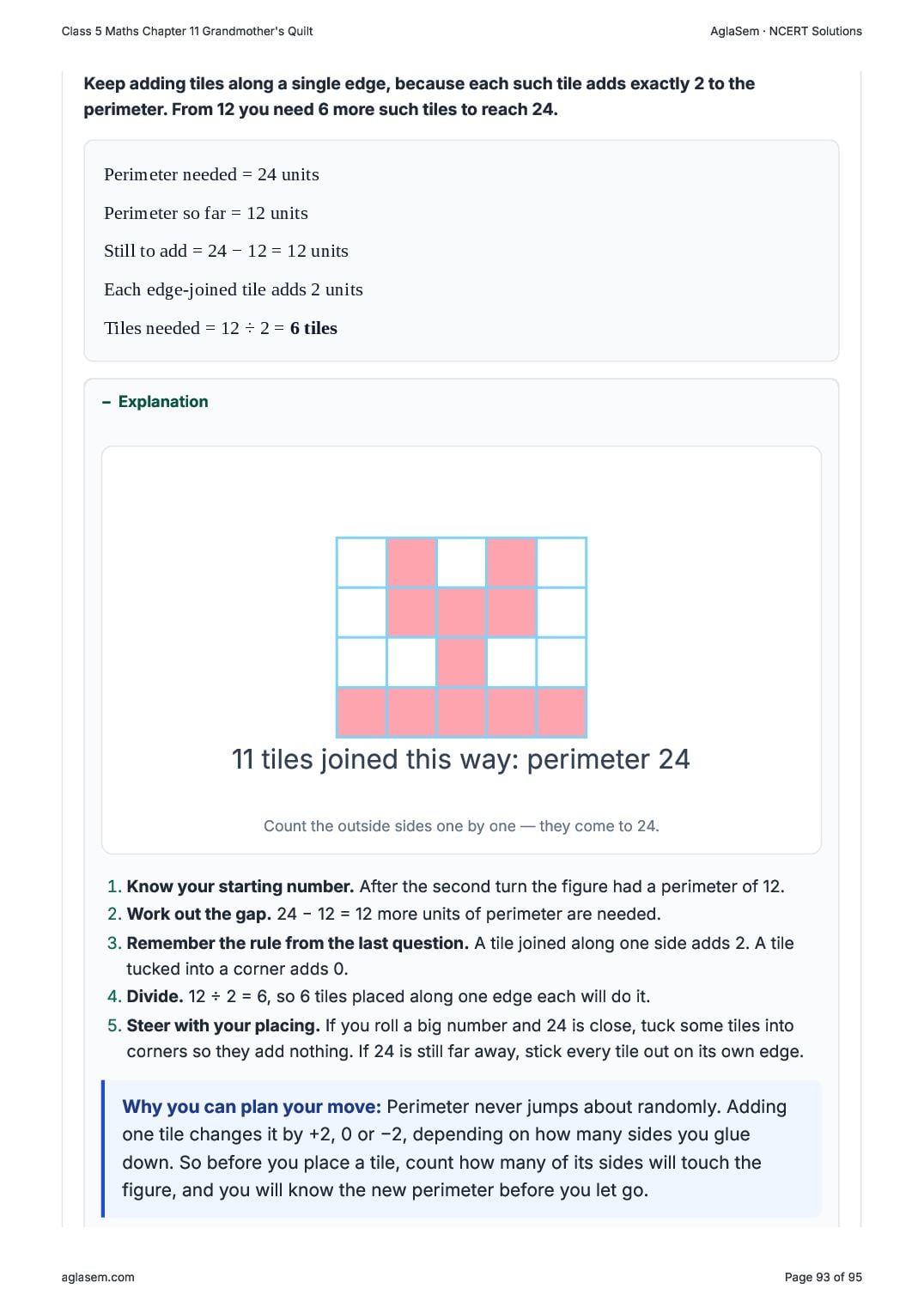
- Take turns and add tiles to the same figure till the perimeter becomes 24. The one who makes the perimeter 24 wins the game. (How can a player reach exactly 24?) 111111111111111111111111The tiled figure at the end of the game. Each side of a tile is 1 unit long.
Chapter at a Glance
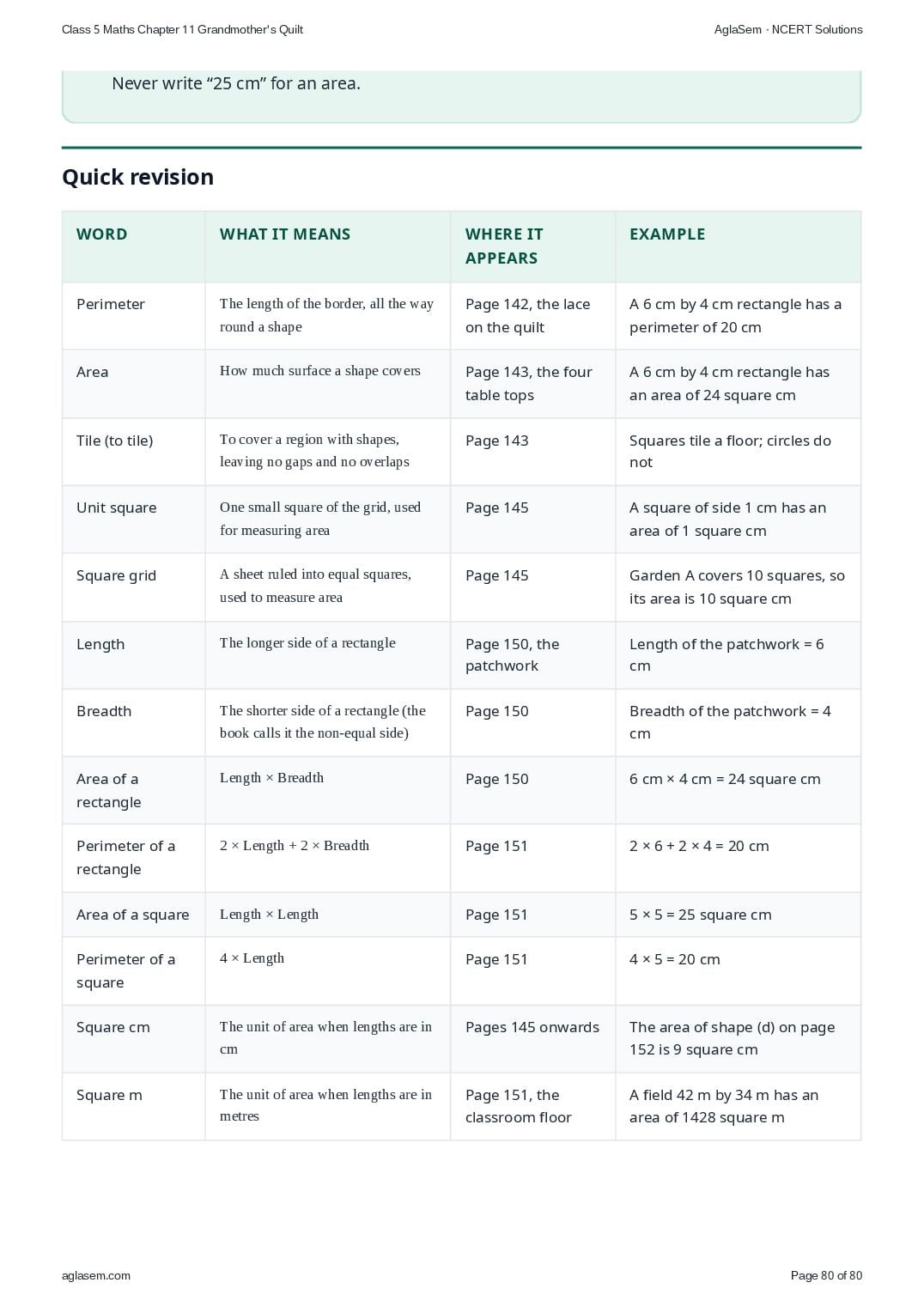
- Perimeter is the ribbon; area is the cloth. Perimeter is the length of the border, all the way round a shape. Area is how much surface the shape covers. Grandmother needs lace for the border of her quilt — that is perimeter. She needs cloth patches to fill the quilt — that is area. If you ever mix the two up, ask yourself: am I going round the outside, or filling up the inside?
- Perimeter is found by adding all the sides. A five-sided shape with every side 4 cm has a perimeter of 4 + 4 + 4 + 4 + 4 = 20 cm. When the sides are all equal you can multiply instead: number of sides × length of one side.
- Area is found by covering with tiles and counting them. Triangles, squares and rectangles cover a table top with no gaps and no overlaps — we say they tile. Circles do not: little empty corners are always left. Table 1 in the book takes 20 triangles, Table 3 takes 8 squares and Table 4 takes 12 rectangles — the same table top, but a smaller tile always means a bigger number.
- The square is the tile we agree to use. All four of its sides are equal, so it is easy to draw and easy to count. A square of side 1 unit has an area of 1 unit square. When the grid squares are 1 cm across, one of them is 1 square cm.
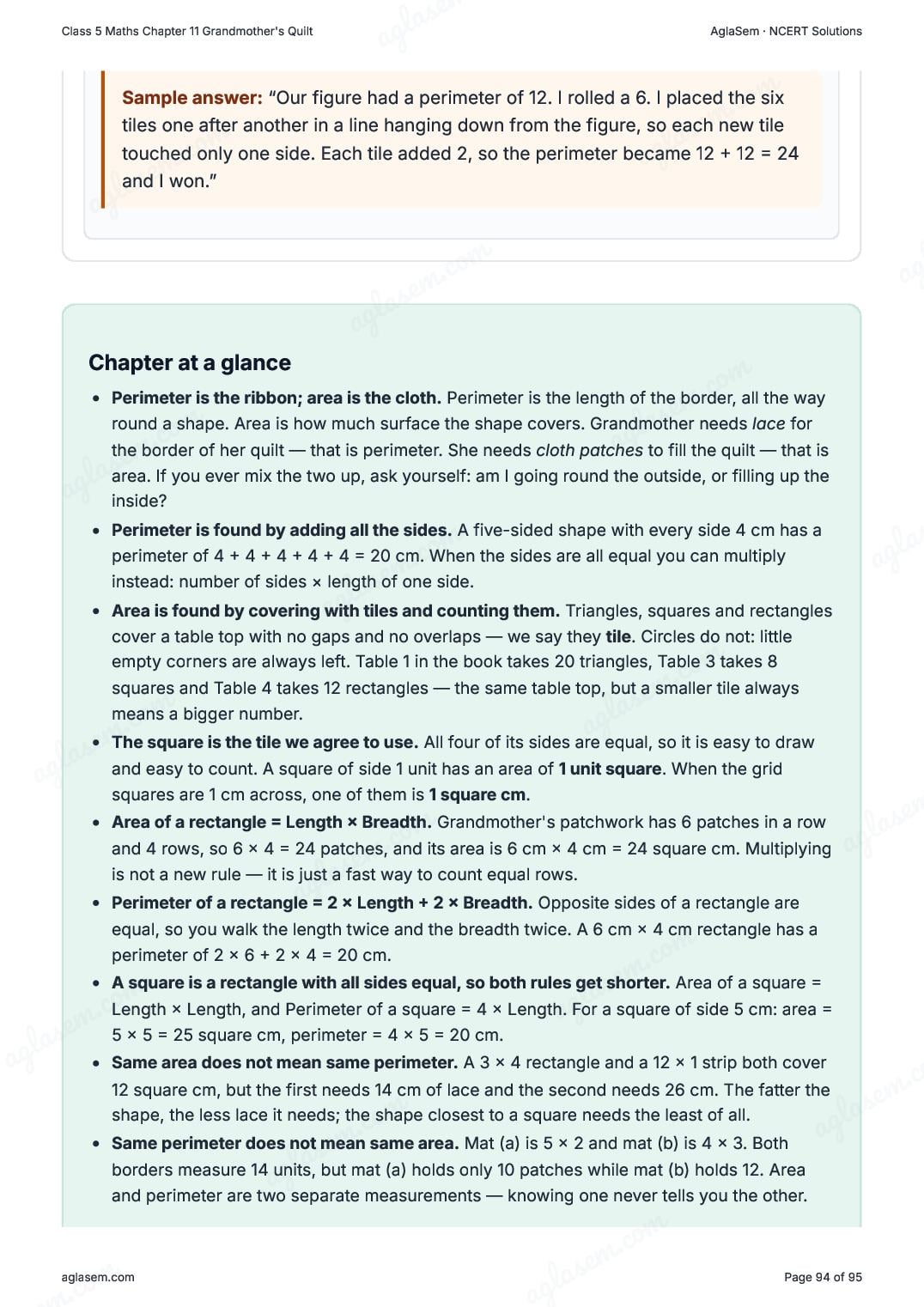
- Area of a rectangle = Length × Breadth. Grandmother’s patchwork has 6 patches in a row and 4 rows, so 6 × 4 = 24 patches, and its area is 6 cm × 4 cm = 24 square cm. Multiplying is not a new rule — it is just a fast way to count equal rows.
- Perimeter of a rectangle = 2 × Length + 2 × Breadth. Opposite sides of a rectangle are equal, so you walk the length twice and the breadth twice. A 6 cm × 4 cm rectangle has a perimeter of 2 × 6 + 2 × 4 = 20 cm.
- A square is a rectangle with all sides equal, so both rules get shorter. Area of a square = Length × Length, and Perimeter of a square = 4 × Length. For a square of side 5 cm: area = 5 × 5 = 25 square cm, perimeter = 4 × 5 = 20 cm.
- Same area does not mean same perimeter. A 3 × 4 rectangle and a 12 × 1 strip both cover 12 square cm, but the first needs 14 cm of lace and the second needs 26 cm. The fatter the shape, the less lace it needs; the shape closest to a square needs the least of all.
- Same perimeter does not mean same area. Mat (a) is 5 × 2 and mat (b) is 4 × 3. Both borders measure 14 units, but mat (a) holds only 10 patches while mat (b) holds 12. Area and perimeter are two separate measurements — knowing one never tells you the other.
- Units matter, and they are different for the two. Perimeter is a length, so it is written in cm, m or units. Area is a covering, so it is written in square cm, square m or square units. Never write “25 cm” for an area.
How to Download NCERT Solutions for Class 5 Maths Chapter 11 PDF
Follow these simple steps to get the Grandmother s Quilt questions-and-answers PDF from Math Mela.
- Search NCERT Solutions for Class 5 Maths Chapter 11 aglasem and open this page.
- Read the exercise questions with answers for Grandmother s Quilt shown above.
- Click the Download PDF link to save the Grandmother s Quilt solutions to your device.
NCERT Solutions for Class 5 Maths – All Chapters
There are more chapters to study besides Grandmother s Quilt in Maths. Here are the NCERT Solutions for all chapters of Class 5 Maths.
- Chapter 1 We the Travellers I
- Chapter 2 Fractions
- Chapter 3 Angles As Turns
- Chapter 4 We the Travellers Ii
- Chapter 5 Far and Near
- Chapter 6 the Dairy Farm
- Chapter 7 Shapes and Patterns
- Chapter 8 Weight and Capacity
- Chapter 9 Coconut Farm
- Chapter 10 Symmetrical Designs
- Chapter 11 Grandmother s Quilt
- Chapter 12 Racing Seconds
- Chapter 13 Animal Jumps
- Chapter 14 Maps and Locations
- Chapter 15 Data Through Pictures
NCERT Solutions for Class 5 – All Subjects
Just like Chapter 11 of Maths, you can get the exercise questions with answers for every other subject of Class 5. Here are the NCERT Solutions for all subjects of Class 5.
NCERT Solutions for Class 5 Maths Chapter 11 – An Overview
The key highlights of this study material are as follows.
| Aspects | Details |
|---|---|
| Class | Class 5 |
| Subject | Maths |
| Chapter Number | Chapter 11 |
| Chapter Name | Grandmother s Quilt |
| Book Name | Math Mela |
| Book By | NCERT (National Council of Educational Research and Training) |
| Educational Resource Here | NCERT Solutions of Class 5 Maths Chapter 11 for all exercises |
| More Questions Answers of This Subject | NCERT Solutions for Class 5 Maths |
| Download Book Chapter | NCERT Book Class 5 Maths |
| All Questions Answers For This Class | NCERT Solutions for Class 5 |
| Complete Solutions | NCERT Solutions |
NCERT Solutions for Class 5 Maths Chapter 11 Grandmother s Quilt – FAQs
What are the NCERT Solutions for Class 5 Maths Chapter 11 Grandmother s Quilt?
They are the complete, step-by-step answers to all the exercise and in-text questions of Chapter 11 Grandmother s Quilt from the NCERT Class 5 Maths textbook Math Mela, written by experts as per the latest NCERT syllabus.
How can I download the Class 5 Maths Chapter 11 solutions PDF for free?
Open this page on aglasem, read the Grandmother s Quilt questions with answers, and click the “Download Solutions PDF” link. The Class 5 Maths Chapter 11 NCERT Solutions PDF is completely free to download.
Are these NCERT Solutions as per the latest 2026-27 syllabus?
Yes. The NCERT Solutions for Class 5 Maths Chapter 11 are based on the latest NCERT textbook Math Mela and the current 2026-27 CBSE syllabus, so the questions and answers match what you study in class.
Where can I get NCERT Solutions for the other chapters of Class 5 Maths?
You can find the answers to every chapter on the NCERT Solutions for Class 5 Maths page, and solutions for every subject on the NCERT Solutions for Class 5 page.
How do NCERT Solutions help in exam preparation?
They show the correct method to solve each question, help you write answers the way they are expected in exams, let you check and correct your own work, and save revision time — which together improve your marks in Class 5 Maths.
If you have any queries on NCERT Solutions for Class 5 Maths Chapter 11 Grandmother s Quilt, then please ask in the comments below.