NCERT Solutions for Class 5 Maths Chapter 4 We the Travellers Ii provide clear, step-by-step answers to every exercise and in-text question from the chapter We the Travellers Ii of the NCERT textbook Math Mela. Prepared by subject experts as per the latest NCERT (CBSE) syllabus for 2026-27, these NCERT Solutions for Class 5 Maths help you understand each concept, write exam-ready answers, and check your own solutions. You can read them online below or download the free Class 5 Maths Chapter 4 question-answer PDF.
NCERT Solutions for Class 5 Maths Chapter 4 We the Travellers Ii
- Class: Class 5
- Subject: Maths
- Chapter: Chapter 4 – We the Travellers Ii
- Textbook: Math Mela (NCERT)
- Study material: NCERT Solutions – questions with answers, free PDF
These solutions answer all the exercise questions of Chapter 4 We the Travellers Ii — including the in-text questions, short-answer and long-answer questions, and activities — with complete explanations so you can follow the method, not just the final answer. Read the full solutions below.
NCERT Solutions Class 5 Maths Chapter 4 We the Travellers Ii View Download

NCERT Solutions for Class 5 Maths Chapter 4 PDF Download
You can read the NCERT Solutions for Class 5 Maths Chapter 4 online above, or download the complete question-answer PDF to study We the Travellers Ii offline at any time.
NCERT Solutions for Class 5 Maths Chapter 4 PDF Download Link – Click Here to Download Solutions PDF
Questions Covered in This Chapter
These NCERT Solutions answer all 63 questions of this chapter. The questions solved are:
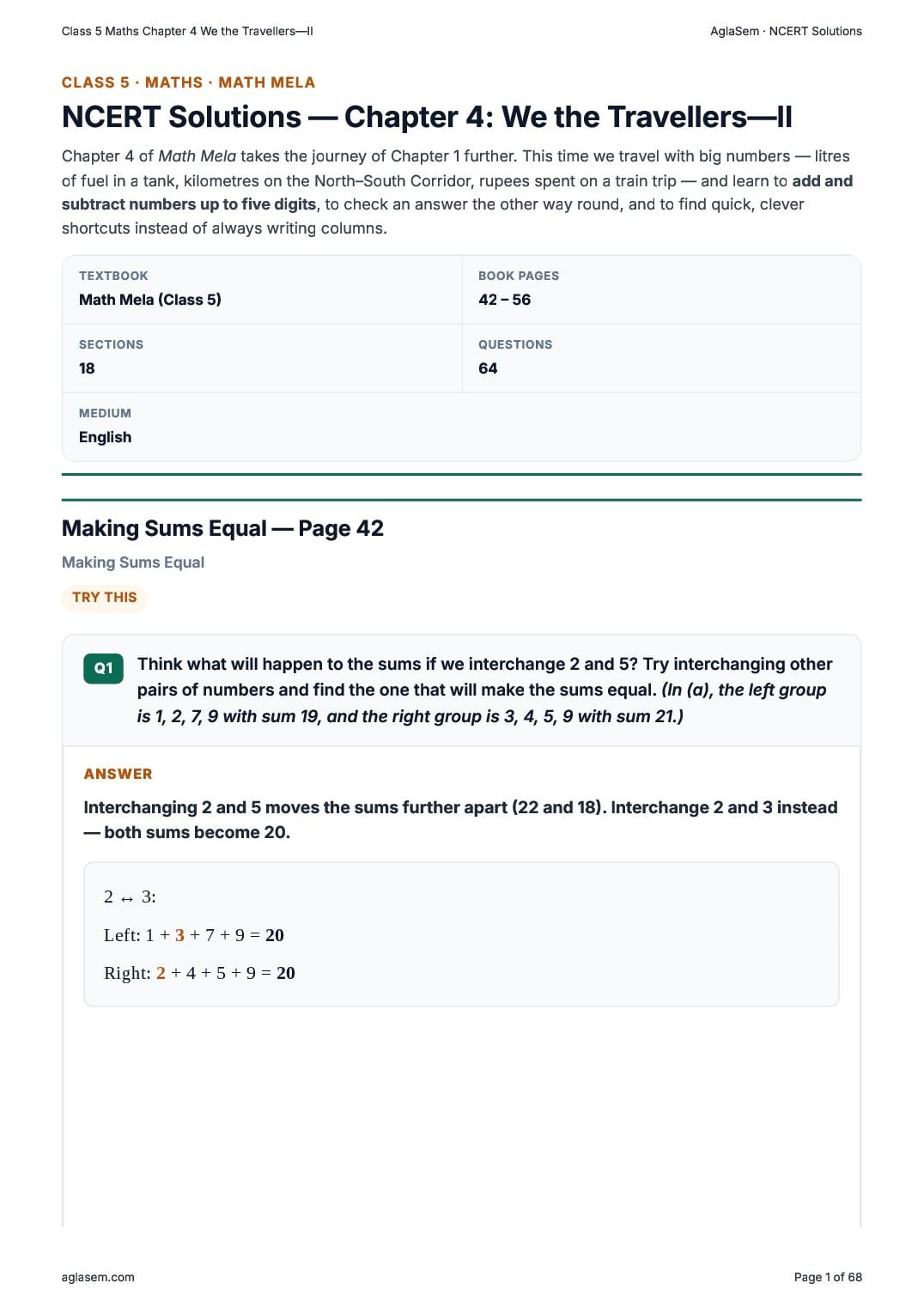
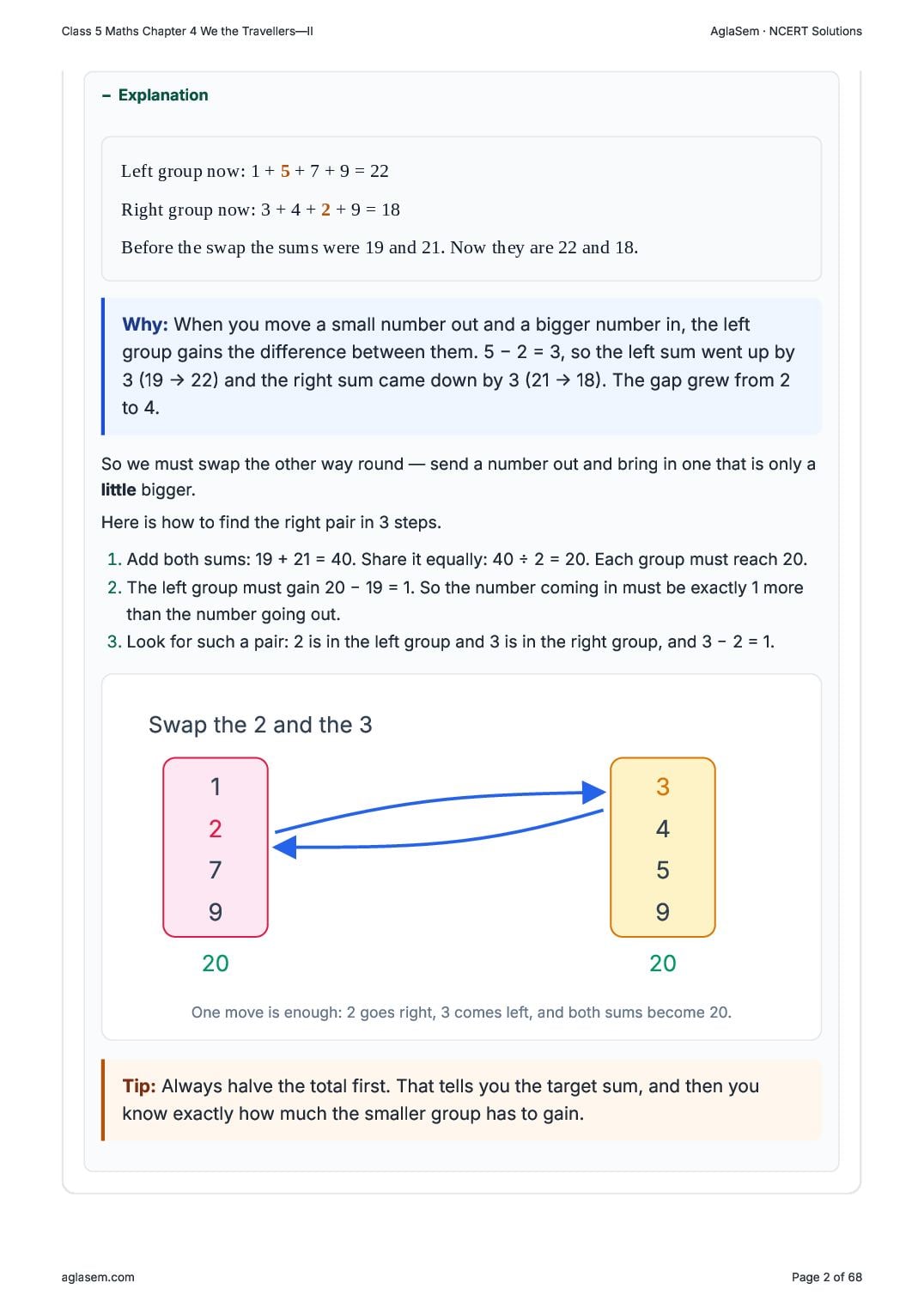
- Think what will happen to the sums if we interchange 2 and 5? Try interchanging other pairs of numbers and find the one that will make the sums equal.
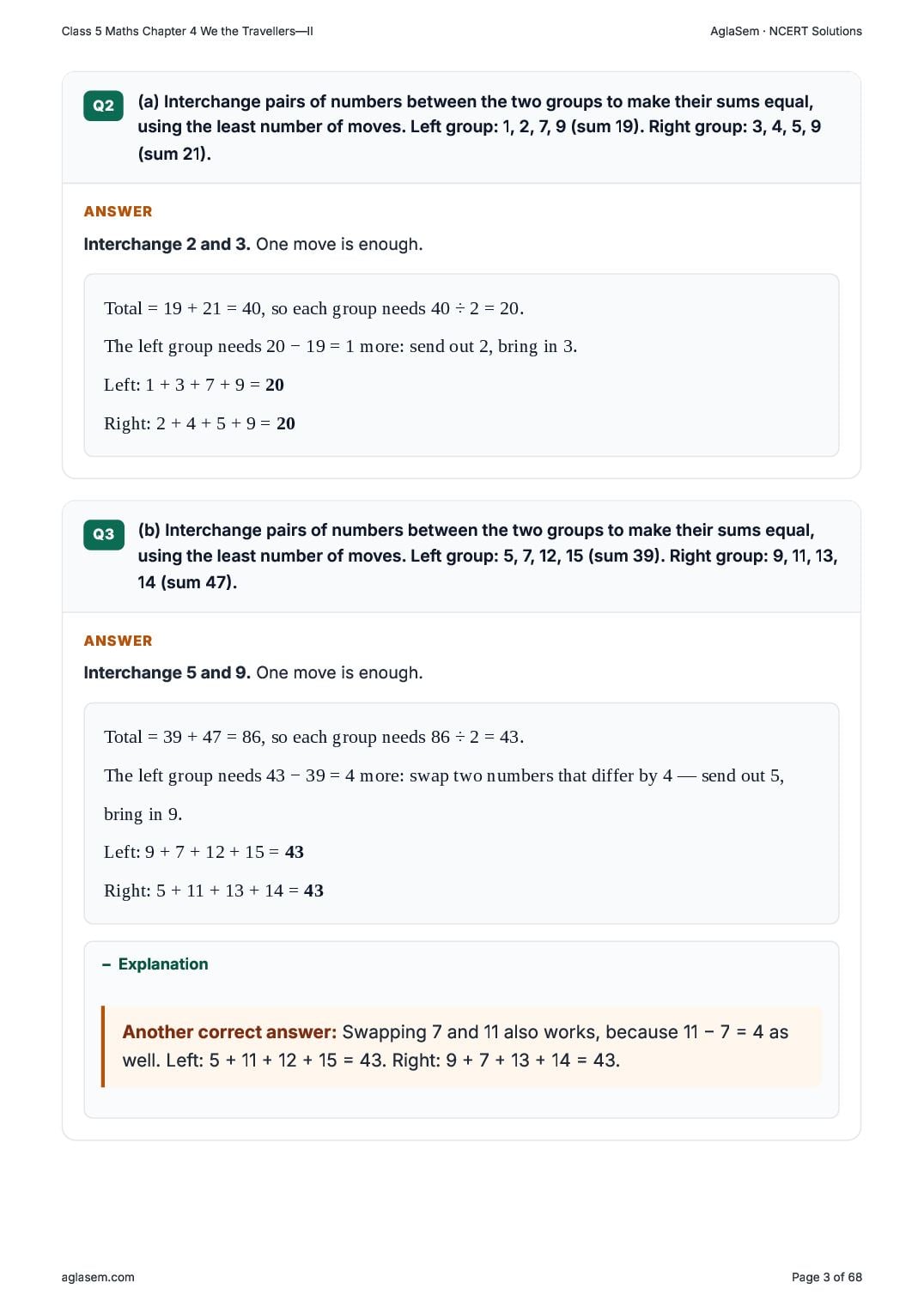
- (a) Interchange pairs of numbers between the two groups to make their sums equal, using the least number of moves. Left group: 1, 2, 7, 9 (sum 19). Right group: 3, 4, 5, 9 (sum 21).
- (b) Interchange pairs of numbers between the two groups to make their sums equal, using the least number of moves. Left group: 5, 7, 12, 15 (sum 39). Right group: 9, 11, 13, 14 (sum 47).
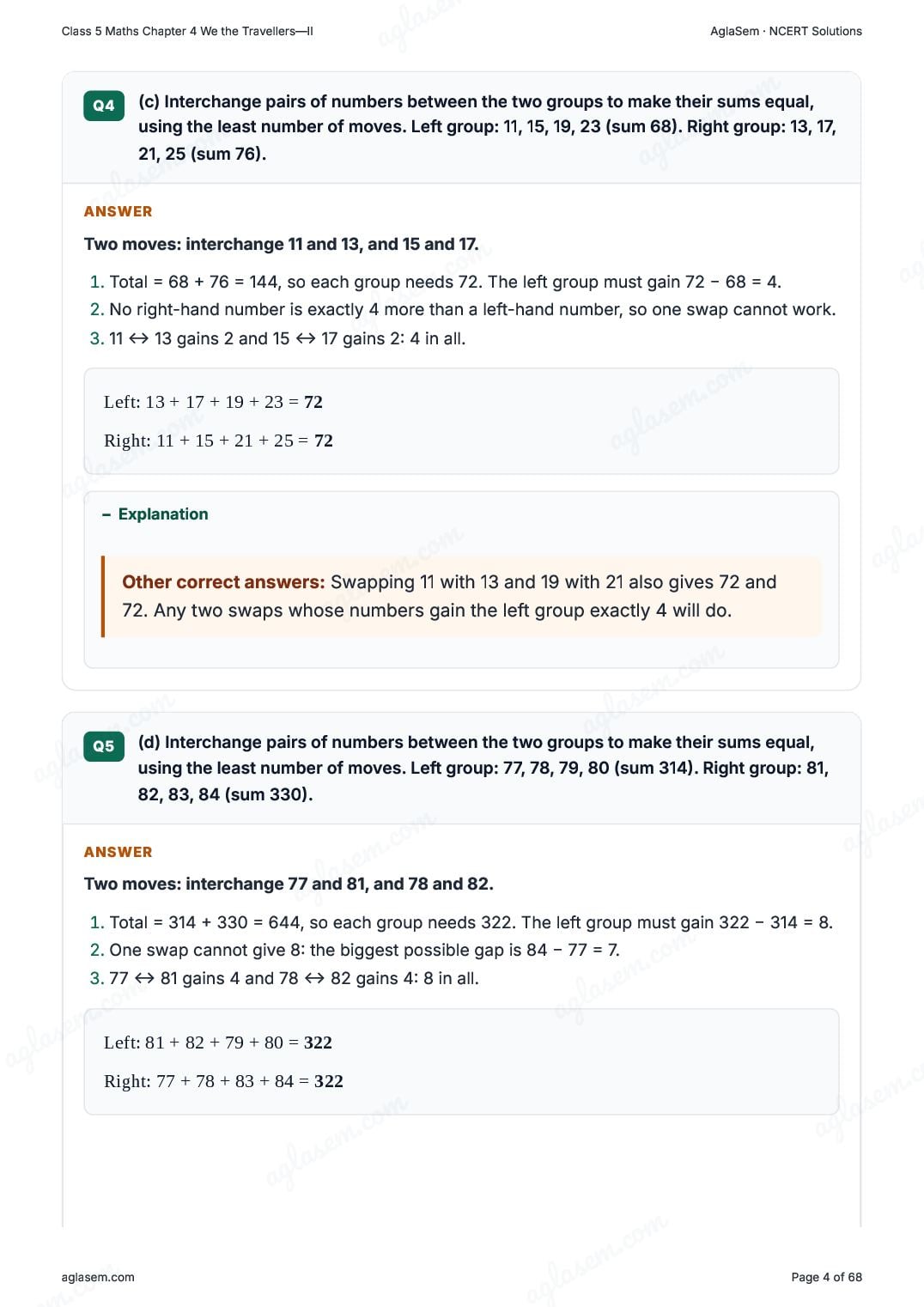
- (c) Interchange pairs of numbers between the two groups to make their sums equal, using the least number of moves. Left group: 11, 15, 19, 23 (sum 68). Right group: 13, 17, 21, 25 (sum 76).
- (d) Interchange pairs of numbers between the two groups to make their sums equal, using the least number of moves. Left group: 77, 78, 79, 80 (sum 314). Right group: 81, 82, 83, 84 (sum 330).
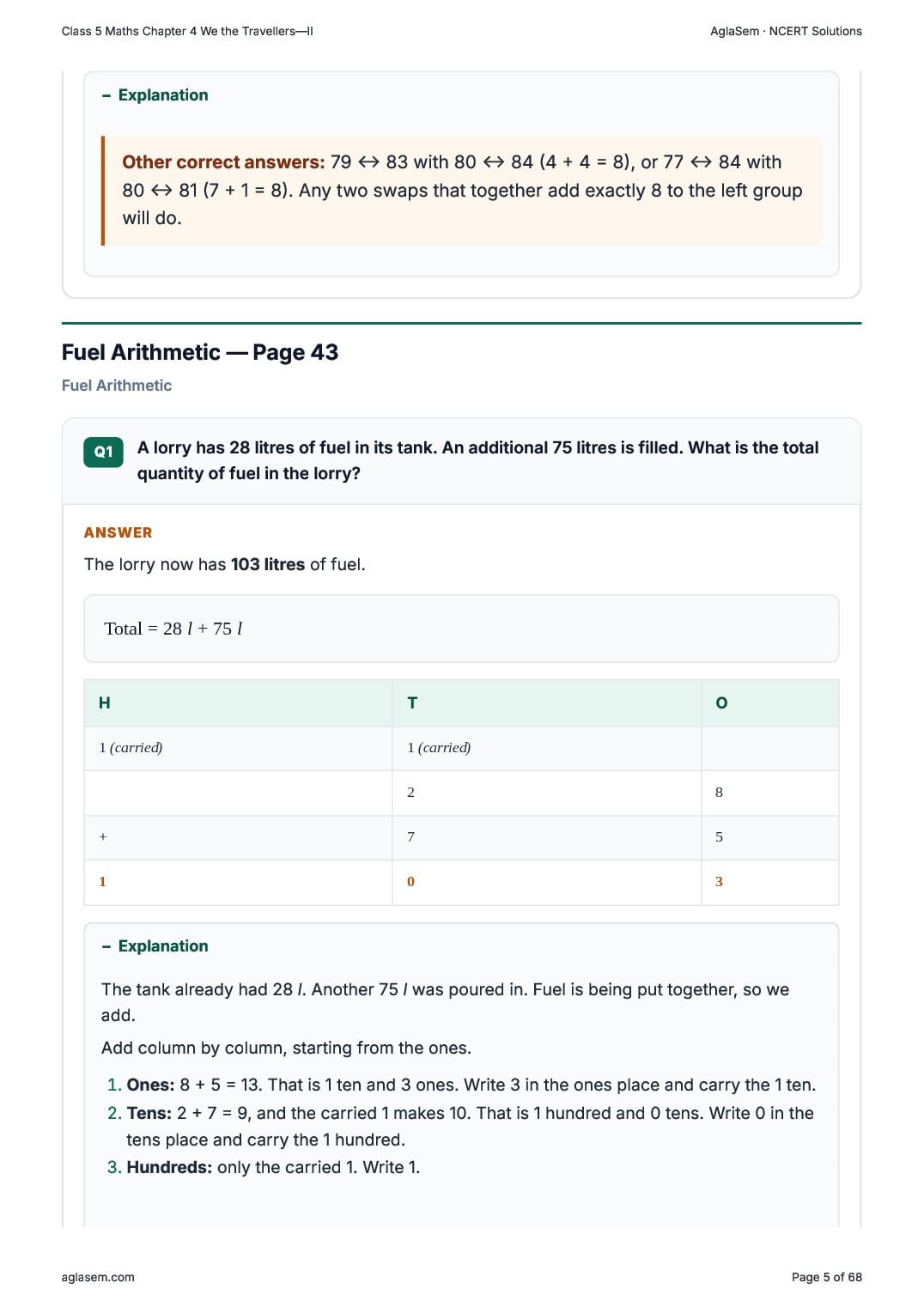
- A lorry has 28 litres of fuel in its tank. An additional 75 litres is filled. What is the total quantity of fuel in the lorry?
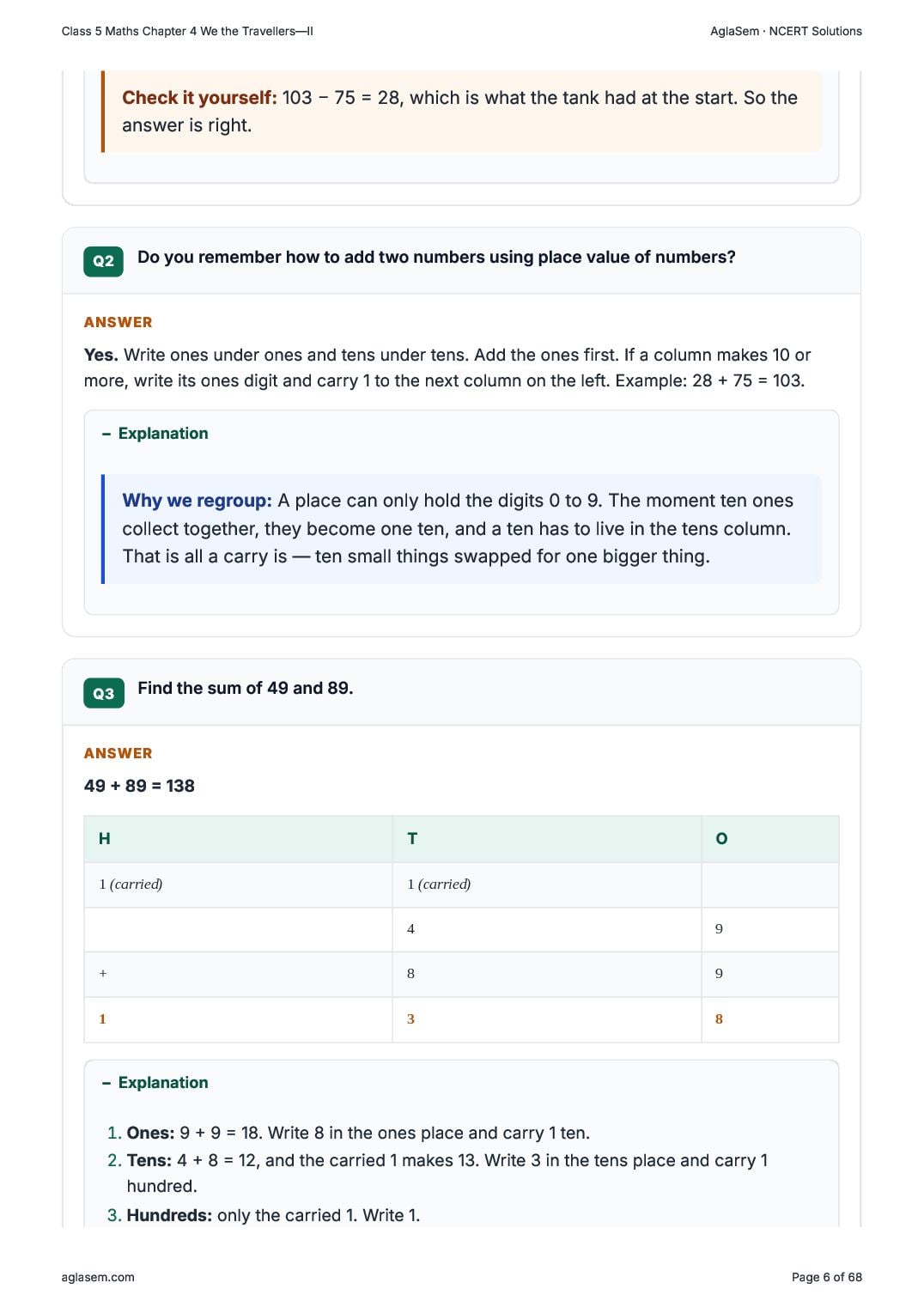
- Do you remember how to add two numbers using place value of numbers?
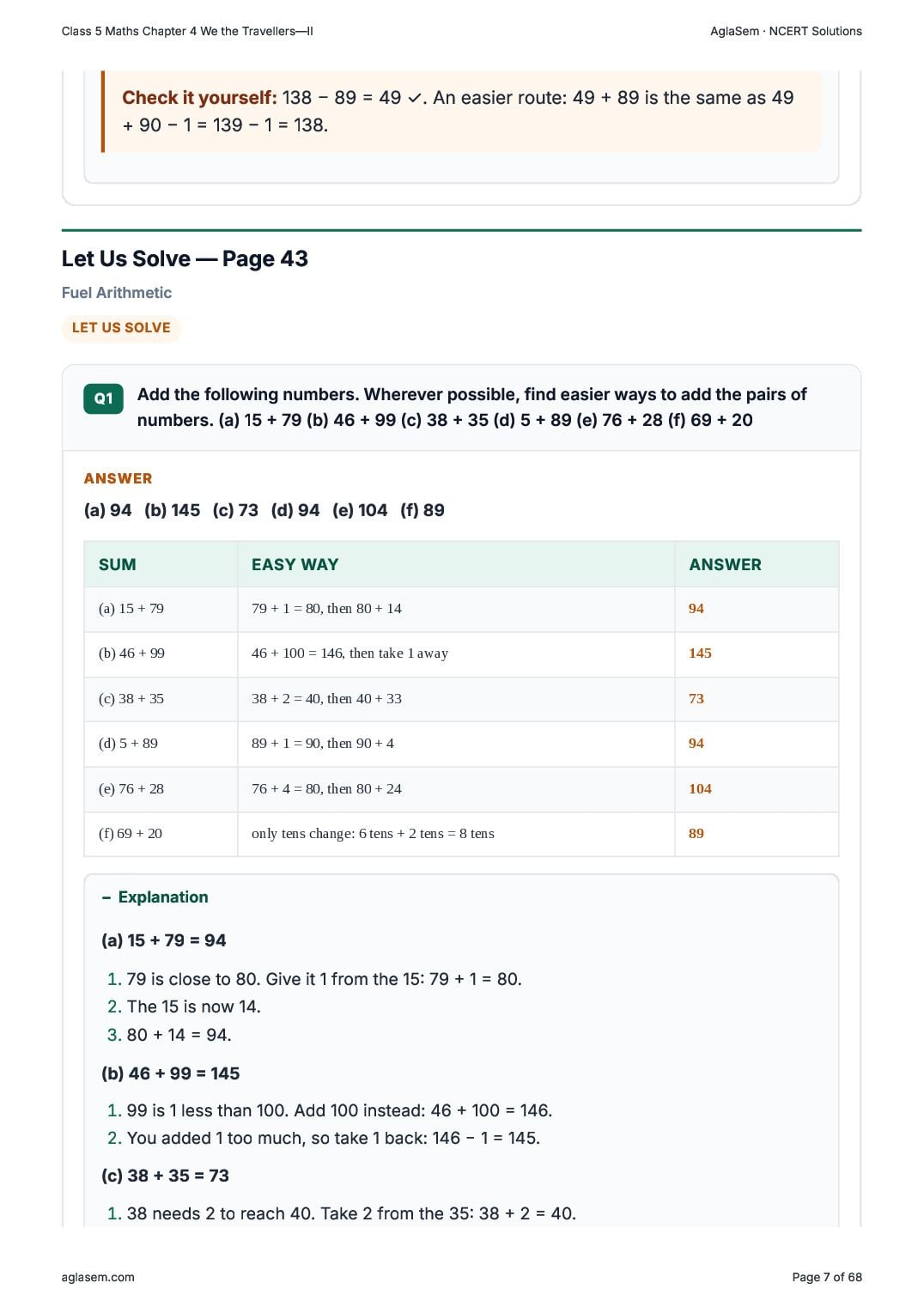
- Find the sum of 49 and 89.
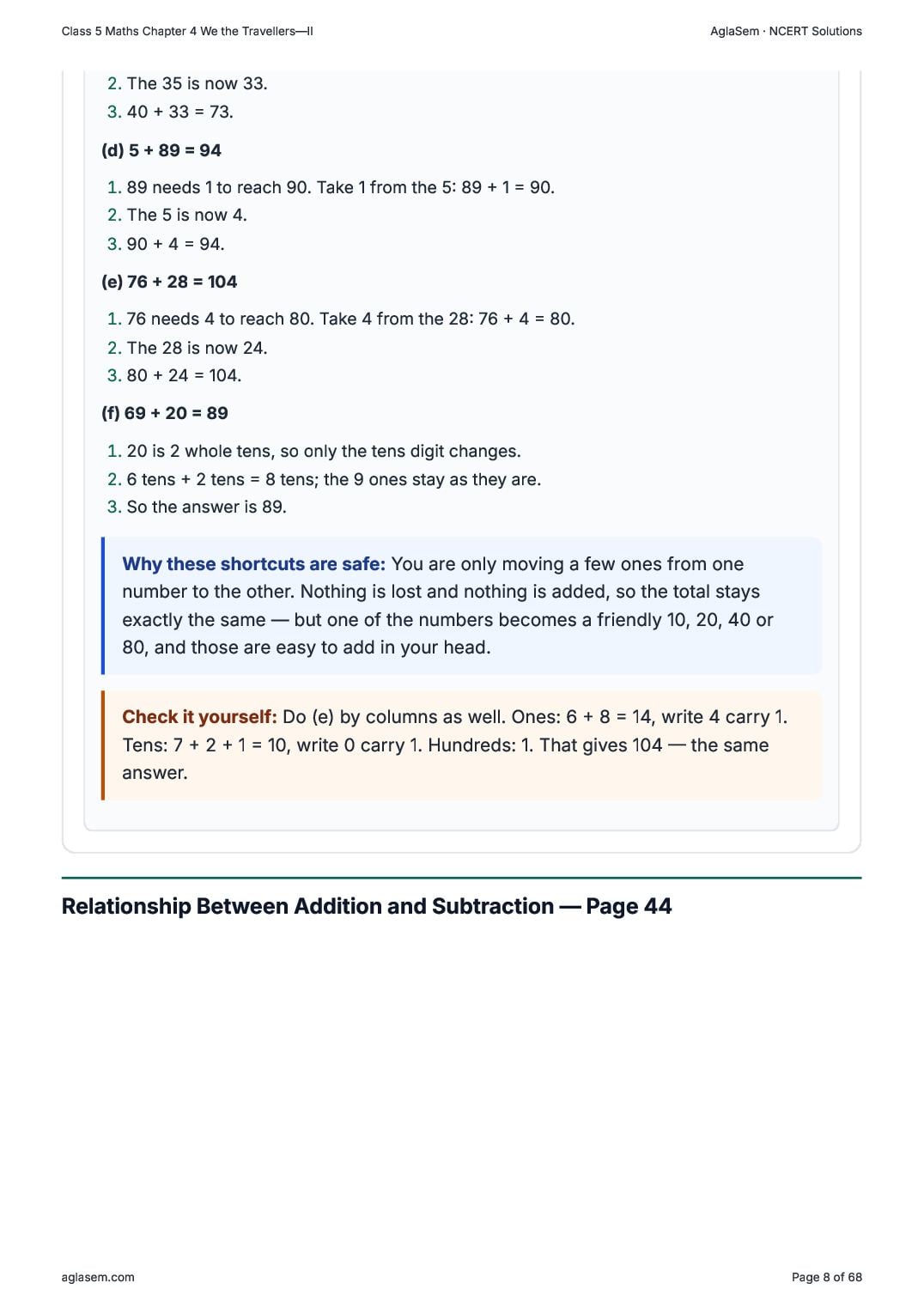
- Add the following numbers. Wherever possible, find easier ways to add the pairs of numbers. (a) 15 + 79 (b) 46 + 99 (c) 38 + 35 (d) 5 + 89 (e) 76 + 28 (f) 69 + 20
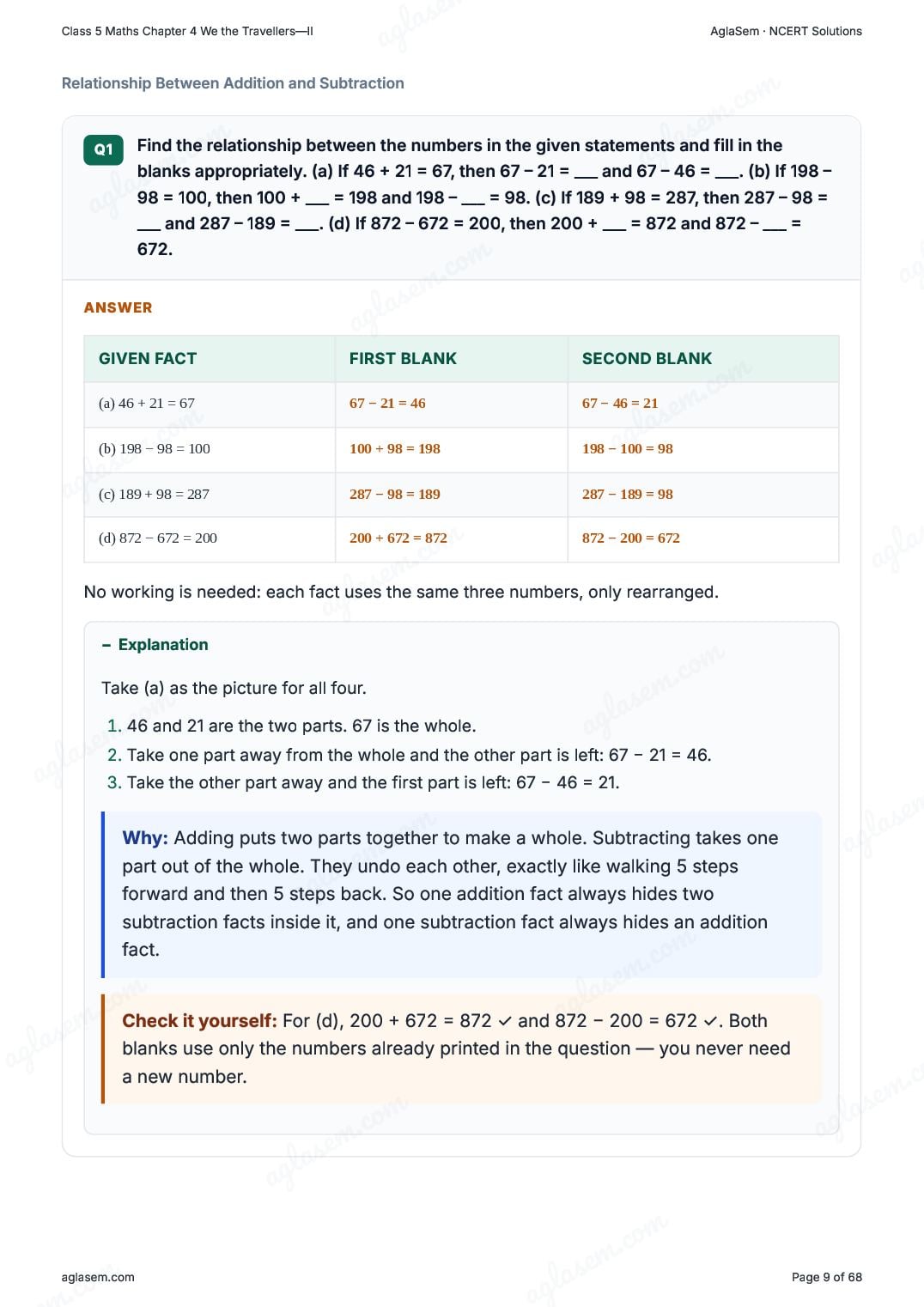
- Find the relationship between the numbers in the given statements and fill in the blanks appropriately. (a) If 46 + 21 = 67, then 67 – 21 = ___ and 67 – 46 = ___. (b) If 198 – 98 = 100, then 100 + ___ = 198 and 198 – ___ = 98. (c) If 189 + 98 = 287, then 287 – 98 = ___ and 287 – 189 = ___. (d) If 872 – 672 = 200, then 200 + ___ = 872 and 872 – ___ = 672.
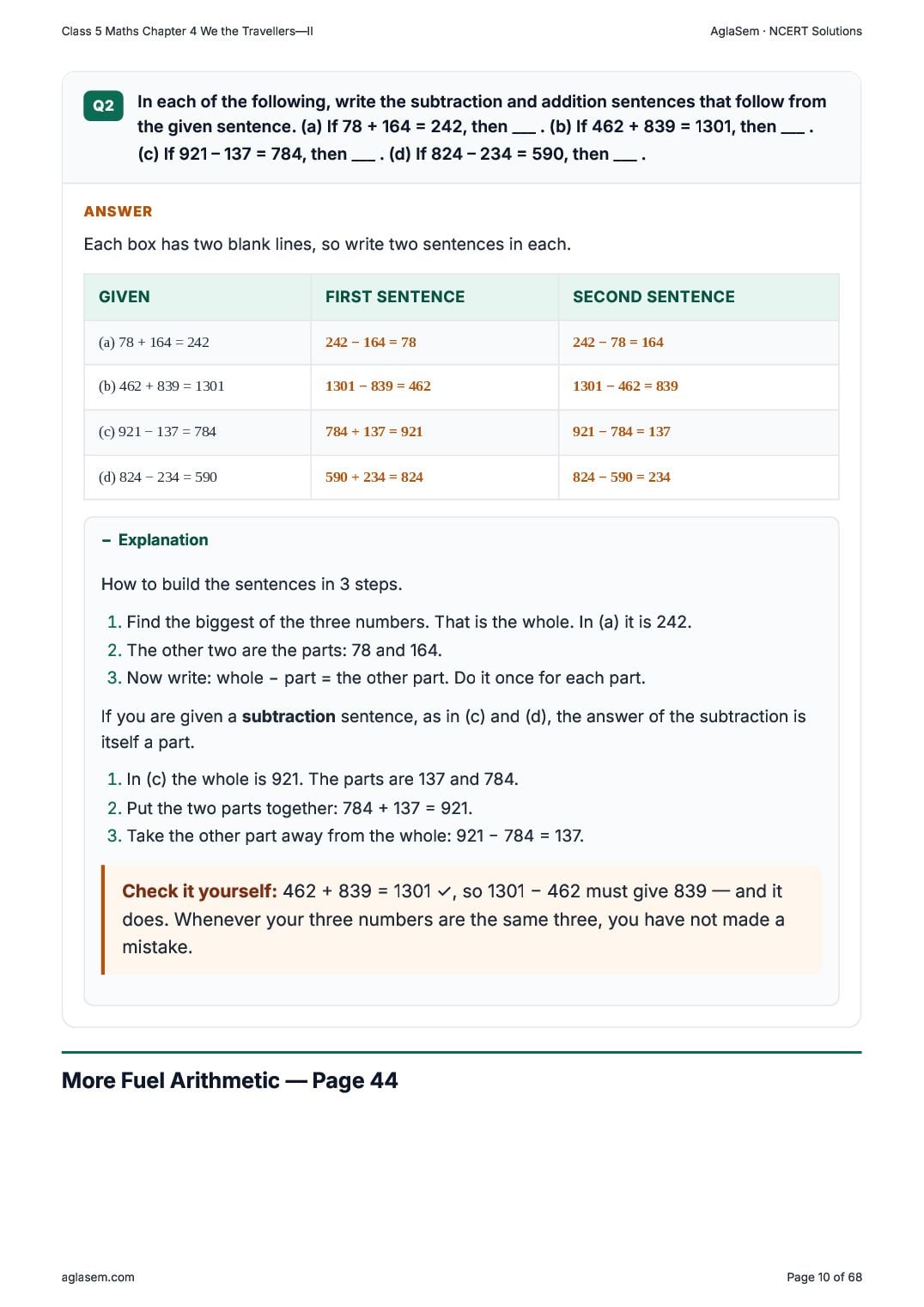
- In each of the following, write the subtraction and addition sentences that follow from the given sentence. (a) If 78 + 164 = 242, then ___ . (b) If 462 + 839 = 1301, then ___ . (c) If 921 – 137 = 784, then ___ . (d) If 824 – 234 = 590, then ___ .
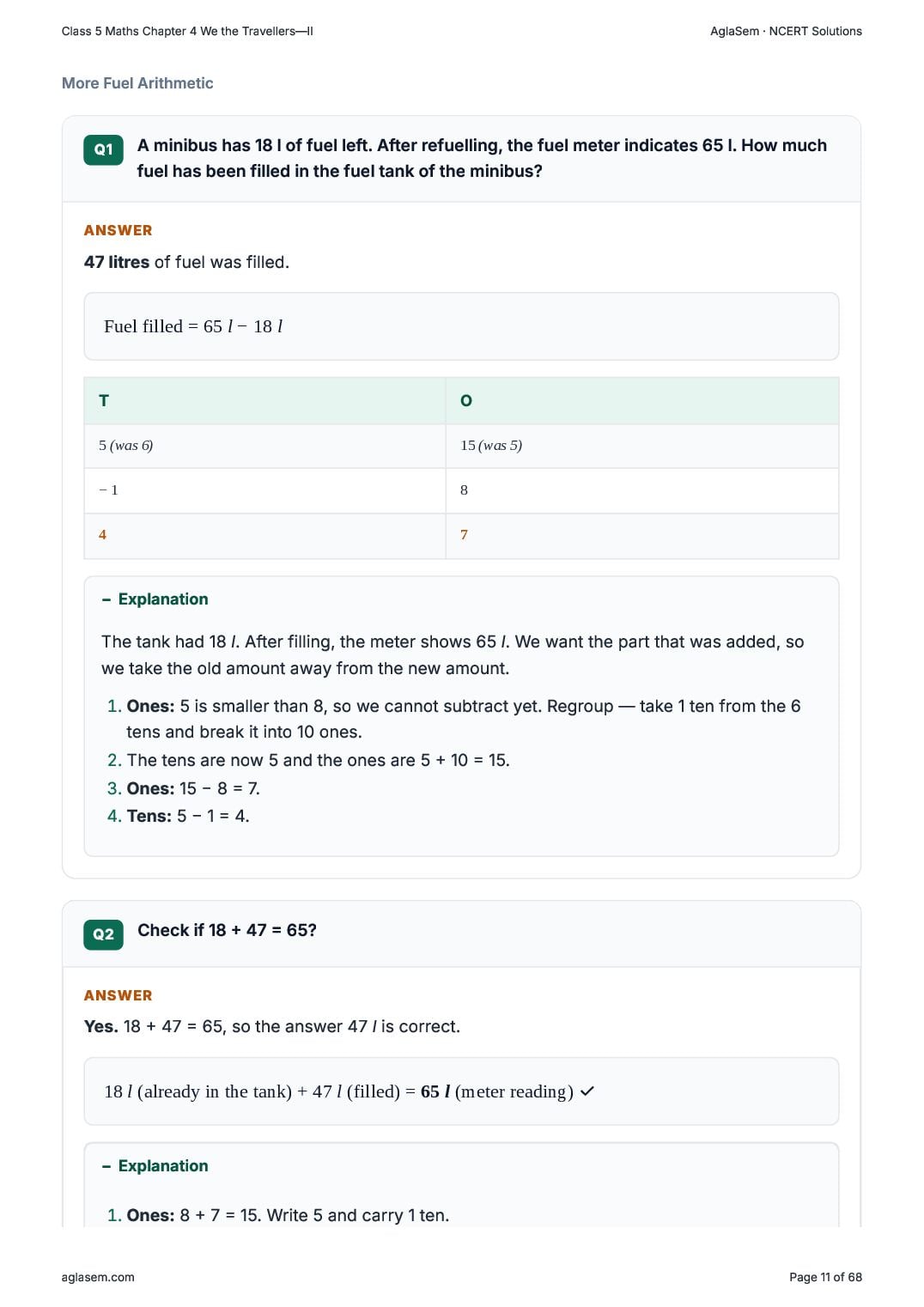
- A minibus has 18 l of fuel left. After refuelling, the fuel meter indicates 65 l. How much fuel has been filled in the fuel tank of the minibus?
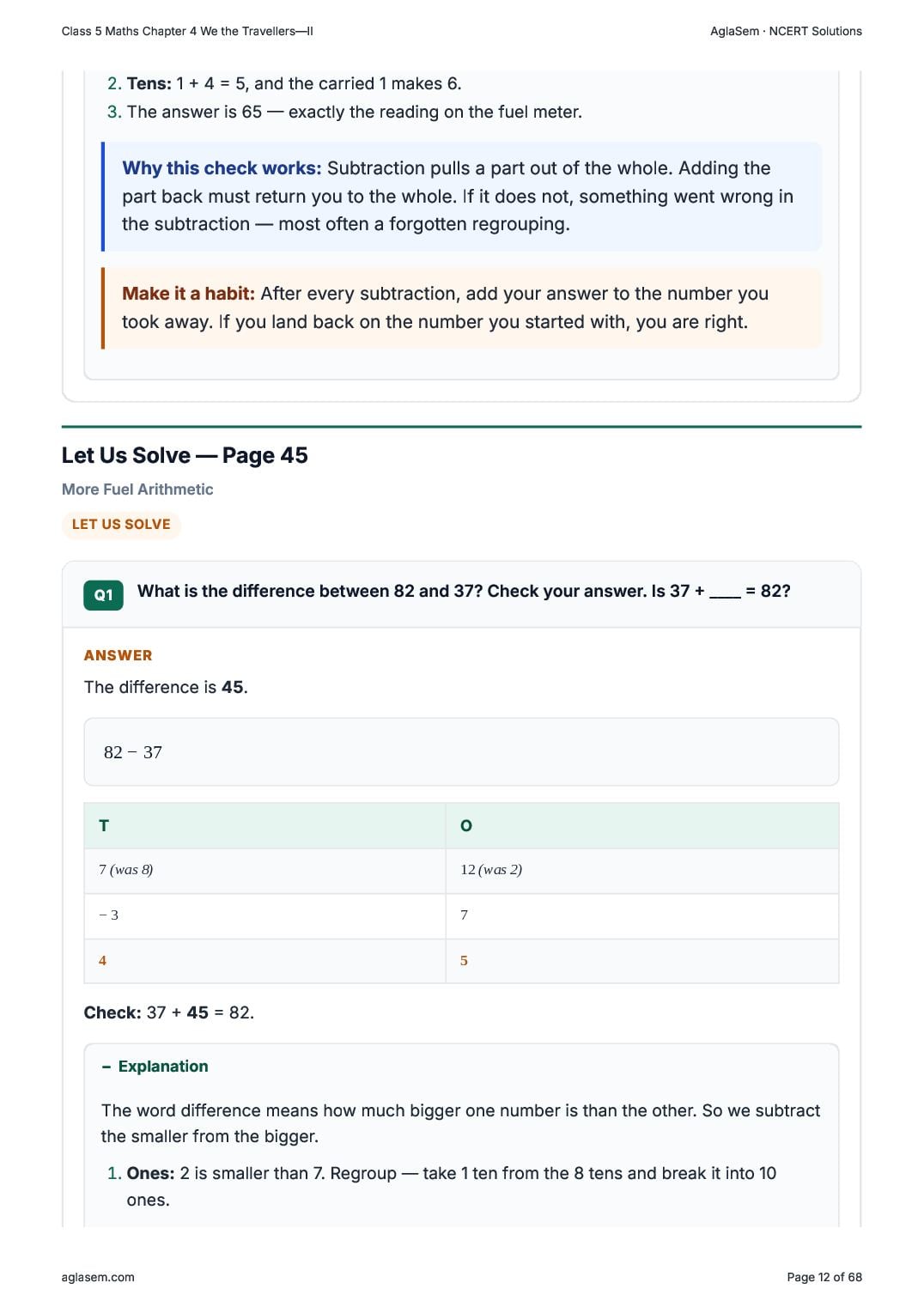
- Check if 18 + 47 = 65?
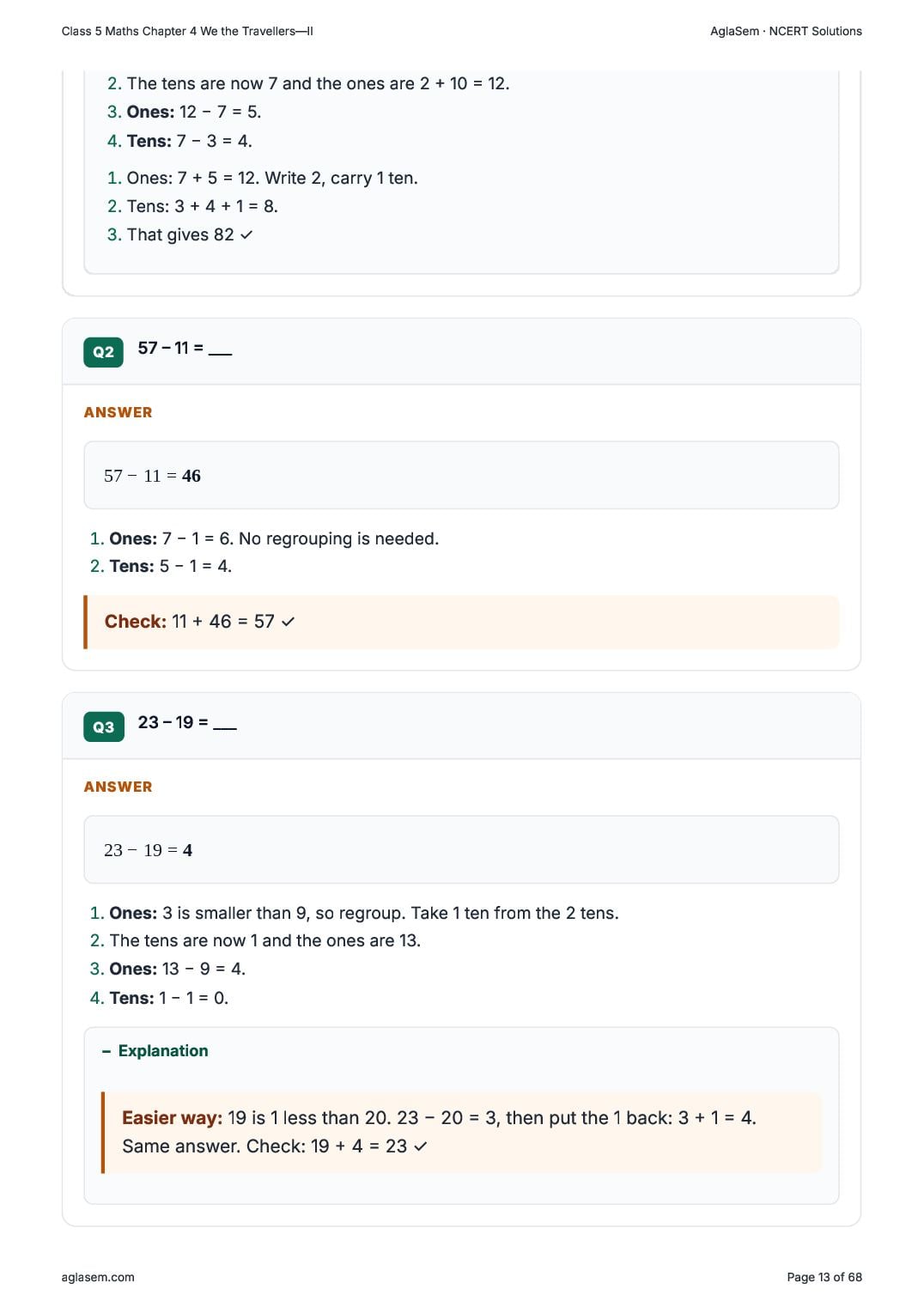
- What is the difference between 82 and 37? Check your answer. Is 37 + ____ = 82?
- 57 – 11 = ___
- 23 – 19 = ___
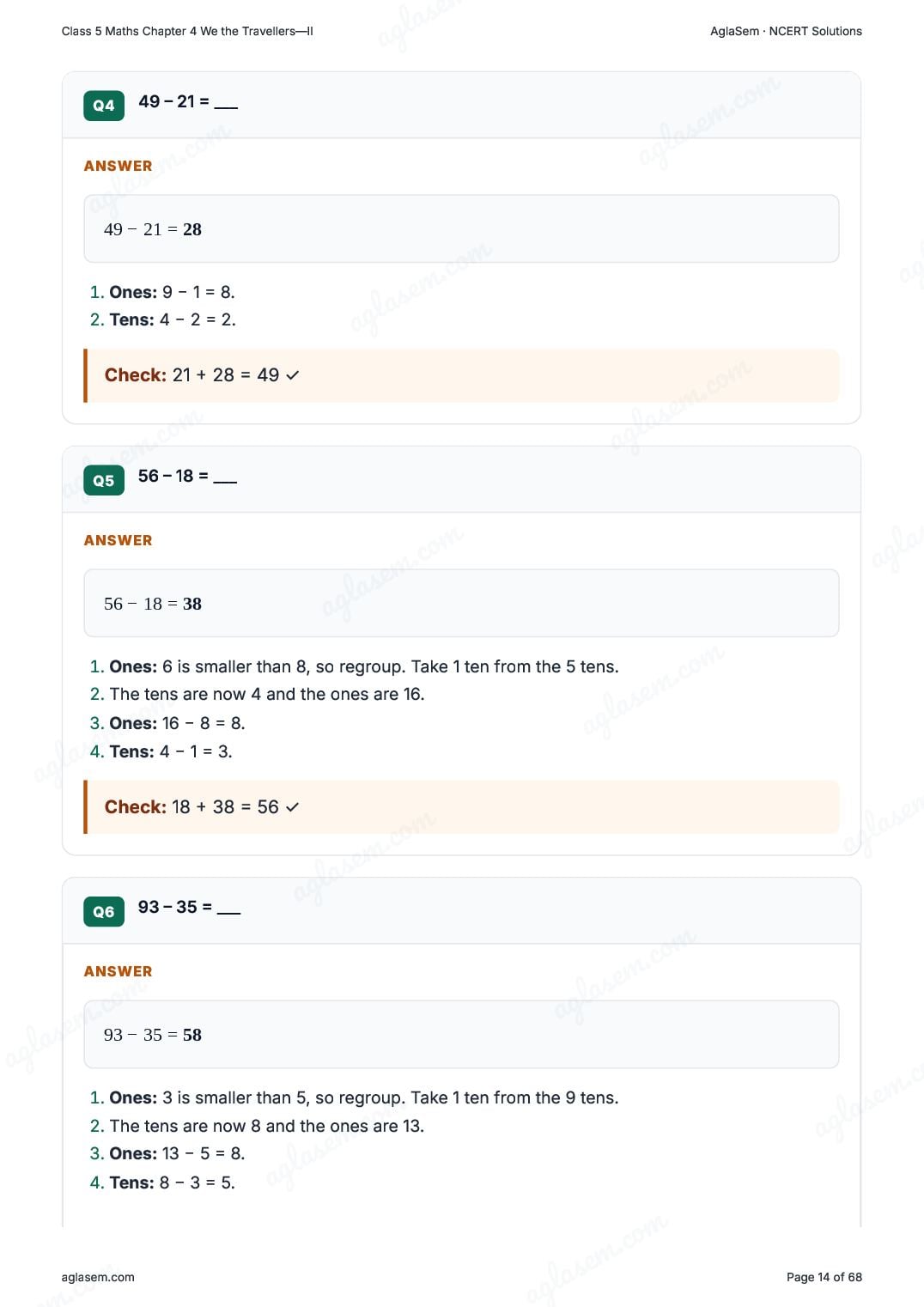
- 49 – 21 = ___
- 56 – 18 = ___
- 93 – 35 = ___
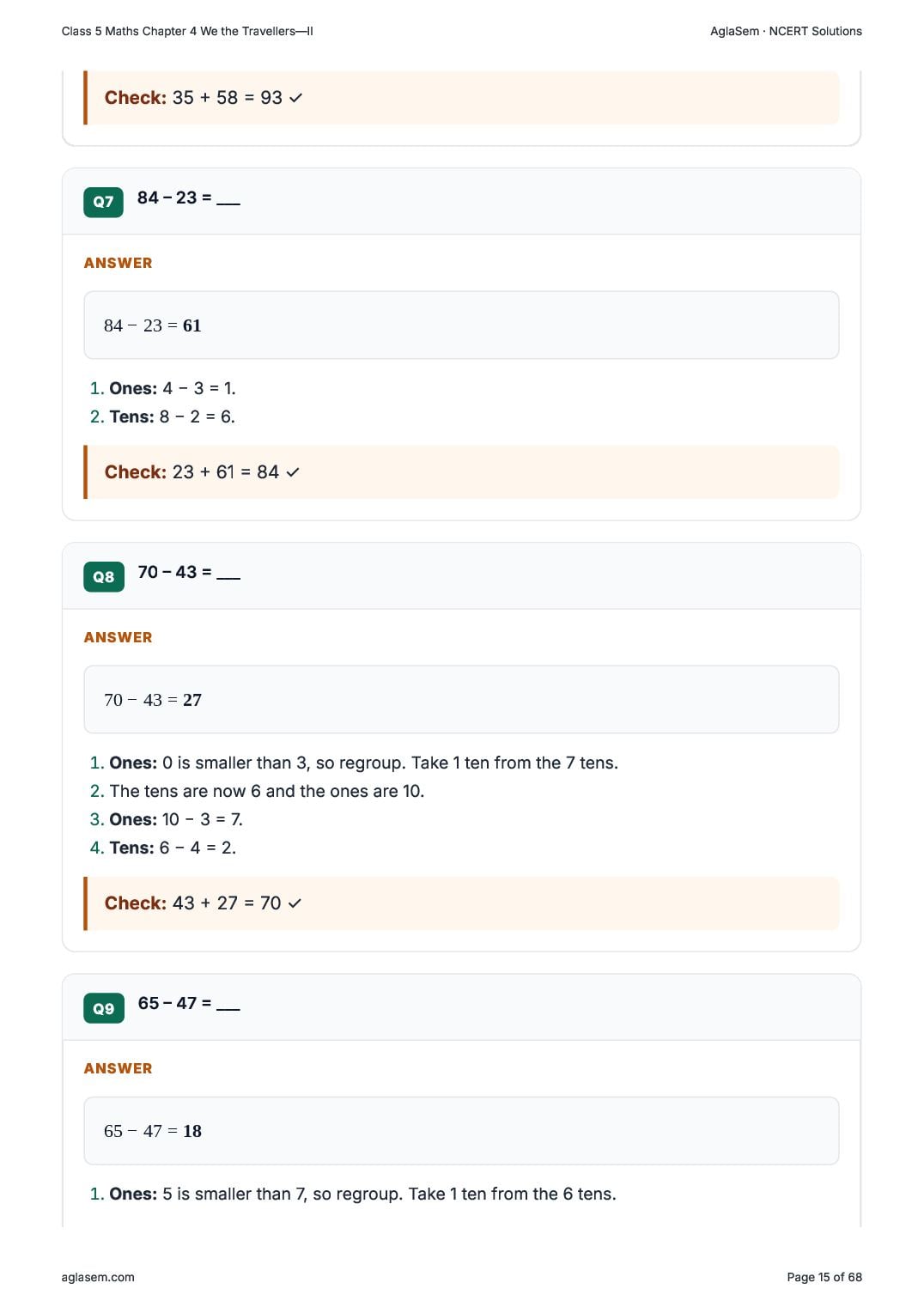
- 84 – 23 = ___
- 70 – 43 = ___
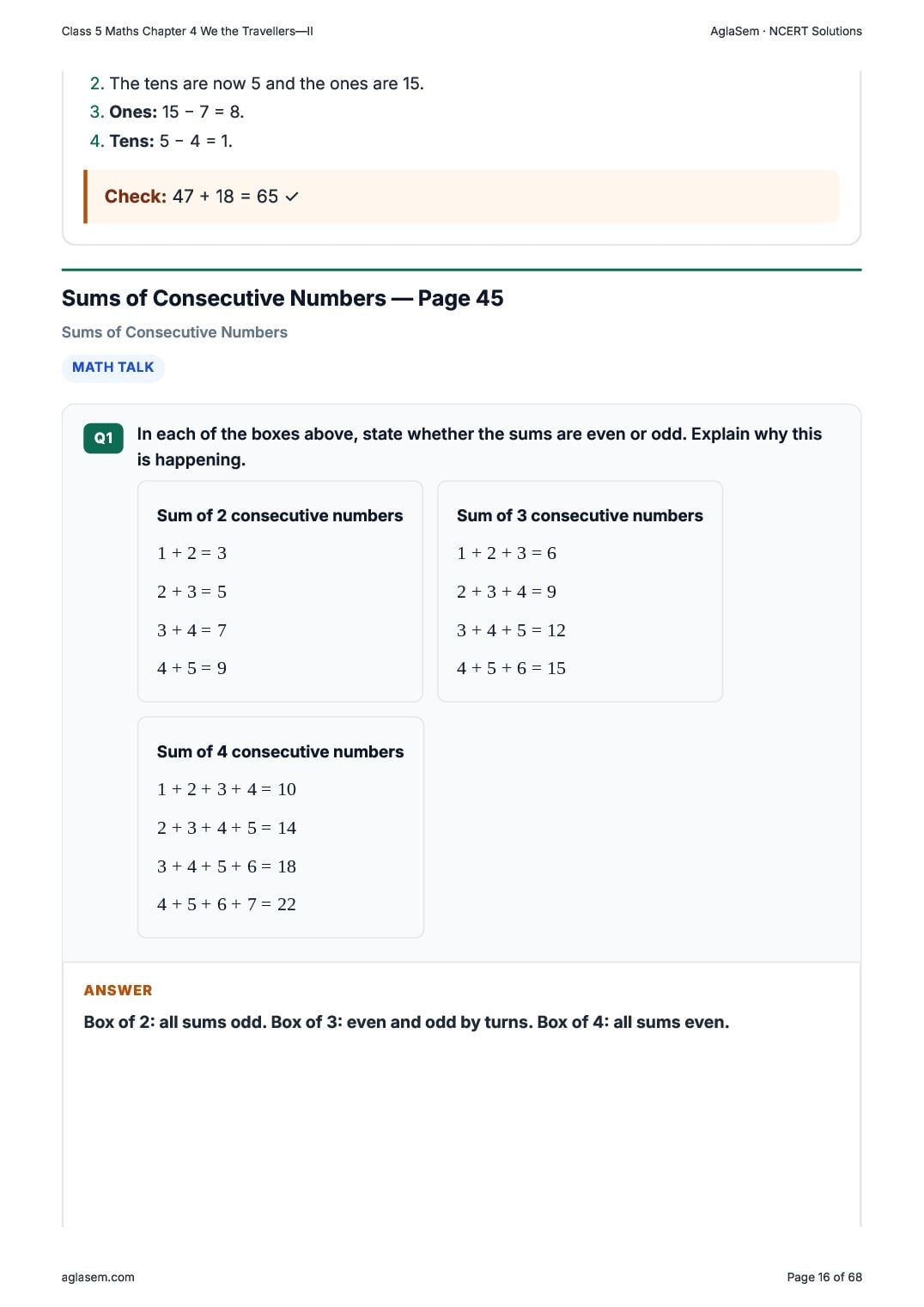
- 65 – 47 = ___
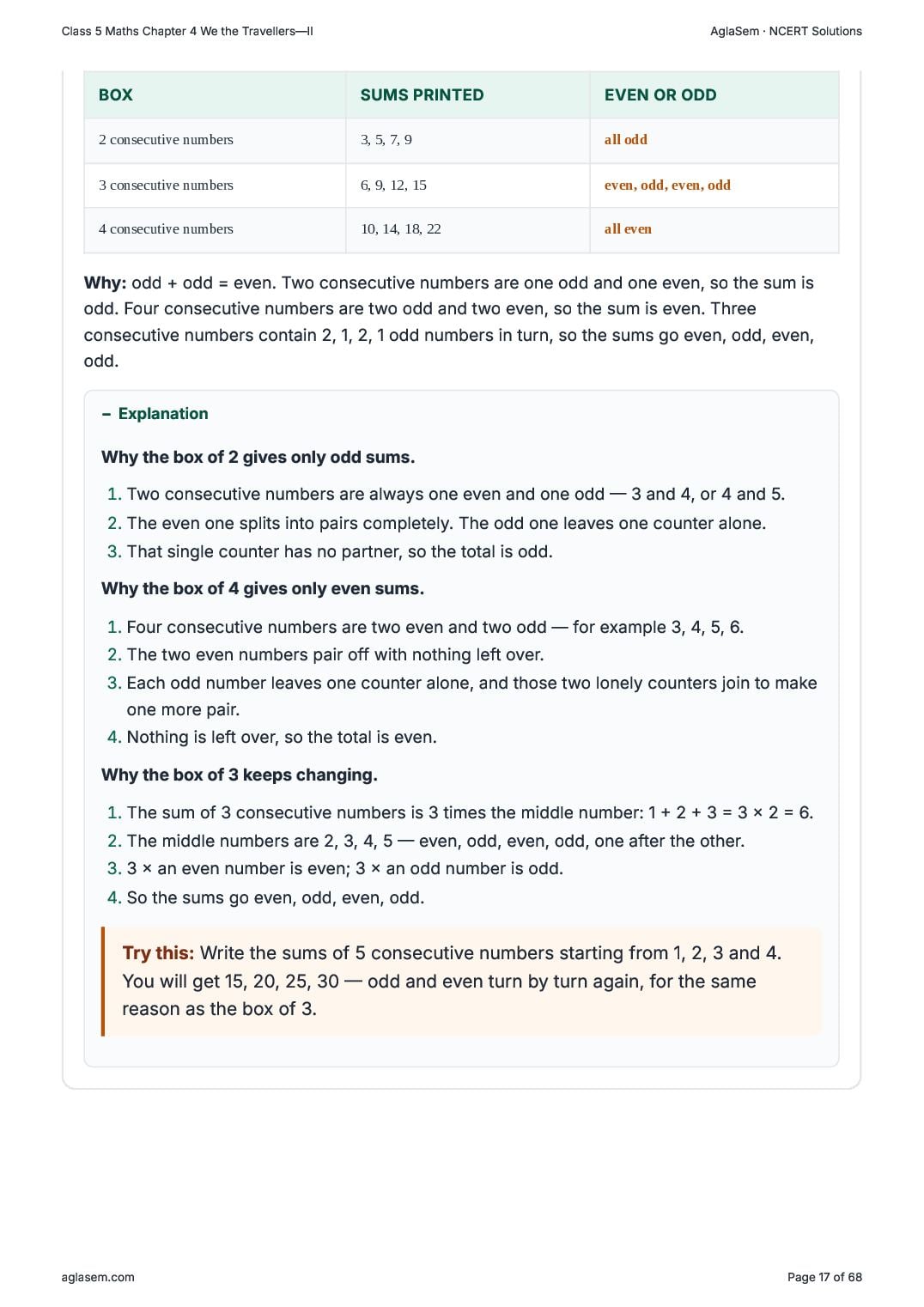
- In each of the boxes above, state whether the sums are even or odd. Explain why this is happening.
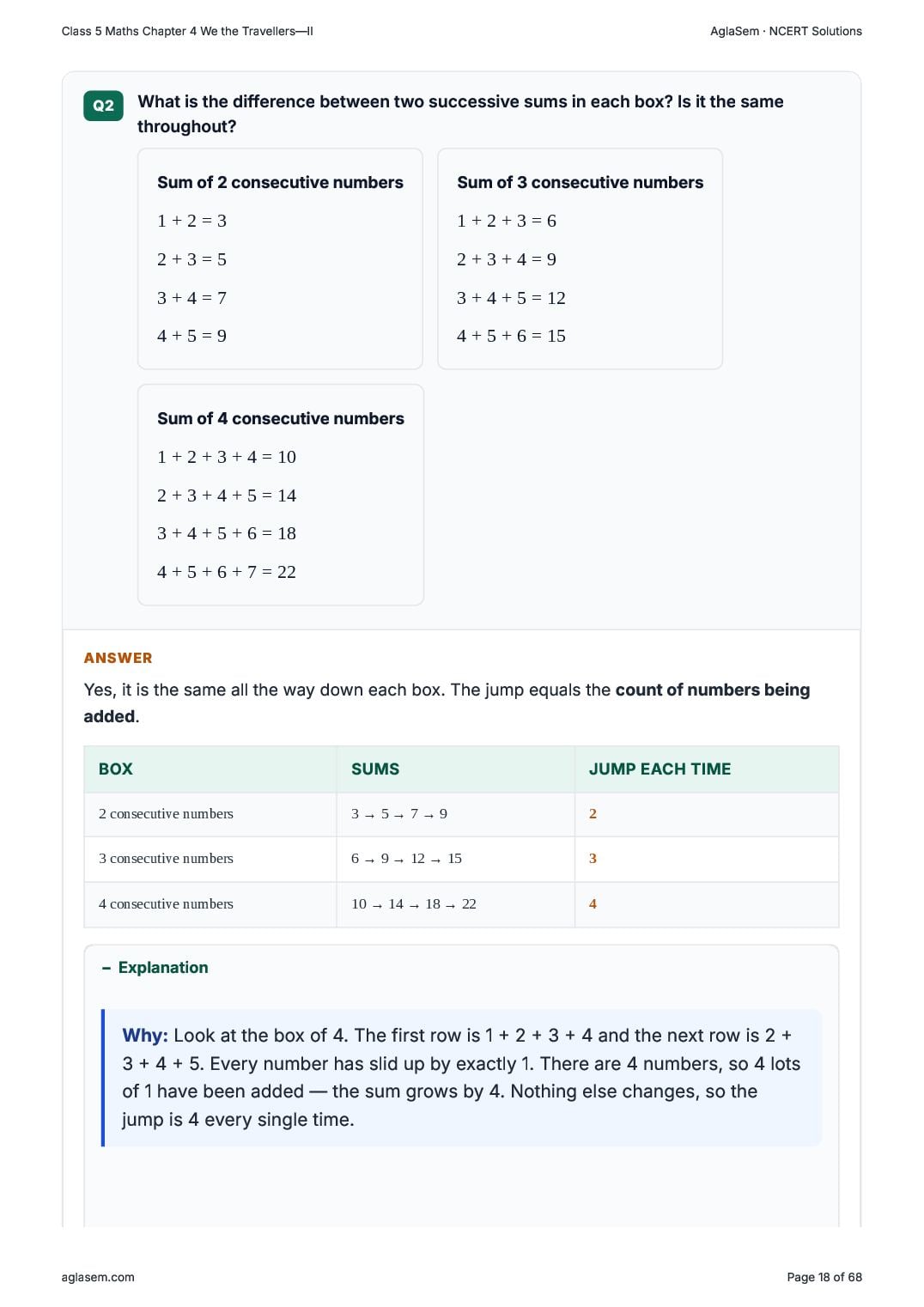
- What is the difference between two successive sums in each box? Is it the same throughout?
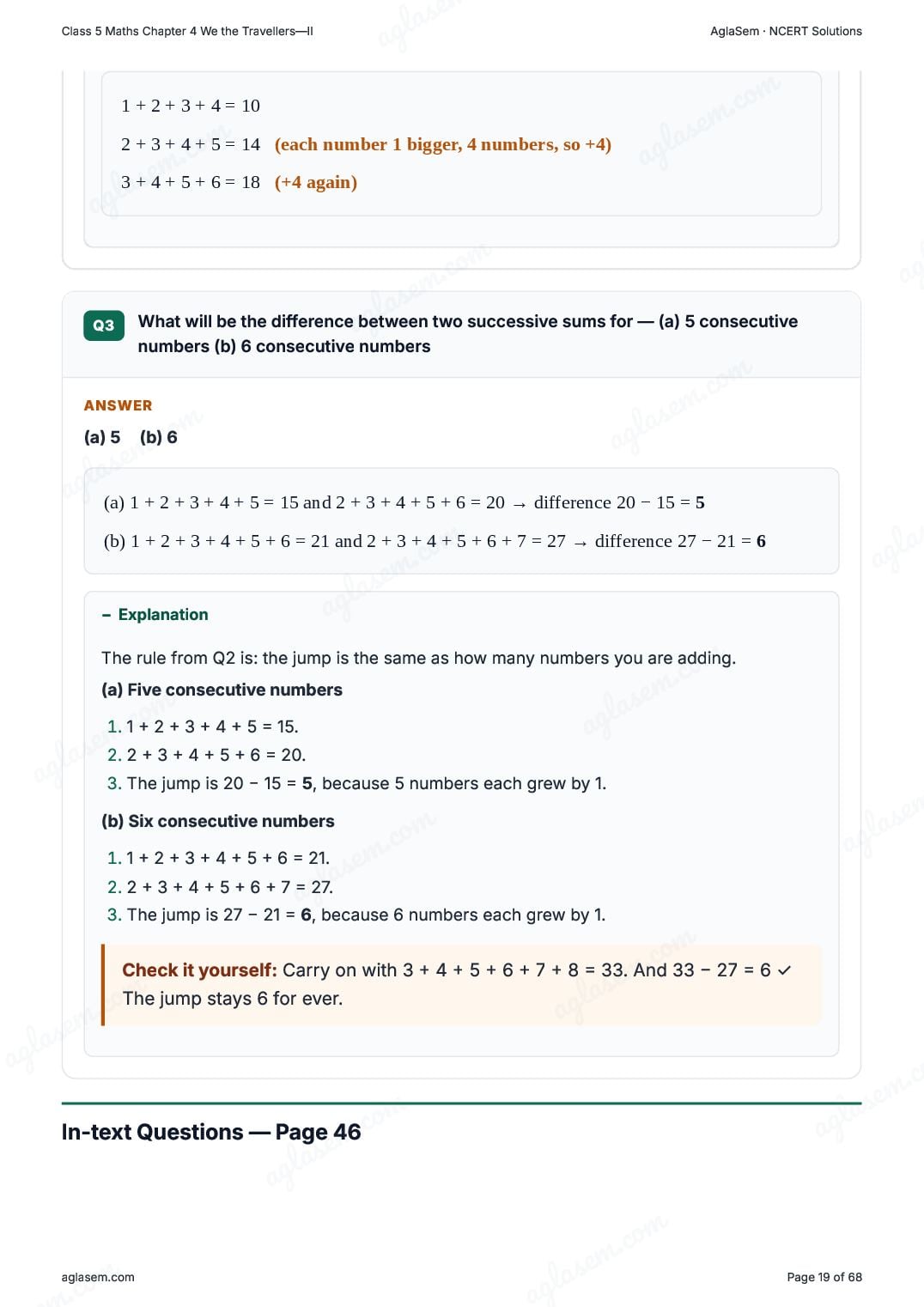
- What will be the difference between two successive sums for — (a) 5 consecutive numbers (b) 6 consecutive numbers
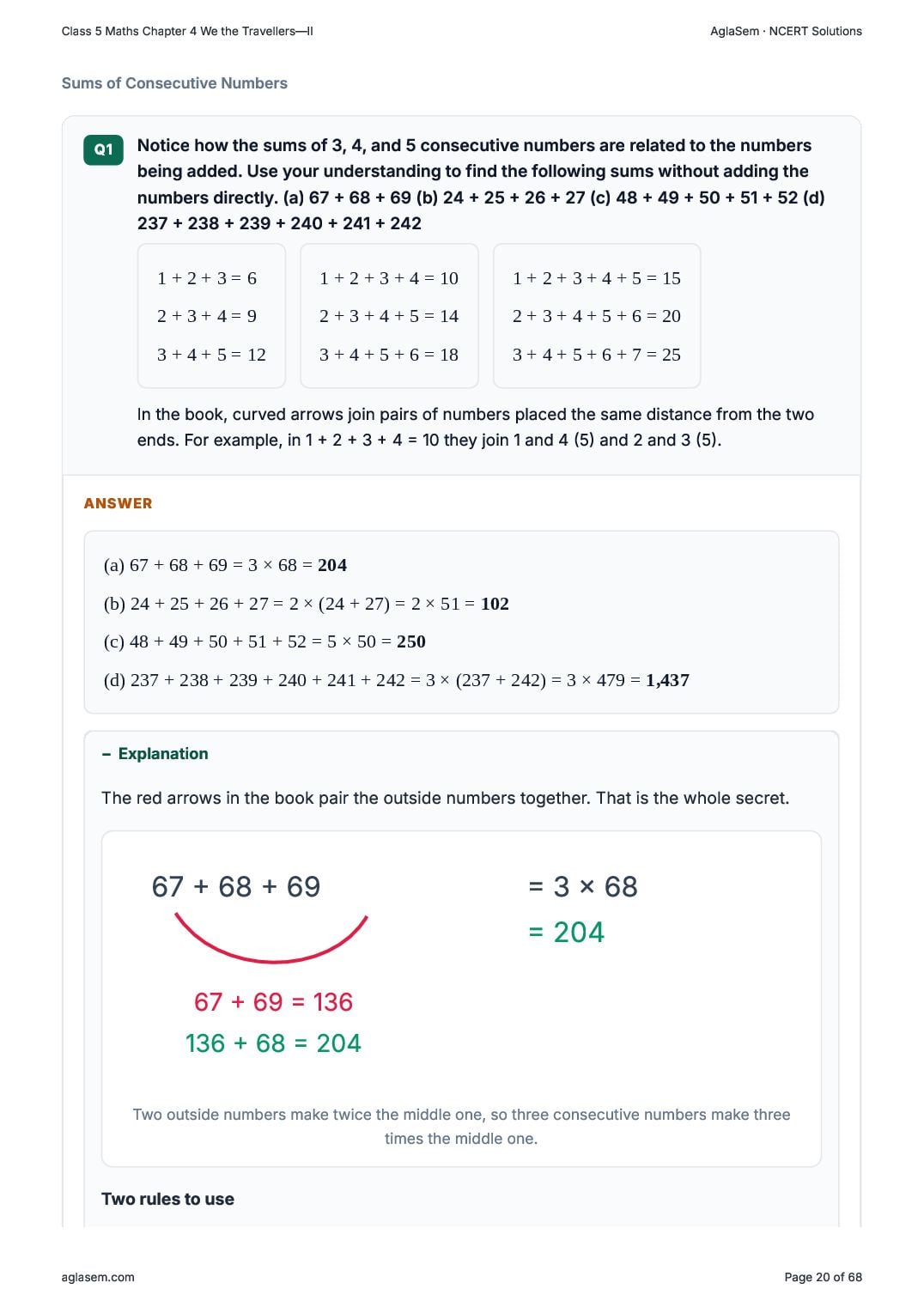
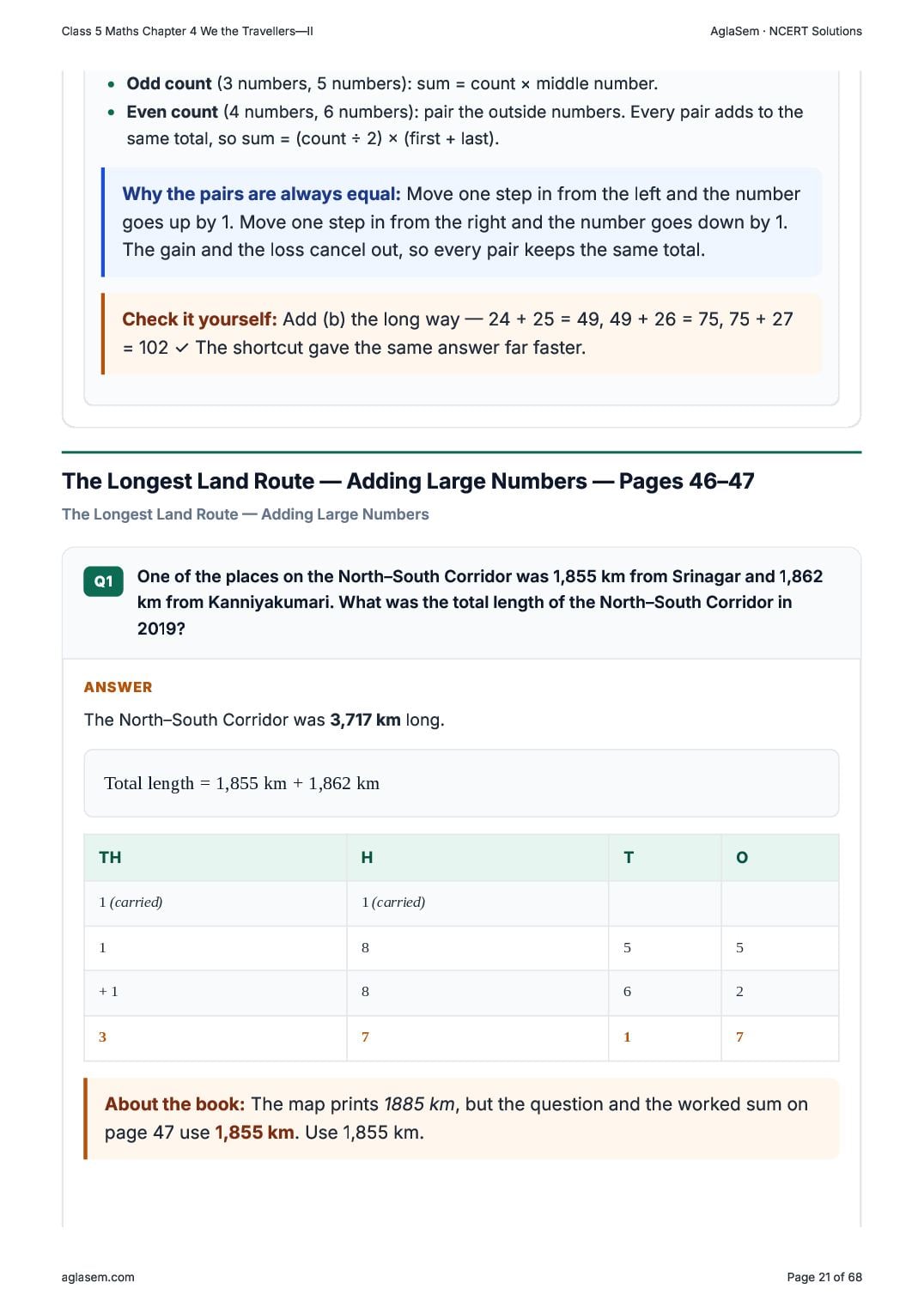
- Notice how the sums of 3, 4, and 5 consecutive numbers are related to the numbers being added. Use your understanding to find the following sums without adding the numbers directly. (a) 67 + 68 + 69 (b) 24 + 25 + 26 + 27 (c) 48 + 49 + 50 + 51 + 52 (d) 237 + 238 + 239 + 240 + 241 + 242
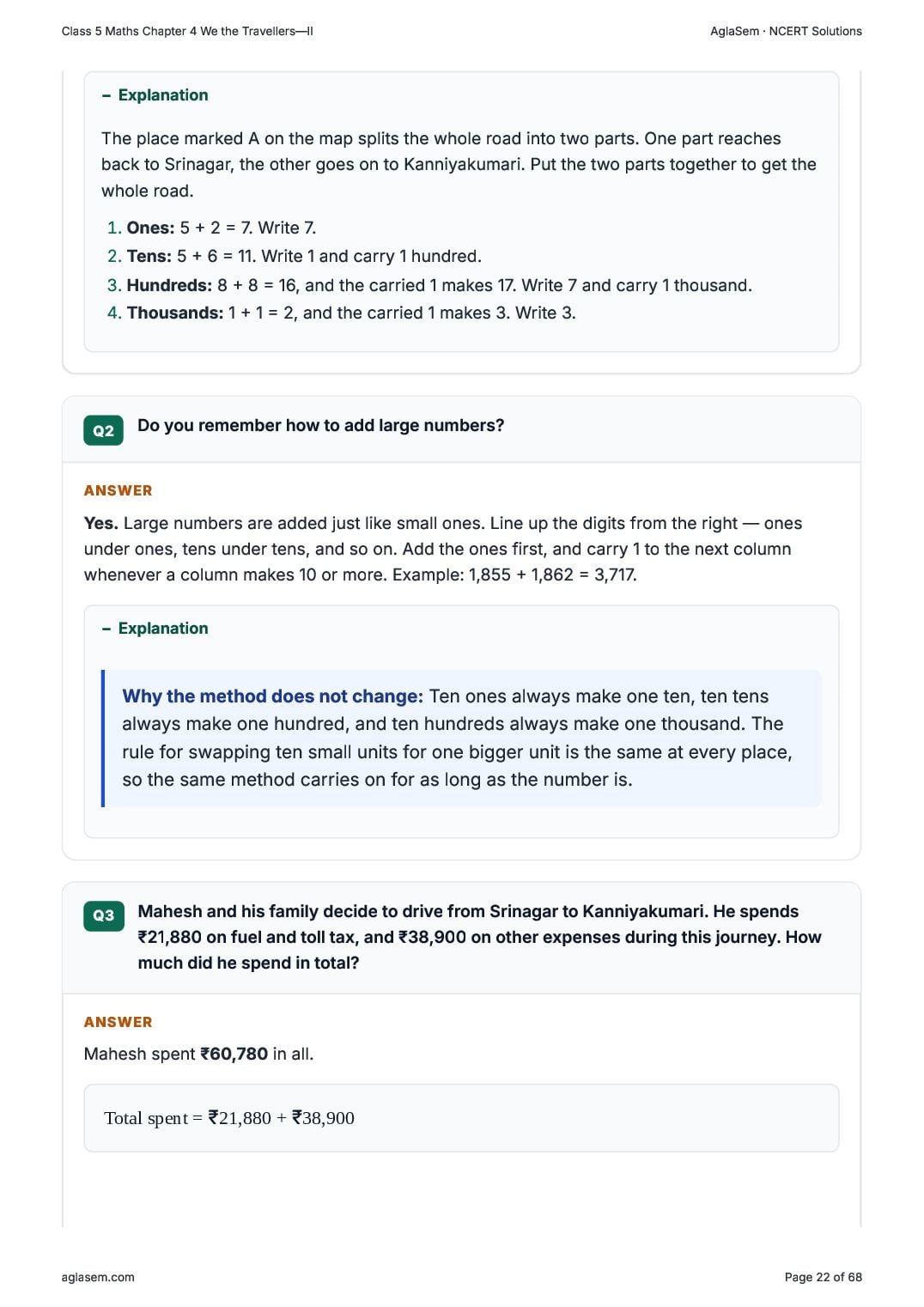
- One of the places on the North–South Corridor was 1,855 km from Srinagar and 1,862 km from Kanniyakumari. What was the total length of the North–South Corridor in 2019?
- Do you remember how to add large numbers?
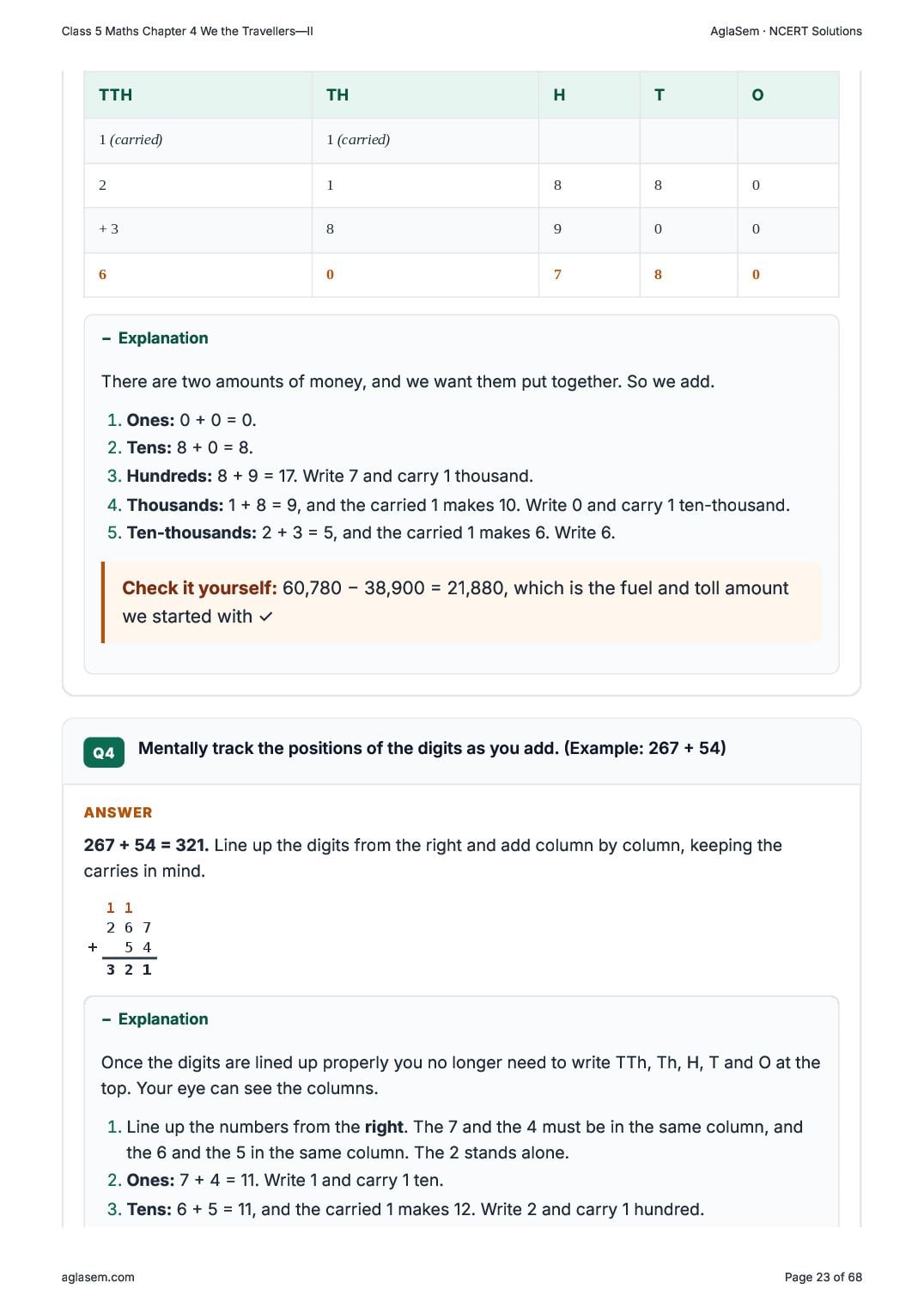
- Mahesh and his family decide to drive from Srinagar to Kanniyakumari. He spends ₹21,880 on fuel and toll tax, and ₹38,900 on other expenses during this journey. How much did he spend in total?
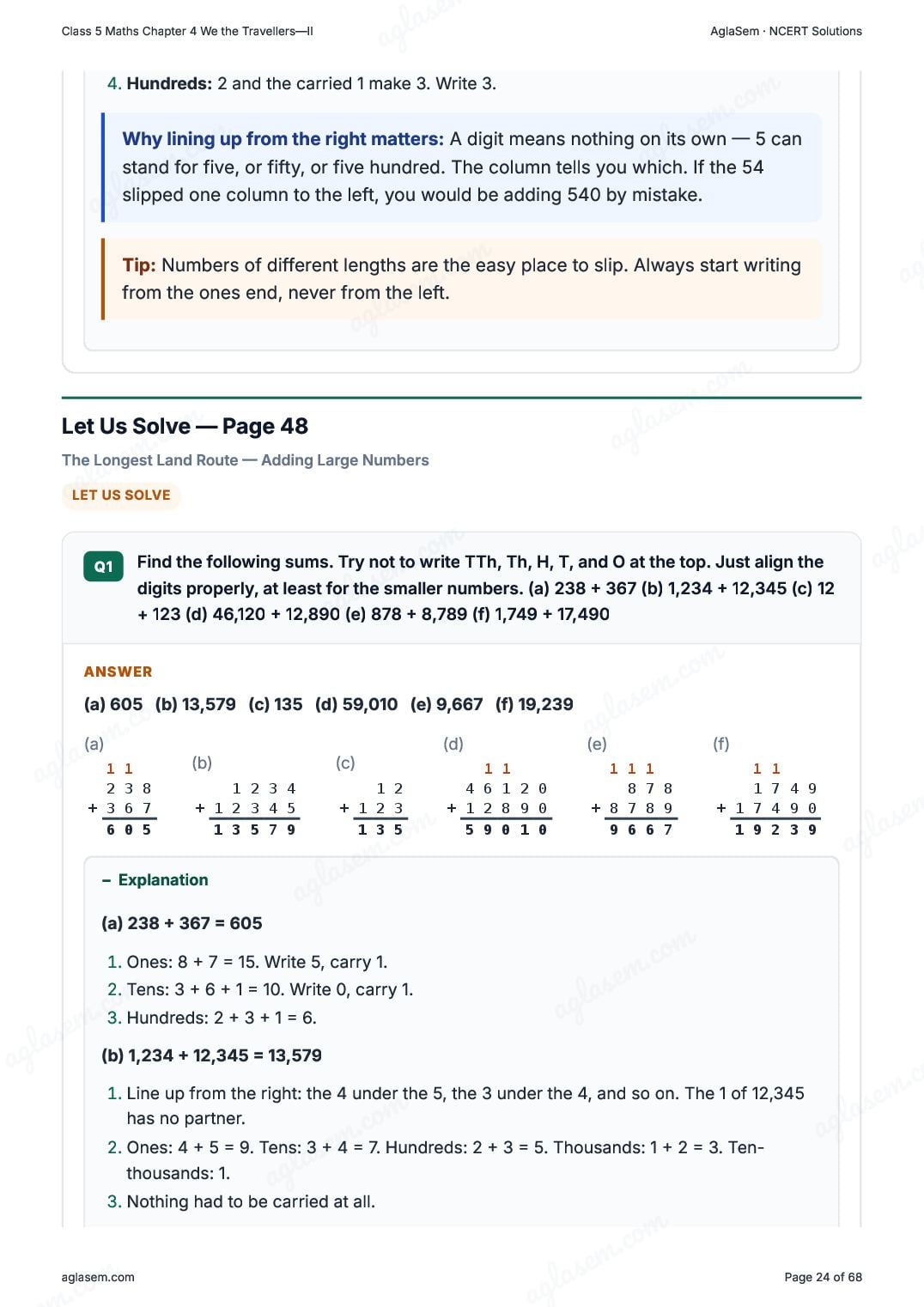
- Mentally track the positions of the digits as you add. (Example: 267 + 54)
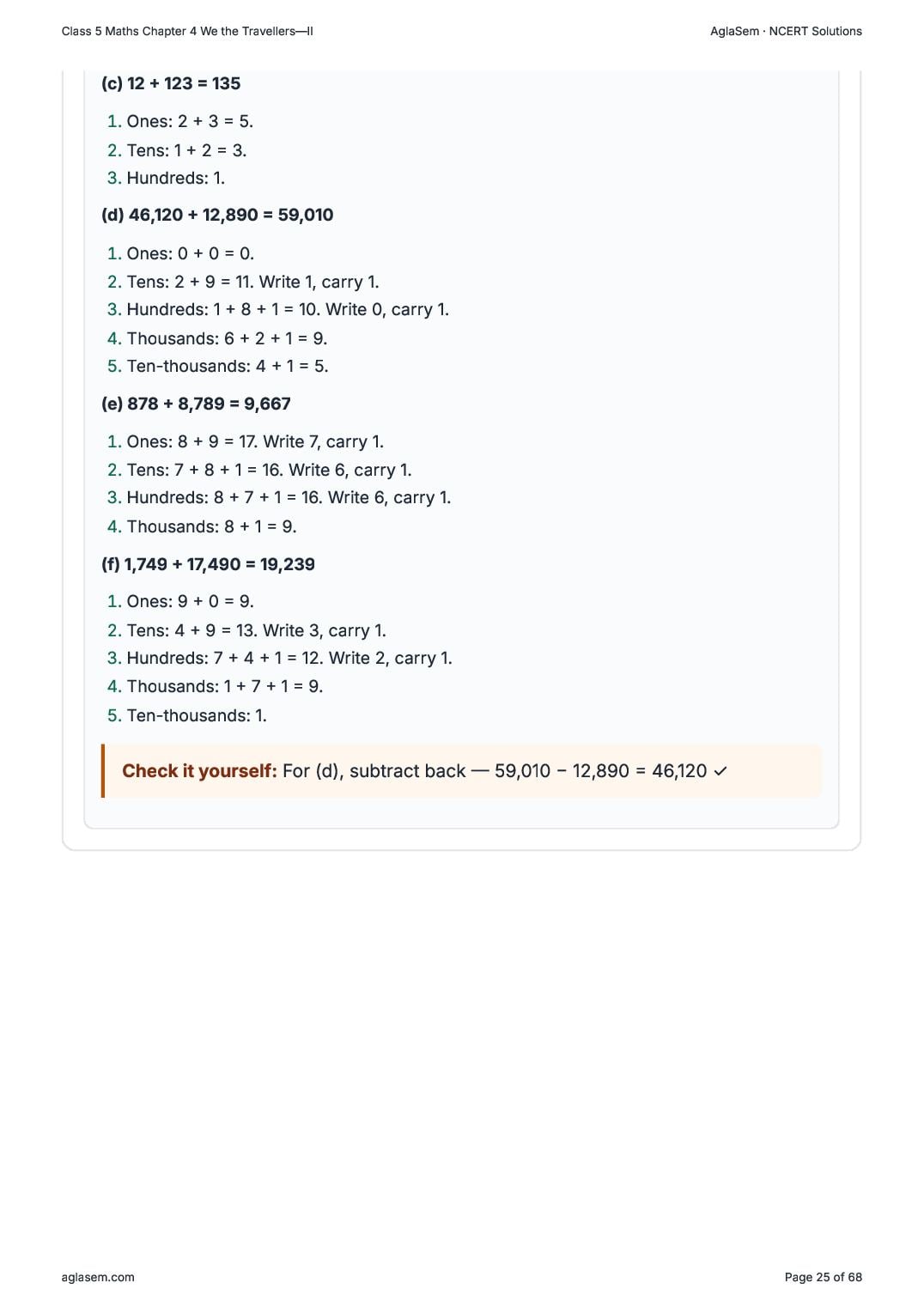
- Find the following sums. Try not to write TTh, Th, H, T, and O at the top. Just align the digits properly, at least for the smaller numbers. (a) 238 + 367 (b) 1,234 + 12,345 (c) 12 + 123 (d) 46,120 + 12,890 (e) 878 + 8,789 (f) 1,749 + 17,490
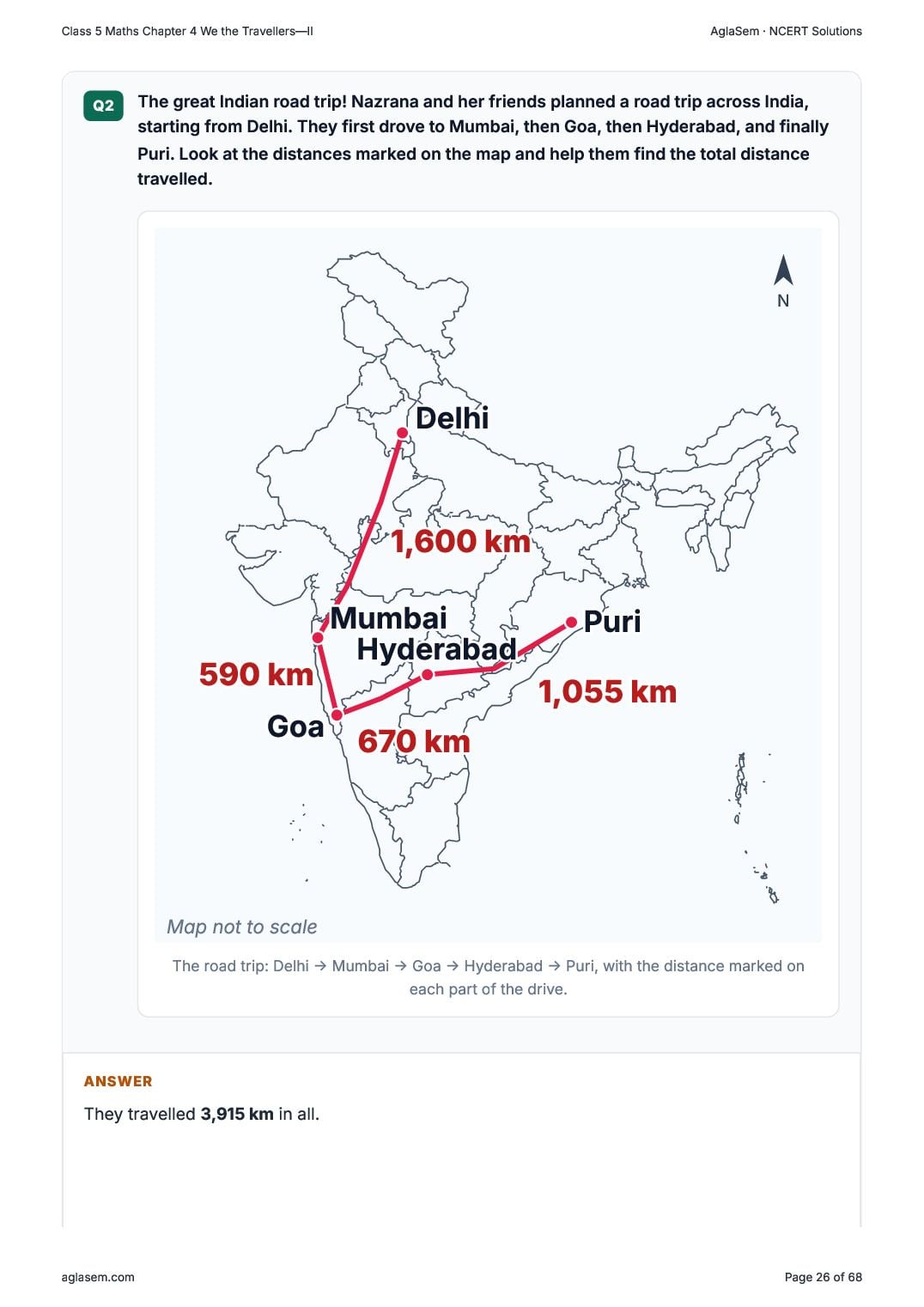
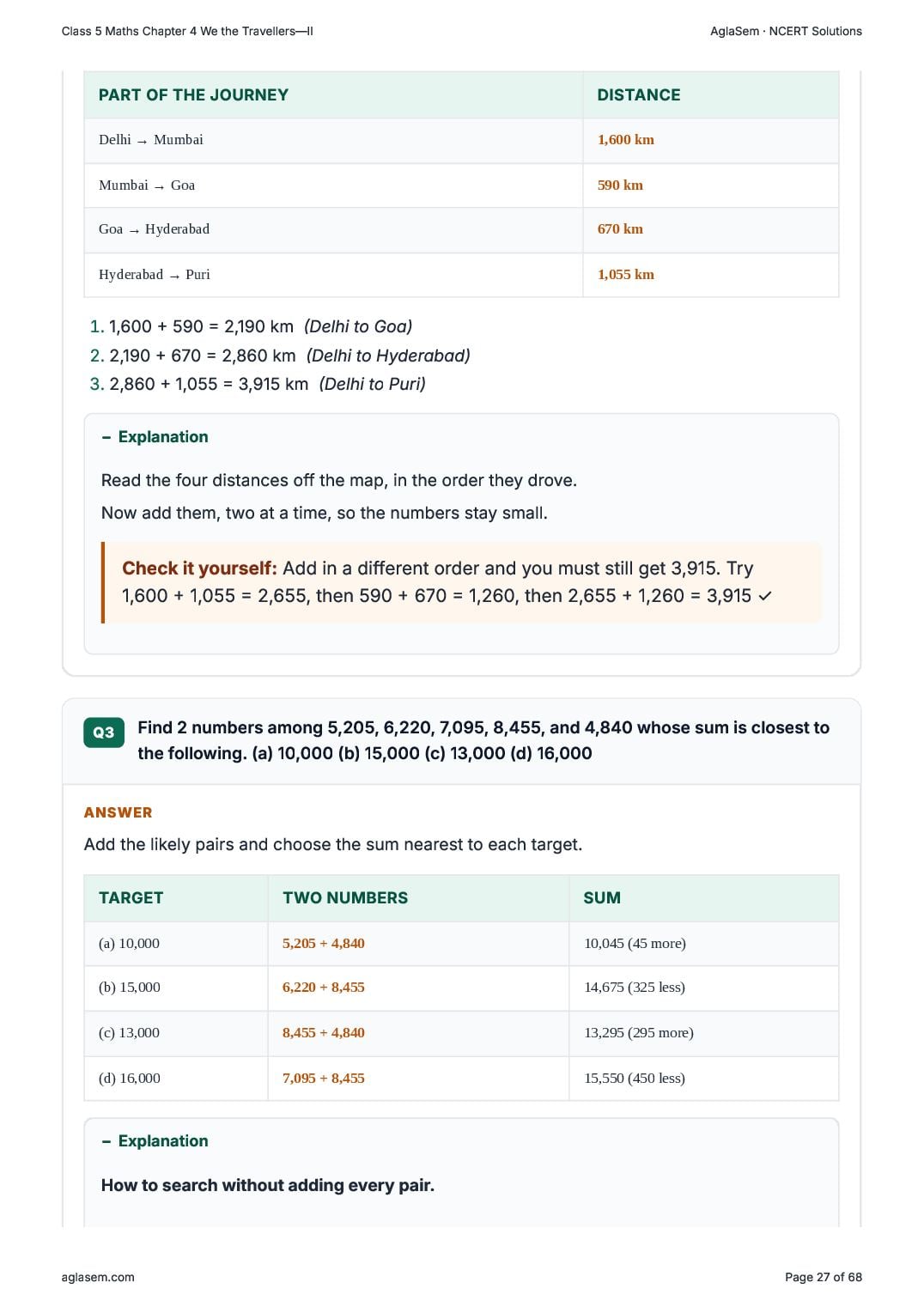
- The great Indian road trip! Nazrana and her friends planned a road trip across India, starting from Delhi. They first drove to Mumbai, then Goa, then Hyderabad, and finally Puri. Look at the distances marked on the map and help them find the total distance travelled.DelhiMumbaiGoaHyderabadPuri1,600 km590 km670 km1,055 kmDelhiMumbaiGoaHyderabadPuri1,600 km590 km670 km1,055 kmN*Map not to scaleThe road trip: Delhi → Mumbai → Goa → Hyderabad → Puri, with the distance marked on each part of the drive.
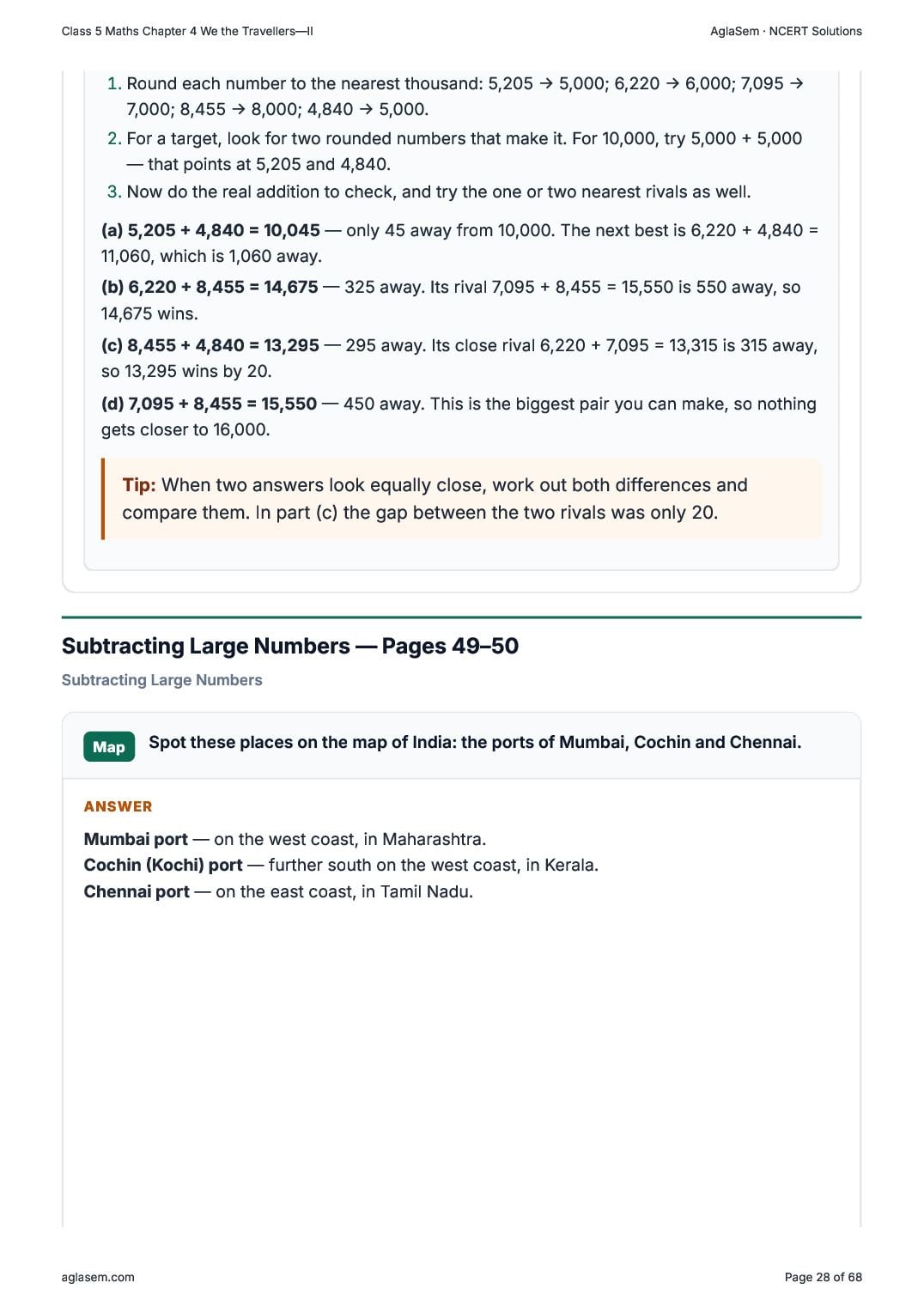
- Find 2 numbers among 5,205, 6,220, 7,095, 8,455, and 4,840 whose sum is closest to the following. (a) 10,000 (b) 15,000 (c) 13,000 (d) 16,000
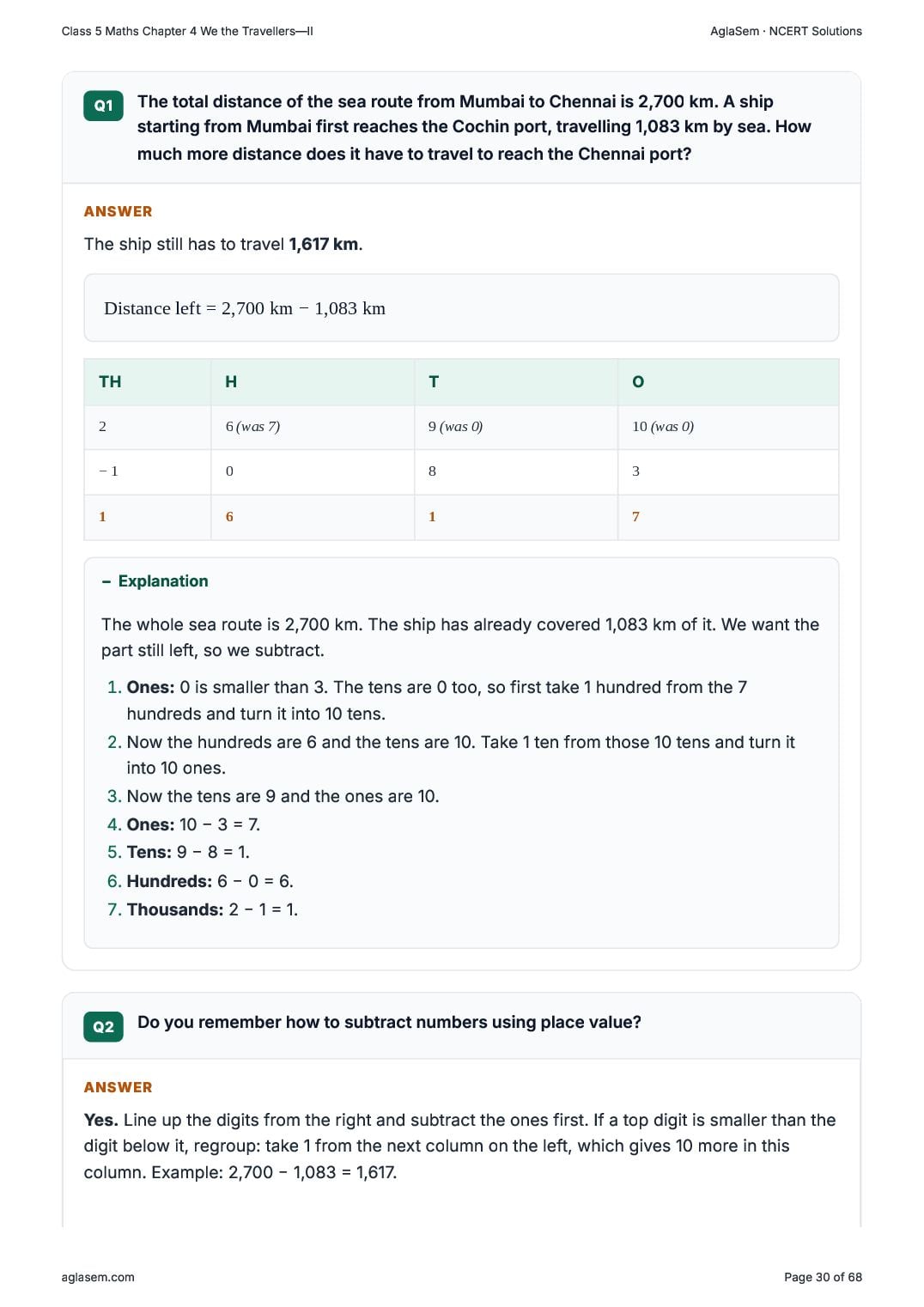
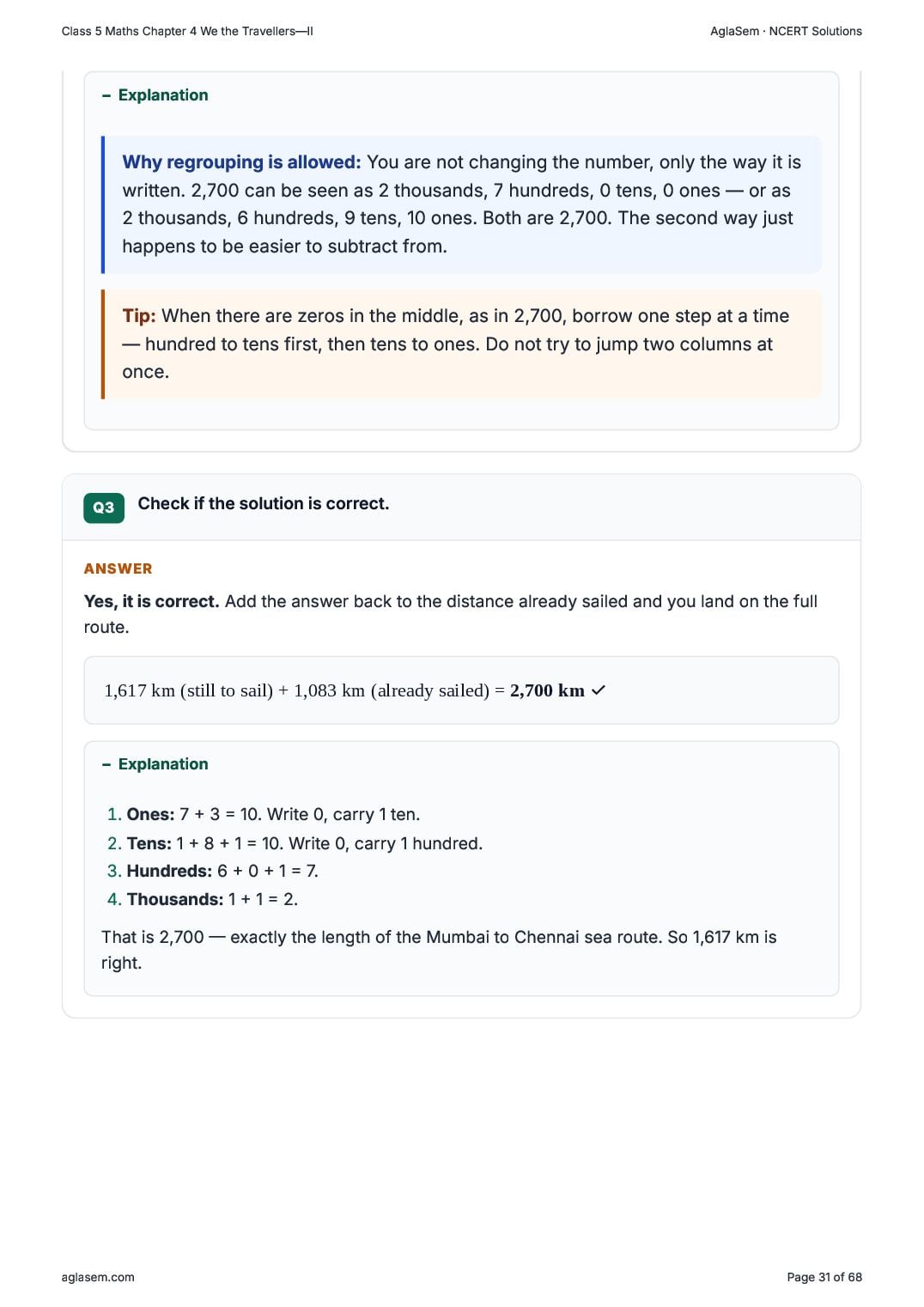
- The total distance of the sea route from Mumbai to Chennai is 2,700 km. A ship starting from Mumbai first reaches the Cochin port, travelling 1,083 km by sea. How much more distance does it have to travel to reach the Chennai port?
- Do you remember how to subtract numbers using place value?
- Check if the solution is correct.
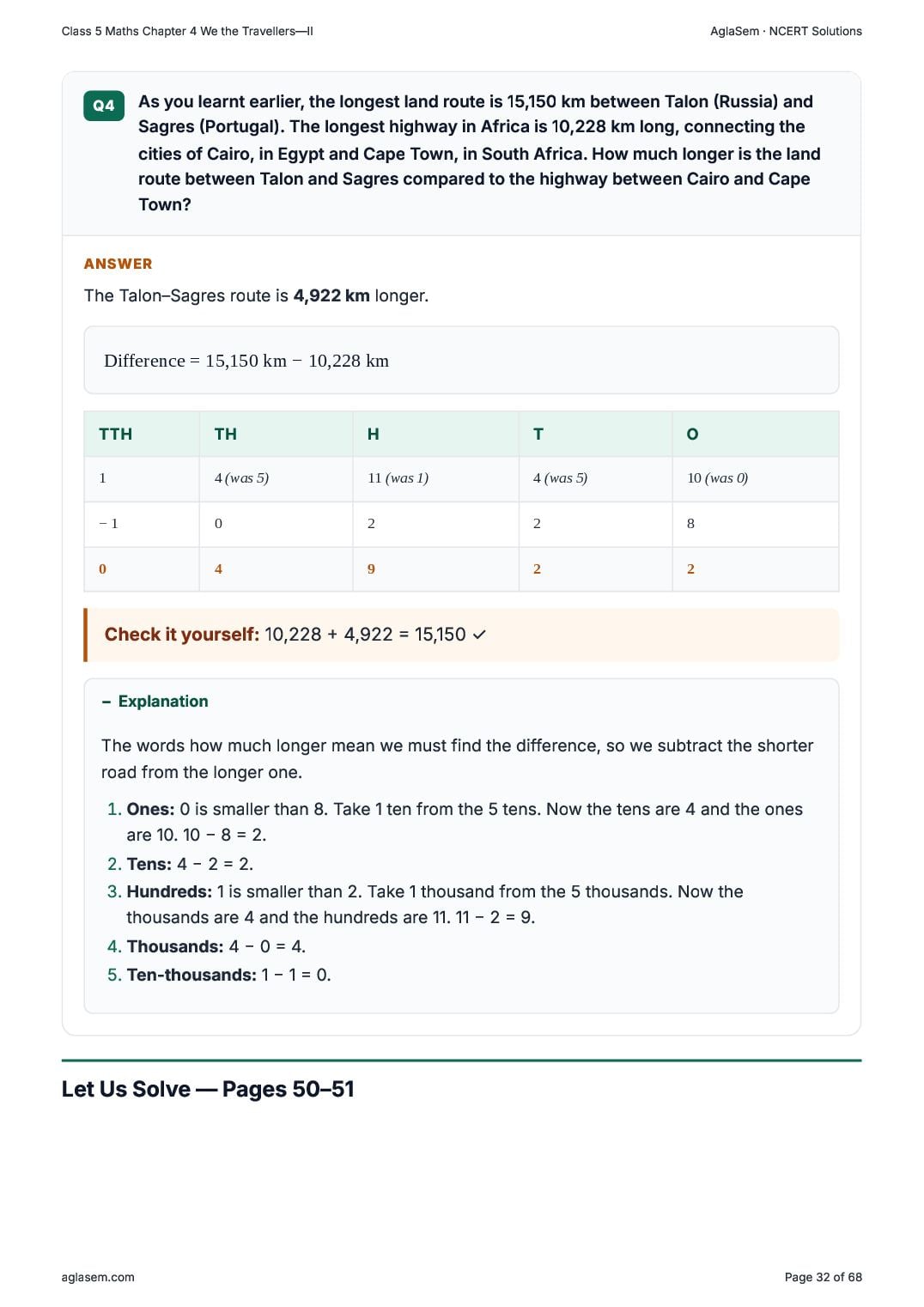
- As you learnt earlier, the longest land route is 15,150 km between Talon (Russia) and Sagres (Portugal). The longest highway in Africa is 10,228 km long, connecting the cities of Cairo, in Egypt and Cape Town, in South Africa. How much longer is the land route between Talon and Sagres compared to the highway between Cairo and Cape Town?
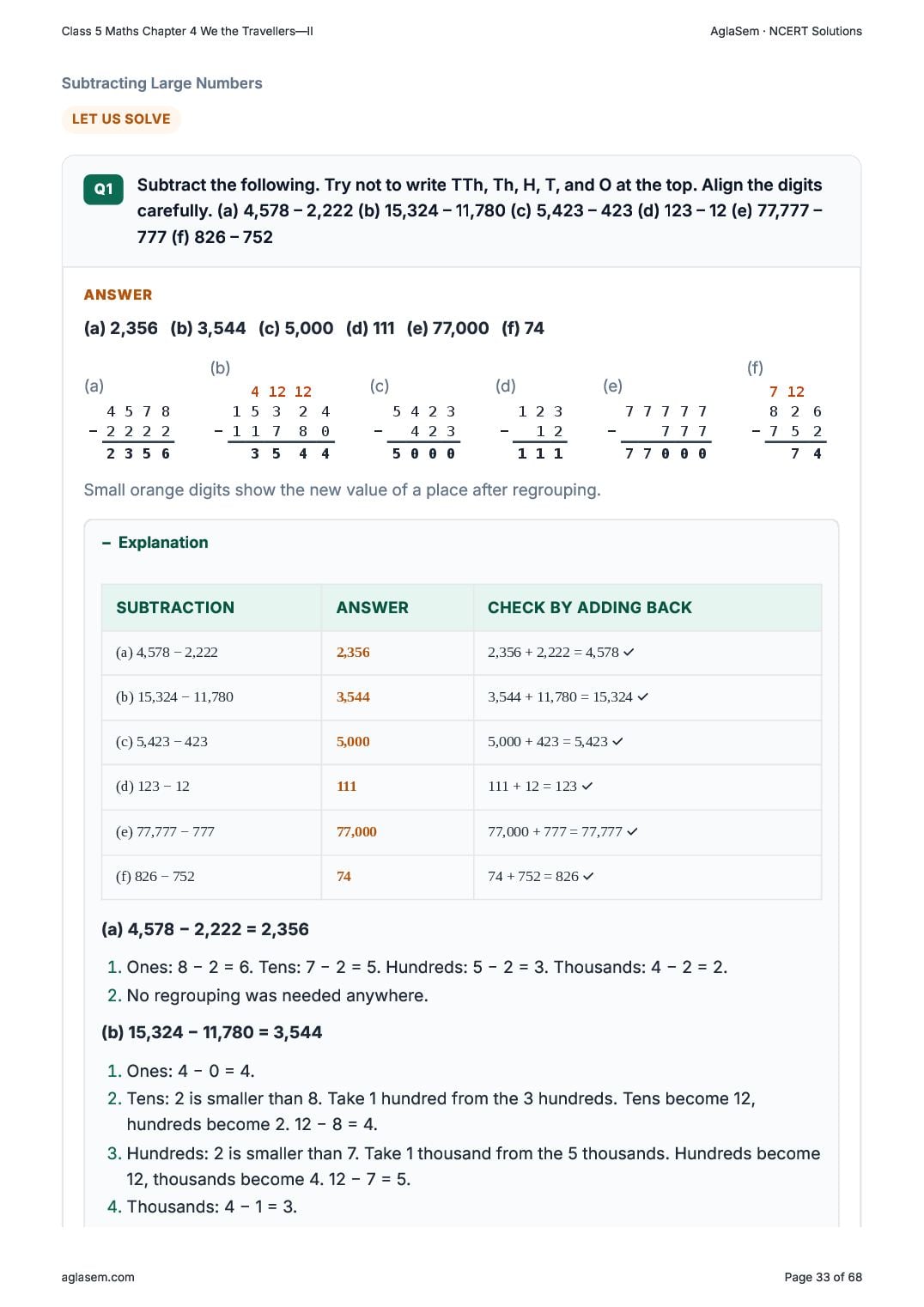
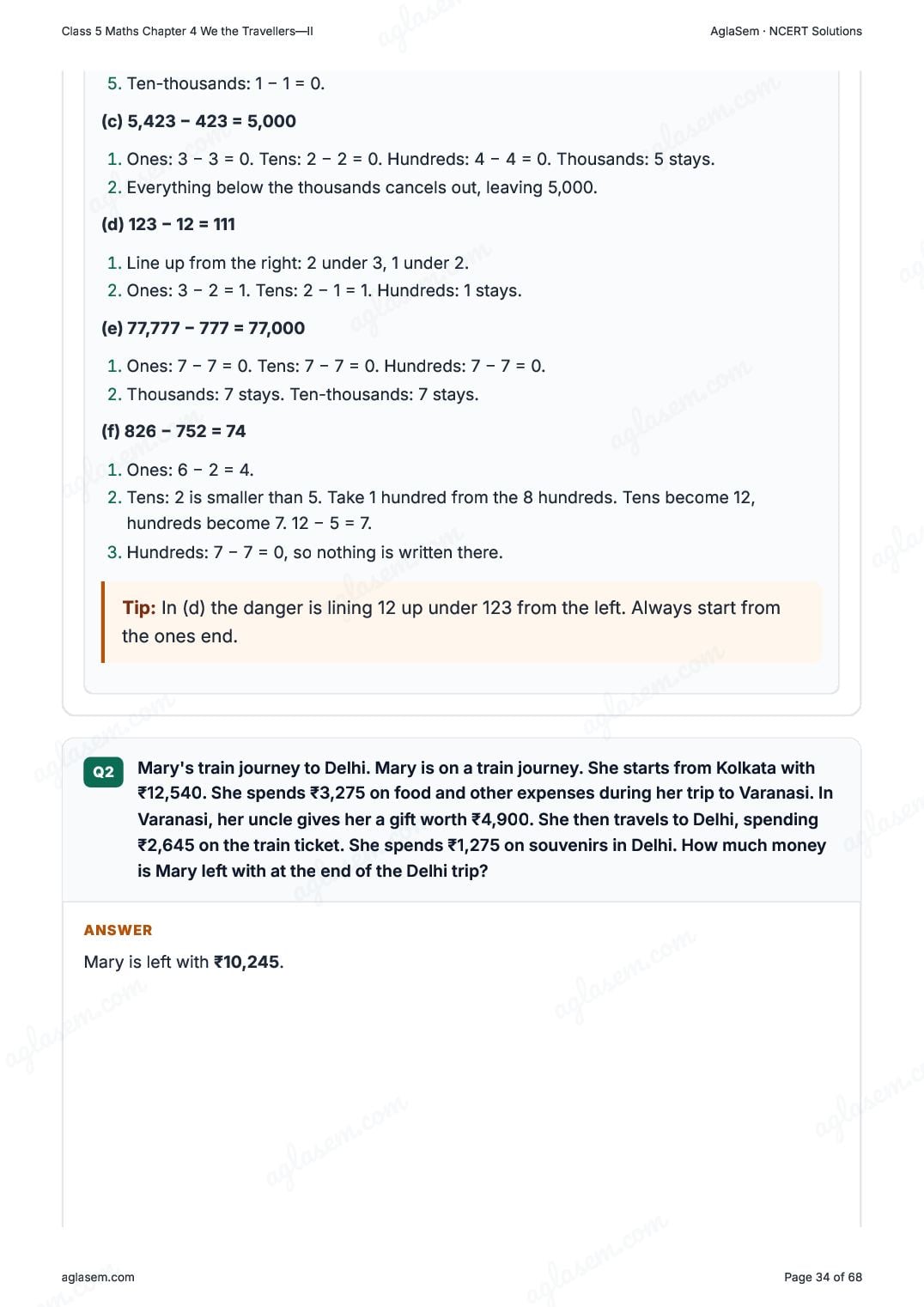
- Subtract the following. Try not to write TTh, Th, H, T, and O at the top. Align the digits carefully. (a) 4,578 – 2,222 (b) 15,324 – 11,780 (c) 5,423 – 423 (d) 123 – 12 (e) 77,777 – 777 (f) 826 – 752
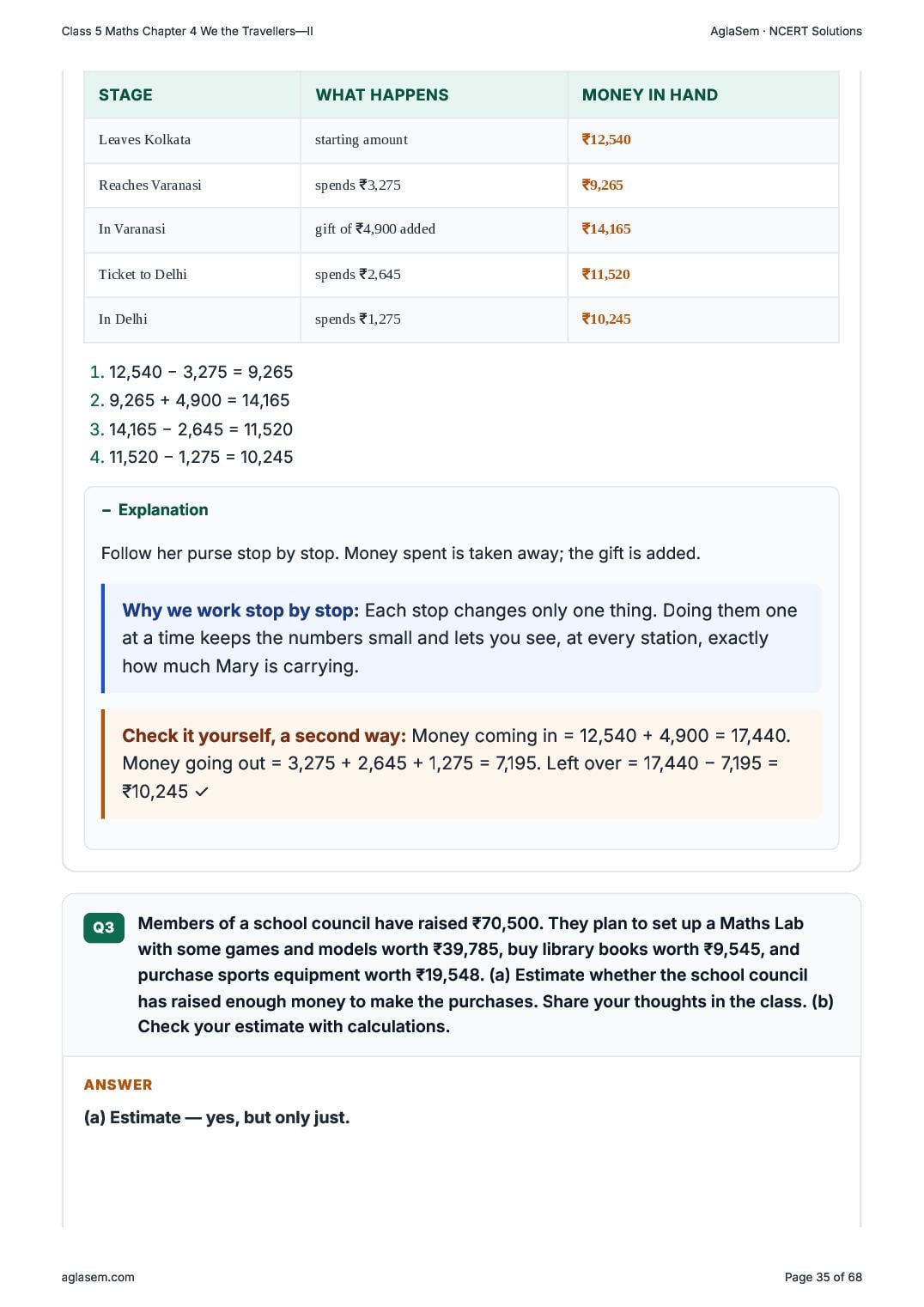
- Mary’s train journey to Delhi. Mary is on a train journey. She starts from Kolkata with ₹12,540. She spends ₹3,275 on food and other expenses during her trip to Varanasi. In Varanasi, her uncle gives her a gift worth ₹4,900. She then travels to Delhi, spending ₹2,645 on the train ticket. She spends ₹1,275 on souvenirs in Delhi. How much money is Mary left with at the end of the Delhi trip?
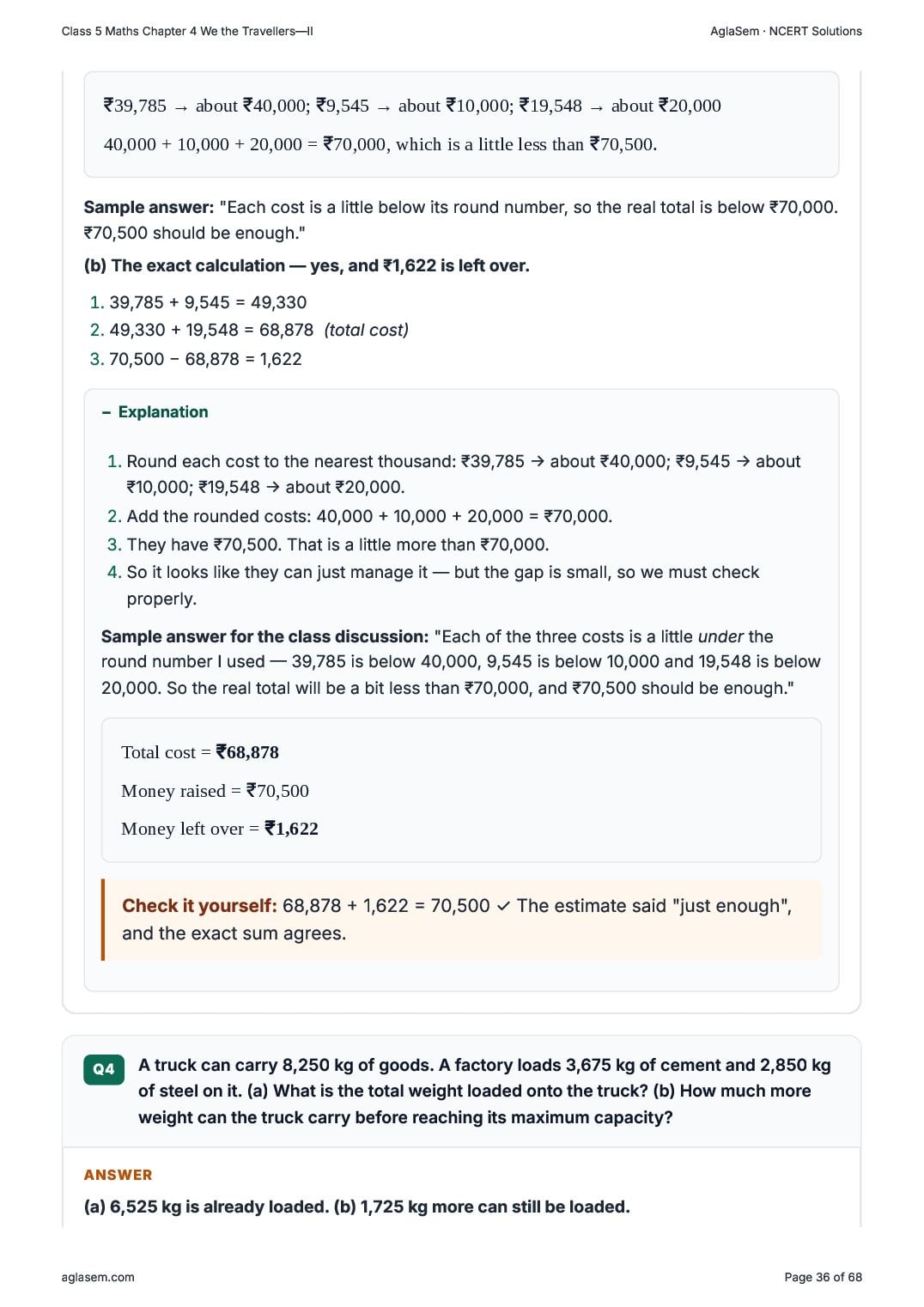
- Members of a school council have raised ₹70,500. They plan to set up a Maths Lab with some games and models worth ₹39,785, buy library books worth ₹9,545, and purchase sports equipment worth ₹19,548. (a) Estimate whether the school council has raised enough money to make the purchases. Share your thoughts in the class. (b) Check your estimate with calculations.
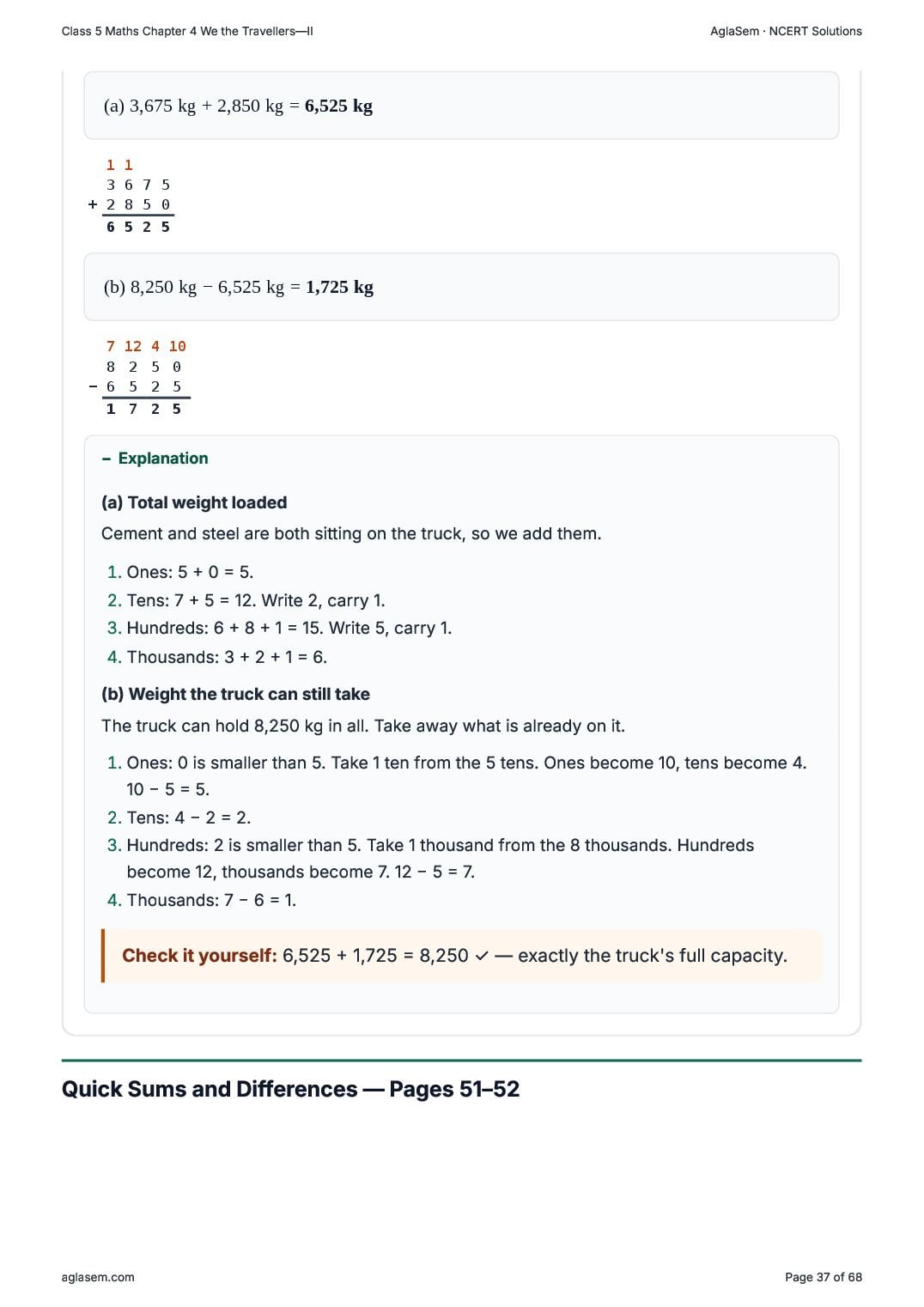
- A truck can carry 8,250 kg of goods. A factory loads 3,675 kg of cement and 2,850 kg of steel on it. (a) What is the total weight loaded onto the truck? (b) How much more weight can the truck carry before reaching its maximum capacity?
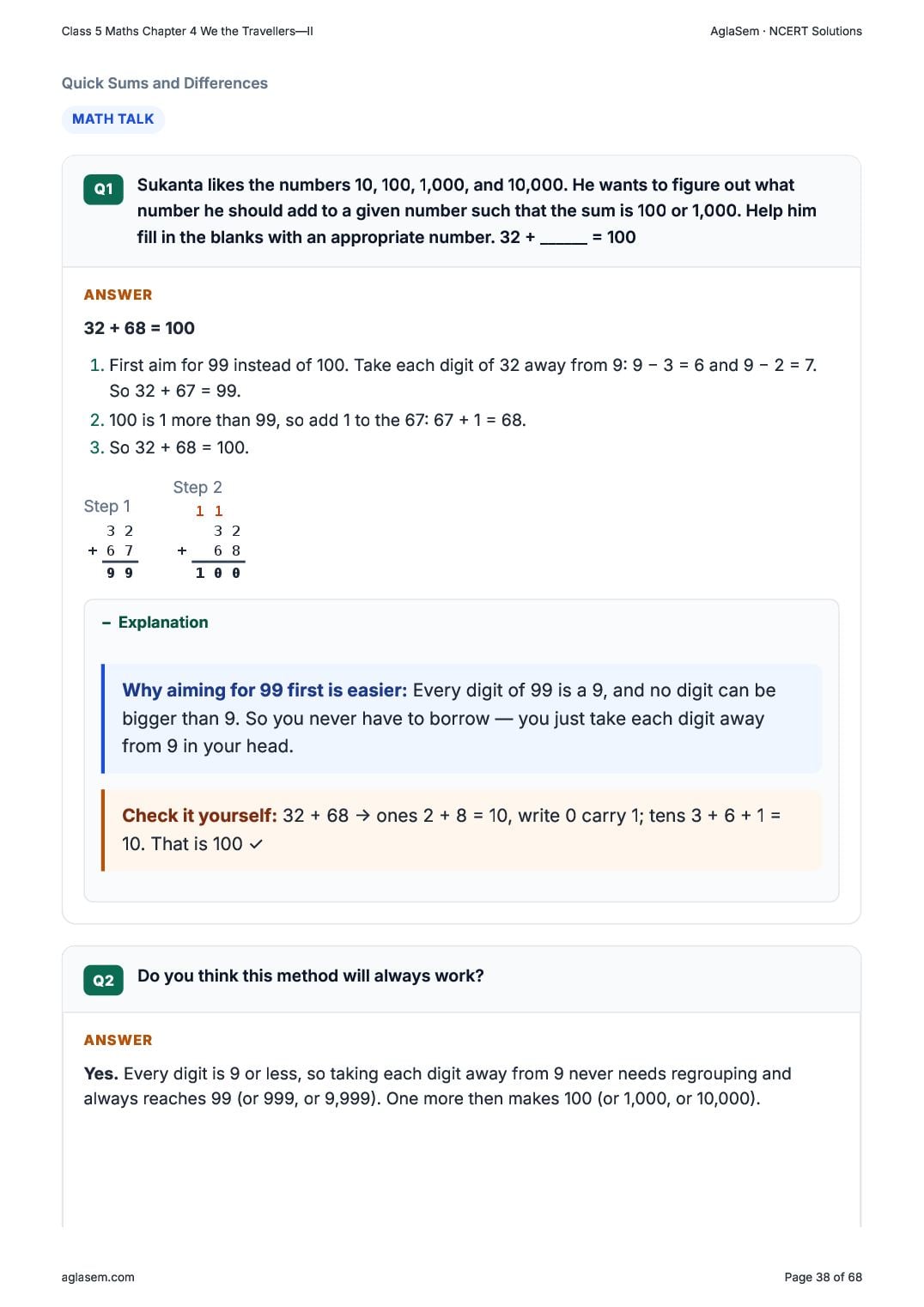
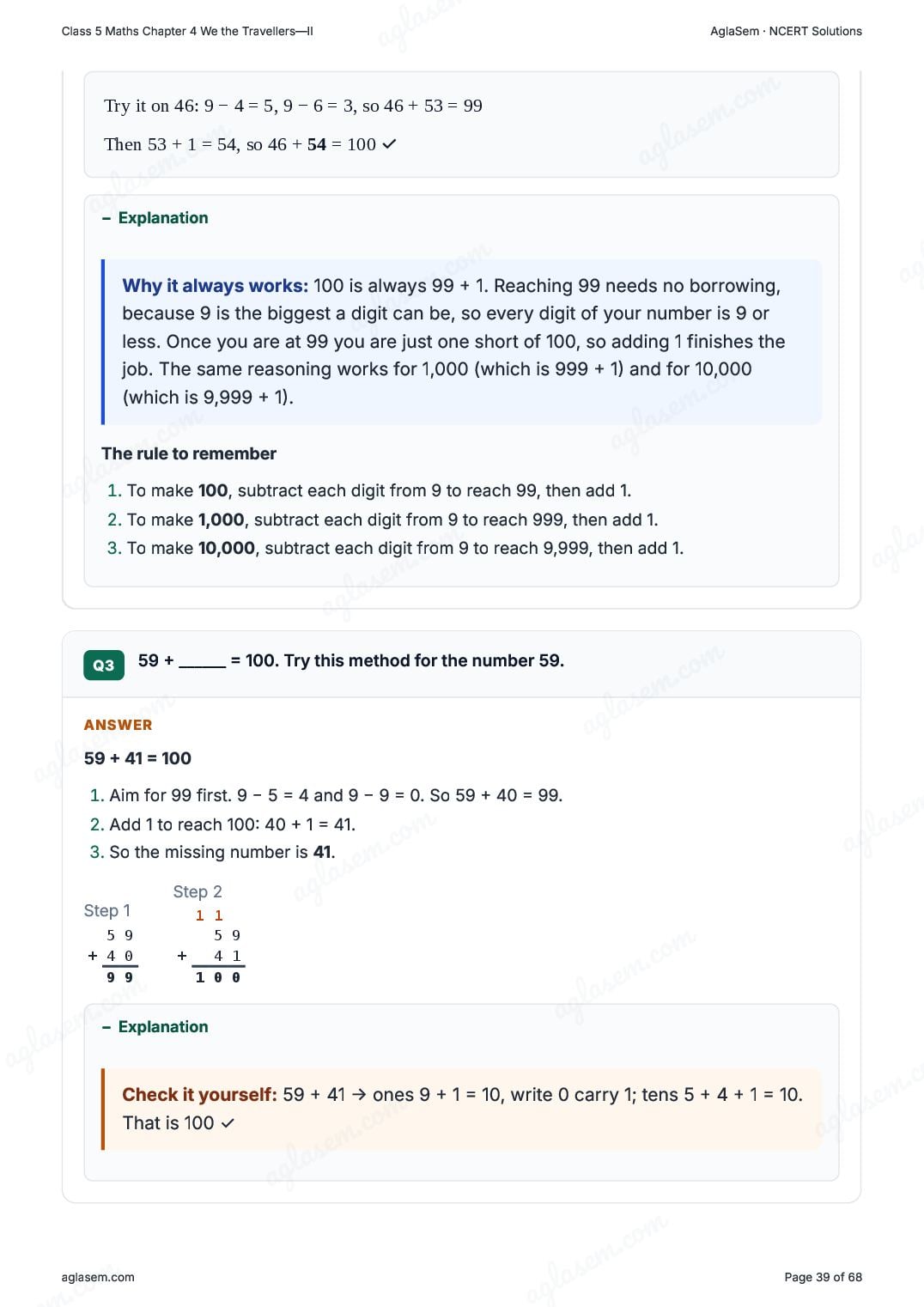
- Sukanta likes the numbers 10, 100, 1,000, and 10,000. He wants to figure out what number he should add to a given number such that the sum is 100 or 1,000. Help him fill in the blanks with an appropriate number. 32 + ______ = 100
- Do you think this method will always work?
- 59 + ______ = 100. Try this method for the number 59.
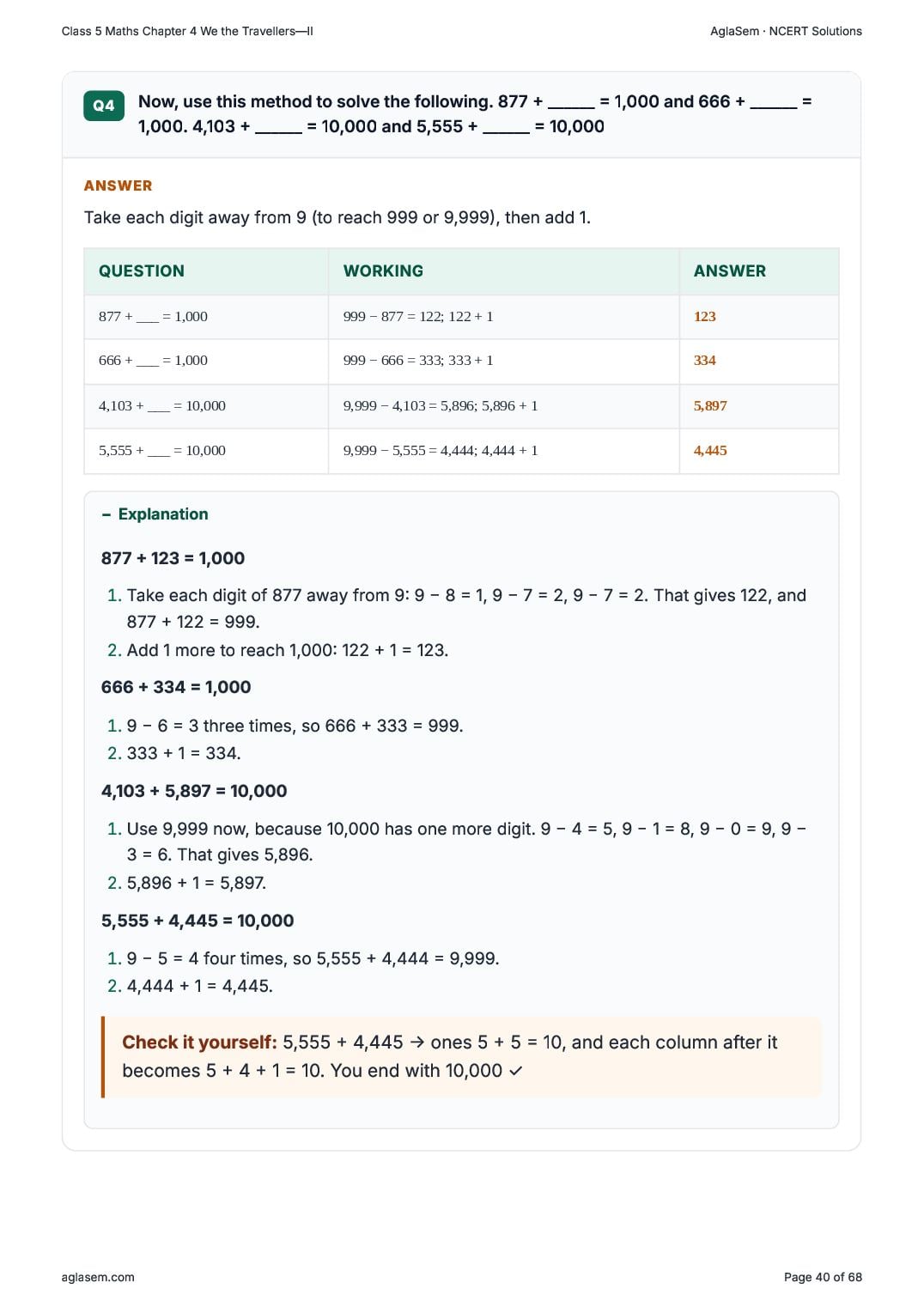
- Now, use this method to solve the following. 877 + ______ = 1,000 and 666 + ______ = 1,000. 4,103 + ______ = 10,000 and 5,555 + ______ = 10,000
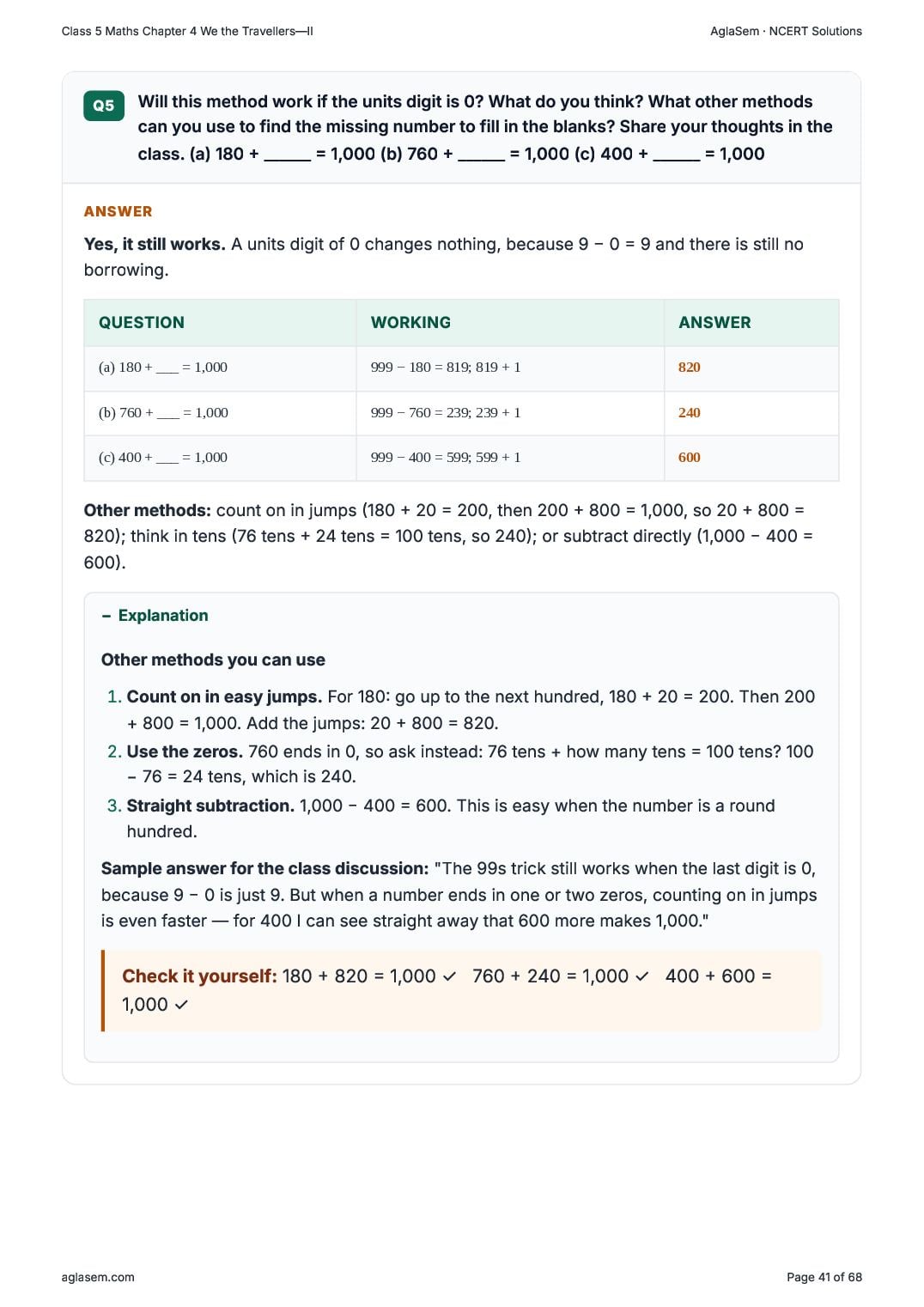
- Will this method work if the units digit is 0? What do you think? What other methods can you use to find the missing number to fill in the blanks? Share your thoughts in the class. (a) 180 + ______ = 1,000 (b) 760 + ______ = 1,000 (c) 400 + ______ = 1,000
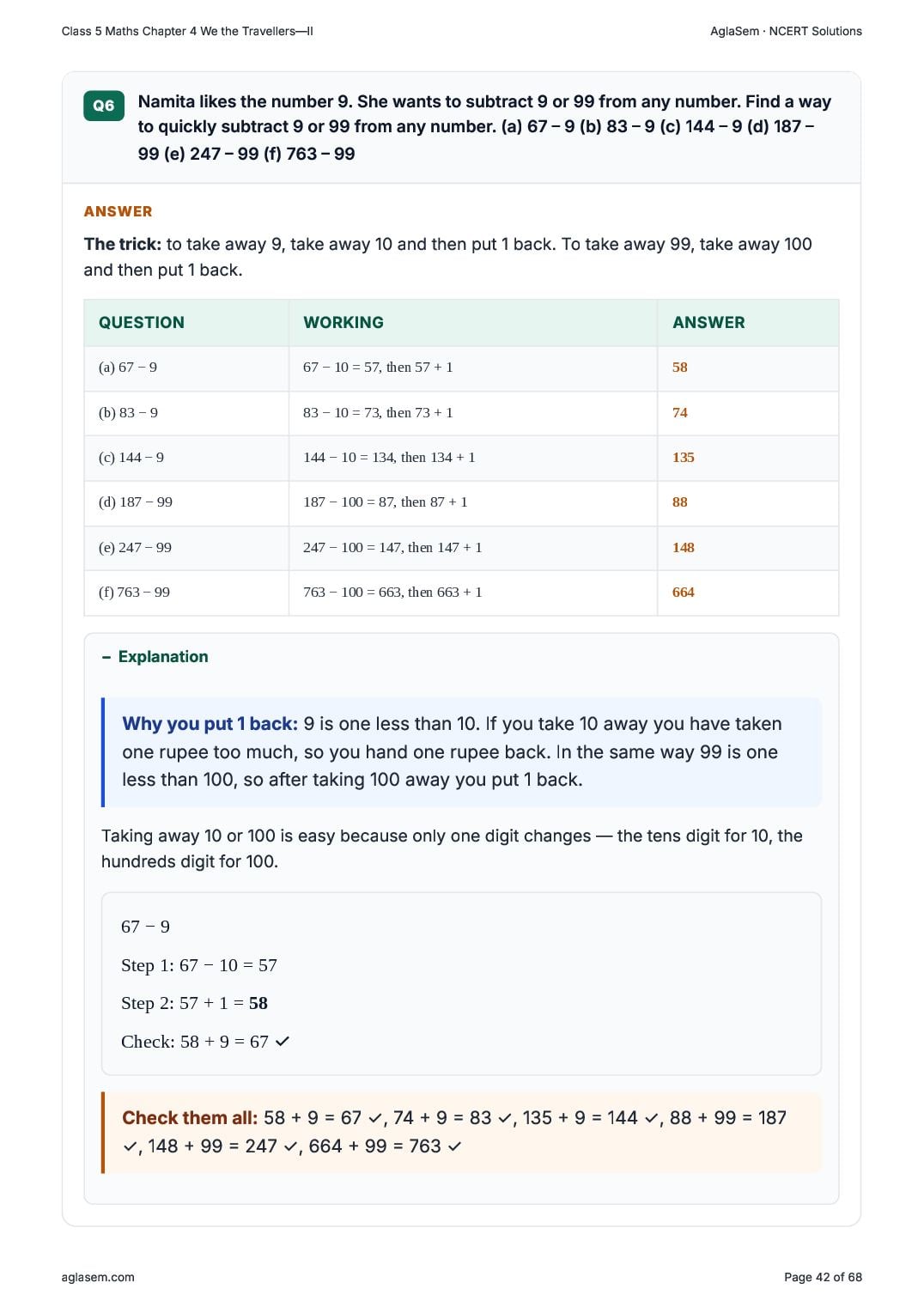
- Namita likes the number 9. She wants to subtract 9 or 99 from any number. Find a way to quickly subtract 9 or 99 from any number. (a) 67 – 9 (b) 83 – 9 (c) 144 – 9 (d) 187 – 99 (e) 247 – 99 (f) 763 – 99
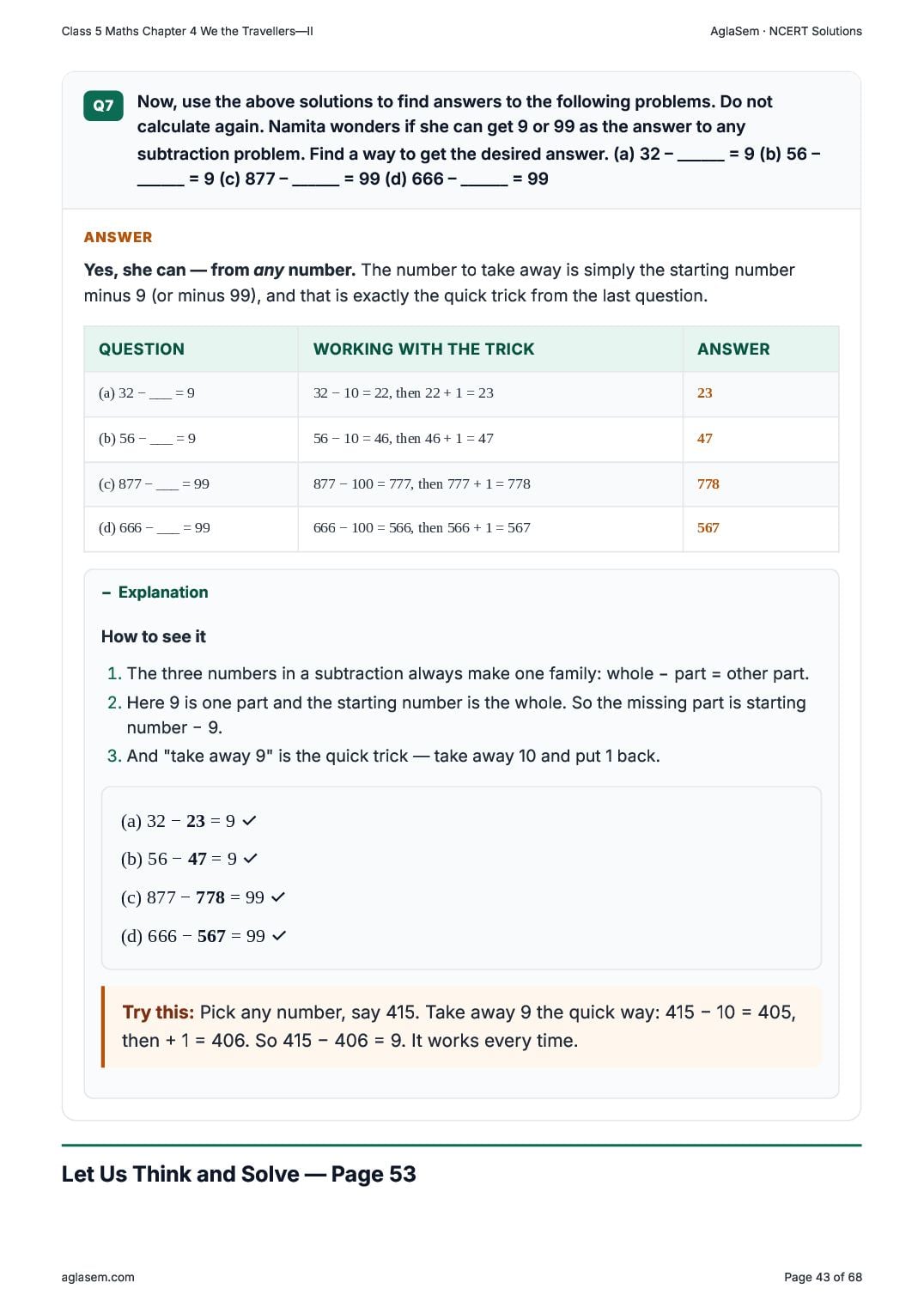
- Now, use the above solutions to find answers to the following problems. Do not calculate again. Namita wonders if she can get 9 or 99 as the answer to any subtraction problem. Find a way to get the desired answer. (a) 32 – ______ = 9 (b) 56 – ______ = 9 (c) 877 – ______ = 99 (d) 666 – ______ = 99
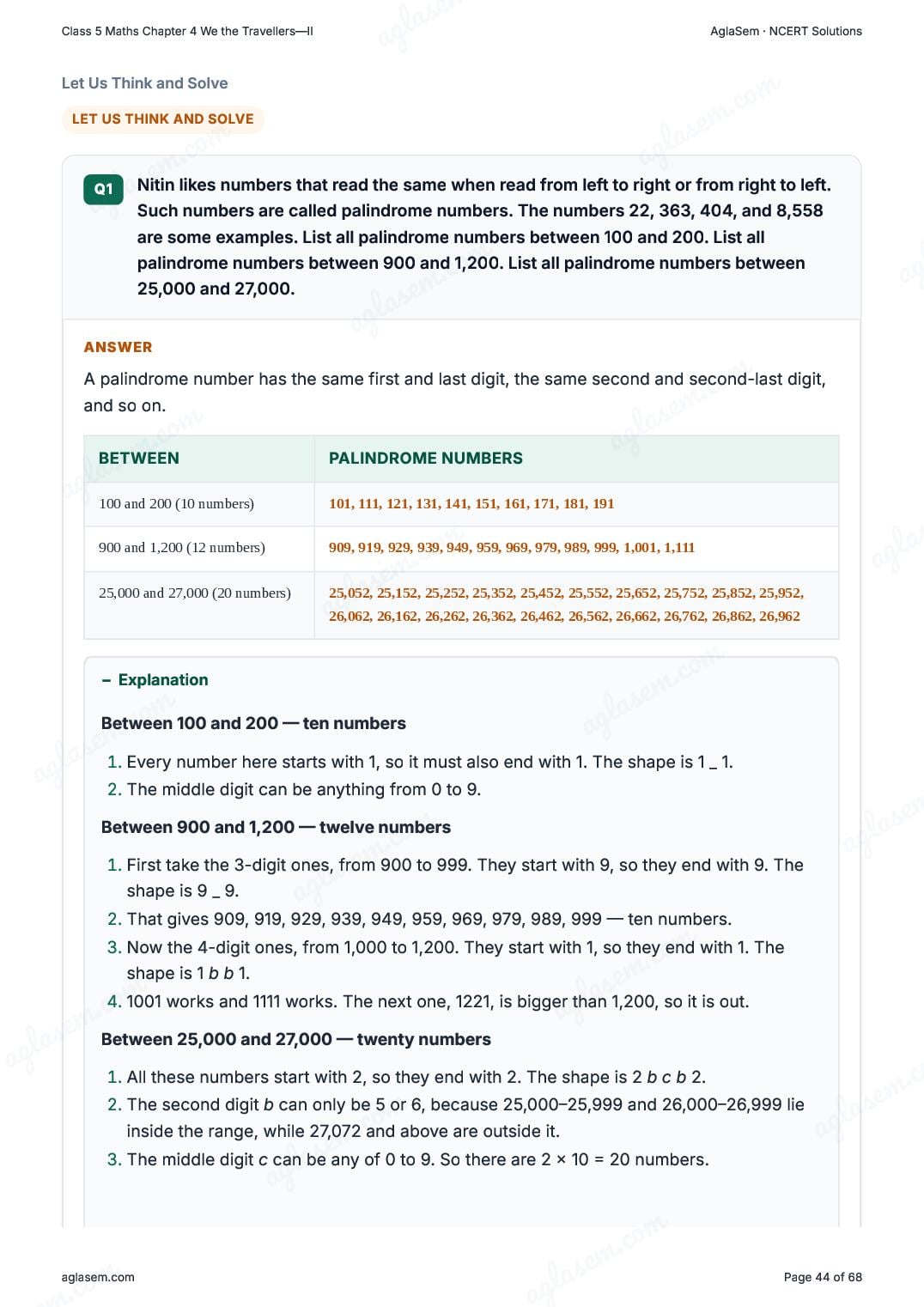
- Nitin likes numbers that read the same when read from left to right or from right to left. Such numbers are called palindrome numbers. The numbers 22, 363, 404, and 8,558 are some examples. List all palindrome numbers between 100 and 200. List all palindrome numbers between 900 and 1,200. List all palindrome numbers between 25,000 and 27,000.
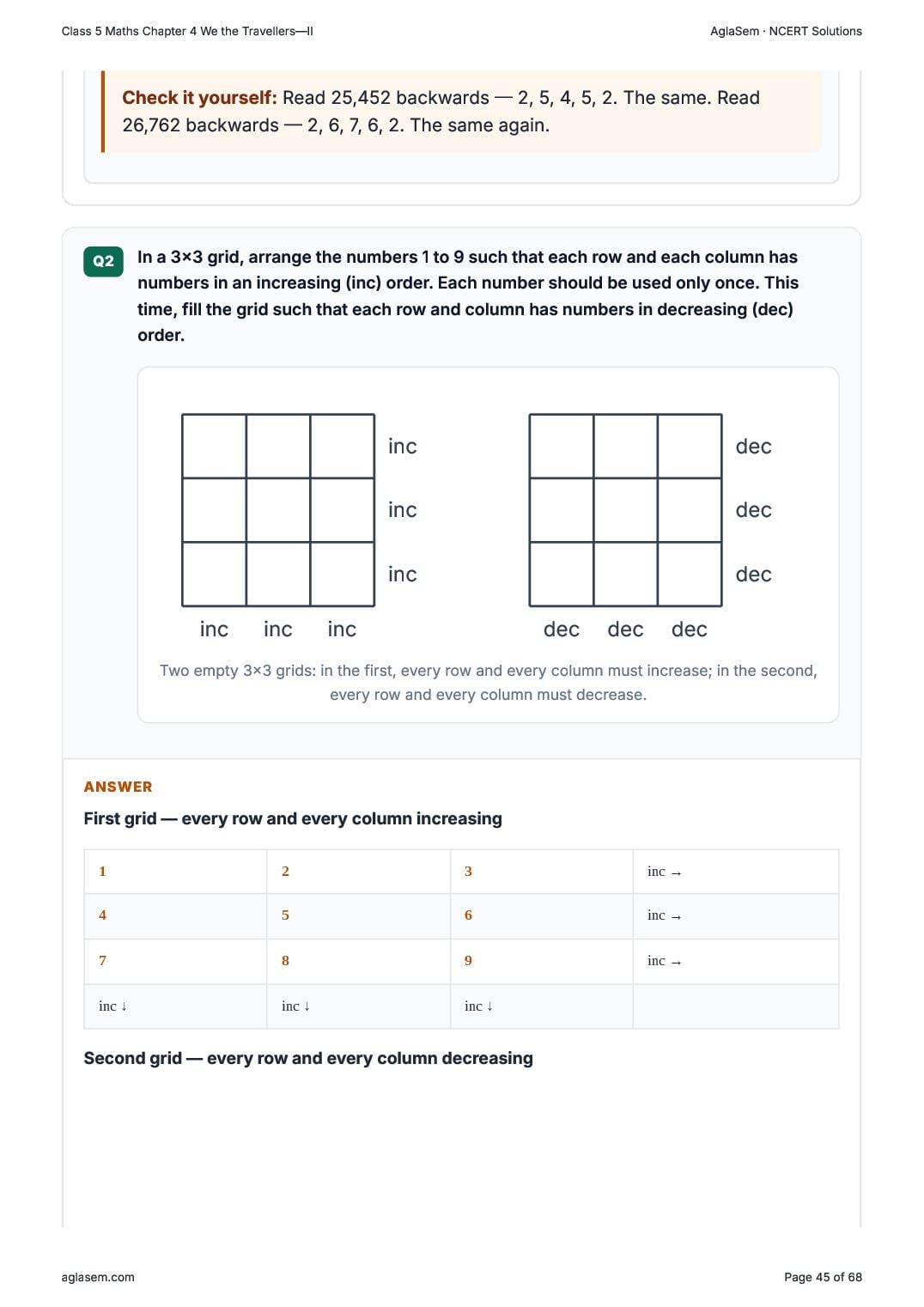
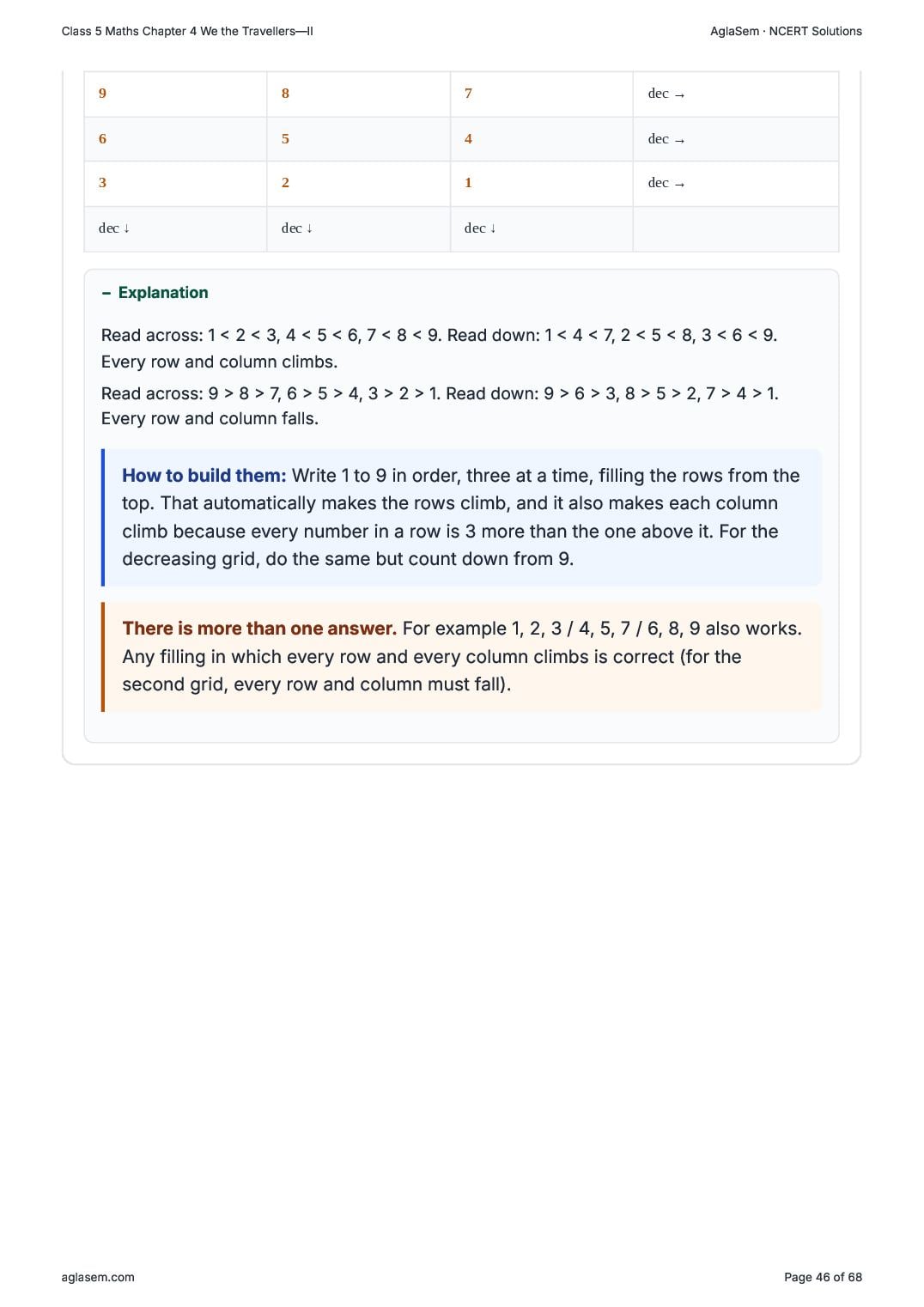
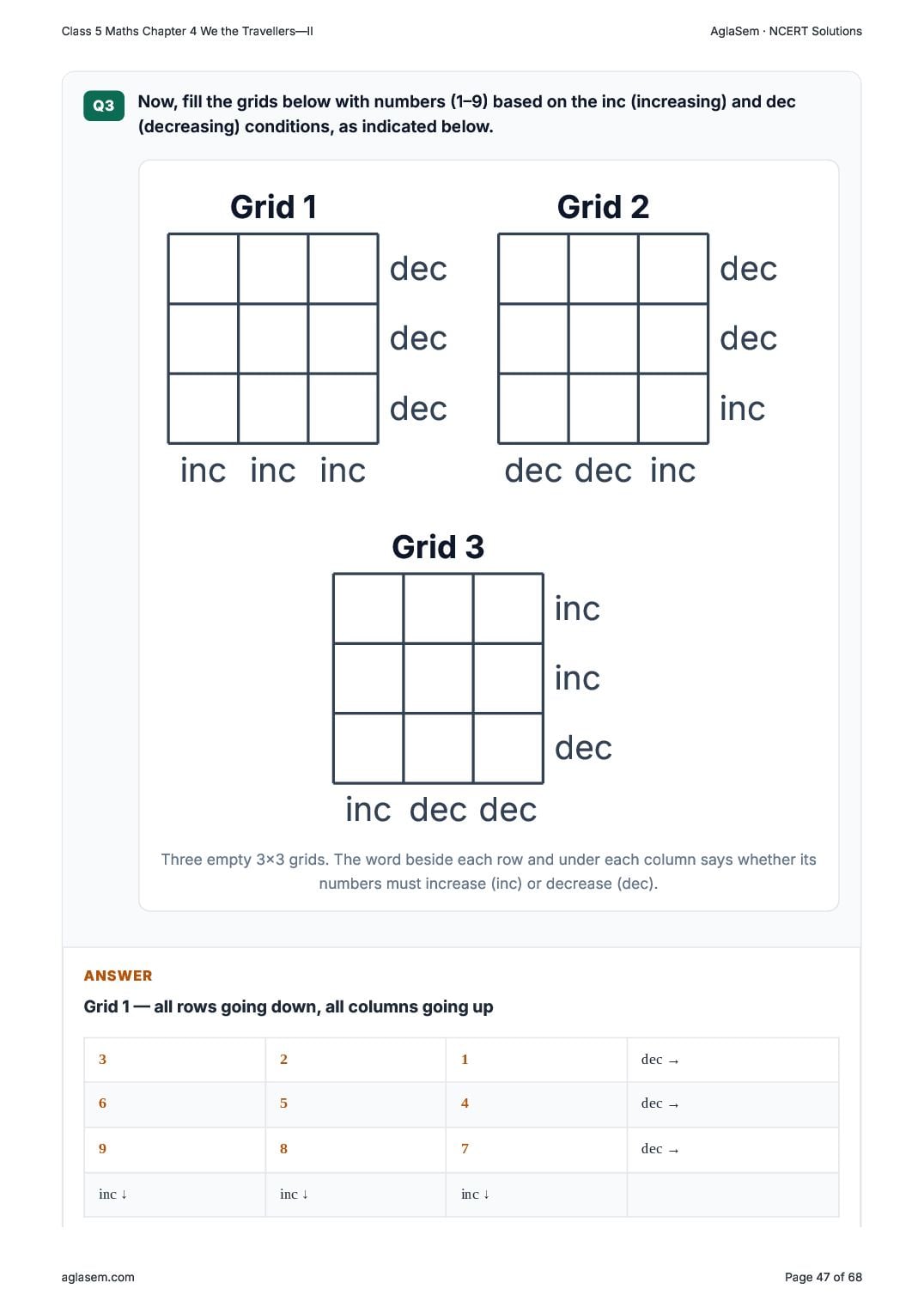
- In a 3×3 grid, arrange the numbers 1 to 9 such that each row and each column has numbers in an increasing (inc) order. Each number should be used only once. This time, fill the grid such that each row and column has numbers in decreasing (dec) order.incincincincincincdecdecdecdecdecdecTwo empty 3×3 grids: in the first, every row and every column must increase; in the second, every row and every column must decrease.
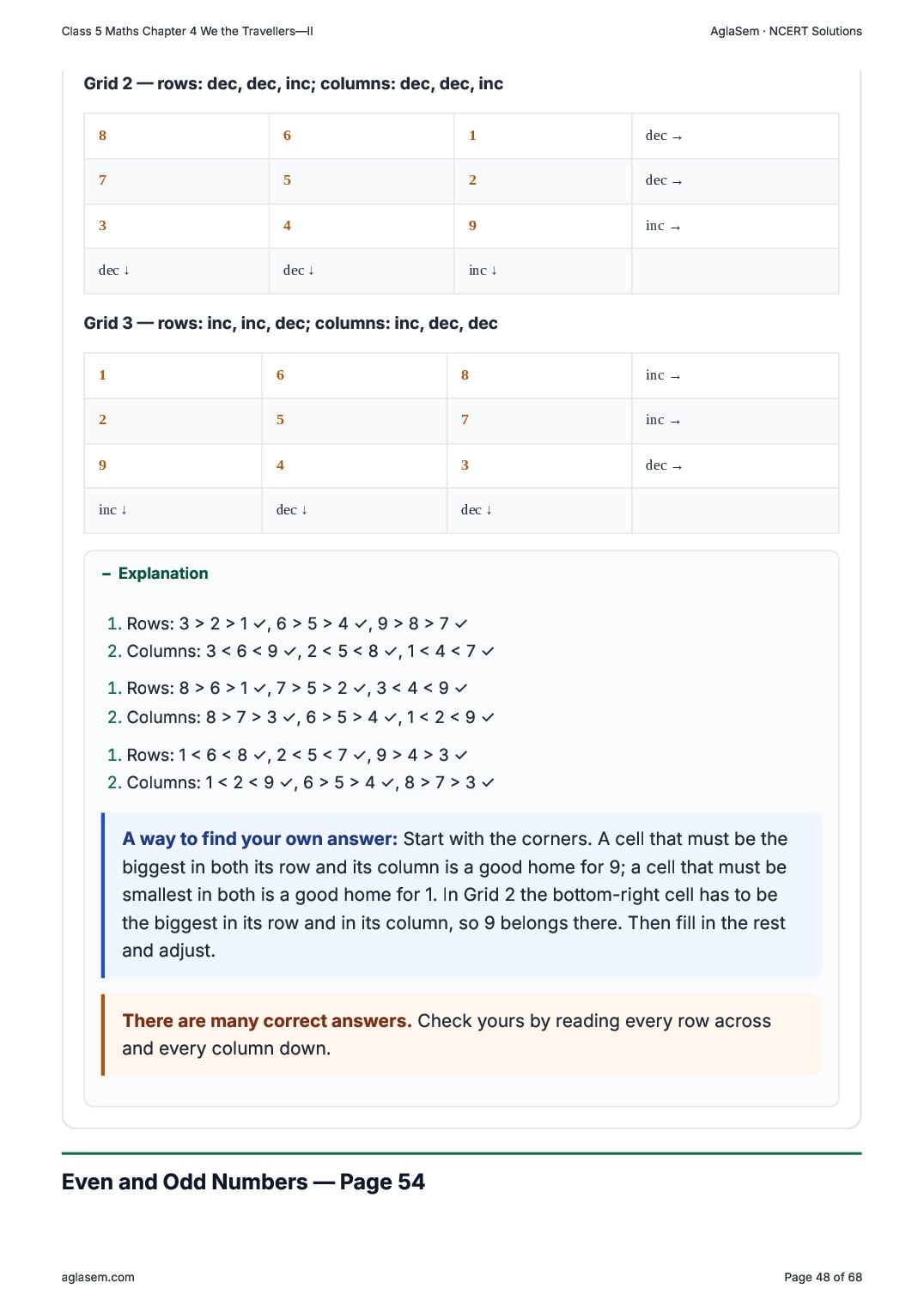
- Now, fill the grids below with numbers (1–9) based on the inc (increasing) and dec (decreasing) conditions, as indicated below. Grid 1: rows dec, dec, dec and columns inc, inc, inc. Grid 2: rows dec, dec, inc and columns dec, dec, inc. Grid 3: rows inc, inc, dec and columns inc, dec, dec.
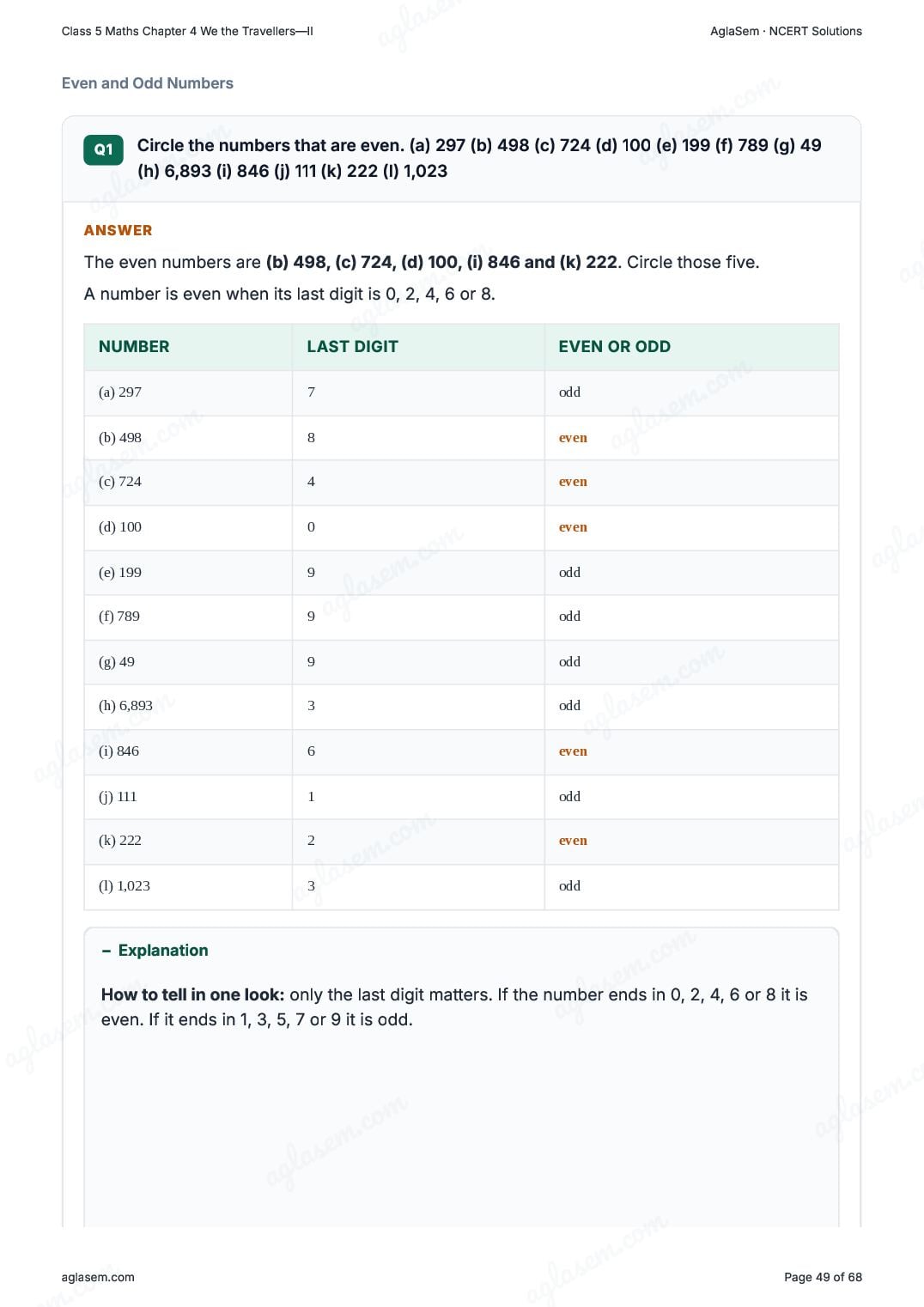
- Circle the numbers that are even. (a) 297 (b) 498 (c) 724 (d) 100 (e) 199 (f) 789 (g) 49 (h) 6,893 (i) 846 (j) 111 (k) 222 (l) 1,023
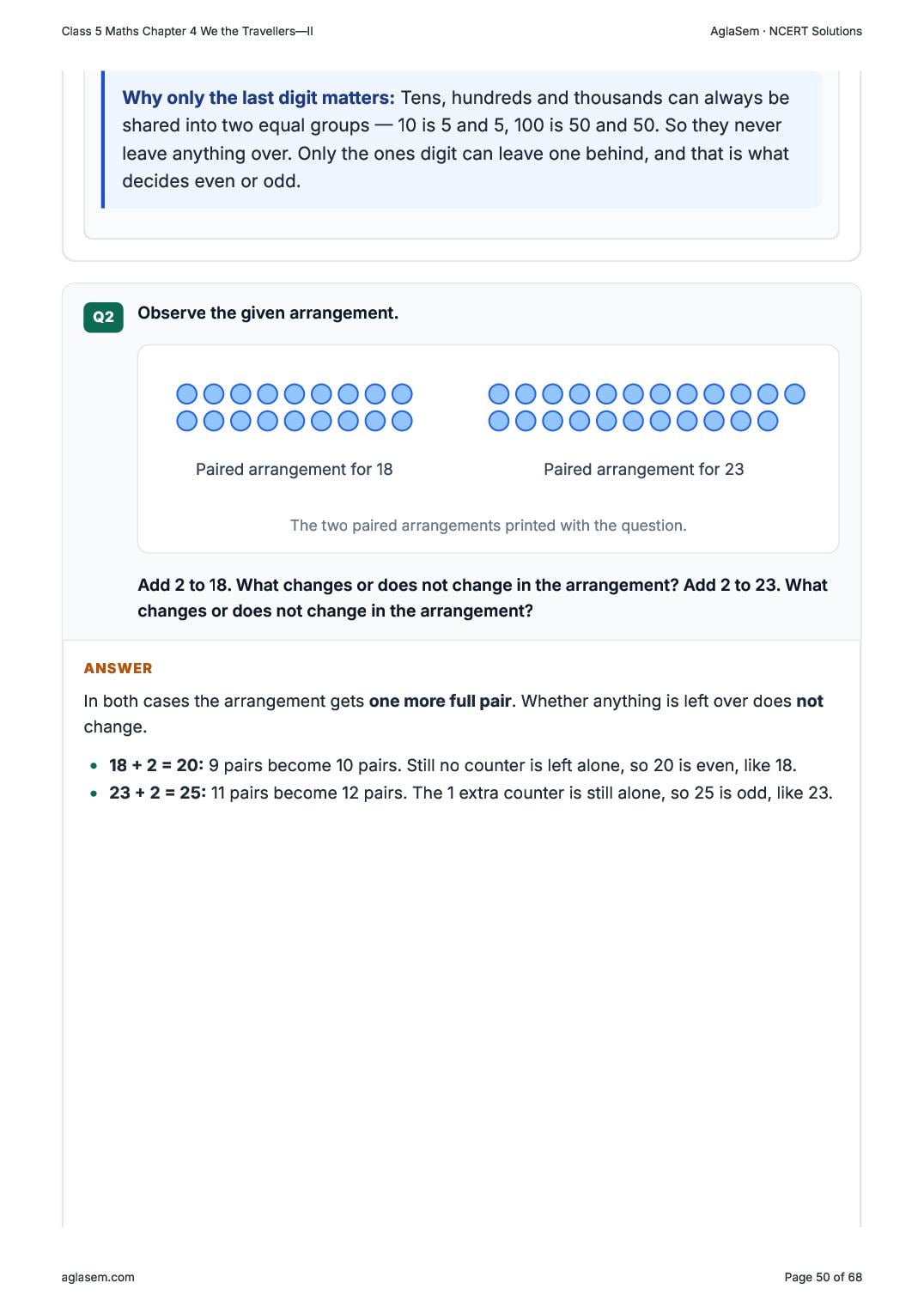
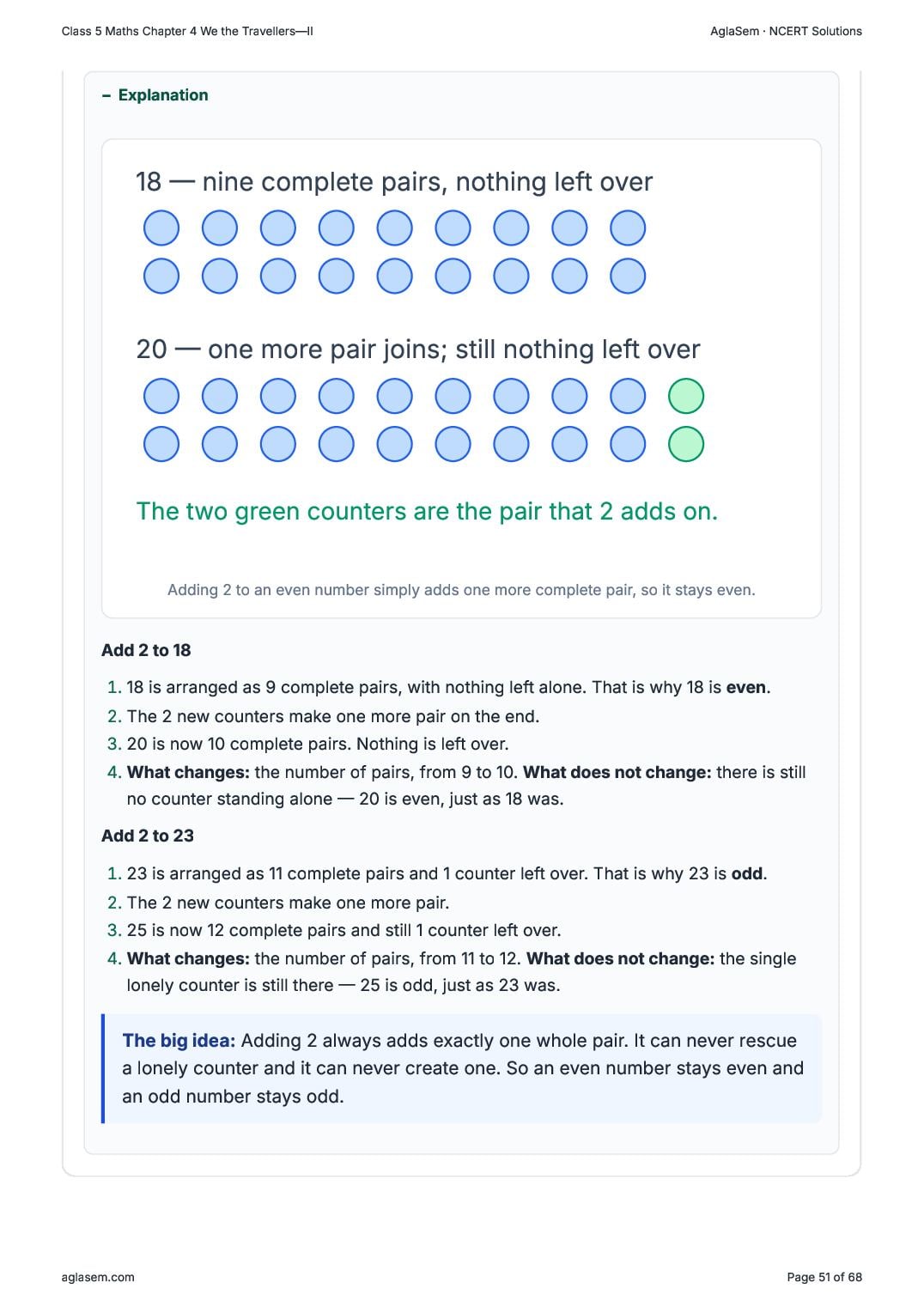
- Observe the given arrangement.Paired arrangement for 18Paired arrangement for 23The two paired arrangements printed with the question. Add 2 to 18. What changes or does not change in the arrangement? Add 2 to 23. What changes or does not change in the arrangement?
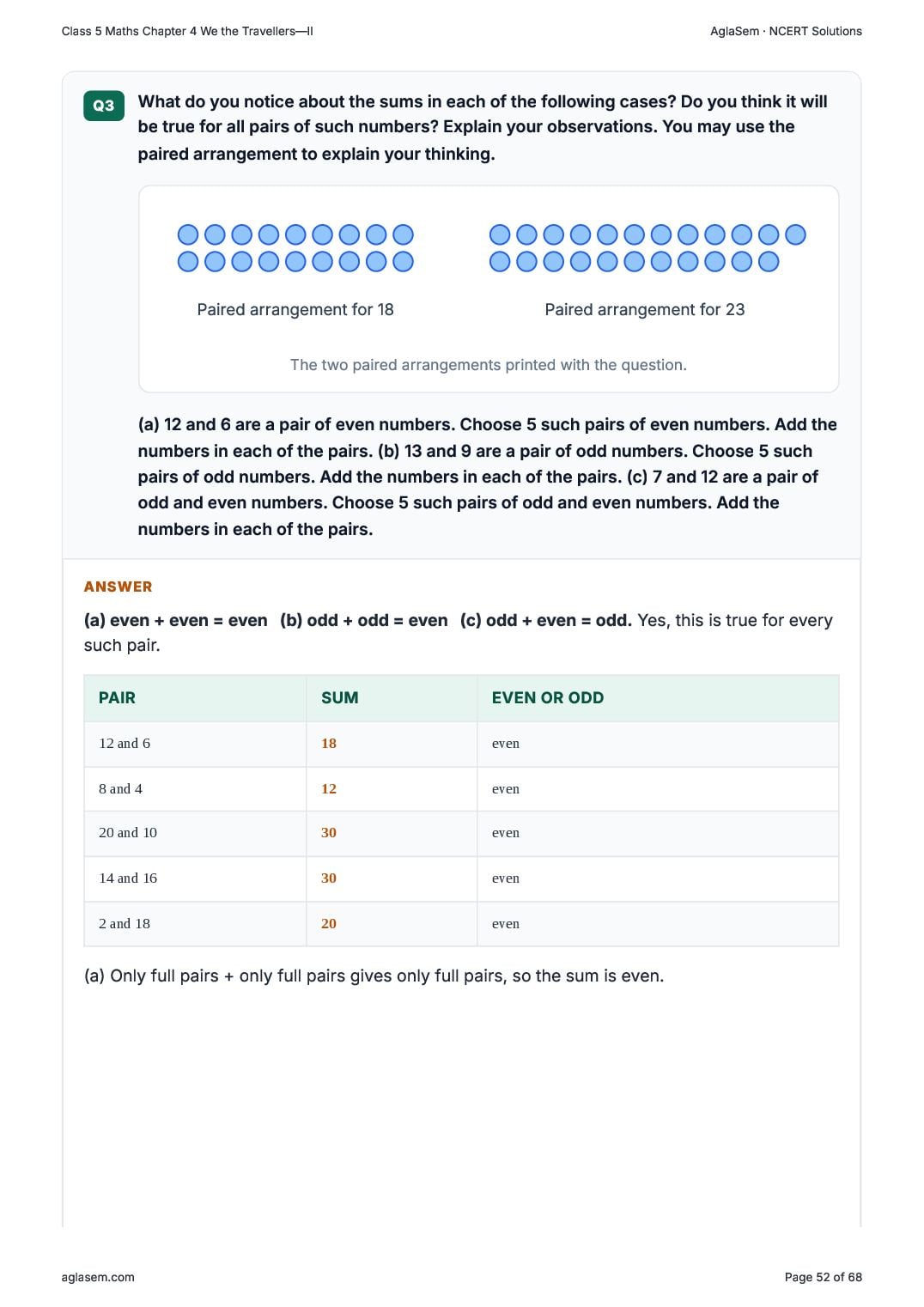
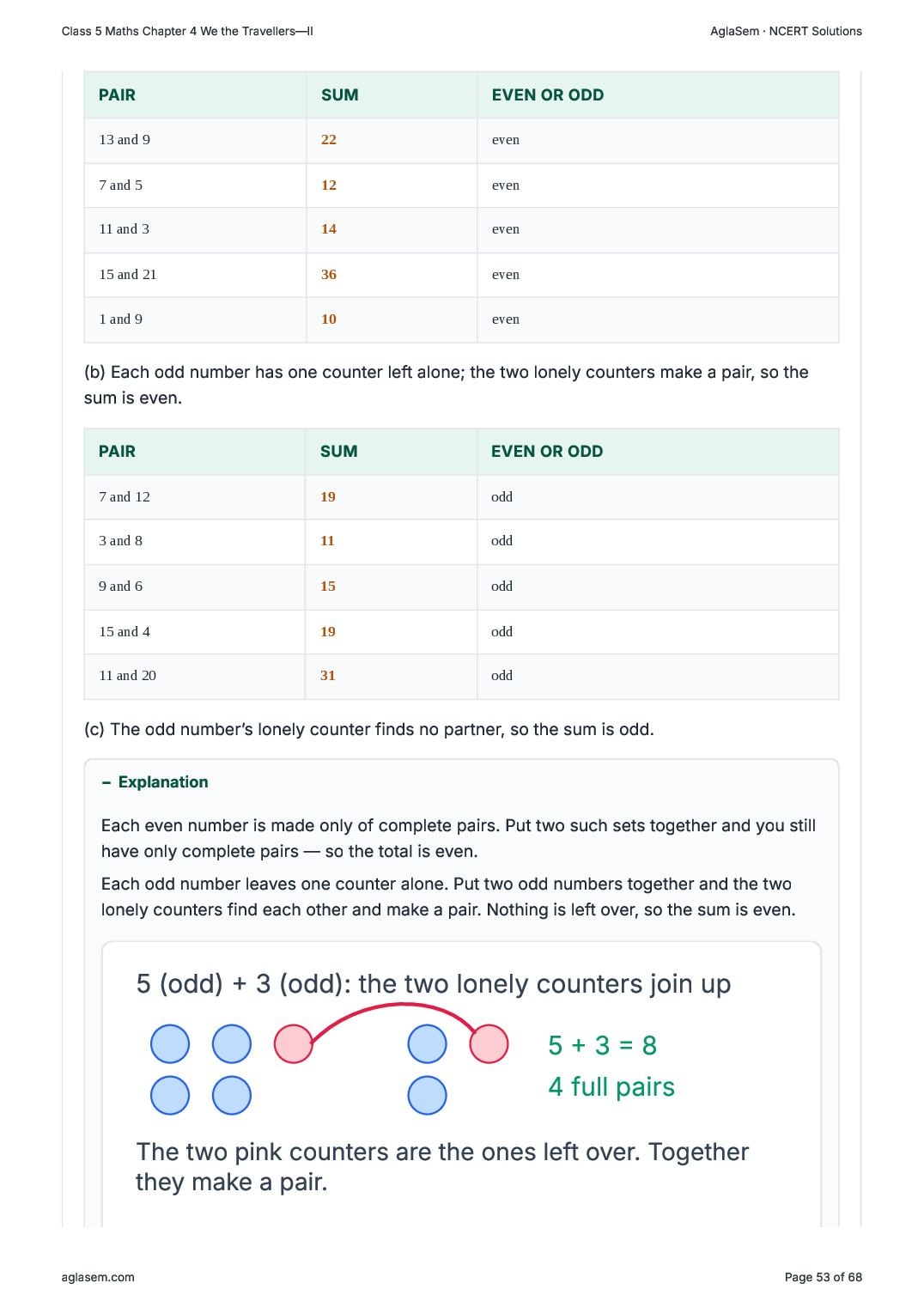
- What do you notice about the sums in each of the following cases? Do you think it will be true for all pairs of such numbers? Explain your observations. You may use the paired arrangement to explain your thinking.Paired arrangement for 18Paired arrangement for 23The two paired arrangements printed with the question. (a) 12 and 6 are a pair of even numbers. Choose 5 such pairs of even numbers. Add the numbers in each of the pairs. (b) 13 and 9 are a pair of odd numbers. Choose 5 such pairs of odd numbers. Add the numbers in each of the pairs. (c) 7 and 12 are a pair of odd and even numbers. Choose 5 such pairs of odd and even numbers. Add the numbers in each of the pairs.
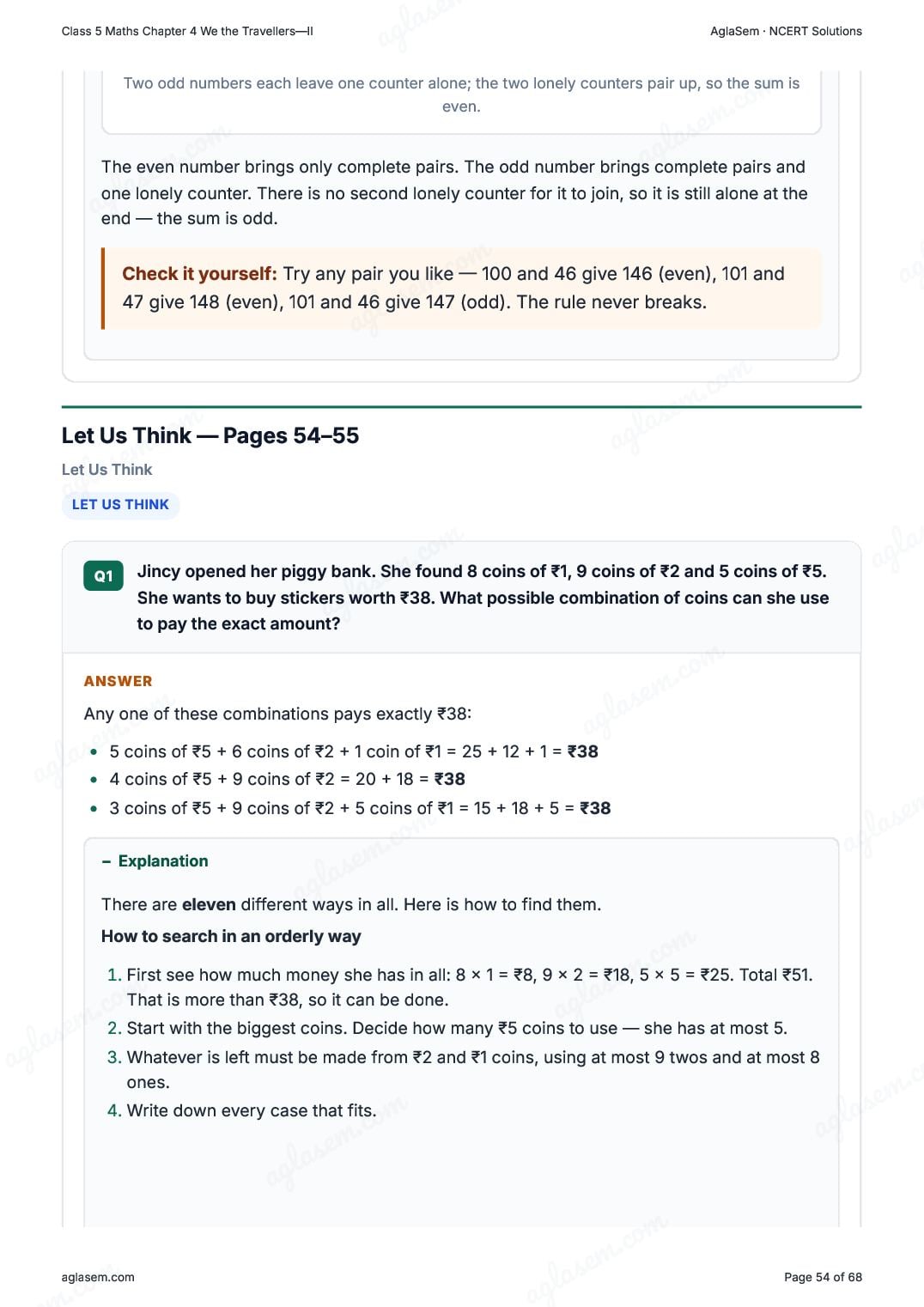
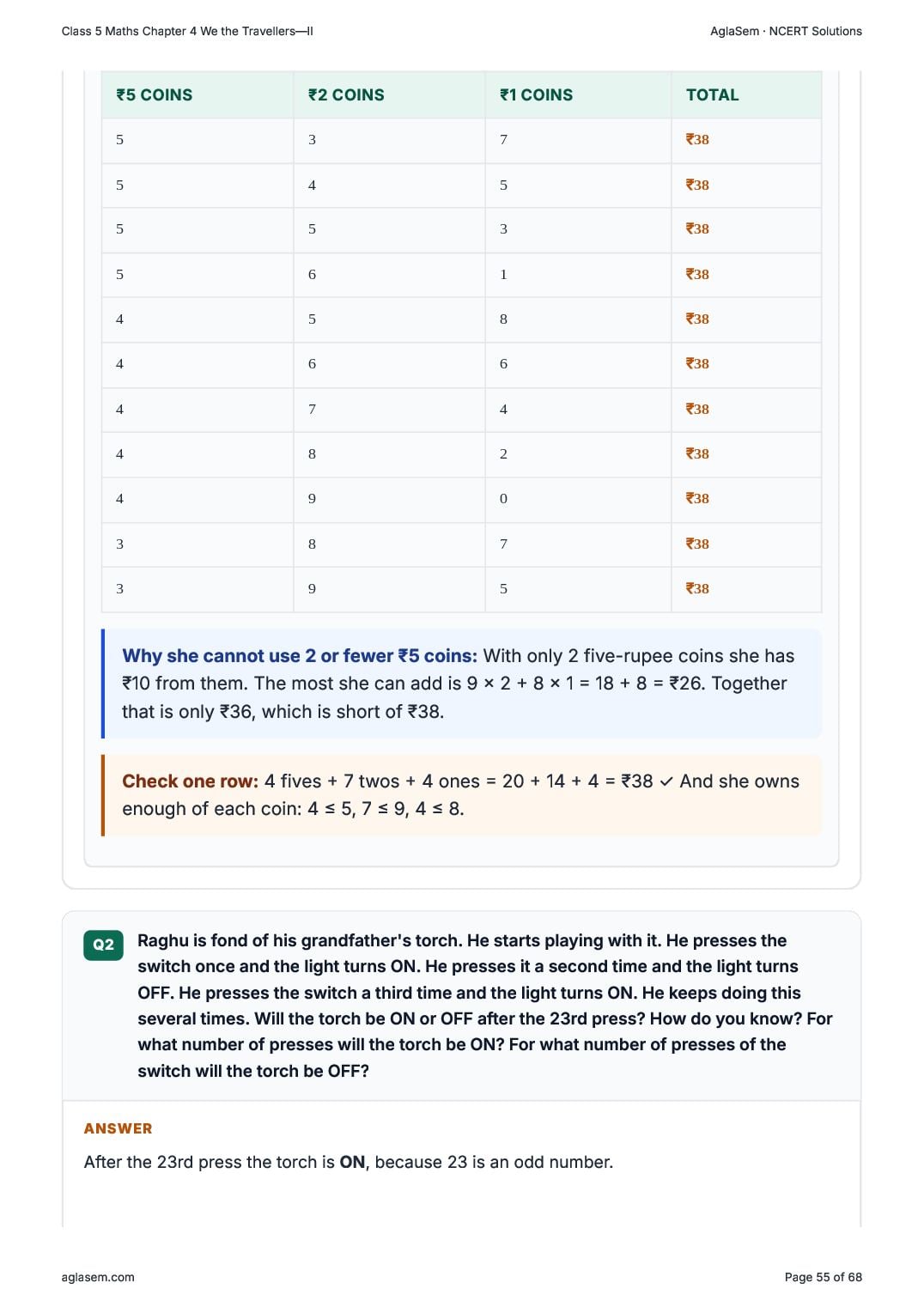
- Jincy opened her piggy bank. She found 8 coins of ₹1, 9 coins of ₹2 and 5 coins of ₹5. She wants to buy stickers worth ₹38. What possible combination of coins can she use to pay the exact amount?
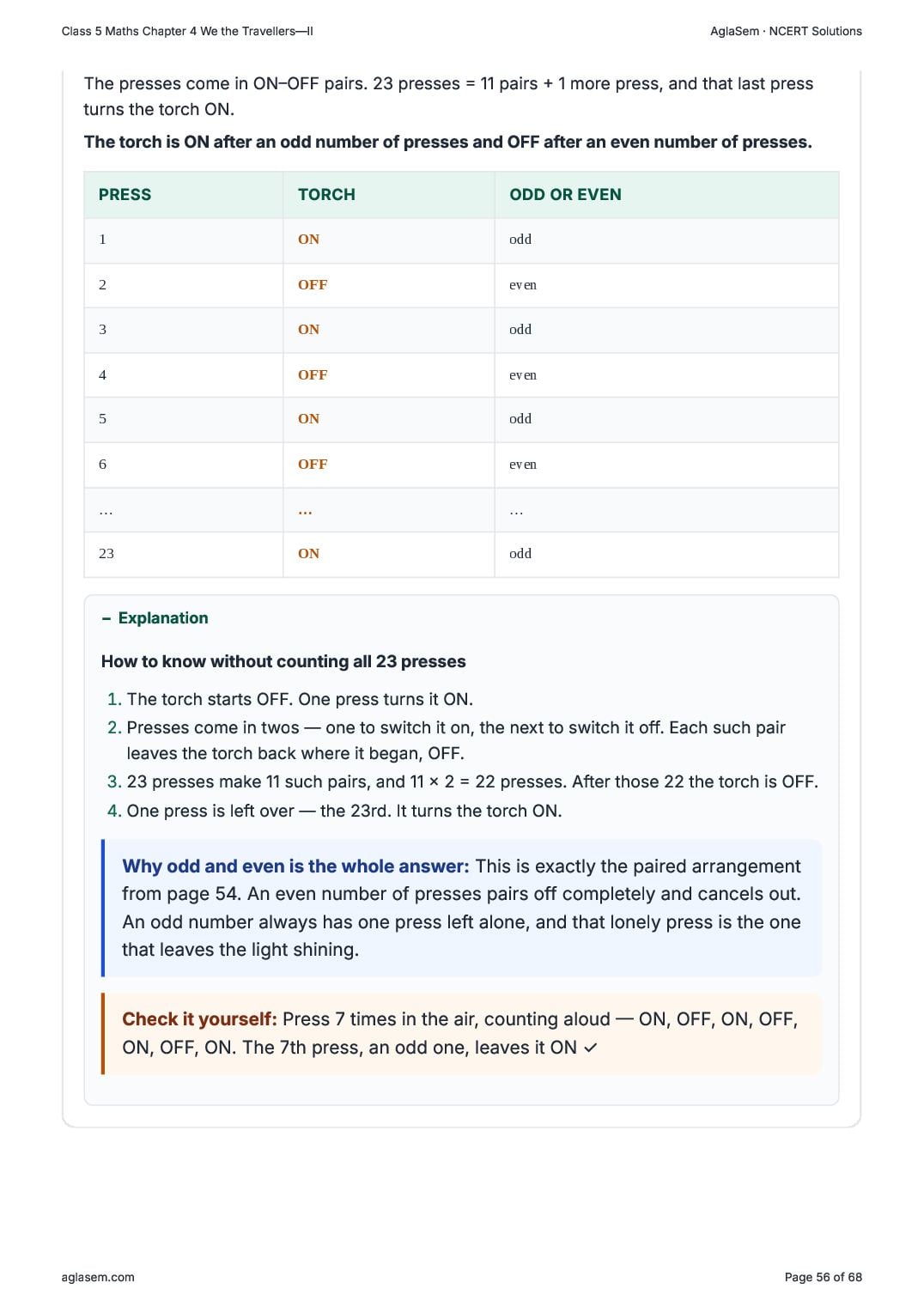
- Raghu is fond of his grandfather’s torch. He starts playing with it. He presses the switch once and the light turns ON. He presses it a second time and the light turns OFF. He presses the switch a third time and the light turns ON. He keeps doing this several times. Will the torch be ON or OFF after the 23rd press? How do you know? For what number of presses will the torch be ON? For what number of presses of the switch will the torch be OFF?
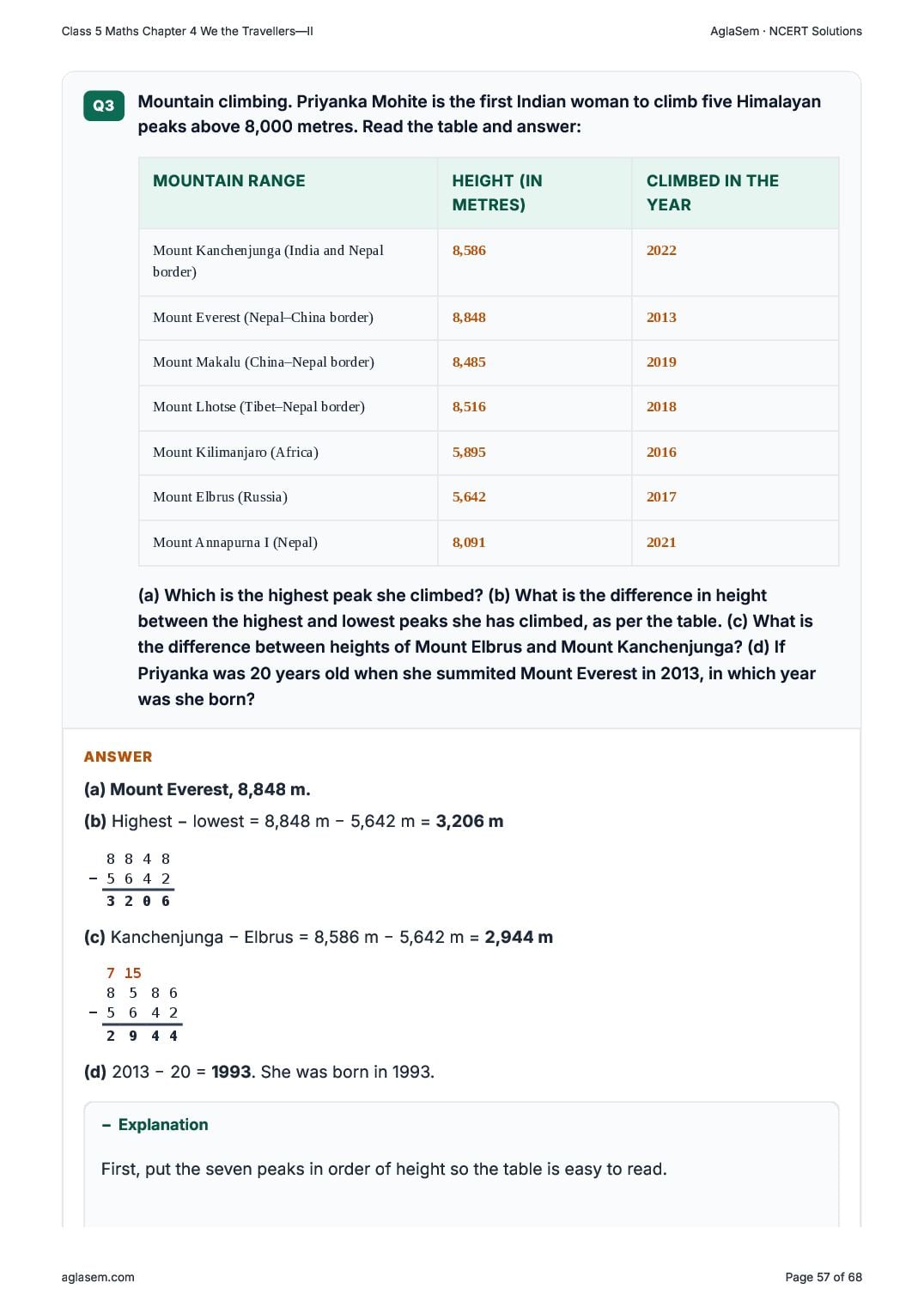
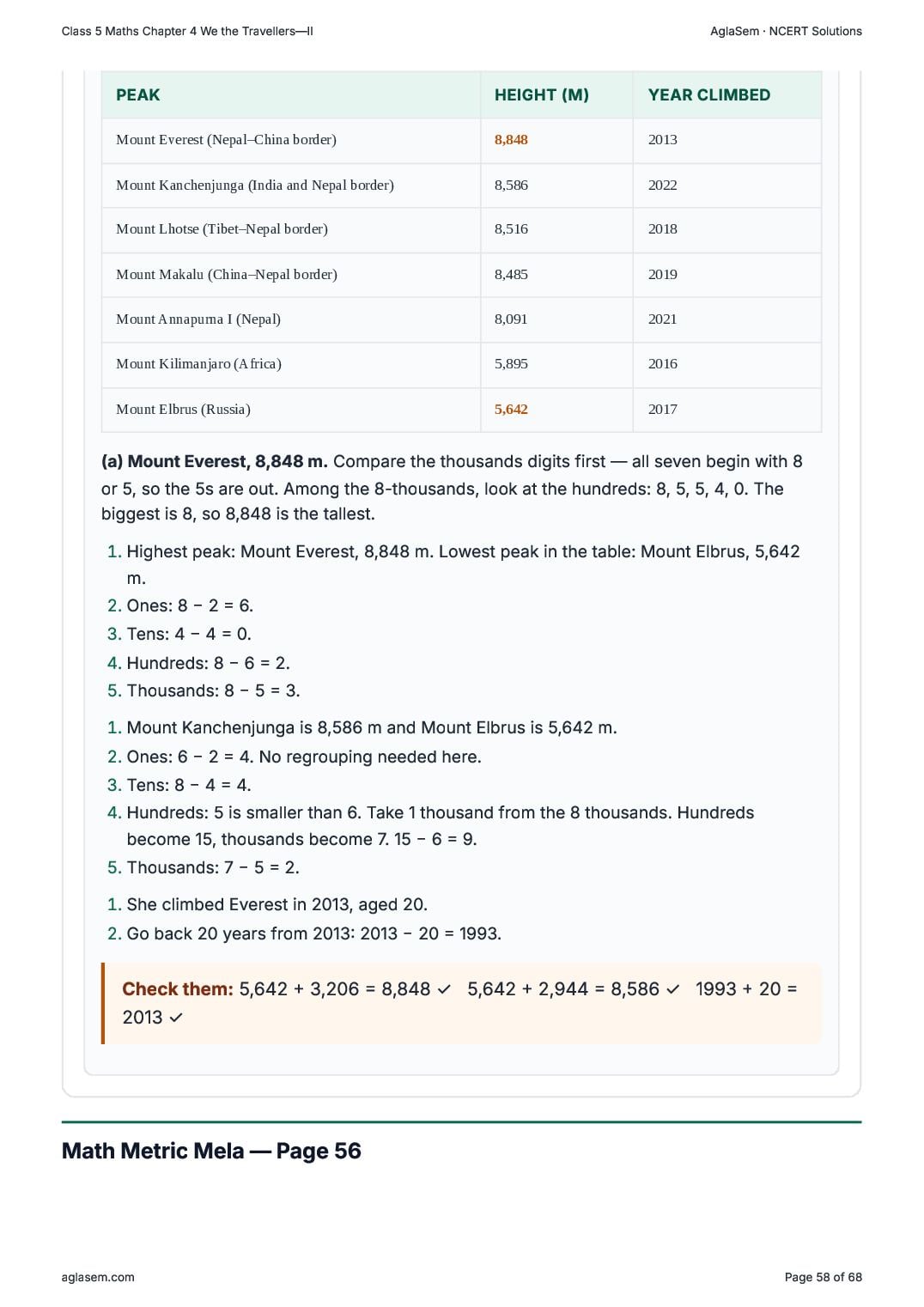
- Mountain climbing. Priyanka Mohite is the first Indian woman to climb five Himalayan peaks above 8,000 metres. Read the table and answer:Mountain RangeHeight (in metres)Climbed in the YearMount Kanchenjunga (India and Nepal border)8,5862022Mount Everest (Nepal–China border)8,8482013Mount Makalu (China–Nepal border)8,4852019Mount Lhotse (Tibet–Nepal border)8,5162018Mount Kilimanjaro (Africa)5,8952016Mount Elbrus (Russia)5,6422017Mount Annapurna I (Nepal)8,0912021 (a) Which is the highest peak she climbed? (b) What is the difference in height between the highest and lowest peaks she has climbed, as per the table. (c) What is the difference between heights of Mount Elbrus and Mount Kanchenjunga? (d) If Priyanka was 20 years old when she summited Mount Everest in 2013, in which year was she born?
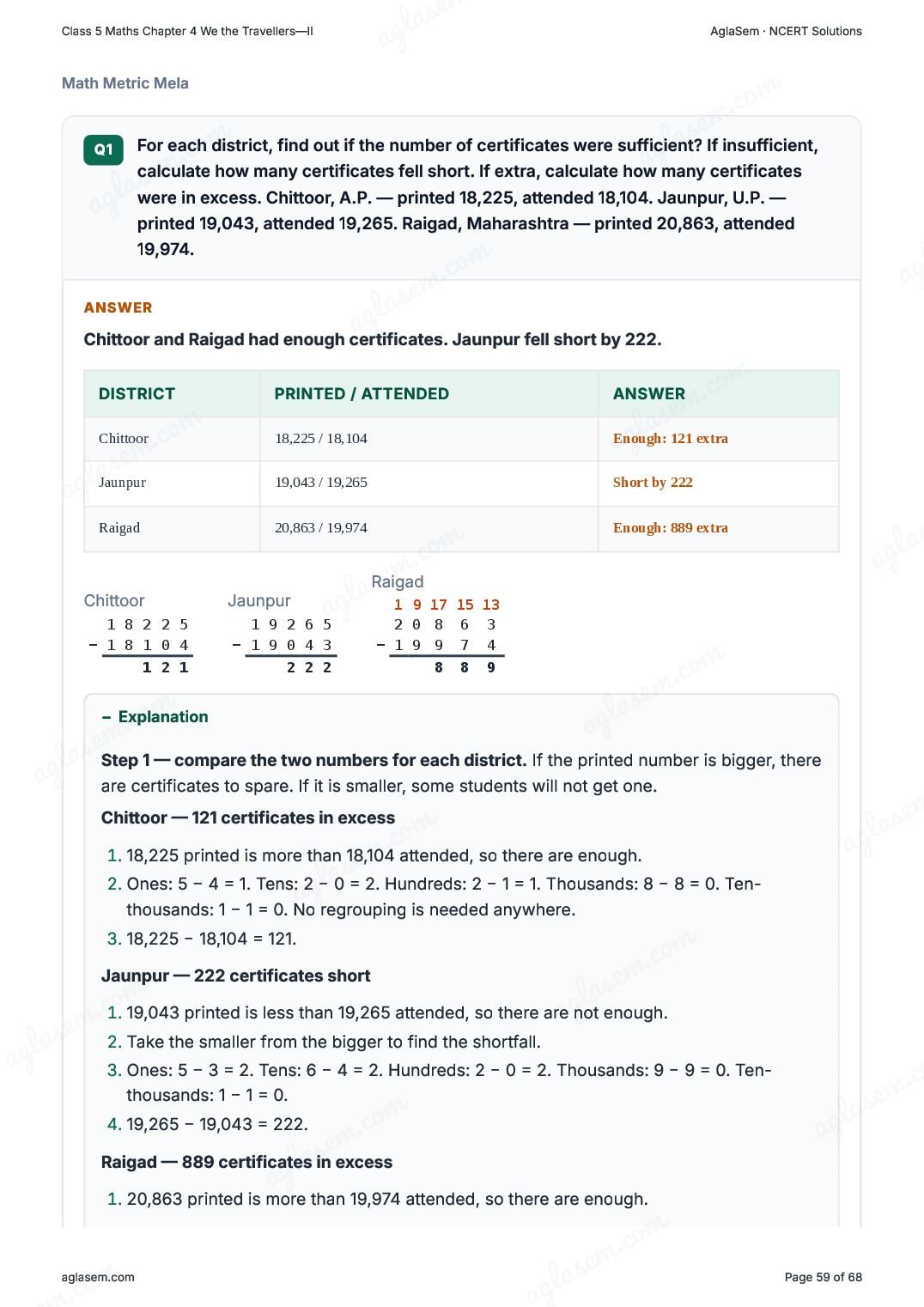
- For each district, find out if the number of certificates were sufficient? If insufficient, calculate how many certificates fell short. If extra, calculate how many certificates were in excess. Chittoor, A.P. — printed 18,225, attended 18,104. Jaunpur, U.P. — printed 19,043, attended 19,265. Raigad, Maharashtra — printed 20,863, attended 19,974.
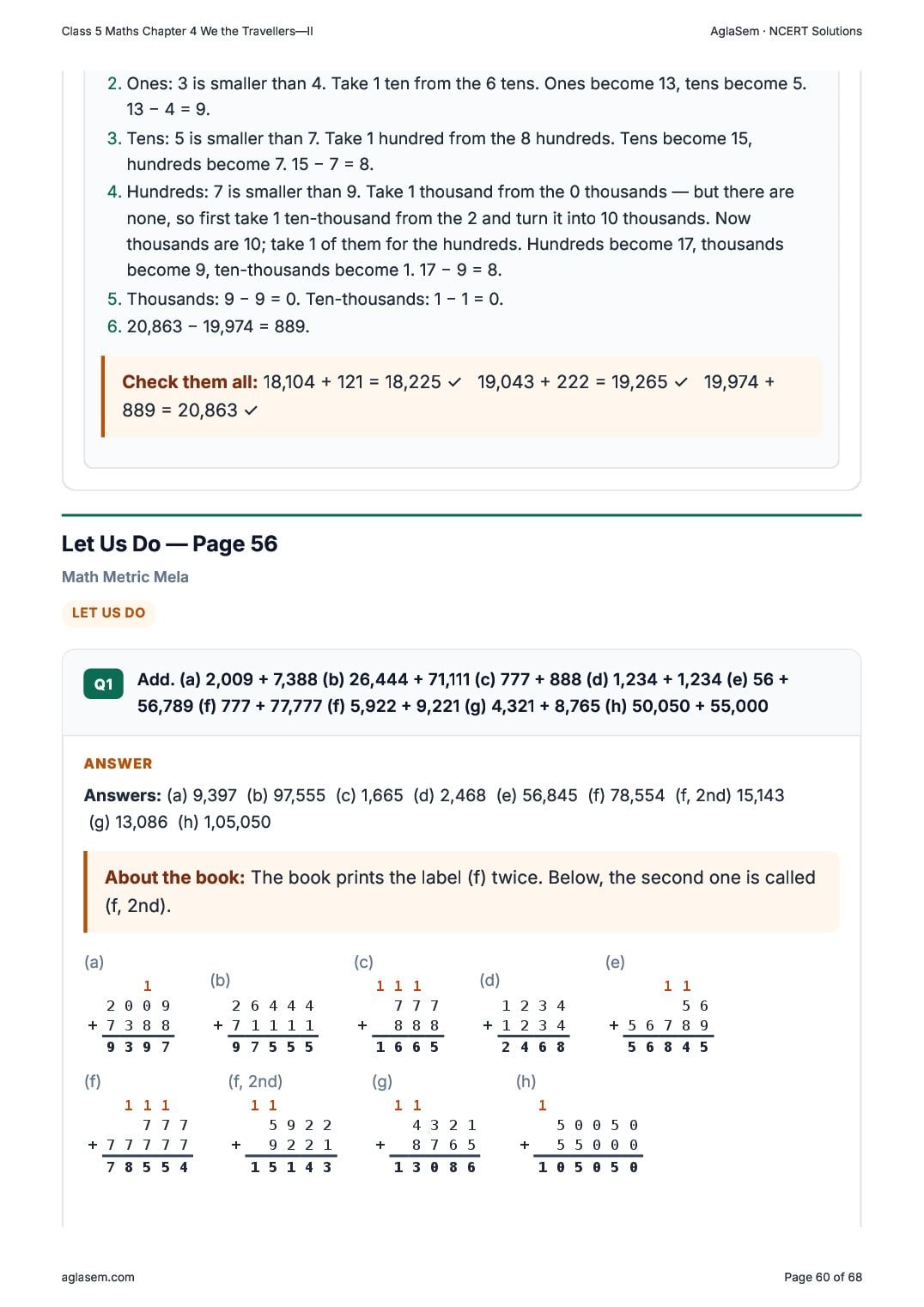
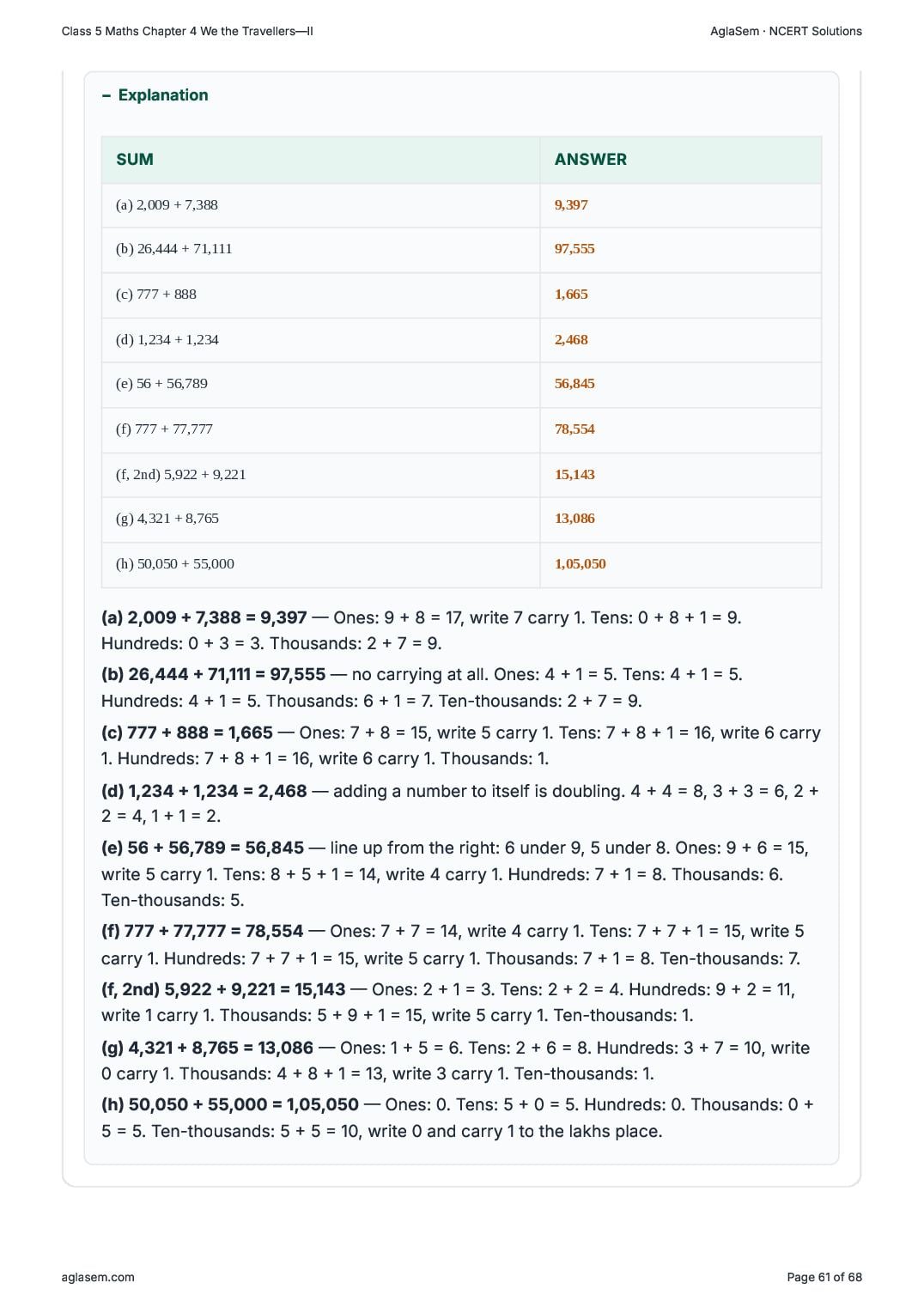
- Add. (a) 2,009 + 7,388 (b) 26,444 + 71,111 (c) 777 + 888 (d) 1,234 + 1,234 (e) 56 + 56,789 (f) 777 + 77,777 (f) 5,922 + 9,221 (g) 4,321 + 8,765 (h) 50,050 + 55,000
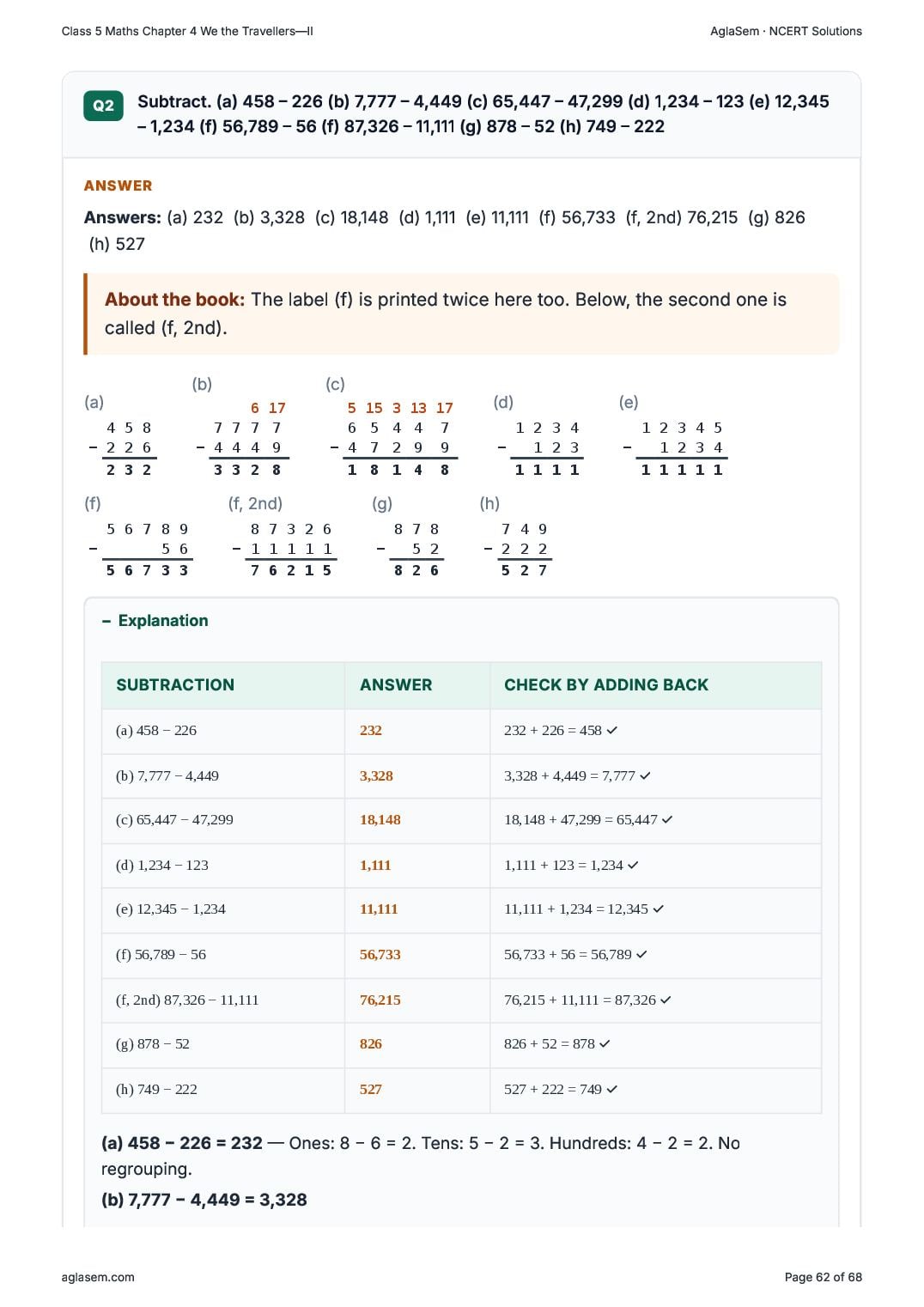
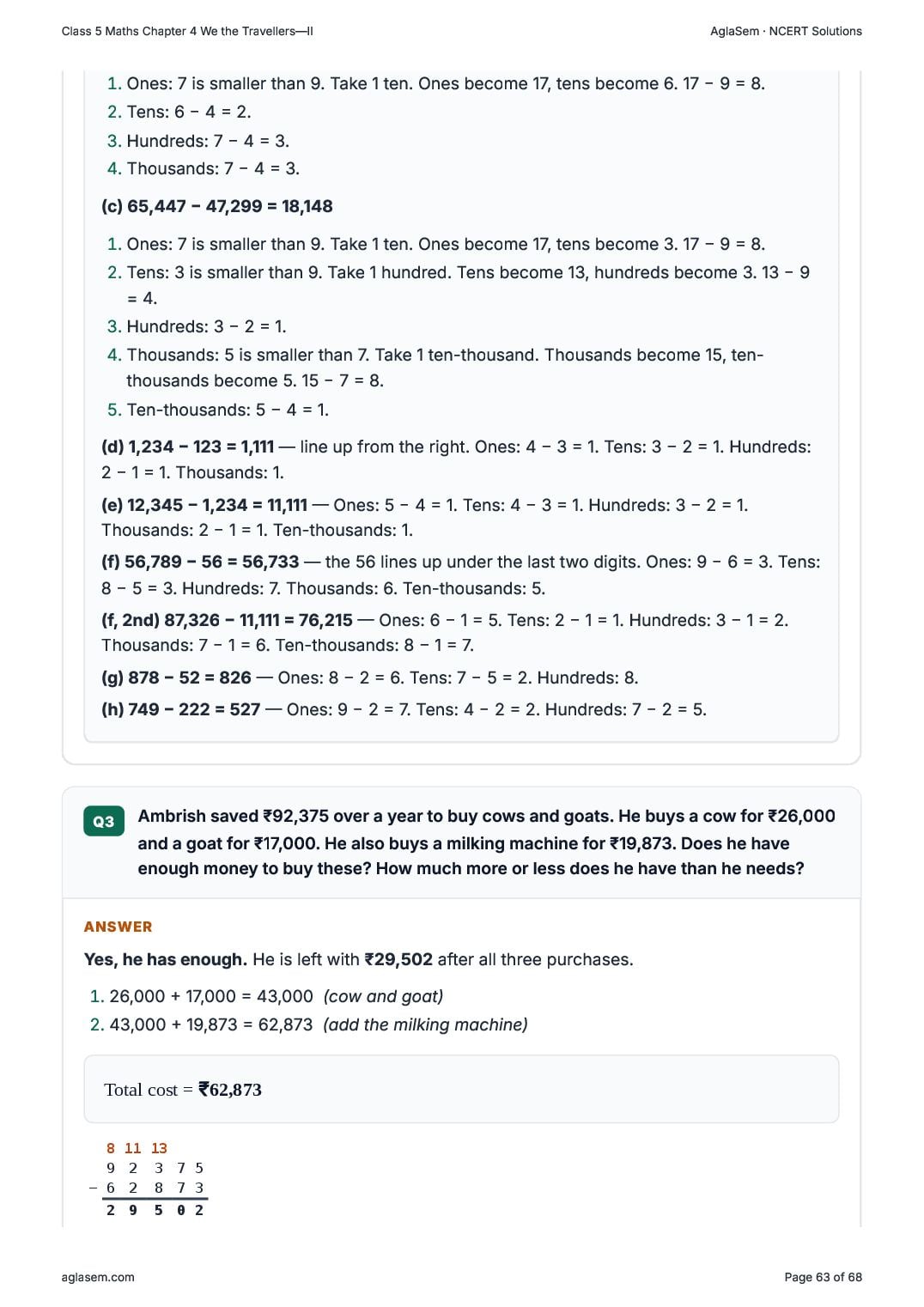
- Subtract. (a) 458 – 226 (b) 7,777 – 4,449 (c) 65,447 – 47,299 (d) 1,234 – 123 (e) 12,345 – 1,234 (f) 56,789 – 56 (f) 87,326 – 11,111 (g) 878 – 52 (h) 749 – 222
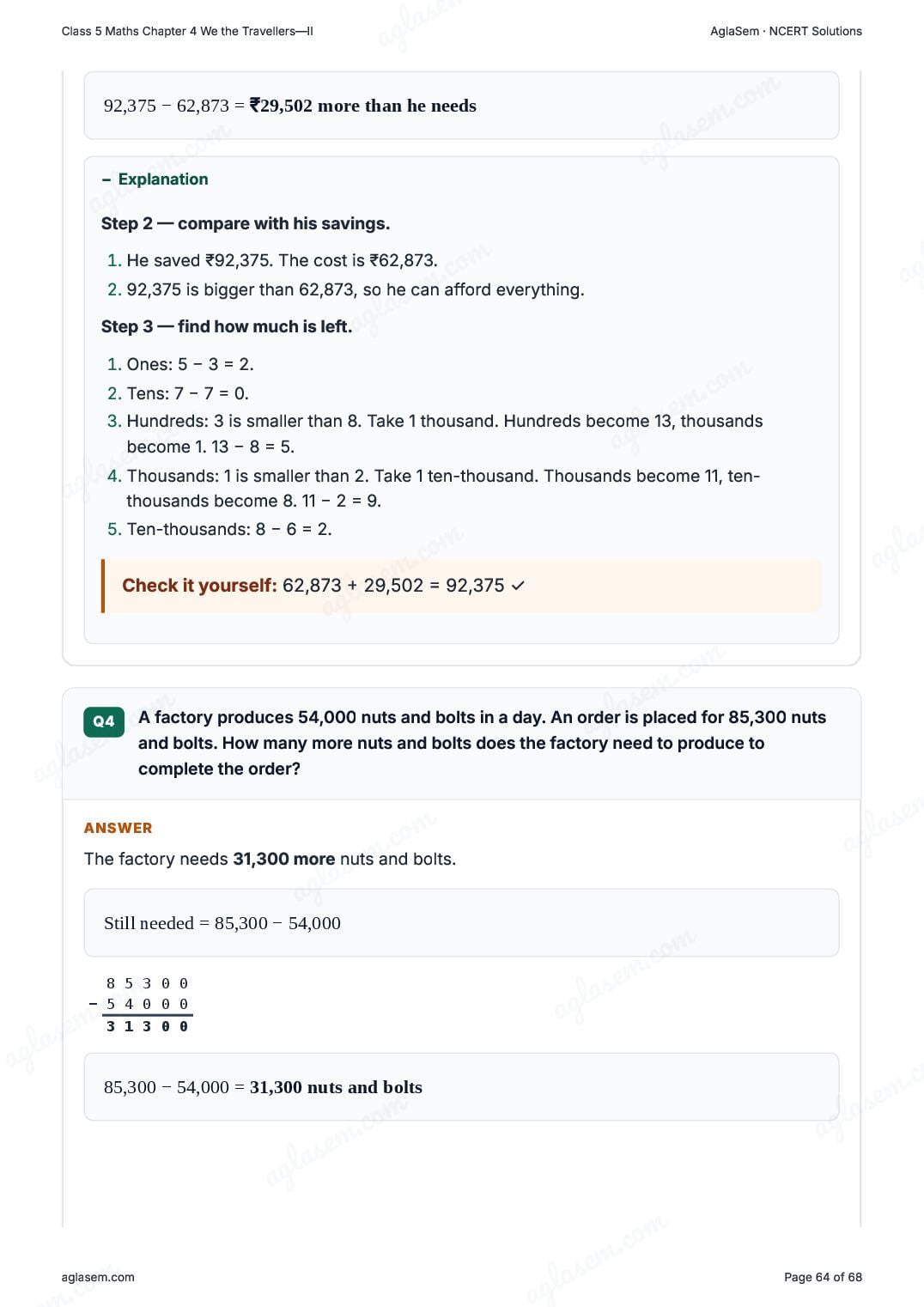
- Ambrish saved ₹92,375 over a year to buy cows and goats. He buys a cow for ₹26,000 and a goat for ₹17,000. He also buys a milking machine for ₹19,873. Does he have enough money to buy these? How much more or less does he have than he needs?
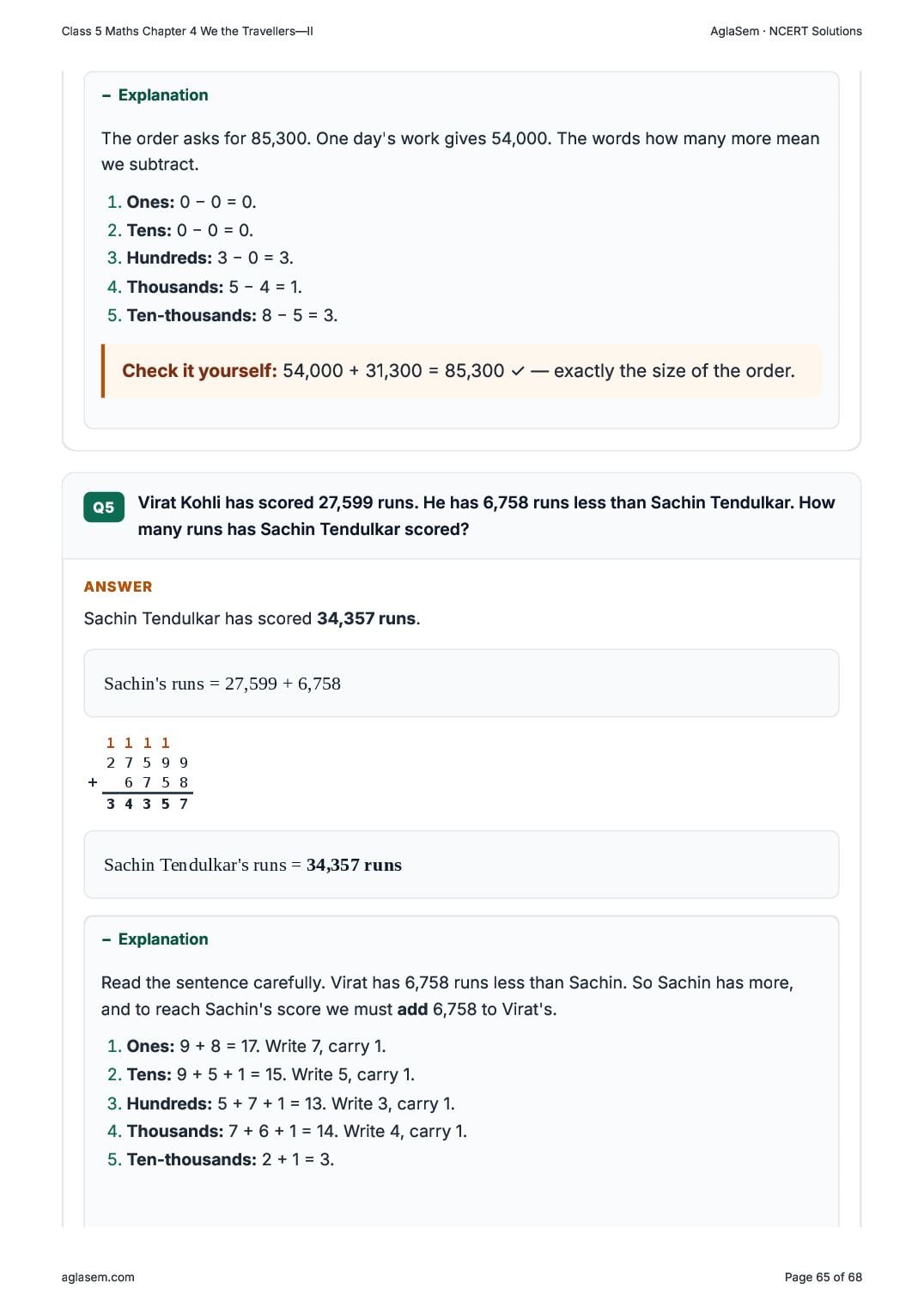
- A factory produces 54,000 nuts and bolts in a day. An order is placed for 85,300 nuts and bolts. How many more nuts and bolts does the factory need to produce to complete the order?
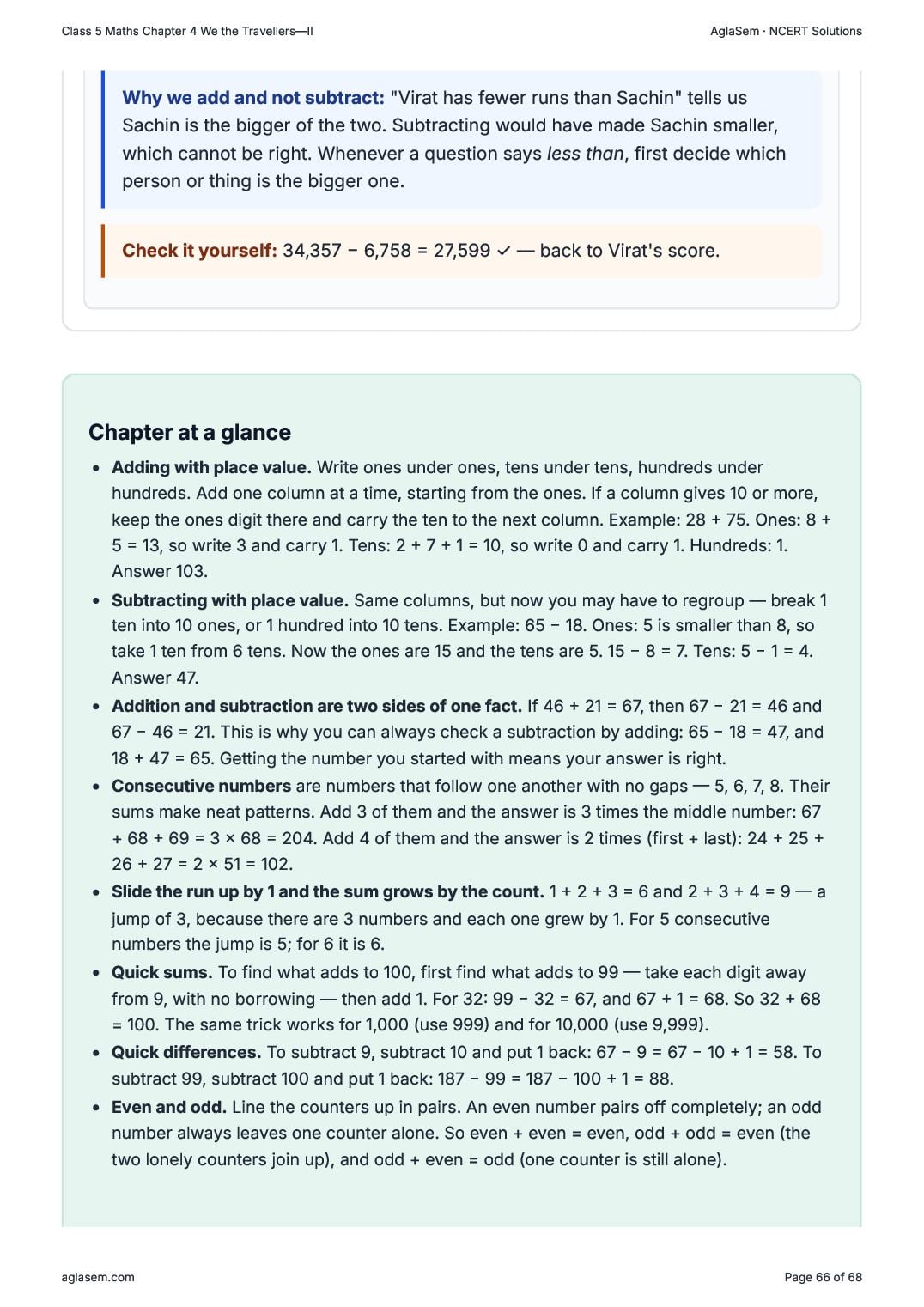
- Virat Kohli has scored 27,599 runs. He has 6,758 runs less than Sachin Tendulkar. How many runs has Sachin Tendulkar scored?
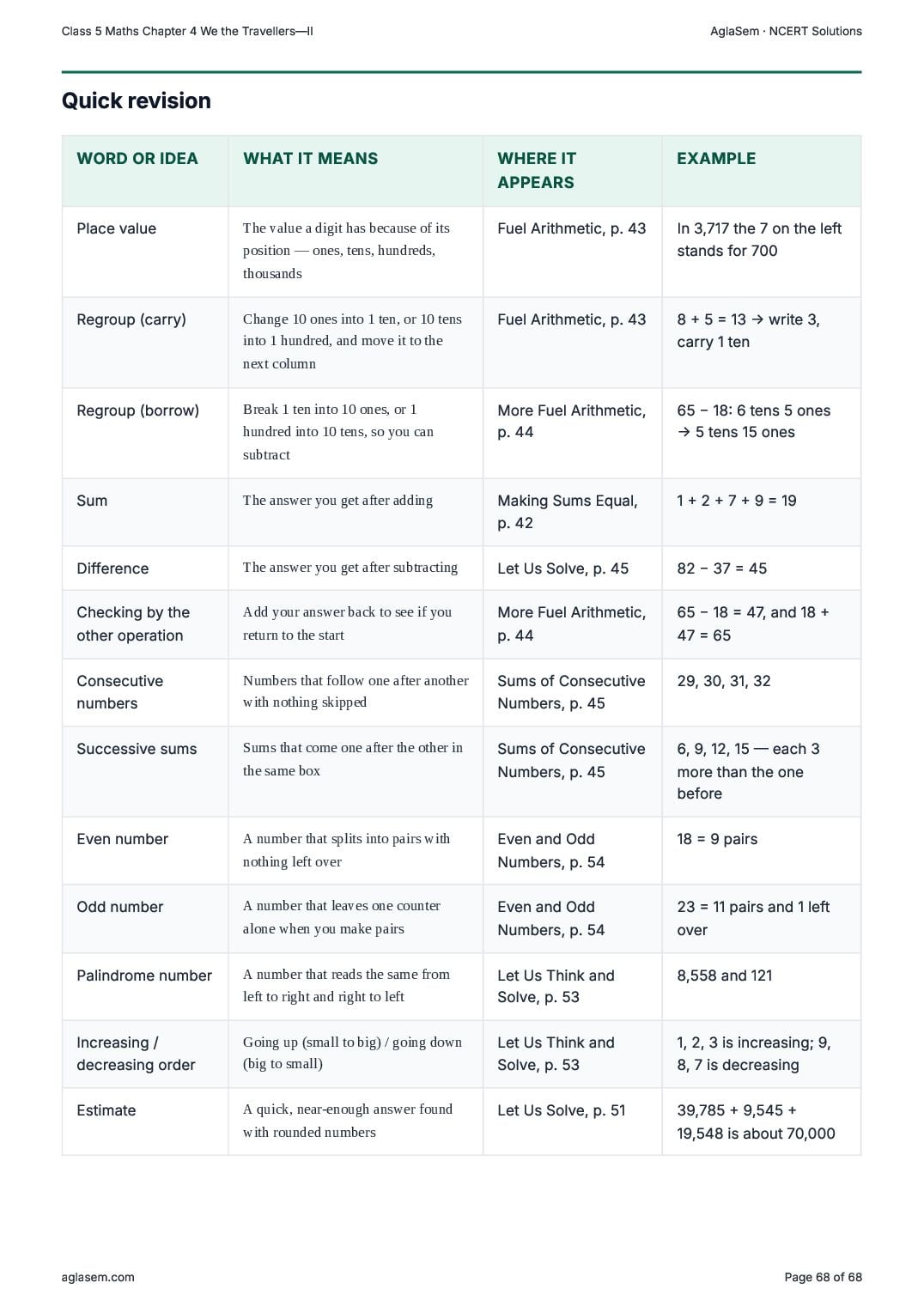
Chapter at a Glance
- Adding with place value. Write ones under ones, tens under tens, hundreds under hundreds. Add one column at a time, starting from the ones. If a column gives 10 or more, keep the ones digit there and carry the ten to the next column. Example: 28 + 75. Ones: 8 + 5 = 13, so write 3 and carry 1. Tens: 2 + 7 + 1 = 10, so write 0 and carry 1. Hundreds: 1. Answer 103.
- Subtracting with place value. Same columns, but now you may have to regroup — break 1 ten into 10 ones, or 1 hundred into 10 tens. Example: 65 − 18. Ones: 5 is smaller than 8, so take 1 ten from 6 tens. Now the ones are 15 and the tens are 5. 15 − 8 = 7. Tens: 5 − 1 = 4. Answer 47.
- Addition and subtraction are two sides of one fact. If 46 + 21 = 67, then 67 − 21 = 46 and 67 − 46 = 21. This is why you can always check a subtraction by adding: 65 − 18 = 47, and 18 + 47 = 65. Getting the number you started with means your answer is right.
- Consecutive numbers are numbers that follow one another with no gaps — 5, 6, 7, 8. Their sums make neat patterns. Add 3 of them and the answer is 3 times the middle number: 67 + 68 + 69 = 3 × 68 = 204. Add 4 of them and the answer is 2 times (first + last): 24 + 25 + 26 + 27 = 2 × 51 = 102.
- Slide the run up by 1 and the sum grows by the count. 1 + 2 + 3 = 6 and 2 + 3 + 4 = 9 — a jump of 3, because there are 3 numbers and each one grew by 1. For 5 consecutive numbers the jump is 5; for 6 it is 6.
- Quick sums. To find what adds to 100, first find what adds to 99 — take each digit away from 9, with no borrowing — then add 1. For 32: 99 − 32 = 67, and 67 + 1 = 68. So 32 + 68 = 100. The same trick works for 1,000 (use 999) and for 10,000 (use 9,999).
- Quick differences. To subtract 9, subtract 10 and put 1 back: 67 − 9 = 67 − 10 + 1 = 58. To subtract 99, subtract 100 and put 1 back: 187 − 99 = 187 − 100 + 1 = 88.
- Even and odd. Line the counters up in pairs. An even number pairs off completely; an odd number always leaves one counter alone. So even + even = even, odd + odd = even (the two lonely counters join up), and odd + even = odd (one counter is still alone).
- Palindrome numbers read the same both ways — 22, 363, 404, 8,558. Between 100 and 200 there are ten of them: 101, 111, 121, … 191.
How to Download NCERT Solutions for Class 5 Maths Chapter 4 PDF
Follow these simple steps to get the We the Travellers Ii questions-and-answers PDF from Math Mela.
- Search NCERT Solutions for Class 5 Maths Chapter 4 aglasem and open this page.
- Read the exercise questions with answers for We the Travellers Ii shown above.
- Click the Download PDF link to save the We the Travellers Ii solutions to your device.
NCERT Solutions for Class 5 Maths – All Chapters
There are more chapters to study besides We the Travellers Ii in Maths. Here are the NCERT Solutions for all chapters of Class 5 Maths.
- Chapter 1 We the Travellers I
- Chapter 2 Fractions
- Chapter 3 Angles As Turns
- Chapter 4 We the Travellers Ii
- Chapter 5 Far and Near
- Chapter 6 the Dairy Farm
- Chapter 7 Shapes and Patterns
- Chapter 8 Weight and Capacity
- Chapter 9 Coconut Farm
- Chapter 10 Symmetrical Designs
- Chapter 11 Grandmother s Quilt
- Chapter 12 Racing Seconds
- Chapter 13 Animal Jumps
- Chapter 14 Maps and Locations
- Chapter 15 Data Through Pictures
NCERT Solutions for Class 5 – All Subjects
Just like Chapter 4 of Maths, you can get the exercise questions with answers for every other subject of Class 5. Here are the NCERT Solutions for all subjects of Class 5.
NCERT Solutions for Class 5 Maths Chapter 4 – An Overview
The key highlights of this study material are as follows.
| Aspects | Details |
|---|---|
| Class | Class 5 |
| Subject | Maths |
| Chapter Number | Chapter 4 |
| Chapter Name | We the Travellers Ii |
| Book Name | Math Mela |
| Book By | NCERT (National Council of Educational Research and Training) |
| Educational Resource Here | NCERT Solutions of Class 5 Maths Chapter 4 for all exercises |
| More Questions Answers of This Subject | NCERT Solutions for Class 5 Maths |
| Download Book Chapter | NCERT Book Class 5 Maths |
| All Questions Answers For This Class | NCERT Solutions for Class 5 |
| Complete Solutions | NCERT Solutions |
NCERT Solutions for Class 5 Maths Chapter 4 We the Travellers Ii – FAQs
What are the NCERT Solutions for Class 5 Maths Chapter 4 We the Travellers Ii?
They are the complete, step-by-step answers to all the exercise and in-text questions of Chapter 4 We the Travellers Ii from the NCERT Class 5 Maths textbook Math Mela, written by experts as per the latest NCERT syllabus.
How can I download the Class 5 Maths Chapter 4 solutions PDF for free?
Open this page on aglasem, read the We the Travellers Ii questions with answers, and click the “Download Solutions PDF” link. The Class 5 Maths Chapter 4 NCERT Solutions PDF is completely free to download.
Are these NCERT Solutions as per the latest 2026-27 syllabus?
Yes. The NCERT Solutions for Class 5 Maths Chapter 4 are based on the latest NCERT textbook Math Mela and the current 2026-27 CBSE syllabus, so the questions and answers match what you study in class.
Where can I get NCERT Solutions for the other chapters of Class 5 Maths?
You can find the answers to every chapter on the NCERT Solutions for Class 5 Maths page, and solutions for every subject on the NCERT Solutions for Class 5 page.
How do NCERT Solutions help in exam preparation?
They show the correct method to solve each question, help you write answers the way they are expected in exams, let you check and correct your own work, and save revision time — which together improve your marks in Class 5 Maths.
If you have any queries on NCERT Solutions for Class 5 Maths Chapter 4 We the Travellers Ii, then please ask in the comments below.