NCERT Solutions for Class 5 Maths Chapter 9 Coconut Farm provide clear, step-by-step answers to every exercise and in-text question from the chapter Coconut Farm of the NCERT textbook Math Mela. Prepared by subject experts as per the latest NCERT (CBSE) syllabus for 2026-27, these NCERT Solutions for Class 5 Maths help you understand each concept, write exam-ready answers, and check your own solutions. You can read them online below or download the free Class 5 Maths Chapter 9 question-answer PDF.
NCERT Solutions for Class 5 Maths Chapter 9 Coconut Farm
- Class: Class 5
- Subject: Maths
- Chapter: Chapter 9 – Coconut Farm
- Textbook: Math Mela (NCERT)
- Study material: NCERT Solutions – questions with answers, free PDF
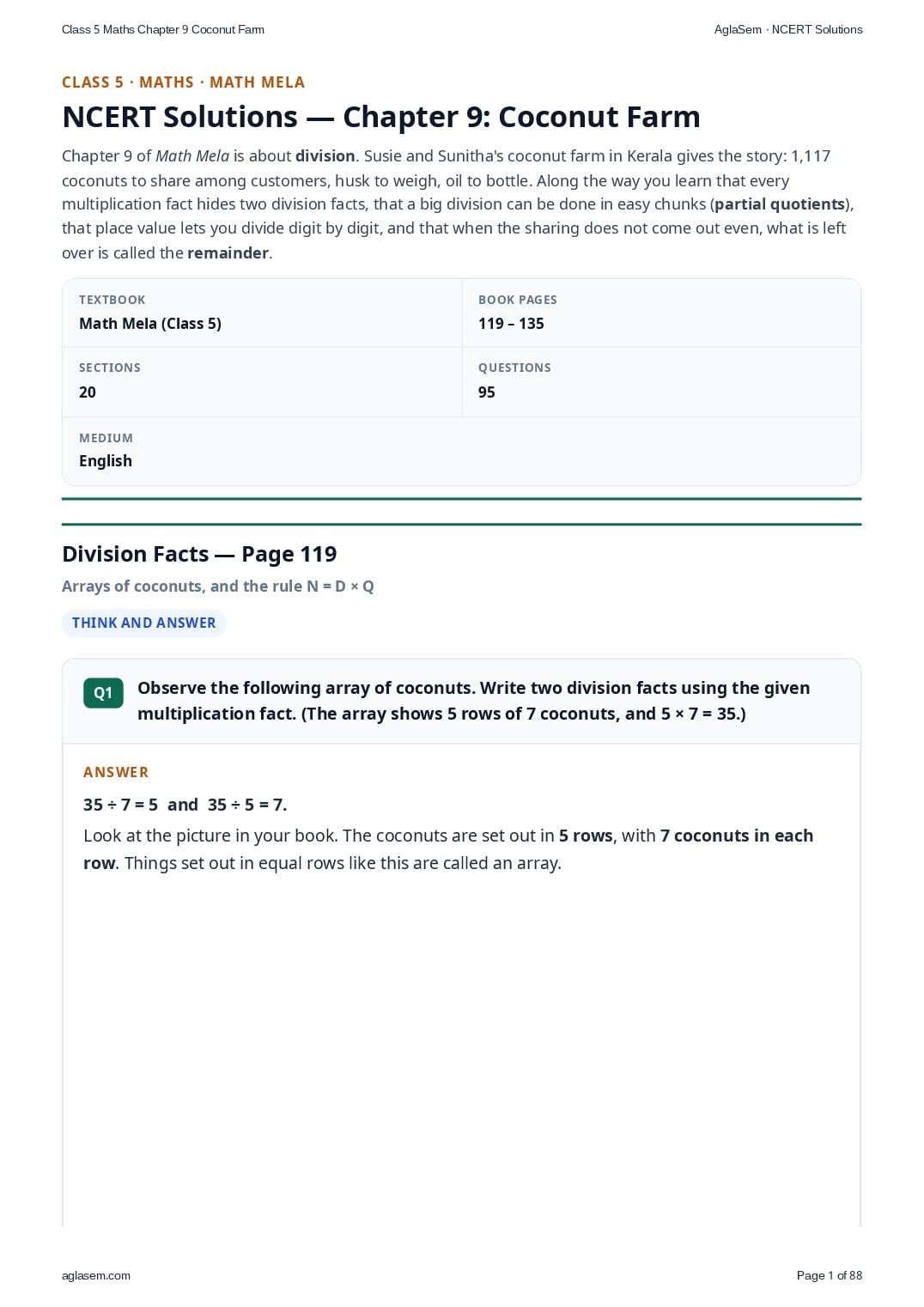
These solutions answer all the exercise questions of Chapter 9 Coconut Farm — including the in-text questions, short-answer and long-answer questions, and activities — with complete explanations so you can follow the method, not just the final answer. Read the full solutions below.
NCERT Solutions Class 5 Maths Chapter 9 Coconut Farm View Download
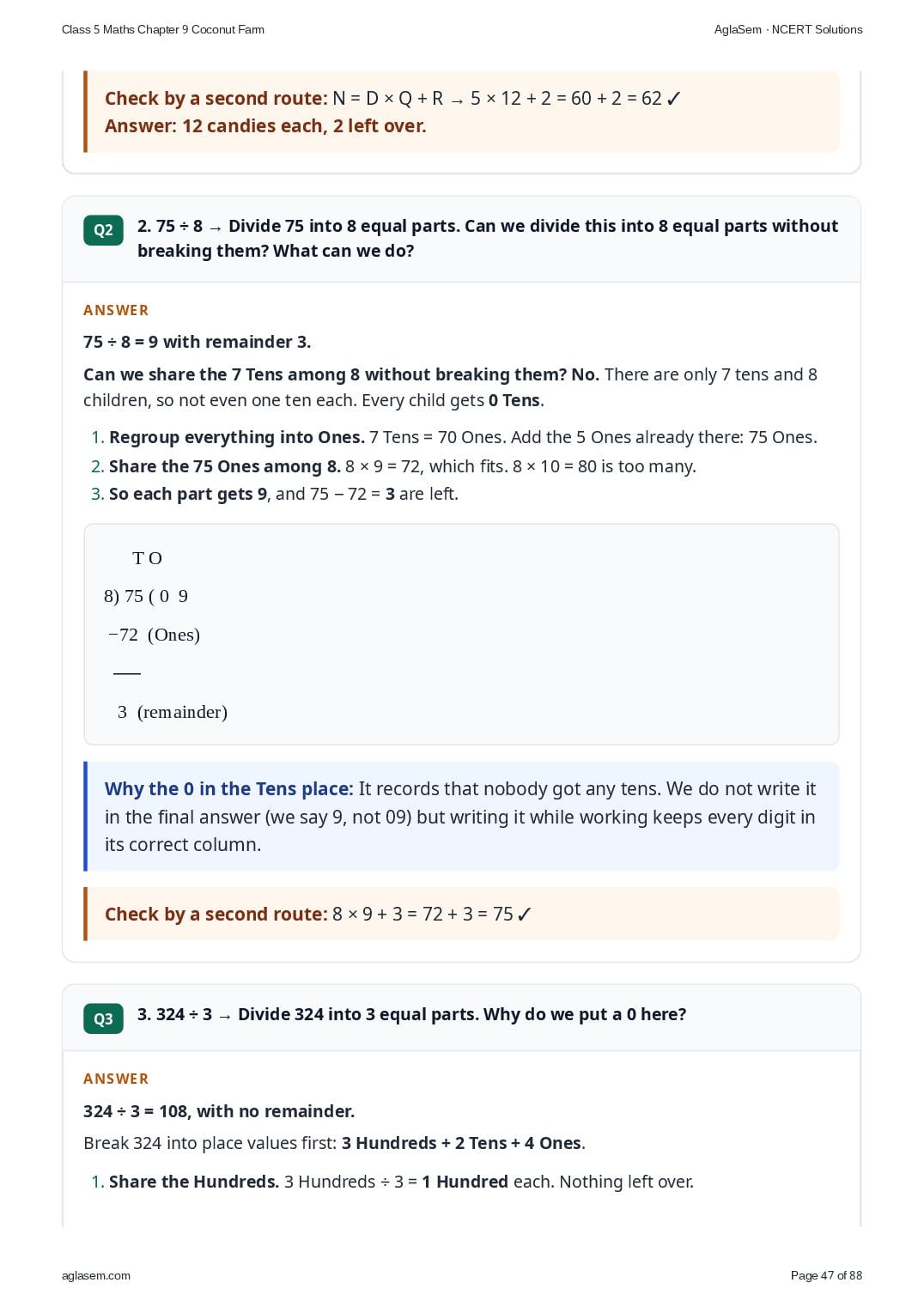
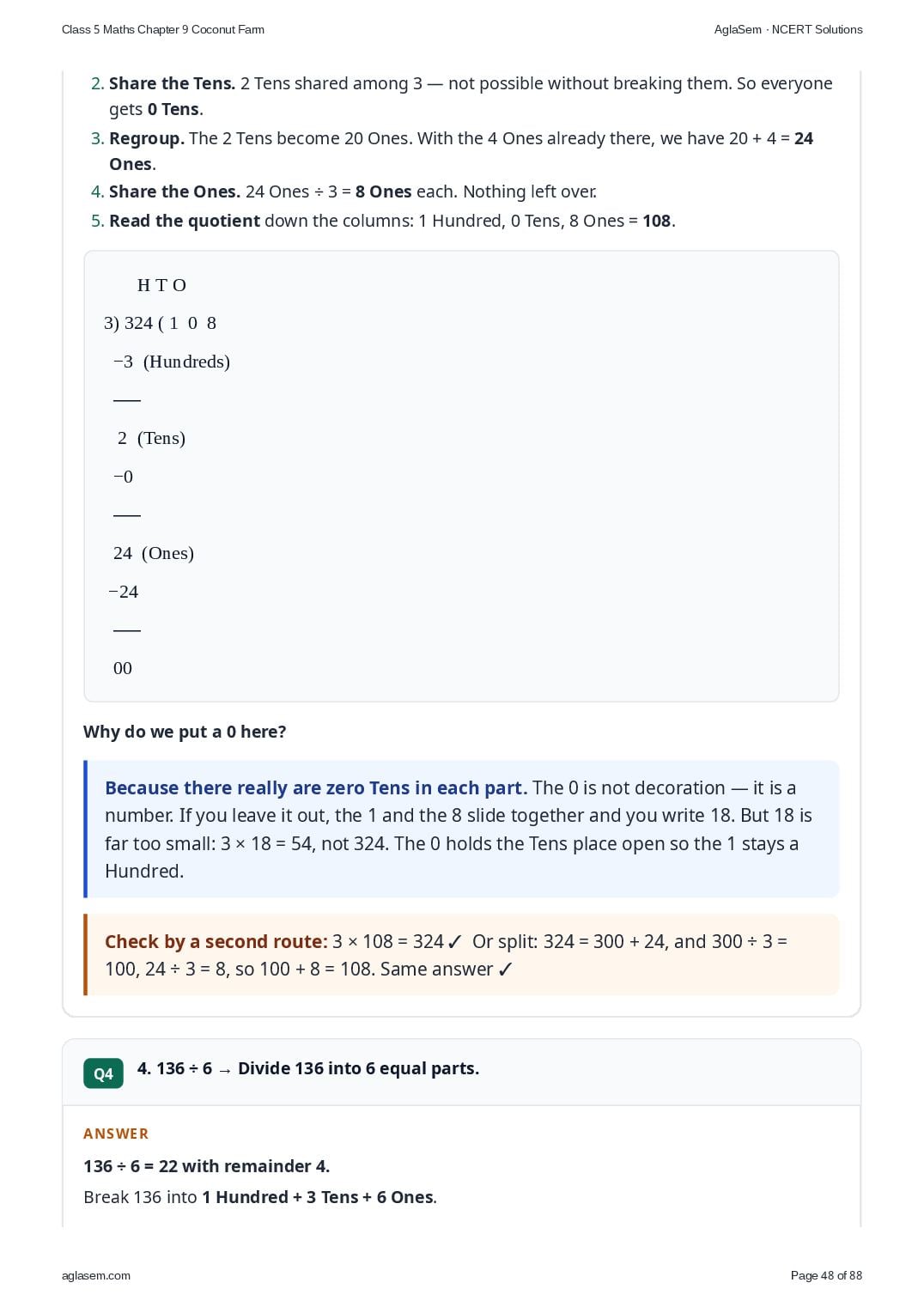
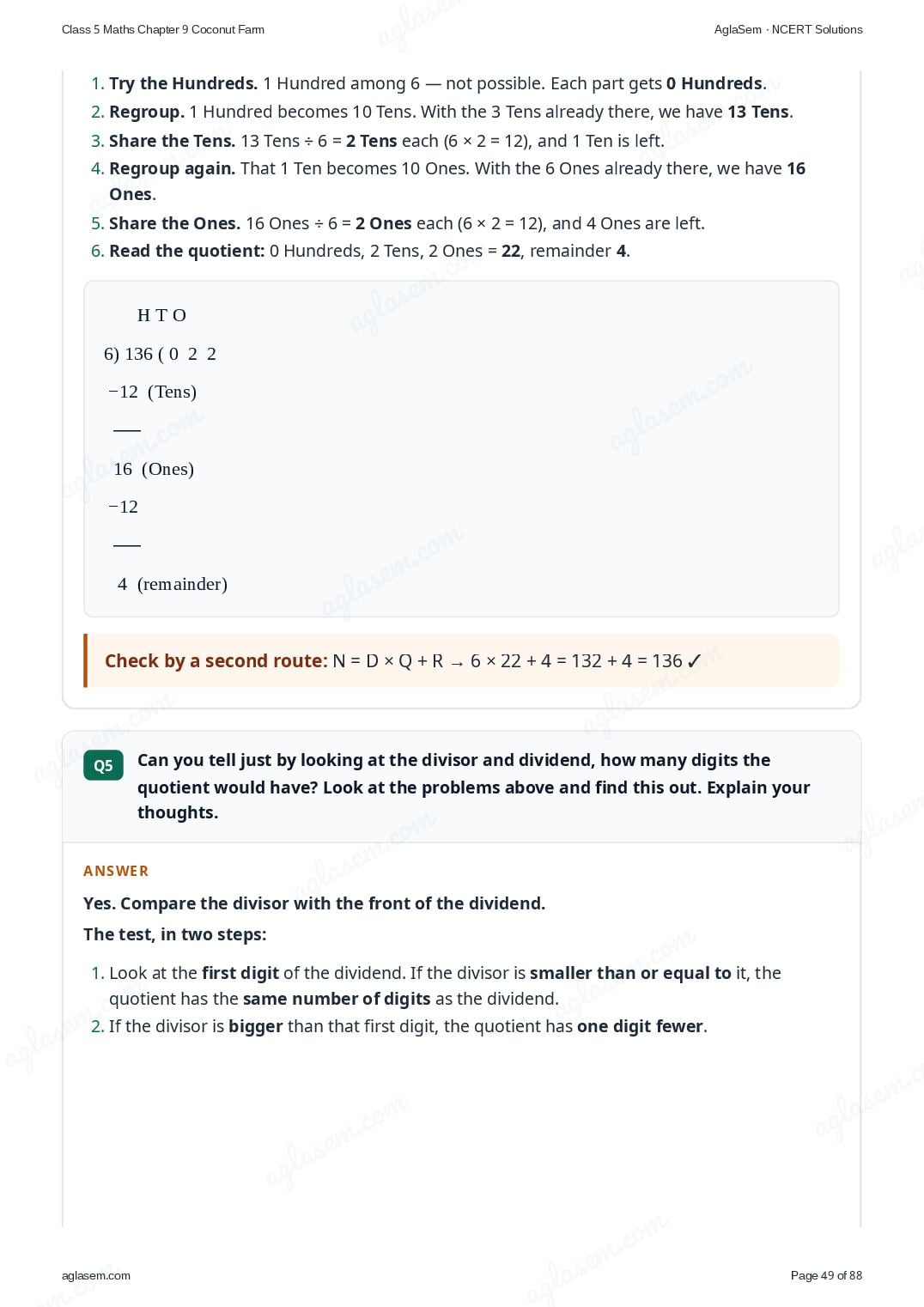
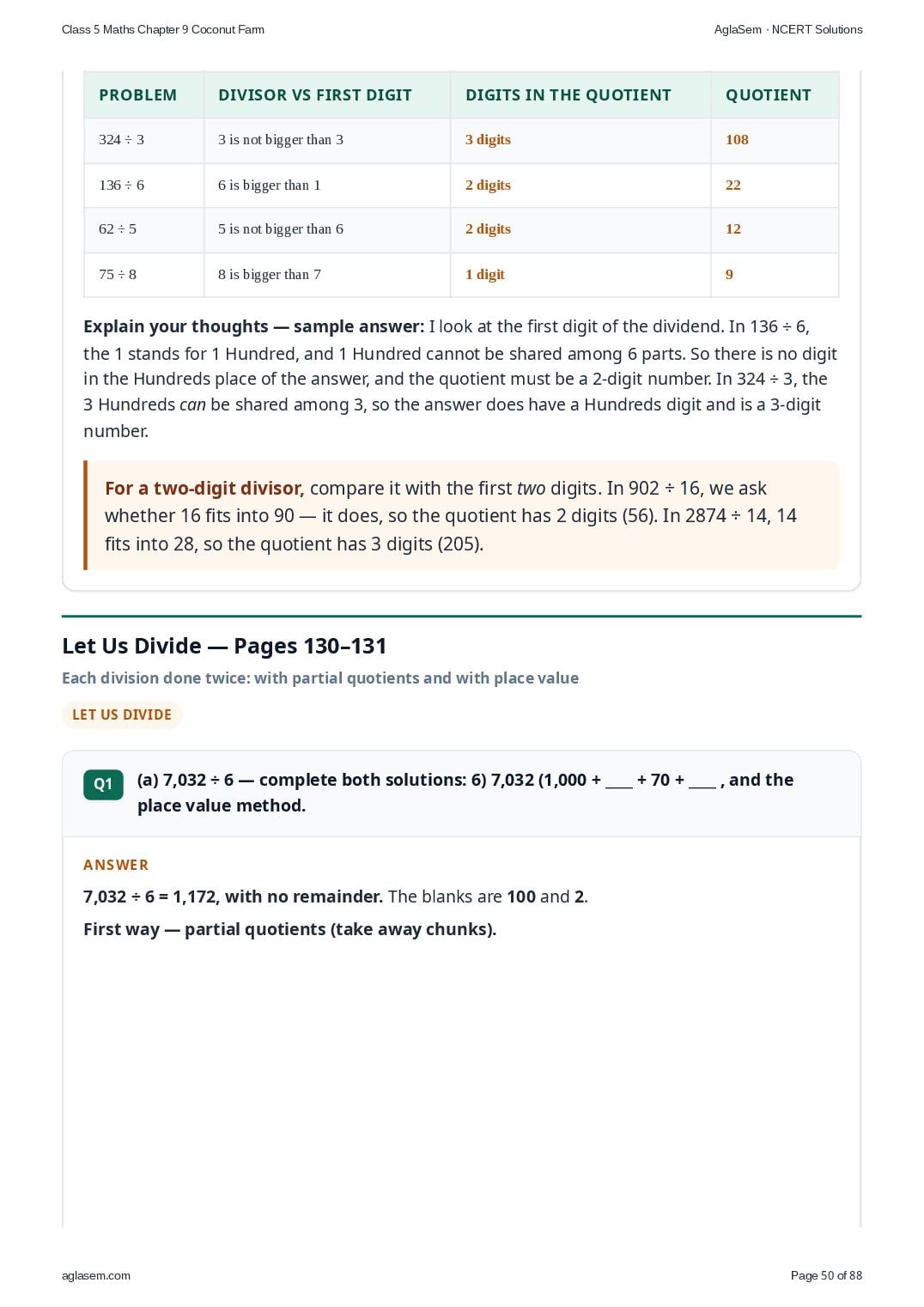
NCERT Solutions for Class 5 Maths Chapter 9 PDF Download
You can read the NCERT Solutions for Class 5 Maths Chapter 9 online above, or download the complete question-answer PDF to study Coconut Farm offline at any time.
NCERT Solutions for Class 5 Maths Chapter 9 PDF Download Link – Click Here to Download Solutions PDF
Questions Covered in This Chapter
These NCERT Solutions answer all 95 questions of this chapter. The questions solved are:
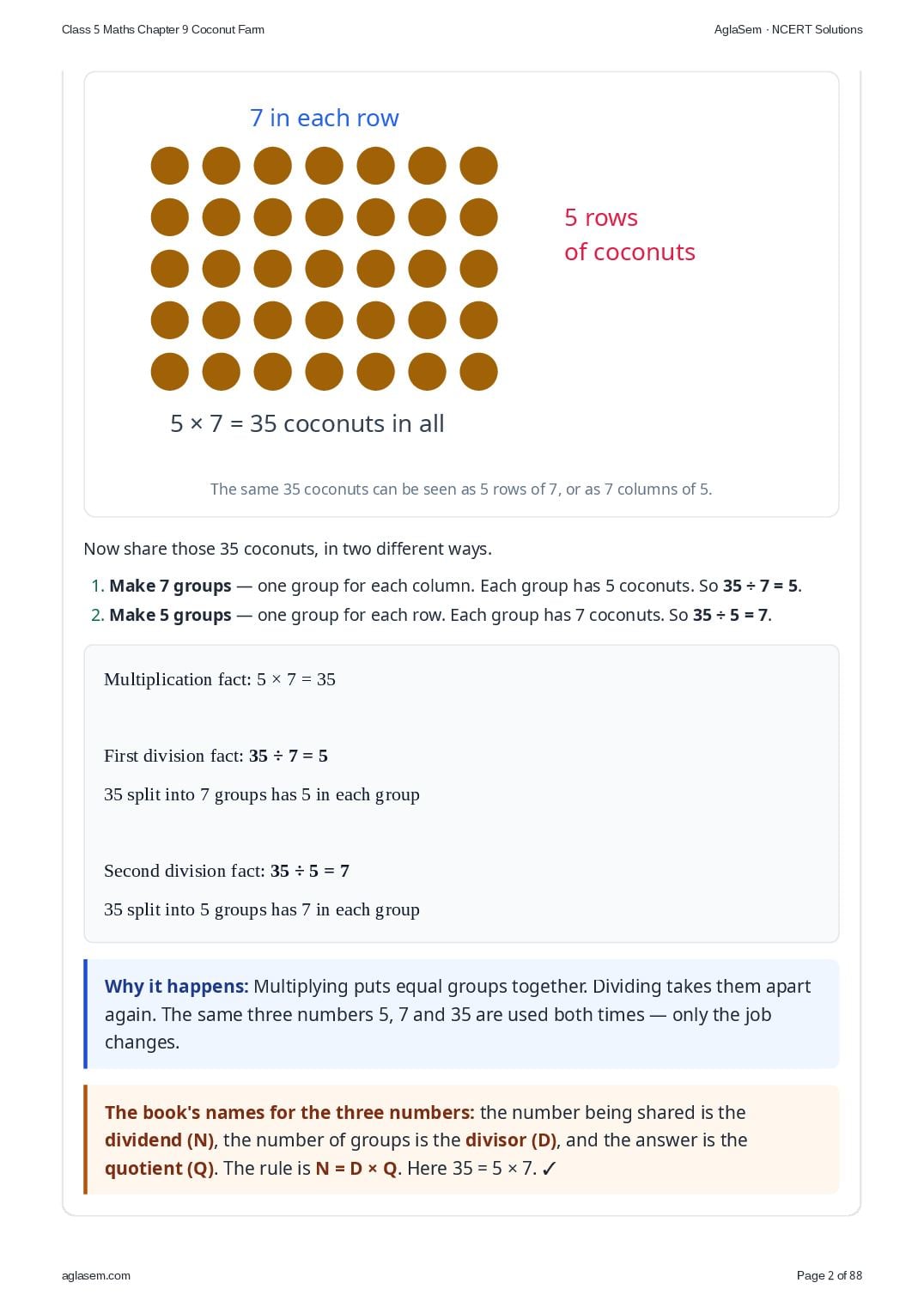
- Observe the following array of coconuts. Write two division facts using the given multiplication fact. (The array shows 5 rows of 7 coconuts, and 5 × 7 = 35.)
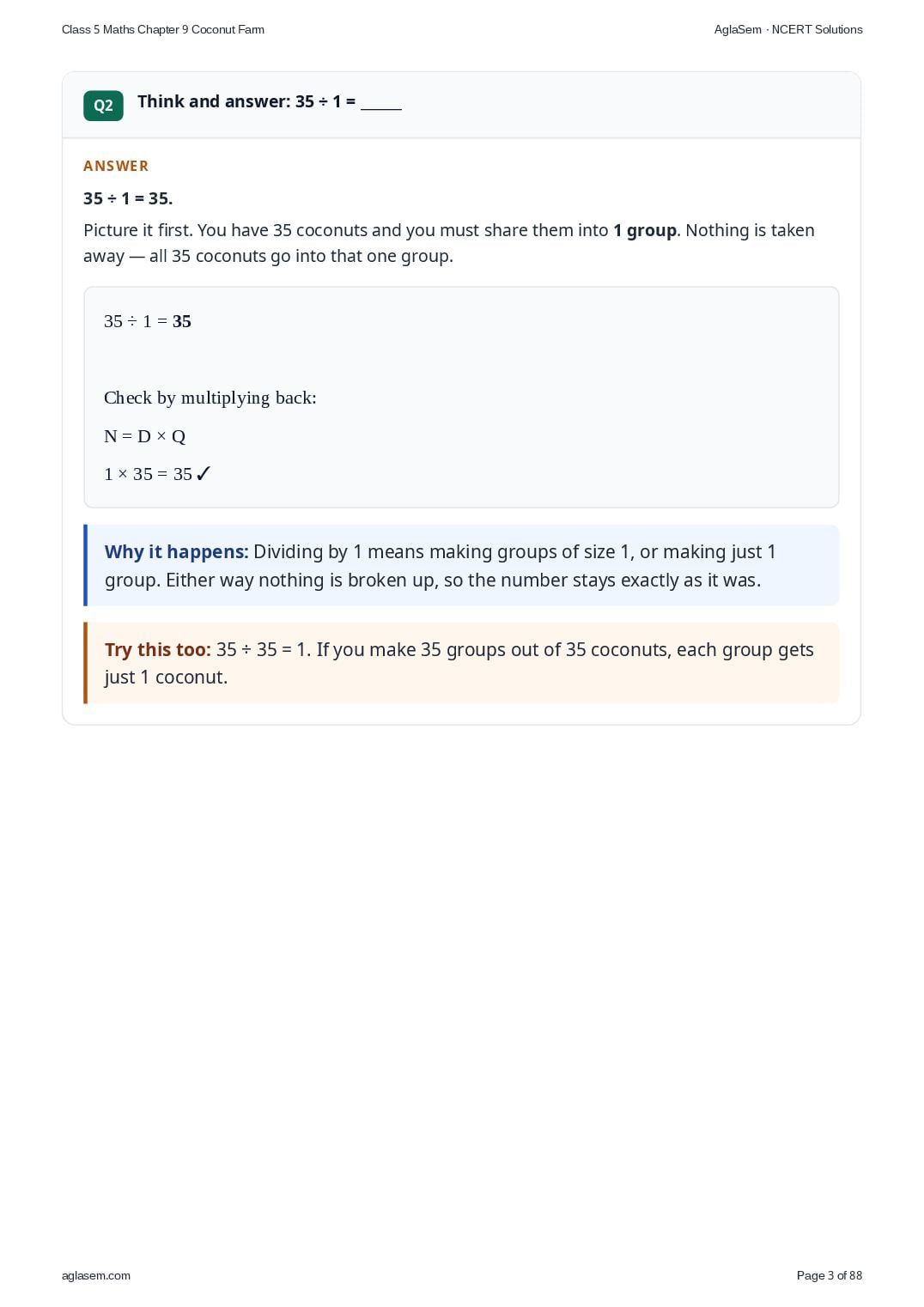
- Think and answer: 35 ÷ 1 = ______
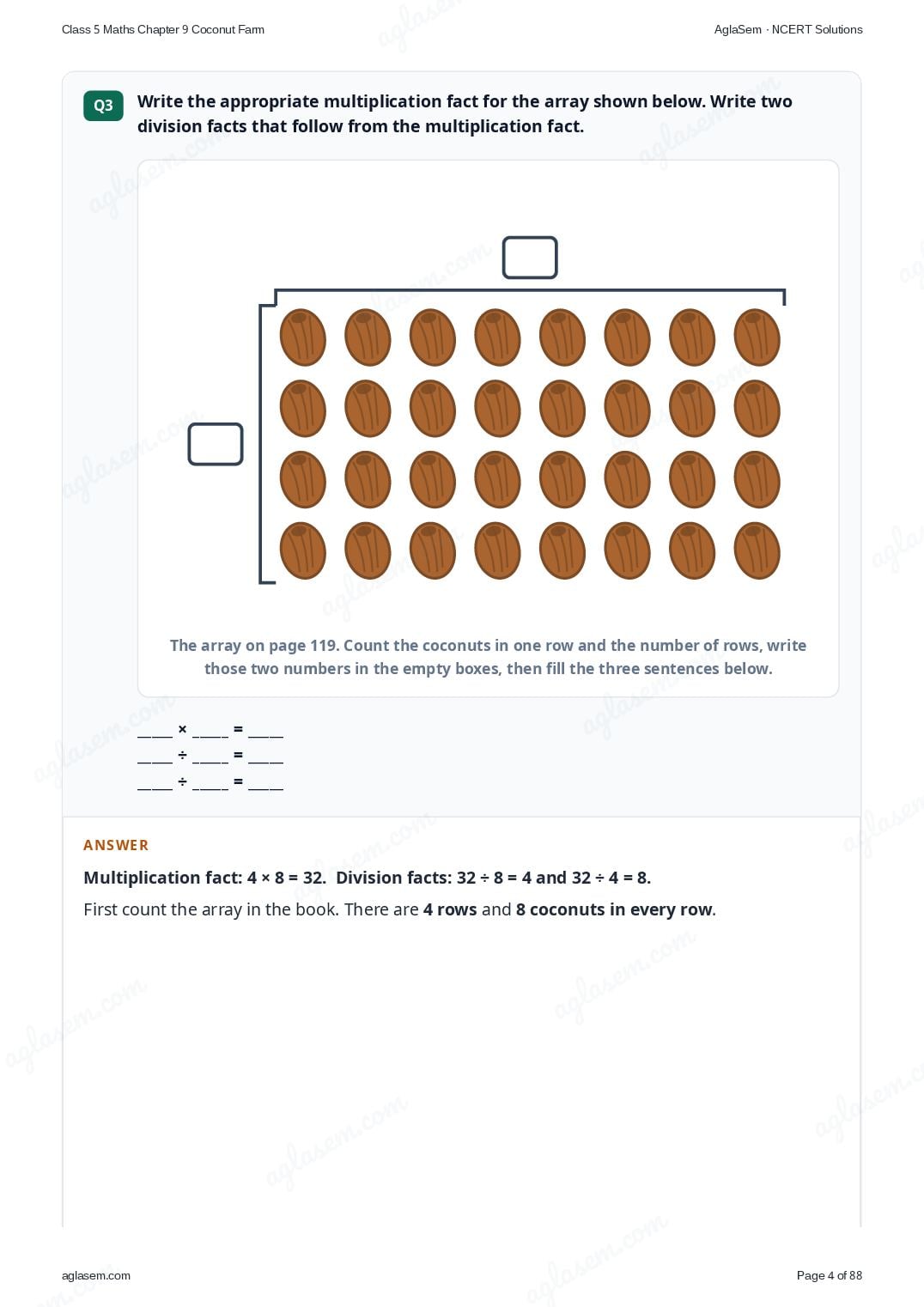
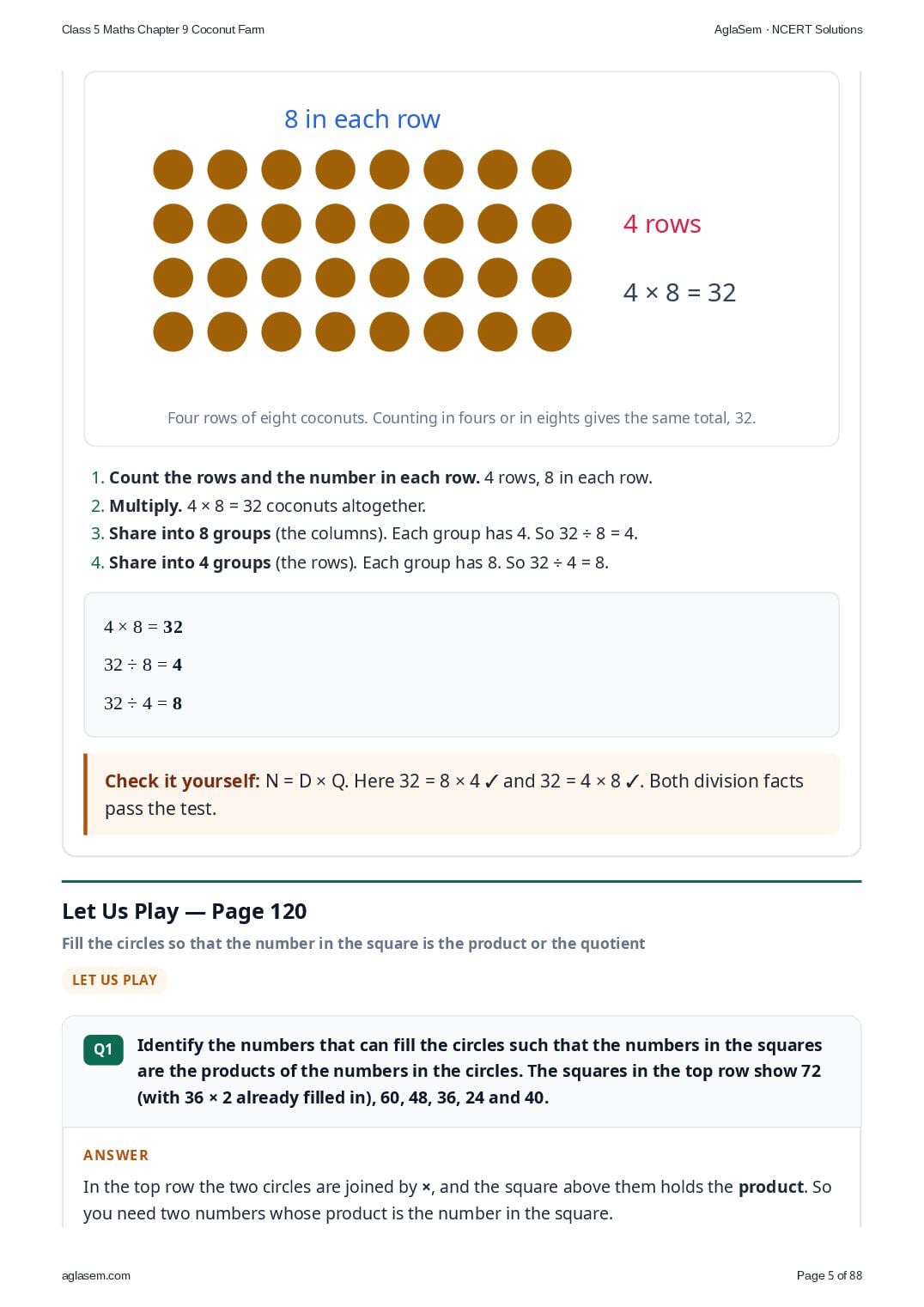
- Write the appropriate multiplication fact for the array shown below. Write two division facts that follow from the multiplication fact. The array on page 119. Count the coconuts in one row and the number of rows, write those two numbers in the empty boxes, then fill the three sentences below._____ × _____ = __________ ÷ _____ = __________ ÷ _____ = _____
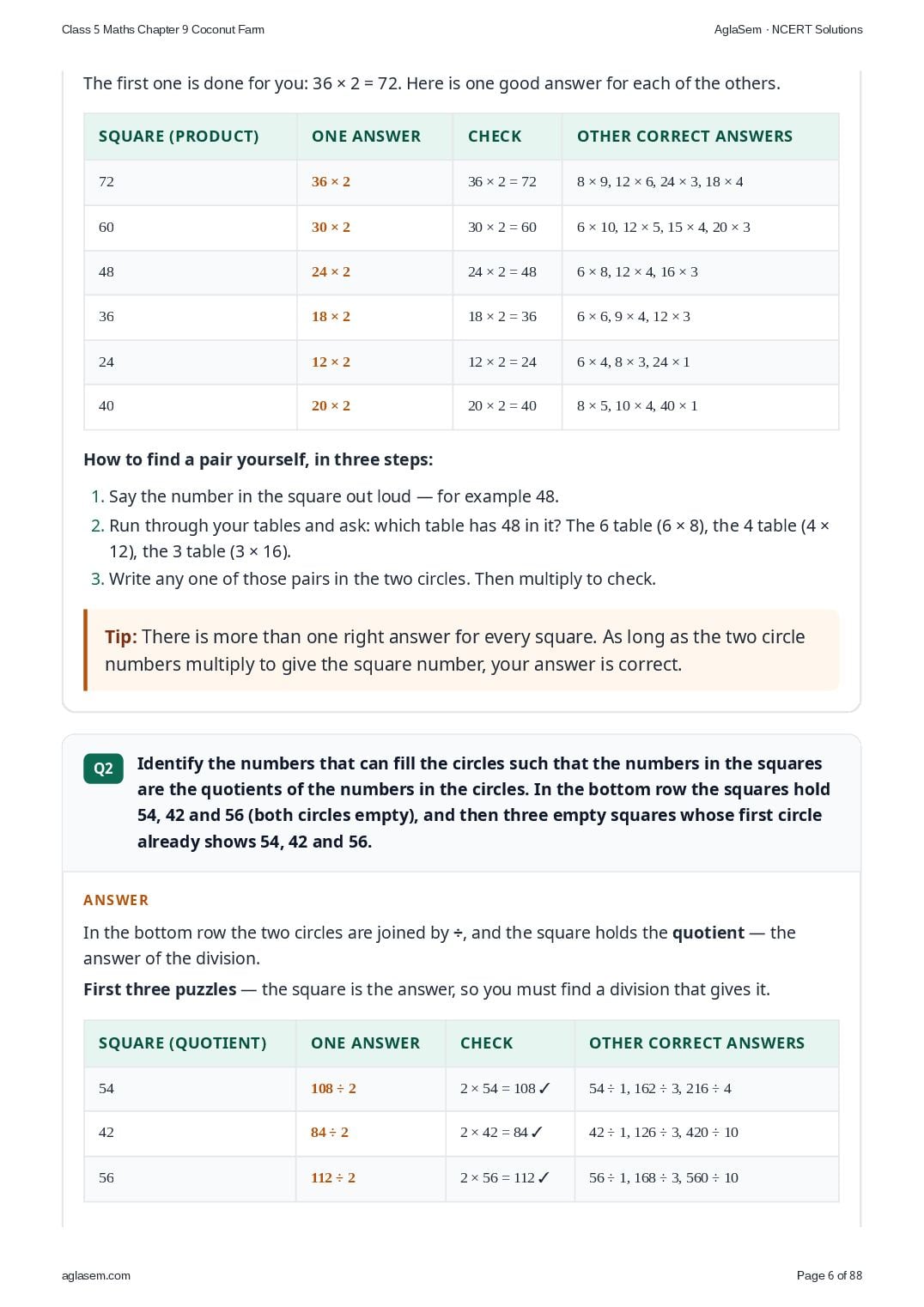
- Identify the numbers that can fill the circles such that the numbers in the squares are the products of the numbers in the circles. The squares in the top row show 72 (with 36 × 2 already filled in), 60, 48, 36, 24 and 40.
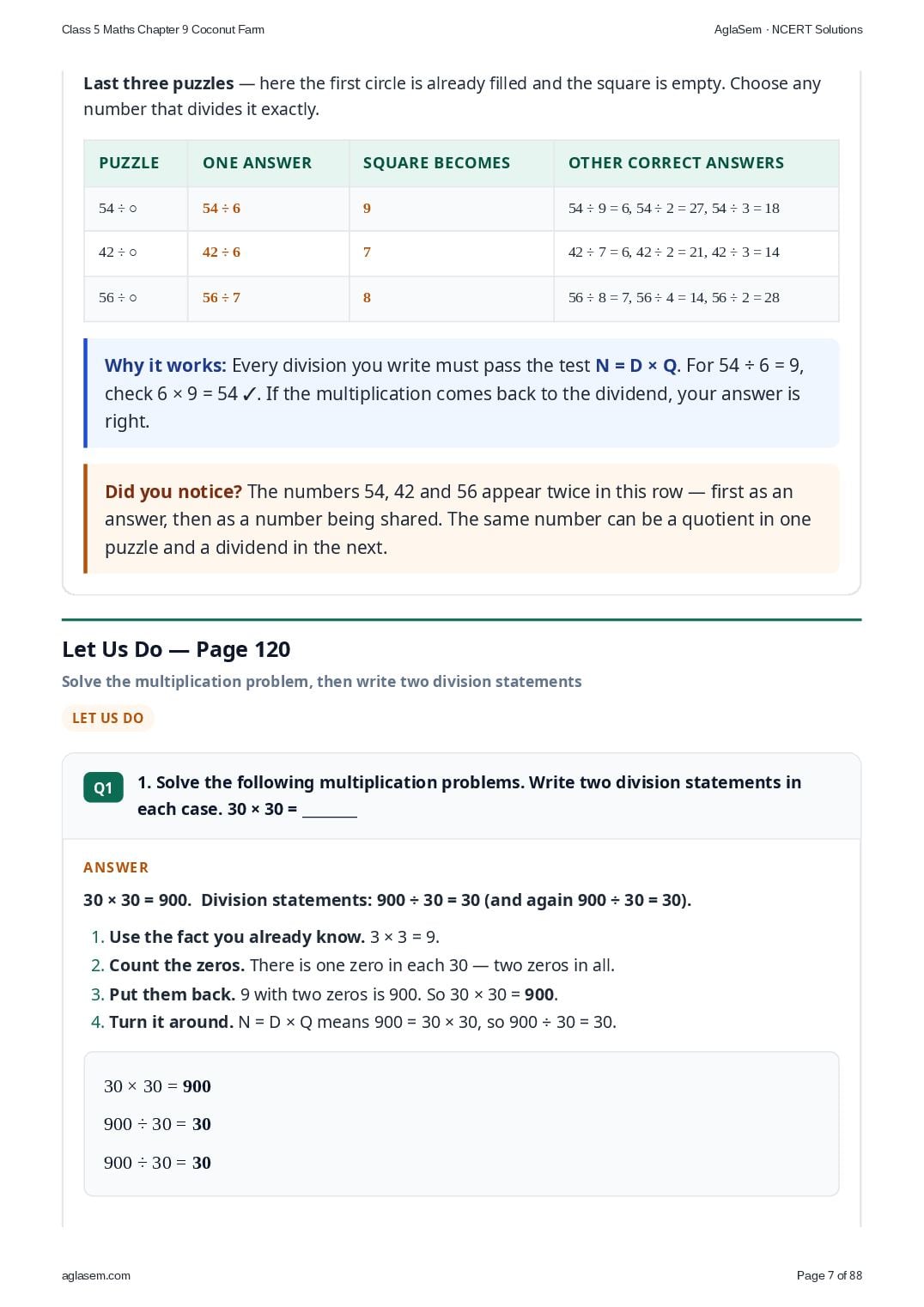
- Identify the numbers that can fill the circles such that the numbers in the squares are the quotients of the numbers in the circles. In the bottom row the squares hold 54, 42 and 56 (both circles empty), and then three empty squares whose first circle already shows 54, 42 and 56.
- 1. Solve the following multiplication problems. Write two division statements in each case. 30 × 30 = ________
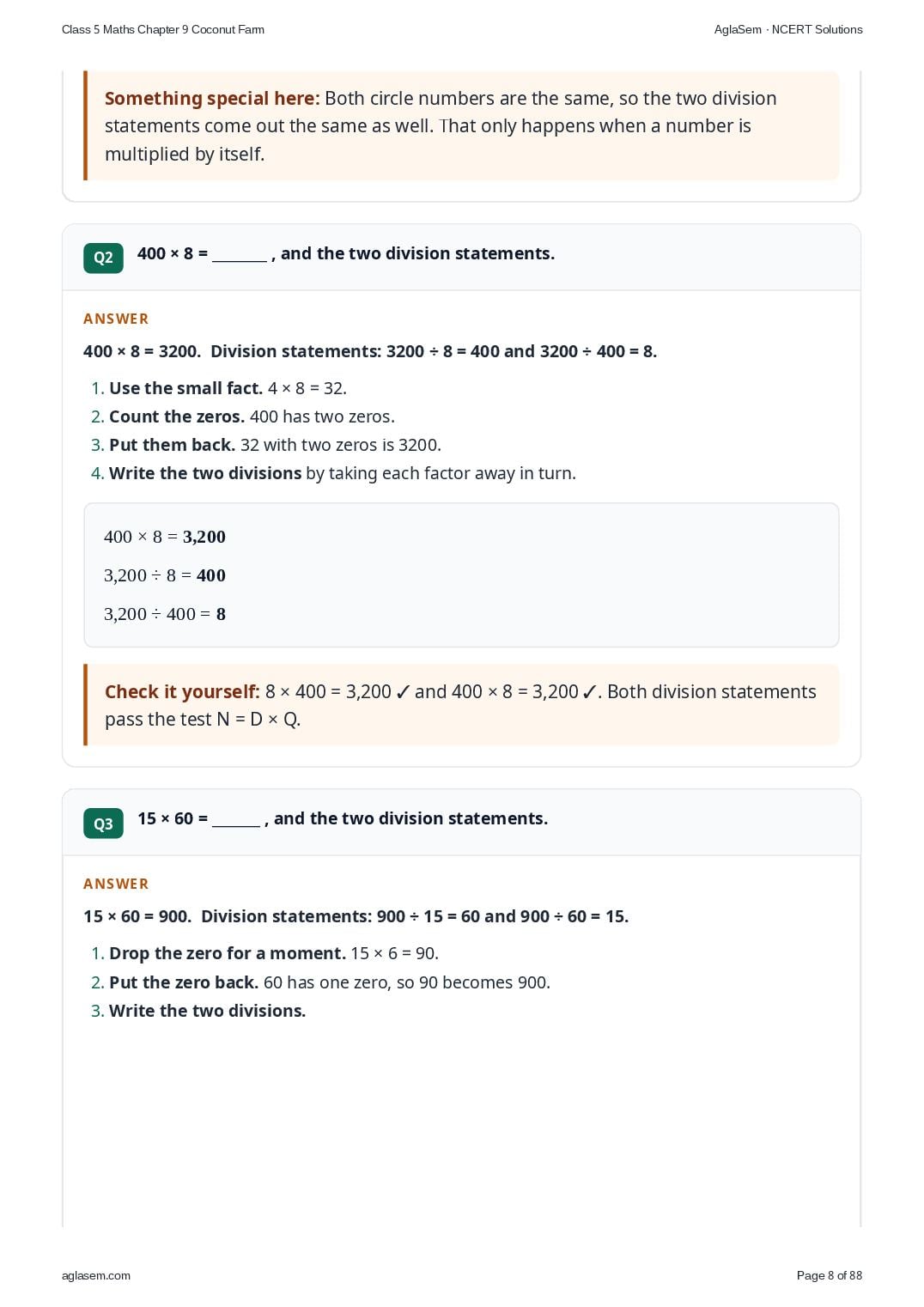
- 400 × 8 = ________ , and the two division statements.
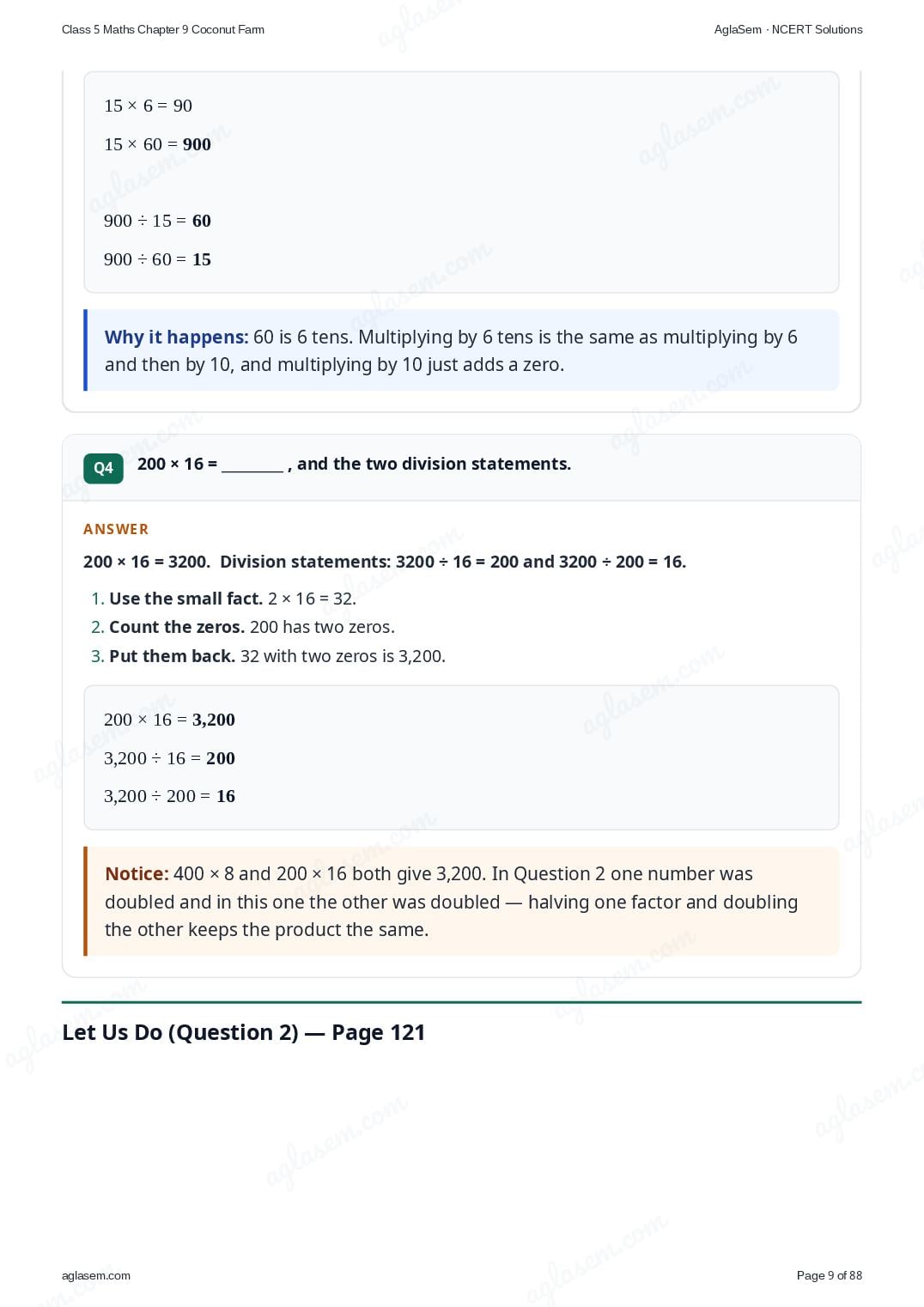
- 15 × 60 = _______ , and the two division statements.
- 200 × 16 = _________ , and the two division statements.
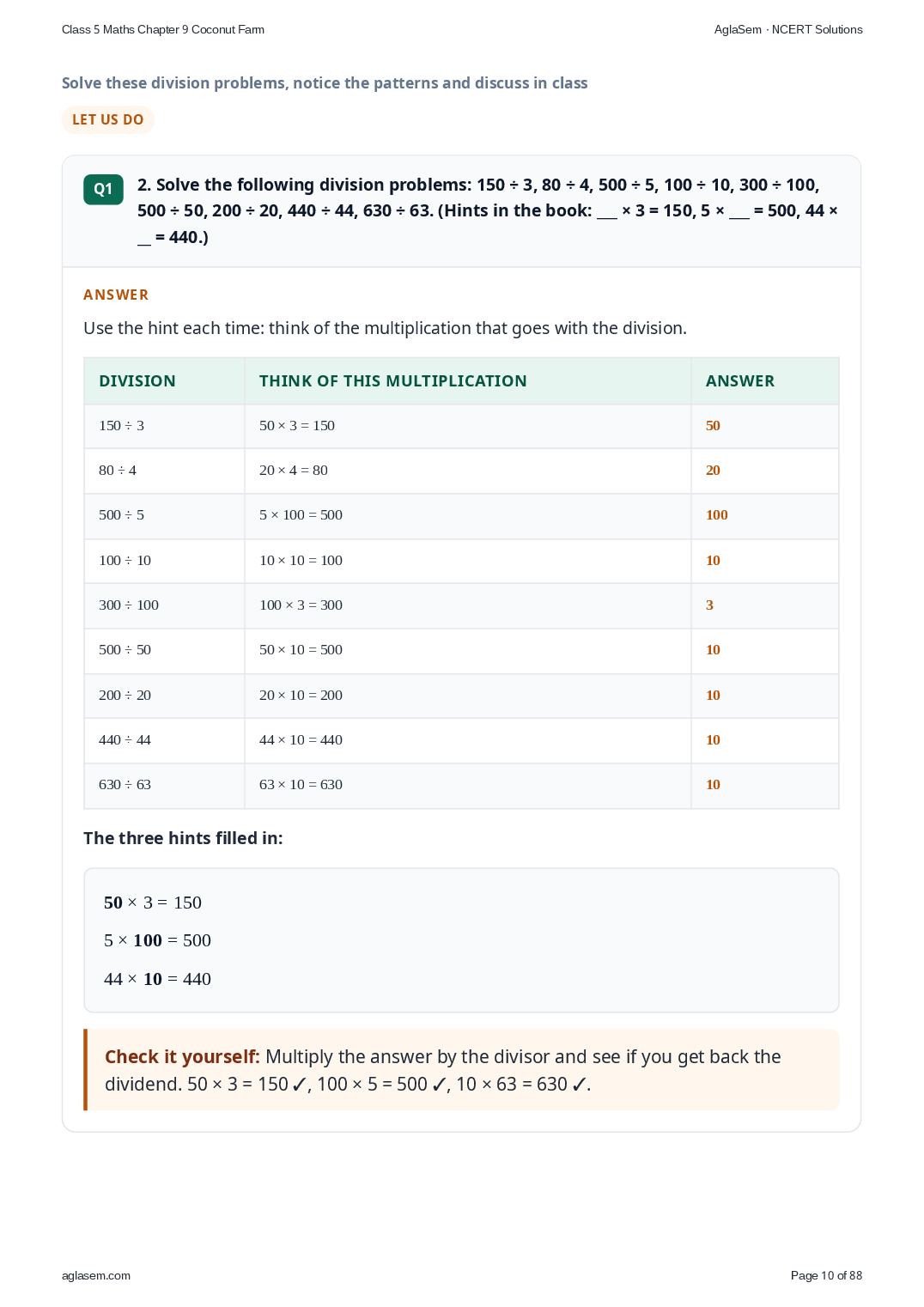
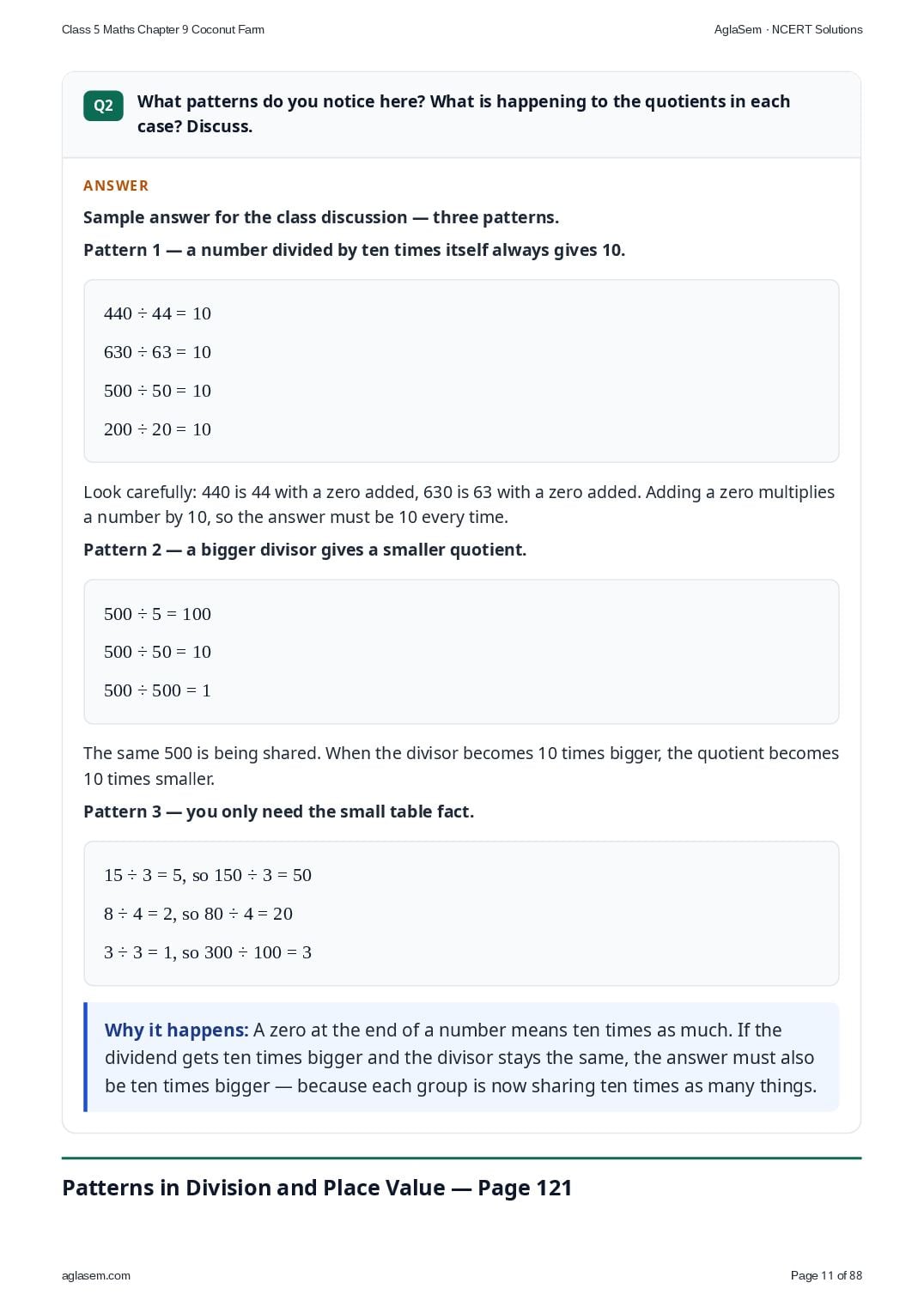
- 2. Solve the following division problems: 150 ÷ 3, 80 ÷ 4, 500 ÷ 5, 100 ÷ 10, 300 ÷ 100, 500 ÷ 50, 200 ÷ 20, 440 ÷ 44, 630 ÷ 63. (Hints in the book: ___ × 3 = 150, 5 × ___ = 500, 44 × __ = 440.)
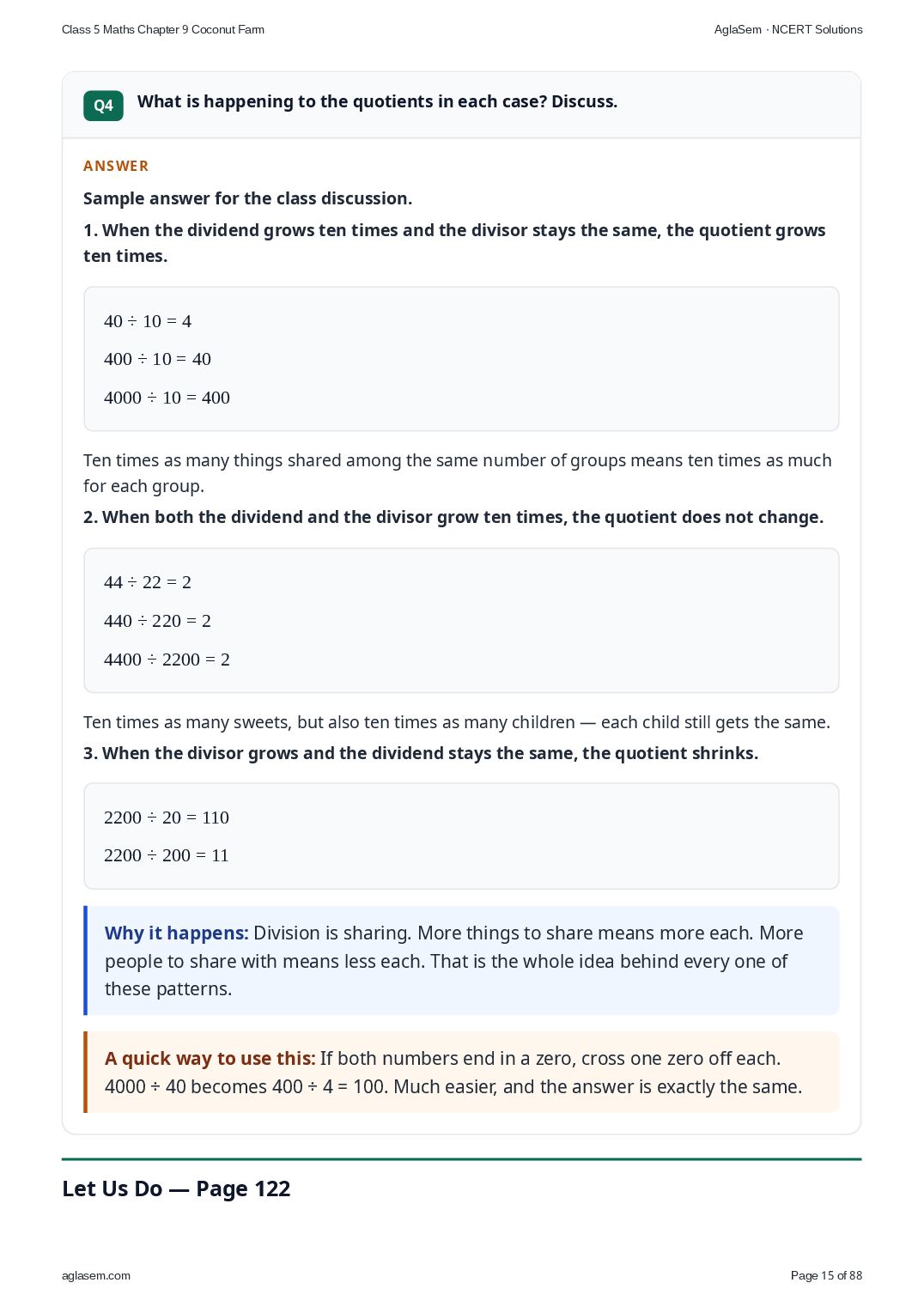
- What patterns do you notice here? What is happening to the quotients in each case? Discuss.
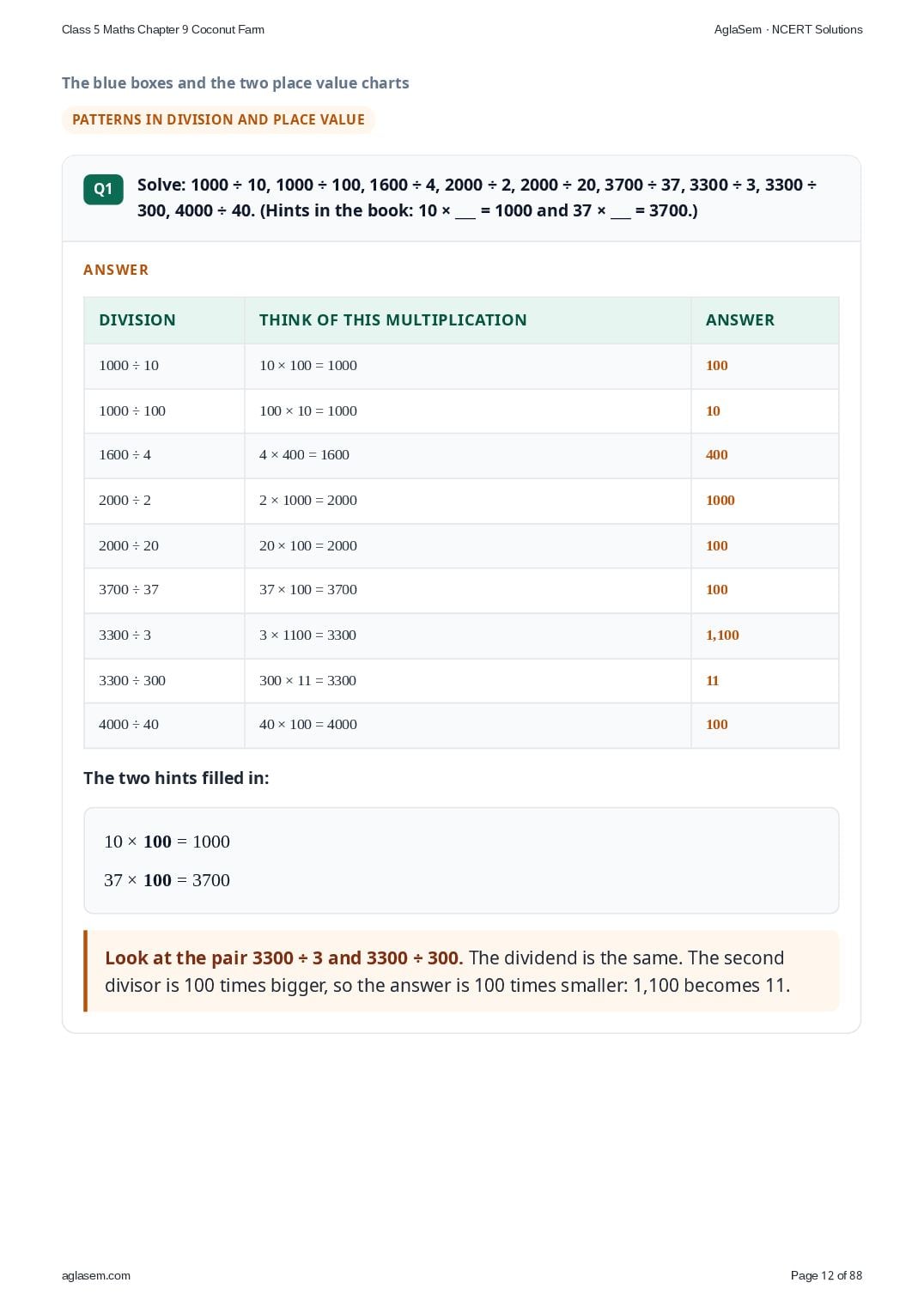
- Solve: 1000 ÷ 10, 1000 ÷ 100, 1600 ÷ 4, 2000 ÷ 2, 2000 ÷ 20, 3700 ÷ 37, 3300 ÷ 3, 3300 ÷ 300, 4000 ÷ 40. (Hints in the book: 10 × ___ = 1000 and 37 × ___ = 3700.)
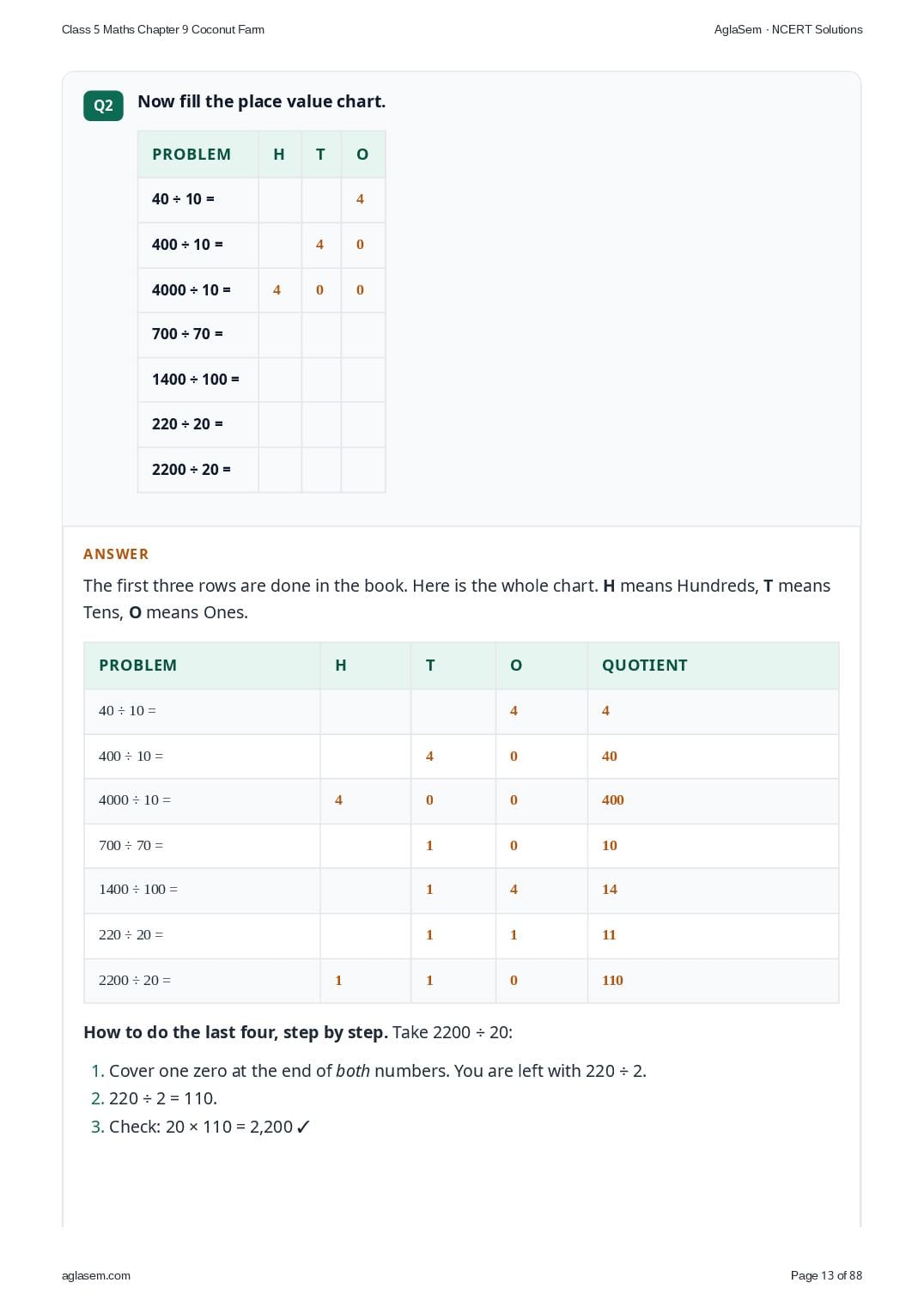
- Now fill the place value chart. ProblemHTO 40 ÷ 10 =4 400 ÷ 10 =40 4000 ÷ 10 =400 700 ÷ 70 = 1400 ÷ 100 = 220 ÷ 20 = 2200 ÷ 20 =
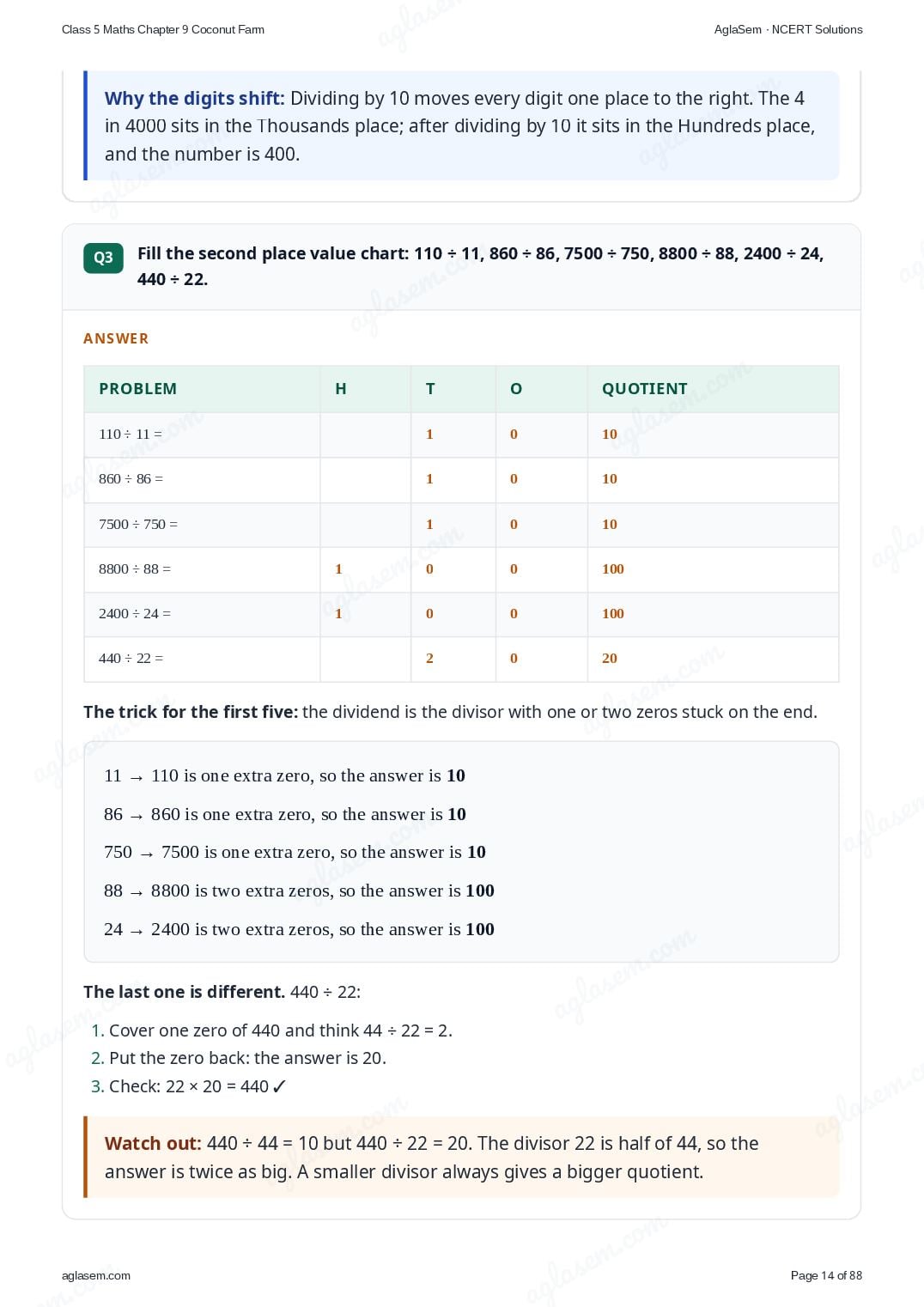
- Fill the second place value chart: 110 ÷ 11, 860 ÷ 86, 7500 ÷ 750, 8800 ÷ 88, 2400 ÷ 24, 440 ÷ 22.
- What is happening to the quotients in each case? Discuss.
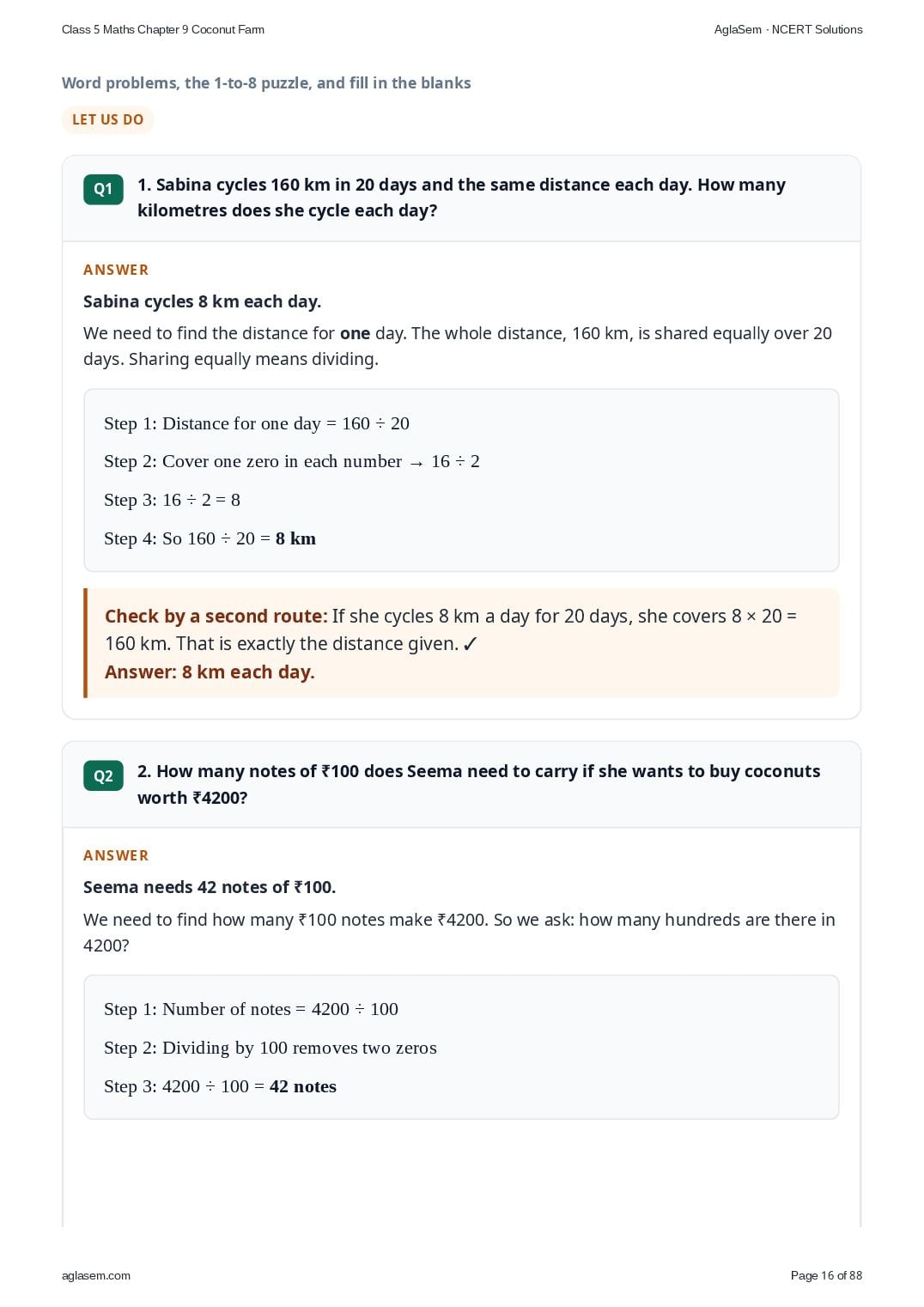
- 1. Sabina cycles 160 km in 20 days and the same distance each day. How many kilometres does she cycle each day?
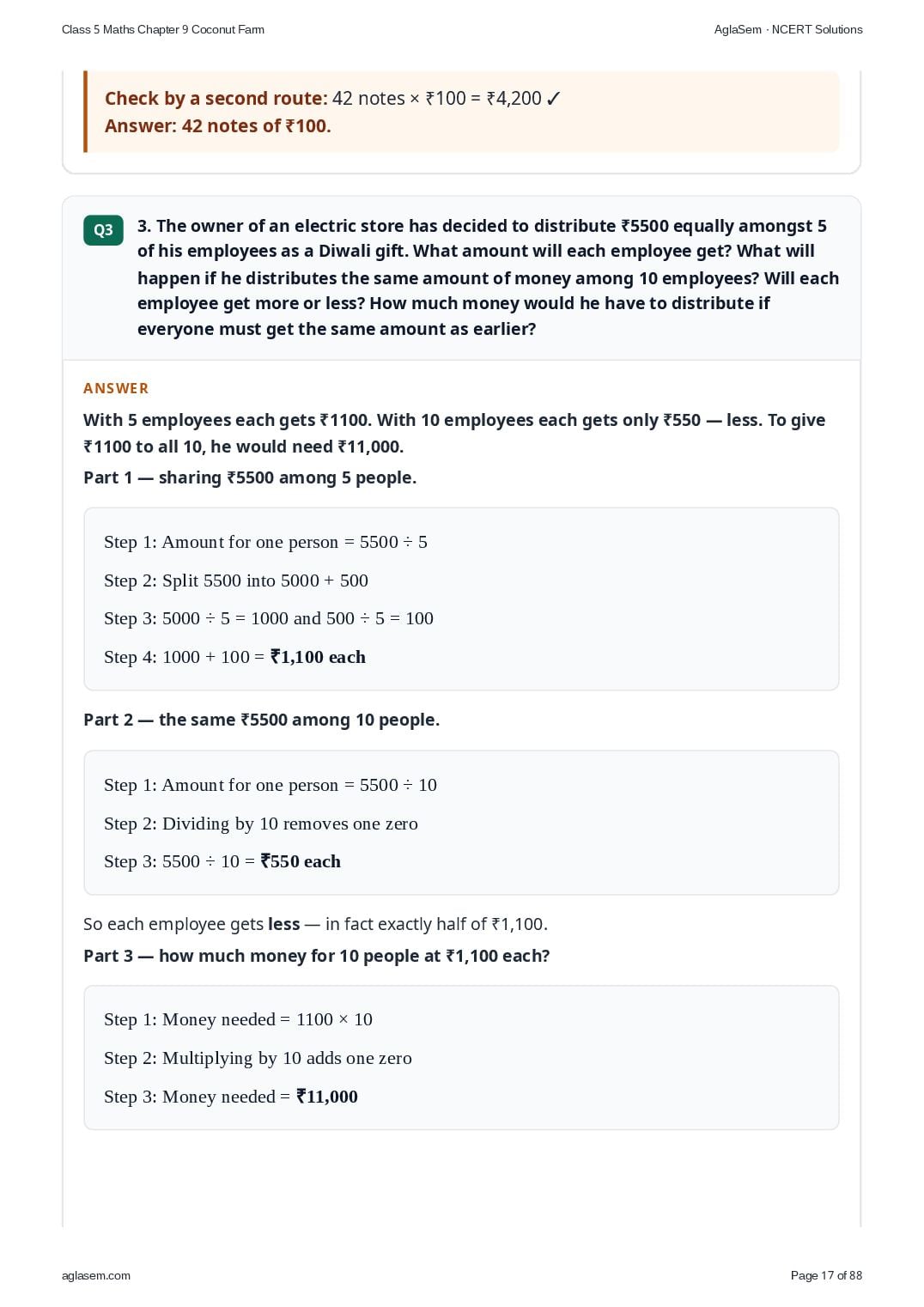
- 2. How many notes of ₹100 does Seema need to carry if she wants to buy coconuts worth ₹4200?
- 3. The owner of an electric store has decided to distribute ₹5500 equally amongst 5 of his employees as a Diwali gift. What amount will each employee get? What will happen if he distributes the same amount of money among 10 employees? Will each employee get more or less? How much money would he have to distribute if everyone must get the same amount as earlier?
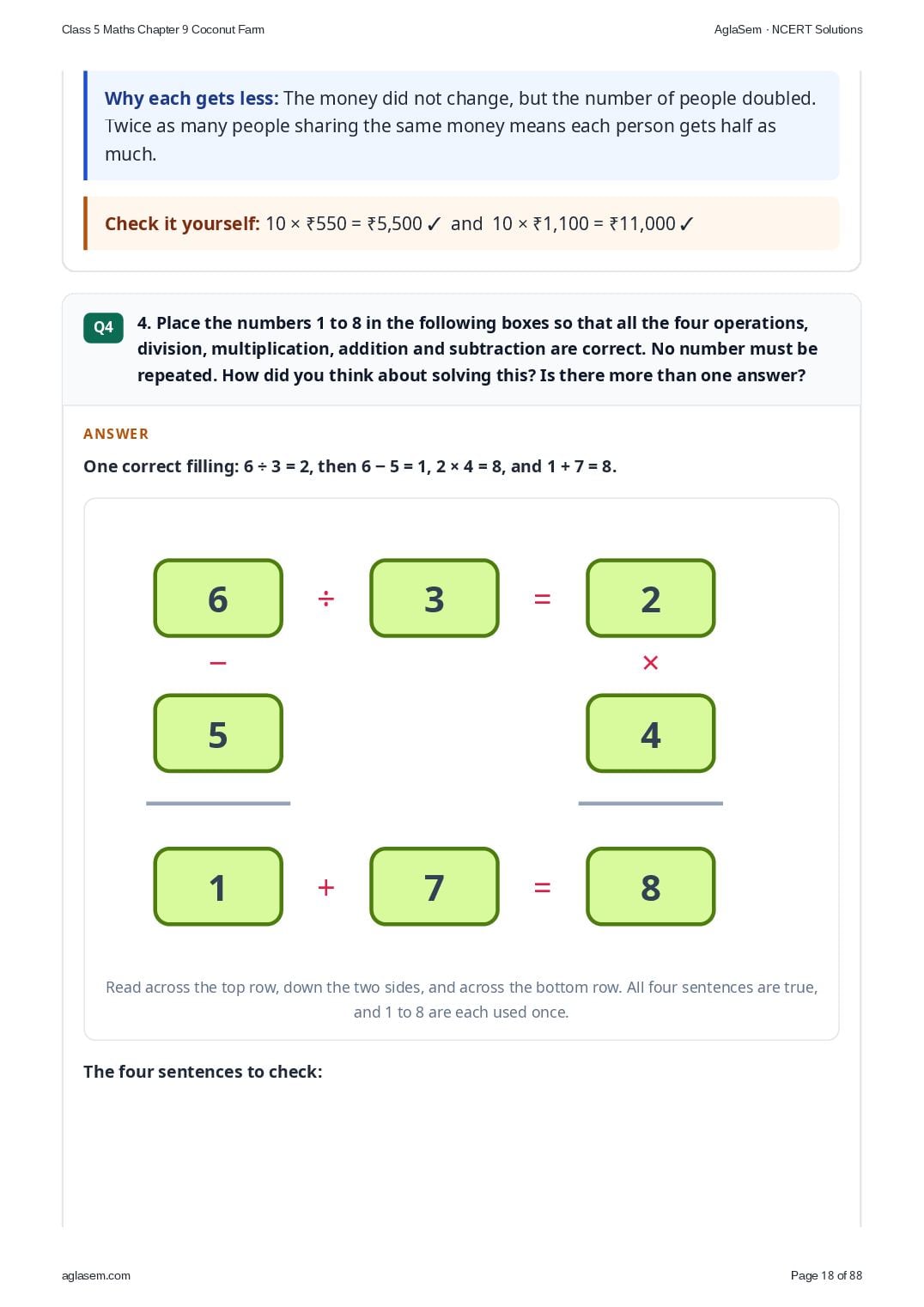
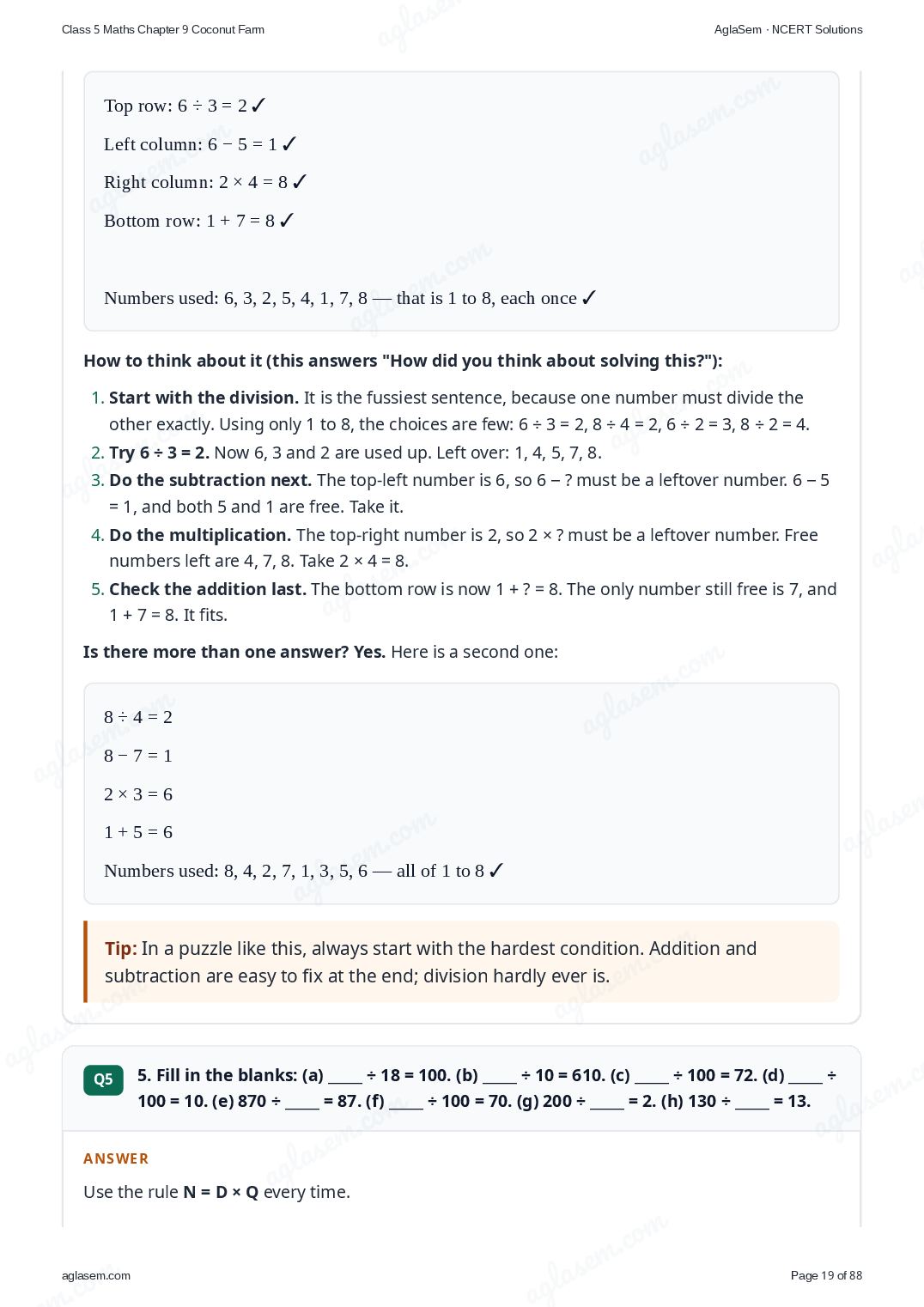
- 4. Place the numbers 1 to 8 in the following boxes so that all the four operations, division, multiplication, addition and subtraction are correct. No number must be repeated. How did you think about solving this? Is there more than one answer?
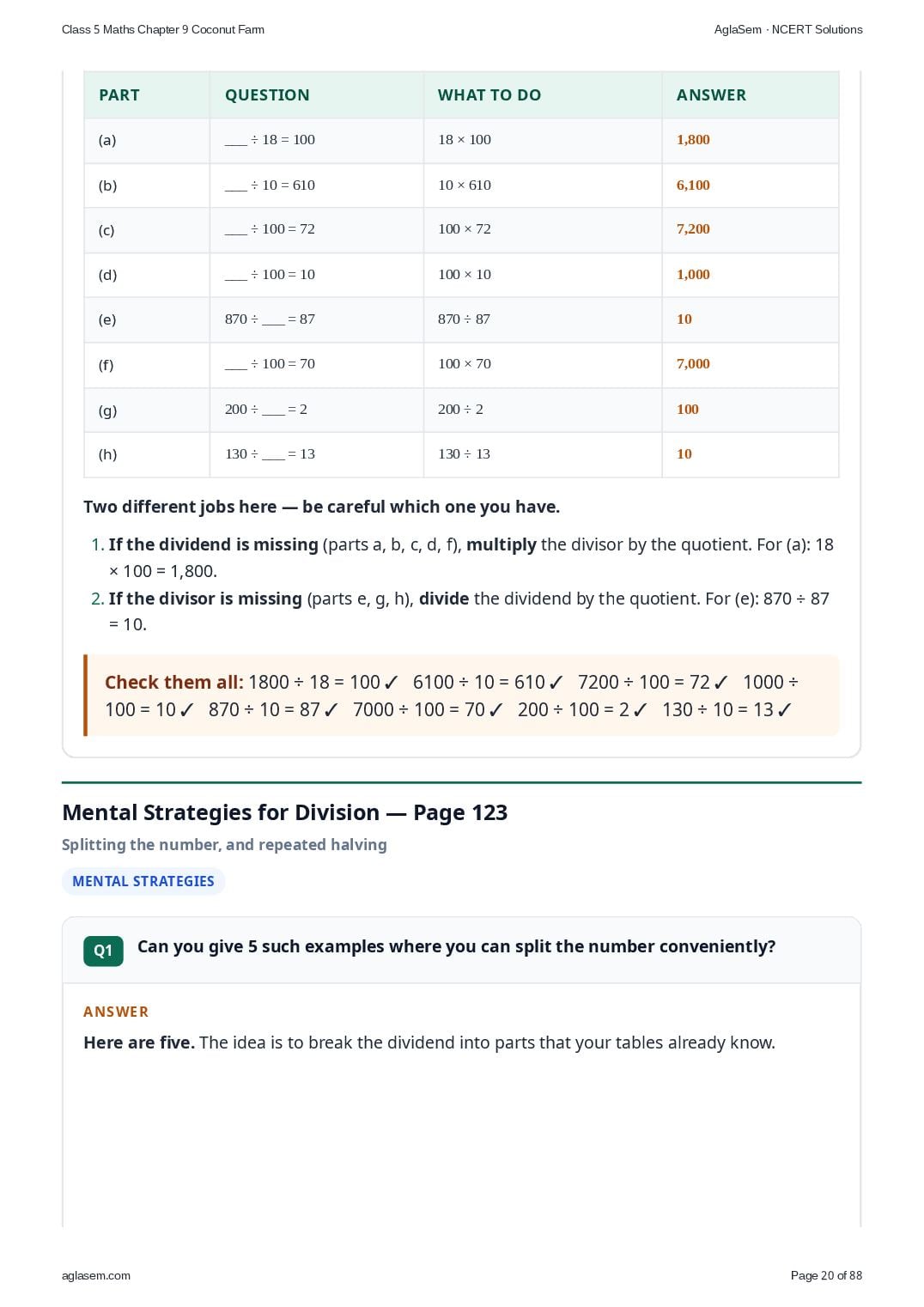
- 5. Fill in the blanks: (a) _____ ÷ 18 = 100. (b) _____ ÷ 10 = 610. (c) _____ ÷ 100 = 72. (d) _____ ÷ 100 = 10. (e) 870 ÷ _____ = 87. (f) _____ ÷ 100 = 70. (g) 200 ÷ _____ = 2. (h) 130 ÷ _____ = 13.
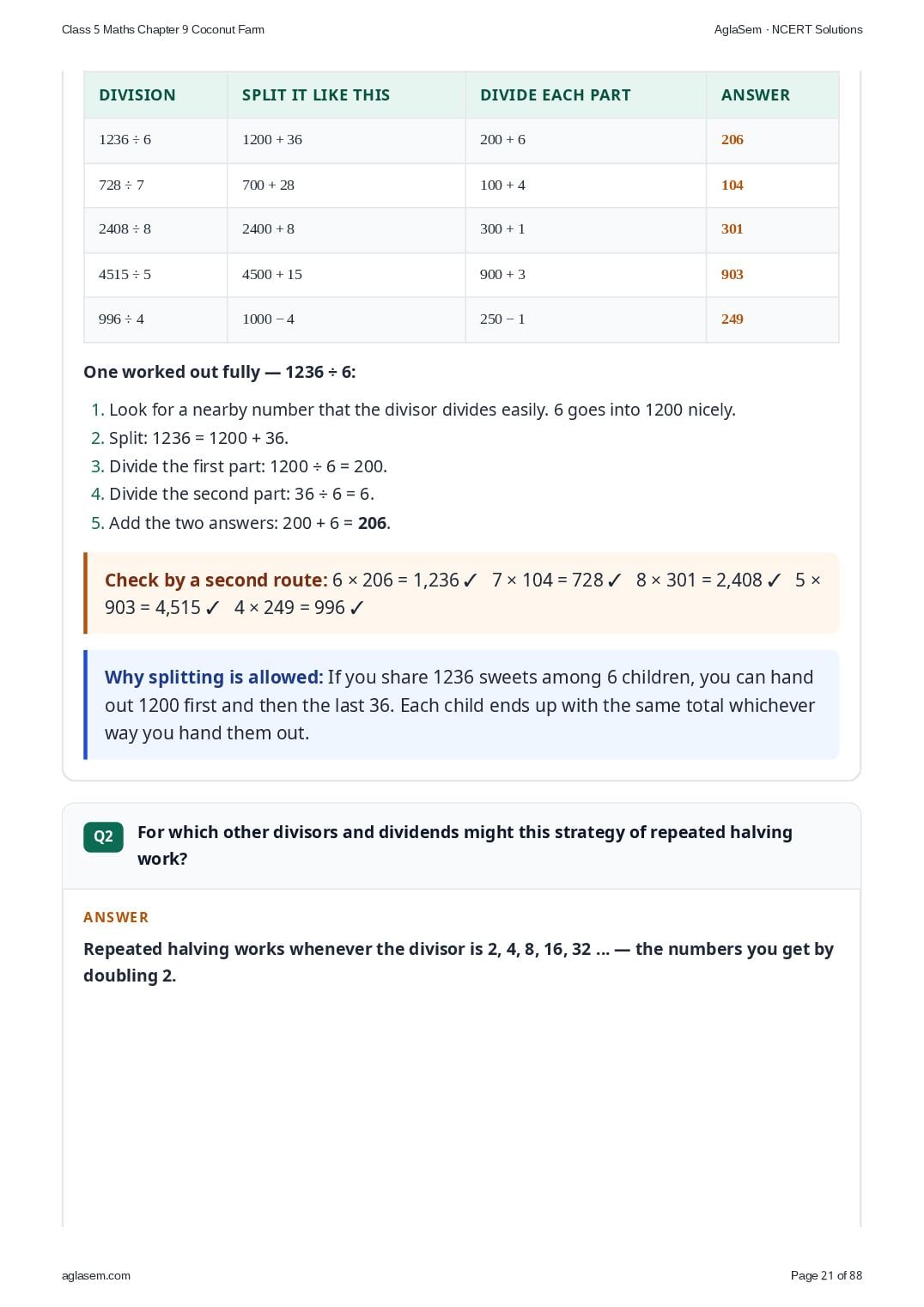
- Can you give 5 such examples where you can split the number conveniently?
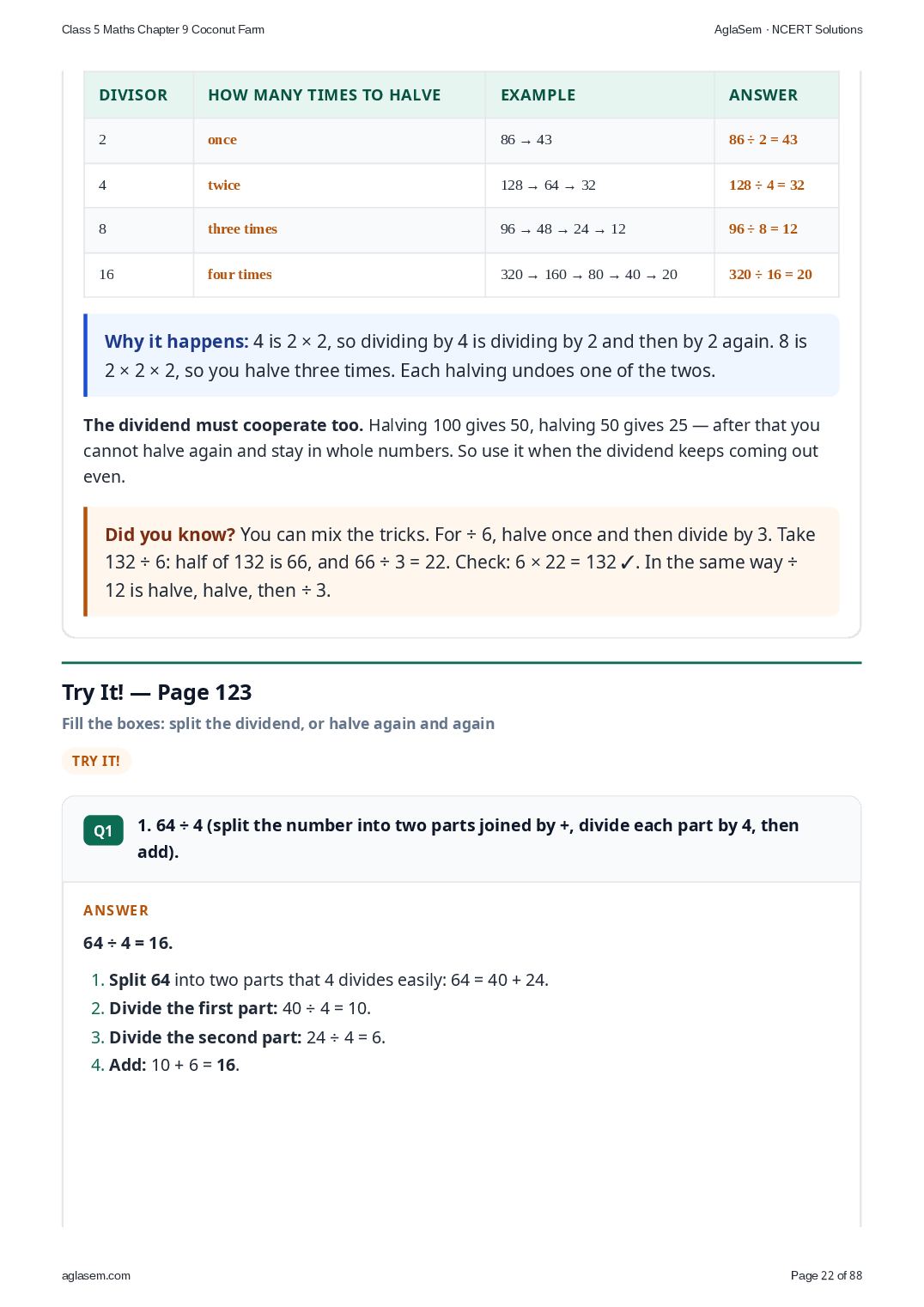
- For which other divisors and dividends might this strategy of repeated halving work?
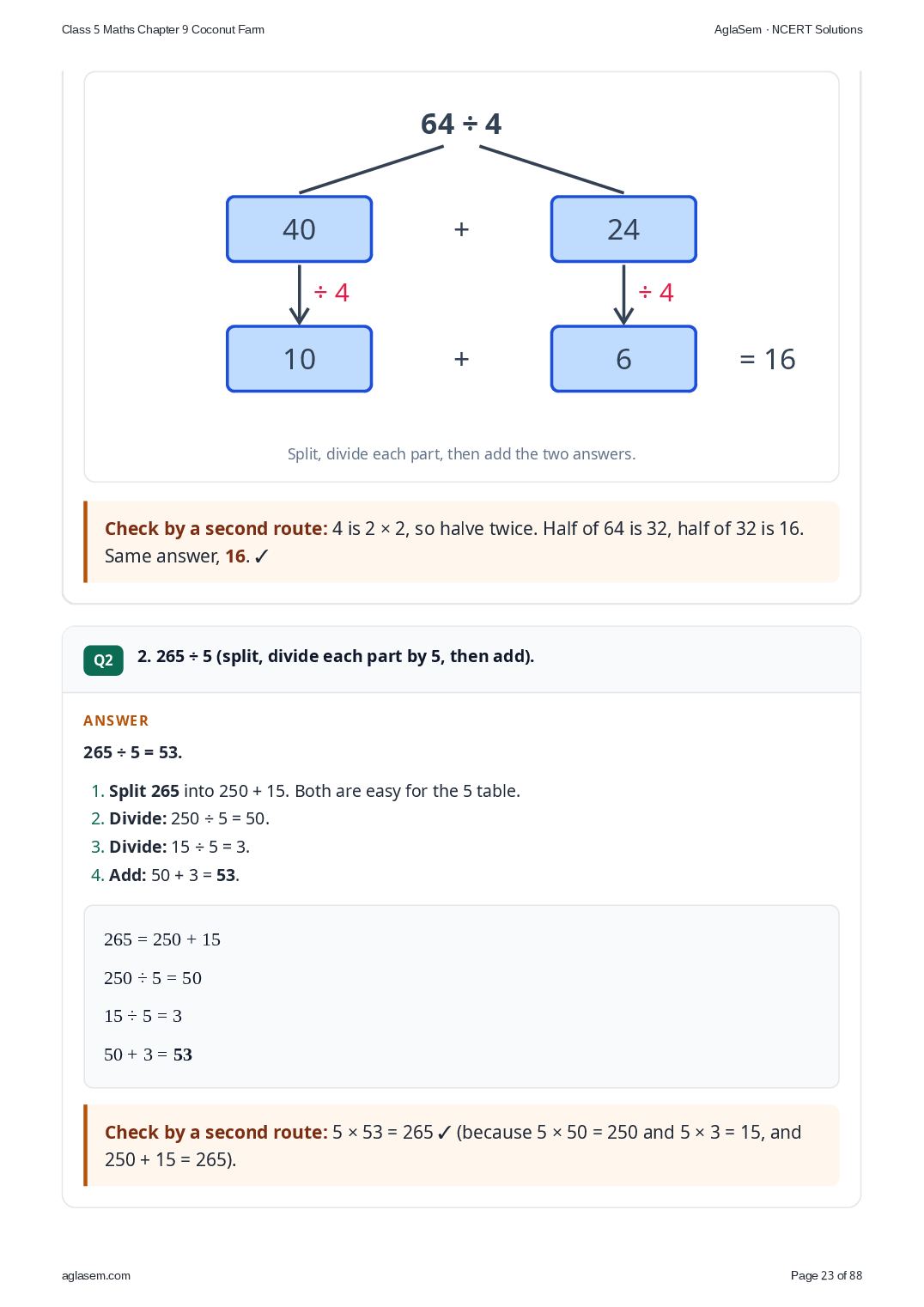
- 1. 64 ÷ 4 (split the number into two parts joined by +, divide each part by 4, then add).
- 2. 265 ÷ 5 (split, divide each part by 5, then add).
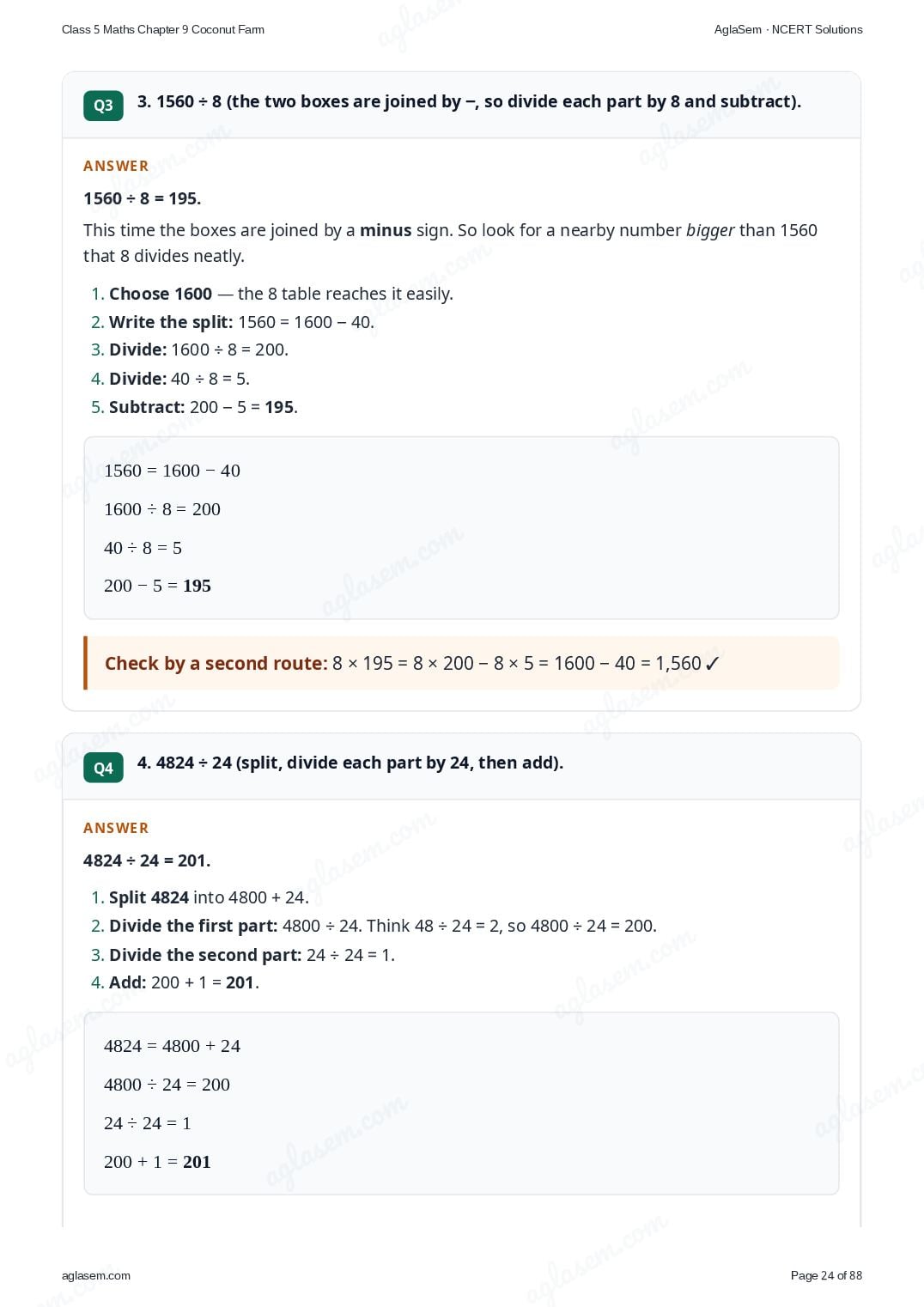
- 3. 1560 ÷ 8 (the two boxes are joined by −, so divide each part by 8 and subtract).
- 4. 4824 ÷ 24 (split, divide each part by 24, then add).
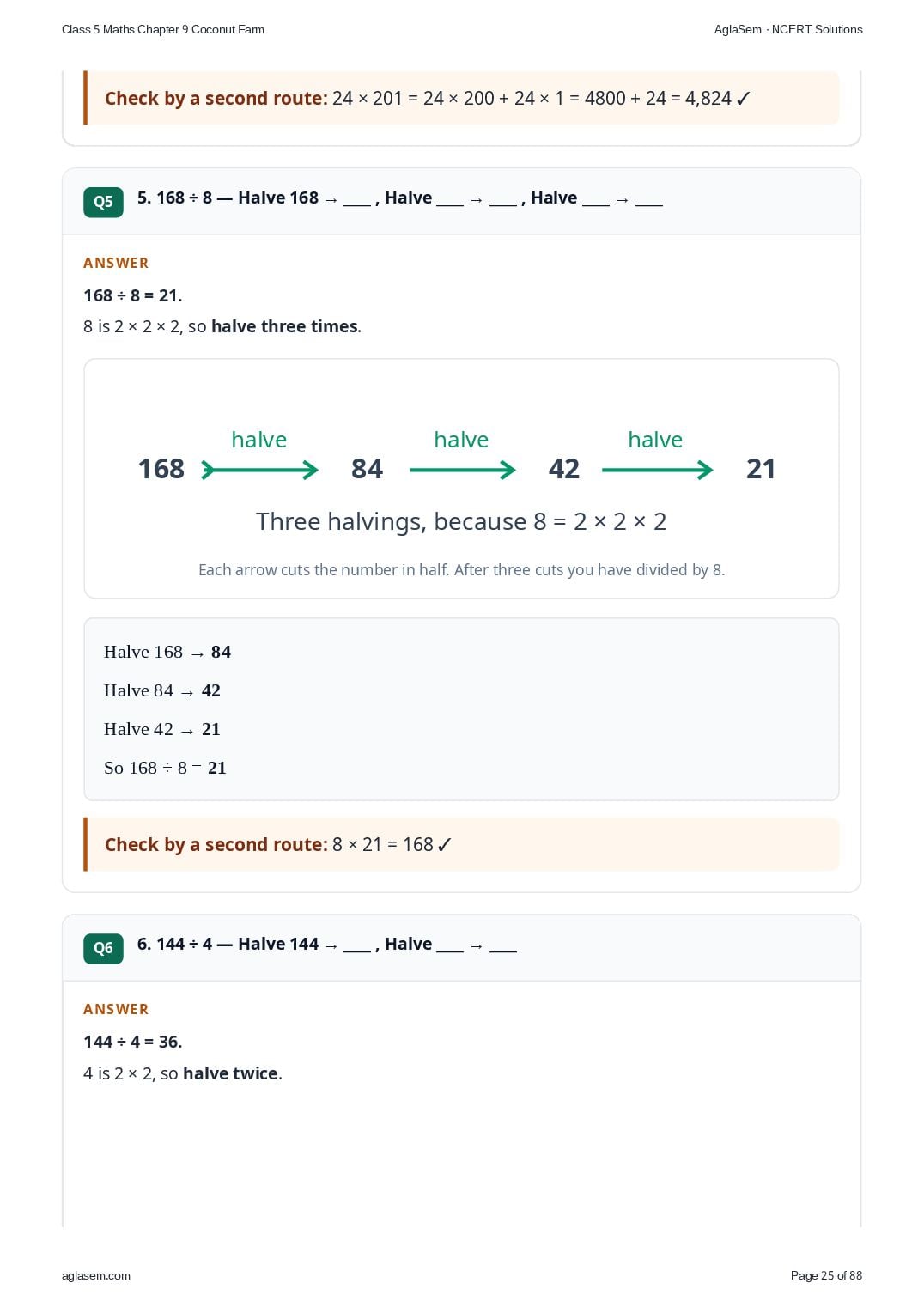
- 5. 168 ÷ 8 — Halve 168 → ____ , Halve ____ → ____ , Halve ____ → ____
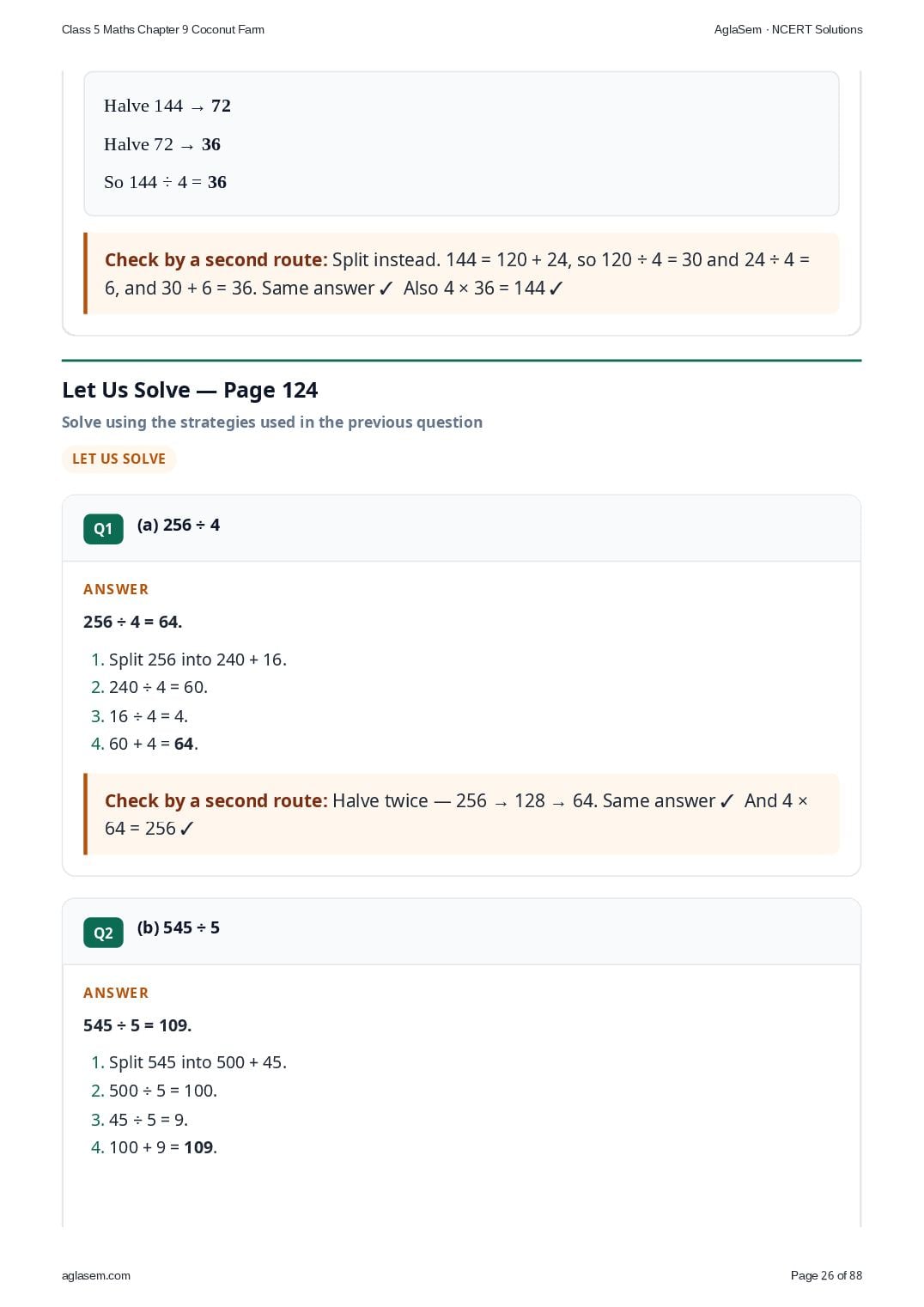
- 6. 144 ÷ 4 — Halve 144 → ____ , Halve ____ → ____
- (a) 256 ÷ 4
- (b) 545 ÷ 5
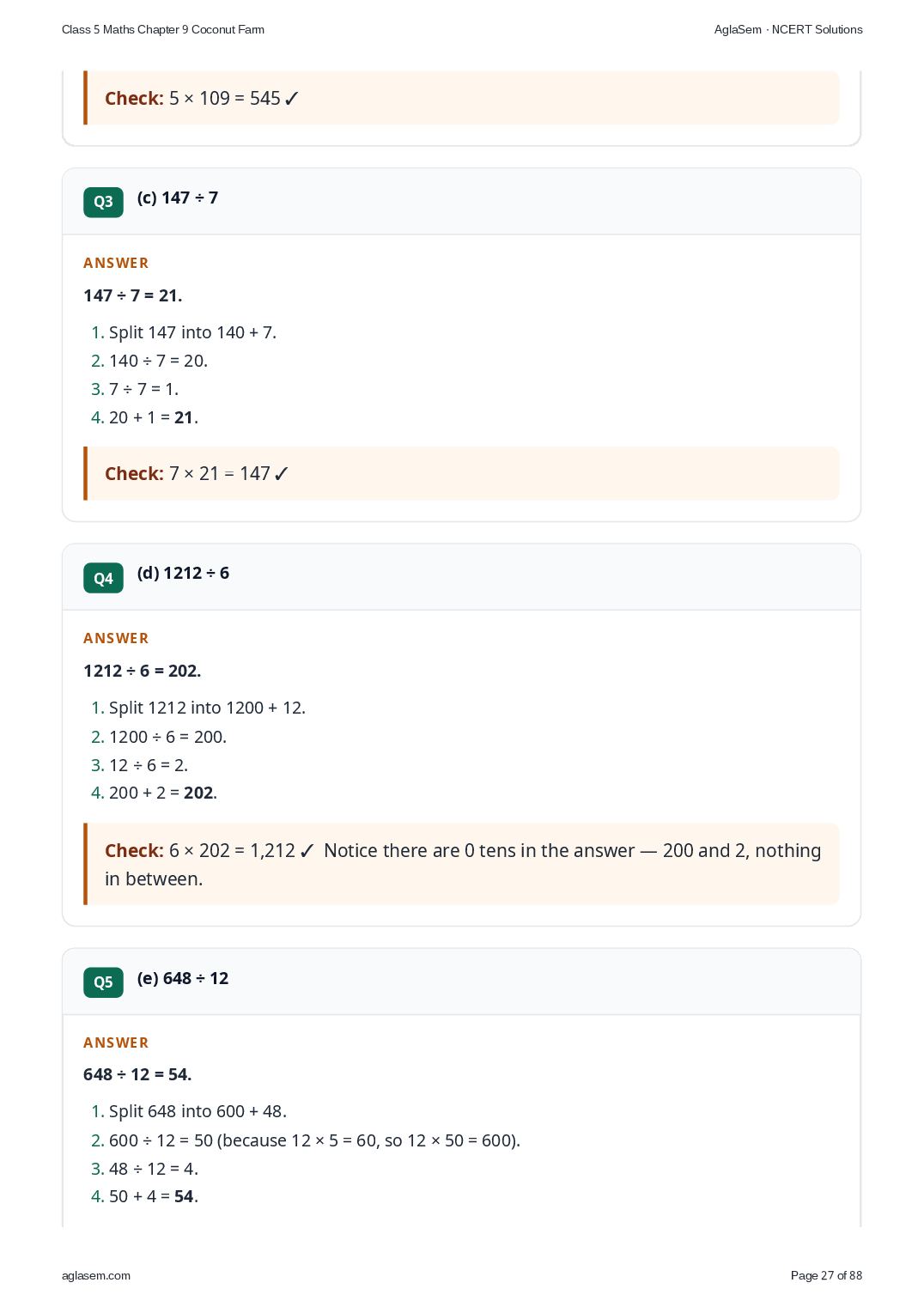
- (c) 147 ÷ 7
- (d) 1212 ÷ 6
- (e) 648 ÷ 12
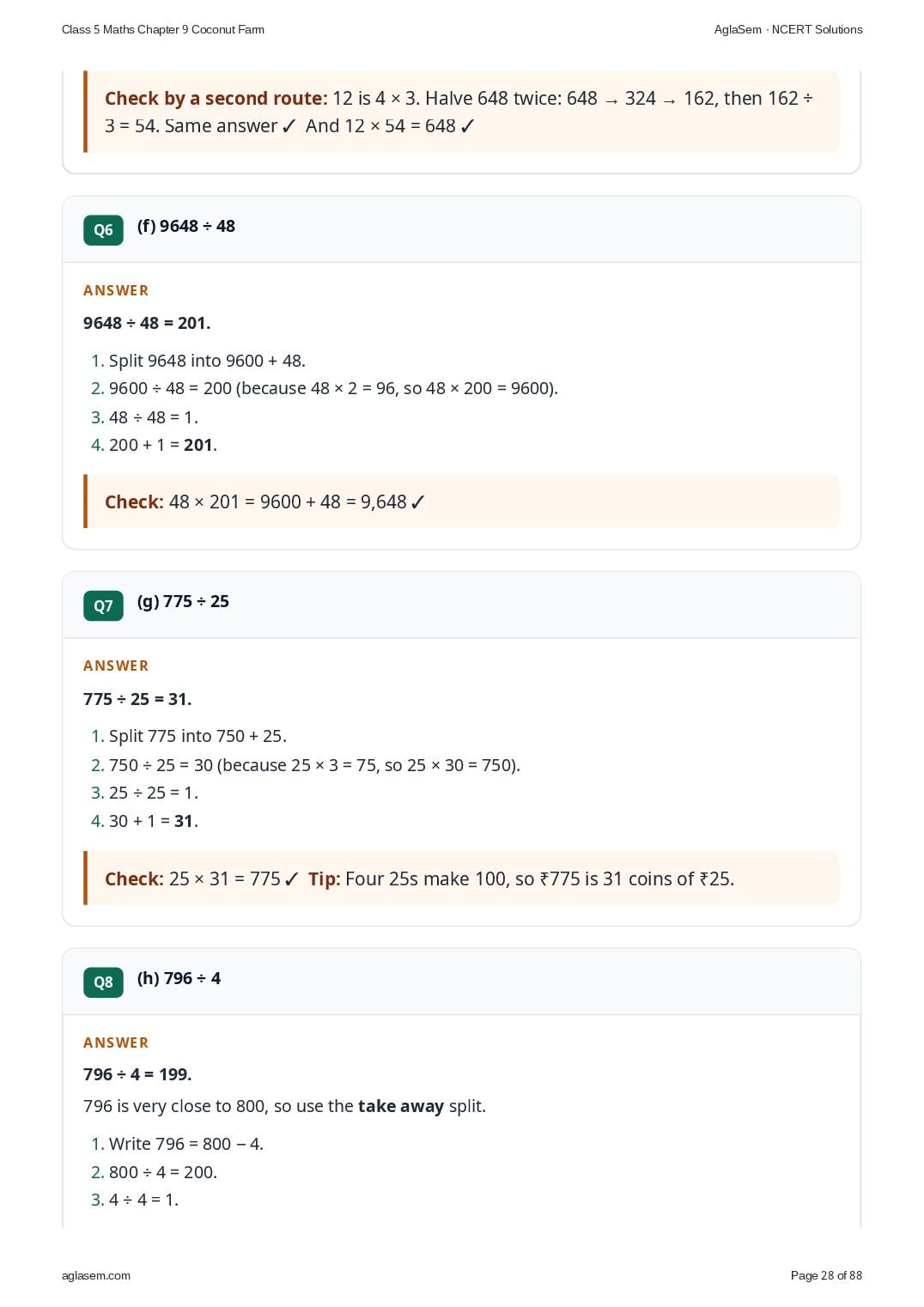
- (f) 9648 ÷ 48
- (g) 775 ÷ 25
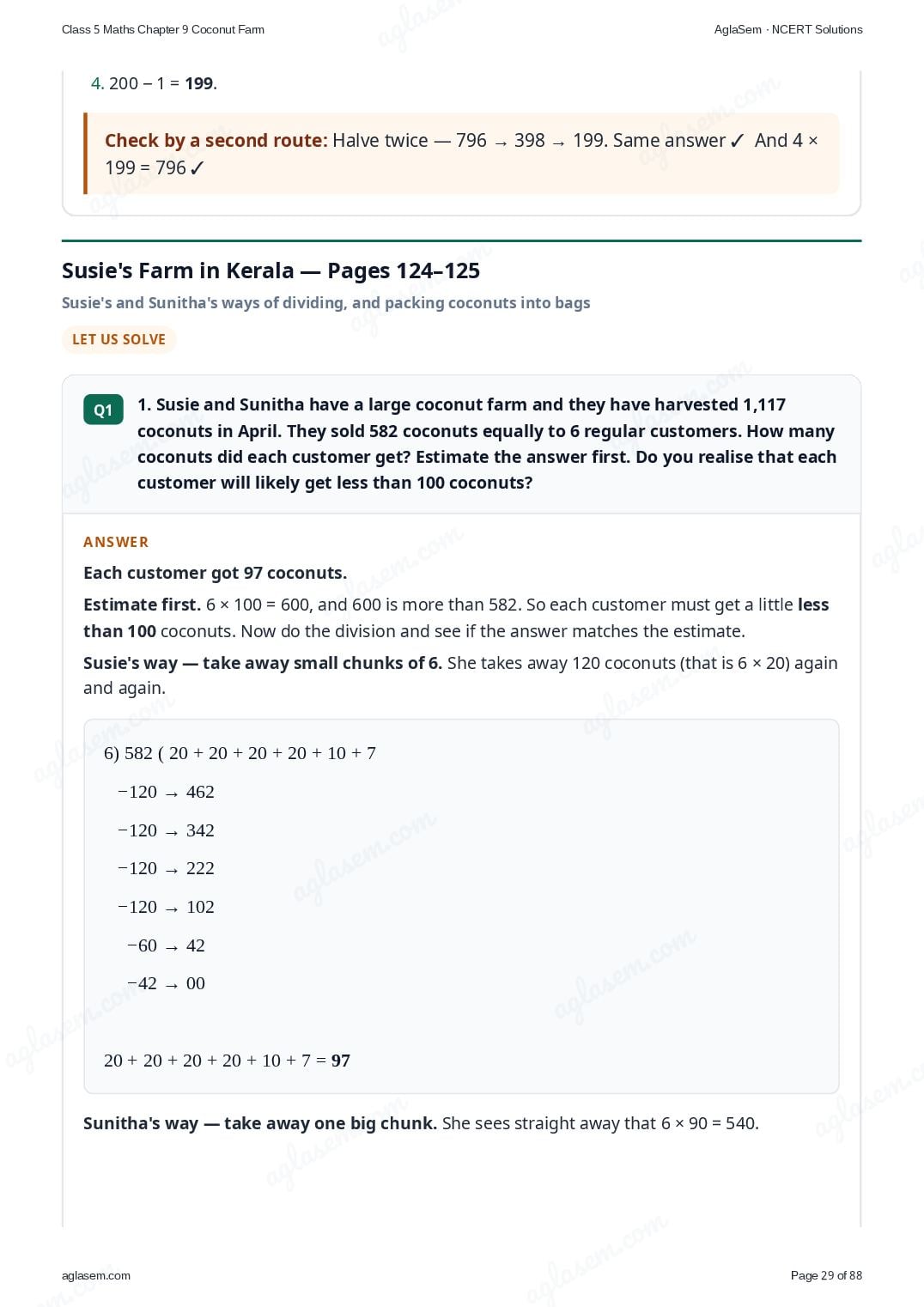
- (h) 796 ÷ 4
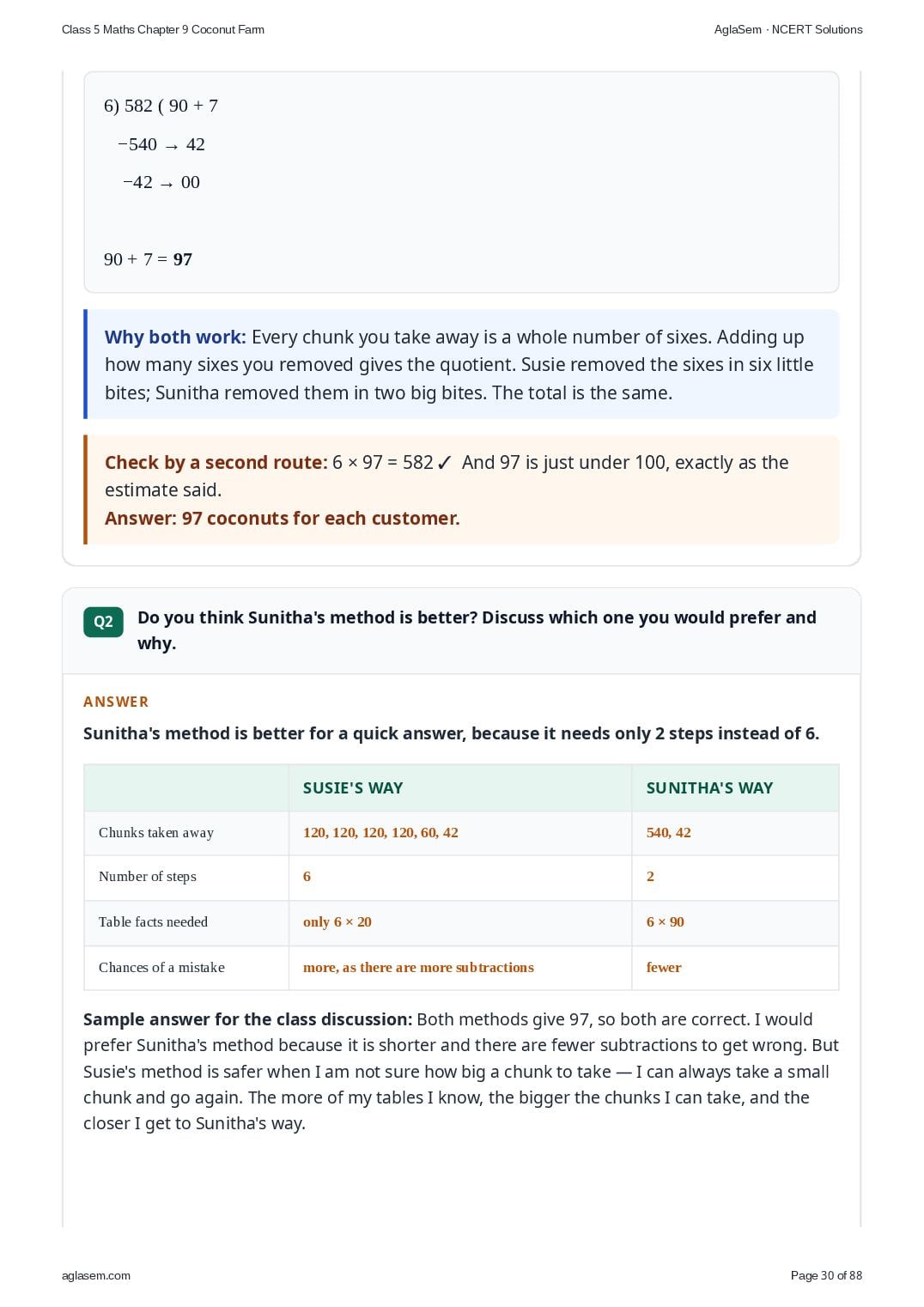
- 1. Susie and Sunitha have a large coconut farm and they have harvested 1,117 coconuts in April. They sold 582 coconuts equally to 6 regular customers. How many coconuts did each customer get? Estimate the answer first. Do you realise that each customer will likely get less than 100 coconuts?
- Do you think Sunitha’s method is better? Discuss which one you would prefer and why.
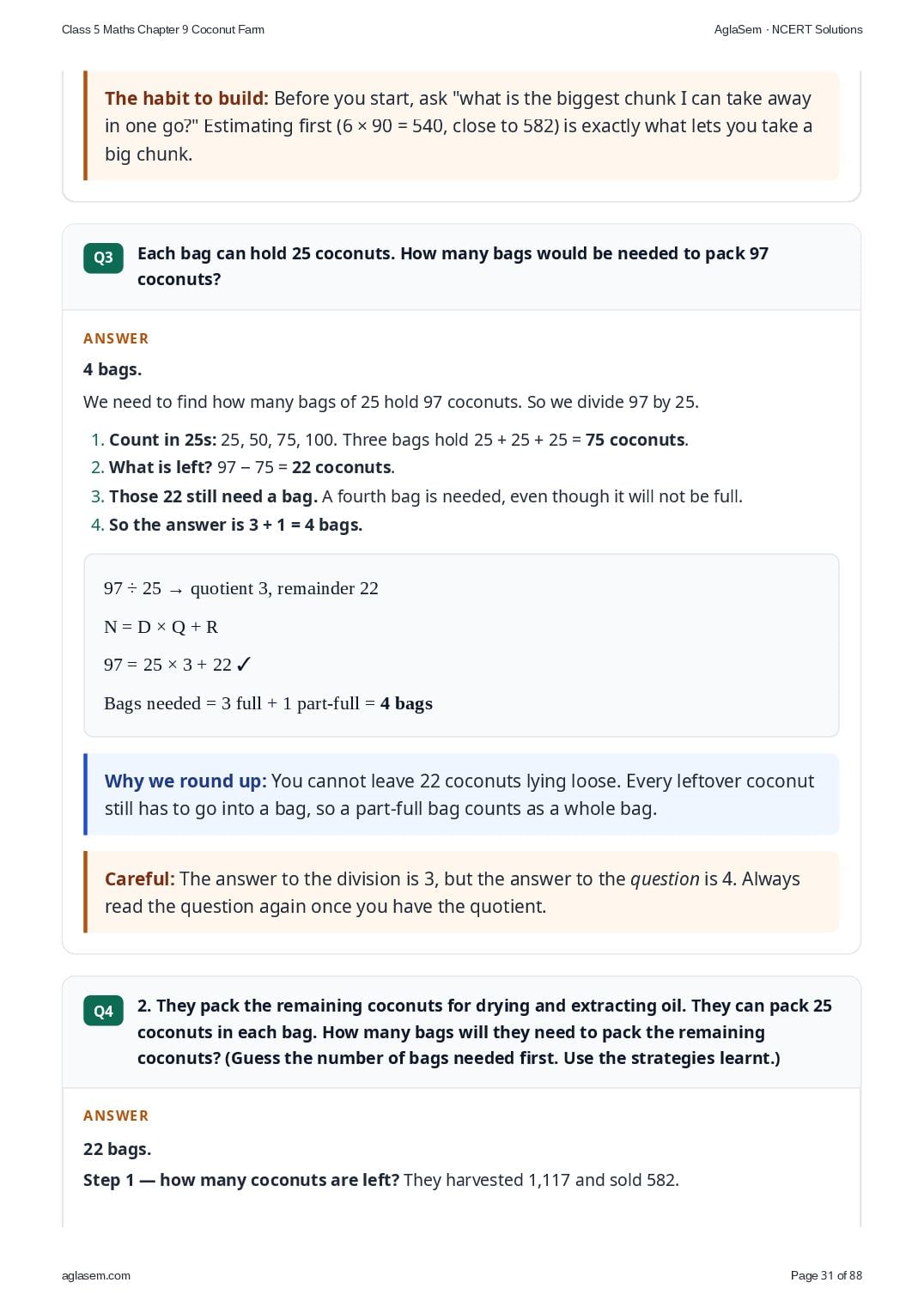
- Each bag can hold 25 coconuts. How many bags would be needed to pack 97 coconuts?
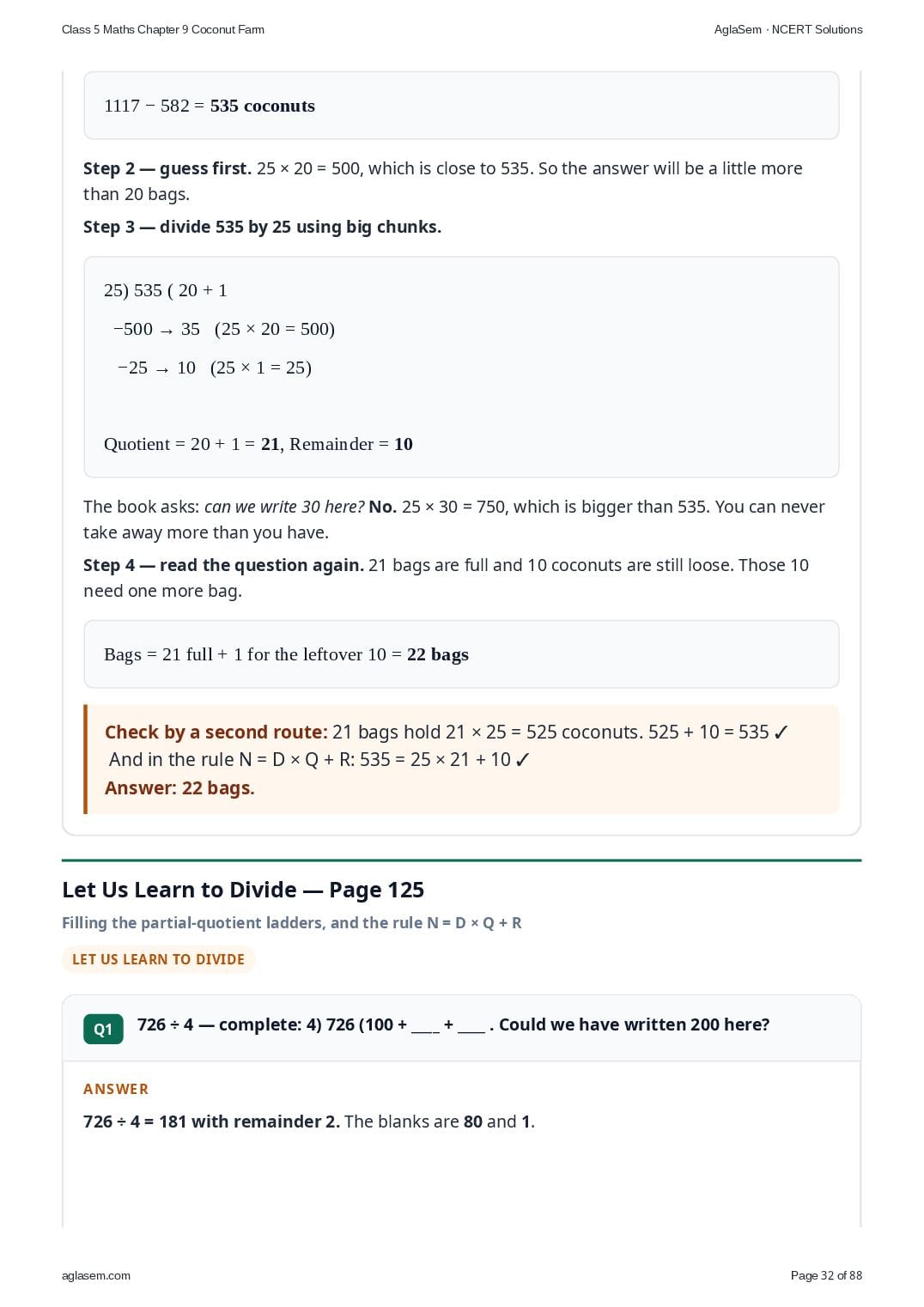
- 2. They pack the remaining coconuts for drying and extracting oil. They can pack 25 coconuts in each bag. How many bags will they need to pack the remaining coconuts? (Guess the number of bags needed first. Use the strategies learnt.)
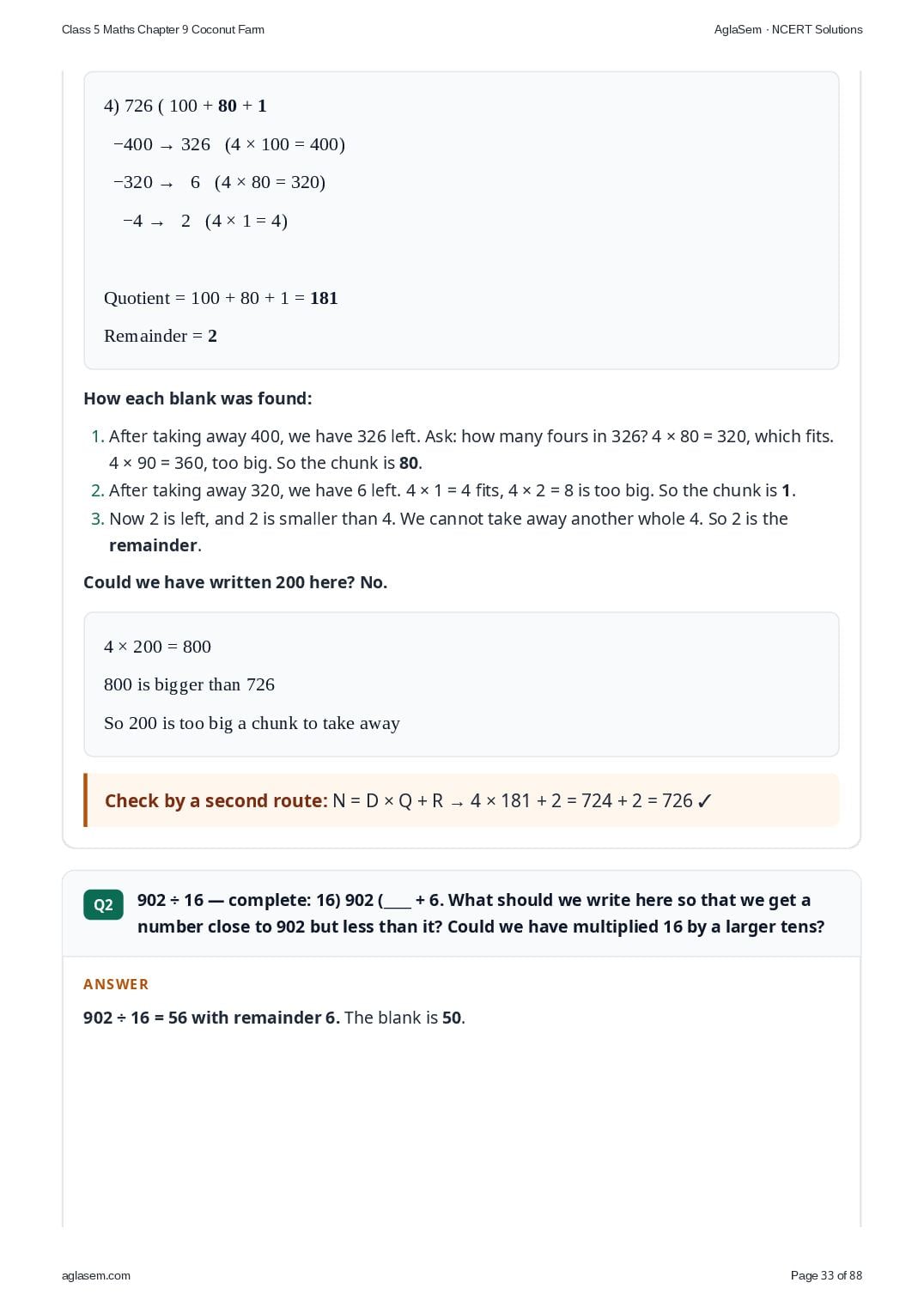
- 726 ÷ 4 — complete: 4) 726 (100 + ____ + ____ . Could we have written 200 here?
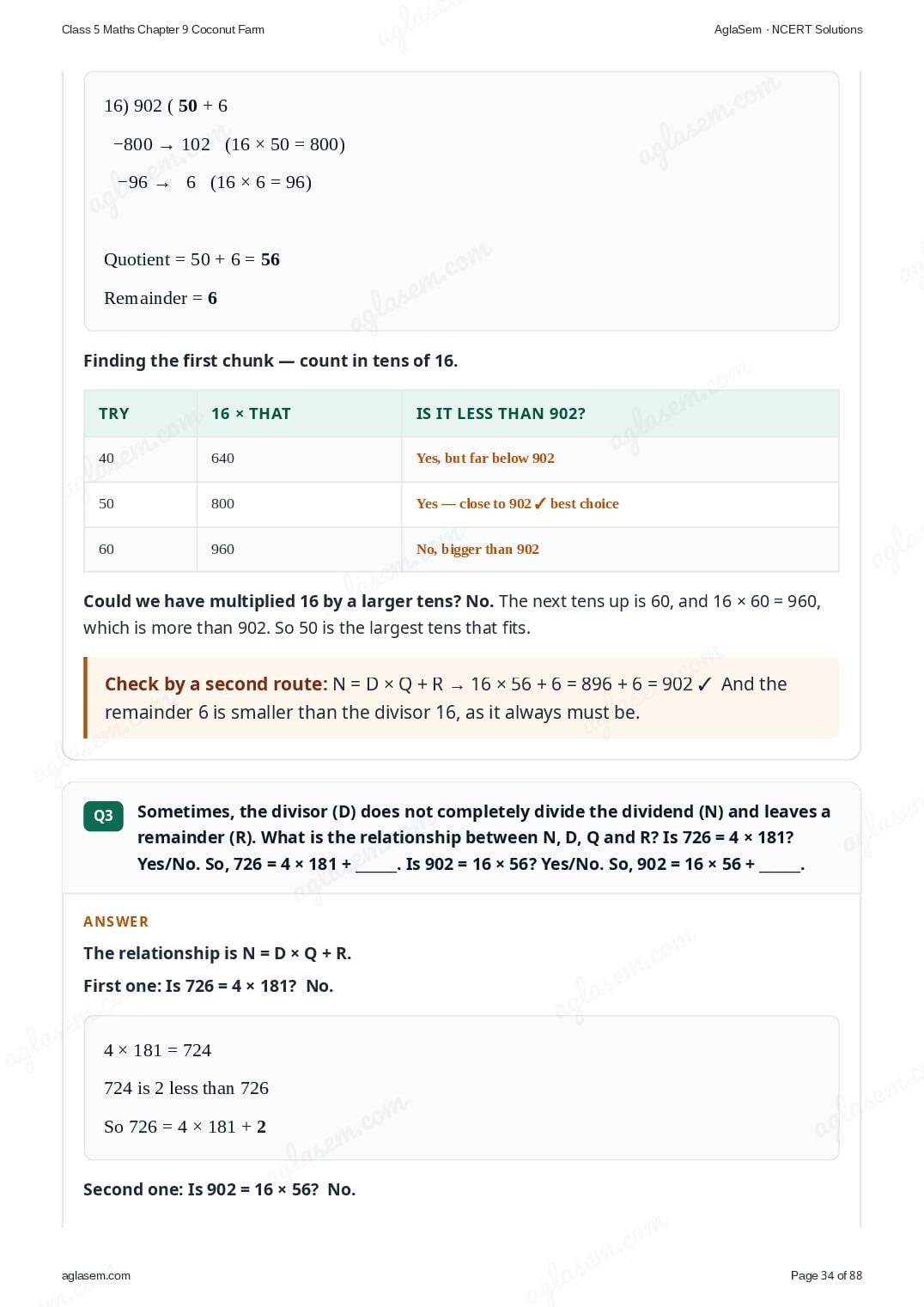
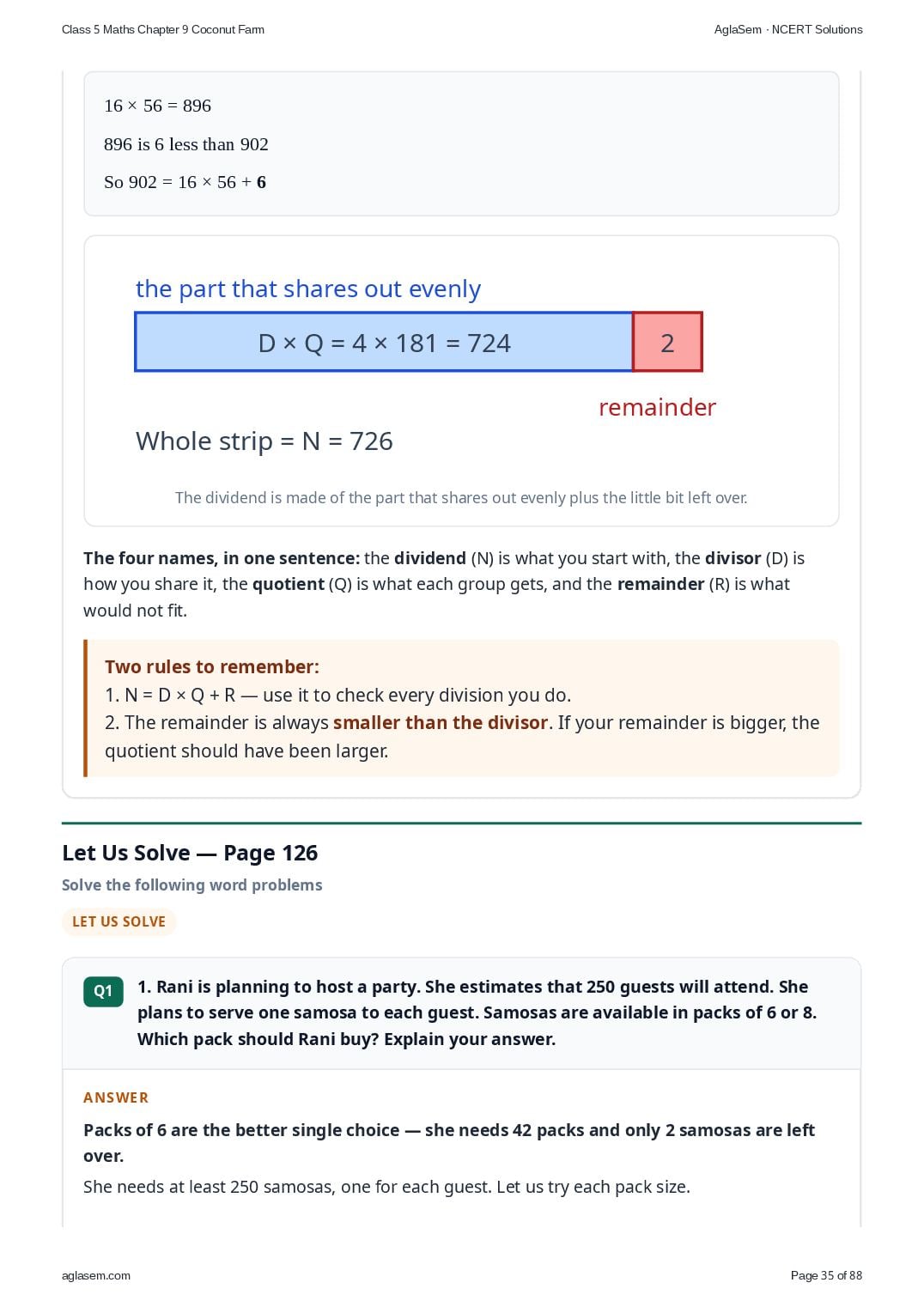
- 902 ÷ 16 — complete: 16) 902 (____ + 6. What should we write here so that we get a number close to 902 but less than it? Could we have multiplied 16 by a larger tens?
- Sometimes, the divisor (D) does not completely divide the dividend (N) and leaves a remainder (R). What is the relationship between N, D, Q and R? Is 726 = 4 × 181? Yes/No. So, 726 = 4 × 181 + ______. Is 902 = 16 × 56? Yes/No. So, 902 = 16 × 56 + ______.
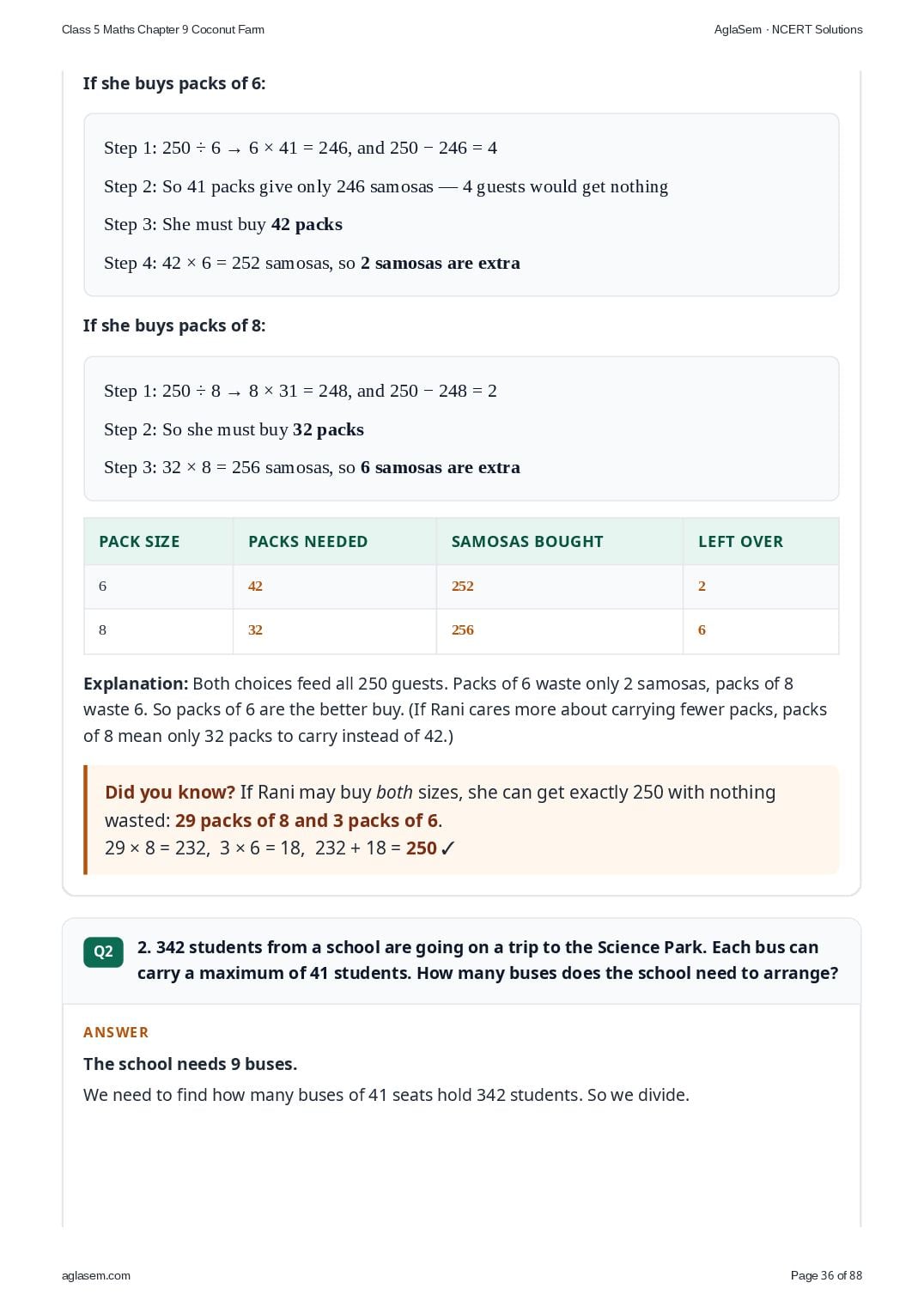
- 1. Rani is planning to host a party. She estimates that 250 guests will attend. She plans to serve one samosa to each guest. Samosas are available in packs of 6 or 8. Which pack should Rani buy? Explain your answer.
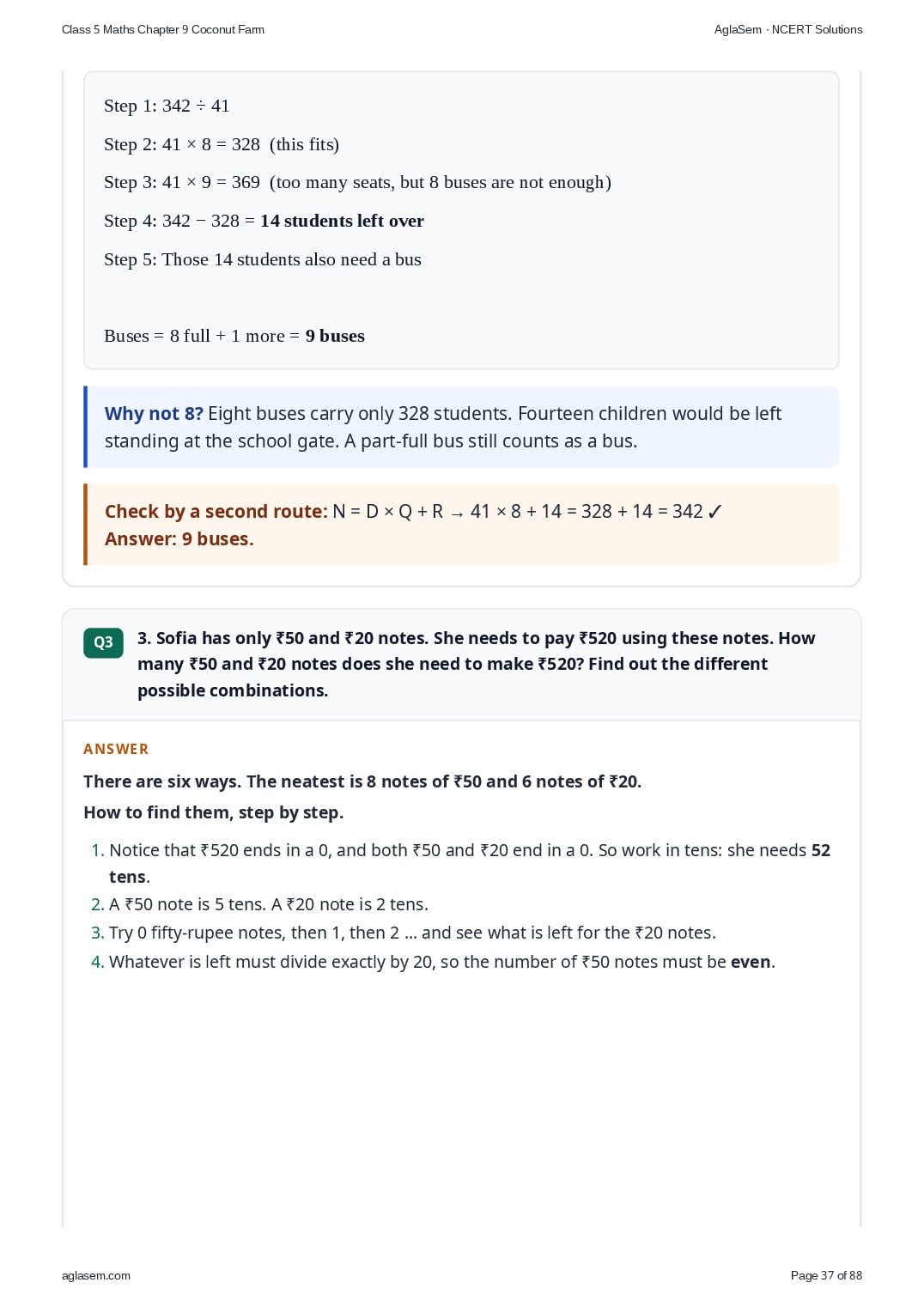
- 2. 342 students from a school are going on a trip to the Science Park. Each bus can carry a maximum of 41 students. How many buses does the school need to arrange?
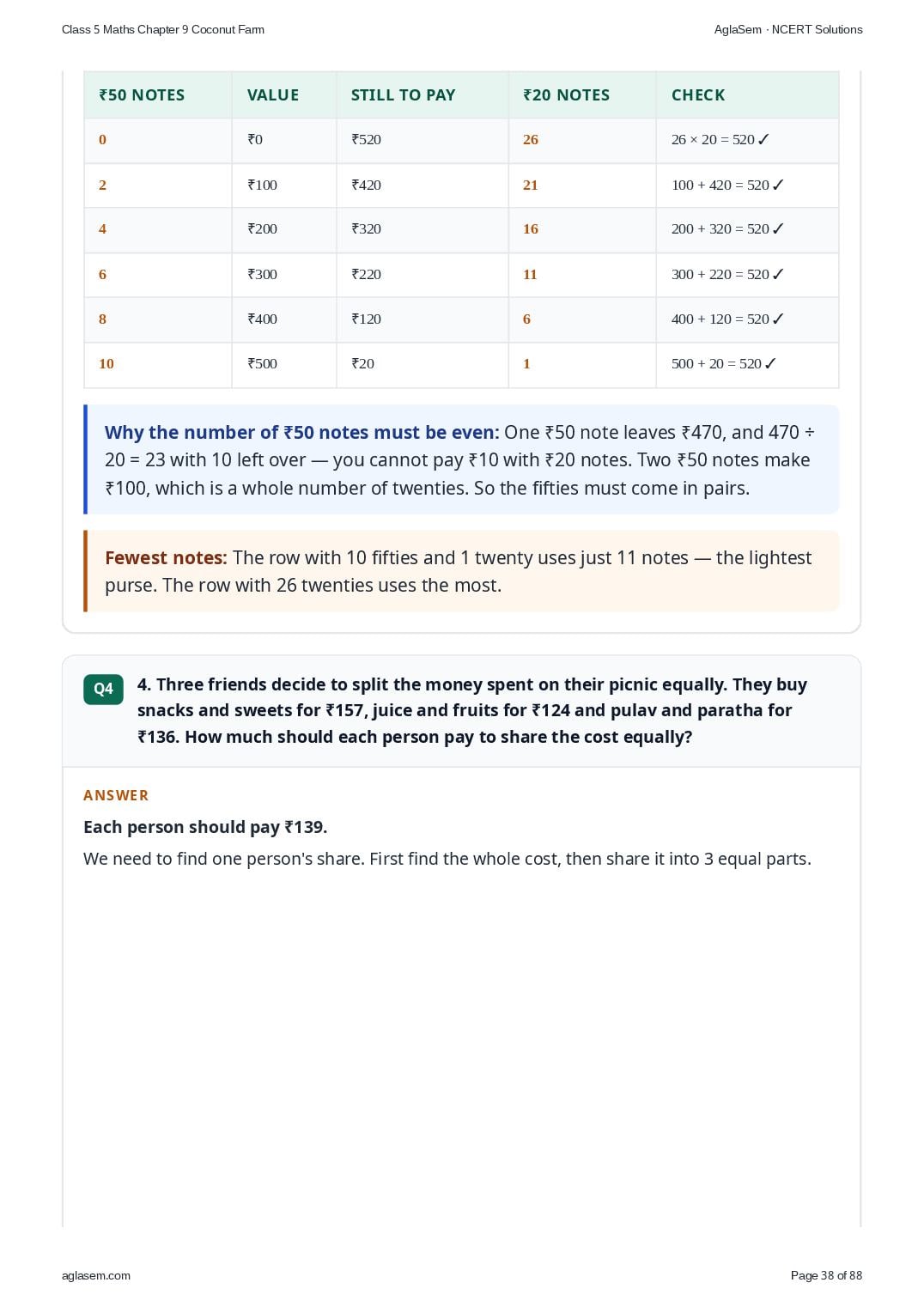
- 3. Sofia has only ₹50 and ₹20 notes. She needs to pay ₹520 using these notes. How many ₹50 and ₹20 notes does she need to make ₹520? Find out the different possible combinations.
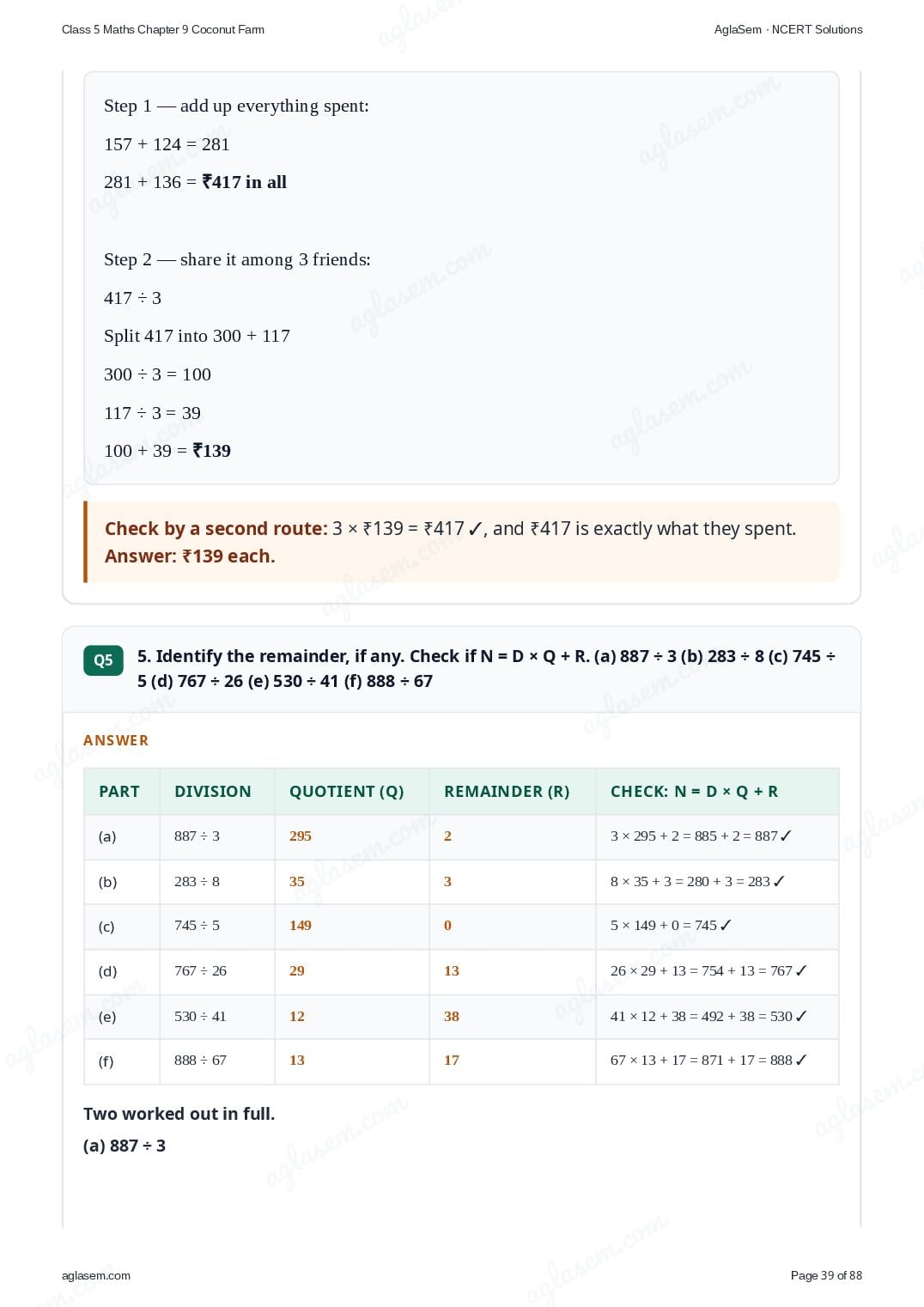
- 4. Three friends decide to split the money spent on their picnic equally. They buy snacks and sweets for ₹157, juice and fruits for ₹124 and pulav and paratha for ₹136. How much should each person pay to share the cost equally?
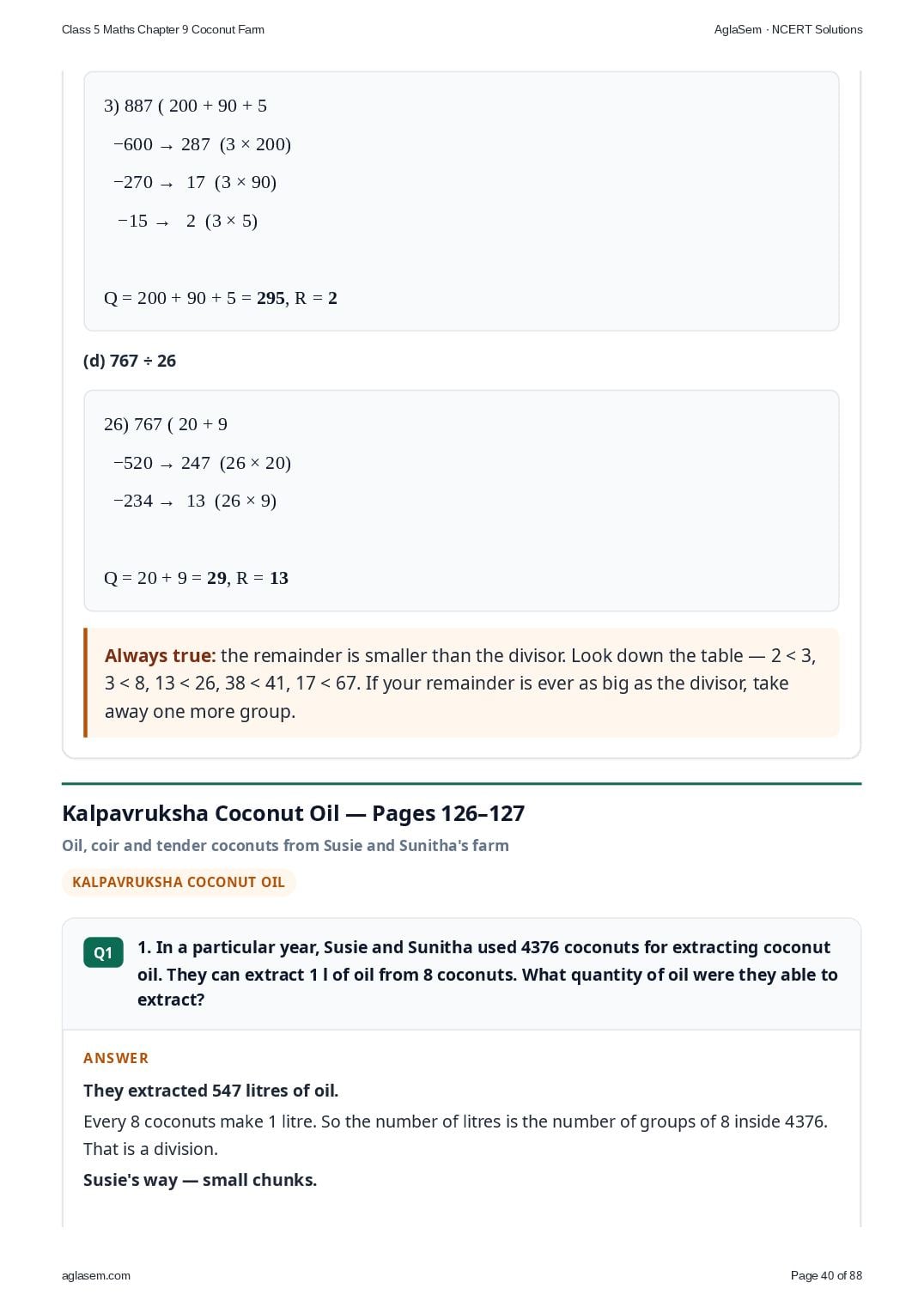
- 5. Identify the remainder, if any. Check if N = D × Q + R. (a) 887 ÷ 3 (b) 283 ÷ 8 (c) 745 ÷ 5 (d) 767 ÷ 26 (e) 530 ÷ 41 (f) 888 ÷ 67
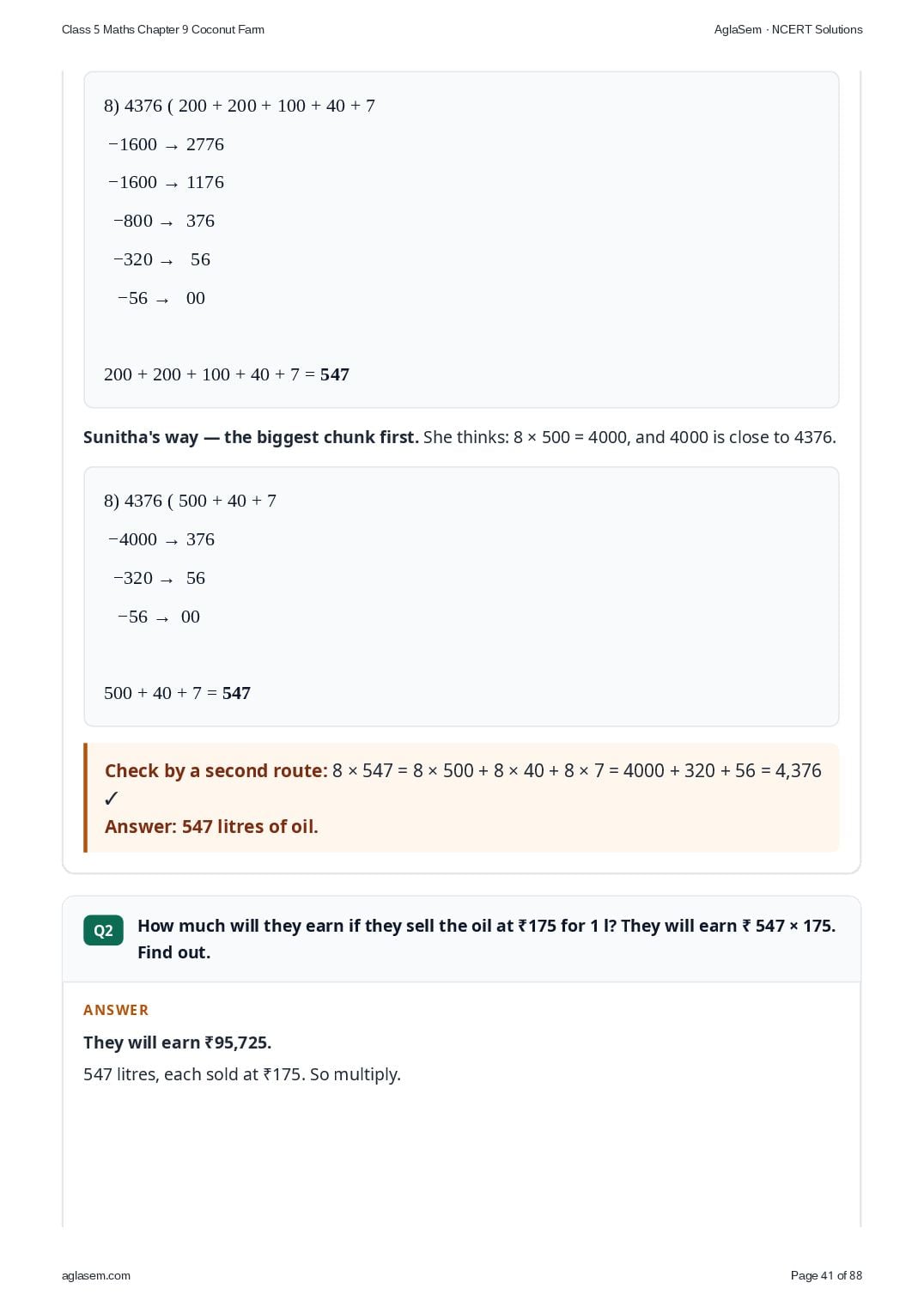
- 1. In a particular year, Susie and Sunitha used 4376 coconuts for extracting coconut oil. They can extract 1 l of oil from 8 coconuts. What quantity of oil were they able to extract?
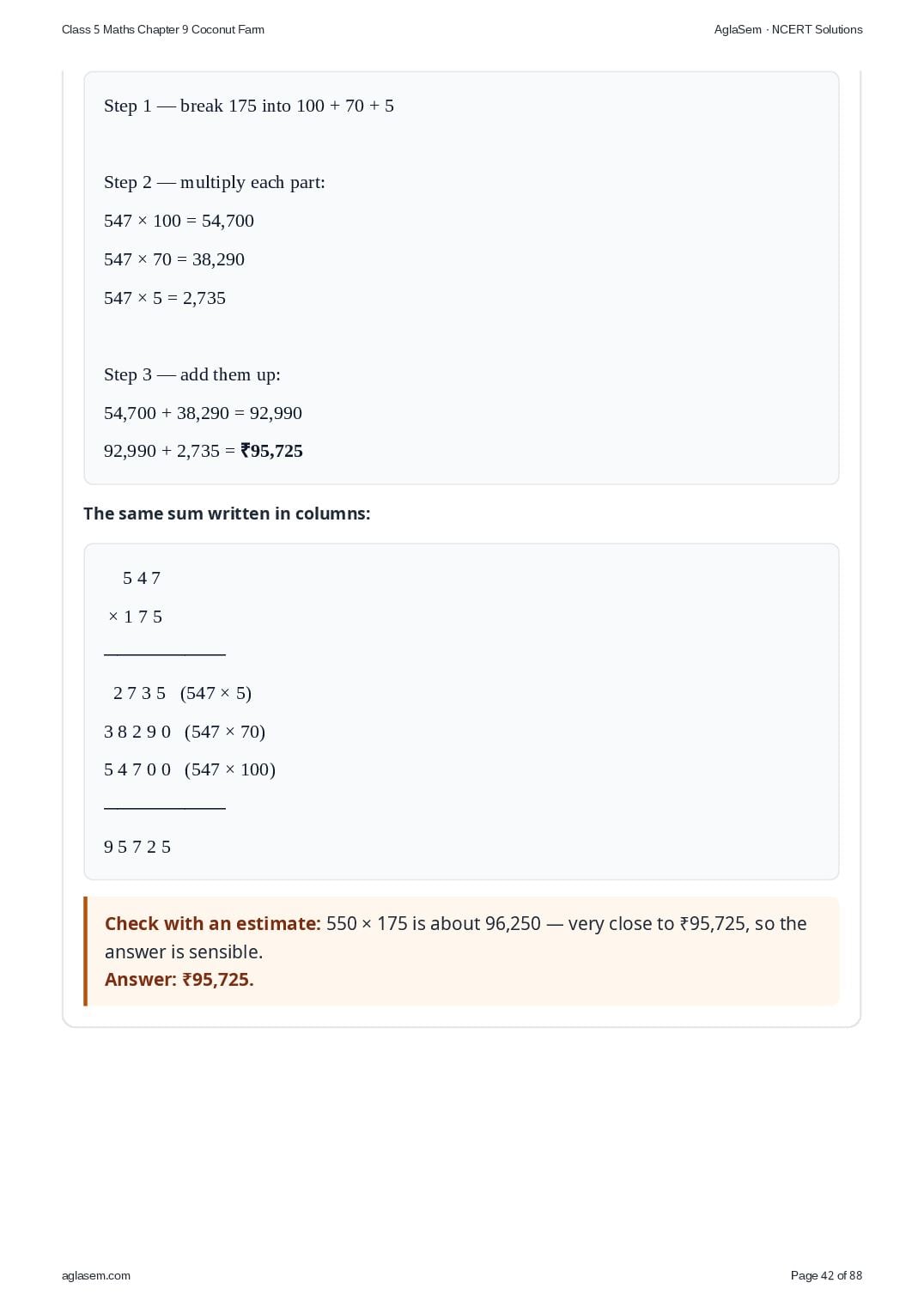
- How much will they earn if they sell the oil at ₹175 for 1 l? They will earn ₹ 547 × 175. Find out.
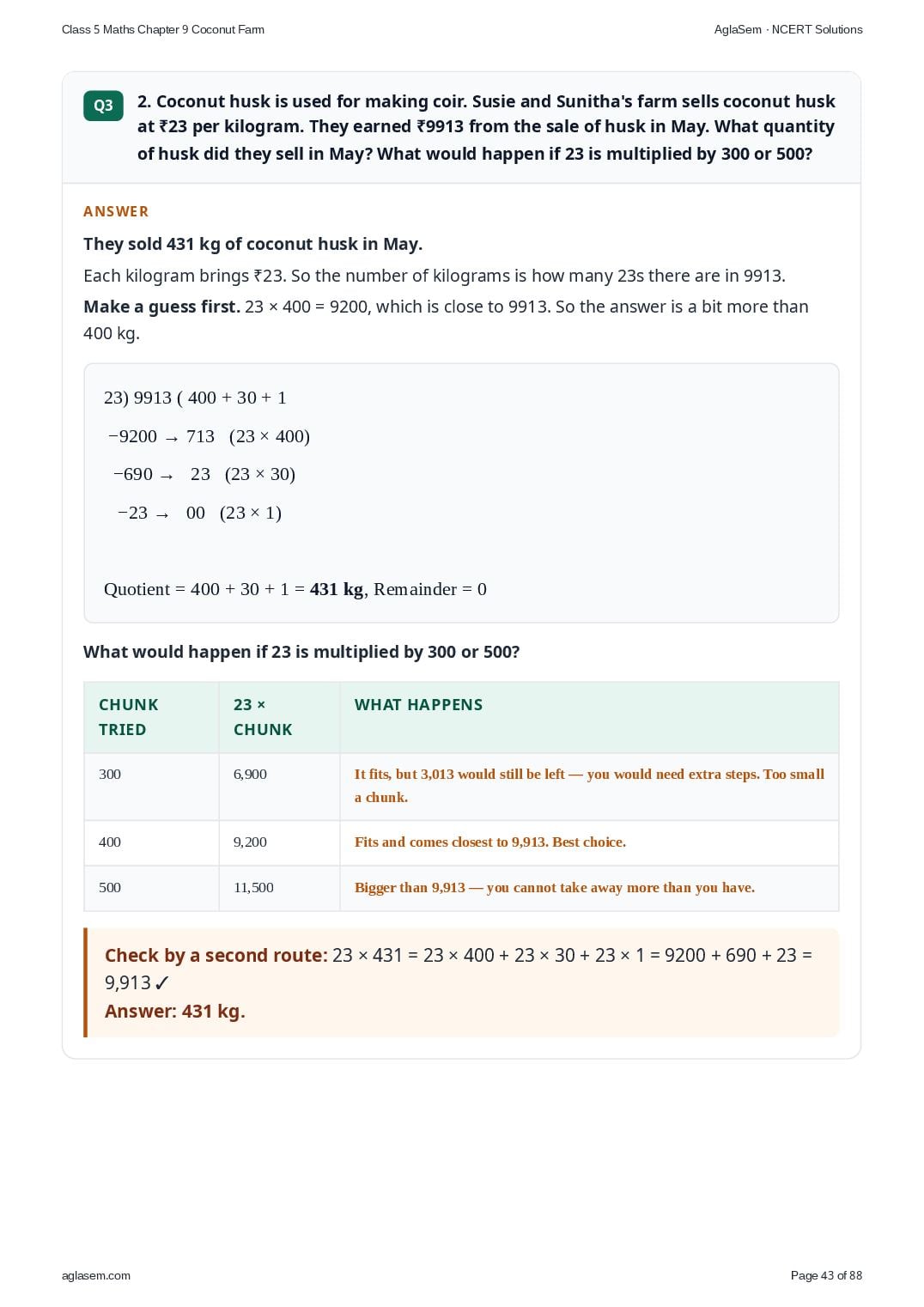
- 2. Coconut husk is used for making coir. Susie and Sunitha’s farm sells coconut husk at ₹23 per kilogram. They earned ₹9913 from the sale of husk in May. What quantity of husk did they sell in May? What would happen if 23 is multiplied by 300 or 500?
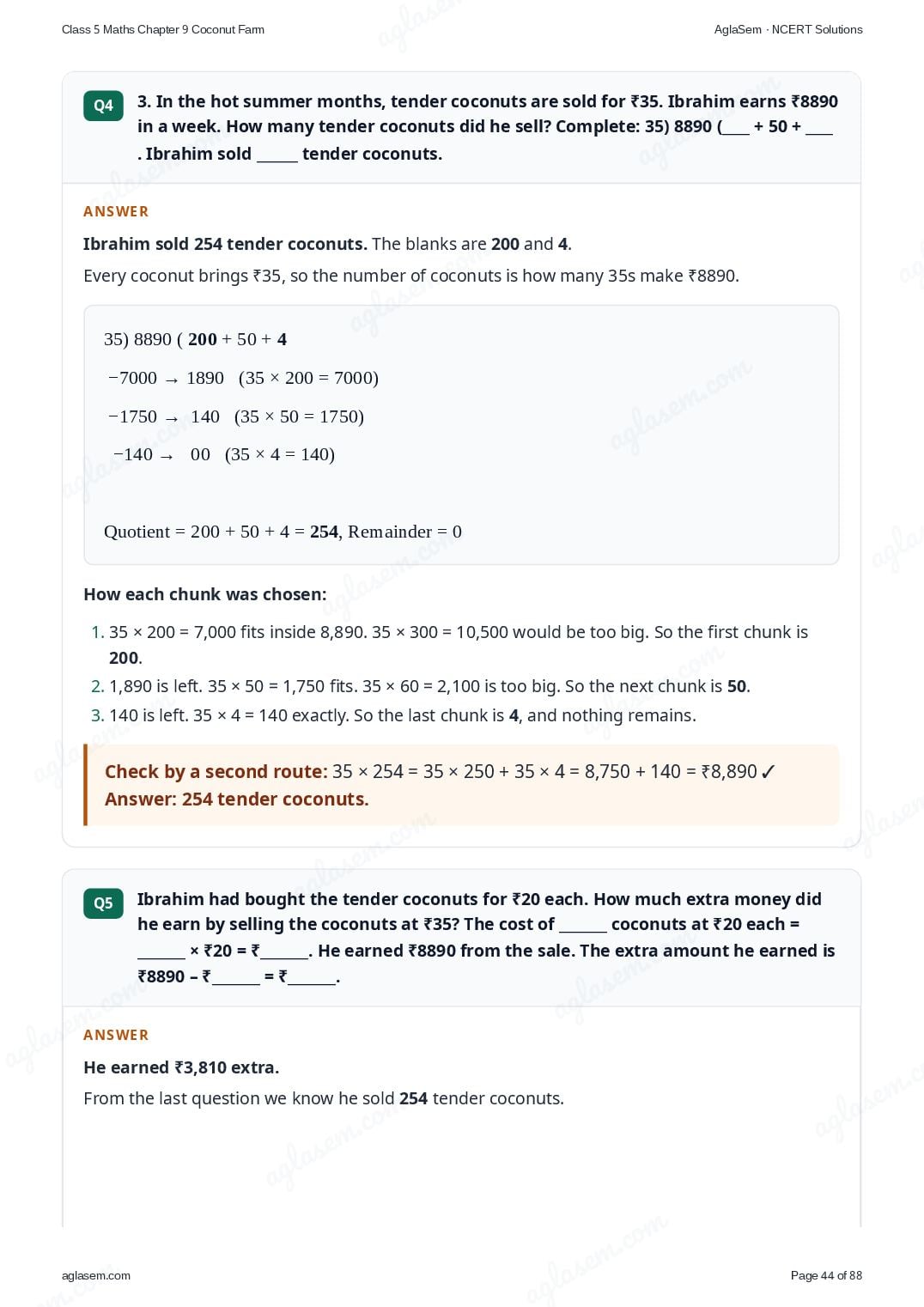
- 3. In the hot summer months, tender coconuts are sold for ₹35. Ibrahim earns ₹8890 in a week. How many tender coconuts did he sell? Complete: 35) 8890 (____ + 50 + ____ . Ibrahim sold ______ tender coconuts.
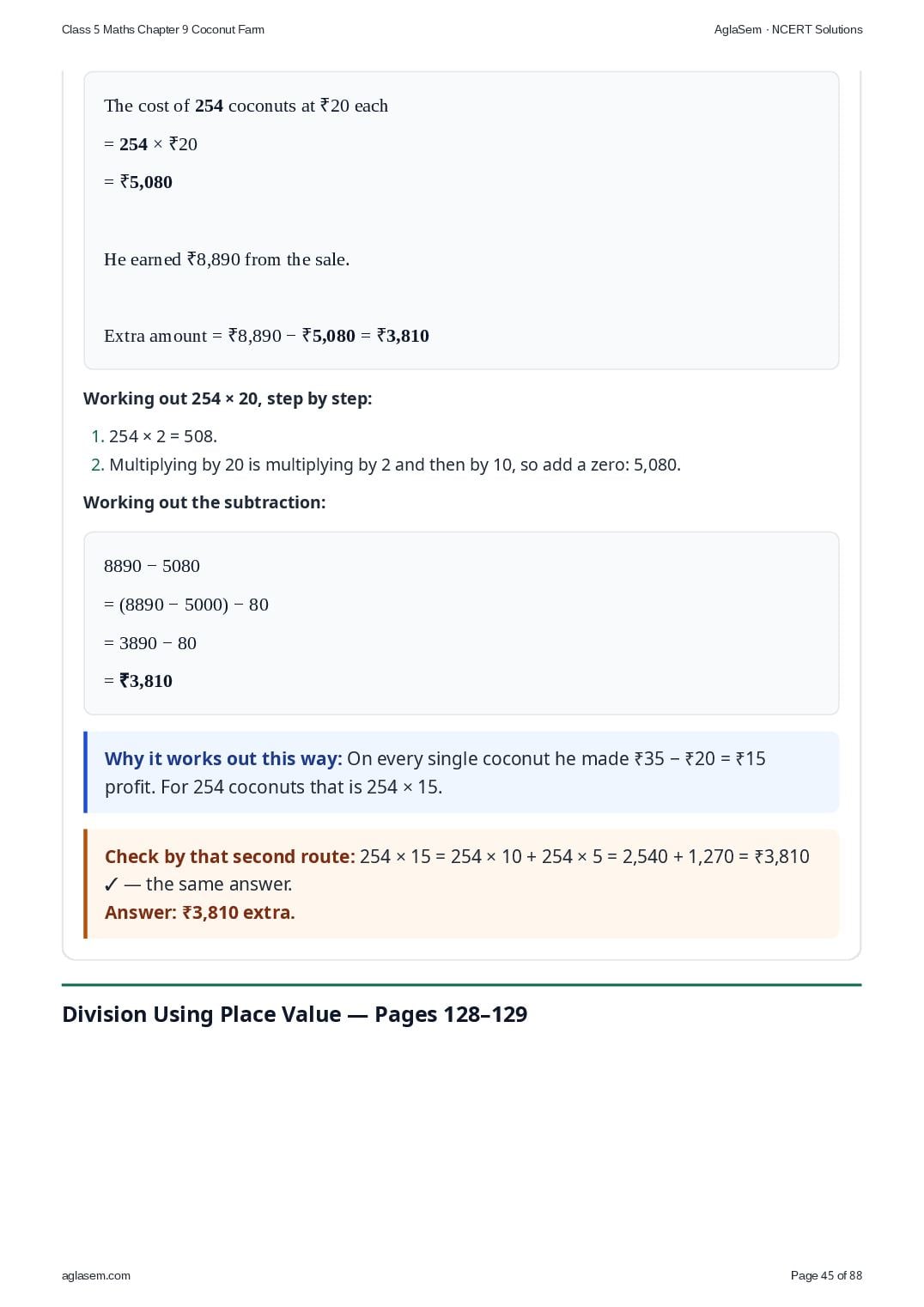
- Ibrahim had bought the tender coconuts for ₹20 each. How much extra money did he earn by selling the coconuts at ₹35? The cost of _______ coconuts at ₹20 each = _______ × ₹20 = ₹_______. He earned ₹8890 from the sale. The extra amount he earned is ₹8890 – ₹_______ = ₹_______.
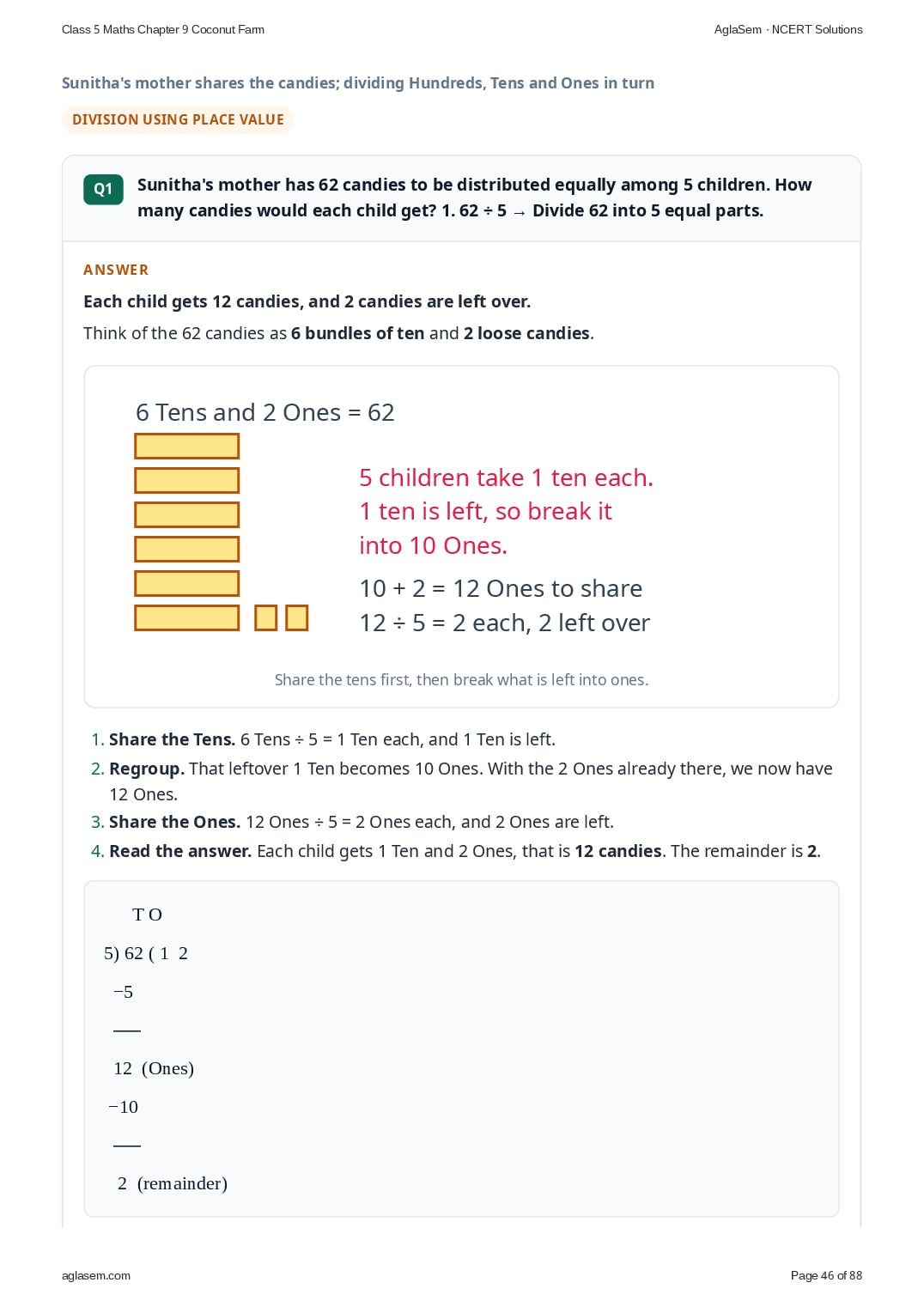
- Sunitha’s mother has 62 candies to be distributed equally among 5 children. How many candies would each child get? 1. 62 ÷ 5 → Divide 62 into 5 equal parts.
- 2. 75 ÷ 8 → Divide 75 into 8 equal parts. Can we divide this into 8 equal parts without breaking them? What can we do?
- 3. 324 ÷ 3 → Divide 324 into 3 equal parts. Why do we put a 0 here?
- 4. 136 ÷ 6 → Divide 136 into 6 equal parts.
- Can you tell just by looking at the divisor and dividend, how many digits the quotient would have? Look at the problems above and find this out. Explain your thoughts.
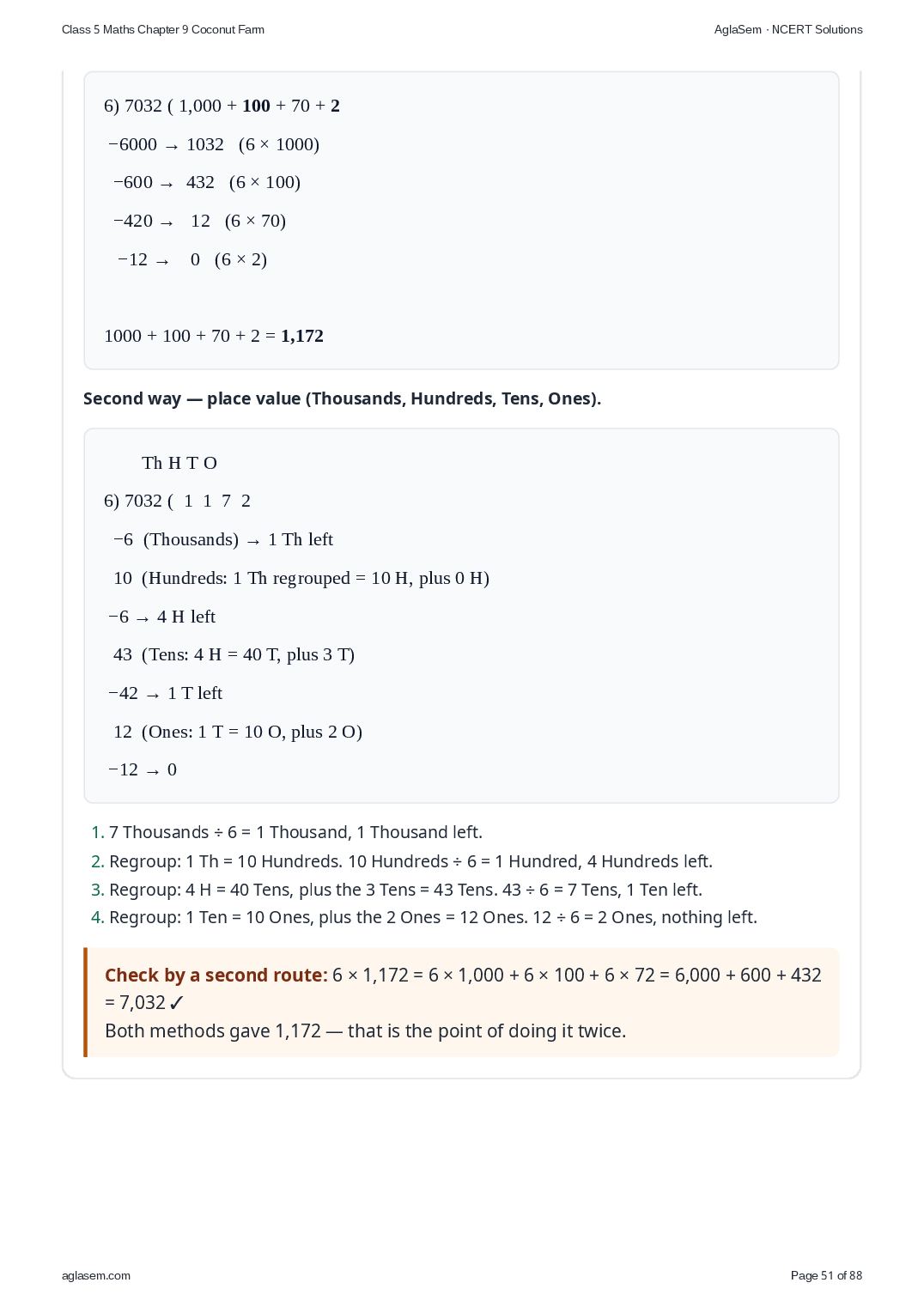
- (a) 7,032 ÷ 6 — complete both solutions: 6) 7,032 (1,000 + ____ + 70 + ____ , and the place value method.
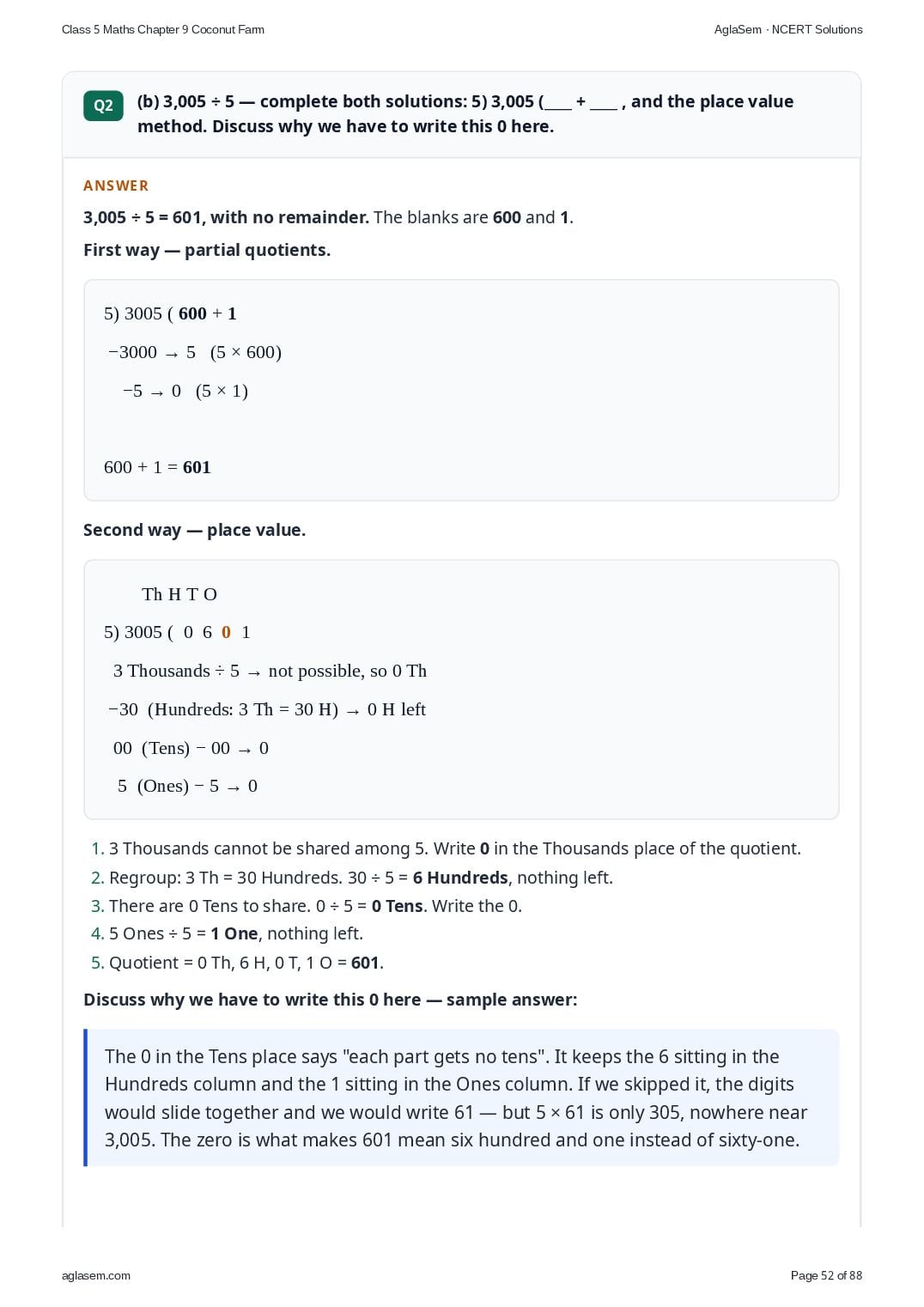
- (b) 3,005 ÷ 5 — complete both solutions: 5) 3,005 (____ + ____ , and the place value method. Discuss why we have to write this 0 here.
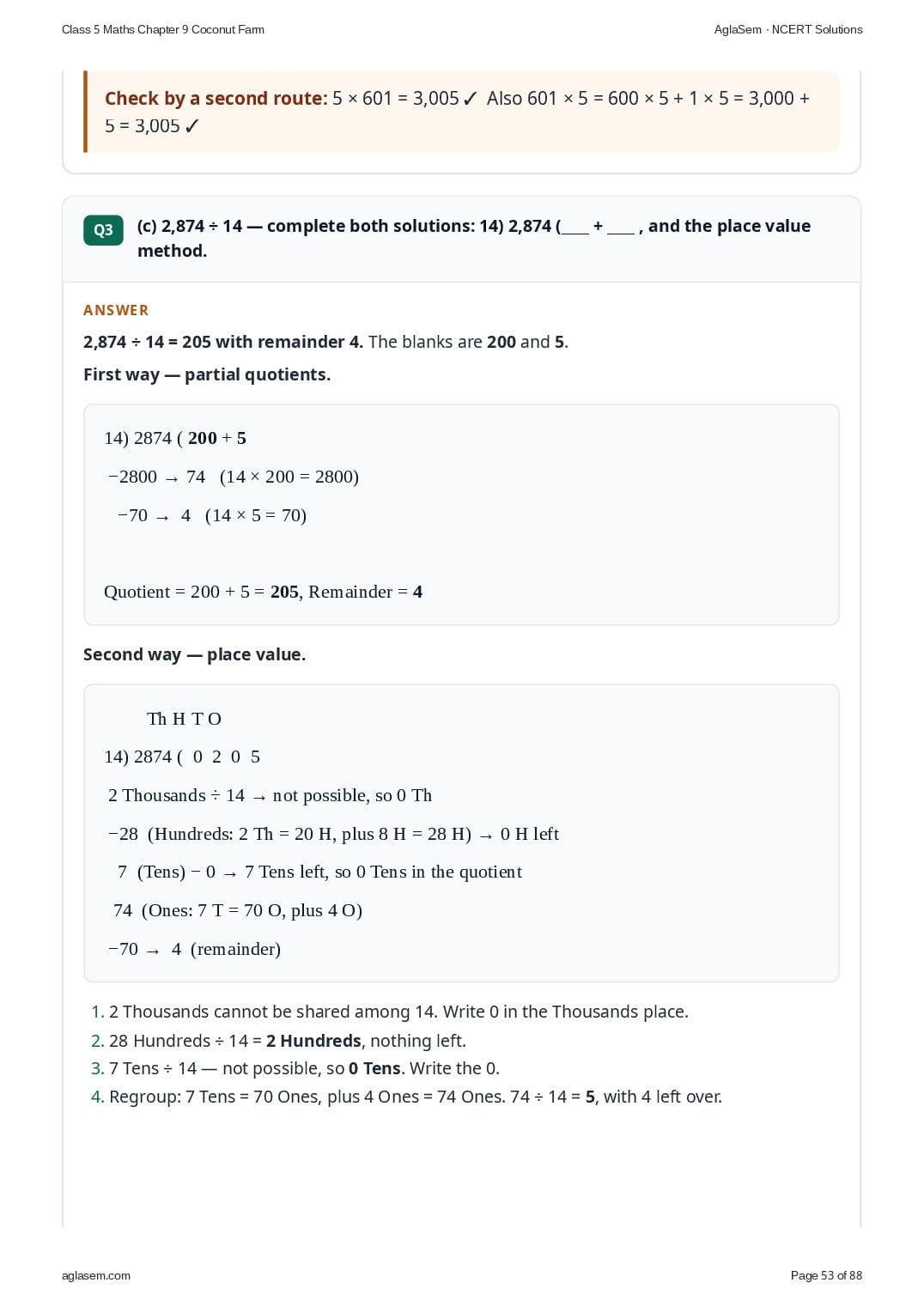
- (c) 2,874 ÷ 14 — complete both solutions: 14) 2,874 (____ + ____ , and the place value method.
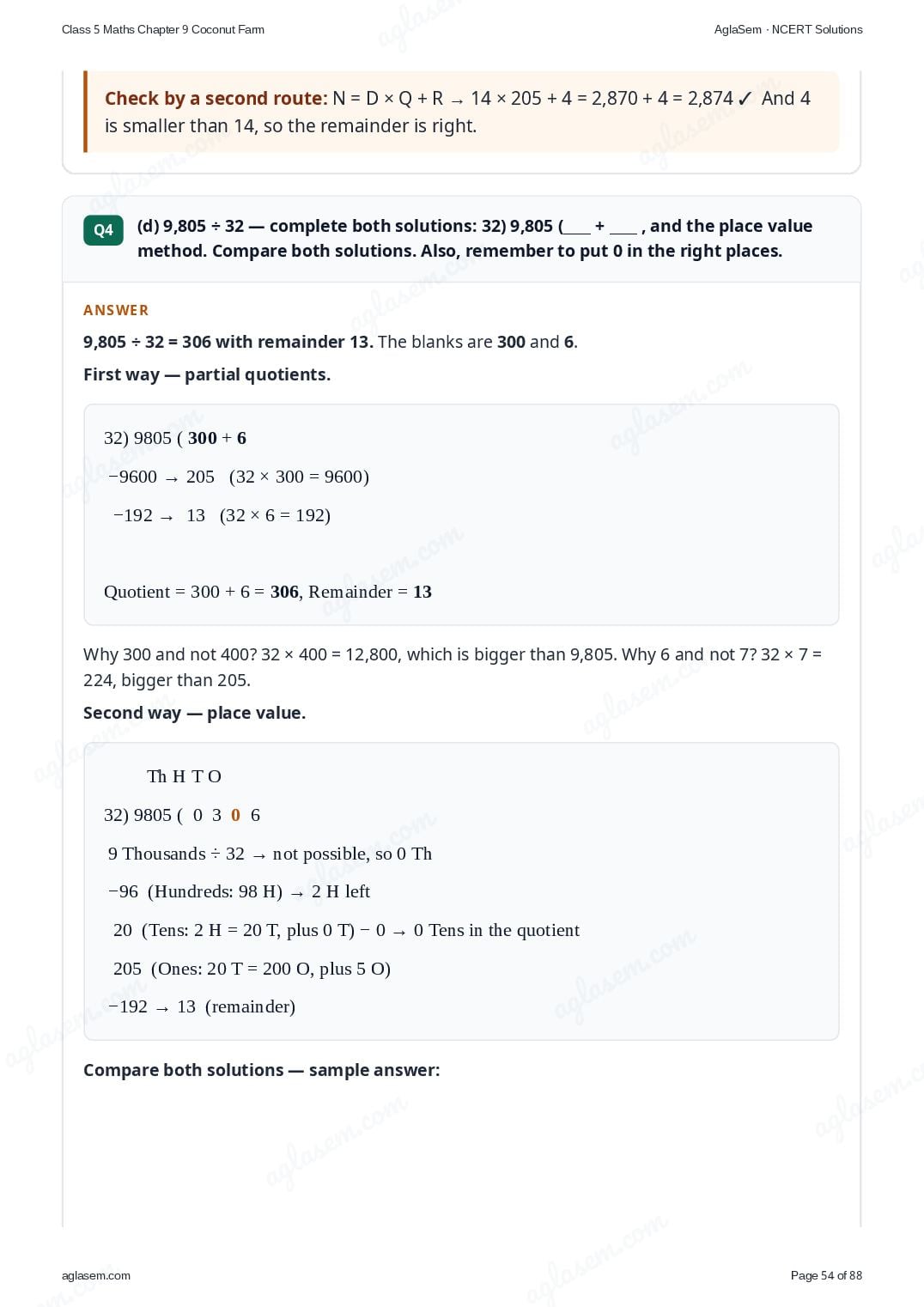
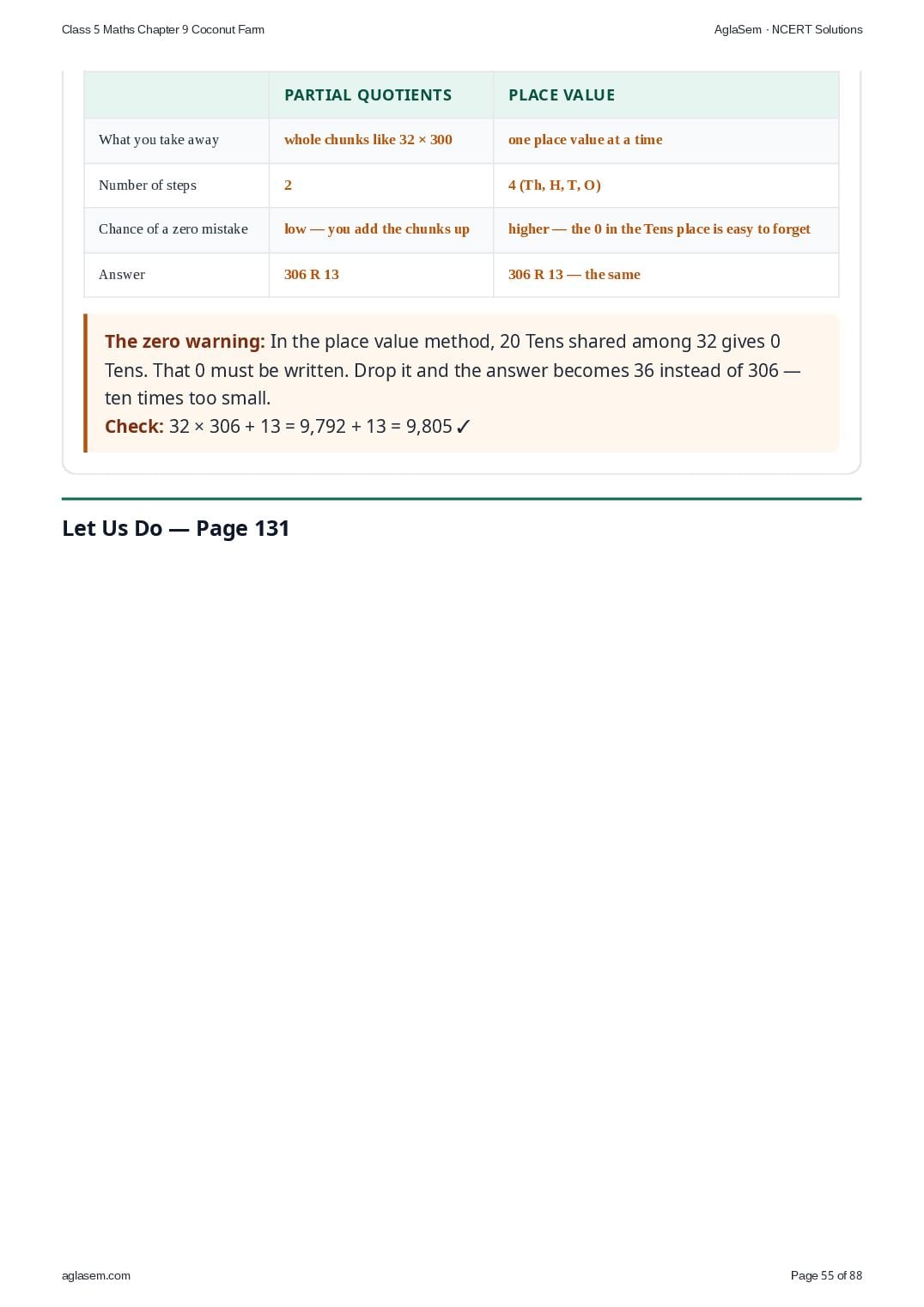
- (d) 9,805 ÷ 32 — complete both solutions: 32) 9,805 (____ + ____ , and the place value method. Compare both solutions. Also, remember to put 0 in the right places.
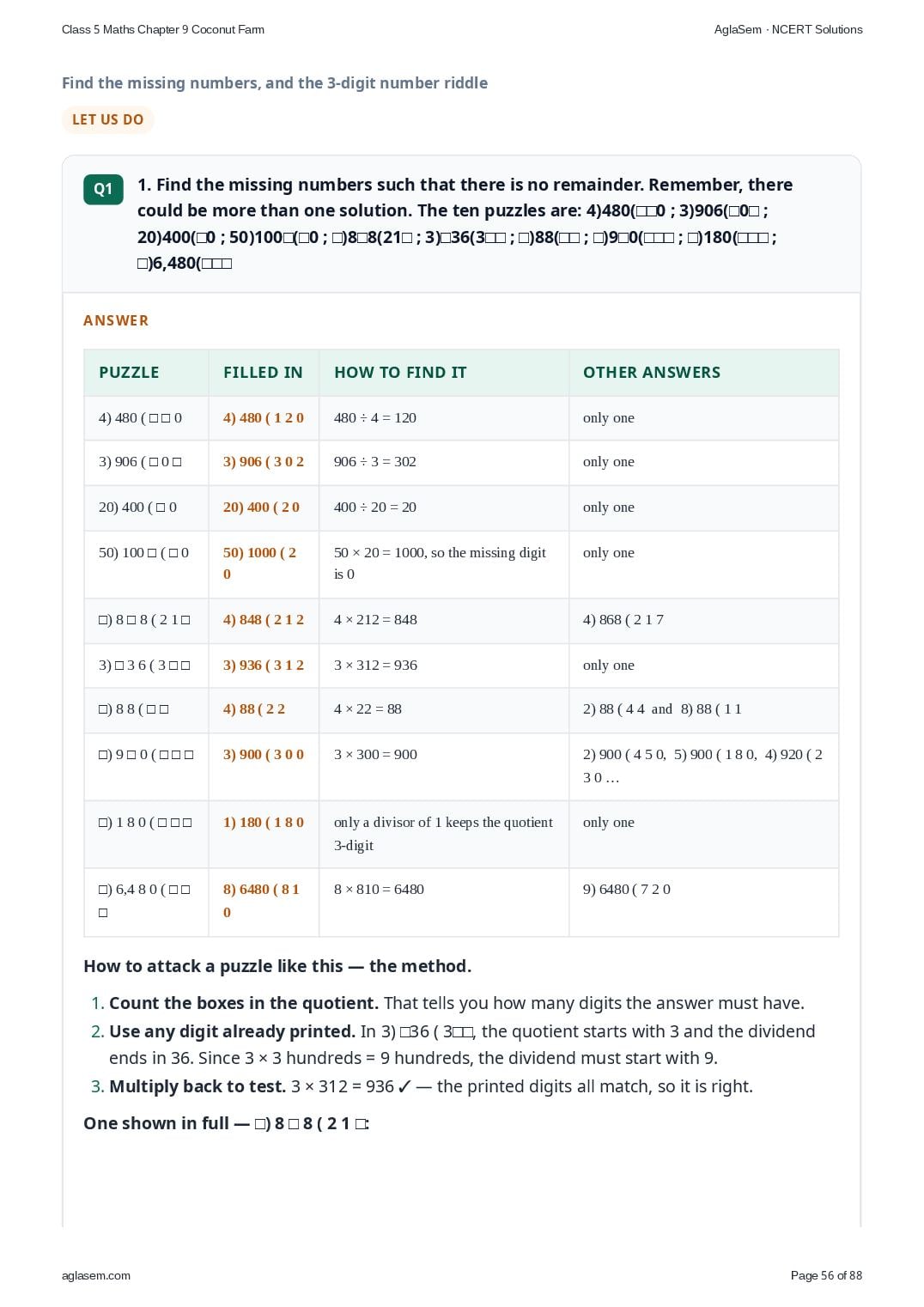
- 1. Find the missing numbers such that there is no remainder. Remember, there could be more than one solution. The ten puzzles are: 4)480(□□0 ; 3)906(□0□ ; 20)400(□0 ; 50)100□(□0 ; □)8□8(21□ ; 3)□36(3□□ ; □)88(□□ ; □)9□0(□□□ ; □)180(□□□ ; □)6,480(□□□
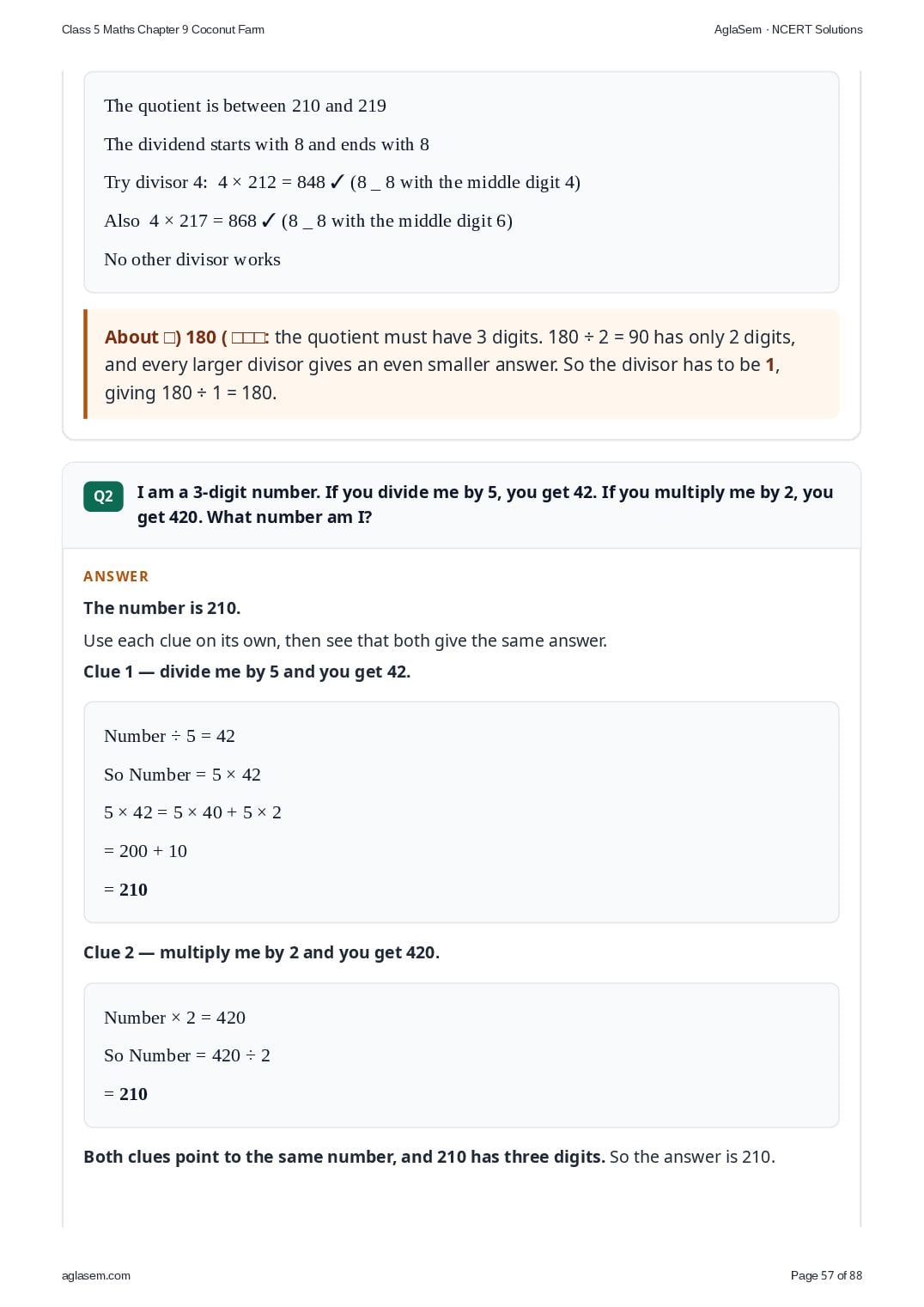
- I am a 3-digit number. If you divide me by 5, you get 42. If you multiply me by 2, you get 420. What number am I?
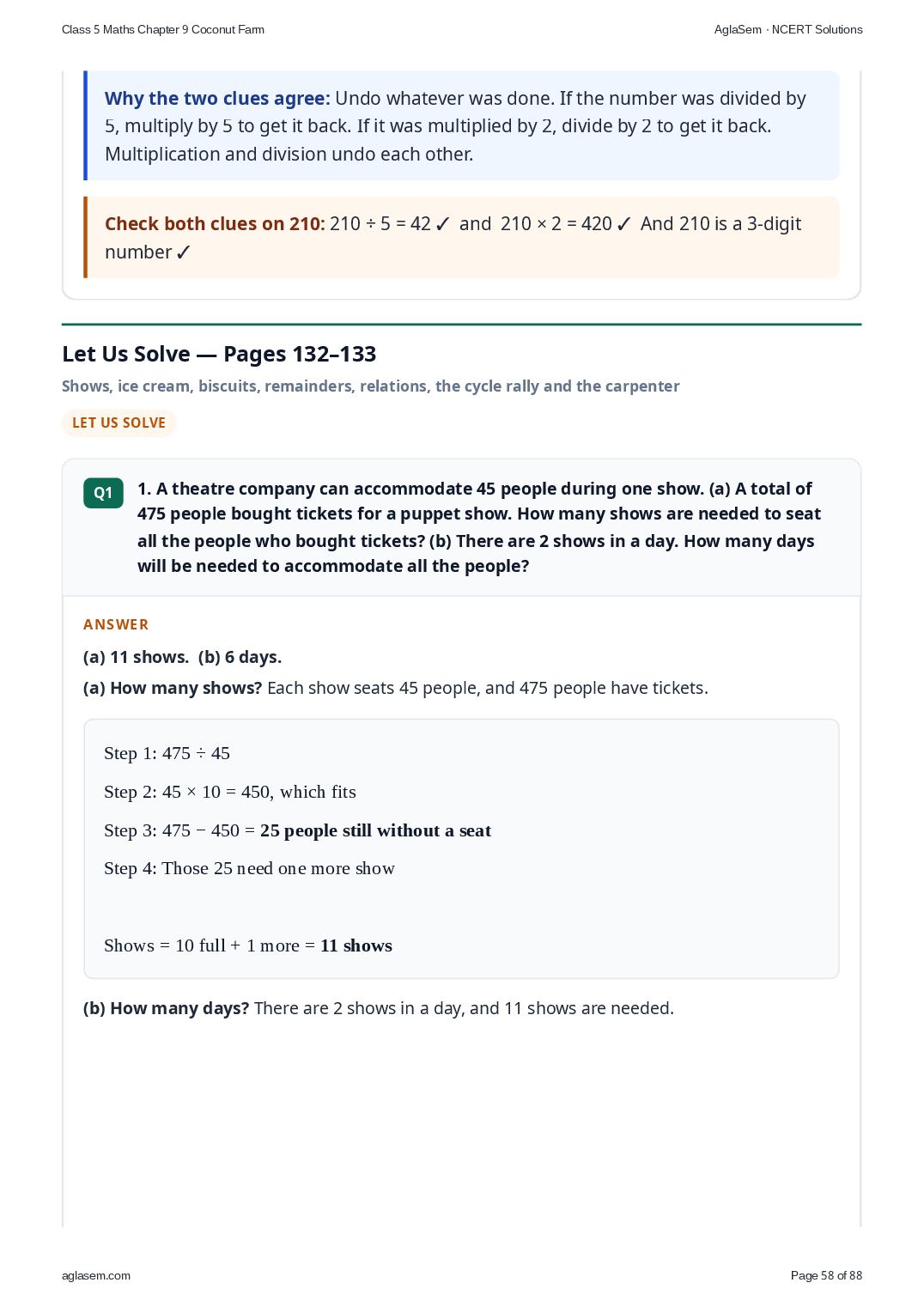
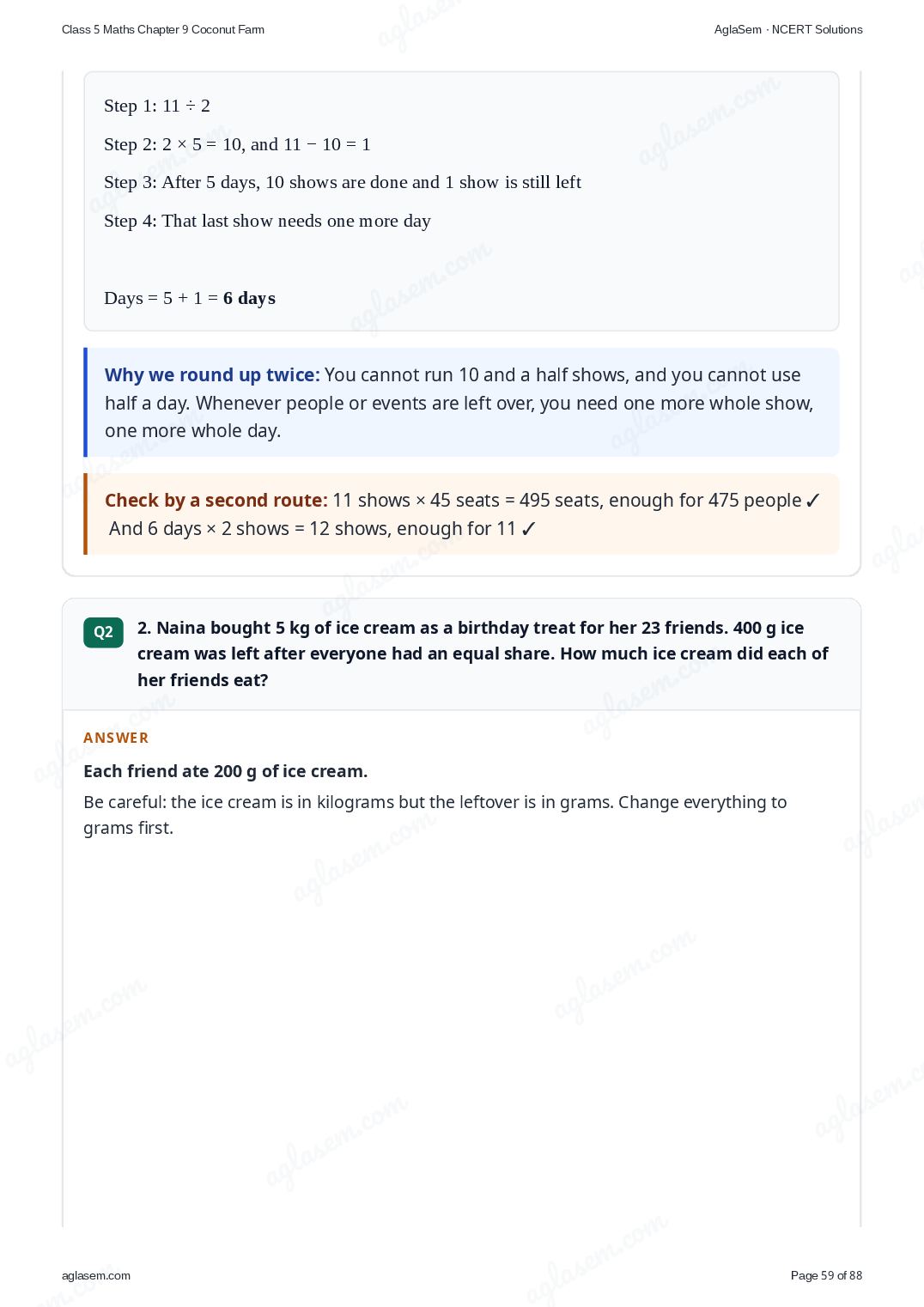
- 1. A theatre company can accommodate 45 people during one show. (a) A total of 475 people bought tickets for a puppet show. How many shows are needed to seat all the people who bought tickets? (b) There are 2 shows in a day. How many days will be needed to accommodate all the people?
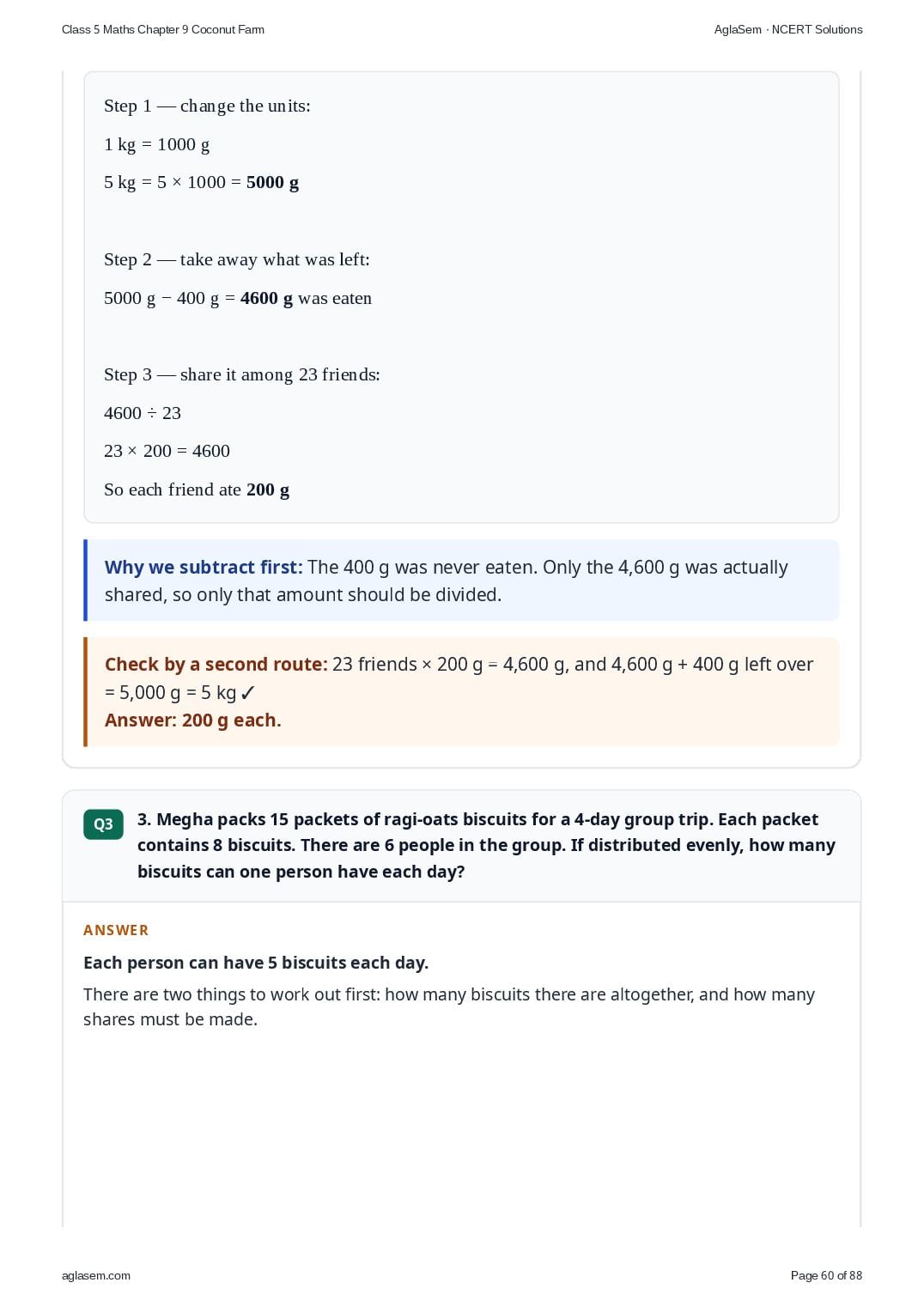
- 2. Naina bought 5 kg of ice cream as a birthday treat for her 23 friends. 400 g ice cream was left after everyone had an equal share. How much ice cream did each of her friends eat?
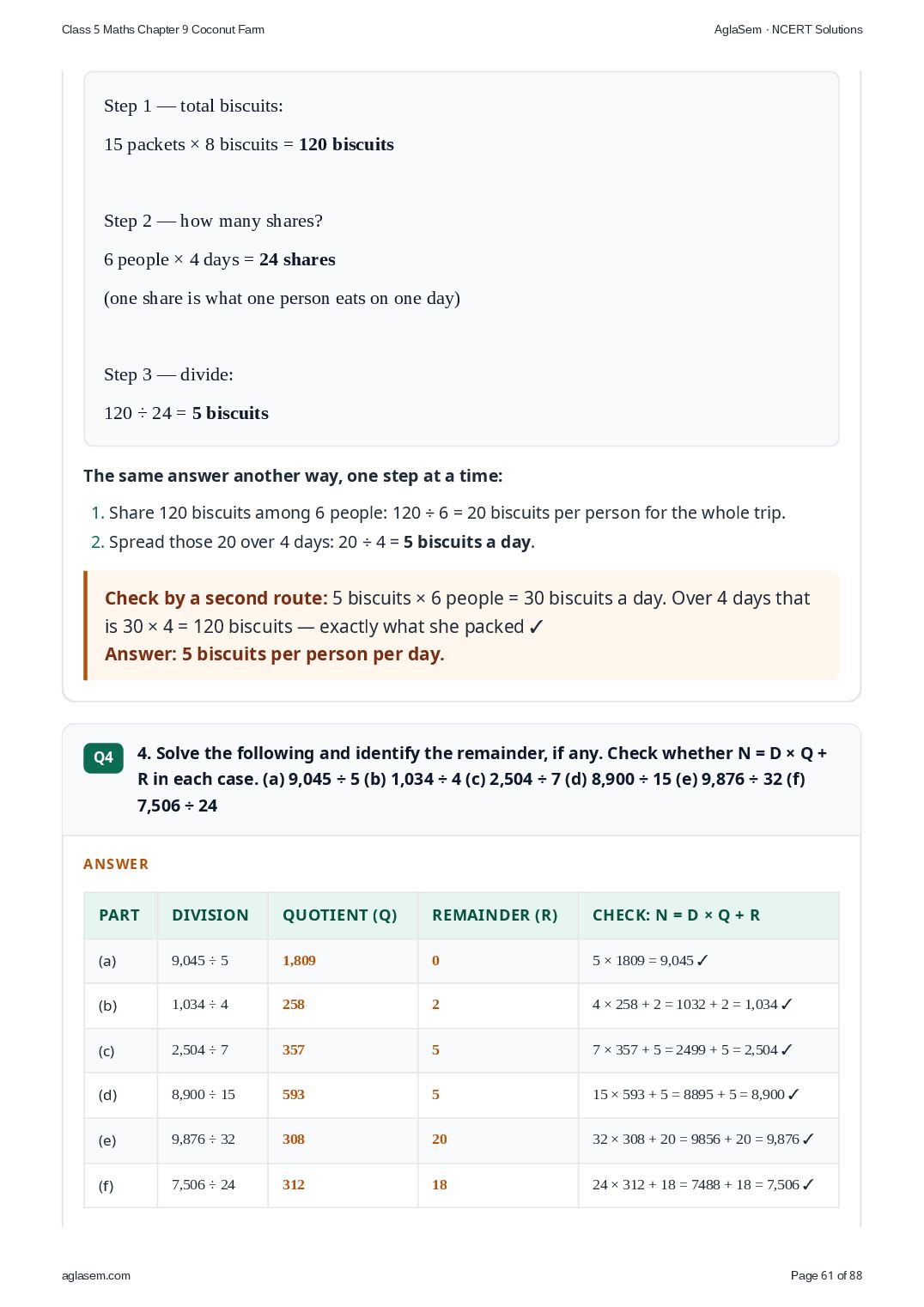
- 3. Megha packs 15 packets of ragi-oats biscuits for a 4-day group trip. Each packet contains 8 biscuits. There are 6 people in the group. If distributed evenly, how many biscuits can one person have each day?
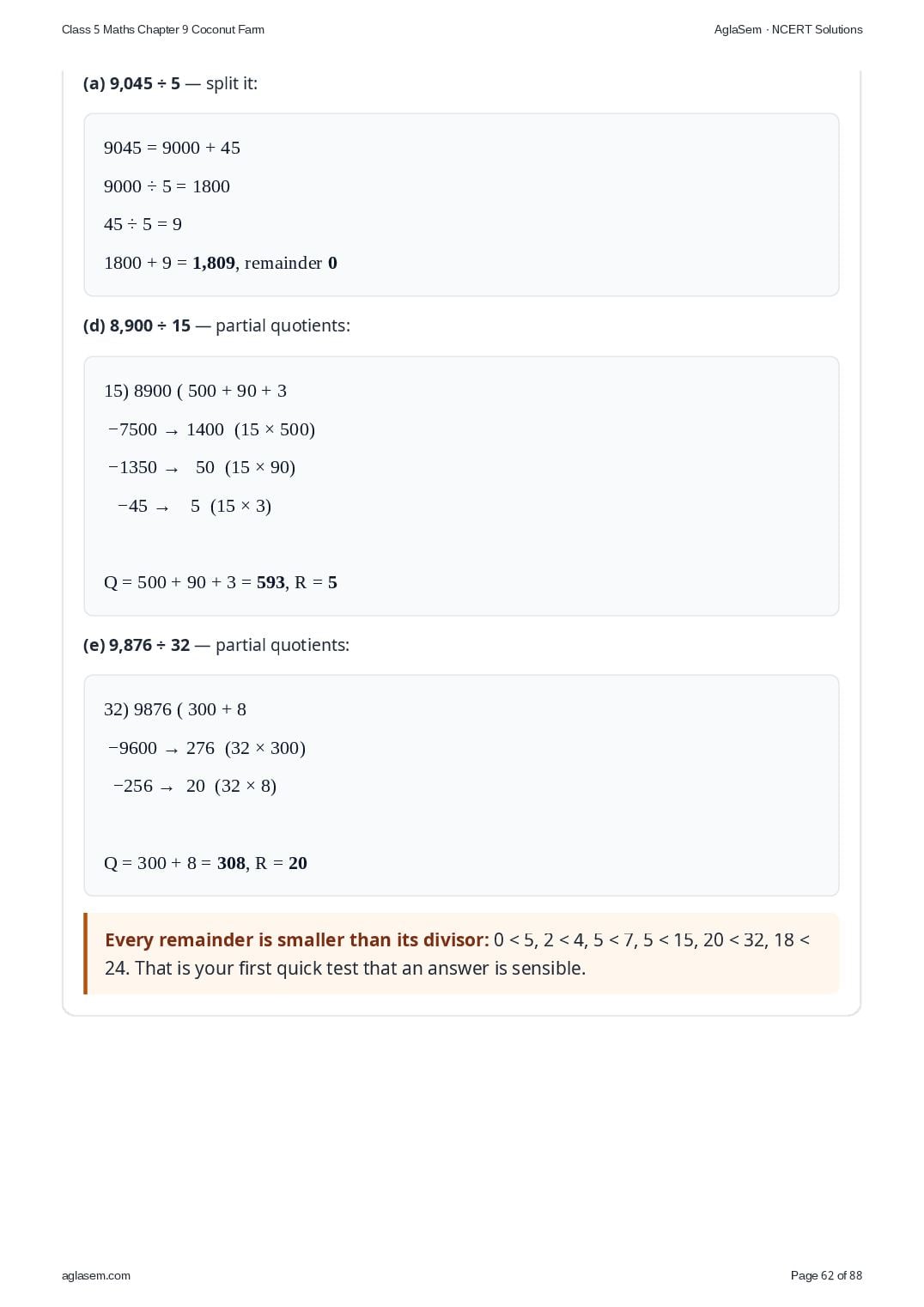
- 4. Solve the following and identify the remainder, if any. Check whether N = D × Q + R in each case. (a) 9,045 ÷ 5 (b) 1,034 ÷ 4 (c) 2,504 ÷ 7 (d) 8,900 ÷ 15 (e) 9,876 ÷ 32 (f) 7,506 ÷ 24
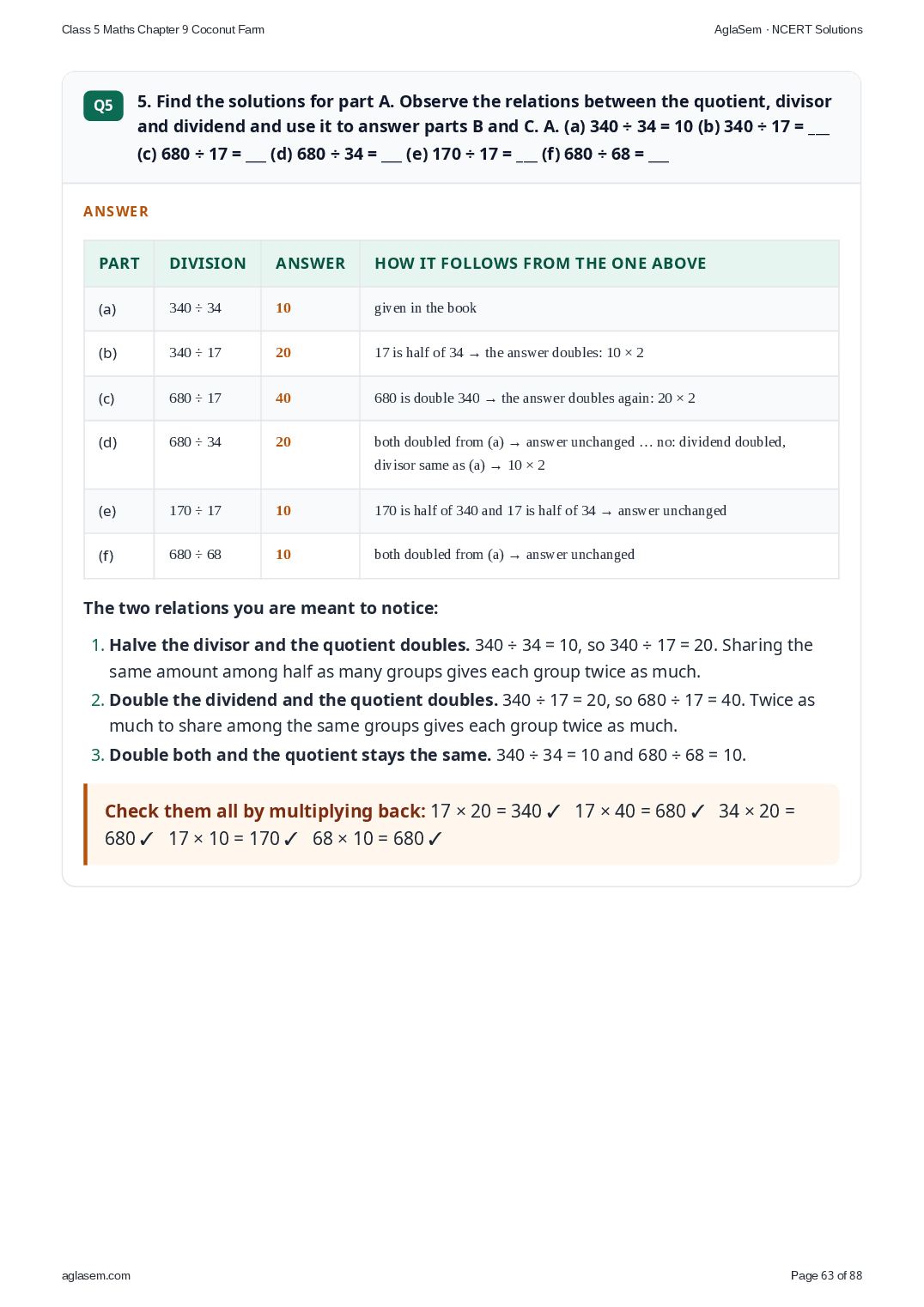
- 5. Find the solutions for part A. Observe the relations between the quotient, divisor and dividend and use it to answer parts B and C. A. (a) 340 ÷ 34 = 10 (b) 340 ÷ 17 = ___ (c) 680 ÷ 17 = ___ (d) 680 ÷ 34 = ___ (e) 170 ÷ 17 = ___ (f) 680 ÷ 68 = ___
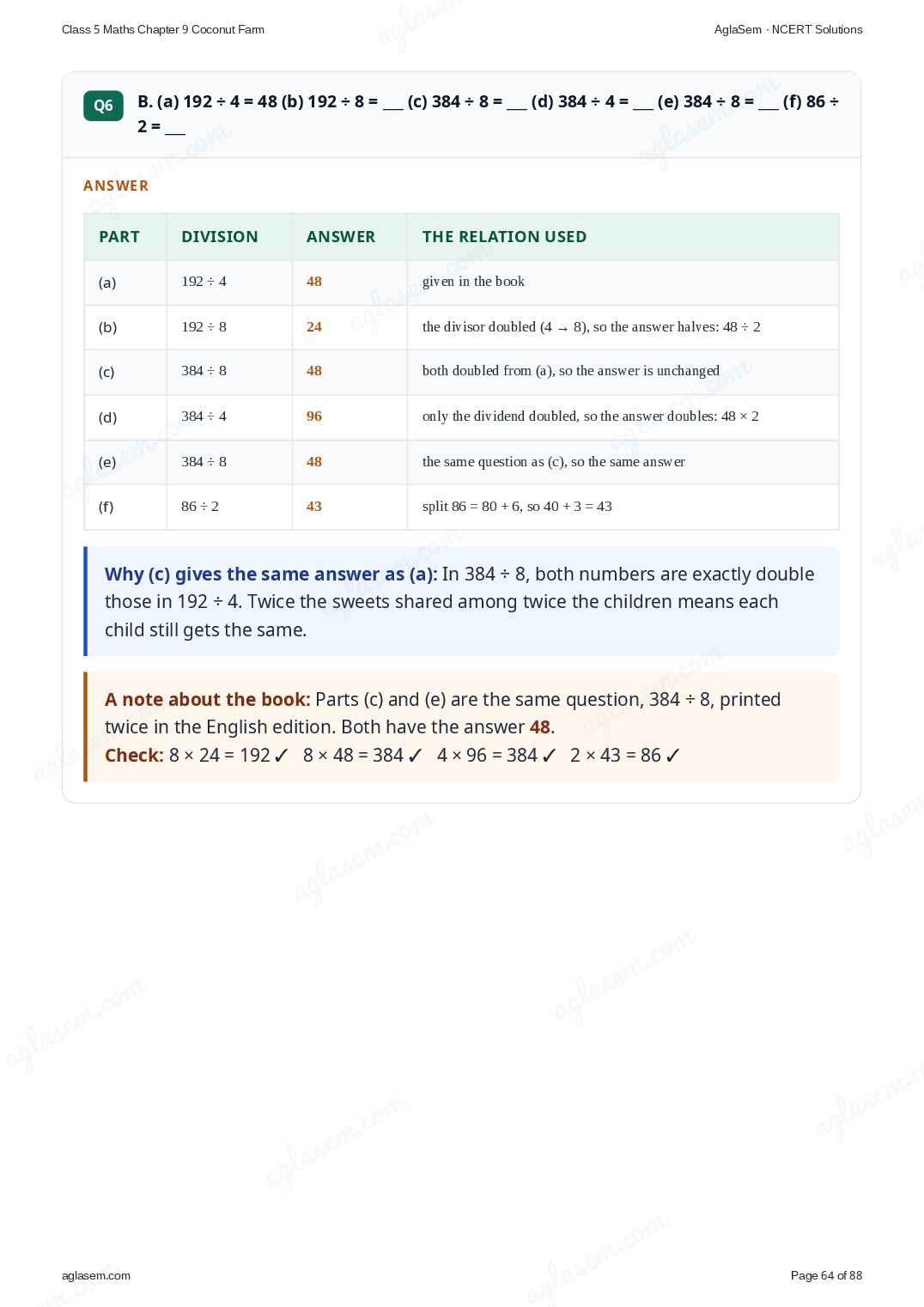
- B. (a) 192 ÷ 4 = 48 (b) 192 ÷ 8 = ___ (c) 384 ÷ 8 = ___ (d) 384 ÷ 4 = ___ (e) 384 ÷ 8 = ___ (f) 86 ÷ 2 = ___
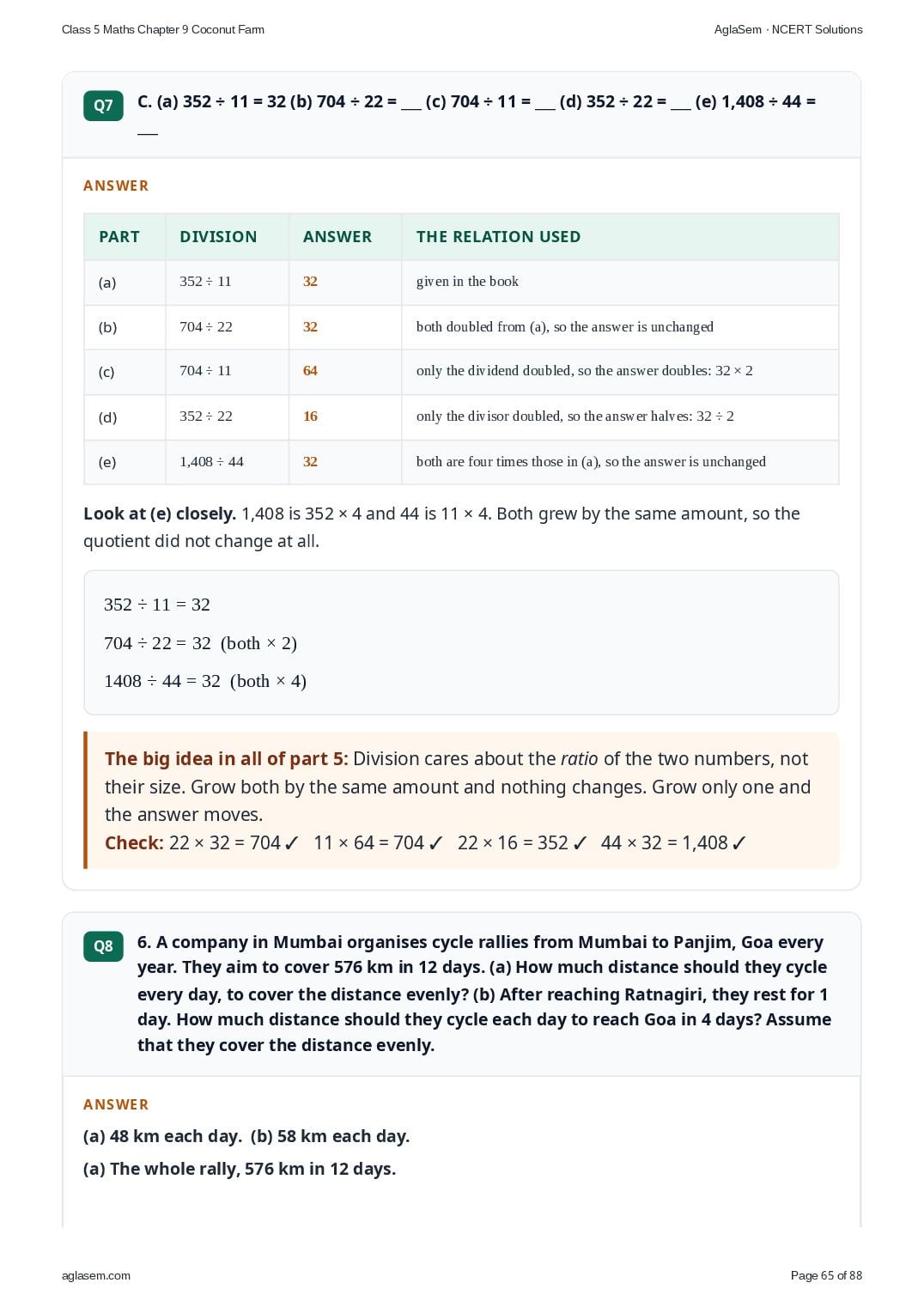
- C. (a) 352 ÷ 11 = 32 (b) 704 ÷ 22 = ___ (c) 704 ÷ 11 = ___ (d) 352 ÷ 22 = ___ (e) 1,408 ÷ 44 = ___
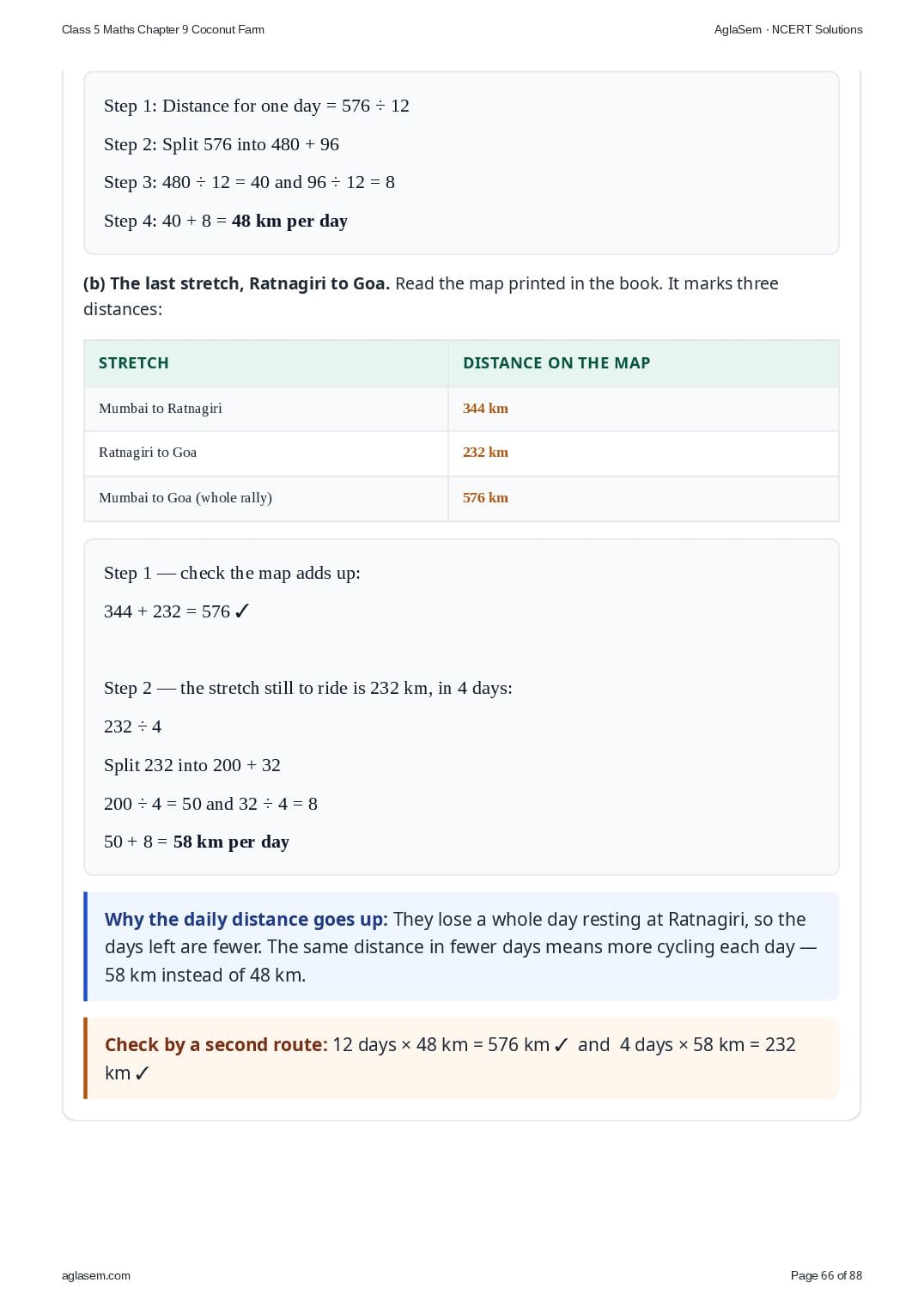
- 6. A company in Mumbai organises cycle rallies from Mumbai to Panjim, Goa every year. They aim to cover 576 km in 12 days. (a) How much distance should they cycle every day, to cover the distance evenly? (b) After reaching Ratnagiri, they rest for 1 day. How much distance should they cycle each day to reach Goa in 4 days? Assume that they cover the distance evenly.
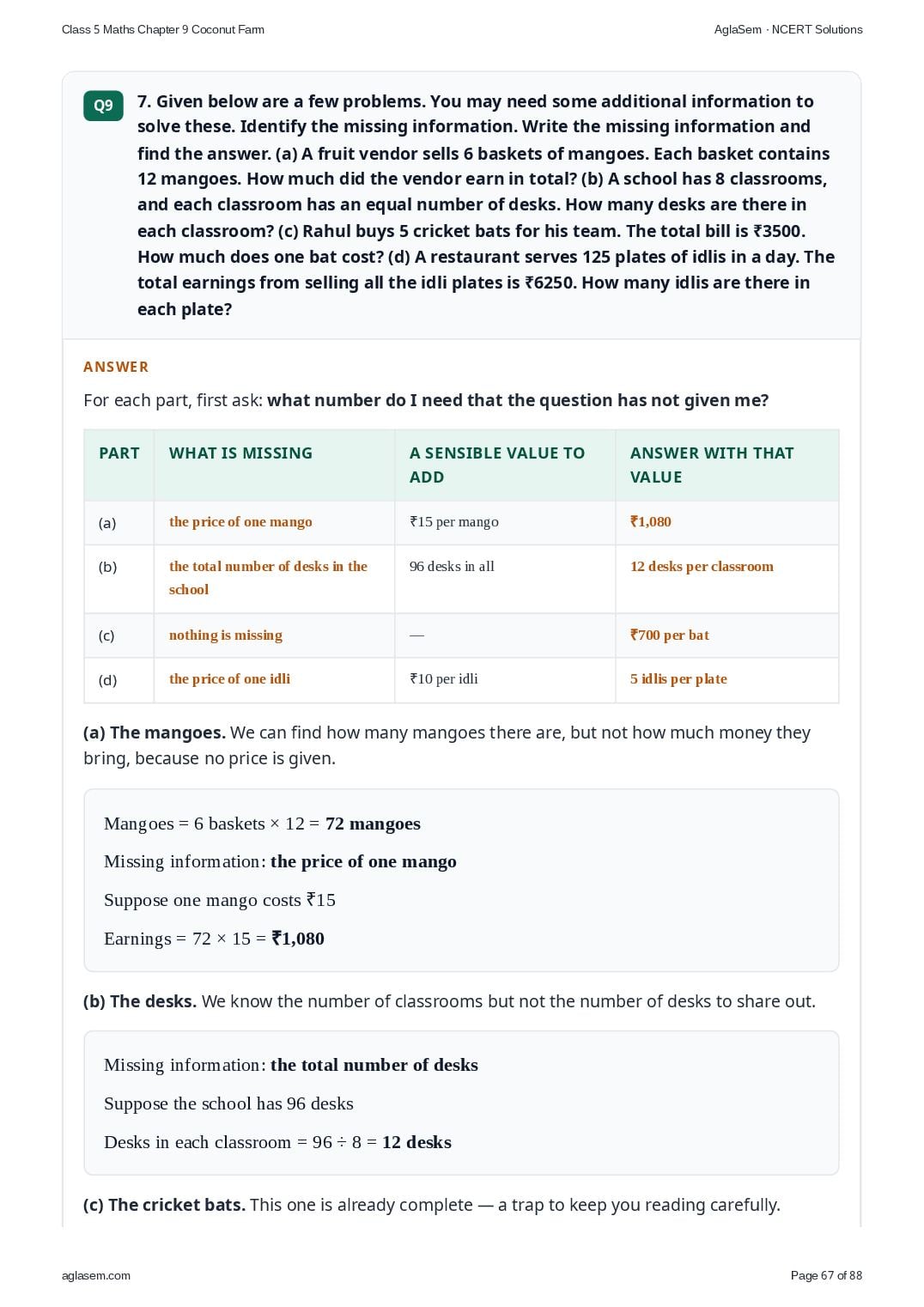
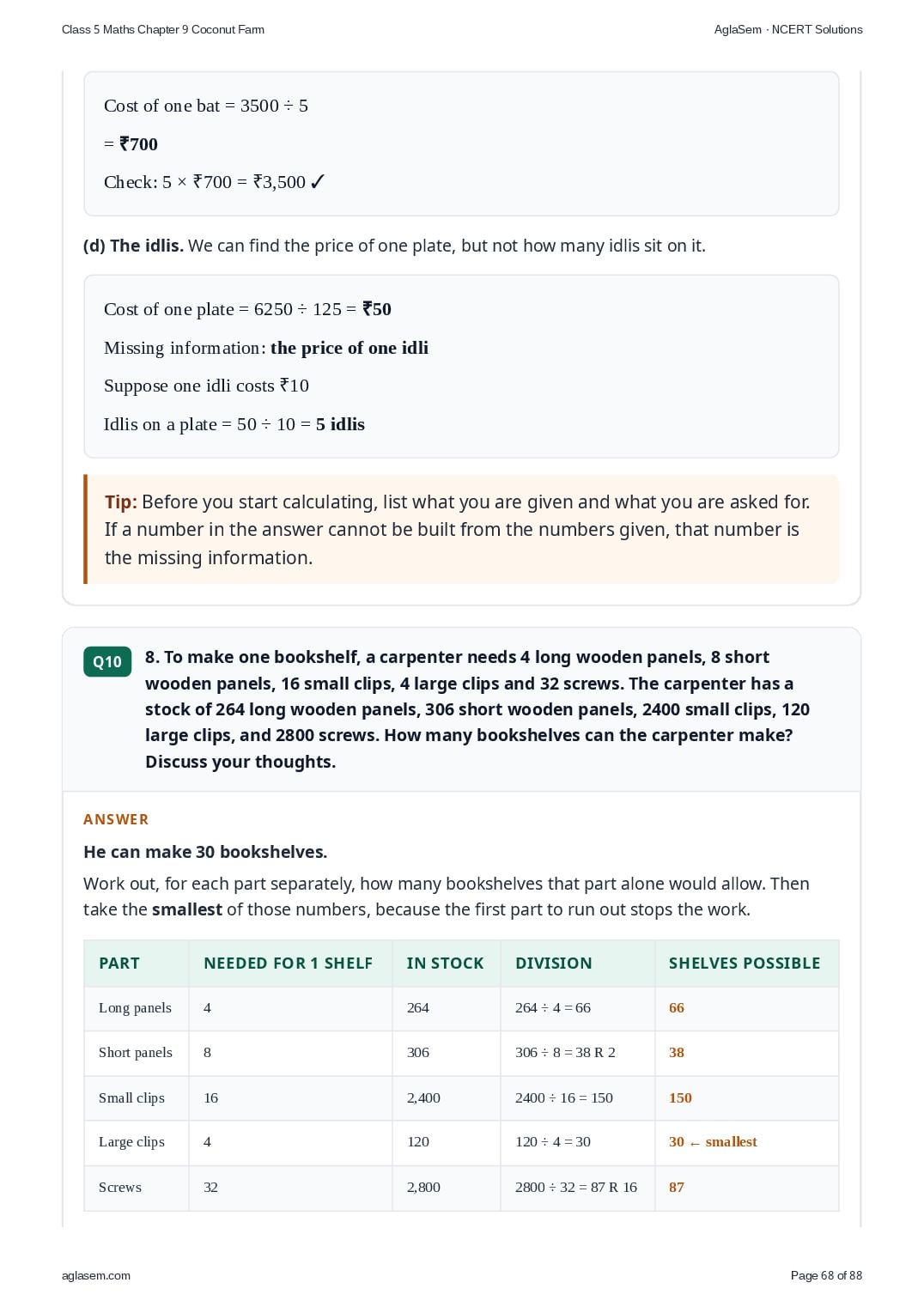
- 7. Given below are a few problems. You may need some additional information to solve these. Identify the missing information. Write the missing information and find the answer. (a) A fruit vendor sells 6 baskets of mangoes. Each basket contains 12 mangoes. How much did the vendor earn in total? (b) A school has 8 classrooms, and each classroom has an equal number of desks. How many desks are there in each classroom? (c) Rahul buys 5 cricket bats for his team. The total bill is ₹3500. How much does one bat cost? (d) A restaurant serves 125 plates of idlis in a day. The total earnings from selling all the idli plates is ₹6250. How many idlis are there in each plate?
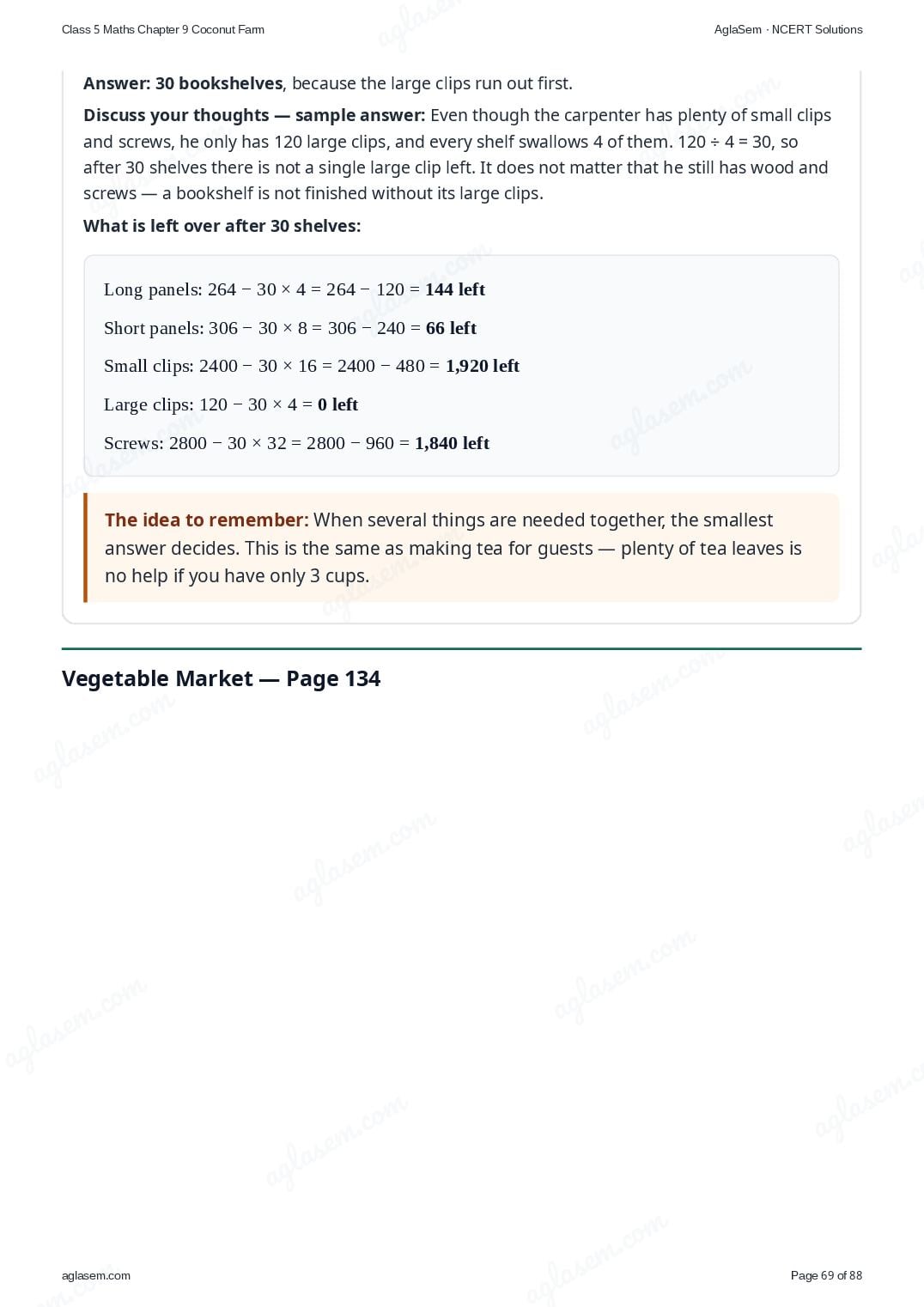
- 8. To make one bookshelf, a carpenter needs 4 long wooden panels, 8 short wooden panels, 16 small clips, 4 large clips and 32 screws. The carpenter has a stock of 264 long wooden panels, 306 short wooden panels, 2400 small clips, 120 large clips, and 2800 screws. How many bookshelves can the carpenter make? Discuss your thoughts.
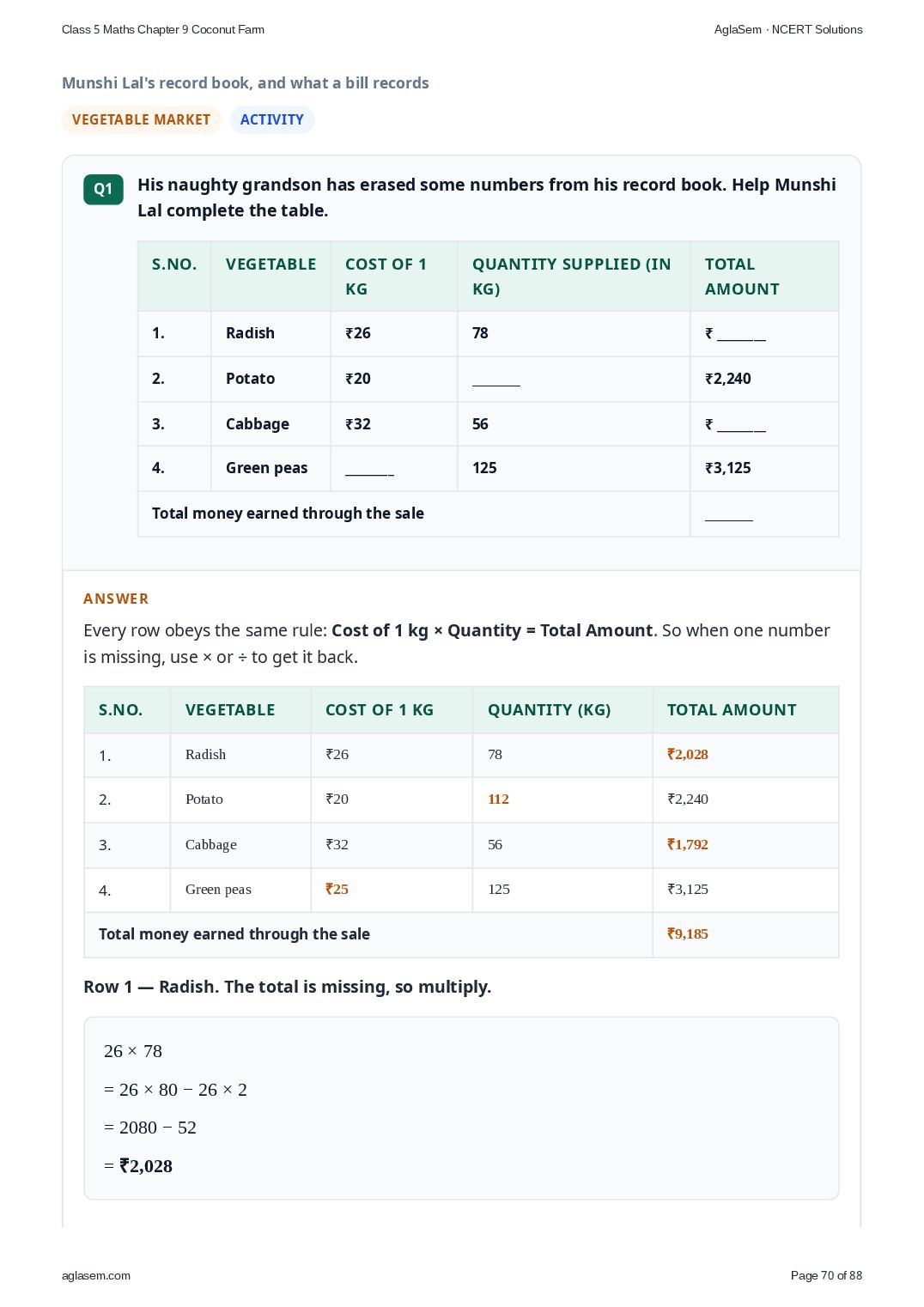
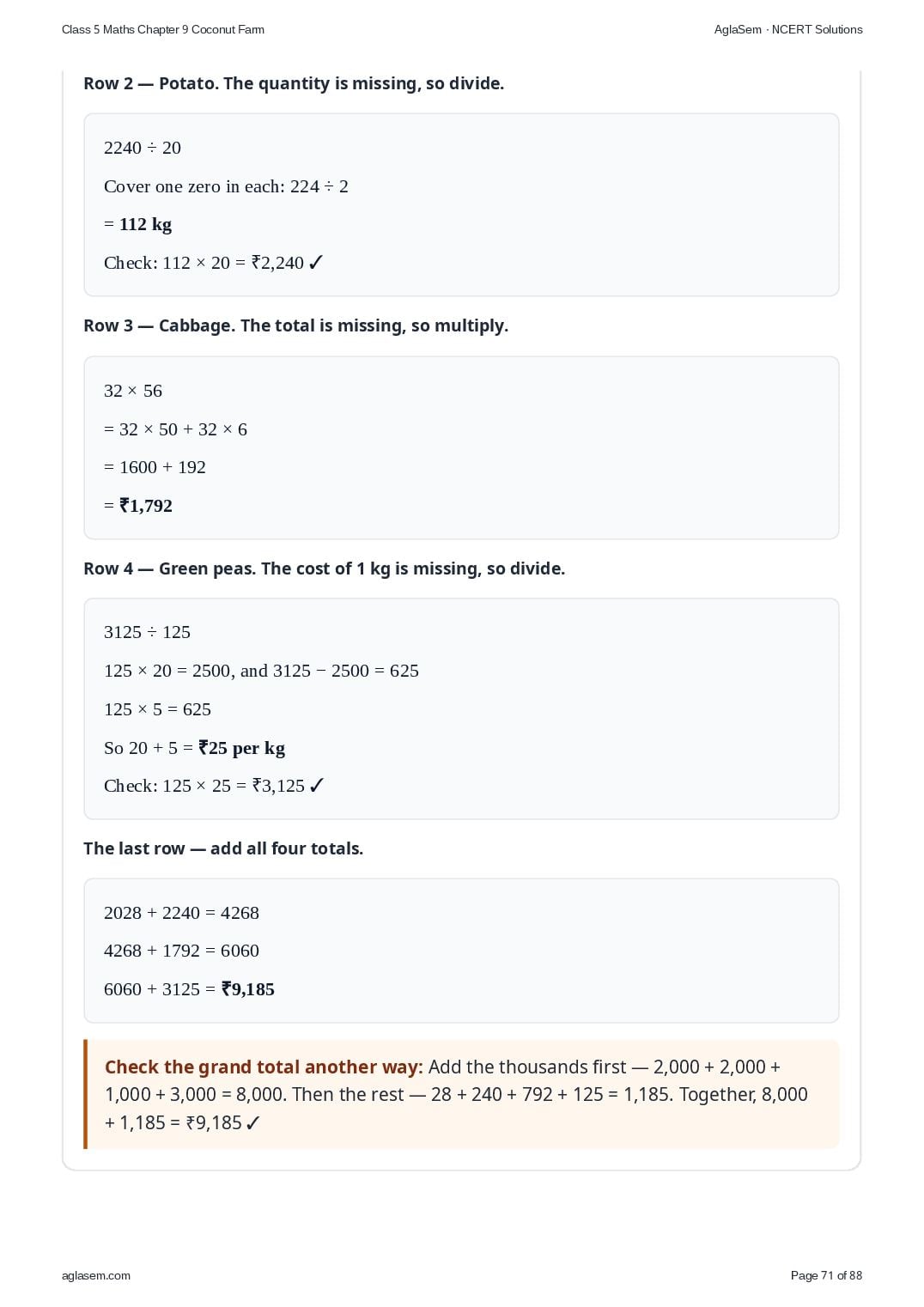
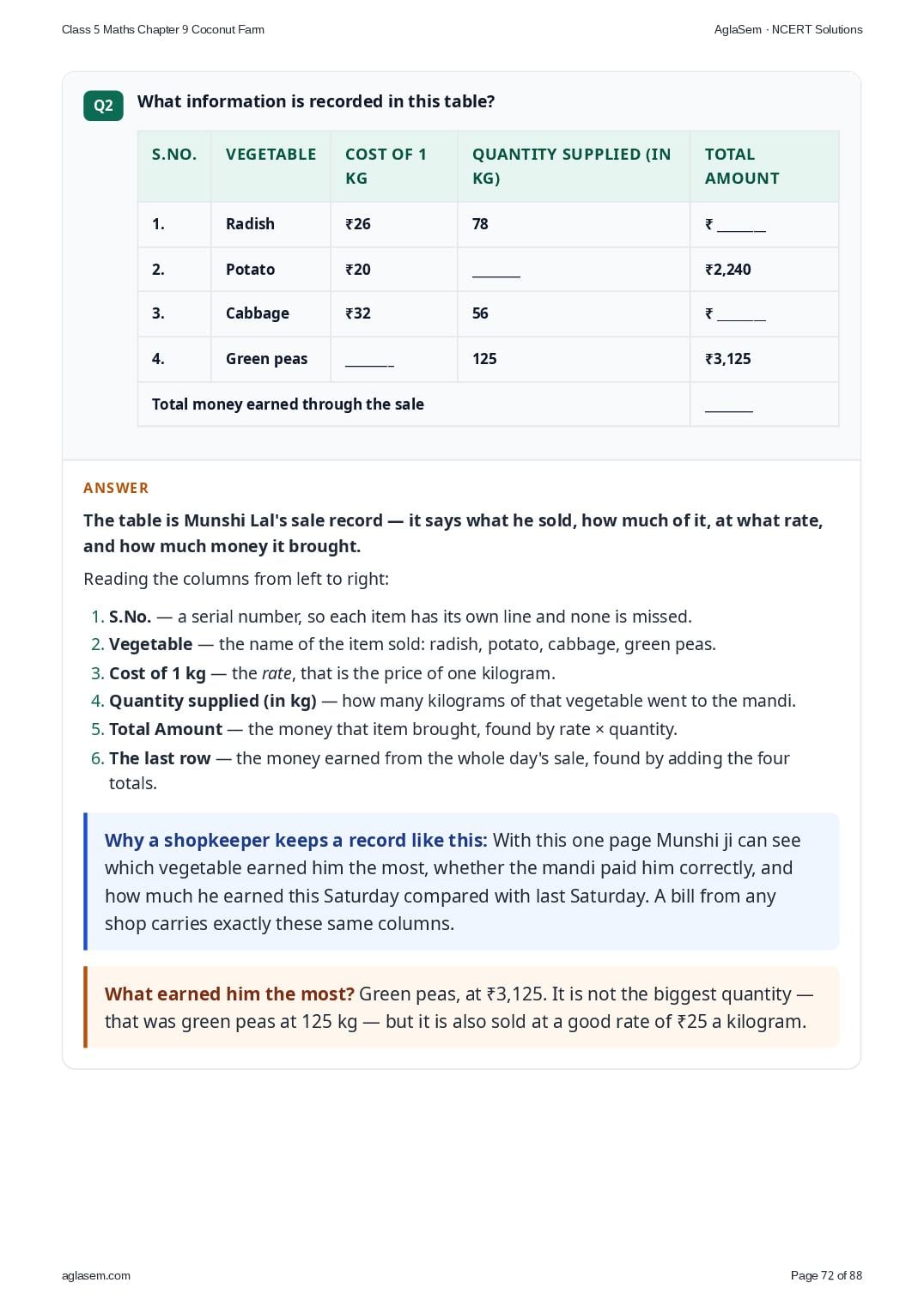
- His naughty grandson has erased some numbers from his record book. Help Munshi Lal complete the table. S.No.VegetableCost of 1 kgQuantity Supplied (in kg)Total Amount 1.Radish₹2678₹ ________
- What information is recorded in this table? S.No.VegetableCost of 1 kgQuantity Supplied (in kg)Total Amount 1.Radish₹2678₹ ________
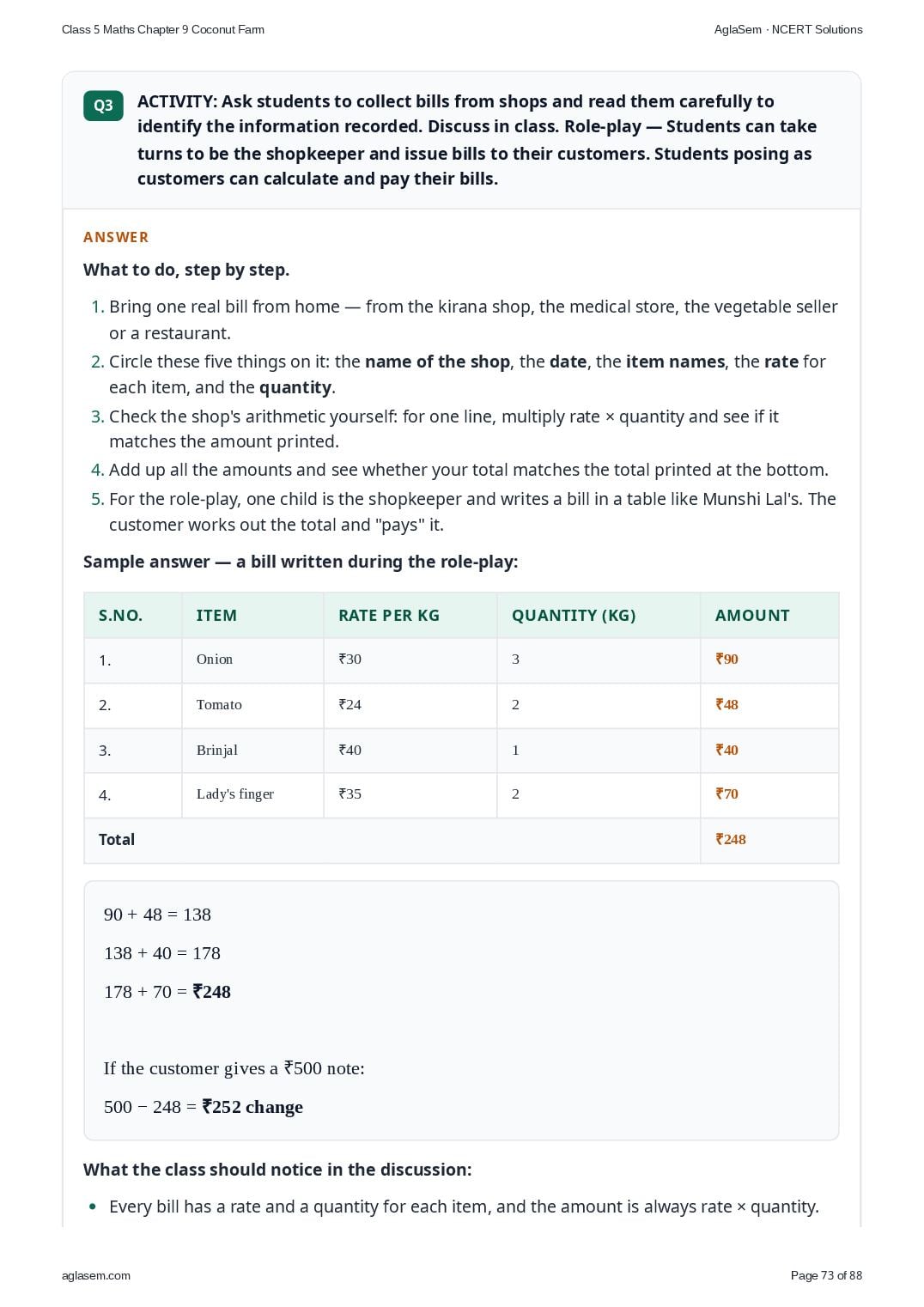
- ACTIVITY: Ask students to collect bills from shops and read them carefully to identify the information recorded. Discuss in class. Role-play — Students can take turns to be the shopkeeper and issue bills to their customers. Students posing as customers can calculate and pay their bills.
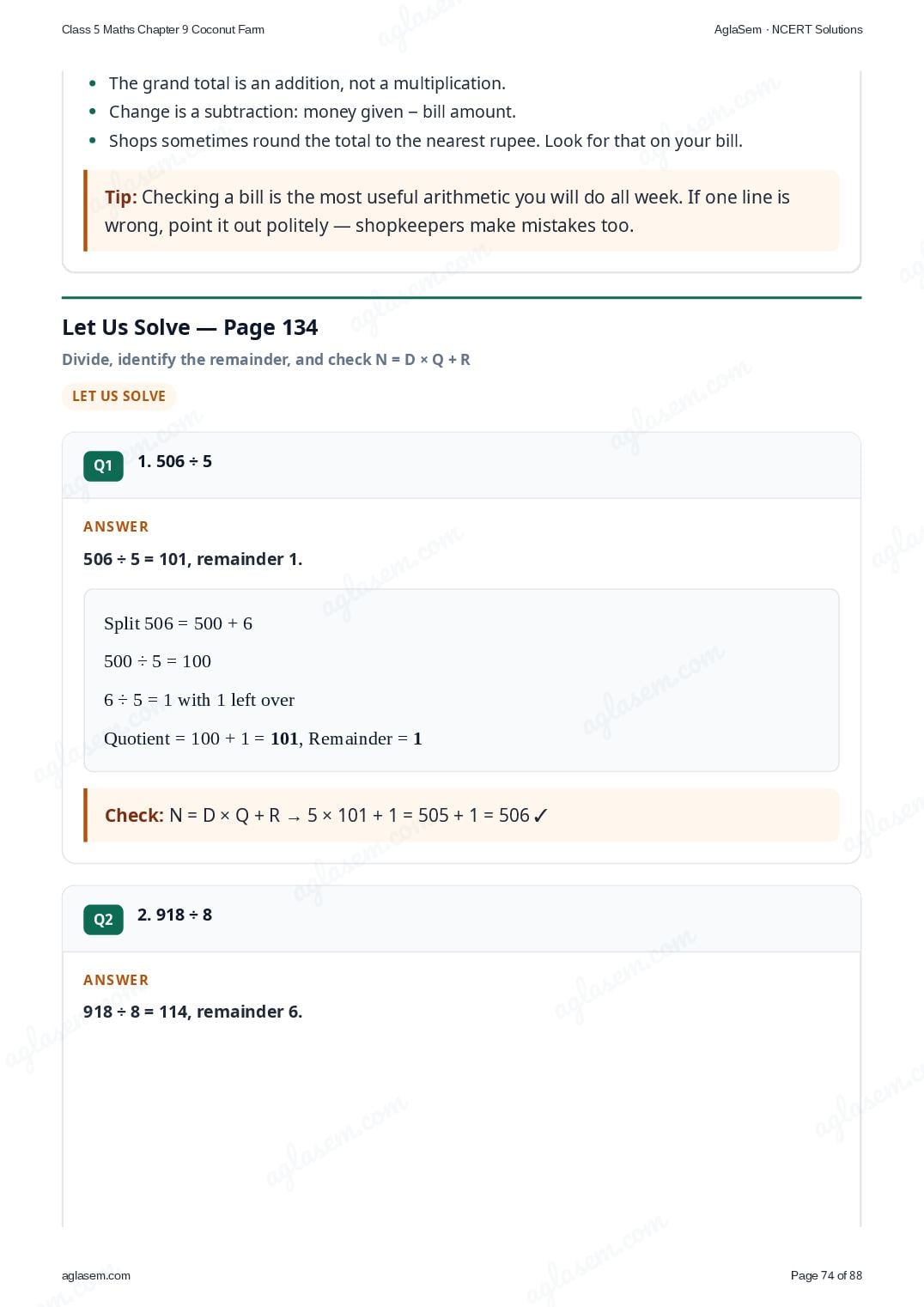
- 1. 506 ÷ 5
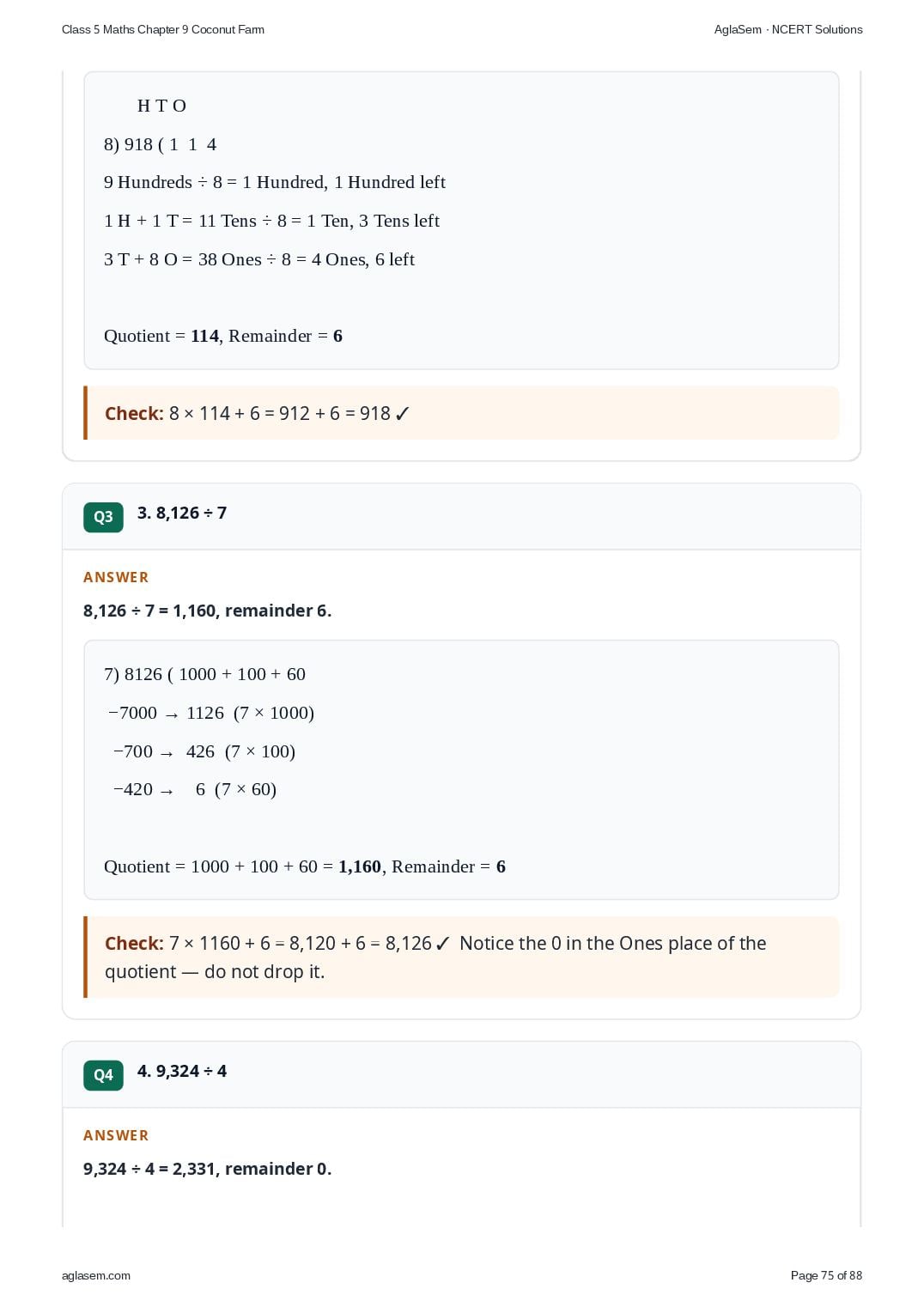
- 2. 918 ÷ 8
- 3. 8,126 ÷ 7
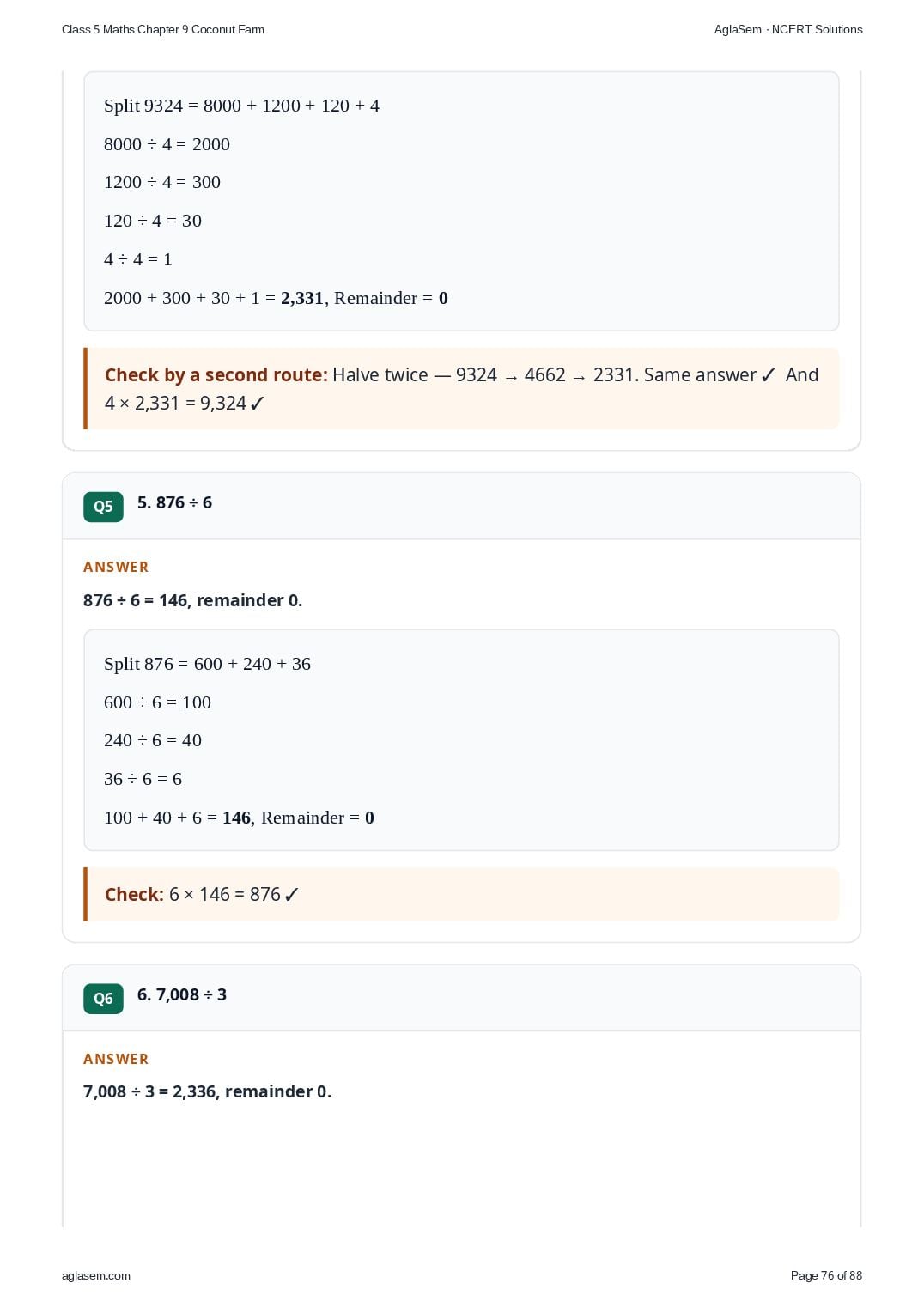
- 4. 9,324 ÷ 4
- 5. 876 ÷ 6
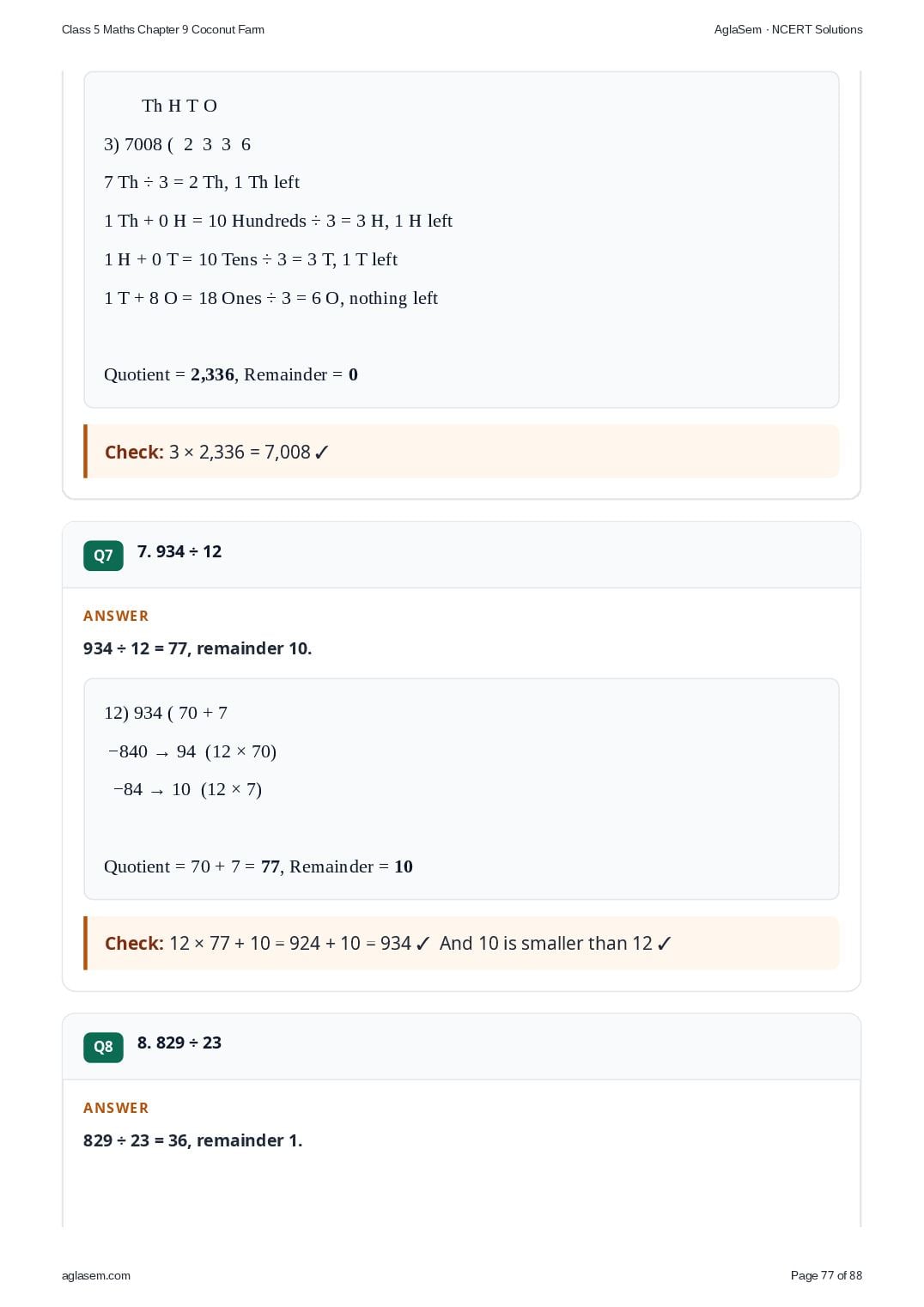
- 6. 7,008 ÷ 3
- 7. 934 ÷ 12
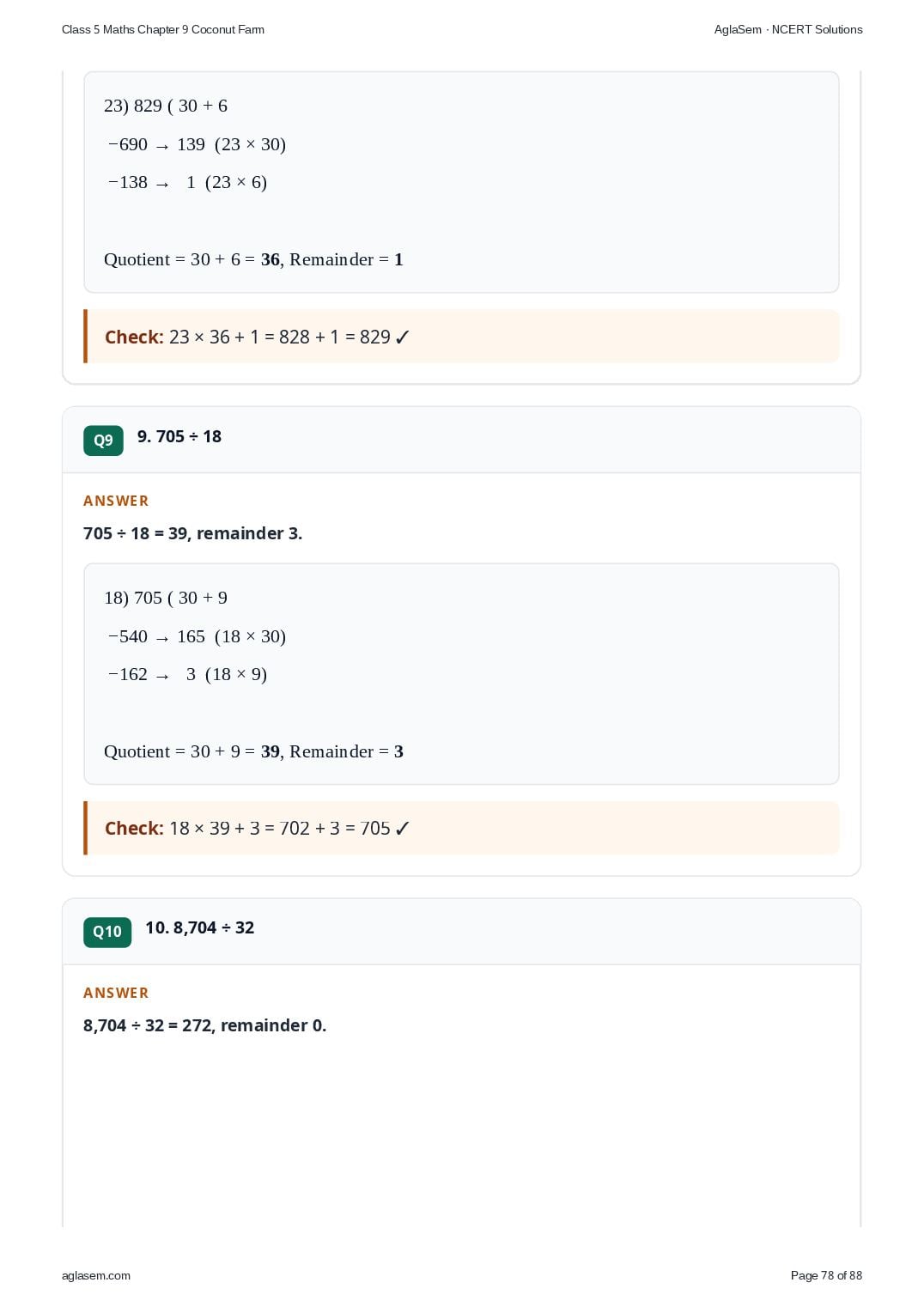
- 8. 829 ÷ 23
- 9. 705 ÷ 18
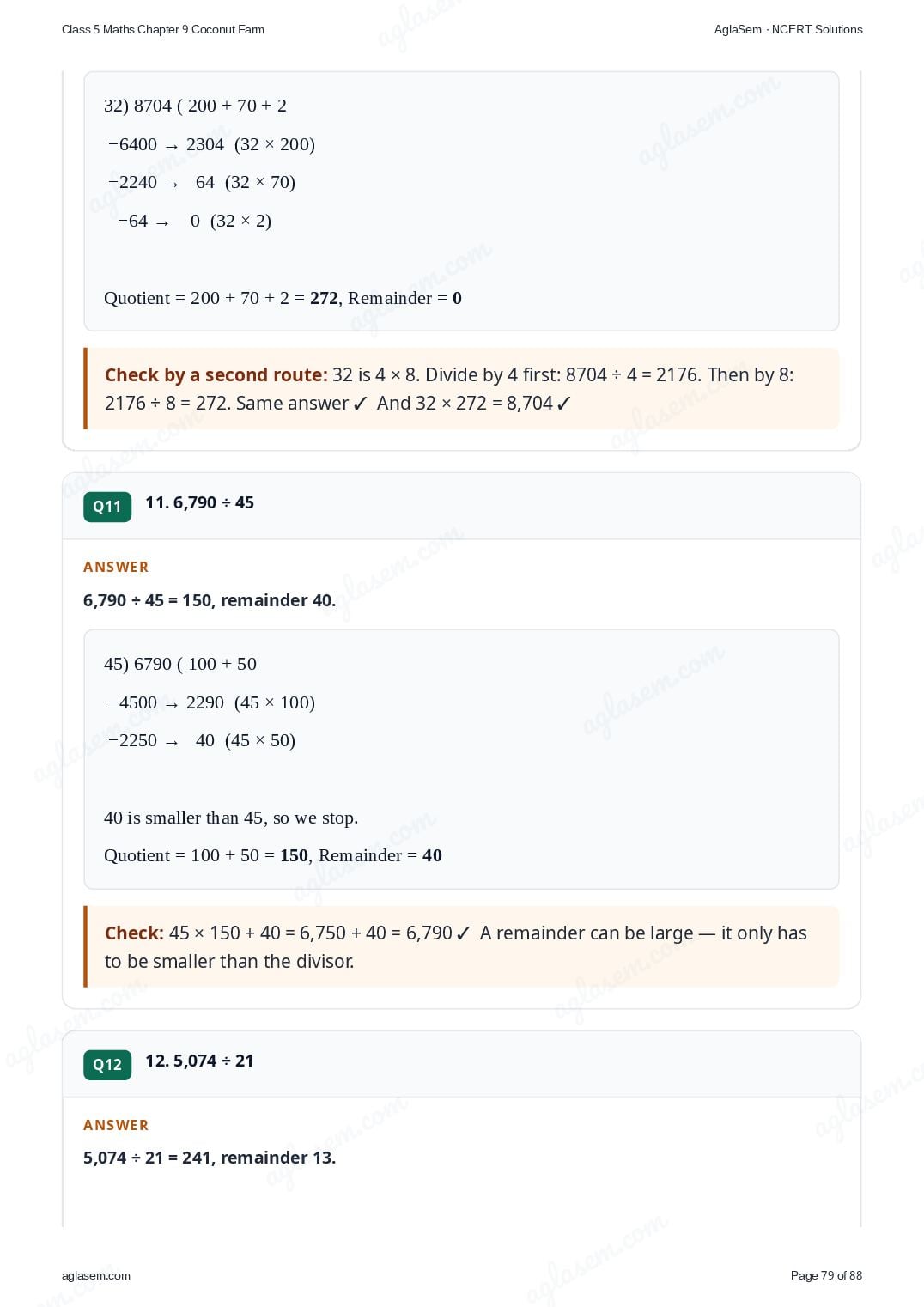
- 10. 8,704 ÷ 32
- 11. 6,790 ÷ 45
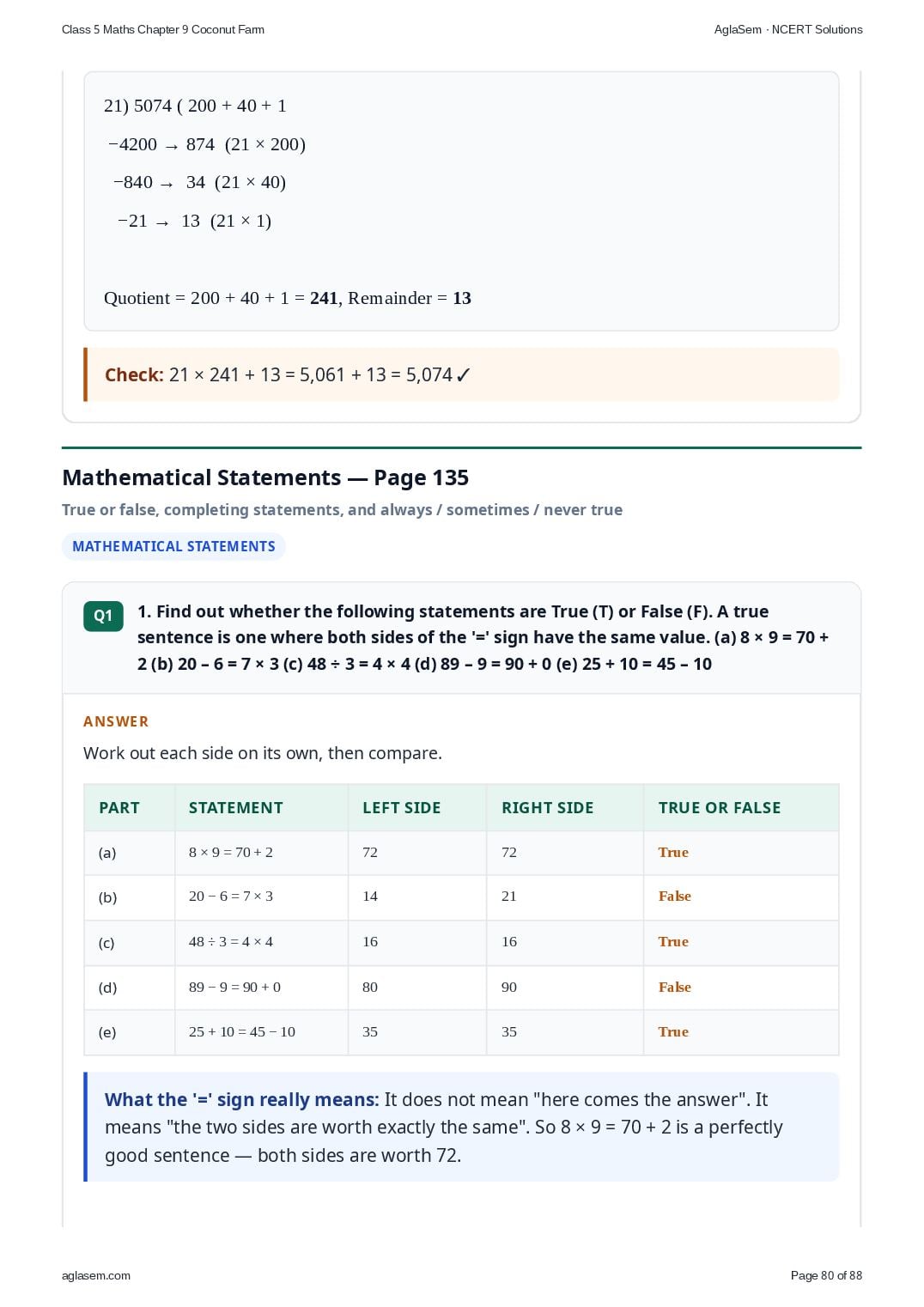
- 12. 5,074 ÷ 21
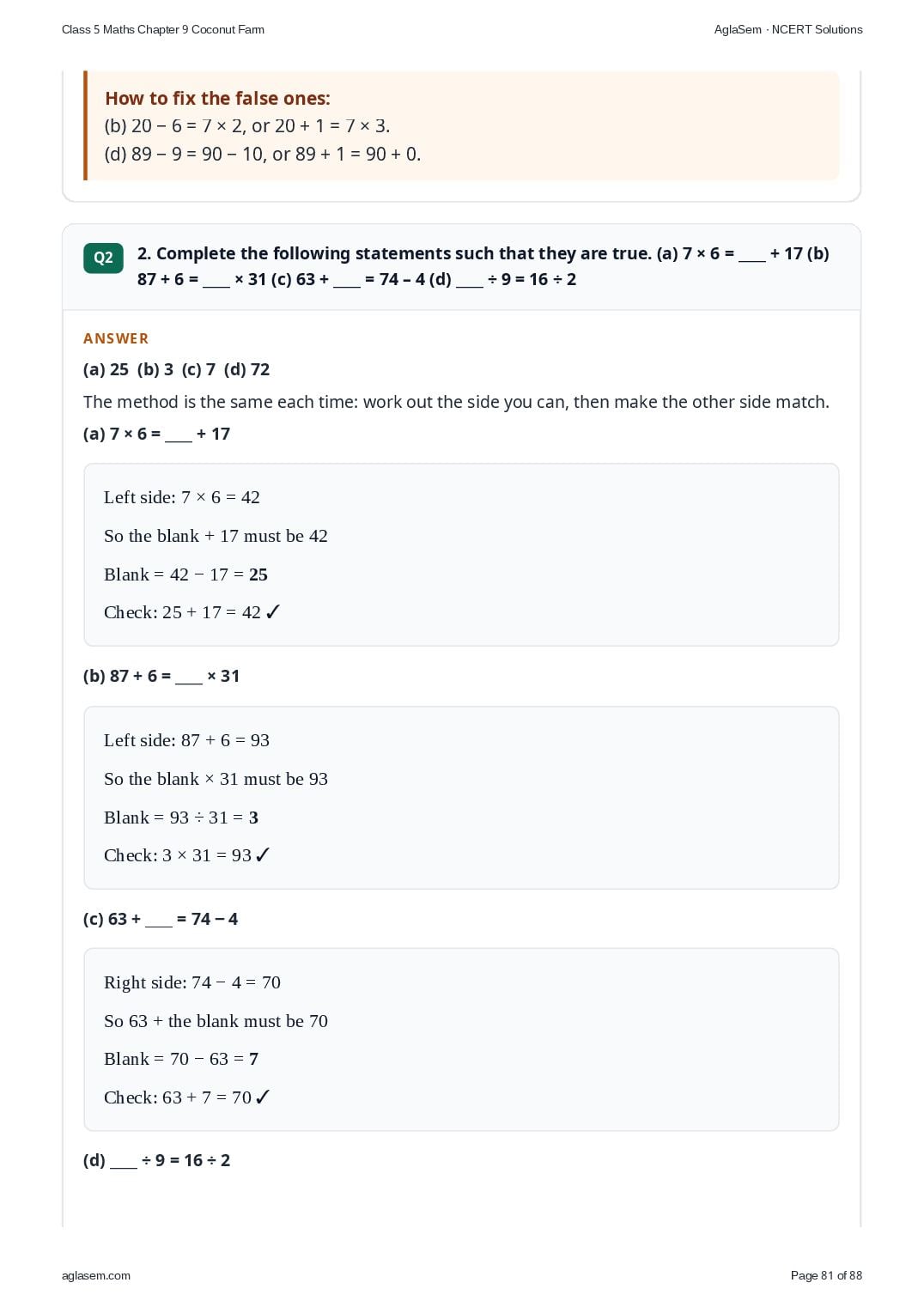
- 1. Find out whether the following statements are True (T) or False (F). A true sentence is one where both sides of the ‘=’ sign have the same value. (a) 8 × 9 = 70 + 2 (b) 20 – 6 = 7 × 3 (c) 48 ÷ 3 = 4 × 4 (d) 89 – 9 = 90 + 0 (e) 25 + 10 = 45 – 10
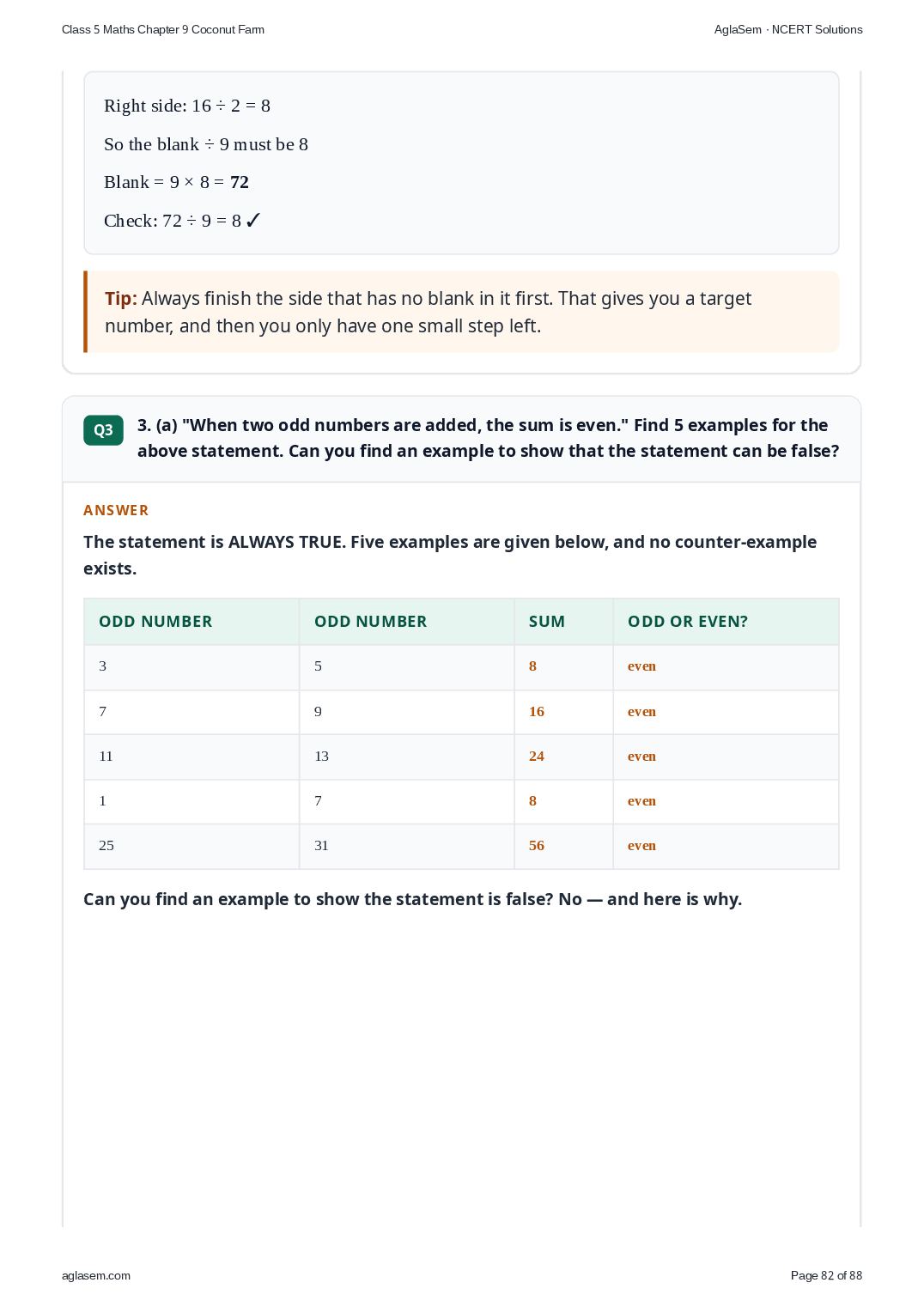
- 2. Complete the following statements such that they are true. (a) 7 × 6 = ____ + 17 (b) 87 + 6 = ____ × 31 (c) 63 + ____ = 74 – 4 (d) ____ ÷ 9 = 16 ÷ 2
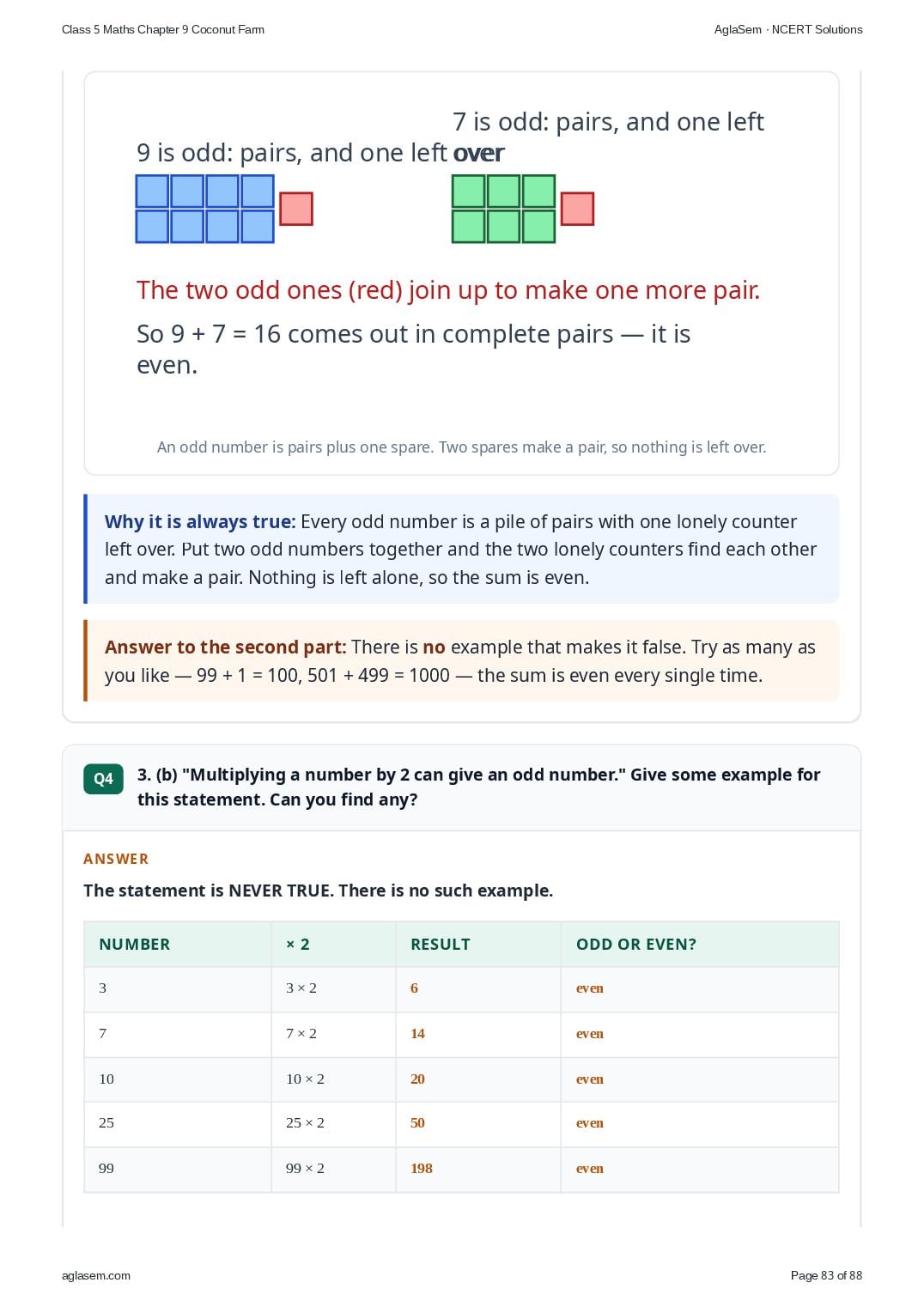
- 3. (a) “When two odd numbers are added, the sum is even.” Find 5 examples for the above statement. Can you find an example to show that the statement can be false?
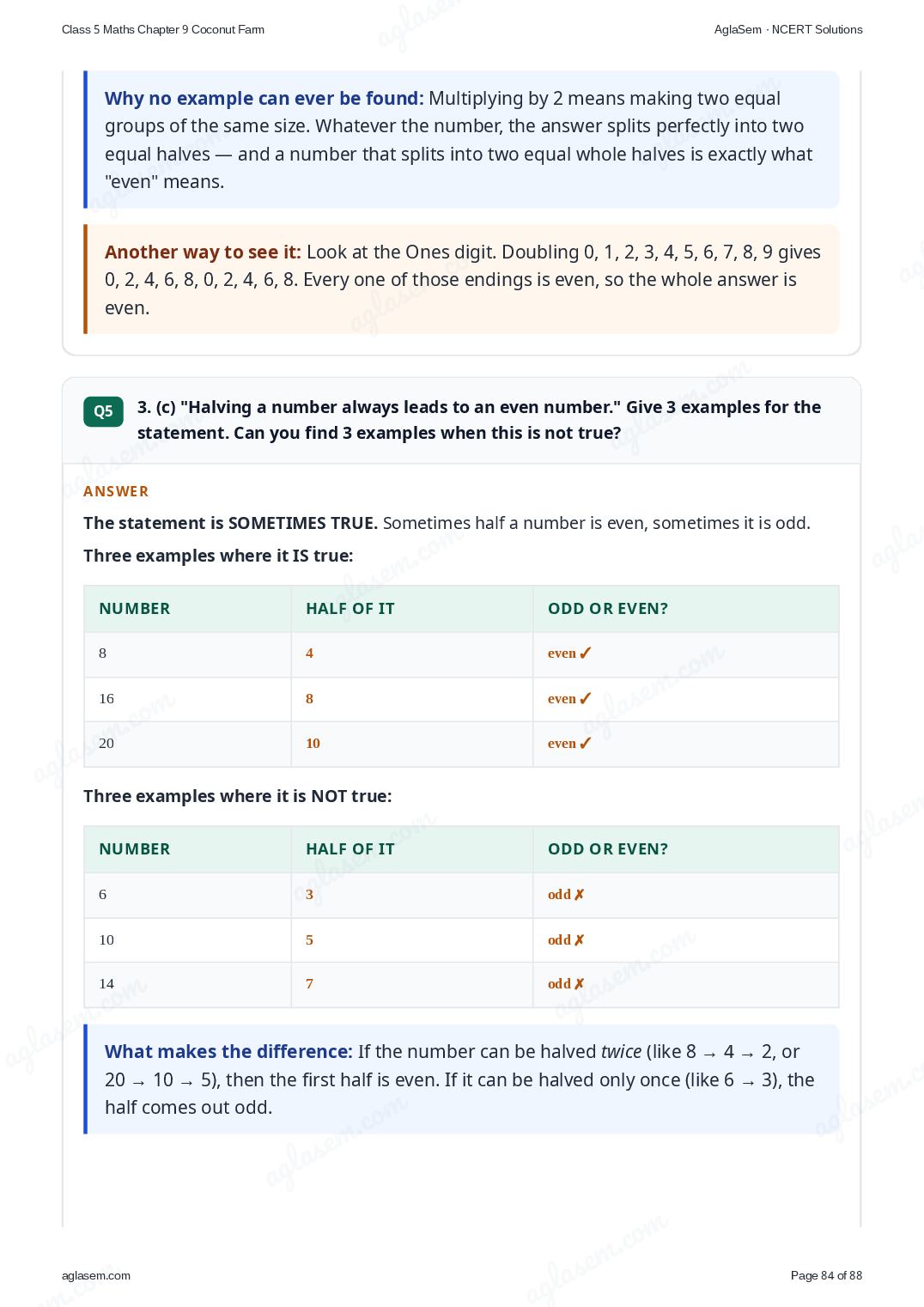
- 3. (b) “Multiplying a number by 2 can give an odd number.” Give some example for this statement. Can you find any?
- 3. (c) “Halving a number always leads to an even number.” Give 3 examples for the statement. Can you find 3 examples when this is not true?
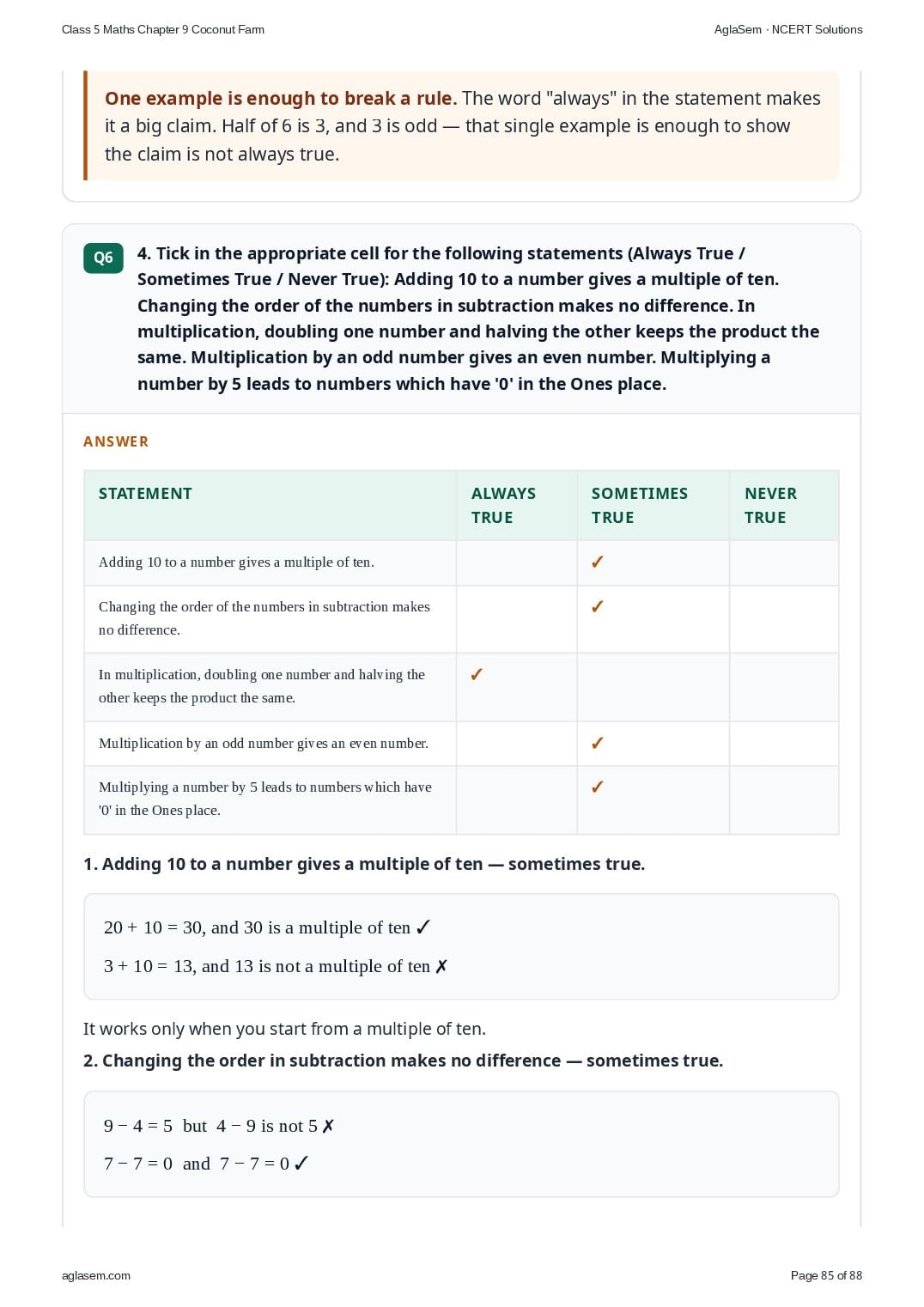
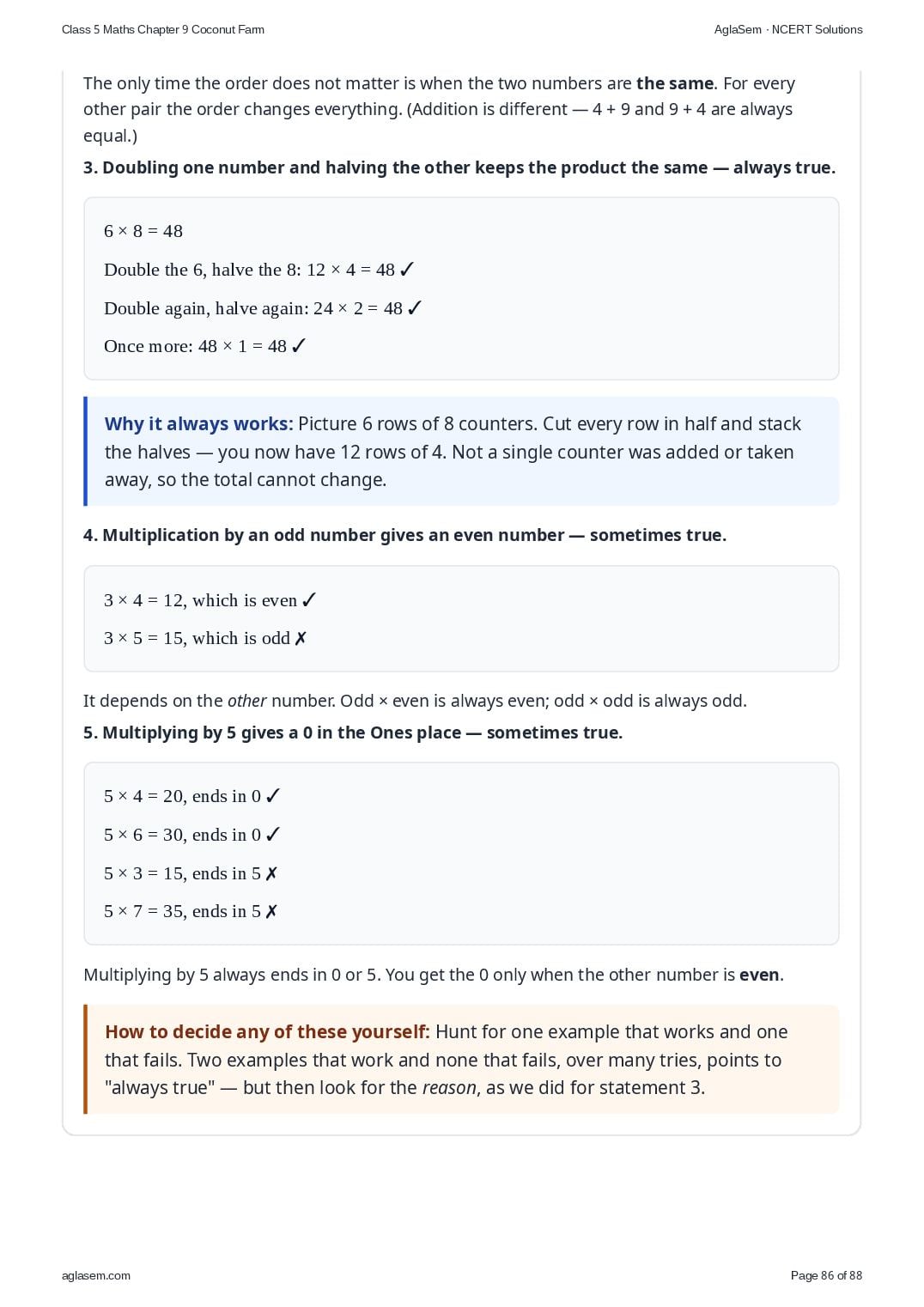
- 4. Tick in the appropriate cell for the following statements (Always True / Sometimes True / Never True): Adding 10 to a number gives a multiple of ten. Changing the order of the numbers in subtraction makes no difference. In multiplication, doubling one number and halving the other keeps the product the same. Multiplication by an odd number gives an even number. Multiplying a number by 5 leads to numbers which have ‘0’ in the Ones place.
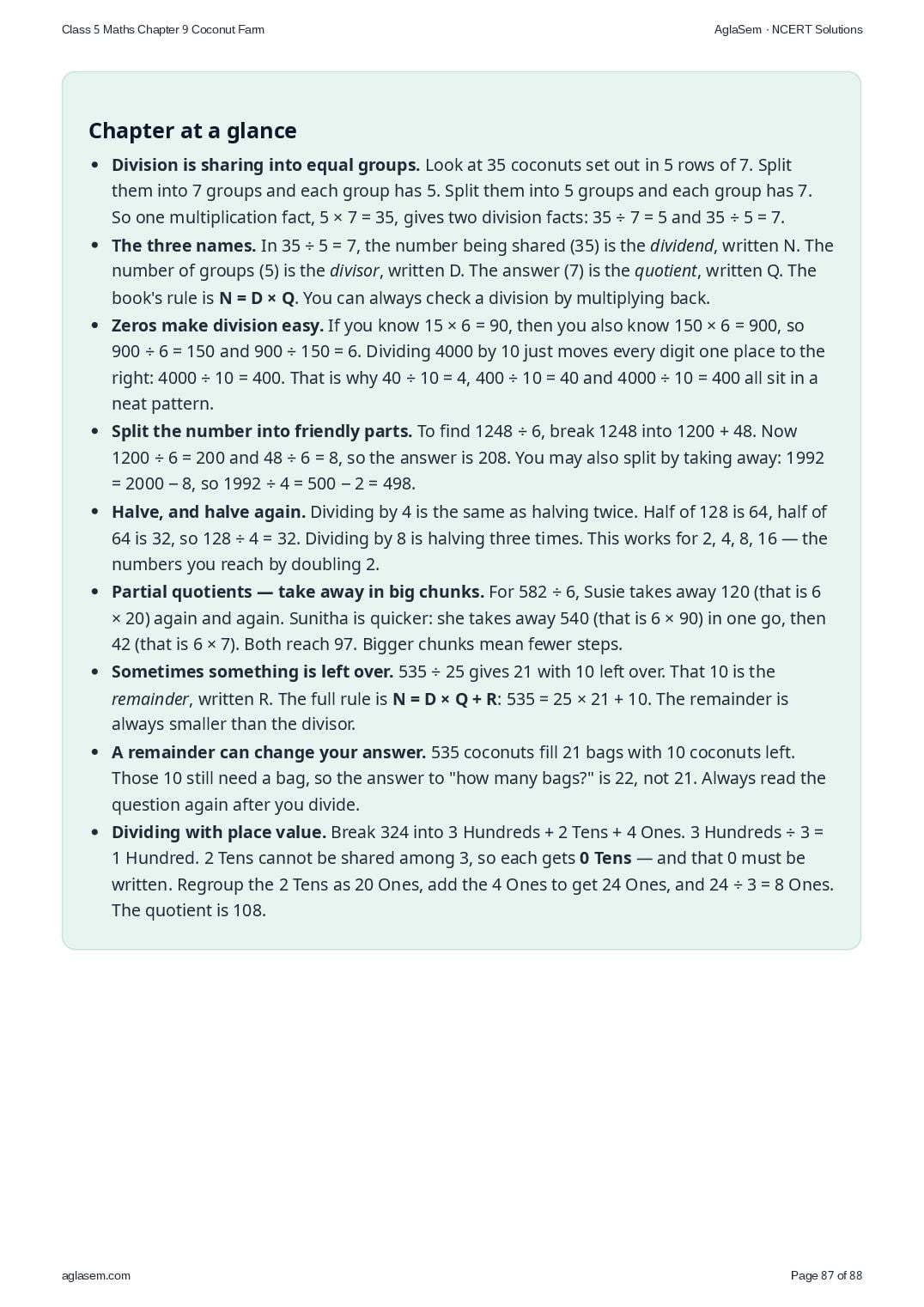
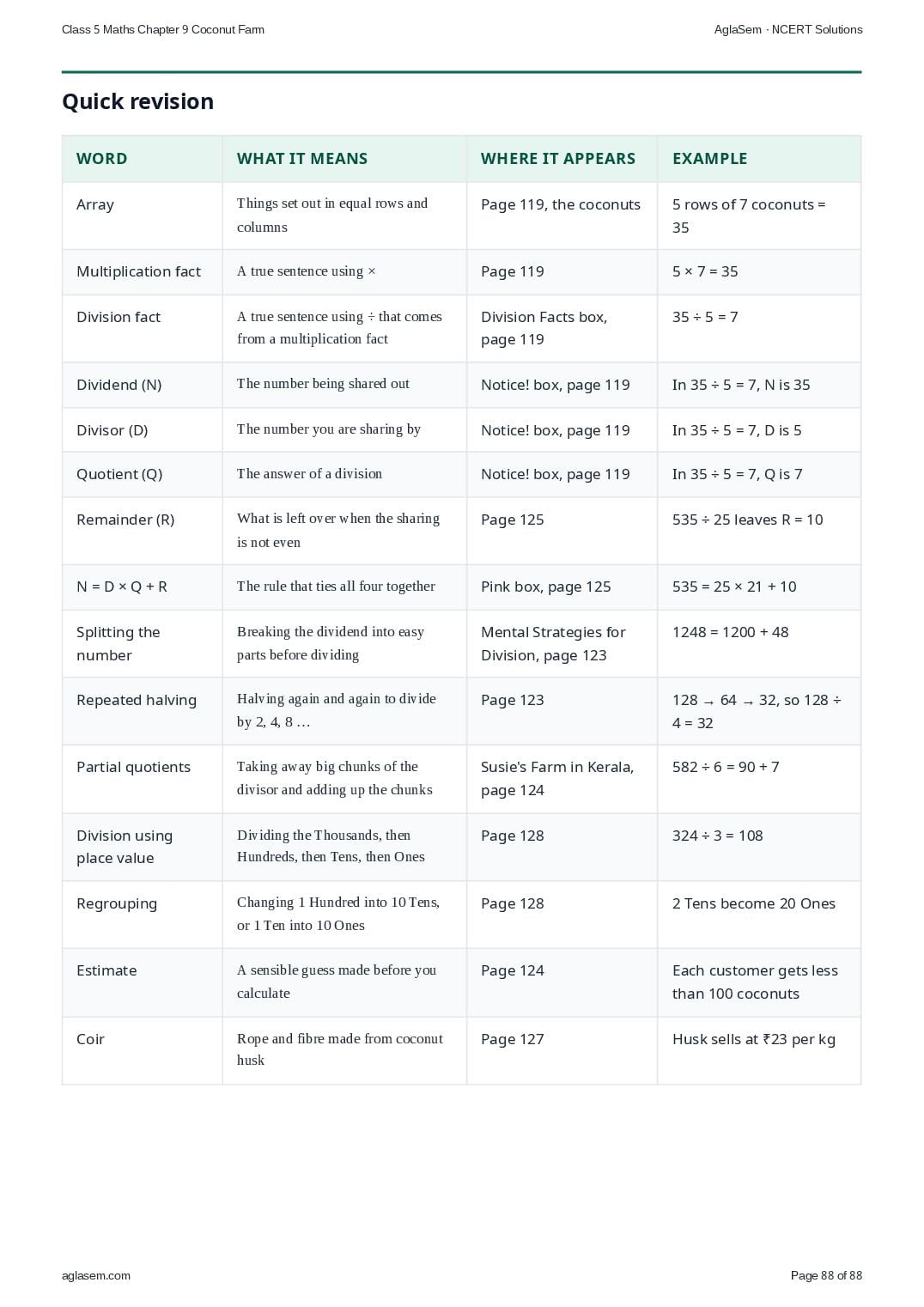
Chapter at a Glance
- Division is sharing into equal groups. Look at 35 coconuts set out in 5 rows of 7. Split them into 7 groups and each group has 5. Split them into 5 groups and each group has 7. So one multiplication fact, 5 × 7 = 35, gives two division facts: 35 ÷ 7 = 5 and 35 ÷ 5 = 7.
- The three names. In 35 ÷ 5 = 7, the number being shared (35) is the dividend, written N. The number of groups (5) is the divisor, written D. The answer (7) is the quotient, written Q. The book’s rule is N = D × Q. You can always check a division by multiplying back.
- Zeros make division easy. If you know 15 × 6 = 90, then you also know 150 × 6 = 900, so 900 ÷ 6 = 150 and 900 ÷ 150 = 6. Dividing 4000 by 10 just moves every digit one place to the right: 4000 ÷ 10 = 400. That is why 40 ÷ 10 = 4, 400 ÷ 10 = 40 and 4000 ÷ 10 = 400 all sit in a neat pattern.
- Split the number into friendly parts. To find 1248 ÷ 6, break 1248 into 1200 + 48. Now 1200 ÷ 6 = 200 and 48 ÷ 6 = 8, so the answer is 208. You may also split by taking away: 1992 = 2000 − 8, so 1992 ÷ 4 = 500 − 2 = 498.
- Halve, and halve again. Dividing by 4 is the same as halving twice. Half of 128 is 64, half of 64 is 32, so 128 ÷ 4 = 32. Dividing by 8 is halving three times. This works for 2, 4, 8, 16 — the numbers you reach by doubling 2.
- Partial quotients — take away in big chunks. For 582 ÷ 6, Susie takes away 120 (that is 6 × 20) again and again. Sunitha is quicker: she takes away 540 (that is 6 × 90) in one go, then 42 (that is 6 × 7). Both reach 97. Bigger chunks mean fewer steps.
- Sometimes something is left over. 535 ÷ 25 gives 21 with 10 left over. That 10 is the remainder, written R. The full rule is N = D × Q + R: 535 = 25 × 21 + 10. The remainder is always smaller than the divisor.
- A remainder can change your answer. 535 coconuts fill 21 bags with 10 coconuts left. Those 10 still need a bag, so the answer to “how many bags?” is 22, not 21. Always read the question again after you divide.
- Dividing with place value. Break 324 into 3 Hundreds + 2 Tens + 4 Ones. 3 Hundreds ÷ 3 = 1 Hundred. 2 Tens cannot be shared among 3, so each gets 0 Tens — and that 0 must be written. Regroup the 2 Tens as 20 Ones, add the 4 Ones to get 24 Ones, and 24 ÷ 3 = 8 Ones. The quotient is 108.
How to Download NCERT Solutions for Class 5 Maths Chapter 9 PDF
Follow these simple steps to get the Coconut Farm questions-and-answers PDF from Math Mela.
- Search NCERT Solutions for Class 5 Maths Chapter 9 aglasem and open this page.
- Read the exercise questions with answers for Coconut Farm shown above.
- Click the Download PDF link to save the Coconut Farm solutions to your device.
NCERT Solutions for Class 5 Maths – All Chapters
There are more chapters to study besides Coconut Farm in Maths. Here are the NCERT Solutions for all chapters of Class 5 Maths.
- Chapter 1 We the Travellers I
- Chapter 2 Fractions
- Chapter 3 Angles As Turns
- Chapter 4 We the Travellers Ii
- Chapter 5 Far and Near
- Chapter 6 the Dairy Farm
- Chapter 7 Shapes and Patterns
- Chapter 8 Weight and Capacity
- Chapter 9 Coconut Farm
- Chapter 10 Symmetrical Designs
- Chapter 11 Grandmother s Quilt
- Chapter 12 Racing Seconds
- Chapter 13 Animal Jumps
- Chapter 14 Maps and Locations
- Chapter 15 Data Through Pictures
NCERT Solutions for Class 5 – All Subjects
Just like Chapter 9 of Maths, you can get the exercise questions with answers for every other subject of Class 5. Here are the NCERT Solutions for all subjects of Class 5.
NCERT Solutions for Class 5 Maths Chapter 9 – An Overview
The key highlights of this study material are as follows.
| Aspects | Details |
|---|---|
| Class | Class 5 |
| Subject | Maths |
| Chapter Number | Chapter 9 |
| Chapter Name | Coconut Farm |
| Book Name | Math Mela |
| Book By | NCERT (National Council of Educational Research and Training) |
| Educational Resource Here | NCERT Solutions of Class 5 Maths Chapter 9 for all exercises |
| More Questions Answers of This Subject | NCERT Solutions for Class 5 Maths |
| Download Book Chapter | NCERT Book Class 5 Maths |
| All Questions Answers For This Class | NCERT Solutions for Class 5 |
| Complete Solutions | NCERT Solutions |
NCERT Solutions for Class 5 Maths Chapter 9 Coconut Farm – FAQs
What are the NCERT Solutions for Class 5 Maths Chapter 9 Coconut Farm?
They are the complete, step-by-step answers to all the exercise and in-text questions of Chapter 9 Coconut Farm from the NCERT Class 5 Maths textbook Math Mela, written by experts as per the latest NCERT syllabus.
How can I download the Class 5 Maths Chapter 9 solutions PDF for free?
Open this page on aglasem, read the Coconut Farm questions with answers, and click the “Download Solutions PDF” link. The Class 5 Maths Chapter 9 NCERT Solutions PDF is completely free to download.
Are these NCERT Solutions as per the latest 2026-27 syllabus?
Yes. The NCERT Solutions for Class 5 Maths Chapter 9 are based on the latest NCERT textbook Math Mela and the current 2026-27 CBSE syllabus, so the questions and answers match what you study in class.
Where can I get NCERT Solutions for the other chapters of Class 5 Maths?
You can find the answers to every chapter on the NCERT Solutions for Class 5 Maths page, and solutions for every subject on the NCERT Solutions for Class 5 page.
How do NCERT Solutions help in exam preparation?
They show the correct method to solve each question, help you write answers the way they are expected in exams, let you check and correct your own work, and save revision time — which together improve your marks in Class 5 Maths.
If you have any queries on NCERT Solutions for Class 5 Maths Chapter 9 Coconut Farm, then please ask in the comments below.