NCERT Solutions for Class 5 Maths Chapter 13 Animal Jumps provide clear, step-by-step answers to every exercise and in-text question from the chapter Animal Jumps of the NCERT textbook Math Mela. Prepared by subject experts as per the latest NCERT (CBSE) syllabus for 2026-27, these NCERT Solutions for Class 5 Maths help you understand each concept, write exam-ready answers, and check your own solutions. You can read them online below or download the free Class 5 Maths Chapter 13 question-answer PDF.
NCERT Solutions for Class 5 Maths Chapter 13 Animal Jumps
- Class: Class 5
- Subject: Maths
- Chapter: Chapter 13 – Animal Jumps
- Textbook: Math Mela (NCERT)
- Study material: NCERT Solutions – questions with answers, free PDF
These solutions answer all the exercise questions of Chapter 13 Animal Jumps — including the in-text questions, short-answer and long-answer questions, and activities — with complete explanations so you can follow the method, not just the final answer. Read the full solutions below.
NCERT Solutions Class 5 Maths Chapter 13 Animal Jumps View Download
NCERT Solutions for Class 5 Maths Chapter 13 PDF Download
You can read the NCERT Solutions for Class 5 Maths Chapter 13 online above, or download the complete question-answer PDF to study Animal Jumps offline at any time.
NCERT Solutions for Class 5 Maths Chapter 13 PDF Download Link – Click Here to Download Solutions PDF
Questions Covered in This Chapter
These NCERT Solutions answer all 72 questions of this chapter. The questions solved are:
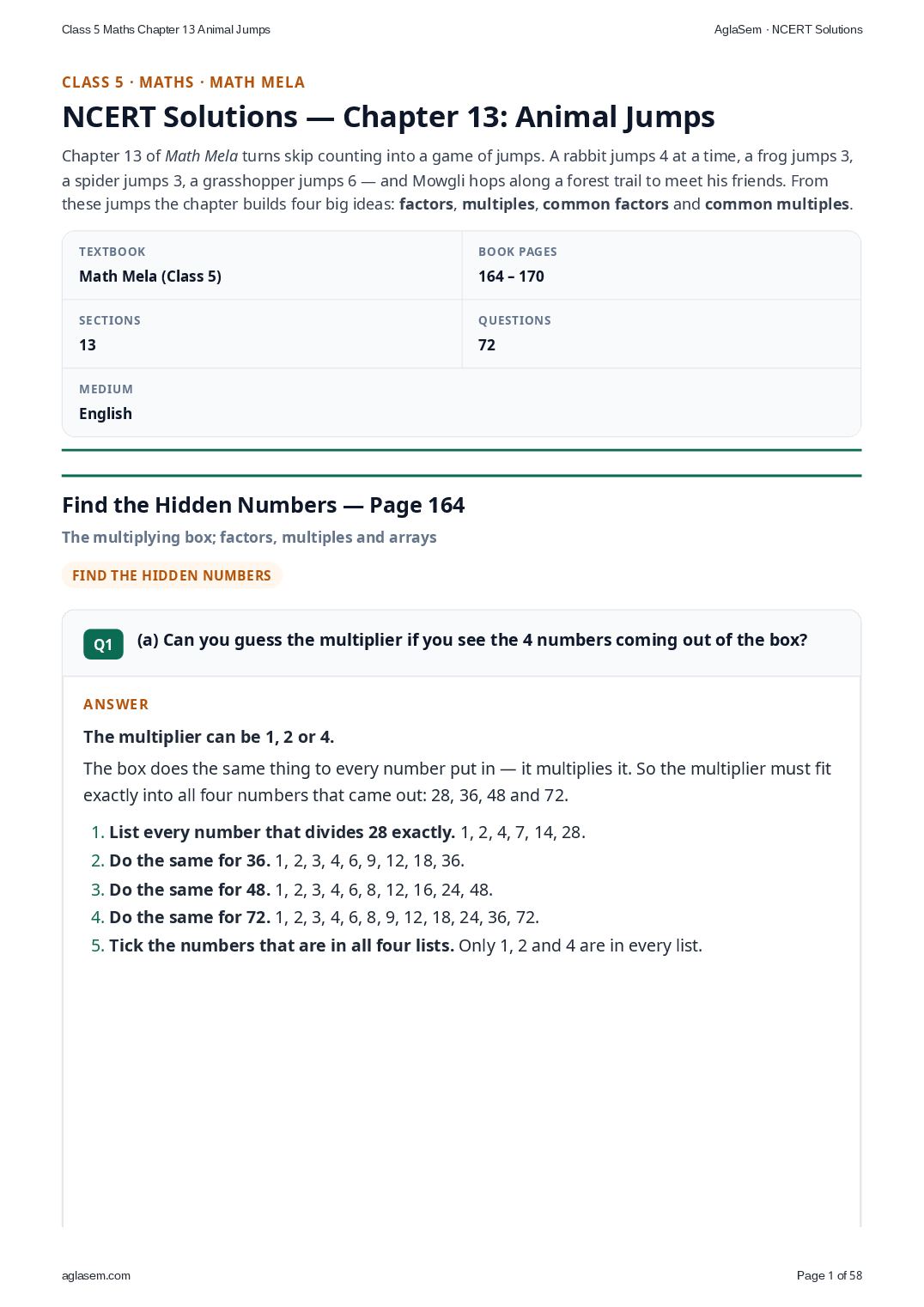
- (a) Can you guess the multiplier if you see the 4 numbers coming out of the box?
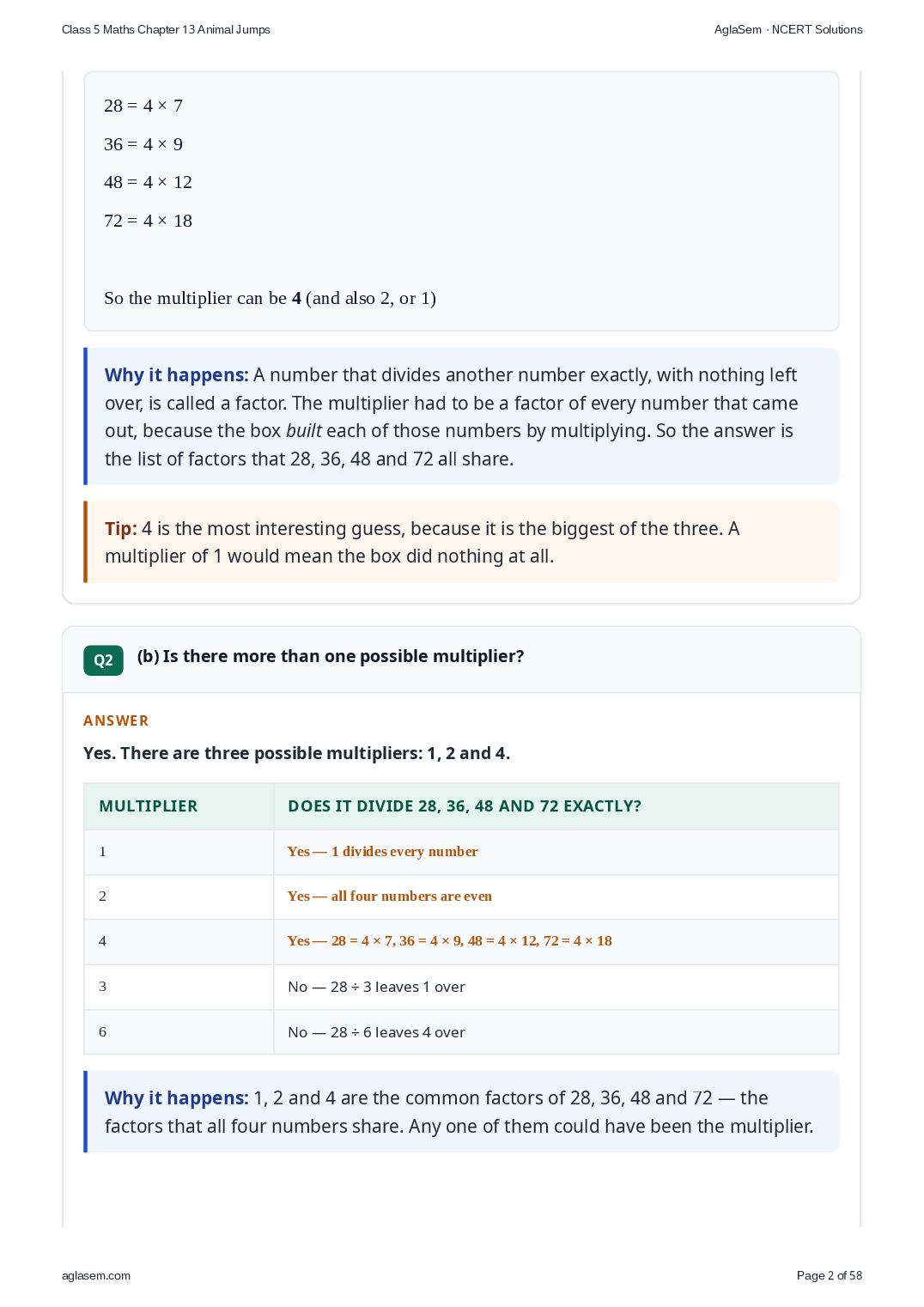
- (b) Is there more than one possible multiplier?
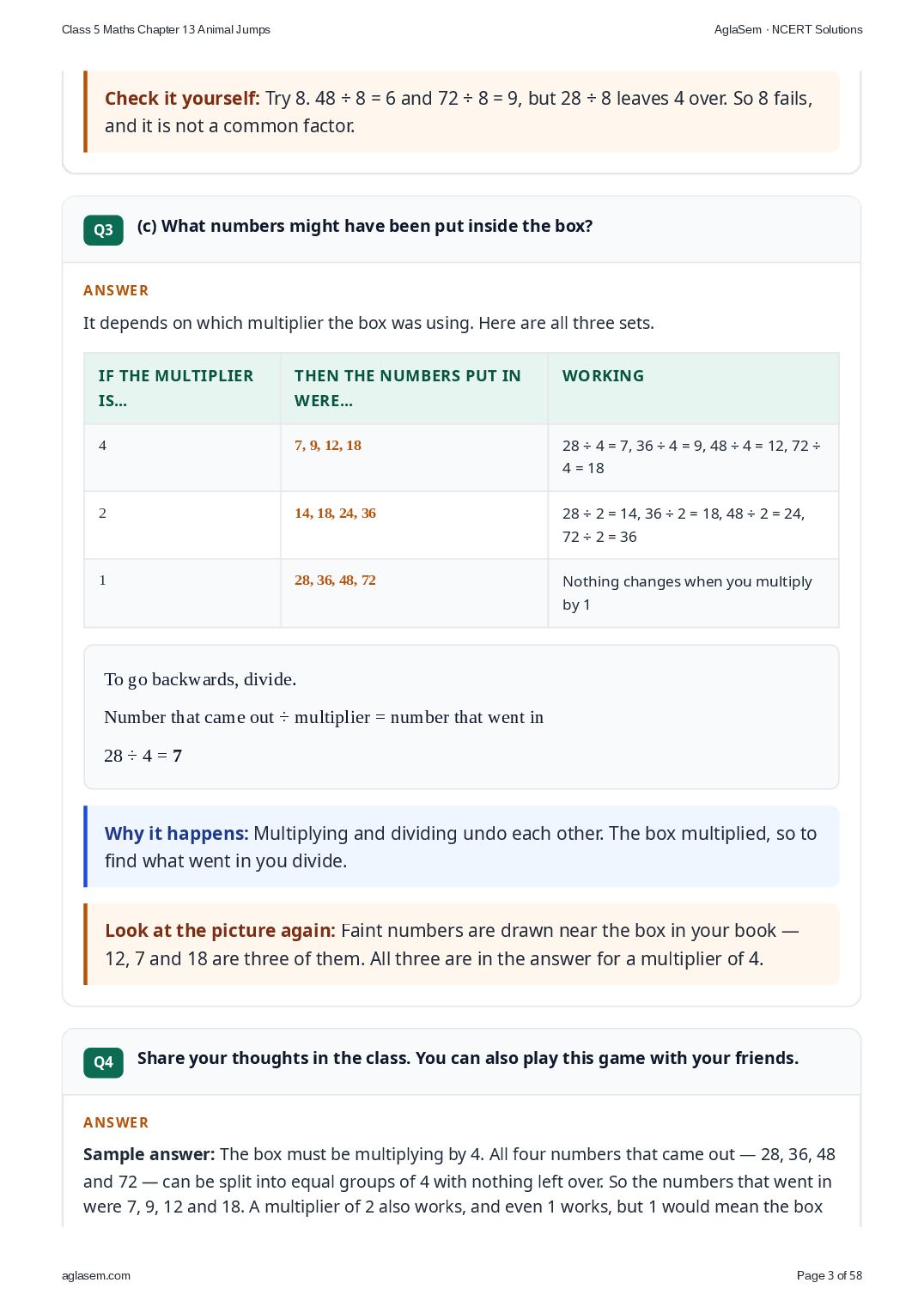
- (c) What numbers might have been put inside the box?
- Share your thoughts in the class. You can also play this game with your friends.
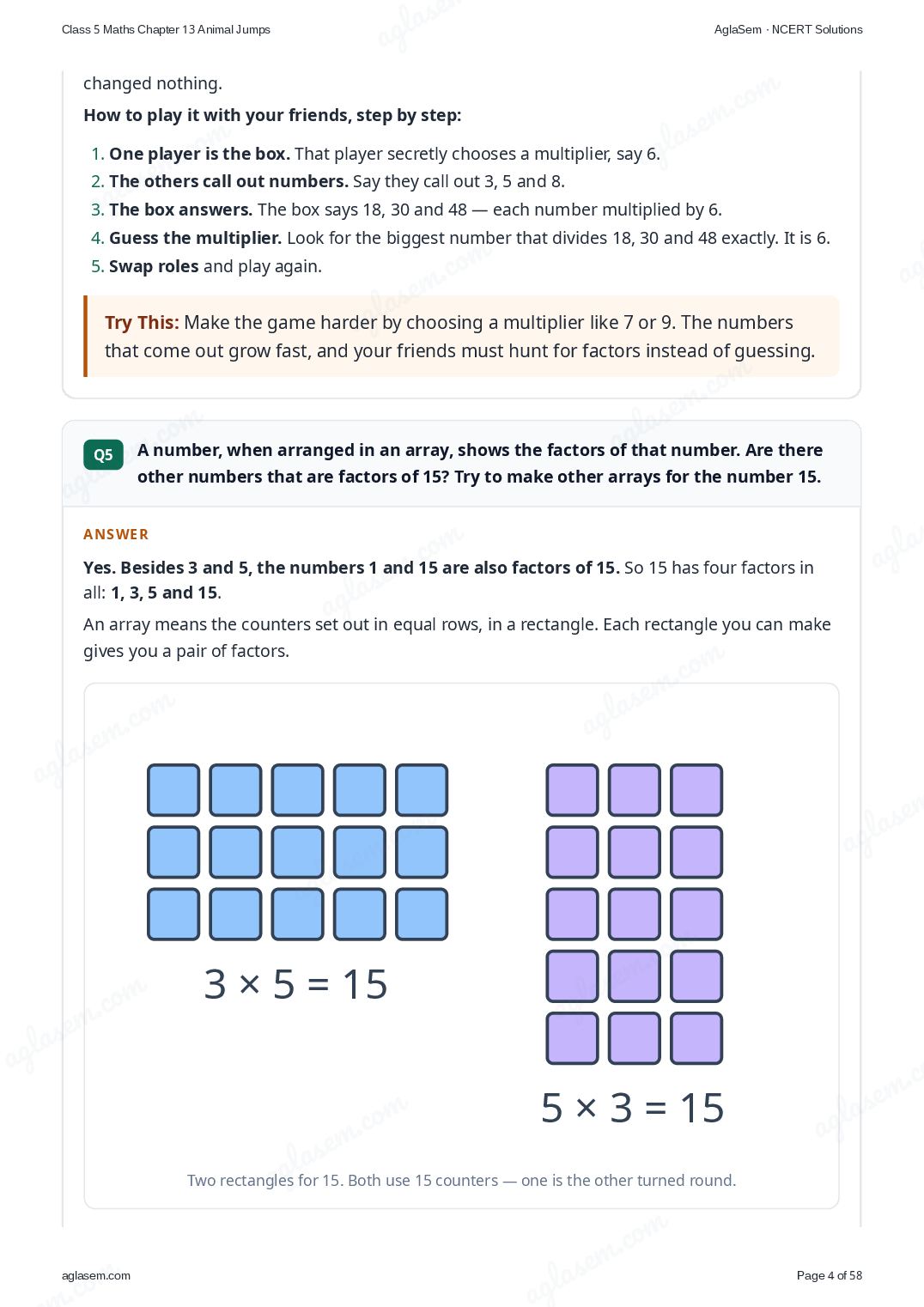
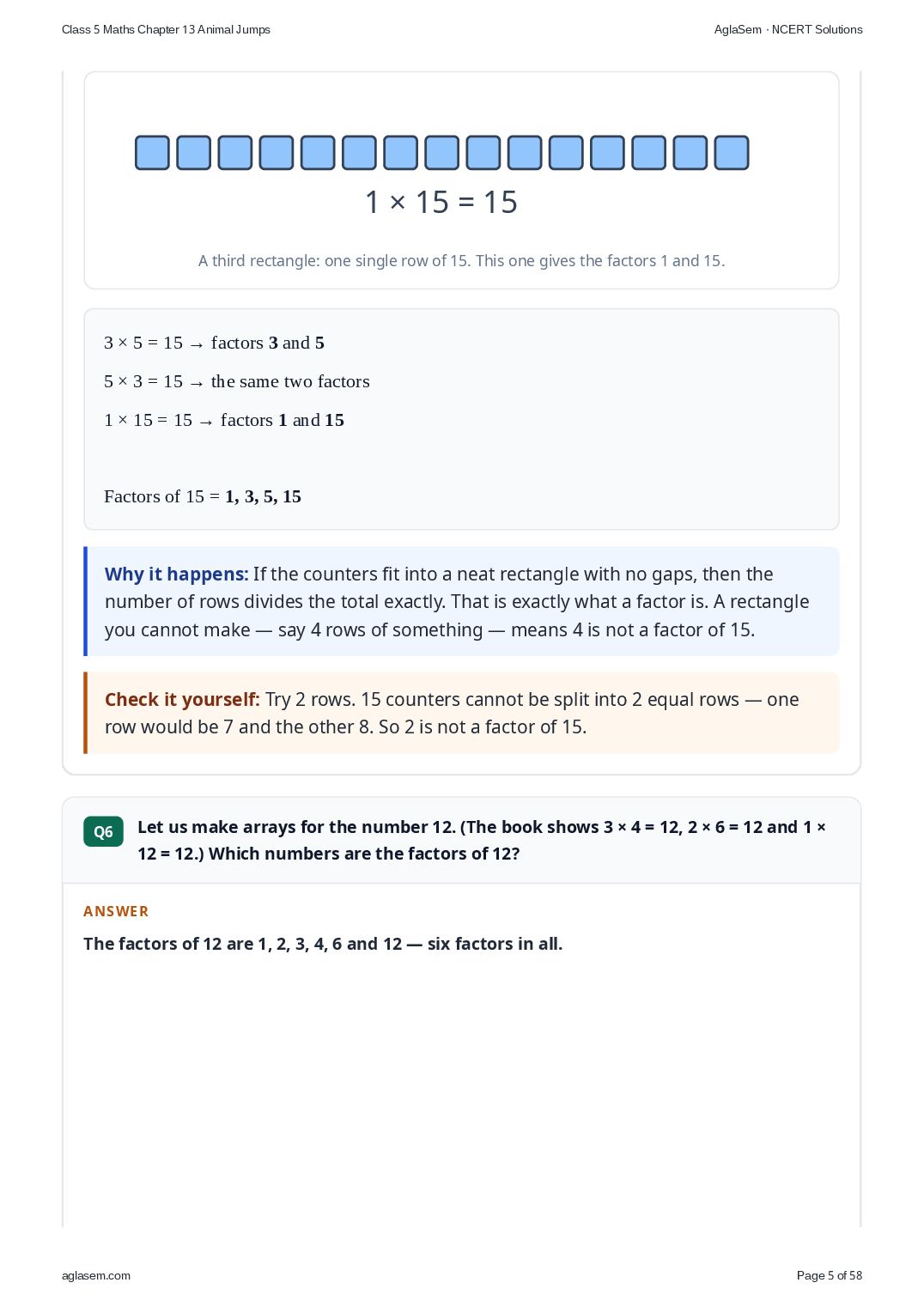
- A number, when arranged in an array, shows the factors of that number. Are there other numbers that are factors of 15? Try to make other arrays for the number 15.
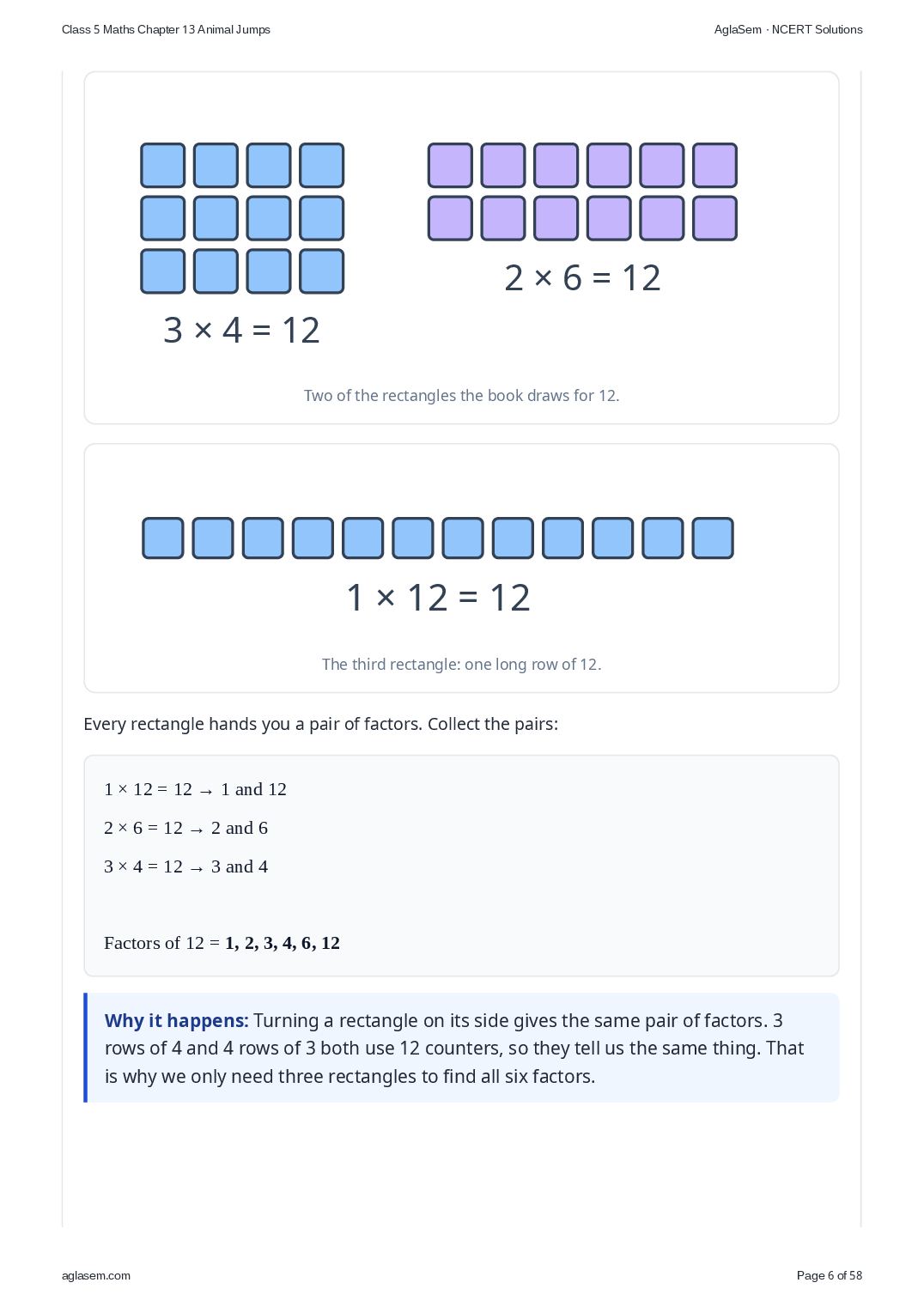
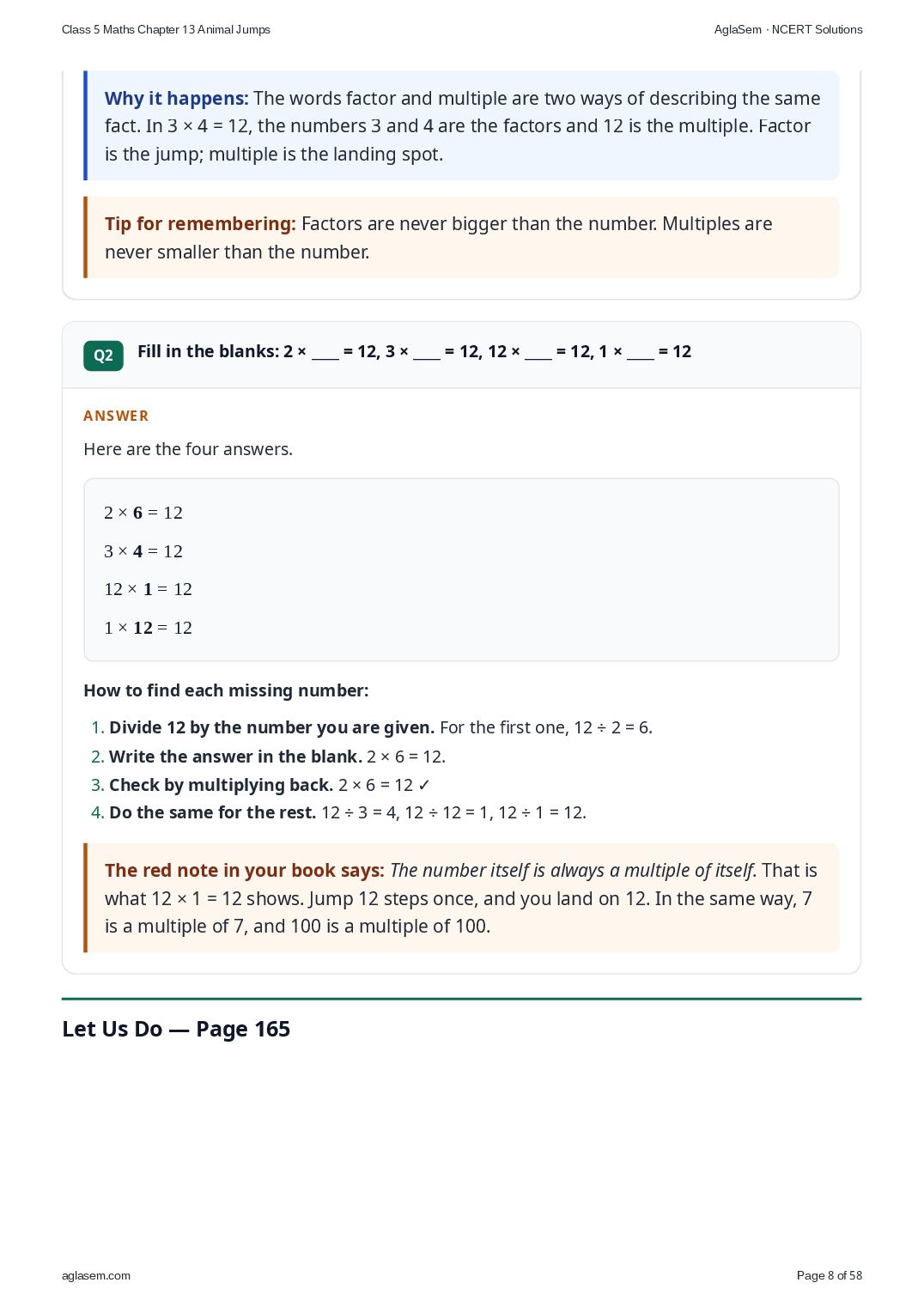
- Let us make arrays for the number 12. (The book shows 3 × 4 = 12, 2 × 6 = 12 and 1 × 12 = 12.) Which numbers are the factors of 12?
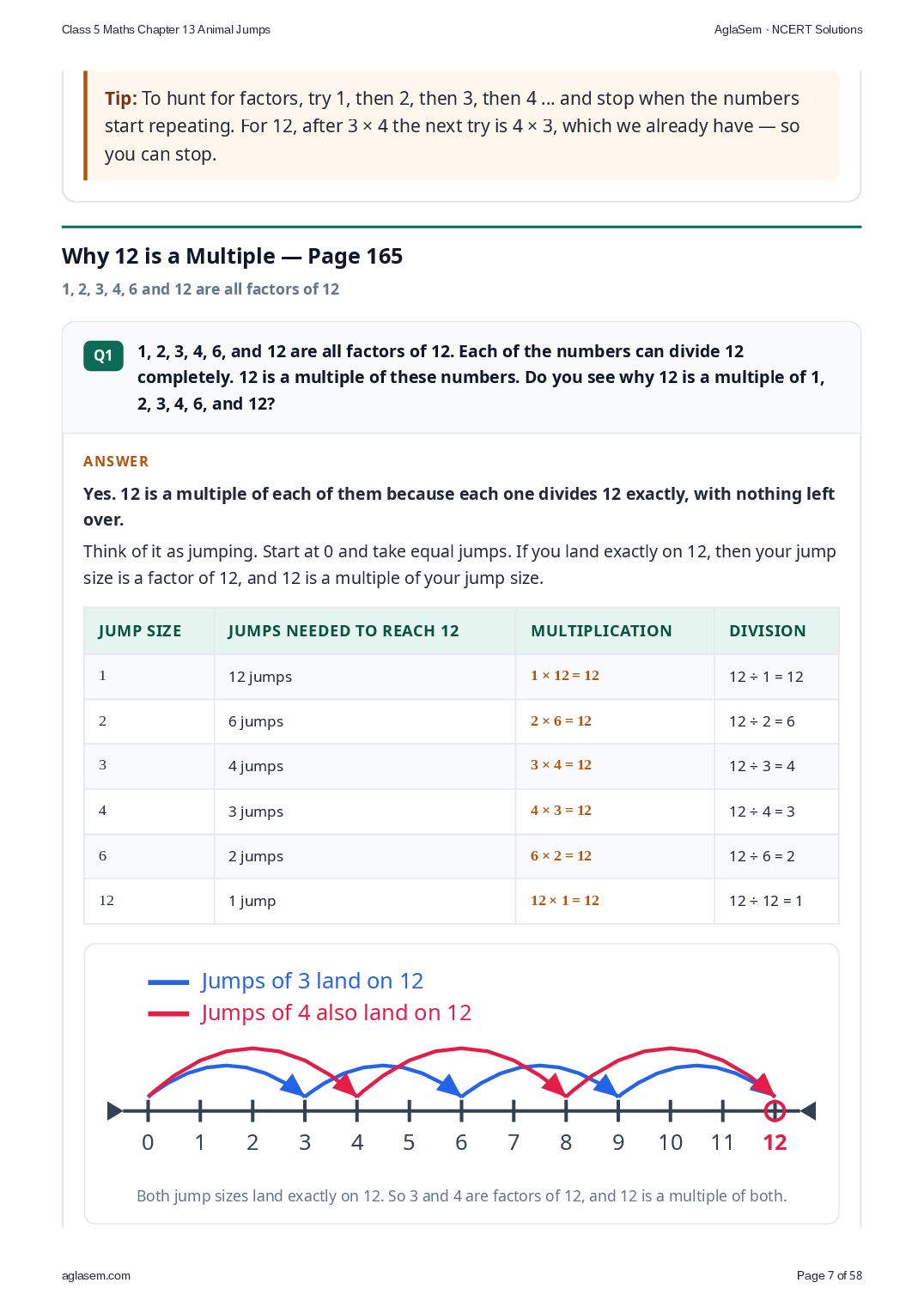
- 1, 2, 3, 4, 6, and 12 are all factors of 12. Each of the numbers can divide 12 completely. 12 is a multiple of these numbers. Do you see why 12 is a multiple of 1, 2, 3, 4, 6, and 12?
- Fill in the blanks: 2 × ____ = 12, 3 × ____ = 12, 12 × ____ = 12, 1 × ____ = 12
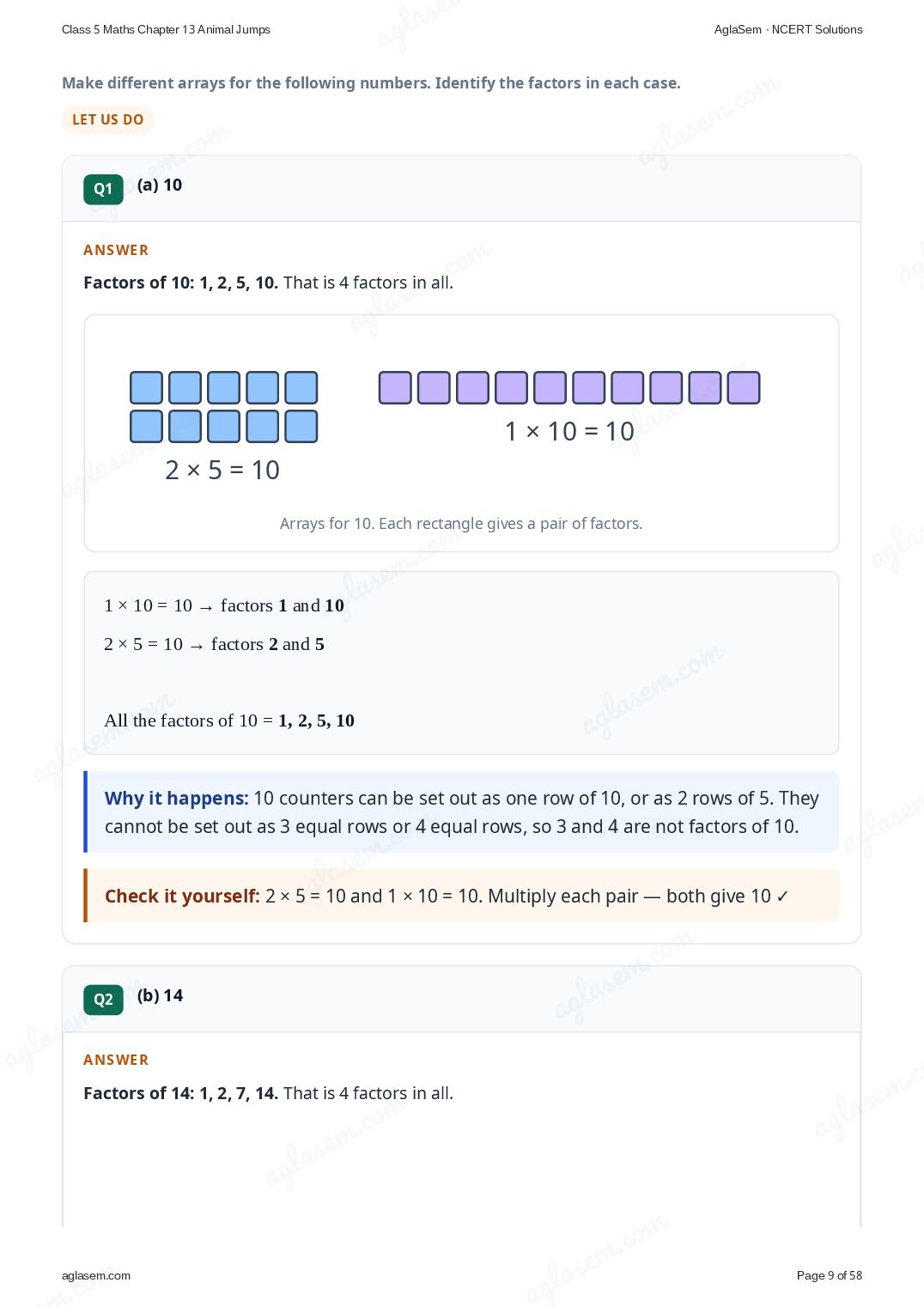
- (a) 10
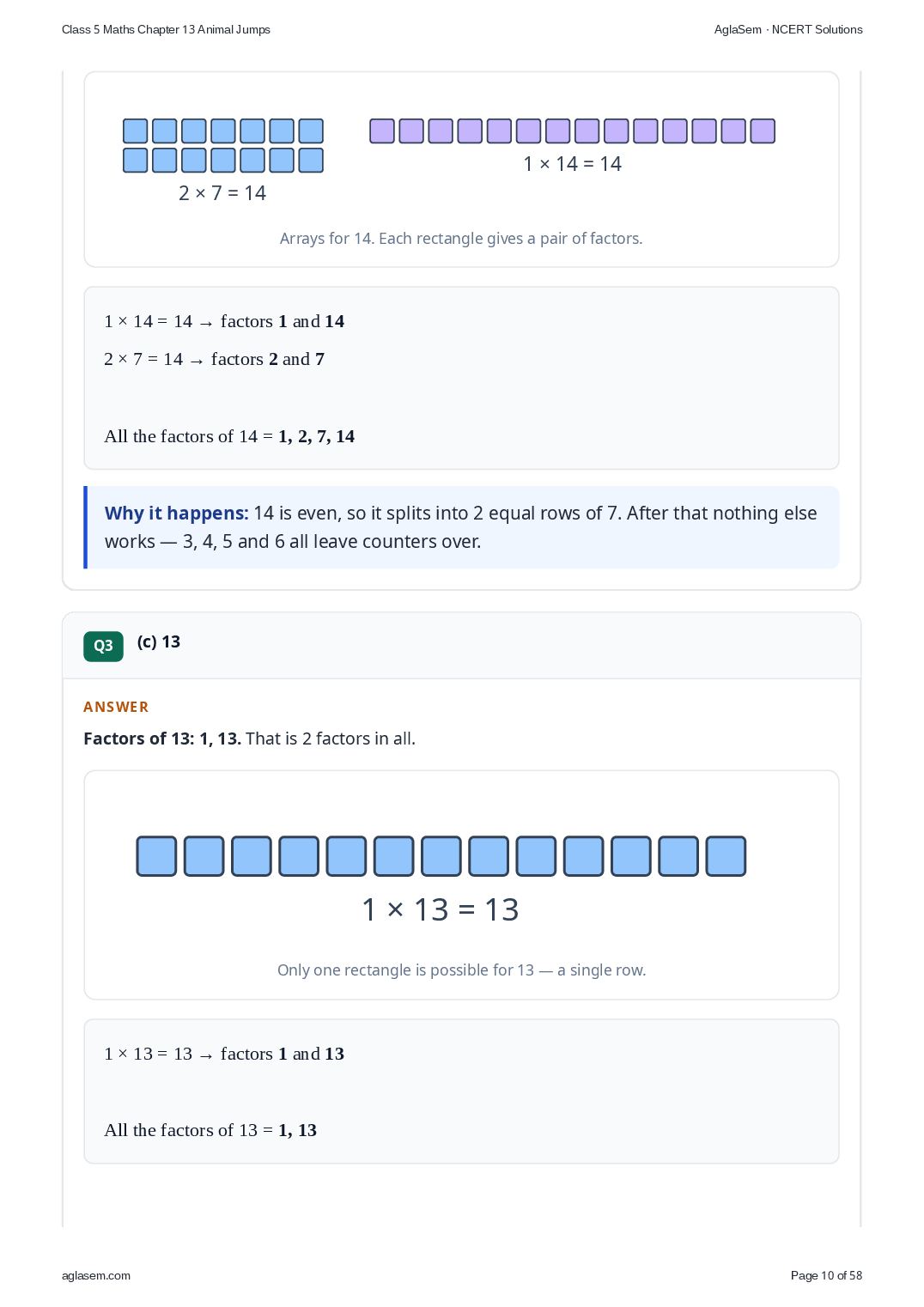
- (b) 14
- (c) 13
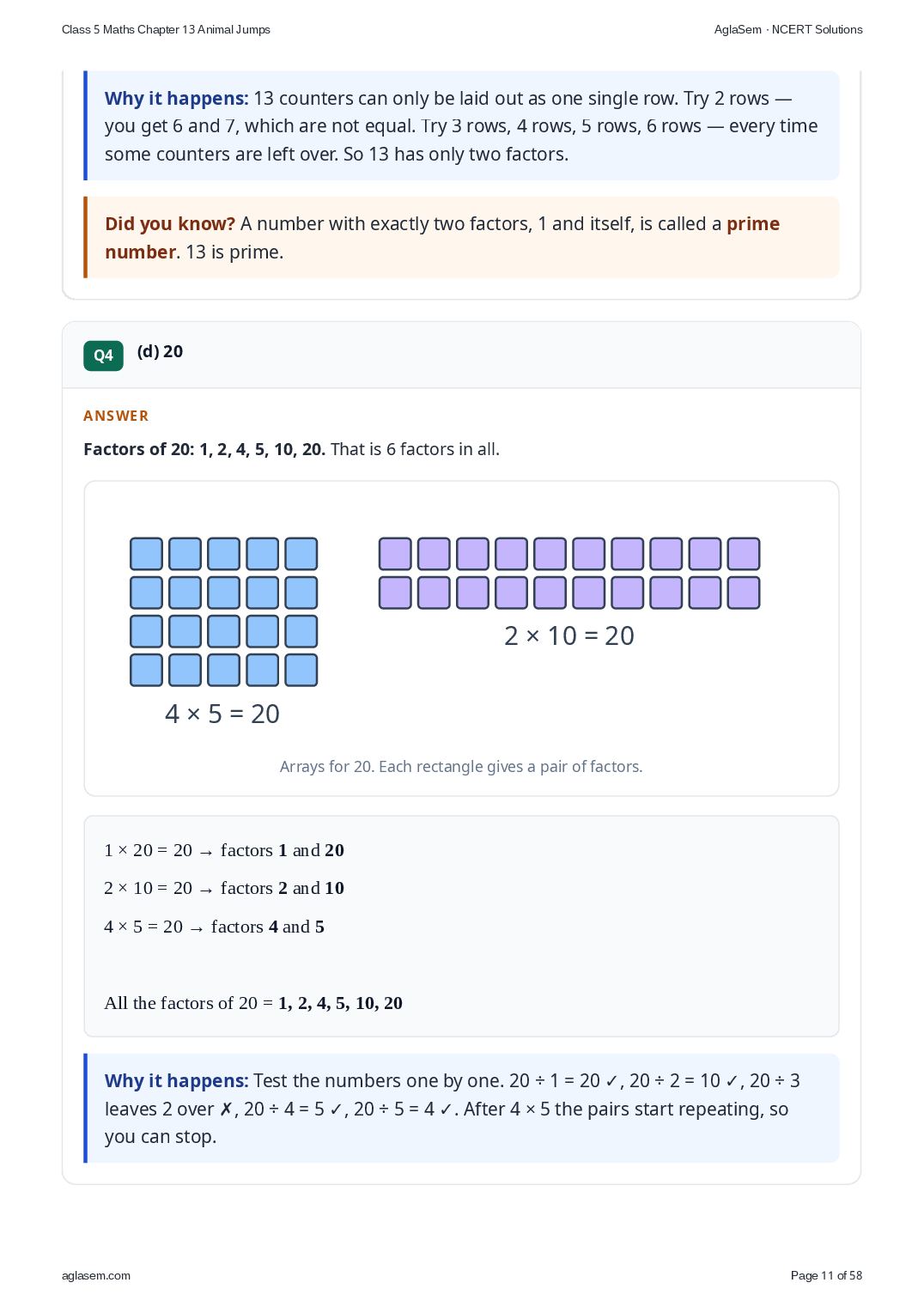
- (d) 20
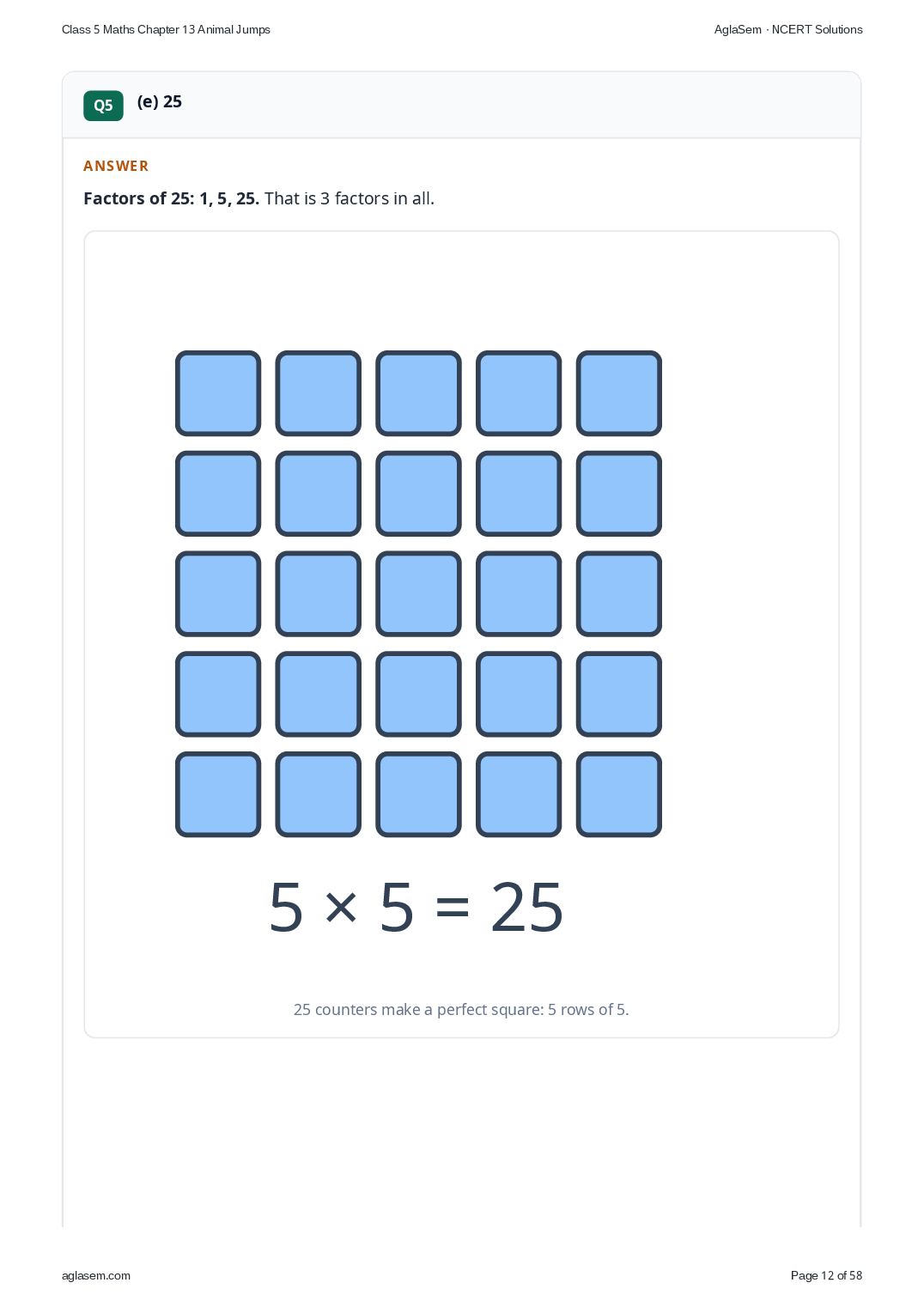
- (e) 25
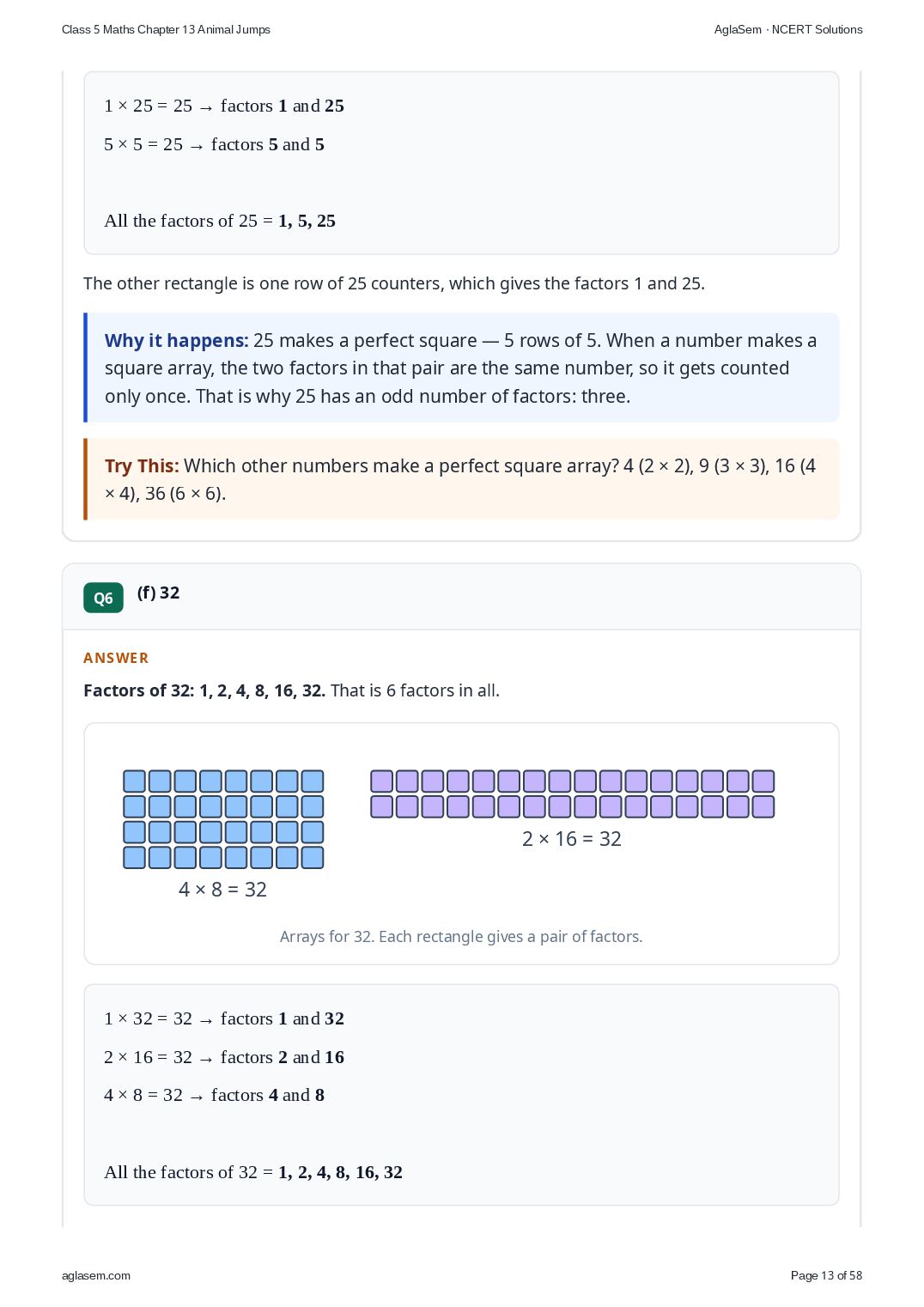
- (f) 32
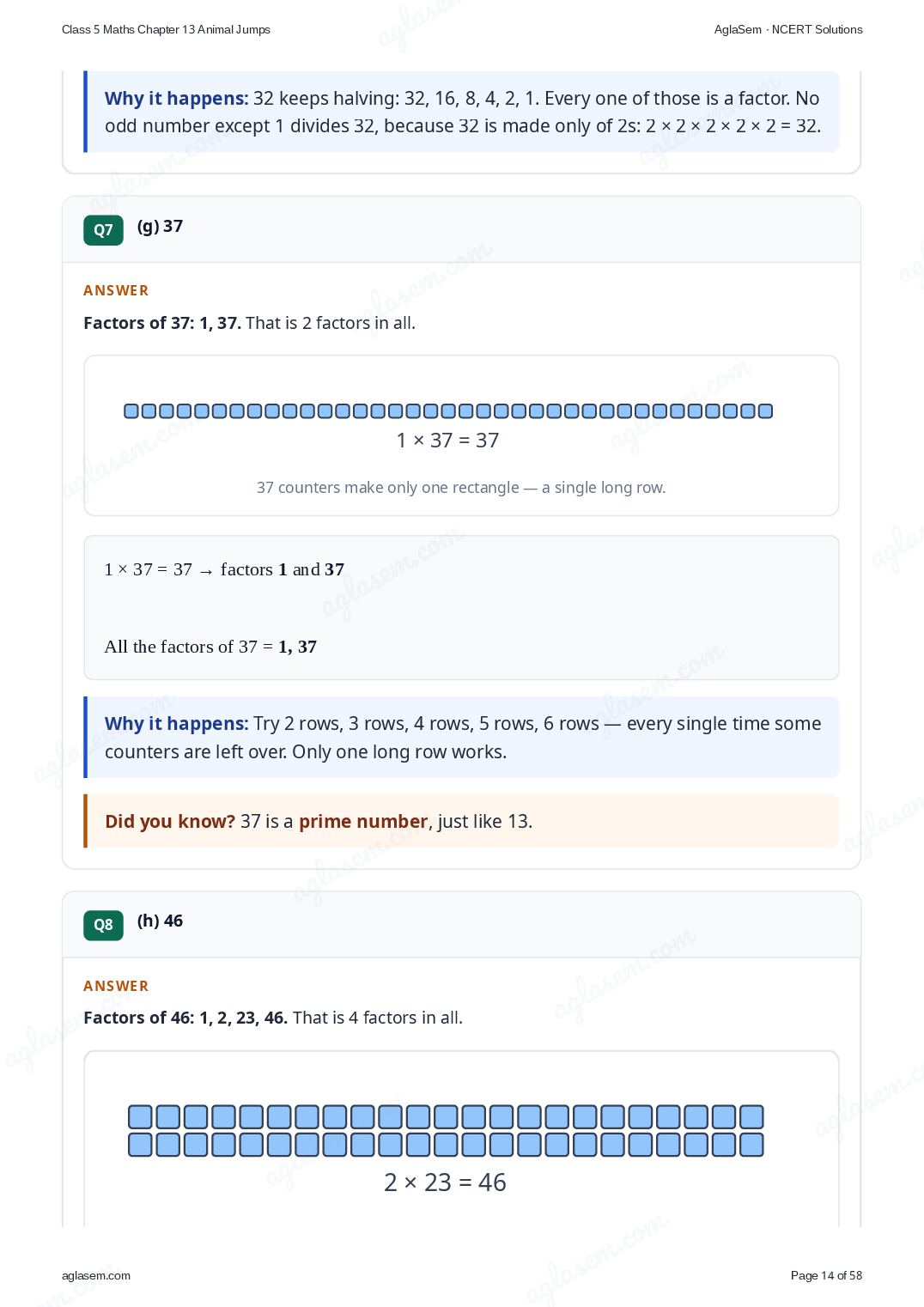
- (g) 37
- (h) 46
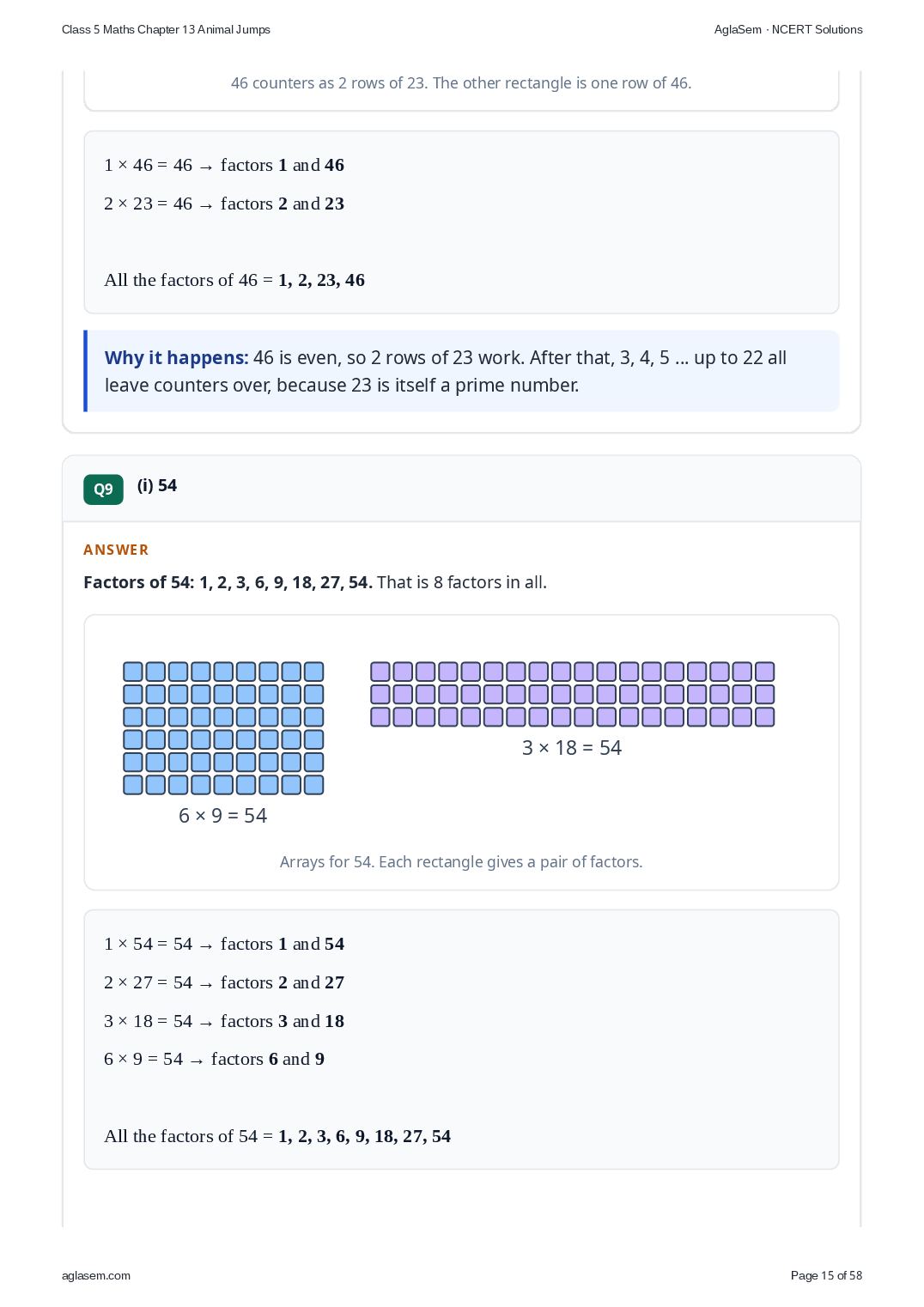
- (i) 54
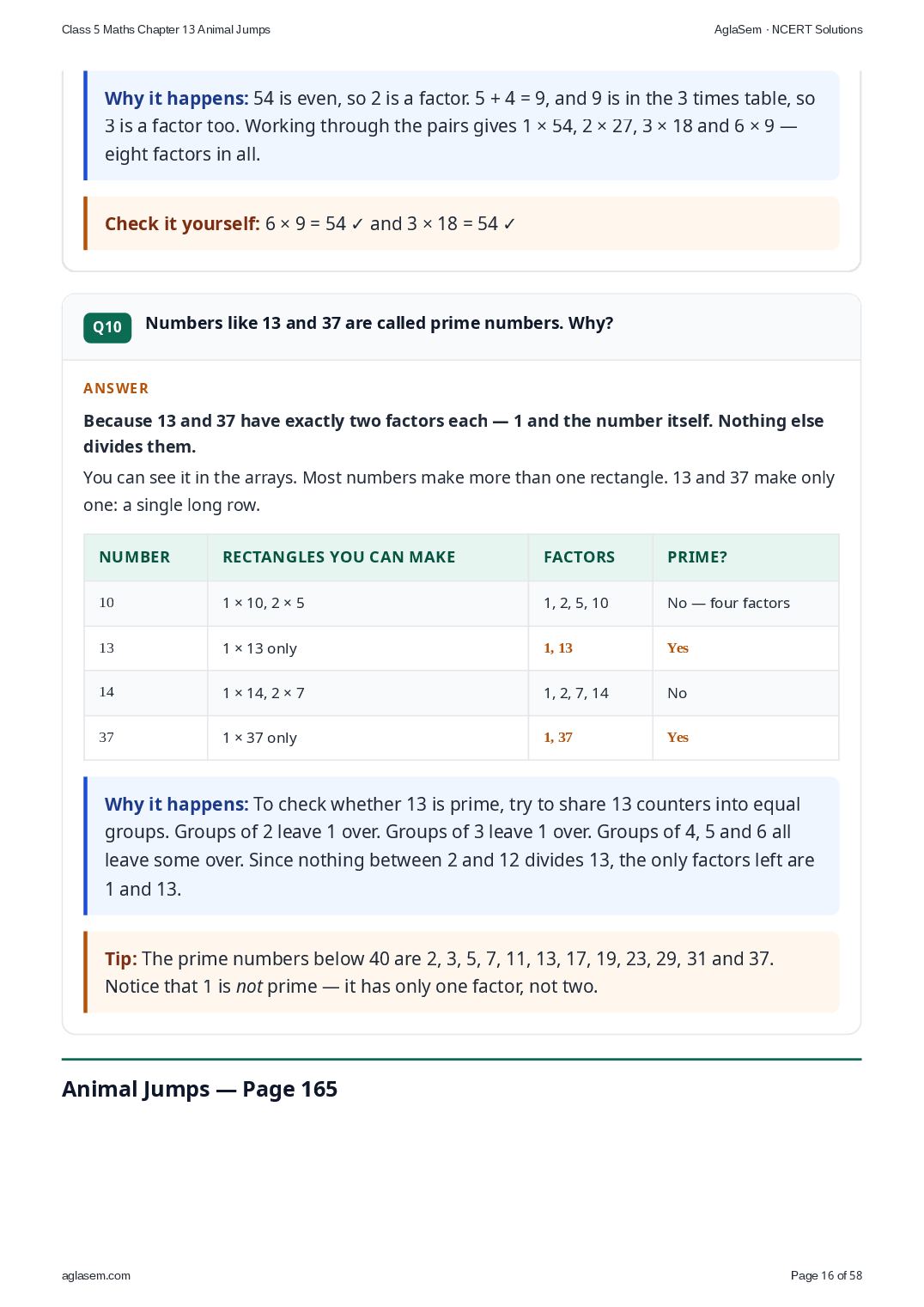
- Numbers like 13 and 37 are called prime numbers. Why?
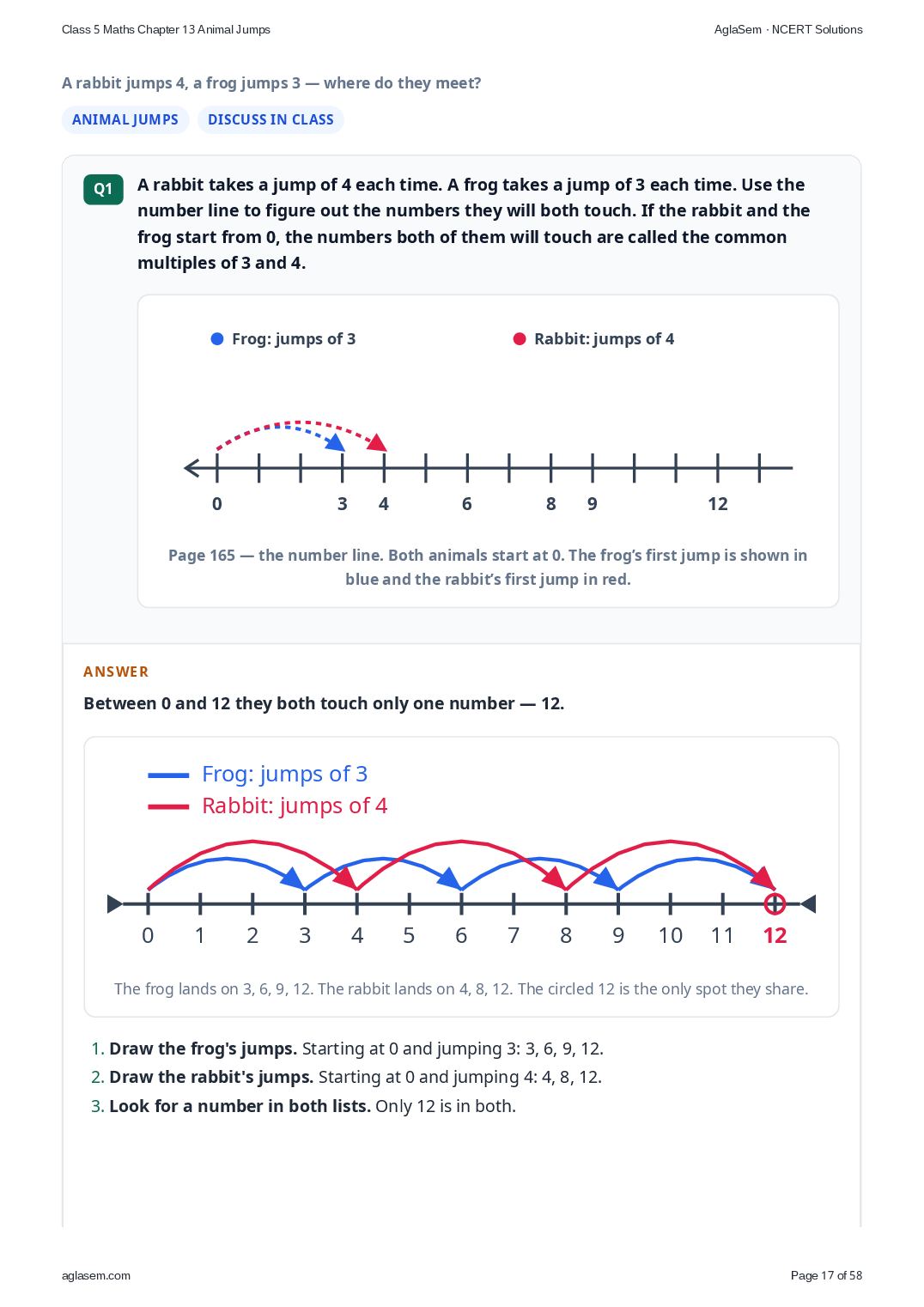
- A rabbit takes a jump of 4 each time. A frog takes a jump of 3 each time. Use the number line to figure out the numbers they will both touch. If the rabbit and the frog start from 0, the numbers both of them will touch are called the common multiples of 3 and 4.Frog: jumps of 3Rabbit: jumps of 403468912Page 165 — the number line. Both animals start at 0. The frog’s first jump is shown in blue and the rabbit’s first jump in red.
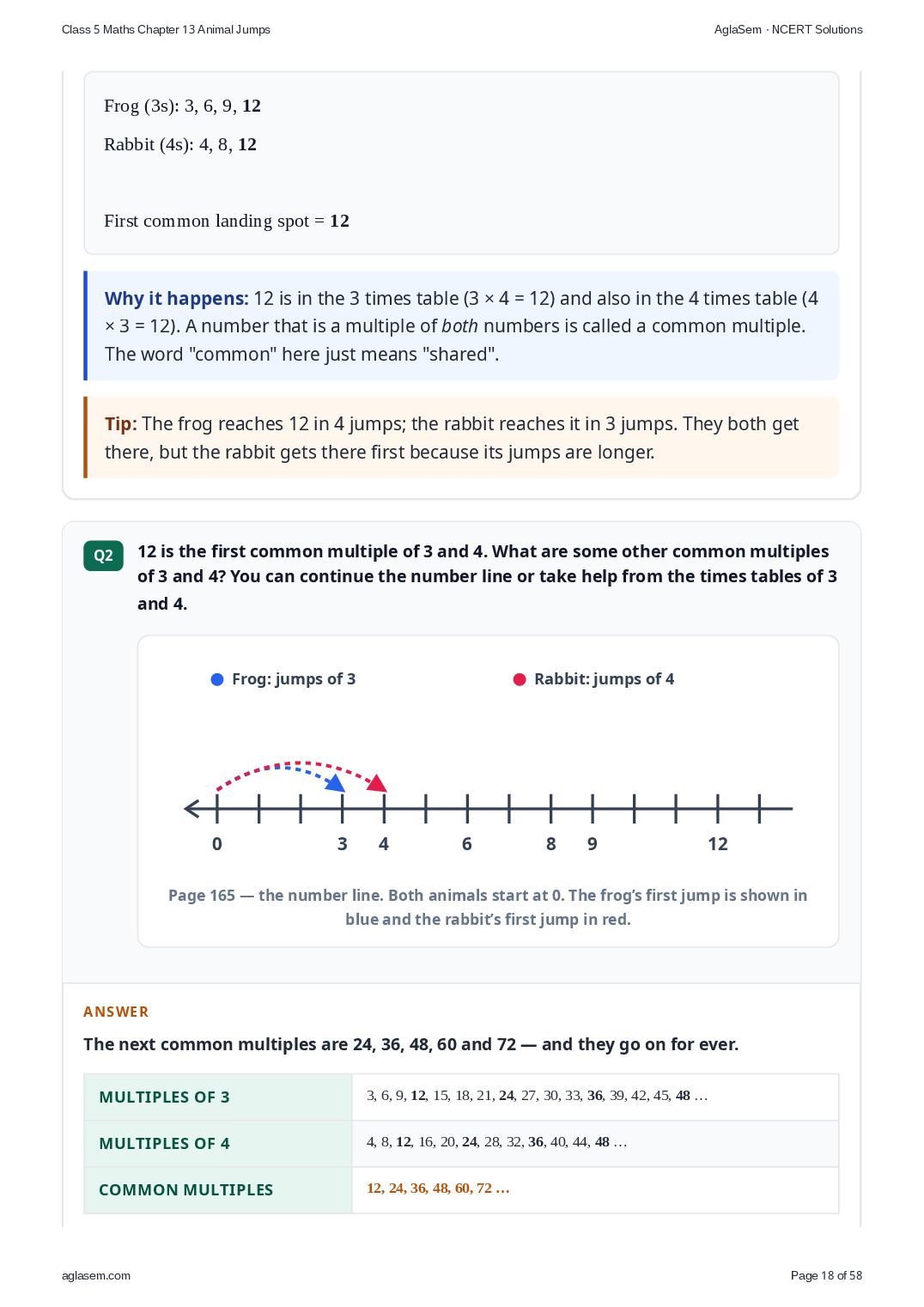
- 12 is the first common multiple of 3 and 4. What are some other common multiples of 3 and 4? You can continue the number line or take help from the times tables of 3 and 4.Frog: jumps of 3Rabbit: jumps of 403468912Page 165 — the number line. Both animals start at 0. The frog’s first jump is shown in blue and the rabbit’s first jump in red.
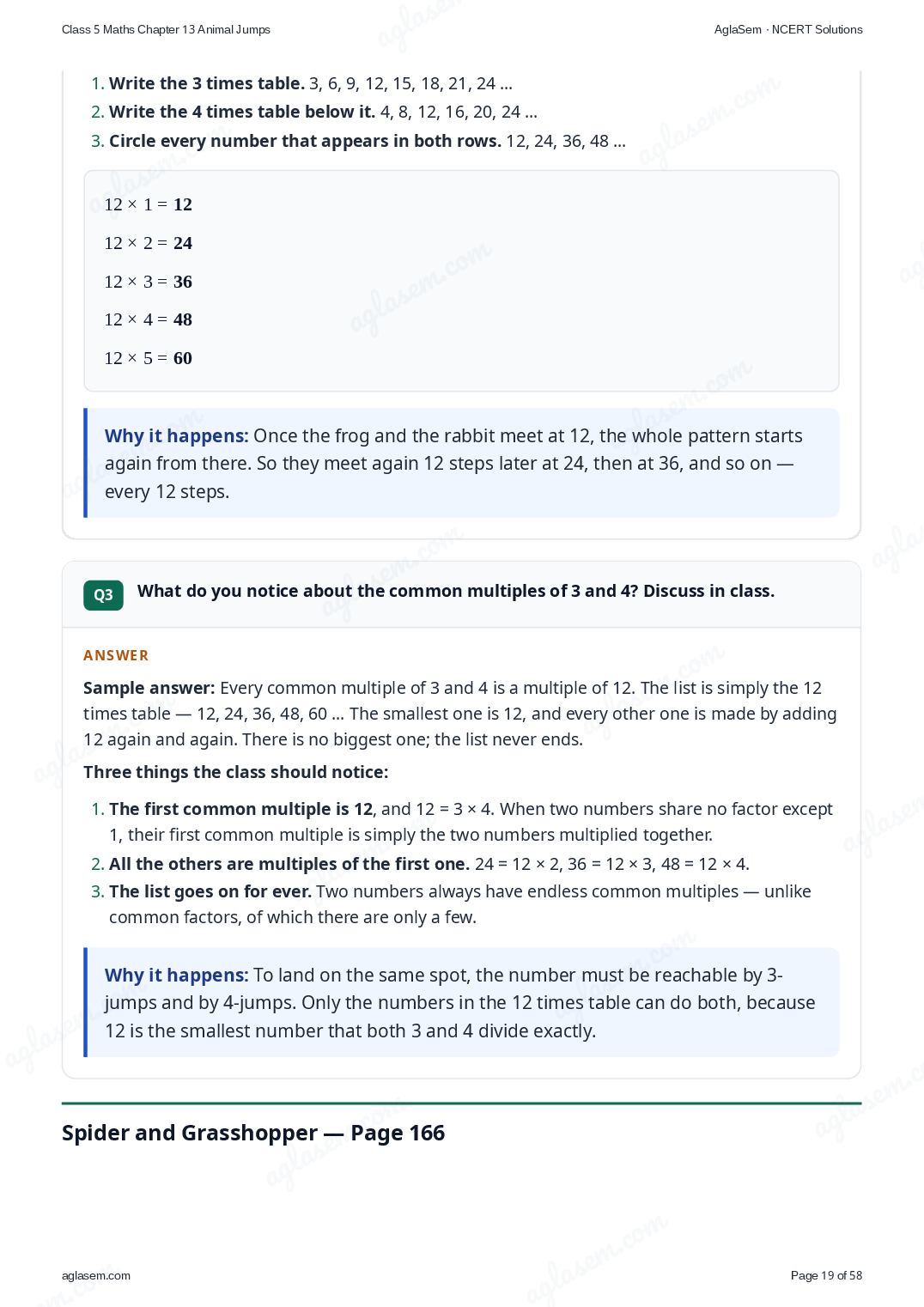
- What do you notice about the common multiples of 3 and 4? Discuss in class.
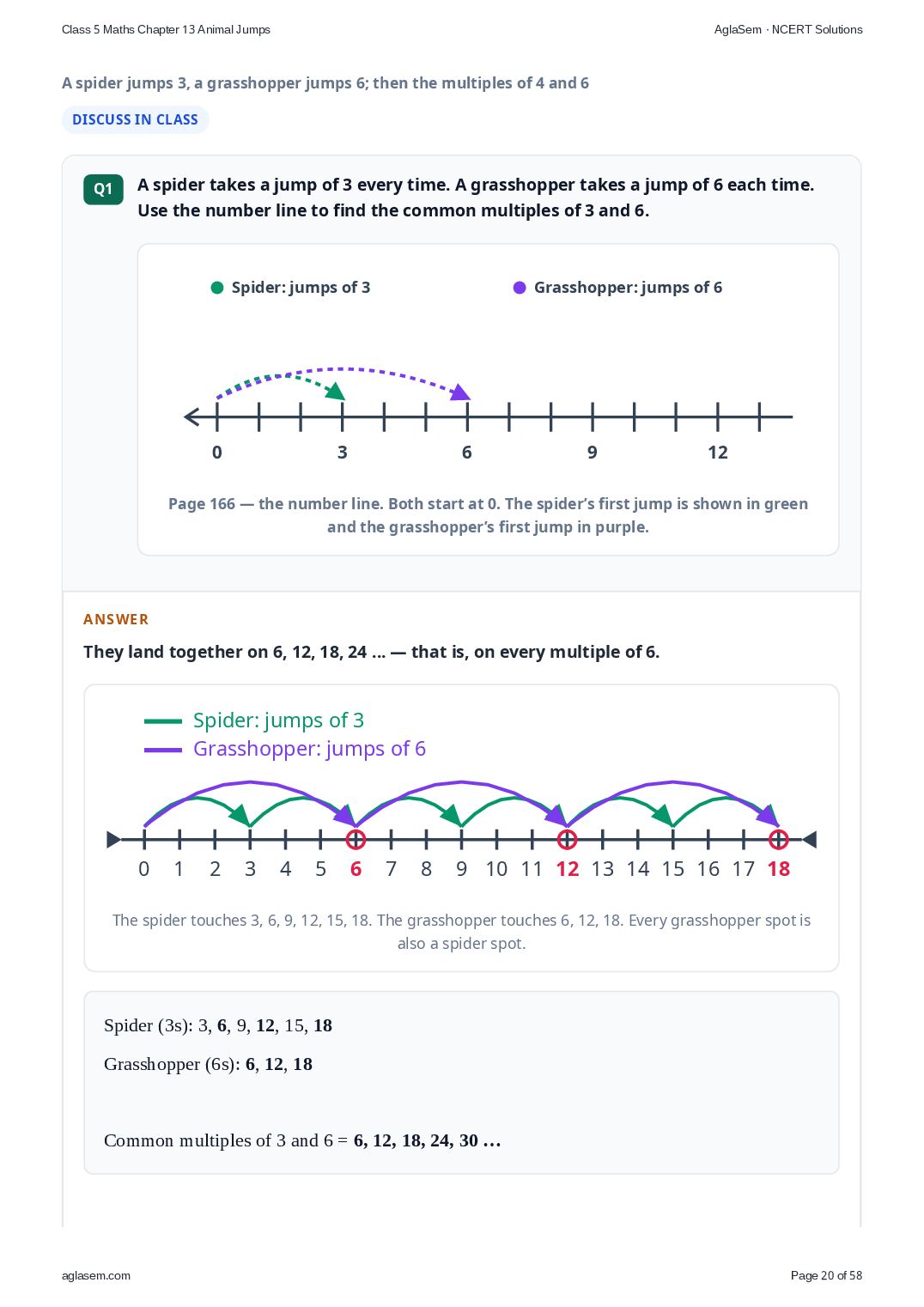
- A spider takes a jump of 3 every time. A grasshopper takes a jump of 6 each time. Use the number line to find the common multiples of 3 and 6.Spider: jumps of 3Grasshopper: jumps of 6036912Page 166 — the number line. Both start at 0. The spider’s first jump is shown in green and the grasshopper’s first jump in purple.
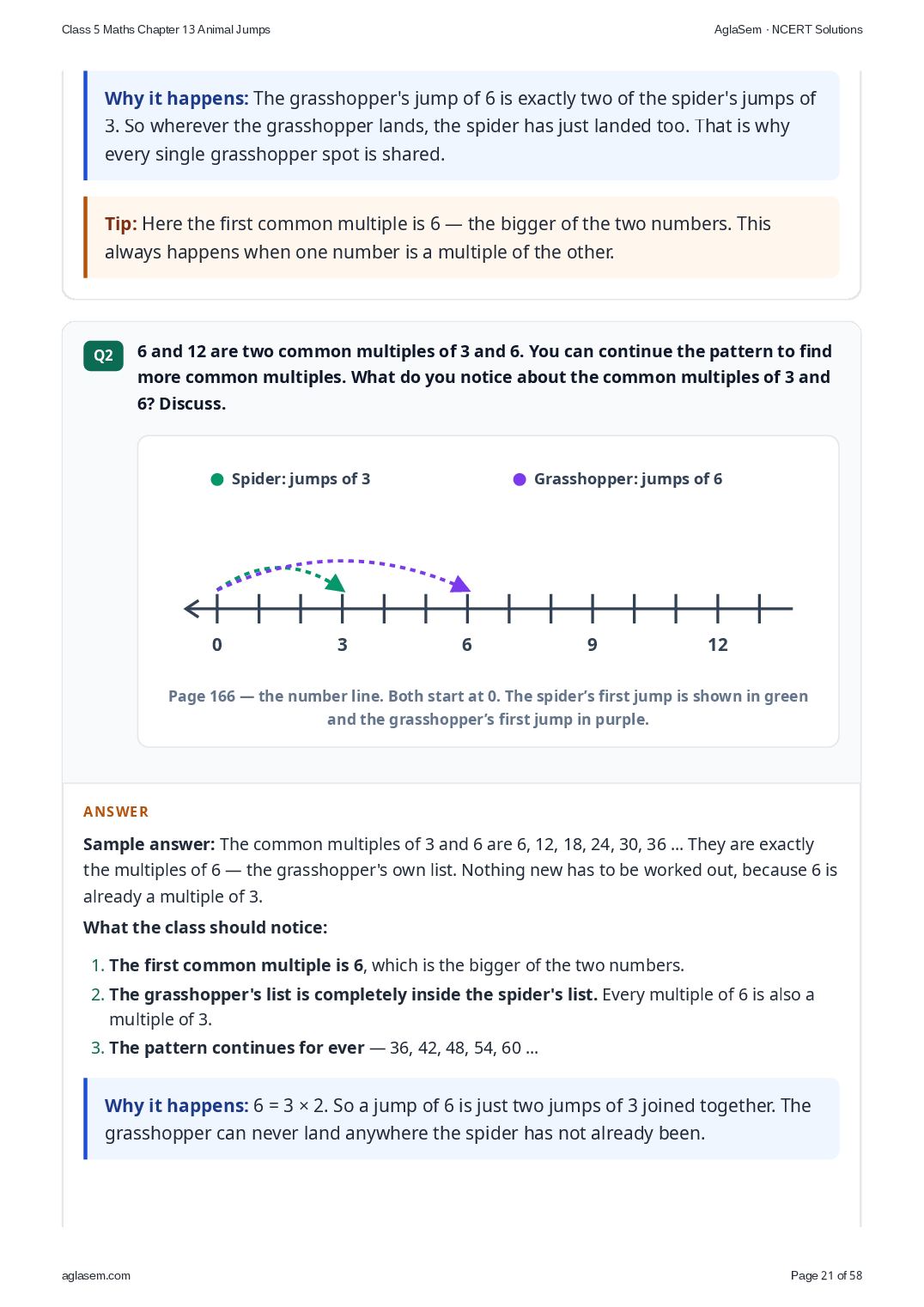
- 6 and 12 are two common multiples of 3 and 6. You can continue the pattern to find more common multiples. What do you notice about the common multiples of 3 and 6? Discuss.Spider: jumps of 3Grasshopper: jumps of 6036912Page 166 — the number line. Both start at 0. The spider’s first jump is shown in green and the grasshopper’s first jump in purple.
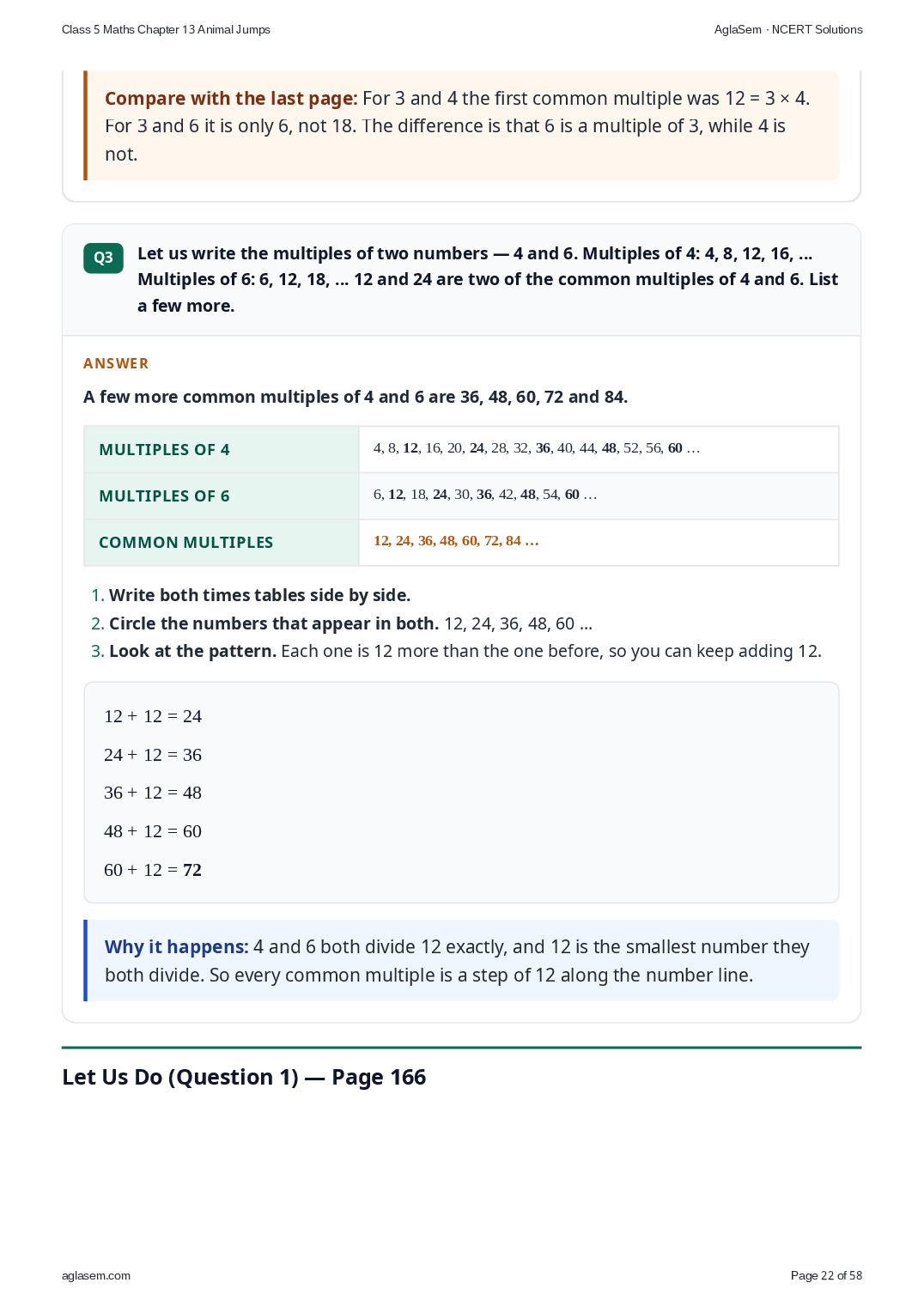
- Let us write the multiples of two numbers — 4 and 6. Multiples of 4: 4, 8, 12, 16, … Multiples of 6: 6, 12, 18, … 12 and 24 are two of the common multiples of 4 and 6. List a few more.
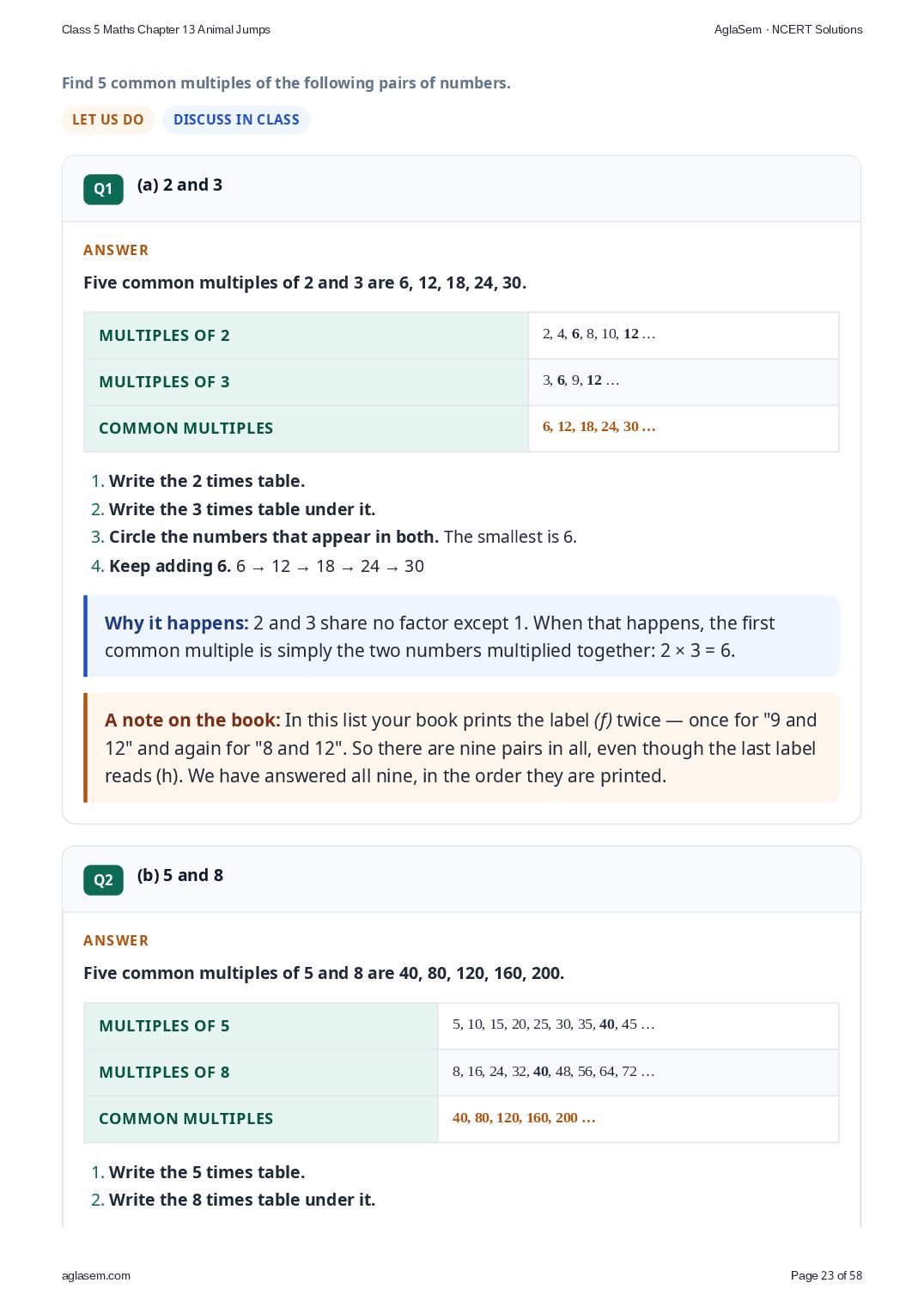
- (a) 2 and 3
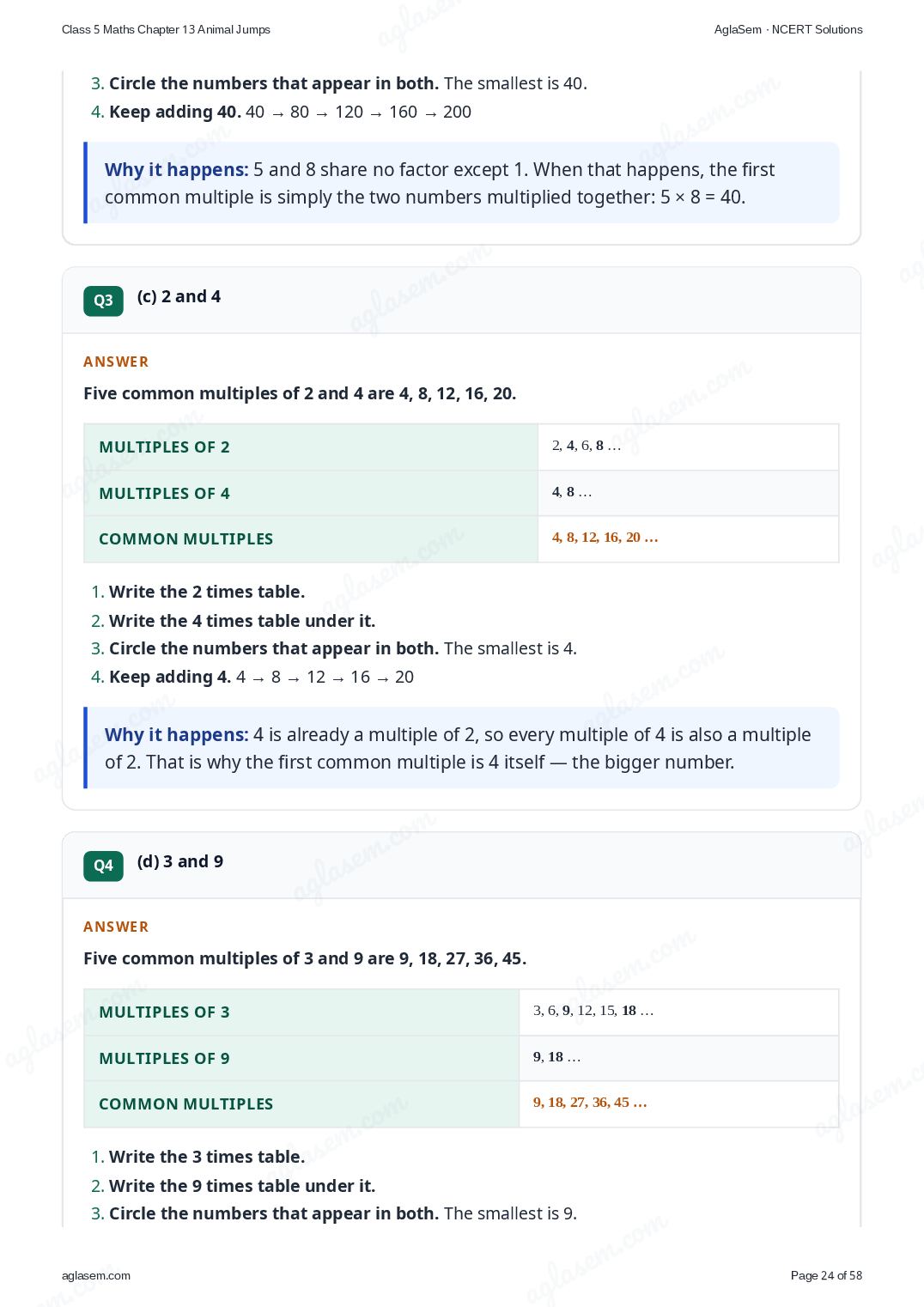
- (b) 5 and 8
- (c) 2 and 4
- (d) 3 and 9
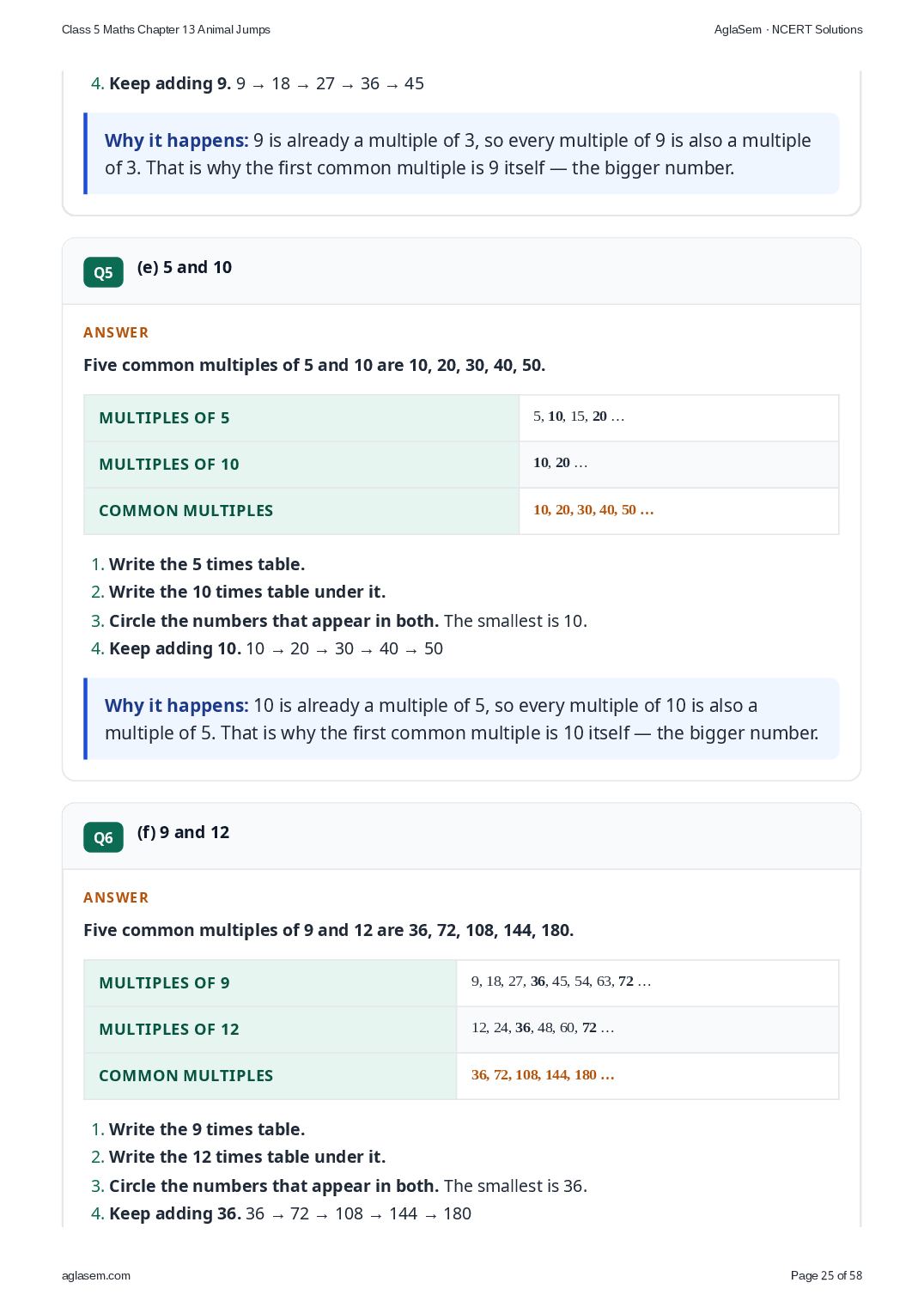
- (e) 5 and 10
- (f) 9 and 12
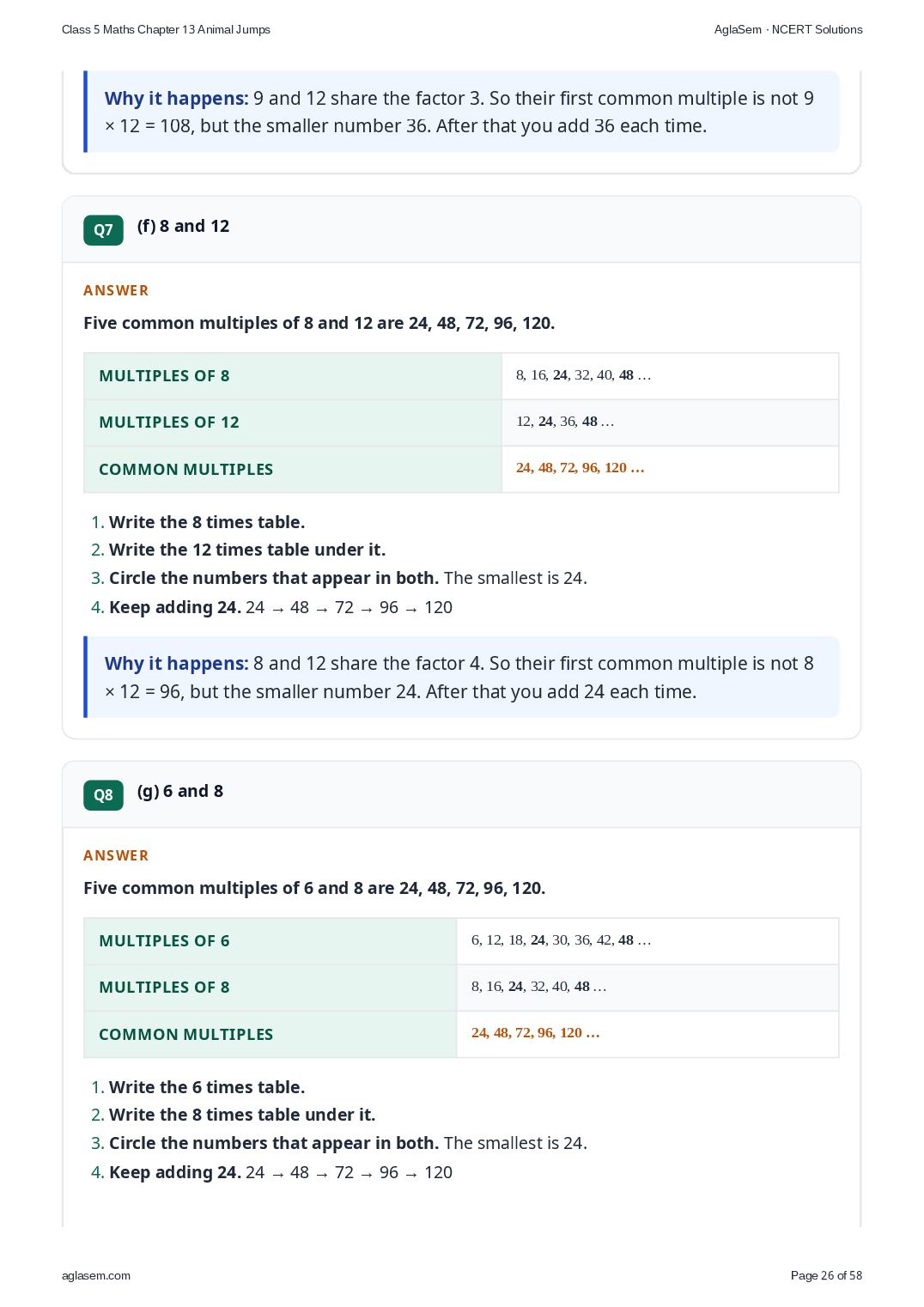
- (f) 8 and 12
- (g) 6 and 8
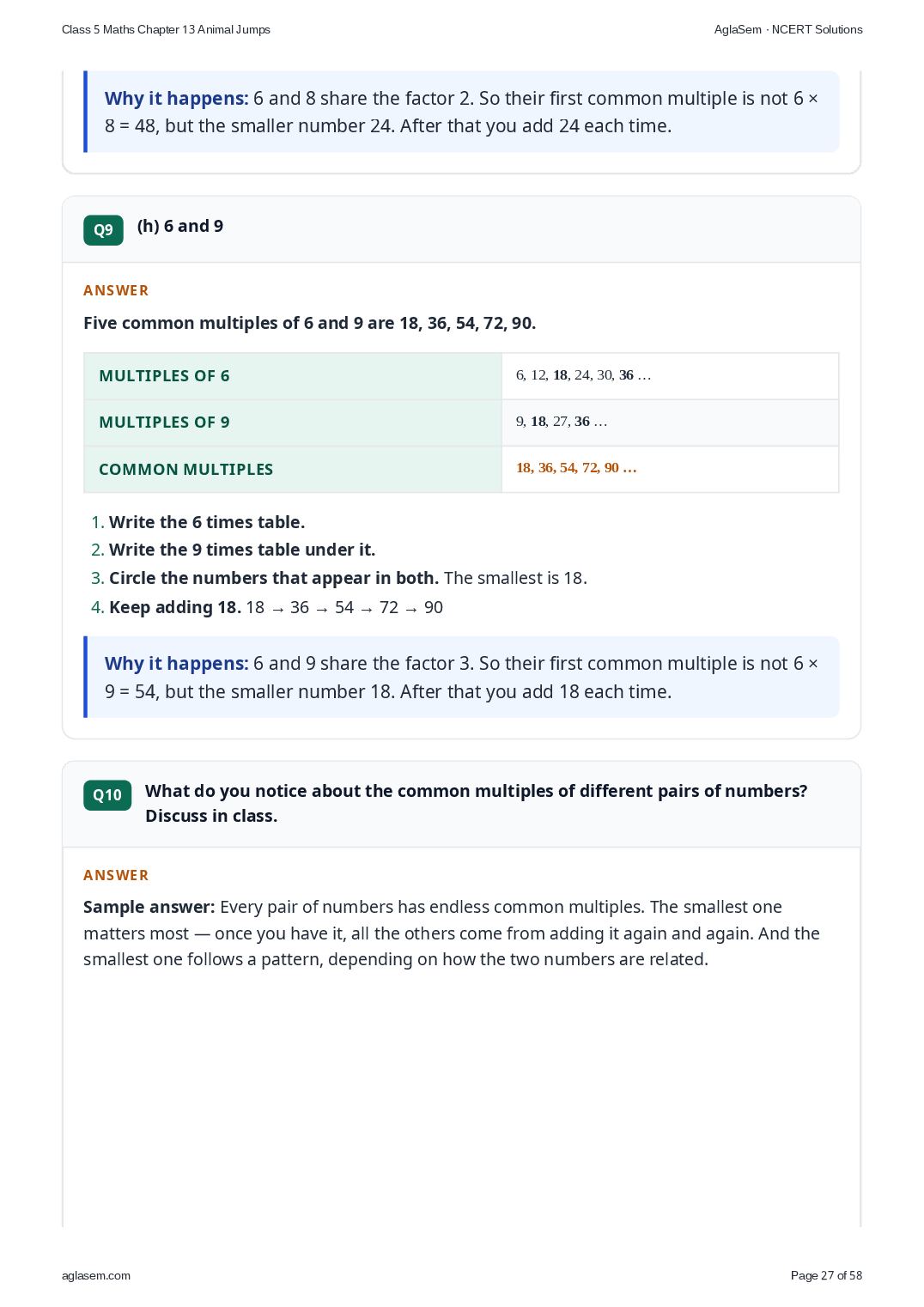
- (h) 6 and 9
- What do you notice about the common multiples of different pairs of numbers? Discuss in class.
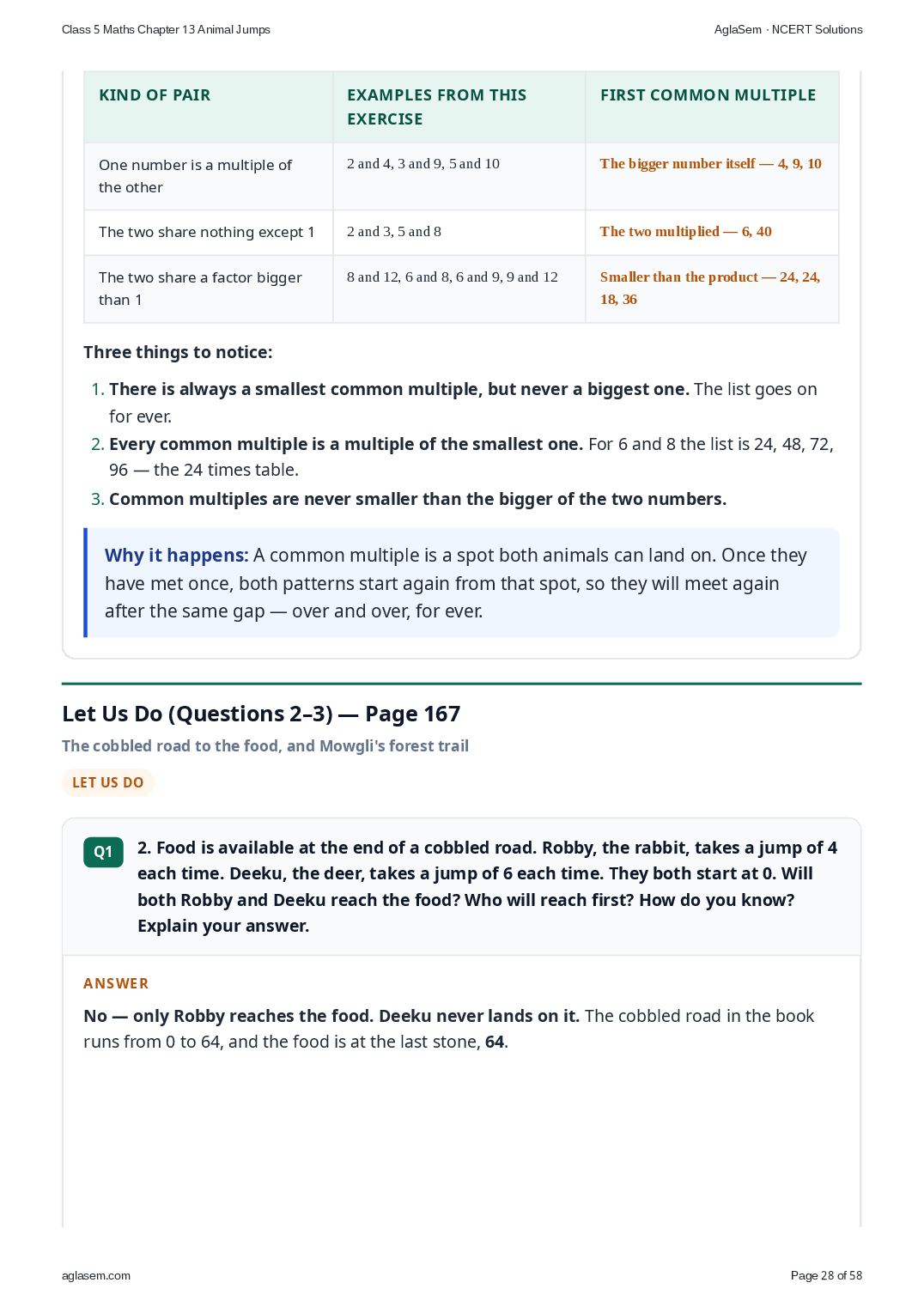
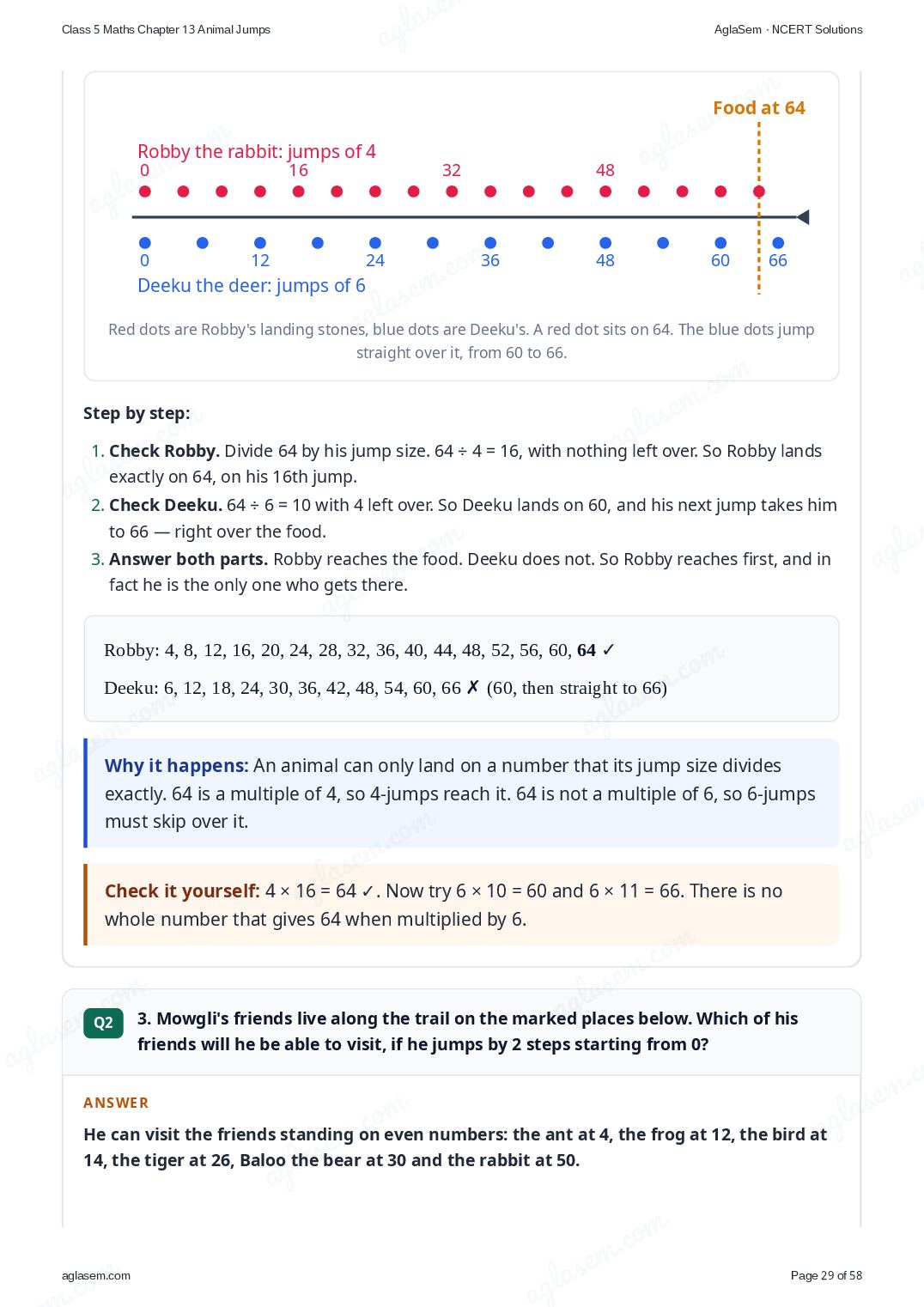
- 2. Food is available at the end of a cobbled road. Robby, the rabbit, takes a jump of 4 each time. Deeku, the deer, takes a jump of 6 each time. They both start at 0. Will both Robby and Deeku reach the food? Who will reach first? How do you know? Explain your answer.
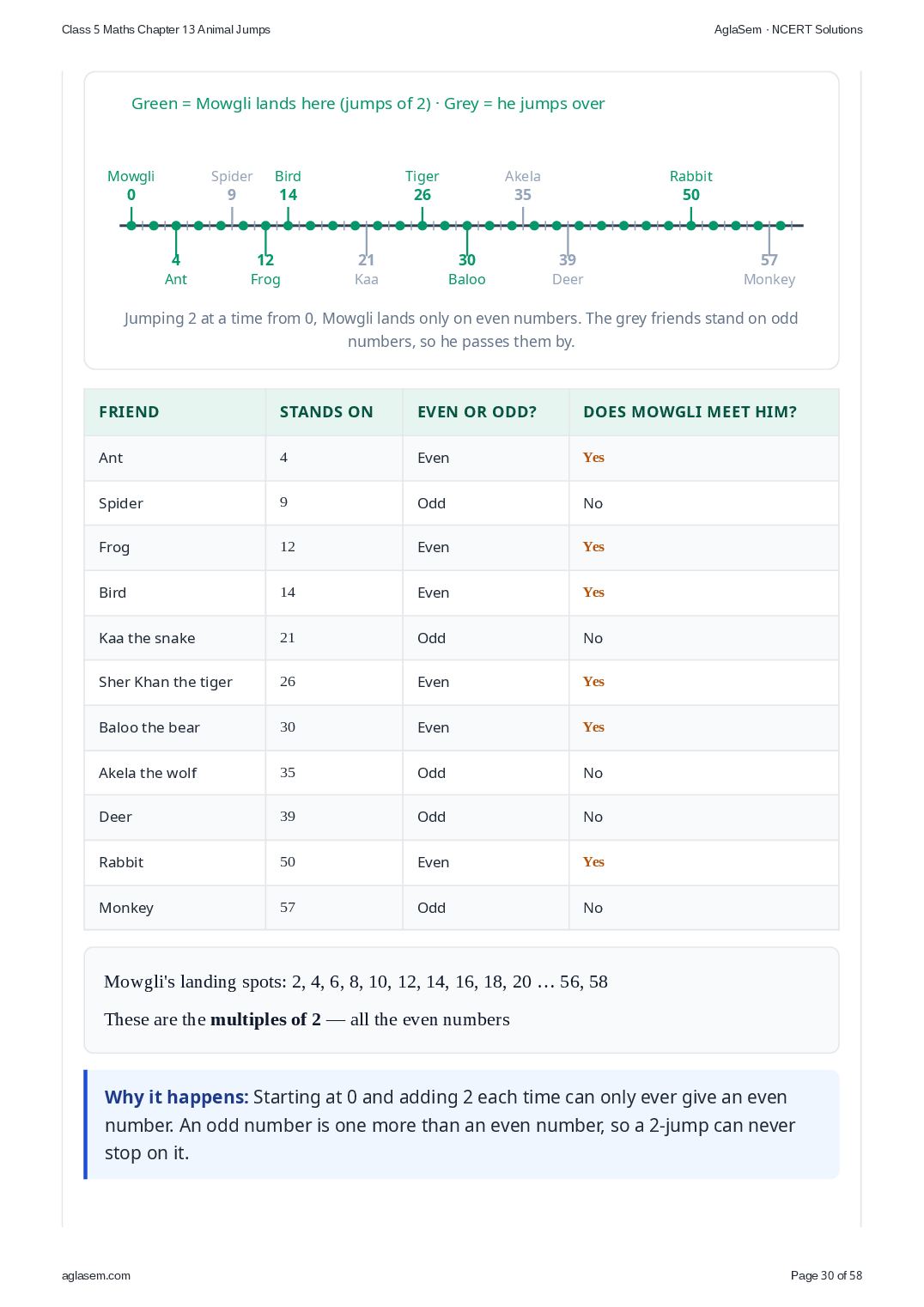
- 3. Mowgli’s friends live along the trail on the marked places below. Which of his friends will he be able to visit, if he jumps by 2 steps starting from 0?
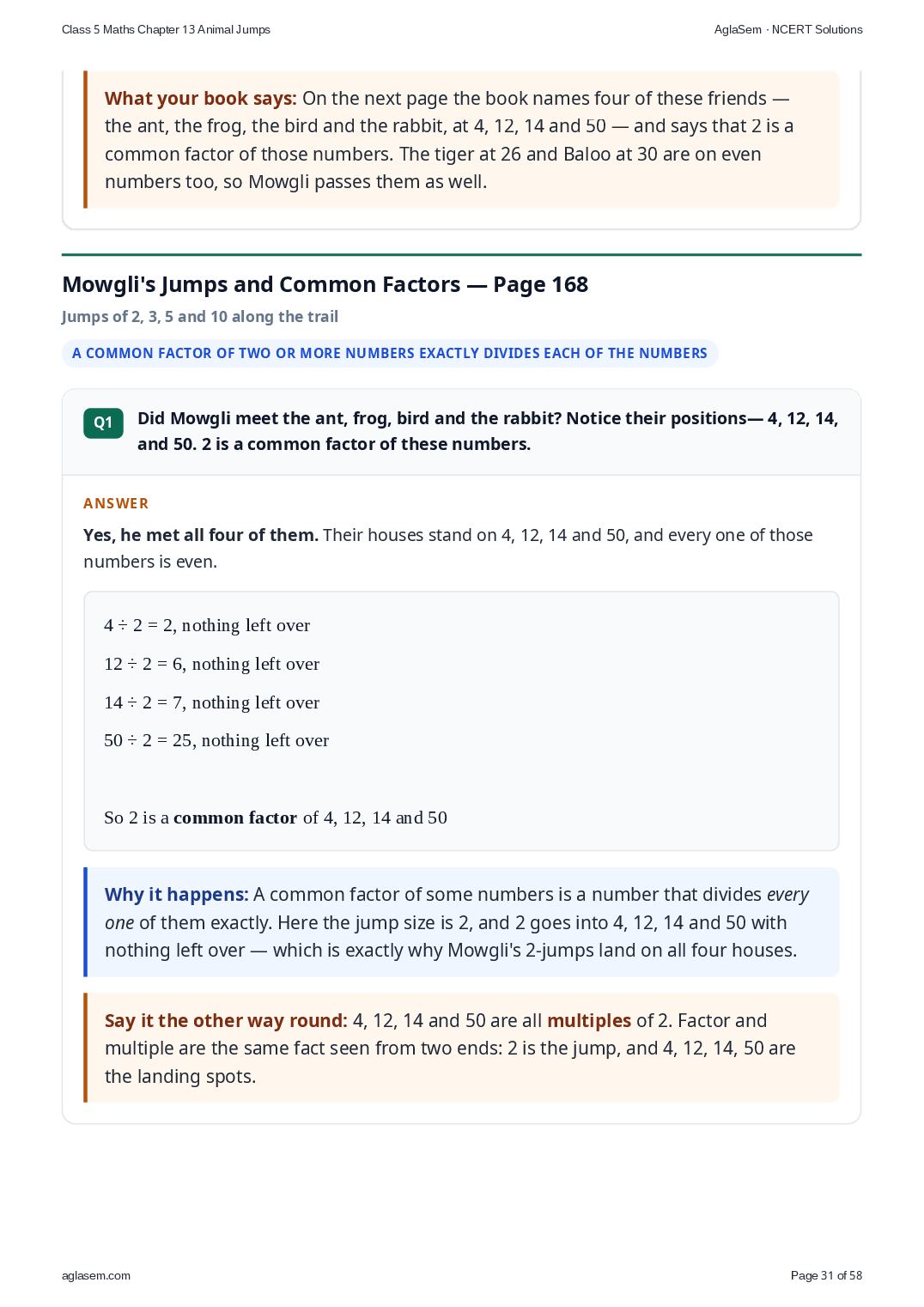
- Did Mowgli meet the ant, frog, bird and the rabbit? Notice their positions— 4, 12, 14, and 50. 2 is a common factor of these numbers.
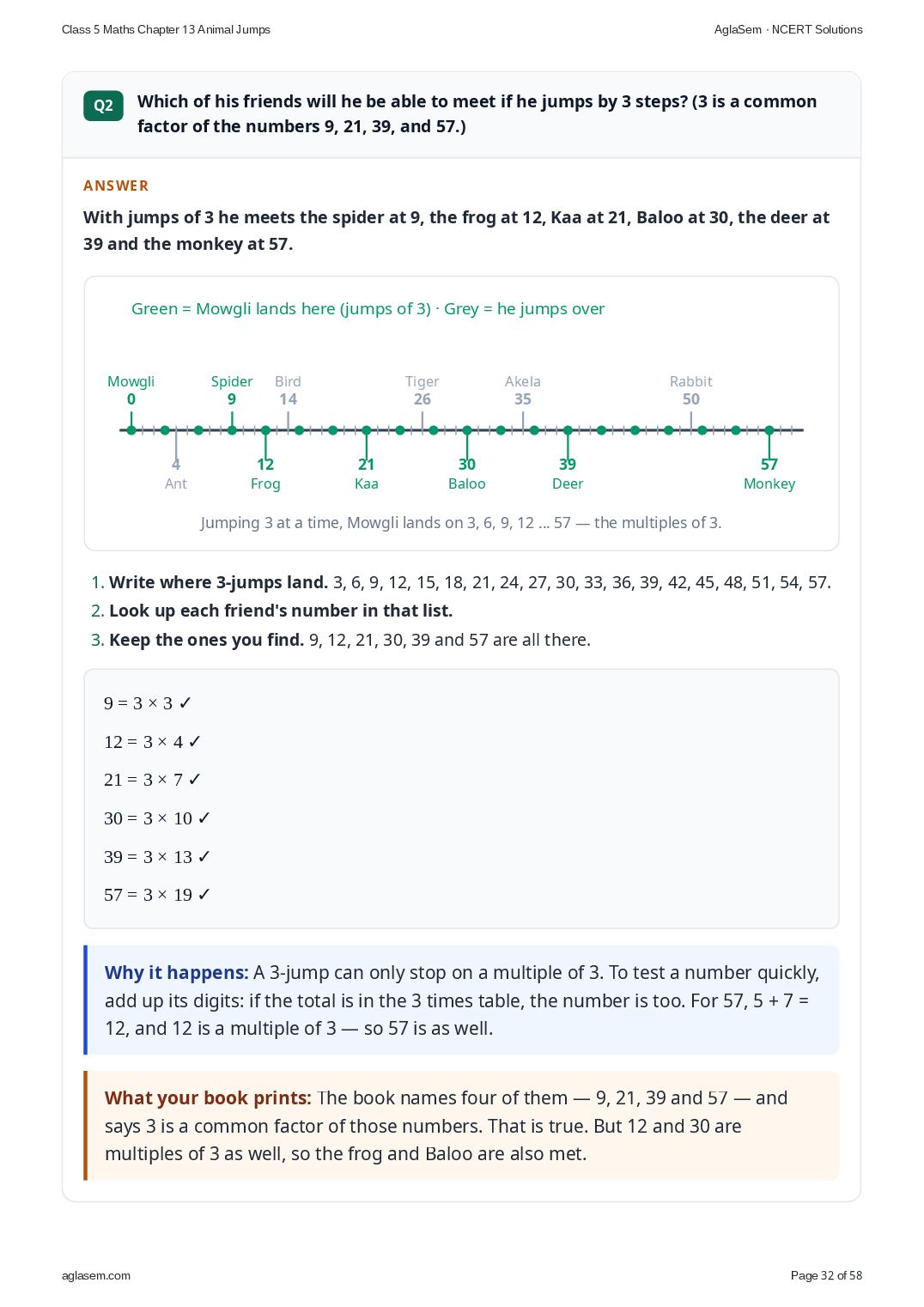
- Which of his friends will he be able to meet if he jumps by 3 steps? (3 is a common factor of the numbers 9, 21, 39, and 57.)
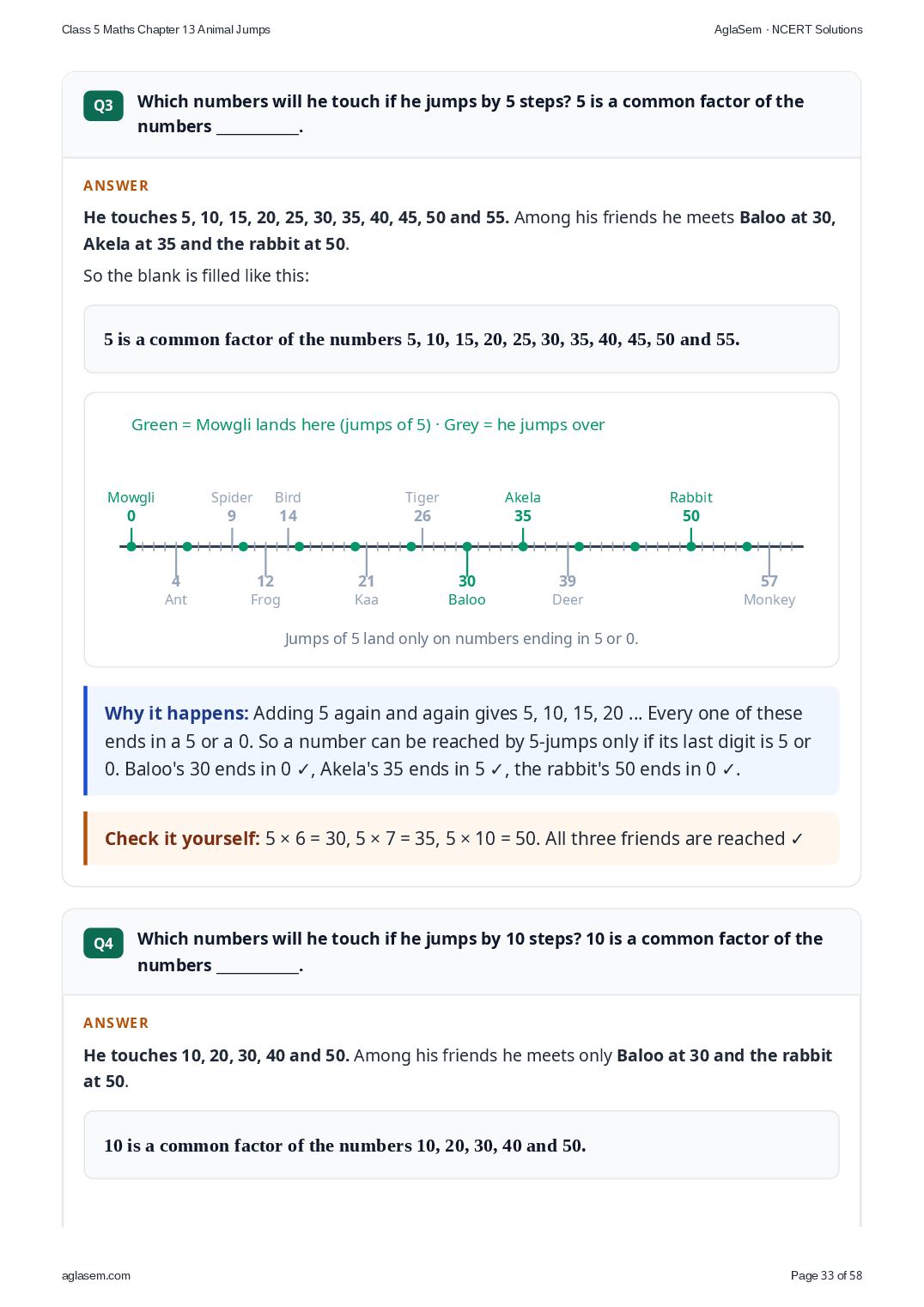
- Which numbers will he touch if he jumps by 5 steps? 5 is a common factor of the numbers ____________.
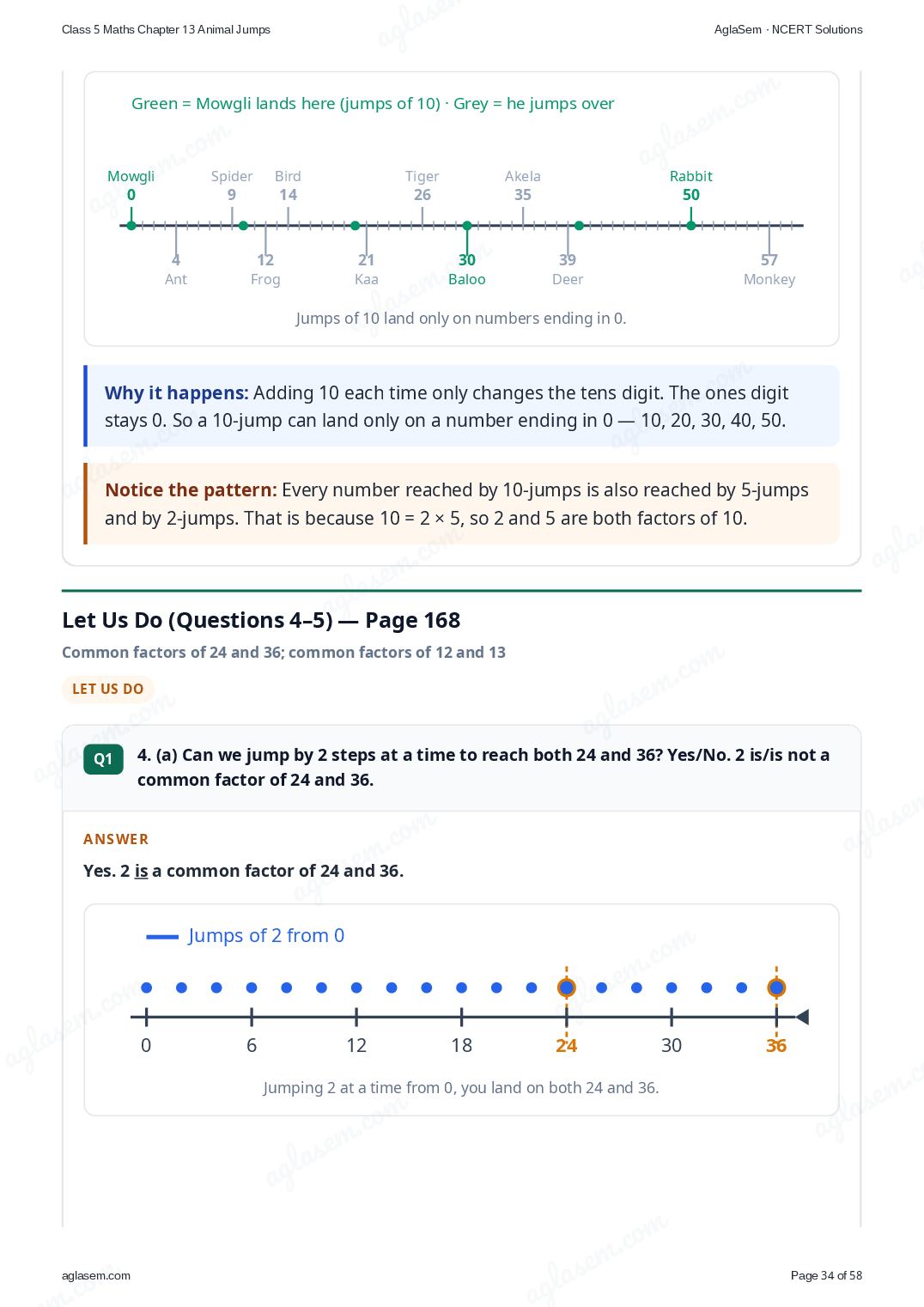
- Which numbers will he touch if he jumps by 10 steps? 10 is a common factor of the numbers ____________.
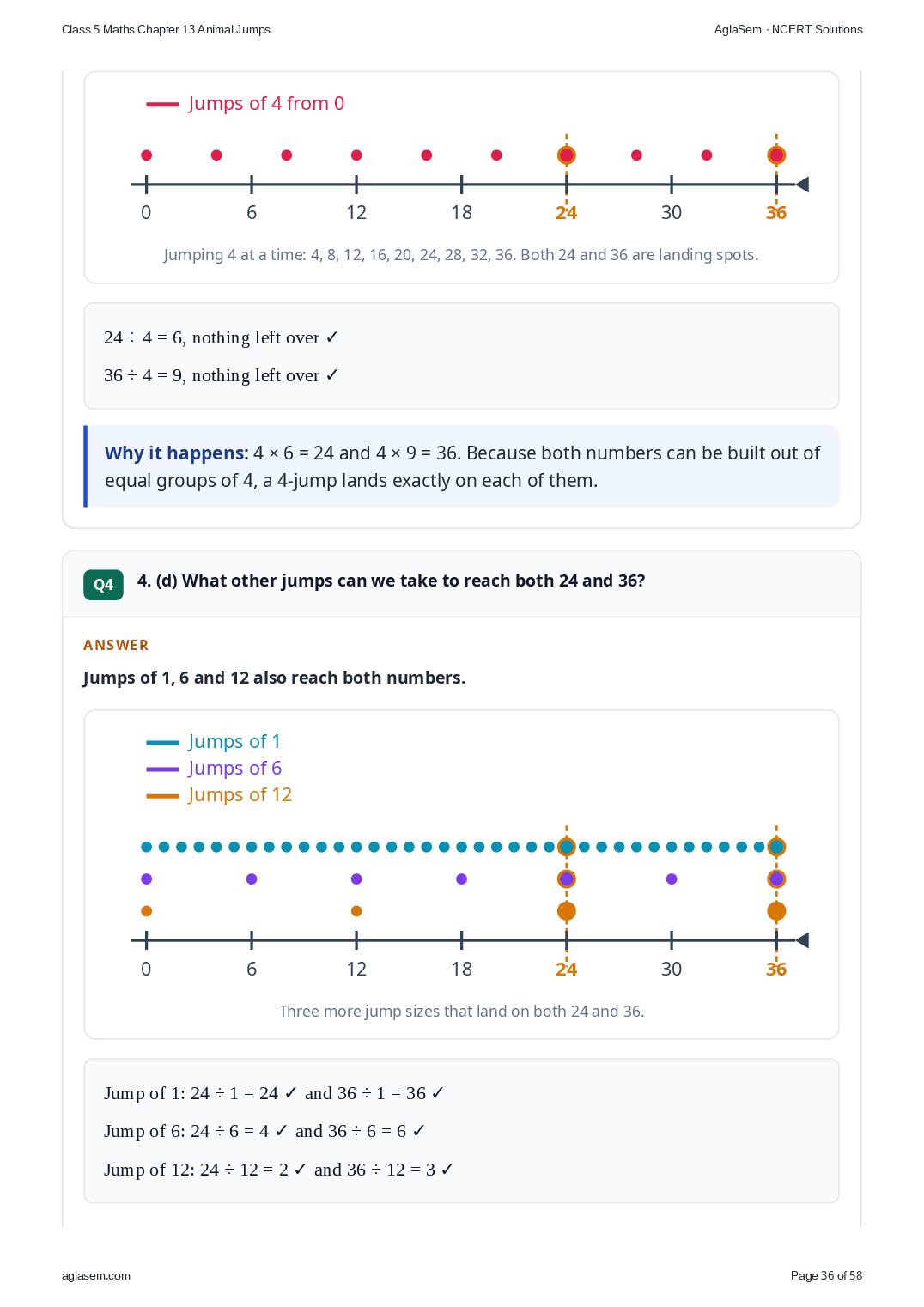
- 4. (a) Can we jump by 2 steps at a time to reach both 24 and 36? Yes/No. 2 is/is not a common factor of 24 and 36.
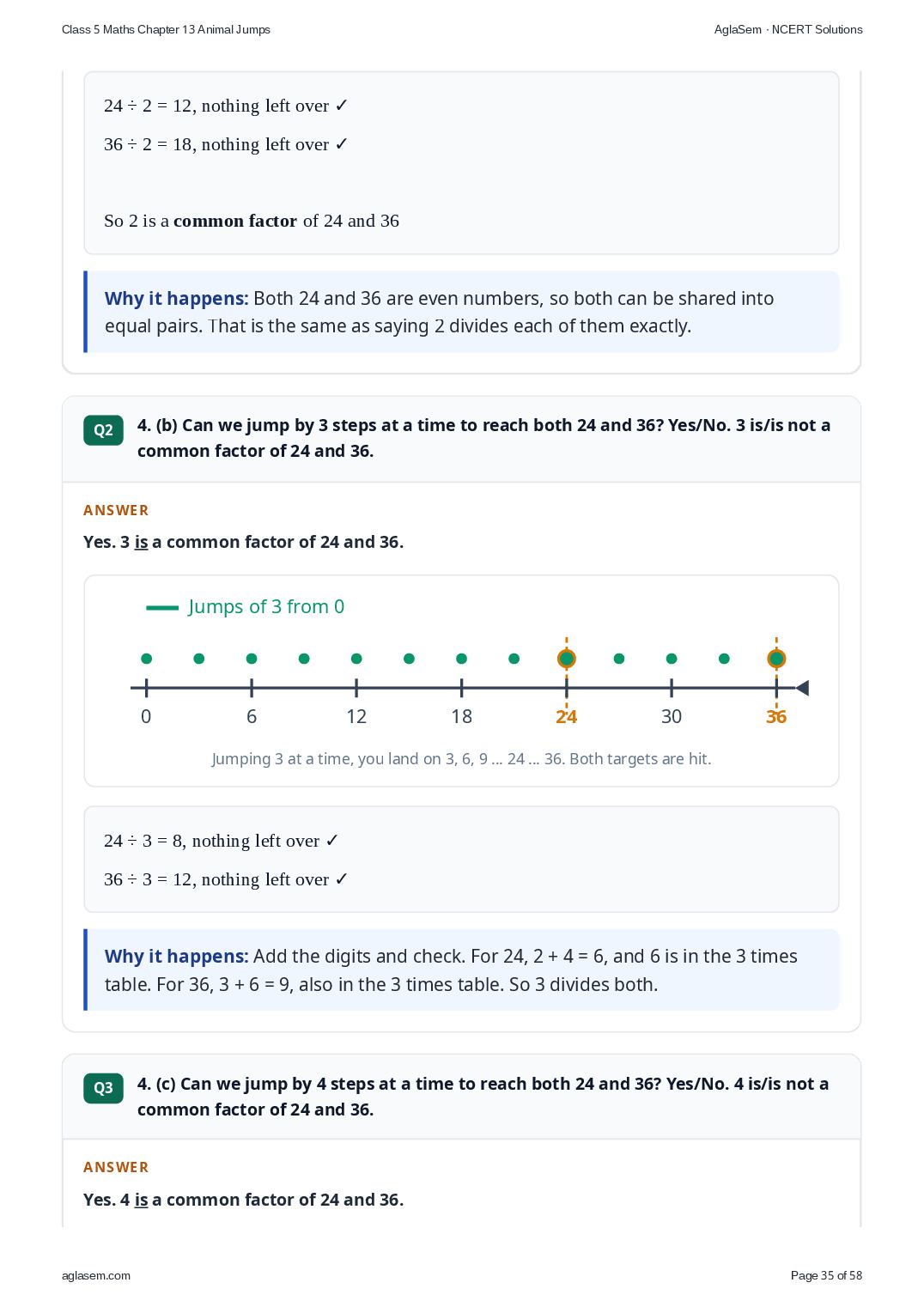
- 4. (b) Can we jump by 3 steps at a time to reach both 24 and 36? Yes/No. 3 is/is not a common factor of 24 and 36.
- 4. (c) Can we jump by 4 steps at a time to reach both 24 and 36? Yes/No. 4 is/is not a common factor of 24 and 36.
- 4. (d) What other jumps can we take to reach both 24 and 36?
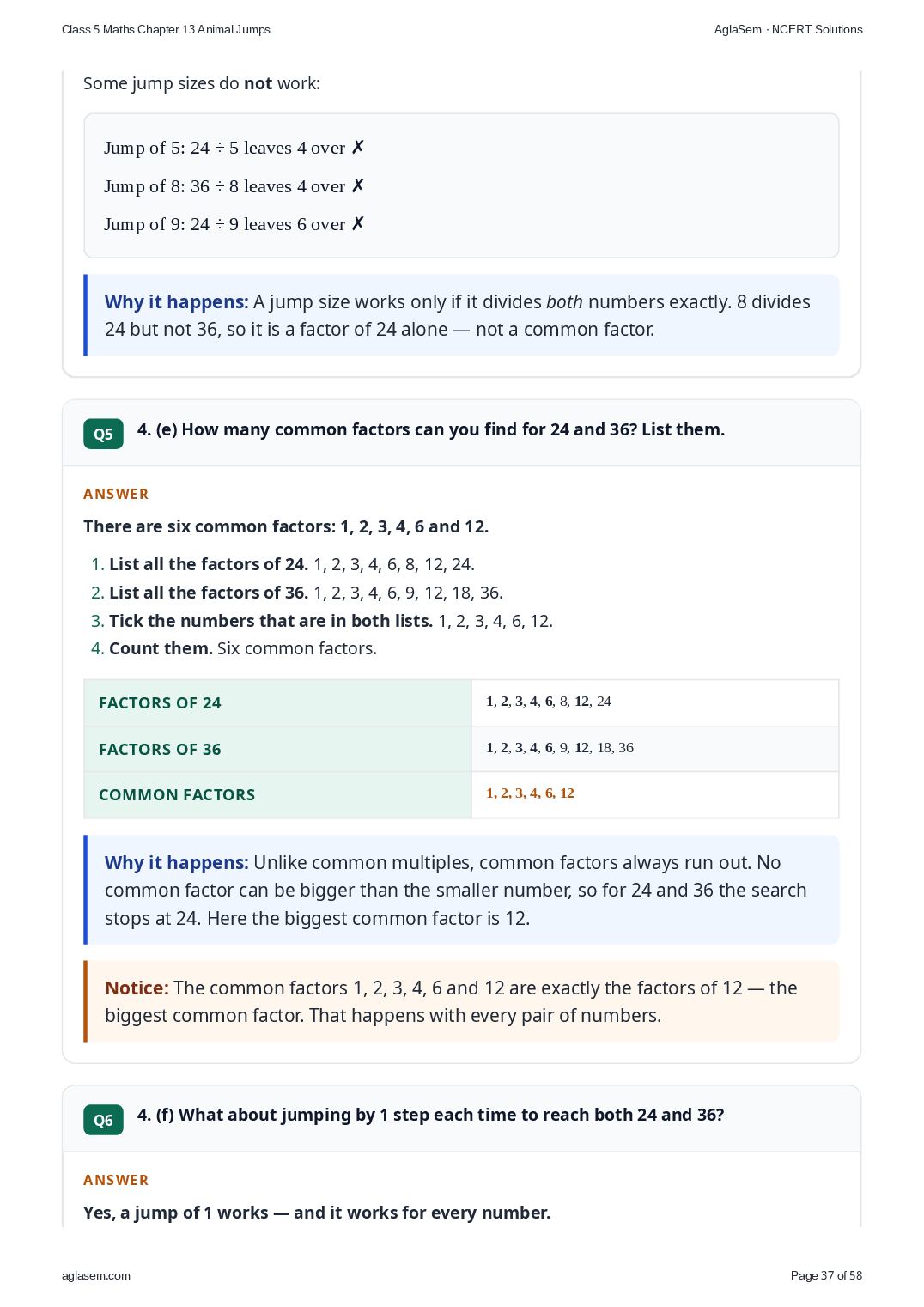
- 4. (e) How many common factors can you find for 24 and 36? List them.
- 4. (f) What about jumping by 1 step each time to reach both 24 and 36?
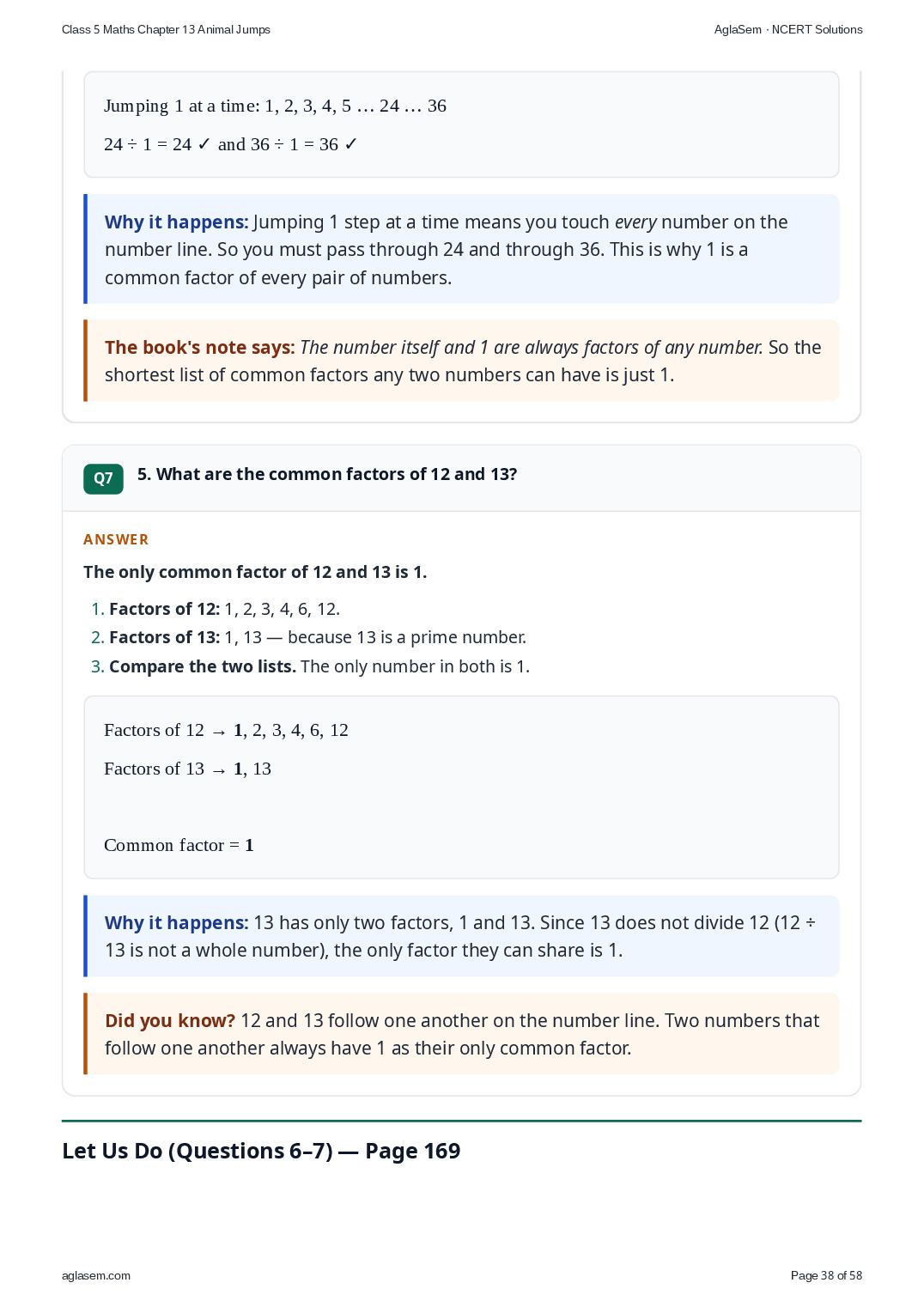
- 5. What are the common factors of 12 and 13?
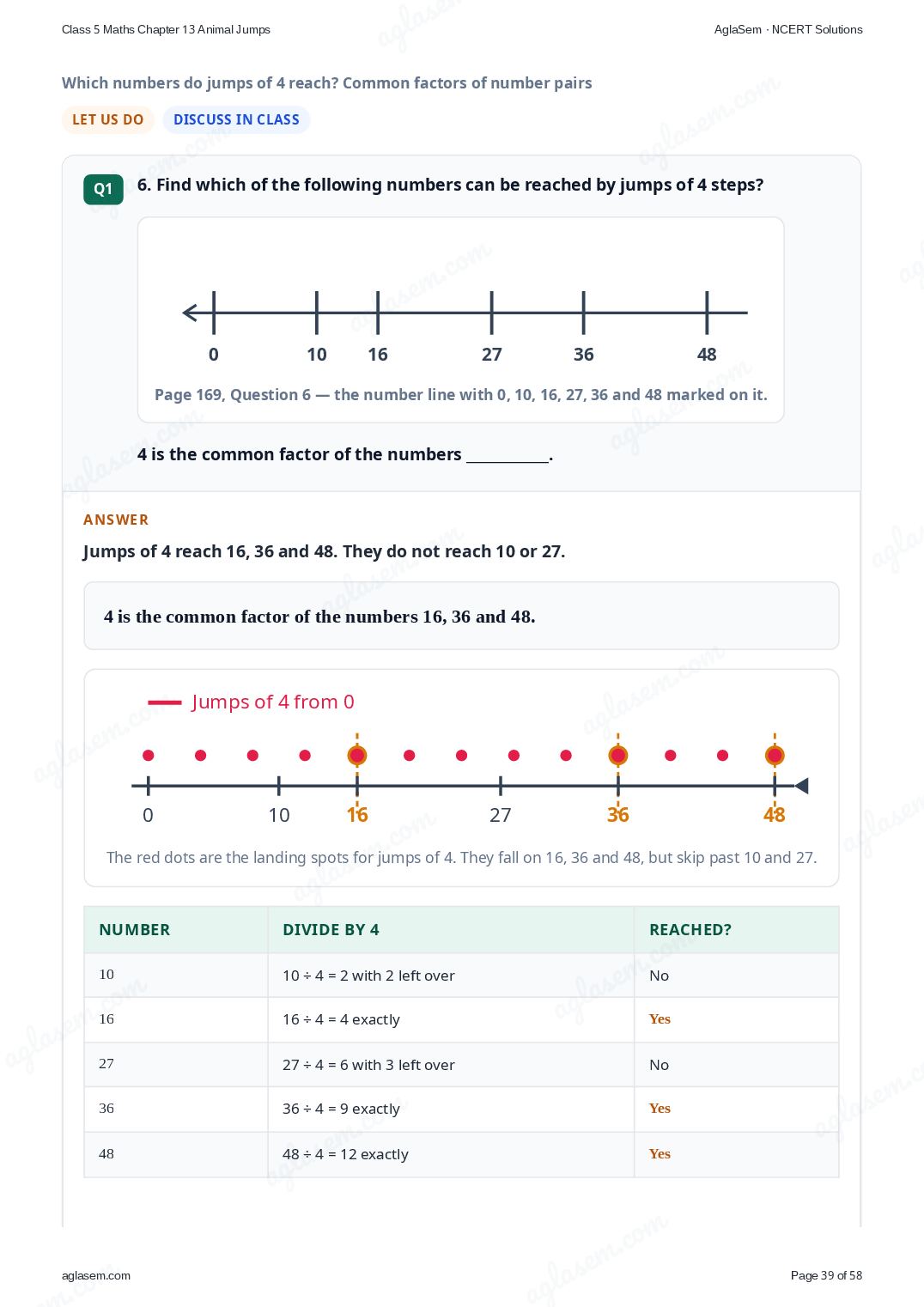
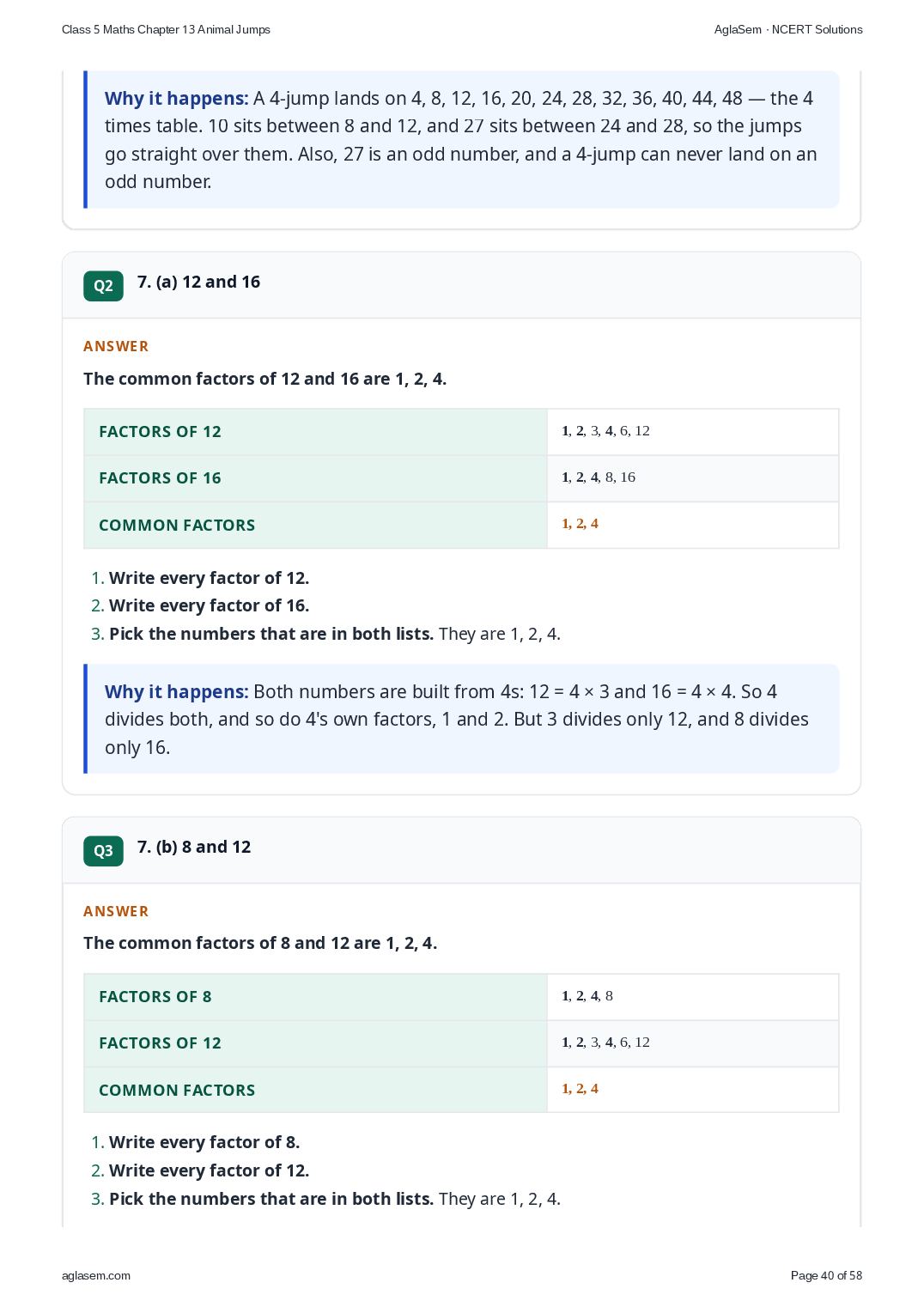
- 6. Find which of the following numbers can be reached by jumps of 4 steps?01016273648Page 169, Question 6 — the number line with 0, 10, 16, 27, 36 and 48 marked on it.4 is the common factor of the numbers ____________.
- 7. (a) 12 and 16
- 7. (b) 8 and 12
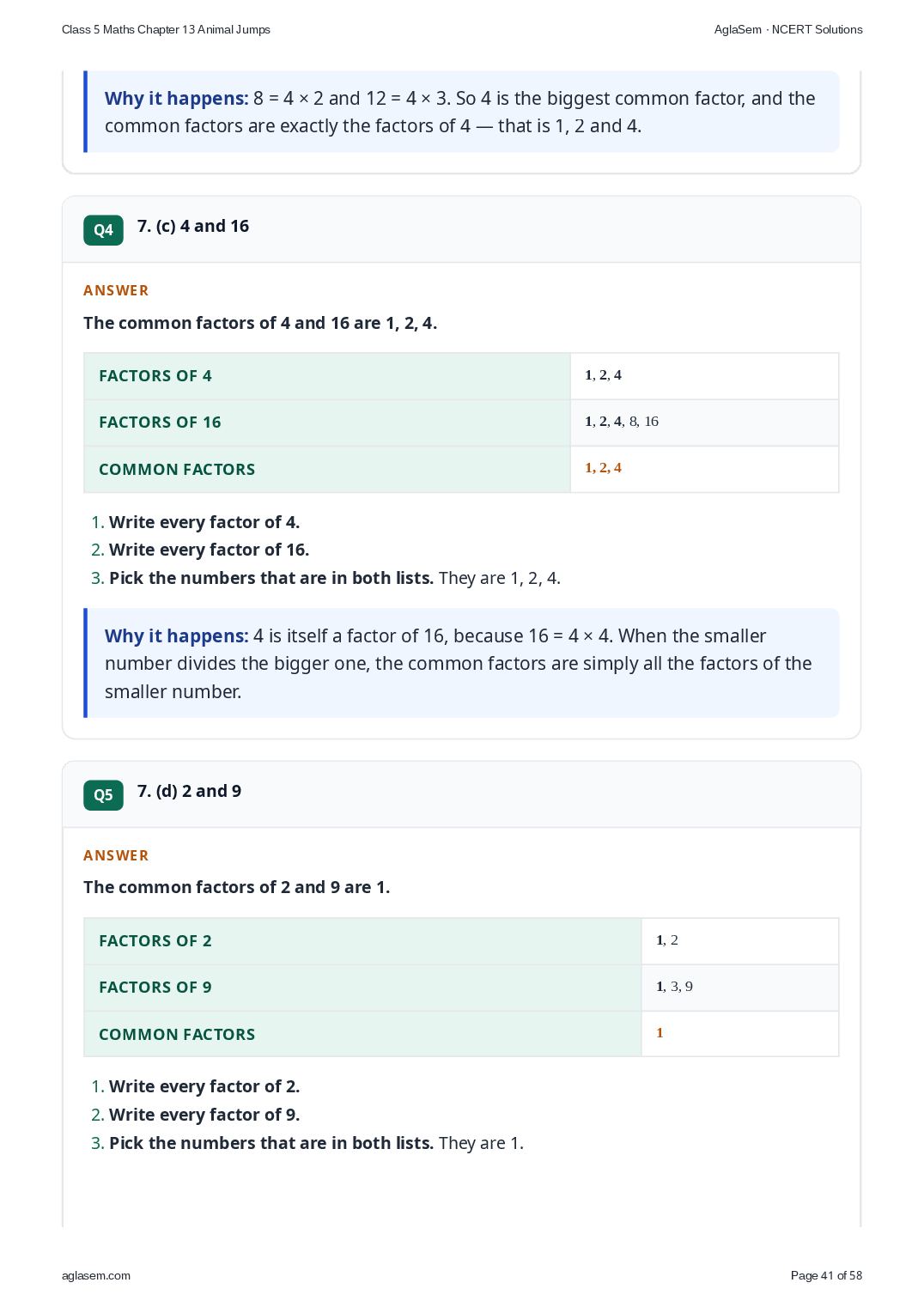
- 7. (c) 4 and 16
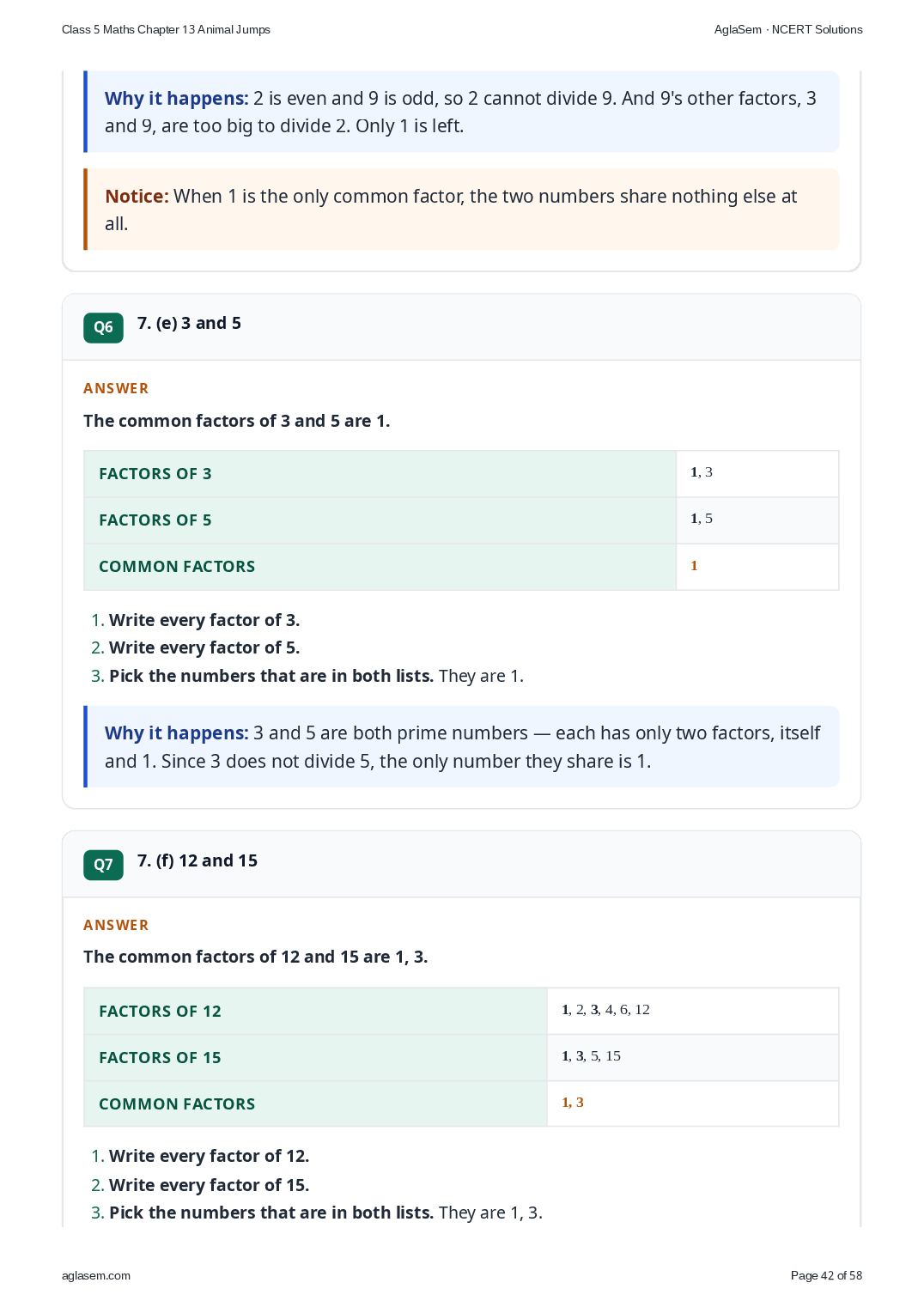
- 7. (d) 2 and 9
- 7. (e) 3 and 5
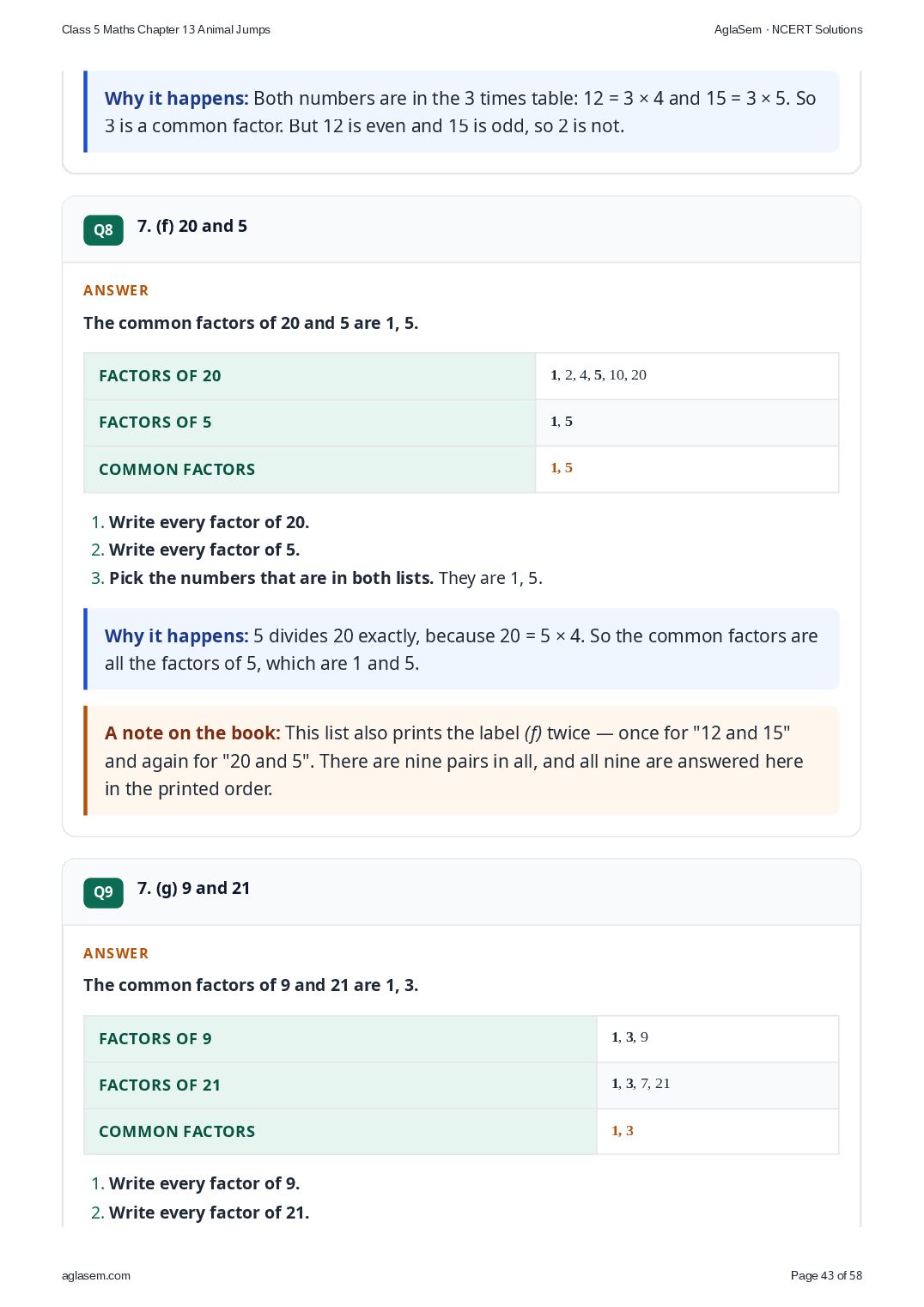
- 7. (f) 12 and 15
- 7. (f) 20 and 5
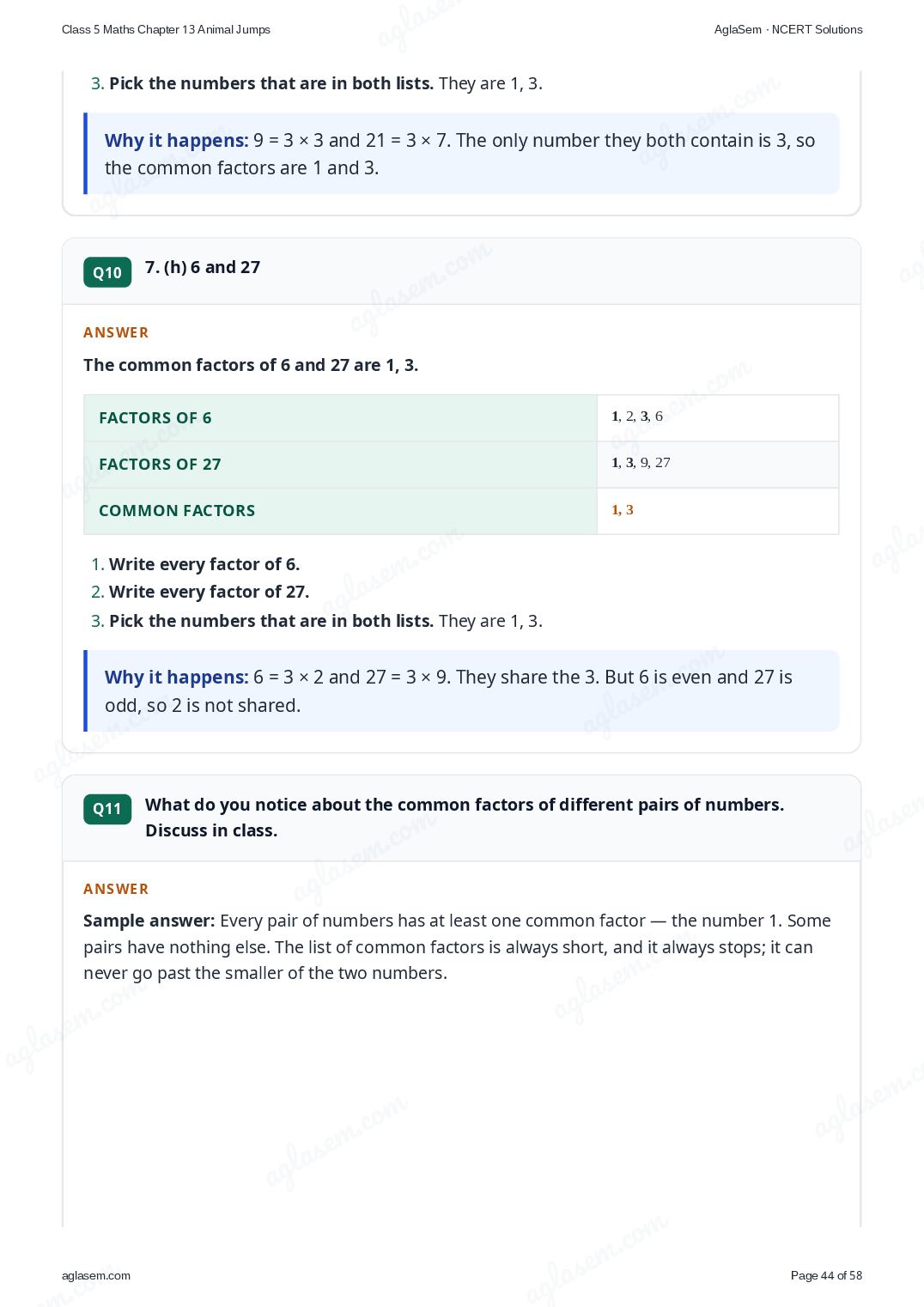
- 7. (g) 9 and 21
- 7. (h) 6 and 27
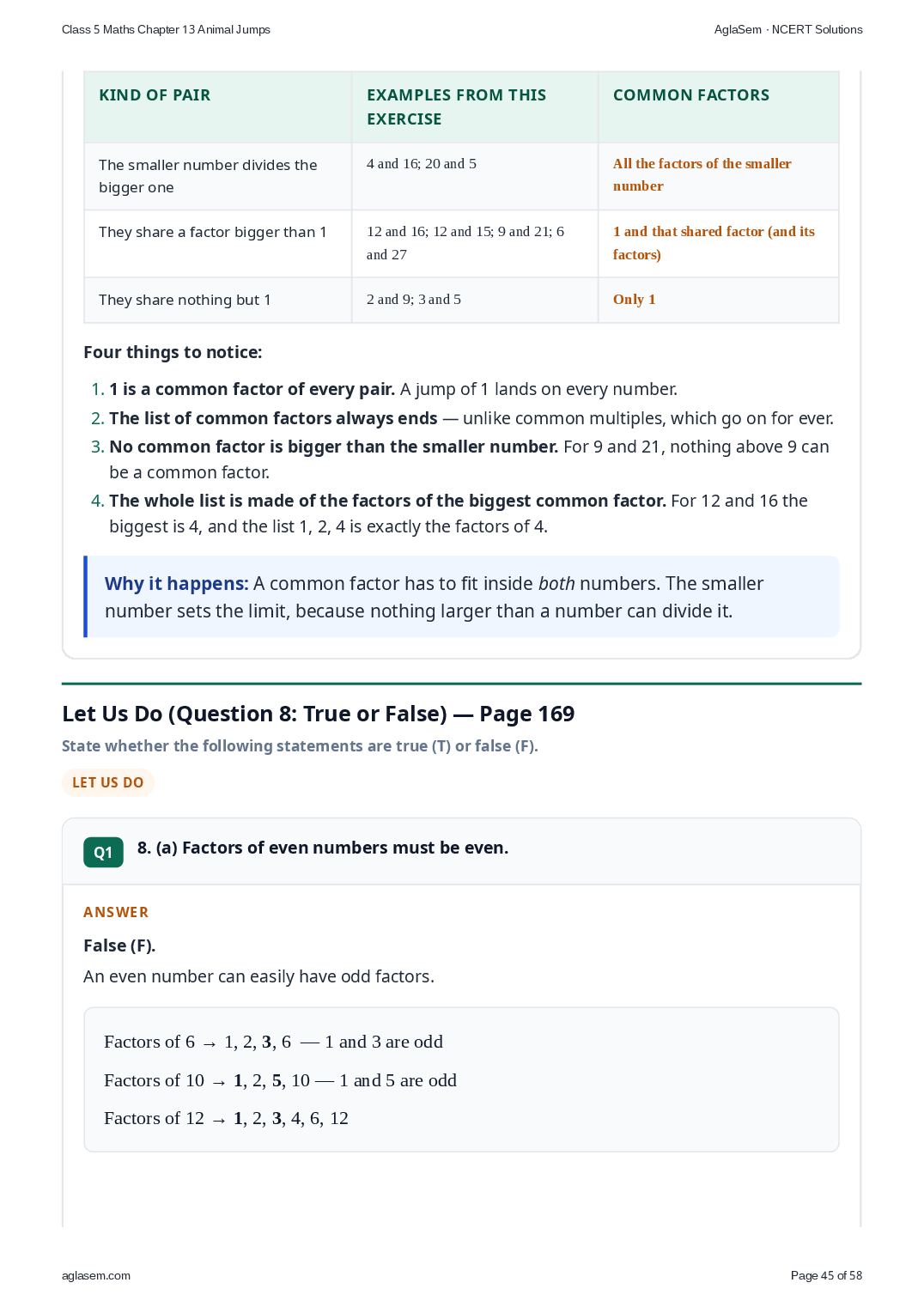
- What do you notice about the common factors of different pairs of numbers. Discuss in class.
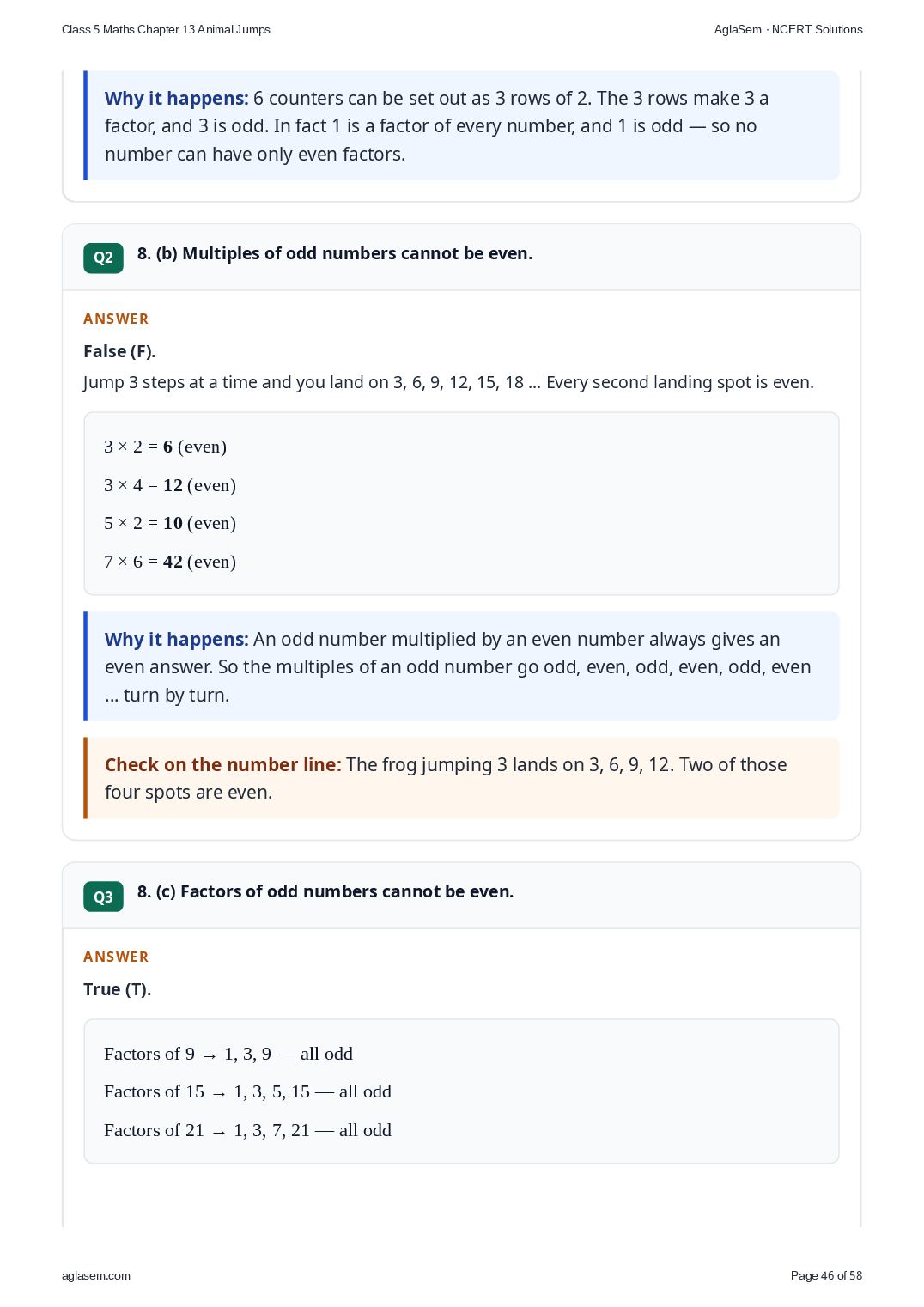
- 8. (a) Factors of even numbers must be even.
- 8. (b) Multiples of odd numbers cannot be even.
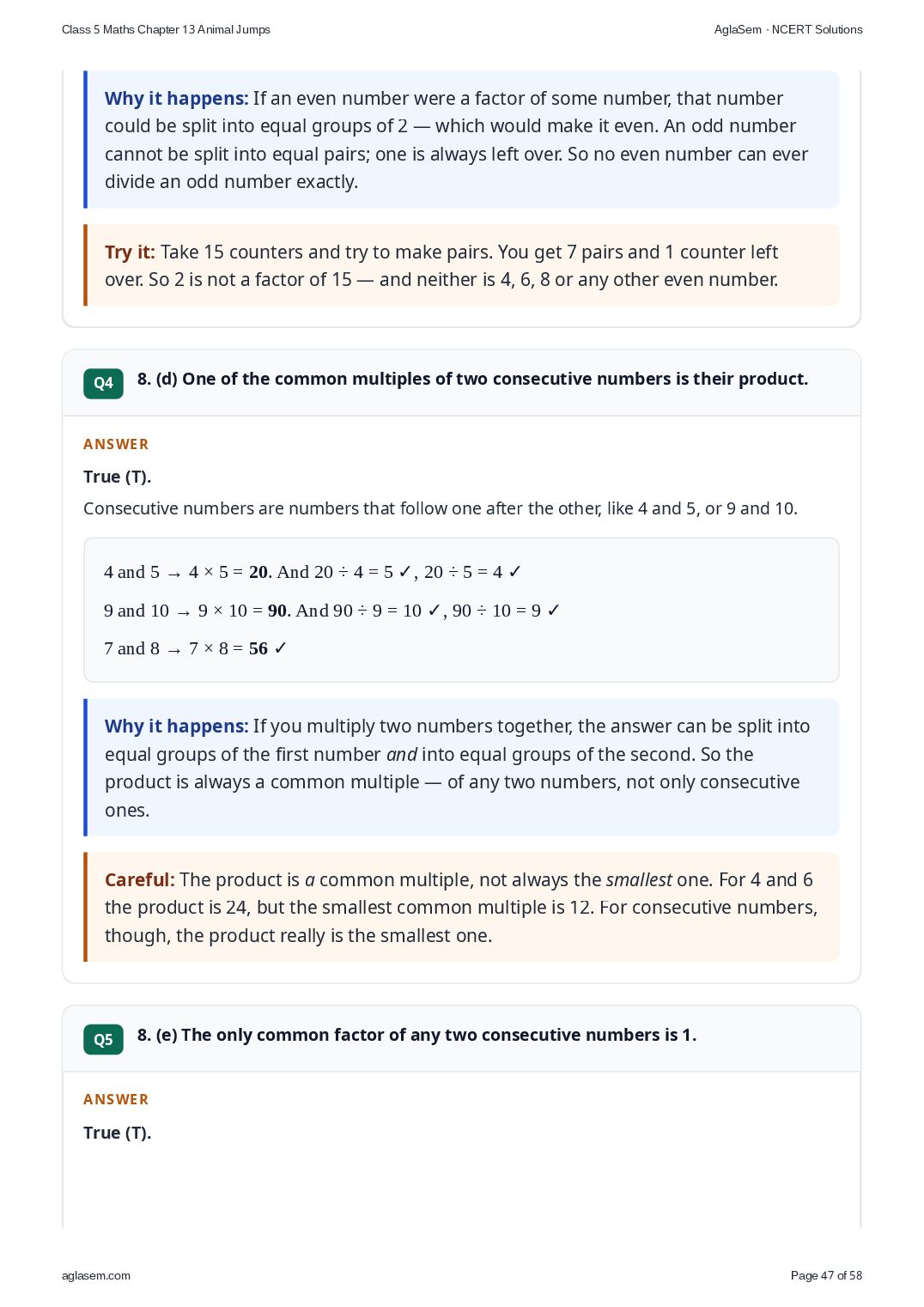
- 8. (c) Factors of odd numbers cannot be even.
- 8. (d) One of the common multiples of two consecutive numbers is their product.
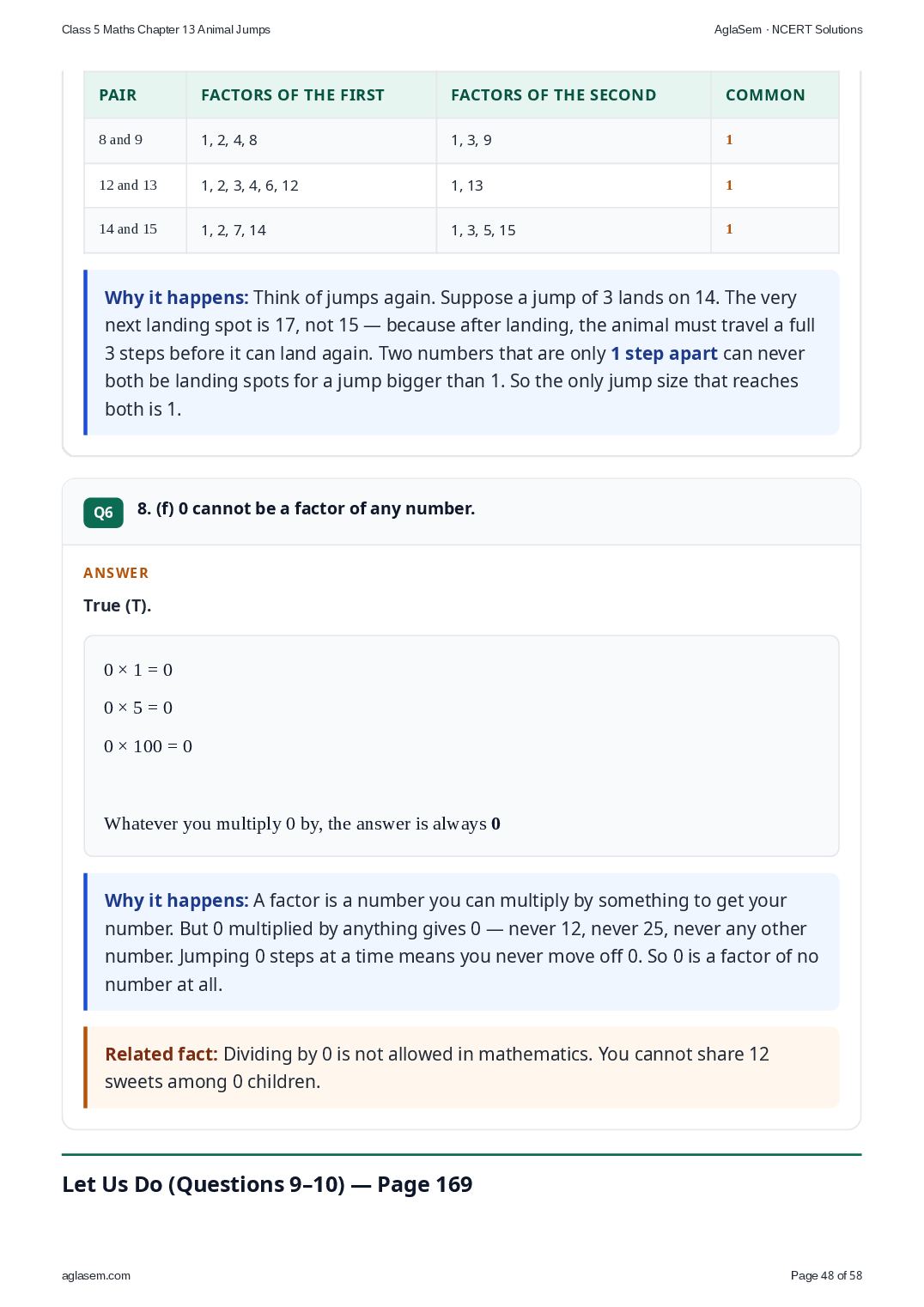
- 8. (e) The only common factor of any two consecutive numbers is 1.
- 8. (f) 0 cannot be a factor of any number.
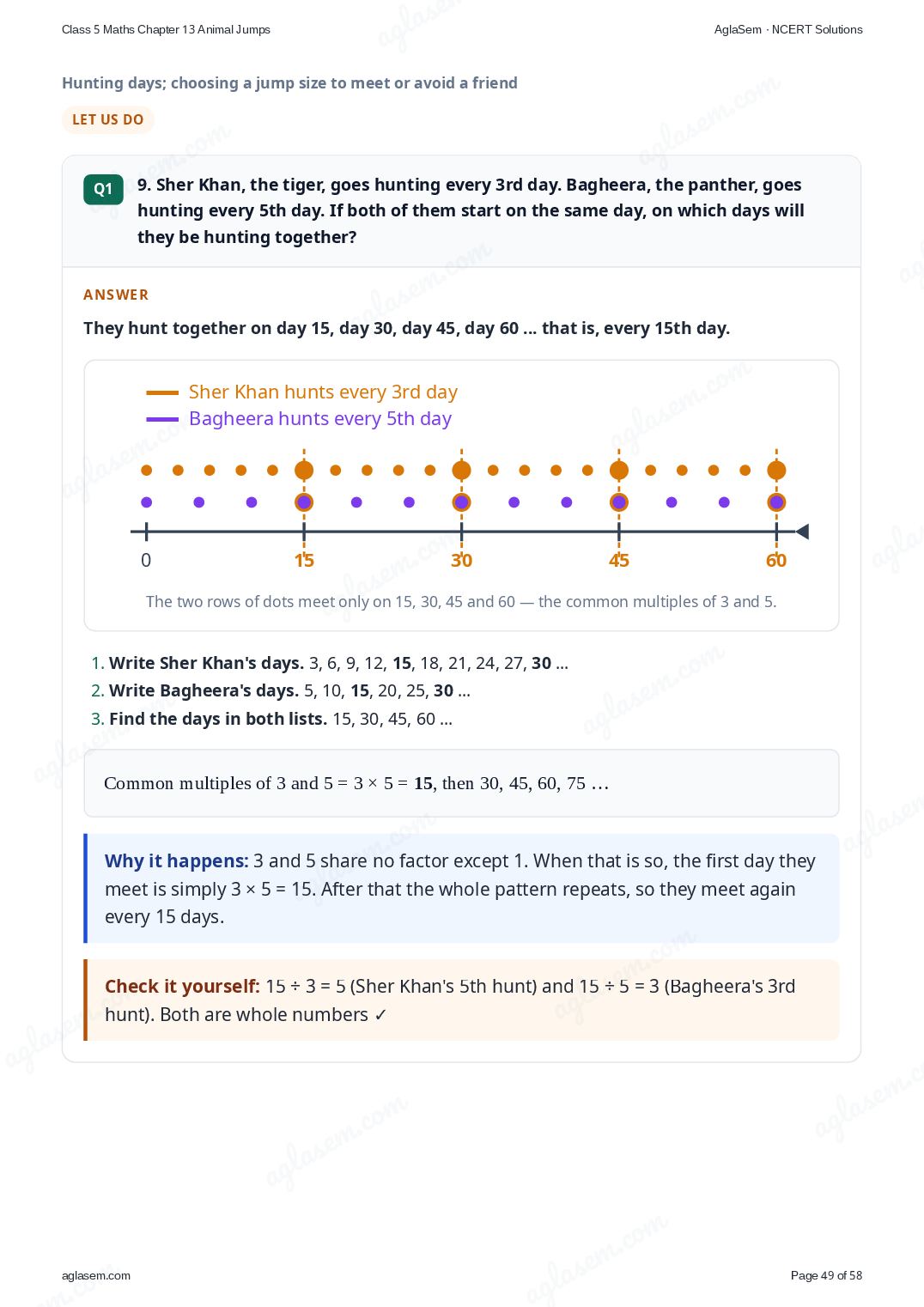
- 9. Sher Khan, the tiger, goes hunting every 3rd day. Bagheera, the panther, goes hunting every 5th day. If both of them start on the same day, on which days will they be hunting together?
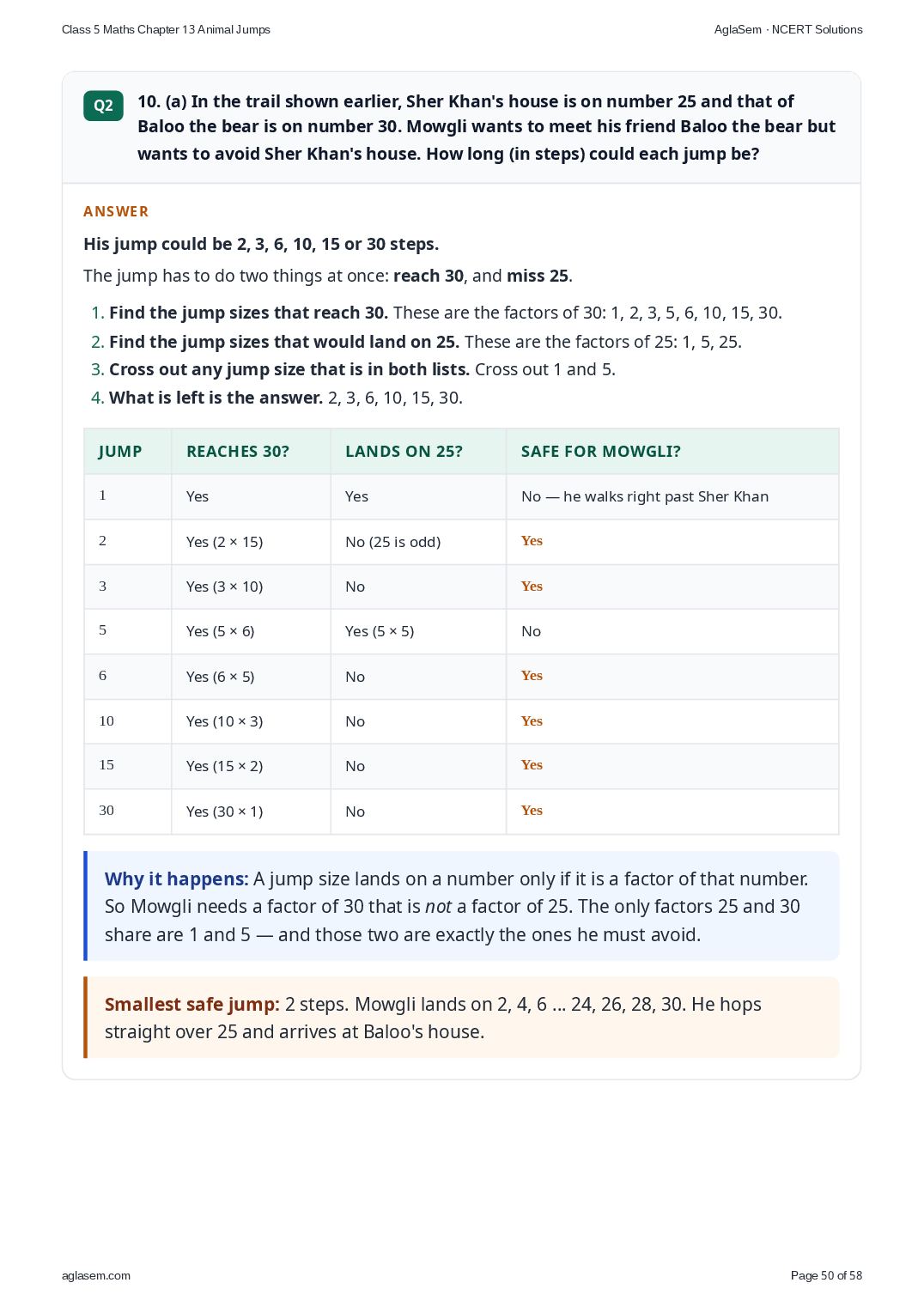
- 10. (a) In the trail shown earlier, Sher Khan’s house is on number 25 and that of Baloo the bear is on number 30. Mowgli wants to meet his friend Baloo the bear but wants to avoid Sher Khan’s house. How long (in steps) could each jump be?
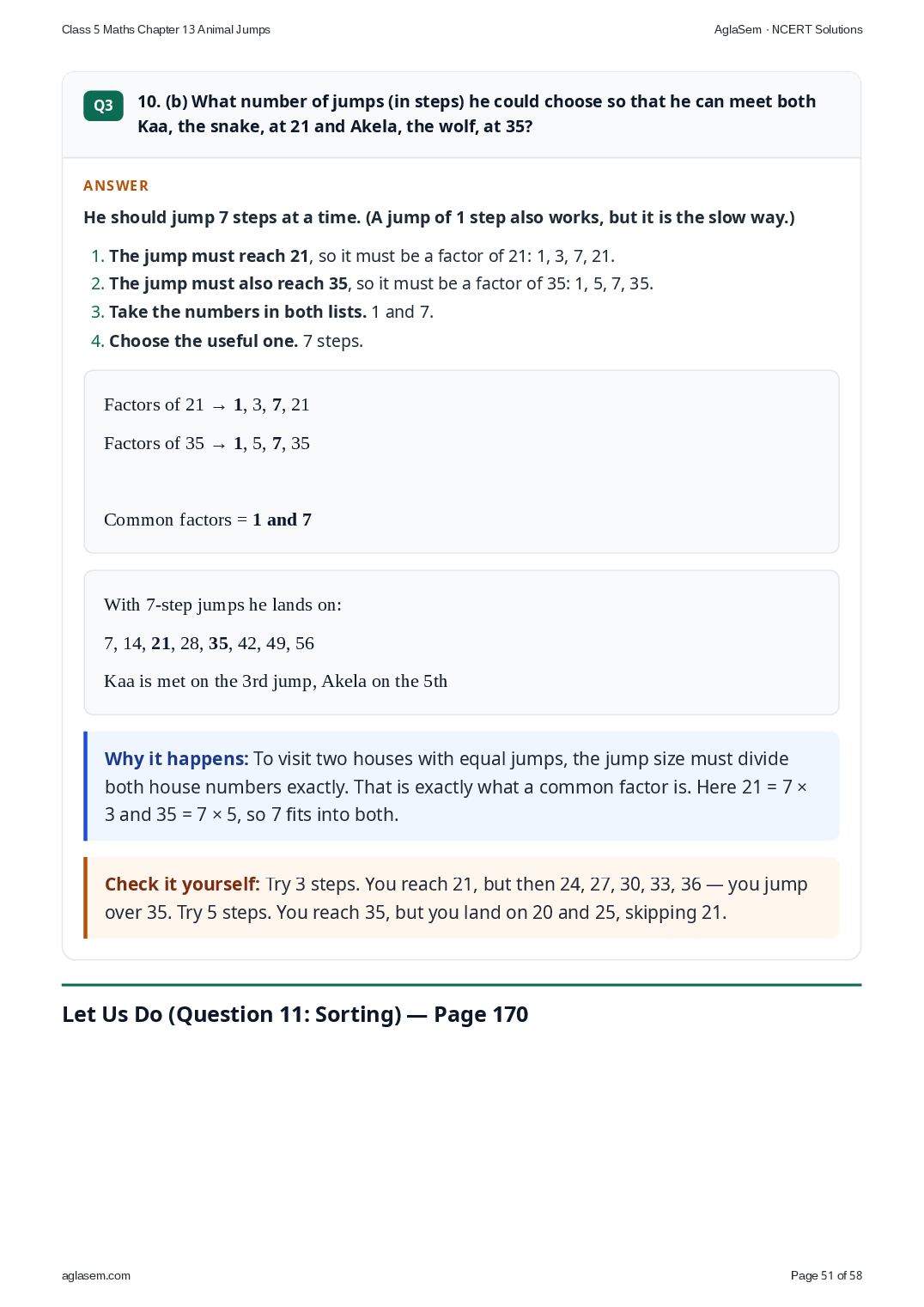
- 10. (b) What number of jumps (in steps) he could choose so that he can meet both Kaa, the snake, at 21 and Akela, the wolf, at 35?
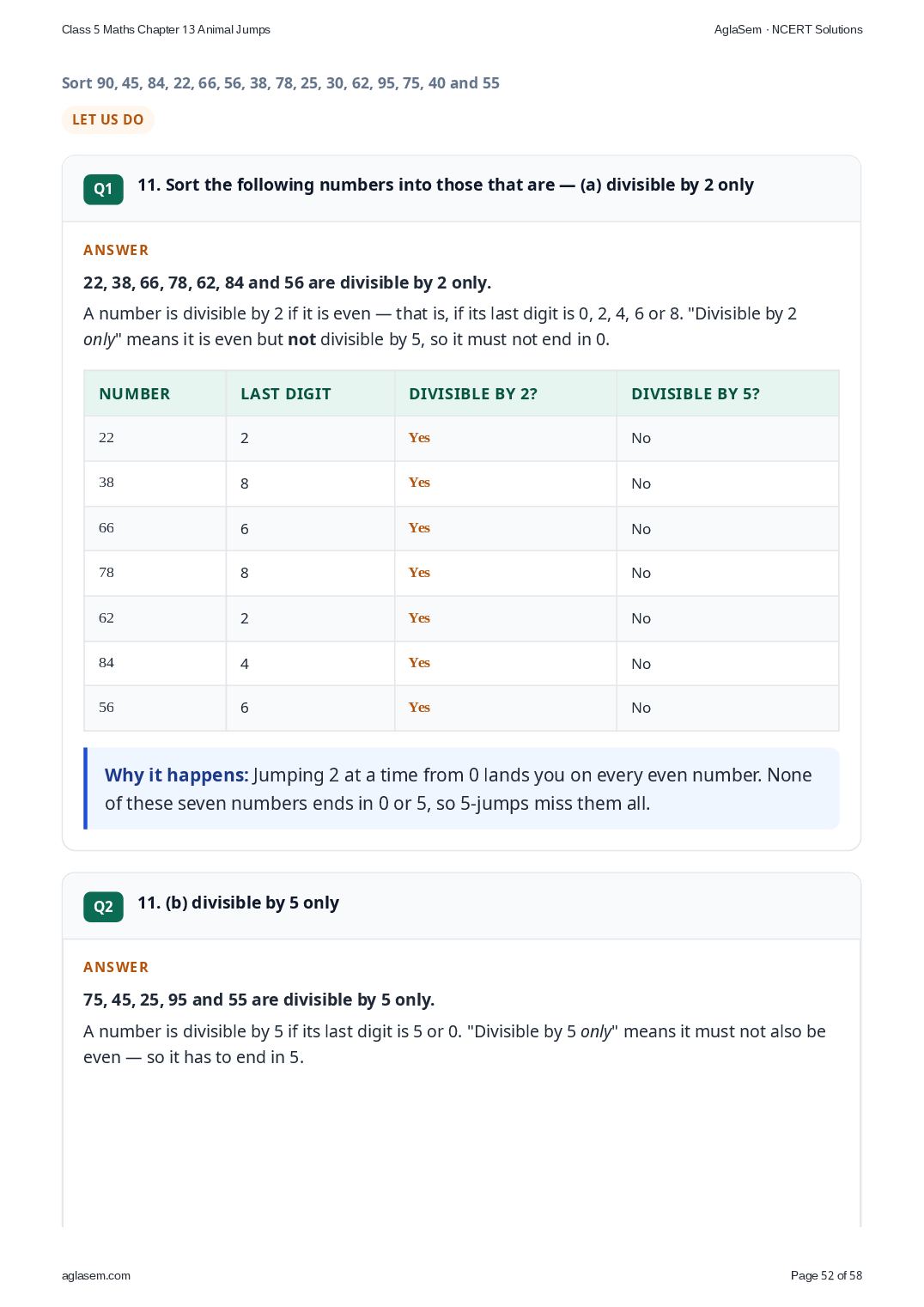
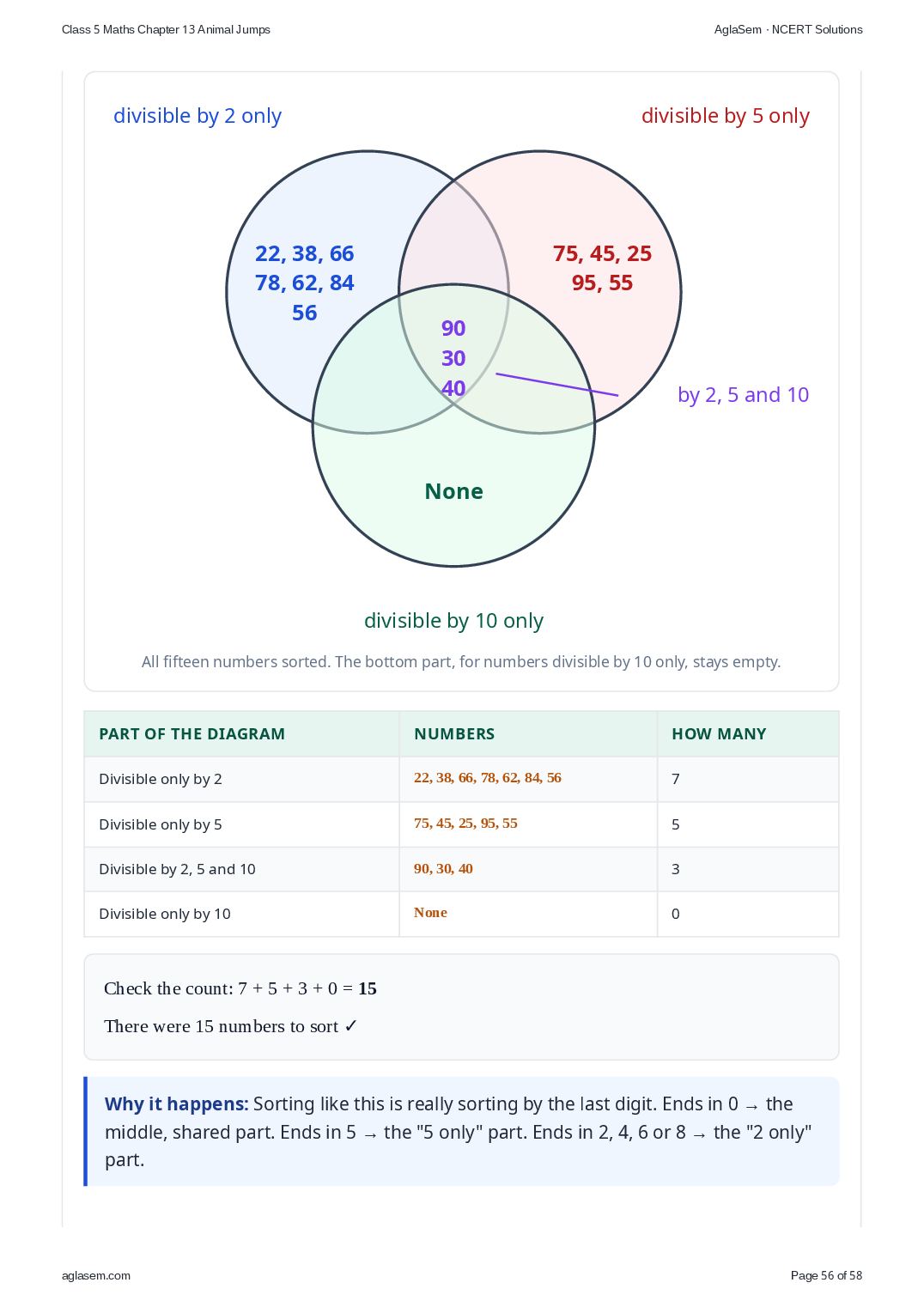
- 11. Sort the following numbers into those that are — (a) divisible by 2 only
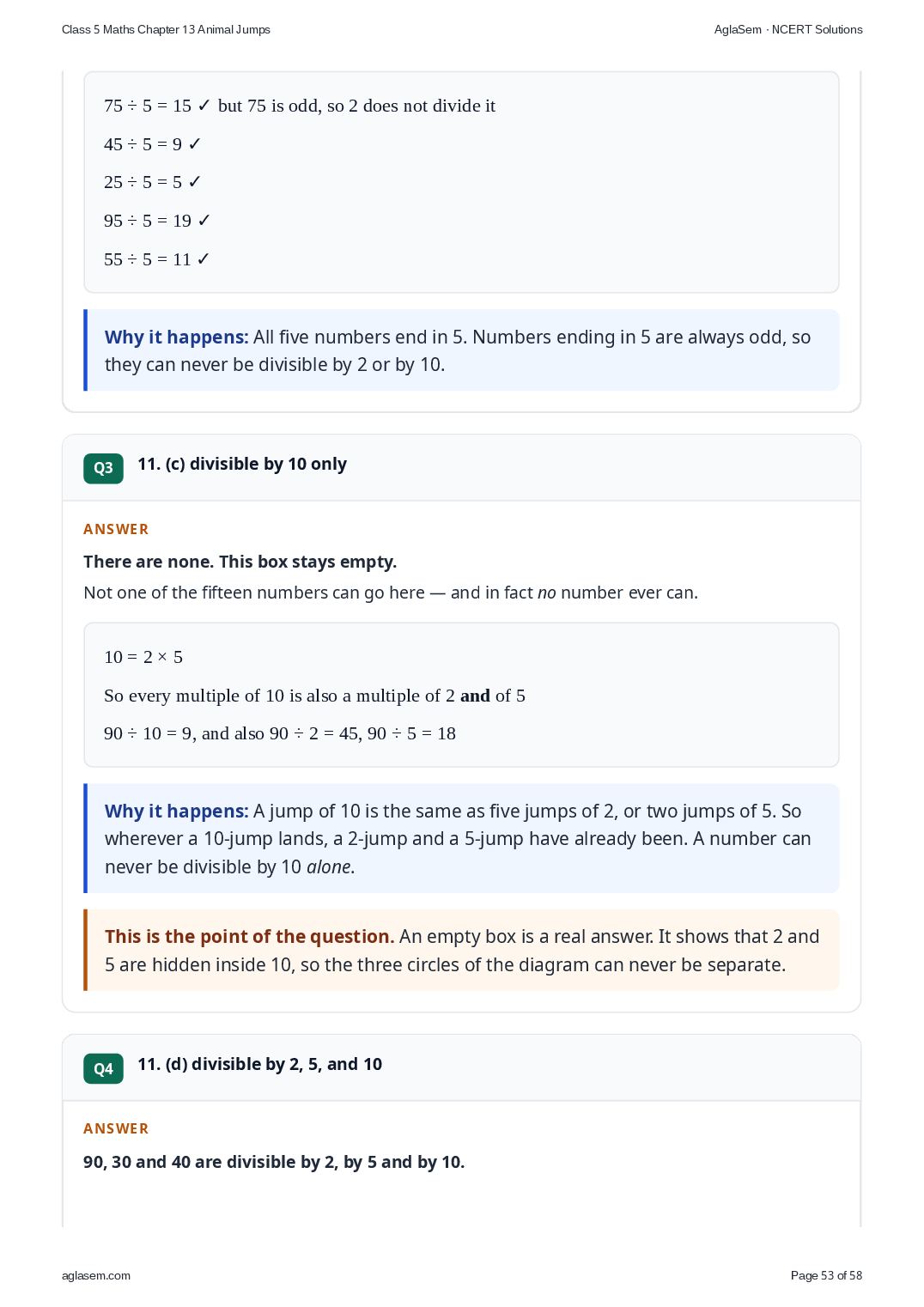
- 11. (b) divisible by 5 only
- 11. (c) divisible by 10 only
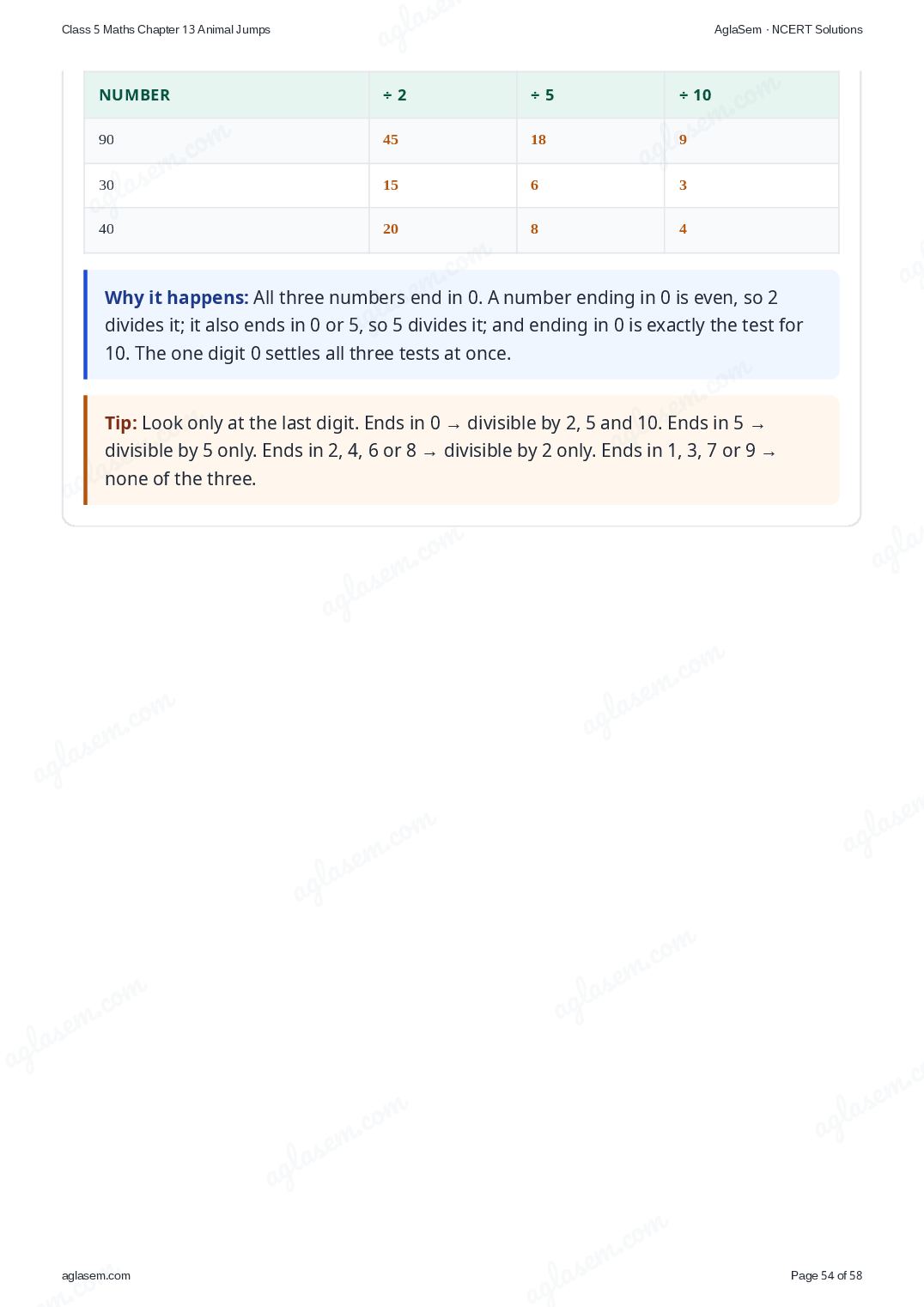
- 11. (d) divisible by 2, 5, and 10
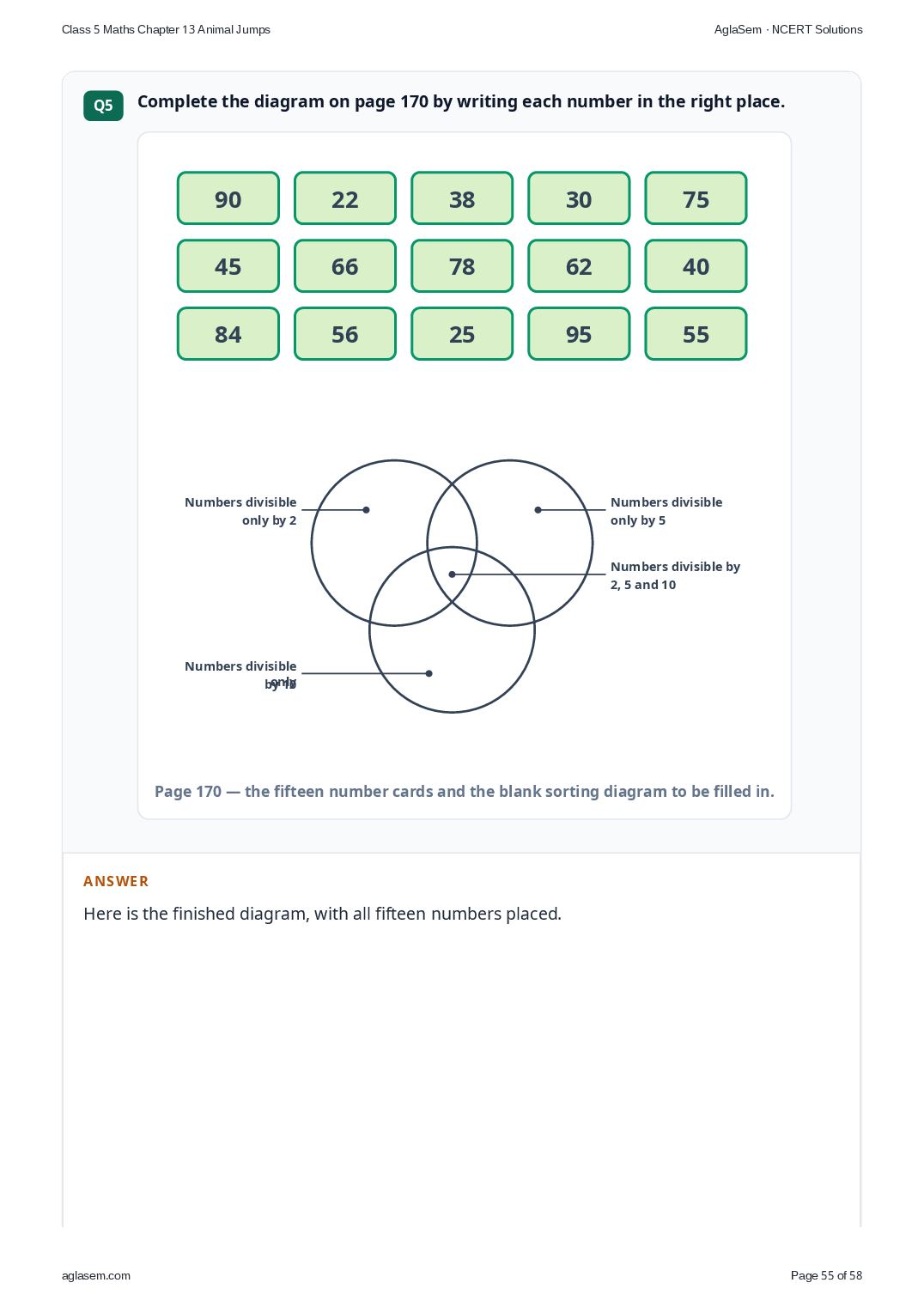
- Complete the diagram on page 170 by writing each number in the right place.902238307545667862408456259555Numbers divisibleonly by 2Numbers divisibleonly by 5Numbers divisible by2, 5 and 10Numbers divisibleonlyby 10Page 170 — the fifteen number cards and the blank sorting diagram to be filled in.
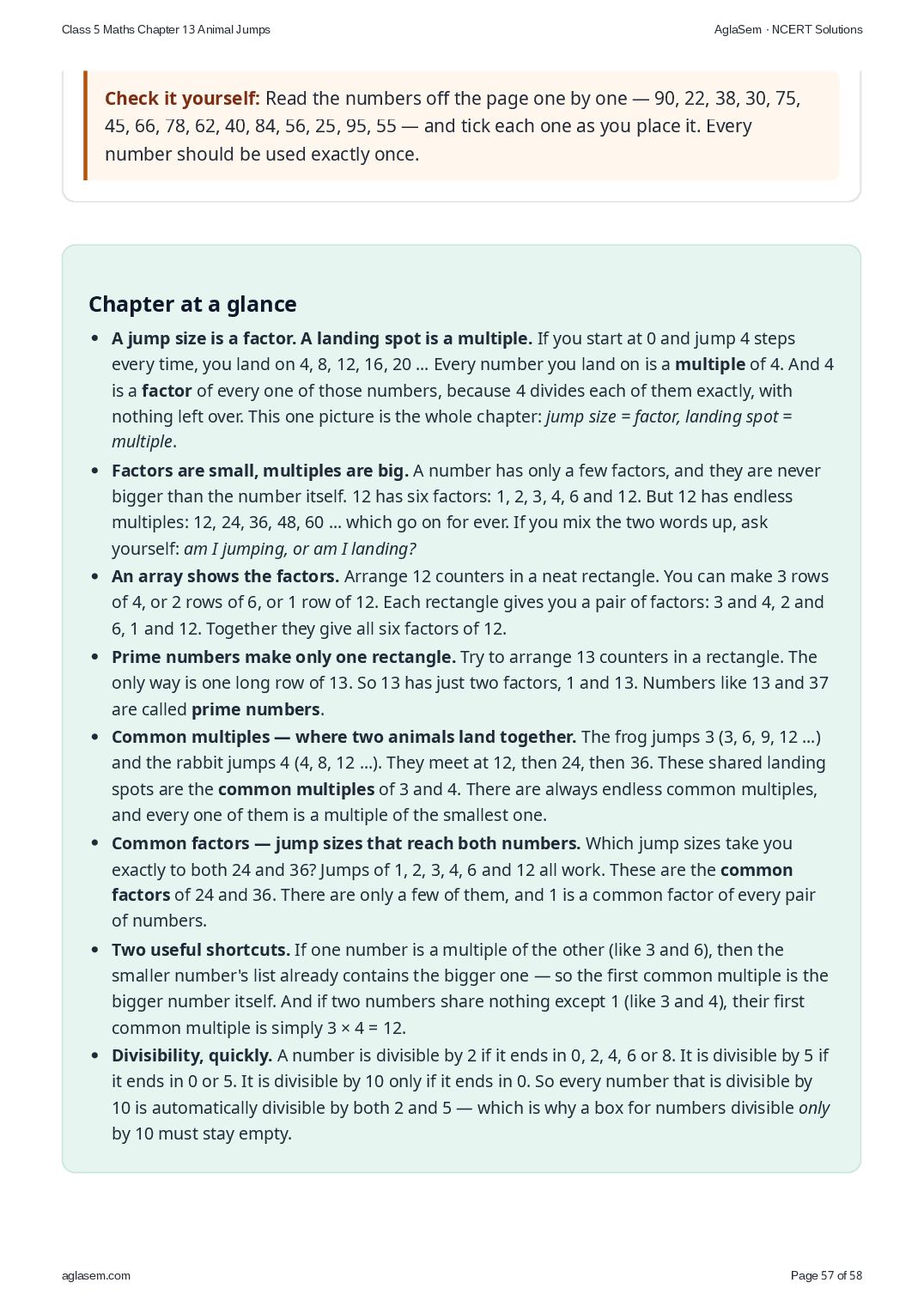
Chapter at a Glance
- A jump size is a factor. A landing spot is a multiple. If you start at 0 and jump 4 steps every time, you land on 4, 8, 12, 16, 20 … Every number you land on is a multiple of 4. And 4 is a factor of every one of those numbers, because 4 divides each of them exactly, with nothing left over. This one picture is the whole chapter: jump size = factor, landing spot = multiple.
- Factors are small, multiples are big. A number has only a few factors, and they are never bigger than the number itself. 12 has six factors: 1, 2, 3, 4, 6 and 12. But 12 has endless multiples: 12, 24, 36, 48, 60 … which go on for ever. If you mix the two words up, ask yourself: am I jumping, or am I landing?
- An array shows the factors. Arrange 12 counters in a neat rectangle. You can make 3 rows of 4, or 2 rows of 6, or 1 row of 12. Each rectangle gives you a pair of factors: 3 and 4, 2 and 6, 1 and 12. Together they give all six factors of 12.
- Prime numbers make only one rectangle. Try to arrange 13 counters in a rectangle. The only way is one long row of 13. So 13 has just two factors, 1 and 13. Numbers like 13 and 37 are called prime numbers.
- Common multiples — where two animals land together. The frog jumps 3 (3, 6, 9, 12 …) and the rabbit jumps 4 (4, 8, 12 …). They meet at 12, then 24, then 36. These shared landing spots are the common multiples of 3 and 4. There are always endless common multiples, and every one of them is a multiple of the smallest one.
- Common factors — jump sizes that reach both numbers. Which jump sizes take you exactly to both 24 and 36? Jumps of 1, 2, 3, 4, 6 and 12 all work. These are the common factors of 24 and 36. There are only a few of them, and 1 is a common factor of every pair of numbers.
- Two useful shortcuts. If one number is a multiple of the other (like 3 and 6), then the smaller number’s list already contains the bigger one — so the first common multiple is the bigger number itself. And if two numbers share nothing except 1 (like 3 and 4), their first common multiple is simply 3 × 4 = 12.
- Divisibility, quickly. A number is divisible by 2 if it ends in 0, 2, 4, 6 or 8. It is divisible by 5 if it ends in 0 or 5. It is divisible by 10 only if it ends in 0. So every number that is divisible by 10 is automatically divisible by both 2 and 5 — which is why a box for numbers divisible only by 10 must stay empty.
How to Download NCERT Solutions for Class 5 Maths Chapter 13 PDF
Follow these simple steps to get the Animal Jumps questions-and-answers PDF from Math Mela.
- Search NCERT Solutions for Class 5 Maths Chapter 13 aglasem and open this page.
- Read the exercise questions with answers for Animal Jumps shown above.
- Click the Download PDF link to save the Animal Jumps solutions to your device.
NCERT Solutions for Class 5 Maths – All Chapters
There are more chapters to study besides Animal Jumps in Maths. Here are the NCERT Solutions for all chapters of Class 5 Maths.
- Chapter 1 We the Travellers I
- Chapter 2 Fractions
- Chapter 3 Angles As Turns
- Chapter 4 We the Travellers Ii
- Chapter 5 Far and Near
- Chapter 6 the Dairy Farm
- Chapter 7 Shapes and Patterns
- Chapter 8 Weight and Capacity
- Chapter 9 Coconut Farm
- Chapter 10 Symmetrical Designs
- Chapter 11 Grandmother s Quilt
- Chapter 12 Racing Seconds
- Chapter 13 Animal Jumps
- Chapter 14 Maps and Locations
- Chapter 15 Data Through Pictures
NCERT Solutions for Class 5 – All Subjects
Just like Chapter 13 of Maths, you can get the exercise questions with answers for every other subject of Class 5. Here are the NCERT Solutions for all subjects of Class 5.
NCERT Solutions for Class 5 Maths Chapter 13 – An Overview
The key highlights of this study material are as follows.
| Aspects | Details |
|---|---|
| Class | Class 5 |
| Subject | Maths |
| Chapter Number | Chapter 13 |
| Chapter Name | Animal Jumps |
| Book Name | Math Mela |
| Book By | NCERT (National Council of Educational Research and Training) |
| Educational Resource Here | NCERT Solutions of Class 5 Maths Chapter 13 for all exercises |
| More Questions Answers of This Subject | NCERT Solutions for Class 5 Maths |
| Download Book Chapter | NCERT Book Class 5 Maths |
| All Questions Answers For This Class | NCERT Solutions for Class 5 |
| Complete Solutions | NCERT Solutions |
NCERT Solutions for Class 5 Maths Chapter 13 Animal Jumps – FAQs
What are the NCERT Solutions for Class 5 Maths Chapter 13 Animal Jumps?
They are the complete, step-by-step answers to all the exercise and in-text questions of Chapter 13 Animal Jumps from the NCERT Class 5 Maths textbook Math Mela, written by experts as per the latest NCERT syllabus.
How can I download the Class 5 Maths Chapter 13 solutions PDF for free?
Open this page on aglasem, read the Animal Jumps questions with answers, and click the “Download Solutions PDF” link. The Class 5 Maths Chapter 13 NCERT Solutions PDF is completely free to download.
Are these NCERT Solutions as per the latest 2026-27 syllabus?
Yes. The NCERT Solutions for Class 5 Maths Chapter 13 are based on the latest NCERT textbook Math Mela and the current 2026-27 CBSE syllabus, so the questions and answers match what you study in class.
Where can I get NCERT Solutions for the other chapters of Class 5 Maths?
You can find the answers to every chapter on the NCERT Solutions for Class 5 Maths page, and solutions for every subject on the NCERT Solutions for Class 5 page.
How do NCERT Solutions help in exam preparation?
They show the correct method to solve each question, help you write answers the way they are expected in exams, let you check and correct your own work, and save revision time — which together improve your marks in Class 5 Maths.
If you have any queries on NCERT Solutions for Class 5 Maths Chapter 13 Animal Jumps, then please ask in the comments below.