NCERT Solutions for Class 5 Maths Chapter 10 Symmetrical Designs provide clear, step-by-step answers to every exercise and in-text question from the chapter Symmetrical Designs of the NCERT textbook Math Mela. Prepared by subject experts as per the latest NCERT (CBSE) syllabus for 2026-27, these NCERT Solutions for Class 5 Maths help you understand each concept, write exam-ready answers, and check your own solutions. You can read them online below or download the free Class 5 Maths Chapter 10 question-answer PDF.
NCERT Solutions for Class 5 Maths Chapter 10 Symmetrical Designs
- Class: Class 5
- Subject: Maths
- Chapter: Chapter 10 – Symmetrical Designs
- Textbook: Math Mela (NCERT)
- Study material: NCERT Solutions – questions with answers, free PDF
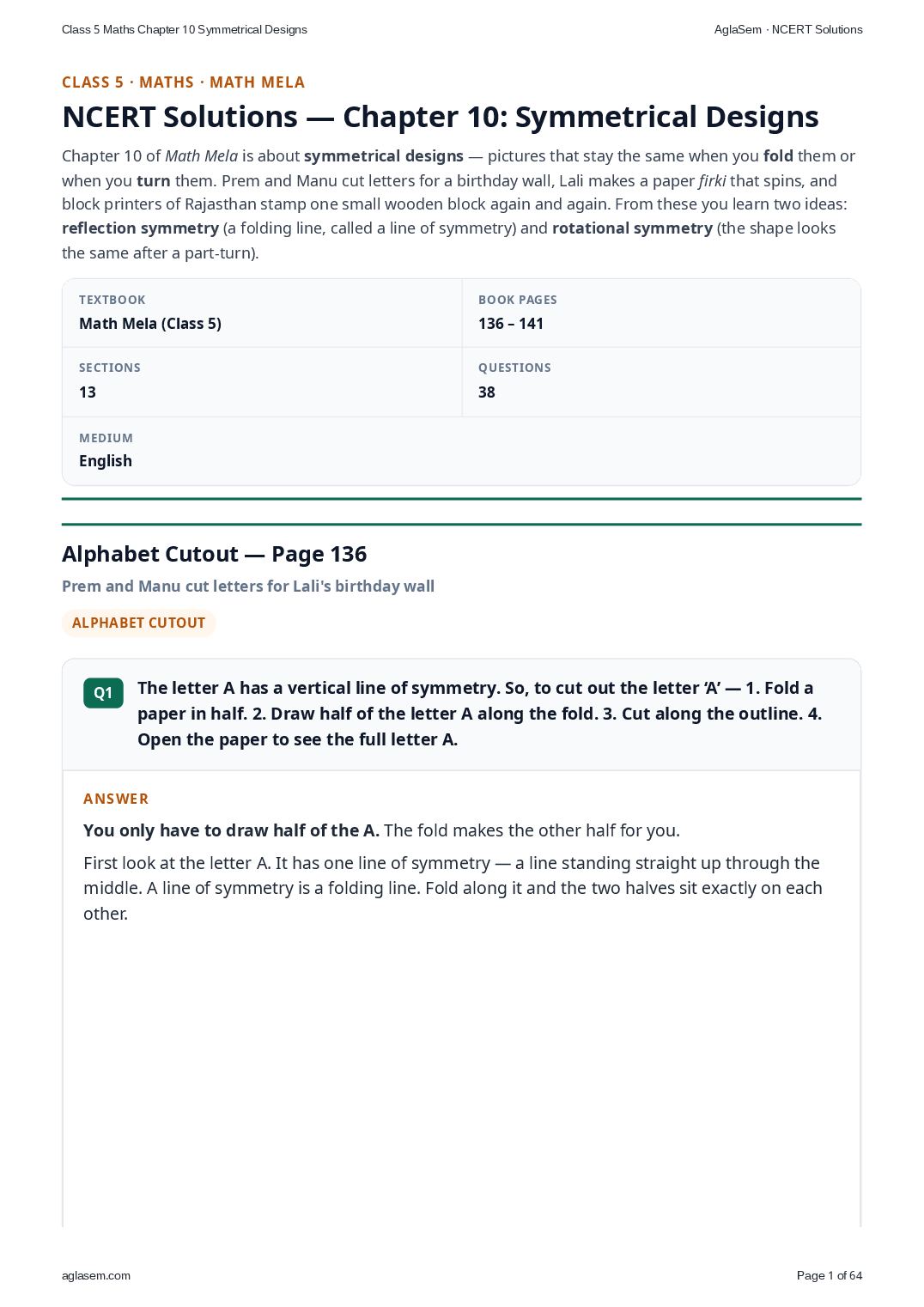
These solutions answer all the exercise questions of Chapter 10 Symmetrical Designs — including the in-text questions, short-answer and long-answer questions, and activities — with complete explanations so you can follow the method, not just the final answer. Read the full solutions below.
NCERT Solutions Class 5 Maths Chapter 10 Symmetrical Designs View Download
NCERT Solutions for Class 5 Maths Chapter 10 PDF Download
You can read the NCERT Solutions for Class 5 Maths Chapter 10 online above, or download the complete question-answer PDF to study Symmetrical Designs offline at any time.
NCERT Solutions for Class 5 Maths Chapter 10 PDF Download Link – Click Here to Download Solutions PDF
Questions Covered in This Chapter
These NCERT Solutions answer all 38 questions of this chapter. The questions solved are:
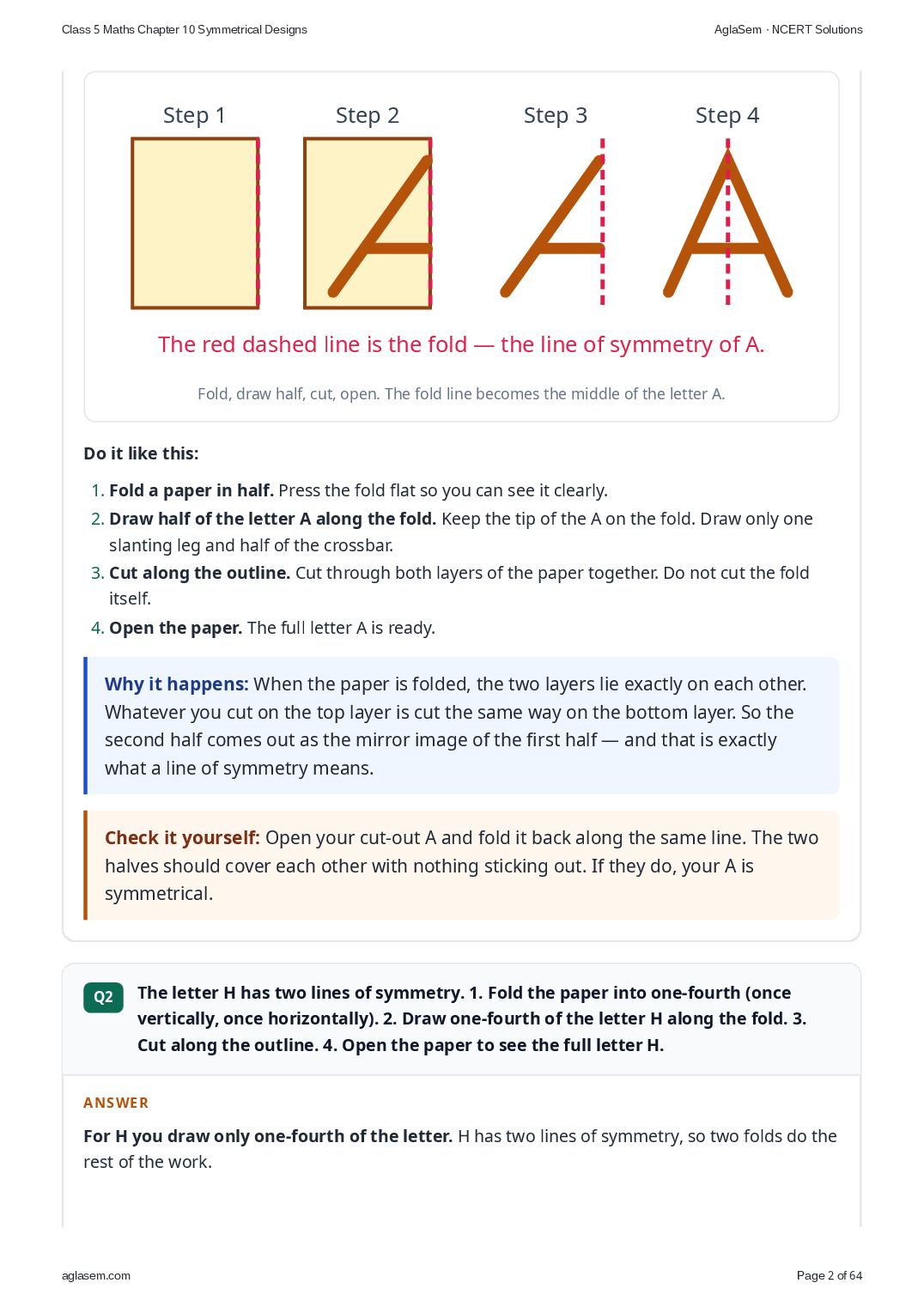
- The letter A has a vertical line of symmetry. So, to cut out the letter ‘A’ — 1. Fold a paper in half. 2. Draw half of the letter A along the fold. 3. Cut along the outline. 4. Open the paper to see the full letter A.
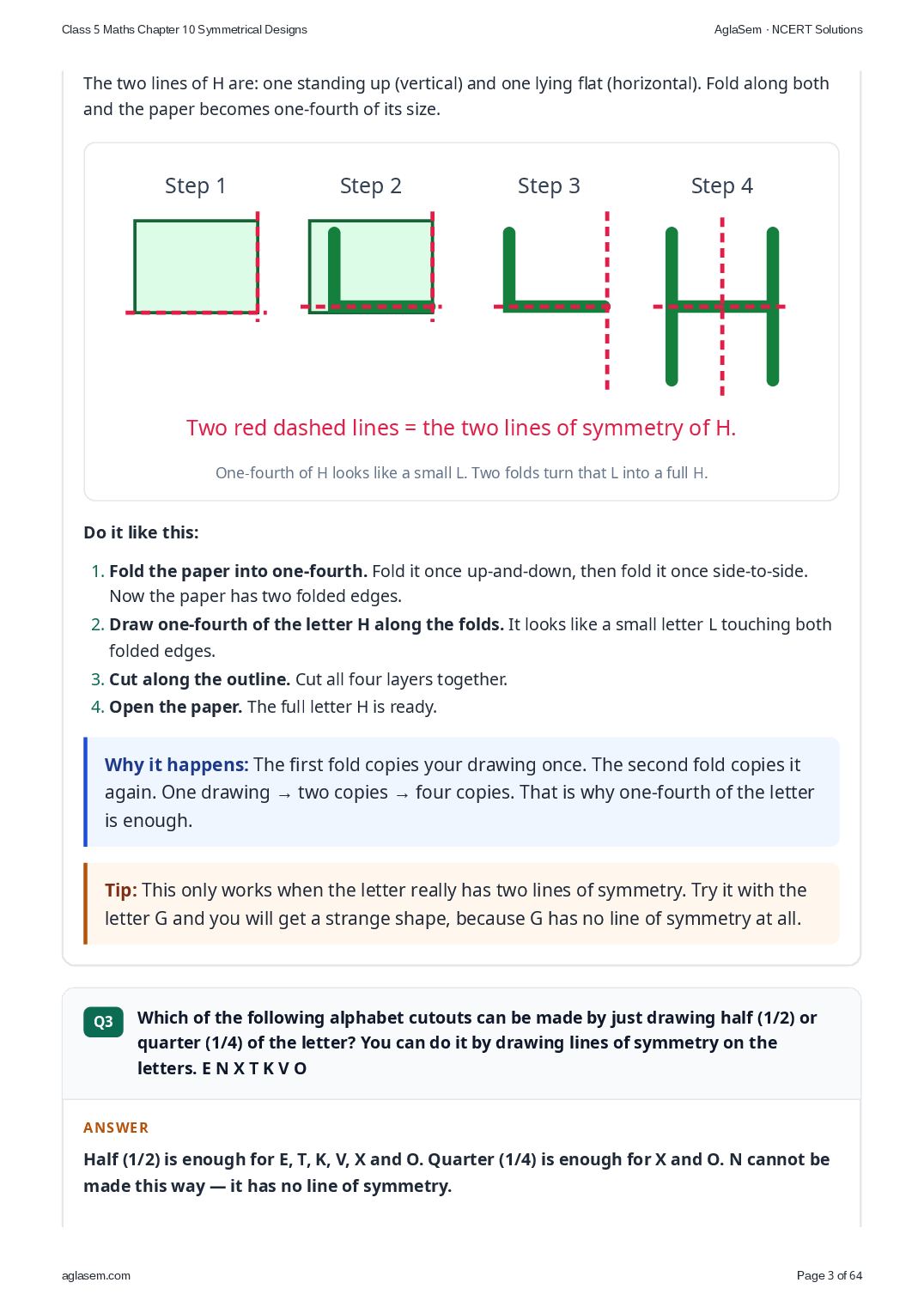
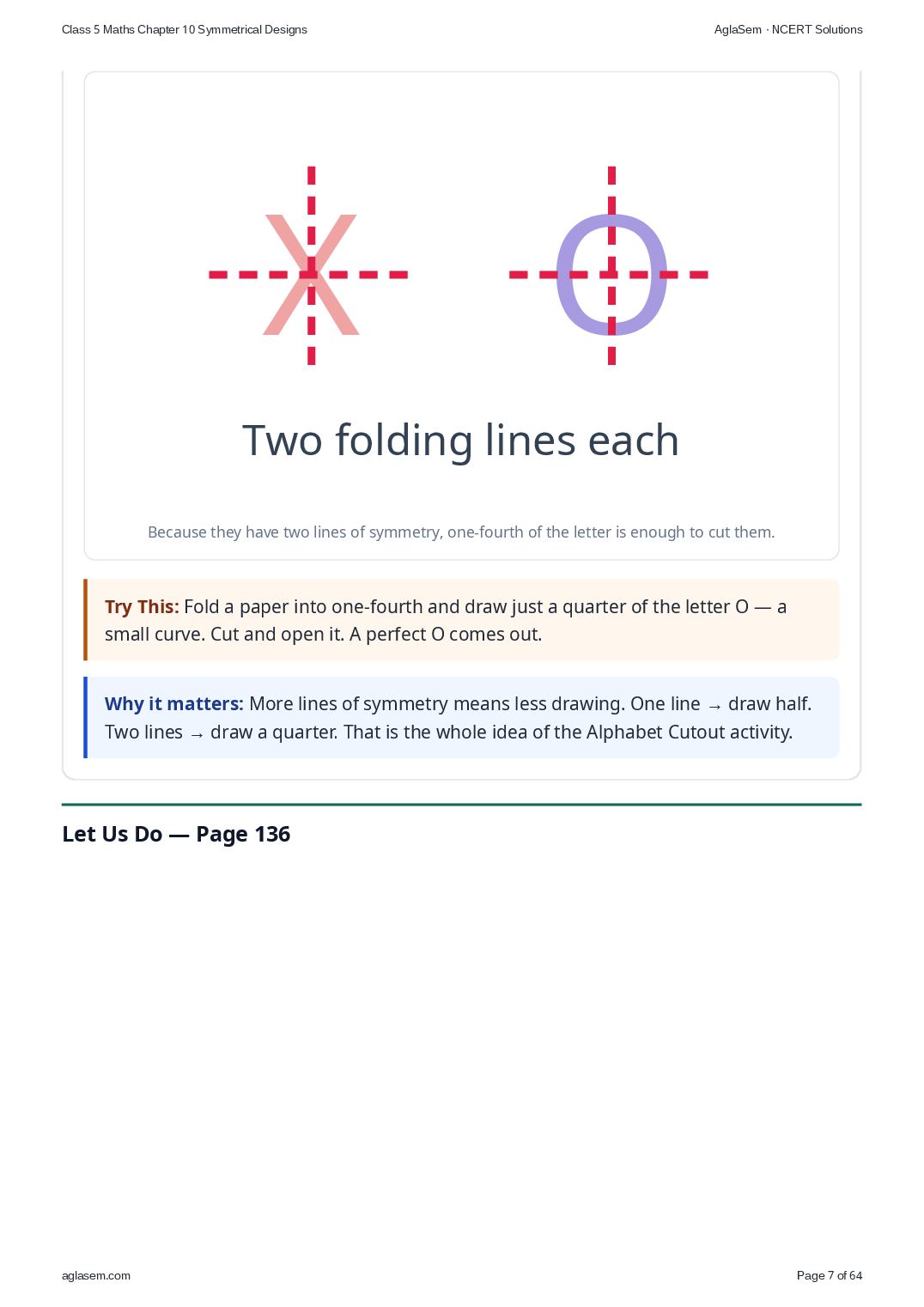
- The letter H has two lines of symmetry. 1. Fold the paper into one-fourth (once vertically, once horizontally). 2. Draw one-fourth of the letter H along the fold. 3. Cut along the outline. 4. Open the paper to see the full letter H.
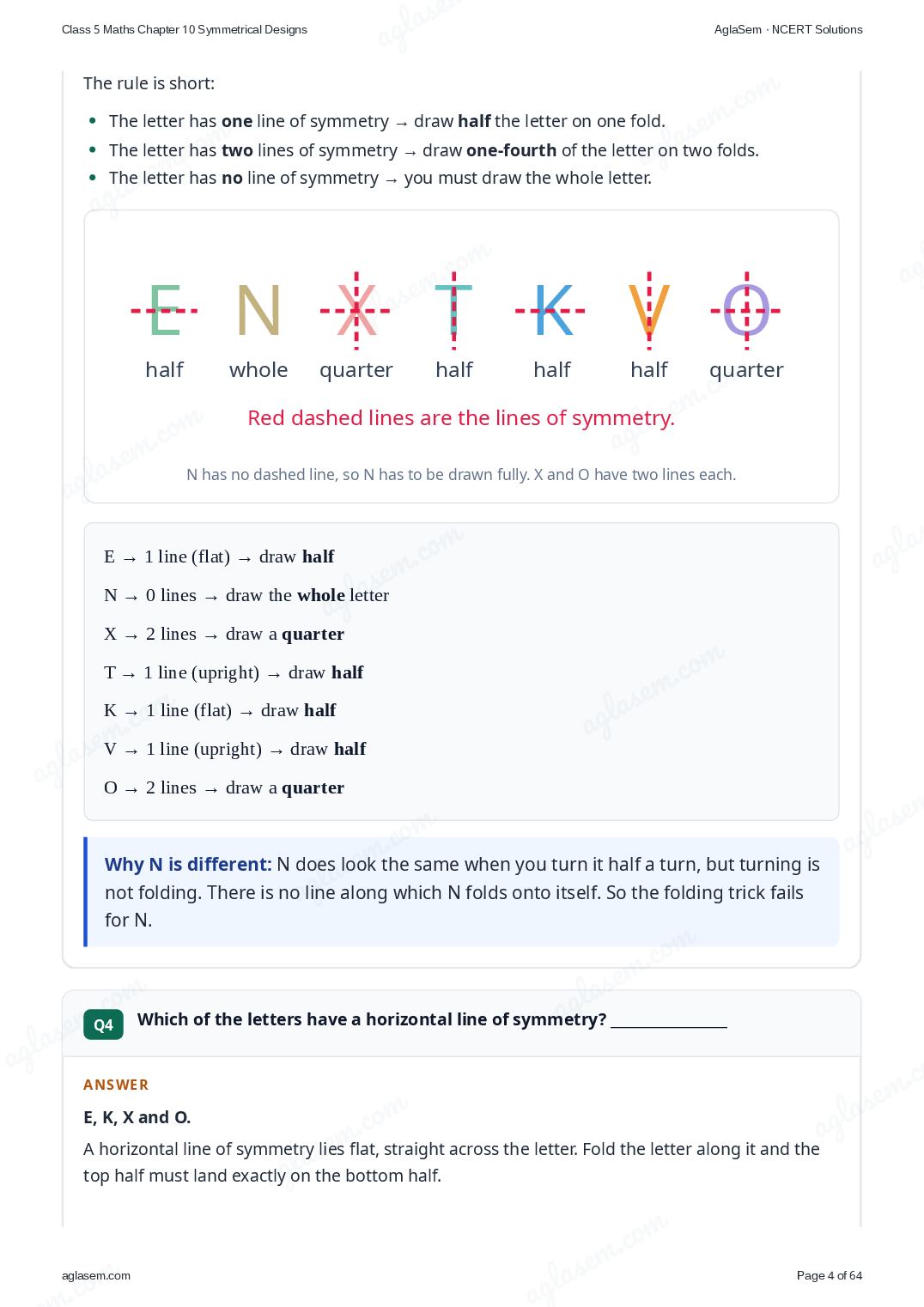
- Which of the following alphabet cutouts can be made by just drawing half (1/2) or quarter (1/4) of the letter? You can do it by drawing lines of symmetry on the letters. E N X T K V O
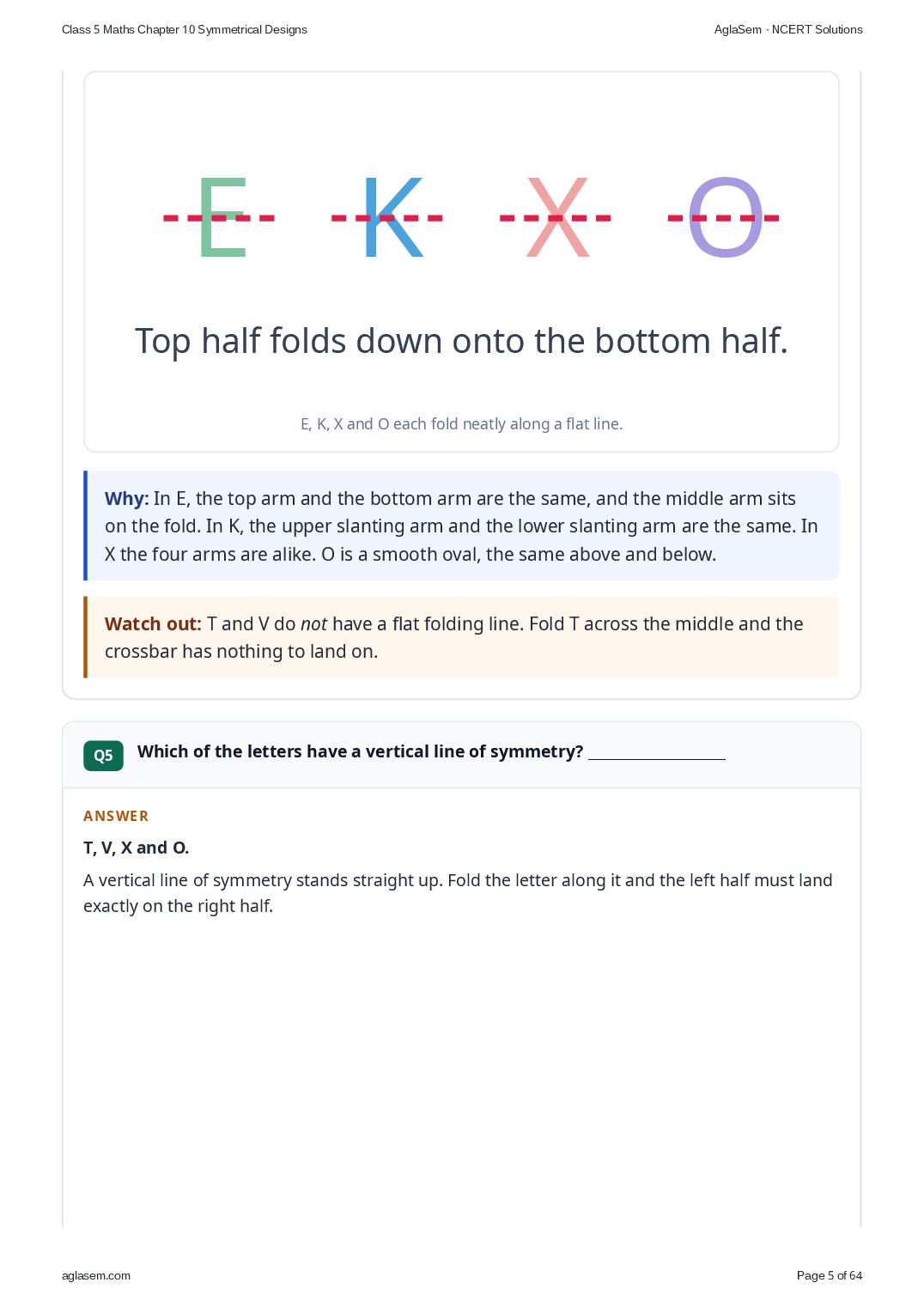
- Which of the letters have a horizontal line of symmetry? _________________
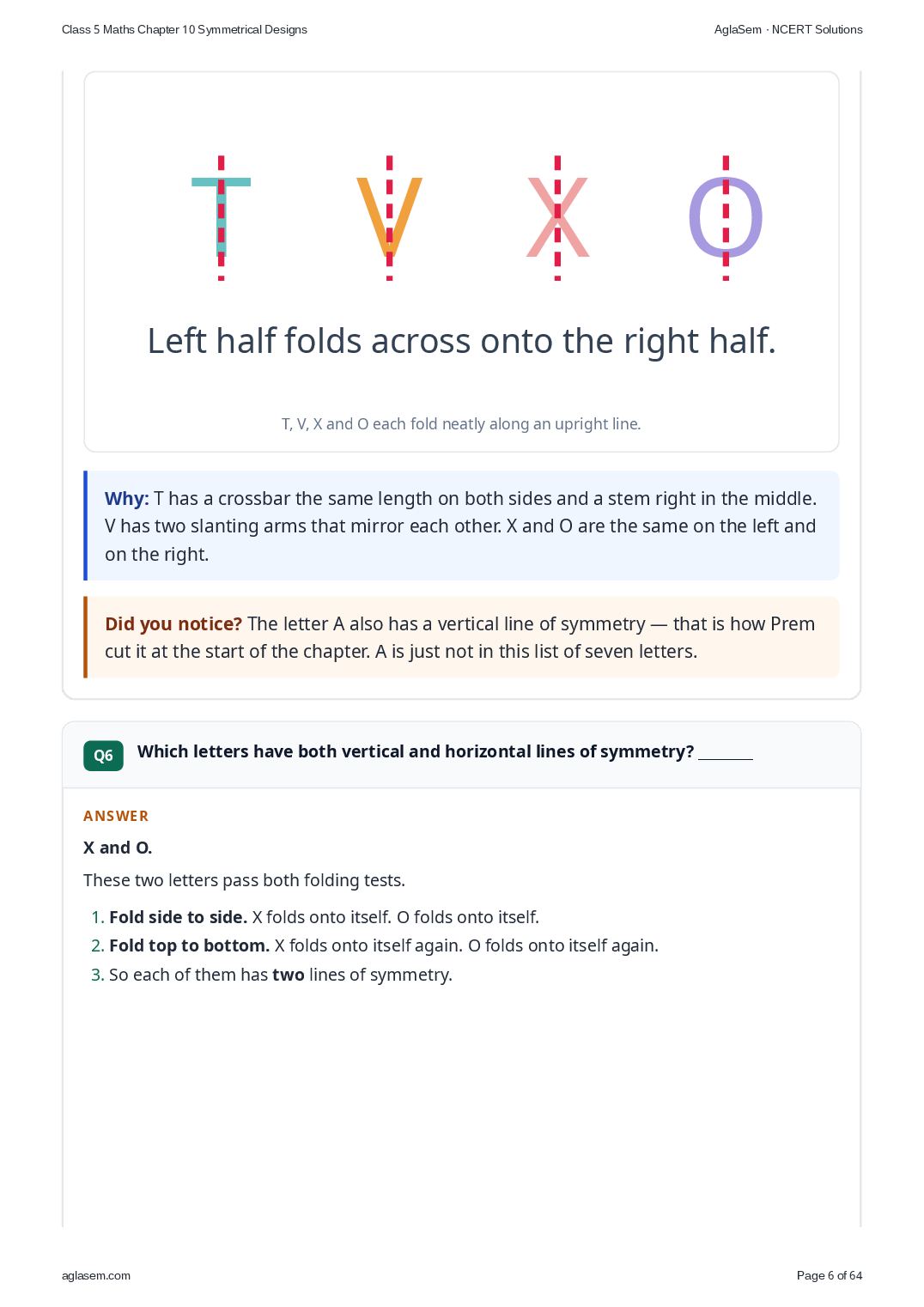
- Which of the letters have a vertical line of symmetry? ____________________
- Which letters have both vertical and horizontal lines of symmetry? ________
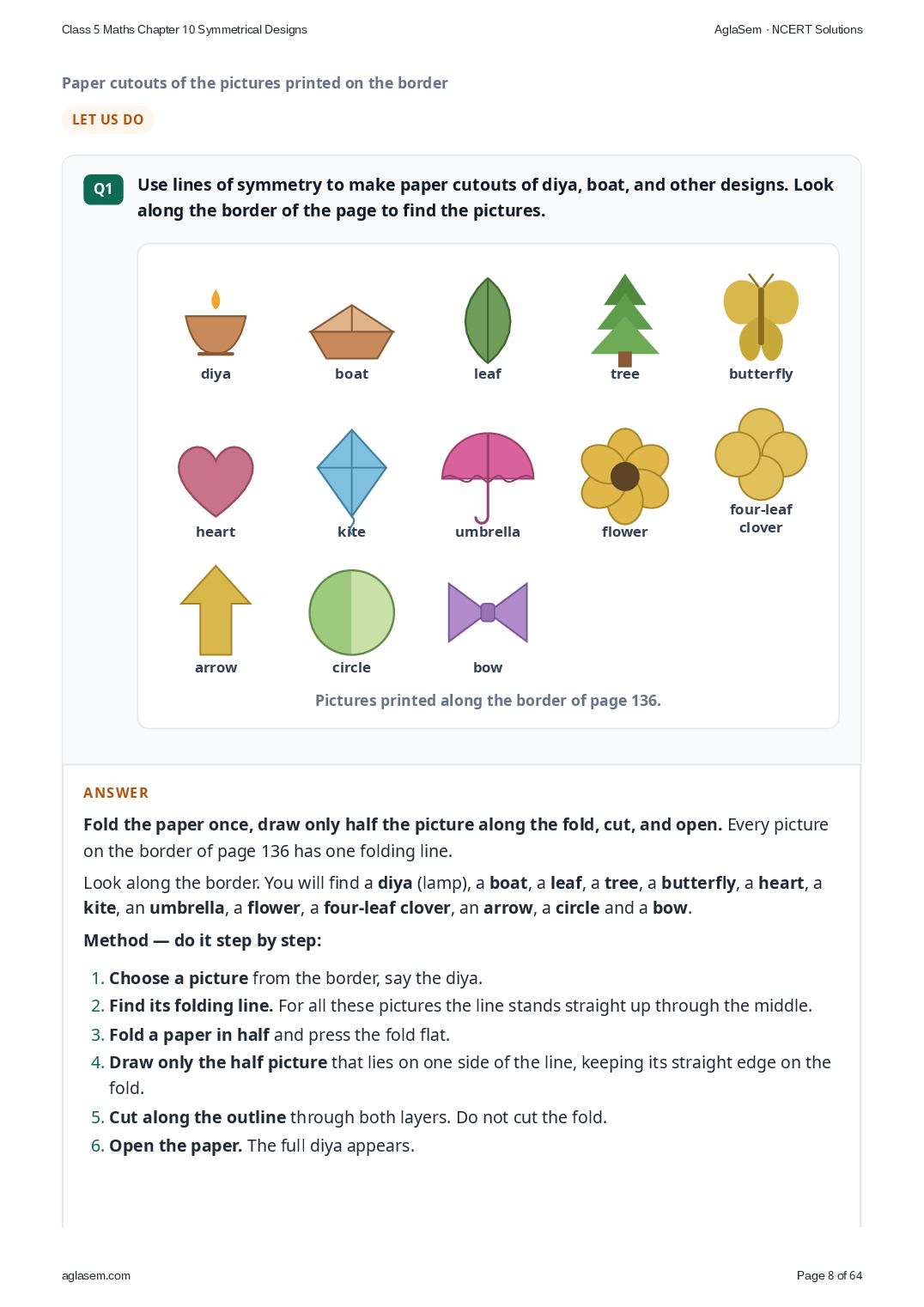
- Use lines of symmetry to make paper cutouts of diya, boat, and other designs. Look along the border of the page to find the pictures.diyaboatleaftreebutterflyheartkiteumbrellaflowerfour-leafcloverarrowcirclebowPictures printed along the border of page 136.
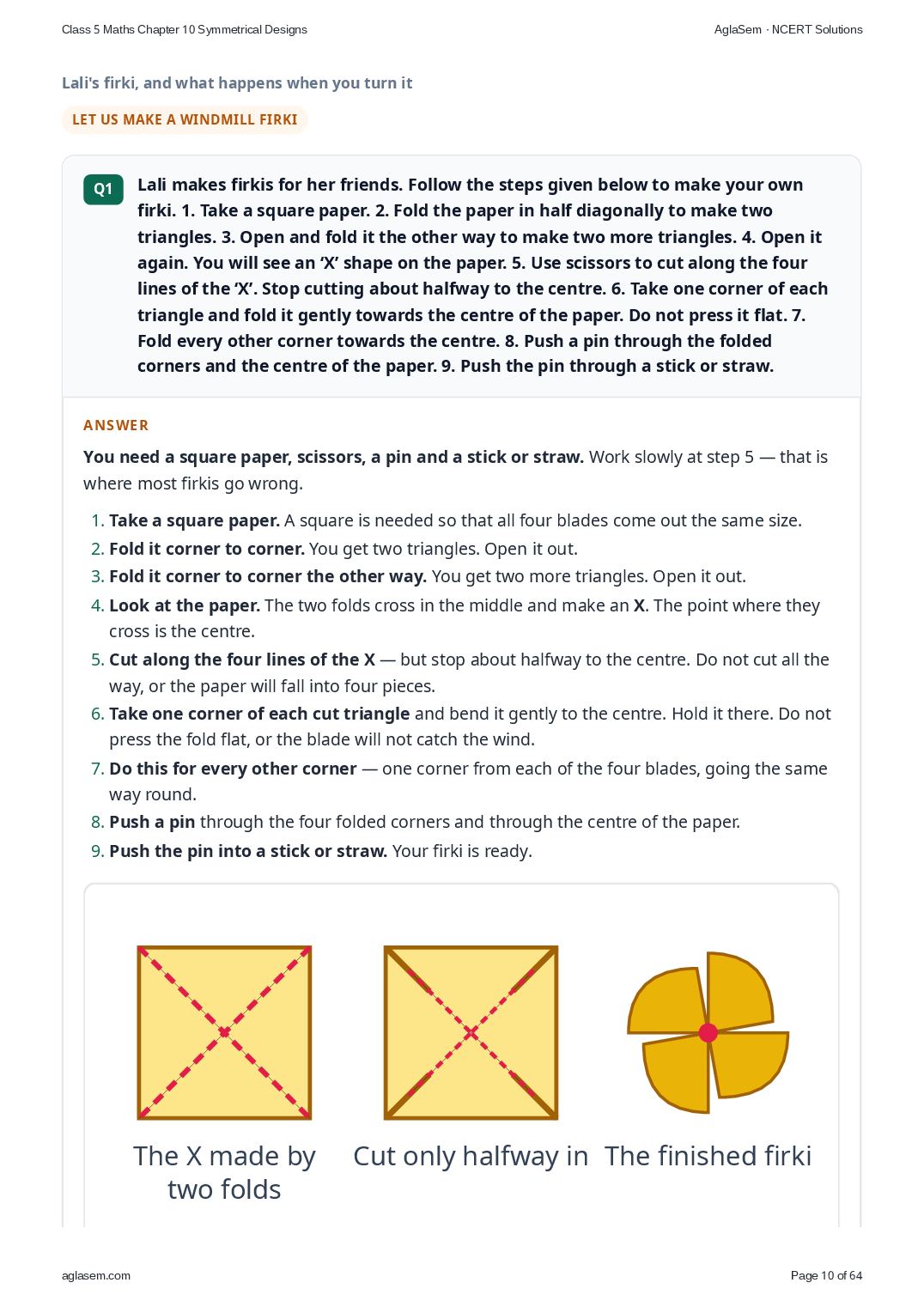
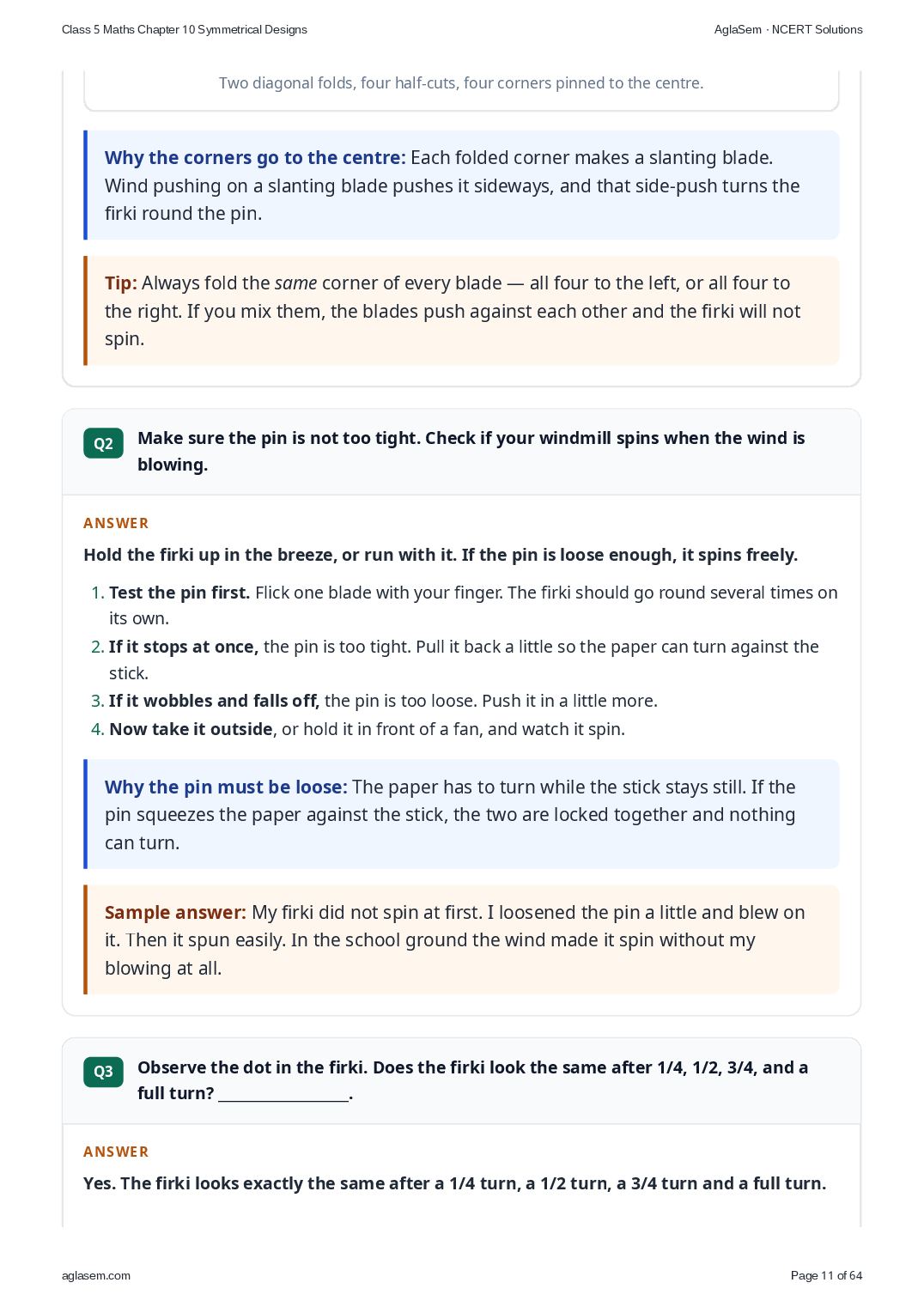
- Lali makes firkis for her friends. Follow the steps given below to make your own firki. 1. Take a square paper. 2. Fold the paper in half diagonally to make two triangles. 3. Open and fold it the other way to make two more triangles. 4. Open it again. You will see an ‘X’ shape on the paper. 5. Use scissors to cut along the four lines of the ‘X’. Stop cutting about halfway to the centre. 6. Take one corner of each triangle and fold it gently towards the centre of the paper. Do not press it flat. 7. Fold every other corner towards the centre. 8. Push a pin through the folded corners and the centre of the paper. 9. Push the pin through a stick or straw.
- Make sure the pin is not too tight. Check if your windmill spins when the wind is blowing.
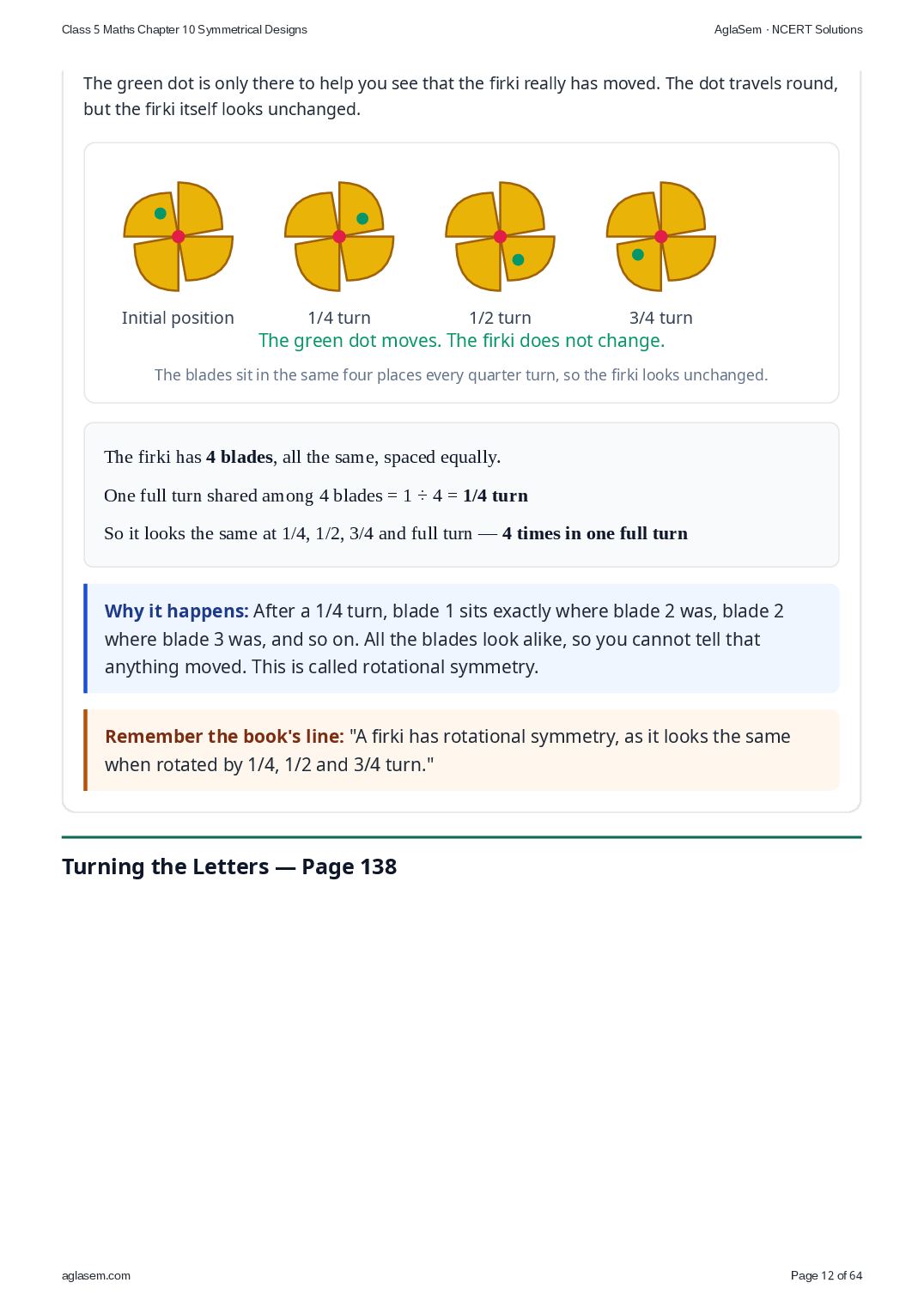
- Observe the dot in the firki. Does the firki look the same after 1/4, 1/2, 3/4, and a full turn? ___________________.
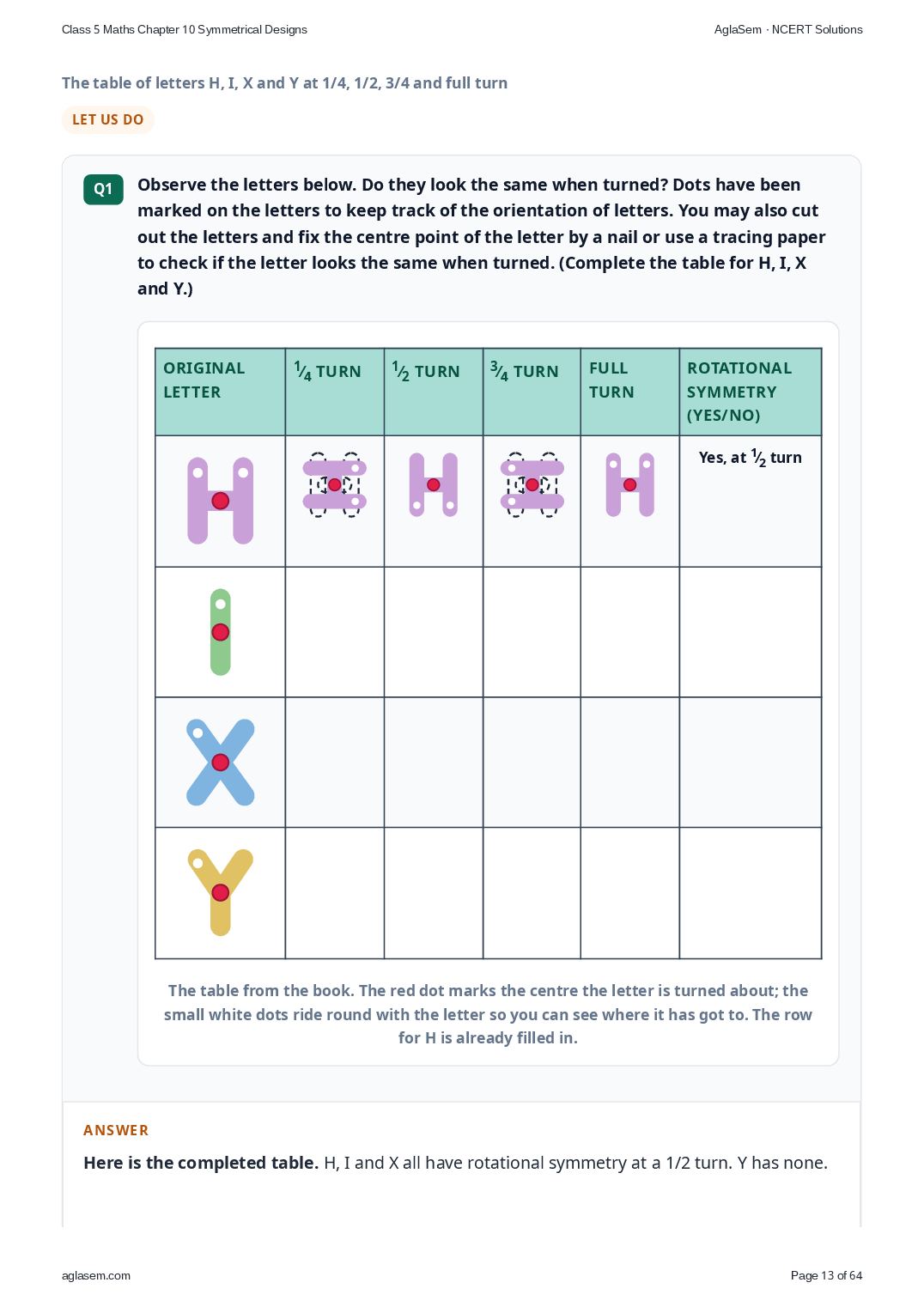
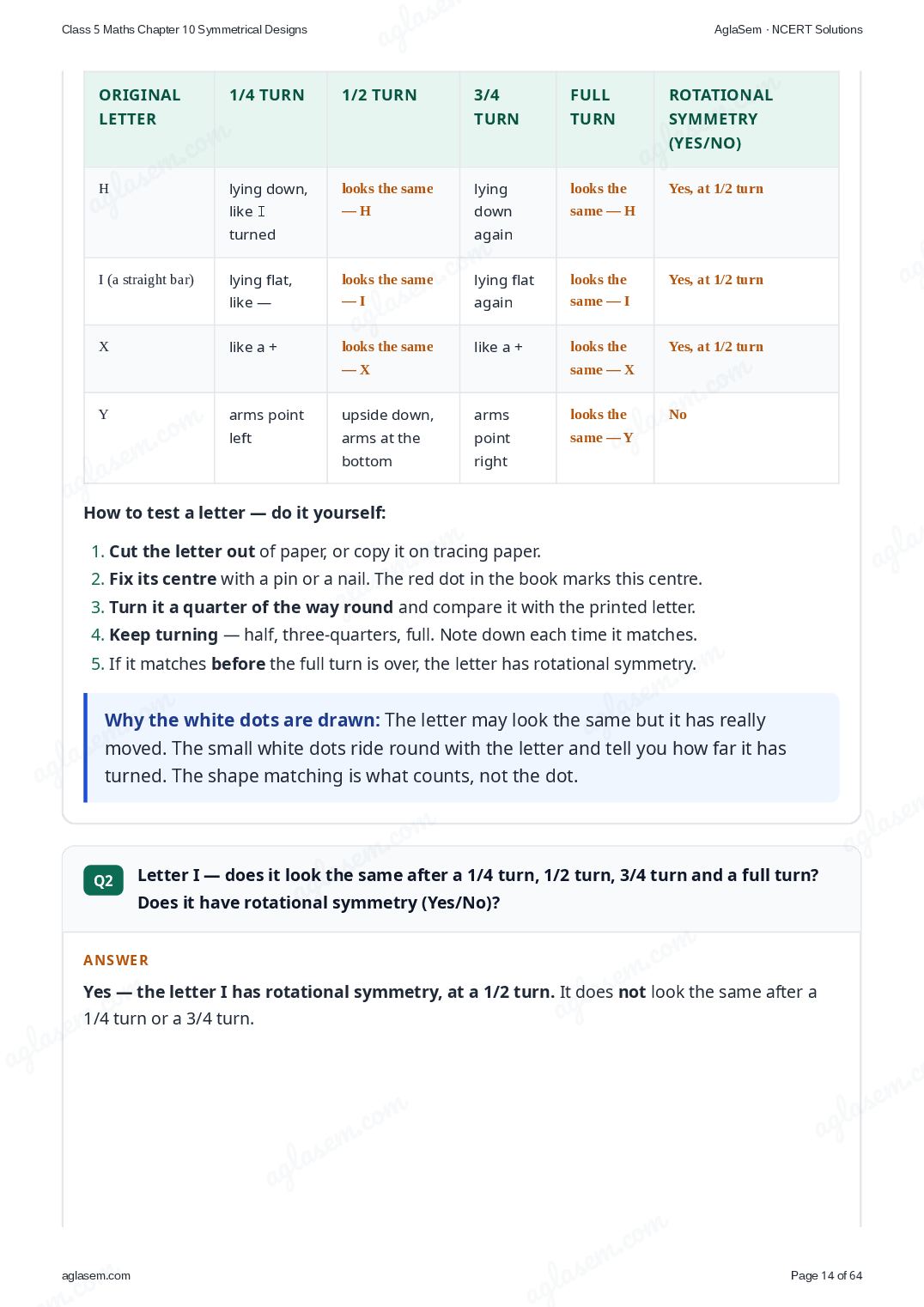
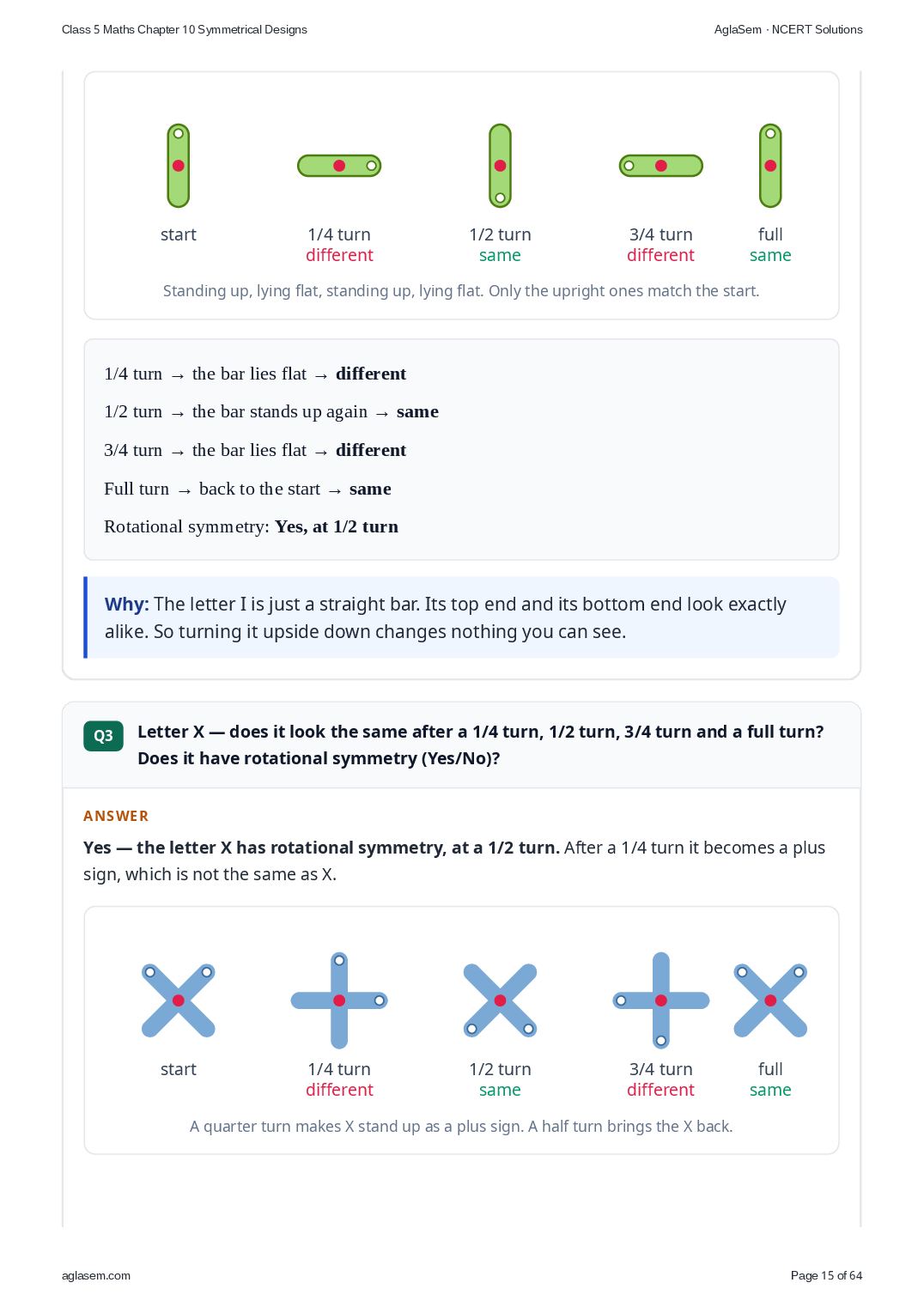
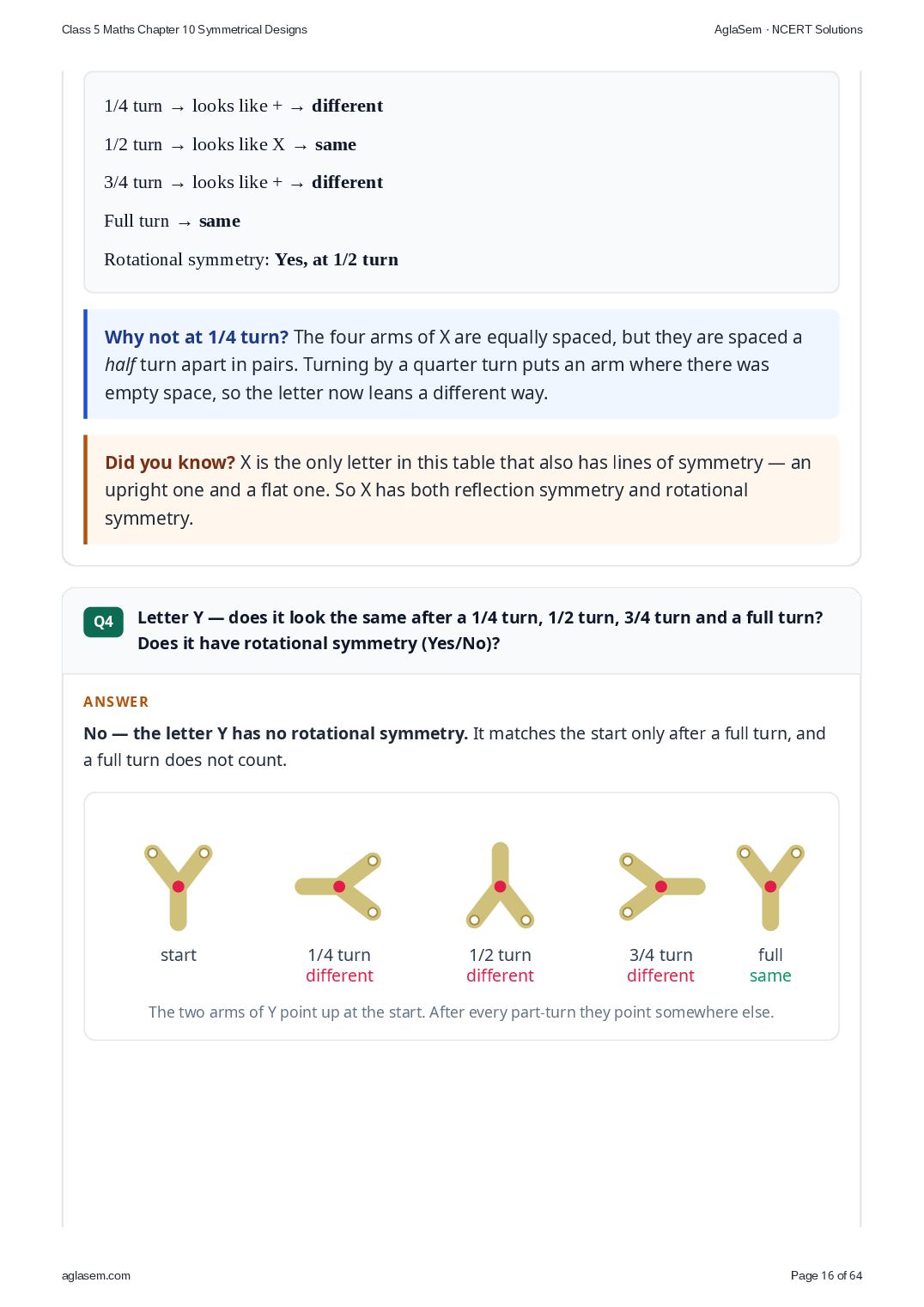
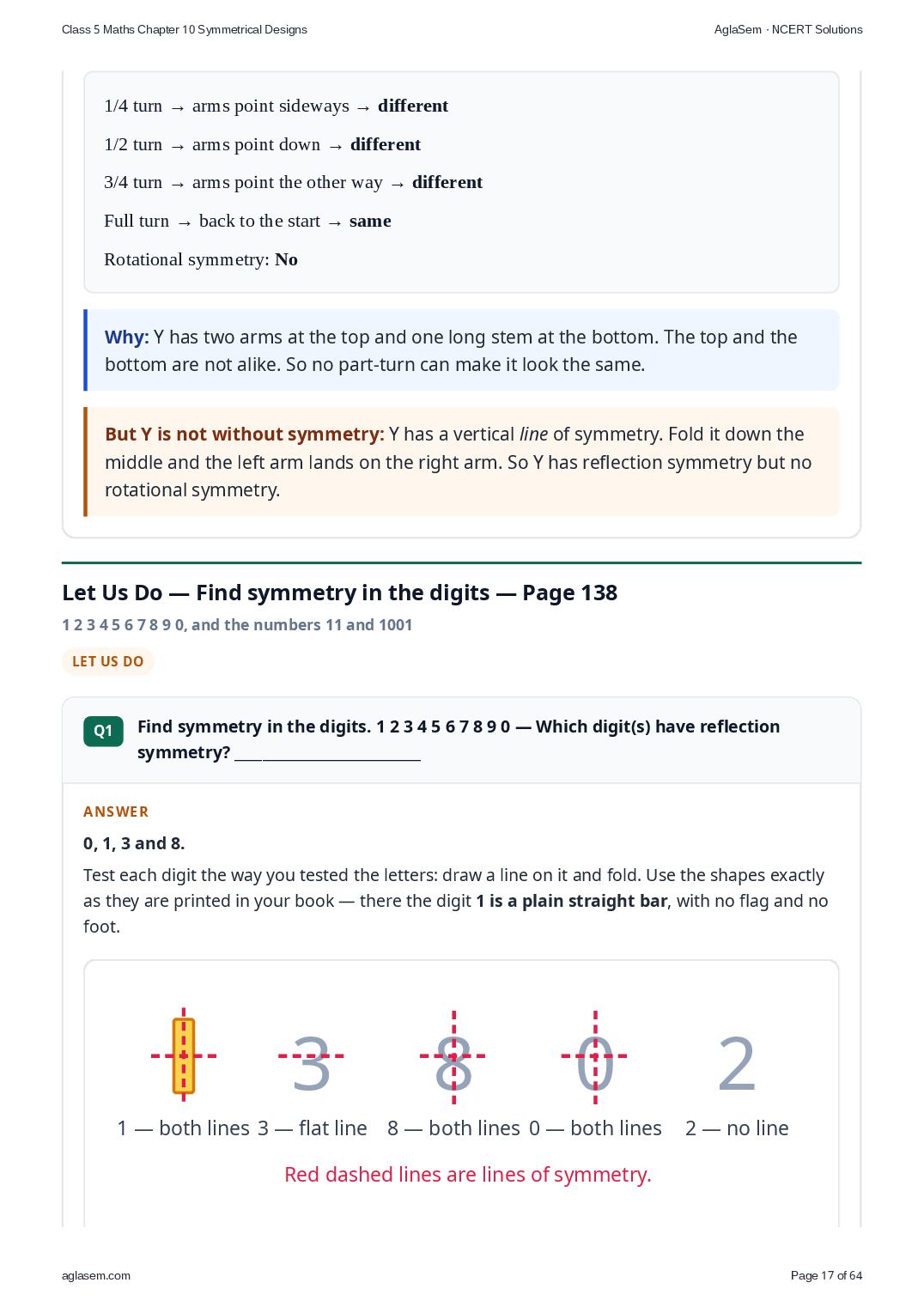
- Observe the letters below. Do they look the same when turned? Dots have been marked on the letters to keep track of the orientation of letters. You may also cut out the letters and fix the centre point of the letter by a nail or use a tracing paper to check if the letter looks the same when turned. (Complete the table for H, I, X and Y.)Original letter1⁄4 turn1⁄2 turn3⁄4 turnFull turnRotational symmetry (Yes/No)Yes, at 1⁄2 turn The table from the book. The red dot marks the centre the letter is turned about; the small white dots ride round with the letter so you can see where it has got to. The row for H is already filled in.
- Letter I — does it look the same after a 1/4 turn, 1/2 turn, 3/4 turn and a full turn? Does it have rotational symmetry (Yes/No)?
- Letter X — does it look the same after a 1/4 turn, 1/2 turn, 3/4 turn and a full turn? Does it have rotational symmetry (Yes/No)?
- Letter Y — does it look the same after a 1/4 turn, 1/2 turn, 3/4 turn and a full turn? Does it have rotational symmetry (Yes/No)?
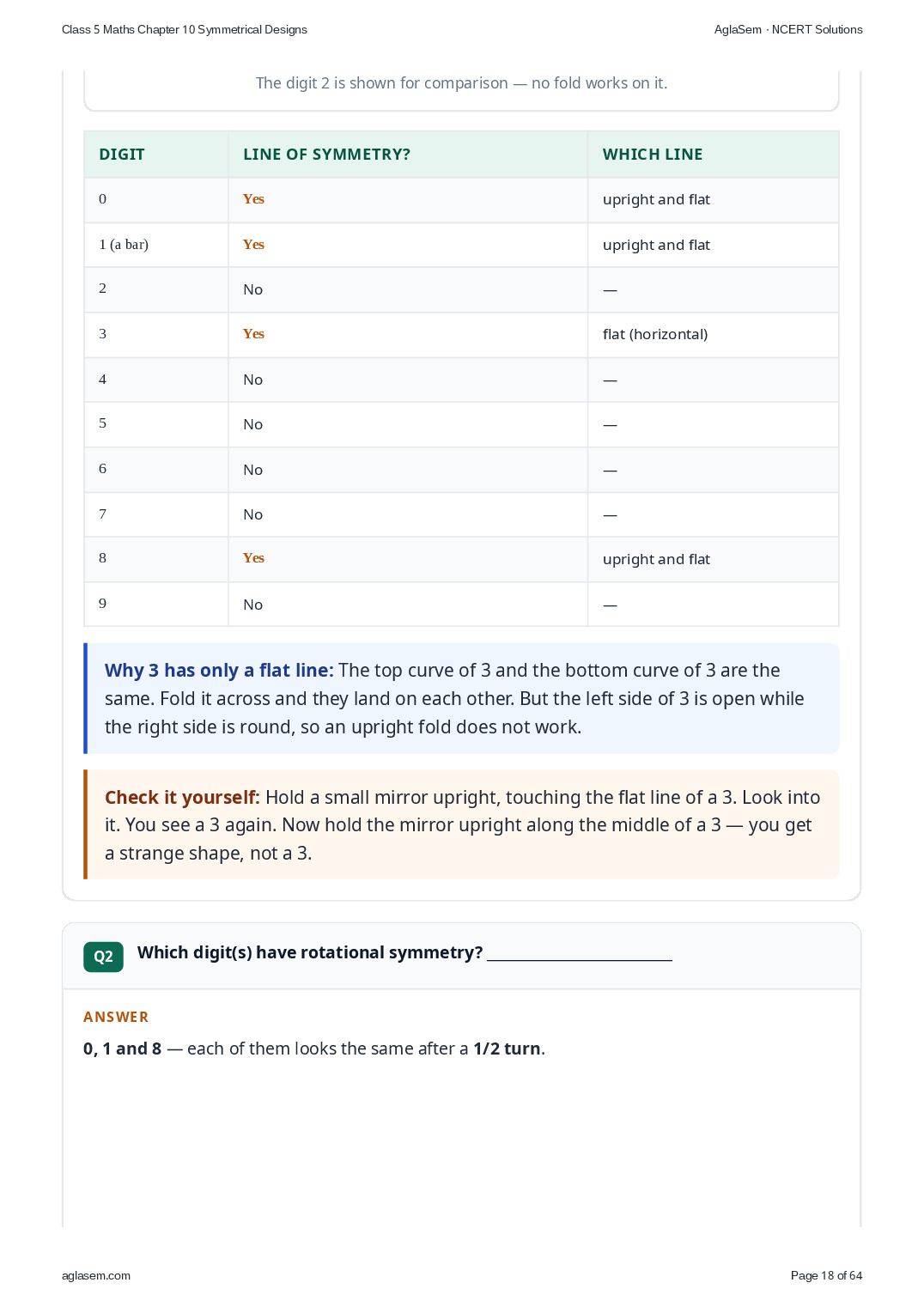
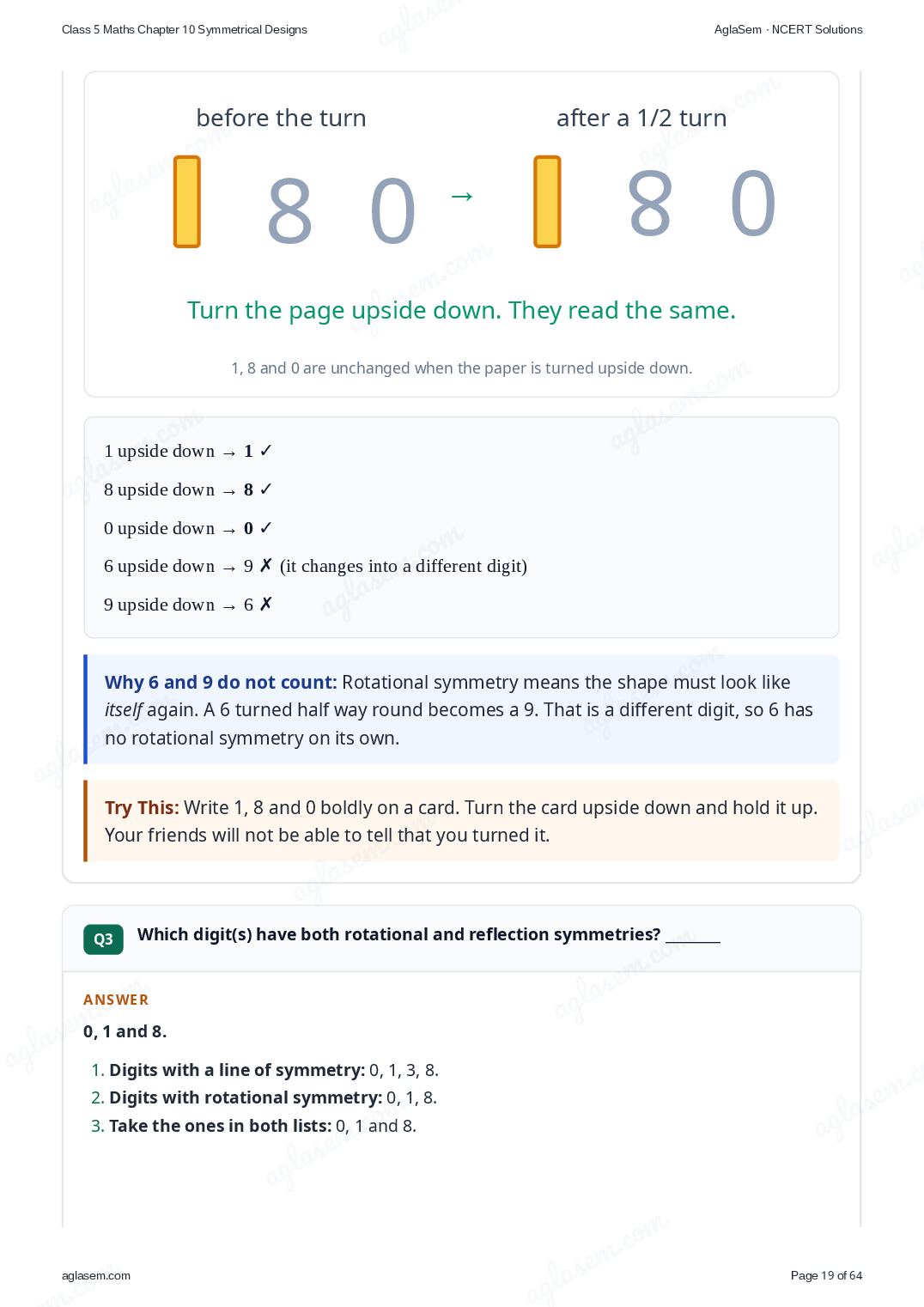
- Find symmetry in the digits. 1 2 3 4 5 6 7 8 9 0 — Which digit(s) have reflection symmetry? ___________________________
- Which digit(s) have rotational symmetry? ___________________________
- Which digit(s) have both rotational and reflection symmetries? ________
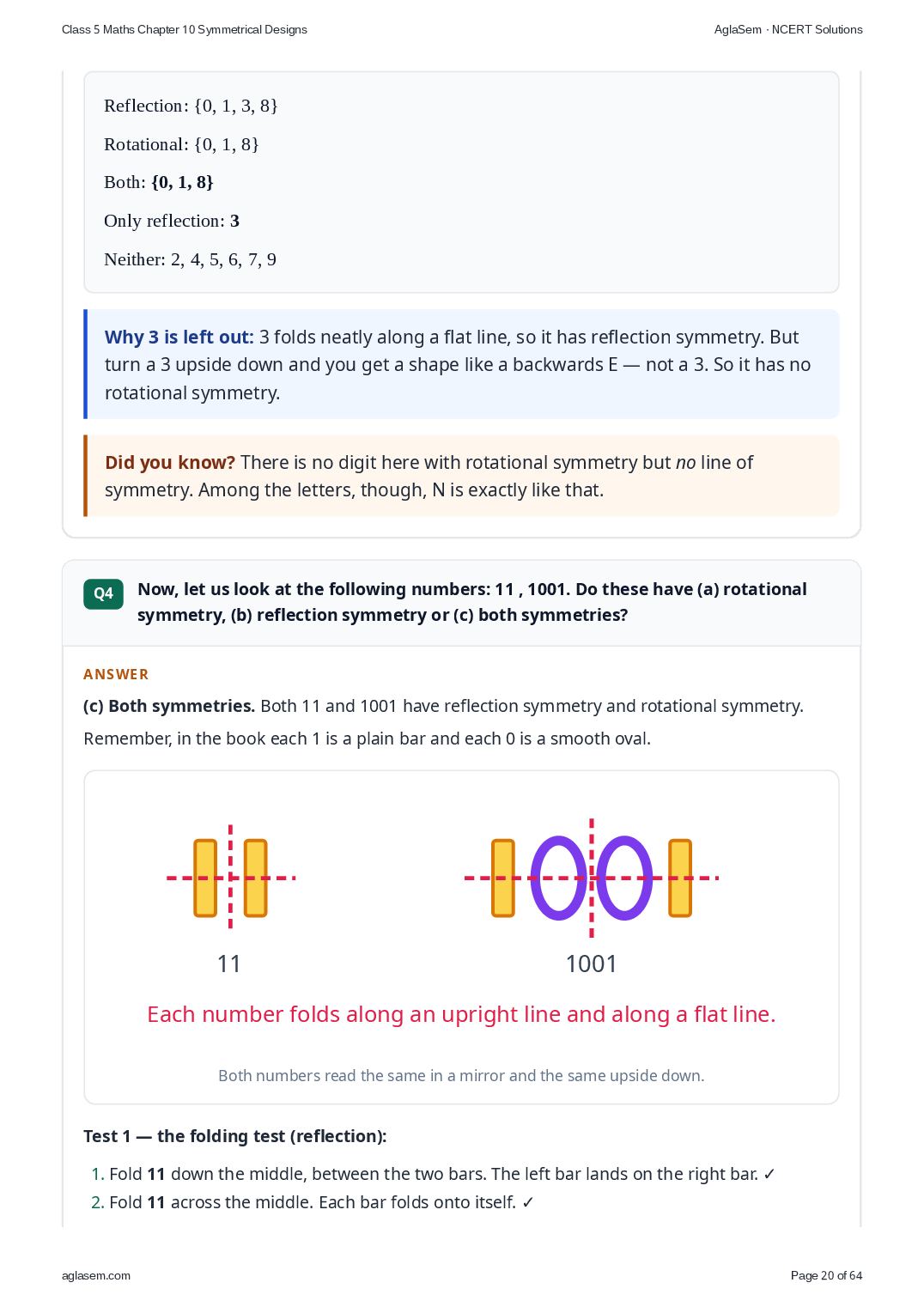
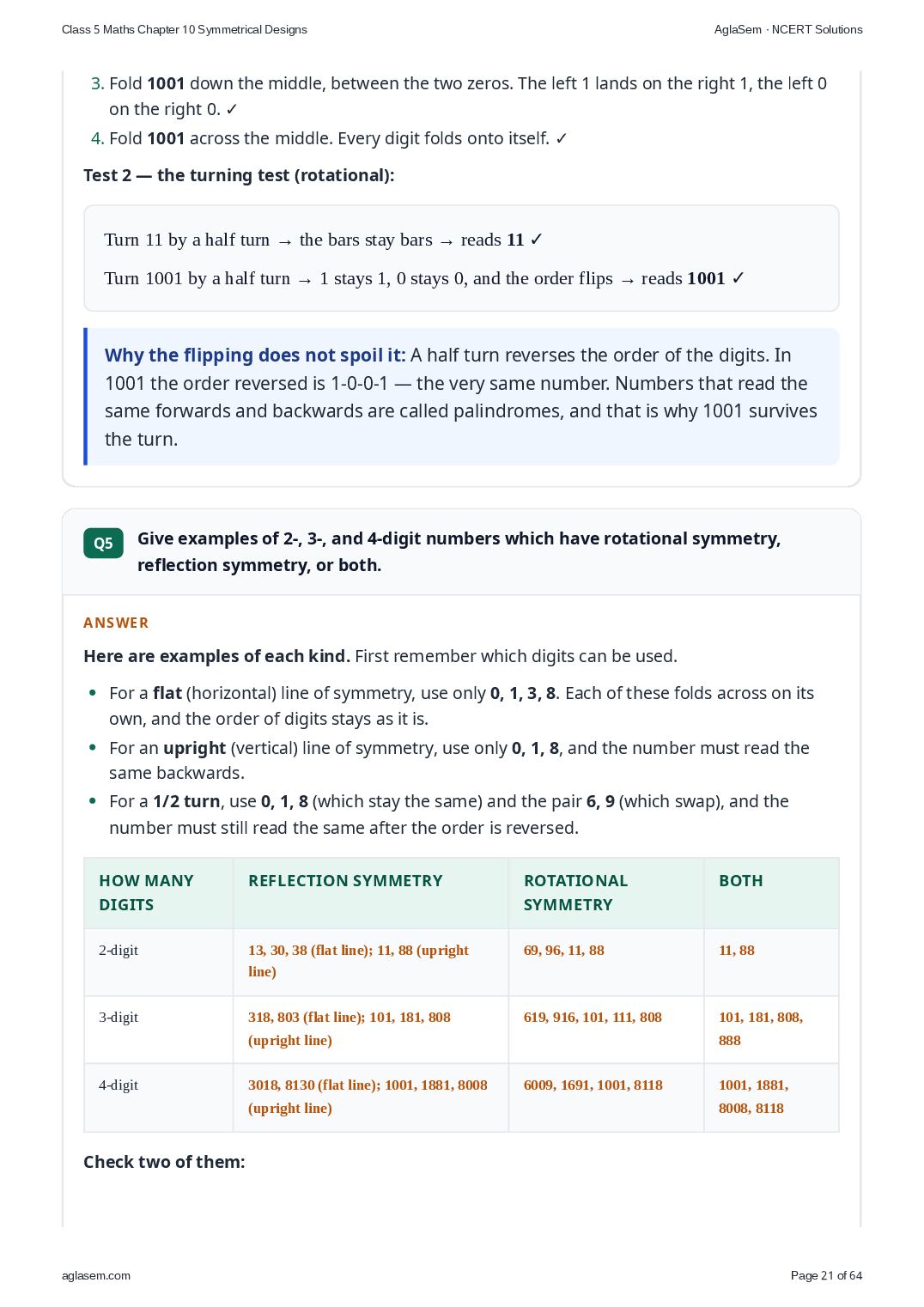
- Now, let us look at the following numbers: 11 , 1001. Do these have (a) rotational symmetry, (b) reflection symmetry or (c) both symmetries?
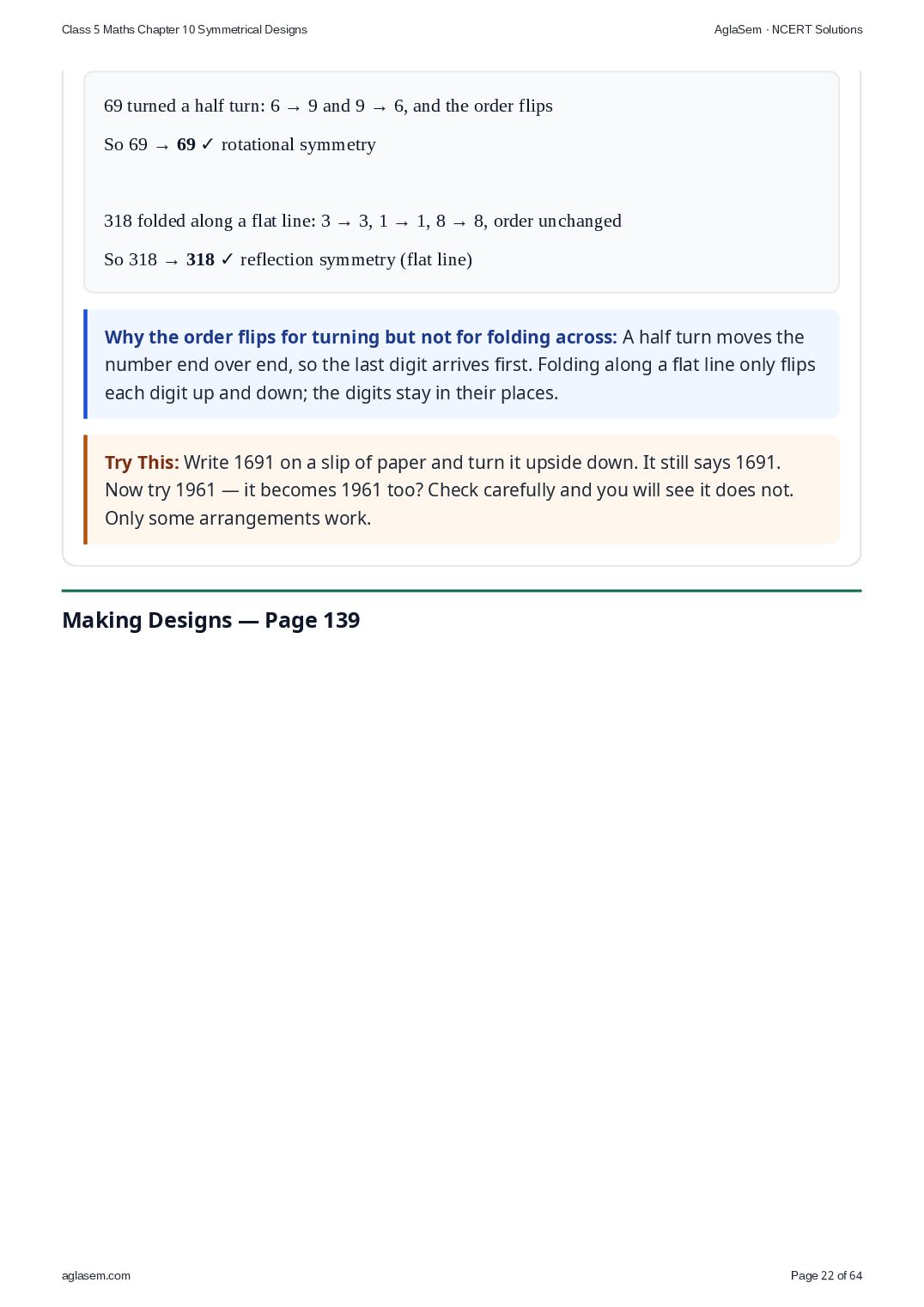
- Give examples of 2-, 3-, and 4-digit numbers which have rotational symmetry, reflection symmetry, or both.
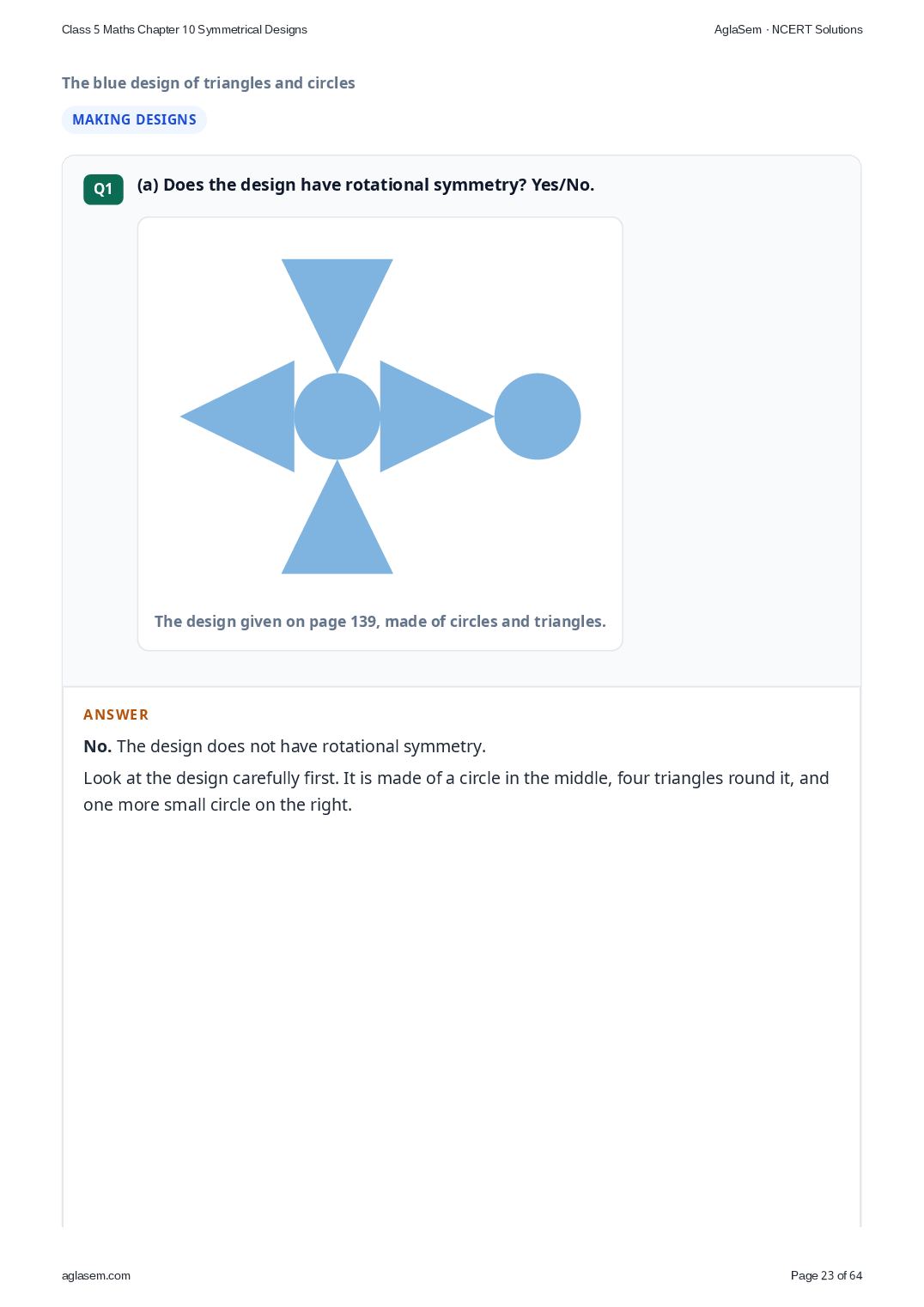
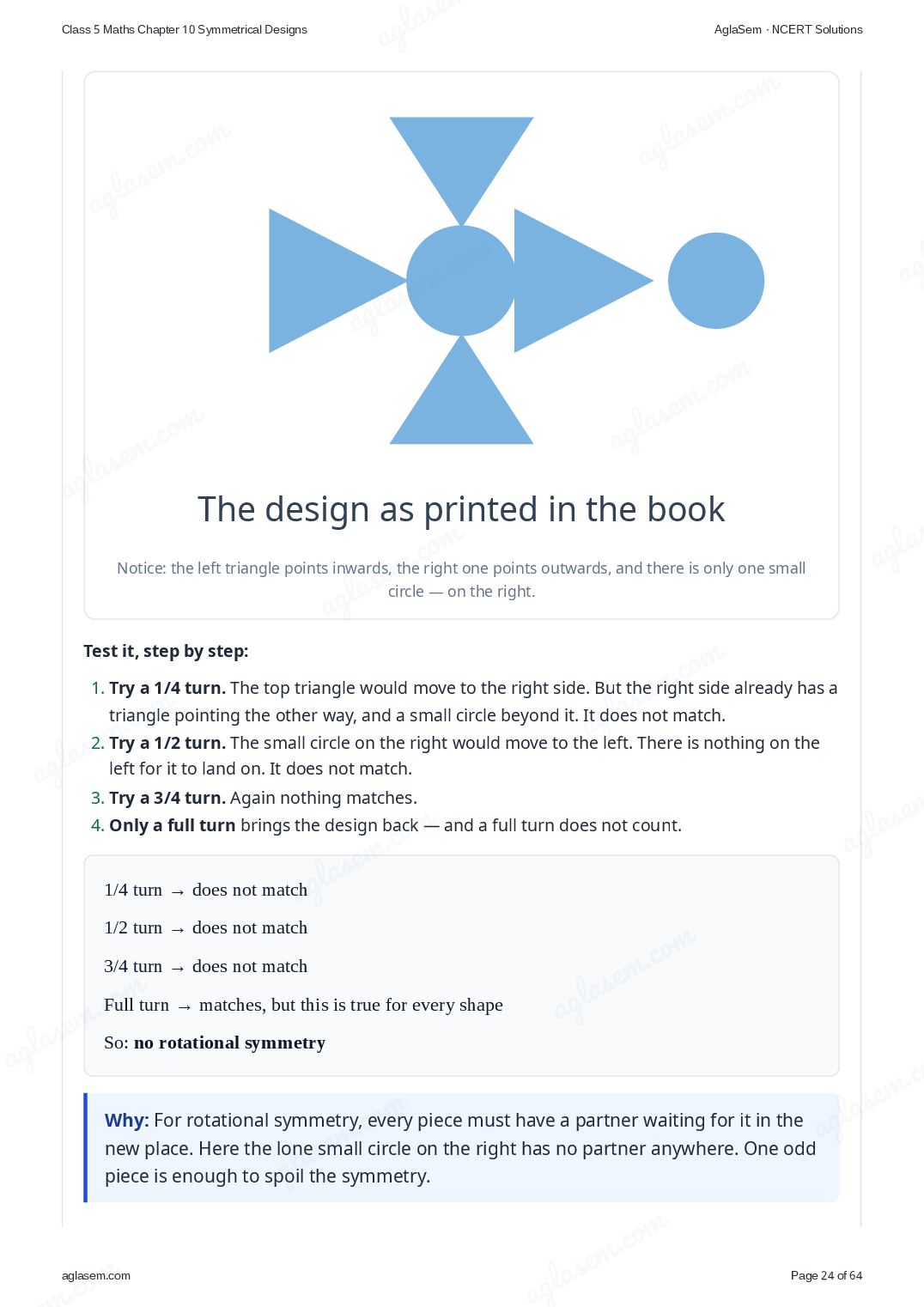
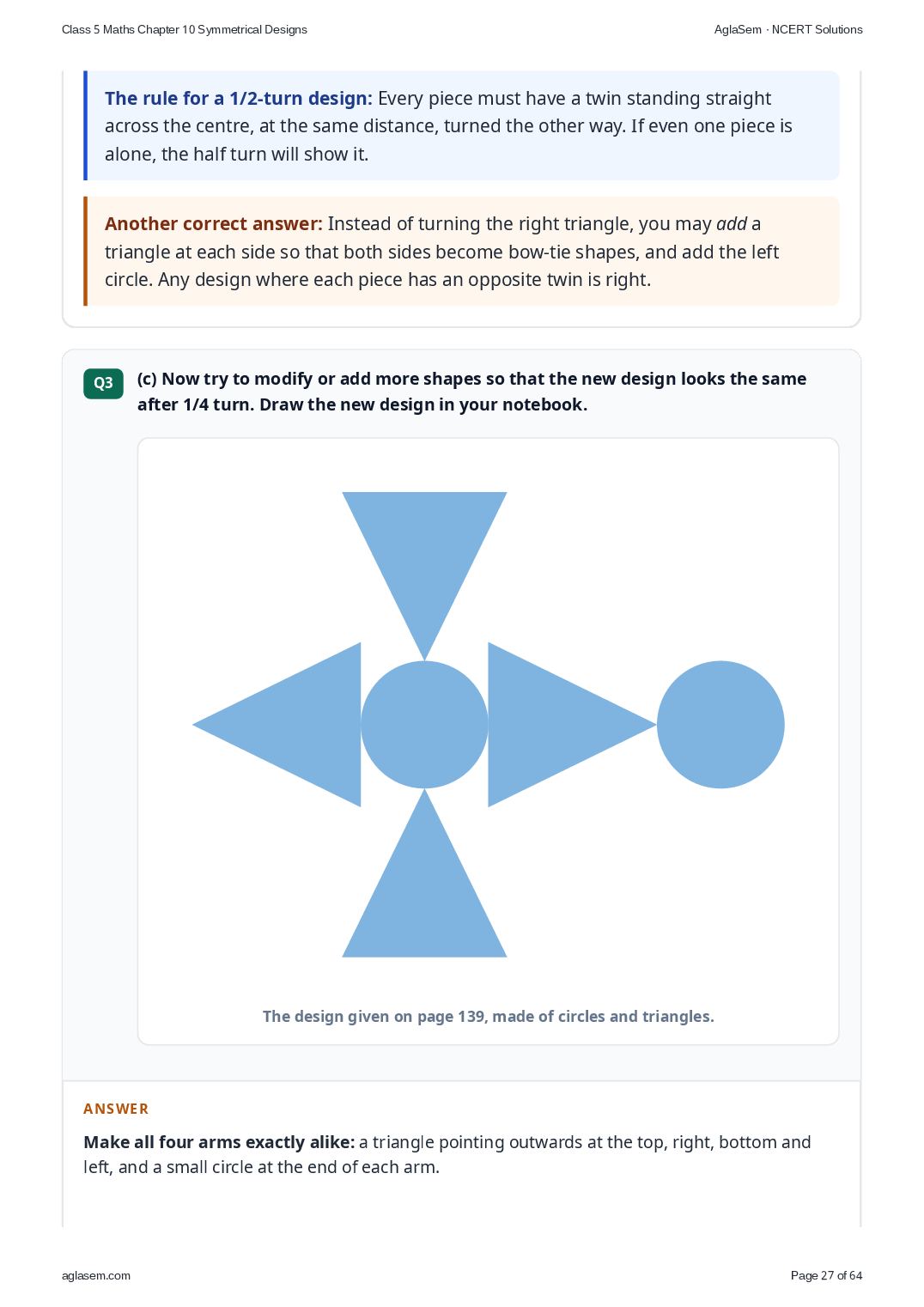
- (a) Does the design have rotational symmetry? Yes/No.The design given on page 139, made of circles and triangles.
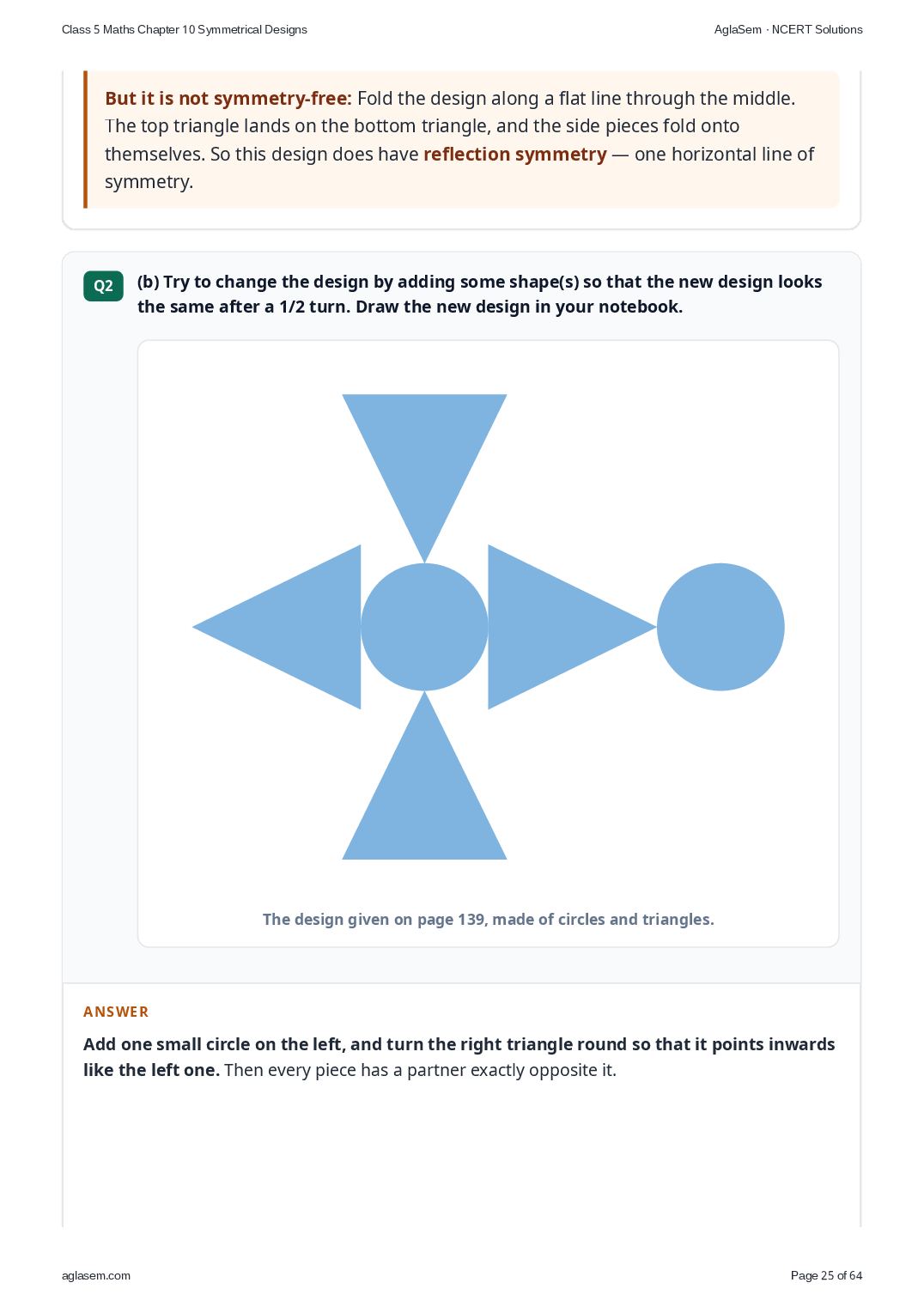
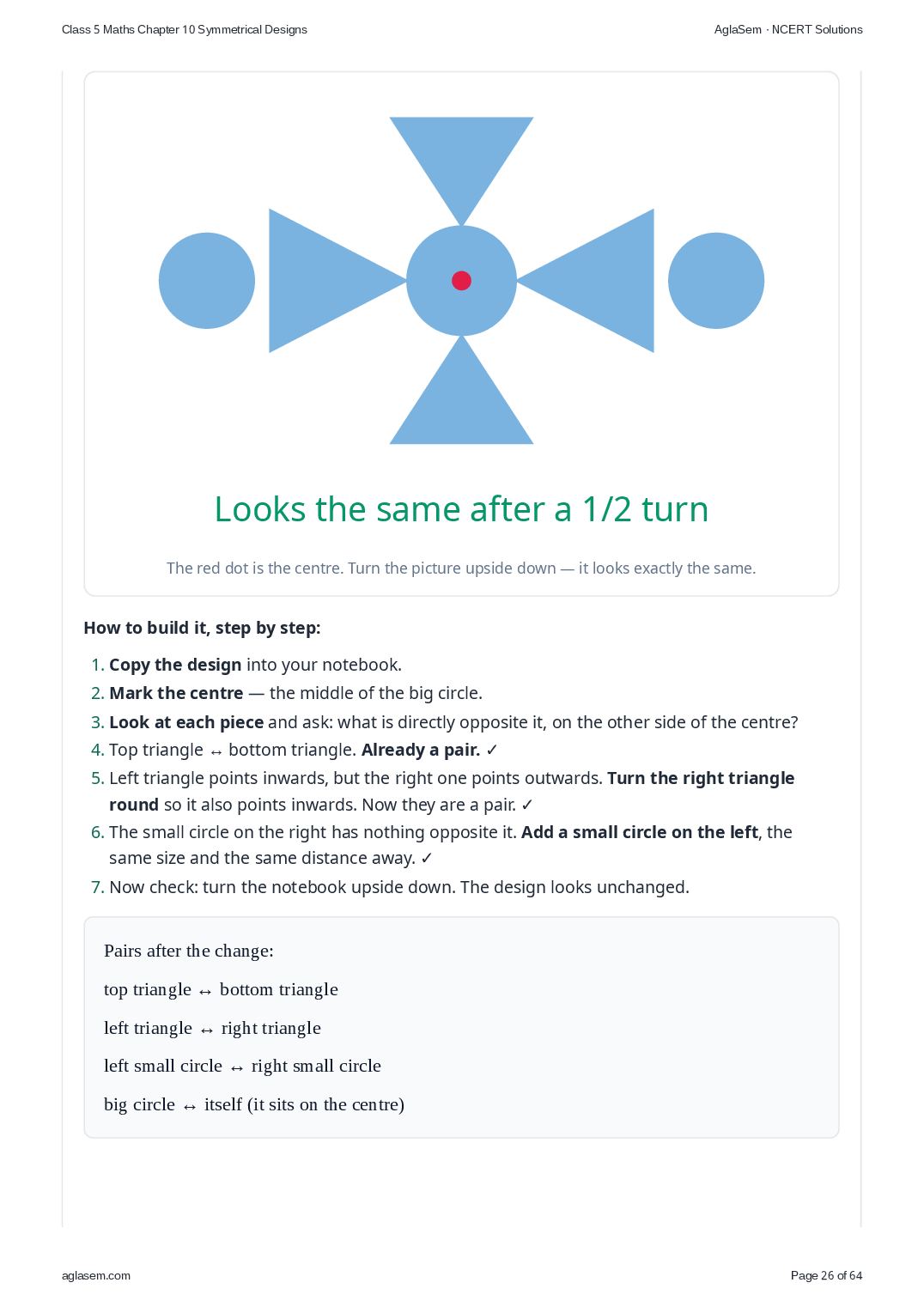
- (b) Try to change the design by adding some shape(s) so that the new design looks the same after a 1/2 turn. Draw the new design in your notebook.The design given on page 139, made of circles and triangles.
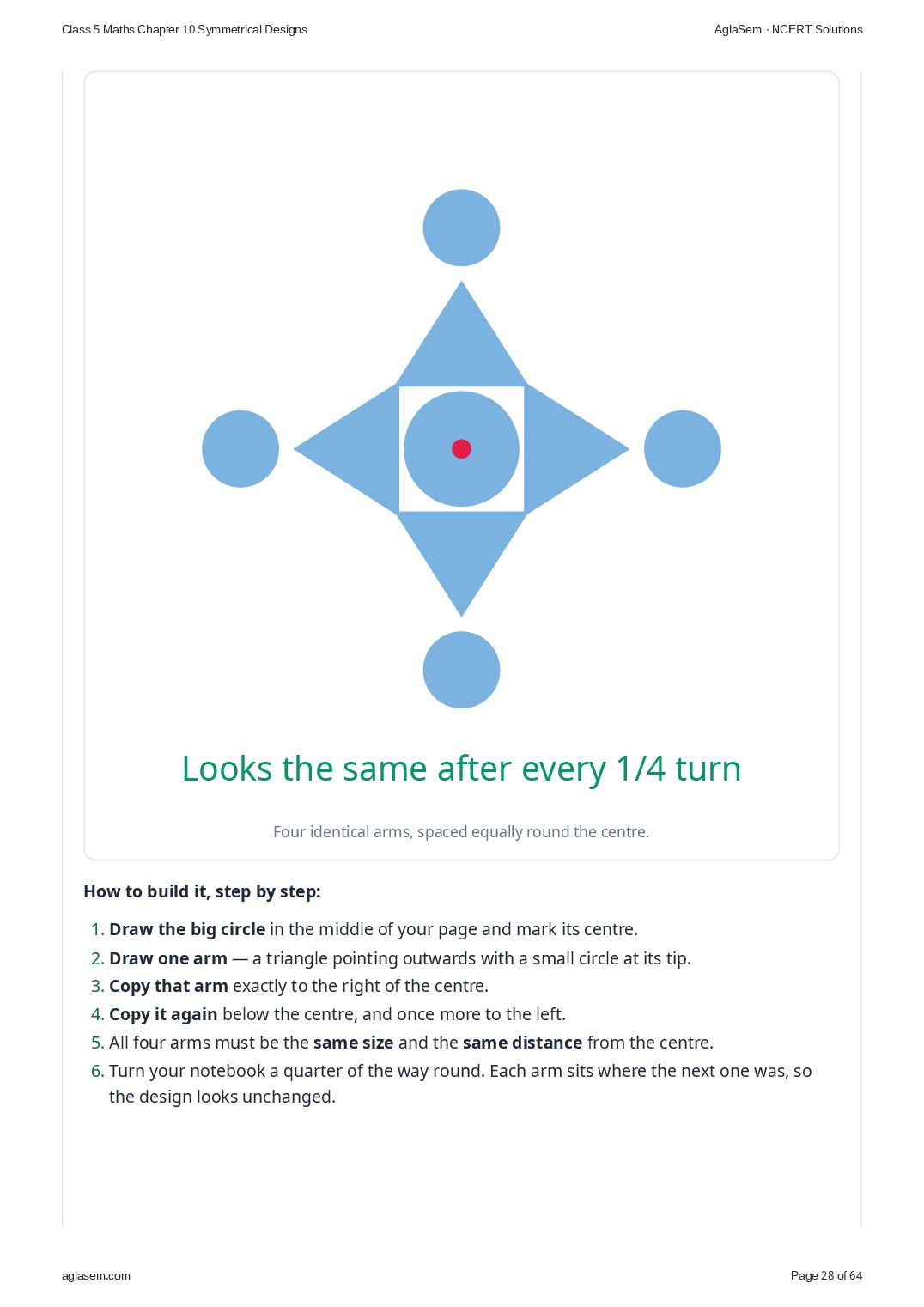
- (c) Now try to modify or add more shapes so that the new design looks the same after 1/4 turn. Draw the new design in your notebook.The design given on page 139, made of circles and triangles.
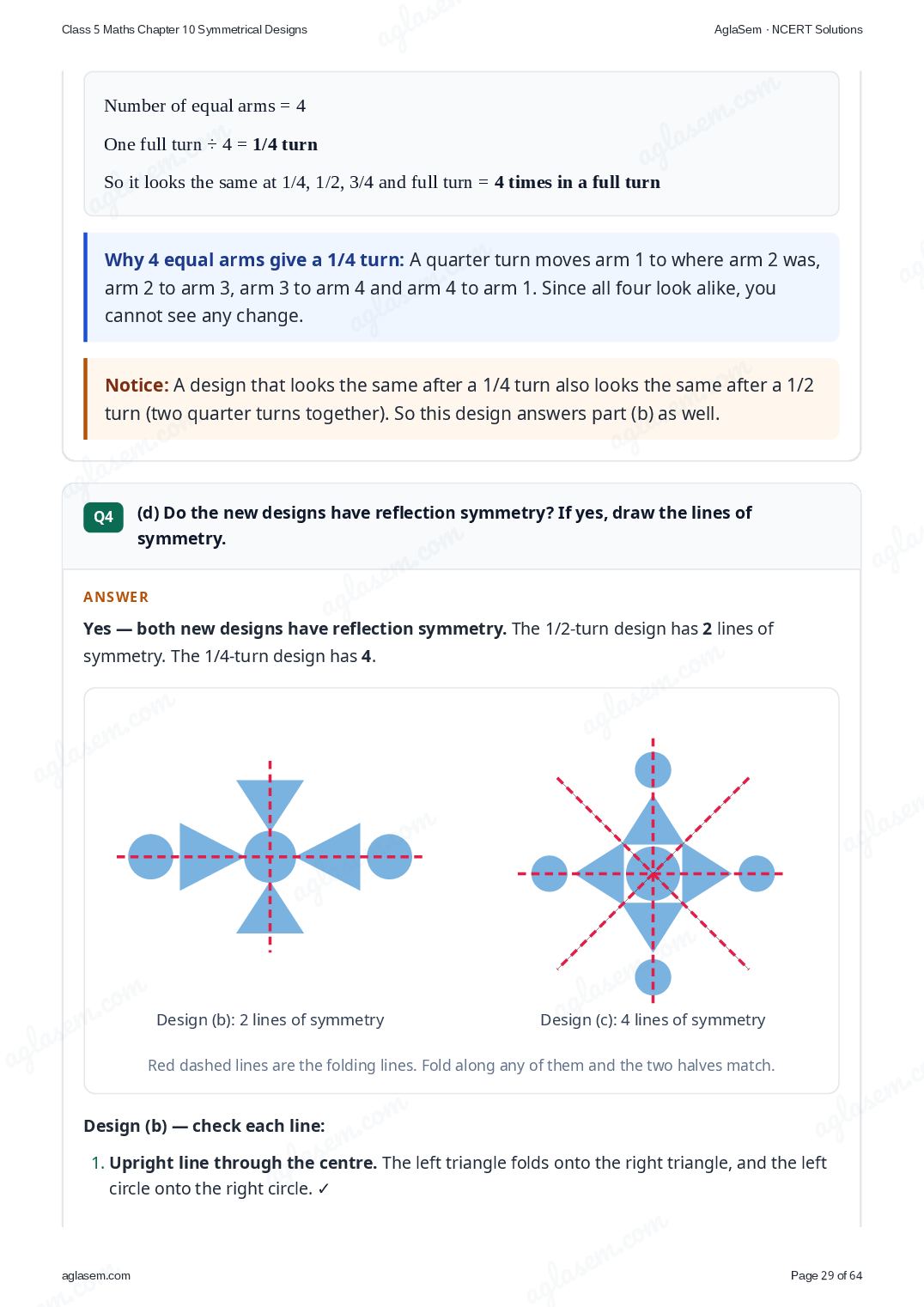
- (d) Do the new designs have reflection symmetry? If yes, draw the lines of symmetry.
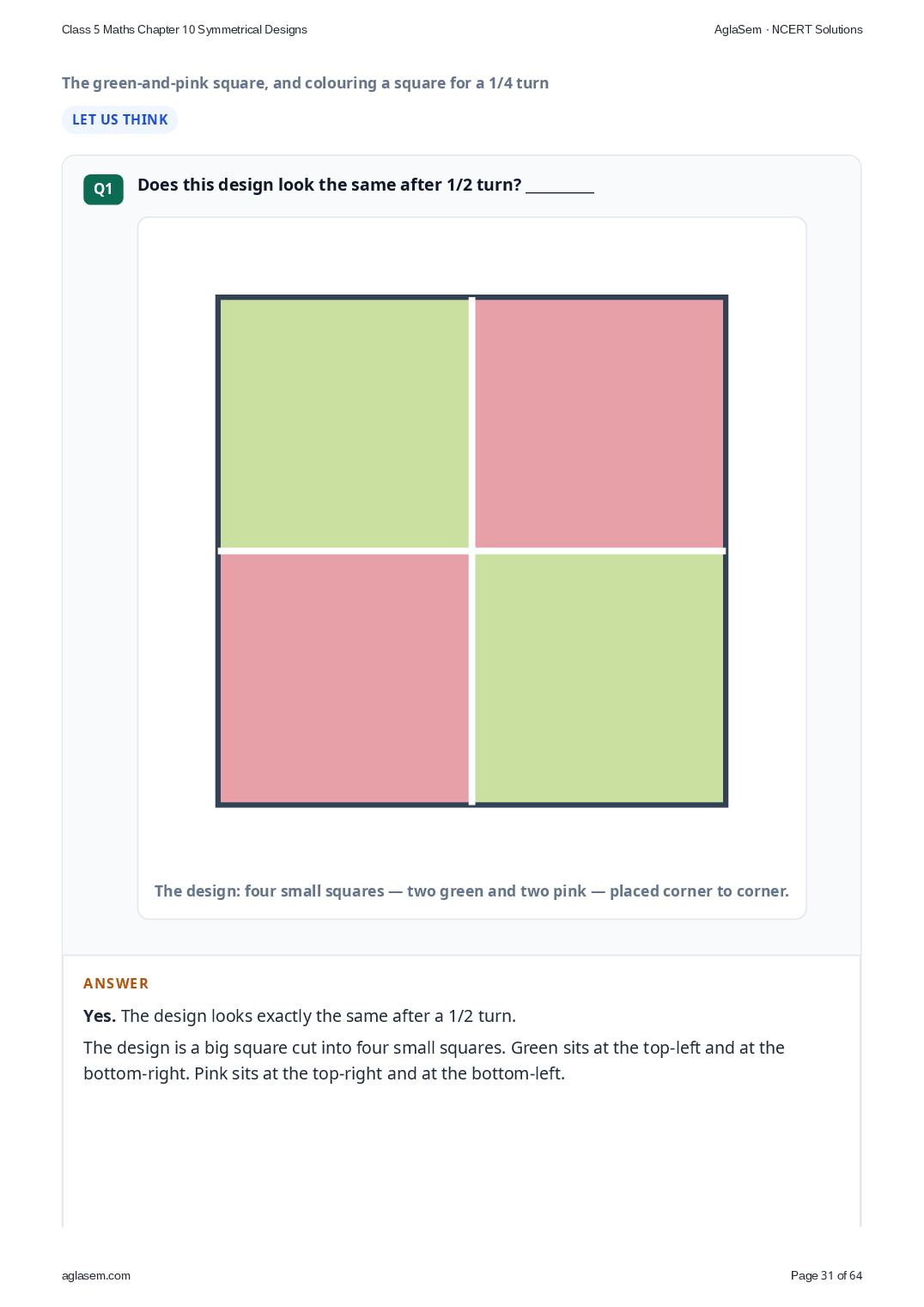
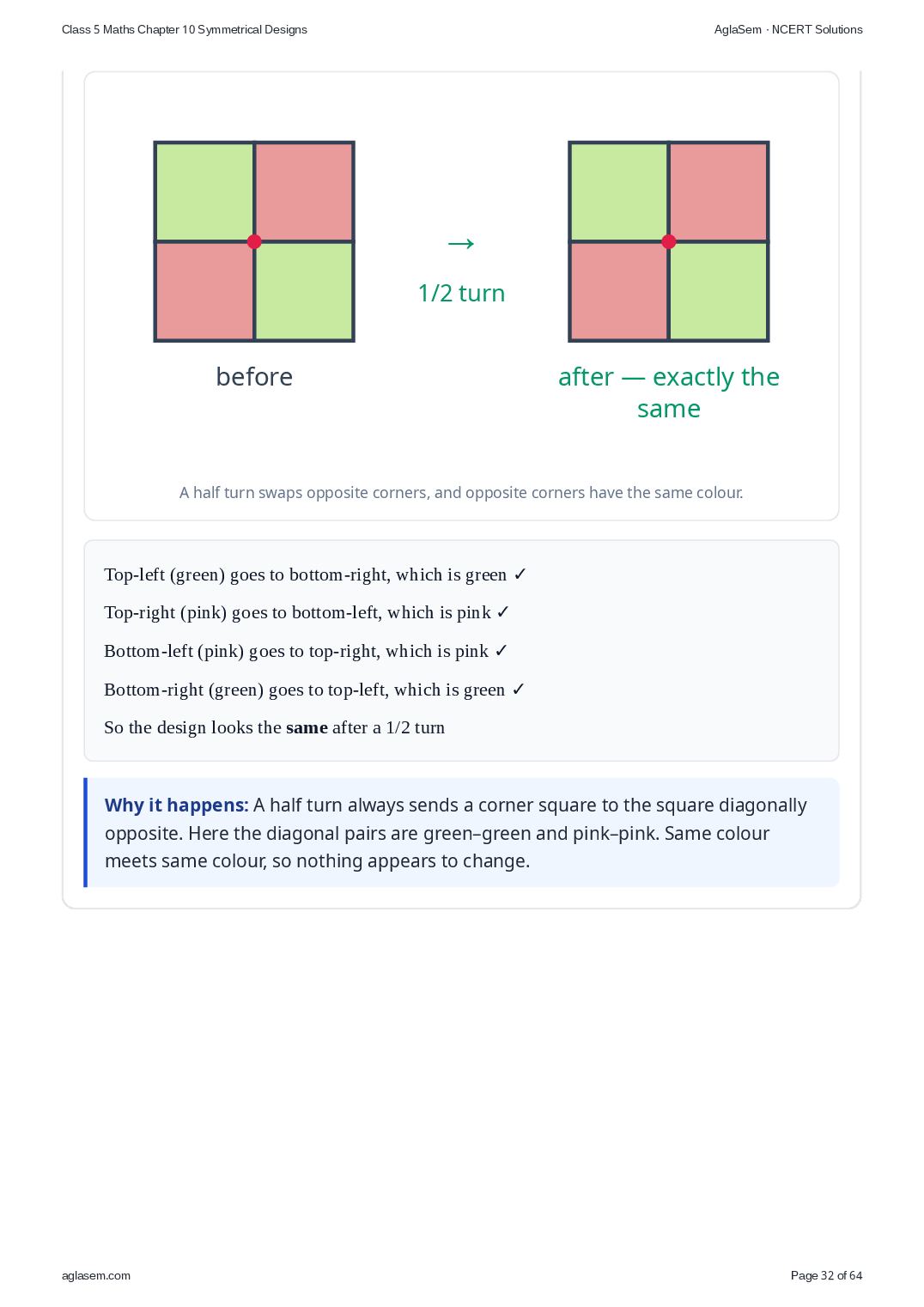
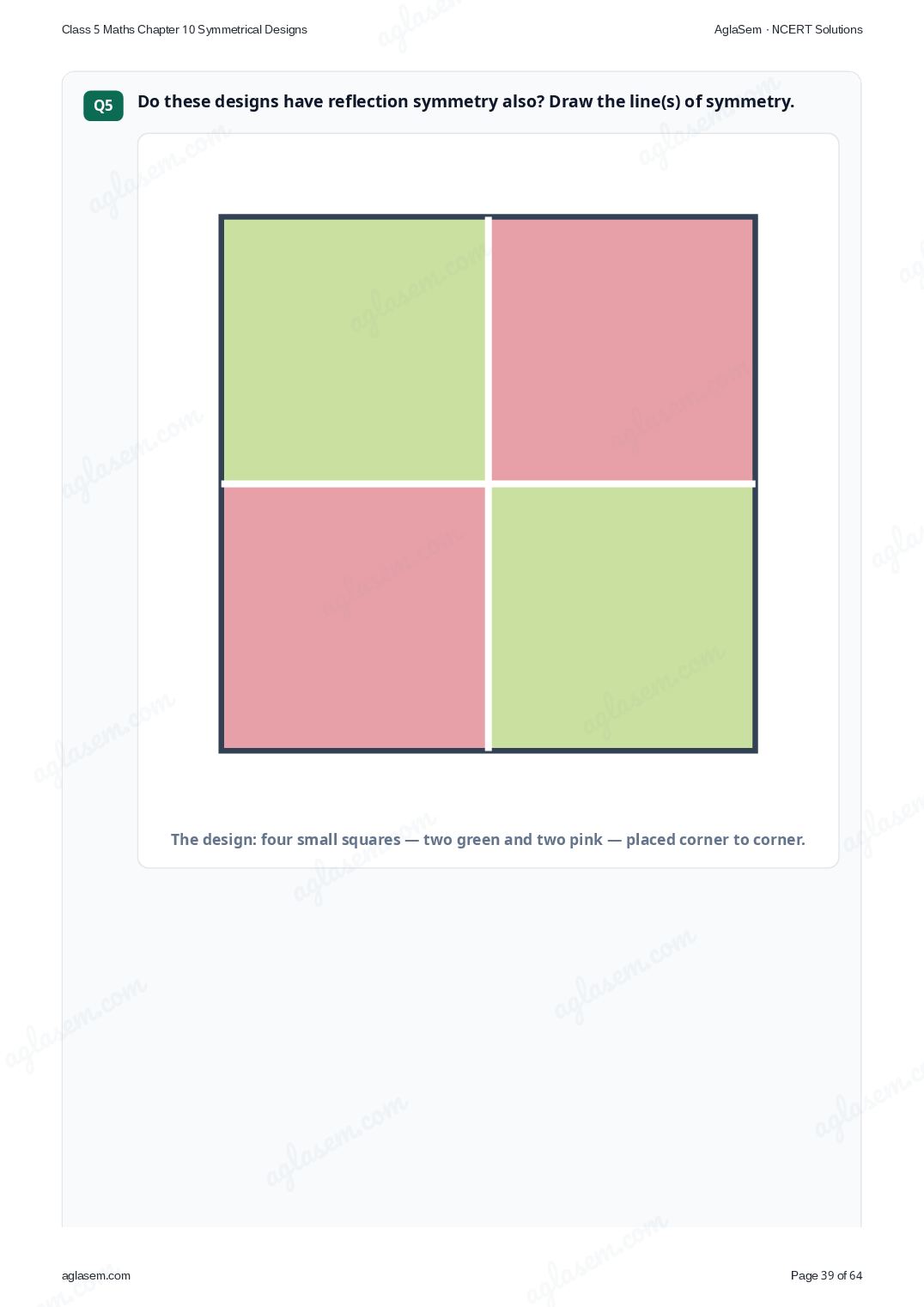
- Does this design look the same after 1/2 turn? __________The design: four small squares — two green and two pink — placed corner to corner.
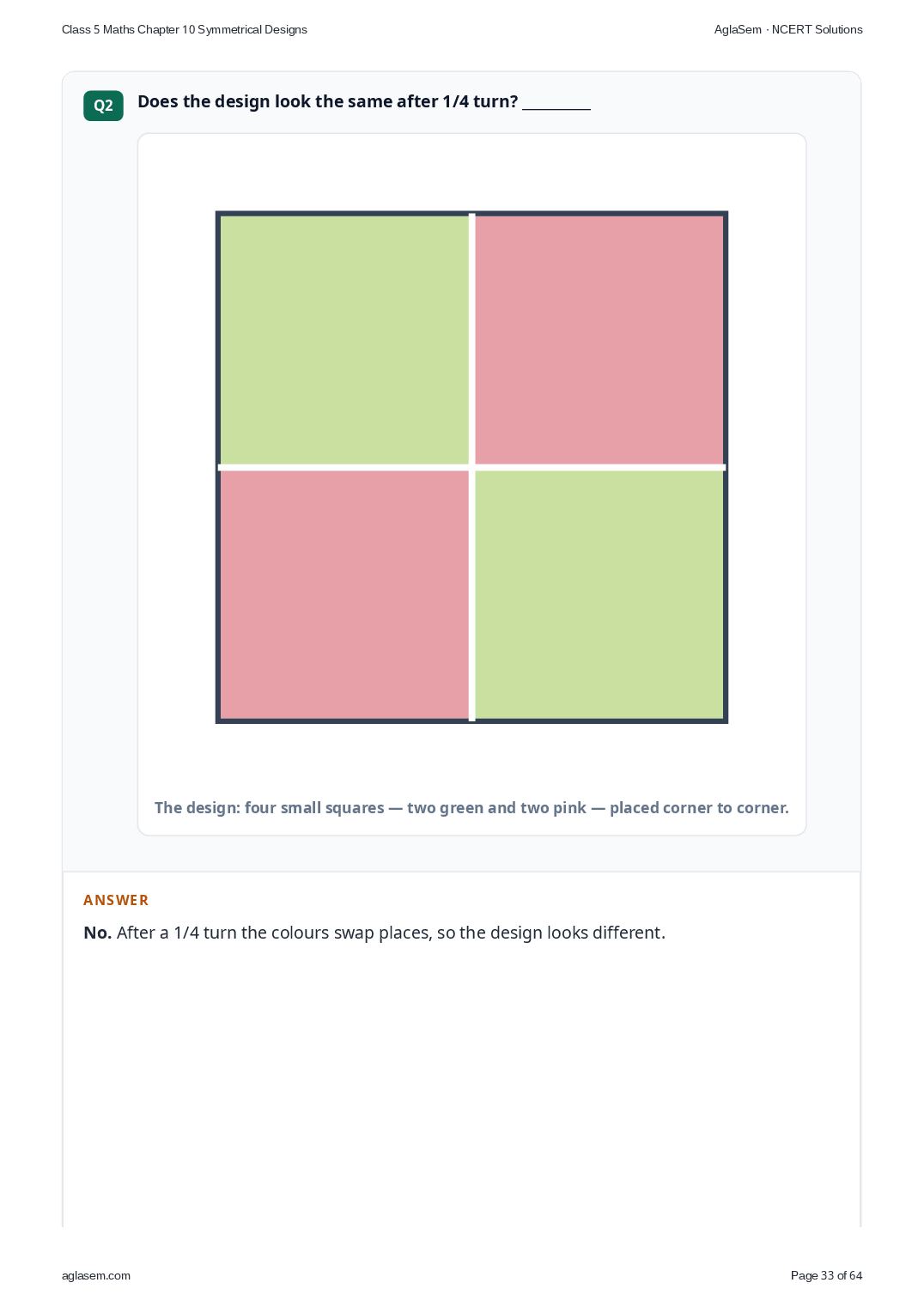
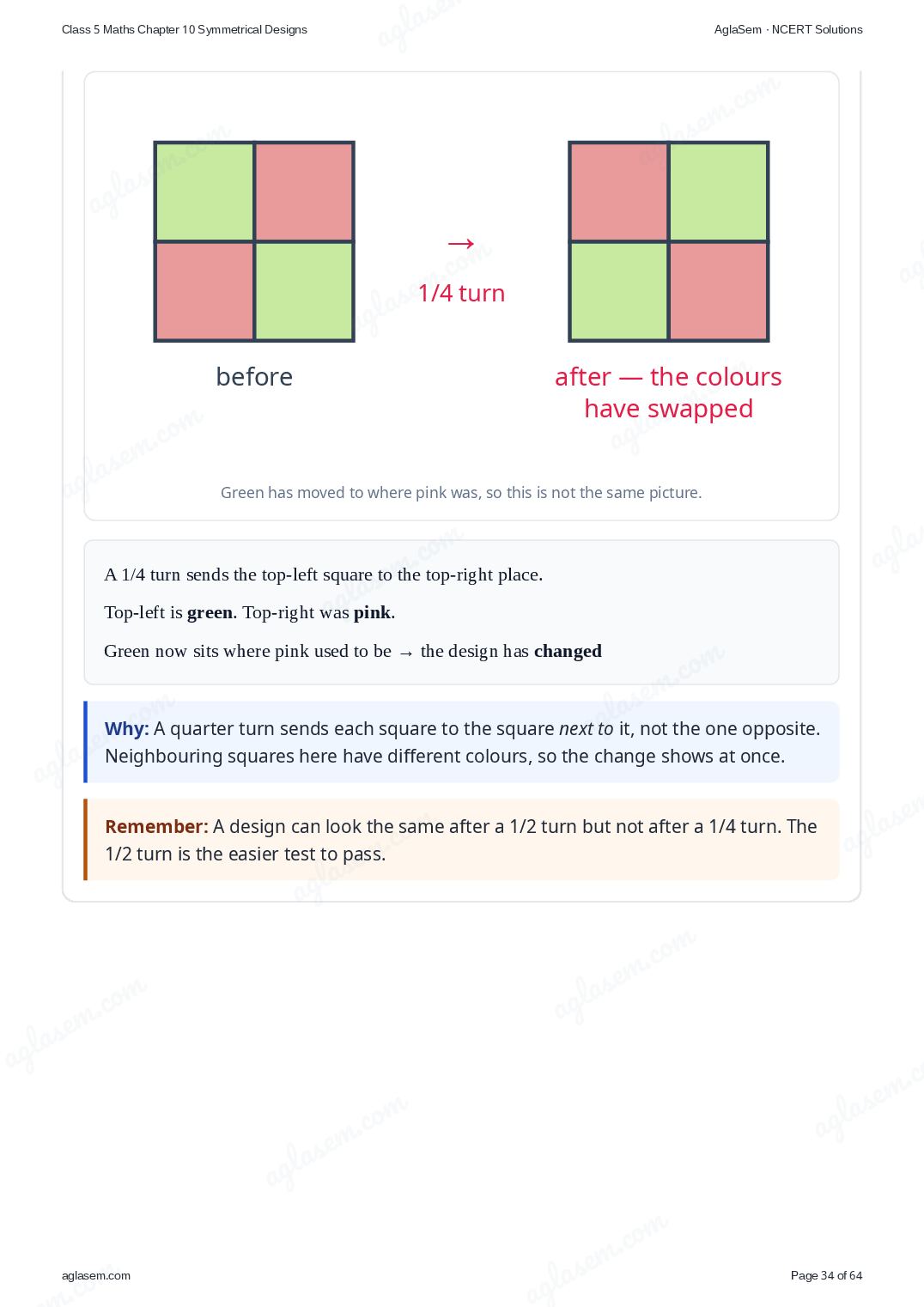
- Does the design look the same after 1/4 turn? __________The design: four small squares — two green and two pink — placed corner to corner.
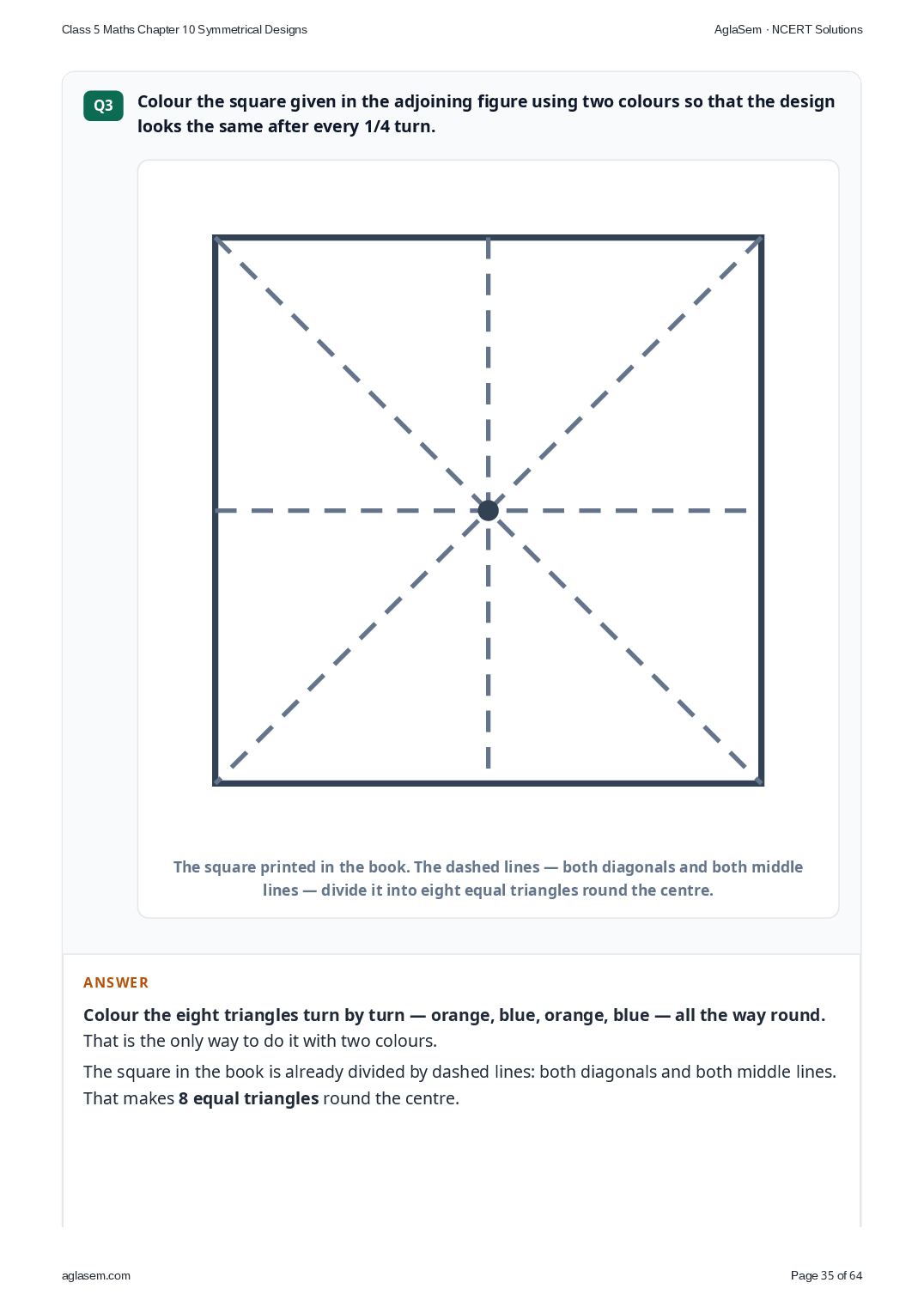
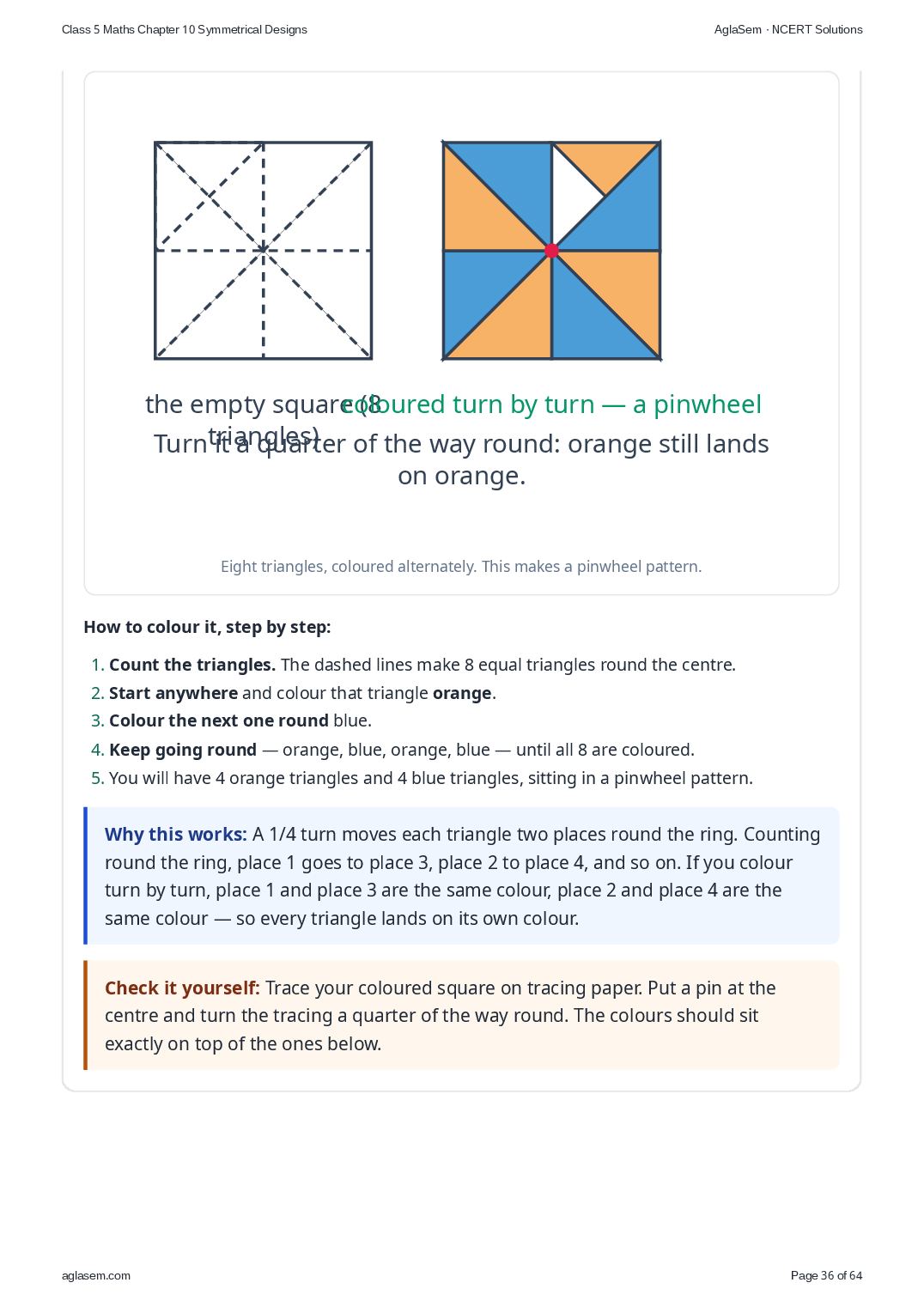
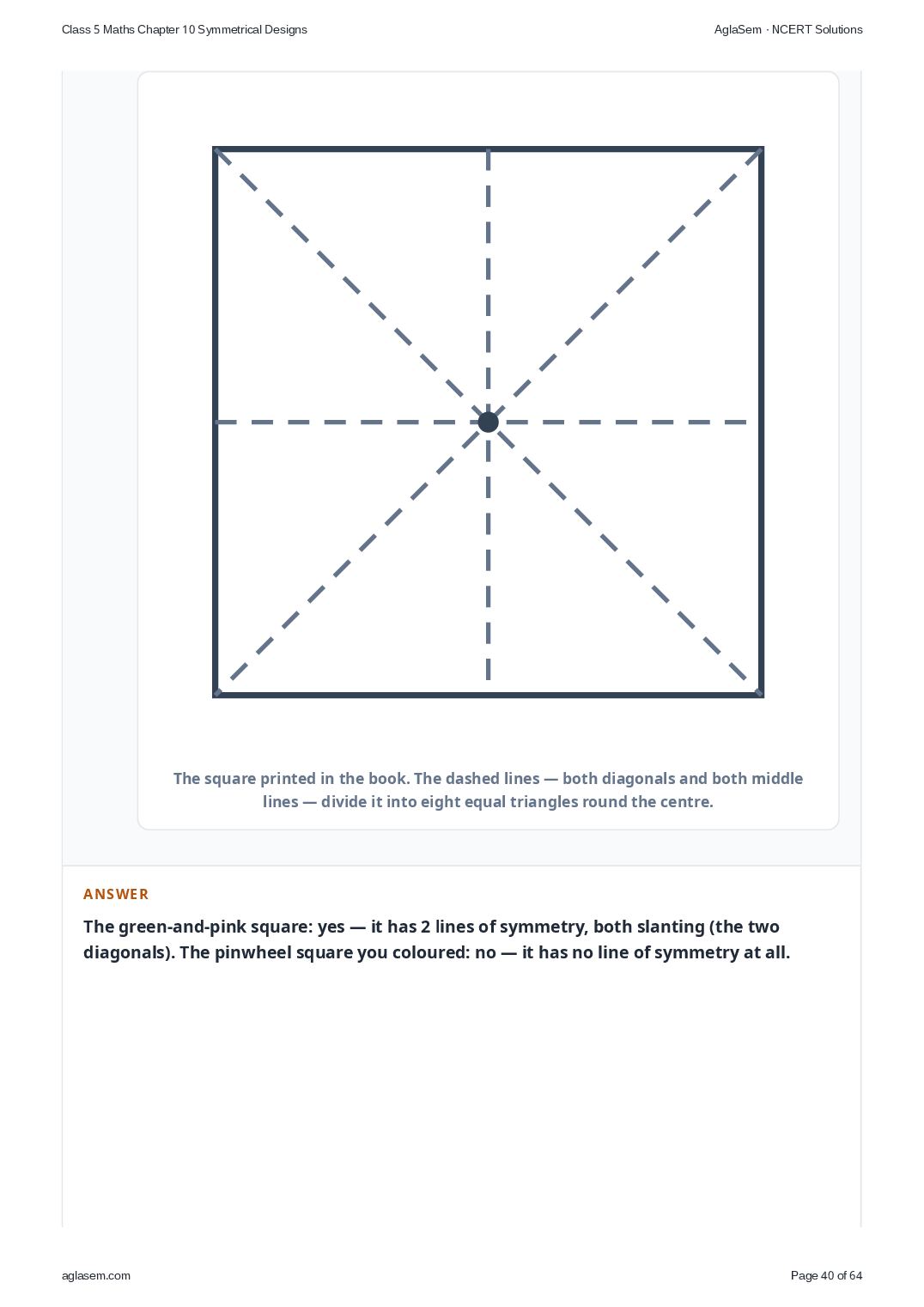
- Colour the square given in the adjoining figure using two colours so that the design looks the same after every 1/4 turn.The square printed in the book. The dashed lines — both diagonals and both middle lines — divide it into eight equal triangles round the centre.
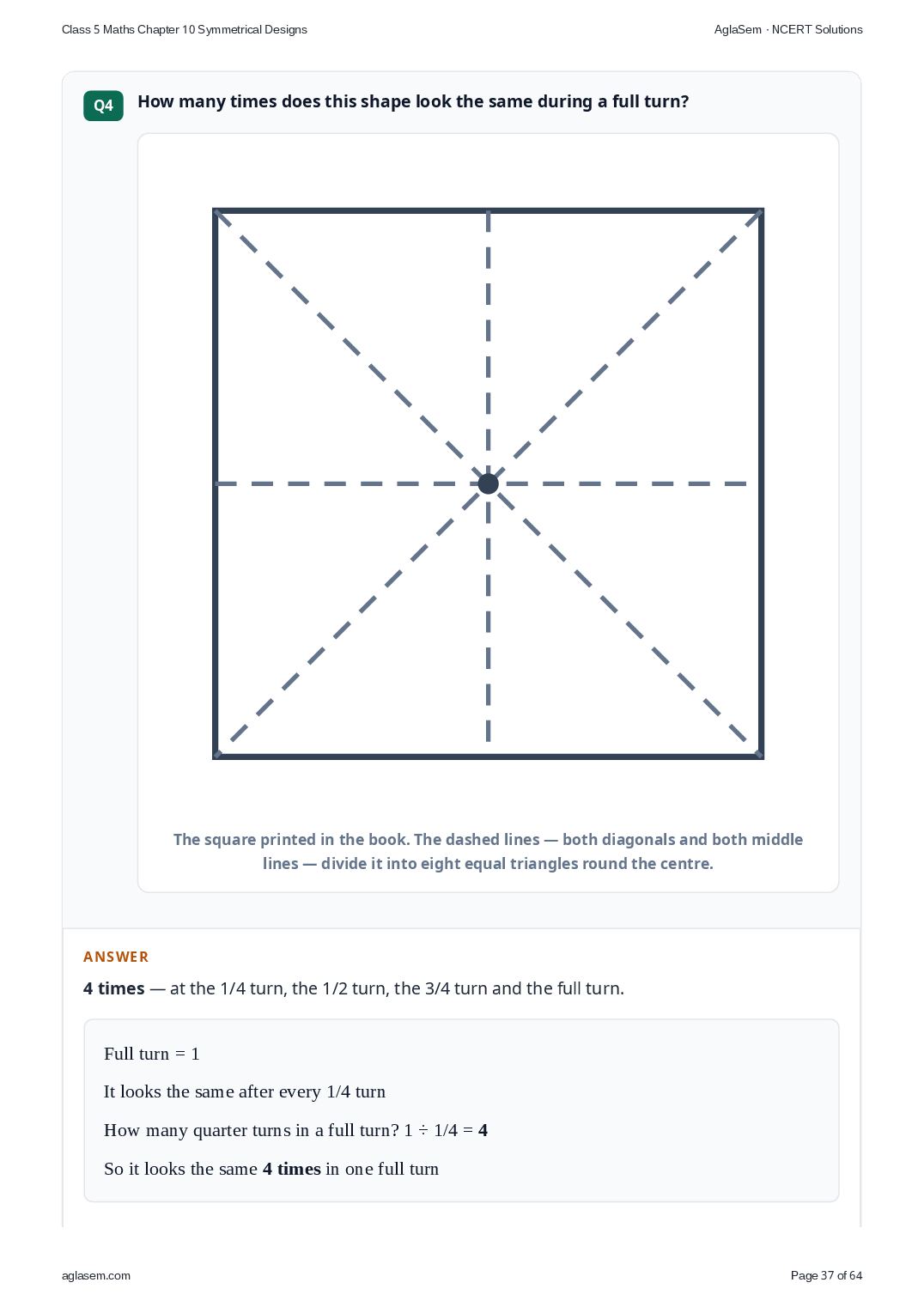
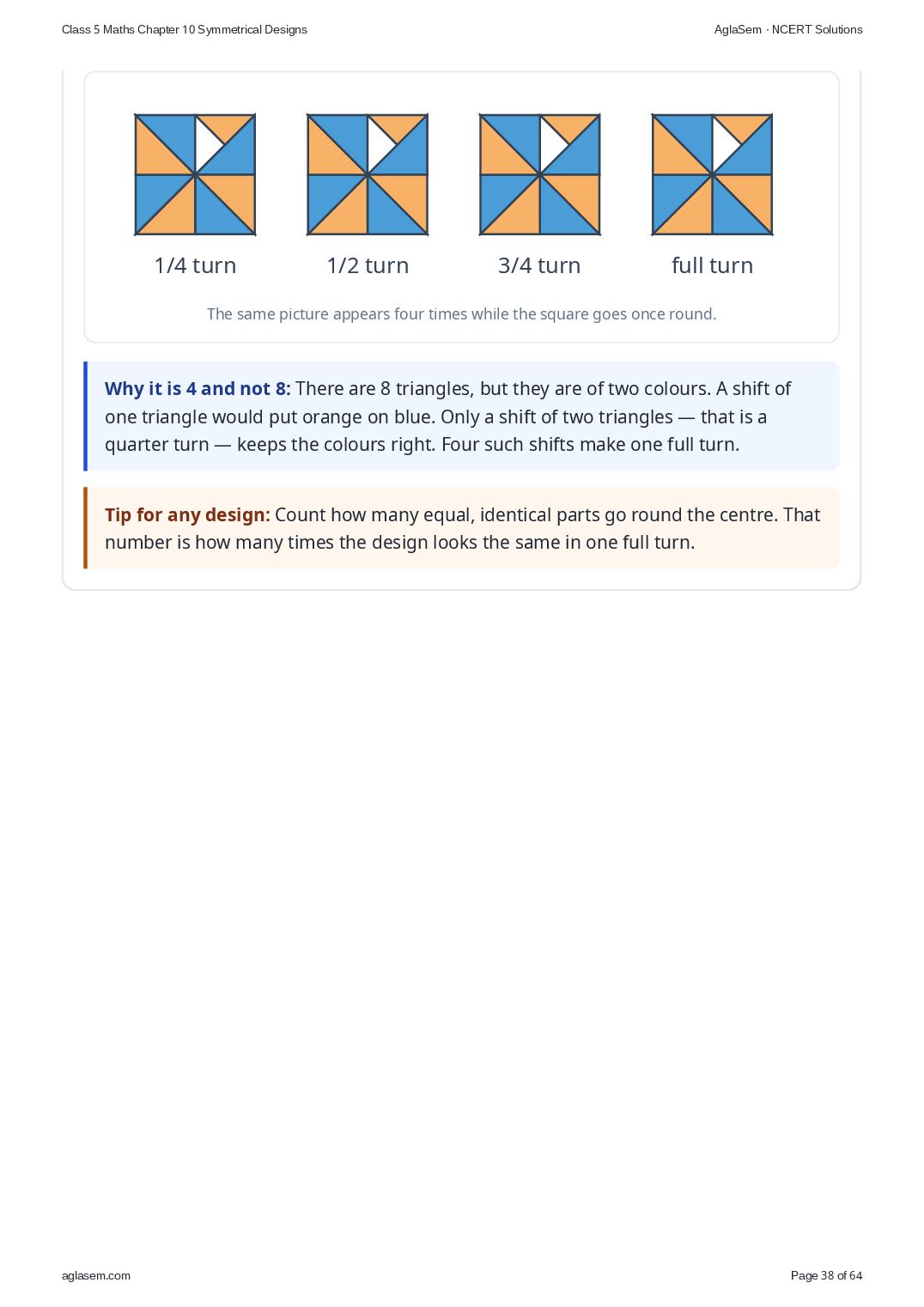
- How many times does this shape look the same during a full turn?The square printed in the book. The dashed lines — both diagonals and both middle lines — divide it into eight equal triangles round the centre.
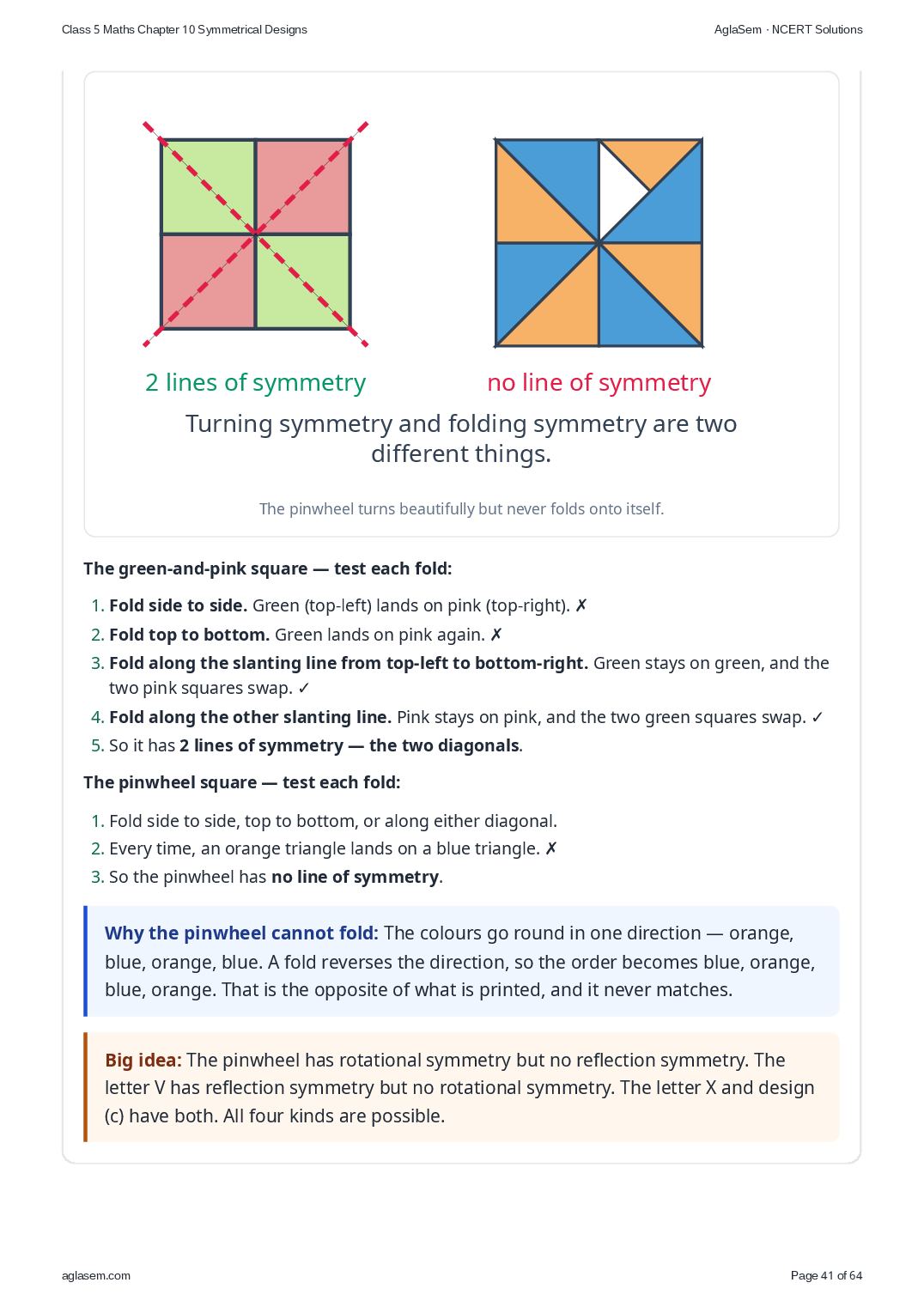
- Do these designs have reflection symmetry also? Draw the line(s) of symmetry.The design: four small squares — two green and two pink — placed corner to corner.The square printed in the book. The dashed lines — both diagonals and both middle lines — divide it into eight equal triangles round the centre.
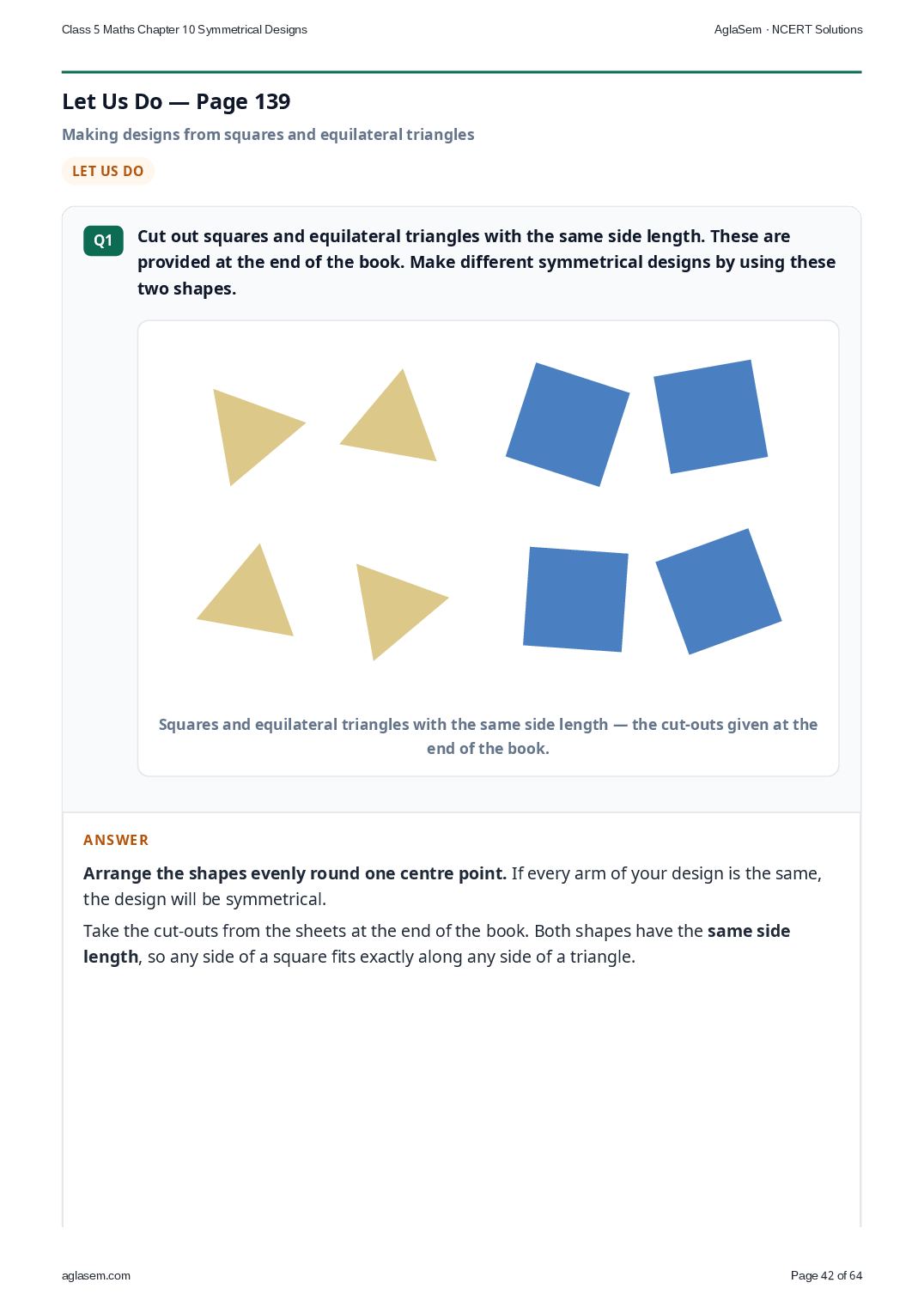
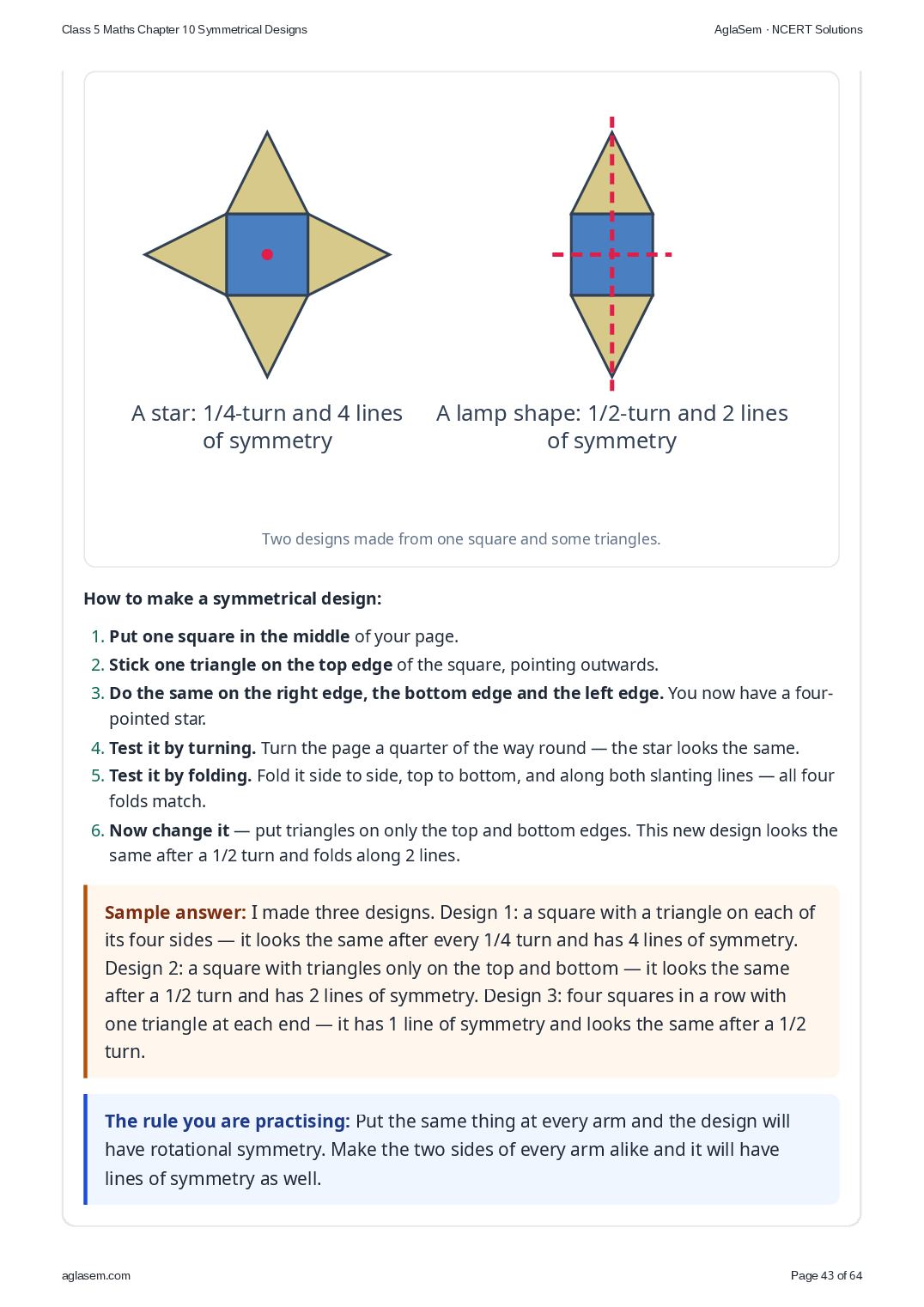
- Cut out squares and equilateral triangles with the same side length. These are provided at the end of the book. Make different symmetrical designs by using these two shapes.Squares and equilateral triangles with the same side length — the cut-outs given at the end of the book.
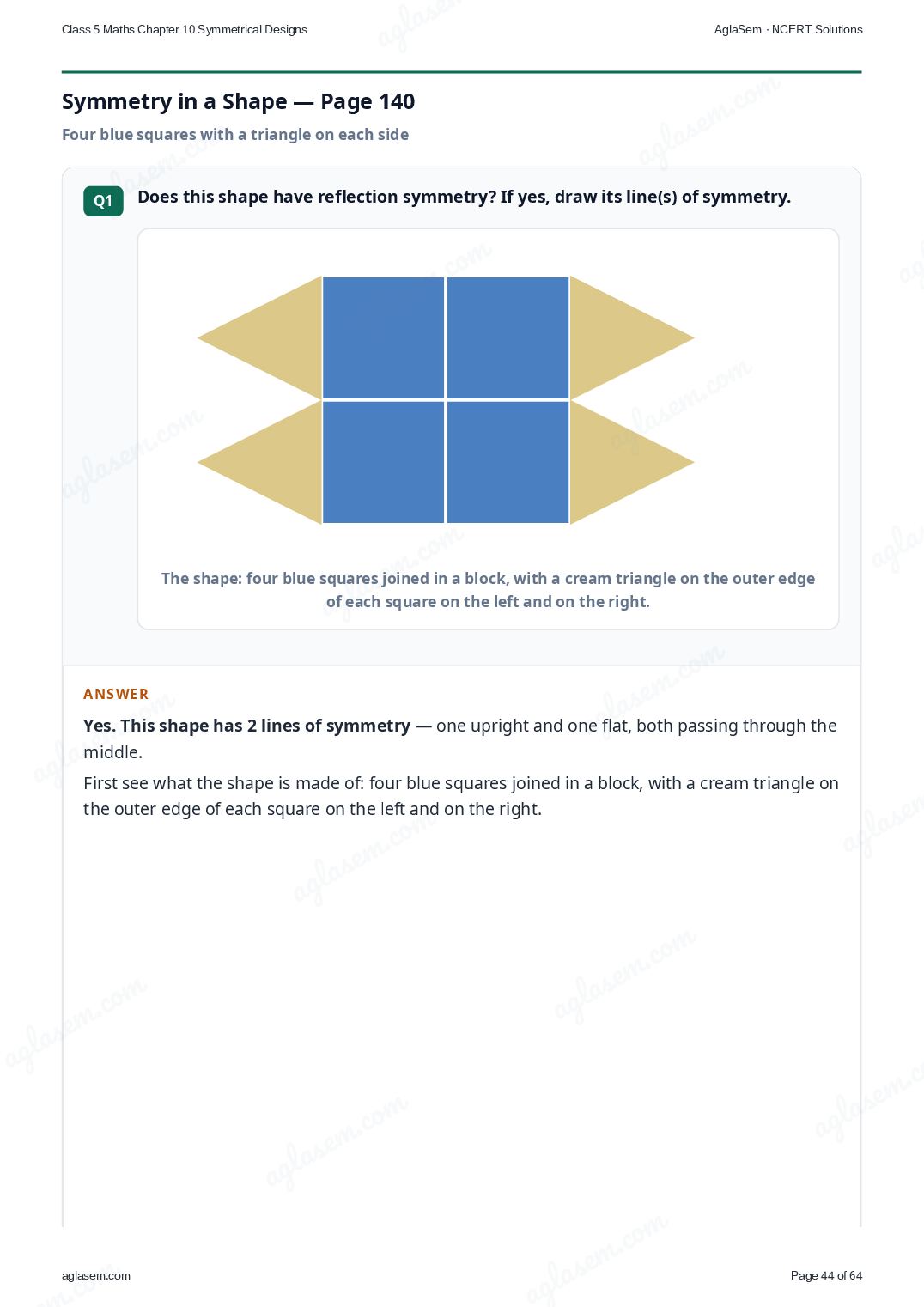
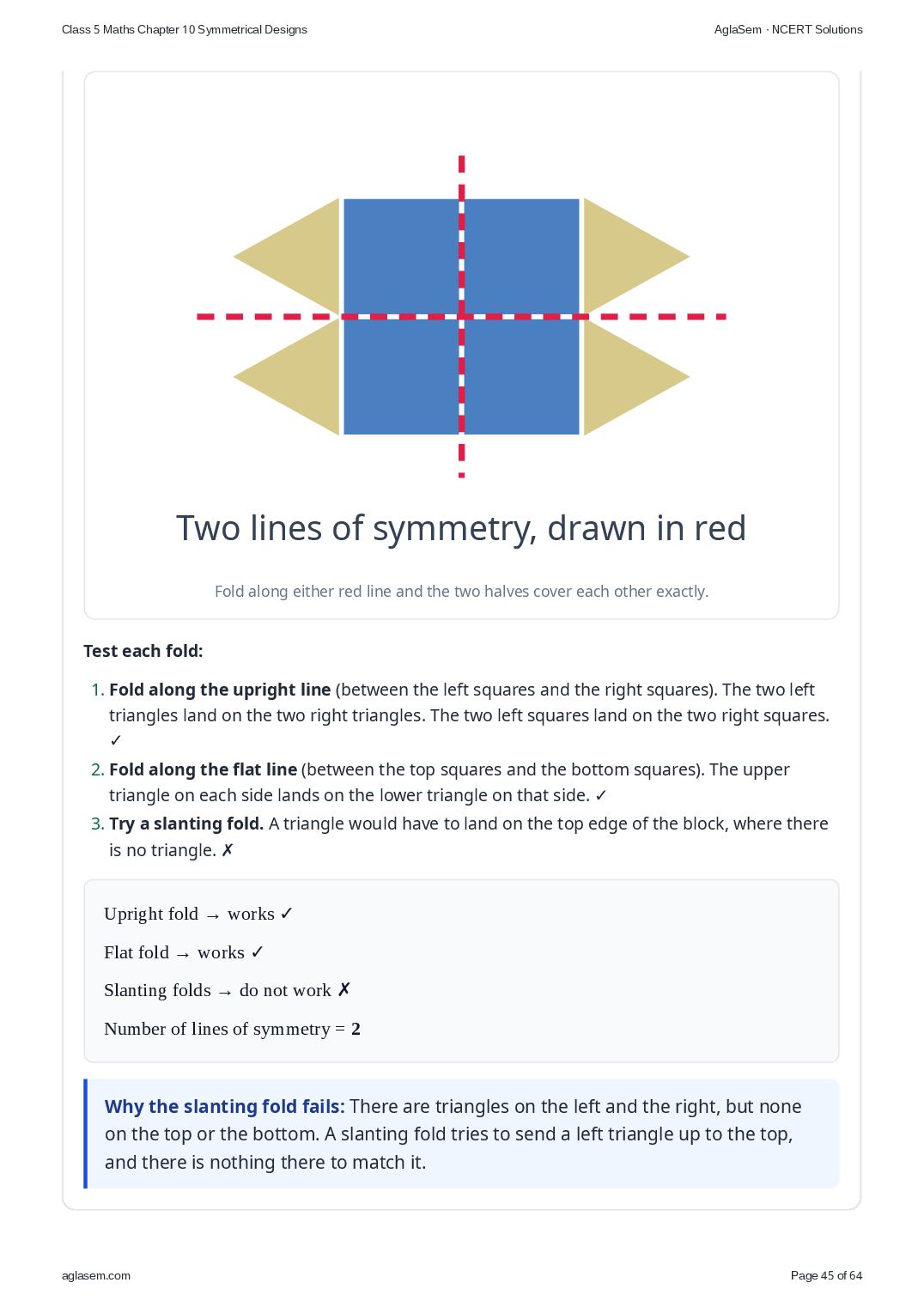
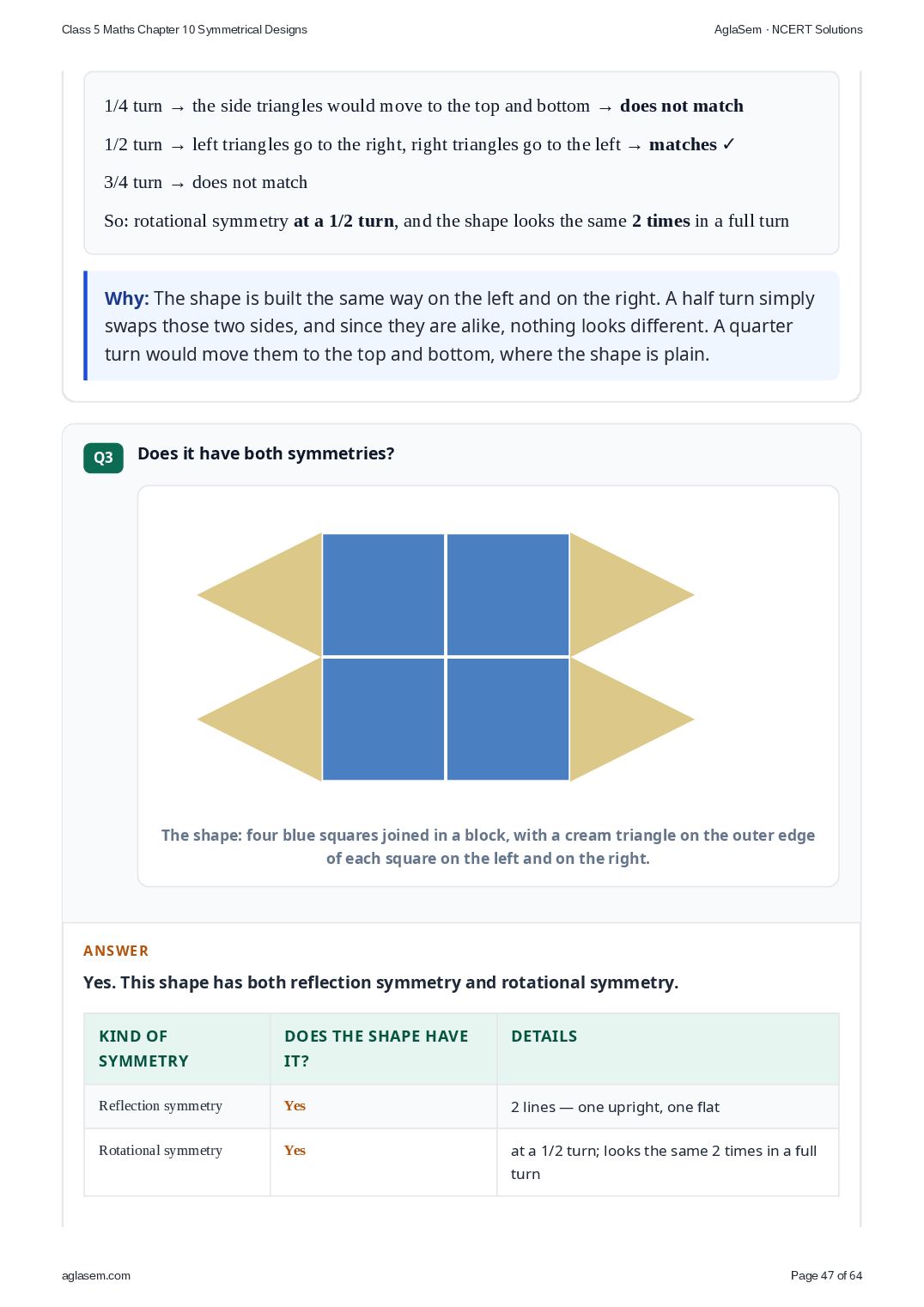
- Does this shape have reflection symmetry? If yes, draw its line(s) of symmetry.The shape: four blue squares joined in a block, with a cream triangle on the outer edge of each square on the left and on the right.
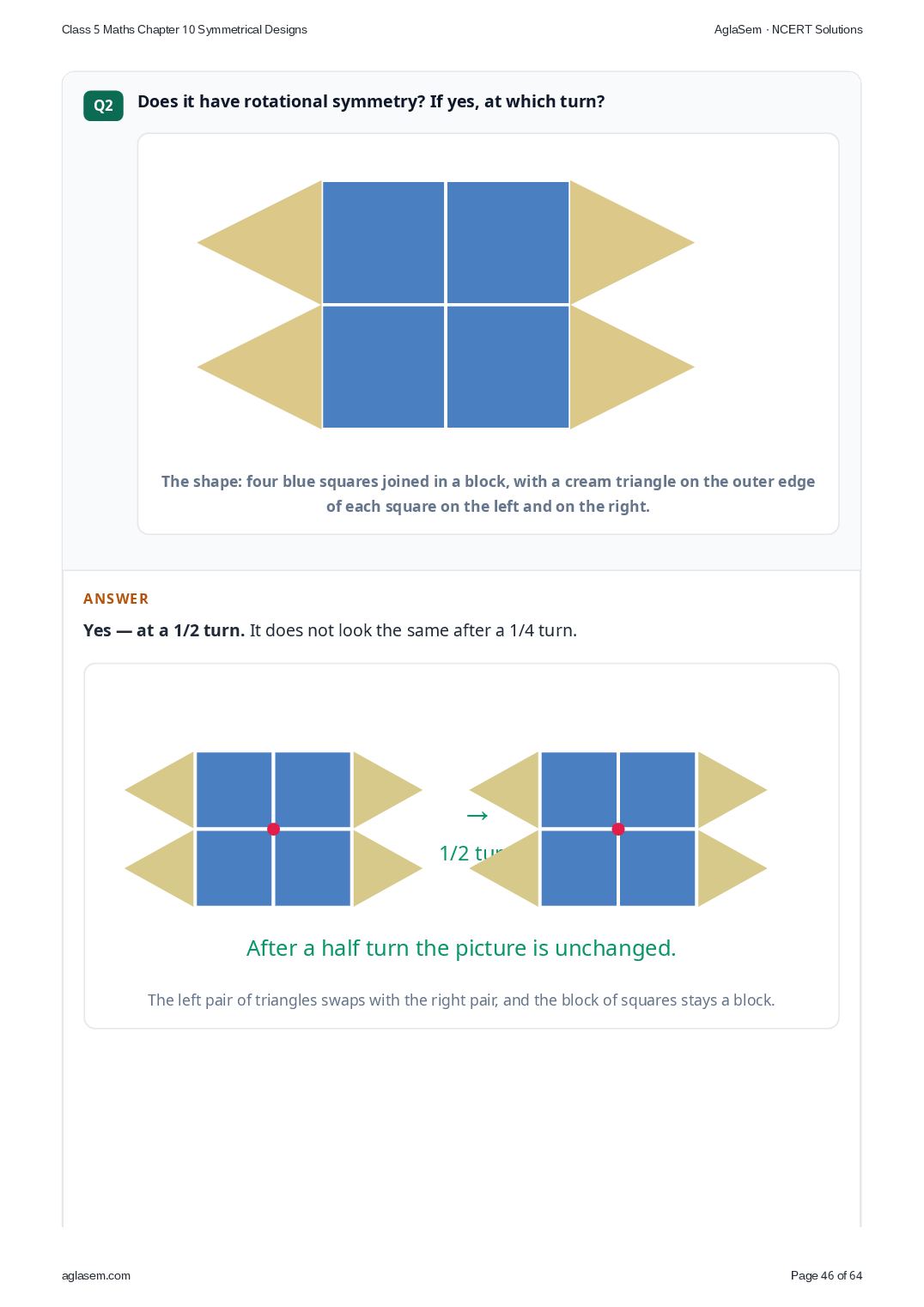
- Does it have rotational symmetry? If yes, at which turn?The shape: four blue squares joined in a block, with a cream triangle on the outer edge of each square on the left and on the right.
- Does it have both symmetries?The shape: four blue squares joined in a block, with a cream triangle on the outer edge of each square on the left and on the right.
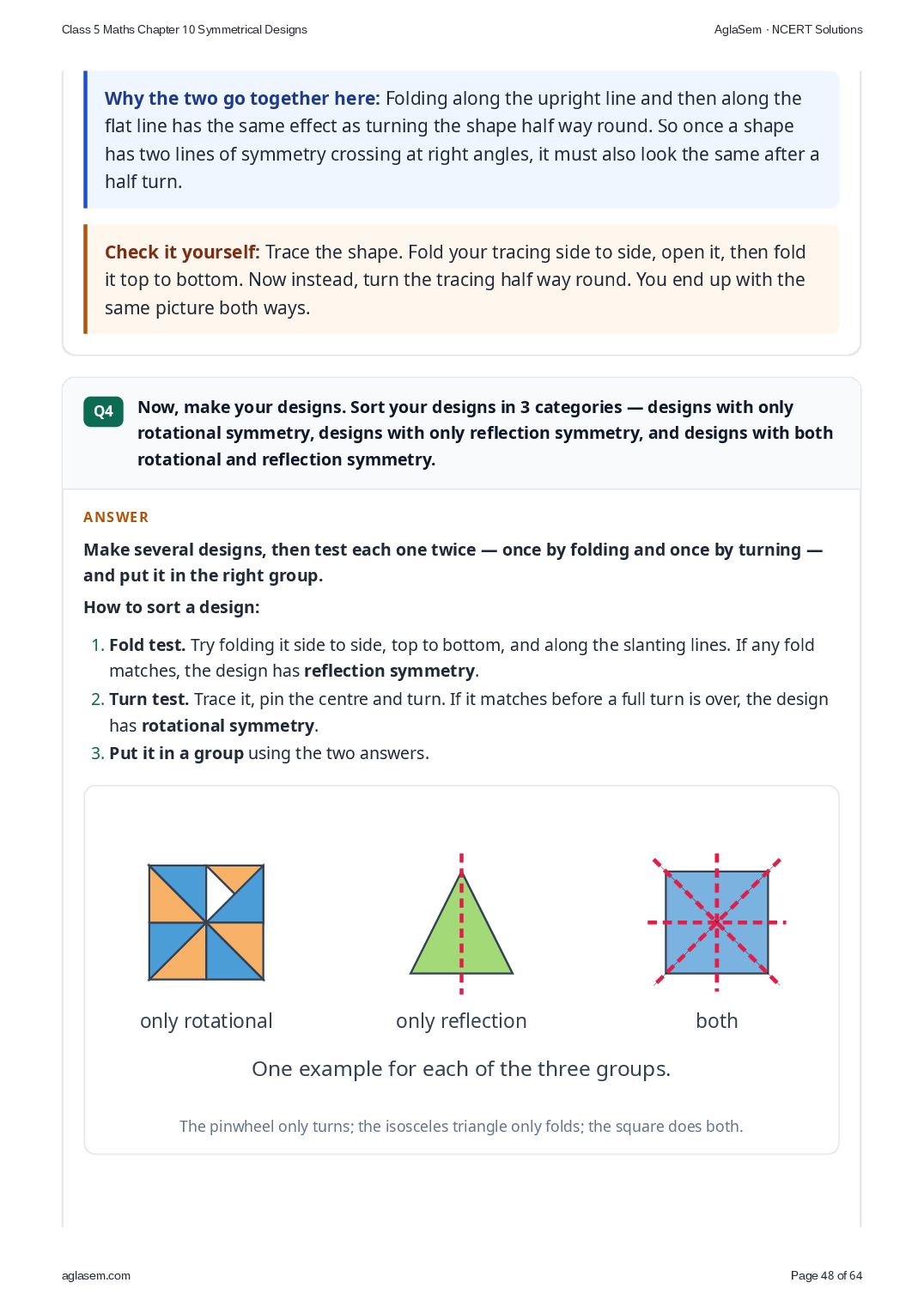
- Now, make your designs. Sort your designs in 3 categories — designs with only rotational symmetry, designs with only reflection symmetry, and designs with both rotational and reflection symmetry.
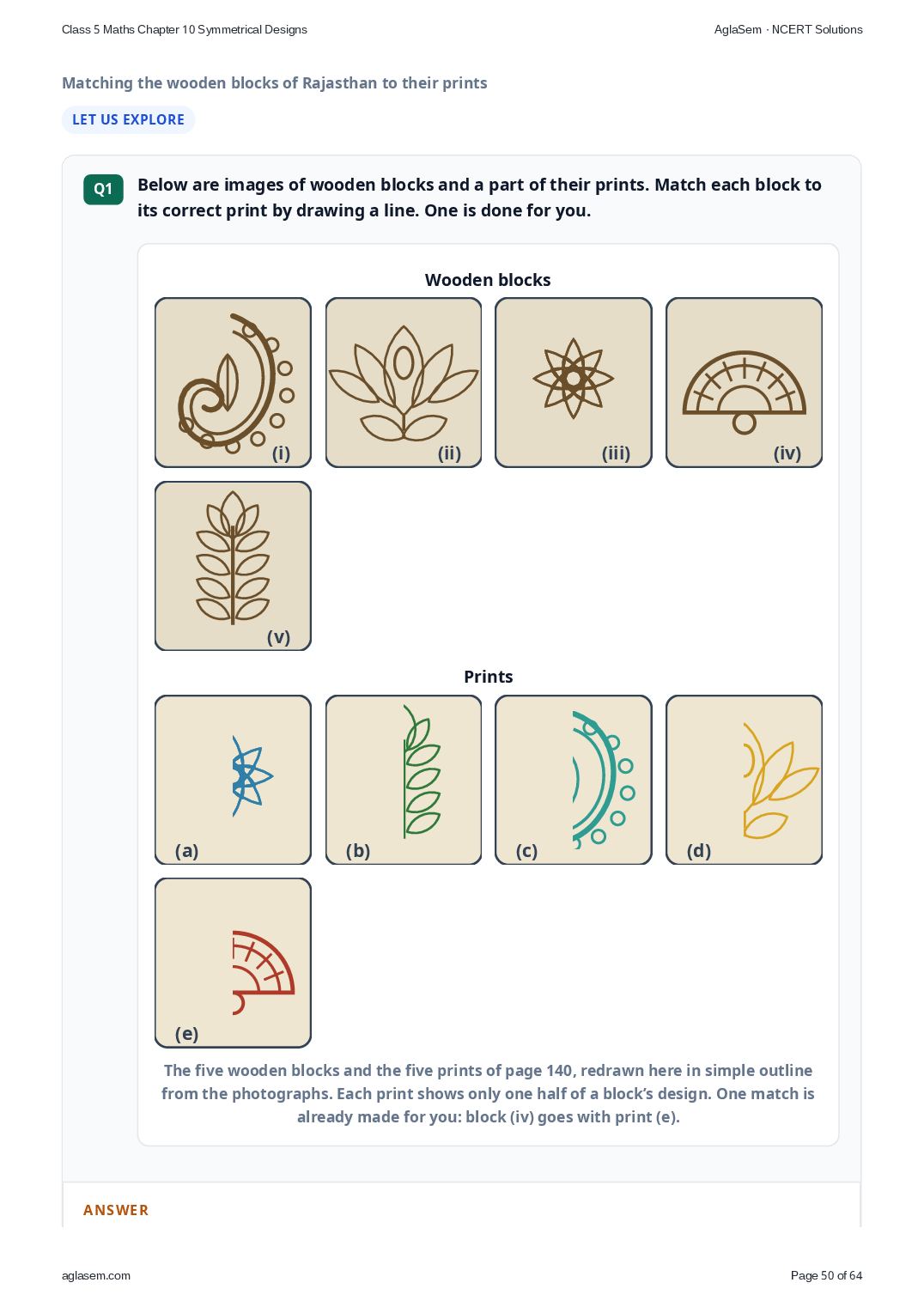
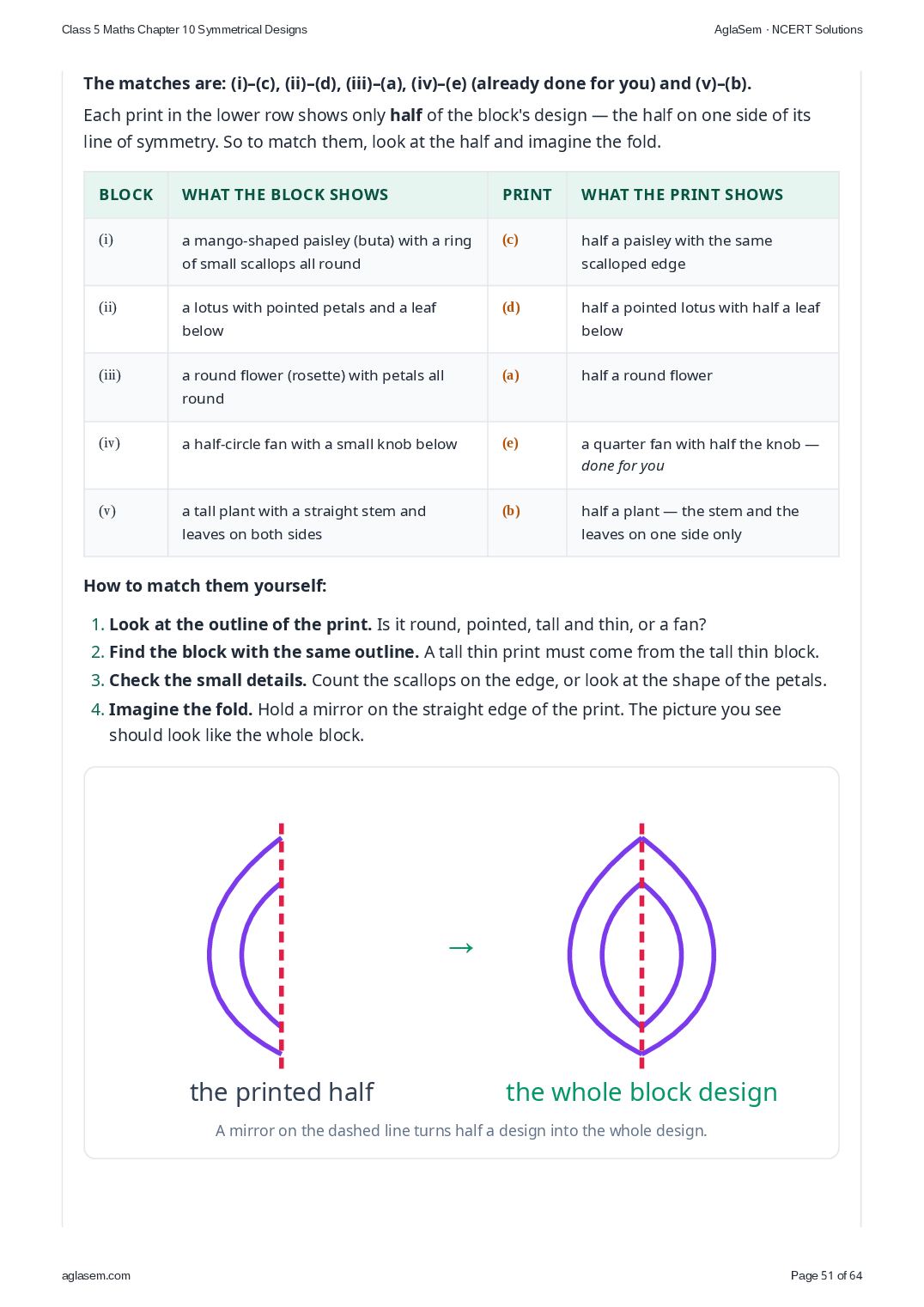
- Below are images of wooden blocks and a part of their prints. Match each block to its correct print by drawing a line. One is done for you.Wooden blocks(i)(ii)(iii)(iv)(v)Prints(a)(b)(c)(d)(e)The five wooden blocks and the five prints of page 140, redrawn here in simple outline from the photographs. Each print shows only one half of a block’s design. One match is already made for you: block (iv) goes with print (e).
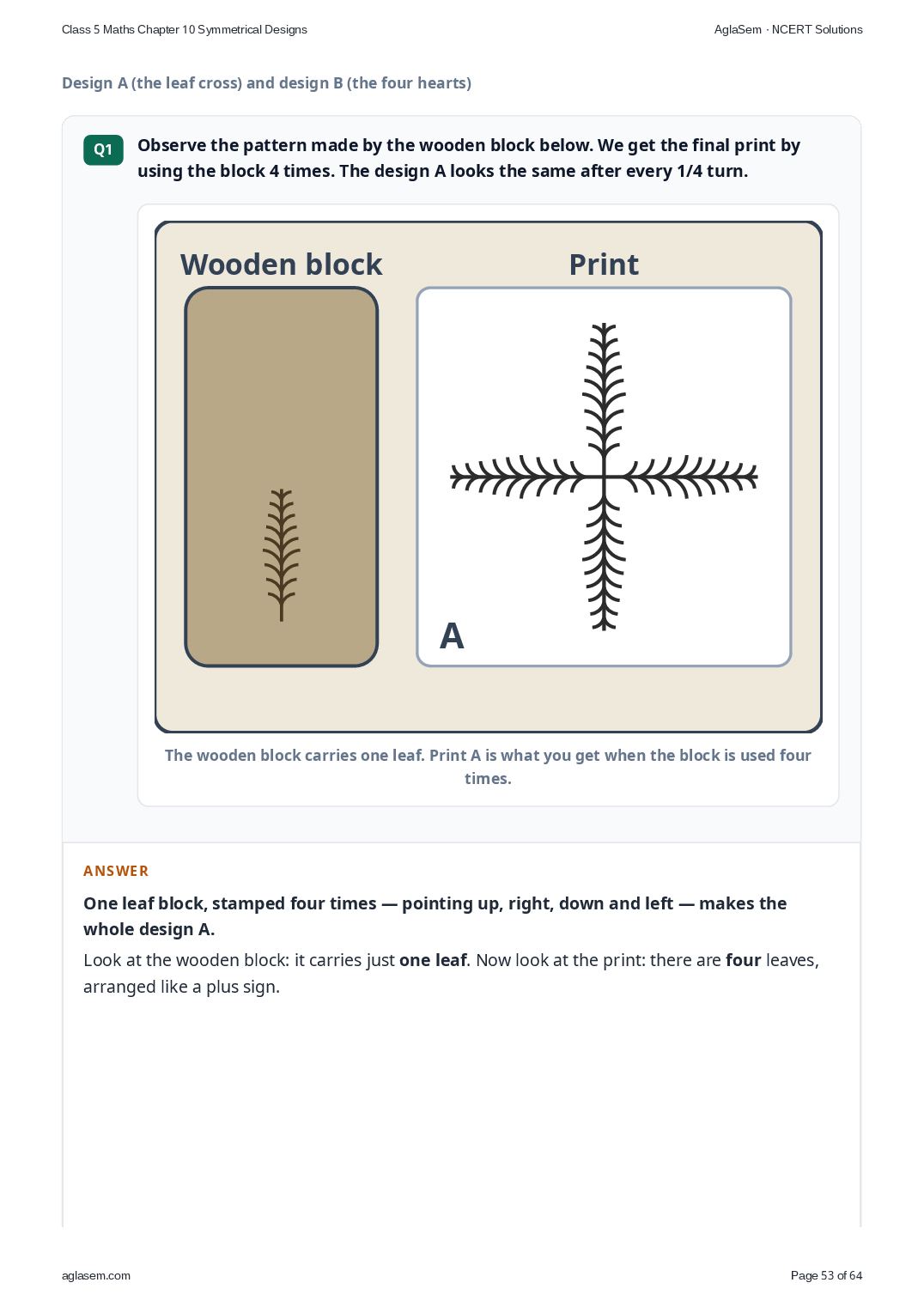
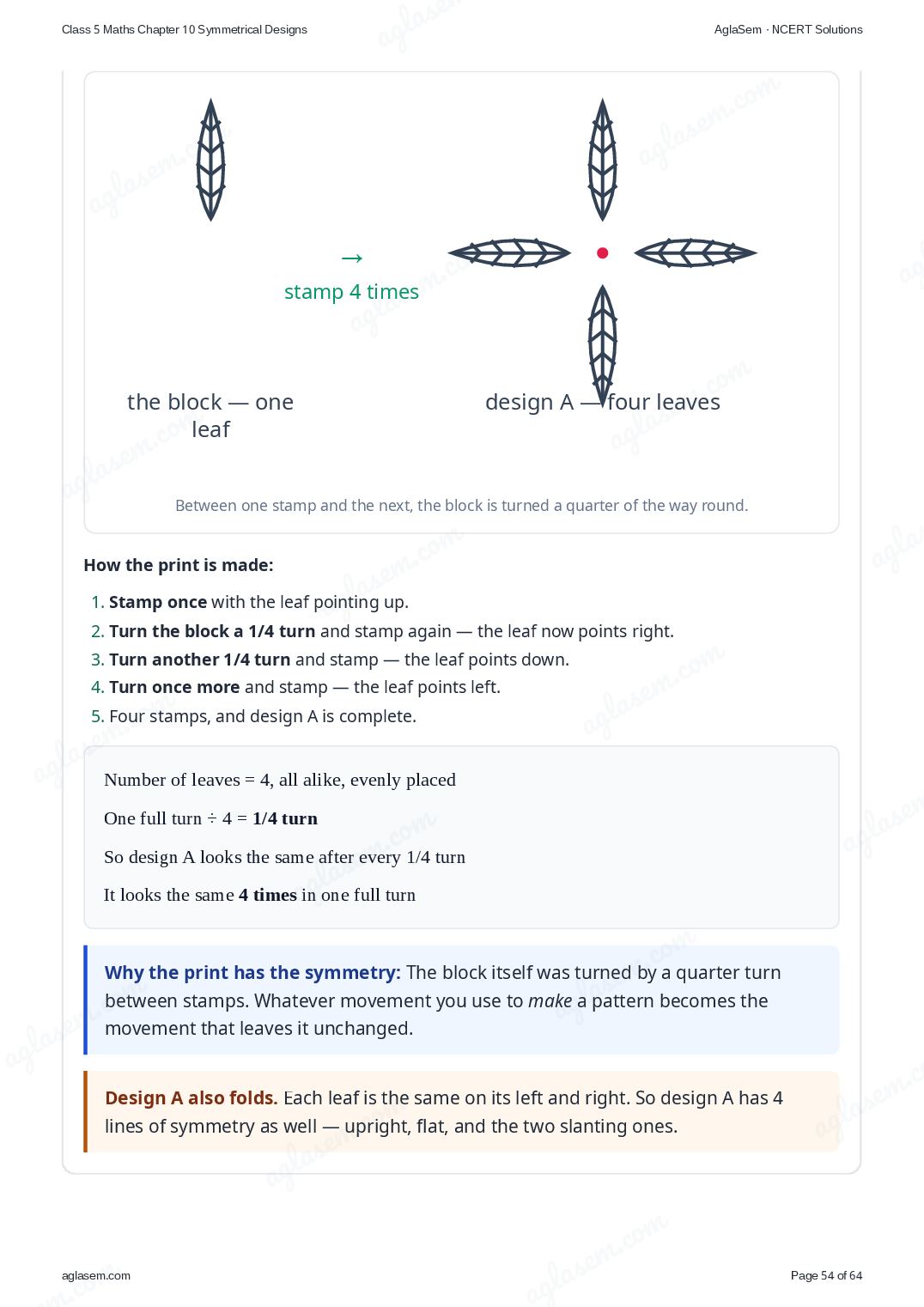
- Observe the pattern made by the wooden block below. We get the final print by using the block 4 times. The design A looks the same after every 1/4 turn.Wooden blockPrintAThe wooden block carries one leaf. Print A is what you get when the block is used four times.
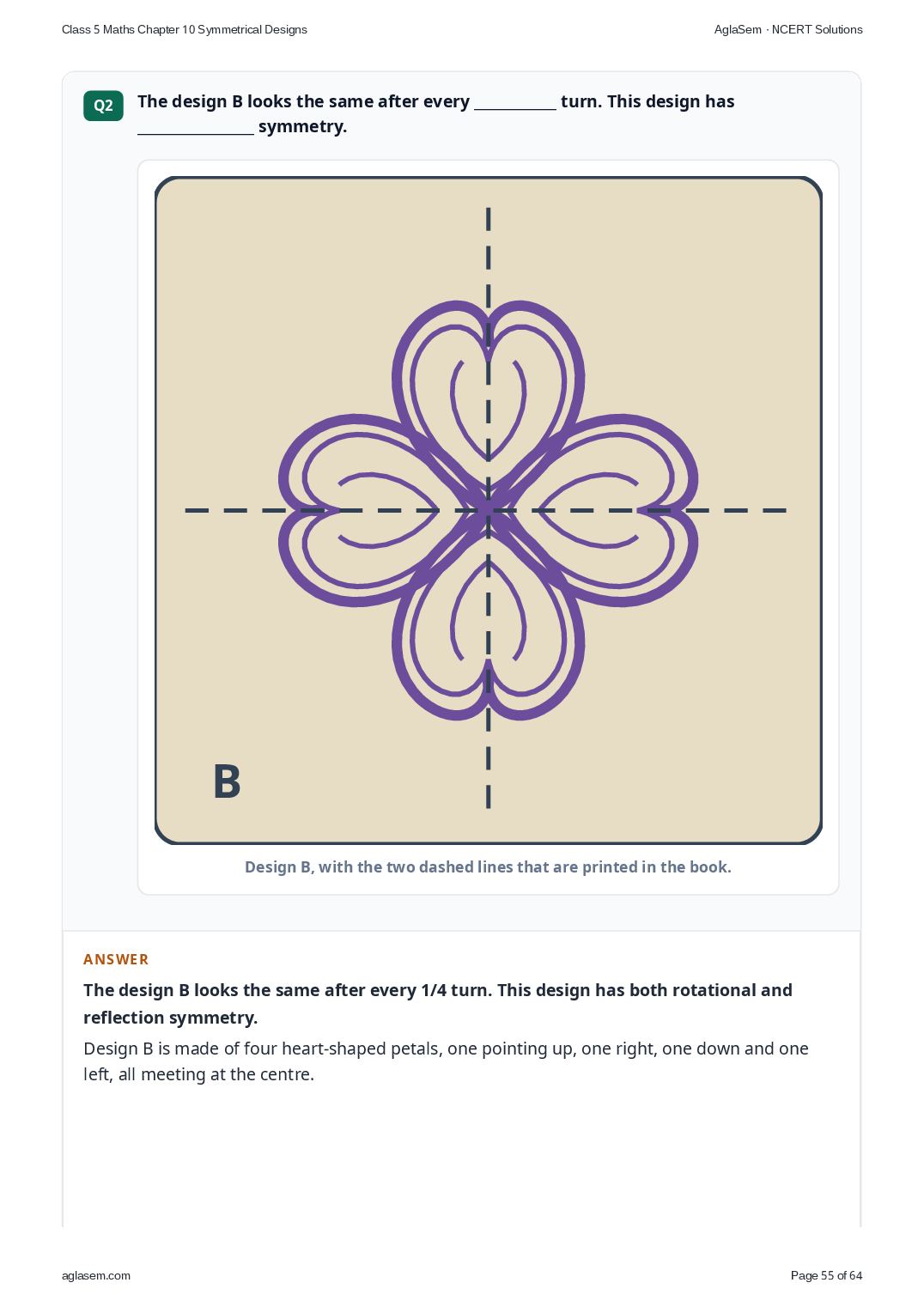
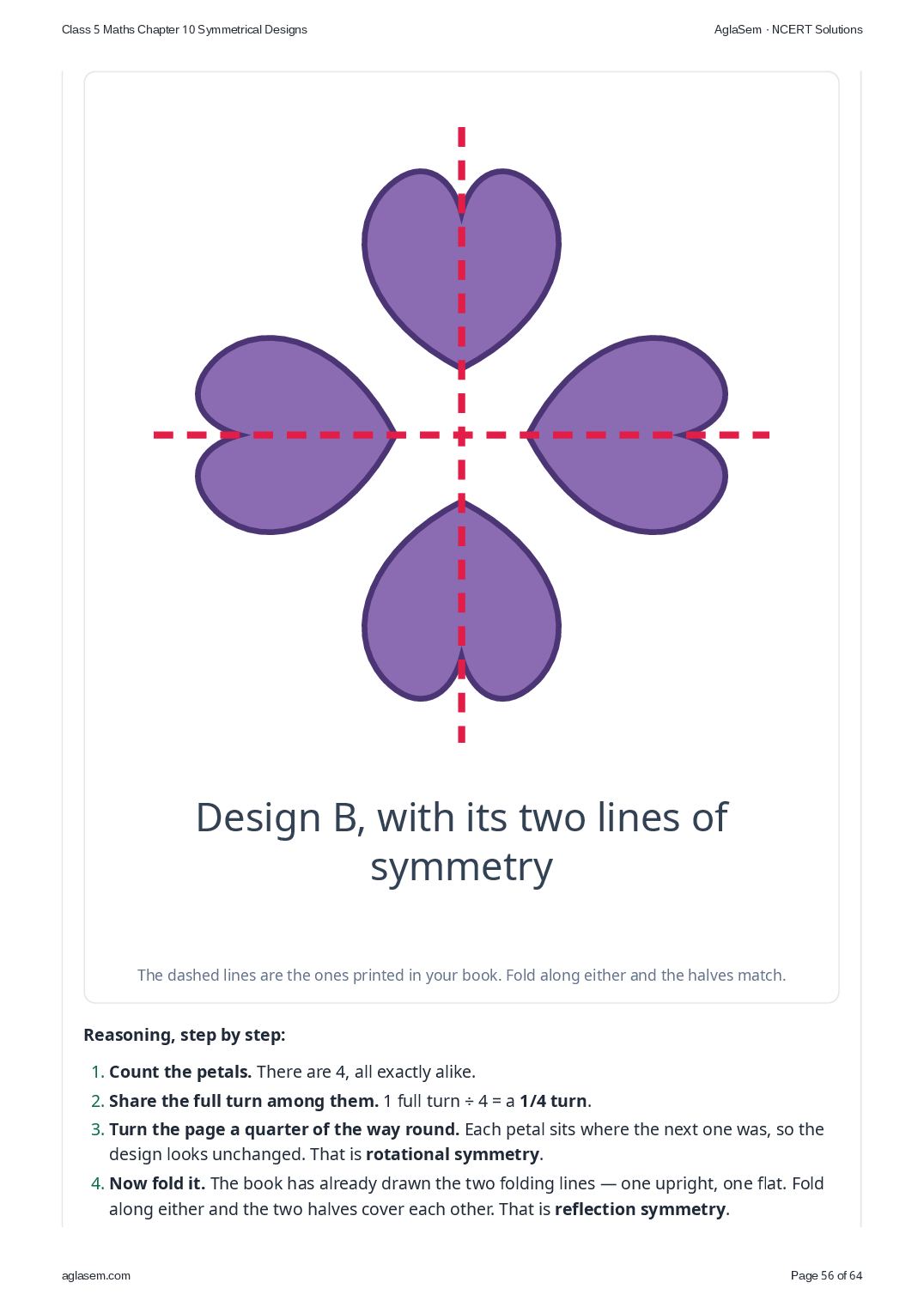
- The design B looks the same after every ____________ turn. This design has _________________ symmetry.BDesign B, with the two dashed lines that are printed in the book.
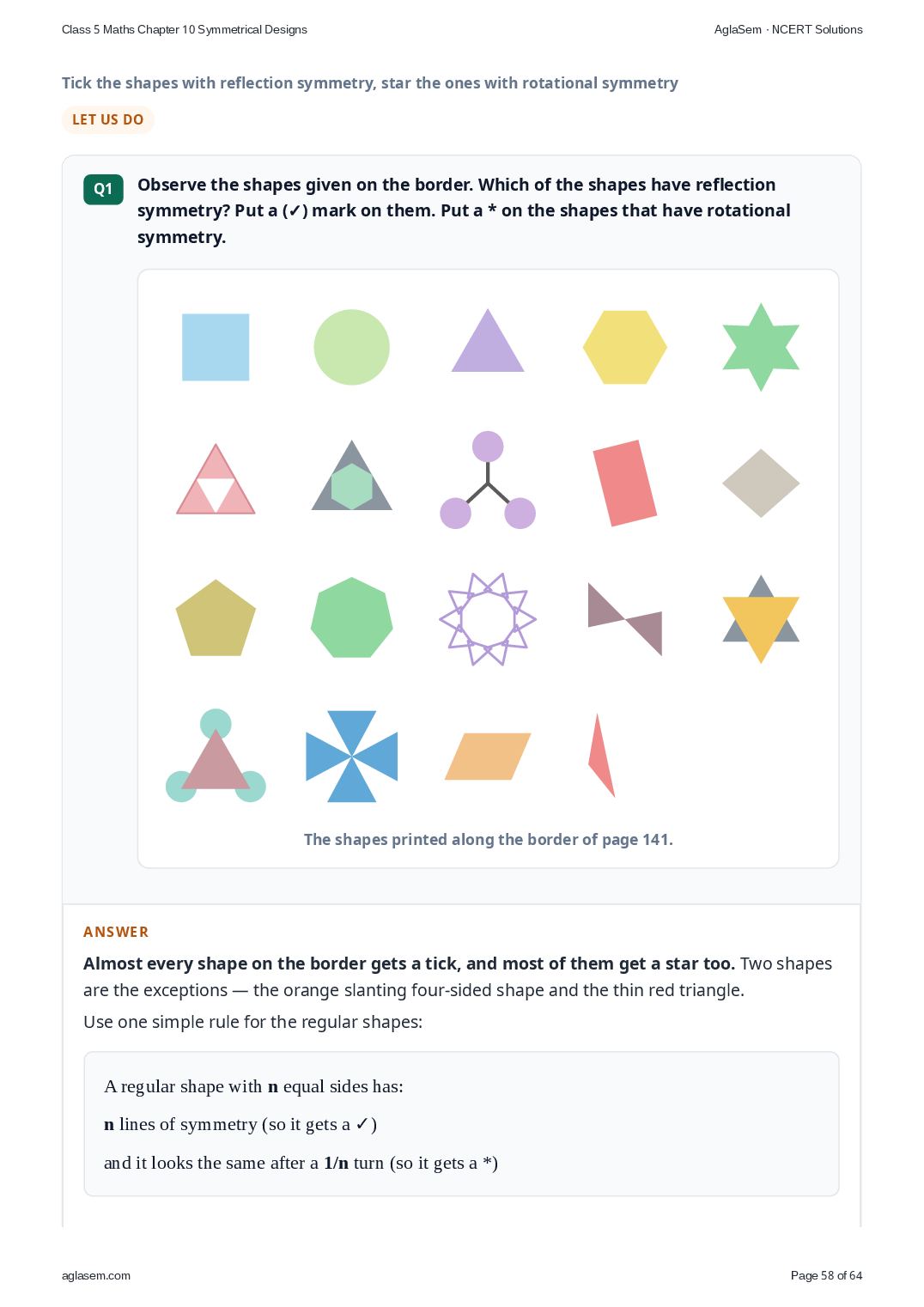
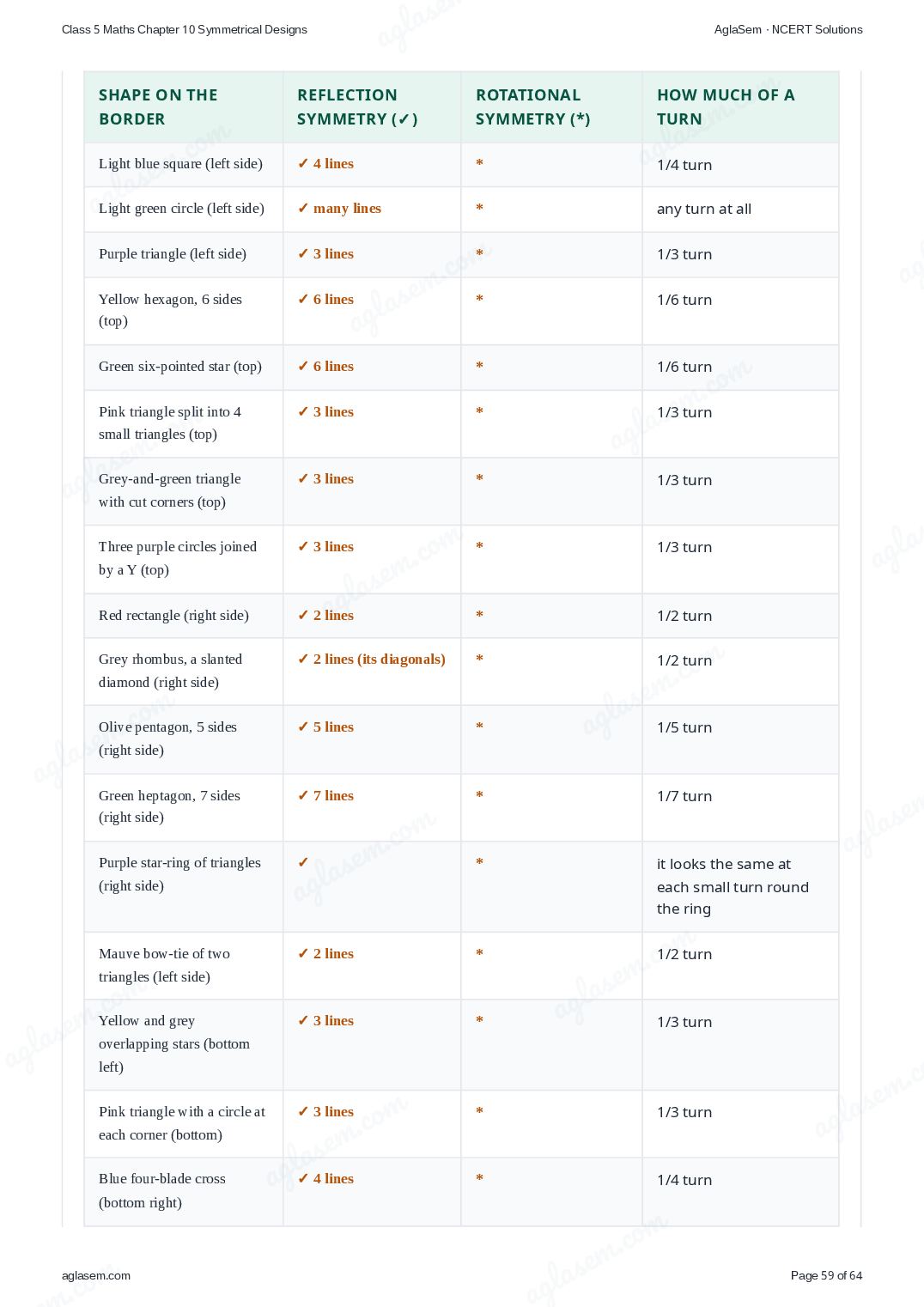
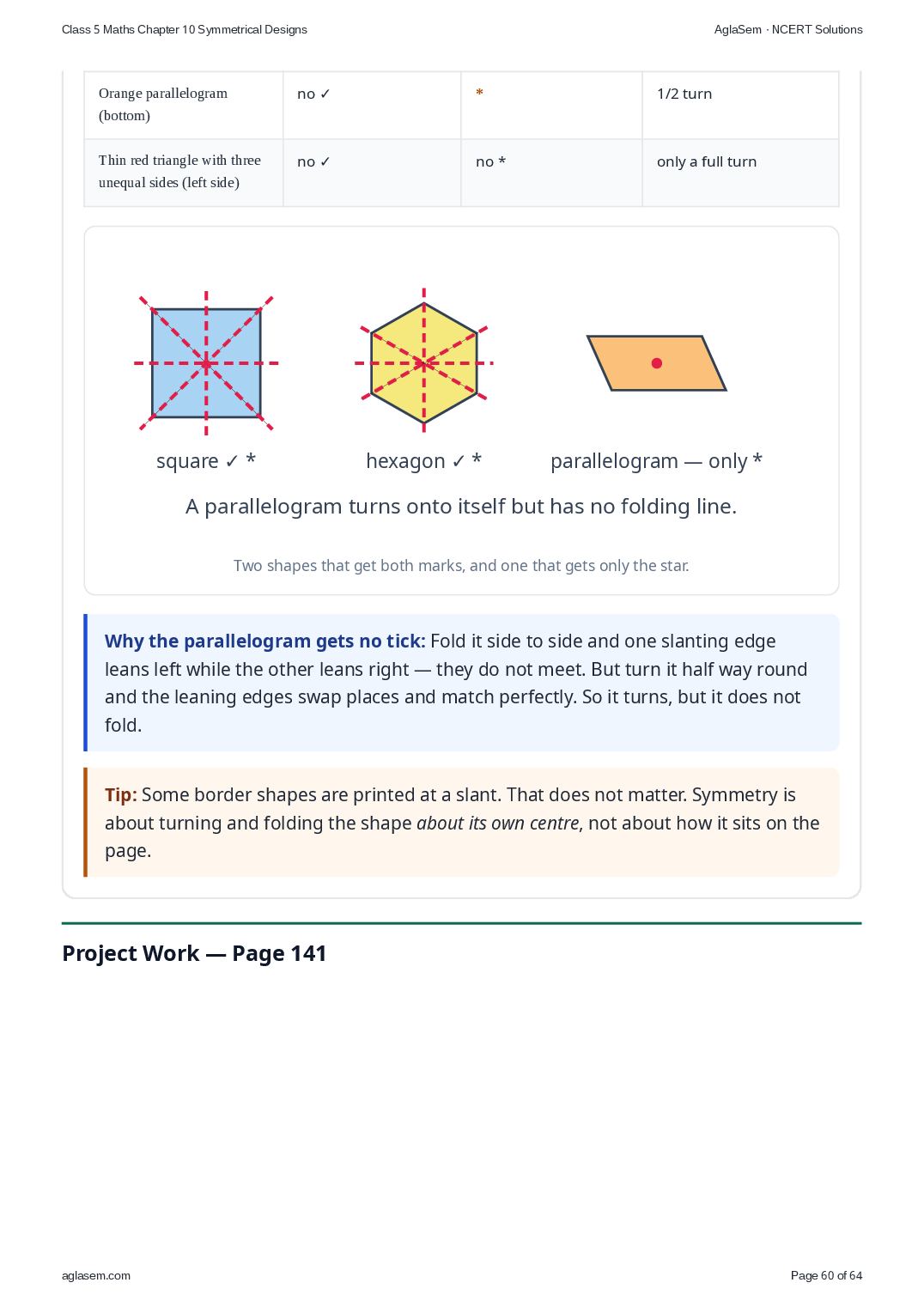
- Observe the shapes given on the border. Which of the shapes have reflection symmetry? Put a (✓) mark on them. Put a * on the shapes that have rotational symmetry.The shapes printed along the border of page 141.
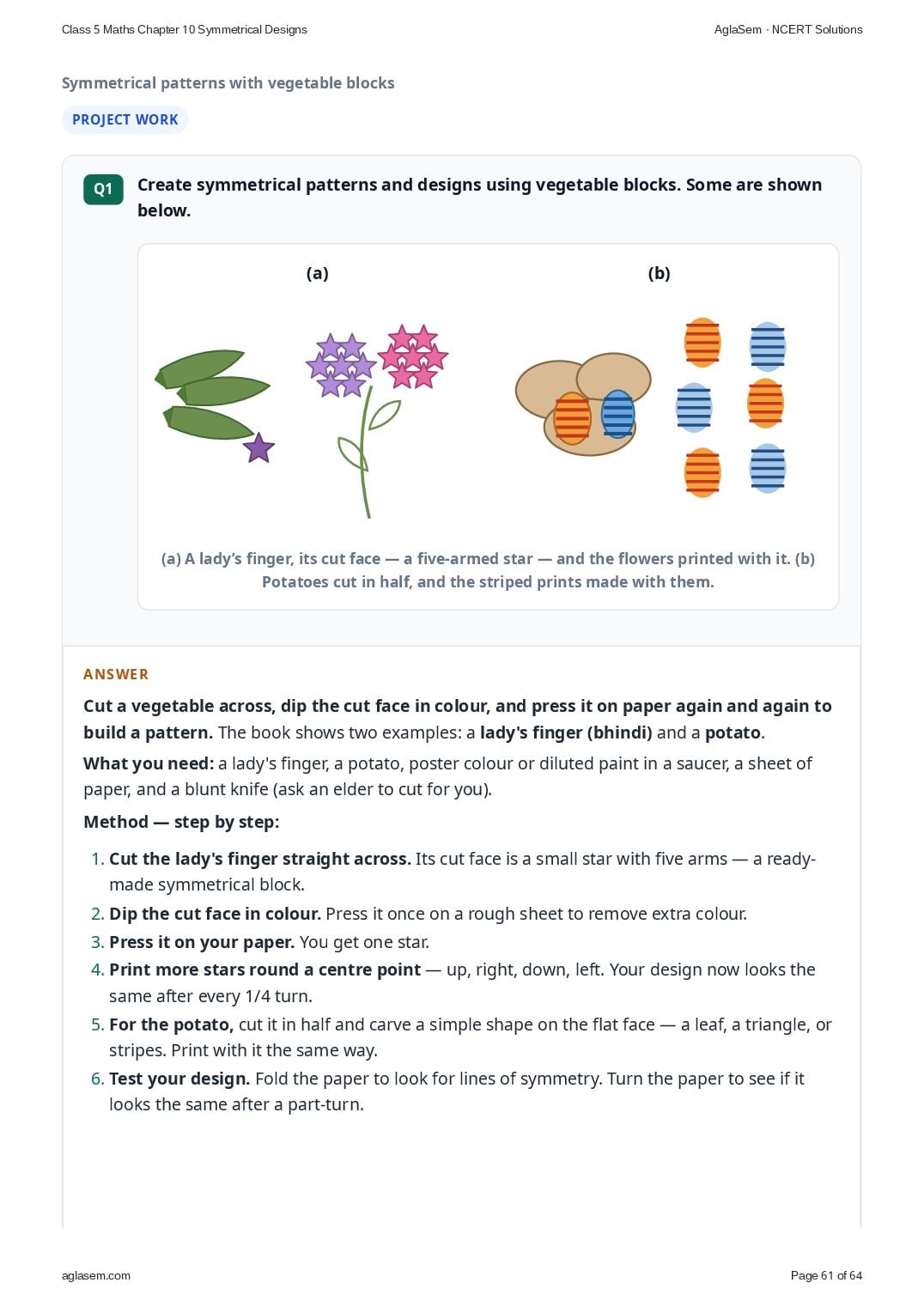
- Create symmetrical patterns and designs using vegetable blocks. Some are shown below.(a)(b)(a) A lady’s finger, its cut face — a five-armed star — and the flowers printed with it. (b) Potatoes cut in half, and the striped prints made with them.
Chapter at a Glance
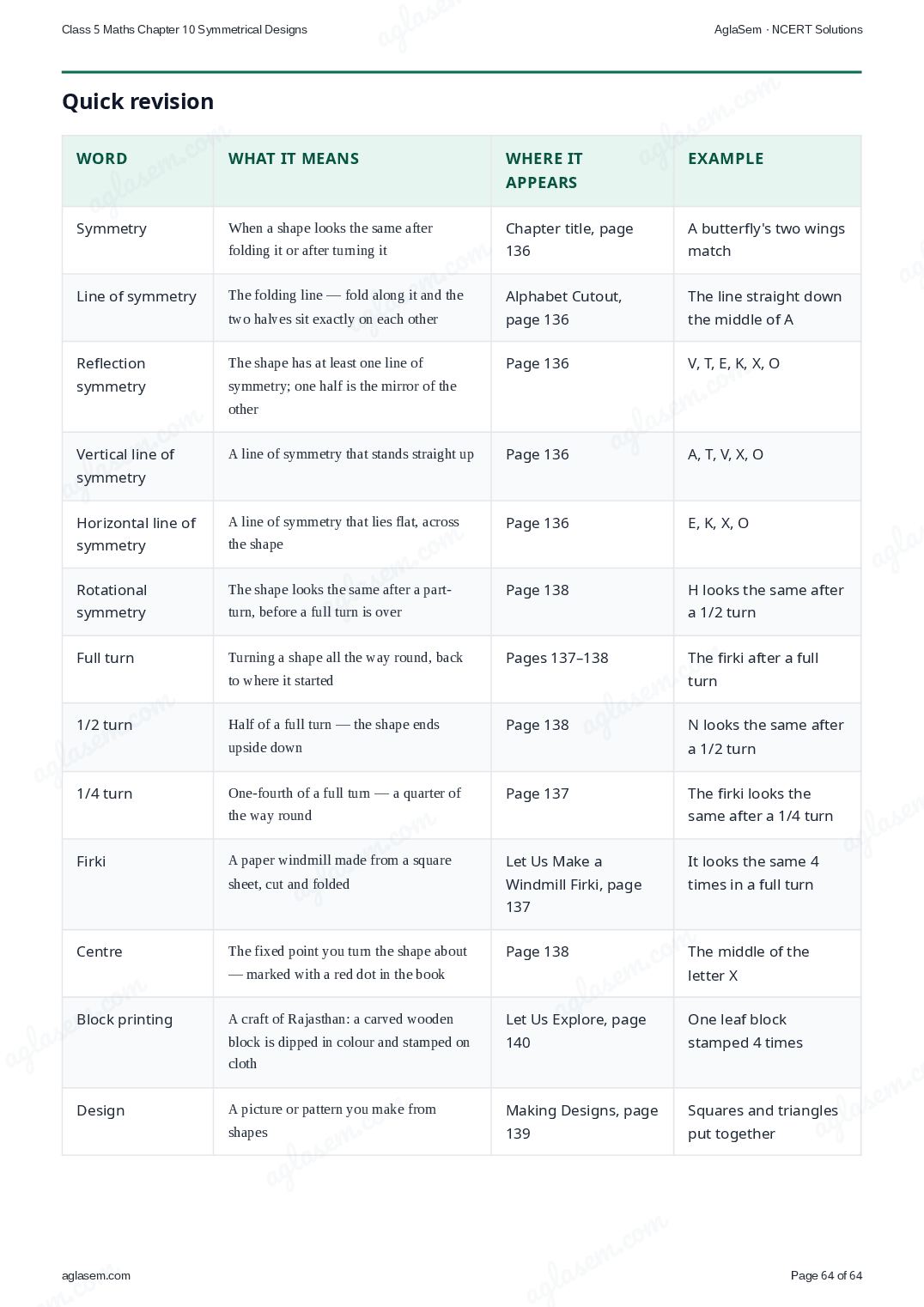
- A line of symmetry is a folding line. Draw a line on a picture and fold the paper along it. If the two halves sit exactly on top of each other, that line is a line of symmetry. A shape that has at least one such line is said to have reflection symmetry — one half is the mirror image of the other half.
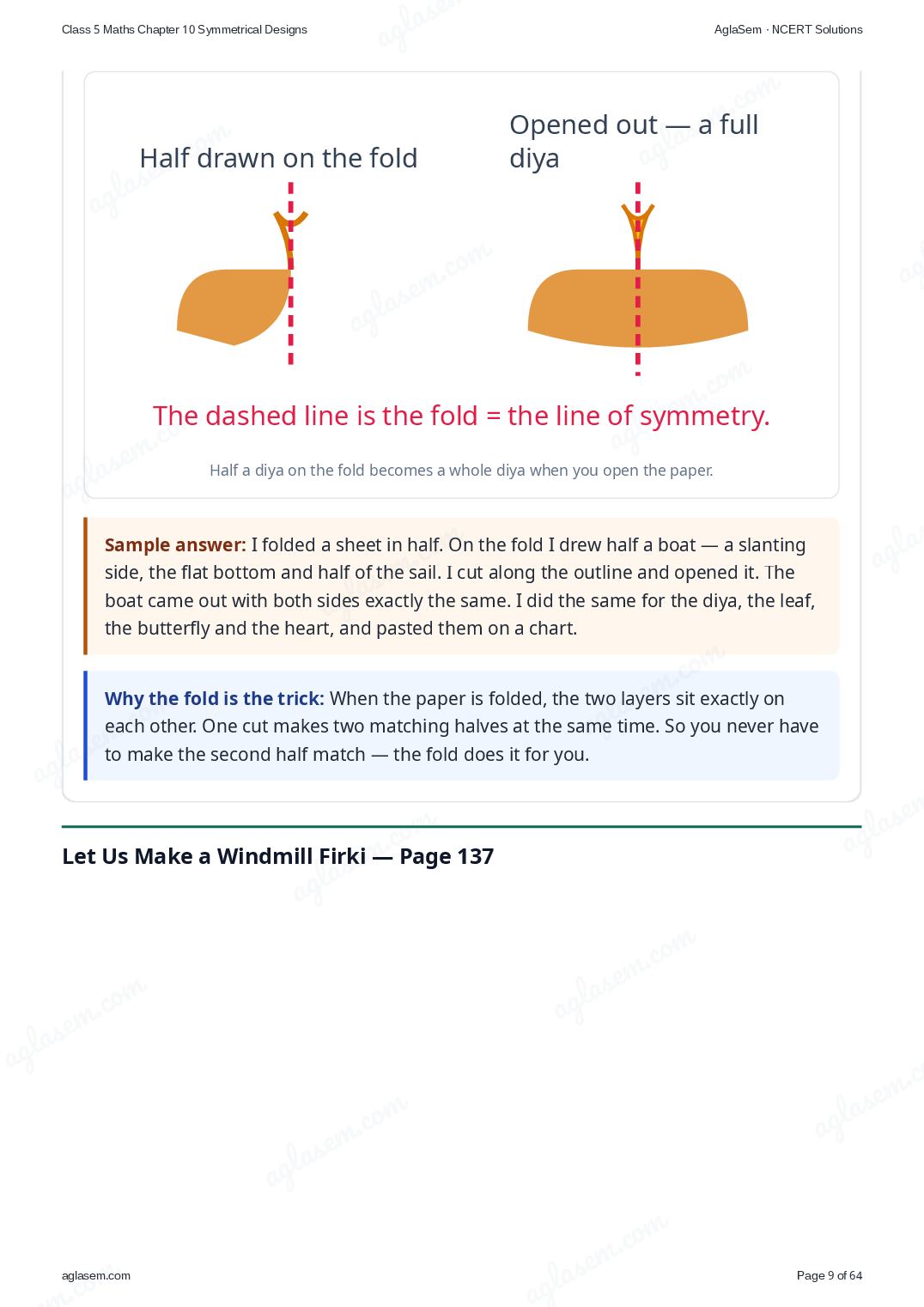
- That is why half a letter is enough. The letter A has one line of symmetry, standing straight up. So fold a paper once, draw only the left half of A along the fold, cut, and open. The fold makes the other half for you. This is the trick Prem and Manu use.
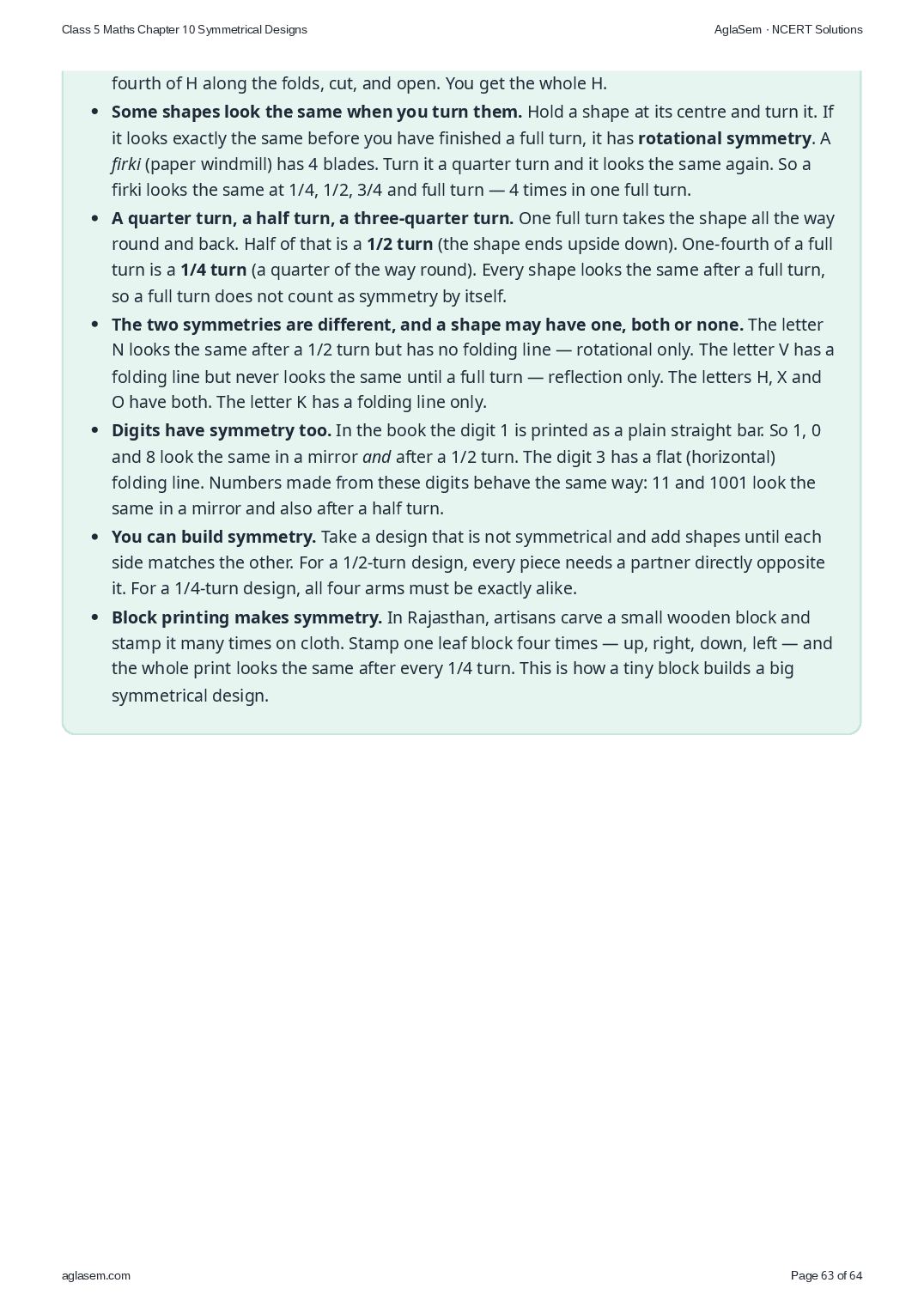
- Two lines mean a quarter is enough. The letter H has two lines of symmetry — one standing up (vertical) and one lying flat (horizontal). Fold the paper twice, draw only one-fourth of H along the folds, cut, and open. You get the whole H.
- Some shapes look the same when you turn them. Hold a shape at its centre and turn it. If it looks exactly the same before you have finished a full turn, it has rotational symmetry. A firki (paper windmill) has 4 blades. Turn it a quarter turn and it looks the same again. So a firki looks the same at 1/4, 1/2, 3/4 and full turn — 4 times in one full turn.
- A quarter turn, a half turn, a three-quarter turn. One full turn takes the shape all the way round and back. Half of that is a 1/2 turn (the shape ends upside down). One-fourth of a full turn is a 1/4 turn (a quarter of the way round). Every shape looks the same after a full turn, so a full turn does not count as symmetry by itself.
- The two symmetries are different, and a shape may have one, both or none. The letter N looks the same after a 1/2 turn but has no folding line — rotational only. The letter V has a folding line but never looks the same until a full turn — reflection only. The letters H, X and O have both. The letter K has a folding line only.
- Digits have symmetry too. In the book the digit 1 is printed as a plain straight bar. So 1, 0 and 8 look the same in a mirror and after a 1/2 turn. The digit 3 has a flat (horizontal) folding line. Numbers made from these digits behave the same way: 11 and 1001 look the same in a mirror and also after a half turn.
- You can build symmetry. Take a design that is not symmetrical and add shapes until each side matches the other. For a 1/2-turn design, every piece needs a partner directly opposite it. For a 1/4-turn design, all four arms must be exactly alike.
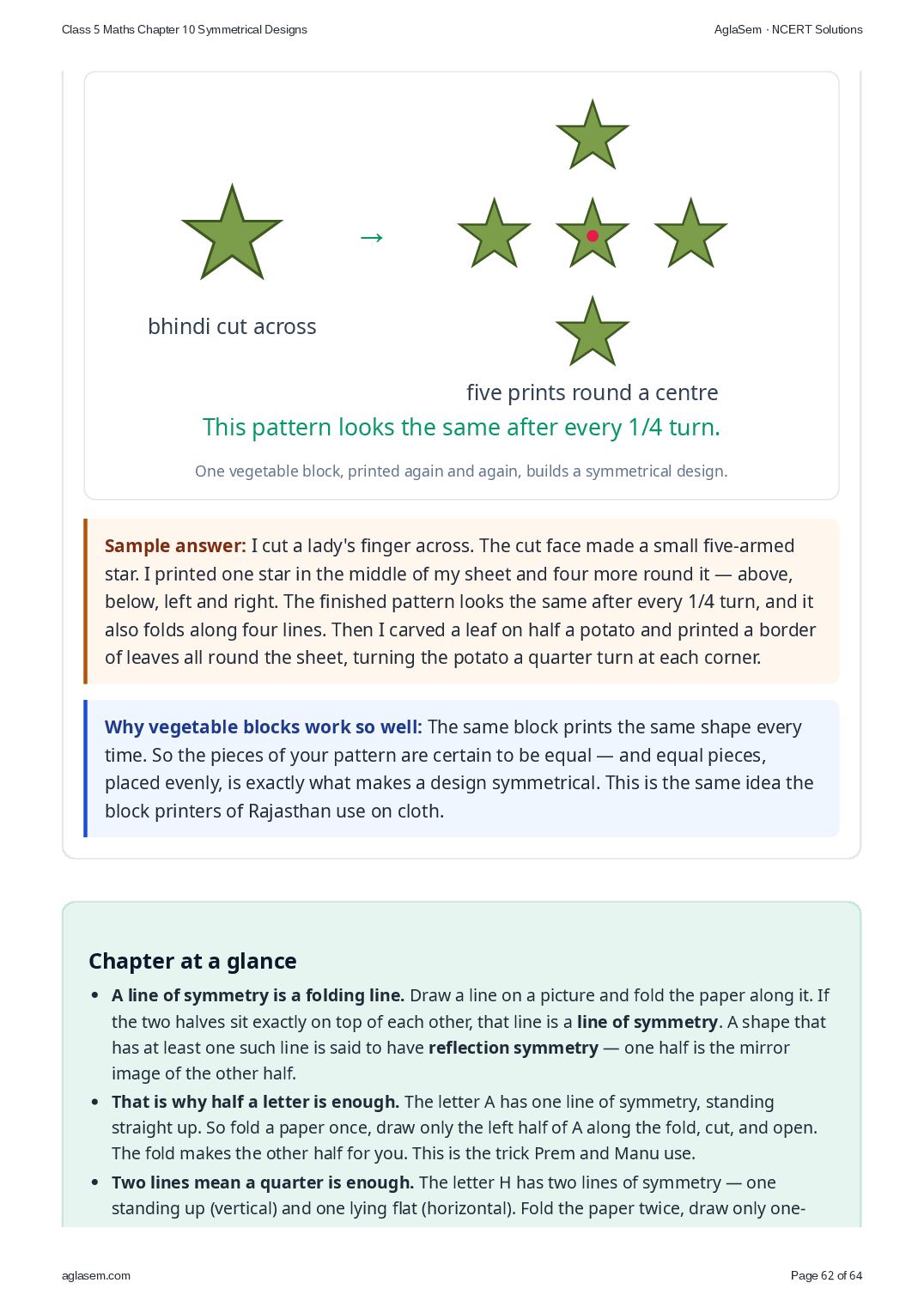
- Block printing makes symmetry. In Rajasthan, artisans carve a small wooden block and stamp it many times on cloth. Stamp one leaf block four times — up, right, down, left — and the whole print looks the same after every 1/4 turn. This is how a tiny block builds a big symmetrical design.
How to Download NCERT Solutions for Class 5 Maths Chapter 10 PDF
Follow these simple steps to get the Symmetrical Designs questions-and-answers PDF from Math Mela.
- Search NCERT Solutions for Class 5 Maths Chapter 10 aglasem and open this page.
- Read the exercise questions with answers for Symmetrical Designs shown above.
- Click the Download PDF link to save the Symmetrical Designs solutions to your device.
NCERT Solutions for Class 5 Maths – All Chapters
There are more chapters to study besides Symmetrical Designs in Maths. Here are the NCERT Solutions for all chapters of Class 5 Maths.
- Chapter 1 We the Travellers I
- Chapter 2 Fractions
- Chapter 3 Angles As Turns
- Chapter 4 We the Travellers Ii
- Chapter 5 Far and Near
- Chapter 6 the Dairy Farm
- Chapter 7 Shapes and Patterns
- Chapter 8 Weight and Capacity
- Chapter 9 Coconut Farm
- Chapter 10 Symmetrical Designs
- Chapter 11 Grandmother s Quilt
- Chapter 12 Racing Seconds
- Chapter 13 Animal Jumps
- Chapter 14 Maps and Locations
- Chapter 15 Data Through Pictures
NCERT Solutions for Class 5 – All Subjects
Just like Chapter 10 of Maths, you can get the exercise questions with answers for every other subject of Class 5. Here are the NCERT Solutions for all subjects of Class 5.
NCERT Solutions for Class 5 Maths Chapter 10 – An Overview
The key highlights of this study material are as follows.
| Aspects | Details |
|---|---|
| Class | Class 5 |
| Subject | Maths |
| Chapter Number | Chapter 10 |
| Chapter Name | Symmetrical Designs |
| Book Name | Math Mela |
| Book By | NCERT (National Council of Educational Research and Training) |
| Educational Resource Here | NCERT Solutions of Class 5 Maths Chapter 10 for all exercises |
| More Questions Answers of This Subject | NCERT Solutions for Class 5 Maths |
| Download Book Chapter | NCERT Book Class 5 Maths |
| All Questions Answers For This Class | NCERT Solutions for Class 5 |
| Complete Solutions | NCERT Solutions |
NCERT Solutions for Class 5 Maths Chapter 10 Symmetrical Designs – FAQs
What are the NCERT Solutions for Class 5 Maths Chapter 10 Symmetrical Designs?
They are the complete, step-by-step answers to all the exercise and in-text questions of Chapter 10 Symmetrical Designs from the NCERT Class 5 Maths textbook Math Mela, written by experts as per the latest NCERT syllabus.
How can I download the Class 5 Maths Chapter 10 solutions PDF for free?
Open this page on aglasem, read the Symmetrical Designs questions with answers, and click the “Download Solutions PDF” link. The Class 5 Maths Chapter 10 NCERT Solutions PDF is completely free to download.
Are these NCERT Solutions as per the latest 2026-27 syllabus?
Yes. The NCERT Solutions for Class 5 Maths Chapter 10 are based on the latest NCERT textbook Math Mela and the current 2026-27 CBSE syllabus, so the questions and answers match what you study in class.
Where can I get NCERT Solutions for the other chapters of Class 5 Maths?
You can find the answers to every chapter on the NCERT Solutions for Class 5 Maths page, and solutions for every subject on the NCERT Solutions for Class 5 page.
How do NCERT Solutions help in exam preparation?
They show the correct method to solve each question, help you write answers the way they are expected in exams, let you check and correct your own work, and save revision time — which together improve your marks in Class 5 Maths.
If you have any queries on NCERT Solutions for Class 5 Maths Chapter 10 Symmetrical Designs, then please ask in the comments below.