NCERT Solutions for Class 5 Maths Chapter 15 Data Through Pictures provide clear, step-by-step answers to every exercise and in-text question from the chapter Data Through Pictures of the NCERT textbook Math Mela. Prepared by subject experts as per the latest NCERT (CBSE) syllabus for 2026-27, these NCERT Solutions for Class 5 Maths help you understand each concept, write exam-ready answers, and check your own solutions. You can read them online below or download the free Class 5 Maths Chapter 15 question-answer PDF.
NCERT Solutions for Class 5 Maths Chapter 15 Data Through Pictures
- Class: Class 5
- Subject: Maths
- Chapter: Chapter 15 – Data Through Pictures
- Textbook: Math Mela (NCERT)
- Study material: NCERT Solutions – questions with answers, free PDF
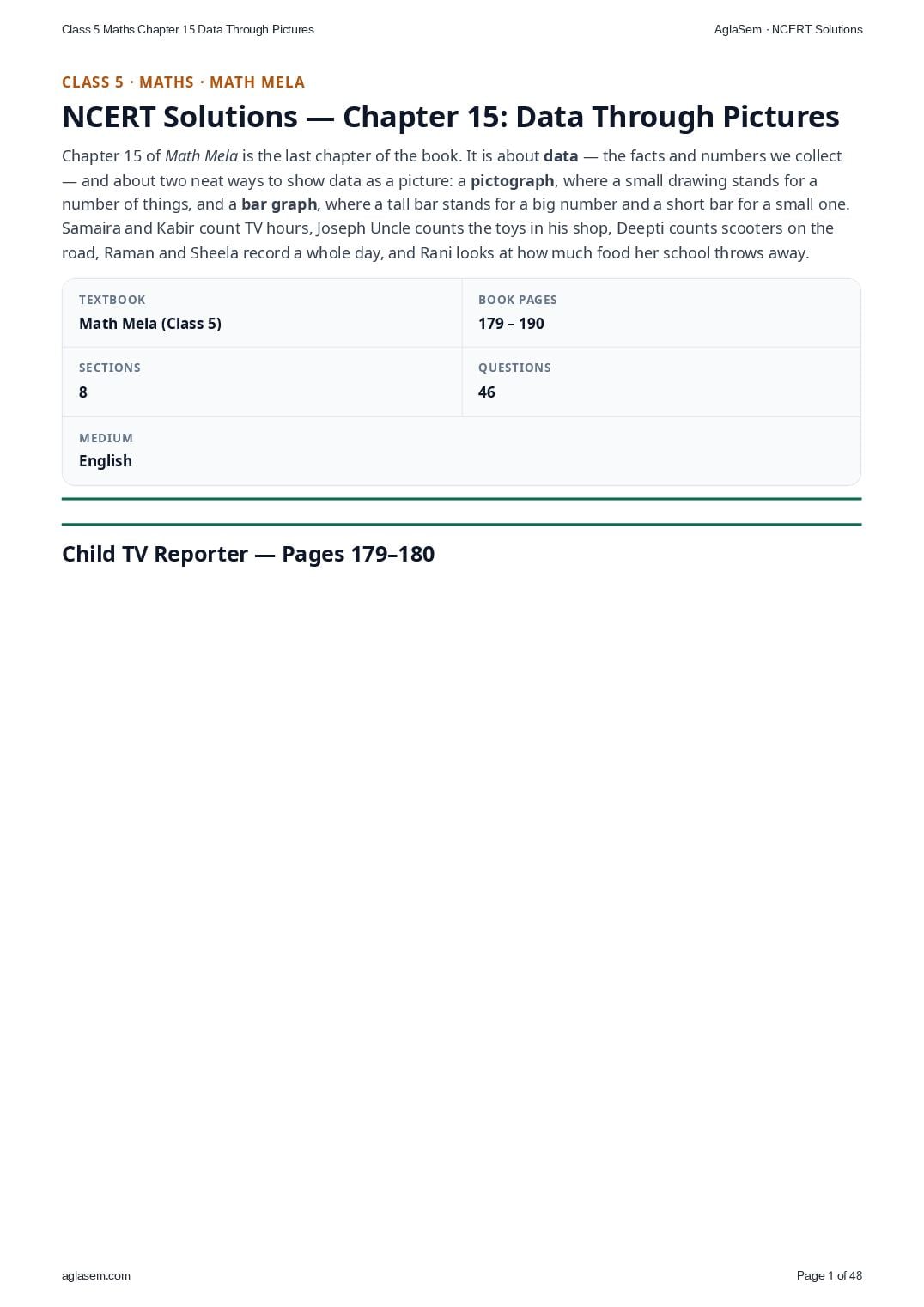
These solutions answer all the exercise questions of Chapter 15 Data Through Pictures — including the in-text questions, short-answer and long-answer questions, and activities — with complete explanations so you can follow the method, not just the final answer. Read the full solutions below.
NCERT Solutions Class 5 Maths Chapter 15 Data Through Pictures View Download
NCERT Solutions for Class 5 Maths Chapter 15 PDF Download
You can read the NCERT Solutions for Class 5 Maths Chapter 15 online above, or download the complete question-answer PDF to study Data Through Pictures offline at any time.
NCERT Solutions for Class 5 Maths Chapter 15 PDF Download Link – Click Here to Download Solutions PDF
Questions Covered in This Chapter
These NCERT Solutions answer all 46 questions of this chapter. The questions solved are:
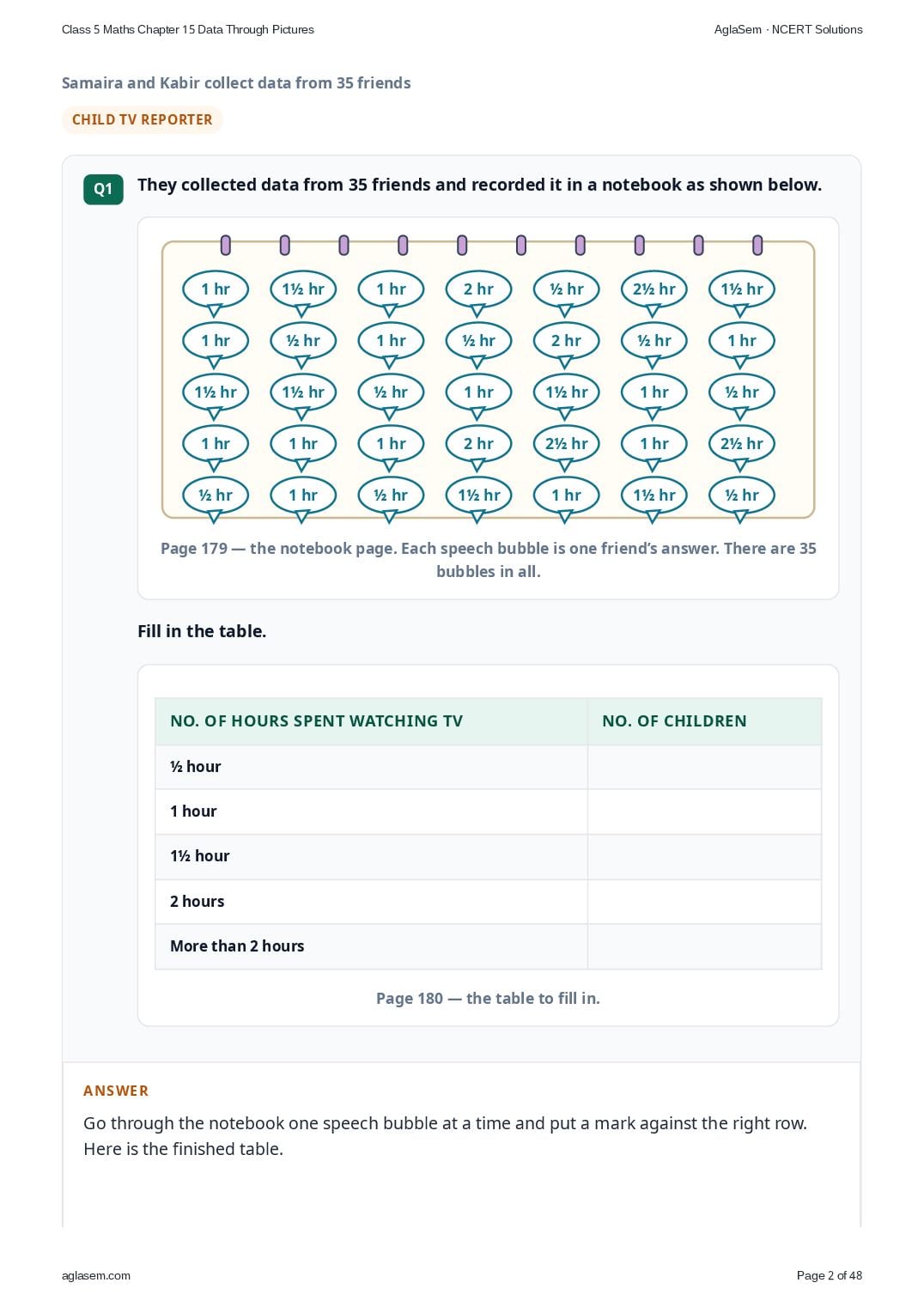
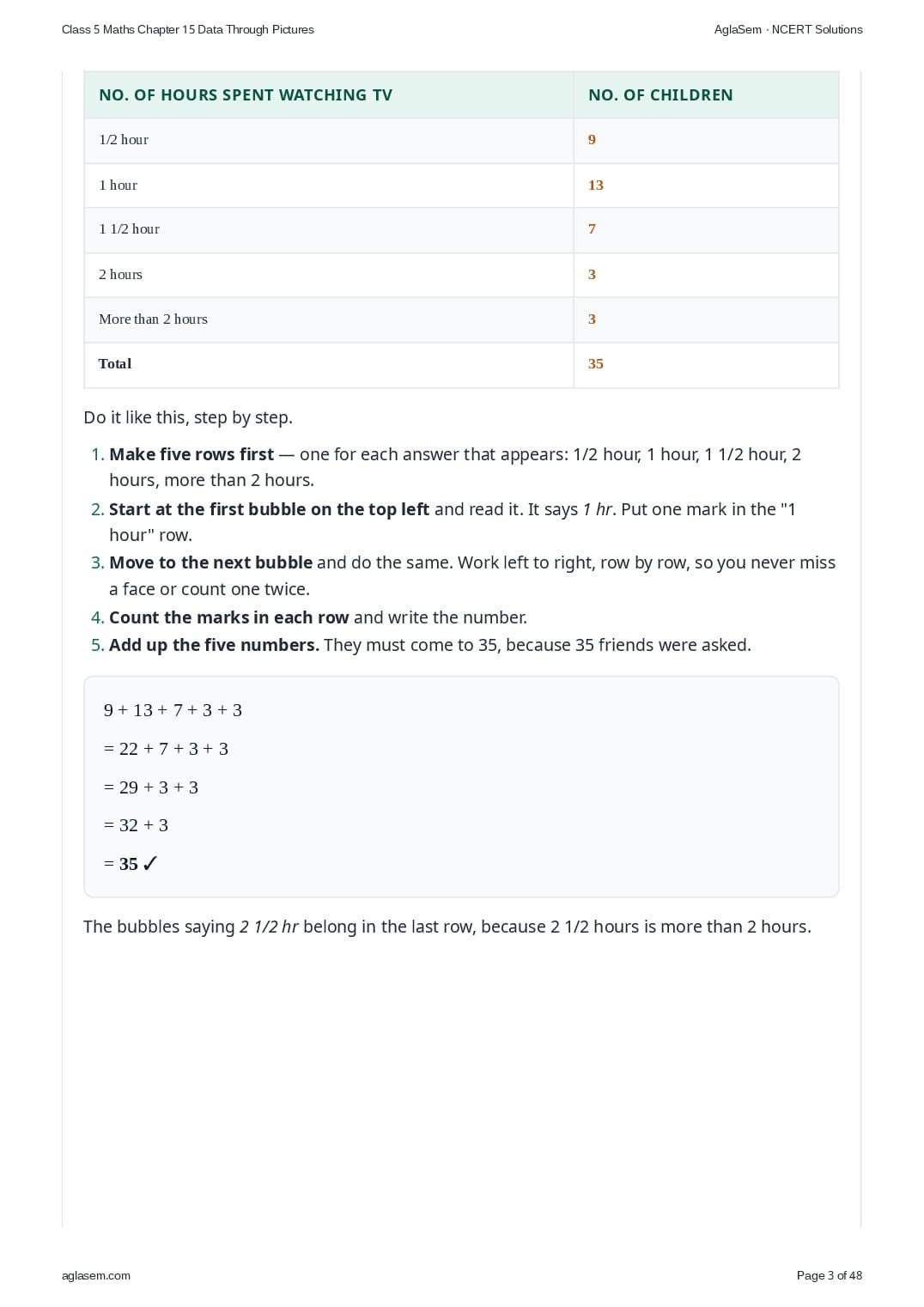
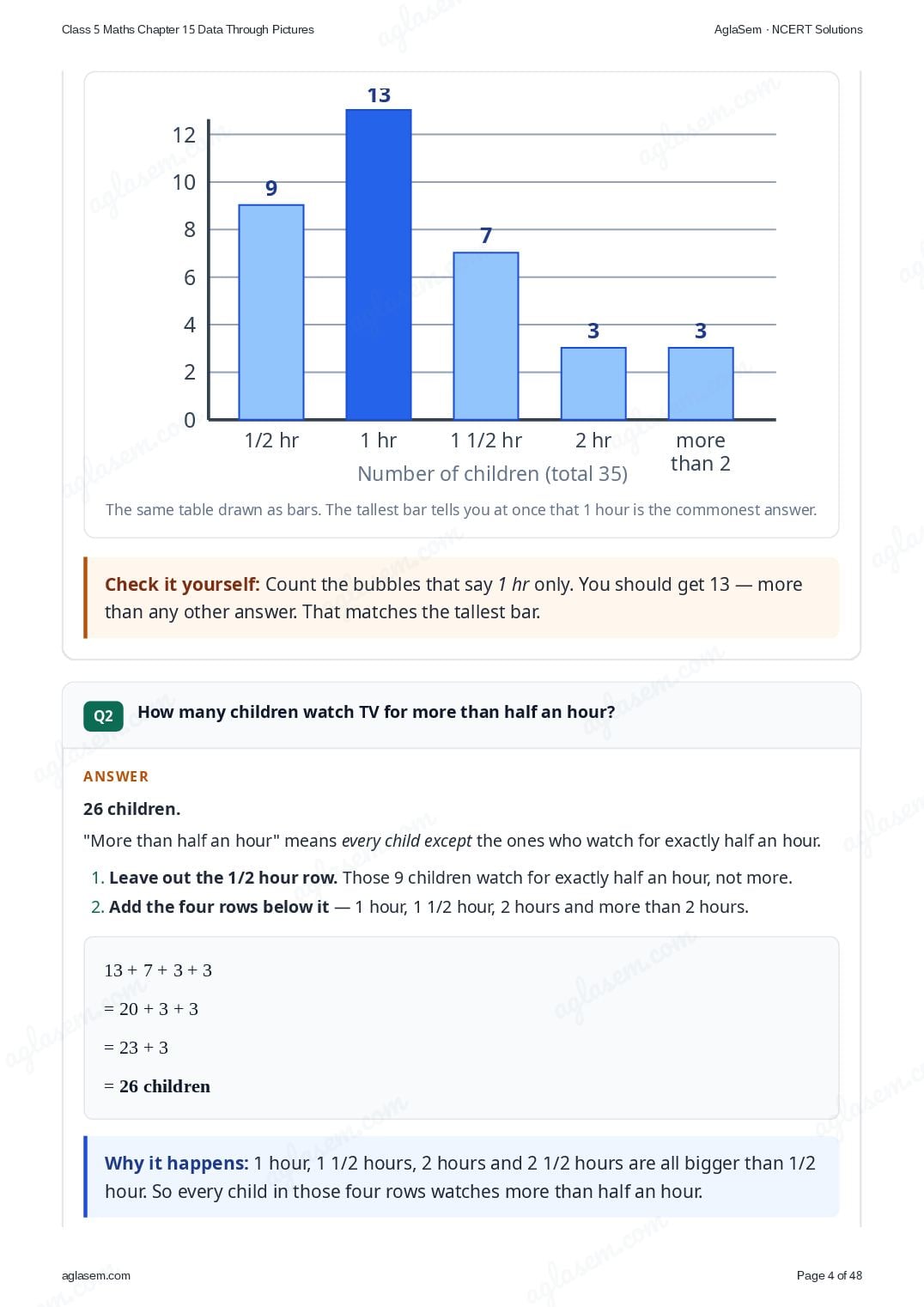
- They collected data from 35 friends and recorded it in a notebook as shown below.1 hr1½ hr1 hr2 hr½ hr2½ hr1½ hr1 hr½ hr1 hr½ hr2 hr½ hr1 hr1½ hr1½ hr½ hr1 hr1½ hr1 hr½ hr1 hr1 hr1 hr2 hr2½ hr1 hr2½ hr½ hr1 hr½ hr1½ hr1 hr1½ hr½ hrPage 179 — the notebook page. Each speech bubble is one friend’s answer. There are 35 bubbles in all.Fill in the table.No. of Hours Spent Watching TVNo. of Children½ hour1 hour1½ hour2 hoursMore than 2 hoursPage 180 — the table to fill in.
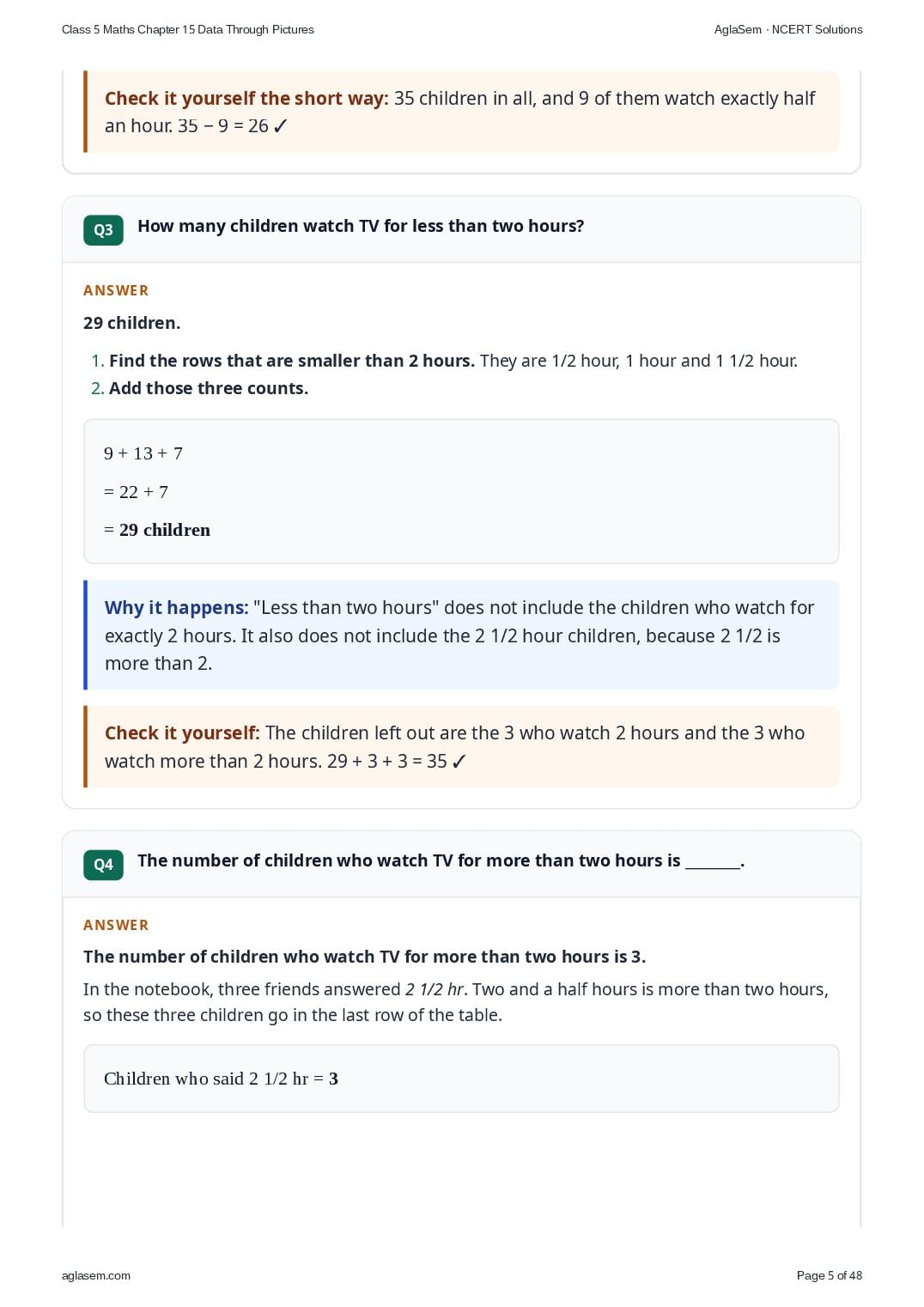
- How many children watch TV for more than half an hour?
- How many children watch TV for less than two hours?
- The number of children who watch TV for more than two hours is ________.
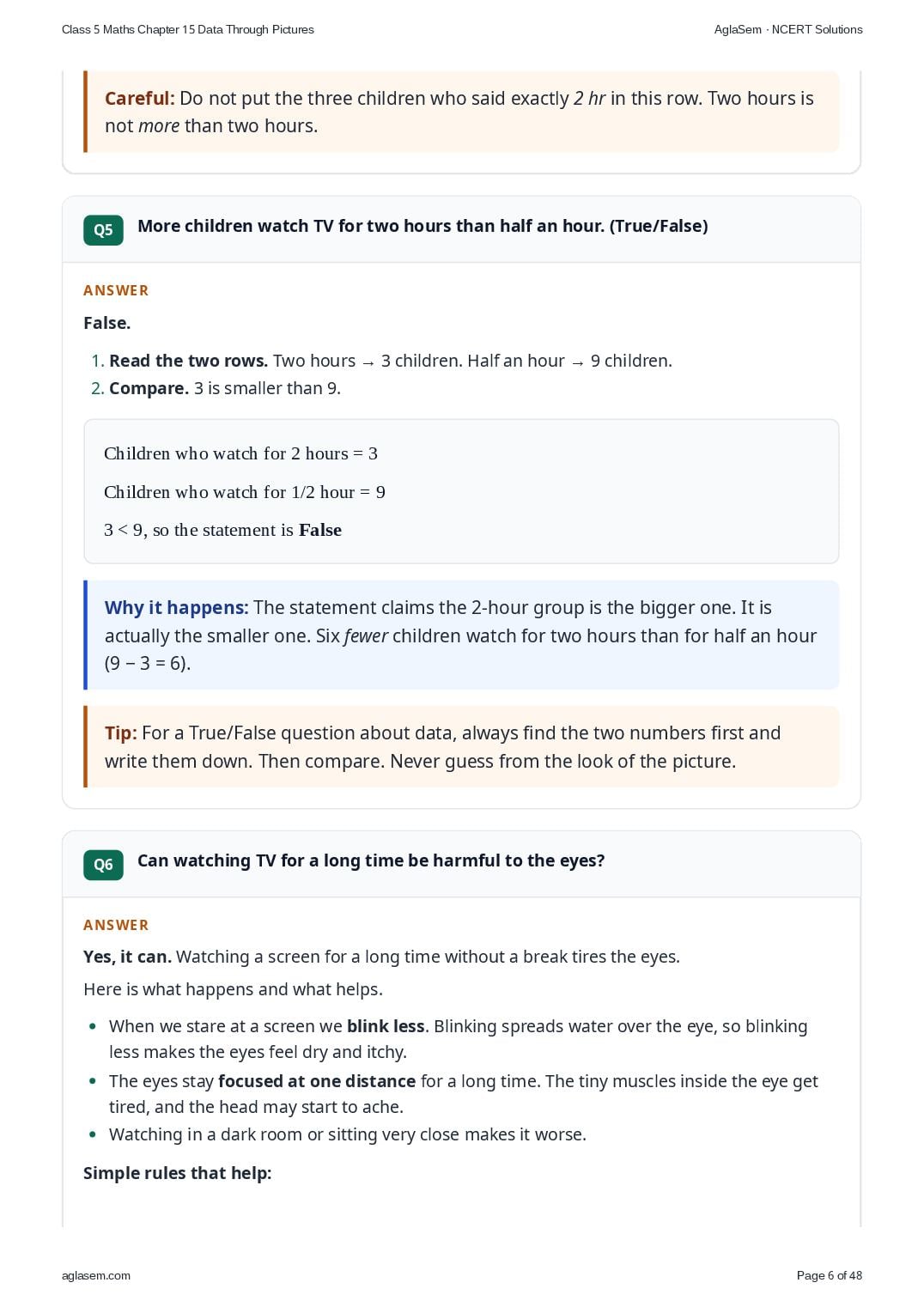
- More children watch TV for two hours than half an hour. (True/False)
- Can watching TV for a long time be harmful to the eyes?
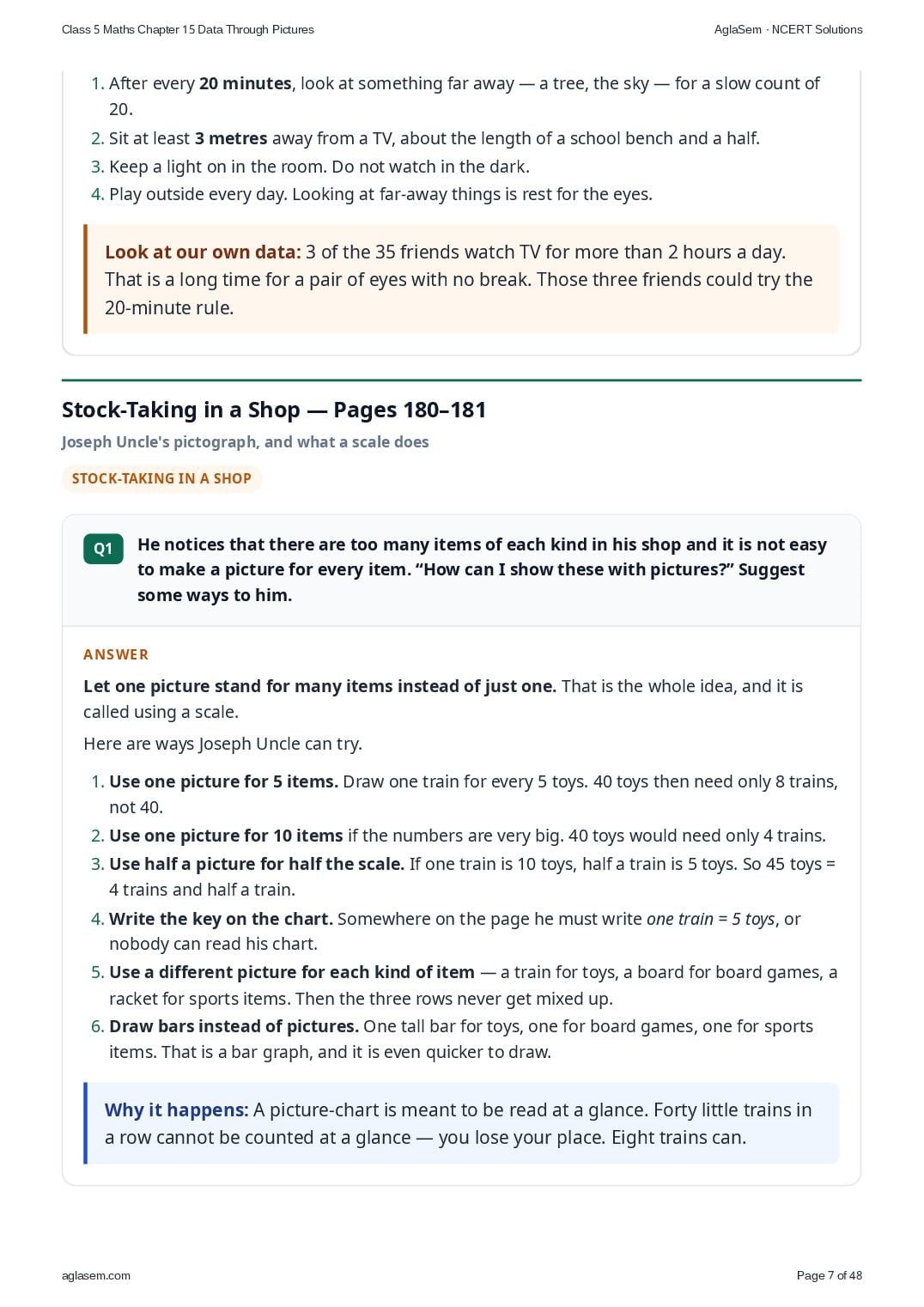
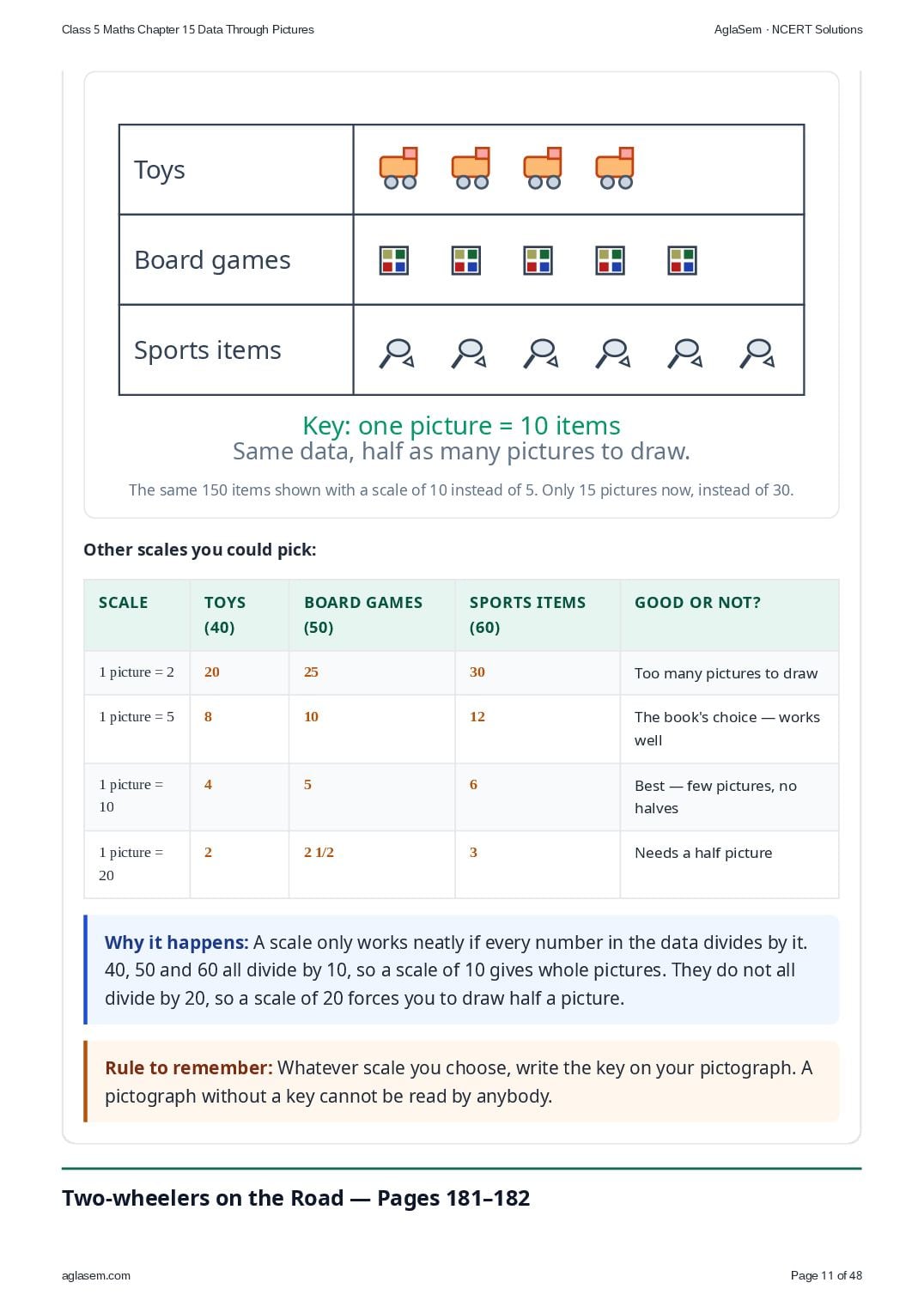
- He notices that there are too many items of each kind in his shop and it is not easy to make a picture for every item. “How can I show these with pictures?” Suggest some ways to him.
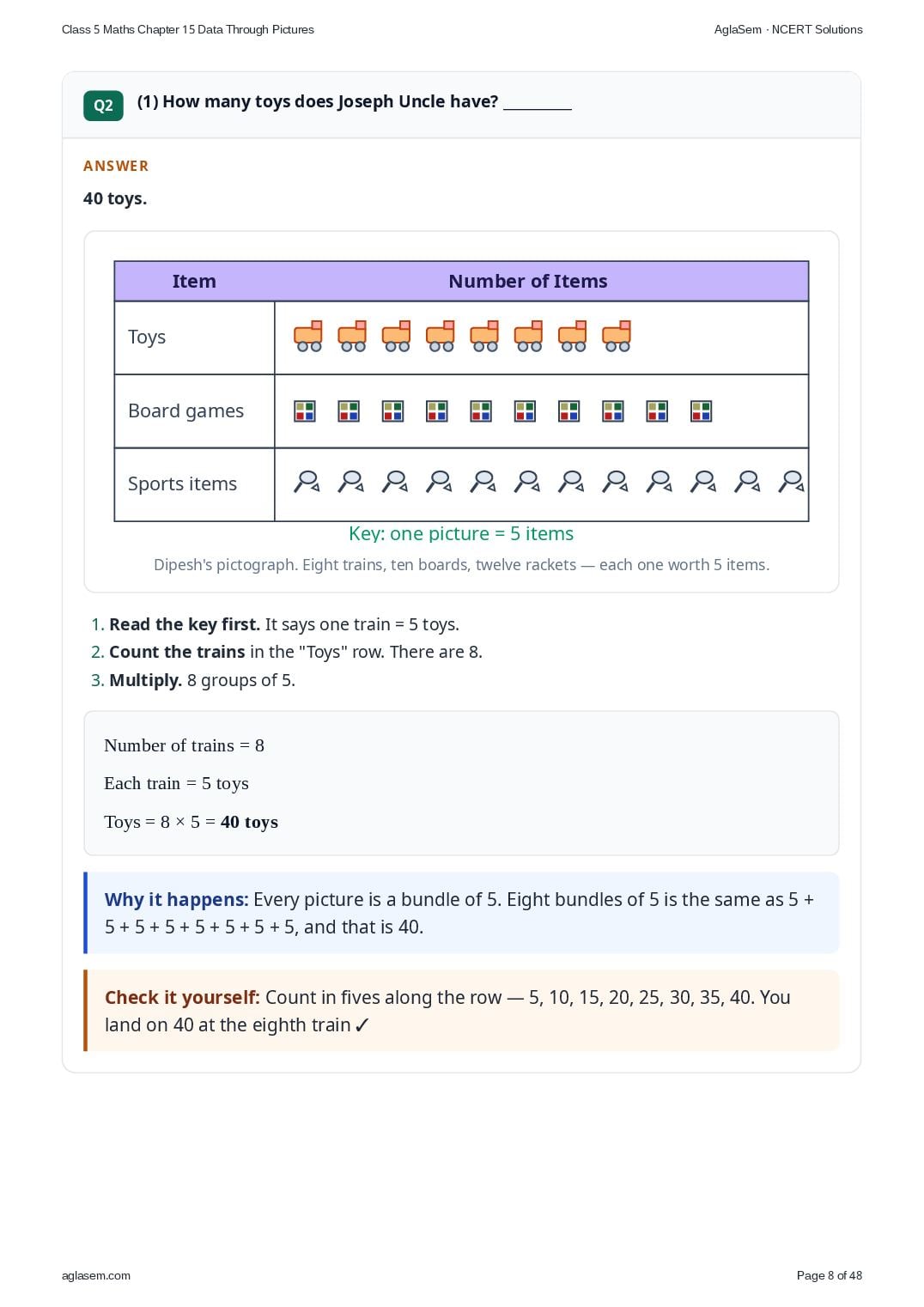
- (1) How many toys does Joseph Uncle have? __________
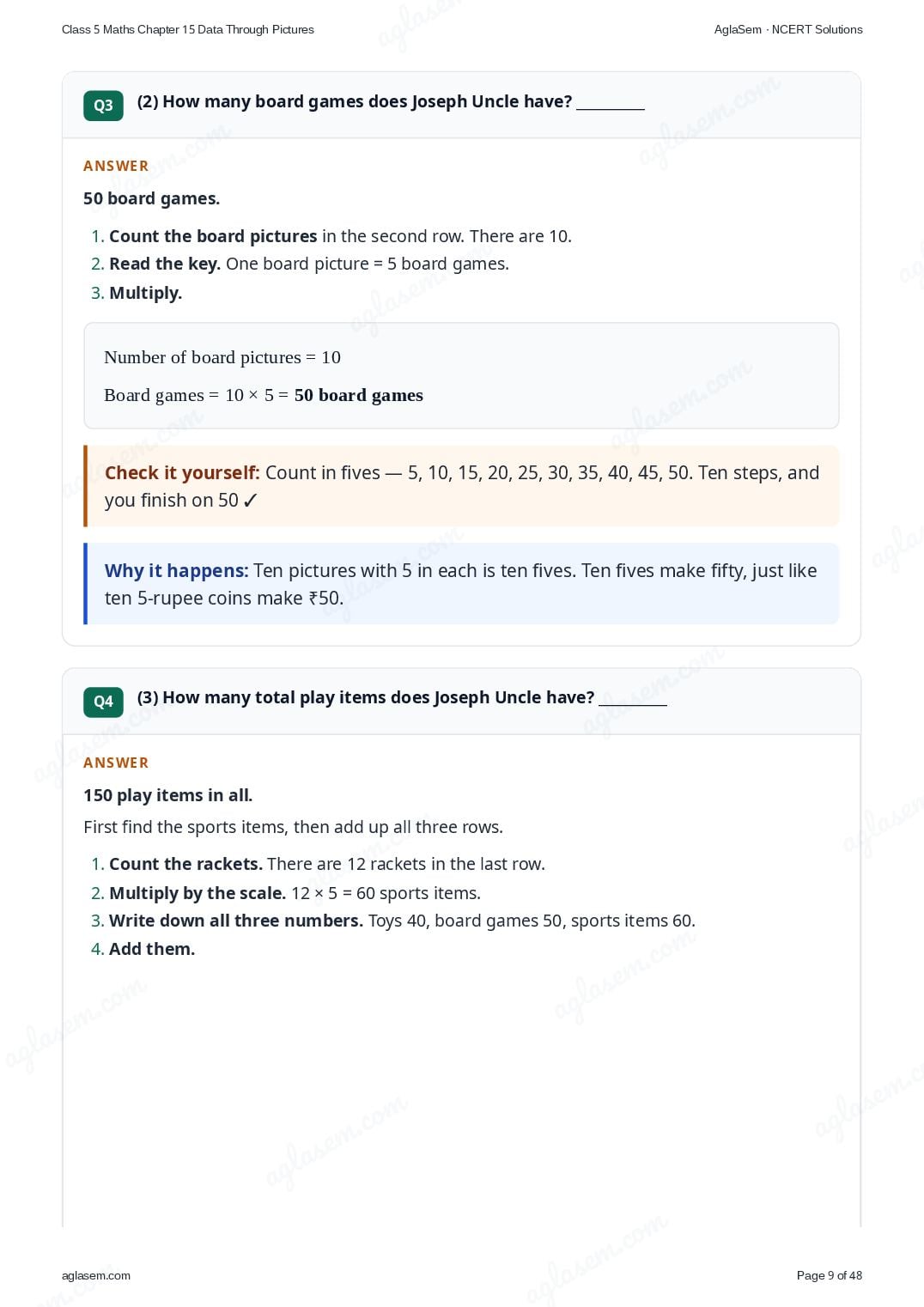
- (2) How many board games does Joseph Uncle have? __________
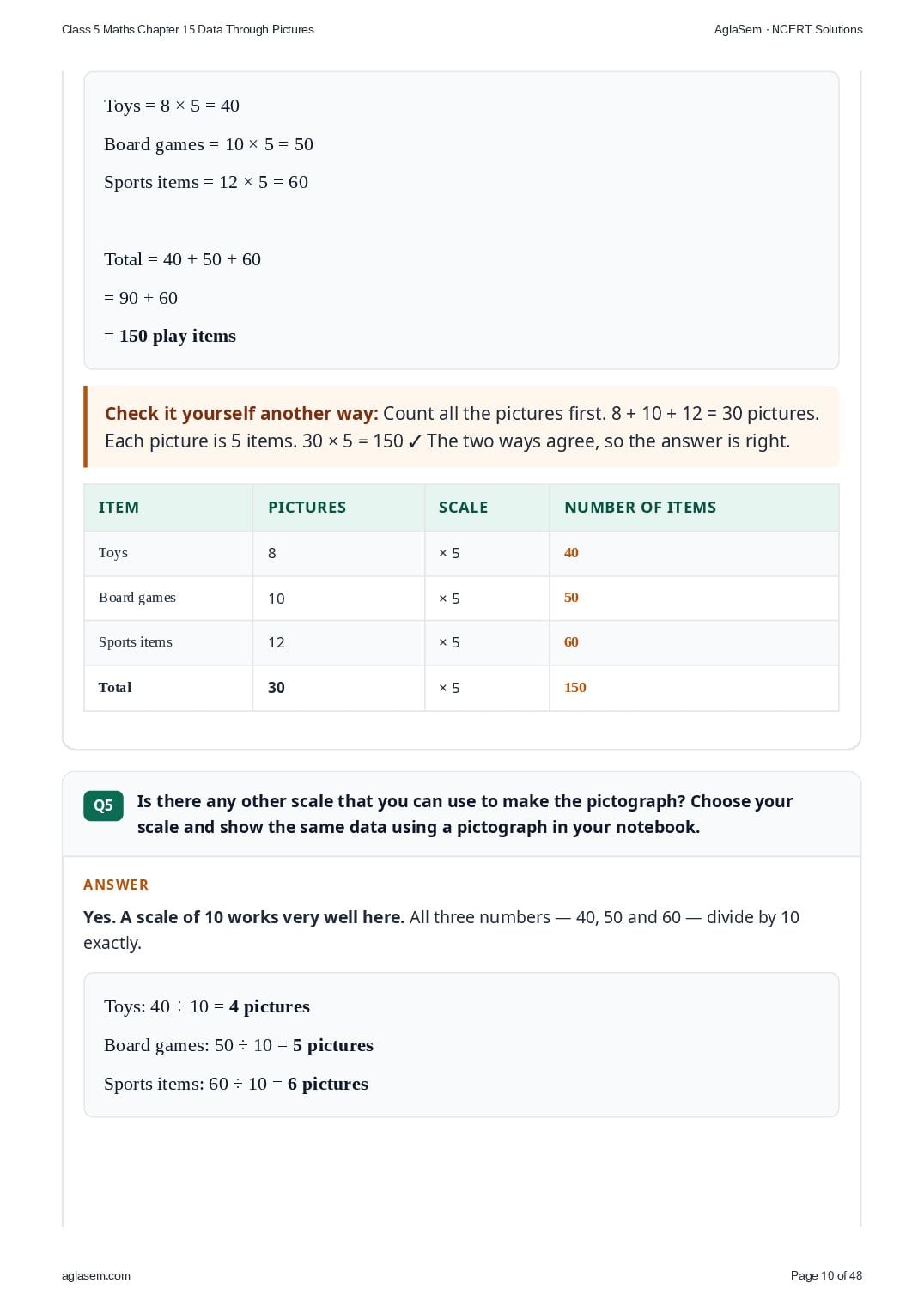
- (3) How many total play items does Joseph Uncle have? __________
- Is there any other scale that you can use to make the pictograph? Choose your scale and show the same data using a pictograph in your notebook.
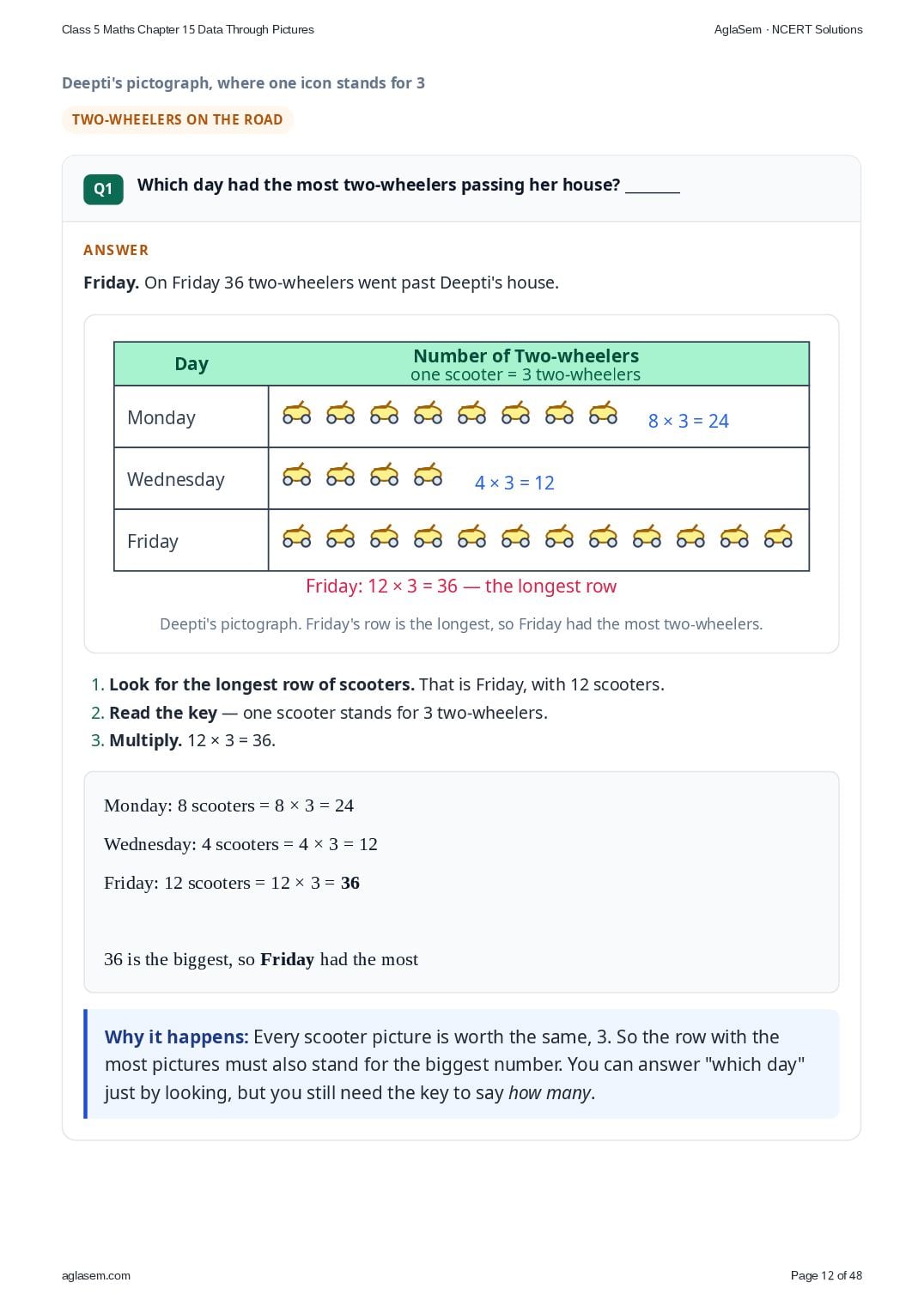
- Which day had the most two-wheelers passing her house? ________
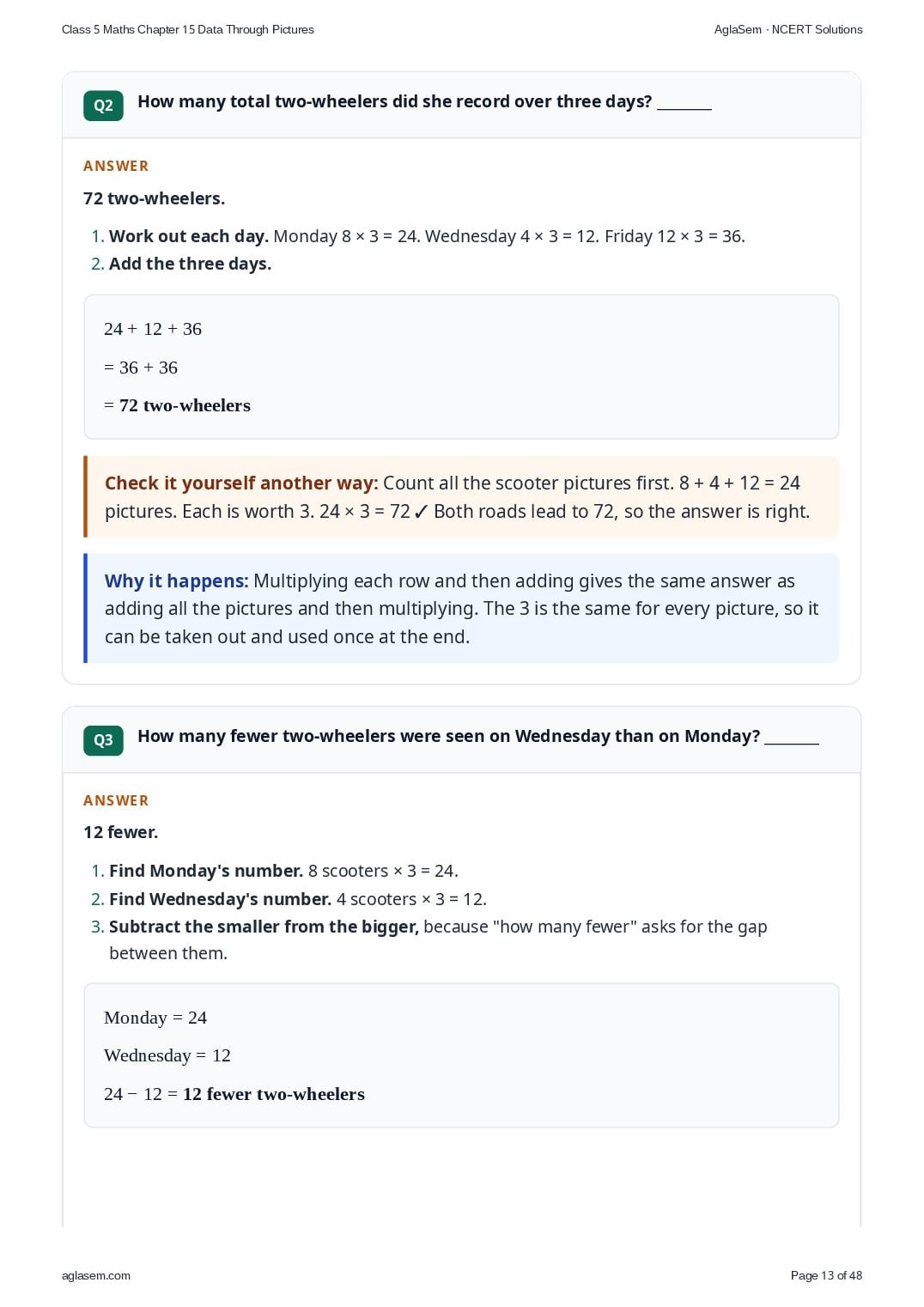
- How many total two-wheelers did she record over three days? ________
- How many fewer two-wheelers were seen on Wednesday than on Monday? ________
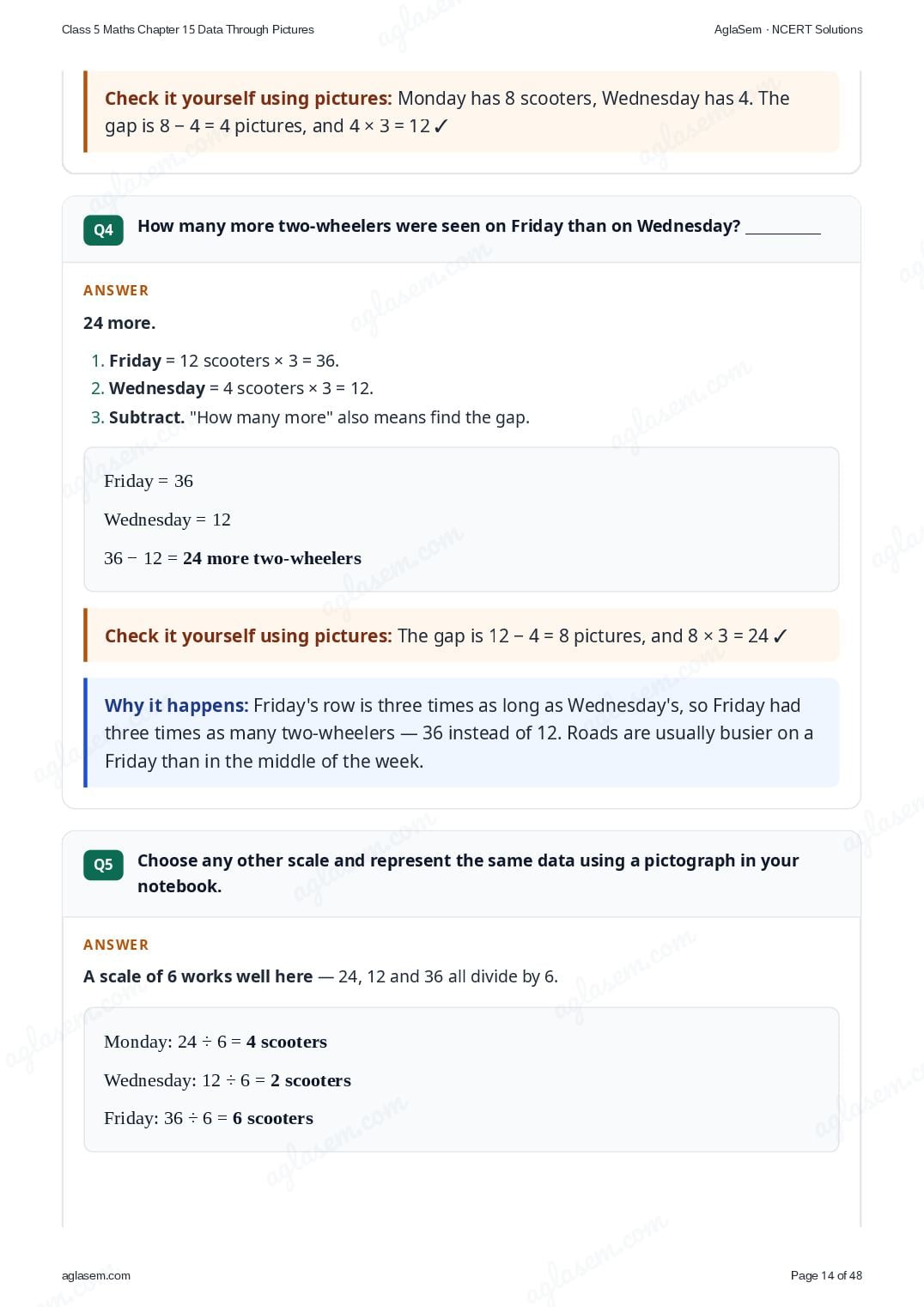
- How many more two-wheelers were seen on Friday than on Wednesday? ___________
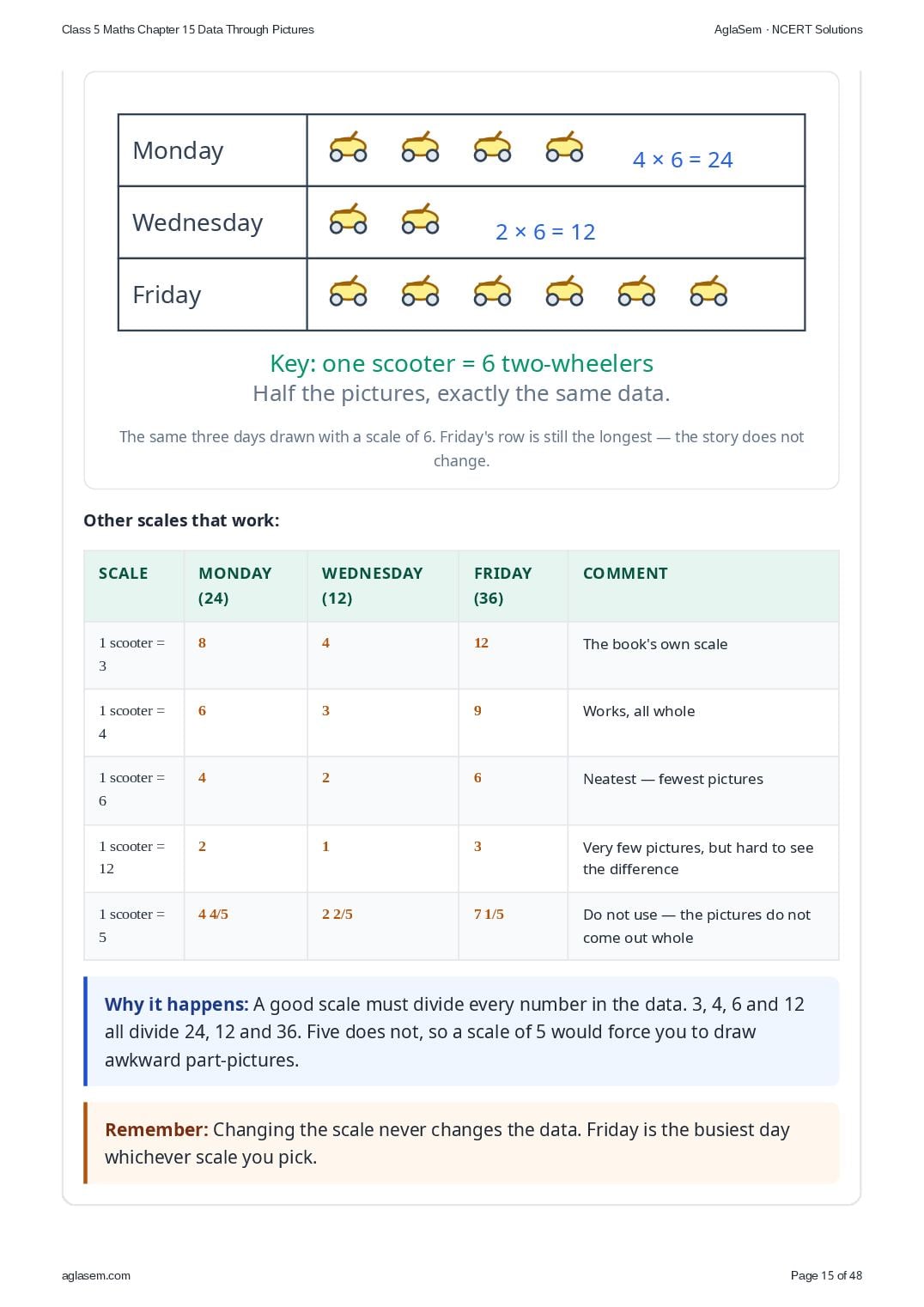
- Choose any other scale and represent the same data using a pictograph in your notebook.
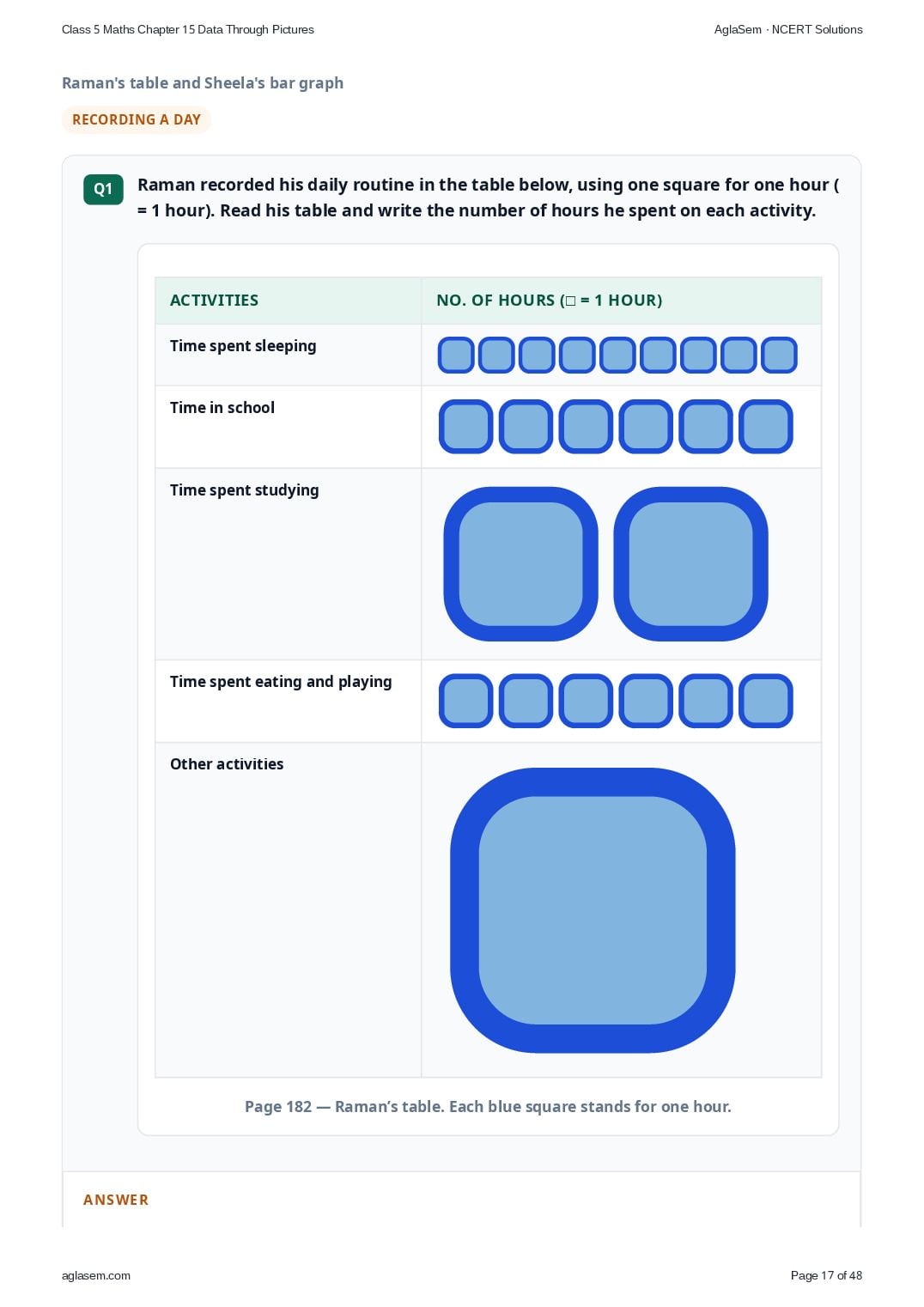
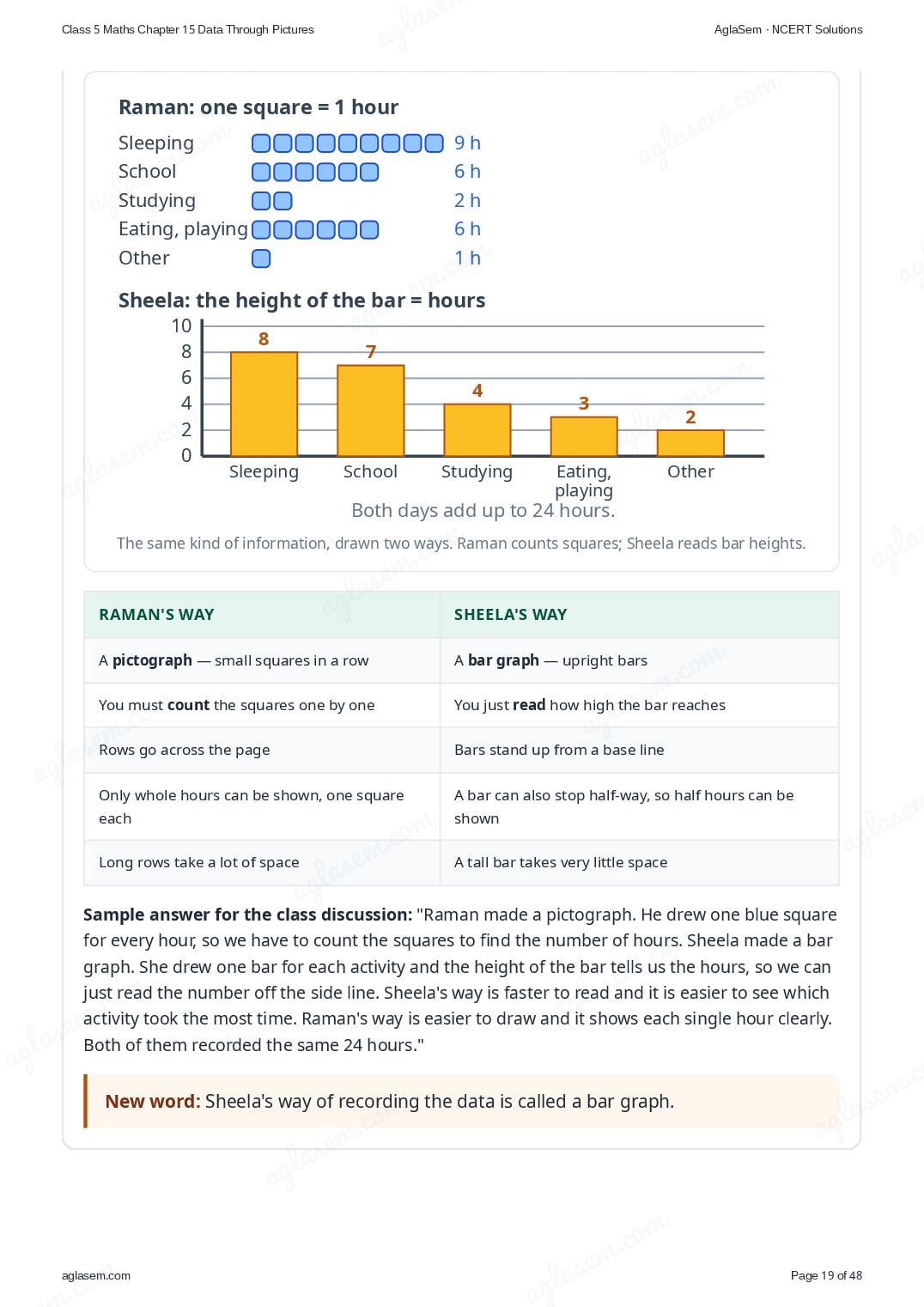
- Raman recorded his daily routine in the table below, using one square for one hour ( = 1 hour). Read his table and write the number of hours he spent on each activity.ActivitiesNo. of Hours (□ = 1 hour)Time spent sleepingTime in schoolTime spent studyingTime spent eating and playingOther activitiesPage 182 — Raman’s table. Each blue square stands for one hour.
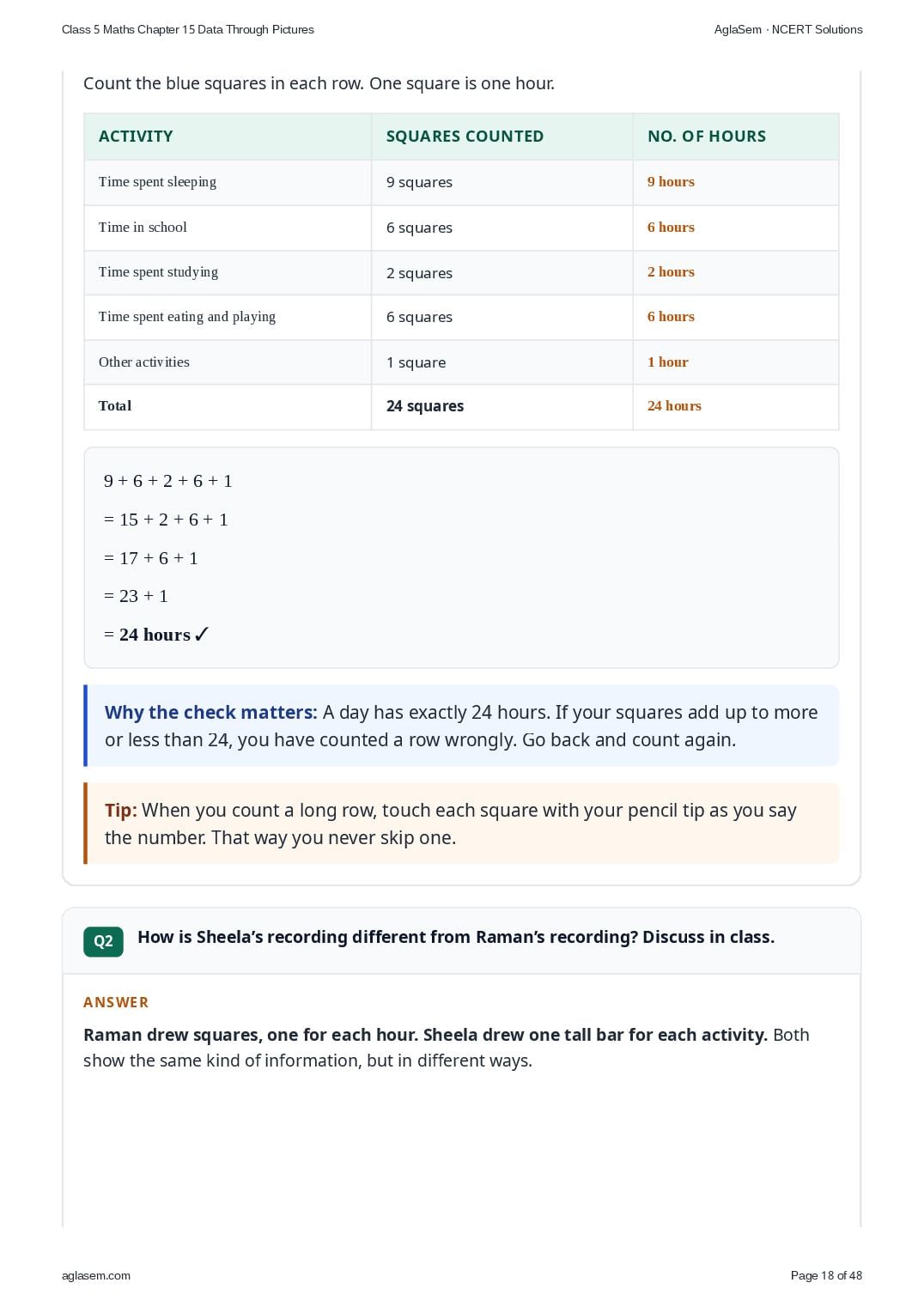
- How is Sheela’s recording different from Raman’s recording? Discuss in class.
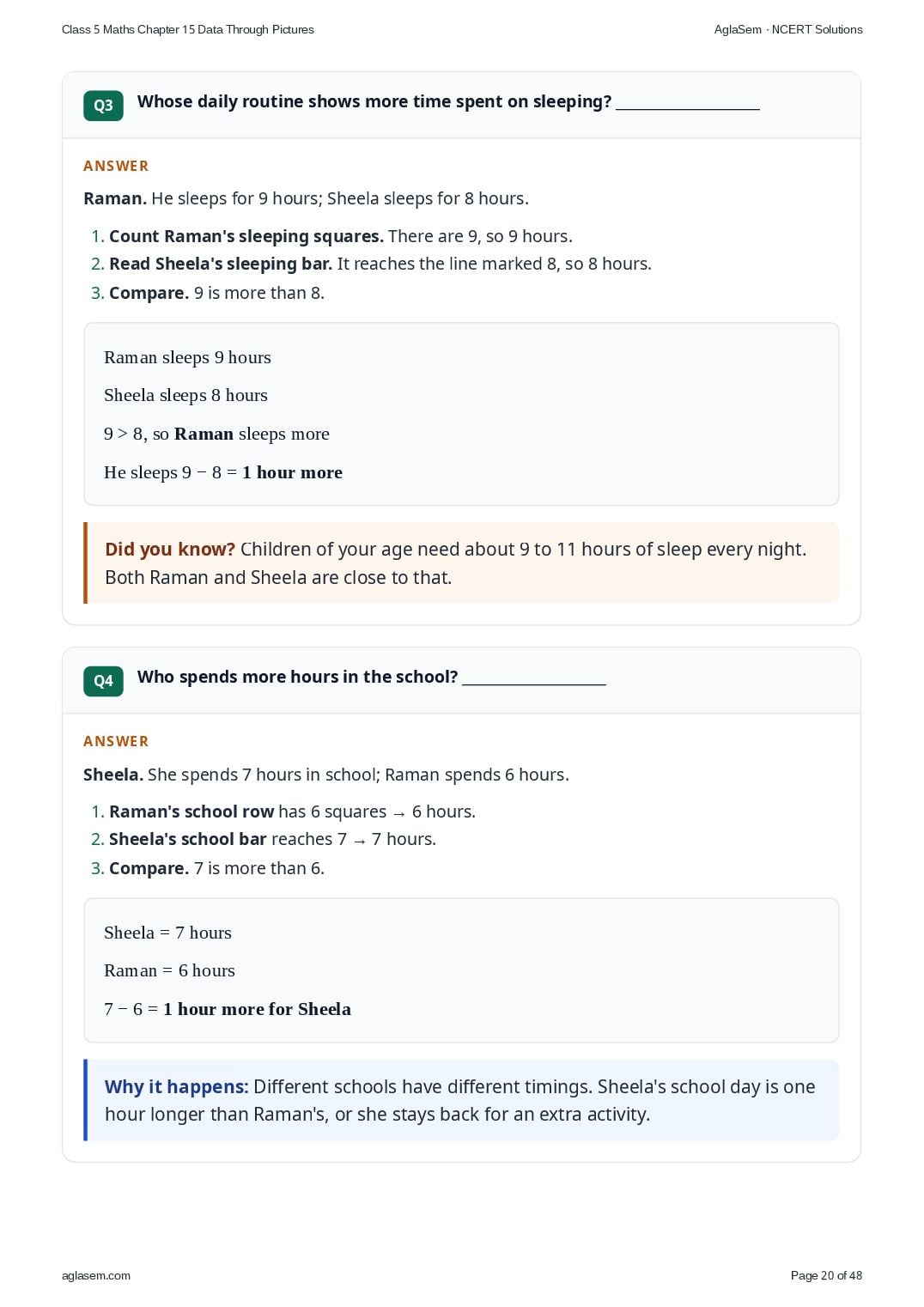
- Whose daily routine shows more time spent on sleeping? _____________________
- Who spends more hours in the school? _____________________
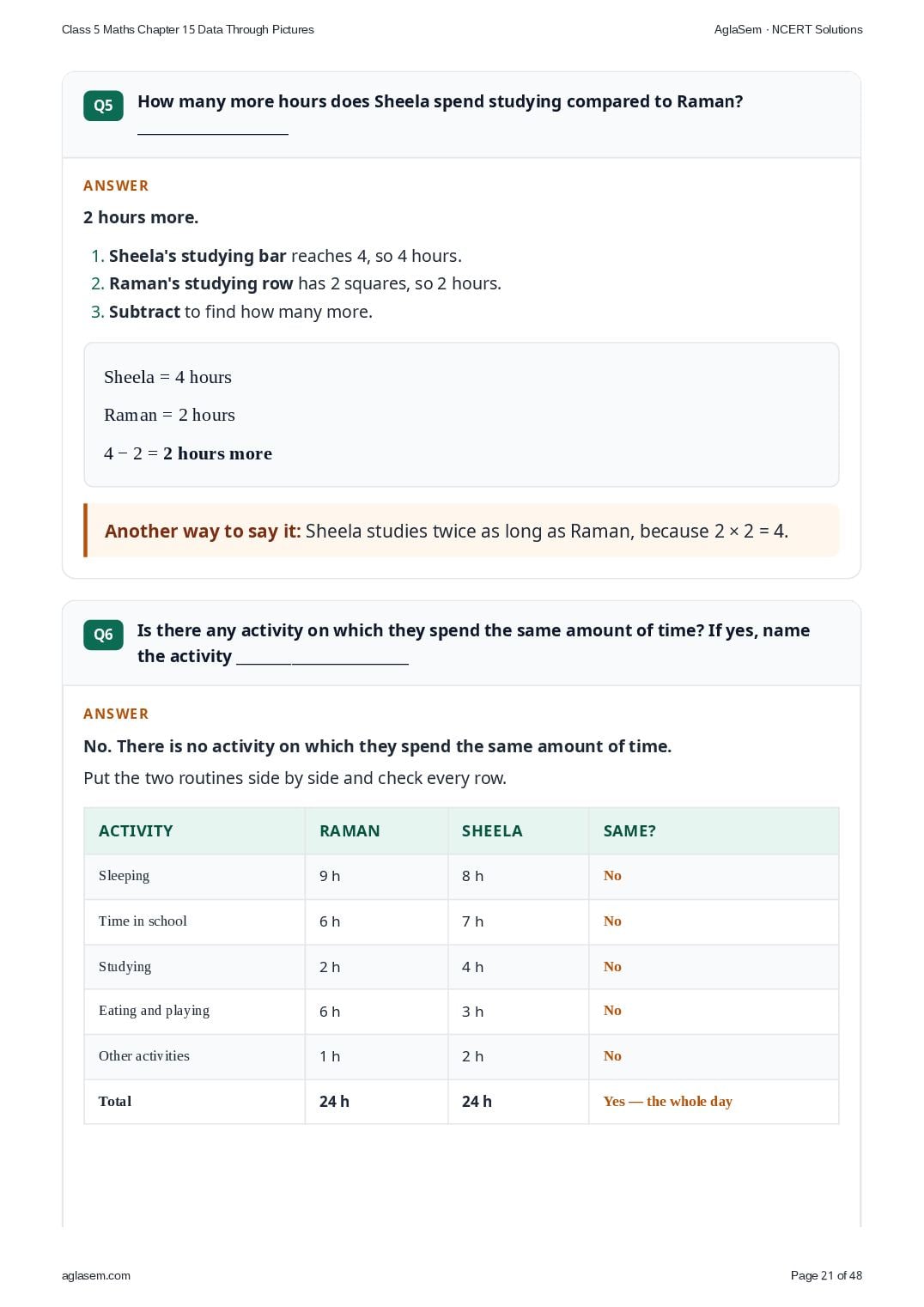
- How many more hours does Sheela spend studying compared to Raman? ______________________
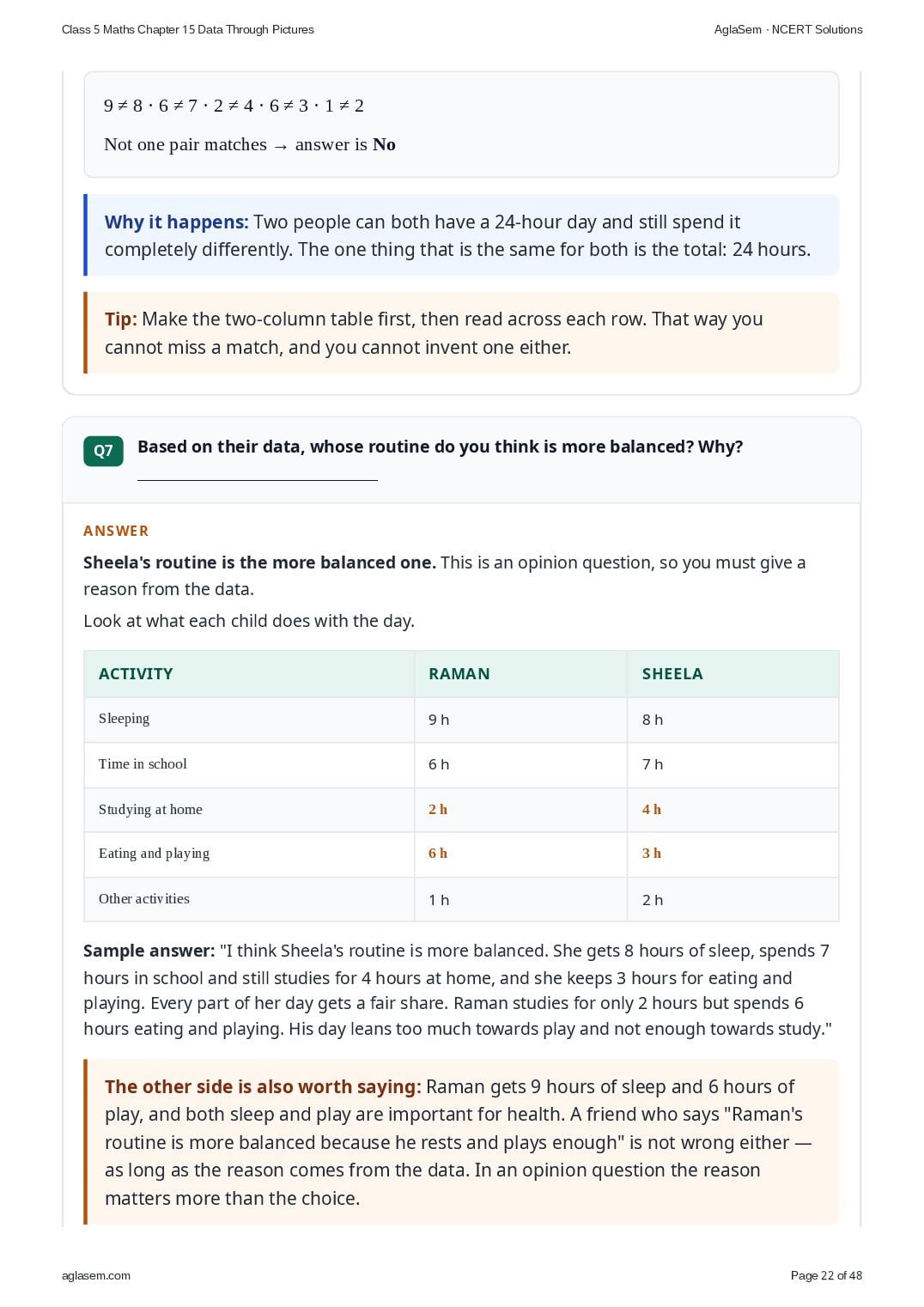
- Is there any activity on which they spend the same amount of time? If yes, name the activity _________________________
- Based on their data, whose routine do you think is more balanced? Why? ___________________________________
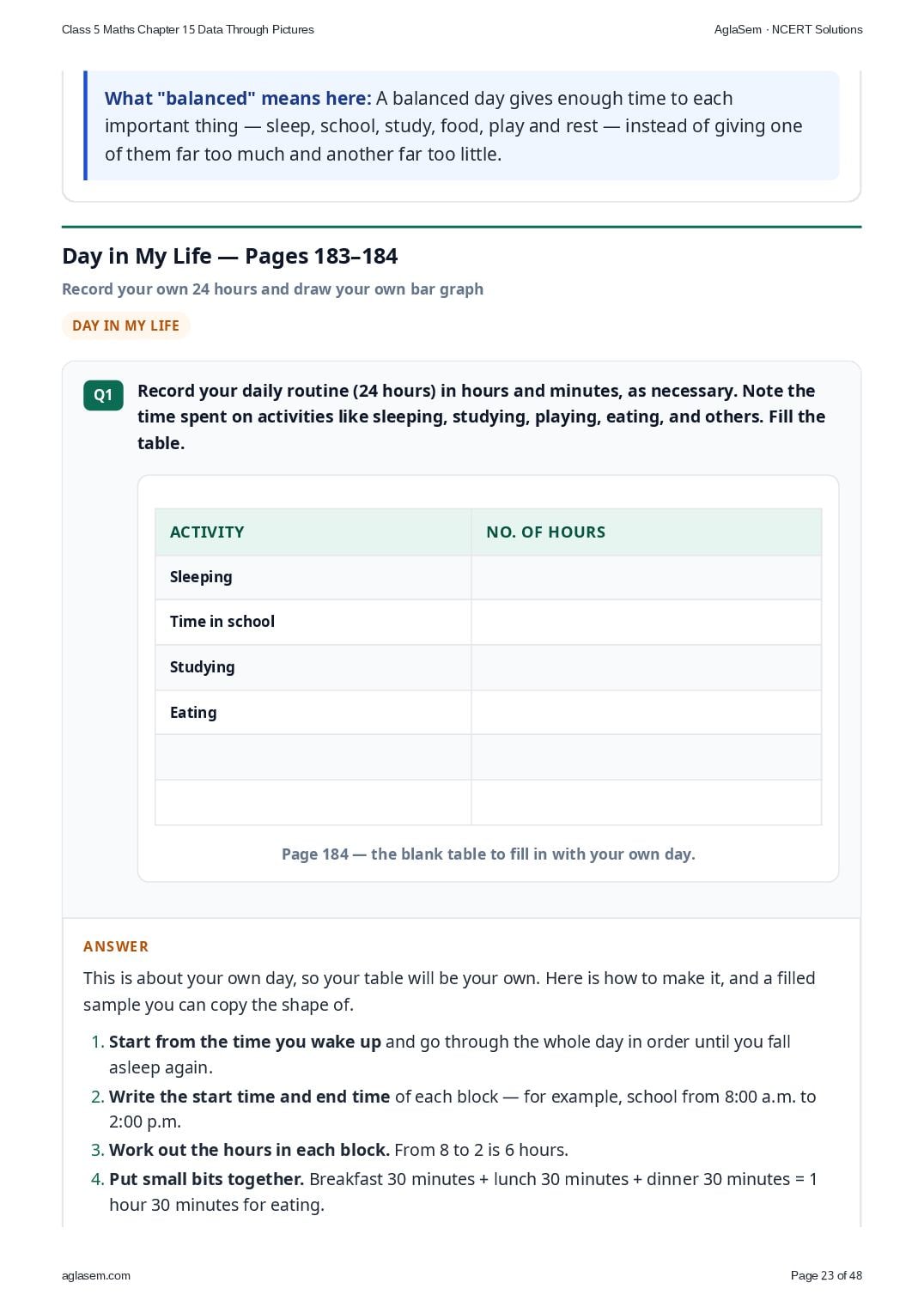
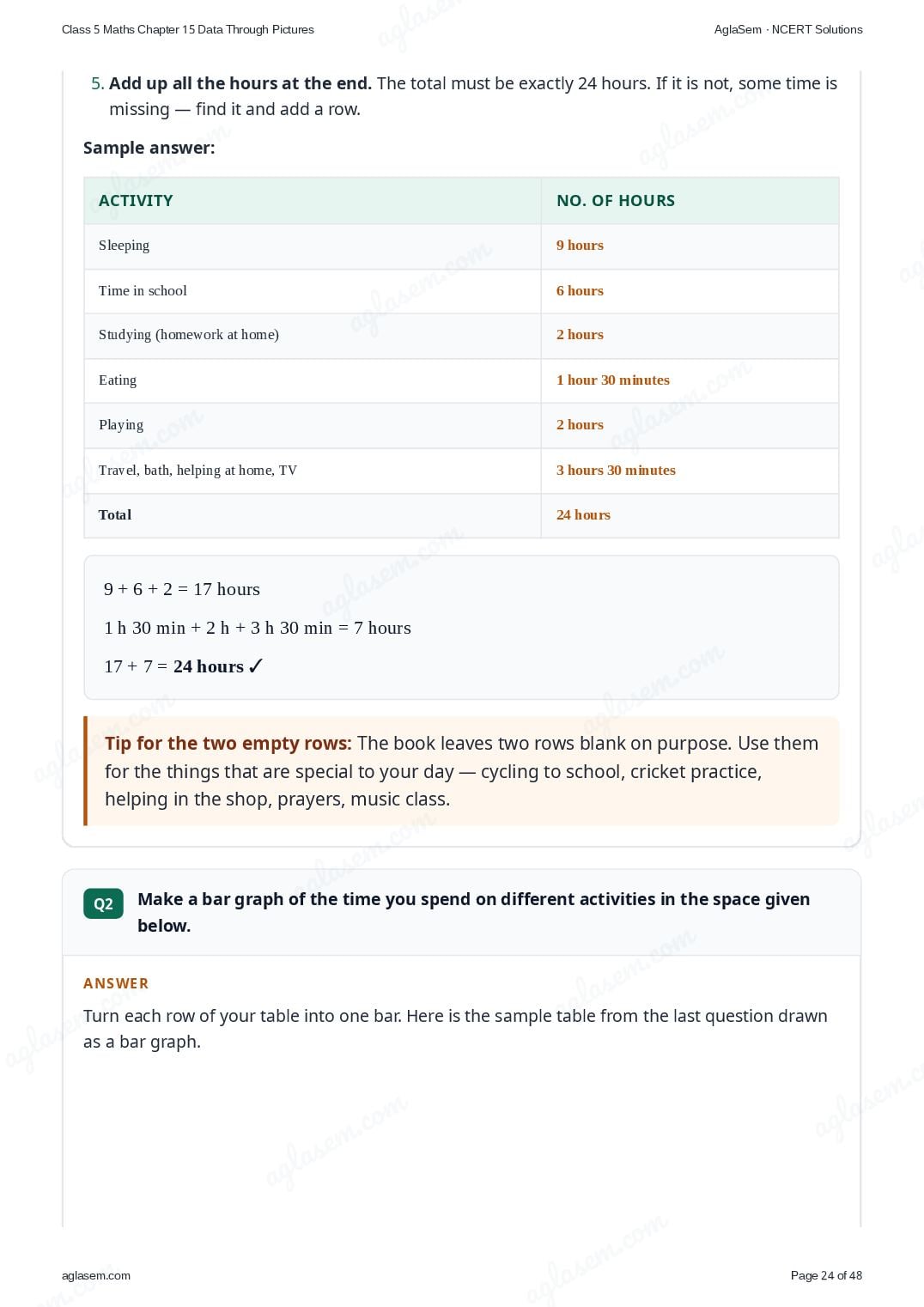
- Record your daily routine (24 hours) in hours and minutes, as necessary. Note the time spent on activities like sleeping, studying, playing, eating, and others. Fill the table.ActivityNo. of HoursSleepingTime in schoolStudyingEating Page 184 — the blank table to fill in with your own day.
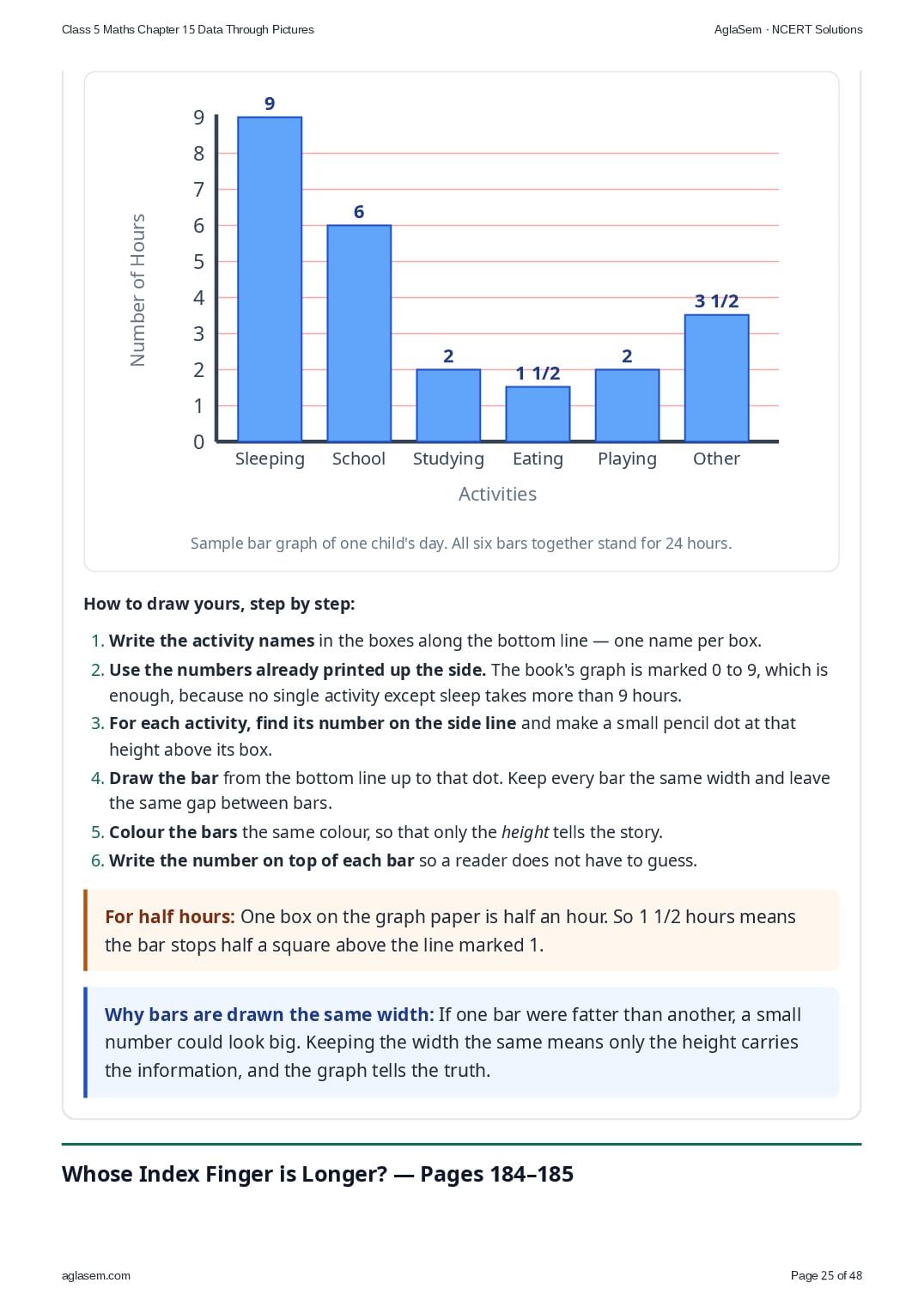
- Make a bar graph of the time you spend on different activities in the space given below.
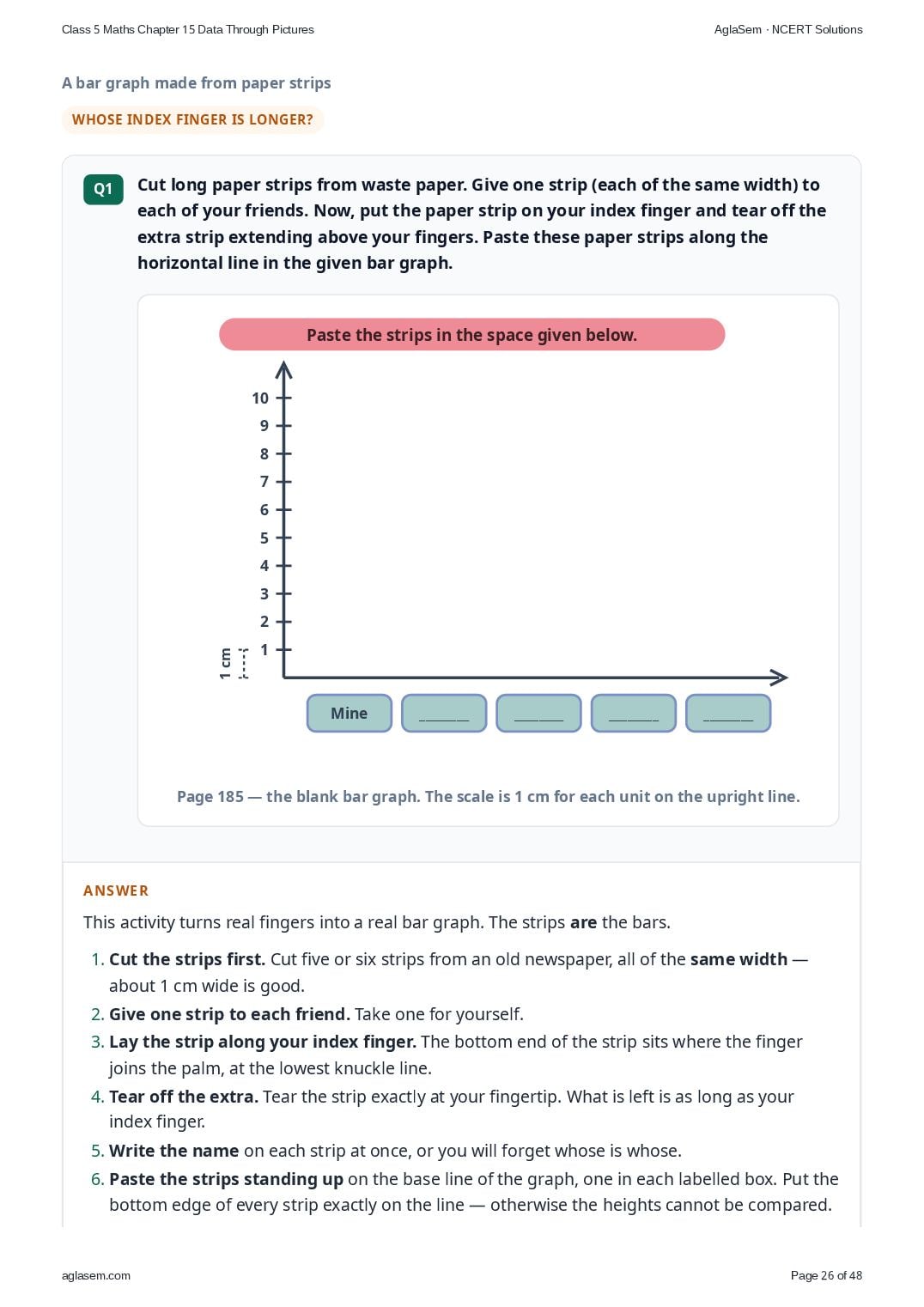
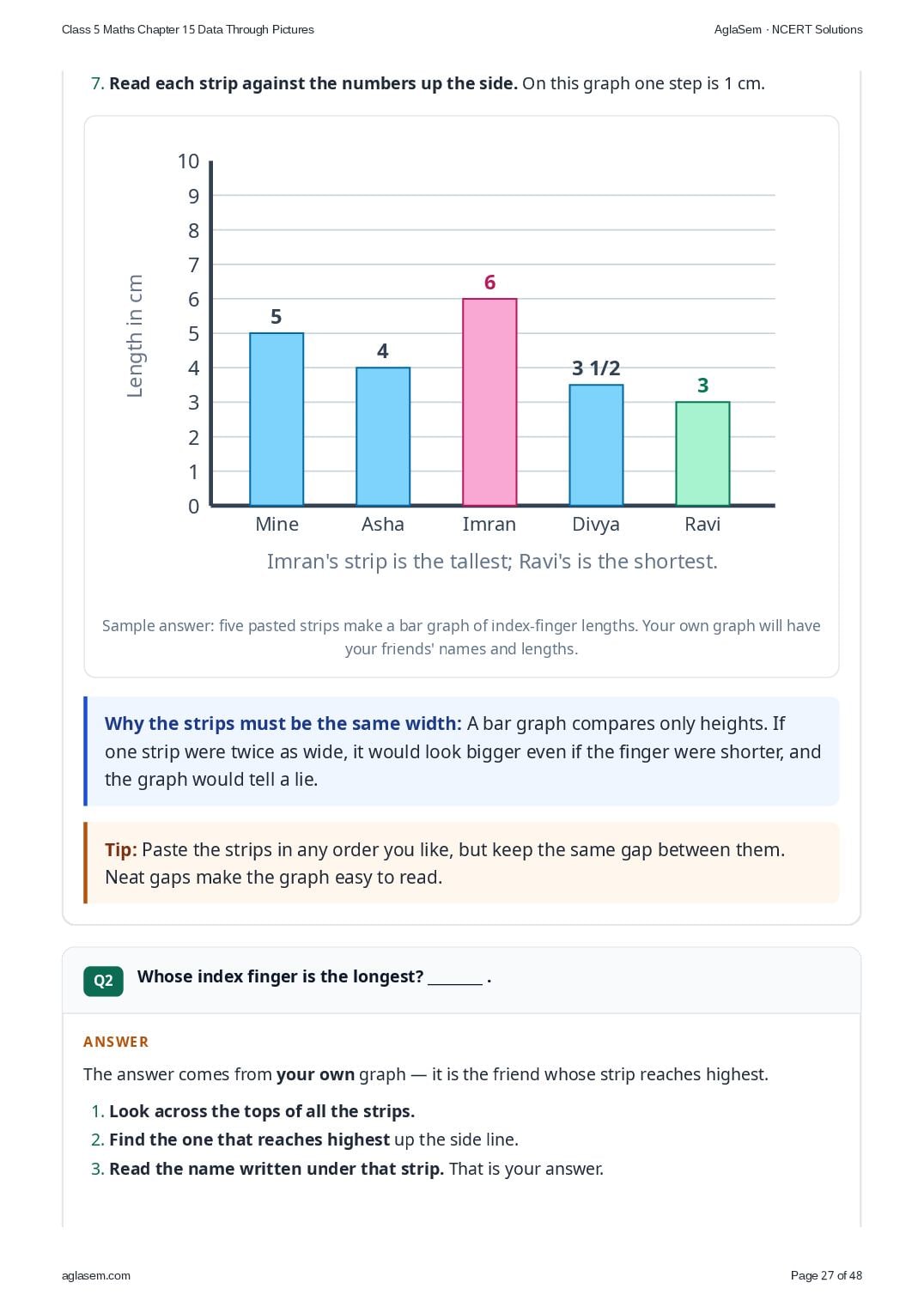
- Cut long paper strips from waste paper. Give one strip (each of the same width) to each of your friends. Now, put the paper strip on your index finger and tear off the extra strip extending above your fingers. Paste these paper strips along the horizontal line in the given bar graph.Paste the strips in the space given below.123456789101 cmMine________________________________Page 185 — the blank bar graph. The scale is 1 cm for each unit on the upright line.
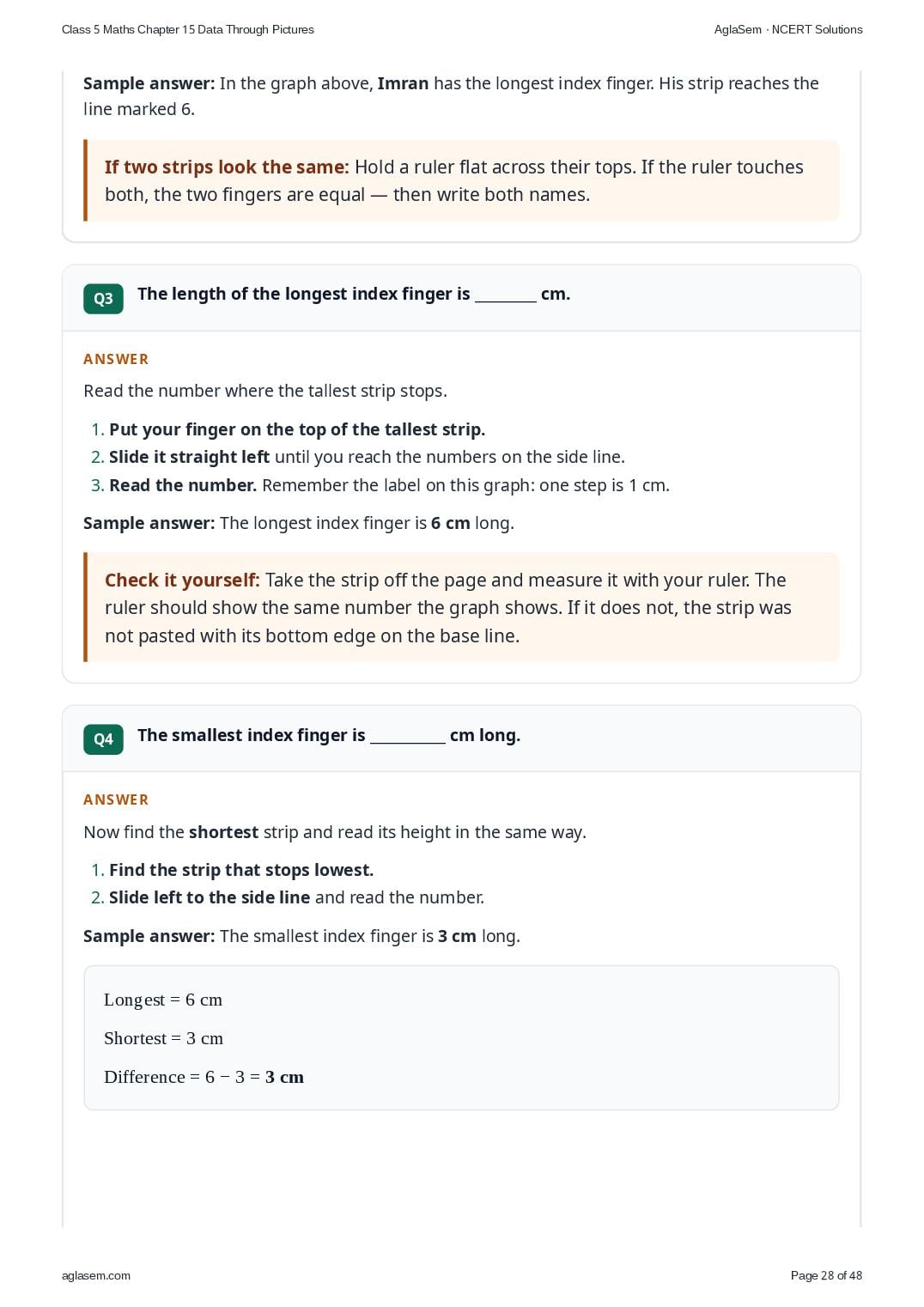
- Whose index finger is the longest? ________ .
- The length of the longest index finger is _________ cm.
- The smallest index finger is ___________ cm long.
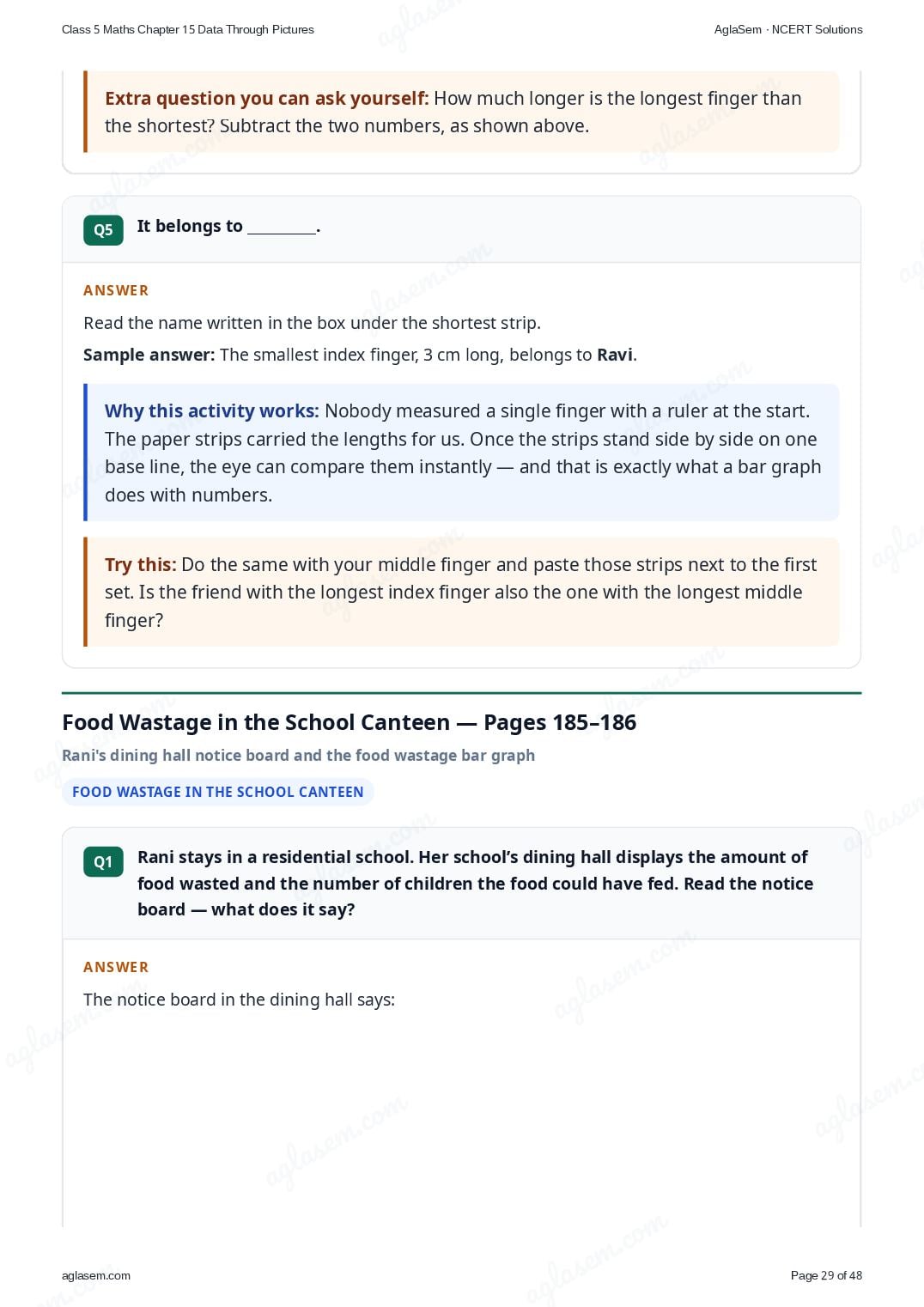
- It belongs to __________.
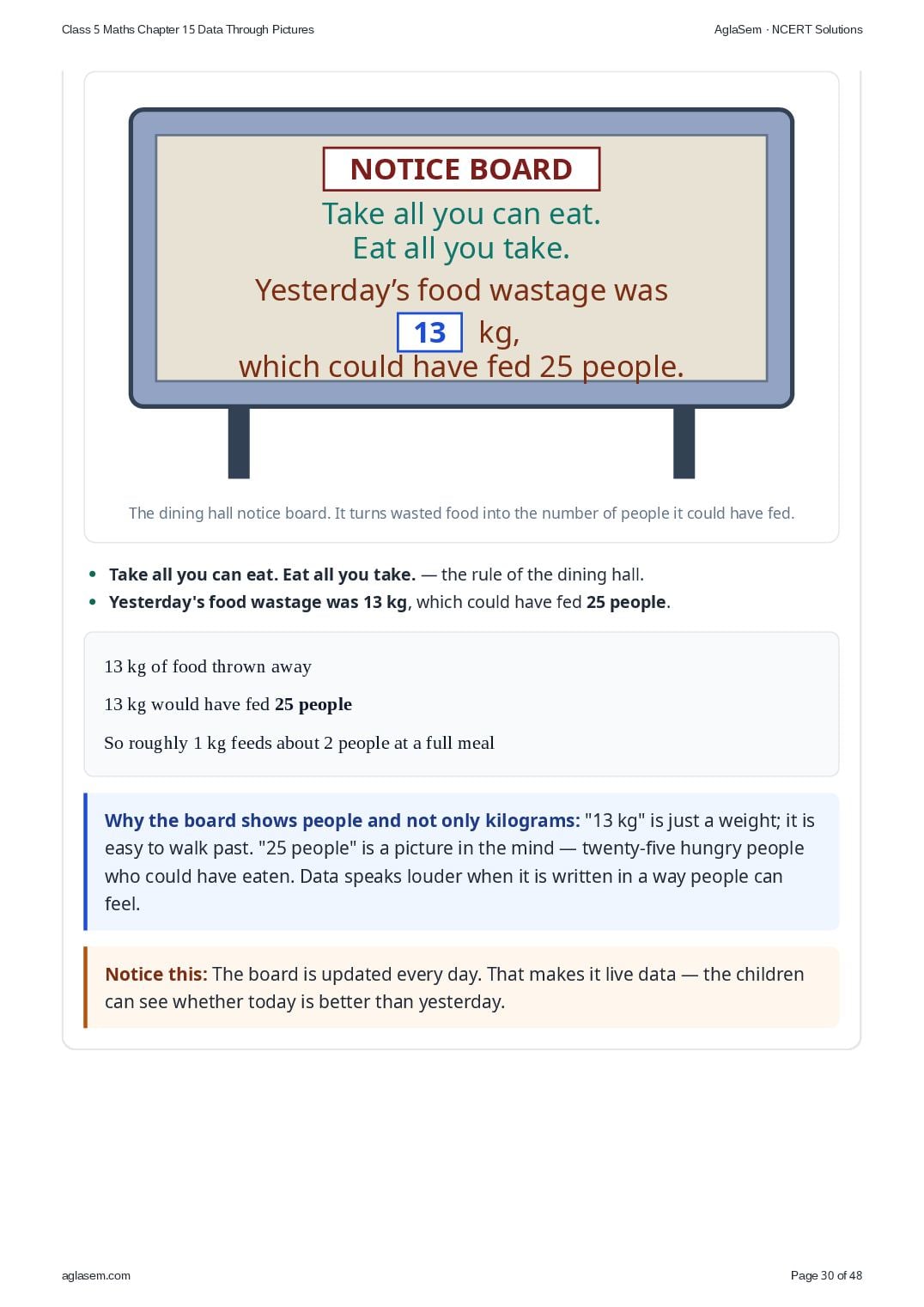
- Rani stays in a residential school. Her school’s dining hall displays the amount of food wasted and the number of children the food could have fed. Read the notice board — what does it say?
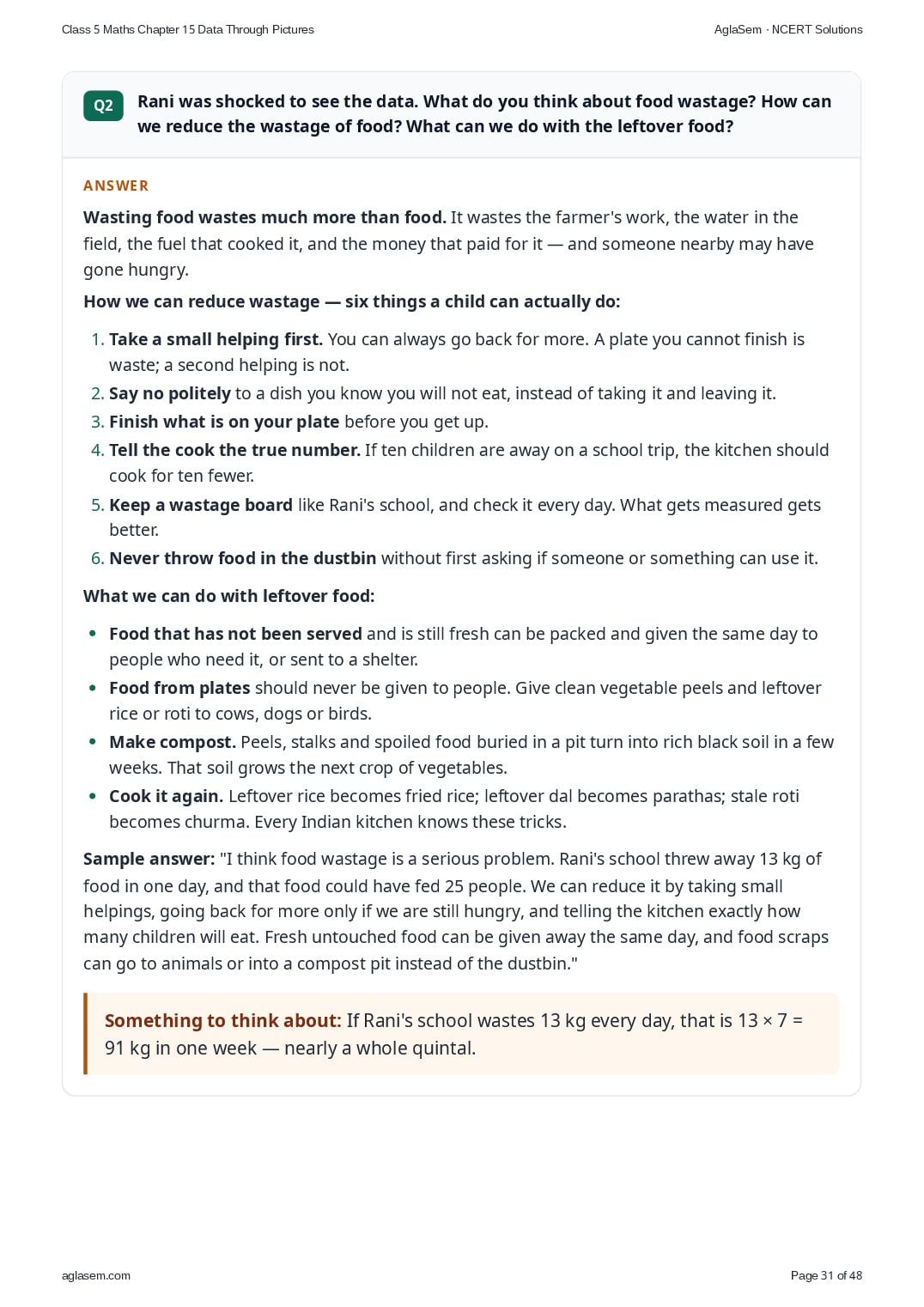
- Rani was shocked to see the data. What do you think about food wastage? How can we reduce the wastage of food? What can we do with the leftover food?
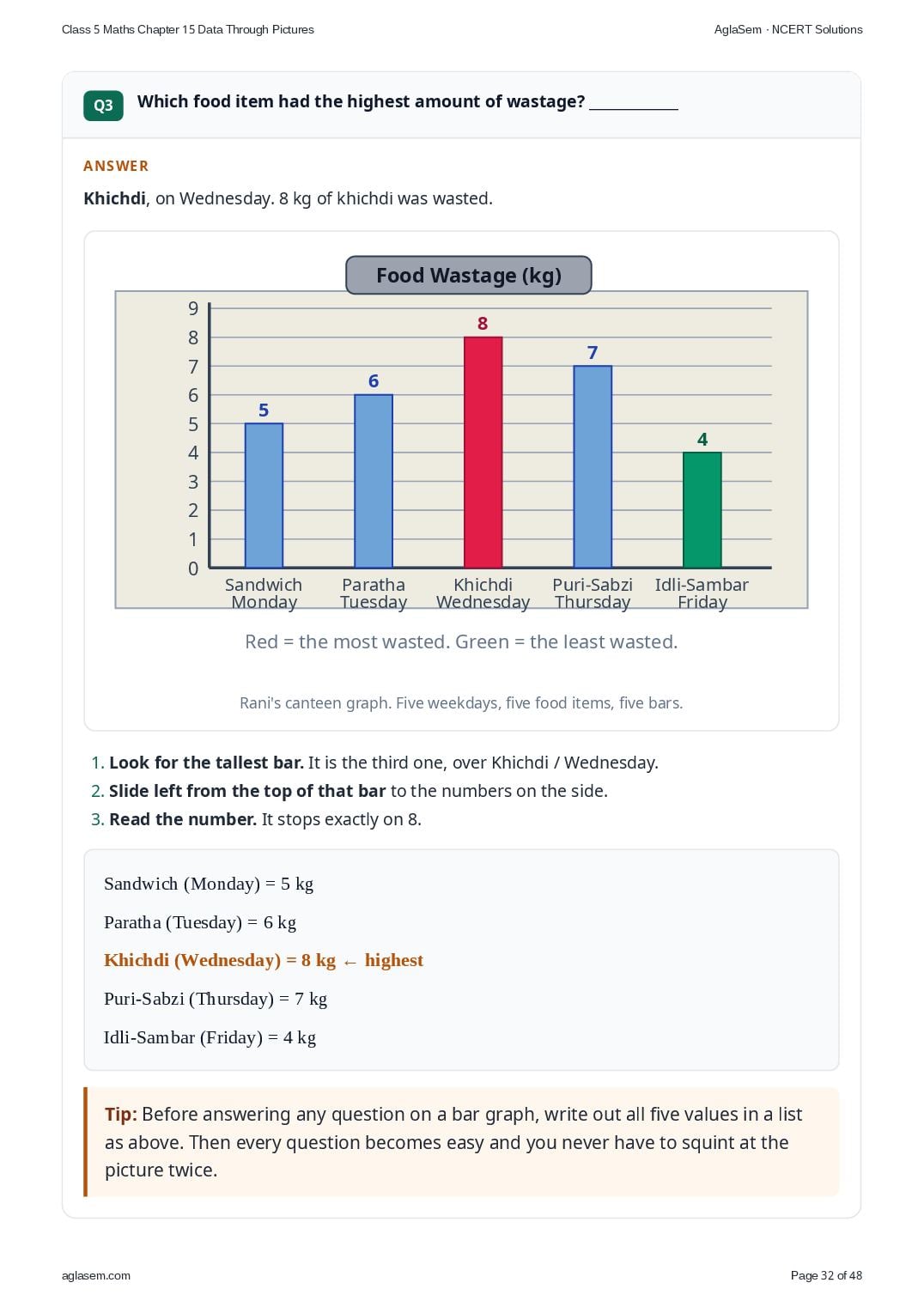
- Which food item had the highest amount of wastage? _____________
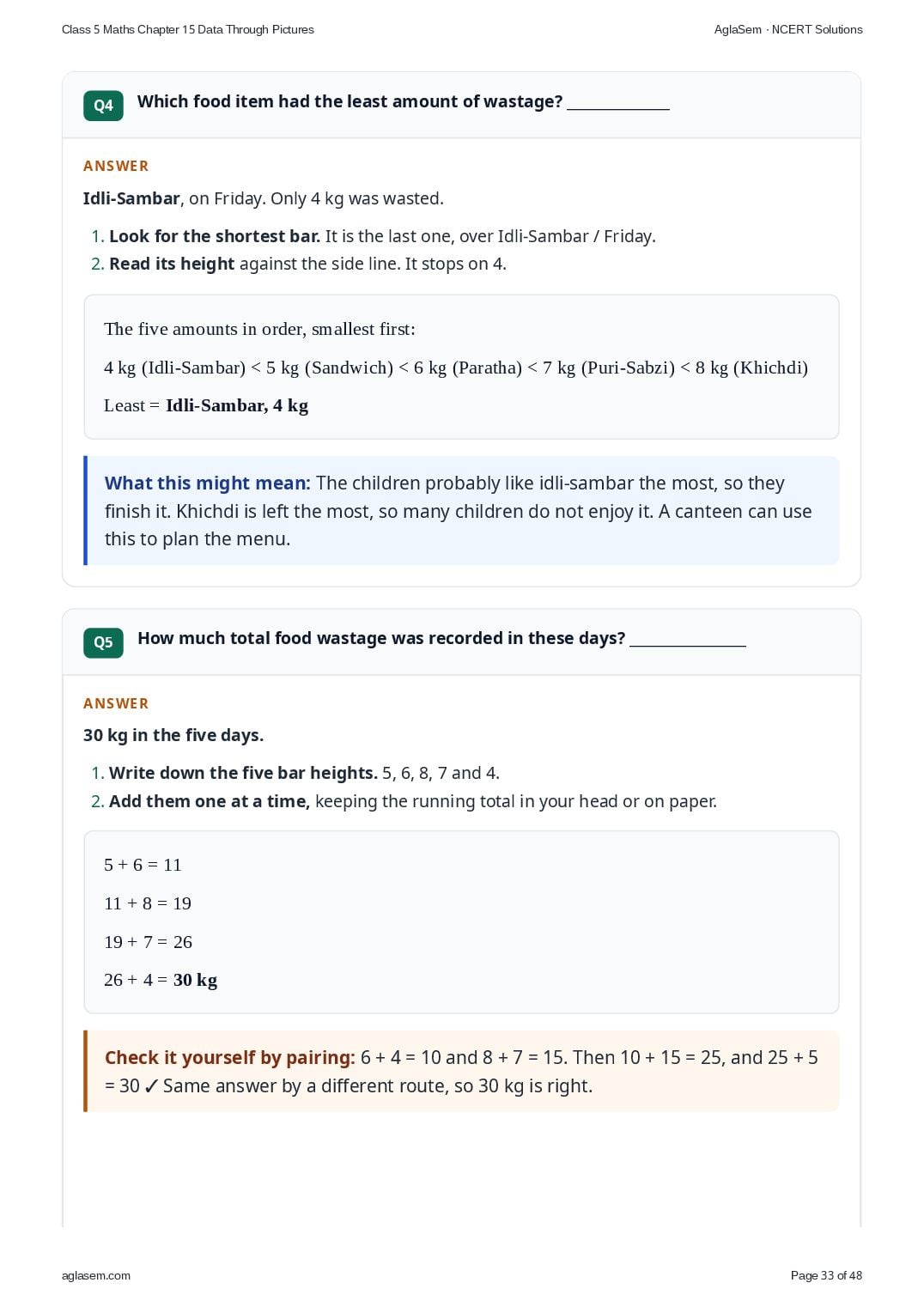
- Which food item had the least amount of wastage? _______________
- How much total food wastage was recorded in these days? _________________
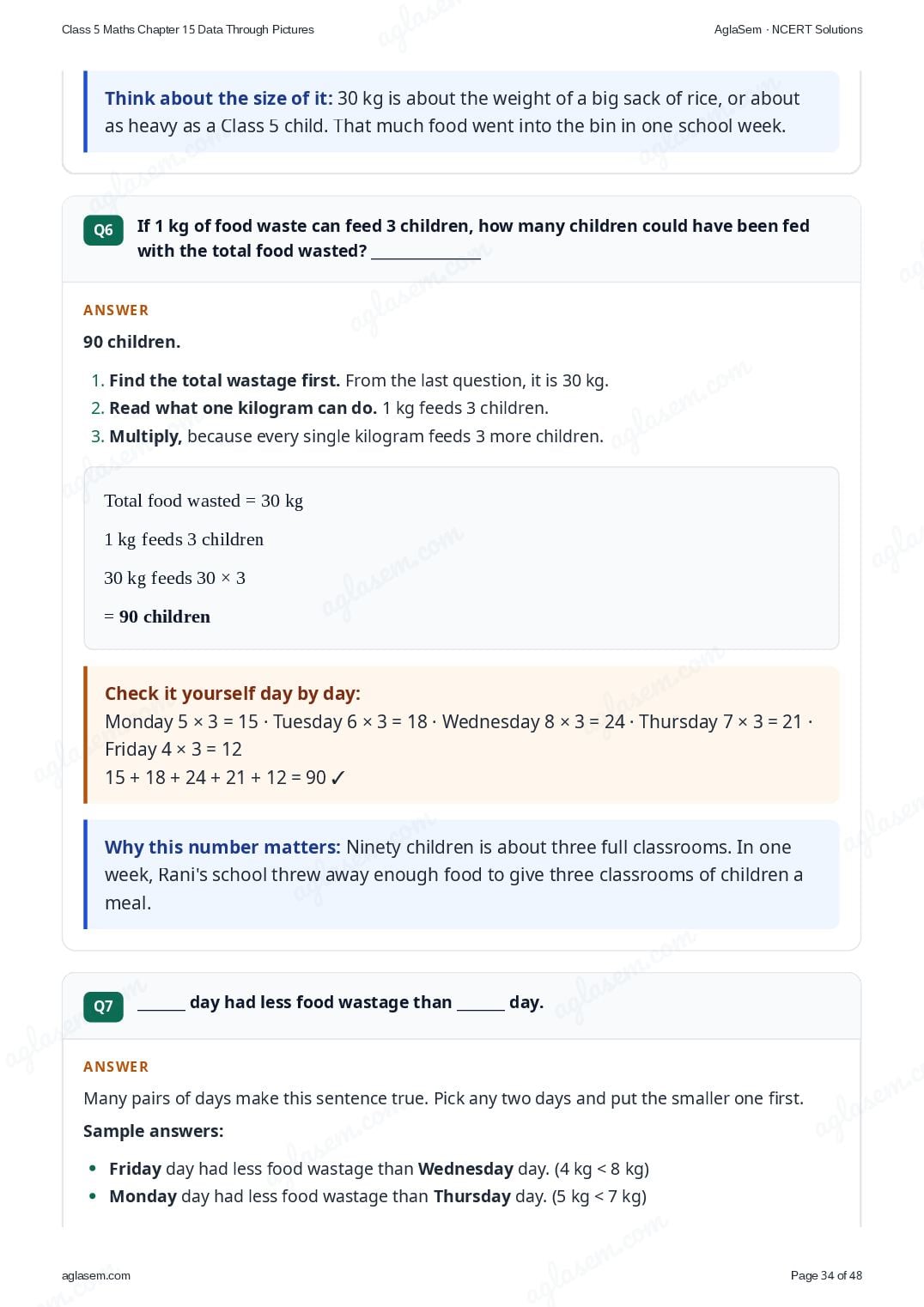
- If 1 kg of food waste can feed 3 children, how many children could have been fed with the total food wasted? ________________
- _______ day had less food wastage than _______ day.
- If the same food items are to be repeated next week, can you predict which food item is likely to be wasted the most?
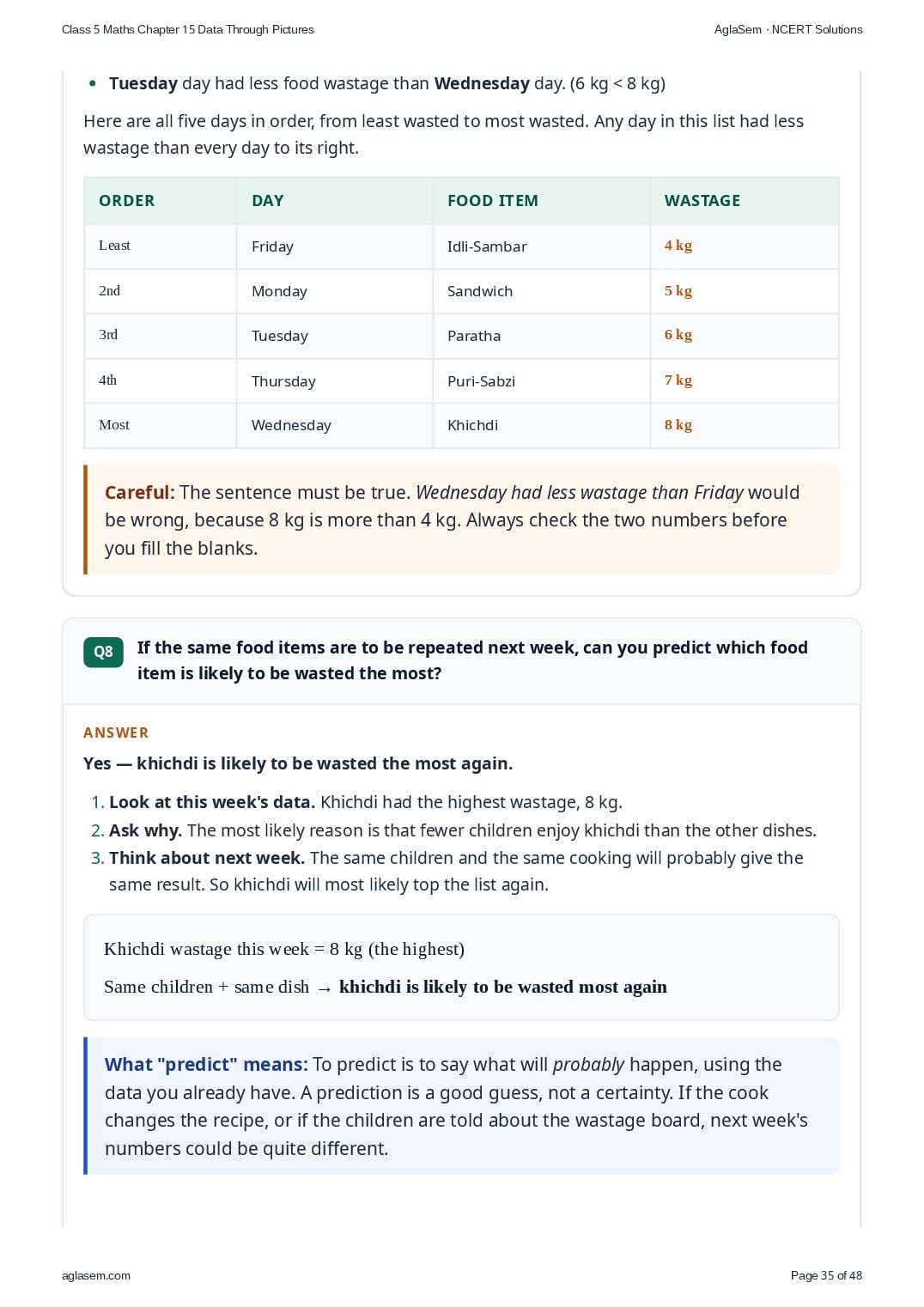
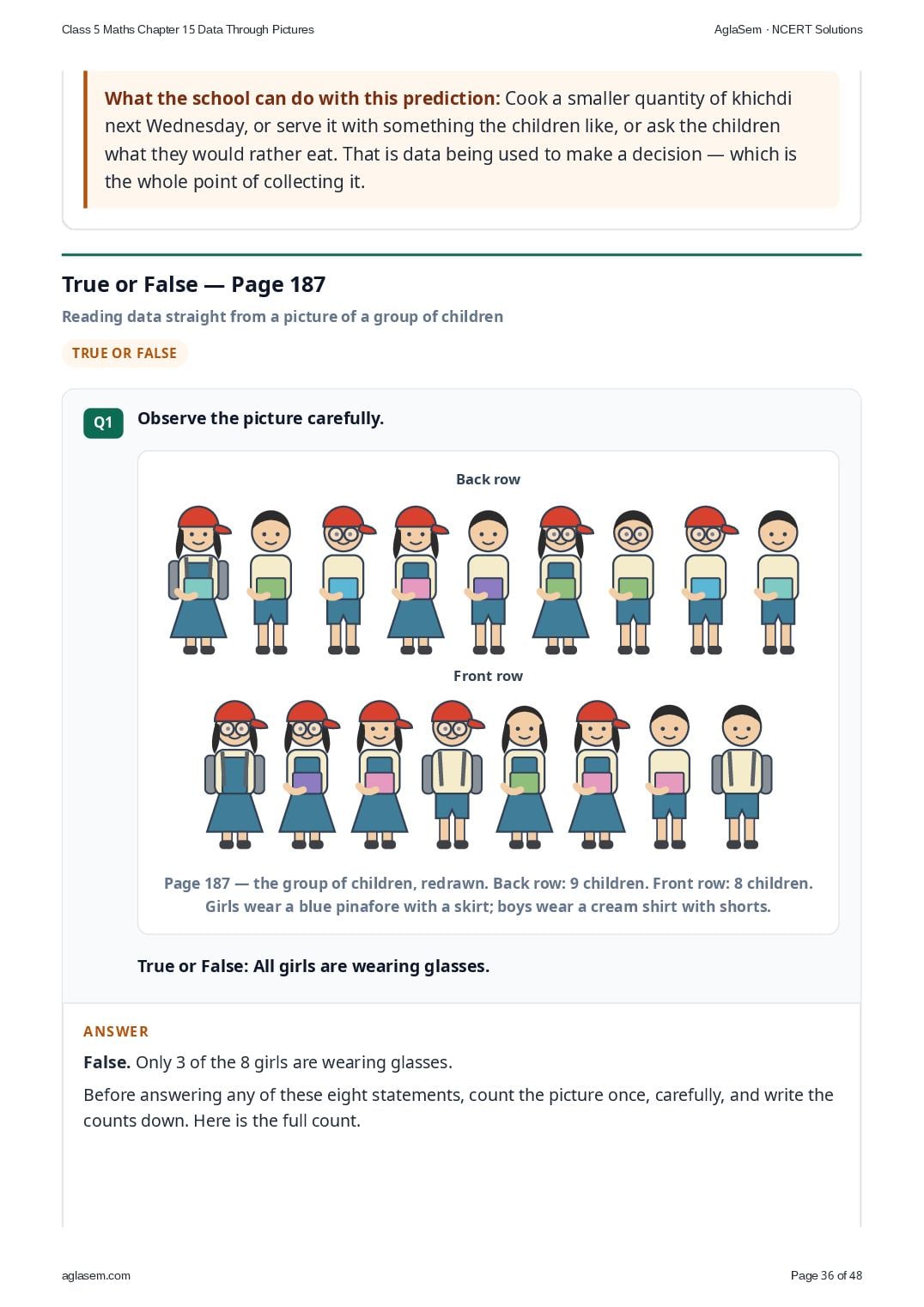
- Observe the picture carefully.Back rowFront rowPage 187 — the group of children, redrawn. Back row: 9 children. Front row: 8 children. Girls wear a blue pinafore with a skirt; boys wear a cream shirt with shorts.True or False: All girls are wearing glasses.
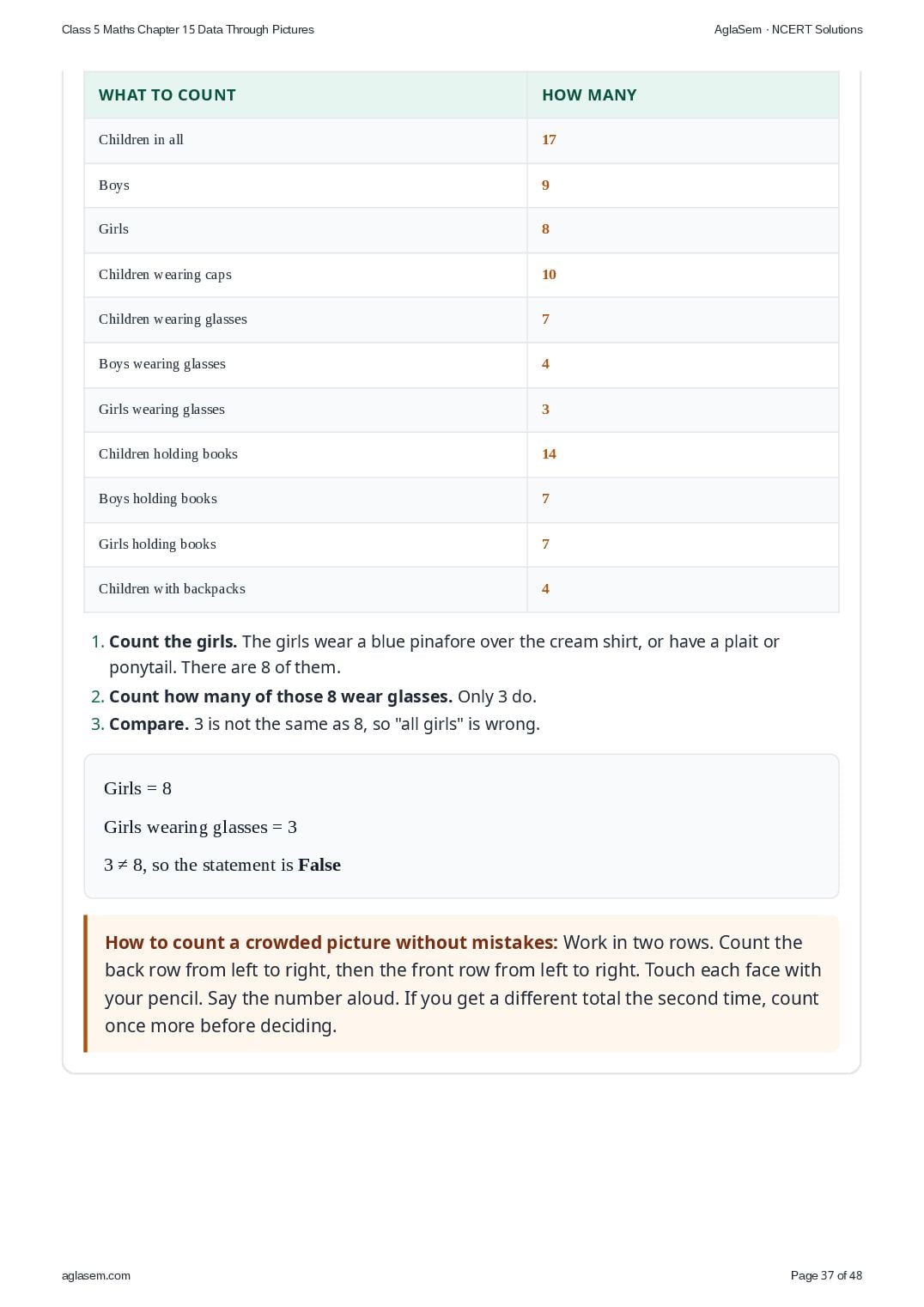
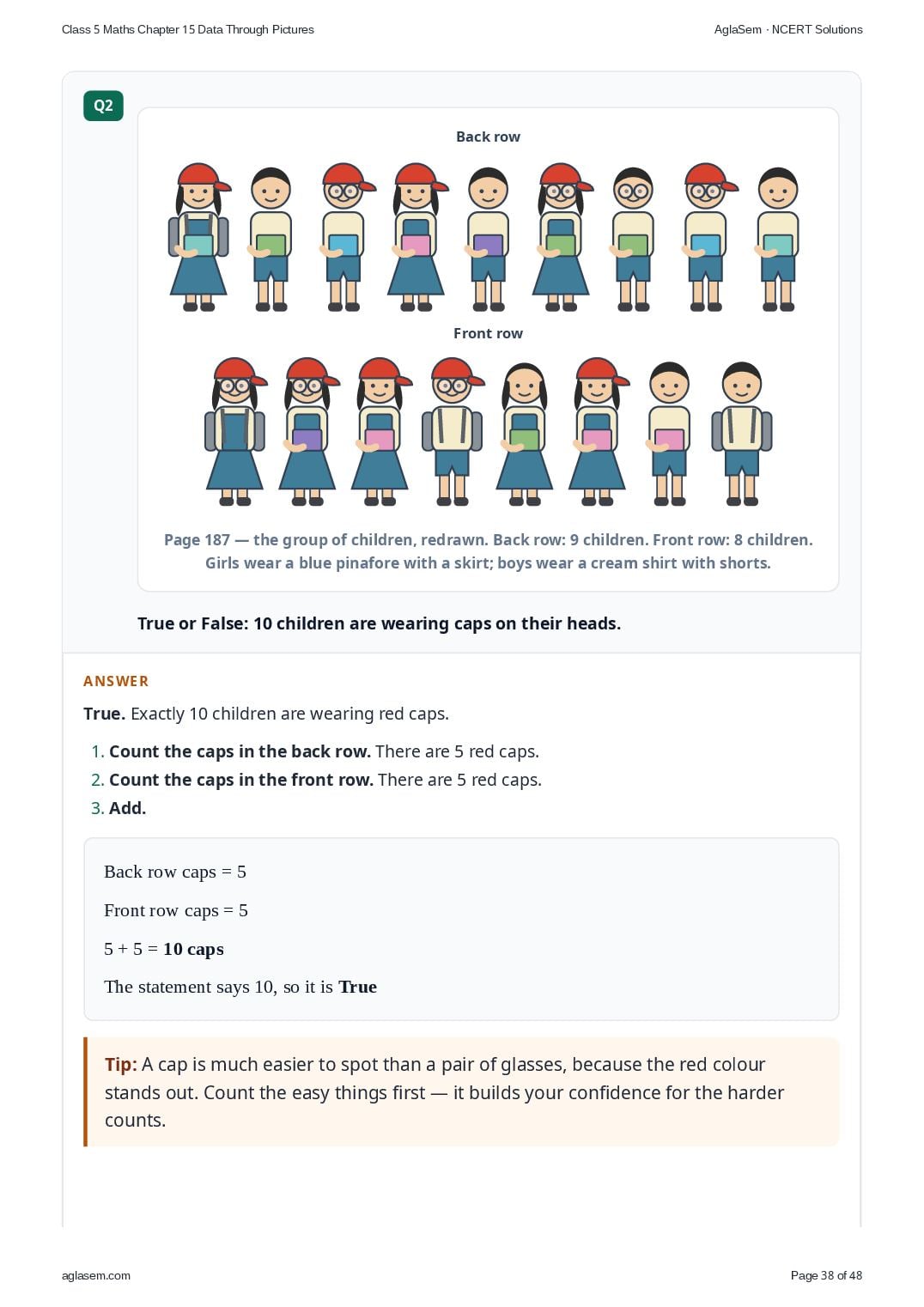
- Back rowFront rowPage 187 — the group of children, redrawn. Back row: 9 children. Front row: 8 children. Girls wear a blue pinafore with a skirt; boys wear a cream shirt with shorts.True or False: 10 children are wearing caps on their heads.
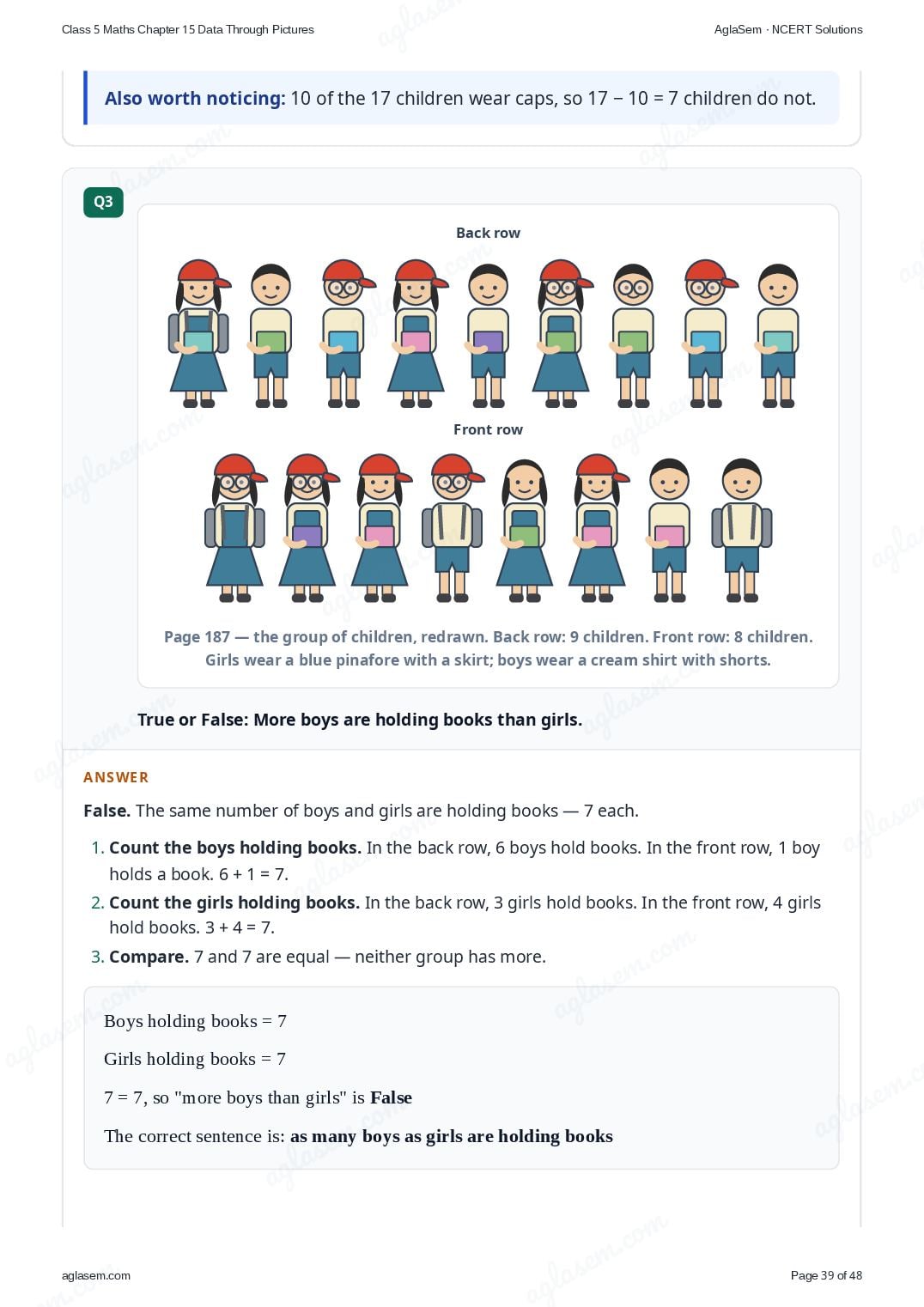
- Back rowFront rowPage 187 — the group of children, redrawn. Back row: 9 children. Front row: 8 children. Girls wear a blue pinafore with a skirt; boys wear a cream shirt with shorts.True or False: More boys are holding books than girls.
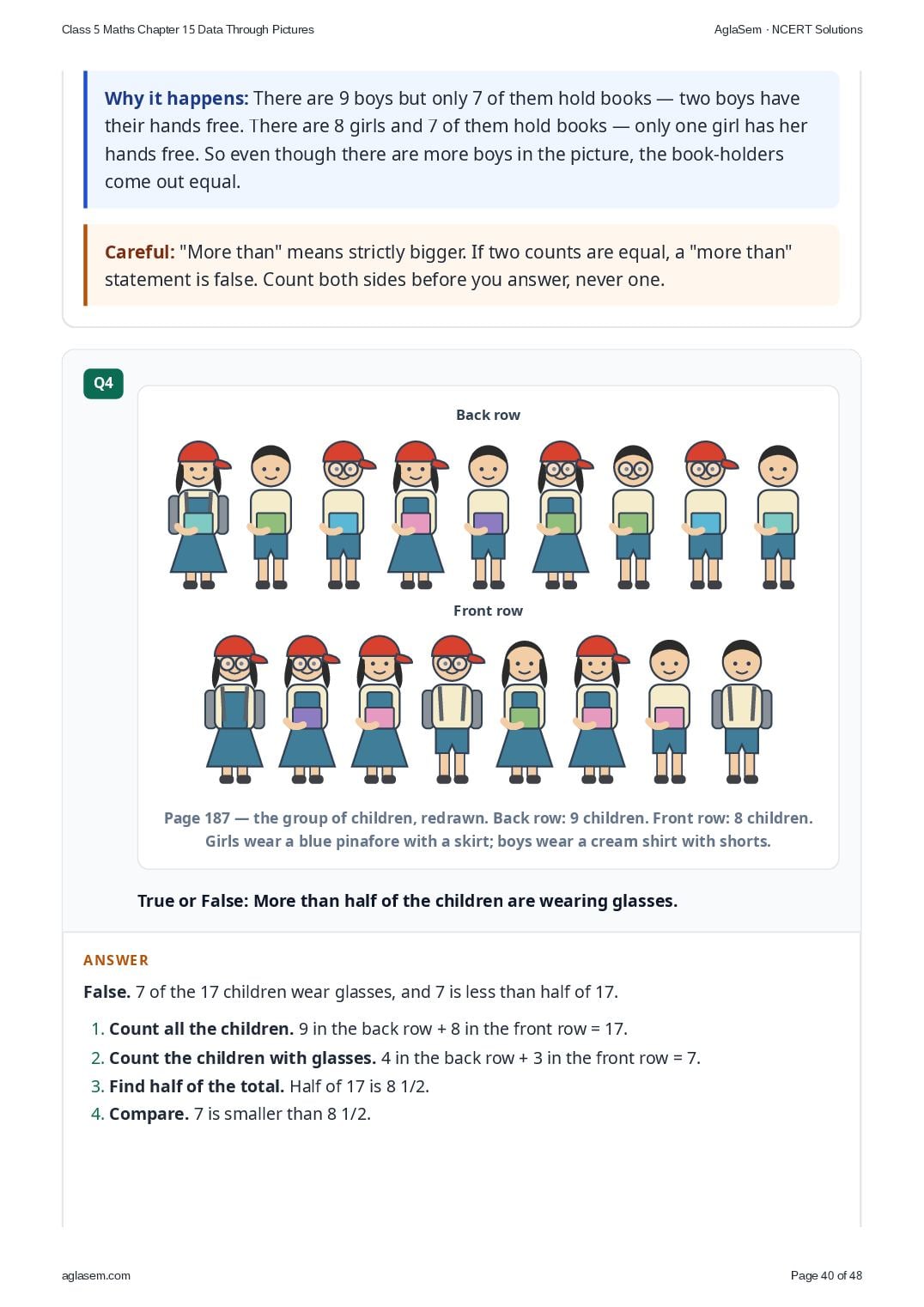
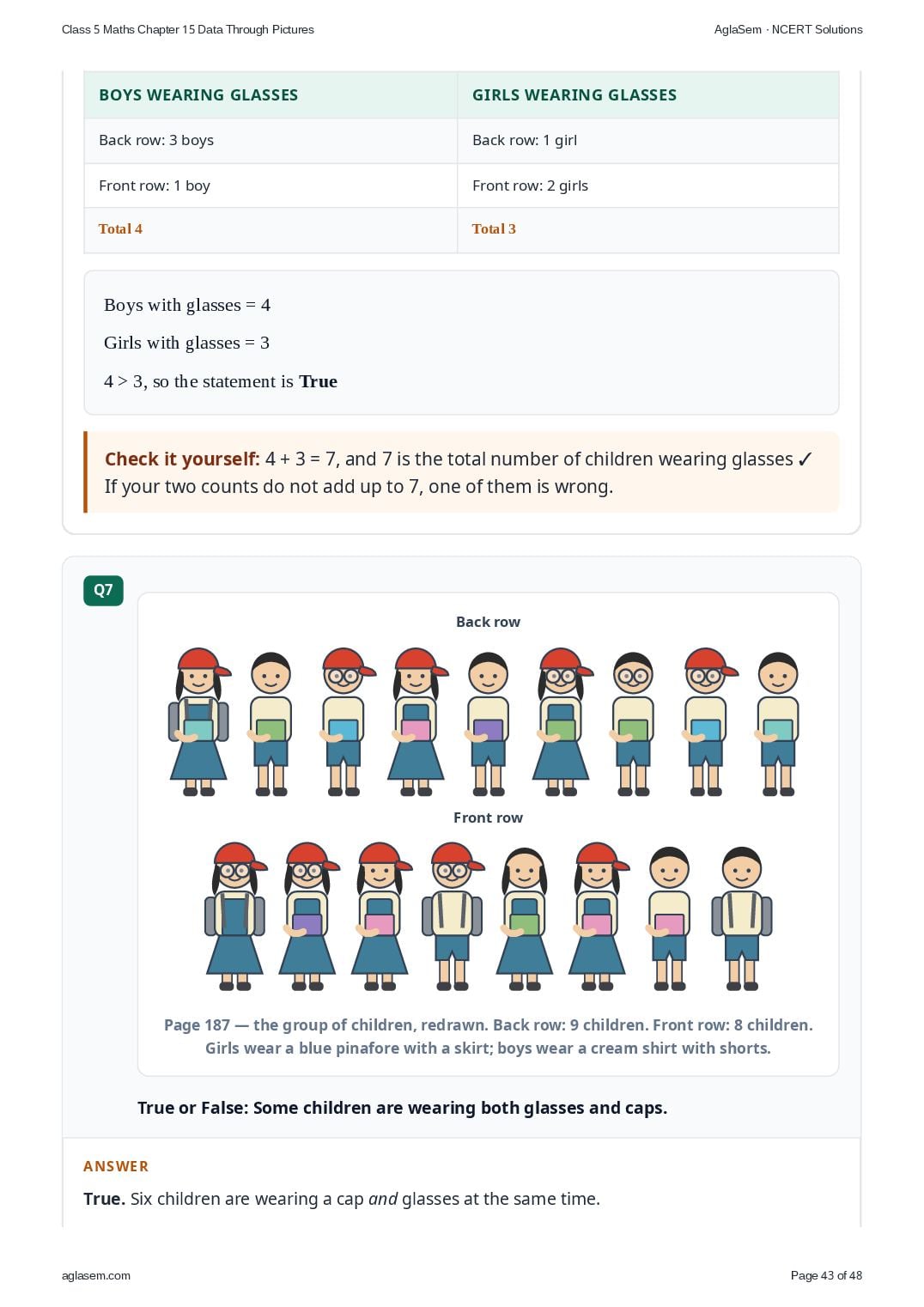
- Back rowFront rowPage 187 — the group of children, redrawn. Back row: 9 children. Front row: 8 children. Girls wear a blue pinafore with a skirt; boys wear a cream shirt with shorts.True or False: More than half of the children are wearing glasses.
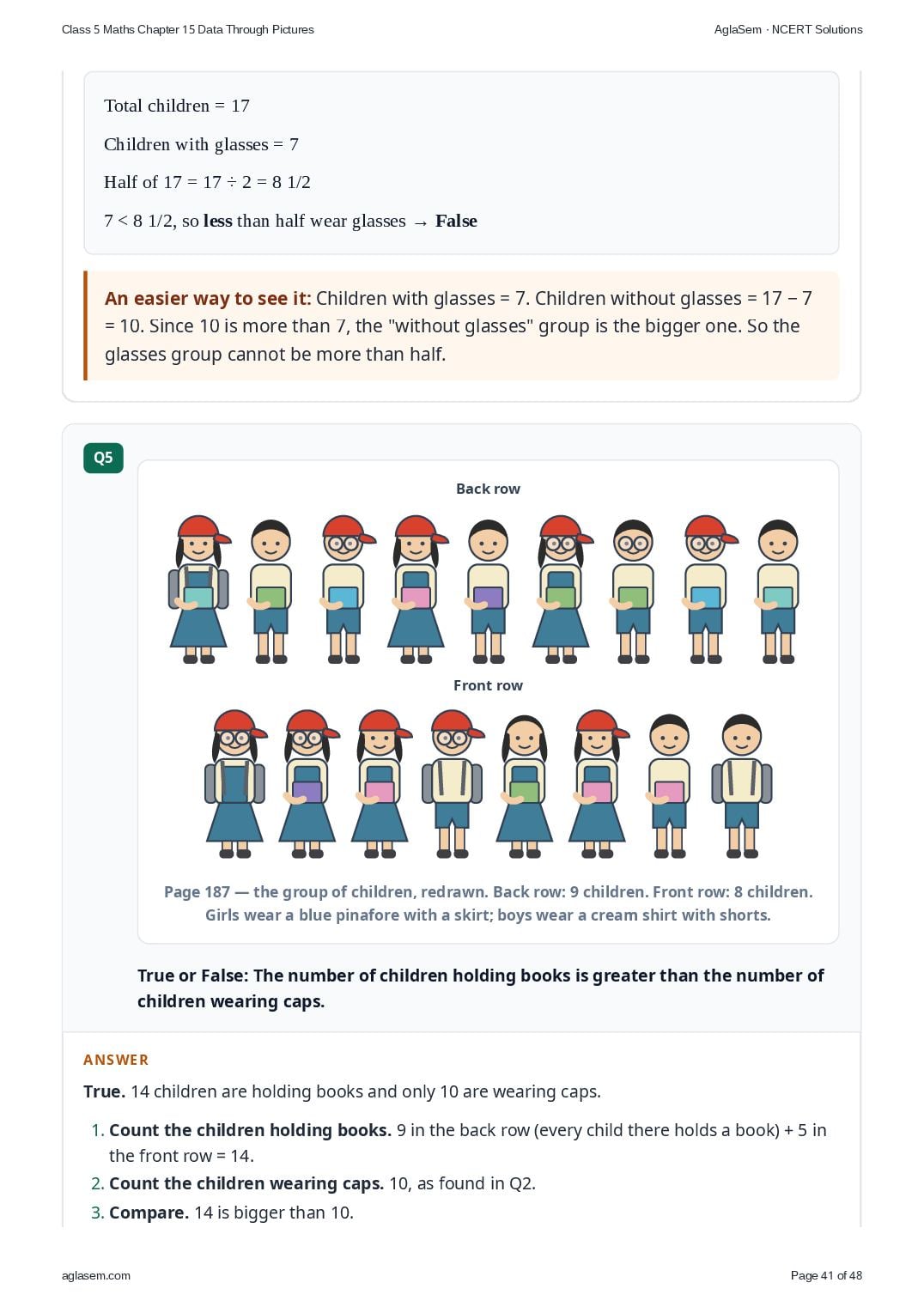
- Back rowFront rowPage 187 — the group of children, redrawn. Back row: 9 children. Front row: 8 children. Girls wear a blue pinafore with a skirt; boys wear a cream shirt with shorts.True or False: The number of children holding books is greater than the number of children wearing caps.
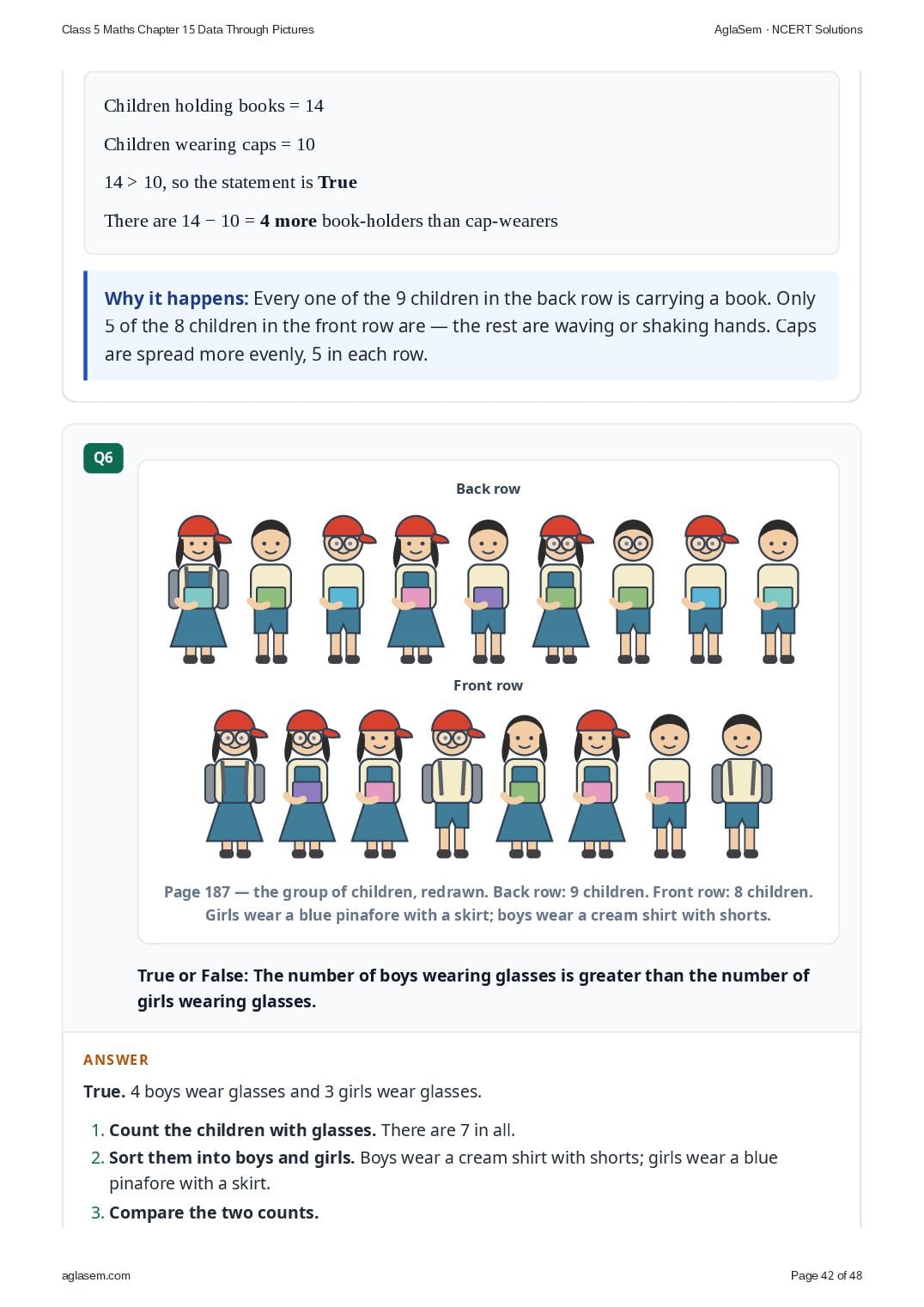
- Back rowFront rowPage 187 — the group of children, redrawn. Back row: 9 children. Front row: 8 children. Girls wear a blue pinafore with a skirt; boys wear a cream shirt with shorts.True or False: The number of boys wearing glasses is greater than the number of girls wearing glasses.
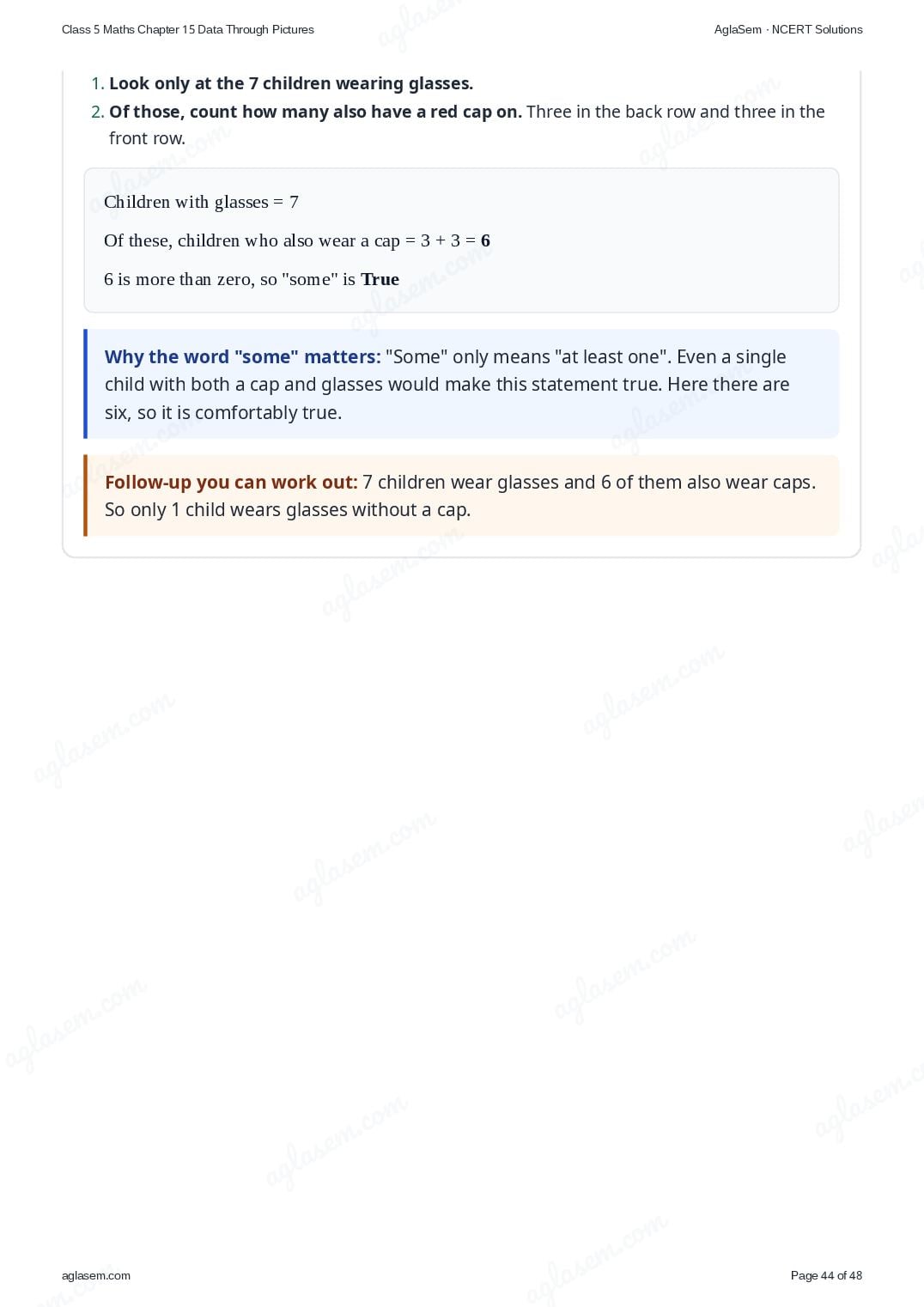
- Back rowFront rowPage 187 — the group of children, redrawn. Back row: 9 children. Front row: 8 children. Girls wear a blue pinafore with a skirt; boys wear a cream shirt with shorts.True or False: Some children are wearing both glasses and caps.
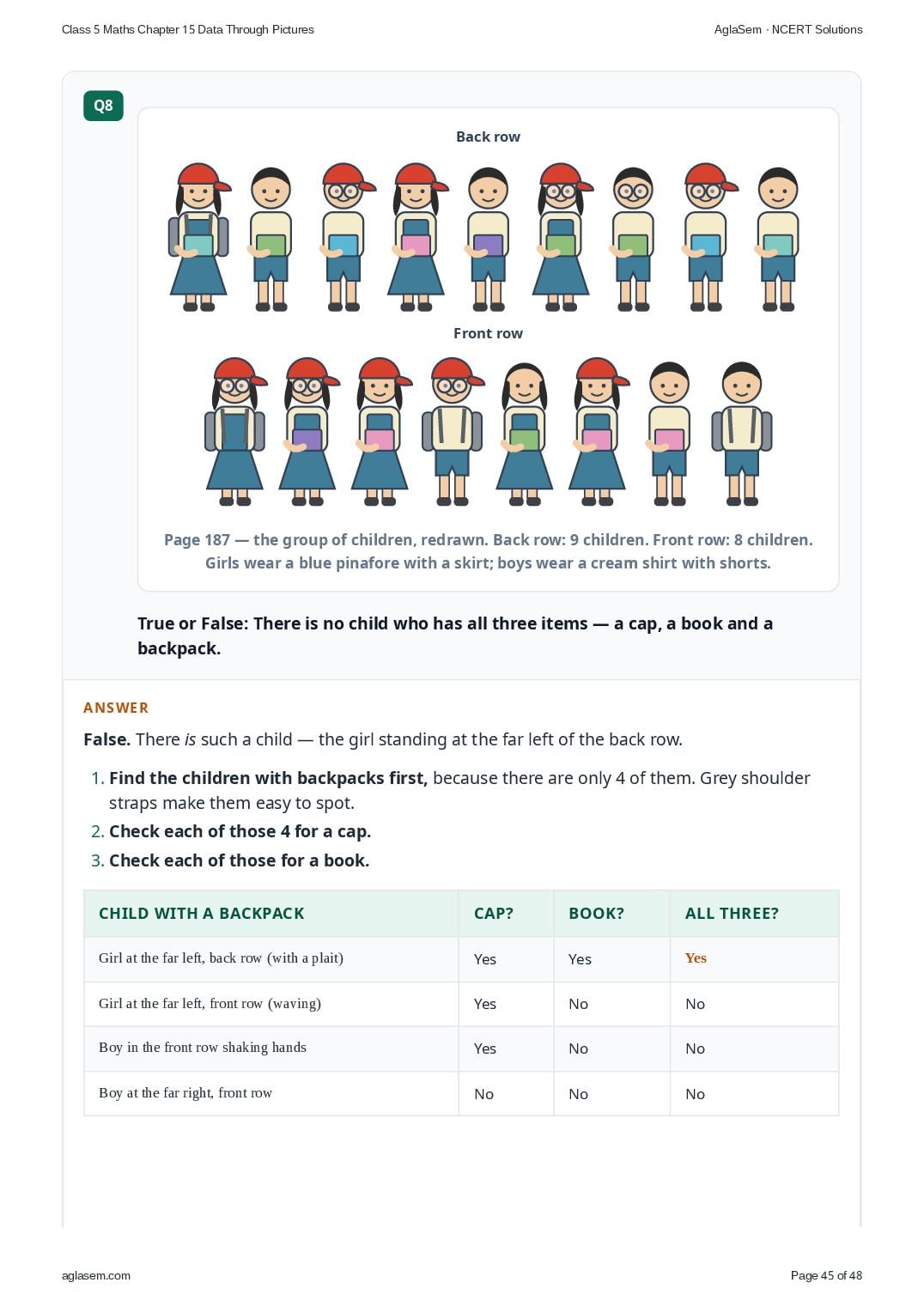
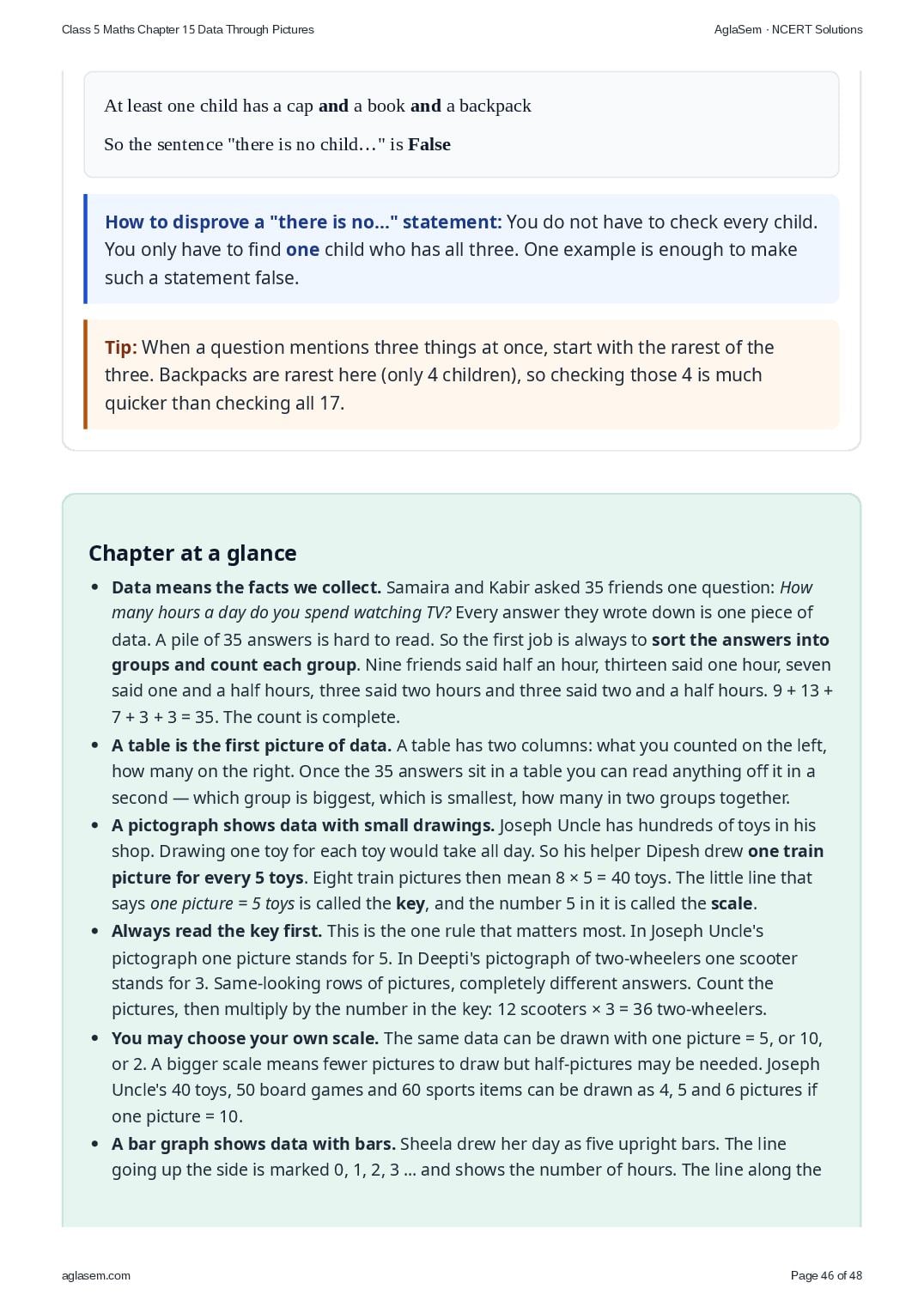
- Back rowFront rowPage 187 — the group of children, redrawn. Back row: 9 children. Front row: 8 children. Girls wear a blue pinafore with a skirt; boys wear a cream shirt with shorts.True or False: There is no child who has all three items — a cap, a book and a backpack.
Chapter at a Glance
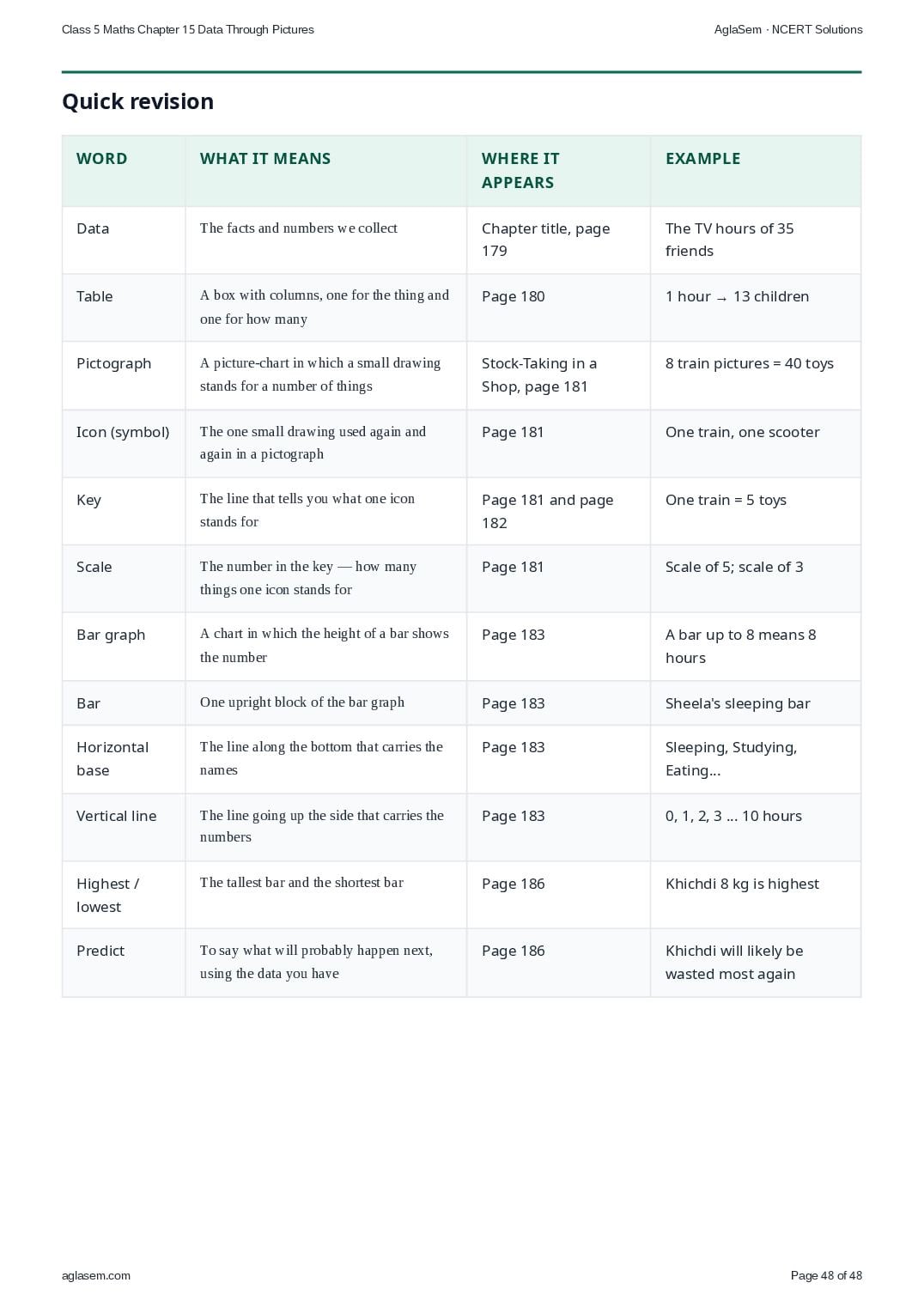
- Data means the facts we collect. Samaira and Kabir asked 35 friends one question: How many hours a day do you spend watching TV? Every answer they wrote down is one piece of data. A pile of 35 answers is hard to read. So the first job is always to sort the answers into groups and count each group. Nine friends said half an hour, thirteen said one hour, seven said one and a half hours, three said two hours and three said two and a half hours. 9 + 13 + 7 + 3 + 3 = 35. The count is complete.
- A table is the first picture of data. A table has two columns: what you counted on the left, how many on the right. Once the 35 answers sit in a table you can read anything off it in a second — which group is biggest, which is smallest, how many in two groups together.
- A pictograph shows data with small drawings. Joseph Uncle has hundreds of toys in his shop. Drawing one toy for each toy would take all day. So his helper Dipesh drew one train picture for every 5 toys. Eight train pictures then mean 8 × 5 = 40 toys. The little line that says one picture = 5 toys is called the key, and the number 5 in it is called the scale.
- Always read the key first. This is the one rule that matters most. In Joseph Uncle’s pictograph one picture stands for 5. In Deepti’s pictograph of two-wheelers one scooter stands for 3. Same-looking rows of pictures, completely different answers. Count the pictures, then multiply by the number in the key: 12 scooters × 3 = 36 two-wheelers.
- You may choose your own scale. The same data can be drawn with one picture = 5, or 10, or 2. A bigger scale means fewer pictures to draw but half-pictures may be needed. Joseph Uncle’s 40 toys, 50 board games and 60 sports items can be drawn as 4, 5 and 6 pictures if one picture = 10.
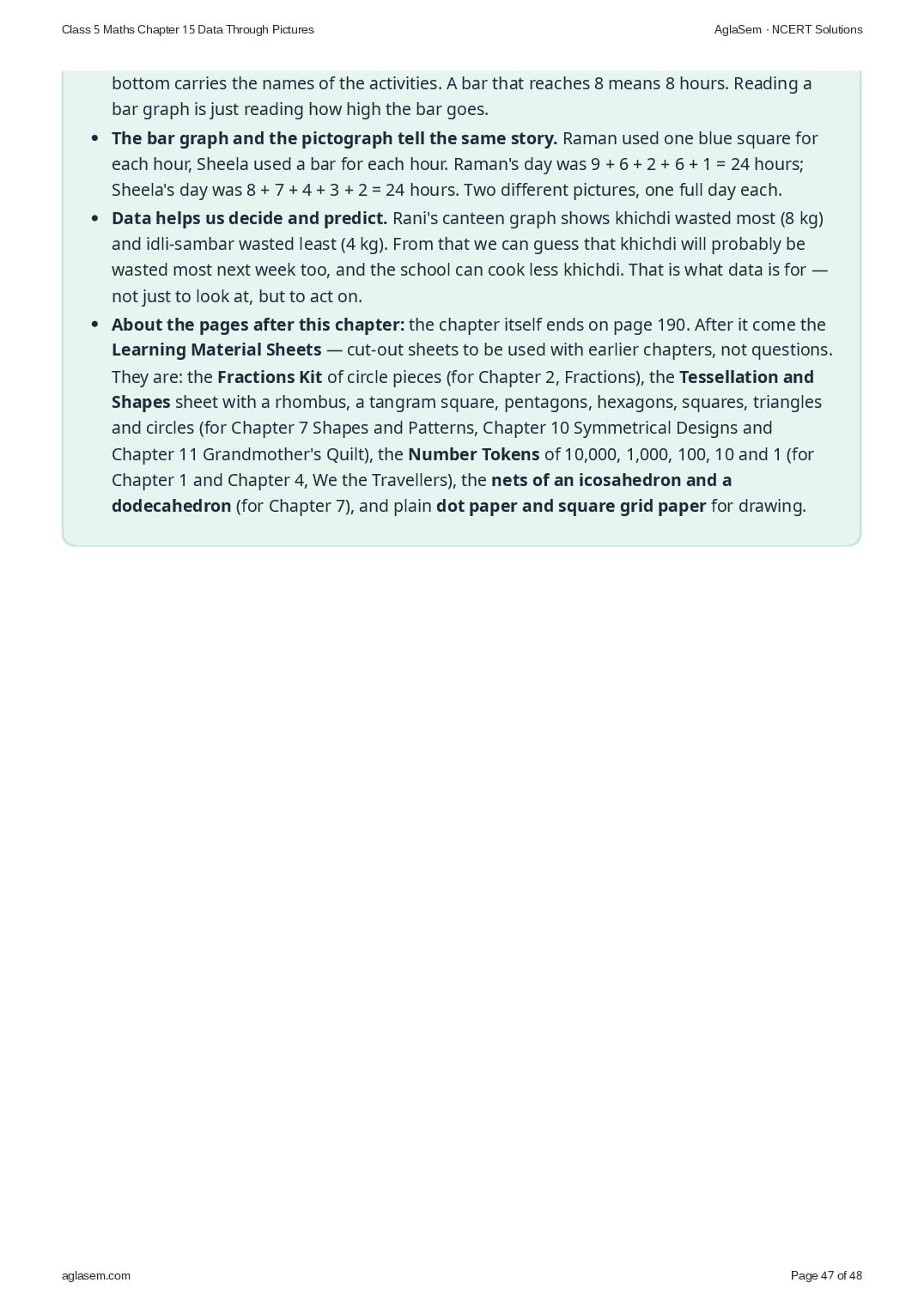
- A bar graph shows data with bars. Sheela drew her day as five upright bars. The line going up the side is marked 0, 1, 2, 3 … and shows the number of hours. The line along the bottom carries the names of the activities. A bar that reaches 8 means 8 hours. Reading a bar graph is just reading how high the bar goes.
- The bar graph and the pictograph tell the same story. Raman used one blue square for each hour, Sheela used a bar for each hour. Raman’s day was 9 + 6 + 2 + 6 + 1 = 24 hours; Sheela’s day was 8 + 7 + 4 + 3 + 2 = 24 hours. Two different pictures, one full day each.
- Data helps us decide and predict. Rani’s canteen graph shows khichdi wasted most (8 kg) and idli-sambar wasted least (4 kg). From that we can guess that khichdi will probably be wasted most next week too, and the school can cook less khichdi. That is what data is for — not just to look at, but to act on.
- About the pages after this chapter: the chapter itself ends on page 190. After it come the Learning Material Sheets — cut-out sheets to be used with earlier chapters, not questions. They are: the Fractions Kit of circle pieces (for Chapter 2, Fractions), the Tessellation and Shapes sheet with a rhombus, a tangram square, pentagons, hexagons, squares, triangles and circles (for Chapter 7 Shapes and Patterns, Chapter 10 Symmetrical Designs and Chapter 11 Grandmother’s Quilt), the Number Tokens of 10,000, 1,000, 100, 10 and 1 (for Chapter 1 and Chapter 4, We the Travellers), the nets of an icosahedron and a dodecahedron (for Chapter 7), and plain dot paper and square grid paper for drawing.
How to Download NCERT Solutions for Class 5 Maths Chapter 15 PDF
Follow these simple steps to get the Data Through Pictures questions-and-answers PDF from Math Mela.
- Search NCERT Solutions for Class 5 Maths Chapter 15 aglasem and open this page.
- Read the exercise questions with answers for Data Through Pictures shown above.
- Click the Download PDF link to save the Data Through Pictures solutions to your device.
NCERT Solutions for Class 5 Maths – All Chapters
There are more chapters to study besides Data Through Pictures in Maths. Here are the NCERT Solutions for all chapters of Class 5 Maths.
- Chapter 1 We the Travellers I
- Chapter 2 Fractions
- Chapter 3 Angles As Turns
- Chapter 4 We the Travellers Ii
- Chapter 5 Far and Near
- Chapter 6 the Dairy Farm
- Chapter 7 Shapes and Patterns
- Chapter 8 Weight and Capacity
- Chapter 9 Coconut Farm
- Chapter 10 Symmetrical Designs
- Chapter 11 Grandmother s Quilt
- Chapter 12 Racing Seconds
- Chapter 13 Animal Jumps
- Chapter 14 Maps and Locations
- Chapter 15 Data Through Pictures
NCERT Solutions for Class 5 – All Subjects
Just like Chapter 15 of Maths, you can get the exercise questions with answers for every other subject of Class 5. Here are the NCERT Solutions for all subjects of Class 5.
NCERT Solutions for Class 5 Maths Chapter 15 – An Overview
The key highlights of this study material are as follows.
| Aspects | Details |
|---|---|
| Class | Class 5 |
| Subject | Maths |
| Chapter Number | Chapter 15 |
| Chapter Name | Data Through Pictures |
| Book Name | Math Mela |
| Book By | NCERT (National Council of Educational Research and Training) |
| Educational Resource Here | NCERT Solutions of Class 5 Maths Chapter 15 for all exercises |
| More Questions Answers of This Subject | NCERT Solutions for Class 5 Maths |
| Download Book Chapter | NCERT Book Class 5 Maths |
| All Questions Answers For This Class | NCERT Solutions for Class 5 |
| Complete Solutions | NCERT Solutions |
NCERT Solutions for Class 5 Maths Chapter 15 Data Through Pictures – FAQs
What are the NCERT Solutions for Class 5 Maths Chapter 15 Data Through Pictures?
They are the complete, step-by-step answers to all the exercise and in-text questions of Chapter 15 Data Through Pictures from the NCERT Class 5 Maths textbook Math Mela, written by experts as per the latest NCERT syllabus.
How can I download the Class 5 Maths Chapter 15 solutions PDF for free?
Open this page on aglasem, read the Data Through Pictures questions with answers, and click the “Download Solutions PDF” link. The Class 5 Maths Chapter 15 NCERT Solutions PDF is completely free to download.
Are these NCERT Solutions as per the latest 2026-27 syllabus?
Yes. The NCERT Solutions for Class 5 Maths Chapter 15 are based on the latest NCERT textbook Math Mela and the current 2026-27 CBSE syllabus, so the questions and answers match what you study in class.
Where can I get NCERT Solutions for the other chapters of Class 5 Maths?
You can find the answers to every chapter on the NCERT Solutions for Class 5 Maths page, and solutions for every subject on the NCERT Solutions for Class 5 page.
How do NCERT Solutions help in exam preparation?
They show the correct method to solve each question, help you write answers the way they are expected in exams, let you check and correct your own work, and save revision time — which together improve your marks in Class 5 Maths.
If you have any queries on NCERT Solutions for Class 5 Maths Chapter 15 Data Through Pictures, then please ask in the comments below.