Download Animal Jumps – NCERT Class 5 Maths Chapter 13 PDF from the new NCERT Class 5 Maths book Maths Mela (2026-27). Read the chapter online or download the free PDF. A jump size is a factor. A landing spot is a multiple. If you start at 0 and jump 4 steps every time, you land on 4, 8, 12, 16, 20 … Every number you land on is a multiple of 4. And 4 is a factor of every one of those numbers, because 4 divides each…
Animal Jumps PDF – Chapter 13 of Maths Mela
Read the chapter online or download the PDF.
| Chapter | Download | |
|---|---|---|
| Chapter 13 PDF | Animal Jumps | View PDF |
| Full book | NCERT Class 5 Maths – Maths Mela | View Book |
Read Online
What Is in Animal Jumps? (Class 5 Maths Chapter 13)
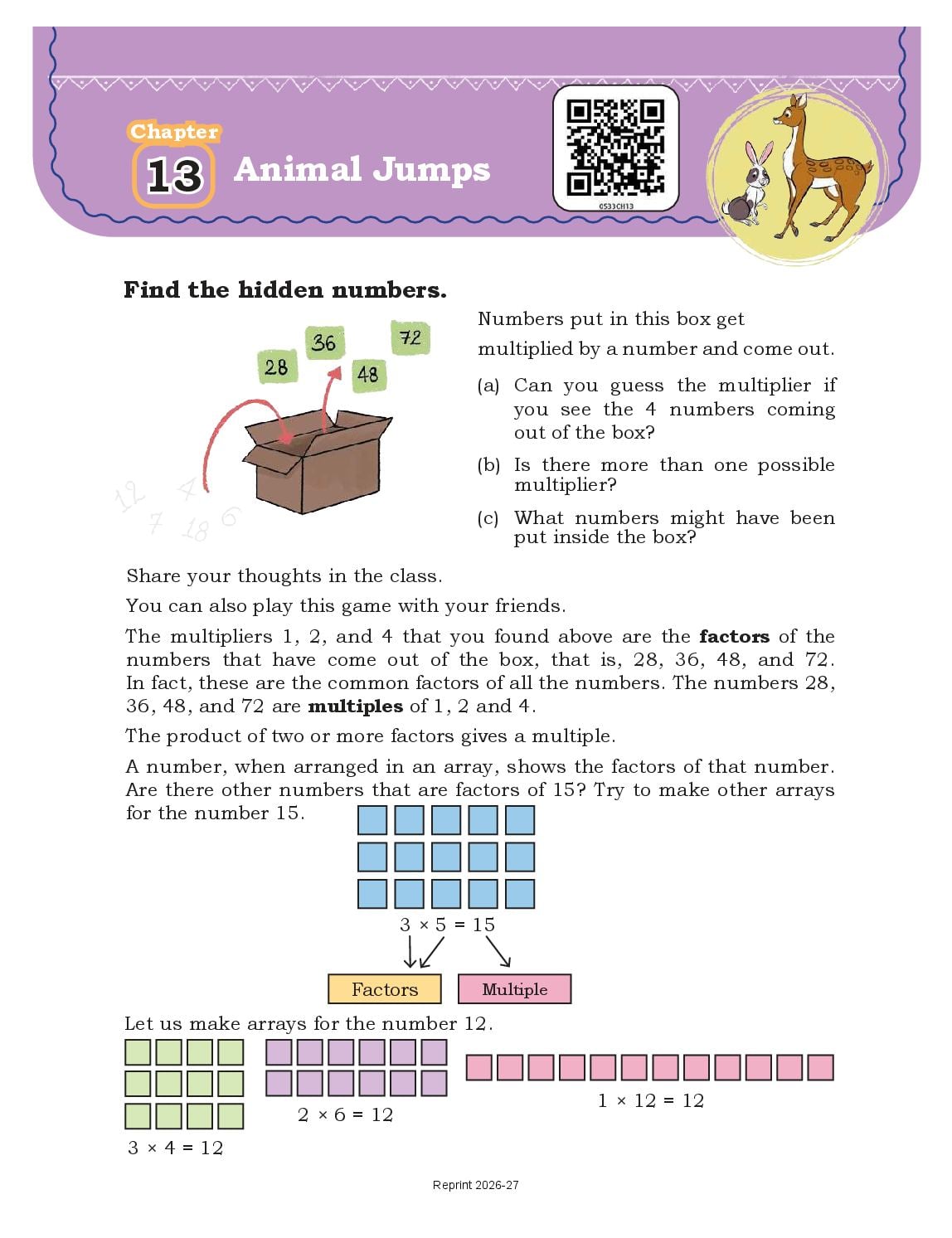
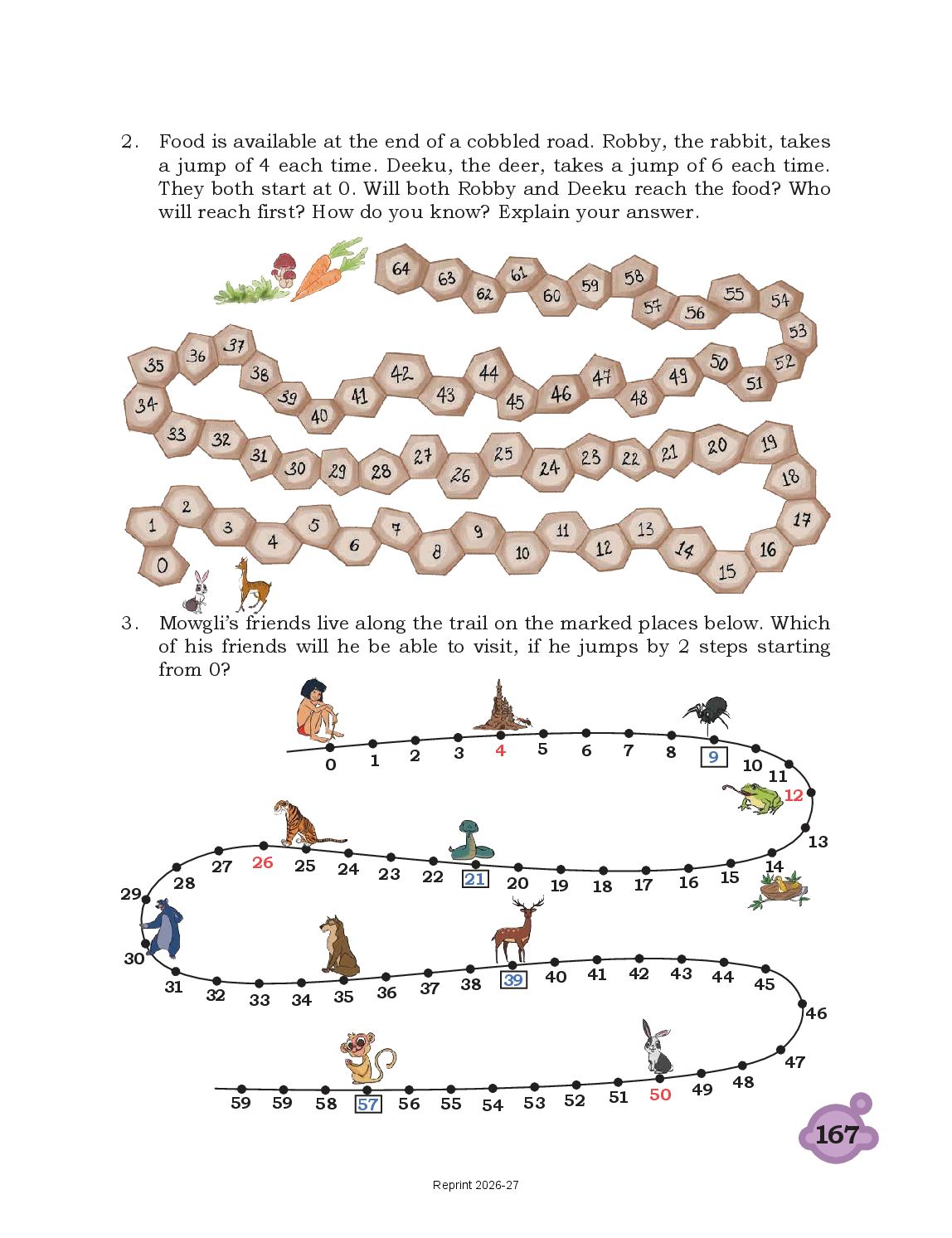
- A jump size is a factor. A landing spot is a multiple. If you start at 0 and jump 4 steps every time, you land on 4, 8, 12, 16, 20 … Every number you land on is a multiple of 4. And 4 is a factor of every one of those numbers, because 4 divides each of them exactly, with nothing left over. This one picture is the whole chapter: jump size = factor, landing spot = multiple.
- Factors are small, multiples are big. A number has only a few factors, and they are never bigger than the number itself. 12 has six factors: 1, 2, 3, 4, 6 and 12. But 12 has endless multiples: 12, 24, 36, 48, 60 … which go on for ever. If you mix the two words up, ask yourself: am I jumping, or am I landing?
- An array shows the factors. Arrange 12 counters in a neat rectangle. You can make 3 rows of 4, or 2 rows of 6, or 1 row of 12. Each rectangle gives you a pair of factors: 3 and 4, 2 and 6, 1 and 12. Together they give all six factors of 12.
- Prime numbers make only one rectangle. Try to arrange 13 counters in a rectangle. The only way is one long row of 13. So 13 has just two factors, 1 and 13. Numbers like 13 and 37 are called prime numbers.
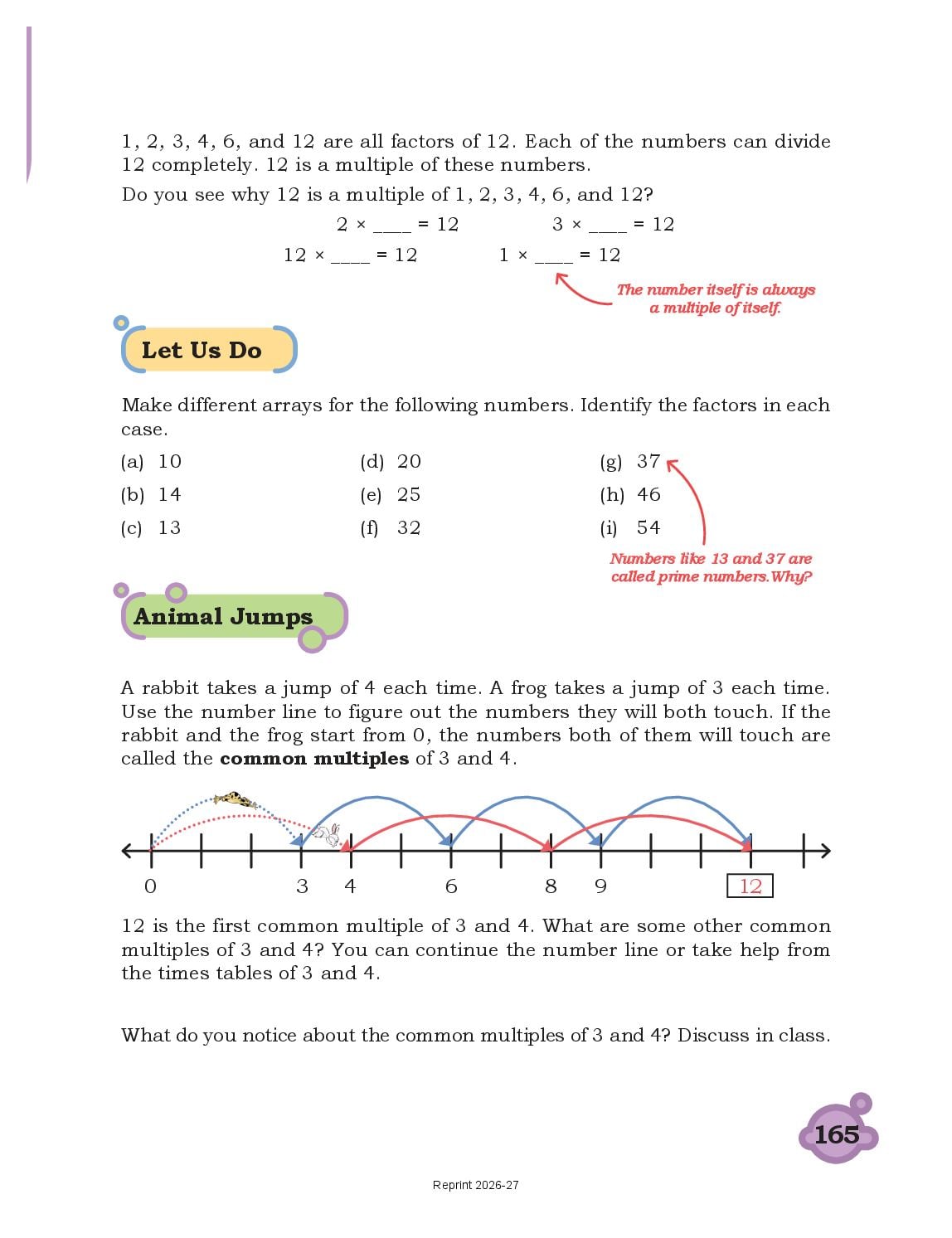
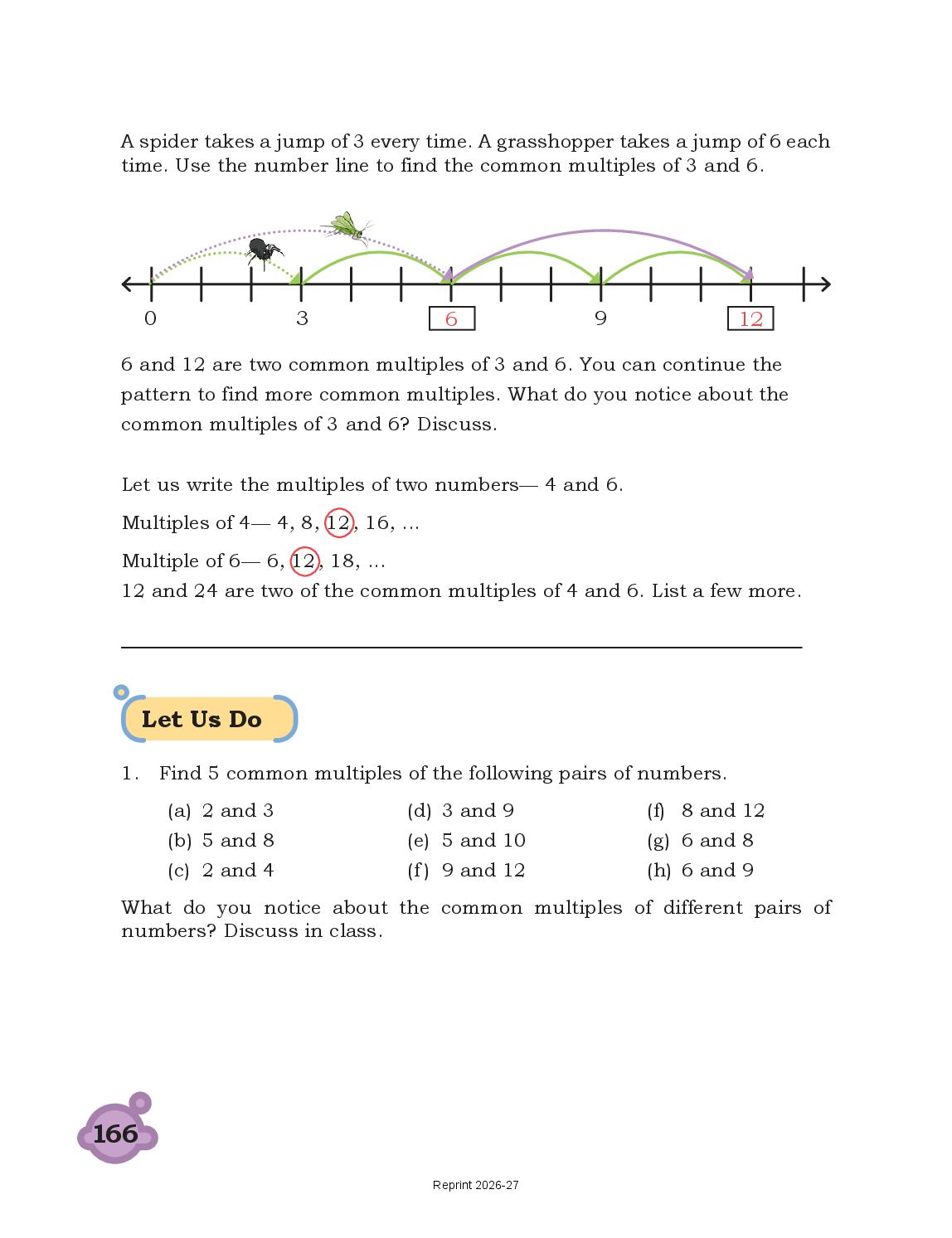
- Common multiples — where two animals land together. The frog jumps 3 (3, 6, 9, 12 …) and the rabbit jumps 4 (4, 8, 12 …). They meet at 12, then 24, then 36. These shared landing spots are the common multiples of 3 and 4. There are always endless common multiples, and every one of them is a multiple of the smallest one.
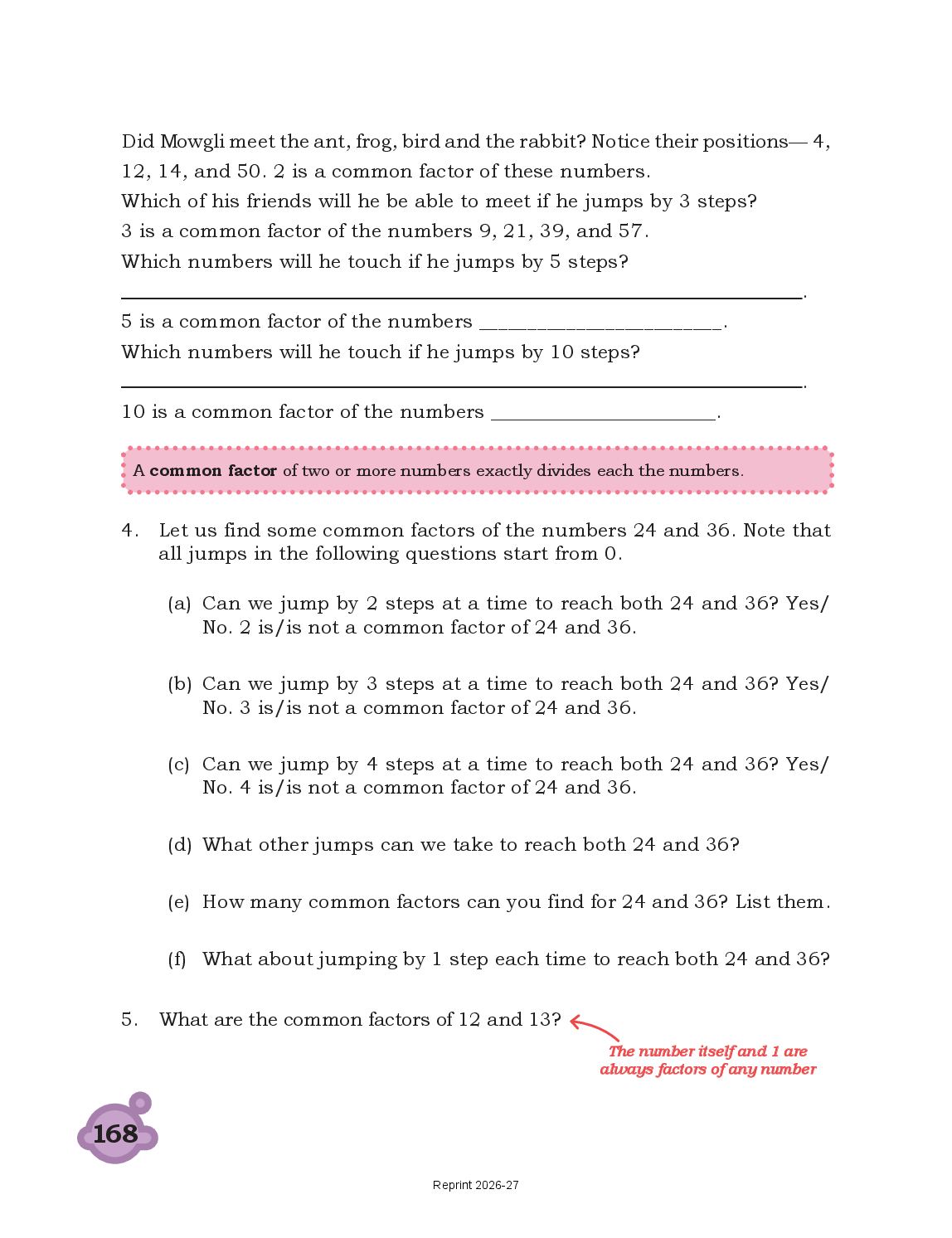
- Common factors — jump sizes that reach both numbers. Which jump sizes take you exactly to both 24 and 36? Jumps of 1, 2, 3, 4, 6 and 12 all work. These are the common factors of 24 and 36. There are only a few of them, and 1 is a common factor of every pair of numbers.
- Two useful shortcuts. If one number is a multiple of the other (like 3 and 6), then every multiple of the bigger number is already in the smaller number’s list — so the first common multiple is the bigger number itself. And if two numbers share nothing except 1 (like 3 and 4), their first common multiple is simply 3 × 4 = 12.
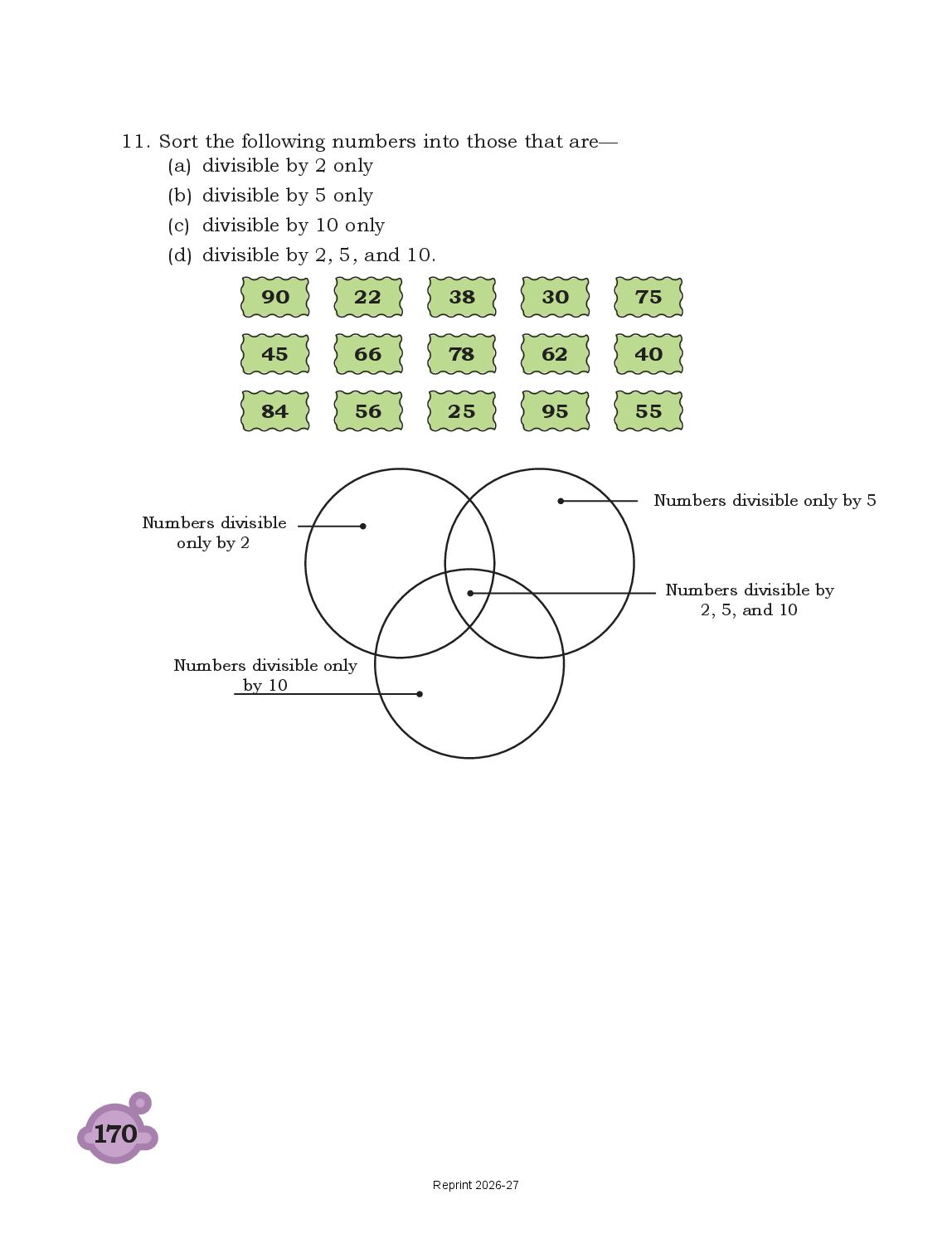
- Divisibility, quickly. A number is divisible by 2 if it ends in 0, 2, 4, 6 or 8. It is divisible by 5 if it ends in 0 or 5. It is divisible by 10 only if it ends in 0. So every number that is divisible by 10 is automatically divisible by both 2 and 5 — which is why a box for numbers divisible only by 10 must stay empty.
Quick revision – Animal Jumps
| Word | What it means | Where it appears | Example |
|---|---|---|---|
| Factor | A number that divides another number exactly, leaving nothing over | Page 164, the box game | 4 is a factor of 28, because 28 = 4 × 7 |
| Multiple | The number you get when you multiply — the spot you land on | Page 164 | 28, 36, 48 and 72 are multiples of 4 |
| Array | Objects set out in equal rows and columns, in a rectangle | Page 164, arrays for 15 and 12 | 3 rows of 4 counters show 3 × 4 = 12 |
| Prime number | A number with exactly two factors — 1 and itself | Page 165, the red note | 13 and 37 are prime numbers |
| Number line | A straight line with the numbers marked in order, used to show jumps | Pages 165–166 | 0, 1, 2, 3 … with arcs drawn over it |
| Common multiple | A number that is a multiple of two (or more) numbers | Page 165, rabbit and frog | 12 is a common multiple of 3 and 4 |
| Common factor | A number that divides two (or more) numbers exactly | Page 168, the pink banner | 2 is a common factor of 4, 12, 14 and 50 |
| Divisible | Divides exactly, with remainder 0 | Page 170, Question 11 | 90 is divisible by 2, by 5 and by 10 |
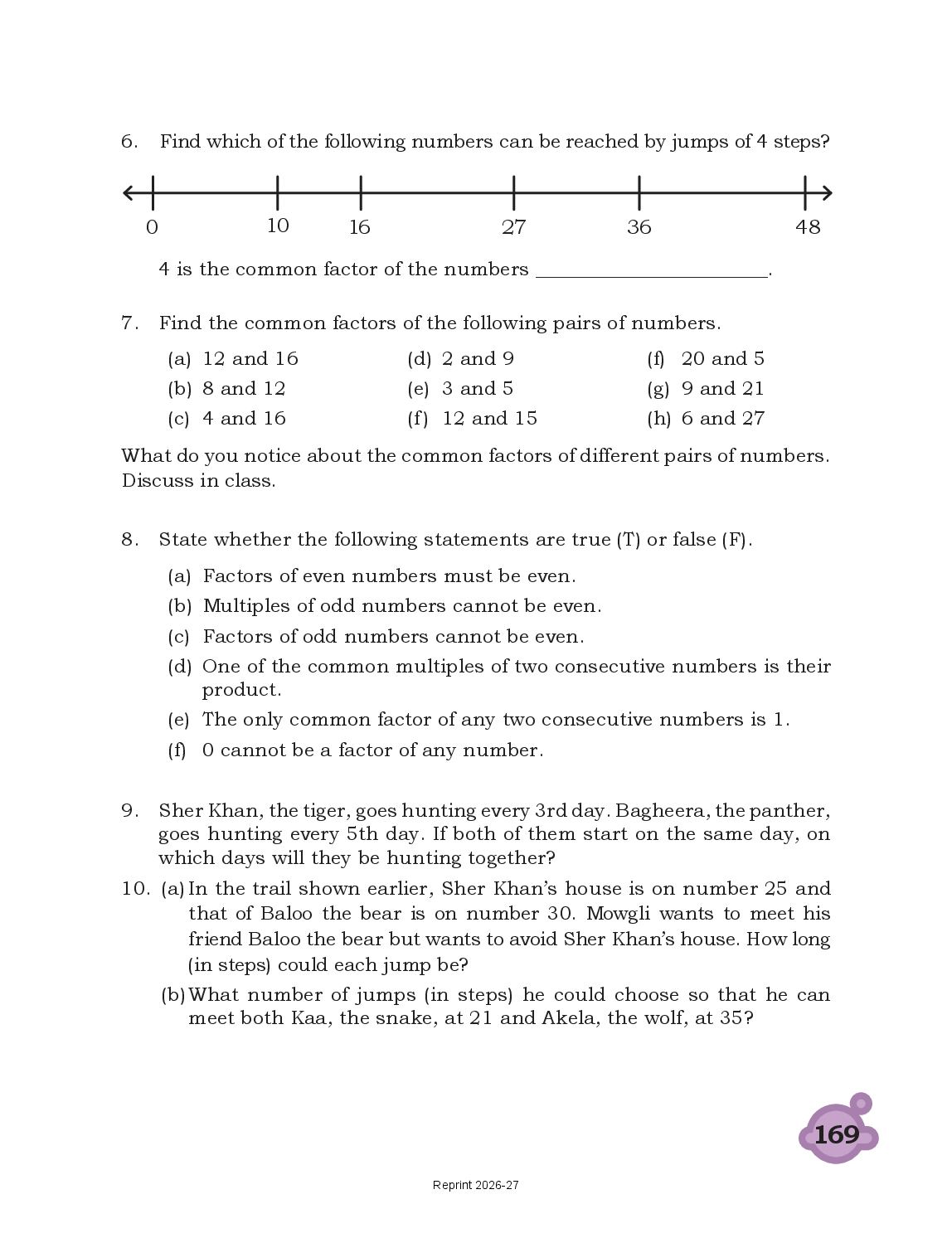
| Consecutive numbers | Numbers that follow one after the other | Page 169, Question 8 | 7 and 8; 24 and 25 |
| Even number | A number that ends in 0, 2, 4, 6 or 8 | Page 169, Question 8 | 26, 30, 50 |
| Odd number | A number that ends in 1, 3, 5, 7 or 9 | Page 169, Question 8 | 9, 21, 57 |
Old NCERT vs New – Class 5 Maths
This chapter is from Maths Mela, the new NCERT Class 5 Maths book (NCF-SE 2023, used from 2025-26). It replaced the old book “Math-Magic”, so chapter numbers and names differ from older PDFs.
Solutions and All Chapters
Answers to the exercises and the full chapter list of Maths Mela:
Animal Jumps – Overview
| Class | Class 5 |
| Subject | Maths |
| Book | Maths Mela – new NCERT book |
| Chapter | 13 of 15 – Animal Jumps |
| Book pages | 164 – 170 |
| Edition | NCERT Reprint 2026-27 |
| Session | 2026-27 |
| Free – read online or download |
Class 5 Maths Chapter 13 – FAQs
Where can I download Animal Jumps Class 5 PDF?
From the download table on this page – the chapter PDF is free, and the full book is linked too.
What is Class 5 Maths Chapter 13 about?
A jump size is a factor. A landing spot is a multiple. If you start at 0 and jump 4 steps every time, you land on 4, 8, 12, 16, 20 … Every number you land on is a multiple of 4. And 4 is a factor of every one of those numbers, because 4 divides each of them exactly, with nothing left over. This one picture is the whole chapter: jump size = factor, landing spot = multiple.
Is Animal Jumps from the new NCERT Class 5 Maths book?
Yes. It is chapter 13 of maths mela, the new NCERT Class 5 Maths book for 2026-27.
Is this the latest NCERT edition for 2026-27?
Yes – the PDF is NCERT’s latest edition for the 2026-27 session.
Where are the NCERT Solutions for Class 5 Maths Chapter 13?
Open the NCERT Solutions link above for answers to the exercise questions.