Download Coconut Farm – NCERT Class 5 Maths Chapter 9 PDF from the new NCERT Class 5 Maths book Maths Mela (2026-27). Read the chapter online or download the free PDF. Division is sharing into equal groups. Look at 35 coconuts set out in 5 rows of 7. Split them into 7 groups and each group has 5. Split them into 5 groups and each group has 7. So one multiplication fact, 5 × 7 = 35, gives two division facts: 35 ÷ 7…
Coconut Farm PDF – Chapter 9 of Maths Mela
Read the chapter online or download the PDF.
| Chapter | Download | |
|---|---|---|
| Chapter 9 PDF | Coconut Farm | View PDF |
| Full book | NCERT Class 5 Maths – Maths Mela | View Book |
Read Online
What Is in Coconut Farm? (Class 5 Maths Chapter 9)
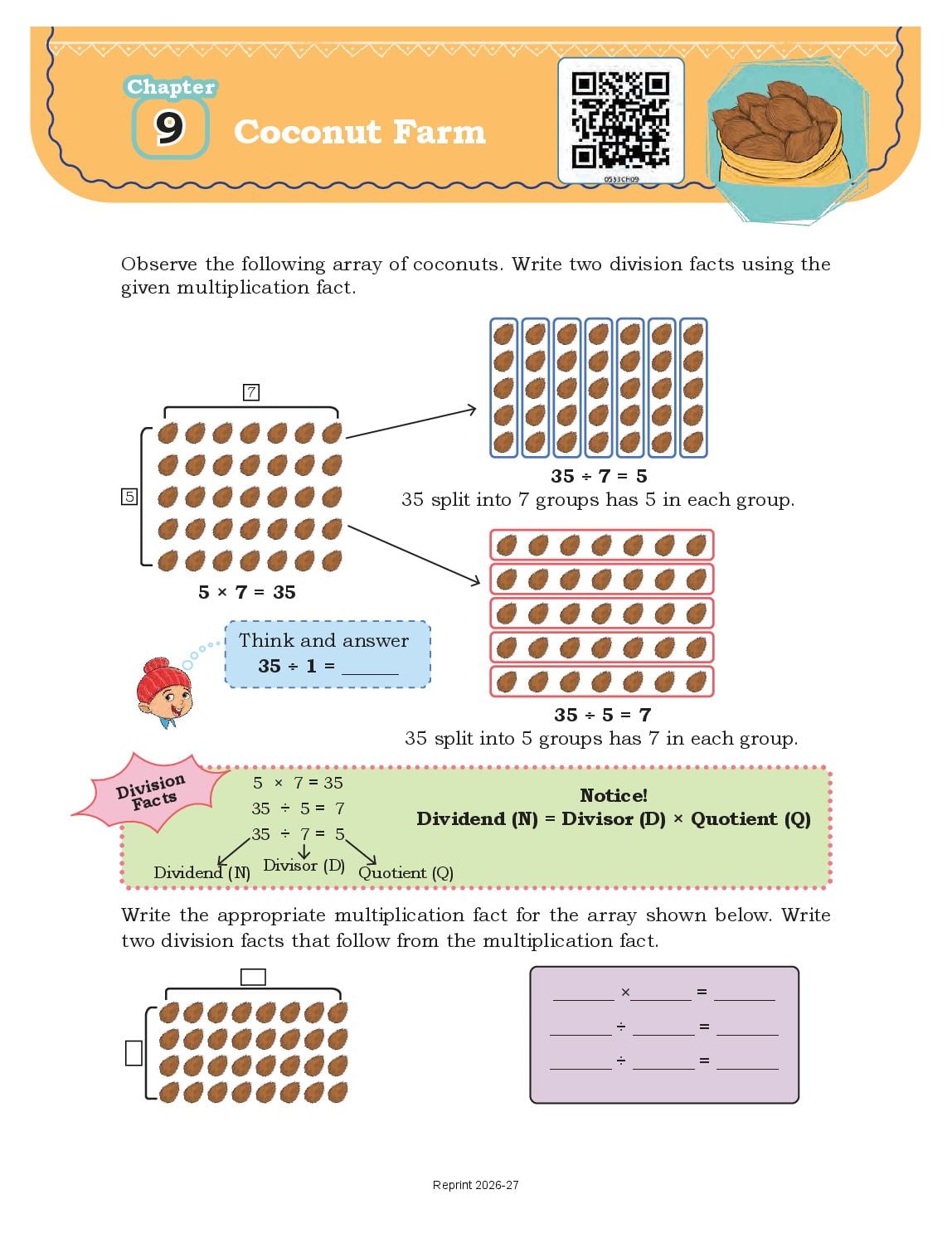
- Division is sharing into equal groups. Look at 35 coconuts set out in 5 rows of 7. Split them into 7 groups and each group has 5. Split them into 5 groups and each group has 7. So one multiplication fact, 5 × 7 = 35, gives two division facts: 35 ÷ 7 = 5 and 35 ÷ 5 = 7.
- The three names. In 35 ÷ 5 = 7, the number being shared (35) is the dividend, written N. The number of groups (5) is the divisor, written D. The answer (7) is the quotient, written Q. The book’s rule is N = D × Q. You can always check a division by multiplying back.
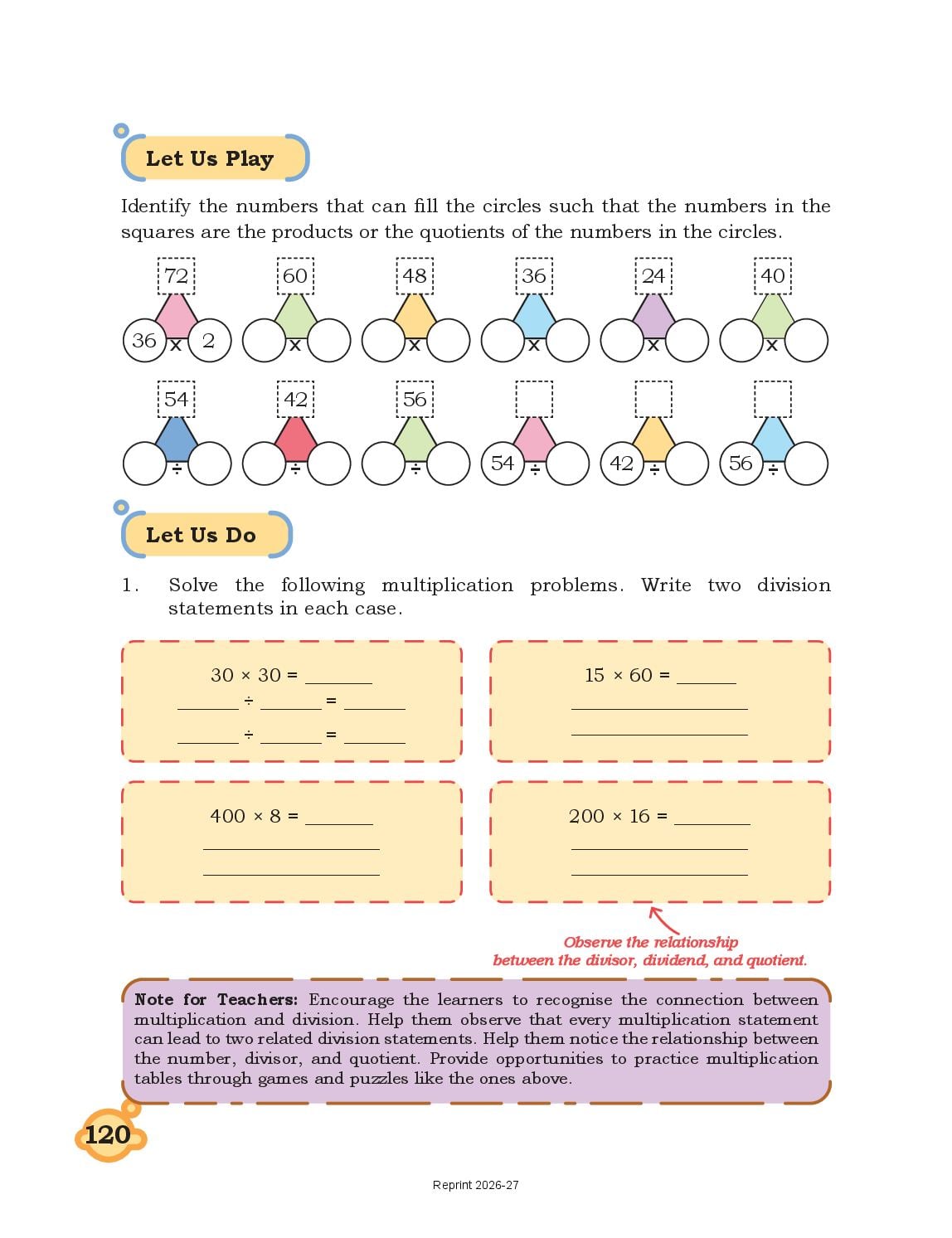
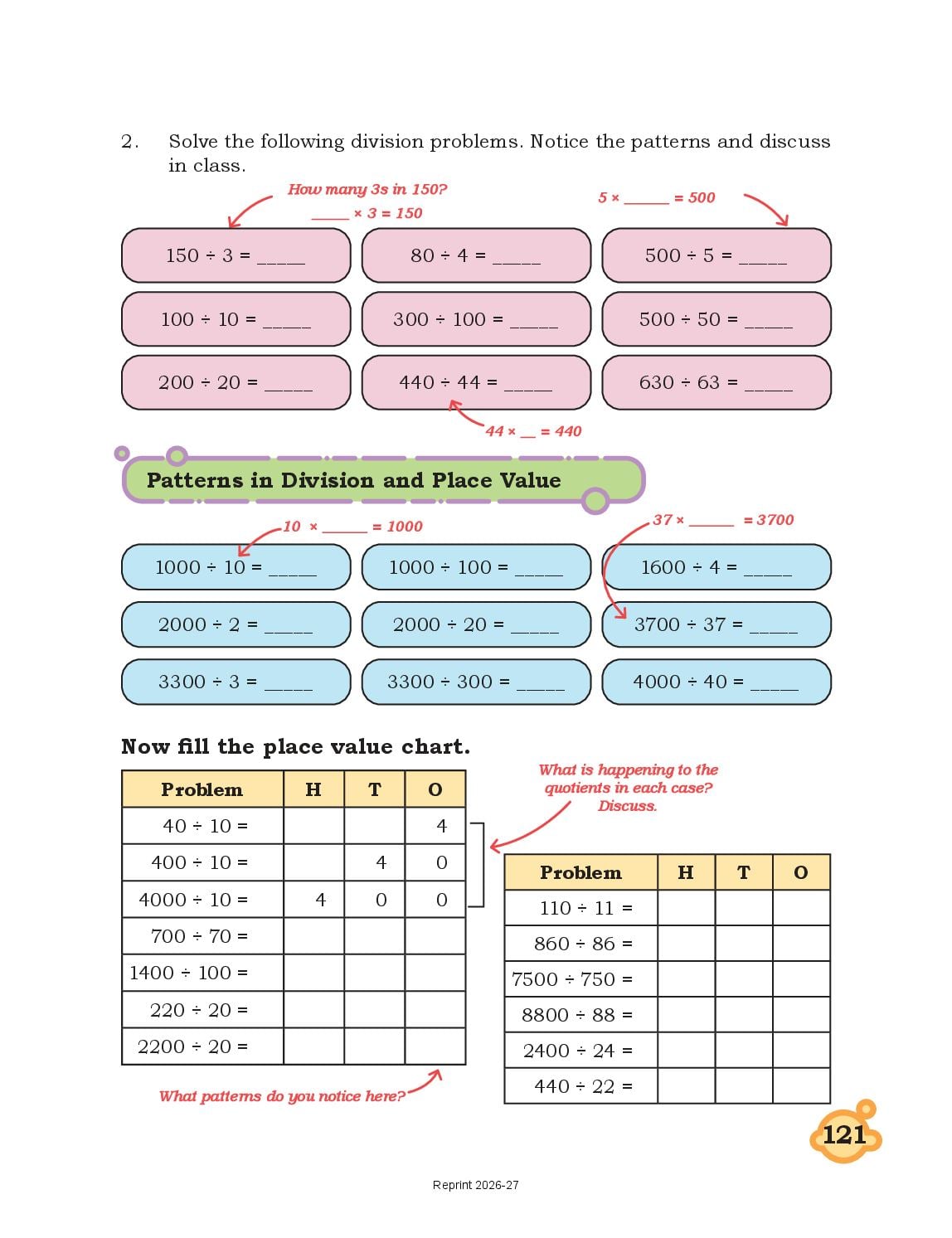
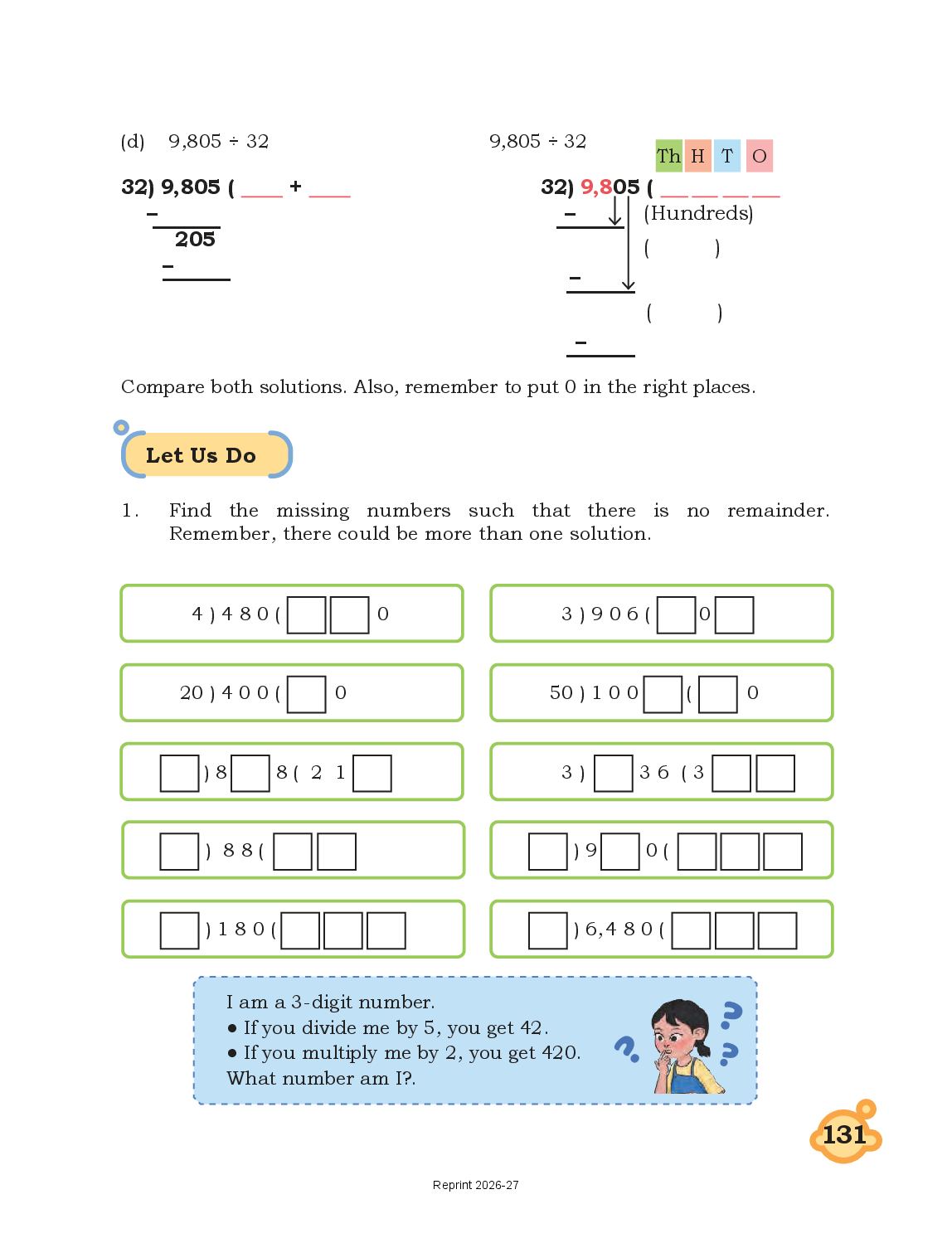
- Zeros make division easy. If you know 15 × 6 = 90, then you also know 150 × 6 = 900, so 900 ÷ 6 = 150 and 900 ÷ 150 = 6. Dividing 4000 by 10 just moves every digit one place to the right: 4000 ÷ 10 = 400. That is why 40 ÷ 10 = 4, 400 ÷ 10 = 40 and 4000 ÷ 10 = 400 all sit in a neat pattern.
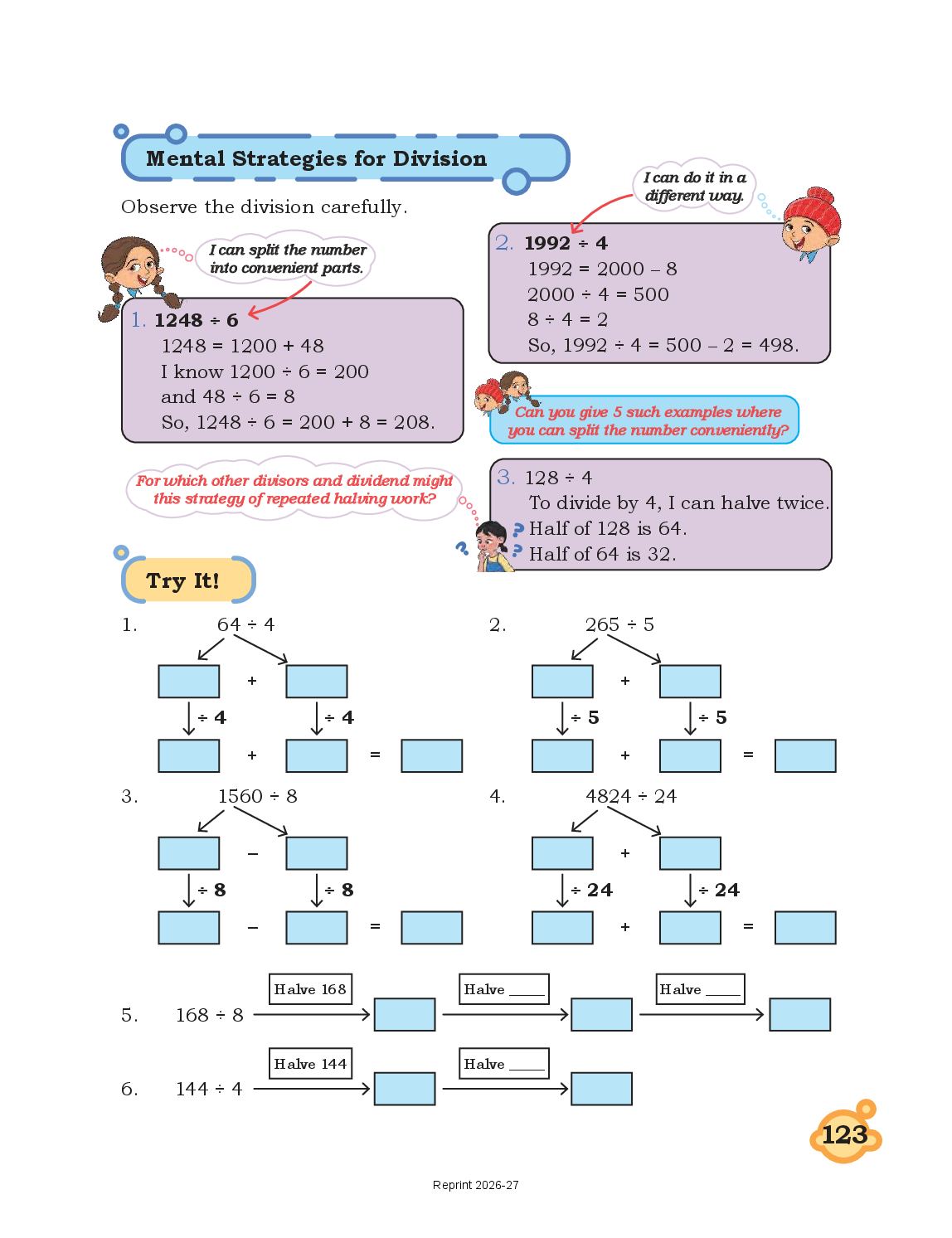
- Split the number into friendly parts. To find 1248 ÷ 6, break 1248 into 1200 + 48. Now 1200 ÷ 6 = 200 and 48 ÷ 6 = 8, so the answer is 208. You may also split by taking away: 1992 = 2000 − 8, so 1992 ÷ 4 = 500 − 2 = 498.
- Halve, and halve again. Dividing by 4 is the same as halving twice. Half of 128 is 64, half of 64 is 32, so 128 ÷ 4 = 32. Dividing by 8 is halving three times. This works for 2, 4, 8, 16 — the numbers you reach by doubling 2.
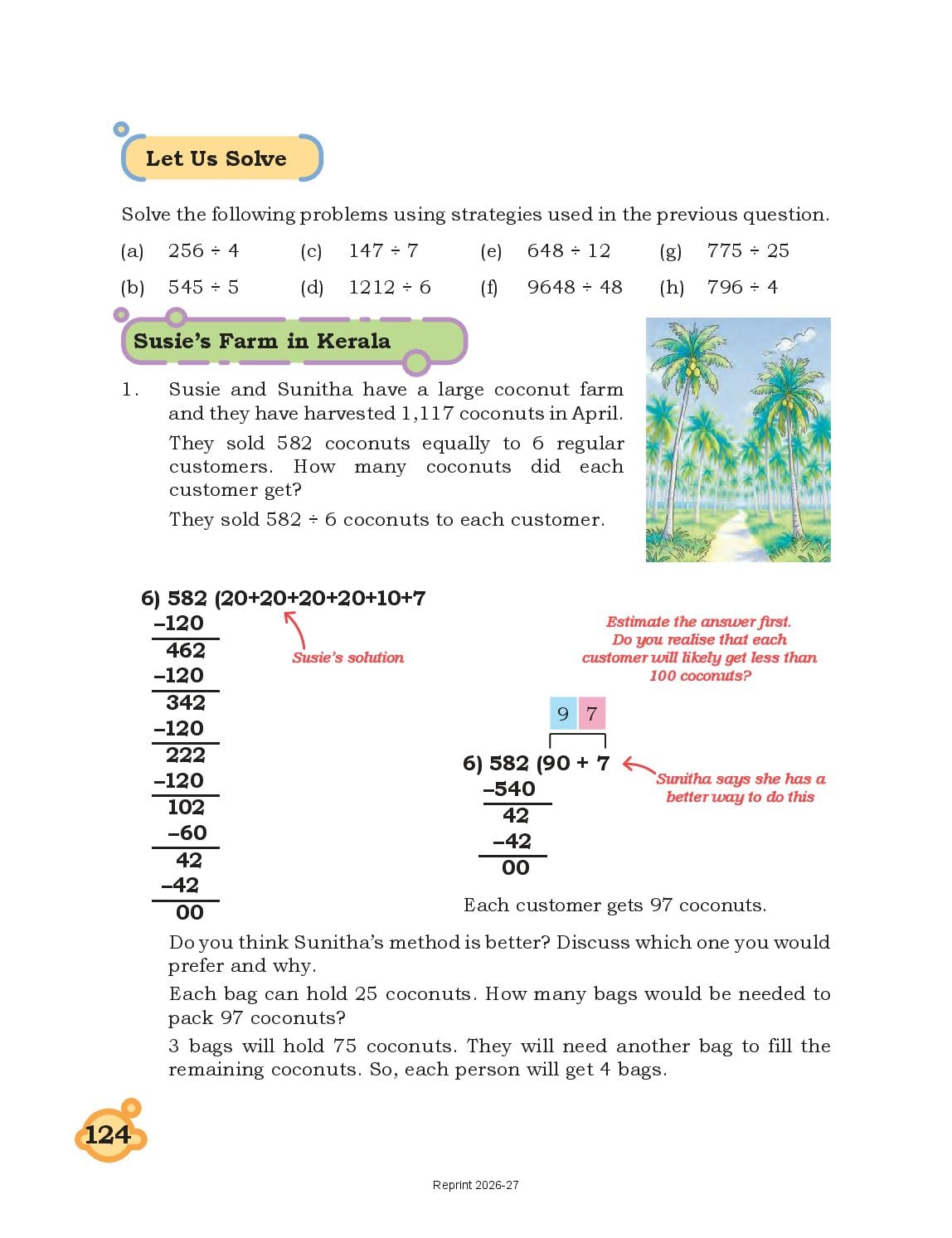
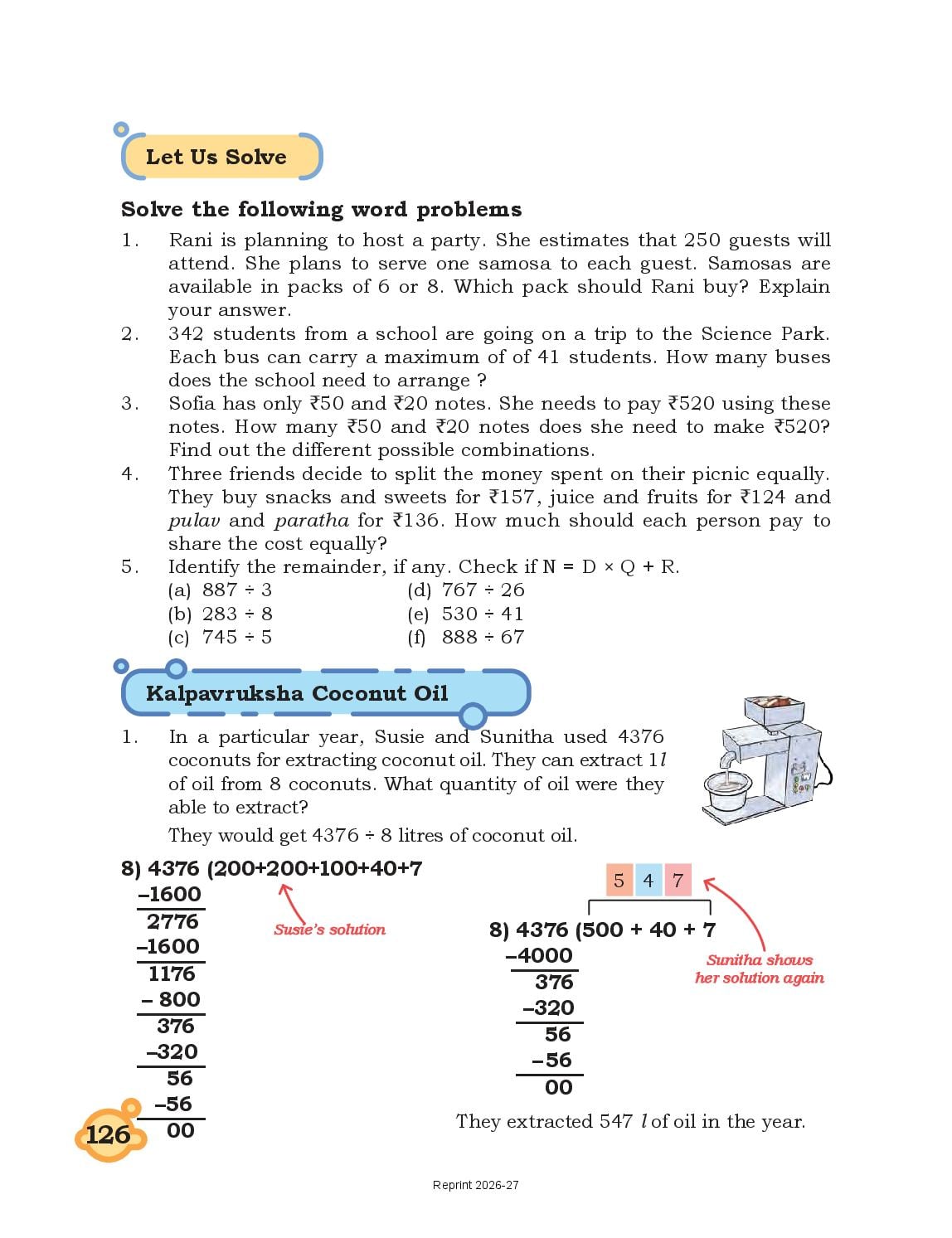
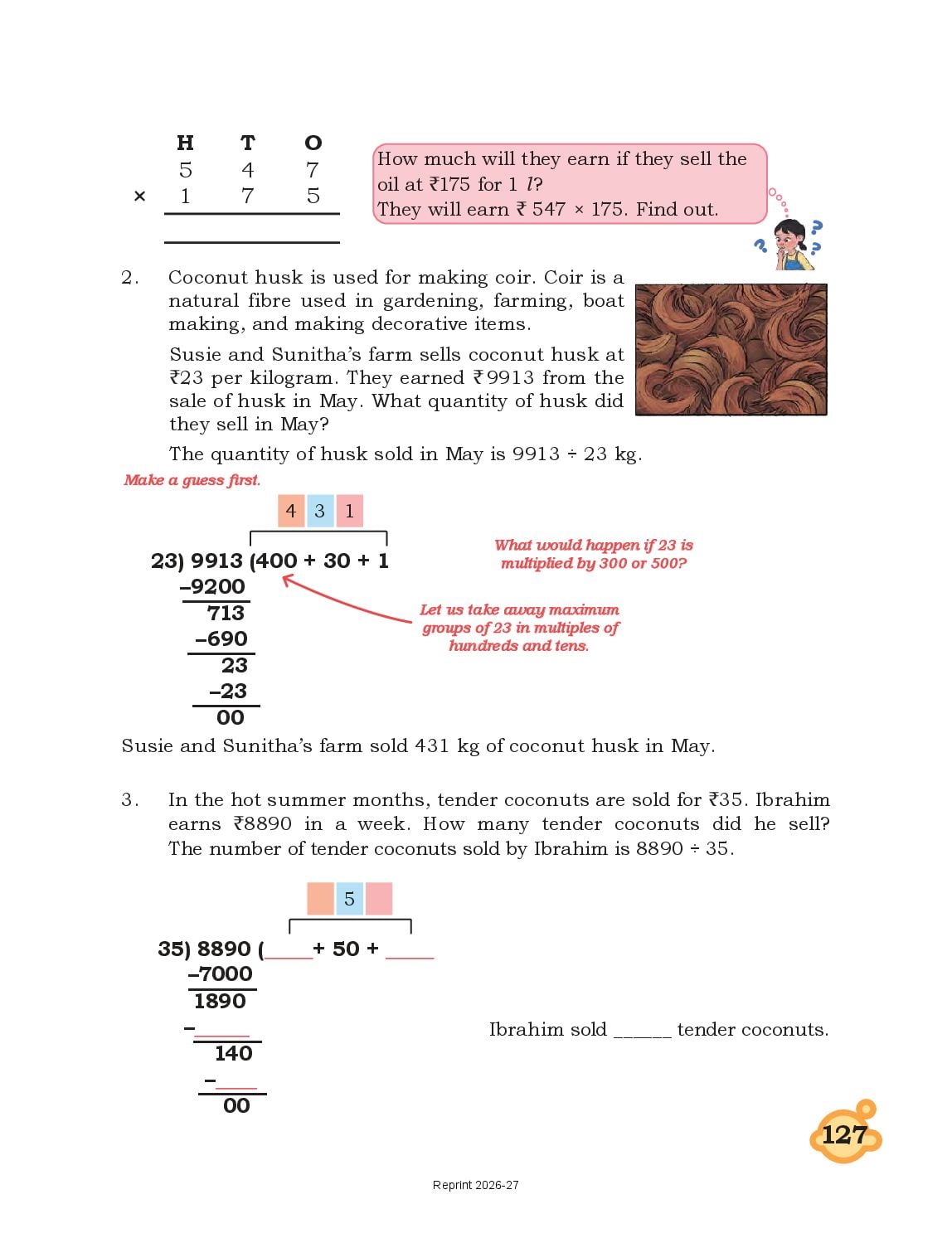
- Partial quotients — take away in big chunks. For 582 ÷ 6, Susie takes away 120 (that is 6 × 20) again and again. Sunitha is quicker: she takes away 540 (that is 6 × 90) in one go, then 42 (that is 6 × 7). Both reach 97. Bigger chunks mean fewer steps.
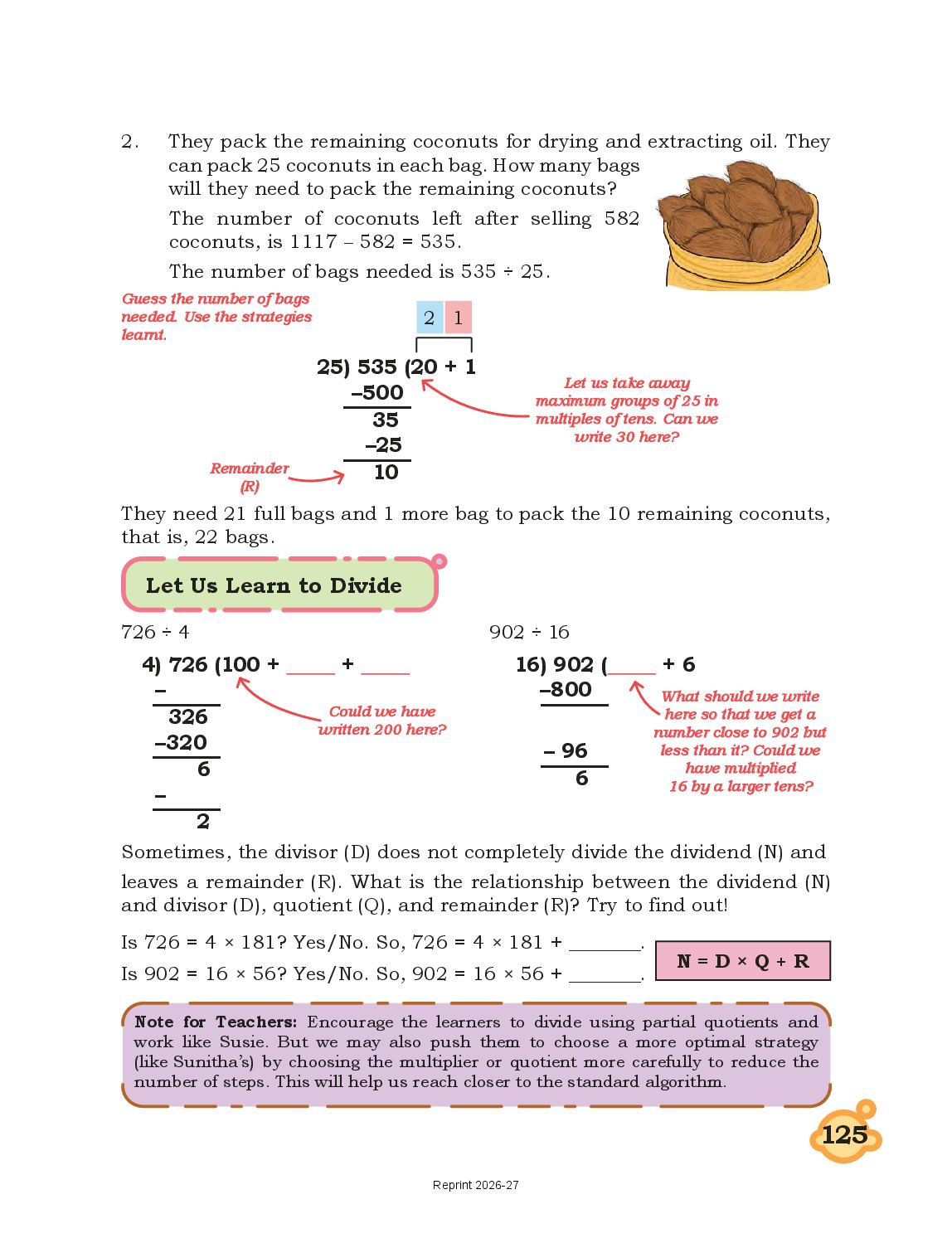
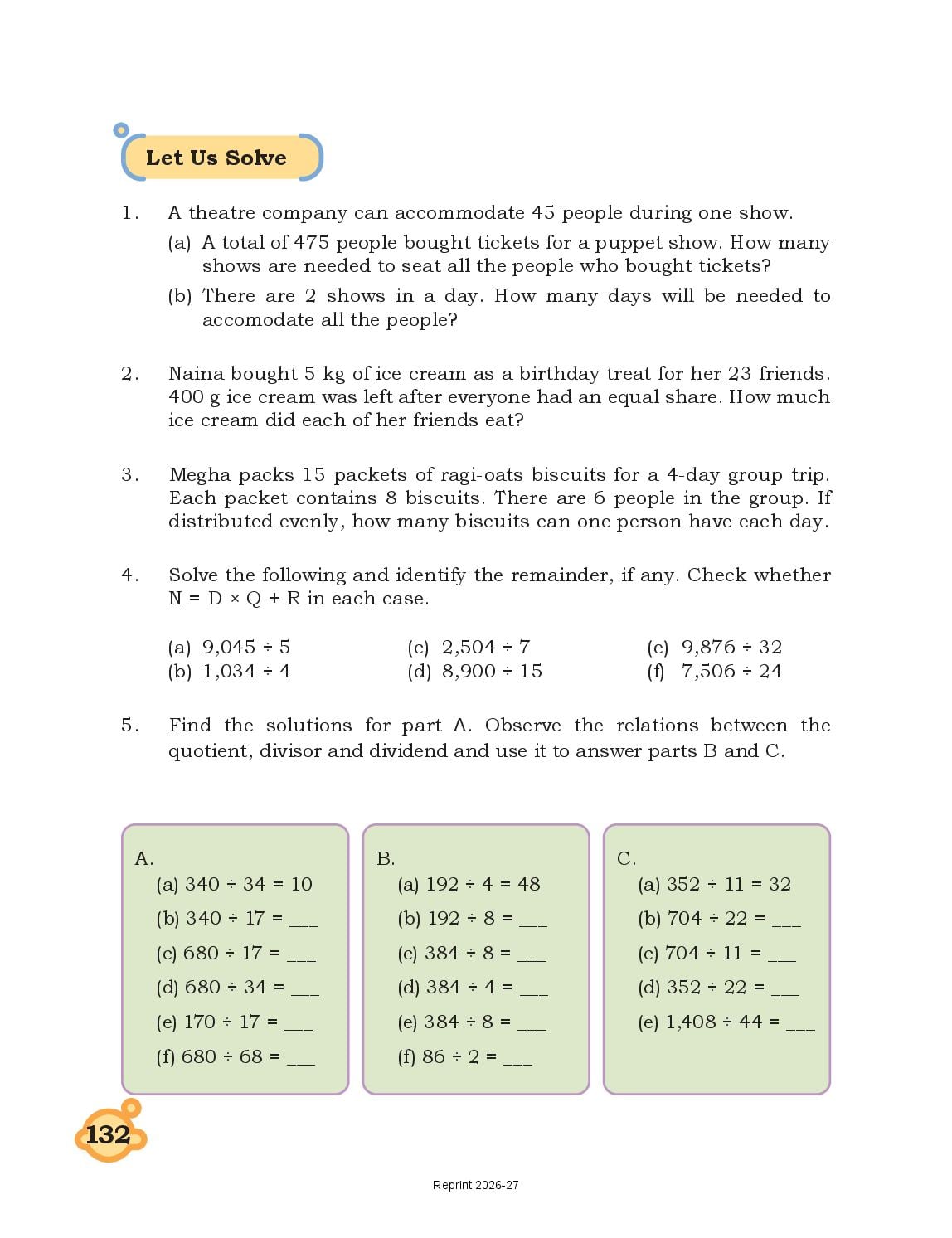
- Sometimes something is left over. 535 ÷ 25 gives 21 with 10 left over. That 10 is the remainder, written R. The full rule is N = D × Q + R: 535 = 25 × 21 + 10. The remainder is always smaller than the divisor.
- A remainder can change your answer. 535 coconuts fill 21 bags with 10 coconuts left. Those 10 still need a bag, so the answer to “how many bags?” is 22, not 21. Always read the question again after you divide.
Quick revision – Coconut Farm
| Word | What it means | Where it appears | Example |
|---|---|---|---|
| Array | Things set out in equal rows and columns | Page 119, the coconuts | 5 rows of 7 coconuts = 35 |
| Multiplication fact | A true sentence using × | Page 119 | 5 × 7 = 35 |
| Division fact | A true sentence using ÷ that comes from a multiplication fact | Division Facts box, page 119 | 35 ÷ 5 = 7 |
| Dividend (N) | The number being shared out | Notice! box, page 119 | In 35 ÷ 5 = 7, N is 35 |
| Divisor (D) | The number you are sharing by | Notice! box, page 119 | In 35 ÷ 5 = 7, D is 5 |
| Quotient (Q) | The answer of a division | Notice! box, page 119 | In 35 ÷ 5 = 7, Q is 7 |
| Remainder (R) | What is left over when the sharing is not even | Page 125 | 535 ÷ 25 leaves R = 10 |
| N = D × Q + R | The rule that ties all four together | Pink box, page 125 | 535 = 25 × 21 + 10 |
| Splitting the number | Breaking the dividend into easy parts before dividing | Mental Strategies for Division, page 123 | 1248 = 1200 + 48 |
| Repeated halving | Halving again and again to divide by 2, 4, 8 … | Page 123 | 128 → 64 → 32, so 128 ÷ 4 = 32 |
| Partial quotients | Taking away big chunks of the divisor and adding up the chunks | Susie’s Farm in Kerala, page 124 | 582 ÷ 6 = 90 + 7 |
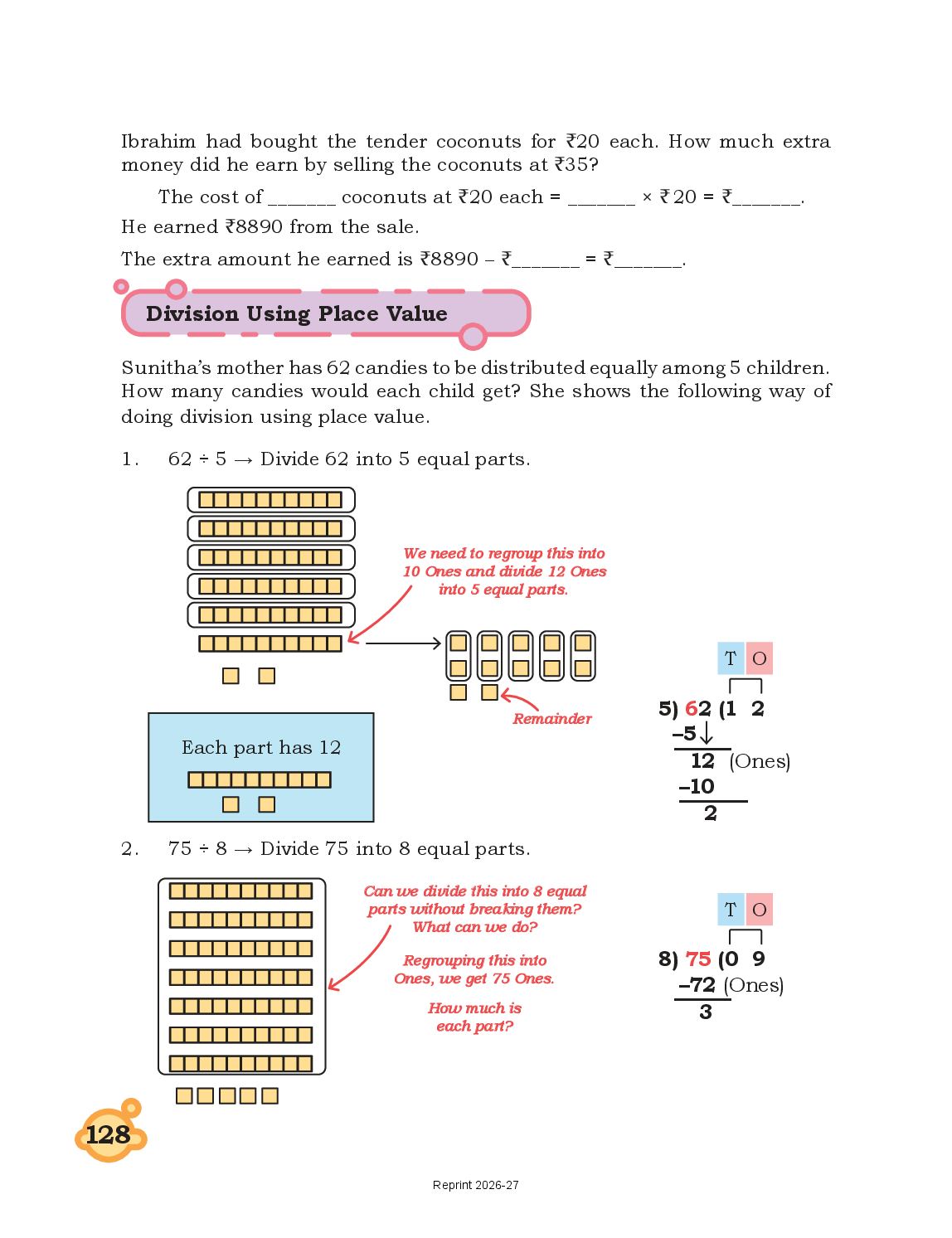
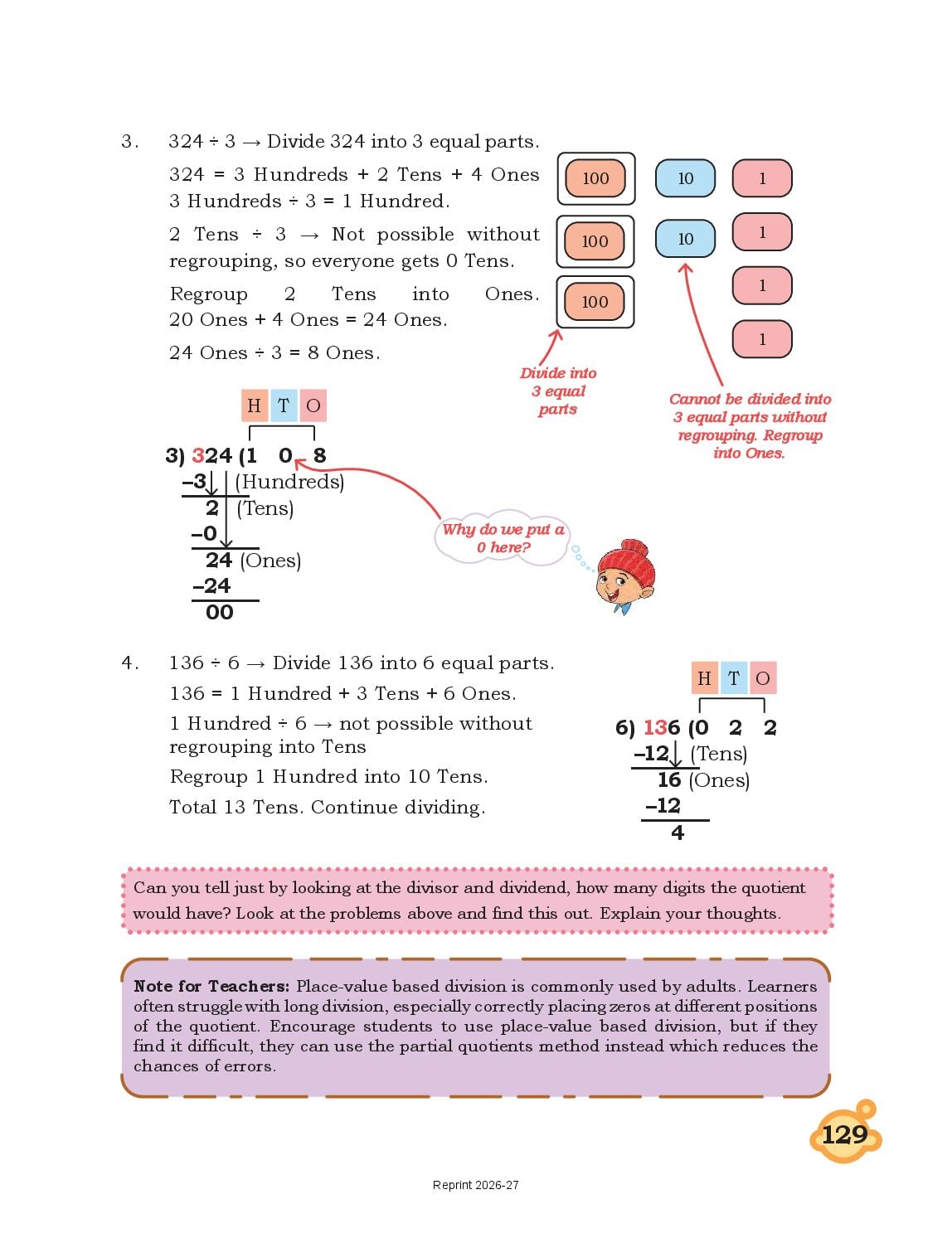
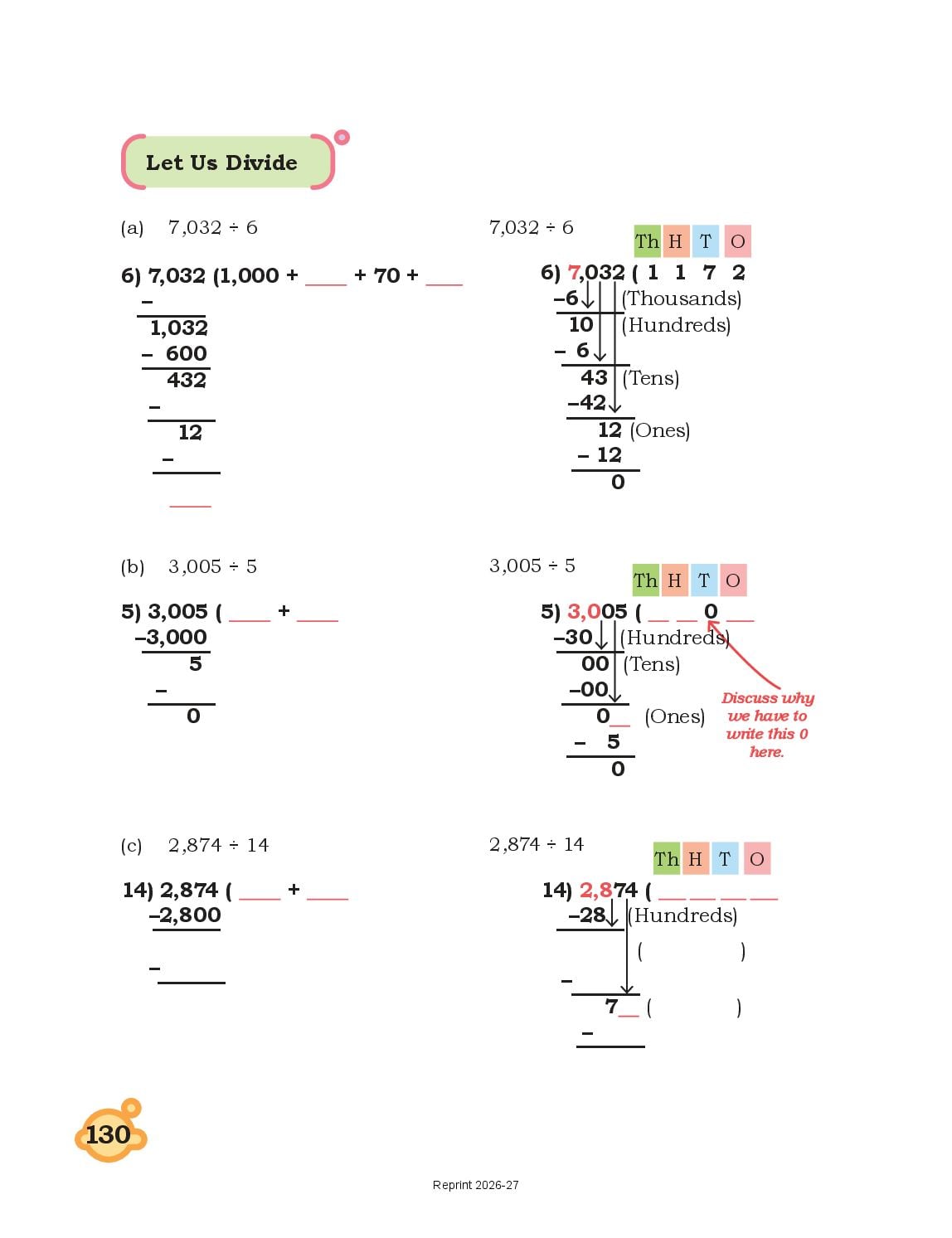
| Division using place value | Dividing the Thousands, then Hundreds, then Tens, then Ones | Page 128 | 324 ÷ 3 = 108 |
| Regrouping | Changing 1 Hundred into 10 Tens, or 1 Ten into 10 Ones | Page 128 | 2 Tens become 20 Ones |
| Estimate | A sensible guess made before you calculate | Page 124 | Each customer gets less than 100 coconuts |
Old NCERT vs New – Class 5 Maths
This chapter is from Maths Mela, the new NCERT Class 5 Maths book (NCF-SE 2023, used from 2025-26). It replaced the old book “Math-Magic”, so chapter numbers and names differ from older PDFs.
Solutions and All Chapters
Answers to the exercises and the full chapter list of Maths Mela:
Coconut Farm – Overview
| Class | Class 5 |
| Subject | Maths |
| Book | Maths Mela – new NCERT book |
| Chapter | 9 of 15 – Coconut Farm |
| Book pages | 119 – 135 |
| Edition | NCERT Reprint 2026-27 |
| Session | 2026-27 |
| Free – read online or download |
Class 5 Maths Chapter 9 – FAQs
Where can I download Coconut Farm Class 5 PDF?
From the download table on this page – the chapter PDF is free, and the full book is linked too.
What is Class 5 Maths Chapter 9 about?
Division is sharing into equal groups. Look at 35 coconuts set out in 5 rows of 7. Split them into 7 groups and each group has 5. Split them into 5 groups and each group has 7. So one multiplication fact, 5 × 7 = 35, gives two division facts: 35 ÷ 7 = 5 and 35 ÷ 5 = 7.
Is Coconut Farm from the new NCERT Class 5 Maths book?
Yes. It is chapter 9 of maths mela, the new NCERT Class 5 Maths book for 2026-27.
Is this the latest NCERT edition for 2026-27?
Yes – the PDF is NCERT’s latest edition for the 2026-27 session.
Where are the NCERT Solutions for Class 5 Maths Chapter 9?
Open the NCERT Solutions link above for answers to the exercise questions.