Download Weight and Capacity – NCERT Class 5 Maths Chapter 8 PDF from the new NCERT Class 5 Maths book Maths Mela (2026-27). Read the chapter online or download the free PDF. Weight tells how heavy a thing is. A milligram (mg) is the smallest unit here — an ant weighs only 1 mg to 5 mg. A gram (g) is bigger: a sugar sachet is 5 g. A kilogram (kg) is bigger still: a rice bag is 5 kg. A quintal is 100 kg and a tonne is…
Weight and Capacity PDF – Chapter 8 of Maths Mela
Read the chapter online or download the PDF.
| Chapter | Download | |
|---|---|---|
| Chapter 8 PDF | Weight and Capacity | View PDF |
| Full book | NCERT Class 5 Maths – Maths Mela | View Book |
Read Online
What Is in Weight and Capacity? (Class 5 Maths Chapter 8)
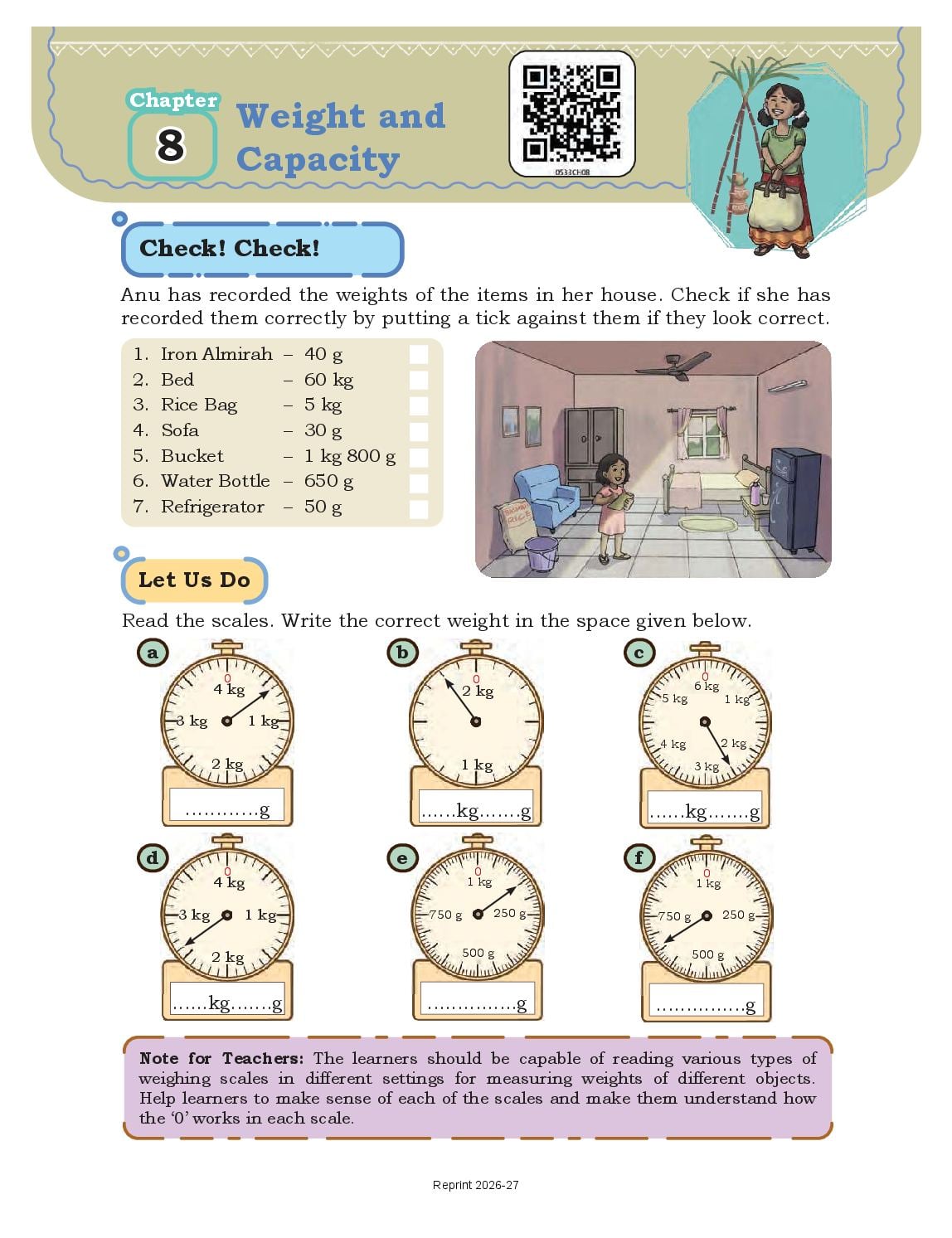
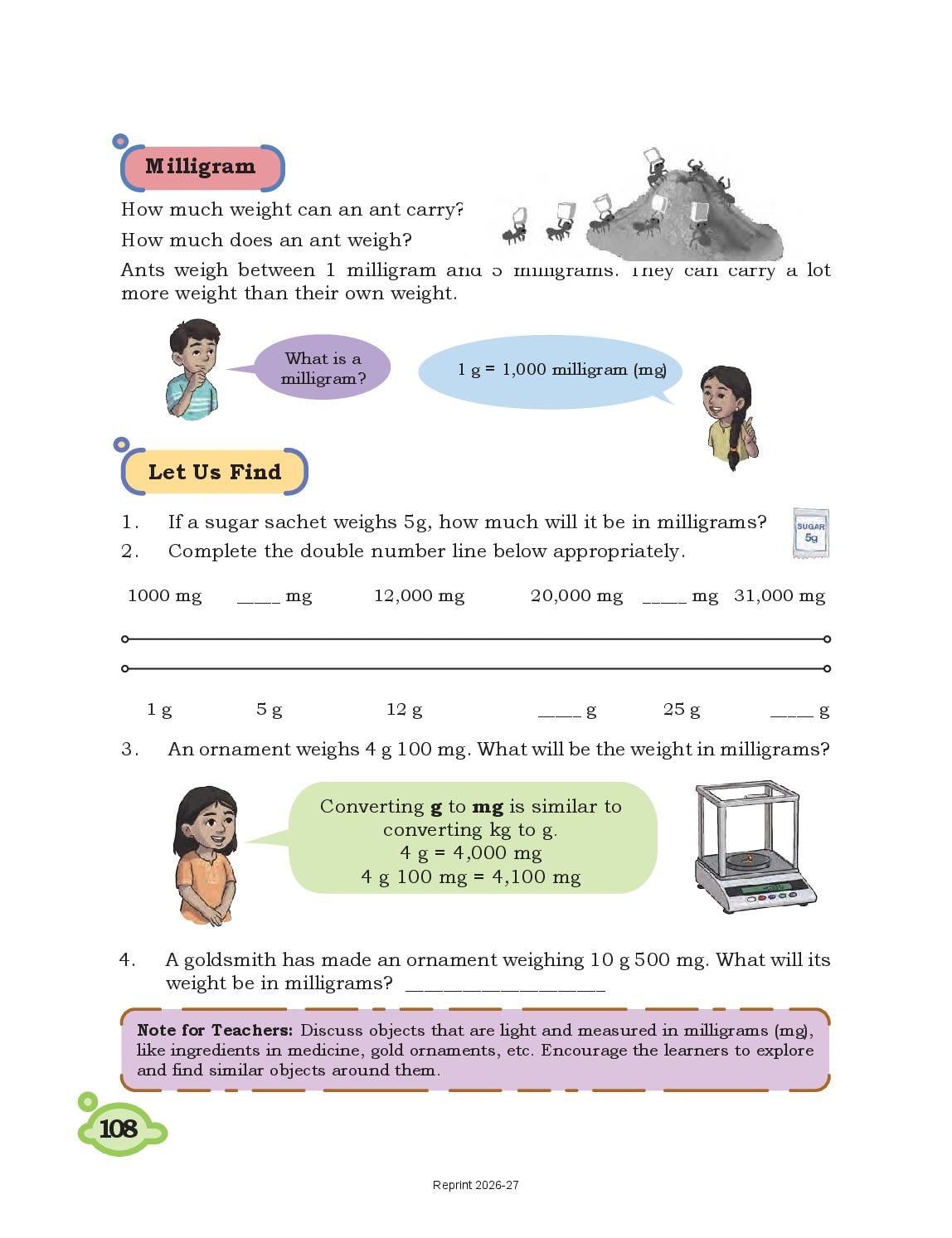
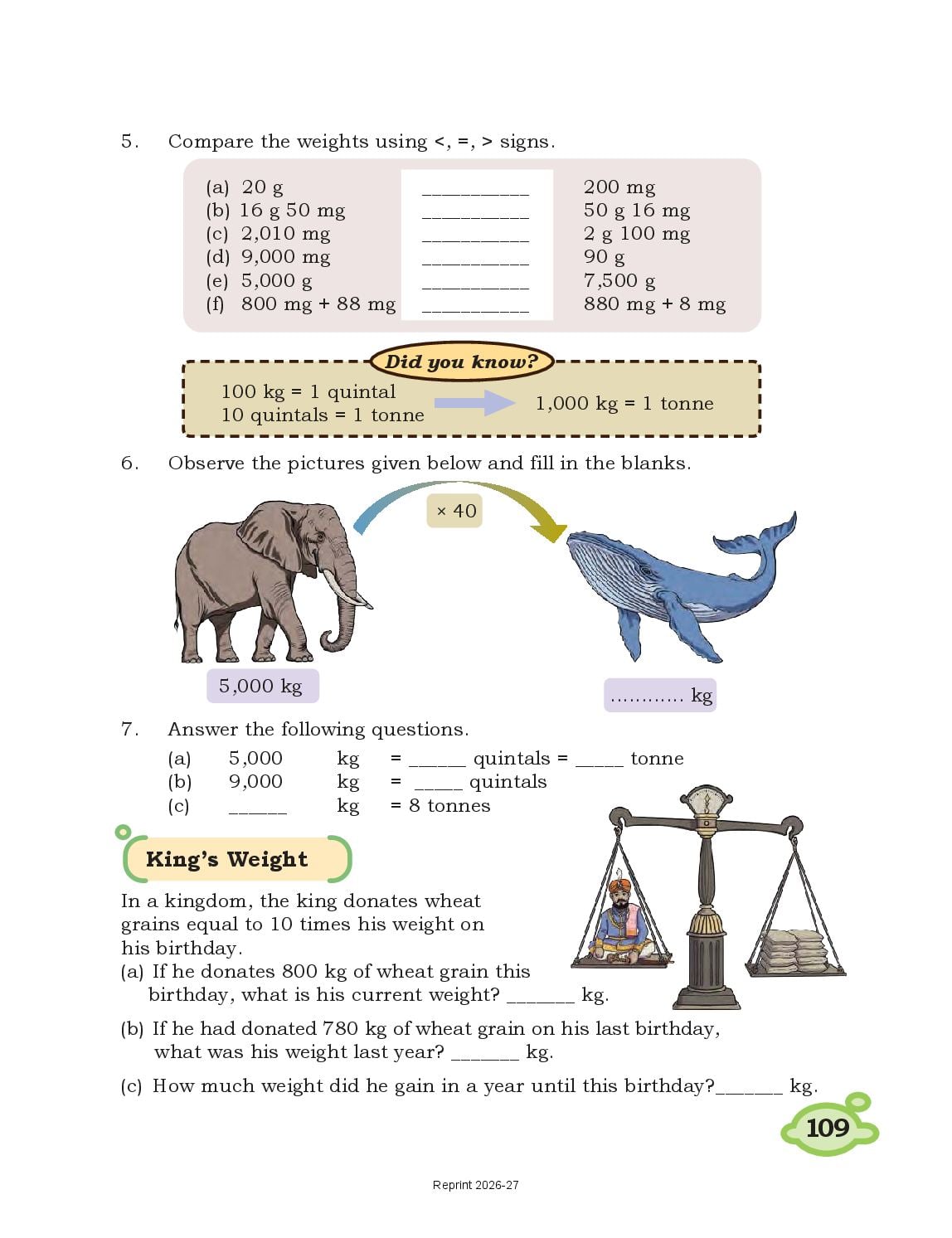
- Weight tells how heavy a thing is. A milligram (mg) is the smallest unit here — an ant weighs only 1 mg to 5 mg. A gram (g) is bigger: a sugar sachet is 5 g. A kilogram (kg) is bigger still: a rice bag is 5 kg. A quintal is 100 kg and a tonne is 1,000 kg — those are for trucks, elephants and grain stores. Always ask, is this thing light or heavy?, and then pick the unit.
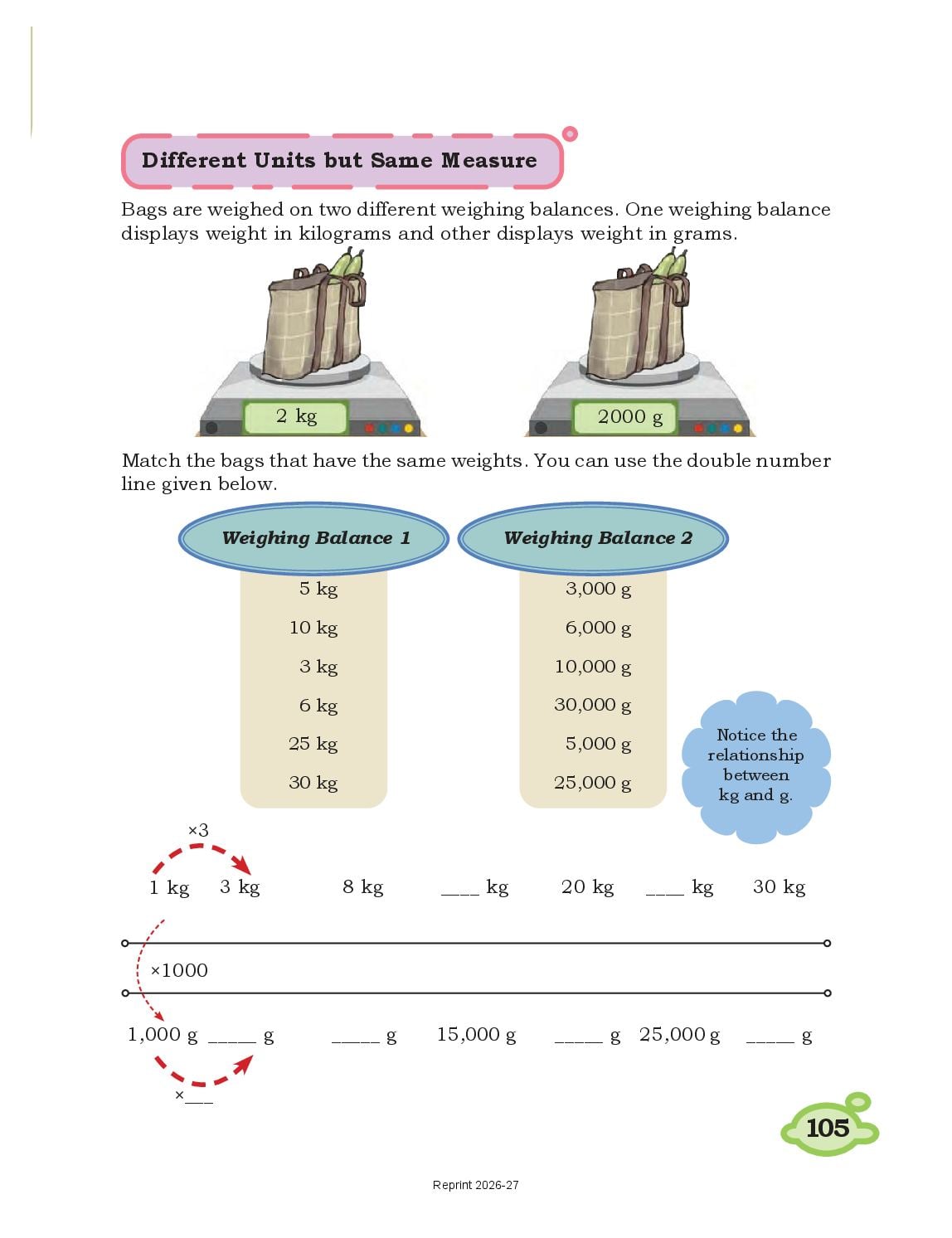
- The magic number is 1,000. 1,000 mg = 1 g. 1,000 g = 1 kg. 1,000 kg = 1 tonne. Going from a big unit to a small unit, multiply by 1,000. Going from a small unit to a big unit, divide by 1,000. So 3 kg = 3 × 1,000 = 3,000 g, and 5,000 g = 5,000 ÷ 1,000 = 5 kg.
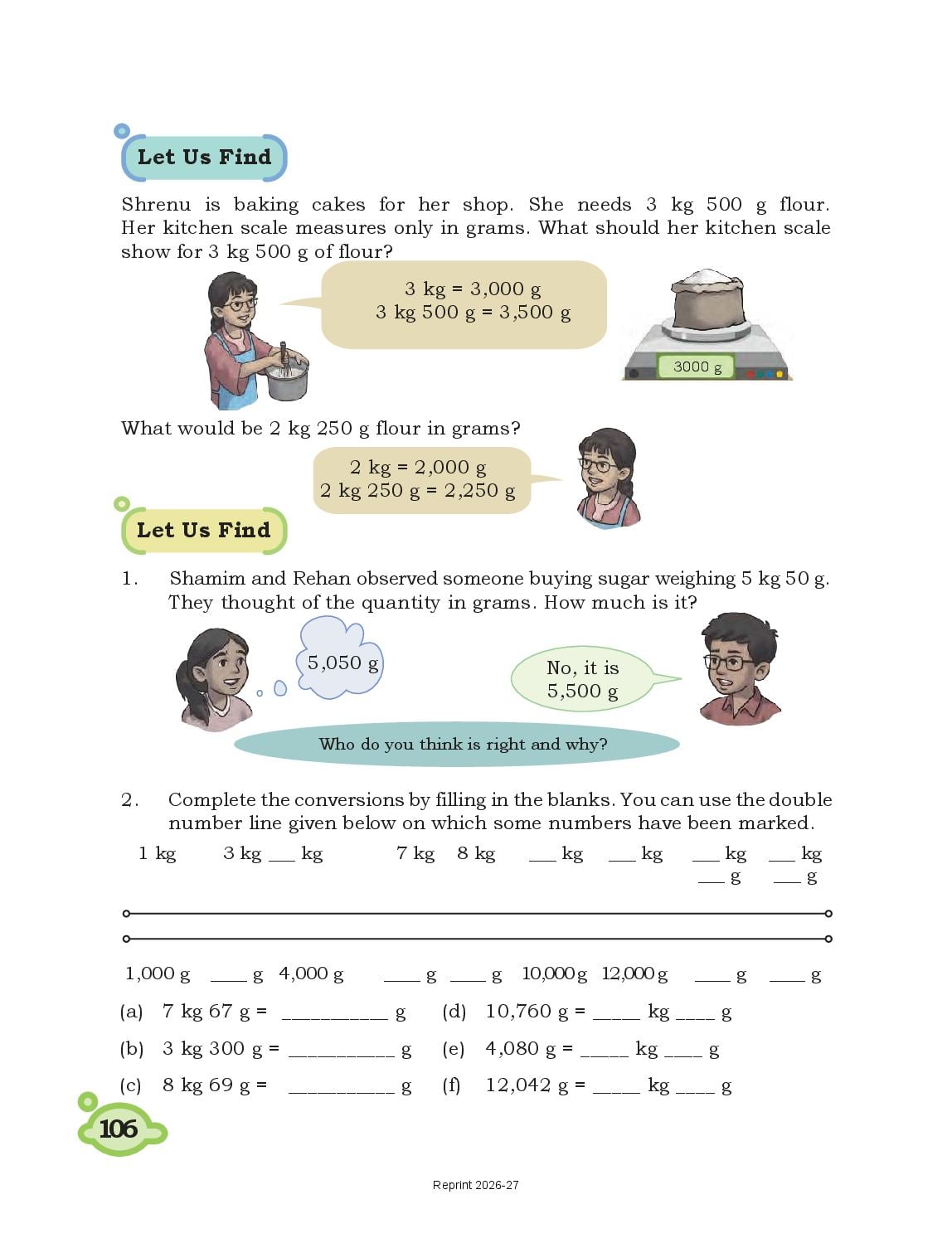
- Mixed amounts split into two pieces. 3 kg 500 g means 3 kg and 500 g. Change only the kg part and then add the grams: 3 kg = 3,000 g, so 3 kg 500 g = 3,000 + 500 = 3,500 g. Going back, cut off the last three digits: 10,760 g = 10 kg 760 g, because 10,760 = 10,000 + 760.
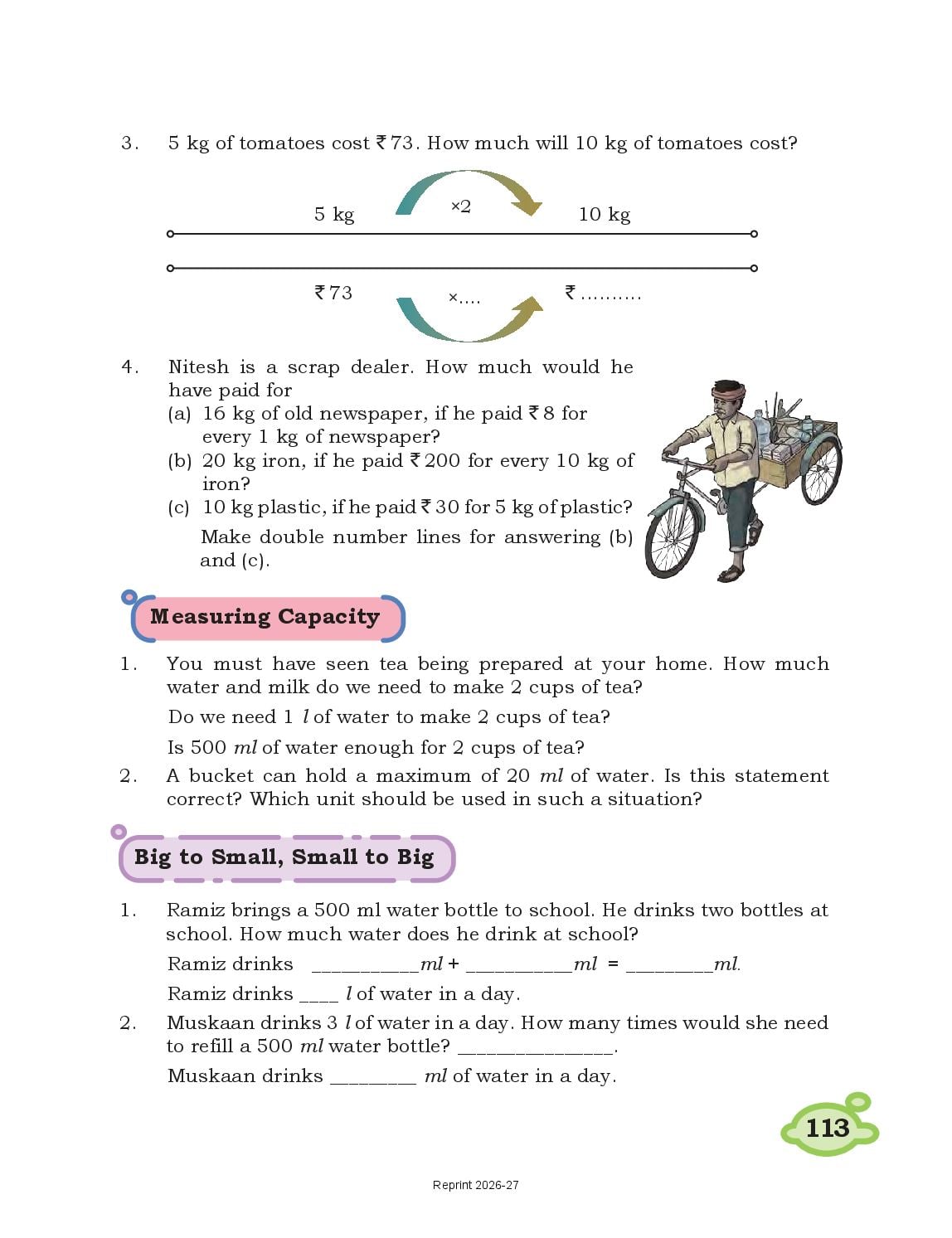
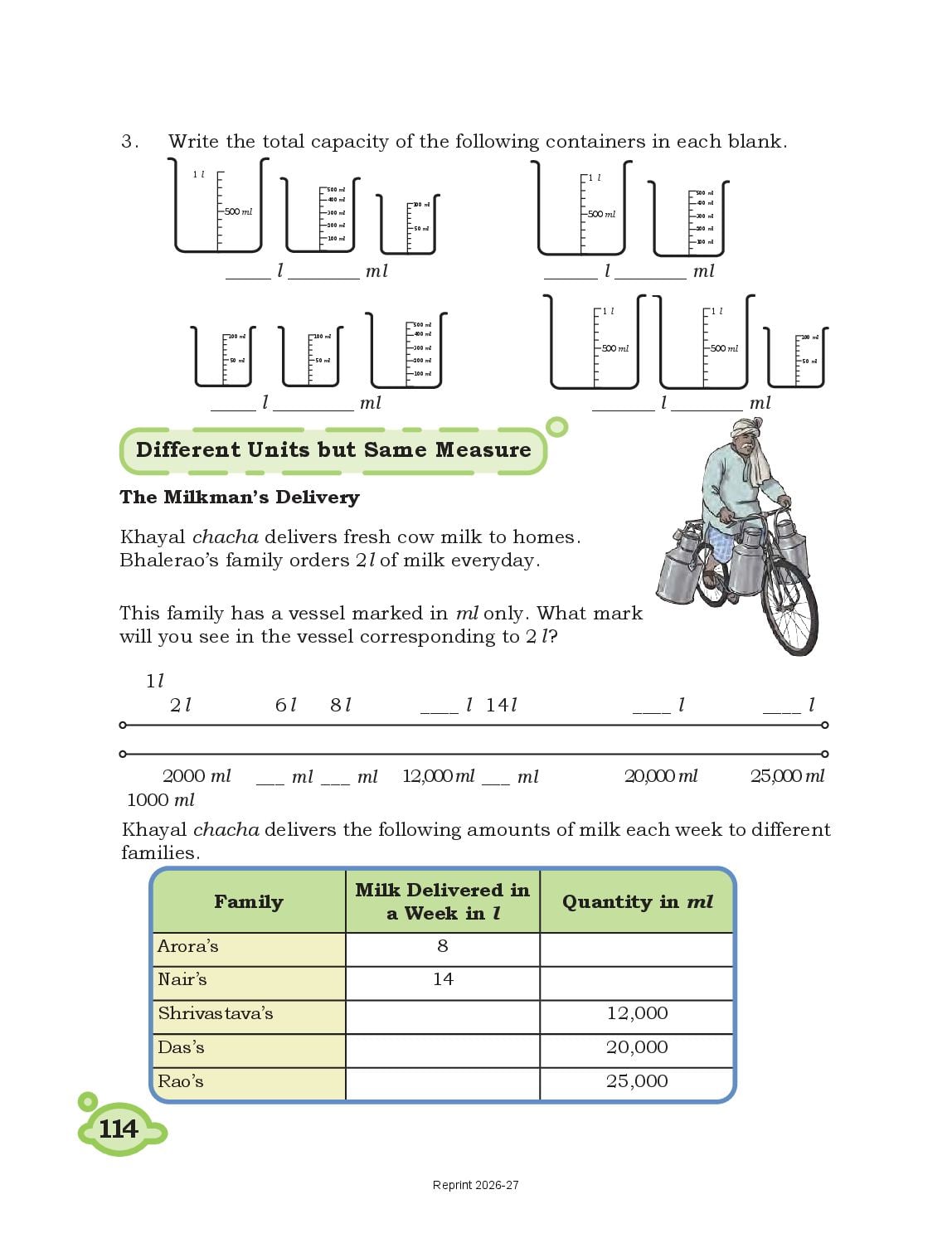
- The double number line is a picture of the same weight twice. The top line is marked in kg and the bottom line in g, one under the other. 1 kg sits above 1,000 g, 3 kg above 3,000 g, 8 kg above 8,000 g. Whatever you do to the top number, do the same to the bottom number. It is a ladder you can climb to any conversion.
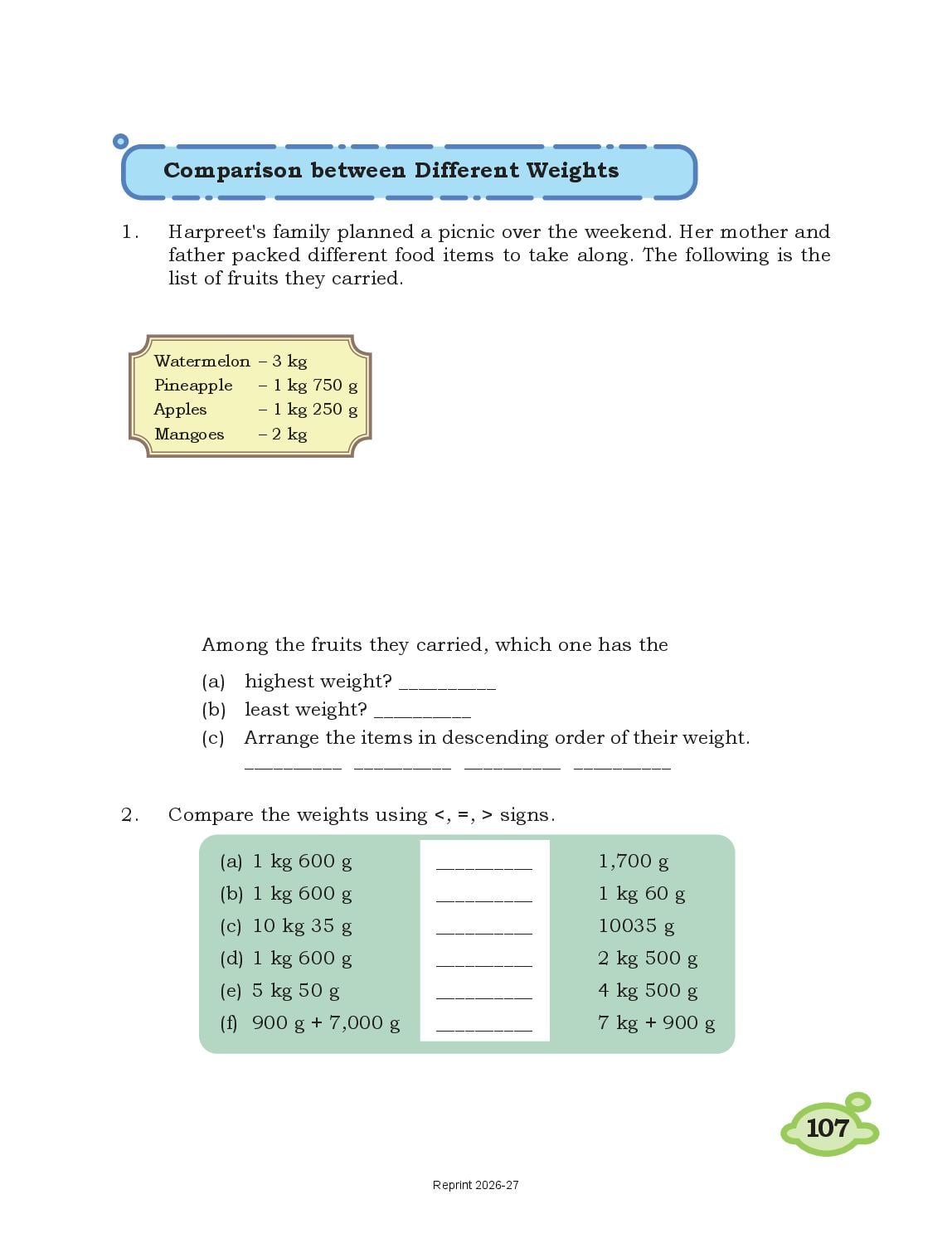
- To compare, first make the units the same. You cannot compare 1 kg 600 g with 1,700 g by looking. Change both to grams: 1,600 g and 1,700 g. Now it is easy — 1,600 < 1,700, so 1 kg 600 g < 1,700 g. Use < for less than, > for more than, = for equal.
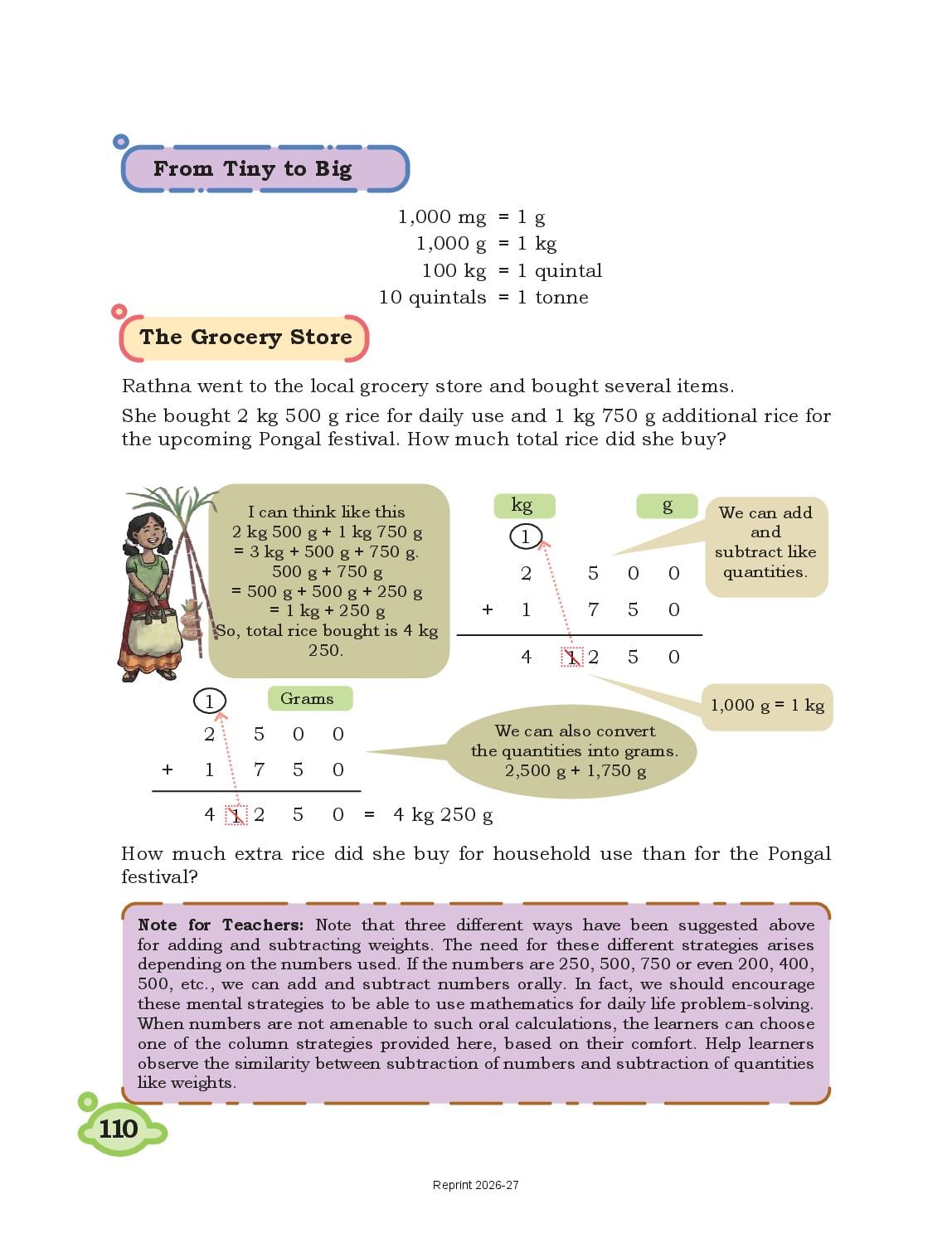
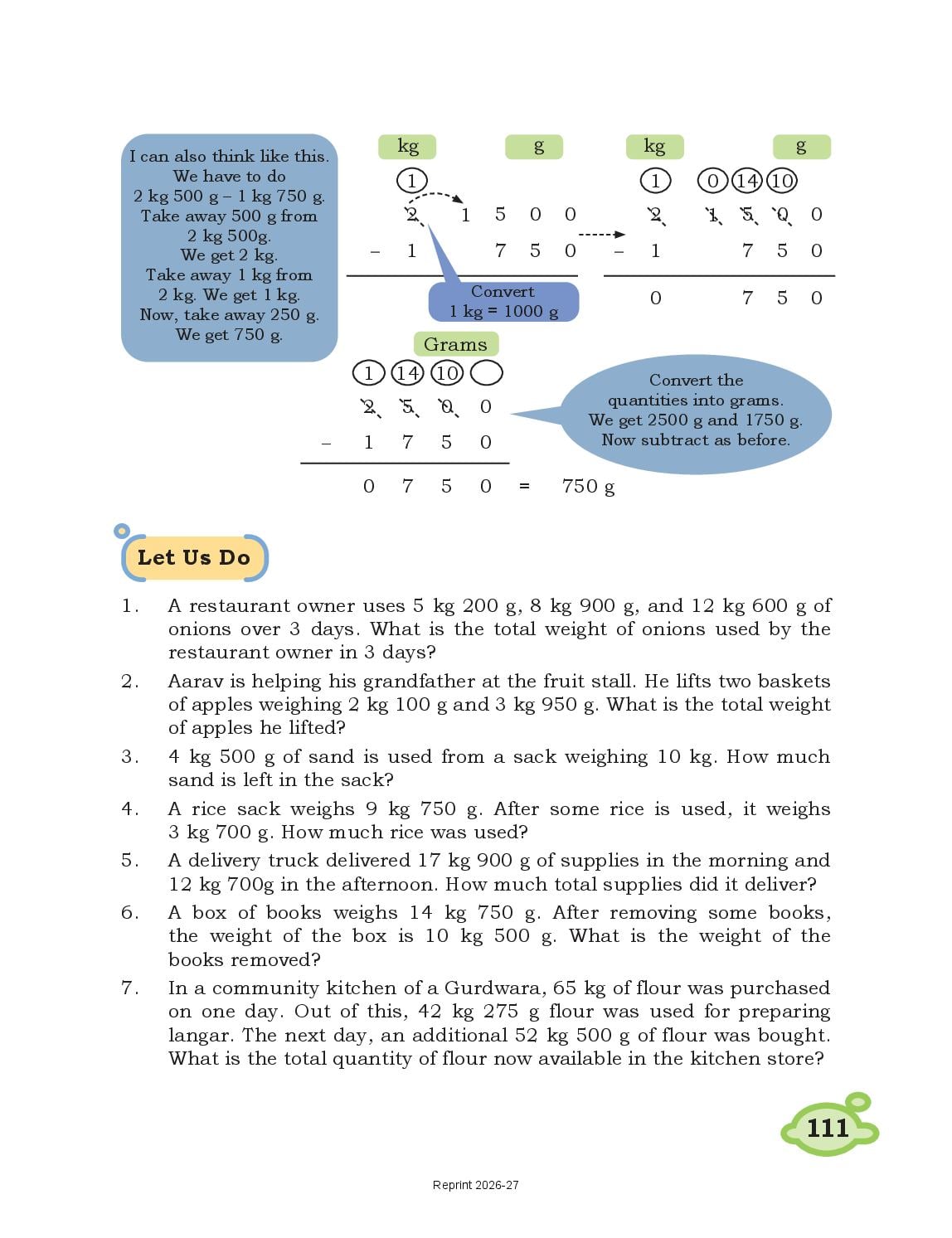
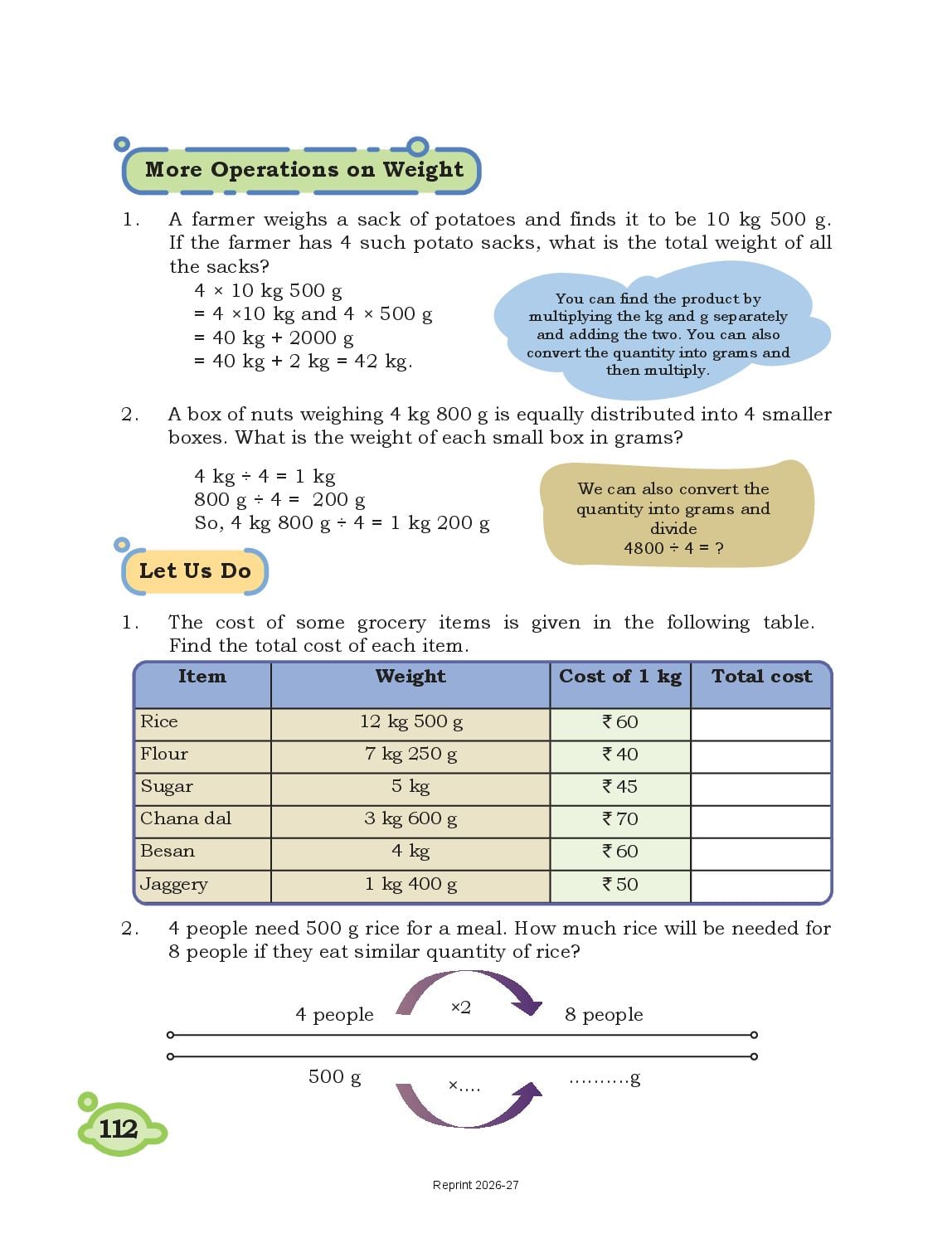
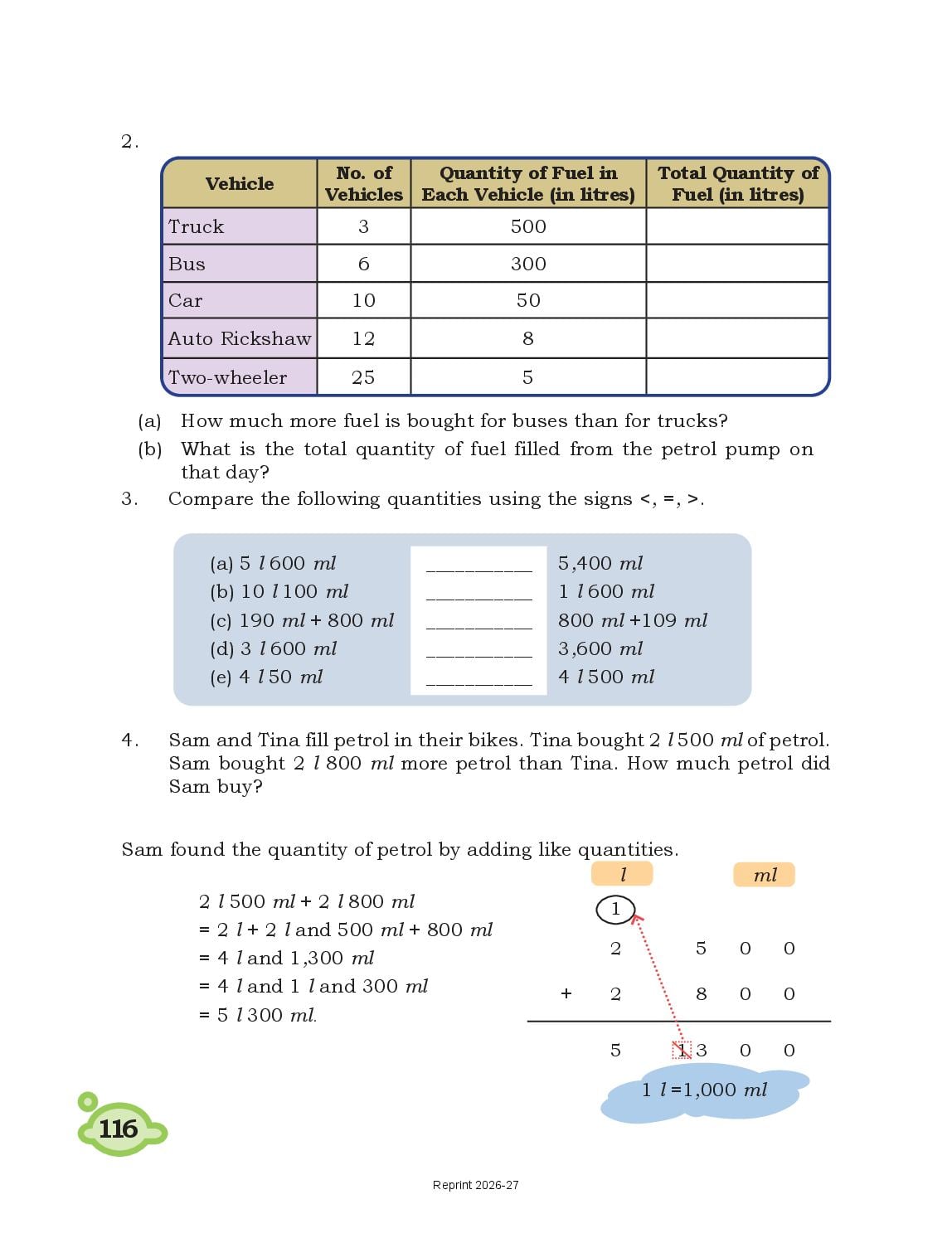
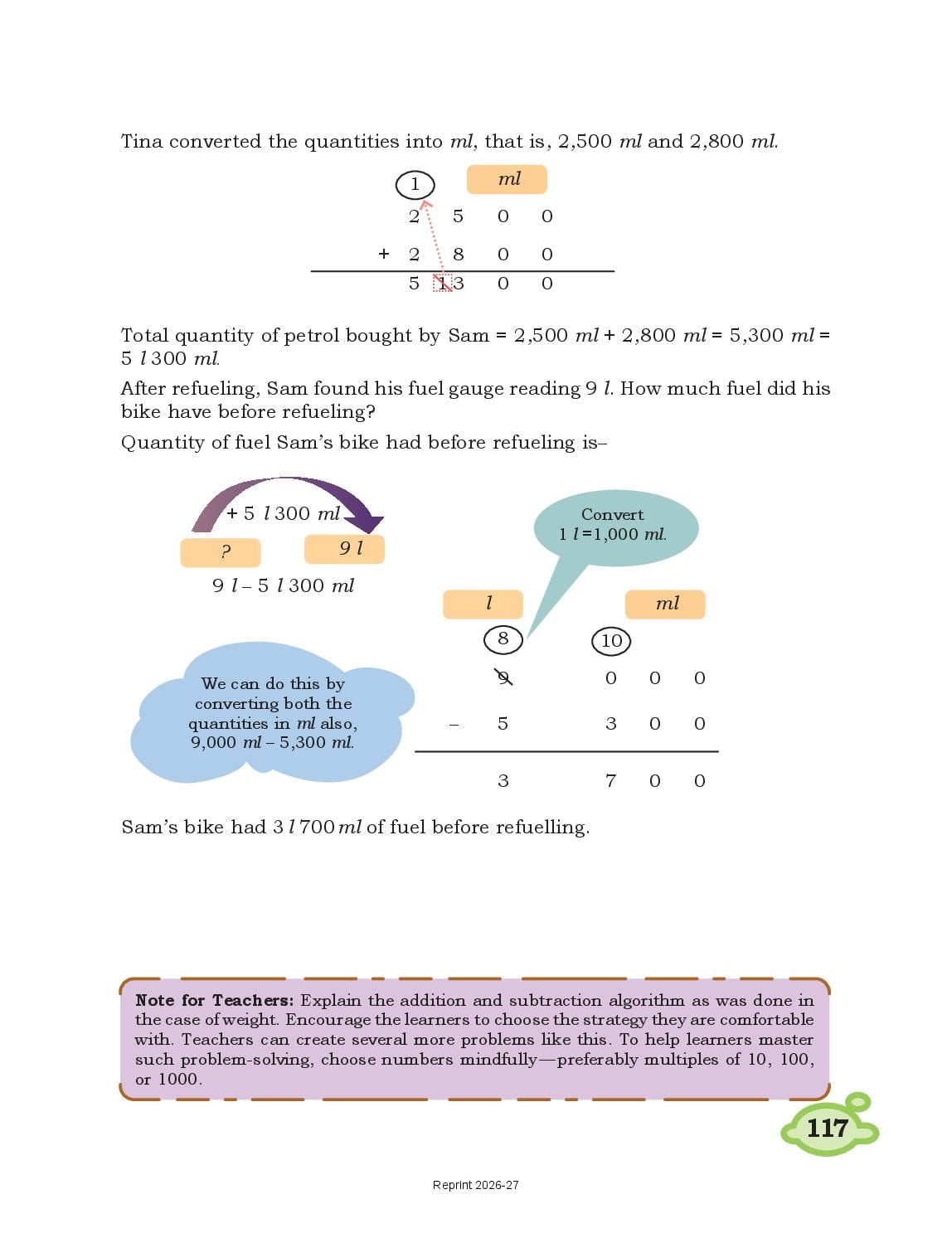
- Adding and subtracting weight is like adding and subtracting money. Put kg under kg and g under g. When the grams cross 1,000, carry 1 kg over — just as 100 paise make a rupee, 1,000 g make a kilogram. 2 kg 500 g + 1 kg 750 g = 4 kg 250 g. You may also change everything to grams first: 2,500 + 1,750 = 4,250 g = 4 kg 250 g. Both ways give the same answer.
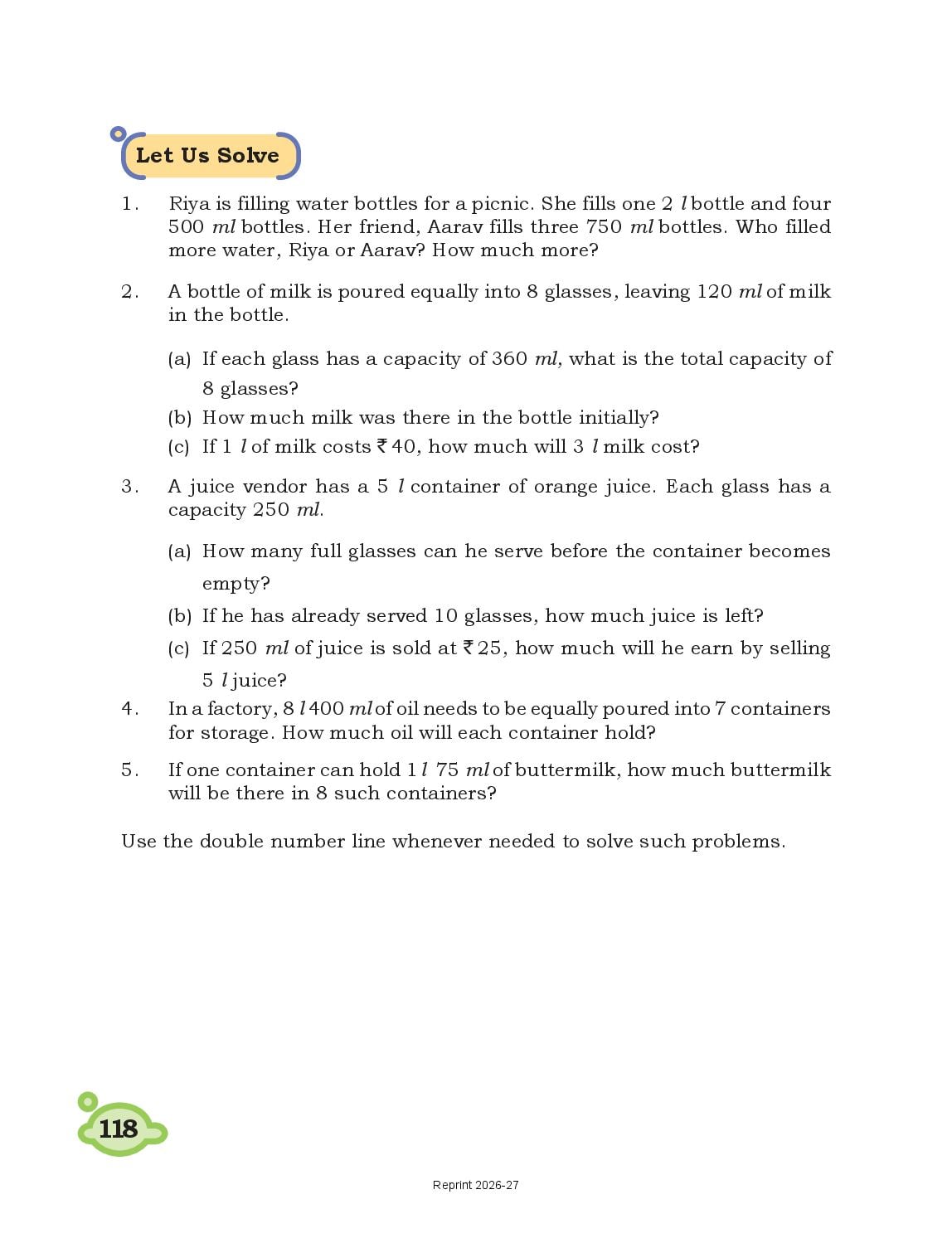
- Multiplying and dividing work the same way. 4 × 10 kg 500 g = (4 × 10 kg) + (4 × 500 g) = 40 kg + 2,000 g = 42 kg. And 4 kg 800 g ÷ 4 = (4 kg ÷ 4) + (800 g ÷ 4) = 1 kg 200 g. If the split is awkward, change to grams, work it out, then change back.
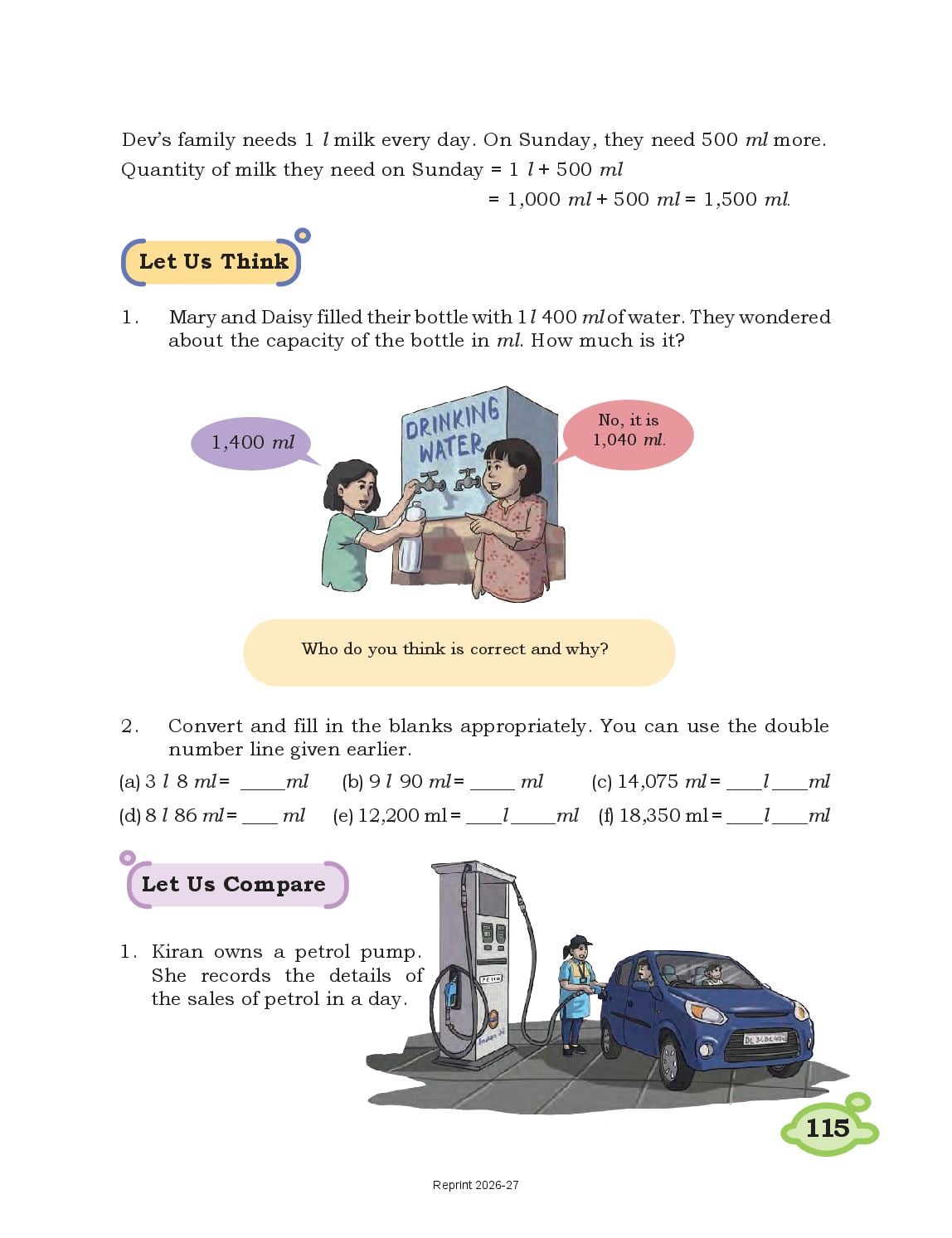
- Capacity is how much a container holds. A spoon of medicine is in millilitres (ml), a water bottle is 500 ml or 1 litre (l), a bucket is about 15 l to 20 l. The magic number is 1,000 again: 1 l = 1,000 ml. So 1 l 400 ml = 1,400 ml, and 14,075 ml = 14 l 75 ml.
Quick revision – Weight and Capacity
| Word | What it means | Where it appears | Example |
|---|---|---|---|
| Weight | How heavy a thing is | Chapter title, page 104 | A rice bag weighs 5 kg |
| Milligram (mg) | The smallest weight unit in this chapter; 1,000 mg = 1 g | Milligram, page 108 | An ant weighs 1 mg to 5 mg |
| Gram (g) | 1,000 g make 1 kg | Check! Check!, page 104 | A water bottle weighs 650 g |
| Kilogram (kg) | The everyday unit for shopping weights | Page 104 onwards | A bed weighs 60 kg |
| Quintal | 100 kg | Did you know?, page 109 | 5,000 kg = 50 quintals |
| Tonne | 1,000 kg, or 10 quintals | Did you know?, page 109 | A whale weighs 200 tonnes |
| Weighing balance / scale | The machine that shows a weight; the needle points at the reading | Let Us Do, page 104 | The needle at 600 g |
| Double number line | Two lines one above the other — the same amount in two units | Pages 105, 106, 108, 114 | 1 kg above 1,000 g |
| Capacity | How much a container can hold | Measuring Capacity, page 113 | A bucket holds about 20 l |
| Millilitre (ml) | The small capacity unit; 1,000 ml = 1 l | Page 113 | A glass holds 250 ml |
| Litre (l) | The everyday capacity unit | Page 113 onwards | A water bottle holds 1 l |
| <, >, = | Less than, more than, equal to | Pages 107, 109, 116 | 1,600 g < 1,700 g |
Old NCERT vs New – Class 5 Maths
This chapter is from Maths Mela, the new NCERT Class 5 Maths book (NCF-SE 2023, used from 2025-26). It replaced the old book “Math-Magic”, so chapter numbers and names differ from older PDFs.
Solutions and All Chapters
Answers to the exercises and the full chapter list of Maths Mela:
Weight and Capacity – Overview
| Class | Class 5 |
| Subject | Maths |
| Book | Maths Mela – new NCERT book |
| Chapter | 8 of 15 – Weight and Capacity |
| Book pages | 104 – 118 |
| Edition | NCERT Reprint 2026-27 |
| Session | 2026-27 |
| Free – read online or download |
Class 5 Maths Chapter 8 – FAQs
Where can I download Weight and Capacity Class 5 PDF?
From the download table on this page – the chapter PDF is free, and the full book is linked too.
What is Class 5 Maths Chapter 8 about?
Weight tells how heavy a thing is. A milligram (mg) is the smallest unit here — an ant weighs only 1 mg to 5 mg. A gram (g) is bigger: a sugar sachet is 5 g. A kilogram (kg) is bigger still: a rice bag is 5 kg. A quintal is 100 kg and a tonne is 1,000 kg — those are for trucks, elephants and grain stores. Always ask, is this thing light or heavy?, and then pick the unit.
Is Weight and Capacity from the new NCERT Class 5 Maths book?
Yes. It is chapter 8 of maths mela, the new NCERT Class 5 Maths book for 2026-27.
Is this the latest NCERT edition for 2026-27?
Yes – the PDF is NCERT’s latest edition for the 2026-27 session.
Where are the NCERT Solutions for Class 5 Maths Chapter 8?
Open the NCERT Solutions link above for answers to the exercise questions.