NCERT Solutions for Class 9 Maths Chapter 3 The World of Numbers provide clear, step-by-step answers to every exercise and in-text question from the chapter The World of Numbers of the NCERT textbook Ganita Manjari. Prepared by subject experts as per the latest NCERT (CBSE) syllabus for 2026-27, these NCERT Solutions for Class 9 Maths help you understand each concept, write exam-ready answers, and check your own solutions. You can read them online below or download the free Class 9 Maths Chapter 3 question-answer PDF.
NCERT Solutions for Class 9 Maths Chapter 3 The World of Numbers
- Class: Class 9
- Subject: Maths
- Chapter: Chapter 3 – The World of Numbers
- Textbook: Ganita Manjari (NCERT)
- Study material: NCERT Solutions – questions with answers, free PDF
These solutions answer all the exercise questions of Chapter 3 The World of Numbers — including the in-text questions, short-answer and long-answer questions, and activities — with complete explanations so you can follow the method, not just the final answer. Read the full solutions below.
NCERT Solutions Class 9 Maths Chapter 3 the World of Numbers View Download
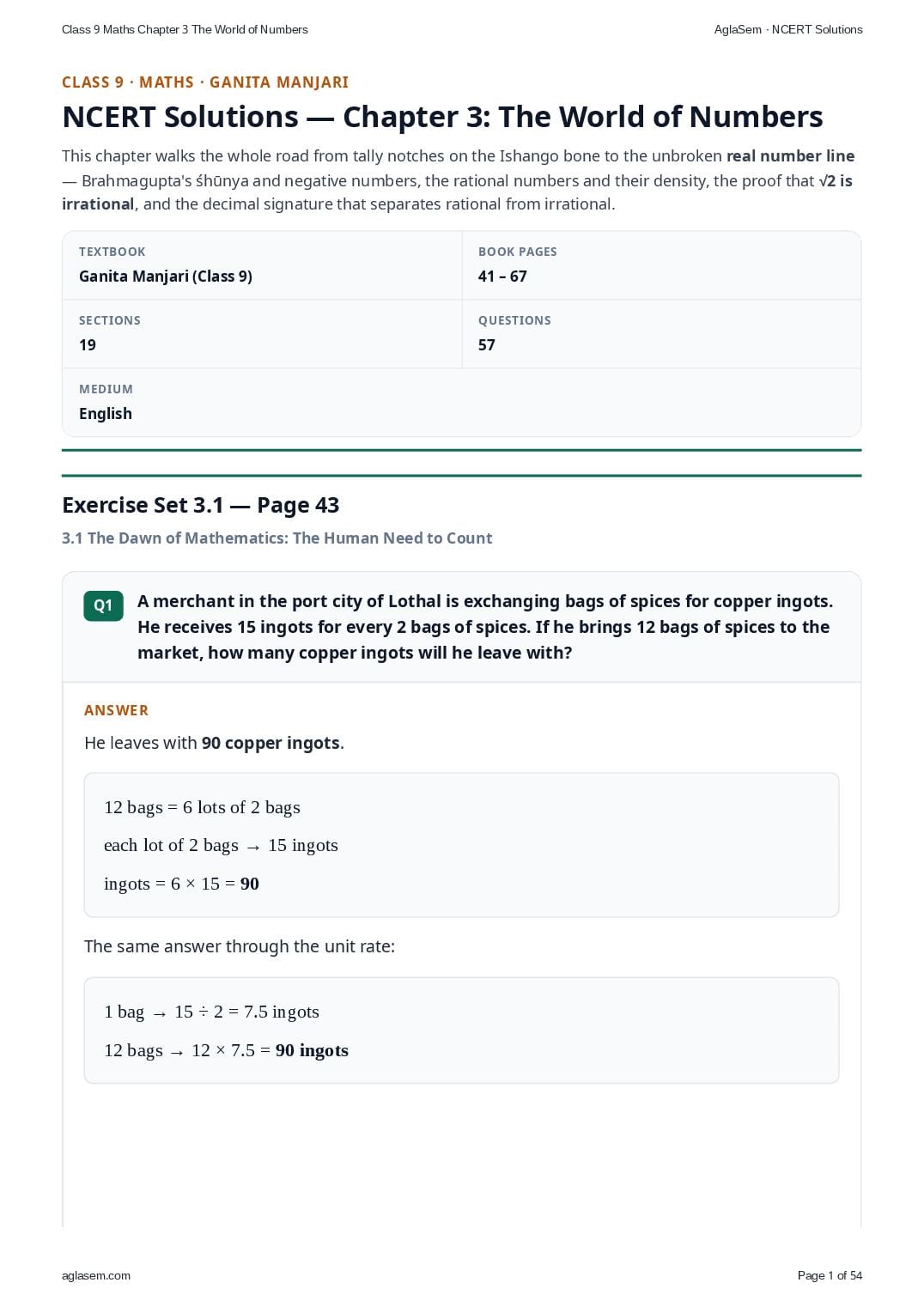
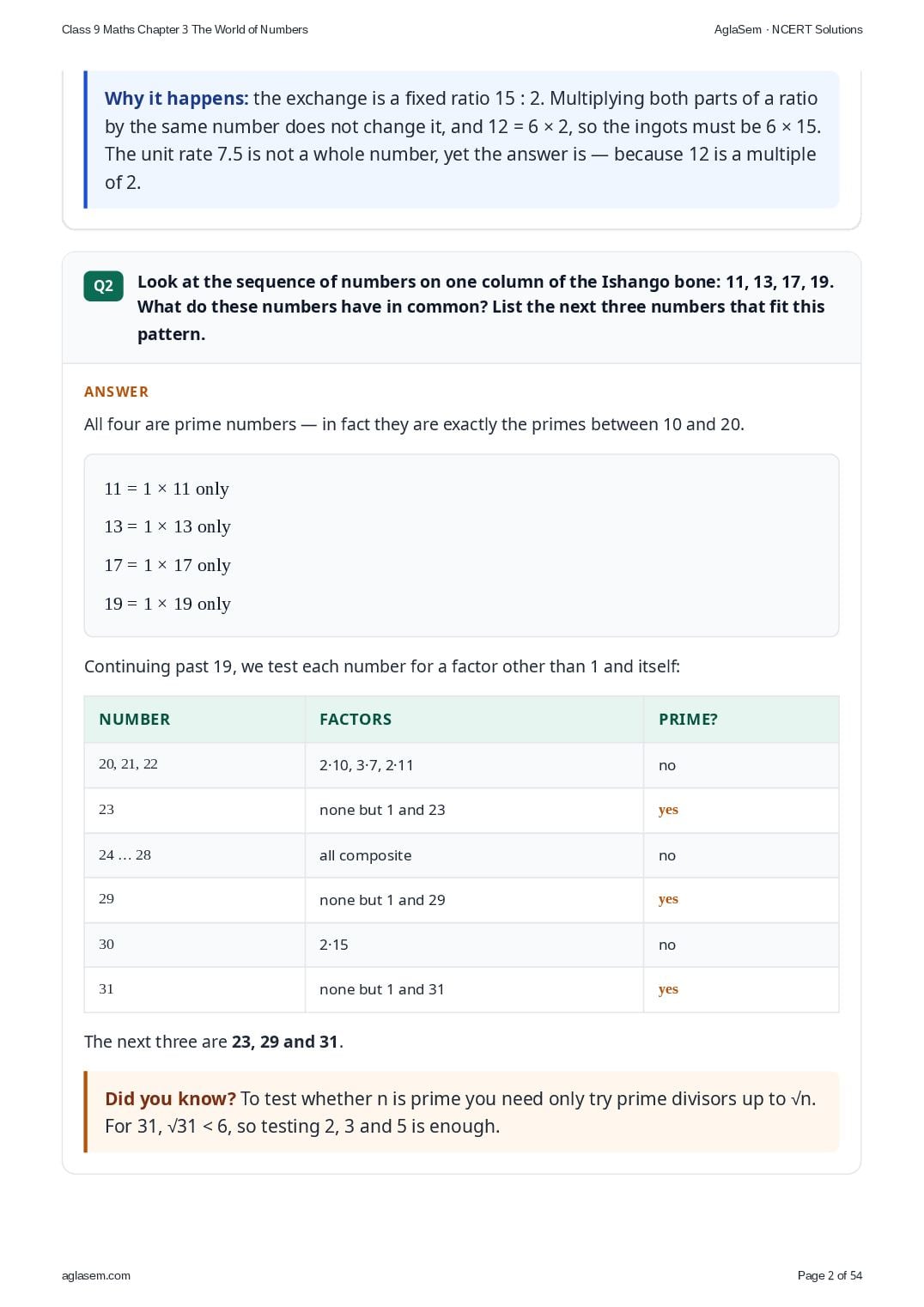
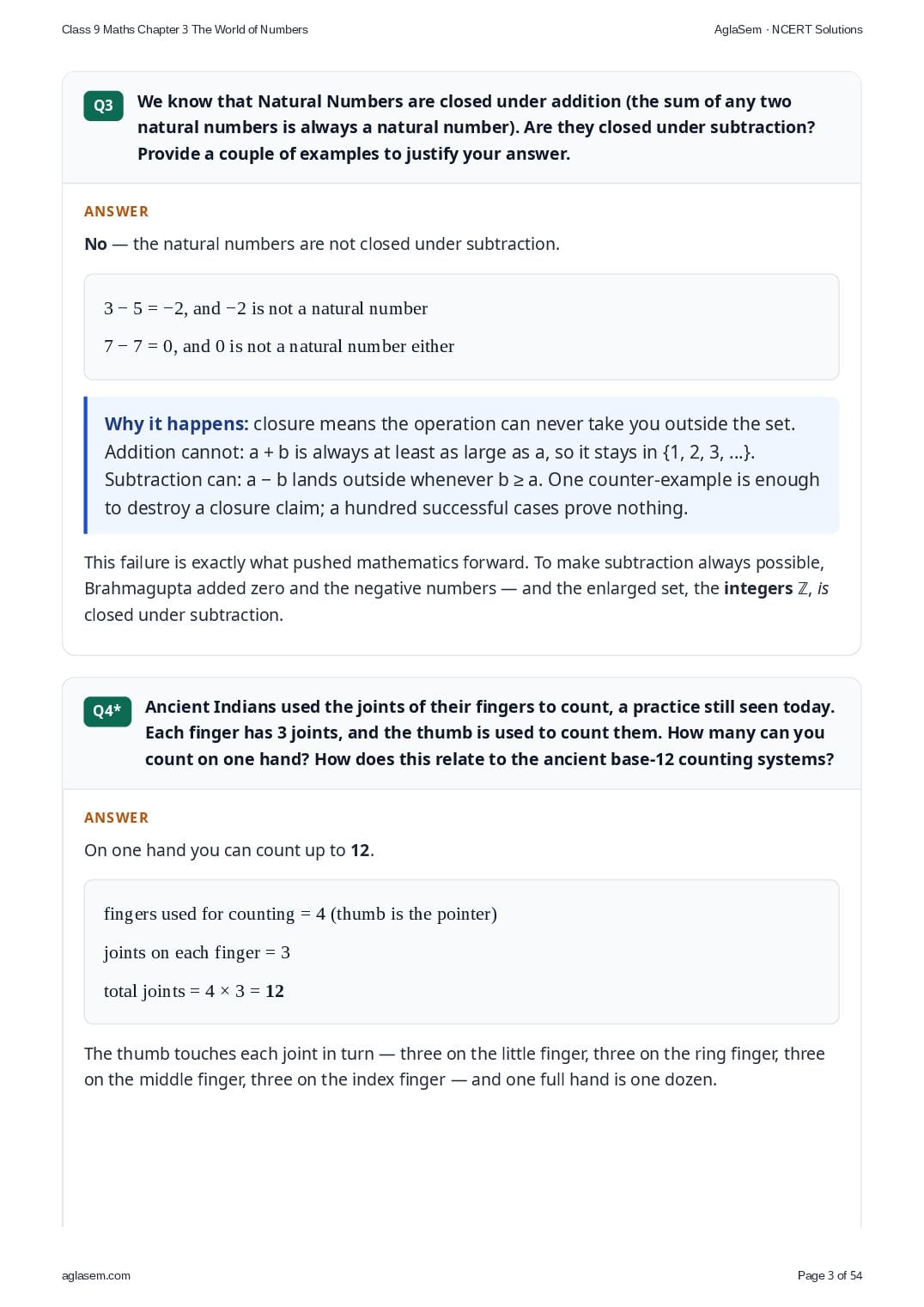
NCERT Solutions for Class 9 Maths Chapter 3 PDF Download
You can read the NCERT Solutions for Class 9 Maths Chapter 3 online above, or download the complete question-answer PDF to study The World of Numbers offline at any time.
NCERT Solutions for Class 9 Maths Chapter 3 PDF Download Link – Click Here to Download Solutions PDF
Questions Covered in This Chapter
These NCERT Solutions answer all 57 questions of this chapter. The questions solved are:
- A merchant in the port city of Lothal is exchanging bags of spices for copper ingots. He receives 15 ingots for every 2 bags of spices. If he brings 12 bags of spices to the market, how many copper ingots will he leave with?
- Look at the sequence of numbers on one column of the Ishango bone: 11, 13, 17, 19. What do these numbers have in common? List the next three numbers that fit this pattern.
- We know that Natural Numbers are closed under addition (the sum of any two natural numbers is always a natural number). Are they closed under subtraction? Provide a couple of examples to justify your answer.
- Ancient Indians used the joints of their fingers to count, a practice still seen today. Each finger has 3 joints, and the thumb is used to count them. How many can you count on one hand? How does this relate to the ancient base-12 counting systems?
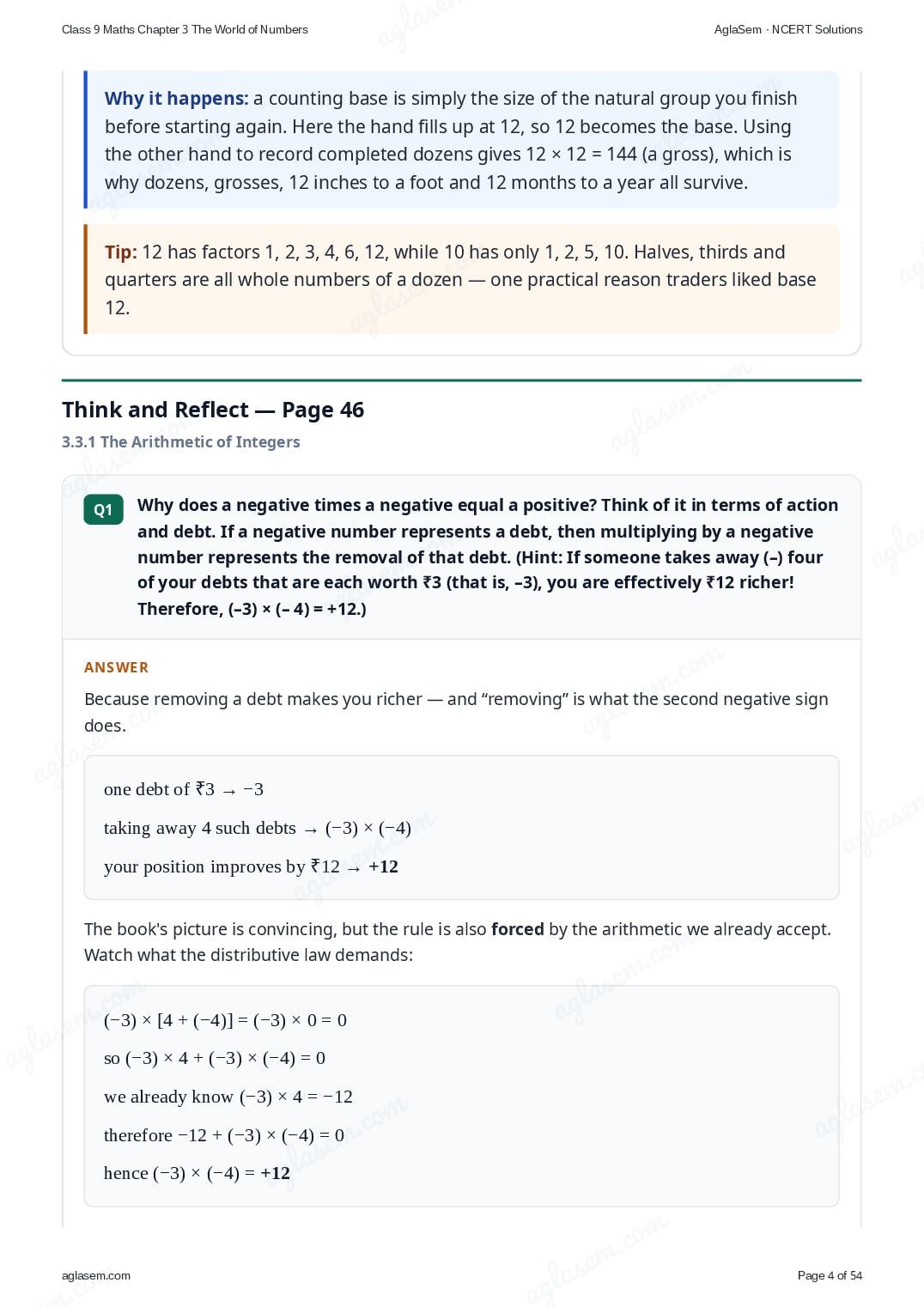
- Why does a negative times a negative equal a positive? Think of it in terms of action and debt. If a negative number represents a debt, then multiplying by a negative number represents the removal of that debt. (Hint: If someone takes away (–) four of your debts that are each worth ₹3 (that is, –3), you are effectively ₹12 richer! Therefore, (–3) × (– 4) = +12.)
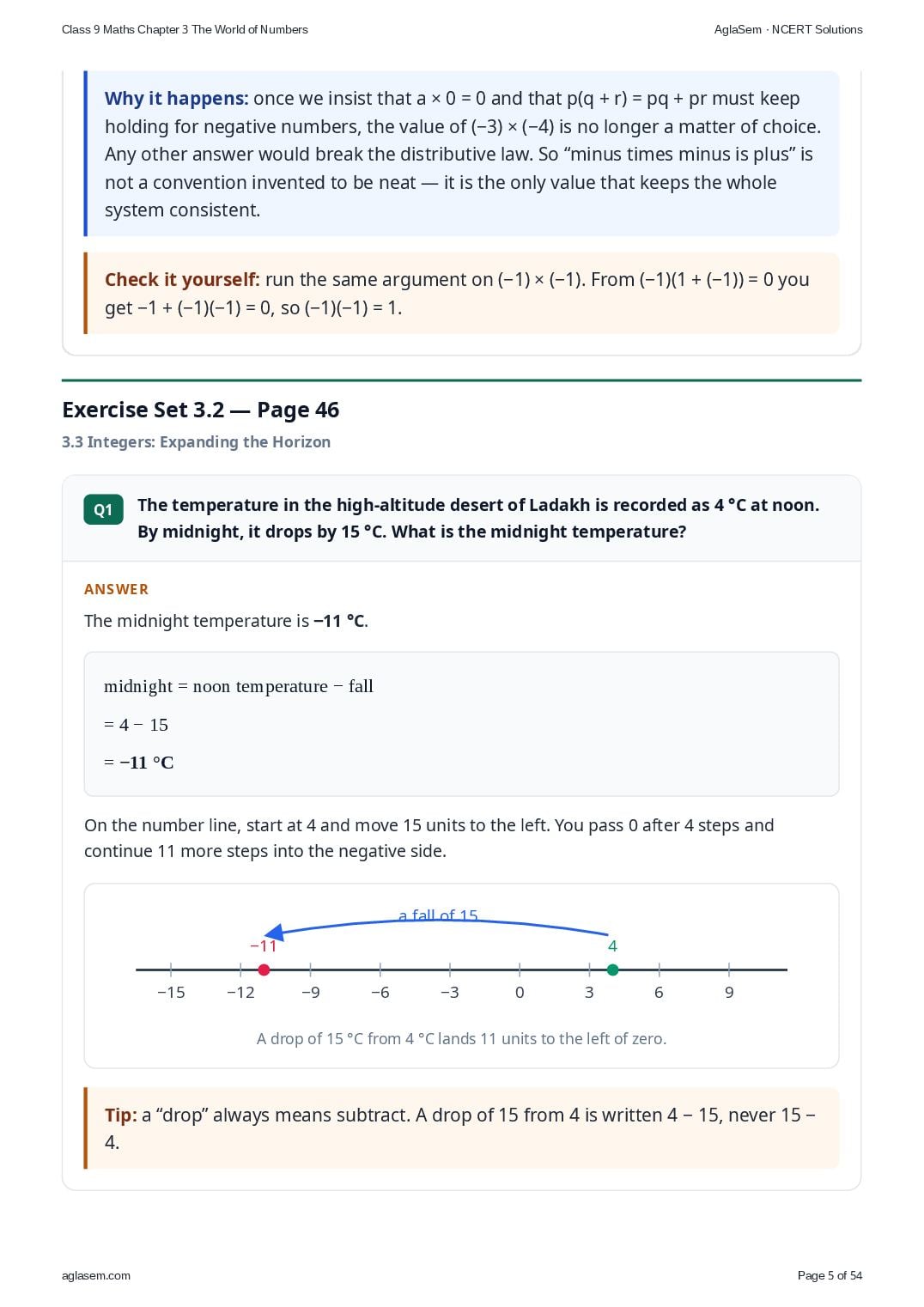
- The temperature in the high-altitude desert of Ladakh is recorded as 4 °C at noon. By midnight, it drops by 15 °C. What is the midnight temperature?
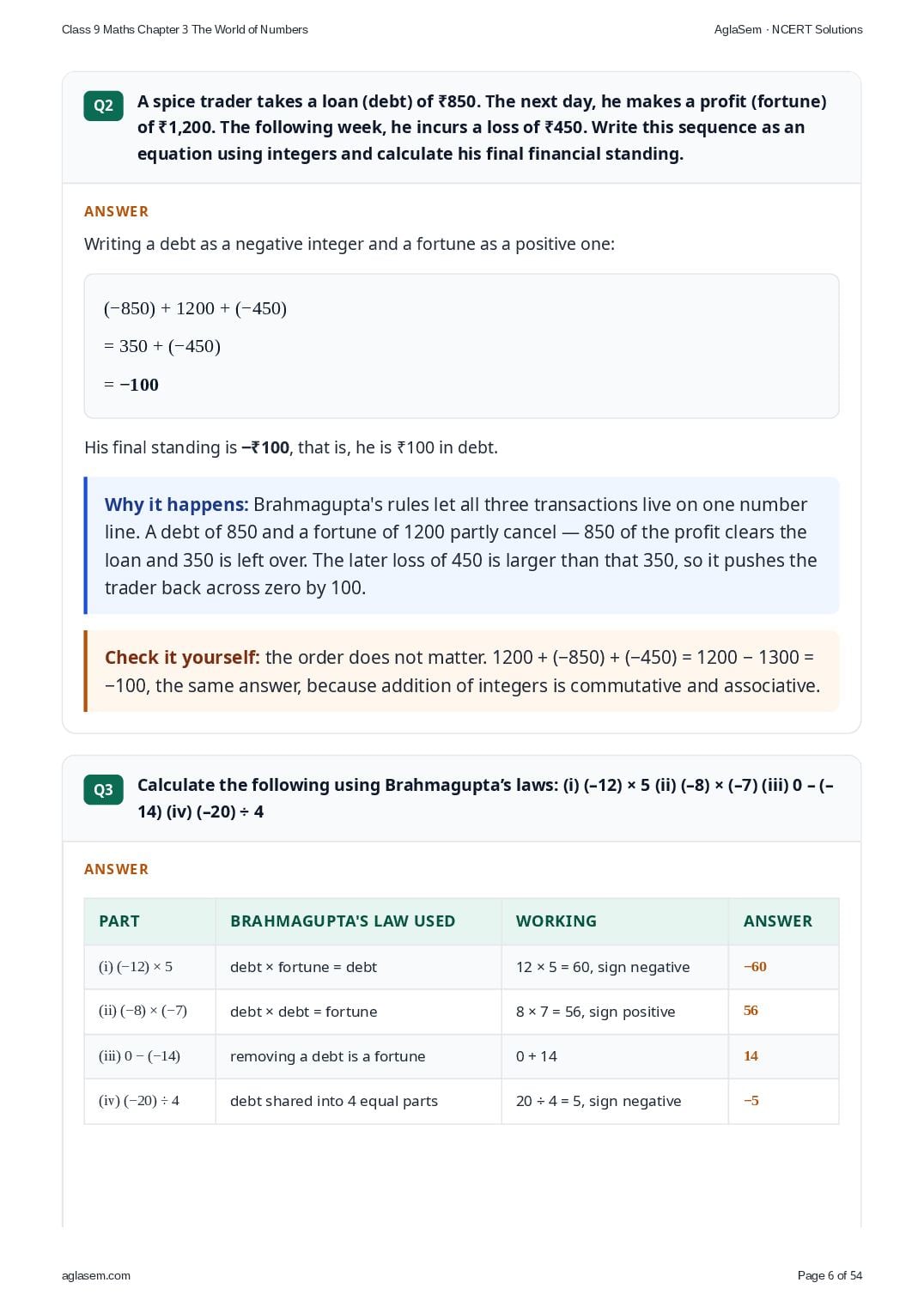
- A spice trader takes a loan (debt) of ₹850. The next day, he makes a profit (fortune) of ₹1,200. The following week, he incurs a loss of ₹450. Write this sequence as an equation using integers and calculate his final financial standing.
- Calculate the following using Brahmagupta’s laws: (i) (–12) × 5 (ii) (–8) × (–7) (iii) 0 – (–14) (iv) (–20) ÷ 4
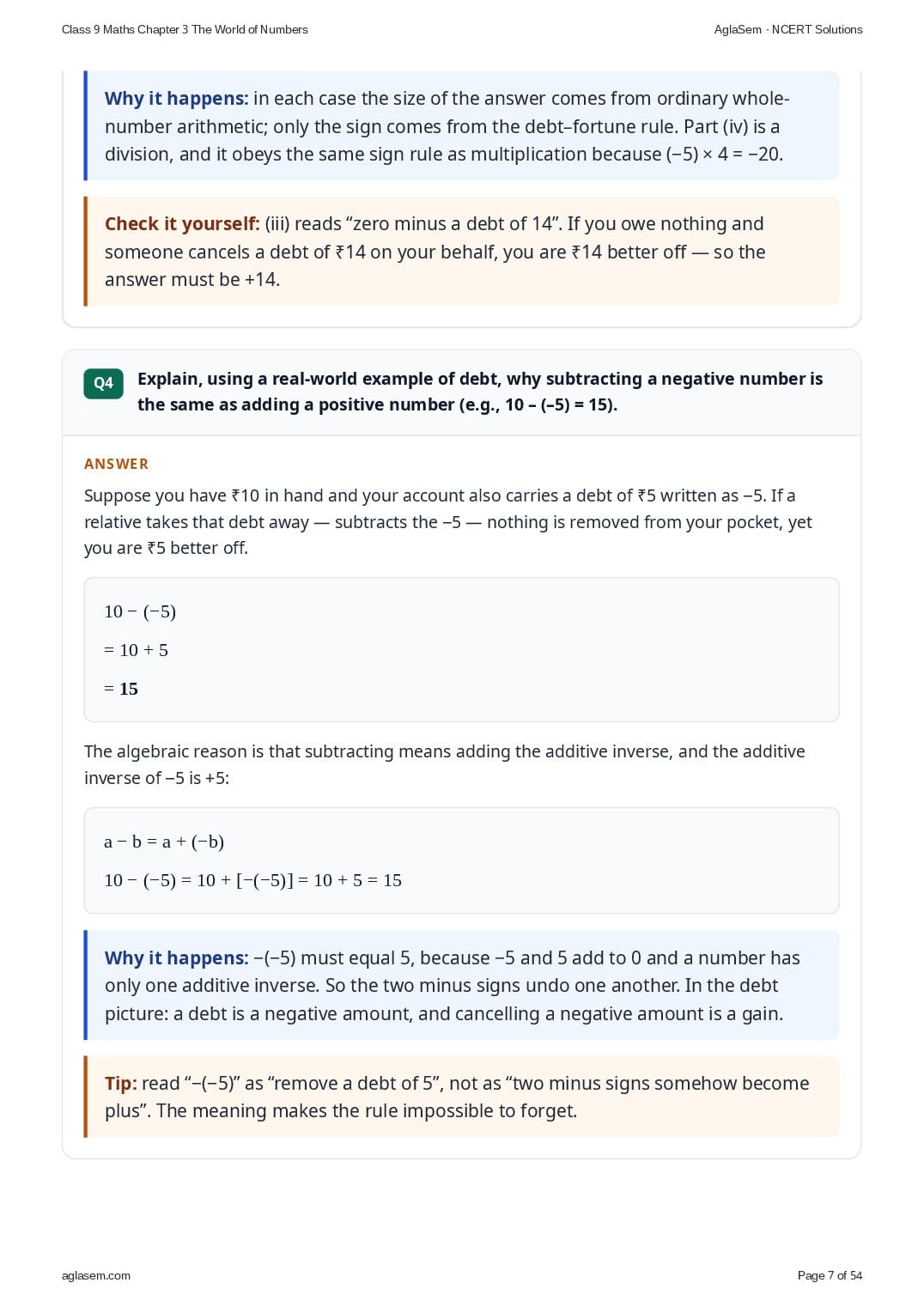
- Explain, using a real-world example of debt, why subtracting a negative number is the same as adding a positive number (e.g., 10 – (–5) = 15).
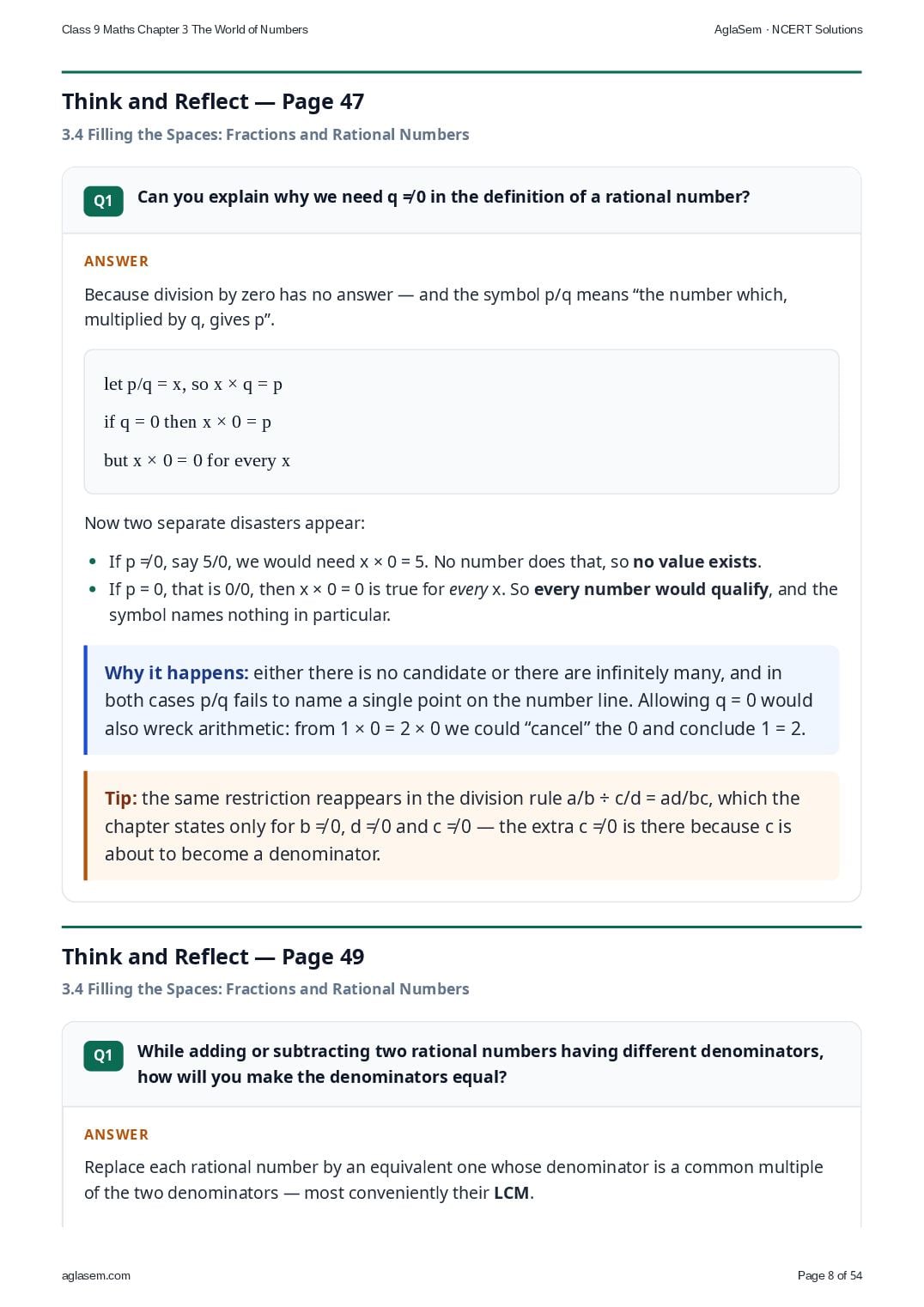
- Can you explain why we need q ≠ 0 in the definition of a rational number?
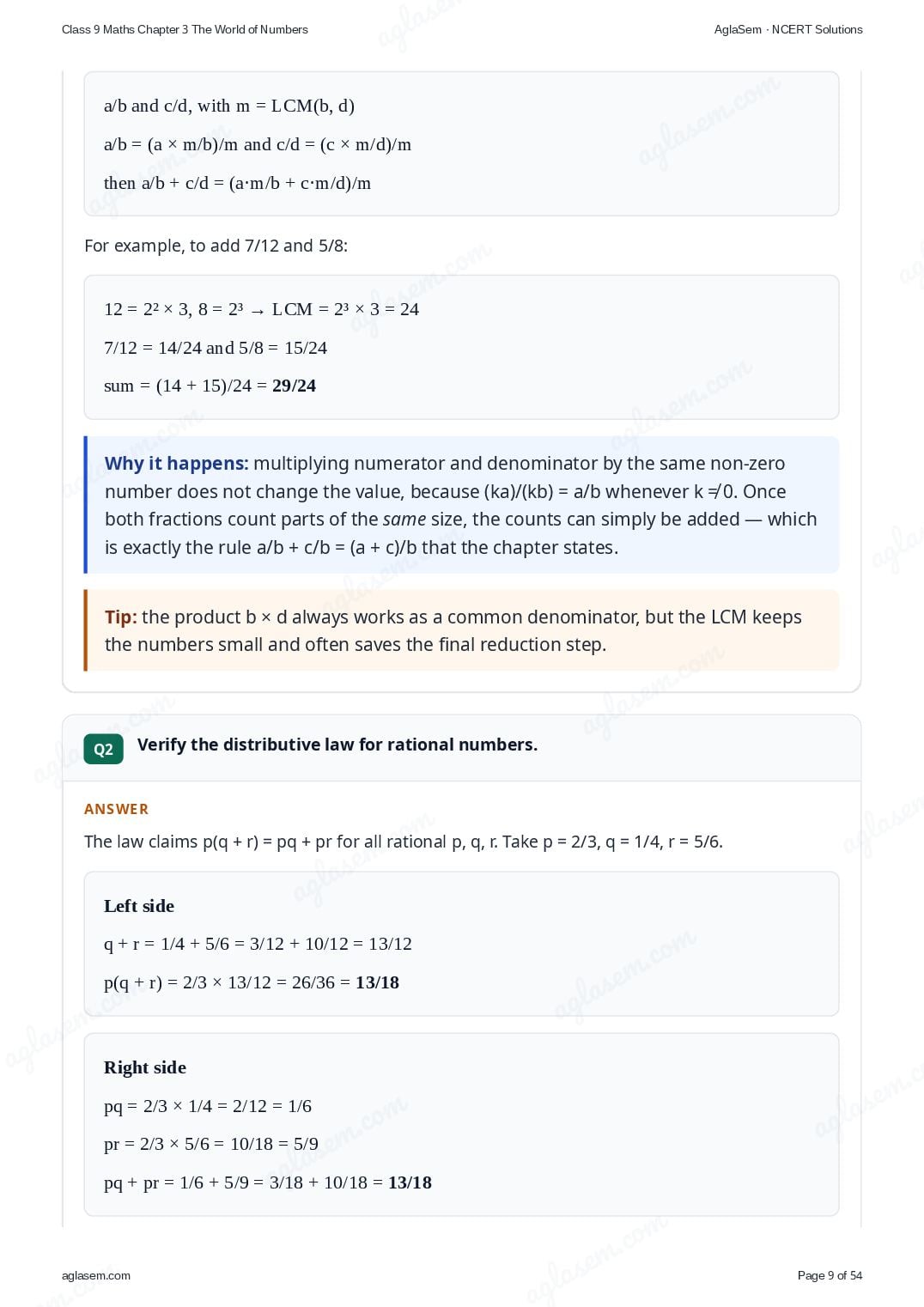
- While adding or subtracting two rational numbers having different denominators, how will you make the denominators equal?
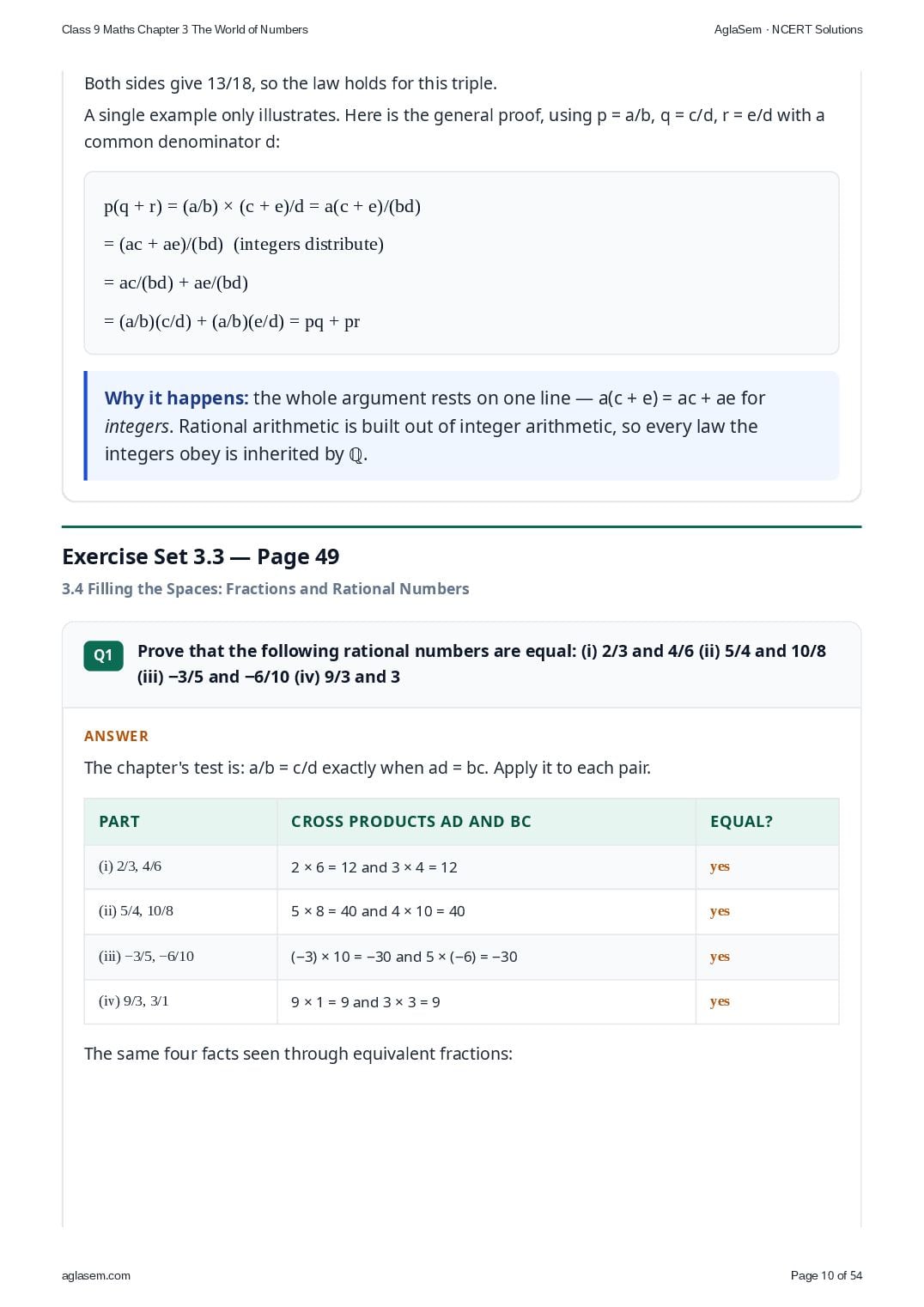
- Verify the distributive law for rational numbers.
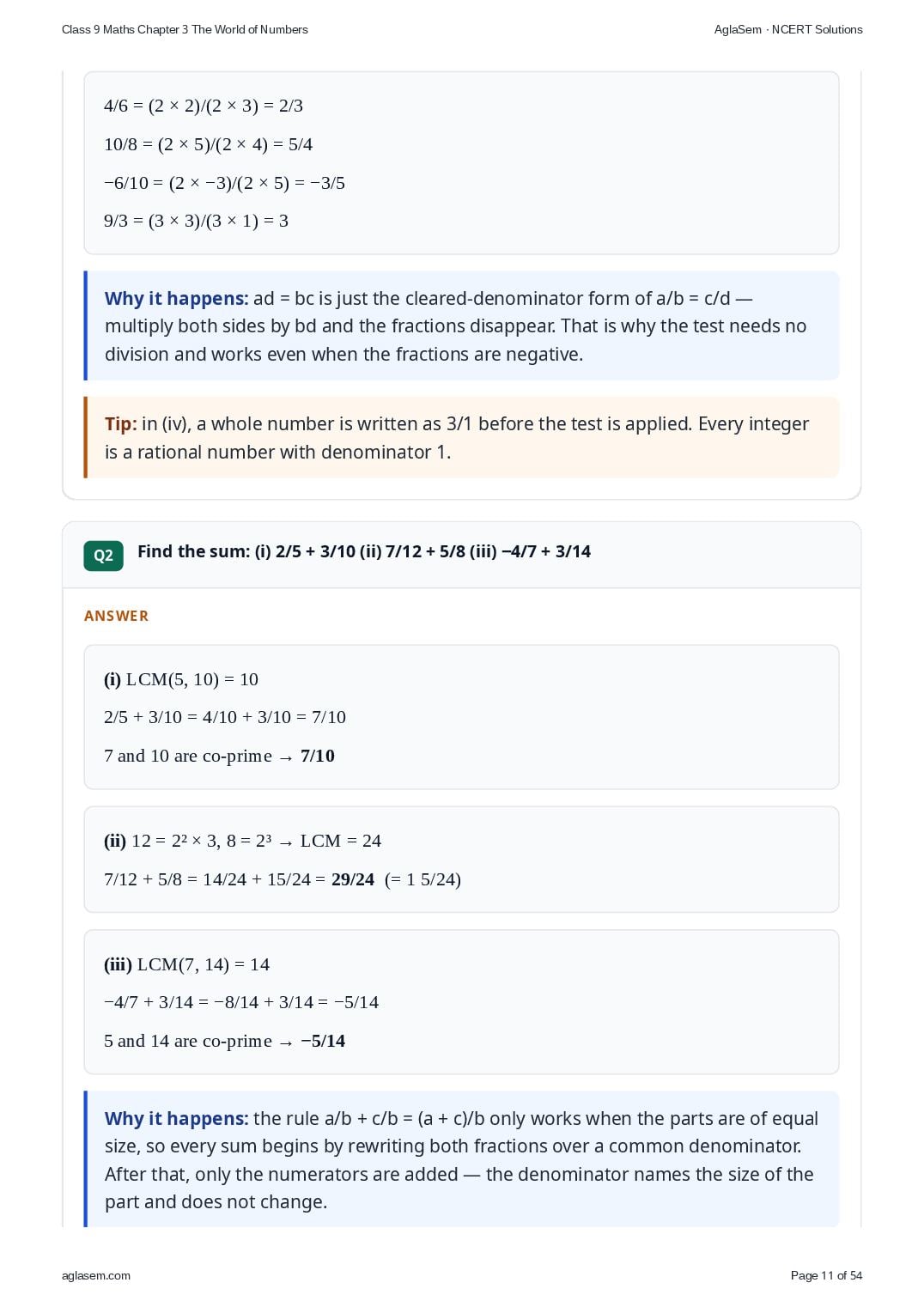
- Prove that the following rational numbers are equal: (i) 2/3 and 4/6 (ii) 5/4 and 10/8 (iii) −3/5 and −6/10 (iv) 9/3 and 3
- Find the sum: (i) 2/5 + 3/10 (ii) 7/12 + 5/8 (iii) −4/7 + 3/14
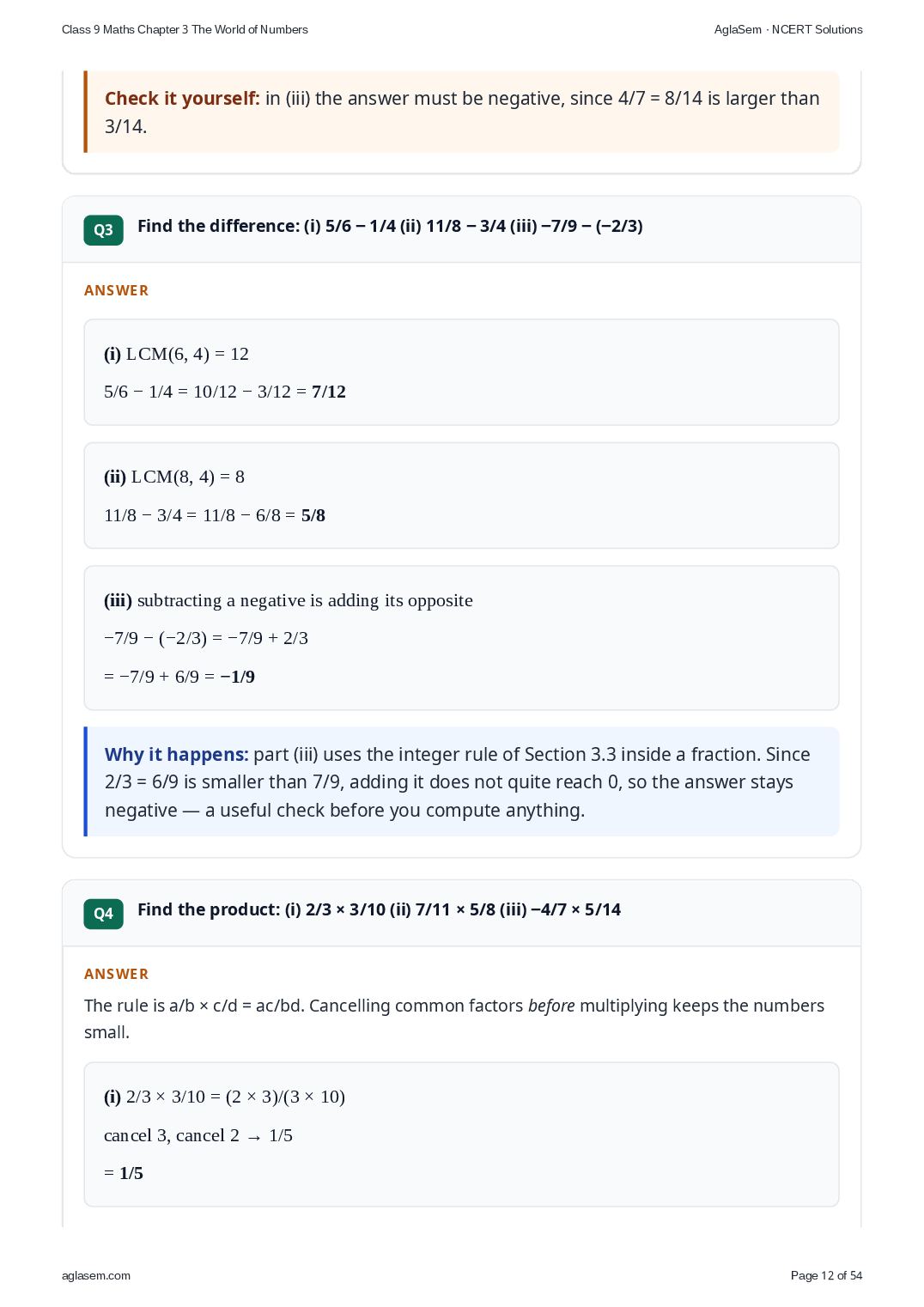
- Find the difference: (i) 5/6 − 1/4 (ii) 11/8 − 3/4 (iii) −7/9 − (−2/3)
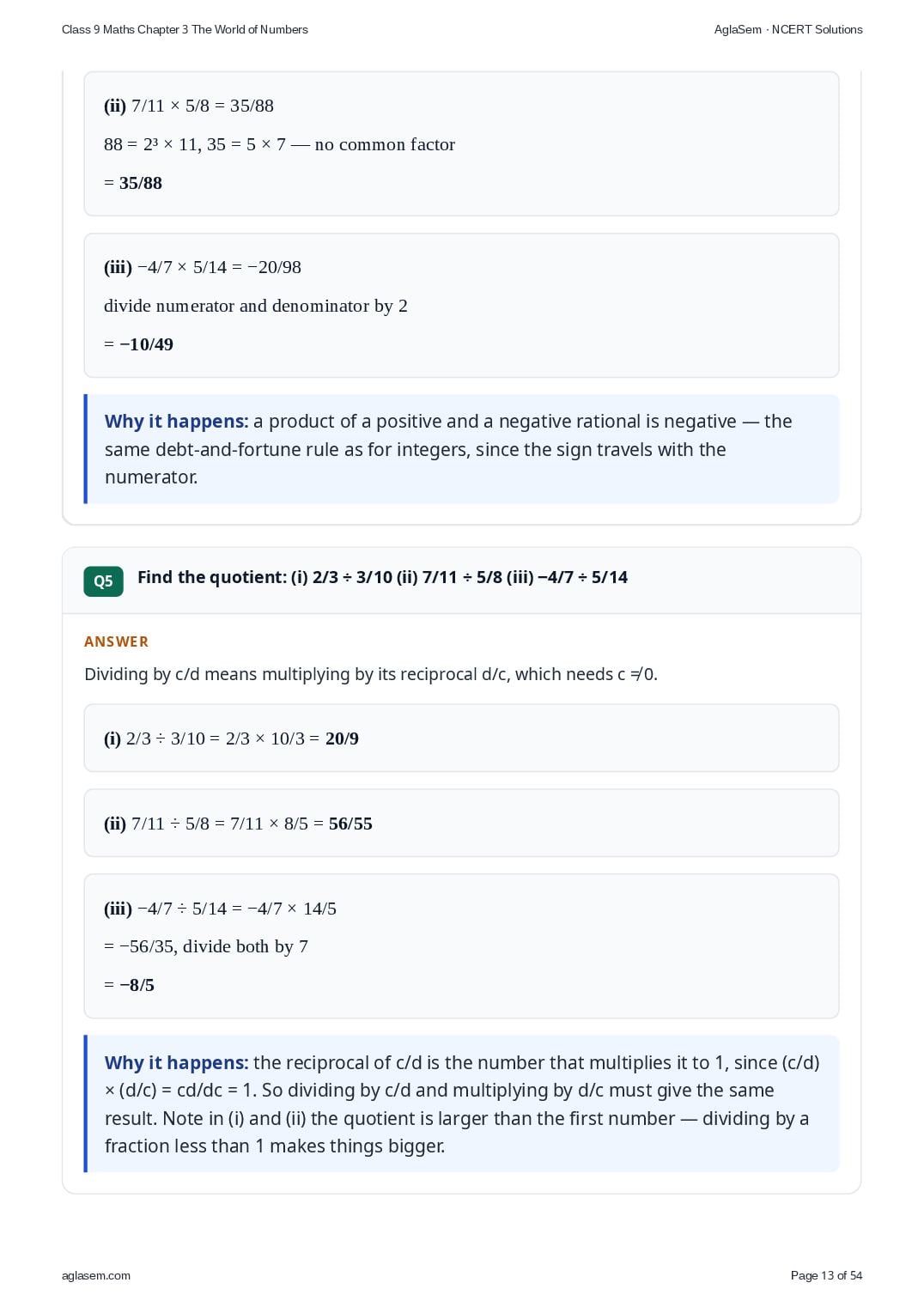
- Find the product: (i) 2/3 × 3/10 (ii) 7/11 × 5/8 (iii) −4/7 × 5/14
- Find the quotient: (i) 2/3 ÷ 3/10 (ii) 7/11 ÷ 5/8 (iii) −4/7 ÷ 5/14
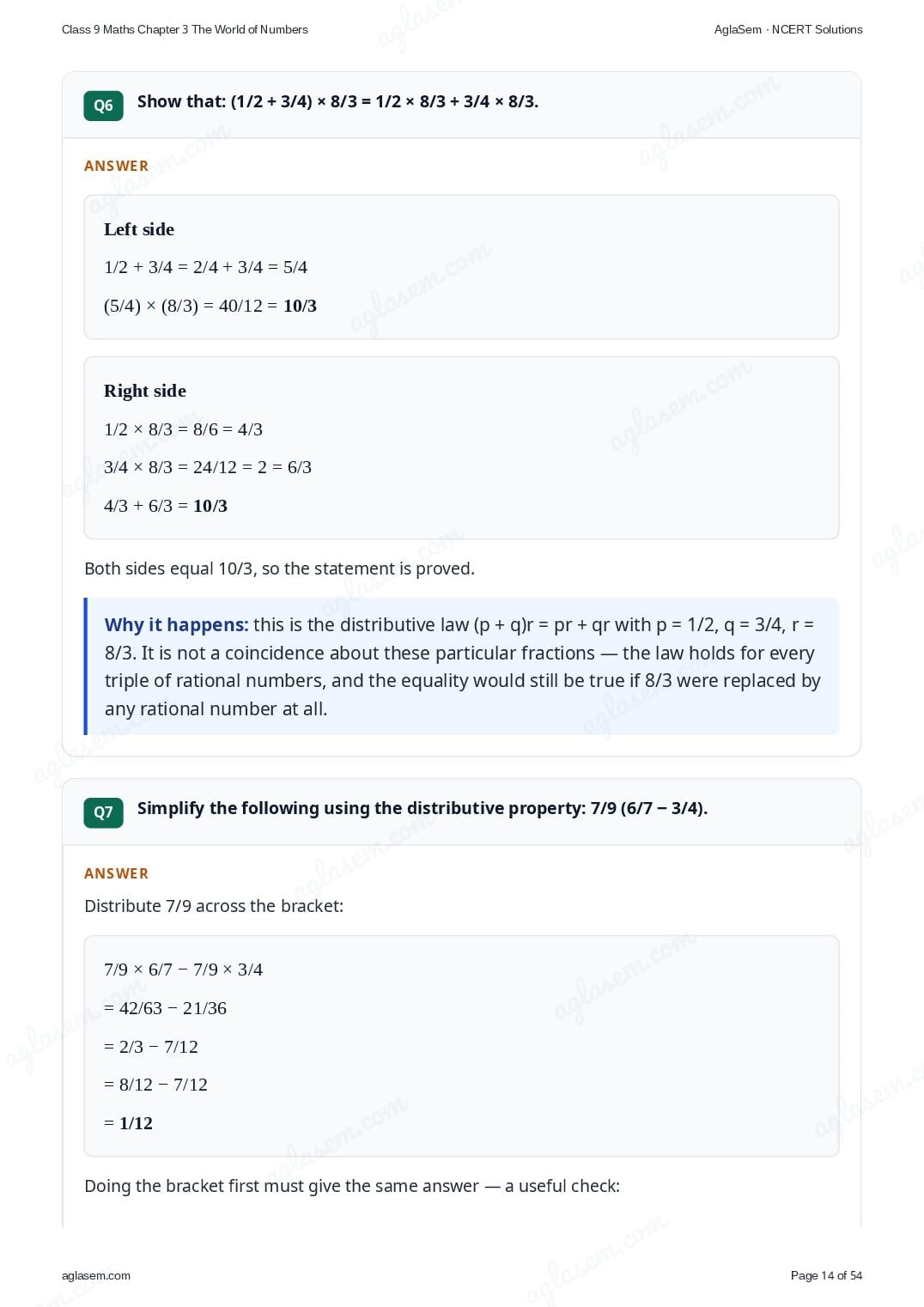
- Show that: (1/2 + 3/4) × 8/3 = 1/2 × 8/3 + 3/4 × 8/3.
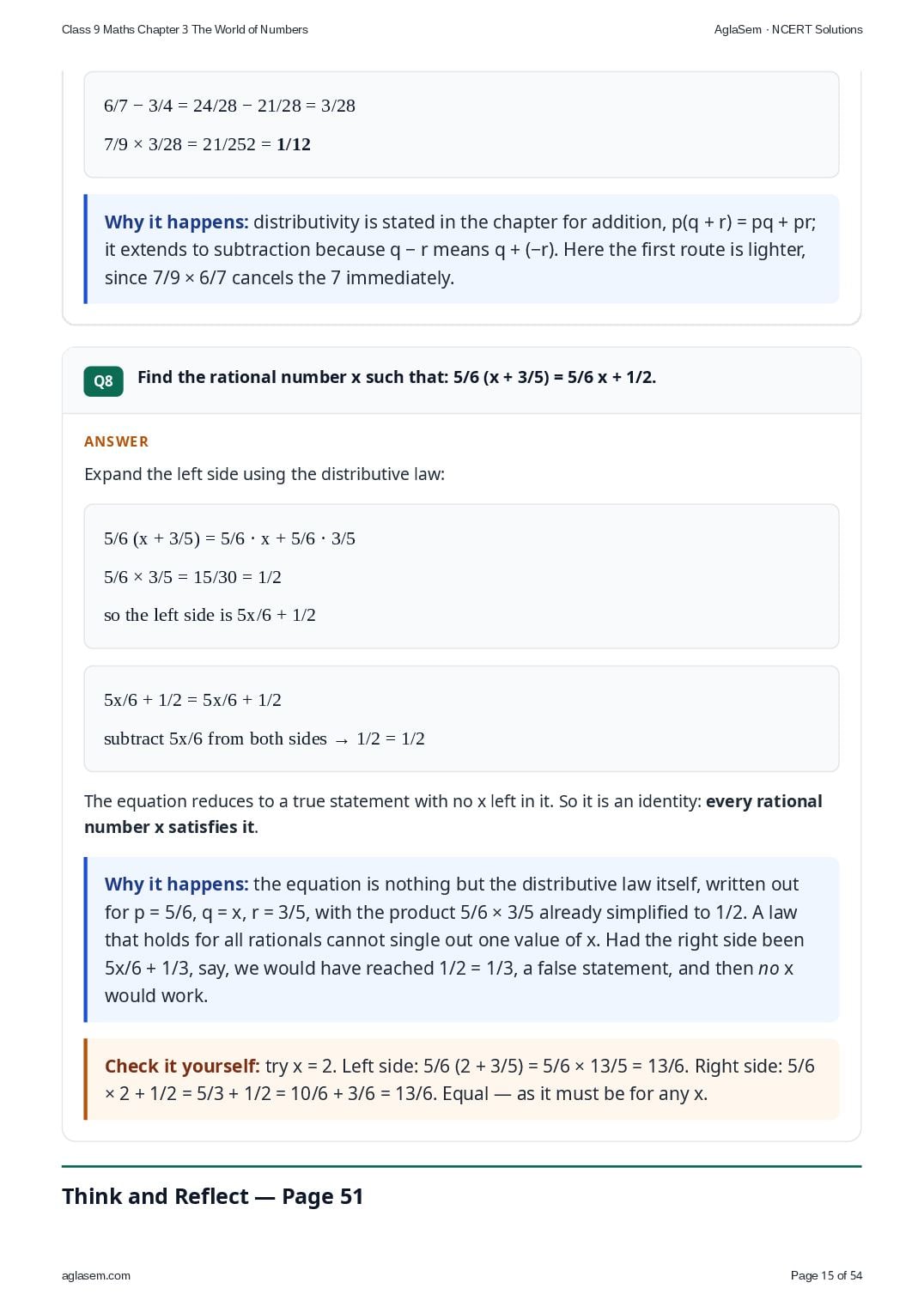
- Simplify the following using the distributive property: 7/9 (6/7 − 3/4).
- Find the rational number x such that: 5/6 (x + 3/5) = 5/6 x + 1/2.
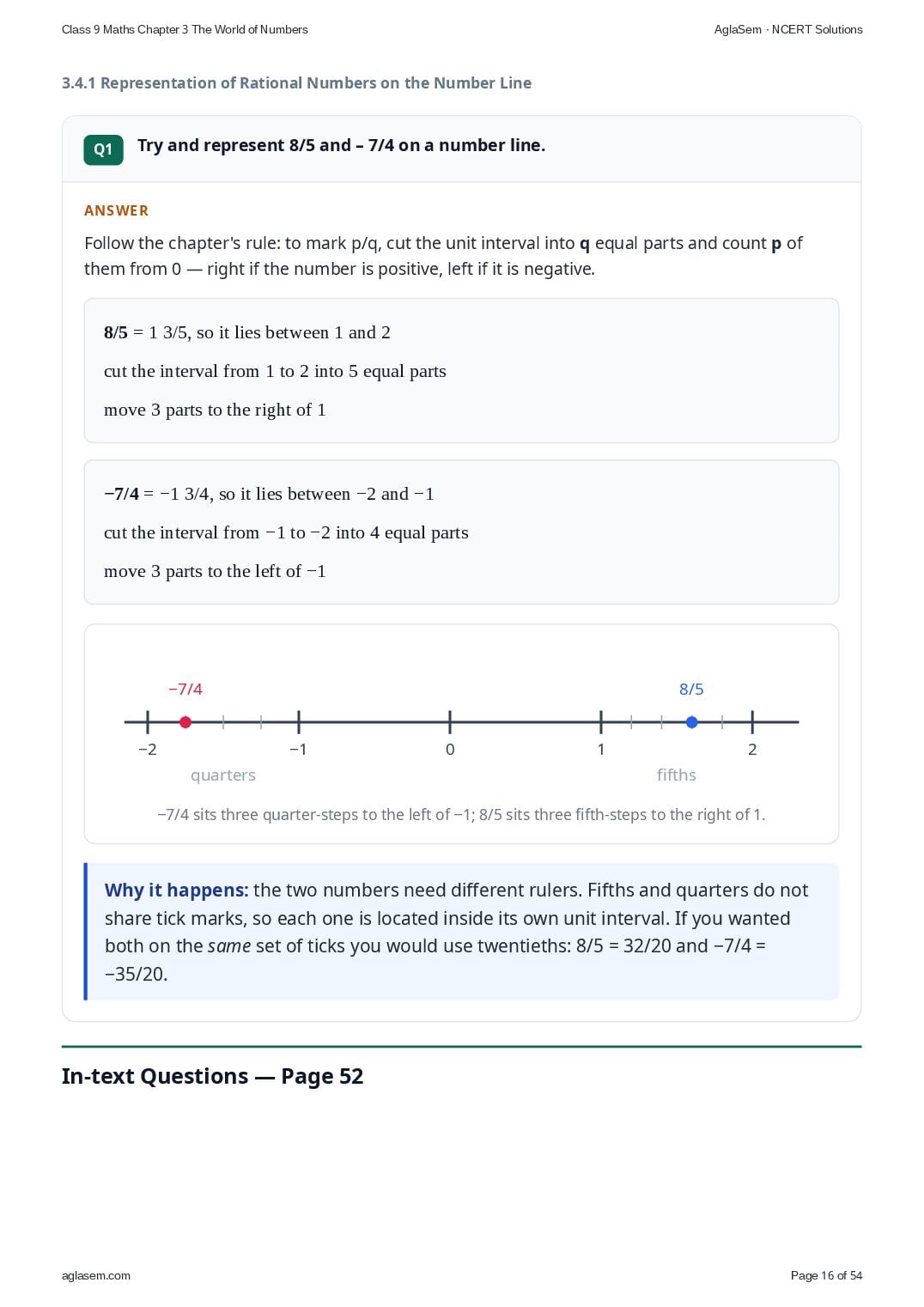
- Try and represent 8/5 and – 7/4 on a number line.
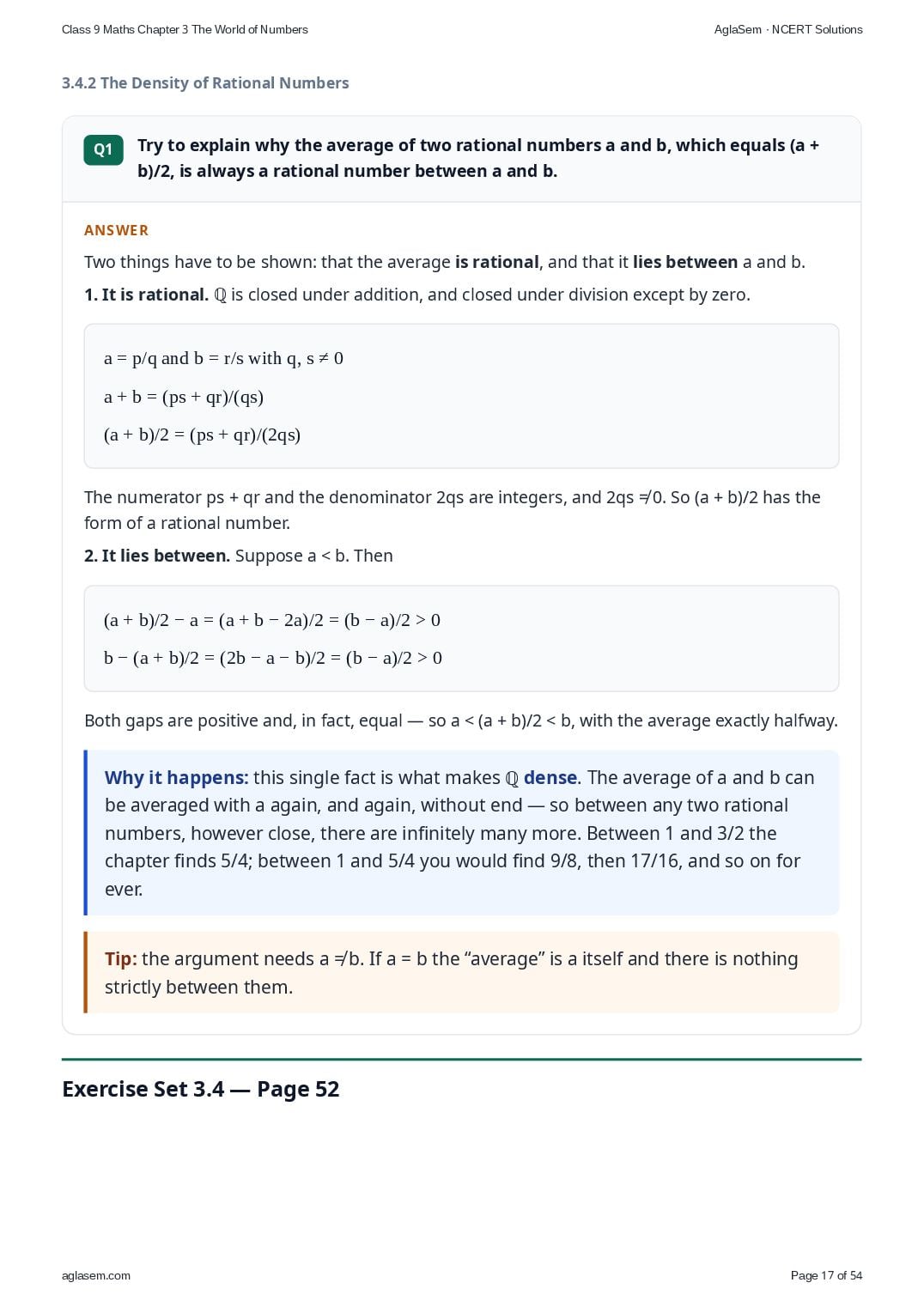
- Try to explain why the average of two rational numbers a and b, which equals (a + b)/2, is always a rational number between a and b.
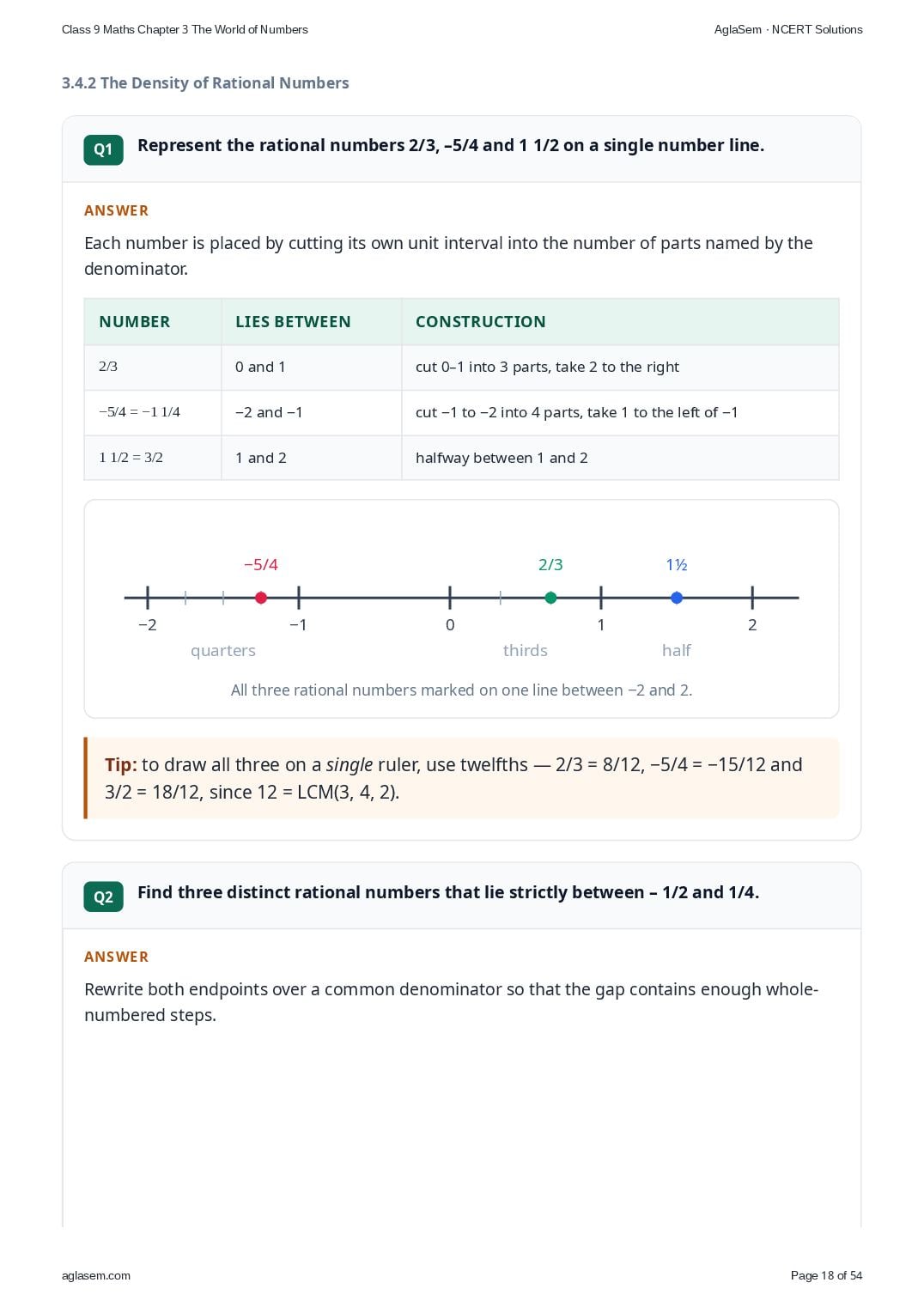
- Represent the rational numbers 2/3, –5/4 and 1 1/2 on a single number line.
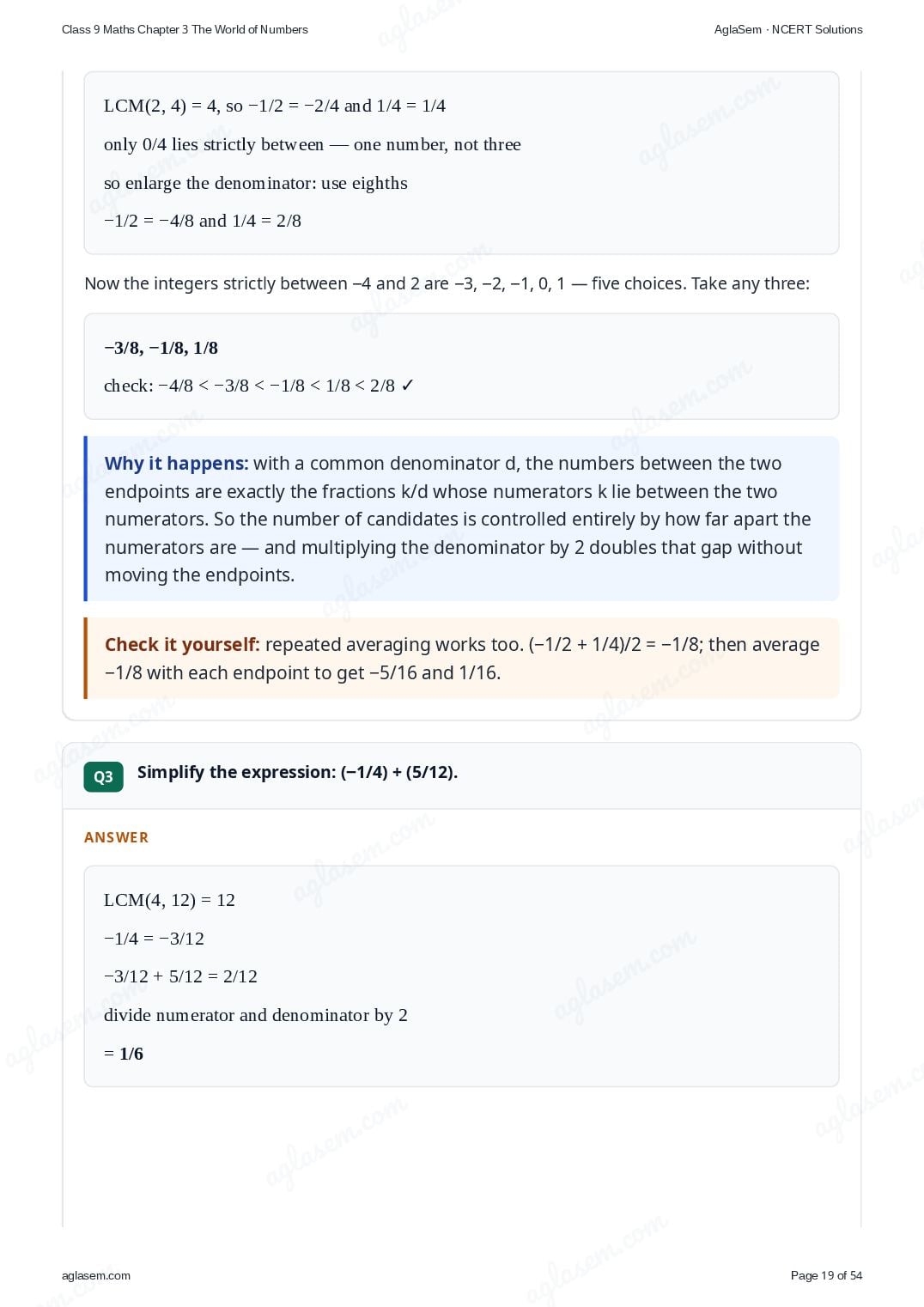
- Find three distinct rational numbers that lie strictly between – 1/2 and 1/4.
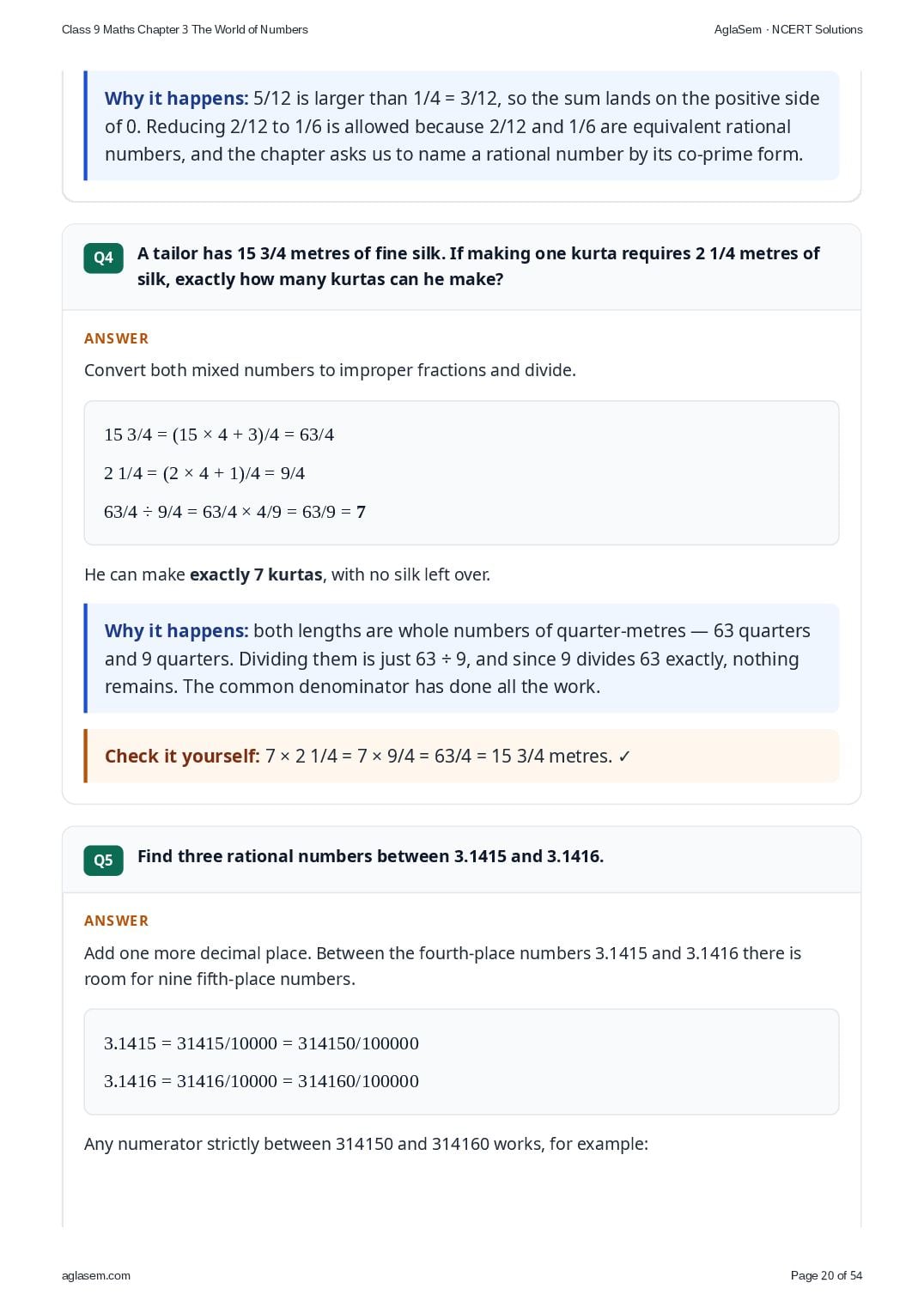
- Simplify the expression: (−1/4) + (5/12).
- A tailor has 15 3/4 metres of fine silk. If making one kurta requires 2 1/4 metres of silk, exactly how many kurtas can he make?
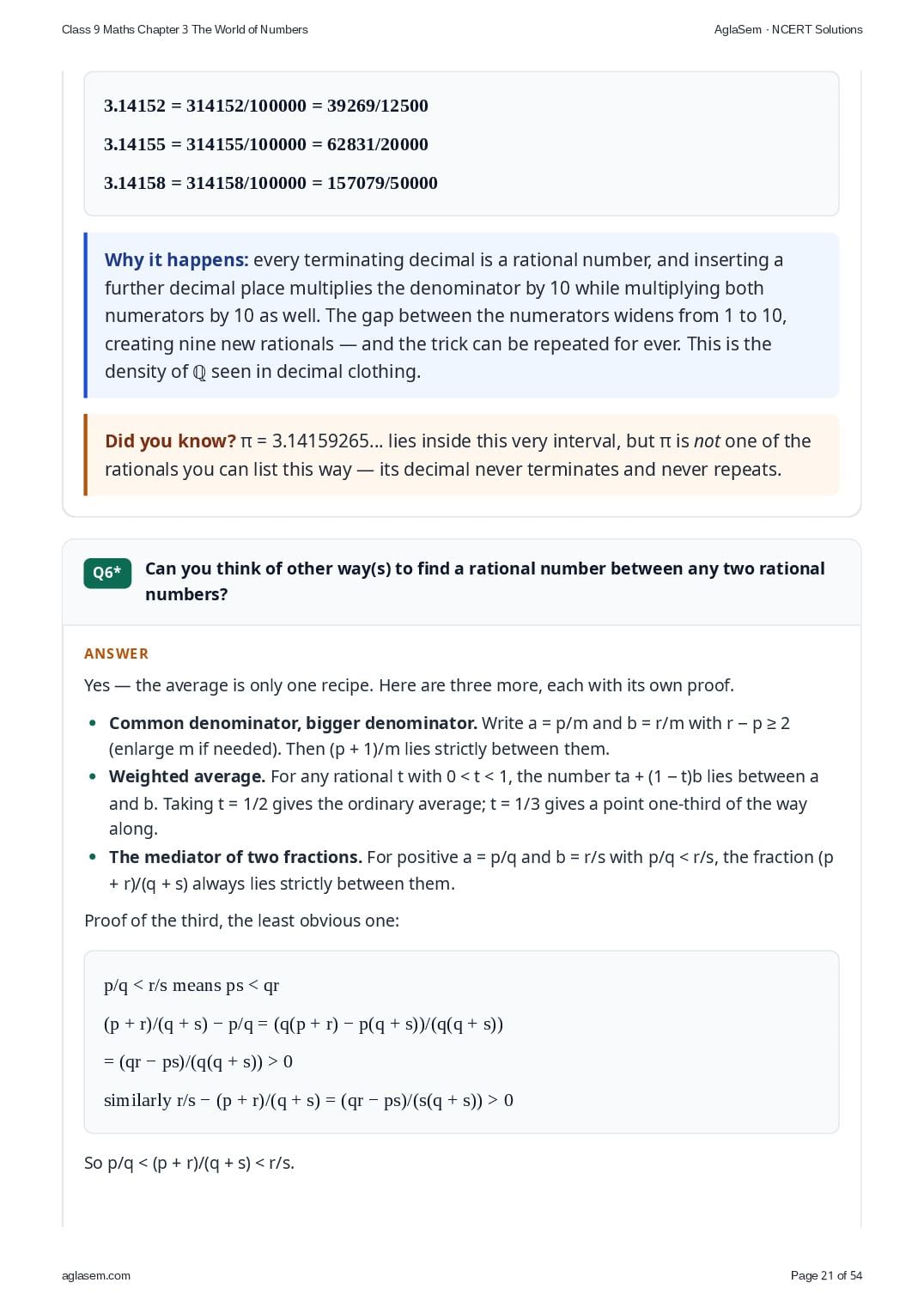
- Find three rational numbers between 3.1415 and 3.1416.
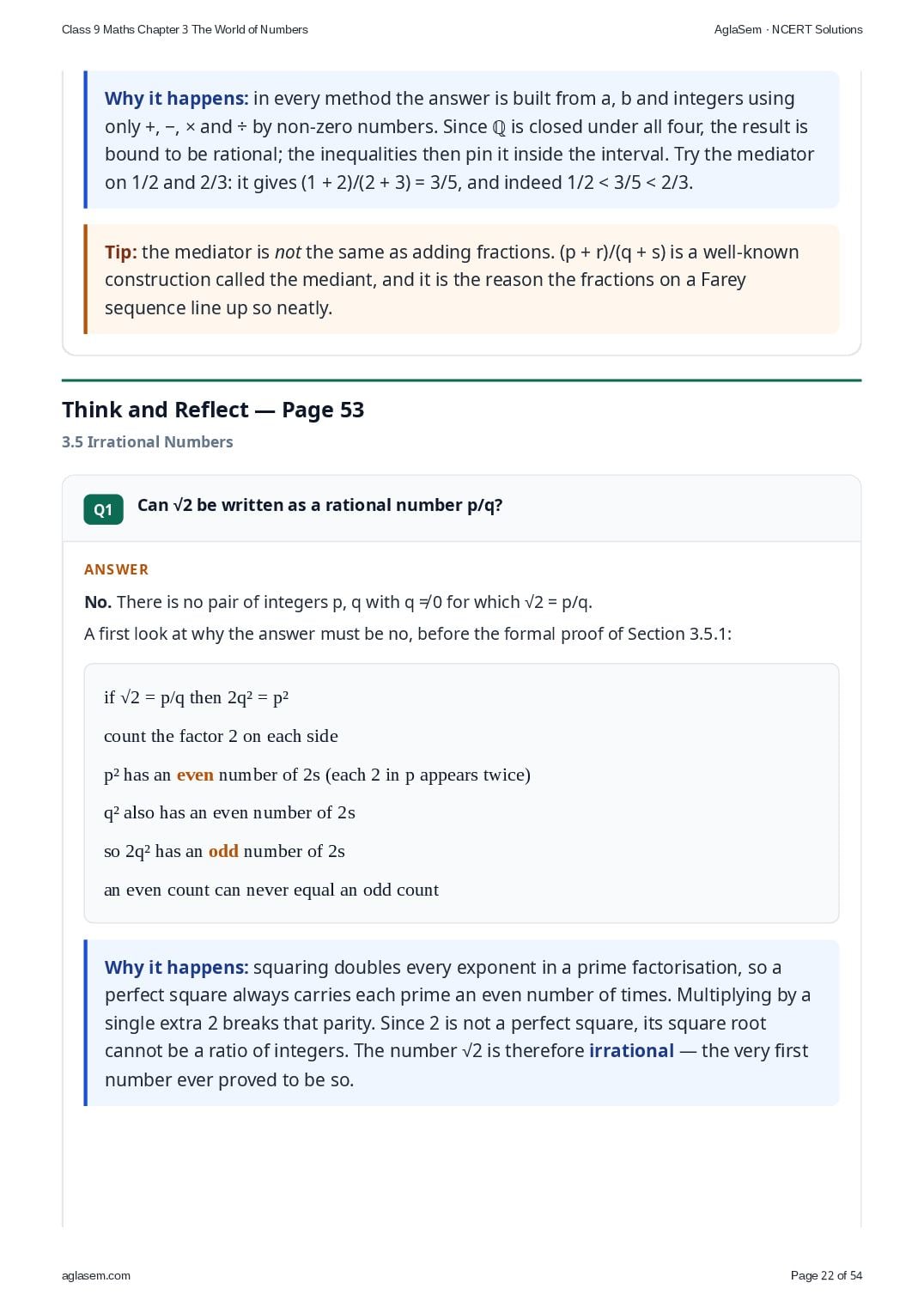
- Can you think of other way(s) to find a rational number between any two rational numbers?
- Can √2 be written as a rational number p/q?
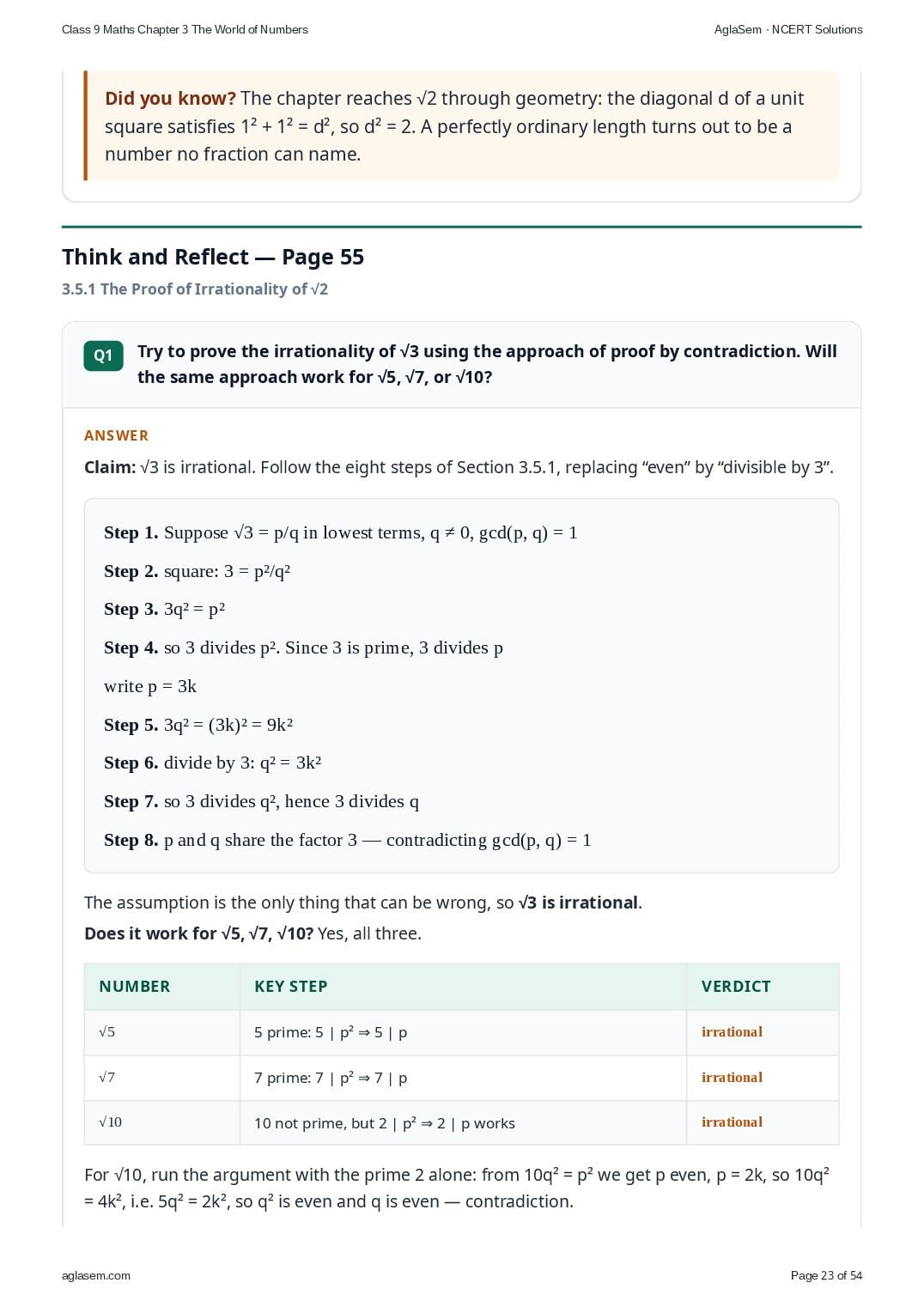
- Try to prove the irrationality of √3 using the approach of proof by contradiction. Will the same approach work for √5, √7, or √10?
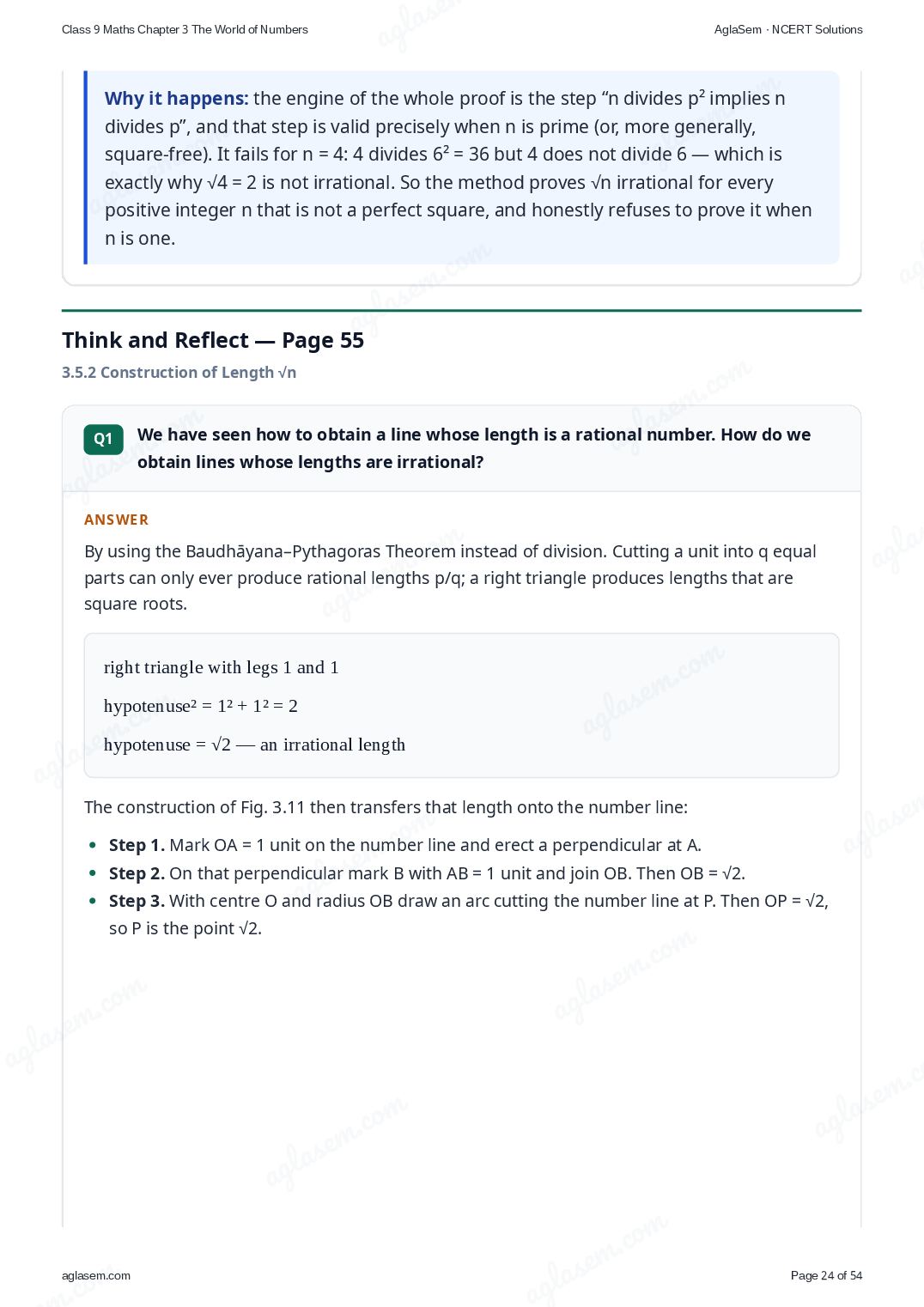
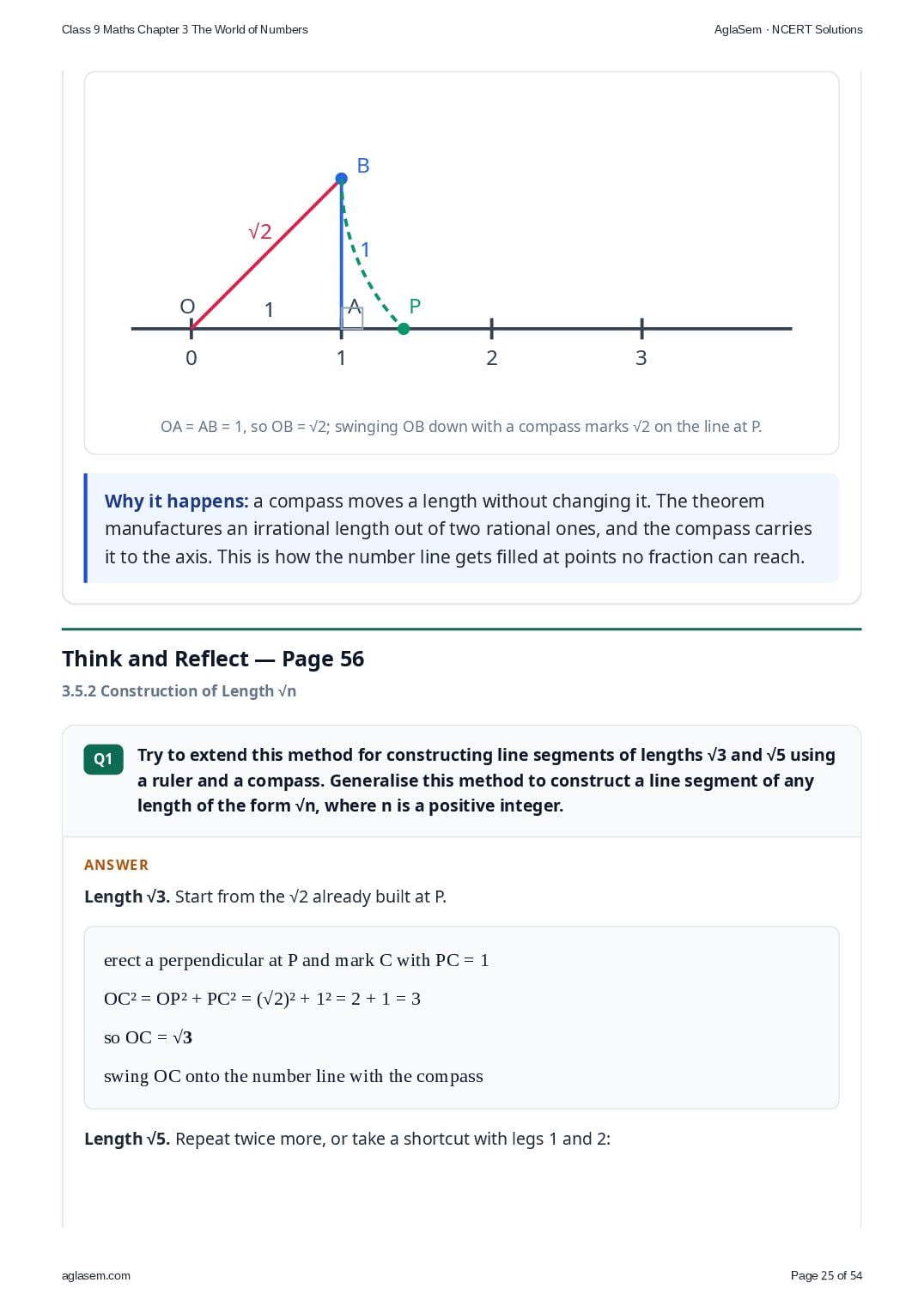
- We have seen how to obtain a line whose length is a rational number. How do we obtain lines whose lengths are irrational?
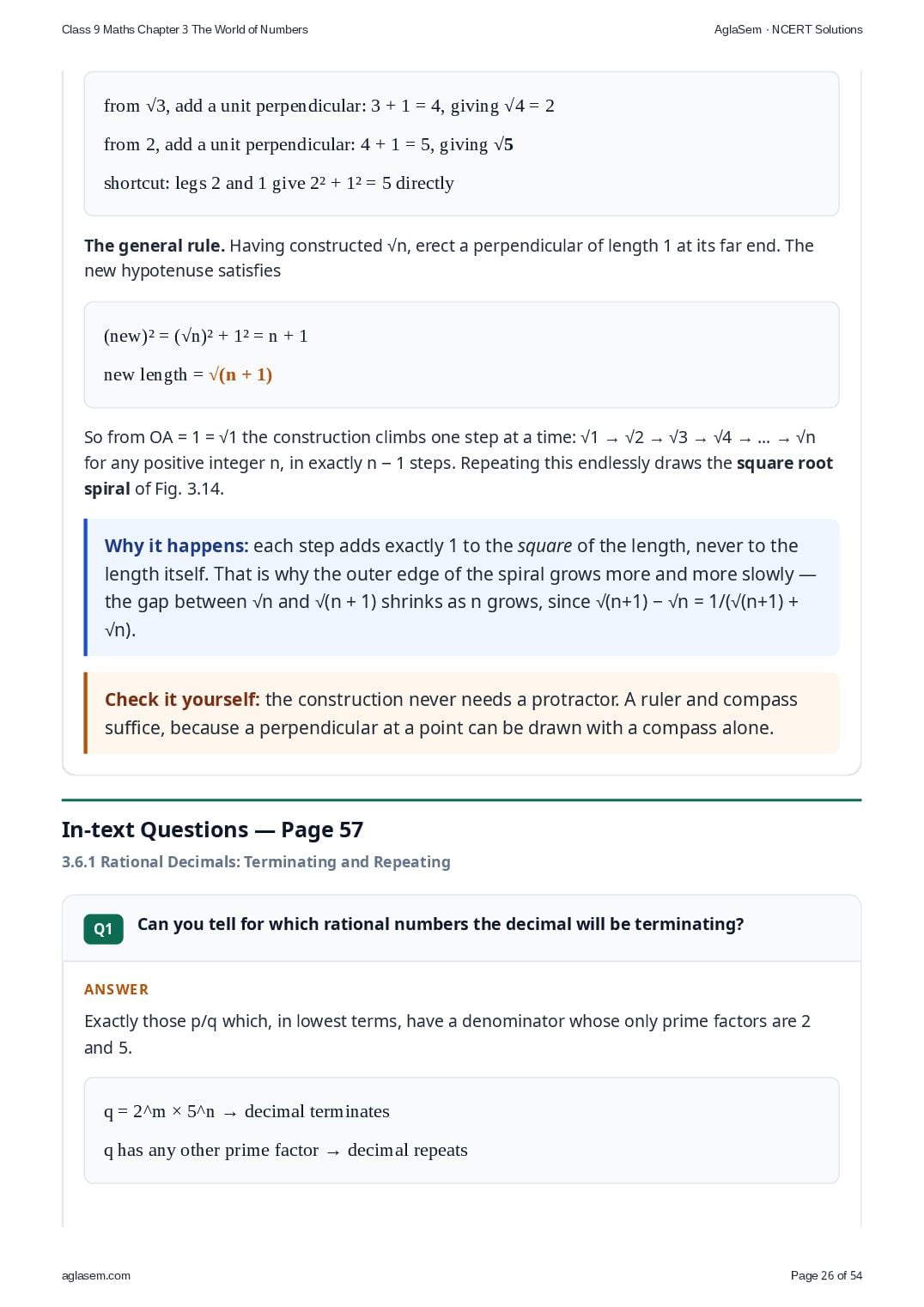
- Try to extend this method for constructing line segments of lengths √3 and √5 using a ruler and a compass. Generalise this method to construct a line segment of any length of the form √n, where n is a positive integer.
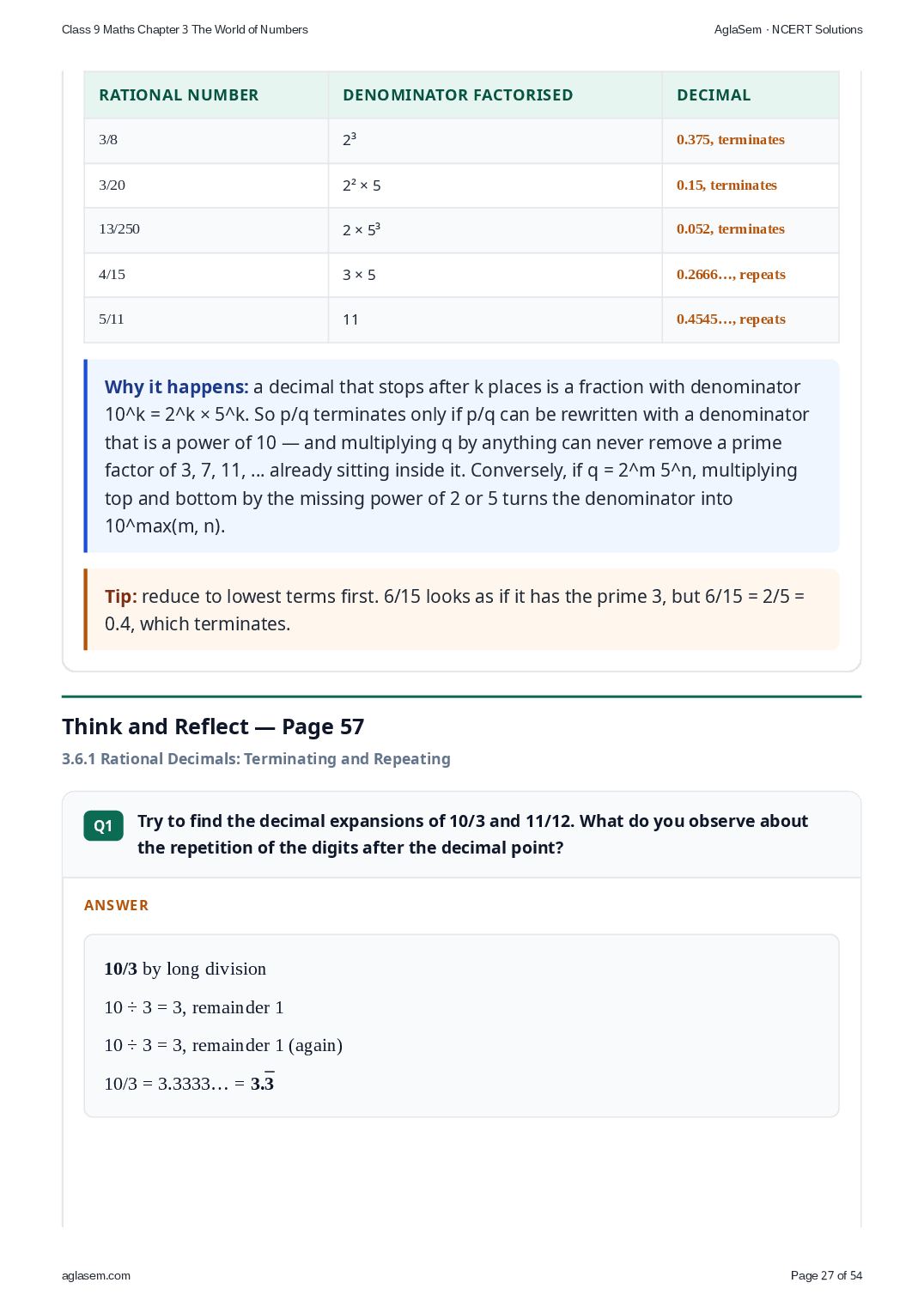
- Can you tell for which rational numbers the decimal will be terminating?
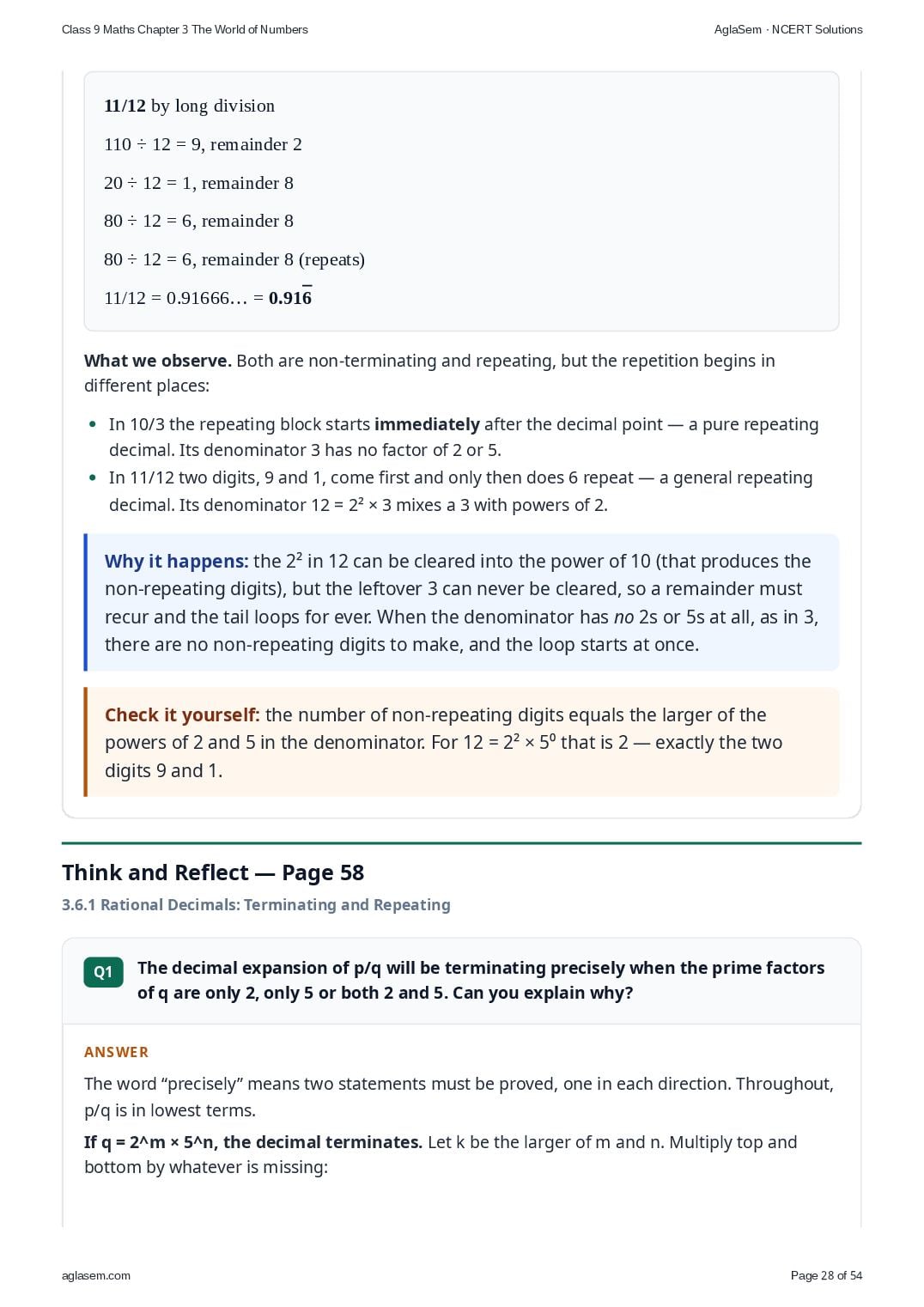
- Try to find the decimal expansions of 10/3 and 11/12. What do you observe about the repetition of the digits after the decimal point?
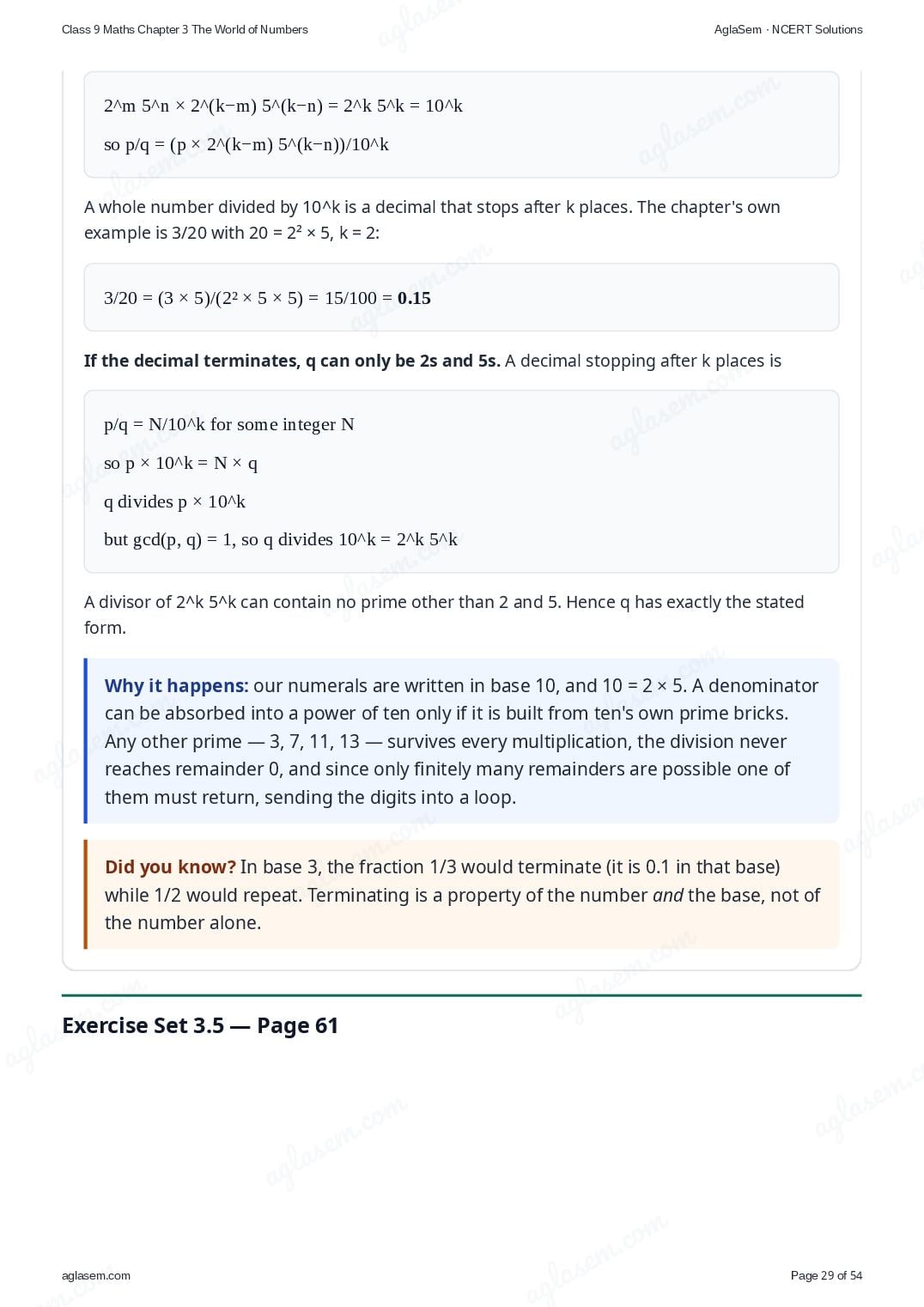
- The decimal expansion of p/q will be terminating precisely when the prime factors of q are only 2, only 5 or both 2 and 5. Can you explain why?
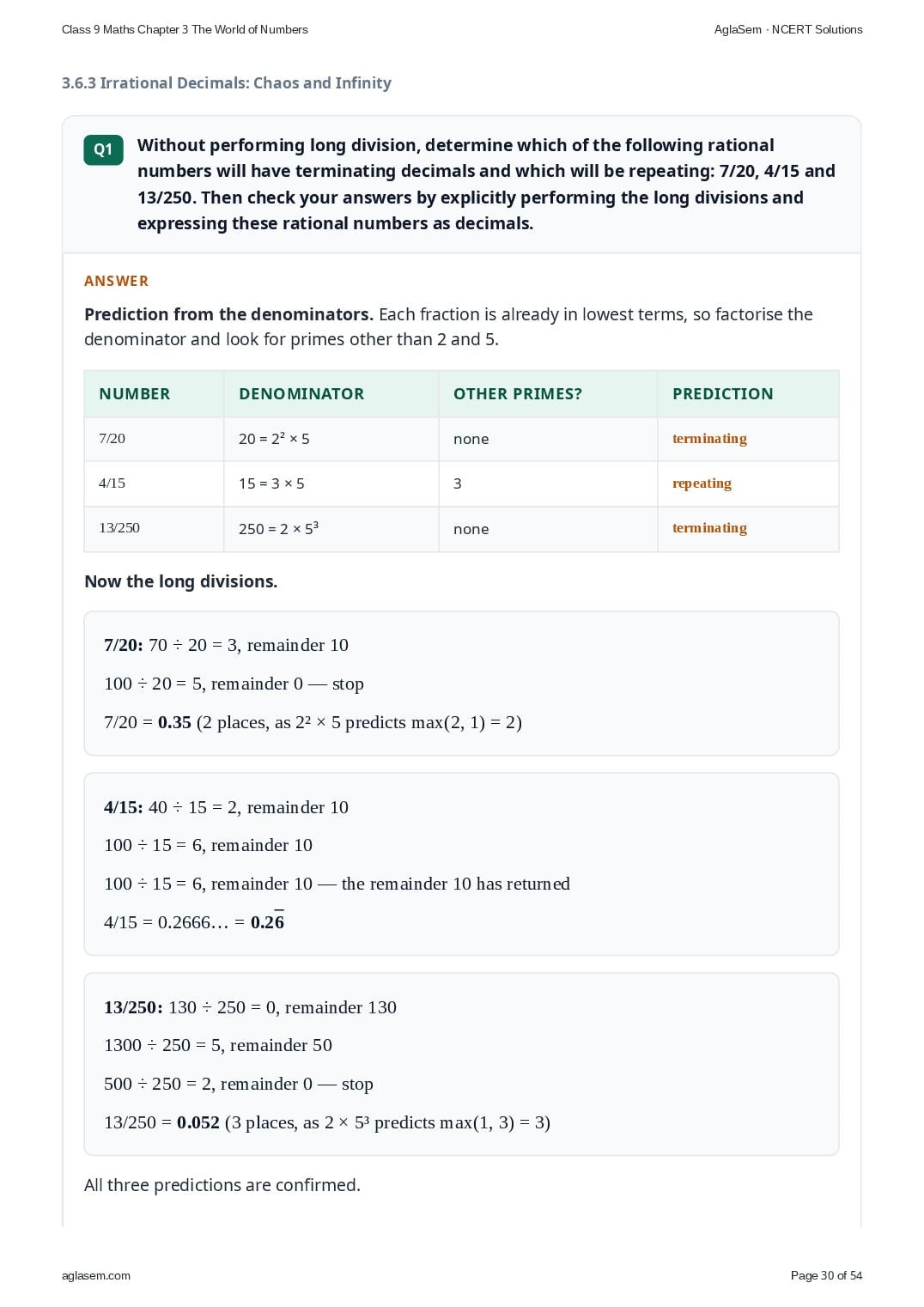
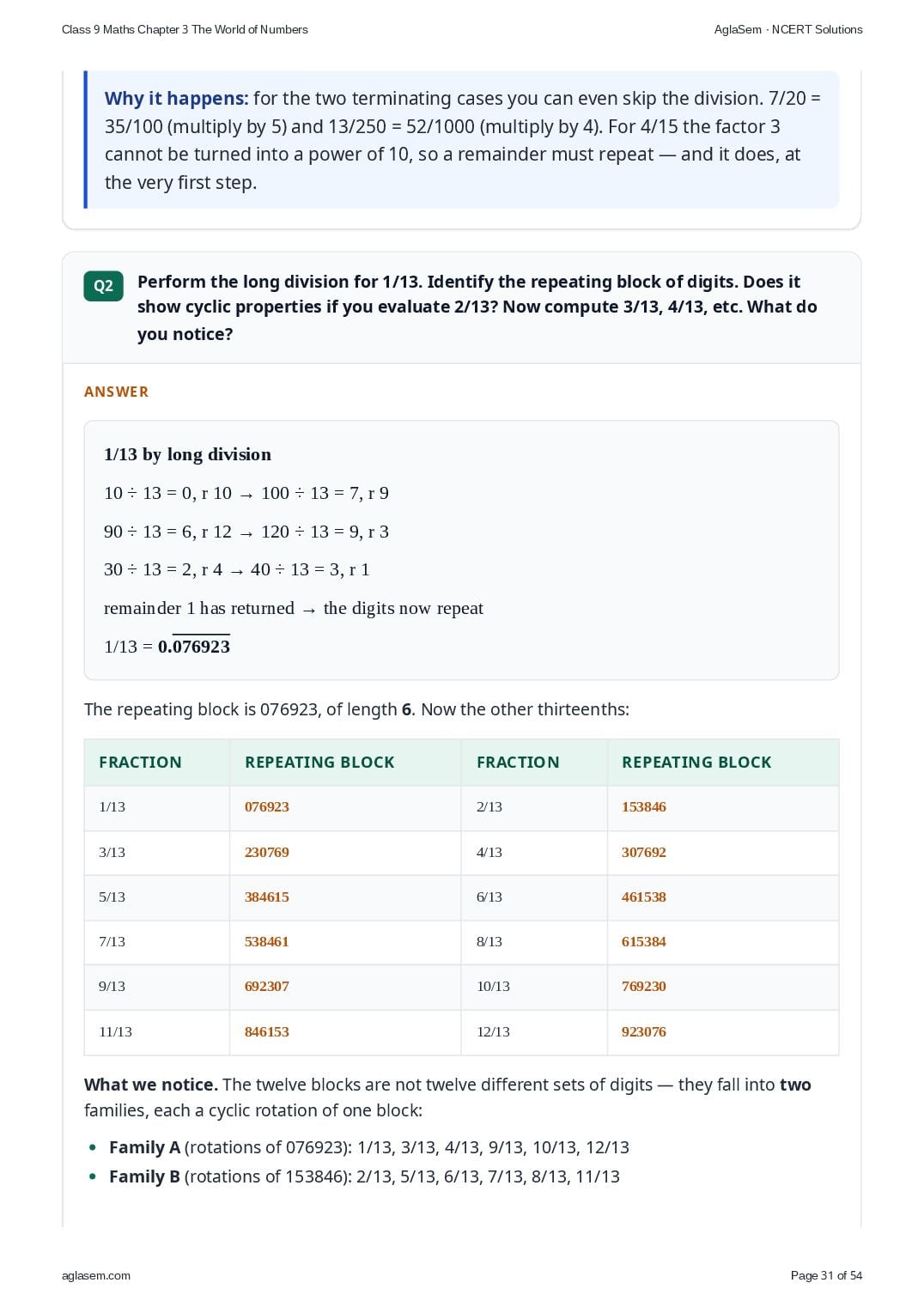
- Without performing long division, determine which of the following rational numbers will have terminating decimals and which will be repeating: 7/20, 4/15 and 13/250. Then check your answers by explicitly performing the long divisions and expressing these rational numbers as decimals.
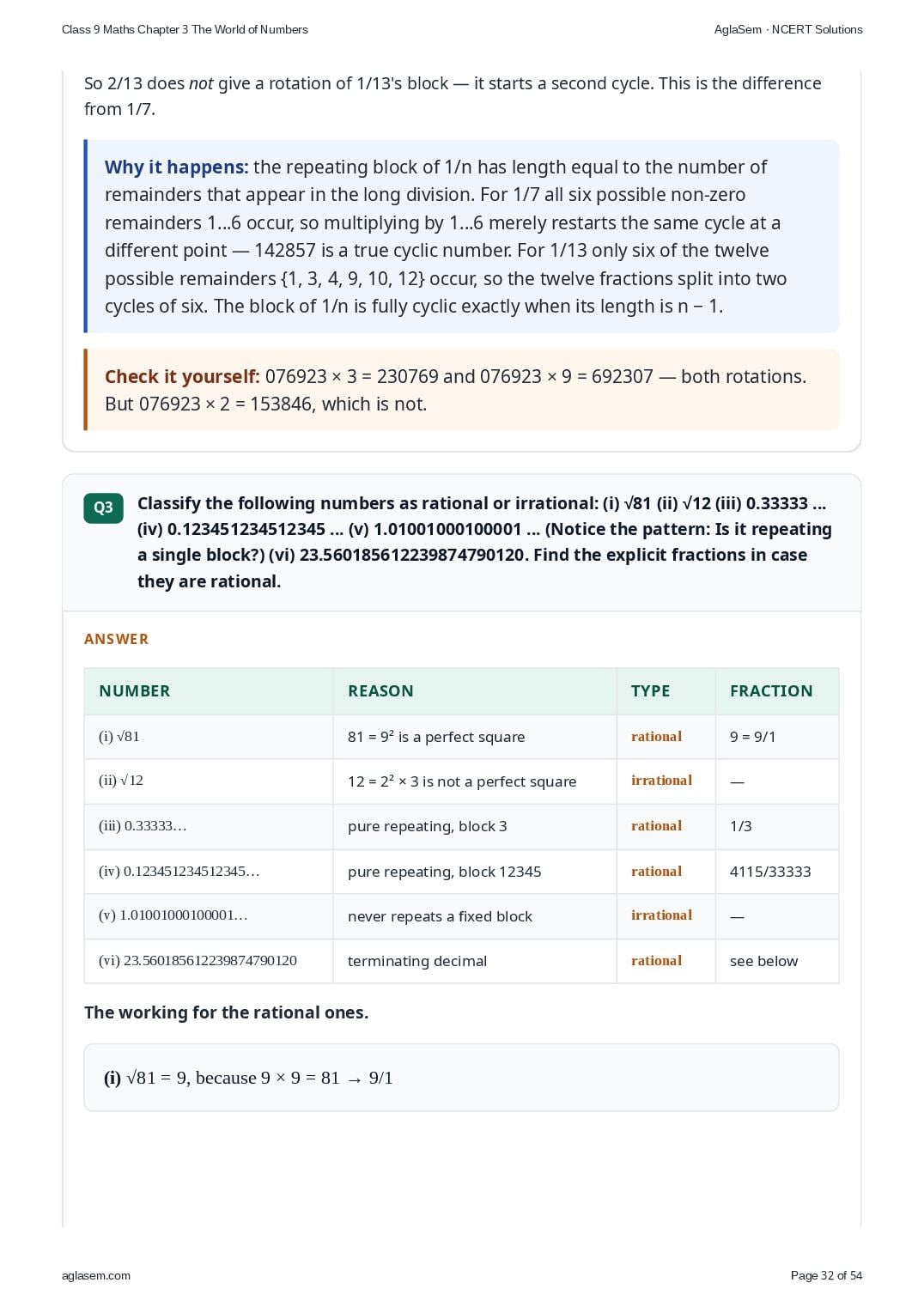
- Perform the long division for 1/13. Identify the repeating block of digits. Does it show cyclic properties if you evaluate 2/13? Now compute 3/13, 4/13, etc. What do you notice?
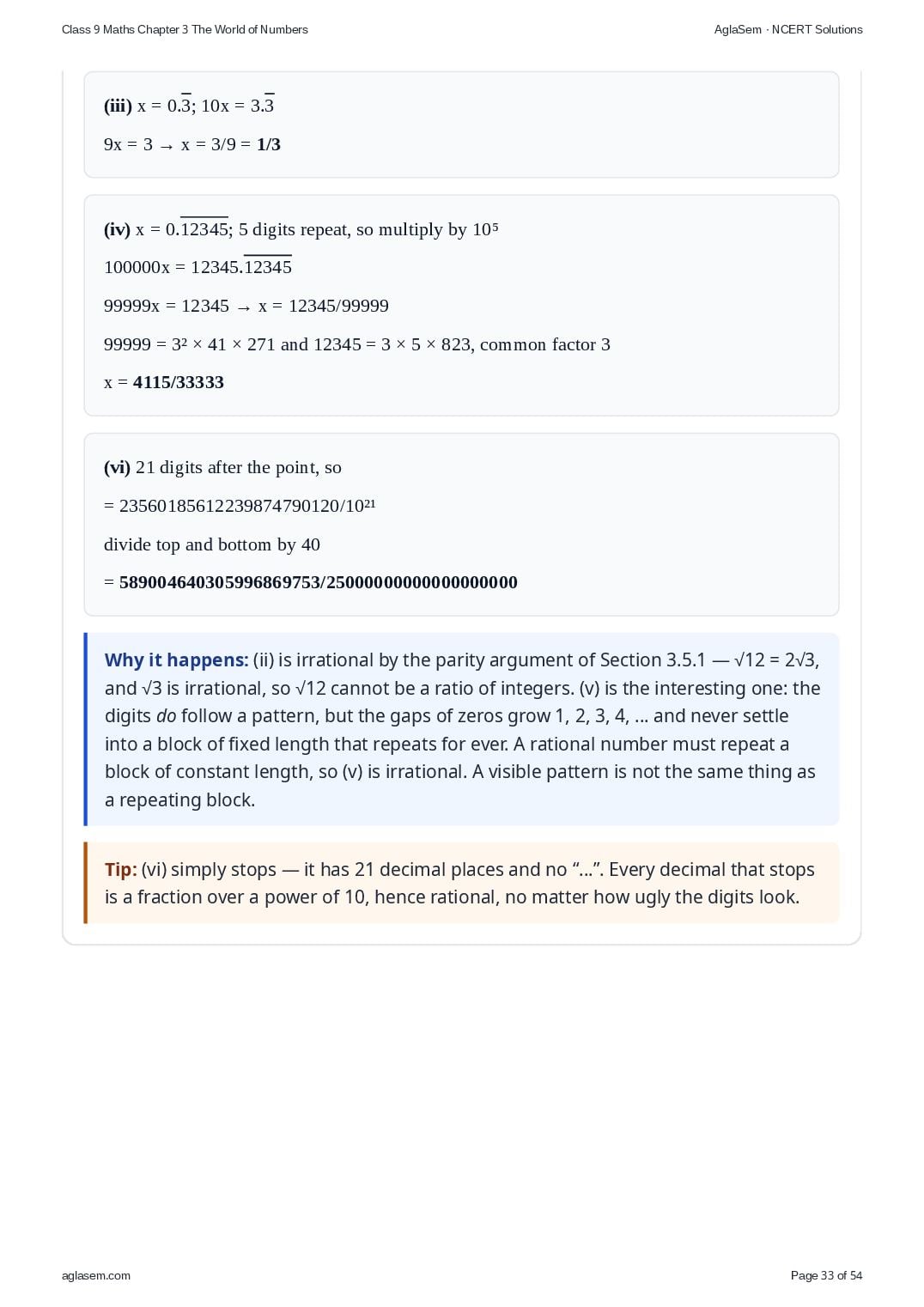
- Classify the following numbers as rational or irrational: (i) √81 (ii) √12 (iii) 0.33333 … (iv) 0.123451234512345 … (v) 1.01001000100001 … (Notice the pattern: Is it repeating a single block?) (vi) 23.560185612239874790120. Find the explicit fractions in case they are rational.
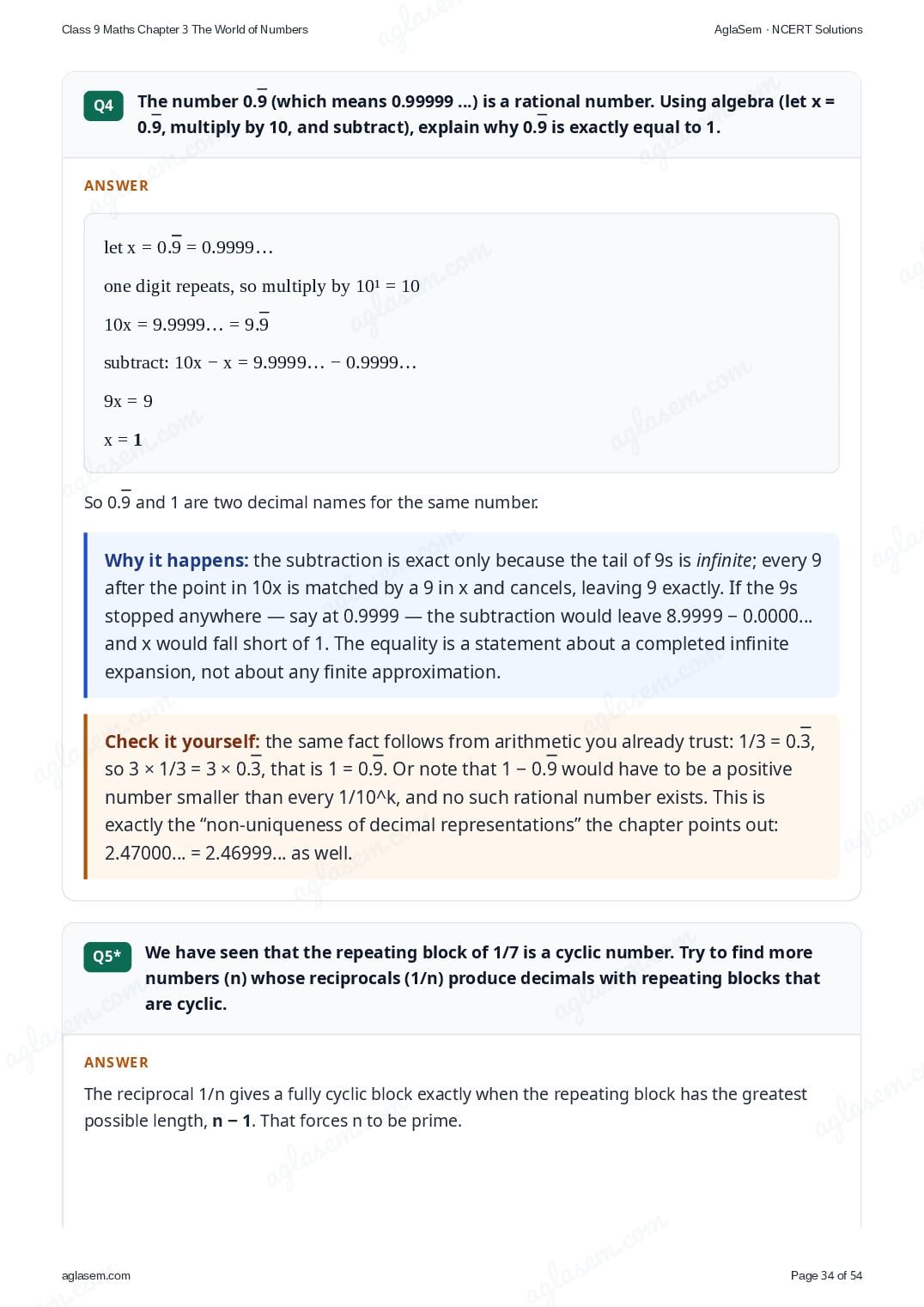
- The number 0. 9
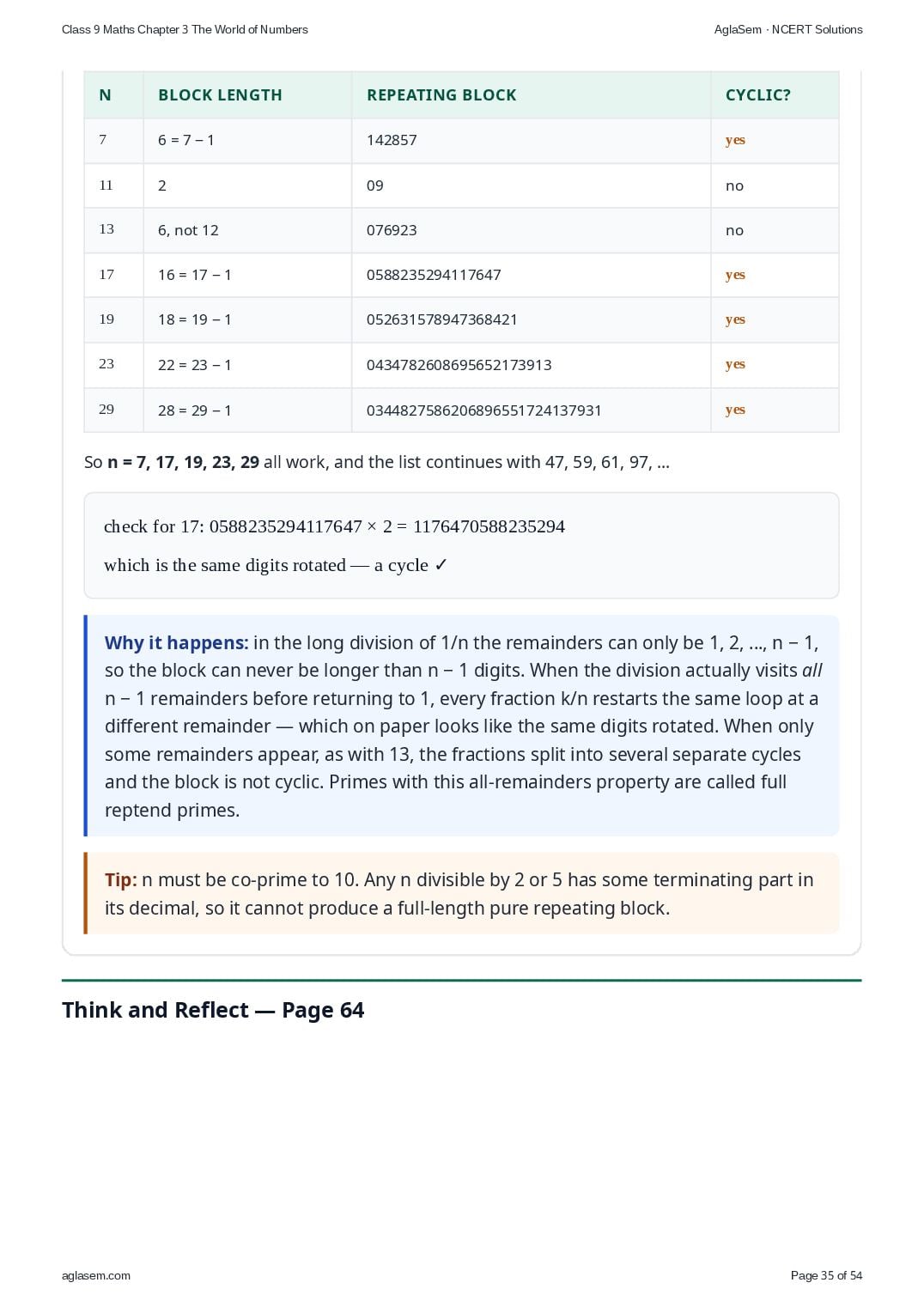
- We have seen that the repeating block of 1/7 is a cyclic number. Try to find more numbers (n) whose reciprocals (1/n) produce decimals with repeating blocks that are cyclic.
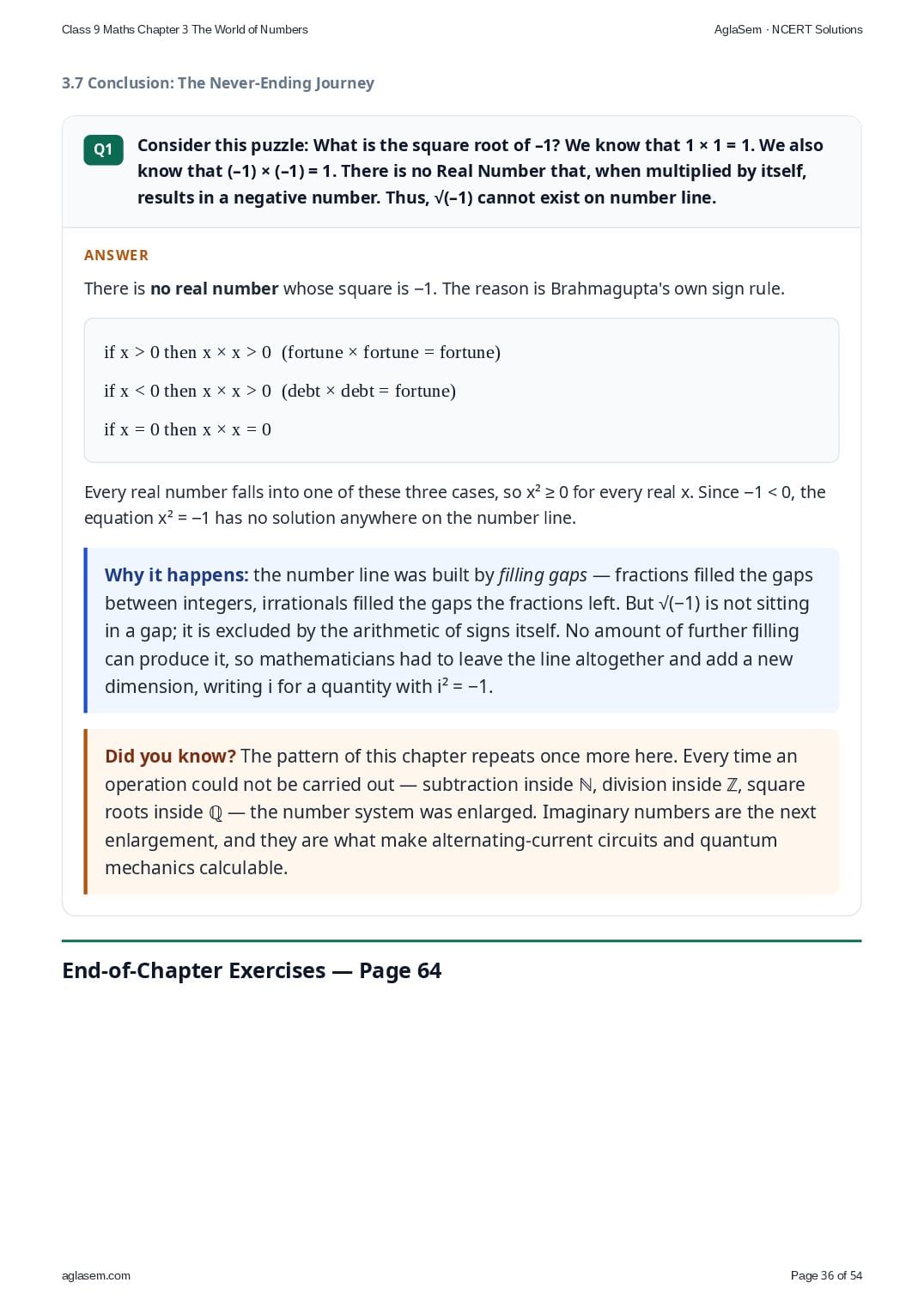
- Consider this puzzle: What is the square root of –1? We know that 1 × 1 = 1. We also know that (–1) × (–1) = 1. There is no Real Number that, when multiplied by itself, results in a negative number. Thus, √(–1) cannot exist on number line.
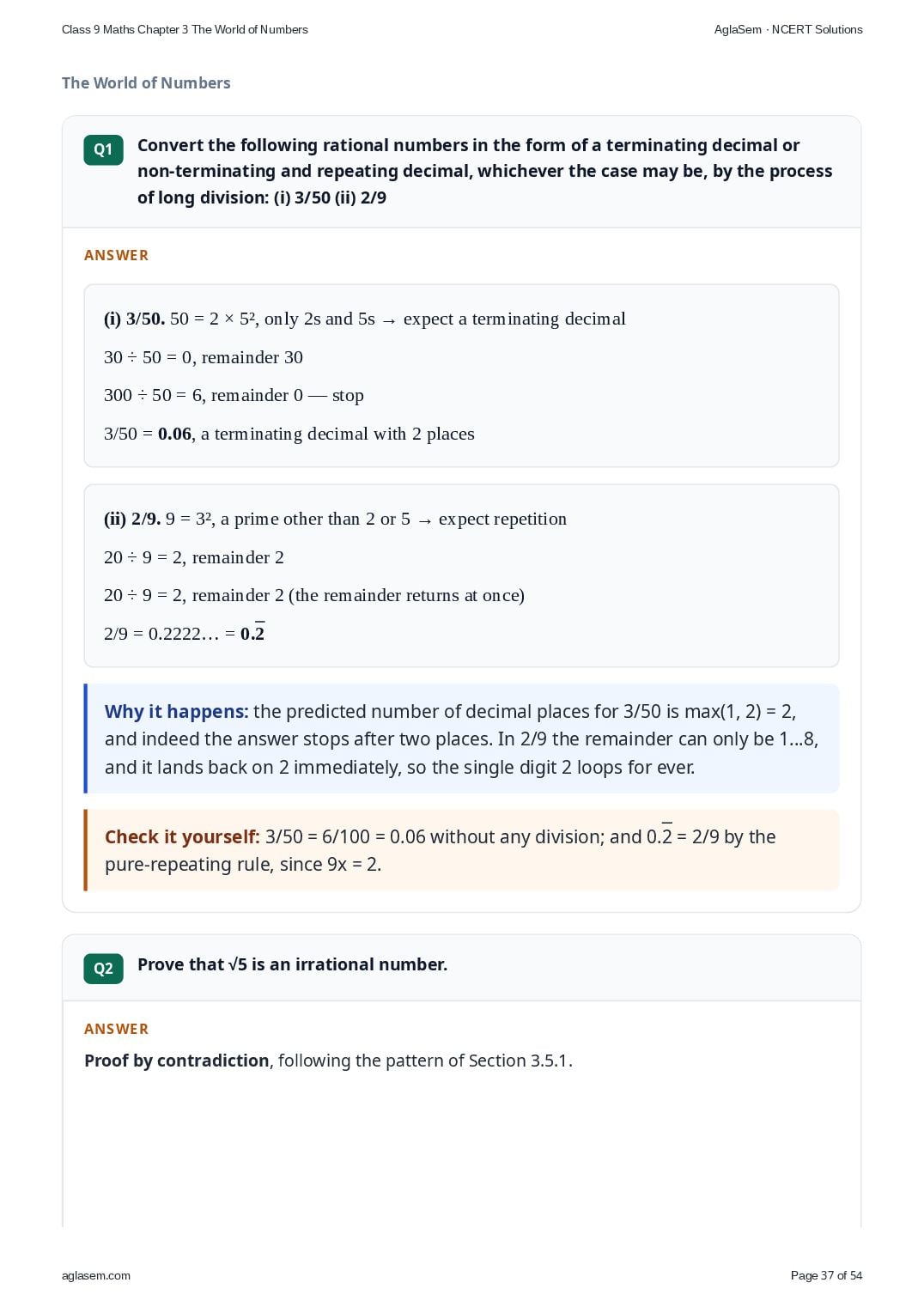
- Convert the following rational numbers in the form of a terminating decimal or non-terminating and repeating decimal, whichever the case may be, by the process of long division: (i) 3/50 (ii) 2/9
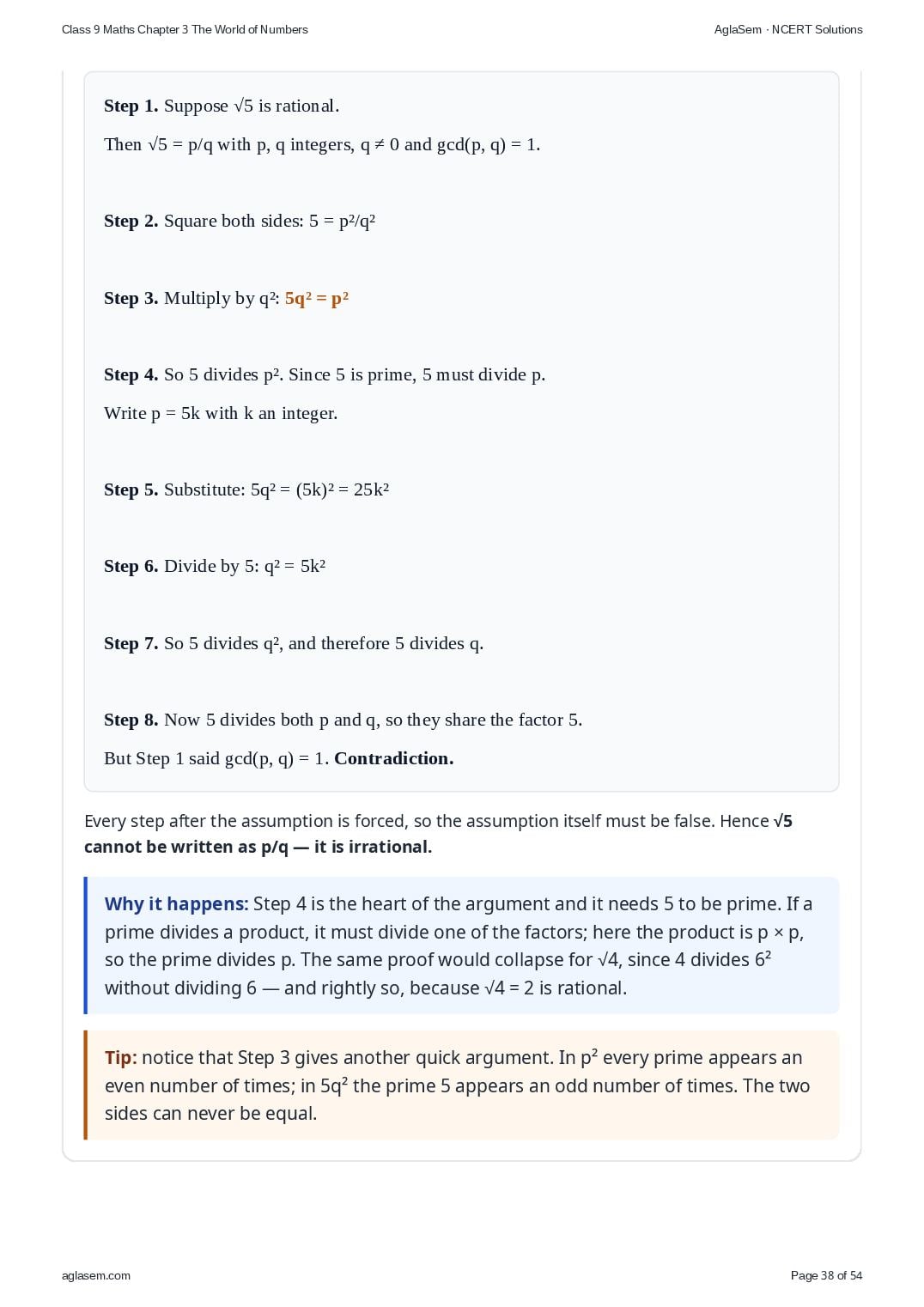
- Prove that √5 is an irrational number.
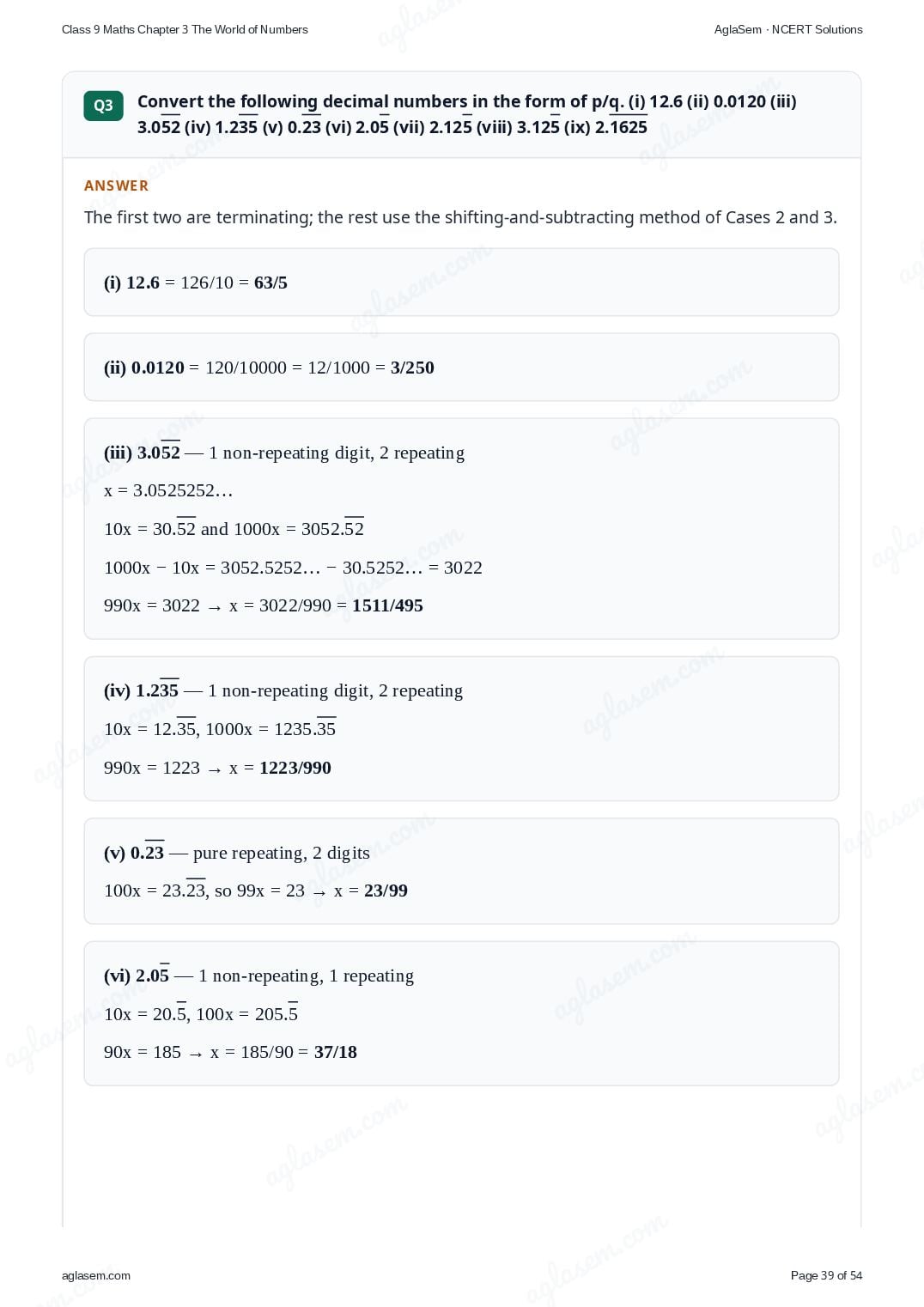
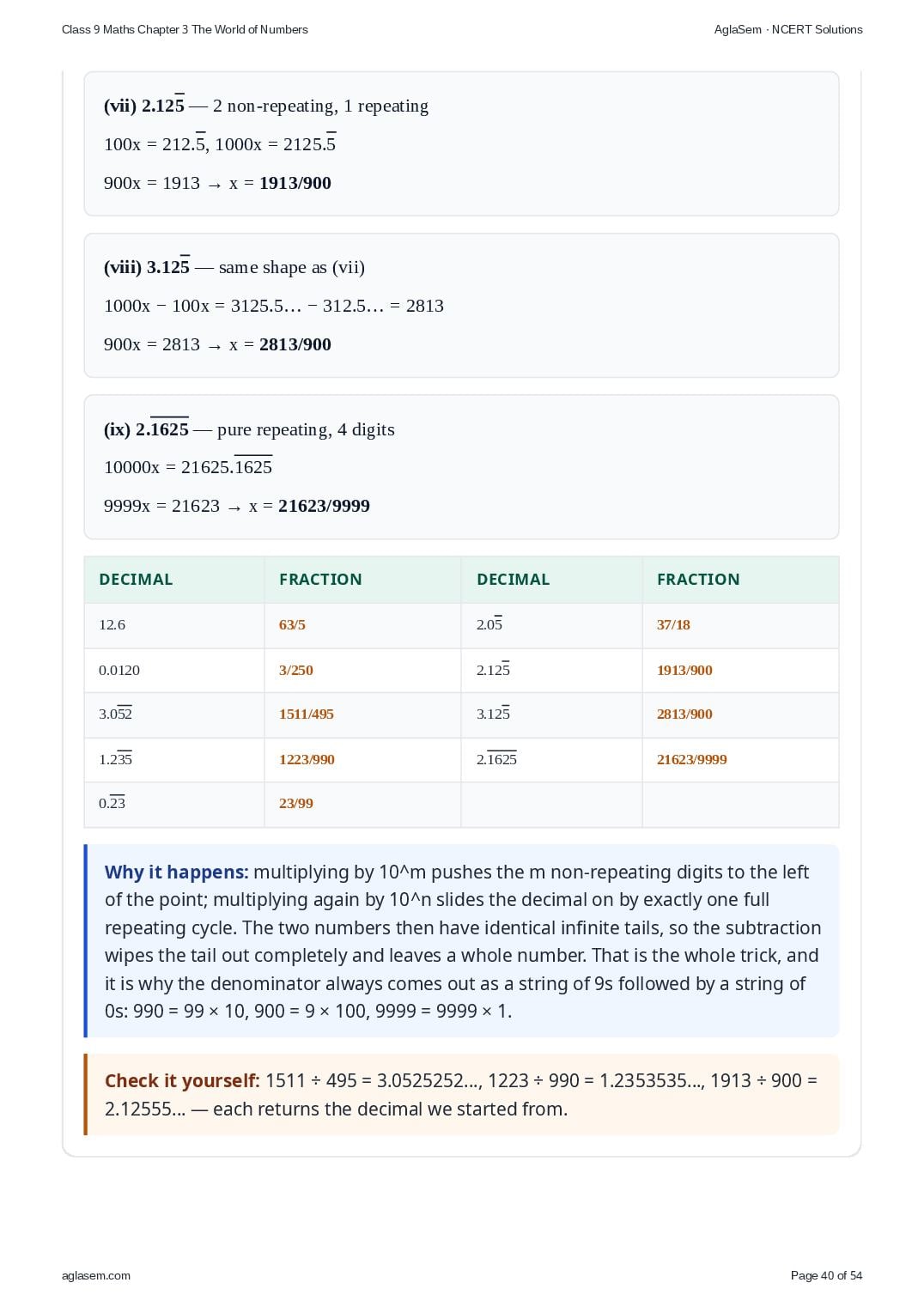
- Convert the following decimal numbers in the form of p/q. (i) 12.6 (ii) 0.0120 (iii) 3.0 52
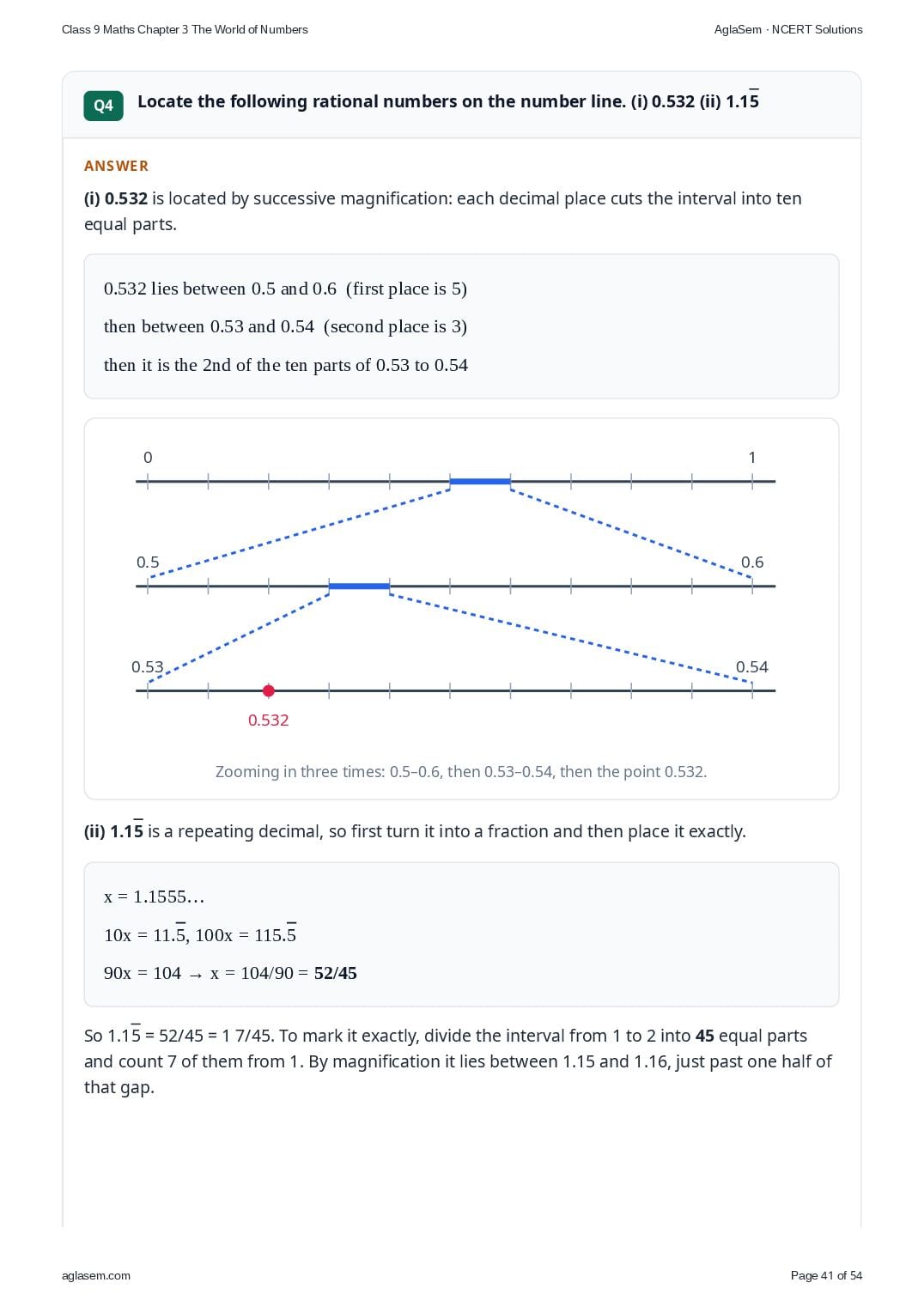
- Locate the following rational numbers on the number line. (i) 0.532 (ii) 1.1 5
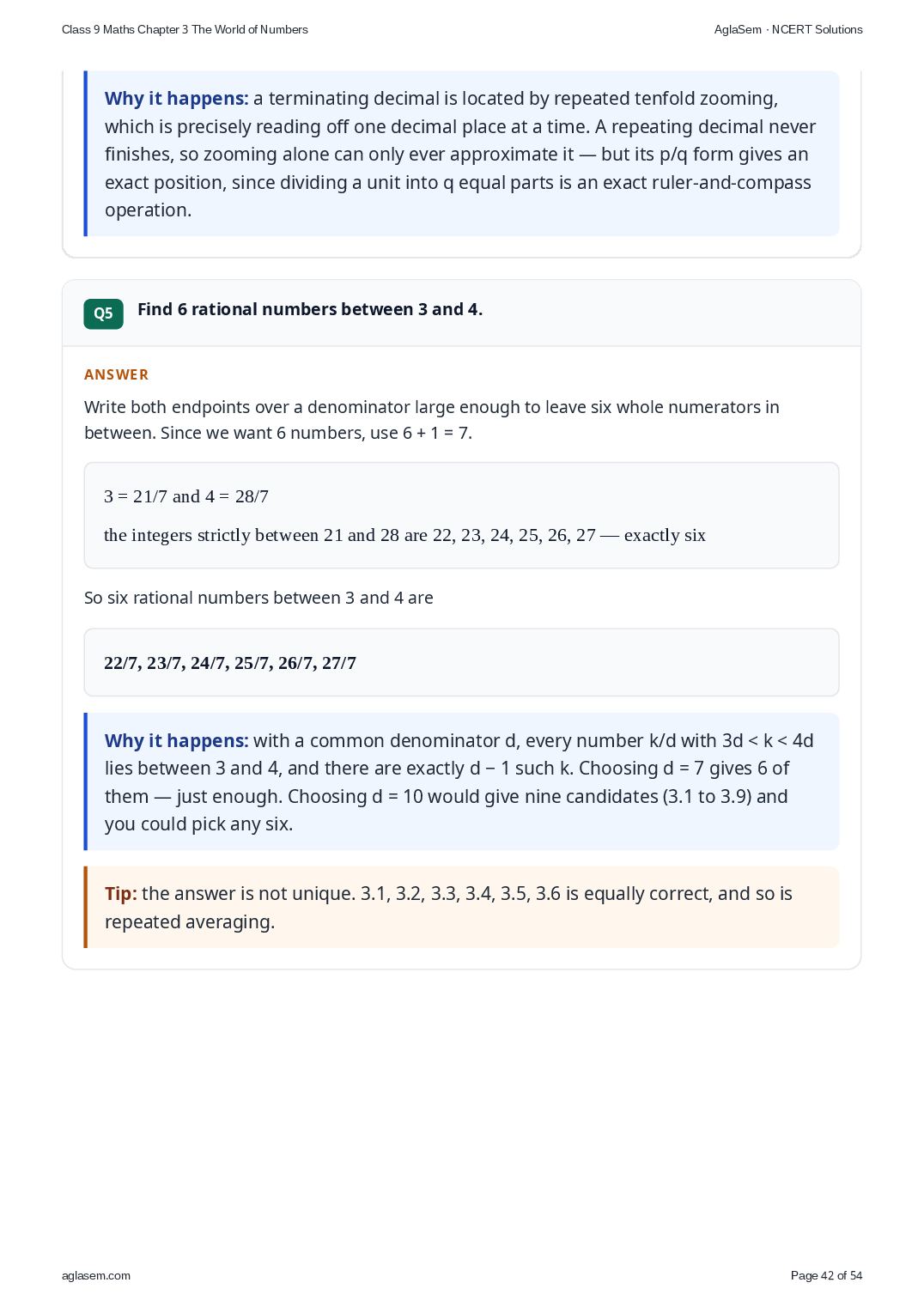
- Find 6 rational numbers between 3 and 4.
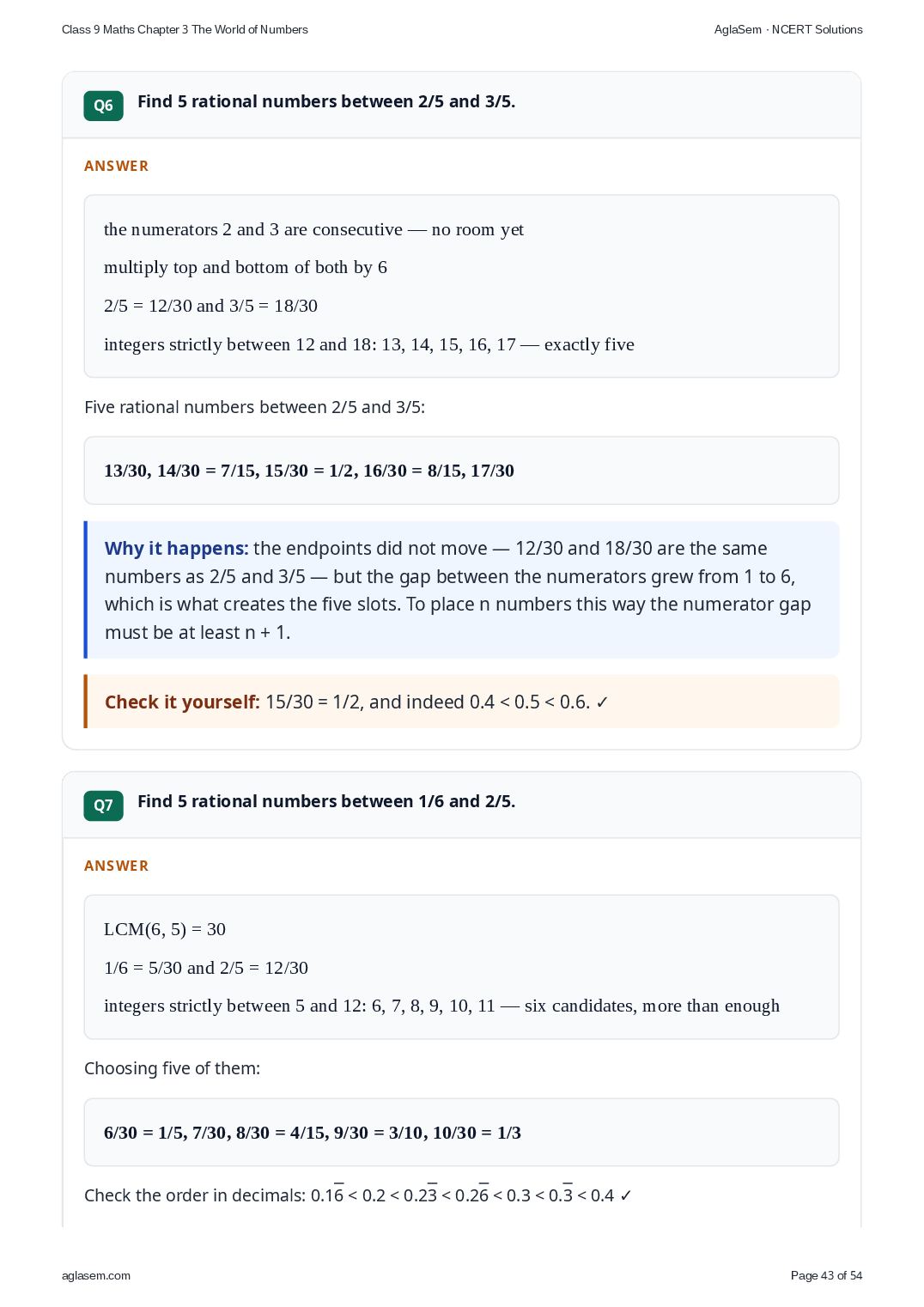
- Find 5 rational numbers between 2/5 and 3/5.
- Find 5 rational numbers between 1/6 and 2/5.
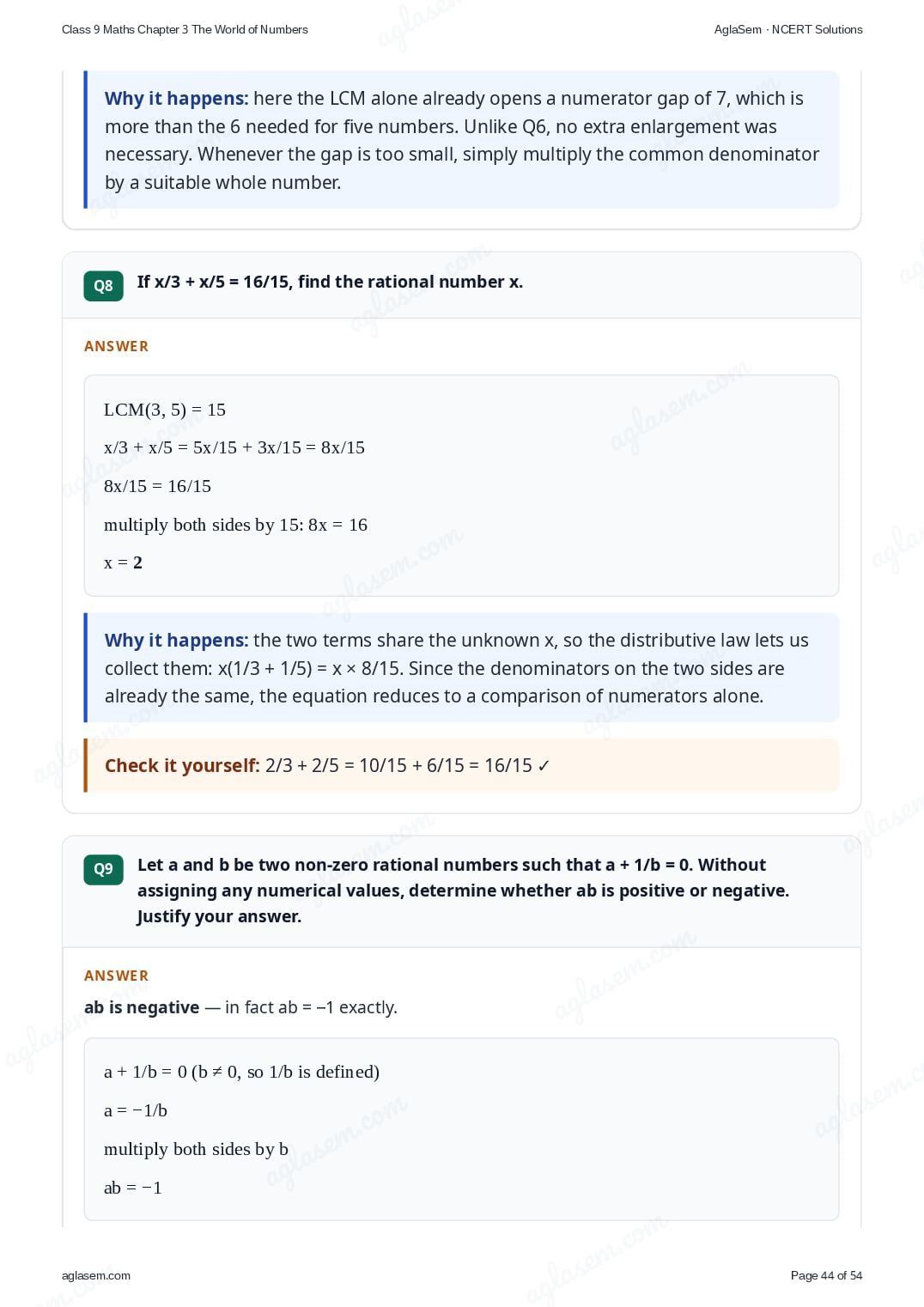
- If x/3 + x/5 = 16/15, find the rational number x.
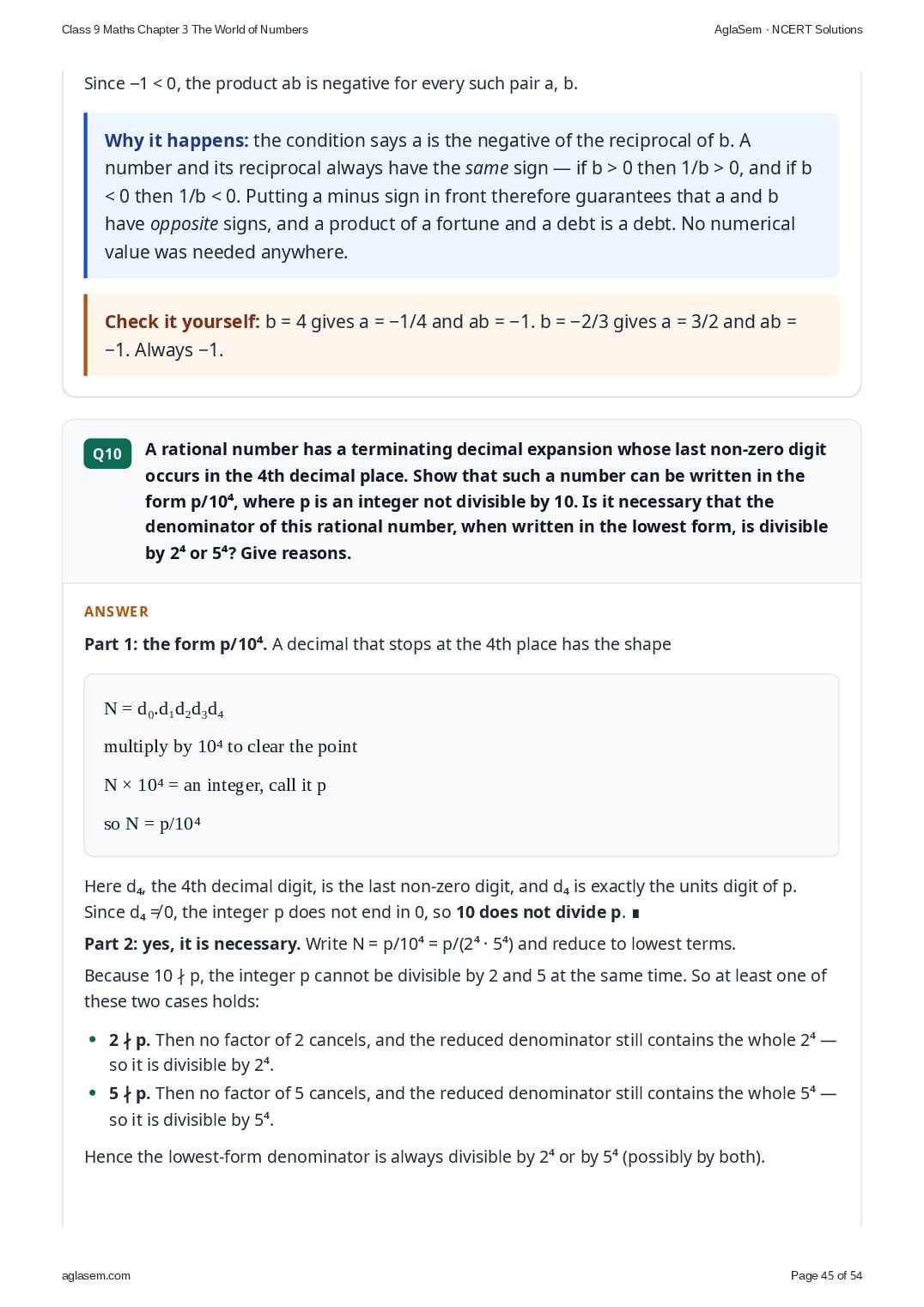
- Let a and b be two non-zero rational numbers such that a + 1/b = 0. Without assigning any numerical values, determine whether ab is positive or negative. Justify your answer.
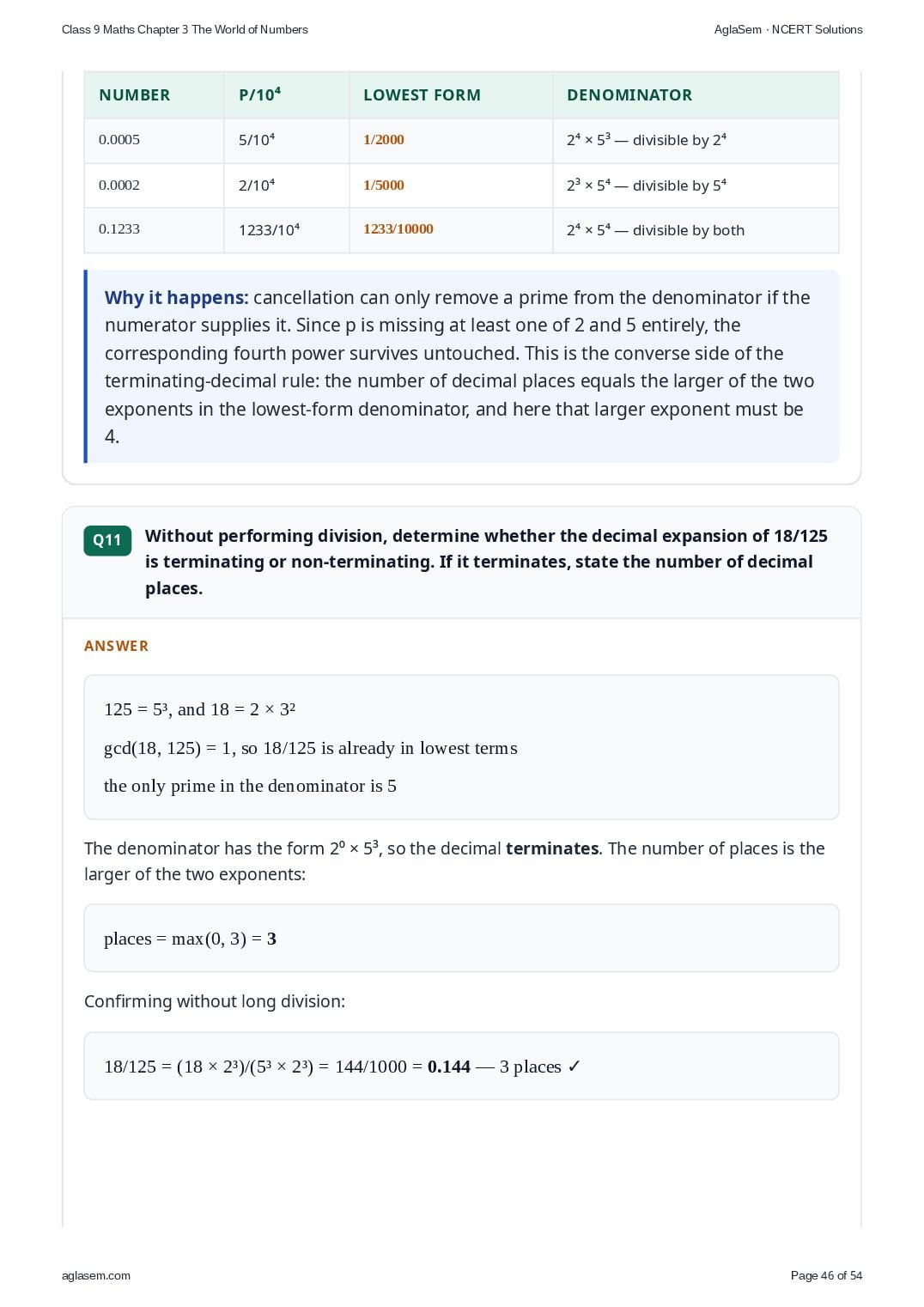
- A rational number has a terminating decimal expansion whose last non-zero digit occurs in the 4th decimal place. Show that such a number can be written in the form p/10⁴, where p is an integer not divisible by 10. Is it necessary that the denominator of this rational number, when written in the lowest form, is divisible by 2⁴ or 5⁴? Give reasons.
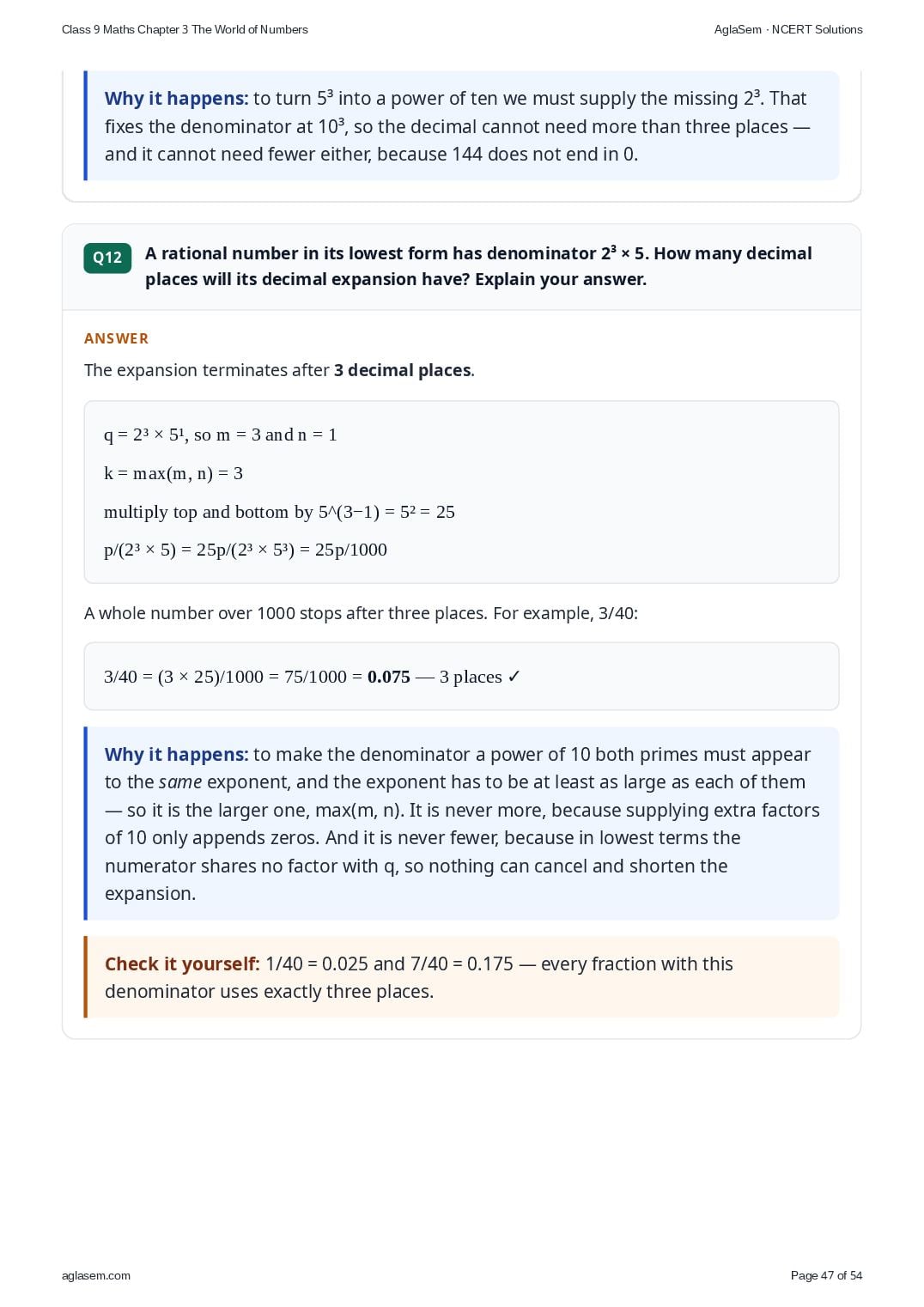
- Without performing division, determine whether the decimal expansion of 18/125 is terminating or non-terminating. If it terminates, state the number of decimal places.
- A rational number in its lowest form has denominator 2³ × 5. How many decimal places will its decimal expansion have? Explain your answer.
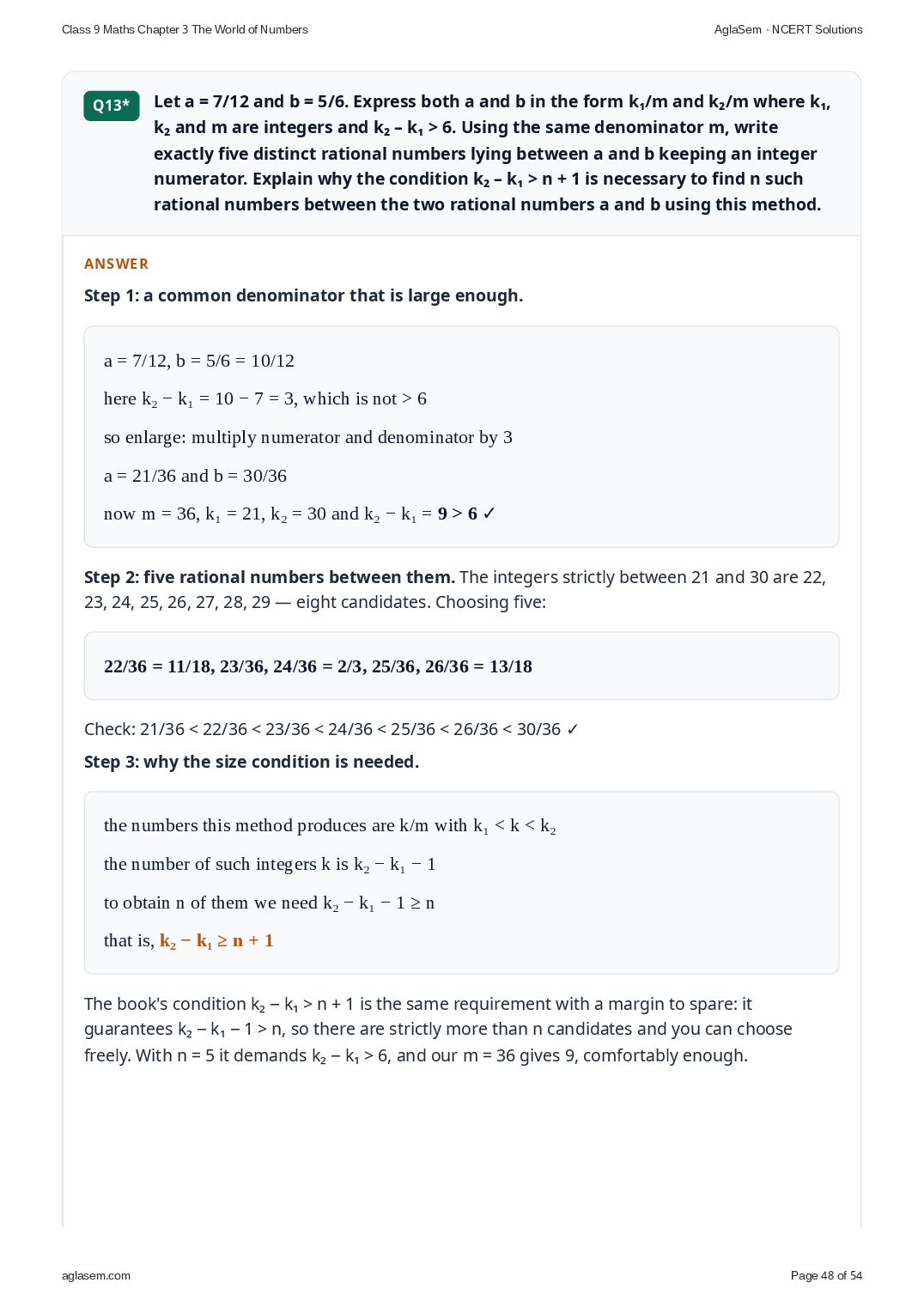
- Let a = 7/12 and b = 5/6. Express both a and b in the form k₁/m and k₂/m where k₁, k₂ and m are integers and k₂ – k₁ > 6. Using the same denominator m, write exactly five distinct rational numbers lying between a and b keeping an integer numerator. Explain why the condition k₂ – k₁ > n + 1 is necessary to find n such rational numbers between the two rational numbers a and b using this method.
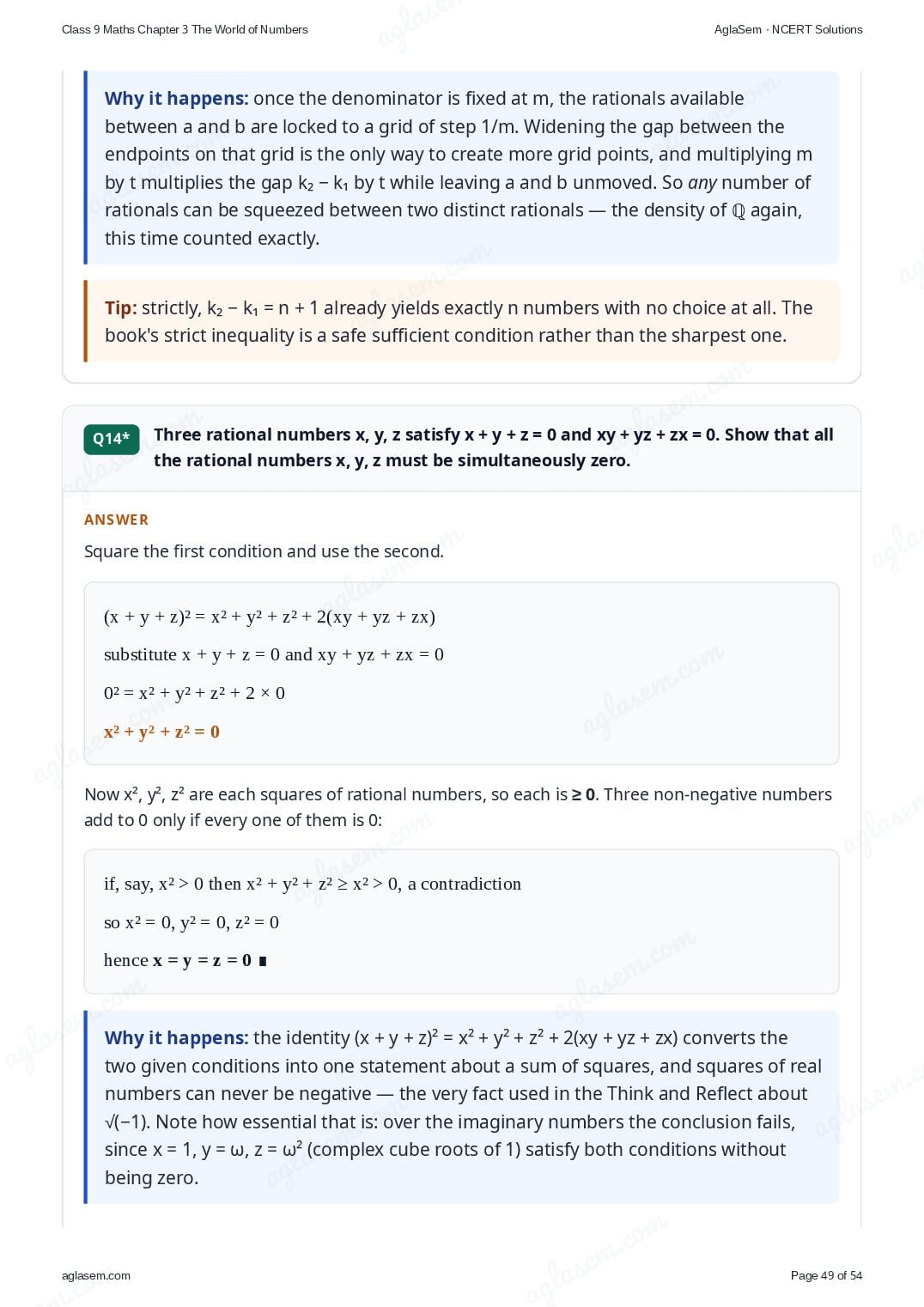
- Three rational numbers x, y, z satisfy x + y + z = 0 and xy + yz + zx = 0. Show that all the rational numbers x, y, z must be simultaneously zero.
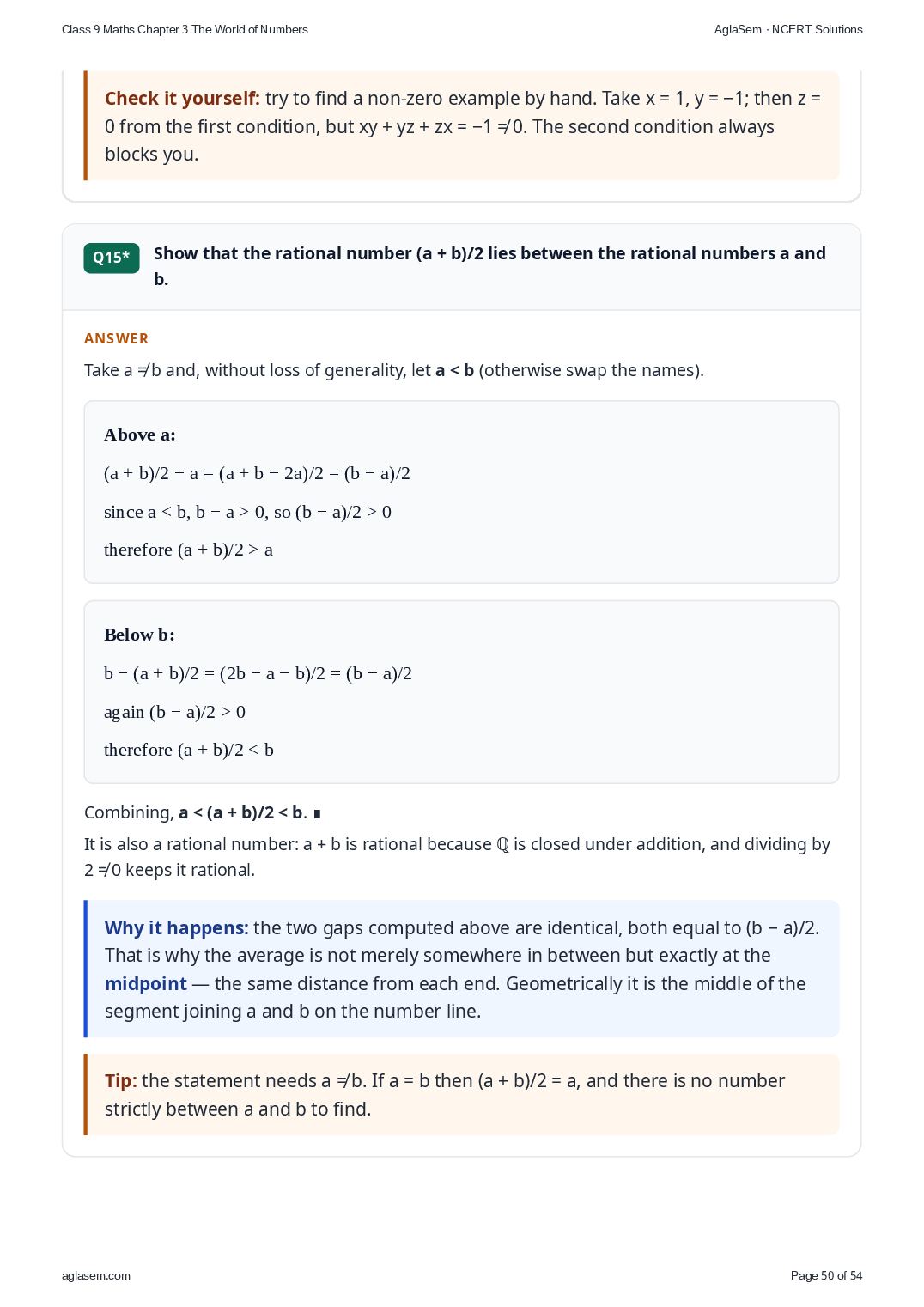
- Show that the rational number (a + b)/2 lies between the rational numbers a and b.
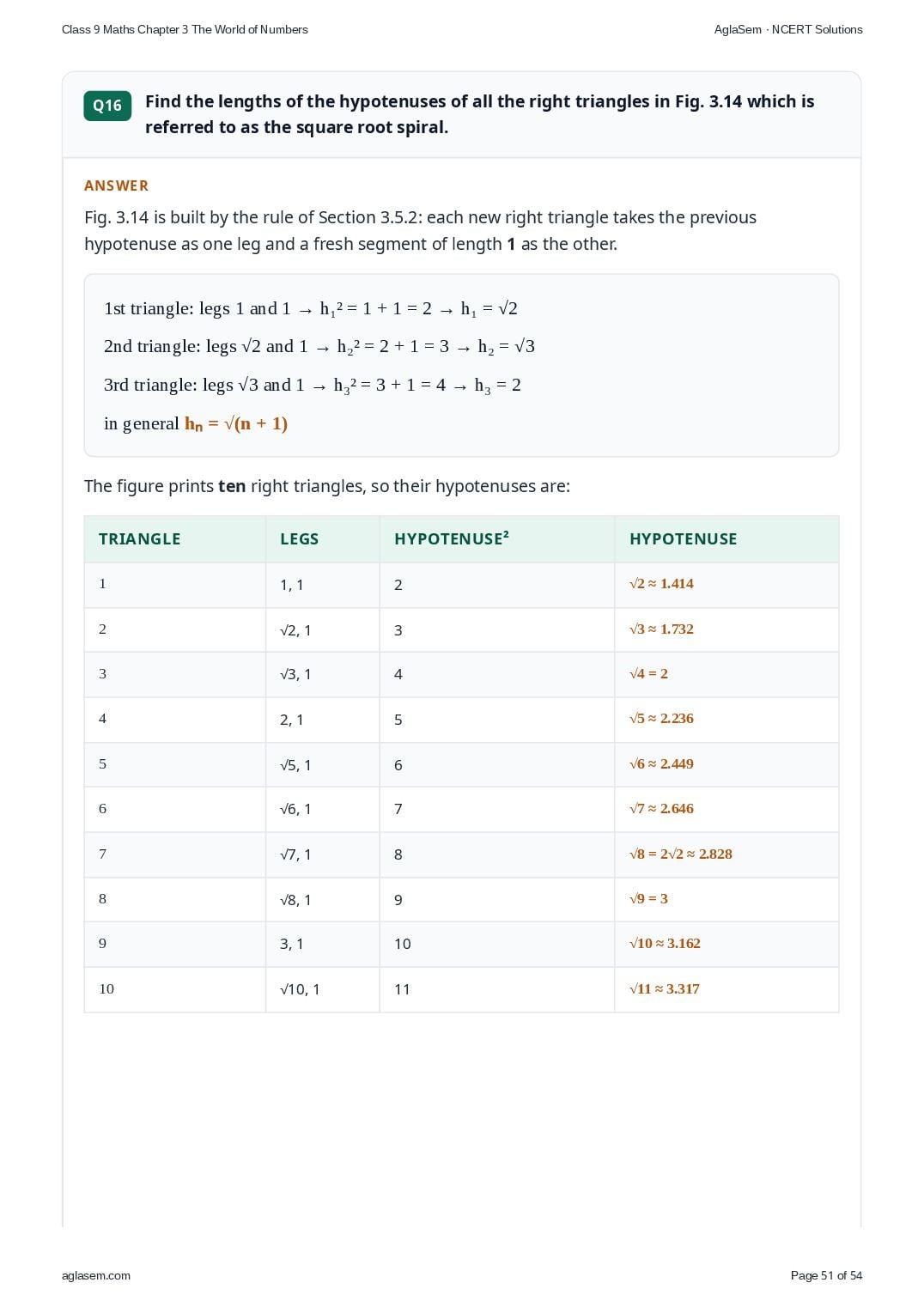
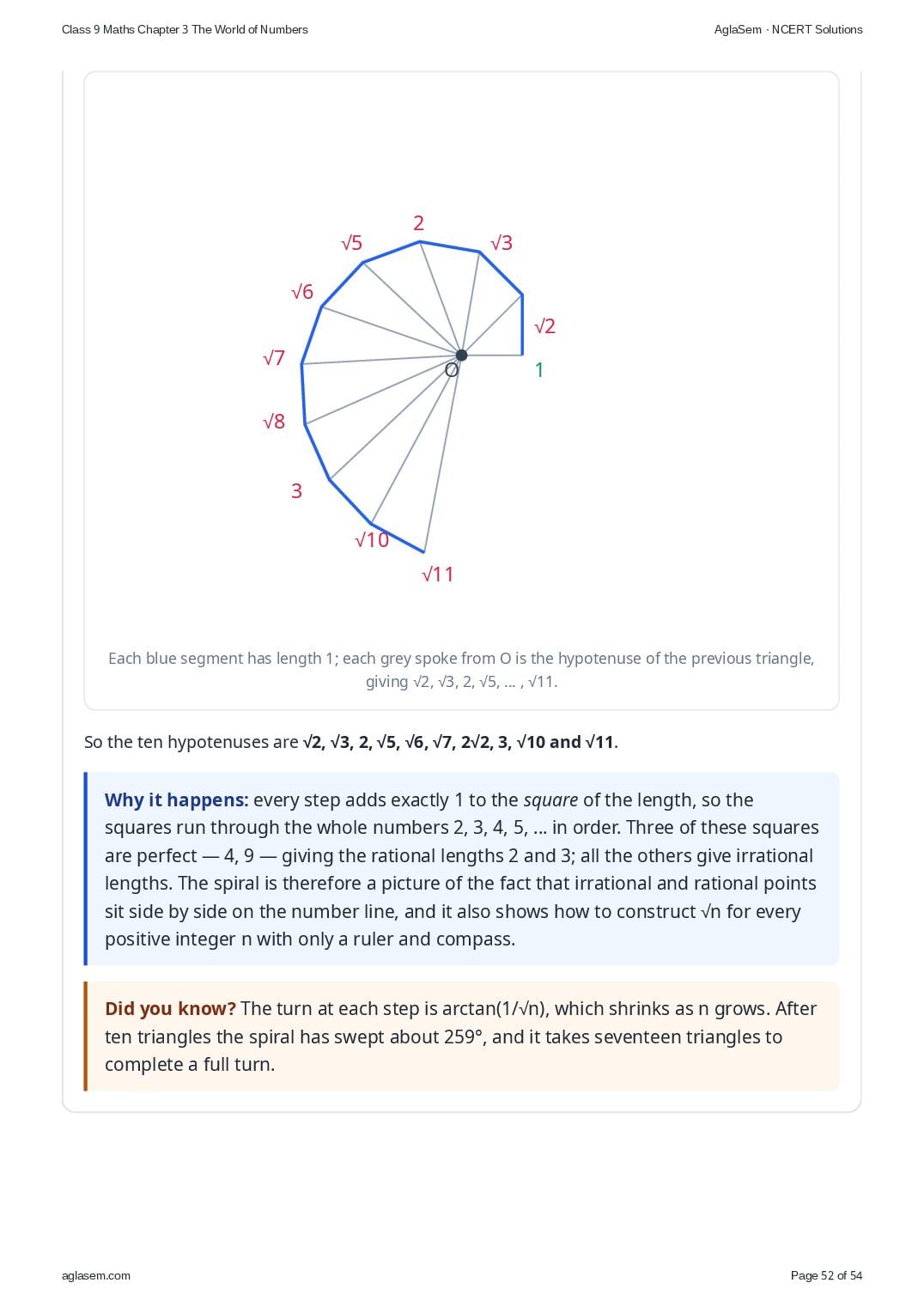
- Find the lengths of the hypotenuses of all the right triangles in Fig. 3.14 which is referred to as the square root spiral.
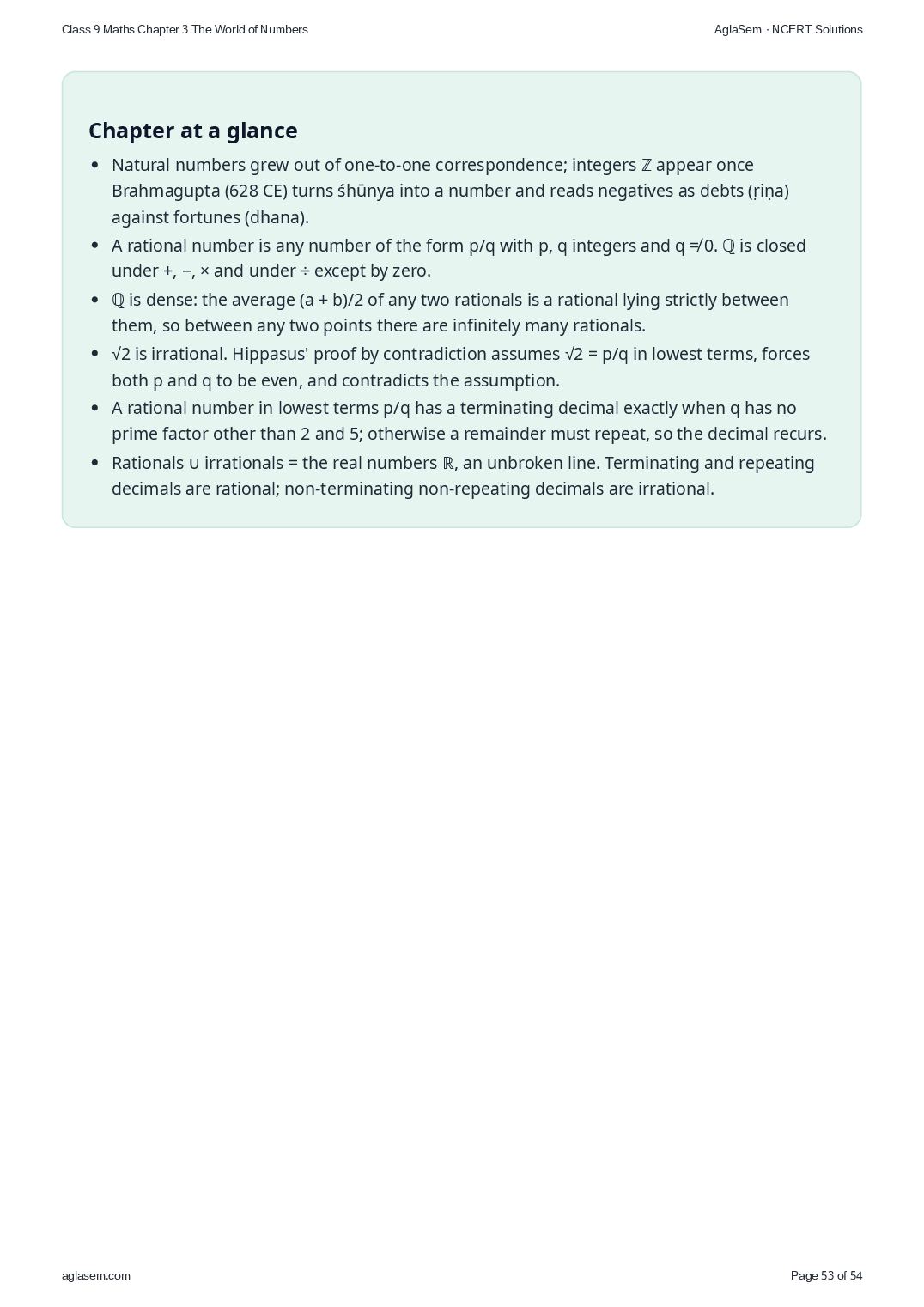
Chapter at a Glance
- Natural numbers grew out of one-to-one correspondence; integers ℤ appear once Brahmagupta (628 CE) turns śhūnya into a number and reads negatives as debts (ṛiṇa) against fortunes (dhana).
- A rational number is any number of the form p/q with p, q integers and q ≠ 0. ℚ is closed under +, −, × and under ÷ except by zero.
- ℚ is dense: the average (a + b)/2 of any two rationals is a rational lying strictly between them, so between any two points there are infinitely many rationals.
- √2 is irrational. Hippasus' proof by contradiction assumes √2 = p/q in lowest terms, forces both p and q to be even, and contradicts the assumption.
- A rational number in lowest terms p/q has a terminating decimal exactly when q has no prime factor other than 2 and 5; otherwise a remainder must repeat, so the decimal recurs.
- Rationals ∪ irrationals = the real numbers ℝ, an unbroken line. Terminating and repeating decimals are rational; non-terminating non-repeating decimals are irrational.
How to Download NCERT Solutions for Class 9 Maths Chapter 3 PDF
Follow these simple steps to get the The World of Numbers questions-and-answers PDF from Ganita Manjari.
- Search NCERT Solutions for Class 9 Maths Chapter 3 aglasem and open this page.
- Read the exercise questions with answers for The World of Numbers shown above.
- Click the Download PDF link to save the The World of Numbers solutions to your device.
NCERT Solutions for Class 9 Maths – All Chapters
There are more chapters to study besides The World of Numbers in Maths. Here are the NCERT Solutions for all chapters of Class 9 Maths.
- Chapter 1 Orienting Yourself the Use of Coordinates
- Chapter 2 Introduction to Linear Polynomials
- Chapter 3 The World of Numbers
- Chapter 4 Exploring Algebraic Identities
- Chapter 5 I M Up and Down and Round and Round
- Chapter 6 Measuring Space Perimeter and Area
- Chapter 7 The Mathematics of Maybe Introduction to Probability
- Chapter 8 Predicting What Comes Next Exploring Sequences and Progressions
NCERT Solutions for Class 9 – All Subjects
Just like Chapter 3 of Maths, you can get the exercise questions with answers for every other subject of Class 9. Here are the NCERT Solutions for all subjects of Class 9.
NCERT Solutions for Class 9 Maths Chapter 3 – An Overview
The key highlights of this study material are as follows.
| Aspects | Details |
|---|---|
| Class | Class 9 |
| Subject | Maths |
| Chapter Number | Chapter 3 |
| Chapter Name | The World of Numbers |
| Book Name | Ganita Manjari |
| Book By | NCERT (National Council of Educational Research and Training) |
| Educational Resource Here | NCERT Solutions of Class 9 Maths Chapter 3 for all exercises |
| More Questions Answers of This Subject | NCERT Solutions for Class 9 Maths |
| Download Book Chapter | NCERT Book Class 9 Maths |
| All Questions Answers For This Class | NCERT Solutions for Class 9 |
| Complete Solutions | NCERT Solutions |
NCERT Solutions for Class 9 Maths Chapter 3 The World of Numbers – FAQs
What are the NCERT Solutions for Class 9 Maths Chapter 3 The World of Numbers?
They are the complete, step-by-step answers to all the exercise and in-text questions of Chapter 3 The World of Numbers from the NCERT Class 9 Maths textbook Ganita Manjari, written by experts as per the latest NCERT syllabus.
How can I download the Class 9 Maths Chapter 3 solutions PDF for free?
Open this page on aglasem, read the The World of Numbers questions with answers, and click the “Download Solutions PDF” link. The Class 9 Maths Chapter 3 NCERT Solutions PDF is completely free to download.
Are these NCERT Solutions as per the latest 2026-27 syllabus?
Yes. The NCERT Solutions for Class 9 Maths Chapter 3 are based on the latest NCERT textbook Ganita Manjari and the current 2026-27 CBSE syllabus, so the questions and answers match what you study in class.
Where can I get NCERT Solutions for the other chapters of Class 9 Maths?
You can find the answers to every chapter on the NCERT Solutions for Class 9 Maths page, and solutions for every subject on the NCERT Solutions for Class 9 page.
How do NCERT Solutions help in exam preparation?
They show the correct method to solve each question, help you write answers the way they are expected in exams, let you check and correct your own work, and save revision time — which together improve your marks in Class 9 Maths.
If you have any queries on NCERT Solutions for Class 9 Maths Chapter 3 The World of Numbers, then please ask in the comments below.