NCERT Solutions for Class 9 Social Science Chapter 4 Early Humans and Beginning of Civilisation provide clear, step-by-step answers to every exercise and in-text question from the chapter Early Humans and Beginning of Civilisation of the NCERT textbook Understanding Society: India and Beyond. Prepared by subject experts as per the latest NCERT (CBSE) syllabus for 2026-27, these NCERT Solutions for Class 9 Social Science help you understand each concept, write exam-ready answers, and check your own solutions. You can read them online below or download the free Class 9 Social Science Chapter 4 question-answer PDF.
NCERT Solutions for Class 9 Social Science Chapter 4 Early Humans and Beginning of Civilisation
- Class: Class 9
- Subject: Social Science
- Chapter: Chapter 4 – Early Humans and Beginning of Civilisation
- Textbook: Understanding Society: India and Beyond (NCERT)
- Study material: NCERT Solutions – questions with answers, free PDF
These solutions answer all the exercise questions of Chapter 4 Early Humans and Beginning of Civilisation — including the in-text questions, short-answer and long-answer questions, and activities — with complete explanations so you can follow the method, not just the final answer. Read the full solutions below.
NCERT Solutions Class 9 Social Science Chapter 4 Early Humans and Beginning of Civilisation View Download







NCERT Solutions for Class 9 Social Science Chapter 4 PDF Download
You can read the NCERT Solutions for Class 9 Social Science Chapter 4 online above, or download the complete question-answer PDF to study Early Humans and Beginning of Civilisation offline at any time.
NCERT Solutions for Class 9 Social Science Chapter 4 PDF Download Link – Click Here to Download Solutions PDF
Questions Covered in This Chapter
These NCERT Solutions answer all 47 questions of this chapter. The questions solved are:
- How did humans live on Earth before the beginning of civilisation?
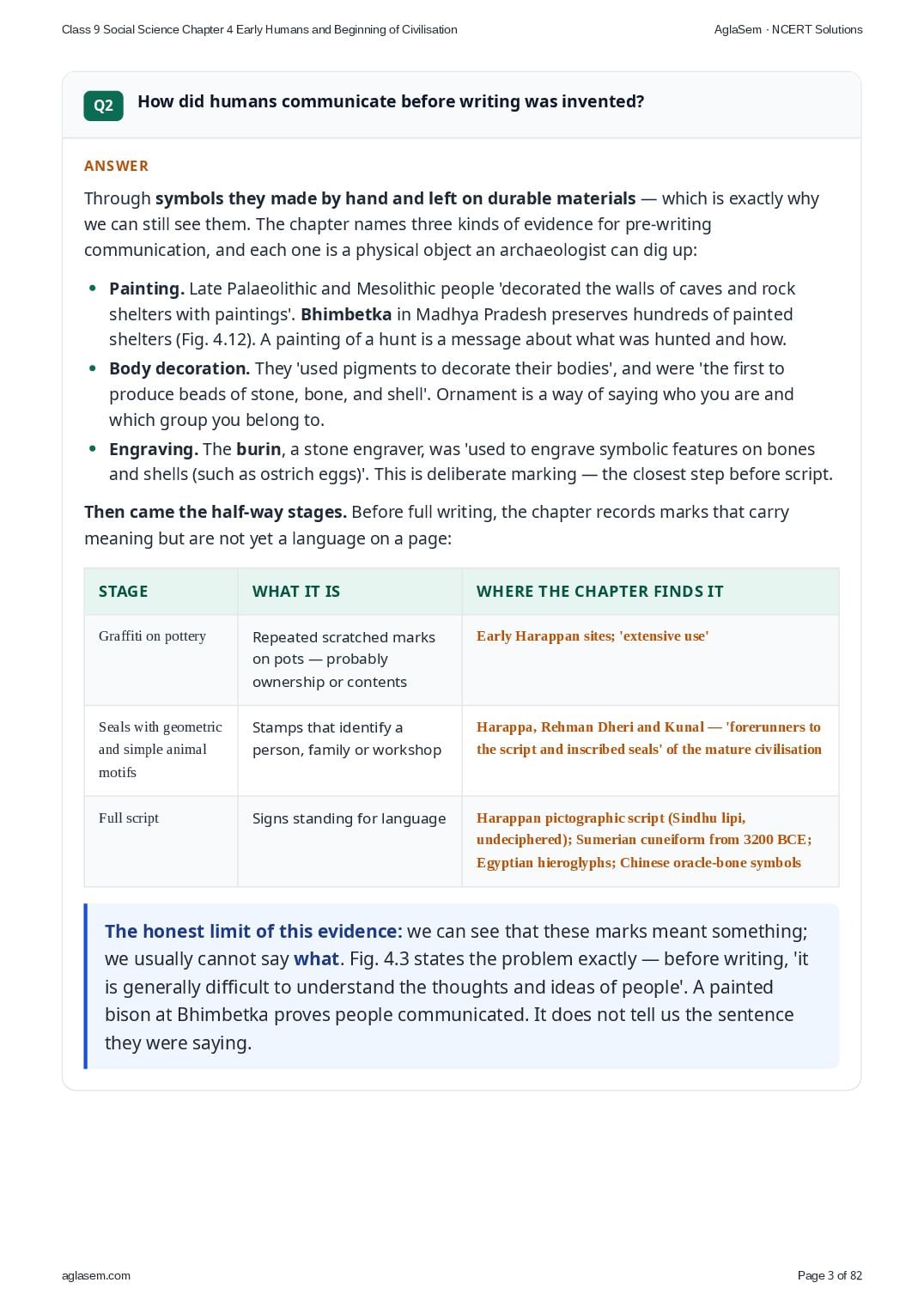
- How did humans communicate before writing was invented?
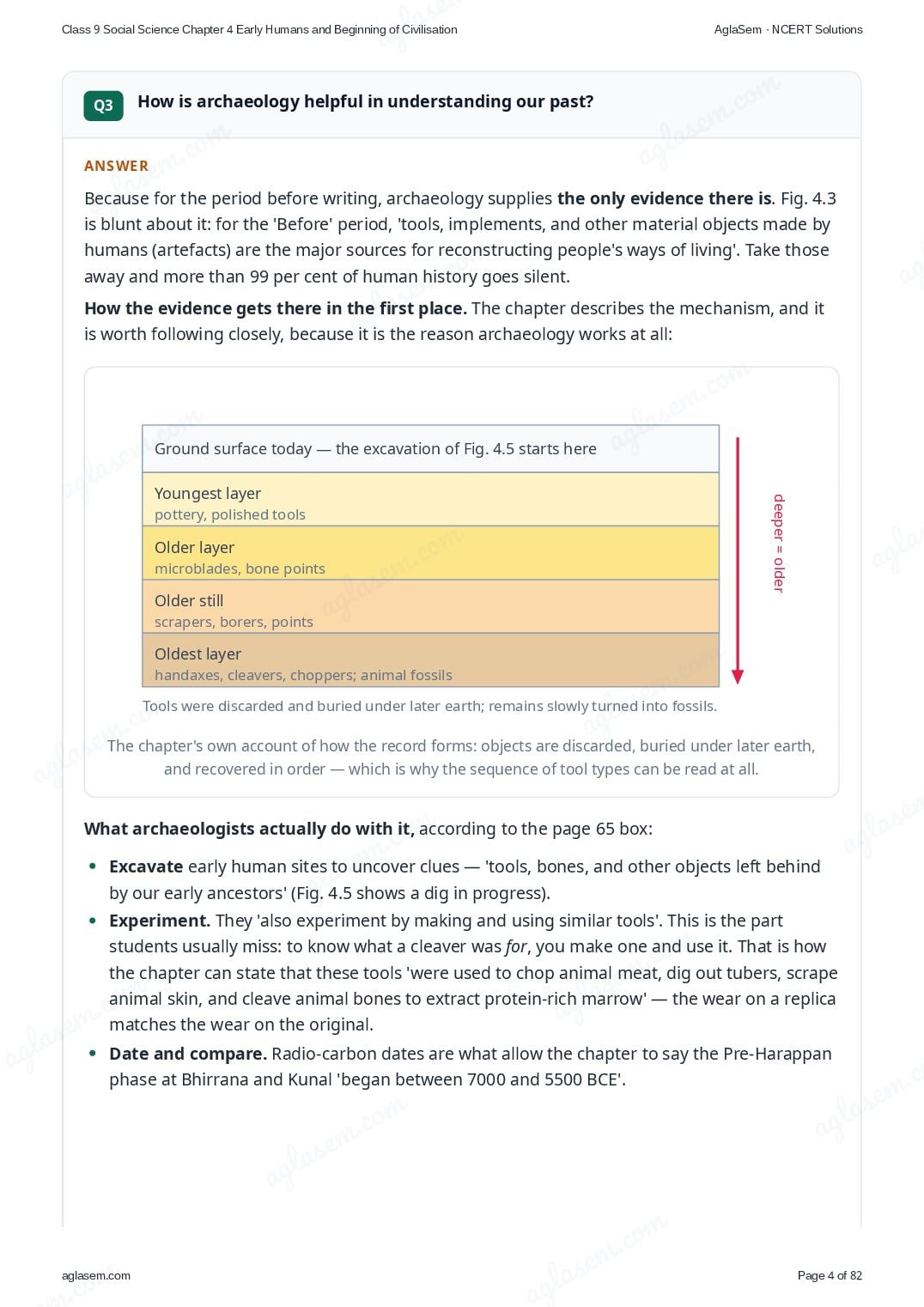
- How is archaeology helpful in understanding our past?
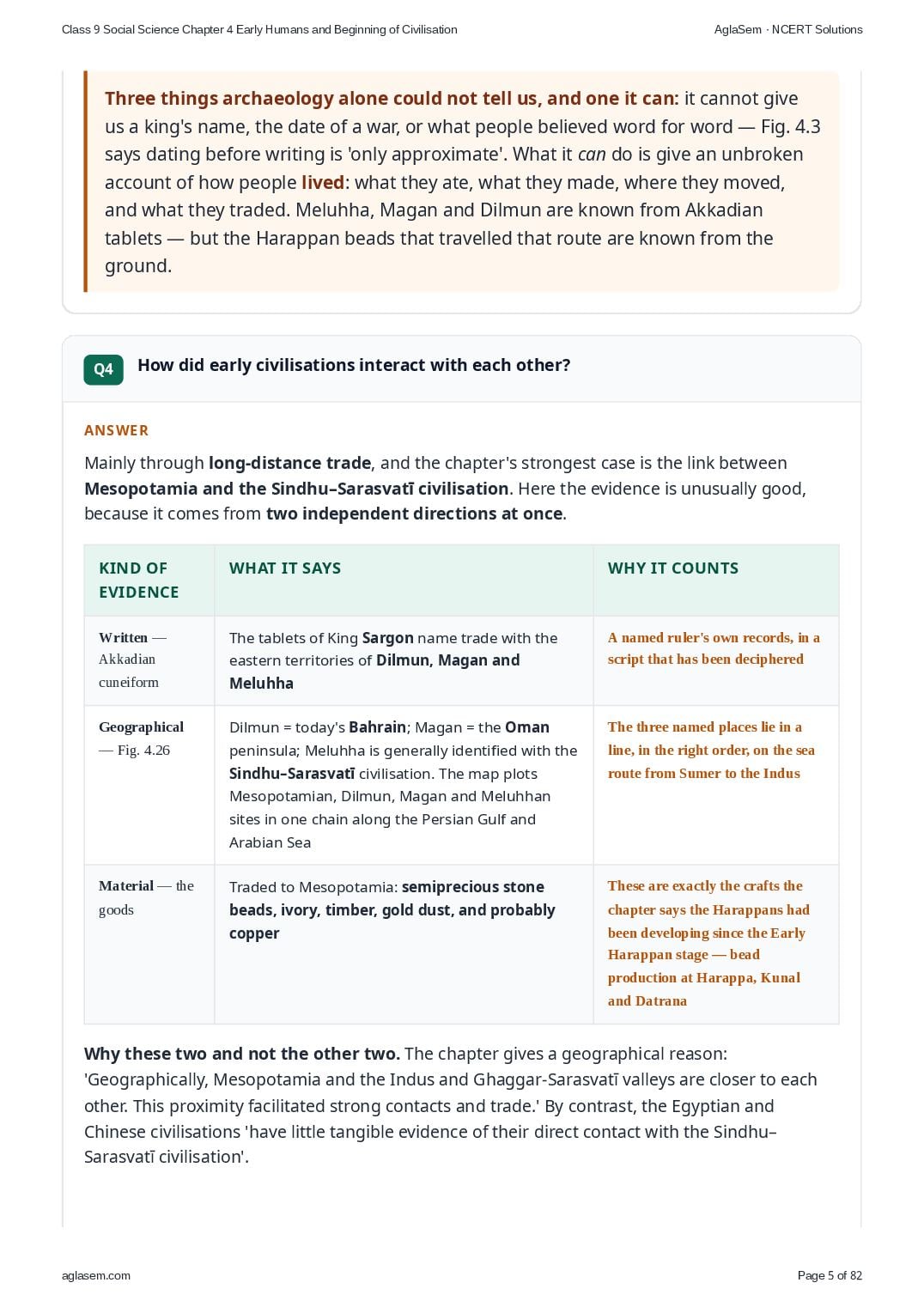
- How did early civilisations interact with each other?
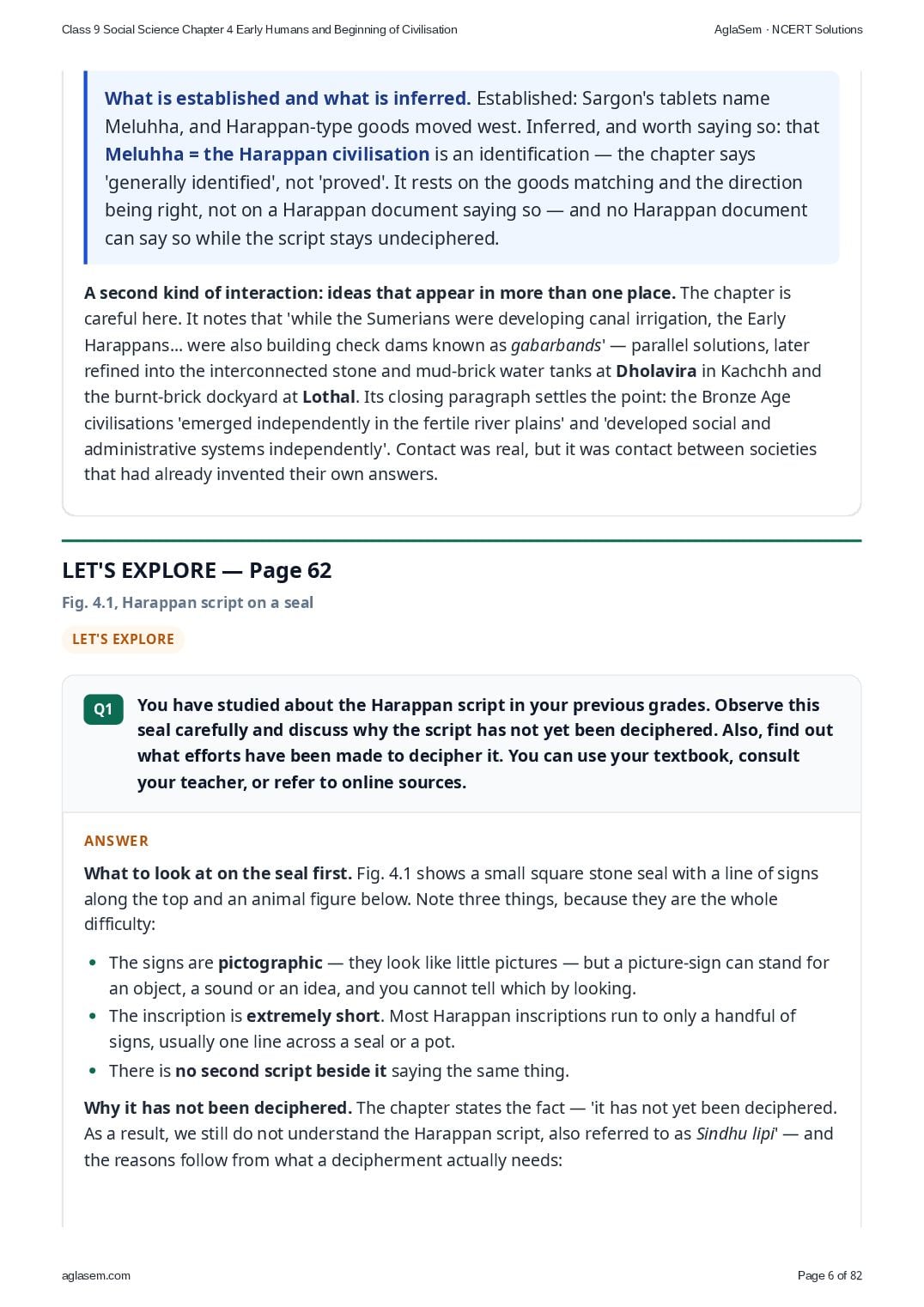
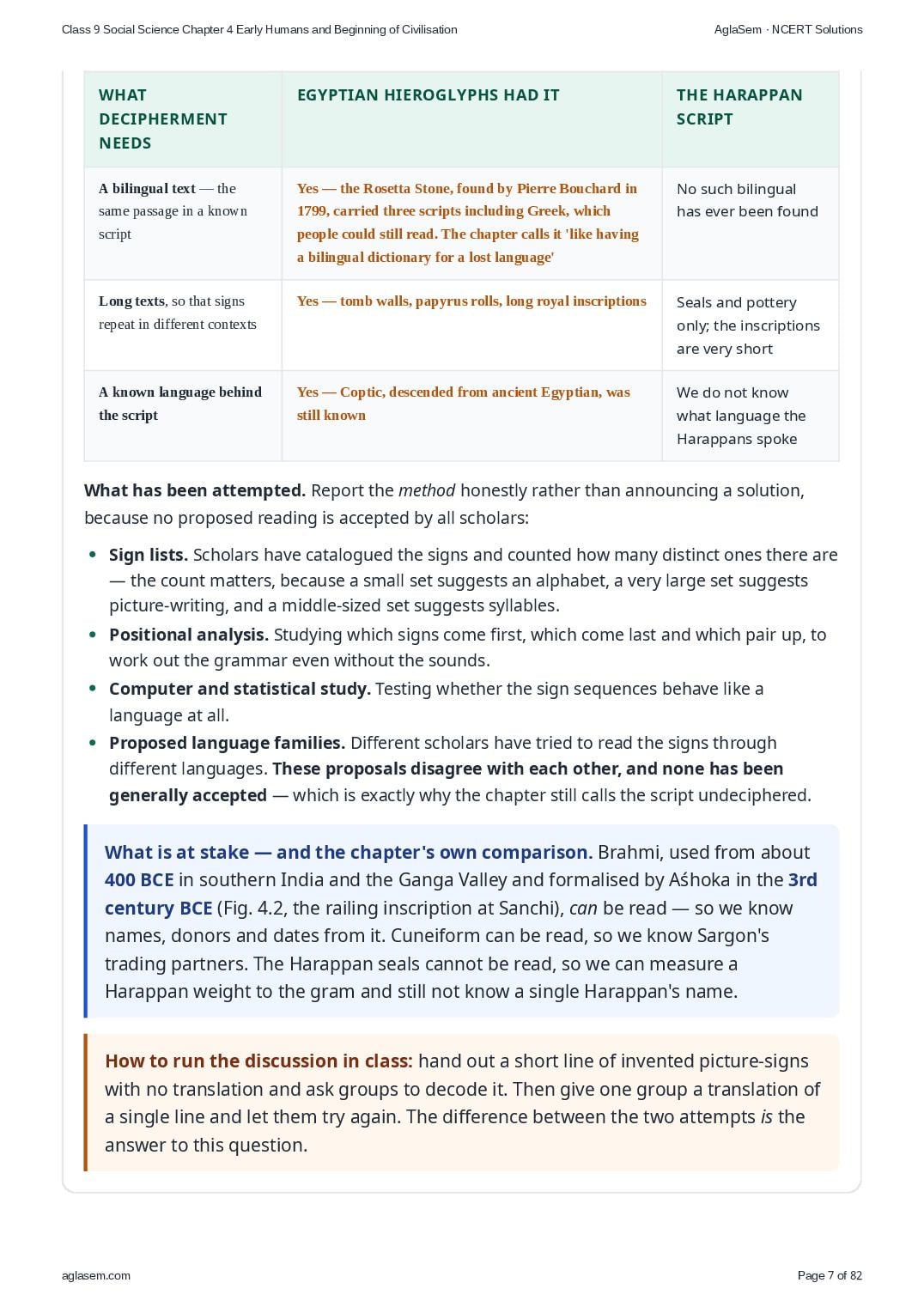
- You have studied about the Harappan script in your previous grades. Observe this seal carefully and discuss why the script has not yet been deciphered. Also, find out what efforts have been made to decipher it. You can use your textbook, consult your teacher, or refer to online sources.
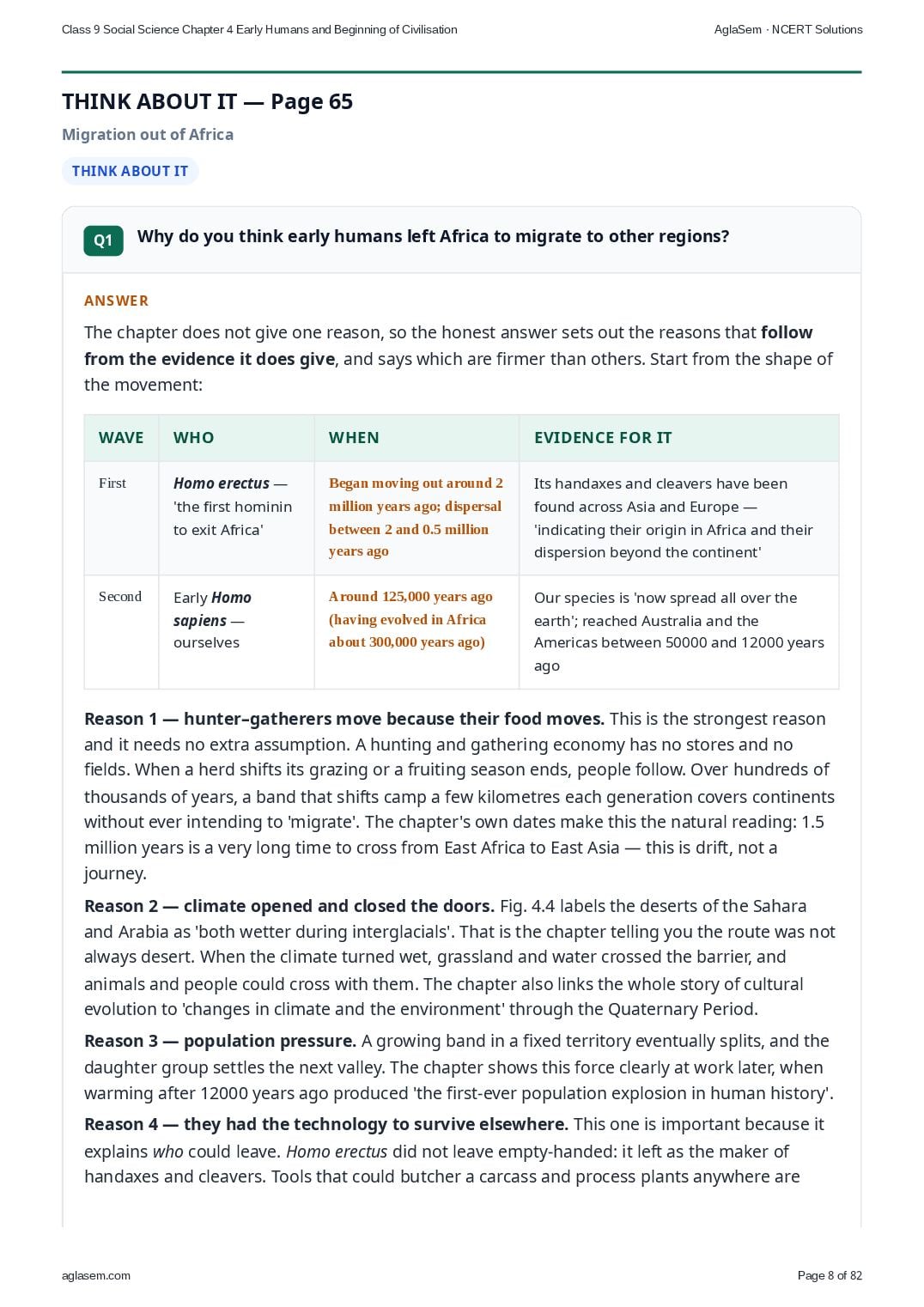
- Why do you think early humans left Africa to migrate to other regions?
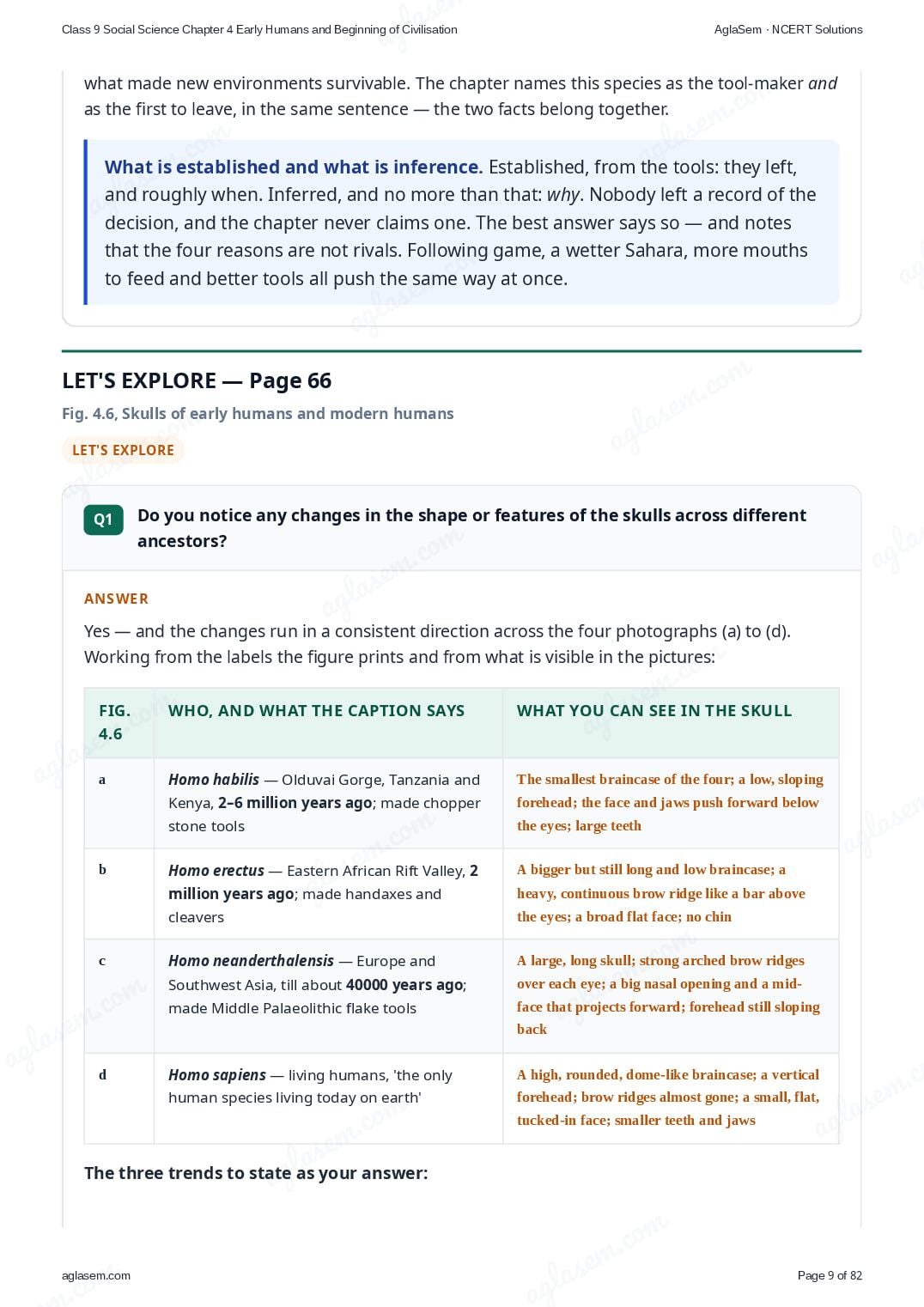
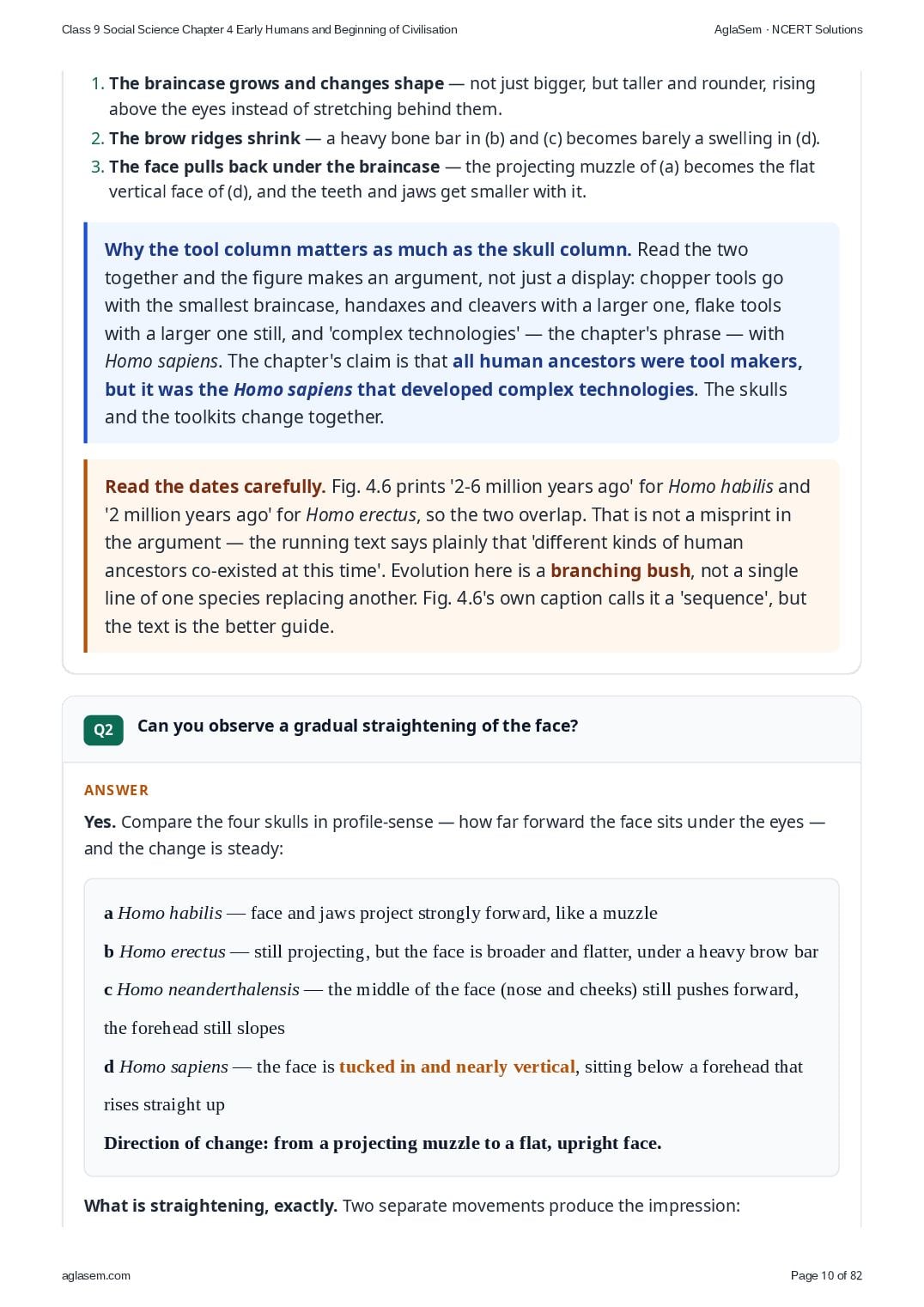
- Do you notice any changes in the shape or features of the skulls across different ancestors?
- Can you observe a gradual straightening of the face?
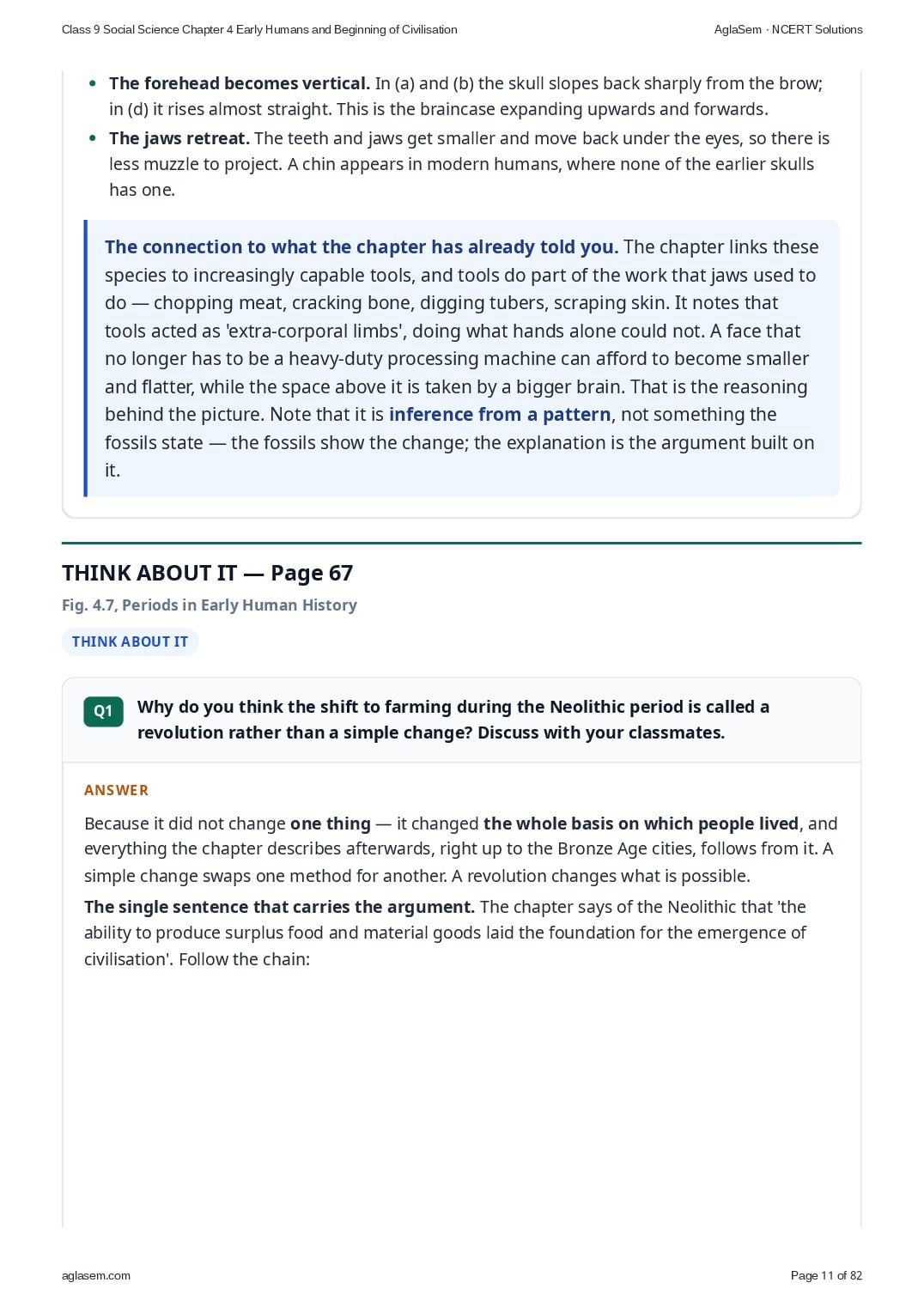
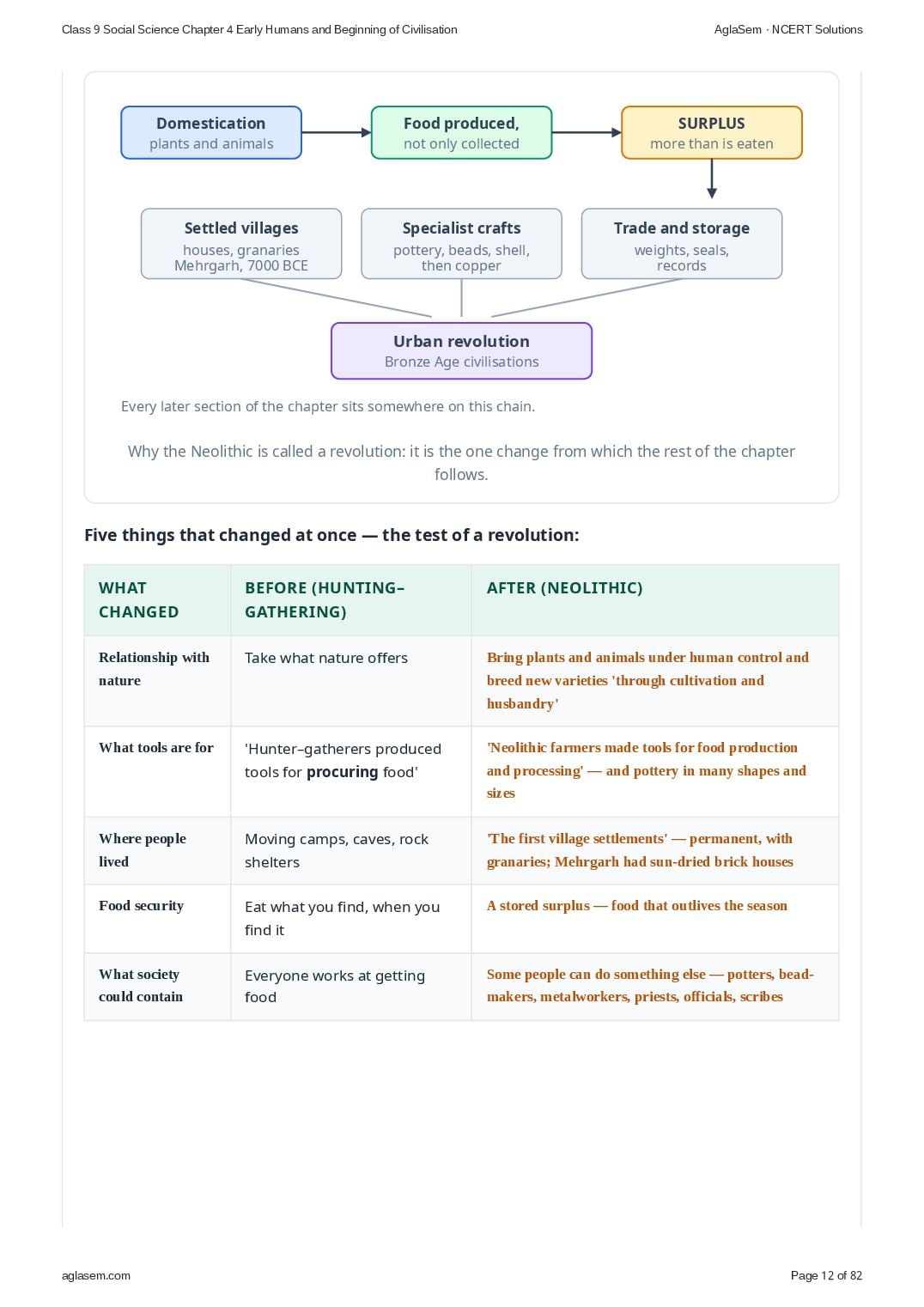
- Why do you think the shift to farming during the Neolithic period is called a revolution rather than a simple change? Discuss with your classmates.
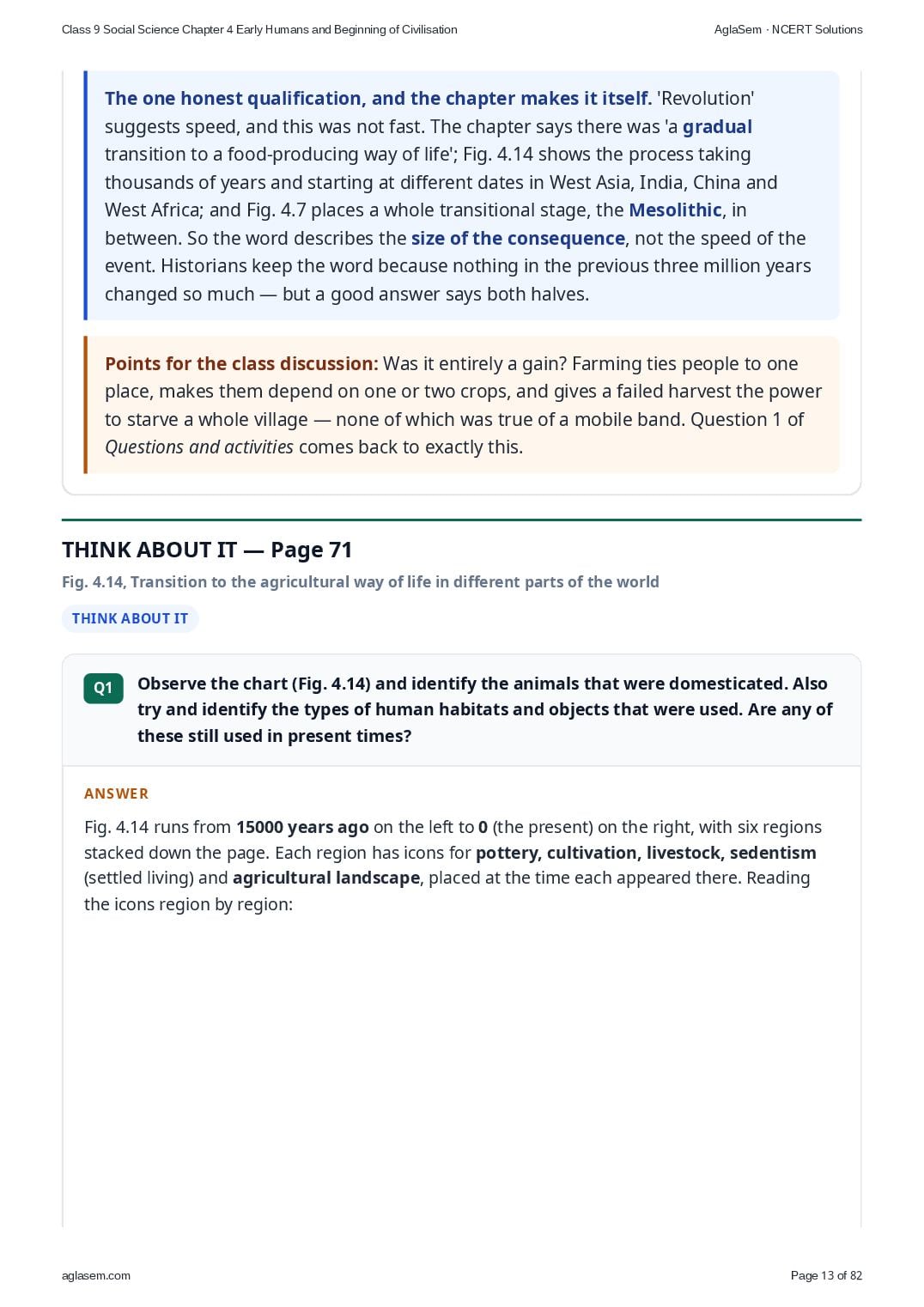
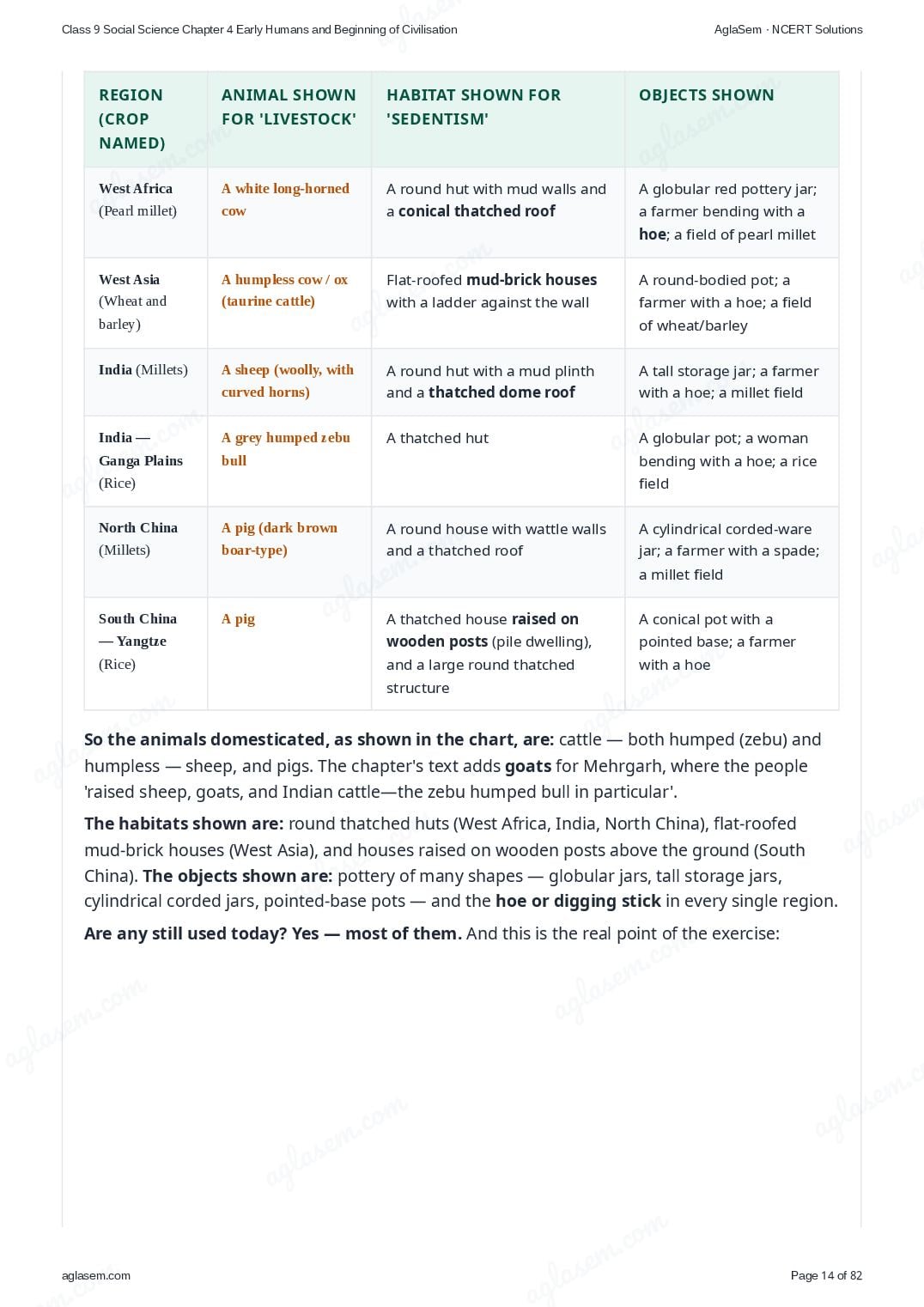
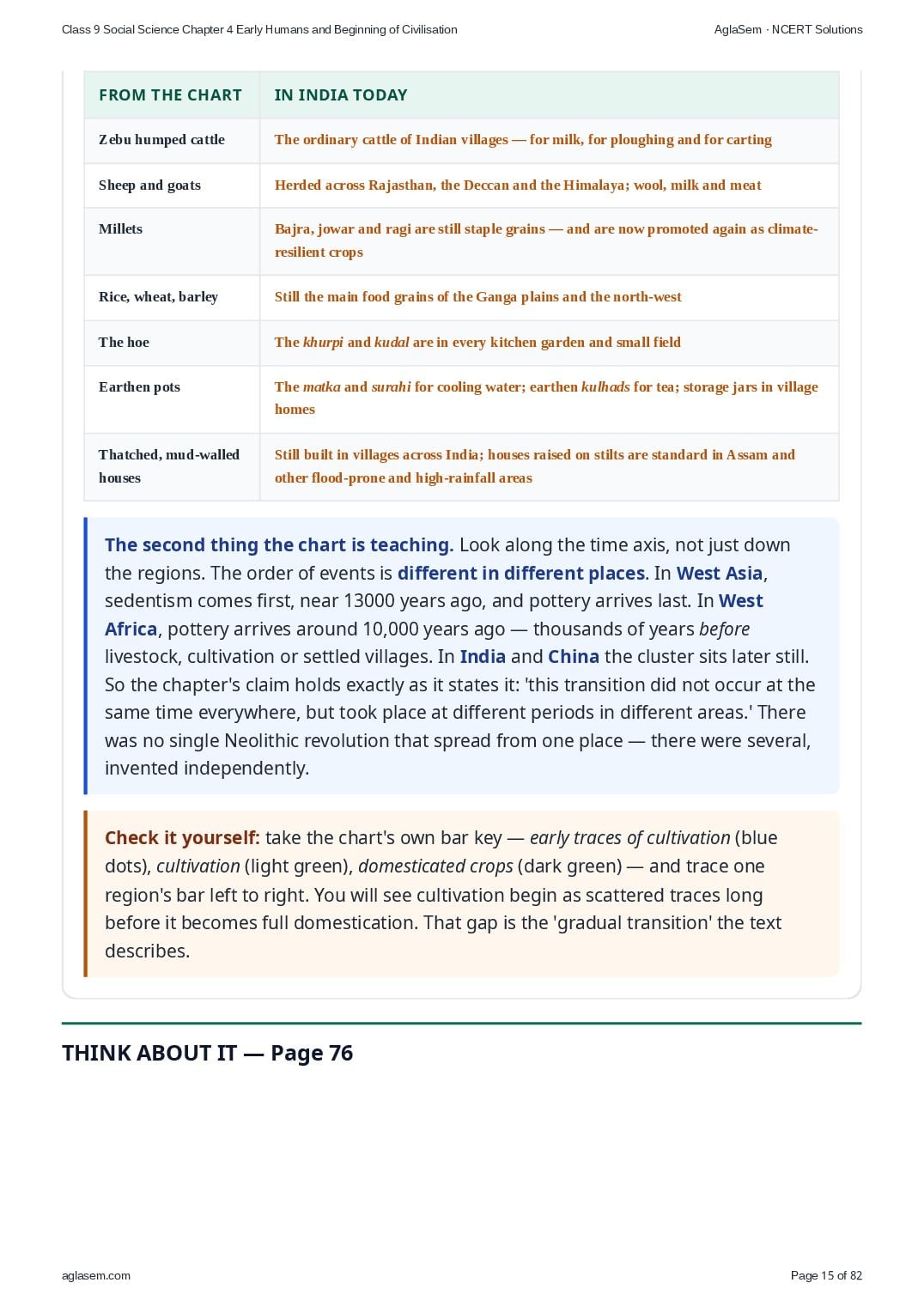
- Observe the chart (Fig. 4.14) and identify the animals that were domesticated. Also try and identify the types of human habitats and objects that were used. Are any of these still used in present times?
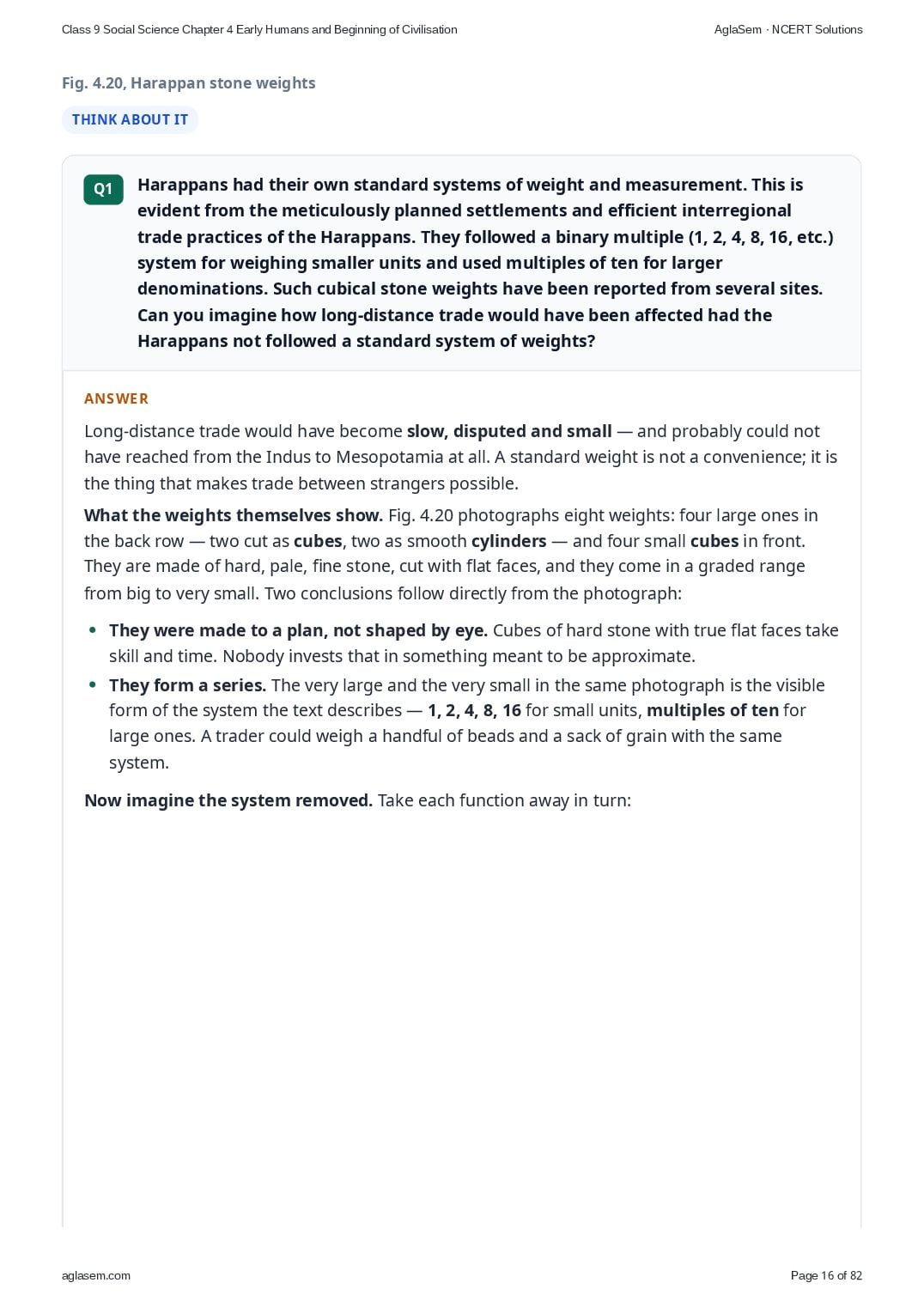
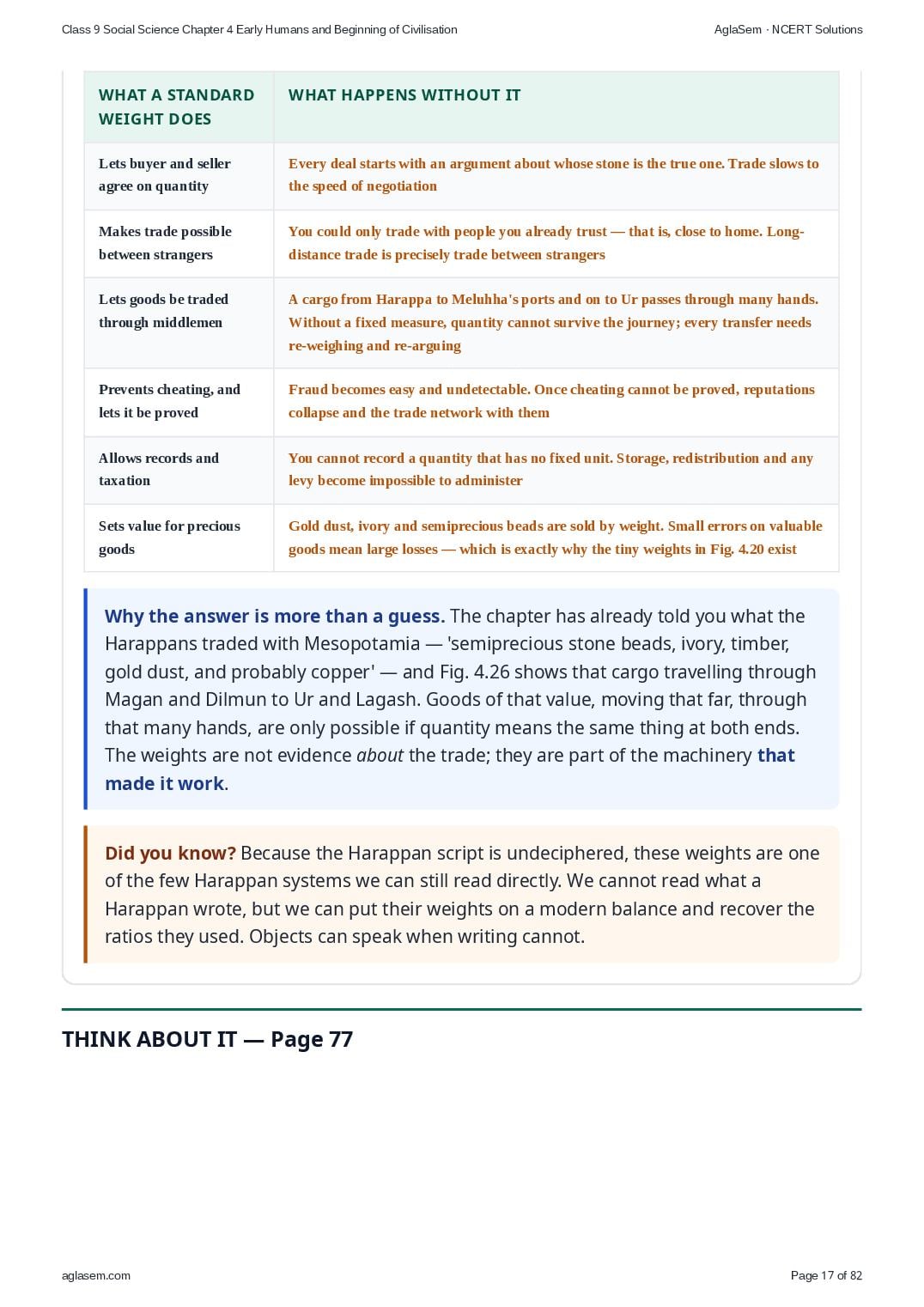
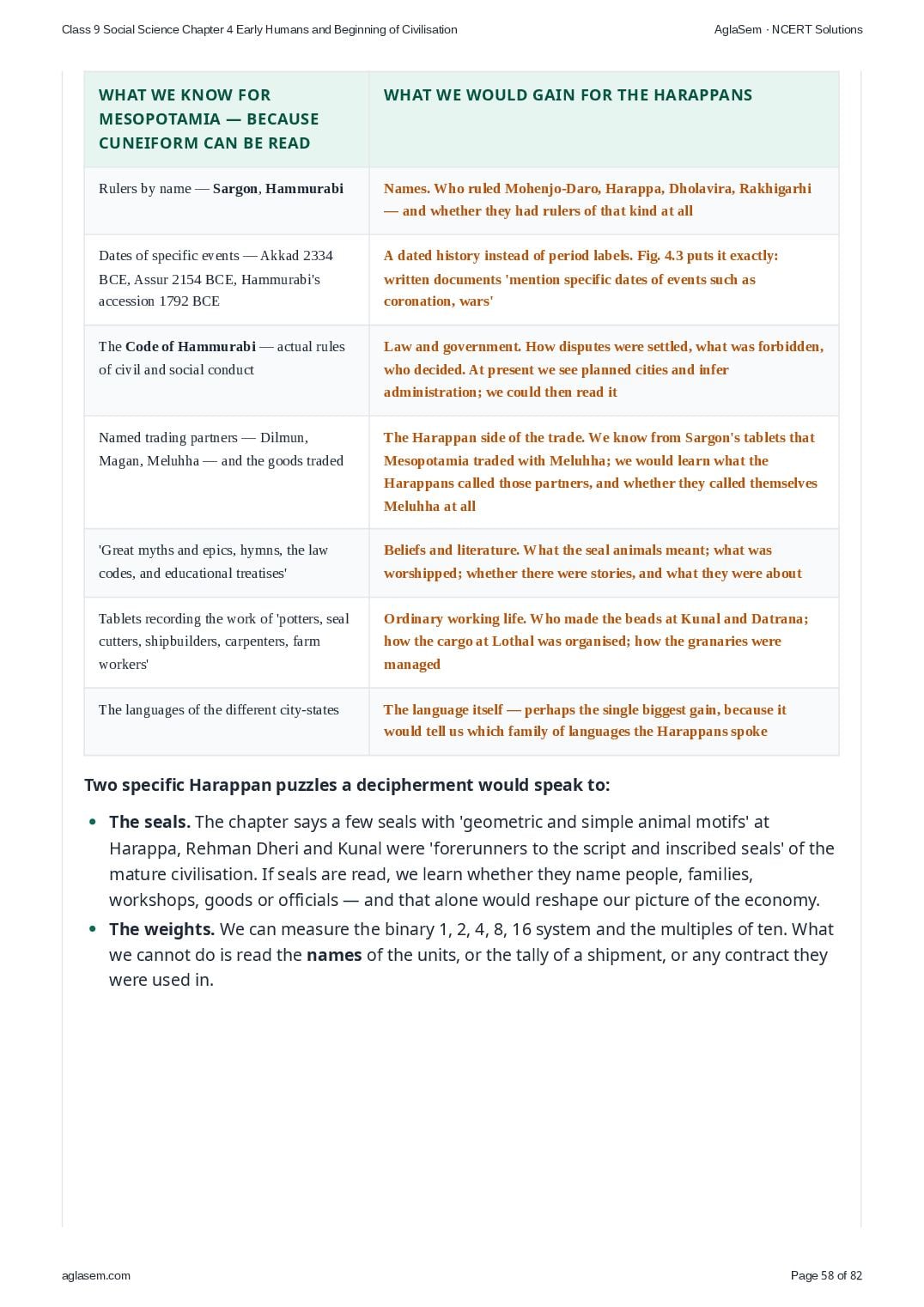
- Harappans had their own standard systems of weight and measurement. This is evident from the meticulously planned settlements and efficient interregional trade practices of the Harappans. They followed a binary multiple (1, 2, 4, 8, 16, etc.) system for weighing smaller units and used multiples of ten for larger denominations. Such cubical stone weights have been reported from several sites. Can you imagine how long-distance trade would have been affected had the Harappans not followed a standard system of weights?
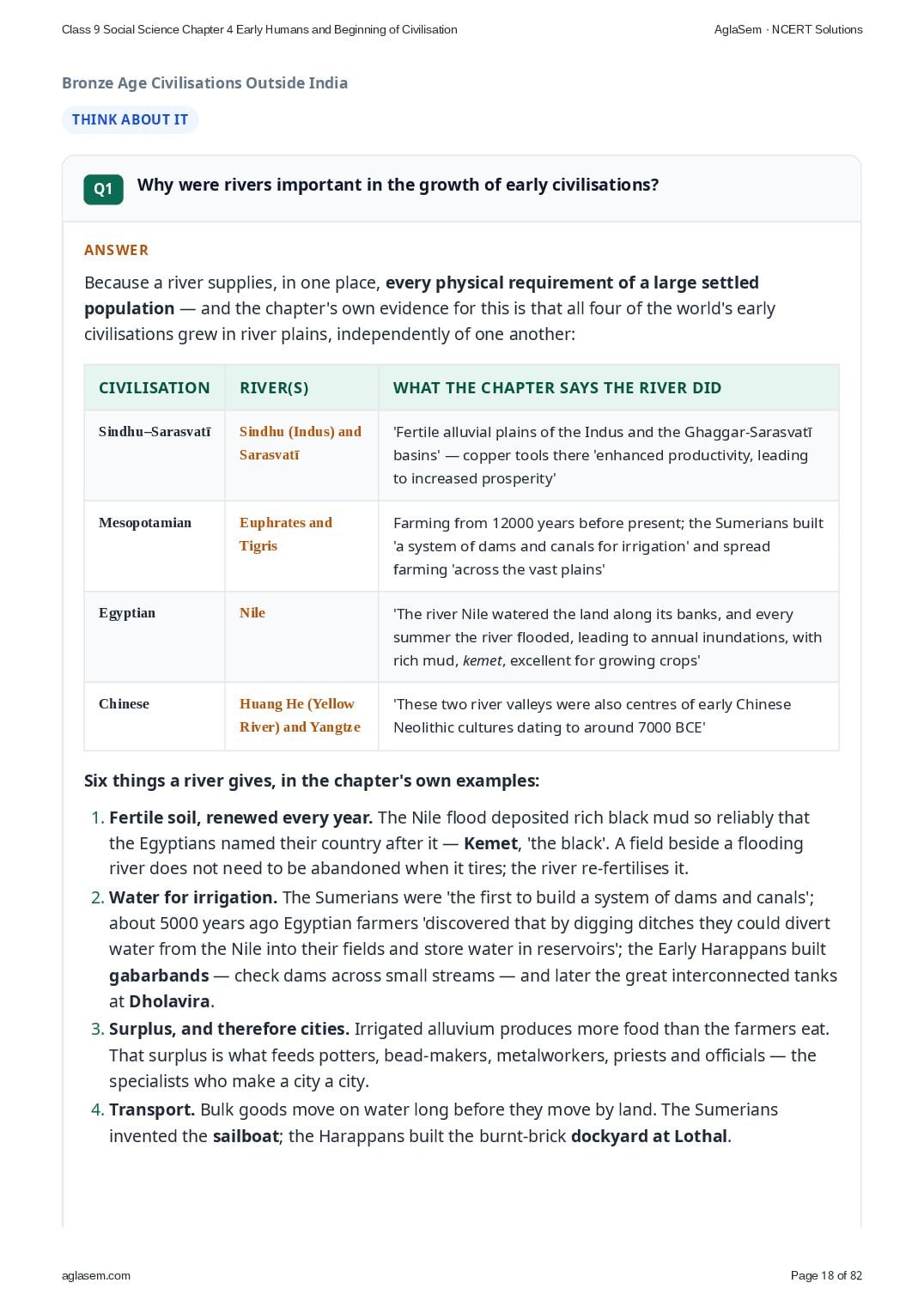
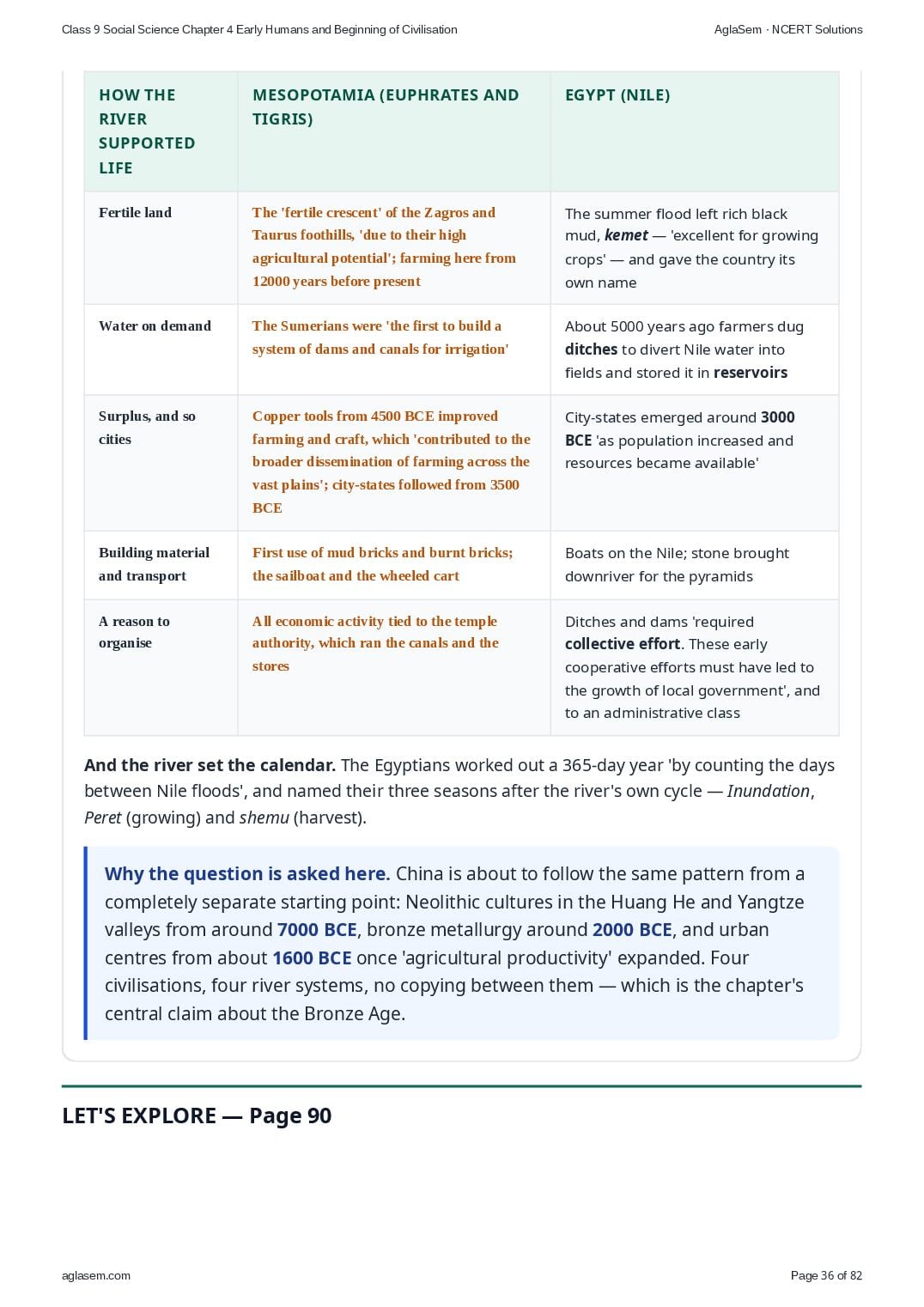
- Why were rivers important in the growth of early civilisations?
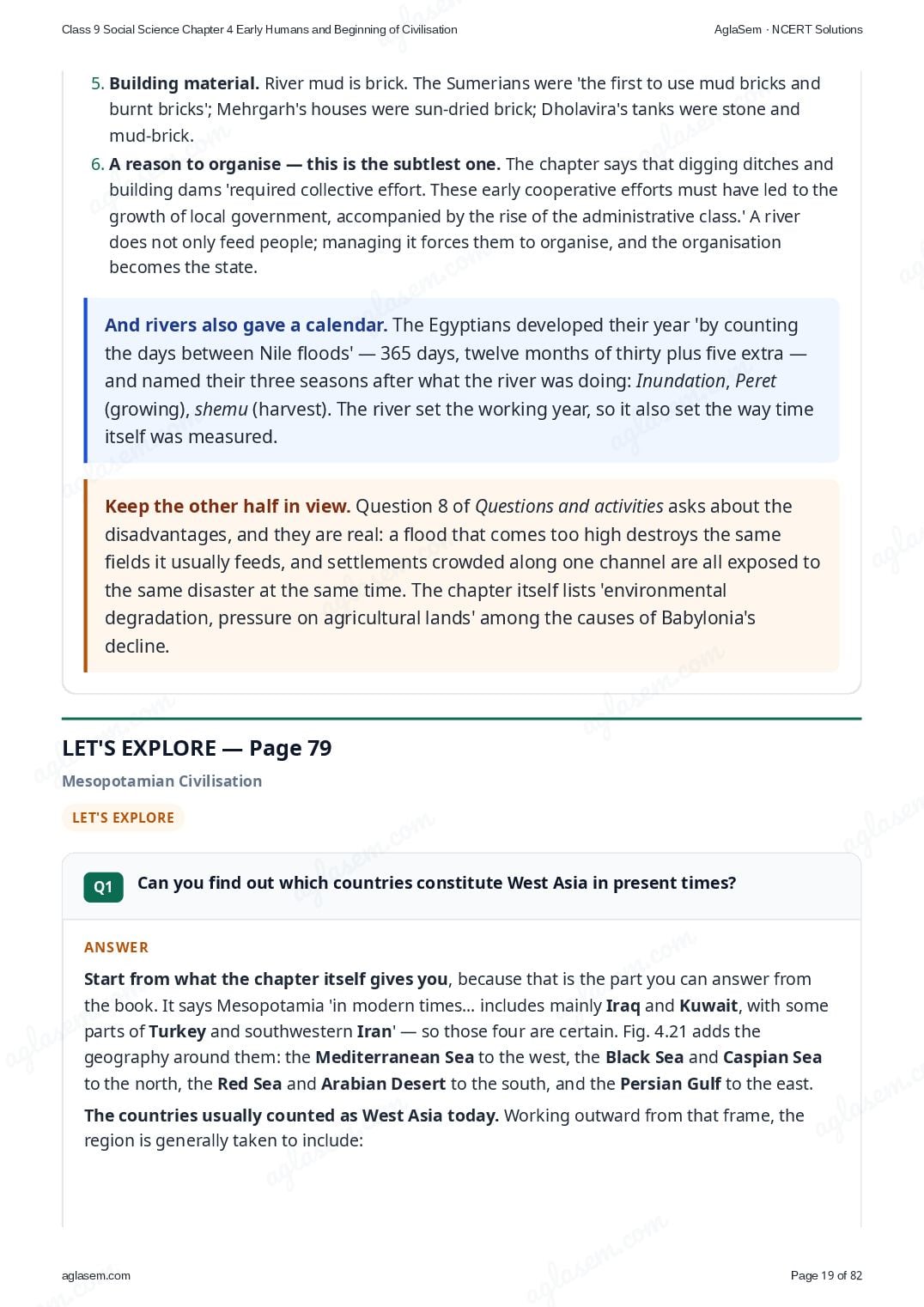
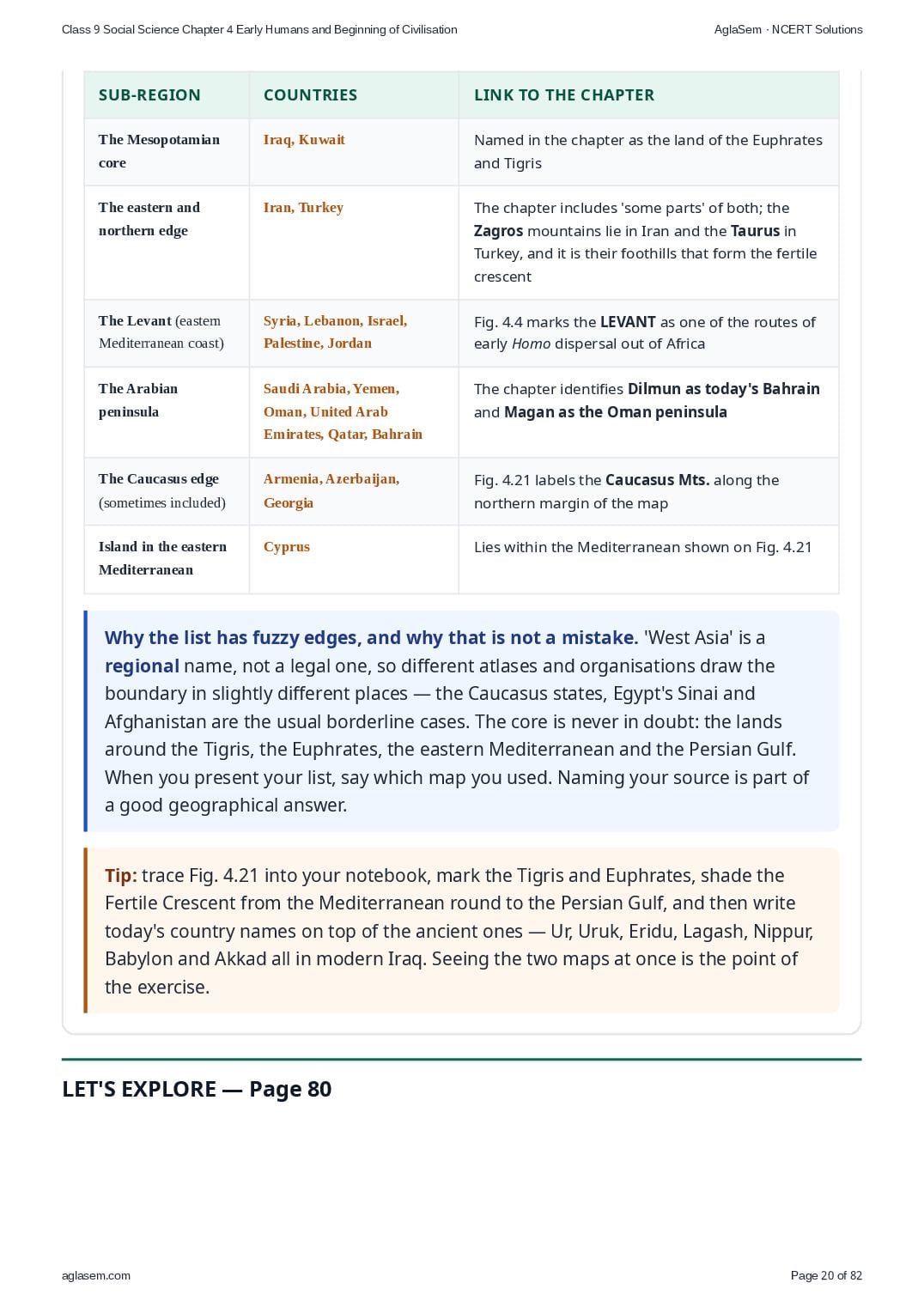
- Can you find out which countries constitute West Asia in present times?
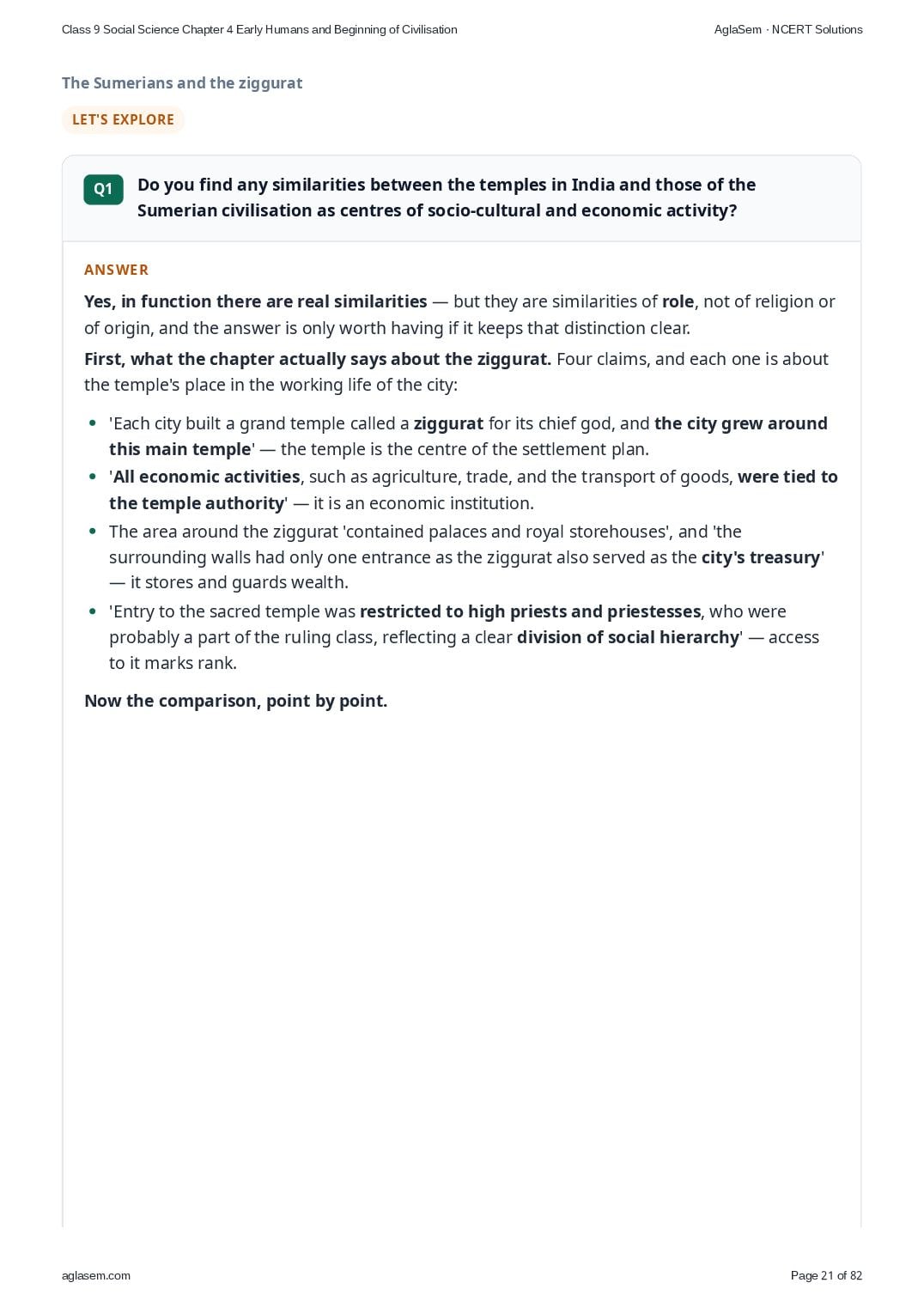
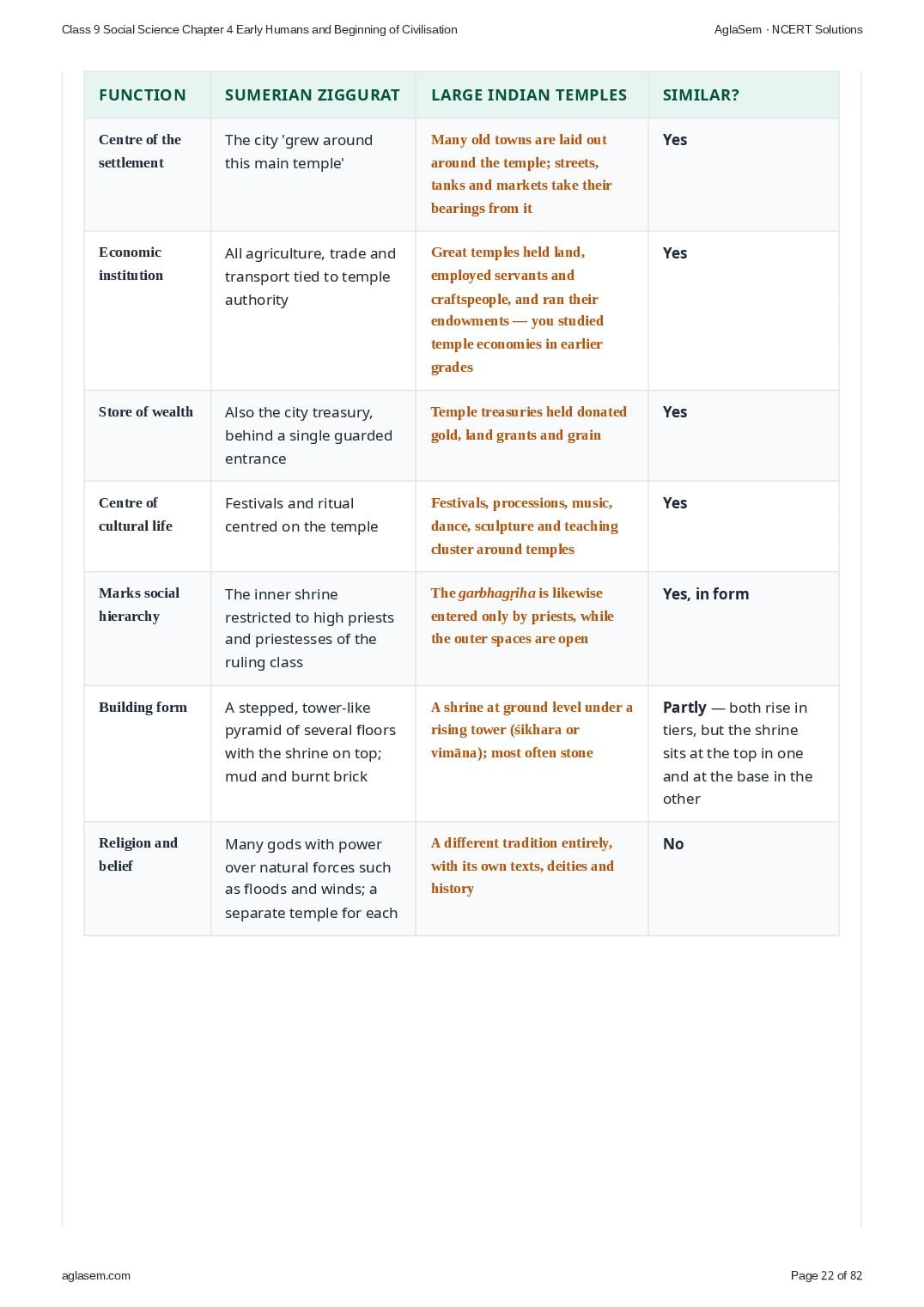
- Do you find any similarities between the temples in India and those of the Sumerian civilisation as centres of socio-cultural and economic activity?
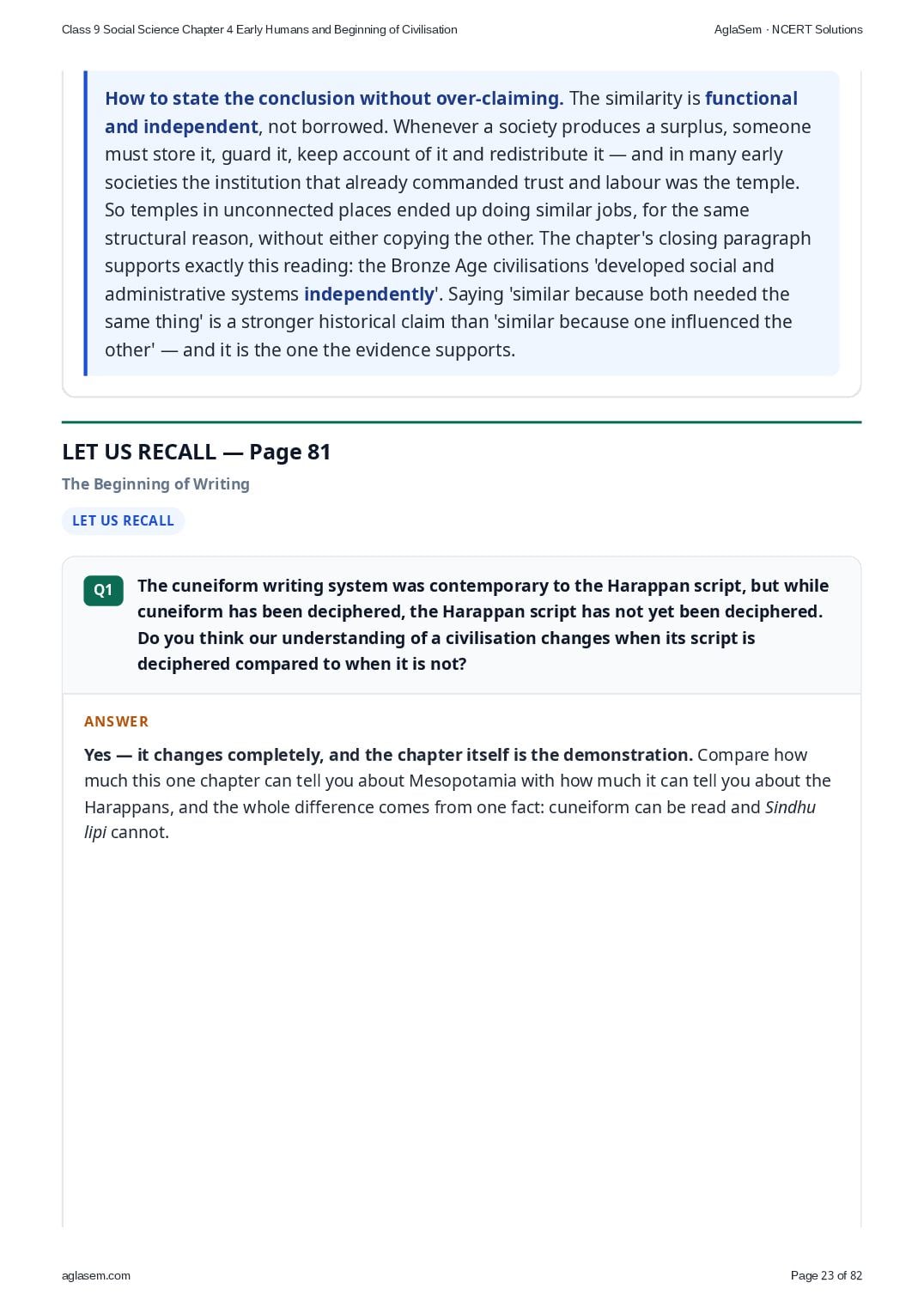
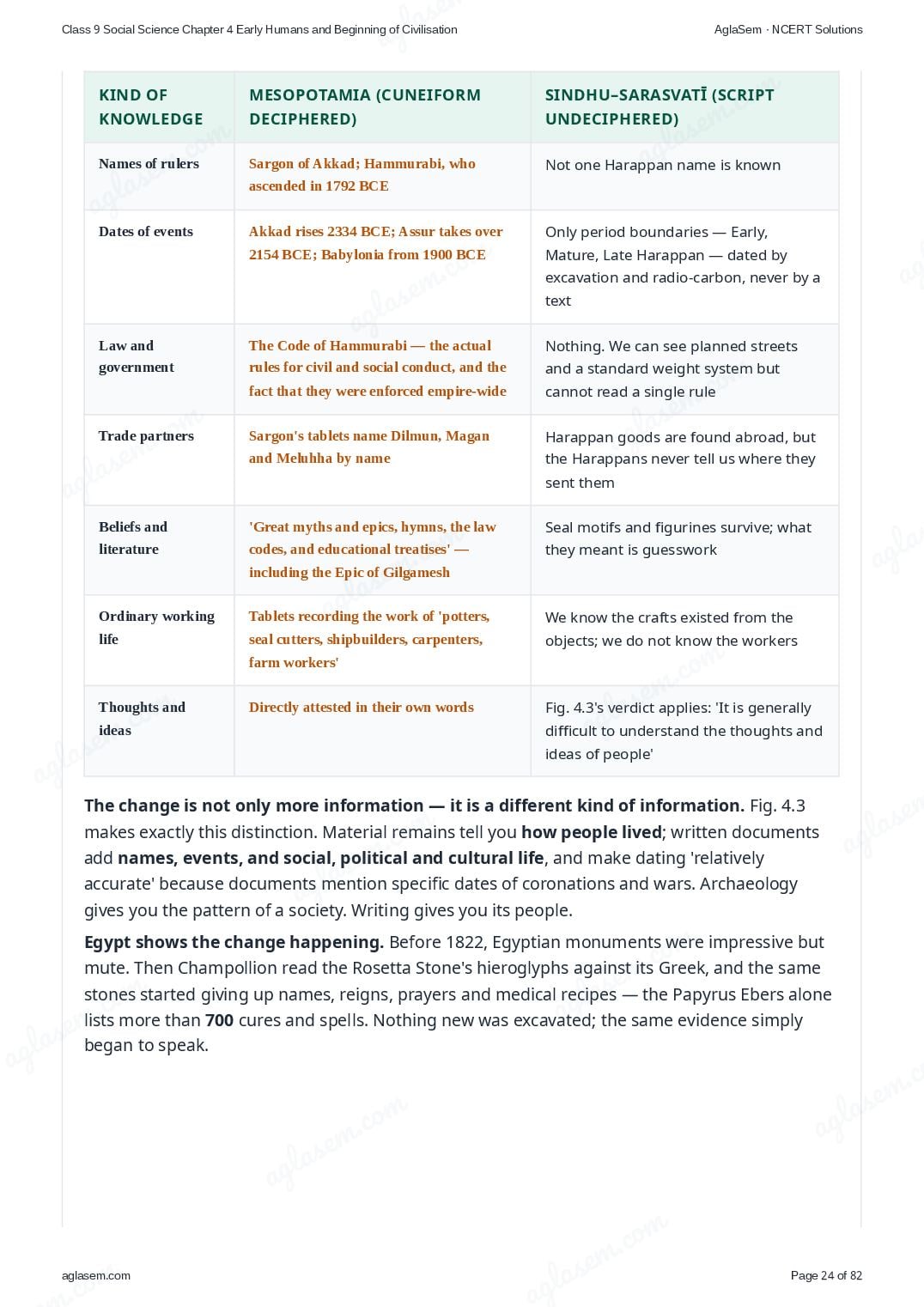
- The cuneiform writing system was contemporary to the Harappan script, but while cuneiform has been deciphered, the Harappan script has not yet been deciphered. Do you think our understanding of a civilisation changes when its script is deciphered compared to when it is not?
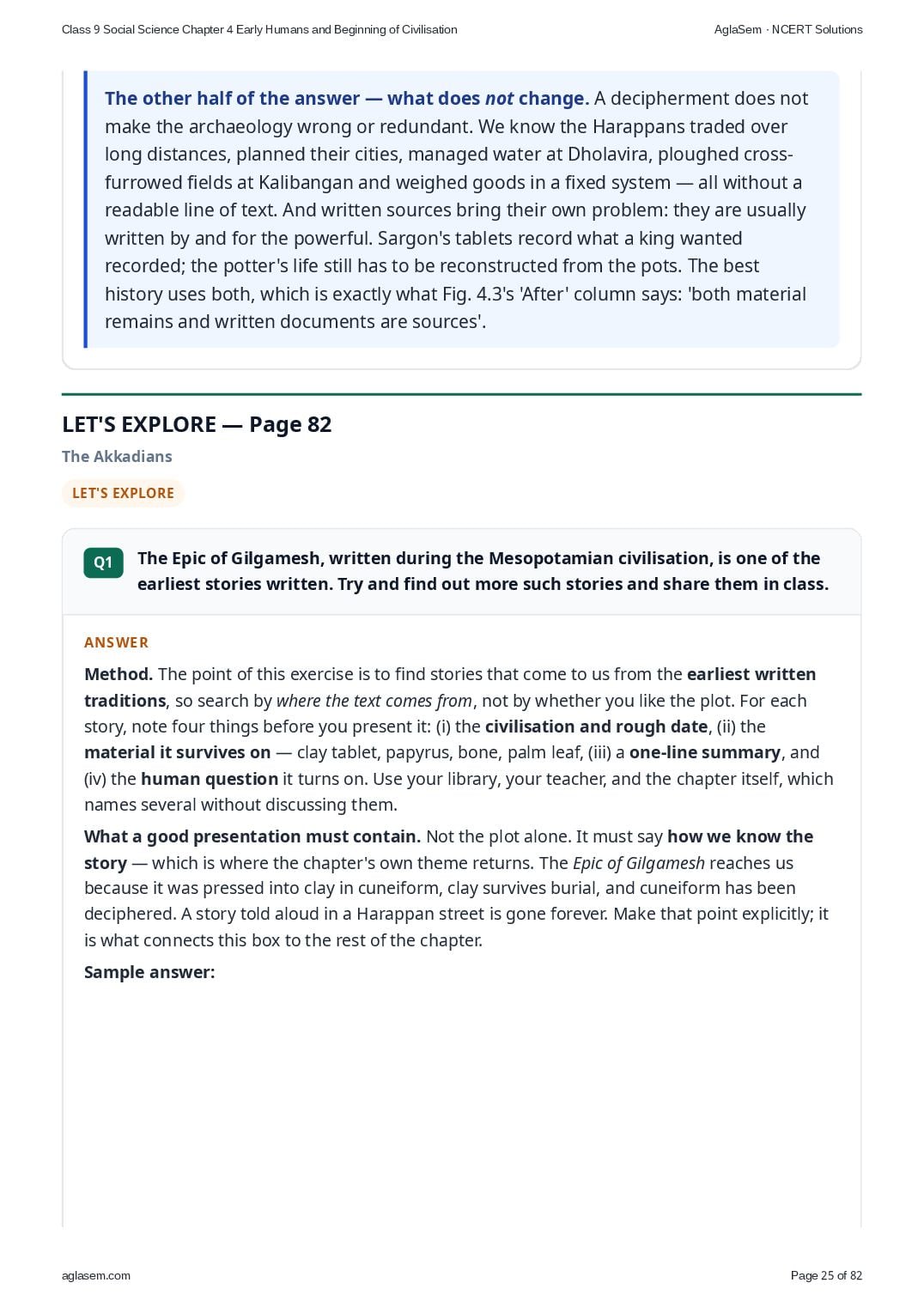
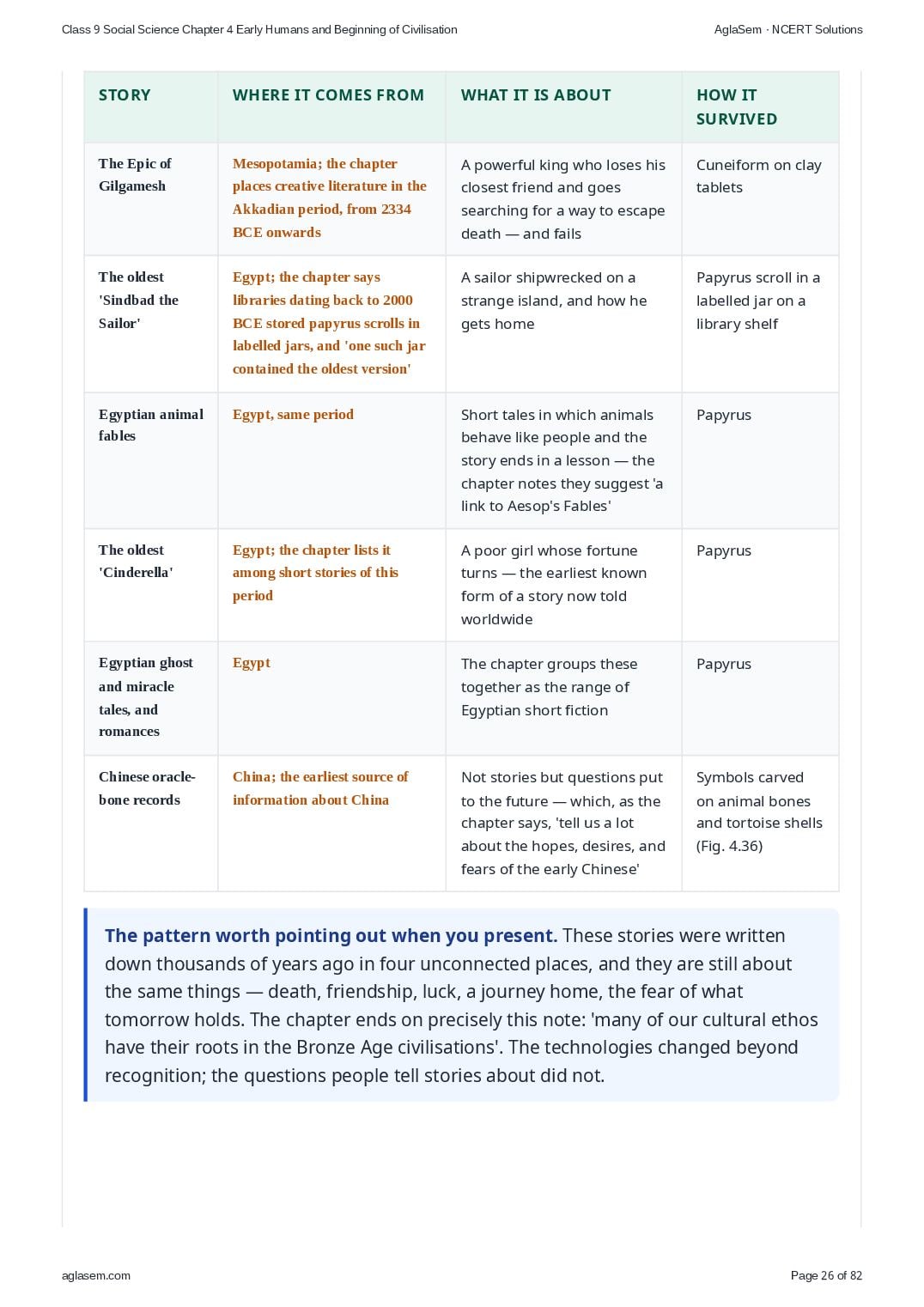
- The Epic of Gilgamesh, written during the Mesopotamian civilisation, is one of the earliest stories written. Try and find out more such stories and share them in class.
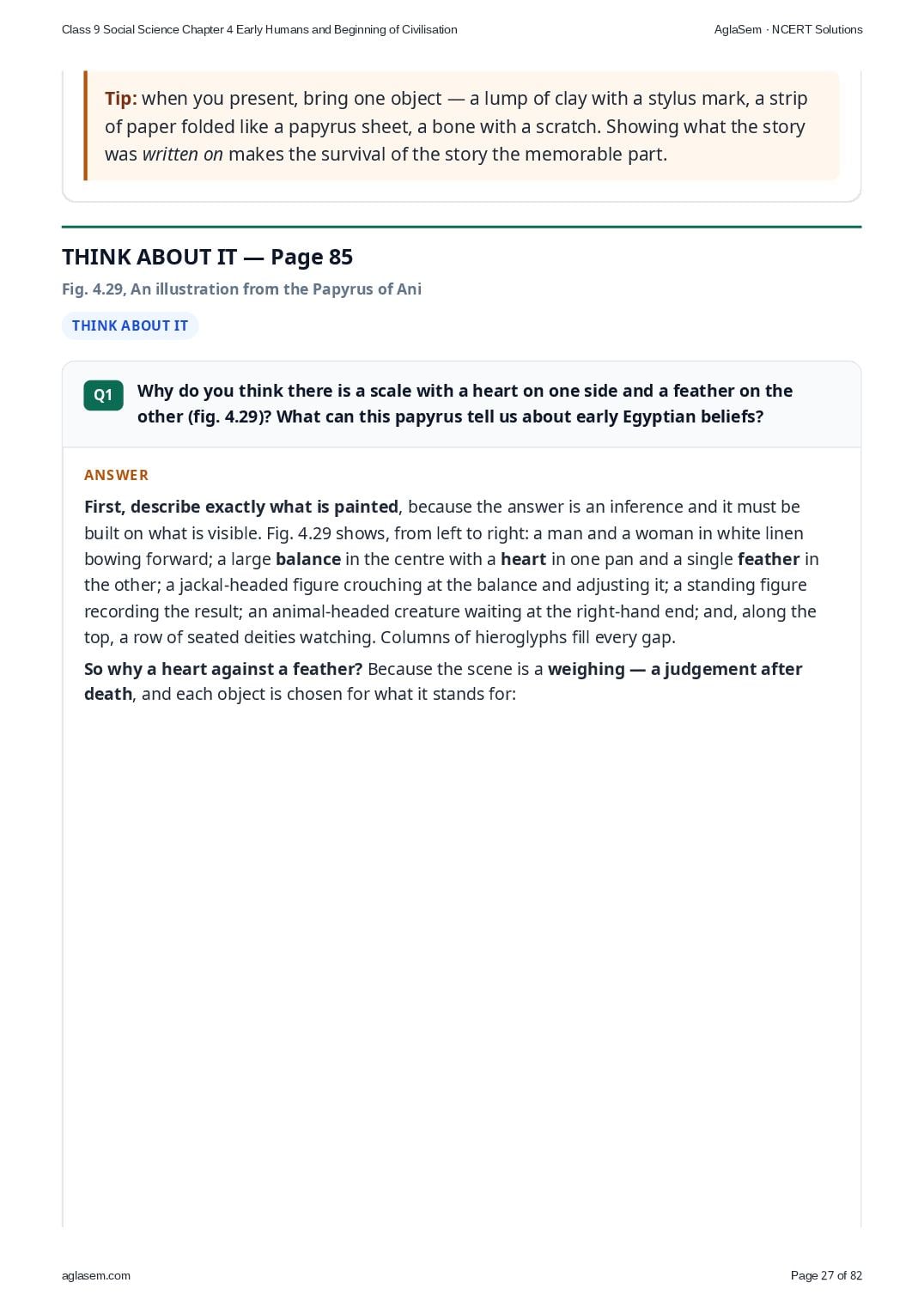
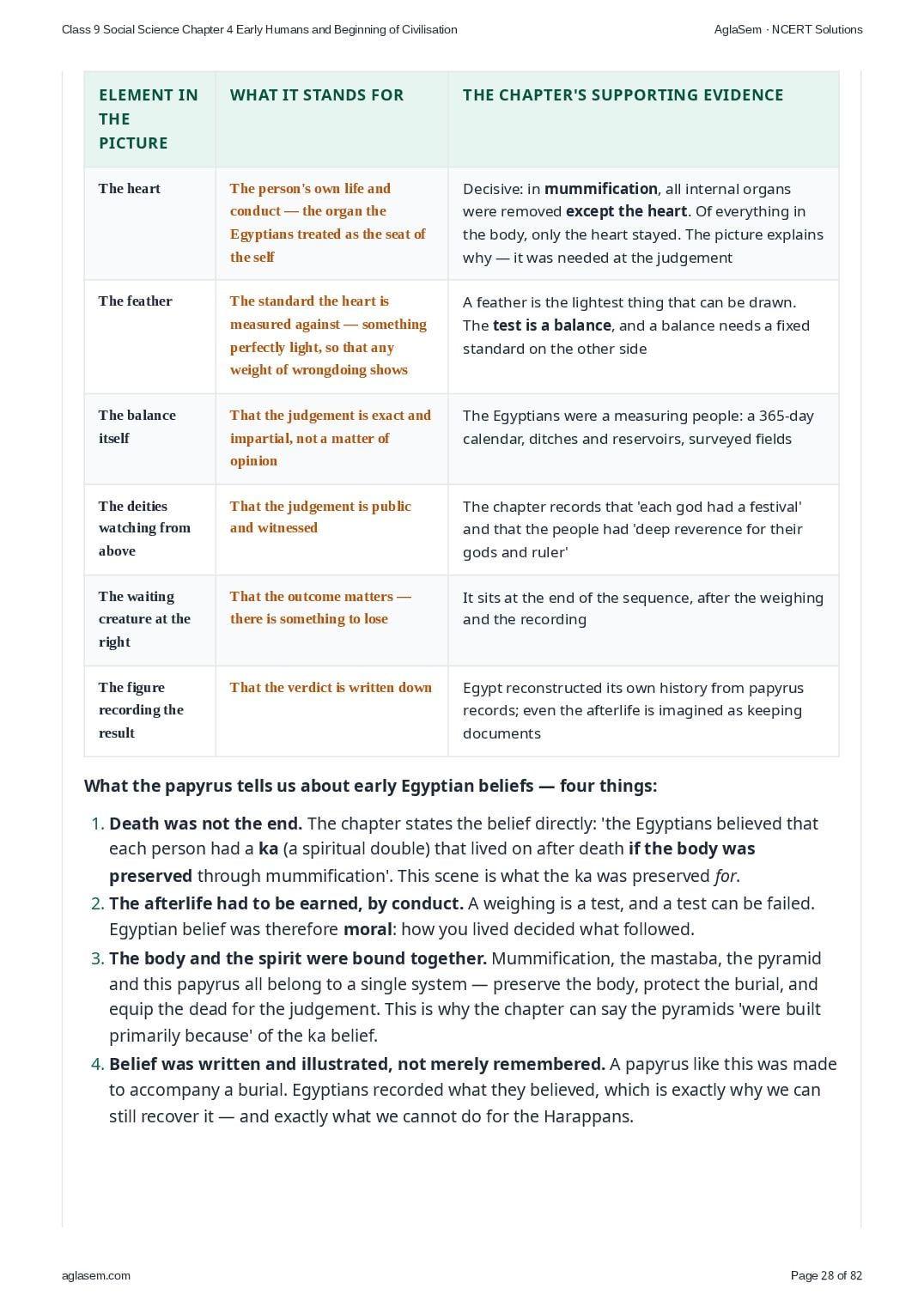
- Why do you think there is a scale with a heart on one side and a feather on the other (fig. 4.29)? What can this papyrus tell us about early Egyptian beliefs?
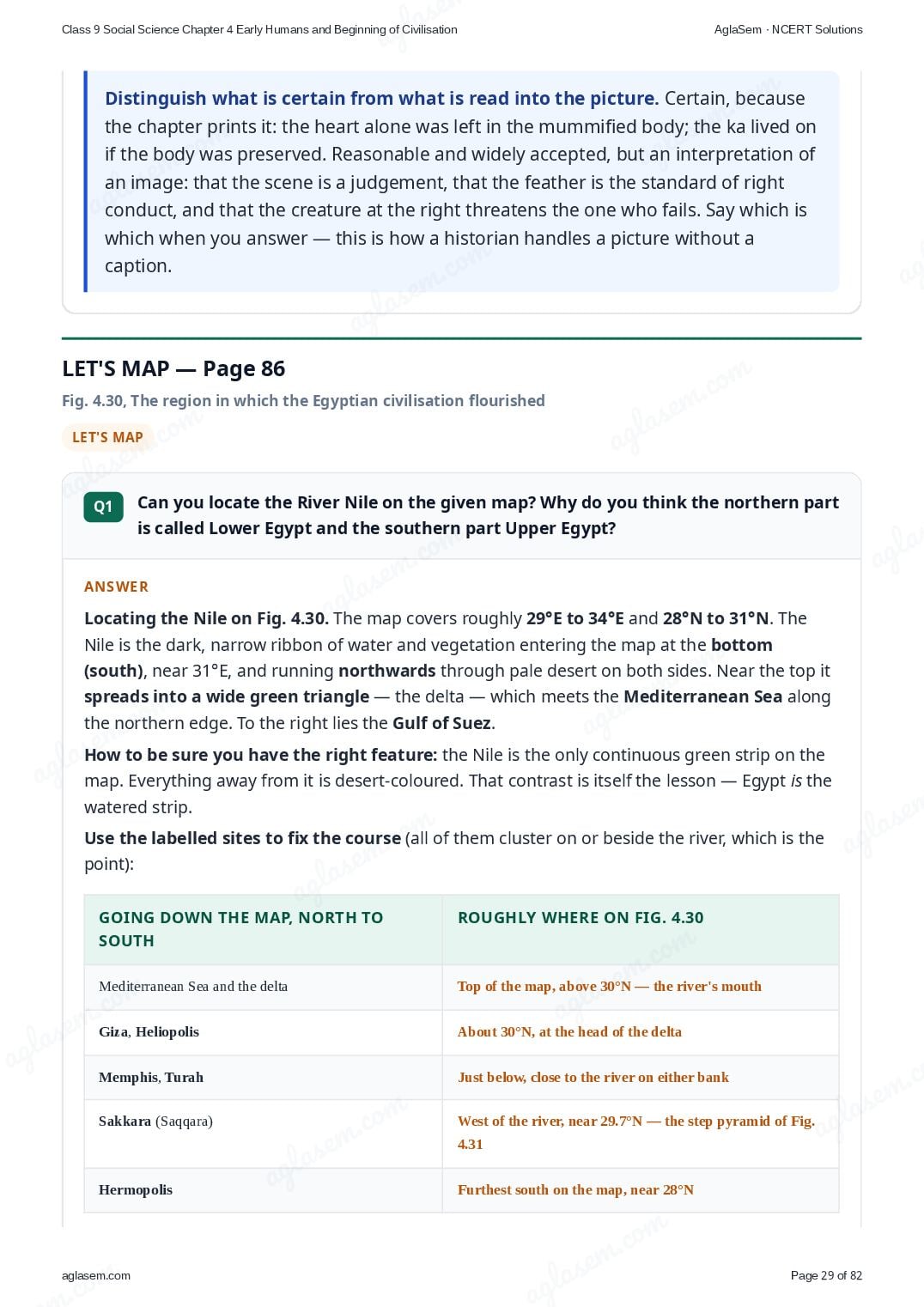
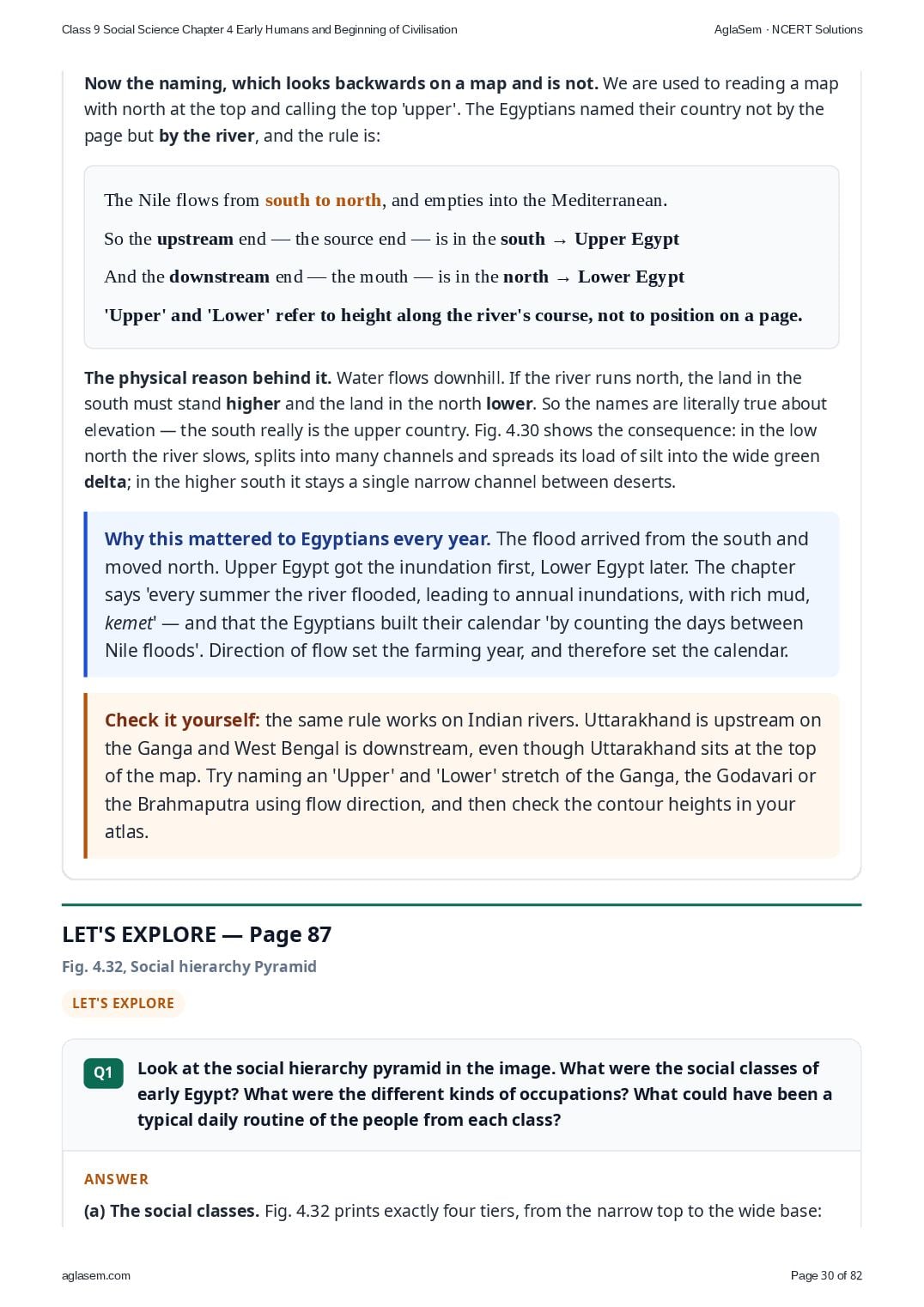
- Can you locate the River Nile on the given map? Why do you think the northern part is called Lower Egypt and the southern part Upper Egypt?
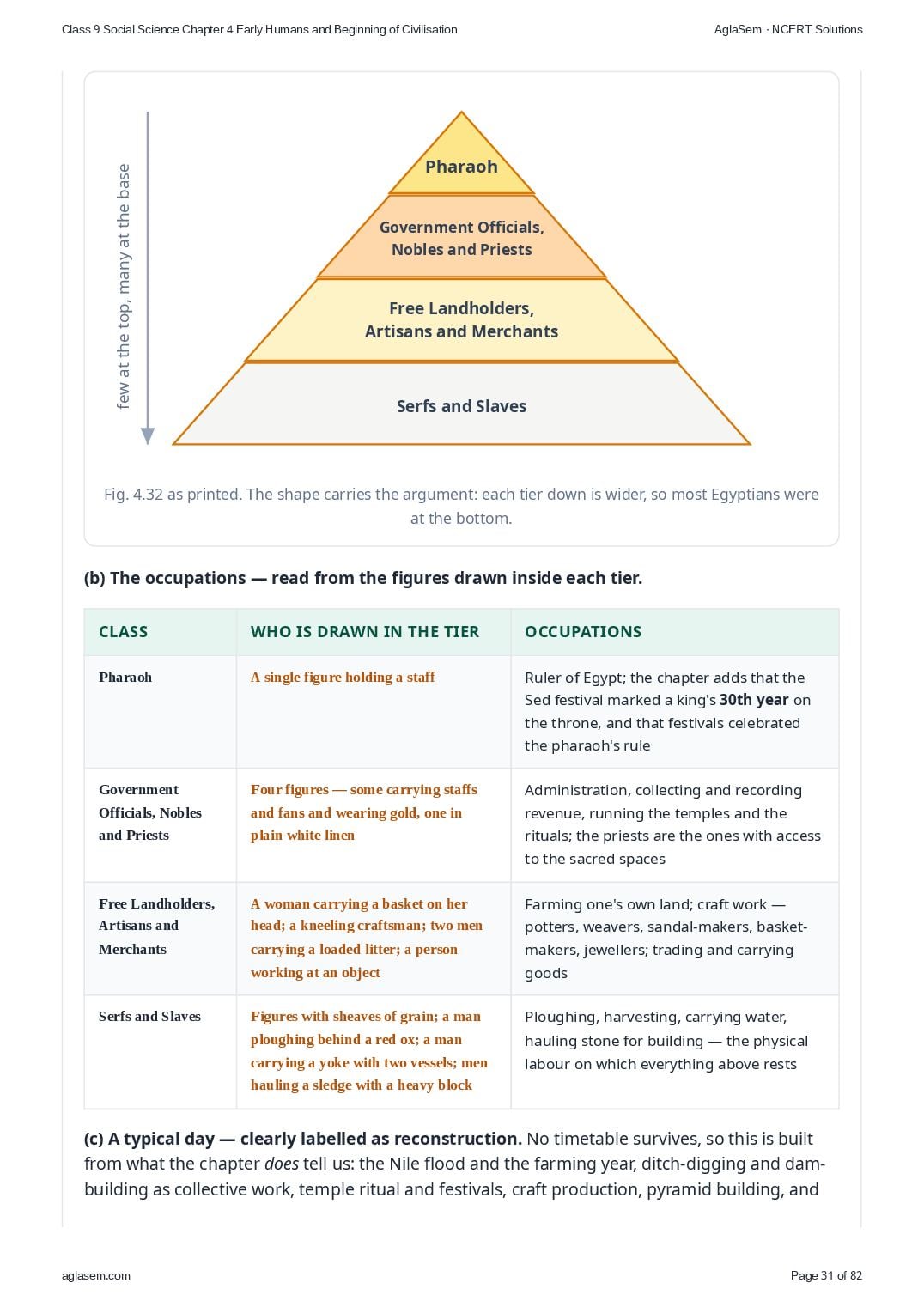
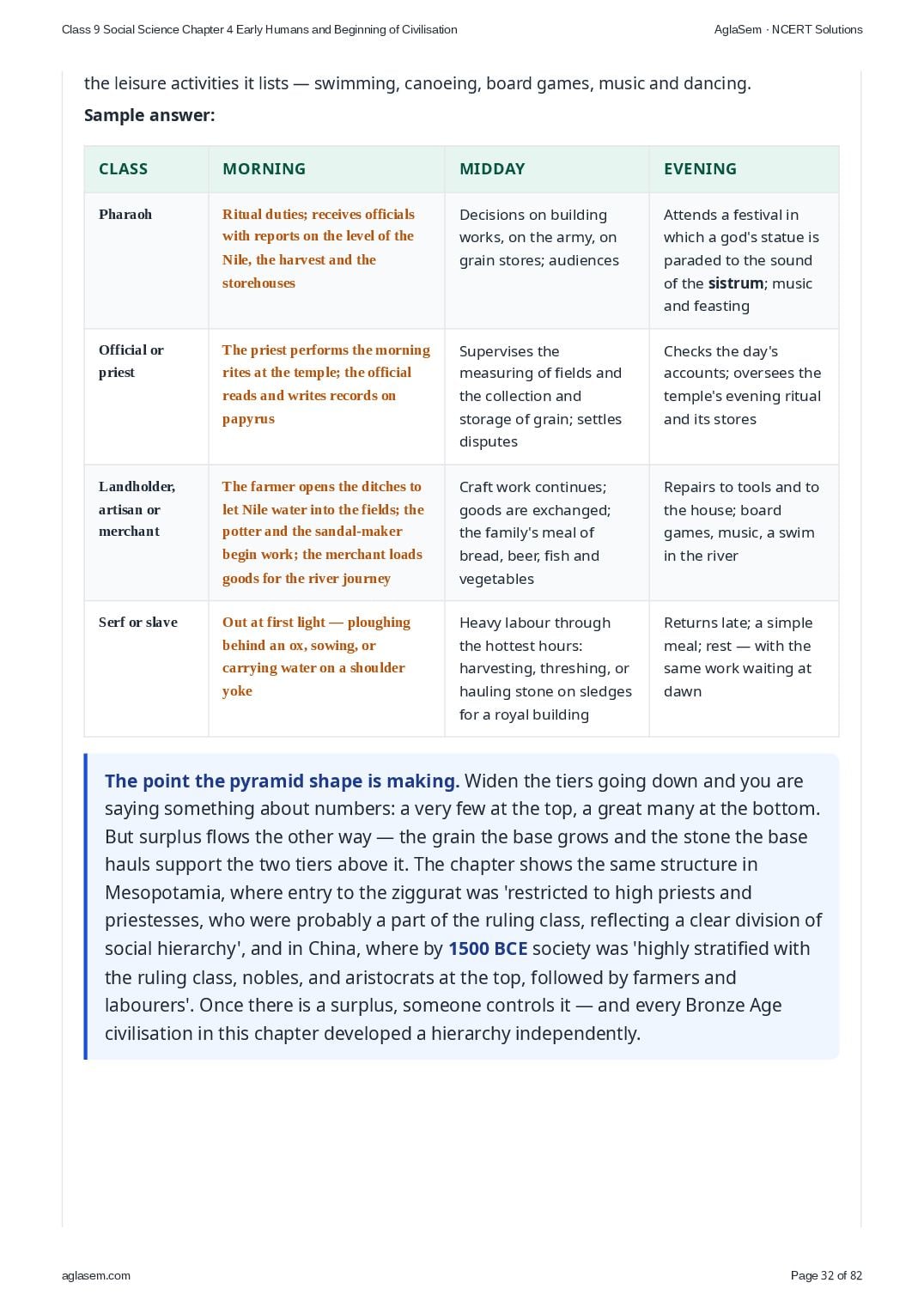
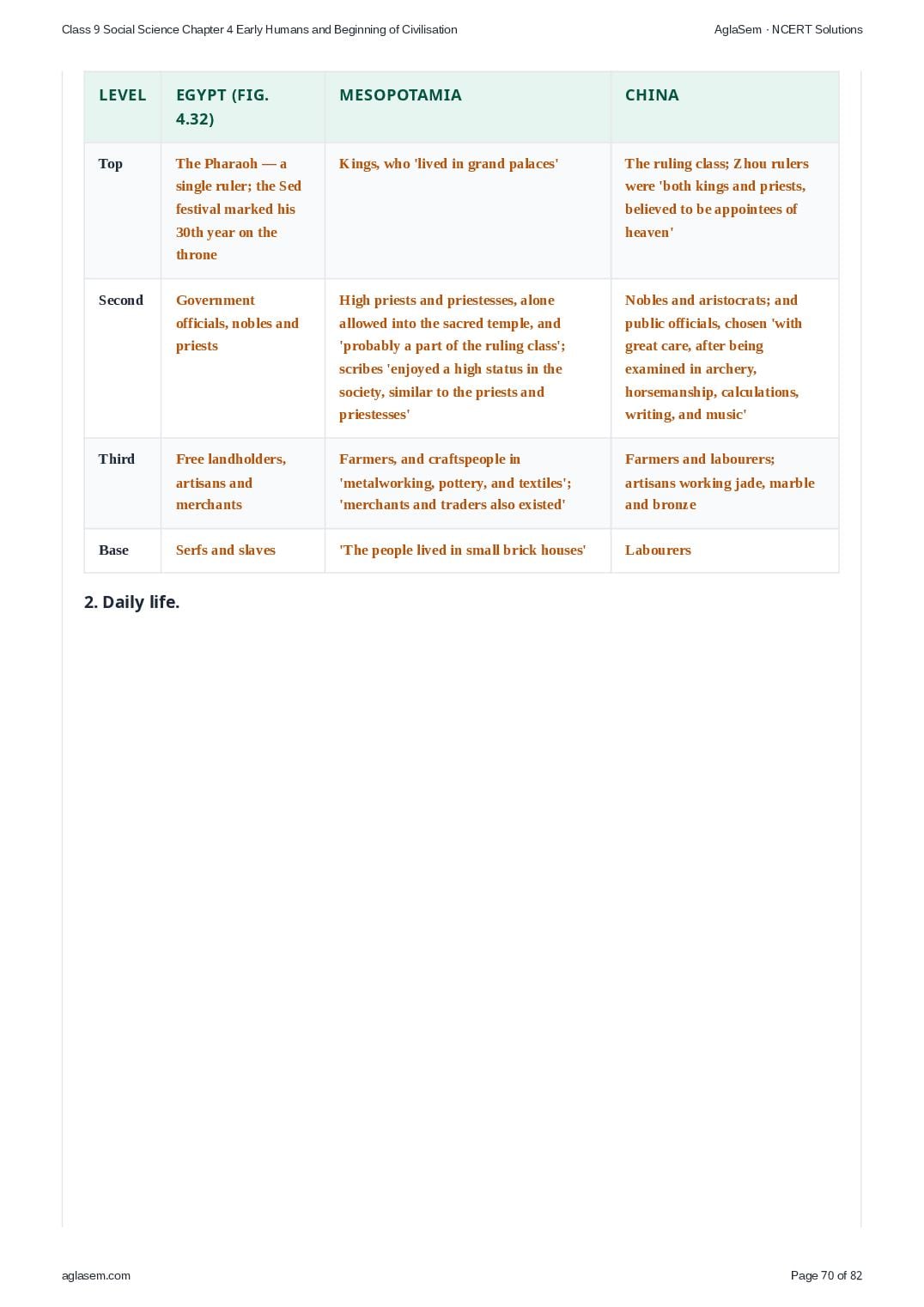
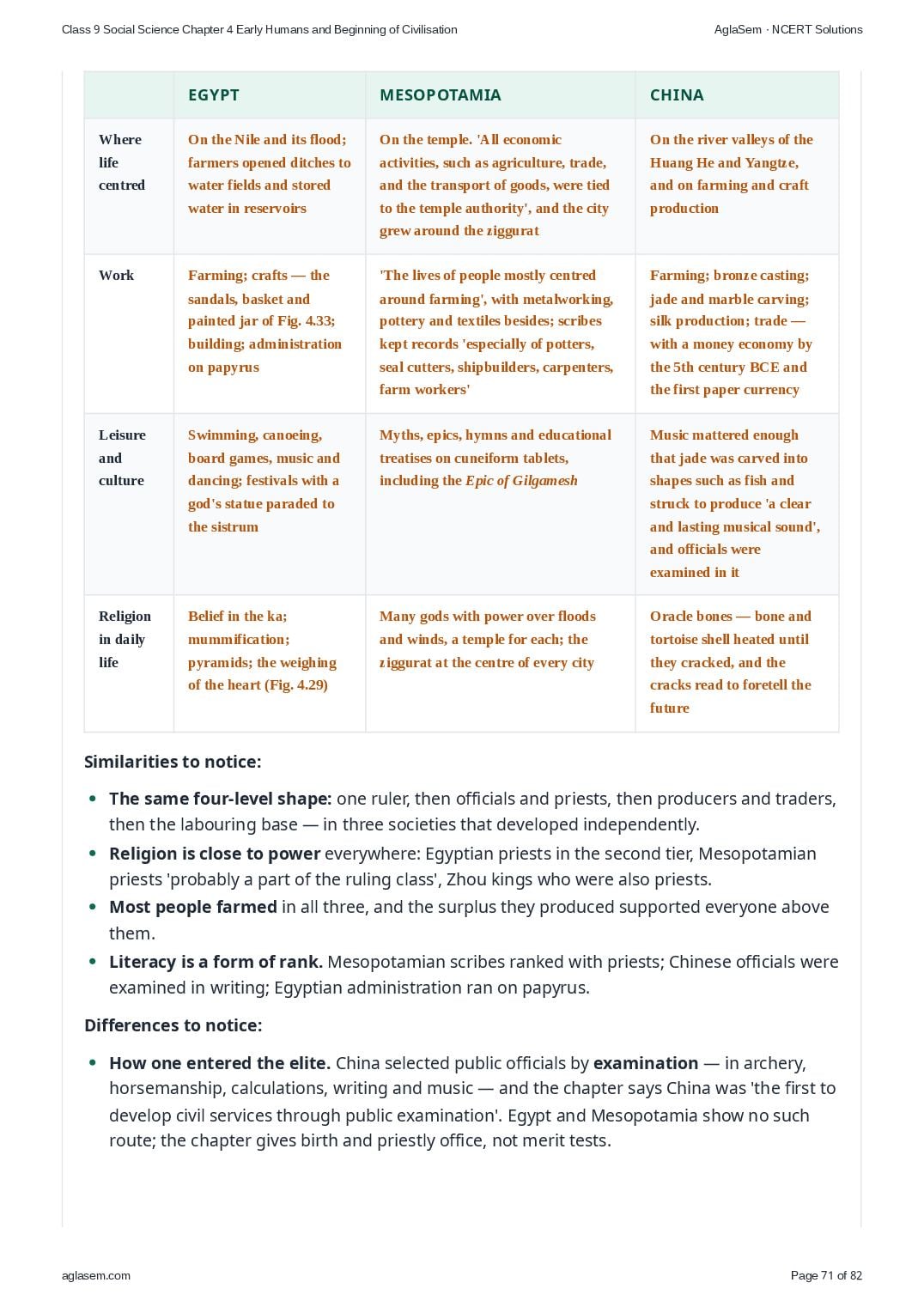
- Look at the social hierarchy pyramid in the image. What were the social classes of early Egypt? What were the different kinds of occupations? What could have been a typical daily routine of the people from each class?
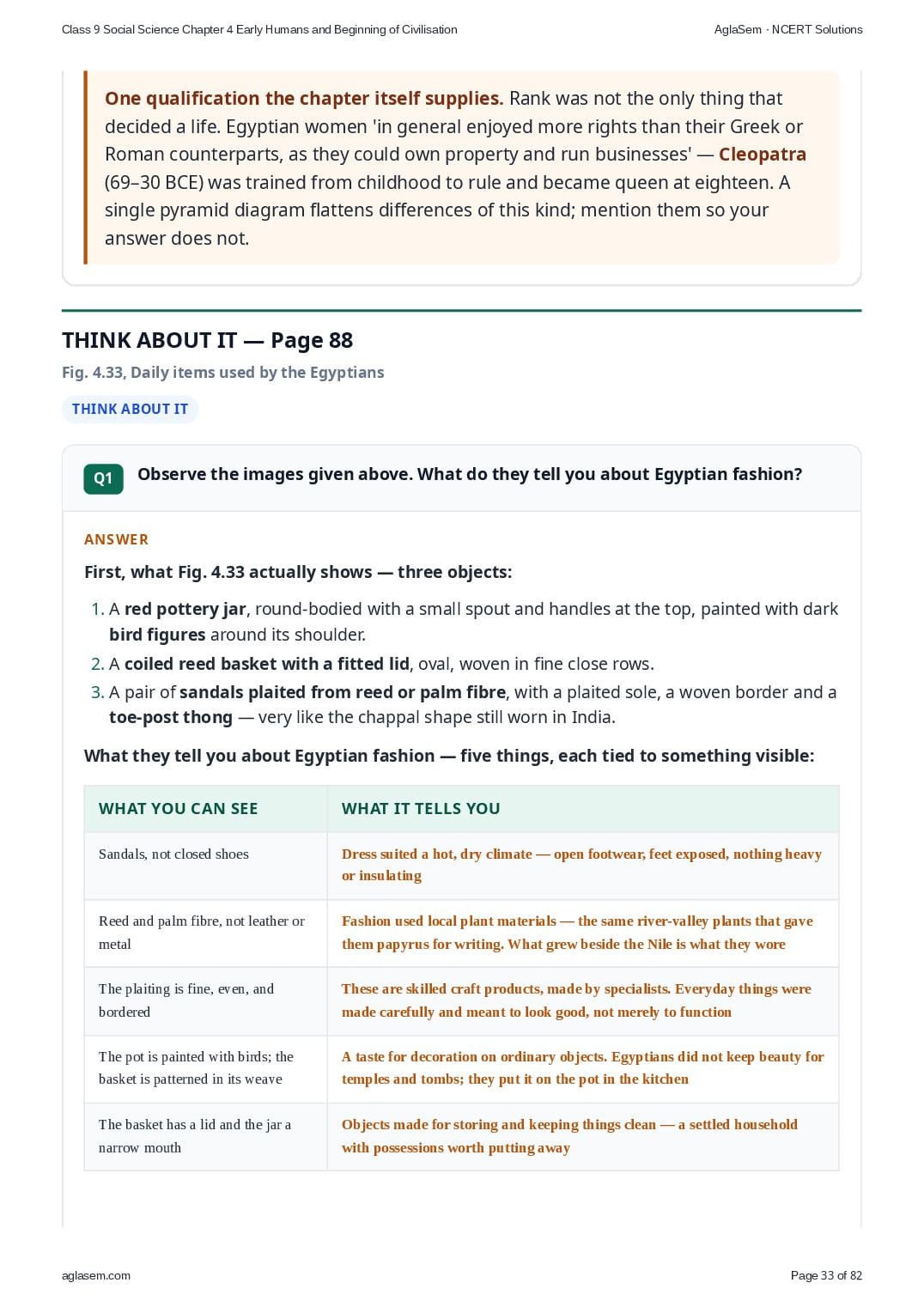
- Observe the images given above. What do they tell you about Egyptian fashion?
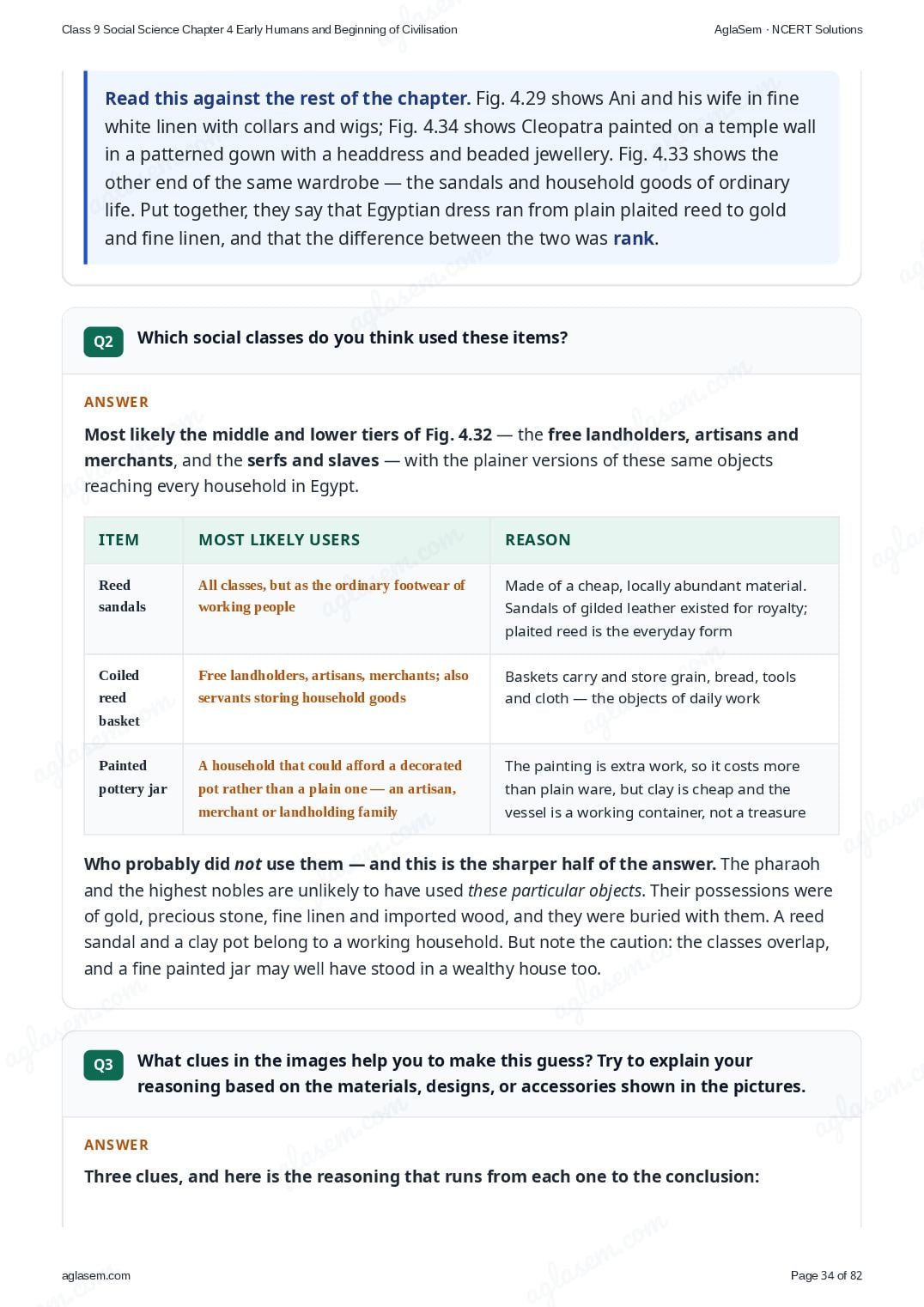
- Which social classes do you think used these items?
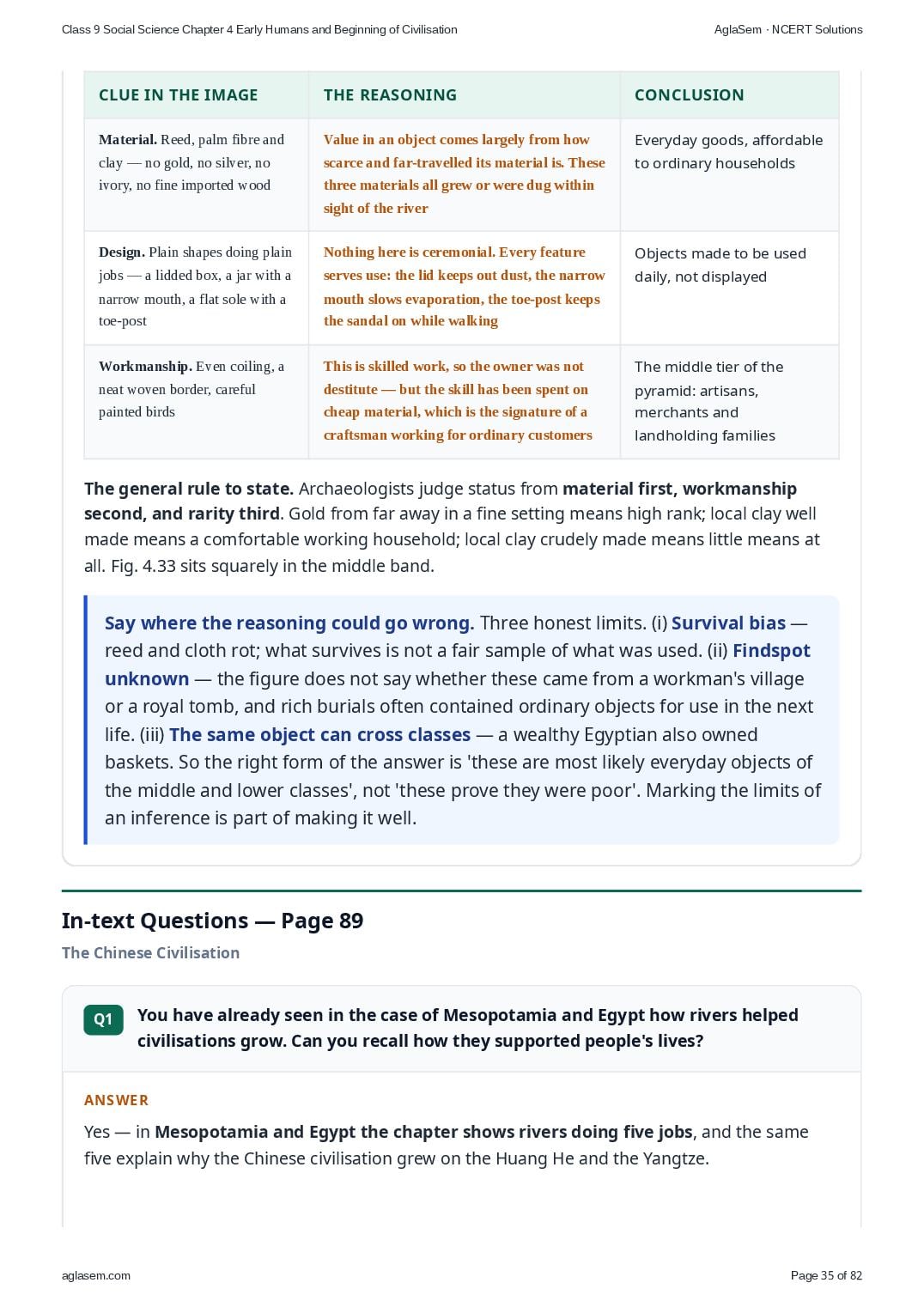
- What clues in the images help you to make this guess? Try to explain your reasoning based on the materials, designs, or accessories shown in the pictures.
- You have already seen in the case of Mesopotamia and Egypt how rivers helped civilisations grow. Can you recall how they supported people's lives?
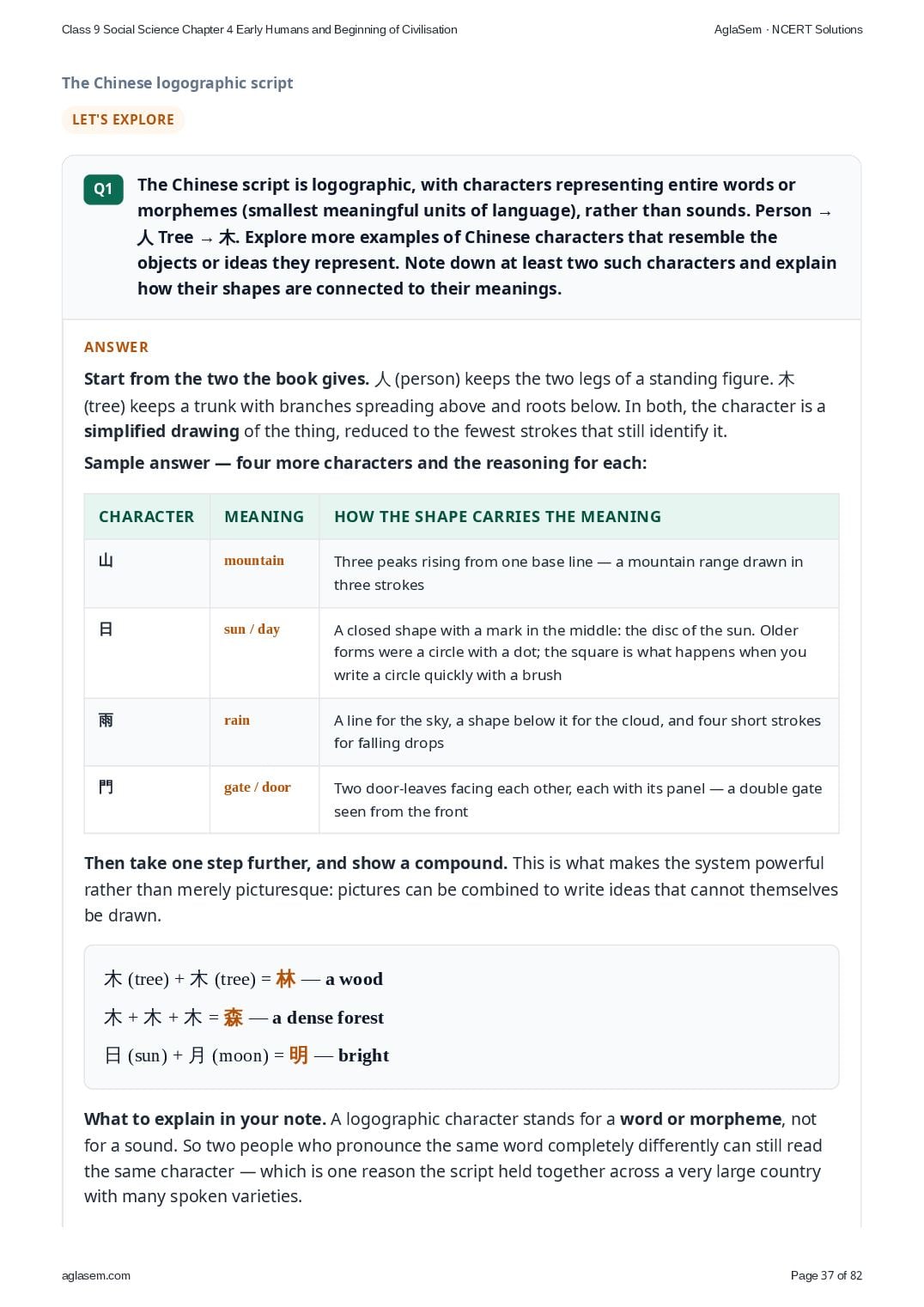
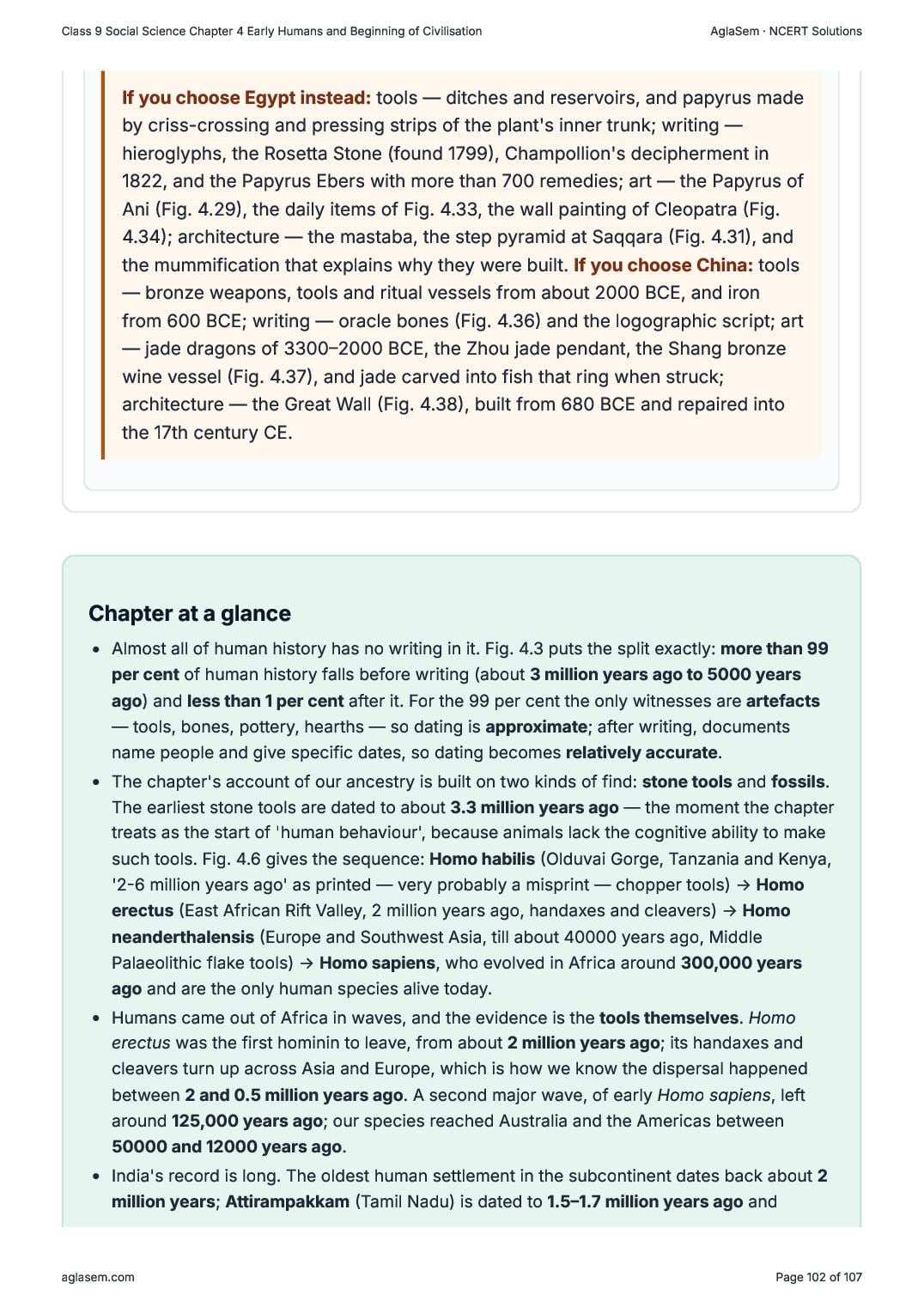
- The Chinese script is logographic, with characters representing entire words or morphemes (smallest meaningful units of language), rather than sounds. Person → 人 Tree → 木. Explore more examples of Chinese characters that resemble the objects or ideas they represent. Note down at least two such characters and explain how their shapes are connected to their meanings.
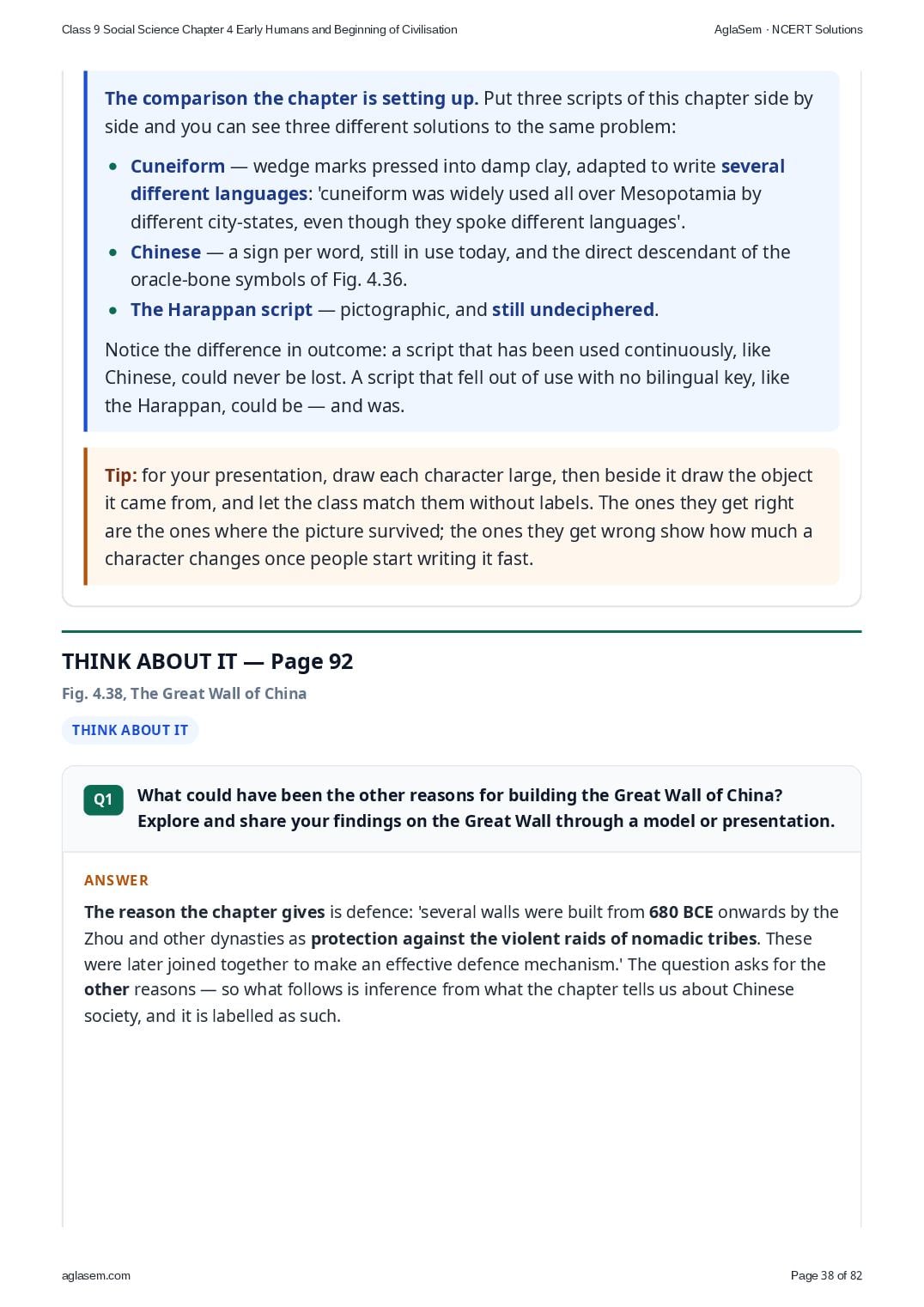
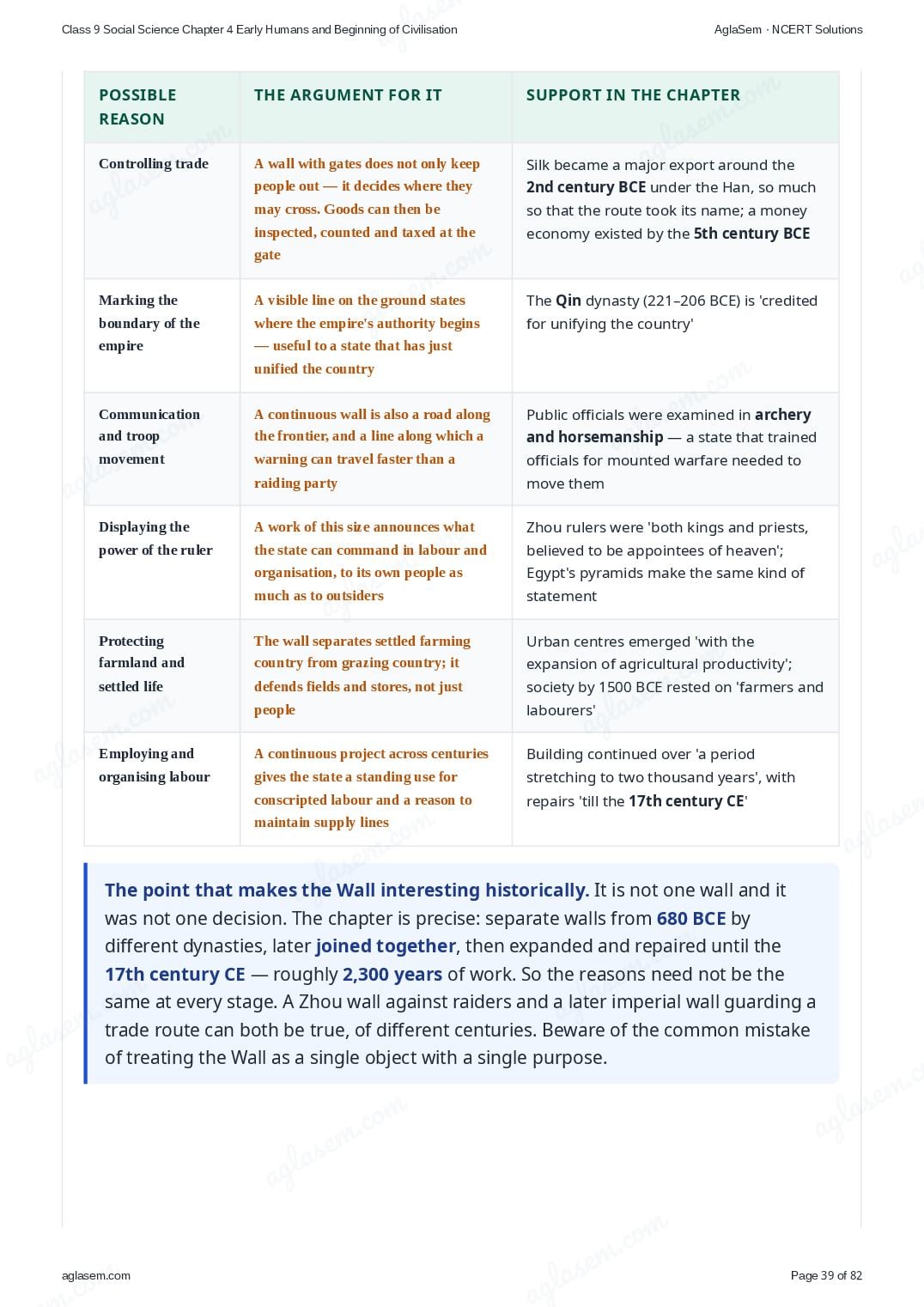
- What could have been the other reasons for building the Great Wall of China? Explore and share your findings on the Great Wall through a model or presentation.
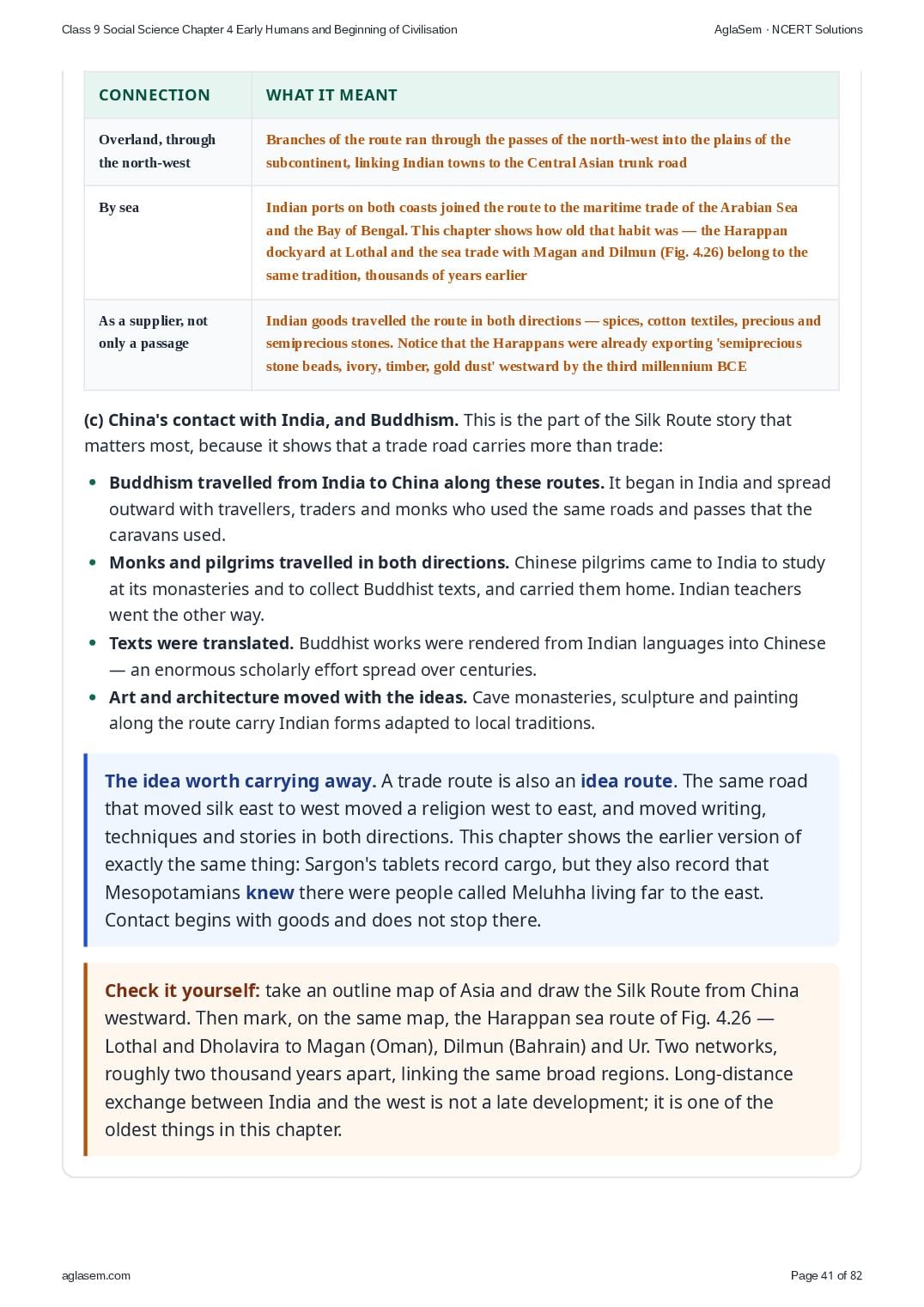
- Do you remember studying about the Silk Route in Grade 7? How was India connected with it? Can you recollect China's contact with India with reference to Buddhism that you studied in Grade 7?
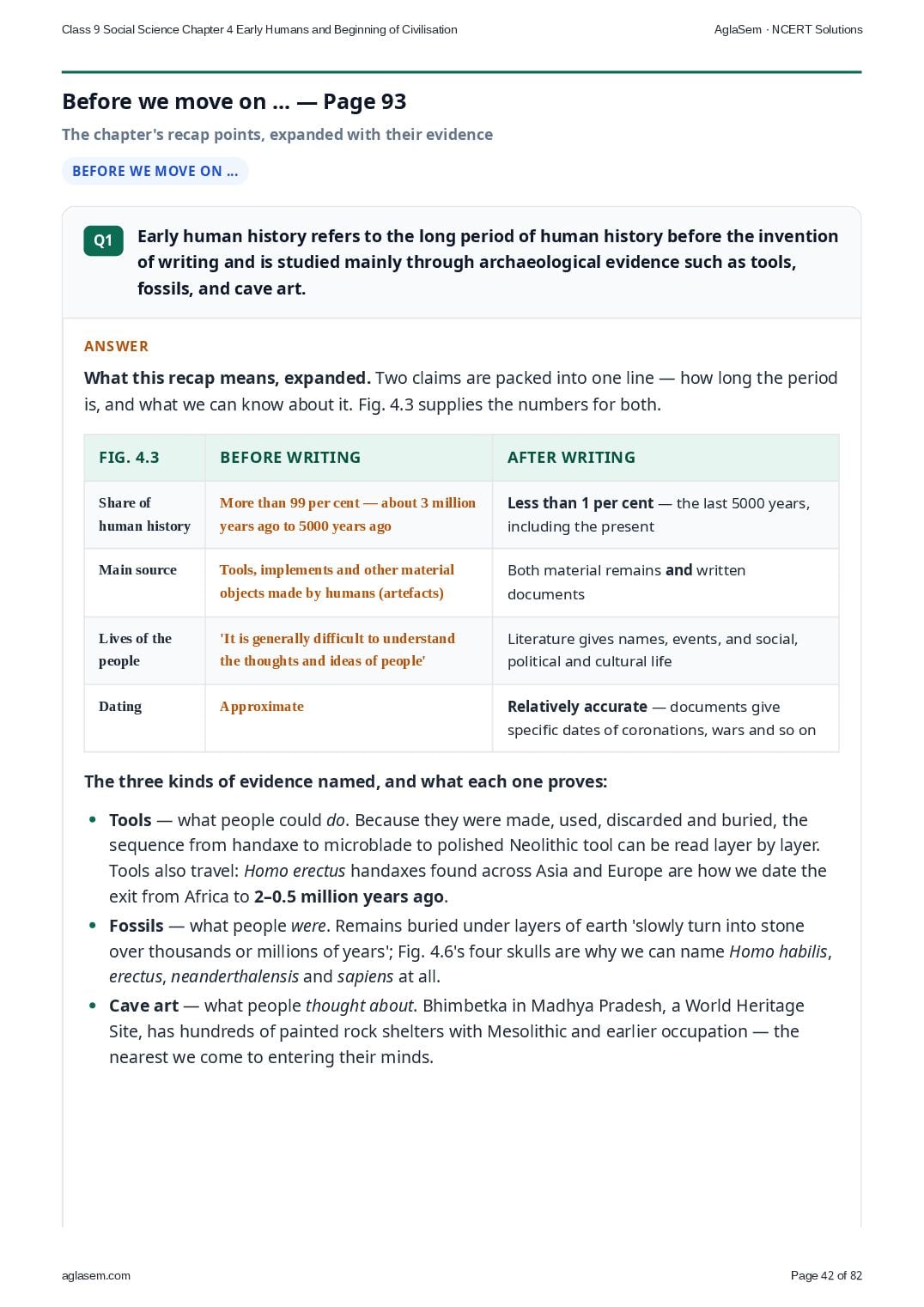
- Early human history refers to the long period of human history before the invention of writing and is studied mainly through archaeological evidence such as tools, fossils, and cave art.
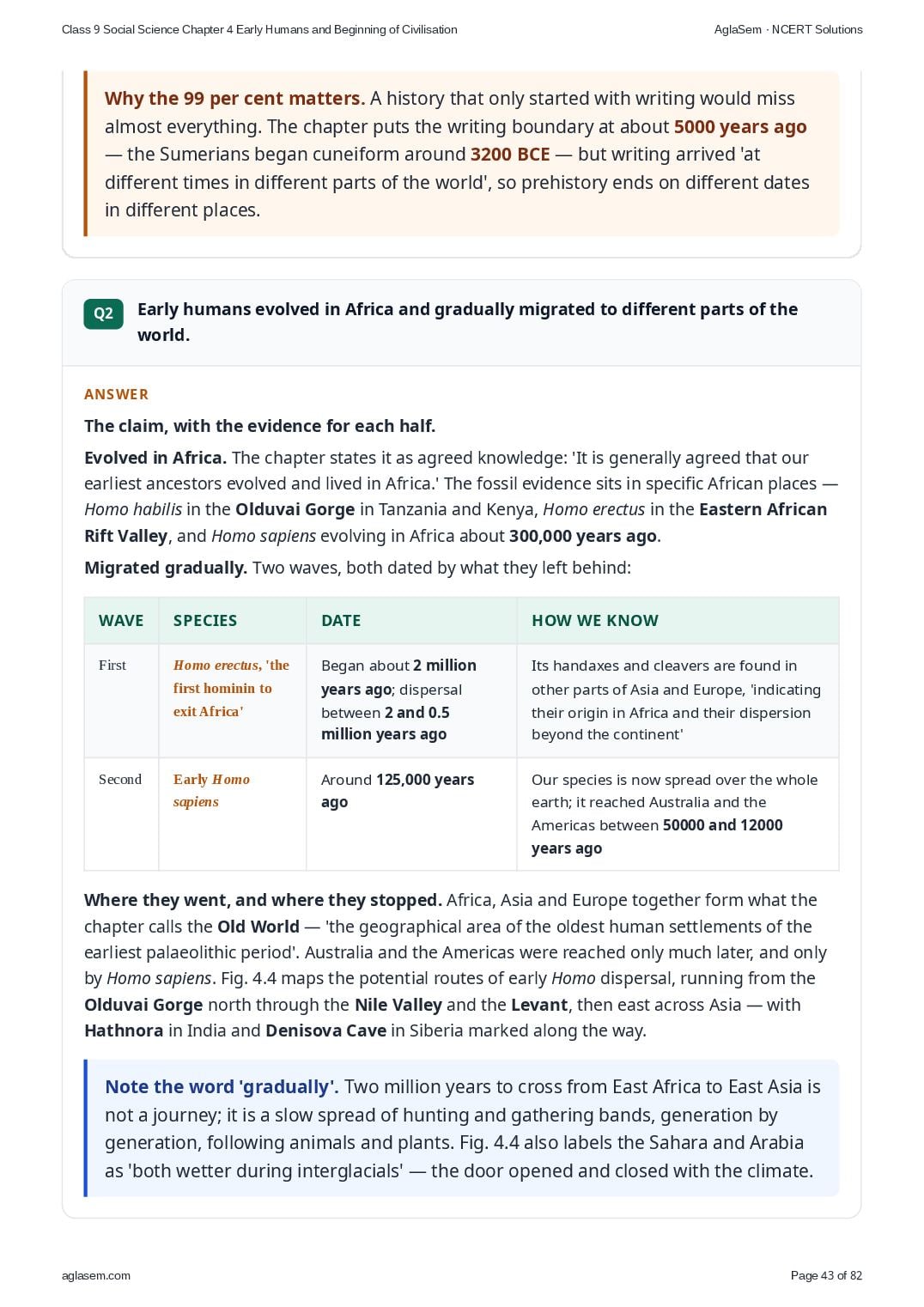
- Early humans evolved in Africa and gradually migrated to different parts of the world.
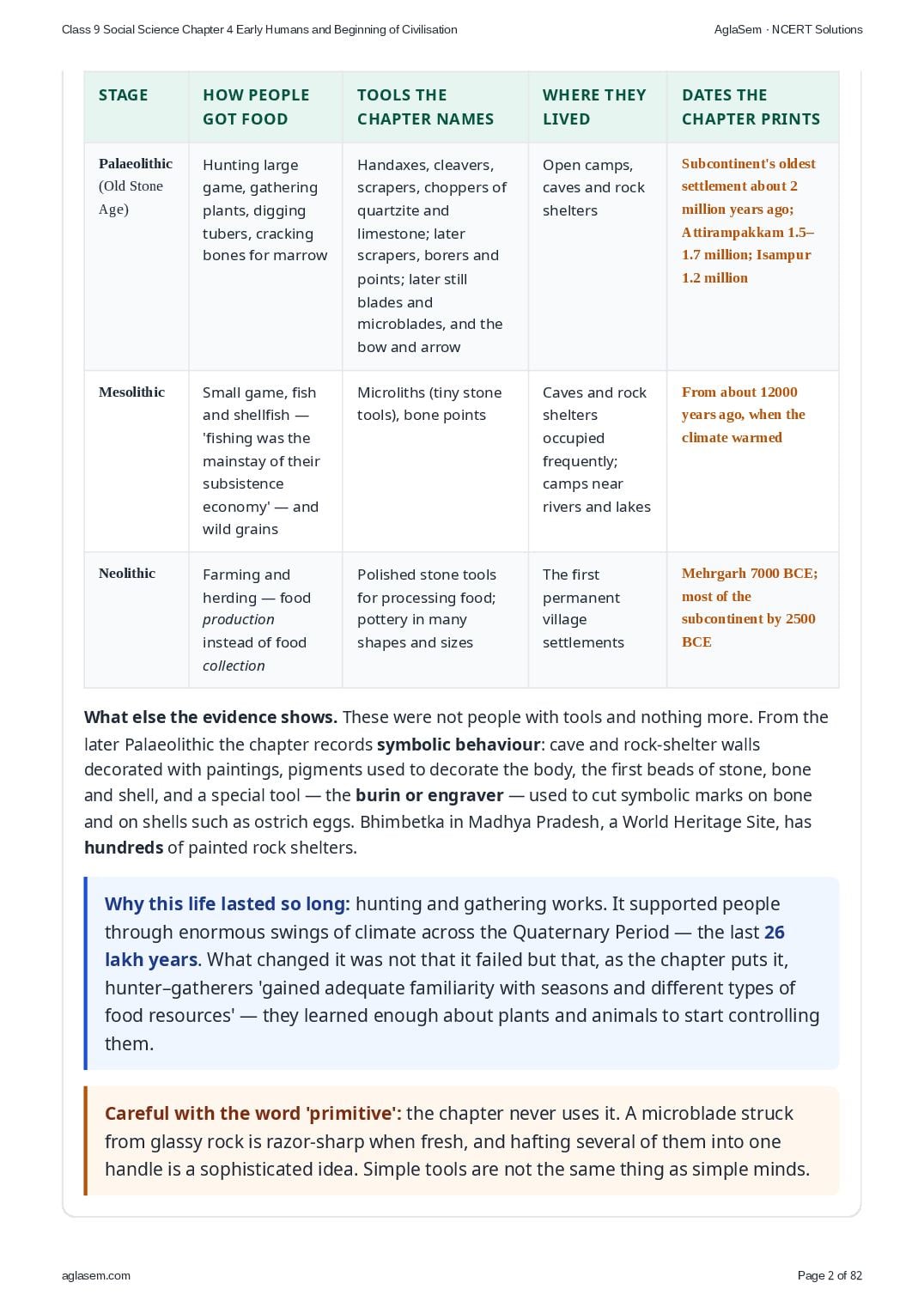
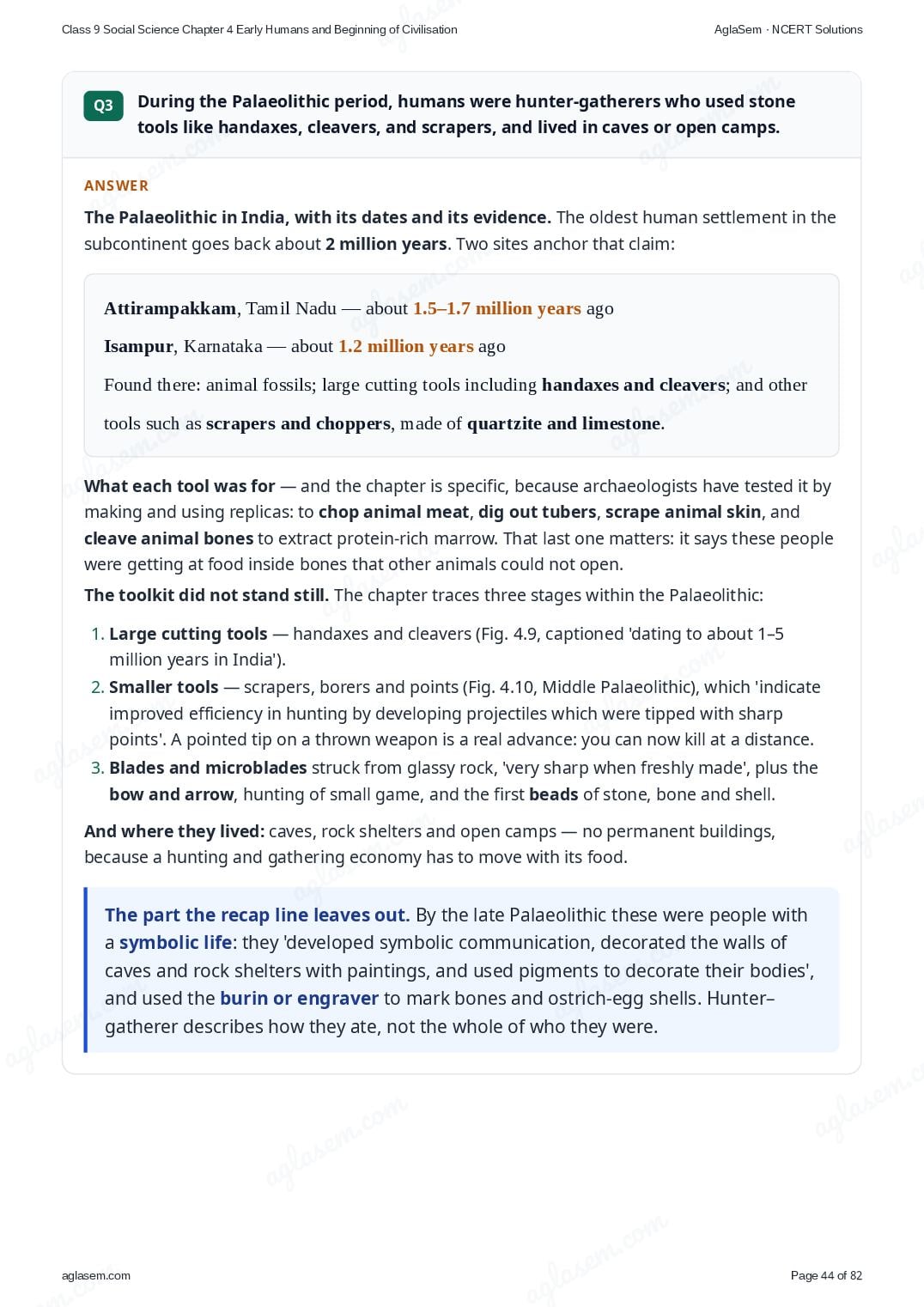
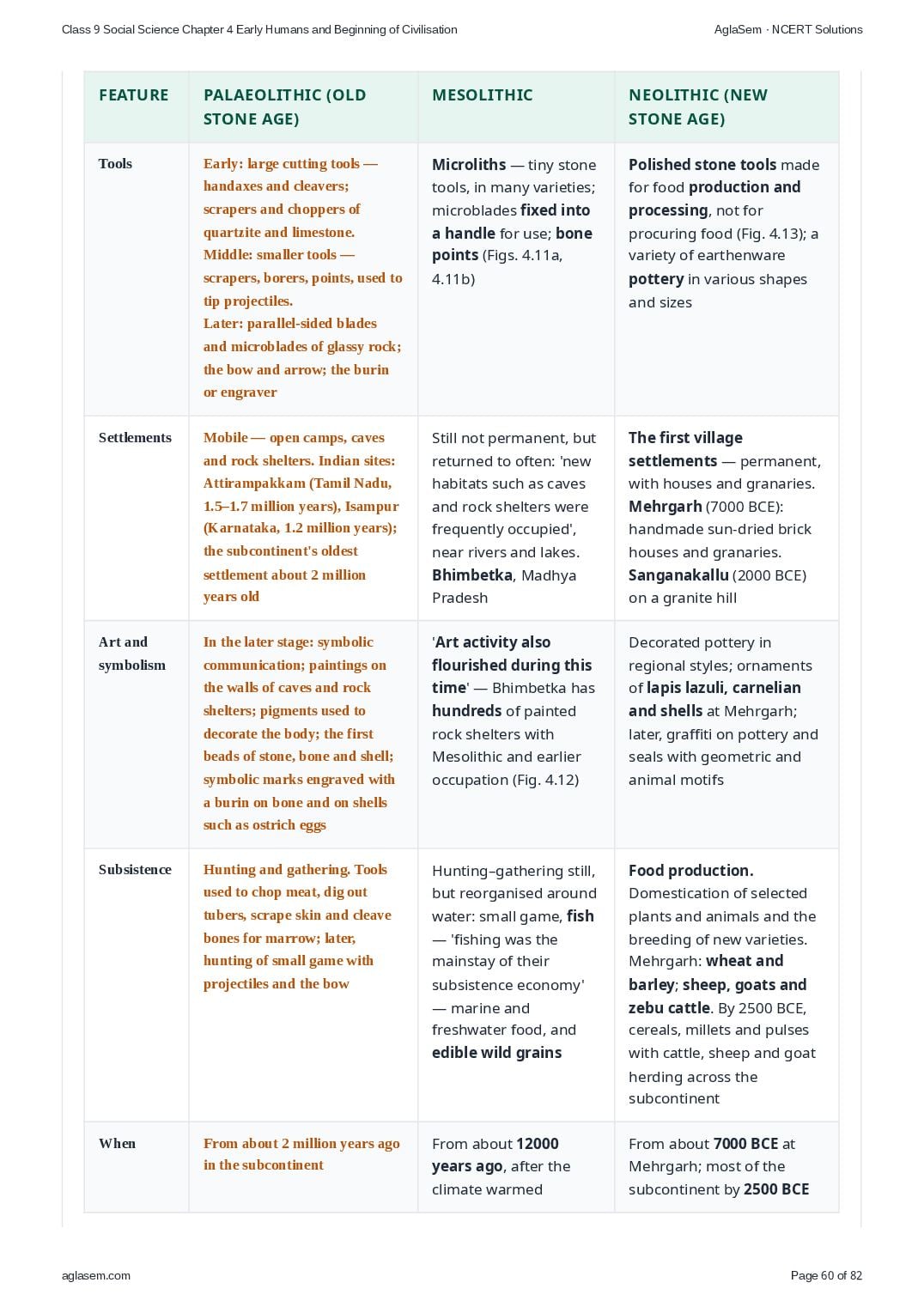
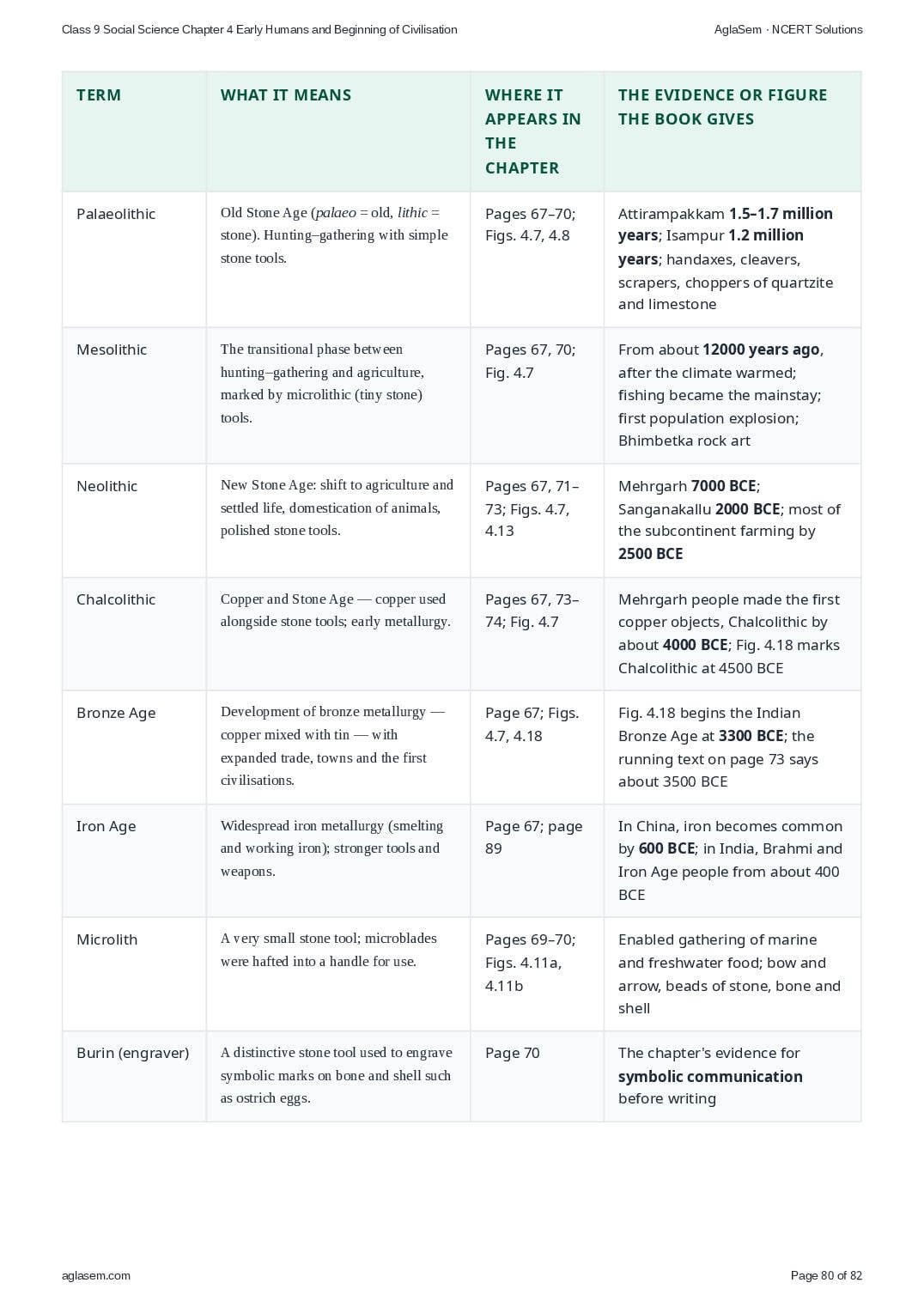
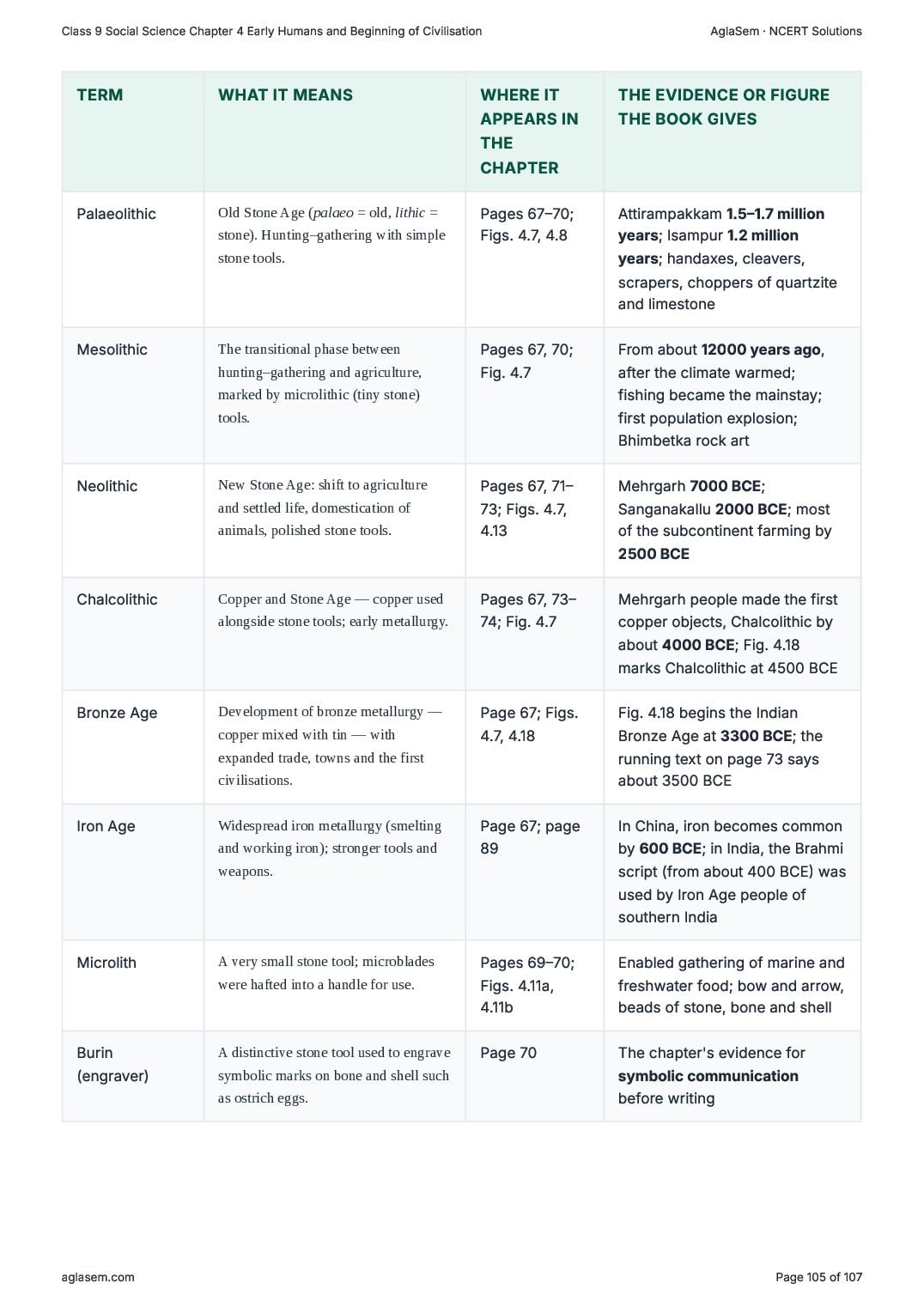
- During the Palaeolithic period, humans were hunter-gatherers who used stone tools like handaxes, cleavers, and scrapers, and lived in caves or open camps.
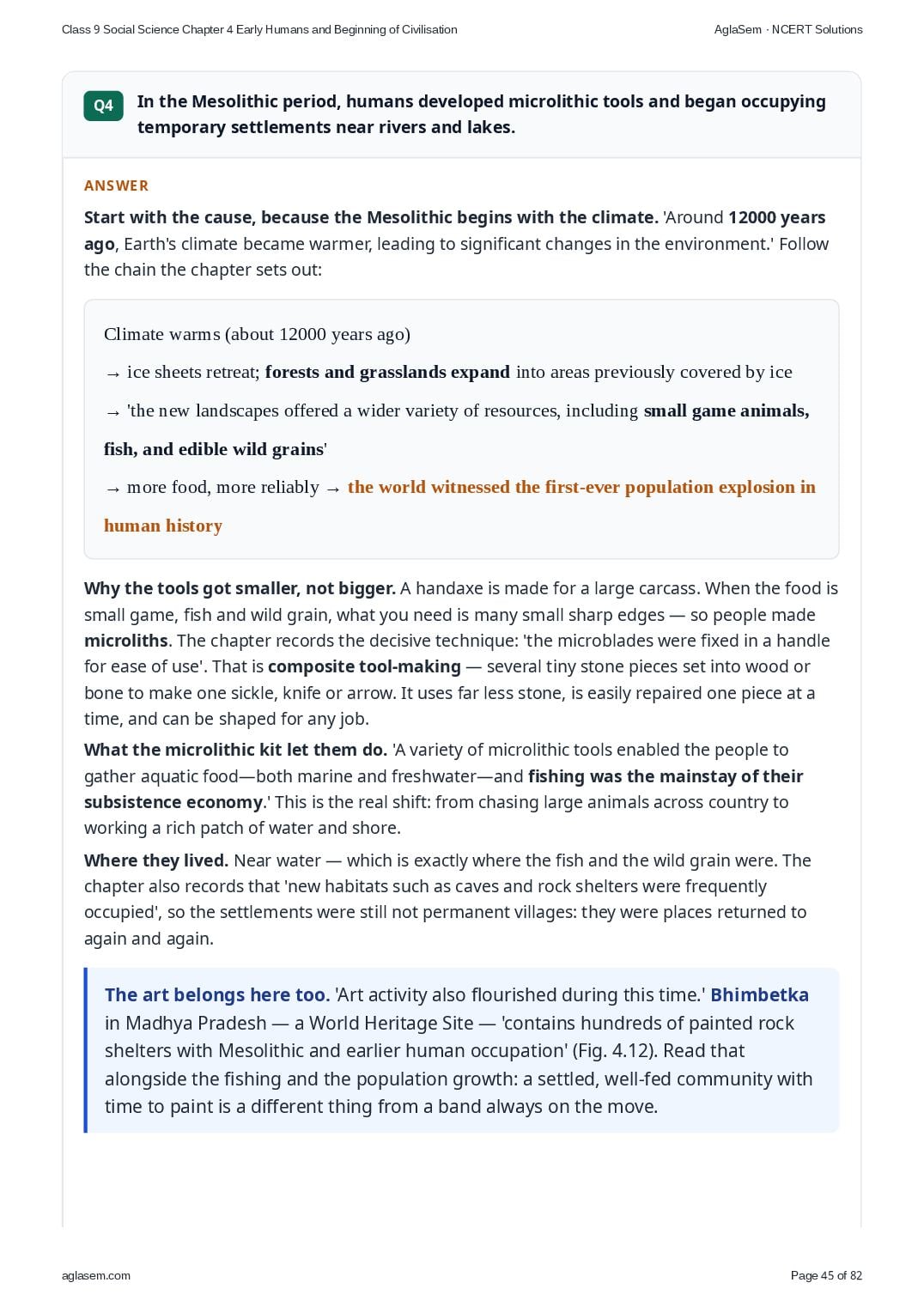
- In the Mesolithic period, humans developed microlithic tools and began occupying temporary settlements near rivers and lakes.
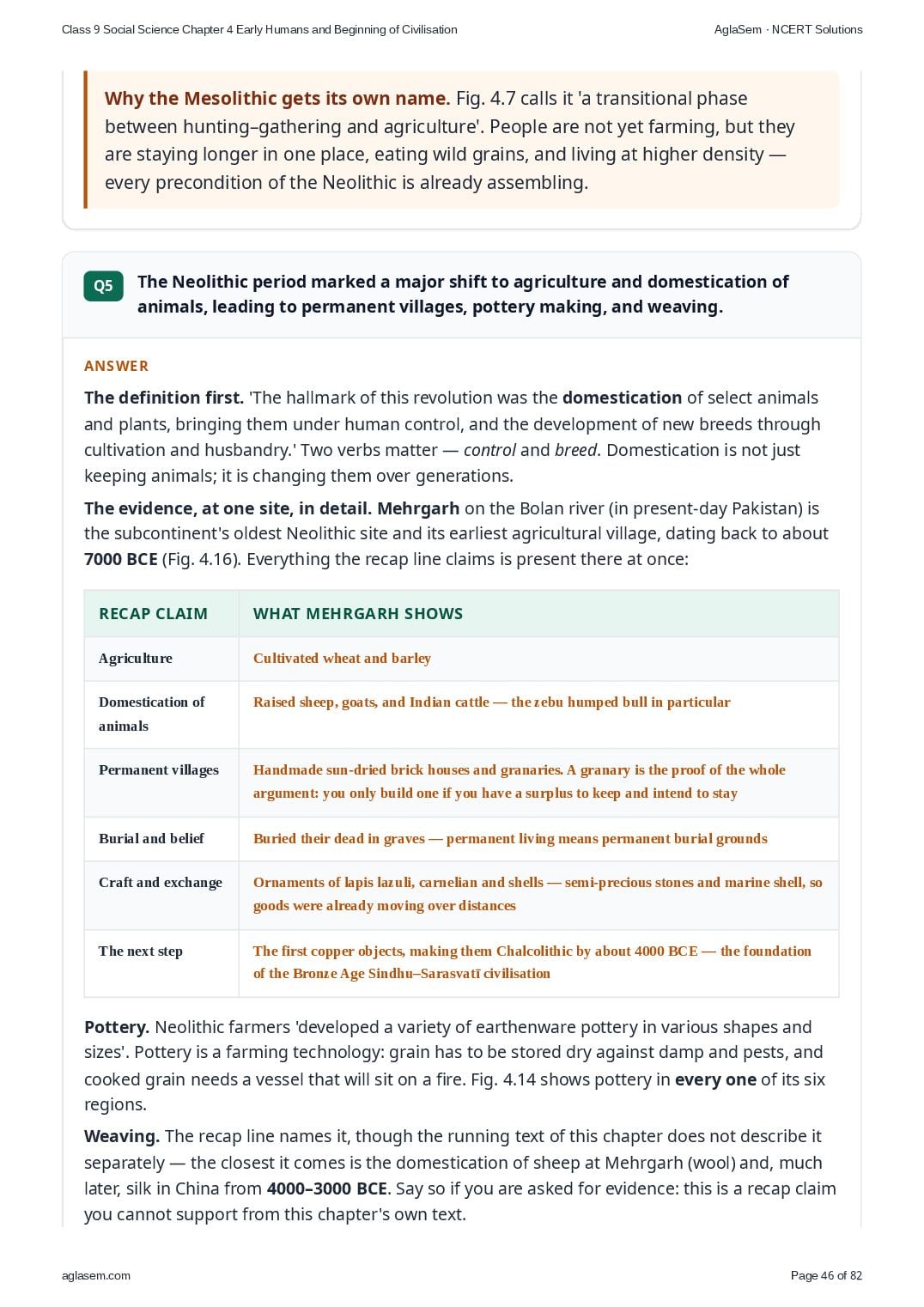
- The Neolithic period marked a major shift to agriculture and domestication of animals, leading to permanent villages, pottery making, and weaving.
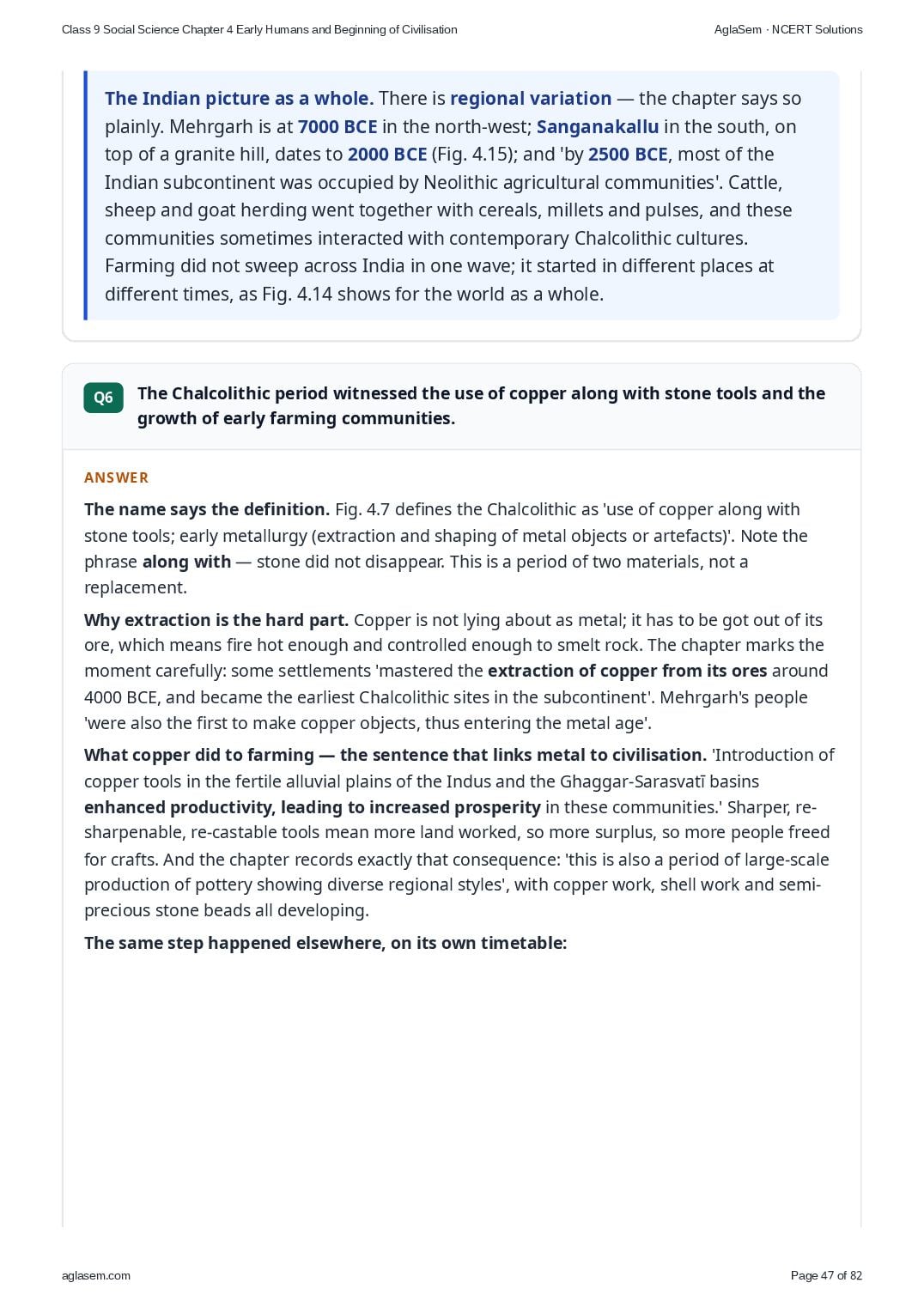
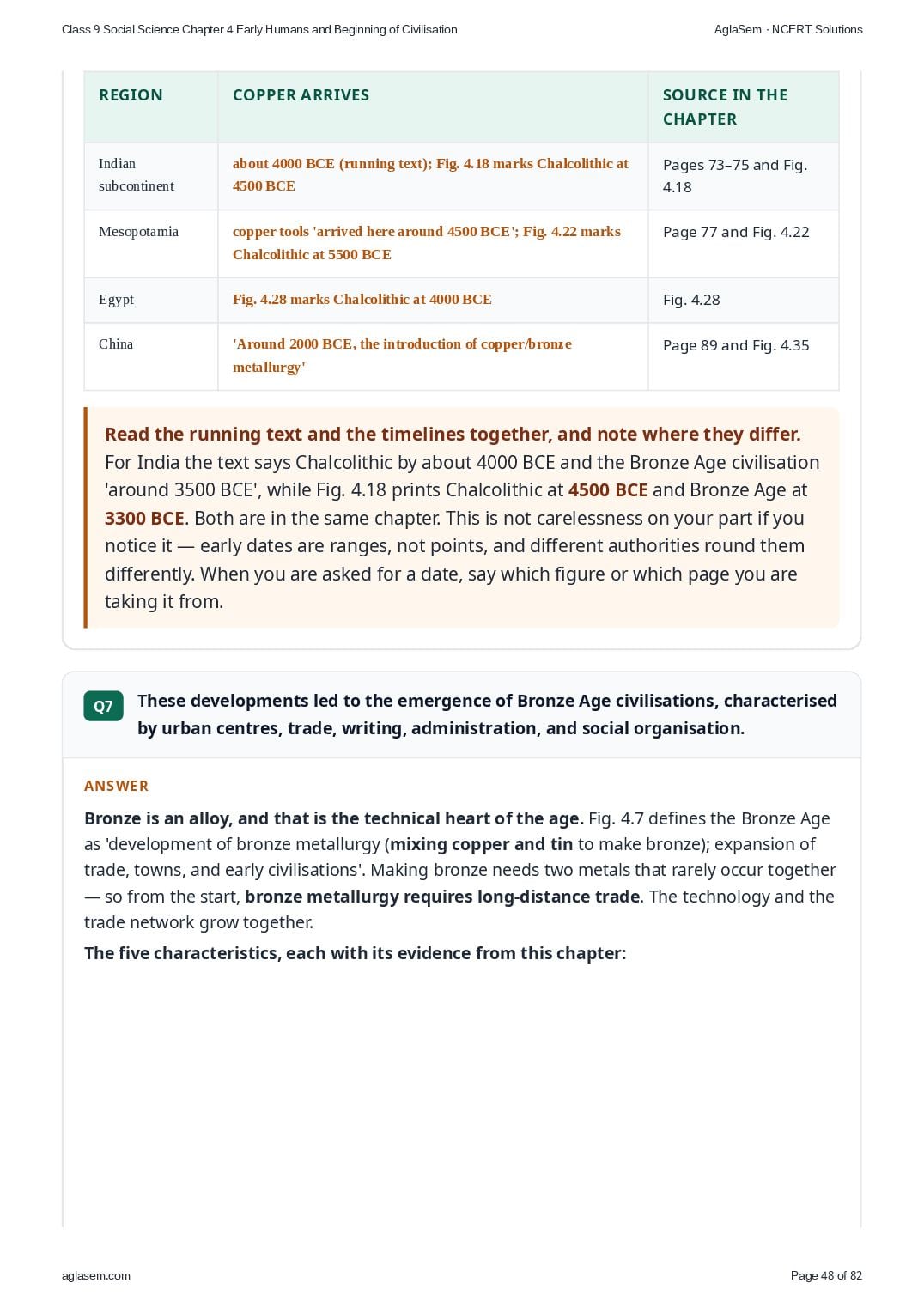
- The Chalcolithic period witnessed the use of copper along with stone tools and the growth of early farming communities.
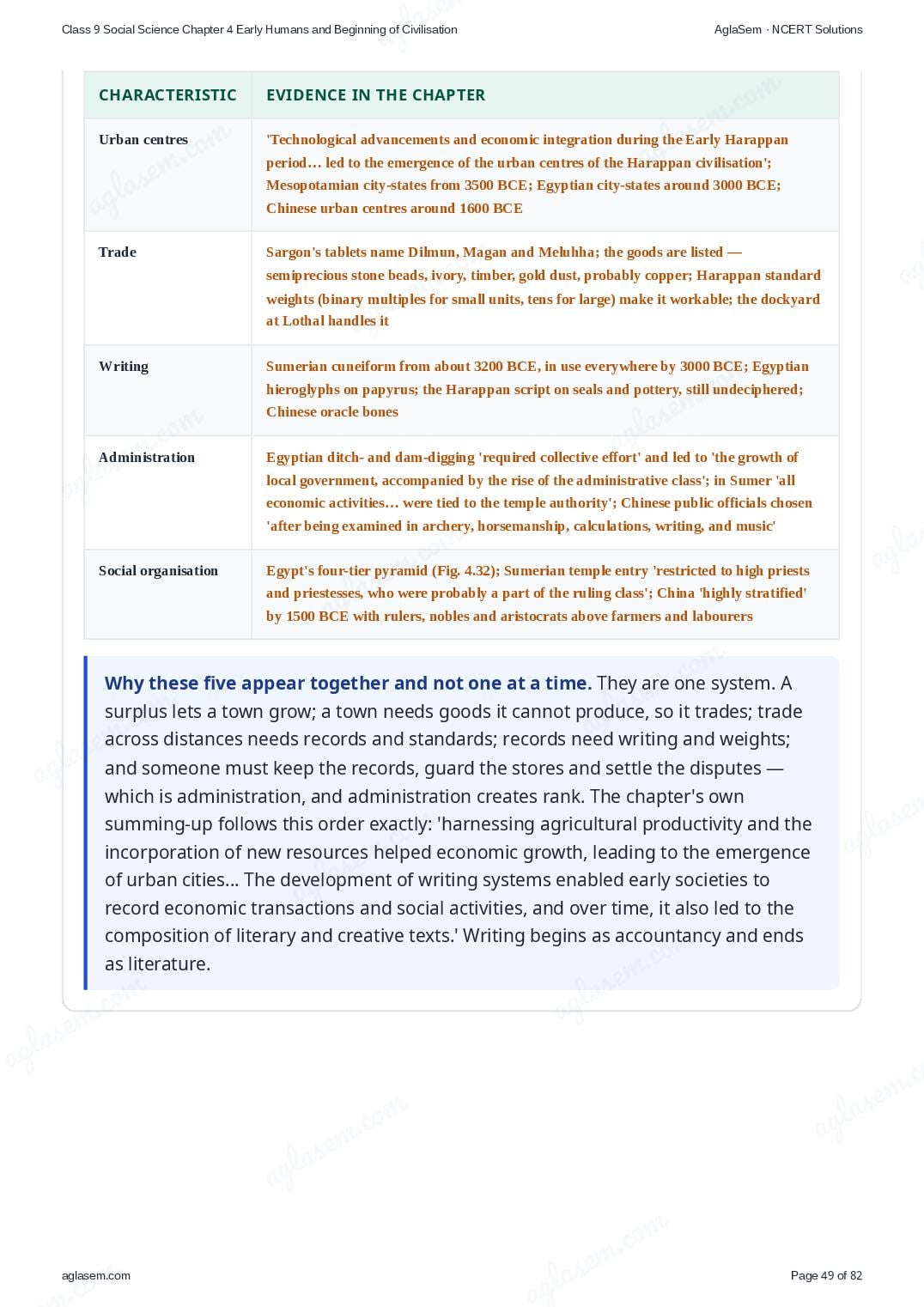
- These developments led to the emergence of Bronze Age civilisations, characterised by urban centres, trade, writing, administration, and social organisation.
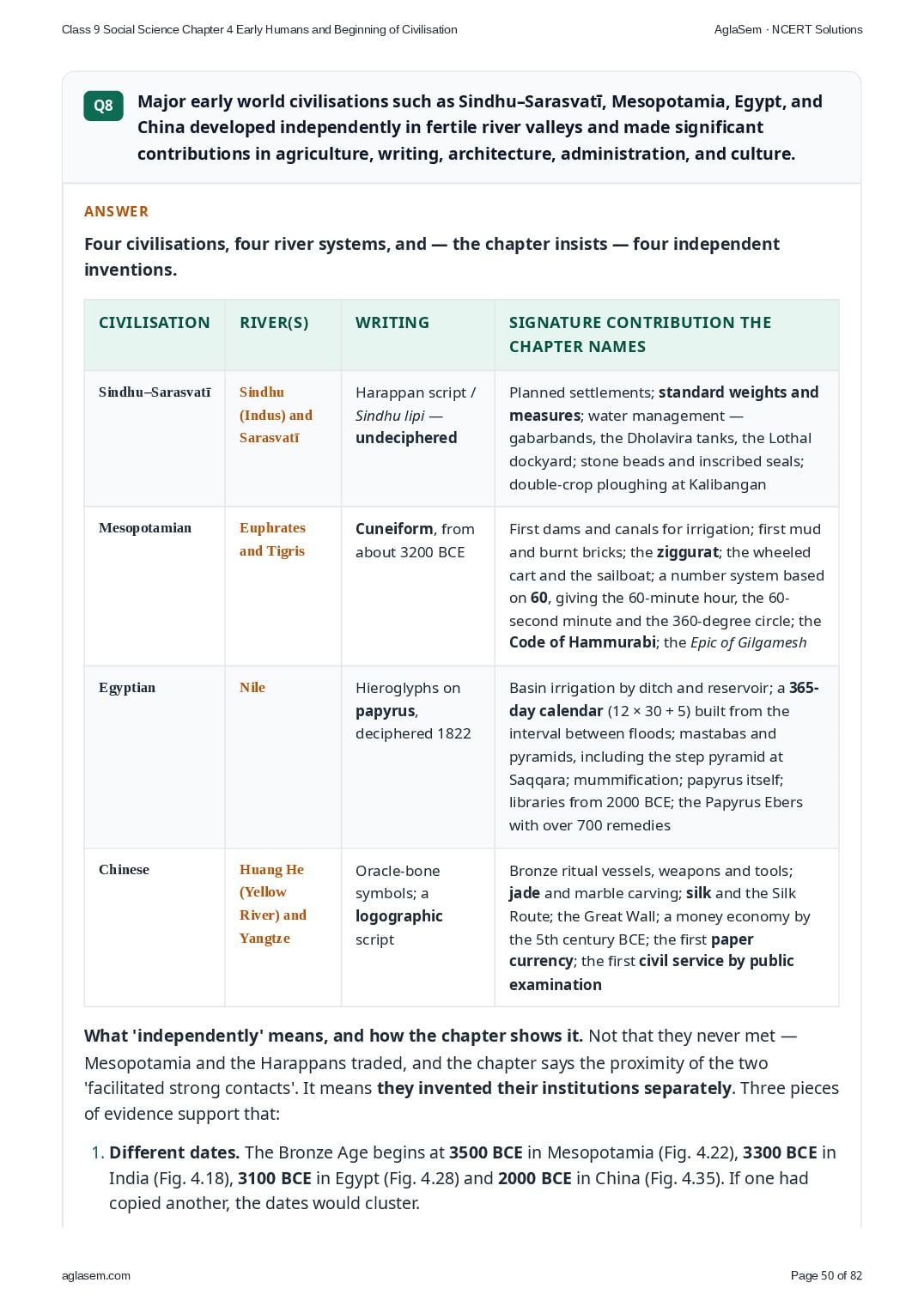
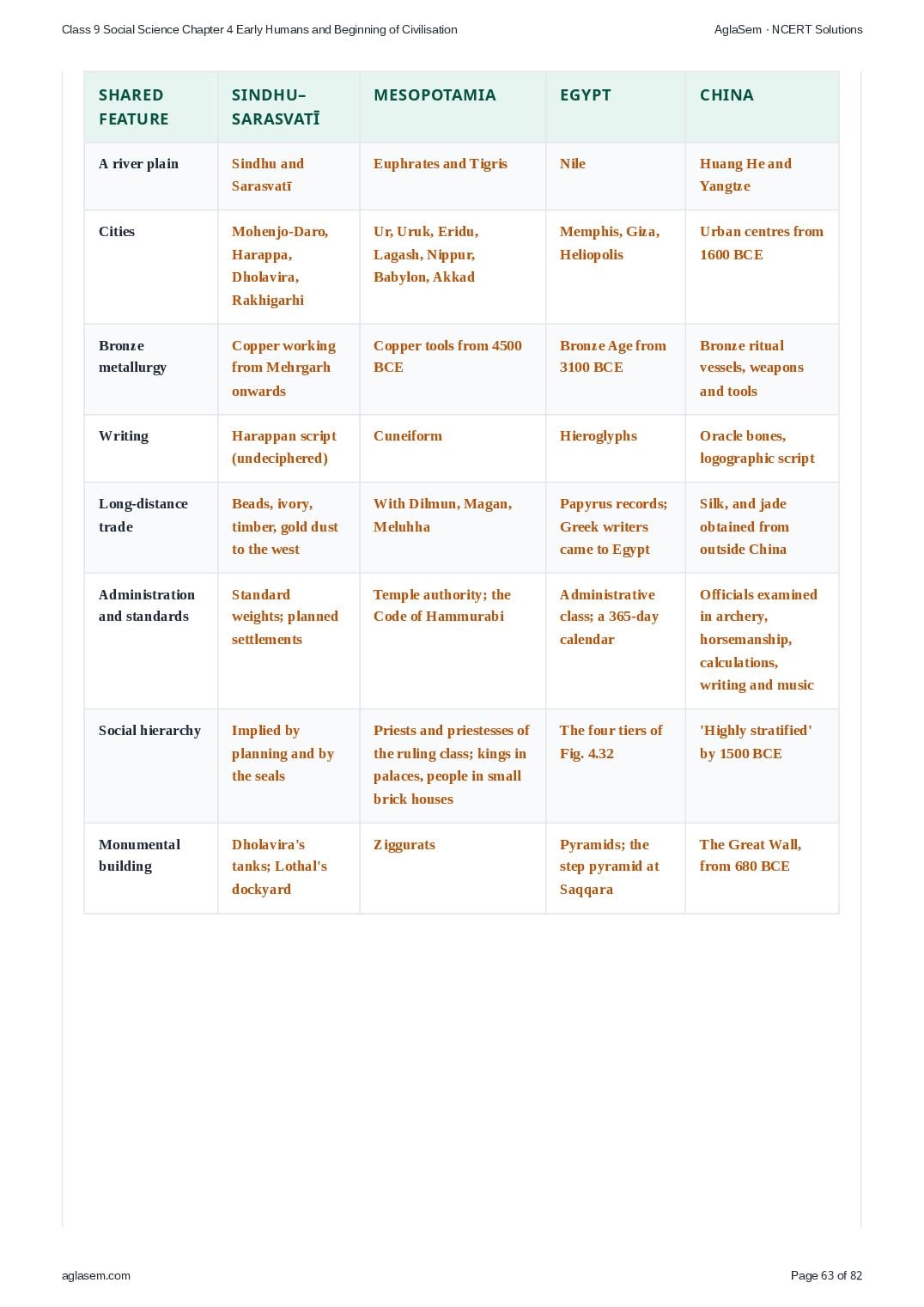
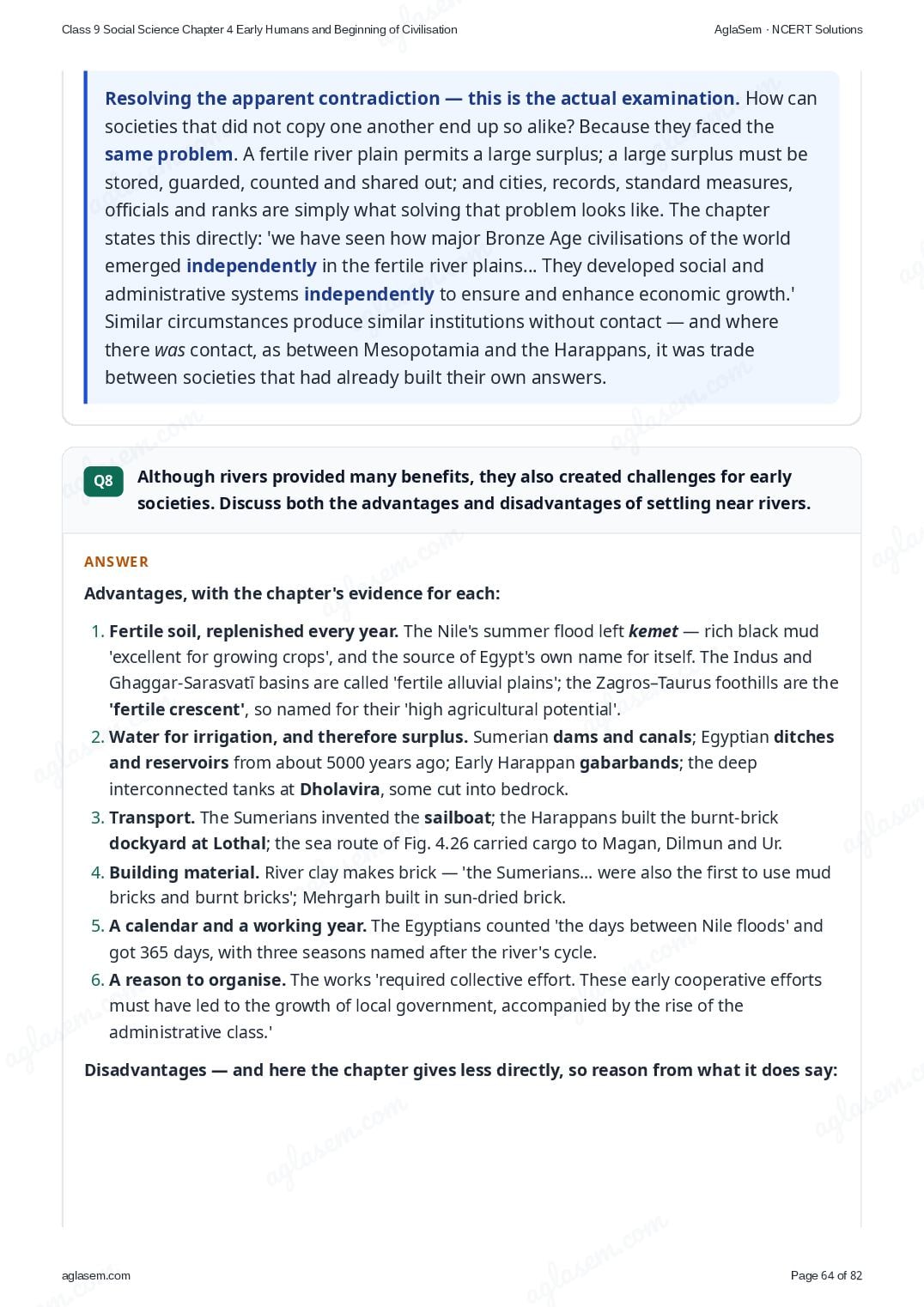
- Major early world civilisations such as Sindhu–Sarasvatī, Mesopotamia, Egypt, and China developed independently in fertile river valleys and made significant contributions in agriculture, writing, architecture, administration, and culture.
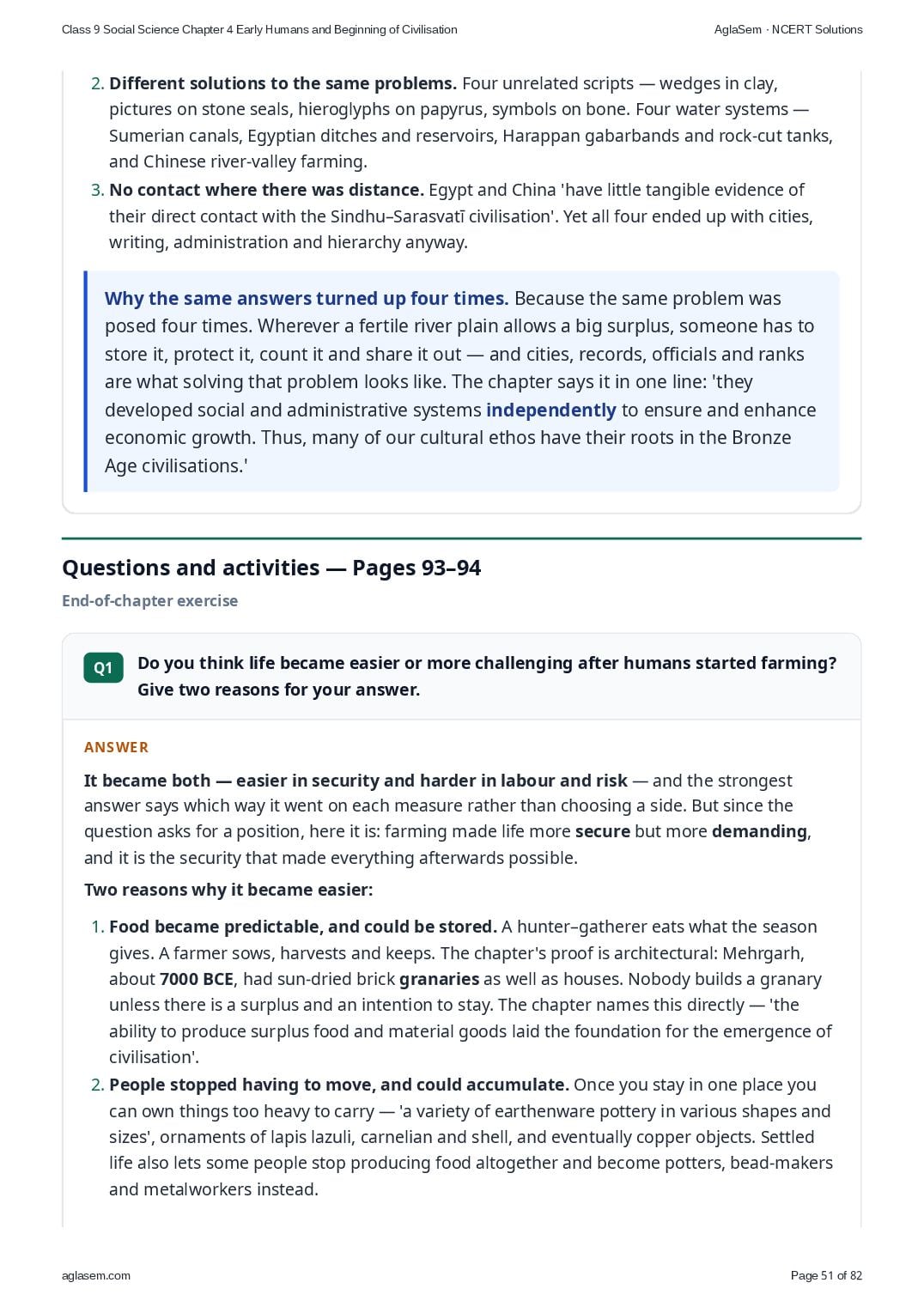
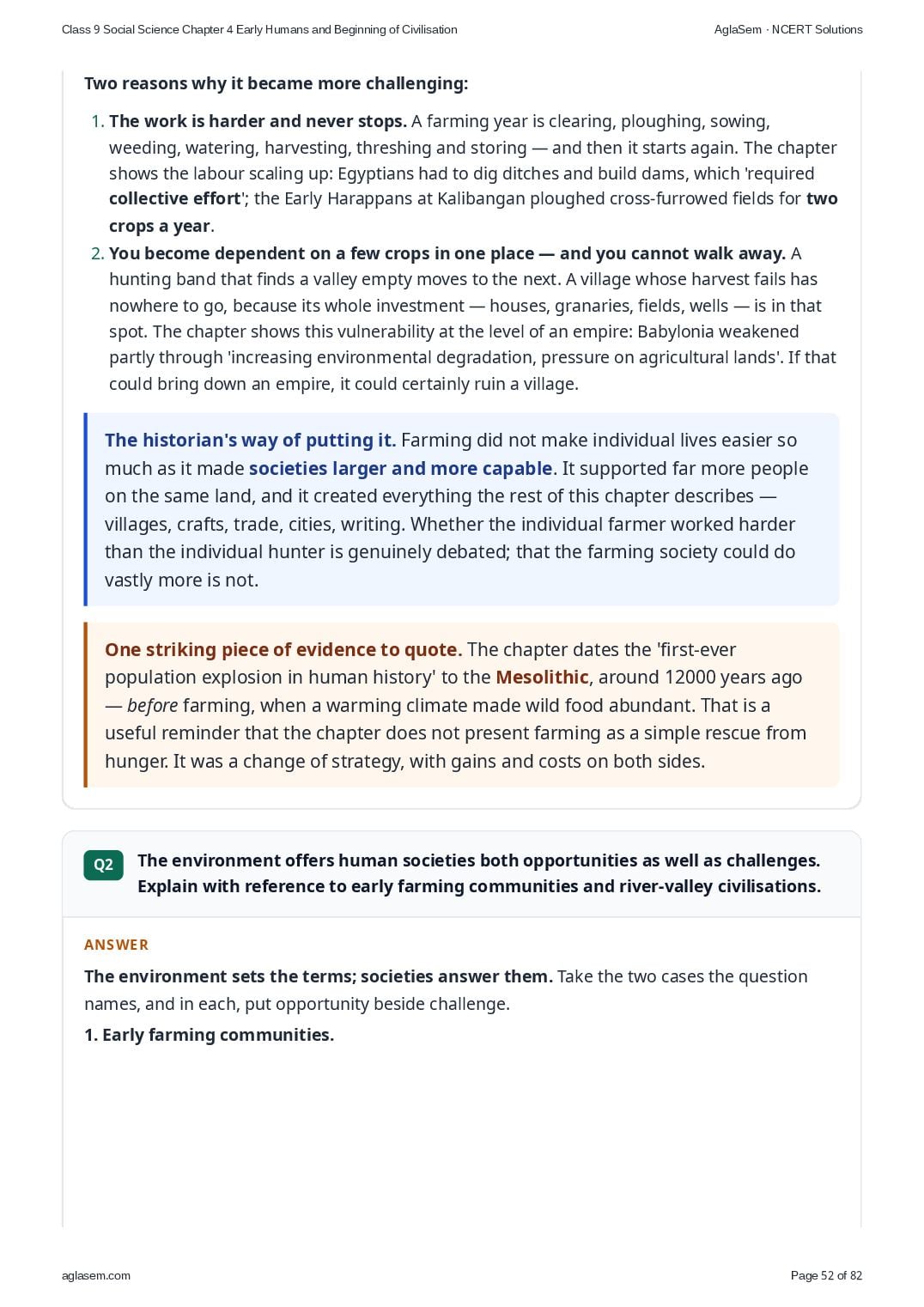
- Do you think life became easier or more challenging after humans started farming? Give two reasons for your answer.
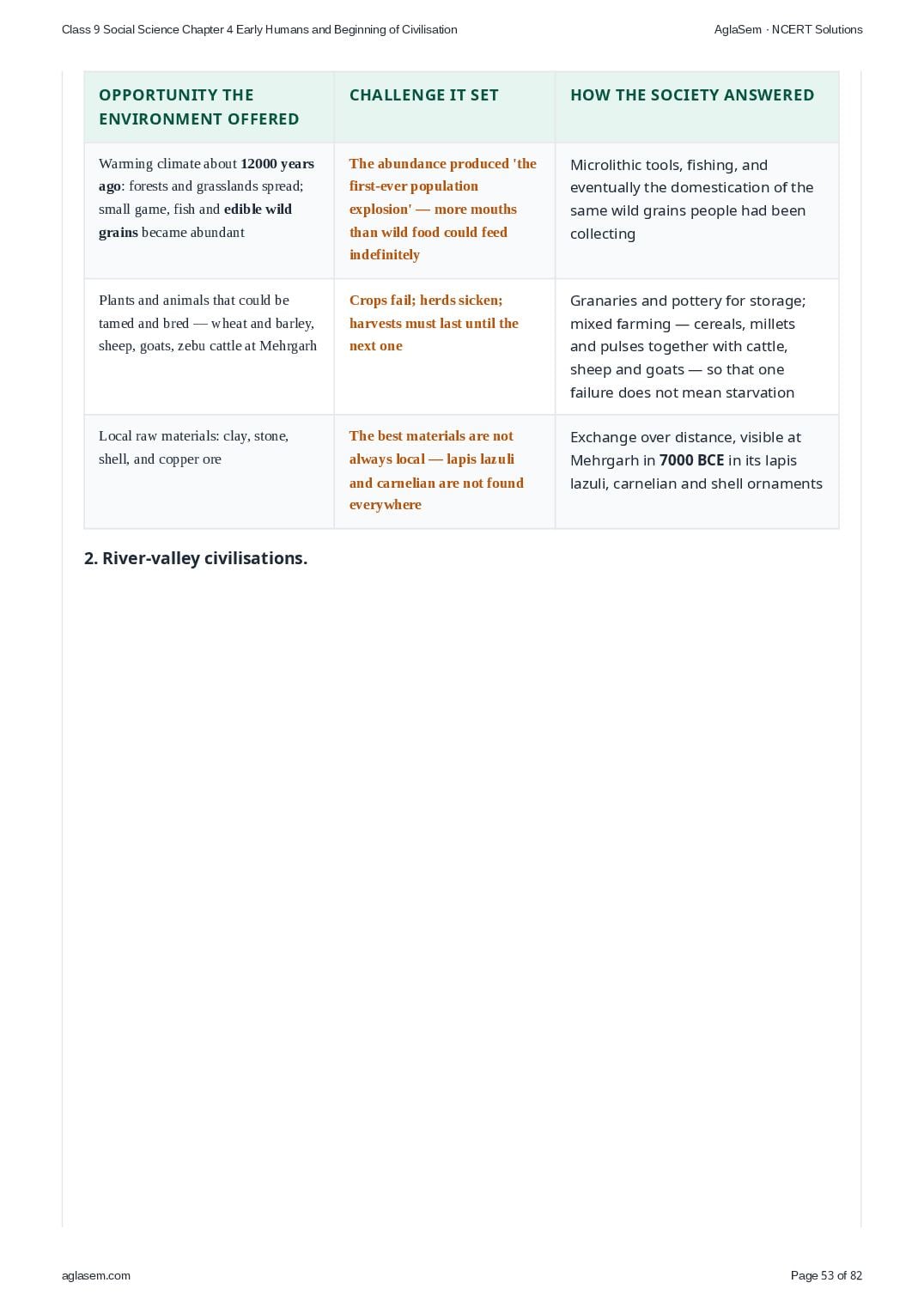
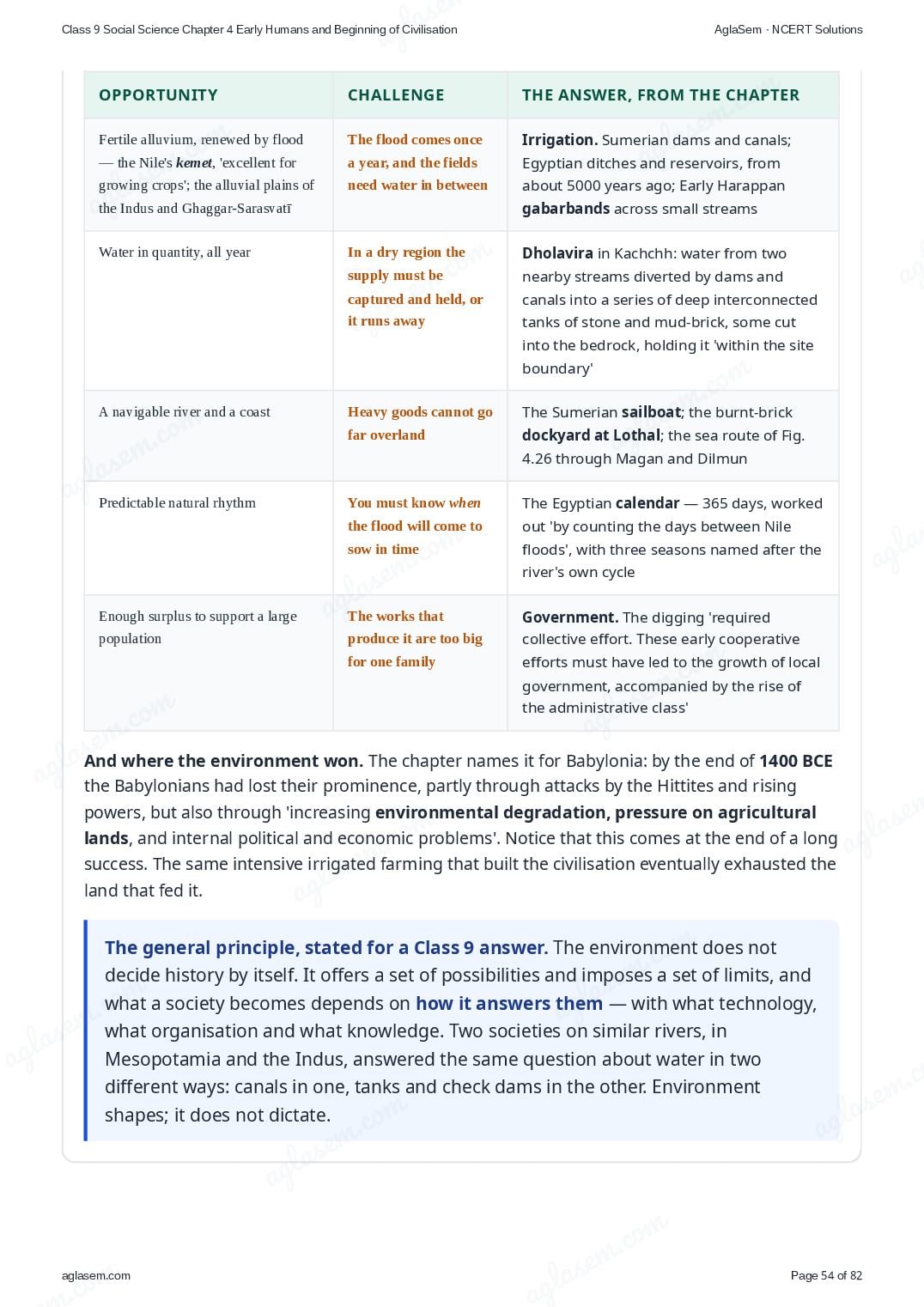
- The environment offers human societies both opportunities as well as challenges. Explain with reference to early farming communities and river-valley civilisations.
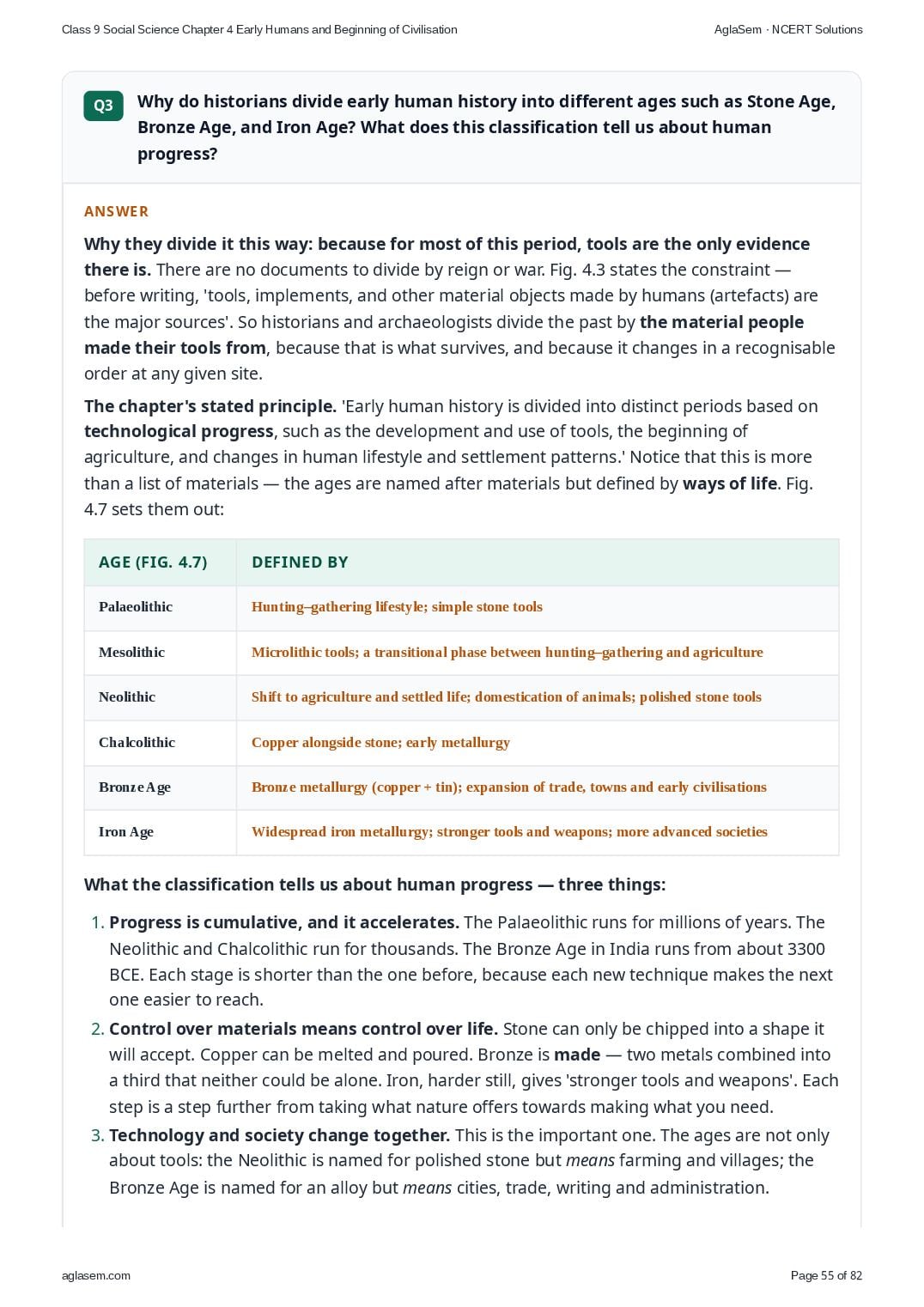
- Why do historians divide early human history into different ages such as Stone Age, Bronze Age, and Iron Age? What does this classification tell us about human progress?
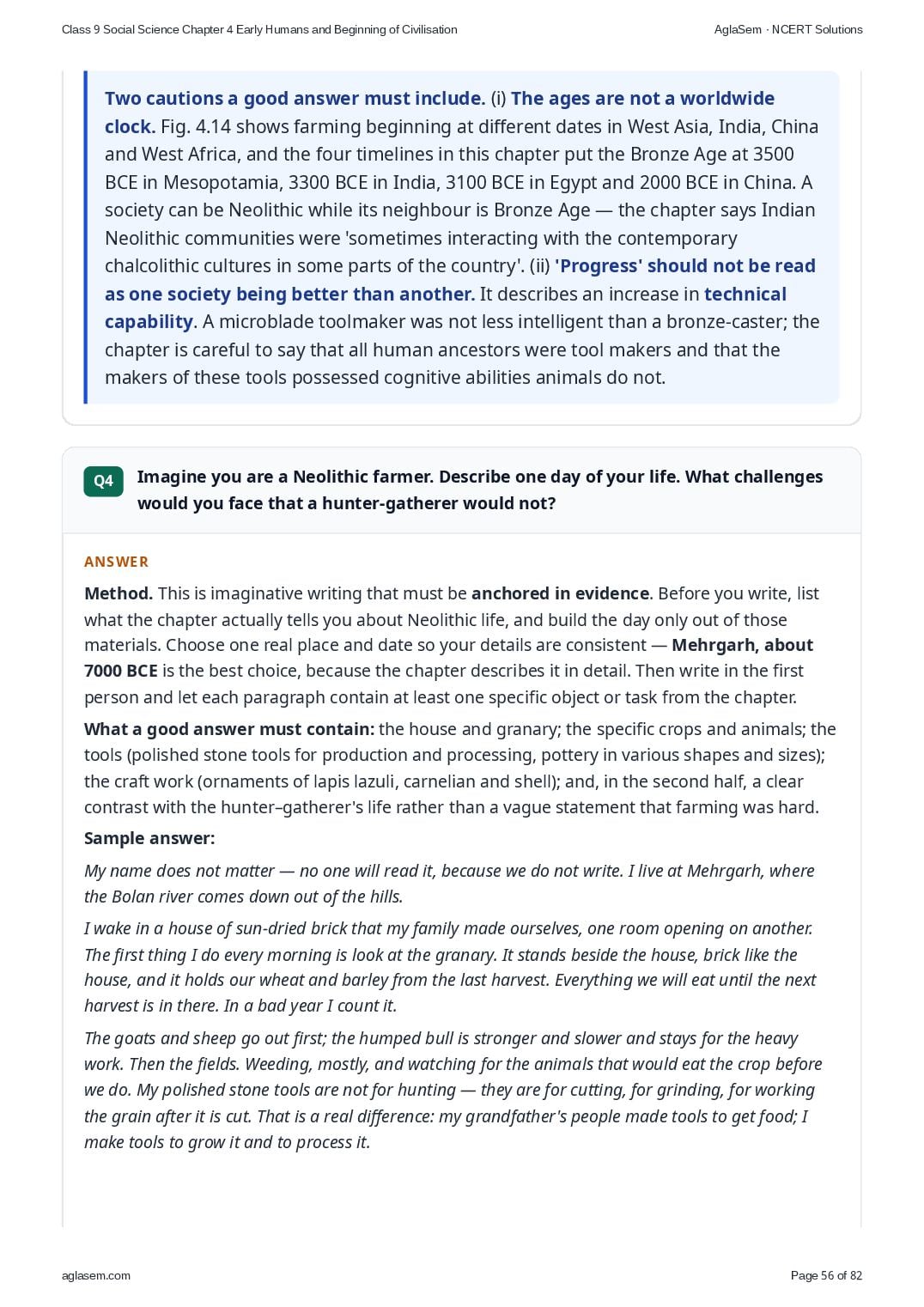
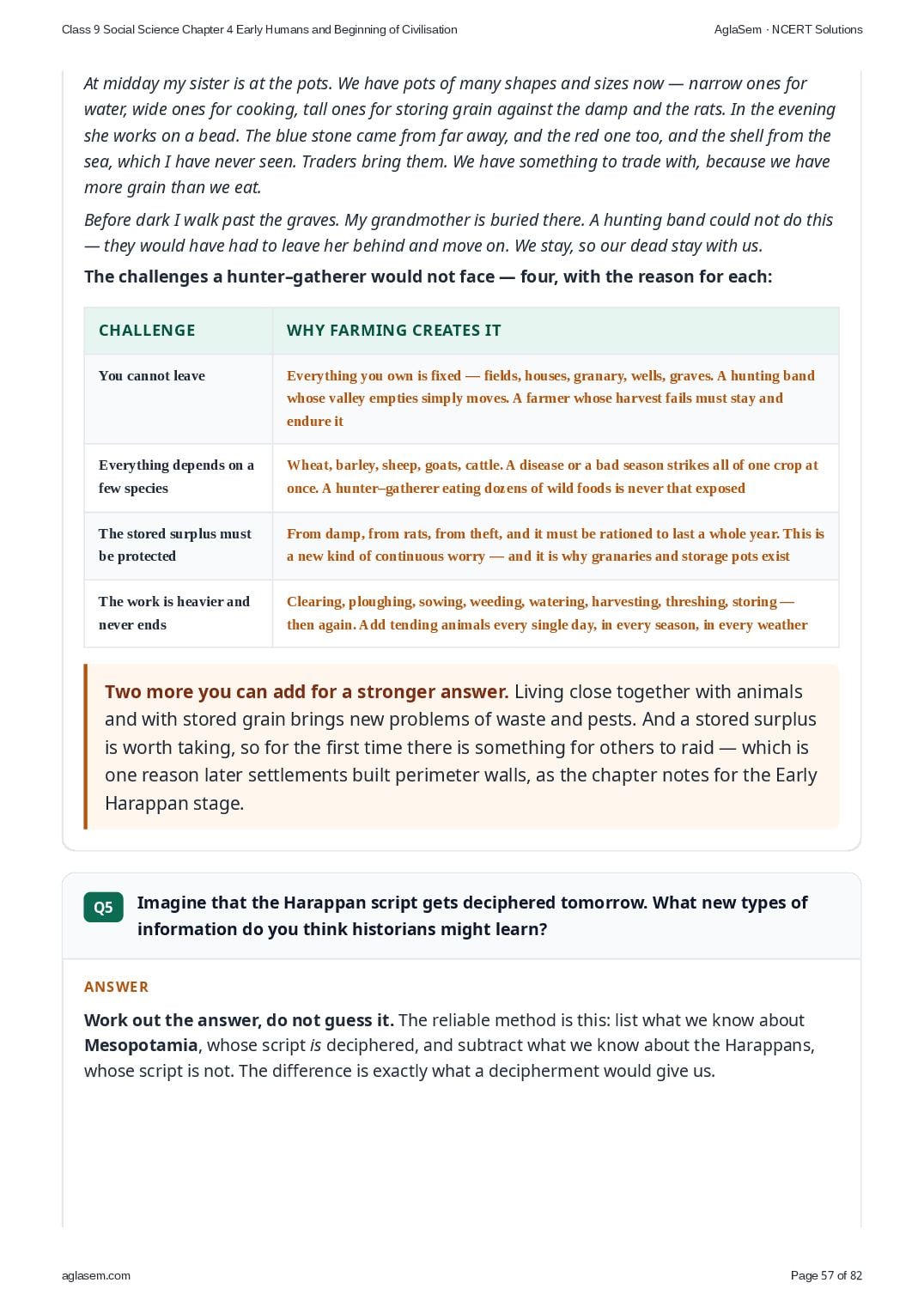
- Imagine you are a Neolithic farmer. Describe one day of your life. What challenges would you face that a hunter-gatherer would not?
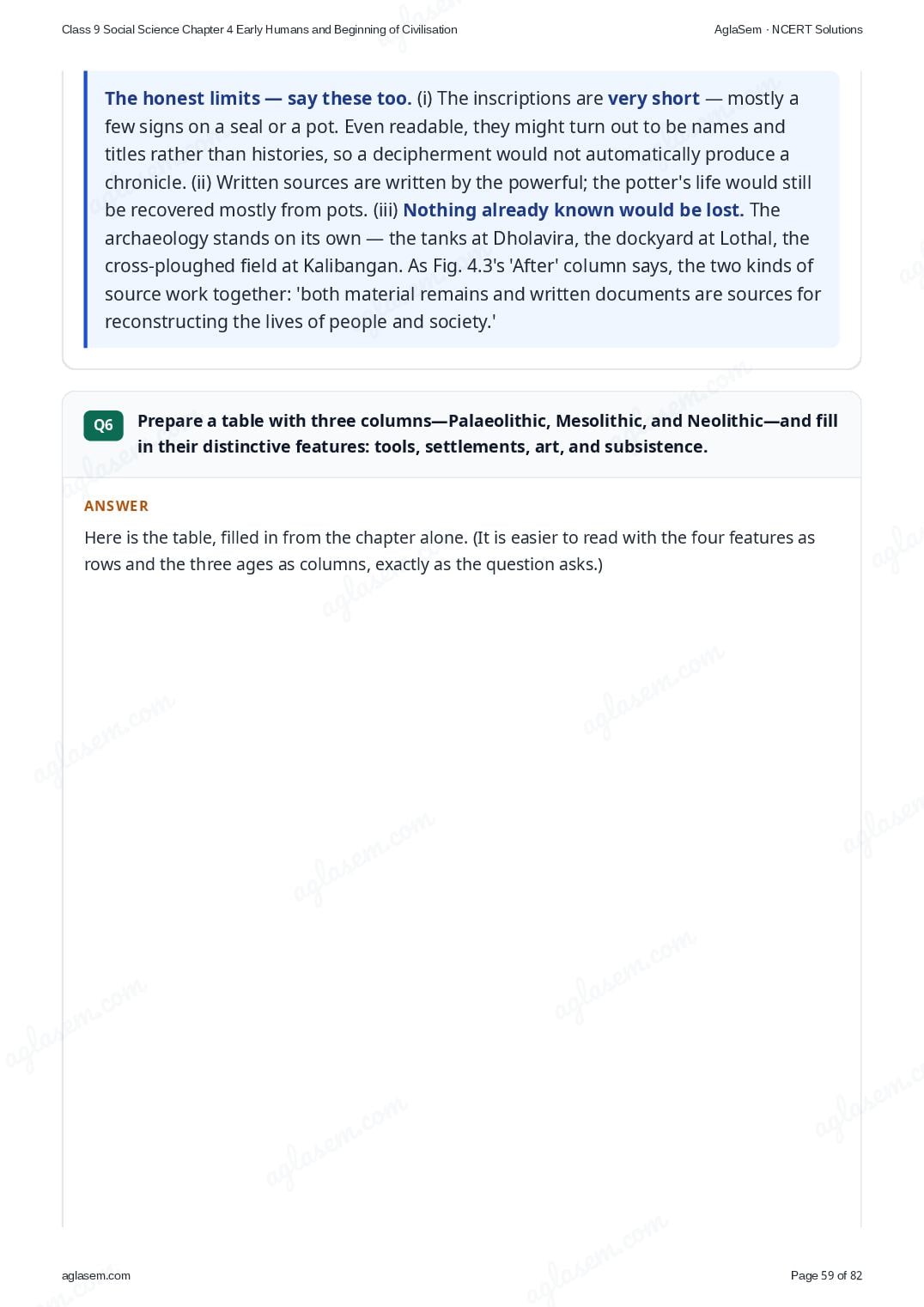
- Imagine that the Harappan script gets deciphered tomorrow. What new types of information do you think historians might learn?
- Prepare a table with three columns—Palaeolithic, Mesolithic, and Neolithic—and fill in their distinctive features: tools, settlements, art, and subsistence.
- “Bronze Age civilisations developed independently but shared common features.” Examine this statement with reference to the civilisations given in the chapter.
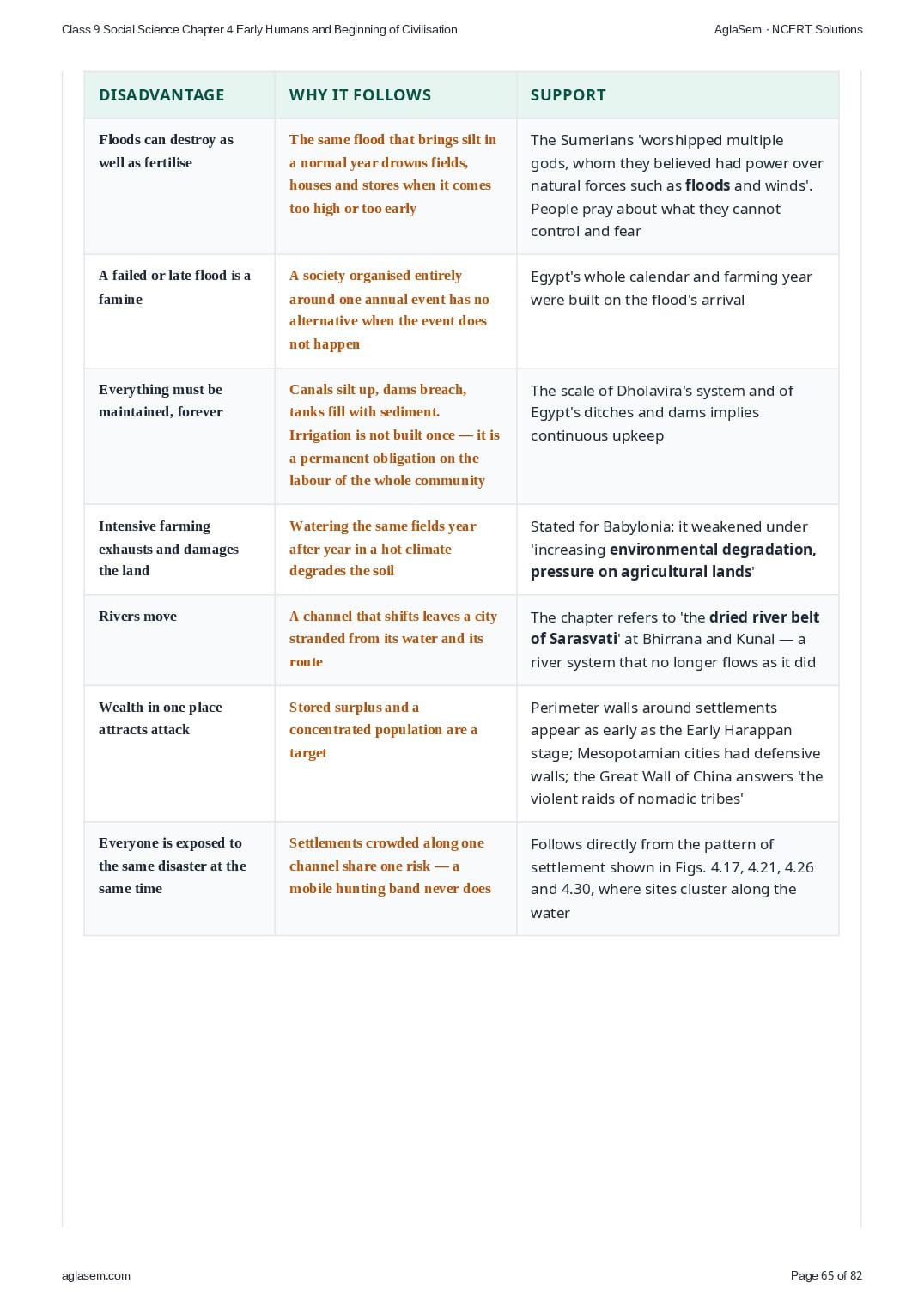
- Although rivers provided many benefits, they also created challenges for early societies. Discuss both the advantages and disadvantages of settling near rivers.
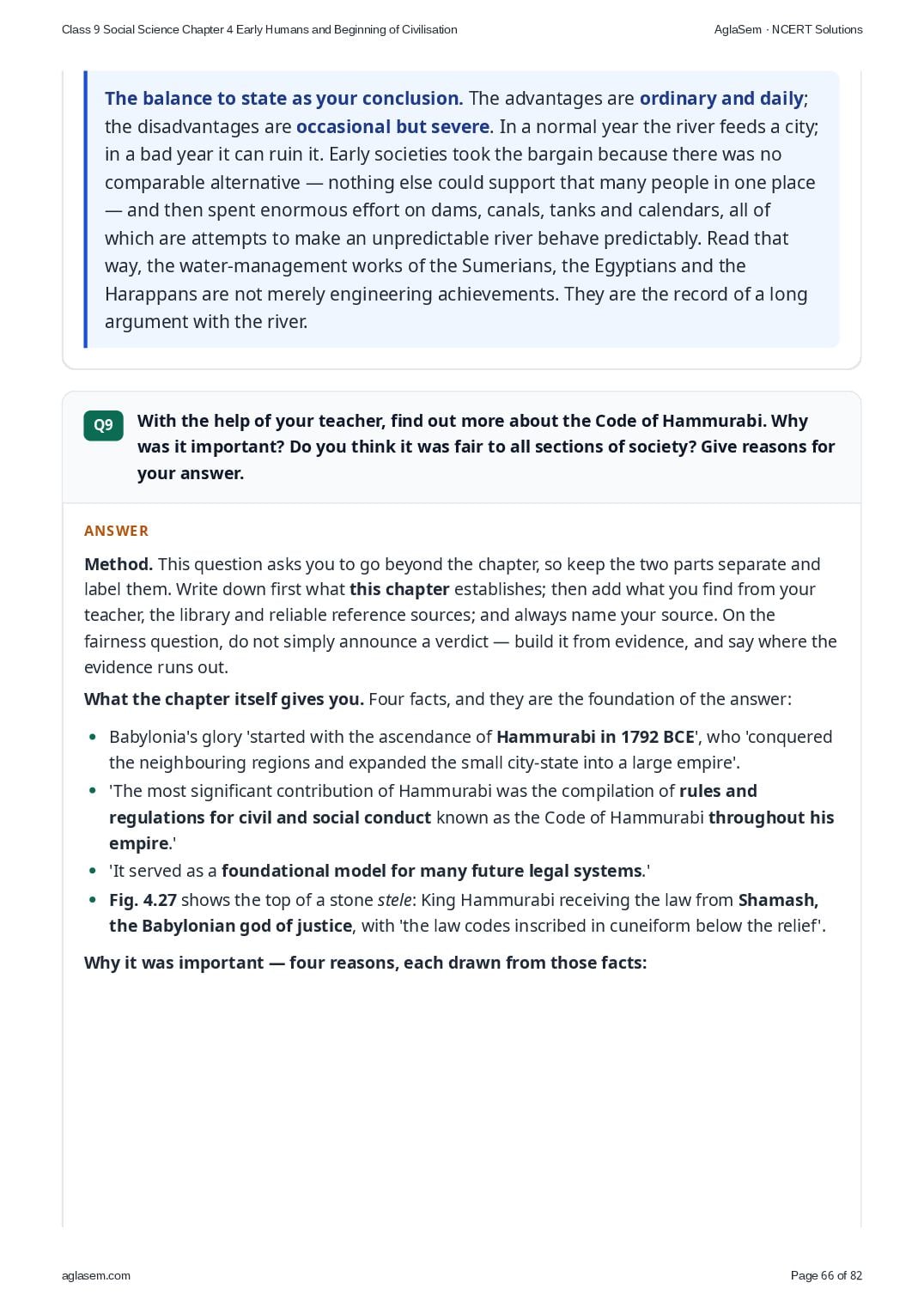
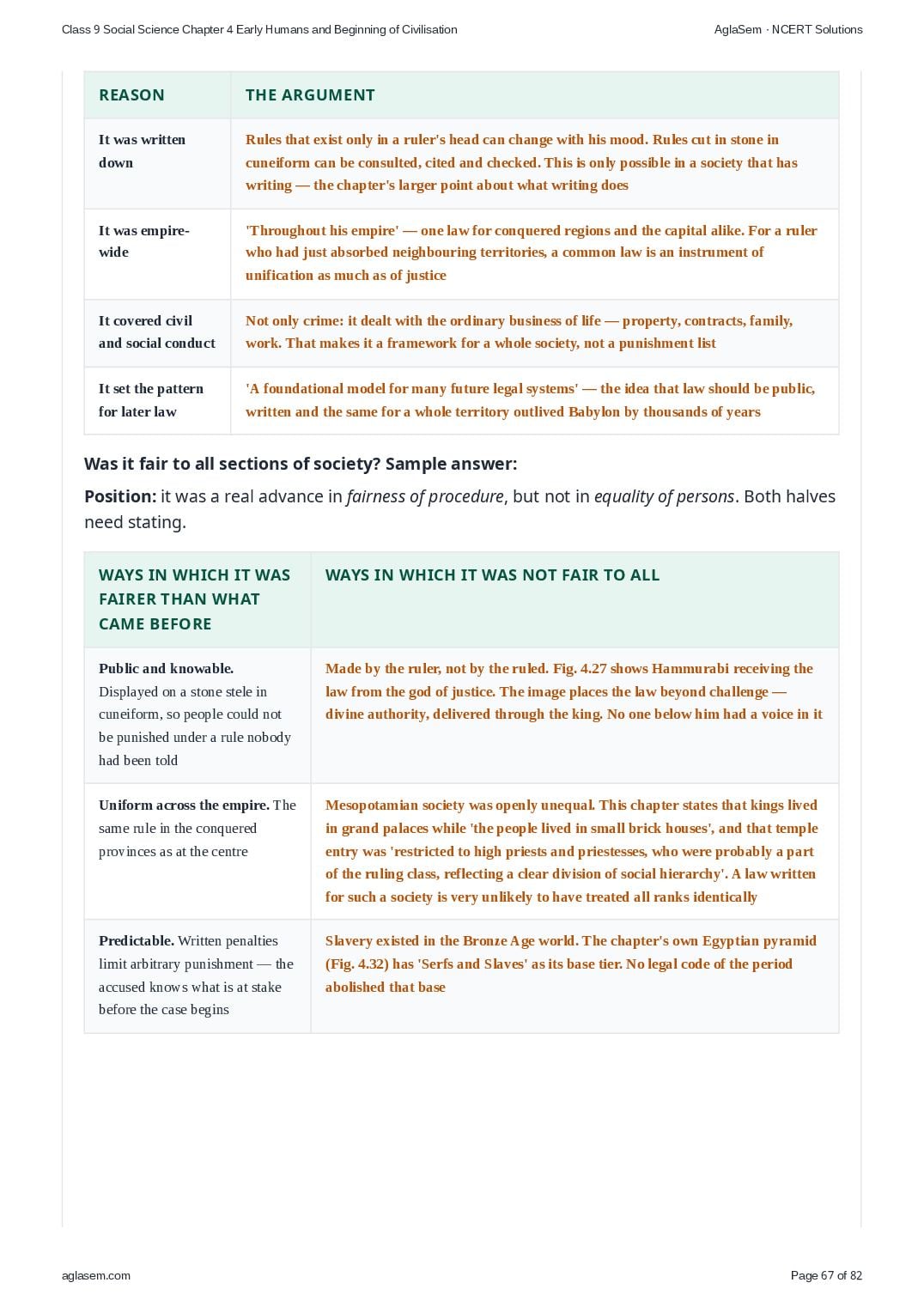
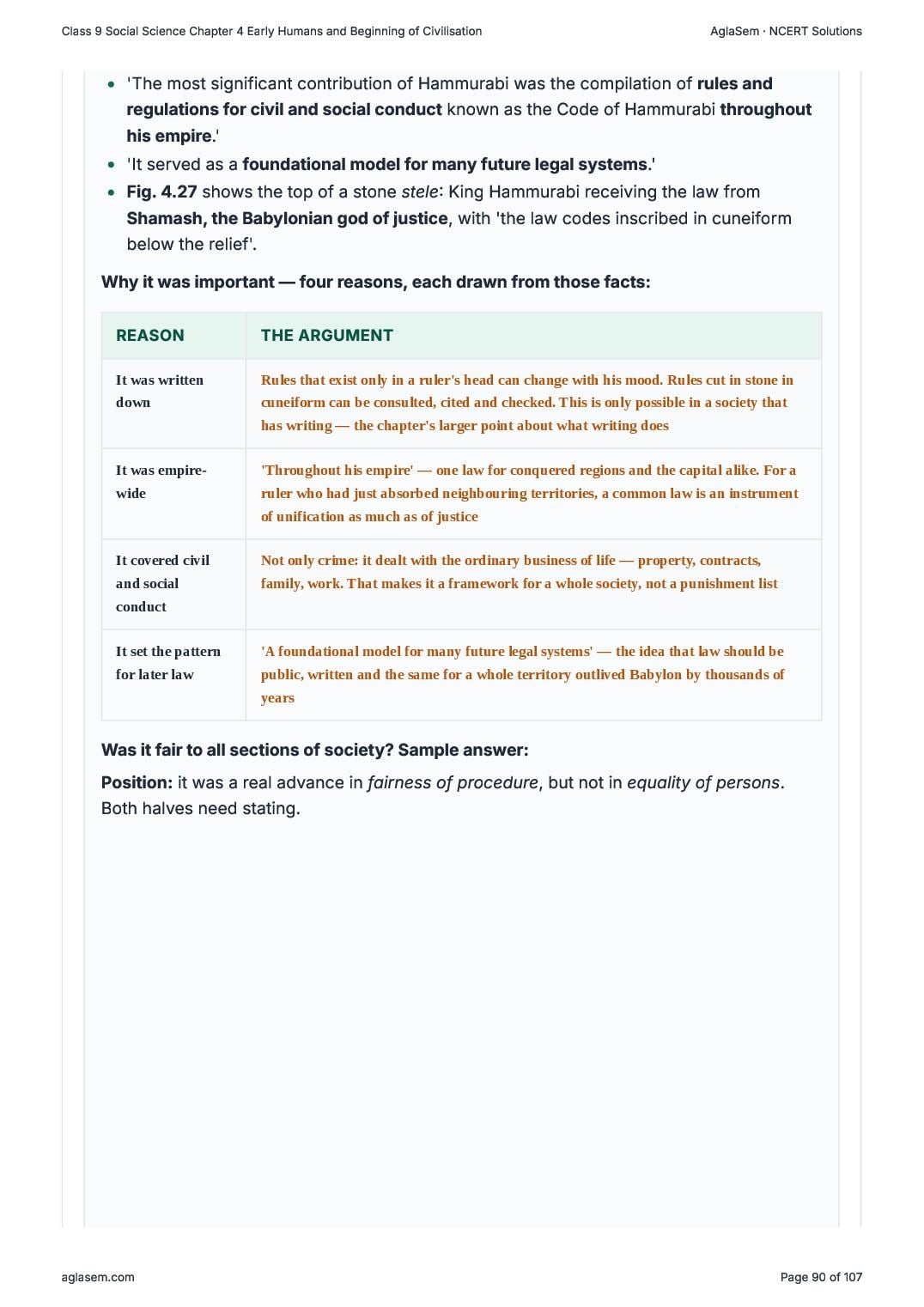
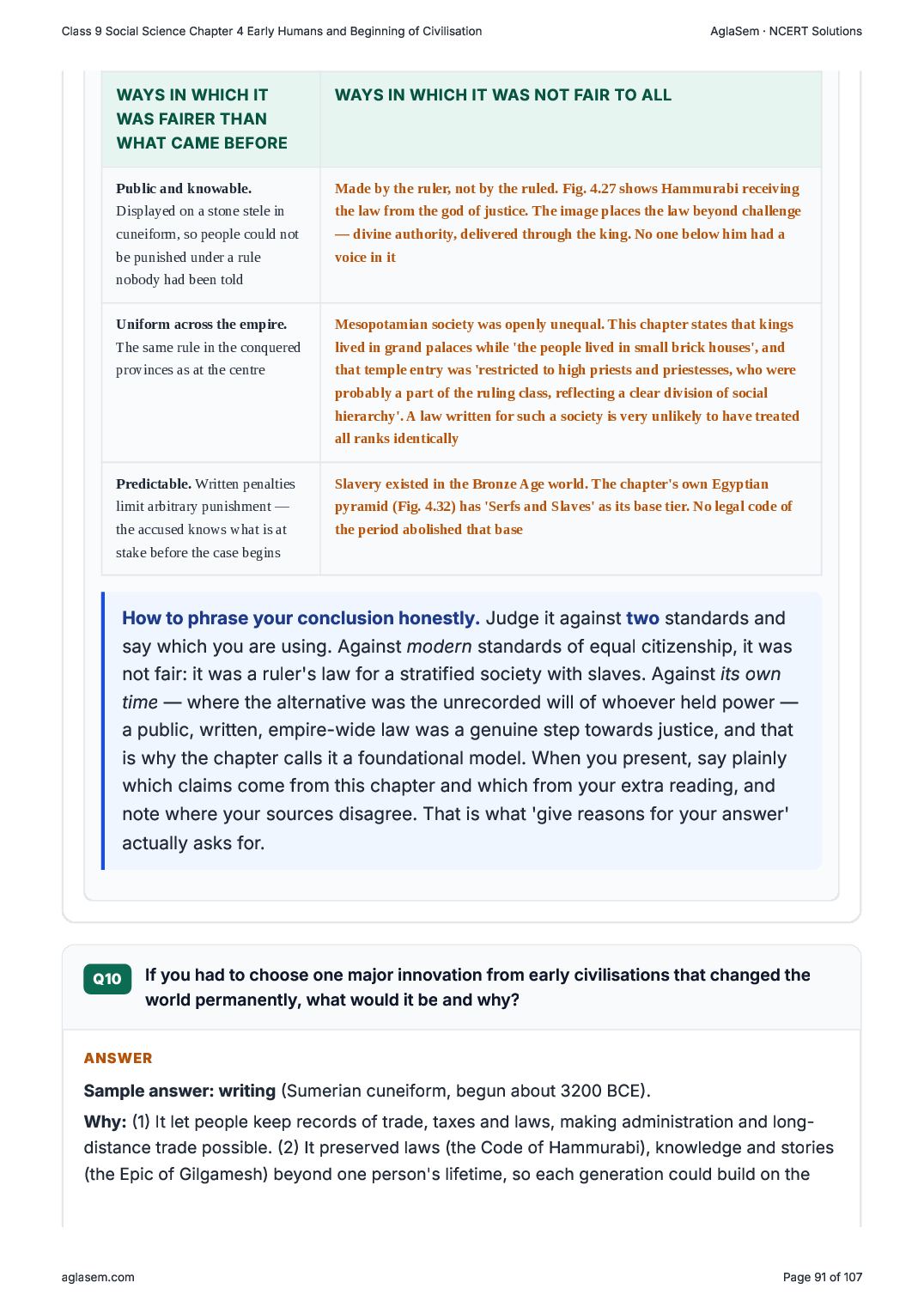
- With the help of your teacher, find out more about the Code of Hammurabi. Why was it important? Do you think it was fair to all sections of society? Give reasons for your answer.
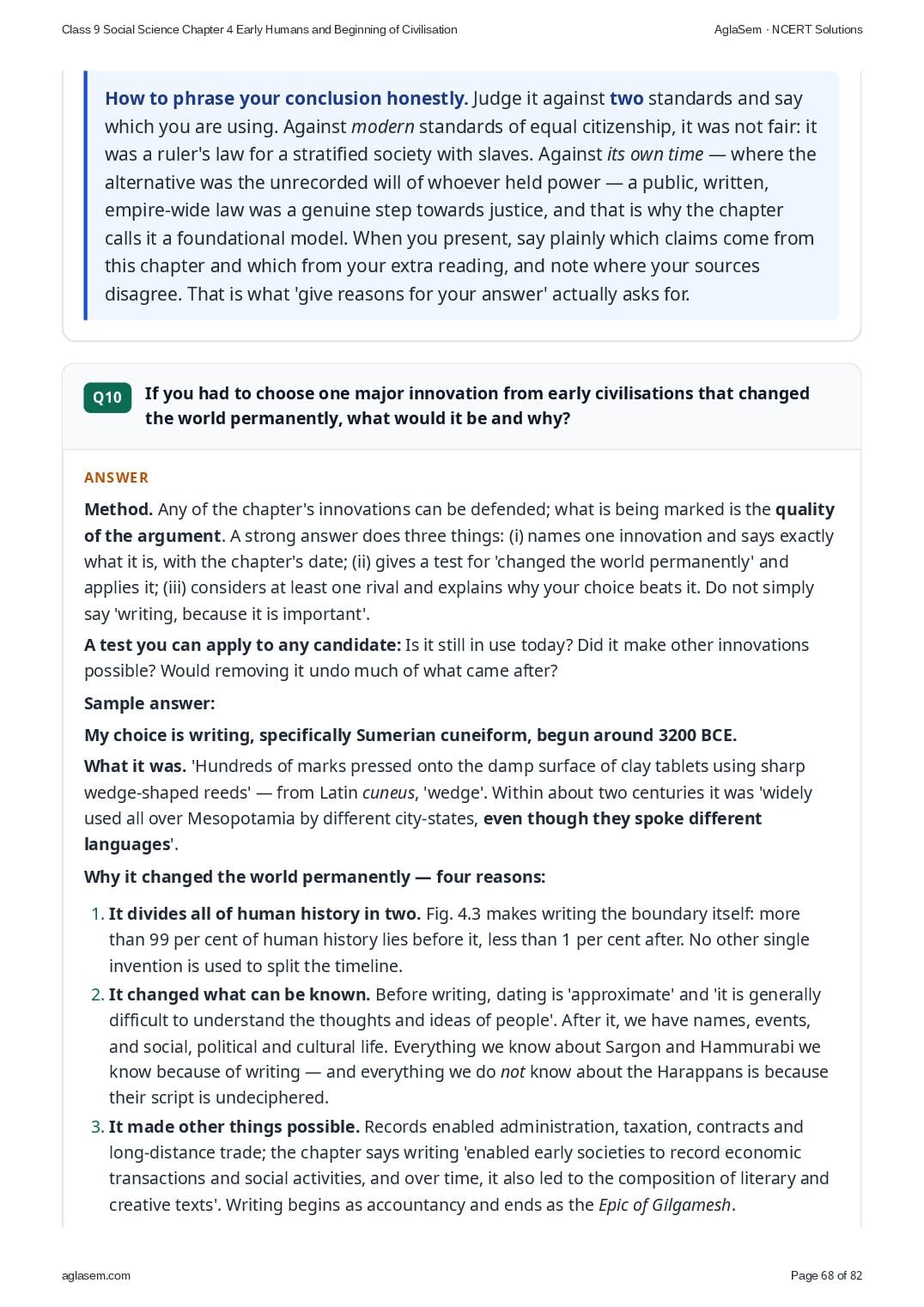
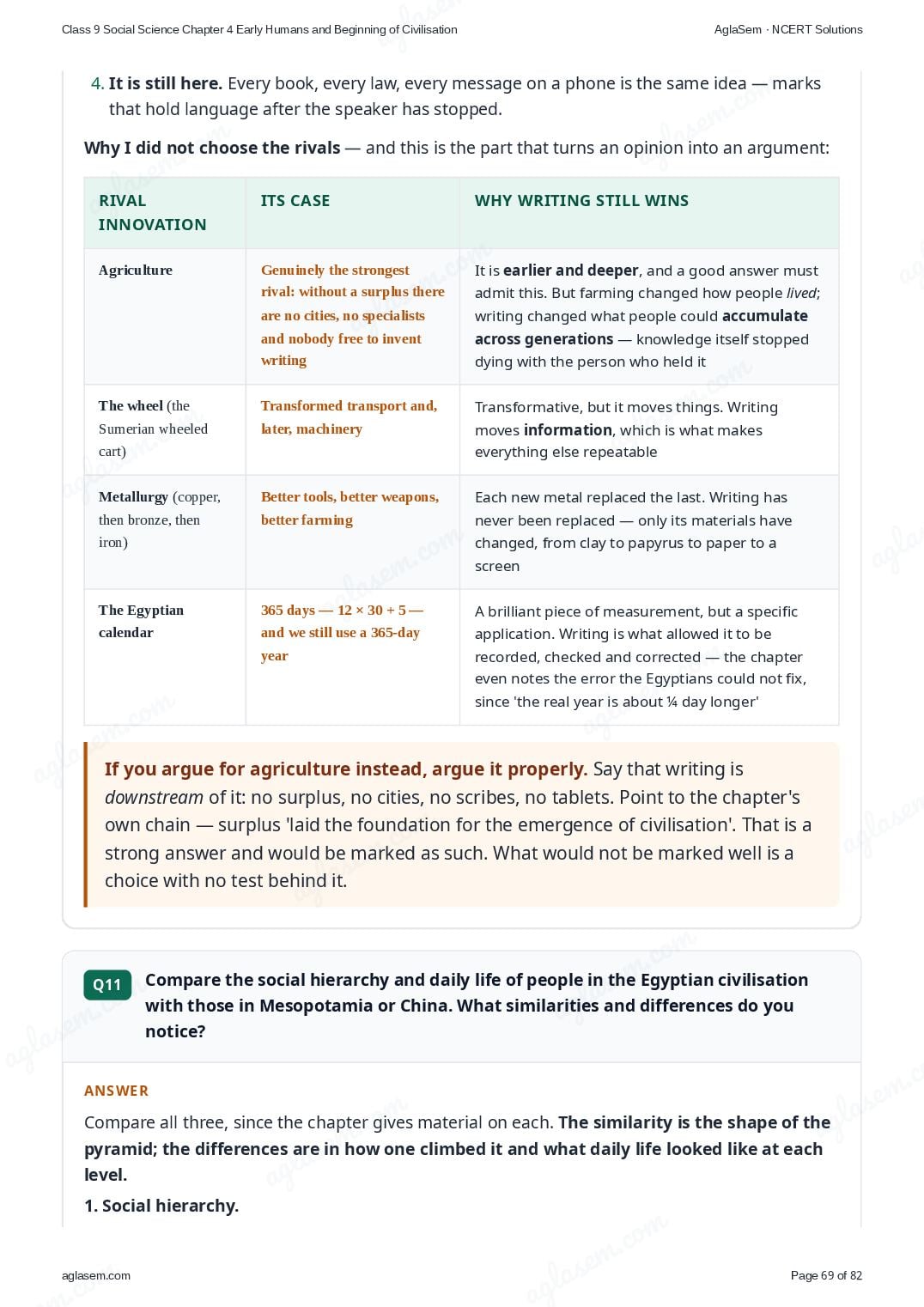
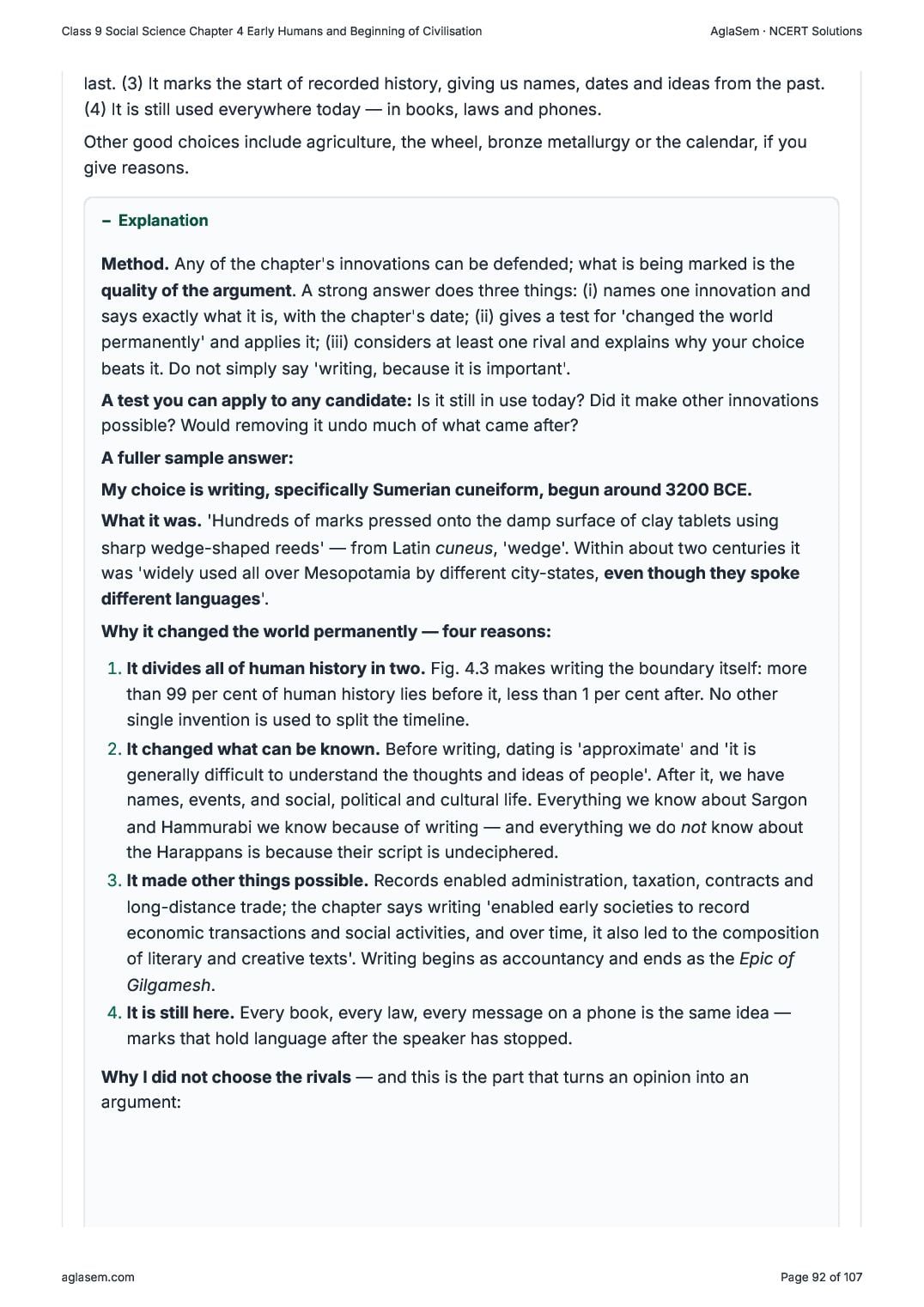
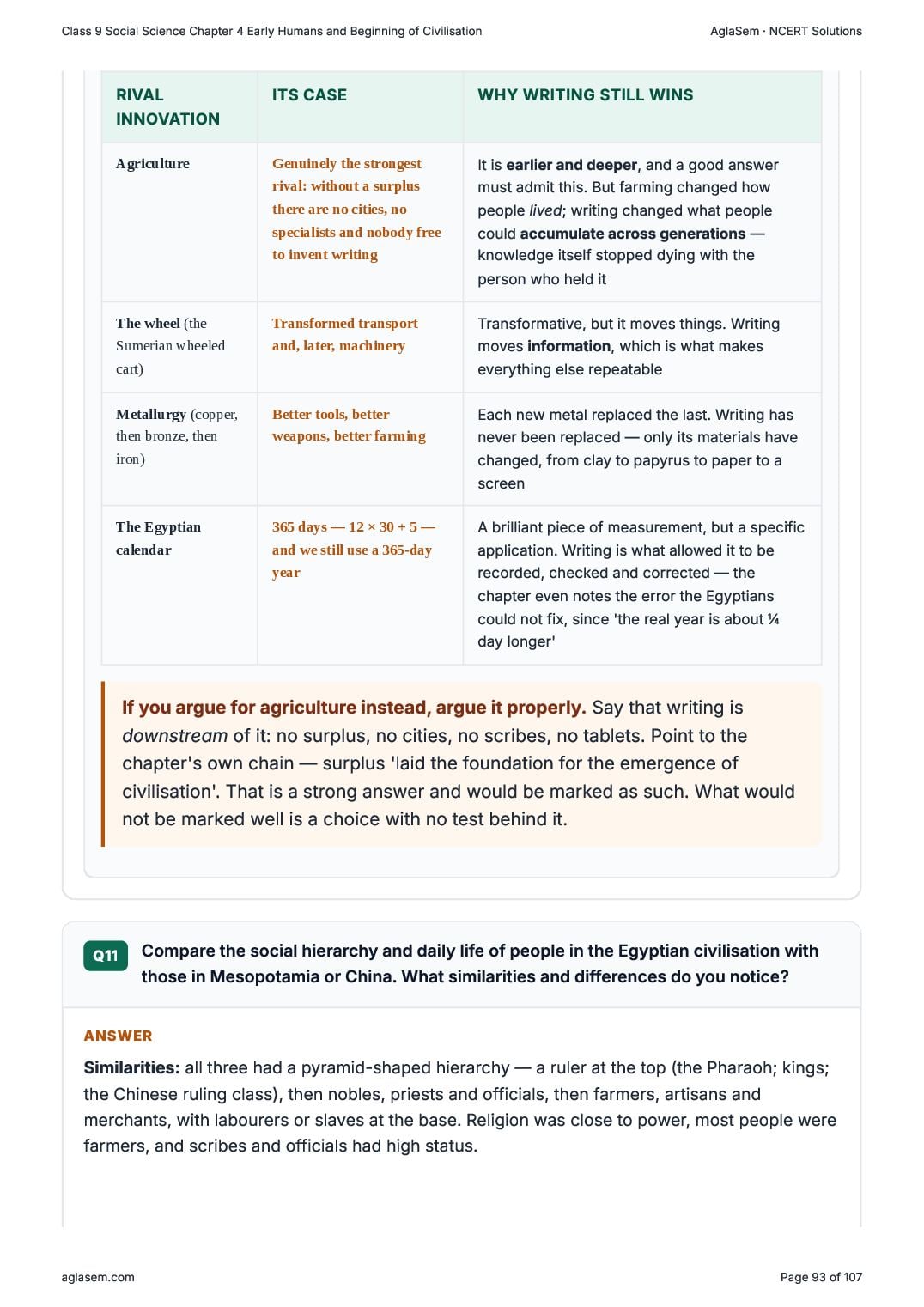
- If you had to choose one major innovation from early civilisations that changed the world permanently, what would it be and why?
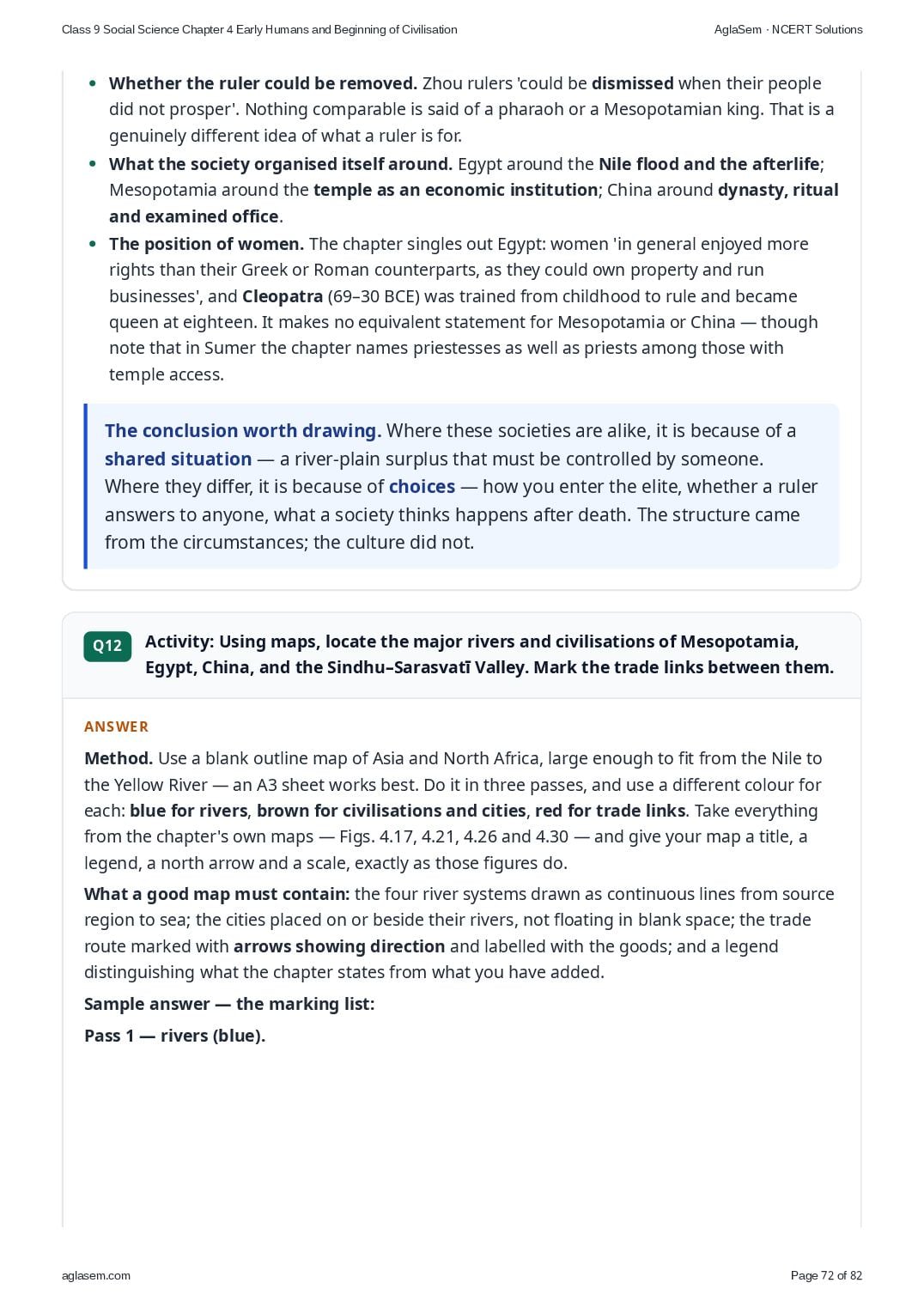
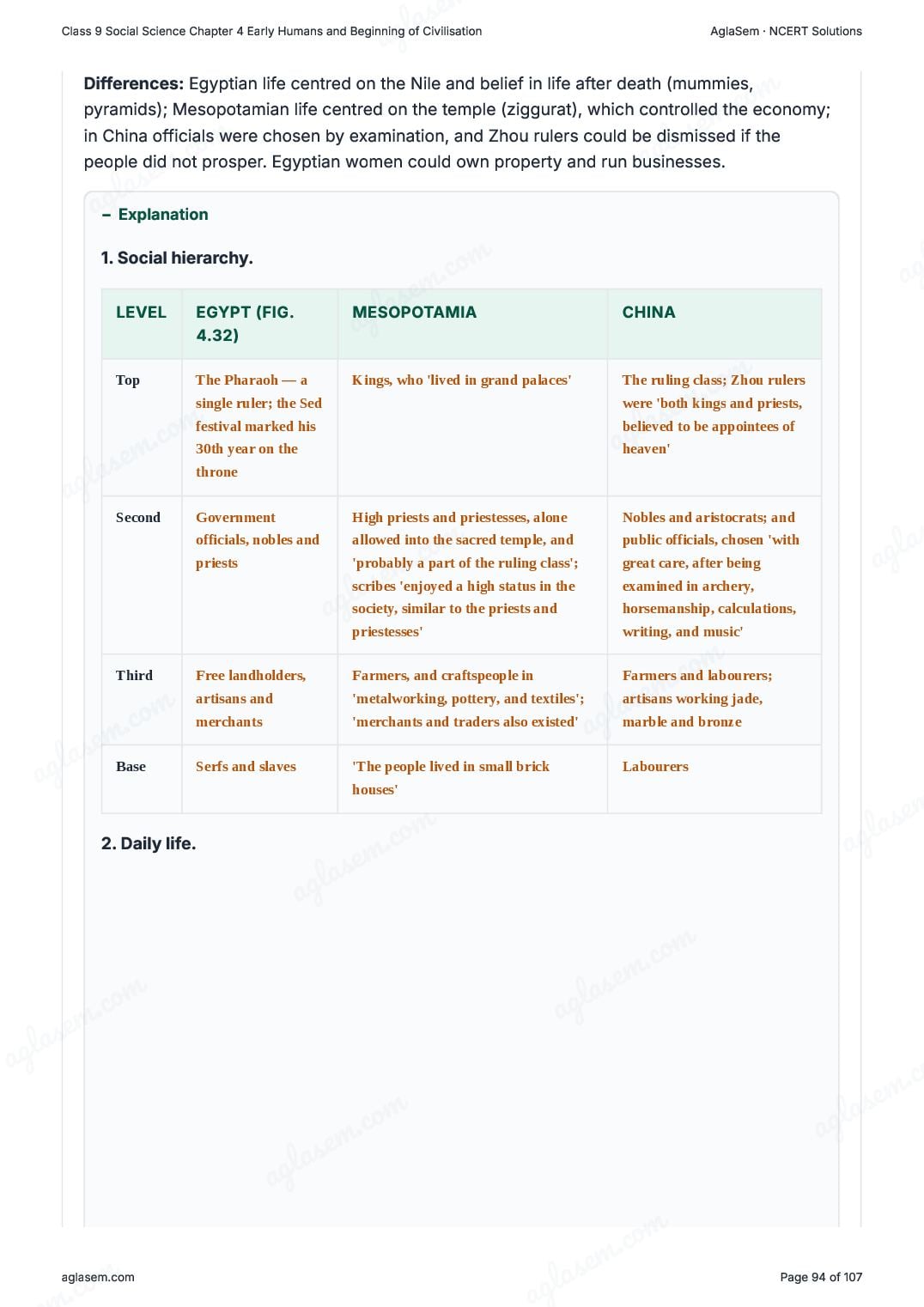
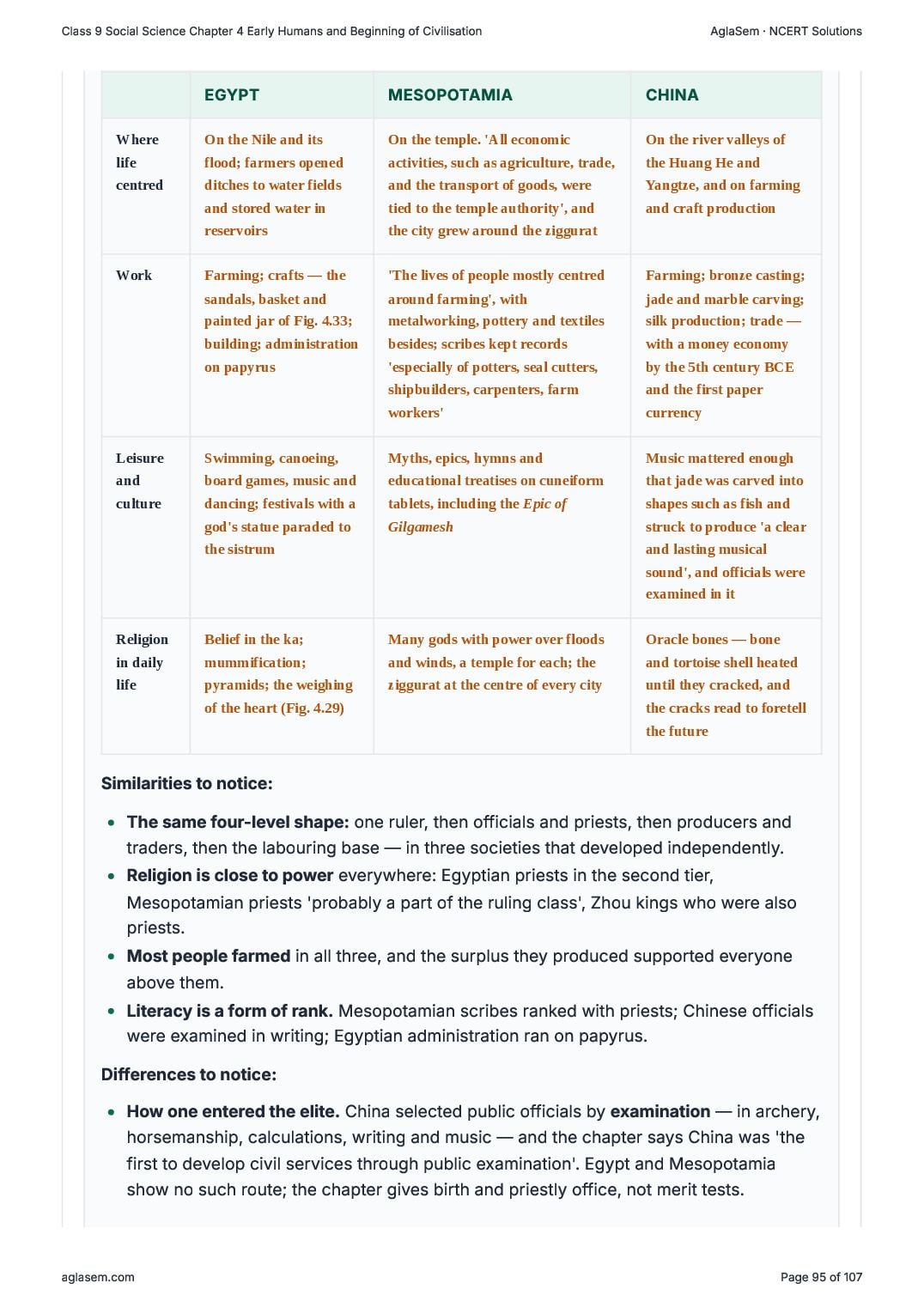
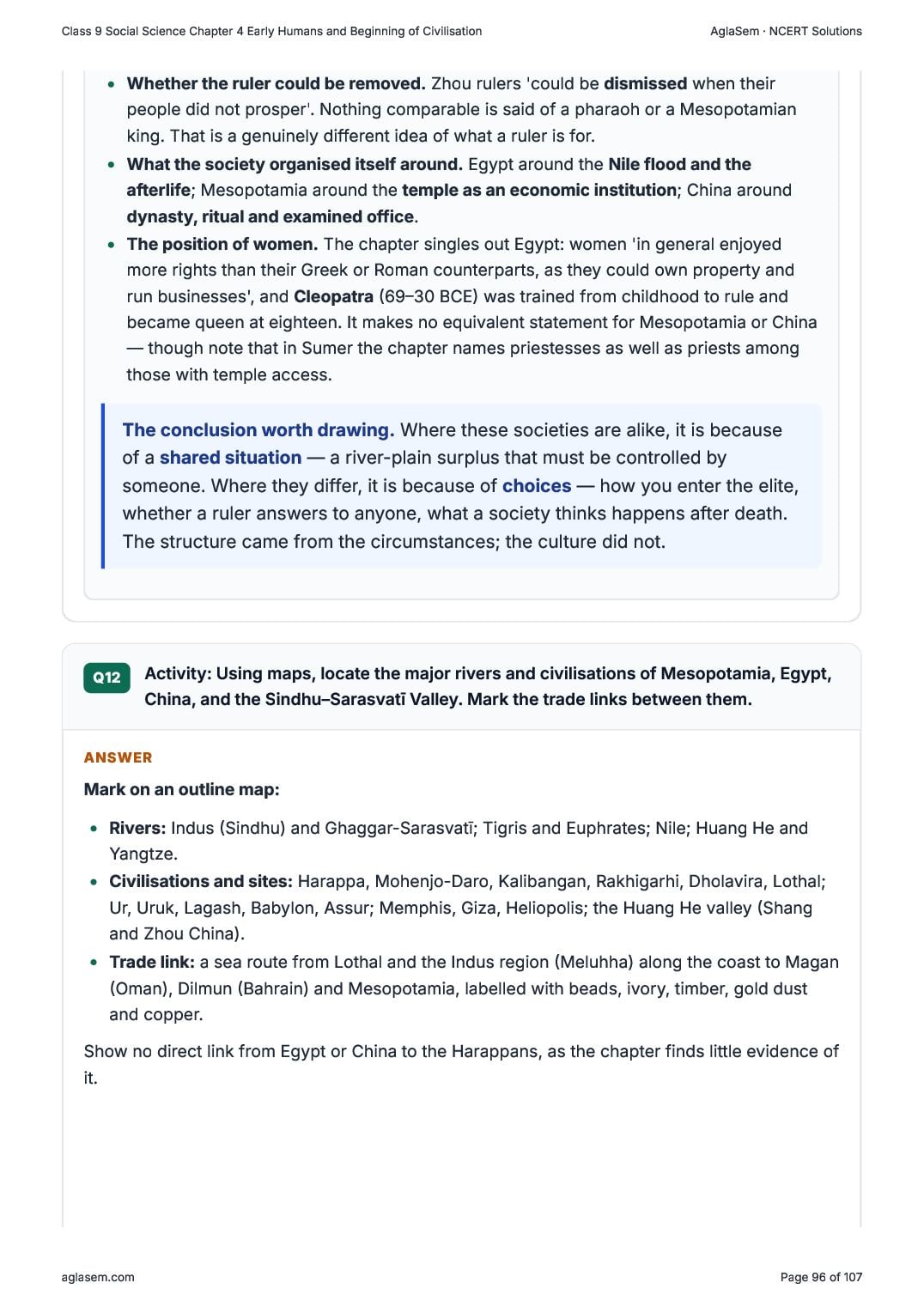
- Compare the social hierarchy and daily life of people in the Egyptian civilisation with those in Mesopotamia or China. What similarities and differences do you notice?
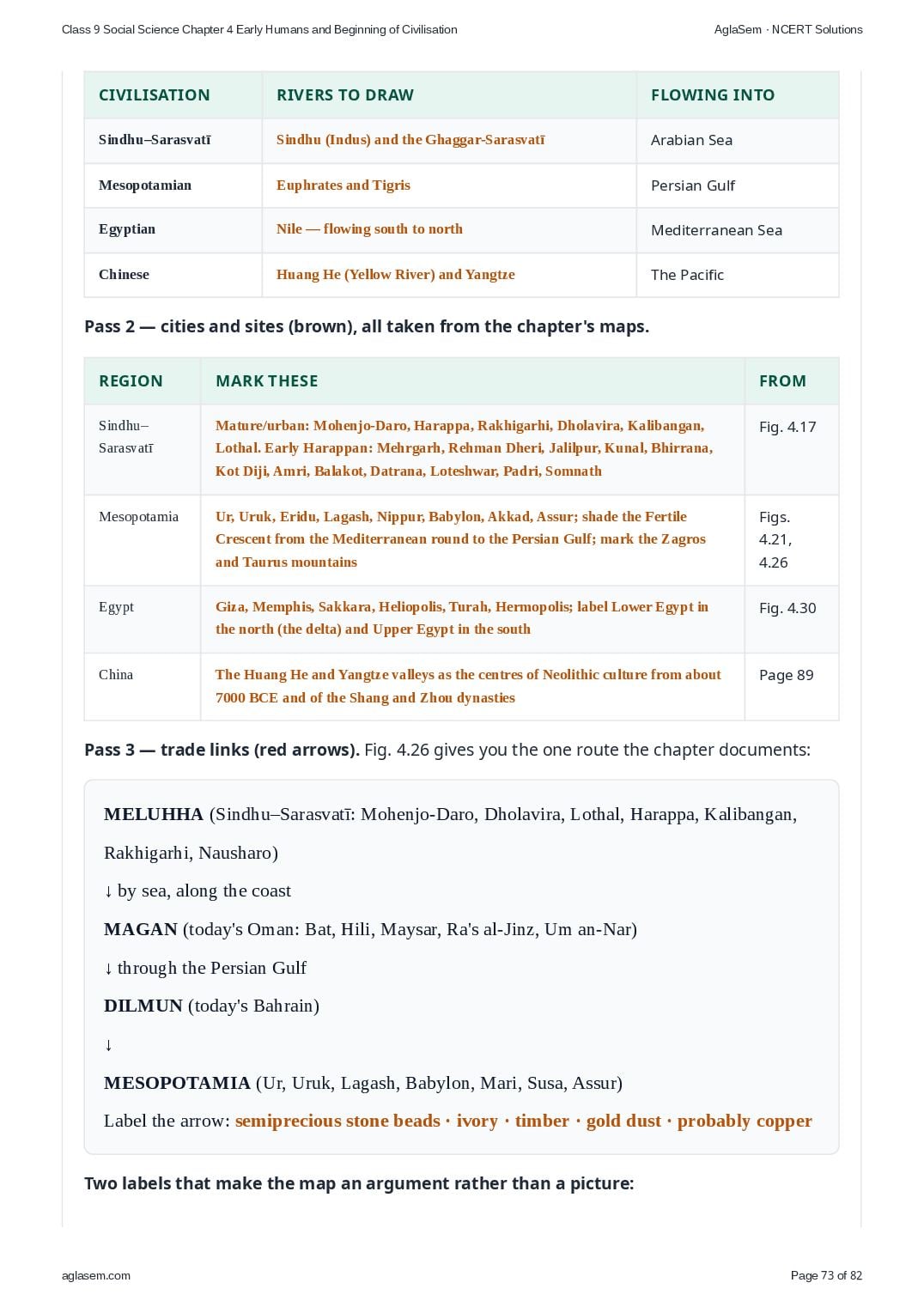
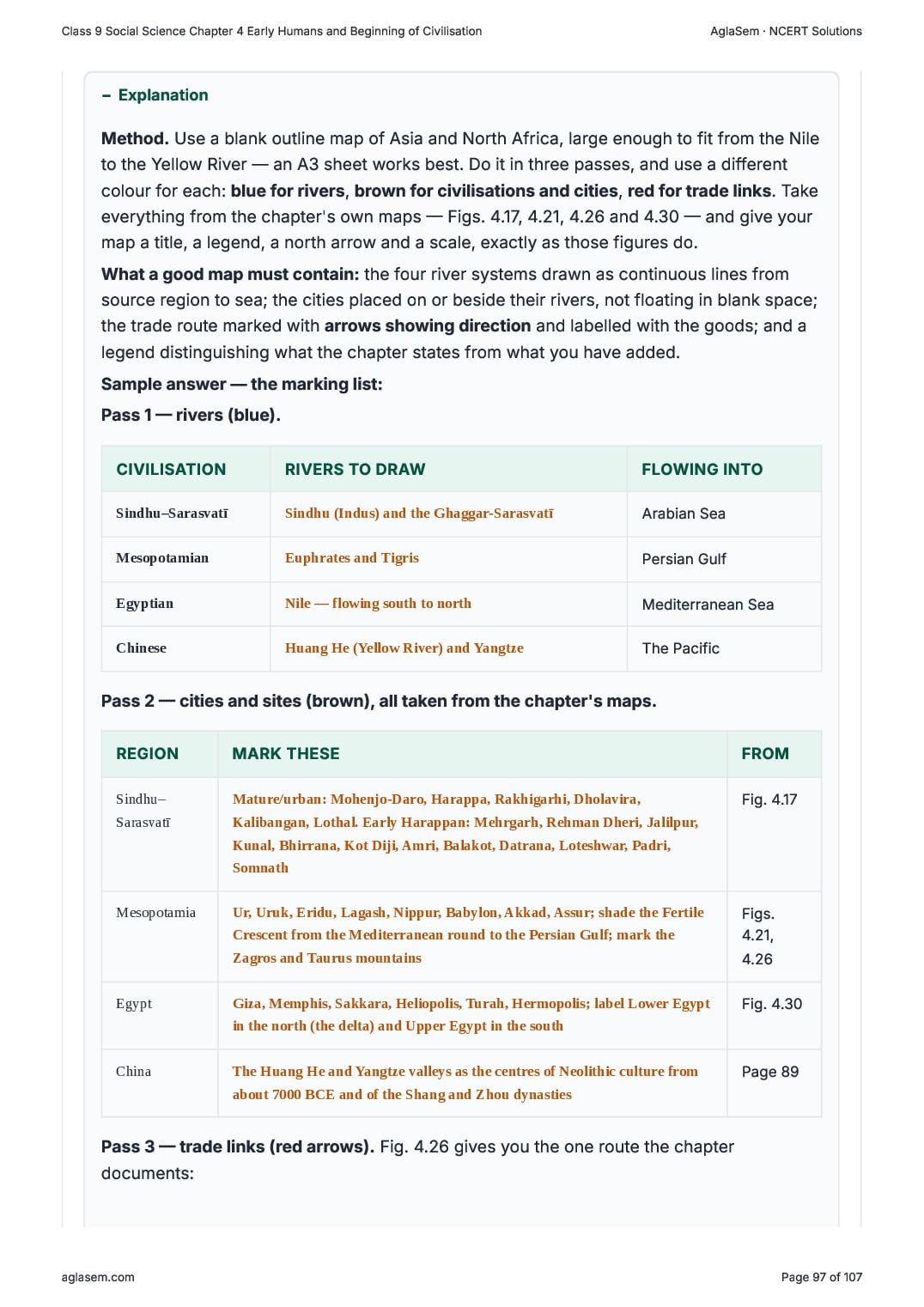
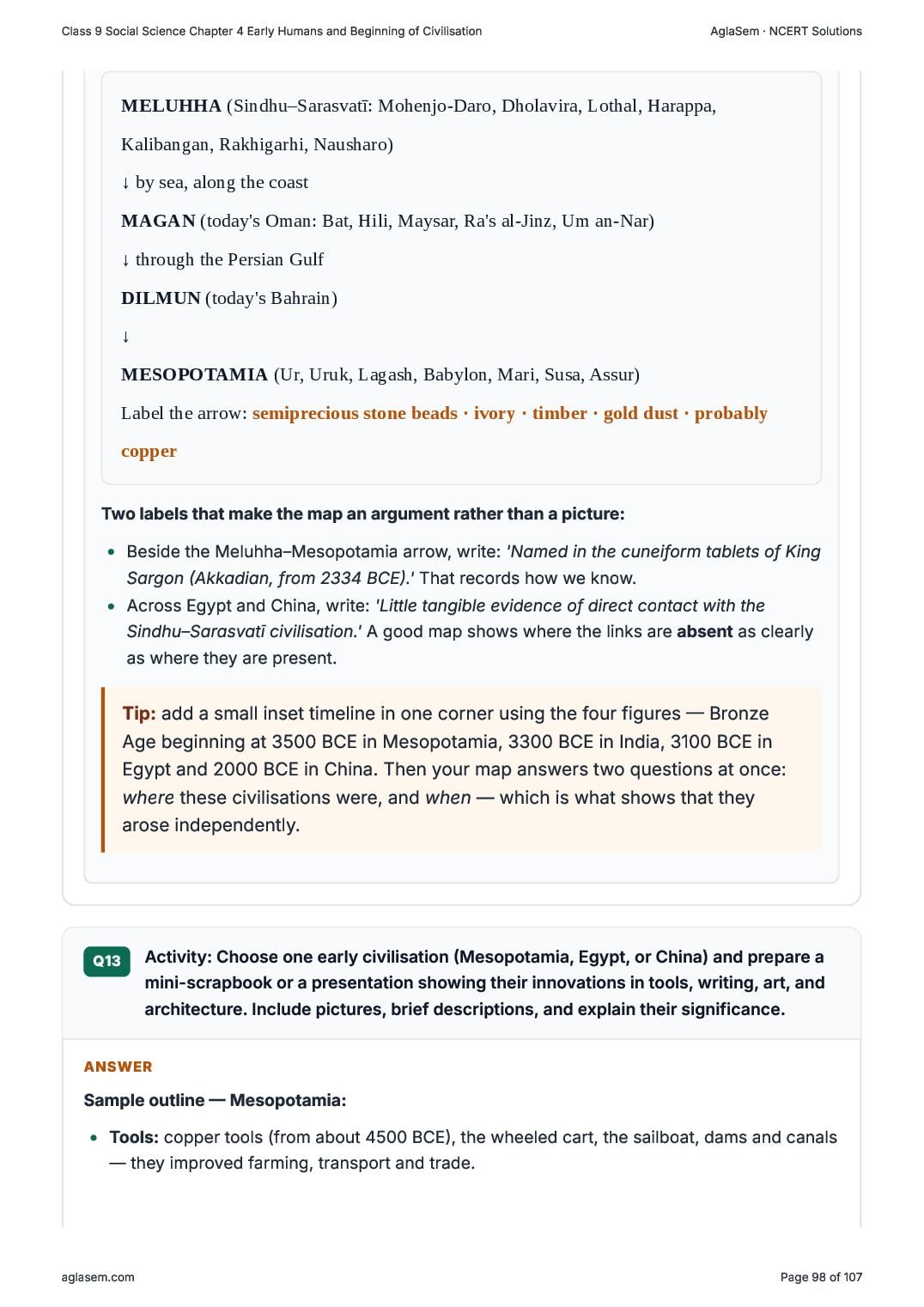
- Activity: Using maps, locate the major rivers and civilisations of Mesopotamia, Egypt, China, and the Sindhu–Sarasvatī Valley. Mark the trade links between them.
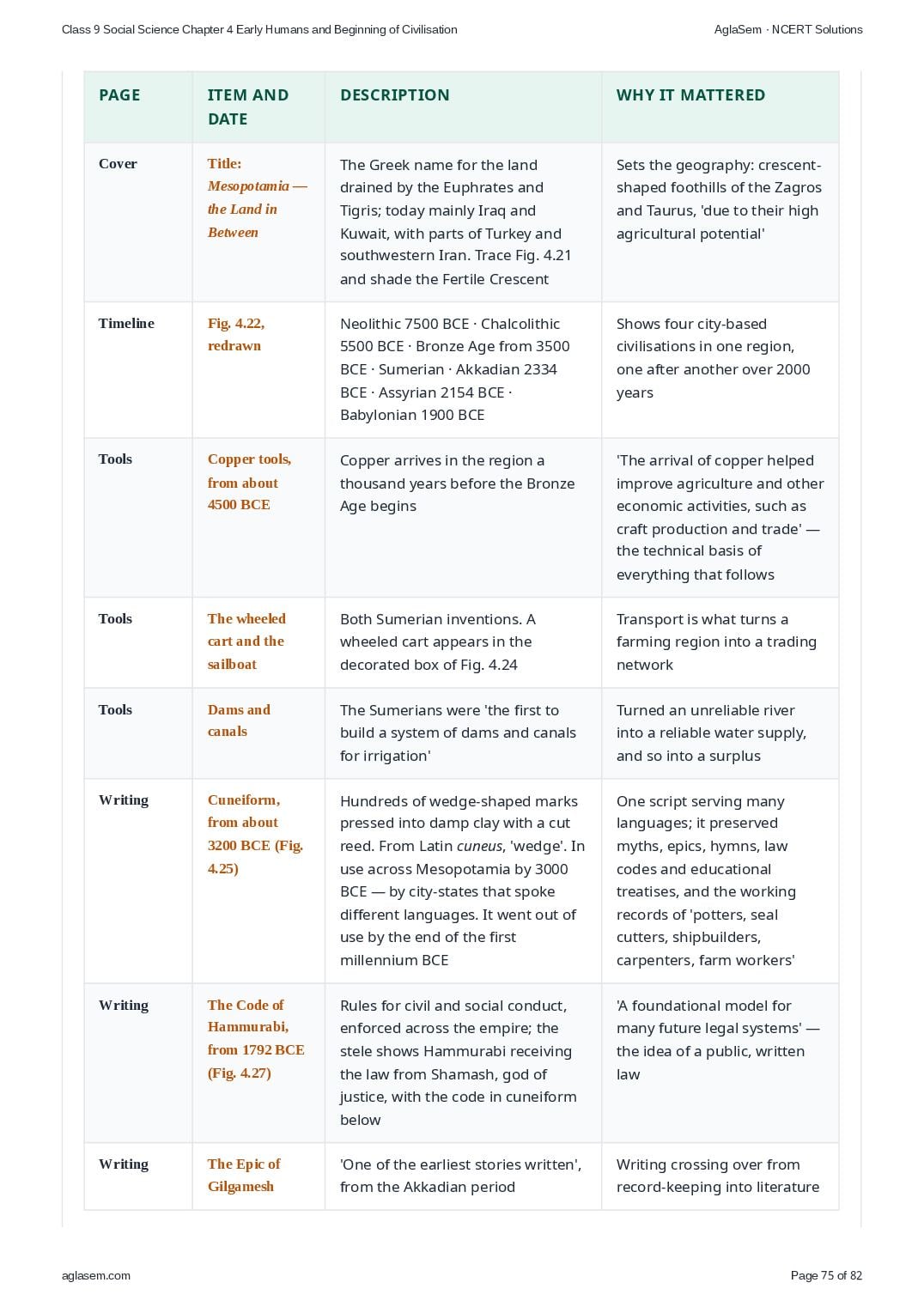
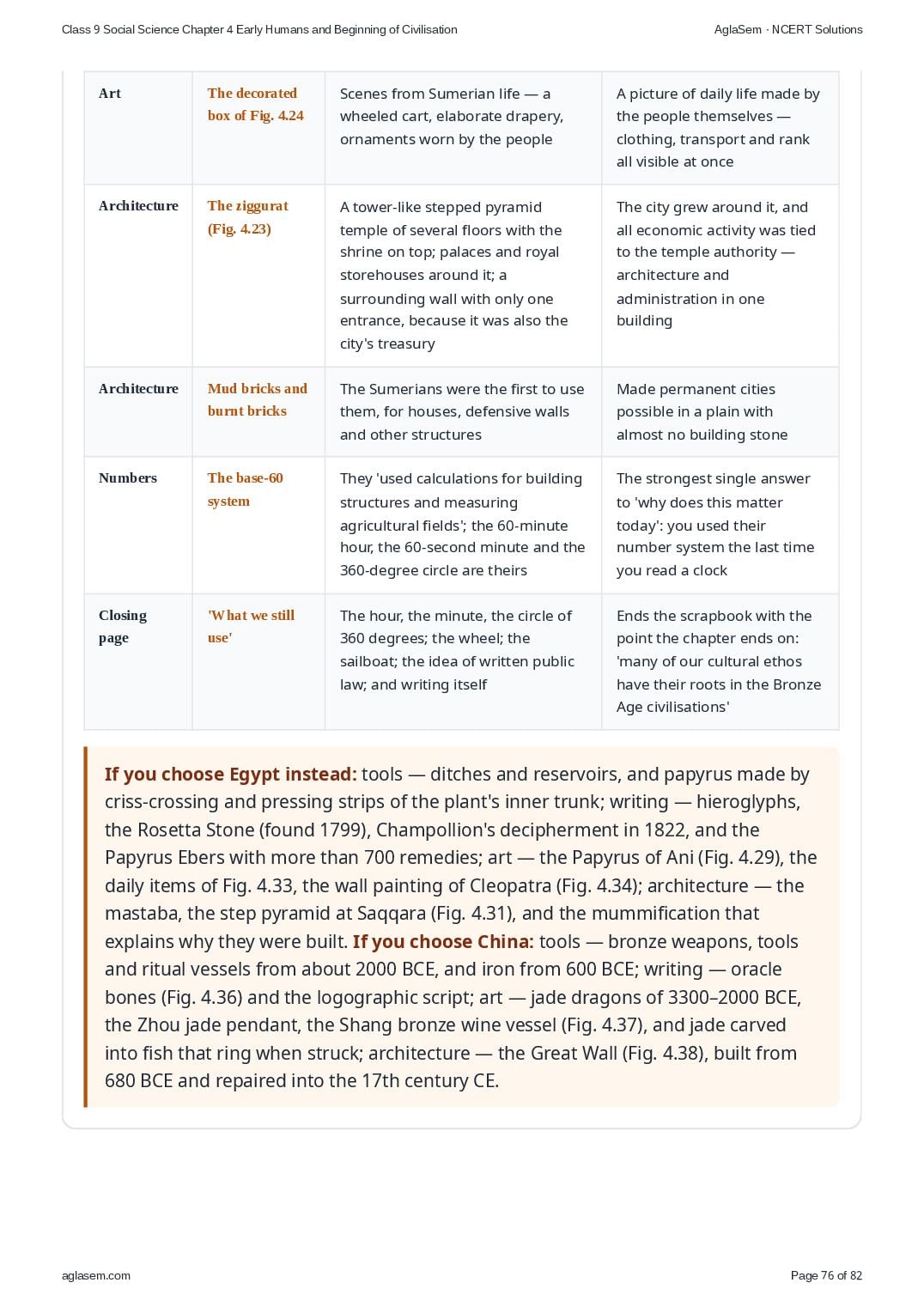
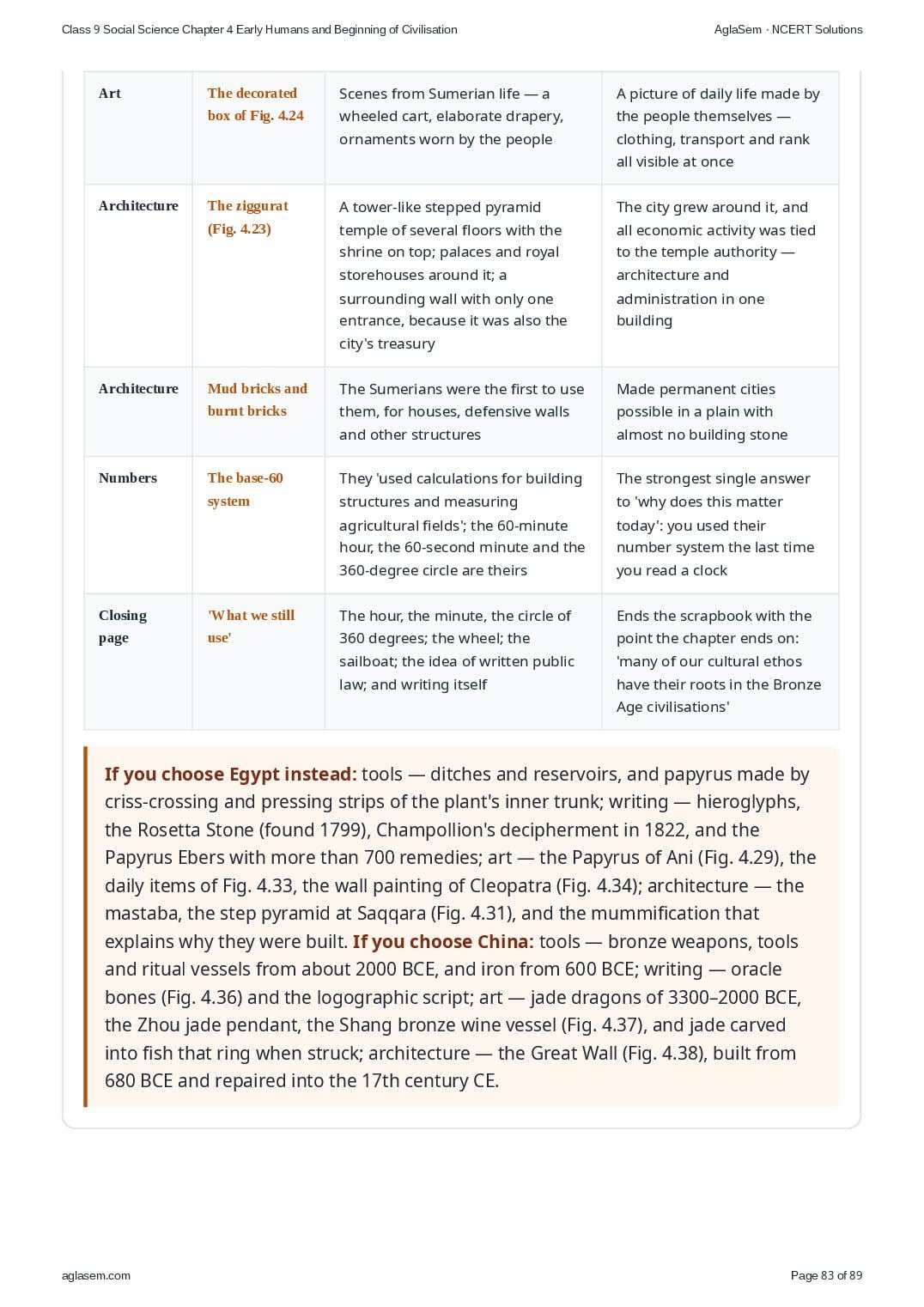
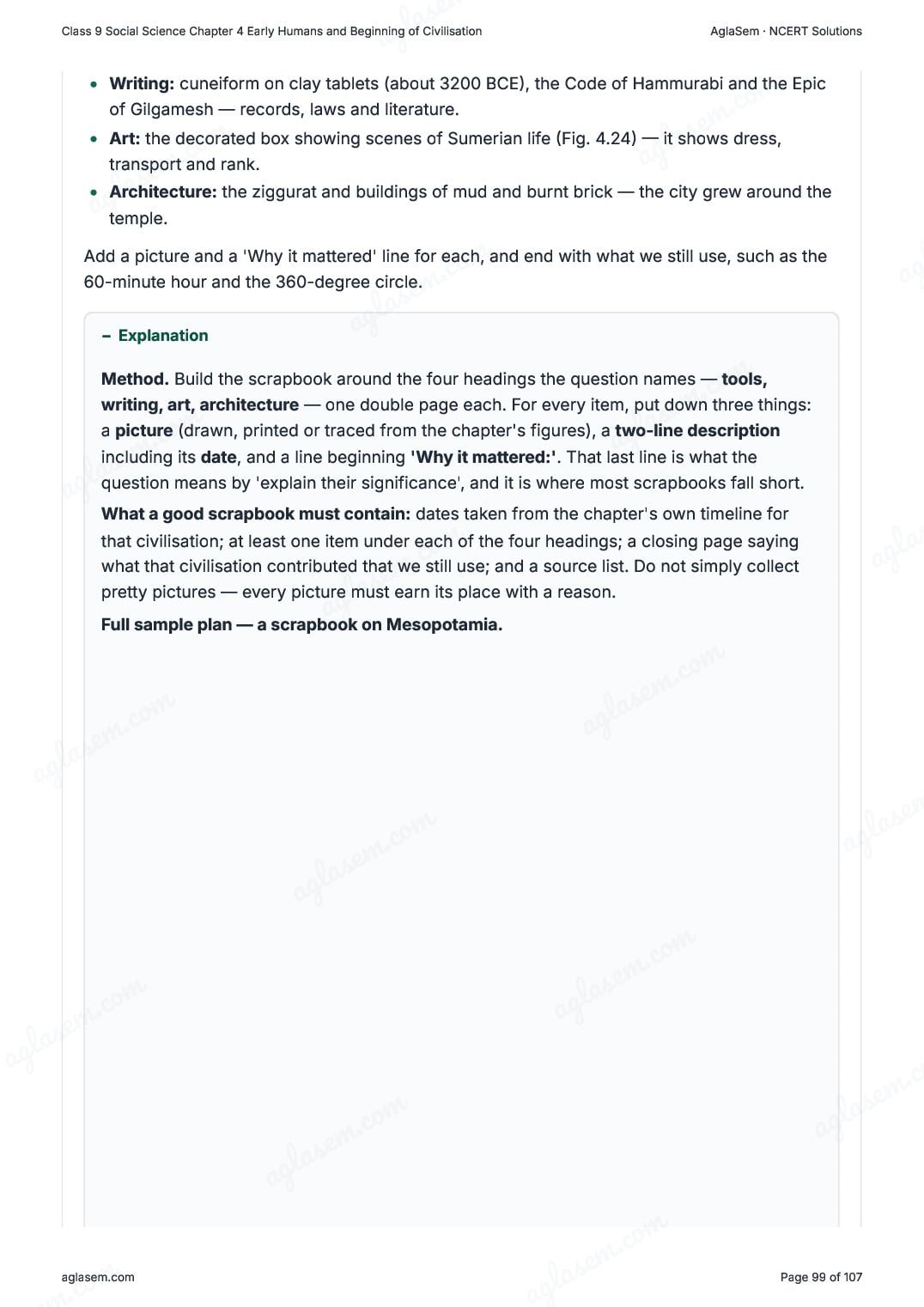
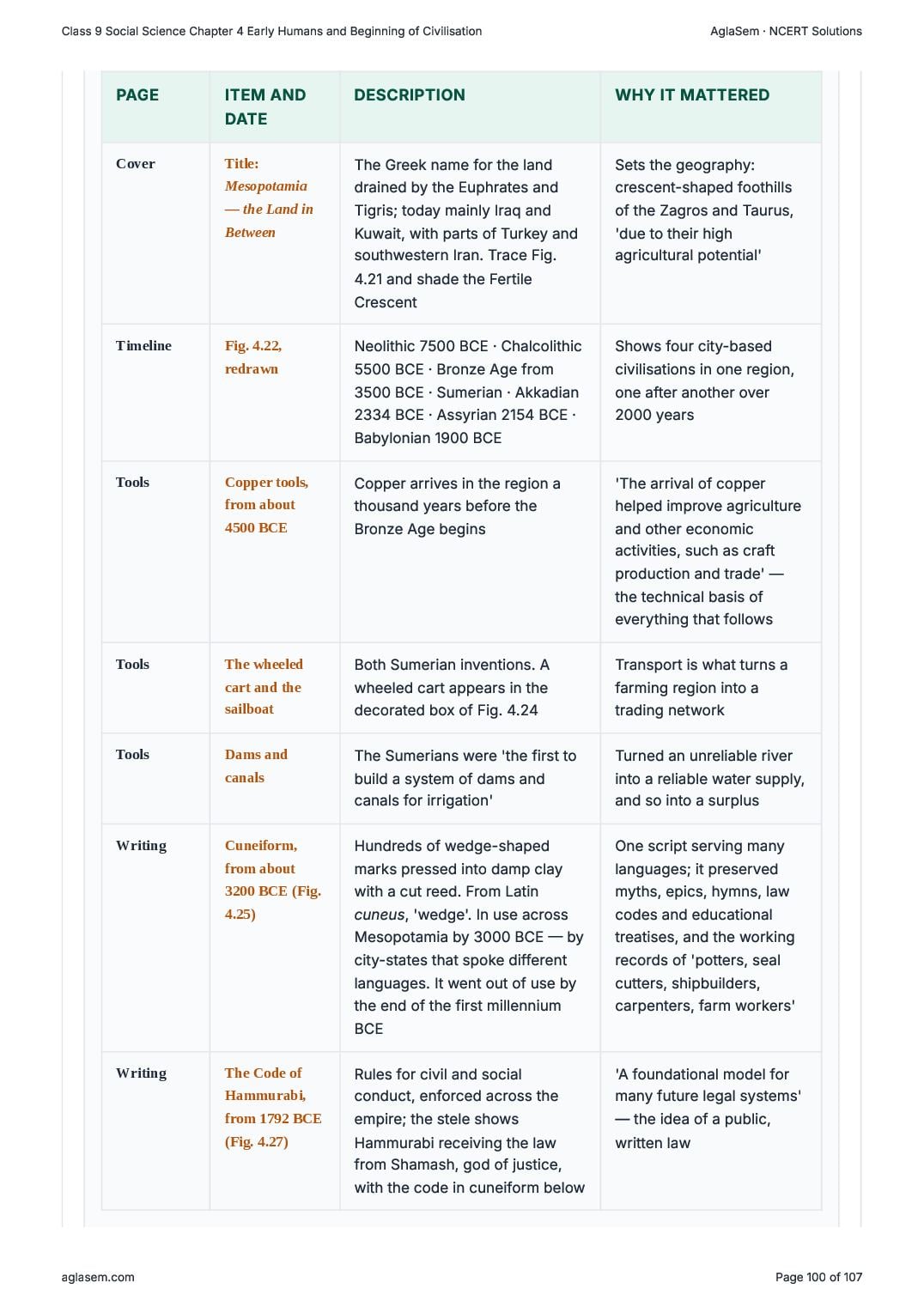
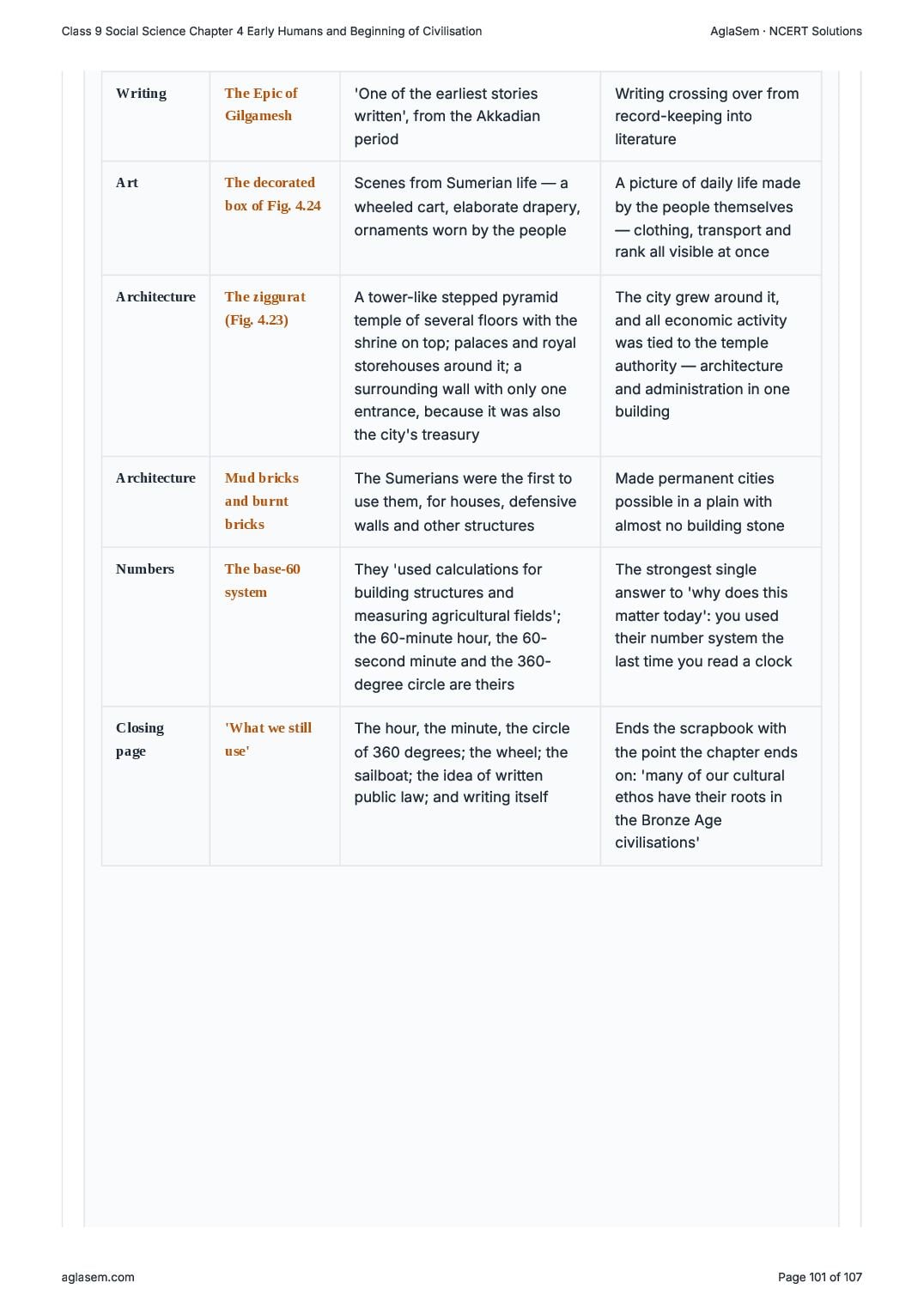
- Activity: Choose one early civilisation (Mesopotamia, Egypt, or China) and prepare a mini-scrapbook or a presentation showing their innovations in tools, writing, art, and architecture. Include pictures, brief descriptions, and explain their significance.
Chapter at a Glance
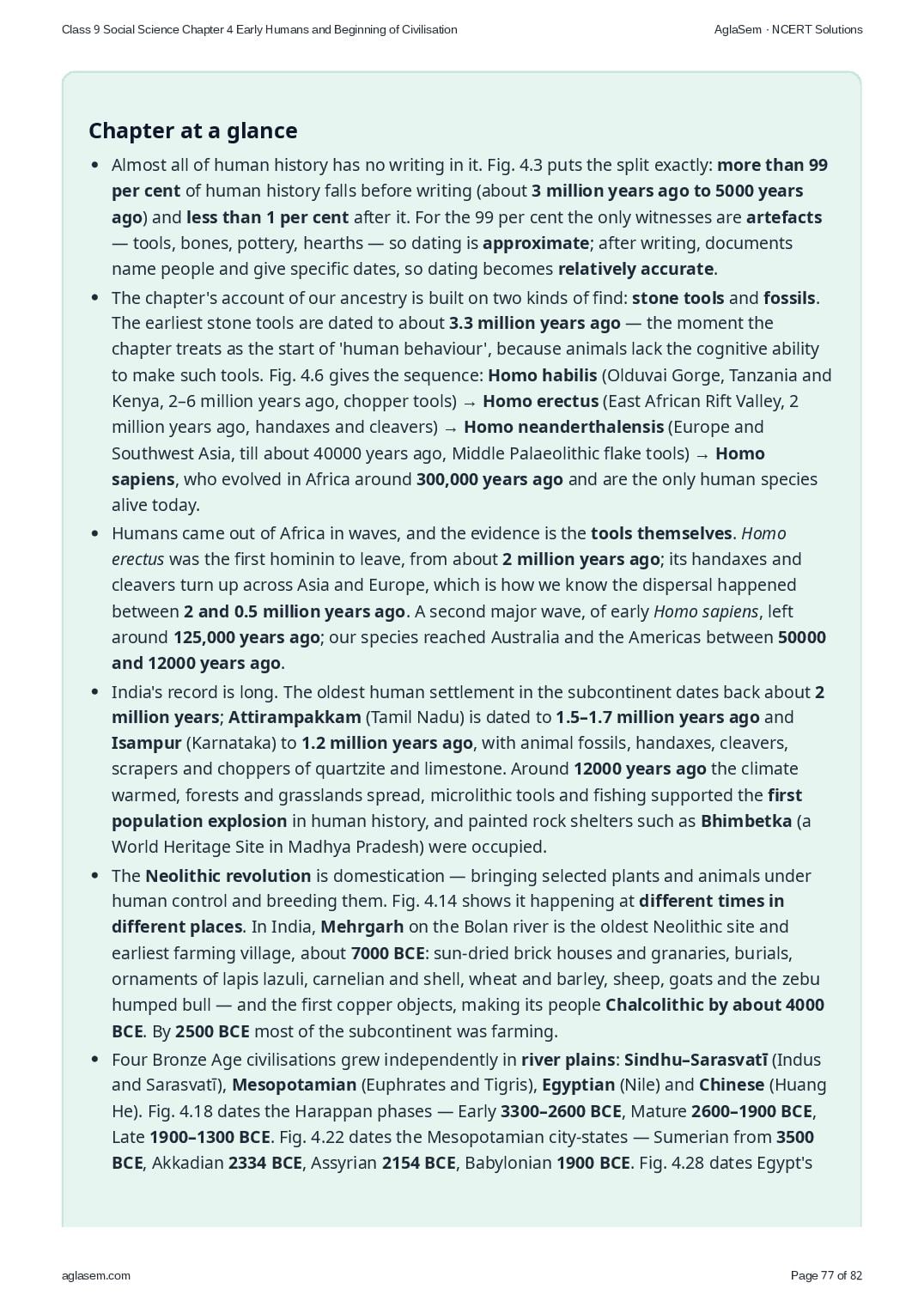
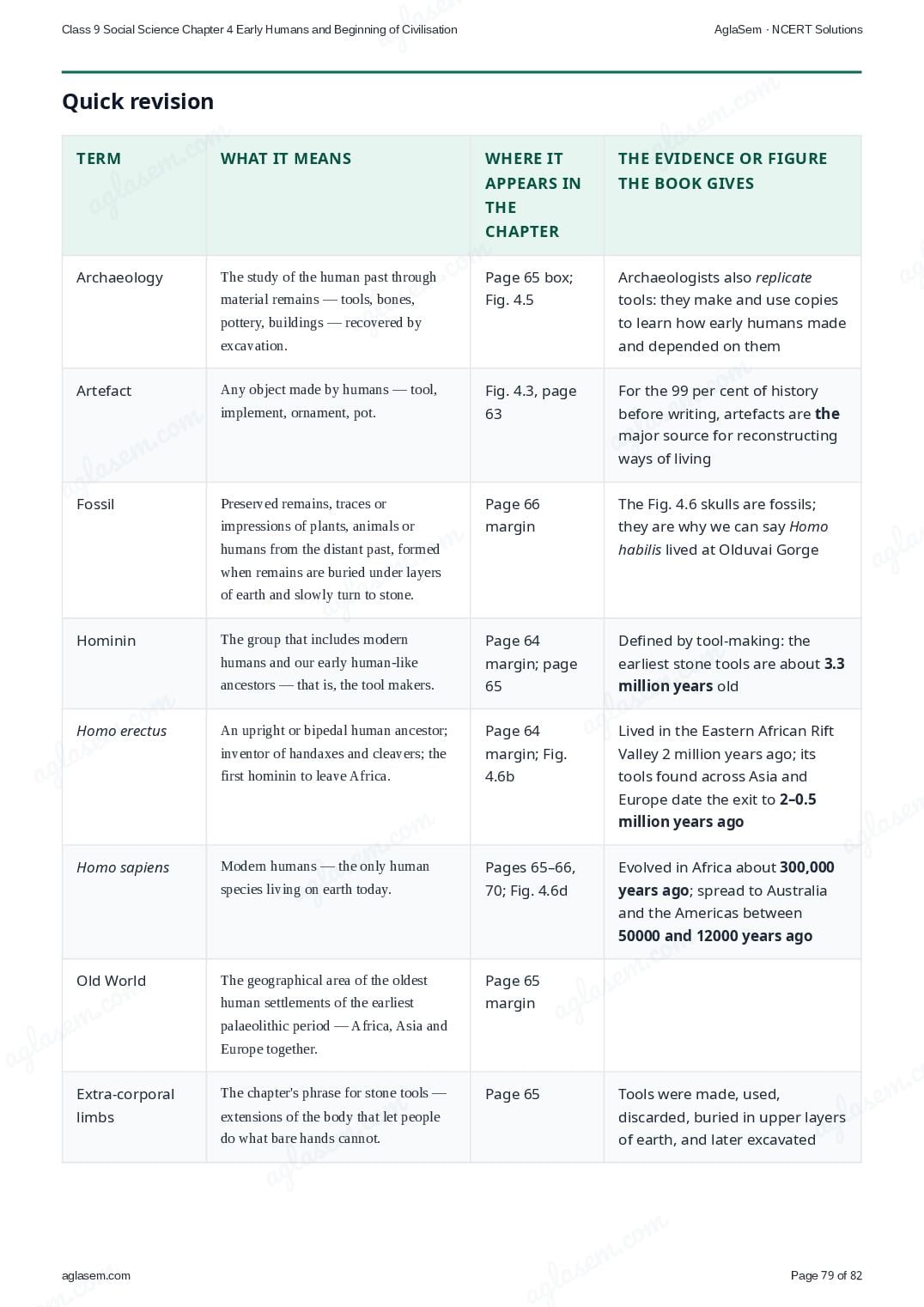
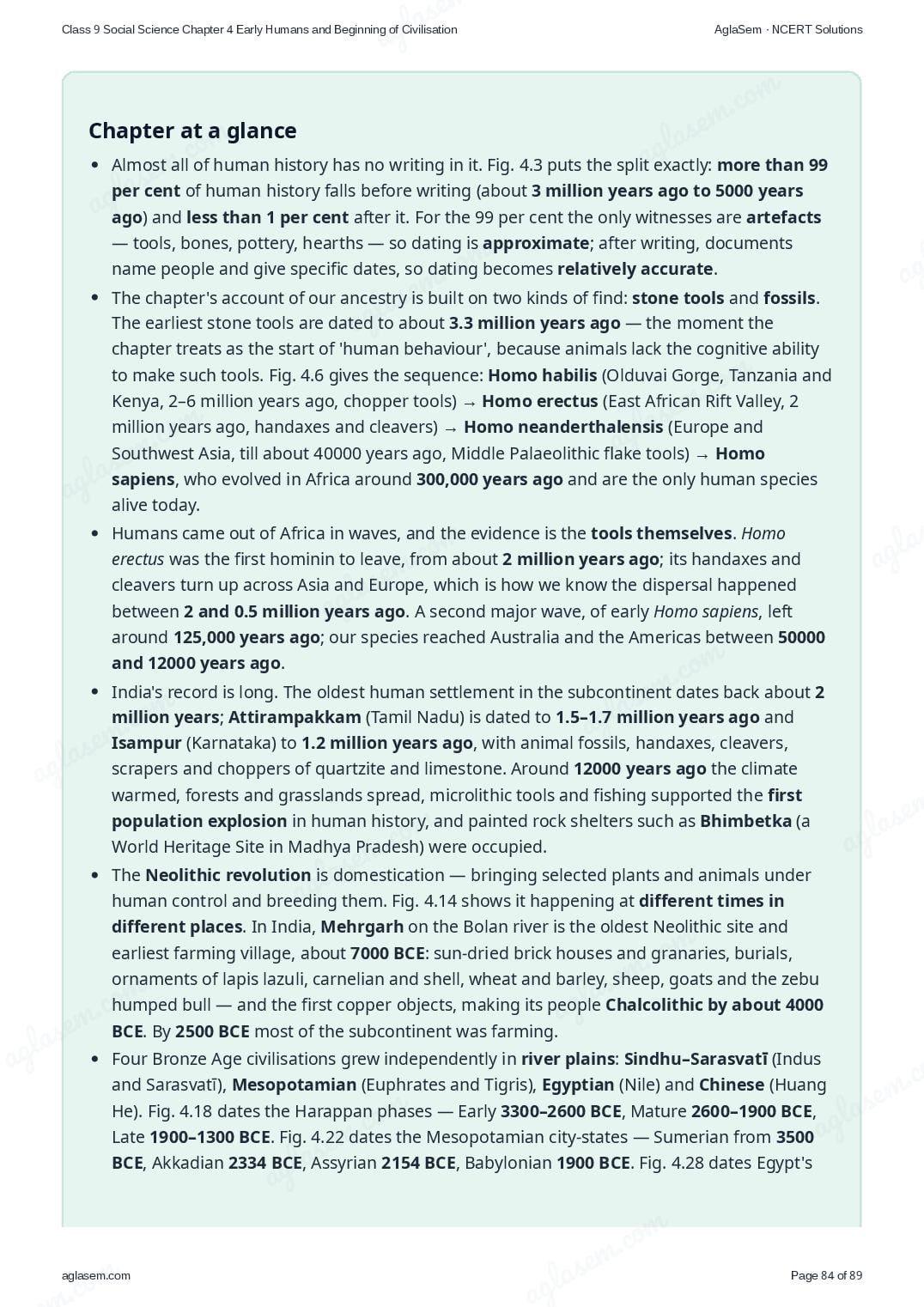
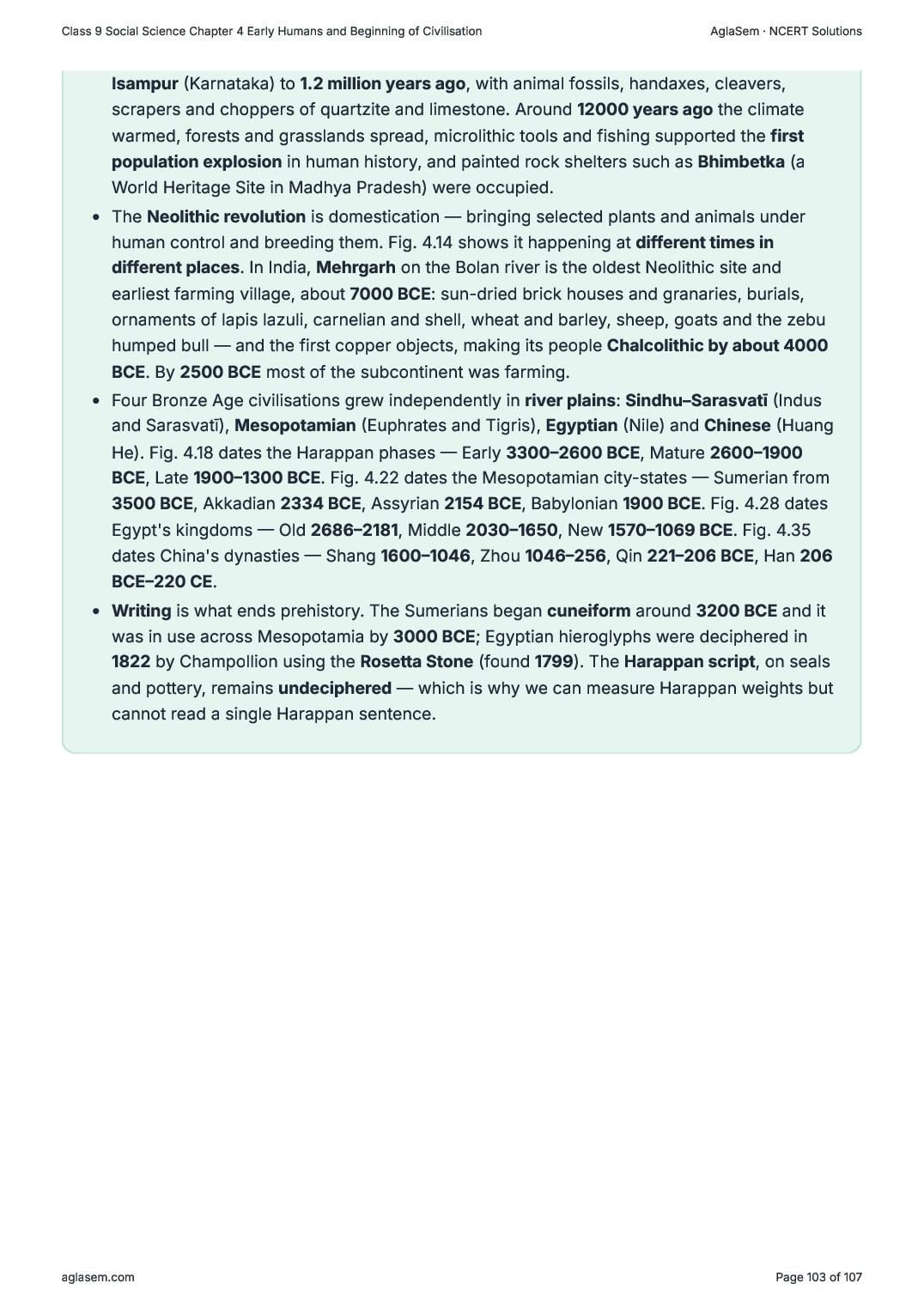
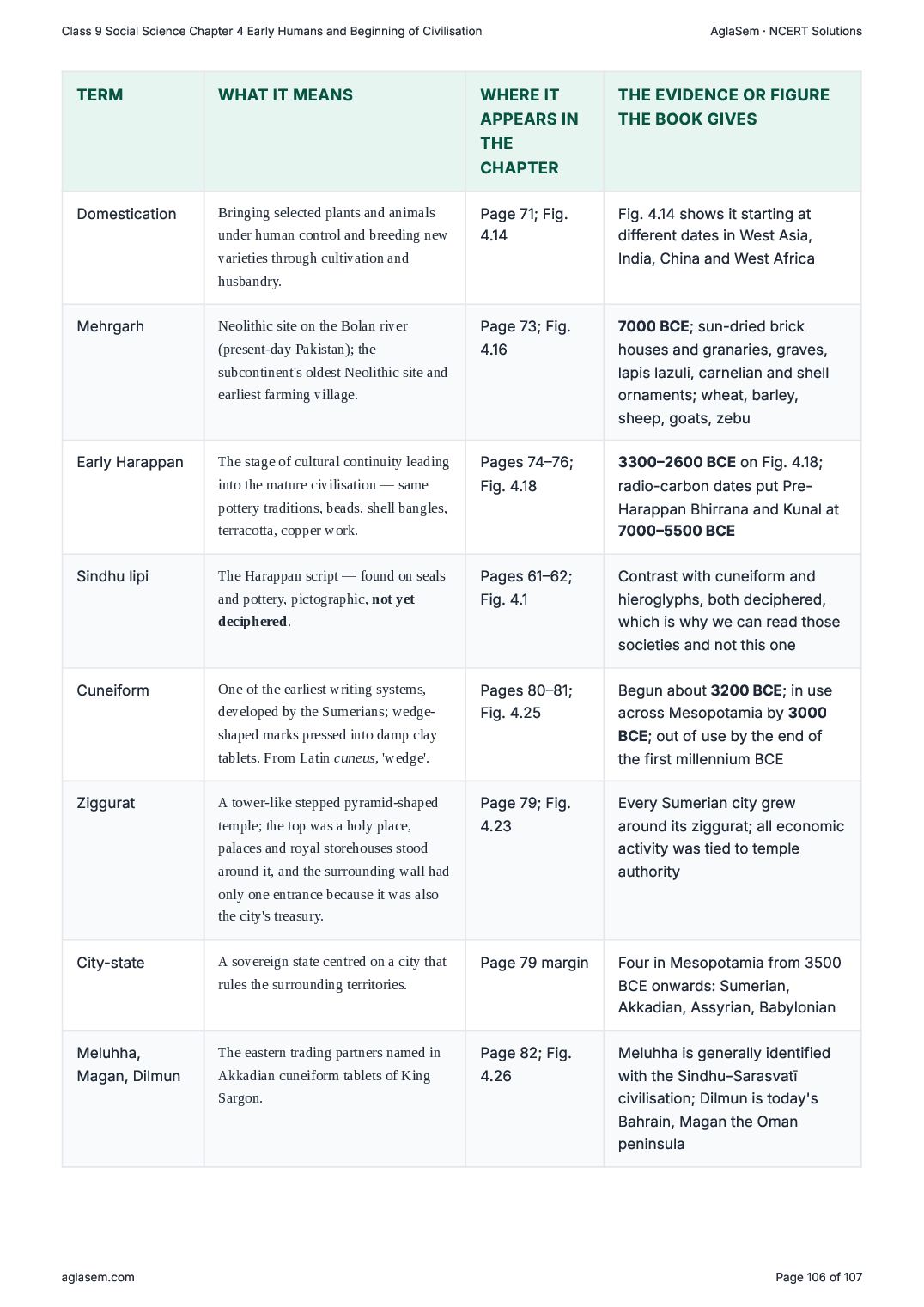
- Almost all of human history has no writing in it. Fig. 4.3 puts the split exactly: more than 99 per cent of human history falls before writing (about 3 million years ago to 5000 years ago ) and less than 1 per cent after it. For the 99 per cent the only witnesses are artefacts — tools, bones, pottery, hearths — so dating is approximate ; after writing, documents name people and give specific dates, so dating becomes relatively accurate .
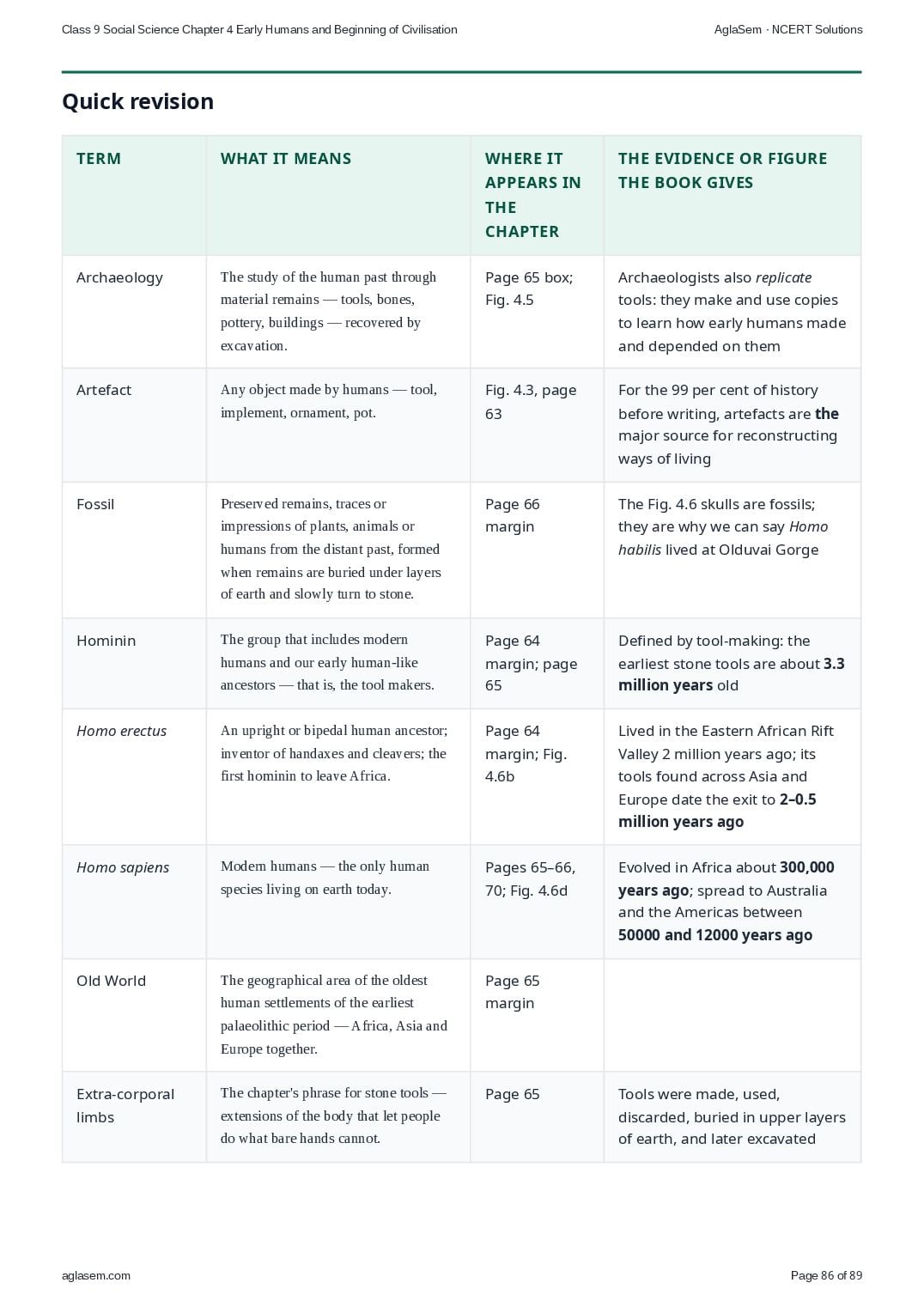
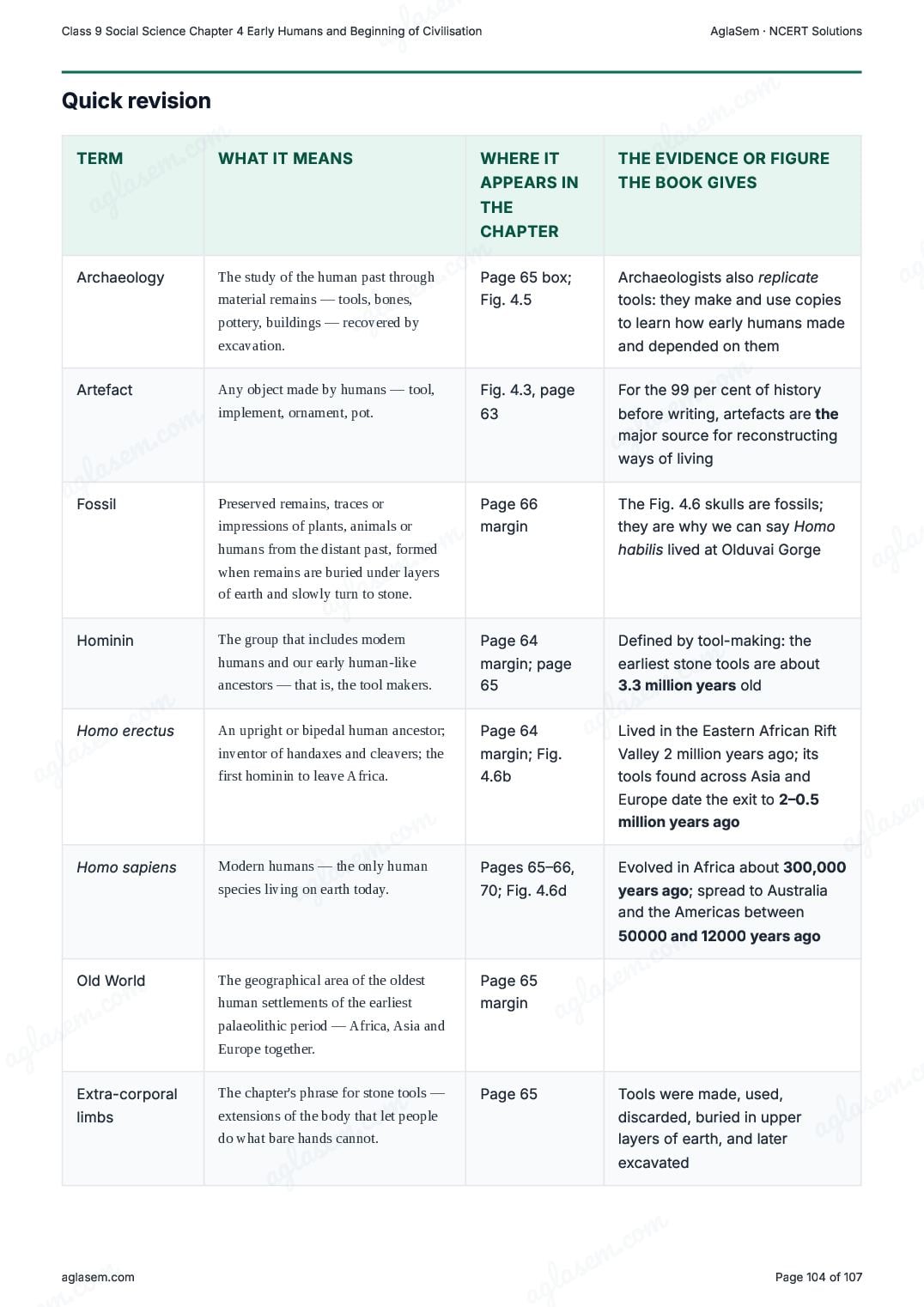
- The chapter's account of our ancestry is built on two kinds of find: stone tools and fossils . The earliest stone tools are dated to about 3.3 million years ago — the moment the chapter treats as the start of 'human behaviour', because animals lack the cognitive ability to make such tools. Fig. 4.6 gives the sequence: Homo habilis (Olduvai Gorge, Tanzania and Kenya, 2–6 million years ago, chopper tools) → Homo erectus (East African Rift Valley, 2 million years ago, handaxes and cleavers) → Homo neanderthalensis (Europe and Southwest Asia, till about 40000 years ago, Middle Palaeolithic flake tools) → Homo sapiens , who evolved in Africa around 300,000 years ago and are the only human species alive today.
- Humans came out of Africa in waves, and the evidence is the tools themselves . Homo erectus was the first hominin to leave, from about 2 million years ago ; its handaxes and cleavers turn up across Asia and Europe, which is how we know the dispersal happened between 2 and 0.5 million years ago . A second major wave, of early Homo sapiens , left around 125,000 years ago ; our species reached Australia and the Americas between 50000 and 12000 years ago .
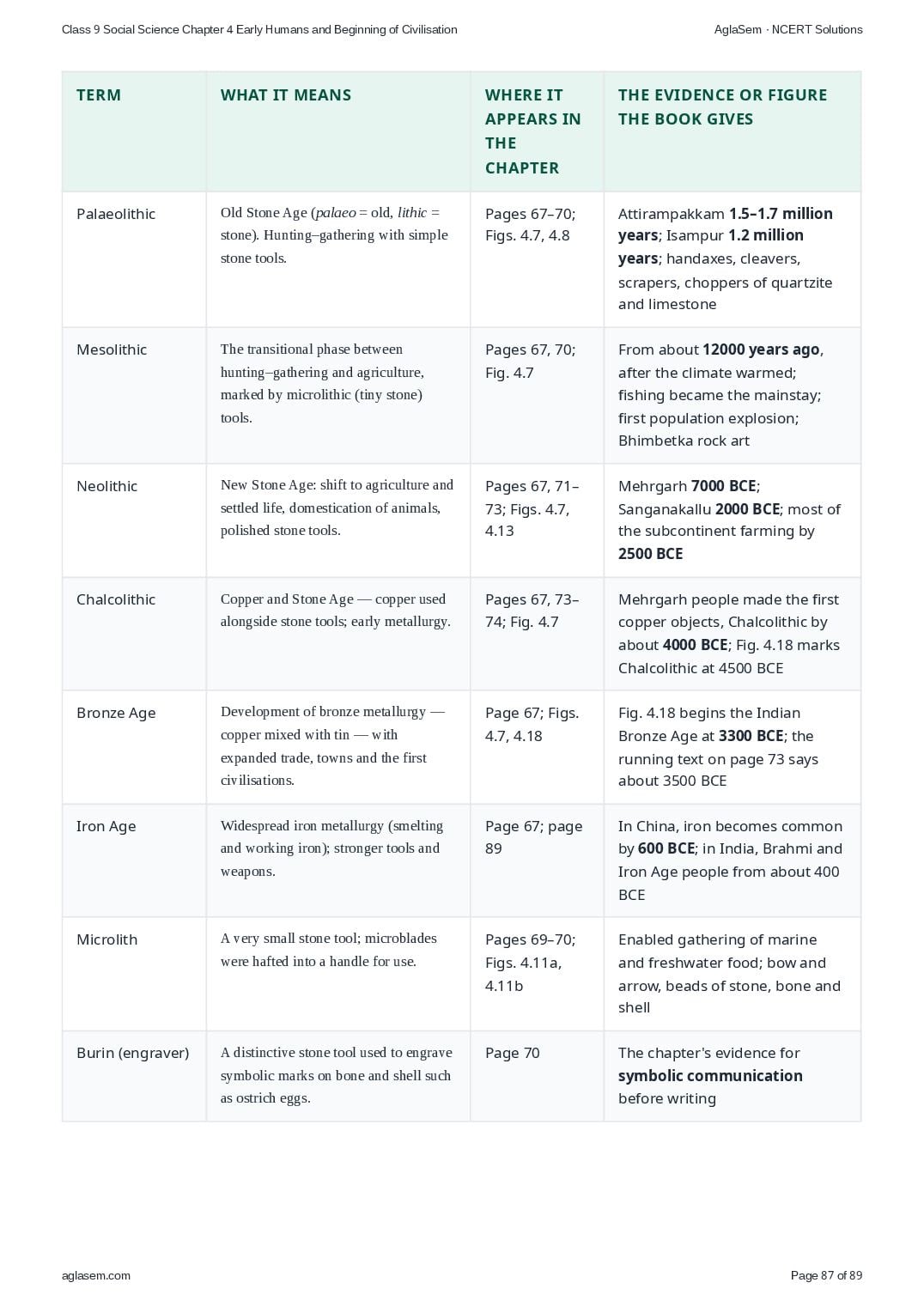
- India's record is long. The oldest human settlement in the subcontinent dates back about 2 million years ; Attirampakkam (Tamil Nadu) is dated to 1.5–1.7 million years ago and Isampur (Karnataka) to 1.2 million years ago , with animal fossils, handaxes, cleavers, scrapers and choppers of quartzite and limestone. Around 12000 years ago the climate warmed, forests and grasslands spread, microlithic tools and fishing supported the first population explosion in human history, and painted rock shelters such as Bhimbetka (a World Heritage Site in Madhya Pradesh) were occupied.
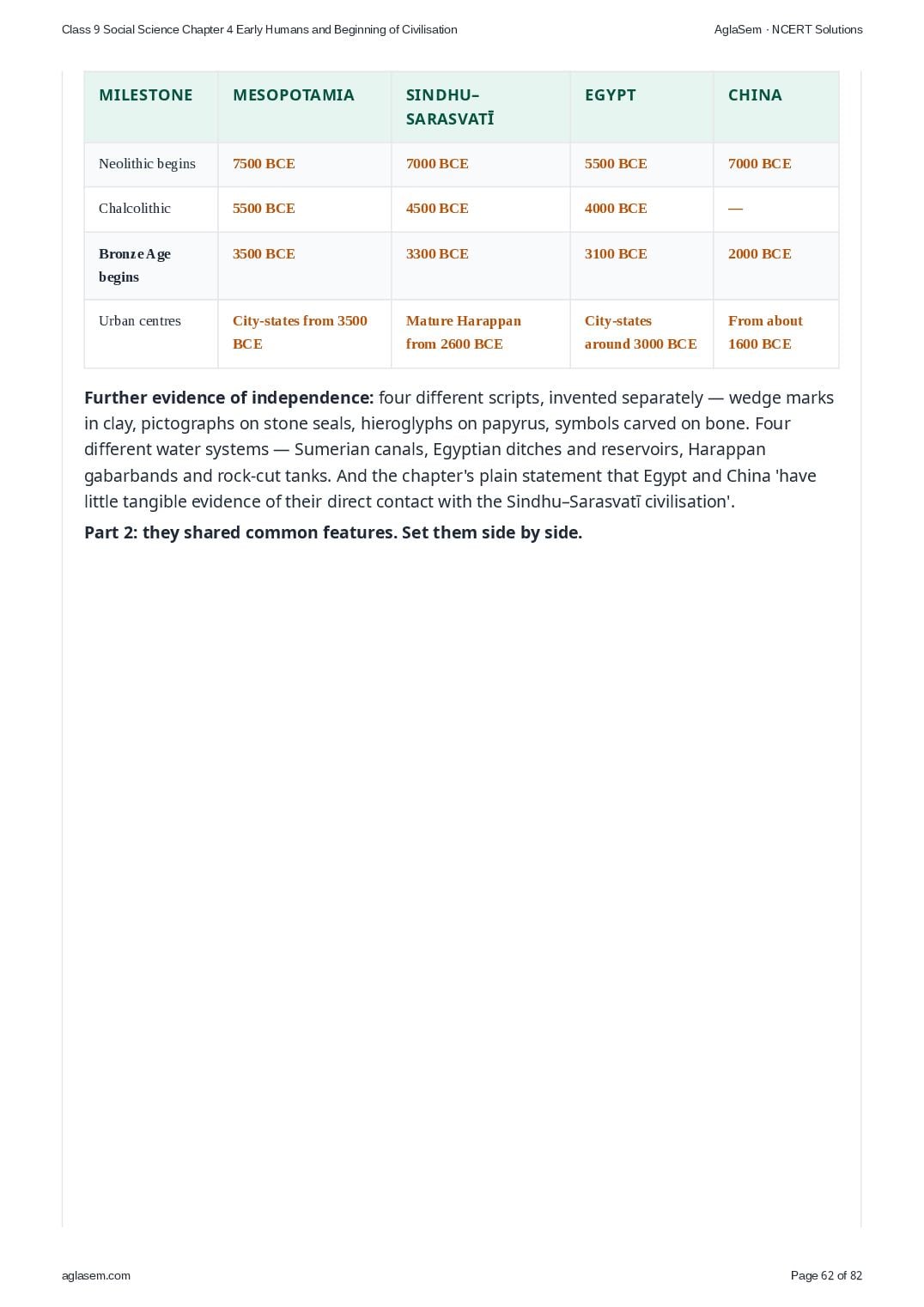
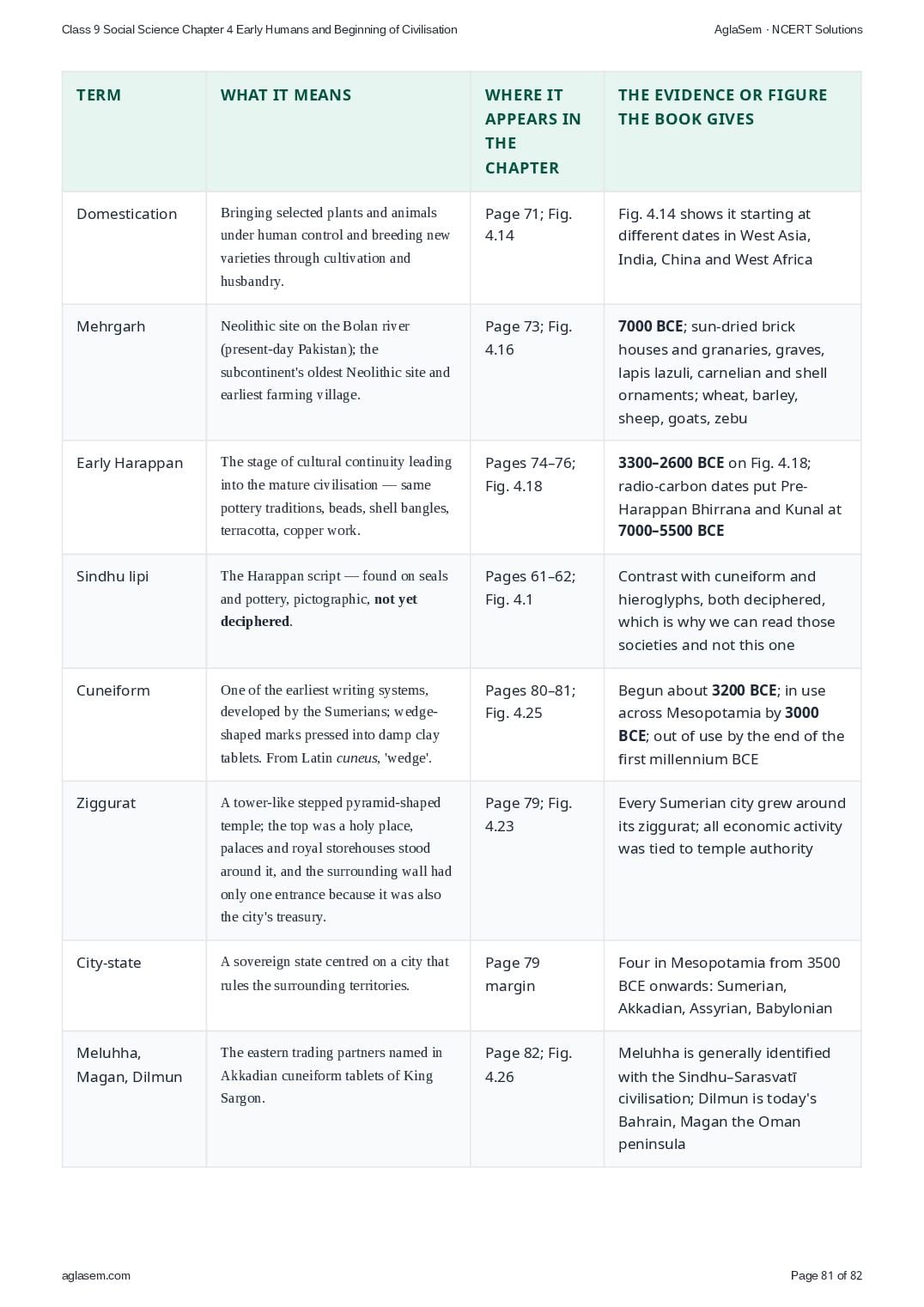
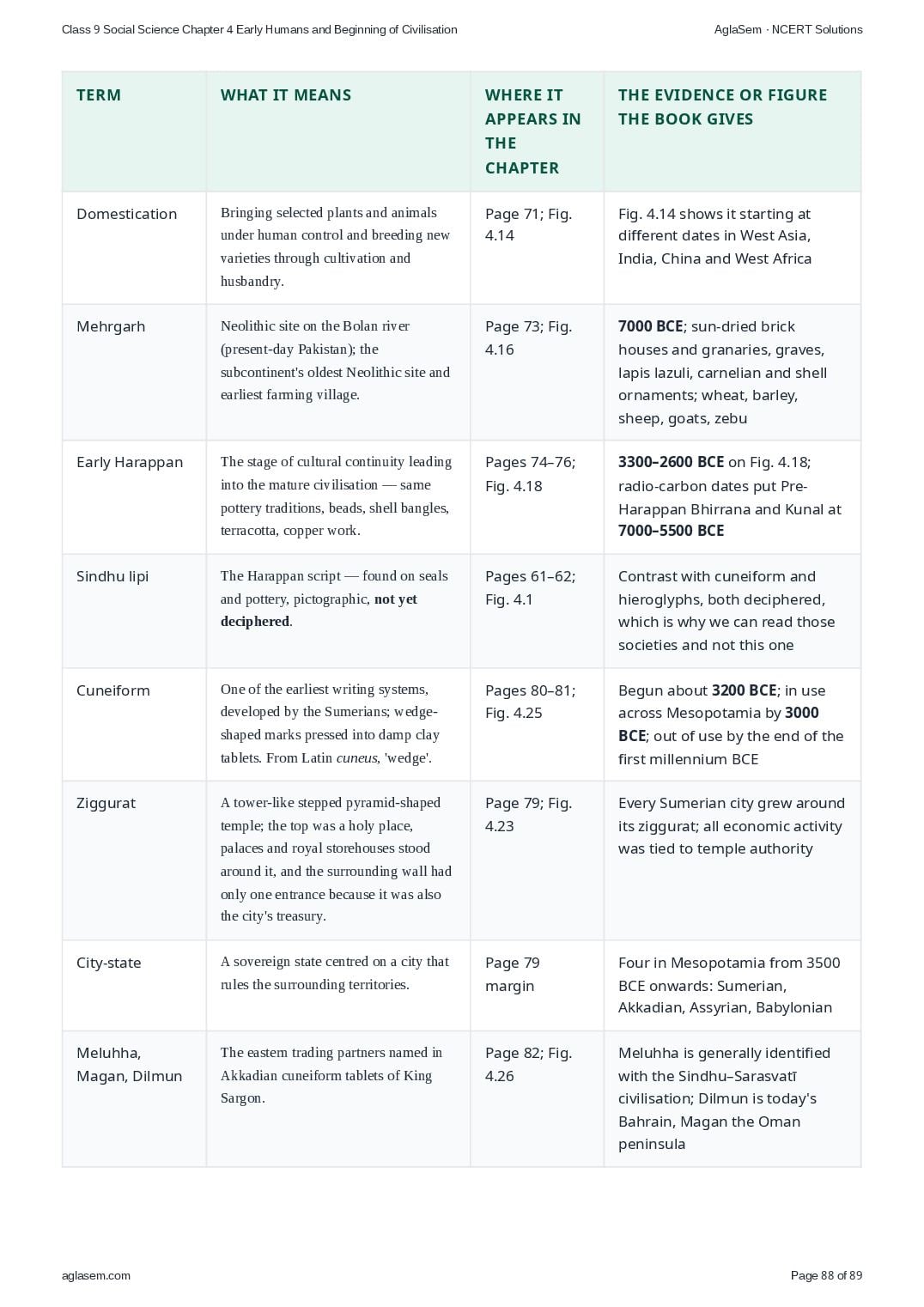
- The Neolithic revolution is domestication — bringing selected plants and animals under human control and breeding them. Fig. 4.14 shows it happening at different times in different places . In India, Mehrgarh on the Bolan river is the oldest Neolithic site and earliest farming village, about 7000 BCE : sun-dried brick houses and granaries, burials, ornaments of lapis lazuli, carnelian and shell, wheat and barley, sheep, goats and the zebu humped bull — and the first copper objects, making its people Chalcolithic by about 4000 BCE . By 2500 BCE most of the subcontinent was farming.
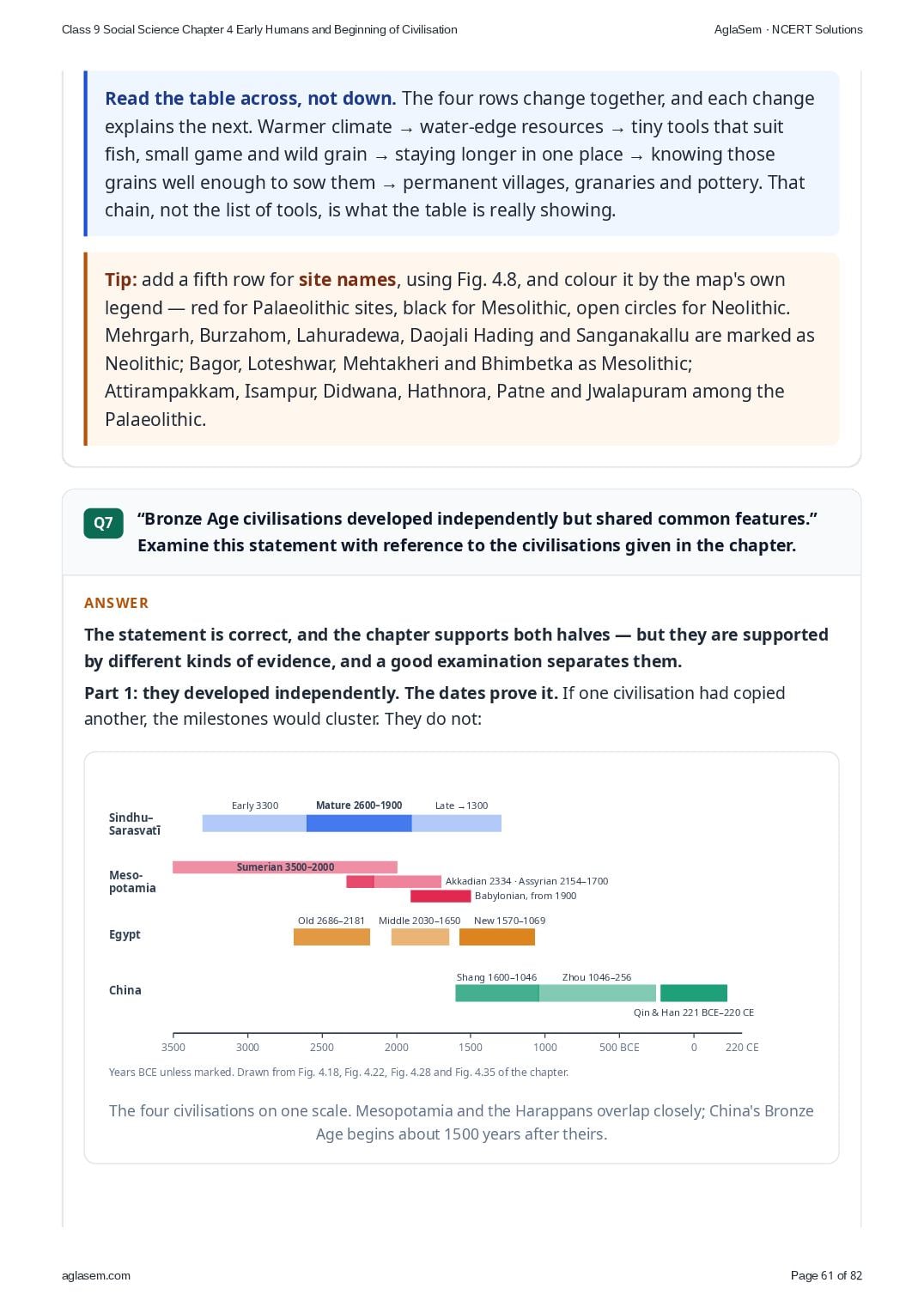
- Four Bronze Age civilisations grew independently in river plains : Sindhu–Sarasvatī (Indus and Sarasvatī), Mesopotamian (Euphrates and Tigris), Egyptian (Nile) and Chinese (Huang He). Fig. 4.18 dates the Harappan phases — Early 3300–2600 BCE , Mature 2600–1900 BCE , Late 1900–1300 BCE . Fig. 4.22 dates the Mesopotamian city-states — Sumerian from 3500 BCE , Akkadian 2334 BCE , Assyrian 2154 BCE , Babylonian 1900 BCE . Fig. 4.28 dates Egypt's kingdoms — Old 2686–2181 , Middle 2030–1650 , New 1570–1069 BCE . Fig. 4.35 dates China's dynasties — Shang 1600–1046 , Zhou 1046–256 , Qin 221–206 BCE , Han 206 BCE–220 CE .
- Writing is what ends prehistory. The Sumerians began cuneiform around 3200 BCE and it was in use across Mesopotamia by 3000 BCE ; Egyptian hieroglyphs were deciphered in 1822 by Champollion using the Rosetta Stone (found 1799 ). The Harappan script , on seals and pottery, remains undeciphered — which is why we can measure Harappan weights but cannot read a single Harappan sentence.
How to Download NCERT Solutions for Class 9 Social Science Chapter 4 PDF
Follow these simple steps to get the Early Humans and Beginning of Civilisation questions-and-answers PDF from Understanding Society: India and Beyond.
- Search NCERT Solutions for Class 9 Social Science Chapter 4 aglasem and open this page.
- Read the exercise questions with answers for Early Humans and Beginning of Civilisation shown above.
- Click the Download PDF link to save the Early Humans and Beginning of Civilisation solutions to your device.
NCERT Solutions for Class 9 Social Science – All Chapters
There are more chapters to study besides Early Humans and Beginning of Civilisation in Social Science. Here are the NCERT Solutions for all chapters of Class 9 Social Science.
- Chapter 1 Understanding Social Science
- Chapter 2 Shaping of the Earth’s Surface
- Chapter 3 Atmosphere and Climate
- Chapter 4 Early Humans and Beginning of Civilisation
- Chapter 5 State and Society Up to 1000 Ce
- Chapter 6 Democracy
- Chapter 7 Elections
- Chapter 8 Building Blocks in Economics the Problem of Choice
- Chapter 9 The Price Puzzle What Drives the Market
NCERT Solutions for Class 9 – All Subjects
Just like Chapter 4 of Social Science, you can get the exercise questions with answers for every other subject of Class 9. Here are the NCERT Solutions for all subjects of Class 9.
NCERT Solutions for Class 9 Social Science Chapter 4 – An Overview
The key highlights of this study material are as follows.
| Aspects | Details |
|---|---|
| Class | Class 9 |
| Subject | Social Science |
| Chapter Number | Chapter 4 |
| Chapter Name | Early Humans and Beginning of Civilisation |
| Book Name | Understanding Society: India and Beyond |
| Book By | NCERT (National Council of Educational Research and Training) |
| Educational Resource Here | NCERT Solutions of Class 9 Social Science Chapter 4 for all exercises |
| More Questions Answers of This Subject | NCERT Solutions for Class 9 Social Science |
| Download Book Chapter | NCERT Book Class 9 Social Science |
| All Questions Answers For This Class | NCERT Solutions for Class 9 |
| Complete Solutions | NCERT Solutions |
NCERT Solutions for Class 9 Social Science Chapter 4 Early Humans and Beginning of Civilisation – FAQs
What are the NCERT Solutions for Class 9 Social Science Chapter 4 Early Humans and Beginning of Civilisation?
They are the complete, step-by-step answers to all the exercise and in-text questions of Chapter 4 Early Humans and Beginning of Civilisation from the NCERT Class 9 Social Science textbook Understanding Society: India and Beyond, written by experts as per the latest NCERT syllabus.
How can I download the Class 9 Social Science Chapter 4 solutions PDF for free?
Open this page on aglasem, read the Early Humans and Beginning of Civilisation questions with answers, and click the “Download Solutions PDF” link. The Class 9 Social Science Chapter 4 NCERT Solutions PDF is completely free to download.
Are these NCERT Solutions as per the latest 2026-27 syllabus?
Yes. The NCERT Solutions for Class 9 Social Science Chapter 4 are based on the latest NCERT textbook Understanding Society: India and Beyond and the current 2026-27 CBSE syllabus, so the questions and answers match what you study in class.
Where can I get NCERT Solutions for the other chapters of Class 9 Social Science?
You can find the answers to every chapter on the NCERT Solutions for Class 9 Social Science page, and solutions for every subject on the NCERT Solutions for Class 9 page.
How do NCERT Solutions help in exam preparation?
They show the correct method to solve each question, help you write answers the way they are expected in exams, let you check and correct your own work, and save revision time — which together improve your marks in Class 9 Social Science.
If you have any queries on NCERT Solutions for Class 9 Social Science Chapter 4 Early Humans and Beginning of Civilisation, then please ask in the comments below.