NCERT Solutions for Class 9 Social Science Chapter 7 Elections provide clear, step-by-step answers to every exercise and in-text question from the chapter Elections of the NCERT textbook Understanding Society: India and Beyond. Prepared by subject experts as per the latest NCERT (CBSE) syllabus for 2026-27, these NCERT Solutions for Class 9 Social Science help you understand each concept, write exam-ready answers, and check your own solutions. You can read them online below or download the free Class 9 Social Science Chapter 7 question-answer PDF.
NCERT Solutions for Class 9 Social Science Chapter 7 Elections
- Class: Class 9
- Subject: Social Science
- Chapter: Chapter 7 – Elections
- Textbook: Understanding Society: India and Beyond (NCERT)
- Study material: NCERT Solutions – questions with answers, free PDF
These solutions answer all the exercise questions of Chapter 7 Elections — including the in-text questions, short-answer and long-answer questions, and activities — with complete explanations so you can follow the method, not just the final answer. Read the full solutions below.
NCERT Solutions Class 9 Social Science Chapter 7 Elections View Download

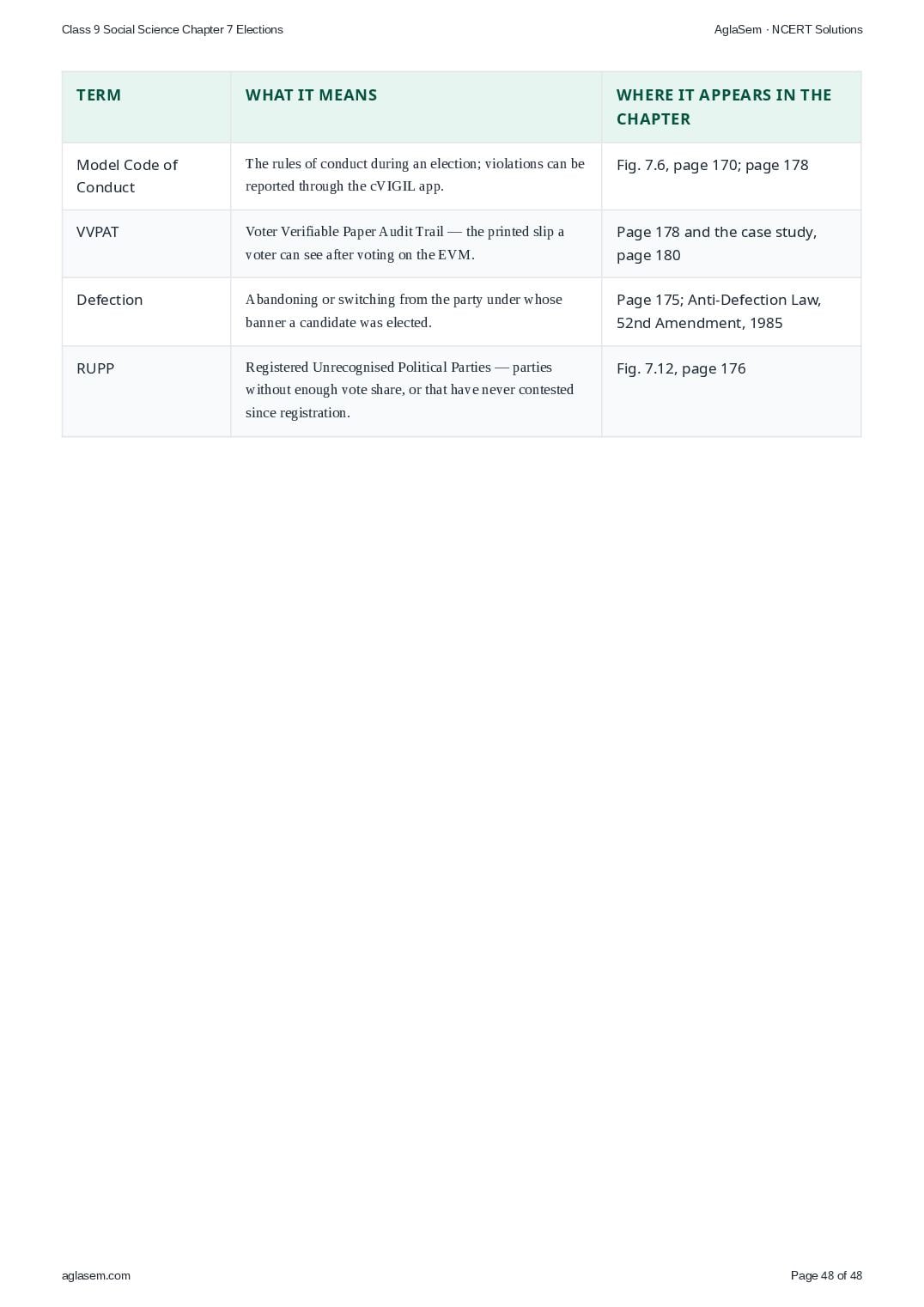
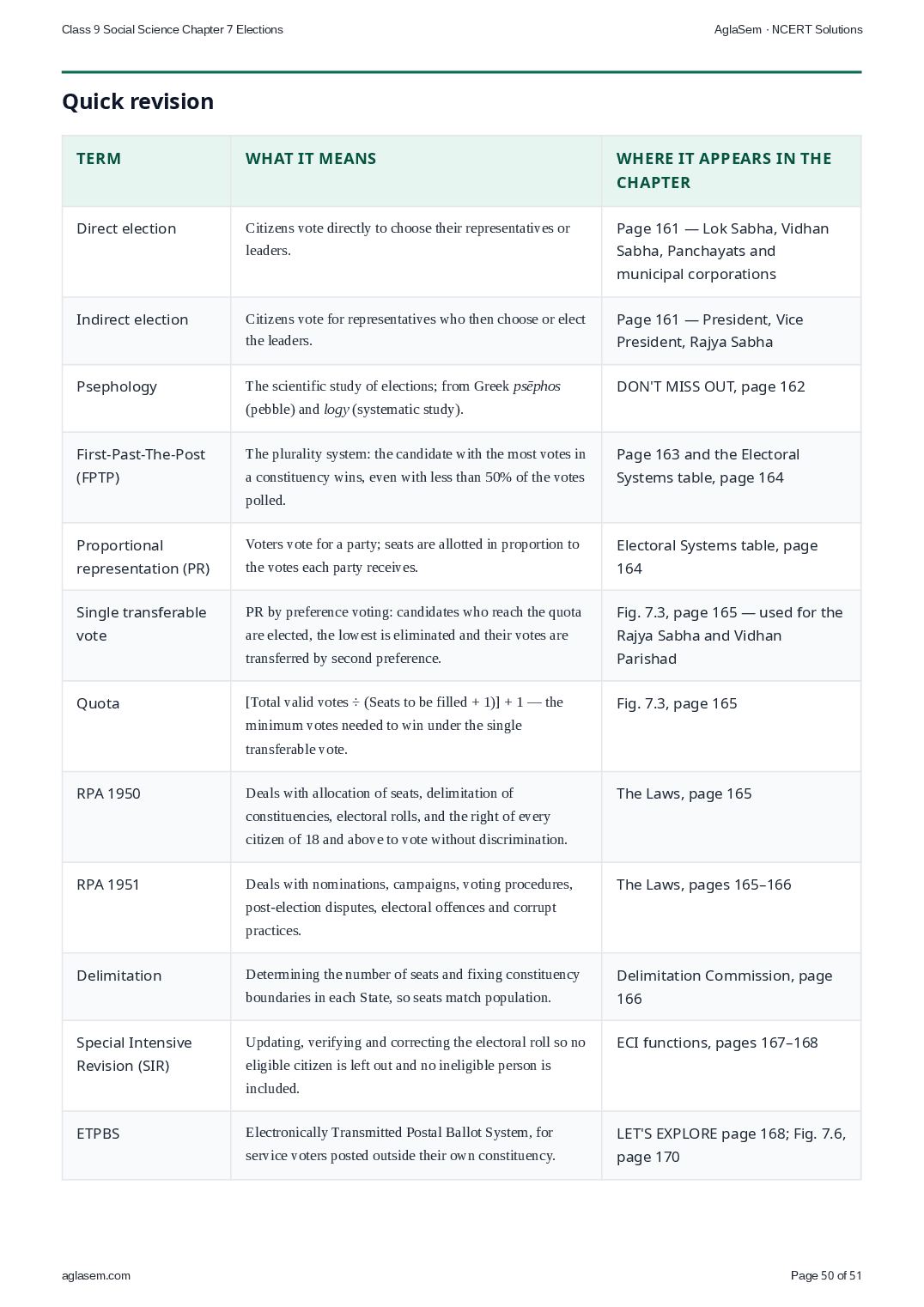
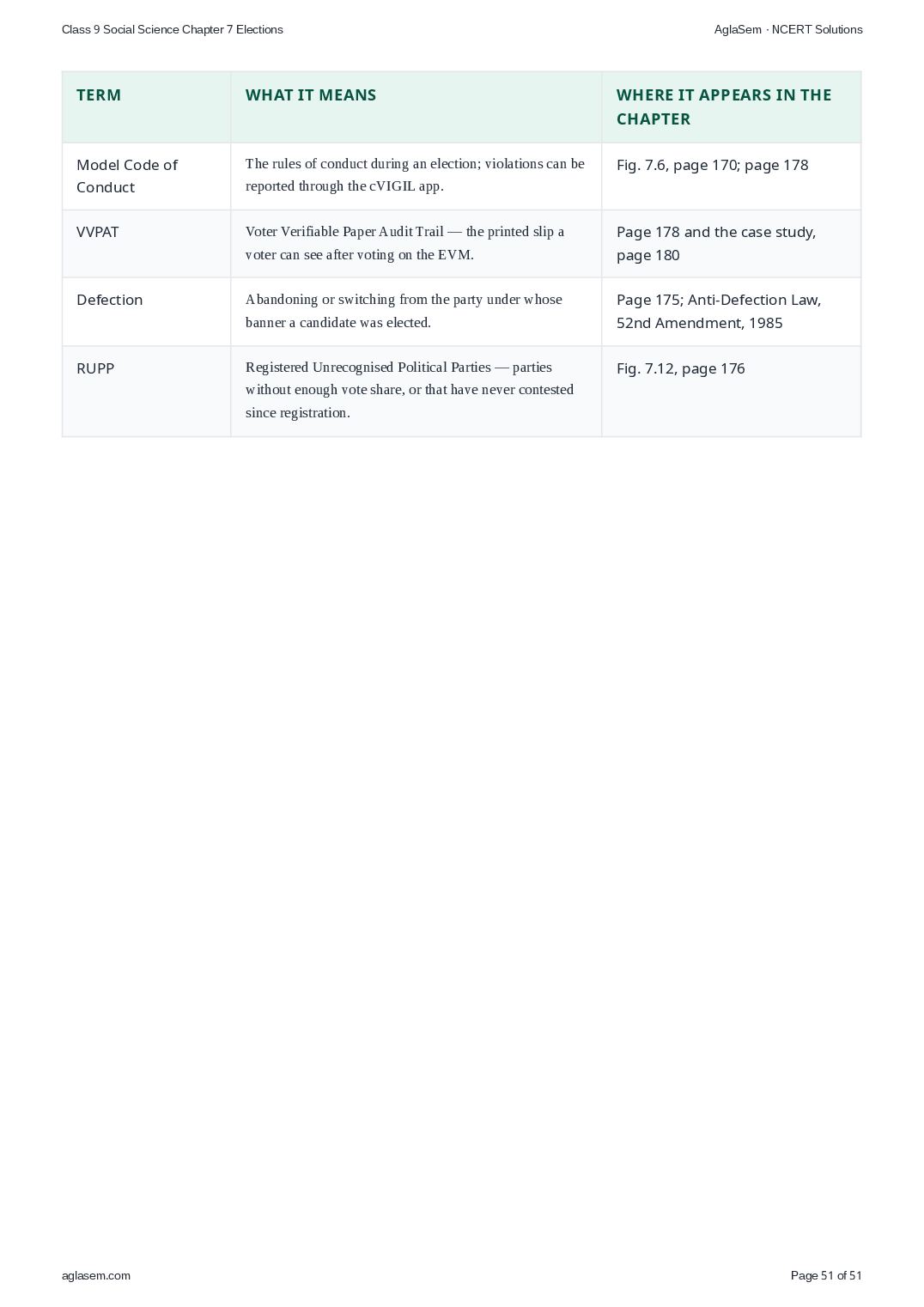
NCERT Solutions for Class 9 Social Science Chapter 7 PDF Download
You can read the NCERT Solutions for Class 9 Social Science Chapter 7 online above, or download the complete question-answer PDF to study Elections offline at any time.
NCERT Solutions for Class 9 Social Science Chapter 7 PDF Download Link – Click Here to Download Solutions PDF
Questions Covered in This Chapter
These NCERT Solutions answer all 37 questions of this chapter. The questions solved are:
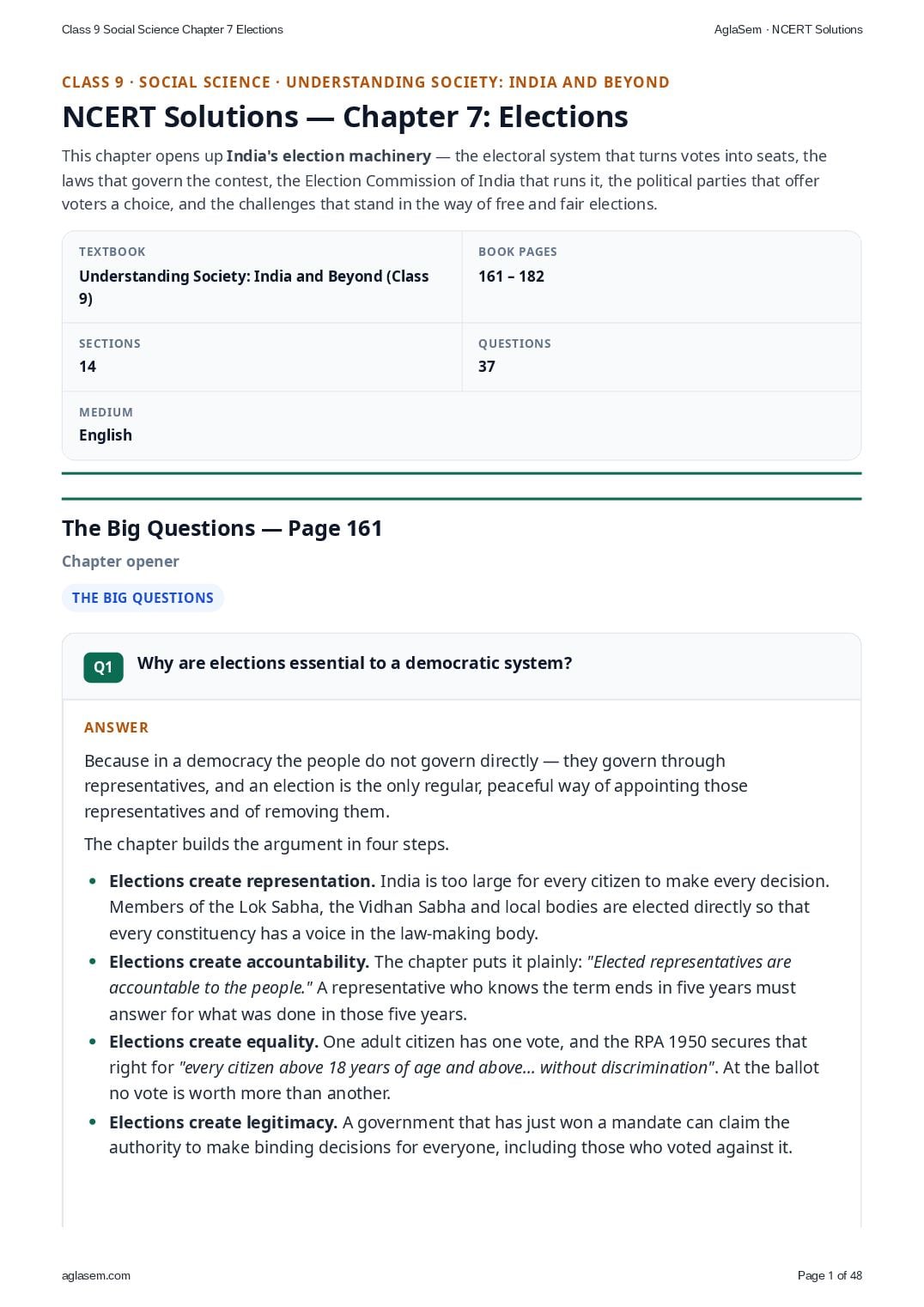
- Why are elections essential to a democratic system?
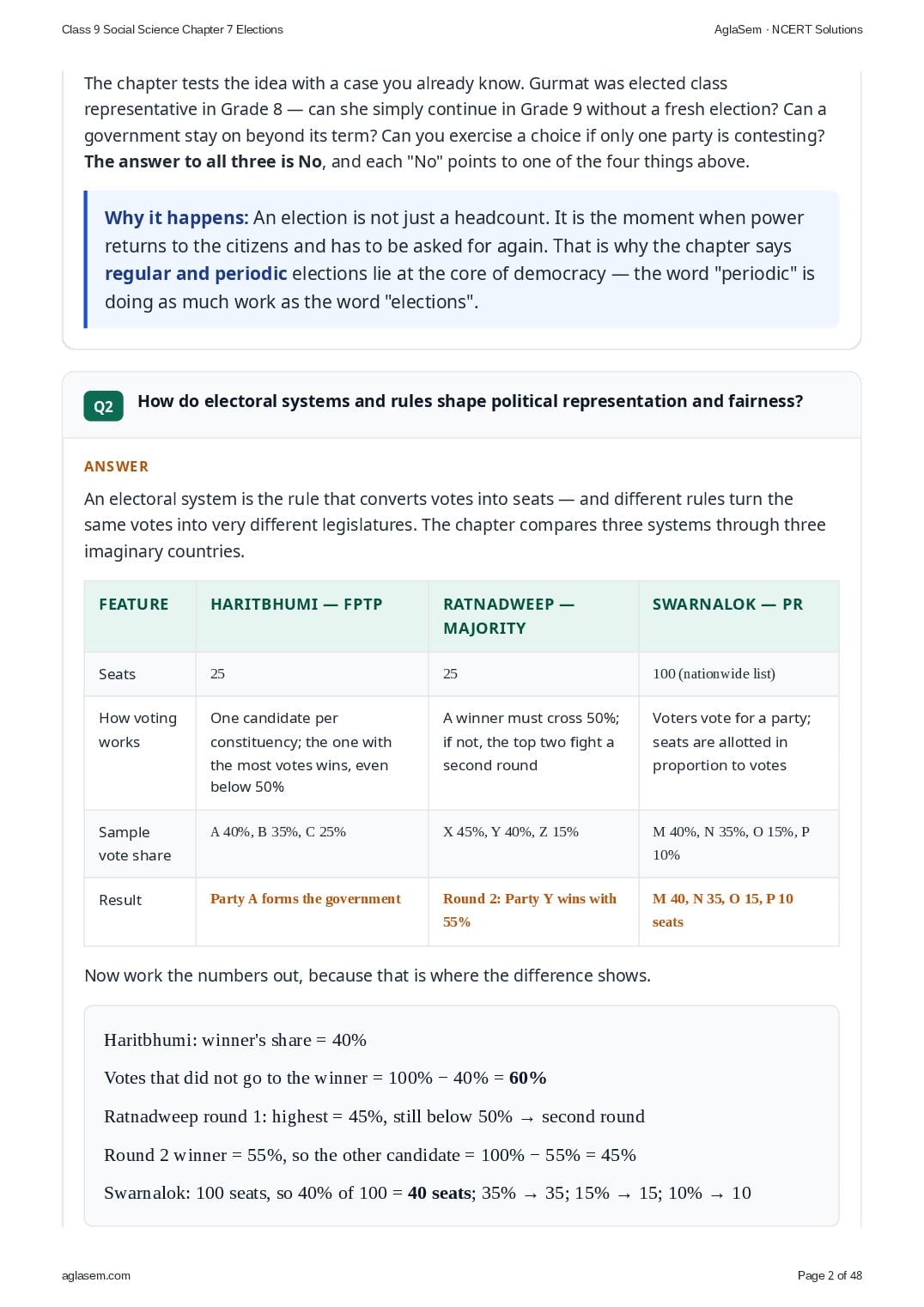
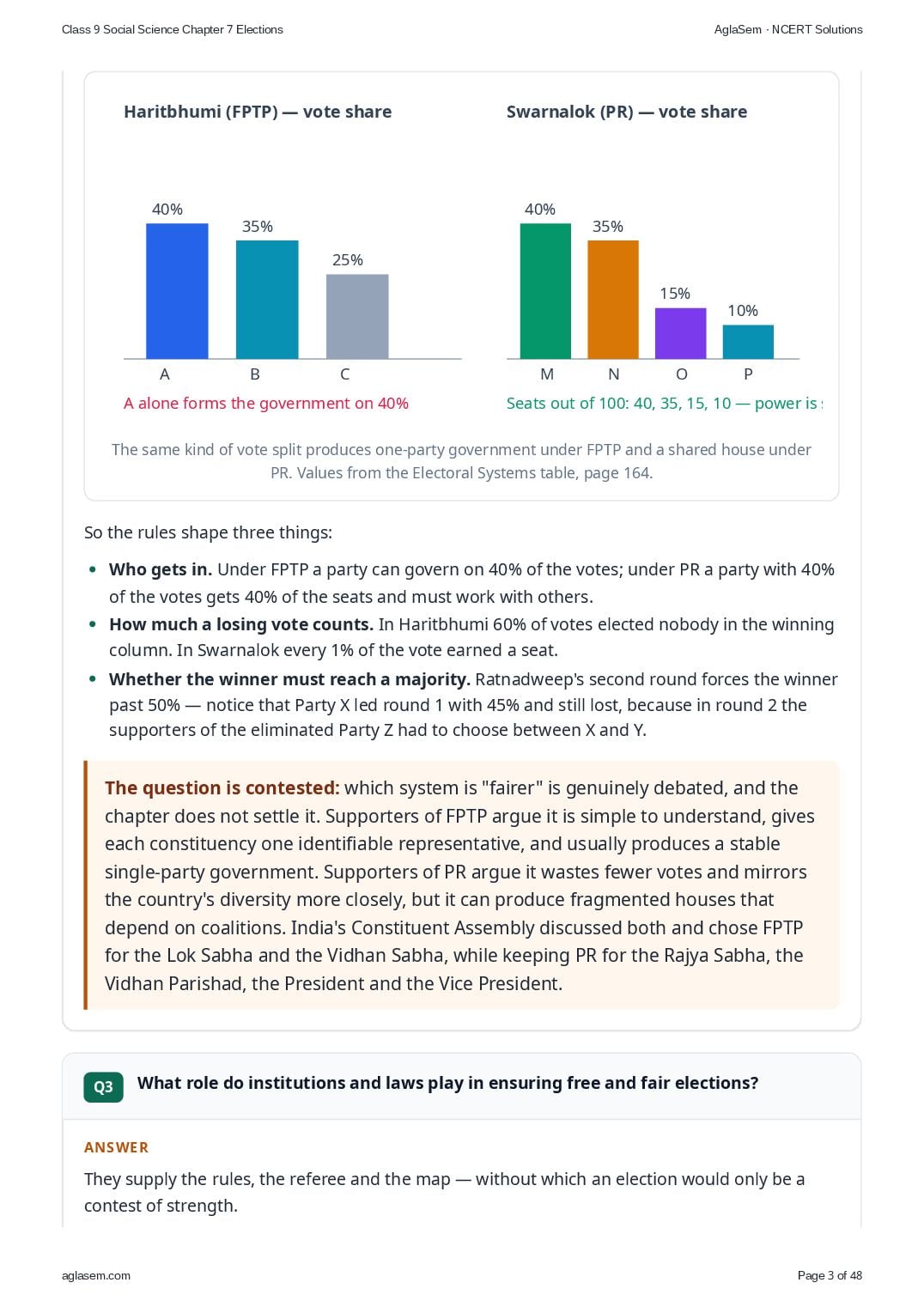
- How do electoral systems and rules shape political representation and fairness?
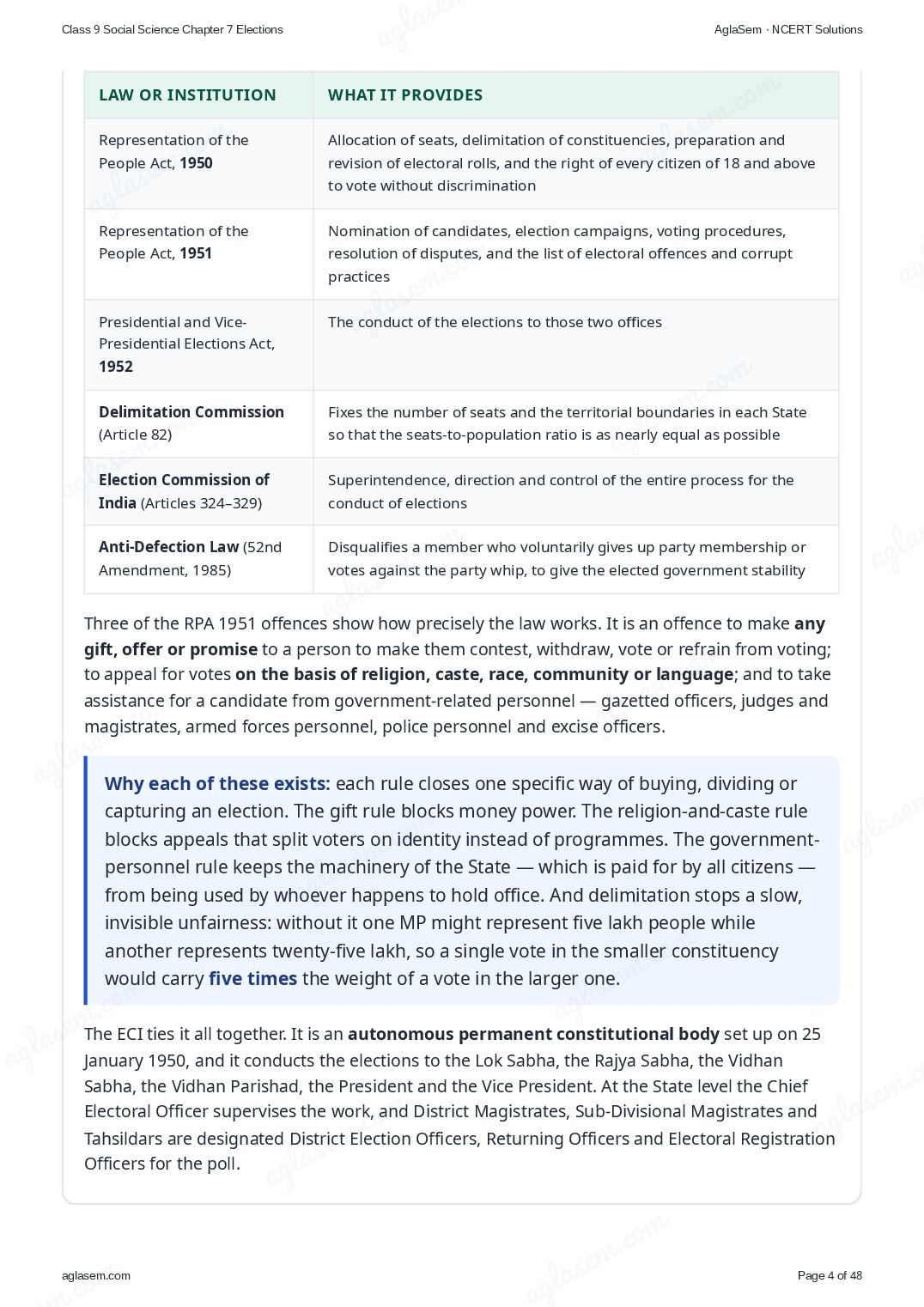
- What role do institutions and laws play in ensuring free and fair elections?
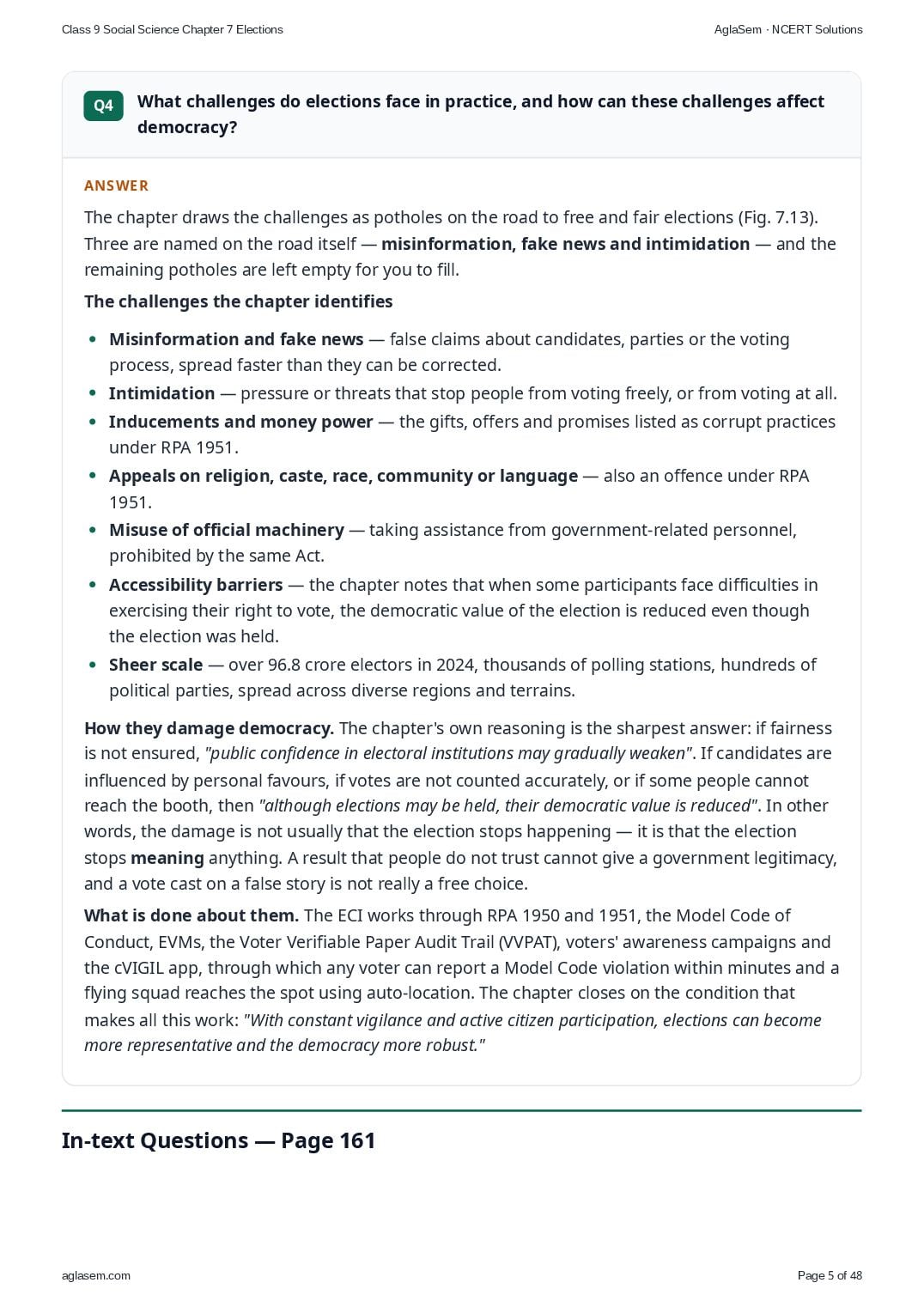
- What challenges do elections face in practice, and how can these challenges affect democracy?
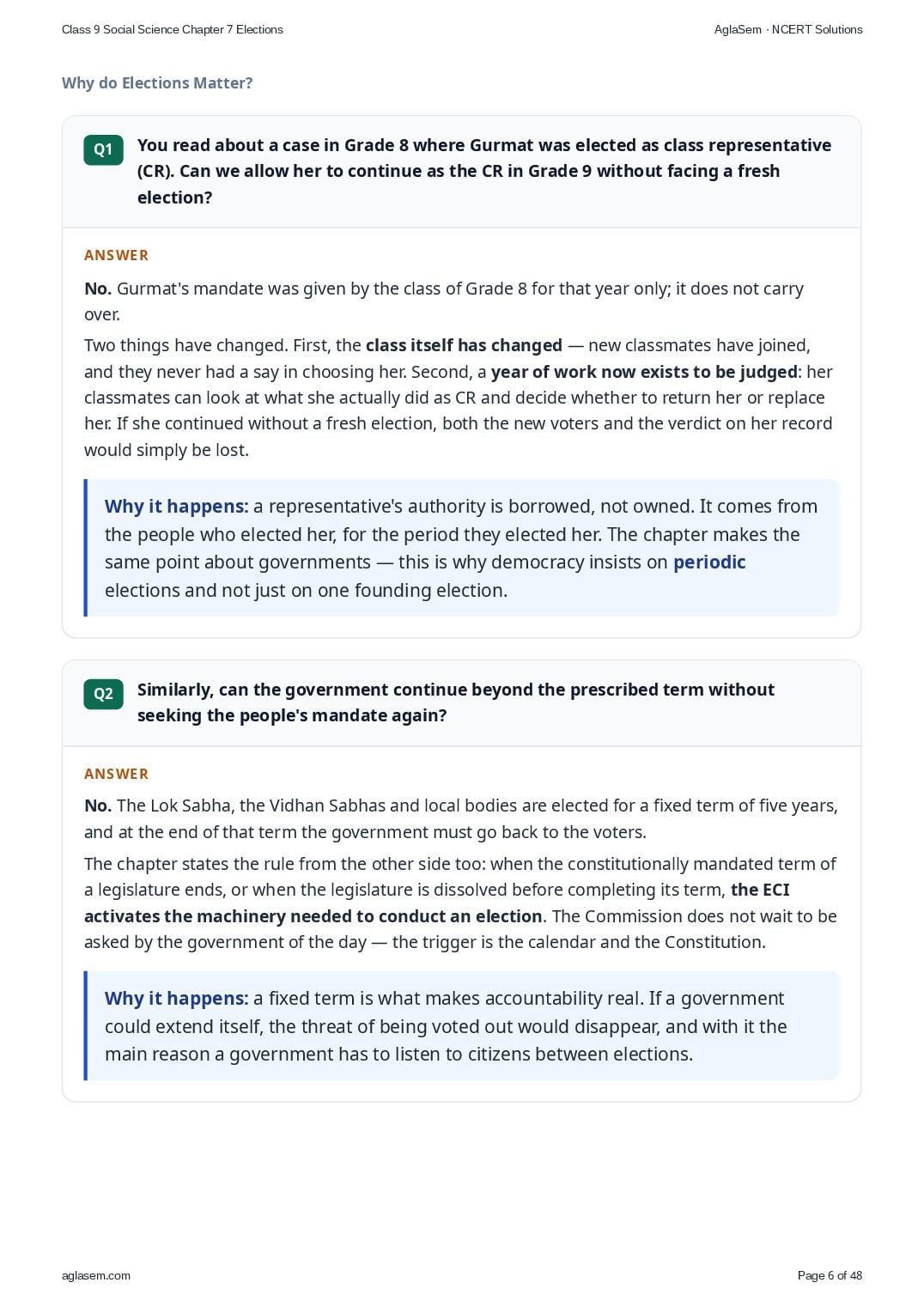
- You read about a case in Grade 8 where Gurmat was elected as class representative (CR). Can we allow her to continue as the CR in Grade 9 without facing a fresh election?
- Similarly, can the government continue beyond the prescribed term without seeking the people's mandate again?
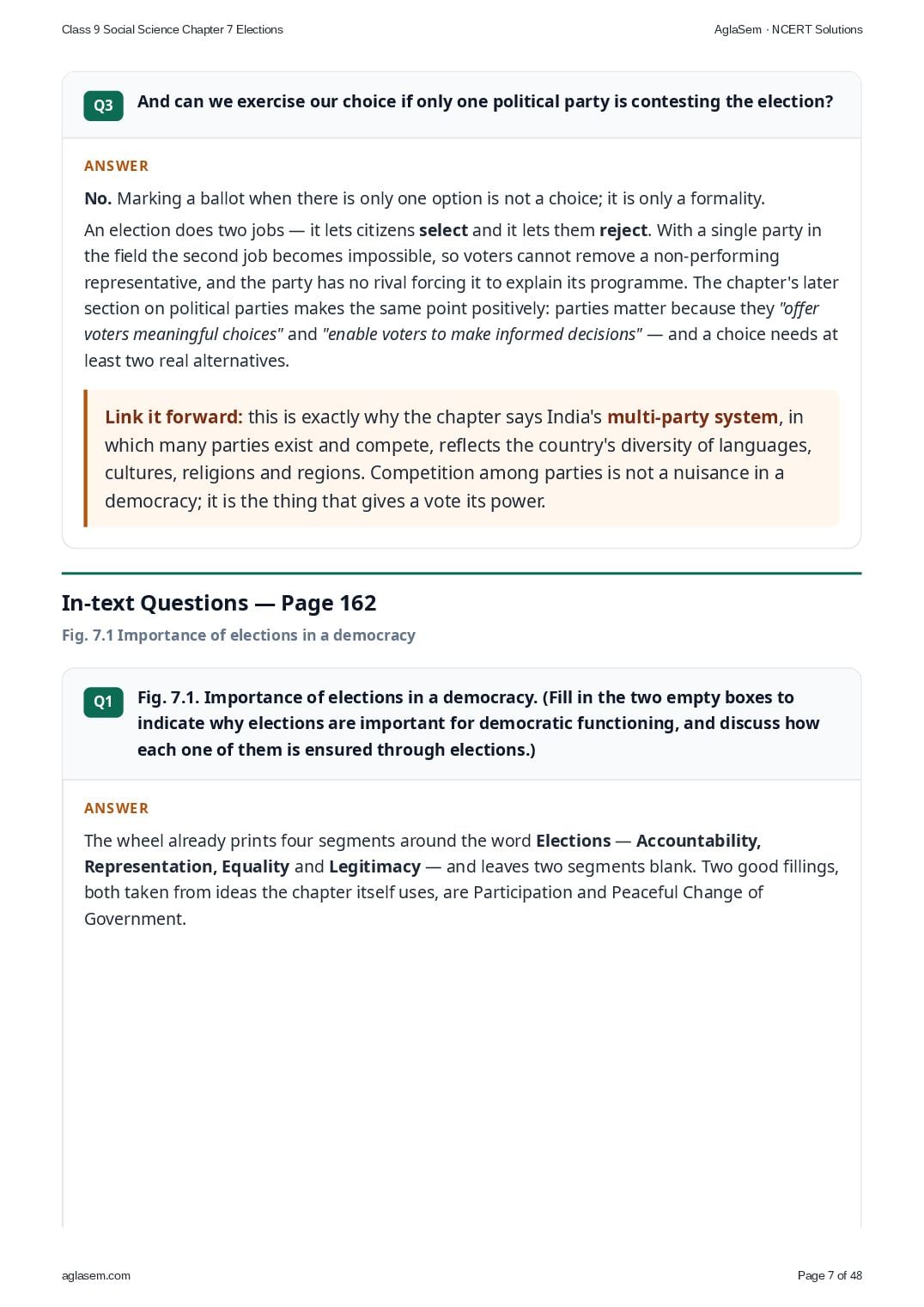
- And can we exercise our choice if only one political party is contesting the election?
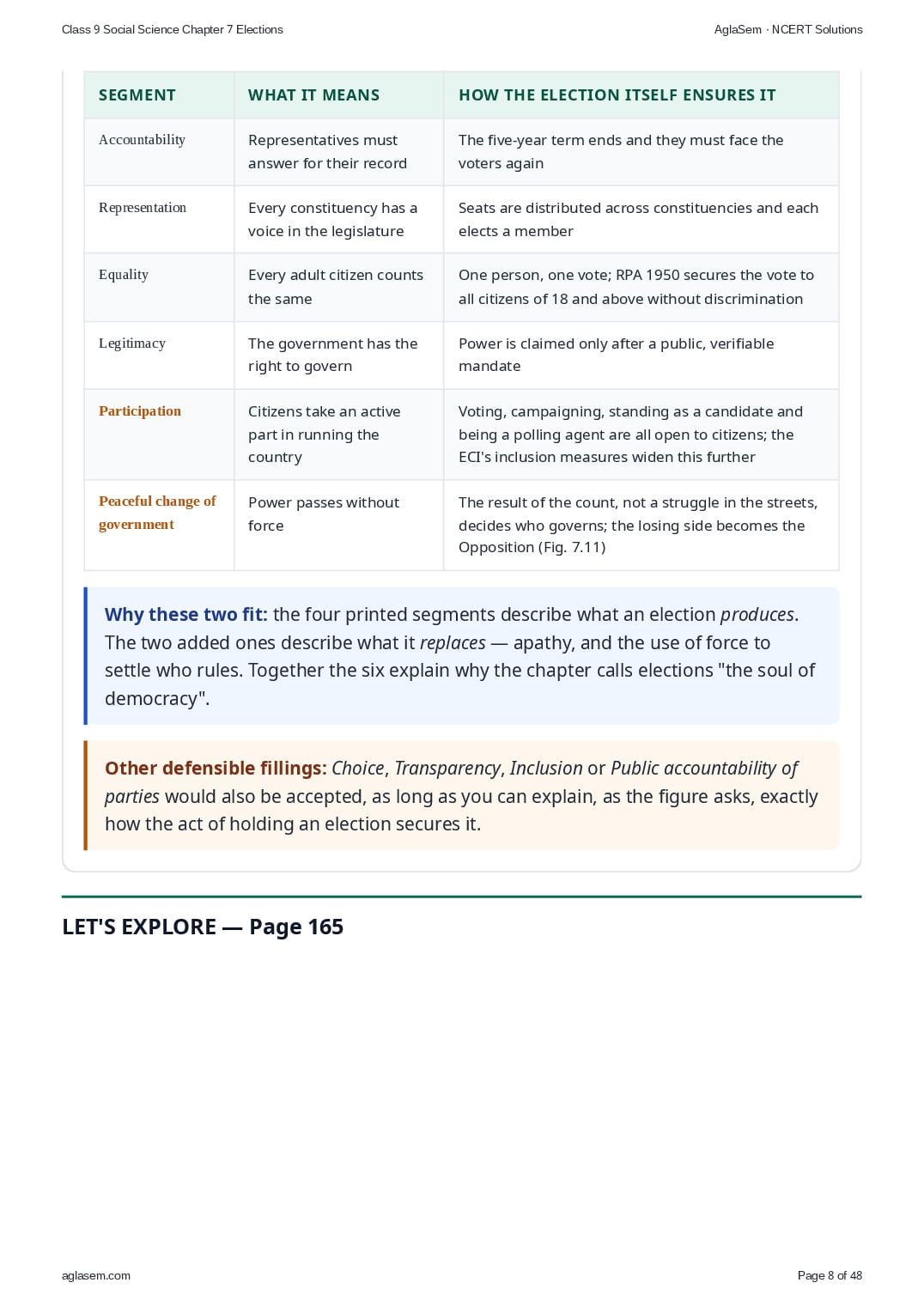
- Fig. 7.1. Importance of elections in a democracy. (Fill in the two empty boxes to indicate why elections are important for democratic functioning, and discuss how each one of them is ensured through elections.)
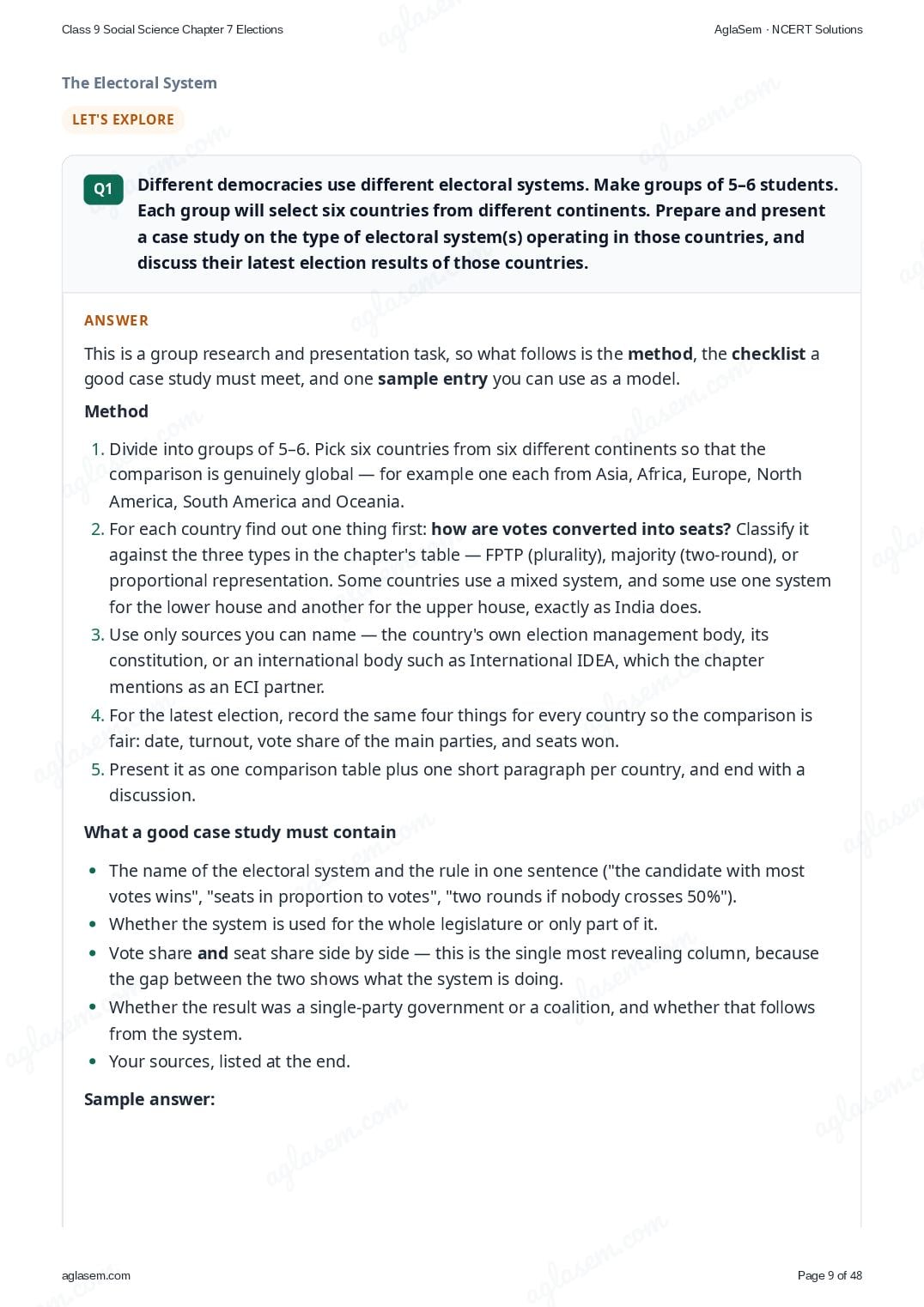
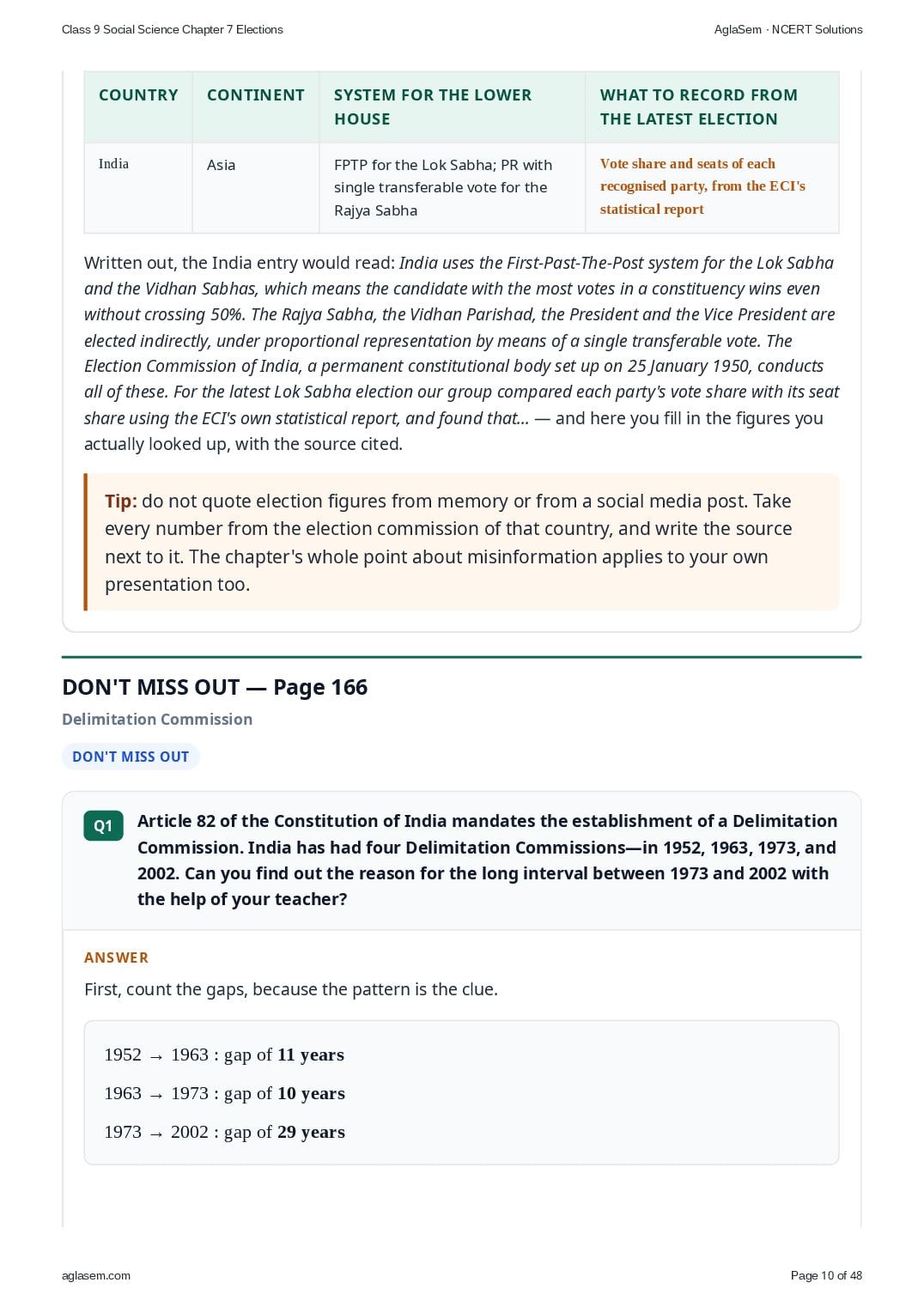
- Different democracies use different electoral systems. Make groups of 5–6 students. Each group will select six countries from different continents. Prepare and present a case study on the type of electoral system(s) operating in those countries, and discuss their latest election results of those countries.
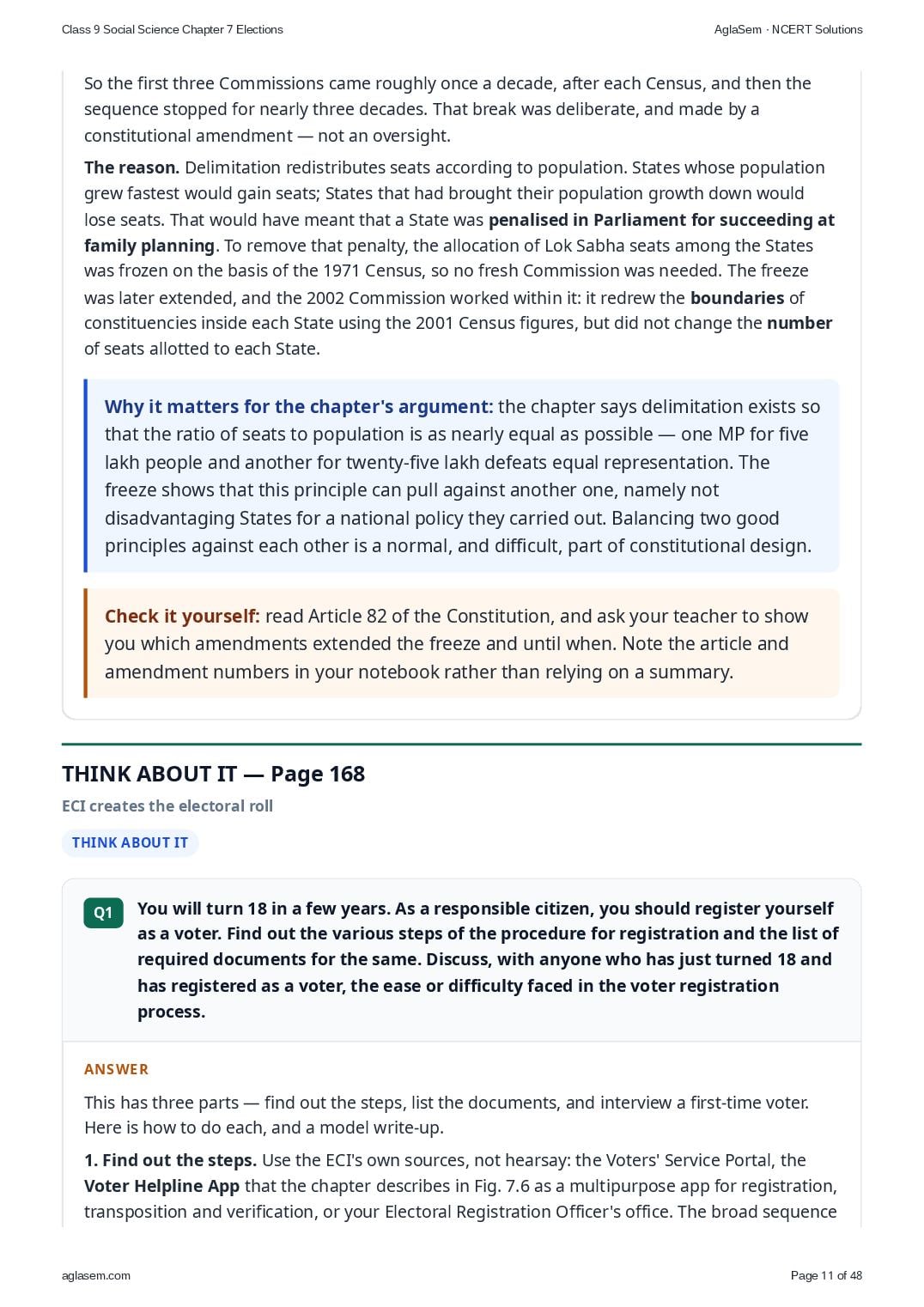
- Article 82 of the Constitution of India mandates the establishment of a Delimitation Commission. India has had four Delimitation Commissions—in 1952, 1963, 1973, and 2002. Can you find out the reason for the long interval between 1973 and 2002 with the help of your teacher?
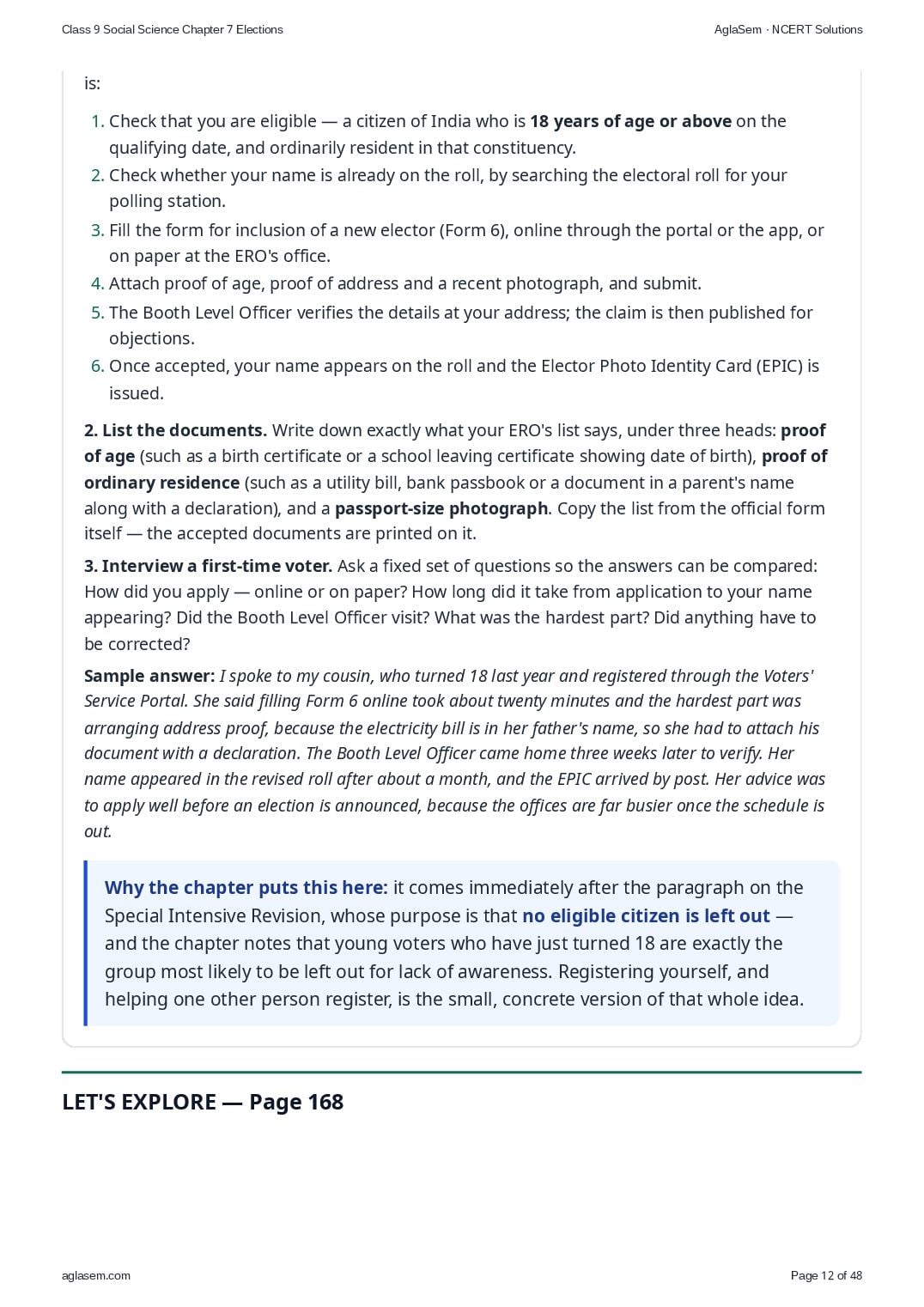
- You will turn 18 in a few years. As a responsible citizen, you should register yourself as a voter. Find out the various steps of the procedure for registration and the list of required documents for the same. Discuss, with anyone who has just turned 18 and has registered as a voter, the ease or difficulty faced in the voter registration process.
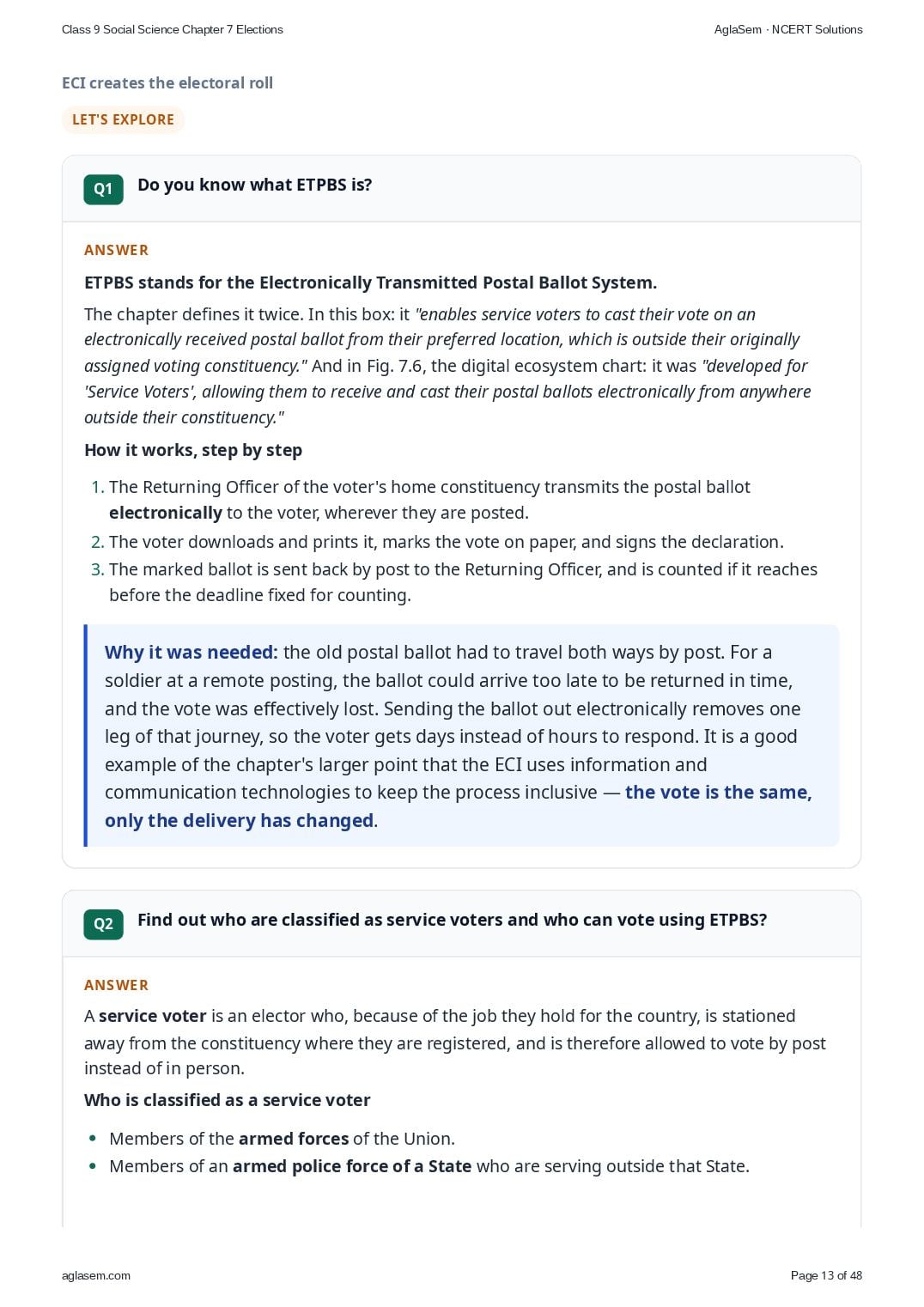
- Do you know what ETPBS is?
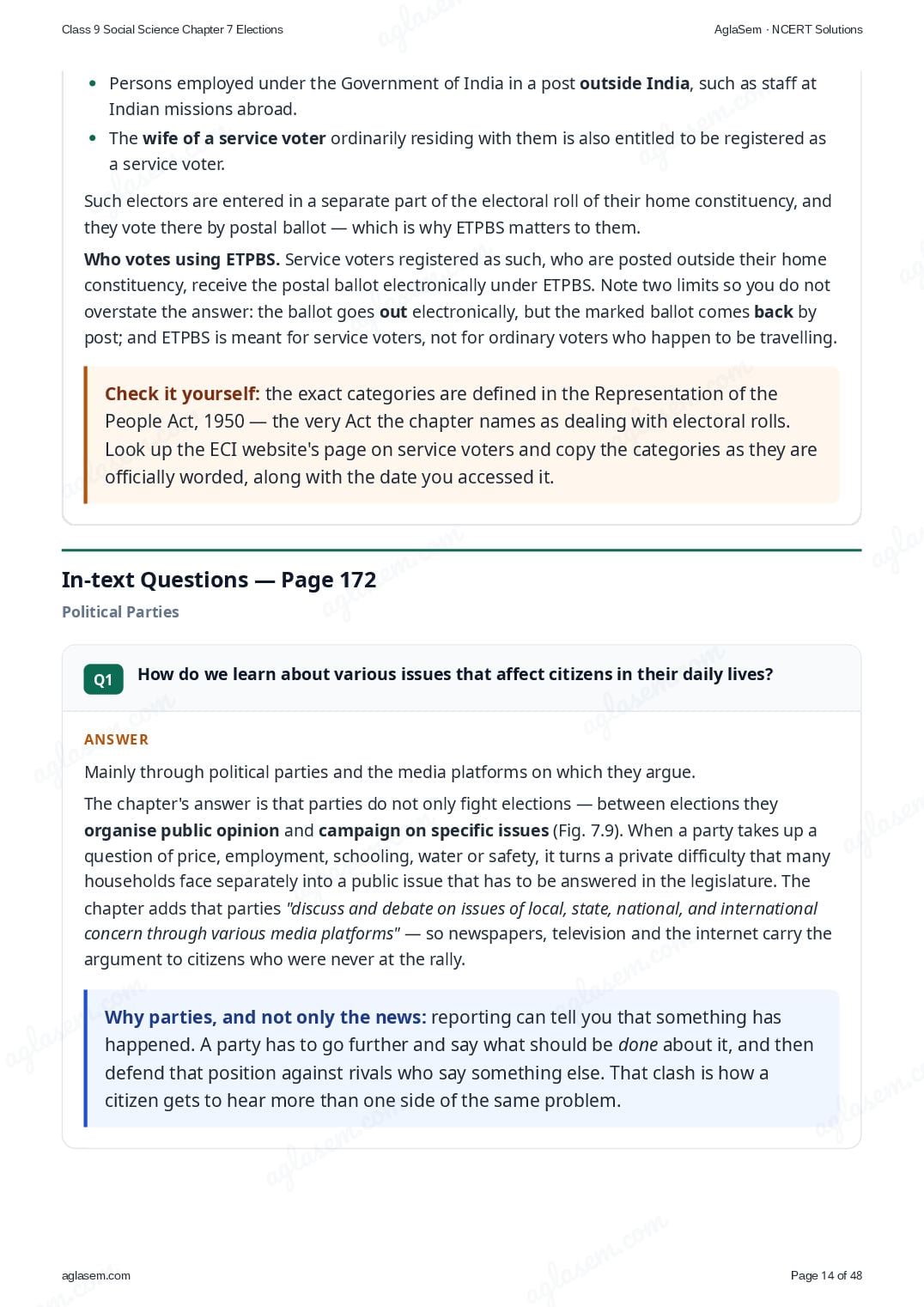
- Find out who are classified as service voters and who can vote using ETPBS?
- How do we learn about various issues that affect citizens in their daily lives?
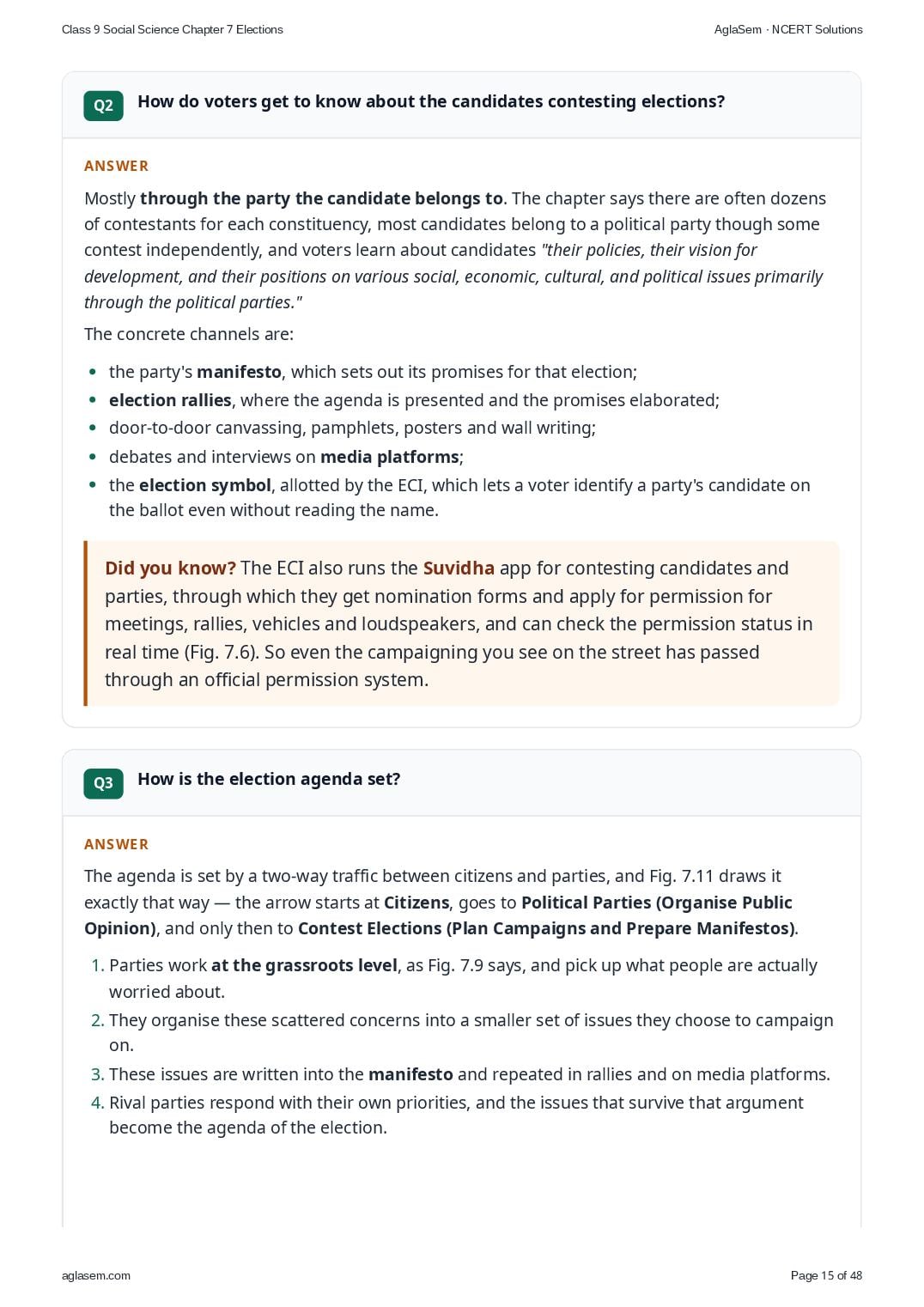
- How do voters get to know about the candidates contesting elections?
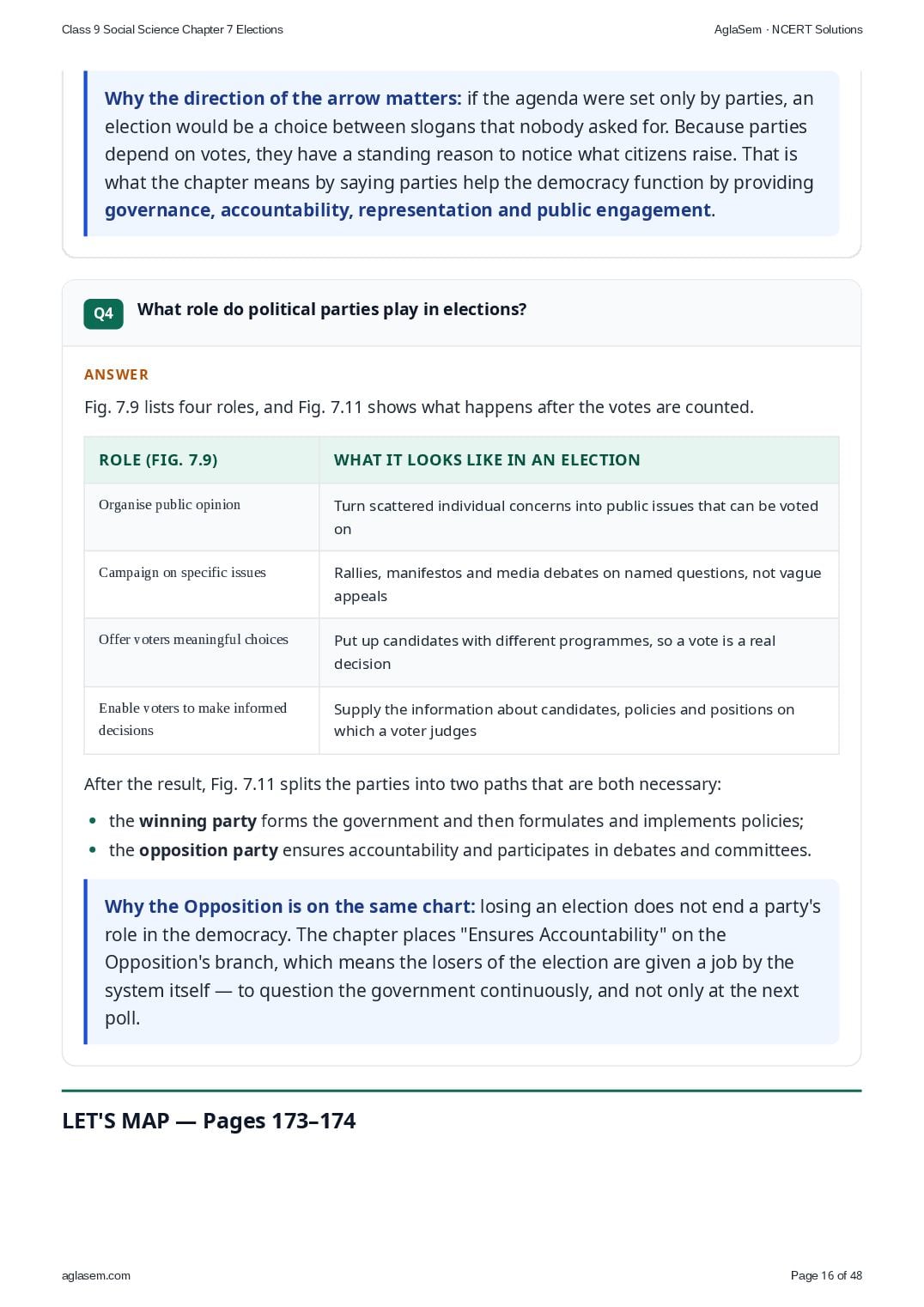
- How is the election agenda set?
- What role do political parties play in elections?
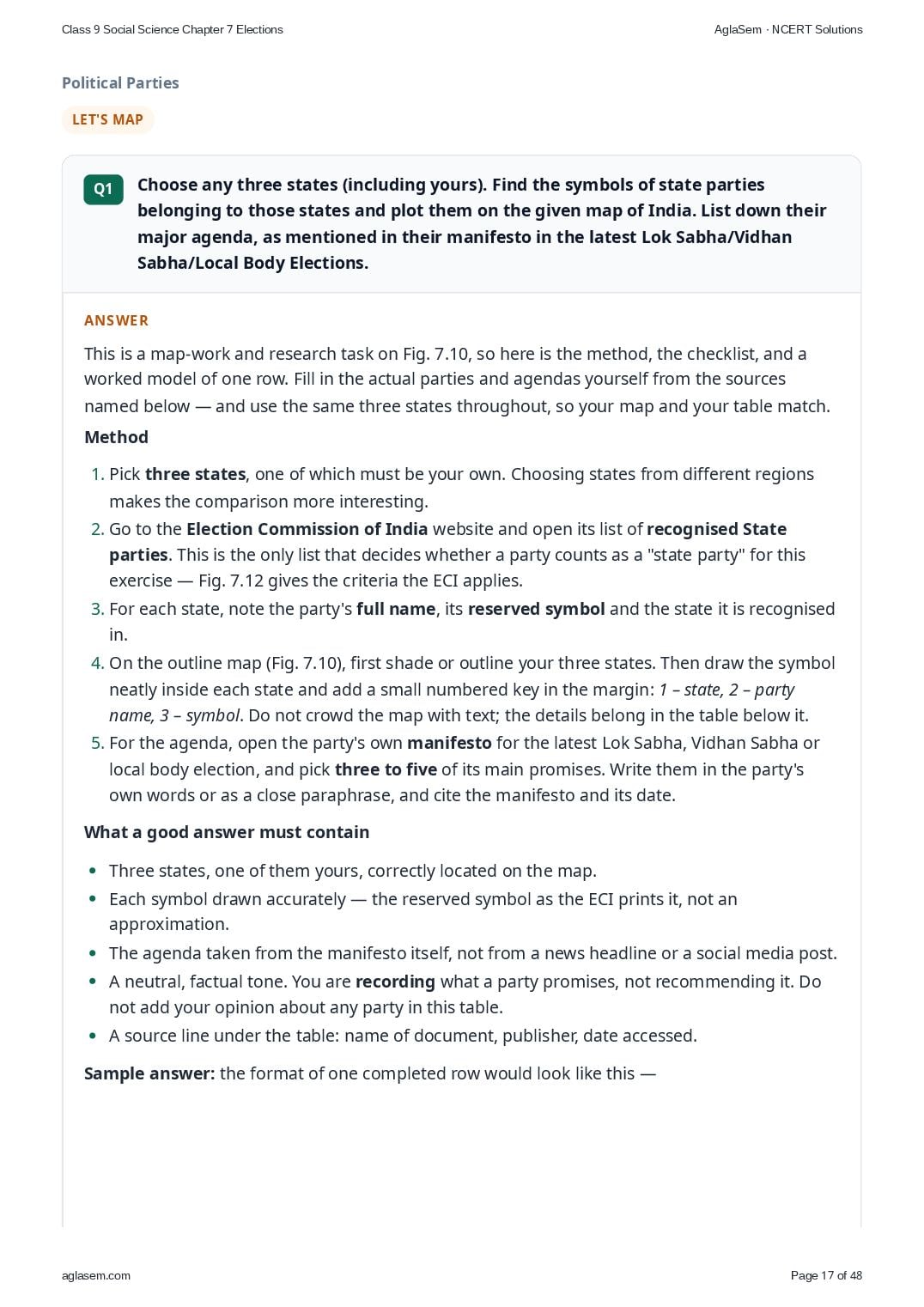
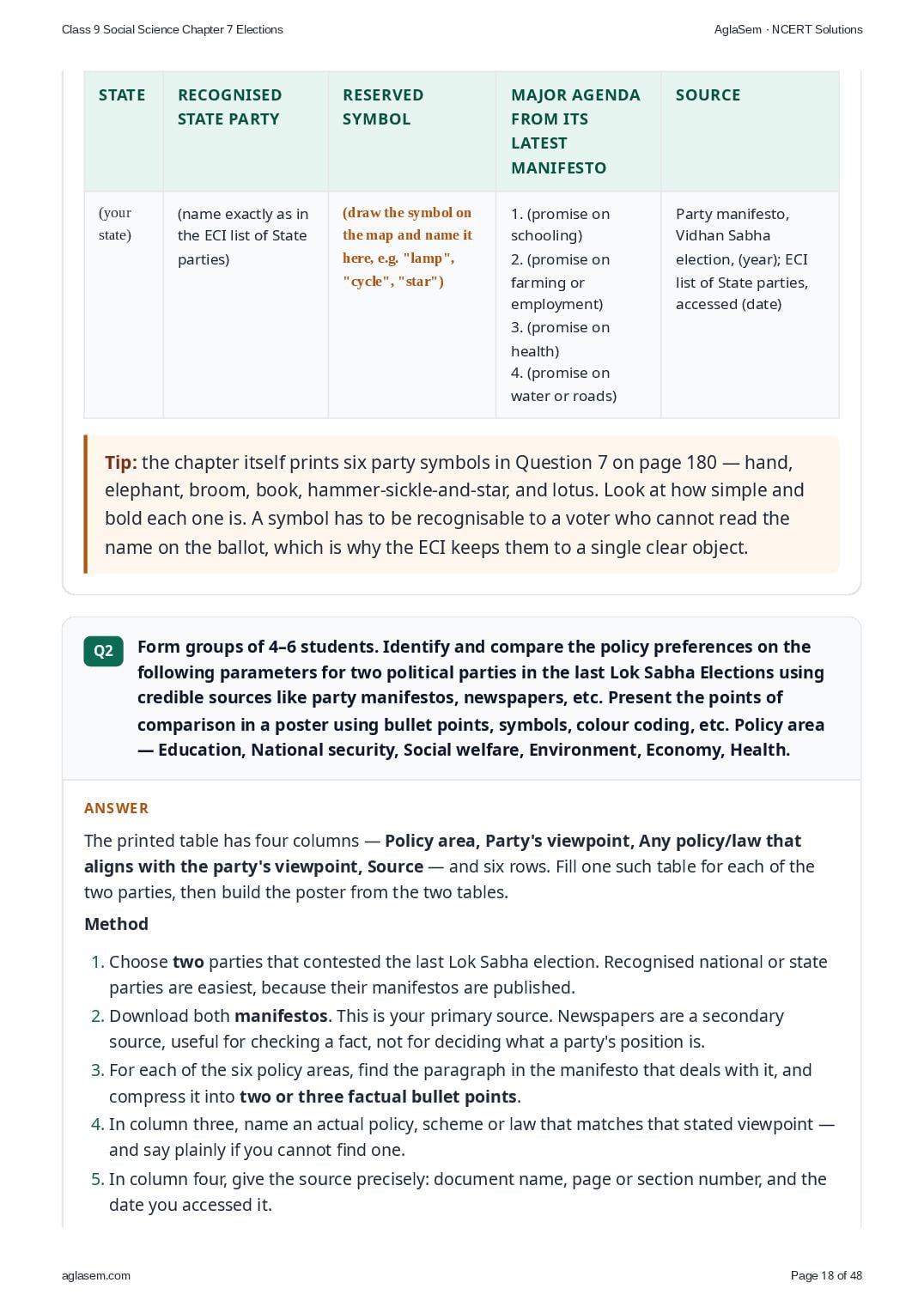
- Choose any three states (including yours). Find the symbols of state parties belonging to those states and plot them on the given map of India. List down their major agenda, as mentioned in their manifesto in the latest Lok Sabha/Vidhan Sabha/Local Body Elections.
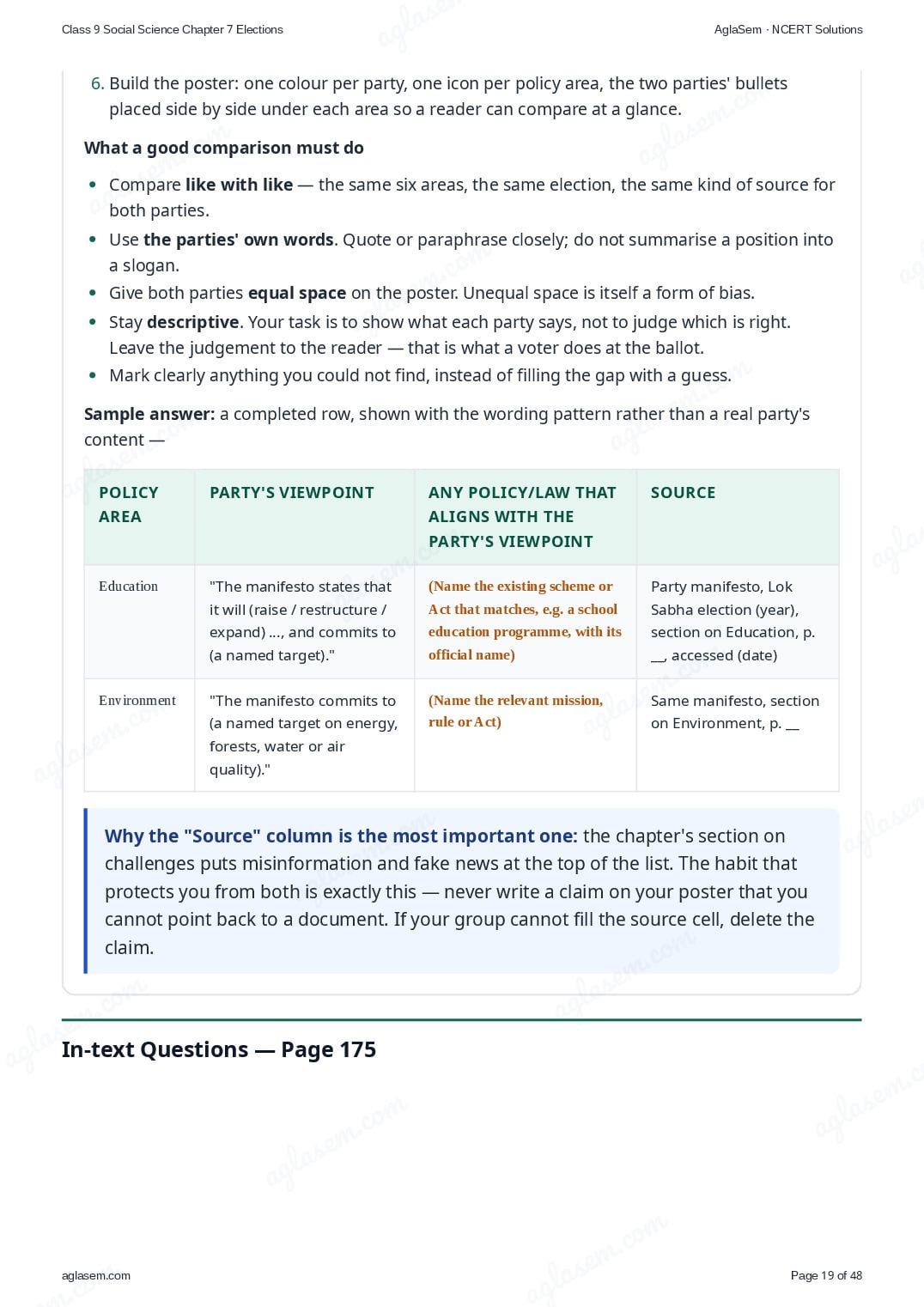
- Form groups of 4–6 students. Identify and compare the policy preferences on the following parameters for two political parties in the last Lok Sabha Elections using credible sources like party manifestos, newspapers, etc. Present the points of comparison in a poster using bullet points, symbols, colour coding, etc. Policy area — Education, National security, Social welfare, Environment, Economy, Health.
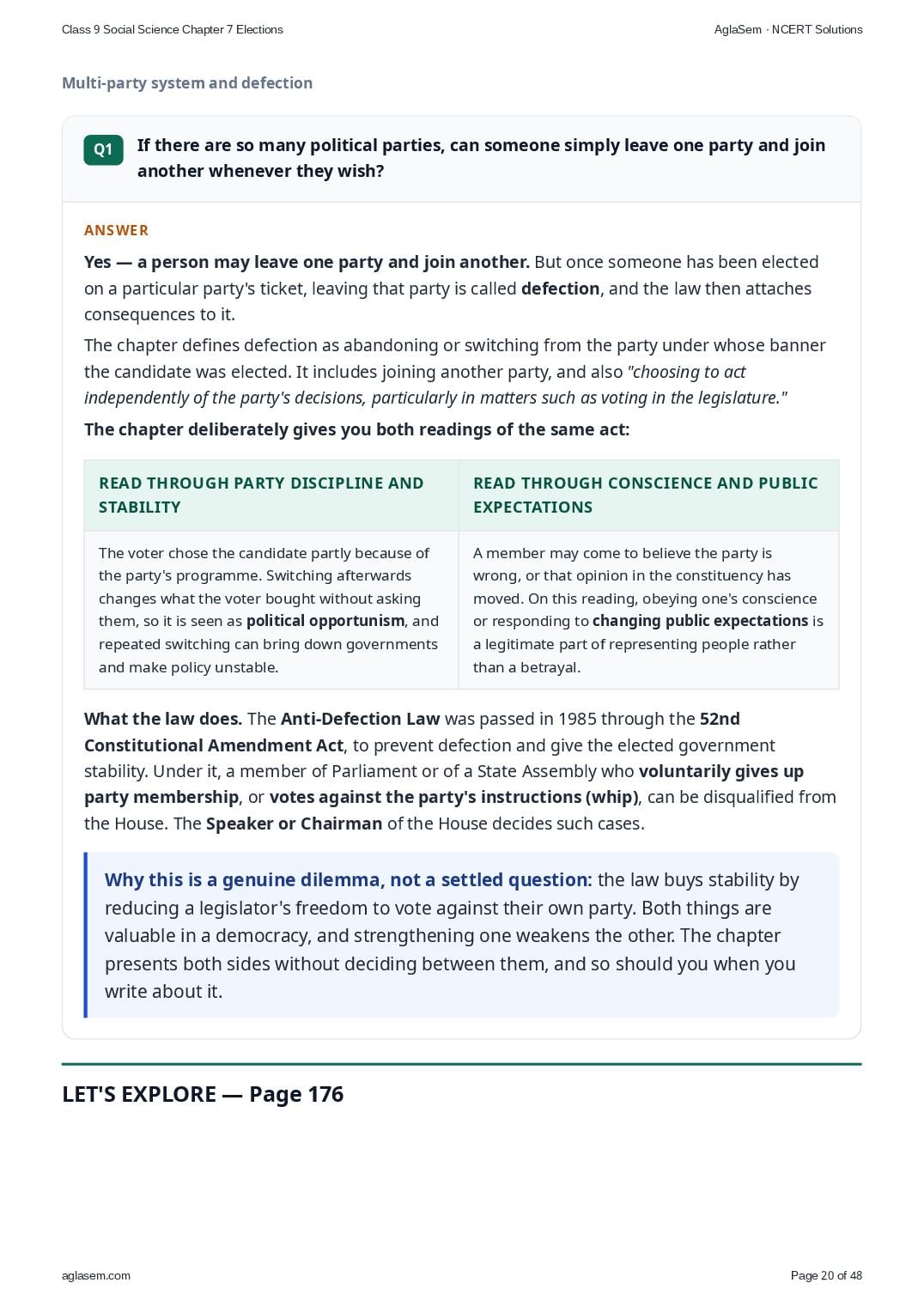
- If there are so many political parties, can someone simply leave one party and join another whenever they wish?
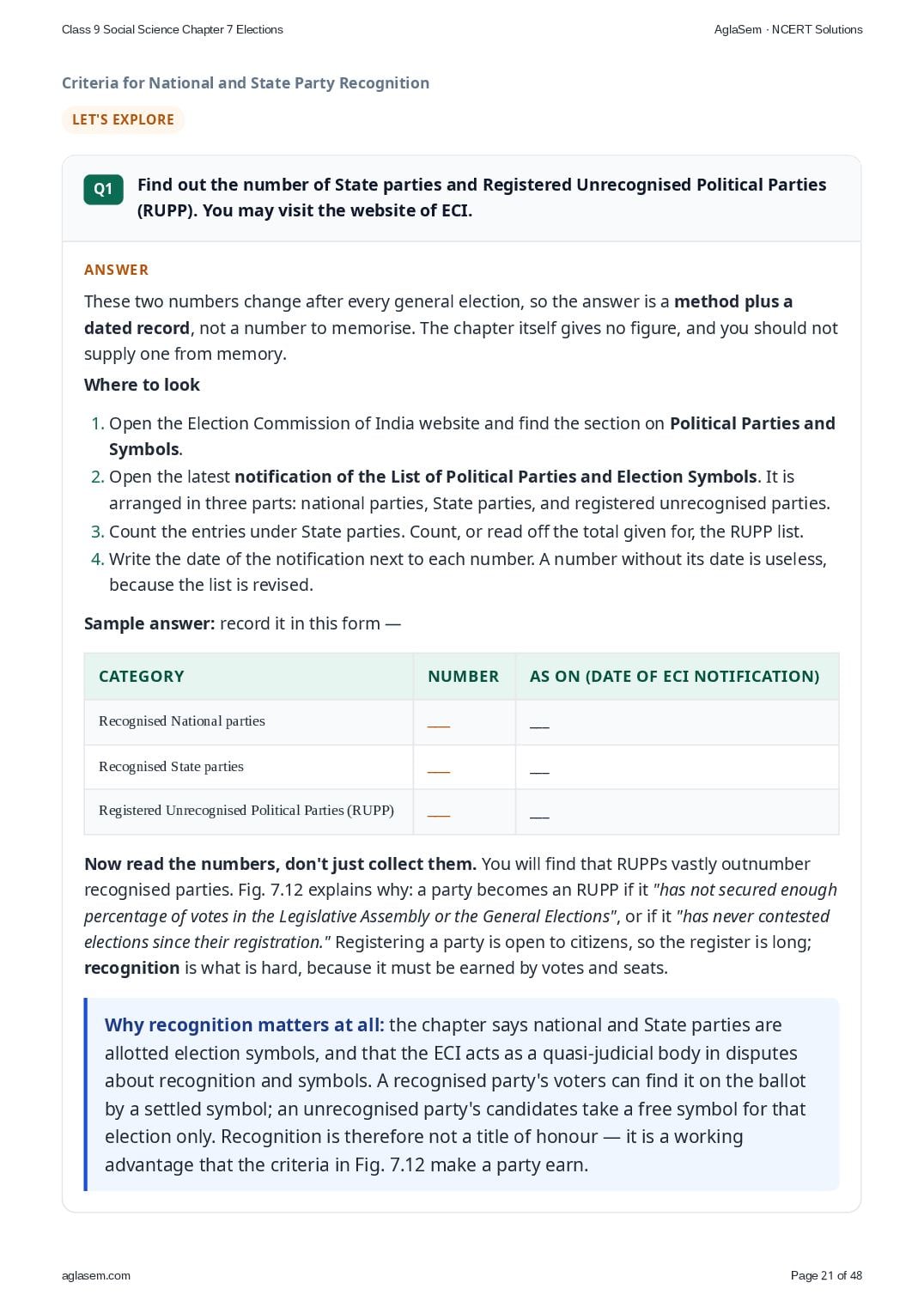
- Find out the number of State parties and Registered Unrecognised Political Parties (RUPP). You may visit the website of ECI.
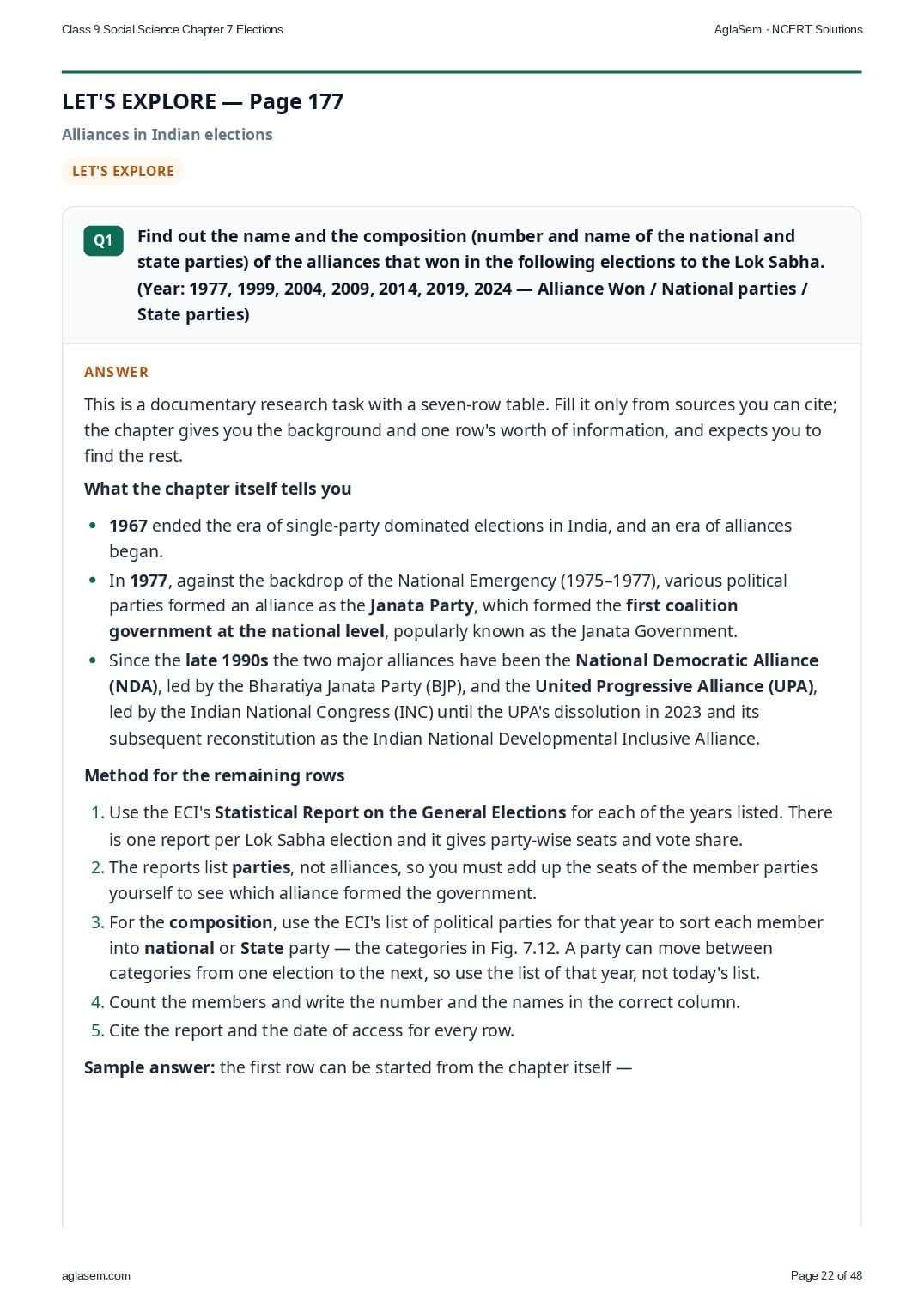
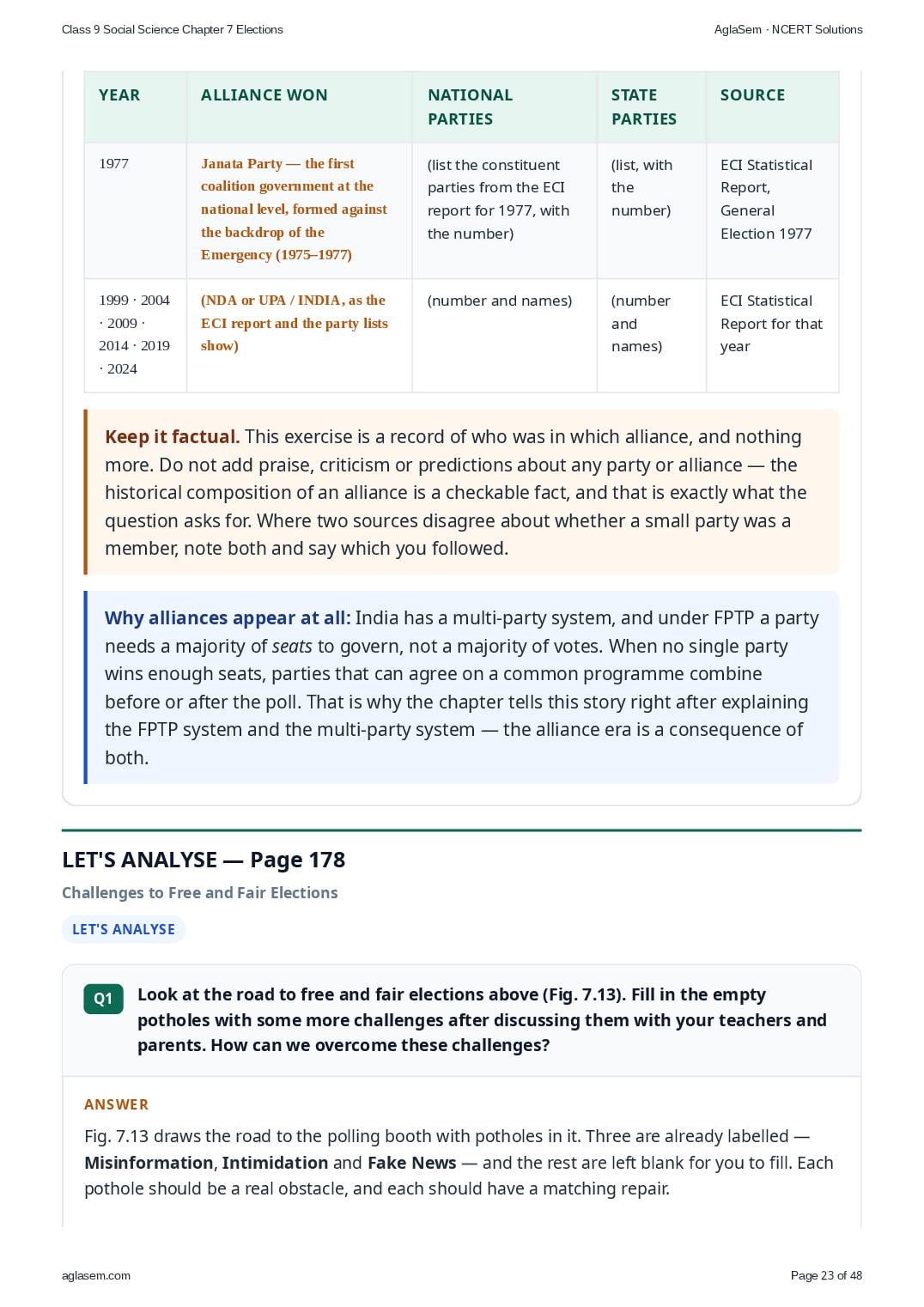
- Find out the name and the composition (number and name of the national and state parties) of the alliances that won in the following elections to the Lok Sabha. (Year: 1977, 1999, 2004, 2009, 2014, 2019, 2024 — Alliance Won / National parties / State parties)
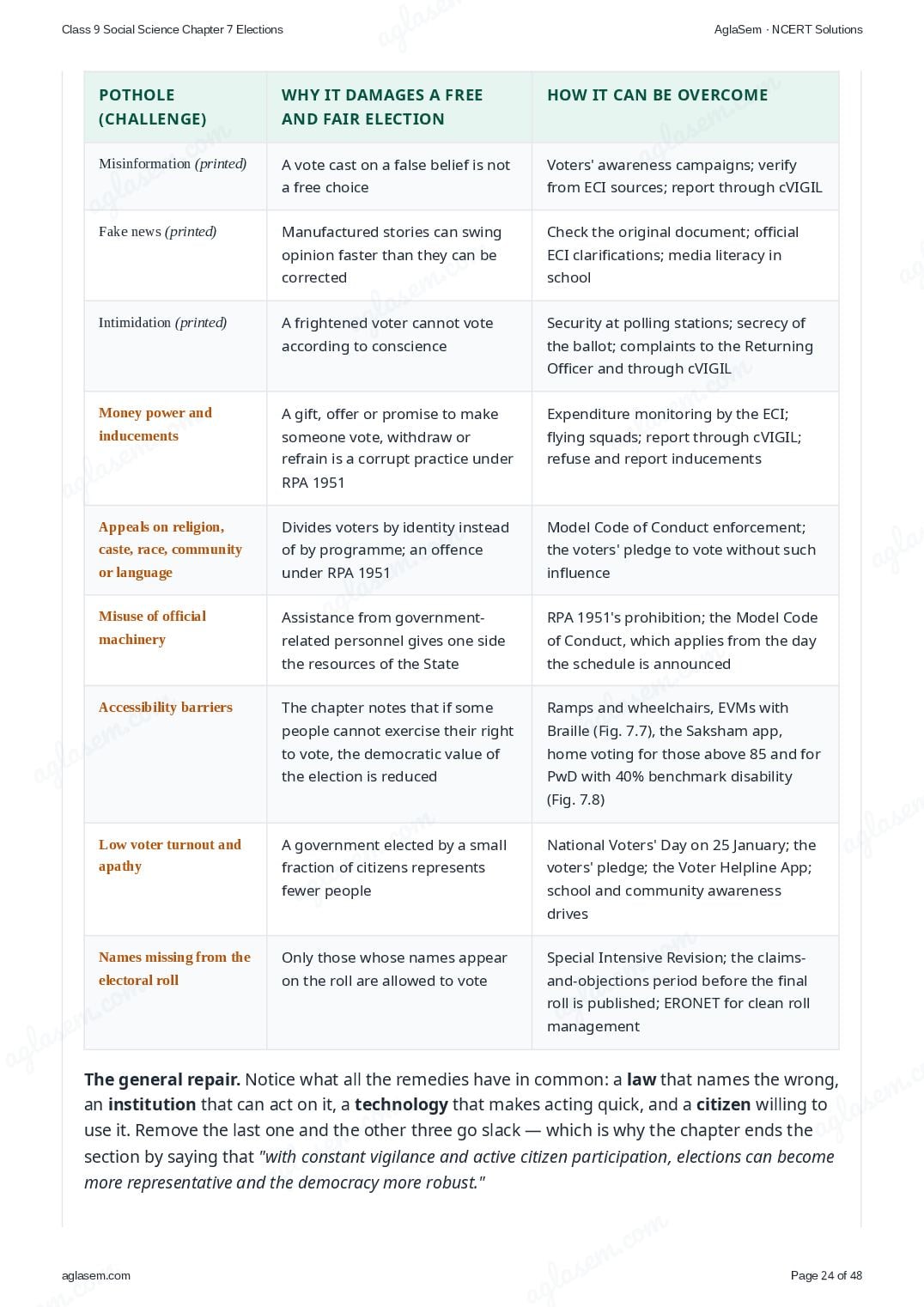
- Look at the road to free and fair elections above (Fig. 7.13). Fill in the empty potholes with some more challenges after discussing them with your teachers and parents. How can we overcome these challenges?
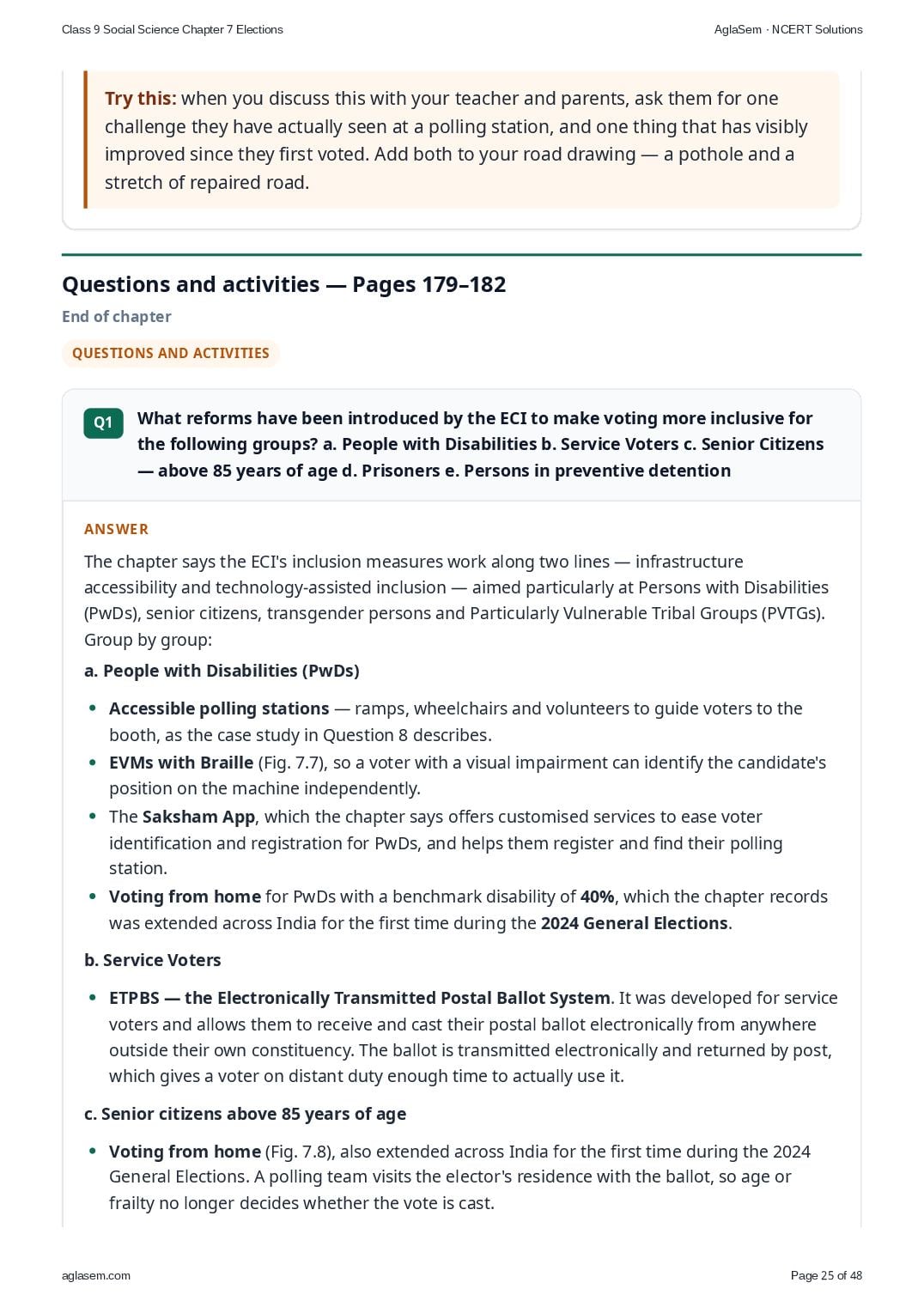
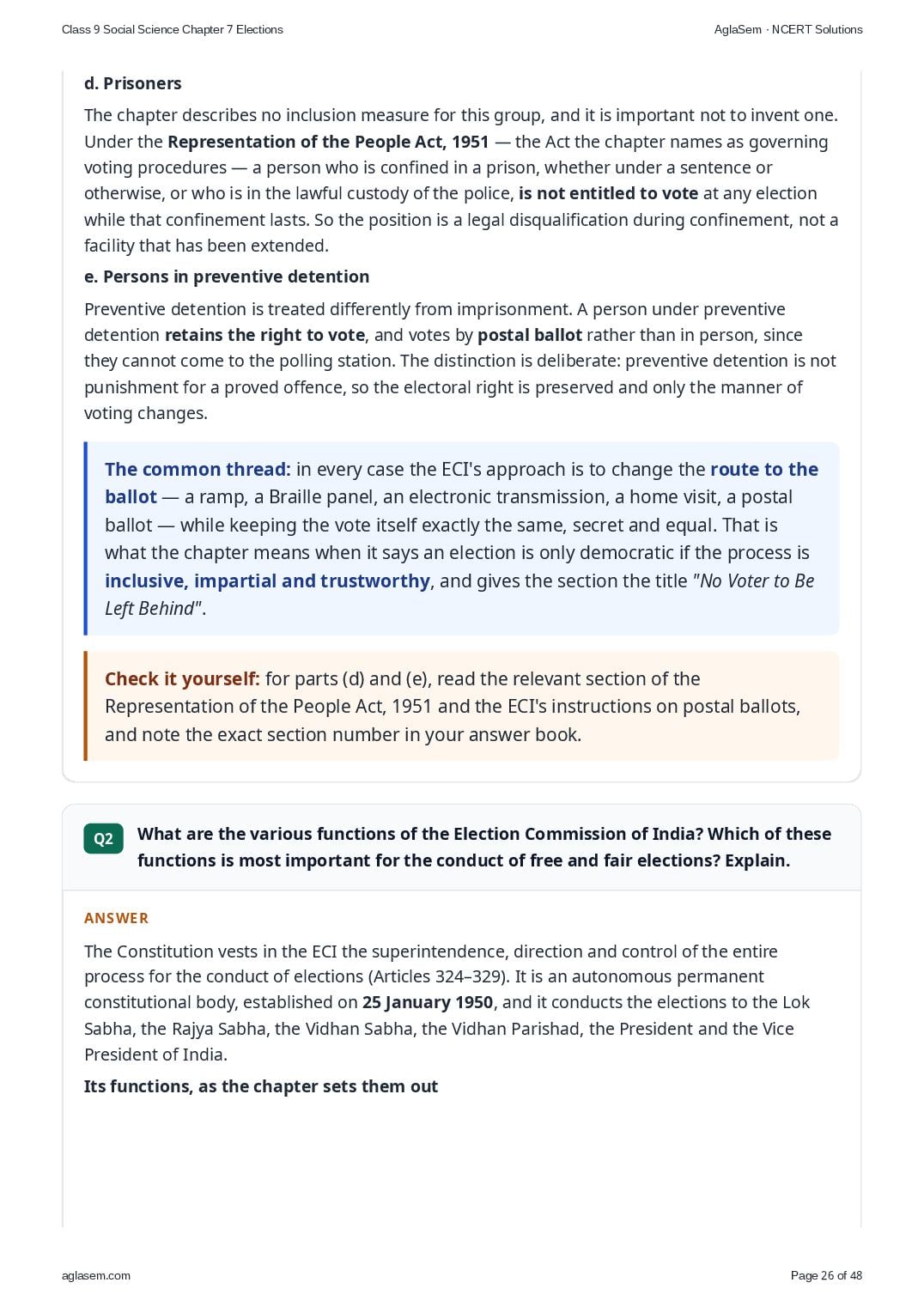
- What reforms have been introduced by the ECI to make voting more inclusive for the following groups? a. People with Disabilities b. Service Voters c. Senior Citizens— above 85 years of age d. Prisoners e. Persons in preventive detention
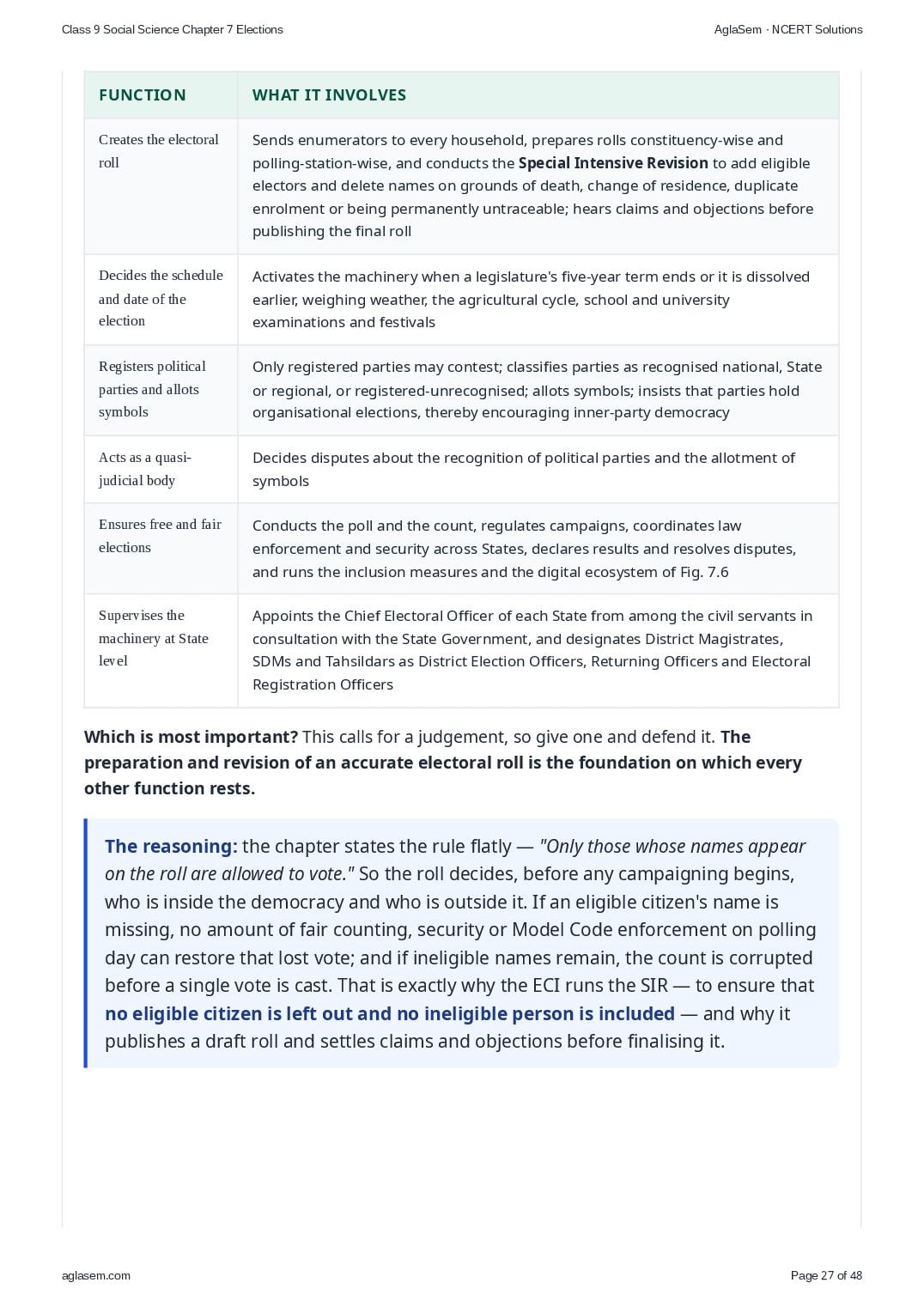
- What are the various functions of the Election Commission of India? Which of these functions is most important for the conduct of free and fair elections? Explain.
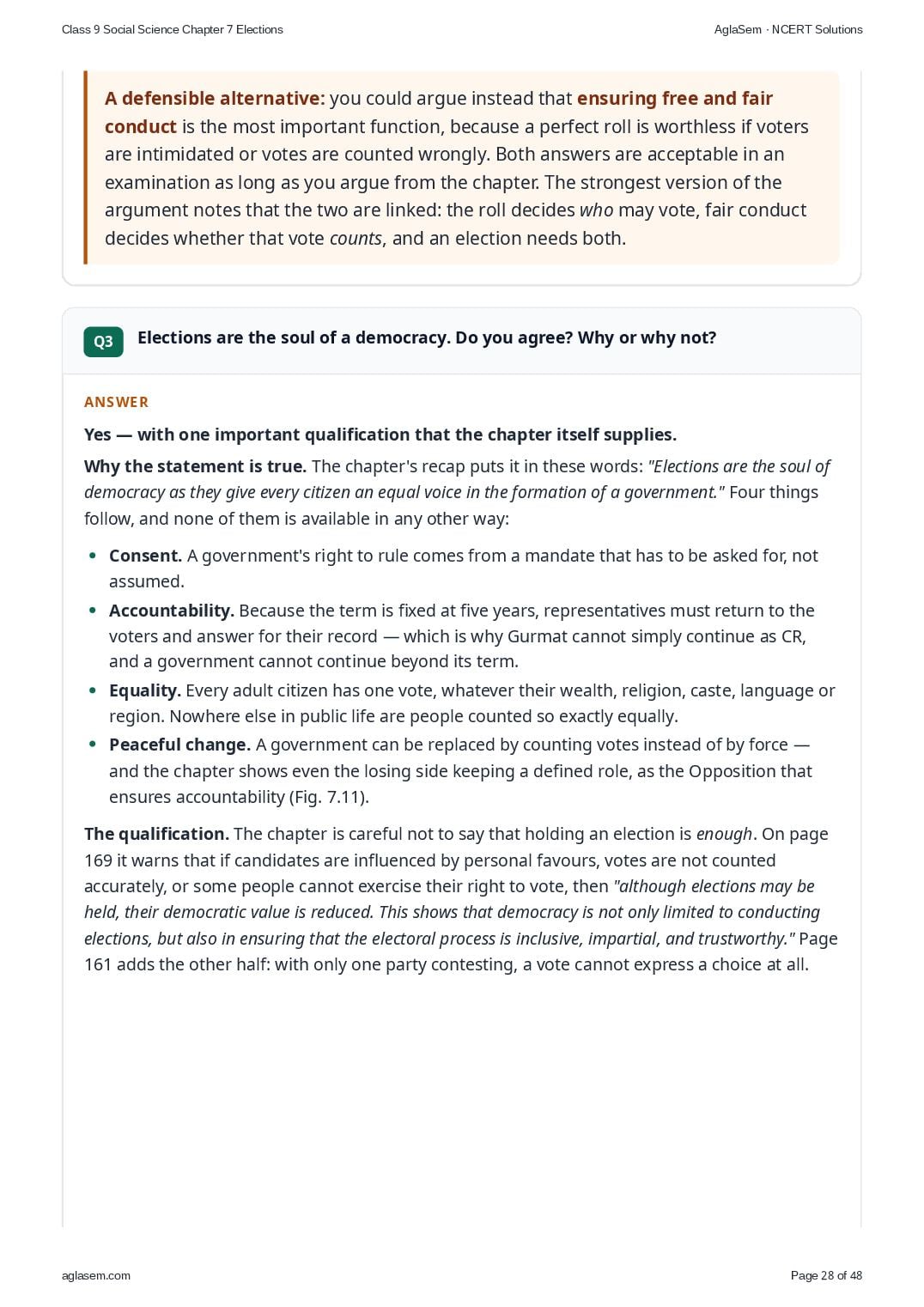
- Elections are the soul of a democracy. Do you agree? Why or why not?
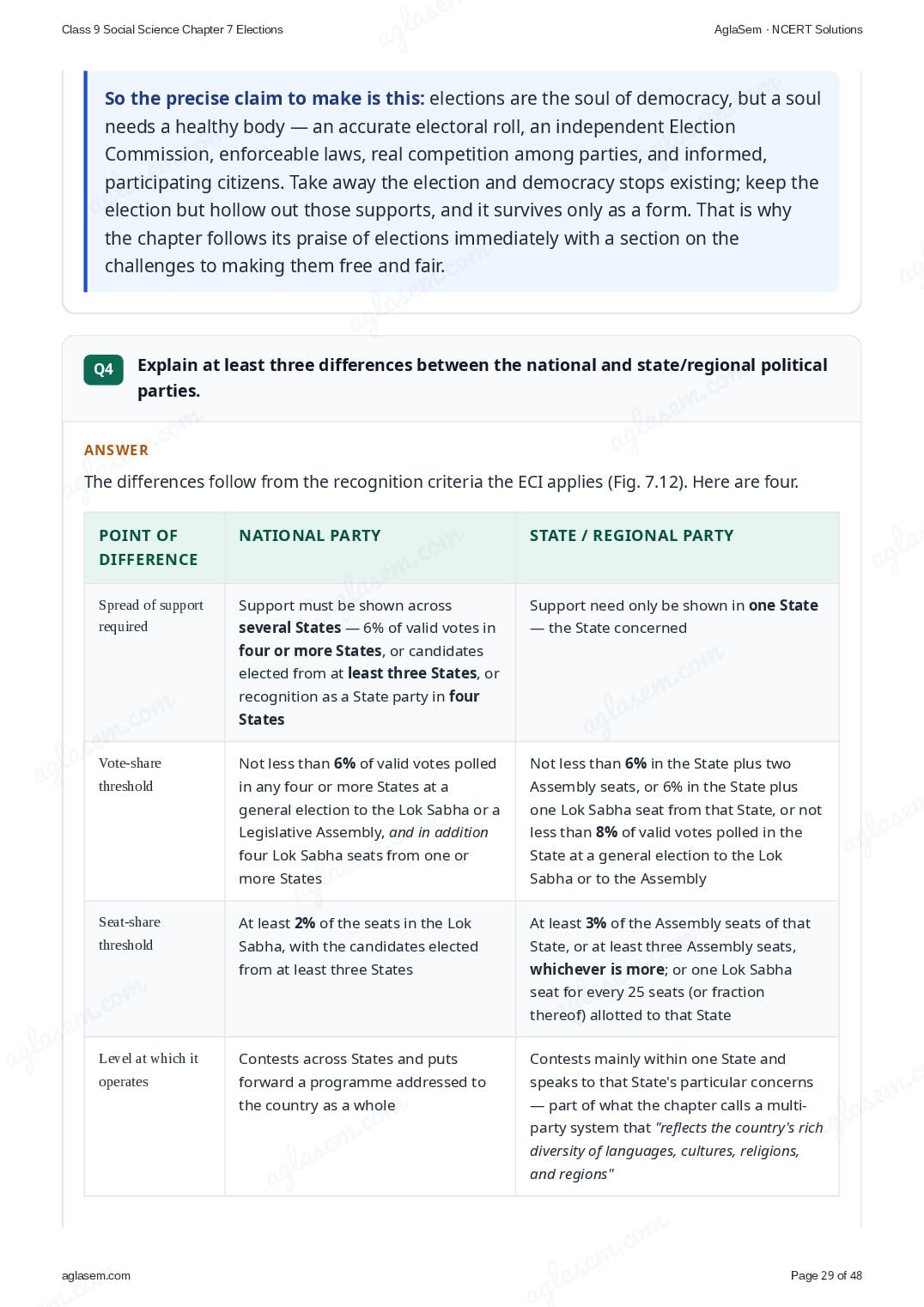
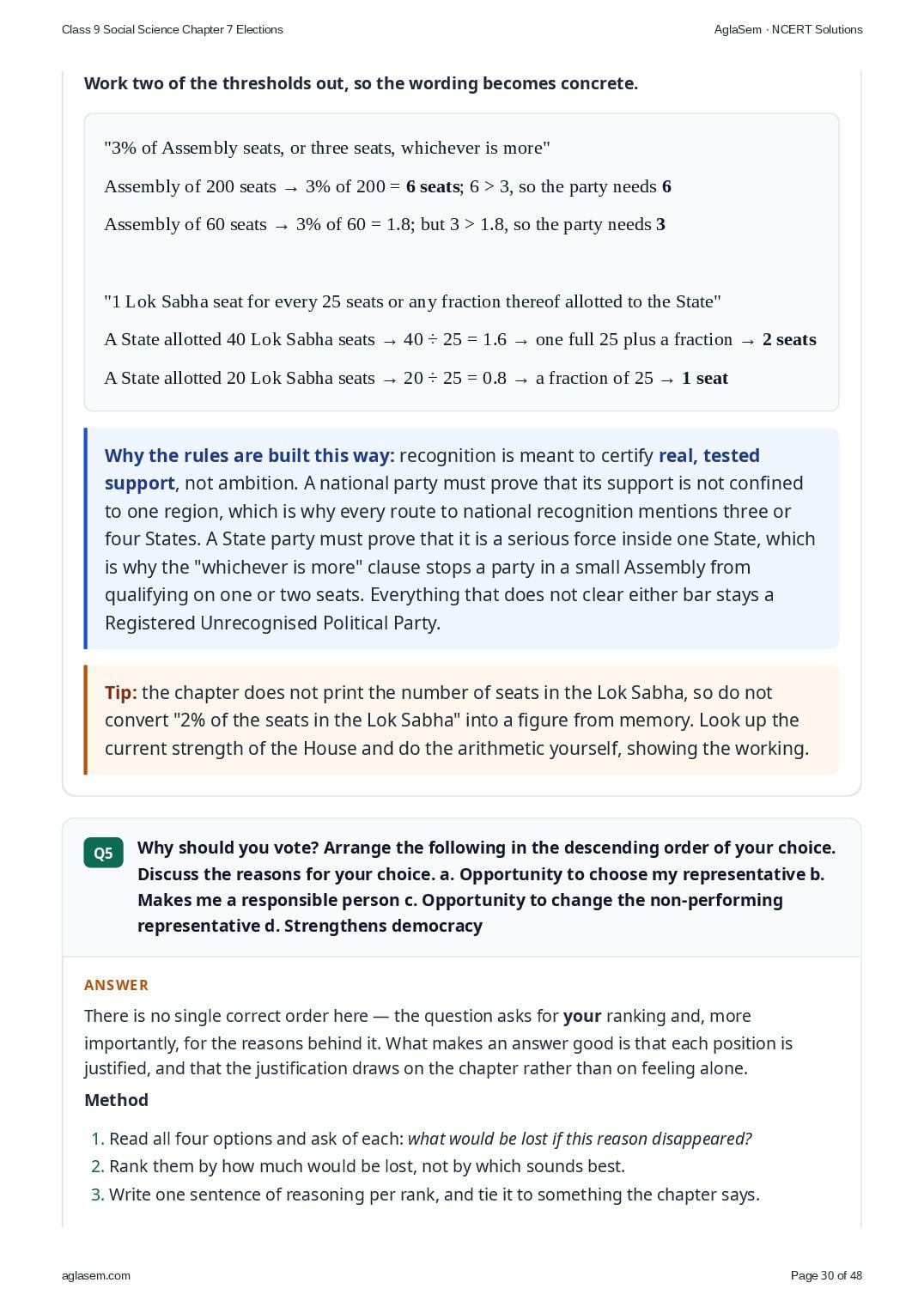
- Explain at least three differences between the national and state/regional political parties.
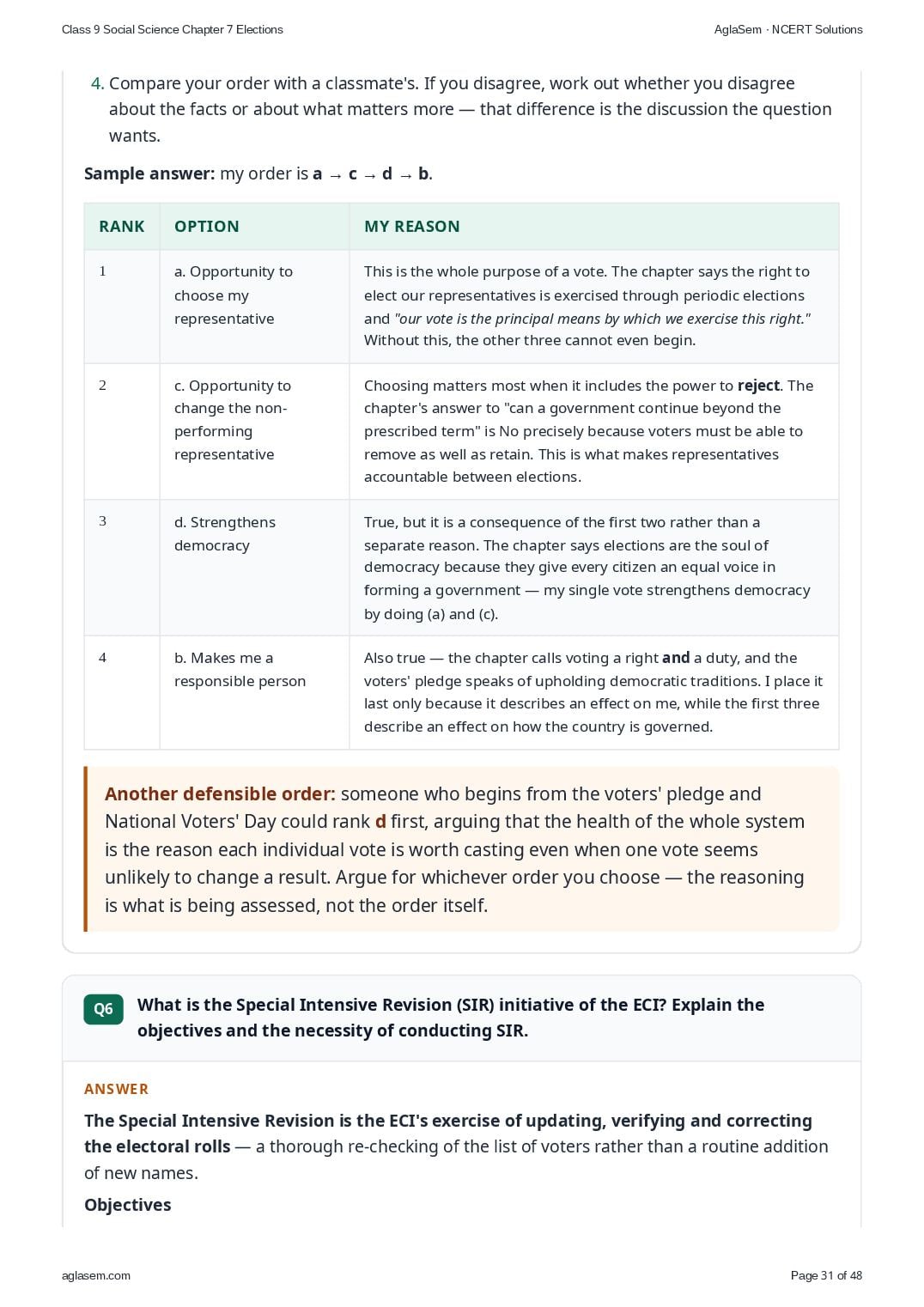
- Why should you vote? Arrange the following in the descending order of your choice. Discuss the reasons for your choice. a. Opportunity to choose my representative b. Makes me a responsible person c. Opportunity to change the non-performing representative d. Strengthens democracy
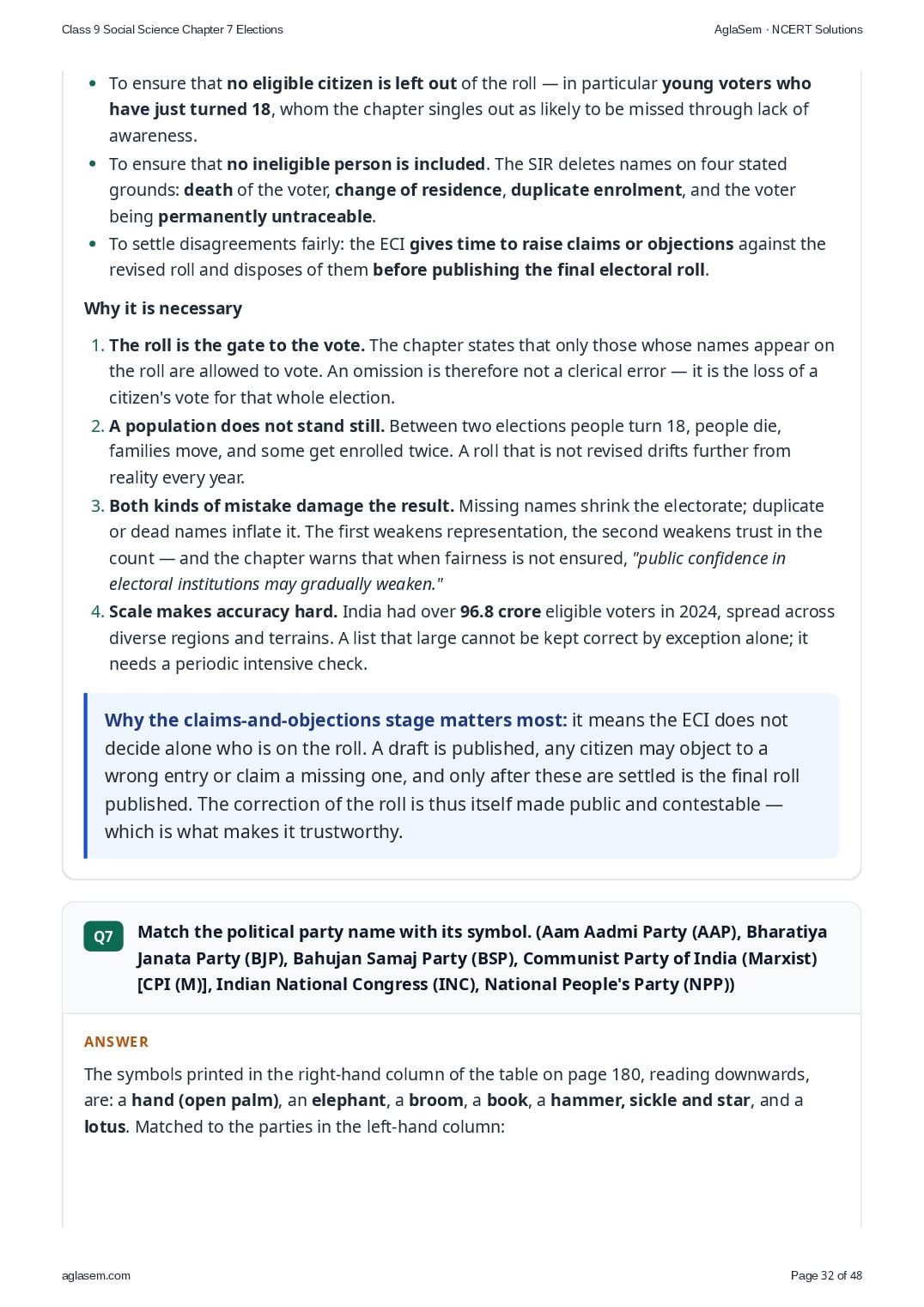
- What is the Special Intensive Revision (SIR) initiative of the ECI? Explain the objectives and the necessity of conducting SIR.
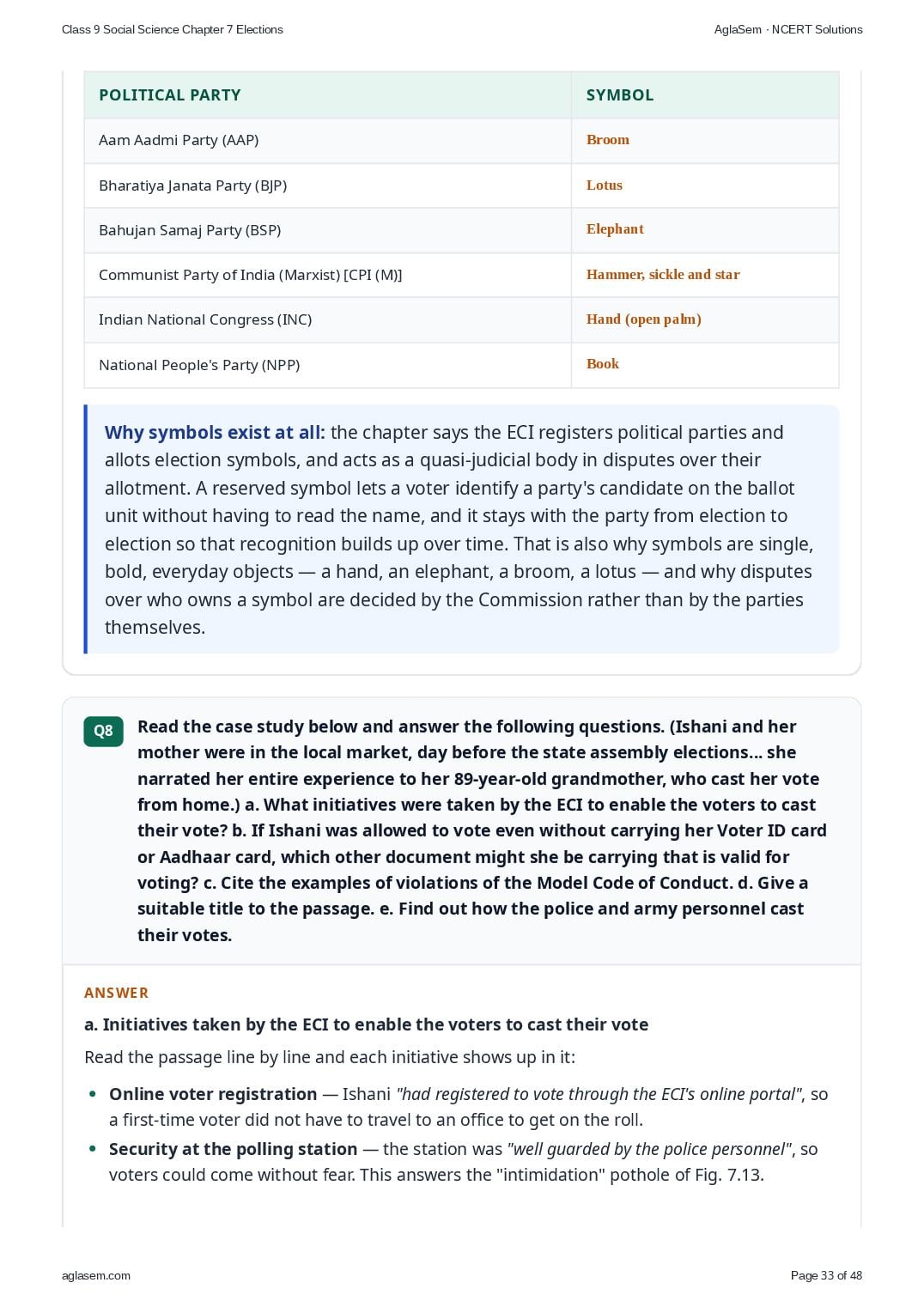
- Match the political party name with its symbol. (Aam Aadmi Party (AAP), Bharatiya Janata Party (BJP), Bahujan Samaj Party (BSP), Communist Party of India (Marxist) [CPI (M)], Indian National Congress (INC), National People's Party (NPP))
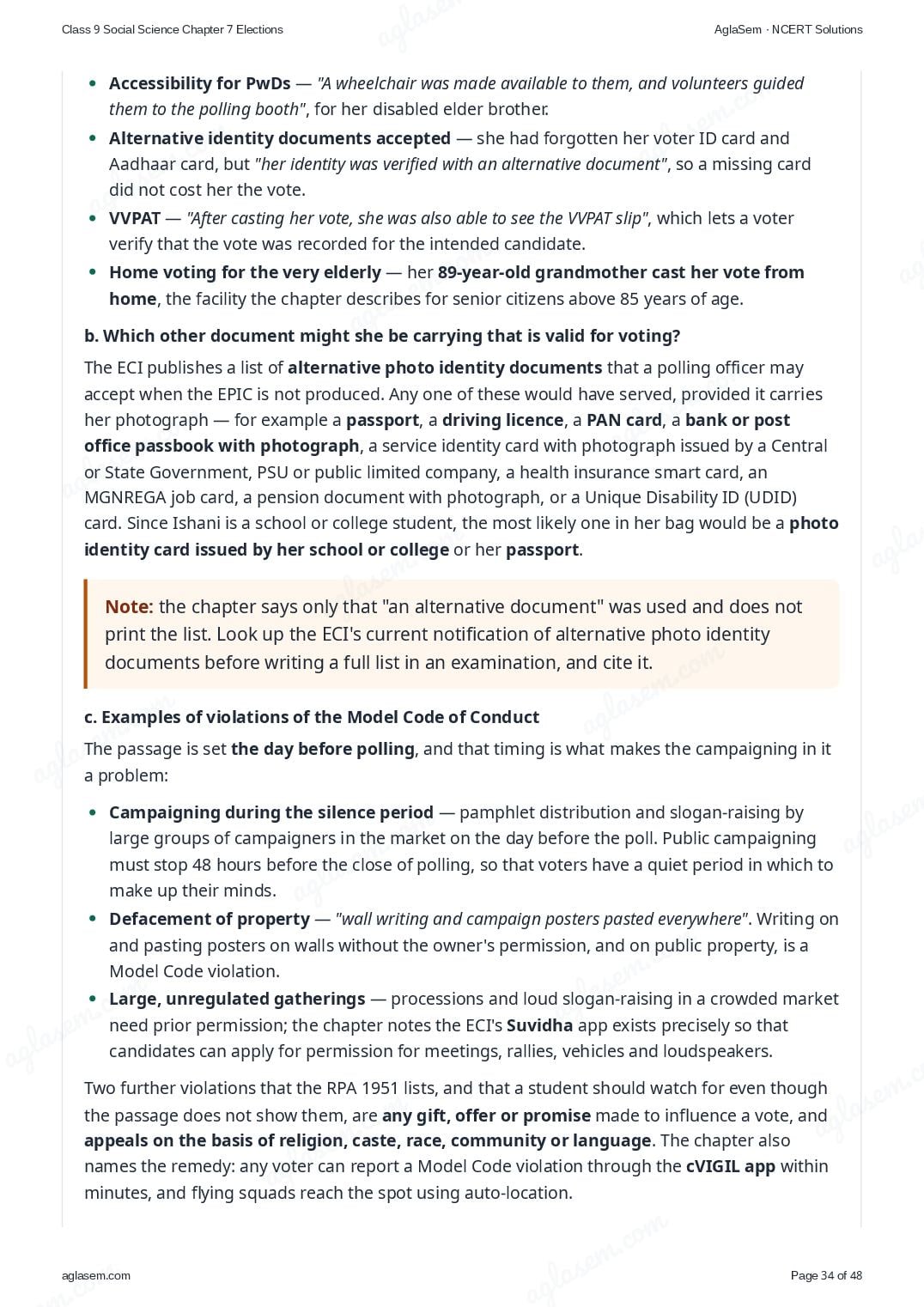
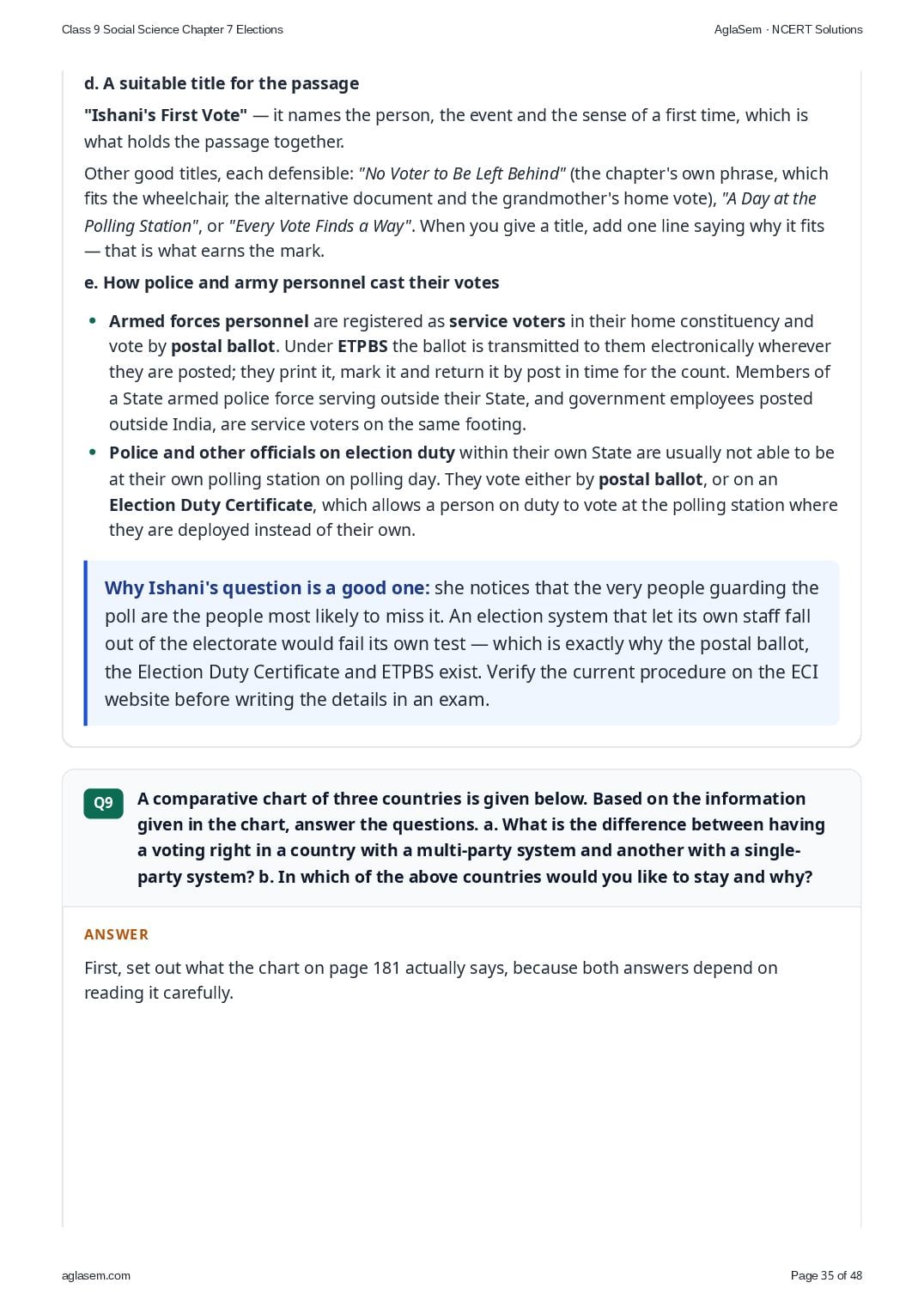
- Read the case study below and answer the following questions. (Ishani and her mother were in the local market, day before the state assembly elections… she narrated her entire experience to her 89-year-old grandmother, who cast her vote from home.) a. What initiatives were taken by the ECI to enable the voters to cast their vote? b. If Ishani was allowed to vote even without carrying her Voter ID card or Aadhaar card, which other document might she be carrying that is valid for voting? c. Cite the examples of violations of the Model Code of Conduct. d. Give a suitable title to the passage. e. Find out how the police and army personnel cast their votes.
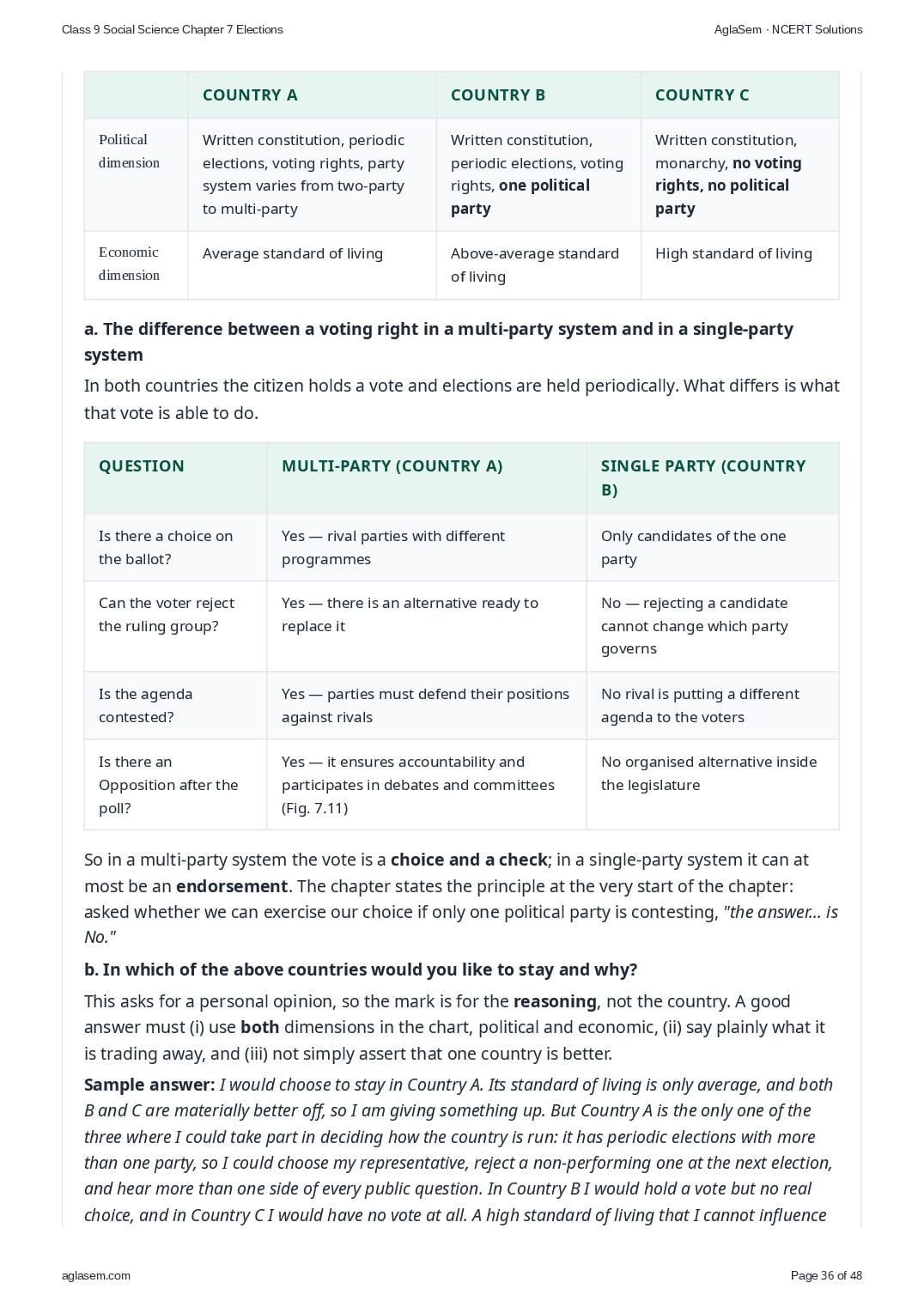
- A comparative chart of three countries is given below. Based on the information given in the chart, answer the questions. a. What is the difference between having a voting right in a country with a multi-party system and another with a single-party system? b. In which of the above countries would you like to stay and why?
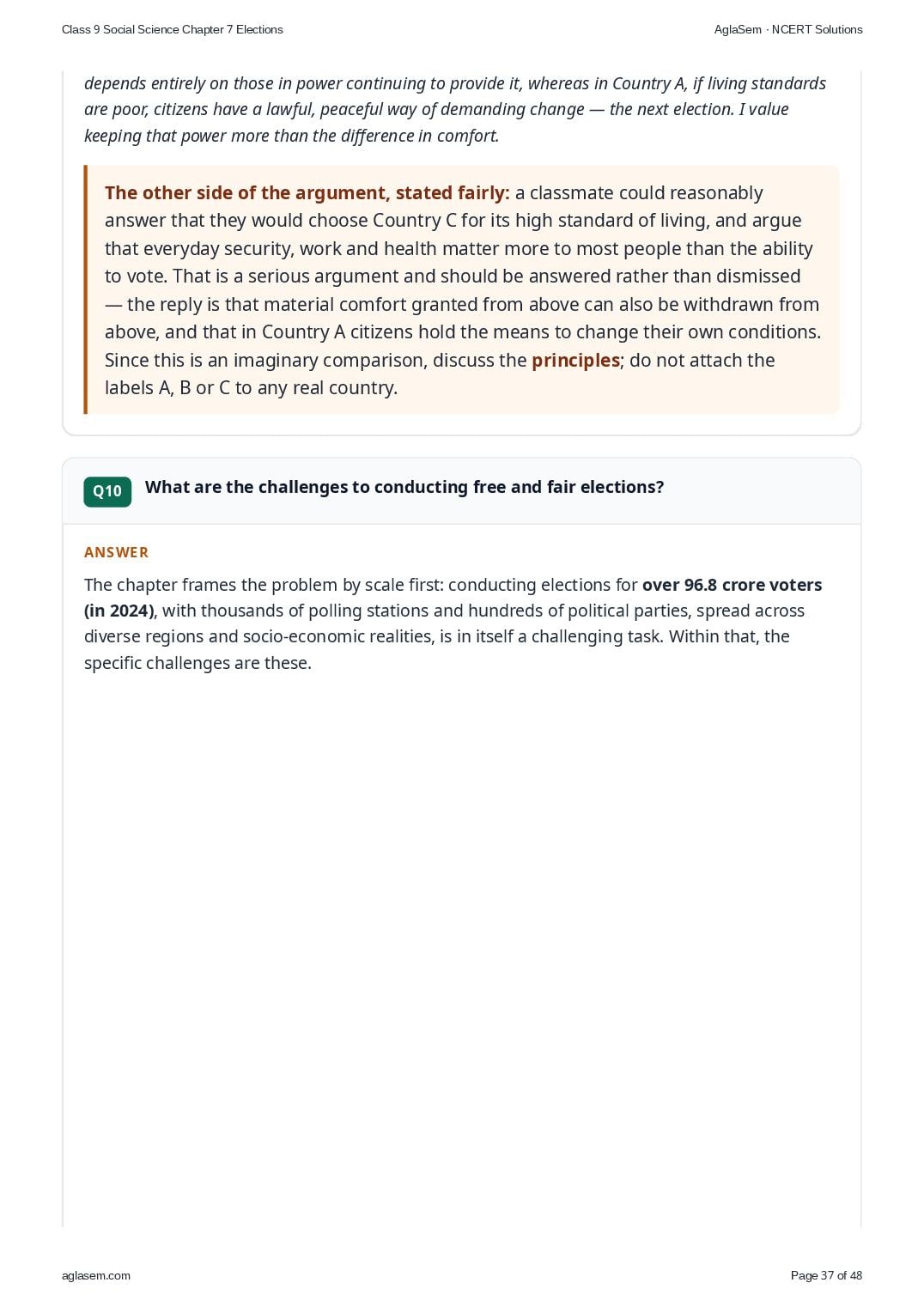
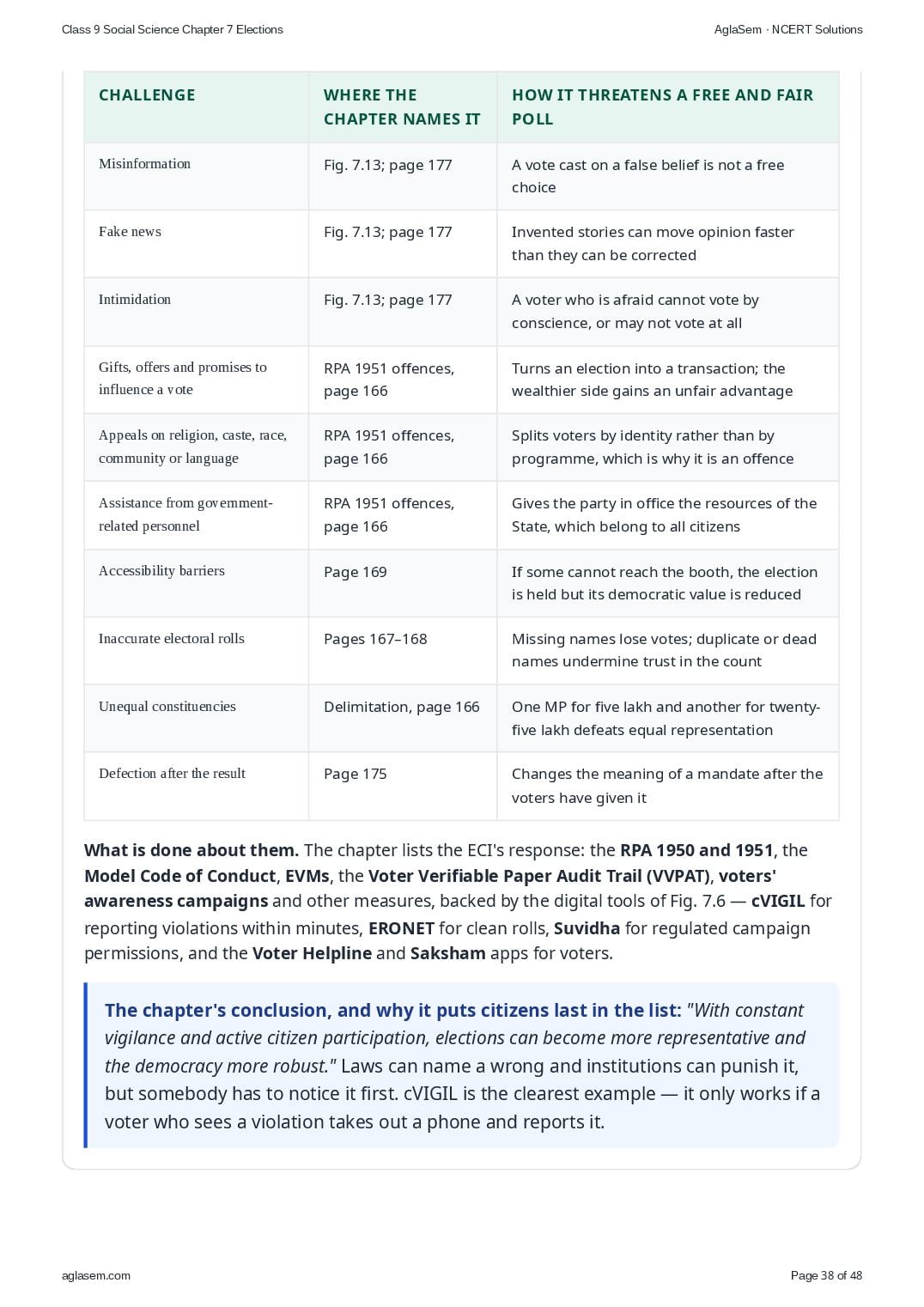
- What are the challenges to conducting free and fair elections?
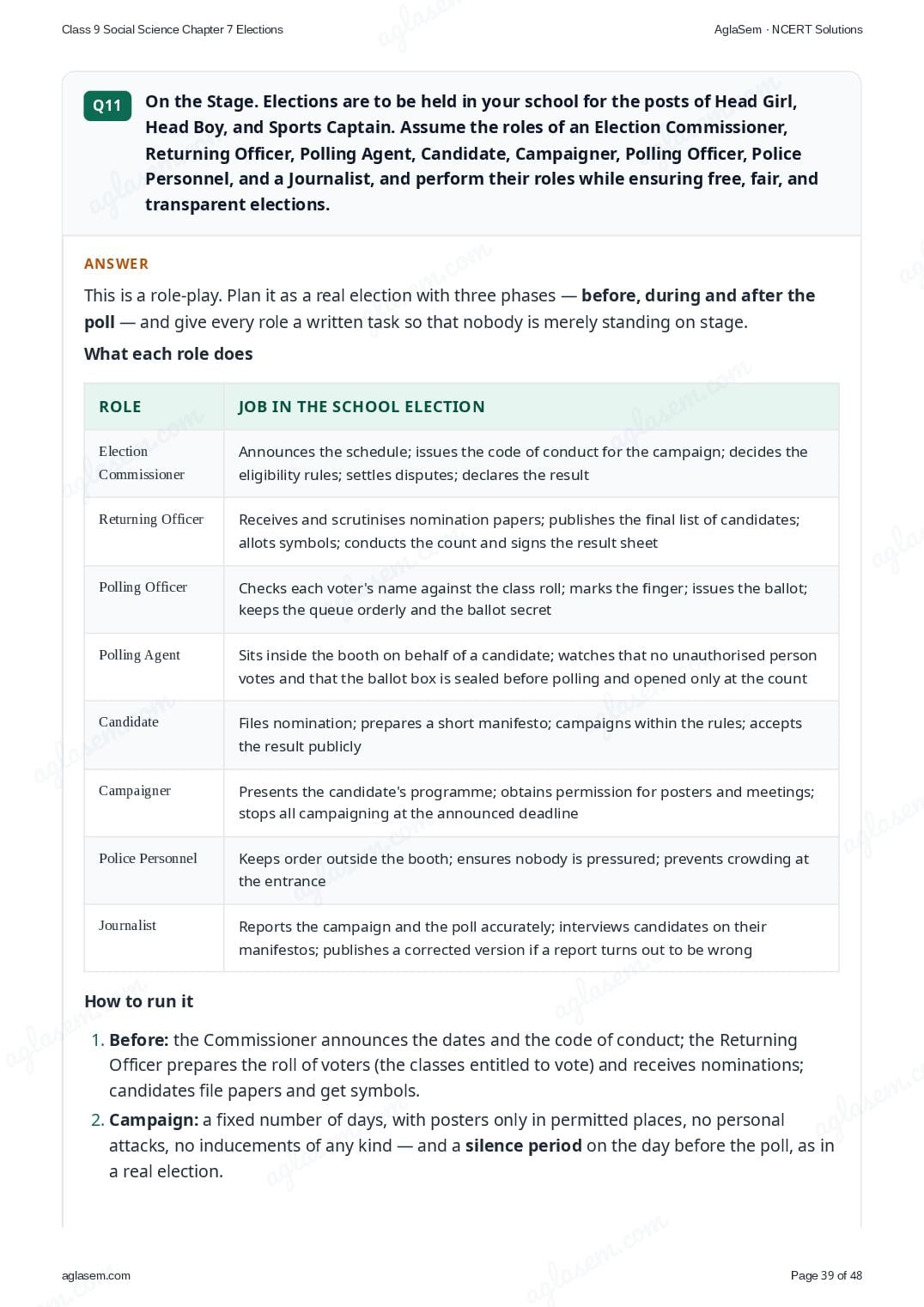
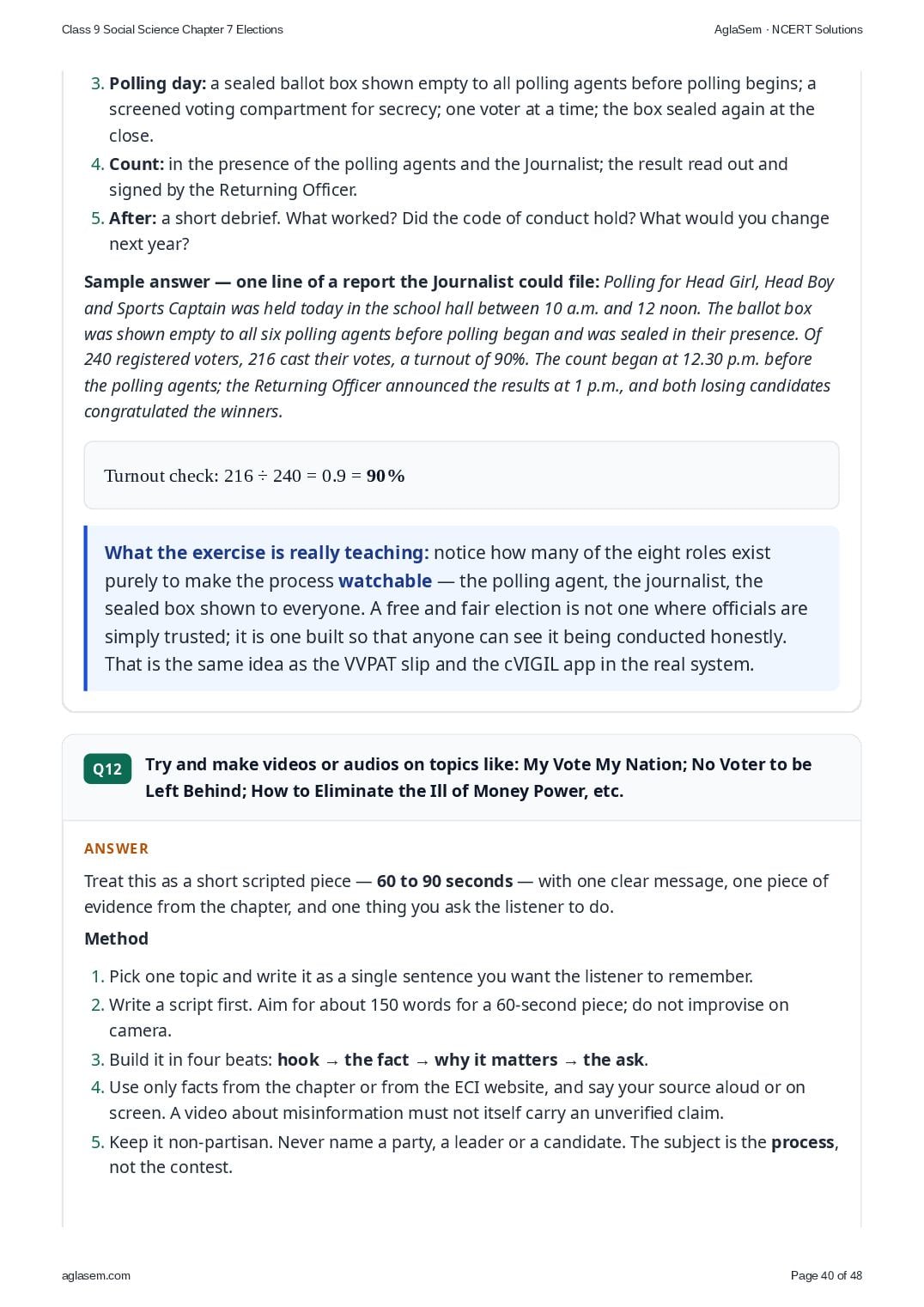
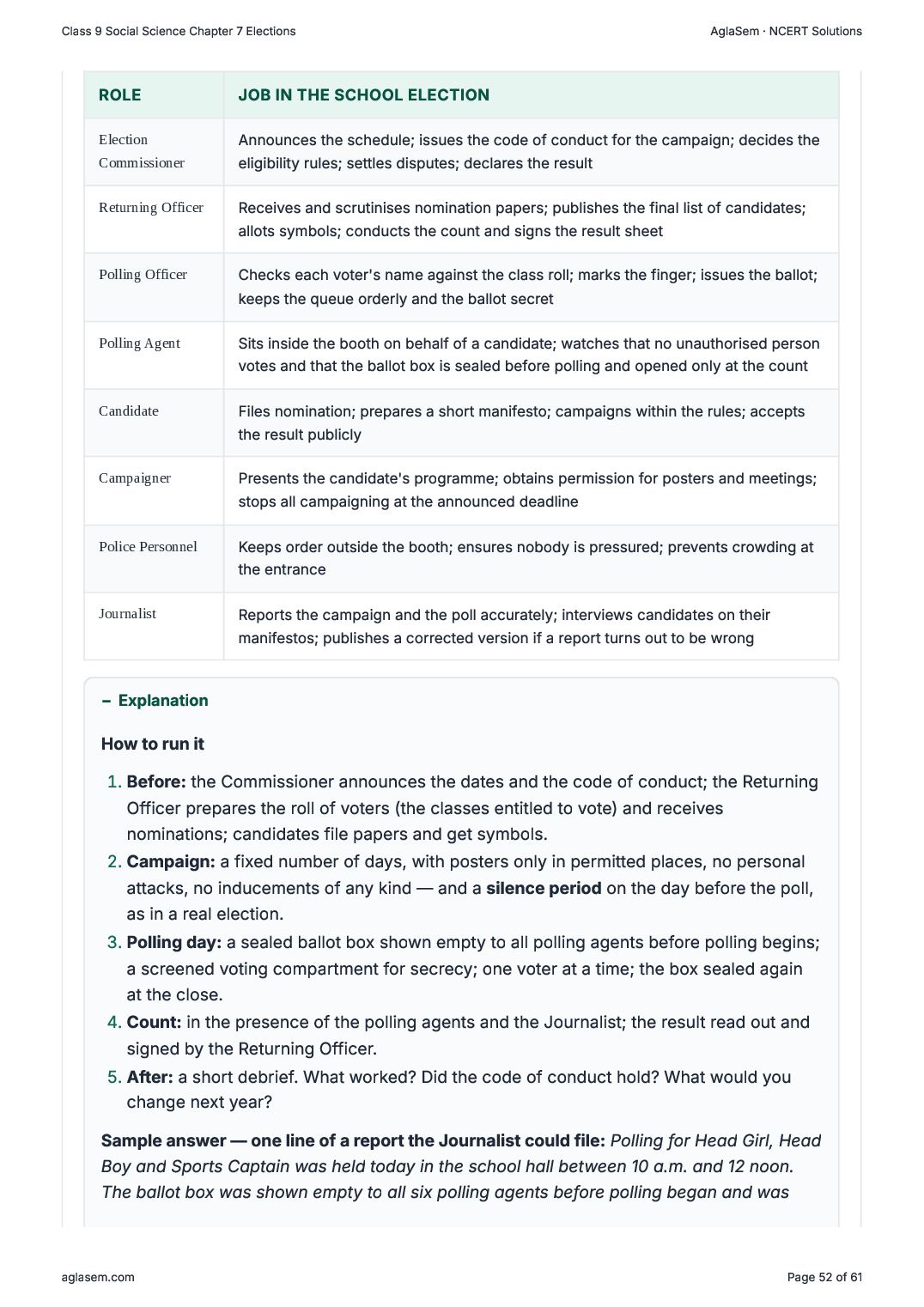
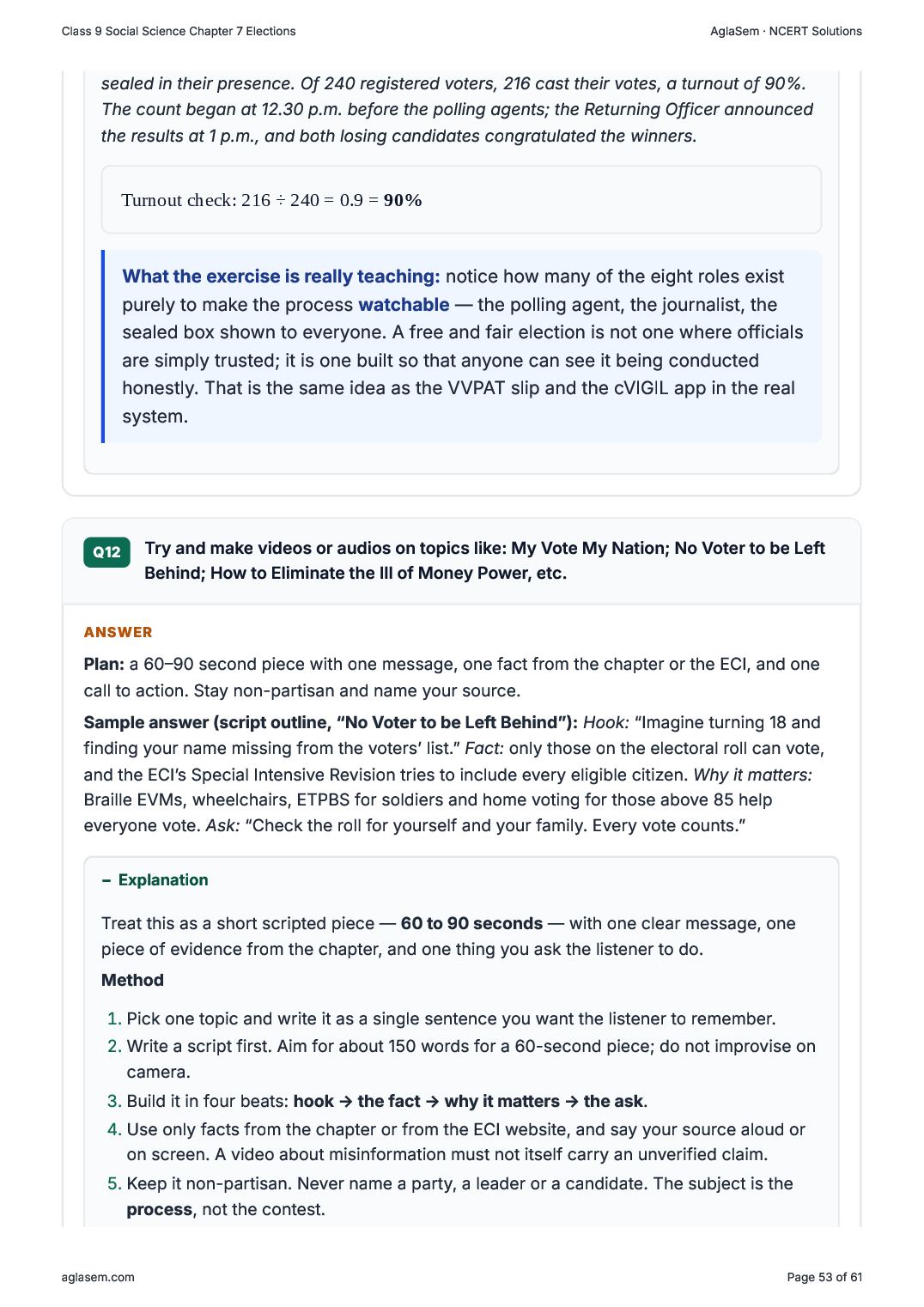
- On the Stage. Elections are to be held in your school for the posts of Head Girl, Head Boy, and Sports Captain. Assume the roles of an Election Commissioner, Returning Officer, Polling Agent, Candidate, Campaigner, Polling Officer, Police Personnel, and a Journalist, and perform their roles while ensuring free, fair, and transparent elections.
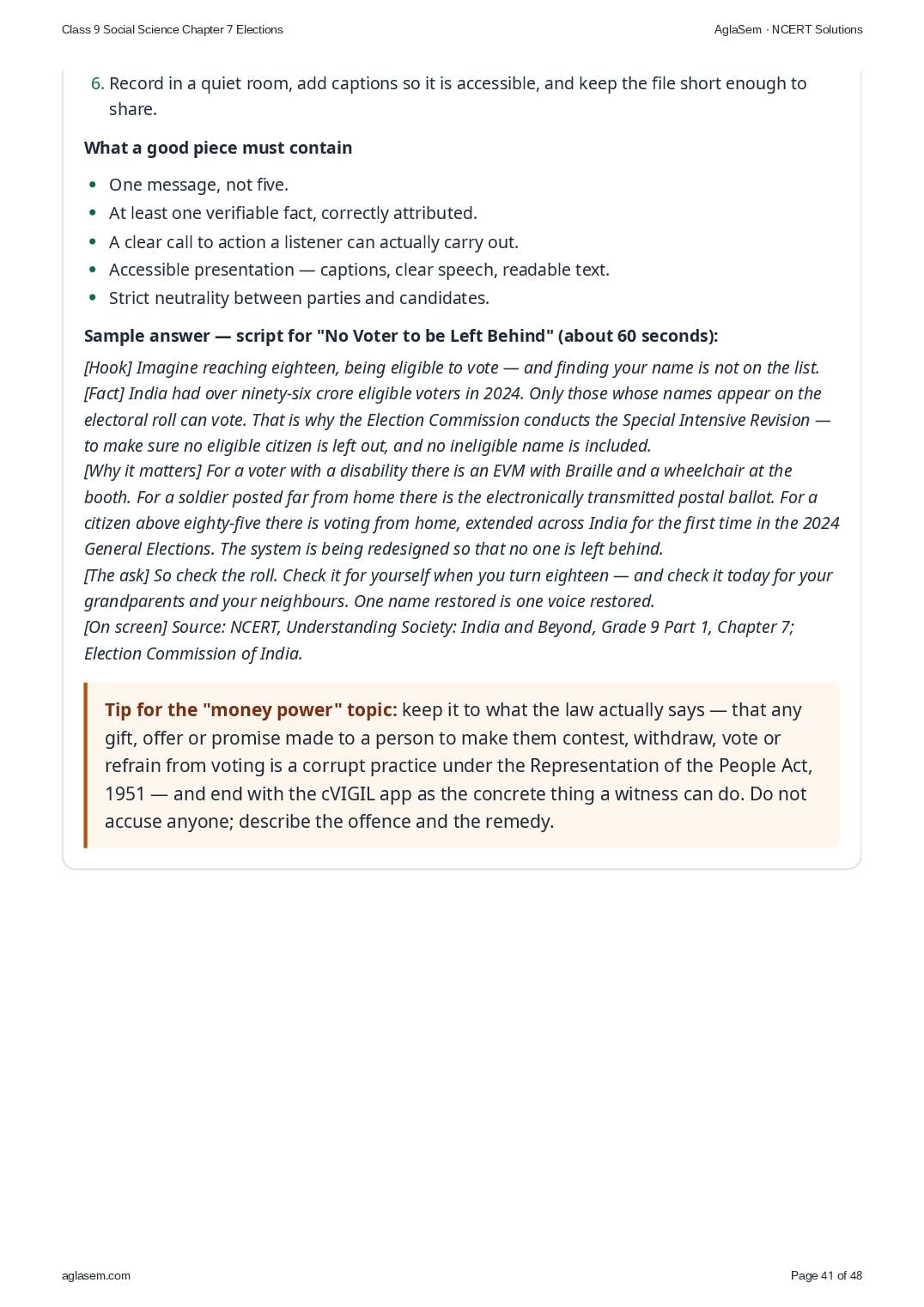
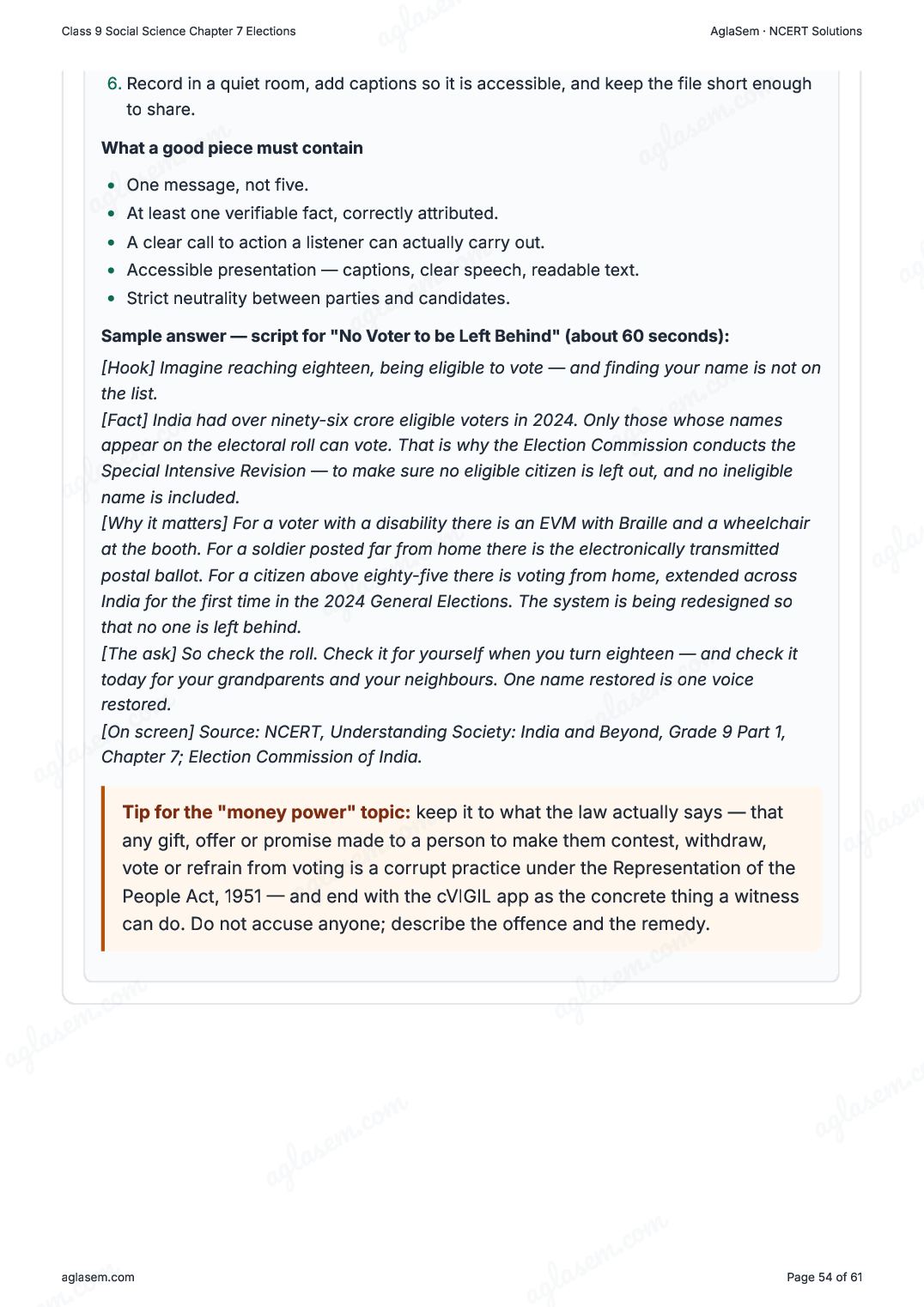
- Try and make videos or audios on topics like: My Vote My Nation; No Voter to be Left Behind; How to Eliminate the Ill of Money Power, etc.
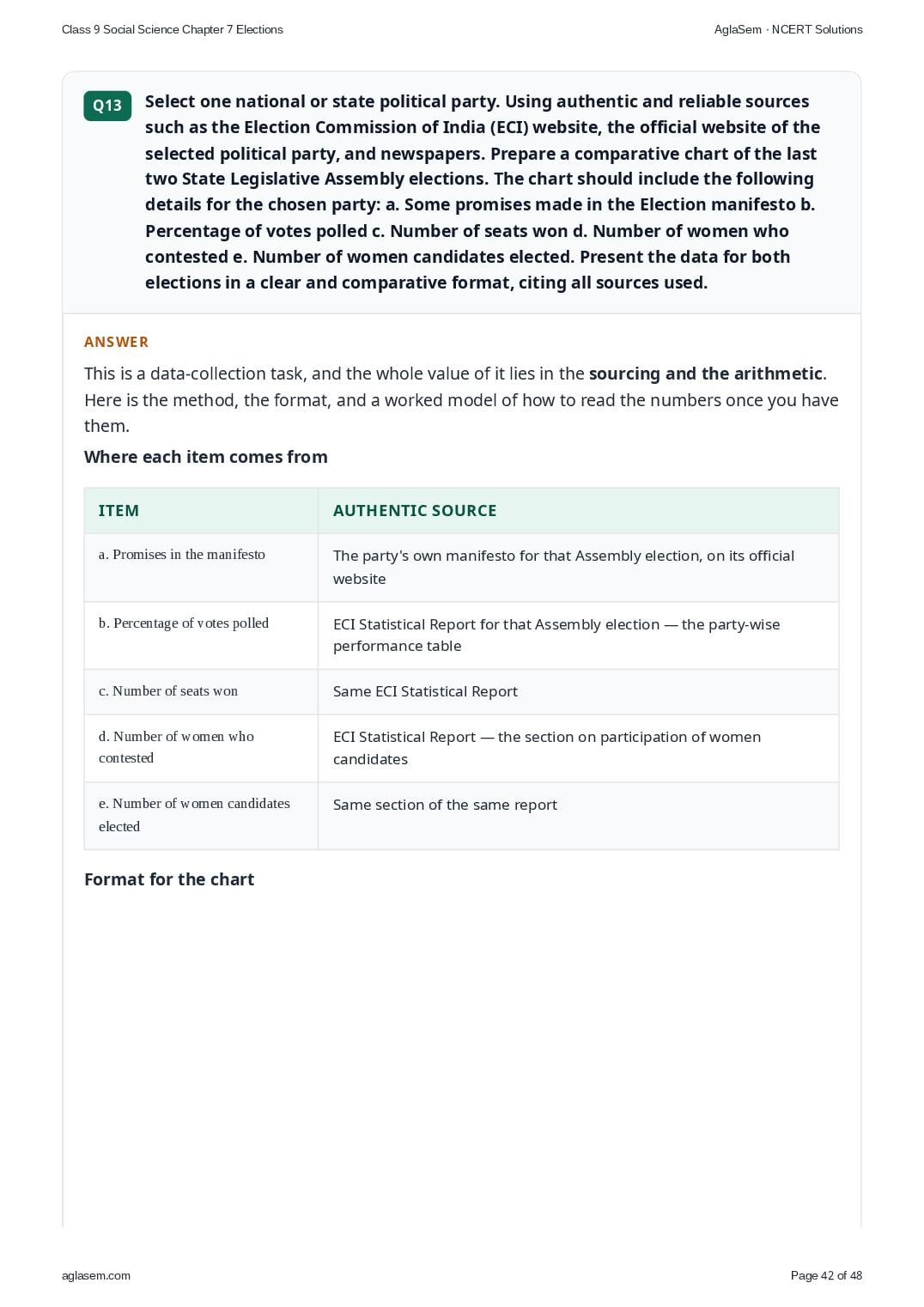
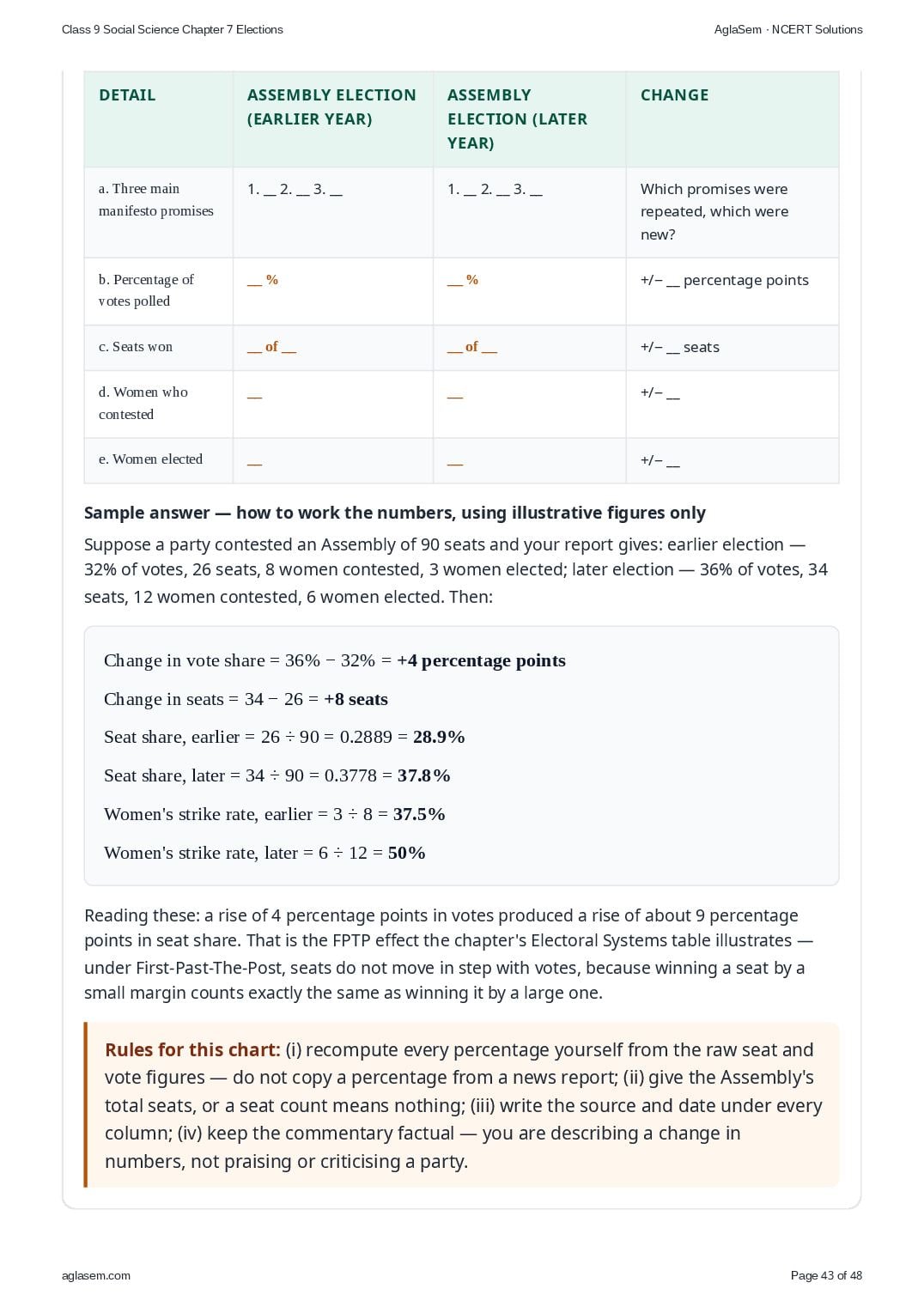
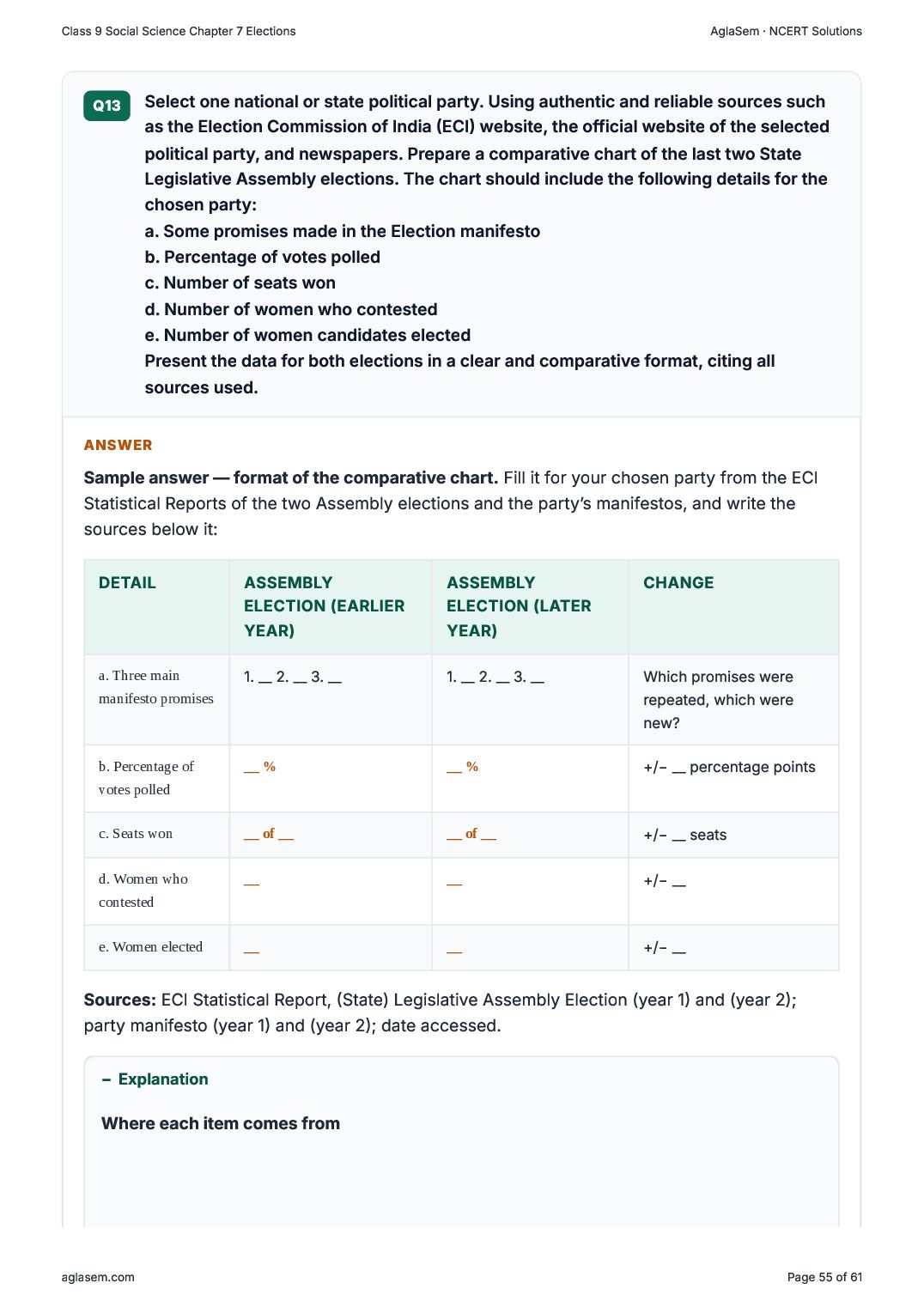
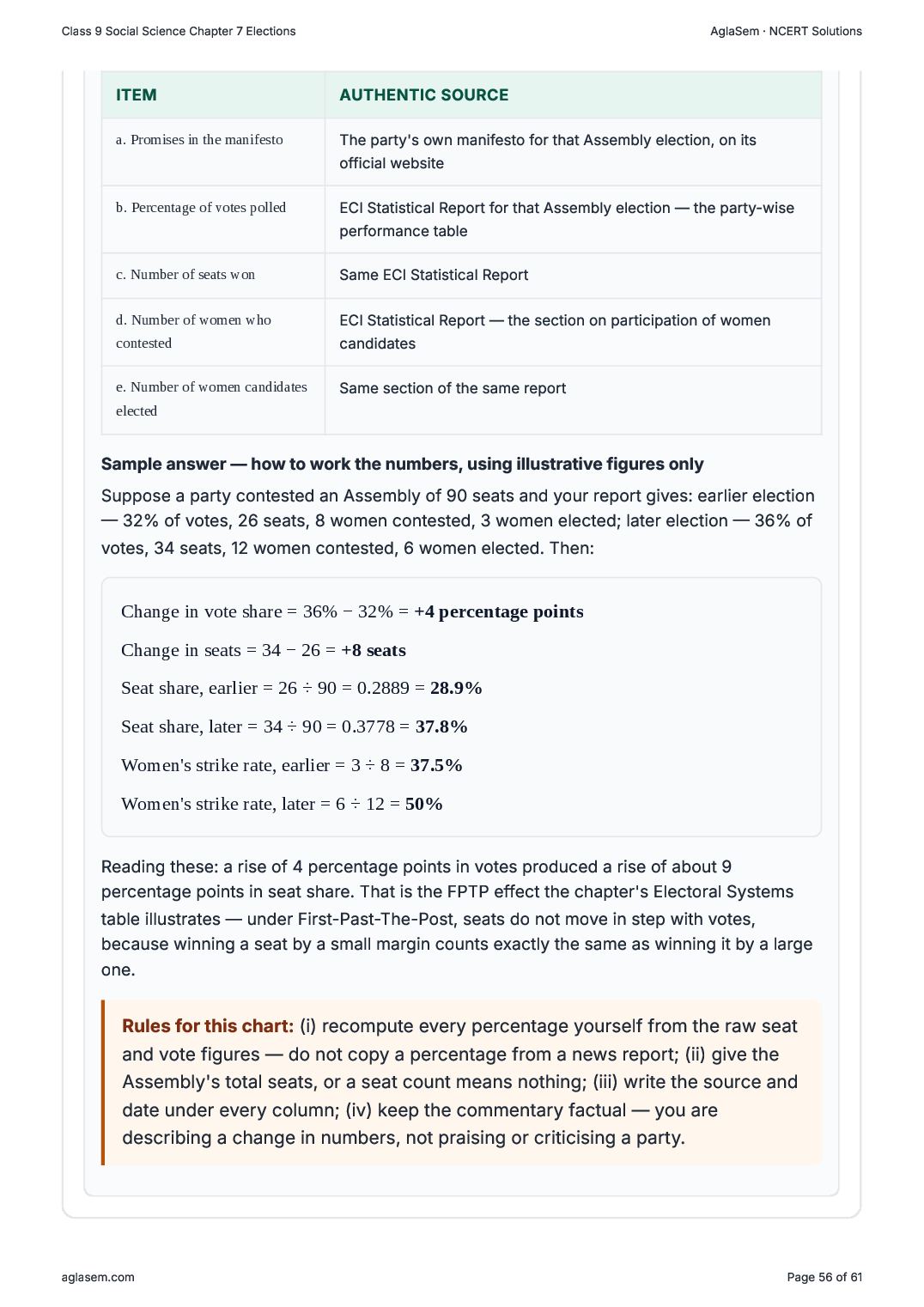
- Select one national or state political party. Using authentic and reliable sources such as the Election Commission of India (ECI) website, the official website of the selected political party, and newspapers. Prepare a comparative chart of the last two State Legislative Assembly elections. The chart should include the following details for the chosen party: a. Some promises made in the Election manifesto b. Percentage of votes polled c. Number of seats won d. Number of women who contested e. Number of women candidates elected. Present the data for both elections in a clear and comparative format, citing all sources used.
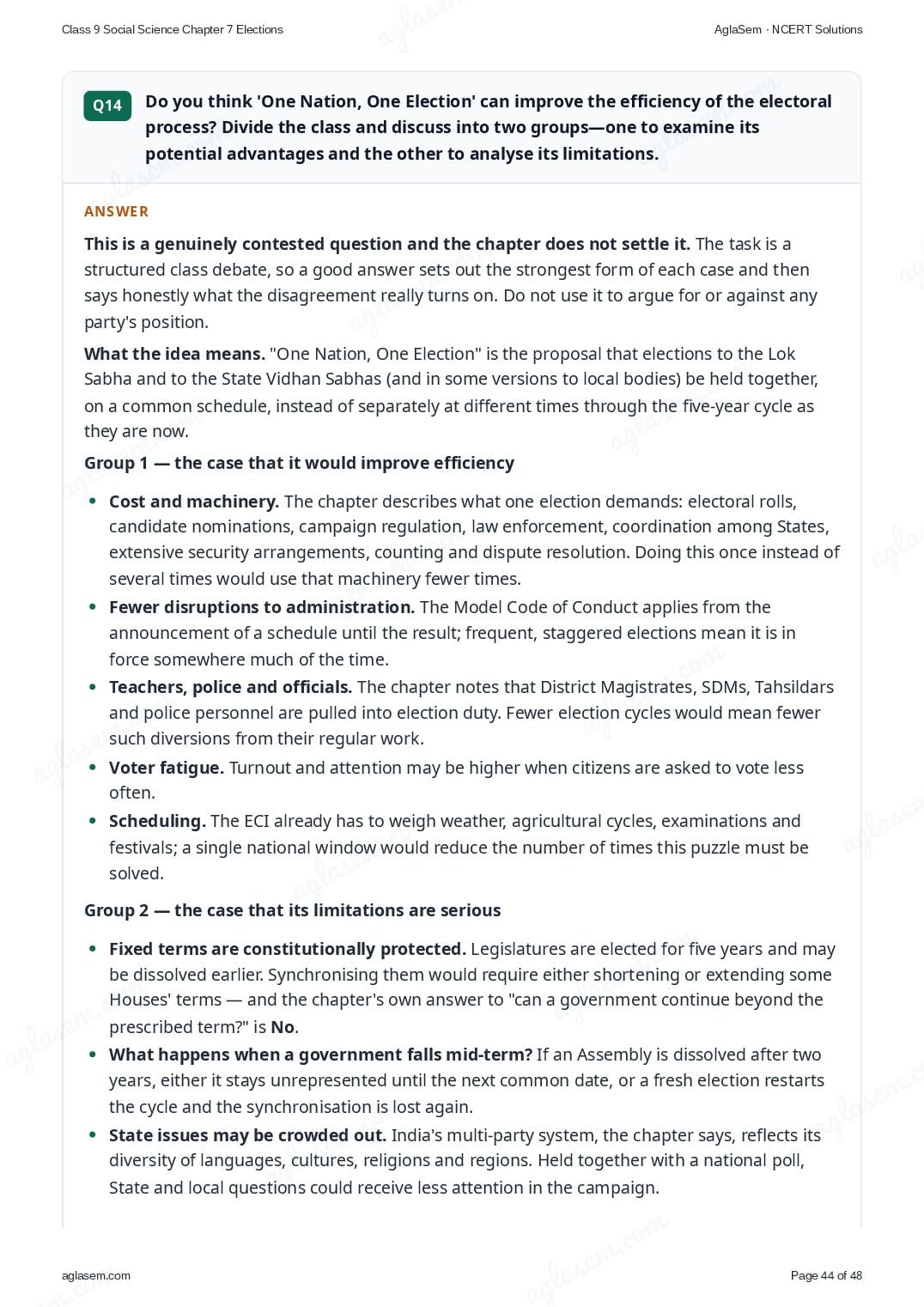
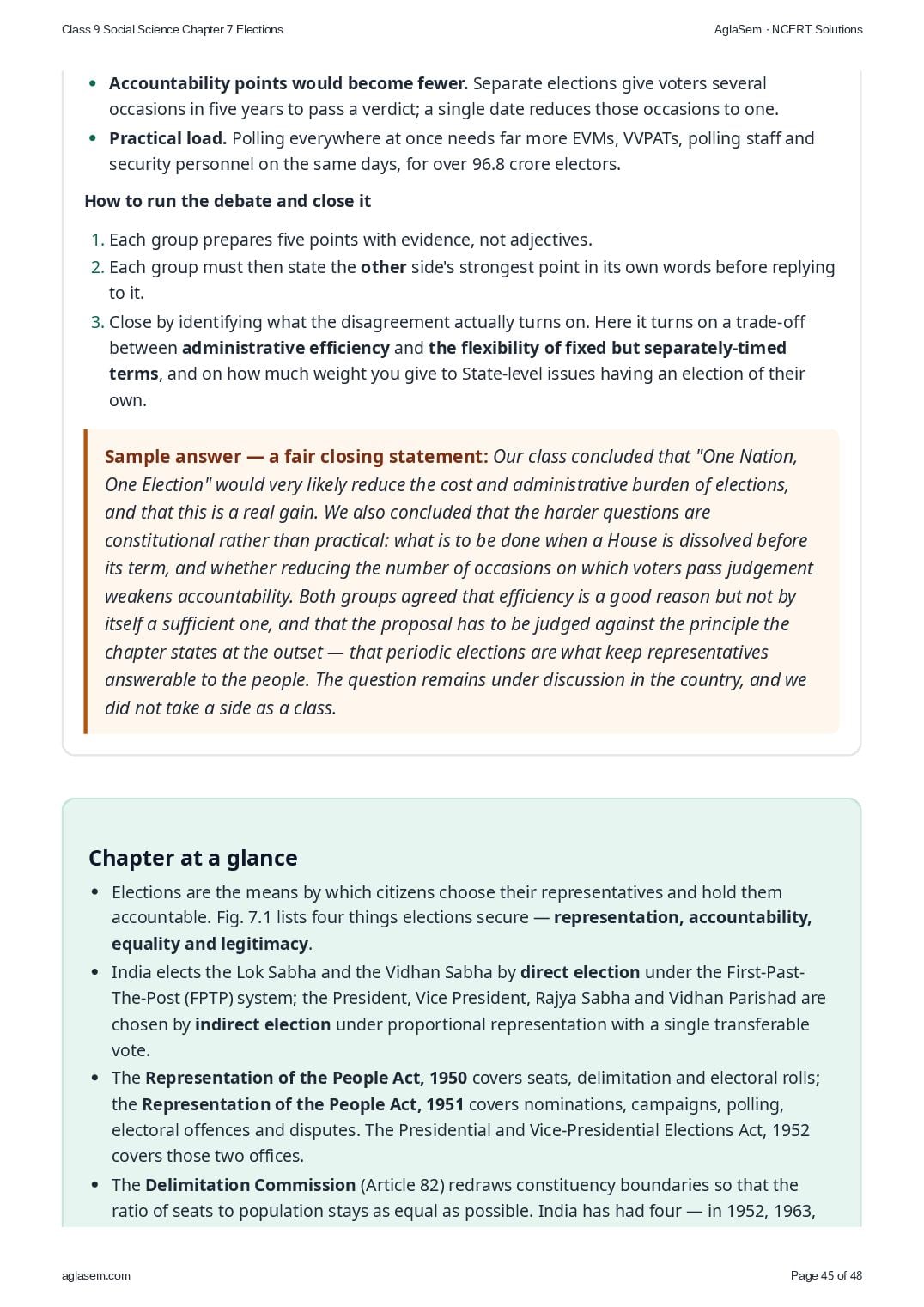
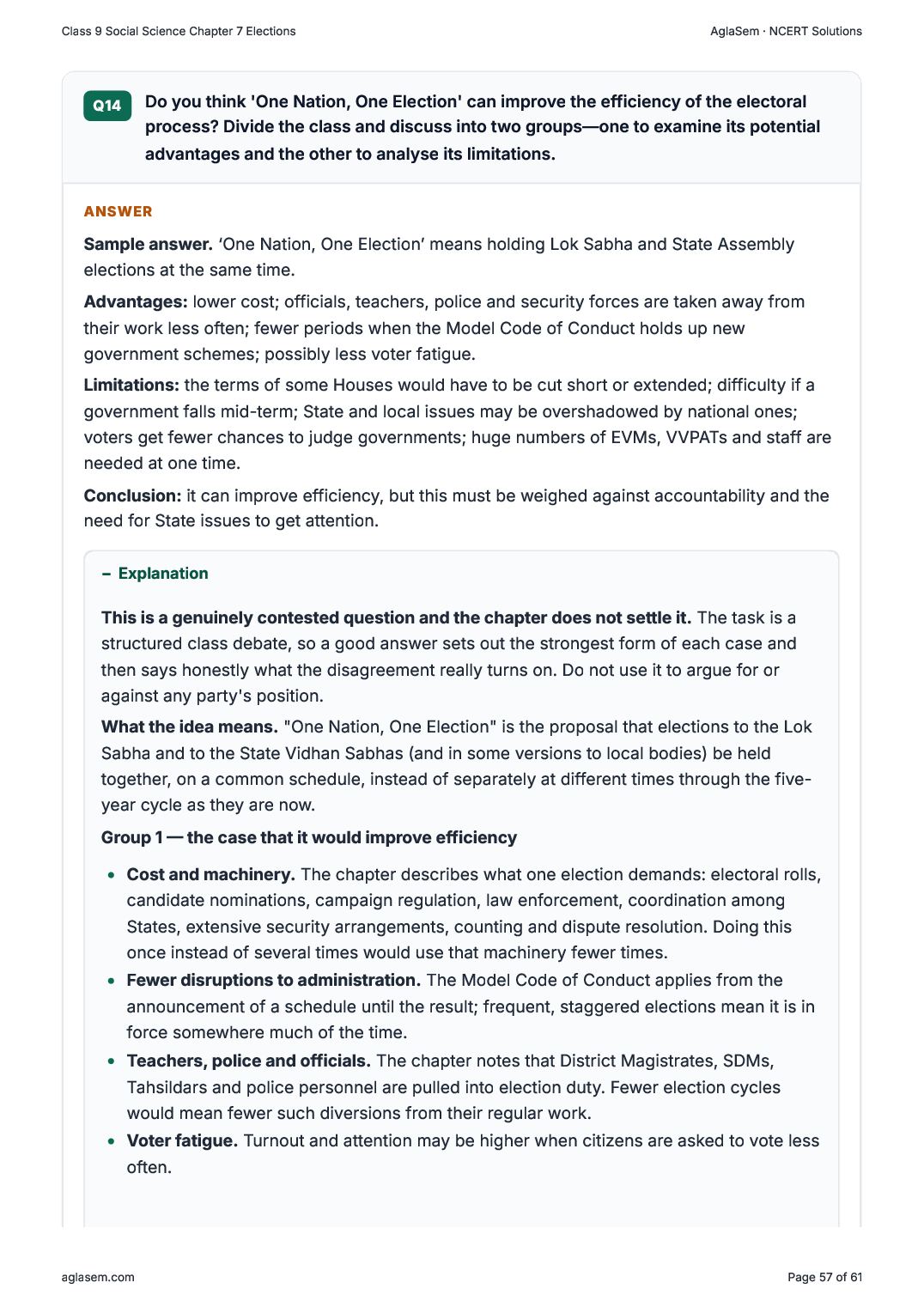
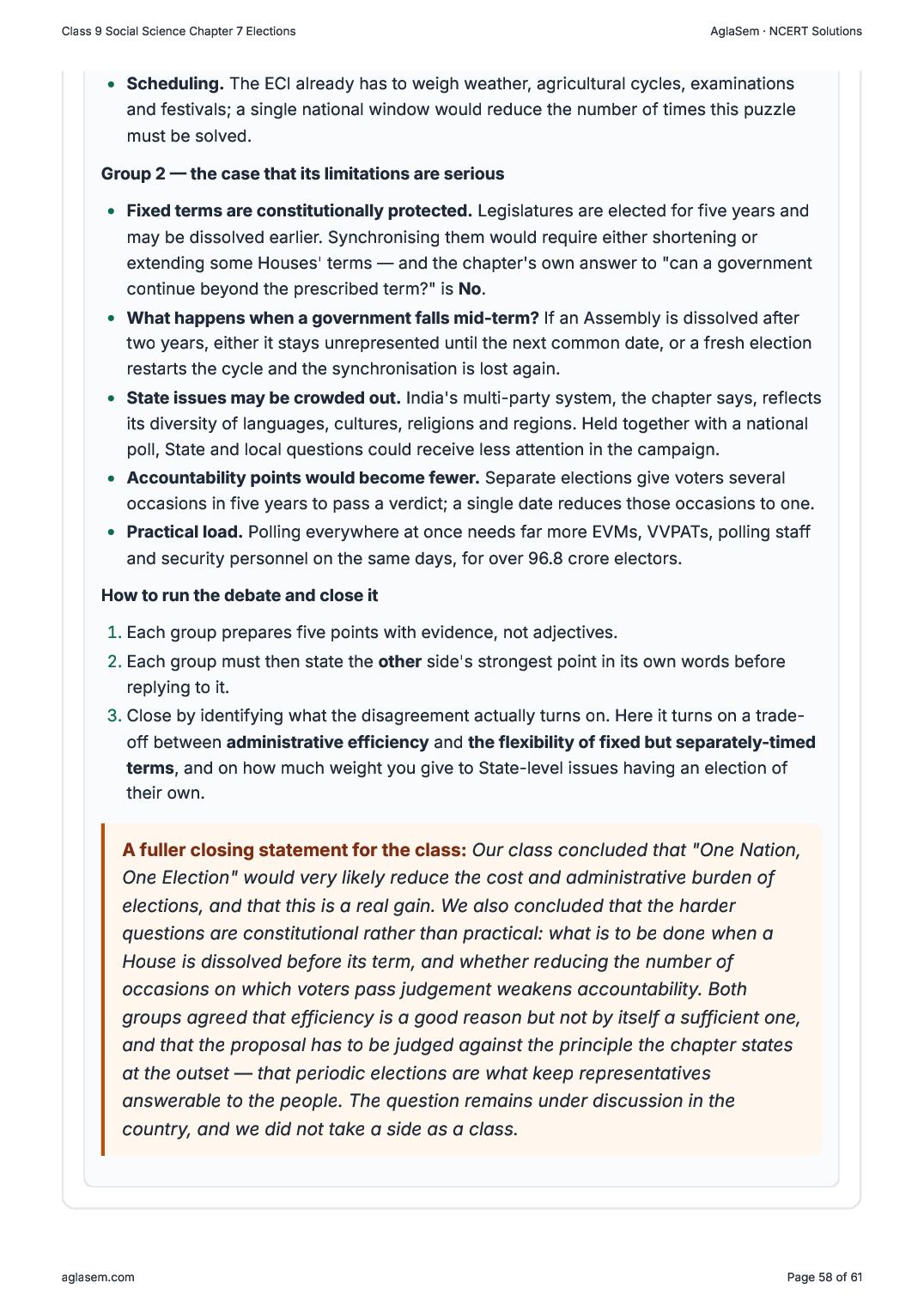
- Do you think 'One Nation, One Election' can improve the efficiency of the electoral process? Divide the class and discuss into two groups—one to examine its potential advantages and the other to analyse its limitations.
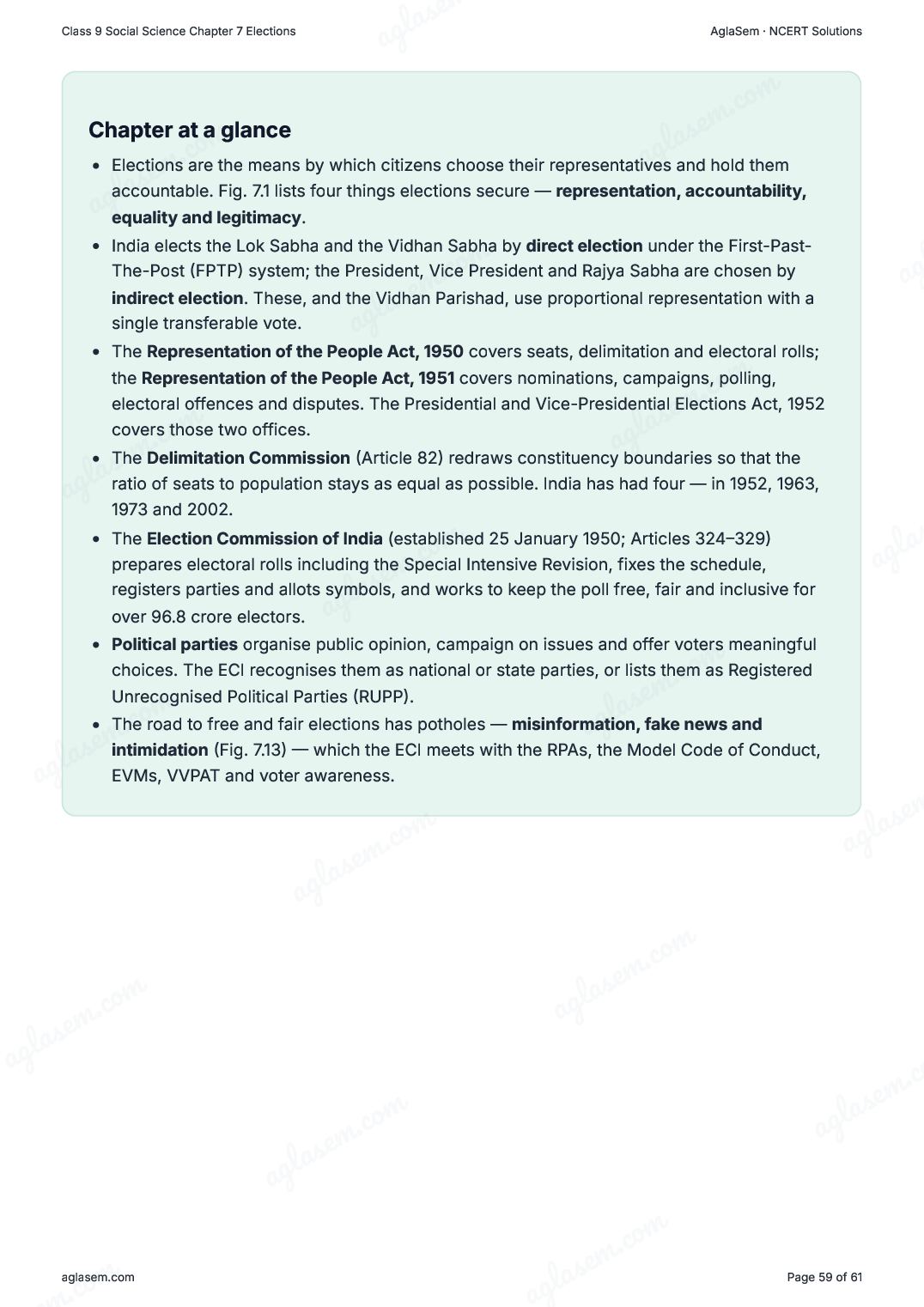
Chapter at a Glance
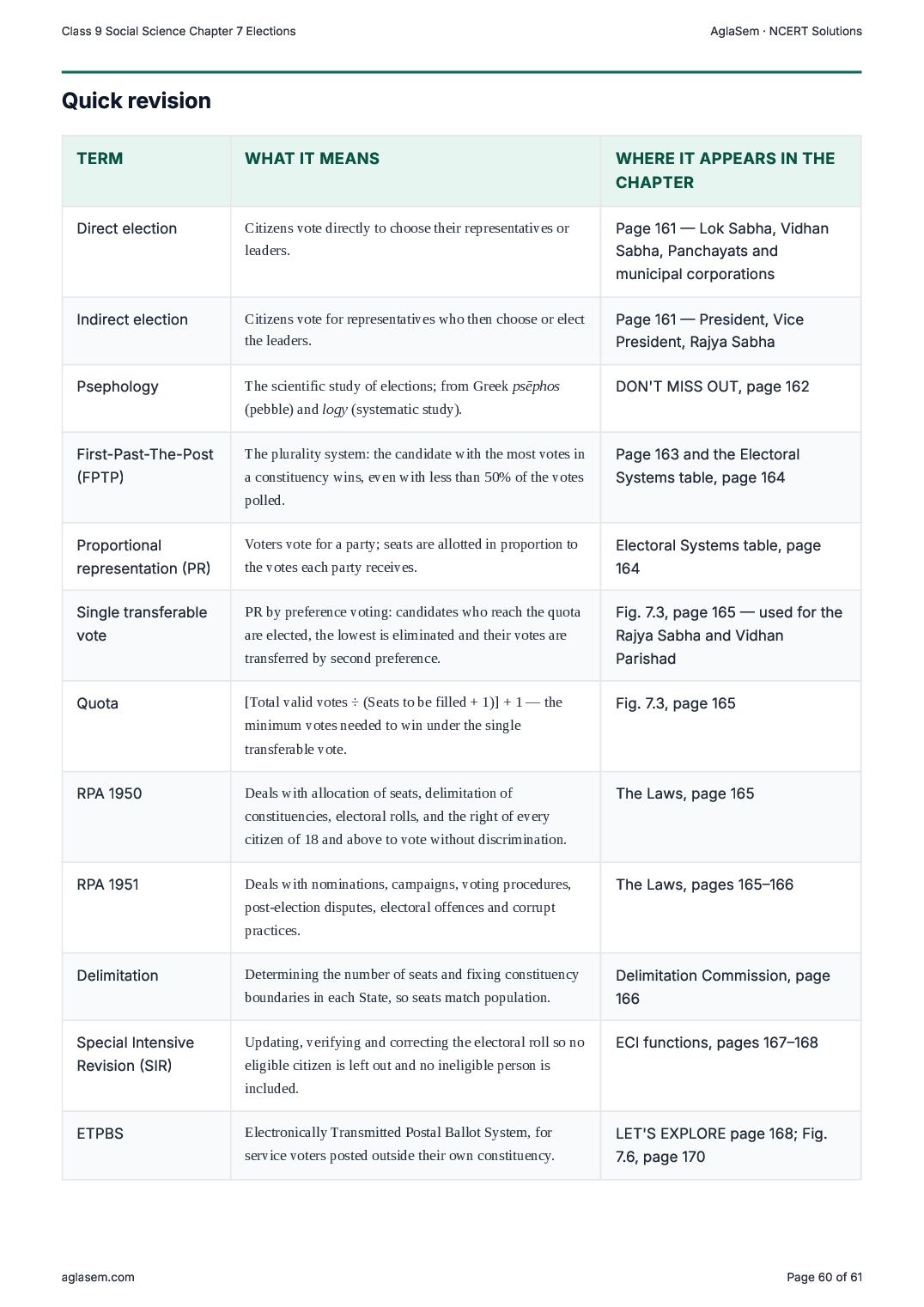
- Elections are the means by which citizens choose their representatives and hold them accountable. Fig. 7.1 lists four things elections secure — representation, accountability, equality and legitimacy .
- India elects the Lok Sabha and the Vidhan Sabha by direct election under the First-Past-The-Post (FPTP) system; the President, Vice President, Rajya Sabha and Vidhan Parishad are chosen by indirect election under proportional representation with a single transferable vote.
- The Representation of the People Act, 1950 covers seats, delimitation and electoral rolls; the Representation of the People Act, 1951 covers nominations, campaigns, polling, electoral offences and disputes. The Presidential and Vice-Presidential Elections Act, 1952 covers those two offices.
- The Delimitation Commission (Article 82) redraws constituency boundaries so that the ratio of seats to population stays as equal as possible. India has had four — in 1952, 1963, 1973 and 2002.
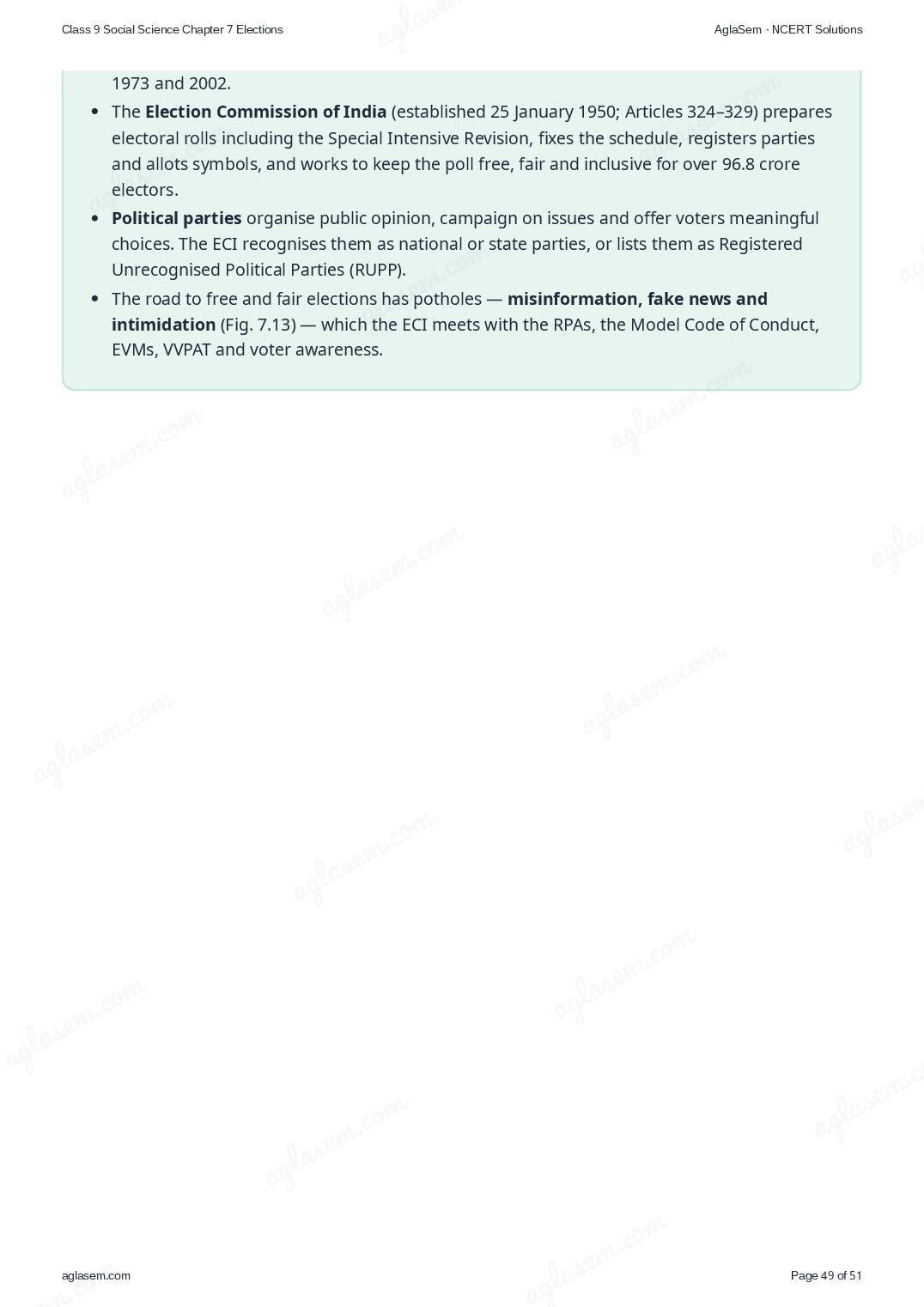
- The Election Commission of India (established 25 January 1950; Articles 324–329) prepares electoral rolls including the Special Intensive Revision, fixes the schedule, registers parties and allots symbols, and works to keep the poll free, fair and inclusive for over 96.8 crore electors.
- Political parties organise public opinion, campaign on issues and offer voters meaningful choices. The ECI recognises them as national or state parties, or lists them as Registered Unrecognised Political Parties (RUPP).
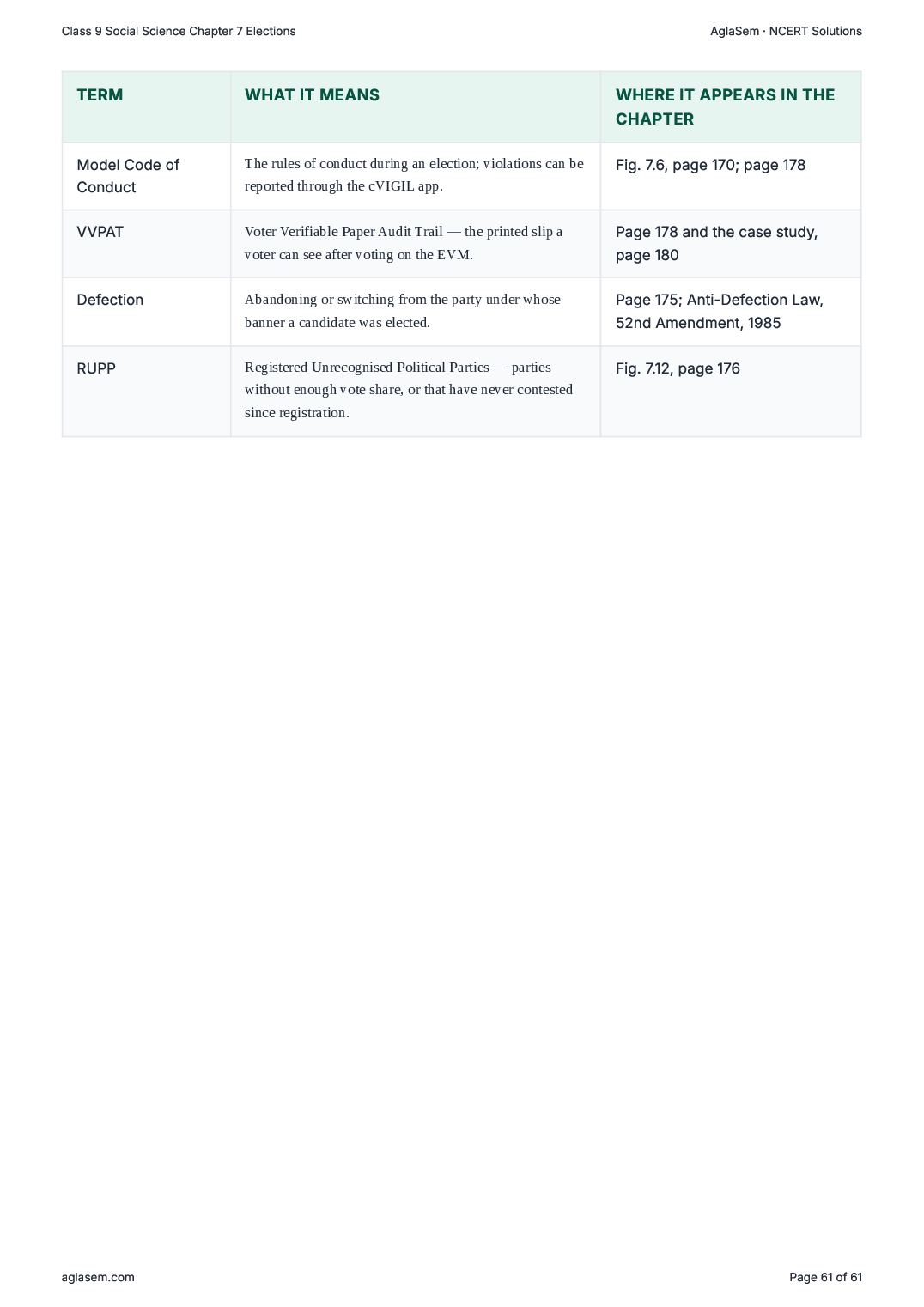
- The road to free and fair elections has potholes — misinformation, fake news and intimidation (Fig. 7.13) — which the ECI meets with the RPAs, the Model Code of Conduct, EVMs, VVPAT and voter awareness.
How to Download NCERT Solutions for Class 9 Social Science Chapter 7 PDF
Follow these simple steps to get the Elections questions-and-answers PDF from Understanding Society: India and Beyond.
- Search NCERT Solutions for Class 9 Social Science Chapter 7 aglasem and open this page.
- Read the exercise questions with answers for Elections shown above.
- Click the Download PDF link to save the Elections solutions to your device.
NCERT Solutions for Class 9 Social Science – All Chapters
There are more chapters to study besides Elections in Social Science. Here are the NCERT Solutions for all chapters of Class 9 Social Science.
- Chapter 1 Understanding Social Science
- Chapter 2 Shaping of the Earth’s Surface
- Chapter 3 Atmosphere and Climate
- Chapter 4 Early Humans and Beginning of Civilisation
- Chapter 5 State and Society Up to 1000 Ce
- Chapter 6 Democracy
- Chapter 7 Elections
- Chapter 8 Building Blocks in Economics the Problem of Choice
- Chapter 9 The Price Puzzle What Drives the Market
NCERT Solutions for Class 9 – All Subjects
Just like Chapter 7 of Social Science, you can get the exercise questions with answers for every other subject of Class 9. Here are the NCERT Solutions for all subjects of Class 9.
NCERT Solutions for Class 9 Social Science Chapter 7 – An Overview
The key highlights of this study material are as follows.
| Aspects | Details |
|---|---|
| Class | Class 9 |
| Subject | Social Science |
| Chapter Number | Chapter 7 |
| Chapter Name | Elections |
| Book Name | Understanding Society: India and Beyond |
| Book By | NCERT (National Council of Educational Research and Training) |
| Educational Resource Here | NCERT Solutions of Class 9 Social Science Chapter 7 for all exercises |
| More Questions Answers of This Subject | NCERT Solutions for Class 9 Social Science |
| Download Book Chapter | NCERT Book Class 9 Social Science |
| All Questions Answers For This Class | NCERT Solutions for Class 9 |
| Complete Solutions | NCERT Solutions |
NCERT Solutions for Class 9 Social Science Chapter 7 Elections – FAQs
What are the NCERT Solutions for Class 9 Social Science Chapter 7 Elections?
They are the complete, step-by-step answers to all the exercise and in-text questions of Chapter 7 Elections from the NCERT Class 9 Social Science textbook Understanding Society: India and Beyond, written by experts as per the latest NCERT syllabus.
How can I download the Class 9 Social Science Chapter 7 solutions PDF for free?
Open this page on aglasem, read the Elections questions with answers, and click the “Download Solutions PDF” link. The Class 9 Social Science Chapter 7 NCERT Solutions PDF is completely free to download.
Are these NCERT Solutions as per the latest 2026-27 syllabus?
Yes. The NCERT Solutions for Class 9 Social Science Chapter 7 are based on the latest NCERT textbook Understanding Society: India and Beyond and the current 2026-27 CBSE syllabus, so the questions and answers match what you study in class.
Where can I get NCERT Solutions for the other chapters of Class 9 Social Science?
You can find the answers to every chapter on the NCERT Solutions for Class 9 Social Science page, and solutions for every subject on the NCERT Solutions for Class 9 page.
How do NCERT Solutions help in exam preparation?
They show the correct method to solve each question, help you write answers the way they are expected in exams, let you check and correct your own work, and save revision time — which together improve your marks in Class 9 Social Science.
If you have any queries on NCERT Solutions for Class 9 Social Science Chapter 7 Elections, then please ask in the comments below.