NCERT Solutions for Class 9 Social Science Chapter 12 Resistance and Resilience (1000–1700 CE) – step-by-step answers to every exercise and in-text question of the chapter, as per the latest NCERT syllabus for 2027. Read them online or download the free question-answer PDF.
Complete NCERT Solutions for Resistance and Resilience (1000–1700 CE), Part II, Chapter 3 of Understanding Society: India and Beyond. The chapter shows how Rajputs, Ahoms, Vijayanagara, Marathas, Sikhs and Jats resisted invaders and imperial power through war, alliances and knowledge of terrain, and how Bhakti, temples and a strong economy helped Indian society endure. Every question is answered: The Big Questions, the LET’S EXPLORE, LET’S RECALL, LET’S MAP and THINK ABOUT IT boxes, and all ten Questions and activities.
NCERT Solutions for Class 9 Social Science Chapter 12 Resistance and Resilience (1000–1700 CE) PDF
All the answers are on this page below. The PDF also explains every answer – why it is right and how to check it – so download it for revision.
| Chapter | Download | |
|---|---|---|
| Solutions PDF | Resistance and Resilience (1000–1700 CE) | View PDF |
NCERT Solutions for Class 9 Social Science Chapter 12 Resistance and Resilience (1000–1700 CE) – Questions and Answers
All 21 questions of the chapter (textbook pages Part II, 45 – 80) are answered below, in the order of the book – in-text questions, activities and the end-of-chapter exercises. Each answer is written the way you would write it in the exam.
The Big Questions — Page 45Chapter opener
Indian rulers protected their lands by fighting invaders directly, by uniting with other rulers, by using the local terrain for guerrilla warfare, and, when it served them, by negotiating with stronger powers.
- Direct military resistance: Queen Nāikī Devī defeated Muhammad Ghūrī at Kasahrada (1178); the Yādavas, Kākatīyas and Hoysālas checked the Delhi Sultanate.
- Confederacies: Rāṇā Sāngā led a Rajput confederacy against Bābur at Khanua (1527).
- Terrain and guerrilla war: Mahārāṇā Pratāp in the Aravallis, the Ahoms on the Brahmaputra (Saraighat, 1671), the Marathas from their hill forts.
- Alliances and negotiation: the Kachhwāhas of Amber allied with the Mughals; Mewar won a treaty that kept its autonomy; the Marathas built a network of tributary alliances.
Resilience, the ability to endure hardship and adapt while keeping one’s traditions, came from several factors working together:
- Geography and local knowledge: the Aravallis for Mewar, Assam’s rivers, forests and monsoons for the Ahoms, the Deccan hills for the Marathas, the river and rocky terrain at Vijayanagara.
- Strong institutions: the Ahom Paik system, Maratha forts, the Sikh Akāl Takht, Khalsa and misals.
- Community support: the Bhils for Mewar; peasants who joined the Sikh and Jat struggles.
- Faith and culture: Bhakti in local languages, nām kīrtan, and temples that were restored or rebuilt.
- Economic strength: farming, irrigation, trade, merchant networks and the hunḍī gave people resources to hold out.
Bhakti brought people together across caste, class, gender and region by making devotion simple, shared and open to all.
- Local languages: hymns in Marathi, Tamil, Awadhi, Assamese and other languages “strengthened shared identities and fostered a sense of solidarity”.
- Community singing: satsang and sankīrtan drew large gatherings and created a shared feeling; Chaitanya Mahāprabhu and Guru Nānak used it to bridge social divides.
- Equality: saints came from many backgrounds, and women such as Akkā Mahādevi, Lāl Ded and Bahinābāī became saints.
- Shared stories: Tulsīdās’s Rāmcharitmānas in Awadhi took the story of Rāma into ordinary homes.
- Collective courage: Chaitanya’s public sankīrtan protested a Qazi’s restrictions.
Even in a time of wars, the economy stayed strong because farming, trade and finance kept growing.
- Agriculture: expanding empires brought more land under cultivation; rope pulleys and the Persian wheel improved irrigation; Vijayanagara invested in small-scale irrigation; temples funded irrigation and gave credit to cultivators.
- Inland trade: caravans linked India with Central Asia; banjārās connected villages with towns.
- Sea trade: seaborne trade grew from the 13th century, and India gradually became a major centre of the Indian Ocean network; later European companies joined it.
- Finance and merchants: the hunḍī allowed safe long-distance payments; merchants in Gujarat, Malabar, Coromandel and Bengal financed trade and even states.
This wealth gave people the resources to resist and recover.
LET’S EXPLORE — Page 54Mewar’s Resistance against Mughals
Two actions in the poem that show his independence:
- He never took part in the Nauroz festival celebrated at the Mughal court. Attending it would have meant joining the emperor’s court as a subordinate noble.
- He never mounted guard during Jharokha Darshan, the emperor’s public appearance at the palace window. Standing guard there was a duty of nobles who served the emperor.
A third action also fits: he kept his horses unbranded, so they never carried the Mughal mark. By refusing all these duties he showed that he did not accept Mughal authority.
LET’S RECALL — Page 58Marathas: The Quest for Swarājya
Strategies
- Guerrilla warfare: quick raids and surprise attacks by light cavalry, using the Deccan hills and valleys.
- A network of forts such as Raigad and Sinhagad, used as bases, safe retreats and centres of administration.
- A navy and sea forts to guard the Konkan coast.
- Bold leadership: Śhivājī killed Afzal Khan at the Battle of Pratapgarh (1659).
- Alliances that built a wide network of tributary relationships.
Institutions
- Coronation in 1674 as an independent sovereign, showing the idea of swarājya, or self-rule.
- The Aṣhṭapradhān, a council of eight ministers.
- Chauth and sardeshmukhī, taxes collected from regions outside direct Maratha rule.
LET’S EXPLORE — Page 64Bhakti Tradition: Affirmation of the Spirit of Resilience
The Nayanars (63 devotees of Śhiva) and the Alvars (12 devotees of Viṣhṇu) began the Bhakti movement in the Tamil region and spread it through Tamil hymns.
| Karaikal Ammaiyar (Nayanar) | Andal (Alvar) | |
|---|---|---|
| Devotion | Gave up worldly life and beauty to serve Śhiva | Saw herself as the beloved of Viṣhṇu |
| Hymns | Among the earliest Tamil Śhaiva hymns | Tiruppāvai (30 verses), Nāchiyār Tirumoḻi |
| Teaching | Love for God is enough; outward beauty and wealth do not matter | Surrender with love; anyone can reach God |
Practices: many of these saints travelled from temple to temple, singing in praise of the deity of each place. Connection with people: the hymns were in Tamil, set to music and easy to remember. They spoke of love rather than ritual, so people of every caste, and women too, could join in. Collected in the Śhaiva Tirumurai and the Vaiṣhṇava Nālāyira Divya Prabandham, they are still sung today.
LET’S MAP — Page 67Bhakti Tradition: Affirmation of the Spirit of Resilience (Fig. 3.19, page 66)
| Northern and Central Region | Eastern Region | Southern Region | Western Region |
|---|---|---|---|
| Lāl Ded Guru Nānak Rāmānanda Kabīr Mīrābāī Rāidāsa Vallabhāchārya Sūrdās Tulsīdās |
Jayadeva Chaitanya Mahāprabhu Krittibāsa Mādhava Kandalī Sankardev |
Basavannā Mādhavāchārya Annamāchārya Pothanā Poonthanam Namboothiri |
Ekanātha Jñānadeva Muktābāī Nāmadeva Janābāī Chokhamelā Narasimha Mehtā Bhalana Pīpājī Tukārām |
Fig. 3.19, page 66 — Some prominent Bhakti Saints from 12th–17th centuries
On a map of India, locate and label the present-day states associated with the saints mentioned in the above infographic. Also, find and mark a saint from your own state who is not on the list. Are you familiar with any songs, poems, or verses composed by these saints? Share with the class and explain what it means or what you like about it.The saints in Fig. 3.19 are linked with 14 present-day states and Union Territories:
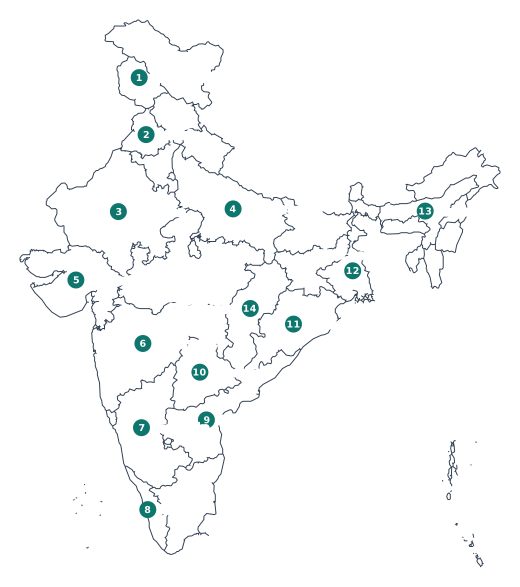
| No. | State / UT | Saints |
|---|---|---|
| 1 | Jammu and Kashmir (UT) | Lāl Ded |
| 2 | Punjab | Guru Nānak |
| 3 | Rajasthan | Mīrābāī, Pīpājī |
| 4 | Uttar Pradesh | Rāmānanda, Kabīr, Rāidāsa, Vallabhāchārya, Sūrdās, Tulsīdās |
| 5 | Gujarat | Narasimha Mehtā, Bhalana |
| 6 | Maharashtra | Jñānadeva, Muktābāī, Nāmadeva, Janābāī, Chokhamelā, Ekanātha, Tukārām |
| 7 | Karnataka | Basavannā, Mādhavāchārya |
| 8 | Kerala | Poonthanam Namboothiri |
| 9 | Andhra Pradesh | Annamāchārya |
| 10 | Telangana | Pothanā |
| 11 | Odisha | Jayadeva |
| 12 | West Bengal | Chaitanya Mahāprabhu, Krittibāsa |
| 13 | Assam | Mādhava Kandalī, Sankardev |
| 14 | Chhattisgarh | Vallabhāchārya (birthplace) |
Sample saint not on the list: Akkā Mahādevi of Karnataka (named on page 66). Sample verse: Narasimha Mehtā’s “Vaiṣhṇava jana to tene kahiye, je pīḍ parāyī jāṇe re” means that a true devotee is one who feels the pain of others. I like it because it makes kindness, not ritual, the test of faith.
THINK ABOUT IT — Page 67Bhakti Tradition: Affirmation of the Spirit of Resilience
To learn the scriptures is easy, to live them, hard.
The search for the Real is no simple matter.
Deep in my looking, the last words vanished.
Joyous and silent, the waking that met me there.
Knowing a rule is in the mind: we can remember it and repeat it. Following it is in our actions: we have to act on it every day, even when it is inconvenient, nobody is watching, or we must give something up. Knowing takes memory. Following takes discipline, patience and honesty.
Example: I know that I should not waste food and should switch off the fan when I leave the room. I can explain why: it saves food, money and electricity. But actually doing it every time, especially when I am in a hurry, is much harder.
That is Lāl Ded’s point: true learning shows in how one lives, not in how much one can recite.
THINK ABOUT IT — Page 74Indian Economy: Agriculture, Trading Networks, and Merchant Communities (the hunḍī)
A hunḍī let a merchant send money as a piece of paper instead of carrying heavy coins.
- Safety: no coins travelled on long, unsafe roads, so robbers had nothing to steal. The money stayed with the sarrāfs, and only the paper moved.
- Convenience: it was light and easy to carry. There was no need for guards, carts or animals to move large sums.
- Trust: it was handled by well-known networks of sarrāfs (money-changers) and their agents (gumasthas) in many towns, so it was honoured at the other end.
- Large trade: it worked like a bill of exchange, so big deals could be settled without counting out piles of currency.
THINK ABOUT IT — Page 76The World of the Indian Ocean: Continuity and Change
| Pillar | How it builds resilience |
|---|---|
| Places of faith (temples, gurdwaras, mosques) | Bring people together, give hope, and often feed and shelter them. Destroyed temples were restored, and that rebuilt confidence. |
| Traditions, language, songs, festivals | Can be carried in memory. Bhakti songs and nām kīrtan survived even when buildings were lost. |
| Farming and crafts | Food and goods let people survive sieges, pay taxes and rebuild. |
| Markets, merchants, credit (hunḍī) | Keep money moving, fund rulers and soldiers, and link the community to other regions. |
| Community bodies (village assemblies, guilds) | Organise collective action and help people in need. |
Together these pillars give a society identity, unity and resources. Even if a ruler is defeated, people keep their way of life and can recover and resist again.
Questions and activities — Pages 77–79End-of-chapter exercise
Resistance and resilience are closely connected because:
a. Resistance always involves warfare.
b. Resilience enables communities to endure difficulties and sustain resistance.
c. Resistance is possible only when a kingdom has a large army.
d. Resilient societies avoid all forms of conflict.
Answer: (b) Resilience enables communities to endure difficulties and sustain resistance.
The chapter calls resilience “the backbone of resistance”: a leader or cause may start a struggle, but the ability to keep it going comes from resilience.
Why: to protect their land, sovereignty, faith and way of life from the expanding Delhi Sultanate and Mughal Empire, which brought heavy taxes, destruction of sacred sites and, at times, religious persecution.
| Group | How they asserted power and identity |
|---|---|
| Rajputs | Confederacy under Rāṇā Sāngā (Khanua, 1527); forts built under Rāṇā Kumbhā; Mahārāṇā Pratāp’s guerrilla war and victory at Dewair (1582); a treaty that kept Mewar autonomous; some, such as Amber, allied with the Mughals for mansabs. |
| Marathas | The idea of swarājya; Śhivājī crowned in 1674; hill forts such as Raigad and Sinhagad; guerrilla warfare; alliances and a tributary network that wore out the Mughals. |
| Sikhs | After the martyrdom of Guru Arjan Dev and Guru Tegh Bahādur, Guru Hargobind set up the Akāl Takht (mīrī-pīrī); Guru Gobind Singh founded the Khalsa (1699); later the misals organised armed defence. |
Some Rajput rulers, such as the Kachhwāhas of Amber, chose alliance because it protected their kingdoms and gave them power within the empire.
- The Mughals were at the peak of their power. Wars were very costly; Chittor fell to Akbar in 1567–68 only after a siege of more than five months.
- Alliance kept their kingdoms and people safe and let them continue to rule their own lands.
- Rank and rewards: the Mughals granted them mansabs (ranks) and high positions in the army and administration.
- Mutual need: the Mughals needed Rajput “military might, their loyalty as well as their administrative strength”, so Rajputs could bargain for good terms.
- Freedom to build: allied rulers could build major structures. Rājā Mān Singh rebuilt the Kashi Vishwanath Temple and patronised the Govind Devji Temple at Vrindavan.
A French trader at Masulipatnam (a model answer):
Securing the cloth: I would order through a local merchant or broker who deals with the weavers. I would show him a sample of the cloth I want, agree on the quantity and the date, and pay part of the price in advance so that the weavers can buy yarn.
Whose help: a dubhaśhī (interpreter) to translate; brokers and merchants who know the weavers, dyers and bleachers; sarrāfs to change my silver into local coins and send payments by hunḍī; and local officials for customs and permission to ship.
Challenges:
- Language: people here speak Telugu and officials use Persian, not French, so I depend on interpreters.
- Quality: weave, length and colour vary, so each bale must be checked.
- Prices: they change with the cotton harvest and demand, and Dutch, English and Indian buyers compete with me.
- Time: ships sail with the monsoon winds, so late delivery can cost a whole season.
Functions of forts (from the chapter):
- Defence: thick walls, hilltop sites and strong gates helped forts withstand long sieges. One gateway at Senji was said to be defensible by a small group against ten thousand.
- Military base: Maratha forts were “strategic nuclei for guerrilla warfare”, places from which to launch swift raids and to retreat to safely.
- Outposts and fallback capitals: frontier forts watched the enemy, and others served as reserve capitals.
- Administration and justice: forts were centres of government and courts.
- Self-sufficiency: water sources, granaries and armouries.
- Symbol of power: capturing a fort meant controlling the region.
How rulers saw them: forts were the key to holding territory. Rāṇā Kumbhā built forts as part of Mewar’s “resistance framework”, and Śhivājī built a network of forts so that losing one never meant total defeat.
Changes (from the 16th century onwards):
- Temples were built in less visible places, along narrow lanes, with entrances that did not open onto main streets.
- Many looked like ordinary houses (havelīs), so historians call them havelī temples.
- Detailed exteriors became less common and tall shikharas were often avoided.
- Examples are found in Delhi, Varanasi and Rajasthan, including the Jagat Shiromani Temple at Amer.
What this shows: communities adapted temple design to avoid destruction but did not give up worship. They also restored and rebuilt sacred sites: the Kashi Vishwanath Temple (by Toḍar Mal and Rājā Mān Singh), the Govind Devji Temple at Vrindavan and the Keshav Dev Temple at Mathura. Changing the form while keeping the faith is resilience.
Explain two ways in which these resources could contribute to the kingdom’s resilience when faced with a threat.
1. Fertile land gives food and money to hold out. A food surplus can be stored in forts so that soldiers and people survive a long siege. Land revenue pays for soldiers, weapons and repairs, and can win allies. Like the Maratha forts with their water and armouries, the kingdom becomes self-sufficient and can outlast an enemy far from home.
2. Local support and knowledge of the terrain make up for a small army. Instead of fighting the enemy head-on, the kingdom can use guerrilla warfare: ambushes in hills, forests and rivers it knows well, with local people acting as guides, scouts and suppliers. Mahārāṇā Pratāp did this in the Aravallis with the Bhils, and the Ahoms did it with their knowledge of Assam’s rivers, forests and monsoons.
“A tradition becomes more resilient when people can carry it with them.”
Do you agree? Explain using examples from the Bhakti tradition.
Yes, I agree. A temple or an image can be destroyed, but a song, a prayer or a story that people carry in their hearts and memories cannot.
- Nām kīrtan: when temples were destroyed or their building was restricted, devotees recited the divine Name. This made devotion “less dependent on physical structures that could be destroyed.”
- Songs in local languages: Bhakti hymns in Marathi, Tamil, Kashmiri and other languages were easy to memorise and passed on orally.
- Satsang and sankīrtan: worship could happen wherever people gathered, so it was “more difficult to suppress”.
- Texts in the people’s language: Tulsīdās’s Rāmcharitmānas in Awadhi and Sankardev’s Kīrtana Ghosha went into ordinary homes.
- Devotion in daily life: Bahinābāī followed Bhakti while doing her household duties.
Physical sites still mattered and were restored, but a tradition that lives in people goes wherever they go and survives what happens to buildings.
Choose any two of the following and write a short first-person account explaining what resilience means from that person’s perspective:
- A Bhakti saint
- A Rajput soldier
- An Ahom commander
- A Maratha administrator
- A merchant
- A Jat leader
1. A Bhakti saint
“They broke the temple in our town, and for a while the people wept. But the Lord does not live only in stone. Each evening we gather in the courtyard and sing His Name in our own tongue. The weaver, the potter and the Brahmin sit together, for in devotion no one is higher or lower. They can break walls, but not a song that lives in a hundred hearts. For me, resilience is keeping faith and love alive whatever happens around us.”
2. An Ahom commander
“The Mughal fleet is larger than ours, with big, heavy boats. But this is our river. We know where the Brahmaputra runs fast and narrow, and when the monsoon floods the roads. Our light bāchārī boats strike and vanish. Under the Paik system every village sends men in turn, so our fields are never left empty. They took Garhgaon once, yet we returned. Resilience means we bend like reeds in the flood, and stand again when it passes.”
You are a military architect advising a ruler.
Draw a simple, labelled plan of a fort that includes the following:
- Residential complex
- Defensive walls
- Water source
- Food storage
- Escape route
- Watchtower
- Administrative area
How the design helps in a long siege:
- The fort stands on a steep hill, ringed by thick defensive walls with round bastions, so enemies cannot easily climb or break in.
- Watchtowers at the corners see an attack coming from every side.
- The bent main gate forces attackers to turn, so they cannot charge with elephants or battering rams.
- A water tank collects rainwater, a step-well reaches groundwater, and the granary stores grain for months, so the people and soldiers can hold out for a long time.
- The administrative area keeps government and the treasury working during the siege.
- A hidden escape route lets messengers go for help and lets the ruler and people escape if needed.
Chapter 12 of 15 – Social Science
- Previous: Chapter 11 Life on Earth
- Next: Chapter 13 Governance and Public Policy
- All chapters: NCERT Solutions Class 9 Social Science
Also for This Chapter
NCERT Solutions Class 9 Social Science Chapter 12 Resistance and Resilience (1000–1700 CE) – Overview
| Class | Class 9 |
| Subject | Social Science |
| Chapter | 12 – Resistance and Resilience (1000–1700 CE) |
| Textbook pages | Part II, 45 – 80 |
| Questions solved | 21 |
| Session | 2027 |
| Format | Full answers on this page + PDF |
NCERT Solutions Class 9 Social Science Chapter 12 – FAQs
Where can I download NCERT Solutions Class 9 Social Science Chapter 12 Resistance and Resilience (1000–1700 CE) PDF?
Read every answer on this page, or download the free PDF from the table at the top.
Is this for the 2027 session?
Yes, it follows the latest NCERT Class 9 Social Science book for 2027.
How many questions are solved in NCERT Class 9 Social Science Chapter 12?
All 21 questions of the chapter (textbook pages Part II, 45 – 80) – the in-text questions, activities and the end-of-chapter exercises.
How should I use these solutions?
Read the chapter in the NCERT book first, attempt the questions yourself, then check your answers here.