NCERT Solutions for Class 9 Social Science Chapter 3 Atmosphere and Climate provide clear, step-by-step answers to every exercise and in-text question from the chapter Atmosphere and Climate of the NCERT textbook Understanding Society: India and Beyond. Prepared by subject experts as per the latest NCERT (CBSE) syllabus for 2026-27, these NCERT Solutions for Class 9 Social Science help you understand each concept, write exam-ready answers, and check your own solutions. You can read them online below or download the free Class 9 Social Science Chapter 3 question-answer PDF.
NCERT Solutions for Class 9 Social Science Chapter 3 Atmosphere and Climate
- Class: Class 9
- Subject: Social Science
- Chapter: Chapter 3 – Atmosphere and Climate
- Textbook: Understanding Society: India and Beyond (NCERT)
- Study material: NCERT Solutions – questions with answers, free PDF
These solutions answer all the exercise questions of Chapter 3 Atmosphere and Climate — including the in-text questions, short-answer and long-answer questions, and activities — with complete explanations so you can follow the method, not just the final answer. Read the full solutions below.
NCERT Solutions Class 9 Social Science Chapter 3 Atmosphere and Climate View Download



NCERT Solutions for Class 9 Social Science Chapter 3 PDF Download
You can read the NCERT Solutions for Class 9 Social Science Chapter 3 online above, or download the complete question-answer PDF to study Atmosphere and Climate offline at any time.
NCERT Solutions for Class 9 Social Science Chapter 3 PDF Download Link – Click Here to Download Solutions PDF
Questions Covered in This Chapter
These NCERT Solutions answer all 40 questions of this chapter. The questions solved are:
- What is the composition of the atmosphere?
- How do the different layers of the atmosphere affect the planet Earth?
- What is the mechanism of monsoon?
- How can we reduce our carbon footprint?
- What do you see when you look up in the sky?
- Can you imagine what would happen if there were no atmosphere? Discuss your thoughts with your friends and teachers.
- How is nitrogen useful for plants? Remember that you learnt this in the chapter 'The Invisible Living World: Beyond Our Naked Eyes', in your Grade 8 Science textbook.
- 'Is it going to rain today?' 'Will it be bright and sunny today?' How often do you find yourself wondering about these questions when you want to go out and play?
- You might have noticed that sometimes the wind is so strong that it is difficult to walk against it. Can you think of some other times when strong winds have caused problems for you?
- Find out other categories of wind based on speed and their common effects, and share your findings in class.
- Note down the weather report from a local newspaper for two weeks and observe the changes occurring in the weather.
- Hindustani Classical music associates certain rāgas with specific seasons. Find out which rāgas are connected to each season with the help of your elders and teachers.
- Describe in your own words how monsoon affects the lives of the people around you.
- What actions can be taken to reduce such changes?
- Step 1: My Daily Habits — Tick the options that best describe you. A. Transport; B. Electricity Use; C. Water Use; D. Waste and Plastics.
- Step 2: Score Yourself — Low impact choices = 1 point; Medium impact choices = 2 points; High impact choices = 3 points; Very high impact choices = 4 points. Now add up your total score: ______ points.
- Step 3: My Climate Action Pledge — Think about two simple changes you can make to reduce your score, and write them down below.
- To what extent did natural factors cause these floods compared to human activities?
- Do you think better planning could have reduced the damage? How?
- What are the guidelines for the management of floods according to the National Disaster Management Authority (NDMA)?
- What role can students/youth play in helping with disaster preparedness?
- The Earth's atmosphere is made up of different gases, mainly nitrogen and oxygen, along with small amounts of other gases like water vapour and dust, support life and help in forming clouds and causing rainfall.
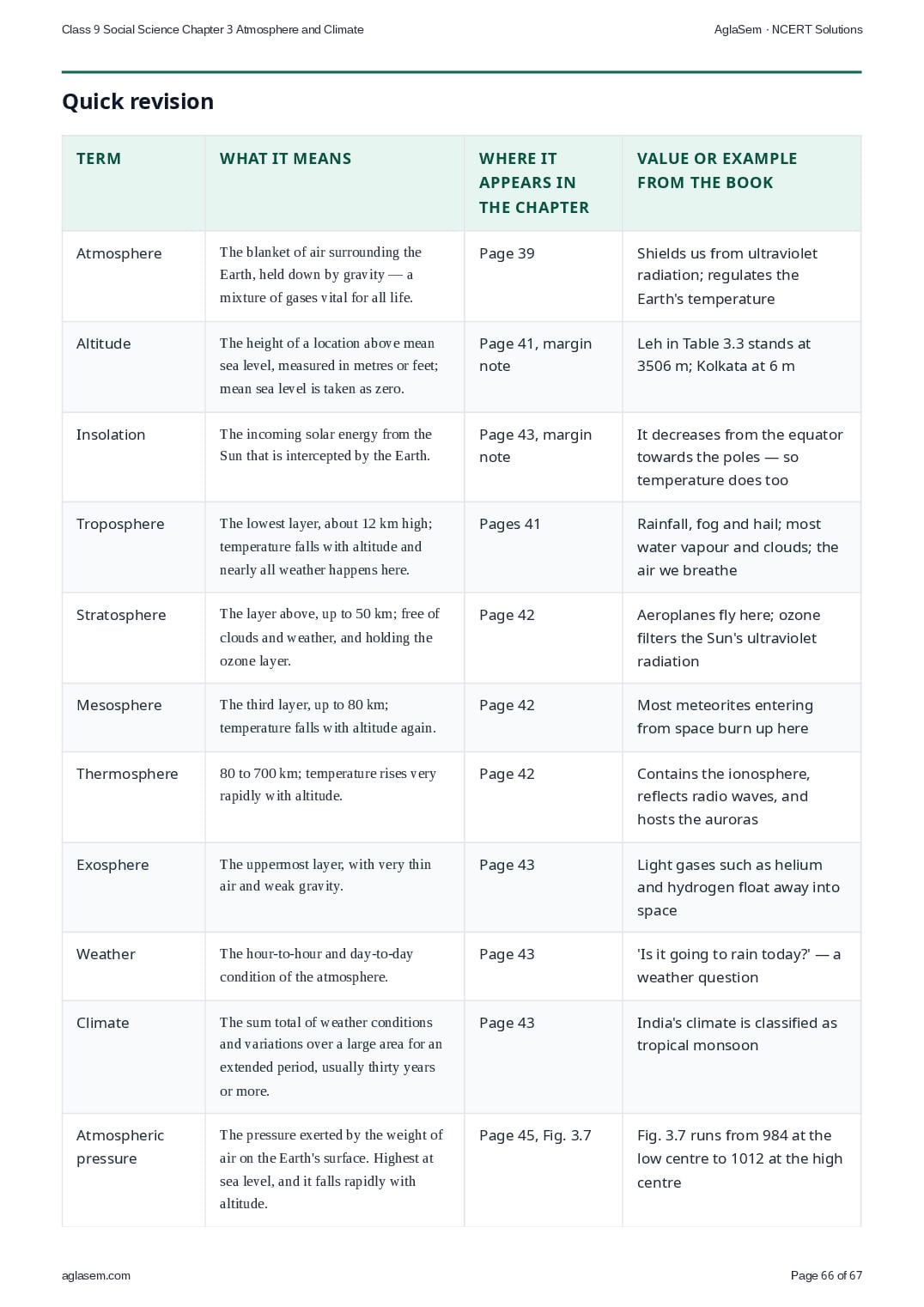
- The atmosphere is made up of different layers, namely the Troposphere, Stratosphere, Mesosphere, Thermosphere, and Exosphere, which are divided based on changes in temperature and air density as we go higher above the Earth's surface.
- Weather refers to the daily atmospheric conditions, while climate is the average weather of a place over a long period of time.
- India has a tropical monsoon climate, and the Indian Meteorological Department (IMD) divides the year into four main seasons, namely—Winter, Summer, Monsoon, and Post-monsoon.
- Climate change is the long-term change in weather caused mainly by human activities like burning fuels and cutting trees, which leads to global warming and extreme weather conditions.
- We can reduce our carbon footprint by saving energy, using renewable sources, planting trees, and living in more eco-friendly ways.
- What is atmosphere? Explain its composition with the help of a pie diagram.
- Draw a labelled diagram of the structure of atmosphere.
- Which are the four main seasons of India?
- Why do you not feel the pressure of the atmosphere?
- In which layer of the atmosphere do aeroplanes fly and why?
- Distinguish between the following: a. The troposphere and stratosphere b. The south-west monsoon and north-east monsoon
- Do it yourself: Table 3.3 shows the average monthly temperatures and rainfall amounts for 10 representative stations. Study these figures on your own and convert them into 'temperature and rainfall' graphs. The visual representations will help you grasp their similarities and differences at a glance. One such graph (Fig. 3.14) is already prepared for you. See if you can arrive at some broad generalisations about our diverse climatic conditions.
- Now look at Table 3.3 again. Re-arrange the 10 stations according to their distance from the equator.
- Find out: a. Two stations with the most extreme climate. b. Two stations influenced by retreating monsoons. c. The two hottest stations in the months of (i) February (ii) June
- Now find out: a. Why does Shillong experience more rainfall than Kolkata? b. Why does Delhi receive more rainfall than Jodhpur?
- Now think why a. Thiruvananthapuram has an equable climate? b. Chennai has more rainfall only after the fury of the monsoon is over in most parts of the country? c. Leh has moderate precipitation almost throughout the year?
- Despite these differences across regions, can you observe any substantial evidence to conclude that the monsoons provide a very strong framework, lending overall climatic unity to the whole country?
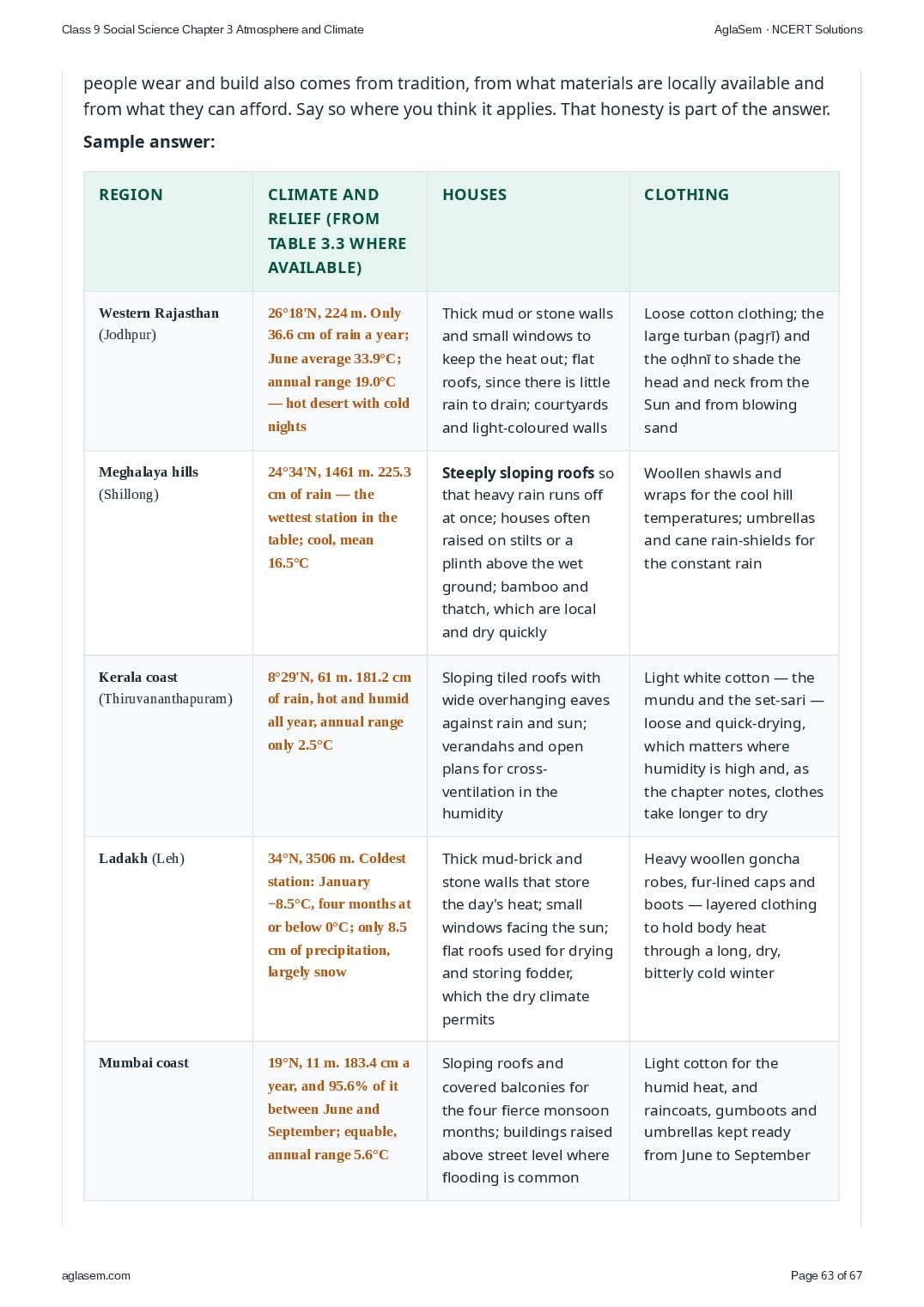
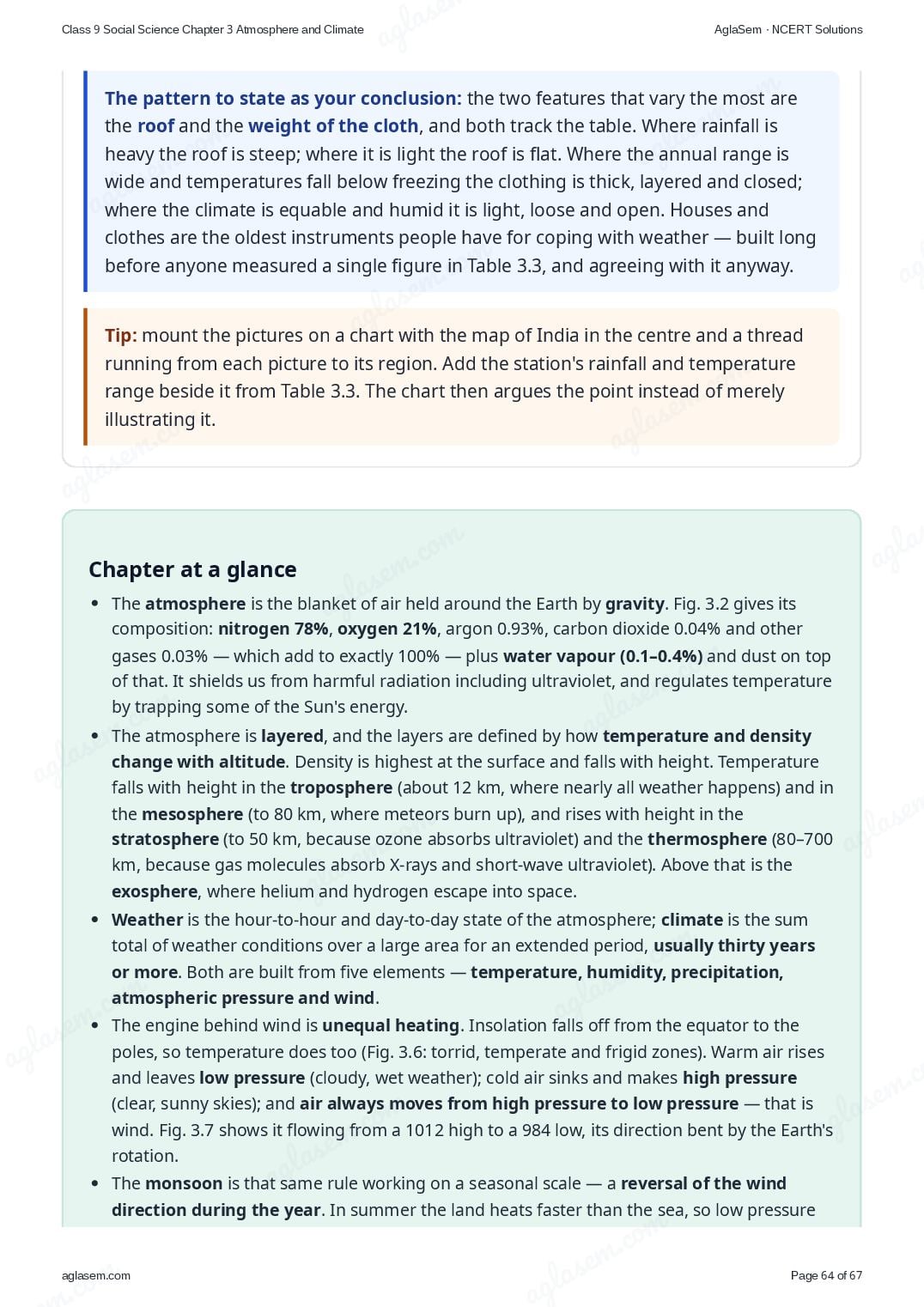
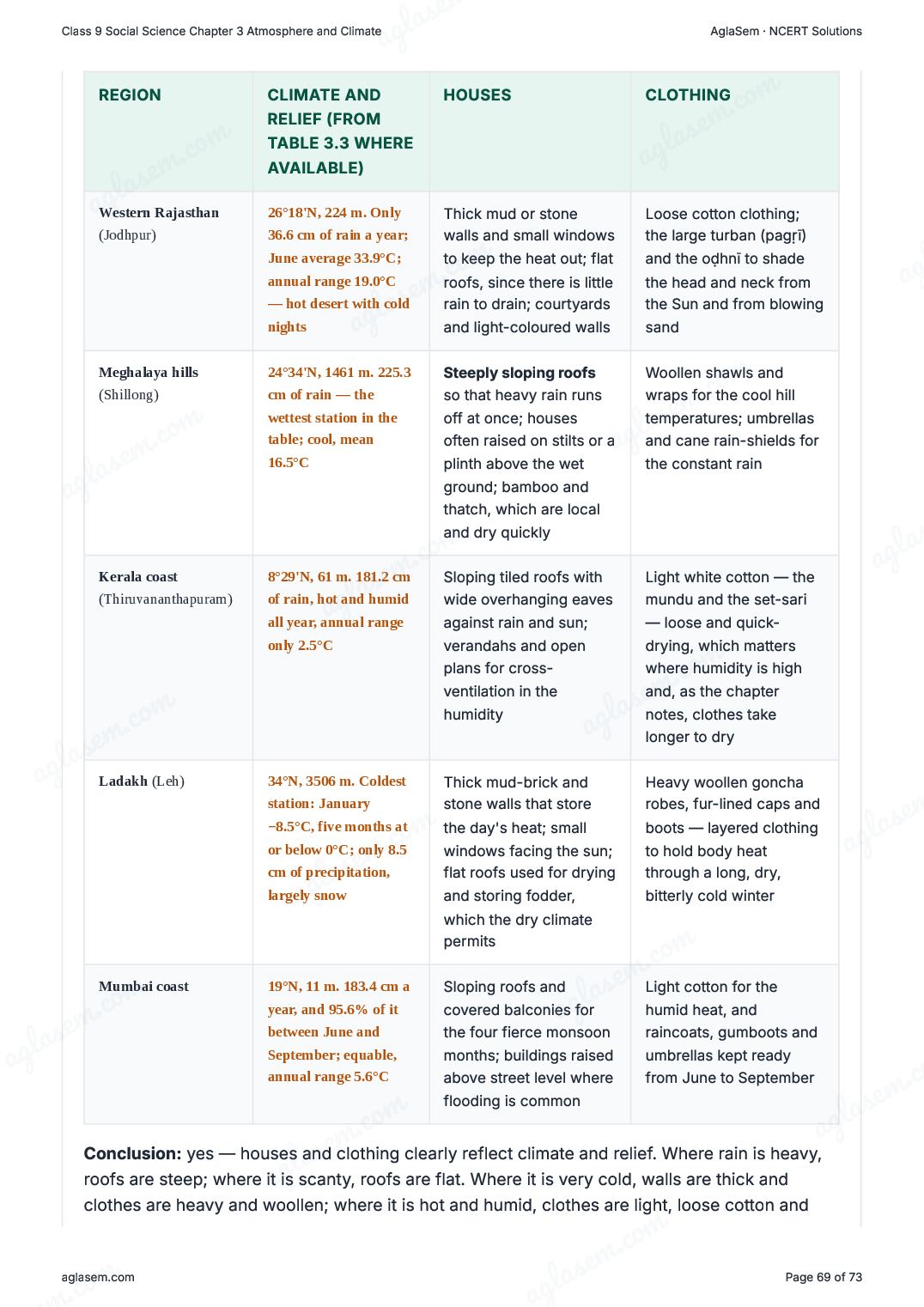
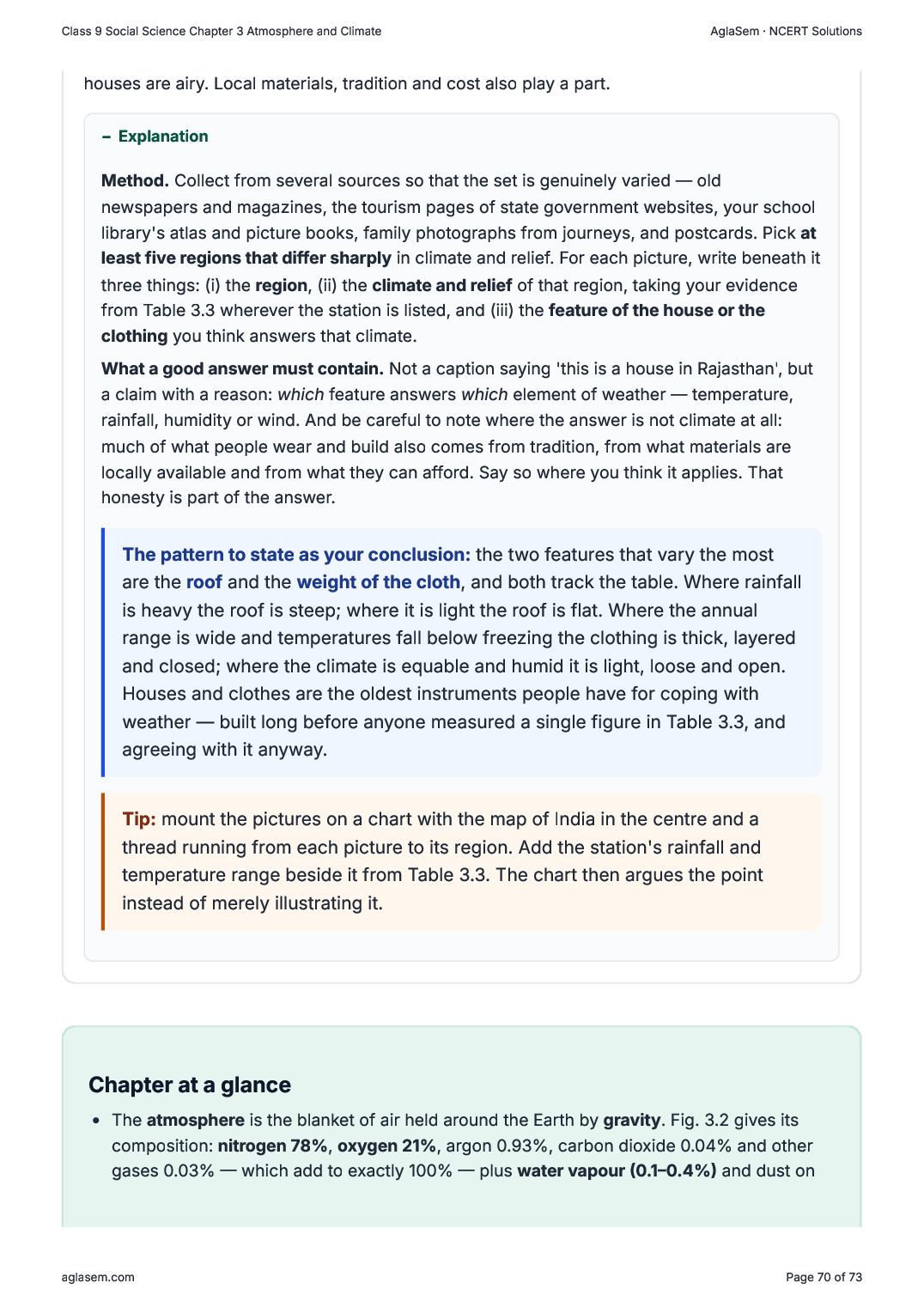
- Collect pictures of houses and clothing of people from different regions of India. Examine whether they reflect any relationship with the climatic conditions or the relief of those regions.
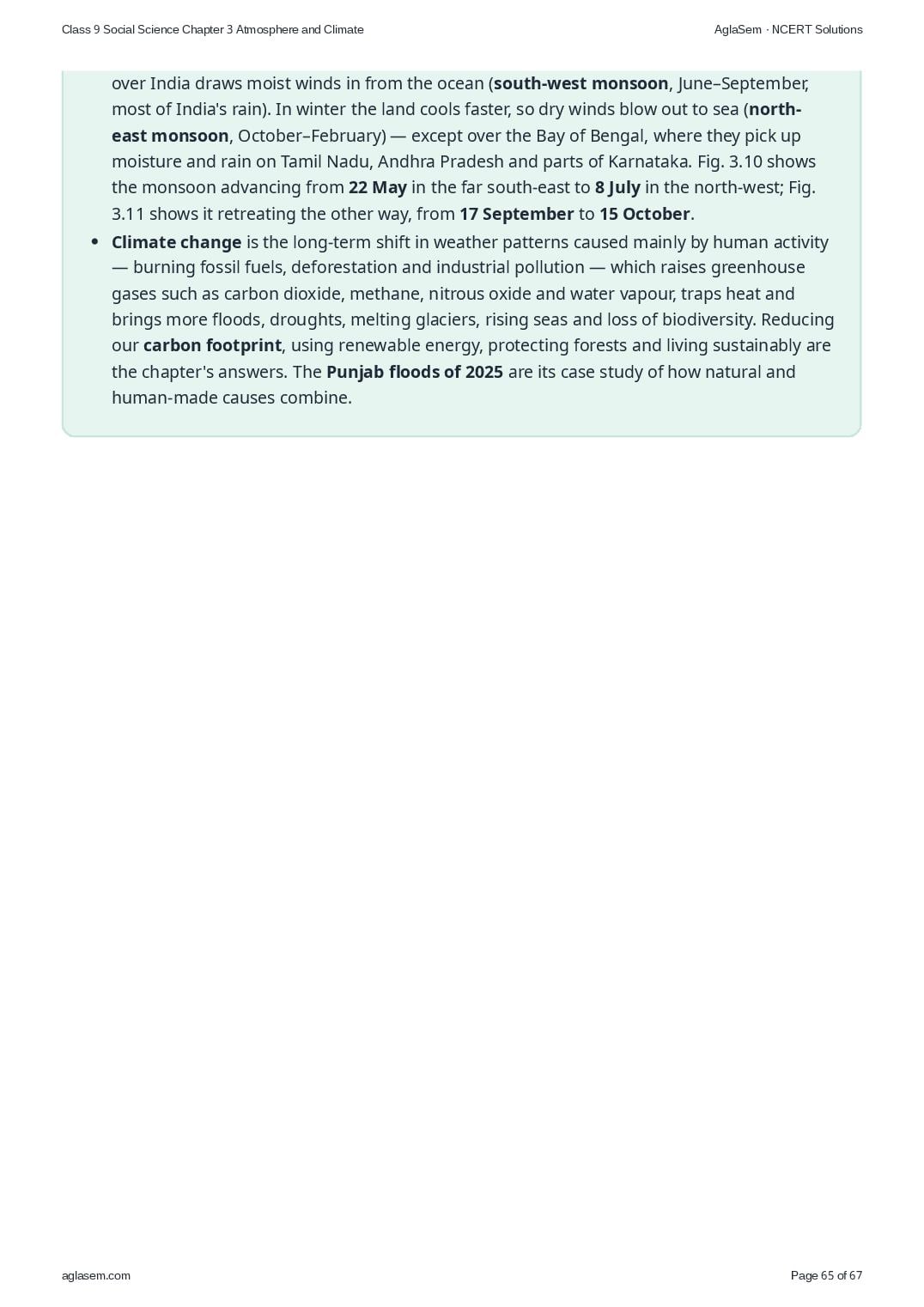
Chapter at a Glance
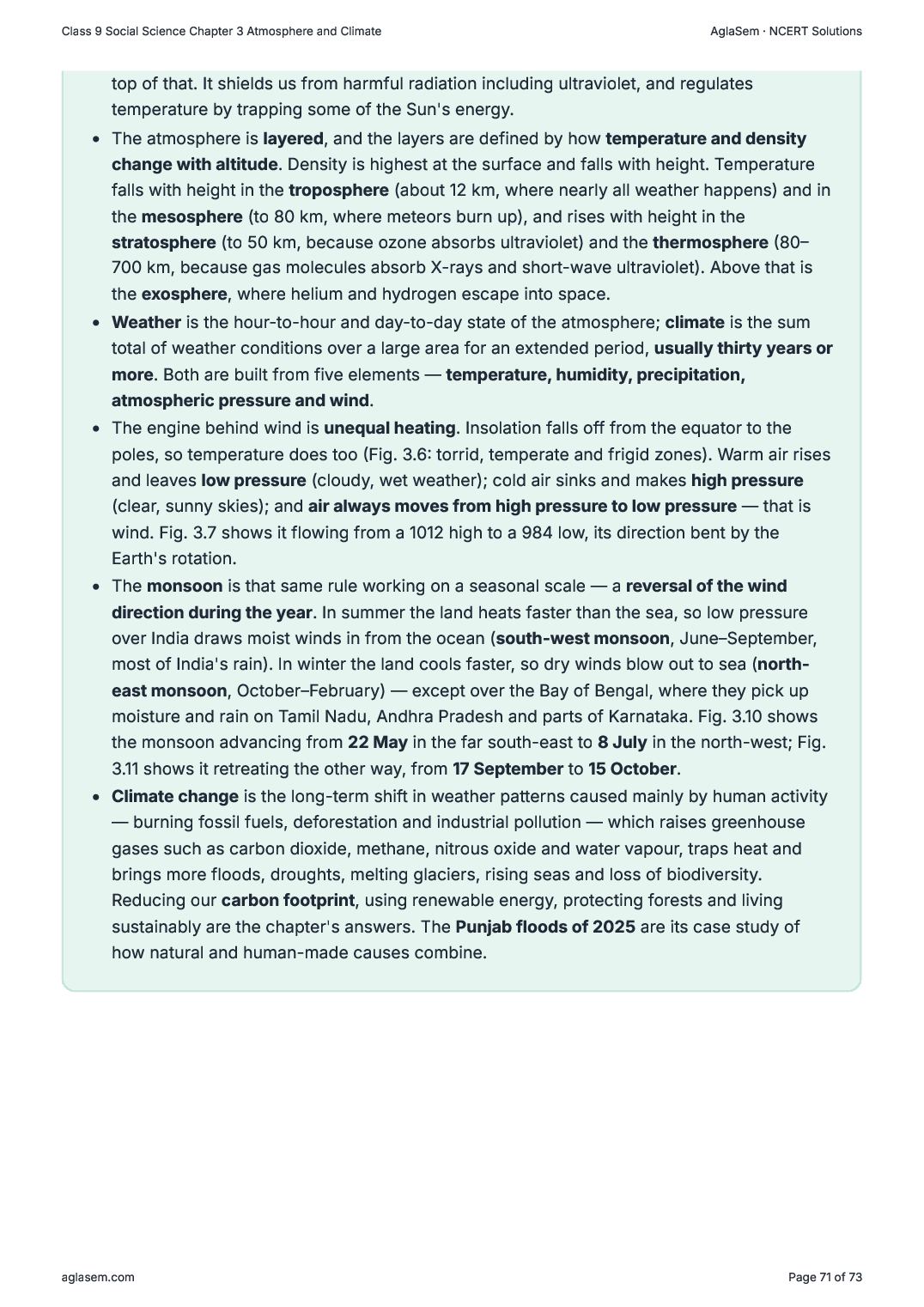
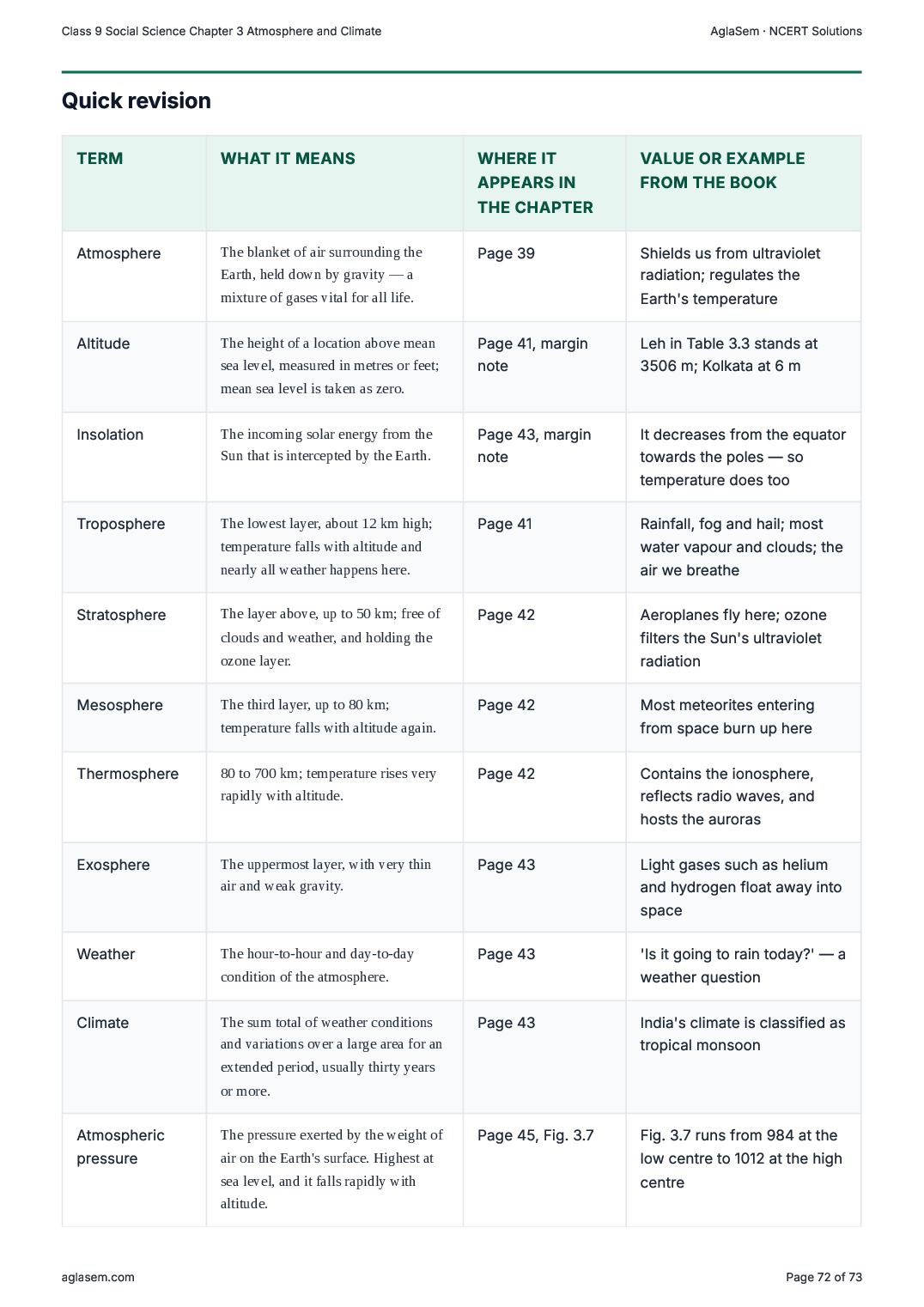
- The atmosphere is the blanket of air held around the Earth by gravity . Fig. 3.2 gives its composition: nitrogen 78% , oxygen 21% , argon 0.93%, carbon dioxide 0.04% and other gases 0.03% — which add to exactly 100% — plus water vapour (0.1–0.4%) and dust on top of that. It shields us from harmful radiation including ultraviolet, and regulates temperature by trapping some of the Sun's energy.
- The atmosphere is layered , and the layers are defined by how temperature and density change with altitude . Density is highest at the surface and falls with height. Temperature falls with height in the troposphere (about 12 km, where nearly all weather happens) and in the mesosphere (to 80 km, where meteors burn up), and rises with height in the stratosphere (to 50 km, because ozone absorbs ultraviolet) and the thermosphere (80–700 km, because gas molecules absorb X-rays and short-wave ultraviolet). Above that is the exosphere , where helium and hydrogen escape into space.
- Weather is the hour-to-hour and day-to-day state of the atmosphere; climate is the sum total of weather conditions over a large area for an extended period, usually thirty years or more . Both are built from five elements — temperature, humidity, precipitation, atmospheric pressure and wind .
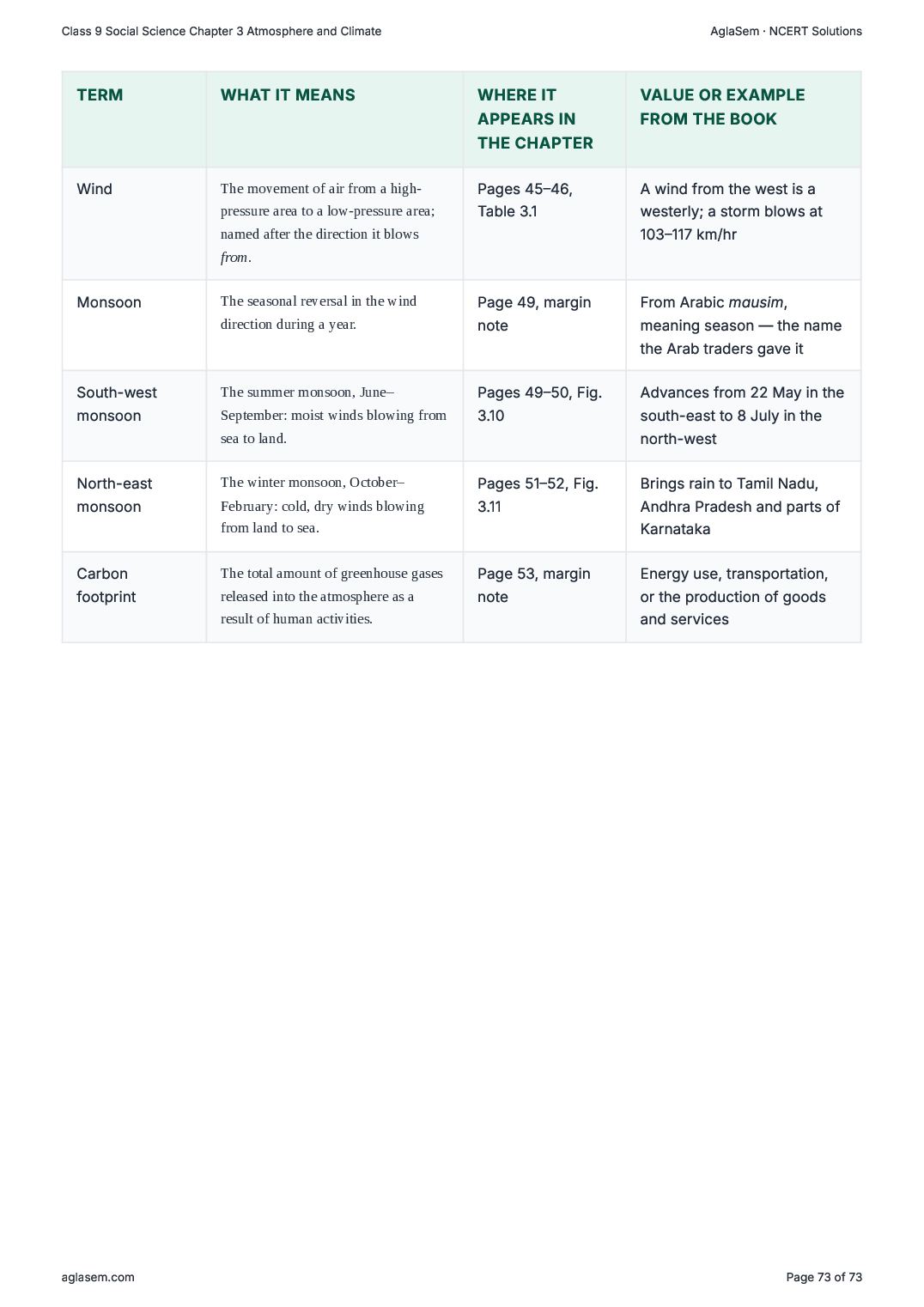
- The engine behind wind is unequal heating . Insolation falls off from the equator to the poles, so temperature does too (Fig. 3.6: torrid, temperate and frigid zones). Warm air rises and leaves low pressure (cloudy, wet weather); cold air sinks and makes high pressure (clear, sunny skies); and air always moves from high pressure to low pressure — that is wind. Fig. 3.7 shows it flowing from a 1012 high to a 984 low, its direction bent by the Earth's rotation.
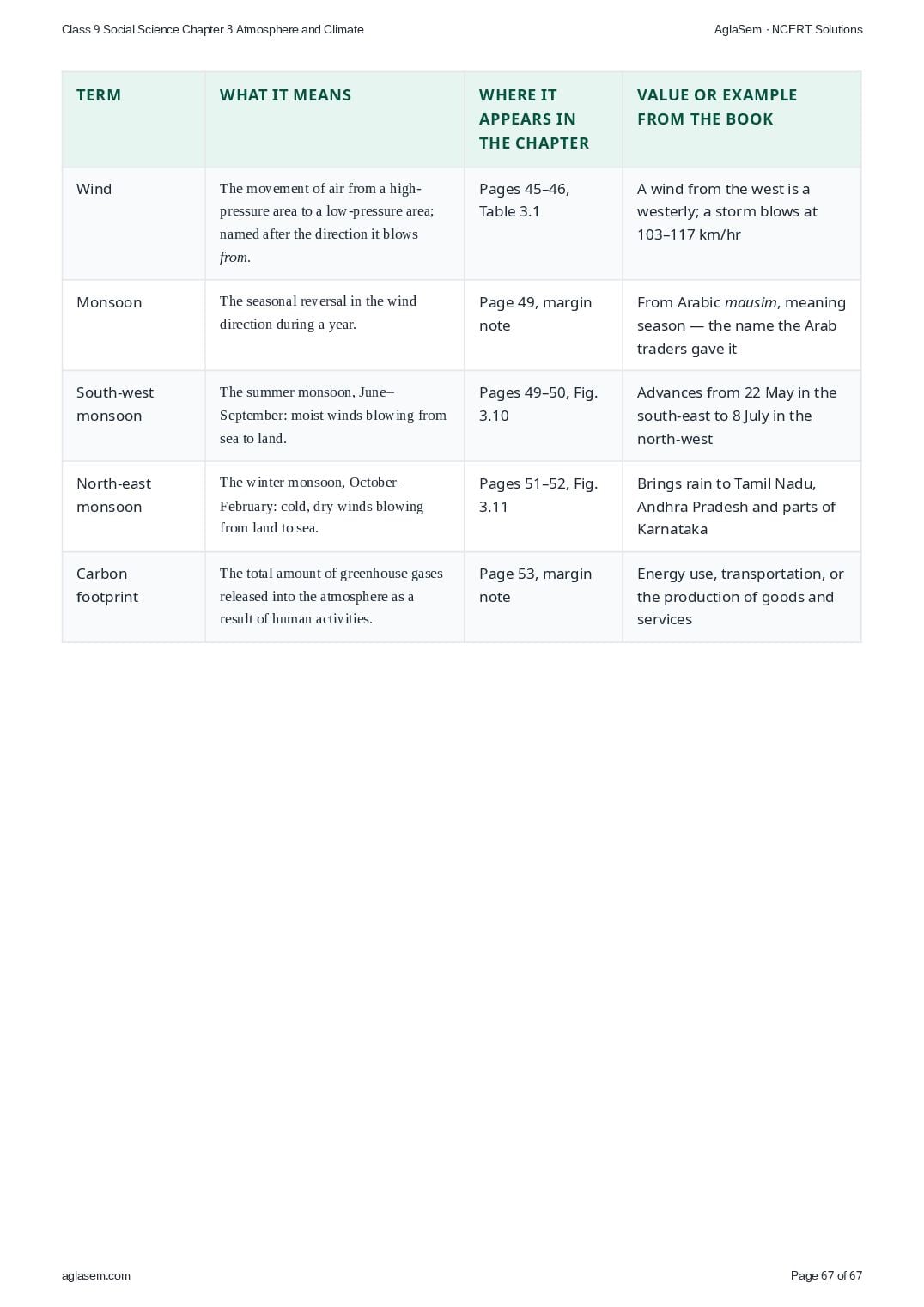
- The monsoon is that same rule working on a seasonal scale — a reversal of the wind direction during the year . In summer the land heats faster than the sea, so low pressure over India draws moist winds in from the ocean ( south-west monsoon , June–September, most of India's rain). In winter the land cools faster, so dry winds blow out to sea ( north-east monsoon , October–February) — except over the Bay of Bengal, where they pick up moisture and rain on Tamil Nadu, Andhra Pradesh and parts of Karnataka. Fig. 3.10 shows the monsoon advancing from 22 May in the far south-east to 8 July in the north-west; Fig. 3.11 shows it retreating the other way, from 17 September to 15 October .
- Climate change is the long-term shift in weather patterns caused mainly by human activity — burning fossil fuels, deforestation and industrial pollution — which raises greenhouse gases such as carbon dioxide, methane, nitrous oxide and water vapour, traps heat and brings more floods, droughts, melting glaciers, rising seas and loss of biodiversity. Reducing our carbon footprint , using renewable energy, protecting forests and living sustainably are the chapter's answers. The Punjab floods of 2025 are its case study of how natural and human-made causes combine.
How to Download NCERT Solutions for Class 9 Social Science Chapter 3 PDF
Follow these simple steps to get the Atmosphere and Climate questions-and-answers PDF from Understanding Society: India and Beyond.
- Search NCERT Solutions for Class 9 Social Science Chapter 3 aglasem and open this page.
- Read the exercise questions with answers for Atmosphere and Climate shown above.
- Click the Download PDF link to save the Atmosphere and Climate solutions to your device.
NCERT Solutions for Class 9 Social Science – All Chapters
There are more chapters to study besides Atmosphere and Climate in Social Science. Here are the NCERT Solutions for all chapters of Class 9 Social Science.
- Chapter 1 Understanding Social Science
- Chapter 2 Shaping of the Earth’s Surface
- Chapter 3 Atmosphere and Climate
- Chapter 4 Early Humans and Beginning of Civilisation
- Chapter 5 State and Society Up to 1000 Ce
- Chapter 6 Democracy
- Chapter 7 Elections
- Chapter 8 Building Blocks in Economics the Problem of Choice
- Chapter 9 The Price Puzzle What Drives the Market
NCERT Solutions for Class 9 – All Subjects
Just like Chapter 3 of Social Science, you can get the exercise questions with answers for every other subject of Class 9. Here are the NCERT Solutions for all subjects of Class 9.
NCERT Solutions for Class 9 Social Science Chapter 3 – An Overview
The key highlights of this study material are as follows.
| Aspects | Details |
|---|---|
| Class | Class 9 |
| Subject | Social Science |
| Chapter Number | Chapter 3 |
| Chapter Name | Atmosphere and Climate |
| Book Name | Understanding Society: India and Beyond |
| Book By | NCERT (National Council of Educational Research and Training) |
| Educational Resource Here | NCERT Solutions of Class 9 Social Science Chapter 3 for all exercises |
| More Questions Answers of This Subject | NCERT Solutions for Class 9 Social Science |
| Download Book Chapter | NCERT Book Class 9 Social Science |
| All Questions Answers For This Class | NCERT Solutions for Class 9 |
| Complete Solutions | NCERT Solutions |
NCERT Solutions for Class 9 Social Science Chapter 3 Atmosphere and Climate – FAQs
What are the NCERT Solutions for Class 9 Social Science Chapter 3 Atmosphere and Climate?
They are the complete, step-by-step answers to all the exercise and in-text questions of Chapter 3 Atmosphere and Climate from the NCERT Class 9 Social Science textbook Understanding Society: India and Beyond, written by experts as per the latest NCERT syllabus.
How can I download the Class 9 Social Science Chapter 3 solutions PDF for free?
Open this page on aglasem, read the Atmosphere and Climate questions with answers, and click the “Download Solutions PDF” link. The Class 9 Social Science Chapter 3 NCERT Solutions PDF is completely free to download.
Are these NCERT Solutions as per the latest 2026-27 syllabus?
Yes. The NCERT Solutions for Class 9 Social Science Chapter 3 are based on the latest NCERT textbook Understanding Society: India and Beyond and the current 2026-27 CBSE syllabus, so the questions and answers match what you study in class.
Where can I get NCERT Solutions for the other chapters of Class 9 Social Science?
You can find the answers to every chapter on the NCERT Solutions for Class 9 Social Science page, and solutions for every subject on the NCERT Solutions for Class 9 page.
How do NCERT Solutions help in exam preparation?
They show the correct method to solve each question, help you write answers the way they are expected in exams, let you check and correct your own work, and save revision time — which together improve your marks in Class 9 Social Science.
If you have any queries on NCERT Solutions for Class 9 Social Science Chapter 3 Atmosphere and Climate, then please ask in the comments below.